File No.________
UNITED STATES
SECURITIES AND EXCHANGE COMMISSION
WASHINGTON, D.C. 20549
FORM 1-A
Dated APRIL 5, 2022
REGULATION A OFFERING CIRCULAR
UNDER THE SECURITIES ACT OF 1933
| EVIO, INC. |
| (Exact name of registrant as specified in its charter) |
Colorado
(State of other jurisdiction of incorporation or organization)
2654 W. Horizon Ridge Parkway, Ste B5-208
Henderson, NV 89052
Phone: (702) 748-9944
(Address, including zip code, and telephone number,
including area code of issuer’s principal executive office)
InCorp Services, Inc.
36 South 18th Avenue, Suite D, Brighton, CO 80601, United States
(Name, address, including zip code, and telephone number,
including area code, of agent for service)
Copies to:
William Waldrop
Chief Executive Officer
2654 W. Horizon Ridge Parkway, Ste B5-208
Henderson, NV 89052
Phone: (702) 748-9944
Email: info@evioinc.com
| 1000 |
| 47-1890509 |
| (Primary Standard Industrial Classification Code Number) |
| (I.R.S. Employer Identification Number) |
PRELIMINARY OFFERING CIRCULAR
April 5, 2022
Subject to Completion
An offering statement pursuant to Regulation A relating to these securities has been filed with the Securities and Exchange Commission. Information contained in this Preliminary Offering Circular is subject to completion or amendment. These securities may not be sold nor may offers to buy be accepted before the offering statement filed with the Commission is qualified. This Preliminary Offering Circular shall not constitute an offer to sell or the solicitation of an offer to buy nor may there be any sales of these securities in any state in which such offer, solicitation or sale would be unlawful before registration or qualification under the laws of any such state. We may elect to satisfy our obligation to deliver a Final Offering Circular by sending you a notice within two business days after the completion of our sale to you that contains the URL where the Offering Circular was filed may be obtained.
EVIO, Inc.
UP TO 30,000,000,000 SHARES OF COMMON STOCK
PRICE: $0.0003 PER SHARE
MINIMUM INVESTMENT: $1,000
SEE “SECURITIES BEING OFFERED” AT PAGE 40
EVIO, Inc., a Colorado corporation (the “Company,” “we,” “us,” “our,” or “ours”) is offering a maximum of up to 30,000,000,000 shares of our Common Stock, par value $0.0001 per share (referred to herein as the “Shares” or the “Common Stock”) in a “Tier 1” offering under Regulation A (the “Offering”) at a fixed price of $_____[0.0001-0.0005] per share.
A minimum purchase of $1,000 of the Offered Shares is required in this offering; any additional purchase must be in an amount of at least $500. This offering is being conducted on a best-efforts basis, which means that there is no minimum number of Offered Shares that must be sold by us for this offering to close; thus, we may receive no or minimal proceeds from this offering. All proceeds from this offering will become immediately available to us and may be used as they are accepted. Purchasers of the Offered Shares will not be entitled to a refund and could lose their entire investments. Please see the “Risk Factors” section, beginning on page 7, for a discussion of the risks associated with a purchase of the Offered Shares.
This Offering is being conducted on a “best efforts” basis, which means that there is no guarantee that any minimum amount will be sold in this Offering. Offers and sales of the Shares will be made by our management, and specifically by our Chief Executive Officer, William Waldrop, who will not receive any commissions or other remunerations for her efforts. We reserve the right to engage the services of a registered broker-dealer who will offer, sell and process the subscriptions for the Shares, although we do not presently expect to engage such selling agent. If any broker-dealer or other agent/person is engaged to sell our Shares, we will file a post-qualification amendment to the offering statement of which this Offering Circular forms a part disclosing the names and compensation arrangements prior to any sales by such persons. See “Plan of Distribution” on page 22 in this Offering Circular.
All of the Shares being offered for sale by the Company in this Offering will be sold at a fixed price of $ {$0.0001 - $0.0005] per share for the duration of the Offering. There is no minimum amount we are required to raise from the Shares being offered hereby. There is no guarantee that we will sell any of the Shares being offered in this Offering. Additionally, there is no guarantee that this Offering will successfully raise enough funds to implement our Company’s business plan or to pay for the expenses of this Offering. Our common stock is quoted in the over-the-counter under the symbol “EVIO” in the OTC Pink marketplace of OTC Link. On April 5, 2022, the closing price of our common stock was $0.0002 per share.
The approximate date of the commencement of the sales of the Shares in this Offering will be within two calendar days from the date on which the Offering is qualified by the Securities and Exchange Commission (the “SEC” or the “Commission”) and on a continuous basis thereafter until the maximum number of Shares offered hereby are sold. All funds received in this Offering will not be placed in escrow and will be immediately available to us. All offering expenses will be borne by us and will be paid out of the proceeds of this Offering.
This Offering will terminate at the earlier of (i) the date at which the maximum offering amount has been sold; (ii) the date that is twelve (12) months from the date that the SEC deems this offering statement qualified, unless extended by our Company for an additional ninety (90) days, or (iii) the date the Offering is earlier terminated by the Company, in its sole discretion. At least every 12 months after this Offering has been qualified by the SEC, if the Offering is still ongoing at such time, the Company will file a post-qualification amendment to include the Company’s recent financial statements. The Company may undertake one or more closings on a rolling basis. After each closing, funds tendered by investors will be available to the Company. No sales of Shares will be made prior to the qualification of the Offering statement by the SEC.
Investing in our securities involves a high degree of risk, including the risk that you could lose all of your investment. Please read the section entitled “Risk Factors” beginning on page 7 of this Offering Circular about the risks you should consider before investing.
Generally, no sale may be made to you in this Offering if the aggregate purchase price you pay is more than 10% of the greater of your annual income or net worth. Different rules apply to accredited investors and non-natural persons. Before making any representation that your investment does not exceed applicable thresholds, we encourage you to review Rule 251(d)(2)(i)(C) of Regulation A. For general information on investing, we encourage you to refer to www.investor.gov.
| Number of Common Stock Shares |
| PRICE TO |
| SELLING AGENT |
|
| PROCEEDS TO | ||
|
|
| PUBLIC |
| COMMISSIONS |
|
| THE COMPANY(1) | ||
| Maximum Offering 30,000,000,000 |
| $ [0.0001-0.0005] |
|
| 0.00 |
|
| $ [$3,000,000 - $15,000,000 | |
| (1) | Before the payment of our expenses in this Offering which we estimate will be approximately $20,000. See “Use of Proceeds” appearing on page 25 of this Offering Circular. All expenses of the offering will be paid for by us using the proceeds of this Offering. |
| 2 |
| Table of Contents |
Investing in the Offered Shares is speculative and involves substantial risks, including the superior voting rights of our outstanding shares of our Preferred Stock, which preclude current and future owners of our common stock, including the Offered Shares, from influencing any corporate decision. The Series F Convertible Preferred Stock has the following voting rights: each share of Series F Convertible Preferred Stock possesses voting rights equivalent to 100,000 common shares in all matters requiring shareholder approval. Our current officers and directors, as the owners of all outstanding shares of the Series F Convertible Preferred Stock, will, therefore, be able to control the management and affairs of our company, as well as matters requiring the approval by our shareholders, including the election of directors, any merger, consolidation or sale of all or substantially all of our assets, and any other significant corporate transaction. (See “Risk Factors—Risks Related to a Purchase of the Offered Shares”).
If all the Shares are not sold in the Company’s Offering, there is the possibility that the amount raised may be minimal and might not even cover the costs of the Offering, which the Company estimates at $20,000. The proceeds from the sale of the securities will be placed directly into the Company’s account; any investor who purchases Shares will have no assurance that any monies, beside their own, will be subscribed to in the Offering. All proceeds from the sale of the securities are non-refundable, except as may be required by applicable laws. All expenses incurred in this Offering are being paid for by the Company from the proceeds of the Offering.
THE UNITED STATES SECURITIES AND EXCHANGE COMMISSION, OR THE COMMISSION, DOES NOT PASS UPON THE MERITS OR GIVE ITS APPROVAL TO ANY SECURITIES OFFERED OR THE TERMS OF THE OFFERING, NOR DOES IT PASS UPON THE ACCURACY OR COMPLETENESS OF ANY OFFERING CIRCULAR OR OTHER SELLING LITERATURE. THESE SECURITIES ARE OFFERED PURSUANT TO AN EXEMPTION FROM REGISTRATION WITH THE COMMISSION; HOWEVER, THE COMMISSION HAS NOT MADE AN INDEPENDENT DETERMINATION THAT THE SECURITIES OFFERED ARE EXEMPT FROM REGISTRATION.
This Offering Circular is following the offering circular format described in Part II of Form 1-A
The date of this Offering Circular is April 5, 2022
| 3 |
| Table of Contents |
|
| PAGE |
| |
|
|
|
|
|
|
| 5 |
| |
|
| 5 |
| |
|
| 5 |
| |
|
| 5 |
| |
|
| 6 |
| |
|
| 7 |
| |
|
| 8 |
| |
|
| 22 |
| |
|
| 22 |
| |
|
| 25 |
| |
|
| 25 |
| |
|
| 32 |
| |
| MANAGEMENT’S DISCUSSION AND ANALYSIS OF FINANCIAL CONDITION AND RESULTS OF OPERATION |
| 32 |
|
|
| 35 |
| |
|
| 36 |
| |
| SECURITY OWNERSHIP OF MANAGEMENT AND CERTAIN BENEFICIAL OWNERS |
| 36 |
|
|
| 37 |
| |
|
| 37 |
| |
|
| 41 |
| |
|
| 41 |
| |
|
| 42 |
| |
|
| 42 |
| |
|
| 42 |
| |
|
| F-1 |
|
We have not authorized anyone to provide any information other than that contained or incorporated by reference in this Offering Circular prepared by us or to which we have referred you. We take no take responsibility for, and can provide no assurance as to the reliability of, any other information that others may give you. This Offering Circular is an offer to sell only the Shares offered hereby but only under circumstances and in jurisdictions where it is lawful to do so. The information contained in this Offering Circular is current only as of its date, regardless of the time of delivery of this Offering Circular or any sale of Shares.
For investors outside the United States: We have not done anything that would permit this Offering or possession or distribution of this Offering Circular in any jurisdiction where action for that purpose is required, other than the United States. You are required to inform yourselves about and to observe any restrictions relating to the Offering and the distribution of this Offering Circular.
| 4 |
| Table of Contents |
Certain data included in this Offering Circular is derived from information provided by third-parties that we believe to be reliable. The discussions contained in this Offering Circular relating to industry data are taken from third-party sources that the Company believes to be reliable and reasonable, and that the factual information is fair and accurate. Certain data is also based on our good faith estimates which are derived from management’s knowledge of the industry and independent sources. Industry publications, surveys and forecasts generally state that the information contained therein has been obtained from sources believed to be reliable, but there can be no assurance as to the accuracy or completeness of included information. We have not independently verified such third-party information, nor have we ascertained the underlying economic assumptions relied upon therein. The industry market data used in this Offering Circular involves a number of assumptions and limitations, and you are cautioned not to give undue weight to such data. While we are not aware of any material misstatements regarding any market, industry or similar data presented herein, such data was derived from third party sources and reliance on such data involves risks and uncertainties.
CAUTIONARY STATEMENT REGARDING FORWARD-LOOKING STATEMENTS
This Offering Circular contains certain forward-looking statements that are subject to various risks and uncertainties. Forward-looking statements are generally identifiable by use of forward-looking terminology such as “may,” “will,” “should,” “potential,” “plan,” “intend,” “expect,” “outlook,” “seek,” “anticipate,” “estimate,” “approximately,” “believe,” “could,” “project,” “predict,” or other similar words or expressions. Forward-looking statements are based on certain assumptions, discuss future expectations, describe future plans and strategies, or state other forward-looking information. Our ability to predict future events, actions, plans or strategies is inherently uncertain. Although we believe that the expectations reflected in our forward-looking statements are based on reasonable assumptions, actual outcomes could differ materially from those set forth or anticipated in our forward-looking statements. Factors that could cause our forward-looking statements to differ from actual outcomes include, but are not limited to, those described under the heading “Risk Factors.” Readers are cautioned not to place undue reliance on any of these forward-looking statements, which reflect our views as of the date of this Offering Circular. Furthermore, except as required by law, we are under no duty to, and do not intend to, update any of our forward-looking statements after the date of this Offering Circular, whether as a result of new information, future events or otherwise.
STATE LAW FILING REQUIRMENT AND EXEMPTION
As a Tier 1 offering pursuant to Regulation A under the Securities Act, we will need to qualify the Offered Shares for sale with the applicable state securities regulatory body or we will sell the Offered Shares pursuant to an exemption from registration found in the applicable state’s securities, or Blue Sky, law prior to any sales can be made in those states.
This summary highlights selected information contained elsewhere in this Offering Circular. This summary does not contain all of the information you should consider before investing in the Shares. You should read this entire offering circular carefully, especially the risks of investing in the Shares discussed under “Risk Factors,” before making an investment decision. In this Offering Circular, ‘‘EVIO,’’ “the “Company,’’ ‘‘we,’’ ‘‘us,’’ and ‘‘our,’’ refer to EVIO, Inc. and our wholly owned subsidiaries, unless the context otherwise requires. Unless otherwise indicated, the term ‘‘fiscal year’’ refers to our fiscal year ending September 30. Unless otherwise indicated, the term ‘‘Shares” refers to shares of the Company’s Common Stock. All dollar amounts refer to US dollars unless otherwise indicated.
The Company
The Company’s principal line involves two distinct business: (1) analytical testing of cannabis and hemp testing and (2) Rare earth metal and precious metal exploration.
Cannabis and Hemp Testing
Since 2016, the Company’s principal business involved the analytical testing of cannabis and hemp including tests for potency quantitation, and detection of the presence of potentially harmful substances including pesticides, solvents, metals, microbial contaminants. In 2021, the company began consolidating it’s testing facilities to three locations: Keystone Labs in Edmonton, Alberta; GreenHaus Analytical Labs dba EVIO Labs Portland in Tigard, OR; and C3 Labs, LLC dba Steep Hill CA in Berkeley, CA. These three locations serve the markets of Canada, Oregon and California, respectively. In 2022, the Company has begun looking at divesting itself of it’s test facilities with the goal to divest itself of the remaining labs in the next 18-24 months.
Rare earth metal and precious metal exploration
In April 2022, the Company formed EVIO mining, Inc. to begin exploration for rare earth and precious metals. We are currently working on acquiring mining claims and on possible joint ventures with owners of mining claims.
Our business is located at 2654 Horizon Ridge Pkwy. #B5-208 Henderson, NV 89052. Our telephone number is 702-748-9944. Our E-Mail address is info@evioinc.com. The address of our web site is www.evioinc.com. Information contained on, or accessible through, the website is not a part of, and is not incorporated by reference into, this Offering Circular.
EVIO, Inc. was originally incorporated in the State of New York, December 12, 1977, under the name 3171 Holding Corporation. On February 22, 1979, the name was changed to Electronomic Industries Corp. On February 23, 1983, the name was changed to Quantech Electronics Corp. On September 18, 2014, the Company changed its name to Signal Bay, Inc. On August 31, 2017, the Company changed its name to EVIO, Inc.
| 5 |
| Table of Contents |
| Securities being offered by the Company |
| 30,000,000,000 shares of Common Stock |
|
|
|
|
| Securities being offered by the Selling Stockholders |
| None. |
|
|
|
|
| Offering price per share |
| $[0.0001-0.0005] |
|
|
|
|
| Number of shares of Common Stock outstanding before the offering |
| 10,118,466,153 shares of Common Stock are currently issued and outstanding. |
|
|
|
|
| Number of shares of Common Stock outstanding after the offering |
| 40,118,466,153 shares of Common Stock will be issued and outstanding if we sell all of the shares we are offering herein. |
|
|
|
|
| Number of other classes of stock outstanding before the offering |
| 5,000,000 shares of Series B Preferred Stock 500,000 shares of Series C Preferred Stock 349,500 shares of Series D Preferred Stock 350,000 shares of Series E Preferred Stock 250,000 shares of Series F Preferred Stock |
|
|
|
|
| Number of other classes of stock outstanding after the offering of common stock |
| 5,000,000 shares of Series B Preferred Stock 500,000 shares of Series C Preferred Stock 349,500 shares of Series D Preferred Stock 350,000 shares of Series E Preferred Stock 250,000 shares of Series F Preferred Stock |
|
|
|
|
| The minimum number of shares to be sold in this offering |
| None. |
|
|
|
|
| Market for the shares of Common Stock |
| Our common stock is quoted in the over-the-counter market under the symbol “EVIO” in the OTC Pink marketplace of OTC Link. On April 5, 2022, the last reported sale price of our Common Stock 10,118,466,153 was $0.0002 per share. |
|
|
| |
| Use of Proceeds |
| We intend to use the proceeds of this Offering to pay all of the expenses of the Offering, and to use the remaining proceeds (i) to fund our Bitcoin Mining operations; and (ii) to fund the development and marketing of our line of holistic health products. We will also use a portion of the proceeds from this offering for general operating capital. We reserve the right to change the foregoing use of proceeds if management believes it is in the best interests of the Company. |
|
|
|
|
| Termination of the Offering |
| This Offering will terminate at the earlier of (i) the date at which the maximum offering amount has been sold; (ii) the date that is twelve (12) months from the date that the SEC deems this offering statement qualified, unless extended by our Company for an additional ninety (90) days, or (iii) the date the Offering is earlier terminated by the Company, in its sole discretion. At least every 12 months after this Offering has been qualified by the SEC, if the Offering is still ongoing at such time, the Company will file a post-qualification amendment to include the Company’s recent financial statements. The Company may undertake one or more closings on a rolling basis. After each closing, funds tendered by investors will be available to the Company. No sales of Shares will be made prior to the qualification of the Offering statement by the SEC. |
|
|
|
|
| Subscriptions: |
| All subscriptions once accepted by us are irrevocable.
|
|
|
|
|
| Risk Factors: |
| See “Risk Factors” and the other information in this Offering Circular for a discussion of the factors you should consider before deciding to invest in shares of our Common Stock . |
| 6 |
| Table of Contents |
Continuing Reporting Requirements Under Regulation A
As a Tier 1 issuer under Regulation A, we will be required to file with the SEC a Form 1-Z (Exit Report Under Regulation A) upon the termination of this offering. We will not be required to file any other reports with the SEC following this offering.
However, during the pendency of this offering and following this offering, we intend to file quarterly and annual financial reports and other supplemental reports with OTC Markets, which will be available at www.otcmarkets.com.
All of our future periodic reports, whether filed with OTC Markets or the SEC, will not be required to include the same information as analogous reports required to be filed by companies whose securities are listed on the NYSE or NASDAQ, for example.
An investment in our Common Stock is highly speculative and involves a high degree of risk. Before making an investment decision, you should carefully consider the risks described below together with all of the other information included in this Offering Circular. The statements contained in this Offering Circular that are not historic facts are forward-looking statements that are subject to risks and uncertainties that could cause actual results to differ materially from those set forth in or implied by forward-looking statements. If any of the following risks actually occurs, our business, financial condition or results of operations could be harmed. In that case, the value of our Common Stock could decline, and an investor in our securities may lose all or part of their investment.
Risks Related to an Investment in Our Company Generally
We have a limited operating history with respect to our new lines of business. Such limited operating history may not provide an adequate basis to judge our future prospects and results of operations.
We have limited experience and a limited operating history as a company seeking to be a grow and sale cannabis in the State of California in which to assess our future prospects as a company. To date, our activities have been limited to getting the required permits and licenses required by the State of California. If we fail to successfully obtain these required permits and licensing required for the cannabis industry in California, we may not be able to capture the growth opportunities associated with them or recover our development and marketing costs, and our future results of operations and growth strategies could be adversely affected. There is no guarantee we will be successful in generating revenues from our operations, which could significantly harm our operating results, and our viability as a Company. Our limited operating history may not provide a meaningful basis for investors to evaluate our business, financial performance, and prospects with respect to either line of our business.
We will need, but may be unable to, obtain additional funding on satisfactory terms, which could dilute our stockholders or impose burdensome financial restrictions on our business.
In the future, we hope to rely on revenues generated from operations to fund all of the cash requirements of our activities. However, there can be no assurance that we will be able to generate any significant cash from our operating activities in the future. Future financings may not be available on a timely basis, in sufficient amounts or on terms acceptable to us, if at all. Any debt financing or other financing of securities senior to the Common Shares will likely include financial and other covenants that will restrict our flexibility. Any failure to comply with these covenants would have a material adverse effect on our business, prospects, financial condition and results of operations because we could lose our existing sources of funding and impair our ability to secure new sources of funding. There can be no assurance that we will be able to generate any investor interest in our securities. If we do not obtain additional financing, our business may never commence, in which case you would likely lose the entirety of your investment in the Company.
Even if this Offering is successful, we will need to raise additional funding, which may not be available on acceptable terms, or at all. Failure to obtain this necessary capital when needed may force us to delay, limit or terminate our product development efforts or other operations.
The net proceeds from this Offering, excluding potential proceeds from the sale of Common Stock, will be up to $14,980,000,000, after deducting commissions and estimated offering expenses payable by us. We expect that if 25% to 100% of the offered shares are sold in this Offering, the net proceeds will be sufficient to fund our current operations for at least the next twenty-four months. However, we may not achieve the maximum sale of shares, and/or our operating plan may change as a result of many factors currently unknown to us, and we may need to seek additional funds sooner than planned, through public or private equity or debt financings, government or other third-party funding, marketing and distribution arrangements and other collaborations, strategic alliances or a combination of these approaches. Raising funds in the current economic environment may present additional challenges. It is not certain that we have accounted for all costs and expenses of future development and regulatory compliance. Even if we believe we have sufficient funds for our current or future operating plans, we may seek additional capital if market conditions are favorable or if we have specific strategic considerations.
Any additional fundraising efforts may divert our management from their day-to-day activities, which may adversely affect our ability to develop and commercialize our products. In addition, we cannot guarantee that future financing will be available in sufficient amounts or on terms acceptable to us, if at all. Moreover, the terms of any financing may adversely affect the holdings or the rights of our stockholders and the issuance of additional securities, whether equity or debt, by us, or the possibility of such issuance, may cause the market price of our shares to decline. The sale of additional equity or convertible securities may dilute our existing stockholders. The incurrence of indebtedness would result in increased fixed payment obligations and we may be required to agree to certain restrictive covenants, such as limitations on our ability to incur additional debt, limitations on our ability to acquire, sell or license intellectual property rights and other operating restrictions that could adversely impact our ability to conduct our business. We could also be required to seek funds through arrangements with collaborative partners or otherwise at an earlier stage than otherwise would be desirable and we may be required to relinquish rights to some of our technologies or product candidates or otherwise agree to terms unfavorable to us, any of which may have a material adverse effect on our business, operating results and prospects.
| 7 |
| Table of Contents |
If we are unable to obtain funding on a timely basis, we may be required to significantly curtail, delay or discontinue one or more of our research or development programs or the commercialization of any product, or be unable to expand our operations or otherwise capitalize on our business opportunities, as desired, which could materially affect our business, financial condition and results of operations.
You will incur immediate and substantial dilution in the book value of your shares of Common Stock.
You will suffer immediate and substantial dilution in the net tangible book value of the Common Stock you purchase in this Offering. Purchasers of our common shares in this Offering will experience immediate and substantial dilution in net tangible book value of their Shares. See ”Dilution.”
The market for our Common Stock may be thinly traded, so you may be unable to sell at or near ask prices or at all if you need to sell your shares to raise money or otherwise desire to liquidate your shares.
Our Common Stock has been historically thinly traded on the OTC Markets, meaning that the number of persons interested in purchasing our shares at or near ask prices at any given time has been relatively small or non-existent. This situation is attributable to several factors, including the fact that we are a small company that is relatively unknown to stock analysts, stockbrokers, institutional investors, and others in the investment community. Even if we came to such persons’ attention, they tend to be risk-averse and would be reluctant to follow an unproven company such as ours or purchase or recommend the purchase of our shares until we became more seasoned and viable. Consequently, there may be periods of several days or more when trading activity in our shares is minimal or non-existent compared to a seasoned issuer, which has a large and steady volume of trading activity that will generally support continuous sales without an adverse effect on our share price. We cannot assure you that a broader or more active public trading market for our Common Shares will develop or be sustained or that current trading levels will be maintained.
Our management has concluded that there is a substantial doubt about our ability to continue as a going concern.
The Company has incurred operating losses of $3,778,000 during the period ended September 30, 2021 and has an accumulated deficit of $47,930,000 as of September 30, 2021. In addition, current liabilities exceeded current assets by $14,498,000 as of September 30, 2021. There are no assurances that the Company will be able to either (1) achieve a level of revenues adequate to generate sufficient cash flow from operations; or (2) obtain additional financing through either private placement, public offerings and/or bank financing necessary to support its working capital requirements. To the extent that funds generated from operations and any private placements, public offerings and/or bank financing are insufficient, the Company will have to raise additional working capital. No assurance can be given that additional financing will be available, or if available, will be on terms acceptable to the Company. If adequate working capital is not available to the Company, it may be required to curtail or cease its operations. Due to uncertainties related to these matters, a substantial doubt about the ability of the Company to continue as a going concern is raised. The accompanying audited consolidated financial statements do not include any adjustments related to the recoverability or classification of asset-carrying amounts or the amounts and classification of liabilities that may result should the Company be unable to continue as a going concern.
We may fail to successfully execute our business plan.
Our shareholders may lose their entire investment if we fail to execute our business plan. Our prospects must be considered in light of the following risks and uncertainties, including but not limited to, competition, the erosion of ongoing revenue streams, the ability to retain experienced personnel and general economic conditions. We cannot guarantee that we will be successful in executing our business plan. If we fail to successfully execute our business plan, we may be forced to cease operations, in which case our shareholders may lose their entire investment.
Uninsured losses relating to real property or excessively expensive premiums for insurance coverage may adversely affect our returns.
The nature of the activities at certain properties in which we may own an interest may expose us to potential liability for personal injuries and, in certain instances, property damage claims. In addition, there are types of losses, generally catastrophic in nature, such as losses due to wars, acts of terrorism, earthquakes, floods, hurricanes, pollution or environmental matters, that may be uninsurable or not economical to insure, or may be insured subject to limitations such as large deductibles or co-payments. Insurance risks associated with potential terrorist acts could sharply increase the premiums we pay for coverage against property and casualty claims. We cannot assure you that we will have adequate coverage for any such losses. In the event that any of our properties incurs a casualty loss that is not fully covered by insurance, the value of the particular asset will likely be reduced by the uninsured loss. In addition, we cannot assure you that we will be able to fund any uninsured losses.
| 8 |
| Table of Contents |
We will not have reporting obligations under Sections 14 or 16 of the Securities Exchange Act of 1934, nor will any shareholders have reporting requirements of Regulation 13D or 13G, nor Regulation 14D.
So long as our common shares are not registered under the Exchange Act, our directors and executive officers and beneficial holders of 10% or more of our outstanding common shares will not be subject to Section 16 of the Exchange Act. Section 16(a) of the Exchange Act requires executive officers and directors and persons who beneficially own more than 10% of a registered class of equity securities to file with the SEC initial statements of beneficial ownership, reports of changes in ownership and annual reports concerning their ownership of common shares and other equity securities, on Forms 3, 4 and 5, respectively. Such information about our directors, executive officers and beneficial holders will only be available through periodic reports we file with OTC Markets.
Our common stock is not registered under the Exchange Act and we do not intend to register our common stock under the Exchange Act for the foreseeable future; provided, however, that we will register our common stock under the Exchange Act if we have, after the last day of any fiscal year, more than either (1) 2,000 persons; or (2) 500 shareholders of record who are not accredited investors, in accordance with Section 12(g) of the Exchange Act.
Further, as long as our common stock is not registered under the Exchange Act, we will not be subject to Section 14 of the Exchange Act, which, among other things, prohibits companies that have securities registered under the Exchange Act from soliciting proxies or consents from shareholders without furnishing to shareholders and filing with the SEC a proxy statement and form of proxy complying with the proxy rules.
The reporting required by Section 14(d) of the Exchange Act provides information to the public about persons other than the company who is making the tender offer. A tender offer is a broad solicitation by a company or a third party to purchase a substantial percentage of a company’s common stock for a limited period of time. This offer is for a fixed price, usually at a premium over the current market price, and is customarily contingent on shareholders tendering a fixed number of their shares.
In addition, as long as our common stock is not registered under the Exchange Act, our company will not be subject to the reporting requirements of Regulation 13D and Regulation 13G, which require the disclosure of any person who, after acquiring directly or indirectly the beneficial ownership of any equity securities of a class, becomes, directly or indirectly, the beneficial owner of more than 5% of the class.
There may be deficiencies with our internal controls that require improvements.
Our company is not required to provide a report on the effectiveness of our internal controls over financial reporting. We are in the process of evaluating whether our internal control procedures are effective and, therefore, there is a greater likelihood of undiscovered errors in our internal controls or reported financial statements as compared to issuers that have conducted such independent evaluations.
The current outbreak of the coronavirus may have a negative effect on our ability to conduct our business and operations and may also cause an overall decline in the economy as a whole and could materially harm our Company.
If the current outbreak of the coronavirus continues to grow, the effects of such a widespread infectious disease and epidemic may inhibit our ability to conduct our business and operations and could materially harm our Company. The coronavirus may cause us to have to reduce operations as a result of various lock-down procedures enacted by the local, state or federal government, which could restrict our ability to conduct our business operations. The coronavirus may also cause a decrease in spending on the types of products that we plan to offer, as a result of the economic turmoil resulting from the spread of the coronavirus and thereby having a negative effect on our ability to generate revenue from the sales of our products. The continued coronavirus outbreak may also restrict our ability to raise funding when needed and may also cause an overall decline in the economy as a whole. The specific and actual effects of the spread of coronavirus are difficult to assess at this time as the actual effects will depend on many factors beyond the control and knowledge of the Company. However, the spread of the coronavirus, if it continues, may cause an overall decline in the economy as a whole and also may materially harm our Company.
We are a holding company and depend upon our subsidiary for our cash flows.
We are a holding company. All of our operations are conducted, and almost all of our assets are owned (or will be owned by), by our subsidiaries. Consequently, our cash flows and our ability to meet our obligations depend upon the cash flows of our subsidiary and the payment of funds by this subsidiary to us in the form of dividends, distributions or otherwise. The ability of our subsidiary to make any payments to us depends on its earnings, the terms of their indebtedness, including the terms of any credit facilities and legal restrictions. Any failure to receive dividends or distributions from our subsidiary when needed could have a material adverse effect on our business, results of operations or financial condition.
| 9 |
| Table of Contents |
Risks Related to our Cannabis Testing Business
Cannabis remains illegal under federal law, and enforcement of cannabis laws could change.
Cannabis is illegal under U.S. federal law. In those states in which the use of cannabis has been legalized, its use remains a violation of federal law pursuant to the Controlled Substances Act (21 U.S.C. § 811). The Controlled Substances Act classifies cannabis as a Schedule I controlled substance, and as such, medical and adult use cannabis use is illegal under U.S. federal law. Unless and until Congress amends the Controlled Substances Act with respect to cannabis (and the President approves such amendment), there is a risk that federal authorities may enforce current federal law. If that occurs, we may be deemed to be producing, cultivating or dispensing cannabis and drug paraphernalia in violation of federal law. Since federal law criminalizing the use of cannabis pre-empts state laws that legalize its use, enforcement of federal law regarding cannabis is a significant risk and would greatly harm our business, prospects, revenue, results of operation and financial condition.
Our activities are, and will continue to be, subject to evolving regulation by governmental authorities. We are directly or indirectly engaged in the medical and adult use cannabis industry in the United States where local state law permits such activities. The legality of the production, cultivation, extraction, distribution, retail sales, transportation and use of cannabis differs among states in the United States. Due to the current regulatory environment in the United States, new risks may emerge, and management may not be able to predict all such risks.
As of November 30, 2020 and despite the clear conflict with U.S. federal law, 35 states and the District of Columbia have legalized cannabis for medical use, while 15 of those states and the District of Columbia have legalized the adult use of cannabis for recreational purposes. In November 2020, voters in Arizona, Montana, New Jersey and South Dakota voted by referendum to legalize cannabis for adult use, and voters in Mississippi and South Dakota voted to legalized cannabis for medical use.
Our activities in the medical and adult use cannabis industry may be illegal under the applicable federal laws of the United States. There can be no assurances that the federal government of the United States will not seek to enforce the applicable laws against us. The consequences of such enforcement would be materially adverse to us and our business, including our reputation, profitability and the market price of our publicly traded shares, and could result in the forfeiture or seizure of all or substantially all of our assets.
Due to the conflicting views between state legislatures and the federal government regarding cannabis, cannabis businesses are subject to inconsistent laws and regulations. The prior U.S. administration attempted to address the inconsistent treatment of cannabis under state and federal law in a memorandum, which we refer to as the Cole Memorandum that then-Deputy Attorney General James Cole sent to all U.S. District Attorneys in August 2013, which outlined certain priorities for the Department of Justice relating to the prosecution of cannabis offenses. The Cole Memorandum noted that, in jurisdictions that have enacted laws legalizing cannabis in some form and that have also implemented strong and effective regulatory and enforcement systems to control the cultivation, processing, distribution, sale and possession of cannabis, conduct in compliance with such laws and regulations was not a priority for the Department of Justice. However, the Department of Justice did not provide (and has not provided since) specific guidelines for what regulatory and enforcement systems would be deemed sufficient under the Cole Memorandum.
On January 4, 2018, former U.S. Attorney General Jeff Sessions formally issued a memorandum, which we refer to as the Sessions Memorandum, which rescinded the Cole Memorandum effective upon its issuance. The Sessions Memorandum stated, in part, that current law reflects “Congress’ determination that cannabis is a dangerous drug and cannabis activity is a serious crime,” and Mr. Sessions directed all U.S. Attorneys to enforce the laws enacted by Congress and to follow well-established principles when pursuing prosecutions related to cannabis activities.
As a result of the Sessions Memorandum, federal prosecutors are now free to utilize their prosecutorial discretion to decide whether to prosecute cannabis activities, despite the existence of state-level laws that may be inconsistent with federal prohibitions. No direction was given to federal prosecutors in the Sessions Memorandum as to the priority they should ascribe to such cannabis activities, and thus it is uncertain how active U.S. federal prosecutors will be in relation to such activities.
There can be no assurance that the federal government will not enforce federal laws relating to cannabis and seek to prosecute cases involving cannabis businesses that are otherwise compliant with state laws in the future. Neither current interim Attorney General Jeffrey A. Rosen nor his predecessor, Attorney General William Barr, who succeeded Attorney General Sessions, have provided a clear policy directive for the United States as it pertains to state-legal cannabis-related activities. President-elect Biden has nominated Merrick Garland to serve as Attorney General in his administration. It is not yet known whether the Department of Justice under President-elect Biden and Attorney General Garland, if confirmed, will re-adopt the Cole Memorandum or announce a substantive cannabis enforcement policy.
| 10 |
| Table of Contents |
One legislative safeguard for the medical cannabis industry, appended to the federal budget bill, remains in place following the rescission of the Cole Memorandum. For fiscal years 2015, 2016, 2017 and 2018, Congress adopted a so-called ”rider” provision to the Consolidated Appropriations Acts (formerly referred to as the Rohrabacher-Farr Amendment and currently referred to as the Rohrabacher-Blumenauer Amendment) to prevent the federal government from using congressionally appropriated funds to enforce federal cannabis laws against regulated medical cannabis actors operating in compliance with state and local law. The Rohrabacher-Blumenauer Amendment was included in the fiscal year 2018 budget passed on March 23, 2018. The
Rohrabacher-Blumenauer Amendment was included in the consolidated appropriations bill signed into legislation by President Trump in February 2019. In signing the Rohrabacher-Blumenauer Amendment, President Trump issued a signing statement noting that the Rohrabacher-Blumenauer Amendment “provides that the Department of Justice may not use any funds to prevent implementation of medical cannabis laws by various States and territories,” and further stating “I will treat this provision consistent with the President’s constitutional responsibility to faithfully execute the laws of the United States.” On June 20, 2019, the House approved a broader amendment that, in addition to protecting state medical cannabis programs, would also protect state adult use programs. On September 26, 2019, the Senate Appropriations Committee declined to take up the broader amendment but did approve the Rohrabacher-Blumenauer Amendment for the fiscal year 2020 spending bill. On September 27, 2019, the Rohrabacher-Blumenauer Amendment was reviewed as part of a stopgap spending bill, in effect through November 21, 2019. On July 30, 2020, the House passed an amendment, included in a Commerce, Justice, Science (CJS) Appropriations bill, that protects state-legal cannabis businesses from federal intervention by barring the Department of Justice from using taxpayer funds to enforce federal anti-cannabis laws in U.S. states that have legalized medical and/or adult use cannabis.
Additionally, the Rohrabacher-Blumenauer Amendment may or may not be renewed as part of a subsequent stopgap spending bill or omnibus appropriations package in order to prevent the federal government from using congressionally appropriated funds to enforce federal cannabis laws against regulated medical cannabis actors operating in compliance with state and local law. If the Rohrabacher-Blumenauer Amendment is not renewed, potential proceedings could involve significant restrictions being imposed upon us or third parties and divert the attention of key executives. Such proceedings could also have a material adverse effect on our business, prospects, revenue, results of operation and financial condition, as well as our reputation, even if such proceedings were concluded successfully in our favor. Further, there is no guarantee that draft legislation such as the Strengthening the Tenth Amendment Through Entrusting States Act (S. Bill 3032), which we refer to as the STATES Act, will become law in its current form.
The uncertainty of U.S. federal enforcement practices going forward and the inconsistency between U.S. federal and state laws and regulations present major risks for us.
We may be subject to action by the U.S. federal government.
Since the cultivation, processing, production, distribution and sale of cannabis for any purpose, medical, adult use or otherwise, remain illegal under U.S. federal law, it is possible that we may be forced to cease activities. The U.S. federal government, through, among others, the Department of Justice, its sub-agency the Drug Enforcement Administration and the Internal Revenue Service, has the right to actively investigate, audit and shut down cannabis growing facilities, processors and retailers. The U.S. federal government may also attempt to seize our property. Any action taken by the Department of Justice, the Drug Enforcement Administration and/or the IRS to interfere with, seize or shut down our operations will have an adverse effect on our business, prospects, revenue, results of operation and financial condition.
Since federal law criminalizing the use of cannabis pre-empts state laws that legalize its use, the federal government can assert criminal violations of federal law despite state laws permitting the use of cannabis. While it does not appear that federal law enforcement and regulatory agencies are focusing resources on licensed cannabis related businesses that are operating in compliance with state law, the stated position of the current administration is hostile to legal cannabis. As the recession of the Cole Memorandum and the implementation of the Sessions Memorandum demonstrate, the Department of Justice may at any time issue additional guidance that directs federal prosecutors to devote more resources to prosecuting cannabis related businesses. In the event that the Department of Justice under U.S. Attorney General Barr aggressively pursues financiers or equity owners of cannabis-related businesses, and U.S. Attorneys follow the Department of Justice policies through pursuing prosecutions, then we could face:
|
| (i) | seizure of our cash and other assets used to support or derived from our cannabis subsidiaries; |
|
| (ii) | the arrest of our employees, directors, officers, managers and investors; and | |
|
|
|
| |
|
| (iii) | ancillary criminal violations of the Controlled Substances Act for aiding and abetting, and conspiracy to violate the Controlled Substances Act by providing financial support to cannabis companies that service or provide goods to state-licensed or permitted cultivators, processors, distributors and/or retailers of cannabis. | |
Because the Cole Memorandum was rescinded, the Department of Justice under the current administration or an aggressive federal prosecutor could allege that our Company. and our Board, our executive officers and, potentially, our shareholders, “aided and abetted” violations of federal law by providing finances and services to our portfolio cannabis companies. Under these circumstances, federal prosecutors could seek to seize our assets, and to recover the “illicit profits” previously distributed to shareholders resulting from any of our financing or services. In these circumstances, our operations would cease, shareholders may lose their entire investments and directors, officers and/or shareholders may be left to defend any criminal charges against them at their own expense and, if convicted, be sent to federal prison.
| 11 |
| Table of Contents |
Additionally, there can be no assurance as to the position any new administration may take on cannabis, and a new administration could decide to enforce the federal laws strongly. Any enforcement of current federal cannabis laws could cause significant financial damage to us and our shareholders. Further, future presidential administrations may choose to treat cannabis differently and potentially enforce the federal laws more aggressively.
Violations of any federal laws and regulations could result in significant fines, penalties, administrative sanctions, convictions or settlements arising from civil proceedings conducted by either the federal government or private citizens, or criminal charges, including, but not limited to, disgorgement of profits, cessation of business activities or divestiture. These results could have a material adverse effect on us, including our reputation and ability to conduct business, our holding (directly or indirectly) of cannabis licenses in the United States, the listing of our securities on various stock exchanges, our financial position, operating results, profitability or liquidity or the market price of our Subordinate Voting Shares. In addition, it is difficult to estimate the time or resources that would be needed for the investigation or final resolution of any such matters because: (i) the time and resources that may be needed depend on the nature and extent of any information requested by the authorities involved, and (ii) such time or resources could be substantial.
State regulation of cannabis is uncertain.
There is no assurance that state laws legalizing and regulating the sale and use of cannabis will not be repealed or overturned, or that local governmental authorities will not limit the applicability of state laws within their respective jurisdictions. If the U.S. federal government begins to enforce U.S. federal laws relating to cannabis in states where the sale and use of cannabis is currently legal, or if existing state laws are repealed or curtailed, our business or operations in those states or under those laws would be materially and adversely affected. Federal actions against any individual or entity engaged in the cannabis industry or a substantial repeal of cannabis related legislation could adversely affect us, our business and our assets or investments.
The rulemaking process at the state level that applies to cannabis operators in any state will be ongoing and result in frequent changes. As a result, a compliance program is essential to manage regulatory risk. All of our implemented operating policies and procedures are compliance-based and are derived from the state regulatory structure governing ancillary cannabis businesses and their relationships to state-licensed or permitted cannabis operators, if any. Notwithstanding our efforts and diligence, regulatory compliance and the process of obtaining regulatory approvals can be costly and time-consuming. No assurance can be given that we will receive the requisite licenses, permits or cards to continue operating our businesses.
In addition, local laws and ordinances could restrict our business activity. Although our operations are legal under the laws of the states in which we operate, local governments have the ability to limit, restrict and ban cannabis businesses from operating within their jurisdiction. Land use, zoning, local ordinances and similar laws could be adopted or changed and have a material adverse effect on our business.
Multiple states where medical and/or adult use cannabis is legal have or are considering special taxes or fees on businesses in the marijuana industry. It is uncertain at this time whether other states are in the process of reviewing such additional taxes and fees. The implementation of special taxes or fees could have a material adverse effect upon our business, prospects, revenue, results of operation and financial condition.
Variations in state and local regulation, and enforcement in states that have legalized medical cannabis, may restrict marijuana-related activities, including activities related to medical cannabis, which may negatively impact our revenues and prospective profits.
Individual state laws do not always conform to the federal standard or to other states laws. A number of states have decriminalized marijuana to varying degrees, other states have created exemptions specifically for medical cannabis, and several have both decriminalization and medical laws. Variations exist among states that have legalized, decriminalized, or created medical marijuana exemptions. In most states, the cultivation of marijuana for personal use continues to be prohibited except for those states that allow small-scale cultivation by the individual in possession of medical marijuana needing care or that person’s caregiver. Active enforcement of state laws that prohibit personal cultivation of marijuana may indirectly and adversely affect our business and our revenue and profits.
State regulatory agencies may require us to post bonds or significant fees.
There is a risk that a greater number of state regulatory agencies will begin requiring entities engaged in certain aspects of the business or industry of legal cannabis to post a bond or significant fees when applying, for example, for a dispensary license or renewal as a guarantee of payment of sales and franchise taxes. We are not able to quantify at this time the potential scope of such bonds or fees in the states in which we currently operate or may in the future operate. Any bonds or fees of material amounts could have a negative impact on the ultimate success of our business.
| 12 |
| Table of Contents |
Cannabis businesses are subject to applicable anti-money laundering laws and regulations and have restricted access to banking and other financial services.
We are subject to a variety of laws and regulations in the United States that involve money laundering, financial record-keeping and proceeds of crime, including the U.S. Currency and Foreign Transactions Reporting Act of 1970, (which we refer to as the Bank Secrecy Act), as amended by Title III of the Uniting and Strengthening America by Providing Appropriate Tools Required to Intercept and Obstruct Terrorism Act of 2001 (which we refer to as the USA Patriot Act), and any related or similar rules, regulations or guidelines, issued, administered or enforced by governmental authorities in the United States. Accordingly, pursuant to the Bank Secrecy Act, banks or other financial institutions that provide a cannabis business with a checking account, debit or credit card, small business loan or any other service could be found guilty of money laundering, aiding and abetting, or conspiracy.
The United States Department of the Treasury’s Financial Crimes Enforcement Network, which we refer to as FinCEN, issued a memorandum on February 14, 2014, which we refer to as the FinCEN Memorandum, outlining the pathways for financial institutions to bank cannabis businesses in compliance with federal enforcement priorities. The FinCEN Memorandum states that in some circumstances, it is permissible for banks to provide services to cannabis-related businesses without risking prosecution for violation of federal money laundering laws. The FinCEN Memorandum refers to the Cole Memorandum’s enforcement priorities.
The revocation of the Cole Memorandum has not yet affected the status of the FinCEN Memorandum, nor has FinCEN given any indication that it intends to rescind the FinCEN Memorandum itself. Shortly after the Sessions Memorandum was issued, FinCEN did state that it would review the FinCEN Memorandum, but FinCEN has not yet issued further guidance.
Although the FinCEN Memorandum remains intact, it is unclear whether the current administration will continue to follow its guidelines. The Department of Justice continues to have the right and power to prosecute crimes committed by banks and financial institutions, such as money laundering and violations of the Bank Secrecy Act, that occur in any state including states that have in some form legalized the sale of cannabis. Further, the conduct of the Department of Justice’s enforcement priorities could change for any number of reasons. A change in the Department of Justice’s priorities could result in the prosecution of banks and financial institutions for crimes that were not previously prosecuted.
If our operations, or proceeds thereof, dividend distributions or profits or revenues derived from our operations were found to be in violation of money laundering legislation or otherwise, such transactions may be viewed as proceeds from a crime (the sale of a Schedule I drug) under the Bank Secrecy Act’s money laundering provisions. This may restrict our ability to declare or pay dividends or effect other distributions.
The FinCEN Memorandum does not provide any safe harbors or legal defenses from examination or regulatory or criminal enforcement actions by the Department of Justice, FinCEN or other federal regulators. Thus, most banks and other financial institutions in the United States do not appear comfortable providing banking services to cannabis-related businesses or relying on this guidance given that it has the potential to be amended or revoked by the current administration. In addition to the foregoing, banks may refuse to process debit card payments and credit card companies generally refuse to process credit card payments for cannabis-related businesses. As a result, we may have limited or no access to banking or other financial services in the United States. In addition, federal money laundering statutes and Bank Secrecy Act regulations discourage financial institutions from working with any organization that sells a controlled substance, regardless of whether the state it operates in permits cannabis sales. Our inability or limitation of our ability to open or maintain bank accounts, obtain other banking services and/or accept credit card and debit card payments may make it difficult for us to operate and conduct our business as planned or to operate efficiently.
Banks and other depository institutions are currently hindered by federal law from providing financial services to cannabis businesses, even in states where those businesses are regulated. On March 7, 2019, Democratic representative Ed Perlmutter of Colorado introduced house bill H.R. 1595, known as the Secure and Fair Enforcement (SAFE) Banking Act of 2019 (H.R. 1595), which we refer to as the SAFE Banking Act, which would protect banks and their employees from punishment for providing services to cannabis businesses that are legal on a state level. The bill was advanced by the House Financial Services Committee on March 28, 2019 and passed with strong bipartisan support in the House of Representatives on September 25, 2019.
We may face difficulties acquiring additional financing.
We may require equity and/or debt financing to support on-going operations, to undertake capital expenditures or to undertake acquisitions and/or other business combination transactions. There can be no assurance that additional financing will be available to us when needed or on terms which are acceptable. Our inability to raise financing through traditional banking to fund on-going operations, capital expenditures or acquisitions could limit our growth and may have a material adverse effect upon our business, prospects, revenue, results of operation and financial condition.
We operate in a highly regulated sector and may not always succeed in complying fully with applicable regulatory requirements in all jurisdictions where we carry on business.
Our business and activities are heavily regulated in all jurisdictions where we carry on business. Our operations are subject to various laws, regulations and guidelines by state and local governmental authorities relating to the manufacture, marketing, management, transportation, storage, sale, pricing and disposal of cannabis and cannabis oil, and also including laws and regulations relating to health and safety, insurance coverage, the conduct of operations and the protection of the environment. Laws and regulations, applied generally, grant government agencies and self-regulatory bodies broad administrative discretion over our activities, including the power to limit or restrict business activities as well as impose additional disclosure requirements on our products and services.
| 13 |
| Table of Contents |
Achievement of our business objectives is contingent, in part, upon compliance with regulatory requirements enacted by these governmental authorities and obtaining all necessary regulatory approvals for the manufacture, production, storage, transportation, sale, import and export, as applicable, of our products. The commercial cannabis industry is still a new industry at the state and local level. The effect of relevant governmental authorities’ administration, application and enforcement of their respective regulatory regimes and delays in obtaining, or failure to obtain, applicable regulatory approvals which may be required may significantly delay or impact the development of markets, products and sales initiatives and could have a material adverse effect on our business, prospects, revenue, results of operation and financial condition.
While we endeavor to comply with all relevant laws, regulations and guidelines and, to our knowledge, we are in compliance or are in the process of being assessed for compliance with all such laws, regulations and guidelines, any failure to comply with the regulatory requirements applicable to our operations may lead to possible sanctions including the revocation or imposition of additional conditions on licenses to operate our business; the suspension or expulsion from a particular market or jurisdiction or of our key personnel; the imposition of additional or more stringent inspection, testing and reporting requirements; and the imposition of fines and censures. In addition, changes in regulations, more vigorous enforcement thereof or other unanticipated events could require extensive changes to our operations, increase compliance costs or give rise to material liabilities and/or revocation of our licenses and other permits, which could have a material adverse effect on our business, results of operations and financial condition. Furthermore, governmental authorities may change their administration, application or enforcement procedures at any time, which may adversely impact our ongoing costs relating to regulatory compliance.
We may face difficulties in enforcing our contracts.
Because our contracts involve cannabis and other activities that are not legal under federal law and in some state jurisdictions, we may face difficulties in enforcing our contracts in federal courts and certain state courts. We cannot be assured that we will have a remedy for breach of contract, which could have a material adverse effect on us.
Cannabis businesses are subject to unfavorable U.S. tax treatment.
Under Section 280E of the Code, no deduction or credit is allowed for any amount paid or incurred during the taxable year in carrying on business if the business (or the activities which comprise the trade or business) consists of trafficking in controlled substances (within the meaning of Schedules I and II of the Controlled Substances Act). The IRS has applied this provision to cannabis operations, prohibiting them from deducting expenses associated with cannabis businesses and asserting assessments and penalties for additional taxes owed. Section 280E may have a lesser impact on cannabis cultivation and manufacturing operations than on sales operations. Section 280E and related IRS enforcement activity has had a significant impact on the operations of cannabis companies. An otherwise profitable cannabis business may operate at a loss, after taking into account its U.S. income tax expenses.
Cannabis businesses may be subject to civil asset forfeiture.
Any property owned by participants in the cannabis industry used in the course of conducting such business, or that is the proceeds of such business, could be subject to seizure by law enforcement and subsequent civil asset forfeiture because of the illegality of the cannabis industry under federal law. Even if the owner of the property is never charged with a crime, the property in question could still be seized and subject to an administrative proceeding by which, with minimal due process, it could be subject to forfeiture.
We are subject to proceeds of crime statutes.
We will be subject to a variety of laws that concern money laundering, financial recordkeeping and proceeds of crime. These include: the Bank Secrecy Act, as amended by Title III of the USA Patriot Act, the Proceeds of Crime (Money Laundering) and Terrorist Financing Act (Canada), the rules and regulations under the Criminal Code of Canada and any related or similar rules, regulations or guidelines, issued, administered or enforced by governmental authorities in the United States and Canada.
In the event that any of our license agreements, or any proceeds thereof, in the United States were found to be in violation of money laundering legislation or otherwise, such transactions may be viewed as proceeds of crime under one or more of the statutes noted above, or any other applicable legislation. This could have a material adverse effect on us and, among other things, could restrict or otherwise jeopardize our ability to declare or pay dividends, effect other distributions or subsequently repatriate such funds back to Canada.
We face security risks.
The business premises of our operating locations are targets for theft. While we have implemented security measures at each location and continue to monitor and improve such security measures, our cultivation, processing and dispensary facilities could be subject to break-ins, robberies and other breaches in security. If there was a breach in security and we fell victim to a robbery or theft, the loss of cannabis plants, cannabis oils, cannabis flowers, other cannabis goods and cultivation and processing equipment could have a material adverse impact on our business, prospects, revenue, results of operation and financial condition.
| 14 |
| Table of Contents |
As our business involves the movement and transfer of cash which is collected from dispensaries or patients/customers and deposited into our bank, there is a risk of theft or robbery during the transport of cash. Our transport, distribution, and delivery of finished cannabis goods inventory including but not limited to wholesale delivery of finished products to retail customers and delivery of finished goods to end consumers and other intermediaries, also is subject to risks of theft and robbery. We have engaged a security firm to provide security in the transport and movement of large amounts of cash and products. Employees sometimes transport cash and/or products and, if requested, may be escorted by armed guards. While we have taken robust steps to prevent theft or robbery of cash during transport, there can be no assurance that there will not be a security breach during the transport and the movement of cash involving the theft of product or cash.
Risks Related to our Rare Earth And Precious Metal Exploration Business
We have no history of and limited experience in mineral exploration and production.
We have no history of and limited experience in producing gold or other metals. In addition, our management has limited technical training and experience with exploring for, starting and/or operating a mine. Our management may not be fully aware of many of the specific requirements related to working within this industry. Their decisions and choices may not take into account standard engineering or managerial approaches mineral exploration companies commonly use. Our operations, earnings and ultimate financial success could suffer due to our management’s limited experience in this industry. As a result, we would be subject to all of the risks associated with establishing a new mining operation and business enterprise. We may never successfully establish mining operations, and any such operations may not achieve profitability.
Our mining production activities are highly speculative and involve substantial risks which could result in material adverse effect on our results and financial condition.
The mining production work on any acquired mining properties may not result in the discovery of mineable deposits of ore in a commercially economical manner. However, if mineable deposits of ore do exist, there may be limited availability of water, which is essential to mining operations, and interruptions may be caused by adverse weather conditions. Our operations are subject to a variety of existing laws and regulations relating to exploration and development, permitting procedures, safety precautions, property reclamation, employee health and safety, air quality standards, pollution and other environmental protection controls. Our exploration activities are subject to substantial hazards, some of which are not insurable or may not be insured for economic reasons. Any of these factors could have a material adverse effect on our results and financial condition.
Dependence on Outside Parties.
The Company has relied upon consultants, geologists, engineers and others and intends to rely on these parties for exploration and development expertise. Substantial expenditures are required to construct mines, to establish mineral resources and reserves through drilling, to carry out environmental and social impact assessments, to develop metallurgical processes to extract metal from ore and, in the case of new properties, to develop the exploration and plant infrastructure at any particular site. If such parties’ work is deficient or negligent or is not completed in a timely manner, it could have a material adverse effect on the Company.
Mineral exploration, production, and prospecting is highly competitive and speculative business therefore we may not be successful in obtaining properties that have commercially viable ore deposits.
The process of mineral production, exploration and prospecting is a highly competitive and speculative business. In seeking additional available opportunities, we will compete with a number of other companies, including established, multi-national companies that have more experience and financial and human resources than us. Because we may not have the financial and managerial resources to compete with other companies, we may not be successful in our efforts to acquire new projects. However, while we compete with other exploration companies, once we acquire a claim there is no competition for the exploration or removal of mineral from such claim in which we acquire.
The mining industry is intensely competitive.
The mining industry is intensely competitive. We may be at a competitive disadvantage because we must compete with other individuals and companies, many of which have greater financial resources, operational experience and technical capabilities than we do. Increased competition could adversely affect our ability to attract necessary capital funding or acquire suitable producing properties or prospects for mineral exploration in the future. We may also encounter increasing competition from other mining companies in our efforts to locate acquisition targets, hire experienced mining professionals and acquire exploration resources.
| 15 |
| Table of Contents |
Our future success is subject to risks inherent in the mining industry.
Our future mining operations, if any, would be subject to all of the hazards and risks normally incident to developing and operating mining properties. These risks include:
|
| · | insufficient ore reserves; |
|
| · | fluctuations in metal prices and increase in production costs that may make mining of reserves uneconomic; |
|
| · | significant environmental and other regulatory restrictions; |
|
| · | labor disputes; geological problems; |
|
| · | failure of underground stopes and/or surface dams; |
|
| · | force majeure events; and |
|
| · | the risk of injury to persons, property or the environment. |
Our future profitability will be affected by changes in the prices of metals.
If we establish reserves, and complete development of a mine, our profitability and long-term viability will depend, in large part, on the market price of gold. The market prices for metals are volatile and are affected by numerous factors beyond our control, including:
|
| · | global or regional consumption patterns; |
|
| · | supply of, and demand for, gold and other metals; |
|
| · | speculative activities; |
|
| · | expectations for inflation; and |
|
| · | political and economic conditions. |
The aggregate effect of these factors on metals prices is impossible for us to predict. Decreases in metals prices could adversely affect our ability to finance the exploration and development of our properties, which would have a material adverse effect on our financial condition and results of operations and cash flows. There can be no assurance that metals prices will not decline.
The price of gold and other precious or rare earth metals may decline in the future. If the prices are depressed for a sustained period, we may be forced to suspend operations until the prices increase, and to record asset impairment write-downs. Any continued or increased net losses or asset impairments would adversely affect our financial condition and results of operations.
We are subject to significant governmental regulations.
Our operations and exploration and development activities are subject to extensive federal, state, and local laws and regulations governing various matters, including:
|
| · | environmental protection; |
|
| · | management and use of toxic substances and explosives; |
|
| · | management of natural resources; |
|
| · | exploration and development of mines, production and post-closure reclamation; |
|
| · | taxation; |
|
| · | labor standards and occupational health and safety, including mine safety; and |
|
| · | historic and cultural preservation. |
Failure to comply with applicable laws and regulations may result in civil or criminal fines or penalties or enforcement actions, including orders issued by regulatory or judicial authorities enjoining or curtailing operations or requiring corrective measures, installation of additional equipment or remedial actions, any of which could result in us incurring significant expenditures. We may also be required to compensate private parties suffering loss or damage by reason of a breach of such laws, regulations or permitting requirements. It is also possible that future laws and regulations, or a more stringent enforcement of current laws and regulations by governmental authorities, could cause additional expense, capital expenditures, restrictions on or suspensions of any future operations and delays in the exploration of our properties.
Changes in mining or environmental laws could increase costs and impair our ability to develop our properties.
From time to time the U.S. government may determine to revise U.S. mining and environmental laws. It remains unclear to what extent new legislation or regulations may affect existing mining claims or operations. The effect of any such revisions on our operations cannot be determined conclusively until such revision is enacted; however, such legislation could materially increase costs on properties located on federal lands, such as ours, and such revision could also impair our ability to develop the properties and to explore and develop other mineral projects.
| 16 |
| Table of Contents |
Compliance with environmental regulations and litigation based on environmental regulations could require significant expenditures.
Mining exploration and mining are subject to the potential risks and liabilities associated with pollution of the environment and the disposal of waste products occurring as a result of mineral exploration and production. Insurance against environmental risk (including potential liability for pollution or other hazards as a result of the disposal of waste products occurring from exploration and production) is not generally available to us (or to other companies in the minerals industry) at a reasonable price.
Environmental regulations mandate, among other things, the maintenance of air and water quality standards and land reclamation. They also set forth limitations on the generation, transportation, storage and disposal of solid and hazardous waste. Environmental legislation is evolving in a manner which will require stricter standards and enforcement, increased fines and penalties for non-compliance, more stringent environmental assessments of proposed projects, and a heightened degree of responsibility for companies and their officers, directors and employees.
To the extent we are subject to environmental liabilities, the settlement of such liabilities or the costs that we may incur to remedy environmental pollution would reduce funds otherwise available to us and could have a material adverse effect on our financial condition and results of operations. If we are unable to fully remedy an environmental problem, it might be required to suspend operations or enter into interim compliance measures pending completion of the required remedy. The environmental standards that may ultimately be imposed at a mine site impact the cost of remediation and may exceed the financial accruals that have been made for such remediation. The potential exposure may be significant and could have a material adverse effect on our financial condition and results of operations.
Moreover, governmental authorities and private parties may bring lawsuits based upon damage to property and injury to persons resulting from the environmental, health and safety impacts of our operations, which could lead to the imposition of substantial fines, remediation costs, penalties and other civil and criminal sanctions. Substantial costs and liabilities, including for restoring the environment after the closure of mines, are inherent in our proposed operations
Actual capital costs, operating costs, production and economic returns may differ significantly from those we have anticipated and there are no assurances that any future development activities will result in profitable mining operations.
The capital costs to take the Company’s properties into production may be significantly higher than those anticipated by the Company’s management. Decisions about the development of the properties will ultimately be based upon the cost associated with the project and the Company’s available capital. Our evaluations of our business and prospects are subject to change as we continue our mining operations, which could materially adversely affect our prospects.
Mining activities are subject to extensive regulation by Federal and State governments. Future changes in governments, regulations and policies, could adversely affect our results of operations for a particular period and our long-term business prospects.
Mining and exploration activities are subject to extensive regulation by Federal and State Governments. Such regulation relates to production, development, exploration, exports, taxes and royalties, labor standards, occupational health, waste disposal, protection and remediation of the environment, mine and mill reclamation, mine and mill safety, toxic substances and other matters. Compliance with such laws and regulations has increased the costs of exploring, drilling, developing, constructing, operating mines and other facilities. Furthermore, future changes in governments, regulations and policies, could adversely affect our results of operations in a particular period and its long-term business prospects.
The development of mines and related facilities is contingent upon governmental approvals, which are complex and time consuming to obtain and which, depending upon the location of the project, involve various governmental agencies. The duration and success of such approvals are subject to many variables outside of our control.
Because of the inherent dangers involved in mineral production, there is a risk that we may incur liability or damages as we conduct our business which could have a material adverse effect on the Company’s financial position.
Exploration and establishment of mining operations and production involves numerous hazards. As a result, the Company may become subject to liability for such hazards, including pollution, cave-ins and other hazards against which the Company cannot insure or against which the Company may elect not to insure. The payment of such liabilities may have a material adverse effect on the Company’s financial position.
| 17 |
| Table of Contents |
No Property Portfolio
At this time, the Company does not hold any interest in any natural resource property. As a result, unless the Company will need to acquire additional property interests, any adverse developments preventing the company from acquiring suck property rights could have a material adverse effect upon the Company and would materially and adversely affect the potential future mineral resource production, profitability, financial performance and results of operations of the Company.
Once the Company obtains a mineral claim if we do not conduct mineral production on our mineral claims and keep the claims in good standing, then our right to the mineral claims will lapse and we will lose everything that we have invested and expended towards these claims.
Once the Company obtains a mineral claim, we must begin mineral production work on our mineral claims and keep the claims in good standing. If we do not fulfill our work commitment requirements on our claims or keep the claims in good standing, then our right to the claims may lapse and we will lose all interest that we have in these mineral claims.
We cannot accurately predict whether commercial quantities of ores will be established on the properties that we acquire which could impact the viability of our projects.
Whether an ore body will be commercially viable depends on a number of factors beyond our control, including the particular attributes of the deposit such as size, grade and proximity to infrastructure, as well as mineral prices and government regulations, including regulations relating to prices, taxes, royalties, land tenure, land use, importing and exporting of minerals and environmental protection. We cannot predict the exact effect of these factors, but the combination of these factors may result in a mineral deposit being unprofitable which would have a material adverse effect on our business.
We may not be able to establish the presence of minerals on a commercially viable basis which could result in a part or complete lose of your entire investment.
Substantial expenditures will be required to develop the exploration infrastructure at any site chosen for exploration, to establish ore reserves through drilling, to carry out environmental and social impact assessments, and to develop metallurgical processes to extract the metal from the ore. We may not be able to discover minerals in sufficient quantities to justify commercial operation, and we may not be able to obtain funds required for exploration on a timely basis. Accordingly, you could lose your entire investment.
We will need to incur substantial expenditures in an attempt to establish the economic feasibility of mining operations by identifying mineral deposits and establishing ore reserves through drilling and other techniques, developing metallurgical processes to extract metals from ore, designing facilities and planning mining operations. The economic feasibility of a project depends on numerous factors beyond our control, including the cost of mining and production facilities required to extract the desired minerals, the total mineral deposits that can be mined using a given facility, the proximity of the mineral deposits to a user of the minerals, and the market price of the minerals at the time of sale. Our existing or future exploration programs or acquisitions may not result in the identification of deposits that can be mined profitably, and you could lose your entire investment.
Our exploration activities are subject to various local laws and regulations which may have a material adverse effect on our result and financial conditions.
We are subject to local laws and regulation governing the exploration, development, mining, production, importing and exporting of minerals; taxes; labor standards; occupational health; waste disposal; protection of the environment; mine safety; toxic substances; and other matters. We require licenses and permits to conduct exploration and mining operations. Amendments to current laws and regulations governing operations and activities of mining companies or more stringent implementation thereof could have a material adverse impact on our Company. Applicable laws and regulations will require us to make certain capital and operating expenditures to initiate new operations. Under certain circumstances, we may be required to close an operation once it is started until a particular problem is remedied or to undertake other remedial actions. This would have a material adverse effect on our results and financial condition.
We have uninsurable risks which could require Company resources to be spent to cover any loses from such risks which may have a material adverse effect on our financial position.
We may be subject to unforeseen hazards such as unusual or unexpected formations and other conditions. We may become subject to liability for pollution, cave-ins or hazards against which we cannot insure or against which we may elect not to insure. The payment of such liabilities may have a material adverse effect on our financial position.
Risks Related to Our Common Stock and this Offering
Investment in our Common Stock is speculative.
The Shares being sold in this offering are highly speculative in nature, involve a high degree of risk and should be purchased only by persons who can afford to lose the entire amount invested in our Shares. Before purchasing any of our Shares, you should carefully consider the following factors relating to our business and prospects. If any of the following risks actually occurs, our business, financial condition or operating results could be materially adversely affected. In such case, the trading price of our Common Stock could decline and you may lose all or part of your investment.
| 18 |
| Table of Contents |
There is no current liquid market for the shares of our Common Stock . We may not continue to satisfy the requirements for quotation on the Pink Tier of OTC Markets and, even if we do, an active market for our Common Stock may not develop.
Our Common Stock is quoted on OTC Markets under the symbol, “EVIO.” On April 5, 2022, the last reported sale price of our Common Stock was $0.0002 per share. Under Regulation A, shares of Common Stock that we sell to non-affiliates of the Company in this Offering are freely tradeable and not restricted. Any securities purchased in this Offering by affiliates of the Company are considered control securities. Nonetheless, even though our Common Stock shares are quoted, that does not mean that there is or will be a liquid market for our Common Stock . Whether or not we’re quoted on a market, or listed on an exchange, investors should assume that they may not be able to liquidate their investment for some time, or be able to pledge their shares as collateral, or be able to hold the stock in a traditional brokerage account. Without a liquid market for our Common Stock, it may be impossible for shareholders to be able to value their stock, reducing or eliminating the value of the stock as an incentive. Even if we continue to satisfy the requirements of the OTC Markets Pink Tier, it is not a stock exchange. As a result, there may be significantly less trading volume and analyst coverage of, and significantly less investor interest in, our Common Stock than there would be if our shares were listed on a stock exchange, which may lead to lower trading prices for our Common Stock.
Our Common Stock price may decrease due to factors beyond our control.
The stock market from time to time has experienced extreme price and volume fluctuations, which have particularly affected the market prices for early stage companies and which often have been unrelated to the operating performance of the companies. These broad market fluctuations may adversely affect the market price of our stock, if a trading market for our stock ever develops. If our shareholders sell substantial amounts of their stock in the public market, the price of our stock could fall. These sales also might make it more difficult for us to sell equity, or equity-related securities, in the future at a price we deem appropriate.
The market price of our stock may also fluctuate significantly in response to the following factors, most of which are beyond our control:
|
| ● | variations in our quarterly operating results, |
|
| ● | changes in general economic conditions, |
|
| ● | changes in market valuations of similar companies, |
|
| ● | announcements by us or our competitors of significant acquisitions, strategic partnerships or joint ventures, or capital commitments, |
|
| ● | poor reviews, and |
|
| ● | the addition or loss of key managerial and collaborative personnel. |
The market price for our Common Stock s is particularly volatile which could lead to wide fluctuations in our share price. You may be unable to sell your Common Stock shares at or above your purchase price, or at all, which may result in substantial losses to you.
The market for our Common Stock is characterized by significant price volatility when compared to seasoned issuers, and we expect that our share price will continue to be more volatile than a seasoned issuer for the indefinite future. As a consequence of this enhanced risk, more risk-adverse investors may, under the fear of losing all or most of their investment in the event of negative news or lack of progress, be more inclined to sell their shares on the market more quickly and at greater discounts than would be the case with the stock of a seasoned issuer. Many of these factors are beyond our control and may decrease the market price of our common shares, regardless of our operating performance. We cannot make any predictions or projections as to what the prevailing market price for our Common Stock shares will be at any time, or if our Common Stock shares will be able to continue to trade, or as to what effect the sale of shares or the availability of Common Stock shares for sale at any time will have on the prevailing market price.
The sale and issuance of additional shares of our Common Stock could cause dilution as well as the value of our Common Stock to decline.
Investors’ interests in the Company will be diluted and investors may suffer dilution in their net book value per share when we issue additional shares. Our Amended and Restated Articles of Incorporation, as amended, authorizes the Company to issue up to 90,100,000,000 shares, of which 90,000,000,000 shares are Common Stock, and 100,000,000 are Preferred Stock. Each share of Common Stock has a par value of $.0001. Each share of Common Stock has a par value of $0.0001. Each share of Preferred Stock has a par value of $0.0001. We anticipate that all or at least some of our future funding, if any, will be in the form of equity financing from the sale of our Common Stock. If we do sell or issue more Common Stock, any investors’ investment in the Company will be diluted. Dilution is the difference between what you pay for your stock and the net tangible book value per share immediately after the additional shares are sold by us. If dilution occurs, any investment in the Company’s Common Stock could seriously decline in value.
| 19 |
| Table of Contents |
Our Common Stock is currently deemed a “penny stock,” which makes it more difficult for our investors to sell their shares.
Our Common Stock is currently deemed a “penny stock,” which makes it more difficult for our investors to sell their shares. The SEC has adopted rule 3a51-1 which establishes the definition of a “penny stock,” for the purposes relevant to us, as any equity security that has a market price of less than $5.00 per share or with an exercise price of less than $5.00 per share, subject to certain exceptions. For any transaction involving a penny stock, unless exempt, Rule 15g-9 requires:
|
| · | that a broker or dealer approve a person’s account for transactions in penny stocks, and |
|
| · | the broker or dealer receive from the investor a written agreement to the transaction, setting forth the identity and quantity of the penny stock to be purchased. |
In order to approve a person’s account for transactions in penny stocks, the broker or dealer must:
|
| · | obtain financial information and investment experience objectives of the person, and |
|
| · | make a reasonable determination that the transactions in penny stocks are suitable for that person and the person has sufficient knowledge and experience in financial matters to be capable of evaluating the risks of transactions in penny stocks. |
The broker or dealer must also deliver, prior to any transaction in a penny stock, a disclosure schedule prescribed by the SEC relating to the penny stock market, which, in highlight form:
|
| · | sets forth the basis on which the broker or dealer made the suitability determination and |
|
| · | that the broker or dealer received a signed, written agreement from the investor prior to the transaction. |
FINRA sales practice requirements may also limit a shareholder’s ability to buy and sell our stock.
In addition to the “penny stock” rules described above, FINRA has adopted Rule 2111 that requires a broker-dealer to have reasonable grounds for believing that an investment is suitable for a customer before recommending the investment. Prior to recommending speculative low-priced securities to their non-institutional customers, broker-dealers must make reasonable efforts to obtain information about the customer’s financial status, tax status, investment objectives and other information. Under interpretations of these rules, FINRA believes that there is a high probability that speculative low-priced securities will not be suitable for at least some customers. The FINRA requirements make it more difficult for broker-dealers to recommend that their customers buy our Common Stock, which may limit your ability to buy and sell our stock and have an adverse effect on the market for our shares.
We do not intend to pay dividends for the foreseeable future.
We have never declared or paid any cash dividends on our stock and do not intend to pay any cash dividends in the foreseeable future. We anticipate that we will retain all of our future earnings for use in the development of our business and for general corporate purposes. Any determination to pay dividends in the future will be at the discretion of our Board.
We may become involved in securities class action litigation that could divert management’s attention and harm our business.
The stock market in general, and the shares of early-stage companies in particular, have experienced extreme price and volume fluctuations. These fluctuations have often been unrelated or disproportionate to the operating performance of the companies involved. If these fluctuations occur in the future, the market price of our shares could fall regardless of our operating performance. In the past, following periods of volatility in the market price of a particular company’s securities, securities class action litigation has often been brought against that company. If the market price or volume of our shares suffers extreme fluctuations, then we may become involved in this type of litigation, which would be expensive and divert management’s attention and resources from managing our business.
As a public company, we may also from time to time make forward-looking statements about future operating results and provide some financial guidance to the public markets. Projections may not be made timely or set at expected performance levels and could materially affect the price of our shares. Any failure to meet published forward-looking statements that adversely affect the stock price could result in losses to investors, stockholder lawsuits or other litigation, sanctions or restrictions issued by the SEC.
Our Subscription Agreement to be used in this Offering contains an indemnification provision.
Section 5 of the Subscription Agreement, a form of which is filed as Exhibit 4.1 hereto, contains an indemnification provision, which requires the subscriber to agree that the subscriber agrees to indemnify, defend and hold harmless the Company, its officers, directors, employees, agents and controlling persons, from and against any and all losses, claims, damages, liabilities, expenses (including attorneys’ fees and disbursements), judgments or amounts paid in settlement of actions arising out of or resulting from the untruth of any representation of the subscriber in the Subscription Agreement or the breach of any warranty or covenant in the Subscription Agreement by the subscriber. Notwithstanding the foregoing, no representation, warranty, covenant or acknowledgment made by a subscriber in the Subscription Agreement, shall in any manner be deemed to constitute a waiver of any rights granted to it under the Securities Act or state securities laws.
| 20 |
| Table of Contents |
There is a risk the Offering will not close.
There are numerous possible scenarios pursuant to which this Offering may be abandoned prior to any closing, including a material adverse change or event in the capital markets, which could make it impracticable to consummate the Offering. The emergence of material litigation regarding the Company, the outbreak of war or hostilities, or the Company’s determination that the Offering should be delayed, suspended, or abandoned, due to these or other unforeseeable events.
The term ‘dilution’ refers to the reduction (as a percentage of the aggregate Shares outstanding) that occurs for any given share of stock when additional Shares are issued. Dilution in net tangible book value per share to purchasers of our common stock in this offering represents the difference between the amount per share paid by purchasers of the Offered Shares in this offering and the net tangible book value per share immediately after completion of this offering. In this offering, dilution is attributable primarily to our negative net tangible book value per share.
If you purchase Offered Shares in this offering, your investment will be diluted to the extent of the difference between your purchase price per Offered Share and the net tangible book value of our common stock after this offering. Our net tangible book value as of September 30, 2021, was $(14,204,000) (unaudited), or $(0.0001) per share. Net tangible book value per share is equal to total assets minus the sum of total liabilities and intangible assets divided by the total number of shares outstanding.
The tables below illustrate the dilution to purchasers of Offered Shares in this offering, on a pro forma basis, assuming 100%, 75%, 50% and 25% of the Offered Shares are sold.
| Assuming the Sale of 100% of the Offered Shares | ||||
|
| ||||
| Assumed offering price per share |
| $ | [0.0001-0.0005 | ] |
| Net tangible book value per share as of September 30, 2021 (unaudited) |
| $ | (14,204,000 | ) |
| Increase in net tangible book value per share after giving effect to this offering |
| $ | 9,000,000 |
|
| Pro forma net tangible book value per share as of September 30, 2021 (unaudited) |
| $ | (5,204,000 | ) |
| Dilution in net tangible book value per share to purchasers of Offered Shares in this offering |
| $ | ($.0000 | ) |
|
| ||||
| Assuming the Sale of 75% of the Offered Shares | ||||
|
| ||||
| Assumed offering price per share |
| $ | [0.0001-0.0005 | ] |
| Net tangible book value per share as of September 30, 2021 (unaudited) |
| $ | (14,204,000 | ) |
| Increase in net tangible book value per share after giving effect to this offering |
| $ | 6,750,000 |
|
| Pro forma net tangible book value per share as of September 30, 2021 (unaudited) |
| $ | (7,454,000 | ) |
| Dilution in net tangible book value per share to purchasers of Offered Shares in this offering |
| $ | ($.0000 | ) |
|
| ||||
| Assuming the Sale of 50% of the Offered Shares | ||||
|
| ||||
| Assumed offering price per share |
| $ | [0.0001-0.0005 | ] |
| Net tangible book value per share as of September 30, 2021 (unaudited) |
| $ | (14,204,000 | ) |
| Increase in net tangible book value per share after giving effect to this offering |
| $ | 4,500,000 |
|
| Pro forma net tangible book value per share as of September 30, 2021 (unaudited) |
| $ | (9,704,000 | ) |
| Dilution in net tangible book value per share to purchasers of Offered Shares in this offering |
| $ | ($.0000 | ) |
|
| ||||
| Assuming the Sale of 25% of the Offered Shares | ||||
|
| ||||
| Assumed offering price per share |
| $ | [0.0001-0.0005 | ] |
| Net tangible book value per share as of September 30, 2021 (unaudited) |
| $ | (14,204,000 | ) |
| Increase in net tangible book value per share after giving effect to this offering |
| $ | 2,250,000 |
|
| Pro forma net tangible book value per share as of September 30, 2021 (unaudited) |
| $ | (11,954,000 | ) |
| Dilution in net tangible book value per share to purchasers of Offered Shares in this offering |
| $ | ($.0000 | ) |
| 21 |
| Table of Contents |
DETERMINATION OF OFFERING PRICE
The offering price of the Shares has been arbitrarily determined and bears no relationship to any objective criterion of value. The price does not bear any relationship to our assets, book value, historical earnings or net worth. No valuation or appraisal has been prepared for our business. We cannot assure you that a public market for our securities will develop or continue or that the securities will ever trade at a price higher than the offering price.
This Offering is being conducted on a “best efforts” basis, which means that there is no guarantee that any minimum amount will be sold in this Offering. Offers and sales of the Shares will be made by our management, and specifically by our Chief Executive Officer, William Waldrop, who will not receive any commissions or other remunerations for her efforts. We reserve the right to engage the services of a registered broker-dealer who will offer, sell and process the subscriptions for the Shares, although we do not presently expect to engage such selling agent. If any broker-dealer or other agent/person is engaged to sell our Shares, we will file a post-qualification amendment to the offering statement of which this Offering Circular forms a part disclosing the names and compensation arrangements prior to any sales by such persons.
The Company has 10,118,466,153 shares of its Common Stock issued and outstanding as of the date of this Offering Circular. The Company is offering up to 30,000,000,000 Shares in this Offering. All of the Shares being offered for sale by the Company in this Offering will be sold at a fixed price of $[0.0001-.0005] per share for the duration of the Offering. There is no minimum amount we are required to raise from the Shares being offered hereby. There is no guarantee that we will sell any of the Shares being offered in this Offering. Additionally, there is no guarantee that this Offering will successfully raise enough funds to implement our Company’s business plan or pay for the expenses of this Offering, which we estimate to be $10,000. Our Common Stock is quoted on the OTC Markets under the symbol, “EVIO.” On April 5, 2022, the last reported sale price of our Common Stock was $0.0002 per share.
The approximate date of the commencement of the sales of the Shares will be within two calendar days from the date on which the Offering is qualified by the SEC and on a continuous basis thereafter until the maximum number of Shares offered hereby are sold. All funds received in this Offering will not be placed in escrow and will be immediately available to us. All offering expenses will be borne by us and will be paid out of the proceeds of this Offering.
This Offering will terminate at the earlier of (i) the date at which the maximum offering amount has been sold; (ii) the date that is twelve (12) months from the date that the SEC deems this offering statement qualified, unless extended by our Company for an additional ninety (90) days, or (iii) the date the Offering is earlier terminated by the Company, in its sole discretion. At least every 12 months after this Offering has been qualified by the SEC, if the Offering is still ongoing at such time, the Company will file a post-qualification amendment to include the Company’s recent financial statements. The Company may undertake one or more closings on a rolling basis. After each closing, funds tendered by investors will be available to the Company. No sales of Shares will be made prior to the qualification of the Offering statement by the SEC.
The Shares in this Offering, may be sold or distributed from time to time by Mr. Waldrop directly to one or more purchasers utilizing general solicitation through the internet, social media, and any other means of widespread communication. The Company will pay all expenses the Offering which we expect to be no more than $10,000, using the proceeds of this Offering.
We believe that Mr. Waldrop is exempt from registration as a broker-dealers under the provisions of Rule 3a4-1 promulgated under the Securities Exchange Act of 1934 (the Exchange Act). In particular, Mr. Waldrop:
|
| · | is not subject to a statutory disqualification, as that term is defined in Section 3(a)(39) of the Securities Act; and |
|
| · | is not to be compensated in connection with her participation by the payment of commissions or other remuneration based either directly or indirectly on transactions in securities; and |
|
| · | is not an associated person of a broker or dealer; and |
|
| · | meets the conditions of the following: |
|
| ○ | primarily performs, and will perform at the end of this offering, substantial duties for us or on our behalf otherwise than in connection with transactions in securities; and |
|
| ○ | was not a broker or dealer, or an associated person of a broker or dealer, within the preceding 12 months; and |
|
| ○ | did not participate in selling an offering of securities for any issuer more than once every 12 months other than in reliance on paragraphs (a)(4)(i) or (iii) of Rule 3a4-1 under the Exchange Act. |
| 22 |
| Table of Contents |
The Company will not be making offers or sales of the Shares in this Offering to residents of the State of Arizona, Florida, Texas, or North Dakota.
Procedures for Subscribing
After the qualification of this Offering Statement by the SEC, if you decide to subscribe for any Shares in this Offering, you must request a Subscription Agreement from the Company by emailing us at investors@sunsetislandgroup.com. You may also request a physical copy of the Subscription Agreement be mailed to you at the address set forth in your email to the Company requesting the Subscription Agreement. The Company will then either email or mail a copy of the Subscription Agreement for your review. If after review, you wish to proceed with an investment in this Offering, you’ll then have to complete the following procedures:
|
| · | Physically execute the Subscription Agreement and then either: |
|
| (1) | scan and electronically deliver to us the Subscription Agreement by emailing a signed copy to the Company at info@evioinc.com; or |
|
| (2) | mailing a copy of the signed Subscription Agreement to us at 2654 W. Horizon Ridge Pkwy, |
|
|
| STEB5-208 Henderson, NV 89052 and simultaneously |
and,
|
| · | Pay the Purchase Price (as such term is defined in the Subscription Agreement) by either: |
|
| (1) | wiring the funds directly to the Company’s designated bank account pursuant to the wire instructions set forth on Exhibit A to the Subscription Agreement; or |
|
| (2) | mailing a personal check to the Company payable to “EVIO, Inc.” at 2654 W. Horizon Ridge Pkwy, |
|
|
| STEB5-208 Henderson, NV 89052 |
A form of Subscription Agreement is filed herewith as Exhibit 4.1 and is incorporated by reference herein.
The Shares acquired under the Subscription Agreement shall be issued to you by our transfer agent in book entry form upon acceptance of your Subscription Agreement and confirmation of funds received by the Company.
Any potential investor will have ample time to review the Subscription Agreement, along with their counsel, prior to making any final investment decision. We shall only deliver such Subscription Agreement upon request after a potential investor has had ample opportunity to review this Offering Circular.
NOTE: For the purposes of calculating your net worth, it is defined as the difference between total assets and total liabilities. This calculation must exclude the value of your primary residence and may exclude any indebtedness secured by your primary residence (up to an amount equal to the value of your primary residence). In the case of fiduciary accounts, net worth and/or income suitability requirements may be satisfied by the beneficiary of the account or by the fiduciary, if the fiduciary directly or indirectly provides funds for the purchase of the Shares.
In order to purchase the Shares and prior to the acceptance of any funds from an investor, an investor will be required to represent, to the Company’s satisfaction, that such investor is either an accredited investor or is in compliance with the 10% of net worth or annual income limitation on investment in this Offering. See “Investment Amount Limitations” below for more information.
Right to Reject Subscriptions
We have the right to accept or reject subscriptions in whole or in part, for any reason or for no reason. All monies from rejected subscriptions will be returned immediately by us to the subscriber, without interest or deductions. Subscriptions for securities will be accepted or rejected with letter by mail within 48 hours after we receive them.
Minimum and Maximum Investment Amount
The minimum investment amount per subscriber in this Offering is one Share. There is no maximum investment amount per subscriber in this Offering.
No Escrow
The proceeds of this Offering will not be placed into an escrow account. We will offer our Shares on a best efforts basis. As there is no minimum offering amount, upon the approval of any subscription to this Offering Circular, the Company shall immediately deposit said proceeds into the bank account of the Company and may dispose of the proceeds in accordance with the Use of Proceeds.
| 23 |
| Table of Contents |
Transfer Agent and Registrar
Our transfer agent is Pacific Stock Transfer Co., which is located at 6725 Via Austi Parkway Suite 300 Las Vegas, NV 89119, with a phone number of 702-361-3033 and an email address of info@PacificStockTransfer.com.
Book-Entry Records of Shares
Ownership of the Shares will be represented in “book-entry” only form directly in the name of the respective owner of the Shares and shall be recorded by the transfer agent and no physical certificates shall be issued, nor received, by the Company or any other person.
State Law Exemption and Offerings to Qualified Purchasers
State Law Exemption. This Offering Circular does not constitute an offer to sell or the solicitation of an offer to purchase any Offered Shares in any jurisdiction in which, or to any person to whom, it would be unlawful to do so. An investment in the Offered Shares involves substantial risks and possible loss by investors of their entire investments. (See “Risk Factors”).
The Offered Shares have not been qualified under the securities laws of any state or jurisdiction. Currently, we plan to sell the Offered Shares in Colorado, Connecticut, Delaware, Georgia, Puerto Rico and New York. However, we may, at a later date, decide to sell Offered Shares in other states. In the case of each state in which we sell the Offered Shares, we will qualify the Offered Shares for sale with the applicable state securities regulatory body or we will sell the Offered Shares pursuant to an exemption from registration found in the applicable state’s securities, or Blue Sky, law.
Certain of our offerees may be broker-dealers registered with the SEC under the Exchange Act, who may be interested in reselling the Offered Shares to others. Any such broker-dealer will be required to comply with the rules and regulations of the SEC and FINRA relating to underwriters.
Investor Suitability Standards. The Offered Shares may only be purchased by investors residing in a state in which this Offering Circular is duly qualified who have either (a) a minimum annual gross income of $70,000 and a minimum net worth of $70,000, exclusive of automobile, home and home furnishings, or (b) a minimum net worth of $250,000, exclusive of automobile, home and home furnishings.
Issuance of the Offered Shares
Upon settlement, that is, at such time as an investor’s funds have cleared and we have accepted an investor’s subscription agreement, we will either issue such investor’s purchased Offered Shares in book-entry form or issue a certificate or certificates representing such investor’s purchased Offered Shares.
Transferability of the Offered Shares
The Offered Shares will be generally freely transferable, subject to any restrictions imposed by applicable securities laws or regulations.
Advertising, Sales and Other Promotional Materials
In addition to this Offering Circular, subject to limitations imposed by applicable securities laws, we expect to use additional advertising, sales and other promotional materials in connection with this offering. These materials may include information relating to this offering, articles and publications concerning industries relevant to our business operations or public advertisements and audio-visual materials, in each case only as authorized by us. In addition, the sales material may contain certain quotes from various publications without obtaining the consent of the author or the publication for use of the quoted material in the sales material. Although these materials will not contain information in conflict with the information provided by this Offering Circular and will be prepared with a view to presenting a balanced discussion of risk and reward with respect to the Offered Shares, these materials will not give a complete understanding of our company, this offering or the Offered Shares and are not to be considered part of this Offering Circular. This offering is made only by means of this Offering Circular and prospective investors must read and rely on the information provided in this Offering Circular in connection with their decision to invest in the Offered Shares.
| 24 |
| Table of Contents |
The table below sets forth the estimated proceeds we would derive from this offering, assuming the sale of 25%, 50%, 75% and 100% of the Offered Shares and assuming the payment of no sales commissions or finder’s fees. There is, of course, no guaranty that we will be successful in selling any of the Offered Shares in this offering.
|
|
| Assumed Percentage of Offered Shares Sold in This Offering |
| |||||||||||||
|
|
|
| 25% |
|
| 50% |
|
| 75% |
|
| 100% | ||||
| Offered Shares sold |
| 7,500,000,000 |
|
| 15,000,000,000 |
|
| 22,500,000,000 |
|
| 30,000,000,000 |
| ||||
| Gross proceeds |
| [$750,000-3,750,000] |
|
| [$1,500,000-7,500,000] |
|
| [$2,250,000-11,250,000] |
|
| [$3,000,000-15,000,000] |
| ||||
| Offering expenses |
| 20,000 |
|
| 20,000 |
|
| 20,000 |
|
| 20,000 |
| ||||
| Net proceeds |
| [$730,000-3,730,000] |
|
| [$1,480,000-7,480,000] |
|
| [$2,230,000-11,230,000] |
|
| [$2,780,000-14,980,000] |
| ||||
|
|
| Use of Proceeds for Assumed Percentage of Offered Shares Sold in This Offering |
| |||||||||||||||
|
|
|
| 25% |
|
| 50% |
|
| 75% |
|
| 100% | ||||||
| Acquisition and development of mining properties |
| $ | [511,000-2,611,000] |
|
| $ | [1,036,000-5,236,000] |
|
| $ | [1,561,000-7,861,000] |
|
| $ | [1,946,000-10,486,000] |
| ||
| General business and Administrative costs |
| [219,000-1,119,000] |
|
| [444,000-2,244,000] |
|
| [669,000-3,369,000] |
|
| [834,000-4,494,000] |
| ||||||
| TOTAL |
| $ | [730,000-3,730,000] |
|
| $ | [1,480,000-7,480,000] |
|
| $ | [2,230,000-11,230,000] |
|
| $ | [2,780,000-14,980,000] |
| ||
We reserve the right to change the foregoing use of proceeds, should our management believe it to be in the best interest of our company.The allocations of the proceeds of this offering presented above constitute the current estimates of our management and are based on our current plans, assumptions made with respect to the real estate development industry, general economic conditions and our future revenue and expenditure estimates.
Investors are cautioned that expenditures may vary substantially from the estimates presented above. Investors must rely on the judgment of our management, who will have broad discretion regarding the application of the proceeds of this offering. The amounts and timing of our actual expenditures will depend upon numerous factors, including market conditions, cash generated by our operations (if any), business developments and the rate of our growth. We may find it necessary or advisable to use portions of the proceeds of this offering for other purposes.
In the event we do not obtain the entire offering amount hereunder, we may attempt to obtain additional funds through private offerings of our securities or by borrowing funds. Currently, we do not have any committed sources of financing.
The Company’s principal line involves two distinct business: (1) analytical testing of cannabis and hemp testing and (2) Rare earth metal and precious metal exploration.
Cannabis and Hemp Testing
Since 2016, the Company’s principal business involved the analytical testing of cannabis and hemp including tests for potency quantitation, and detection of the presence of potentially harmful substances including pesticides, solvents, metals, microbial contaminants. In 2021, the company began consolidating it’s testing facilities to three locations: Keystone Labs in Edmonton, Alberta; Greenhaus Analytical Labs LLC dba EVIO Labs Portland in Tigard, OR; and C3 Labs, LLC dba Steep Hill CA. These three locations serve the markets of Canada, Oregon and California, respectively In 2022, the Company has begun looking at divesting itself of it’s test facilities with the goal to divest itself of the remaining labs in the next 18-24 months.
| 25 |
| Table of Contents |
Rare earth metal and precious metal exploration
In April 2022, the Company formed EVIO mining, Inc. to begin exploration for rare earth and precious metals. We are currently working on acquiring mining claims and on possible joint ventures with owners of mining claims.
Our business is located at 2654 Horizon Ridge Pkwy. #B5-208 Henderson, NV 89052. Our telephone number is 702-748-9944. Our E-Mail address is info@evioinc.com. The address of our web site is www.evioinc.com. Information contained on, or accessible through, the website is not a part of, and is not incorporated by reference into, this Offering Circular.
Our Exploration Process
Once we acquire mineral rights to property, we will begin the exploration program. Our exploration program is designed to acquire, explore and evaluate exploration properties in an economically efficient manner. We have not at this time identified or delineated any mineral properties to claim or acquire.
Once we acquire the initial property, we expect our exploration work on a given property to proceed generally in three phases. Decisions about proceeding to each successive phase will take into consideration the completion of the previous phases and our analysis of the results of those phases.
The first phase is intended to determine whether a prospect warrants further exploration and involves:
|
| · | researching the available geologic literature; |
|
| · | interviewing geologists, mining engineers and others familiar with the prospect sites; |
|
| · | conducting geologic mapping, geophysical testing and geochemical testing; |
|
| · | examining any existing workings, such as trenches, prospect pits, shafts or tunnels; |
|
| · | digging trenches that allow for an examination of surface vein structures as well as for efficient reclamation, contouring and re-seeding of disturbed areas; and, |
|
| · | analyzing samples for minerals that are known to have occurred in the test area. |
Subject to obtaining the necessary permits in a timely manner, the first phase can typically be completed on an individual property in several months at a cost of less than $200,000.
The second phase is intended to identify any mineral deposits of potential economic importance and would involve:
|
| · | examining underground characteristics of mineralization that were previously identified; |
|
| · | conducting more detailed geologic mapping; |
|
| · | conducting more advanced geochemical and geophysical surveys; |
|
| · | conducting more extensive trenching; and |
|
| · | conducting exploratory drilling. |
Subject to obtaining the necessary permits in a timely manner, the second phase can typically be completed on an individual property in nine to 12 months at a cost of less than $1 million. None of our properties has reached the second phase.
The third phase is intended to precisely define depth, width, length, tonnage and value per ton of any deposit that has been identified and would involve:
|
| · | drilling to develop the mining site; |
|
| · | conducting metallurgical testing; and |
|
| · | obtaining other pertinent technical information required to define an ore reserve and complete a feasibility study depending upon the nature of the particular deposit, the third phase on any one property could take one to five years or more and cost well in excess of $1 million. None of our properties has reached the third phase. |
We intend to explore and develop our properties ourselves, although our plans could change depending on the terms and availability of financing and the terms or merits of any joint venture proposals.
Organizational History
EVIO, Inc. was originally incorporated in the State of New York, December 12, 1977, under the name 3171 Holding Corporation. On February 22, 1979, the name was changed to Electronomic Industries Corp. On February 23, 1983, the name was changed to Quantech Electronics Corp. On September 18, 2014, the Company changed its name to Signal Bay, Inc. On August 31, 2017, the Company changed its name to EVIO, Inc.
| 26 |
| Table of Contents |
Organizational History
EVIO, Inc. was originally incorporated in the State of New York, December 12, 1977, under the name 3171 Holding Corporation. On February 22, 1979, the name was changed to Electronomic Industries Corp. On February 23, 1983, the name was changed to Quantech Electronics Corp. On September 18, 2014, the Company changed its name to Signal Bay, Inc. On August 31, 2017, the Company changed its name to EVIO, Inc.
The corporate structure of the Company as of the date of this Offering Circular is as follows:
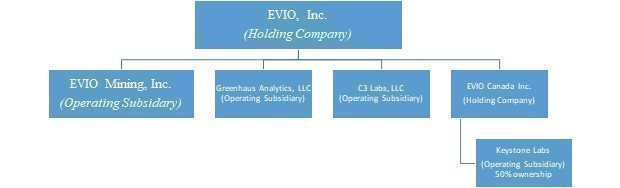
Our Common Stock is quoted on the OTC Markets under the symbol, “EVIO.” On April 5, 2022, the last reported sale price of our Common Stock was $0.0002 per share.
Marketing
All of our mining operations, if successful, will produce gold or silver in doré form or a concentrate that contains gold or silver.
We plan to market our refined metal and doré to credit worthy bullion trading houses, market makers and members of the London Bullion Market Association, industrial companies and sound financial institutions. The refined metals will be sold to end users for use in electronic circuitry, jewelry, silverware, and the pharmaceutical and technology industries. Generally, the loss of a single bullion trading counterparty would not adversely affect us due to the liquidity of the markets and the availability of alternative trading counterparties.
We plan to refine and market its precious metals doré and concentrates using a geographically diverse group of third party smelters and refiners. The loss of any one smelting and refining client may have a material adverse effect if alternate smelters and refiners are not available. We believe there is sufficient global capacity available to address the loss of any one smelter.
Competitive Conditions
The mining business is competitive in all phases of exploration, development and production. We compete with a number of other exploration and mining companies in the search for, and acquisition of, mineral properties or the raising of capital, many of whom have greater financial resources. As a result of this competition, we may be unable to acquire attractive mineral properties in the future on terms it considers acceptable or raise additional capital. We also compete for financing with other resource companies, many of whom have greater financial resources and/or more advanced properties. There can be no assurance that additional capital or other types of financing will be available if needed or that, if available, the terms of such financing will be favorable to us.
Our ability of to acquire properties or raising additional capital largely depends on its success in exploring and developing its present properties and on its ability to select, acquire and bring to production suitable properties or prospects for mineral exploration and development. We may compete with other exploration and mining companies for the procurement of equipment and for the availability of skilled labor. Factors beyond our control may affect the marketability of minerals we mine or discover.
Government Regulation
General
Our activities are and will be subject to extensive federal, state and local laws governing the protection of the environment, prospecting, mine development, production, taxes, labor standards, occupational health, mine safety, toxic substances and other matters. The costs associated with compliance with such regulatory requirements are substantial and possible future legislation and regulations could cause additional expense, capital expenditures, restrictions and delays in the development and continued operation of our properties, the extent of which cannot be predicted. In the context of environmental permitting, including the approval of reclamation plans, we must comply with known standards and regulations which may entail significant costs and delays.
Although we are committed to environmental responsibility and believe we are in substantial compliance with applicable laws and regulations, amendments to current laws and regulations, more stringent implementation of these laws and regulations through judicial review or administrative action or the adoption of new laws could have a materially adverse effect upon our results of operations.
| 27 |
| Table of Contents |
Federal Environmental Laws
Certain mining wastes from extraction and beneficiation of ores are currently exempt from the extensive set of Environmental Protection Agency (“EPA”) regulations governing hazardous waste, although such wastes may be subject to regulation under state law as a solid or hazardous waste. The EPA has worked on a program to regulate these mining wastes pursuant to its solid waste management authority under the Resource Conservation and Recovery Act (“RCRA”). Certain ore processing and other wastes are currently regulated as hazardous wastes by the EPA under RCRA. If our future mine wastes, if any, were treated as hazardous waste or such wastes resulted in operations being designated as a ”Superfund” site under the Comprehensive Environmental Response, Compensation and Liability Act (“CERCLA” or ”Superfund”) for cleanup, material expenditures would be required for the construction of additional waste disposal facilities or for other remediation expenditures. Under CERCLA, any present owner or operator of a Superfund site or an owner or operator at the time of its contamination generally may be held liable and may be forced to undertake remedial cleanup action or to pay for the government’s cleanup efforts. Such owner or operator may also be liable to governmental entities for the cost of damages to natural resources, which may be substantial. Additional regulations or requirements may also be imposed upon our future tailings and waste disposal, if any, in Nevada under the Federal Clean Water Act (“CWA”) and state law counterparts. We have reviewed and considered current federal legislation relating to climate change and we do not believe it to have a material effect on our operations. Additional regulation or requirements under any of these laws and regulations could have a materially adverse effect upon our results of operations.
Federal Regulation of Cannabis
In 2005, the U.S. Supreme Court ruled that Congress has the power to regulate cannabis.
The U.S. federal government regulates drugs through the Controlled Substances Act, which places controlled substances, including cannabis, in a schedule. Cannabis is classified as a Schedule I controlled substance. A Schedule I controlled substance is defined as a substance that has no currently accepted medical use in the United States, a lack of safety for use under medical supervision and a high potential for abuse. The Department of Justice defines Schedule I drugs, substances or chemicals as “drugs with no currently accepted medical use and a high potential for abuse.” However, the Food and Drug Administration has approved Epidiolex, which contains a purified form of the drug CBD, a non-psychoactive ingredient in the cannabis plant, for the treatment of seizures associated with two epilepsy conditions. The Food and Drug Administration has not approved cannabis or cannabis compounds as a safe and effective drug for any other condition. Moreover, under the 2018 Farm Bill or Agriculture Improvement Act of 2018, CBD remains a Schedule I controlled substance under the Controlled Substances Act, with a narrow exception for CBD derived from hemp with a tetrahydrocannabinol, which is commonly referred to as THC, concentration of less than 0.3%.
Cannabis is largely regulated at the state level.
State laws that permit and regulate the production, distribution and use of cannabis for adult use or medical purposes are in direct conflict with the Controlled Substances Act, which makes cannabis use and possession federally illegal. Although certain states and territories of the U.S. authorize medical and/or adult use cannabis production and distribution by licensed or registered entities, under U.S. federal law, the possession, use, cultivation and transfer of cannabis and any related drug paraphernalia is illegal and any such acts are criminal acts under federal law under any and all circumstances under the Controlled Substances Act. Although our activities are believed to be compliant with applicable state and local laws, strict compliance with state and local laws with respect to cannabis may neither absolve us of liability under U.S. federal law, nor may it provide a defense to any federal proceeding which may be brought against us.
35 states and the District of Columbia have legalized cannabis for medical use, while 15 of those states and the District of Columbia have legalized the adult use of cannabis for recreational purposes. In November 2020, voters in Arizona, Montana, New Jersey and South Dakota voted by referendum to legalize cannabis for adult use, and voters in Mississippi and South Dakota voted to legalized cannabis for medical use.
Regulation of the Cannabis Market at State and Local Level
Following the thesis that distributing brands at scale will win, we enter markets where we believe that we can profitably and sustainably operate and command significant market share, and thus maximize consumer and brand awareness. The regulatory frameworks enacted by the states, which are similar to the limited and controlled issuance of gaming or alcohol distributorship licenses, provide macro-level indication of whether certain state markets will be sustainable and profitable.
Federal Law
The inconsistencies between federal and state regulation of cannabis were addressed in a memorandum which then-Deputy Attorney General James Cole sent to all U.S. District Attorneys in August 2013 outlining certain priorities for the Department of Justice relating to the prosecution of cannabis offenses. The Cole Memorandum acknowledged that, notwithstanding the designation of cannabis as a Schedule I controlled substance at the federal level, several states had enacted laws authorizing the use of cannabis for medical purposes. The Cole Memorandum noted that jurisdictions that have enacted laws legalizing cannabis in some form have also implemented strong and effective regulatory and enforcement systems to control the cultivation, processing, distribution, sale and possession of cannabis. As such, conduct in compliance with those laws and regulations is less likely to implicate the Cole Memorandum’s enforcement priorities. The Department of Justice did not provide (and has not provided since) specific guidelines for what regulatory and enforcement systems would be deemed sufficient under the Cole Memorandum. In light of limited investigative and prosecutorial resources, the Cole Memorandum concluded that the Department of Justice should be focused on addressing only the most significant threats related to cannabis, such as distribution of cannabis from states where cannabis is legal to those where cannabis is illegal, the diversion of cannabis revenues to illicit drug cartels and sales of cannabis to minors.
| 28 |
| Table of Contents |
Federal Law
The inconsistencies between federal and state regulation of cannabis were addressed in a memorandum which then-Deputy Attorney General James Cole sent to all U.S. District Attorneys in August 2013 outlining certain priorities for the Department of Justice relating to the prosecution of cannabis offenses. The Cole Memorandum acknowledged that, notwithstanding the designation of cannabis as a Schedule I controlled substance at the federal level, several states had enacted laws authorizing the use of cannabis for medical purposes. The Cole Memorandum noted that jurisdictions that have enacted laws legalizing cannabis in some form have also implemented strong and effective regulatory and enforcement systems to control the cultivation, processing, distribution, sale and possession of cannabis. As such, conduct in compliance with those laws and regulations is less likely to implicate the Cole Memorandum’s enforcement priorities. The Department of Justice did not provide (and has not provided since) specific guidelines for what regulatory and enforcement systems would be deemed sufficient under the Cole Memorandum. In light of limited investigative and prosecutorial resources, the Cole Memorandum concluded that the Department of Justice should be focused on addressing only the most significant threats related to cannabis, such as distribution of cannabis from states where cannabis is legal to those where cannabis is illegal, the diversion of cannabis revenues to illicit drug cartels and sales of cannabis to minors.
On January 4, 2018, former U.S. Attorney General Jeff Sessions issued a new memorandum, which rescinded the Cole Memorandum. The Sessions Memorandum stated, in part, that current law reflects “Congress’ determination that cannabis is a dangerous drug and cannabis activity is a serious crime,” and Mr. Sessions directed all U.S. Attorneys to enforce the laws enacted by Congress by following well-established principles when pursuing prosecutions related to cannabis activities. We are is not aware of any prosecutions of investment companies doing routine business with licensed marijuana related businesses in light of the new Department of Justice position. However, there can be no assurance that the federal government will not enforce federal laws relating to cannabis in the future. As a result of the Sessions Memorandum, federal prosecutors are now free to utilize their prosecutorial discretion to decide whether to prosecute cannabis activities, despite the existence of state-level laws that may be inconsistent with federal prohibitions. No direction was given to federal prosecutors in the Sessions Memorandum as to the priority they should ascribe to such cannabis activities, and thus it is uncertain how active U.S. federal prosecutors will be in relation to such activities.
While federal prosecutors appear to continue to use the Cole Memorandum’s priorities as an enforcement guide, we believe it is too soon to determine what prosecutorial effects will be created by the rescission of the Cole Memorandum and the implementation of the Sessions Memorandum. The sheer size of the cannabis industry, in addition to participation by state and local governments and investors, suggests that a large-scale federal enforcement operation would more than likely create unwanted political backlash for the Department of Justice and the current administration. It is also possible that the revocation of the Cole Memorandum could motivate Congress to reconcile federal and state laws. Indeed, the U.S. House Judiciary Committee approved a bill on November 20, 2019 that removes cannabis from Schedule I of the Controlled Substances Act. This legislation will next be voted upon by the U.S. House of Representatives. If the bill passes the House of Representatives, it will then advance to the U.S. Senate. While Congress is considering legislation that may address these issues, there can be no assurance that such legislation passes. Regardless, at this time, cannabis remains a Schedule I controlled substance at the federal level. The U.S. federal government has always reserved the right to enforce federal law in regard to the sale and disbursement of medical or adult use cannabis, even if state law authorizes such sale and disbursement. It is unclear whether the risk of enforcement has been altered.
On June 7, 2018, the STATES Act was introduced in the Senate by Republican Senator Cory Gardner of Colorado and Democratic Senator Elizabeth Warren of Massachusetts. A companion bill was introduced in the House by Democratic representative Jared Polis of Colorado. The bill provides in relevant part that the provisions of the Controlled Substances Act, as applied to marijuana, “shall not apply to any person acting in compliance with state law relating to the manufacture, production, possession, distribution, dispensation, administration, or delivery of marijuana.” Even though marijuana will remain within Schedule I of the Controlled Substances Act under the STATES Act, the bill makes the Controlled Substances Act unenforceable to the extent it conflicts with state law. In essence, the bill extends the limitations afforded by the protection within the federal budget—which prevents the Department of Justice and the Drug Enforcement Agency from using funds to enforce federal law against state-legal medical cannabis commercial activity—to both medical and adult use cannabis activity in all states where it has been legalized. By allowing continued prohibition to be a choice by the individual states, the STATES Act does not fully legalize cannabis on a national level. In that respect, the bill emphasizes states’ rights under the Tenth Amendment, which provides that “the powers not delegated to the United States by the Constitution, nor prohibited by it to the States, are reserved to the States respectively, or to the people.” Under the STATES Act companies operating legal cannabis businesses would no longer be considered “trafficking” under the Controlled Substances Act, and this would likely assist financial institutions in transacting with individuals and businesses in the cannabis industry without the threat of money laundering prosecution, civil forfeiture and other criminal violations that could lead to a charter revocation. The STATES Act was reintroduced on April 4, 2019 in both the House and the Senate. Since the STATES Act is currently draft legislation, there is no guarantee that the STATES Act will become law in its current form.
One legislative safeguard for the medical cannabis industry, appended to the federal budget bill, remains in place following the rescission of the Cole Memorandum. For fiscal years 2015, 2016, 2017 and 2018, Congress adopted a so-called ”rider” provision to the Consolidated Appropriations Acts (formerly referred to as the Rohrabacher-Farr Amendment and currently referred to as the Rohrabacher-Blumenauer Amendment) to prevent the federal government from using congressionally appropriated funds to enforce federal cannabis laws against regulated medical cannabis actors operating in compliance with state and local law. The Rohrabacher-Blumenauer Amendment was included in the fiscal year 2018 budget passed on March 23, 2018. The Rohrabacher-Blumenauer Amendment was included in the consolidated appropriations bill signed into legislation by President Trump in February 2019. In signing the Rohrabacher-Blumenauer Amendment, President Trump issued a signing statement noting that the Rohrabacher-Blumenauer Amendment “provides that the Department of Justice may not use any funds to prevent implementation of medical marijuana laws by various States and territories,” and further stating “I will treat this provision consistent with the President’s constitutional responsibility to faithfully execute the laws of the United States.” On June 20, 2019, the House approved a broader amendment that, in addition to protecting state medical cannabis programs, would also protect state adult use programs. On September 26, 2019, the Senate Appropriations Committee declined to take up the broader amendment but did approve the Rohrabacher-Blumenauer Amendment for the fiscal year 2020 spending bill. On September 27, 2019, the Rohrabacher-Blumenauer Amendment was reviewed as part of a stopgap spending bill, in effect through November 21, 2019. The Rohrabacher-Blumenauer Amendment may or may not be renewed as part of a subsequent stopgap spending bill or omnibus appropriations package.
| 29 |
| Table of Contents |
Despite the rescission of the Cole Memorandum, the Department of Justice appears to continue to adhere to the enforcement priorities set forth in the Core Memorandum. Accordingly, as an industry best practice, we continue to employ the following policies to ensure compliance with the guidance provided by the Cole Memorandum:
|
| · | our operations and our subsidiaries’ operations are compliant with all licensing requirements as established by the applicable state, county, municipality, town, township, borough and other political/administrative divisions; to this end, we retain appropriately experienced legal counsel to conduct the necessary due diligence to ensure compliance of such operations with all applicable state and local laws; |
|
| · | the cannabis-related activities adhere to the scope of the licensing obtained—for example, in states where only medical cannabis is permitted, the products are only sold to patients who hold the necessary documentation to permit the possession of the cannabis; in states where cannabis is permitted for adult use, the products are only sold to individuals who meet the requisite age requirements; |
|
| · | we only work through licensed operators, which must pass a range of requirements, adhere to strict business practice standards and be subject to strict regulatory oversight to ensure that no revenue is distributed to criminal enterprises, gangs or cartels; |
|
| · | we have implemented an inventory tracking system and necessary procedures to ensure that such compliance system is effective in tracking inventory and preventing diversion of cannabis or cannabis products into those states where cannabis is not permitted by state law or cross any state lines in general; |
|
| · | our state-authorized cannabis business activity is not used as a cover or pretense for trafficking of other illegal drugs, and we are not engaged in any other illegal activity or any activities that are contrary to any applicable anti-money laundering statutes; and |
|
| · | we conduct reviews of products and product packaging to ensure that the products comply with applicable regulations and contain necessary disclaimers about the contents of the products to prevent adverse public health consequences from cannabis use and prevent impaired driving. |
The Cole Memorandum and the Rohrabacher-Blumenauer Amendment gave licensed cannabis operators (particularly medical cannabis operators) and investors in states with legal regimes greater certainty regarding the Department of Justice’s enforcement priorities and the risk of operating cannabis businesses. While the Sessions Memorandum has introduced some uncertainty regarding federal enforcement, the cannabis industry continues to experience growth in legal medical and adult use markets across the United States. U.S. Attorney General Jeff Sessions resigned on November 7, 2018. On February 14, 2019, William Barr was confirmed as U.S. Attorney General. It is unclear what impact, if any, this development will have on U.S. federal government enforcement policy. However, in a written response to questions from U.S. Senator Cory Booker made as a nominee, U.S. Attorney General Barr stated: “I do not intend to go after parties who have complied with state law in reliance on the Cole Memo.” With respect to the STATES Act, Mr. Barr stated: “Personally, I would still favor one uniform federal rule against marijuana but, if there is not sufficient consensus to obtain that, then I think the way to go is to permit a more federal approach so states can make their own decisions within the framework of the federal law and so we’re not just ignoring the enforcement of federal law.” Mr. Barr has also stated the need for more legal growers of marijuana for research and acknowledged that the Farm Bill or Agriculture Improvement Act of 2018 has broad implications for the sale of cannabis products. Nonetheless, there is no guarantee that state laws legalizing and regulating the sale and use of cannabis will remain in place or that local governmental authorities will not limit the applicability of state laws within their respective jurisdictions. Unless and until the United States Congress amends the Controlled Substances Act with respect to cannabis (and as to the timing or scope of any such potential amendments there can be no assurance), there is a risk that federal authorities may enforce current U.S. federal law criminalizing cannabis.
We will continue to monitor compliance on an ongoing basis in accordance with our compliance program and standard operating procedures. While our operations are in full compliance with all applicable state laws, regulations and licensing requirements, such activities remain illegal under federal law. For the reasons described above and the risks further described in the section entitled “Risk Factors,” there are significant risks associated with our business. Readers of this prospectus are strongly encouraged to carefully read all of the risk factors contained in “Risk Factors.”
| 30 |
| Table of Contents |
Restricted Access to Banking and Other Financial Services
FinCEN issued the FinCEN Memorandum on February 14, 2014 with respect to financial institutions providing banking services to cannabis businesses. These include burdensome due diligence expectations and reporting requirements. The FinCEN Memorandum outlines the pathways for financial institutions to bank state-sanctioned cannabis businesses in compliance with federal enforcement priorities. The FinCEN Memorandum echoed the enforcement priorities of the Cole Memorandum and states that, in some circumstances, it is permissible for banks to provide services to cannabis-related businesses without risking prosecution for violation of federal money laundering laws. Under these guidelines, financial institutions must submit a Suspicious Activity Report in connection with all cannabis-related banking activities by any client of such financial institution, in accordance with federal money laundering laws. These cannabis-related Suspicious Activity Reports are divided into three categories—cannabis limited, cannabis priority, and cannabis terminated—based on the financial institution’s belief that the business in question follows state law, is operating outside of compliance with state law, or where the banking relationship has been terminated, respectively.
Former U.S. Attorney General Sessions’ revocation of the Cole Memorandum has not affected the status of the FinCEN Memorandum, nor has the Department of the Treasury given any indication that it intends to rescind the FinCEN Memorandum itself. Shortly after the Sessions Memorandum was issued, FinCEN did state that it would review the FinCEN Memorandum, but FinCEN has not yet issued further guidance. The FinCEN Memorandum is a standalone document which explicitly lists the eight enforcement priorities originally cited in the Cole Memorandum. As such, the FinCEN Memorandum remains intact, indicating that the Department of the Treasury and FinCEN intend to continue abiding by its guidance.
However, the FinCEN Memorandum does not provide any safe harbors or legal defenses from examination or regulatory or criminal enforcement actions by the Department of Justice, FinCEN or other federal regulators. Thus, most banks and other financial institutions in the United States do not appear comfortable providing banking services to cannabis-related businesses or relying on this guidance, given that it has the potential to be amended or revoked by the current administration. In addition to the foregoing, banks may refuse to process debit card payments and credit card companies generally refuse to process credit card payments for cannabis-related businesses. As a result, we may have limited or no access to banking or other financial services in the United States. In addition, federal money laundering statutes and regulations under the Bank Secrecy Act, as amended by Title III of the Uniting and Strengthening America by Providing Appropriate Tools Required to Intercept and Obstruct Terrorism Act of 2001 (the “USA Patriot Act, discourage financial institutions from working with any organization that sells a controlled substance, regardless of whether the state it operates in permits cannabis sales. The inability or limitation on our ability to open or maintain bank accounts, obtain other banking services and/or accept credit card and debit card payments may make it difficult for us to operate and conduct our business as planned or to operate efficiently.
Banks and other depository institutions are currently hindered by federal law from providing financial services to marijuana businesses, even in states where those businesses are regulated. On March 7, 2019, Democratic representative Ed Perlmutter of Colorado introduced the SAFE Banking Act, which would protect banks and their employees from punishment for providing services to cannabis businesses that are legal on a state level. The bill was advanced by the House Financial Services Committee on March 28, 2019 and passed with strong bipartisan support in the House of Representatives on September 25, 2019. Some industry observers anticipate that the bill will be signed into law within the next year, which would, as noted above, allow financial institutions to provide services to marijuana related businesses without risk of violating federal money laundering statutes.
Newly Established Legal Regime
Our business activities rely on newly established and/or developing laws and regulations in the states in which it operates. These laws and regulations are rapidly evolving and subject to change with minimal notice.
Regulatory changes may adversely affect our profitability or cause us to cease operations entirely. The cannabis industry may come under further scrutiny by the Food and Drug Administration, the SEC, the Department of Justice, the Financial Industry Regulatory Advisory and other regulatory authorities that supervise or regulate the production, distribution, sale and use of cannabis for medical and nonmedical purposes in the United States. It is impossible to determine the extent of the impact of new laws, regulations or initiatives that may be proposed. The regulatory uncertainty surrounding the industry may adversely affect our business and operations, including without limitation, the costs to remain compliant with applicable laws and the impairment of our business or the ability to raise additional capital.
Legal Proceedings
From time to time, we may become party to litigation or other legal proceedings that we consider to be a part of the ordinary course of our business. We are not currently involved in legal proceedings that could reasonably be expected to have a material adverse effect on our business, prospects, financial condition or results of operations. We may, however, become involved in material legal proceedings in the future.
| 31 |
| Table of Contents |
The Company uses offices at 2654 W. Horizon Ridge Pkwy, STE B5-208 Henderson, NV 89052, which serve as its headquarters, at an annual cost of $396.00.
Keystone Labs, uses offices at 7225 Roper Rd NW, Edmonton, AB T6B 3J4, Canada, at an annual cost of CDN $75,000.
Greenhaus Analytical Labs, LLC uses offices at 14475 SW 74th ST, Tigard, OR 97724, at an annual cost of $120,000.
C3 Labs, LLC uses offices at 2448 6th St, Berkeley, CA 97410, at an annual cost of $540,000.
MANAGEMENT’S DISCUSSION AND ANALYSIS OF FINANCIAL CONDITION AND RESULTS OF OPERATION
The following discussion of our financial condition and results of operations should be read in conjunction with the consolidated financial statements and the notes to those statements that are included elsewhere in this Offering Circular. Our discussion includes forward-looking statements based upon current expectations that involve risks and uncertainties, such as our plans, objectives, expectations and intentions. Actual results and the timing of events could differ materially from those anticipated in these forward-looking statements as a result of a number of factors, including those set forth under the Risk Factors, Cautionary Notice Regarding Forward-Looking Statements and Business sections in this Offering Circular. We use words such as “anticipate,” “estimate,” “plan,” “project,” “continuing,” “ongoing,” “expect,” “believe,” “intend,” “may,” “will,” “should,” “could,” and similar expressions to identify forward-looking statements. Our future operating results, however, are impossible to predict and no guaranty or warranty is to be inferred from those forward-looking statements.
Overview
The Company’s principal line involves two distinct business: (1) analytical testing of cannabis and hemp testing and (2) Rare earth metal and precious metal exploration.
Cannabis and Hemp Testing
Since 2016, the Company’s principal business involved the analytical testing of cannabis and hemp including tests for potency quantitation, and detection of the presence of potentially harmful substances including pesticides, solvents, metals, microbial contaminants. In 2021, the company began consolidating it’s testing facilities to three locations: Keystone Labs in Edmonton, Alberta; GreenHaus Analytical Labs dba EVIO Labs Portland in Tigard, OR; and C3 Labs, LLC dba Steep Hill CA. These three locations serve the markets of Canada, Oregon and California, respectively In 2022, the Company has begun looking at divesting itself of it’s test facilities with the goal to divest itself of the remaining labs in the next 18-24 months.
Rare earth metal and precious metal exploration
In April 2022, the Company formed EVIO mining, Inc. to begin exploration for rare earth and precious metals. We are currently working on acquiring mining claims and on possible joint ventures with owners of mining claims.
Our business is located at 2654 Horizon Ridge Pkwy. #B5-208 Henderson, NV 89052. Our telephone number is 702-748-9944. Our E-Mail address is info@evioinc.com. The address of our web site is www.evioinc.com. Information contained on, or accessible through, the website is not a part of, and is not incorporated by reference into, this Offering Circular.
Going Concern Matters
The accompanying consolidated financial statements have been prepared in conformity with accounting principles generally accepted in the United States of America (“U.S. GAAP”), which contemplates the Company’s continuation as a going concern. The Company has incurred operating losses of $3,778,000 during the period ended September 30, 2021 and has an accumulated deficit of $47,930,000 as of September 30, 2021. In addition, current liabilities exceeded current assets by $14,240,000 as of September 30, 2021. Management intends to raise additional operating funds through equity and/or debt offerings. However, there can be no assurance management will be successful in its endeavors.
There are no assurances that the Company will be able to either (1) achieve a level of revenues adequate to generate sufficient cash flow from operations; or (2) obtain additional financing through either private placement, public offerings and/or bank financing necessary to support its working capital requirements. To the extent that funds generated from operations and any private placements, public offerings and/or bank financing are insufficient, the Company will have to raise additional working capital. No assurance can be given that additional financing will be available, or if available, will be on terms acceptable to the Company. If adequate working capital is not available to the Company, it may be required to curtail or cease its operations.
| 32 |
| Table of Contents |
Due to uncertainties related to these matters, a substantial doubt about the ability of the Company to continue as a going concern is raised. The accompanying consolidated financial statements do not include any adjustments related to the recoverability or classification of asset-carrying amounts or the amounts and classification of liabilities that may result should the Company be unable to continue as a going concern.
Results of Operations
There is limited historical financial information about us upon which to base an evaluation of our performance. We have not generated revenues from our operations to date. The Company has incurred operating losses of $3,778,000 and $4,216,000 during the periods ended September 30, 2021 and 2020, respectively and has an accumulated deficit of $47,930,000 and $46,191,000 during the periods ended September 30, 2021 and 2020, respectively
We cannot guarantee we will be successful in our business operations. Our business is subject to risks inherent in the establishment of a new business enterprise, including the financial risks associated with the limited capital resources currently available to us for the implementation of our business strategies. (See “Risk Factors”). To become profitable and competitive, we must develop our business plan and execute the plan. Our management will attempt to secure financing through various means including borrowing and investment from institutions and private individuals.
Liquidity and Capital Resources
As of March 31, 2022, the Company had limited cash on hand or other capital resources. We do not have any external sources of capital and are dependent upon continued capital contributions from our managementuntil we begin receiving proceeds from the sale of the Shares in this Offering or are able to raise funds from third-parties. No officer or director, however, is under any obligation to advance us any funds and there are no third-parties that have committed to investing in, or funding the Company. As of March 31, 2022, the Company had $31,000 in cash.
Plan of Operations
Our specific plan of operations over the is as follows:
Months 0-3:
Identify and acquiring mining rights to mining claim through acquisition, claiming with BLM or joint venture. We intend to explore, acquire and develop our properties ourselves, although our plans could change depending on the terms and availability of financing and the terms or merits of any joint venture proposals.
Estimated Cost: $300,000
Months 4-9:
Begin exploration phase of mining claims in 3 phases. First phase is intended to determine whether a prospect warrants further exploration and involves:
|
| · | researching the available geologic literature; |
|
| · | interviewing geologists, mining engineers and others familiar with the prospect sites; |
|
| · | conducting geologic mapping, geophysical testing and geochemical testing; |
|
| · | examining any existing workings, such as trenches, prospect pits, shafts or tunnels; |
|
| · | digging trenches that allow for an examination of surface vein structures as well as for efficient reclamation, contouring and re-seeding of disturbed areas; and, |
|
| · | analyzing samples for minerals that are known to have occurred in the test area. |
Subject to obtaining the necessary permits in a timely manner, the first phase can typically be completed on an individual property in several months at a cost of less than $500,000.
None of our properties has reached the first phase.
| 33 |
| Table of Contents |
Estimated Cost: $500,000
Months 7-18:
The second phase is intended to identify any mineral deposits of potential economic importance and would involve:
|
| · | examining underground characteristics of mineralization that were previously identified; |
|
| · | conducting more detailed geologic mapping; |
|
| · | conducting more advanced geochemical and geophysical surveys; |
|
| · | conducting more extensive trenching; and |
|
| · | conducting exploratory drilling. |
Subject to obtaining the necessary permits in a timely manner, the second phase can typically be completed on an individual property in nine to 12 months at a cost of less than $1 million.
None of our properties has reached the second phase.
Estimated Cost: $1,000,000
Months 18+:
The third phase is intended to precisely define depth, width, length, tonnage and value per ton of any deposit that has been identified and would involve:
|
| · | drilling to develop the mining site; |
|
| · | conducting metallurgical testing; and |
|
| · | obtaining other pertinent technical information required to define an ore reserve and complete a feasibility study depending upon the nature of the particular deposit, the third phase on any one property could take one to five years or more and cost well in excess of $1 million. None of our properties has reached the third phase. |
Estimated Cost: $1,000,000
Minimum requirements
In order to complete our intended plan of operations, we believe a minimum of $2,000,000 in Offering proceeds will be required. If we raise less than $2,000,000 from the sale of Shares in this Offering, we may be required to reduce the scope of our planned operations, depending on the amount of proceeds received in this Offering and the amount of revenues we are generating from our business, which we believe we will start generating within the next 12 months and may be able to use to help fund our operations.
Covid-19 Effects
If the current outbreak of the coronavirus continues to grow, the effects of such a widespread infectious disease and epidemic may inhibit our ability to conduct our business and operations and could materially harm our Company. The coronavirus may cause us to have to reduce operations as a result of various lock-down procedures enacted by the local, state or federal government, which could restrict our ability to conduct our business operations. The coronavirus may also cause a decrease in spending on the types of products that we plan to offer, as a result of the economic turmoil resulting from the spread of the coronavirus and thereby having a negative effect on our ability to generate revenue from the sales of our products.. The continued coronavirus outbreak may also restrict our ability to raise funding when needed and may also cause an overall decline in the economy as a whole. The specific and actual effects of the spread of coronavirus are difficult to assess at this time as the actual effects will depend on many factors beyond the control and knowledge of the Company. However, the spread of the coronavirus, if it continues, may cause an overall decline in the economy as a whole and also may materially harm our Company.
Trends Information
The core elements of our growth strategy include developing a product line with a strong brand awareness. We plan to invest significant resources product development and marketing, and we anticipate that our operating expenses will continue to increase for the foreseeable future, particularly marketing costs and research and development of new products. These investments are intended to contribute to our long-term growth; however, they may affect our short-term profitability.
Our Company plans to raise funds from this Offering, to use to commence operations, and as of the date of this Offering Circular we have not begun production or selling any products. All our operations to date have been developing our business plan, developing our product line and analysis the specific need of our targeted customers for these products. Accordingly, we have not experienced any recognizable trends in the last fiscal year.
| 34 |
| Table of Contents |
For our Bitcoin Mining business, the Company intends to capitalize on the growing value of cryptocurrencies – specifically Bitcoin – as well as recent enthusiasm for cryptocurrency mining operations in certain areas which the Company believes provides opportunity.
Off-Balance Sheet Arrangements
We have no significant off-balance sheet arrangements that have or are reasonably likely to have a current or future effect on our financial condition, changes in our financial condition, revenues or expenses, results of operations, liquidity, capital expenditures or capital resources that are material to our stockholders.
Critical Accounting Policies
Our financial statements are affected by the accounting policies used and the estimates and assumptions made by management during their preparation. We have identified below the critical accounting policies which are assumptions made by management about matters that are highly uncertain and that are of critical importance and have a material impact on our financial statements. Management believes that the critical accounting policies and estimates discussed below involve the most complex management judgments due to the sensitivity of the methods and assumptions necessary in determining the related asset, liability, revenue and expense amounts. Specific risks associated with these critical accounting policies are discussed throughout this MD&A, where such policies have a material effect on reported and expected financial results.
A complete listing of our significant policies is included in Note 2 to our financial statements for the year ended September 30, 2021.
Use of Estimates
The preparation of financial statements in conformity with U.S. generally accepted accounting principles (GAAP) requires management to make estimates and assumptions that affect the amounts reported in the financial statements. Estimates are based on historical experience, management expectations for future performance, and other assumptions as appropriate. We re-evaluate estimates on an ongoing basis; therefore, actual results may vary from those estimates.
Financial Instruments
The Company’s balance sheet includes certain financial instruments. The carrying amounts of current assets and current liabilities approximate their fair value because of the relatively short period of time between the origination of these instruments and their expected realization.
DIRECTORS, EXECUTIVE OFFICERS AND SIGNIFICANT EMPLOYEES
The table below sets forth our directors and executive officers of as of the date of this Offering Circular.
Family Relationships
None.
Involvement in Certain Legal Proceedings
No executive officer, member of the board of directors or control person of our Company has been involved in any legal proceeding listed in Item 401(f) of Regulation S-K in the past 10 years.
| 35 |
| Table of Contents |
COMPENSATION OF DIRECTORS AND EXECUTIVE OFFICERS
2020 Summary Compensation Table
| Name(1) |
| Capacities in which Compensation was Received |
| Cash Compensation (1) |
| Other Compensation |
| Total Compensation | |
|
|
|
|
|
|
|
|
|
| |
| William Waldop |
| CEO | 2021: $0 2020: $0 |
| 2021: $0 2020: $0 |
| 2021: $0 2020: $0 |
| |
| Lori Glauser |
| COO | 2021: $0 2020: $0 |
| 2021: $0 2020: $0 |
| 2021: $0 2020: $0 |
| |
| (1) | We have not paid any compensation to any of our officers or directors during the time periods specified above. We currently do not have any employment agreements with our officers and directors. We do reimburse our officers and directors for reasonable expenses incurred during the course of their performance and for extraordinary services but no such reimbursements have been paid thus far. Further, we do not compensate our directors for attendance at meetings. We have no long-term incentive plans. |
Employment Agreements
The Company does not have currently have any employment agreements in place.
SECURITY OWNERSHIP OF MANAGEMENT AND CERTAIN BENEFICIAL OWNERS
The following table sets forth information regarding beneficial ownership of our Common Stock and Preferred Stock as of April 5, 2022 and as adjusted to reflect the sale of shares of our Common Stock offered by this Offering Circular, by:
|
| · | Each of our Directors and the named Executive Officers; |
|
| · | All of our Directors and Executive Officers as a group; and |
|
| · | Each person or group of affiliated persons known by us to be the beneficial owner of more than 10% of our outstanding shares of Common Stock |
|
| · | All other shareholders as a group |
Beneficial ownership and percentage ownership are determined in accordance with the rules of the Securities and Exchange Commission and includes voting or investment power with respect to shares of stock. This information does not necessarily indicate beneficial ownership for any other purpose.
Unless otherwise indicated and subject to applicable community property laws, to our knowledge, each stockholder named in the following table possesses sole voting and investment power over their shares of common stock, except for those jointly owned with that person’s spouse. Percentage of beneficial ownership before the offering is based on outstanding as of April 5, 2022. Unless otherwise noted below, the address of each person listed on the table is c/o EVIO, Inc. 2654 W. Horizon Ridge Parkway, Ste. B5-208 Henderson, NV
|
|
| Shares Beneficially Owned Prior and After to Offering |
|
| Voting Power Before the Offering |
|
| Voting Power After the Offering |
| |||||||||||
| Name and Position of Beneficial Owner |
| Type |
| Series |
| Number |
|
| Percent |
|
|
|
|
| ||||||
|
|
|
|
|
|
|
|
|
|
|
|
|
|
|
|
|
| ||||
| Officers/Directors |
|
|
|
|
|
|
|
|
|
|
|
|
|
|
|
| ||||
| William Waldrop |
| Common |
|
|
|
| 4,394,007 |
|
|
| 1 | % |
|
|
|
|
|
| ||
|
|
| Preferred |
| Series B |
|
| 2,500,000 |
|
|
| 50 | % |
|
|
|
|
|
| ||
|
|
| Preferred |
| Series F |
|
| 250,000 |
|
|
| 100 | % |
|
|
|
|
|
| ||
| Voting Control |
|
|
|
|
|
|
|
|
|
|
|
|
|
| 64.7 | % |
|
| 36.4 | % |
|
|
|
|
|
|
|
|
|
|
|
|
|
|
|
|
|
|
|
|
|
|
| Lori Glauser |
| Common |
|
|
|
| 3,947,017 |
|
|
| 1 | % |
|
|
|
|
|
|
|
|
|
|
| Preferred |
| Series B |
|
| 2,500,000 |
|
|
| 50 | % |
|
|
|
|
|
|
|
|
|
|
| Preferred |
| Series E |
|
| 350,000 |
|
|
| 100 | % |
|
|
|
|
|
|
|
|
| Voting Power |
|
|
|
|
|
|
|
|
|
|
|
|
|
| 9.1 | % |
|
| 5.1 | % |
|
|
|
|
|
|
|
|
|
|
|
|
|
|
|
|
|
|
|
|
|
|
| 10% Shareholders |
|
|
|
|
|
|
|
|
|
|
|
|
|
|
|
|
|
|
|
|
| None |
|
|
|
|
|
|
|
|
|
|
|
|
|
|
|
|
|
|
|
|
|
|
|
|
|
|
|
|
|
|
|
|
|
|
|
|
|
|
|
|
|
|
| Officers and Directors as a Group (2 persons) |
|
|
|
|
|
|
|
|
|
|
|
|
|
| 73.8 | % |
|
| 41.5 | % |
| (1) | The Common Stock and Preferred Stock vote together as a single class except as otherwise required by law. Each share of Preferred Stock has the following voting rights: |
Series B: 1 vote per share
Series C: 5 votes per share
Series D: 2.5 votes per share
Series E: 10,000 votes per share
Series F: 100,000 votes per share
| 36 |
| Table of Contents |
INTEREST OF MANAGEMENT AND OTHERS IN CERTAIN TRANSACTIONS
Related Party Transactions
Employment Agreements
The Company does not have currently have any employment agreements in place.
Equity Transactions
During the year ended September 30, 2021, the Company issued 2,975,415,697 common shares for the conversion of $2,626,000 of outstanding principal on convertible notes payable; 589,603,703 for the conversion of $576,000 of convertible accrued interest and 222,222 common shares for fees associated with the conversion of convertible debt valued at $1,000. All conversions of outstanding principal and accrued interest on convertible notes payable were done so at contractual terms.
During the year ended September 30, 2020, the Company issued 4,380,000 common shares valued at $301,830 for services; 100,000 common shares valued at $217,334 under its employee equity incentive plan; 26,666 common shares for the settlement of $6,000 of accounts payable; 144,928 common shares for the settlement of litigation valued at $10,000, 53,636,398 common shares for the conversion of $1,754,785 of outstanding principal on convertible notes payable; 5,365,500 for the conversion of $217,553 of convertible accrued interest; 1,513,317 common shares for fees associated with the conversion of convertible debt valued at $33,000; 2,285,449 common shares for the default penalties on convertible debt valued at $62,500; 7,353,538 common shares for the settlement of $525,778 of deferred wages, and 5,000,000 common shares to increase ownership of C3 Labs, valued at $106,000. All conversions of outstanding principal and accrued interest on convertible notes payable were done so at contractual terms.
There were 3,674,361,837 and 109,120,215 shares of common stock issued and outstanding at September 30, 2021 and 2020, respectively
Review, Approval and Ratification of Related Party Transactions
Given our small size and limited financial resources, we have not adopted formal policies and procedures for the review, approval or ratification of transactions, such as those described above, with our executive officer(s), Director(s) and significant stockholders. We intend to establish formal policies and procedures in the future, once we have sufficient resources and have appointed additional Directors, so that such transactions will be subject to the review, approval or ratification of our Board of Directors, or an appropriate committee thereof. On a moving forward basis, our Directors will continue to approve any related party transactions.
Conflict of Interest Policies
Our governing instruments do not restrict any of our directors, officers, stockholders or affiliates from having a pecuniary interest in an investment or transaction in which we have an interest or from conducting, for their own account, business activities of the type we conduct. However, we plan that our policies will be designed to eliminate or minimize potential conflicts of interest. A “conflict of interest” occurs when a director’s, officer’s or employee’s private interest interferes in any way, or appears to interfere, with the interests of the Company as a whole. We plan to adopt a policy that discloses personal conflicts of interest. This policy will provide that any situation that involves, or may reasonably be expected to involve, a conflict of interest must be disclosed immediately to our directors and subsequently to our shareholders in our next semi-annual or annual report. These policies may not be successful in eliminating the influence of conflicts of interest. If they are not successful, decisions could be made that might fail to reflect fully the interests of all stockholders.
General
Our Amended and Restated Articles of Incorporation, as amended, authorize the Company to issue up to 90,100,000,000 shares, of which 20,000,000,000 shares are Common Stock and 100,000,000 are Preferred Stock. Each share of Common Stock has a par value of $.0001. Each share of Preferred Stock has a par value of $0.0001.
| 37 |
| Table of Contents |
Common Stock
We are authorized to issue up to 90,000,000,000 shares of our Common Stock, $0.0001 par value per share. As of the date of this offering circular, there are 10,118,466,153 shares of our Common Stock is issued and outstanding, which are held by approximately 118 shareholders of record; this does not include any shares held in street name. All outstanding shares of Common Stock are of the same class and have equal rights and attributes. Holders of our Common Stock are entitled to one vote per share on matters to be voted on by shareholders and also are entitled to receive such dividends, if any, as may be declared from time to time by our Board of Directors in its discretion out of funds legally available therefore. Unless otherwise required by the Colorado Revised Statutes, the Common Stock and all Series of Preferred Stock shall vote as a single class with respect to all matters submitted to a vote of shareholders of the Corporation.
Series A Preferred Stock
Series A Convertible Preferred Stock The Company designated 1,850,000 shares of Series A Convertible Preferred Stock (“Series A Preferred Stock”) with a par value of $0.0001 per share. Initially, there will be no dividends due or payable on the Series A Preferred Stock. Any future terms with respect to dividends shall be determined by the Board consistent with the Corporation’s Certificate of Incorporation. Any and all such future terms concerning dividends shall be reflected in an amendment to this Certificate, which the Board shall promptly file or cause to be filed. All shares of the Series A Preferred Stock shall rank (i) senior to the Corporation’s Common Stock and any other class or series of capital stock of the Corporation hereafter created, (ii) pari passu with any class or series of capital stock of the Corporation hereafter created and specifically ranking, by its terms, on par with the Series A Preferred Stock and (iii) junior to any class or series of capital stock of the Corporation hereafter created specifically ranking, by its terms, senior to the Series A Preferred Stock, in each case as to distribution of assets upon liquidation, dissolution or winding up of the Corporation, whether voluntary or involuntary. The Series A Preferred shall have no liquidation preference over any other class of stock. Except as otherwise required by law, holders of Series A Preferred Stock shall have no special voting rights and their consent shall not be required (except to the extent they are entitled to vote with holders of Common Stock or any other class or series of preferred stock) for the taking of any corporate action Conversion at the Option of the Holder. From 12 months from the date of issuance, each holder of shares of Series A Preferred Stock may, at any time and from time to time, convert (an “Optional Conversion”) each of its shares of Series A Preferred Stock into fully paid and nonassessable shares of Common Stock at a rate equal to 4.9% of the Common Stock. For a period of 18 months after the Preferred is convertible, the conversion price of the Series A Preferred will be subject to adjustment to prevent dilution in the event that the Company issues additional shares at a purchase price less than the applicable conversion price. The conversion price will be subject to adjustment on a weighted basis that takes into account issuances of additional shares. At the expiration of the antidilution period, the conversion rate in Section VI (A) above shall be equal to a conversion rate equal to 4.9% on the Common Stock. For example, if on the date of expiration of the antidilution clause there are 500,000,000 shares of Common Stock issued and outstanding then each Series A Preferred Stock shall convert at a rate of 13.24 common shares for each 1 Series Preferred Share. The Company has evaluated the Series A Preferred Stock in accordance with ASC 815 and has determined their conversion options were for equity and ASC 815 does not apply. The Company has evaluated the Series A Preferred Stock in accordance with FASB ASC Subtopic 470-20, and has determined that there is no beneficial conversion feature that must be accounted.
The Company has 0 shares of Series A Convertible Stock issued and outstanding as of September 30, 2021 and 2020.
Series B Preferred Stock
The Company designated 5,000,000 shares of Series B Convertible Preferred Stock (“Series B Preferred Stock”) with a par value of $0.0001 per share. Initially, there will be no dividends due or payable on the Series B Preferred Stock. Any future terms with respect to dividends shall be determined by the Board consistent with the Corporation’s Certificate of Incorporation. Any and all such future terms concerning dividends shall be reflected in an amendment to this Certificate, which the Board shall promptly file or cause to be filed. All shares of the Series B Preferred Stock shall rank (i) senior to the Corporation’s Common Stock and any other class or series of capital stock of the Corporation hereafter created, (ii) pari passu with any class or series of capital stock of the Corporation hereafter created and specifically ranking, by its terms, on par with the Series B Preferred Stock and (iii) junior to any class or series of capital stock of the Corporation hereafter created specifically ranking, by its terms, senior to the Series B Preferred Stock, in each case as to distribution of assets upon liquidation, dissolution or winding up of the Corporation, whether voluntary or involuntary. The Series B Preferred shall have no liquidation preference over any other class of stock. Each holder of outstanding shares of Series B Preferred Stock shall be entitled to the number of votes equal to one Common Share. Except as provided by law, or by the provisions establishing any other series of Preferred Stock, holders of Series B Preferred Stock and of any other outstanding series of Preferred Stock shall vote together with the holders of Common Stock as a single class. Each holder of shares of Series B Preferred Stock may, at any time and from time to time, convert (an “Optional Conversion”) each of its shares of Series B Preferred Stock into one (1) fully paid and nonassessable shares of Common Stock.
| 38 |
| Table of Contents |
The Company has evaluated the Series B Preferred Stock in accordance with ASC 815 and has determined their conversion options were for equity and ASC 815 does not apply. The Company has evaluated the Series B Preferred Stock in accordance with FASB ASC Subtopic 470-20, and has determined that there is no beneficial conversion feature that must be accounted.
The Company has 5,000,000 shares of Series B Convertible Stock issued and outstanding as of September 30, 2021 and 2020
Series C Preferred Stock
The Company designated 500,000 shares of Series C Convertible Preferred Stock (“Series C Preferred Stock”) with a par value of $0.0001 per share. Initially, there will be no dividends due or payable on the Series C Preferred Stock. Any future terms with respect to dividends shall be determined by the Board consistent with the Corporation’s Certificate of Incorporation. Any and all such future terms concerning dividends shall be reflected in an amendment to this Certificate, which the Board shall promptly file or cause to be filed. All shares of the Series C Preferred Stock shall rank (i) senior to the Corporation’s Common Stock and any other class or series of capital stock of the Corporation hereafter created, (ii) pari passu with any class or series of capital stock of the Corporation hereafter created and specifically ranking, by its terms, on par with the Series B Preferred Stock and (iii) junior to any class or series of capital stock of the Corporation hereafter created specifically ranking, by its terms, senior to the Series B Preferred Stock, in each case as to distribution of assets upon liquidation, dissolution or winding up of the Corporation, whether voluntary or involuntary. In any liquidation, dissolution, or winding up of the Corporation, the holders of the Series C Preferred Stock shall be entitled to receive (a) in preference to the holders of the Common Stock (b) on a pari passu basis to any sum that the holders of the Series B Preferred Stock shall be entitled to receive, but (c) subordinate in preference to any sum that the holders of any shares of any other series of the Corporation’s Preferred Stock shall be entitled, an amount equal to $1 per share (subject to appropriate adjustment in the event of any stock dividend, forward stock split, or other similar recapitalization). After payment of such sums, (i) the holders of the Series A Preferred Stock and (ii) the holders of the Common Stock, shall be entitled to receive any remaining assets of the Corporation on a pro rata, as-converted basis assuming conversion of the Series A Preferred Stock into Common Stock at the then- current Conversion Rate.
Each holder of outstanding shares of Series C Preferred Stock shall be entitled to the number of votes equal to five (5) Common Shares. Except as provided by law, or by the provisions establishing any other series of Preferred Stock, holders of Series B Preferred Stock and of any other outstanding series of Preferred Stock shall vote together with the holders of Common Stock as a single class. Each holder of shares of Series C Preferred Stock may, at any time and from time to time, convert (an “Optional Conversion”) each of its shares of Series C Preferred Stock into five (5) fully paid and nonassessable shares of Common Stock; provided, however, that any Optional Conversion must involve the issuance of at least 100 shares of Common Stock. In the event of a forward or reverse split, the conversion ratio shall be modified on a pro rata basis to align with the forward or reverse split.
The Company has evaluated the Series C Preferred Stock in accordance with ASC 815 and has determined their conversion options were for equity and ASC 815 does not apply. The Company has evaluated the Series C Preferred Stock in accordance with FASB ASC Subtopic 470-20, and has determined that there is no beneficial conversion feature that must be accounted.
There were 500,000 shares of Series C Convertible Stock issued and outstanding as of September 30, 2021 and 2020.
Series D Preferred Stock
The Company designated 1,000,000 shares of Series D Convertible Preferred Stock (“Series D Preferred Stock”) with a par value of $0.0001 per share. Initially, there will be no dividends due or payable on the Series D Preferred Stock. Any future terms with respect to dividends shall be determined by the Board consistent with the Corporation’s Certificate of Incorporation. Any and all such future terms concerning dividends shall be reflected in an amendment to this Certificate, which the Board shall promptly file or cause to be filed. All shares of the Series D Preferred Stock shall rank (i) senior to the Corporation’s Common Stock and any other class or series of capital stock of the Corporation hereafter created, (ii) pari passu with any class or series of capital stock of the Corporation hereafter created and specifically ranking, by its terms, on par with the Series B Preferred Stock and (iii) junior to any class or series of capital stock of the Corporation hereafter created specifically ranking, by its terms, senior to the Series B Preferred Stock, in each case as to distribution of assets upon liquidation, dissolution or winding up of the Corporation, whether voluntary or involuntary. As originally issued, in any liquidation, dissolution, or winding up of the Corporation, the holders of the Series D Preferred Stock shall be entitled to receive (a) in preference to the holders of the Common Stock (b) on a pari passu basis to any sum that the holders of the Series B Preferred Stock shall be entitled to receive, but (c) subordinate in preference to any sum that the holders of any shares of any other series of the Corporation’s Preferred Stock shall be entitled, an amount equal to $1 per share (subject to appropriate adjustment in the event of any stock dividend, forward stock split, or other similar recapitalization). After payment of such sums, (i) the holders of the Series A Preferred Stock and (ii) the holders of the Common Stock, shall be entitled to receive any remaining assets of the Corporation on a pro rata, as-converted basis assuming conversion of the Series A Preferred Stock into Common Stock at the then- current Conversion Rate. On July 31, 2018, the Company amended its articles of incorporation such that the Series D Preferred Stock shall have no liquidation preference over any other class of stock.
| 39 |
| Table of Contents |
Each holder of outstanding shares of Series D Preferred Stock shall be entitled to the number of votes equal to two and a half (2.5) Common Shares. Except as provided by law, or by the provisions establishing any other series of Preferred Stock, holders of Series B Preferred Stock and of any other outstanding series of Preferred Stock shall vote together with the holders of Common Stock as a single class.
Each holder of shares of Series D Preferred Stock may, at any time and from time to time, convert (an “Optional Conversion”) each of its shares of Series D Preferred Stock into 2.5 fully paid and nonassessable shares of Common Stock; provided, however, that any Optional Conversion must involve the issuance of at least 500 shares of Common Stock. In the event of a forward or reverse split, the conversion ratio shall be modified on a pro rata basis to align with the forward or reverse split.
The Company has evaluated the Series D Preferred Stock in accordance with ASC 815 and has determined their conversion options were for equity and ASC 815 does not apply. The Company has evaluated the Series D Preferred Stock in accordance with FASB ASC Subtopic 470-20, and has determined that there is no beneficial conversion feature that must be accounted.
There were 339,500 shares of Series D Convertible Stock issued and outstanding as September 30, 2021 and 2020, respectively.
Series E Preferred Stock
The Company designated 500,000 shares of Series E Convertible Preferred Stock (“Series E Preferred Stock”) with a par value of $0.0001 per share. Initially, there will be no dividends due or payable on the Series E Preferred Stock. Any future terms with respect to dividends shall be determined by the Board consistent with the Corporation’s Certificate of Incorporation. Any and all such future terms concerning dividends shall be reflected in an amendment to this Certificate, which the Board shall promptly file or cause to be filed.
All shares of the Series E Preferred Stock shall rank (i) senior to the Corporation’s Common Stock and any other class or series of capital stock of the Corporation hereafter created, (ii) pari passu with any class or series of capital stock of the Corporation hereafter created and specifically ranking, by its terms, on par with the Series E Preferred Stock and (iii) junior to any class or series of capital stock of the Corporation hereafter created specifically ranking, by its terms, senior to the Series E Preferred Stock, in each case as to distribution of assets upon liquidation, dissolution or winding up of the Corporation, whether voluntary or involuntary. In any liquidation, dissolution, or winding up of the Corporation, the holders of the Series E Preferred Stock shall be entitled to receive (a) in preference to the holders of the Common Stock (b) on a pari passu basis to any sum that the holders of the Series C Preferred Stock shall be entitled to receive, but (c) subordinate in preference to any sum that the holders of any shares of any other series of the Corporation’s Preferred Stock shall be entitled, an amount equal to $1 per share (subject to appropriate adjustment in the event of any stock dividend, forward stock split, or other similar recapitalization). After payment of such sums, (i) the holders of the Series A Preferred Stock and (ii) the holders of the Common Stock, shall be entitled to receive any remaining assets of the Corporation.
Each holder of outstanding shares of Series E Preferred Stock shall be entitled to the number of votes equal to ten thousand (10,000) Common Shares for each share of Series E Preferred Stock. Except as provided by law, or by the provisions establishing any other series of Preferred Stock, holders of Series E Preferred Stock and of any other outstanding series of Preferred Stock shall vote together with the holders of Common Stock as a single class. Each share of Series E Preferred Stock shall be convertible, at any time and from time to time from and after the Original Issue Date at the option of the Holder thereof, into that number of shares of Common Stock.
The Company has evaluated the Series E Preferred Stock in accordance with ASC 815 and has determined their conversion options were for equity and ASC 815 does not apply. The Company has evaluated the Series E Preferred Stock in accordance with FASB ASC Subtopic 470-20, and has determined that there is no beneficial conversion feature that must be accounted.
Series F Preferred Stock
The Company designated 1,000,000 shares of Series F Convertible Preferred Stock (“Series F Preferred Stock”) with a par value of $0.0001 per share. Initially, there will be no dividends due or payable on the Series F Preferred Stock. Any future terms with respect to dividends shall be determined by the Board consistent with the Corporation’s Certificate of Incorporation. Any and all such future terms concerning dividends shall be reflected in an amendment to this Certificate, which the Board shall promptly file or cause to be filed.
All shares of the Series F Preferred Stock shall rank (i) senior to the Corporation’s Common Stock and any other class or series of capital stock of the Corporation hereafter created, (ii) pari passu with any class or series of capital stock of the Corporation hereafter created and specifically ranking, by its terms, on par with the Series F Preferred Stock and (iii) junior to any class or series of capital stock of the Corporation hereafter created specifically ranking, by its terms, senior to the Series F Preferred Stock, in each case as to distribution of assets upon liquidation, dissolution or winding up of the Corporation, whether voluntary or involuntary. In any liquidation, dissolution, or winding up of the Corporation, the holders of the Series F Preferred Stock shall be entitled to receive (a) in preference to the holders of the Common Stock (b) on a pari passu basis to any sum that the holders of the Series C Preferred Stock shall be entitled to receive, but (c) subordinate in preference to any sum that the holders of any shares of any other series of the Corporation’s Preferred Stock shall be entitled, an amount equal to $1 per share (subject to appropriate adjustment in the event of any stock dividend, forward stock split, or other similar recapitalization).
| 40 |
| Table of Contents |
Each holder of outstanding shares of Series F Preferred Stock shall be entitled to the number of votes equal to one hundred thousand (100,000) Common Shares for each share of Series F Preferred Stock. Except as provided by law, or by the provisions establishing any other series of Preferred Stock, holders of Series F Preferred Stock and of any other outstanding series of Preferred Stock shall vote together with the holders of Common Stock as a single class. Each share of Series F Preferred Stock shall be convertible, at any time and from time to time from and after the Original Issue Date at the option of the Holder thereof, into that number of shares of Common Stock.
The Company has evaluated the Series F Preferred Stock in accordance with ASC 815 and has determined their conversion options were for equity and ASC 815 does not apply. The Company has evaluated the Series F Preferred Stock in accordance with FASB ASC Subtopic 470-20, and has determined that there is no beneficial conversion feature that must be accounted.
There were 0 shares of Series F Convertible Stock issued and outstanding as of September 30, 2021.
*To note there are 250,000 Series F Convertible Stock issued and outstanding as of the filing of this offering.
Options and Warrants
None.
SHARES ELIGIBLE FOR FUTURE SALE
Shares Eligible for Future Sale
Prior to the Offering, there are 10,118,466,153 common shares issued and outstanding. Upon closing of this Offering, if it is fully subscribed 40,118,466,153 common shares will be issued and outstanding.
All of the Shares sold in this offering will be freely tradable unless purchased by our affiliates.
ADDITIONAL REQUIREMENTS AND RESTRICTIONS
State Securities – Blue Sky Laws
Transfer of our Shares may be restricted under the securities or securities regulations laws promulgated by various states and foreign jurisdictions, commonly referred to as “Blue Sky” laws. Absent compliance with such individual state laws, our Shares may not be traded in such jurisdictions. Because the securities qualified hereunder have not been registered for resale under the blue sky laws of any state, the holders of such Shares and persons who desire to purchase them in the future, should be aware that there may be significant state blue-sky law restrictions upon the ability of investors to sell the securities and of purchasers to purchase the securities. Accordingly, investors may not be able to liquidate their investments and should be prepared to hold the Shares for an indefinite period of time.
Restrictions Imposed by the USA PATRIOT Act and Related Acts
In accordance with the Uniting and Strengthening America by Providing Appropriate Tools Required to Intercept and Obstruct Terrorism Act of 2001, or the USA PATRIOT Act, the securities offered hereby may not be offered, sold, transferred or delivered, directly or indirectly, to any “unacceptable investor,” which means anyone who is:
|
| ● | A “designated national,” “specially designated national,” “specially designated terrorist,” “specially designated global terrorist,” “foreign terrorist organization,” or “blocked person” within the definitions set forth in the Foreign Assets Control Regulations of the United States, or U.S., Treasury Department; |
|
|
|
|
|
| ● | Acting on behalf of, or an entity owned or controlled by, any government against whom the U.S. maintains economic sanctions or embargoes under the Regulations of the U.S. Treasury Department; |
|
|
|
|
|
| ● | Within the scope of Executive Order 13224 — Blocking Property and Prohibiting Transactions with Persons who Commit, Threaten to Commit, or Support Terrorism, effective September 24, 2001; |
|
|
|
|
|
| ● | A person or entity subject to additional restrictions imposed by any of the following statutes or regulations and executive orders issued thereunder: the Trading with the Enemy Act, the National Emergencies Act, the Antiterrorism and Effective Death Penalty Act of 1996, the International Emergency Economic Powers Act, the United Nations Participation Act, the International Security and Development Cooperation Act, the Nuclear Proliferation Prevention Act of 1994, the Foreign Narcotics Kingpin Designation Act, the Iran and Libya Sanctions Act of 1996, the Cuban Democracy Act, the Cuban Liberty and Democratic Solidarity Act and the Foreign Operations, Export Financing and Related Programs Appropriations Act or any other law of similar import as to any non-U.S. country, as each such act or law has been or may be amended, adjusted, modified or reviewed from time to time; or |
|
|
|
|
|
| ● | Designated or blocked, associated or involved in terrorism, or subject to restrictions under laws, regulations, or executive orders as may apply in the future similar to those set forth above. |
| 41 |
| Table of Contents |
The validity of the securities offered by this Offering Circular will be passed upon for us by legal counsel in Exhibit 12.1.
INTERESTS OF NAME EXPERTS AND COUNSEL
No expert or counsel named in this Offering Circular as having prepared or certified any part of this Offering Circular, or having given any opinion with respect to the validity of the securities offered herein or upon other legal matters in connection with this Offering, was employed on a contingency basis or had, or is to receive, in connection with this Offering, a substantial interest, direct or indirect, in the Company, or otherwise is or has been at any time connected to the Company as a promoter, Officer, Director, or employee.
WHERE YOU CAN FIND MORE INFORMATION
We have filed an offering statement on Form 1-A with the SEC under the Securities Act with respect to the common stock offered by this Offering Circular. This Offering Circular, which constitutes a part of the offering statement, does not contain all of the information set forth in the offering statement or the exhibits and schedules filed therewith. For further information with respect to us and our common stock, please see the offering statement and the exhibits and schedules filed with the offering statement. Statements contained in this Offering Circular regarding the contents of any contract or any other document that is filed as an exhibit to the offering statement are not necessarily complete, and each such statement is qualified in all respects by reference to the full text of such contract or other document filed as an exhibit to the offering statement. The offering statement, including its exhibits and schedules, may be inspected without charge at the public reference room maintained by the SEC, located at 100 F Street, N.E., Room 1580, Washington, D.C. 20549, and copies of all or any part of the offering statement may be obtained from such offices upon the payment of the fees prescribed by the SEC. Please call the SEC at 1-800-SEC-0330 for further information about the public reference room. The SEC also maintains an Internet website that contains all information regarding companies that file electronically with the SEC. The address of the site is www.sec.gov.
| 42 |
| Table of Contents |
EVIO Inc.
FINANCIAL STATEMENTS
(unaudited)
FOR THE YEARS ENDED SEPTEMBER 30, 2021 AND 2020
|
|
| PAGE |
|
| Consolidated Balance Sheets as of September 30, 2021 and September 30, 2020 (Unaudited) |
| F-2 |
|
|
|
|
|
|
|
| F-3 |
| |
|
|
|
|
|
|
| F-4 |
| |
|
|
|
|
|
|
| F-5 |
| |
|
|
|
|
|
|
| F-6 |
|
| F-1 |
| Table of Contents |
Consolidated Balance Sheets (Unaudited)
|
|
| As of |
|
| As of |
| ||
|
|
| September 30, 2021 |
|
| September 30, 2020 |
| ||
|
|
| (Unaudited) |
|
|
| |||
| Assets |
|
|
|
|
|
| ||
| Current assets |
|
|
|
|
|
| ||
| Cash and cash equivalents |
| $ | 12,000 |
|
| $ | 197,000 |
|
| Accounts receivable, net |
|
| 422,000 |
|
|
| 129,000 |
|
| Prepaid expenses |
|
| - |
|
|
| 34,000 |
|
| Other current assets |
|
| 3,000 |
|
|
| 8,000 |
|
| Total current assets |
|
| 437,000 |
|
|
| 368,000 |
|
|
|
|
|
|
|
|
|
|
|
| Right of use assets |
|
| 1,790,000 |
|
|
| 2,562,000 |
|
| Capital assets, net |
|
| 755,000 |
|
|
| 844,000 |
|
| Land |
|
| 213,000 |
|
|
| 213,000 |
|
| Property and equipment, net |
|
| 1,994,000 |
|
|
| 3,244,000 |
|
| Security deposits |
|
| 98,000 |
|
|
| 190,000 |
|
| Note receivable, net |
|
| - |
|
|
| 320,000 |
|
| Total assets |
| $ | 5,287,000 |
|
| $ | 7,741,000 |
|
|
|
|
|
|
|
|
|
|
|
| Liabilities and stockholders’ equity (deficit) |
|
|
|
|
|
|
|
|
| Current liabilities |
|
|
|
|
|
|
|
|
| Accounts payable and accrued liabilities |
| $ | 4,970,000 |
|
| $ | 4,784,000 |
|
| Client deposits |
|
| 34,000 |
|
|
| 74,000 |
|
| Interest payable |
|
| 2,107,000 |
|
|
| 1,917,000 |
|
| Capital lease obligation, current |
|
| 491,000 |
|
|
| 433,000 |
|
| Lease liabilities, current |
|
| 562,000 |
|
|
| 794,000 |
|
| Derivative liability |
|
| - |
|
|
| 2,338,000 |
|
| Convertible notes payable, net of discounts |
|
| 2,701,000 |
|
|
| 3,626,000 |
|
| Loans payable, net of discounts, current |
|
| 1,500,000 |
|
|
| 2,812,000 |
|
| Total current liabilities |
|
| 12,365,000 |
|
|
| 16,778,000 |
|
|
|
|
|
|
|
|
|
|
|
| Convertible debentures, net of loan discounts |
|
| 4,908,000 |
|
|
| 4,339,000 |
|
| Lease liabilities |
|
| 1,230,000 |
|
|
| 1,792,000 |
|
| Capital lease obligation, net |
|
| 234,000 |
|
|
| 416,000 |
|
| Loans payable, net |
|
| 358,000 |
|
|
| 86,000 |
|
| Loans payable, related party, net |
|
| 690,000 |
|
|
| 690,000 |
|
| Total liabilities |
| $ | 19,785,000 |
|
| $ | 24,101,000 |
|
|
|
|
|
|
|
|
|
|
|
| Stockholders’ equity (deficit) |
|
|
|
|
|
|
|
|
| Series B convertible preferred stock, $0.0001 par value. 5,000,000 authorized; 5,000,000 shares issued and outstanding at September 30, 2021 and September 30, 2020, respectively. |
|
| 1,000 |
|
|
| 1,000 |
|
| Series C convertible preferred stock, $0.0001 par value. 500,000 authorized; 500,000 shares issued and outstanding at September 30, 2021 and September 30, 2020, respectively. |
|
| - |
|
|
| - |
|
| Series D convertible preferred stock, $0.0001 par value. 1,000,000 authorized; 349,500 and 349,500 shares issued and outstanding at September 30, 2021 and September 30, 2020, respectively. |
|
| - |
|
|
| - |
|
| Series E convertible preferred stock, $0.0001 par value. 500,000 authorized; 350,000 shares issued and outstanding at September 30, 2021 |
|
| - |
|
|
| - |
|
| Common stock, $0.0001 par value. 1,000,000,000 authorized; 3,674,361,837 and 109,120,215 shares issued and outstanding at September 30, 2021 and September 30, 2020, respectively. |
|
| 368,000 |
|
|
| 12,000 |
|
| Additional paid-in capital |
|
| 33,503,000 |
|
|
| 30,153,000 |
|
| Retained earnings (accumulated deficit) |
|
| (47,930,000 | ) |
|
| (46,191,000 | ) |
| Accumulated other comprehensive income |
|
| (146,000 | ) |
|
| (328,000 | ) |
| Total stockholders’ equity (deficit) |
|
| (14,204,000 | ) |
|
| (16,353,000 | ) |
|
|
|
|
|
|
|
|
|
|
| Noncontrolling interest |
|
| (294,000 | ) |
|
| (7,000 | ) |
| Total equity |
|
| (14,498,000 | ) |
|
| (16,360,000 | ) |
|
|
|
|
|
|
|
|
|
|
| Total liabilities and stockholders’ equity (deficit) |
| $ | 5,287,000 |
|
| $ | 7,741,000 |
|
The accompanying notes are an integral part of the consolidated financial statements.
| F-2 |
| Table of Contents |
Consolidated Statements of Operations and Comprehensive Loss (Unaudited)
|
|
| Year ended |
|
| Year ended |
| ||
|
|
| September 30, 2021 |
|
| September 30, 2020 |
| ||
|
|
| (Unaudited) |
|
|
| |||
| Revenues |
|
|
|
|
|
| ||
| Testing revenue |
| $ | 2,363,000 |
|
| $ | 3,596,000 |
|
|
|
|
|
|
|
|
|
|
|
| Cost of revenue |
|
|
|
|
|
|
|
|
| Testing services |
|
| 1,117,000 |
|
|
| 2,675,000 |
|
| Consulting services |
|
| 32,000 |
|
|
| 5,000 |
|
| Depreciation and amortization |
|
| 825,000 |
|
|
| 767,000 |
|
| Total cost of revenue |
|
| 1,974,000 |
|
|
| 3,447,000 |
|
|
|
|
|
|
|
|
|
|
|
| Gross margin |
|
| 389,000 |
|
|
| 149,000 |
|
|
|
|
|
|
|
|
|
|
|
| Operating expenses: |
|
|
|
|
|
|
|
|
| Selling, general and administrative |
|
| 4,110,000 |
|
|
| 4,274,000 |
|
| Depreciation and amortization |
|
| 57,000 |
|
|
| 91,000 |
|
| Total operating expenses |
|
| 4,167,000 |
|
|
| 4,365,000 |
|
|
|
|
|
|
|
|
|
|
|
| Income (loss) from operations |
|
| (3,778,000 | ) |
|
| (4,216,000 | ) |
|
|
|
|
|
|
|
|
|
|
| Other income (expense) |
|
|
|
|
|
|
|
|
| Interest income (expense), net |
|
| (2,522,000 | ) |
|
| (4,938,000 | ) |
| Other income (expense) |
|
| 1,994,000 |
|
|
| 57,000 |
|
| Gain (loss) on change in fair market value of derivative liabilities |
|
| 2,338,000 |
|
|
| 631,000 |
|
| Total other income (expense) |
|
| 1,810,000 |
|
|
| (4,250,000 | ) |
| Income (loss) before income taxes |
|
| (1,968,000 | ) |
|
| (8,466,000 | ) |
|
|
|
|
|
|
|
|
|
|
| Provision for income taxes (benefit) |
|
| - |
|
|
| - |
|
|
|
|
|
|
|
|
|
|
|
| Net income (loss) |
|
| (1,968,000 | ) |
|
| (8,466,000 | ) |
| Net income (loss) attributable to noncontrolling interest |
|
| (1,003,000 | ) |
|
| (50,000 | ) |
| Net income (loss) attributable to EVIO, Inc. shareholders |
| $ | (965,000 | ) |
|
| (8,416,000 | ) |
|
|
|
|
|
|
|
|
|
|
| Basic and diluted earnings (loss) per common share |
| $ | - |
|
|
| (0.12 | ) |
|
|
|
|
|
|
|
|
|
|
| Weighted-average number of common shares outstanding: |
|
|
|
|
|
|
|
|
| Basic and diluted |
|
| 1,605,511,004 |
|
|
| 72,078,132 |
|
|
|
|
|
|
|
|
|
|
|
| Comprehensive loss: |
|
|
|
|
|
|
|
|
| Net income (loss) |
| $ | (1,968,000 | ) |
|
| (8,466,000 | ) |
| Foreign currency translation adjustment |
|
| 182,000 |
|
|
| 25,000 |
|
| Comprehensive income (loss) |
| $ | (1,786,000 | ) |
|
| (8,441,000 | ) |
The accompanying notes are an integral part of the consolidated financial statements.
| F-3 |
| Table of Contents |
Consolidated Statements of Changes in Stockholders’ Equity (Deficit) (Unaudited)
|
|
| Series B Preferred Stock |
|
| Series C Preferred Stock |
|
| Series D Preferred Stock |
|
| Series E Preferred Stock |
|
| Common Stock |
|
| Stock Subscriptions |
|
| Additional Paid-in |
|
| Retained |
|
| Accumulated Other Comprehensive |
|
| Total Stockholders’ |
|
| Noncontrolling |
|
| Total |
| ||||||||||||||||||||||||||||||||
|
|
| Shares |
|
| Value |
|
| Shares |
|
| Value |
|
| Shares |
|
| Value |
|
| Shares |
|
| Value |
|
| Shares |
|
| Value |
|
| Receivable |
|
| Capital |
|
| Earnings |
|
| Income |
|
| Equity |
|
| Interest |
|
| Equity |
| |||||||||||||||||
| Balance - September 30, 2020 |
|
| 5,000,000 |
|
| $ | 1,000 |
|
|
| 500,000 |
|
| $ | - |
|
|
| 339,500 |
|
| $ | - |
|
|
| - |
|
| $ | - |
|
|
| 109,120,215 |
|
| $ | 12,000 |
|
| $ | - |
|
| $ | 30,153,000 |
|
| $ | (46,191,000 | ) |
| $ | (328,000 | ) |
| $ | (16,353,000 | ) |
| $ | (7,000 | ) |
| $ | (16,360,000 | ) |
| Net income (loss) |
|
| - |
|
|
| - |
|
|
| - |
|
|
| - |
|
|
| - |
|
|
| - |
|
|
| - |
|
|
| - |
|
|
| - |
|
|
| - |
|
|
| - |
|
|
| - |
|
|
| (965,000 | ) |
|
|
|
|
|
| (965,000 | ) |
|
| (1,003,000 | ) |
|
| (1,968,000 | ) |
| Change in foreign currency translation |
|
| - |
|
|
| - |
|
|
| - |
|
|
| - |
|
|
| - |
|
|
| - |
|
|
| - |
|
|
| - |
|
|
| - |
|
|
| - |
|
|
| - |
|
|
| - |
|
|
| - |
|
|
| 182,000 |
|
|
| 182,000 |
|
|
| - |
|
|
| 182,000 |
|
| Issuance of preferred stock E as compensation to employees, officers and/or directors |
|
| - |
|
|
| - |
|
|
| - |
|
|
| - |
|
|
| - |
|
|
| - |
|
|
| 290,000 |
|
|
| - |
|
|
| - |
|
|
| - |
|
|
| - |
|
|
| 290,000 |
|
|
| - |
|
|
| - |
|
|
| 290,000 |
|
|
| - |
|
|
| 290,000 |
|
| Issuance of preferred stock E as payment for loans from officers |
|
| - |
|
|
| - |
|
|
| - |
|
|
| - |
|
|
| - |
|
|
| - |
|
|
| 60,000 |
|
|
| - |
|
|
| - |
|
|
| - |
|
|
| - |
|
|
| 60,000 |
|
|
| - |
|
|
| - |
|
|
| 6,000 |
|
|
| - |
|
|
| 60,000 |
|
| Issuance of common stock in exchange for consulting, professional and other services provided |
|
| - |
|
|
| - |
|
|
| - |
|
|
| - |
|
|
| - |
|
|
| - |
|
|
| - |
|
|
| - |
|
|
| 222,222 |
|
|
| - |
|
|
| - |
|
|
| 1,000 |
|
|
| - |
|
|
| - |
|
|
| 1,000 |
|
|
| - |
|
|
| 1,000 |
|
| Issuance of common stock in connection with the conversion of debentures |
|
| - |
|
|
| - |
|
|
| - |
|
|
| - |
|
|
| - |
|
|
| - |
|
|
| - |
|
|
| - |
|
|
| 2,975,415,697 |
|
|
| 297,000 |
|
|
| - |
|
|
| 2,381,000 |
|
|
| - |
|
|
| - |
|
|
| 2,678,000 |
|
|
| - |
|
|
| 2,678,000 |
|
| Issuance of common stock in connection with the conversion of interest payable |
|
| - |
|
|
| - |
|
|
| - |
|
|
| - |
|
|
| - |
|
|
| - |
|
|
| - |
|
|
| - |
|
|
| 589,603,703 |
|
|
| 59,000 |
|
|
| - |
|
|
| 519,000 |
|
|
| - |
|
|
| - |
|
|
| 578,000 |
|
|
| - |
|
|
| 578,000 |
|
| Stock based compensation related to employee stock options |
|
| - |
|
|
| - |
|
|
| - |
|
|
| - |
|
|
| - |
|
|
| - |
|
|
| - |
|
|
| - |
|
|
| - |
|
|
| - |
|
|
| - |
|
|
| 9,000 |
|
|
| - |
|
|
| - |
|
|
| 9,000 |
|
|
| - |
|
|
| 9,000 |
|
| Issuance of preferred stock for cash |
|
| - |
|
|
| - |
|
|
| - |
|
|
| - |
|
|
| - |
|
|
| - |
|
|
| - |
|
|
| - |
|
|
| - |
|
|
| - |
|
|
| - |
|
|
|
|
|
|
| - |
|
|
| - |
|
|
| - |
|
|
| 32,000 |
|
|
| 32,000 |
|
| Reclassification of NCI |
|
| - |
|
|
| - |
|
|
| - |
|
|
| - |
|
|
| - |
|
|
| - |
|
|
| - |
|
|
| - |
|
|
| - |
|
|
| - |
|
|
| - |
|
|
|
|
|
|
| (774,000 | ) |
|
| - |
|
|
| (774,000 | ) |
|
| 774,000 |
|
|
|
|
|
| Acquisition of equity interests EVIO Labs Medford |
|
| - |
|
|
| - |
|
|
| - |
|
|
| - |
|
|
| - |
|
|
| - |
|
|
| - |
|
|
| - |
|
|
| - |
|
|
| - |
|
|
| - |
|
|
| 90,000 |
|
|
| - |
|
|
| - |
|
|
| 90,000 |
|
|
| (90,000 | ) |
|
| - |
|
| Balance - September 30, 2021 |
|
| 5,000,000 |
|
| $ | 1,000 |
|
|
| 500,000 |
|
| $ | - |
|
|
| 339,500 |
|
| $ | - |
|
|
| 350,000 |
|
| $ | - |
|
|
| 3,674,361,837 |
|
| $ | 368,000 |
|
| $ | - |
|
| $ | 33,503,000 |
|
| $ | (47,930,000 | ) |
| $ | (146,000 | ) |
| $ | (14,204,000 | ) |
| $ | (294,000 | ) |
| $ | (14,498,000 | ) |
|
|
| Series B Preferred Stock |
|
| Series C Preferred Stock |
|
| Series D Preferred Stock |
|
| Series E Preferred Stock |
|
| Common Stock |
|
| Stock Subscriptions |
|
| Additional Paid-in |
|
| Retained |
|
| Accumulated Other Comprehensive |
|
| Total Stockholders’ |
|
| Noncontrolling |
|
| Total |
| ||||||||||||||||||||||||||||||||
|
|
| Shares |
|
| Value |
|
| Shares |
|
| Value |
|
| Shares |
|
| Value |
|
| Shares |
|
| Value |
|
| Shares |
|
| Value |
|
| Receivable |
|
| Capital |
|
| Earnings |
|
| Income |
|
| Equity |
|
| Interest |
|
| Equity |
| |||||||||||||||||
| Balance - September 30, 2019 |
|
| 5,000,000 |
|
| $ | 1,000 |
|
|
| 500,000 |
|
| $ | - |
|
|
| 339,500 |
|
| $ | - |
|
|
| - |
|
| $ | - |
|
|
| 29,314,419 |
|
| $ | 3,000 |
|
| $ | - |
|
| $ | 26,498,000 |
|
| $ | (37,775,000 | ) |
| $ | (353,000 | ) |
| $ | (11,626,000 | ) |
| $ | (186,000 | ) |
| $ | (11,812,000 | ) |
| Net income (loss) |
|
| - |
|
|
| - |
|
|
| - |
|
|
| - |
|
|
| - |
|
|
| - |
|
|
| - |
|
|
| - |
|
|
| - |
|
|
| - |
|
|
| - |
|
|
| - |
|
|
| (8,416,000 | ) |
|
|
|
|
|
| (8,416,000 | ) |
|
| (50,000 | ) |
|
| (8,466,000 | ) |
| Change in foreign currency translation |
|
| - |
|
|
| - |
|
|
| - |
|
|
| - |
|
|
| - |
|
|
| - |
|
|
| - |
|
|
| - |
|
|
| - |
|
|
| - |
|
|
| - |
|
|
| - |
|
|
|
|
|
|
| 25,000 |
|
|
| 25,000 |
|
|
|
|
|
|
| 25,000 |
|
| Issuance of common stock as compensation to employees, officers and/or directors |
|
| - |
|
|
| - |
|
|
| - |
|
|
| - |
|
|
| - |
|
|
| - |
|
|
| - |
|
|
| - |
|
|
| 7,453,538 |
|
|
| 1,000 |
|
|
| - |
|
|
| 742,000 |
|
|
| - |
|
|
| - |
|
|
| 743,000 |
|
|
| - |
|
|
| 743,000 |
|
| Issuance of common stock in exchange for consulting, professional and other services provided |
|
| - |
|
|
| - |
|
|
| - |
|
|
| - |
|
|
| - |
|
|
| - |
|
|
| - |
|
|
| - |
|
|
| 5,893,317 |
|
|
| 1,000 |
|
|
| - |
|
|
| 334,000 |
|
|
| - |
|
|
| - |
|
|
| 335,000 |
|
|
| - |
|
|
| 335,000 |
|
| Issuance of common stock in satisfaction of debt issuances costs |
|
| - |
|
|
| - |
|
|
| - |
|
|
| - |
|
|
| - |
|
|
| - |
|
|
| - |
|
|
| - |
|
|
| 2,285,449 |
|
|
| - |
|
|
| - |
|
|
| 62,000 |
|
|
| - |
|
|
| - |
|
|
| 62,000 |
|
|
| - |
|
|
| 62,000 |
|
| Issuance of common stock in connection with the settlement of accounts payable |
|
| - |
|
|
| - |
|
|
| - |
|
|
| - |
|
|
| - |
|
|
| - |
|
|
| - |
|
|
| - |
|
|
| 26,666 |
|
|
| - |
|
|
| - |
|
|
| 6,000 |
|
|
| - |
|
|
| - |
|
|
| 6,000 |
|
|
| - |
|
|
| 6,000 |
|
| Issuance of common stock in connection with the settlement of a legal matter |
|
| - |
|
|
| - |
|
|
| - |
|
|
| - |
|
|
| - |
|
|
| - |
|
|
| - |
|
|
| - |
|
|
| 144,928 |
|
|
| - |
|
|
| - |
|
|
| 10,000 |
|
|
| - |
|
|
| - |
|
|
| 10,000 |
|
|
| - |
|
|
| 10,000 |
|
| Issuance of common stock in connection with the conversion of debentures |
|
| - |
|
|
| - |
|
|
| - |
|
|
| - |
|
|
| - |
|
|
| - |
|
|
| - |
|
|
| - |
|
|
| 53,636,398 |
|
|
| 5,000 |
|
|
| - |
|
|
| 1,749,000 |
|
|
| - |
|
|
| - |
|
|
| 1,754,000 |
|
|
| - |
|
|
| 1,754,000 |
|
| Issuance of common stock in connection with the conversion of interest payable |
|
| - |
|
|
| - |
|
|
| - |
|
|
| - |
|
|
| - |
|
|
| - |
|
|
| - |
|
|
| - |
|
|
| 5,365,500 |
|
|
| 1,000 |
|
|
| - |
|
|
| 217,000 |
|
|
| - |
|
|
| - |
|
|
| 218,000 |
|
|
| - |
|
|
| 218,000 |
|
| Recognition of beneficial conversion features related to convertible debt instruments |
|
| - |
|
|
| - |
|
|
| - |
|
|
| - |
|
|
| - |
|
|
| - |
|
|
| - |
|
|
| - |
|
|
| - |
|
|
| - |
|
|
| - |
|
|
| 260,000 |
|
|
| - |
|
|
| - |
|
|
| 260,000 |
|
|
| - |
|
|
| 260,000 |
|
| Stock based compensation related to employee stock options |
|
| - |
|
|
| - |
|
|
| - |
|
|
| - |
|
|
| - |
|
|
| - |
|
|
| - |
|
|
| - |
|
|
| - |
|
|
| - |
|
|
| - |
|
|
| 170,000 |
|
|
| - |
|
|
| - |
|
|
| 170,000 |
|
|
| - |
|
|
| 170,000 |
|
| Acquisition of equity interests in subsidiaries |
|
| - |
|
|
| - |
|
|
| - |
|
|
| - |
|
|
| - |
|
|
| - |
|
|
| - |
|
|
| - |
|
|
| 5,000,000 |
|
|
| 1,000 |
|
|
| - |
|
|
| 105,000 |
|
|
| - |
|
|
| - |
|
|
| 106,000 |
|
|
| - |
|
|
| 106,000 |
|
| Acquisition of equity interests in C3 Labs |
|
| - |
|
|
| - |
|
|
| - |
|
|
| - |
|
|
| - |
|
|
| - |
|
|
| - |
|
|
| - |
|
|
| - |
|
|
| - |
|
|
| - |
|
|
| - |
|
|
| - |
|
|
| - |
|
|
| - |
|
|
| (117,000 | ) |
|
| (117,000 | ) |
| Variance between investment in C3 and NCI. |
|
| - |
|
|
| - |
|
|
| - |
|
|
| - |
|
|
| - |
|
|
| - |
|
|
| - |
|
|
| - |
|
|
| - |
|
|
| - |
|
|
| - |
|
|
| - |
|
|
| - |
|
|
| - |
|
|
| - |
|
|
| 12,000 |
|
|
| 12,000 |
|
| Acquisition of equity interests in subsidiaries |
|
| - |
|
|
| - |
|
|
| - |
|
|
| - |
|
|
| - |
|
|
| - |
|
|
| - |
|
|
| - |
|
|
| - |
|
|
| - |
|
|
| - |
|
|
| - |
|
|
| - |
|
|
| - |
|
|
| - |
|
|
| 334,000 |
|
|
| 334,000 |
|
| Balance - September 30, 2020 |
|
| 5,000,000 |
|
| $ | 1,000 |
|
|
| 500,000 |
|
| $ | - |
|
|
| 339,500 |
|
| $ | - |
|
|
| - |
|
| $ | - |
|
|
| 109,120,215 |
|
| $ | 12,000 |
|
| $ | - |
|
| $ | 30,153,000 |
|
| $ | (46,191,000 | ) |
| $ | (328,000 | ) |
| $ | (16,353,000 | ) |
| $ | (7,000 | ) |
| $ | (16,360,000 | ) |
| F-4 |
| Table of Contents |
Consolidated Statement of Cash Flows
|
|
| Year ended September 30, 2021 |
|
| Year ended September 30, 2020 |
| ||
| Cash flows from operating activities of continuing operations: |
|
|
|
|
|
| ||
| Net income (loss) |
| $ | (1,968,000 | ) |
| $ | (8,466,000 | ) |
| Adjustments to reconcile net loss to cash used in operating activities: |
|
|
|
|
|
|
|
|
| Amortization of debt discount |
|
| 1,090,000 |
|
|
| 3,220,000 |
|
| Common stock issued in exchange for fees and services |
|
| - |
|
|
| 345,000 |
|
| Issuance of common stock in satisfaction of debt issuances costs |
|
| - |
|
|
| 63,000 |
|
| Depreciation and amortization |
|
| 876,000 |
|
|
| 888,000 |
|
| Financing cost |
|
| 338,000 |
|
|
| - |
|
| Loss on disposal of assets |
|
| 186,000 |
|
|
| 64,000 |
|
| Provision for doubtful accounts |
|
| 46,000 |
|
|
| 561,000 |
|
| Stock based compensation |
|
| 10,000 |
|
|
| 913,000 |
|
| Forgiveness of payroll protection program loan |
|
| (85,000 | ) |
|
| - |
|
| Unrealized (gain) loss on derivative liability |
|
| (2,338,000 | ) |
|
| (631,000 | ) |
| Changes in operating assets and liabilities: |
|
|
|
|
|
|
|
|
| Accounts receivable |
|
| (353,000 | ) |
|
| 36,000 |
|
| Prepaid expenses |
|
| 34,000 |
|
|
| 116,000 |
|
| Notes receivable |
|
| 215,000 |
|
|
| - |
|
| Other current assets |
|
| 5,000 |
|
|
| (52,000 | ) |
| Security deposits |
|
| 93,000 |
|
|
| 54,000 |
|
| Operating lease right of use assets |
|
| (2,000 | ) |
|
| (27,000 | ) |
| Accounts payable and accrued liabilities |
|
| 1,123,000 |
|
|
| 222,000 |
|
| Customer deposits and deferred revenues |
|
| (41,000 | ) |
|
| (35,000 | ) |
| Interest payable |
|
| 900,000 |
|
|
| 747,000 |
|
| Net cash provided by (used in) operating activities |
|
| 129,000 |
|
|
| (1,982,000 | ) |
|
|
|
|
|
|
|
|
|
|
| Cash flows from investing activities: |
|
|
|
|
|
|
|
|
| Proceeds from notes receivable |
|
| - |
|
|
| 80,000 |
|
| Purchase of fixed assets |
|
| (8,000 | ) |
|
| (60,000 | ) |
| Net cash provided by (used in) investing activities |
|
| (8,000 | ) |
|
| 20,000 |
|
|
|
|
|
|
|
|
|
|
|
| Cash flows from financing activities: |
|
|
|
|
|
|
|
|
| Proceeds from issuance of preferred stock, net of issuance costs |
|
| 32,000 |
|
|
| - |
|
| Proceeds from issuance of convertible notes, net of issuance costs |
|
| 300,000 |
|
|
| 1,779,000 |
|
| Proceeds from loans payable |
|
| 359,000 |
|
|
| 1,477,000 |
|
| Proceeds from related party advances |
|
| 113,000 |
|
|
| - |
|
| Repayments of capital leases |
|
| (182,000 | ) |
|
| (335,000 | ) |
| Repayments of convertible notes |
|
| (17,000 | ) |
|
| - |
|
| Repayments of loans payable |
|
| (754,000 | ) |
|
| - |
|
| Repayments of related party loans payable |
|
| (160,000 | ) |
|
| (897,000 | ) |
| Net cash provided by (used in) financing activities |
|
| (309,000 | ) |
|
| 2,024,000 |
|
|
|
|
|
|
|
|
|
|
|
| Effect of exchange rates on cash and cash equivalents |
|
| 3,000 |
|
|
| 25,000 |
|
| Net increase (decrease) in cash and cash equivalents |
|
| (185,000 | ) |
|
| 87,000 |
|
| Cash and cash equivalents at beginning of period |
|
| 197,000 |
|
|
| 110,000 |
|
| Cash and cash equivalents at end of period |
| $ | 12,000 |
|
| $ | 197,000 |
|
|
|
|
|
|
|
|
|
|
|
| Supplemental disclosure of cash flow information: |
|
|
|
|
|
|
|
|
| Cash paid for interest |
| $ | - |
|
| $ | 67,000 |
|
| Cash paid for income taxes |
| $ | - |
|
| $ | - |
|
|
|
|
|
|
|
|
|
|
|
| Supplemental disclosure of non-cash investing and financing activities: |
|
|
|
|
|
|
|
|
| Conversion of convertible note and accrued interest into common stock |
| $ | 3,256,000 |
|
| $ | 1,972,000 |
|
| Settlement of account payable for common stock |
| $ | - |
|
| $ | 6,000 |
|
| Settlement of officer’s compensation for preferred stock |
| $ | 350,000 |
|
| $ | - |
|
| Debt discount recorded on convertible notes upon initial measurement |
| $ | 24,000 |
|
| $ | 423,000 |
|
| Debt discounts recorded for beneficial conversion features on convertible debentures and notes payable |
| $ | - |
|
| $ | 260,000 |
|
| Acquisition of equity interests in subsidiaries |
| $ | 90,000 |
|
| $ | 105,000 |
|
The accompanying notes are an integral part of the consolidated financial statements.
| F-5 |
| Table of Contents |
NOTES TO CONSOLIDATED FINANCIAL STATEMENTS
NOTE 1 – ORGANIZATION AND NATURE OF ACTIVITIES
EVIO, Inc., a Colorado corporation and its subsidiaries provide analytical testing and advisory services to the emerging legalized cannabis industry. EVIO, Inc. was originally incorporated in the State of New York, December 12, 1977 under the name 3171 Holding Corporation. On February 22, 1979, the name was changed to Electronomic Industries Corp. and on February 23, 1983 the name was changed to Quantech Electronics Corp. The Company was reincorporated in the State of Colorado on December 15, 2003. On August 29, 2014, the Company completed a reverse merger with Signal Bay Research, Inc., a Nevada Corporation, and assumed its operations. In September 2014, the Company changed its name from Quantech Electronics Corp. to Signal Bay, Inc. then to EVIO, INC. in August 2017. The Company has selected September 30 as its fiscal year end. The Company is domiciled in the State of Colorado, and its corporate headquarters are located in Henderson, Nevada.
Beginning in 2016, EVIO Inc. performed analytical testing for cannabis and cannabis products including hemp and CBD products.
As of April 2021, the company has consolidated its operations to three locations: Keystone Labs in Edmonton, Alberta; GreenHaus Analytical Labs dba EVIO Labs Portland in Tigard, OR; and C3 Labs, LLC dba Steep Hill CA. These three locations serve the markets of Canada, Oregon and California, respectively.
The company performs consulting services and performs analytical testing for the cannabis and pharmaceutical industries. The company tests products to verify they meet regulatory requirements for sale. The tests also provide information about the content and quality of botanical and pharmaceutical products. Services include determination of product potency, and presence and quantitation of pesticides and growth regulators, microbial contamination, residual solvents, heavy metals, and other adulterants or additives.
NOTE 2 – SUMMARY OF SIGNIFICANT ACCOUNTING POLICIES
Basis of Presentation
A summary of significant accounting policies of EVIO, INC. (the “Company”) is presented to assist in understanding the Company’s financial statements. The accounting policies presented in these footnotes conform to accounting principles generally accepted in the United States of America and have been consistently applied in the preparation of the accompanying financial statements. These financial statements and notes are representations of the Company’s management who are responsible for their integrity and objectivity.
Principles of Consolidation
The Company prepares its consolidated financial statements on the accrual basis of accounting. The accompanying consolidated financial statements include the accounts of the Company and its wholly and partially owned subsidiaries, all of which have a fiscal year end of September 30. All intercompany accounts, balances and transactions have been eliminated in the consolidation.
The Company consolidates its subsidiaries in accordance with ASC 810, and specifically ASC 810-10-15-8 which states, the usual condition for a controlling financial interest is ownership of a majority voting interest, and, therefore, as a general rule ownership by one reporting entity, directly or indirectly, or over 50% of the outstanding voting shares of another entity is a condition pointing toward consolidation.”
Cash and Cash Equivalents
All cash is maintained with major financial institutions. Deposits may exceed the amount of insurance provided on such deposits. For the purposes of the cash flows, the Company considers all short-term debt securities purchased with original maturity of three months or less to be cash equivalents. The Company did not have any cash equivalents as of September 30, 2021 or 2020.
| F-6 |
| Table of Contents |
Accounts Receivable and Allowance for Doubtful Accounts
Accounts receivables are recorded at their original invoice amounts. We regularly review collectability and establish an allowance for uncollectible amounts as necessary based on our experience with historical collectability. Management recognized an allowance for uncollectible amounts, of $46,000 and $561,000 for 2021 and 2020, respectively.
Notes Receivable
The Company accounts investments for notes receivable in accordance with ASC 320.
On September 6, 2017, the Company entered in a note receivable with an unrelated entity for $1,300,000. The note is due on September 6, 2024 and carries interest at a rate of 8% per annum. The note requires minimum principal payments of $100,000 plus accrued interest on each anniversary date with the unpaid principal and interest being due on September 6, 2024. The note was purchased in May 2019, by an unrelated third party. The balance on the purchased note as of September 30, 2021 & 2020 were nil and $320,000, respectively. The Company evaluated the collectability of the note receivable as of September 30, 2020 and determined the collectability of full balance is at risk and accounted for a full reserve. This reserve is a portion of the $561,000 recognized in the allowance for doubtful accounts.
Business Combinations.
We have adopted the amendment to ASC 805 for the accounting for business acquisitions both during the period of the acquisition and in subsequent periods. Among the more significant changes in the accounting for acquisitions are the following:
|
| · | Contingent consideration is recorded at fair value as an element of purchase price with subsequent adjustments recognized in operations. |
|
| · | Subsequent decreases in valuation allowances on acquired deferred tax assets are recognized in operations after the measurement period. |
|
| · | Upon gaining control of an entity in which an equity method or cost basis investment was held, the carrying value of that investment is adjusted to fair value with the related gain or loss recorded in earnings. |
Reclassification
Certain amounts in the 2020 financial statements have been reclassified to conform to the 2021 financial presentation. These reclassifications have no impact on net loss.
Use of Estimates
The preparation of financial statements in accounting principles generally accepted in the United States of America requires management to make estimates and assumptions that affect the reported amounts of assets and liabilities and disclosure of contingent assets and liabilities at the date of the financial statements and the reported amounts of revenues and expenses during the reporting period. A change in managements’ estimates or assumptions may have a material impact on the financial condition and results of operations of the Company during the period in which such changes occurred. Actual results could differ from those estimates. The Company’s financial statements reflect all adjustments that management believes are necessary for the fair presentation of their financial condition and results of operations for the periods presented.
Revenue Recognition
In 2020 the Company recognizes revenue under ASC 606, Revenue from Contracts with Customers. The core principle of the new revenue standard is that a company should recognize revenue to depict the transfer of promised goods or services to customers in an amount that reflects the consideration to which the company expects to be entitled in exchange for those goods or services. The following five steps are applied to achieve that core principle:
| · | Step 1: Identify the contract with the customer |
| · | Step 2: Identify the performance obligations in the contract |
| · | Step 3: Determine the transaction price |
| · | Step 4: Allocate the transaction price to the performance obligations in the contract |
| · | Step 5: Recognize revenue when the company satisfies a performance obligation |
| F-7 |
| Table of Contents |
The Company generates revenue from consulting services, licensing agreements and testing of cannabis and cannabis products for both medicinal and recreational consumption.
The Company accounts for a contract after it has been approved by all parties to the arrangement, the rights of the parties are identified, payment terms are identified, the contract has commercial substance and collectability of consideration is probable.
The Company evaluates the services promised in each contract at inception to determine whether the contract should be accounted for as having one or more performance obligations. The Company’s services included in its contracts are distinct from one another.
The Company determines the transaction price for each contract based on the consideration it expects to receive for the distinct services being provided under the contract.
The Company recognizes revenue as performance obligations are satisfied and the customer obtains control of the goods or services provided. In determining when performance obligations are satisfied, the Company considers factors such as contract terms, payment terms and whether there is an alternative future use of the product or service.
The Company recognizes revenue from testing services upon delivery of its testing results to the client. Customer orders for testing services are generally completed within two weeks of receiving the order.
Consulting engagements may vary in length and scope, but will generally include the review and/or preparation of regulatory filings, business plans and financial models to customers within the same industry. Revenue from consulting services is recognized upon completion of deliverables as outlined in the consulting agreement.
The Company recognizes revenue from right of use license agreements upon transfer of control of the functional intellectual property. In certain licensing agreements, the Company may receive royalty revenues based upon performance metrics which are recognized as earned over time.
Cost of Revenue Recognition
The Company recognizes all costs incurred that are directly related to revenue generating activities as a cost of revenue. These costs include salaries and payroll taxes associated with lab employees, rent and utilities on lab facilities, repairs and maintenance to facilities and equipment, depreciation of lab equipment and outsourced professional services utilized for consulting engagements.
Stock Based Compensation
In accordance with ASC No. 718, Compensation – Stock Compensation (“ASC 718”), the Company measures the cost of stock-based compensation arrangements based on the grant-date fair value and recognizes the cost in the financial statements at the time goods are received or over the period during which employees and non-employees are required to provide services. If the Company cannot estimate reliably the fair value of the goods and services received, the Company shall measure their value indirectly by reference to the fair value of the equity instruments granted. For transactions with employees and others providing similar services, the Company measures the fair value of the services by reference to the fair value of the equity instruments granted. Stock-based compensation arrangements may include stock options, restricted stock plans, performance-based awards, stock appreciation rights and employee stock purchase plans.
The Company utilizes the Black-Scholes simulation model, which was developed for use in estimating the fair value of options. Option-pricing models require the input of highly complex and subjective variables including the expected life of options granted and the expected volatility of the Company’s stock price over a period equal to or greater than the expected life of the options.
| F-8 |
| Table of Contents |
Income Taxes
The Company uses the asset and liability method of accounting for income taxes in accordance with ASC 740-10, “Accounting for Income Taxes.” Under this method, income tax expense is recognized for the amount of: (i) taxes payable or refundable for the current year; and, (ii) deferred tax consequences of temporary differences resulting from matters that have been recognized in an entity’s financial statements or tax returns. Deferred tax assets and liabilities are measured using enacted tax rates expected to apply to taxable income in the years in which those temporary differences are expected to be recovered or settled. The effect on deferred tax assets and liabilities of a change in tax rates is recognized in the results of operations in the period that includes the enactment date. A valuation allowance is provided to reduce the deferred tax assets reported if, based on the weight of available positive and negative evidence, it is more likely than not that some portion or all of the deferred tax assets will not be realized.
ASC 740-10 prescribes a recognition threshold and measurement attribute for the financial statement recognition of a tax position taken or expected to be taken on a tax return. Under ASC 740-10, a tax benefit from an uncertain tax position taken or expected to be taken may be recognized only if it is “more likely than not” that the position is sustainable upon examination, based on its technical merits. The tax benefit of a qualifying position under ASC 740-10 would equal the largest amount of tax benefit that is greater than 50% likely of being realized upon ultimate settlement with a taxing authority having full knowledge of all the relevant information. A liability (including interest and penalties, if applicable) is established to the extent a current benefit has been recognized on a tax return for matters that are considered contingent upon the outcome of an uncertain tax position. Related interest and penalties, if any, are included as components of income tax expense and income taxes payable.
Capital Leases
The Company determines if an arrangement is a lease at inception and has lease agreements for warehouses, office facilities, and equipment. These commitments have remaining non-cancelable lease terms, with lease expirations which range from 2020 to 2026.
As a result of the adoption of ASC 842, certain real estate and equipment operating leases have been recorded on the balance sheet with a lease liability and right- of-use asset (“ROU”).
Operating leases are included in operating lease ROU assets, operating lease obligations, current, and operating lease obligations, long term on the consolidated balance sheets. Finance leases are included in property and equipment, finance lease obligations, short term, and finance lease obligations, long term, on the consolidated balance sheets. ROU assets represent the Company’s right to use an underlying asset for the lease term, and lease liabilities represent the obligation to make scheduled lease payments. ROU assets and liabilities are recognized on the lease commencement date based on the present value of lease payments over the lease term. The present value of lease payments is calculated using the incremental borrowing rate at lease commencement, which takes into consideration recent debt issuances as well as other applicable market data available.
Amortization of lease assets is included in general and administrative expenses. The future minimum lease payments of lease liabilities as of September 30, 2021, are as follows:
| Year ended September 30, |
| Operating Leases |
|
| Financing Leases |
| ||
| 2022 |
|
| 562,000 |
|
|
| 491,000 |
|
| 2023 |
|
| 443,000 |
|
|
| 209,000 |
|
| 2024 |
|
| 443,000 |
|
|
| 25,000 |
|
| 2025 |
|
| 344,000 |
|
|
| - |
|
| Total Lease Liabilities |
| $ | 1,792,000 |
|
| $ | 725,000 |
|
Concentration of Credit Risk
Instruments that potentially subject the Company to concentration of credit risk consist principally of cash deposits, notes receivable and accounts receivable. As of September 30, 2021, the Company did not hold cash at any financial institution in excess of the amount insured by the Federal Deposit Insurance Corporation (“FDIC”) of up to $250,000.
No individual client represents greater than 10% of the annual revenue.
| F-9 |
| Table of Contents |
As of September 30, 2021, the Company had total accounts receivable, net of allowances, of $422,000. Five clients comprised of 23% of this balance as follows:
|
|
| Balance |
|
| Percent of Total |
| ||
| Customer 1 |
| $ | 30,000 |
|
|
| 8 | % |
| Customer 2 |
|
| 29,000 |
|
|
| 5 | % |
| Customer 3 |
|
| 12,000 |
|
|
| 4 | % |
| Customer 4 |
|
| 12,000 |
|
|
| 3 | % |
| Customer 5 |
|
| 10,000 |
|
|
| 3 | % |
| All others |
|
| 442,000 |
|
|
| 76 | % |
| Total |
|
| 535,000 |
|
|
| 100 | % |
| Allowance for doubtful accounts |
|
| (113,000 | ) |
|
|
|
|
| Net accounts receivable |
| $ | 422,000 |
|
|
|
|
|
Property and Equipment
Property and equipment are carried at cost. Expenditures for maintenance and repairs are expensed in the period incurred. Renewals and betterments that materially extend the life of the assets are capitalized. When assets are retired or otherwise disposed of, the cost and related accumulated depreciation are removed from the accounts, and any resulting gain or loss is reflected in income for the period.
Depreciation is computed for financial statement purposes on a straight-line basis over estimated useful lives of the related assets and the modified accelerated cost recovery system for federal income tax purposes. The estimated useful lives of depreciable assets are:
|
| Estimated Useful Lives | |
| Building |
| 39 years |
| Laboratory and Computer Equipment |
| 5 years |
| Furniture and Fixtures |
| 7 years |
| Software |
| 3 years |
| Domains |
| 15 years |
Impairment of Long-Lived Assets
The Company evaluates, on a periodic basis, long-lived assets to be held and used for impairment in accordance with the reporting requirements of ASC 360-10. The evaluation is based on certain impairment indicators, such as the nature of the assets, the future economic benefit of the assets, any historical or future profitability measurements, as well as other external market conditions or factors that may be present. If these impairment indicators are present or other factors exist that indicate that the carrying amount of the asset may not be recoverable, then an estimate of the undiscounted value of expected future operating cash flows is used to determine whether the asset is recoverable and the amount of any impairment is measured as the difference between the carrying amount of the asset and its estimated fair value. The fair value is estimated using valuation techniques such as market prices for similar assets or discounted future operating cash flows.
The Company performed its annual fair value assessment at September 30, 2021, on its subsidiaries with material long-lived asset amounts on their respective balance sheets and determined that no impairment exists.
Financial Instruments
The Company has adopted the guidance under ASC Topic 820 for financial instruments measured on a fair value on a recurring basis. Fair value is defined as the exchange price that would be received for an asset or paid to transfer a liability (an exit price) in the principal or most advantageous market for the asset or liability, in an orderly transaction between market participants on the measurement date. Valuation techniques used to measure fair value must maximize the use of observable inputs and minimize the use of unobservable inputs.
| F-10 |
| Table of Contents |
ASC Topic 820 establishes a fair value hierarchy, giving the highest priority to quoted prices in active markets and the lowest priority to unobservable data and requires disclosures for assets and liabilities measured at fair value based on their level in the hierarchy. The fair value hierarchy is based on three levels of inputs, of which the first two are considered observable and the last unobservable, as follows:
| · | Level 1 applies to assets or liabilities for which there are quoted prices in active markets for identical assets or liabilities. |
|
|
|
| · | Level 2 applies to assets or liabilities for which there are inputs other than quoted prices that are observable for the asset or liability such as quoted prices for similar assets or liabilities in active markets; quoted prices for identical assets or liabilities in markets with insufficient volume or infrequent transactions (less active markets); or model-derived valuations in which significant inputs are observable or can be derived principally from, or corroborated by, observable market data. |
|
|
|
| · | Level 3 applies to assets or liabilities for which there are unobservable inputs to the valuation methodology that are significant to the measurement of the fair value of the assets or liabilities. |
The Company’s financial instruments consist principally cash, accounts payable, and accrued liabilities. The carrying values of these financial instruments approximate their fair value due to their short maturities. The carrying amount of the Company’s debt approximates fair value because the interest rates on these instruments approximate the interest rate on debt with similar terms available to the Company.
The Company analyzes all financial instruments with features of both liabilities and equity under ASC 480, “Distinguishing Liabilities from Equity” and ASC 815, “Derivatives and Hedging”. Derivative liabilities are adjusted to reflect fair value at each period end, with any increase or decrease in the fair value being recorded in results of operations as adjustments to fair value of derivatives. The effects of interactions between embedded derivatives are calculated and accounted for in arriving at the overall fair value of the financial instruments. In addition, the fair value of free-standing derivative instruments such as warrant and option derivatives are valued using the Black-Scholes simulation model.
The Company’s derivative liabilities were adjusted to fair market value at the end of each reporting period, using Level 3 inputs.
The following table sets forth by level with the fair value hierarchy the Company’s financial assets and liabilities measured at fair value on September 30, 2021:
|
|
| Level 1 |
|
| Level 2 |
|
| Level 3 |
|
| Total |
| ||||
| Liabilities |
|
|
|
|
|
|
|
|
|
|
|
| ||||
| Derivative financial instruments |
| $ | - |
|
| $ | - |
|
| $ | - |
|
| $ | - |
|
The following table sets forth by level with the fair value hierarchy the Company’s financial assets and liabilities measured at fair value on September 30, 2020:
|
|
| Level 1 |
|
| Level 2 |
|
| Level 3 |
|
| Total |
| ||||
| Liabilities |
|
|
|
|
|
|
|
|
|
|
|
| ||||
| Derivative financial instruments |
| $ | - |
|
| $ | - |
|
| $ | 2,337,968 |
|
| $ | 2,337,968 |
|
Non-Controlling Interest
The Company reports the non-controlling interest in its majority owned subsidiaries in the consolidated balance sheets within the stockholders’ deficit section, separately from the Company’s stockholders’ deficit. Non-controlling interest represents the non-controlling interest holders’ proportionate share of the equity of the Company’s majority-owned subsidiaries. Non-controlling interest is adjusted for the non-controlling interest holders’ proportionate share of the earnings or losses and other comprehensive income (loss) and the non-controlling interest continues to be attributed its share of losses even if that attribution results in a deficit non-controlling interest balance.
| F-11 |
| Table of Contents |
Related Parties
The registrant follows subtopic 850-10 of the FASB Accounting Standards Codification for the identification of related parties and disclosure of related party transactions.
Pursuant to Section 850-10-20 the Related parties include (a) affiliates of the registrant; (b) entities for which investments in their equity securities would be required, absent the election of the fair value option under the Fair Value Option Subsection of Section 825–10–15, to be accounted for by the equity method by the investing entity; (c) trusts for the benefit of employees, such as pension and profit-sharing trusts that are managed by or under the trusteeship of management; (d) principal owners of the registrant; (e) management of the registrant; (f) other parties with which the registrant may deal if one party controls or can significantly influence the management or operating policies of the other to an extent that one of the transacting parties might be prevented from fully pursuing its own separate interests; and (g) Other parties that can significantly influence the management or operating policies of the transacting parties or that have an ownership interest in one of the transacting parties and can significantly influence the other to an extent that one or more of the transacting parties might be prevented from fully pursuing its own separate interests.
The financial statements shall include disclosures of material related party transactions, other than compensation arrangements, expense allowances, and other similar items in the ordinary course of business. However, disclosure of transactions that are eliminated in the preparation of consolidated or combined financial statements is not required in those statements. The disclosures shall include: (a) the nature of the relationship(s) involved; (b) description of the transactions, including transactions to which no amounts or nominal amounts were ascribed, for each of the periods for which income statements are presented, and such other information deemed necessary to an understanding of the effects of the transactions on the financial statements; (c) the dollar amounts of transactions for each of the periods for which income statements are presented and the effects of any change in the method of establishing the terms from that used in the preceding period; and (d) amounts due from or to related parties as of the date of each balance sheet presented and, if not otherwise apparent, the terms and manner of settlement.
Basic Earnings (Loss) Per Share
The Company computes net income (loss) per share in accordance with Accounting Standards Codification (“ASC”) 260, “Earnings per Share.” ASC 260 requires presentation of both basic and diluted earnings per share (EPS) on the face of the income statement. Basic EPS is computed by dividing net income (loss) available to common shareholders (numerator) by the weighted average number of shares outstanding (denominator) during the period. Diluted EPS gives effect to all dilutive potential common shares outstanding during the period using the treasury stock method and convertible preferred stock using the if-converted method. In computing diluted EPS, the average stock price for the period is used in determining the number of shares assumed to be purchased from the exercise of stock options or warrants. Given the net losses of the Company during the years ended September 30, 2021 and 2020, the effects of convertible equity and debt instruments were anti-dilutive resulting in basic and diluted loss per weighted average common shares outstanding equal. There was a total of 1,605,511,004 and 72,078,132 common stock equivalents excluded from diluted earnings per share for the years ended September 30, 2021 and 2020.
Recently Issued Accounting Pronouncements
In January 2017, the FASB issued ASU 2017-04, “Intangibles—Goodwill and Other (Topic 350), Simplifying the Test for Goodwill Impairment”. The amendments in this update simplify how an entity is required to test goodwill for impairment by eliminating Step 2 from the goodwill impairment test. This update is effective for annual or interim goodwill impairment tests in fiscal years beginning after December 31, 2019. Early adoption is permitted for interim or annual goodwill impairment tests performed on testing after January 1, 2017. The Company notes that this guidance applies to its reporting requirements and will implement the new guidance accordingly in performing goodwill impairment testing; however, the Company does not believe this update will have a material impact on the consolidated financial statements.
In January 2017, the FASB issued ASU 2017-01, “Business Combinations (Topic 805): Clarifying the Definition of a Business,” which revises the definition of a business. This update is effective for annual periods beginning after December 15, 2017, including interim periods within those years. Early adoption is permitted. The Company notes that this guidance will impact its acquisitions beginning January 1, 2018.
Management believes recently issued accounting pronouncements will have no impact on the financial statements of the Company.
| F-12 |
| Table of Contents |
In June 2018, the FASB issued ASU 2018-07, Compensation - Stock Compensation (Topic 718) which simplifies certain aspects of the accounting for nonemployee share-based payment transactions resulting from expanding the scope of Topic 718, Compensation - Stock Compensation, to include share-based payment transactions for acquiring goods and services from nonemployees. Certain areas of the simplification apply only to nonpublic entities. The amendments specify that Topic 718 applies to all share-based payment transactions in which a grantor acquires goods or services to be used or consumed in a grantor’s own operations by issuing share-based payment awards. The amendments also clarify that Topic 718 does not apply to share-based payments used to effectively provide (1) financing to the issuer or (2) awards granted in conjunction with selling goods or services to customers as part of a contract accounted for under Topic 606, Revenue from Contracts with Customers. The amendments of the ASU are effective for public business entities for fiscal years beginning after December 15, 2018, including interim periods within that fiscal year. Early adoption is permitted. The Company is currently evaluating the impact of the adoption of this standard on our consolidated financial statements.
In August 2018, the SEC issued Final Rule Release No. 33-10532, Disclosure Update and Simplification. Under the final rule Company’s must now analyze changes in stockholders’ equity in the form of a reconciliation, for the current and comparative year-to-date, with subtotals for each interim period.
Other accounting standards that have been issued or proposed by the FASB or other standards-setting bodies that do not require adoption until a future date are not expected to have a material impact on our financial statements upon adoption.
NOTE 3 – ACQUISITIONS
There were no acquisitions completed during the fiscal Years Ended September 30, 2021 and 2020, respectively.
| Not Applicable |
NOTE 4 – GOING CONCERN
The Company’s consolidated financial statements are prepared using accounting principles generally accepted in the United States of America applicable to a going concern, which contemplates the realization of assets and liquidation of liabilities in the normal course of business. However, the Company has negative working capital, recurring losses, and does not have a source of revenues sufficient to cover its operating costs. These factors raise substantial doubt about the Company’s ability to continue as a going concern.
The ability of the Company to continue as a going concern is dependent upon its ability to successfully accomplish the plan described in the preceding paragraph and eventually attain profitable operations. The accompanying financial statements do not include any adjustments that may be necessary if the Company is unable to continue as a going concern.
In the coming year, the Company’s foreseeable cash requirements will relate to continual development of the operations of its business, maintaining its good standing and making the requisite filings with the Securities and Exchange Commission, and the payment of expenses associated with operations and business developments. The Company may experience a cash shortfall and be required to raise additional capital.
Historically, it has mostly relied upon internally generated funds such as shareholder loans and advances to finance its operations and growth. Management may raise additional capital by retaining net earnings or through future public or private offerings of the Company’s stock or through loans from private investors, although there can be no assurance that it will be able to obtain such financing. The Company’s failure to do so could have a material and adverse effect upon it and its shareholders.
NOTE 5 – INTANGIBLE ASSETS
There were no intangible assets during the years ended September 30, 2021 and September 30, 2020, respectively.
The Company has fully amortized the intangible assets during the fiscal year ended September 30, 2019, and no future amortization is to be calculated.
| F-13 |
| Table of Contents |
NOTE 6 – PROPERTY, PLANT AND EQUIPMENT
The Company’s property and equipment was $2,962,000 and $4,301,000 for the years ended September 30, 2021 and 2020, respectively. Property, plant, and equipment includes capital assets, land, buildings & real estate, equipment, software, leasehold improvements, and vehicles net of accumulated depreciation.
|
|
| 2021 |
|
| 2020 |
| ||
| Capital Assets |
| $ | 1,361,000 |
|
| $ | 1,378,000 |
|
| Land |
|
| 213,000 |
|
|
| 213,000 |
|
| Buildings & Real Estate |
|
| 942,000 |
|
|
| 942,000 |
|
| Furniture and Equipment |
|
| 91,000 |
|
|
| 185,000 |
|
| Laboratory Equipment |
|
| 2,427,000 |
|
|
| 2,793,000 |
|
| Software |
|
| 84,000 |
|
|
| 77,000 |
|
| Leasehold Improvements |
|
| 421,000 |
|
|
| 677,000 |
|
| Vehicles |
|
| 75,000 |
|
|
| 148,000 |
|
| Total |
|
| 5,614,000 |
|
|
| 6,413,000 |
|
| Accumulated depreciation |
|
| (2,652,000 | ) |
|
| (2,112,000 | ) |
| Net value |
| $ | 2,962,000 |
|
| $ | 4,301,000 |
|
NOTE 7 – RELATED PARTY TRANSACTIONS
During the years ended September 30, 2021 and 2020, the Company received loans from its Chief Officers totaling $196,867 and $46,916 and made repayments totaling $162,361 and $11,050, respectively. There was $ 273,253 and $ 238,728 due as of September 30, 2021 and 2020, respectively and are included in the accompanying consolidated balance sheets as a current portion of notes payable to related parties. The loans carry a 0% interest rate and are due on demand.
During the years ended September 30, 2021 and 2020 the Company made payments to Anthony Smith, our Chief Science Officer, associated with the purchase of 80% of Smith Scientific Industries, totaling $88,647 and $92,263, respectively. There was $0 and $88,647 of principal due as of September 30, 2021 and 2020, respectively. The note carries interest at a rate of 5% per annum and had accrued interest totaling $0 and $44,407 due as of September 30, 2021 and 2020, respectively.
During the years ended September 30, 2021 and 2020, the Company received loans from a related party associate with Keystone Labs totaling $71,000 and $0 and made $0 repayments for both years. There was $417,000 and $362,764 due as of September 30, 2021 and 2020, respectively. Amounts have been adjusted for USD. The advances are non-interest bearing and due on demand and is included in the accompanying consolidated balance sheets as a current portion of notes payable to related parties.
NOTE 8 – STOCKHOLDERS’ EQUITY
Series A Convertible Preferred Stock
The Company designated 1,850,000 shares of Series A Convertible Preferred Stock (“Series A Preferred Stock”) with a par value of $0.0001 per share. Initially, there will be no dividends due or payable on the Series A Preferred Stock. Any future terms with respect to dividends shall be determined by the Board consistent with the Corporation’s Certificate of Incorporation. Any and all such future terms concerning dividends shall be reflected in an amendment to this Certificate, which the Board shall promptly file or cause to be filed.
| F-14 |
| Table of Contents |
All shares of the Series A Preferred Stock shall rank (i) senior to the Corporation’s Common Stock and any other class or series of capital stock of the Corporation hereafter created, (ii) pari passu with any class or series of capital stock of the Corporation hereafter created and specifically ranking, by its terms, on par with the Series A Preferred Stock and (iii) junior to any class or series of capital stock of the Corporation hereafter created specifically ranking, by its terms, senior to the Series A Preferred Stock, in each case as to distribution of assets upon liquidation, dissolution or winding up of the Corporation, whether voluntary or involuntary.
The Series A Preferred shall have no liquidation preference over any other class of stock.
Except as otherwise required by law, holders of Series A Preferred Stock shall have no special voting rights and their consent shall not be required (except to the extent they are entitled to vote with holders of Common Stock or any other class or series of preferred stock) for the taking of any corporate action.
Conversion at the Option of the Holder. From 12 months from the date of issuance, each holder of shares of Series A Preferred Stock may, at any time and from time to time, convert (an “Optional Conversion”) each of its shares of Series A Preferred Stock into fully paid and nonassessable shares of Common Stock at a rate equal to 4.9% of the Common Stock.
For a period of 18 months after the Preferred is convertible, the conversion price of the Series A Preferred will be subject to adjustment to prevent dilution in the event that the Company issues additional shares at a purchase price less than the applicable conversion price. The conversion price will be subject to adjustment on a weighted basis that takes into account issuances of additional shares. At the expiration of the antidilution period, the conversion rate in Section VI (A) above shall be equal to a conversion rate equal to 4.9% on the Common Stock. For example, if on the date of expiration of the antidilution clause there are 500,000,000 shares of Common Stock issued and outstanding then each Series A Preferred Stock shall convert at a rate of 13.24 common shares for each 1 Series Preferred Share.
The Company has evaluated the Series A Preferred Stock in accordance with ASC 815 and has determined their conversion options were for equity and ASC 815 does not apply.
The Company has evaluated the Series A Preferred Stock in accordance with FASB ASC Subtopic 470-20, and has determined that there is no beneficial conversion feature that must be accounted.
The Company has 0 shares of Series A Convertible Stock issued and outstanding as of September 30, 2021 and 2020.
Series B Convertible Preferred Stock
The Company designated 5,000,000 shares of Series B Convertible Preferred Stock (“Series B Preferred Stock”) with a par value of $0.0001 per share.
Initially, there will be no dividends due or payable on the Series B Preferred Stock. Any future terms with respect to dividends shall be determined by the Board consistent with the Corporation’s Certificate of Incorporation. Any and all such future terms concerning dividends shall be reflected in an amendment to this Certificate, which the Board shall promptly file or cause to be filed.
All shares of the Series B Preferred Stock shall rank (i) senior to the Corporation’s Common Stock and any other class or series of capital stock of the Corporation hereafter created, (ii) pari passu with any class or series of capital stock of the Corporation hereafter created and specifically ranking, by its terms, on par with the Series B Preferred Stock and (iii) junior to any class or series of capital stock of the Corporation hereafter created specifically ranking, by its terms, senior to the Series B Preferred Stock, in each case as to distribution of assets upon liquidation, dissolution or winding up of the Corporation, whether voluntary or involuntary.
The Series B Preferred shall have no liquidation preference over any other class of stock.
Each holder of outstanding shares of Series B Preferred Stock shall be entitled to the number of votes equal to one Common Share. Except as provided by law, or by the provisions establishing any other series of Preferred Stock, holders of Series B Preferred Stock and of any other outstanding series of Preferred Stock shall vote together with the holders of Common Stock as a single class.
Each holder of shares of Series B Preferred Stock may, at any time and from time to time, convert (an “Optional Conversion”) each of its shares of Series B Preferred Stock into one (1) fully paid and nonassessable shares of Common Stock.
The Company has evaluated the Series B Preferred Stock in accordance with ASC 815 and has determined their conversion options were for equity and ASC 815 does not apply.
The Company has evaluated the Series B Preferred Stock in accordance with FASB ASC Subtopic 470-20, and has determined that there is no beneficial conversion feature that must be accounted.
The Company has 5,000,000 shares of Series B Convertible Stock issued and outstanding as of September 30, 2021 and 2020.
| F-15 |
| Table of Contents |
Series C Convertible Preferred Stock
The Company designated 500,000 shares of Series C Convertible Preferred Stock (“Series C Preferred Stock”) with a par value of $0.0001 per share.
Initially, there will be no dividends due or payable on the Series C Preferred Stock. Any future terms with respect to dividends shall be determined by the Board consistent with the Corporation’s Certificate of Incorporation. Any and all such future terms concerning dividends shall be reflected in an amendment to this Certificate, which the Board shall promptly file or cause to be filed.
All shares of the Series C Preferred Stock shall rank (i) senior to the Corporation’s Common Stock and any other class or series of capital stock of the Corporation hereafter created, (ii) pari passu with any class or series of capital stock of the Corporation hereafter created and specifically ranking, by its terms, on par with the Series B Preferred Stock and (iii) junior to any class or series of capital stock of the Corporation hereafter created specifically ranking, by its terms, senior to the Series B Preferred Stock, in each case as to distribution of assets upon liquidation, dissolution or winding up of the Corporation, whether voluntary or involuntary.
In any liquidation, dissolution, or winding up of the Corporation, the holders of the Series C Preferred Stock shall be entitled to receive (a) in preference to the holders of the Common Stock (b) on a pari passu basis to any sum that the holders of the Series B Preferred Stock shall be entitled to receive, but (c) subordinate in preference to any sum that the holders of any shares of any other series of the Corporation’s Preferred Stock shall be entitled, an amount equal to $1 per share (subject to appropriate adjustment in the event of any stock dividend, forward stock split, or other similar recapitalization). After payment of such sums, (i) the holders of the Series A Preferred Stock and (ii) the holders of the Common Stock, shall be entitled to receive any remaining assets of the Corporation on a pro rata, as-converted basis assuming conversion of the Series A Preferred Stock into Common Stock at the then- current Conversion Rate.
Each holder of outstanding shares of Series C Preferred Stock shall be entitled to the number of votes equal to five (5) Common Shares. Except as provided by law, or by the provisions establishing any other series of Preferred Stock, holders of Series B Preferred Stock and of any other outstanding series of Preferred Stock shall vote together with the holders of Common Stock as a single class.
Each holder of shares of Series C Preferred Stock may, at any time and from time to time, convert (an “Optional Conversion”) each of its shares of Series C Preferred Stock into five (5) fully paid and nonassessable shares of Common Stock; provided, however, that any Optional Conversion must involve the issuance of at least 100 shares of Common Stock.
In the event of a forward or reverse split, the conversion ratio shall be modified on a pro rata basis to align with the forward or reverse split.
The Company has evaluated the Series C Preferred Stock in accordance with ASC 815 and has determined their conversion options were for equity and ASC 815 does not apply.
The Company has evaluated the Series C Preferred Stock in accordance with FASB ASC Subtopic 470-20, and has determined that there is no beneficial conversion feature that must be accounted.
There were 500,000 shares of Series C Convertible Stock issued and outstanding as of September 30, 2021 and 2020.
Series D Convertible Preferred Stock
The Company designated 1,000,000 shares of Series D Convertible Preferred Stock (“Series D Preferred Stock”) with a par value of $0.0001 per share.
Initially, there will be no dividends due or payable on the Series D Preferred Stock. Any future terms with respect to dividends shall be determined by the Board consistent with the Corporation’s Certificate of Incorporation. Any and all such future terms concerning dividends shall be reflected in an amendment to this Certificate, which the Board shall promptly file or cause to be filed.
All shares of the Series D Preferred Stock shall rank (i) senior to the Corporation’s Common Stock and any other class or series of capital stock of the Corporation hereafter created, (ii) pari passu with any class or series of capital stock of the Corporation hereafter created and specifically ranking, by its terms, on par with the Series B Preferred Stock and (iii) junior to any class or series of capital stock of the Corporation hereafter created specifically ranking, by its terms, senior to the Series B Preferred Stock, in each case as to distribution of assets upon liquidation, dissolution or winding up of the Corporation, whether voluntary or involuntary.
As originally issued, in any liquidation, dissolution, or winding up of the Corporation, the holders of the Series D Preferred Stock shall be entitled to receive (a) in preference to the holders of the Common Stock (b) on a pari passu basis to any sum that the holders of the Series B Preferred Stock shall be entitled to receive, but (c) subordinate in preference to any sum that the holders of any shares of any other series of the Corporation’s Preferred Stock shall be entitled, an amount equal to $1 per share (subject to appropriate adjustment in the event of any stock dividend, forward stock split, or other similar recapitalization). After payment of such sums, (i) the holders of the Series A Preferred Stock and (ii) the holders of the Common Stock, shall be entitled to receive any remaining assets of the Corporation on a pro rata, as-converted basis assuming conversion of the Series A Preferred Stock into Common Stock at the then- current Conversion Rate. On July 31, 2018, the Company amended its articles of incorporation such that the Series D Preferred Stock shall have no liquidation preference over any other class of stock.
| F-16 |
| Table of Contents |
Each holder of outstanding shares of Series D Preferred Stock shall be entitled to the number of votes equal to two and half (2.5) Common Shares. Except as provided by law, or by the provisions establishing any other series of Preferred Stock, holders of Series B Preferred Stock and of any other outstanding series of Preferred Stock shall vote together with the holders of Common Stock as a single class.
Each holder of shares of Series D Preferred Stock may, at any time and from time to time, convert (an “Optional Conversion”) each of its shares of Series D Preferred Stock into 2.5 fully paid and nonassessable shares of Common Stock; provided, however, that any Optional Conversion must involve the issuance of at least 500 shares of Common Stock. In the event of a forward or reverse split, the conversion ratio shall be modified on a pro rata basis to align with the forward or reverse split.
The Company has evaluated the Series D Preferred Stock in accordance with ASC 815 and has determined their conversion options were for equity and ASC 815 does not apply.
The Company has evaluated the Series D Preferred Stock in accordance with FASB ASC Subtopic 470-20, and has determined that there is no beneficial conversion feature that must be accounted.
There were 339,500 shares of Series D Convertible Stock issued and outstanding as September 30, 2021 and 2020, respectively.
Series E Convertible Preferred Stock
The Company designated 500,000 shares of Series E Convertible Preferred Stock (“Series E Preferred Stock”) with a par value of $0.0001 per share. Initially, there will be no dividends due or payable on the Series E Preferred Stock. Any future terms with respect to dividends shall be determined by the Board consistent with the Corporation’s Certificate of Incorporation. Any and all such future terms concerning dividends shall be reflected in an amendment to this Certificate, which the Board shall promptly file or cause to be filed.
All shares of the Series E Preferred Stock shall rank (i) senior to the Corporation’s Common Stock and any other class or series of capital stock of the Corporation hereafter created, (ii) pari passu with any class or series of capital stock of the Corporation hereafter created and specifically ranking, by its terms, on par with the Series E Preferred Stock and (iii) junior to any class or series of capital stock of the Corporation hereafter created specifically ranking, by its terms, senior to the Series E Preferred Stock, in each case as to distribution of assets upon liquidation, dissolution or winding up of the Corporation, whether voluntary or involuntary.
In any liquidation, dissolution, or winding up of the Corporation, the holders of the Series E Preferred Stock shall be entitled to receive (a) in preference to the holders of the Common Stock (b) on a pari passu basis to any sum that the holders of the Series C Preferred Stock shall be entitled to receive, but (c) subordinate in preference to any sum that the holders of any shares of any other series of the Corporation’s Preferred Stock shall be entitled, an amount equal to $1 per share (subject to appropriate adjustment in the event of any stock dividend, forward stock split, or other similar recapitalization). After payment of such sums, (i) the holders of the Series A Preferred Stock and (ii) the holders of the Common Stock, shall be entitled to receive any remaining assets of the Corporation.
Each holder of outstanding shares of Series E Preferred Stock shall be entitled to the number of votes equal to ten thousand (10,000) Common Shares for each share of Series E Preferred Stock. Except as provided by law, or by the provisions establishing any other series of Preferred Stock, holders of Series E Preferred Stock and of any other outstanding series of Preferred Stock shall vote together with the holders of Common Stock as a single class.
Each share of Series E Preferred Stock shall be convertible, at any time and from time to time from and after the Original Issue Date at the option of the Holder thereof, into that number of shares of Common Stock.
The Company has evaluated the Series E Preferred Stock in accordance with ASC 815 and has determined their conversion options were for equity and ASC 815 does not apply. The Company has evaluated the Series E Preferred Stock in accordance with FASB ASC Subtopic 470-20, and has determined that there is no beneficial conversion feature that must be accounted.
There were 350,000 shares of Series E Convertible Stock issued and outstanding as of September 30, 2021.
| F-17 |
| Table of Contents |
Common Stock
During the year ended September 30, 2021, the Company issued 2,975,415,697 common shares for the conversion of $2,626,000 of outstanding principal on convertible notes payable; 589,603,703 for the conversion of $576,000 of convertible accrued interest and 222,222 common shares for fees associated with the conversion of convertible debt valued at $1,000. All conversions of outstanding principal and accrued interest on convertible notes payable were done so at contractual terms.
During the year ended September 30, 2020, the Company issued 4,380,000 common shares valued at $301,830 for services; 100,000 common shares valued at $217,334 under its employee equity incentive plan; 26,666 common shares for the settlement of $6,000 of accounts payable; 144,928 common shares for the settlement of litigation valued at $10,000, 53,636,398 common shares for the conversion of $1,754,785 of outstanding principal on convertible notes payable; 5,365,500 for the conversion of $217,553 of convertible accrued interest; 1,513,317 common shares for fees associated with the conversion of convertible debt valued at $33,000; 2,285,449 common shares for the default penalties on convertible debt valued at $62,500; 7,353,538 common shares for the settlement of $525,778 of deferred wages, and 5,000,000 common shares to increase ownership of C3 Labs, valued at $106,000. All conversions of outstanding principal and accrued interest on convertible notes payable were done so at contractual terms.
There were 3,674,361,837 and 109,120,215 shares of common stock issued and outstanding at September 30, 2021 and 2020, respectively.
| F-18 |
| Table of Contents |
NOTE 9 – LOANS PAYABLE
The Company had the following loans payable outstanding as of September 30, 2021 and September 30, 2020:
|
|
| September 30, 2021 |
|
| September 30, 2020 |
| ||
|
|
|
|
|
|
|
| ||
| On March 16, 2018, the Company executed notes payable for the purchase of three vehicles. The notes carry interest at 6.637% annually and mature on March 31, 2023. Two vehicles have been paid off, one note remains. |
|
| - |
|
|
| 13,000 |
|
|
|
|
|
|
|
|
|
|
|
| On June 28, 2018, the Company executed a note payable for $650,000 for the purchase of the building at 14775 SW 74th Ave, Tigard, OR. The note carries interest at 8% annually and is due on June 28, 2021. |
|
| 603,000 |
|
|
| 603,000 |
|
|
|
|
|
|
|
|
|
|
|
| On July 5, 2018, the Company executed a note payable for $750,000 for the asset purchase of MRX Labs, the note carries interest at 8% annually and is due on January 5, 2019. |
|
| 750,000 |
|
|
| 750,000 |
|
|
|
|
|
|
|
|
|
|
|
| On October 20, 2019, the Company executed notes payable for the purchase of two vehicles for Medford. The notes carry interest at 5.99% and mature on December 31, 2023 |
|
| - |
|
|
| 46,000 |
|
|
|
|
|
|
|
|
|
|
|
| On October 20, 2019, the Company executed notes payable for the purchase of two vehicles for Portland. The notes carry interest at 5.99% and mature on December 31, 2023 |
|
| 30,000 |
|
|
| 46,000 |
|
|
|
|
|
|
|
|
|
|
|
| On November 1, 2016, the Company executed a note to purchase Greenstyle Analytics, the note carried a 5% interest rate. This note was previously listed in related party. |
|
| 20,000 |
|
|
| 20,000 |
|
|
|
|
|
|
|
|
|
|
|
| On May 24, 2016, the Company executed a note to purchase Oregon Analytical Analysis, the note carries a 5% interest rate. The balance of note was renegotiated to be $600,000 as of 09/30/2020. |
|
| - |
|
|
| 600,000 |
|
|
|
|
|
|
|
|
|
|
|
| On November 5, 2019, the Company executed a note in the sales of Viridis Analytics, the note carried a 3% interest rate. The note was to be converted to cash advance at time transfer of control approved by MA Cannabis Control Commission. |
|
| - |
|
|
| 695,000 |
|
|
|
|
|
|
|
|
|
|
|
| On October 16, 2016, the Company executed a note for general operations. This is loan from prior owner of Labs Portland with no interest. |
|
| 114,000 |
|
|
| 114,000 |
|
|
|
|
|
|
|
|
|
|
|
| GC loan, no interest and will be due in full until December 31, 2022. |
|
| 32,000 |
|
|
| 11,000 |
|
|
|
|
|
|
|
|
|
|
|
| CEBA Grant, no interest and will be due in full until December 31, 2022. |
|
| 16,000 |
|
|
| - |
|
|
|
|
|
|
|
|
|
|
|
| Small and Medium Enterprise Relaunch Grant |
|
| 24,000 |
|
|
| - |
|
|
|
|
|
|
|
|
|
|
|
| On August 23, 2021, the Company executed a note for operational expenses. The note carries an 8% interest rate. |
|
| 269,000 |
|
|
| - |
|
|
|
|
|
|
|
|
|
|
|
| Total loans payable |
|
| 1,943,000 |
|
|
| 2,898,000 |
|
|
|
|
|
|
|
|
|
|
|
| Less: current portion of loans payable |
|
| 1,500,000 |
|
|
| 2,812,000 |
|
|
|
|
|
|
|
|
|
|
|
| Long-term portion of loans payable |
| $ | 443,000 |
|
| $ | 86,000 |
|
| F-19 |
| Table of Contents |
As of September 30, 2021 and 2020, the Company accrued interest of $1,743,000 and $1,479,000, respectively.
NOTE 10 – CONVERTIBLE NOTES PAYABLE
The Company has entered into convertible notes payable that convert to common stock of the Company at variable conversion prices. As further discussed in Note 11 – Derivative Liabilities, the Company analyzed the conversion features of the agreements for derivative accounting consideration under ASC 815-15 “Derivatives and Hedging” and determined that the embedded conversion features should be classified as a derivative because the exercise price of these convertible notes are subject to a variable conversion rate. In accordance with AC 815, the Company has bifurcated the conversion feature of the note and recorded a derivative liability.
The section above lists all convertible notes outstanding as of September 30, 2021 and September 30, 2020.
NOTE 11 – DERIVATIVE LIABILITY
The following table summarizes the derivative liabilities included in the balance sheet as of September 30:
|
|
| 2021 |
|
| 2020 |
| ||
| Balance, beginning of fiscal year |
| $ | 2,338,000 |
|
| $ | 2,546,000 |
|
| Initial measurement of derivative liabilities |
|
| - |
|
|
| 1,027,000 |
|
| Change in fair market value |
|
| (2,338,000 | ) |
|
| (1,235,000 | ) |
| Balance, end of fiscal year |
| $ | - |
|
| $ | 2,338,000 |
|
The derivative liabilities are comprised of the following at September 30:
|
|
| 2021 |
| 2020 |
| |
| Derivative liability related to conversion feature | $ | - |
| $ | 2,338,000 |
|
| Derivative liability related to warrants |
| - |
| - |
| |
| Balance, end of fiscal year | $ | - |
| $ | 2,338,000 |
|
In January 2020, the Company issued an aggregate of $392,375 convertible promissory note to unrelated parties that matures on December 2020 and January 2021. Refer to “Note 10 – Convertible Debentures” for more information.
On April 3, 2020, the Company issued a $66,000 convertible promissory note to an unrelated party that matures on November 30, 2020. Refer to “Note 10 – Convertible Debentures” for more information.
On August 26, 2020, the Company issued an aggregate of $79,000 convertible promissory note to unrelated parties that matures on August 26, 2021. Refer to “Note 10 – Convertible Debentures” for more information.
The Company analyzed the conversion feature of the agreements for derivative accounting consideration and determined that the embedded conversion features should be classified as a derivative because the exercise price of these convertible notes are subject to a variable conversion rate. The aggregate fair value of the derivative at the issuance date of the note was $1,027,506 which was calculated using the Black-Scholes fair value option-pricing model with key input variables provided by management, as of the date of issuance, with the valuation offset against additional paid in capital, and at each reporting date, with changes in fair value recorded as gains or losses on revaluation in other income (expense).
| F-20 |
| Table of Contents |
The Company marked-to-market the fair value of the derivative liabilities related to conversion features and determined an aggregate fair value of $0 and $2,337,968 as of the fiscal year ended September 30, 2021 and 2020, respectively. The Company recorded a $2,337,968 and $1,235,273 gain from change in fair value for the fiscal year ended September 30, 2021 and 2020, respectively. The fair value of the embedded derivatives was determined using a Black-Scholes option pricing model based on the following assumptions as of September 30: (1) expected volatility of 128%, (2) risk-free interest rate of 1.75%, (3) exercise prices of $0.21 - $0.26, and (4) expected lives of 0.13 – 0.67 of a year.
The following table sets forth the assumptions used to estimate the fair value of option granted for the year ended September 30:
|
|
| 2021 |
| 2020 |
| |
| Expected life (in years) |
| - |
|
| 2 |
|
| Risk-free interest rate |
| - |
|
| 0.12 | % |
| Expected volatility |
| - |
|
| 167.50 | % |
| Dividend yield |
| - |
|
| 0.00 | % |
| Stock price |
| - |
| $ | 0.01 |
|
There were no derivative liabilities related to warrants as of September 30, 2021 and September 30, 2020.
The following table summarizes the gain (loss) on derivative liability included in the income statement for the years ended September 30:
|
|
| 2021 |
|
| 2020 |
| ||
| Day one gain (loss) due to derivatives on convertible debt |
| $ | - |
|
| $ | (1,866,000 | ) |
| Change in fair value of derivatives |
|
| 2,338,000 |
|
|
| 1,235,000 |
|
| Total derivative gain (loss) |
| $ | 2,338,000 |
|
| $ | (631,000 | ) |
NOTE 12 – INCOME TAXES
We did not provide any current or deferred U.S. federal income tax provision or benefit for any of the periods presented because we have experienced operating losses since inception. When it is more likely than not that a tax asset cannot be realized through future income the Company must allow for this future tax benefit. We provided a full valuation allowance on the net deferred tax asset, consisting of net operating loss carry forwards, because management has determined that it is more likely than not that we will not earn income sufficient to realize the deferred tax assets during the carry forward period.
The Company has not taken a tax position that, if challenged, would have a material effect on the financial statements for the years ended September 30, 2021 and 2020 applicable under FASB ASC 740. We did not recognize any adjustment to the liability for uncertain tax position and therefore did not record any adjustment to the beginning balance of accumulated deficit on the balance sheet.
The provision for income taxes differs from the amount computed by applying the statutory federal income tax rate to income before provision for income taxes. The sources and tax effects of the differences for the periods presented are as follows:
|
|
| September 30, |
|
| September 30, |
| ||
|
|
| 2021 |
|
| 2020 |
| ||
| Income tax provision at the federal statutory rate |
|
| 21.0 | % |
|
| 21.0 | % |
| Effect on operating losses |
|
| -21.0 | % |
|
| -21.0 | % |
|
|
| September 30, |
|
| September 30, |
| ||
| Net deferred tax assets consisted of the following: |
| 2021 |
|
| 2020 |
| ||
| Net operating loss carryforward |
| $ | 220,500 |
|
| $ | 1,767,168 |
|
| Valuation allowance |
|
| (220,500 | ) |
|
| (1,767,168 | ) |
| Net deferred tax asset |
| $ | - |
|
| $ | - |
|
| F-21 |
| Table of Contents |
A reconciliation of income taxes computed at the statutory rate is as follows.
|
|
| September 30, |
|
| September 30, |
| ||
|
|
| 2021 |
|
| 2020 |
| ||
|
|
|
|
|
|
|
| ||
| Computed federal income tax expense at statutory rate is as follows. |
| $ | (220,500 | ) |
| $ | (1,767,168 | ) |
| Depreciation and amortization |
|
| 185,220 |
|
|
| 180,098 |
|
| Deferred revenue |
|
| 7,140 |
|
|
| 15,504 |
|
| Common stock issued for services |
|
| 210 |
|
|
| 2,097 |
|
| Common stock issued under employee incentive plan |
|
| - |
|
|
| 45,638 |
|
| Stock option expense |
|
| 1,890 |
|
|
| 35,712 |
|
| Amortization of debt discounts |
|
| 228,900 |
|
|
| 676,211 |
|
| Default penalties on convertible notes payable |
|
| - |
|
|
| 491,896 |
|
| Change in derivative liability |
|
| (490,980 | ) |
|
| 63,292 |
|
| Change in valuation allowance |
|
| 288,120 |
|
|
| 256,721 |
|
| Income tax expense |
| $ | - |
|
| $ | - |
|
NOTE 13 – STOCK OPTIONS AND WARRANTS
There were no stock options and warrants for the year ended September 30, 2021.
The following tables summarizes all stock option and warrant activity for the year ended September 30, 2020:
|
|
| Shares |
|
| Weighted- Average Exercise Price Per Share |
| ||
| Outstanding, September 30, 2019 |
|
| 5,484,970 |
|
|
| 0.742 |
|
| Granted |
|
| - |
|
|
| - |
|
| Exercised |
|
| - |
|
|
| - |
|
| Forfeited |
|
| 5,484,970 |
|
|
| 0.742 |
|
| Expired |
|
| - |
|
|
| - |
|
| Outstanding, September 30, 2020 |
|
| - |
|
|
| - |
|
In determining the compensation cost of the stock options granted, the fair value of each option grant has been estimated on the date of grant using the Black-Scholes option pricing model. The assumptions used in these calculations are summarized as follows:
|
|
| September 30, 2020 |
| |
| Expected term of options granted |
| 1.0-4.0 years |
| |
| Expected volatility |
| 103-122% |
| |
| Risk-free interest rate |
| 2.00–2.67% |
| |
| Expected dividend yield |
|
| 0 | % |
| F-22 |
| Table of Contents |
NOTE 14 – SUBSEQUENT EVENTS
Stock Issuances
For the period of October 1, 2021 to January 29, 2022, the company issued 2,687,419,223 common shares for the conversion of $773,098 of principal and interest due in both convertible notes and debentures.
Divestitures
On August 16, 2021, Digipath, Inc.( OTCQB: DIGP) entered into a Letter of Intent to acquire EVIO’s membership interest of C3 Labs, LLC in exchange for Capital contribution plus stock shares of Digipath stock. Digipath engaged in a Management Agreement to assume management of C3 Labs, LLC and provided a line of credit which will remain in effect until the transaction closes. Close date is anticipated Q1 2022.
On January 21, 2022, Greenhaus Analytical Labs interest in the property at 14775 SW 74th Ave was transferred to Michael G Myer, beneficiary, to satisfy the debt obligations of the company’s acquisition of MRX Labs LLC and Tigard Warehouse LLC. The trustee sale satisfies the payments of debts totaling $1,400,000 plus interest and fees. Michael G Myer intends to sell the property to a third party investor. Greenhaus Analytical Labs intends to lease the property from the subsequent new property owner. The laboratory is operating as usual during this transaction.
| F-23 |
| Table of Contents |
EVIO, Inc.
Best Efforts Offering of
$15,000,000 Maximum Offering Amount (30,000,000,000 Common Stock Shares)
OFFERING CIRCULAR
| F-24 |
| Table of Contents |
PART III – EXHIBITS
Index to Exhibits
| Exhibit No. |
| Description |
|
|
|
|
|
| ||
|
| ||
|
| ||
| 10.1* |
| Power of attorney (included on signature page). |
| 11.2** |
| Legal Consent (included in Exhibit 12.1). |
| 12.1** |
| Opinion of Legality |
| * | Filed herewith |
| ** | To be filed by amendment. |
| 43 |
| Table of Contents |
SIGNATURES
Pursuant to the requirements of Regulation A, the registrant has duly caused this Form 1-A to be signed on its behalf by the undersigned, thereunto duly authorized, in the City of Las Vegas, State of Nevada, on April 5, 2022.
|
| EVIO, INC | |
|
|
|
|
|
| By: | /s/ William Waldrop |
|
|
| Name: William Waldrop |
|
|
| Title: Chief Executive Officer |
|
KNOW ALL PERSONS BY THESE PRESENTS, that each person whose signature appears below constitutes and appoints William Waldrop as his true and lawful attorney-in-fact and agent, with full power of substitution and resubstitution, for him and in his name, place and stead, in any and all capacities, to sign any and all amendments (including all pre-qualification and post-qualification amendments) to this Form 1-A offering statement and to file the same, with all exhibits thereto and other documents in connection therewith, with the Securities and Exchange Commission, granting unto said attorney-in-fact and agent full power and authority to do and perform each and every act and thing requisite and necessary to be done in connection therewith, as fully to all intents and purposes as he might or could do in person, hereby ratifying and confirming all that each of said attorney-in-fact and agent or his substitutes or substitute, may lawfully do or cause to be done by virtue hereof.
Pursuant to the requirements of Regulation A, this Form 1-A has been signed by the following persons in the capacities indicated on April 5, 2022. | ||
| Name |
| Title |
|
|
|
|
| /s/ William Waldrop |
|
|
| William Waldrop |
| CEO |
|
|
|
|
| /s/ Lori Glauser |
|
|
| Lori Glauser |
| COO |
| 44 |