FORM 1-A
Regulation A Offering Statement
Part II – Offering Circular
Scholar Hospitality Holdings I LLC
40 East Montgomery Avenue, Suite 414
Ardmore, PA 19003
(610)-285-1503
www.ScholarHH.com
May 14, 2026
This Offering Circular Follows the Form 1-A Disclosure Format
Scholar Hospitality Holdings I LLC is a limited liability company organized under the laws of Delaware, which we refer to as the “Company.” The Company is offering to sell to the public up to $75,000,000 of limited liability company interests designated as “Class A Units.” The price of the Class A Units will be $1 per Class A Unit and the minimum initial investment is $5,000, and investments must be made in increments of $5,000; provided, however, that the manager of the Company, Scholar Hospitality Holdings I GP LLC (the “Manager”) may accept investments in lesser amounts in its sole discretion. For more information, see “Securities Being Offered” on page 47.
We are selling these securities directly to the public through the website, www.ScholarHH.com. We are not using a placement agent or a broker and we are not paying commissions to anyone. All of the money we raise goes directly to the Company.
| Price to Public | Commissions | Proceeds to Issuer | Proceeds to Others | |||||||||
| Each Class A Investor Share | $ | 1 | Zero | $ | 1 | Zero | ||||||
| Total | $ | 75,000,000 | Zero | $ | 75,000,000 | Zero | ||||||
We refer to the offering of Class A Units pursuant to this Offering Circular as the “Offering.” The Offering will begin as soon as our Offering Statement is “qualified” by the U.S. Securities and Exchange Commission (“SEC”) and will end upon the earlier of: (1) the date we have sold $75,000,000 of Class A Units or (2) the date the Company terminates this Offering.
The purchase of these securities involves a high degree of risk. Before investing, you should read this whole Offering Circular, including “Risks of Investing” starting on page 6.
| 1 | P a g e |
| Scholar Hospitality Holdings I LLC – Offering Circular |
THE UNITED STATES SECURITIES AND EXCHANGE COMMISSION DOES NOT PASS JUDGEMENT UPON THE MERITS OF OR GIVE ITS APPROVAL TO ANY SECURITIES OFFERED OR THE TERM OF THE OFFERING. NOR DOES IT PASS JUDGEMENT UPON THE ACCURACY OR COMPLETENESS OF ANY OFFERING CIRCULAR OR OTHER SELLING LITERATURE. THESE SECURITIES ARE OFFERED PURSUANT TO AN EXEMPTION FROM REGISTRATION WITH THE COMMISSION; HOWEVER, THE COMMISSION HAS NOT MADE AN INDEPENDENT DETERMINATION THAT THE SECURITIES OFFERED HEREUNDER ARE EXEMPT FROM REGISTRATION.
GENERALLY, NO SALE MAY BE MADE TO YOU IN THIS OFFERING IF THE AGGREGATE PURCHASE PRICE YOU PAY IS MORE THAN 10% OF THE GREATER OF YOUR ANNUAL INCOME OR NET WORTH. DIFFERENT RULES APPLY TO ACCREDITED INVESTORS AND NON-NATURAL PERSONS. BEFORE MAKING ANY REPRESENTATION THAT YOUR INVESTMENT DOES NOT EXCEED APPLICABLE THRESHOLDS, WE ENCOURAGE YOU TO REVIEW RULE 251(d)(2)(i)(C) OF REGULATION A. FOR GENERAL INFORMATION ON INVESTING, WE ENCOURAGE YOU TO REFER TO WWW.INVESTOR.GOV. FOR MORE INFORMATION, SEE THE “Limit on How Much Non-Accredited Investors Can Invest” SECTION STARTING ON PAGE 51.
NEITHER THE SECURITIES AND EXCHANGE COMMISSION NOR ANY STATE SECURITIES COMMISSION HAS APPROVED OR DISAPPROVED OF THESE SECURITIES OR PASSED UPON THE ADEQUACY OR ACCURACY OF THIS OFFERING CIRCULAR. ANY REPRESENTATION TO THE CONTRARY IS A CRIMINAL OFFENSE.
NORTH AMERICAN SECURITIES ADMINISTRATORS ASSOCIATION UNIFORM LEGEND:
YOU SHOULD MAKE YOUR OWN DECISION AS TO WHETHER THIS OFFERING MEETS YOUR INVESTMENT OBJECTIVES AND RISK TOLERANCE LEVEL. NO FEDERAL OR STATE SECURITIES COMMISSION HAS APPROVED, DISAPPROVED, ENDORSED, OR RECOMMENDED THIS OFFERING. NO INDEPENDENT PERSON HAS CONFIRMED THE ACCURACY OR TRUTHFULNESS OF THIS DISCLOSURE, NOR WHETHER IT IS COMPLETE. ANY REPRESENTATION TO THE CONTRARY IS ILLEGAL.
THESE SECURITIES ARE SUBJECT TO RESTRICTIONS ON TRANSFERABILITY AND RESALE AND MAY NOT BE TRANSFERRED OR RESOLD EXCEPT AS PERMITTED UNDER THE ACT AND APPLICABLE STATE SECURITIES LAWS, PURSUANT TO REGISTRATION OR EXEMPTION THEREFROM. YOU SHOULD BE AWARE THAT YOU WILL BE REQUIRED TO BEAR THE FINANCIAL RISKS OF THIS INVESTMENT FOR AN INDEFINITE PERIOD OF TIME.
| 2 | P a g e |
| Scholar Hospitality Holdings I LLC – Offering Circular |
There is no place quite like the place you once called home.
For many people, that place is a college town. It is the excitement of move-in day, the nervous energy of the first walk to class, and the friendships that quickly become lifelong bonds. It is autumn Saturdays filled with tailgates and fight songs, late nights that turn into early mornings, and traditions shared across generations of students and alumni.
For those who attended Penn State, these experiences often leave a lasting impression that extends far beyond graduation. The State College community has long served as the center of that experience—bringing together students, alumni, families, faculty, and visitors who return to campus year after year.
Years later, people return. They return for reunions, homecoming weekends, commencements, athletic events, and family traditions. They bring spouses, children, and friends to experience the same places that helped shape them. University communities have a unique rhythm: welcoming new students each year while continually drawing alumni back to reconnect with the institutions and towns that played such an important role in their lives.
Scholar Hospitality Holdings I LLC (the “Company”) was created with the belief that the hospitality experience near campus should reflect that enduring connection. The Company’s investment strategy focuses on acquiring and operating high-quality hotels and other high-value real estate assets and ancillary businesses associated with the hospitality industry located in close proximity to major universities. These assets are designed to serve alumni, families, fans, faculty, and visitors returning to the campuses that mean so much to them.
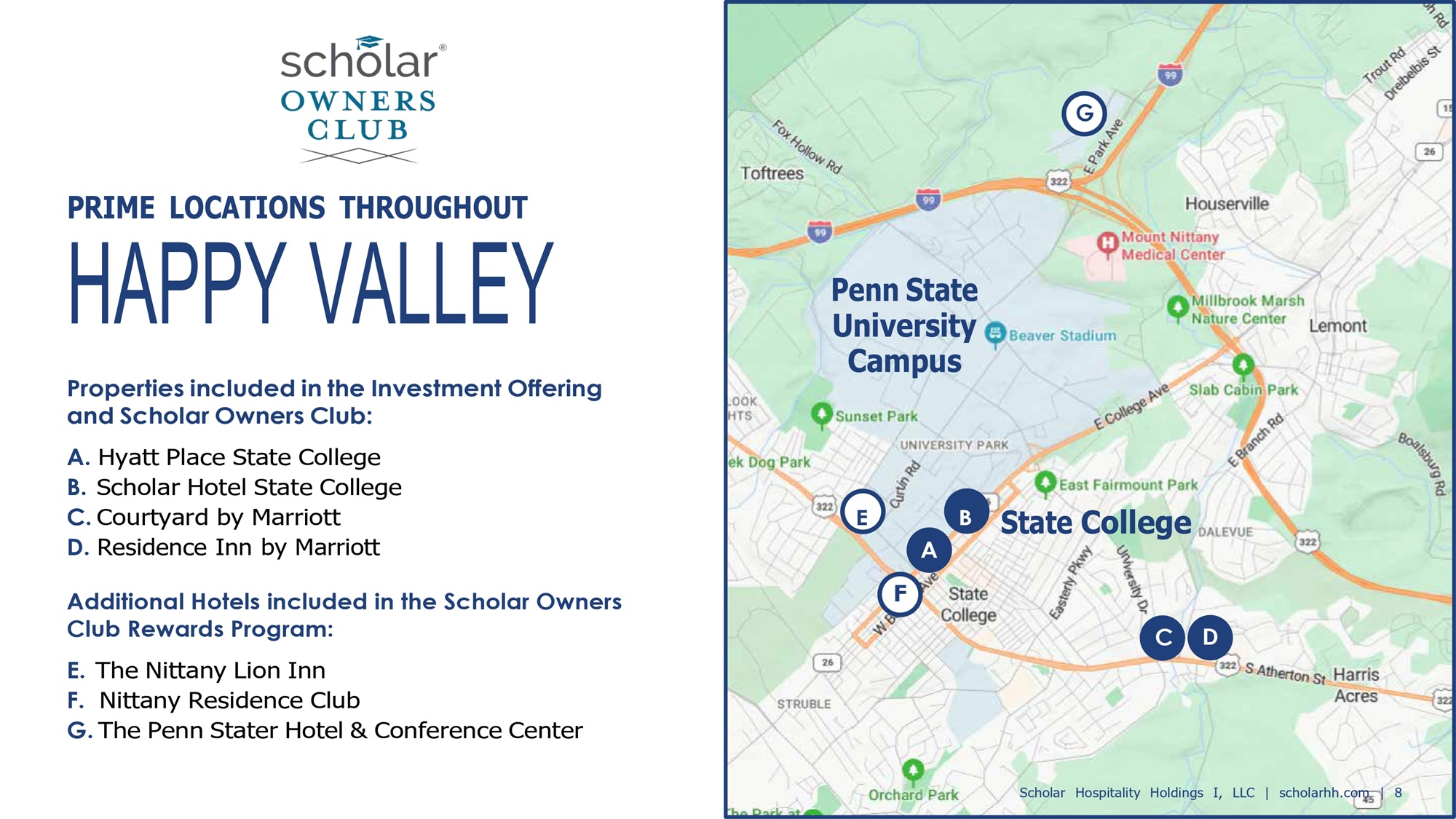
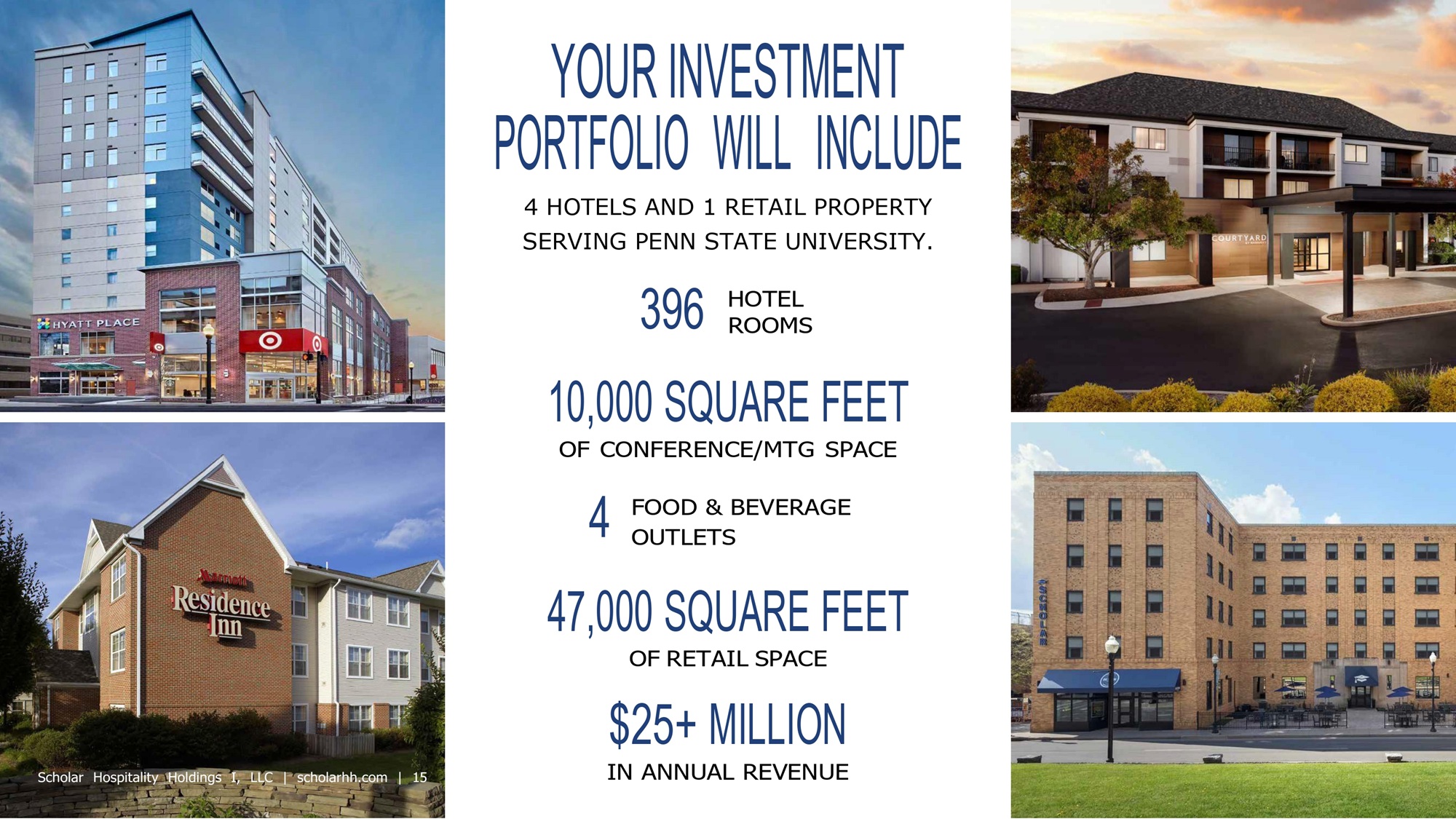
The Company’s current portfolio is centered on the Penn State community in State College, Pennsylvania. The portfolio of assets expected to be associated with this Offering includes the following properties located in State College (collectively, the “State College Assets”):
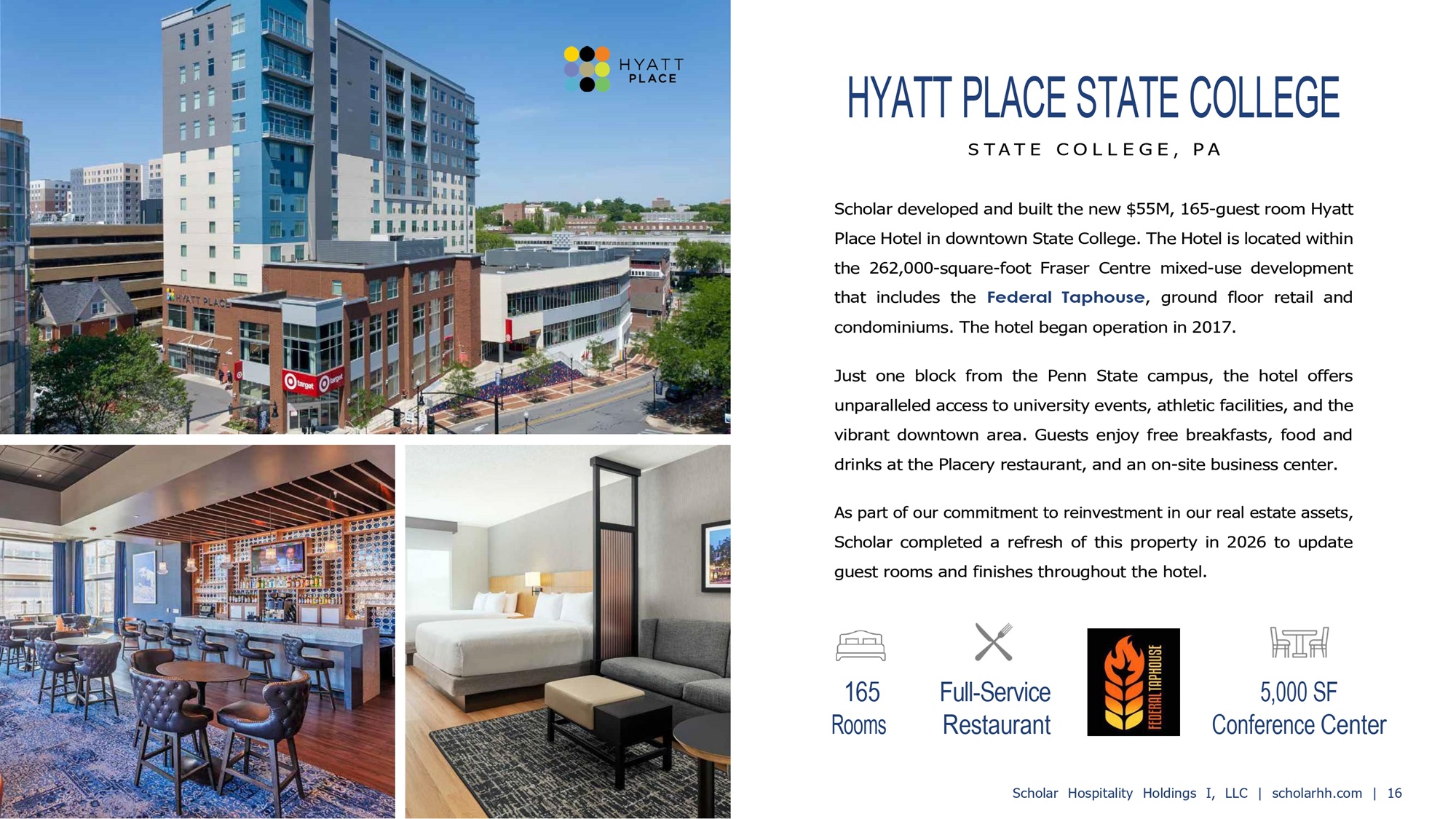
| ● | Hyatt Place State College |
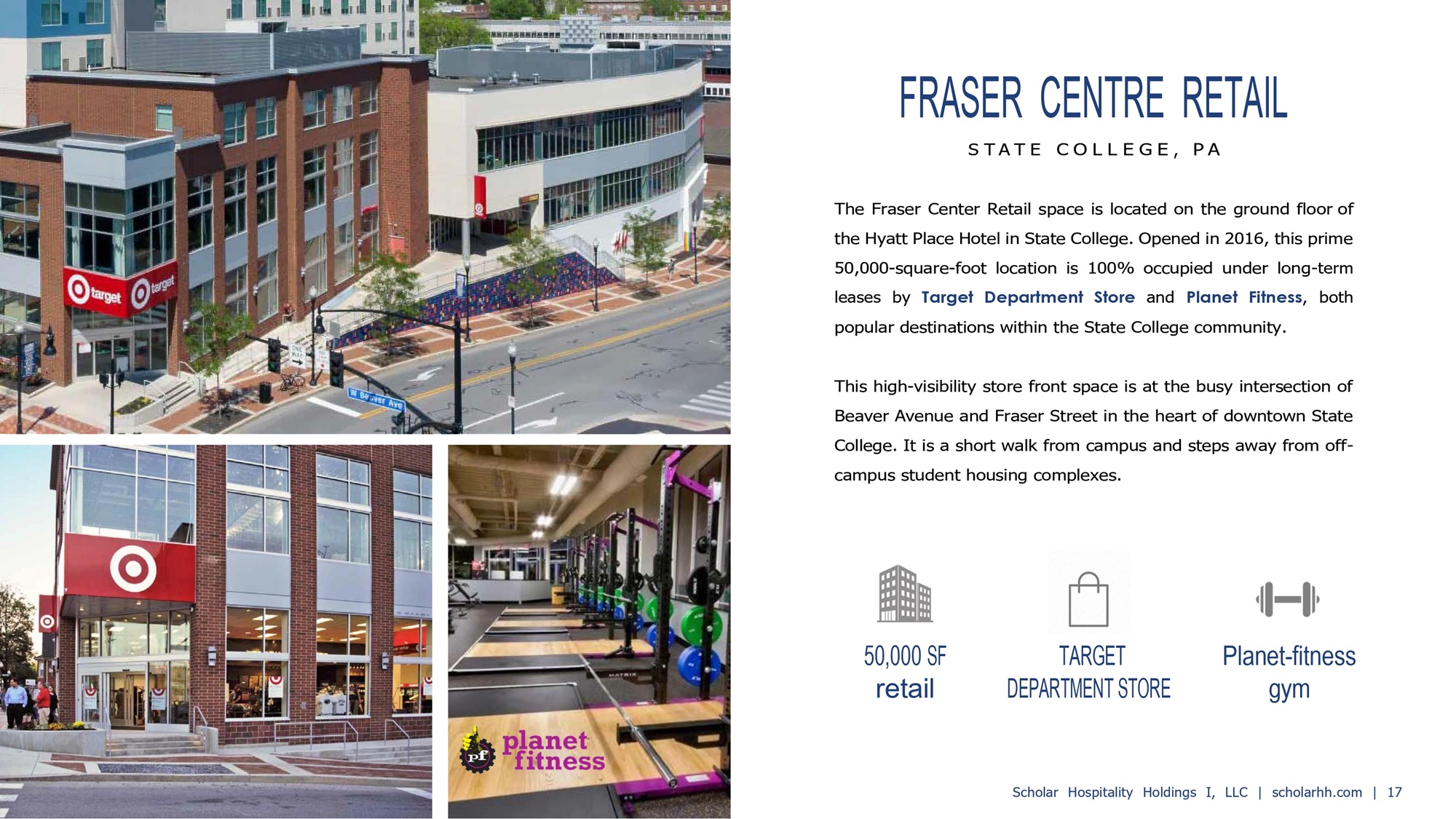
| ● | Fraser Centre Retail |
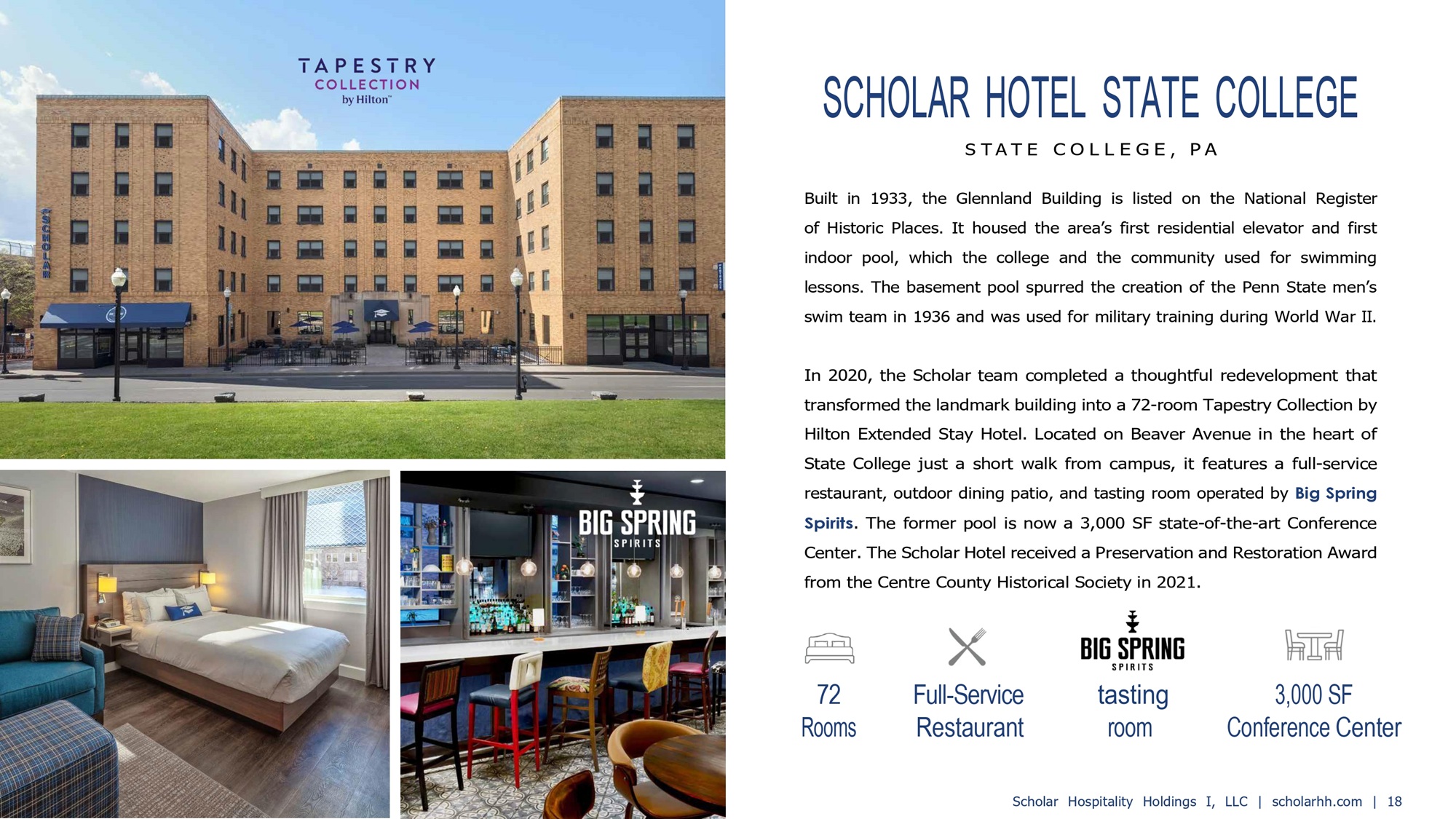
| ● | Scholar Hotel State College |
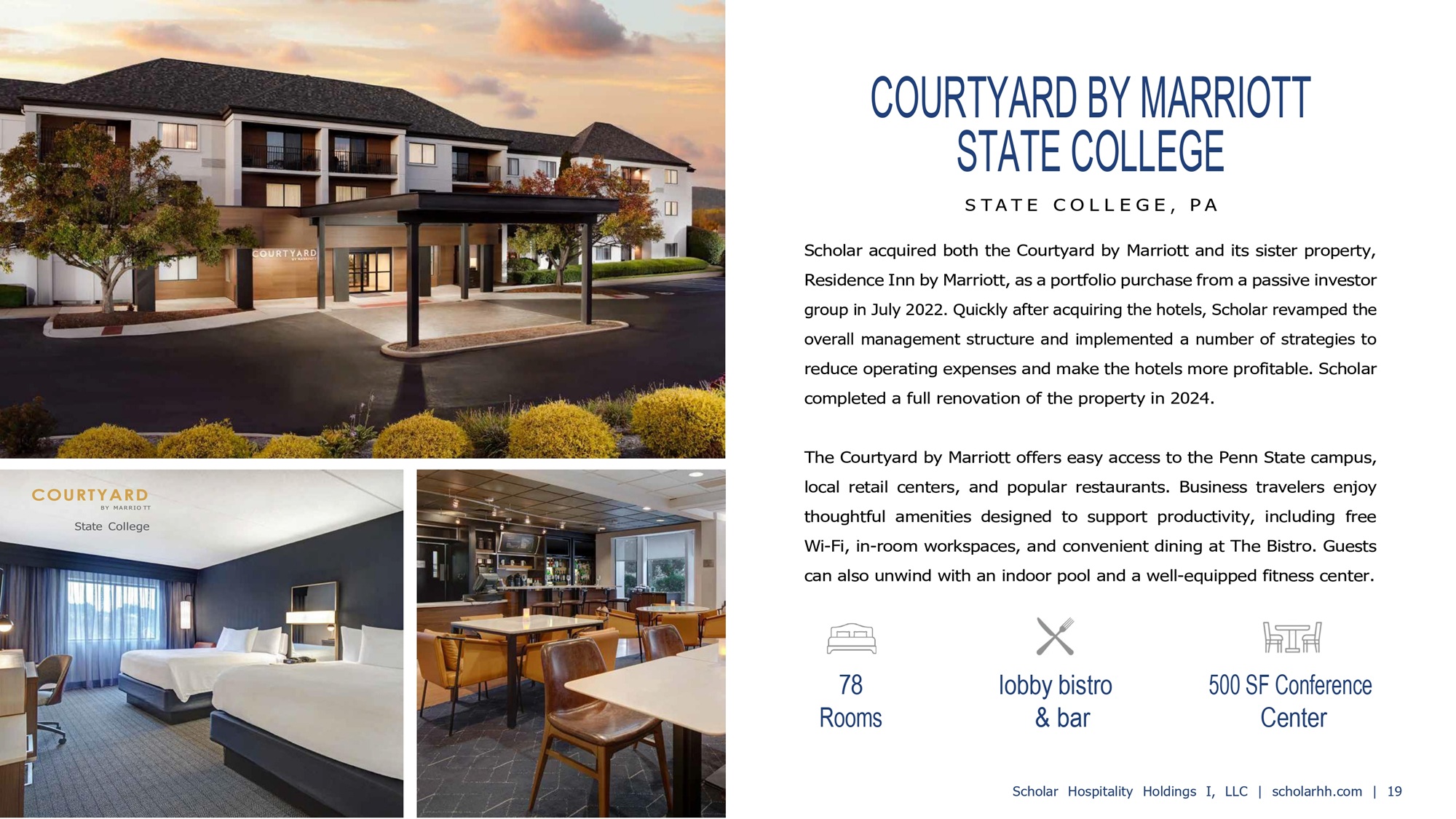
| ● | Courtyard by Marriott State College |
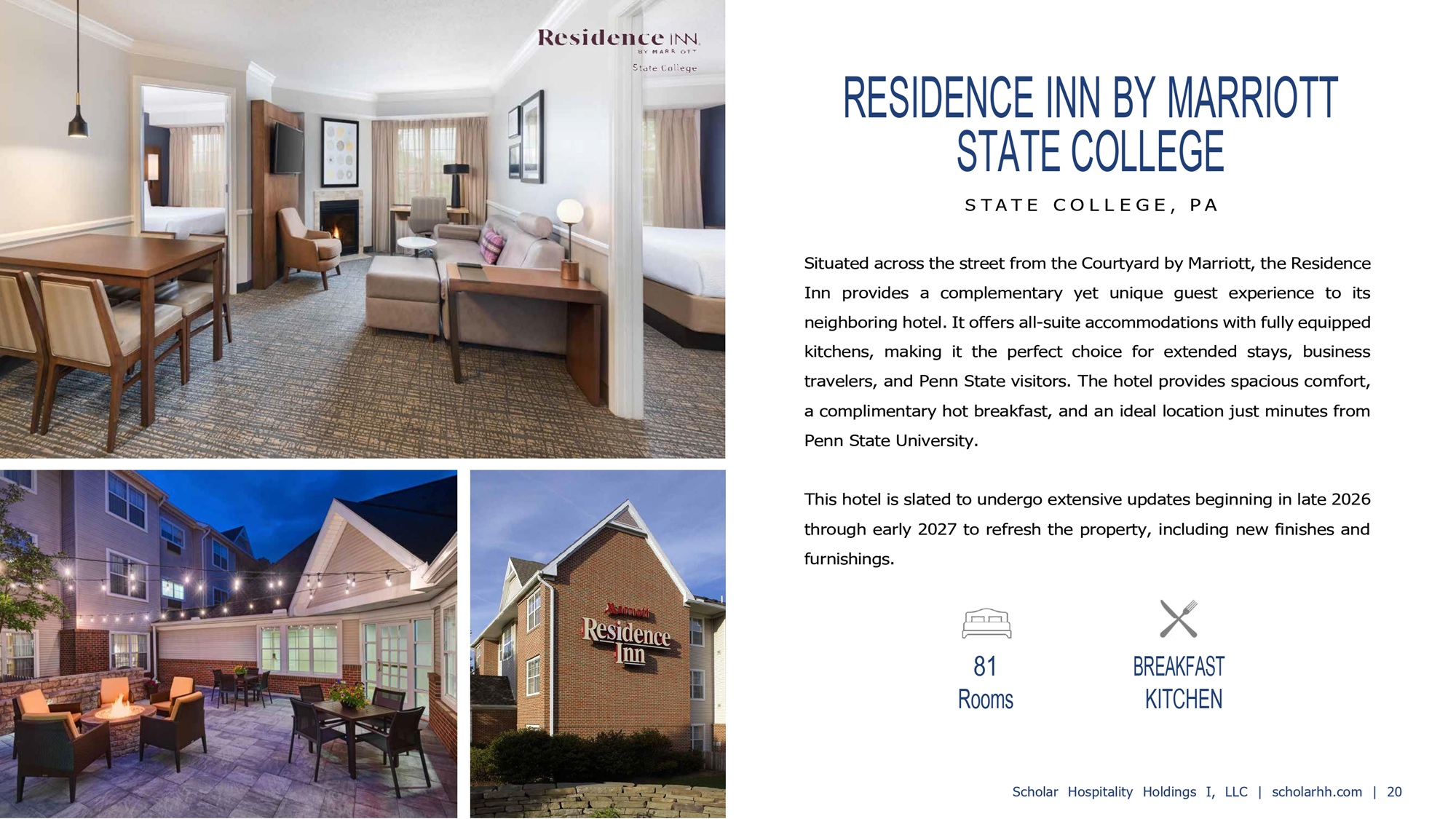
| ● | Residence Inn by Marriott State College |
Each of the State College Assets serve visitors traveling to State College for both Penn State-related activities and events as well as other activities and events in the region. Each of the State College Assets are also located within convenient proximity to the university and surrounding campus venues.
| 3 | P a g e |
| Scholar Hospitality Holdings I LLC – Offering Circular |
Penn State represents one of the largest and most recognizable university communities in the United States, with a substantial student population, nationally recognized athletic programs, and one of the largest alumni networks in the country. These characteristics contribute to recurring visitation driven by academic programs, athletic events, alumni gatherings, campus tours, family visits, conferences, and other university-related activities.
In addition to the acquisition of the State College Assets, the Company may also (i) acquire other real estate assets and/or other ancillary businesses associated with the hospitality industry near other major universities that further support the Company’s investment strategy (such assets, collectively with the State College Assets, the “Assets”) and/or (ii) pay down new or existing debt on or associated with the Assets. These Assets may be located in or around Penn State or in other established university markets and may provide opportunities for operational improvements, repositioning, and redevelopment initiatives over time. The Company believes that including Assets across multiple university communities may also provide diversification within the broader university-adjacent hospitality strategy.
The Company further believes that university-adjacent Assets provide a unique value proposition. Major universities generate recurring visitation tied to academic calendars, athletic events, alumni gatherings, conferences, campus visits, and other institutional activities. These demand drivers create consistent flows of visitors throughout the year who seek convenient, high-quality accommodations and other amenities located near campus.
Assets located near universities therefore play an important role within the broader campus ecosystem. They welcome guests who are returning to celebrate milestones, reconnect with friends, attend important family events, and create new memories alongside the old. In this way, the Company seeks to extend the university experience beyond graduation while supporting the communities that continue to bring people back year after year.
Through this Offering, investors have the opportunity to participate in that vision. By purchasing limited liability company interests designated as “Class A Units” of the Company (the “Offering”), purchasers of Class A Units (the “Investors”) may acquire a fractional ownership interest in the Company’s Assets. The Company is offering these Class A Units to both accredited and non-accredited Investors, with Investors being entitled to the following benefits:
| ● | Their pro rata share of the Company’s operating profits; |
| ● | Priority repayment of their invested capital together with their pro rata share of proceeds upon the sale or liquidation of Company assets; and |
| ● | Admission into the “Scholar Owners’ Club,” a rewards and benefits program designed to provide Investors with certain perks and experiences at the Company’s Assets. |
The identified State College Assets to be acquired by the Company are not newly developed or newly conceived assets. Each State College Asset has previously been successfully owned or operated for several years by the principals of the Company through affiliated investment vehicles (the “Legacy Entities”). These Legacy Entities are approaching the end of their respective investment cycles.
This Offering therefore serves two purposes: first, to provide liquidity to the Legacy Entities at fair market value; and second, to allow a broader community of Investors to participate in the ownership of high-quality Assets located near major universities.
In many ways, the Company seeks to bring together two powerful ideas: investing in high-quality Assets near major universities while also investing in the communities that helped shape our lives.
Disclaimer: This offering is not affiliated with, sponsored by, or endorsed by The Pennsylvania State University (“Penn State”). Penn State has not reviewed or approved the merits of this offering or any related materials.
Caution: Although the principals of the Manager of the Company have successfully owned and operated the State College Assets in the past through the Legacy Entities, there is no guaranty that the Assets will generate any positive cash flow or even be able to return capital to Investors. See “Risks of Investing” on page 6.
| 4 | P a g e |
| Scholar Hospitality Holdings I LLC – Offering Circular |
Table of Contents
| 5 | P a g e |
| Scholar Hospitality Holdings I LLC – Offering Circular |
BUYING CLASS A UNITS IS SPECULATIVE AND INVOLVES SIGNIFICANT RISK, INCLUDING THE RISK THAT YOU COULD LOSE SOME OR ALL OF YOUR MONEY. THIS SECTION DESCRIBES SOME OF THE MOST SIGNIFICANT FACTORS THAT WE BELIEVE MAKE AN INVESTMENT IN THE CLASS A UNITS RISKY. THE ORDER IN WHICH THESE FACTORS ARE DISCUSSED IS NOT INTENDED TO SUGGEST THAT SOME FACTORS ARE MORE IMPORTANT THAN OTHERS.
You Might Lose Some or All of Your Investment: When you buy a certificate of deposit from a bank, the Federal government (through the FDIC) guarantees you will get your money back. Buying Class A Units is not like that at all. The ability of the Company to make the profits you expect, and ultimately to give you your investment back plus a return, depends on a number of factors, including some beyond our control. Nobody guarantees that your Class A Units will ever result in a profit to you, and you might lose some or all of your investment.
Risk Associated with Escrow Account: When you invest, your money will be held in an escrow account. Although the escrow account will be held at banks insured by the FDIC, the amount in any such account could exceed the FDIC limits. If the bank holding the escrow account became insolvent in that situation, you could lose some or all of your money.
Arbitrary Offering Price: The price of the Class A Units offered has been arbitrarily established by the Company’s Manager. The Offering price bears little relationship to the assets, net worth, or any other objective criteria
Breaches of Security: It is possible that our systems would be “hacked,” leading to the theft or disclosure of confidential information you have provided to us. Because techniques used to obtain unauthorized access or to sabotage systems change frequently and generally are not recognized until they are launched, we and our vendors may be unable to anticipate these techniques or to implement adequate defensive measures.
Our Auditor Has Raised Questions About Our Ability To Survive As A Going Concern: In the audited financial statements attached to this Offering Circular, our auditor has noted that the Company has not yet commenced planned principal operations and has not generated revenues or profits since inception, and that these factors, among others, raise substantial doubt about the Company’s ability to continue as a “going concern.” As further noted by our auditor, the Company’s ability to continue as a going concern in the next twelve months is dependent upon its ability to obtain capital financing from investors sufficient to meet current and future obligations, and to deploy that capital effectively to produce profits. No assurance can be given that the Company will be successful in these efforts.
Risks Associated with Macroeconomic Conditions: The success of our business is significantly related to general economic conditions and, accordingly, our business could be harmed by any economic slowdown and downturn in real estate asset values and property sales. Periods of economic slowdown or recession, significantly rising interest rates, declining employment levels, decreasing demand for real estate, declining real estate values, or the public perception that any of these events may occur can reduce the volume of potential investments. These economic conditions may cause a general decline in acquisition and disposition activities. In addition, these conditions could lead to a decline in property sales prices as well as a decline in funds invested in existing real estate assets and properties planned for development.
| 6 | P a g e |
| Scholar Hospitality Holdings I LLC – Offering Circular |
We also may obtain debt financing to facilitate the acquisition of our Assets and/or improvements to our Assets. In the event of an economic downturn that results in an extreme deterioration of our business, we could have insufficient liquidity to meet our debt service obligations when they come due in future years. If we fail to meet our payment or other obligations under our credit facilities, the lender under those agreements will be entitled to proceed against the collateral granted to them to secure the debt owed.
Speculative Nature of Real Estate Investing: Real estate can be risky and unpredictable. For example, many experienced informed people lost money when the real estate market declined in 2007-8. Time has shown that the real estate market goes down without warning, sometimes resulting in significant losses. Some of the risks of investing in real estate include changing laws, including environmental laws; floods, fires, and other Acts of God, some of which can be uninsurable; changes in national or local economic conditions; changes in governmental policies, including changes in interest rates established by the Federal Reserve; and international crises. You should invest in real estate in general, and in the Company in particular, only if you can afford to lose your investment and are willing to live with the ups and downs of the real estate industry.
We Depend on Our Management Team and Will Need to Fill Key Positions: Our success depends substantially upon the talents and abilities of our executive officers and other key members of management. From time to time, there may be changes in our executive management team resulting from the hiring or departure of executives. Such changes in our executive management team may be disruptive to our business. Should any of them resign, die or become ill, the Company and its business could suffer.
We Rely on a Small Group of Employees: The Company has a relatively small management team. The loss of any key employees could have a material adverse effect on our operations. Additionally, we may need to hire additional employees to scale our business and execute our growth strategy. There is no guaranty that we will be successful in identifying, hiring, training, and retaining qualified employees when and as needed.
No Participation in Management: Investors will have no right to participate in the management of the Company or the Assets. Instead, the Company’s management will make all decisions. Other than with a limited right to remove the Manager with a supermajority (75%) vote provided for in the Company’s LLC Agreement, you will not have the right to replace our management team even if you think they are doing a terrible job.
Reliance on Management: The success of the Company and its Assets will depend in part on the skills of our management team. If a member of our management team resigned, died, or became ill, the Company and its Investors could suffer.
Limited Ability to Influence Business Decisions: The assets, affairs and business of the Company will be managed under the direction of our Manager. Our investors do not elect or vote on our Manager and they have only limited voting rights on matters affecting our business. Therefore, Investors have only a very limited ability to influence the decisions regarding our business.
| 7 | P a g e |
| Scholar Hospitality Holdings I LLC – Offering Circular |
Limited Voting Rights: Our Investors will have limited voting rights only with respect to certain matters, exclusively relating to amendments to the Company’s limited liability company agreement (the “LLC Agreement”) which adversely affect the rights of Investors. The holders of our Class A Units do not have the right to elect the Manager and a three-quarters majority (75%) vote is required to remove the Manager. Each outstanding Class A Unit entitles the holder to one vote on all matters submitted to a vote of the Investors. Generally, matters to be voted on by Investors must be approved by a majority of the votes cast by all Investors present in person or represented by proxy. If any vote occurs, you will be bound by the majority or supermajority vote, as applicable, even if you did not vote with the majority or supermajority.
No Market for the Class A Units; Limits on Transferability: There are two obstacles to selling or otherwise transferring your Class A Units:
| ● | There will be no established market for the Class A Units, meaning you could have a hard time finding a buyer. |
| ● | Class A Units may not be transferred without our consent, which we can withhold in our sole discretion. The Company also has a right of first refusal to purchase any Class A Units proposed to be transferred. |
The Track Record of Our Principals Does Not Guaranty Success: The principals of the Manager of the Company have a long and distinguished track record of acquiring, developing, operating and growing high quality real estate and hospitality assets, including the State College Assets being acquired by the Company using proceeds from the sale of Class A Units. See “State College Assets: A Deeper Dive” on page 44. However, past performance is never a guaranty of future results, and the success of our principals with the State College Assets at the Legacy Entities does not guaranty that the Company will be successful.
Risks Associated with Competition: The hotel industry is highly competitive and the Assets will compete with other hotels in their geographic areas. The building of additional hotel rooms in the geographic areas in which the Assets are located could result in an oversupply of hotel rooms which could adversely affect both occupancy and room rates for the Assets. A significant increase in the supply of hotel rooms and suites, if demand fails to increase at least proportionately, could have an adverse effect on the operational results of the Assets and returns to our Investors could be adversely affected.
Risks Associated with Conflicts of Interest: There are conflicts of interest between the Company, our Manager and its affiliates. Our Manager and/or affiliates of the Manager provide asset management and other services to other funds and/or other properties. Prevailing market rates are determined by the Manager based on industry standards and expectations of what the Manager would be able to negotiate with a third party on an arm’s length basis. All of the agreements and arrangements between such parties, including those relating to compensation, are not the result of arm’s length negotiations. Some of the conflicts inherent in the Company’s transactions with the Manager and its affiliates, and the limitations on such parties adopted to address these conflicts, are described below. The Company, the Manager and their affiliates will try to balance the Company’s interests with their own. However, to the extent that such parties take actions that are more favorable to other entities than us, these actions could have negative impact on our financial performance and, consequently, on distributions to our stockholders and the value of our Class A Units.
| 8 | P a g e |
| Scholar Hospitality Holdings I LLC – Offering Circular |
In addition, the interests of the Company and its management could conflict with your interests in a number of important ways, including these:
| ● | Your interests might be better served if the principals of the Company devoted their full attention to the Company’s business. Instead, they will also be managing other businesses and business interests simultaneously. |
| ● | The entire business of our management team consists of acquiring and operating our Assets. There could be conflicts between the Assets we acquire we decide to invest in through the Company and projects they invest in through other vehicles. |
| ● | The lawyers who prepared this Offering Statement, the LLC Agreement, and the Investment Agreement represent the Company, not you. You must hire your own lawyer (at your own expense) if you want your interests to be represented. |
The Company Will Primarily Acquire the State College Assets: The Company intends to acquire State College Assets from entities that are owned or controlled by principals of the Manager of the Company (such entities the “Legacy Entities”). While we may invest in new Assets in the future and believe that these are all high-quality, legacy-type assets, it is possible that there are other hospitality, retail or other business or real estate assets available that may be on the same or better terms and provide better returns to Investors.
Risks Associated with Asset Concentration: Our concentration on hospitality assets and ancillary businesses that are related to hospitality assets may leave our profitability vulnerable to a downturn or slowdown in this sector. If less than all of the Class A Units are sold by the termination date of this offering, the number of Assets may be limited and, as a result, the Assets may not be diversified. Even if we do sell all of the Class A Units, our Assets are still concentrated in a few select markets that are far away from large metropolitan areas which may still leave us vulnerable to an industry-wide or even geographically-limited downturn.
The Success of Our Offering Relies Heavily on the Success of Our Neighboring Universities: Each of our Assets is strategically located next to, and sometimes on, the campuses of several well-known universities including Penn State University. Accordingly, the financial success of each of our Assets is heavily tied to the fortunes of our neighboring universities. Moreover, while we intend to raise capital from a broad range of both accredited and non-accredited Investors in our Offering, we intend to focus intensely on raising money from alumni and other persons with a personal and/or professional relationship with those universities. In our view, investing in one of our Assets is akin to owning a small slice of the larger university community. We intend to lean into that sentiment to both renew and reinforce this connection by creating a continuous virtuous cycle of investment, ownership, and community building and strengthening. However, there is no guarantee that we will be successful.
| 9 | P a g e |
| Scholar Hospitality Holdings I LLC – Offering Circular |
Our Acquisition Strategy Relies In Part On Successful Tax Planning and Execution: All of our Assets are held in separate special purchase vehicles (the “SPVs”) whose sole purpose is to hold title to a single Property. Each of these SPVs is in turn owned by Legacy Entities as more fully described in “Our Company and Business” on page 26, We plan to purchase all of the equity interests of each SPV in order to minimize disruption to the day-to-day business and affairs of each Property and to minimize or eliminate the potential of any transfer taxes being imposed on us as a result of such sale as more fully discussed in “Summary of Transfer Tax Planning” on page 64. If we are successful with our approach, we believe the transfers will eliminate or greatly reduce any transfer taxes imposed as a result of the transfer, which in turn will allow a greater percentage of the proceeds from the Offering to be used to acquire and/or improve the Assets. Obviously, the more money we spend on acquiring and operating Assets, the better the returns will be on your investment, but we believe we will be able to execute our strategy (just at a slower pace) even if our careful tax planning is not successful.
Risks Associated with Hotel Industry: Our Assets will be subject to operating risks that are common to the hotel industry. These risks include, among other things:
| ● | competition for guests from other hotels, a number of which may have greater marketing and financial resources and experience than the Company; |
| ● | increases in operating costs due to inflation and other factors, which increases may not have been offset in past years, and may not be offset in future years, by increased room rates; |
| ● | dependence on business and commercial travelers and tourism, which business may fluctuate and be seasonal; |
| ● | increases in energy costs and other expenses of travel, which may deter travelers; |
| ● | adverse effects of general and local economic conditions; and |
| ● | the construction of more hotel rooms in a particular area than needed to meet demand. |
These factors could adversely affect the ability of the Company to generate revenues from the Assets. In addition, it may not be possible to transfer certain operating licenses, such as food and beverage licenses or to obtain new licenses in a timely manner in the event such licenses cannot be transferred. Although hotels can generally provide alcoholic beverages under interim licenses or licenses obtained prior to the acquisition of such hotels, there can be no assurance that these licenses will remain in effect or that new licenses will be obtained. The failure to have alcoholic beverage licenses or other operating licenses could adversely affect the ability of the Company to generate revenues.
| 10 | P a g e |
| Scholar Hospitality Holdings I LLC – Offering Circular |
The hotel industry is also a notoriously volatile industry since it is dependent on the disposable income of consumers and the whims of the travel industry. This makes hospitality assets much more volatile than other real estate assets in other industries. A substantial part of the Company’s business strategy is based on the Company’s belief that the hospitality markets in which the Company plans to operate will continue to experience improving economic fundamentals in the future. There can be no assurance as to whether, or when, the hospitality industry fundamentals will in fact improve or to what extent they will improve. In the event conditions in the industry do not improve when and as the Company expects, or deteriorates, the Company’s ability to execute its business strategy would be adversely affected. This in turn could adversely affect the Company’s financial condition, results of operations, the value of the Company’s Class A Units and the Company’s ability to make distributions to its Investors.
Risks Associated with Seasonality: The hotel industry is seasonal in nature. Some seasons may be more profitable for certain Assets than for others. Seasonal variations can be expected to cause fluctuations in the revenue generated by the Assets, and, thus, the revenues of the Company.
Risks Associated with Property Capital Expenditures: Hospitality properties have an ongoing need for renovations and other capital improvements, including replacements, from time to time, of furniture, fixtures and equipment. The franchisors of the Company’s hospitality properties also will require periodic capital improvements as a condition of keeping the franchise licenses. In addition, the Company’s potential lenders will likely require that the Company set aside annual amounts for capital improvements to the Company’s hospitality properties. These capital improvements may give rise to the following risks:
| ● | Possible environmental problems; |
| ● | Construction costs overruns and delays; |
| ● | Possibility that revenues will be decreased temporarily while rooms or restaurants offered are out of service due to capital improvement projects; |
| ● | A possible shortage of available cash to fund capital improvements and the related possibility that financing for these capital improvements may not be available on affordable terms; |
| ● | Receipt of zoning, occupancy and other required governmental permits and authorizations; |
| ● | Development costs incurred for projects that are not pursued to completion; |
| ● | Developed properties that may not achieve the Company’s desired revenue or profit goals; |
| ● | Intense competition for suitable development sites from competitors with greater financial resources than ours; |
| ● | Acts of God such as earthquakes, hurricanes, floods or fires that could adversely impact a project; |
| ● | Ability to raise capital; |
| ● | Governmental restrictions on the nature or size of a project; |
| 11 | P a g e |
| Scholar Hospitality Holdings I LLC – Offering Circular |
| ● | Uncertainties as to market demand or a loss of market demand after capital improvements have begun; and |
| ● | Disputes with franchisors and/or managers regarding compliance with relevant management and/or franchise agreements. |
The costs of all these capital improvements could adversely affect the Company’s financial condition and amounts available for distribution to Investors.
Risks Associated with Property Management Agreements: The management agreements for each Property may limit the liability of the Property Manager to the Company. The Property Manager and its agents and employees may not be liable to the Company for errors of judgment or other acts or omissions as set forth in such property management agreement. A successful claim for such indemnification would deplete the Company’s assets by the amount paid.
Risks Associated with Hotel Franchise Agreements: All of the State College Assets will be operated under existing franchises or license agreements or some of our new Assets will be subject to new franchise or license agreements. Such agreements will require that the applicable Asset be maintained and operated in accordance with specific standards and restrictions in order to maintain uniformity with the franchisor’s brand of hotels. Compliance with these standards, and changes in these standards, could cause the Company to incur significant expenses or capital expenditures, which would adversely affect the results of operation of the Assets and returns to our Investors. In the event an Asset loses any licenses, franchises or permits required to operate the Asset under the applicable brand, Asset operations may not meet anticipated levels and it may be difficult to sell the Asset. In addition, the Company may be required to pay various acquisition fees when it acquires Assets from franchisees, including transfer fees and affiliation fees, which will increase the acquisition cost of the Assets.
Additionally, franchisors of the Assets may require the Company to adhere to property improvement plans with respect to each Asset. The costs of the property improvement plans are unknown. Costs associated with property improvement plans may be required to be paid at the time of acquisition of the Asset and/or during the course of ownership of the Asset. Failure to comply with the property improvement plans may result in franchisors disallowing the use of the franchised brands associated with the Asset. Also, in connection with the disposition of the Asset by the Company, the purchaser may be required to pay costs associated with property improvement plans, which may result in a lower sales price for the Asset or otherwise make the sale of the Asset more difficult.
Risks Associated with Asset Manager and Property Manager: The Company engaged the Asset Manager and Property Manager to manage the operations at the Assets. It is anticipated that the Assets will be managed by the Asset Manager, which is an affiliate of the Manager and operated by the Property Manager. If the Property Manager is contractually prohibited or is otherwise unable or elects not to operate an Asset, another operator will be chosen for that Asset in the discretion of the Manager and the Asset Manager. Most decisions regarding the operation of the Assets will be made exclusively by the Asset Manager. The Asset Manager may from time to time receive information or notices regarding the Assets. It is anticipated that the property management agreements for the Assets will require the Property Manager to furnish to the Company, promptly after receipt, any notice of violation of any governmental requirement or order issued by any governmental entity, any notice of default from the holder of any mortgage or deed of trust encumbering the Assets or any notice of termination or cancellation of any insurance policy. If the Property Manager fails to furnish such notices or other notices or information it receives with respect to the Assets to the Company, the ability of the Company to protect its interest in the Assets may be adversely affected. Potential Investors must carefully evaluate the personal experience and business performance of the principals of the Property Manager. It is anticipated that the Property Manager will enter into subcontract agreements relating to the operation of any Asset. Neither the Asset Manager nor the Property Manager has any fiduciary duty to our Investors and may not perform as expected.
| 12 | P a g e |
| Scholar Hospitality Holdings I LLC – Offering Circular |
Risks Associated with Retail Properties: Investment in retail properties are subject to risks that are distinct from those associated with other types of commercial real estate. The performance of retail properties is highly dependent on consumer spending patterns, discretionary income levels, demographic trends, and broader economic conditions. Changes in consumer preferences, reductions in disposable income, inflationary pressures, rising interest rates, or economic downturns may adversely affect the revenues and operating results of retail tenants, which in turn may negatively impact occupancy levels, rental income, and the value of retail properties held by the Company.
The retail sector has experienced, and may continue to experience, significant structural changes, including increased competition from e-commerce and omnichannel retailers, changes in shopping behaviors, and evolving consumer expectations regarding convenience, pricing, and experience. These trends may reduce demand for certain retail formats, locations, or property types, including traditional brick-and-mortar retail. Retail tenants that fail to adapt to these changes may experience declining revenues or business failures, which could adversely affect the Company’s investments.
Risks Associated with Conflicts of Interest: The interests of the Manager, the principals and its other affiliates may conflict with your interests. The LLC Agreement provides our Manager with broad powers and authority which may result in one or more conflicts of interest between your interests and those of the Manager and its affiliates, who participate, or expect to participate, directly or indirectly in other offerings by our Manager and its affiliates.
Potential conflicts of interest include, but are not limited to, the following: (i) the Manager and/or its affiliates are offering, and may continue to offer, other real estate investment opportunities, including additional blind pool equity offerings similar to this offering and may make investments in real estate assets for their own respective accounts, whether or not competitive with our business; (ii) the Manager and/or its affiliates will not be required to disgorge any profits or fees or other compensation they may receive from any other business they own separately from us, and you will not be entitled to receive or share in any of the profits, return fees or compensation from any other business owned and operated by the Manager and/or its other affiliates for their own benefit; (iii) we may engage the Manager or affiliates of the Manager to perform services at prevailing market rates. Prevailing market rates are determined by the Manager based on industry standards and expectations of what the Manager would be able to negotiate with third parties on an arm’s length basis; and (iv) the Manager and/or its affiliates are not required to devote all of their time and efforts to our affairs.
| 13 | P a g e |
| Scholar Hospitality Holdings I LLC – Offering Circular |
Asset Values Could Decrease: The value of our Assets could decline, perhaps significantly. Factors that could cause the value of the Asset to decline include, but are not limited to:
| ● | Changes in interest rates |
| ● | Competition from existing properties and new construction |
| ● | Changes in national or local economic conditions |
| ● | Changes in zoning |
| ● | Environmental contamination or liabilities |
| ● | Changes in local market conditions |
| ● | Fires, floods, and other casualties |
| ● | Uninsured losses |
| ● | Undisclosed defects in property |
| ● | Incomplete or inaccurate due diligence |
Risks Associated with Dependence on Tenants: Our financial results will depend in part on leasing space in the Assets we acquire to tenants on economically favorable terms. In the event of a tenant default prior to stabilization, we may experience delays in enforcing our rights as landlord and may incur substantial costs in protecting our investment and re-letting our property. A default of a substantial tenant or number of tenants at any one time would cause us to lose the revenue associated with such lease(s) and cause us to have to find an alternative source of revenue to meet mortgage payments and prevent a foreclosure if the property is subject to a mortgage. Therefore, lease payment defaults by tenant(s) could cause us to lose our investment or reduce the amount of distributions to Investors.
Risks Associated with Competition for Tenants: A portion of the proceeds of the Company’s investments may come from rental payments and other fees paid by tenants in respect of properties owned by, or corresponding to assets owned by, the Company. The financial performance of the Company will depend in part on the ability of the applicable lessors in respect of such properties to attract and retain qualified tenants for the properties. Competing properties may attract tenants, with better location, convenience, appearance or amenities, newer properties, lower rents or greater leasing incentives than those existing or available with respect to properties owned by the Company or corresponding to assets owned by the Company. Competition for tenants could reduce the occupancy and rental rates, increase the management practice to offer rental incentives (including grant of concessions), cause a decline in the number and credit quality of tenants, and adversely affect the financial condition of the Company and accordingly, the value of the Class A Units.
To remain competitive and maintain economic value, properties may require frequent expenditures, though such expenditures may be relatively small for any one property. If insufficient amounts are spent on necessary repairs at properties owned by or corresponding to assets owned by the Company, they may not remain competitive in their local markets.
| 14 | P a g e |
| Scholar Hospitality Holdings I LLC – Offering Circular |
Risks Associated with Short-Term Leases: Because some of the tenants at one of our Assets may pay rent to the Company under a lease, the net operating income generated by such Assets may change relatively quickly from time to time.
As the leases permit tenants to leave at the end of the lease term without penalty, rental revenues may be affected by declines in market rents or increased competition from other lessors more quickly than if leases were for longer terms. Short-term leases may result in high turnover, which involve costs, such as repair and replacement costs, capital expenses to restore the properties, marketing costs, lower occupancy levels and costs of maintaining vacant properties. Thus, in general, certain properties owned by the Company or corresponding to assets owned by the Company can be expected to have substantially more volatile cash flows that would be the case with an income-producing commercial property leased to a small number of operating businesses under long-term leases. If a tenant has not provided a notice to vacate prior to the lease expiration, the tenant may be contacted regarding renewal of the lease and, if the tenant opts not to renew the lease, the tenant would be allowed to remain in occupancy under a month-to-month tenancy. As a result, the remaining length of leases at properties owned by the Company or corresponding to assets owned by the Company individually or in the aggregate may decline over time, which would tend to increase the sensitivity of rental rates and net operating income at such properties to short-term changes in market conditions.
There may be limited operating history and historical information from which to make projections regarding tenant turnover rate and similar information. Consequently, the information relied upon by the Manager in connection with the Company’s investments may be substantially less reliable than would be the case if the Assets owned by the Company had a longer history of ownership and management. No assurance can be made regarding the vacancy rate, turnover rate, credit loss rates, costs, revenues or net operating income that will actually be experienced by such Assets individually or in the aggregate in the future.
Risks Associated with Leasing Activity: Leasing activity at Assets owned by the Company will be affected by the general conditions in the relevant rental market in the geographic markets where such Assets are located. A decline in demand for commercial rental spaces may occur in some or all markets as a result of general macroeconomic factors, including without limitation applicable regional and local factors.
In the event that lessors of the Assets owned by the Company are unable to secure tenants for such Assets on attractive terms, the proceeds of the Company’s investments in such assets may be adversely effected.
Risks Associated with Losses: There are types of losses, generally catastrophic in nature, such as losses due to wars, acts of terrorism, earthquakes, floods, hurricanes, pollution or environmental matters that are uninsurable or not economically insurable or may be insured subject to limitations, such as large deductibles or co-payments. Insurance risks associated with potential acts of terrorism could sharply increase the premiums we pay for coverage against property and casualty claims. Additionally, mortgage lenders in some cases insist that commercial property owners purchase coverage against terrorism as a condition for providing mortgage loans. Such insurance policies may not be available at reasonable costs, if at all, which could inhibit our ability to finance or refinance our Assets. In such instances, we may be required to provide other financial support, either through financial assurances or self-insurance, to cover potential losses. We may not have adequate coverage for such losses. If any of our Assets incur a casualty loss that is not fully insured, the value of our Assets will be reduced by any such uninsured loss, which may reduce the value of your investment. In addition, other than any working capital reserve or other reserves we may establish, we have no source of funding to repair or reconstruct any uninsured Asset. Also, to the extent we must pay unexpectedly large amounts for insurance, we could suffer reduced earnings that would result in lower distributions to our Investors.
| 15 | P a g e |
| Scholar Hospitality Holdings I LLC – Offering Circular |
In the event of a substantial or comprehensive loss to our Assets, we may not be able to rebuild our Assets to their then-existing specifications. Further, reconstruction or improvement of such an Asset would likely require significant upgrades to meet zoning and building code requirements. Environmental and legal restrictions could also restrict the rebuilding of our Assets.
Unavailability of Insurance Against Certain Catastrophic Losses: Certain losses of a catastrophic nature, such as earthquakes, wars, terrorist attacks or other similar events, may be either uninsurable or insurable at such high rates that to maintain such coverage would cause an adverse impact on the related Property. As a result, not all Assets may be insured against all possible risks. If a major uninsured loss occurs, the Company could lose both the amount it invested in and anticipated profits from the affected Asset or Assets.
Risks Associated with Toxic Mold: The Company could incur expenses associated with existence of toxic mold. Litigation and concern about indoor exposure to certain types of toxic molds has been increasing as the public becomes aware that exposure to mold can cause a variety of health effects and symptoms, including allergic reactions. Toxic molds can be found almost anywhere; they can grow on virtually any organic substance, as long as moisture and oxygen are present. There are molds that can grow on wood, paper, carpet, foods, and insulation. When excessive moisture accumulates in buildings or on building materials, mold growth will often occur, particularly if the moisture problem remains undiscovered or unaddressed. It is impossible to eliminate all mold and mold spores in the indoor environment. In warm or humid climates, the likelihood of toxic mold can be exacerbated by the necessity of indoor air-conditioning year-round. The difficulty in discovering indoor toxic-mold growth could lead to an increased risk of lawsuits by affected persons, and the risk that the cost to remediate toxic mold will exceed the value of the property. Because of attempts to exclude damage caused by toxic mold growth from certain liability provisions in insurance policies, there is no guarantee that insurance coverage for toxic mold will be available now or in the future.
Liability for Personal Injury and Damage to Property: The Company could be held liable for accidents and injuries at our Assets. We will carry insurance to protect against the potential losses, but our insurance might not be adequate.
Risks Associated with Construction Defects: Our Assets could be subject to construction defects which could reduce the returns on the investment. While we believe this risk is fairly minimal given our management’s prior experience owning and operating our Assets through the Legacy Entities, it is possible that some of our Assets may be subject to construction defect claims that only reveal themselves over time. The Company may have remedies under state law as well as under any warranties from the contractors for the construction work. If the warranties do not cover all the expenses associated with any construction defects that may arise, the Company could be liable for the expenses associated with correcting the construction defects. If work is required to cure any construction defects, it is likely that the reserves established by the Company will be insufficient to pay for such work. Accordingly, the presence of construction defects could adversely affect the financial performance of the Company.
| 16 | P a g e |
| Scholar Hospitality Holdings I LLC – Offering Circular |
Risks Associated with Construction/Improvements: We may seek to engage in various construction and/or improvement projects with our Assets from time to time. Potential development and construction delays and resultant increased costs and risks may hinder our operating results and decrease our net income. In addition, to the extent any of our Assets are the subject of any construction and/or improvement projects, there are always uncertainties associated those types of projects. Such uncertainties include, but are not necessarily limited to, uncertainties related to re-zoning land for development, environmental concerns of governmental entities and/or community groups and our builders’ ability to build in conformity with plans, specifications, budgeted costs and timetables. If a builder fails to perform, we may resort to legal action to rescind the purchase or the construction contract or to compel performance. A builder’s performance may also be affected or delayed by conditions beyond the builder’s control. We may incur additional risks when we make periodic progress payments or other advances to builders before they complete construction. These and other factors can result in increased costs of a project or loss of our investment.
Risks Associated with CC&Rs: The Company’s ability to operate an Asset may be limited by its obligations under various covenants, conditions and restrictions (collectively, “CC&Rs”) that were recorded against the land. The CC&Rs may place certain obligations on the Company with respect to the maintenance of the common areas of an Asset and other matters. The CC&Rs may place restrictions on how an Asset may be rehabilitated or repaired. The CC&Rs may also set forth reciprocal rights with respect to issues such as encroachments, parking, utility lines and ingress and egress and may place limitations on the way the Company operates an Asset. Restrictions in the CC&Rs could negatively impact the results of the Assets.
Availability of Debt: Market fluctuations in real estate loans may affect the availability and cost of loans needed for the Assets. Credit availability has been restricted in the past and may become so in the future. Restrictions upon the availability of real estate financing, or high interest rates on real estate loans, may adversely affect the Company. It is anticipated that the lenders will restrict the ability to obtain subordinate financing for the Assets. The Company does not have any commitments for loans to acquire any Asset and there is no assurance that such loans will be available. Restrictions upon the availability of real estate financing or high interest rates on real estate loans may also adversely affect the ability of the Company to sell the Assets.
Moreover, it is anticipated that any loans obtained to acquire the Assets may have short terms and will require the Company to make large balloon payments on the maturity dates of the loans. If the Company is unable to make a balloon payment or to refinance any of the loans for any reason or at reasonable cost, the ownership of an Asset could be jeopardized.
| 17 | P a g e |
| Scholar Hospitality Holdings I LLC – Offering Circular |
Risks Associated with Leverage & Declines in Market Value: The Company may need or desire to obtain loans to acquire the Assets and/or to finance its internal operations as well as the operations of the Assets. The terms of the loans to be obtained or assumed by the Company will vary and the exact terms are unknown. It may be difficult to obtain financing when needed and the terms and conditions under which any financing can be obtained are uncertain and could be unfavorable. If the Company is not able to obtain financing, the Company may not be able to acquire all of the Assets. It is anticipated that the loans will not allow for any type of prepayment except shortly before the maturity date and any prepayment may require the payment of a yield maintenance penalty or defeasance. Consequently, the Company may not be able to take advantage of favorable changes in interest rates.
A decline in the market value of our assets may adversely affect us particularly in instances where we have borrowed money based on the market value of those assets. If the market value of those assets declines, the lender may require us to post additional collateral to support the loan. If we were unable to post the additional collateral, we may have to sell assets at a time when we might not otherwise choose to do so. A reduction in credit available may reduce our earnings and, in turn, cash available for distribution to stockholders.
Further, credit facility providers may require us to maintain a certain amount of cash reserves or to set aside unlevered assets sufficient to maintain a specified liquidity position, which would allow us to satisfy our collateral obligations. As a result, we may not be able to leverage our assets as fully as we would choose, which could reduce our return on equity. In the event that we are unable to meet these contractual obligations, our financial condition could deteriorate rapidly.
Risks Associated with interest Rates: The Company may pay interest at a variable or fixed rate of interest on monies borrowed to acquire and/or improve the Assets. When interest rates change it is possible that the interest paid on funds will be higher than the rate of return from the Assets and may result in the loss of the Assets. For example, the debt service payments on a variable interest rate loan may increase and the Assets secured by such loan may not generate sufficient cash flow to pay the increasing debt service payments.
To mitigate this risk, we may enter into interest rate swap agreements or pursue other interest rate hedging strategies. Our hedging activity will vary in scope based on the level of interest rates, the type and expected duration of portfolio investments held, and other changing market conditions. Interest rate hedging may fail to protect or could adversely affect us because, among other things:
| ● | interest rate hedging can be expensive, particularly during periods of rising and volatile interest rates; |
| ● | available interest rate hedging may not correspond directly with the interest rate risk for which protection is sought; |
| ● | the duration of the hedge may not match the duration of the related liability or asset; |
| ● | the credit quality of the party owing money on the hedge may be downgraded to such an extent that it impairs our ability to sell or assign our side of the hedging transaction; |
| 18 | P a g e |
| Scholar Hospitality Holdings I LLC – Offering Circular |
| ● | the party owing money in the hedging transaction may default on its obligation to pay; and |
| ● | we may purchase a hedge that turns out not to be necessary, i.e., a hedge that is out of the money. |
Any hedging activity we engage in may adversely affect our earnings, which could adversely affect cash available for distribution to our Investors. Therefore, while we may enter into such transactions to seek to reduce interest rate risks, unanticipated changes in interest rates may result in poorer overall investment performance than if we had not engaged in any such hedging transactions. In addition, the degree of correlation between price movements of the instruments used in a hedging strategy and price movements in the portfolio positions being hedged or liabilities being hedged may vary materially. Moreover, for a variety of reasons, we may not seek to establish a perfect correlation between such hedging instruments and the portfolio holdings being hedged. Any such imperfect correlation may prevent us from achieving the intended hedge and expose us to risk of loss.
Risk of Failure to Comply with Securities Laws: The current Offering relies on an exemption under Regulation A of the Securities Act. We have relied on the advice of securities lawyers and believe we qualify for the exemption. If we did not qualify, we could be liable to penalties imposed by the federal government and state regulators, as well as to lawsuits from investors.
Sale of Other Securities: In this Offering, the Company is selling Class A Units for $1 per Class A Unit. However, the Company could at any time sell other Class A Units or other classes of securities to raise additional capital. A different class of securities could have greater rights than those associated with the Class A Units, including but not limited to preferential rights to distributions.
Corporate Governance Risk: As a non-listed company conducting an exempt offering pursuant to Regulation A, we are not subject to a number of corporate governance requirements that an issuer conducting a registered offering or listed on a national stock exchange would be. For example, we do not have (i) a board of directors of which a majority consists of “independent” directors under the listing standards of a national stock exchange, (ii) an audit committee composed entirely of independent directors and a written audit committee charter meeting a national stock exchange's requirements, (iii) a nominating/corporate governance committee composed entirely of independent directors and a written nominating/corporate governance committee charter meeting a national stock exchange's requirements, (iv) a compensation committee composed entirely of independent directors and a written compensation committee charter meeting the requirements of a national stock exchange, and (v) independent audits of our internal controls.
We Are an “Emerging Growth Company” Under the JOBS Act: Today, the Company qualifies as an “emerging growth company” under the JOBS Act of 2012. If the Company were to become a public company (e.g., following a registered offering of its securities) and continued to qualify as an emerging growth company, it would be able to take advantage of certain exemptions from the reporting requirements under the Securities Exchange Act of 1934 and exemptions from certain investor protection measures under the Sarbanes Oxley Act of 2002. Using these exemptions could benefit the Company by reducing compliance costs, but could also mean that Investors receive less information and fewer protections than they would otherwise. However, these exemptions – and the status of the Company as an “emerging growth company” in the first place – will not be relevant unless and until the Company becomes a public reporting company.
| 19 | P a g e |
| Scholar Hospitality Holdings I LLC – Offering Circular |
Risks of Raising Money From Smaller Investors: This Offering is focused on attracting a large number of Investors that plan on making relatively small investments. An inability to attract such Investors may have an adverse effect on the success of our offering, and we may not raise adequate capital to implement our business strategy.
Our Class A Units are being offered and sold only to “qualified purchasers” (as defined in Regulation A). “Qualified purchasers” include: (i) “accredited investors” under Rule 501(a) of Regulation D (which, in the case of natural persons, (A) have an individual net worth, or joint net worth with the person’s spouse, that exceeds $1,000,000 at the time of the purchase, excluding the value of the primary residence of such person, or (B) earned income exceeding $200,000 in each of the two most recent years or joint income with a spouse exceeding $300,000 for those years and a reasonable expectation of the same income level in the current year) and (ii) all other Investors so long as their investment in the Company does not represent more than 10% of the greater of their annual income or net worth (for natural persons), or 10% of the greater of annual revenue or net assets at fiscal year-end (for non-natural persons).
Our reliance on attracting Investors that may not meet the net worth or income requirements of “accredited investors” carries certain risks that may not be present in traditional initial public offerings. For example, certain economic, geopolitical and social conditions may influence the investing habits and risk tolerance of these smaller Investors to a greater extent than “accredited investors,” which may have an adverse effect on our ability to raise adequate capital to implement our business strategy. Additionally, our focus on Investors that plan on making, or are able to make, relatively small investments requires a larger investor base in order to meet our annual goal of raising $75,000,000 in the Offering. We may have difficulties in attracting a large Investor base, which may have an adverse effect on the success of this Offering, and a larger Investor base involves increased transaction costs, which will increase our expenses.
Risks of Regulation A+ Offering: We are offering our Class A Units pursuant to recent amendments to Regulation A promulgated pursuant to the Jumpstart Our Business Startups Act of 2012, or the JOBS Act, and we cannot be certain if the reduced disclosure requirements applicable to Tier 2 issuers will make our Class A Units less attractive to investors as compared to a traditional initial public offering. As a Tier 2 issuer, we will be subject to scaled disclosure and reporting requirements, which may make our Class A Units less attractive to Investors as compared to a traditional initial public offering, which may make an investment in our Class A Units less attractive to Investors who are accustomed to enhanced disclosure and more frequent financial reporting. In addition, given the relative lack of regulatory precedence regarding the recent amendments to Regulation A, there is a significant amount of regulatory uncertainty with regard to how the SEC or the individual state securities regulators will regulate both the offer and sale of our securities, as well as any ongoing compliance to which we may be subject. If our scaled disclosure and reporting requirements, or regulatory uncertainty regarding Regulation A, reduces the attractiveness of our Class A Units, we may be unable to raise the necessary funds necessary to commence operations, or to acquire and operate the Assets, which could severely affect the value of our Class A Units.
| 20 | P a g e |
| Scholar Hospitality Holdings I LLC – Offering Circular |
Additionally, our use of Form 1-A and our reliance on Regulation A for this offering may make it more difficult to raise capital as and when we need it, as compared to if we were conducting a traditional initial public offering. Because of the exemptions from various reporting requirements provided to us under Regulation A and because we are only permitted to raise up to $75,000,000 in any 12-month period under Regulation A (although we may raise capital in other ways), we may be less attractive to Investors and it may be difficult for us to raise additional capital as and when we need it. Investors may be unable to compare our business with other companies in our industry if they believe that our financial accounting is not as transparent as other companies in our industry. If we are unable to raise additional capital as and when we need it, our financial condition and results of operations may be materially and adversely affected.
Risks From Lack of Internal Controls: There may be deficiencies with our internal controls that require improvements, and if we are unable to adequately evaluate internal controls, we may be subject to sanctions. As a Tier 2 issuer, we will not need to provide a report on the effectiveness of our internal controls over financial reporting, and we will be exempt from the auditor attestation requirements concerning any such report so long as we are a Tier 2 issuer. We are in the process of evaluating whether our internal control procedures are effective and, therefore, there is a greater likelihood of undiscovered errors in our internal controls or reported financial statements as compared to issuers that have conducted such evaluations.
Risks Associated With Investment Company Act and Investment Advisors Act: If the Company were to be required to register under the Investment Company Act or the Manager were to be required to register under the Investment Advisers Act, it could have a material and adverse impact on the results of operations and expenses of the Company and the Manager. The Company is not registered and will not be registered as an investment company under the Investment Company Act of 1940, as amended (the “Investment Company Act”), and the Manager will not be registered as an investment adviser under the Investment Advisers Act of 1940, as amended (the “Investment Advisers Act”). Accordingly, the Class A Units do not have the benefit of the protections of the Investment Company Act or the Investment Advisers Act.
The Company and the Manager have taken the position that the properties are not “securities” within the meaning of the Investment Company Act or the Investment Advisers Act and the Manager is not and will not be advising with respect to securities under the Investment Advisers Act. We do not believe that the Company will be an investment company under Section 3(a)(1)(A) because we are not engaged primarily in the business of investing, reinvesting or trading in securities. The only assets which the Company will hold are real property assets, which will be held through wholly owned subsidiaries which comply with the 40% test in accordance with Section 3(a)(1)(C) of the Investment Company Act. These subsidiaries will be outside the definition of investment company under Section 3(a)(1) of the Investment Company Act because they likewise will not be engaged in the business of investing, reinvesting or trading in securities. Furthermore, the Company also believes it qualifies for exemption under Section 3(c)(5)(C) of the Investment Company Act because at least 55% of the Company’s assets will be in or qualifying real estate assets. Section 3(c)(5)(C), as interpreted by the staff of the SEC, requires entities relying on this exception to invest at least 55% of its portfolio in qualifying assets; at least 80% of its assets in qualifying assets plus other real estate-related assets and no more than 20% of the portfolio in miscellaneous assets which are not qualifying assets or real estate related assets
| 21 | P a g e |
| Scholar Hospitality Holdings I LLC – Offering Circular |
How we classify our assets for purposes of the Investment Company Act will be based in large measure upon no-action letters issued by the SEC staff in the past and other SEC interpretive guidance. These no-action positions were issued in accordance with factual situations that may be substantially different from the factual situations we may face, and a number of these no-action positions were issued more than ten years ago. Pursuant to this guidance, and depending on the characteristics of the specific investments, certain joint venture investments may not constitute qualifying real estate assets and therefore investments in these types of assets may be limited. No assurance can be given that the SEC will concur with our classification of our assets. Future revisions to the Investment Company Act or further guidance from the SEC may cause us to lose our exclusion from registration or force us to re-evaluate our portfolio and our investment strategy. Such changes may prevent us from operating our business successfully.
In the event that the Company were to acquire assets that could make such entities fall within the definition of investment company under Section 3(a)(1) of the Investment Company Act, we believe that we would still qualify for an exclusion from registration pursuant to Section 3(c)(6). Section 3(c)(6) excludes from the definition of investment company any company primarily engaged, directly or through majority owned subsidiaries, in one or more of certain specified businesses. These specified businesses include the real estate business described in Section 3(c)(5)(C) of the Investment Company Act. It also excludes from the definition of investment company any company primarily engaged, directly or through majority owned subsidiaries, in one or more of such specified businesses from which at least 25% of such company’s gross income during its last fiscal year is derived, together with any additional business or businesses other than investing, reinvesting, owning, holding, or trading in securities. Although the SEC staff has issued little interpretive guidance with respect to Section 3(c)(6), we believe that we and our operating partnership may rely on Section 3(c)(6) if 55% of our assets consist of, and at least 55% of our income is derived from, qualifying real estate assets owned by our wholly owned or majority owned subsidiaries.
The Manager is not registered as an investment adviser under the Investment Advisers Act because the Manager does not provide investment advisory services. The Investment Advisers Act contains many provisions designed to protect clients of investment advisers, including, among other things, restrictions on the charging by registered investment advisers of performance-based compensation. Such protections, and others afforded by the Investment Advisers Act, are not expected to be applicable to the Manager and to the Company. Should the Investment Advisers Act become applicable to the Manager and to the Company, these protections may be implemented in a manner that alters other rights and obligations of the Company and/or you with respect to other matters.
Notwithstanding the foregoing, if the Company were to be required to register under the Investment Company Act or the Manager were to be required to register under the Investment Advisers Act, it could have a material and adverse impact on the results of operations and expenses of the Company and the Manager.
| 22 | P a g e |
| Scholar Hospitality Holdings I LLC – Offering Circular |
Risks Associated with Other Federal, State and Local Laws: Costs imposed pursuant to governmental laws and regulations may reduce our net income and the cash available for distributions to our stockholders. Real property and the operations conducted on real property are subject to federal, state and local laws and regulations relating to protection of the environment and human health. We could be subject to liability in the form of fines, penalties or damages for noncompliance with these laws and regulations. These laws and regulations generally govern wastewater discharges, air emissions, the operation and removal of underground and above-ground storage tanks, the use, storage, treatment, transportation and disposal of solid and hazardous materials, the remediation of contamination associated with the release or disposal of solid and hazardous materials, the presence of toxic building materials and other health and safety-related concerns.
Some of these laws and regulations may impose joint and several liabilities on the tenants, owners or operators of real property for the costs to investigate or remediate contaminated properties, regardless of fault, whether the contamination occurred prior to purchase, or whether the acts causing the contamination were legal. Activities of our tenants, the condition of properties at the time we buy them, operations in the vicinity of our properties, such as the presence of underground storage tanks, or activities of unrelated third parties may affect our properties. The presence of hazardous substances, or the failure to properly manage or remediate these substances, may hinder our ability to sell, rent or pledge such property as collateral for future borrowings. Any material expenditures, fines, penalties or damages we must pay will reduce our ability to make distributions and may reduce the value of your investment.
Compliance with the Americans with Disabilities Act: Under the Americans with Disabilities Act of 1990 (the “ADA”), public accommodations must meet certain federal requirements related to access and use by disabled persons. Facilities initially occupied after January 26, 1992 must comply with the ADA. When a building is being renovated, the area renovated, and the path of travel accessing the renovated area, must comply with the ADA. Further, owners of buildings occupied prior to January 26, 1992 must expend reasonable sums, and must make reasonable efforts, to make practicable or readily achievable modifications to remove barriers, unless the modification would create an undue burden. This means that so long as owners are financially able, they have an ongoing duty to make their property accessible. The definitions of “reasonable,” “reasonable efforts,” “practicable” or “readily achievable” are site-dependent and vary based on the owner’s financial status. The ADA requirements could require removal of access barriers at significant cost and could result in the imposition of fines by the federal government or an award of damages to private litigants. Attorneys’ fees may be awarded to a plaintiff claiming ADA violations. State and federal laws in this area are constantly evolving, and could evolve to place a greater cost or burden on the Company. While the Manager will attempt to obtain information with respect to compliance with the ADA prior to investing in an Asset, there can be no assurance that ADA violations do not or will not exist at a specific Asset. If other violations do exist, there can be no assurance there will be funds available to pay for any necessary repairs.
Risks Associated with Environmental Laws: Under various federal, state and local environmental laws, ordinances and regulations, a current or previous real property owner or operator may be liable for the cost of removing or remediating hazardous or toxic substances on, under or in such property. These costs could be substantial. Such laws often impose liability whether or not the owner or operator knew of, or was responsible for, the presence of such hazardous or toxic substances. Environmental laws also may impose liens on property or restrictions on the manner in which property may be used or businesses may be operated, and these restrictions may require substantial expenditures or prevent us from operating the Asset that may be impacted by such laws. Environmental laws provide for sanctions for noncompliance and may be enforced by governmental agencies or, in certain circumstances, by private parties. Certain environmental laws and common law principles could be used to impose liability for the release of and exposure to hazardous substances, including asbestos-containing materials and lead-based paint. Third parties may seek recovery from real property owners or operators for personal injury or property damage associated with exposure to released hazardous substances and governments may seek recovery for natural resource damage. The costs of defending against claims of environmental liability, of complying with environmental regulatory requirements, of remediating any contaminated property, or of paying personal injury, property damage or natural resource damage claims could reduce the amounts available for distribution to you.
| 23 | P a g e |
| Scholar Hospitality Holdings I LLC – Offering Circular |
Limitations on Rights in Investment Agreement: To purchase Class A Units, you are required to sign our Investment Agreement. The Investment Agreement will limit your rights in several important ways if you believe you have claims against us arising from the purchase of your Class A Units:
| ● | Any claims arising from your purchase of Class A Units must be brought in the state or federal courts located in Wilmington, Delaware, which might not be convenient to you. |
| ● | You would not be entitled to recover any lost profits or special, consequential, or punitive damages. However, that limitation does not apply to claims arising under federal securities laws. |
| ● | You would not be entitled to a jury trial. However, that rule does not apply to claims arising under federal securities laws. |
Forum Selection Provision: Our Investment Agreement and our LLC Agreement both provide that disputes will be handled solely in the state or federal courts located in Delaware. We included this provision primarily because (i) the Company is organized under Delaware law, (ii) Delaware courts have developed significant expertise and experience in corporate and commercial law matters and investment-related disputes (which typically involve very complex legal questions), particularly with respect to alternative entities (such as LLCs), and have developed a reputation for resolving disputes in these areas in an efficient manner, and (iii) Delaware has a large and well-developed body of case law in the areas of corporate and alternative entities law and investment-related disputes, providing predictability and stability for the Company and its Investors. This provision could be unfavorable to an Investor to the extent a court in a different jurisdiction would be more likely to find in favor of an Investor or be more geographically convenient to an Investor. It is possible that a judge would find this provision unenforceable and allow an Investor to file a lawsuit in a different jurisdiction.
| 24 | P a g e |
| Scholar Hospitality Holdings I LLC – Offering Circular |
Risks Associated with ERISA: If the fiduciary of an employee pension benefit plan subject to ERISA (such as profit sharing, Section 401(k) or pension plan) or any other retirement plan or account fails to meet the fiduciary and other standards under ERISA or Section 4975 of the Code as a result of an investment in our Class A Units, the fiduciary could be subject to penalties. There are special considerations that apply to employee benefit plans subject to ERISA (such as profit sharing, Section 401(k) or pension plans) and other retirement plans or accounts subject to Section 4975 of the Code (such as an IRA) that are investing in our Class A Units. Fiduciaries investing the assets of such a plan or account in our common stock should satisfy themselves that:
| ● | the investment is consistent with their fiduciary and other obligations under ERISA and the Code; |
| ● | the investment is made in accordance with the documents and instruments governing the plan or IRA, including the plan’s or account’s investment policy; |
| ● | the investment satisfies the prudence and diversification requirements of Sections 404(a)(1)(B) and 404(a)(1)(C) of ERISA and other applicable provisions of ERISA and the Code; |
| ● | the investment in our shares, for which no public market currently exists, is consistent with the liquidity needs of the plan or IRA; |
| ● | the investment will not produce an unacceptable amount of “unrelated business taxable income” for the plan or IRA; |
| ● | the fiduciary will be able to comply with the requirements under ERISA and the Code to value our common stock annually; and |
| ● | the investment will not constitute a non-exempt prohibited transaction under Section 406 of ERISA or Section 4975 of the Code. |
Failure to satisfy the fiduciary standards of conduct and other applicable requirements of ERISA and the Code may result in the imposition of penalties and could subject the fiduciary to claims for damages or for equitable remedies. In addition, if an investment in our shares constitutes a non-exempt prohibited transaction under ERISA or Section 4975 of the Code, the fiduciary or IRA owner who authorized or directed the investment may be subject to the imposition of excise taxes with respect to the amount invested. In the case of a prohibited transaction involving an IRA owner, the IRA may be disqualified and all of the assets of the IRA may be deemed distributed and subjected to tax. ERISA plan fiduciaries and IRA custodians should consult with counsel before making an investment in our common stock.
We may become subject to Title I of ERISA, which may lead to the rescission of certain transactions, tax or fiduciary liability and our being held in violation of certain ERISA and Code requirements. If for any reason our assets are deemed to be “plan assets” because we do not qualify as either a “real estate operating company” or a “venture capital operating company” and there is no other exemption available to prevent our assets from being deemed “plan assets,” certain transactions, including acquisitions, sales and exchanges of properties, might constitute non-exempt prohibited transactions under Section 406 of ERISA and/or Section 4975 of the Code and might have to be rescinded and may give rise to prohibited transaction excise taxes and fiduciary liability. In addition, if our assets are deemed to be “plan assets,” our management may be considered to be fiduciaries under ERISA. In this regard, while we intend to be structured to qualify as either a “real estate operating company” or a “venture capital operating company,” fiduciaries of employee benefit plans subject to Title I of ERISA and/or Section 4975 of the Code should make an independent determination whether such status can be achieved.
Risks Associated with Federal Income Taxes: THE COMPANY HAS NOT OBTAINED A LEGAL OPINION CONCERNING THE TAX IMPLICATIONS OF AN INVESTMENT IN THE CLASS A UNITS. Prospective purchasers of the Company’s Class A Units should consult their own tax advisors as to their own tax situation prior to investment in the Class A Units. The cost of such consultation could, depending on the amount thereof, materially increase the cost of investment in the Company’s Class A Units and decrease any anticipated yield on the investment. A number of changes in the tax laws have been made and/or are under consideration, and such professional consultation is essential. See “Federal Income Taxes” on page 65,
The
Foregoing Are Not Necessarily The Only Risks Of Investing
Please Consult With Your Professional Advisors
| 25 | P a g e |
| Scholar Hospitality Holdings I LLC – Offering Circular |
The Scholar Story
Scholar Hotels LLC (“Scholar”) was founded in 2016 with a focus on hospitality properties located in close proximity to major colleges and universities. Since its founding, Scholar has developed (through its affiliates) into a full-service hospitality platform that owns, operates, and manages hotels serving university communities across the United States.
Scholar’s strategy centers on hospitality assets located near major university campuses, where visitation is driven by academic programs, athletic events, alumni activities, conferences, campus tours, and other institutional gatherings. By focusing on these markets, Scholar seeks to position its properties to serve the recurring demand generated by university-related travel.
Since its founding, Scholar (through its affiliates) has developed, acquired, and operated a growing portfolio of hotels located near university campuses. The Scholar platform currently includes ownership and management of eight hotels and provides third-party management services to two additional properties. Scholar also maintains an active pipeline of new hospitality projects that are in various stages of development, construction, acquisition, or management.
Through these investments and operating relationships, Scholar has developed experience managing hospitality properties that serve alumni, families, faculty, students, and visitors traveling to university communities.
Leadership
Scholar is led by two long-time hospitality industry professionals:
| ● | Gary Brandeis, who is Scholar’s Chief Executive Officer; and |
| ● | Aditya Mainin, who is Scholar’s President. |
Collectively, they bring decades of combined experience in hospitality development, operations, and investment management. Together they have overseen the acquisition, development, repositioning, and operation of numerous hotel properties and have built Scholar into a specialized platform focused on university-adjacent hospitality.
Under their leadership, Scholar has assembled a team of professionals with expertise across the full spectrum of hotel ownership and operations. Senior members of Scholar’s management team bring expertise in relevant areas such as:
| ● | Hotel Operations |
| ● | Property Management |
| ● | Sales and Marketing |
| ● | Revenue Management |
| ● | Procurement |
| ● | Human Resources |
| 26 | P a g e |
| Scholar Hospitality Holdings I LLC – Offering Circular |
| ● | Conference and Event Services; and |
| ● | Food and Beverage Operations |
This multidisciplinary operational platform allows Scholar to oversee both the day-to-day performance of its Assets as well as longer-term strategic initiatives related to asset positioning and operational improvement. To learn more about Scholar’s team and expertise, please see “Our Management Team” on page 72.
Asset Management and Investment Platform
Scholar’s investment activities are conducted by its affiliated company, Real Estate Capital Management LLC (the “Asset Manager”), which provides asset management and investment oversight services for the platform’s hospitality properties.
Through this affiliation, the Scholar platform has access to capabilities that include:
| ● | asset management and investment oversight |
| ● | capital structuring and capital stack management |
| ● | hospitality development and construction management |
| ● | redevelopment and repositioning initiatives |
| ● | portfolio and investment management |
Scholar believes that the integration of ownership, operational oversight, and asset management within the broader Scholar platform provides a comprehensive approach to managing hospitality assets located near major universities.
Through this Offering, the Company seeks to continue building upon the Scholar platform while providing Investors the opportunity to participate in the ownership of hospitality properties serving university communities.
The Origin of the Company
The management team of Scholar created the Company to acquire, develop, and operate the State College Assets and other Assets acquired by the Company described more fully in “Our Target Assets” on page 31 and in “State College Assets: A Deeper Dive” on page 44. Each of our State College Assets will be acquired from Legacy Entities currently owned and/or operated by the principals of the Manager using proceeds acquired from the sale of the Company’s Class A Units (the “Offering”). The purpose of the Offering is to simultaneously provide liquidity to investors in the Legacy Entities before the end of such Legacy Entities’ operating term while also providing access to these assets to new and existing Investors, including retail investors.
To ensure a fair and transparent sale process, the Company and each of the Legacy Entities will follow all applicable corporate formalities to minimize the risk and appearance of any conflicts of interest. In addition, lenders to the Legacy Entities and/or the applicable SPVs have obtained independent, third-party valuations of the Legacy Entities and/or the ownership interests in the applicable property-owning vehicles, which valuations were considered, together with other factors, in determining the purchase price for each State College Asset.
| 27 | P a g e |
| Scholar Hospitality Holdings I LLC – Offering Circular |
The limited liability company agreement of the Manager also affords Investors, albeit indirectly, with several important protections designed to protect the value of each investment. For example:
| ● | While Gary Brandeis will serve as the sole manager of the Manager and will exert significant control over the day-to-day operations and management of the Manager, and in turn, the Company, certain significant actions of the Manager (including asset sales and other major decisions) require the approval of at least seventy-five percent (75%) of the members of the Manager’s investment committee; and |
| ● | These approval rights apply to specified major actions of the Manager and are intended to provide an additional layer of oversight at the Manager level, notwithstanding that investors do not directly participate in the management of the Company. |
The Company has not yet acquired any of the Assets but intends to acquire each Asset on substantially the same terms and conditions (with appropriate adjustments for purchase price and other property-specific terms) as set forth in “Summary of Major Contract – Summary of Purchase Agreement” on page 55, a template of which purchase agreement is attached as Exhibit 1A-6C.
Corporate Structure
The Company is a Delaware limited liability company. Each Asset is owned by its own special purpose entity (each, an “SPV”), typically a single member limited liability company organized under the laws of the state where the Asset is located. The Company will acquire all of the equity interests of the SPV under and pursuant to the terms of a separate purchase agreement as described above. The Company does not directly own fee title to any Asset, and references in this Offering Circular to the Company’s ownership, operation, or management of the Assets are intended to describe the Company’s indirect ownership and control through and applicable SPVs rather than direct ownership of real property.
The Company and all of its owners are subject to a Limited Liability Company Agreement dated April 14, 2026, which governs the ownership, management, and operation of the Company (the “LLC Agreement”). The key terms of the LLC Agreement are summarized in “Summary of LLC Agreement” on page 59, and a copy of the LLC Agreement is attached as Exhibit 1A-2B.
Company Management
The Company will be managed by Scholar Hospitality Holdings I GP LLC, a Delaware limited liability company (the “Manager”). The Manager will exercise complete control of the Company and its interests in the Assets. For example, the Manager will cause the Company or the applicable SPV, as appropriate, to execute and deliver (i) each purchase agreement to acquire each Asset from a Legacy Entity; (ii) each Property Management Agreement with the Property Manager; and (iii) the Asset Management Agreement with the Asset Manager. The Manager will also decide whether to borrow money and, if so, how much, decide whether and when to sell each Asset, decide how much capital to raise through the sale of Class A Units, and decide how and whether to raise capital through other means.
| 28 | P a g e |
| Scholar Hospitality Holdings I LLC – Offering Circular |
Investors will have the right to remove the Manager only for narrowly-defined “cause,” and then only after following a procedure set forth in the LLC Agreement. See “Summary of LLC Agreement” on page 59.
The manager of the Manager is, in turn, Gary Brandeis, who is able to control most of the day-to-day operations and management of the Manager. However, certain significant actions of the Manager (including asset sales and other major decisions) requires the approval of members of the Manager holding at least seventy-five (75%) of the outstanding ownership interest in the Manager, which approval rights operate as an additional structural limitation on the Manager’s authority, notwithstanding that Investors do not directly participate in the management of the Company.
See “Our Management Team” on page 72.
Property Manager
The Company will cause each SPV to enter into a hotel or property management agreement (the “Property Management Agreement”) with Scholar in its capacity as property manager (the “Property Manager”). The Property Manager is owned by its Chief Executive Officer, Gary Brandeis (40%), its President, Aditya Maini (40%), its Vice President of Asset Management, Alex Hails (15%), and its Vice President of Operations, Mahim Sharm (5%). Each Property Management Agreement is entered into by the applicable SPV in its capacity as owner of the related Asset, and the Company is not a direct party thereto, except indirectly through its ownership of the applicable SPV.
Under the Property Management Agreement, the Property Manager is empowered to serve as the SPV’s exclusive agent to supervise, direct, control, manage and operate the Asset owned by such SPV. The key terms of the Property Management Agreement are summarized in “Summary of Major Contracts – Property Management Agreement” on page 52, and a copy of the Property Management Agreement is attached as Exhibit 1A-6A.
The Asset Manager
The Company will enter into an asset management agreement (the “Asset Management Agreement”) with Real Estate Capital Management LLC, a Pennsylvania limited liability company (the “Asset Manager”). The Asset Manager is wholly owned and managed by Gary Brandeis.
Under the Asset Management Agreement, the Asset Manager is empowered to provide the Company with property-level asset management services related to the ownership and operations of each Property. The key terms of the Asset Management Agreement are summarized in “Summary of Major Contracts – Asset Management Agreement” on page 54, and a copy of the Asset Management Agreement is attached as Exhibit 1A-6B.
| 29 | P a g e |
| Scholar Hospitality Holdings I LLC – Offering Circular |
Our Investment Thesis
The Company’s investment strategy focuses on acquiring and operating well-located Assets in close proximity to major universities with established visitation patterns and strong institutional presence.
The Company believes that universities function as long-term anchors within their communities, generating recurring demand for lodging through academic programs, athletic events, alumni activities, research initiatives, conferences, and other institutional functions. By focusing on Assets located near these institutions, the Company seeks to participate in the recurring flow of visitors who travel to these campuses throughout the year.
The Company believes that hospitality Assets located in primary university markets represent a specialized segment of the lodging industry that operates differently than many traditional hospitality markets. These Assets often benefit from recurring demand tied to academic calendars and institutional activities rather than relying solely on conventional corporate or leisure travel patterns.
In implementing this strategy, the Company intends to focus on several key investment principles:
| ● | Focus on Major University Markets. The Company intends to target Assets located near large universities with significant student populations, nationally recognized academic programs, and active alumni communities. These universities often generate recurring visitation driven by admissions events, athletic competitions, alumni gatherings, academic conferences, and other institutional activities. The Company believes that these recurring drivers contribute to consistent lodging demand over time. |
| ● | Proximity to Campus. Location relative to campus is a critical component of the Company’s investment strategy. The Company seeks to acquire Assets located within close proximity to university campuses and major campus venues. Assets located near campus may benefit from their convenience to visitors attending university-related events, including athletic events, graduation ceremonies, admissions visits, alumni gatherings, and other campus activities. |
| ● | Established Hospitality Assets. The Company generally intends to focus on existing hotel properties rather than ground-up development projects. By acquiring established assets with operating histories, the Company believes it may be able to evaluate performance characteristics, visitation patterns, and operating metrics prior to acquisition. The Company believes this approach may reduce certain development-related risks while allowing it to focus on operational performance and asset management. |
| ● | Institutional and Branded Properties. Where appropriate, the Company intends to focus on nationally recognized hotel brands or Assets that benefit from established reservation systems, loyalty programs, and brand standards. The Company believes that affiliation with established brands can support operational consistency and guest recognition among travelers visiting university communities. |
| 30 | P a g e |
| Scholar Hospitality Holdings I LLC – Offering Circular |
| ● | Experienced Ownership, Development & Operations. The Company’s principals have previously owned, developed, or operated hotels located near universities through affiliated investment vehicles. Through these prior investments, the principals have developed experience in evaluating university market characteristics, completing hospitality development projects, and managing hotel operations in university environments. The Company intends to leverage this experience when evaluating potential acquisitions and operating hospitality assets. |
| ● | Portfolio Approach. The Company seeks to assemble a portfolio of Assets located near multiple universities. By investing across different university markets, the Company believes it may benefit from diversification of demand drivers across various geographic regions and institutional communities. Over time, the Company intends to evaluate opportunities to expand the portfolio through additional acquisitions, development projects, or management opportunities that align with the Company’s university-focused investment strategy. |
Our Target Assets
We intend to acquire the following Assets, each of which are located near Penn State University in State College, Pennsylvania. We may also acquire additional Assets near other major universities in the future or pay down debt associated with any of the Assets we acquire. Below is an overview of the basic characteristics of each of the Assets we have identified and intend to acquire as soon as possible upon commencement of the Offering:
[Page Break]
| 31 | P a g e |
| Scholar Hospitality Holdings I LLC – Offering Circular |
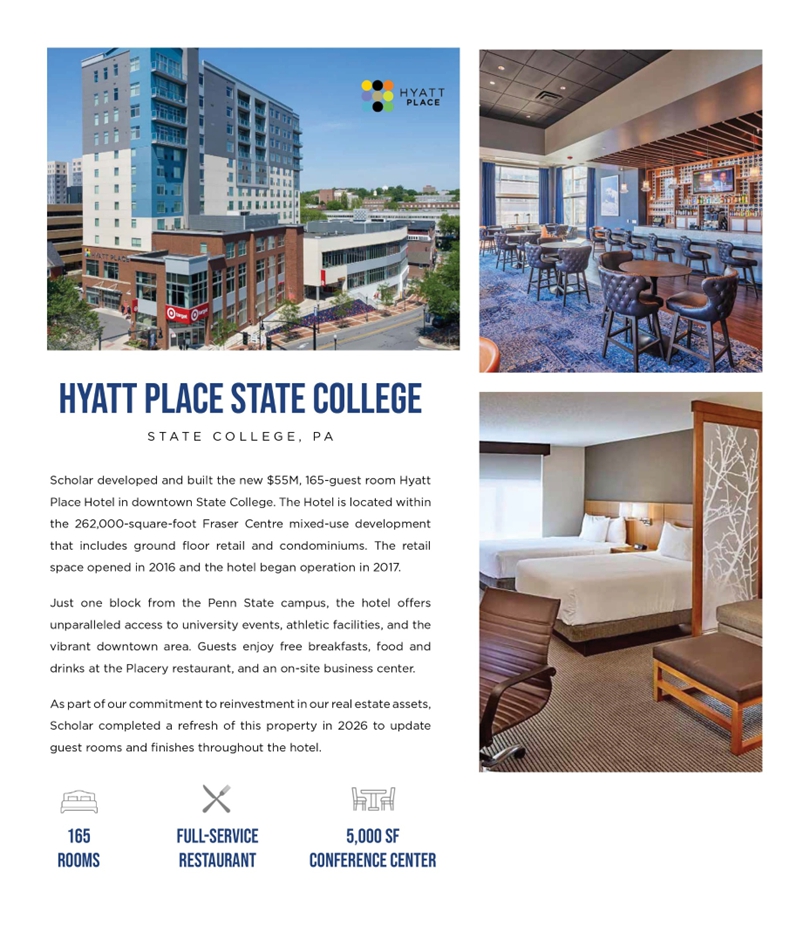
| 32 | P a g e |
| Scholar Hospitality Holdings I LLC – Offering Circular |
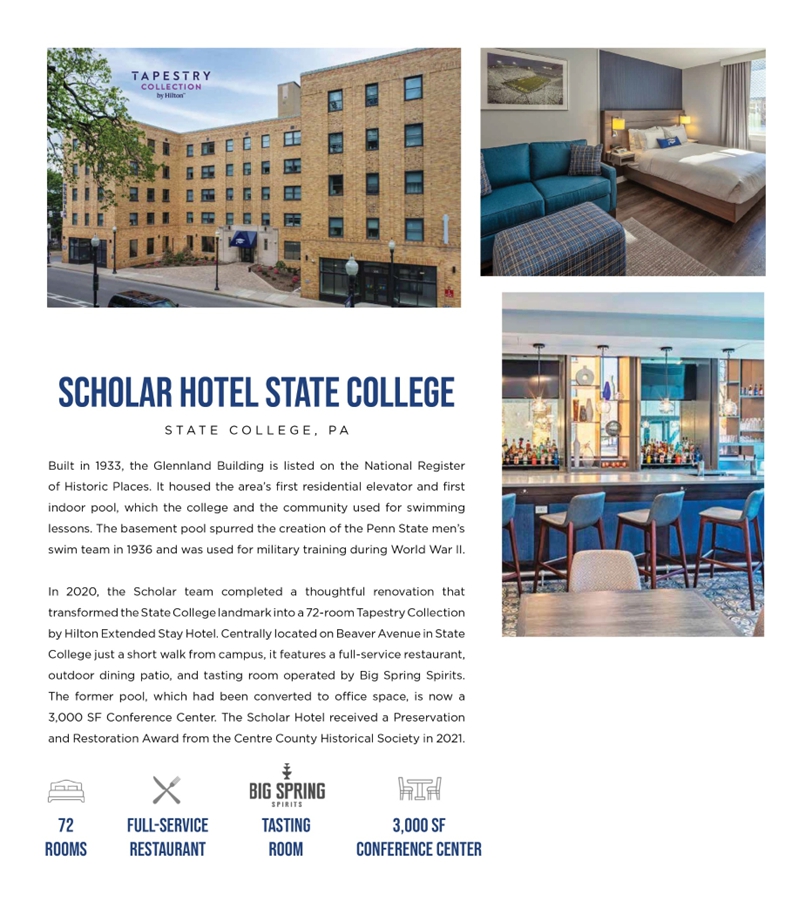
| 33 | P a g e |
| Scholar Hospitality Holdings I LLC – Offering Circular |
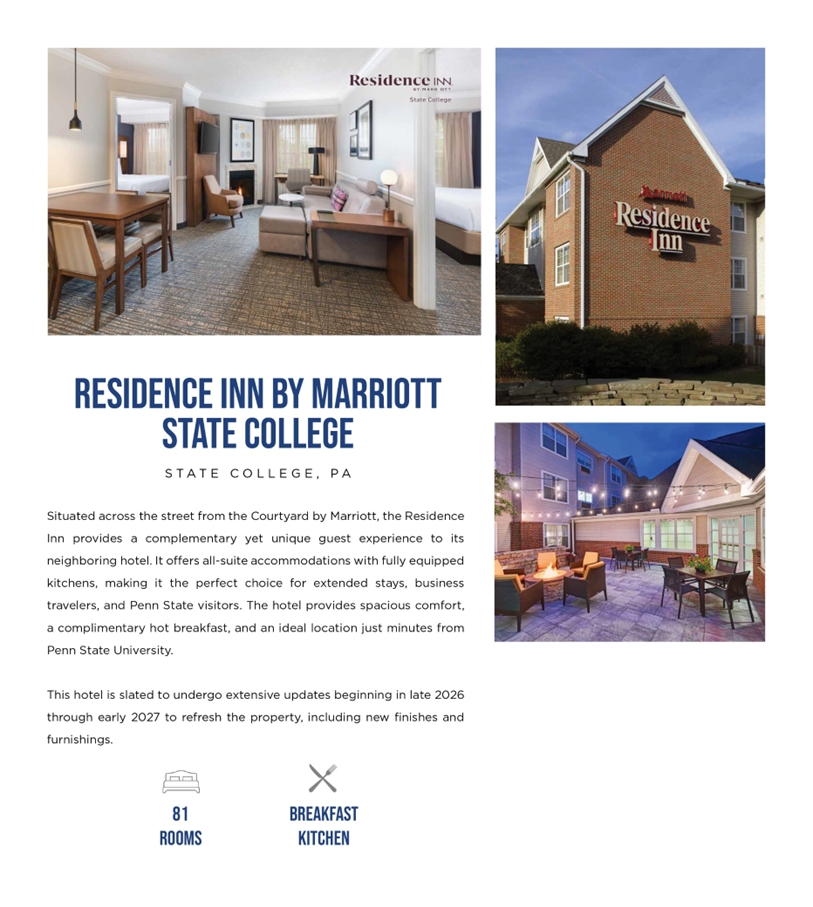
| 34 | P a g e |
| Scholar Hospitality Holdings I LLC – Offering Circular |
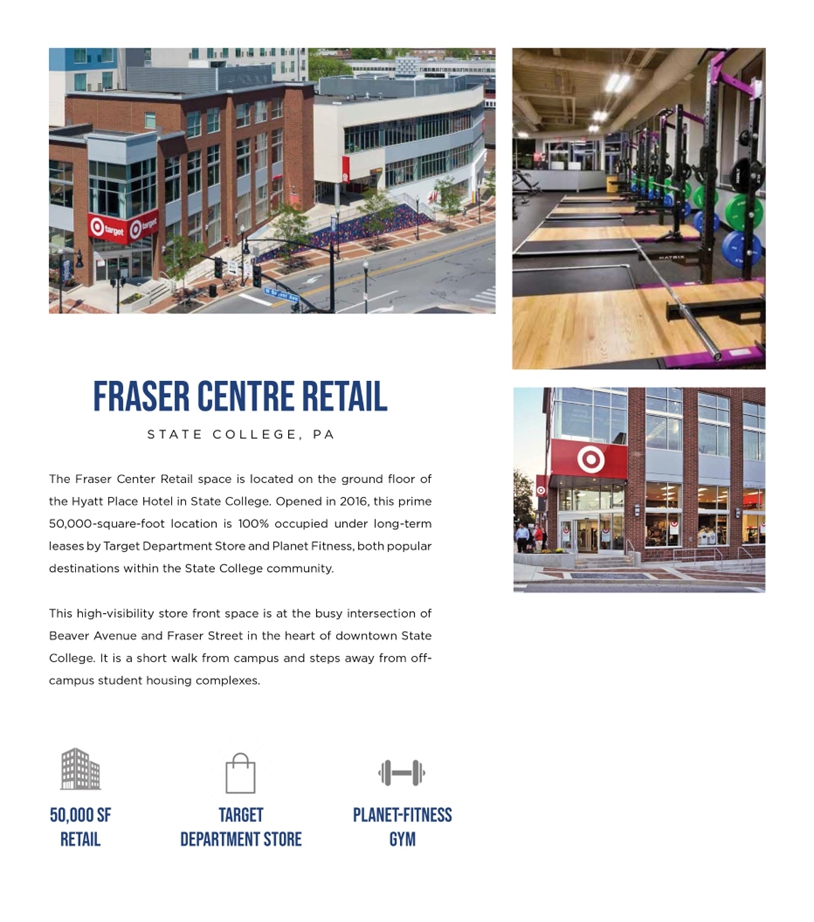
| 35 | P a g e |
| Scholar Hospitality Holdings I LLC – Offering Circular |
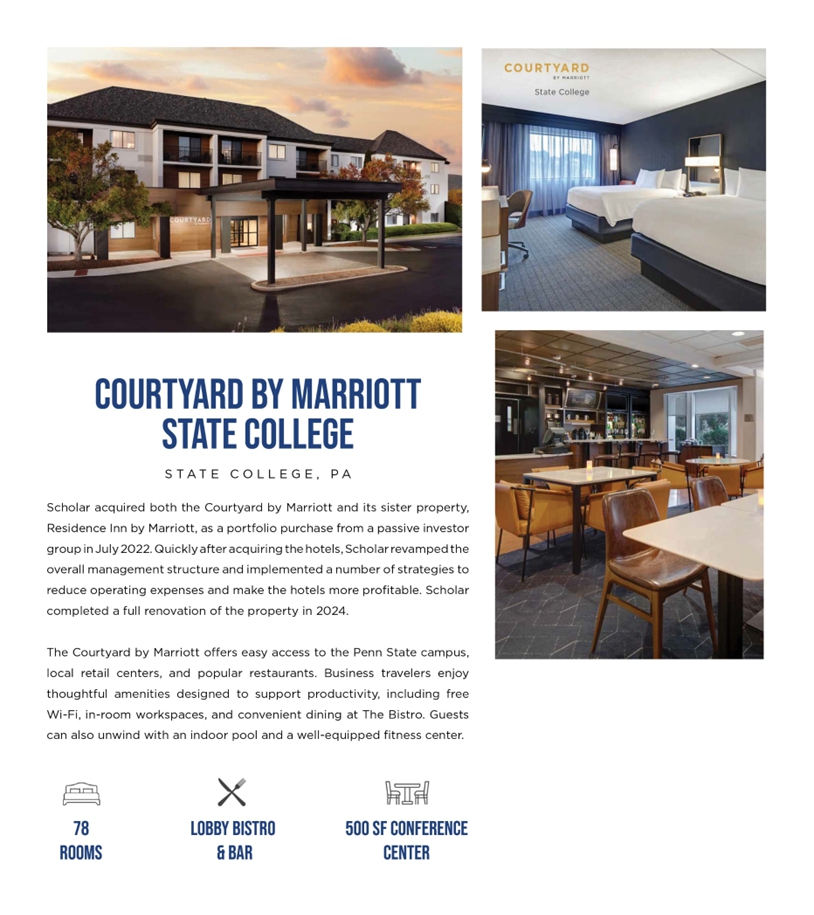
| 36 | P a g e |
| Scholar Hospitality Holdings I LLC – Offering Circular |
Additional Perks of Investing – Scholar Owners’ Club
Each Investor who purchases Class A Units will automatically be eligible for participation in the Company’s “Scholar Owners’ Club” loyalty and reward program (the “Scholar Owners’ Club”). The Scholar Owners’ Club is intended to operate as a loyalty and community-based rewards platform across a growing portfolio of hospitality and related assets. Accordingly, participation in the Scholar Owners’ Club is not limited to the Assets owned by the Company as of the date of this Offering Circular, but may extend to properties owned, leased, managed, or otherwise operated by the Company, the Manager, or their respective affiliates, including properties held in future affiliated funds, entities, or investment vehicles sponsored or managed by the Manager or its affiliates.
Membership in the Scholar Owners’ Club will consist of two tiers: Nittany Investor and Legacy Investor. Each Investor in each tier will be entitled to certain additional perks and benefits which may include:
Nittany Investor (for Investors who invest $5,000 in the Offering)
| ● | Preferred Reservations |
| ● | Room Upgrades as available |
| ● | Dining Discounts |
| ● | Access to High-demand Weekends |
| ● | Access to Exclusive Investor Events |
Legacy Investor (for Investors who invest at least $10,000 in the Offering)
| ● | All Nittany Investor benefits plus: |
| o | Enhanced Dining Discounts |
| o | Earlier Access to High-demand Weekends |
| o | VIP Access to Exclusive Investor Events |
Benefits to members of the Scholar Owners’ Club are subject to change in the sole discretion of the Asset Manager or Manager, may vary by Asset, and may be offered on a portfolio-wide, fund-specific, or affiliate-specific basis depending on availability, commercial arrangements, and other factors determined from time to time.
| 37 | P a g e |
| Scholar Hospitality Holdings I LLC – Offering Circular |
Our Revenue and Expenses
Revenue
The Company expects to generate revenues from the ownership and operation of the Assets acquired with the proceeds of this Offering. Revenues derived from the Assets are anticipated to be generated from multiple operating sources, which may vary by Asset, market conditions, seasonality, and the type and mix of assets owned by the Company. These revenue sources are expected to include, without limitation, the following:
| ● | Room Revenues. The primary source of revenue for the State College Assets is expected to be room revenues derived from guest bookings. Room revenues generally consist of charges paid by guests for overnight or short-term use of hotel rooms, suites, or similar accommodations, and may be generated through direct bookings, third-party booking platforms, group reservations, and other distribution channels. Room revenues are subject to fluctuation based on occupancy levels, average daily rates, demand trends, competition, and general economic conditions affecting travel and tourism. |
| ● | Food and Beverage Revenues. The Assets may generate additional revenues from the sale of food and beverage offerings, including restaurants, bars, lounges, room service, catering operations, and similar outlets located at or associated with an Asset. Food and beverage revenues may be derived from both hotel guests and non-guests and may vary significantly based on the quality, branding, and management of such facilities, as well as local market conditions and consumer preferences. |
| ● | Parking Revenues. Certain Assets may generate revenues from on-site or adjacent parking facilities, including self-parking and valet services. Parking revenues may be received from hotel guests, retail or conference visitors, or members of the general public, depending on the Asset’s location, design, and applicable local regulations. |
| ● | Retail Rent Revenues. Some Assets may include ground-floor or ancillary retail spaces leased to third-party tenants, such as restaurants, cafes, convenience stores, or other commercial occupants. Revenues from these portions of the Assets are generally expected to be generated in the form of base rent and, in certain cases, percentage rent or other contractual charges payable by retail tenants pursuant to lease agreements. |
| ● | Conference and Event Services. Certain hotel Assets may offer conference, meeting, banquet, or event facilities. Revenues from conference and event services may include charges for room rentals, audiovisual services, catering, event coordination, and related services provided in connection with meetings, conventions, weddings, or other gatherings hosted at an Asset. |
| ● | Miscellaneous Revenues. The Assets may also generate miscellaneous revenues from ancillary or incidental sources, which may include, without limitation, gift shop sales, vending machines, resort or facility fees, service charges, equipment rentals, and other guest-related services. Miscellaneous revenues may fluctuate based on guest usage patterns and the specific amenities offered at each Asset. |
| 38 | P a g e |
| Scholar Hospitality Holdings I LLC – Offering Circular |
Expenses
The Company expects to incur a variety of expenses in connection with the ownership, operation, and management of the Assets. The actual expenses incurred with respect to any particular Asset may vary based on the nature, location, size, operating performance, and condition of such Asset, as well as prevailing market and economic conditions. Expenses are expected to include, without limitation, the following categories:
| ● | Operating Costs. The Company expects to incur customary operating expenses associated with the day-to-day operation of the Assets. These operating costs may include, among other things, salaries, wages, bonuses, and benefits for on-site and administrative personnel; staffing-related payroll taxes and insurance; sales and marketing expenses; information technology systems and support; reservation and booking platform fees; repairs and maintenance; supplies; professional fees; and other general and administrative expenses required to operate the Assets. Operating costs may fluctuate based on occupancy levels, service offerings, labor market conditions, and other factors affecting hotel and real estate operations. |
| ● | Management Fees. The Company expects that some or all of the Assets may be operated pursuant to property management, hotel management, and/or asset management agreements with third-party managers or affiliates. Under such arrangements, the Company may be required to pay management fees that are typically calculated as a percentage of gross revenues, net operating income, or a combination thereof, and may also include incentive fees or other performance-based compensation. Management fees reduce the amount of cash available for distribution to Investors. |
| ● | Insurance. The Company expects to maintain insurance coverage customary for owners and operators of real estate and hospitality assets. Insurance expenses may include premiums for property insurance, casualty and liability insurance, business interruption insurance, workers’ compensation insurance, and other coverage deemed appropriate by the Company or required under financing or management agreements. Insurance costs may increase over time due to changes in coverage requirements, Asset values, claims history, or broader market conditions. |
| ● | Utilities. The Company expects to incur expenses for utilities required to operate the Assets, which may include electricity, gas, water, sewer, telecommunications, internet services, and similar utilities. Utility expenses may vary based on usage levels, occupancy, energy prices, seasonality, and applicable local rates. |
| ● | Real Estate Taxes. The Company expects to be responsible for the payment of real estate taxes, assessments, and similar governmental charges applicable to the Assets. Real estate taxes may be subject to reassessment upon acquisition, improvement, or sale of an Asset, or as a result of changes in applicable tax laws, valuation methods, or local governmental policies. Increases in real estate taxes would reduce the cash flow generated by the Assets. |
| 39 | P a g e |
| Scholar Hospitality Holdings I LLC – Offering Circular |
| ● | Capital Reserves. The Company expects to establish and maintain reserves for capital expenditures and other long-term needs of the Assets. Capital reserves may be used to fund significant repairs, replacements, renovations, upgrades, or improvements, including those required to maintain the competitive position, safety, or regulatory compliance of the Assets. The amount of capital reserves established for any Asset will be determined by the Company based on anticipated future capital needs and may reduce the amount of cash available for current distributions to Investors. |
Offices and Employees
The Company itself will not have offices or employees. Instead, our Manager will provide all services required to operate the Company (other than on-site construction and other services provided by third parties), as well as the office space and equipment necessary to provide such services.
The Manager does not currently have any employees. Scholar has approximately 9 full-time employees considered “senior management” and 2 part-time employees. The office location of the Manager is located on the title page to this Offering Circular.
Factors Most Likely to Affect Our Business
The ability of the Company to conduct its business successfully depends on several critical factors:
| ● | Dependence on University-Related Activity. A significant portion of demand for the Company’s Assets is driven by visitation associated with nearby universities, including academic programs, conferences, campus events, and other institutional activities. Any decline in university-related activity—whether due to changes in institutional priorities, reduced event programming, or external factors affecting campus operations—could reduce visitation to these markets and adversely affect hotel occupancy and revenues. |
| ● | Variability of Academic & Event Calendars. University-oriented hospitality markets tend to experience demand fluctuations aligned with academic calendars and scheduled events such as athletic competitions, commencements, orientation programs, alumni weekends, and conferences. If these events are reduced in scale, canceled, rescheduled, or experience lower attendance than anticipated, the Company’s Assets may experience lower occupancy and reduced revenues during periods that have historically generated higher demand. |
| ● | Dependence on Athletic Programs & Major Campus Events. In certain university communities, athletic events and other large-scale campus activities are a meaningful driver of short-term lodging demand. Changes in athletic conference alignment, team performance, event scheduling, ticket availability, fan engagement, or attendance levels could reduce the number of visitors traveling to these markets, which could negatively impact hotel demand during peak event periods. |
| 40 | P a g e |
| Scholar Hospitality Holdings I LLC – Offering Circular |
| ● | Changes in University Enrollment or Institutional Priorities. The economic vitality of many university communities is closely linked to the size, funding levels, and strategic priorities of the institutions located there. Declines in enrollment, shifts toward remote or hybrid academic programming, reductions in research activity, or changes in state or institutional funding could affect visitation patterns and demand for lodging accommodations in markets where the Company operates. |
| ● | Economic Conditions Affecting Travel. Demand for hotel accommodations is influenced by broader economic conditions that affect discretionary and business travel. Economic downturns, inflationary pressures, increases in travel costs, reduced consumer confidence, or constraints on institutional and household budgets could result in lower visitation to university communities and adversely affect occupancy levels and operating revenues at the Company’s Assets. |
| ● | Development & Redevelopment Risks. Certain of the Company’s Assets may undergo renovation, repositioning, expansion, or redevelopment initiatives intended to enhance long-term performance. These projects are subject to risks including construction delays, cost overruns, labor shortages, supply-chain constraints, permitting and zoning issues, and disruptions to ongoing operations, any of which could adversely affect project timelines, operating results, or anticipated returns. |
| ● | Reliance on Effective Hotel Operations. The Company’s performance depends on effective daily hotel operations, including sales and marketing activities, revenue management strategies, guest services, and property maintenance. Operational challenges such as staffing shortages, increased labor and benefit costs, employee turnover, system failures, or service disruptions could negatively affect guest satisfaction, occupancy, operating margins, and overall financial performance. |
| ● | Dependence on Relationships Within University Communities. The Company seeks to cultivate relationships with various participants in university ecosystems, including academic departments, conference organizers, visiting faculty, alumni organizations, and other groups that may generate lodging demand. If the Company is unable to establish, maintain, or expand these relationships, or if demand from these sources declines, the performance of the Company’s Assets could be adversely affected. |
| ● | Availability of Student Labor in University Communities. Assets located in university markets often rely, in part, on student employees to support operations in areas such as front desk services, housekeeping, food and beverage operations, conference services, and general hospitality functions. Changes in student availability, work authorization rules, academic workloads, or student interest in hospitality employment could reduce the availability of this labor pool and increase staffing challenges or labor costs. |
| 41 | P a g e |
| Scholar Hospitality Holdings I LLC – Offering Circular |
| ● | Dependence on University-Sponsored Work Experience Programs in Certain Markets. In certain markets, including State College, Pennsylvania, hospitality and related academic programs at nearby universities have historically encouraged or required students to obtain practical work experience as part of their academic curriculum. For example, hospitality students at Penn State have traditionally been required to complete a substantial number of work hours in hospitality-related roles during their course of study, which has historically contributed to the local hospitality labor pool. If universities modify academic requirements, reduce or eliminate work-experience components of hospitality curricula, or otherwise alter program structures, fewer students may seek employment in local hotels. Any reduction in the availability of student employees could make it more difficult for the Company to recruit and retain adequate staffing, increase labor costs, or require the Company to rely more heavily on non-student labor. If the Company is unable to maintain appropriate staffing levels or must materially increase compensation or benefits to attract employees, the operating performance and profitability of its hotels could be adversely affected. |
These are just some of the many factors which will influence the Company’s success and in turn the profitability of an Investor’s investment in the Company. For a more detailed list of factors which could impact the Company’s success, please see “Risks of Investing” on page 6.
Competition
The hospitality industry is highly competitive, and the Company’s Assets compete with a range of lodging providers within their respective markets. Competition may affect pricing, occupancy levels, operating margins, and overall financial performance, including:
| ● | Competition From Other Hotels. The Company’s Assets compete with other lodging properties located in the same or nearby university communities, including national and regional branded hotels, independent hotels, boutique properties, and limited-service accommodations. These competitors may have greater brand recognition, more extensive loyalty programs, superior amenities, or greater financial and marketing resources, which could enable them to attract guests through pricing strategies, promotional offers, or enhanced guest experiences. |
| ● | Price, Brand, and Amenity Competition. Hotels in the Company’s markets compete on a variety of factors, including room rates, location, perceived quality, service levels, brand affiliation, amenities, and reputation. Increased competition in any of these areas may require the Company to adjust pricing, increase marketing expenditures, or invest additional capital to maintain competitiveness, which could adversely affect margins and profitability. |
| ● | New Hotel Development. University-oriented markets that experience sustained visitation and favorable demand trends may attract new hotel development. The construction or opening of additional hotels in markets where the Company operates could increase the overall supply of available rooms and intensify competition for guests, particularly during non-peak periods. |
| ● | Impact of Increased Room Supply. An increase in the supply of hotel rooms could reduce occupancy levels, limit the Company’s ability to raise room rates, or require more aggressive discounting to maintain market share. Any sustained imbalance between supply and demand in the Company’s markets could adversely affect average daily rates, revenue per available room, and overall operating results. |
| 42 | P a g e |
| Scholar Hospitality Holdings I LLC – Offering Circular |
| ● | Alternative Lodging Options. The Company’s Assets also compete with alternative lodging options, including short-term rental platforms, vacation rentals, extended-stay accommodations, and other non-traditional hospitality offerings. These alternatives may provide visitors with different pricing structures, amenities, or lodging experiences, which could divert demand away from traditional hotel accommodations in university communities. |
| ● | Competition for University-Related Group and Event Business. Hotels located near universities frequently compete for group bookings associated with conferences, academic programs, alumni events, athletic travel, and other institutional activities. Other hotels in the market may seek to attract this business through competitive pricing, meeting and event space offerings, tailored services, or established marketing relationships within the university community. Increased competition for group and event business could limit the Company’s ability to secure room blocks, conference bookings, or premium pricing during key periods. |
| ● | Seasonal and Event-Driven Competition. Demand in university markets is often concentrated around specific events or time periods tied to academic calendars and campus activities. Competition among hotels for these peak periods may be particularly intense, and the Company may face pressure to offer discounted rates or additional incentives to attract guests, which could affect revenue during periods that are critical to annual performance. |
| ● | Competition for Skilled Hospitality Personnel. The Company competes with other hospitality operators, restaurants, and service-industry employers for qualified personnel, including management, sales, food and beverage staff, housekeeping, and front-desk employees. Competition for experienced or reliable employees may increase labor costs, reduce staffing availability, or result in higher turnover, any of which could adversely affect service quality, operating efficiency, and profitability. |
| 43 | P a g e |
| Scholar Hospitality Holdings I LLC – Offering Circular |
State College Assets: A Deeper Dive
Overview
The State College Assets described in this Offering Circular are currently owned by, and operated through, one or more Legacy Entities. The Company does not presently own these State College Assets. The Company expects to acquire the State College Assets from the Legacy Entities using the net proceeds of this offering, together with existing indebtedness, new financing, and/or other sources of capital, as determined by the Company from time to time. There can be no assurance that all contemplated acquisitions will be consummated on the terms described herein or at all.
The principals of the Legacy Entities are the same individuals who own, control, and manage the Manager of the Company and its Affiliates. As a result, the contemplated acquisitions will involve transactions between entities under common control. The acquisition terms, including purchase prices and related arrangements, have been determined by the principals and were not negotiated on an arm’s-length basis. These transactions may involve conflicts of interest, and the interests of the principals may differ from those of investors in the Company. See “Risks of Investing” on page 6, and “Interest of Management and Others in Certain Transactions” on page 82,
The historical operating results and financial information presented in this Offering Circular reflect the performance of the State College Assets while owned and operated by the Legacy Entities. Such historical results are not necessarily indicative of the future performance of the Company or the State College Assets following their acquisition by the Company. Future results will depend on numerous factors, including market conditions, financing terms, operating costs, and the Company’s ability to execute its business strategy, and may differ materially from historical performance.
However, because the principals of the Legacy Entities are the same individuals who will continue to own, manage, and operate the Company and its Affiliates following the consummation of this Offering and the related acquisitions, the Company’s management believes that the historical operating information of the State College Assets provides a meaningful basis for understanding the State College Assets, the markets in which they operate, and the assumptions underlying the Company’s forward-looking projections. The Company’s projections are based on management’s experience operating these Assets, familiarity with their historical performance and cost structures, and expectations regarding future market conditions. Nonetheless, these projections are inherently forward-looking and subject to significant risks and uncertainties, and actual results may differ materially.
The discussion below should be read together with the historical financial information and the forward-looking financial projections included elsewhere in this Offering Circular and the exhibits referenced herein.
Portfolio Composition & Operating Profile
As of the date of this Offering Circular, the Legacy Entities’ portfolio consists of multiple hotel properties and one retail center located in State College, Pennsylvania. These Assets serve both transient and group demand associated with nearby universities.
| 44 | P a g e |
| Scholar Hospitality Holdings I LLC – Offering Circular |
The Assets generally experience seasonality tied to university academic calendars and major campus events, with higher occupancy and room rates during athletic weekends, commencements, conferences, and similar events, and softer demand during academic recess periods.
Historical Results of Operations
The Legacy Entities have provided historical operating results for certain stabilized Assets in its portfolio. Historical performance reflects the relationship between university-driven demand and lodging activity in these markets, as well as broader economic conditions affecting travel.
Across the Assets, historical occupancy levels have generally ranged from the high-60% to low-70% range, with average daily rates increasing over time and varying by brand, positioning, and service level. Variations in year-to-year performance reflect changes in event schedules, institutional activity levels, pricing strategies, and operating costs.
A summary of selected historical operating metrics is set forth below for illustrative purposes only and does not include all periods or all properties:
Selected Historical Operating Metrics (Certain Properties)
| Metric | Indicative Range | |
| Occupancy | ~71% – ~72% | |
| Average Daily Rate (ADR) | ~$170 – ~$212 | |
| Revenue per Available Room (RevPAR) | ~$120 – ~$160 |
Complete historical statements and property-level data are included in Exhibit 1A-15A (“Unaudited Historical Financial Performance”).
Portfolio Valuation & Capital Structure
The Legacy Entities have assembled valuation information for its portfolio based on a combination of third-party appraisals, recent financing activity, and internal estimates. Aggregate acquisition costs, inclusive of estimated closing costs and planned capital expenditures, total approximately $138.55 million. The portfolio is financed with a combination of existing indebtedness and equity capital.
As currently structured, total existing and planned debt across the portfolio is approximately $70.5 million, with total equity capital required of approximately $63 million. The Company intends to raise up to $75 million pursuant to this Regulation A offering, subject to the limitations of Regulation A.
Certain properties are undergoing updated appraisal processes, and valuation estimates may be revised based on updated third-party valuations, capital improvements, or changes in market conditions.
Additional detail regarding portfolio valuation, debt, and equity requirements is included in Exhibit 1A-15B (“Portfolio Valuation Summary & Appraisals”).
| 45 | P a g e |
| Scholar Hospitality Holdings I LLC – Offering Circular |
Forward-Looking Results & Trends
The Company has prepared forward-looking consolidated financial projections reflecting management’s assumptions regarding occupancy levels, average daily rate growth, operating expenses, capital expenditures, and financing costs. These projections also reflect anticipated stabilization and planned redevelopment initiatives at certain properties.
Management currently expects modest long-term growth in average daily rates and occupancy across the portfolio, with operating performance continuing to reflect the seasonal patterns inherent in university-oriented hospitality markets. Projected operating margins assume continued investment in maintenance, staffing, and brand standards, as well as the successful execution of redevelopment and repositioning strategies where applicable.
The following table summarizes select projected consolidated metrics over a ten-year forecast period:
Illustrative Consolidated Operating Outlook
| Metric | Early Period | Later Period | ||
| Occupancy | ~71% | ~72% | ||
| ADR | ~$212 | ~$250+ | ||
| Total Operating Revenue | ~$26 million | ~$33+ million | ||
| Net Income Before Debt Service | ~$10.137 million | ~$13.3+ million |
These projections are inherently forward-looking, are based on management assumptions, and are subject to the risks and uncertainties described under “Risks Of Investing” on page 6. Actual results may differ materially.
Detailed projections, assumptions, and property-level schedules are included in Exhibit 1A-15C (“Detailed Financial Proformas (Unaudited)”).
Liquidity & Capital Resources
The Company expects to fund ongoing operations, capital expenditures, and debt service through operating cash flow and proceeds from this offering. The availability of additional financing, refinancing, or capital contributions may be affected by market conditions, interest rates, property performance, and lender requirements.
There can be no assurance that the Company will achieve projected cash flows or that sufficient capital will be available on acceptable terms in the future.
Summary Financial Information
The financial information presented in this Offering Circular includes:
| ● | Historical operating results for select Assets; |
| ● | Portfolio valuation summaries; and |
| ● | Forward-looking consolidated and property-level financial projections. |
The summary information presented herein is qualified in its entirety by the more detailed financial statements, schedules, and notes included as exhibits to this Offering Circular.
CAUTION: Past performance does not guaranty future results. Even though the principals of the Manager of the Company have successfully operated the State College Assets through the Legacy Entities in the past, there are many reasons why the Company might not be successful, including all of those listed in “Risks of Investing” on page 6.
| 46 | P a g e |
| Scholar Hospitality Holdings I LLC – Offering Circular |
SECURITIES BEING OFFERED: THE CLASS A Units
Description of Securities
We are offering to the public up to $75,000,000 of Class A Units, which represent limited liability company interests in the Company. All of the rights and obligations associated with the Class A Units are set forth in the LLC Agreement, which is attached as Exhibit 1A-2B.
Price of Class A Units
Initially, we will offer the Class A Units at $1 per Class A Unit. During the term of this Offering, we may increase or decrease the price per Class A Unit to reflect changes in the net value of our Assets, which will be determined by the Manager in its sole and absolute discretion. Changes in the price per Class A Unit will be reflected in a supplement to this Offering Statement filed with the SEC.
Voting Rights
Owners of the Class A Units – that is, Investors – will have no right to vote or otherwise participate in the management of the Company. Instead, the Company will be managed by the Manager exclusively.
Distributions
We intend to make distributions periodically, as conditions permit. The order of distributions will be governed by the Company’s LLC Agreement.
We divide distributions into two categories:
| ● | Distributions of ordinary operating cash flow from Assets; and |
| ● | Distributions of the net proceeds from “capital transactions” like sales or refinancing of Assets (“net proceeds” means the gross proceeds of the capital transaction, reduced by the expenses of the transaction, including repayment of debt). |
Distributions of ordinary operating cash flow will be distributed 90% to the Investors on a pro rata basis and 10% to the Manager.
Distributions of the net proceeds from capital transactions will be made in the following order or priority:
| ● | Step One: First, Investors will receive any remaining net proceeds to return an allocable portion of the capital they invested; |
| ● | Step Two: Second, any remaining net proceeds will be distributed 90% to the Investors on a pro rata basis and 10% to the Manager. |
| 47 | P a g e |
| Scholar Hospitality Holdings I LLC – Offering Circular |
We expect to make distributions of ordinary operating cash flow on a monthly basis. Distributions of the net proceeds from capital transactions will be made, if at all, upon the occurrence of a capital transaction.
Whether
to distribute operating cash flow or capital proceeds, and how much to distribute, are in the sole discretion of the Manager. No returns
are guaranteed. Investors will receive distributions only if we are able to generate a profit from the business.
How We Decide How Much To Distribute
To decide how much to distribute, we start with the revenue from each Asset, add miscellaneous income like interest, add any proceeds we have received from the sale or refinancing of our Assets, and then subtract our actual expenses of operating the Assets, including salaries, rent, debt service, management fees, marketing costs, taxes, legal and accounting fees, travel expenses, commissions, and debt service. Finally, depending on the circumstances at the time, we decide how much should be held in reserve against future contingencies. The amount we distribute is therefore our revenue, minus our expenses, minus the reserve amount.
Withholding
In some situations we might be required by law to withhold taxes and/or other amounts from distributions made to Investors. The amount we withhold will still be treated as part of the distribution. For example, if we distribute $100 to you and are required to withhold $10 in taxes, for our purposes you will be treated as having received a distribution of $100 even though only $90 was deposited in your bank account.
No Guaranty
We can only distribute as much money as we have. There is no guaranty that we will have enough money, after paying expenses, to return all of an Investor’s invested capital.
Transfers
Investors may freely transfer their Class A Units, but only after providing the Manager with written assurance that (i) the transfer is not required to be registered under the Securities Act of 1933, and (ii) the transferor or the transferee will reimburse the Company for expenses incurred in connection with the transfer.
However, an Investor who wants to sell his, her, or its Class A Units must first offer them to the Manager.
Mandatory Redemptions
The Manager may require an Investor to sell his, her, or its Class A Units back to the Company:
| ● | If the Investor is an entity governed by the Employee Retirement Income Security Act of 1974, Code section 4975, or any similar Federal, State, or local law, and the Manager determines that all or any portion of the assets of the Company would, in the absence of the redemption, more likely than not be treated as “plan assets” or otherwise become subject to such laws. |
| ● | If the Manager determines that the Investor has engaged in certain misconduct. |
| 48 | P a g e |
| Scholar Hospitality Holdings I LLC – Offering Circular |
If an Investor’s Class A Units are purchased pursuant to such a request, the price will be equal to 90% of the amount the selling Investor would have received had all assets of the Company been sold for their net asset value, as determined by the Manager, and the proceeds, less all liabilities and expenses, been distributed in liquidation of the Company.
The purchase price will be paid by wire transfer or other immediately-available funds.
Voluntary Redemptions
Investors may request that the Company redeem their Class A Units by providing written notice to the Manager of such request. However, all redemptions shall be subject to the following basic limitations, except as otherwise determined by the Manager in its sole discretion:
| ● | The Manager shall only accept a redemption request that provides for a redemption date set for the end of a fiscal quarter (i.e. March 31st, June 30th, September 30th, or December 31st). |
| ● | All Members shall be required to provide written notice to the Manager of any redemption request at least sixty (60) days prior to the requested redemption date, which notice shall include the requested redemption date and the number of Class A Units to be redeemed. |
| ● | The redemption price per Class A Unit shall be equal to such Member’s then-existing Capital Account divided by the number of Class A Units held by such Member but in no event shall the aggregate purchase price for all of such Member’s Class A Units be less than $100. |
| ● | The Company shall not be required to redeem any Units unless the Company has sufficient assets to pay for its liabilities. |
| ● | A Member shall generally receive the proceeds from any redemption request accepted by the Manager within thirty (30) days of the effective date of the redemption provided, however, that (i) ten percent (10%) of such redemption amount (as may be calculated on the basis of unaudited data) shall be temporarily withheld in reserve, and shall be distributed not later than thirty (30) days after the completion of the Company's year-end audit. The amount actually disbursed to the Member in connection with such redemption shall be subject to reduction in consideration of any applicable fees due to the Manager, the Asset Manager and/or the Property Manager as well as any reserves, if any (including, but not limited to, reserves established for loss contingencies and existing liabilities). Any such redemption shall be deemed to be a redemption of all Class A Units held by such Member as of the effective date of the redemption. |
| ● | The Manager may elect to make, at its sole discretion, a distribution of property, rather than cash, or a combination of cash and property, to a redeemed Member, which property shall be assigned a fair market value as deemed appropriate by the Manager in good faith and accounted for as if all such property had been sold for its fair market value and the withdrawal distribution made subsequently in cash. In the event that a Member contributed property to the Company as part of a Capital Contribution, the Manager shall typically seek to return such property to such Member upon its making a withdrawal of adequate size. |
| 49 | P a g e |
| Scholar Hospitality Holdings I LLC – Offering Circular |
| ● | The Manager may, at its sole discretion, elect to hold some or all of the balance in the Capital Account of any Member as reserves for actual or contingent liabilities, realized or anticipated, relating to the Company or the Member’s account. In the event that the Manager makes such an election, the amount held in reserve will not be available for withdrawal by the Member until such time as the Manager determines such reserves are no longer necessary, at which point such reserves shall be made payable to the Member. No Investor shall have the right to any interest earned on any reserves so withheld. |
| ● | The Manager may withhold taxes from any redemptions or other distributions to any Member, or in respect of allocations of Company net or gross income or gain, to the extent required by the Code or any other applicable law. For purposes of this Agreement, any taxes so withheld by the Company with respect to any redemption payments or other distributions by the Company to any Member, or in respect of allocations of Company net or gross income or gain, shall be deemed to be a distribution or payment to such Member constituting a complete redemption and withdraw of such Member hereunder. |
| ● | Redemptions by Members having more than one Capital Account at the time of the redemption will be made generally on a "first-in, first-out" basis, or as otherwise deemed appropriate by the Manager, at its sole discretion. |
| ● | The Manager may, by written notice to the Members, suspend redemption rights, in whole or in part, in the event that the Company or any Member’s account is subject to an investigation of money laundering charges or other such legal investigation mandating a temporary freezing of assets; or if such withdrawal would have, or could reasonably be expected to have, a material adverse effect on the Company or any of the Members. |
| ● | The Manager retains the right to require any Member to redeem all some or all of its Class A Units at any time and for any reason upon providing prior written notice to such Member. |
| ● | If after the completion of the Company’s year-end audit, the Manager determines that the amount previously distributed to a Member in connection with any redemption exceeded the amount that such Member was actually entitled to receive, then the Member shall be required to return such excess amount to the Company within ten (10) days of notification of such excess payment. |
| ● | Any Member who elects or is required to make a complete redemption of its Class A Units (excluding any amount held in reserve by the Manager) shall cease to be a Member as of the effective date of such redemption and shall thereafter have no rights as a Member set forth herein except as otherwise specifically established herein or as required by law. |
| ● | No Member may request a redemption of its Class A Units prior to twelve (12) months from the date it becomes a Member. |
| ● | Prior to redeeming any Class A Units requested to be redeemed by a Member, the Company shall first offer such Class A Units to be redeemed (the “Redemption Units”) to the Manager. If the Manager does not elect to purchase all (and not less than all) of the Redemption Units within three (3) days after receipt of notice from the redeeming Member, the Company shall next offer such Redemption Units to the Members of the Manager (or their designees), pro rata or as otherwise determined by the Manager, on the same terms. Any Redemption Units not so purchased may thereafter be redeemed by the Company. |
| 50 | P a g e |
| Scholar Hospitality Holdings I LLC – Offering Circular |
LIMIT ON AMOUNT A NON-ACCREDITED INVESTOR CAN INVEST
As long as you’re at least 18 years old, you can invest in this Offering. But if you’re not an “accredited” investor, the amount you can invest is limited by law.
Under 17 CFR §230.501, a regulation issued by the Securities and Exchange Commission, the term “accredited investor” means:
| ● | A natural person who has individual net worth, or joint net worth with the person’s spouse, that exceeds $1 million at the time of the purchase, excluding the value of the primary residence of such person; |
| ● | A natural person with income exceeding $200,000 in each of the two most recent years or joint income with a spouse exceeding $300,000 for those years and a reasonable expectation of the same income level in the current year; |
| ● | A trust with assets in excess of $5 million, not formed for the specific purpose of acquiring the securities offered, whose purchase is directed by a sophisticated person; |
| ● | A business in which all the equity owners are accredited investors; |
| ● | An employee benefit plan, within the meaning of the Employee Retirement Income Security Act, if a bank, insurance company, or registered investment adviser makes the investment decisions, or if the plan has total assets in excess of $5 million; |
| ● | A bank, insurance company, registered investment company, business development company, or small business investment company; |
| ● | A charitable organization, corporation, or partnership, not formed for the specific purpose of acquiring the securities offered, with total assets exceeding $5 million; and |
| ● | A director, executive officer, or general partner of the company selling the securities, or any director, executive officer, or general partner of a general partner of that issuer. |
If you fall within any of those categories, then you can invest as much as you want. If you don’t fall within any of those categories, then the most you can invest in this Offering is the greater of:
| ● | 10% of your annual income; or |
| ● | 10% of your net worth. |
These limits are imposed by law, not by us.
When you go to our website, www.ScholarHH.com, we will ask whether you’re an accredited investor. If you aren’t, then we’ll ask about your annual income and net worth.
| 51 | P a g e |
| Scholar Hospitality Holdings I LLC – Offering Circular |
In addition to the LLC Agreement, the Company is subject to three (3) major contracts which govern virtually all aspects of the Company’s business. These contracts are:
| ● | The Property Management Agreement with the Property Manager |
| ● | The Asset Management Agreement with the Asset Manager; and |
| ● | Each Purchase Agreement pursuant to which the Company acquires each State College Asset. |
A summary of each contract is below, each of which is qualified in their entirety by reference to the actual agreements. A copy of the Property Management Agreement is attached as Exhibit 1A-6A, a copy of the Asset Management Agreement is attached as Exhibit 1A-6B, and a copy of the Purchase Agreement pursuant to which the Company intends to acquire each Property is attached as Exhibit 1A-6C.
Summary of Property Management Agreement
Under the Property Management Agreement, the Property Manager is appointed by each SPV as such SPV’s exclusive agent to supervise, direct, control and operate the Assets owned by such SPV for an initial term of twenty (20) years, which may be extended by mutual agreement of the parties. As the Property Manager for each Property, the Property Manager is responsible for the proper and efficient operation of the Assets including complete discretion and control to:
| ● | Determine rates and fees for rooms, commercial space and other services at the Assets; |
| ● | Implement and administer various employment, credit and other policies; |
| ● | Grant concessions or leasing of shops and agencies with the Assets; |
| ● | Receive, hold and disburse funds; |
| ● | Maintain one or more bank accounts; |
| ● | Procure inventories, supplies and services necessary or useful to the efficient operation of the Assets; |
| ● | Establish, administer and execute promotions and publicity campaigns; |
| ● | Make any repairs or perform (or contract to perform) any maintenance on such Assets; and |
| ● | Any other actions or activities necessary or convenient in connection with or relating to any of the foregoing. |
| 52 | P a g e |
| Scholar Hospitality Holdings I LLC – Offering Circular |
As consideration of the services provided under the Property Management Agreement, the Property Manager is entitled to: (1) a base management fee equal to three percent (3%) of the gross revenues of each Asset (the “Property Management Fee”), which Property Management fee is fully subordinated to any liens or other secured creditors of the SPV; and (2) an accounting fee of $1,000 per month. All fees will be paid on a monthly basis as further described in the Property Management Agreement.
Additionally, the Property Manager is required to obtain and maintain the following insurance policies with insurance companies reasonably acceptable to the Manager:
| ● | At the Asset-level, the Property Manager will obtain property insurance protecting each Asset against loss or damage by fire, lightning and all other risks covered by the usual standard extended coverage endorsements in an amount not less than 100% of the replacement costs of such Asset (the costs of which costs shall be reimbursed by the Company under the Property Management Agreement); |
| ● | Insurance against loss or damage from explosion of boilers, pressure vessels, pressure pipes and sprinklers; |
| ● | Business interruption insurance covering loss of profits and necessary continuing expenses in amounts acceptable to the Manager; |
| ● | Workers’ compensation insurance and employer’s liability insurance as required by applicable laws; |
| ● | Fidelity bonds, with reasonable limits and deductibles acceptable to the Manager covering employees in job classifications normally bonded in the other hotels as requires by law; |
| ● | Comprehensive general public liability insurance covering bodily injury, death or property damage at an Asset, including automobile insurance on vehicles operated by the Asset, with a combined single limit of not less than $1,000,000 for each occurrence for personal injury death or property damage, with $15,000,000 umbrella coverage; and |
| ● | Such other insurance reasonably requested by the Manager. |
All disputes arising under the Property Management Agreement shall be referred to arbitration under the rules of the Commercial Rules of the American Arbitration Association, which arbitration shall be held in Philadelphia, Pennsylvania. The arbitrator in such dispute has complete authority to grant any remedy or relief it deems appropriate with the exception of punitive damages, which finding will be binding on the parties for all purposes with an opportunity for appeal. The prevailing party in any dispute will be entitled to reasonable fees and costs (including attorneys’ fees) incurred in connection with such matter.
| 53 | P a g e |
| Scholar Hospitality Holdings I LLC – Offering Circular |
Summary of Asset Management Agreement
Under the Asset Management Agreement, the Asset Manager contracts with the Company to provide State College Asset-level asset management services related to the ownership and operation of the State College Asset including:
| ● | Determining design impacts and returns on investment to the Company for any plan renovations or redevelopments; |
| ● | Analyzing monthly financial statements to verify financial results; |
| ● | Identifying, analyzing and recommending other revenue and asset value enhancement opportunities; |
| ● | Reviewing and advising the Company on the annual operating budget of each Asset including its annual capital expenditure budget; |
| ● | Advising the Company in the hiring, termination, and promotion of management of employees at each Asset; |
| ● | Providing monthly updates to the Company on operational performance of each Asset; |
| ● | Attending meetings to review the monthly performance, including quarterly property inspections; |
| ● | Advising on major decisions involving the Assets, including sales and refinance analysis, property plant and equipment budgeting, property improvement plans and franchise license renewals and compliance; |
| ● | Advising on compliance with local laws and regulations, including any tax appeal efforts; |
| ● | Assisting the Company with handling any third party brokers and agents in connection with any sales, refinances or leases of the Assets; and |
| ● | Providing other services consistent with any of the foregoing. |
As compensation for the Asset Manager’s services under the Asset Management Agreement, the Company agrees to reimburse the Asset Manager for all reimbursable expenses under the Asset Management Agreement and to pay the Asset Manager a fee equal to two percent (2%) of the gross revenues of each Asset within thirty (30) days of each calendar month end (the “Asset Management Fee”). If the Company does not have sufficient cash on hand to pay the Asset Management Fee, then any unpaid Asset Management Fee will accrue interest equal to eight percent (8%) per year.
The Asset Manager has no authority to bind the Property Manager or the Company. Accordingly, the Asset Manager is required to be indemnified from any liability under the Asset Management Agreement absent the Asset Manager’s gross negligence, recklessness, willful misconduct, fraud, violation of law, or from any action taken beyond the scope of its authority. The Asset Management Agreement has an initial term of twenty (20) years, which may be extended by the parties by written agreement.
| 54 | P a g e |
| Scholar Hospitality Holdings I LLC – Offering Circular |
Summary of Purchase Agreement
To acquire each of the State College Assets, the Manager shall cause the Company to enter into a purchase agreement with each of the Legacy Entities in substantially the form set forth in the Purchase Agreement, subject to deal-specific terms and customizations as deemed necessary or convenient by the Manager. Under the Purchase Agreement:
| ● | The Company will purchase one hundred percent (100%) of the equity interests of the Legacy Entities holding each of the State College Assets; |
| ● | Each acquired Legacy Entity owns the land, buildings and related improvements, appurtenances (such as easements, utility rights, permits, leases, service contracts, etc) used in connection with the operation of the State College Asset; |
| ● | The Company will pay the purchase price for each Legacy Asset in cash at closing, subject to customary prorations and adjustments, including for taxes, utilities, rent, security deposits, and certain contract charges; |
| ● | The Company will be afforded customary due diligence periods during which it may conduct physical, structural, environmental, title, lease and other diligence with respect to the State College Asset and the acquired Legacy Entity. The Company may terminate the Purchase Agreement during this period in its sole discretion if it is not satisfied with the results of investigations; |
| ● | The sellers of each Legacy Entity are required to convey marketable title to the equity interests, free and clear of liens other than permitted exceptions. Monetary liens must be discharged at or prior to closing, and the Company has termination or price-adjustment rights if certain title issues cannot be cured; |
| ● | The sellers will make customary representations and warranties, including relating to authority, capitalization, absence of disclosed liabilities, status of leases, absence of litigation, zoning compliance, environmental matters, OFAC compliance, and that the acquired Legacy Entity has conducted no business other than ownership of the State College Asset; |
| ● | The sellers are subject to customary interim operating covenants, including requirements to operate the State College Asset in the ordinary course, refrain from entering into new leases or material contracts without consent, avoid encumbering title, and preserve existing leases and service arrangements through closing; |
| ● | Closing is subject to satisfaction of customary conditions, including accuracy of seller representations, compliance with covenants, delivery of required closing documents, and issuance of title policy acceptable to the Company; |
| ● | The Purchase Agreement provides the Company with termination rights in the event of a material casualty damage or condemnation prior to closing, or alternatively, the right to proceed with closing and receive applicable insurance or condemnation proceeds; |
| ● | The Purchase Agreement shall be governing by Pennsylvania law. |
| 55 | P a g e |
| Scholar Hospitality Holdings I LLC – Offering Circular |
SALE AND DISTRIBUTION OF SECURITIES
We are offering to sell up to $75,000,000 of Class A Units to the public.
The Offering will begin as soon as our Offering Statement is “qualified” by the U.S. Securities and Exchange Commission (“SEC”), and will end upon the earlier of (1) the date we have sold $75,000,000 of Class A Units, (2) the second anniversary of the date our Offering Statement is qualified by the SEC, or (3) the date the Company terminates this Offering.
Only the Company is offering securities in this Offering. None of our existing officers, directors, or stockholders is offering or selling any securities.
We are not using an underwriter or broker to sell the Class A Units. We are selling Class A Units only through our website, located at www.ScholarHH.com, which we refer to as the “Site.”
We are not paying commissions to anybody for selling the Class A Units.
We reserve the right to reject any subscription to purchase Class A Units in this Offering in whole or in part and for any reason (or no reason). If we reject your subscription, we will return all your money without interest or deduction.
After the Offering has been “qualified” by the Securities and Exchange Commission, we intend to advertise the Offering using the Site and through other means, including public advertisements and audio-visual materials, in each case only as we authorize. Although these materials will not contain information that conflicts with the information in this Offering Circular and will be prepared with a view to presenting a balanced discussion of risk and reward with respect to the Class A Units, our advertising materials will not give a complete understanding of this Offering, the Company, or the Class A Units and are not to be considered part of this Offering Circular. The Offering is made only by means of this Offering Circular and prospective Investors must read and rely on the information provided in this Offering Circular in connection with their decision to invest in the Class A Units.
| 56 | P a g e |
| Scholar Hospitality Holdings I LLC – Offering Circular |
To buy Class A Units, go to our website, www.ScholarHH.com, which we refer to as the “Site,” and follow the instructions. We will ask for certain information about you, including:
| ● | Your name and address |
| ● | Your social security number (for tax reporting purposes) |
| ● | Whether you are an “accredited investor” |
| ● | If you not an accredited investor, your income and net worth |
We will also ask you to sign our Investment Agreement, a copy of which is attached as Exhibit 1A-4.
The minimum investment is $5,000, and subscriptions must be made in increments of $5,000, unless we elect, in our sole discretion, to accept a subscription in a lesser amount. You will pay for your Class A Units using one of the options described on the Site.
The information you submit, including your signed Investment Agreement, is called your “subscription.” We will review your subscription and decide whether to accept it. We have the right to accept or reject subscriptions in our sole discretion, for any reason or for no reason.
When you invest, your money will be held in an escrow account with a third party until we review your subscription and decide whether to accept it. When and if we have confirmed that your subscription is complete and decided to accept your subscription, we will release your money from the escrow account to the Company at a time we select. If we decide not to accept your subscription, we will return your money to you.
Once we have accepted your subscription, we will notify you by email and the investment process will be complete. We will also notify you by email if we do not accept your subscription, although we might not explain why.
We will not issue you a paper certificate representing your Class A Units.
Anyone can buy Class A Units. We do not intend to limit investment to people with a certain income level or net worth, although there are limits on how much non-accredited investors may invest in this Offering. For more information, please refer to “Limit On Amount a Non-Accredited Investor Can Invest” starting on page 51.
| 57 | P a g e |
| Scholar Hospitality Holdings I LLC – Offering Circular |
We expect the Offering itself to cost about $500,000, including legal and accounting fees – principally the cost of preparing this Offering Circular, having the Offering “qualified” by the SEC, and filing notices with states where our investors live, as required by state law. We also expect to spend at least $50,000 marketing the Offering. Otherwise, all of the proceeds of the Offering, no matter how much we raise, will be used to operate the Company’s business.
The following tables estimates how the proceeds will be used:
Minimum Offering ($27,500,000) | Maximum Offering ($75,000,000) | |||||||
| Cost of Offering (Legal, Accounting, and Regulatory) | $ | 150,000 | $ | 150,000 | ||||
| Marketing of Offering | $ | 50,000 | $ | 50,000 | ||||
| Technology | $ | 25,000 | $ | 25,000 | ||||
| Working Capital | $ | 75,000 | $ | 75,000 | ||||
| Transaction Fee | $ | 200,000 | $ | 200,000 | ||||
| TOTAL | $ | 500,000 | $ | 500,000 | ||||
NOTE: Those are estimates only. Actual results are likely to be different.
We are not paying commissions to underwriters, brokers, or anybody else for selling or distributing the Class A Units. Because we are not paying any commissions, more of your money can go to work for you. In some cases, retirement custodians, investment advisers, and other intermediaries will offer to invest on behalf of their clients. In such cases, the custodian, adviser or intermediary will be paid a fee from their client’s invested funds. In such cases, the client (rather than the Company) is paying those fees.
| 58 | P a g e |
| Scholar Hospitality Holdings I LLC – Offering Circular |
The Company as a whole is governed by an agreement captioned “Limited Liability Company Agreement” dated April 14, 2026. We refer to this as the “LLC Agreement.”
The following summarizes some of the key provisions of the LLC Agreement. This summary is qualified in its entirety by the LLC Agreement itself, which is included as Exhibit 1A-2B.
Formation and Ownership
The Company was formed in Delaware on April 14, 2026 pursuant to the Delaware Limited Liability Company Act.
Under the LLC Agreement, ownership interests in the Company are referred to as “Class A Units,” while the owners are referred to as “Members.”
Immediately before this Offering, the only owner of the Company was the Manager. Investors who buy Class A Units in the Offering will become owners, and the Company might admit other owners in the future.
Units and Ownership
The
interests in the Company are denominated by 75,000,000 “Class A Units” and 1,000,000 “Class B Units”.
All of the Class A Units will be held by the Investors (which may include the Manager or affiliates of the Manager). All of the Class
B Units will be held by the Manager and/or its affiliates. The Manager may further divide the 75,000,000 Class A Units into one or more
series or create one or more new classes of Units, by adopting one or more authorizing resolutions. Anyone owning Class A Units is referred
to in the LLC Agreement as an “Investor Member.”
| 59 | P a g e |
| Scholar Hospitality Holdings I LLC – Offering Circular |
Management
The Manager has complete discretion over all aspects of the business conducted by the Company. For example, the Manager may (i) admit new members to the Company; (ii) enter into contracts on behalf of the Company; (iii) borrow money; (iv) acquire and dispose of assets; (v) determine the timing and amount of distributions to Members; (vi) create new classes of limited liability company interests; (vii) determine the information to be provided to the Members; (viii) grant liens and other encumbrances on the assets of the Company; (ix) and dissolve the Company.
Investors who purchase Class A Units will not have any right to vote on any issue other than certain amendments to the LLC Agreement, or to remove the Manager.
The Manager can be removed for “cause” under a procedure set forth in section 6.9 of the LLC Agreement.
The term “cause” includes:
| ● | An uncured breach of the LLC Agreement by the Manager; or |
| ● | The bankruptcy of the Manager; or |
| ● | Certain misconduct on the part of the Manager, if the individual responsible for the misconduct is not terminated. |
A vote to remove the Manager for cause must be approved by Investor Members owning at least seventy-five percent (75%) of the outstanding Class A Units. Whether “cause” exists would then be decided in arbitration proceedings conducted under the rules of the American Arbitration Association.
Exculpation and Indemnification of Manager
The LLC Agreement protects the Manager and its employees and affiliates from lawsuits brought by Investors. For example, it provides that the Manager will not be responsible to Investors for mistakes, errors in judgment, or other acts or omissions (failures to act) as long as the act or omission was not the result of the Manager’s (i) willful misfeasance, (ii) bad faith, or (iii) gross negligence in the performance of, or reckless disregard of, its duties under the LLC Agreement. This limitation on the liability of the Manager and other parties is referred to as “exculpation.”
The LLC Agreement also requires the Company to indemnify (reimburse) the Manager, its affiliates, and certain other parties from losses, liabilities, and expenses they incur in performing their duties. For example, if a third party sues the Manager on a matter related to the Company’s business, the Company would be required to indemnify the Manager for any losses or expenses it incurs in connection with the lawsuit, including attorneys’ fees. However, this indemnification is not available where a court or other juridical or governmental body determines that the Manager or other person is not entitled to be exculpated under the standard described in the preceding paragraph.
| 60 | P a g e |
| Scholar Hospitality Holdings I LLC – Offering Circular |
Notwithstanding the foregoing, no exculpation or indemnification is permitted to the extent such exculpation or indemnification would be inconsistent with the requirements of federal or state securities laws or other applicable law.
The detailed rules for exculpation and indemnification are set forth in section 6.2 of the LLC Agreement.
Obligation to Contribute Capital
Once an Investor pays for his, her, or its Class A Units, he, she, or it will not be required to make any further contributions to the Company. However, if an Investor has wrongfully received a distribution he, she, or it might have to pay it back.
Personal Liability
No Investor will be personally liable for any of the debts or obligations of the Company.
Distributions
The manner in which the Company will distribute its available cash is described in “Securities Being Offered – Distributions” on page 47.
Transfers and First Right of Refusal
In general, Investors may freely transfer their Class A Units. However, if an Investor wants to sell Class A Units, the Investor must first offer the Class A Units to the Manager.
Death, Disability, Etc.
If an Investor who is a human being (as opposed to an Investor that is a legal entity) should die or become incapacitated, the Investor or his, her or its successors will continue to own the Investor’s Class A Units.
Fees to Manager and Affiliates
The Company will pay certain management fees and other fees to the Manager, as summarized in “Compensation of Management” on page 78.
Mandatory Redemption
The Manager may cause the Company to redeem (purchase) the Class A Units owned by an Investor in any of three circumstances (in effect kicking the Investor out of the deal) as described in “Securities Being Offering – Mandatory Redemptions” on page 48.
| 61 | P a g e |
| Scholar Hospitality Holdings I LLC – Offering Circular |
Voluntary Redemption
An Investor may request that the Company redeem the Class A Units held by such Investor under the terms of the LLC Agreement as described in “Securities Being Offering – Voluntary Redemptions” on page 49.
“Drag-Along” Right
If the Manager wants to sell the business conducted by the Company, it may effect the transaction as a sale of a Property owned by the Company or as a sale of all the Units in the Company. In the latter case, Investors will be required to sell their Class A Units as directed by the Manager, receiving the same amount they would have received had the transaction been structured as a sale of assets.
Electronic Delivery
All documents, including all tax-related documents, will be transmitted by the Company to Investors via electronic delivery.
Amendment
The Manager may amend the LLC Agreement unilaterally (that is, without the consent of anyone else) for a variety of purposes, including to:
| ● | Cure ambiguities or inconsistencies in the LLC Agreement; |
| ● | Add to its own obligations or responsibilities; |
| ● | Conform to this Offering Circular; |
| ● | Comply with any law; |
| ● | Ensure that the Company isn’t treated as an “investment company” within the meaning of the Investment Company Act of 1940; |
| ● | To anything else that could not reasonably be expected to have, an adverse effect on Investors. |
An amendment that has, or could reasonably be expected to have, an adverse effect on Investors, requires the consent of the Manager and Investors holding a majority of the Class A Units.
An amendment that would require an Investor to make additional capital contributions or impose personal liability on an Investor requires the consent of the Manager and each affected Investor.
| 62 | P a g e |
| Scholar Hospitality Holdings I LLC – Offering Circular |
Information Rights
Within 120 days after the end of each fiscal year of the Company, we will provide Investors with (i) a statement showing in reasonable detail the computation of the distributions made by the Company, and (ii) audited financial statements of the Company.
In addition, each year the Company will provide Investors with a detailed statement showing:
| ● | The fees paid to the Manager and its affiliates; and |
| ● | Any transactions between the Company and the Manager or its affiliates. |
In each case, the detailed statement will describe the services performed and the amount of compensation paid.
As a “tier 2” issuer under Regulation A, the Company will also be required to provide investors with additional information on an ongoing basis, including annual audited financial statements, annual reports filed on SEC Form 1-K, semiannual reports filed on SEC Form 1-SA, special financial reports filed on SEC Form 1-K, and current reports on SEC Form 1-U. If, however, our Class A Units are held “of record” by fewer than 300 persons, these reporting obligations could be terminated.
A Member’s right to see additional information or inspect the books and records of the Company is limited by the LLC Agreement.
| 63 | P a g e |
| Scholar Hospitality Holdings I LLC – Offering Circular |
Summary of Transfer Tax Planning
The Company believes it can structure the acquisition of each Property from the Legacy Entities in a manner that avoids applicable real estate transfer taxes in Pennsylvania and specifically in the Borough of State College (the “Borough”). Under §17-401(i) of the Borough Code, a “real estate company” is defined to include:
“…corporation or association which is primarily engaged in the business of holding, selling or leasing real estate, 90% or more of the ownership interest in which is held by 35 or fewer persons and which: (1) derives 60% or more of its annual gross receipts from the ownership or disposition of real estate; or, (2) holds real estate, the value of which comprises 90% or more of the value of its entire tangible asset holdings, exclusive of tangible assets, which are freely transferable and actively traded on an established market.”
However, the Legacy Entities are not real estate companies because they are not primarily engaged in the business of holding, selling or leasing real estate. Instead, they are engaged in the hotel business because more than 90% of their revenues come from providing hotel rooms on a short term basis and related services to customers. Therefore, the acquisition of the Legacy Entities holding the State College Assets should not be subject to realty transfer tax in Pennsylvania or in the Borough.
| 64 | P a g e |
| Scholar Hospitality Holdings I LLC – Offering Circular |
The following summarizes some of the federal income tax consequences of acquiring Class A Units. This summary is based on the Internal Revenue Code (the “Code”), regulations issued by the Internal Revenue Service (“Regulations”), and administrative rulings and court decisions, all as they exist today. The tax laws, and therefore the federal income tax consequences of acquiring Class A Units, could change in the future.
This is only a summary, applicable to a generic Investor. Your personal situation could differ. We encourage you to consult with your own tax advisor before investing.
Classification as a Partnership
The Company will be treated as a partnership for federal income tax purposes.
If the Company were treated as a corporation and not as a partnership for federal income tax consequences, any operating profit or gain on sale of assets would generally be subject to two levels of federal income taxation. By making the Company less profitable, this could reduce the economic return to Investors.
Federal Income Taxation of the Company and its Owners
As a partnership, the Company will not itself be subject to federal income taxes. Instead, each Investor will be required to report on his personal federal income tax return his distributive share of income, gains, losses, deductions and credits for the taxable year, whether or not actual distributions of cash or other property are made to him. Each Investor’s distributive share of such items will be determined in accordance with the LLC Agreement.
20% Deduction for Pass-Through Entities
In general, the owners of a partnership, or an entity (like the Company) that is treated as a partnership for Federal income tax purposes, may deduct up to 20% of the amount of “qualified business income” (“QBI”) QBI generally includes ordinary business income allocated to them by the partnership. but excludes certain items like interest, capital gains and certain other types of income. However, the deduction claimed by any owner whose income exceeds certain thresholds may not exceed the greater of:
| ● | The owner’s share of 50% of the wages paid by the partnership; or |
| ● | The sum of: |
| ○ | 25% of the wages paid by the partnership and attributable to that owner’s QBI; plus |
| ○ | The owner’s share of 2.5% of the cost of certain depreciable assets of the partnership. |
| 65 | P a g e |
| Scholar Hospitality Holdings I LLC – Offering Circular |
Deduction of Losses
The Company is not expected to generate significant losses for federal income tax purposes. If it does generate losses, each Investor may deduct his allocable share subject to the basis limitations of Code section 704(d), the “at risk” rules of Code section 465, and the “passive activity loss” rules of Code section 469. Unused losses generally may be carried forward indefinitely. The use of tax losses generated by the Company against other income may not provide a material benefit to Investors who do not have other taxable income from passive activities.
Tax Basis
Code section 704(d) limits an Investor’s loss to his tax “basis” in his Class A Units. An Investor’s tax basis will initially equal his capital contribution (i.e., the purchase price for his Class A Units). Thereafter, his basis generally will be increased by further capital contributions made by the Investor, his allocable share of the taxable and tax-exempt income of the Company, and his share of certain liabilities of the Company. His basis generally will be decreased by the amount of any distributions he receives, his allocable share of the losses and deductions of the Company, and any decrease in his share of liabilities.
Limitations of Losses to Amounts at Risk
In the case of certain taxpayers, Code section 465 limits the deductibility of losses from certain activities to the amount the taxpayer has “at risk” in the activities. An Investor subject to these rules will not be permitted to deduct his allocable share of the losses of the Company to the extent the losses exceed the amount he is considered to have at risk. If an Investor’s at risk amount should fall below zero, he would generally be required to “recapture” such amount by reporting additional income.
An Investor generally will be considered at risk to the extent of his cash contribution (i.e., the purchase price for his Class A Units), his basis in other contributed property, and his personal liability for repayments of borrowed amounts. His amount at risk will generally be increased by further contributions and his allocable share of the income of the Company, and decreased by distributions he receives and his allocable share of the losses of the Company. With respect to amounts borrowed for investment in the Company, an Investor will not be considered to be at risk even if he is personally liable for repayment if the borrowing was from a person who has certain interests in the Company other than an interest as a creditor. In all events, an Investor will not be treated as at risk to the extent his investment is protected against loss through guarantees, stop loss agreements, or other similar arrangements.
| 66 | P a g e |
| Scholar Hospitality Holdings I LLC – Offering Circular |
Limitations on Losses From Passive Activities
In the case of certain taxpayers, Code section 469 generally provides for a disallowance of any loss attributable to “passive activities” to the extent the aggregate losses from all such passive activities exceed the aggregate income of the taxpayer from such passive activities. Losses that are disallowed under these rules for a given tax year may be carried forward to future years to be offset against passive activity income in such future years. Furthermore, upon the disposition of a taxpayer’s entire interest in any passive activity, if all gain or loss realized on such disposition is recognized, and such disposition is not to a related party, any loss from such activity which was not previously allowed as a deduction and any loss from the activity for the current year is allowable as a deduction in such year, first against income or gain from the passive activity for the taxable year of disposition, including any gain recognized on the disposition, next against net income or gain for the taxable year from all passive activities, and, finally, against any other income or gain.
The Company will be treated as a passive activity to Investors. Hence, Investors generally will not be permitted to deduct their losses from the Company except to the extent they have income from other passive activities. Similarly, tax credits arising from passive activity will be available only to offset tax from passive activity. However, all such losses, to the extent previously disallowed, will generally be deductible in the year an Investor disposes of his entire interest in the Company in a taxable transaction.
Limitation on Capital Losses
An Investor who is an individual may deduct only $3,000 of net capital losses every year (that is, capital losses that exceed capital gains). Net capital losses in excess of $3,000 per year may generally be carried forward indefinitely.
Limitation on Investment Interest
Interest that is characterized as “investment interest” generally may be deducted only against investment income. Investment interest may include, for example, interest paid by an Investor on a loan that was incurred to purchase Class A Units and interest paid by the Company to finance investments, while investment income would include dividends and interest but would not generally include long term capital gain. Thus, it is possible that an Investor would not be entitled to deduct all of his or her investment interest. Any investment interest that could not be deducted may generally be carried forward indefinitely.
Treatment of Liabilities
If the Company borrows money or otherwise incurs indebtedness, the amount of the liability will be allocated among the owners of the Company (including Investors) in the manner prescribed by the Regulations. In general (but not for purposes of the “at risk” rules) each owner will be treated as having contributed cash to the Company equal to his allocable share of all such liabilities. Conversely, when an owner’s share of the Company’s liabilities is decreased (for example, if the Company repays loans or an owner disposes of Class A Units) then such owner will be treated as having received a distribution of cash equal to the amount of such decrease.
| 67 | P a g e |
| Scholar Hospitality Holdings I LLC – Offering Circular |
Allocations of Profits and Losses
The profits and losses of the Company will be allocated among the owners of the Company (including the Investors) by the Manager pursuant to the rules set forth in the LLC Agreement. In general, the Manager will seek to allocate such profits and losses in a manner that corresponds with the distributions each owner is entitled to receive, i.e., so that tax allocations follow cash distributions. Such allocations will be respected by the IRS if they have “substantial economic effect” within the meaning of Code section 704(b). If they do not, the IRS could re-allocate items of income and loss among the owners.
Sale or Exchange of Class A Units
In general, the sale of Class A Units by an Investor will be treated as a sale of a capital asset. The amount of gain from such a sale will generally be equal to the difference between the selling price and the Investor’s basis. Such gain will generally be eligible for favorable long-term capital gain treatment if the Class A Units were held for at least 12 months. However, to the extent any of the sale proceeds are attributable to substantially appreciated inventory items or unrealized receivables, as defined in Code section 751, the Investor will recognize ordinary income.
If, as a result of a sale of Class A Units, an Investor’s share of the liabilities of the Company is reduced, such Investor could recognize a tax liability greater than the amount of cash received in the sale.
Code section 6050K requires any Investor who transfers Class A Units at a time when the Company has unrealized receivables or substantially appreciated inventory items to report such transfer to the Company. If so notified, the Company must report the identity of the transferor and transferee to the IRS, together with such other information described in the Regulations. Failure by an Investor to report a transfer covered by this provision may result in penalties.
A gift of Class A Units will be taxable if the donor-owner’s share of the Company debt is greater than his adjusted basis in the gifted interest. The gift could also give rise to federal gift tax liability. If the gift is made as a charitable contribution, the donor-owner is likely to realize gain greater than would be realized with respect to a non-charitable gift, since in general the owner will not be able to offset the entire amount of his adjusted basis in the donated Class A Units against the amount considered to be realized as a result of the gift (i.e., the debt of the Company).
Transfer of Class A Units by reason of death would not in general be a taxable event, although it is possible that the IRS would treat such a transfer as taxable where the decedent-owner’s share of debt exceeds the pre-death basis of his interest. The decedent-owner’s transferee will take a basis in the Class A Units equal to its fair market value at death (or, in certain circumstances, on the date six (6) months after death), increased by the transferee’s share of debt. For this purpose, the fair market value will not include the decedent’s share of taxable income to the extent attributable to the pre-death portion of the taxable year.
| 68 | P a g e |
| Scholar Hospitality Holdings I LLC – Offering Circular |
Treatment of Distributions
Upon the receipt of any distribution of cash or other property, including a distribution in liquidation of the Company, an Investor generally will recognize income only to the extent that the amount of cash and marketable securities he receives exceed the basis of his Class A Units. Any such gain generally will be considered as gain from the sale of his Class A Units.
Alternative Minimum Tax
The Code imposes an alternative minimum tax on individuals and corporations. Certain items of the Company’s income and loss may be required to be taken into account in determining the alternative minimum tax liability of Investors.
Taxable Year
The Company will report its income and losses using the calendar year. In general, each Investor will report his share of the Company’s income and losses for the taxable year of such Investor that includes December 31st, i.e., the calendar year for individuals and other owners using the calendar year.
Section 754 Election
The Company may, but is not required to, make an election under Code section 754 on the sale of Class A Units or the death of an Investor. The result of such an election is to increase or decrease the tax basis of the assets of the Company for purposes of allocations made to the buyer or beneficiary which would, in turn, affect depreciation deductions and gain or loss on sale, among other items.
Unrelated Business Taxable Income for Tax-Exempt Investors
A church, charity, pension fund, or other entity that is otherwise exempt from federal income tax must nevertheless pay tax on “unrelated business taxable income.” In general, interest and gains from the sale of property (other than inventory) are not treated as unrelated business taxable income. However, interest and gains from property that was acquired in whole or in part with the proceeds of indebtedness may be treated as unrelated business taxable income. Because the Company might borrow money to buy loans or other assets, some of the income of the Company could be subject to tax in the hands of tax-exempt entities. Certain income from operations of the Company could also be subject to tax in the hands of tax-exempt entities.
Tax Returns and Tax Information; Audits; Penalties; Interest
The Company will furnish each Investor with the information needed to be included in his federal income tax returns. Each Investor is personally responsible for preparing and filing all personal tax returns that may be required as a result of his purchase of Class A Units. The tax returns of the Company will be prepared by accountants selected by the Company.
If the tax returns of the Company are audited, it is possible that substantial legal and accounting fees will have to be paid to substantiate our position and such fees would reduce the cash otherwise distributable to Investors. Such an audit may also result in adjustments to our tax returns, which adjustments, in turn, would require an adjustment to each Investor’s personal tax returns. In addition, the IRS may review or examine items reported on an Investor’s personal tax returns as a result of adjustments to items reported by the Company.. The Company is not obligated to contest adjustments proposed by the IRS.
| 69 | P a g e |
| Scholar Hospitality Holdings I LLC – Offering Circular |
Each Investor must either report Company items on his tax return consistent with the treatment on the information return of the Company or file a statement with his tax return identifying and explaining the inconsistency. Otherwise the IRS may treat such inconsistency as a computational error and re-compute and assess the tax without the usual procedural protections applicable to federal income tax deficiency proceedings.
The Manager will designate a “Partnership Representative” (within the meaning of Section 6223 of the Code) who will generally have sole authority to act on behalf of the Company in connection with any audit or other proceeding with the IRS. Under current law, any adjustments resulting from an IRS examination of the Company may, in certain circumstances, be assessed and collected at the Company level unless the Company elects to cause the Investors to take such adjustments into account on their own tax returns. The Code imposes interest and a variety of potential penalties on underpayments of tax.
The Company may require Investors who were partners during the reviewed year to indemnify the Company for taxes, interest, and penalties attributable to such Investors.
Other Tax Consequences
The foregoing discussion addresses only selected issues involving federal income taxes and does not address the impact of other taxes on an investment in the Company, including federal estate, gift, or generation-skipping taxes, or State and local income or inheritance taxes. Prospective Investors should consult their own tax advisors with respect to such matters.
| 70 | P a g e |
| Scholar Hospitality Holdings I LLC – Offering Circular |
Operating Results
The Company was organized under the Delaware Limited Liability Company Act on April 14, 2026. As of the date of this Offering Circular, we have not yet begun operations other than those associated with general start-up and organizational matters. As of the date of this Offering Circular, we have no revenues.
The Company is obligated to reimburse the Manager for expenses the Manager incurs in connection with the Offering, before the Offering Circular is qualified by the Securities and Exchange Commission. We currently estimate that those expenses will be approximately $500,000.
We intend to use the proceeds of this Offering to build, acquire, and operate Assets.
Apart from our efforts to raise money from the sale of Class A Units in this Offering, we are not aware of any trends or any demands, commitments, events, or uncertainties that will result in or that are reasonably likely to result in the our liquidity increasing or decreasing in any material way.
Liquidity and Capital Resources
The Company has no immediately-available sources of liquidity other than the proceeds of the Offering. At the same time, the Company currently has no capital commitments. The Company intends to make capital commitments only if it is able to raise sufficient funds in the Offering.
Trends
The Company is not aware of any trends, uncertainties, demands, commitments, or events that are reasonably likely to have a material effect on our net sales or revenues, income from continuing operations, profitability, liquidity, or capital resources.
| 71 | P a g e |
| Scholar Hospitality Holdings I LLC – Offering Circular |
Names, Ages, Etc. *
| Name | Company | Position | Age | Term of Office | Approximate Hours Per Week If Not Full Time | |||||
| Executive Officers | ||||||||||
| Gary Brandeis | Scholar Hotels LLC & Real Estate Capital Management LLC | CEO, Manager | 60 | 16 | ||||||
| Aditya Maini | Scholar Hotels LLC | President | 54 | 9 | ||||||
| Alex Hails | Scholar Hotels LLC & Real Estate Capital Management LLC | VP Asset Management | 36 | 10 | ||||||
| Significant Employees | ||||||||||
| Emily Pastore | Real Estate Capital Management LLC | Director – Investor Relations | 49 | 15 | 15 | |||||
| Mahim Sharma | Scholar Hotels LLC | Vice President – Operations | 48 | 9 | ||||||
| Ronald Balle | Scholar Hotels LLC | Vice President – Sales & Marketing/Revenue Management | 55 | 9 | ||||||
| Lauren Hanan | Scholar Hotels LLC | Director of Marketing | 44 | 1 | ||||||
| Collin Stevenson | Scholar Hotels LLC & Real Estate Capital Management LLC | Asset Management & Development | 26 | 3 | ||||||
| Zachary Dipinto | Scholar Hotels LLC & Real Estate Capital Management LLC | Controller | 30 | 3 |
| * | The Company itself has no officers or employees. The individual listed are officers and/or employees of Scholar Hotels LLC and/or Real Estate Capital Management LLC. |
Family Relationships
There are no family relationships among the Executive Officers and significant employees of the Company.
Ownership of Related Entities
The Company is managed by the Manager. The Manager is owned forty-five percent (45%) by Gary Brandeis, twenty-seven and a half percent (27.5%) by Dan Deitchman, ten percent (10%) by Alex Hails, and seventeen and a half percent (17.5%) by Dan Thau.
The Property Manager is owned by Gary Brandeis (40%), Aditya Maini (40%), Alex Hails (10%), and Mahim Sharm (5%).
The Asset Manager is owned one hundred percent (100%) by Gary Brandeis.
| 72 | P a g e |
| Scholar Hospitality Holdings I LLC – Offering Circular |
Business Experience
Gary Brandeis
Gary is the CEO of the Property Manager Scholar and the Managing Member of the Asset Manager. He started his real estate career in 1990 which included senior level and partnership positions with Lincoln Property Company, FB Capital Partners, and Meridian Realty Consultants. His experience and expertise include development, finance, acquisitions, dispositions, asset management and joint ventures. He has been the principal partner in four real estate investment funds, including PB Funds I & II, acquiring over $350 million in all property types and investment strategies since 2005.
Gary acquired his first hotel in 2006 and has since been directly involved in the hospitality business as an investor, developer, and manager. He has worked with Marriott, Hilton, IHG and Hyatt brands while also acquiring and redeveloping several independent branded hotels. Scholar’s portfolio contains all hotel categories including full service, limited service, conference center, branded and independent hotels. Scholar’s affiliate, Real Estate Capital Management, oversees the development, construction, and financing of its hotel portfolio. As a result, Scholar provides full life-cycle services for the hospitality industry.
More specifically, in State College, Pennsylvania, Scholar’s portfolio consists of six hotels:
| ● | The Nittany Lion Inn - $46 million historic tax credit, gut renovation of 230 guest rooms, restaurants, bars, full mechanical and utility upgrades. |
| ● | The Penn Stater Hotel – $25 million renovation of conference center hotel including 300 guest rooms, conference facilities and all public spaces. |
| ● | Hyatt Place – $55 million ground up development with 165 guest rooms, 50,000 square feet of retail and residential condominiums. |
| ● | Scholar Hotel, Tapestry Collection by Hilton - $22 million historic tax credit, gut renovation with 72 guest rooms via a conversion from a residential/office property. |
| ● | Marriott Courtyard/Residence Inn - $25 million acquisition with full PIP renovations in accordance with Marriott brand standards with 148 guest rooms. |
Scholar has the largest hospitality platform in Centre County with over 500 employees, over 900 hotel rooms, 80,000 square feet of conference/meeting space and 10 food and beverage outlets.
A consummate entrepreneur, Gary brings a creative and thoughtful mindset to everything he does. He started his career in public accounting with Price Waterhouse. He is a Certified Public Accountant and holds a B.S. in Accounting from The Smeal College of Business of The Pennsylvania State University.
| 73 | P a g e |
| Scholar Hospitality Holdings I LLC – Offering Circular |
Aditya Maini
Addy Maini is the President of the Property Manager and started his career in 1997. He has management experience in operating luxury, business and lifestyle hotels and resorts in prime locations throughout the United States and International destinations. Addy has led new property openings, large-scale renovations and hotel conversions. Known for his success in turning around ailing properties, Addy has extensive experience in all aspects of multi-property management including effectively building relationships with business partners, facilitating work among multi-site teams, financial management, market analysis and strategic management.
Addy oversees the Scholar Hotels, Real Estate Capital Management’s hotel assets, and hospitality development. Addy holds a diploma in Hotel and Institution Management from Westminster College in London, UK and a Master’s in Hospitality Management from Widener University, and he is a licensed real estate professional in Pennsylvania.
Alex Hails
As Vice President of Asset Management, Alex is involved in asset management, property management, finance, acquisitions, accounting/reporting, investment fund administration and transaction underwriting.
Prior to joining the firm, Alex worked on the Philadelphia Capital Markets team at Colliers International, where he was responsible for securing commercial debt and equity financing for an array of property types including multifamily, office & industrial, retail, student & senior housing and hospitality. Alex began his career in real estate as a Research Associate for CoStar Group, a provider of commercial real estate information, analytics and marketing. Alex graduated with a B.S. in Finance from Wake Forest University.
Emily Pastore
Emily is responsible for both lender and investor relations and has been with Real Estate Capital Management for over 15 years with over 25 years of commercial real estate experience. She started her career as a property manager for Lowe Enterprises in Washington, D.C. and then Lincoln Property Company in Philadelphia, Pennsylvania. Ms. Pastore managed large office properties while also working on development and acquisitions for these two well-known companies. She was also a Senior Associate at FB Capital Partners where she played an integral role in their real estate business including asset management, leasing, reporting and capital investments. Ms. Pastore holds a Bachelor of Business Administration from James Madison University and is a licensed real estate salesperson in Pennsylvania and Virginia.
Mahim Sharma
Mahim is the Vice President of Operations for Scholar Hotels. Drawing on his more than 20 years of experience in the hospitality industry, he provides guidance and support to all of the Scholar properties. Mahim has an extensive leadership background and knowledge of the food & beverage sector honed while managing large teams as Regional Vice President and General Manager with Hilton, IHG, and Landry’s Inc. His MBA in Management Information Systems, plus a Bachelor’s degree in Business Administration and Marketing from Temple University, demonstrate a comprehensive education that complements his years of industry experience.
| 74 | P a g e |
| Scholar Hospitality Holdings I LLC – Offering Circular |
Ronald Balle
Ronald is Scholar’s Vice President of Sale & Marketing. He started his hospitality career in 1993 and his field of expertise is hotel sales, primarily with full-service brands in the Mid-Atlantic region. He is known for his ability to turn around struggling properties to achieve increased revenues and profitability. Ronald was part of the team that opened an indoor water park at a Marriott property in Southern New Jersey, which resulted in significant performance improvements and brand awards. In addition to hotel sales, he is also skilled in revenue management and has received his Certified Revenue Management Executive certification with HSMAI. He currently oversees sales and marketing for the Scholar Hotels. Ronald holds a BA in English from the University at Albany.
Lauren Hanan
Lauren Hanan serves as Director of Marketing for Scholar Hotels, where she oversees the brand’s marketing strategy, digital presence, and communications across a growing portfolio of properties. With over 20 years of experience in marketing, communications, and brand development, Lauren has led strategic initiatives across the tourism, hospitality, financial services, and construction industries. She brings a passion for elevating guest experiences through compelling storytelling, authentic brand identity, and creative content that connects with diverse audiences.
She holds a Bachelor of Arts in Journalism, Public Relations, and Advertising from Temple University and a Master of Arts in Professional Communication from La Salle University. She also earned certificates in Women’s Leadership and Agile Leadership from Temple University’s Fox School of Business. A collaborative leader and thoughtful storyteller, Lauren is passionate about helping each Scholar Hotel property connect with its community and stand out as a distinctive destination.
Collin Stevenson
Collin is a development associate and analyst for Scholar. Prior to joining the firm in 2023, Collin interned with CBRE’s Global Institutional Debt Advisory Group in New York City. During his time there, he gained valuable experience in debt placement and capital markets, working on institutional large loan financing assignments across various property types nationwide. Collin graduated with a B.S. in Finance with the Real Estate Analysis and Development Certificate from The Smeal College of Business of The Pennsylvania State University.
Zachary Dipinto
Zachary
plays a pivotal role in bridging communication between hotel properties and the management group, ensuring seamless financial operations
across the portfolio. He oversees a comprehensive range of accounting and financial functions, including accounts receivable and payable,
daily revenue reporting, cash management, loan compliance, budgeting, forecasting, and financial reporting.
| 75 | P a g e |
| Scholar Hospitality Holdings I LLC – Offering Circular |
With a strong academic foundation, Zachary holds undergraduate degrees in Finance, Accounting, and Business Administration, as well as
an MBA. His multifaceted expertise and strategic oversight contribute significantly to the financial health and operational efficiency
of the organization.
Dan Deitchman
Dan is a Civil Engineering graduate of The Pennsylvania State University and has worked on design, construction and development of various sized construction projects over the past 31 years. In addition, he is President of Brickbox Property Development, and his focus is on real estate development and managing the real estate holdings owned personally and through affiliated companies.
His current portfolio is comprised of over 30 residential and commercial properties totaling over 1,000,000 square feet in Pennsylvania and Florida. A representative development is the conversion of the Riverview Manor apartment building into a planned community and the development of the Fraser Centre in State College, PA which included an underground parking facility, retail, a Hyatt Hotel and luxury condominiums in downtown State College.
Dan Thau
Dan Thau is a self-made entrepreneur based in Central Pennsylvania, where he lives with his wife and two children. As the owner of multiple businesses generating over $30 million in annual revenue, Dan has proven himself as a successful leader across various industries.
Dan's real estate career began in 2007 with the purchase of a three-unit apartment building, where he lived in one unit and rented out the others. After selling the property, he quickly scaled his investments, investing in a 70-home community and a 173-unit student housing townhome complex, both of which he successfully exited.
Today, Dan’s real estate portfolio is valued at over $110 million, spanning multifamily, office, flex, and hospitality sectors.
| 76 | P a g e |
| Scholar Hospitality Holdings I LLC – Offering Circular |
Legal Proceedings
Within the last five years, no Director, Executive Officer, or Significant Employee of the Company has been convicted of, or pleaded guilty or no contest to, any criminal matter, excluding traffic violations and other minor offenses.
Within the last five years, no Director, Executive Officer, or Significant Employee of the Company, no partnership of which an Executive Officer or Significant Employee was a general partner, and no corporation or other business association of which an Executive Officer or Significant Employee was an executive officer, has been a debtor in bankruptcy or any similar proceedings.
| 77 | P a g e |
| Scholar Hospitality Holdings I LLC – Offering Circular |
Overview
The people who run the Company make money from the Company in (only) three ways:
| ● | They receive fees |
| ● | They invest alongside Investors and receive the same distributions as Investors |
| ● | They retain a 10% ownership interest in the Company. |
All three forms of compensation are discussed below.
The Company itself does not have any employees or payroll. For example, Gary Brandeis, the Chief Executive Officer of the Manager, does not receive any salary, bonuses, or other compensation directly from the Company. Instead, all of his compensation is paid from the fees paid to the Manager and from the Promoted Interest. The same is true for all of the other executive officers and employees.
Fees
|
Type of Fee |
Description | |
| Reimbursement | The Company must reimburse the Manager for expenses the Manager incurs in connection with the Offering, before the Offering Circular is qualified by the Securities and Exchange Commission.
Estimate: We currently estimate that those expenses will be approximately $300,000. | |
| Asset Management | The Asset Manager will charge the Company a fee equal to 2% of the gross revenues of each Property. Estimate: The amount of the asset management fee will depend on how much revenue is generated by each Property. If the Company has gross revenues equal to $10,000,000 in a given year, the Asset Manager would receive approximately $200,000 per year. However, we cannot make a reasonable estimate at this time. |
| 78 | P a g e |
| Scholar Hospitality Holdings I LLC – Offering Circular |
Property Management |
The Property Manager will charge the Company a property management fee equal to 3% of the gross revenues of each Property.
Estimate: The amount of the property management fee will depend on how much revenue is generated by each Property. If the Company has gross revenues equal to $10,000,000 in a given year, the Property Manager would receive approximately $300,000 per year. However, we cannot make a reasonable estimate at this time. | |
| Acquisition Fee | The Manager will charge the Company with an acquisition fee on any new Assets (other than the State College Assets which are covered by the Transaction Fee below) equal to 1% of the total acquisition cost of an Asset.
Estimate: The amount of the acquisition fee will depend on how much each Project costs the Company to acquire. If the Company acquires a Property for $10,000,000 in a given year, the Manager would receive approximately $100,000 in acquisition fees. However, we cannot make a reasonable estimate at this time. | |
| Transaction Fee | The Company will pay to the Asset Manager a one-time fee of $200,000 to cover the costs of the Asset Manager in acquiring the State College Assets. |
Co-Investment
The Manager (and possibly its affiliates) might purchase Class A Investor Shares. If so, they will be entitled to the same distributions as other Investors.
Report to Investors
No less than once per year, the Company will provide Investors with a detailed statement showing:
| ● | The fees paid to the Manager and its affiliates; and |
| ● | Any transactions between the Company and the Manager or its affiliates. |
In each case, the detailed statement will describe the services performed and the amount of compensation paid.
| 79 | P a g e |
| Scholar Hospitality Holdings I LLC – Offering Circular |
Method of Accounting
The compensation described in this section was calculated using the accrual method of accounting.
Stages of Development
The stages of the Company’s organization, development, and operation, and the compensation paid by the Company to the Manager and its affiliates during each stage, are as follows:
| Stage of Company | Compensation | ||
| Organization of Company | Reimbursement of Expenses | ||
| Acquisition of Assets | ● | Transaction Fee (for State College Assets only) | |
| ● | Asset Management Fee | ||
| ● | Property Management Fee | ||
| ● | Acquisition Fee (for all Assets other than State College Assets) | ||
| Operation of Projects | ● | Asset Management Fee | |
| ● | Property Management Fee | ||
| ● | 10% distribution of operating cash | ||
| Sale of Projects | ● | Asset Management Fee | |
| ● | Property Management Fee | ||
| ● | 10% distribution of liquidation cash less amounts paid to reimburse Investor contributed capital | ||
| 80 | P a g e |
| Scholar Hospitality Holdings I LLC – Offering Circular |
OWNERSHIP OF SECURITIES BY MANAGEMENT
The Manager is owned by Gary Brandeis (45%), Dan Deitchman (27.5%), Dan Thau (17.5%), and Alex Halls (10%).
The Property Manager is owned by its Chief Executive Officer, Gary Brandeis (40%), its President, Aditya Maini (40%), its Vice President of Asset Management, Alex Hails (15%), and its Vice President of Operations, Mahim Sharm (5%).
The Asset Manager is wholly owned and managed by Gary Brandeis.
| 81 | P a g e |
| Scholar Hospitality Holdings I LLC – Offering Circular |
INTEREST OF MANAGEMENT AND OTHERS IN CERTAIN TRANSACTION
Certain insiders of the Company, the Manager, the Property Manager, and the Asset Manager are also owners, in whole or in part, of each of the Legacy Entities. Such holdings are as follows:
| ● | Hyatt Place and Fraser Centre Retail are currently owned by Dan Deitchman (50%) and Fraser Centre Investors LLC, which is managed and partly owned by Gary Brandeis; |
| ● | Scholar State College is owned by the following tenants in common: Dan Deitchman and Dan Thau (12.5%), Dan Deitchman (22.5%), and Scholar State College LLC (65%), of which Gary Brandeis is the Managing Member and direct or indirect owner of of such Legacy Entity; |
| ● | Marriott Courtyard and Marriott Residence Inn are owned by Dan Thau (45%), Dan Deitchman (45%), and an entity (10%) controlled by the principals of Scholar. |
| 82 | P a g e |
| Scholar Hospitality Holdings I LLC – Offering Circular |
SCHOLAR HOSPITALITY HOLDINGS I LLC
BALANCE SHEET
APRIL 14, 2026 (DATE OF INCEPTION)

| F-1 | P a g e |
| Scholar Hospitality Holdings I LLC – Offering Circular |
SCHOLAR HOSPITALITY HOLDINGS I LLC
C O N T E N T S
| PAGE | |
| INDEPENDENT AUDITOR’S REPORT | F-3 - F-4 |
| BALANCE SHEET | F-5 |
| NOTES TO BALANCE SHEET | F-6 |
| F-2 | P a g e |
| Scholar Hospitality Holdings I LLC – Offering Circular |

To the General Partner
Scholar Hospitality Holdings I LLC
Ardmore, Pennsylvania
Opinion
We have audited the accompanying balance sheet of Scholar Hospitality Holdings I LLC (a limited liability company) as of April 14, 2026 (date of inception) and the related notes to the balance sheet.
In our opinion, the balance sheet referred to above presents fairly, in all material respects, the financial position of Scholar Hospitality Holdings I LLC as of April 14, 2026 in accordance with accounting principles generally accepted in the United States of America.
Basis for Opinion
We conducted our audit in accordance with auditing standards generally accepted in the United States of America. Our responsibilities under those standards are further described in the Auditor’s Responsibilities for the Audit of the Financial Statement section of our report. We are required to be independent of Scholar Hospitality Holdings I LLC and to meet our other ethical responsibilities in accordance with the relevant ethical requirements relating to our audit. We believe that the audit evidence we have obtained is sufficient and appropriate to provide a basis for our audit opinion.
Substantial Doubt about the Company’s Ability to Continue as a Going Concern
The accompanying balance sheet has been prepared assuming that the Company will continue as a going concern. As discussed in Note 3 to the balance sheet, the Company has not commenced planned principal operations and has not generated revenues since inception, and is dependent on obtaining capital financing to meet its obligations and sustain operations. These conditions raise substantial doubt about the Company’s ability to continue as a going concern for a reasonable period of time. Management’s plans in regard to these matters are also described in Note 3. The balance sheet does not include any adjustments that might result from the outcome of this uncertainty. Our opinion is not modified with respect to that matter.
Responsibilities of Management for the Financial Statement
Management is responsible for the preparation and fair presentation of the balance sheet in accordance with accounting principles generally accepted in the United States of America, and for the design, implementation, and maintenance of internal control relevant to the preparation and fair presentation of the balance sheet that is free from material misstatement, whether due to fraud or error.
In preparing the balance sheet, management is required to evaluate whether there are conditions or events, considered in the aggregate, that raise substantial doubt about Scholar Hospitality Holdings I LLC’s ability to continue as a going concern within one year after the date that the balance sheet is available to be issued.

| F-3 | P a g e |
| Scholar Hospitality Holdings I LLC – Offering Circular |
To the General Partner
Scholar Hospitality Holdings I LLC
(Continued)
Auditor’s Responsibilities for the Audit of the Financial Statement
Our objectives are to obtain reasonable assurance about whether the balance sheet as a whole is free from material misstatement, whether due to fraud or error, and to issue an auditor’s report that includes our opinion. Reasonable assurance is a high level of assurance but is not absolute assurance and therefore is not a guarantee that an audit conducted in accordance with generally accepted auditing standards will always detect a material misstatement when it exists. The risk of not detecting a material misstatement resulting from fraud is higher than for one resulting from error, as fraud may involve collusion, forgery, intentional omissions, misrepresentations, or the override of internal control. Misstatements are considered material if there is a substantial likelihood that, individually or in the aggregate, they would influence the judgment made by a reasonable user based on the balance sheet.
In performing an audit in accordance with generally accepted auditing standards, we:
| ● | Exercise professional judgment and maintain professional skepticism throughout the audit. |
| ● | Identify and assess the risks of material misstatement of the balance sheet, whether due to fraud or error, and design and perform audit procedures responsive to those risks. Such procedures include examining, on a test basis, evidence regarding the amounts and disclosures in the balance sheet. |
| ● | Obtain an understanding of internal control relevant to the audit in order to design audit procedures that are appropriate in the circumstances, but not for the purpose of expressing an opinion on the effectiveness of Scholar Hospitality Holdings I LLC’s internal control. Accordingly, no such opinion is expressed. |
| ● | Evaluate the appropriateness of accounting policies used and the reasonableness of significant accounting estimates made by management, as well as evaluate the overall presentation of the balance sheet. |
| ● | Conclude whether, in our judgment, there are conditions or events, considered in the aggregate, that raise substantial doubt about Scholar Hospitality Holdings I LLC’s ability to continue as a going concern for a reasonable period of time. |
We are required to communicate with those charged with governance regarding, among other matters, the planned scope and timing of the audit, significant audit findings, and certain internal control related matters that we identified during the audit.

April 29, 2026
| F-4 | P a g e |
| Scholar Hospitality Holdings I LLC – Offering Circular |
SCHOLAR HOSPITALITY HOLDINGS I LLC
BALANCE SHEET
APRIL 14, 2026 (DATE OF INCEPTION)
| ASSETS | ||||
| TOTAL ASSETS | $ | - | ||
| LIABILITIES AND MEMBERS’ EQUITY | ||||
| TOTAL LIABILITIES | $ | - | ||
| MEMBERS’ EQUITY | - | |||
| TOTAL LIABILITIES AND MEMBERS’ EQUITY | $ | - |
The accompanying notes are an integral part of this financial statement.
| F-5 | P a g e |
| Scholar Hospitality Holdings I LLC – Offering Circular |
SCHOLAR HOSPITALITY HOLDINGS I LLC
NOTES TO BALANCE SHEET
APRIL 14, 2026 (DATE OF INCEPTION)
NOTE 1 – ORGANIZATION
Scholar Hospitality Holdings I LLC (the Company) is limited liability company formed on April 14, 2026 under the laws of the state of Delaware. The Company was organized to engage in hospitality-related investments and operations, including the ownership, development, and management of lodging and related service businesses.
As of April 14, 2026, the Company has not commenced principal operations and has no assets, liabilities, or members’ equity. Activities to date have been limited to organizational matters.
NOTE 2 – SUMMARY OF SIGNIFICANT ACCOUNTING POLICIES
Basis of Accounting
The balance sheet is prepared in accordance with accounting principles generally accepted in the United States of America.
Use of Estimates
The preparation of the balance sheet in conformity with accounting principles generally accepted in the United States of America requires management to make estimates and assumptions that affect reported amounts of assets and liabilities and disclosures of contingent assets and liabilities at the date of the financial statements. Actual results could differ from those estimates.
Income Taxes
No provision for income taxes has been recorded in the accompanying balance sheet. The Company’s taxable income or loss will be reported by its members on their respective income tax returns. The Company is subject to routine audits by taxing jurisdictions; however, there are currently no audits for any tax periods in progress.
Subsequent Events
Financial Accounting Standards Board (FASB) Accounting Standards Codification (ASC) 855-10 establishes general standards of accounting and disclosure of events that occur after the balance sheet date but before the date the balance sheet is available to be issued. Subsequent events have been evaluated through April 29, 2026, the date that the balance sheet was available to be issued.
NOTE 3 – GOING CONCERN
The accompanying balance sheet has been prepared assuming that the Company will continue as a going concern. Since inception, the Company has not commenced planned principal operations and has not generated revenues. This factor raises substantial doubt about the Company’s ability to continue as a going concern within one year after the date that the balance sheet is available to be issued.
Management’s plans to address these conditions include raising capital through the sale of equity securities under its proposed offering and deploying such capital to commence operations and generate revenues. However, there can be no assurance that the Company will be successful in obtaining sufficient funding or achieving profitable operations.
Accordingly, substantial doubt about the Company’s ability to continue as a going concern has not been alleviated. The accompanying balance sheet does not include any adjustments that might result from the outcome of this uncertainty.
NOTE 4 – COMMITMENTS AND CONTINGENCIES
As of April 14, 2026, the Company has not entered into any commitments or contractual obligations and is not subject to any known contingencies.
| F-6 | P a g e |
| Scholar Hospitality Holdings I LLC – Offering Circular |
“Accredited Investor” has the meaning set forth in Rule 501(a) of Regulation D promulgated under the Securities Act.
“ADA” means the Americans with Disabilities Act of 1990, as amended, and any rules or regulations promulgated thereunder
“Affiliates” means with respect to any person or entity, any other person or entity directly or indirectly controlling, controlled by, or under common control with such person or entity.
“Assets” means the State College Assets and any additional real estate assets the Company may acquire in the future consistent with its investment strategy.
“Asset Management Agreement” means the asset management agreement entered into between the Company and the Asset Manager pursuant to which the Asset Manager provides property-level asset management services with respect to the Assets.
“Asset Management Fee” means the fee payable to the Asset Manager under the Asset Management Agreement.
“Asset Manager” means Real Estate Capital Management LLC, a Pennsylvania limited liability company, which provides asset management and investment oversight services to the Company.
“CC&Rs” means the covenants, conditions, and restrictions recorded against certain Assets that may restrict or regulate their use, development, or operation.
“Class A Units” means the limited liability company interests of the Company offered pursuant to this Offering Circular, each representing a fractional ownership interest in the Company, as more fully described herein.
“Class B Units” means the limited liability company interests of the Company held exclusively by the Manager and/or its affiliates, as described in the LLC Agreement.
“Code” means the Internal Revenue Code of 1986, as amended.
“Company” means Scholar Hospitality Holdings I LLC, a Delaware limited liability company.
“Exculpation” means the limitation on liability afforded to the Manager and its affiliates under the LLC Agreement for certain acts or omissions, except in cases of willful misconduct, bad faith, or gross negligence.
“Investor” means a purchaser of one or more Class A Units in this Offering.
| 83 | P a g e |
| Scholar Hospitality Holdings I LLC – Offering Circular |
“Investor Member” means an Investor who has been admitted as a member of the Company under the LLC Agreement upon purchase of Class A Units.
“Investment Agreement” means the subscription and investment agreement executed by each Investor in connection with the purchase of Class A Units.
“Investment Advisers Act” means the Investment Advisers Act of 1940, as amended.
“Investment Company Act” means the Investment Company Act of 1940, as amended.
“Legacy Entities” means Affiliated entities owned and controlled by the principals of the Company that currently own and operate the State College Assets and from which the Company expects to acquire the State College Assets.
“LLC Agreement” means the Limited Liability Company Agreement of the Company, dated April 14, 2026, governing the ownership, management, and operation of the Company.
“Manager” means Scholar Hospitality Holdings I GP LLC, the Delaware limited liability company that serves as the manager of the Company.
“Members” means the owners of limited liability company interests in the Company, including the Manager and Investor Members.
“Offering” means the offering of up to $75,000,000 of Class A Units by the Company pursuant to Regulation A and this Offering Circular.
“Offering Circular” means this Part II Offering Circular included in the Company’s Offering Statement on Form 1-A, as amended or supplemented from time to time.
“Property Management Agreement” means the agreement entered into between an SPV and the Property Manager pursuant to which the Property Manager operates and manages the applicable Property.
“Property Management Fee” means the base management fee payable to the Property Manager under the Property Management Agreement.
“Property Manager” means Scholar (or an affiliate thereof), in its capacity as the property manager of the Assets.
“Qualified Purchaser” means a purchaser eligible to participate in this Offering under Regulation A, including Accredited Investors and other investors subject to applicable investment limits.
“QBI” means Qualified Business Income within the meaning of Section 199A of the Code.
“Regulation A” means Regulation A promulgated under the Securities Act of 1933, as amended.
“SEC” means the United States Securities and Exchange Commission.
“Site” means the Company’s website located at www.ScholarHH.com through which the Offering is conducted.
“SPV” means a special purpose vehicle, typically a single-member limited liability company, formed to own a single Property.
“Scholar Owners’ Club” means the loyalty and rewards program offered to Investors providing certain benefits and experiences at participating Assets.
“State College Assets” means the properties located in State College, Pennsylvania identified in this Offering Circular that are expected to be acquired by the Company.
| 84 | P a g e |
| Scholar Hospitality Holdings I LLC – Offering Circular |
FORM 1-A
Regulation A Offering Statement
Part III – Exhibits
Scholar Hospitality Holdings I LLC
40 East Montgomery Avenue, Suite 414
Ardmore, PA 19003
(610)-285-1503
www.ScholarHH.com
May 14, 2026
The following Exhibits are filed as part of this Offering Statement:
| Exhibit 1A-2A | Certificate of Formation of the Company filed with the Delaware Secretary of State on April 14, 2026. | |
| Exhibit 1A-2B | Limited Liability Company Agreement of the Company dated April 14, 2026. | |
| Exhibit 1A-4 | Form of Investment Agreement. | |
| Exhibit 1A-6A | Property Management Agreement | |
| Exhibit 1A-6B | Asset Management Agreement | |
| Exhibit 1A-6C | Form of Purchase Agreement | |
| Exhibit 1A-11 | Consent of Independent Auditor | |
| Exhibit 1A-12 | Legal opinion of Royer Cooper Cohen Braunfeld LLC. | |
| Exhibit 1A-13 | Investor Deck (Testing the Waters Materials) | |
| Exhibit 1A-15A | Unaudited Historical Financial Performance | |
| Exhibit 1A-15B | Portfolio Valuation Summary & Appraisals | |
| Exhibit 1A-15C | Detailed Financial Proformas (Unaudited) |
| 85 | P a g e |
| Scholar Hospitality Holdings I LLC – Offering Circular |
SIGNATURES
Pursuant to the requirements of Regulation A, the issuer certifies that it has reasonable grounds to believe that it meets all of the requirements for filing on Form 1-A and has duly caused this offering statement to be signed on its behalf by the undersigned, thereunto duly authorized, in State College, PA, on May 14, 2026.
| SCHOLAR HOSPITALITY HOLDINGS I LLC | ||
| By: | Scholar Hospitality Holdings I GP LLC | |
| By | /s/ Gary Brandeis | |
| Gary Brandeis, Manager | ||
This Offering Statement has been signed by the following persons in the capacities and on the dates indicated.
| /s/ Gary Brandeis | |
| Gary Brandeis, CEO & Manager | |
| Date: May 14, 2026 |
| 86 | P a g e |
| Scholar Hospitality Holdings I LLC – Offering Circular |

Exhibit 1A-2A
| Delaware | Page 1 | |
| The First State |
I, CHARUNI PATIBANDA-SANCHEZ, SECRETARY OF STATE OF THE STATE OF DELAWARE, DO HEREBY CERTIFY THE ATTACHED IS A TRUE AND CORRECT COPY OF THE CERTIFICATE OF FORMATION OF “SCHOLAR HOSPITALITY HOLDINGS I LLC”, FILED IN THIS OFFICE ON THE FOURTEENTH DAY OF APRIL, A.D. 2026, AT 1:40 O’CLOCK P.M.
| /s/ C. P. Sanchez | ||
| Charuni Patibanda-Sanchez, Secretary of State | ||
10584511 8100 SR# 20261769812 |
![]() |
Authentication: 203638249 Date: 04-14-26 |
You may verify this certificate online at corp.delaware.gov/authver.shtml
State of Delaware Secretary of State Division of Corporations Delivered 01:40 PM 04/14/2026 FILED 01:40 PM 04/14/2026 SR 20261769812 - File Number 10584511 |
STATE OF DELAWARE CERTIFICATE OF FORMATION OF LIMITED LIABILITY COMPANY |
The undersigned authorized person, desiring to form a limited liability company pursuant to the Limited Liability Company Act of the State of Delaware, hereby certifies as follows:
1. The name of the limited liability company is Scholar Hospitality Holdings I LLC.
2. The Registered Office of the limited liability company in the State of Delaware is located at 108 Lakeland Ave. (street), in the City of Dover, Zip Code 19901. The name of the Registered Agent at such address upon whom process against this limited liability company may be served is Capitol Services, Inc.
| By: | /s/ Kyrsten Santillo | |
| Authorized Person | ||
| Name: | Kyrsten Santillo | |
| Print or Type |
Exhibit 1A-2B
Scholar Hospitality Holdings I LLC
LIMITED LIABILITY COMPANY AGREEMENT
This is an Agreement, entered into effective on April 14, 2026, by and among Scholar Hospitality Holdings I LLC, a Delaware limited liability company (the “Company”), Scholar Hospitality Holdings I GP LLC, a Delaware limited liability company (the “Manager”), and the persons who purchase Class A Units following the date of this Agreement (the “Class A Members”). The Class A Members and the Manager are sometimes referred to as “Members” in this Agreement.
Background
The Members own all of the limited liability company interests of the Company and wish to set forth their understandings concerning the ownership and operation of the Company in this Agreement, which they intend to be the limited liability company agreement of the Company within the meaning of 6 Del. C. §18-101(7).
NOW, THEREFORE, acknowledging the receipt of adequate consideration and intending to be legally bound, the parties agree as follows:
ARTICLE 1: CONTINUATION OF LIMITED LIABILITY COMPANY
1.1 Continuation of Limited Liability Company. The Members agree to continue the Company in accordance with and pursuant to the Delaware Limited Liability Company Act (the “Act”) for the purposes set for the below. The rights and obligations of the Members to one another and to third parties shall be governed by the Act except that, in accordance with 6 Del. C. §18-1101(b), conflicts between provisions of the Act and provisions in this Agreement shall be resolved in favor of the provisions in this Agreement except where the provisions of the Act may not be varied by contract as a matter of law.
1.2 Name. The name of the Company shall be “Scholar Hospitality Holdings I LLC” and all of its business shall be conducted under that name or such other name(s) as may be designated by the Manager.
1.3 Fiscal Year. The fiscal and taxable year of the Company shall be the calendar year, or such other period as the Manager determines.
1.4 Operating and Organizational Expenses and Placement Fees.
1.4.1 In General. The Company will pay all Operating Expenses and Organizational Expenses and will reimburse the Manager or any of its affiliates, as applicable, for its or their payment of Operating Expenses and Organizational Expenses paid on behalf of the Company. However, the Manager shall not be reimbursed for any costs and expenses relating to the general operation of its businesses.
1.4.2 Definitions. The following definitions shall apply for purposes of this Agreement:
(a) Operating Expenses. The term “Operating Expenses” means all third-party costs and expenses of maintaining the operations of the Company, including, without limitation, taxes, fees and other governmental charges; insurance; appraisal fees; administrative and research fees; expenses of custodians, outside advisors, counsel, accountants, auditors, administrators and other consultants and professionals; expenses associated with forming and operating other entities pursuant to this Agreement; technological expenses; interest on and fees, costs and expenses arising out of all financings entered into by the Company (including, without limitation, those of lenders, investment banks, and other financing sources); travel expenses; brokerage commissions; custodial expenses; litigation expenses (including the amount of any judgments or settlements); winding up and liquidation expenses; expenses incurred in connection with any tax audit, investigation, settlement or review; the cost of preparing and distributing reports, financial statements, tax returns and K-1s to Members; indemnification and other unreimbursed expenses; the fees payable to the Manager; and any extraordinary expenses to the extent not reimbursed or paid by insurance.
(b) Organizational Expenses. The term “Organizational Expenses” means all out-of-pocket expenses incurred in connection with the organization and formation of the Manager, the Company, and any investment vehicle formed pursuant to this Agreement, including, without limitation, legal and accounting fees and expenses; printing costs; filing fees; and the transportation, meal and lodging expenses of the personnel of the Manager.
ARTICLE 2: BUSINESS AND PURPOSE; OTHER INVESTMENT VEHICLES
2.1 Purpose.
2.1.1 In General. The purpose of the Company is to invest in hotels and other real estate assets (each a “Portfolio Investment”) as more fully described in the Offering Circular of the Company dated April 24, 2026 (the “Disclosure Document”), and to engage in any other acts necessary or related to the foregoing. In carrying on its business, the Company may (i) borrow money or otherwise incur indebtedness, secured by liens on the Company’s assets or otherwise; (ii) acquire, hold, lease, sell, or otherwise deal with or dispose of real estate and other property; (iii) enter into partnerships and other joint ventures; (iv) enter into, perform and carry out contracts and agreements of any kind; (v) form one or more subsidiaries; (vi) bring, prosecute, defend, settle or compromise actions and proceedings at law or in equity or before any governmental authority; and (vii) take any other acts that the Manager determines.
2.2 Alternative Investment Vehicles.
2.2.1 Formation of Alternative Investment Vehicles. If the Manager determines at any time that for legal, tax, regulatory or other similar considerations, all or a portion of one or more potential or existing Portfolio Investments be made or held through an alternative investment structure, the Manager shall notify the Members and may create one or more separate entities for that purpose (each, an “Alternative Investment Vehicle”).
P a g e | 2
2.2.2 Alternative Investment Conditions. Each Member shall have the same economic interest in all material respects in Portfolio Investments held or made pursuant to section 2.2 as such Member would have if such Portfolio Investment had been held or made solely by the Company, and the other terms of such Alternative Investment Vehicle shall be substantially similar in all material respects to those of the Company, subject to the applicable legal, tax, regulatory and other similar considerations, provided that the pre-tax gains and losses of any such Alternative Investment Vehicle shall be treated as having been realized by the Company for all economic calculations under this Agreement with respect to the Members who participate in such Alternative Investment Vehicle, unless the Manager elects otherwise based on its determination that such treatment increases the risk of or otherwise imposes on the Company, the Members or such Alternative Investment Vehicle adverse tax consequences, legal or regulatory constraints or undesirable contractual or business risks. With respect to any Portfolio Investment, if an Alternative Investment Vehicle invests with the Company in a particular Portfolio Investment, subject to the applicable legal, tax, regulatory and other similar considerations (i) the Company and such Alternative Investment Vehicle shall invest and divest on economic terms that are the same, and at the same time, in all material respects, and (ii) the respective interests of the Company and such Alternative Investment Vehicle generally shall be as determined by the Manager in accordance with the purposes of this section 2.2.
2.2.3 Mechanics of Formation of Alternative Investment Vehicles. Each Alternative Investment Vehicle shall be controlled by the Manager or an affiliate of the Manager. The governing documents of each Alternative Investment Vehicle shall be substantially similar in all material respects to those of the Company, including this Agreement, with such differences as the Manager determines are necessary or advisable in respect of the applicable legal, tax, regulatory and other similar considerations, and will be executed on behalf of the Members by the Manager pursuant to the power of attorney granted by the Members in this Agreement.
2.3 Co-investment Opportunities. The Manager may, but shall not be required to, offer opportunities to invest in Portfolio Investments alongside the Company (a “Co-investment Opportunity”) to certain Members or other persons on such terms and conditions as shall be determined by the Manager. The Manager or its affiliates may, but shall not be obligated to, form a separate investment vehicle for the purpose of investing in one or more Co-investment Opportunities (a “Co-Investment Vehicle”). The Manager may offer a Co-investment Opportunity to one or more Members or other persons without offering such Co-investment Opportunity to others. Co-investment Opportunities may be allocated to such persons that may provide a benefit to the Company in the Manager’s sole discretion. No Member shall have any obligation to participate in any Co-investment Opportunity. Each Member hereby acknowledges that the Manager and/or its affiliates may receive a carried interest and management or other fees in respect of any Co-investment Opportunity.
2.4 Parallel Vehicles.
2.4.1 Formation of Parallel Vehicles. To accommodate legal, tax, regulatory or other similar considerations of certain types of Members, the Manager may establish one or more additional collective investment vehicles for such investors to invest in Portfolio Investments with the Company (each, a “Parallel Vehicle”). The Manager may, at any time, with the consent of the applicable Member (i) transfer all or a portion of such Member’s interest in the Company (including but not limited to such Member’s obligation to contribute capital) to an interest in the Parallel Vehicle, or vice-versa.
P a g e | 3
2.4.2 Parallel Vehicle Investment Conditions. To the extent the Company and one or more Parallel Vehicles participate in the same Portfolio Investment, subject to the applicable legal, tax, regulatory or other similar considerations, (i) the Company and any Parallel Vehicle shall invest and divest on economic terms that are the same, and at the same time, in all material respects and (ii) the respective interests of the Company and any Parallel Vehicle in any Portfolio Investment generally shall be as determined by the Manager in accordance with the purposes of this section 2.4.
2.4.3 Mechanics of Formation of Parallel Vehicles. Each Parallel Vehicle shall be controlled by the Manager or an affiliate of the Manager. The governing documents of each Parallel Vehicle shall contain terms substantially the same as those contained herein, including this Agreement, except to the extent reasonably necessary or desirable to address the applicable legal, tax, regulatory or other considerations of the Parallel Vehicle or one or more Parallel Vehicle Investors.
2.5 Feeder Vehicles. The Manager may establish one or more vehicles to facilitate investment in the Company by certain investors (each such vehicle, a “Feeder Vehicle”). Each Feeder Vehicle shall be controlled by the Manager or an affiliate of the Manager.
ARTICLE 3: CONTRIBUTIONS AND LOANS BY MEMBERS
3.1 Initial Contributions. The Manager shall not be required to make any contributions to the Company. However, the Manager or its affiliates may, but shall not be required to, become Class A Members and make contributions to the Company in their capacity as a Class A Member. Each Class A Member will contribute to the capital of the Company the amount specified in his, her, or its investment agreement (each an “Investment Agreement”). The capital contributions of Members are referred to in this Agreement as “Capital Contributions.”
3.2 Other Required Contributions. No Member shall be obligated to contribute any capital to the Company beyond the Capital Contributions described in Section 3.1. Without limitation, no such Member shall, upon dissolution of the Company or otherwise, be required to restore any deficit in such Member’s Capital Account.
3.3 Loans.
3.3.1 Generally. The Manager or its affiliates may, but shall not be required to, lend money to the Company in the Manager’s sole discretion. No other Member may lend money to the Company without the prior written consent of the Manager. Subject to applicable state laws regarding maximum allowable rates of interest, loans made by any Member to the Company (“Member Loans”) shall bear interest at the higher of (i) eight percent (8%) per annum, compounded monthly; or (ii) the minimum rate necessary to avoid “imputed interest” under section 7872 or other applicable provisions of the Internal Revenue Code of 1986, as amended (the “Code”). Such loans shall be payable on demand and shall be evidenced by one or more promissory notes.
3.3.2 Repayment of Loans. After payment of (i) current and past due debt service on liabilities of the Company other than Member Loans, and (ii) all operating expenses of the Company, the Company shall pay the current and past due debt service on any outstanding Member Loans before distributing any amount to any Class A Member pursuant to Article 5. Such loans shall be repaid pro rata, paying all past due interest first, then all past due principal, then all current interest, and then all current principal.
P a g e | 4
3.4 Other Provisions on Capital Contributions. Except as otherwise provided in this Agreement or by law:
3.4.1 No Member shall be required to contribute any capital to the Company;
3.4.2 No Member may withdraw any part of his capital from the Company;
3.4.3 No Member shall be required to make any loans to the Company;
3.4.4 Loans by a Member to the Company shall not be considered a contribution of capital, shall not increase the Capital Account of the lending Member, and shall not increase or decrease the number of Units owned by a Member, and the repayment of such loans by the Company shall not decrease the Capital Account of the Member making the loans;
3.4.5 No interest shall be paid on any initial or additional capital contributed to the Company by any Member;
3.4.6 Under any circumstance requiring a return of all or any portion of a Capital Contribution, no Member shall have the right to receive property other than cash; and
3.4.7 No Member shall be liable to any other Member for the return of his, her, or its capital.
3.5 No Third Party Beneficiaries. Any obligation or right of the Members to contribute capital under the terms of this Agreement does not confer any rights or benefits to or upon any person who is not a party to this Agreement.
ARTICLE 4: UNITS; CAPITAL ACCOUNTS
4.1 Units. The limited liability company interests of the Company shall consist of seventy-six million (76,000,000) “Units”. As of the date hereof, the Company is authorized to issue two (2) classes of Units: Class A Units and Class B Units. As of the date hereof, seventy-five million (75,000,000) Units are designated as “Class A Units” and one million (1,000,000) Units are designated as “Class B Units”. All of the Class A Units shall be owned by the Class A Members upon acceptance of such Class A Member’s Investment Agreement by the Manager and payment of the Capital Contributions required thereunder. All of the Class B Units will be owned by the Manager or Affiliates of the Manager. The Manager may create additional classes of Units in the future, with such rights and preferences as the Manager may determine in its sole discretion (“New Units”).
P a g e | 5
4.2 Preemptive Rights.
4.2.1 In General. Before issuing New Units, the Manager shall notify each Class A Member, including in such notice the rights and preferences of the New Units, the price of each New Unit, the aggregate number of New Units the Manager is seeking to sell, each Class A Member’s pro rata number of New Units (based on the respective Capital Contributions of the Class A Members), and how the proceeds from the sale of New Units will be used. Each Class A Member shall, within fifteen (15) business days of such notice, notify the Manager of the aggregate number of New Units such Class A Member wishes to purchase, if any. If a Class A Member fails to respond to the Manager’s notice by the close of business on the fifteenth (15th) business day following the date of the Manager’s notice, such Class A Member shall be deemed to have declined to purchase any New Units.
4.2.2 Allotment. If Class A Members wish to purchase fewer than all of the New Units the Manager is seeking to sell, then each Class A Member shall purchase the number of New Units such Class A Member specified in his, her, or its response, and the remaining New Units may be sold to third parties. If Class A Members wish to purchase more than all of the New Units the Manager is seeking to sell, then (i) each Class A Member shall be entitled to purchase that number of New Units equal to the lower of (A) his, her or its pro rata number of New Units, or (B) the number of New Units such Class A Member specified in his, her, or its response; and (ii) if there are any New Units remaining after applying the foregoing clause, then each Class A Member who chose to purchase a number of New Units in excess of his, her, or its pro rata number shall purchase that portion of the remaining New Units equal to a fraction, the numerator of which is the total number of New Units such Class A Member specified in his, her, or its response and the denominator of which is the total number of New Units specified in the responses of all such Class A Members.
4.3 Price Per Class A Unit. Initially, each Class A Unit shall be issued by the Company for One Dollar ($1.00). From time to time the Manager may, but shall not be required to, increase or decrease the price of the Class A Unit based on changes in the values of the Company’s Portfolio Investments and other assets. The Manager may use any reasonable method to calculate the value of Portfolio Investments and other assets, and may, but shall not be required to, engage the services of appraisers, investment bankers, accountants, and other third parties to assist in the determination of value. Absent fraud, the determination of the Manager shall be final.
4.4 No Preemptive Rights for Class A Units. In the event the Manager seeks to raise more capital through the sale of additional Class A Units, the Manager may, but shall not be required to, offer to sell such additional Class A Units to existing Members. However, no holder of any limited liability company interests shall have the right to acquire such limited liability company interests, i.e., no such holder shall have preemptive rights.
4.5 Capital Accounts. A capital account shall be established and maintained for each Member (each a “Capital Account”). Each Member’s Capital Account shall initially be credited with the amount of his, her, or its Capital Contribution. Thereafter, the Capital Account of a Member shall be increased by the amount of any additional contributions of the Member, if any, and the amount of income or gain allocated to the Member, and decreased by the amount of any distributions to the Member and the amount of loss or deduction allocated to the Member, including expenditures of the Company described in section 705(a)(2)(B) of the Internal Revenue Code of 1986, as amended (the “Code”). Unless otherwise specifically provided herein, the Capital Accounts of Members shall be adjusted and maintained in accordance with Code section 704 and the regulations thereunder.
P a g e | 6
ARTICLE 5: DISTRIBUTIONS AND ALLOCATIONS
5.1 Definitions.
5.1.1 “Allocable Capital” means the portion of a Class A Member’s Capital Contributions attributable to a Portfolio Investment that is the subject of a Capital Transaction.
5.1.2 “Capital Transaction” means any sale, refinancing, or other transaction customarily considered as capital in nature.
5.1.3 “Distributable Capital Proceeds” means the cash available for the Company to distribute to its Members consisting of Net Capital Proceeds, whether such Net Capital Proceeds were realized directly by the Company or distributed to the Company from entities in which the Company owns an interest.
5.1.4 “Distributable Cash Flow” means the cash available for the Company to distribute to its Members consisting of Operating Cash Flow, whether such Operating Cash Flow as realized directly by the Company or distributed to the Company from entities in which the Company owns an interest.
5.1.5 “Net Capital Proceeds” means the proceeds from a Capital Transaction (including proceeds from condemnation or insurance from damage or destruction to the extent not reinvested, other than business interruption or rental loss insurance proceeds) minus (i) expenses incurred with respect to the Capital Transaction, (ii) any repayments of debt made in connection with the Capital Transaction, (iii) brokerage commissions, (iv) other costs customarily taken into account in calculating net proceeds, and (v) amounts added to Reserve Accounts.
5.1.6 “Operating Cash Flow” means cash flow from ordinary rental operations (not from Capital Transactions), as determined in the sole discretion of the Manager, taking into account all associated revenue and expenses and any additions to or withdrawals from Reserve Accounts.
5.1.7 “Reserve Accounts” means accounts established and maintained to fund anticipated cash needs.
5.1.8 “Reserves” means an amount that the Manager determines in its sole discretion is necessary or appropriate to be maintained by the Company for Company purposes, including for the purpose of (a) paying reasonably anticipated Company expenses, liabilities and obligations of the Company and (b) acquiring investments, regardless of whether such Company expenses, liabilities and obligations or investments are actual or contingent.
5.1.9 “Unreturned Allocable Investment” means, with respect to any Class A Member and any Portfolio Investment, the amount of such Class A Member’s Allocable Capital with respect to such Portfolio Investment reduced by the aggregate amount of any distributions such Class A Member has received pursuant to section 5.2.2.
5.1.10 “Withdrawal Amount” means, with respect to any [Valuation Period], the amount requested for withdrawal from the Company by a Member.
P a g e | 7
5.2 Distributions.
5.2.1 Distributable Cash Flow. Within ten (10) days after the end of each fiscal quarter or at such other times as the Manager shall determine, the Company shall distribute its Distributable Cash Flow as follows: ninety percent (90%) of such Distributable Cash Flow shall be distributed to the Class A Members and ten percent (10%) of such Distributable Cash Flow shall be distributed to the Class B Members.
5.2.2 Distributable Capital Proceeds. Within sixty (60) days after a Capital Transaction or at such other times as the Manager shall determine, the Company shall distribute its Distributable Capital Proceeds:
(a) First, such Distributable Capital Proceeds shall be distributed to the Class A Members in proportion to each Class A Member’s Unreturned Allocable Investment, until the Unreturned Allocable Investment of all Class A Members in the Portfolio Investment has been reduced to zero.
(b) Second, any balance of such Distributable Capital Proceeds shall be distributed ninety percent (90%) to the Class A Members and ten percent (10%) to the Class B Members.
5.2.3 Reinvestments. The Manager may, in its sole discretion, reinvest amounts that would otherwise be treated as Distributable Cash Flow or Distributable Capital Proceeds, in either new or existing Portfolio Investments.
5.2.4 Distributions to Fund Tax Liability. In the event that the Company recognizes net gain or income for any taxable year, the Company shall, taking into account its financial condition and other commitments, make a good faith effort to distribute to each Member, no later than April 15th of the following year, an amount equal to the net gain or income allocated to such Member, multiplied by the highest marginal tax rate for individuals then in effect under section 1 of the Code plus the highest rate then in effect under applicable state law, if such amount has not already been distributed to such Member pursuant to this section 4.1. Distributions under this section shall be deemed to be an advance of any distributions to which such Member is otherwise entitled under this Agreement and if any Member receives a smaller or larger distribution pursuant to this section than he would have received had the same aggregate amount been distributed pursuant to section 4.1, then subsequent distributions shall be adjusted accordingly.
5.2.5 Tax Withholding. To the extent the Company is required to pay over any amount to any federal, state, local or foreign governmental authority with respect to distributions or allocations to any Member, the amount withheld shall be deemed to be a distribution in the amount of the withholding to that Member. If the amount paid over was not withheld from an actual distribution (i) the Company shall be entitled to withhold such amounts from subsequent distributions, and (ii) if no such subsequent distributions are anticipated for six (6) months, the Member shall, at the request of the Company, promptly reimburse the Company for the amount paid over.
P a g e | 8
5.2.6 Other Classes of Interest. If, pursuant to section 3.1, the Manager creates additional classes of limited liability company interest in the future, the holders of such additional classes shall have such rights to distributions as are set forth when such additional classes are created, notwithstanding sections 5.2.1 and 5.2.2.
5.2.7 Manner of Distribution. All distributions to the Members will be made as Automated Clearing House (ACH) deposits or wire transfers into an account designated by each Member. If a Member does not authorize the Company to make such ACH distributions or wire transfers into a designated Member account, distributions to such Member will be made by check and mailed to such Member after deduction by the Company from each check of a Fifty Dollar ($50) processing fee.
5.2.8 Other Rules Governing Distributions. No distribution prohibited by 6 Del. C. §18-607 or not specifically authorized under this Agreement shall be made by the Company to any Member in his or its capacity as a Member. A Member who receives a distribution prohibited by 6 Del. C. §18-607 shall be liable as provided therein.
5.3 Allocations of Profits and Losses.
5.3.1 General Rule: Allocations Follow Cash. The Company shall seek to allocate its income, gains, losses, deductions, and expenses (“Tax Items”) in a manner so that (i) such allocations have “substantial economic effect” as defined in section 704(b) of the Code and the regulations issued thereunder (the “Regulations”) and otherwise comply with applicable tax laws; (ii) each Member is allocated income equal to the sum of (A) the losses he, she, or it is allocated, and (B) the cash profits he, she, or it receives; and (iii) after taking into account the allocations for each year as well as such factors as the value of the Company’s assets, the allocations likely to be made to each Member in the future, and the distributions each Member is likely to receive, the balance of each Member’s Capital Account at the time of the liquidation of the Company will be equal to the amount such Member is entitled to receive pursuant to this Agreement. That is, the allocation of the Company’s Tax Items, should, to the extent reasonably possible, follow the actual and anticipated distributions of cash, in the discretion of the Manager. In making allocations the Manager shall use reasonable efforts to comply with applicable tax laws, including without limitation through incorporation of a “qualified income offset,” a “gross income allocation,” and a “minimum gain chargeback,” as such terms or concepts are specified in the Regulations. The Manager shall be conclusively deemed to have used reasonable effort if it has sought and obtained advice from counsel.
5.3.2 Section 754 Election. The Company may, but shall not be required to, make an election under section 754 of the Code at the request of any Member. The Company may condition its consent to make such an election on the agreement of the requesting Member to pay directly or reimburse the Company for any costs incurred in connection with such election or the calculations required as a result of such an election.
5.3.3 Pre-distribution Adjustment. In the event property of the Company is distributed to one or more the Members in kind, there shall be allocated to the Members the amount of income, gain or loss which the Company would have recognized had such property been sold for its fair market value on the date of the distribution, to the extent such income, gain or loss has not previously been allocated among the Members. The allocation described in this section is referred to as the “Pre-Distribution Adjustment.”
P a g e | 9
5.4 Optional Redemptions of Class A Members. In general, Members shall be permitted to make a request to redeem their Class A Units by providing notice requesting such redemption to the Manager. However, all redemptions shall be subject to the following basic limitations, except as otherwise determined by the Manager in its sole discretion:
(a) The Manager shall only accept a redemption request that provides for a redemption date set for the end of a fiscal quarter (i.e. March 31st, June 30th, September 30th, or December 31st).
(b) All Members shall be required to provide written notice to the Manager of any redemption request at least sixty (60) days prior to the requested redemption date, which notice shall include the requested redemption date and the number of Class A Units to be redeemed.
(c) The redemption price per Class A Unit shall be equal to such Member’s then-existing Capital Account divided by the number of Class A Units held by such Member but in no event shall the aggregate purchase price for all of such Member’s Class A Units be less than $100.
(d) The Company shall not be required to redeem any Units unless the Company has sufficient assets to pay for its liabilities.
(e) A Member shall generally receive the proceeds from any redemption request accepted by the Manager within thirty (30) days of the effective date of the redemption provided, however, that (i) ten percent (10%) of such redemption amount (as may be calculated on the basis of unaudited data) shall be temporarily withheld in reserve, and shall be distributed not later than thirty (30) days after the completion of the Company's year-end audit. The amount actually disbursed to the Member in connection with such redemption shall be subject to reduction in consideration of any applicable fees due to the Manager, the Asset Manager and/or the Property Manager as well as any Reserves, if any (including, but not limited to, Reserves established for loss contingencies and existing liabilities). Any such redemption shall be deemed to be a redemption of all Class A Units held by such Member as of the effective date of the redemption.
(f) The Manager may elect to make, at its sole discretion, a distribution of property, rather than cash, or a combination of cash and property, to a redeemed Member, which property shall be assigned a fair market value as deemed appropriate by the Manager in good faith and accounted for as if all such property had been sold for its fair market value and the withdrawal distribution made subsequently in cash. In the event that a Member contributed property to the Company as part of a Capital Contribution, the Manager shall typically seek to return such property to such Member upon its making a withdrawal of adequate size.
(g) The Manager may, at its sole discretion, elect to hold some or all of the balance in the Capital Account of any Member as reserves for actual or contingent liabilities, realized or anticipated, relating to the Company or the Member’s account. In the event that the Manager makes such an election, the amount held in reserve will not be available for withdrawal by the Member until such time as the Manager determines such reserves are no longer necessary, at which point such reserves shall be made payable to the Member. No Partner shall have the right to any interest earned on any reserves so withheld.
P a g e | 10
(h) The Manager may withhold taxes from any redemptions or other distributions to any Member, or in respect of allocations of Company net or gross income or gain, to the extent required by the Code or any other applicable law. For purposes of this Agreement, any taxes so withheld by the Company with respect to any redemption payments or other distributions by the Company to any Member, or in respect of allocations of Company net or gross income or gain, shall be deemed to be a distribution or payment to such Member constituting a complete redemption and withdraw of such Member hereunder.
(i) Redemptions by Members having more than one Capital Account at the time of the redemption will be made generally on a "first-in, first-out" basis, or as otherwise deemed appropriate by the Manager, at its sole discretion.
(j) The Manager may, by written notice to the Members, suspend redemption rights, in whole or in part, in the event that the Company or any Member’s account is subject to an investigation of money laundering charges or other such legal investigation mandating a temporary freezing of assets; or if such withdrawal would have, or could reasonably be expected to have, a material adverse effect on the Company or any of the Members.
(k) The Manager retains the right to require any Member to redeem all some or all of its Class A Units at any time and for any reason upon providing prior written notice to such Member.
(l) If after the completion of the Company’s year-end audit, the Manager determines that the amount previously distributed to a Member in connection with any redemption exceeded the amount that such Member was actually entitled to receive, then the Member shall be required to return such excess amount to the Company within ten (10) days of notification of such excess payment.
(m) Any Member who elects or is required to make a complete redemption of its Class A Units (excluding any amount held in reserve by the Manager) shall cease to be a Member as of the effective date of such redemption and shall thereafter have no rights as a Member set forth herein except as otherwise specifically established herein or as required by law.
(n) No provision in this Section 5.4 shall affect the rights and limitations in connection with: (i) an assignment or transfer by a Member of its interest pursuant to this Agreement; or (ii) the termination or dissolution of the Company.
(o) No Member may request a redemption of its Class A Units prior to twelve (12) months from the date it becomes a Member.
(p) No Member may request a redemption of its Class B Units.
P a g e | 11
(q) Notwithstanding anything in this Agreement to the contrary, prior to redeeming any Units requested to be redeemed by a Member pursuant to this Section 5.4 (the “Redemption Units”), the Company shall first offer such Redemption Units to the Manager. If the Manager does not elect to purchase all (and not less than all) of the Redemption Units within three (3) days after receipt of notice from the redeeming Member, the Company shall next offer such Redemption Units to the Members of the Manager (or their designees), pro rata or as otherwise determined by the Manager, on the same terms. Any Redemption Units not so purchased may thereafter be redeemed by the Company in accordance with this Section 5.4.
ARTICLE 6: MANAGEMENT
6.1 Management by Manager.
6.1.1 In General. The business and affairs of the Company shall be directed, managed, and controlled by Scholar Hospitality Holdings I GP LLC as the “manager” within the meaning of 6 Del. C. §18-101(12). In that capacity Scholar Hospitality Holdings I GP LLC is referred to in this Agreement as the “Manager.”
6.1.2 Powers of Manager. The Manager shall have full and complete authority, power and discretion to manage and control the business, affairs and properties of the Company, to make all decisions regarding those matters, to execute any contracts or other instruments on behalf of the Company, and to perform any and all other acts or activities customary or incidental to the management of the Company’s business.
6.1.3 Examples of Manager’s Authority. Without limiting the grant of authority set forth in section 6.1.2, the Manager shall have the power, on behalf of the Company, to:
(a) Select, manage, and dispose of Portfolio Investments;
(b) Issue and/or redeem Units to such persons and on such terms as it may designate in its sole discretion;
(c) Enter into contracts of any kind, including but not limited to a management, joint venture or similar agreement with another person or entity pursuant to which such other person or entity would have certain control rights with respect to the Company;
(d) Incur indebtedness, whether to banks or other lenders;
(e) Hire consultants, advisors, custodians, attorneys, accountants, placement agents, and employees;
(f) Make short-term investments in money markets, certificates of deposits, obligations guaranteed by the United States, and similar instruments;
(g) Make any and all elections under the Code or any state or local tax law, including pursuant to sections 734(b), 743(b) and 754 of the Code, provided that the Manager shall not cause the Company to make an election to be treated as other than a partnership for Federal income tax purposes;
P a g e | 12
(h) Maintain and release reserve accounts;
(i) Determine the timing and amount of distributions;
(j) Determine the information to be provided to the Members;
(k) Grant liens and other encumbrances on the Company’s assets, including but not limited to Portfolio Investments;
(l) File, prosecute, defend, and settle lawsuits and governmental investigations and actions;
(m) Discontinue the business of the Company; and
(n) Dissolve the Company.
6.2 Transfer or Resignation by the Manager. The Manager may resign as the manager of the Company in their sole and absolute discretion without the consent of any Investor. Additionally, the Manager, may, without the consent of any Investor, (i) be reconstituted as or converted into a corporation or other form of entity (any such reconstituted or converted entity being deemed to be the Manager for all purposes hereof) by merger, consolidation, conversion or otherwise; or (ii) transfer all of its Units and its duties and responsibilities as the Manager to an entity under common control with the Manager so long as, in either case, (A) such reconstitution or transfer does not have material adverse tax or legal consequences for the Company, and (ii) such other entity agrees in writing to all of the terms and conditions of this Agreement and any other related agreements to which the Manager is a party (including the operative documents of any Parallel Vehicles).
6.3 Act of Insolvency, Resignation, or Dissolution of Manager.
6.3.1 In General. If the Manager should commit an Act of Insolvency, resign in violation of section 6.2, or dissolve, then (i) the Manager shall no longer be the manager of the Company, and (ii) a successor manager shall be elected by Class A Members owning more than fifty percent (50%) of the Class A Units then issued and outstanding. If a successor manager is not elected within ninety (90) days, the Company shall be dissolved.
6.3.2 Act of Insolvency. The Manager shall be treated as having committed an “Act of Insolvency” if it (i) executes an assignment for the benefit of creditors; (ii) becomes a debtor in bankruptcy; (iii) seeks, consents to, or acquiesces in the appointment of a trustee, receiver or liquidator; (iv) fails, within ninety (90) days after the appointment, without its consent or acquiescence, of a trustee, receiver, or liquidator, to have the appointment vacated or stayed, or fails within ninety (90) days after the expiration of a stay to have the appointment vacated.
6.4 Standard of Care. The Manager shall conduct the Company’s business using its business judgment.
6.5 Restrictions on Members. Except as expressly provided otherwise in this Agreement, Members who are not also the Manager shall not be entitled to participate in the management or control of the Company, nor shall any such Member hold himself out as having such authority. Unless authorized to do so by the Manager, no attorney in fact, employee or other agent of the Company shall have any power or authority to bind the Company in any way, to pledge its credit or to render it liable pecuniarily for any purpose. No Member shall have any power or authority to bind the Company unless the Member has been authorized by the Manager in writing to act as an agent of the Company in accordance with the previous sentence.
P a g e | 13
6.6 Officers. The Manager may, from time to time, designate officers of the Company, with such titles, responsibilities, compensation, and terms of office as the Manager may designate. Any officer may be removed by the Manager with or without cause. The appointment of an officer shall not in itself create contract rights.
6.7 Time Commitment. The Manager shall devote such time to the business and affairs of the Company as the Manager may determine in its sole and absolute discretion.
6.8 Compensation of Manager and its Affiliates.
6.8.1 Asset Management Fee. Real Estate Capital Management LLC, an affiliate of the Manager (the “Asset Manager”), shall be entitled to an annual asset management fee equal to two percent (2.0%) of the gross revenues of each Asset within thirty (30) days of each calendar month end (the “Asset Management Fee”). If the Company does not have sufficient cash on hand to pay the Asset Management Fee, then any unpaid Asset Management Fee will accrue interest equal to eight percent (8%) per year.
6.8.2 Property Management Fee & Accounting Fee. Scholar Hotels LLC, an affiliate of the Manager, shall be entitled to (i) an annual property management fee equal to three percent (3%) of the gross revenues of each Asset within thirty (30) days of each calendar month end; and (ii) an accounting fee of $1,000 per month.
6.8.3 Overhead Fee & Acquisition Fee. The Asset Manager shall also be entitled to (i) a one-time fee of $200,000 to cover the costs of the Asset Manager in acquiring the State College Assets (as defined in the Disclosure Document); and (ii) an acquisition fee on any acquired Assets other than the State College Assets equal to 1% of the total acquisition cost of such Asset.
6.8.4 Other Compensation. The Manager and its affiliates may be engaged to perform other services on behalf of the Company and shall be entitled to receive compensation for such services provided that such compensation is (i) fair to the Company, (ii) consistent with the compensation that would be paid between unrelated parties, and (iii) promptly disclosed to all of the Members.
6.9 Removal of Manager by Class A Members.
6.9.1 In General. The Manager may be removed by the affirmative vote of Class A Members holding seventy-five percent (75%) of the total number of Class A Units then issued and outstanding (a “Super Majority Vote”), but only if the Class A Members have “cause” to remove the Manager, as defined in section 6.9.3, and follow the procedure set forth in section 6.9.2.
6.9.2 Procedure.
(a) Notice and Response. A Class A Member who wishes to remove the Manager and believes there is “cause” for doing so within the meaning of section 6.9.3 shall notify the Manager, referencing this section 6.9 and setting forth in detail the reasons for his, her, or its belief. Within thirty (30) days after receiving such a notice, the Manager shall respond by acknowledging the receipt of the notice and (i) stating that the Manager does not believe there is merit in the Class A Member’s allegations, (ii) explaining why the Manager does not believe “cause” exists for removal, or (iii) stating that while “cause” may exist for removal, the Manager does not believe removal would be in the best interest in the Company. If the Manager fails to respond, the Manager shall be deemed to have stated that it does not believe there is merit in the Class A Member’s allegations. In the event the Class A Member communicates with any third party concerning his request for removal, including any other Class A Member but not including his, her, or its own legal counsel, he, she, or it shall include a copy of the Manager’s response. The failure of the Manager to include in its response any defense, facts, or arguments shall not preclude the Manager from including such defense, facts, or arguments in subsequent communications or proceedings.
P a g e | 14
(b) Vote. After following the procedure described in section 6.9.2(a), Class A Members owning at least twenty five percent (25%) of the Class A Units then issued and outstanding (the “Dissident Members”) may call for a vote of the Class A Members. The Manager and a single representative chosen by the Dissident Members shall cooperate in sending to all Class A Members a package of materials bearing on whether “cause” exists under section 6.9.3 and whether it is in the best interest of the Company to remove the Manager, and a vote shall be taken by electronic means, with responses due within thirty (30) days. The failure of the Manager or the Dissident Members to include in this package any defense, facts, or arguments shall not preclude them from including such defense, facts, or arguments in subsequent communications or proceedings.
(c) Arbitration. In the event of a Super Majority Vote to remove the Manager within the thirty (30) day period described in section 6.9.2(b), then the question as to whether “cause” exists to remove the Manager shall be referred to a single arbitrator in arbitration proceedings held in Wilmington, Delaware in conformance with the then-current rules and procedures of the American Arbitration Association. The removal of the Manager shall not become effective until the arbitrator determines that “cause” exists; the decision of the arbitrator shall be binding and non-appealable. In the event there is no Super Majority Vote to remove the Manager within the thirty (30) day period described in section 6.9.2(b), then the Manager shall not be removed and no subsequent proceeding to remove the Manager shall be held with respect to substantially similar grounds.
6.9.3 Cause Defined. For purposes of this section 6.9, “cause” shall be deemed to exist if any only if:
(a) Uncured Breach. The Manager breaches any material provision of this Agreement and the breach continues for more than (30) days after the Manager has received written notice, or, in the case of a breach that cannot be cured within thirty (30) days, the Manager fails to begin curing the breach within thirty (30) days or the breach remains uncured for ninety
(90) days; or
P a g e | 15
(b) Bankruptcy. The Manager makes a general assignment for the benefit of its creditors; or is adjudicated a bankrupt; or files a voluntary petition in bankruptcy; or files a petition or answer seeking reorganization or an arrangement with creditors, or to take advantage of any insolvency, readjustment of loan, dissolution or liquidation law or statute; or an order, judgment, or decree is entered without the Manager’s consent appointing a receiver, trustee or liquidator for the Manager; or
(c) Bad Acts. The Manager engages in willful misconduct or acts with reckless disregard to its obligations, in each case causing material harm to the Company, or engages in bad faith in activities that are beneficial to itself and cause material harm to the Company, and the individual responsible for such actions is not terminated within thirty (30) days after the Manager becomes aware of such actions.
ARTICLE 7: OTHER RIGHTS OF MEMBERS; INDEMNIFICATION
7.1 Other Businesses. Each Member and Manager may engage in any business whatsoever, including a business that is competitive with the business of the Company, and the other Members shall have no interest in such businesses and no claims on account of such businesses, whether such claims arise under the doctrine of “corporate opportunity,” an alleged fiduciary obligation owed to the Company or its members, or otherwise. Without limiting the preceding sentence, the Members acknowledge that the Manager and/or its affiliates intend to sponsor, manage, invest in, and otherwise be associated with other entities and business investing in the same assets class(es) as the Company, some of which could be competitive with the Company. No Member shall have any claim against the Manager or its affiliates on account of such other entities or businesses.
7.2 Exculpation and Indemnification.
7.2.1 Exculpation.
(a) Covered Persons. As used in this section 7.2, the term “Covered Person” means (i) the Manager, Asset Manager, Property Manager and their affiliates, (ii) the members, managers, officers, employees, and agents of the Manager, Asset Manager, Property Manager and their affiliates, and (iii) the officers, employees, and agents of the Company, each acting within the scope of his, her, or its authority.
(b) Standard of Care. No Covered Person shall be liable to the Company for any loss, damage or claim incurred by reason of any action taken or omitted to be taken by such Covered Person in the good-faith business judgment of such Covered Person, so long as such action or omission does not constitute fraud or willful misconduct by such Covered Person.
(c) Good Faith Reliance. A Covered Person shall be fully protected in relying in good faith upon the records of the Company and upon such information, opinions, reports, or statements (including financial statements and information) of the following persons: (i) another Covered Person; (ii) any attorney, independent accountant, appraiser, or other expert or professional employed or engaged by or on behalf of the Company; or (iii) any other person selected in good faith by or on behalf of the Company, in each case as to matters that such relying Covered Person reasonably believes to be within such other person’s professional or expert competence. The preceding sentence shall in no way limit any person’s right to rely on information to the extent provided in the Act.
P a g e | 16
7.2.2 Liabilities and Duties of Covered Persons.
(a) Limitation of Liability. This Agreement is not intended to, and does not, create or impose any fiduciary duty on any Covered Person. Furthermore, each Member and the Company hereby waives any and all fiduciary duties that, absent such waiver, may be implied by applicable law, and in doing so, acknowledges and agrees that the duties and obligation of each Covered Person to each other and to the Company are only as expressly set forth in this Agreement. The provisions of this Agreement, to the extent that they restrict the duties and liabilities of a Covered Person otherwise existing at law or in equity, are agreed by the Members to replace such other duties and liabilities of such Covered Person.
(b) Duties. Whenever a Covered Person is permitted or required to make a decision, the Covered Person shall be entitled to consider only such interests and factors as such Covered Person desires, including its own interests, and shall have no duty or obligation to give any consideration to any interest of or factors affecting the Company or any other person. Whenever in this Agreement a Covered Person is permitted or required to make a decision in such Covered Person’s “good faith,” the Covered Person shall act under such express standard and shall not be subject to any other or different standard imposed by this Agreement or any other applicable law.
7.2.3 Indemnification.
(a) Indemnification. To the fullest extent permitted by the Act, as the same now exists or may hereafter be amended, substituted or replaced (but, in the case of any such amendment, substitution or replacement only to the extent that such amendment, substitution or replacement permits the Company to provide broader indemnification rights than the Act permitted the Company to provide prior to such amendment, substitution or replacement), the Company shall indemnify, hold harmless, defend, pay and reimburse any Covered Person against any and all losses, claims, damages, judgments, fines or liabilities, including reasonable legal fees or other expenses incurred in investigating or defending against such losses, claims, damages, judgments, fines or liabilities, and any amounts expended in settlement of any claims (collectively, “Losses”) to which such Covered Person may become subject by reason of any act or omission or alleged act or omission performed or omitted to be performed by such Covered Person on behalf of the Company in connection with the business of the Company; provided, that (i) such Covered Person acted in good faith and in a manner believed by such Covered Person to be in, or not opposed to, the best interests of the Company and, with respect to any criminal proceeding, had no reasonable cause to believe his conduct was unlawful, and (ii) such Covered Person’s conduct did not constitute fraud or willful misconduct, in either case as determined by a final, nonappealable order of a court of competent jurisdiction. In connection with the foregoing, the termination of any action, suit or proceeding by judgment, order, settlement, conviction, or upon a plea of nolo contendere or its equivalent, shall not, of itself, create a presumption that the Covered Person did not act in good faith or, with respect to any criminal proceeding, had reasonable cause to believe that such Covered Person’s conduct was unlawful, or that the Covered Person’s conduct constituted fraud or willful misconduct.
P a g e | 17
(b) Reimbursement. The Company shall promptly reimburse (and/or advance to the extent reasonably required) each Covered Person for reasonable legal or other expenses (as incurred) of such Covered Person in connection with investigating, preparing to defend or defending any claim, lawsuit or other proceeding relating to any Losses for which such Covered Person may be indemnified pursuant to this section 7.2.3; provided, that if it is finally judicially determined that such Covered Person is not entitled to the indemnification provided by this section 7.2.3, then such Covered Person shall promptly reimburse the Company for any reimbursed or advanced expenses.
(c) Entitlement to Indemnity. The indemnification provided by this section 7.2.3 shall not be deemed exclusive of any other rights to indemnification to which those seeking indemnification may be entitled under any agreement or otherwise. The provisions of this section 7.2.3 shall continue to afford protection to each Covered Person regardless whether such Covered Person remains in the position or capacity pursuant to which such Covered Person became entitled to indemnification under this section 7.2.3 and shall inure to the benefit of the executors, administrators, and legal representative of such Covered Person.
(d) Insurance. To the extent available on commercially reasonable terms, the Company may purchase, at its expense, insurance to cover Losses covered by the foregoing indemnification provisions and to otherwise cover Losses for any breach or alleged breach by any Covered Person of such Covered Person’s duties in such amount and with such deductibles as the Manager may determine; provided, that the failure to obtain such insurance shall not affect the right to indemnification of any Covered Person under the indemnification provisions contained herein, including the right to be reimbursed or advanced expenses or otherwise indemnified for Losses hereunder. If any Covered Person recovers any amounts in respect of any Losses from any insurance coverage, then such Covered Person shall, to the extent that such recovery is duplicative, reimburse the Company for any amounts previously paid to such Covered Person by the Company in respect of such Losses.
(e) Funding of Indemnification Obligation. Any indemnification by the Company pursuant to this section 7.2.3 shall be provided out of and to the extent of Company assets only, and no Member shall have personal liability on account thereof or shall be required to make additional capital contributions to help satisfy such indemnification obligation.
(f) Savings Clause. If this section 7.2.3 or any portion hereof shall be invalidated on any ground by any court of competent jurisdiction, then the Company shall nevertheless indemnify and hold harmless each Covered Person pursuant to this section 7.2.3 to the fullest extent permitted by any applicable portion of this section 7.3 that shall not have been invalidated and to the fullest extent permitted by applicable law.
7.2.4 Amendment. The provisions of this section 7.2 shall be a contract between the Company, on the one hand, and each Covered Person who served in such capacity at any time while this section is in effect, on the other hand, pursuant to which the Company and each such Covered Person intend to be legally bound. No amendment, modification or repeal of this section that adversely affects the rights of a Covered Person to indemnification for Losses incurred or relating to a state of facts existing prior to such amendment, modification or repeal shall apply in such a way as to eliminate or reduce such Covered Person’s entitlement to indemnification for such Losses without the Covered Person’s prior written consent.
P a g e | 18
7.2.5 Survival. The provisions of this section 7.2 shall survive the dissolution, liquidation, winding up, and termination of the Company.
7.3 Confidentiality.
7.3.1 In General. Each Class A Member shall maintain the confidentiality of all Confidential Information, as defined below, using no less care than such Class A Member uses to protect such Class A Member’s own confidential or proprietary information, and shall not use any Confidential Information for such Investor’s own benefit or the benefit of any other person. Notwithstanding the foregoing, a Class A Member may disclose Confidential Information if required by legal process, provided that if a Class A Member receives a request or demand for the disclosure of Confidential Information the Class A Member shall (i) promptly notify the Company and the Manager of the existence, terms and circumstances surrounding such request, (ii) consult with the Company and the Manager regarding taking steps to resist or narrow such request, (iii) if disclosure of such information is required, furnish only such portion of such information as such Class A Member is advised by counsel is legally required to be disclosed, and (iv) cooperate with the Company and the Manager in their efforts to obtain an order or other reliable assurance that confidential treatment will be accorded to such portion of the information that is required to be disclosed.
7.3.2 Confidential Information. The term “Confidential Information” means (i) information regarding the Company, the Manager, any Portfolio Investment, or any borrower that a reasonable person would understand to be confidential or proprietary, including but not limited to financial information, business plans, and the names of customers, employees, and suppliers; (ii) any information subject to a confidentiality agreement binding upon the Manager or the Company of which the Class A Member has been provided written notice; and (iii) the names and other identifying information of Members.
ARTICLE 8: BANK ACCOUNTS; BOOKS OF ACCOUNT; REPORTS
8.1 Bank Accounts. Funds of the Company may be deposited in accounts at banks or other institutions selected by the Manager. Withdrawals from any such account or accounts shall be made in the Company’s name upon the signature of such persons as the Manager may designate. Funds in any such account shall not be commingled with the funds of any Member.
8.2 Books and Records of Account. The Company shall keep at its principal offices books and records of account of the Company which shall reflect a full and accurate record of each transaction of the Company.
8.3 Annual Financial Statements and Reports. Within a reasonable period after the close of each fiscal quarter, the Company shall furnish to each Member with respect to such fiscal year (i) a statement showing in reasonable detail the computation of the amount distributed under section 4.1, and the manner in which it was distributed (ii) a balance sheet of the Company, (iii) a statement of income and expenses, and (iv) such additional information as may be required by law. The financial statements of the Company need not be audited by an independent certified public accounting firm unless the Manager so elects or the law so requires.
P a g e | 19
8.4 Right of Inspection.
8.4.1 In General. If a Member wishes additional information or to inspect the books and records of the Company for a bona fide purpose, the following procedure shall be followed: (i) such Member shall notify the Manager, setting forth in reasonable detail the information requested and the reason for the request; (ii) within sixty (60) days after such a request, the Manager shall respond to the request by either providing the information requested or scheduling a date (not more than 90 days after the initial request) for the Member to inspect the Company’s records; (iii) any inspection of the Company’s records shall be at the sole cost and expense of the requesting Member; and (iv) the requesting Member shall reimburse the Company for any reasonable costs incurred by the Company in responding to the Member’s request and making information available to the Member.
8.4.2 Bona Fide Purpose. The Manager shall not be required to respond to a request for information or to inspect the books and records of the Company if the Manager believes such request is made to harass the Company or the Manager, to seek confidential information about the Company, or for any other purpose other than a bona fide purpose.
8.4.3 Representative. An inspection of the Company’s books and records may be conducted by an authorized representative of a Member, provided such authorized representative is an attorney or a licensed certified public accountant and is reasonably satisfactory to the Manager.
8.4.4 Restrictions. The following restrictions shall apply to any request for information or to inspect the books and records of the Company:
(a) No Member shall have a right to a list of the Class A Members or any information regarding the Class A Members without the prior written consent of each Class A Member.
(b) Before providing additional information or allowing a Member to inspect the Company’s records, the Manager may require such Member to execute a confidentiality agreement satisfactory to the Manager.
(c) No Member shall have the right to any trade secrets of the Company or any other information the Manager deems highly sensitive and confidential.
(d) No Member may review the books and records of the Company more than once during any twelve (12) month period.
(e) Any review of the Company’s books and records shall be scheduled in a manner to minimize disruption to the Company’s business.
(f) A representative of the Company may be present at any inspection of the Company’s books and records.
P a g e | 20
(g) If more than one Member has asked to review the Company’s books and records, the Manager may require the requesting Members to consolidate their request and appoint a single representative to conduct such review on behalf of all requested Members.
(h) The Manager may impose additional reasonable restrictions for the purpose of protecting the Company and the Members.
8.5 Tax Matters.
8.5.1 Designation. The Manager shall be designated as the “partnership representative” (the “Company Representative”) as provided in Code section 6223(a). Any expenses incurred by the Company Representative in carrying out its responsibilities and duties under this Agreement shall be an expense of the Company for which the Company Representative shall be reimbursed.
8.5.2 Tax Examinations and Audits. The Company Representative is authorized to represent the Company in connection with all examinations of the affairs of the Company by any taxing authority, including any resulting administrative and judicial proceedings, and to expend funds of the Company for professional services and costs associated therewith. Each Member agrees to cooperate with the Company Representative and to do or refrain from doing any or all things reasonably requested by the Company Representative with respect to the conduct of examinations by taxing authorities and any resulting proceedings. Each Member agrees that any action taken by the Company Representative in connection with audits of the Company shall be binding upon such Members and that such Member shall not independently act with respect to tax audits or tax litigation affecting the Company. The Company Representative shall have sole discretion to determine whether the Company (either on its own behalf or on behalf of the Members) will contest or continue to contest any tax deficiencies assessed or proposed to be assessed by any taxing authority.
8.5.3 BBA Elections and Procedures. In the event of an audit of the Company that is subject to the Company audit procedures enacted under Code sections 6225, et seq, (the “Audit Procedures”), the Company Representative, in its sole discretion, shall have the right to make any and all elections and to take any actions that are available to be made or taken by the Company, including any election under Code section 6226. If an election under Code section 6226(a) is made, the Company shall furnish to each Member for the year under audit a statement of the Member’s share of any adjustment set forth in the notice of final Company adjustment, and each Member shall take such adjustment into account as required under Code section 6226(b).
8.5.4 Tax Returns and Tax Deficiencies. Each Member agrees that such Member shall not treat any Company item inconsistently on such Member’s federal, state, foreign or other income tax return with the treatment of the item on the Company’s return. Any deficiency for taxes imposed on any Member (including penalties, additions to tax or interest imposed with respect to such taxes and any tax deficiency imposed pursuant to Code section 6226) will be paid by such Member and if required to be paid (and actually paid) by the Company, will be recoverable from such Member.
P a g e | 21
8.5.5 Tax Returns. The Manager shall cause to be prepared and timely filed all tax returns required to be filed by or for the Company.
ARTICLE 9: TRANSFERS OF UNITS
9.1 Transfers by Investors.
9.1.1 In General. A Class A Member (a “Transferor”) may not sell, transfer, dispose of, or encumber (each, a “Transfer”) any of his, her, or its Class A Units (the “Transferred Units”), without or without consideration, except as set forth in this Article 9. Any attempted sale, transfer, or encumbrance not permitted in this Article 9 shall be null and void and of no force or effect.
9.1.2 First Right of Refusal.
(a) In General. In the event a Class A Member (the “Selling Member”) receives an offer from a third party to acquire all or a portion of his, her, or its Class A Units (the “Transfer Units”), then he, she, or it shall notify the Manager, specifying the Class A Units to be purchased, the purchase price, the approximate closing date, the form of consideration, and such other terms and conditions of the proposed transaction that have been agreed with the proposed purchaser (the “Sales Notice”). Within thirty (30) days after receipt of the Sales Notice the Manager shall notify the Selling Member whether the Manager or a person designated by the Manager elects to purchase the entire Transfer Units on the terms set forth in the Sales Notice.
(b) Exception for Sales to Existing Class A Members. Section 9.1.2 shall not apply to a sale to an existing Class A Member, but only to the extent that, following the sale, the existing Class A Member will own no more than ten percent (10%) of the Class A Units then issued and outstanding.
(c) Special Rules. The following rules shall apply for purposes of this section:
(1) If the Manager elects not to purchase the Transfer Units or fails to respond to the Sales Notice within the thirty (30) day period described above, the Selling Member may proceed with the sale to the proposed purchaser, subject to section 9.1.1.
(2) If the Manager elects to purchase the Transfer Units, it shall do so within thirty (30) days.
(3) If the Manager elects not to purchase the Transfer Units, or fails to respond to the Sales Notice within the thirty (30) day period described above, and the Selling Member and the purchaser subsequently agree to a reduction of the purchase price, a change in the consideration from cash or readily tradeable securities to deferred payment obligations or nontradeable securities, or any other material change to the terms set forth in the Sales Notice, such agreement between the Selling Member and the purchaser shall be treated as a new offer and shall again be subject to this section.
P a g e | 22
(4) If the Manager elects to purchase the Transfer Units in accordance with this section, such election shall have the same binding effect as the then-current agreement between the Selling Member and the proposed purchaser. Thus, for example, if the Selling Member and the purchaser have entered into a non-binding letter of intent but have not entered into a binding definitive agreement, the election of the Manager shall have the effect of a non-binding letter of intent with the Selling Member. Conversely, if the Selling Member and the purchaser have entered into a binding definitive agreement, the election of the Manager shall have the effect of a binding definitive agreement. If the Selling Member and the Manager are deemed by this subsection to have entered into only a non-binding letter of intent, neither shall be bound to consummate a transaction if they are unable to agree to the terms of a binding agreement.
9.1.3 Application to Entities. In the case of a Class A Member that is a Special Purpose Entity, the restrictions set forth in section 9.1.1 and section 9.1.2 shall apply to indirect transfers of interests in the Company by transfers of interests in such entity (whether by transfer of an existing interest or the issuance of new interests), as well as to direct transfers. A “Special Purpose Entity” means (i) an entity formed or availed of principally for the purpose of acquiring or holding an interest in the Company, and (ii) any entity if the purchase price of its interest in the Company represents at least seventy percent (70%) of its capital.
9.1.4 Exempt Transfers. The following transactions shall be exempt from the provisions of section 9.1.1 and section 9.1.2:
(a) A transfer to or for the benefit of any spouse, child or grandchild of a Transferor who is an individual, or to a trust for their exclusive benefit;
(b) Any transfer pursuant to an effective registration statement filed by the Company under the Securities Act of 1933, as amended; and
(c) The sale of all or substantially all of the interests of the Company (including pursuant to a merger or consolidation) to a third party;
provided, however, that in the case of a transfer pursuant to section 9.1.4(a) (i) the Transferred Units shall remain subject to this Agreement, (ii) the transferee shall, as a condition to such transfer, deliver to the Company a written instrument confirming that such transferee shall be bound by all of the terms and conditions of this Agreement, and (iii) the Transferred Units shall not thereafter be transferred further in reliance on section 9.1.4(a).
9.1.5 Rights of Assignee. Until and unless a person who is a transferee of Class A Units is admitted to the Company as a Class A Member pursuant to section 9.1.6 below, such transferee shall be entitled only to the allocations and distributions with respect to the Transferred Units in accordance with this Agreement and, to the fullest extent permitted by applicable law, including but not limited to 6 Del. C. §18-702(b), shall not have any non-economic rights of a Member of the Company, including, without limitation, the right to require any information on account of the Company's business, inspect the Company’s books, or vote on Company matters.
9.1.6 Conditions of Transfer. A transferee of Transferred Units pursuant to section 9.2 shall have the right to become a Class A Member pursuant to 6 Del. C. §18-704 if and only if all of the following conditions are satisfied:
(a) The transferee has executed a copy of this Agreement, agreeing to be bound by all of its terms and conditions;
P a g e | 23
(b) A fully executed and acknowledged written transfer agreement between the Transferor and the transferee has been filed with the Company;
(c) All costs and expenses incurred by the Company in connection with the transfer are paid by the transferor to the Company, without regard to whether the proposed transfer is consummated; and
(d) The Manager determines, and such determination is confirmed by an opinion of counsel satisfactory to the Manager stating, that (i) the transfer does not violate the Securities Act of 1933 or any applicable state securities laws, (ii) the transfer will not require the Company or the Manager to register as an investment company under the Investment Company Act of 1940, (iii) the transfer will not require the Manager or any affiliate that is not registered under the Investment Advisers Act of 1940 to register as an investment adviser, (iv) the transfer would not pose a material risk that (A) all or any portion of the assets of the Company would constitute “plan assets” under ERISA, (B) the Company would be subject to the provisions of ERISA, section 4975 of the Code or any applicable similar law, or (C) the Manager would become a fiduciary pursuant to ERISA or the applicable provisions of any similar law or otherwise, and (v) the transfer will not violate the applicable laws of any state or the applicable rules and regulations of any governmental authority; provided, that the delivery of such opinion may be waived, in whole or in part, at the sole discretion of the Manager.
9.1.7 Admission of Transferee. Any permitted transferee of Class A Units shall be admitted to the Company as a Member on the date agreed by the transferor, the transferee, and the Manager.
9.2 Involuntary Withdrawal by Transferors. Upon the death, bankruptcy, disability, legal incapacity, legal dissolution, or any other voluntary or involuntary act of a Class A Member, neither the Company nor the Manager shall have the obligation to purchase the Class A Units owned by such Class A Member, nor shall such Class A Member have the obligation to sell his, her, or its Class A Units. Instead, the legal successor of such Class A Member shall become an assignee of the Class A Member pursuant to section 9.1.5, subject to all of the terms and conditions of this Agreement.
9.3 Mandatory Redemptions.
9.3.1 Based on ERISA Considerations. The Manager may, at any time, cause the Company to purchase all or any portion of the Class A Units owned by a Member whose assets are governed by Title I of the Employee Retirement Income Security Act of 1974, Code section 4975, or any similar Federal, State, or local law, if the Manager determines that all or any portion of the assets of the Company would, in the absence of such purchase, more likely than not be treated as “plan assets” or otherwise become subject to such laws.
9.3.2 Based on Other Bona Fide Business Reasons. The Manager may, at any time, cause the Company to purchase all of the Class A Units owned by a Member if the Manager determines that (i) such Member made a material misrepresentation to the Company; (ii) legal or regulatory proceedings are commenced or threatened against the Company or any of its members arising from or relating to the Member’s interest in the Company; (iii) the Manager believes that such Member’s ownership has caused or will cause the Company to violate any law or regulation; (iv) such Member has violated any of his, her, or its obligations to the Company or to the other Members; or (ii) such Member is engaged in, or has engaged in conduct (including but not limited to criminal conduct) that (A) brings the Company, or threatens to bring the Company, into disrepute, or (B) is adverse and fundamentally unfair to the interests of the Company or the other Members.
P a g e | 24
9.3.3 Purchase Price and Payment. In the case of any purchase of Class A Units described in this section 9.3 (i) the purchase price of the Class A Units shall be ninety percent (90%) of the amount the Member would receive with respect to such Class A Units if all of the assets of the Company were sold for their fair market value, all the liabilities of the Company were paid, and the net proceeds were distributed in liquidation of the Company; and (ii) the purchase price shall be paid by wire transfer or other immediately-available funds at closing, which shall be held within sixty (60) days following written notice from the Manager.
9.4 Incorporation. If the Manager determines that the business of the Company should be conducted in a corporation rather than in a limited liability company, whether for tax or other reasons, each Member shall cooperate in transferring the business to a newly-formed corporation and shall execute such agreements as the Manager may reasonably determine are necessary or appropriate, consistent with the terms of the this Agreement. In such event each Member shall receive stock in the newly-formed corporation equivalent to his, her, or its Units.
9.5 Drag-Along Right. In the event the Manager approves a sale or other disposition of all of the issued and outstanding Units of the Company or, alternatively, all of the issued and outstanding Class A Units, then, upon notice of the sale or other disposition, each Member, or each Class A Member, shall execute such documents or instruments as may be requested by the Manager to effectuate such sale or other disposition and shall otherwise cooperate with the Manager. The following rules shall apply to any such sale or other disposition: (i) if the sale or other disposition is to the Manager or any person related to the Manager, the selling price shall not be less than the selling Members, or Class A Members, would receive if all of the assets of the Company were sold for their fair market value, the liabilities of the Company were satisfied, and the net proceeds were distributed among the Members in liquidation of the Company; (ii) each Member, or Class A Member, shall represent that he, she, or it owns his, her, or its Units free and clear of all liens and other encumbrances, that he, she, or it has the power to enter into the transaction, and whether he, she, or it is a U.S. person, but shall not be required to make any other representations or warranties; (iii) each Member, or Class A Member, shall grant to the Manager a power of attorney to act on behalf of such Class A Member, in connection with such sale or other disposition; and (iv) each Member, or Class A Member, shall receive, as consideration for such sale or other disposition, the same amount he, she, or it would have received had all or substantially all of the assets of the Company been sold, the liabilities of the Company satisfied, and the net proceeds distributed among the Members in liquidation of the Company. For these purposes, a person shall be treated as “related” to the Manager if such person bears a relationship to the Manager described in section 267(b) of the Code or in section 707(b) of the Code, determined by substituting the phrase “at least 10%” for the phrase “more than 50%” each place it appears in such sections.
P a g e | 25
9.6 Fair Market Value of Assets.
9.6.1 In General. For purposes of section 9.3.3 and section 9.5, the fair market value of the Company’s assets shall be as agreed by the Manager and the Member(s) whose Units are being purchased. If they cannot agree, the fair market values shall be determined by a single qualified appraiser chosen by the mutual agreement of the Manager and the Member(s) in question. If they cannot agree on a single appraiser, then they shall each select a qualified appraiser to determine the fair market value. Within forty-five (45) days, each such appraiser shall determine the fair market value, and if the two values so determined differ by less than ten percent (10%) then the arithmetic average of the two values shall conclusively be deemed to be the fair market value of the assets. If the two values differ by more than ten percent (10%), then the two appraisers shall be instructed to work together for a period of ten (10) days to reconcile their differences, and if they are able to reconcile their differences to within a variation of ten percent (10%), the arithmetical average shall conclusively be deemed to be the fair market value. If they are unable to so reconcile their differences, then the two appraisers shall, within ten (10) additional days, pick a third appraiser. The third appraiser shall, within an additional ten (10) days, review the appraisals performed by the original two, and select the one that he believes most closely reflects the fair market value of the Company’s assets, and that appraisal shall conclusively be deemed to be the fair market value.
9.6.2 Special Rules.
(a) Designation of Representative. If the Units of more than one Class A Member are being purchased, then all such Members shall select a single representative, voting on the basis of the number of Class A Units owned by each, and such single representative (who may but need not be one of the Members in question) shall speak and act for all such Members.
(b) Cost of Appraisals. The Company on one hand and the Class A Member(s) whose Units are being purchased on the other hand shall each pay for the appraisal such party obtains pursuant to section 9.6.1. If a third appraiser is required, the parties shall share the cost equally.
9.7 Waiver of Appraisal Rights. Each Member hereby waives any contractual appraisal rights such Member may otherwise have pursuant to 6 Del. C. §18-210 or otherwise, as well as any “dissenter’s rights.”
ARTICLE 10: POWER OF ATTORNEY
10.1 In General. The Manager shall at all times during the term of the Company have a special and limited power of attorney as the attorney-in-fact for each Class A Member, with power and authority to act in the name and on behalf of each such Class A Member, to execute, acknowledge, and swear to in the execution, acknowledgement and filing of documents which are not inconsistent with the provisions of this Agreement and which may include, by way of illustration but not by limitation, the following:
10.1.1 This Agreement and any amendment of this Agreement authorized under Article 12;
P a g e | 26
10.1.2 Any other instrument or document that may be required to be filed by the Company under the laws of any state or by any governmental agency or which the Manager shall deem it advisable to file;
10.1.3 Any instrument or document that may be required to effect the continuation of the Company, the admission of new Members, or the dissolution and termination of the Company; and
10.1.4 Any and all other instruments as the Manager may deem necessary or desirable to effect the purposes of this Agreement and carry out fully its provisions.
10.2 Terms of Power of Attorney. The special and limited power of attorney of the Manager (i) is a special power of attorney coupled with the interest of the Manager in the Company, and its assets, is irrevocable, shall survive the death, incapacity, termination or dissolution of the granting Class A Member, and is limited to those matters herein set forth; (ii) may be exercised by the Manager by an through one or more of the officers of the Manager for each of the Members by the signature of the Manager acting as attorney-in-fact for all of the Class A Members, together with a list of all Class A Members executing such instrument by their attorney-in-fact or by such other method as may be required or requested in connection with the recording or filing of any instrument or other document so executed; and (iii) shall survive an assignment by a Class A Member of all or any portion of his, her, or its Class A Units except that, where the assignee of the Class A Units owned by the Class A Member has been approved by the Manager for admission to the Company, the special power of attorney shall survive such assignment for the sole purpose of enabling the Manager to execute, acknowledge and file any instrument or document necessary to effect such substitution.
10.3 Notice to Members. The Manager shall promptly furnish to each Class A Member a copy of any amendment to this Agreement executed by the Manager pursuant to a power of attorney from such Class A Member.
ARTICLE 11: DISSOLUTION AND LIQUIDATION
11.1 Dissolution. The Company shall be dissolved upon the first to occur of (i) the date twelve (12) months following the sale of all or substantially all, for cash or cash equivalents, of all of the Portfolio Investments and other assets of the Company or (ii) the determination of the Manager to dissolve. The Members hereby waive the right to have the Company dissolved by judicial decree pursuant to 6 Del. C. §18-802.
11.2 Liquidation.
11.2.1 Generally. If the Company is dissolved, the Company’s assets shall be liquidated and no further business shall be conducted by the Company except for such action as shall be necessary to wind up its affairs and distribute its assets to Members pursuant to the provisions of this Article 11. Upon such dissolution, the Manager shall have full authority to wind up the affairs of the Company and to make final distribution as provided herein.
P a g e | 27
11.2.2 Distribution of Assets. After liquidation of the Company, the assets of the Company shall be distributed as set forth in section 5.2.2.
11.2.3 Distributions in Kind. The assets of the Company shall be liquidated as promptly as possible so as to permit distributions in cash, but such liquidation shall be made in an orderly manner so as to avoid undue losses attendant upon liquidation. In the event that in the Manager’s opinion complete liquidation of the assets of the Company within a reasonable period of time proves impractical, assets of the Company other than cash may be distributed to Members in kind but only after all cash and cash equivalents have first been distributed.
11.2.4 Statement of Account. Each Member shall be furnished with a statement prepared by the Company’s accountants, which shall set forth the assets and liabilities of the Company as of the date of complete liquidation, and the Capital Account of each Member immediately prior to any distribution in liquidation.
ARTICLE 12: AMENDMENTS
12.1 Amendments Not Requiring Consent. The Manager may amend this Agreement without the consent of any Member to effect:
12.1.1 The correction of typographical errors;
12.1.2 A change in the name of the Company, the location of the principal place of business of the Company, the registered agent of the Company or the registered office of the Company;
12.1.3 The creation of additional classes of limited liability company interests pursuant to section 4.1, subject to the preemptive rights of Class A Members set forth in section 4.2;
12.1.4 The admission, substitution, withdrawal, or removal of Members in accordance with this Agreement;
12.1.5 An amendment that cures ambiguities or inconsistencies in this Agreement;
12.1.6 An amendment that adds to its own obligations or responsibilities;
12.1.7 A change in the fiscal year or taxable year of the Company and any other changes that the Manager determines to be necessary or appropriate as a result of a change in the fiscal year or taxable year of the Company;
12.1.8 A change the Manager determines to be necessary or appropriate to prevent the Company from being treated as an “investment company” within the meaning of the Investment Company Act of 1940;
P a g e | 28
12.1.9 A change to facilitate the trading of Class A Units or derivatives relating to Class A Units, including changes required by law or by the rules of a securities exchange;
12.1.10 A change to facilitate the trading of digital assets and the tokenization of digital assets created by the Company, Manager, or affiliates of the Company or Manager;
12.1.11 A change the Manager determines to be necessary or appropriate to satisfy any requirements or guidelines contained in any opinion, directive, order, ruling, or regulation of any federal or state agency or judicial authority or contained in any Federal or State statute, including but not limited to “no-action letters” issued by the Securities and Exchange Commission;
12.1.12 A change that the Manager determines to be necessary or appropriate to prevent the Company from being subject to the Employee Retirement Income Security Act of 1974;
12.1.13 A change the Manager determines to be necessary or appropriate to reflect an investment by the Company in any corporation, partnership, joint venture, limited liability company or other entity;
12.1.14 An amendment that conforms to the Disclosure Document;
12.1.15 An amendment required by the Company’s lenders;
12.1.16 Any amendment expressly permitted in this Agreement to be made by the Manager acting alone; or
12.1.17 Any other amendment that does not have, and could not reasonably be expected to have, a material adverse effect on the Class A Members.
12.2 Amendments Requiring Majority Consent. Any amendment that has, or could reasonably be expected to have, an adverse effect on the Class A Members, other than amendments described in section 12.4, shall require the consent of the Manager and Class A Members holding a majority of the Class A Units.
12.3 Amendments to Vary Distributions. The Manager may amend Article 5 to increase the distributions to one or more Class A Members, without the consent of any other Class A Member, provided that any such increase does not decrease the distributions to any other Class A Members. Any such amendment may be affected by a letter agreement between the Manager and the affected Class A Member(s).
12.4 Amendments Requiring Unanimous Consent. The following amendments shall require the consent of the Manager and each affected Member:
12.4.1 An amendment deleting or modifying any of the amendments already listed in this section 12.4;
12.4.2 An amendment that would require any Class A Member to make additional Capital Contributions; and
12.4.3 An amendment that would impose personal liability on any Class A Member.
P a g e | 29
12.5 Procedure for Obtaining Consent. If the Manager proposes to make an amendment to this Agreement that requires the consent of Class A Members, the Manager shall notify each affected Class A Member (who may be all Class A Members, or only Class A Members holding a given class of Class A Units) in writing, specifying the proposed amendment and the reason(s) why the Manager believe the amendment is in the best interest of the Company. At the written request of Class A Members holding at least Twenty Percent (20%) of the Class A Units entitled to vote on the amendment, the Manager shall hold an in-person or electronic meeting (e.g., a webinar) to explain and discuss the amendment. Voting may be through paper or electronic ballots. If the Manager proposes an amendment that is not approved by the Class A Members within ninety (90) days from proposal, the Manager shall not again propose that amendment for at least six (6) months. If a Class A Members is asked for consent and does not provide a negative response within thirty (30) days, such lack of a response will be deemed a valid consent.
ARTICLE 13: MISCELLANEOUS
13.1 Notices. Any notice or document required or permitted to be given under this Agreement may be given by a party or by its legal counsel and shall be deemed to be given (i) one day after being deposited with an overnight delivery service, or (ii) on the date transmitted by electronic mail, unless the recipient demonstrates that such electronic mail was not received into the recipient’s Inbox, to the principal business address of the Company, if to the Company or the Manager, to the email address of A Class A Member provided by such Class A Member, or such other address or addresses as the parties may designate from time to time by notice satisfactory under this section.
13.2 Electronic Delivery. Each Member hereby agrees that all communications with the Company, including all tax forms, shall be via electronic delivery.
13.3 Governing Law. This Agreement shall be governed by the internal laws of Delaware without giving effect to the principles of conflicts of laws. Each Member hereby (i) consents to the personal jurisdiction of the Delaware courts or the Federal courts located in or most geographically convenient to Wilmington, Delaware, (ii) agrees that all disputes arising from this Agreement shall be prosecuted in such courts, (iii) agrees that any such court shall have in personam jurisdiction over such Member, and (iv) consents to service of process by notice sent by regular mail to the address on file with the Company and/or by any means authorized by Delaware law.
13.4 Waiver of Jury Trial. EACH MEMBER ACKNOWLEDGES AND AGREES THAT ANY CONTROVERSY THAT MAY ARISE UNDER THIS AGREEMENT IS LIKELY TO INVOLVE COMPLICATED AND DIFFICULT ISSUES AND, THEREFORE, EACH MEMBER IRREVOCABLY AND UNCONDITIONALLY WAIVES ANY RIGHT IT MAY HAVE TO A TRIAL BY JURY IN RESPECT OF ANY LEGAL ACTION ARISING OUT OF OR RELATING TO THIS AGREEMENT.
13.5 Signatures. This Agreement may be signed (i) in counterparts, each of which shall be deemed to be a fully-executed original; and (ii) electronically, e.g., via DocuSign. An original signature transmitted by facsimile or email shall be deemed to be original for purposes of this Agreement.
P a g e | 30
13.6 No Third-Party Beneficiaries. Except as otherwise specifically provided in this Agreement, this Agreement is made for the sole benefit of the parties. No other persons shall have any rights or remedies by reason of this Agreement against any of the parties or shall be third party beneficiaries of this Agreement in any way.
13.7 Binding Effect. This Agreement shall inure to the benefit of the respective heirs, legal representatives and permitted assigns of each party, and shall be binding upon the heirs, legal representatives, successors and assigns of each party.
13.8 Titles and Captions. All article, section and paragraph titles and captions contained in this Agreement are for convenience only and are not deemed a part of the context hereof.
13.9 Pronouns and Plurals. All pronouns and any variations thereof are deemed to refer to the masculine, feminine, neuter, singular or plural as the identity of the person or persons may require.
13.10 Execution by Class A Members. It is anticipated that this Agreement will be executed by Class A Members through the execution of a separate Investment Agreement.
13.11 Legal Representation. The Company and the Manager have been represented by Royer Cooper Cohen Braunfeld LLC (“RCCB”) in connection with the preparation of this Agreement. Each Class A Member (i) represents that such Member has not been represented by RCCB in connection with the preparation of this Agreement, (ii) agrees that RCCB may represent the Company and/or the Manager in the event of a dispute involving such Class A Member, and (iii) acknowledges that such Class A Member has been advised to seek separate counsel in connection with this Agreement.
13.12 Days. Any period of days mandated under this Agreement shall be determined by reference to calendar days, not business days, except that any payments, notices, or other performance falling due on a Saturday, Sunday, or federal government holiday shall be considered timely if paid, given, or performed on the next succeeding business day.
13.13 Entire Agreement. This Agreement constitutes the entire agreement among the parties with respect to its subject matter and supersedes all prior agreements and understandings.
[Remainder of Page Left Intentionally Blank – Signatures to Follow]
P a g e | 31
IN WITNESS WHEREOF, the parties have executed this Agreement as of the date first written above.
| SCHOLAR HOSPITALITY HOLDINGS I LLC | ||
| By: | Scholar Hospitality Holdings I GP LLC, As Manager | |
| By | /s/ Gary Brandeis | |
| Gary Brandeis, Manager | ||
| SCHOLAR HOSPITALITY HOLDINGS I GP LLC | ||
| By | /s/ Gary Brandeis | |
| Gary Brandeis, Manager | ||
P a g e | 32
Exhibit 1A-4
Scholar Hospitality Holdings I LLC
INVESTMENT AGREEMENT
This is an Investment Agreement, dated as of [*], 2026, entered into by and between Scholar Hospitality Holdings I LLC, a Delaware limited liability company (the “Company”), and the purchaser identified on the Investment Questionnaire below (“Purchaser”).
Background
A. The Company is in the business of acquiring, owning, managing and operating hotels and other real estate assets (the “Business”).
B. In order to accelerate the growth of the Business, the Company is offering to certain qualified investors limited liability company interests of the Company denominated as “Class A Units” under the Company’s Limited Liability Company Agreement, dated April 14, 2026 (the “LLC Agreement”), subject to the terms and conditions of this Investment Agreement and pursuant to an Offering Circular dated May 14, 2026 (the “Disclosure Document”).
NOW, THEREFORE, acknowledging the receipt of adequate consideration and intending to be legally bound, the parties hereby agree as follows:
1. Defined Terms. The Company is sometimes referred to using words like “we” and “our,” and Purchaser is sometimes referred to using words like “you,” “your,” and “its.”
2. Purchase of Class A Units. Subject to the terms and conditions of this Investment Agreement, the Company hereby agrees to sell to Purchaser, and Purchaser hereby agrees to purchase from the Company, that number of Class A Units for the Purchase Price set forth on the Investment Questionnaire.
3. No Right to Cancel. You do not have the right to cancel your purchase or change your mind. Once you sign this Investment Agreement, you are obligated to purchase the Class A Units.
4. Our Right to Reject Your Investment. In contrast, we have the right to reject your investment for any reason or for no reason, in our sole discretion. If we reject your investment, any money you have given us will be returned to you.
5. Your Class A Units. You will not receive a paper certificate representing your Class A Units. Instead, your Class A Units will be recorded on the books and records of the Company.
6. Your Representations and Warranties. You represent and warrant that:
6.1. Accuracy of Information. All of the information you have given to us, whether in this Investment Agreement or otherwise, is accurate and we may rely on it. If any of the information you have given to us changes before we accept your purchase, you will notify us immediately. If any of the information you have given to us is inaccurate and we are damaged (harmed) as a result, you will indemnify us, meaning you will pay any damages.
Page | 1
6.2. Review of Information. You have read all of the information in this Investment Agreement, including all the exhibits. Without limiting that statement, you: (a) have been provided with whatever information you believe necessary or pertinent to allow you to make an informed investment decision with respect to the Class A Units; and (b) have reviewed and understand all of the risks listed in the Disclosure Document.
6.3. Risks. You understand all the risks of purchasing the Clas A Units, including the risk that you could lose all your investment. Without limiting that statement, you have reviewed and understand all the risks listed under “Risk Factors” set forth in the Disclosure Documents.
6.4. No Representations. Nobody has made any promises or representations to you, except the information in this Investment Agreement. Nobody has guaranteed any financial outcome of your investment.
6.5. Opportunity to Ask Questions. You have had the opportunity to ask questions about the Company and the investment opportunity. All your questions have been answered to your satisfaction.
6.6. Your Legal Power to Sign and Invest. You have the legal power to sign this Investment Agreement and purchase the Class A Units.
6.7. No Government Approval. You understand that no state or federal authority has reviewed this Investment Agreement or made any finding relating to the value or fairness of the investment.
6.8. No Transfer. You understand that you may not transfer your Class A Units without the consent of the Company’s Manager. Also, US securities laws limit transfer of your Class A Units. Finally, there is currently no market for the Class A Units, meaning it might be hard to find a buyer. As a result, you should be prepared to hold your Class A Units indefinitely.
6.9. No Advice. We have not provided you with any investment, financial, or tax advice. Instead, we have advised you to consult with your own legal and financial advisors and tax experts.
6.10. Tax Treatment. We have not assured you of any particular tax outcome from buying or holding your Class A Units.
6.11. Past Performance. You understand that even if our principals have been successful with other projects, we might not be successful with this project.
6.12. Acting on Your Own Behalf. You are acting on your own behalf in purchasing your Class A Units, not on behalf of anyone else.
6.13. Investment Purpose. You are purchasing your Class A Units solely as an investment, not with an intent to re-sell or “distribute” any part of it.
6.14. Anti-Money Laundering Laws. Your investment will not, by itself, cause the Company to be in violation of any “anti-money laundering” laws, including, without limitation, the United States Bank Secrecy Act, the United States Money Laundering Control Act of 1986, and the United States International Money Laundering Abatement and Anti-Terrorist Financing Act of 2001.
Page | 2
6.15. Additional Information. At our request, you will provide further documentation verifying the source of the money used to purchase the Class A Units.
6.16. Disclosure. You understand that we may release confidential information about you to government authorities if we determine, in our sole discretion after consultation with our lawyers, that releasing such information is in the best interest of the Company or if we are required to do so by such government authorities.
6.17. Additional Documents. You will execute any additional documents we request if we reasonably believe those documents are necessary or appropriate and explain why.
6.18. No Violations. Your purchase of the Class A Units will not violate any law or conflict with any contract to which you are a party.
6.19. Enforceability. This Investment Agreement is enforceable against you in accordance with its terms.
6.20. No Inconsistent Statements. No person has made any oral or written statements or representations to you that are inconsistent with the information in this Investment Agreement and the Disclosure Document.
6.21. Financial Forecasts. You understand that any financial forecasts or projections are based on estimates and assumptions we believe to be reasonable but are highly speculative. Given the industry, our actual results may vary from any forecasts or projections.
6.22. Notification. If you discover at any time that any of the promises in this Section 6 are untrue, you will notify us right away.
6.23. Non-U.S. Purchasers. If you are neither a citizen or a resident (green card) of the United States, then (i) the offer and sale of the Class A Units is lawful in the country of your residence, and (ii) the Company is not required to register or file any reports or documents with the country of your residence.
6.24. Additional Promises by Individuals. If you are a natural person (not an entity), you also promise that:
6.24.1. Knowledge. You have enough knowledge, skill, and experience in business, financial, and investment matters to evaluate the merits and risks of the investment.
6.24.2. Financial Wherewithal. You can afford this investment, even if you lose your investment. You don’t rely on this money for your current needs, like rent or utilities.
6.24.3. Anti-Terrorism and Money Laundering Laws. None of the money used to purchase your Class A Units was derived from or related to any activity that is illegal under United States law, and you are not on any list of “Specially Designated Nationals” or known or suspected terrorists that has been generated by the Office of Foreign Assets Control of the United States Department of Treasury (“OFAC”), nor are you a citizen or resident of any country that is subject to embargo or trade sanctions enforced by OFAC.
Page | 3
6.25. Entity Investors. If the Purchaser is a legal entity, like a corporation, partnership, or limited liability company, Purchaser also promises that:
6.25.1. Good Standing. Purchaser is validly existing and in good standing under the laws of the jurisdiction where it was organized and has full corporate power and authority to conduct its business as presently conducted and as proposed to be conducted.
6.25.2. Other Jurisdictions. Purchaser is qualified to do business in every other jurisdiction where the failure to qualify would have a material adverse effect on Purchaser.
6.25.3. Authorization. The execution and delivery by Purchaser of this Investment Agreement, Purchaser’s performance of its obligations hereunder, the consummation by Purchaser of the transactions contemplated hereby, and the purchase of the Class A Units, have been duly authorized by all necessary corporate, partnership or limited liability company action.
6.25.4. Investment Company. Purchaser is not an “investment company” within the meaning of the Investment Company Act of 1940.
6.25.5. Information to Investors. Purchaser has not provided any information concerning the Company or its business to any actual or prospective investor, except this Investment Agreement, and other written information that the Company has approved in writing in advance.
6.25.6. Anti-Terrorism and Money Laundering Laws. To the best of Purchaser’s knowledge based upon appropriate diligence and investigation, none of the money used to purchase the Class A Units was derived from or related to any activity that is illegal under United States law. Purchaser has received representations from each of its owners such that it has formed a reasonable belief that it knows the true identity of each of the ultimate investors in Purchaser. To the best of Purchaser’s knowledge, none of its ultimate investors is on any list of “Specially Designated Nationals” or known or suspected terrorists that has been generated by OFAC, nor is any such ultimate investor a citizen or resident of any country that is subject to embargo or trade sanctions enforced by OFAC.
7. Confidentiality. The information we have provided to you about the Company, including the information in this Investment Agreement, is confidential. You will not reveal such information to anyone or use such information for your own benefit, except to purchase the Class A Units.
8. Re-Purchase of Class A Units. If we decide that you provided us with inaccurate information or have otherwise violated your obligations, or if required by any applicable law or regulation related to terrorism, money laundering, and similar activities, we may (but shall not be required to) repurchase your Class A Units for an amount equal to the amount you paid for it.
9. Future Issuances. You understand and agree that the Company intends to sell Class A Units to more than one investor and that it (a) intends to continue selling Class A Units in the future to additional investors; and (b) may decide to issue another class or series of equity that may have greater rights and privileges than the Class A Units (the “New Units”).
Page | 4
10. Governing Law. Your relationship with us shall be governed by Delaware law, without considering principles of conflicts of law.
11. Execution of LLC Agreement. Your execution of this Investment Agreement will also serve as your signature on the LLC Agreement attached as Exhibit B, just as if you had signed a paper copy of the LLC Agreement in blue ink.
12. Consent to Electronic Delivery. You agree that we may deliver all notices, tax reports and other documents and information to you by email or another electronic delivery method we choose. You agree to tell us right away if you change your email address or home mailing address so we can send information to the new address.
13. Notices. All notices between us will be electronic. We will contact you by email at the email address you provided on the Investment Questionnaire. Either of us may change our email address by notifying the other (by email). Any notice will be considered to have been received on the day it was sent by email, unless the recipient can demonstrate that a problem occurred with delivery. You should designate our email address as a “safe sender” so our emails do not get trapped in your spam filter.
14. Limitations on Damages. WE WILL NOT BE LIABLE TO YOU FOR ANY LOST PROFITS OR SPECIAL, CONSEQUENTIAL, OR PUNITIVE DAMAGES, EVEN IF YOU TELL US YOU MIGHT INCUR THOSE DAMAGES. This means that at most, you can bring a claim against us for the amount of your investment. You can’t bring a claim against us for anything else.
15. Waiver of Jury Rights. IN ANY DISPUTE WITH US, YOU AGREE TO WAIVE YOUR RIGHT TO A TRIAL BY JURY. This means that any dispute will be heard by a judge, not a jury. However, the foregoing waiver of trail by jury does not apply to claims arising under federal securities laws.
16. Miscellaneous Provisions.
16.1. No Transfer. You may not transfer your rights or obligations.
16.2. Right to Legal Fees. If we have a legal dispute with you, the losing party will pay the costs of the winning party, including reasonable legal fees.
16.3. Headings. The headings used in this Investment Agreement (e.g., the word “Headings” in this paragraph), are used only for convenience and have no legal significance.
16.4. No Other Agreements. This Investment Agreement and the documents it refers to (including the LLC Agreement) are the only agreements between us.
16.5. Electronic Signature. You will sign this Investment Agreement electronically, rather than physically.
[Remainder of Page Left Intentionally Blank – Investment Questionnaire to Follow]
Page | 5
INVESTMENT QUESTIONNAIRE
| Name of Purchaser | |
| Class A Units Purchased | |
| Total Purchase Price | |
|
Social Security Number (If You Are an Individual) |
|
| Or | |
|
Employer Identification Number (If You Are an Entity) |
|
|
Jurisdiction of Formation (If You Are an Entity) |
|
| Mailing Address | |
| Street 1 | |
| Street 2 | |
| City | |
| State and Zip Code | |
| Country | |
| Email Address | |
| Phone Number |
Investor Questionnaire
SIGNATURE PAGE
IN WITNESS WHEREOF, the undersigned has executed this Investment Agreement effective on the date first written above.
| Signature | |
| Entity Name (If Applicable) | |
| Name and Title (For Entities Only) |
| ACCEPTED: | ||
| SCHOLAR HOSPITALITY HOLDINGS I LLC | ||
| By: | Scholar Hospitality Holdings I GP LLC | |
| By: | ||
| Gary Brandeis, Manager | ||
Exhibit 1A-6A
HOTEL MANAGEMENT AGREEMENT
This Management and Operating Agreement (“Agreement”) is executed as of the ____ day of ________ (the “Effective Date”) between ______________________, a ______________ (“Owner”) with its principal address at ________________________ and SCHOLAR HOTEL GROUP LLC, a Pennsylvania limited liability company (“Operator”) with its principal address at 30 Ardmore Avenue, Unit 381, Ardmore, PA 19003.
R E C I T A L S:
A. Owner owns the ___________ Hotel located at _____________, (the “Hotel”);
B. Owner desires to have Operator manage and operate the Hotel and Operator is willing to perform such services for the account of Owner pursuant to the terms and conditions set forth herein.
NOW, THEREFORE, in consideration of the premises and mutual covenants herein contained, the parties hereto agree as follows.
ARTICLE I
DEFINITION OF TERMS
1.01 Definitions of Terms
The following terms when used in this Agreement shall have the meanings indicated:
A. “Accounting Period” shall mean each calendar month or such other shorter period as may be designated from time to time by the Operator, such newly designated period to be subject to the reasonable approval of Owner.
B. “Fiscal Year” shall mean the Operator’s Fiscal Year which ends at midnight on December 31st of each calendar year or such other date as may be designated from time to time by the Operator, such newly designated date to be subject to the reasonable approval of the Owner. Any partial Fiscal Year between the Start Date and the commencement of the first full Fiscal Year shall constitute a separate Fiscal Year. A partial year between the end of the last full Fiscal Year and the termination of this Agreement shall for the purposes of this Agreement constitute a separate Fiscal Year.
C. “Fixed Asset Supplies” shall mean supply items included within “Property and Equipment” under the Uniform System of Accounts including linen, china, glassware, silver, uniforms, and similar items.
D. “Gross Revenues” shall mean all revenues and receipts of every kind derived from the operation of the Hotel and parts thereof, including, but not limited to:
1. Rental of rooms and meeting or sales space of every kind (excluding sales tax, hotel tax, and any other tax relating to room rental);
2. Rental and other payments from licensees, sublessees, concessionaires and others occupying space or rendering services at the Hotel (but not including the gross receipts of such licensees, sublessees, concessionaires or others or pass-throughs or similar expenses of the Hotel paid by such licensees, sublessees, concessionaires, or others);
3. Food and beverage sales (excluding sales taxes and gratuities) from meeting rooms, restaurants, bars and/or room service, if such services are operated by the Operator;
4. NOT APPLICABLE
5. Proceeds of use and occupancy insurance received or business interruption insurance payments (after deducting therefrom necessary expenses in connection with the adjustment or collection thereof);
6. Any other form of income, from any source whatsoever which is directly attributable to the Hotel; but not including the proceeds of any financing or refinancing, sale of furniture, fixtures or equipment, casualty or liability insurance proceeds or condemnation proceeds.
Provided, however, that the following shall not be included in determining Gross Revenues:
| (A) | Gratuities or payments in the nature of gratuities which the Owner is obligated to pay over to employees; |
| (B) | Sums and credits received in settlement for loss, theft, or damage to property; |
| (C) | Proceeds of any judgment or settlement not received as compensation for actual or potential loss of Gross Revenues or Operating Profit; |
| (D) | Federal, state or municipal excise, sales or use taxes or parking taxes or similar charges collected directly from patrons or guests or as part of the sales price of any goods or services and which must be remitted to governmental authorities; |
| (E) | Credits or refunds to guests not previously deducted; |
| (F) | Interest Income on the Reserve and proceeds from the disposition of FF&E no longer necessary to the operation of the Hotel, which shall be deposited in the Reserve; |
| (G) | Extraordinary income or payments received by the Hotel such as tax refunds, insurance proceeds (other than business interruption) and condemnation awards. |
2
E. “Inventories” mean “Inventories” as defined in the Uniform System of Accounts, including, but not limited to, provisions in storerooms, refrigerators, pantries and kitchens; beverages in wine cellars and bars; other merchandise intended for sale; fuel; mechanical supplies; stationery; and other expensed supplies and similar items.
F. “Lenders” shall mean any lender providing the financing for the Hotel from time to time. Upon maturation or refinancing of the loans from the Lenders, any successor Lender(s) shall be become the “Lender(s)” under this Agreement.
G. “Start Date” shall mean the date upon which Operator shall commence operating the Hotel, which shall be established and certified by the Operator.
H. “Operating Profit” shall mean the excess of Gross Revenues of the Hotel for such period over the following deductions (“Expenses”) incurred by Operator, from Gross Revenue, Working Capital or from funds otherwise supplied by Owner to cover an Operating Loss, in operating the Hotel for such period:
1. The cost of sales including salaries, wages, fringe benefits, payroll taxes and other costs related to Hotel employees;
2. Administrative and general expenses and the cost of Hotel advertising and business promotion, heat, light, power, and routine repairs, maintenance and minor alterations treated as expenses under Section 8.01;
3. The cost of Inventories and Fixed Asset Supplies consumed in the operation of the Hotel;
4. A reasonable reserve for uncollectible accounts receivable as determined by Operator and adjusted from time to time to reflect actual experience;
5. All costs and expenses of independent accountants or other third parties who perform services required or permitted hereunder relating to the operation of the Hotel;
6. The cost and expense of technical consultants and operational experts for specialized services in connection with non-routine Hotel work;
7. Any amounts to be paid to a Franchisor pursuant to the Franchise Agreement (if applicable);
8. Operator’s Base Management Fee as such term is defined in Section 5.01;
9. Any subordinated Base Management Fees, plus any applicable interest due thereon, payable in accordance with Section 5.01;
3
10. Insurance costs and expenses as provided in Article XI of this Agreement;
11. Taxes, if any, payable or assessed against Operator related to this Agreement or Operator’s operation of the Hotel (exclusive of Operator’s income taxes or personal or real property taxes against the Hotel);
12. Any Impositions set forth in Article XII;
13. Any contributions to the Reserve pursuant to Article VIII of this Agreement; and
14. Such other costs and expenses as are specifically provided for elsewhere in this Agreement or are otherwise reasonably necessary for the operation of the Hotel unless any such costs and expenses are specifically stated not to be Expenses under any provision in this Agreement.
I. “Operating Loss” shall mean a negative Operating Profit.
J. “Operator or its Affiliates” shall mean the Operator and any affiliated or related companies in which the parties who have a majority or controlling ownership interest in the Operator also have a majority or controlling interest.
K. “Termination” shall mean the expiration of this Agreement.
L. “Uniform System of Accounts” shall mean the Uniform System of Accounts for Hotels (Tenth Revised Edition, 2006) as published by the Hotel Association of New York City, Inc., as the same may hereafter be revised.
M. “Working Capital” shall mean funds which are reasonably necessary for the day-to-day operation of the Hotel’s business, including, without limitation, amounts sufficient for the maintenance of change and petty cash funds, operating bank accounts, receivables, payrolls, prepaid expenses and funds required to maintain Inventories, less accounts payable and accrued current liabilities.
1.02 Terms Defined in Other Sections
The following terms when used in this Agreement shall have the meanings described in this Agreement as indicated below:
A. “Agreement” - Preamble.
B. “Annual Plan and Budget” - Section 9.03.
C. “Base Management Fee”, Accounting Fee, Revenue Management Fee - Section 5.01
4
D. “Building Estimate” - Section 8.03 A.
E. “Debt Service” - Section 5.01.
F. “Effective Date” - Preamble.
G. “FF&E” - Section 8.01.
H. “Impositions” - Section 12.01.
I. “Owner” - Preamble.
J. “Operator” - Preamble.
K. Deleted
L. “Property” –Section 3.02.
M. “Repairs and Equipment Reserve” - Section 8.02 A.
N. “Repairs and Equipment Estimate” - Section 8.02 D.
O. “Reserve” - Section 8.02 A.
P. “Term” - Section 4.01.
Q. “WARN Act” – Section 13.01 C.
ARTICLE II
APPOINTMENT OF OPERATOR
2.01 Appointment
Owner hereby appoints and employs Operator as Owner’s exclusive agent to supervise, direct, control, manage and operate the Hotel for the Term provided in Article IV. Operator accepts said appointment and agrees to manage the Hotel during the Term of this Agreement in accordance with the terms and conditions hereinafter set forth. The performance of all activities by Operator hereunder shall be for account of Owner.
5
2.02 Delegation of Authority
Subject to the obligations of Operator to comply with the provisions of this Agreement, including, without limitation, Section 9.03 below, Hotel operations shall be under the exclusive supervision and control of Operator, and except as otherwise specifically provided in this Agreement, Operator shall be responsible for the proper and efficient operation of the Hotel. Operator shall use its reasonable efforts to assure that the Hotel is operated and maintained so as to maximize profits to Owner during the term of this Agreement. Subject to the obligations of Operator to comply with the provisions of this Agreement, including, without limitation, Section 9.03 below, Operator shall have discretion and control, free from interference, interruption or disturbance by Owner, in all matters relating to management and operation of the Hotel, including, without limitation, charges for rooms and commercial space, credit policies, food and beverage services, employment policies, granting of concessions or leasing of shops and agencies within the Hotel, receipt, holding and disbursement of funds, maintenance of bank accounts, procurement of inventories, supplies and services, promotion and publicity and, generally, all activities necessary for operation of the Hotel. Operator agrees to consult with Owner relating to the items set forth in this Section 2.02, and Operator, upon its own initiative and with reasonable frequency, will advise Owner of opportunities to obtain and increase the Hotel’s profits. Operator shall give consideration to suggestions made by Owner. Operator shall submit outlines in reasonable detail setting forth it plans for, and any major changes in, its policies or procedures in connection with the management and operation of the Hotel that are likely to have a material effect upon the profitability of the Hotel prior to institution of such changes. Notwithstanding anything herein to the contrary, Operator shall operate the Hotel in accordance with the Owner’s LLC Agreement or the Partnership Agreement of the Owner’s sole member.
2.03 No Covenants or Restrictions
Any documents evidencing and/or security loans to Owner, Owner warrants that there will be on the Start Date no other covenants or restrictions which would prohibit or limit Operator, after the necessary licenses and permits therefor have been obtained, from operating the Hotel, including cocktail lounges, restaurants and other facilities as appropriate. Upon request of Operator and subject to Owner’s reasonable approval, Owner agrees to sign promptly and without charge applications for licenses, permits or other instruments necessary for operation of the Hotel. Operator shall assist Owner in obtaining all licenses, permits or other instruments required in connection with the operation of the Hotel and will co-operate in the assignment of such licenses, permits and instruments, to the extent assignable, to Owner or its designee upon Termination of this Agreement for any reason. Operator acknowledges that approval from the State Liquor Control Board in connection with admission of Operator’s affiliate as a partner of Owner.
ARTICLE III
HOTEL
3.01 Financing
The initial financing for the acquisition of the Hotel shall be with the Lenders.
3.02 Ownership of Hotel
A. Owner owns the Hotel at the site owned by Owner located at ______________________________ in accordance with the plans and specifications approved by Owner hereby covenants that it holds good and marketable title to the Hotel and the Property, will permit Operator to occupy and enjoy the rights of operator under this Agreement, and warrants that Owner will not take any action which would jeopardize such title.
6
B. Owner shall pay and discharge, at or prior to the due date, any and all installments of principal and interest due and payable upon any mortgage, deed of trust or like instrument described in this Section and shall indemnify Operator from and against all claims, litigation and damages arising from the failure to make such payments as and when required unless caused by the negligence or intentional acts of misconduct of Operator or failure of Operator to comply with the terms of this Agreement, in which event Operator shall indemnify Owner from and against any claims, litigation and damages resulting from such fault.
ARTICLE IV
TERM
4.01 Term
The term (the “Term”) of this Agreement shall commence with the Effective Date and, unless sooner terminated as herein provided, shall continue for a period of twenty (20) Fiscal Years beginning with the first Fiscal Year commencing after the Start Date. The Term may thereafter be renewed upon mutual written agreement of Owner and Operator. In addition, this Agreement shall automatically terminate immediately upon Owner being removed as Owner under the terms of the Owner Partnership Agreement. Upon termination of this Agreement, all funds of Owner held by Operator, whether reserves or other amounts, shall be immediately paid to Owner.
ARTICLE V
COMPENSATION OF MANAGEMENT COMPANY
5.01 Base Management Fee
Operator shall receive a base management fee (“Base Management Fee”) equal to three percent (3%) of the Gross Revenues at the Hotel. The Base Management Fee shall be fully subordinated to the extent that Gross Revenues are insufficient to pay principal and interest on the liens by Lenders to Owner and any subsequent loan which replaces the loans made by Lenders to Owner (collectively the “Debt Service”). To the extent any portion of the Base Management Fee is subordinated hereunder, such subordinated Base Management Fee and interest accrued thereon at the rate below provided will be repaid from future Operating Profits remaining after the payment of Debt Service prior to any distributions of Operating Profits to the Owner. Any subordinated Base Management Fee shall bear interest (herein the “Prime Interest Rate”) at the prime or base rate of interest of Citibank, N.A., plus four percent (4%) as may be published from time to time or, in the event Citibank shall cease to publish a prime or base rate, such other comparable rate as agreed to by Operator and Owner.
7
Other Fees
Accounting Fee The Accounting Fee for the Hotel each Fiscal Year shall be One Thousand Dollars ($1,000.00) per month (the “Accounting Fee”) and shall be received by Operator beginning on the first day of the Accounting Period one Accounting Period prior to the Start Date and on the first day of each Accounting Period thereafter. The Operator may subsequent to the first Fiscal Year propose an increase in the Accounting Fee in the Annual Plan and Budget.
5.03 Accounting and Interim Payment
A. Within twenty (20) days after the close of each Accounting Period, Operator shall provide to Owner (i) an interim accounting to Owner showing Gross Revenues, Expenses, Operating Profit and distributions thereof for such Accounting Period and (ii) a monthly operating statement showing actual operating income and expenses as compared to budgeted income expenses for such Accounting Period. Operator shall also provide the foregoing reports quarterly within twenty (20) days after the end of each calendar quarter. Operator shall also provide to Owner weekly and monthly STR reports and weekly operating and revenue updates. Operator shall transfer with each accounting any interim amounts due Owner and shall retain any interim Base Management Fee due Operator. At Owner’s request, Operator shall pay, to the extent sufficient Operating Profit is available, the monthly debt service payments due by Owner.
B. Calculations and payments of the management fee and distributions of Operating Profit made with respect to each Accounting Period within a Fiscal Year shall be accounted for cumulatively. Within ninety (90) days after the close of each Fiscal Year, Operator shall submit an accounting, as more fully described in Section 9.01, for such Fiscal Year to Owner, which accounting shall be controlling over the interim accountings. Any adjustments required by the Fiscal Year accounting shall be made promptly by the parties. No adjustment shall be made for any Operating Loss in a preceding or subsequent Fiscal Year.
ARTICLE VI
POTENTIAL RETAIL TENANT
6.01 Description
If applicable, Manager shall administer a Premises Lease for the Retail Tenant which is part of the Hotel property when such a lease is consummated. The real estate lease will be included through an amendment to this Agreement and added as an Exhibit. Manager’s responsibilities include, but are not limited to:
| A. | Administration of the overall lease terms and conditions. |
| B. | Collection of rent and additional charges. |
| C. | Oversight and management of meeting center catering and room service (if implemented at Manager’s discretion). |
| D. | Tenant services for those areas of the Hotel and Property that affect Tenant’s operations as outlined in the real estate lease. |
8
ARTICLE VII
WORKING CAPITAL AND FIXED ASSET SUPPLIES
7.01 Working Capital and Inventories
Owner shall, prior to the Start Date, provide the funds necessary to supply the Hotel with Working Capital and Inventories as reasonably set forth by Operator from time to time, such initial funds to be delivered upon request by Operator. Owner shall from time to time thereafter promptly advance, upon written request of Operator, any additional funds necessary to maintain Working Capital and Inventories at levels mutually determined by Owner and Operator based on the Annual Plan and Budget (as hereinafter defined), to be necessary to satisfy the needs of the Hotel as its operation may from time to time require Working Capital and Inventories so advanced shall remain the property of Owner throughout the term of this Agreement. Upon Termination, Owner shall retain the Hotel’s Working Capital and Inventories.
7.02 Fixed Asset Supply
Owner shall provide the funds necessary to supply the Hotel with Fixed Asset Supplies necessary in Operator’s and Owner’s reasonable discretion on the Start Date. Fixed Asset Supplies shall remain the property of Owner throughout the term.
ARTICLE VIII
REPAIRS, MAINTENANCE AND REPLACEMENTS
8.01 Routine Repairs and Maintenance
A. Operator shall maintain the Hotel in good repair and condition and in conformity with the Annual Plan and Budget, applicable laws and regulations for the operation of the Hotel and shall make or cause to be made such routine maintenance, repairs and minor alterations, the cost of which can be expensed under generally accepted accounting principles, as Operator, from time to time, deems necessary for such purposes. The cost of such maintenance, repairs and alterations shall be paid from Gross Revenues and shall be treated as an Expense in determining Operating Profit. The cost of non-routine repairs and maintenance, either to the Hotel building or its fixtures, furniture, furnishings and equipment (“FF&E”) shall be paid for in the manner described in Sections 8.02 and 8.03.
8.02 Repairs and Equipment Reserve
A. Subject to Section 8.06 and the Annual Plan and Budget, Operator shall establish an interest-bearing escrow reserve account (“Repairs and Equipment Reserve” or the “Reserve”) in a bank designated by Operator to cover the cost of:
1. Replacements and renewals to the Hotel’s FF&E; and
2. Certain non-routine repairs and maintenance to the Hotel which are normally capitalized under generally accepted accounting principles such as exterior and interior repainting, resurfacing building walls, floors, roofs and parking areas, and replacing folding walls and the like, but which are not major repairs, alterations, improvements, renewals or replacements to the Hotel building’s structure or to its mechanical, electrical, heating, ventilating, air conditioning, plumbing or vertical transportation systems, the cost of which are Owner’s sole responsibility under Section 8.03.
9
B. During the term of this Agreement, to the extent available from Operating Profit, Operator shall transfer into the Reserve an amount equal to four percent (4%) of the Gross Revenues or such greater amount as is required by the Lenders while also accounting for any Owner deposit made to fund such account prior to the commencement of Hotel operations. Such transfers shall be accomplished at the end of each Accounting Period or such other time thereafter as determined by Owner and Operator.
C. Operator shall from time to time in accordance with the Repairs and Equipment Estimate approved by Owner make such (1) replacements and renewals to the Hotel’s FF&E, and (2) repairs to the Hotel building of the nature described in Section 8.02 (A) 2, provided that no expenditure will be made in excess of said Reserve balance without the approval of Owner. No expenditures will be made from the Reserve other than as set forth in the preceding sentence. At the end of each Fiscal Year, any amounts remaining in the Reserve shall be carried forward to the next Fiscal Year. Proceeds from the sale of FF&E no longer necessary to the operation of the Hotel shall be deposited in the escrow account and credited against the amount otherwise required to be deposited in the Reserve under Section 8.02 (B), as shall any interest which accrues on amounts placed in escrow account.
D. Operator shall prepare an estimate (“Repairs and Equipment Estimate”) of the expenditures necessary for (1) replacements and renewals to the Hotel’s FF&E, and (2) repairs to the Hotel building of the nature described in Section 8.02 (A) (2), during the ensuing Fiscal Year and shall submit such Repairs and Equipment Estimate to Owner for Owner’s review and approval at the same time it submits the Annual Plan and Budget described in Section 9.03.
E. The percentages for the Reserve described in Section 8.02 (B) are estimates based upon Operator’s prior experience with new hotels. As the Hotel ages, these percentages may not be sufficient to keep the Reserve at the levels necessary to make the replacements and renewals to the Hotel’s FF&E, or to make the repairs to the Hotel building of the nature described in Section 8.02 (A) (2), which are required to maintain the Hotel as a first-class facility. If the Repairs and Equipment Estimate prepared in good faith by Operator exceeds the available funds in the Reserve, Owner will:
1. Agree to increase the annual percentage in Section 8.02 B to provide the additional funds required, or
10
2. Arrange to obtain outside financing for the additional funds required, in which event the principal and interest payments on such financing shall constitute Expenses in determining Operating Profit.
A failure or refusal by Owner to agree to either 1 or 2 above within a sixty (60) day period after Operator’s request therefor shall entitle Operator to terminate this Agreement upon six (6) months’ written notice to Owner.
8.03 Building Alterations, Improvements, Renewals, and Replacements
A. Operator shall prepare an annual estimate of the expenses necessary for major repairs, alterations, improvements, renewals and replacements (which repairs, alterations, improvements, renewals and replacements are not among those referred to in Section 8.02 (A) (2)) to the structural, mechanical, electrical, heating, ventilating, air conditioning, plumbing or vertical transportation elements of the Hotel building (“Building Estimate”) and shall submit such Building Estimate to Owner for its approval at the same time the Annual Plan and Budget is submitted. Operator shall not make any expenditure for such purposes without the prior written consent of Owner, which consent shall not be unreasonably withheld; provided that if major repairs, alterations, improvements, renewals or replacements to the Hotel are required by reason of any law, ordinance, regulation or order of a competent government authority, or are otherwise required for the continued safe and orderly operation of the Hotel, Operator shall immediately give Owner notice thereof and shall be authorized to take appropriate remedial action without such approval if Owner does not act. The cost of such repairs, alterations, improvements, renewals or replacements shall be borne solely by Owner.
8.04 Liens
Operator and Owner shall use their commercially reasonable efforts to prevent any liens from being filed against the Hotel which arise from any maintenance, repairs, alterations, improvements, renewals or replacements in or to the Hotel. They shall cooperate fully in obtaining the release of any such liens, and the cost thereof, if the lien was not occasioned by the fault of either party, shall be treated the same as the cost of the matter to which it relates. If the lien arises as a result of the fault of either party, then the party at fault shall bear the cost of obtaining the lien release.
8.05 Ownership of Replacements
All repairs, alterations, improvements, renewals or replacements made pursuant to Article VIII shall be the property of Owner.
8.06 Lenders’ Rights to Reserve
To the extent required by Lenders, the Reserve may be held in account at a bank or lending institution designated by Lenders.
11
ARTICLE IX
BOOKKEEPING AND BANK ACCOUNTS
9.01 Books and Records
Books of control and account shall be kept on the accrual basis and in material respects in accordance with the Uniform System of Accounts, with the exceptions provided in this Agreement. Owner may at reasonable intervals during Operator’s normal business hours examine such records. Within ninety (90) days following the close of each Fiscal Year, Operator shall furnish Owner a statement in reasonable detail summarizing the Hotel operations for such Fiscal Year and a certificate of Operator’s chief accounting officer certifying that such year-end statement is true and correct. Owner shall have one hundred eighty (180) days after receipt to audit, examine, or review said statement. If Owner raises no objections within said one hundred eighty (180) day period, absent fraud by Operator, the statement shall be deemed to have been accepted by Owner as true and correct, and Owner shall have no further right to question its accuracy.
9.02 Hotel Accounts, Expenditures
A. All funds derived from operation of the Hotel shall be deposited by Operator in Hotel bank accounts in a bank designated by Operator and approved by Owner, which approval shall not be unreasonably withheld. Withdrawals from said accounts shall be made by representatives of Operator whose signatures have been authorized. Reasonable petty cash funds shall be maintained at the Hotel.
B. All payments made by Operator hereunder shall be made from authorized bank accounts, petty cash funds, or from Working Capital provided by Owner pursuant to Section 7.01. Operator shall not be required to make any advance or payment to or for the account of Owner except out of such funds and Operator shall not be obligated to incur any liability or obligation for Owner’s account without assurances that necessary funds for the discharge thereof will be provided by Owner. Debts and liabilities incurred by Operator in accordance with the Annual Plan and Budget as a result of its operation and management of the Hotel pursuant to the terms hereof, whether asserted before or after the Termination of this Agreement, will be paid by Owner to the extent funds are not available for such purpose from the operation of the Hotel.
9.03 Annual Plan and Budget
The Owner Partnership Agreement provides for the annual adoption of an “Annual Plan and Budget”, as defined therein. Operator shall operate the Hotel in accordance with the then-current Annual Plan and Budget, or with the provisions of the Owner Partnership Agreement if an Annual Plan and Budget is not approved for the current Fiscal Year. Owner shall meet with Operator to review the Annual Plan and Budget after Owner’s adoption thereof. Operator shall use its reasonable efforts to adhere to the Annual Plan and Budget. It is understood, however, that the Annual Plan and Budget is an estimate only and that unforeseen circumstances such as, but not limited to, the costs of labor, material, services and supplies, casualty, operation of law, or economic and market conditions may make adherence to the Annual Plan and Budget impracticable, and Operator shall be entitled to depart therefrom due to causes of the foregoing nature so long as Operator promptly notifies Owner if it will not be able to adhere to the Annual Plan and Budget.
12
9.04 Operating Losses: Credit
A. To the extent there is an Operating Loss, Additional funds in the amount of such deficiency shall be provided by Owner within thirty (30) days after Operator has given written notice to Owner of the actual Operating Loss for such Accounting Period
B. In no event shall either party borrow money in the name of or pledge the credit of the other.
ARTICLE X
POSSESSION AND USE OF HOTEL
10.01 Intentionally Omitted
10.02 Use
A. Operator shall use the Hotel solely for the operation of a hotel under the standards provided by the Owner and for all activities in connection therewith which are customary and usual to such an operation.
B. Operator shall have the option to terminate this Agreement at any time upon sixty (60) days’ written notice to Owner in the event of a withdrawal or revocation, by any lawful governing body having jurisdiction thereof, of any material license or permit required for Operator’s performance hereunder where such withdrawal or revocation is due to circumstances beyond Operator’s control.
10.03 Operator Home Office Services
Operator will, commencing with the Start Date and thereafter during the term of this Agreement, cause to be furnished to the Hotel certain services which are furnished generally on a central or regional basis to other hotels managed by Operator or its Affiliates which benefit each hotel as a participant in Operator’s portfolio of managed hotels. Costs and expenses incurred in the providing of such services shall be allocated on a fair and equitable basis among all hotels managed by Operator or its Affiliates. All such costs and expenses shall be included in the Annual Plan and Budget.
10.04 Owner’s Right to Inspect
Owner or its agents shall have access to the Hotel at any and all times for the purpose of protecting the same against fire or other casualty, prevention of damage to the Hotel, inspection, making repairs, or showing the Hotel to prospective purchasers, tenants or mortgagees. All books, accounts and records maintained for the operation of the Hotel (whether located at the Hotel or such other location first approved by Owner) shall be open for inspection by Owner or its representatives at all reasonable times following reasonable notice for inspection, examination, copying and audit. Owner may converse with the General Manager and other Hotel employees at any time regarding any subject involving the Hotel and Operator shall instruct the General Manager and all employees to disclose fully to Owner all such information.
13
ARTICLE XI
INSURANCE
11.01 Interim Insurance
A. Operator or the Owner shall, commencing with the Start Date and continuing for the duration of this Agreement, procure, place and maintain, with insurance companies reasonably acceptable to Owner and Lenders pursuant to the applicable Loan Documents and licensed to do business in the state where the Hotel is located, a minimum of the following insurance:
1. Insurance on the Hotel (including contents) against loss or damage by fire, lightning and all other risks covered by the usual standard extended coverage endorsements, with such deductible limits as are acceptable to Owner, all in an amount not less than one hundred percent (100%) of the replacement cost thereof, unless otherwise required by Lenders pursuant to the applicable Loan Documents;
2. Insurance against loss or damage from explosion of boilers, pressure vessels, pressure pipes and sprinklers, to the extent applicable, installed in the Hotel;
3. Business interruption insurance covering loss of profits and necessary continuing expenses for interruptions caused by any occurrence covered by the insurance referred to in Article XI, of a type and in amounts and with such deductible limits as are acceptable to Owner and acceptable to Lenders as provided in the applicable Loan Documents.
B. All policies of insurance required under Section 11.01(A) and 11.02(A) shall be carried in the name of Owner, Operator, and the Lenders; any losses thereunder shall be payable to the parties as their respective interest may appear.
11.02 Operational Insurance
Operator or Owner shall, commencing with the Start Date and continuing during the term of this Agreement, procure and maintain, with insurance companies reasonably acceptable to Owner and Lenders (when applicable) pursuant to the applicable Loan Documents, the following insurance:
A. Workers’ compensation and employer’s liability insurance as may be required under applicable laws covering all of Operator’s employees at the Hotel, with such deductible limits as are acceptable to Owner.
14
B. Fidelity bonds, with reasonable limits and deductibles acceptable to Owner and Lenders as provided in the applicable Loan Documents, covering its employees in job classifications normally bonded in the other hotels it leases or manages or as otherwise required by law, and comprehensive crime insurance to the extent Operator and Owner mutually agree it is necessary for the Hotel;
C. Comprehensive general public liability insurance against claims for bodily injury, death or property damage occurring on, in, or about the Hotel, and automobile insurance on vehicles operated in conjunction with the Hotel, with a combined single limit of not less than One Million Dollars ($1,000,000.00) for each occurrence for personal injury death and property damage, with such deductible limits or self-retentions as acceptable to Owner and acceptable to Lenders as provided in the applicable Loan Documents along with Twenty Five Million Dollars ($25,000,000) of umbrella coverage;
D. Such other insurance in amounts as Operator or Owner in its reasonable judgment deems advisable for protection against claims, liabilities and losses arising out of or connected with the operation of the Hotel.
To the extent that Lenders require any additional insurance as provided in the applicable Loan Documents, Operator agrees to obtain such insurance to the extent such insurance is obtainable.
11.03 Cost and Expense
A. Insurance premiums and any costs or expenses with respect to the insurance described in this Article XI shall be Expenses in determining Operating Profit. Premiums on policies for more than one year shall be charged pro rata against Gross Revenues over the period of the policies. Any reserves, losses, costs, damages or expenses which are uninsured, or fall within deductible limits or self-insured retentions, shall be treated as a cost of insurance and shall be Expenses in determining Operating Profit. Upon Termination, an escrow fund in an amount acceptable to Operator and Owner shall be established from Gross Revenues (or, if Gross Revenues are not sufficient, with funds provided by Owner) to cover the amount of any deductible limits or self-insured retentions and all other costs which will eventually have to be paid by either Owner or Operator with respect to pending or contingent claims, including those which arise after Termination for causes arising during the term of this Agreement.
B. To the extent that Lenders require certain escrow accounts with banks selected by Owner and Lenders be established to ensure that funds are available for the payment of insurance premiums, any deposits to such escrow shall be treated as Expenses and deducted from Operating Profit. Any surplus in such escrow account at the time of payment of the annual insurance premiums shall be carried over to fund the insurance premiums for the ensuing year. In the event the escrowed funds are insufficient to pay the insurance premiums, any shortage in such escrow account shall be paid from Gross Revenues to the extent funds are available. In the event, such funds are not available from Gross Revenues, Owner shall promptly pay such shortage. If such escrow account is established by Owner and Lenders, Owner shall indemnify and save Operator harmless in the event Lenders fail to release any escrowed funds unless caused by Operator, and in such event, Owner shall promptly fund the payment of such insurance premiums.
15
11.04 Policies and Endorsements
A. All insurance provided under this Article XI shall name Operator, Lenders, Owner, PB Balanced Property Fund II LP and Real Estate Capital Management, LLC as named insureds. The party procuring such insurance shall deliver to the other party certificates of insurance with respect to all policies so procured, including existing, additional and renewal policies and, in the case of insurance about to expire, shall deliver certificates of insurance with respect to the renewal policies not less than ten (10) days prior to the respective dates of expiration.
B. All policies provided for under Article XI shall, to the extent obtainable, have attached thereto an endorsement that such policy shall not be canceled or materially changed without at least thirty (30) days’ prior written notice to Owner, Lenders and Operator.
ARTICLE XII
TAXES
12.01 Real Estate and Personal Property Taxes
A. All real estate and personal property taxes, levies, assessments and similar charges on or relating to the Hotel (“Impositions”) during the term of this Agreement shall be Expenses deducted from Operating Profit. To the extent funds are available from Gross Revenues, Operator shall pay the Impositions due before any fine, penalty, or interest is added thereto or lien placed upon the Hotel or this Agreement, unless payment thereof is in good faith being contested and enforcement thereof is stayed. In the event Gross Revenues are likely to be insufficient to pay such Impositions when due, Operator shall so advise Owner no later than thirty (30) days prior to the due date of such Impositions in order to provide Owner adequate time in which to provide funds sufficient for the payment of such Impositions. Operator shall, within the earlier of thirty (30) days of payment or three (3) days following written demand by Owner, furnish Owner with copies of official tax bills and assessments and evidence of payment or contest thereof.
B. Owner may contest by appropriate proceedings the amount, validity or application in whole or in part of any such imposition or any lien therefor. All reasonable costs incurred in connection with any such negotiations or proceedings shall constitute an Expense for the year in which they are paid.
16
12.02 Lender Escrow
To the extent, Lenders requires a monthly escrow deposit of the funds projected to be required to pay the Impositions for the ensuing tax year, such funds will be placed in an escrow account to be held by Lenders or at a bank designated by Lenders. Deposits to such escrow account shall be made monthly or on such other basis as required by the Lenders. All such escrow deposits shall be treated as Expenses and subtracted from Operating Profits. Any surplus in such escrow account at the end of any tax year shall be carried over to fund the next tax year’s taxes. In the event the escrowed funds are insufficient to pay the Impositions, any shortage in such escrow account shall be paid from Gross Revenues to the extent funds are available. In the event such funds are not available from Gross Revenues, Owner shall promptly pay such shortage and such advance will be treated as additional Working Capital. If such escrow account is established by Owner and Lenders, Owner shall indemnify and save Operator harmless in the event Lenders fail to release any escrowed funds unless the same is caused by Operator, and in such event, Owner shall promptly fund such Impositions.
ARTICLE XIII
HOTEL EMPLOYEES
13.01 Employees
A. All personnel employed at the Hotel shall at all times be the employees of either Owner and/or a designated Professional Employment Organization (PEO), or such other employment service as selected by Operator and approved by Owner, which approval shall not be unreasonably conditioned, withheld or delayed. All employees shall be employees “at will”. Subject to Section 6.01 above, Operator shall have absolute discretion to hire, promote, supervise, direct and train all employees at the Hotel, to fix their compensation and, generally, establish and maintain all policies relating to employment. No collective bargaining agreements will be signed without Owner’s approval. Notwithstanding anything herein to the contrary: (i) Operator shall, subject to satisfactory performance and compliance with Operator’s employment policies and procedures, retain, for a period of nine (9) months after the Start Date, the existing General Manager, Assistant General Manager and Sales Manager (or similar); and (ii) the retention of any subsequent General Manager shall require Owner’s prior consent, not to be unreasonably withheld, conditioned or delayed.
B. Subject to the Annual Plan and Budget, Operator shall decide which, if any, of the Hotel’s employees shall reside at the Hotel, and shall be permitted to provide free accommodations and amenities to its employees and representatives living at or visiting the Hotel in connection with its management or operation. No person shall otherwise be given gratuitous accommodations or services without prior joint approval of Owner and Operator except in accordance with usual practices of the hotel and travel industry.
C. At Termination by reason of a default of Owner hereunder, an escrow fund acceptable to Owner shall be established from Gross Revenues (or, if Gross Revenues are not sufficient, with funds provided by Owner) to reimburse Operator for all costs and expenses reasonably incurred by Operator such as reasonable transfer costs; severance pay; costs, expenses or liability arising under the Worker Adjustment and Retraining Notification Act and/or any similar state or local laws (together with all rules and regulations whether federal, state or local) (the “WARN Act”); unemployment compensation and other employee liability costs arising out of either the transfer or termination of employment of Operator’s employees at the Hotel, as the case may be.
17
D. All employees of Operator, other than the General Manager, shall upon termination, at the request of Owner, be discharged by Operator so that all of such employees shall be available for hire by Owner or another operator for employment in connection with the continued operation of the Hotel; provided, however, the cost of such termination and discharge, including, but not limited to any federal, state or local legislative or statutory requirements relating to the termination of such employees as individuals or as a group, shall be borne by the Owner.
ARTICLE XIV
DAMAGE, CONDEMNATION AND FORCE MAJURE
14.01 Damage and Repair
If, during the term hereof, the Hotel is damaged or destroyed by fire, casualty or other cause, Owner shall use good faith efforts to comply with the requirements of the Lenders as it relates to repairing and/or restoring the Hotel. With respect to any casualty, this Agreement shall remain in full force and effect, subject to the requirements of the Lenders.
14.02 Condemnation
In the event, all or substantially all of the Hotel shall be taken in any eminent domain, condemnation, compulsory acquisition, or similar proceeding by any competent authority for any public or quasi-public use or purpose, or in the event a portion of the Hotel shall be so taken, Owner shall use good faith efforts to comply with the requirements of the Lenders as it relates to said taking. With respect to any condemnation, this Agreement shall remain in full force and effect, subject to the requirements of the Lenders.
14.03 Force Majeure
If acts of God, acts of war, civil disturbance, governmental action, including the revocation of any license or permit necessary for the operation contemplated in this Agreement where such revocation is not due to Operator’s fault, or any other causes beyond the reasonable control of Operator, shall in Operator’s reasonable opinion, have a significant adverse effect upon operations of the Hotel, then Operator shall be entitled to terminate this Agreement upon sixty (60) days’ written notice.
18
ARTICLE XV
DEFAULTS
The following shall constitute “events of default” to the extent permitted by applicable law:
A. The filing of a voluntary petition in bankruptcy or insolvency or a petition for reorganization under any bankruptcy law by either party, or the admission by either party that it is unable to pay its debts as they become due;
B. The consent to an involuntary petition in bankruptcy or the failure to vacate, within ninety (90) days from the date of entry thereof, any order approving an involuntary petition by either party;
C. The entering of an order, judgment or decree by any court of competent jurisdiction, on the application of a creditor, adjudicating either party as bankrupt or insolvent or approving a petition seeking reorganization or appointing a receiver, trustee, or liquidator of all or a substantial part of such party’s assets, and such order, judgment or decree continuing unstayed and in effect for any period of ninety (90) days.
D. The making of a general assignment by Operator or Owner, as the case may be, for the benefit of its creditors.
E. The failure of either party to make any payment required to be made in accordance with the terms hereof within ten (10) days after written notice that such payment has not been made; or
F. The failure of either party to perform, keep or fulfill any of the other covenants, undertakings, obligations or conditions set forth in this Agreement, and the continuance of such default for a period of thirty (30) days after notice of such failure, or if such Default cannot be reasonably cured within said 30-day period, the failure to diligently pursue such efforts to completion.
Upon the occurrence of any such events of default under section 15.01 A, B, C or D, such Default shall immediately and automatically, without the necessity of any notice to the defaulting party, constitute an “Event of Default” under this Agreement. Upon the occurrence of any Default by a defaulting party under section 15.01 E or F, such Default shall constitute and “Event of Default” under this Agreement if the defaulting party fails to cure such Default within the respective cure or payment period (as specified in the applicable Paragraph) after written notice from the non-defaulting party specifying such Default and demanding such cure or payment; provided, however, that if a Default under section 15.01 F is such that it cannot reasonably be cured within said 30-day period, an “Event of Default” shall then occur if the defaulting party fails to commence the cure of such Default within the specified 30-day period or thereafter fails to diligently pursue such efforts to completion.
19
Upon the occurrence of an Event of Default, the non-defaulting party shall have the right to pursue any one or more of the following courses of action: (i) in the event of a material breach by the defaulting party of its obligations under this Agreement, to terminate this Agreement by written notice to the defaulting party, which Termination shall be effective as of the effective date which is set forth in said notice, provided that said effective date shall be at least thirty (30) days after the date of said notice; and (ii) to institute any and all proceedings permitted by law or equity, including without limitation, actions for specific performance and/or direct, but not consequential or punitive damages. Upon the occurrence of a Default by either party under Section 15.01 E, the amount owed to the non-defaulting party shall accrue interest, at the Prime Interest Rate from and after the date on which such payment was originally due to the non-defaulting party. The rights granted hereunder shall not be in substitution for, but shall be in addition to, any and all rights and remedies available to the non-defaulting party by reason of applicable provisions of law or equity.
Upon the occurrence of any Event of Default within the provisions of Section 15.01 E or F, if the party that has committed the Event of Default does not agree with all or portions of the non-defaulting party’s notice, within five (5) days after receipt of such notice the defaulting party shall give written notice to the non-defaulting party that the defaulting party does not agree with all or portions of the non-defaulting party’s notice, which items the defaulting party shall specifically identify in its notice, and that the defaulting party requests a determination thereof by arbitration pursuant to Article XVI, provided, however, as to the portion of the non-defaulting party’s notice that the defaulting party agrees with, the defaulting party shall proceed to cure as provided above. If the arbitrator shall determine that any default claimed in the non-defaulting party’s notice exists, the arbitrator by written opinion shall identify the default, the actions required to cure the default and the specific time period in which the defaulting party shall have to cure the default. If the defaulting party complies with the decision of the arbitrator, this Agreement shall not terminate. In the event of the existence of a bona fide dispute between the parties with respect to any right to termination provided for herein, the parties shall continue to perform their respective obligations under this Agreement pending the resolution of such dispute or issue by a court of competent jurisdiction or arbitrator, as applicable.
ARTICLE XVI
ARBITRATION
It is the intention of the parties hereto not to resolve claims, disagreements or disputes concerning this Agreement through litigation in the courts; rather, the parties acknowledge and consent to binding arbitration, as provided for below, concerning any such claims, disagreements, or disputes arising under this Agreement. If any controversy, claim, disagreement, or dispute should arise between the parties hereunder in respect to the performance, interpretation, or application of this Agreement, and such controversy or dispute shall not be resolved or compromised, then after thirty (30) days either party may serve upon the other party a written notice stating that the controversy, claim, disagreement, or dispute is being referred to a sole arbitrator which has relevant hospitality experience as selected by the American Arbitration Association. The arbitration proceeding shall be conducted in Philadelphia, Pennsylvania and shall be governed by the Commercial Rules of the American Arbitration Association. The Arbitrator may grant any remedy or relief the Arbitrator determines appropriate. The Arbitrator may also grant such ancillary relief as is necessary to make effective the award; provided, however, in no event may the Arbitrator award punitive damages. The prevailing party in any arbitration proceeding shall also be awarded against the losing party all reasonable costs of arbitration, including but not limited to, attorney fees, travel costs, and expert witness fees. The decision and award of the arbitrator shall be final and binding upon the parties, and all parties hereby acknowledge that there shall be no appeal or review whatsoever of such arbitration award and such arbitration award may be entered as a final judgment in any court of competent jurisdiction.
20
ARTICLE XVII
SALE OF HOTEL
17.01 Termination on Sale
Upon the sale of the Hotel (whether directly or indirectly through a direct or indirect entity level transfer of a controlling interest in Owner), at the option of Owner, this Agreement shall be terminable by either Owner or Operator upon sixty (60) days prior written notice.
ARTICLE XVIII
NOT USED
ARTICLE XIX
MISCELLANEOUS
19.01 Right to Make Agreement
Each party warrants, with respect to itself, that neither the execution of this Agreement nor the finalization of the transactions contemplated herein shall violate any provision of law or judgment, writ, injunction, order or decree of any court or governmental authority having jurisdiction over it; result in or constitute a breach or default under any indenture, contract other commitment or restriction to which it is a party or by which it is bound; or require any consent, vote or approval which has not been taken, or at the time of this transaction shall not have been given or taken. Each party covenants that it has and will continue to have throughout the term of this Agreement and any extensions thereof, the full right to enter into this Agreement and perform its obligations hereunder.
19.02 Consents
Whenever in this Agreement the consent or approval of Owner or Operator is required, such consent or approval shall not be unreasonably withheld, conditioned or delayed, shall be in writing and shall be executed by a duly authorized officer or agent of the party granting such consent or approval. If either Owner or Operator fails to respond within twenty (20) days to a written request by the other party for a consent or approval, such consent or approval shall be deemed given.
21
19.03 Agency
The relationship of Owner and Operator shall be that of independent contractor. The parties hereto declare and acknowledge that this Agreement is not intended to and does not create a partnership, joint venture, or other organization whereby it is or could be asserted that the parties are engaged together in business such that they would be liable for the act of the other parties as partners. In this regard, the parties hereto hereby indemnify and hold harmless the other parties and their affiliates, directors and officers of, from and against any and all claims, demands, losses, damages, liabilities, law suits and other proceedings, judgments and awards, and costs and expenses (including without limitation reasonable attorneys’ fees) arising directly or indirectly, in whole or in part, out of any act of such indemnifying party or its affiliates, officers, agents or employees for which another party does not have responsibility but has been held liable to some third party as a result of the act of the party giving the indemnity.
19.04 Confidentiality
The parties agree that the matters set forth in this Agreement are strictly confidential and each party will make every effort to ensure that the information is not disclosed to any outside party or entity without the written consent of the other party.
19.05 Applicable Law
This Agreement and each transaction being consummated hereunder shall be deemed to be made under the laws of the Commonwealth of Pennsylvania and shall be construed in accordance with and governed by the laws of such state.
19.06 Headings
Any captions or headings of the Articles, Sections and subsections of this Agreement are for convenience and reference and are not to be considered a part hereof and shall not limit or otherwise affect any of the provisions or terms hereof.
19.07 Waiver
The failure of either party to insist upon a strict performance of any of the terms or provisions of this Agreement, or to exercise any option, right or remedy herein contained, shall not be construed as a waiver or as a relinquishment for the future of such term, provision, option, right or remedy, but the same shall continue and remain in full force and effect. No waiver by either party of any term or provision hereof shall be deemed to have been made unless expressed in writing and signed by such party.
22
19.08 Partial Invalidity
If any portion of this Agreement shall be declared invalid by order, decree or judgment of a court, this Agreement shall be construed as is such portion had not been inserted herein except when such construction would operate as an undue hardship on the Operator or Owner or constitute a substantial deviation from the general intent and purpose of said parties as reflected in this Agreement.
19.09 Notices
A. All notices required to be given under this Agreement shall be in writing, sent by certified mail, return receipt requested, postage prepaid or by nationally recognized overnight carrier, by facsimile (so long as a confirming notice is provided by other means permitted in this section) or by email or other electronic means (so long as a confirming notice is provided by other means permitted in this section), to the following addresses:
If to Owner, then:
__________________
__________________
__________________
__________________
__________________
If to Operator, then:
Scholar Hotel Group LLC
30 Ardmore Avenue
Unit 381
Ardmore, PA 19003
Attention: Addy Maini
Email: amaini@scholarhotels.com
The foregoing addresses may be changed by any of the aforesaid persons, and additional persons may be added thereto by notifying all of the other parties hereto in writing and in the manner herein above set forth.
B. All notices, demands and requests shall be effective upon receipt by the party to which notice was sent or refusal of receipt by the party to which notice was sent.
C. By giving to the other parties at least three (3) days’ written notice thereof, the parties hereto and their respective successors and assigns shall have the right from time to time and at any time during the term of this Agreement to change their respective addresses and each shall have the right to specify as its address any other address within the United States of America.
23
19.10 Further Documents
The parties hereto shall execute such waivers, consents or other instruments as may be required to effectuate the purpose and intent of this Agreement.
19.11 Assignability
This Agreement and the rights and obligations incident thereto shall not be assignable, except that Operator may, without the consent of, but following written notice to the Owner, shall have the right to assign from time to time this Agreement and its rights and interests hereunder to: (a) any successor or assignee of Operator which may result from any merger, consolidation or reorganization with, or any sale or assignment to, any corporation, individual, partnership or other entity which shall acquire all or substantially all of Operator’s hotel management business, or any affiliate or successor thereof; or (b) any entity controlled by, under common control with, or controlling Operator both before and after such assignment; provided however in either case, that any such assignee shall continue to be operated by persons experienced and knowledgeable in the field of hotel management. Any such assignee shall agree to the terms of this Agreement.
19.12 Liberal Interpretation
It is the desire and the intention of the parties hereto that this Agreement be accorded a liberal interpretation consistent with the declared purposes and intentions expressed herein. The parties hereto acknowledge that they have carefully reviewed this Agreement and understand its contents; therefore, they agree that no provision of this Agreement shall be construed against or interpreted to the disadvantage of any party hereto by any court or other governmental or judicial authority by reason of such person having or being deemed to have structured or dictated such provision and regardless of who is responsible for its preparation. The following provisions shall also guide the construction and interpretation of this Agreement.
19.13 Amendment
Neither this Agreement nor any provision hereof may be changed, waived, discharged or terminated orally, but only by an instrument in writing, signed by the party against whom enforcement of the change, waiver, discharge or termination is sought.
19.14 Binding Effect
This Agreement shall be binding, not only upon the parties hereto, but also upon their heirs, personal representatives, legal representatives, executors, administrators, successors or assigns (recognizing that nothing contained herein shall be deemed to permit an assignment by either party except as expressly provided in Article XVII).
24
19.15 Specific Terms
Where the context so requires, the use of the masculine gender shall include the feminine and the neuter gender and the singular shall include the plural and vice versa. Unless the context of this Agreement otherwise clearly requires, the term “including” is not limiting, and the terms “hereof’, “herein”, “hereunder”, and similar terms in this Agreement refer to this Agreement as a whole and not to any particular provision of this Agreement. Additionally, as used herein, the term “affiliate” means a spouse and/or any person or entity controlling, controlled by, or under common control with, the subject person or entity.
19.16 Counterpart Originals
This Agreement may be signed in any number of counterparts, all of which taken together shall constitute one and the same instrument and any of the parties or signatories hereto may execute this Agreement by signing any such counterpart.
19.17 Exhibits
Any and all exhibits, schedules or appendices attached hereto which are referred to herein are an integral part hereof and are hereby incorporated into and included in the terms of this Agreement.
19.18 Sole Benefit
The rights and benefits set forth in this Agreement are for the sole and exclusive benefit of the parties hereto and may be relied upon only by them.
19.20 Entire Agreement
This Agreement contains the entire understanding between the parties regarding the subject matter and extinguishes and cancels any and all prior agreements or understandings regarding the subject matter, whether oral or written, between the parties.
In Witness Whereof, the parties have caused these presents to be duly executed as a sealed instrument as of the date and year first above written.
Signatures on Next Page
25
| WITNESS: | OWNER | ||
| ,a | |||
| By: | |||
| Name: | |||
| Its: | |||
| OPERATOR | |||
| SCHOLAR HOTEL GROUP LLC Pennsylvania limited liability company | |||
| WITNESS: | |||
| By: | |||
| Name: | |||
| Its: | |||
26
Exhibit 1A-6B
ASSET MANAGEMENT AGREEMENT
THIS ASSET MANAGEMENT AGREEMENT (the “Agreement”) is made this ___ day of _______, _____ (the “Effective Date”), by and between __________________ (the “Hotel Owner”) and Real Estate Capital Management LLC (the “Asset Manager”).
W I T N E S S E T H
| A. | The Hotel Owner is the owner of certain real Property and improvements thereon located at ______________________________, also known as the ___________________ (the “Property”) pursuant to a hotel management agreement dated on or about the date hereof between _____________ (the “Owner”) and Hotel Manager (the “Hotel Management Agreement”). |
| B. | The Hotel Owner desires to retain the Asset Manager to provide certain asset management services relating to the Property, and the Asset Manager desires to provide such asset management services for and on behalf the Hotel Owner. |
| C. | The Hotel Owner and the Asset Manager desire to set forth their agreement regarding the Asset Manager’s role and compensation, on the terms and conditions set forth herein. |
NOW, THEREFORE, in consideration of the recitals, which are true and correct and are incorporated herein by reference, and the mutual terms and conditions as set forth herein, the parties hereto, intending to be legally bound, hereby agree as follows:
| 1) | TERM. The term of this Agreement shall commence on the Effective Date and shall expire on the earliest to occur of: (a) the tenth anniversary of the Effective Date; (b) the sale of the Property to a bona-fide third party; (c) the date the Hotel Management Agreement is terminated and replaced by an agreement with a company which is neither the Hotel Owner nor is a company affiliated with the Hotel Owner; |
| 2) | ASSET MANAGER’S DUTIES. During the term, the Asset Manager will provide the Hotel Owner with the property level asset management services related to the ownership and operations of the Property as set forth on Exhibit A (the “Services”). |
| 3) | ASSET MANAGER’S COMPENSATION. The Hotel Owner shall pay the Asset Manager a management fee as follows: the Hotel Owner or the Property shall pay the Asset Manager a monthly asset management fee (the “Management Fee”) equal to one percent (2%) of the Gross Revenue (as defined in the Hotel Management Agreement), in arrears, within 30 days after the end of each calendar month. The asset management fee shall be paid to the Asset Manager promptly after the hotel management fee is paid to the Hotel Owner under the Hotel Management Agreement. If Net Cash Flow (as defined in the Hotel Management Agreement) is not sufficient to pay such fees within thirty (30) days of when they are due, then upon expiration of such 30-day period, the unpaid fees shall begin to accrue interest at an annual rate of eight percent (8%). It is agreed that the asset management fee shall be subordinate to the Property’s debt service requirements. |
| 4) | NO LIABILITY; INDEMNIFICATION. The Asset Manager is acting in an advisory capacity and has no power or authority to bind the Hotel Owner or Owner. The Asset Manager shall not be subject to, or have, any liability to, to the Hotel Owner or to any partner, manager, officer, employee, agent or creditor of the Hotel Owner, or to refund any Management Fees paid, for any act or omission in the course of or in connection with rendering or providing the Services under and in accordance with this Agreement other than for its gross negligence, recklessness, willful misconduct, fraud or violation of law. The Asset Manager agrees to defend, indemnify and hold harmless, the Hotel Owner and their respective partners, managers, officers, employees and agents from and against any and all costs, expenses, and liability (including reasonable attorneys’ fees paid in the defense of such parties) which may in any way result from the Asset Manager’s gross negligence, recklessness, willful misconduct, fraud, violation of law, or from any action taken by or on behalf of the Asset Manager beyond the scope of its authority under this Agreement. |
The Hotel Owner agrees to defend, indemnify and hold harmless the Asset Manager from and against any and all costs, expenses and liability (including reasonable attorneys’ fees paid in the defense of the Asset Manager) which may in any way result from the Services rendered by the Asset Manager pursuant to or in any connection with this Agreement other than any such costs, expenses and liabilities for which the Asset Manager is required to indemnify and the Hotel Owner pursuant to the immediately preceding paragraph.
| 5) | INSURANCE. The Hotel Owner shall maintain insurance coverages for the risk profile of the Property and as required by Owner’s lender and shall during the Term of the Agreement cause the liability coverages to name the Asset Manager as an additional insured thereon. Upon request, the Hotel Owner, as applicable, shall deliver to the Asset Manager certificates of insurance with respect to all of the policies of insurance procured. |
| 6) | CONFIDENTIALITY. The Asset Manager acknowledges and agrees that any and all information, records, documents, business practices of the Hotel Owner and the Property, findings, methodologies, and recommendations associated with the Property are proprietary and confidential in nature and will be delivered by the Hotel Owner to the Asset Manager solely to assist the Asset Manager in performing the Services under this Agreement. The Asset Manager agrees to maintain the foregoing information, records and practices in strict confidence (unless required otherwise by law; in which case the Asset Manager shall use commercially reasonable efforts to promptly provide the Hotel Owner with prior written notice of such required disclosure). The Asset Manager shall, at the Hotel Owner’s request, return or destroy all documents provided to the Asset Manager upon the expiration or earlier termination of this Agreement. Notwithstanding the foregoing, the confidentiality provisions contained in this Section 6 shall not include information that: (i) is or becomes a part of the public domain through no act or omission of the Asset Manager; (ii) was in the Asset Manager’s lawful possession prior to the disclosure and had not been obtained by the Asset Manager either directly or indirectly from the Hotel Owner; (iii) is lawfully disclosed to the Asset Manager by a third party without restriction on disclosure; or (iv) is independently developed by the Asset Manager without using, relying on, incorporating or making reference to the confidential materials of the Hotel Owner. |
| 7) | DEFAULTS. Notwithstanding any provision in this Agreement, this Agreement may be terminated upon the occurrence of any of the following events: |
| (a) | If either party materially breaches any covenant, agreement, term or provision of this Agreement (the ”Defaulting Party”), the other party (the “Non Defaulting Party”) may terminate this Agreement upon thirty (30) days written notice; provided, however, such Defaulting Party shall not be in default if it cures such default within such thirty (30) day period or if such failure shall reasonably take longer than thirty (30) days to cure, then the Defaulting Party shall not be in default if it commences to cure within such period and thereafter diligently prosecutes such cure to completion, provided that such entire cure period shall in no event extend for more than sixty (60) days in the aggregate. In the event the breach is cured as above set forth, this Agreement shall then remain in full force and effect. |
2
| (b) | Either party may elect to terminate this Agreement at any time if the other party shall apply for or consent to the appointment of a receiver, trustee, or liquidator of such other party or of all or a substantial part of its assets, file a voluntary petition in bankruptcy, admit in writing its inability to pay its debts as they mature, make a general assignment for the benefit of creditors, or file a petition in a reorganization or arrangement proceeding. |
| 8) | SUBORIDNATION. The Asset Manager expressly acknowledges and agrees that this Agreement and the Asset Manager’s rights hereunder are fully subordinate to any lender providing first mortgage financing with respect to the Property and the Asset Manager agrees, upon the request of the Hotel Owner, to enter into a subordination agreement in favor of such lender containing such terms and conditions reasonably required by such lender, including that the rights and obligations of the Asset Manager are terminable upon a foreclosure by lender or comparable enforcement action. |
| 9) | HEADINGS. All headings and subheadings employed within this Agreement are inserted only for convenience and ease of reference and are not to be considered in the construction or interpretation of any provision under this Agreement. |
| 10) | RELATIONSHIP OF THE PARTIES. The Asset Manager and the Hotel Owner are and intend to remain independent parties. Nothing in this Agreement shall be deemed or construed to create the relationship of principal and agent, or of a partnership or joint venture, and neither party shall be construed for any purpose to be a partner, joint venturer, or associate of the other party or of any lessee, operator, concessionaire, or licensee of the other party in the conduct of their respective businesses. |
| 11) | COMPLETE AGREEMENT. This Agreement, including any specified attachments, constitutes the entire agreement between the Hotel Owner and the Asset Manager with respect to the subject matter hereof. No change to this Agreement shall be valid unless made by supplemental written agreement executed and approved by the Hotel Owner and the Asset Manager. Except as otherwise provided herein, any and all amendments, additions, or deletions to this Agreement shall be null and void unless approved by the Hotel Owner and the Asset Manager in writing. Each party hereby represents and warrants to the other party that it is authorized to enter into this Agreement and to perform its obligations hereunder. Except as expressly set forth in this Agreement, each party hereby acknowledges and agrees that the other party has made no warranties, representations, covenants or agreements, express or implied, to such party, and that, except as expressly set forth in this Agreement, each party, in entering into and executing this Agreement, has relied upon no warranties, representations, covenants or agreements, expressed or implied, to such party. |
| 12) | COUNTERPARTS. This Agreement may be executed in two or more counterparts, each of which shall be deemed an original, and it shall not be necessary in making proof of this Agreement to produce or account for more than one such counterpart. |
| 13) | APPLICABLE LAW AND PARTIAL INVALIDITY. The execution, interpretation and performance of this Agreement shall in all respects be controlled and governed by the laws of the Commonwealth of Pennsylvania. If any part of this Agreement shall be declared invalid or unenforceable, either party shall have the option to terminate this Agreement by notice to the other party. |
3
| 14) | NOTICES. Any notice required or provided for in this Agreement shall be in writing and shall be addressed as indicated below or to such other address as the Asset Manager or the Hotel Owner may specify hereafter in writing. |
To Asset Manager:
Real Estate Capital Management LLC
30 Ardmore Avenue, Suite 381
Ardmore, PA 19003
Attention: Gary Brandeis
To Hotel Owner:
With a copy to:
Notices or other communications between the parties to this Agreement may be (a) mailed by United States registered mail or certified mail, return receipt requested, postage prepaid, (b) delivered by overnight delivery by a nationally recognized overnight delivery service, or (c) delivered by personal, hand delivery. For purposes of this Agreement, notices shall be deemed to have been “given” or “delivered” upon receipt by the party to be notified.
| 15) | AGREEMENT BINDING ON SUCCESSORS AND ASSIGNS. This Agreement shall be binding upon and inure to the benefit of the successors and assigns of the Asset Manager and the Hotel Owner. Notwithstanding the preceding sentence, the Asset Manager shall not assign this Agreement or its interest under this Agreement without the prior written consent of the Hotel Owner. |
[Signature Page Follows]
4
IN WITNESS WHEREOF, the parties hereto have entered into this Agreement as of the date first set forth above.
| HOTEL OWNER: | ||
| By: | ||
| Name: | ||
| Title: | ||
| ASSET MANAGER: | ||
| REAL ESTATE CAPITAL MANAGEMENT LLC | ||
| By: | ||
| Name: | ||
| Title: | ||
5
EXHIBIT A
Services
| ● | Provide analysis of potential design impact and return on investment to ownership relating to planned renovations or redevelopments; |
| ● | Analyze the monthly financial statements, including balance sheets, forecasts, and cash retention and disbursement activity, to verify financial results; |
| ● | Identify, analyze and recommend other revenue and asset value enhancement opportunities; |
| ● | Reviewing and advising the Hotel Owner on the annual operating budget and the annual CapEx budget (collectively, the “Annual Budget”) provided by the Hotel Owner. Annual Budget review shall be submitted in draft to the Hotel Owner by December 1 each year, but no sooner than 21 days after the Asset Manager’s receipt of the Annual Budget; |
| ● | Use commercially reasonable efforts to identify, from time-to-time, events or circumstances which may require an amendment or modification to the approved Annual Budget; |
| ● | Advise the Hotel Owner in the hiring, termination and promotion of management and the Hotel Owner’s key personnel and all employees at the Property, as appropriate and not already provided for in the Hotel Owner’s Hotel Management Agreement; |
| ● | In coordination with the Hotel Owner, provide monthly updates to the Hotel Owner focusing on operational performance of the Property; |
| ● | Attend meetings with the Hotel Owner to review performance monthly with quarterly Property inspections; |
| ● | In coordination with the Hotel Owner, and to the extent reasonably requested to do so by the Hotel Owner, providing advice, as appropriate, in connection with the major decisions of the Hotel Owner including sales and refinance analysis, property plant and equipment budgeting, property improvement plans, franchise license renewals and compliance; |
| ● | Advise and represent the Hotel Owner with respect to the municipality and on local regulations, taxes, opportunities, etc.; |
| ● | Lead real estate tax appeal efforts on behalf of the Hotel Owner; |
| ● | Upon request of the Hotel Owner, assist and cooperate with third party brokers and agents in connection with any sales, refinances and leasing of the Property, or, if no third-party broker is engaged by the Hotel Owner in connection with a sale, refinance or lease, then upon request of the Hotel Owner, the Asset Manager shall reasonably cooperate with the Hotel Owner to effectuate such transaction; provided, however, in no event shall the Asset Manager’s Services include or be deemed to constitute brokerage services, and the Asset Manager shall be entitled additional fees related to these services based on the mutual agreement with the Hotel Owner; and |
| ● | Upon request of the Hotel Owner, provide other reasonable services consistent with the Services described herein in the furtherance of the Hotel Owner’s interest in the Property and commensurate with the Management Fee being paid to the Asset Manager. |
Exhibit 1A-6C
MEMBERSHIP INTERESTS PURCHASE AGREEMENT
THIS MEMBERSHIP INTERESTS PURCHASE AGREEMENT is made this ___ day of __________________, 2026 between _________________________, a ______________ (“Seller”) and ______________________, a ____________________ (the “Purchaser”). The term “Agreement Date” shall mean the date that this Agreement has been fully executed by all parties and Purchaser has received a fully executed, original counterpart of the same.
BACKGROUND
A. ___________________________, a _____________ (“Property Owner”) is the owner of certain property known as _______________________, located at _____________________ in State College, Pennsylvania described more fully in Exhibit “A” attached hereto and made a part hereof (the “Land”). The Land and is improved with a hotel building and related improvements (the “Improvements”). The Land and Improvements are hereafter collectively referred to as the “Real Property”.
B. Seller is the owner of one hundred percent (100%) of the [membership][partnership] interests in Property Owner (collectively, the “Interests”). Seller now desires to sell the Interests to Purchaser, and Purchaser will purchase the Interests, on the terms of this Agreement.
NOW, THEREFORE, in consideration of the mutual covenants and agreements contained herein, the parties hereto, intending to be legally bound hereby, agree as follows:
1. SALE OF INTERESTS.
A. Interests. Seller agrees to sell to Purchaser, and Purchaser agrees to purchase from Seller, subject to the terms, covenants and conditions set forth herein, the Interests.
B. Property. For the purpose of this Agreement, the “Property” means the Real Property, together with the following (the “Appurtenances”): all land in the bed of any street, road or avenue, open or proposed, in front of, or adjoining the Land; all rights of way or rights of ingress or egress on, or to any land, street, road or avenue, open or proposed, in, on, across, in front of, abutting or adjoining the Land; all easements which serve the Land, together with the following relating thereto; all sewage treatment capacity, water capacity and other utility capacity allocated by any public or private utility to serve the Real Property; Seller’s interest, as landlord, under the leases affecting the Real Property and described more fully in Exhibit “B” hereto (the “Leases”); all plans, drawings, specifications, surveys, engineering, inspection or similar reports and other technical descriptions relating to the Real Property (hereinafter collectively referred to as the “Plans”); all contracts and other agreements relating to the construction, operation, maintenance or repair of the Real Property which Purchaser desires to continue in effect; all governmental permits, approvals or licenses granted with respect to the ownership, construction, use, occupancy and operation of the Real Property; and all, personal property, machinery, apparatus, and equipment used in the operation of the Real Property, including, without limitation, all existing free-standing signs serving the Real Property (the “Personal Property”), including, without limitation, the Personal Property listed on Exhibit “C” attached hereto.
2. PURCHASE PRICE. Purchaser shall pay in exchange for the Interests the sum of ______________________ Dollars ($______________.00) (the “Purchase Price”).
3. PAYMENT OF PURCHASE PRICE. At Closing, Purchaser shall pay to Seller the Purchase Price (subject to adjustments and apportionments set forth in this Agreement) by certified check, bank check, title insurance company check or wire transfer of immediately available federal funds.
4. INVESTIGATION PERIOD.
A. Investigation. Commencing on the date of this Agreement, Purchaser and Purchaser’s agents and employees shall have the right to enter upon the Real Property to conduct or cause to be conducted upon the Real Property ground tests, soil analysis, topographical surveys, engineering studies and other physical examinations of the Real Property as Purchaser may deem necessary, and Purchaser may otherwise do that which, in the opinion of Purchaser, is necessary for Purchaser to satisfy itself with regard to the physical condition of the Real Property and all other aspects of the Property. Purchaser shall hold Seller harmless and shall indemnify and defend Seller against any and all claims, including costs, fees, expenses and reasonable attorneys’ fees, for or in respect of injuries (including death) or damage of any kind to the person or property of Seller, Purchaser or of any other person whomsoever caused by or in connection with Purchaser’s entry onto the Real Property and/or such tests or related activities. If, however, any such injury, death or damage is caused by the act or omission (negligent or otherwise) of Seller or any employee or representative of Seller, Seller shall be liable therefor. Any person or company which seeks to perform any inspections or tests of the Property shall, as a condition to perform such studies, first provide Seller with evidence of prepaid general liability insurance showing coverage of at least $1,000,000 combined single limit bodily injury and property damage and naming Seller as additional insured. Purchaser shall not contact any tenant without first giving Seller written notice of the same and opportunity to be present on any phone calls or at any meeting. Purchaser shall conduct all on-site inspections in a manner so as not to unreasonably interfere with the normal conduct of each tenant’s business.
B. Right to Terminate in Investigation Period. If, at any time prior to 5:00 p.m. local time at the Real Property on last day of the period ending on the date that is __________________ (___) days after the Agreement Date (the “Investigation Period”), Purchaser determines that it is not satisfied for any reason, or no reason, in its sole discretion, with the results of its investigations, or the status of any other condition of or relating to the Real Property or the Property, whether known or unknown on the Agreement Date, and Purchaser notifies Seller in writing of its election to terminate this Agreement, then this Agreement shall, without any further action by Purchaser or Seller, become null and void, and all of the parties to this Agreement shall be released from any and all further obligation or liability hereunder.
2
C. “As Is” Sale. Except as herein expressly provided, Seller makes no covenant, representation or warranty as to the suitability of the Property or as to the physical condition thereof for any purpose whatsoever. Purchaser has conducted or will conduct such inspections and studies of the Property, its physical characteristics and existing conditions, as Purchaser deems necessary for the purpose of acquiring the Property for Purchaser’s intended use including, but not limited to, environmental site assessments, investigations and studies. Purchaser hereby waives any and all objections to or claims with respect to any and all physical characteristics and existing conditions of, on or under the Property including, but not limited to, any hazardous materials, hazardous waste, or other toxic or regulated substances at, in, on, under or related to the Property, but Purchaser does not waive or release Seller from liability for breach of any of Seller’s representations and warranties under this Agreement. PURCHASER FURTHER ACKNOWLEDGES AND AGREES THAT PURCHASER WILL ACCEPT THE PROPERTY AT CLOSING, IN ITS “AS IS” CONDITION, WITH ALL FAULTS, AND SELLER MAKES NO WARRANTY OR REPRESENTATION WITH RESPECT TO THE PROPERTY OR ANY CONDITION THEREOF, EXPRESS OR IMPLIED, EXCEPT AS SPECIFICALLY SET FORTH IN THIS AGREEMENT. Purchaser assumes the risk that adverse past, present or future physical characteristics and conditions may not have been and may not be revealed by Purchaser’s inspection or investigation. Purchaser specifically acknowledges that Purchaser will accept the Property based solely upon Purchaser’s due diligence and investigation and not based upon any representations or warranties of Seller, except as specifically set forth herein.
5. TITLE.
A. Title Report. Within five (5) days after the Agreement Date, Purchaser shall order a current title report for the Real Property (the “Title Report”). In addition, Purchaser shall have the right to obtain a survey of the Real Property. Within ten (10) days after delivery of the Title Report (including legible copies of all matters listed therein as exceptions to coverage) and Survey to Purchaser, Purchaser shall notify Seller in writing of any conditions, defects, liens, encumbrances or other items appearing as exceptions in the Title Report or Survey which are unsatisfactory to Purchaser (hereinafter referred to as “Title Objections”). Seller shall, within five (5) days thereafter, notify Purchaser of which Title Objections, if any, it is unable or refuses to correct or otherwise cause to be removed from the Title Report or Survey at Closing (the “Uncorrected Objections”). Notwithstanding the foregoing, at Closing, Seller shall cure and remove all monetary liens or encumbrances which are recorded against the Property, including, but not limited to, mortgages or other liens securing financing, mechanics liens, judgments and delinquent taxes, assessments, sewer charges and water charges. Within ten (10) days after receipt of Seller’s notice of the Uncorrected Objections, Purchaser shall either (1) waive such Uncorrected Objections in writing or (2) terminate this Agreement by giving written notice thereof to Seller, in which event this Agreement shall be null and void, and neither of the parties shall have any further obligations or liability under this Agreement. If Purchaser does not elect to terminate this Agreement, Seller shall correct all of the Title Objections except the Permitted Exceptions (as hereinafter defined) on or before the Closing Date.
3
B. Status of Title. At Closing, the Property will be free and clear of any liens, encumbrances, easements, restrictions and agreements, excepting only the Permitted Exceptions. With the exception of the Permitted Exceptions, title to the Property shall be good and marketable and such as will be insured by the Title Company at its regular rates for regular risks pursuant to an Owner’s policy of title insurance for the Property, in a form acceptable to Purchaser in its sole discretion. Seller shall furnish such customary title affidavits as the Title Company may require for the removal of standard title objections. The term “Permitted Exceptions” as used herein shall mean any exceptions originally appearing in the Title Report which are not objected to in writing by Purchaser or which are objected to, but which objections are thereafter waived as expressly provided above. At Closing, Seller shall execute such affidavits and indemnities, and provide such other information, as may be reasonably requested for Purchaser to purchase a non-imputation endorsement to its title insurance policy.
C. Inability to Convey. If the condition of title to the Property at Closing is not accordance with the requirements of this Agreement, Purchaser shall have the option, in addition to any rights and remedies that Purchaser may have under this Agreement:
(1) Of taking such title to the Property as Seller is able to convey, with abatement of the Purchase Price in the amount (fixed or ascertainable) of any liens or encumbrances on the Property; or
(2) Of terminating Purchaser’s obligations under this Agreement, in which this Agreement shall be null and void and neither party shall have any further obligations hereunder.
6. CLOSING DATE. Closing on the purchase of the Interests (herein referred to as the “Closing”) shall take place on or before _______________ (___) days after the end of the Investigation Period (the “Closing Date”).
7. POSSESSION. Possession of the Real Property is to be given on the Closing Date, subject only to the Permitted Exceptions.
8. APPORTIONMENTS. On the Closing Date, the following apportionments shall be made:
A. Real Estate Taxes. Real estate taxes for the year in which Closing occurs shall be apportioned as of the Closing Date on a per diem basis on the basis of the fiscal year of each taxing authority. Real estate taxes for all fiscal years of the taxing authorities which concluded prior to Closing shall be paid by Seller at or before Closing.
B. Utility Charges. The meters for all utilities, including water, sewer, electric and gas, shall be read immediately prior to the Closing Date and Seller shall promptly pay for all utility service up to the Closing Date.
C. Real Estate Transfer Tax. All real estate transfer taxes imposed by any governmental body or bodies in connection with the purchase and sale of the Interests shall be shared equally by Purchaser and Seller.
4
D. Service Contracts. Charges under existing service contracts which will remain in effect after Closing, if any, shall be adjusted on a per diem basis at Closing.
E. Security Deposits. Security deposits, including interest required to be paid thereon, if any, under the Leases shall either be credited to Purchaser or a segregated account containing such amounts shall be assigned to Purchaser at Closing.
F. Rentals. All collected rent, charges for real estate taxes, insurance, parking charges, operating and maintenance expenses, common area maintenance expenses, electricity charges and other charges payable under the Leases for the month in which Closing occurs shall be pro rated on a per diem basis at Closing.
G. Closing Costs. Purchaser shall pay the premiums for Purchaser’s title insurance policies and any endorsements thereto required by Purchaser. Seller shall pay the cost for recording all instruments necessary to deliver title as required herein. All other closing costs shall be paid by the parties in accordance with customs of the jurisdiction in which the Property is located.
H. Survival. The provisions of this Paragraph 8 shall survive Closing.
9. REPRESENTATIONS AND WARRANTIES; COVENANTS.
A. Representations and Warranties of Seller. In order to induce Purchaser to enter into this Agreement and purchase the Property, and with full knowledge that Purchaser is relying thereon, Seller hereby warrants and represents to Purchaser as follows. All of the following representations and warranties shall survive Closing:
(1) Power to Perform. Seller has full power and authority to enter into and fulfill its obligations under this Agreement and to consummate the sale of the Interests, and the execution, delivery and performance of this Agreement by Seller constitutes a valid and binding obligation of Seller in accordance with its terms. No consent, waiver or approval by any other party or by any court is required in connection with the execution and delivery by Seller of this Agreement or the performance by Seller of the obligations to be performed by it under this Agreement or any instrument contemplated hereby. Neither the entering into of this Agreement nor the completion of such sale will constitute a violation or breach by Seller of any contract or other instrument to which Seller is a party or to which Seller is subject or by which any of Seller’s assets or properties may be affected, or of any judgment, order, writ, injunction or decree issued against or imposed upon Seller, nor will the said sale result in a violation of any applicable law, order, rule, or regulation of any governmental authority.
(2) Contracts. Excepting the Leases and those contracts that Purchaser expressly agrees to assume, there will not be on the Closing Date any contracts or agreements (including, without limitation service contracts and/or management agreements), written or oral, which affect the Real Property and which extend beyond the Closing Date. All amounts due under any such contracts for any work or improvements respecting the Real Property shall have been paid on or prior to the Closing Date. Seller shall cause to be discharged all mechanic’s or materialmen’s liens arising from any labor or materials furnished to the Real Property prior to the Closing Date. From the Agreement Date through the Closing Date, Seller shall not extend any of said contracts so that they cannot be terminated on the Closing Date, without Purchaser’s prior written consent.
5
(3) Leases. Attached as Exhibit “B” to this Agreement is a complete description of the Leases. As of the Closing Date, there will be no oral or written leases or rights of occupancy for any portion of the Real Property other than the Leases. The Leases are in full force and effect in accordance with their terms and the same constitute the only agreements, written or oral, in effect with the tenants under the Leases; any obligations required or agreed to be performed by the landlord prior to the Closing Date in connection with the Leases will be performed by Seller. As of the Agreement Date, Seller has not received any written notice from any tenant terminating or canceling said Leases, and as of the Agreement Date Seller has not received any written notice from any tenant claiming that Seller is in default or claiming any right of offset against the rent; Seller shall promptly provide Purchaser with a copy of any notice of default received or given between the date hereof and the Closing Date and Seller will cure any default of Seller prior to Closing; No tenant possesses any right of first refusal or purchase option; Seller has not given or suffered any assignment, pledge or encumbrance in respect of the Leases or its interests thereunder.
(4) Commissions. On the Closing Date, all leasing, brokerage or other commissions due prior to or after the Closing Date in connection with the Leases will have been paid and Purchaser shall not be required to assume any such obligation to pay any leasing, brokerage or other commission after the Closing Date
(5) Condemnation. To the best of Seller’s knowledge, there are no condemnation proceedings pending or proposed with regard to the Real Property.
(6) Notices of Violations. Seller has not received any written notices of violations of any applicable ordinances, regulations, or other laws with respect to the Real Property which are uncorrected of the Agreement Date (the “Violation Notices”). If any Violation Notices are received by Seller after the Agreement Date and prior to Closing, Seller shall pay the cost of complying with such Violation Notices. In addition, on or before Closing, Seller shall deliver any applicable certificate of occupancy or use and occupancy permit to Purchaser and make any repairs required by the applicable municipality for the issuance of same.
(7) Assessments. To the beset of Seller’s knowledge, there are not now any assessments for public improvements against the Real Property which are unpaid by Seller, nor is the Real Property subject to or affected by any special assessments for public improvements, whether or not presently a lien thereon. Any assessments or special assessments levied for public improvements between the Agreement Date and the Closing Date shall be paid by Seller.
(8) Litigation. There is not now any action, proceeding, litigation or investigation pending or threatened against Seller or the Real Property, that arises out of the ownership or leasing of the Real Property or that may affect the use, occupancy or operation of the Real Property for its present purpose, or affect the ability of Seller to perform its obligation under this Agreement, or which questions the validity or enforceability of this Agreement.
6
(9) Contributions. No commitments have been made by Seller to any governmental authority, utility company, association, or any other organization or group of individuals relating to the Real Property which would impose an obligation upon Purchaser to make any contribution or dedication of land, or to construct, install or maintain any improvements of a public or private nature on or off the Real Property.
(10) Zoning. The present zoning classification of the Real Property is ____, and the current uses of the Property are permitted in such zoning classification.
(11) Environmental Matters. To the best of Seller’s knowledge, the Real Property does not contain and there has been no application, use, treatment, production, generation, discharge, disposal, release or storage on, from or onto the Property, or any lot or property adjacent thereto, of any Toxic Waste, Hazardous Waste, Industrial Waste or Hazardous Substance as defined by the Resource Conservation and Recovery Act (“RCRA”), 42 U.S.C. §6901 et seq.; the Comprehensive Environmental Response Compensation and Liability Act (“CERCLA”), 42 U.S.C. §9601 et seq., as amended by the Superfund Amendments and Reauthorization Act of 1986 (“SARA”); any implementing regulations thereunder, or any other applicable federal, state or local statutes, regulations, ordinances or rules. There are no underground tanks on the Real Property.
(12) OFAC. Seller represents and warrants that (a) Seller and, to Seller’s actual knowledge, each person or entity owning an interest in Seller is (i) not currently identified on the Specially Designated Nationals and Blocked Persons List maintained by the Office of Foreign Assets Control, Department of the Treasury (“OFAC”) and/or on any other similar list maintained by OFAC pursuant to any authorizing statute, executive order or regulation (collectively, the “List”), and (ii) not a person or entity with whom a citizen of the United States is prohibited to engage in transactions by any trade embargo, economic sanction, or other prohibition of United States law, regulation, or Executive Order of the President of the United States, and (iii) not an “Embargoed Person,” (b) to Seller’s actual knowledge, none of the funds or other assets of Seller constitute property of, or are beneficially owned, directly or indirectly, by any Embargoed Person (as hereinafter defined), and (c) to Seller’s actual knowledge, no Embargoed Person has any interest of any nature whatsoever in Seller (whether directly or indirectly). The term “Embargoed Person” means any person, entity or government subject to trade restrictions under U.S. law, including but not limited to, the International Emergency Economic Powers Act, 50 U.S.C. §1701 et seq., The Trading with the Enemy Act, 50 U.S.C. App. 1 et seq., and any Executive Orders or regulations promulgated thereunder.
B. Covenants of Seller. Seller hereby covenants that:
(1) Maintenance of Property. Seller shall maintain the Real Property in the ordinary course of Seller’s business and substantially in accordance with Seller’s present practices, subject to ordinary wear and tear. Seller shall make all repairs and replacements, structural and non-structural, which are required with respect to any portion of the Real Property, to maintain in its present condition, except only ordinary wear and tear and damage caused by casualty.
7
(2) Alterations to Property. Seller shall not make or permit to be made any material alterations, improvements, or additions to the Real Property (except when required by applicable law or by any Lease) without the prior written consent of Purchaser.
(3) Leases. Seller shall not, without Purchaser’s prior written consent: (i) enter into any leases of all or any part of the Real Property, (ii) extend the term of, terminate or modify, the Leases, (iii) grant any consent to any tenant under with respect to any action or matter requiring “landlord’s” consent under the Leases, or waive the performance by any tenant of any material obligation under the Leases, , or (v) accept rent for more than thirty (30) days in advance.
(4) Contracts. Seller shall not enter into any contract for, on behalf of, or affecting the Real Property which cannot be terminated at will or prior to the Closing Date.
(5) Lease Notices. Seller shall promptly deliver to Purchaser a copy of any written notice of default or exercising any option or requesting Seller to perform any work received by Seller under the Lease.
(6) Notice of Suits. Seller shall promptly deliver to Purchaser copies of any written notice received by Seller regarding all actions, suits or other proceedings affecting the Real Property, or the use, possession or occupancy thereof, which may adversely effect Purchaser or the Real Property.
(7) Title Imperfections. Other than the Permitted Exceptions, Seller shall not permit any liens, easements, encumbrances or other clouds on the title to the Property or Real Property to be created.
C. Representations and Warranties of Purchaser. In order to induce Seller to enter into this Agreement, Purchaser hereby warrants and represents to Seller that (1) Purchaser has the full power and authority to enter into and fulfill its obligations under this Agreement; (2) the execution of this Agreement by Purchaser constitutes the valid and binding obligation of Purchaser in accordance with its terms; (3) no consent, waiver or approval by any other party or by any court is required in connection with the execution and delivery by Purchaser of this Agreement or the performance by Purchaser of the obligations to be performed by it under this Agreement or any instrument contemplated hereby; and (4) neither the entering into of this Agreement nor the completion of such sale will constitute a violation or breach by Purchaser of any contract or other instrument to which Purchaser is a party or to which Purchaser is subject or by which any of Purchaser’s assets or properties may be affected, or of any judgment, order, writ, injunction or decree issued against or imposed upon Purchaser, nor will the said sale result in a violation of any applicable law, order, rule, or regulation of any governmental authority.
8
10. CONDITIONS PRECEDENT TO PURCHASER’S OBLIGATIONS.
A. Conditions Precedent. The obligation of Purchaser to complete the purchase of the Property from Seller in accordance with this Agreement is subject to satisfaction of each of the following conditions (the “Conditions Precedent”), any of which may be waived in whole or in part by Purchaser on or prior to the Closing Date:
(1) Seller’s Representations and Warranties. Each of the representations and warranties of Seller contained in this Agreement shall be true and correct.
(2) Compliance with Covenants. Seller shall have performed and complied with all of the terms, conditions and covenants required by this Agreement to be performed and complied with prior to or on the Closing Date.
(3) Title Policy. A title policy or unconditional commitment therefor meeting the requirements of Paragraph 5.A. hereof shall have been issued by the Title Company to Purchaser for the Property, including a non-imputation endorsement.
B. Purchaser’s Rights If Conditions Precedent Are Not Satisfied. If, on the Closing Date, all of the Conditions Precedent to Purchaser’s obligations which are set forth in this Agreement have not been satisfied, Purchaser shall have the right to elect to either (1) waive such of those conditions as are unsatisfied and complete Closing when otherwise required herein; or (2) terminate this Agreement, whereupon this Agreement shall, without any further action by Seller or Purchaser, become null and void, and all of the parties shall be released from any and all further obligation or liability hereunder. The foregoing shall not affect Purchaser’s remedies under Section 16.B in the case that any of the Conditions Precedent are not satisfied by reason of Seller’s default.
11. CLOSING PROCEDURE.
A. Seller’s Closing Documents. At or before the Closing, Seller shall deliver to Purchaser, or cause to be delivered to Purchaser the following:
(1) An Assignment and Assumption of Interests in the form attached hereto as Exhibit “F” conveying good and marketable title to the Interests in each of the Acquired Companies (the “Interest Assignment”);
(2) Original copies of the Lease (and amendments thereto, if any, and all records and correspondence relating thereto) or copies, if originals are not available;
(3) A duly executed Assignment and Assumption of Leases (an “Assignment”) in the form attached hereto as Exhibit “D” assigning to Property Owner all of Seller’s right, title and interest in and to the Leases;
(4) A letter executed by Seller to tenant under the Leases, in the form attached hereto as Exhibit “E”, advising Tenant that the Property has been conveyed to Property Owner and directing Tenant to pay all rents and other charges to Property Owner at an address to be designated by Property Owner;
9
(5) Originals or copies, if originals are not available, of all warranties, guarantees, building permits, licenses, approvals and certificates of occupancy for the Real Property. Seller shall, at no cost to Purchaser, cause the issuer of any warranties or guarantees pertaining to the Real Property to acknowledge that such warranties or guarantees have been assigned to Purchaser and that such issuer will perform under such warranty or guarantee for the benefit of Purchaser;
(6) Duly executed certificates required by Section 1445 of the Internal Revenue Code that Seller is not a foreign person within the meaning of said Section 1445;
(7) A duly executed and acknowledged affidavit stating that the representations and warranties of Seller set forth herein are true and correct as of the Closing Date;
(8) Documents of authority of Seller authorizing the transactions contemplated by this Agreement;
(9) Any other documents, instruments, records, correspondence or agreements called for hereunder which have not previously been delivered to Purchaser;
(10) Any other documents, instruments, records, correspondence or agreements relating to the Property or Interests as Purchaser or the Title Company may reasonably require; and
(11) A closing statement executed by Seller.
Seller further covenants that it will at any time, from time to time after Closing hereunder, upon request of Purchaser, do, execute, acknowledge and deliver or will cause to be done, executed, acknowledged or delivered, all such further acts, deeds, conveyances and assurances as may reasonable be required for the conveying, transferring, assuring and confirming title to the Interests in Purchaser and the Property to Property Owner.
B. Purchaser’s Closing Documents. At or before the Closing, Purchaser shall deliver or cause to be delivered to Seller, the following:
(1) A duly executed Interest Assignment
(2) A duly executed Assignment;
(3) The balance of the Purchase Price remaining due at time of Closing;
(4) The closing statement executed by Purchaser;
(5) Documents of authority of Purchaser authorizing the transactions contemplated by this Agreement; and
10
(6) Such other instruments as may be reasonably required by the Title Company or otherwise reasonably required to consummate the purchase of the Interests and transfer of the Property to Property Owner in accordance with the terms hereof.
12. RECORDING. Neither this Agreement, nor any memorandum thereof, may be recorded by either party in any public place of recording.
13. FIRE OR OTHER CASUALTY. Seller shall maintain in effect until the Closing Date the insurance policies now in effect with respect to the Real Property. If on or prior to the Closing Date all or any part of the Existing Improvements are destroyed or damaged as a result of fire or any other casualty whatsoever, Seller shall promptly give written notice thereof with specificity to Purchaser, and Purchaser shall have the right, at its sole option, if the cost to restore the Existing Improvements is $50,000 or more, or if any of the Leases can be terminated as a result of such fire or other casualty, of terminating this Agreement and being released from all liabilities and obligations hereunder, in which event both Seller and Purchaser shall be released from any and all further obligation and liability hereunder. Purchaser shall deliver written notice of its election to Seller within fifteen (15) calendar days after the date upon which Purchaser receives written notice of such damage. If notice of such damage is received by Purchaser and it fails to deliver written notice to Seller of its election, such failure shall be deemed an election by Purchaser to complete the consummation of the transactions described in this Agreement. If Purchaser does not terminate this Agreement, the proceeds of any insurance paid between the Agreement Date and the Closing Date shall be paid to Purchaser on the Closing Date, together with the deductible amount, if any, under Seller’s casualty insurance policy and Seller shall assign to Purchaser all rights Seller has to any future insurance proceeds arising from such casualty, without in any manner affecting the Purchase Price.
14. CONDEMNATION. If, prior to Closing, all or any part of the Real Property is taken by eminent domain proceedings or a notice of any eminent domain proceeding with respect to the Real Property or any part thereof is received by Seller, Seller shall immediately give notice thereof to Purchaser and Purchaser shall have the right, exercisable in writing within fifteen (15) days of receipt of such notice to either:
A. Complete the consummation of the transactions described hereunder in accordance with this Agreement; or
B. Terminate this Agreement, in which event this Agreement shall be null and void and both Seller and Purchaser shall be released from any and all further obligation and liability hereunder.
Failure to deliver such written notice shall be deemed an election by Purchaser to complete Closing. If Purchaser elects (or is deemed to have elected) to complete Closing, Closing shall be completed in accordance with this Agreement, except that at Closing Seller shall assign, transfer, and pay to Purchaser all rights that Seller has to any of the proceeds of such eminent domain proceedings and all proceeds from such proceedings theretofore or thereafter received by Seller.
11
15. REAL ESTATE BROKERS. Seller and Purchaser respectively warrant to each other that no finders, real estate brokers or other persons entitled to claim a fee or commission have interested either of them in this transaction and that they have not had any dealings with any person which may entitle that person to a fee or commission. The parties hereby agree to indemnify and hold the other harmless against any losses, costs or expenses (including attorney’s fees) arising out of any claim of any broker or finder in conjunction with this transaction, the obligation for which was incurred by the breaching party. The terms of this Paragraph 15 shall survive the Closing Date.
16. DEFAULT.
A. Purchaser’s Default. If Purchaser defaults in the performance of any material obligation hereunder, and the same is not cured within ten (10) business days after written notice to Purchaser, then Seller may terminate this Agreement as Seller’s sole remedy.
B. Seller’s Default. If Seller defaults in the performance of any of its obligations hereunder, Purchaser shall have the right to exercise all other legal rights and remedies.
17. GENERAL PROVISIONS.
A. Binding Effect. This Agreement shall be binding upon and inure to the benefit of the parties hereto and their respective heirs, executors, administrators, successors, and assigns. Purchaser shall have no right to assign this Agreement without the prior written consent of Seller, which consent shall not be unreasonably withheld, conditioned or delayed; provided that Seller’s consent shall not be required for an assignment of this Agreement to an entity affiliated with, or controlled by, controlling or under common control with, Purchaser.
B. Entire Agreement. This Agreement constitutes the entire agreement among the parties hereto and supersedes all prior negotiations, understandings and agreements of any nature whatsoever with respect to the subject matter hereof. No amendment, waiver or discharge of any provision of this Agreement shall be effective against either party unless that party shall have consented thereto in writing.
C. Governing Law. This Agreement shall be governed, interpreted, and construed in accordance with the laws of the Commonwealth of Pennsylvania.
12
D. Notices. All notices or other communications required or permitted to be given under the terms of this Agreement shall be in writing, sent email (provided such notice is also sent via one of the other permitted methods of delivery), Certified Mail, postage prepaid, return receipt requested, or by private carrier guaranteeing next day service, addressed as follows:
(1) If to Seller, addressed as follows:
__________________________
30 Ardmore Avenue
Box 381
Ardmore, PA 19003
Attention: Gary S. Brandeis
Email: gbrandeis@scholarhotels.com
(2) If to Purchaser, addressed as follows:
30 Ardmore Avenue
Box 381
Ardmore, PA 19003
Attention: Gary S. Brandeis
Email: gbrandeis@scholarhotels.com
Email:
or to such other address or addresses and to the attention of such other person or persons as any of the parties hereto may notify the others in accordance with the provisions of this Agreement.
E. Captions. Captions contained in this Agreement are inserted only as a matter of convenience and in no way define, limit or extend the scope or intent of this Agreement or any provision hereof.
F. Time is of the Essence. Time is of the essence of this Agreement and all of its terms and conditions.
G. Counterparts. This Agreement may be executed in counterparts, each of which shall be an original and all of which taken together shall constitute one and the same agreement.
H. Business Days. If the last day for performance of an obligation, or if any of the dates herein, falls on a day that is a Saturday, Sunday or national holiday, the date for such performance, on the date herein, shall be extended to the next business day.
[THE REMAINDER OF THIS PAGE IS INTENTIONALLY LEFT BLANK]
13
IN WITNESS WHEREOF, the parties hereto have set their hands and seals hereto the day and year first above written.
| SELLER: | ||
| By: | ||
| Name: | ||
| Title: | ||
| PURCHASER: | ||
| By: | ||
| Name: | ||
| Title: | ||
14
EXHIBIT “A”
LEGAL DESCRIPTION
A-1
EXHIBIT “B”
LEASES
B-1
EXHIBIT “C”
PERSONAL PROPERTY
C-1
EXHIBIT “D”
ASSIGNMENT AND ASSUMPTION OF LEASES
This Assignment and Assumption of Leases (this “Assignment”) dated as of _______________, _____ is entered into by and between ________________, a______________ (“Assignor”), and (“Assignee”).
W I T N E S S E T H
WHEREAS, Assignor is the lessor under those certain lease agreements identified on Exhibit B attached hereto (the “Leases”) executed with respect to that certain real property commonly known as ____________________, Pennsylvania (the “Property”) as more fully described in Exhibit A attached hereto;
WHEREAS, Assignor, as Seller, and ________________________________, as Purchaser, have entered into that certain Purchase and Sale Agreement dated as of _________________, _____ (the “Purchase Agreement”) conveying the Property (as defined in the Purchase Agreement); and
WHEREAS, Assignor desires to assign its interest as lessor in the Leases to Assignee, and Assignee desires to accept the assignment thereof;
NOW, THEREFORE, in consideration of the promises and conditions contained herein, the parties hereby agree as follows:
1. Effective as of the Effective Date (as defined below), Assignor hereby assigns to Assignee all of its right, title and interest in and to the Leases.
2. Effective as of the Effective Date, Assignee hereby assumes all of the Assignor’s obligations under the Leases.
3. Any rental and other payments under the Leases shall be prorated between the parties as provided in the Purchase Agreement.
4. In the event of any litigation arising out of this Assignment, the losing party shall pay the prevailing party’s costs and expenses of such litigation, including, without limitation, attorneys’ fees.
5. This Assignment shall be binding on and inure to the benefit of the parties hereto, their heirs, executors, administrators, successors in interest and assigns.
6. This Assignment shall be governed by and construed in accordance with the laws of the Commonwealth of Pennsylvania.
7. This Assignment is delivered pursuant to the Purchase Agreement.
8. For purposes of this Assignment, the “Effective Date” shall be the date of the Closing (as defined in the Purchase Agreement).
9. This Assignment may be executed in any number of counterparts, each of which shall be deemed an original, and all of which, when taken together, shall constitute one and the same document.
D-1
IN WITNESS WHEREOF, Assignor and Assignee have executed this Assignment the day and year first above written.
| ASSIGNOR: | ||
| By: | ||
| Name: | ||
| Title: | ||
| ASSIGNEE: | ||
| By: | ||
| Name: | ||
| Title: | ||
D-2
EXHIBIT E
NOTICE TO TENANTS
_____________, ____
| To: | ________________________ ________________________ ________________________ |
Re: Notice of Lease Assignment
| Premises: | _________________________________ _________________________________ |
Ladies and Gentlemen:
Please be advised that the Premises have been acquired by, and the Lessor’s interest in your lease and your security deposit (if any) have been assigned, to _______________ ________________________________________ (“New Owner”).
All future rental and other payments under your lease shall be paid to New Owner, in accordance with the terms of your lease, to the following address:
_____________________________
_____________________________
_____________________________
_____________________________
_____________________________
Very truly yours,
E-1
EXHIBIT “F”
ASSIGNMENT OF MEMBERSHIP INTERESTS
THIS ASSIGNMENT OF MEMBERSHIP INTERESTS (the “Assignment”) is made as of the _____ day of ______________________, 202__, by and between _________________________, LLC, an _____________ limited liability company (“Assignor”) and __________________________, a Delaware limited partnership (“Assignee”).
WITNESSETH
A. _______________________, an Pennsylvania limited liability company (the “Company”) was formed pursuant to certain Articles of Organization filed with the Pennsylvania Secretary of State on _________________.
B. Assignor currently owns one hundred percent (100%) of the limited liability membership interests in the Company.
C. The Company owns certain real property located at ____________________________, Pennsylvania (the “Property”).
D. Assignor desires to assign one hundred percent (100%) of its membership interests in the Company to Assignee (the “Assigned Membership Interests”) and Assignee desires to accept the Assigned Membership Interests from the Assignor on the terms and conditions set forth herein.
NOW, THEREFORE, in consideration of the terms hereof and the foregoing recitals which are deemed incorporated herein by reference, and intending to be legally bound hereby, the parties hereto agree as follows:
1. ASSIGNMENT; RESIGNATION. Assignor hereby sells, assigns, transfers and sets the Assigned Membership Interests to Assignee and Assignee hereby accepts from Assignor the Assigned Membership Interests together with all benefits and advantages to be derived therefrom accruing from and after the date hereof. Assignor hereby resigns from its position as Manager of the Company.
F-1
2. PURCHASE PRICE AND PAYMENT. As consideration for the foregoing assignment, Assignee has delivered to Assignor good and valuable consideration, the receipt and sufficiency of which is hereby acknowledged by Assignor.
3. REPRESENTATIONS AND WARRANTIES. Assignor hereby represents and warrants to Assignee as follows, as of the date of this Assignment, which representations and warranties shall survive the date of this Assignment:
(a) Assignor has full power and authority to execute and deliver this Assignment and to perform its obligations hereunder and to consummate the transactions contemplated hereby.
(b) The Assigned Membership Interests constitute all right, title and interest of Assignor in and to the Company and there are no other members in the Company. Assignor has not sold, conveyed, transferred, given, pledged, mortgaged or otherwise disposed of, encumbered or granted in any manner all or any portion of the Assigned Membership Interests; there are no outstanding warrants, options, rights, agreements, calls or other commitments to which Assignor is a party relating to or providing for the sale, conveyance, transfer, gift, pledge, mortgage or other disposition, encumbrance or granting of, or permitting any person to acquire all or any portion of the Assigned Membership Interests or any other interests in the Company; Assignor owns the Assigned Membership Interests free and clear of any liens, claims and encumbrances and has the absolute right, power and capacity to sell, assign, convey, transfer and deliver the Assigned Membership Interests as contemplated by this Assignment, free and clear of any liens.
(c) The sale of the Assigned Membership Interests by Assignor to Assignee, the execution and delivery of this Assignment, the fulfillment of the terms set forth in this Assignment and the consummation of the transactions contemplated by this Assignment will not (i) conflict with or constitute a default under any agreement by which Assignor or any affiliate of Assignor is bound, or be a violation of any laws or court orders applicable to Assignor or any affiliate of Assignor, or (ii) require the consent of any other person under any agreement by which the Assignor is bound. This Assignment has been duly executed and delivered and constitutes the legal, valid and binding obligation of Assignor, enforceable against Assignor in accordance with its terms. Assignor does not require any consent, approval, authorization or order of, or declaration, filing or registration with, any governmental authority or person in connection with the execution and delivery of this Assignment or the consummation of the transactions contemplated hereby.
(d) There are no full or part time employees of the Company.
F-2
(e) The Company has at all times since its formation and thereafter satisfied each of the following conditions:
(i) it has not engaged in any business or activity, other than the ownership of the Property and activities incidental thereto;
(ii) it has not acquired, owned, held, leased, operated, managed, maintained, developed or improved any tangible assets other than the Property;
(iii) it has not owned any subsidiary or made any investment in, any other person or entity;
(iv) it has not commingled its assets with the assets of any other person or entity and has held all of its assets in its own name;
(v) it has maintained its financial statements separate and apart from those of any other person or entity and has not listed its assets as assets on the financial statement of any other person or entity;
(vi) it has not (A) assumed or guaranteed the debts or obligations of any other person or entity, (B) held itself out to be responsible for the debts of another person or entity, (C) pledged its assets to secure the obligations of any other person or entity or otherwise pledged its assets for the benefit of any other person or entity, or (D) held out its credit as being available to satisfy the obligations of any other person or entity; and
(vii) it has had no employees.
(f) The Articles of Organization of the Company (as filed with the Ohio Secretary of State) and the operating agreement, and copies of all Company minutes and/or resolutions, if any, are contained within the Company records made available to Assignee for inspection, and constitute complete, correct and current records of the Company and have not been amended in any respect.
(g) The Company is not a debtor under any financing and does not have any outstanding indebtedness, or obligations or liabilities (contingent, accrued or otherwise).
(h) The Company has at all times been treated as a disregarded entity for federal and state tax purposes and has never been required to file a federal or state income tax return. The Company is not subject to federal or state income tax and has filed all returns, forms or other reports required to be filed, if any, with respect to taxes for periods prior to the date hereof.
F-3
Assignor shall reimburse and indemnify, defend and hold harmless Assignee from, against and with respect to any and all damage, loss, liability, claim or deficiency, including reasonable attorneys’ fees (collectively, the “Claims”), suffered or incurred by Assignee or the Company resulting from, or which exists or arises due to any untruth, inaccuracy, breach or omission of, from or in the representations, warranties and covenants made to Assignee in herein, provided Assignee delivers written notice of such Claims to Assignor within six (6) months after the date of this Assignment.
4. ENTIRE AGREEMENT. This Assignment contains the entire agreement between the parties hereto with respect to the matters referred to herein and supersedes all prior and contemporaneous agreements and understandings with respect thereto.
5. FURTHER DOCUMENTS. Assignor and Assignee agree to execute and deliver such further instruments which one another may require and which are deemed necessary by one another’s counsel to amend or cancel existing certificates, agreements or registrations in compliance with the requirements of the laws of the State of Ohio or to confirm or effectuate the assignment intended to be effected hereunder.
6. BINDING EFFECT. This Assignment shall be binding upon and inure to the benefit of the parties hereto and their respective heirs, personal representatives, successors and assigns.
[SIGNATURES ARE ON THE FOLLOWING PAGE]
F-4
IN WITNESS WHEREOF, the parties hereto have caused this Assignment of Membership Interests to be executed the day and year first above written.
| ASSIGNOR: | ||
| By: | ||
| ASSIGNEE: | ||
| By: | ||
F-5
Exhibit 1A-11
CONSENT OF INDEPENDENT AUDITOR
We consent to the incorporation by reference in the Offering Circular constituting a part of this Regulation A Offering Statement on Form 1-A of our report dated April 29, 2026 relating to the balance sheet of Scholar Hospitality Holdings I LLC as of April 14, 2026 (date of inception), and the related notes to the balance sheet.
/s/ Morison Cogen LLP
Blue Bell, Pennsylvania
April 29, 2026
Exhibit 1A-12

April 29, 2026
Scholar Hospitality Holdings I LLC
Attn: Gary Brandeis
40 East Montgomery Avenue, Suite 414
Admore, PA 19003
Mr. Brandeis
We have acted as counsel to Scholar Hospitality Holdings I LLC, a Delaware limited liability company (the “Company”), in connection with the Offering Statement on Form 1-A (the “Offering Statement”) being filed by the Company with the Securities and Exchange Commission under the Securities Act of 1933, as amended (the “Securities Act”), and Regulation A thereunder.
We have examined such documents and such matters of fact and law that we have deemed necessary for the purpose of rendering the opinion set forth herein. As to questions of fact material to this opinion, we have relied on certificates or comparable documents of public officials and of officers and representatives of the Company. In rendering the opinion expressed below, we have assumed without verification the genuineness of all signatures, the legal capacity of natural persons, the authenticity of all documents submitted to us as originals, the conformity to the originals of all documents submitted to us as copies, the authenticity of such copies, and the truth, accuracy, and completeness of the information, representations and warranties contained in the documents and certificates we have reviewed.
Based on the foregoing, and subject to the qualifications, assumptions, and limitations stated herein, we are of the opinion that the Class A Units have been duly authorized and, when the Class A Units have been duly issued and delivered against payment therefore in accordance with the terms of the form of Investment Agreement attached to the Offering Statement, the Class A Units will be validly issued, and the purchasers of the Class A Units will have no obligation to make payments to the Company or its creditors (other than the purchase price for the Class A Units) or contributions to the Company or its creditors solely by reason of the purchasers’ ownership of the Class A Units.
We do not express any opinion concerning any law other than the Delaware Limited Liability Company Act as in effect as of the date of this letter.
Royer Cooper Cohen Braunfeld LLC
Two Logan Square
100 N. 18th Street, Suite 710
Philadelphia, PA 19103
T: 215-839-1000 F: 484-362-2630
www.rccblaw.com

Scholar Hospitality Holdings I LLC
April 29, 2026
Page 2 of 2
We hereby consent to the filing of this opinion letter as Exhibit 1A-12 to the Offering Circular in the Offering Statement. In giving this consent, we do not hereby admit that we are in the category of persons whose consent is required under Section 7 of the Securities Act.
| Very Truly Yours, | |
| /s/ Royer Cooper Cohen Braunfeld LLC |
Exhibit 1A-13

Own Your SHARE of Happy v a ll e y INVEST IN SCHOLAR’S STATE COLLEGE HOTELS. EARN DIVIDENDS. ENJOY EXCLUSIVE PERKS. Scholar Hospitality Holdings I, LLC | scholarhh.com | 1

This communication is being made pursuant to Rule 255 under Regulation A of the Securities Act of 1933, as amended, for the purpose of determining whether there is interest in a potential securities offering. No money or other consideration is being solicited or will be accepted, and no securities are being offered or sold, at this time. Offers to buy cannot be accepted and no part of the purchase price may be received until an offering statement on Form 1 - A has been filed with and qualified by the U.S. Securities and Exchange Commission. Any indication of interest may be withdrawn or revoked, without obligation or commitment of any kind, at any time before notice of acceptance is given after the qualification date. An indication of interest does not constitute an offer to buy securities and does not obligate or commit any person to purchase securities or take any other action. If an offering statement is filed and qualified, a copy of the offering circular will be available at scholarhh . com , or may be obtained by contacting Gary Brandeis, Managing Member, Scholar Hospitality Holdings I, LLC, at scholarhh@scholarhotels . com . This offering is not affiliated with, sponsored by, or endorsed by The Pennsylvania State University (“Penn State”). Any references to Penn State or its community are for identification or descriptive purposes only. Penn State has not reviewed, approved, or endorsed this offering or the accuracy or completeness of any related materials, and makes no representations with respect thereto. Certain statements in this communication may be forward - looking statements and are based on current expectations and assumptions. Actual results may differ materially. The Company undertakes no obligation to update any forward - looking statements. This communication is provided for informational purposes only and does not constitute investment, legal, or tax advice. Prospective investors should consult their own advisors before making any investment decision. This communication is not directed to, and may not be accessed by, persons in any jurisdiction where such communications would be contrary to applicable law. Scholar Hospitality Holdings I, LLC | scholarhh.com | 2

WHO SCHOLAR IS A PREMIER OWNER AND OPERATOR OF HOTELS SERVING UNIVERSITY MARKETS. Scholar Hospitality Holdings I, LLC | scholarhh.com | 3 We have a REAL - ESTATE FIRST APPROACH , reinvesting in our properties to create destinations that provide exceptional guest experiences. Penn State University entrusted Scholar with the long - term ownership, renovation and operation of The Nittany Lion Inn and The Penn Stater Hotel.

O W N M O R E THAN GREAT MEMORIES Scholar is offering a limited number of Penn State enthusiasts the opportunity to invest in FOUR of our State College hotels, and ONE retail property . STARTING INVESTMENT $5,000 INVESTORS EARN DIVIDENDS AND ENJOY OWNERSHIP REWARDS . Scholar Hospitality Holdings I, LLC | scholarhh.com | 4

OWNERSHIP REWARDS Investors receive membership in the Scholar Owners Club and enjoy exclusive perks at all of Scholar’s SEVEN State College hotels. Benefits may include: PREFERRED RESERVATIONS ROOM UPGRADES AS AVAILABLE DINING DISCOUNTS ACCESS TO HIGH - DEMAND WEEKENDS ACCESS TO EXCLUSIVE INVESTOR EVENTS AT THE HOTELS INVESTOR OWNED HOTELS: • Hyatt Place State College • Scholar Hotel State College • Courtyard by Marriott • Residence Inn by Marriott OWNERS ENJOY BENEFITS AT: • The Nittany Lion Inn • Nittany Residence Club • The Penn Stater Hotel • Federal Taphouse Restaurant

OWNERS CLUB MEMBERSHIP TIERS There are two levels of membership based upon the amount invested. Tier 2 Legacy Investors receive enhanced ownership rewards. TIER 1 NITTANY INVESTOR $5,000 TIER 2 LEGACY INVESTOR $10,000 AND UP • Preferred Room & Dining Reservations • Room Upgrades as available • Dining Discounts • Access to High - demand Weekends • Access to Exclusive Investor Events All Tier 1 Benefits as well as: • Enhanced Dining Discounts • Earlier Access to High - demand Weekends • VIP Access to Exclusive Investor Events Benefits described on this slide are as of the date of this presentation and may be modified, changed, replaced, or

ACCESS TO ALL SCHOLAR HOTELS While not included in the investment offering, Owners Club Members will enjoy benefits at all of Scholar’s State College properties, including The Nittany Lion Inn , The Penn Stater Hotel , the Federal Taphouse and the new Nittany Residence Club condominium building currently under construction. Located on West Beaver Avenue, the Nittany Residence Club offers 70 spacious units ranging from 1 to 3 bedrooms. Many of these privately owned luxury condominiums will be available on a nightly rental basis through Scholar Hotels.

PRIME LOCATIONS THROUGHOUT HAPPY VALLEY Properties included in the Investment Offering and Scholar Owners Club: A. Hyatt Place State College B. Scholar Hotel State College C. Courtyard by Marriott D. Residence Inn by Marriott Additional Hotels included in the Scholar Owners Club Rewards Program: E. The Nittany Lion Inn F. Nittany Residence Club G. The Penn Stater Hotel & Conference Center G Penn State University Campus E B State College A F C D Scholar Hospitality Holdings I, LLC | scholarhh.com | 8

COLLEGE TOWNS ARE A GREAT PLACE TO Scholar Hospitality Holdings I, LLC | scholarhh.com | 9

ALUMNI / FAN LOYALTY = REPEAT GUESTS NEW ALUMNI, STUDENTS & PARENTS EACH YEAR RENEWS DEMAND HIGH TRAFFIC WEEKENDS DRIVE STRONG PERFORMANCE YEAR - ROUND ARTS & CULTURAL ACTIVITIES MAINTAIN DEMAND Scholar Hospitality Holdings I, LLC | scholarhh.com | 10

STATE COLLEGE VOTED #1 SMALL COLLEGE TOWN BY USA TODAY READERS A P R I L 2 0 2 6 Scholar Hospitality Holdings I, LLC | scholarhh.com | 11 .

PENN STATE WE ARE also Penn State enthusiasts — operating seven hotels and multiple restaurants serving the Penn State campus, employing many Penn State students and graduates, and partnering with the University to support a wide range of academic, community and NIL programs. Scholar Hospitality Holdings I, LLC | scholarhh.com | 12

EXPERIENCED All Scholar Hotels are managed by a proven leadership team with decades of hotel management and hospitality expertise. We know how to create hotels that exceed guest expectations while also adding value for our investment partners. Ronald Balle VP SALES / MARKETING / REVENUE Started hospitality career in 1993 . Expertise in sales, marketing, increasing market share and revenue management . Scholar Hospitality Holdings I, LLC | scholarhh.com | 13 Lauren Hanan DIRECTOR OF MARKETING 20+ years of experience in marketing, communications, and brand development across hospitality, tourism, financial services, and construction industries. Mahim Sharma VP OPERATIONS 20+ years of hospitality management experience. Extensive leadership background; former Regional VP and GM with Hilton, IHG, and Landry’s Inc. alex hails VP ASSET MANAGEMENT Expertise in hospitality asset management, finance, acquisitions, accounting/reporting, investment fund administration and transaction underwriting. Aditya (Addy) Maini PRESIDENT Managed luxury hotels and resorts throughout the US since 1997. Oversees Scholar Hotels assets, daily operations and financial performance. Gary S. Brandeis CEO CPA and Penn State Smeal College of Business graduate. Began career in real estate in 1990. Hospitality investor, developer and manager since 2006.

“WE ARE TURNING THE KEYS OVER TO THE PEOPLE WHO ARE P A S S I O N A T E ABOUT THEIR UN I V E R S I T Y . ” - Gary Brandeis, CEO, Scholar Hotels Scholar Hospitality Holdings I, LLC | scholarhh.com | 14

YOUR INVESTMENT PORTFOLIO WILL INCLUDE 4 HOTELS AND 1 RETAIL PROPERTY SERVING PENN STATE UNIVERSITY. HOTEL ROOMS 10,000 SQUARE FEET OF CONFERENCE/MTG SPACE FOOD & BEVERAGE OUTLETS 47,000 SQUARE FEET OF RETAIL SPACE $25+ MILLION IN ANNUAL REVENUE 4 396

HYATT PLACE STATE COLLEGE S T A T E C O L L E G E , P A Scholar developed and built the new $ 55 M, 165 - guest room Hyatt Place Hotel in downtown State College . The Hotel is located within the 262 , 000 - square - foot Fraser Centre mixed - use development that includes the Federal Taphouse , ground floor retail and condominiums . The hotel began operation in 2017 . Just one block from the Penn State campus, the hotel offers unparalleled access to university events, athletic facilities, and the vibrant downtown area . Guests enjoy free breakfasts, food and drinks at the Placery restaurant, and an on - site business center . As part of our commitment to reinvestment in our real estate assets, Scholar completed a refresh of this property in 2026 to update guest rooms and finishes throughout the hotel . 165 Rooms Full - Service Restaurant 5,000 SF Conference Center Scholar Hospitality Holdings I, LLC | scholarhh.com | 16

FRASER CENTRE RETAIL S T A T E C O L L E G E , P A The Fraser Center Retail space is located on the ground floor of the Hyatt Place Hotel in State College . Opened in 2016 , this prime 50 , 000 - square - foot location is 100 % occupied under long - term leases by Target Department Store and Planet Fitness , both popular destinations within the State College community . This high - visibility store front space is at the busy intersection of Beaver Avenue and Fraser Street in the heart of downtown State College . It is a short walk from campus and steps away from off - campus student housing complexes . 50,000 SF retail TARGET DEPARTMENT STORE Planet - fitness gym Scholar Hospitality Holdings I, LLC | scholarhh.com | 17

SCHOLAR HOTEL STATE COLLEGE S T A T E C O L L E G E , P A Built in 1933 , the Glennland Building is listed on the National Register of Historic Places . It housed the area’s first residential elevator and first indoor pool, which the college and the community used for swimming lessons . The basement pool spurred the creation of the Penn State men’s swim team in 1936 and was used for military training during World War II . In 2020 , the Scholar team completed a thoughtful redevelopment that transformed the landmark building into a 72 - room Tapestry Collection by Hilton Extended Stay Hotel . Located on Beaver Avenue in the heart of State College just a short walk from campus, it features a full - service restaurant, outdoor dining patio, and tasting room operated by Big Spring Spirits . The former pool is now a 3 , 000 SF state - of - the - art Conference Center . The Scholar Hotel received a Preservation and Restoration Award from the Centre County Historical Society in 2021 . 72 Rooms Full - Service Restaurant room 3,000 SF Conference Center Scholar Hospitality Holdings I, LLC | scholarhh.com | 18

COURTYARD BY MARRIOTT STATE COLLEGE S T A T E C O L L E G E , P A Scholar acquired both the Courtyard by Marriott and its sister property, Residence Inn by Marriott, as a portfolio purchase from a passive investor group in July 2022 . Quickly after acquiring the hotels, Scholar revamped the overall management structure and implemented a number of strategies to reduce operating expenses and make the hotels more profitable . Scholar completed a full renovation of the property in 2024 . The Courtyard by Marriott offers easy access to the Penn State campus, local retail centers, and popular restaurants . Business travelers enjoy thoughtful amenities designed to support productivity, including free Wi - Fi, in - room workspaces, and convenient dining at The Bistro . Guests can also unwind with an indoor pool and a well - equipped fitness center . 78 Rooms lobby bistro & bar 500 SF Conference Center Scholar Hospitality Holdings I, LLC | scholarhh.com | 19

RESIDENCE INN BY MARRIOTT STATE COLLEGE S T A T E C O L L E G E , P A Situated across the street from the Courtyard by Marriott, the Residence Inn provides a complementary yet unique guest experience to its neighboring hotel . It offers all - suite accommodations with fully equipped kitchens, making it the perfect choice for extended stays, business travelers, and Penn State visitors . The hotel provides spacious comfort, a complimentary hot breakfast, and an ideal location just minutes from Penn State University . This hotel is slated to undergo extensive updates beginning in late 2026 through early 2027 to refresh the property, including new finishes and furnishings . 81 Rooms BREAKFAST KITCHEN Scholar Hospitality Holdings I, LLC | scholarhh.com | 20

OWNERS EARN DIVIDENDS OWNERS RECEIVE DIVIDEND PAYMENTS. ANNUAL DIVIDENDS PROJECTED BETWEEN 4 - 6% BASED UPON HISTORIC HOTEL PERFORMANCE.* Scholar Hospitality Holdings’ Manager will own 10% of the real estate portfolio. As a result, the interests of the investors, Manager, and the management team are aligned for success. *Past performance does not guarantee future results. Scholar Hospitality Holdings I, LLC | scholarhh.com | 21

SCHOLAR’S STATE COLLEGE HOTELS OUTPERFORM MARKET COMPETITION The four Scholar hotels included in this investment offering have consistently outperformed their State College competition. In 2025, the combined REVPAR (Revenue Per Available Room) for all 396 rooms across all four properties was 42% higher than the market average for State College hotels. REVPAR is a key indicator of a hotel’s financial performance, combining occupancy and pricing data to assess how much revenue is generated per room per night. Sources: Property - Level STR STAR Reports (Dec 2023, Dec 2024, Dec 2025) — Courtyard, Residence Inn, Hyatt Place, Tapestry Scholar KEY TERMS: RevPAR - Revenue Per Available Room ADR – Average Daily Rate *Past performance does not guarantee future results. Scholar Hospitality Holdings I, LLC | scholarhh.com | 22 3 - Y E AR AD R B Y P RO P E RT Y Room Rate | YE 2023 – 2025 $300 $198 $199 $199 $200 $162 $186 $183 $188 $202 $213 $188 $203 $209 $100 $0 Courtyard Hyatt Place 2025 Tapestry Scholar Residence Inn 2023 2024 % A B O VE M A R KE T A VE R A G E ( R E VP A R ) Portfolio RevPAR Premium Over The State College Comp Set | YE 2023 – 2025 60% 40% +56% +47% +29% +45% +35% +25% +33% +33% +34% +23% +27% 20% +14% 0% Courtyard Hyatt Place 2025 Tapestry Scholar Residence Inn 2023 2024 · $128 – $153

CONSOLIDATED FINANCIAL PERFORMANCE PROJECTIONS 2027 - 2036 The 10 - year Consolidated Financial Proforma for all four hotels and the retail space project steady revenue growth and increasing rates of equity return.* $35 M $30 M $25 M $20 M $15 M Detailed historical and forward - looking financial information is available in the investor disclosure documents on the Scholar Hospitality Holdings website. $10 M $5 M $0 M 2027 2028 2029 2030 2031 2032 2033 2034 2035 2036 Invested LP Equity Return – Returns based on the specific amount of capital needed to acquire the 5 identified properties. $75M Capital – Returns based on the maximum allowed capital raise and no further investment of the additional capital. Additional investments or the paydown of existing debt may increase these amounts. Invested LP Equity Return 5.9% 6.3 % 6.7% 5.3% 5.7% 6.2% 6.6% 7.1% 7.5% 7.9% $75M Capital Raised LP Equity Return 5.0% 5.4 % 5.7% 4.5% 4.8% 5.2% 5.6% 6.0% 6.3% 6.7%
*Past performance does not guarantee future results. Scholar Hospitality Holdings I, LLC | scholarhh.com | 23

THIS IS AN INVESTMENT BUILT ON CONNECTION… DRIVEN BY PERFORMANCE… AND ROOTED IN A PLACE THAT PEOPLE RETURN TO AGAIN AND AGAIN. Scholar Hospitality Holdings I, LLC | scholarhh.com | 24

Own your share of Happy Valley. T a k e the next step to join the club. Go to scholarhh.com for more information and to register for the formal investor documents.
Exhibit 1A-15A
STATE COLLEGE PROPERTIES
HISTORICAL FINANCIAL PROFORMA
| HISTORICAL PERFORMANCE | ||||||||||||||||
| CY2023 1/1/2023 12/31/2023 | CY2024 1/1/2024 12/31/2024 | CY2025 1/1/2025 12/31/2025 | 2026 Budget 1/1/2026 12/31/2026 | |||||||||||||
| Available Rooms | 144,540 | 144,936 | 144,540 | 144,540 | ||||||||||||
| Rooms Occupied | 108,673 | 111,464 | 101,488 | 103,776 | ||||||||||||
| Occupancy % | 75.2 | % | 76.9 | % | 70.2 | % | 71.80 | % | ||||||||
| ADR | 181.45 | 195.47 | 199.77 | 204.72 | ||||||||||||
| Revpar | 136.42 | 150.33 | 140.26 | 146.98 | ||||||||||||
| Operating Revenue | ||||||||||||||||
| Rooms Revenue | $ | 19,712,671 | $ | 21,816,472 | $ | 20,284,513 | $ | 21,255,915 | ||||||||
| F&B Revenue | $ | 623,365 | $ | 738,339 | $ | 825,208 | $ | 950,697 | ||||||||
| Parking Revenue | $ | 590,081 | $ | 638,679 | $ | 633,120 | $ | 637,701 | ||||||||
| Other Operated Departments | $ | 161,420 | $ | 183,921 | $ | 176,868 | $ | 180,459 | ||||||||
| Federal Taphouse Rent | $ | 222,722 | $ | 231,077 | $ | 238,725 | $ | 250,572 | ||||||||
| Retail Rent | $ | 1,255,886 | $ | 1,226,683 | $ | 1,278,445 | $ | 1,295,015 | ||||||||
| Miscellaneous Income | $ | 508,119 | $ | 406,704 | $ | 354,609 | $ | 136,069 | ||||||||
| Total Operating Revenue | $ | 23,074,263 | $ | 25,241,876 | $ | 23,791,488 | $ | 24,706,428 | ||||||||
| Departmental Expenses | ||||||||||||||||
| Rooms Expenses | $ | 4,336,662 | $ | 4,317,486 | $ | 4,436,431 | $ | 4,188,281 | ||||||||
| F & B Expenses | $ | 806,752 | $ | 849,223 | $ | 897,125 | $ | 842,469 | ||||||||
| Parking Expenses | $ | 262,887 | $ | 285,413 | $ | 255,766 | $ | 259,542 | ||||||||
| Retail Expenses | $ | 424,287 | $ | 398,673 | $ | 440,884 | $ | 450,799 | ||||||||
| Other Departmental Expenses | $ | 65,530 | $ | 65,148 | $ | 65,496 | $ | 168,617 | ||||||||
| Total Departmental Expenses | $ | 5,896,119 | $ | 5,915,942 | $ | 6,095,702 | $ | 5,909,708 | ||||||||
| Total Departmental Income | $ | 17,178,144 | $ | 19,325,934 | $ | 17,695,787 | $ | 18,796,720 | ||||||||
| Undistributed Operating Expenses | ||||||||||||||||
| Administrative & General | $ | 1,304,813 | $ | 1,476,103 | $ | 1,482,882 | $ | 1,760,585 | ||||||||
| Information & Telecom Systems | $ | 218,990 | $ | 238,108 | $ | 272,490 | $ | 261,629 | ||||||||
| Sales & Marketing | $ | 1,117,552 | $ | 1,223,185 | $ | 1,202,596 | $ | 1,389,436 | ||||||||
| Franchise Fee | $ | 1,756,750 | $ | 1,935,784 | $ | 1,915,816 | $ | 2,050,792 | ||||||||
| Property Operations & Maintenance | $ | 837,604 | $ | 879,028 | $ | 981,555 | $ | 982,751 | ||||||||
| Utilities | $ | 694,799 | $ | 688,639 | $ | 739,731 | $ | 742,065 | ||||||||
| Total Undistributed Expenses | $ | 5,930,508 | $ | 6,440,847 | $ | 6,595,070 | $ | 7,187,258 | ||||||||
| Gross Operating Profit | $ | 11,247,636 | $ | 12,885,087 | $ | 11,100,716 | $ | 11,609,462 | ||||||||
| Management Fees | $ | 648,324 | $ | 720,381 | $ | 675,132 | $ | 702,342 | ||||||||
| Income Before Non-Operating Expenses | $ | 10,599,313 | $ | 12,164,706 | $ | 10,425,584 | $ | 10,907,120 | ||||||||
| Non-Operating Expenses | ||||||||||||||||
| Leases | $ | 12,896 | $ | 21,166 | $ | 33,928 | $ | 26,280 | ||||||||
| Property & Other Taxes | $ | 724,288 | $ | 750,256 | $ | 812,930 | $ | 824,122 | ||||||||
| Insurance | $ | 278,654 | $ | 348,437 | $ | 376,419 | $ | 395,290 | ||||||||
| Total Non-Operating Expenses | $ | 1,015,838 | $ | 1,119,859 | $ | 1,223,276 | $ | 1,245,691 | ||||||||
| EBITA | $ | 9,583,475 | $ | 11,044,847 | $ | 9,202,308 | $ | 9,661,428 | ||||||||
HYATT PLACE STATE COLLEGE
HISTORICAL
FINANCIAL PROFORMA
| HISTORICAL PERFORMANCE | ||||||||||||||||
| CY2023 1/1/2023 12/31/2023 | CY2024 1/1/2024 12/31/2024 | CY2025 1/1/2025 12/31/2025 | 2026 Budget 1/1/2026 12/31/2026 | |||||||||||||
| Available Rooms | 60,225 | 60,390 | 60,225 | 60,225 | ||||||||||||
| Rooms Occupied | 49,398 | 48,573 | 41,956 | 43,257 | ||||||||||||
| Occupancy % | 82.0 | % | 80.4 | % | 69.7 | % | 71.83 | % | ||||||||
| ADR | 184.02 | 197.91 | 208.37 | 210.31 | ||||||||||||
| Revpar | 150.94 | 159.18 | 145.16 | 151.06 | ||||||||||||
| Operating Revenue | ||||||||||||||||
| Rooms Revenue | $ | 9,090,375 | $ | 9,613,062 | $ | 8,742,379 | $ | 9,097,545 | ||||||||
| F&B Revenue | $ | 319,419 | $ | 310,641 | $ | 250,386 | $ | 262,387 | ||||||||
| Parking Revenue | $ | 434,234 | $ | 422,106 | $ | 432,255 | $ | 432,570 | ||||||||
| Other Operated Departments | $ | 66,497 | $ | 65,128 | $ | 53,929 | $ | 55,271 | ||||||||
| Federal Taphouse Rent | $ | 222,722 | $ | 231,077 | $ | 238,725 | $ | 250,572 | ||||||||
| Miscellaneous Income | $ | 271,433 | $ | 161,474 | $ | 130,872 | $ | 96,000 | ||||||||
| Total Operating Revenue | $ | 10,404,680 | $ | 10,803,488 | $ | 9,848,546 | $ | 10,194,345 | ||||||||
| Departmental Expenses | ||||||||||||||||
| Rooms Expenses | $ | 1,878,150 | $ | 1,751,219 | $ | 1,859,866 | $ | 1,685,601 | ||||||||
| F & B Expenses | $ | 300,049 | $ | 330,284 | $ | 255,022 | $ | 275,428 | ||||||||
| Parking Expenses | $ | 133,739 | $ | 144,972 | $ | 128,640 | $ | 129,771 | ||||||||
| Other Departmental Expenses | $ | 17,452 | $ | 13,882 | $ | 16,381 | $ | 15,573 | ||||||||
| Total Departmental Expenses | $ | 2,329,390 | $ | 2,240,356 | $ | 2,259,909 | $ | 2,106,372 | ||||||||
| Total Departmental Income | $ | 8,075,290 | $ | 8,563,132 | $ | 7,588,637 | $ | 8,087,973 | ||||||||
| Undistributed Operating Expenses | ||||||||||||||||
| Administrative & General | $ | 535,274 | $ | 631,372 | $ | 611,896 | $ | 713,060 | ||||||||
| Information & Telecom Systems | $ | 64,468 | $ | 73,382 | $ | 78,808 | $ | 71,732 | ||||||||
| Sales & Marketing | $ | 469,901 | $ | 509,840 | $ | 499,273 | $ | 632,555 | ||||||||
| Franchise Fee | $ | 826,240 | $ | 884,626 | $ | 803,279 | $ | 896,108 | ||||||||
| Property Operations & Maintenance | $ | 320,724 | $ | 348,168 | $ | 393,974 | $ | 393,983 | ||||||||
| Utilities | $ | 292,610 | $ | 306,429 | $ | 321,681 | $ | 317,627 | ||||||||
| Total Undistributed Expenses | $ | 2,509,217 | $ | 2,753,817 | $ | 2,708,911 | $ | 3,025,066 | ||||||||
| Gross Operating Profit | $ | 5,566,073 | $ | 5,809,315 | $ | 4,879,726 | $ | 5,062,907 | ||||||||
| Management Fees | $ | 305,950 | $ | 324,070 | $ | 295,459 | $ | 305,830 | ||||||||
| Income Before Non-Operating Expenses | $ | 5,260,123 | $ | 5,485,245 | $ | 4,584,266 | $ | 4,757,077 | ||||||||
| Non-Operating Expenses | ||||||||||||||||
| Leases | $ | 1,537 | $ | 8,520 | $ | 12,442 | $ | 12,444 | ||||||||
| Property & Other Taxes | $ | 361,481 | $ | 368,733 | $ | 389,484 | $ | 407,407 | ||||||||
| Insurance | $ | 109,220 | $ | 118,980 | $ | 130,080 | $ | 122,619 | ||||||||
| Total Non-Operating Expenses | $ | 472,239 | $ | 496,234 | $ | 532,006 | $ | 542,469 | ||||||||
| EBITA | $ | 4,787,884 | $ | 4,989,011 | $ | 4,052,260 | $ | 4,214,607 | ||||||||
2
FRASER CENTRE RETAIL
HISTORICAL
FINANCIAL PROFORMA
| HISTORICAL PERFORMANCE | ||||||||||||||||
| CY2023 1/1/2023 12/31/2023 | CY2024 1/1/2024 12/31/2024 | CY2025 1/1/2025 12/31/2025 | 2026 Budget 1/1/2026 12/31/2026 | |||||||||||||
| Operating Revenue | ||||||||||||||||
| Target Rent | $ | 653,994 | $ | 653,994 | $ | 653,994 | $ | 653,994 | ||||||||
| Target Reimbursable Expenses | $ | 237,929 | $ | 218,842 | $ | 243,985 | $ | 251,779 | ||||||||
| Planet Fitness Rent | $ | 193,973 | $ | 204,233 | $ | 217,218 | $ | 219,687 | ||||||||
| Planet Fitness Reimbursable Expenses | $ | 169,990 | $ | 149,614 | $ | 163,249 | $ | 169,555 | ||||||||
| Total Retail Revenue | $ | 1,255,886 | $ | 1,226,683 | $ | 1,278,445 | $ | 1,295,015 | ||||||||
| Operating Expenses | ||||||||||||||||
| Property Operations & Maintenance | $ | 49,771 | $ | 55,058 | $ | 53,463 | $ | 75,490 | ||||||||
| Utilities | $ | 175,243 | $ | 139,248 | $ | 171,152 | $ | 156,600 | ||||||||
| Taxes | $ | 159,814 | $ | 163,020 | $ | 172,195 | $ | 173,693 | ||||||||
| Insurance | $ | 18,261 | $ | 19,890 | $ | 22,321 | $ | 23,174 | ||||||||
| Management Fees | $ | 21,199 | $ | 21,456 | $ | 21,754 | $ | 21,842 | ||||||||
| Total Operating Expenses | $ | 424,287 | $ | 398,673 | $ | 440,884 | $ | 450,799 | ||||||||
| Net Operating Income | $ | 831,598 | $ | 828,011 | $ | 837,562 | $ | 844,217 | ||||||||
3
SCHOLAR STATE COLLEGE
HISTORICAL
FINANCIAL PROFORMA
| HISTORICAL PERFORMANCE | ||||||||||||||||
| CY2023 1/1/2023 12/31/2023 | CY2024 1/1/2024 12/31/2024 | CY2025 1/1/2025 12/31/2025 | 2026 Budget 1/1/2026 12/31/2026 | |||||||||||||
| Available Rooms | 26,280 | 26,352 | 26,280 | 26,280 | ||||||||||||
| Rooms Occupied | 20,296 | 21,062 | 19,323 | 19,352 | ||||||||||||
| Occupancy % | 77.2 | % | 79.9 | % | 73.5 | % | 73.64 | % | ||||||||
| ADR | 190.55 | 202.72 | 208.86 | 213.73 | ||||||||||||
| Revpar | 147.16 | 162.03 | 153.57 | 157.39 | ||||||||||||
| Operating Revenue | ||||||||||||||||
| Rooms Revenue | $ | 3,867,472 | $ | 4,269,617 | $ | 4,035,707 | $ | 4,136,139 | ||||||||
| F&B Revenue | $ | 170,671 | $ | 258,468 | $ | 399,749 | $ | 463,235 | ||||||||
| Parking Revenue | $ | 155,847 | $ | 216,573 | $ | 200,865 | $ | 205,131 | ||||||||
| Other Operated Departments | $ | 33,616 | $ | 45,710 | $ | 56,148 | $ | 53,025 | ||||||||
| Miscellaneous Income | $ | 141,426 | $ | 87,298 | $ | 74,183 | $ | 40,069 | ||||||||
| Total Operating Revenue | $ | 4,369,032 | $ | 4,877,667 | $ | 4,766,652 | $ | 4,897,599 | ||||||||
| Departmental Expenses | ||||||||||||||||
| Rooms Expenses | $ | 835,341 | $ | 816,417 | $ | 859,795 | $ | 795,598 | ||||||||
| F & B Expenses | $ | 266,339 | $ | 292,002 | $ | 433,263 | $ | 365,562 | ||||||||
| Parking Expenses | $ | 129,148 | $ | 140,441 | $ | 127,126 | $ | 129,771 | ||||||||
| Other Departmental Expenses | $ | 13,694 | $ | 18,457 | $ | 17,448 | $ | 132,561 | ||||||||
| Total Departmental Expenses | $ | 1,244,522 | $ | 1,267,317 | $ | 1,437,632 | $ | 1,423,492 | ||||||||
| Total Departmental Income | $ | 3,124,510 | $ | 3,610,350 | $ | 3,329,020 | $ | 3,474,106 | ||||||||
| Undistributed Operating Expenses | ||||||||||||||||
| Administrative & General | $ | 335,637 | $ | 384,846 | $ | 355,261 | $ | 429,015 | ||||||||
| Information & Telecom Systems | $ | 51,548 | $ | 56,918 | $ | 67,542 | $ | 68,706 | ||||||||
| Sales & Marketing | $ | 318,760 | $ | 371,241 | $ | 356,742 | $ | 368,453 | ||||||||
| Franchise Fee | $ | 279,034 | $ | 301,068 | $ | 360,811 | $ | 372,253 | ||||||||
| Property Operations & Maintenance | $ | 138,697 | $ | 158,855 | $ | 182,214 | $ | 165,635 | ||||||||
| Utilities | $ | 178,488 | $ | 142,216 | $ | 158,226 | $ | 169,973 | ||||||||
| Total Undistributed Expenses | $ | 1,302,164 | $ | 1,415,143 | $ | 1,480,796 | $ | 1,574,034 | ||||||||
| Gross Operating Profit | $ | 1,822,346 | $ | 2,195,207 | $ | 1,848,224 | $ | 1,900,072 | ||||||||
| Management Fees | $ | 131,005 | $ | 146,326 | $ | 143,005 | $ | 146,928 | ||||||||
| Income Before Non-Operating Expenses | $ | 1,691,342 | $ | 2,048,881 | $ | 1,705,219 | $ | 1,753,144 | ||||||||
| Non-Operating Expenses | ||||||||||||||||
| Leases | $ | 8,745 | $ | 7,592 | $ | 7,592 | $ | 0 | ||||||||
| Property & Other Taxes | $ | 121,600 | $ | 126,842 | $ | 135,572 | $ | 144,130 | ||||||||
| Insurance | $ | 52,823 | $ | 67,180 | $ | 74,160 | $ | 84,360 | ||||||||
| Total Non-Operating Expenses | $ | 183,168 | $ | 201,614 | $ | 217,323 | $ | 228,490 | ||||||||
| EBITA | $ | 1,508,174 | $ | 1,847,267 | $ | 1,487,896 | $ | 1,524,654 | ||||||||
4
COURTYARD STATE COLLEGE
HISTORICAL
FINANCIAL PROFORMA
| HISTORICAL PERFORMANCE | ||||||||||||||||
| CY2023 1/1/2023 12/31/2023 | CY2024 1/1/2024 12/31/2024 | CY2025 1/1/2025 12/31/2025 | 2026 Budget 1/1/2026 12/31/2026 | |||||||||||||
| Available Rooms | 28,470 | 28,548 | 28,470 | 28,470 | ||||||||||||
| Rooms Occupied | 17,580 | 20,540 | 19,608 | 20,342 | ||||||||||||
| Occupancy % | 61.7 | % | 71.9 | % | 68.9 | % | 71.45 | % | ||||||||
| ADR | 192.29 | 198.28 | 192.98 | 199.78 | ||||||||||||
| ADR Growth | 0.0 | % | 3.1 | % | -2.7 | % | - | |||||||||
| Revpar | 118.74 | 142.66 | 132.91 | 142.74 | ||||||||||||
| Operating Revenue | ||||||||||||||||
| Rooms Revenue | $ | 3,380,393 | $ | 4,072,704 | $ | 3,783,996 | $ | 4,063,897 | ||||||||
| F&B Revenue | $ | 133,275 | $ | 169,230 | $ | 175,073 | $ | 225,076 | ||||||||
| Other Operated Departments | $ | 25,323 | $ | 33,184 | $ | 28,289 | $ | 30,513 | ||||||||
| Miscellaneous Income | $ | 31,007 | $ | 63,801 | $ | 65,370 | $ | 0 | ||||||||
| Total Operating Revenue | $ | 3,569,997 | $ | 4,338,920 | $ | 4,052,729 | $ | 4,319,485 | ||||||||
| Departmental Expenses | ||||||||||||||||
| Rooms Expenses | $ | 682,347 | $ | 818,871 | $ | 748,577 | $ | 750,409 | ||||||||
| F & B Expenses | $ | 240,364 | $ | 226,937 | $ | 208,840 | $ | 201,479 | ||||||||
| Other Departmental Expenses | $ | 20,875 | $ | 17,365 | $ | 16,203 | $ | 8,239 | ||||||||
| Total Departmental Expenses | $ | 943,587 | $ | 1,063,173 | $ | 973,620 | $ | 960,126 | ||||||||
| Total Departmental Income | $ | 2,626,411 | $ | 3,275,747 | $ | 3,079,109 | $ | 3,359,359 | ||||||||
| Undistributed Operating Expenses | ||||||||||||||||
| Administrative & General | $ | 199,150 | $ | 233,710 | $ | 248,123 | $ | 322,190 | ||||||||
| Information & Telecom Systems | $ | 55,937 | $ | 56,381 | $ | 65,074 | $ | 61,070 | ||||||||
| Sales & Marketing | $ | 168,979 | $ | 176,206 | $ | 179,473 | $ | 205,158 | ||||||||
| Franchise Fee | $ | 346,318 | $ | 414,295 | $ | 401,839 | $ | 406,390 | ||||||||
| Property Operations & Maintenance | $ | 152,071 | $ | 146,455 | $ | 206,594 | $ | 209,409 | ||||||||
| Utilities | $ | 99,871 | $ | 99,885 | $ | 111,491 | $ | 106,351 | ||||||||
| Total Undistributed Expenses | $ | 1,022,325 | $ | 1,126,932 | $ | 1,212,594 | $ | 1,310,567 | ||||||||
| Gross Operating Profit | $ | 1,604,085 | $ | 2,148,815 | $ | 1,866,515 | $ | 2,048,792 | ||||||||
| Management Fees | $ | 107,089 | $ | 130,143 | $ | 121,581 | $ | 129,585 | ||||||||
| Income Before Non-Operating Expenses | $ | 1,496,996 | $ | 2,018,672 | $ | 1,744,934 | $ | 1,919,208 | ||||||||
| Non-Operating Expenses | ||||||||||||||||
| Leases | $ | 0 | $ | 2,852 | $ | 11,407 | $ | 11,412 | ||||||||
| Property & Other Taxes | $ | 129,557 | $ | 131,961 | $ | 140,573 | $ | 136,293 | ||||||||
| Insurance | $ | 56,465 | $ | 85,791 | $ | 97,726 | $ | 90,841 | ||||||||
| Total Non-Operating Expenses | $ | 186,022 | $ | 220,604 | $ | 249,706 | $ | 238,546 | ||||||||
| EBITA | $ | 1,310,974 | $ | 1,798,069 | $ | 1,495,228 | $ | 1,680,662 | ||||||||
5
RESIDENCE INN STATE COLLEGE
HISTORICAL FINANCIAL PROFORMA
| HISTORICAL PERFORMANCE | ||||||||||||||||
| CY2023 1/1/2023 12/31/2023 | CY2024 1/1/2024 12/31/2024 | CY2025 1/1/2025 12/31/2025 | 2026 Budget 1/1/2026 12/31/2026 | |||||||||||||
| Available Rooms | 29,565 | 29,646 | 29,565 | 29,565 | ||||||||||||
| Rooms Occupied | 21,399 | 21,289 | 20,601 | 20,825 | ||||||||||||
| Occupancy % | 72.4 | % | 71.8 | % | 69.7 | % | 70.4 | % | ||||||||
| ADR | 157.69 | 181.37 | 180.69 | 190.08 | ||||||||||||
| ADR Growth | 0.0 | % | 15.0 | % | -0.4 | % | - | |||||||||
| Revpar | 114.14 | 130.24 | 125.91 | 133.89 | ||||||||||||
| Operating Revenue | ||||||||||||||||
| Rooms Revenue | $ | 3,374,431 | $ | 3,861,089 | $ | 3,722,431 | $ | 3,958,334 | ||||||||
| F&B Revenue | $ | 0 | $ | 0 | $ | 0 | $ | 0 | ||||||||
| Other Operated Departments | $ | 35,984 | $ | 39,899 | $ | 38,502 | $ | 41,650 | ||||||||
| Miscellaneous Income | $ | 64,254 | $ | 94,130 | $ | 84,183 | $ | 0 | ||||||||
| Total Operating Revenue | $ | 3,474,668 | $ | 3,995,118 | $ | 3,845,117 | $ | 3,999,984 | ||||||||
| Departmental Expenses | ||||||||||||||||
| Rooms Expenses | $ | 940,824 | $ | 930,979 | $ | 968,193 | $ | 956,674 | ||||||||
| F & B Expenses | $ | 0 | $ | 0 | $ | 0 | $ | 0 | ||||||||
| Other Departmental Expenses | $ | 13,509 | $ | 15,444 | $ | 15,464 | $ | 12,245 | ||||||||
| Total Departmental Expenses | $ | 954,333 | $ | 946,424 | $ | 983,657 | $ | 968,919 | ||||||||
| Total Departmental Income | $ | 2,520,335 | $ | 3,048,695 | $ | 2,861,459 | $ | 3,031,064 | ||||||||
| Undistributed Operating Expenses | ||||||||||||||||
| Administrative & General | $ | 234,752 | $ | 226,175 | $ | 267,602 | $ | 296,321 | ||||||||
| Information & Telecom Systems | $ | 47,037 | $ | 51,427 | $ | 61,066 | $ | 60,120 | ||||||||
| Sales & Marketing | $ | 159,912 | $ | 165,898 | $ | 167,108 | $ | 183,270 | ||||||||
| Franchise Fee | $ | 305,158 | $ | 335,795 | $ | 349,887 | $ | 376,042 | ||||||||
| Property Operations & Maintenance | $ | 226,112 | $ | 225,550 | $ | 198,773 | $ | 213,724 | ||||||||
| Utilities | $ | 123,831 | $ | 140,109 | $ | 148,333 | $ | 148,114 | ||||||||
| Total Undistributed Expenses | $ | 1,096,802 | $ | 1,144,955 | $ | 1,192,769 | $ | 1,277,591 | ||||||||
| Gross Operating Profit | $ | 1,423,533 | $ | 1,903,740 | $ | 1,668,690 | $ | 1,753,474 | ||||||||
| Management Fees | $ | 104,280 | $ | 119,842 | $ | 115,087 | $ | 120,000 | ||||||||
| Income Before Non-Operating Expenses | $ | 1,319,253 | $ | 1,783,898 | $ | 1,553,603 | $ | 1,633,474 | ||||||||
| Non-Operating Expenses | ||||||||||||||||
| Leases | $ | 2,614 | $ | 2,202 | $ | 2,487 | $ | 2,424 | ||||||||
| Property & Other Taxes | $ | 111,650 | $ | 122,720 | $ | 147,301 | $ | 136,293 | ||||||||
| Insurance | $ | 60,146 | $ | 76,486 | $ | 74,453 | $ | 97,470 | ||||||||
| Total Non-Operating Expenses | $ | 174,409 | $ | 201,408 | $ | 224,241 | $ | 236,187 | ||||||||
| EBITA | $ | 1,144,844 | $ | 1,582,490 | $ | 1,329,362 | $ | 1,397,288 | ||||||||
6
Exhibit 1A-15B
NEWCO OFFERING - VALUATION
Portfolio Summary
| Property | Purchase Price | 50% Estimated Closing Costs | Total Acquisition Costs | Cost per Key | Debt - Existing | Equity Required | ||||||||||||||||||||||
| A | Hyatt Place Hotel | $ | 60,850,000 | $ | 152,125 | $ | 61,002,125 | $ | 369,710 | $ | 30,400,000 | $ | 30,602,125 | |||||||||||||||
| A | Hyatt Place – Retail SF | $ | 13,000,000 | $ | 201,500 | $ | 13,201,500 | $ | 287 | $ | 7,600,000 | $ | 5,601,500 | |||||||||||||||
| B | Scholar Hotel State College | $ | 21,700,000 | $ | 54,250 | $ | 21,754,250 | $ | 302,142 | $ | 8,902,500 | $ | 12,851,750 | |||||||||||||||
| C | Marriott Courtyard State College | $ | 20,500,000 | $ | 51,250 | $ | 20,551,250 | $ | 263,478 | $ | 9,908,983 | $ | 10,642,267 | |||||||||||||||
| C | Marriott Residence Inn State College | $ | 16,100,000 | $ | 40,250 | $ | 16,140,250 | $ | 199,262 | $ | 13,504,000 | $ | 2,636,250 | |||||||||||||||
| TOTAL | $ | 132,150,000 | $ | 499,375 | $ | 132,649,375 | $ | 70,315,483 | $ | 62,333,892 | ||||||||||||||||||
| Offering/Issuance Cost | $ | 500,000 | ||||||||||||||||||||||||||
| A | Hotel Appraisal - HVS -1/20/26. Retail Appraisal - Blair - 12/29/25; - Revised Debt - $28m - 80% Hotel/20% Retail | Total Equity Required | $ | 62,833,892 | ||||||||||||||||||||||||
| B | Hotel Appraisal - HPI - 12/19/25 | Dry Powder | $ | 12,166,108 | ||||||||||||||||||||||||
| C | Marriott property values based on Mid Penn Bank Appraisals dated February 2, 2026 | Target Equity Raise | $ | 75,000,000 | ||||||||||||||||||||||||
| Transfer Tax | |
| Hyatt Place - Hotel | Exempt |
| Hyatt Place - Retail | 3.0% - split |
| Scholar Hotel State College | Exempt |
| Marriott Courtyard State College | Exempt |
| Marriott Residence Inn State College | Exempt |
Exhibit 1A-15C
STATE COLLEGE PROPERTIES
CONSOLIDATED FINANCIAL PROFORMA
| # of Rooms: | 396 |
| Year 1 | Year 2 | Year 3 | Year 4 | Year 5 | Year 6 | Year 7 | Year 8 | Year 9 | Year 10 | |||||||||||||||||||||||||||||||
| 1/1/2027 | 1/1/2028 | 1/1/2029 | 1/1/2030 | 1/1/2031 | 1/1/2032 | 1/1/2033 | 1/1/2034 | 1/1/2035 | 1/1/2036 | |||||||||||||||||||||||||||||||
| 12/31/2027 | 12/31/2028 | 12/31/2029 | 12/31/2030 | 12/31/2031 | 12/31/2032 | 12/31/2033 | 12/31/2034 | 12/31/2035 | 12/31/2036 | |||||||||||||||||||||||||||||||
| Available Rooms | 144,540 | 144,540 | 144,540 | 144,540 | 144,936 | 144,540 | 144,540 | 144,540 | 144,936 | 144,540 | ||||||||||||||||||||||||||||||
| Rooms Occupied | 104,069 | 104,069 | 104,069 | 104,354 | 104,069 | 104,069 | 104,069 | 104,354 | 104,069 | 104,069 | ||||||||||||||||||||||||||||||
| Occupancy % | 72.0 | % | 72.0 | % | 72.0 | % | 72.2 | % | 71.8 | % | 72.0 | % | 72.0 | % | 72.2 | % | 71.8 | % | 72.0 | % | ||||||||||||||||||||
| ADR | 212.61 | 219.91 | 226.51 | 233.31 | 240.31 | 247.51 | 254.94 | 262.59 | 270.47 | 278.58 | ||||||||||||||||||||||||||||||
| Revpar | 153.08 | 158.34 | 163.09 | 168.44 | 172.55 | 178.21 | 183.56 | 189.58 | 194.20 | 200.58 | ||||||||||||||||||||||||||||||
| Operating Revenue | ||||||||||||||||||||||||||||||||||||||||
| Rooms Revenue | $ | 22,126,574 | $ | 22,886,127 | $ | 23,572,711 | $ | 24,346,412 | $ | 25,008,289 | $ | 25,758,537 | $ | 26,531,294 | $ | 27,402,101 | $ | 28,147,049 | $ | 28,991,461 | ||||||||||||||||||||
| F&B Revenue | $ | 998,232 | $ | 1,048,144 | $ | 1,100,551 | $ | 1,155,579 | $ | 1,213,358 | $ | 1,274,025 | $ | 1,337,727 | $ | 1,404,613 | $ | 1,474,844 | $ | 1,548,586 | ||||||||||||||||||||
| Parking Revenue | $ | 634,189 | $ | 634,189 | $ | 634,189 | $ | 634,189 | $ | 634,189 | $ | 634,189 | $ | 634,189 | $ | 634,189 | $ | 634,189 | $ | 634,189 | ||||||||||||||||||||
| Retail Rents | $ | 1,623,838 | $ | 1,636,857 | $ | 1,650,241 | $ | 1,663,801 | $ | 1,677,731 | $ | 1,763,065 | $ | 1,777,503 | $ | 1,792,229 | $ | 1,807,250 | $ | 1,822,571 | ||||||||||||||||||||
| Other Revenue | $ | 321,753 | $ | 327,083 | $ | 332,519 | $ | 338,064 | $ | 343,720 | $ | 349,489 | $ | 355,373 | $ | 361,375 | $ | 367,497 | $ | 373,742 | ||||||||||||||||||||
| Total Operating Revenue | $ | 25,704,585 | $ | 26,532,400 | $ | 27,290,211 | $ | 28,138,044 | $ | 28,877,286 | $ | 29,779,306 | $ | 30,636,085 | $ | 31,594,508 | $ | 32,430,829 | $ | 33,370,549 | ||||||||||||||||||||
| Departmental Expenses | ||||||||||||||||||||||||||||||||||||||||
| Rooms Expenses | $ | 4,334,408 | $ | 4,460,871 | $ | 4,576,921 | $ | 4,706,086 | $ | 4,818,229 | $ | 4,943,642 | $ | 5,072,342 | $ | 5,215,580 | $ | 5,339,958 | $ | 5,479,048 | ||||||||||||||||||||
| F & B Expenses | $ | 879,975 | $ | 919,153 | $ | 960,076 | $ | 1,002,823 | $ | 1,047,476 | $ | 1,094,119 | $ | 1,142,840 | $ | 1,193,734 | $ | 1,246,896 | $ | 1,302,428 | ||||||||||||||||||||
| Parking Expenses | $ | 259,699 | $ | 259,699 | $ | 259,699 | $ | 259,699 | $ | 259,699 | $ | 259,699 | $ | 259,699 | $ | 259,699 | $ | 259,699 | $ | 259,699 | ||||||||||||||||||||
| Retail Expenses | $ | 461,124 | $ | 469,985 | $ | 479,026 | $ | 488,246 | $ | 497,652 | $ | 509,025 | $ | 518,810 | $ | 528,791 | $ | 538,972 | $ | 549,356 | ||||||||||||||||||||
| Other Departmental Expenses | $ | 171,678 | $ | 174,800 | $ | 177,985 | $ | 181,233 | $ | 184,546 | $ | 187,926 | $ | 191,373 | $ | 194,889 | $ | 198,475 | $ | 202,133 | ||||||||||||||||||||
| Total Departmental Expenses | $ | 6,106,884 | $ | 6,284,508 | $ | 6,453,707 | $ | 6,638,087 | $ | 6,807,602 | $ | 6,994,410 | $ | 7,185,064 | $ | 7,392,693 | $ | 7,584,000 | $ | 7,792,664 | ||||||||||||||||||||
| Total Departmental Income | $ | 19,597,701 | $ | 20,247,892 | $ | 20,836,504 | $ | 21,499,957 | $ | 22,069,684 | $ | 22,784,895 | $ | 23,451,021 | $ | 24,201,815 | $ | 24,846,829 | $ | 25,577,885 | ||||||||||||||||||||
| Undistributed Operating Expenses | ||||||||||||||||||||||||||||||||||||||||
| Administrative & General | $ | 1,836,747 | $ | 1,894,229 | $ | 1,948,120 | $ | 2,007,514 | $ | 2,060,780 | $ | 2,119,647 | $ | 2,180,274 | $ | 2,247,077 | $ | 2,307,031 | $ | 2,373,272 | ||||||||||||||||||||
| Information & Telecom Systems | $ | 272,462 | $ | 281,003 | $ | 289,221 | $ | 298,324 | $ | 306,418 | $ | 315,414 | $ | 324,684 | $ | 334,952 | $ | 344,088 | $ | 354,239 | ||||||||||||||||||||
| Sales & Marketing | $ | 1,451,895 | $ | 1,498,904 | $ | 1,542,519 | $ | 1,590,610 | $ | 1,633,800 | $ | 1,681,550 | $ | 1,730,768 | $ | 1,785,027 | $ | 1,833,791 | $ | 1,887,693 | ||||||||||||||||||||
| Franchise Fee | $ | 2,135,802 | $ | 2,209,308 | $ | 2,275,587 | $ | 2,350,276 | $ | 2,414,170 | $ | 2,486,595 | $ | 2,561,193 | $ | 2,645,256 | $ | 2,717,170 | $ | 2,798,685 | ||||||||||||||||||||
| Property Operations & Maintenance | $ | 1,028,167 | $ | 1,060,814 | $ | 1,091,435 | $ | 1,125,241 | $ | 1,155,477 | $ | 1,188,955 | $ | 1,223,444 | $ | 1,261,512 | $ | 1,295,583 | $ | 1,333,299 | ||||||||||||||||||||
| Utilities | $ | 779,443 | $ | 805,510 | $ | 829,330 | $ | 856,026 | $ | 879,232 | $ | 905,362 | $ | 932,313 | $ | 962,508 | $ | 988,782 | $ | 1,018,357 | ||||||||||||||||||||
| Total Undistributed Expenses | $ | 7,504,516 | $ | 7,749,768 | $ | 7,976,212 | $ | 8,227,993 | $ | 8,449,878 | $ | 8,697,523 | $ | 8,952,676 | $ | 9,236,332 | $ | 9,486,446 | $ | 9,765,544 | ||||||||||||||||||||
| Gross Operating Profit | $ | 12,093,185 | $ | 12,498,125 | $ | 12,860,291 | $ | 13,271,964 | $ | 13,619,806 | $ | 14,087,372 | $ | 14,498,345 | $ | 14,965,483 | $ | 15,360,384 | $ | 15,812,341 | ||||||||||||||||||||
| Management Fees | $ | 729,940 | $ | 754,383 | $ | 776,716 | $ | 801,744 | $ | 823,504 | $ | 848,004 | $ | 873,275 | $ | 901,586 | $ | 926,225 | $ | 953,956 | ||||||||||||||||||||
| Income Before Non-Operating Expenses | $ | 11,363,245 | $ | 11,743,741 | $ | 12,083,575 | $ | 12,470,220 | $ | 12,796,302 | $ | 13,239,368 | $ | 13,625,070 | $ | 14,063,898 | $ | 14,434,159 | $ | 14,858,384 | ||||||||||||||||||||
| Non-Operating Expenses | ||||||||||||||||||||||||||||||||||||||||
| Leases | $ | 26,328 | $ | 26,378 | $ | 26,428 | $ | 26,480 | $ | 27,103 | $ | 27,156 | $ | 27,211 | $ | 27,267 | $ | 27,324 | $ | 27,981 | ||||||||||||||||||||
| Property & Other Taxes | $ | 846,120 | $ | 868,723 | $ | 891,948 | $ | 915,814 | $ | 940,338 | $ | 965,539 | $ | 991,435 | $ | 1,018,047 | $ | 1,045,395 | $ | 1,073,499 | ||||||||||||||||||||
| Insurance | $ | 405,265 | $ | 415,502 | $ | 426,008 | $ | 436,790 | $ | 447,855 | $ | 459,212 | $ | 470,868 | $ | 482,831 | $ | 495,109 | $ | 507,712 | ||||||||||||||||||||
| Total Non-Operating Expenses | $ | 1,277,713 | $ | 1,310,603 | $ | 1,344,385 | $ | 1,379,084 | $ | 1,415,296 | $ | 1,451,907 | $ | 1,489,514 | $ | 1,528,144 | $ | 1,567,827 | $ | 1,609,191 | ||||||||||||||||||||
| EBITA | $ | 10,085,532 | $ | 10,433,138 | $ | 10,739,190 | $ | 11,091,136 | $ | 11,381,006 | $ | 11,787,461 | $ | 12,135,557 | $ | 12,535,753 | $ | 12,866,332 | $ | 13,249,193 | ||||||||||||||||||||
| Replacement Reserve | $ | 973,253 | $ | 1,005,845 | $ | 1,035,622 | $ | 1,068,993 | $ | 1,098,005 | $ | 1,130,673 | $ | 1,164,366 | $ | 1,202,114 | $ | 1,234,966 | $ | 1,271,942 | ||||||||||||||||||||
| Net Income - Before Debt Service | $ | 9,112,279 | $ | 9,427,294 | $ | 9,703,568 | $ | 10,022,143 | $ | 10,283,001 | $ | 10,656,788 | $ | 10,971,190 | $ | 11,333,639 | $ | 11,631,366 | $ | 11,977,251 | ||||||||||||||||||||
| Asset Management Fee 1 | $ | 514,092 | $ | 530,648 | $ | 545,804 | $ | 562,761 | $ | 577,546 | $ | 595,586 | $ | 612,722 | $ | 631,890 | $ | 648,617 | $ | 667,411 | ||||||||||||||||||||
| Debt - Interest Payment | $ | 4,393,436 | $ | 4,393,436 | $ | 4,393,436 | $ | 4,357,980 | $ | 4,277,588 | $ | 4,192,238 | $ | 4,101,623 | $ | 4,005,420 | $ | 3,903,283 | $ | 3,794,847 | ||||||||||||||||||||
| Debt - Principal Payment | - | - | - | $ | 1,303,415 | $ | 1,383,806 | $ | 1,469,157 | $ | 1,559,771 | $ | 1,655,974 | $ | 1,758,111 | $ | 1,866,547 | |||||||||||||||||||||||
| Enterprise Expenses | $ | 102,000 | $ | 104,040 | $ | 106,121 | $ | 108,243 | $ | 110,408 | $ | 112,616 | $ | 114,869 | $ | 117,166 | $ | 119,509 | $ | 121,899 | ||||||||||||||||||||
| Net Cash Flow from Property | $ | 4,102,751 | $ | 4,399,169 | $ | 4,658,207 | $ | 3,689,745 | $ | 3,933,653 | $ | 4,287,192 | $ | 4,582,206 | $ | 4,923,189 | $ | 5,201,846 | $ | 5,526,546 | ||||||||||||||||||||
| LP Equity Net Cash Flow (90%) | $ | 3,692,476 | $ | 3,959,252 | $ | 4,192,386 | $ | 3,320,770 | $ | 3,540,288 | $ | 3,858,473 | $ | 4,123,985 | $ | 4,430,870 | $ | 4,681,661 | $ | 4,973,892 | ||||||||||||||||||||
| LP Equity Return Invested Capital | $ | 62.8 | M | 5.9 | % | 6.3 | % | 6.7 | % | 5.3 | % | 5.6 | % | 6.1 | % | 6.6 | % | 7.1 | % | 7.5 | % | 7.9 | % | |||||||||||||||||||||
| LP Equity Return Capital Raised | $ | 75.0 | M | 4.9 | % | 5.3 | % | 5.6 | % | 4.4 | % | 4.7 | % | 5.1 | % | 5.5 | % | 5.9 | % | 6.2 | % | 6.6 | % |
HYATT PLACE STATE COLLEGE
FINANCIAL PROFORMA
| # of Rooms: | 165 |
| Year 1 | Year 2 | Year 3 | Year 4 | Year 5 | Year 6 | Year 7 | Year 8 | Year 9 | Year 10 | |||||||||||||||||||||||||||||||
| 1/1/2027 | 1/1/2028 | 1/1/2029 | 1/1/2030 | 1/1/2031 | 1/1/2032 | 1/1/2033 | 1/1/2034 | 1/1/2035 | 1/1/2036 | |||||||||||||||||||||||||||||||
| 12/31/2027 | 12/31/2028 | 12/31/2029 | 12/31/2030 | 12/31/2031 | 12/31/2032 | 12/31/2033 | 12/31/2034 | 12/31/2035 | 12/31/2036 | |||||||||||||||||||||||||||||||
| Available Rooms | 60,225 | 60,225 | 60,225 | 60,390 | 60,225 | 60,225 | 60,225 | 60,390 | 60,225 | 60,225 | ||||||||||||||||||||||||||||||
| Rooms Occupied | 43,362 | 43,362 | 43,362 | 43,481 | 43,362 | 43,362 | 43,362 | 43,481 | 43,362 | 43,362 | ||||||||||||||||||||||||||||||
| Occupancy % | 72.0 | % | 72.0 | % | 72.0 | % | 72.0 | % | 72.0 | % | 72.0 | % | 72.0 | % | 72.0 | % | 72.0 | % | 72.0 | % | ||||||||||||||||||||
| ADR | 220.83 | 229.66 | 236.55 | 243.65 | 250.96 | 258.49 | 266.24 | 274.23 | 282.46 | 290.93 | ||||||||||||||||||||||||||||||
| ADR Growth | 5.0 | % | 4.0 | % | 3.0 | % | 3.0 | % | 3.0 | % | 3.0 | % | 3.0 | % | 3.0 | % | 3.0 | % | 3.0 | % | ||||||||||||||||||||
| Revpar | 159.00 | 165.36 | 170.32 | 175.43 | 180.69 | 186.11 | 191.69 | 197.45 | 203.37 | 209.47 | ||||||||||||||||||||||||||||||
| Operating Revenue | ||||||||||||||||||||||||||||||||||||||||
| Rooms Revenue | $ | 9,575,609 | $ | 9,958,634 | $ | 10,257,393 | $ | 10,594,060 | $ | 10,882,068 | $ | 11,208,530 | $ | 11,544,786 | $ | 11,923,708 | $ | 12,247,863 | $ | 12,615,299 | ||||||||||||||||||||
| F&B Revenue | $ | 275,506 | $ | 289,282 | $ | 303,746 | $ | 318,933 | $ | 334,880 | $ | 351,624 | $ | 369,205 | $ | 387,665 | $ | 407,048 | $ | 427,401 | ||||||||||||||||||||
| Parking Revenue | $ | 433,620 | $ | 433,620 | $ | 433,620 | $ | 433,620 | $ | 433,620 | $ | 433,620 | $ | 433,620 | $ | 433,620 | $ | 433,620 | $ | 433,620 | ||||||||||||||||||||
| Other Operated Departments | $ | 55,271 | $ | 55,271 | $ | 55,271 | $ | 55,271 | $ | 55,271 | $ | 55,271 | $ | 55,271 | $ | 55,271 | $ | 55,271 | $ | 55,271 | ||||||||||||||||||||
| Federal Taphouse Rent | $ | 250,572 | $ | 250,572 | $ | 250,572 | $ | 250,572 | $ | 250,572 | $ | 250,572 | $ | 250,572 | $ | 250,572 | $ | 250,572 | $ | 250,572 | ||||||||||||||||||||
| Miscellaneous Income | $ | 97,920 | $ | 99,879 | $ | 101,876 | $ | 103,914 | $ | 105,992 | $ | 108,112 | $ | 110,274 | $ | 112,480 | $ | 114,729 | $ | 117,024 | ||||||||||||||||||||
| Total Operating Revenue | $ | 10,688,499 | $ | 11,087,258 | $ | 11,402,478 | $ | 11,756,370 | $ | 12,062,403 | $ | 12,407,729 | $ | 12,763,728 | $ | 13,163,316 | $ | 13,509,104 | $ | 13,899,187 | ||||||||||||||||||||
| Departmental Expenses | ||||||||||||||||||||||||||||||||||||||||
| Rooms Expenses | $ | 1,754,690 | $ | 1,809,436 | $ | 1,851,777 | $ | 1,899,185 | $ | 1,939,457 | $ | 1,984,840 | $ | 2,031,285 | $ | 2,083,288 | $ | 2,127,464 | $ | 2,177,247 | ||||||||||||||||||||
| F & B Expenses | $ | 287,134 | $ | 299,337 | $ | 312,059 | $ | 325,321 | $ | 339,147 | $ | 353,561 | $ | 368,587 | $ | 384,252 | $ | 400,583 | $ | 417,608 | ||||||||||||||||||||
| Parking Expenses | $ | 130,086 | $ | 130,086 | $ | 130,086 | $ | 130,086 | $ | 130,086 | $ | 130,086 | $ | 130,086 | $ | 130,086 | $ | 130,086 | $ | 130,086 | ||||||||||||||||||||
| Other Departmental Expenses | $ | 15,573 | $ | 15,573 | $ | 15,573 | $ | 15,573 | $ | 15,573 | $ | 15,573 | $ | 15,573 | $ | 15,573 | $ | 15,573 | $ | 15,573 | ||||||||||||||||||||
| Total Departmental Expenses | $ | 2,187,482 | $ | 2,254,432 | $ | 2,309,494 | $ | 2,370,164 | $ | 2,424,263 | $ | 2,484,060 | $ | 2,545,531 | $ | 2,613,199 | $ | 2,673,706 | $ | 2,740,514 | ||||||||||||||||||||
| Total Departmental Income | $ | 8,501,017 | $ | 8,832,826 | $ | 9,092,984 | $ | 9,386,206 | $ | 9,638,140 | $ | 9,923,669 | $ | 10,218,197 | $ | 10,550,117 | $ | 10,835,398 | $ | 11,158,674 | ||||||||||||||||||||
| Undistributed Operating Expenses | ||||||||||||||||||||||||||||||||||||||||
| Administrative & General | $ | 759,421 | $ | 786,532 | $ | 809,165 | $ | 834,094 | $ | 856,535 | $ | 881,314 | $ | 906,854 | $ | 934,984 | $ | 960,313 | $ | 988,280 | ||||||||||||||||||||
| Information & Telecom Systems | $ | 76,622 | $ | 79,396 | $ | 81,672 | $ | 84,194 | $ | 86,436 | $ | 88,929 | $ | 91,497 | $ | 94,344 | $ | 96,875 | $ | 99,689 | ||||||||||||||||||||
| Sales & Marketing | $ | 674,250 | $ | 698,419 | $ | 718,495 | $ | 740,646 | $ | 760,514 | $ | 782,494 | $ | 805,150 | $ | 830,146 | $ | 852,573 | $ | 877,383 | ||||||||||||||||||||
| Franchise Fee2 | $ | 943,198 | $ | 980,925 | $ | 1,010,353 | $ | 1,043,515 | $ | 1,071,884 | $ | 1,104,040 | $ | 1,137,161 | $ | 1,174,485 | $ | 1,206,415 | $ | 1,242,607 | ||||||||||||||||||||
| Property Operations & Maintenance | $ | 419,952 | $ | 435,006 | $ | 447,510 | $ | 461,306 | $ | 473,681 | $ | 487,371 | $ | 501,482 | $ | 517,051 | $ | 531,019 | $ | 546,472 | ||||||||||||||||||||
| Utilities | $ | 341,416 | $ | 354,153 | $ | 364,222 | $ | 375,526 | $ | 385,301 | $ | 396,332 | $ | 407,703 | $ | 420,467 | $ | 431,512 | $ | 443,973 | ||||||||||||||||||||
| Total Undistributed Expenses | $ | 3,214,858 | $ | 3,334,431 | $ | 3,431,417 | $ | 3,539,281 | $ | 3,634,350 | $ | 3,740,481 | $ | 3,849,849 | $ | 3,971,478 | $ | 4,078,707 | $ | 4,198,404 | ||||||||||||||||||||
| Gross Operating Profit | $ | 5,286,159 | $ | 5,498,394 | $ | 5,661,566 | $ | 5,846,925 | $ | 6,003,790 | $ | 6,183,189 | $ | 6,368,348 | $ | 6,578,639 | $ | 6,756,691 | $ | 6,960,270 | ||||||||||||||||||||
| 49.5 | % | 49.6 | % | 49.7 | % | 49.7 | % | 49.8 | % | 49.8 | % | 49.9 | % | 50.0 | % | 50.0 | % | 50.1 | % | |||||||||||||||||||||
| Management Fees1 | $ | 320,655 | $ | 332,618 | $ | 342,074 | $ | 352,691 | $ | 361,872 | $ | 372,232 | $ | 382,912 | $ | 394,899 | $ | 405,273 | $ | 416,976 | ||||||||||||||||||||
| Income Before Non-Operating Expenses | $ | 4,965,504 | $ | 5,165,777 | $ | 5,319,492 | $ | 5,494,233 | $ | 5,641,918 | $ | 5,810,957 | $ | 5,985,436 | $ | 6,183,739 | $ | 6,351,418 | $ | 6,543,294 | ||||||||||||||||||||
| Non-Operating Expenses | ||||||||||||||||||||||||||||||||||||||||
| Leases | $ | 12,444 | $ | 12,444 | $ | 12,444 | $ | 12,444 | $ | 12,444 | $ | 12,444 | $ | 12,444 | $ | 12,444 | $ | 12,444 | $ | 12,444 | ||||||||||||||||||||
| Property & Other Taxes | $ | 419,629 | $ | 432,218 | $ | 445,184 | $ | 458,540 | $ | 472,296 | $ | 486,465 | $ | 501,059 | $ | 516,091 | $ | 531,573 | $ | 547,521 | ||||||||||||||||||||
| Insurance | $ | 126,297 | $ | 130,086 | $ | 133,989 | $ | 138,008 | $ | 142,148 | $ | 146,413 | $ | 150,805 | $ | 155,329 | $ | 159,989 | $ | 164,789 | ||||||||||||||||||||
| Total Non-Operating Expenses | $ | 558,370 | $ | 574,748 | $ | 591,617 | $ | 608,992 | $ | 626,889 | $ | 645,322 | $ | 664,308 | $ | 683,864 | $ | 704,007 | $ | 724,754 | ||||||||||||||||||||
| EBITA | $ | 4,407,134 | $ | 4,591,029 | $ | 4,727,875 | $ | 4,885,241 | $ | 5,015,029 | $ | 5,165,635 | $ | 5,321,128 | $ | 5,499,875 | $ | 5,647,411 | $ | 5,818,541 | ||||||||||||||||||||
| Replacement Reserve1 | $ | 427,540 | $ | 443,490 | $ | 456,099 | $ | 470,255 | $ | 482,496 | $ | 496,309 | $ | 510,549 | $ | 526,533 | $ | 540,364 | $ | 555,967 | ||||||||||||||||||||
| Net Income - Before Debt Service | $ | 3,979,594 | $ | 4,147,539 | $ | 4,271,776 | $ | 4,414,987 | $ | 4,532,533 | $ | 4,669,326 | $ | 4,810,578 | $ | 4,973,342 | $ | 5,107,047 | $ | 5,262,573 | ||||||||||||||||||||
Footnotes
| 1 | Calculated as a % of Total Revenue |
| 2 | Calculated as a % of Rooms Revenue |
2
FRASER CENTRE RETAIL
FINANCIAL PROFORMA
| Target SF: | 27,000 | 58.4% | |
| Planet Fitness SF: | 19,237 | 41.6% |
| Year 1 | Year 2 | Year 3 | Year 4 | Year 5 | Year 6 | Year 7 | Year 8 | Year 9 | Year 10 | |||||||||||||||||||||||||||||||
| 1/1/2027 | 1/1/2028 | 1/1/2029 | 1/1/2030 | 1/1/2031 | 1/1/2032 | 1/1/2033 | 1/1/2034 | 1/1/2035 | 1/1/2036 | |||||||||||||||||||||||||||||||
| 12/31/2027 | 12/31/2028 | 12/31/2029 | 12/31/2030 | 12/31/2031 | 12/31/2032 | 12/31/2033 | 12/31/2034 | 12/31/2035 | 12/31/2036 | |||||||||||||||||||||||||||||||
| Operating Revenue | ||||||||||||||||||||||||||||||||||||||||
| Target Rent1 | $ | 719,393 | $ | 719,393 | $ | 719,393 | $ | 719,393 | $ | 719,393 | $ | 790,614 | $ | 790,614 | $ | 790,614 | $ | 790,614 | $ | 790,614 | ||||||||||||||||||||
| Target Reimbursable Expenses | $ | 256,815 | $ | 261,951 | $ | 267,190 | $ | 272,534 | $ | 277,985 | $ | 283,545 | $ | 289,215 | $ | 295,000 | $ | 300,900 | $ | 306,918 | ||||||||||||||||||||
| Planet Fitness Rent2 | $ | 224,111 | $ | 228,536 | $ | 233,152 | $ | 237,769 | $ | 242,579 | $ | 247,388 | $ | 252,336 | $ | 257,382 | $ | 262,530 | $ | 267,781 | ||||||||||||||||||||
| Planet Fitness Reimbursable Expenses | $ | 172,946 | $ | 176,405 | $ | 179,934 | $ | 183,532 | $ | 187,203 | $ | 190,947 | $ | 194,766 | $ | 198,661 | $ | 202,634 | $ | 206,687 | ||||||||||||||||||||
| Total Retail Revenue | $ | 1,373,266 | $ | 1,386,285 | $ | 1,399,669 | $ | 1,413,229 | $ | 1,427,159 | $ | 1,512,493 | $ | 1,526,931 | $ | 1,541,657 | $ | 1,556,678 | $ | 1,571,999 | ||||||||||||||||||||
| Operating Expenses | ||||||||||||||||||||||||||||||||||||||||
| Property Operations & Maintenance | $ | 76,999 | $ | 78,539 | $ | 80,110 | $ | 81,712 | $ | 83,347 | $ | 85,014 | $ | 86,714 | $ | 88,448 | $ | 90,217 | $ | 92,022 | ||||||||||||||||||||
| Utilities | $ | 159,732 | $ | 162,927 | $ | 166,185 | $ | 169,509 | $ | 172,899 | $ | 176,357 | $ | 179,884 | $ | 183,482 | $ | 187,151 | $ | 190,895 | ||||||||||||||||||||
| Taxes | $ | 177,167 | $ | 180,710 | $ | 184,325 | $ | 188,011 | $ | 191,771 | $ | 195,607 | $ | 199,519 | $ | 203,509 | $ | 207,579 | $ | 211,731 | ||||||||||||||||||||
| Insurance | $ | 23,637 | $ | 24,110 | $ | 24,592 | $ | 25,084 | $ | 25,586 | $ | 26,098 | $ | 26,620 | $ | 27,152 | $ | 27,695 | $ | 28,249 | ||||||||||||||||||||
| Management Fees3 | $ | 23,588 | $ | 23,698 | $ | 23,814 | $ | 23,929 | $ | 24,049 | $ | 25,950 | $ | 26,074 | $ | 26,200 | $ | 26,329 | $ | 26,460 | ||||||||||||||||||||
| Total Operating Expenses | $ | 461,124 | $ | 469,985 | $ | 479,026 | $ | 488,246 | $ | 497,652 | $ | 509,025 | $ | 518,810 | $ | 528,791 | $ | 538,972 | $ | 549,356 | ||||||||||||||||||||
| Net Operating Income | $ | 912,142 | $ | 916,300 | $ | 920,643 | $ | 924,983 | $ | 929,507 | $ | 1,003,468 | $ | 1,008,121 | $ | 1,012,866 | $ | 1,017,706 | $ | 1,022,644 | ||||||||||||||||||||
Footnotes
| 1 | Target’s current term expires 1/15/26. Forecasts assume Target renews at the terms and conditions of their lease renewal option in 2027 and again in 2032. | |
| 2 | Planet Fitness’ current term expires 7/1/2032. Forecasts assume Planet Fitness renews at the terms and conditions of their lease renewal option in 2032 and every year after. | |
| 3 | Calculated as a % of Rental Revenue |
3
SCHOLAR STATE COLLEGE
FINANCIAL PROFORMA
| # of Rooms: | 72 |
| Year 1 | Year 2 | Year 3 | Year 4 | Year 5 | Year 6 | Year 7 | Year 8 | Year 9 | Year 10 | |||||||||||||||||||||||||||||||
| 1/1/2027 | 1/1/2028 | 1/1/2029 | 1/1/2030 | 1/1/2031 | 1/1/2032 | 1/1/2033 | 1/1/2034 | 1/1/2035 | 1/1/2036 | |||||||||||||||||||||||||||||||
| 12/31/2027 | 12/31/2028 | 12/31/2029 | 12/31/2030 | 12/31/2031 | 12/31/2032 | 12/31/2033 | 12/31/2034 | 12/31/2035 | 12/31/2036 | |||||||||||||||||||||||||||||||
| Available Rooms | 26,280 | 26,280 | 26,280 | 26,352 | 26,280 | 26,280 | 26,280 | 26,352 | 26,280 | 26,280 | ||||||||||||||||||||||||||||||
| Rooms Occupied | 18,922 | 18,922 | 18,922 | 18,973 | 18,922 | 18,922 | 18,922 | 18,973 | 18,922 | 18,922 | ||||||||||||||||||||||||||||||
| Occupancy % | 72.0 | % | 72.0 | % | 72.0 | % | 72.0 | % | 72.0 | % | 72.0 | % | 72.0 | % | 72.0 | % | 72.0 | % | 72.0 | % | ||||||||||||||||||||
| ADR | 220.14 | 226.75 | 233.55 | 240.56 | 247.77 | 255.21 | 262.86 | 270.75 | 278.87 | 287.24 | ||||||||||||||||||||||||||||||
| ADR Growth | 3.0 | % | 3.0 | % | 3.0 | % | 3.0 | % | 3.0 | % | 3.0 | % | 3.0 | % | 3.0 | % | 3.0 | % | 3.0 | % | ||||||||||||||||||||
| Revpar | 158.50 | 163.26 | 168.16 | 173.20 | 178.40 | 183.75 | 189.26 | 194.94 | 200.79 | 206.81 | ||||||||||||||||||||||||||||||
| Operating Revenue | ||||||||||||||||||||||||||||||||||||||||
| Rooms Revenue | $ | 4,165,474 | $ | 4,290,438 | $ | 4,419,151 | $ | 4,564,196 | $ | 4,688,277 | $ | 4,828,926 | $ | 4,973,793 | $ | 5,137,043 | $ | 5,276,697 | $ | 5,434,998 | ||||||||||||||||||||
| F&B Revenue | $ | 486,397 | $ | 510,717 | $ | 536,252 | $ | 563,065 | $ | 591,218 | $ | 620,779 | $ | 651,818 | $ | 684,409 | $ | 718,629 | $ | 754,561 | ||||||||||||||||||||
| Parking Revenue | $ | 200,569 | $ | 200,569 | $ | 200,569 | $ | 200,569 | $ | 200,569 | $ | 200,569 | $ | 200,569 | $ | 200,569 | $ | 200,569 | $ | 200,569 | ||||||||||||||||||||
| Other Operated Departments | $ | 54,085 | $ | 55,167 | $ | 56,270 | $ | 57,396 | $ | 58,544 | $ | 59,714 | $ | 60,909 | $ | 62,127 | $ | 63,369 | $ | 64,637 | ||||||||||||||||||||
| Miscellaneous Income | $ | 40,870 | $ | 41,687 | $ | 42,521 | $ | 43,371 | $ | 44,239 | $ | 45,124 | $ | 46,026 | $ | 46,947 | $ | 47,886 | $ | 48,843 | ||||||||||||||||||||
| Total Operating Revenue | $ | 4,947,394 | $ | 5,098,578 | $ | 5,254,764 | $ | 5,428,597 | $ | 5,582,847 | $ | 5,755,112 | $ | 5,933,115 | $ | 6,131,094 | $ | 6,307,151 | $ | 6,503,608 | ||||||||||||||||||||
| Departmental Expenses | ||||||||||||||||||||||||||||||||||||||||
| Rooms Expenses | $ | 803,499 | $ | 825,837 | $ | 848,795 | $ | 874,260 | $ | 896,645 | $ | 921,572 | $ | 947,191 | $ | 975,608 | $ | 1,000,589 | $ | 1,028,405 | ||||||||||||||||||||
| F & B Expenses | $ | 382,196 | $ | 399,585 | $ | 417,767 | $ | 436,775 | $ | 456,648 | $ | 477,426 | $ | 499,149 | $ | 521,860 | $ | 545,605 | $ | 570,430 | ||||||||||||||||||||
| Parking Expenses | $ | 129,613 | $ | 129,613 | $ | 129,613 | $ | 129,613 | $ | 129,613 | $ | 129,613 | $ | 129,613 | $ | 129,613 | $ | 129,613 | $ | 129,613 | ||||||||||||||||||||
| Other Departmental Expenses | $ | 135,212 | $ | 137,917 | $ | 140,675 | $ | 143,489 | $ | 146,358 | $ | 149,285 | $ | 152,271 | $ | 155,317 | $ | 158,423 | $ | 161,591 | ||||||||||||||||||||
| Total Departmental Expenses | $ | 1,450,520 | $ | 1,492,952 | $ | 1,536,849 | $ | 1,584,136 | $ | 1,629,264 | $ | 1,677,896 | $ | 1,728,224 | $ | 1,782,398 | $ | 1,834,229 | $ | 1,890,039 | ||||||||||||||||||||
| Total Departmental Income | $ | 3,496,874 | $ | 3,605,626 | $ | 3,717,914 | $ | 3,844,461 | $ | 3,953,582 | $ | 4,077,216 | $ | 4,204,891 | $ | 4,348,697 | $ | 4,472,922 | $ | 4,613,570 | ||||||||||||||||||||
| Undistributed Operating Expenses | ||||||||||||||||||||||||||||||||||||||||
| Administrative & General | $ | 434,305 | $ | 446,568 | $ | 459,203 | $ | 473,072 | $ | 485,638 | $ | 499,464 | $ | 513,711 | $ | 529,342 | $ | 543,527 | $ | 559,124 | ||||||||||||||||||||
| Information & Telecom Systems | $ | 69,609 | $ | 71,730 | $ | 73,921 | $ | 76,332 | $ | 78,519 | $ | 80,932 | $ | 83,424 | $ | 86,165 | $ | 88,656 | $ | 91,403 | ||||||||||||||||||||
| Sales & Marketing | $ | 373,660 | $ | 385,037 | $ | 396,783 | $ | 409,665 | $ | 421,435 | $ | 434,367 | $ | 447,721 | $ | 462,359 | $ | 475,754 | $ | 490,464 | ||||||||||||||||||||
| Franchise Fee2 | $ | 374,893 | $ | 386,139 | $ | 397,724 | $ | 410,778 | $ | 421,945 | $ | 434,603 | $ | 447,641 | $ | 462,334 | $ | 474,903 | $ | 489,150 | ||||||||||||||||||||
| Property Operations & Maintenance | $ | 167,976 | $ | 173,091 | $ | 178,371 | $ | 184,162 | $ | 189,453 | $ | 195,266 | $ | 201,270 | $ | 207,850 | $ | 213,872 | $ | 220,485 | ||||||||||||||||||||
| Utilities | $ | 171,701 | $ | 176,948 | $ | 182,368 | $ | 188,401 | $ | 193,755 | $ | 199,733 | $ | 205,911 | $ | 212,782 | $ | 218,892 | $ | 225,710 | ||||||||||||||||||||
| Total Undistributed Expenses | $ | 1,592,144 | $ | 1,639,513 | $ | 1,688,370 | $ | 1,742,410 | $ | 1,790,745 | $ | 1,844,365 | $ | 1,899,677 | $ | 1,960,832 | $ | 2,015,604 | $ | 2,076,335 | ||||||||||||||||||||
| Gross Operating Profit | $ | 1,904,730 | $ | 1,966,113 | $ | 2,029,544 | $ | 2,102,051 | $ | 2,162,837 | $ | 2,232,851 | $ | 2,305,214 | $ | 2,387,865 | $ | 2,457,318 | $ | 2,537,235 | ||||||||||||||||||||
| 38.5 | % | 38.6 | % | 38.6 | % | 38.7 | % | 38.7 | % | 38.8 | % | 38.9 | % | 38.9 | % | 39.0 | % | 39.0 | % | |||||||||||||||||||||
| Management Fees1 | $ | 148,422 | $ | 152,957 | $ | 157,643 | $ | 162,858 | $ | 167,485 | $ | 172,653 | $ | 177,993 | $ | 183,933 | $ | 189,215 | $ | 195,108 | ||||||||||||||||||||
| Income Before Non-Operating Expenses | $ | 1,756,308 | $ | 1,813,156 | $ | 1,871,901 | $ | 1,939,193 | $ | 1,995,352 | $ | 2,060,198 | $ | 2,127,221 | $ | 2,203,932 | $ | 2,268,103 | $ | 2,342,127 | ||||||||||||||||||||
| Non-Operating Expenses | ||||||||||||||||||||||||||||||||||||||||
| Leases | - | - | - | - | - | - | - | - | - | - | ||||||||||||||||||||||||||||||
| Property & Other Taxes | $ | 148,454 | $ | 152,907 | $ | 157,494 | $ | 162,219 | $ | 167,086 | $ | 172,098 | $ | 177,261 | $ | 182,579 | $ | 188,057 | $ | 193,698 | ||||||||||||||||||||
| Insurance | $ | 86,891 | $ | 89,498 | $ | 92,182 | $ | 94,948 | $ | 97,796 | $ | 100,730 | $ | 103,752 | $ | 106,865 | $ | 110,071 | $ | 113,373 | ||||||||||||||||||||
| Total Non-Operating Expenses | $ | 235,344 | $ | 242,405 | $ | 249,677 | $ | 257,167 | $ | 264,882 | $ | 272,829 | $ | 281,014 | $ | 289,444 | $ | 298,127 | $ | 307,071 | ||||||||||||||||||||
| EBITA | $ | 1,520,964 | $ | 1,570,751 | $ | 1,622,225 | $ | 1,682,026 | $ | 1,730,470 | $ | 1,787,369 | $ | 1,846,207 | $ | 1,914,488 | $ | 1,969,976 | $ | 2,035,055 | ||||||||||||||||||||
| Replacement Reserve1 | $ | 197,896 | $ | 203,943 | $ | 210,191 | $ | 217,144 | $ | 223,314 | $ | 230,204 | $ | 237,325 | $ | 245,244 | $ | 252,286 | $ | 260,144 | ||||||||||||||||||||
| Net Income - Before Debt Service | $ | 1,323,068 | $ | 1,366,808 | $ | 1,412,034 | $ | 1,464,882 | $ | 1,507,156 | $ | 1,557,165 | $ | 1,608,882 | $ | 1,669,245 | $ | 1,717,690 | $ | 1,774,911 | ||||||||||||||||||||
Footnotes
| 1 | Calculated as a % of Total Revenue |
| 2 | Calculated as a % of Rooms Revenue |
4
| COURTYARD STATE COLLEGE |
| FINANCIAL PROFORMA |
| # of Rooms: | 78 |
| Year 1 | Year 2 | Year 3 | Year 4 | Year 5 | Year 6 | Year 7 | Year 8 | Year 9 | Year 10 | |||||||||||||||||||||||||||||||
| 1/1/2027 | 1/1/2028 | 1/1/2029 | 1/1/2030 | 1/1/2031 | 1/1/2032 | 1/1/2033 | 1/1/2034 | 1/1/2035 | 1/1/2036 | |||||||||||||||||||||||||||||||
| 12/31/2027 | 12/31/2028 | 12/31/2029 | 12/31/2030 | 12/31/2031 | 12/31/2032 | 12/31/2033 | 12/31/2034 | 12/31/2035 | 12/31/2036 | |||||||||||||||||||||||||||||||
| Available Rooms | 28,470 | 28,470 | 28,470 | 28,548 | 28,470 | 28,470 | 28,470 | 28,548 | 28,470 | 28,470 | ||||||||||||||||||||||||||||||
| Rooms Occupied | 20,498 | 20,498 | 20,498 | 20,555 | 20,498 | 20,498 | 20,498 | 20,555 | 20,498 | 20,498 | ||||||||||||||||||||||||||||||
| Occupancy % | 72.0 | % | 72.0 | % | 72.0 | % | 72.0 | % | 72.0 | % | 72.0 | % | 72.0 | % | 72.0 | % | 72.0 | % | 72.0 | % | ||||||||||||||||||||
| ADR | 205.77 | 211.95 | 218.30 | 224.85 | 231.60 | 238.55 | 245.70 | 253.07 | 260.67 | 268.49 | ||||||||||||||||||||||||||||||
| ADR Growth | 3.0 | % | 3.0 | % | 3.0 | % | 3.0 | % | 3.0 | % | 3.0 | % | 3.0 | % | 3.0 | % | 3.0 | % | 3.0 | % | ||||||||||||||||||||
| Revpar | 148.16 | 152.60 | 157.18 | 161.89 | 166.75 | 171.75 | 176.91 | 182.21 | 187.68 | 193.31 | ||||||||||||||||||||||||||||||
| Operating Revenue | ||||||||||||||||||||||||||||||||||||||||
| Rooms Revenue | $ | 4,217,996 | $ | 4,344,536 | $ | 4,474,872 | $ | 4,621,746 | $ | 4,747,392 | $ | 4,889,814 | $ | 5,036,508 | $ | 5,201,816 | $ | 5,343,232 | $ | 5,503,529 | ||||||||||||||||||||
| F&B Revenue | $ | 236,329 | $ | 248,146 | $ | 260,553 | $ | 273,581 | $ | 287,260 | $ | 301,623 | $ | 316,704 | $ | 332,539 | $ | 349,166 | $ | 366,624 | ||||||||||||||||||||
| Other Operated Departments | $ | 31,123 | $ | 31,746 | $ | 32,381 | $ | 33,028 | $ | 33,689 | $ | 34,363 | $ | 35,050 | $ | 35,751 | $ | 36,466 | $ | 37,195 | ||||||||||||||||||||
| Miscellaneous Income | - | - | - | - | - | - | - | - | - | - | ||||||||||||||||||||||||||||||
| Total Operating Revenue | $ | 4,485,449 | $ | 4,624,428 | $ | 4,767,806 | $ | 4,928,355 | $ | 5,068,341 | $ | 5,225,799 | $ | 5,388,262 | $ | 5,570,106 | $ | 5,728,863 | $ | 5,907,348 | ||||||||||||||||||||
| Departmental Expenses | ||||||||||||||||||||||||||||||||||||||||
| Rooms Expenses | $ | 775,905 | $ | 797,476 | $ | 819,645 | $ | 844,236 | $ | 865,852 | $ | 889,923 | $ | 914,663 | $ | 942,104 | $ | 966,226 | $ | 993,087 | ||||||||||||||||||||
| F & B Expenses | $ | 210,646 | $ | 220,230 | $ | 230,251 | $ | 240,727 | $ | 251,680 | $ | 263,132 | $ | 275,104 | $ | 287,621 | $ | 300,708 | $ | 314,390 | ||||||||||||||||||||
| Other Departmental Expenses | $ | 8,403 | $ | 8,571 | $ | 8,743 | $ | 8,918 | $ | 9,096 | $ | 9,278 | $ | 9,463 | $ | 9,653 | $ | 9,846 | $ | 10,043 | ||||||||||||||||||||
| Total Departmental Expenses | $ | 994,955 | $ | 1,026,277 | $ | 1,058,639 | $ | 1,093,881 | $ | 1,126,629 | $ | 1,162,333 | $ | 1,199,231 | $ | 1,239,378 | $ | 1,276,780 | $ | 1,317,520 | ||||||||||||||||||||
| Total Departmental Income | $ | 3,490,494 | $ | 3,598,150 | $ | 3,709,167 | $ | 3,834,475 | $ | 3,941,712 | $ | 4,063,467 | $ | 4,189,031 | $ | 4,330,728 | $ | 4,452,083 | $ | 4,589,828 | ||||||||||||||||||||
| Undistributed Operating Expenses | ||||||||||||||||||||||||||||||||||||||||
| Administrative & General | $ | 333,263 | $ | 342,784 | $ | 352,582 | $ | 363,394 | $ | 373,044 | $ | 383,725 | $ | 394,718 | $ | 406,845 | $ | 417,680 | $ | 429,668 | ||||||||||||||||||||
| Information & Telecom Systems | $ | 63,248 | $ | 65,103 | $ | 67,014 | $ | 69,133 | $ | 71,010 | $ | 73,098 | $ | 75,249 | $ | 77,633 | $ | 79,747 | $ | 82,098 | ||||||||||||||||||||
| Sales & Marketing | $ | 212,285 | $ | 218,396 | $ | 224,687 | $ | 231,638 | $ | 237,828 | $ | 244,691 | $ | 251,755 | $ | 259,559 | $ | 266,516 | $ | 274,224 | ||||||||||||||||||||
| Franchise Fee1 | $ | 421,800 | $ | 434,454 | $ | 447,487 | $ | 462,175 | $ | 474,739 | $ | 488,981 | $ | 503,651 | $ | 520,182 | $ | 534,323 | $ | 550,353 | ||||||||||||||||||||
| Property Operations & Maintenance | $ | 216,683 | $ | 222,921 | $ | 229,342 | $ | 236,437 | $ | 242,756 | $ | 249,760 | $ | 256,971 | $ | 264,937 | $ | 272,037 | $ | 279,906 | ||||||||||||||||||||
| Utilities | $ | 110,437 | $ | 113,859 | $ | 117,389 | $ | 121,342 | $ | 124,788 | $ | 128,665 | $ | 132,665 | $ | 137,142 | $ | 141,051 | $ | 145,446 | ||||||||||||||||||||
| Total Undistributed Expenses | $ | 1,357,715 | $ | 1,397,516 | $ | 1,438,500 | $ | 1,484,119 | $ | 1,524,165 | $ | 1,568,920 | $ | 1,615,009 | $ | 1,666,298 | $ | 1,711,354 | $ | 1,761,695 | ||||||||||||||||||||
| Gross Operating Profit | $ | 2,132,779 | $ | 2,200,634 | $ | 2,270,667 | $ | 2,350,356 | $ | 2,417,547 | $ | 2,494,547 | $ | 2,574,022 | $ | 2,664,430 | $ | 2,740,729 | $ | 2,828,133 | ||||||||||||||||||||
| 47.5 | % | 47.6 | % | 47.6 | % | 47.7 | % | 47.7 | % | 47.7 | % | 47.8 | % | 47.8 | % | 47.8 | % | 47.9 | % | |||||||||||||||||||||
| Management Fees1 | $ | 134,563 | $ | 138,733 | $ | 143,034 | $ | 147,851 | $ | 152,050 | $ | 156,774 | $ | 161,648 | $ | 167,103 | $ | 171,866 | $ | 177,220 | ||||||||||||||||||||
| Income Before Non-Operating Expenses | $ | 1,998,216 | $ | 2,061,902 | $ | 2,127,633 | $ | 2,202,505 | $ | 2,265,497 | $ | 2,337,773 | $ | 2,412,375 | $ | 2,497,327 | $ | 2,568,863 | $ | 2,650,912 | ||||||||||||||||||||
| Non-Operating Expenses | ||||||||||||||||||||||||||||||||||||||||
| Leases | $ | 11,412 | $ | 11,412 | $ | 11,412 | $ | 11,412 | $ | 11,983 | $ | 11,983 | $ | 11,983 | $ | 11,983 | $ | 11,983 | $ | 12,582 | ||||||||||||||||||||
| Property & Other Taxes | $ | 139,018 | $ | 141,799 | $ | 144,635 | $ | 147,527 | $ | 150,478 | $ | 153,488 | $ | 156,557 | $ | 159,688 | $ | 162,882 | $ | 166,140 | ||||||||||||||||||||
| Insurance | $ | 92,658 | $ | 94,511 | $ | 96,401 | $ | 98,329 | $ | 100,296 | $ | 102,302 | $ | 104,348 | $ | 106,435 | $ | 108,563 | $ | 110,735 | ||||||||||||||||||||
| Total Non-Operating Expenses | $ | 243,088 | $ | 247,722 | $ | 252,448 | $ | 257,269 | $ | 262,756 | $ | 267,772 | $ | 272,888 | $ | 278,106 | $ | 283,428 | $ | 289,456 | ||||||||||||||||||||
| EBITA | $ | 1,755,127 | $ | 1,814,180 | $ | 1,875,185 | $ | 1,945,236 | $ | 2,002,740 | $ | 2,070,001 | $ | 2,139,487 | $ | 2,219,221 | $ | 2,285,435 | $ | 2,361,456 | ||||||||||||||||||||
| Replacement Reserve1 | $ | 179,418 | $ | 184,977 | $ | 190,712 | $ | 197,134 | $ | 202,734 | $ | 209,032 | $ | 215,530 | $ | 222,804 | $ | 229,155 | $ | 236,294 | ||||||||||||||||||||
| Net Income - Before Debt Service | $ | 1,575,709 | $ | 1,629,203 | $ | 1,684,472 | $ | 1,748,102 | $ | 1,800,007 | $ | 1,860,969 | $ | 1,923,956 | $ | 1,996,417 | $ | 2,056,280 | $ | 2,125,162 | ||||||||||||||||||||
Footnotes
| 1 | Calculated as a % of Total Revenue |
| 2 | Calculated as a % of Rooms Revenue |
5
| RESIDENCE INN STATE COLLEGE |
| FINANCIAL PROFORMA |
| # of Rooms: | 81 |
| Year 1 | Year 2 | Year 3 | Year 4 | Year 5 | Year 6 | Year 7 | Year 8 | Year 9 | Year 10 | |||||||||||||||||||||||||||||||
| 1/1/2027 | 1/1/2028 | 1/1/2029 | 1/1/2030 | 1/1/2031 | 1/1/2032 | 1/1/2033 | 1/1/2034 | 1/1/2035 | 1/1/2036 | |||||||||||||||||||||||||||||||
| 12/31/2027 | 12/31/2028 | 12/31/2029 | 12/31/2030 | 12/31/2031 | 12/31/2032 | 12/31/2033 | 12/31/2034 | 12/31/2035 | 12/31/2036 | |||||||||||||||||||||||||||||||
| Available Rooms | 29,565 | 29,565 | 29,565 | 29,646 | 29,565 | 29,565 | 29,565 | 29,646 | 29,565 | 29,565 | ||||||||||||||||||||||||||||||
| Rooms Occupied | 21,287 | 21,287 | 21,287 | 21,345 | 21,287 | 21,287 | 21,287 | 21,345 | 21,287 | 21,287 | ||||||||||||||||||||||||||||||
| Occupancy % | 72.0 | % | 72.0 | % | 72.0 | % | 72.0 | % | 72.0 | % | 72.0 | % | 72.0 | % | 72.0 | % | 72.0 | % | 72.0 | % | ||||||||||||||||||||
| ADR | 195.78 | 201.65 | 207.70 | 213.93 | 220.35 | 226.96 | 233.77 | 240.78 | 248.01 | 255.45 | ||||||||||||||||||||||||||||||
| ADR Growth | 3.0 | % | 3.0 | % | 3.0 | % | 3.0 | % | 3.0 | % | 3.0 | % | 3.0 | % | 3.0 | % | 3.0 | % | 3.0 | % | ||||||||||||||||||||
| Revpar | 140.96 | 145.19 | 149.54 | 154.03 | 158.65 | 163.41 | 168.31 | 173.36 | 178.56 | 183.92 | ||||||||||||||||||||||||||||||
| Operating Revenue | ||||||||||||||||||||||||||||||||||||||||
| Rooms Revenue | $ | 4,167,494 | $ | 4,292,519 | $ | 4,421,294 | $ | 4,566,410 | $ | 4,690,551 | $ | 4,831,268 | $ | 4,976,206 | $ | 5,139,535 | $ | 5,279,257 | $ | 5,437,635 | ||||||||||||||||||||
| F&B Revenue | - | - | - | - | - | - | - | - | - | - | ||||||||||||||||||||||||||||||
| Other Operated Departments | $ | 42,483 | $ | 43,333 | $ | 44,199 | $ | 45,083 | $ | 45,985 | $ | 46,905 | $ | 47,843 | $ | 48,800 | $ | 49,776 | $ | 50,771 | ||||||||||||||||||||
| Miscellaneous Income | - | - | - | - | - | - | - | - | - | - | ||||||||||||||||||||||||||||||
| Total Operating Revenue | $ | 4,209,977 | $ | 4,335,852 | $ | 4,465,494 | $ | 4,611,493 | $ | 4,736,536 | $ | 4,878,173 | $ | 5,024,049 | $ | 5,188,334 | $ | 5,329,032 | $ | 5,488,406 | ||||||||||||||||||||
| Departmental Expenses | ||||||||||||||||||||||||||||||||||||||||
| Rooms Expenses | $ | 1,000,313 | $ | 1,028,122 | $ | 1,056,704 | $ | 1,088,406 | $ | 1,116,275 | $ | 1,147,307 | $ | 1,179,202 | $ | 1,214,580 | $ | 1,245,679 | $ | 1,280,309 | ||||||||||||||||||||
| F & B Expenses | - | - | - | - | - | - | - | - | - | - | ||||||||||||||||||||||||||||||
| Other Departmental Expenses | $ | 12,490 | $ | 12,740 | $ | 12,995 | $ | 13,254 | $ | 13,520 | $ | 13,790 | $ | 14,066 | $ | 14,347 | $ | 14,634 | $ | 14,927 | ||||||||||||||||||||
| Total Departmental Expenses | $ | 1,012,803 | $ | 1,040,862 | $ | 1,069,698 | $ | 1,101,661 | $ | 1,129,794 | $ | 1,161,097 | $ | 1,193,268 | $ | 1,228,927 | $ | 1,260,313 | $ | 1,295,235 | ||||||||||||||||||||
| Total Departmental Income | $ | 3,197,174 | $ | 3,294,990 | $ | 3,395,795 | $ | 3,509,833 | $ | 3,606,742 | $ | 3,717,075 | $ | 3,830,781 | $ | 3,959,407 | $ | 4,068,720 | $ | 4,193,170 | ||||||||||||||||||||
| Undistributed Operating Expenses | ||||||||||||||||||||||||||||||||||||||||
| Administrative & General | $ | 309,759 | $ | 318,346 | $ | 327,171 | $ | 336,954 | $ | 345,563 | $ | 355,144 | $ | 364,990 | $ | 375,906 | $ | 385,511 | $ | 396,200 | ||||||||||||||||||||
| Information & Telecom Systems | $ | 62,983 | $ | 64,773 | $ | 66,613 | $ | 68,664 | $ | 70,453 | $ | 72,455 | $ | 74,514 | $ | 76,809 | $ | 78,810 | $ | 81,049 | ||||||||||||||||||||
| Sales & Marketing | $ | 191,700 | $ | 197,052 | $ | 202,554 | $ | 208,662 | $ | 214,023 | $ | 219,999 | $ | 226,142 | $ | 232,962 | $ | 238,948 | $ | 245,621 | ||||||||||||||||||||
| Franchise Fee2 | $ | 395,912 | $ | 407,789 | $ | 420,023 | $ | 433,809 | $ | 445,602 | $ | 458,970 | $ | 472,740 | $ | 488,256 | $ | 501,529 | $ | 516,575 | ||||||||||||||||||||
| Property Operations & Maintenance | $ | 223,555 | $ | 229,797 | $ | 236,213 | $ | 243,336 | $ | 249,588 | $ | 256,557 | $ | 263,721 | $ | 271,674 | $ | 278,655 | $ | 286,436 | ||||||||||||||||||||
| Utilities | $ | 155,890 | $ | 160,551 | $ | 165,351 | $ | 170,758 | $ | 175,388 | $ | 180,632 | $ | 186,034 | $ | 192,117 | $ | 197,327 | $ | 203,228 | ||||||||||||||||||||
| Total Undistributed Expenses | $ | 1,339,799 | $ | 1,378,307 | $ | 1,417,925 | $ | 1,462,183 | $ | 1,500,617 | $ | 1,543,757 | $ | 1,588,140 | $ | 1,637,724 | $ | 1,680,780 | $ | 1,729,111 | ||||||||||||||||||||
| Gross Operating Profit | $ | 1,857,375 | $ | 1,916,682 | $ | 1,977,870 | $ | 2,047,650 | $ | 2,106,125 | $ | 2,173,318 | $ | 2,242,640 | $ | 2,321,683 | $ | 2,387,939 | $ | 2,464,060 | ||||||||||||||||||||
| 44.1 | % | 44.2 | % | 44.3 | % | 44.4 | % | 44.5 | % | 44.6 | % | 44.6 | % | 44.7 | % | 44.8 | % | 44.9 | % | |||||||||||||||||||||
| Management Fees1 | $ | 126,299 | $ | 130,076 | $ | 133,965 | $ | 138,345 | $ | 142,096 | $ | 146,345 | $ | 150,721 | $ | 155,650 | $ | 159,871 | $ | 164,652 | ||||||||||||||||||||
| Income Before Non-Operating Expenses | $ | 1,731,075 | $ | 1,786,607 | $ | 1,843,906 | $ | 1,909,305 | $ | 1,964,029 | $ | 2,026,973 | $ | 2,091,919 | $ | 2,166,033 | $ | 2,228,068 | $ | 2,299,408 | ||||||||||||||||||||
| Non-Operating Expenses | ||||||||||||||||||||||||||||||||||||||||
| Leases | $ | 2,472 | $ | 2,522 | $ | 2,572 | $ | 2,624 | $ | 2,676 | $ | 2,730 | $ | 2,784 | $ | 2,840 | $ | 2,897 | $ | 2,955 | ||||||||||||||||||||
| Property & Other Taxes | $ | 139,018 | $ | 141,799 | $ | 144,635 | $ | 147,527 | $ | 150,478 | $ | 153,488 | $ | 156,557 | $ | 159,688 | $ | 162,882 | $ | 166,140 | ||||||||||||||||||||
| Insurance | $ | 99,419 | $ | 101,408 | $ | 103,436 | $ | 105,505 | $ | 107,615 | $ | 109,767 | $ | 111,962 | $ | 114,202 | $ | 116,486 | $ | 118,815 | ||||||||||||||||||||
| Total Non-Operating Expenses | $ | 240,910 | $ | 245,729 | $ | 250,643 | $ | 255,656 | $ | 260,769 | $ | 265,984 | $ | 271,304 | $ | 276,730 | $ | 282,265 | $ | 287,910 | ||||||||||||||||||||
| EBITA | $ | 1,490,165 | $ | 1,540,878 | $ | 1,593,262 | $ | 1,653,649 | $ | 1,703,260 | $ | 1,760,988 | $ | 1,820,615 | $ | 1,889,303 | $ | 1,945,804 | $ | 2,011,497 | ||||||||||||||||||||
| Replacement Reserve1 | $ | 168,399 | $ | 173,434 | $ | 178,620 | $ | 184,460 | $ | 189,461 | $ | 195,127 | $ | 200,962 | $ | 207,533 | $ | 213,161 | $ | 219,536 | ||||||||||||||||||||
| Net Income - Before Debt Service | $ | 1,321,766 | $ | 1,367,444 | $ | 1,414,643 | $ | 1,469,189 | $ | 1,513,798 | $ | 1,565,861 | $ | 1,619,653 | $ | 1,681,770 | $ | 1,732,642 | $ | 1,791,961 | ||||||||||||||||||||
Footnotes
| 1 | Calculated as a % of Total Revenue |
| 2 | Calculated as a % of Rooms Revenue |
6