AN OFFERING STATEMENT PURSUANT TO REGULATION A RELATING TO THESE SECURITIES HAS BEEN FILED WITH THE SECURITIES AND EXCHANGE COMMISSION. INFORMATION CONTAINED IN THIS PRELIMINARY OFFERING CIRCULAR IS SUBJECT TO COMPLETION OR AMENDMENT. THESE SECURITIES MAY NOT BE SOLD NOR MAY OFFERS TO BUY BE ACCEPTED BEFORE THE OFFERING STATEMENT FILED WITH THE COMMISSION IS QUALIFIED. THIS PRELIMINARY OFFERING CIRCULAR SHALL NOT CONSTITUTE AN OFFER TO SELL OR THE SOLICITATION OF AN OFFER TO BUY NOR MAY THERE BE ANY SALES OF THESE SECURITIES IN ANY STATE IN WHICH SUCH OFFER, SOLICITATION OR SALE WOULD BE UNLAWFUL BEFORE REGISTRATION OR QUALIFICATION UNDER THE LAWS OF SUCH STATE. THE COMPANY MAY ELECT TO SATISFY ITS OBLIGATION TO DELIVER A FINAL OFFERING CIRCULAR BY SENDING YOU A NOTICE WITHIN TWO BUSINESS DAYS AFTER THE COMPLETION OF THE COMPANY’S SALE TO YOU THAT CONTAINS THE URL WHERE THE FINAL OFFERING CIRCULAR OR THE OFFERING STATEMENT IN WHICH SUCH FINAL OFFERING CIRCULAR WAS FILED MAY BE OBTAINED.
PRELIMINARY OFFERING CIRCULAR
DATED MAY 29, 2026
Greenlite Holdings, Inc.
101 Park Ave, Suite 1300
Oklahoma City, OK 73102
801-474-7191 ext. 5
www.greenliteholdings.com
up to
37,500,000 shares of Class A Common Stock, consisting of 31,250,000 shares being sold for cash consideration and 6,250,000 available for issuance as Bonus Shares
Common Stock |
| Price to |
|
| Underwriting |
|
| Proceeds to |
| |||
Per Share (3) |
| $ | 2.000 | (1) |
| $ | 0 |
|
| $ | 2.000 |
|
Total Maximum |
| $ | 62,500,000 |
|
| $ | 0 |
|
| $ | 62,500,000 |
|
Total Maximum Including Value of Bonus Shares |
| $ | 75,000,000 | (5) |
| $ | 0 |
|
| $ | 75,000,000 | (4) |
The minimum investment in this offering (the “Offering”) is $250, or 125 shares of Class A Common Stock.
(1) The Company is offering up to 37,500,000 shares of Class A Common Stock, consisting of 31,250,000 shares being sold for cash consideration and 6,250,000 available for issuance as Bonus Shares, see “Plan of Distribution”.
(2) The Company will not use commissioned sales agents or underwriters.
(3) Does not include the effective discount that would result from the issuance of Bonus Shares. For details of the effective discount, see “Plan of Distribution.”
(4) While the Company will not receive any additional consideration for the Bonus Shares issued as part of this Offering, pursuant to Rule 251(a) the total value of the Offering, as reflected here and in Part I of the Offering Statement of which this Offering Circular is part, the total calculated proceeds of $75,000,000 is composed of $62,500,000 of actual proceeds to the Company from investors, and the value of the Bonus Shares of $12,500,000. This full amount of $75,000,000 is the total amount the Company is offering towards its annual $75 million offering cap under Rule 251(a)(2).
Bonus Shares are available to investors based on the criteria discussed below under “Plan of Distribution.” Investors will pay full price for their securities, and if eligible, may receive Bonus Shares equal to an amount that is 20% of the number of shares purchased. Those investors not eligible for the maximum value of Bonus Shares will experience additional dilution compared to investors receiving 20% Bonus Shares.
This Offering does not have a minimum offering amount. The Company has not engaged a third-party escrow agent to hold investor funds. All funds tendered by investors will be held in a segregated account until investor subscriptions are accepted by the Company into an account controlled by the Company.
This offering (the “Offering”) will terminate at the earlier of the date at which the maximum offering amount has been sold or the date at which the offering is earlier terminated by the company at its sole discretion. At least every 12 months after this offering has been qualified by the United States Securities and Exchange Commission (the “Commission”), the company will file a post-qualification amendment to include the company’s recent financial statements. The Offering covers an amount of securities that we reasonably expect to offer and sell within two years, although the offering statement of which this offering circular forms a part may be used for up to three years and 180 days under certain conditions.
Each holder of Class A Common Stock, the securities sold in this offering, is entitled to one vote for each share of Class A Common Stock. Each holder of Series A-1 Preferred Stock is entitled to one vote for each share of Class A Common Stock into the Series A-1 Preferred Stock. Each holder of Class B Common Stock is entitled to eight votes for each share of Class B Common Stock. Except for matters reserved for holders of Preferred Stock, holders of our Class A Common Stock will vote together with the holders of Class B Common Stock and Series A-1 Preferred Stock as a single class on all matters (including the election of directors) submitted to vote or for the consent of the stockholders of the company. Holders of the Class B Common Stock will continue to hold a majority of the voting power of all of the company’s capital stock at the conclusion of this Offering and therefore control the board.
THE UNITED STATES SECURITIES AND EXCHANGE COMMISSION DOES NOT PASS UPON THE MERITS OR GIVE ITS APPROVAL OF ANY SECURITIES OFFERED OR THE TERMS OF THE OFFERING, NOR DOES IT PASS UPON THE ACCURACY OR COMPLETENESS OF ANY OFFERING CIRCULAR OR OTHER SOLICITATION MATERIALS. THESE SECURITIES ARE OFFERED PURSUANT TO AN EXEMPTION FROM REGISTRATION WITH THE COMMISSION; HOWEVER, THE COMMISSION HAS NOT MADE AN INDEPENDENT DETERMINATION THAT THE SECURITIES OFFERED ARE EXEMPT FROM REGISTRATION.
GENERALLY, NO SALE MAY BE MADE TO YOU IN THIS OFFERING IF THE AGGREGATE PURCHASE PRICE YOU PAY IS MORE THAN 10% OF THE GREATER OF YOUR ANNUAL INCOME OR NET WORTH. DIFFERENT RULES APPLY TO ACCREDITED INVESTORS AND NON-NATURAL PERSONS. BEFORE MAKING ANY REPRESENTATION THAT YOUR INVESTMENT DOES NOT EXCEED APPLICABLE THRESHOLDS, WE ENCOURAGE YOU TO REVIEW RULE 251(d)(2)(i)(C) OF REGULATION A. FOR GENERAL INFORMATION ON INVESTING, WE ENCOURAGE YOU TO REFER TO www.investor.gov.
This Offering is inherently risky. See “Risk Factors” on page 8
Sales of these securities will commence on approximately [___].
The Company is following the “Offering Circular” format of disclosure under Regulation A.
In the event that we become a reporting company under the Securities Exchange Act of 1934, we intend to take advantage of the provisions that relate to “Emerging Growth Companies” under the JOBS Act of 2012. See “Summary – Implications of Financial Reporting Standard.”
2
3
The following summary of certain information contained in this Offering Circular is not intended to be complete in itself. The summary does not provide all the information necessary for you to make an investment decision. You are encouraged to review the more detailed information in the remainder of the Offering Circular.
As used in this Offering Circular, unless the context otherwise requires, the terms “Corporation,” “Company”, and similar terms refer to Greenlite Holdings, Inc., a Delaware Corporation. On March 6, 2026, the Company effectuated a 1,167-for-1 stock split and all outstanding share of Common Stock were reclassified as Class B Common Stock; all the share numbers in this Offering Circular are on a post-split and post-reclassification basis.
THIS OFFERING CIRCULAR MAY CONTAIN FORWARD-LOOKING STATEMENTS AND INFORMATION RELATING TO, AMONG OTHER THINGS, THE COMPANY, ITS BUSINESS PLAN AND STRATEGY, AND ITS INDUSTRY. THESE FORWARD-LOOKING STATEMENTS ARE BASED ON THE BELIEFS OF, ASSUMPTIONS MADE BY, AND INFORMATION CURRENTLY AVAILABLE TO THE COMPANY’S MANAGEMENT. WHEN USED IN THE OFFERING MATERIALS, THE WORDS “ESTIMATE,” “PROJECT,” “BELIEVE,” “ANTICIPATE,” “INTEND,” “EXPECT” AND SIMILAR EXPRESSIONS ARE INTENDED TO IDENTIFY FORWARD-LOOKING STATEMENTS, WHICH CONSTITUTE FORWARD LOOKING STATEMENTS. THESE STATEMENTS REFLECT MANAGEMENT’S CURRENT VIEWS WITH RESPECT TO FUTURE EVENTS AND ARE SUBJECT TO RISKS AND UNCERTAINTIES THAT COULD CAUSE THE COMPANY’S ACTUAL RESULTS TO DIFFER MATERIALLY FROM THOSE CONTAINED IN THE FORWARD-LOOKING STATEMENTS. INVESTORS ARE CAUTIONED NOT TO PLACE UNDUE RELIANCE ON THESE FORWARD-LOOKING STATEMENTS, WHICH SPEAK ONLY AS OF THE DATE ON WHICH THEY ARE MADE. THE COMPANY DOES NOT UNDERTAKE ANY OBLIGATION TO REVISE OR UPDATE THESE FORWARD-LOOKING STATEMENTS TO REFLECT EVENTS OR CIRCUMSTANCES AFTER SUCH DATE OR TO REFLECT THE OCCURRENCE OF UNANTICIPATED EVENTS.
Greenlite Holdings Company Overview
Greenlite Holdings Corp was incorporated on October 17, 2025 (“Inception”) under the laws of the State of Delaware. On March 6, 2026 the Company filed an Amended Certificate to among other items change its name to Greenlite Holdings, Inc. The Company is headquartered in Salt Lake City, Utah and operates as a real estate operating company (“REOC”). The Company’s business is focused on acquiring, renovating, and operating value-add and special-situation multifamily housing properties in select secondary markets, including Oklahoma City, Oklahoma. The Company intends to build a scalable operating platform that targets multifamily assets with physical, operational, and/or capital-structure inefficiencies located in Oklahoma City, Oklahoma and similarly situated markets throughout the United States. Through a disciplined underwriting approach and institutional-quality asset management, the Company seeks to improve property performance and generate long-term value.
4
Offering Terms
Securities being offered
| Up to 37,500,000 shares of Class A Common Stock, consisting of 31,250,000 shares being sold for cash consideration at $2.00 per share and 6,250,000 available for issuance as Bonus Shares. |
Offering Amount
| Up to $62,500,000
There is no minimum dollar amount of Securities that must be sold for this offering to close. |
Class A Common Stock Share Price | $2.00 |
Minimum and Maximum Investment Amounts | Minimum investment amount $250 |
Class A Common Stock Outstanding prior to the first closing | 525,015 (1)
|
Class B Common Stock Outstanding prior to the first closing | 17,500,500
|
Series A-1 Preferred Stock Outstanding prior to the first closing | 0 |
Class A Common Stock Outstanding after the Offering, assuming the Maximum Raise | 38,025,015 (1)
|
Class B Common Stock outstanding after the Offering, assuming the Maximum Raise | 17,500,500
|
Voting Rights | The founder will maintain voting control over the Company. As a result, the founder will have the ability to make all significant corporate decisions, including the timing and terms of acquisitions, financing, and other strategic matters, without the consent of other investors. Investors may have limited ability to influence corporate matters, and the founder’s interests may not always align with those of other stockholders.
Our Class A Common Stock shareholders will have limited voting rights and may be bound by either a majority or supermajority vote.
Series A-1 Preferred Stock vote with Class A Common Stock on an as-converted basis. |
Use of Proceeds | The Company intends to use the proceeds as follows: (i) real estate investment and acquisition, (ii) cash reserves, (iii) working capital and (iv) offering expenses. |
(1)Does not include shares of Class A Common Stock issuable from the exercise of warrants.
5
Implications of Being an Emerging Growth Company
We are not subject to the ongoing reporting requirements of the Securities Exchange Act of 1934, as amended (the “Exchange Act”) because we are not registering our securities under the Exchange Act. Rather, we will be subject to the more limited reporting requirements under Regulation A, including the obligation to electronically file:
·annual reports (including disclosure relating to our business operations for the preceding two fiscal years, or, if in existence for less than two years, since inception, related party transactions, beneficial ownership of the issuer’s securities, executive officers and directors and certain executive compensation information, management’s discussion and analysis (“MD&A”) of the issuer’s liquidity, capital resources, and results of operations, and two years of audited financial statements),
·semiannual reports (including disclosure primarily relating to the issuer’s interim financial statements and MD&A) and
·current reports for certain material events.
In addition, at any time after completing reporting for the fiscal year in which our offering statement was qualified, if the securities of each class to which this offering statement relates are held of record by fewer than 300 persons and offers or sales are not ongoing, we may immediately suspend our ongoing reporting obligations under Regulation A.
If and when we become subject to the ongoing reporting requirements of the Exchange Act, as an issuer with less than $1.235 billion in total annual gross revenues during our last fiscal year, we will qualify as an “emerging growth company” under the Jumpstart Our Business Startups Act of 2012 (the “JOBS Act”) and this status will be significant. An emerging growth company may take advantage of certain reduced reporting requirements and is relieved of certain other significant requirements that are otherwise generally applicable to public companies. In particular, as an emerging growth company we:
·will not be required to obtain an auditor attestation on our internal controls over financial reporting pursuant to the Sarbanes-Oxley Act of 2002;
·will not be required to provide a detailed narrative disclosure discussing our compensation principles, objectives and elements and analyzing how those elements fit with our principles and objectives (commonly referred to as “compensation discussion and analysis”);
·will not be required to obtain a non-binding advisory vote from our shareholders on executive compensation or golden parachute arrangements (commonly referred to as the “say-on-pay,” “say-on-frequency” and “say-on-golden-parachute” votes);
·will be exempt from certain executive compensation disclosure provisions requiring a pay-for-performance graph and CEO pay ratio disclosure;
·may present only two years of audited financial statements and only two years of related Management’s Discussion and Analysis of Financial Condition and Results of Operations, or MD&A; and
·will be eligible to claim longer phase-in periods for the adoption of new or revised financial accounting standards.
We intend to take advantage of all of these reduced reporting requirements and exemptions, including the longer phase-in periods for the adoption of new or revised financial accounting standards under Section 107 of the JOBS Act. Our election to use the phase-in periods may make it difficult to compare our financial statements to those of non-emerging growth companies and other emerging growth companies that have opted out of the phase-in periods under Section 107 of the JOBS Act.
6
Under the JOBS Act, we may take advantage of the above-described reduced reporting requirements and exemptions for up to five years after our initial sale of common equity pursuant to a registration statement declared effective under the Securities Act of 1933, as amended, or such earlier time that we no longer meet the definition of an emerging growth company. Note that this offering, while a public offering, is not a sale of common equity pursuant to a registration statement, since the offering is conducted pursuant to an exemption from the registration requirements. In this regard, the JOBS Act provides that we would cease to be an “emerging growth company” if we have more than $1.235 billion in annual revenues, have more than $700 million in market value of our common stock held by non-affiliates, or issue more than $1 billion in principal amount of non-convertible debt over a three-year period.
Certain of these reduced reporting requirements and exemptions are also available to us due to the fact that we may also qualify, once listed, as a “smaller reporting company” under the Commission’s rules. For instance, smaller reporting companies are not generally required to obtain an auditor attestation on their assessment of internal control over financial reporting; are not required to provide a compensation discussion and analysis; are not required to provide a pay-for-performance graph or CEO pay ratio disclosure; and may present only two years of audited financial statements and related MD&A disclosure.
7
The SEC requires that we identify risks that are specific to our business and financial condition. We are still subject to all the same risks that all companies in our business, and all companies in the economy, are exposed to. These include risks relating to economic downturns, political and economic events and technological developments (such as hacking and the ability to prevent hacking). Additionally, early-stage companies are inherently riskier than more developed companies. You should consider general risks as well as specific risks when deciding whether to invest.
Risks Related to an Investment in our company
We have no prior operating history, and the prior performance of our Founder and its affiliates may not predict our future results. We are a recently formed company and have no operating history. As of the date of this Offering Circular, we have not made any investments, we have approximately $77,000 cash on hand. You should not assume that our performance will be similar to the past performance of our Founder and his affiliates. Our limited operating history significantly increases the risk and uncertainty you face in making an investment in our securities.
We expect to raise additional capital through equity offerings, potentially providing substantial discounts on shares to large investors, and to provide employees with equity incentives. Therefore, your interest in the Company is likely to continue to be diluted. We may offer additional shares of our stock and/or other classes of equity or debt, including in a concurrent private offering, which would dilute the ownership percentage of investors in this offering. Further, we may offer substantial discounts on the price paid for our equity to investors investing significant amounts of money. This discount may immediately dilute the value of your stock. Therefore, the value of shares of investors who pay the full price in this offering may be diluted by investments made by investors entitled to the discount, who may pay less for the same stake in the Company. Moreover, additional securities in a concurrent private offering or in future offerings may be offered at a lower valuation, which would dilute the interest of investors in this offering. See “Dilution” for more information, especially the impact of a “down round.”
We are dependent on Jonathan Lewis, our Chief Executive Officer, and if we lose him, we will face significant hurdles to continuing operations. If the Company fails to attract and retain its key personnel, the Company may not be able to achieve its anticipated level of growth and its business could suffer. The Company’s future depends, in part, our Founder’s ability to attract and retain key personnel. Its future also depends on the continued contributions of the executive officers and other key personnel, each of whom would be difficult to replace.
In particular, Jonathan Lewis is critical to the management of the Company’s business and operations and the development of its strategic direction. The loss of his services and the process to replace him or any of key personnel would involve significant time and expense and may significantly delay or prevent the achievement of the Company’s business objectives.
The Company has not entered into any binding agreements with respect to any specific property, and there is no assurance that the Company will successfully acquire its initial multifamily investment. The Company’s business plan contemplates the acquisition of an initial multifamily property, currently targeted in Oklahoma City, Oklahoma or another comparable U.S. secondary market, through a Company-controlled acquisition entity. However, as of the date of this offering, the Company has not entered into any letters of intent, purchase and sale agreements, or other binding commitments with respect to any particular property. The Company may be unable to identify, negotiate, or consummate an acquisition on terms acceptable to it, or at all.
Failure to complete an initial acquisition would materially and adversely affect the Company’s ability to implement its business plan, deploy offering proceeds, and generate revenues or returns for investors. Even if the Company identifies a potential acquisition, such transaction would be subject to numerous risks, including due diligence, financing availability, regulatory approvals, and market conditions, any of which could delay, prevent, or materially alter the proposed transaction.
Competition with other parties for real estate investments may reduce the Company’s profitability. The Company will compete with other entities engaged in real estate investment for the acquisition or sale of properties, including financial institutions, many of which have greater resources than the Company does. Larger entities may enjoy significant competitive advantages that result from, among other things, a lower cost of capital. Such competition
8
could make it more difficult for the Company to obtain future funding, which could affect the Company’s growth as a Company.
The Company’s business depends on the successful operation of multifamily housing properties. The Company intends to acquire, own, and operate multifamily residential properties. The performance of these properties depends on factors including occupancy levels, rental rates, operating expenses, tenant turnover, and the Company’s ability to manage properties efficiently. Adverse changes in any of these factors could reduce net operating income and adversely affect the Company’s financial performance.
Multifamily properties require ongoing capital expenditures, which may be greater than anticipated. Multifamily housing requires continuous investment to maintain and improve property conditions, comply with building and safety codes, and remain competitive in local rental markets. Capital expenditures for repairs, renovations, and system replacements (including roofs, HVAC, plumbing, and electrical systems) may exceed original estimates, reducing cash available for distributions.
Tenant turnover and delinquency could adversely affect cash flow. Multifamily properties are subject to the risk of tenant turnover, nonpayment of rent, and lease defaults. Economic downturns, job losses, or changes in local market conditions may increase delinquency rates or vacancy levels, which could reduce rental income and increase operating costs.
Secondary markets may experience greater economic volatility than primary markets. The Company intends to focus on multifamily properties located in secondary markets. These markets may be more susceptible to economic fluctuations, industry concentration, population shifts, and changes in employment levels than primary metropolitan areas. A downturn in a local economy or the loss of a major employer could disproportionately impact rental demand, occupancy, and property values.
Secondary markets may have less liquidity and fewer exit opportunities. Real estate investments in secondary markets may be more difficult to sell than similar assets in primary markets due to a smaller pool of buyers and reduced transaction activity. As a result, the Company may experience longer holding periods or be required to sell properties at prices below anticipated values.
Rental growth in secondary markets may be more limited. While secondary markets may offer lower acquisition costs, they may also experience slower rental growth and lower long-term appreciation compared to primary markets. There can be no assurance that projected rent increases or value appreciation will be achieved.
The Company may pursue value-add strategies that involve additional execution risk. The Company may seek to increase property values through renovations, operational improvements, or repositioning strategies. These initiatives involve risks, including construction delays, cost overruns, supply chain disruptions, labor shortages, and tenant disruption. Failure to successfully execute these strategies could result in lower-than-expected returns or operating losses.
We may suffer from delays in locating suitable investments, which could limit our ability to make distributions and lower the overall return on your investment. We rely upon the Founder and the real estate professionals he hires to identify and structure suitable investments for the Company. To the extent that such investment professionals face competing demands upon their time in instances when we have capital ready for investment, we may face delays in execution. Delays we encounter in the selection of suitable projects would likely result in lower than expected returns or operating losses.
Additionally, the current market for residential and commercial properties that meet our objectives is highly competitive. The more Securities we sell in this offering, the greater our challenge will be to invest all of the net proceeds on favorable terms. Except for investments that may be described in supplements to this Offering Circular prior to the date you subscribe for our Securities, you will have no opportunity to evaluate the terms of transactions or other economic or financial data concerning our investments. You must rely entirely on the management and
9
oversight of our Founder, and the performance of any property manager hired by the Founder. We cannot be sure that our Founder and his team will be successful in obtaining investments for the Company on suitable terms.
Because this is a blind pool offering, you will not have the opportunity to evaluate our investments before we make them, which makes your investment more speculative. Though we may acquire investments, in whole or in part, currently owned by our Founder but general we have not yet to acquire or identify any investments that we may make, we are not able to provide you with any information to assist you in evaluating the merits of any specific investments that we may make, except for investments that may be described in supplements to this Offering Circular. Because you will be unable to evaluate the economic merit of assets before we invest in them, you will have to rely entirely on the ability of our management team to select suitable and successful investment opportunities. Furthermore, our management team will have broad discretion in implementing policies regarding the criteria used to evaluate particular investment projects, and you will not have the opportunity to review or evaluate the criteria. These factors increase the risk that your investment may not generate returns comparable to our competitors.
We may change our targeted investments and investment guidelines without shareholder consent. Our management team may change our targeted investments and investment guidelines at any time without the consent of our shareholders, which could result in our making investments that are different from, and possibly riskier than, the investments described in this Offering Circular. A change in our targeted investments or investment guidelines may increase our exposure to interest rate risk, default risk and real estate market volatility, all of which could adversely affect the value of our Securities and the financial prospects of our Company.
We may invest the net proceeds from this offering in investments with which you do not agree and would not make directly. We will have a high degree of autonomy in investing the net proceeds of this offering. You will be unable to evaluate the manner in which the net proceeds of this offering are invested and will have no opportunity to assess our prospective investments. As a result, we may use the net proceeds from this offering to invest in investments with which you may not agree and would not support if you were evaluating the investment directly.
If our techniques for managing risk are ineffective, we may be exposed to unanticipated losses. In order to manage the significant risks inherent in our business, we must maintain effective policies procedures and systems that enable us to identify, monitor and control our exposure to market, operational, legal and reputational risks. Our risk management methods may prove to be ineffective due to their design or implementation or as a result of the lack of adequate, accurate or timely information. If our risk management efforts are ineffective, we could suffer losses or face litigation, particularly from our clients, and sanctions or fines from regulators.
Our techniques for managing risks may not fully mitigate the risk exposure in all economic or market environments, or against all types of risk, including risks that we might fail to identify or anticipate. Any failures in our risk management techniques and strategies to accurately quantify such risk exposure could limit our ability to manage risks or to seek positive, risk-adjusted returns. In addition, any risk management failures could cause fund losses to be significantly greater than historical measures predict. Our more qualitative approach to managing those risks could prove insufficient, exposing us to unanticipated losses and a reduction in revenues.
We may be subject to liability, and suffer reputational damage, for security breaches of our computer systems. It is possible that our systems would be “hacked,” leading to the theft or disclosure of confidential information you have provided to us. Because techniques used to obtain unauthorized access or to sabotage systems change frequently and generally are not recognized until they are launched, we and our vendors may be unable to anticipate these techniques or to implement adequate defensive measures.
Our due diligence of potential investments may not reveal all of the risks associated with such investments and may not reveal other weaknesses in such investments, which could lead to investment losses. Before making an investment, our management team will assess the strengths and weaknesses of a particular property or portfolio of properties. In making the assessment and otherwise conducting customary due diligence, our team relies on resources available to it and, in some cases, an investigation by third parties. We cannot assure you that our team’s due diligence process will uncover all relevant facts or that any investment will be successful.
Uninsured losses relating to real property or excessive premiums for insurance coverage could reduce our cash flows and the value of your investment. There are types of losses, generally catastrophic in nature, such as losses due
10
to wars, acts of terrorism, earthquakes, floods, hurricanes, pollution or environmental matters, that are uninsurable or not economically insurable, or may be insured subject to significant limitations, such as large deductibles or co-payments. In such instances, we may be required to provide other financial support, either through financial assurances or self-insurance, to cover potential losses. We may not have adequate coverage for such losses. If any of our properties incurs a casualty loss that is not fully insured, the value of our assets will be reduced by any such uninsured loss, which may reduce the value of your investment. In addition, other than any working capital reserve or other reserves that we may establish and maintain, we have no source of funding to repair or reconstruct any uninsured property. Also, to the extent we must pay unexpectedly large amounts for insurance, we could suffer reduced earnings that material harm the value of the Company.
We have no contractual limits on the geographic concentration of our investments in real estate. If our investments are concentrated in an area that experiences adverse economic conditions, our investments may lose value and we may experience losses. We intend to initially focus our investments in properties in Oklahoma, City OK. These investments may carry the risks associated with significant geographical concentration. We have not established any investment limits to our exposure to these risks for our investments. As a result, properties underlying our investments may be overly concentrated in certain geographic areas, and we may experience losses as a result. A worsening of economic conditions in the geographic area in which our investments may be concentrated could have an adverse effect on our business, including reducing the demand for real estate and depressed rental values.
Many of our investments are illiquid and we may not be able to vary our portfolio in response to changes in economic and other conditions. The illiquidity of our target investments may make it difficult for us to sell such investments if the need or desire arises. As a result, we expect many of our investments will be illiquid, and if we are required to liquidate all or a portion of our portfolio quickly, we may realize significantly less than the value at which we have previously recorded our investments and our ability to vary our portfolio in response to changes in economic and other conditions may be relatively limited, which could adversely affect our results of operations and financial condition.
Further downgrades of the U.S. credit rating, impending automatic spending cuts or a government shutdown could negatively impact our liquidity, financial condition and earnings. Over the past few years, U.S. debt ceiling and budget deficit concerns have increased the possibility of additional credit rating downgrades and economic slowdowns, or a recession in the United States. Furthermore, negotiations over increasing the debt ceiling may result in significant budget cuts, including reductions in the Section 8 housing voucher program, which could have a material impact on our revenues and the value of the properties in which we invest. In addition, although U.S. lawmakers have passed legislation to raise the federal debt ceiling on multiple occasions, ratings agencies have lowered or threatened to lower the long-term sovereign credit rating on the United States. The impact of this or any further downgrades to the U.S. government’s sovereign credit rating or its perceived creditworthiness could adversely affect the United States and global financial markets and economic conditions. With the improvement of the U.S. economy, the Federal Reserve may continue to raise interest rates, which would increase borrowing costs and may negatively impact our ability to access the debt markets on favorable terms. In addition, disagreement over the federal budget has, in the past, caused the U.S. federal government to essentially shut down for periods of time. Continued adverse political and economic conditions could have an adverse effect on our business and financial condition.
Renovation activities may temporarily reduce occupancy and cash flow. Property renovations may require units to be taken offline or may disrupt existing tenants, leading to increased vacancy or concessions. These temporary disruptions could reduce short-term cash flow and delay the realization of anticipated improvements in operating performance.
The Company may use leverage, which increases exposure to adverse market conditions. The Company may finance a portion of its multifamily acquisitions with debt. Leverage magnifies both gains and losses and may increase the risk of default during periods of reduced cash flow. Debt service obligations must be met regardless of property performance, and failure to comply with loan covenants could result in foreclosure or loss of the property.
Rising interest rates could adversely affect the Company’s results. Increases in interest rates may raise borrowing costs, reduce the availability of financing, and negatively affect property values. Higher interest rates may also limit
11
the Company’s ability to refinance existing indebtedness on favorable terms or at all, which could adversely impact cash flow and liquidity.
Risks Related to the Securities in this Offering
The Company may not raise sufficient funds to achieve its business objectives. The Company may not raise an amount sufficient for it to meet all of its objectives. Once the Company accepts your investment funds, there will be no obligation to return your funds. Even if other Securities are sold, there may be insufficient funds raised through this offering to cover the expenses associated with the offering or complete the development and implementation of the Company’s operations. The lack of sufficient funds to pay expenses and for working capital will negatively impact the Company’s ability to implement and complete its planned use of proceeds.
The Company’s management has full discretion as to the use of proceeds from the offering. The Company presently anticipates that the net proceeds from the offering will be used by us for the acquisition of undetermined properties. The Company reserves the right, however, to use the funds from the offering for other purposes not presently contemplated herein but which are related directly to growing its current business. As a result of the foregoing, purchasers of the Securities will be entrusting their funds to the Company’s management, upon whose judgment and discretion the investors must depend, with only limited information concerning management’s specific intentions.
The Securities are restricted and there is currently no trading market for the Company’s securities. The Securities are being offered pursuant to an exemption from registration under the Securities Act of 1933 which imposes substantial restrictions on the transfer of such securities. Each investor should be aware of the long-term illiquid nature of his investment. In no event may such securities be sold, pledged, hypothecated, assigned or otherwise transferred unless such securities are registered under the Securities Act and applicable state securities laws or the Company has received an opinion of counsel that an exemption from registration is available with respect thereto. Each investor should be prepared to bear the risk of such investment for an indefinite period of time. Moreover, here is currently no public trading market for any Securities, and an active market may not develop or be sustained. If an active public or private trading market for the Securities does not develop or is not sustained, it may be difficult or impossible for you to resell your Securities at any price. Even if a public or private market does develop, the market price could decline below the amount you paid for your Securities.
The purchase prices for the Securities have been arbitrarily determined. The purchase price for the Securities has been arbitrarily determined by the Company and bears no relationship to the Company’s assets, book value, earnings or other generally accepted criteria of value. In determining pricing, the Company considered factors such as estimates of its business potential, the degree of equity or control desired to be retained by the founder and general economic conditions.
The Company’s Amended and Restated Certificate of Incorporation sets forth restrictions on the ability to transfer Securities. The Company’s Amended and Restated Certificate of Incorporation contains detailed provisions restricting the ability of holders to transfer certain classes of the Company’s securities, particularly shares of Class B Common Stock. In many cases, transfers of Class B Common Stock are limited to family members, permitted trusts, and other approved entities, and transfers outside of these permitted categories generally result in the automatic conversion of such shares into Class A Common Stock.
In addition, the Board of Directors retains the authority to approve or deny certain transfers, and the Company may require the delivery of affidavits or other documentation to determine whether a proposed transfer is permitted under the Amended and Restated Certificate of Incorporation. These restrictions are intended to preserve the Company’s ownership and control structure; however, they may significantly limit a stockholder’s ability to sell, assign, or otherwise transfer their securities.
As a result, investors may have limited or no ability to resell their securities, even if a market for the Company’s securities were to develop, and may be required to hold their investment for an extended period of time. These transfer restrictions could also reduce the value of the Company’s securities or make them less attractive to potential buyers, which could materially and adversely affect an investor’s ability to realize a return on investment.
12
Using a credit card to purchase shares may impact the return on your investment as well as subject you to other risks inherent in this form of payment. Investors in this offering have the option of paying for their investment with a credit card, which is not usual in the traditional investment markets. Transaction fees charged by your credit card Company (which can reach 5% of transaction value if considered a cash advance) and interest charged on unpaid card balances (which can reach almost 25% in some states) add to the effective purchase price of the shares you buy. See “Plan of Distribution.” The cost of using a credit card may also increase if you do not make the minimum monthly card payments and incur late fees. Using a credit card is a relatively new form of payment for securities and will subject you to other risks inherent in this form of payment, including that, if you fail to make credit card payments (e.g. minimum monthly payments), you risk damaging your credit score and payment by credit card may be more susceptible to abuse than other forms of payment. Moreover, where a third-party payment processor is used, as in this offering, your recovery options in the case of disputes may be limited. The increased costs due to transaction fees and interest may reduce the return on your investment.
The Commission’s Office of Investor Education and Advocacy issued an Investor Alert dated February 14, 2018, entitled Credit Cards and Investments – A Risky Combination, which explains these and other risks you may want to consider before using a credit card to pay for your investment.
Our founder controls a majority of the voting power through Class B common stock. Our capital structure gives our founder significant control over the Company. Each share of Class A common stock has one vote, while each share of Class B common stock has eight votes. Our founder holds a majority of the Class B common stock and, as a result, controls a substantial majority of the Company’s total voting power. Because of this, our founder can control or strongly influence important decisions, including the election of directors, approval of mergers or other major transactions, and changes to our governing documents. This control exists even if other stockholders, including holders of Class A Common Stock, disagree. As a result, holders of Class A Common Stock will have limited ability to influence the outcome of stockholder votes. This concentration of control may delay or prevent a change in control of the Company or other transactions that some investors may believe are favorable.
We are offering Bonus Shares, which is effectively a discount on our stock price, to some investors who purchase the Common Stock in this Offering. Certain investors who purchase Common Stock in this Offering are entitled to receive additional shares of Common Stock (the “Bonus Shares”) that effectively provide a discount on price based on the amount invested. The number of Bonus Shares will be determined by the status of the investor as a current stockholder, and engagement with the Company. These categories are cumulative and an investor will be eligible for any category for which they qualify, up to receiving a 20% bonus. Bonus Shares will effectively act as a discount to the price at which the Company is offering its stock. For more details, including all of the Bonus Shares being offered, see “Plan of Distribution”. Consequently, the value of shares of investors who pay the full price or are entitled to a smaller amount of Bonus Shares in this Offering will be immediately diluted by investments made by investors entitled to the discount, who will pay less for their stake in the company.
You must keep records of your investment for tax purposes. As with all investments in securities, if you sell the Class A Common Stock, you will probably need to pay tax on the long- or short-term capital gains that you realize if you make a profit, and record any loss to apply it to other taxable income. If you do not have a regular brokerage account, or your regular broker will not hold the Class A Common Stock for you (and many brokers refuse to hold Regulation A securities for their customers) there will be nobody keeping records for you for tax purposes and you will have to keep your own records, and calculate the gain on any sales of the stock you sell. If you fail to keep accurate records or accurately calculate any gain on any sales of the stock, you may be subject to tax audits and penalties.
Risk Factors Related to the Real Estate Market
The Company’s real estate and real estate-related assets will be subject to the risks typically associated with real estate. The properties the Company acquires will be subject to the risks typically associated with multifamily rental housing and real estate, which may be adversely affected by a number of risks, including:
| ● | natural disasters such as hurricanes, earthquakes and floods; |
| ● | pandemics, such as COVID-19; |
13
| ● | acts of war or terrorism, including the consequences of terrorist attacks; |
| ● | adverse changes in national and local economic and real estate conditions; |
| ● | an oversupply of (or a reduction in demand for) multifamily rental housing in the areas where particular properties are located and the attractiveness of particular properties to prospective tenants; |
| ● | changes in governmental laws and regulations, fiscal policies and zoning ordinances and the related costs of compliance therewith and the potential for liability under applicable laws; |
| ● | costs of remediation and liabilities associated with environmental conditions affecting properties; and |
| ● | the potential for uninsured or underinsured property losses. |
The underlying value and performance of any real estate asset will fluctuate with general and local economic conditions. The successful operation of any real estate asset is significantly related to general and local economic conditions. Periods of economic slowdown or recession, significantly rising interest rates, declining employment levels, decreasing demand for multifamily rental housing, declining real estate values, or the public perception that any of these events may occur, can result in reductions in the underlying value of any asset and result in poor economic performance. In such cases, investors may lose the full value of their investment, or may not experience any distributions from the real estate asset.
Affordable housing properties are subject to regulatory requirements, compliance obligations, and rent limitations that could adversely affect financial performance. Affordable housing investments often involve adherence to federal, state, or local affordability regulations, including income qualification requirements, rent caps, reporting obligations, and periodic inspections. Non-compliance may result in penalties, loss of regulatory status, repayment obligations, or restrictions on future rent increases. Because affordable housing rents are typically capped below market levels, revenue potential may be limited relative to comparable conventional rentals. Operating expenses, such as maintenance, security, or tenant-support services, may rise faster than allowable rent increases. In addition, tenant turnover and vacancy risk may be higher in certain affordable housing segments. These factors could materially limit cash flow and reduce the ability of a series investing in affordable housing properties to achieve expected returns or make distributions to investors.
Risks Related to Compliance and Regulation
Costs imposed pursuant to governmental laws and regulations may reduce the Company’s net profit. Real property and the operations conducted on real property are subject to federal, state and local laws and regulations relating to protection of the environment and human health. The Company could be subject to liability in the form of fines, penalties or damages for noncompliance with these laws and regulations. These laws and regulations generally govern wastewater discharges, air emissions, the operation and removal of underground and above-ground storage tanks, the use, storage, treatment, transportation and disposal of solid and hazardous materials, the remediation of contamination associated with the release or disposal of solid and hazardous materials, the presence of toxic building materials and other health and safety-related concerns. Some of these laws and regulations may impose joint and several liability on the tenants, owners or operators of real property for the costs to investigate or remediate contaminated properties, regardless of fault, whether the contamination occurred prior to purchase, or whether the acts causing the contamination were legal. Activities of the Company’s tenants, the condition of properties at the time the Company buys them, operations in the vicinity of its properties, such as the presence of underground storage tanks, or activities of unrelated third parties may affect its properties. The presence of hazardous substances, or the failure to properly manage or remediate these substances, may hinder the Company’s ability to sell, rent or pledge such property as collateral for future borrowings. Any material expenditures, fines, penalties or damages the Company must pay will reduce the value of your investment.
The costs of defending against claims of environmental liability, of complying with environmental regulatory requirements, of remediating any contaminated property or of paying personal injury or other damage claims could reduce the amounts available for distribution to the Company’s investors. Under various federal, state and local environmental laws, ordinances and regulations, a current or previous real property owner or operator may be liable
14
for the cost of removing or remediating hazardous or toxic substances on, under or in such property. These costs could be substantial. Such laws often impose liability whether or not the owner or operator knew of, or was responsible for, the presence of such hazardous or toxic substances. Environmental laws also may impose liens on property or restrictions on the manner in which property may be used or businesses may be operated, and these restrictions may require substantial expenditures or prevent us booking the property. Environmental laws provide for sanctions for noncompliance and may be enforced by governmental agencies or, in certain circumstances, by private parties. Certain environmental laws and common law principles could be used to impose liability for the release of and exposure to hazardous substances, including asbestos-containing materials and lead-based paint. Third parties may seek recovery from real property owners or operators for personal injury or property damage associated with exposure to released hazardous substances and governments may seek recovery for natural resource damage. The costs of defending against claims of environmental liability, of complying with environmental regulatory requirements, of remediating any contaminated property, or of paying personal injury, property damage or natural resource damage claims could Reduce the value of your investment.
Costs associated with complying with the Americans with Disabilities Act may decrease cash available for distributions. Future properties that the Company may acquire may be subject to the Americans with Disabilities Act of 1990, as amended, or the ADA. Under the ADA, all places of public accommodation are required to comply with federal requirements related to access and use by disabled persons. The ADA has separate compliance requirements for “public accommodations” and “commercial facilities” that generally require that buildings and services be made accessible and available to people with disabilities. The ADA’s requirements could require removal of access barriers and could result in the imposition of injunctive relief, monetary penalties or, in some cases, an award of damages. Any funds used for ADA compliance will reduce the Company’s net income and the value of your investment.
There may be deficiencies with our internal controls that require improvements, and if we are unable to adequately evaluate internal controls, we may be subject to sanctions. As a private company, we will not need to provide a report on the effectiveness of our internal controls over financial reporting, and we will be exempt from the auditor attestation requirements concerning any such report so long as we are a private company. Therefore there is a greater likelihood of undiscovered errors in our internal controls or reported financial statements as compared to issuers that have completed such evaluations.
Maintenance of our Investment Company Act exemption imposes limits on our operations, which may adversely affect our operations. We intend to conduct our operations so that neither we nor any subsidiaries we may establish will be required to register as an investment company under the Investment Company Act. We may own real estate and/or other real estate-related assets described below (i) directly; (ii); through wholly-owned subsidiaries; and/or (iii) through majority-owned subsidiaries controlled by the company.
The determination of whether an entity is a majority-owned subsidiary of the Company is made by us. The Investment Company Act defines a majority-owned subsidiary of a person as a company 50% or more of the outstanding voting securities of which are owned by such person, or by another company which is a majority-owned subsidiary of such person. The Investment Company Act further defines voting security as any security presently entitling the owner or holder thereof to vote for the election of directors of a company. We intend to treat companies in which we own at least a majority of the outstanding voting securities as majority-owned subsidiaries. We also intend to treat subsidiaries of which we or our wholly-owned or majority-owned subsidiary is the manager (in a manager-managed entity) or managing member (in a member-managed entity) or in which our agreement or the agreement of our wholly-owned or majority-owned subsidiary is required for all major decisions affecting the subsidiaries (which we refer to as “Controlled Subsidiaries”), as majority-owned subsidiaries even though none of the interests issued by such Controlled Subsidiaries meets the definition of voting securities under the Investment Company Act. We reached our conclusion on the basis that the interests issued by the Controlled Subsidiaries are the functional equivalent of voting securities. We have not asked the SEC staff for concurrence of our analysis, our treatment of such interests as voting securities, or whether the Controlled Subsidiaries, or any other of our subsidiaries, may be treated in the manner in which we intend, and it is possible that the SEC staff could disagree with any of our determinations. If the SEC staff were to disagree with our treatment of one or more companies as majority-owned subsidiaries, we would need to adjust our strategy and our assets. Any such adjustment in our strategy could limit our ability to make certain investments or require us to sell assets in a manner, at a price or at a time that we otherwise would not have chosen. This could negatively affect the value of our Class A common shares, the sustainability of our business model and our ability to make distributions.
15
Furthermore, registration under the Investment Company Act would require us to comply with a variety of substantive requirements that impose, among other things:
·limitations on capital structure;
·restrictions on specified investments;
·restrictions on leverage or senior securities;
·restrictions on unsecured borrowings;
·prohibitions on transactions with affiliates; and
·compliance with more onerous reporting, record keeping, voting, proxy disclosure and other rules and regulations.
If we were required to register as an investment company but failed to do so, we could be prohibited from engaging in our business, and criminal and civil actions could be brought against us. Registration with the SEC as an investment company would be costly, would subject us to a host of complex regulations would increase our operating expenses and would divert management attention from the conduct of our business, which could materially and adversely affect us. In addition, if we purchase or sell any real estate assets to avoid becoming an investment company under the Investment Company Act, our NAV, the amount of funds available for investment and our ability to pay distributions to our shareholders could be materially adversely affected.
Recent legislative and regulatory initiatives have imposed restrictions and requirements on financial institutions that could have an adverse effect on our business. The financial industry has recently become more highly regulated. There has been, and may continue to be, a related increase in regulatory investigations of the trading and other investment activities of alternative investment funds and companies. Such investigations may impose additional regulatory burdens and expenses on us, may require the attention of senior management of the Manager and may result in fines if we are deemed to have violated any regulations. In addition, the cost to maintain regulatory compliance has risen in the past few years and is likely to continue to rise.
Risks Related to our Conflicts of Interest
The Company may engage in transactions with affiliated parties, which could create conflicts of interest and may not be on terms as favorable as those that could be obtained from unaffiliated third parties. The Company has adopted a Conflicts of Interest Policy that permits it to engage in transactions with affiliated entities, including Greenlite Holdings, LLC, as well as with officers, directors, and entities under common control. Such transactions may include acquisitions of assets, property management, construction, financing, advisory services, and other arrangements. Because these affiliated parties may have interests that differ from or conflict with those of investors, such transactions may involve inherent conflicts of interest.
Although the Company’s Board of Directors is required to review and approve related-party transactions, and conflicted persons must disclose their interests and recuse themselves from deliberations and voting, these procedures may not eliminate all potential conflicts or ensure that such transactions are as favorable to the Company as those that could be negotiated with independent third parties. In addition, in situations where independent directors are not serving on the Board, conflicted transactions may be approved by the full Board with conflicted parties recused, which may provide less independent oversight.
The Company intends to conduct affiliated transactions on an arm’s-length basis and to support such transactions with independent valuations, broker opinions, or other market evidence when appropriate, and to disclose material related-party transactions in its offering materials and periodic reports as required by Regulation A and other securities laws. However, there can be no assurance that these measures will fully protect investors from the risks associated with conflicts of interest, and any such transactions could result in less favorable financial or operating outcomes for the
16
Company than if the Company engaged only in transactions with unaffiliated third parties. Because of these and other potential conflicts, the Founder and Affiliates may make decisions that are more favorable to their own interests or to the interests of other affiliated entities than to the interests of the Company or its investors. There can be no assurance that conflicts of interest will be resolved in a manner favorable to invest.
The Company may make its initial acquisitions from entities or properties owned, directly or indirectly, by the Company’s founder or affiliates. The Company may make its initial acquisitions from entities or properties owned, directly or indirectly, by the Company’s founder or affiliates. Such transactions may not be conducted on an arm’s-length basis, and the terms of these acquisitions may differ from those that would be negotiated with unaffiliated third parties. As a result, these transactions could involve higher prices, less favorable terms, or other conditions that may not maximize value for the Company or its investors. There can be no assurance that future acquisitions will be conducted on an arm’s-length basis, and investors may face risks associated with related-party transactions.
Risks Related to Our Organization and Structure
Unlike many real estate entities which are partnership or have REIT status we are subject federal and state taxes for corporations, which may reduce may be higher than other structures. We are a corporation and are subject to federal and state taxation at the corporate level, which will reduce amounts available to re-invest in the company or to pay dividends, if at all, and may negatively impact the value of your shares as compared to equity interests in REITs or in a real estate partnership.
The Company is controlled by our Founder and he will continue to hold voting control of the Company after this offering. The founder will maintain voting control over the Company. As a result, the founder will have the ability to make all significant corporate decisions, including the timing and terms of acquisitions, financing, and other strategic matters, without the consent of other investors. Investors may have limited ability to influence corporate matters, and the founder’s interests may not always align with those of other stockholders. Our Class A common shareholders will have limited voting rights and may be bound by either a majority or supermajority vote.
Risks Related to Forum Selection and Jury Waivers
Investors will be subject to the terms of the Subscription Agreement. As part of this investment, each investor will be required to agree to the terms of the Subscription Agreement included as an exhibit to the Offering Statement of which this Offering Circular forms a part. The Subscription Agreement requires investors to indemnify the Company for any claim of brokerage commissions, finders’ fees, or similar compensation. Legal conflicts relating to the Subscription Agreement will likely be heard in Delaware courts and will be governed by under Delaware law.
Investors in this offering may not be entitled to a jury trial with respect to claims arising under the Subscription Agreement or Amended and Restated Certificate of Incorporation, which could result in less favorable outcomes to the plaintiff(s) in any action under these Agreements. Investors in this offering will be bound by the Subscription Agreement and the Amended and Restated Certificate of Incorporation, both of which include a provision under which investors waive the right to a jury trial of any claim, other than claims arising under federal securities laws, that they may have against the Company arising out of or relating to these agreements. By signing these agreements, the investor warrants that the investor has reviewed this waiver with his or her legal counsel, and knowingly and voluntarily waives the investor’s jury trial rights following consultation with the investor’s legal counsel.
If you bring a claim against the Company in connection with matters arising under the Subscription Agreement or Amended and Restated Certificate of Incorporation, other than claims under the federal securities laws, you may not be entitled to a jury trial with respect to those claims, which may have the effect of limiting and discouraging lawsuits against the Company. If a lawsuit is brought against the Company under one of those agreements, it may be heard only by a judge or justice of the applicable trial court, which would be conducted according to different civil procedures and may result in different outcomes than a trial by jury would have had, including results that could be less favorable to the plaintiff(s) in such an action.
In addition, when the Securities are transferred, the transferee is required to agree to all the same conditions, obligations, and restrictions applicable to the Securities or to the transferor with regard to ownership of the Securities,
17
that were in effect immediately prior to the transfer of the Securities, including the Subscription Agreement and the Amended and Restated Certificate of Incorporation.
Our Amended and Restated Certificate of Incorporation will designate the Court of Chancery of the State of Delaware as the exclusive forum for certain litigation that may be initiated by our stockholders and the federal district courts of the United States as the exclusive forum for litigation arising under the Securities Act, which could limit our stockholders’ ability to obtain a favorable judicial forum for disputes with us. Pursuant to our Amended and Restated Certificate of Incorporation to be effective in connection with the closing of this offering, unless we consent in writing to the selection of an alternative forum, the Court of Chancery of the State of Delaware will be the sole and exclusive forum for any claims in state court for (1) any derivative action or proceeding brought on our behalf, (2) any action asserting a claim of breach of a fiduciary duty owed by any of our directors, officers or other employees to us or our stockholders, (3) any action asserting a claim against us arising pursuant to any provision of the DGCL, our Amended and Restated Certificate of Incorporation or our bylaws, or (4) any other action asserting a claim against us that is governed by the internal affairs doctrine; provided that for the avoidance of doubt, the forum selection provision that identifies the Court of Chancery of the State of Delaware as the exclusive forum for certain litigation, including any “derivative action,” will not apply to suits to enforce a duty or liability created by Securities Act, the Exchange Act, or any other claim for which the federal courts have exclusive jurisdiction. Our certificate of incorporation will also provide that unless we consent in writing to the selection of an alternative forum, the federal district courts of the United States shall be the exclusive forum for the resolutions of any complaint asserting a cause of action arising under the Securities Act.
Moreover, Section 22 of the Securities Act creates concurrent jurisdiction for federal and state courts over all claims brought to enforce any duty or liability created by the Securities Act or the rules and regulations thereunder and our certificate of incorporation will also provide that, unless we consent in writing to the selection of an alternative forum and to the fullest extent permitted by law, the federal district courts of the United States shall be the exclusive forum for the resolution of any complaint asserting a cause of action arising under the Securities Act. While there can be no assurance that federal or state courts will follow the holding of the Delaware Supreme Court or determine that our federal forum provision should be enforced in a particular case, application of our federal forum provision means that suits brought by our stockholders to enforce any duty or liability created by the Securities Act must be brought in federal court and cannot be brought in state court.
Section 27 of the Exchange Act creates exclusive federal jurisdiction over all claims brought to enforce any duty or liability created by the Exchange Act or the rules and regulations thereunder and our certificate of incorporation will provide that neither the exclusive forum provision nor our federal forum provision applies to suits brought to enforce any duty or liability created by the Exchange Act. Accordingly, actions by our stockholders to enforce any duty or liability created by the Exchange Act or the rules and regulations thereunder must be brought in federal court. Our stockholders will not be deemed to have waived our compliance with the federal securities laws and the regulations promulgated thereunder.
Our Amended and Restated Certificate of Incorporation will further provide that any person or entity purchasing or otherwise acquiring any interest in shares of our capital stock is deemed to have notice of and consented to the provisions of our certificate of incorporation described above. The forum selection clause in our certificate of incorporation may have the effect of discouraging lawsuits against us or our directors and officers and may limit our stockholders’ ability to obtain a favorable judicial forum for disputes with us. If the enforceability of our forum selection provisions were to be challenged, we may incur additional costs associated with resolving such challenge. While we currently have no basis to expect any such challenge would be successful, if a court were to find our forum selection provisions to be inapplicable or unenforceable with respect to one or more of these specified types of actions or proceedings, we may incur additional costs associated with having to litigate in other jurisdictions, which could have an adverse effect on our business, financial condition, results of operations, cash flows, and prospects and result in a diversion of the time and resources of our employees, management, and board of directors.
18
Dilution means a reduction in value, control or earnings of the shares the investor owns.
Immediate Dilution
An early-stage company typically sells its shares (or grants options over its shares) to its founders and early employees at a very low cash cost, because they are, in effect, putting their “sweat equity” into the company. When the Company seeks cash investments from outside investors, like you, the new investors typically pay a much larger sum for their shares than the founders or earlier investors, which means that the cash value of your stake is diluted because each share of the same type is worth the same amount, and you paid more for your shares than earlier investors did for theirs.
The following table compares the price that new investors are paying for their shares with the effective cash price paid by existing shareholders, giving effect to full conversion of all outstanding stock options, and assuming that the shares are sold at $2.00 per share, the per share price of Class A Common Stock in this Offering as of May 29, 2026.
| 25% of the Max Offering |
| 50% of the Max Offering |
| 75% of the Max Offering |
| 100% of the Max Offering |
Price Per Share (1) | $2.00 |
| $2.00 |
| $2.00 |
| $2.00 |
Shares Issued | 7,812,500 |
| 15,625,000 |
| 23,437,500 |
| 31,250,000 |
Gross Capital Raised | $15,625,000 |
| $31,250,000 |
| $46,875,000 |
| $62,500,000 |
Less: Estimated Offering Costs | $2,343,000 |
| $3,325,000 |
| $4,888,000 |
| $6,450,000 |
Net Offering Proceeds | $13,282,000 |
| $27,925,000 |
| $41,987,000 |
| $56,050,000 |
Net Tangible Book Value Pre-Financing (2) | $(40,574) |
| $(40,574) |
| $(40,574) |
| $(40,574) |
Net Tangible Book Value Post-Financing | $13,241,426 |
| $27,884,426 |
| $41,946,426 |
| $56,009,426 |
Pre-Financing Shares Issued and Outstanding (3) | 18,025,515 |
| 18,025,515 |
| 18,025,515 |
| 18,025,515 |
Post-Financing Shares Issued and Outstanding | 25,838,015 |
| 33,650,515 |
| 41,463,015 |
| 49,275,515 |
Net tangible book value per share Pre-Financing | $0.00 |
| $0.00 |
| $0.00 |
| $0.00 |
Net tangible book value per share Post-Financing | $0.51 |
| $0.83 |
| $1.01 |
| $1.14 |
Dilution per share attributable to new investors ($) | $1.49 |
| $1.17 |
| $0.99 |
| $0.86 |
Dilution per share attributable to new investors (%) | 75% |
| 59% |
| 50% |
| 43% |
|
|
|
|
|
|
|
|
(1) Does not reflect the issuance of bonus shares.
(2) Net tangible book value is calculated as follows:
19
|
|
|
|
|
|
|
Total stockholders' equity at December 31, 2025 |
|
|
|
| $(40,574) |
|
Less: intangible assets |
|
|
|
| 0 |
|
Equals tangible book value pre-financing |
|
|
|
| $(40,574) |
|
(3) Includes shares on a post-split basis and reflects the securities issued to Mr. Turner in February 2026.
Future Dilution
Another important way of looking at dilution is the dilution that happens due to future actions by the Company. The investor’s stake in a company could be diluted due to the Company issuing additional shares, whether as part of a capital-raising event, or issued as compensation to the Company’s employees or marketing partners. In other words, when the Company issues more shares, the percentage of the Company that you own will go down, even though the value of the company may go up. You will own a smaller piece of a larger Company. This increase in the number of shares outstanding could result from a stock offering (such as an initial public offering, another crowdfunding round, a venture capital round, angel investment), employees exercising stock options, or by conversion of certain instruments (e.g. convertible bonds, preferred shares or warrants) into stock.
If the Company decides to issue more shares, an investor could experience value dilution, with each share being worth less than before, and control dilution, with the total percentage an investor owns being less than before. There may also be earnings dilution, with a reduction in the amount earned per share (though this typically occurs only if the company offers dividends, and most development stage companies do not pay dividends for some time).
The type of dilution that hurts early-stage investors most occurs when the company sells more shares in a “down round,” meaning at a lower valuation than in earlier offerings. An example of how this might occur is as follows (numbers are for illustrative purposes only):
| ● | In June 2025, Jane invests $20,000 for shares that represent 2% of a company valued at $1 million. |
| ● | In December, the company is doing very well and sells $5 million in shares to venture capitalists on a valuation (before the new investment) of $10 million. Jane now owns only 1.3% of the company, but her stake is worth $200,000. |
| ● | In June 2026, the company has run into serious problems, and in order to stay afloat, it raises $1 million at a valuation of only $2 million (the “down round”). Jane now owns only 0.89% of the company, and her stake is worth only $26,660. |
If you are making an investment expecting to own a certain percentage of the Company or expecting each share to hold a certain amount of value, it’s important to realize how the value of those shares can decrease by actions taken by the company. Dilution can make drastic changes to the value of each share, ownership percentage, voting control, and earnings per share. In some cases, dilution can also completely wipe out the value of investments made by early investors, without any person being at fault.
Investors should understand how dilution works and the availability of anti-dilution protection.
20
The following table represents management’s best estimate of the uses of the net proceeds, assuming the sale of, respectively, $15,625,000, $31,250,000, $46,875,000 and $62,500,000 of Common Stock offered for sale by the Company in this Offering. The amounts reflect the shares sold for cash consideration.
25% of Max Offering
·Total Raise at 25%: $15,625,000
·Net Proceeds: Balance after payment of offering expenses and related costs.
·Use of Net Proceeds
oReal Estate Investments (Acquisitions + CapEx): 60%
oCash Reserves (Lender-Required Liquidity): 10%
oCorporate / Working Capital: 15%
oOffering Expenses: 15%
50% of Max Offering
·Total Raise at 50%: $31,250,000
·Net Proceeds: Balance after payment of offering expenses and related costs.
·Use of Net Proceeds
oReal Estate Investments (Acquisitions + CapEx): 64%
oCash Reserves (Lender-Required Liquidity): 10%
oCorporate / Working Capital: 15%
oOffering Expenses: 11%
75% of Max Offering
·Total Raise at 75%: $46,875,000
·Net Proceeds: Balance after payment of offering expenses and related costs.
·Use of Net Proceeds
oReal Estate Investments (Acquisitions + CapEx): 68%
oCash Reserves (Lender-Required Liquidity): 10%
oCorporate / Working Capital: 14%
oOffering Expenses: 8%
100% of Max Offering
·Total Raise at 100%: $62,500,000
·Net Proceeds: Balance after payment of offering expenses and related costs.
·Use of Net Proceeds
oReal Estate Investments (Acquisitions + CapEx): 70%
oCash Reserves (Lender-Required Liquidity): 10%
oCorporate / Working Capital: 12%
oOffering Expenses: 8%
Because the Offering is a “best efforts,” we may close the Offering without sufficient funds for all the intended purposes set out above, or even to cover the costs of this Offering.
The Company reserves the right to change the above use of proceeds if management believes it is in the best interests of the Company.
21
Overview
Greenlite Holdings, Inc. was incorporated on October 17, 2025 (“Inception”) under the laws of the State of Delaware. The Company is headquartered in Salt Lake City, Utah and operates as a real estate operating company (“REOC”). The Company’s business is focused on acquiring, renovating, and operating value-add and special-situation multifamily housing properties in select secondary markets, including Oklahoma City, Oklahoma. The Company intends to build a scalable operating platform that targets multifamily assets with physical, operational, and/or capital-structure inefficiencies located in Oklahoma City, Oklahoma and similarly situated markets throughout the United States. Through a disciplined underwriting approach and institutional-quality asset management, the Company seeks to improve property performance and generate long-term value.
Our Investment Process
The Company’s investment process generally includes sourcing, underwriting, due diligence, approval, execution and monitoring of multifamily properties.
Potential acquisitions are sourced through relationships with brokers, owners, and lenders, as well as internal screening of market data and loan maturity profiles. Investment opportunities are evaluated through underwriting that typically includes financial modeling, rent and comparable analyses, capital expenditure planning, and sensitivity analyses.
Transactions that advance beyond initial underwriting are subject to due diligence, which may include physical inspections, environmental assessments, legal and title review, and market analysis. Proposed acquisitions are reviewed in accordance with the Company’s internal approval procedures, including review by senior management and, for certain transactions, the board of directors.
Following acquisition, the Company seeks to implement property-level business plans and monitor operating performance through ongoing reporting, capital expenditure oversight, and periodic evaluation of hold, refinance, or disposition alternatives. Specifically, the Company partners with reputable third-party property managers to execute day-to-day operations while maintaining oversight through a robust asset-management platform. Each property has an annual budget and business plan with defined KPIs such as rent growth, occupancy, collections, delinquency rates, unit-turn velocity, and capex completion. Renovation projects are overseen by experienced construction managers, with competitive bidding, detailed scopes of work, and disciplined draw processes. Leasing strategies target workforce and middle-income tenants seeking upgraded but affordable housing, with stringent resident screening and retention programs to reduce turnover.
Current Focus
The Company currently intends to focus on value-add multifamily properties primarily located in:
·Oklahoma City, Oklahoma
·Tulsa, Oklahoma
·Comparable secondary markets.
The Company expects to target workforce and middle-income multifamily communities generally ranging from approximately 50 to 500 units, where it believes value may be created through a combination of physical renovations, improved property management, operational discipline, lease-up, rent normalization, capital-expenditure planning, and capital-structure improvements.
Potential acquisition candidates may include properties with the following characteristics:
·Deferred maintenance,
·Dated unit interiors,
·Underutilized amenities,
·Occupancy or delinquency issues,
·Ownership or financing dynamics that create an opportunity to acquire at an attractive basis.
22
As of the date of this Offering Circular, the Company has not entered into any binding purchase agreement or other commitment to acquire a specific property, and there can be no assurance that any property will be acquired or that the properties acquired will fit into the Company’s current intended focus.
Marketing and Distribution Channels
Multi-family Housing
For each acquired property, the Company expects to:
·Engage reputable third-party property management firms to oversee day-to-day leasing, marketing, tenant screening, and on-site operations.
·The Company’s management team will monitor and supervise such property managers through regular reporting, budget reviews, capital expenditure tracking, and key performance indicator (“KPI”) monitoring, including occupancy, rent growth, collections, delinquencies, unit-turn velocity, and renovation progress.
As the portfolio grows, the Company may evaluate the internalization of certain property management functions, subject to operational readiness, Board oversight, and applicable disclosure requirements.
Branding and Tenant Engagement
The Company intends to maintain consistent branding, high-quality photography, professional property descriptions, and user-friendly booking or application interfaces. The Company may utilize targeted digital advertising, search engine optimization, and social media outreach to reinforce awareness and support sustained demand. By diversifying its marketing channels and optimizing distribution for each property type, the Company aims to enhance occupancy stability and broaden its reach across multiple renter segments.
Our Advantages
The Company intends to operate as both a manager of real estate as well as the owner of real estate, thereby removing some of the fee layers typical in a real estate fund. The following are some of the advantages that we believe that we bring to the market:
·Clarity of strategy. Sharp strategy focus. Single, easy-to-explain lane: value-add multifamily in targeted, under-served markets, so investors and partners always know what business we’re in.
·Type of deals. Opportunity-driven sourcing. Intentionally looks for potential operational, physical or capital-stack issues when they exist, where hands-on work can create value, while still being able to do cleaner deals when that’s the right move.
·Founder capital. Founder in cornerstone assets. The founder currently has equity in Greenlite Holdings, LLC.
·Fee layers Fewer economic layers: Designed so investor results follow property fundamentals and platform performance, not a long chain of platform, adviser and sub-adviser fees.
·Asset visibility: Property-level clarity – Each project is meant to have a clear “before/after” business plan that can be communicated and tracked, subject to compliance.
·Nature of exposure: Targeted execution exposure. Investor outcomes are tied to how well Greenlite executes specific value-add strategies in chosen markets, not just owning “more real estate.”
Management Structure and Operating Platform
The Company’s management model combines (i) a lean executive leadership core, (ii) embedded and fractional functional leaders, and (iii) specialized third-party service providers engaged under contract. This structure is intended to provide full-cycle coverage across acquisitions, construction execution, property operations, financial reporting, compliance, and investor communications.
23
Executives and Third-Party Providers
The Company’s operating platform is currently covered through internal leadership and a network of third-party service providers engaged for specific functions. Where relevant, the Company may engage third-party providers to support coverage across acquisitions, asset management, construction/project oversight, financial reporting, compliance, and investor communications.
The Company does not currently have any employees but is staffed by our founder and CEO and our CFO. Currently, our executive team third party providers manage the following business functions:
·Operating Platform and Key Functions
·Acquisitions and Dispositions
·Asset Management and Property Operations Oversight
·Construction Management and Business Plan Execution
·Accounting, Finance, Audit, and Reporting
·Legal, Compliance, and Disclosure Controls
·Investor Relations, Public Relations, and Marketing Execution
·Technology and Human Resources
·Scaling the Platform
Material Agreements
The Company has not entered into any binding purchase agreements or other material contracts with respect to any specific property.
The Company may enter into agreements with entities that may be deemed an affiliate of the Company. Accordingly, any acquisition of a property would constitute an affiliated transaction. In the event the Company pursues an affiliated transaction, the Company intends to structure the acquisition in a manner that it believes is consistent with market terms and fair to the Company and its investors. Prior to consummating any acquisition of a property, the Company expects to undertake a review process that may include, among other things:
·Evaluating the property’s leased and unleased capacity and overall operating characteristics.
·Reviewing market data, broker opinions, and information relating to comparable multifamily properties in the relevant market.
·Submitting the proposed acquisition and its material terms to the Company’s Board of Directors for review and approval.
The Company’s business plan also contemplates the potential acquisition of additional multifamily properties in comparable U.S. secondary markets through a Company-controlled acquisition entity. There can be no assurance that any such acquisitions will be completed or that acceptable terms will be obtained.
Future Services
As the Company’s portfolio and operations expand, it intends to evaluate additional services, operational capabilities, and structural features that may support asset performance, enhance oversight, and provide long-term strategic flexibility including, but not limited to, the following:
·Project management,
·Owner’s representation services to properties it owns,
·Owner’s representation services to properties to third-party partners, and
·Co-investment or advisory arrangements.
The timing and scope of any such initiatives will depend on market conditions, capital availability, regulatory considerations, and board approval, and there can be no assurance that any particular service or initiative will be implemented.
24
Long-term strategy
The Company’s long-term objective is to build a vertically integrated multifamily operating platform with institutional-quality governance, repeatable operating processes, and a diversified portfolio of assets. The Company seeks to grow its operating history over multiple market cycles and to maintain strategic flexibility to access public or private capital markets when conditions are favorable.
Competition
The Company operates in a competitive real estate environment and competes with a variety of market participants in the acquisition, financing, and operation of multifamily properties in secondary markets. Competitors include public and private real estate investment trusts, institutional and private equity funds, regional and local real estate operators, family offices, and individual investors, many of whom may have greater financial resources, longer operating histories, or lower costs of capital than the Company.
Competition for acquisitions is influenced by factors such as access to capital, transaction certainty, underwriting assumptions, local market knowledge, and execution capability. In certain cases, competitors may pursue different return thresholds, investment horizons, or leverage strategies, which may limit the Company’s ability to acquire properties on favorable terms.
The Company also competes with other multifamily property owners for tenants based on rental rates, location, unit quality, amenities, and property management. New supply, renovations of competing properties, or changes in local market conditions may increase competitive pressures.
In addition, the Company competes with other real estate issuers and investment platforms for investor capital, which may affect its ability to raise funds or increase its cost of capital. There can be no assurance that the Company will be able to compete successfully in all markets or that competitive pressures will not materially affect its business or results of operations.
Leverage Policy
The Company expects to use property level senior mortgage financing to fund a portion of acquisition and renovation costs. As a general guideline, the Company currently targets senior leverage of approximately 75% maximum loan to value (“LTV”) on a property by property basis, although actual leverage may vary based on market conditions, lender underwriting, interest rate environment, and the Company’s assessment of risk. The Company may also use preferred equity, mezzanine financing, or other structured capital solutions in the capital stack from time to time. Any material deviations from the Company’s leverage guidelines will be subject to management and, as applicable, Board oversight.
Regulation
The Company is subject to extensive federal, state, and local laws and regulations applicable to the ownership, operation, and management of multifamily residential properties. These laws and regulations vary by jurisdiction and are subject to change, particularly in the secondary markets in which the Company operates.
Regulatory requirements applicable to the Company’s properties include, among others, zoning and land-use regulations, building and housing codes, fire, health and safety requirements, environmental laws, fair housing and tenant-protection statutes, landlord-tenant regulations, licensing and permitting requirements, and laws governing accessibility and accommodations for persons with disabilities, including the Americans with Disabilities Act and comparable state and local laws. The Company is also subject to federal, state, and local tax laws and regulations relating to real property ownership and operations, including property taxes and transfer taxes.
Certain jurisdictions may impose additional regulations affecting multifamily housing, including rent control or rent stabilization measures, eviction moratoria or restrictions, affordable housing mandates, and enhanced tenant-protection requirements. Compliance with these regulations may increase operating expenses, restrict rent growth, limit redevelopment or repositioning activities, or otherwise adversely affect the Company’s results of operations.
25
Changes in the interpretation or enforcement of existing laws, or the adoption of new regulations, could further impact the Company’s business.
The Company intends to operate its properties in material compliance with applicable laws and regulations as of the date of this offering; however, there can be no assurance that future regulatory changes, enforcement actions, or compliance costs will not have a material adverse effect on the Company’s business, financial condition, or results of operations. Investors should carefully review the discussion under “Risk Factors” for additional information regarding regulatory and legal risks applicable to the Company.
Litigation
The Company is not a party to any current litigation.
As of May 29, 2026 the Company does not own any property.
26
MANAGEMENT’S DISCUSSION AND ANALYSIS OF FINANCIAL CONDITION AND RESULTS OF OPERATIONS
The following discussion and analysis of our financial condition and results of operations should be read in conjunction with our audited financial statements and related notes for the period from October 17, 2025 (inception) through December 31, 2025, included in this Offering Circular. In addition to historical information, this discussion and analysis contains forward-looking statements that involve risks, uncertainties and assumptions. Our actual results may differ materially from those anticipated in these forward-looking statements as a result of certain factors. We discuss certain factors that we believe could cause or contribute to these differences below and elsewhere in this Offering Circular.
Overview
Since its incorporation on October 17, 2025, our Company has been engaged primarily in preparing to acquire properties, and developing the financial, offering and other materials to begin fundraising. We are considered to be a development stage company, since we are devoting substantially all of our efforts to establishing our business and planned principal operations have only recently commenced.
Inception through December 31, 2025
Results of Operations
The Company is pre-revenue. The Company’s operating expenses primarily consist of advertising and professional fees and total operating expenses were $40,574.
Liquidity and Capital Resources
As of April 15, 2026, the Company had cash and cash equivalents of $100,000. The Company remains reliant on investor financing to support its operations and anticipates raising additional funds through Regulation A as well as through private placements. The Company is also currently raising funds in private placements under Rule 506(c) of Regulation D.
Indebtedness
As of May 29, 2026, the Company had the following indebtedness:
·During the period from inception to December 31, 2025, non-interest-bearing advances totaling $140,574 were advanced to the Company from the CEO.
Plan of Operations and Trends
Plan of Operations
As of May 29, 2026 the Company had cash and cash equivalents of $77,000. The Company anticipates that its current cash on hand, together with anticipated proceeds from this Offering and its Regulation D offering, will be sufficient to fund operations for approximately 12 months from the date of this Offering Statement. If the Company is unable to generate sufficient revenues or raise additional capital, it may be required to delay, scale back, or eliminate certain aspects of its business plan.
As part of our plan of operations, we intend to execute the following milestones over the course of the next 12 months:
·Successfully launch this Regulation A Offering.
·Close the acquisition of an initial multifamily property (currently targeted in Oklahoma City, Oklahoma, and Tulsa, Oklahoma or another comparable U.S. secondary market) through a Company controlled acquisition entity.
27
·Identify and pursue additional acquisitions consistent with the Company’s value add investment strategy, including opportunities outside Oklahoma.
·Expand the Company’s leadership, acquisitions, accounting, operational, construction management, and investor relations capabilities (using a mix of employees and contractors).
·Implement corporate and investor reporting infrastructure (investor portal, underwriting systems, budget/forecasting, construction tracking, compliance technology).
·Establish scalable office operations and administrative systems.
·Deploy offering proceeds to fund the equity portion of acquisitions and related working capital/reserves, with flexibility to adjust use of proceeds allocations based on opportunities and market conditions.
·Evaluate opportunities to acquire interests in existing sponsor affiliated assets and/or joint ventures (as strategically and financially appropriate), subject to conflicts controls and disclosure.
There can be no assurance that the Company will achieve these milestones within the expected timeframes, or at all.
Trends
The Company believes the following industry and market trends are material to its business as a real estate operating company focused on multifamily housing in secondary markets:
Population Migration to Secondary Markets
Many secondary markets have experienced population inflows driven by relative housing affordability, employment opportunities, and quality-of-life considerations, supporting demand for rental housing.
Affordability-Driven Rental Demand
Elevated home prices and higher mortgage interest rates have constrained homeownership affordability, contributing to sustained demand for multifamily rental housing, particularly in lower-cost secondary markets.
Capital Market Volatility
Rising interest rates and tighter credit conditions have reduced transaction volumes and created pricing dislocations in the multifamily sector, potentially presenting acquisition opportunities while also increasing financing costs and operational risk.
Emphasis on Operational Performance
Industry participants have increasingly focused on active asset management, expense control, and selective value-add improvements to maintain competitiveness, rather than relying solely on rent growth.
Regulatory and Policy Uncertainty
State and local governments continue to evaluate tenant-protection measures, rent regulations, and affordable housing initiatives, which may increase compliance costs or limit operational flexibility.
Construction and Supply Constraints
Higher construction costs, labor shortages, and longer development timelines have constrained new multifamily supply in many secondary markets, potentially supporting occupancy at existing properties while increasing renovation and redevelopment costs.
28
DIRECTORS, EXECUTIVE OFFICERS, AND SIGNIFICANT EMPLOYEES
Name | Position | Age | Term of Office (if indefinite, give date appointed) | Approximate hours per week (if part-time)/full-time |
Executive Officers | ||||
Jonathan Lewis | CEO | 39 | October 2025 - Present | Full Time |
Jonathan Lewis | COO | 39 | October 2025 - Present | Full Time |
Ken Jones | CFO | 64 | October 2025 - Present | Part Time |
Directors |
|
|
|
|
Jonathan Lewis | Director | 39 | October 2025 - Present |
|
Rod Turner | Director | 69 | February 11, 2026 - Present |
|
The Company has entered into indemnification agreements with its officers and directors. These agreements generally require the Company to indemnify such persons to the fullest extent permitted by applicable law for certain liabilities and expenses incurred in connection with claims arising from their service to the Company.
Jonathan Lewis: Founder, Chief Executive Officer, Chief Operating Officer and Director
Mr. Lewis has served as the Company’s Founder, Chief Executive Officer and Chief Operations Officer since October, 2025. He has over 15 years of experience in the multifamily real estate industry, with experience spanning acquisitions, operations, and capital formation. Prior to forming the Company, Mr. Lewis co-founded Greenlite Holdings, LLC (“Greenlite LLC”) in 2013, where he and his partners were involved in the acquisition, development, and management of more than 2,500 multifamily units with aggregate project costs of approximately $155 million.
Projects sponsored or operated by Greenlite LLC include:
·The Restoration on Candlewood, Oklahoma City, OK (“Candlewood”)
oA 328 unit multifamily property repositioned into competitive Class B housing through a value-add renovation program. Greenlite LLC sold the Candlewood in 2023.
·Highpoint Creek (Oklahoma City, OK)
oA 252-unit multifamily property currently undergoing a comprehensive repositioning and operational enhancement strategy.
From 2018 to 2024, Mr. Lewis also managed a registered investment advisory firm, where he oversaw investment strategies and capital allocation for real estate and alternative investment vehicles.
Ken Jones: Chief Financial Officer
Mr. Jones has served as the Company’s Chief Financial Officer since October 2025. Simultaneously, he serves as a senior professional at Richey May & Co., LLP, a public accounting and advisory firm specializing in real estate, investment management, and financial services. In this role, which he has held since January 2020, Mr. Jones has led budgeting, forecasting, treasury management, financial reporting, audit coordination, and tax planning engagements for real estate operating companies and investment funds. As Chief Financial Officer, Mr. Jones is responsible for overseeing the Company’s accounting policies, internal controls, and financial reporting processes, including the development of systems designed to support public-company level reporting and compliance.
Rod Turner: Director
Mr. Turner has served as a director of the Company since February, 2026. He is the founder and Chief Executive Officer of Manhattan Street Capital, a capital markets advisory firm he founded in 2015, which focuses on public offerings and alternative financing transactions. Mr. Turner has advised on numerous initial public offerings and public company capital transactions. As an independent director, he provides guidance to the Company with respect to capital markets strategy, corporate governance, and regulatory matters.
29
COMPENSATION OF DIRECTORS AND EXECUTIVE OFFICERS
Jonathan Lewis
From inception to December 31, 2025, we did not compensate Jonathan Lewis our sole director during that period and our CEO and COO.
Ken Jones
The Company has engaged WSRP Advisory LLC (“WSRP”) to perform weekly, monthly, quarterly and annual financial services, including but not limited to performing CFO duties. Pursuant to this engagement agreement the Company intends to pay WSRP up to $235 per hour for services rendered. Currently, Mr. Jones works approximately 20 hours per week pursuant to this agreement. As of December 31, 2025 the Company paid WSRP $5,127.50 for services rendered.
Rod Turner
Mr. Turner became of director in February 2026. Mr. Turner was granted 525,015 shares of Class A Common Stock on February 11, 2026. The shares are restricted and vest 1/36 each month for his continued service as a director of our Company.
SECURITY OWNERSHIP OF MANAGEMENT AND CERTAIN SECURITY HOLDERS
The following table displays, as of May 29, 2026, the voting securities beneficially owned by (1) any individual director or officer who beneficially owns more than 10% of any class of our capital stock, (2) all executive officers and directors as a group and (3) any other holder who beneficially owns more than 10% of any class of our capital stock:
Title of class | Name and address of beneficial owner (1) | Amount and nature of beneficial ownership | Amount and nature of beneficial ownership acquirable | Percent of class (2)(3)(4) |
Class B Common Stock | Jonathan Lewis | 17,500,500 | 0 | 100% |
Class A Common Stock | Rod Turner | 525,015 (4)(5)(6) | 260,000 (6) | 100% |
(1) | Unless otherwise indicated, the address for each beneficial owner is c/o Greenlite Holdings, Inc., 101 Park Ave, Suite 1300, Oklahoma City, OK 73102 |
(2) | The final column (Percent of Class) includes a calculation of the amount the person owns now, plus the amount that person is entitled to acquire. That amount is then shown as a percentage of the outstanding amount of securities in that class if no other people exercised their rights to acquire those securities. The result is a calculation of the maximum amount that person could ever own based on their current and acquirable ownership, which is why the amounts in this column will not add up to 100%. |
(3) | Percentage ownership is based on 18,025,515 shares of Common Stock outstanding as of May 29, 2026. |
(4) | Shares of Class A Common Stock are entitled to 1 vote per share and shares of Class A Common Stock are entitled to 8 votes per share. As a percentage of voting power Mr. Lewis currently holds 99.6% of the voting power and Mr. Turner 0.4%. |
(5) | Mr. Turner’s shares are restricted and vest 1/36 monthly beginning on February 11, 2026. If he is no longer a director during the vesting period, the Company has a repurchase option for the unvested shares. |
(6) | Pursuant the MSC Engagement Agreement, MSC receives $10,000 of value of ten-year cashless exercise warrants priced at 50% of the initial price for the securities that will be sold in this Offering, paid monthly. As of May 29, 2026 MSC has received 260,000 warrants. Rod Turner is the Founder and CEO of MSC. |
30
INTEREST OF MANAGEMENT AND OTHERS IN CERTAIN TRANSACTIONS
Conflicts of Interest
General
The Founder of the Company is also a key professional of Greenlite Holdings, LLC and has legal obligations with respect to those entities that are similar to their obligations to the Company. We do not have a policy that expressly prohibits our directors, officers, security holders or affiliates from having a direct or indirect pecuniary interest in any asset to be acquired or disposed of by us. Additionally, we do not have a policy that expressly prohibits any such persons from engaging for their own account in business activities of the types conducted by us.
Loans
During the period from inception to December 31, 2025, non-interest-bearing advances totaling $140,574 were advanced to the Company from the CEO.
Allocation of Acquisition Opportunities
From time to time, the Company may create new entities that will acquire real estate assets and make offers of securities to accredited investors, foreign investors and under Regulation D or Regulation A or otherwise.
Allocation of the Company’s Affiliates’ Time
The Company relies on real estate professionals and other consultants who act on behalf of the Company for the day-to-day operation of their respective businesses.
Specifically, Mr. Lewis is the Chief Executive Officer of the Company and the Chief Executive Office of Greenlite Holdings, LLC.
Further, Rod Turner, a director of the Company, is the founder and Chief Executive Officer of Manhattan Street Capital, a capital markets advisory firm that provides consulting and advisory services to companies seeking to raise capital through public and private offerings, including Regulation A offerings. In the ordinary course of his business, Mr. Turner advises and provides services to other issuers that may compete with the Company for investor attention, capital, or financing opportunities. As a result, Mr. Turner may have conflicts of interest in allocating his time and resources between the Company and other clients or business interests.
Manhattan Street Capital
Manhattan Street Capital has been engaged by the company to provide advisory services to the Company. In addition, Manhattan Street Capital may provide advisory services to issuers operating in similar industries, for which it may receive customary fees. The Company has not adopted a formal policy requiring directors to present business opportunities to the Company before pursuing such opportunities independently, and Mr. Turner may become aware of investment or financing opportunities that are appropriate for other clients but not offered to the Company.
The Company believes that Mr. Turner’s experience in capital markets and public offerings provides valuable insight to the Company; however, investors should consider the potential conflicts of interest arising from Mr. Turner’s other business activities.
Fees paid to Manhattan Street Capital:
·Advisory retainer fee of $10,000 USD paid monthly.
·$10,000 of value of ten-year cashless exercise warrants priced at 50% of the initial price for the securities that will be sold in this Offering, paid monthly.
MSC technology admin and service fees
·$25.00 USD per investment in this Offering
31
·$25.00 value of ten-year cashless exercise warrants priced at 50% of the initial price for the securities that will be sold in this Offering.
·For investments made by US IRA accounts, Trusts or by US companies, LLCs or LPs, MSC charges a per investment technology, admin, and service fee of $100 plus $100 value of warrants priced at 50% of the initial price for the securities that will be sold in this Offering.
·For investments made by US Investment Entities (VC firms, Private Equity firms, Family Offices, investment management companies and similar), MSC charges a per investment technology, admin, and service fee of $5,000 plus $5,000 value of warrants priced at 50% of the initial price for the securities that will be sold in this Offering.
General
The Company is offering Class A Common Stock to investors in this Offering. Under this Offering Statement, of which this Offering Circular is part, the Company is selling up to 37,500,000 shares of Class A Common Stock, consisting of 31,250,000 shares being sold for cash consideration and 6,250,000 available for issuance as Bonus Shares.
The following description summarizes important terms of our capital stock. This summary does not purport to be complete and is qualified in its entirety by the provisions of our Amended and Restated Certificate of Incorporation and our Bylaws, copies of which have been filed as Exhibits to the Offering Statement of which this Offering Circular is a part. For a complete description of our capital stock, you should refer to our Amended and Restated Certificate of Incorporation, and our Bylaws, and applicable provisions of the Delaware General Corporation Law.
The total number of shares of all classes of stock which the Company shall have the authority to issue is 126,451,000. Consisting of the following:
·Common Stock
o100,451,000 shares of Common Stock, $0.0001 par value per share consisting of 82,950,500 shares of Class A Common Stock, $0.0001 par value per share and 17,500,500 shares of Class B Common Stock, $0.0001 par value per share.
·Preferred Stock
o26,000,000 shares of authorized Preferred Stock, $0.0001 par value per share of which 26,000,000 shares are designated as Series A-1 Preferred Stock
As of the date of this Offering Circular there are:
·525,015 shares of Class A Common Stock issued and outstanding.
·17,500,500 shares of Class B Common Stock issued and outstanding.
·0 shares of Series A-1 Preferred Stock issued and outstanding.
Each share of our Class B Common Stock is entitled to eight votes per share while are our Class A Common Stock has one vote per share and our Series A-1 Preferred Stock is entitled the number of votes per share it is had been converted into Class A Common Stock. See “Common Stock – Voting Rights” and “Preferred Stock – Voting Rights” below for further details.
Common Stock
General
Class A Common Stock has the same rights and powers of, ranks equally to, shares ratably with and is identical in all respects, and as to all matters to Class B Common Stock; except that our Class A Common Stock is entitled to one vote per share and Class B Common Stock is entitled to eight votes per share.
32
Voting Rights
·Each share of Class A Common Stock entitles the holder to one vote.
·Each share of Class B Common Stock entitles the holder to eight votes.
Except where otherwise required by law or specified in the Amended and Restated Certificate of Incorporation, Class A and Class B Common Stock vote together as a single class.
As a result of this structure, the Company’s Founder and holders of Class B Common Stock will generally retain voting control of the Company, even if they hold a minority of the Company’s total outstanding equity.
Dividend and Liquidation Rights
The dividend and liquidation rights of the holders of the Common Stock are subject to and qualified by the rights, powers, and preferences of the holders of the Preferred Stock.
Conversion of Class B Common Stock
Each share of Class B Common Stock is convertible into one share of Class A Common Stock at any time at the election of the holder.
On any transfer of shares of Class A Common Stock, whether or not for value, each such transferred share will automatically convert into one share of Class B Common Stock, except for certain transfers described in our certificate of incorporation, including certain transfers for tax and estate planning purposes, transfers approved by our Board, and transfers to certain family members.
This is designed to preserve founder control while restricting transferability.
Once converted, shares of Class B Common Stock may not be reissued.
Preferred Stock
Series A-1 Preferred Stock
Voting Rights
Holders of Series A-1 Preferred Stock vote together with holders of Common Stock on an as-converted basis. Each share of Series A-1 Preferred Stock carries the number of votes equal to the number of shares of Class A Common Stock into which it may be converted.
Conversion Rights
Each share of Series A-1 Preferred Stock is convertible at any time, at the option of the holder, into shares of Class A Common Stock based on the conversion ratio set forth in the Amended and Restated Certificate of Incorporation.
Mandatory Conversion Upon Liquidity Event
All outstanding Series A-1 Preferred Stock will automatically convert into Class A Common Stock upon the occurrence of certain liquidity events, including:
·A firm-commitment underwritten public offering (IPO);
·A direct listing of the Company’s securities on a national securities exchange; or
·Another liquidity event approved by the requisite holders of the Series A-1 Preferred Stock.
33
Liquidation Preference
Upon any liquidation, dissolution, winding up, sale of the Company or other change-of-control transaction, holders of Series A-1 Preferred Stock are entitled to receive, before any distribution to Common Stockholders, the greater of:
·100% of the original issue price ($1.00) of the Series A-1 Preferred Stock, plus any declared but unpaid dividends; or
·The amount the holder would receive if the Series A-1 Preferred Stock were converted into Class A Common Stock immediately prior to such transaction.
Anti-Dilution Protection
With certain exceptions, the conversion price of the Series A-1 Preferred Stock is subject to adjustment if the Company issues shares of Common Stock or securities convertible into Common Stock at a price below the then-effective conversion price. Certain issuance will not count toward anti-dilution protections, meaning even if these securities are issued at a lower price that the ones you purchase, your conversion price will not be adjusted. These issuances include:
·shares of Common Stock or Options issued to employees or directors of, or consultants or advisors to, the Corporation or any of its subsidiaries pursuant to a plan, agreement or arrangement;
·shares of Common Stock, Options or Convertible Securities issued to suppliers or third party service providers in connection with the provision of goods or services
·shares of Series A Preferred Stock; or
·shares of Common Stock sold pursuant to an Offering Statement qualified pursuant to Regulation A of the Securities Act prior to February 28, 2028.
Protective Provisions
So long as any Series A-1 Preferred Stock remains outstanding, the Company may not, without the approval of the holders of a majority of the Series A-1 Preferred Stock amend, alter or repeal any provision of this Certificate of Incorporation or Bylaws of the Corporation in a manner that adversely affects the special rights, powers and preferences of the Preferred Stock (or any series thereof).
Provisions of Note in the Company’s Subscription Agreement
Forum Selection Provision
The exclusive forum provisions in the Company’s Amended and Restated Certificate of Incorporation, and the subscription agreement may have the effect of limiting an investor’s ability to bring legal action against the Company and could limit an investor’s ability to obtain a favorable judicial forum for disputes. The Company’s Amended and Restated Certificate of Incorporation, provides that the Court of Chancery of the State of Delaware is the exclusive forum for the following types of actions or proceedings under Delaware statutory or common law:
| · | any derivative action or proceeding brought on our behalf;
|
| · | any action asserting a breach of fiduciary duty;
|
| · | any action asserting a claim against us arising under the Delaware General Corporation Law, our amended and restated certificate of incorporation, or our amended and restated bylaws; and
|
| · | any action asserting a claim against us that is governed by the internal-affairs doctrine. |
Further, the federal district courts of the United States will be the exclusive forum for the any complaint brought under the federal securities laws. Section 27 of the Exchange Act creates exclusive federal jurisdiction over Exchange Act actions. Section 22 of the Securities Act creates concurrent jurisdiction for federal and state courts over all such Securities Act actions. Accordingly, both state and federal courts have jurisdiction to entertain Securities Act claims.
34
Further, under Section 6 of the subscription agreement investors agree to resolve disputes arising under the subscription agreement that the Court of Chancery of the State of Delaware are the exclusive forums for the purpose of any suit, action or other proceeding arising out of or based upon the agreement; except for such suits, actions and proceeded brought under the federal securities laws in which the federal district courts of the United States will be the exclusive forum, which would include claims under the Exchange Act and the Securities Act.
While the Delaware courts have determined that such choice of forum provisions are facially valid, a stockholder may nevertheless seek to bring a claim in a venue other than those designated in the exclusive forum provisions. In such instance, we would expect to assert the validity and enforceability of the exclusive forum provisions of our amended and restated certificate of incorporation. This may require significant additional costs associated with resolving such action in other jurisdictions and there can be no assurance that the provisions will be enforced by a court in those other jurisdictions.
These exclusive forum provisions may limit a stockholder’s ability to bring a claim in a judicial forum that it finds favorable for disputes with us or our directors, officers, or other employees, which may discourage lawsuits against us and our directors, officers and other employees. If a court were to find either exclusive-forum provision in our amended and restated certificate of incorporation to be inapplicable or unenforceable in an action, we may incur additional costs associated with resolving the dispute in other jurisdictions, which could seriously harm our business.
Jury Trial Waiver
The Subscription Agreement that investors will execute in connection with the offering provides that subscribers waive the right to a jury trial of any claim they may have against us arising out of or relating to the Agreement, other than claims arising under federal securities laws. If the Company opposed a jury trial demand based on the waiver, a court would determine whether the waiver was enforceable given the facts and circumstances of that case in accordance with applicable case law. In addition, by agreeing to the provision, subscribers will not be deemed to have waived the Company’s compliance with the federal securities laws and the rules and regulations promulgated thereunder.
35
The Company is offering Class A Common Stock to investors in this Offering. Under this Offering Statement, of which this Offering Circular is part, the Company is selling up to 37,500,000 shares of Class A Common Stock, consisting of 31,250,000 shares being sold for cash consideration and 6,250,000 available for issuance as Bonus Shares. Pursuant to SEC rules, this Offering may continue until three years from the initial qualification of the Offering by the SEC. We intend for this Offering to continue for three years following qualification by the SEC, or until sooner terminated by the Company.
The minimum investment amount is $250 or 125 shares of Class A Common Stock.
The Company’s Offering Circular will be furnished to prospective investors in this offering via download 24 hours a day, 7 days a week on www.manhattanstreetcapital.com/Greenlite. The Company is not currently selling the shares through commissioned sales agents or underwriters.
The Company is offering securities in all states except for the State of Washington.
Bonus Shares
After subscribing for the full price for the purchased securities, certain investors in this Offering are eligible to receive additional shares of Common Stock equal to an amount that is 20% of the number of shares purchased for no additional consideration paid (“Bonus Shares”).
Investors will not be required to provide additional consideration, whether cash or non-cash, in order to receive Bonus Shares. Those investors not eligible for the maximum value of Bonus Shares will experience additional dilution compared to investors receiving the maximum amount of 20% Bonus Shares.
Bonus Shares have identical rights, privileges, preferences as well as restrictions to the shares of Class A Common Stock purchased. The Investor Processing Fee will be assessed on the full share price of $2.00and not the effective, post bonus, price, but will not charge any fee on the Bonus Shares. The Company will absorb the cost of the issuance of the Bonus Shares. Up to 6,250,000 Bonus Shares are available in this Offering. Bonus Shares will be issued at each closing concurrently with the issuance of the purchased Class A Common Stock, following acceptance of the investor’s subscription and receipt of full payment.
Bonus Shares will be available as follows:
Investment Amount | Bonus Shares (%) | Total Bonus Shares Received |
$250 to $999 | 0% | No additional shares |
$1,000 to $2,499 | 5% | 5% additional shares |
$2,500 to $4,999 | 10% | 10% additional shares |
$5,000 to $9,999 | 15% | 15% additional shares |
$10,000+ | 20% | 20% additional shares |
*Bonus Shares are cumulative and may stack, subject to a maximum aggregate Bonus Shares of 20% per investor, of their total purchase amount of Class A Common Stock.
Process of Subscribing
All subscriptions for the Securities must be made by the execution and delivery of the Subscription Agreement in the form included as Exhibit 4.1 to this Offering Circular. Subscriptions are not binding on us until accepted by us. The Company has the right to refuse to sell the Securities to any prospective investor or any reason in its sole discretion, including, without limitation, if such prospective investor does not promptly supply all information requested by the Company in connection with such prospective investor subscription. In addition, in the Company’s sole discretion, it may establish a limit on the purchase of Securities by particular prospective investors.
36
To subscribe for the Securities, each prospective investor must:
1.Go to www.manhattanstreetcapital.com/Greenlite and complete the user registration.
2.Navigate to open prospective offering page, click on the “Invest” button; that will open the investment process;
3.Complete subscribe information and review an sign the subscription agreement;
4.Complete profile setup and enter payment details.
5.Based on your account status, the Company may ask an Investor to provide identification or accreditation proof documents before accepting the subscription.
Any potential investor will have ample time and is advised to review the Subscription Agreement, along with their counsel, prior to making any final investment decision.
Fees
Fees paid to Manhattan Street Capital
·Advisory retainer fee of $10,000 USD paid monthly.
·$10,000 of value of ten-year cashless exercise warrants priced at 50% of the initial price for the securities that will be sold in this Offering, paid monthly.
MSC technology admin and service fees
·$25.00 USD per investment in this Offering
·$25.00 value of ten-year cashless exercise warrants priced at 50% of the initial price for the securities that will be sold in this Offering.
·For investments made by US IRA accounts, Trusts or by US companies, LLCs or LPs, MSC charges a per investment technology, admin, and service fee of $100 plus $100 value of warrants priced at 50% of the initial price for the securities that will be sold in this Offering.
·For investments made by US Investment Entities (VC firms, Private Equity firms, Family Offices, investment management companies and similar), MSC charges a per investment technology, admin, and service fee of $5,000 plus $5,000 value of warrants priced at 50% of the initial price for the securities that will be sold in this Offering.
Selling Security holders
No securities are being sold for the account of security holders; all net proceeds of this Offering will go to the Company.
Transfer Agent and Registrar
The Company has engaged Colonial Stock Transfer as their transfer agent.
37
ONGOING REPORTING AND SUPPLEMENTS TO THIS OFFERING CIRCULAR
We will be required to make annual and semi-annual filings with the SEC. We will make annual filings on Form 1-K, which will be due by the end of April each year and will include audited financial statements for the previous fiscal year. We will make semi-annual filings on Form 1-SA, which will be due by September 28 each year, which will include unaudited financial statements for the six months to June 30. We will also file a Form 1-U to announce important events such as the loss of a senior officer, a change in auditors or certain types of capital-raising. We will be required to keep making these reports unless we file a Form 1-Z to exit the reporting system, which we will only be able to do if we have less than 300 shareholders of record and have filed at least one Form 1-K.
At least every 12 months, we will file a post-qualification amendment to the Offering Statement of which this Offering Circular forms a part, to include the company’s recent financial statements.
We may supplement the information in this Offering Circular by filing a Supplement with the SEC.
All these filings will be available on the SEC’s EDGAR filing system. You should read all the available information before investing.
38
Financial Statements
Period ended December 31, 2025
Greenlite Holdings Corp
|
|
F-1 – F-2 | |
Financial Statements: |
|
F-3 | |
F-4 | |
F-5 | |
F-6 | |
F-7 – F-9 |

To the Stockholder
of Greenlite Holdings Corp
Opinion
We have audited the accompanying financial statements of Greenlite Holdings Corp (the “Company”), which comprises the balance sheet as of December 31, 2025 and the related statements of operations, statements of changes in stockholders’ equity, and the statements of cash flows for the period from October 17, 2025 (date of inception) to December 31, 2025 and the related notes to the financial statements.
In our opinion, the financial statements referred to above present fairly, in all material respects, the financial position of the Company as of December 31, 2025 and the results of its operations and its cash flows for the period from October 17, 2025 (date of inception) to December 31, 2025, in accordance with accounting principles generally accepted in the United States of America.
Basis for Opinion
We conducted our audit in accordance with auditing standards generally accepted in the United States of America. Our responsibilities under those standards are further described in the Auditor’s Responsibilities for the Audit of the Financial Statements section of our report. We are required to be independent of the Company and to meet our other ethical responsibilities in accordance with the relevant ethical requirements relating to our audit. We believe that the audit evidence we have obtained is sufficient and appropriate to provide a basis for our audit opinion.
Responsibilities of Management for the Financial Statements
Management is responsible for the preparation and fair presentation of the financial statements in accordance with accounting principles generally accepted in the United States of America, and for the design, implementation, and maintenance of internal control relevant to the preparation and fair presentation of financial statements that are free from material misstatement, whether due to fraud or error.
In preparing the financial statements, management is required to evaluate whether there are conditions or events, considered in the aggregate, that raise substantial doubt about the Company’s ability to continue as a going concern within one year after the date that the financial statements are available to be issued.
Auditor’s Responsibilities for the Audit of the Financial Statements
Our objectives are to obtain reasonable assurance about whether the financial statements as a whole are free from material misstatement, whether due to fraud or error, and to issue an auditor’s report that includes our opinion. Reasonable assurance is a high level of assurance but is not absolute assurance and therefore is not a guarantee that an audit conducted in accordance with generally accepted auditing standards will always detect a material misstatement when it exists. The risk of not detecting a material misstatement resulting from fraud is higher than for one resulting from error, as fraud may involve collusion, forgery, intentional omissions, misrepresentations, or the override of internal control. Misstatements are considered material if there is a substantial likelihood that, individually or in the aggregate, they would influence the judgment made by a reasonable user based on the financial statements.
In performing an audit in accordance with generally accepted auditing standards, we:
·Exercise professional judgment and maintain professional skepticism throughout the audit.
F-1
·Identify and assess the risks of material misstatement of the financial statements, whether due to fraud or error, and design and perform audit procedures responsive to those risks. Such procedures include examining, on a test basis, evidence regarding the amounts and disclosures in the financial statements.
·Obtain an understanding of internal control relevant to the audit in order to design audit procedures that are appropriate in the circumstances, but not for the purpose of expressing an opinion on the effectiveness of the Company’s internal control. Accordingly, no such opinion is expressed.
·Evaluate the appropriateness of accounting policies used and the reasonableness of significant accounting estimates made by management, as well as evaluate the overall presentation of the financial statements
·Conclude whether, in our judgment, there are conditions or events, considered in the aggregate, that raise substantial doubt about the Company’s ability to continue as a going concern for a reasonable period of time.
We are required to communicate with those charged with governance regarding, among other matters, the planned scope and timing of the audit, significant audit findings, and certain internal control related matters that we identified during the audit.
Assurance Dimensions
Coral Springs, Florida
April 14, 2026

F-2
Balance Sheet
As of December 31, 2025
| 2025 |
Assets |
|
Current Assets |
|
Cash | $100,000 |
TOTAL ASSETS | $100,000 |
|
|
Liabilities and Stockholders' Equity |
|
|
|
Current Liabilities |
|
Due to shareholder | $140,574 |
Total Current Liabilities | 140,574 |
|
|
Stockholders' Equity |
|
Paid in capital | - |
Retained earnings | (40,574) |
Total Stockholders' Equity | (40,574) |
|
|
TOTAL LIABILITIES AND STOCKHOLDERS' EQUITY | $100,000 |
F-3
Statement of Operations
For the period from inception October 17, 2025 to December 31, 2025
EXPENSES |
|
Advertising | 5,500 |
Professional fees | 35,074 |
Total operating expenses | 40,574 |
|
|
LOSS FROM OPERATIONS | (40,574) |
|
|
OTHER INCOME (EXPENSES) | - |
|
|
NET LOSS | $(40,574) |
F-4
Statement of Stockholders' Equity
For the period from inception October 17, 2025 to December 31, 2025
| Paid in | Retained | Total |
| Capital | Earnings | Stockholders' Equity |
|
|
|
|
Balance at inception | $- | $- | $- |
Net loss | - | (40,574) | (40,574) |
Balance at December 31, 2025 | $- | (40,574) | (40,574) |
F-5
Statement of Cash Flows
For the period from inception October 17, 2025 to December 31, 2025
| 2025 |
CASH FLOWS FROM OPERATING ACTIVITIES |
|
Net loss | $(40,574) |
Adjustments to reconcile net loss | - |
Net cash used in operating activities | (40,574) |
|
|
CASH FLOWS FROM FINANCING ACTIVITIES |
|
Advances from shareholder | 140,574 |
Cash provided by financing activities | 140,574 |
|
|
NET INCREASE IN CASH | 100,000 |
|
|
Cash at beginning of year | - |
Cash at end of year | $100,000 |
|
|
SUPPLEMENTAL DISCLOSURE OF CASH FLOW INFORMATION |
|
Cash paid during year for interest | $- |
Cash paid during year for income taxes | $- |
F-6
NOTES TO AUDITED FINANCIAL STATEMENTS
December 31, 2025
NOTE 1 - Business Description
The Company’s was incorporated on October 17, 2025, and the corporate office is located at 10 West Broadway, Ste 700, Salt Lake City, Utah 84101.
The Company Greenlite Holdings, Corp with rents originating in the United States, with a primary emphasis on stressed residential real estate.
NOTE 2 – Summary of Significant Accounting Policies
Basis of Presentation - The accompanying financial statements have been prepared by the Company in accordance with Generally Accepted Accounting Principles (“GAAP”) in the United States of America. In the opinion of management, all adjustments (which include only normal recurring adjustments) necessary to present fairly the financial position, results of operations and cash flows at December 31, 2025, and for the period from inception to December 31, 2025, have been made.
Accounting Estimates - The preparation of financial statements in conformity with GAAP requires management to make estimates and assumptions that affect certain reported amounts of assets and liabilities, the disclosures of contingent assets and liabilities at the date of the financial statements, and the reported amounts of revenues and expenses during the reporting period. Actual results could differ from those estimated by management.
Revenue Recognition – The Company’s revenue will be derived primarily from rents. The Company recognizes revenue in accordance with ASC Topic No. 606. In May 2014, the Financial Accounting Standards Board (“FASB”) issued Accounting Standards Update (ASU) No. 2014-09, Revenue from Contracts with Customers. ASU 2014-09 is a comprehensive revenue recognition standard that superseded nearly all existing revenue recognition guidance under prior GAAP and replaced it with a principles-based approach for determining revenue recognition. The core principle of the standard is the recognition of revenue upon the transfer of promised goods or services to customers in an amount that reflects the consideration to which the company expects to be entitled in exchange for those goods or services. In general, we determine revenue recognition by: (1) identifying the contract, or contracts, with our customer; (2) identifying the performance obligations in the contract; (3) determining the transaction price; (4) allocating the transaction price to performance obligations in the contract; and (5) recognizing revenue when, or as, we satisfy performance obligations by transferring the promised goods or services.
The Company recognizes revenue when the customer has a leased space under contract for the month being reported or determinable and collectability is reasonably assured.
Segment Reporting - We manage the Company as one reportable segment, Greenlite Holdings, Corp. Rents are the source of our revenues. The segment information aligns with how the Company’s Chief Operating Officer (“COO”) reviews and manages our business. The Company’s COO is the Company’s President.
F-7
Greenlite Holdings Corp
NOTES TO AUDITED FINANCIAL STATEMENTS
December 31, 2025
NOTE 2 – Summary of Significant Accounting Policies (continued)
Financial information and annual operating plans and forecasts are prepared and are reviewed by the CFO. CFO assesses performance for Membership rent segment and decides how to allocate resources based on revenue and net income that is reported on the Statements of Operations. The Company’s objective in making resource allocation decisions is to optimize the financial results.
For our single reportable segment-level financial information, total assets, and significant non-cash transactions, see the Financial Statements.
NOTE 3 – Related Party Transactions
During the period from inception to December 31, 2025, non-interest-bearing advances totaling $140,574 were advanced to the Company from the main shareholder.
NOTE 4 – Stockholders’ Equity
The Company has 1,500 shares authorized for issuance pursuant to its articles of incorporation, (“Charter”). As of December 31, 2025 no shares have been issued.
NOTE 5 – Income Taxes
The Company accounts for income taxes using the asset and liability method. As of December 31, 2025, the Company had net operating loss carry forwards of $40,574, which may be used to offset against future taxable income. The loss carry forwards had a full reserve as of December 31, 2025.
NOTE 6 – Subsequent Events
Effective March 4, 2026 the Company amended and restated its Articles of Incorporation with the following amendments:
·The Company changed its name from Greenlite Holdings Corp to Greenlite Holdings, Inc.
·The total number of shares of all classes of stock which the Corporation shall have the authority to issue is 126,451,000.
·The Corporation has two classes of stock, referred to as Common Stock and Preferred Stock. There are 100,451,000 shares of authorized Common Stock, $0.0001 par value per share (“Common Stock”), and 26,000,000 shares of authorized Preferred Stock, $0.0001 par value per share (“Preferred Stock”), of which 26,000,000 shares of Preferred Stock are designated as “Series A-1 Preferred Stock” (the Series A-1 Preferred Stock shall as be referred to as “Series A Preferred Stock”).
·The class of Common Stock shall be subdivided into two series consisting of 82,950,500 shares designated as Class A Common Stock, (the “Class A Common Stock”), and 17,500,500 shares designated as Class B Common Stock (the “Class B Common Stock”).
F-8
Greenlite Holdings Corp
NOTES TO AUDITED FINANCIAL STATEMENTS
December 31, 2025
NOTE 6 – Subsequent Events (continued)
·Immediately upon the effectiveness of the filing of this Amended and Restated Certificate of Incorporation (the “Effective Time”), without any further action by the Corporation or any holder of capital stock of the Corporation, each one (1) share of common stock, par value $0.001 per share, of the Corporation (the “Old Common Stock”) issued and outstanding immediately prior to the Effective Time shall automatically be reclassified as one thousand one hundred and sixty seven (1,167) shares of Class B Common Stock, par value $0.0001 per share (the “Stock Split”), which shares of Class B Common Stock shall be fully paid and nonassessable.
Subsequent events have been evaluated through April 14, 2026, which is the date the financial statements were available to be issued.
F-9
EXHIBITS
Exhibit No. | Title of Document | Form | File No. | Exhibit | Filing Date | Filed Herewith |
2.1 | 1-A |
|
|
| X | |
2.2 | 1-A |
|
|
| X | |
2.3 | 1-A |
|
|
| X | |
4.1 | 1-A |
|
|
| X | |
6.1 | 1-A |
|
|
| X | |
6.2 | Restricted Stock Purchase Agreement between the Company and Rod Turner | 1-A |
|
|
| X |
11.1 | 1-A |
|
|
| X | |
12.1* | Opinion of Counsel | 1-A |
|
|
| X |
*To be filed by Amendment.
39
SIGNATURES
Pursuant to the requirements of Regulation A, the issuer certifies that it has reasonable grounds to believe that it meets all of the requirements for filing on Form 1-A and has duly caused this Offering Statement to be signed on its behalf by the undersigned, thereunto duly authorized, in Oklahoma City, State of Oklahoma, on, May 29, 2026.
Greenlite Holdings, Inc.
By | /s/ Jonathan Lewis |
|
Jonathan Lewis Chief Executive Officer | ||
Greenlite Holdings, Inc. | ||
Date: May 29, 2026 | ||
This offering statement has been signed by the following persons in the capacities and on the dates indicated.
/s/Jonathan Lewis |
| |
Jonathan Lewis, Chief Executive Officer and Director |
| |
Date: May 29, 2026 | ||
| ||
/s/Ken Jones |
| |
Ken Jones, Principal Financial and Accounting Officer |
| |
Date: May 29, 2026 | ||
| ||
/s/Rod Turner |
| |
Rod Turner, Director |
| |
Date: May 29, 2026 | ||
40
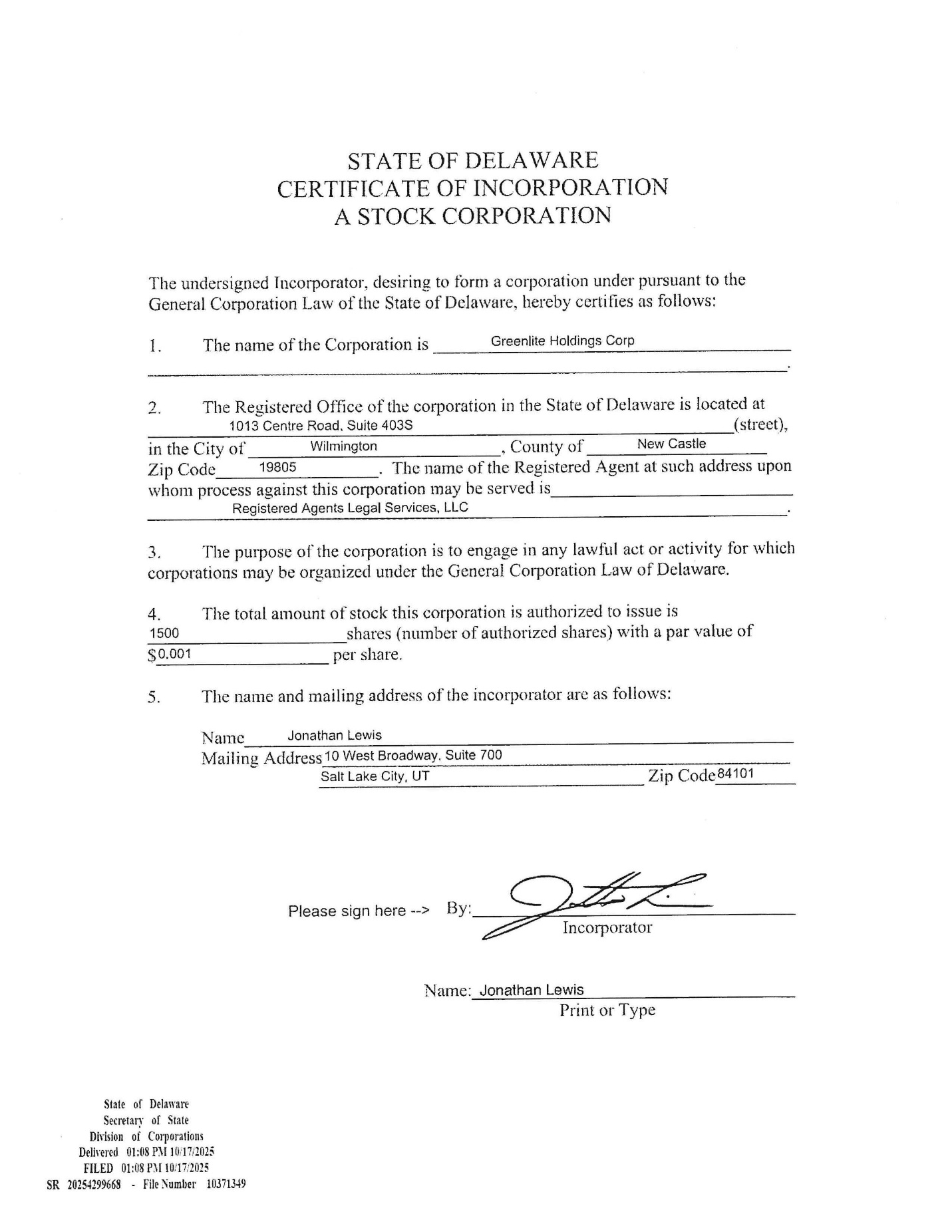
AMENDED AND RESTATED
CERTIFICATE OF INCORPORATION
OF
GREENLITE HOLDINGS CORP
(Pursuant to Sections 242 and 245 of the
General Corporation Law of the State of Delaware)
Greenlite Holdings Corp, a corporation organized and existing under and by virtue of the provisions of the General Corporation Law of the State of Delaware (the “General Corporation Law”),
1.That the name of this corporation is Greenlite Holdings Corp, and that this corporation was originally incorporated pursuant to the General Corporation Law on October 17, 2025.
2. The Amended and Restated Certificate of Incorporation of the corporation attached hereto as Exhibit A, which is incorporated herein by this reference, and which restates, integrates and further amends provisions of the Certificate of Incorporation of this corporation as heretofore amended and/or restated, has been duly adopted by the corporation’s Board of Directors and by the stockholders in accordance with Sections 242 and 245 of the General Corporation Law of the State of Delaware.
3.The Amended and Restated Certificate of Incorporation shall be effective on the date of filing with the Secretary of State of Delaware.
4.The text of the Amended and Restated Certificate of Incorporation is hereby amended and restated in its entirety to read as Exhibit A hereto.
IN WITNESS WHEREOF, this corporation has caused this Amended and Restated Certificate of Incorporation to be signed by its duly authorized officer and the foregoing facts stated herein are true and correct.
| |||
|
|
| GREENLITE HOLDINGS CORP |
|
|
|
|
Date: | March 6, 2026 | By: | /s/ Jonathan Lewis |
|
|
| Name: Jonathan Lewis |
|
|
| Title: Chief Executive Officer |
EXHIBIT A
GREENLITE HOLDINGS, INC.
AMENDED AND RESTATED CERTIFICATE OF INCORPORATION
First: The name of this corporation is Greenlite Holdings, Inc. (the “Corporation”).
Second: The address of the registered office of the Corporation in the State of Delaware is 1013 Centre Road, Suite 403S, in the City of Wilmington, County of New Castle Zip Code 19805. The name of its registered agent at such address is Registered Agents Legal Services, LLC.
Third: The nature of the business or purposes to be conducted or promoted is to engage in any lawful act or activity for which corporations may be organized under the General Corporation Law.
FOURTH: The total number of shares of all classes of stock which the Corporation shall have the authority to issue is 126,451,000. The Corporation has two classes of stock, referred to as Common Stock and Preferred Stock. There are 100,451,000 shares of authorized Common Stock, $0.0001 par value per share (“Common Stock”), and 26,000,000 shares of authorized Preferred Stock, $0.0001 par value per share (“Preferred Stock”), of which 26,000,000 shares of Preferred Stock are designated as “Series A-1 Preferred Stock” (the Series A-1 Preferred Stock shall as be referred to as “Series A Preferred Stock”). The class of Common Stock shall be subdivided into two series consisting of 82,950,500 shares designated as Class A Common Stock, (the “Class A Common Stock”), and 17,500,500 shares designated as Class B Common Stock (the “Class B Common Stock”). For the avoidance of doubt, the Class A Common Stock and the Class B Common Stock are separate series within the class of Common Stock, and not separate classes of stock. Immediately upon the effectiveness of the filing of this Amended and Restated Certificate of Incorporation (the “Effective Time”), without any further action by the Corporation or any holder of capital stock of the Corporation, each one (1) share of common stock, par value $0.001 per share, of the Corporation (the “Old Common Stock”) issued and outstanding immediately prior to the Effective Time shall automatically be reclassified as one thousand one hundred and sixty seven (1,167) shares of Class B Common Stock, par value $0.0001 per share (the “Stock Split”), which shares of Class B Common Stock shall be fully paid and nonassessable. No fractional shares of Class B Common Stock as a result of the Stock Split, and each holder who would otherwise have been entitled to a fraction of a share of Class B Common Stock as a result of the Stock Split shall, in lieu thereof, be entitled to receive a cash payment in an amount equal to the fair value of such fractional share otherwise issuable as determined by the Corporation’s Board of Directors. Any certificate representing shares of Old Common Stock, automatically and without the necessity of presenting the same for exchange, shall be deemed to represent the number of shares of Class B Common into which such shares of Old Common Stock shall have been reclassified in the Stock Split, until such certificate is presented to the Corporation for cancellation or exchange.
From and after the Effective Time, each certificate or certificates that represented shares of Old Common Stock that were issued and outstanding immediately prior to the Effective Time shall automatically and without the necessity of presenting the same for exchange, represent that number of whole shares of New Class B Common Stock, as applicable, after the Effective Time into which the shares formerly represented by such certificate have been combined pursuant to the Reverse Stock Split, provided that each holder of record of a certificate or certificates for one or more shares of Old Common Stock or Old Preferred Stock, as applicable, shall be entitled to receive, as soon as practicable following surrender to the Corporation of such certificate or certificates, a certificate representing the number of whole shares of New Common Stock or New Preferred Stock, as applicable, to which such holder shall be entitled pursuant to the Reverse Stock Split. The Reverse Stock Split shall occur whether or not the certificates representing such shares of Old Common Stock or Old Preferred Stock, as applicable, are surrendered to the Corporation. All references to numbers of shares and all per share amounts set forth in this Restated
1
Certificate of Incorporation are referenced and stated after giving effect to the Reverse Stock Split, and, accordingly, no further adjustment pursuant to this Article IV shall be made as a result of the Reverse Stock Split.
The following is a statement of the designations and the powers, preferences and special rights, and the qualifications, limitations or restrictions thereof in respect of each class of capital stock of the Corporation.
1.General. Except as otherwise provided in this Amended and Restated Certificate of Incorporation this “Certificate of Incorporation”) or required by applicable law, shares of Class A Common Stock and Class B Common Stock shall have the same rights and powers, rank equally (including as to dividends and distributions, and upon any liquidation, dissolution or winding up of the corporation), share ratably and be identical in all respects and as to all matters. The voting, dividend and liquidation rights of the holders of the Common Stock are subject to and qualified by the powers, preferences and special rights of the holders of the Preferred Stock set forth herein.
2.Voting Rights. Except as otherwise expressly provided by this Certificate of Incorporation or as provided by law, the holders of shares of Class A Common Stock and Class B Common Stock shall (a) at all times vote together as a single class on all matters (including the election of directors) submitted to a vote or for the consent (if action by written consent of the stockholders is permitted at such time under this Certificate of Incorporation) of the stockholders of the corporation, (b) be entitled to notice of any stockholders’ meeting in accordance with the Bylaws of the corporation and (c) be entitled to vote upon such matters and in such manner as may be provided by applicable law. Except as otherwise expressly provided herein or required by applicable law, each holder of Class A Common Stock shall have the right to one (1) vote per share of Class A Common Stock held of record by such holder and each holder of Class B Common Stock shall have the right to eight (8) votes per share of Class B Common Stock held of record by such holder. There shall be no cumulative voting. The number of authorized shares of Common Stock may be increased or decreased (but not below the number of shares thereof then outstanding) by (in addition to any vote of the holders of one or more series of Preferred Stock that may be required by the terms of this Certificate of Incorporation) the affirmative vote of the holders of shares of capital stock of the Corporation representing a majority of the votes represented by all outstanding shares of capital stock of the Corporation entitled to vote, irrespective of the provisions of Section 242(b)(2) of the General Corporation Law.
3.Dividend and Distribution Rights. Shares of Class A Common Stock and Class B Common Stock shall be treated equally, identically and ratably, on a per share basis, with respect to any dividends or distributions as may be declared and paid from time to time by the Board of Directors out of any assets of the corporation legally available therefor; provided, however, that in the event a dividend is paid in the form of shares of Class A Common Stock or Class B Common Stock (or rights to acquire such shares), then holders of Class A Common Stock shall receive shares of Class A Common Stock (or rights to acquire such shares, as the case may be) and holders of Class B Common Stock shall receive shares of Class B Common Stock (or rights to acquire such shares, as the case may be), with holders of shares of Class A Common Stock and Class B Common Stock receiving, on a per share basis, an identical number of shares of Class A Common Stock or Class B Common Stock, as applicable. Notwithstanding the foregoing, the Board of Directors may pay or make a disparate dividend or distribution per share of Class A Common Stock or Class B Common Stock (whether in the amount of such dividend or distribution payable per share, the form in which such dividend or distribution is payable, the timing of the payment, or otherwise) if such disparate dividend or distribution is approved in advance by the affirmative vote (or written consent if action by written consent of stockholders is permitted at such time under this Certificate
2
of Incorporation) of the holders of a majority of the outstanding shares of Class A Common Stock and Class B Common Stock, each voting separately as a class.
4.Subdivisions Combinations or Reclassifications. Shares of Class A Common Stock or Class B Common Stock may not be subdivided, combined or reclassified unless the shares of the other class are concurrently therewith proportionately subdivided, combined or reclassified in a manner that maintains the same proportionate equity ownership between the holders of the outstanding Class A Common Stock and Class B Common Stock on the record date for such subdivision, combination or reclassification; provided, however, that shares of one such class may be subdivided, combined or reclassified in a different or disproportionate manner if such subdivision, combination or reclassification is approved in advance by the affirmative vote (or written consent if action by written consent of stockholders is permitted at such time under this Certificate of Incorporation) of the holders of a majority of the outstanding shares of Class A Common Stock and Class B Common Stock, each voting separately as a class.
5. Liquidation, Dissolution or Winding Up. Subject to the preferential or other rights of any holders of Preferred Stock then outstanding, upon the dissolution, liquidation or winding up of the corporation, whether voluntary or involuntary, holders of Class A Common Stock and Class B Common Stock will be entitled to receive ratably all assets of the corporation available for distribution to its stockholders unless disparate or different treatment of the shares of each such class with respect to distributions upon any such liquidation, dissolution or winding up is approved in advance by the affirmative vote (or written consent if action by written consent of stockholders is permitted at such time under this Certificate of Incorporation) of the holders of a majority of the outstanding shares of Class A Common Stock and Class B Common Stock, each voting separately as a class.
6.Conversion of Class B Common Stock.
6.1Voluntary Conversion. Each share of Class B Common Stock shall be convertible into one (1) fully paid and nonassessable share of Class A Common Stock at the option of the holder thereof at any time upon written notice to the corporation. Before any holder of Class B Common Stock shall be entitled to voluntarily convert any shares of such Class B Common Stock, such holder shall surrender the certificate or certificates therefor (if any), duly endorsed, at the principal corporate office of the corporation or of any transfer agent for the Class B Common Stock, and shall give written notice to the corporation at its principal corporate office, of the election to convert the same and shall state therein the name or names (A) in which the certificate or certificates representing the shares of Class A Common Stock into which the shares of Class B Common Stock are so converted are to be issued if such shares are certificated or (B) in which such shares are to be registered in book entry if such shares are uncertificated. The corporation shall, as soon as practicable thereafter, issue and deliver at such office to such holder of Class B Common Stock, or to the nominee or nominees of such holder, a certificate or certificates representing the number of shares of Class A Common Stock to which such holder shall be entitled as aforesaid (if such shares are certificated) or, if such shares are uncertificated, register such shares in book-entry form. Such conversion shall be deemed to have been made immediately prior to the close of business on the date of such surrender of the shares of Class B Common Stock to be converted following or contemporaneously with the written notice of such holder’s election to convert required by this Section 6.1, and the person or persons entitled to receive the shares of Class A Common Stock issuable upon such conversion shall be treated for all purposes as the record holder or holders of such shares of Class A Common Stock as of such date. Each share of Class B Common Stock that is converted pursuant to this Section 6.1 shall be retired by the corporation and shall not be available for reissuance.
6.2Automatic Conversion. (A) Each share of Class B Common Stock shall be automatically, without further action by the holder thereof, converted into one (1) fully paid and
3
nonassessable share of Class A Common Stock, upon the occurrence of a Transfer (as defined in Section 8), other than a Permitted Transfer (as defined in Section 8), of such share of Class B Common Stock and (B) all shares of Class B Common Stock shall be automatically, without further action by any holder thereof, converted into an identical number of shares of Class A Common Stock at such date and time, or the occurrence of an event, specified by the affirmative vote (or written consent if action by written consent of stockholders is permitted at such time under this Certificate of Incorporation) of the holders of a majority of the then outstanding shares Class B Common Stock, voting as a separate class (the occurrence of an event described in clause (i) or (ii) of this Section 6.2, a “Conversion Event”). Each outstanding stock certificate that, immediately prior to a Conversion Event, represented one or more shares of Class B Common Stock subject to such Conversion Event shall, upon such Conversion Event, be deemed to represent an equal number of shares of Class A Common Stock, without the need for surrender or exchange thereof. The corporation shall, upon the request of any holder whose shares of Class B Common Stock have been converted into shares of Class A Common Stock as a result of a Conversion Event and upon surrender by such holder to the corporation of the outstanding certificate(s) formerly representing such holder’s shares of Class B Common Stock (if any), issue and deliver to such holder certificate(s) representing the shares of Class A Common Stock into which such holder’s shares of Class B Common Stock were converted as a result of such Conversion Event (if such shares are certificated) or, if such shares are uncertificated, register such shares in book-entry form. Each share of Class B Common Stock that is converted pursuant to this Section 6.2 shall thereupon be retired by the corporation and shall not be available for reissuance.
6.3 The corporation may, from time to time, establish such policies and procedures, not in violation of applicable law or the other provisions of this Certificate of Incorporation, relating to the conversion of the Class B Common Stock into Class A Common Stock, as it may deem necessary or advisable in connection therewith. If the corporation has reason to believe that a Transfer giving rise to a conversion of shares of Class B Common Stock into Class A Common Stock has occurred but has not theretofore been reflected on the books of the corporation, the corporation may request that the holder of such shares furnish affidavits or other evidence to the corporation as the corporation deems necessary to determine whether a conversion of shares of Class B Common Stock to Class A Common Stock has occurred, and if such holder does not within ten (10) days after the date of such request furnish sufficient evidence to the corporation (in the manner provided in the request) to enable the corporation to determine that no such conversion has occurred, any such shares of Class B Common Stock, to the extent not previously converted, shall be automatically converted into shares of Class A Common Stock and the same shall thereupon be registered on the books and records of the corporation. In connection with any action of stockholders taken at a meeting or by written consent (if action by written consent of stockholders is permitted at such time under this Certificate of Incorporation), the stock ledger of the corporation shall be presumptive evidence as to who are the stockholders entitled to vote in person or by proxy at any meeting of stockholders or in connection with any such written consent and the class or classes or series of shares held by each such stockholder and the number of shares of each class or classes or series held by such stockholder.
7.Reservation of Stock. The corporation shall at all times reserve and keep available out of its authorized but unissued shares of Class A Common Stock, solely for the purpose of effecting the conversion of the shares of Class B Common Stock, such number of shares of Class A Common Stock as shall from time to time be sufficient to effect the conversion of all outstanding shares of Class B Common Stock into shares of Class A Common Stock.
8.Definitions. For purposes of this Certificate of Incorporation:
8.1“Change in Control Transaction” means the occurrence of any of the following events:
4
8.1.1 the sale, lease, exchange, encumbrance or other disposition (other than licenses that do not constitute an effective disposition of all or substantially all of the assets of the corporation and its subsidiaries taken as a whole, and the grant of security interests in the ordinary course of business) by the corporation of all or substantially all of the corporation’s assets; or
8.1.2the merger or consolidation of the corporation with or into any other entity, other than a merger or consolidation that would result in the Class B Common Stock of the corporation outstanding immediately prior thereto continuing to represent (either by remaining outstanding or by being converted into voting securities of the surviving entity or its sole parent entity) more than fifty percent (50%) of the total voting power represented by the voting securities of the corporation or such surviving entity or its sole parent entity outstanding immediately after such merger or consolidation.
8.2 “Charitable Trust” means a trust that is exempt from taxation under Section 501(c)(3) of the United States Internal Revenue Code of 1986, as amended (or any successor provision thereto) (whether a determination letter with respect to such exemption is issued before, at or after the Covered Security Date), and further includes any successor entity that is exempt from taxation under Section 501(c)(3) (or any successor provision thereto) upon a conversion of, or transfer of all or substantially all of the assets of, a Charitable Trust to such successor entity (whether a determination letter with respect to such successor’s exemption is issued before, at or after the conversion date).
8.3“Family Member” shall mean with respect to any natural person who is a Qualified Stockholder, the spouse, parents, grandparents, lineal descendants, siblings and lineal descendants of siblings of such Qualified Stockholder. Lineal descendants shall include adopted persons, but only so long as they are adopted during minority.
8.4 “Qualified Stockholder” shall mean:
8.4.1the initial registered holder of any shares of Class B Common Stock.
8.4.2each natural person who Transferred shares of or equity awards for Class B Common Stock (including any option or warrant exercisable or convertible into or any RSU that can be settled in shares of Class B Common Stock) to a Permitted Entity that is or becomes a Qualified Stockholder pursuant to Section 8.4.1; and
8.4.3a Permitted Transferee.
8.5“Parent” of an entity shall mean any entity that directly or indirectly owns or controls a majority of the voting power of the voting securities of such entity.
8.6“Permitted Entity” shall mean with respect to a Qualified Stockholder (a) a Permitted Trust solely for the benefit of (i) such Qualified Stockholder, (ii) one or more Family Members of such Qualified Stockholder, (iii) any other Permitted Entity of such Qualified Stockholder and/or (iv) any entity that is described in Sections 501(c)(3), 170(b)(1)(A), 170(c), 2055(a) or 2522(a) of the United States Internal Revenue Code of 1986, as amended (or any successor provision thereto), (b) any general partnership, limited partnership, limited liability company, corporation or other entity exclusively owned by (i) such Qualified Stockholder, (ii) one or more Family Members of such Qualified Stockholder and/or (iii) any other Permitted Entity of such Qualified Stockholder, (c) any Charitable Trust created by a Qualified Stockholder, which Charitable Trust was (x) validly created and (y) a registered holder of shares of capital stock of the corporation, in each case prior to the Covered Security Date (whether or not it continuously holds such shares of capital stock or any other shares of capital stock of the corporation at all
5
times before or after the Covered Security Date), (d) the personal representative of the estate of a Qualified Stockholder upon the death of such Qualified Stockholder solely to the extent the executor is acting in the capacity as personal representative of such estate, (e) a revocable living trust, which revocable living trust is itself both a Permitted Trust and a Qualified Stockholder, during the lifetime of the natural person grantor of such trust, or (f) a revocable living trust, which revocable living trust is itself both a Permitted Trust and a Qualified Stockholder, following the death of the natural person grantor of such trust, solely to the extent that such shares are held in such trust pending distribution to the beneficiaries designated in such trust. Except as explicitly provided for herein, a Permitted Entity of a Qualified Stockholder shall not cease to be a Permitted Entity of that Qualified Stockholder solely by reason of the death of that Qualified Stockholder.
8.7“Permitted Transfer” shall mean, and be restricted to, any Transfer of a share of Class B Common Stock:
8.7.1by a Qualified Stockholder (or the estate of a deceased Qualified Stockholder) to (i) one or more Family Members of such Qualified Stockholder, or (ii) any Permitted Entity of such Qualified Stockholder; or (iii) to such Qualified Stockholder’s revocable living trust, which revocable living trust is itself both a Permitted Trust and a Qualified Stockholder;
8.7.2by a Permitted Entity of a Qualified Stockholder to (i) such Qualified Stockholder or one or more Family Members of such Qualified Stockholder, or (ii) any other Permitted Entity of such Qualified Stockholder;
8.7.3by a Qualified Stockholder that is a natural person or revocable living trust to an entity that is exempt from taxation under Section 501(c)(3) of the United States Internal Revenue Code of 1986, as amended (or any successor provision thereto) (a “501(c)(3) Organization”) or an entity that is exempt from taxation under Section 501(c)(3) and described in Section 509(a)(3) of United States Internal Revenue Code of 1986, as amended (or any successor provision thereto) (a “Supporting Organization”), as well as any Transfer by a 501(c)(3) Organization to a Supporting Organization of which such 501(c)(3) Organization (x) is a supported organization (within the meaning of Section 509(f)(3) of the United States Internal Revenue Code of 1986, as amended (or any successor provision thereto)), and (y) has the power to appoint a majority of the board of directors, provided that such 501(c)(3) Organization or such Supporting Organization irrevocably elects, no later than the time such share of Class B Common Stock is Transferred to it, that such share of Class B Common Stock shall automatically be converted into Class A Common Stock upon the death of such Qualified Stockholder or the natural person grantor of such Qualified Stockholder; or
8.7.4approved by the Board of Directors.
8.8“Permitted Transferee” shall mean a transferee of shares of Class B Common Stock received in a Transfer that constitutes a Permitted Transfer.
8.9“Permitted Trust” shall mean a bona fide trust where each trustee is (a) a Qualified Stockholder, (b) a Family Member of a Qualified Stockholder, (c) a professional in the business of providing trustee services, including private professional fiduciaries, trust companies and bank trust departments, or (d) solely in the case of any such trust established by a natural person grantor prior to the Covered Security Date, any other bona fide trustee.
8.10 “Transfer” of a share of Class B Common Stock shall mean, directly or indirectly, any sale, assignment, transfer, conveyance, hypothecation or other transfer or disposition of such share or any legal or beneficial interest in such share, whether or not for value and whether voluntary or involuntary or by operation of law (including by merger, consolidation or otherwise), including, without
6
limitation, a transfer of a share of Class B Common Stock to a broker or other nominee (regardless of whether there is a corresponding change in beneficial ownership), or the transfer of, or entering into a binding agreement with respect to, Voting Control (as defined below) over such share by proxy or otherwise. A “Transfer” shall also be deemed to have occurred with respect to a share of Class B Common Stock beneficially held by (i) an entity that is a Permitted Entity, if there occurs any act or circumstance that causes such entity to no longer be a Permitted Entity or (ii) an entity that is a Qualified Stockholder, if there occurs a Transfer on a cumulative basis, from and after the Covered Security Date, of a majority of the voting power of the voting securities of such entity or any direct or indirect Parent of such entity, other than a Transfer to parties that are, as of the Covered Security Date, holders of voting securities of any such entity or Parent of such entity. Notwithstanding the foregoing, the following shall not be considered a “Transfer” within the meaning of this Article Fourth:
8.10.1 the granting of a revocable proxy to officers or directors of the corporation at the request of the Board of Directors in connection with actions to be taken at an annual or special meeting of stockholders or in connection with any action by written consent of the stockholders solicited by the Board of Directors (if action by written consent of stockholders is permitted at such time under this Certificate of Incorporation);
8.10.2entering into a voting trust, agreement or arrangement (with or without granting a proxy) solely with stockholders who are holders of Class B Common Stock, which voting trust, agreement or arrangement (i) is disclosed either in a Schedule 13D filed with the Securities and Exchange Commission or in writing to the Secretary of the corporation, (ii) either has a term not exceeding one (1) year or is terminable by the holder of the shares subject thereto at any time and (iii) does not involve any payment of cash, securities, property or other consideration to the holder of the shares subject thereto other than the mutual promise to vote shares in a designated manner;
8.10.3the pledge of shares of Class B Common Stock by a stockholder that creates a mere security interest in such shares pursuant to a bona fide loan or indebtedness transaction for so long as such stockholder continues to exercise Voting Control over such pledged shares; provided, however, that a foreclosure on such shares or other similar action by the pledgee shall constitute a “Transfer” unless such foreclosure or similar action qualifies as a “Permitted Transfer” at such time; or
8.10.4any change in the trustees or the person(s) and/or entity(ies) having or exercising Voting Control over shares of Class B Common Stock (i) of a Charitable Trust that qualifies as a Permitted Entity pursuant to Section 8.6 above, or (ii) of a Permitted Entity provided that following such change such Permitted Entity continues to be a Permitted Entity pursuant to Section 8.6 above.
8.11“Voting Control” shall mean, with respect to a share of Class B Common Stock, the power (whether exclusive or shared) to vote or direct the voting of such share by proxy, voting agreement or otherwise.
The shares of the Preferred Stock shall have the powers, preferences and special rights set forth in this Part B of this Article Fourth. Unless otherwise indicated, references to “sections” or “Sections” in this Part B of this Article Fourth refer to sections of Part B of this Article Fourth. References to “Preferred Stock” mean the Series A Preferred Stock.
7
2.The Corporation shall not declare, pay or set aside any dividends on shares of any other class or series of capital stock of the Corporation (other than dividends on shares of Common Stock payable in shares of Common Stock) unless (in addition to the obtaining of any consents required elsewhere in this Certificate of Incorporation) the holders of the Preferred Stock then outstanding shall first receive, or simultaneously receive, a dividend on each outstanding share of Preferred Stock in an amount at least equal to (i) in the case of a dividend on Common Stock, the product of (A) the dividend declared, paid or set aside on such Common Stock and (B) the number of shares of Common Stock issuable upon conversion of a share of such Preferred Stock; (ii) in the case of a dividend on a class or series of capital stock that is convertible into Common Stock, the product of (A) the dividend declared, paid or set aside per share of such class or series of capital stock and (B) the number of shares of Common Stock issuable upon conversion of a share of such Preferred Stock, divided by the number of shares of Common Stock issuable upon conversion of a share of such class or series of capital stock; or (iii) in the case of a dividend on any class or series that is not convertible into Common Stock, the product of (A) the amount of the dividend payable on each share of such class or series of capital stock divided by the original issuance price of such class or series of capital stock (subject to appropriate adjustment in the event of any stock dividend, stock split, combination or other similar recapitalization with respect to such class or series) and (B) the applicable Original Issue Price (as defined below); provided that, if the Corporation declares, pays or sets aside, on the same date, a dividend on shares of more than one class or series of capital stock of the Corporation, the dividend payable to the holders of Preferred Stock pursuant to this Section Error! Reference source not found. shall be calculated based upon the dividend on the class or series of capital stock that would result in the highest Preferred Stock dividend for the applicable series of Preferred Stock. The “Original Issue Price” shall mean, with respect to the Series A-1 Preferred Stock, $1.00 per share, subject to appropriate adjustment in the event of any stock dividend, stock split, combination or other similar recapitalization with respect to the applicable Preferred Stock, Liquidation, Dissolution or Winding Up; Certain Mergers, Consolidations and Asset Sales.
2.1Preferential Payments to Holders of Preferred Stock. In the event of (a) any voluntary or involuntary liquidation, dissolution or winding up of the Corporation, the holders of shares of each series of Preferred Stock then outstanding shall be entitled to be paid out of the assets of the Corporation available for distribution to its stockholders, and (b) a Deemed Liquidation Event (as defined below), the holders of shares of each series of Preferred Stock then outstanding shall be entitled to be paid out of the consideration payable to stockholders in such Deemed Liquidation Event or out of the Available Proceeds (as defined below), as applicable, on a pari passu basis based on their respective Liquidation Amounts (as defined below) and before any payment shall be made to the holders of Common Stock by reason of their ownership thereof, an amount per share of each such series of Preferred Stock equal to the greater of (i) one (1) times the applicable Original Issue Price, plus any dividends declared but unpaid thereon, or (ii) such amount per share as would have been payable had all shares of such series of Preferred Stock (and all shares of all other series of Preferred Stock that would receive a larger distribution per share if such series of Preferred Stock were converted into Common Stock) been converted into Common Stock pursuant to Section 4 immediately prior to such liquidation, dissolution, winding up or Deemed Liquidation Event (the amount payable pursuant to this sentence is hereinafter referred to, for each series of Preferred Stock, as applicable, as the “Liquidation Amount”). If upon any such liquidation, dissolution or winding up of the Corporation or Deemed Liquidation Event, the assets of the Corporation available for distribution to its stockholders shall be insufficient to pay the holders of shares of Preferred Stock the full amount to which they shall be entitled under this Section 2.1, the holders of shares of Preferred Stock shall share ratably in any distribution of the assets available for distribution in proportion to the respective amounts which would otherwise be payable in respect of the shares held by them upon such distribution if all amounts payable on or with respect to such shares were paid in full.
8
2.2Payments to Holders of Common Stock. In the event of any voluntary or involuntary liquidation, dissolution or winding up of the Corporation, after the payment in full of all Liquidation Amounts required to be paid to the holders of shares of Preferred Stock, the remaining assets of the Corporation available for distribution to its stockholders or, in the case of a Deemed Liquidation Event, the consideration not payable to the holders of shares of Preferred Stock pursuant to Section 2.1 or the remaining Available Proceeds, as the case may be, shall be distributed among the holders of shares of Common Stock, pro rata based on the number of shares of Common Stock held by each such holder.
2.3.1Definition. Each of the following events shall be considered a “Deemed Liquidation Event” unless the holders of at least fifty percent (50%) of the outstanding shares of Preferred Stock, voting together as a single class on an as-converted to Common Stock basis (the “Requisite Holders”), elect otherwise by written notice sent to the Corporation at least 10 days prior to the effective date of any such event:
(a)a merger, consolidation, statutory conversion, transfer of the Corporation, domestication, or continuance in which
(i)the Corporation is a constituent party or
(ii)a subsidiary of the Corporation is a constituent party and the Corporation issues shares of its capital stock pursuant to such merger, consolidation, statutory conversion, transfer of the Corporation, domestication, or continuance,
except any such merger, consolidation, statutory conversion, transfer of the Corporation, domestication, or continuance involving the Corporation or a subsidiary in which the shares of capital stock of the Corporation outstanding immediately prior to such merger, consolidation, statutory conversion, transfer of the Corporation, domestication, or continuance continue to represent, or are converted into or exchanged for shares of capital stock or other equity interests that represent, immediately following such merger, consolidation, statutory conversion, transfer of the Corporation, domestication, or continuance, a majority, by voting power of the capital stock or other equity interests of (1) the surviving or resulting corporation or entity; or (2) if the surviving or resulting corporation or entity is a wholly owned subsidiary of another corporation or entity immediately following such merger, consolidation, statutory conversion, transfer of the Corporation, domestication, or continuance, the parent corporation or entity of such surviving or resulting corporation or entity; or
(b)(i) the sale, lease, transfer, exclusive license or other disposition, in a single transaction or series of related transactions, by the Corporation or any subsidiary of the Corporation of all or substantially all the assets of the Corporation and its subsidiaries taken as a whole, or (ii) the sale, lease, transfer, exclusive license or other disposition (whether by merger, consolidation, statutory conversion, transfer of the Corporation, domestication, continuance or otherwise, and whether in a single transaction or a series of related transactions) of one or more subsidiaries of the Corporation if substantially all of the assets of the Corporation and its subsidiaries taken as a whole are held by such subsidiary or subsidiaries, except where such sale, lease, transfer, exclusive license or other disposition is to a wholly owned subsidiary of the Corporation.
9
Notwithstanding anything in Section 2.3.1 to the contrary, in no event shall the sale and issuance by the Corporation of Preferred Stock in a bona fide equity financing of the Corporation, in and of itself, be a Deemed Liquidation Event.
2.3.2Effecting a Deemed Liquidation Event.
(a)The Corporation shall not have the power to effect a Deemed Liquidation Event referred to in Section 2.3.1(a)(i) unless the agreement or plan with respect to such transaction, or terms of such transaction (any such agreement, plan or terms, the “Transaction Document”), provide that the consideration payable to the stockholders of the Corporation in such Deemed Liquidation Event shall be allocated to the holders of capital stock of the Corporation in accordance with Sections 2.1 and 2.2.
(b)In the event of a Deemed Liquidation Event referred to in Section 2.3.1(a)(ii) or 2.3.1(b), if the Corporation does not effect a dissolution of the Corporation under the General Corporation Law within 90 days after such Deemed Liquidation Event, then (i) the Corporation shall send a written notice to each holder of Preferred Stock no later than the 90th day after the Deemed Liquidation Event advising such holders of their right (and the requirements to be met to secure such right) pursuant to the terms of the following clause (ii) to require the redemption of such shares of Preferred Stock, and (ii) if the Requisite Holders so request in a written instrument delivered to the Corporation not later than 120 days after such Deemed Liquidation Event, the Corporation shall use the consideration received by the Corporation for such Deemed Liquidation Event (net of any retained liabilities associated with the assets sold or technology licensed, any other expenses reasonably related to such Deemed Liquidation Event or any other expenses incident to the dissolution of the Corporation as provided herein, in each case as determined in good faith by the Board of Directors), together with any other assets of the Corporation available for distribution to its stockholders, all to the extent permitted by Delaware law governing distributions to stockholders (the “Available Proceeds”) on the 150th day after such Deemed Liquidation Event (the “DLE Redemption Date”), to redeem all outstanding shares of Preferred Stock at a price per share equal to the applicable Liquidation Amount; provided, that if the definitive agreements governing such Deemed Liquidation Event contain contingent indemnification obligations on the part of the Corporation and prohibit the Corporation from distributing all or a portion of the Available Proceeds while such indemnification obligations remain outstanding, then the DLE Redemption Date shall automatically be extended to the date that is ten business days following the date on which such prohibition expires. Notwithstanding the foregoing, in the event of a redemption pursuant to the preceding sentence, if the Available Proceeds are not sufficient to redeem all outstanding shares of Preferred Stock, the Corporation shall redeem a pro rata portion of each holder’s shares of Preferred Stock to the fullest extent of such Available Proceeds, based on the respective amounts which would otherwise be payable in respect of the shares to be redeemed if the Available Proceeds were sufficient to redeem all such shares, and shall redeem the remaining shares as soon as it may lawfully do so under Delaware law governing distributions to stockholders. Prior to the distribution or redemption provided for in this Section 2.3.2(b), the Corporation shall not expend or dissipate the Available Proceeds for any purpose, except to discharge expenses incurred in connection with such Deemed Liquidation Event. In connection with a distribution or redemption provided for in Section 2.3.2, the Corporation shall send written notice of the redemption (the “Redemption Notice”) to each holder of record of Preferred Stock. Each Redemption Notice shall state:
(i)the number of shares of Preferred Stock held by the holder that the Corporation shall redeem on the date specified in the Redemption Notice;
(ii)the redemption date and the price per share at which the shares of Preferred Stock are being
10
redeemed;
(iii)for holders of shares in certificated form, that the holder is to surrender to the Corporation, in the manner and at the place designated, his, her or its certificate or certificates representing the shares of Preferred Stock to be redeemed.
If the Redemption Notice shall have been duly given, and if payment is tendered or deposited with an independent payment agent so as to be available therefor in a timely manner, then notwithstanding that any certificates evidencing any of the shares of Preferred Stock so called for redemption shall not have been surrendered, all rights with respect to such shares shall forthwith after the date terminate, except only the right of the holders to receive the payment without interest upon surrender of any such certificate or certificates therefor.
2.3.3Amount Deemed Paid or Distributed. The amount deemed paid or distributed to the holders of capital stock of the Corporation upon any such merger, consolidation, sale, transfer, exclusive license, other disposition or redemption shall be the cash or the value of the property, rights or securities to be paid or distributed to such holders pursuant to such Deemed Liquidation Event. The value of such property, rights or securities shall be determined in good faith by the Board of Directors.
2.3.4Allocation of Escrow and Contingent Consideration. In the event of a Deemed Liquidation Event pursuant to Section 2.3.1(a)(i), if any portion of the consideration payable to the stockholders of the Corporation is payable only upon satisfaction of contingencies (the “Additional Consideration”), the Transaction Document shall provide that (a) the portion of such consideration that is not Additional Consideration (such portion, the “Initial Consideration”) shall be allocated among the holders of capital stock of the Corporation in accordance with Sections 2.1 and 2.2 as if the Initial Consideration were the only consideration payable in connection with such Deemed Liquidation Event; and (b) any Additional Consideration which becomes payable to the stockholders of the Corporation upon satisfaction of such contingencies shall be allocated among the holders of capital stock of the Corporation in accordance with Sections 2.1 and 2.2 after taking into account the previous payment of the Initial Consideration as part of the same transaction. For the purposes of this Section 2.3.4, consideration placed into escrow or retained as a holdback to be available for satisfaction of indemnification or similar obligations in connection with such Deemed Liquidation Event shall be deemed to be Initial Consideration.
3.1General. On any matter presented to the stockholders of the Corporation for their action or consideration at any meeting of stockholders of the Corporation (or by written consent of stockholders in lieu of a meeting), each holder of outstanding shares of Preferred Stock shall be entitled to cast the number of votes equal to the number of whole shares of Class A Common Stock into which the shares of Preferred Stock held by such holder are convertible (as provided in Section 4 below) as of the record date for determining stockholders entitled to vote on such matter. Except as provided by law or by the other provisions of this Certificate of Incorporation, holders of Preferred Stock shall vote together with the holders of Class A Common Stock as a single class and on an as-converted to Class A Common Stock basis.
3.2Preferred Stock Protective Provisions. The Corporation shall not, either directly or indirectly by amendment, merger, consolidation, domestication, transfer of the Corporation, continuance, reorganization, recapitalization, reclassification, waiver, statutory conversion, or otherwise, amend, alter or repeal any provision of this Certificate of Incorporation or Bylaws of the Corporation in a
11
manner that adversely affects the special rights, powers and preferences of the Preferred Stock (or any series thereof) without (in addition to any other vote required by law or this Certificate of Incorporation) the written consent or affirmative vote of the Requisite Holders, and any such act or transaction that has not been approved by such consent or vote prior to such act or transaction being effected shall be null and void ab initio, and of no force or effect.
4.Optional Conversion. The holders of the Preferred Stock shall have conversion rights as follows (the “Conversion Rights”):
4.1.1Conversion Ratio. Each share of Preferred Stock shall be convertible, at the option of the holder thereof, at any time, and without the payment of additional consideration by the holder thereof, into such whole number of fully paid and non-assessable shares of Class A Common Stock (calculated as provided in Section 4.2 below), as is determined by dividing the applicable Original Issue Price by the applicable Conversion Price (as defined below) in effect at the time of conversion. The initial “Conversion Price” per share for each series of Series A Preferred Stock shall be the Original Issue Price applicable to such series. Such initial Conversion Price for a series of Preferred Stock, and the rate at which shares of Preferred Stock may be converted into shares of Class A Common Stock, shall be subject to adjustment as provided in this Section 4.
4.1.2Termination of Conversion Rights. In the event of a notice of redemption of any shares of Preferred Stock pursuant to Section 2.3.2(b), the Conversion Rights of the shares designated for redemption shall terminate at 5:00 p.m. Eastern time (the “close of business” for purposes hereof) on the last full day preceding the date fixed for redemption, unless the redemption price is not fully paid on such redemption date, in which case the Conversion Rights for such shares shall continue until such price is paid in full. In the event of a liquidation, dissolution or winding up of the Corporation or a Deemed Liquidation Event, the Conversion Rights shall terminate at the close of business on the last full day preceding the date fixed for the payment of any such amounts distributable on such event to the holders of Preferred Stock; provided that the foregoing termination of Conversion Rights shall not affect the amount(s) otherwise paid or payable in accordance with Section 2.1 to the holders of Preferred Stock pursuant to such liquidation, dissolution or winding up of the Corporation or a Deemed Liquidation Event.
4.2Number of Shares Issuable Upon Conversion. The number of shares of Class A Common Stock issuable to a holder of Preferred Stock upon conversion of such Preferred Stock shall be the nearest whole share, after aggregating all fractional interests in shares of Class A Common Stock that would otherwise be issuable upon conversion of all shares of that same series of Preferred Stock being converted by such holder (with any fractional interests after such aggregation representing 0.5 or greater of a whole share being entitled to a whole share). For the avoidance of doubt, no fractional interests in shares of Class A Common Stock shall be created or issuable as a result of the conversion of the Preferred Stock pursuant to Section 4.1.1.
4.3.1Notice of Conversion. In order for a holder of Preferred Stock to voluntarily convert shares of Preferred Stock into shares of Class A Common Stock, such holder shall (a) provide written notice to the Corporation at the principal office of the Corporation that such holder elects to convert all or any number of such holder’s shares of Preferred Stock and, if applicable, any event on which such conversion is contingent and (b) if such holder’s shares are certificated, tender to the Corporation at its principal office (1) the certificate or certificates for such shares of Preferred Stock or (2) a stock assignment separate from certificate if such certificate or certificates are electronic (or, if such registered holder alleges
12
that such certificate has been lost, stolen or destroyed, a lost certificate affidavit and agreement reasonably acceptable to the Corporation to indemnify the Corporation against any claim that may be made against the Corporation on account of the alleged loss, theft or destruction of such certificate). If required by the Corporation, any certificates surrendered for conversion shall be endorsed or accompanied by a written instrument or instruments of transfer, in form satisfactory to the Corporation, duly executed by the registered holder or his, her or its attorney duly authorized in writing. Unless a later time and date is otherwise specified by the holder, the close of business on the date of receipt by the transfer agent (or by the Corporation if the Corporation serves as its own transfer agent) of such notice and, if applicable, certificates (or lost certificate affidavit and agreement) shall be the time of conversion (the “Conversion Time”), and the shares of Class A Common Stock issuable upon conversion of the specified shares shall be deemed to be outstanding of record as of such date. The Corporation shall, as soon as practicable after the Conversion Time (i) issue and deliver to such holder of Preferred Stock, or to his, her or its nominees, a notice of issuance of uncertificated shares and may, upon written request, issue and deliver a certificate for the number of full shares of Class A Common Stock issuable upon such conversion in accordance with the provisions hereof and, may, if applicable and upon written request, issue and deliver a certificate for the number (if any) of the shares of Preferred Stock represented by any surrendered certificate that were not converted into Class A Common Stock, and (ii) pay all declared but unpaid dividends on the shares of Preferred Stock converted.
4.3.2Reservation of Shares. The Corporation shall at all times when the Preferred Stock shall be outstanding, reserve and keep available out of its authorized but unissued capital stock, for the purpose of effecting the conversion of the Preferred Stock, such number of its duly authorized shares of Class A Common Stock as shall from time to time be sufficient to effect the conversion of all outstanding Preferred Stock; and if at any time the number of authorized but unissued shares of Class A Common Stock shall not be sufficient to effect the conversion of all then outstanding shares of the Preferred Stock, the Corporation shall take such corporate action as may be necessary to increase its authorized but unissued shares of Class A Common Stock to such number of shares as shall be sufficient for such purposes, including, without limitation, engaging in best efforts to obtain the requisite stockholder approval of any necessary amendment to this Certificate of Incorporation. Before taking any action that would cause an adjustment reducing the Conversion Price for any series of Preferred Stock below the then par value of the shares of Class A Common Stock issuable upon conversion of such series of Preferred Stock, the Corporation will take any corporate action which may, in the opinion of its counsel, be necessary in order that the Corporation may validly and legally issue fully paid and non-assessable shares of Class A Common Stock at such adjusted Conversion Price.
4.3.3Effect of Conversion. All shares of Preferred Stock which shall have been surrendered for conversion as herein provided shall no longer be deemed to be outstanding and all rights with respect to such shares shall immediately cease and terminate at the Conversion Time, except only the right of the holders thereof to receive shares of Class A Common Stock in exchange therefor and to receive payment of any dividends declared but unpaid thereon.
4.3.4No Further Adjustment. Upon any such conversion, no adjustment to the Conversion Price shall be made for any declared but unpaid dividends on the Preferred Stock surrendered for conversion or on the Class A Common Stock delivered upon conversion.
4.3.5Taxes. The Corporation shall pay any and all issue and other similar taxes that may be payable in respect of any issuance or delivery of shares of Class A Common Stock upon conversion of shares of Preferred Stock pursuant to this Section 4. The Corporation shall not, however, be required to pay any tax which may be payable in respect of any transfer involved in the issuance and delivery of shares of Class A Common Stock in a name other than that in which the shares of Preferred Stock so converted were registered, and no such issuance or delivery shall be made unless and until the person or
13
entity requesting such issuance has paid to the Corporation the amount of any such tax or has established, to the satisfaction of the Corporation, that such tax has been paid.
4.4Adjustments to Preferred Stock Conversion Price for Diluting Issues.
4.4.1Special Definitions. For purposes of this Article Fourth, the following definitions shall apply:
(a)“Additional Shares of Common Stock” means all shares of Common Stock issued (or, pursuant to Section 4.4.3 below, deemed to be issued) by the Corporation after the Original Issue Date (as defined below), other than (1) the following shares of Common Stock and (2) shares of Common Stock deemed issued pursuant to the following Options and Convertible Securities (clauses (1) and (2), collectively, “Exempted Securities”):
(i)as to any series of Preferred Stock, shares of Common Stock, Options or Convertible Securities issued as a dividend or distribution on such series of Preferred Stock (including dividends payable in connection with dividends on other classes or series of stock);
(ii)shares of Common Stock, Options or Convertible Securities issued by reason of a dividend, stock split, split-up or other distribution on shares of Common Stock that is covered by Section 4.5, 4.6, 4.7 or 4.8;
(iii)shares of Common Stock, Options or Convertible Securities issued to banks, equipment lessors or other financial institutions, or to real property lessors, pursuant to a debt financing, equipment leasing or real property leasing transaction;
(iv)shares of Common Stock or Options issued to employees or directors of, or consultants or advisors to, the Corporation or any of its subsidiaries pursuant to a plan, agreement or arrangement;
(v)shares of Common Stock or Convertible Securities actually issued upon the exercise of Options or shares of Common Stock actually issued upon the conversion or exchange of Convertible Securities, in each case provided such issuance is pursuant to the terms of such Option or Convertible Security;
(vi)shares of Common Stock, Options or Convertible Securities issued to suppliers or third party service providers in connection with the provision of goods or services;
14
(vii)shares of Common Stock, Options or Convertible Securities issued as acquisition consideration pursuant to the acquisition of another corporation by the Corporation by merger, purchase of substantially all of the assets or other reorganization or to a joint venture agreement;
(viii)shares of Common Stock issued in connection with a firm underwritten public offering of the Corporation’s Common Stock pursuant to an effective registration statement;
(ix)shares of Series A Preferred Stock; or
(x)shares of Common Stock sold pursuant to an Offering Statement qualified pursuant to Regulation A of the Securities Act prior to February 28, 2028.
(b)“Convertible Securities” means any evidences of indebtedness, shares or other securities directly or indirectly convertible into or exchangeable for Common Stock, but excluding Options.
(c)“Option” means any rights, options or warrants to subscribe for, purchase or otherwise acquire Common Stock or Convertible Securities.
(d)“Original Issue Date” means the date on which the first share of Series A Preferred Stock is issued.
4.4.2No Adjustment of Preferred Stock Conversion Price. No adjustment in the Conversion Price of any series of Preferred Stock shall be made as the result of the issuance or deemed issuance of Additional Shares of Common Stock if the Corporation receives written notice from the holders of a majority of the then outstanding shares of such series of Preferred Stock, agreeing that no such adjustment shall be made as the result of the issuance or deemed issuance of such Additional Shares of Common Stock.
4.4.3Deemed Issue of Additional Shares of Common Stock.
(a)If the Corporation at any time or from time to time after the Original Issue Date shall issue any Options or Convertible Securities (excluding Options or Convertible Securities which are themselves Exempted Securities) or shall fix a record date for the determination of holders of any class of securities entitled to receive any such Options or Convertible Securities, then the maximum number of shares of Common Stock (as set forth in the instrument relating thereto, assuming the satisfaction of any conditions to exercisability, convertibility or exchangeability but without regard to any provision contained therein for a subsequent adjustment of such number) issuable upon the exercise of such Options or, in the case of Convertible Securities and Options therefor, the conversion or exchange of such Convertible Securities, shall be deemed to be Additional Shares of Common Stock issued as of the time of such issue or, in case such a record date shall have been fixed, as of the close of business on such record date.
15
(b)If the terms of any Option or Convertible Security, the issuance of which resulted in an adjustment to the Conversion Price of any series of Preferred Stock pursuant to the terms of Section 4.4.4, are revised as a result of an amendment to such terms or any other adjustment pursuant to the provisions of such Option or Convertible Security (but excluding automatic adjustments to such terms pursuant to anti-dilution or similar provisions of such Option or Convertible Security) to provide for either (1) any increase or decrease in the number of shares of Common Stock issuable upon the exercise, conversion and/or exchange of any such Option or Convertible Security or (2) any increase or decrease in the consideration payable to the Corporation upon such exercise, conversion and/or exchange, then, effective upon such increase or decrease becoming effective, the Conversion Price of such series of Preferred Stock computed upon the original issue of such Option or Convertible Security (or upon the occurrence of a record date with respect thereto) shall be readjusted to such Conversion Price for such series of Preferred Stock as would have obtained had such revised terms been in effect upon the original date of issuance of such Option or Convertible Security. Notwithstanding the foregoing, no readjustment pursuant to this Section 4.4.3(b) shall have the effect of increasing the Conversion Price applicable to a series of Preferred Stock to an amount which exceeds the lower of (i) the Conversion Price for such series of Preferred Stock in effect immediately prior to the original adjustment made as a result of the issuance of such Option or Convertible Security, or (ii) the Conversion Price for such series of Preferred Stock that would have resulted from any issuances of Additional Shares of Common Stock (other than deemed issuances of Additional Shares of Common Stock as a result of the issuance of such Option or Convertible Security) between the original adjustment date and such readjustment date.
(c)If the terms of any Option or Convertible Security (excluding Options or Convertible Securities which are themselves Exempted Securities), the issuance of which did not result in an adjustment to the Conversion Price of a series of Preferred Stock pursuant to the terms of Section 4.4.4 (either because the consideration per share (determined pursuant to Section 4.4.5) of the Additional Shares of Common Stock subject thereto was equal to or greater than the applicable Conversion Price then in effect, or because such Option or Convertible Security was issued before the Original Issue Date), are revised after the Original Issue Date as a result of an amendment to such terms or any other adjustment pursuant to the provisions of such Option or Convertible Security (but excluding automatic adjustments to such terms pursuant to anti-dilution or similar provisions of such Option or Convertible Security) to provide for either (1) any increase in the number of shares of Common Stock issuable upon the exercise, conversion or exchange of any such Option or Convertible Security or (2) any decrease in the consideration payable to the Corporation upon such exercise, conversion or exchange, then such Option or Convertible Security, as so amended or adjusted, and the Additional Shares of Common Stock subject thereto determined in the manner provided in Section 4.4.3(a) shall be deemed to have been issued effective upon such increase or decrease becoming effective.
(d)Upon the expiration or termination of any unexercised Option or unconverted or unexchanged Convertible Security (or portion thereof) which resulted (either upon its original issuance or upon a revision of its terms) in an adjustment to the Conversion Price of any series of Preferred Stock pursuant to the terms of Section 4.4.4, the Conversion Price of such series of Preferred Stock shall be readjusted to such Conversion Price for such series of Preferred Stock as would have obtained had such Option or Convertible Security (or portion thereof) never been issued.
(e)If the number of shares of Common Stock issuable upon the exercise, conversion and/or exchange of any Option or Convertible Security, or the consideration payable to the Corporation upon such exercise, conversion and/or exchange, is calculable at the time such Option or Convertible Security is issued or amended but is potentially subject to adjustment based upon subsequent events, any adjustment to the Conversion Price of a series of Preferred Stock provided for in this Section 4.4.3 shall be effected at the time of such issuance or amendment based on such number of shares or amount of consideration without regard to any provisions for subsequent adjustments (and any
16
subsequent adjustments shall be treated as provided in clauses (b) and (c) of this Section 4.4.3). If the number of shares of Common Stock issuable upon the exercise, conversion and/or exchange of any Option or Convertible Security, or the consideration payable to the Corporation upon such exercise, conversion and/or exchange, cannot be calculated at all at the time such Option or Convertible Security is issued or amended, any adjustment to the Conversion Price of a series of Preferred Stock that would result under the terms of this Section 4.4.3 at the time of such issuance or amendment shall instead be effected at the time such number of shares and/or amount of consideration is first calculable (even if subject to subsequent adjustments), assuming for purposes of calculating such adjustment to the Conversion Price for such series of Preferred Stock that such issuance or amendment took place at the time such calculation can first be made. In the event an Option or Convertible Security contains alternative conversion terms, such as a cap on the valuation of the Corporation at which such conversion will be effected, or circumstances where the Option or Convertible Security may be repaid in lieu of conversion, then the number of shares of Common Stock issuable upon the exercise, conversion and/or exchange of such Option or Convertible Security shall be deemed not calculable until such time as the applicable conversion terms are determined.
4.4.4Adjustment of Conversion Price Upon Issuance of Additional Shares of Common Stock. In the event the Corporation shall at any time after the Original Issue Date issue Additional Shares of Common Stock (including Additional Shares of Common Stock deemed to be issued pursuant to Section 4.4.3), without consideration or for a consideration per share less than the Conversion Price of a series of Preferred Stock in effect immediately prior to such issuance or deemed issuance, then the Conversion Price for such series of Preferred Stock shall be reduced, concurrently with such issue, to a price (calculated to the nearest one-hundredth of a cent) determined in accordance with the following formula:
For purposes of the foregoing formula, the following definitions shall apply:
(a)“CP2” shall mean the Conversion Price of such series of Preferred Stock in effect immediately after such issuance or deemed issuance of Additional Shares of Common Stock;
(b)“CP1” shall mean the Conversion Price of such series of Preferred Stock in effect immediately prior to such issuance or deemed issuance of Additional Shares of Common Stock;
(c)“A” shall mean the number of shares of Common Stock outstanding immediately prior to such issuance or deemed issuance of Additional Shares of Common Stock (treating for this purpose as outstanding all shares of Common Stock issuable upon exercise of Options outstanding immediately prior to such issuance or deemed issuance or upon conversion or exchange of Convertible Securities (including the Preferred Stock) outstanding (assuming exercise of any outstanding Options therefor) immediately prior to such issue);
(d)“B” shall mean the number of shares of Common Stock that would have been issued if such Additional Shares of Common Stock had been issued or deemed issued at a price per share equal to CP1 (determined by dividing the aggregate consideration received by the Corporation in respect of such issue by CP1); and
(e)“C” shall mean the number of such Additional Shares of Common Stock issued in such transaction.
17
4.4.5Determination of Consideration. For purposes of this Section 4.4, the consideration received by the Corporation for the issuance or deemed issuance of any Additional Shares of Common Stock shall be computed as follows:
(a)Cash and Property. Such consideration shall:
(i)insofar as it consists of cash, be computed at the aggregate amount of cash received by the Corporation, excluding amounts paid or payable for accrued interest;
(ii)insofar as it consists of property other than cash, be computed at the fair market value thereof at the time of such issue, as determined in good faith by the Board of Directors; and
(iii)in the event Additional Shares of Common Stock are issued together with other shares or securities or other assets of the Corporation for consideration which covers both, be the proportion of such consideration so received, computed as provided in clauses (i) and (ii) above, as determined in good faith by the Board of Directors.
(b)Options and Convertible Securities. The consideration per share received by the Corporation for Additional Shares of Common Stock deemed to have been issued pursuant to Section 4.4.3, relating to Options and Convertible Securities, shall be determined by dividing:
(i)The total amount, if any, received or receivable by the Corporation as consideration for the issue of such Options or Convertible Securities, plus the minimum aggregate amount of additional consideration (as set forth in the instruments relating thereto, without regard to any provision contained therein for a subsequent adjustment of such consideration) payable to the Corporation upon the exercise of such Options or the conversion or exchange of such Convertible Securities, or in the case of Options for Convertible Securities, the exercise of such Options for Convertible Securities and the conversion or exchange of such Convertible Securities, by
(ii)the maximum number of shares of Common Stock (as set forth in the instruments relating thereto, without regard to any provision contained therein for a subsequent adjustment of such number) issuable upon the exercise of such Options or the conversion or exchange of such
18
Convertible Securities, or in the case of Options for Convertible Securities, the exercise of such Options for Convertible Securities and the conversion or exchange of such Convertible Securities.
4.4.6Multiple Closing Dates. In the event the Corporation shall issue on more than one date Additional Shares of Common Stock that are a part of one transaction or a series of related transactions and that would result in an adjustment to the Conversion Price of a series of Preferred Stock pursuant to the terms of Section 4.4.4, and such issuance dates occur within a period of no more than 180 days from the first such issuance to the final such issuance, then, upon the final such issuance, the Conversion Price for such series of Preferred Stock shall be readjusted to give effect to all such issuances as if they occurred on the date of the first such issuance (and without giving effect to any additional adjustments as a result of any such subsequent issuances within such period).
4.5Adjustment for Stock Splits and Combinations. If at any time or from time to time after the Original Issue Date the Corporation shall effect a subdivision of the outstanding Common Stock, the Conversion Price of each series of Preferred Stock in effect immediately before that subdivision shall be proportionately decreased so that the number of shares of Common Stock issuable on conversion of each share of such series shall be increased in proportion to such increase in the aggregate number of shares of Common Stock outstanding. If the Corporation shall at any time or from time to time after the Original Issue Date combine the outstanding shares of Common Stock, the Conversion Price of each series of Preferred Stock in effect immediately before the combination shall be proportionately increased so that the number of shares of Common Stock issuable on conversion of each share of such series shall be decreased in proportion to such decrease in the aggregate number of shares of Common Stock outstanding. Any adjustment under this Section 4.5 shall become effective at the close of business on the date the subdivision or combination becomes effective.
4.6Adjustment for Certain Dividends and Distributions. If at any time or from time to time after the Original Issue Date the Corporation shall make or issue, or fix a record date for the determination of holders of Common Stock entitled to receive, a dividend or other distribution payable on the Common Stock in additional shares of Common Stock, then and in each such event the Conversion Price of each series of Preferred Stock in effect immediately before such event shall be decreased as of the time of such issuance or, if such a record date shall have been fixed, as of the close of business on such record date, by multiplying the Conversion Price of each such series of Preferred Stock then in effect by a fraction:
(1)the numerator of which shall be the total number of shares of Common Stock issued and outstanding immediately prior to the time of such issuance or the close of business on such record date, and
(2)the denominator of which shall be the total number of shares of Common Stock issued and outstanding immediately prior to the time of such issuance or the close of business on such record date plus the number of shares of Common Stock issuable in payment of such dividend or distribution.
Notwithstanding the foregoing, (a) if such record date shall have been fixed and such dividend is not fully paid or if such distribution is not fully made on the date fixed therefor, the Conversion Price of each series of Preferred Stock shall be recomputed accordingly as of the close of business on such record date and thereafter the Conversion Price of each series of Preferred Stock shall be adjusted pursuant to this Section 4.6 as of the time of actual payment of such dividends or distributions; and (b) no such adjustment shall be
19
made if the holders of such series of Preferred Stock simultaneously receive a dividend or other distribution of shares of Common Stock in a number equal to the number of shares of Common Stock as they would have received if all outstanding shares of such series of Preferred Stock had been converted into Common Stock on the date of such event.
4.7Adjustments for Other Dividends and Distributions. If at any time or from time to time after the Original Issue Date the Corporation shall make or issue, or fix a record date for the determination of holders of Common Stock entitled to receive, a dividend or other distribution payable in securities of the Corporation (other than a distribution of shares of Common Stock in respect of outstanding shares of Common Stock) or in other property and the provisions of Section 1 do not apply to such dividend or distribution, then and in each such event the holders of Preferred Stock shall receive, simultaneously with the distribution to the holders of Common Stock, a dividend or other distribution of such securities or other property in an amount equal to the amount of such securities or other property as they would have received if all outstanding shares of Preferred Stock had been converted into Common Stock on the date of such event.
4.8Adjustment for Merger or Reorganization, etc. Subject to the provisions of Section 2.3, if there shall occur any reorganization, recapitalization, reclassification, consolidation or merger involving the Corporation in which the Common Stock (but not the Preferred Stock) is converted into or exchanged for securities, cash or other property (other than a transaction covered by Sections 4.4, 4.6 or 4.7), then, following any such reorganization, recapitalization, reclassification, consolidation or merger, each share of Preferred Stock shall thereafter be convertible in lieu of the Common Stock into which it was convertible prior to such event into the kind and amount of securities, cash or other property which a holder of the number of shares of Common Stock of the Corporation issuable upon conversion of one share of such Preferred Stock immediately prior to such reorganization, recapitalization, reclassification, consolidation or merger would have been entitled to receive pursuant to such transaction; and, in such case, appropriate adjustment (as determined in good faith by the Board of Directors) shall be made in the application of the provisions in this Section 4 with respect to the rights and interests thereafter of the holders of the Preferred Stock, to the end that the provisions set forth in this Section 4.8 (including provisions with respect to changes in and other adjustments of the Conversion Price of each series of Preferred Stock) shall thereafter be applicable, as nearly as reasonably may be, in relation to any securities or other property thereafter deliverable upon the conversion of the Preferred Stock.
4.9Certificate as to Adjustments. Upon the occurrence of each adjustment or readjustment of the Conversion Price of a series of Preferred Stock pursuant to this Section 4, the Corporation at its expense shall, as promptly as reasonably practicable, compute such adjustment or readjustment in accordance with the terms hereof and furnish to each holder of such series of Preferred Stock a certificate setting forth such adjustment or readjustment (including the kind and amount of securities, cash or other property into which such series of Preferred Stock is convertible) and showing in detail the facts upon which such adjustment or readjustment is based. The Corporation shall, as promptly as reasonably practicable after the written request at any time of any holder of Preferred Stock, furnish or cause to be furnished to such holder a certificate setting forth (i) the Conversion Price then in effect for each series of Preferred Stock held by such holder, and (ii) the number of shares of Common Stock and the amount, if any, of other securities, cash or property which then would be received upon the conversion of each such series of Preferred Stock.
4.10Notice of Record Date. In the event:
(a)the Corporation shall take a record of the holders of its Common Stock (or other capital stock or securities at the time issuable upon conversion of the Preferred Stock) for the purpose of entitling or enabling them to receive any dividend or other distribution, or to
20
receive any right to subscribe for or purchase any shares of capital stock of any class or series or any other securities, or to receive any other security; or
(b)of any capital reorganization of the Corporation, any reclassification of the Common Stock of the Corporation, or any Deemed Liquidation Event; or
(c)of the voluntary or involuntary dissolution, liquidation or winding-up of the Corporation,
then, and in each such case, the Corporation will send or cause to be sent to the holders of the Preferred Stock a notice specifying, as the case may be, (i) the record date for such dividend, distribution or right, and the amount and character of such dividend, distribution or right, or (ii) the effective date on which such reorganization, reclassification, consolidation, merger, transfer, dissolution, liquidation or winding-up is proposed to take place, and the time, if any is to be fixed, as of which the holders of record of Common Stock (or such other capital stock or securities at the time issuable upon the conversion of the Preferred Stock) shall be entitled to exchange their shares of Common Stock (or such other capital stock or securities) for securities or other property deliverable upon such reorganization, reclassification, consolidation, merger, transfer, dissolution, liquidation or winding-up, and the amount per share and character of such exchange applicable to the Preferred Stock and the Common Stock. Such notice shall be sent at least [10] days prior to the record date or effective date for the event specified in such notice.
5.1Trigger Events. All outstanding shares of Preferred Stock shall automatically be converted into shares of Common Stock, at the then effective conversion rate as calculated pursuant to Sections 4.1.1 and 4.2, upon the earliest to occur of (the time of such conversion is referred to herein as the “Mandatory Conversion Time”):
(a)(i) immediately prior to the closing of the sale of shares of Common Stock to the public, in a public offering pursuant to an effective registration statement under the Securities Act of 1933, as amended (“Securities Act”), and in connection with such offering the shares of Common Stock are listed for trading on the Nasdaq Stock Market, the New York Stock Exchange or another exchange or marketplace recognized by the Board of Directors in good faith as a senior exchange (a “Qualified IPO”);
(ii) immediately prior to the effectiveness of the registration statement in connection with the initial listing of the Common Stock (or other equity securities of the Corporation) on the Nasdaq Stock Market, New York Stock Exchange or another exchange or marketplace recognized by the Board of Directors in good faith as a senior exchange by means of an effective registration statement filed by the Corporation with the Securities and Exchange Commission, without a related underwritten offering of such Common Stock (or other equity securities) (a “Qualified Direct Listing”); and
(b)the date and time, or upon the occurrence of an event, specified by vote or written consent of the Requisite Holders.
5.2Procedural Requirements. All holders of record of shares of Preferred Stock (or the applicable series thereof) shall be sent written notice of the Mandatory Conversion Time and the place designated for mandatory conversion of all such shares of Preferred Stock pursuant to this Section 5. Such notice need not be sent in advance of the occurrence of the Mandatory Conversion Time. Upon receipt of such notice, each holder of shares of Preferred Stock being converted that holds such shares of
21
Preferred Stock in certificated form shall surrender his, her or its certificate or certificates for all such shares (or, if such holder alleges that such certificate has been lost, stolen or destroyed, a lost certificate affidavit and agreement reasonably acceptable to the Corporation to indemnify the Corporation against any claim that may be made against the Corporation on account of the alleged loss, theft or destruction of such certificate) to the Corporation at the place designated in such notice. If so required by the Corporation, any certificates surrendered for conversion shall be endorsed or accompanied by written instrument or instruments of transfer, in form satisfactory to the Corporation, duly executed by the registered holder or by his, her or its attorney duly authorized in writing. All rights with respect to the Preferred Stock converted pursuant to Section 5.1, including the rights, if any, to receive notices and vote (other than as a holder of Common Stock), will terminate at the Mandatory Conversion Time (notwithstanding the failure of the holder or holders thereof to surrender any certificates at or prior to such time), except only the rights of the holders thereof, upon surrender of any certificate or certificates of such holders (or lost certificate affidavit and agreement) therefor, to receive the items provided for in the next sentence of this Section 5.2. As soon as practicable after the Mandatory Conversion Time and, if applicable, the surrender of any certificate or certificates (or lost certificate affidavit and agreement) for Preferred Stock, the Corporation shall (a) issue and deliver to such holder, or to his, her or its nominees, a certificate or certificates for the number of full shares of Common Stock issuable on such conversion in accordance with the provisions hereof or issue and deliver to such holder, or to his, her or its nominees, a notice of issuance of uncertificated shares and may, upon written request, issue and deliver a certificate for the number of full shares of Common Stock issuable upon such conversion in accordance with the provisions hereof; and (b) pay any declared but unpaid dividends on the shares of Preferred Stock converted.
6.Redemption. Other than as set forth in Section 2.3.2(b), the Preferred Stock is not redeemable at the option of the holder or the Corporation.
7.Redeemed or Otherwise Acquired Shares. Unless approved by the Board of Directors and the Requisite Holders, any shares of Preferred Stock that are redeemed, converted or otherwise acquired by the Corporation or any of its subsidiaries shall be automatically and immediately cancelled and retired and shall not be reissued, sold or transferred. Neither the Corporation nor any of its subsidiaries may exercise any voting or other rights granted to the holders of Preferred Stock following redemption, conversion or acquisition. The Corporation may thereafter take such appropriate action (without the need for stockholder action) as may be necessary to reduce the authorized number of shares of Preferred Stock accordingly.
8.Waiver. Except as otherwise set forth herein, (a) any of the rights, powers, preferences and other terms of the Preferred Stock set forth herein may be waived on behalf of all holders of Preferred Stock by the affirmative written consent or vote of the holders that would otherwise be required to amend such right, powers, preferences, and other terms and (b) at any time more than one series of Preferred Stock is issued and outstanding, any of the rights, powers, preferences and other terms of any series of Preferred Stock set forth herein may be waived on behalf of all holders of such series of Preferred Stock by the affirmative written consent or vote of the holders of such series that would otherwise be required to amend such right, power, preference, or other term.
9.Notices. Any notice required or permitted by the provisions of this Article Fourth to be given to a holder of shares of Preferred Stock shall be mailed, postage prepaid, to the post office address last shown on the records of the Corporation, or given by electronic transmission in compliance with the provisions of the General Corporation Law, and shall be deemed sent upon such mailing or electronic transmission.
Fourth: Subject to any additional vote required by this Certificate of Incorporation or the Bylaws of the Corporation, in furtherance and not in limitation of the powers conferred by statute, the
22
Board of Directors is expressly authorized to make, repeal, alter, amend and rescind any or all of the Bylaws of the Corporation.
Fifth: Subject to any additional vote required by this Certificate of Incorporation, the number of directors of the Corporation shall be determined in the manner set forth in the Bylaws of the Corporation.
Sixth: Elections of directors need not be by written ballot unless the Bylaws of the Corporation shall so provide.
Seventh: Meetings of stockholders may be held within or outside of the State of Delaware, as the Bylaws of the Corporation may provide. The books of the Corporation may be kept (subject to any provision of applicable law) outside of the State of Delaware at such place or places or in such manner or manners as may be designated from time to time by the Board of Directors or in the Bylaws of the Corporation.
Eighth: To the fullest extent permitted by law, a director or officer of the Corporation shall not be personally liable to the Corporation or its stockholders for monetary damages for breach of fiduciary duty as a director or officer. If the General Corporation Law or any other law of the State of Delaware is amended after approval by the stockholders of this Article Eighth to authorize corporate action further eliminating or limiting the personal liability of directors or officers, then the liability of a director or officer of the Corporation shall be eliminated or limited to the fullest extent permitted by the General Corporation Law as so amended.
Any amendment, repeal or elimination of the foregoing provisions of this Article Eighth by the stockholders of the Corporation shall not adversely affect any right or protection of a director or officer of the Corporation existing at the time of, or increase the liability of any director or officer of the Corporation with respect to any acts or omissions of such director or officer occurring prior to, such amendment, repeal or elimination.
Ninth The following indemnification provisions shall apply to the persons enumerated below.
(i)Right to Indemnification of Directors and Officers. The Corporation shall indemnify and hold harmless, to the fullest extent permitted by applicable law as it presently exists or may hereafter be amended, any person (an "Indemnified Person") who was or is made or is threatened to be made a party or is otherwise involved in any action, suit or proceeding, whether civil, criminal, administrative or investigative (a "Proceeding"), by reason of the fact that such person, or a person for whom such person is the legal representative, is or was a director or officer of the Corporation or, while a director or officer of the Corporation, is or was serving at the request of the Corporation as a director, officer, employee or agent of another corporation or of a partnership, joint venture, limited liability company, trust, enterprise or nonprofit entity, including service with respect to employee benefit plans, against all liability and loss suffered and expenses (including attorneys' fees) reasonably incurred by such Indemnified Person in such Proceeding. Notwithstanding the preceding sentence, except as otherwise provided in Section 3 of this Article Tenth, the Corporation shall be required to indemnify an Indemnified Person in connection with a Proceeding (or part thereof) commenced by such Indemnified Person only if the commencement of such Proceeding (or part thereof) by the Indemnified Person was authorized in advance by the Board of Directors.
(ii)Prepayment of Expenses of Directors and Officers. The Corporation shall pay the expenses (including attorneys' fees) incurred by an Indemnified Person in defending any Proceeding
23
in advance of its final disposition, provided, however, that, to the extent required by law, such payment of expenses in advance of the final disposition of the Proceeding shall be made only upon receipt of an undertaking by the Indemnified Person to repay all amounts advanced if it should be ultimately determined that the Indemnified Person is not entitled to be indemnified under this Article Tenth or otherwise.
(iii)Claims by Directors and Officers. If a claim for indemnification or advancement of expenses under this Article Tenth is not paid in full within 30 days after a written claim therefor by the Indemnified Person has been received by the Corporation, the Indemnified Person may file suit to recover the unpaid amount of such claim and, if successful in whole or in part, shall be entitled to be paid the expense of prosecuting such claim. In any such action the Corporation shall have the burden of proving that the Indemnified Person is not entitled to the requested indemnification or advancement of expenses under applicable law.
(iv)Indemnification of Employees and Agents. The Corporation may indemnify and advance expenses to any person who was or is made or is threatened to be made or is otherwise involved in any Proceeding by reason of the fact that such person, or a person for whom such person is the legal representative, is or was an employee or agent of the Corporation or, while an employee or agent of the Corporation, is or was serving at the request of the Corporation as a director, officer, employee or agent of another corporation or of a partnership, joint venture, limited liability company, trust, enterprise or nonprofit entity, including service with respect to employee benefit plans, against all liability and loss suffered and expenses (including attorneys' fees) reasonably incurred by such person in connection with such Proceeding. The ultimate determination of entitlement to indemnification of persons who are non-director or officer employees or agents shall be made in such manner as is determined by the Board of Directors in its sole discretion. Notwithstanding the foregoing sentence, the Corporation shall not be required to indemnify a person in connection with a Proceeding initiated by such person if the Proceeding was not authorized in advance by the Board of Directors.
(v)Advancement of Expenses of Employees and Agents. The Corporation may pay the expenses (including attorneys' fees) incurred by an employee or agent in defending any Proceeding in advance of its final disposition on such terms and conditions as may be determined by the Board of Directors.
(vi)Non-Exclusivity of Rights. The rights conferred on any person by this Article Tenth shall not be exclusive of any other rights which such person may have or hereafter acquire under any statute, provision of this Certificate of Incorporation, the Bylaws of the Corporation, or any agreement, or pursuant to any vote of stockholders or disinterested directors or otherwise.
(vii)Other Indemnification. The Corporation's obligation, if any, to indemnify any person who was or is serving at its request as a director, officer or employee of another corporation, partnership, limited liability company, joint venture, trust, organization or other enterprise shall be reduced by any amount such person may collect as indemnification from such other corporation, partnership, limited liability company, joint venture, trust, organization or other enterprise.
(viii)Insurance. The Board of Directors may, to the full extent permitted by applicable law as it presently exists, or may hereafter be amended from time to time, authorize an appropriate officer or officers to purchase and maintain at the Corporation's expense insurance: (a) to indemnify the Corporation for any obligation which it incurs as a result of the indemnification of directors, officers and employees under the provisions of this Article Tenth; and (b) to indemnify or insure directors, officers and employees against liability in instances in which they may not otherwise be indemnified by the Corporation under the provisions of this Article Tenth.
24
(ix)Amendment or Repeal. Any repeal or modification of the foregoing provisions of this Article Tenth shall not adversely affect any right or protection hereunder of any person in respect of any act or omission occurring prior to the time of such repeal or modification. The rights provided hereunder shall inure to the benefit of any Indemnified Person and such person's heirs, executors and administrators.
Tenth: The Corporation renounces, to the fullest extent permitted by law, any interest or expectancy of the Corporation in, or in being offered an opportunity to participate in, any Excluded Opportunity. An “Excluded Opportunity” is any matter, transaction or interest that is presented to, or acquired, created or developed by, or which otherwise comes into the possession of (i) any director of the Corporation who is not an employee of the Corporation or any of its subsidiaries, or (ii) any holder of Preferred Stock or any partner, member, director, stockholder, employee, affiliate or agent of any such holder, other than someone who is an officer or employee of the Corporation or any of its subsidiaries (collectively, the persons referred to in clauses (i) and (ii) are “Covered Persons”), unless such matter, transaction or interest is presented to, or acquired, created or developed by, or otherwise comes into the possession of, a Covered Person expressly and solely in such Covered Person’s capacity as a director of the Corporation while such Covered Person is performing services in such capacity. Any repeal or modification of this Article Ninth will only be prospective and will not affect the rights under this Article Ninth in effect at the time of the occurrence of any actions or omissions to act giving rise to liability. Notwithstanding anything to the contrary contained elsewhere in this Certificate of Incorporation, in addition to any other vote required by law or this Certificate of Incorporation, the affirmative vote of the Requisite Holders will be required to amend or repeal, or to adopt any provisions inconsistent with this Article Ninth.
Eleventh: Unless this Corporation consents in writing to the selection of an alternative forum, the Court of Chancery of the State of Delaware (or, if the Court of Chancery does not have jurisdiction, the United States District Court for the District of Delaware) shall, to the fullest extent permitted by law, be the sole and exclusive forum for (i) any derivative action or proceeding brought on behalf of the Corporation, (ii) any action asserting a claim of breach of a fiduciary duty owed by any current or former director, officer, employee, or stockholder of the Corporation to the Corporation or the Corporation’s stockholders, (iii) any action asserting a claim arising pursuant to any provision of the DGCL or as to which the DGCL confers jurisdiction on the Court of Chancery of the State of Delaware, the Certificate or the Bylaws, or (iv) any action asserting a claim governed by the internal affairs doctrine; provided, that, for the avoidance of doubt, this provision, including for any “derivative action,” will not apply to suits to enforce a duty or liability created by the Securities Act, the Exchange Act, or any other claim for which the federal courts have exclusive jurisdiction. Unless this Corporation consents in writing to the selection of an alternative forum, the federal district courts of the United States shall be the exclusive forum for resolutions of any complaint asserting a cause of action arising under the Securities Act.: If any provision or provisions of this Certificate of Incorporation shall be held to be invalid, illegal or unenforceable as applied to any person or entity or circumstance for any reason whatsoever, then, to the fullest extent permitted by law, the validity, legality and enforceability of such provisions in any other circumstance and of the remaining provisions of this Certificate of Incorporation (including, without limitation, each portion of any sentence of this Certificate of Incorporation containing any such provision held to be invalid, illegal or unenforceable that is not itself held to be invalid, illegal or unenforceable) and the application of such provision to other persons or entities and circumstances shall not in any way be affected or impaired thereby.
25
BYLAWS
OF
GREENLITE HOLDINGS CORP
(A DELAWARE CORPORATION)
OFFICES
Section 1.Registered Office. The registered office of the corporation in the State of Delaware is 838 Walker Road, Suite 21-2, City of Dover, County of Kent, 19904 or in such other location as the Board of Directors of the corporation (the “Board of Directors”) may from time to time determine or the business of the corporation may require.
Section 2.Other Offices. The corporation will also have and maintain an office or principal place of business at such place as may be fixed by the Board of Directors, and may also have offices at such other places, both within and without the State of Delaware, as the Board of Directors may from time to time determine or the business of the corporation may require.
CORPORATE SEAL
Section 3.Corporate Seal. The Board of Directors may adopt a corporate seal. Said seal may be used by causing it or a facsimile thereof to be impressed or affixed or reproduced or otherwise.
STOCKHOLDERS’ MEETINGS
Section 4.Place of Meetings. Meetings of the stockholders of the corporation may be held at such place, either within or without the State of Delaware, as may be determined from time to time by the Board of Directors. The Board of Directors may, in its sole discretion, determine that the meeting will not be held at any place, but may instead be held solely by means of remote communication as provided under the Delaware General Corporation Law (the “DGCL”).
(a)The annual meeting of the stockholders of the corporation, for the purpose of election of directors and for such other business as may lawfully come before it, will be held on such date and at such time as may be designated from time to time by the Board of Directors. Nominations of persons for election to the Board of Directors of the corporation and the proposal of business to be considered by the stockholders may be made at an annual meeting of stockholders: (i) pursuant to the corporation’s notice of meeting of stockholders; (ii) by or at the direction of the Board of Directors; or (iii) by any stockholder of the corporation who was a stockholder of record at the time of giving of notice provided for in the following paragraph, who is entitled to vote at the meeting and who complied with the notice procedures set forth in this Section.
(b)At an annual meeting of the stockholders, only such business will be conducted as has been properly brought before the meeting. For nominations or other business to be properly brought before an annual meeting by a stockholder pursuant to clause (iii) of paragraph (a) of this Section, (i) the stockholder must have given timely notice thereof in writing to the Secretary of the corporation, (ii) such other business must be a proper matter for stockholder action under the DGCL and applicable law, (iii) if the stockholder, or the beneficial owner on whose behalf any such proposal or nomination is made, has provided the corporation with a Solicitation Notice (as defined in this paragraph), such stockholder or beneficial owner must, in the case of a proposal, have delivered a proxy statement and form of proxy to
holders of at least the percentage of the corporation’s voting shares required under applicable law to carry any such proposal, or, in the case of a nomination or nominations, have delivered a proxy statement and form of proxy to holders of a percentage of the corporation’s voting shares reasonably believed by such stockholder or beneficial owner to be sufficient to elect the nominee or nominees proposed to be nominated by such stockholder, and must, in either case, have included in such materials the Solicitation Notice, and (iv) if no Solicitation Notice relating thereto has been timely provided pursuant to this Section, the stockholder or beneficial owner proposing such business or nomination must not have solicited a number of proxies sufficient to have required the delivery of such a Solicitation Notice under this Section. To be timely, a stockholder’s notice will be delivered to the Secretary at the principal executive offices of the corporation not later than the close of business on the 90th day nor earlier than the close of business on the 120th day prior to the first anniversary of the preceding year’s annual meeting; provided, however, that in the event that the date of the annual meeting is advanced more than 30 days prior to or delayed by more than 30 days after the anniversary of the preceding year’s annual meeting, notice by the stockholder to be timely must be so delivered not earlier than the close of business on the 120th day prior to such annual meeting and not later than the close of business on the later of the 90th day prior to such annual meeting or the 10th day following the day on which public announcement of the date of such meeting is first made. In no event will the public announcement of an adjournment of an annual meeting commence a new time period for the giving of a stockholder’s notice as described above. Such stockholder’s notice will set forth: (A) as to each person whom the stockholder proposed to nominate for election or reelection as a director all information relating to such person that is required to be disclosed in solicitations of proxies for election of directors in an election contest, or is otherwise required, in each case pursuant to Regulation 14A under the Securities Exchange Act of 1934, as amended (the “1934 Act”), and Rule 14a-4(d) thereunder (including such person’s written consent to being named in the proxy statement as a nominee and to serving as a director if elected); (B) as to any other business that the stockholder proposes to bring before the meeting, a brief description of the business desired to be brought before the meeting, the reasons for conducting such business at the meeting and any material interest in such business of such stockholder and the beneficial owner, if any, on whose behalf the proposal is made; and (C) as to the stockholder giving the notice and the beneficial owner, if any, on whose behalf the nomination or proposal is made (i) the name and address of such stockholder, as they appear on the corporation’s books, and of such beneficial owner, (ii) the class and number of shares of the corporation that are owned beneficially and of record by such stockholder and such beneficial owner, and (iii) whether either such stockholder or beneficial owner intends to deliver a proxy statement and form of proxy to holders of, in the case of the proposal, at least the percentage of the corporation’s voting shares required under applicable law to carry the proposal or, in the case of a nomination or nominations, a sufficient number of holders of the corporation’s voting shares to elect such nominee or nominees (an affirmative statement of such intent, a “Solicitation Notice”).
(c)Notwithstanding anything in the second sentence of paragraph (b) of this Section to the contrary, in the event that the number of directors to be elected to the Board of Directors of the corporation is increased and there is no public announcement naming all of the nominees for director or specifying the size of the increased Board of Directors made by the corporation at least 100 days prior to the first anniversary of the preceding year’s annual meeting, a stockholder’s notice required by this Section will also be considered timely, but only with respect to nominees for any new positions created by such increase, if it is delivered to the Secretary at the principal executive offices of the corporation not later than the close of business on the 10th day following the day on which such public announcement is first made by the corporation.
(d)Only such persons who are nominated in accordance with the procedures set forth in this Section (or elected or appointed pursuant to Article IV of these Bylaws) will be eligible to serve as directors and only such business will be conducted at a meeting of stockholders as has been brought before the meeting in accordance with the procedures set forth in this Section. Except as otherwise provided by law, the chair of the meeting will have the power and duty to determine whether a nomination or any
2
business proposed to be brought before the meeting was made, or proposed, as the case may be, in accordance with the procedures set forth in these Bylaws and, if any proposed nomination or business is not in compliance with these Bylaws, to declare that such defective proposal or nomination will not be presented for stockholder action at the meeting and will be disregarded.
(e)Notwithstanding the foregoing provisions of this Section, in order to include information with respect to a stockholder proposal in the proxy statement and form of proxy for a stockholders’ meeting, stockholders must provide notice as required by the regulations promulgated under the 1934 Act. Nothing in these Bylaws is deemed to affect any rights of stockholders to request inclusion of proposals in the corporation proxy statement pursuant to Rule 14a-8 under the 1934 Act.
(f)For purposes of this Section, “public announcement” means disclosure in a press release reported by the Dow Jones News Service, Associated Press or comparable national news service or in a document publicly filed by the corporation with the Securities and Exchange Commission (the “SEC”) pursuant to Section 13, 14 or 15(d) of the 1934 Act.
(a)Special meetings of the stockholders of the corporation may be called, for any purpose or purposes, by (i) the Chair of the Board of Directors, (ii) the Chief Executive Officer, (iii) the Board of Directors pursuant to a resolution adopted by directors representing a quorum of the directors then serving on the Board of Directors or (iv) the holders of shares entitled to cast not less than 50% of the voting power of all then-outstanding shares of capital stock of the corporation, and will be held at such place, on such date, and at such time as the Board of Directors will fix. At any time or times that the corporation is subject to Section 2115(b) of the California General Corporation Law (the “CGCL”), stockholders holding 5% or more of the outstanding shares will have the right to call a special meeting of stockholders as set forth in Section 18(b) of these Bylaws.
(b)If a special meeting is properly called by any person or persons other than the Board of Directors, the request must be in writing, specifying the general nature of the business proposed to be transacted, and must be delivered personally or sent by certified or registered mail, return receipt requested, or by electronic transmission to the Chair of the Board of Directors, the Chief Executive Officer, or the Secretary of the corporation. No business may be transacted at such special meeting otherwise than specified in such notice. The Board of Directors will determine the time and place of such special meeting, which will be held not less than 35 nor more than 120 days after the date of the receipt of the request. Upon determination of the time and place of the meeting, the officer receiving the request will cause notice to be given to the stockholders entitled to vote, in accordance with the provisions of Section 7 of these Bylaws. Nothing contained in this paragraph (b) is to be construed as limiting, fixing, or affecting the time when a meeting of stockholders called by action of the Board of Directors may be held.
Section 7.Notice of Meetings. Except as otherwise provided by law, notice, given in accordance with Section 232 of the DGCL, of each meeting of stockholders will be given not less than 10 nor more than 60 days before the date of the meeting to each stockholder entitled to vote at such meeting, such notice to specify the place, if any, date and hour, in the case of special meetings, the purpose or purposes of the meeting, and the means of remote communications, if any, by which stockholders and proxyholders may be deemed to be present in person and vote at any such meeting. Notice of the time, place, if any, and purpose of any meeting of stockholders may be waived in writing, signed by the person entitled to notice thereof or by electronic transmission by such person, either before or after such meeting, and will be waived by any stockholder by such stockholder’s attendance thereat in person, by remote communication, if applicable, or by proxy, except when the stockholder attends a meeting for the express purpose of objecting, at the beginning of the meeting, to the transaction of any business because the meeting
3
is not lawfully called or convened. Any stockholder so waiving notice of such meeting will be bound by the proceedings of any such meeting in all respects as if due notice thereof had been given.
Section 8.Quorum. At all meetings of stockholders, except as otherwise provided by statute, the Certificate of Incorporation or these Bylaws, the presence, in person, by remote communication, if applicable, or by proxy duly authorized, of the holders of a majority of the outstanding shares of stock entitled to vote will constitute a quorum for the transaction of business. In the absence of a quorum, any meeting of stockholders may be adjourned, from time to time, either by the chair of the meeting or by vote of the holders of a majority of the shares represented thereat, but no other business will be transacted at such meeting. The stockholders present at a duly called or convened meeting, at which a quorum is present, may continue to transact business until adjournment, notwithstanding the withdrawal of enough stockholders to leave less than a quorum. Except as otherwise provided by statute, the Certificate of Incorporation or these Bylaws, in all matters other than the election of directors, the affirmative vote of a majority of shares present in person, by remote communication, if applicable, or represented by proxy duly authorized at the meeting and entitled to vote generally on the subject matter will be the act of the stockholders. Except as otherwise provided by statute, the Certificate of Incorporation or these Bylaws, directors will be elected by a plurality of the votes of the shares present in person, by remote communication, if applicable, or represented by proxy duly authorized at the meeting and entitled to vote generally on the election of directors. Where a separate vote by a class or classes or series is required, except as otherwise provided by statute, the Certificate of Incorporation or these Bylaws, a majority of the outstanding shares of such class or classes or series, present in person, by remote communication, if applicable, or represented by proxy duly authorized, will constitute a quorum entitled to take action with respect to that vote on that matter. Except as otherwise provided by statute, the Certificate of Incorporation or these Bylaws, the affirmative vote of the majority (plurality, in the case of the election of directors) of shares of such class or classes or series present in person, by remote communication, if applicable, or represented by proxy at the meeting will be the act of such class or classes or series.
Section 9.Adjournment and Notice of Adjourned Meetings. Any meeting of stockholders, whether annual or special, may be adjourned from time to time either by the chair of the meeting or by the vote of a majority of the shares present in person, by remote communication, if applicable, or represented by proxy. When a meeting is adjourned to another time or place (including an adjournment taken to address a technical failure to convene or continue a meeting using remote communication), if any, notice need not be given of the adjourned meeting if the time and place, if any, thereof are (a) announced at the meeting at which the adjournment is taken, (b) displayed, during the time scheduled for the meeting, on the same electronic network used to enable stockholders and proxy holders to participate in the meeting by means of remote communication or (c) set forth in the notice of meeting of stockholders. At the adjourned meeting, the corporation may transact any business that might have been transacted at the original meeting pursuant to the Certificate of Incorporation, these Bylaws or applicable law. If the adjournment is for more than 30 days or if after the adjournment a new record date is fixed for the adjourned meeting, a notice of the adjourned meeting will be given to each stockholder of record entitled to vote at the meeting.
Section 10.Voting Rights. For the purpose of determining those stockholders entitled to vote at any meeting of the stockholders, except as otherwise provided by law, only persons in whose names shares stand on the stock records of the corporation on the record date, as provided in Section 12 of these Bylaws, will be entitled to vote at any meeting of stockholders. Every person entitled to vote or execute consents will have the right to do so either in person, by remote communication, if applicable, or by an agent or agents authorized by a proxy granted in accordance with Delaware law. An agent so appointed need not be a stockholder. No proxy will be voted after three years from its date of creation unless the proxy provides for a longer period.
4
Section 11.Joint Owners of Stock. If shares or other securities having voting power stand of record in the names of two or more persons, whether fiduciaries, members of a partnership, joint tenants, tenants in common, tenants by the entirety, or otherwise, or if two or more persons have the same fiduciary relationship respecting the same shares, unless the Secretary is given written notice to the contrary and is furnished with a copy of the instrument or order appointing them or creating the relationship where it is so provided, their acts with respect to voting (including giving consent pursuant to Section 13) will have the following effect: (a) if only one votes, such person’s act binds all; (b) if more than one votes and the vote is not evenly split, the act of the majority so voting binds all; (c) if more than one votes, but the vote is evenly split on any particular matter, each faction may vote the securities in question proportionally, or may apply to the Delaware Court of Chancery for relief as provided in the DGCL, Section 217(b). If the instrument filed with the Secretary shows that any such tenancy is held in unequal interests, a majority or even-split for the purpose of subsection (c) will be a majority or even-split in interest.
Section 12.List of Stockholders. The corporation will prepare, no later than the tenth day before each meeting of stockholders, a complete list of the stockholders entitled to vote at said meeting, arranged in alphabetical order, showing the address of each stockholder and the number of shares registered in the name of each stockholder. Such list will be open to the examination of any stockholder for any purpose germane to the meeting for a period of ten days ending on the day before the meeting date, on a reasonably accessible electronic network, provided that the information required to gain access to such list is provided with the notice of the meeting, or during ordinary business hours, at the principal place of business of the corporation. In the event that the corporation determines to make the list available on an electronic network, the corporation may take reasonable steps to ensure that such information is available only to stockholders of the corporation.
Section 13.Action Without Meeting.
(a)Unless otherwise provided in the Certificate of Incorporation, any action required by statute to be taken at any annual or special meeting of the stockholders, or any action that may be taken at any annual or special meeting of the stockholders, may be taken without a meeting, without prior notice and without a vote, if a consent or consents setting forth the action so taken, will be signed by the holders of outstanding stock having not less than the minimum number of votes that would be necessary to authorize or take such action at a meeting at which all shares entitled to vote thereon were present and voted.
(b)A consent must be set forth in writing or in an electronic transmission. No consent will be effective to take the corporate action referred to therein unless consents signed by a sufficient number of stockholders to take action are delivered to the corporation in the manner required by the DGCL within 60 days of the first date on which a consent is so delivered to the corporation. All references to a consent in this Section mean a consent permitted by Section 228 of the DGCL.
(c)If an action by consent is taken by stockholders by less than unanimous consent, prompt notice of the taking of the action by consent will be given to those stockholders as of the record date for the action by consent who have not consented and who would have been entitled to notice of the meeting if the action had been taken at a meeting and the record date for the notice of the meeting were the record date for the action by consent. If the action to which the stockholders consented is such as would have required the filing of a certificate under any section of the DGCL if such action had been voted on by stockholders at a meeting thereof, then the certificate filed under such section must state, in lieu of any statement required by such section concerning any vote of stockholders, that consent has been given in accordance with Section 228 of the DGCL.
(d)A consent permitted by this Section shall be delivered: (i) to the principal place of business of the corporation; (ii) to an officer or agent of the corporation having custody of the book in which
5
proceedings of meetings of stockholders are recorded; (iii) to the registered office of the corporation in the State of Delaware by hand or by certified or registered mail, return receipt requested; (iv) subject to the next sentence, in accordance with Section 116 of the DGCL to an information processing system, if any, designated by the corporation for receiving such consents; or (v) when delivered in such other manner that complies with the DGCL. In the case of delivery pursuant to the foregoing clause (iv), such consent must set forth or be delivered with information that enables the corporation to determine the date of delivery of such consent and the identity of the person giving such consent, and, if such consent is given by a person authorized to act for a stockholder or member as proxy, such consent must comply with the applicable provisions of Section 212(c)(2) & (3) of the DGCL. Any copy, facsimile or other reliable reproduction of a consent in writing may be substituted or used in lieu of the original writing for any and all purposes for which the original writing could be used, provided that such copy, facsimile or other reproduction shall be a complete reproduction of the entire original writing. A consent may be documented and signed in accordance with Section 116 of the DGCL, and when so documented or signed shall be deemed to be in writing for purposes of the DGCL; provided that if such consent is delivered pursuant to clause (i), (ii) or (iii) of subsection (d)(1) of Section 228 of the DGCL, such consent must be reproduced and delivered in paper form.
(a)At every meeting of stockholders, the Chair of the Board of Directors, or, if a Chair has not been appointed or is absent, the Chief Executive Officer, or, if the Chief Executive Officer is absent, a chair of the meeting chosen by a majority in interest of the stockholders entitled to vote, present in person or by proxy, will act as chair. The Secretary, or, in the Secretary’s absence, an Assistant Secretary directed to do so by the Chief Executive Officer, will act as secretary of the meeting.
(b)The Board of Directors is entitled to make such rules or regulations for the conduct of meetings of stockholders as it deems necessary, appropriate or convenient. Subject to such rules and regulations of the Board of Directors, if any, the chair of the meeting has the right and authority to prescribe such rules, regulations and procedures and to do all such acts as, in the judgment of such chair, are necessary, appropriate or convenient for the proper conduct of the meeting, including, without limitation, establishing an agenda or order of business for the meeting, rules and procedures for maintaining order at the meeting and the safety of those present, limitations on participation in such meeting to stockholders of record of the corporation and their duly authorized and constituted proxies and such other persons as the chair permits, restrictions on entry to the meeting after the time fixed for the commencement thereof, limitations on the time allotted to questions or comments by participants and regulation of the opening and closing of the polls for balloting on matters that are to be voted on by ballot. The date and time of the opening and closing of the polls for each matter upon which the stockholders will vote at the meeting will be announced at the meeting. Unless and to the extent determined by the Board of Directors or the chair of the meeting, meetings of stockholders will not be required to be held in accordance with rules of parliamentary procedure.
DIRECTORS
Section 15.Number and Term of Office. The authorized number of directors of the corporation will be fixed by the Board of Directors from time to time. Directors need not be stockholders unless so required by the Certificate of Incorporation. If for any cause, the directors have not been elected at an annual meeting, they may be elected as soon thereafter as convenient.
6
Section 16.Powers. The business and affairs of the corporation will be managed by or under the direction of the Board of Directors, except as otherwise provided by statute or by the Certificate of Incorporation.
(a)Subject to the rights of the holders of any series of Preferred Stock to elect additional directors under specified circumstances, directors will be elected at each annual meeting of stockholders to serve until such director’s successor is duly elected and qualified or until such director’s death, resignation or removal. No decrease in the number of directors constituting the Board of Directors will shorten the term of any incumbent director.
(b)No person entitled to vote at an election for directors may cumulate votes to which such person is entitled, unless, at the time of such election, the corporation is subject to Section 2115(b) of the CGCL. During such time or times that the corporation is subject to Section 2115(b) of the CGCL, every stockholder entitled to vote at an election for directors may cumulate such stockholder’s votes and give one candidate a number of votes equal to the number of directors to be elected multiplied by the number of votes to which such stockholder’s shares are otherwise entitled, or distribute the stockholder’s votes on the same principle among as many candidates as such stockholder thinks fit. No stockholder, however, will be entitled to so cumulate such stockholder’s votes unless (i) the names of such candidate or candidates have been placed in nomination prior to the voting and (ii) the stockholder has given notice at the meeting, prior to the voting, of such stockholder’s intention to cumulate such stockholder’s votes. If any stockholder has given proper notice to cumulate votes, all stockholders may cumulate their votes for any candidates who have been properly placed in nomination. Under cumulative voting, the candidates receiving the highest number of votes, up to the number of directors to be elected, are elected.
(a)Unless otherwise provided in the Certificate of Incorporation, and subject to the rights of the holders of any series of Preferred Stock, any vacancies on the Board of Directors resulting from death, resignation, disqualification, removal or other causes and any newly created directorships resulting from any increase in the number of directors will, unless the Board of Directors determines by resolution that any such vacancies or newly created directorships will be filled by stockholders, be filled only by the affirmative vote of a majority of the directors then in office, even though less than a quorum of the Board of Directors, or by a sole remaining director; provided, however, that whenever the holders of any class or classes of stock or series thereof are entitled to elect one or more directors by the provisions of the Certificate of Incorporation, vacancies and newly created directorships of such class or classes or series will, unless the Board of Directors determines by resolution that any such vacancies or newly created directorships must be filled by stockholders, be filled by a majority of the directors elected by such class or classes or series thereof then in office, or by a sole remaining director so elected. Any director elected in accordance with the preceding sentence will hold office for the remainder of the full term of the director for which the vacancy was created or occurred and until such director’s successor has been elected and qualified. A vacancy in the Board of Directors will be deemed to exist under this Bylaw in the case of the death, removal or resignation of any director.
(b)At any time or times that the corporation is subject to Section 2115(b) of the CGCL, if, after the filling of any vacancy, the directors then in office who have been elected by stockholders constitute less than a majority of the directors then in office, then
7
(i)any holder or holders of an aggregate of 5% or more of the total number of shares at the time outstanding having the right to vote for those directors may call a special meeting of stockholders; or
(ii)the Superior Court of the proper county will, upon application of such stockholder or stockholders, summarily order a special meeting of the stockholders, to be held to elect the entire board, all in accordance with Section 305(c) of the CGCL, the term of office of any director will terminate upon that election of a successor.
Section 19.Resignation. Any director may resign at any time by delivering such director’s notice in writing or by electronic transmission to the Secretary, such resignation to specify whether it will be effective at a particular time, upon receipt by the Secretary or at the pleasure of the Board of Directors. If no such specification is made, it will be deemed effective at the pleasure of the Board of Directors. Except as otherwise provided in the Certificate of Incorporation or elsewhere in these Bylaws, when one or more directors resigns from the Board of Directors, effective at a future date, a majority of the directors then in office, including those who have so resigned, will have power to fill such vacancy or vacancies, the vote thereon to take effect when such resignation or resignations become effective, and each director so chosen will hold office for the unexpired portion of the term of the director whose place is vacated and until such director’s successor has been duly elected and qualified.
(a)Subject to any limitations imposed by applicable law and unless otherwise provided in the Certificate of Incorporation, the Board of Directors or any director may be removed from office at any time, with or without cause, by the affirmative vote of the holders of a majority of the voting power of all then-outstanding shares of capital stock of the corporation entitled to vote generally at an election of directors.
(b)During such time or times that the corporation is subject to Section 2115(b) of the CGCL, the Board of Directors or any individual director may be removed from office at any time without cause by the affirmative vote of the holders of a majority of the outstanding shares entitled to vote on such removal; provided, however, that unless the entire Board of Directors is removed, no individual director may be removed when the votes cast against such director’s removal, or not consenting in writing to such removal, would be sufficient to elect that director if voted cumulatively at an election in which the same total number of votes were cast (or, if such action is taken by written consent, all shares entitled to vote were voted) and the entire number of directors authorized at the time of such director’s most recent election were then being elected.
(a)Regular Meetings. Unless otherwise restricted by the Certificate of Incorporation, regular meetings of the Board of Directors may be held at any time or date and at any place within or without the State of Delaware that has been designated by the Board of Directors and publicized among all directors, either orally or in writing, including a voice-messaging system or other system designated to record and communicate messages, or by electronic mail or other means of electronic transmission. No further notice will be required for a regular meeting of the Board of Directors.
(b)Special Meetings. Unless otherwise restricted by the Certificate of Incorporation, special meetings of the Board of Directors may be held at any time and place within or without the State of Delaware whenever called by the Chair of the Board of Directors, the Chief Executive Officer (if a director), the President (if a director) or any director.
8
(c)Meetings by Electronic Communications Equipment. Any member of the Board of Directors, or of any committee thereof, may participate in a meeting by means of conference telephone or other communications equipment by means of which all persons participating in the meeting can hear each other, and participation in a meeting by such means constitutes presence in person at such meeting.
(d)Notice of Special Meetings. Notice of the time and place of all special meetings of the Board of Directors will be orally or in writing, by telephone, including a voice messaging system or other system or technology designed to record and communicate messages, or by electronic mail or other means of electronic transmission, during normal business hours, at least 24 hours before the date and time of the meeting. If notice is sent by US mail, it will be sent by first class mail, postage prepaid at least three days before the date of the meeting. Notice of any meeting may be waived in writing or by electronic transmission at any time before or after the meeting and will be waived by any director by attendance thereat, except when the director attends the meeting for the express purpose of objecting, at the beginning of the meeting, to the transaction of any business because the meeting is not lawfully called or convened.
(e)Waiver of Notice. The transaction of all business at any meeting of the Board of Directors, or any committee thereof, however called or noticed, or wherever held, will be as valid as though had at a meeting duly held after regular call and notice, if a quorum be present and if, either before or after the meeting, each of the directors not present who did not receive notice signs a written waiver of notice or waives notice by electronic transmission. All such waivers will be filed with the corporate records or made a part of the minutes of the meeting.
(a)Unless the Certificate of Incorporation requires a greater number, a quorum of the Board of Directors will consist of a majority of the total number of directors then serving; provided, however, that such number will never be less than 1/3 of the total number of directors authorized except that when one director is authorized, then one director will constitute a quorum. At any meeting, whether a quorum be present or otherwise, a majority of the directors present may adjourn from time to time until the time fixed for the next regular meeting of the Board of Directors, without notice other than by announcement at the meeting. If the Certificate of Incorporation provides that one or more directors will have more or less than one vote per director on any matter, every reference in this Section to a majority or other proportion of the directors, including with respect to establishing a quorum for meetings of the Board of Directors or a committee thereof or the requisite vote for approval by directors or the Board of Directors or a committee thereof, will refer to a majority or other proportion of the votes of the directors.
(b)At each meeting of the Board of Directors at which a quorum is present, all questions and business will be determined by the affirmative vote of a majority of the directors present, unless a different vote be required by law, the Certificate of Incorporation or these Bylaws.
Section 23.Action Without Meeting. Unless otherwise restricted by the Certificate of Incorporation or these Bylaws, any action required or permitted to be taken at any meeting of the Board of Directors or of any committee thereof may be taken without a meeting, if all members of the Board of Directors or committee, as the case may be, consent in writing or by electronic transmission. A consent may be documented, signed and delivered in any manner permitted by Section 116 of the DGCL. After an action is taken, the consent or consents relating thereto will be filed with the minutes of the proceedings of the Board of Directors, or the committee thereof, in the same paper or electronic form as the minutes are maintained.
9
Section 24.Fees and Compensation. Directors will be entitled to such compensation for their services as may be approved by the Board of Directors, including, if so approved, by resolution of the Board of Directors, a fixed sum and expenses of attendance, if any, for attendance at each regular or special meeting of the Board of Directors and at any meeting of a committee of the Board of Directors. Nothing herein contained is to be construed to preclude any director from serving the corporation in any other capacity as an officer, agent, employee, or otherwise and receiving compensation therefor.
(a)Executive Committee. The Board of Directors may appoint an Executive Committee to consist of one or more members of the Board of Directors. The Executive Committee, to the extent permitted by law and provided in the resolution of the Board of Directors, will have and may exercise all the powers and authority of the Board of Directors in the management of the business and affairs of the corporation, and may authorize the seal of the corporation to be affixed to all papers that may require it; but no such committee will have the power or authority in reference to (i) approving or adopting, or recommending to the stockholders, any action or matter expressly required by the DGCL to be submitted to stockholders for approval, or (ii) adopting, amending or repealing any bylaw of the corporation.
(b)Other Committees. The Board of Directors may, from time to time, appoint such other committees as may be permitted by law. Such other committees appointed by the Board of Directors will consist of one or more members of the Board of Directors and will have such powers and perform such duties as may be prescribed by the resolution or resolutions creating such committees, but in no event will any such committee have the powers denied to the Executive Committee in these Bylaws.
(c)Term. The Board of Directors, subject to any requirements of any outstanding series of Preferred Stock and the provisions of paragraphs (a) or (b) of this Section may at any time increase or decrease the number of members of a committee or terminate the existence of a committee. The membership of a committee member will terminate on the date of such member’s death or voluntary resignation from the committee or from the Board of Directors. The Board of Directors may at any time for any reason remove any individual committee member and the Board of Directors may fill any committee vacancy created by death, resignation, removal or increase in the number of members of the committee. The Board of Directors may designate one or more directors as alternate members of any committee, who may replace any absent or disqualified member at any meeting of the committee, and, in addition, in the absence or disqualification of any member of a committee, the member or members thereof present at any meeting and not disqualified from voting, whether or not such member or members constitute a quorum, may unanimously appoint another member of the Board of Directors to act at the meeting in the place of any such absent or disqualified member.
(d)Meetings. Unless the Board of Directors otherwise provide, regular meetings of the Executive Committee or any other committee appointed pursuant to this Section will be held at such times and places as are determined by the Board of Directors, or by any such committee, and when notice thereof has been given to each member of such committee, no further notice of such regular meetings need be given thereafter. Special meetings of any such committee may be held at any place that has been determined from time to time by such committee, and may be called by any director who is a member of such committee, upon notice to the members of such committee of the time and place of such special meeting given in the manner provided for the giving of notice to members of the Board of Directors of the time and place of special meetings of the Board of Directors. Notice of any special meeting of any committee may be waived in writing at any time before or after the meeting and will be waived by any director by attendance thereat, except when the director attends such special meeting for the express purpose of objecting, at the beginning of the meeting, to the transaction of any business because the meeting is not lawfully called or convened. Unless otherwise provided by the Board of Directors in the resolutions
10
authorizing the creation of the committee, a majority of the authorized number of members of any such committee will constitute a quorum for the transaction of business, and the act of a majority of those present at any meeting at which a quorum is present will be the act of such committee.
Section 26.Duties of Chair of the Board of Directors. The Chair of the Board of Directors, when present, will preside at all meetings of the stockholders and the Board of Directors. The Chair of the Board of Directors will perform other duties commonly incident to the office and will also perform such other duties and have such other powers as the Board of Directors designates from time to time. If there is no Chief Executive Officer and no President, then the Chair of the Board of Directors will also serve as the Chief Executive Officer of the corporation and will have the powers and duties prescribed in Section 29(b).
Section 27.Organization. At every meeting of the directors, the Chair of the Board of Directors, or, if a Chair has not been appointed or is absent, the Chief Executive Officer (if a director), or if the Chief Executive Officer is not a director or is absent, the President (if a director), or if the President is not a director or is absent, the most senior Vice President (if a director) or, in the absence of any such person, a chair of the meeting chosen by a majority of the directors present, will preside over the meeting. The Secretary, or in the Secretary’s absence, any Assistant Secretary directed to do so by the Chief Executive Officer or President, will act as secretary of the meeting.
OFFICERS
Section 28.Officers Designated. The officers of the corporation will include, if and when designated by the Board of Directors, the Chief Executive Officer, the President, one or more Vice Presidents, the Secretary, the Chief Financial Officer, the Treasurer and the Controller, all of whom will be elected or appointed from time to time by the Board of Directors. The Board of Directors may also appoint one or more Assistant Secretaries, Assistant Treasurers, Assistant Controllers and such other officers and agents with such powers and duties as it deems necessary. The Board of Directors may assign such additional titles to one or more of the officers as it deems appropriate. Any one person may hold any number of offices of the corporation at any one time unless specifically prohibited therefrom by law. The salaries and other compensation of the officers of the corporation will be fixed by or in the manner designated by the Board of Directors.
Section 29.Tenure and Duties of Officers.
(a)General. All officers will hold office at the pleasure of the Board of Directors and until their successors have been duly elected or appointed and qualified, unless sooner removed. Any officer elected or appointed by the Board of Directors may be removed at any time by the Board of Directors. If the office of any officer becomes vacant for any reason, the vacancy may be filled by the Board of Directors, or by the Chief Executive Officer or other officer if so authorized by the Board of Directors.
(b)Duties of Chief Executive Officer. The Chief Executive Officer will preside at all meetings of the stockholders and (if a director) at all meetings of the Board of Directors, unless the Chair of the Board of Directors has been appointed and is present. The Chief Executive Officer will be the chief executive officer of the corporation and will, subject to the control of the Board of Directors, have general supervision, direction and control of the business and officers of the corporation. The Chief Executive Officer will perform other duties commonly incident to the office and will also perform such other duties and have such other powers as the Board of Directors designates from time to time.
11
(c)Duties of President. In the absence or disability of the Chief Executive Officer or if the office of Chief Executive Officer is vacant, the President will preside at all meetings of the stockholders and (if a director) at all meetings of the Board of Directors, unless the Chair of the Board of Directors has been appointed and is present. If the office of Chief Executive Officer is vacant, the President will be the chief executive officer of the corporation (including for purposes of any reference to Chief Executive Officer in these Bylaws) and will, subject to the control of the Board of Directors, have general supervision, direction and control of the business and officers of the corporation. The President will perform other duties commonly incident to the office and will also perform such other duties and have such other powers as the Board of Directors designates from time to time.
(d)Duties of Vice Presidents. The Vice Presidents may assume and perform the duties of the President in the absence or disability of the President or whenever the office of President is vacant. The Vice Presidents will perform other duties commonly incident to their office and will also perform such other duties and have such other powers as the Board of Directors or the President designates from time to time.
(e)Duties of Secretary. The Secretary will attend all meetings of the stockholders and of the Board of Directors and will record all acts and proceedings thereof in the minute book of the corporation. The Secretary will give notice in conformity with these Bylaws of all meetings of the stockholders and of all meetings of the Board of Directors and any committee thereof requiring notice. The Secretary will perform all other duties provided for in these Bylaws and other duties commonly incident to the office and will also perform such other duties and have such other powers as the Board of Directors will designate from time to time. The Chief Executive Officer may direct any Assistant Secretary to assume and perform the duties of the Secretary in the absence or disability of the Secretary, and each Assistant Secretary will perform other duties commonly incident to the office and will also perform such other duties and have such other powers as the Board of Directors or the Chief Executive Officer designates from time to time.
(f)Duties of Chief Financial Officer. The Chief Financial Officer will keep or cause to be kept the books of account of the corporation in a thorough and proper manner and will render statements of the financial affairs of the corporation in such form and as often as required by the Board of Directors or the Chief Executive Officer. The Chief Financial Officer, subject to the order of the Board of Directors, will have the custody of all funds and securities of the corporation. The Chief Financial Officer will perform other duties commonly incident to such office and will also perform such other duties and have such other powers as the Board of Directors or the Chief Executive Officer designate from time to time. The Chief Executive Officer may direct the Treasurer or any Assistant Treasurer, or the Controller or any Assistant Controller to assume and perform the duties of the Chief Financial Officer in the absence or disability of the Chief Financial Officer, and each Treasurer and Assistant Treasurer and each Controller and Assistant Controller will perform other duties commonly incident to the office and will also perform such other duties and have such other powers as the Board of Directors or the Chief Executive Officer designates from time to time.
Section 30.Delegation of Authority. The Board of Directors may from time to time delegate the powers or duties of any officer to any other officer or agent, notwithstanding any provision hereof.
Section 31.Resignations. Any officer may resign at any time by giving notice in writing or by electronic transmission notice to the Board of Directors or to the Chief Executive Officer or to the President or to the Secretary. Any such resignation will be effective when received by the person or persons to whom such notice is given, unless a later time is specified therein, in which event the resignation will become effective at such later time. Unless otherwise specified in such notice, the acceptance of any such
12
resignation will not be necessary to make it effective. Any resignation will be without prejudice to the rights, if any, of the corporation under any contract with the resigning officer.
Section 32.Removal. Any officer may be removed from office at any time, either with or without cause, by the affirmative vote of a majority of the directors in office at the time, or by the unanimous written or electronic consent of the directors in office at the time, or by any committee or superior officers upon whom such power of removal may have been conferred by the Board of Directors.
EXECUTION OF CORPORATE INSTRUMENTS AND VOTING
OF SECURITIES OWNED BY THE CORPORATION
Section 33.Execution of Corporate Instruments. The Board of Directors may, in its discretion, determine the method and designate the signatory officer or officers, or other person or persons, to execute on behalf of the corporation any corporate instrument or document, or to sign on behalf of the corporation the corporate name, or to enter into contracts on behalf of the corporation, except as otherwise provided by law or these Bylaws, and such execution or signature will be binding upon the corporation. All checks and drafts drawn on banks or other depositaries of funds to the credit of the corporation or on special accounts of the corporation will be signed by such person or persons as the Board of Directors authorizes so to do. Unless authorized or ratified by the Board of Directors or within the agency power of an officer, no officer, agent or employee will have any power or authority to bind the corporation by any contract or engagement or to pledge its credit or to render it liable for any purpose or for any amount.
Section 34.Voting of Securities Owned by the Corporation. All stock and other securities of other corporations owned or held by the corporation for itself, or for other parties in any capacity, will be voted, and all proxies with respect thereto will be executed, by the person authorized so to do by resolution of the Board of Directors, or, in the absence of such authorization, by the Chair of the Board of Directors, the Chief Executive Officer, the President, or any Vice President.
Section 35.Form and Execution of Certificates. The shares of the corporation will be represented by certificates, or will be uncertificated. Certificates for the shares of stock, if any, of the corporation will be in such form as is consistent with the Certificate of Incorporation and applicable law. Every holder of shares of stock in the corporation represented by certificate will be entitled to have a certificate signed by or in the name of the corporation by any two authorized officers of the corporation, including but not limited to the Chief Executive Officer, the President, the Chief Financial Officer, any Vice President, the Treasurer or Assistant Treasurer or the Secretary or Assistant Secretary, certifying the number of shares owned by such holder in the corporation. Any or all of the signatures on the certificate may be facsimiles. In case any officer, transfer agent, or registrar who has signed or whose facsimile signature has been placed upon a certificate has ceased to be such officer, transfer agent, or registrar before such certificate is issued, it may be issued with the same effect as if such person were such officer, transfer agent, or registrar at the date of issue.
Section 36.Lost Certificates. A new certificate or certificates will be issued in place of any certificate or certificates theretofore issued by the corporation alleged to have been lost, stolen, or destroyed, upon the making of an affidavit of that fact by the person claiming the certificate of stock to be lost, stolen, or destroyed. The corporation may require, as a condition precedent to the issuance of a new certificate or
13
certificates, the owner of such lost, stolen, or destroyed certificate or certificates, or the owner’s legal representative, to agree to indemnify the corporation in such manner as it requires or to give the corporation a surety bond in such form and amount as it may direct as indemnity against any claim that may be made against the corporation with respect to the certificate alleged to have been lost, stolen, or destroyed.
Section 37.Restrictions on Transfer.
(a)The corporation will have power to enter into and perform any agreement with any number of stockholders of any one or more classes of stock of the corporation to restrict the sale, transfer, assignment, pledge, or other disposal of or encumbering of any of the shares of stock of the corporation or any right or interest therein, whether voluntarily or by operation of law, or by gift or otherwise (each, a “Transfer”) of shares of stock of the corporation of any one or more classes owned by such stockholders in any manner not prohibited by the DGCL.
(b)Transfers of record of shares of stock of the corporation will be made only upon its books by the holders thereof, in person or by attorney duly authorized, and, in the case of stock represented by certificate, upon the surrender of a properly endorsed certificate or certificates for a like number of shares.
(c)At the option of the corporation, the stockholder will be obligated to pay to the corporation a reasonable transfer fee related to the costs and time of the corporation and its legal and other advisors related to any proposed Transfer.
(d)If the stockholder desires to sell or otherwise Transfer any of the stockholder’s shares of stock, then the stockholder will first give written notice thereof to the corporation. The notice will name the proposed transferee and state the number of shares to be transferred, the proposed consideration, and all other terms and conditions of the proposed Transfer.
Section 38.Fixing Record Dates.
(a)In order that the corporation may determine the stockholders entitled to notice of or to vote at any meeting of stockholders or any adjournment thereof, the Board of Directors may fix, in advance, a record date, which record date will not precede the date upon which the resolution fixing the record date is adopted by the Board of Directors, and which record date will, subject to applicable law, not be more than 60 nor less than 10 days before the date of such meeting. If no record date is fixed by the Board of Directors, the record date for determining stockholders entitled to notice of or to vote at a meeting of stockholders will be at the close of business on the day immediately preceding the day on which notice is given, or if notice is waived, at the close of business on the day immediately preceding the day on which the meeting is held. A determination of stockholders of record entitled to notice of or to vote at a meeting of stockholders will apply to any adjournment of the meeting; provided, however, that the Board of Directors may fix a new record date for the adjourned meeting.
(b)In order that the corporation may determine the stockholders entitled to consent to corporate action without a meeting in accordance with Section 228 of the DGCL, the Board of Directors may fix a record date, which record date will not precede the date upon which the resolution fixing the record date is adopted by the Board of Directors, and which date will not be more than 10 days after the date upon which the resolution fixing the record date is adopted by the Board of Directors. Any stockholder of record seeking to have the stockholders authorize or take corporate action without a meeting in accordance with Section 228 of the DGCL will, by written notice to the Secretary, request the Board of Directors to fix a record date. The Board of Directors will promptly, but in all events within 10 days after the date on which such a request is received, adopt a resolution fixing the record date. If no record date has
14
been fixed by the Board of Directors within 10 days of the date on which such a request is received, the record date for determining stockholders entitled to consent to corporate action without a meeting, when no prior action by the Board of Directors is required by applicable law, will be the first date on which a signed consent setting forth the action taken or proposed to be taken is delivered to the corporation in accordance with the DGCL. If no record date has been fixed by the Board of Directors and prior action by the Board of Directors is required by law, the record date for determining stockholders entitled to consent to corporate action without a meeting will be at the close of business on the day on which the Board of Directors adopts the resolution taking such prior action.
(c)In order that the corporation may determine the stockholders entitled to receive payment of any dividend or other distribution or allotment of any rights or the stockholders entitled to exercise any rights in respect of any change, conversion or exchange of stock, or for the purpose of any other lawful action, the Board of Directors may fix, in advance, a record date, which record date will not precede the date upon which the resolution fixing the record date is adopted, and which record date will be not more than 60 days prior to such action. If no record date is fixed, the record date for determining stockholders for any such purpose will be at the close of business on the day on which the Board of Directors adopts the resolution relating thereto.
Section 39.Registered Stockholders. The corporation is entitled to recognize the exclusive right of a person registered on its books as the owner of shares to receive dividends, and to vote as such owner, and is not bound to recognize any equitable or other claim to or interest in such share or shares on the part of any other person whether or not it has express or other notice thereof, except as otherwise provided by the laws of Delaware.
OTHER SECURITIES OF THE CORPORATION
Section 40.Execution of Other Securities. All bonds, debentures and other corporate securities of the corporation, other than stock certificates (covered in Section 35 of these Bylaws), may be signed by the Chair of the Board of Directors, the Chief Executive Officer, the President or any Vice President, or such other person as may be authorized by the Board of Directors, and the corporate seal impressed thereon or a facsimile of such seal imprinted thereon and attested by the signature of the Secretary or an Assistant Secretary, or the Chief Financial Officer or Treasurer or an Assistant Treasurer; provided, however, that where any such bond, debenture or other corporate security is authenticated by the manual signature, or where permissible facsimile signature, of a trustee under an indenture pursuant to which such bond, debenture or other corporate security is issued, the signatures of the persons signing and attesting the corporate seal on such bond, debenture or other corporate security may be the imprinted facsimile of the signatures of such persons. Interest coupons appertaining to any such bond, debenture or other corporate security, authenticated by a trustee as aforesaid, will be signed by the Treasurer or an Assistant Treasurer of the corporation or such other person as may be authorized by the Board of Directors, or bear imprinted thereon the facsimile signature of such person. In case any officer who has signed or attested any bond, debenture or other corporate security, or whose facsimile signature appears thereon or on any such interest coupon, has ceased to be such officer before the bond, debenture or other corporate security so signed or attested has been delivered, such bond, debenture or other corporate security nevertheless may be adopted by the corporation and issued and delivered as though the person who signed the same or whose facsimile signature has been used thereon had not ceased to be such officer of the corporation.
15
DIVIDENDS
Section 41.Declaration of Dividends. Dividends upon the capital stock of the corporation, subject to the provisions of the Certificate of Incorporation and applicable law, if any, may be declared by the Board of Directors pursuant to law at any regular or special meeting. Dividends may be paid in cash, in property, or in shares of the capital stock, subject to the provisions of the Certificate of Incorporation and applicable law.
Section 42.Dividend Reserve. Before payment of any dividend, there may be set aside out of any funds of the corporation available for dividends such sum or sums as the Board of Directors from time to time, in their absolute discretion, think proper as a reserve or reserves to meet contingencies, or for equalizing dividends, or for repairing or maintaining any property of the corporation, or for such other purpose as the Board of Directors thinks conducive to the interests of the corporation, and the Board of Directors may modify or abolish any such reserve in the manner in which it was created.
FISCAL YEAR
Section 43.Fiscal Year. The fiscal year of the corporation will be fixed by resolution of the Board of Directors.
ARTICLE XI
INDEMNIFICATION
Section 44.Indemnification of Directors, Executive Officers, Other Officers, Employees and Other Agents.
(a)Directors and Executive Officers. The corporation will indemnify its directors and executive officers (for the purposes of this Article, “executive officers” has the meaning defined in Rule 3b-7 promulgated under the 1934 Act) to the fullest extent not prohibited by the DGCL or any other applicable law; provided, however, that the corporation may modify the extent of such indemnification by individual contracts with its directors and executive officers and, provided, further, that the corporation will not be required to indemnify any director or executive officer in connection with any proceeding (or part thereof) initiated by such person unless (i) such indemnification is expressly required to be made by law, (ii) the proceeding was authorized by the Board of Directors of the corporation, (iii) such indemnification is provided by the corporation, in its sole discretion, pursuant to the powers vested in the corporation under the DGCL or any other applicable law or (iv) such indemnification is required to be made under paragraph (d) of this Section.
(b)Other Officers, Employees and Other Agents. The corporation will have power to indemnify its other officers, employees and other agents as set forth in the DGCL or any other applicable law. The Board of Directors will have the power to delegate the determination of whether indemnification will be given to any such person except executive officers to such officers or other persons as the Board of Directors determines.
(c)Expenses. The corporation will advance to any person who was or is a party or is threatened to be made a party to any threatened, pending or completed action, suit or proceeding, whether
16
civil, criminal, administrative or investigative, by reason of the fact that such person is or was a director or executive officer of the corporation, or is or was serving at the request of the corporation as a director or executive officer of another corporation, partnership, joint venture, trust or other enterprise, prior to the final disposition of the proceeding, promptly following request therefor, all expenses incurred by any director or executive officer in connection with such proceeding, provided, however, that, if the DGCL requires, an advancement of expenses incurred by a director or officer in such director’s or officer’s capacity as a director or officer (and not in any other capacity in which service was or is rendered by such indemnitee, including, without limitation, service to an employee benefit plan) will be made only upon delivery to the corporation of an undertaking, by or on behalf of such indemnitee, to repay all amounts so advanced if it is ultimately determined by final judicial decision from which there is no further right to appeal that such indemnitee is not entitled to be indemnified for such expenses under this Section or otherwise.
Notwithstanding the foregoing, unless otherwise determined pursuant to paragraph (e) of this Section, no advance will be made by the corporation to an executive officer of the corporation (except by reason of the fact that such executive officer is or was a director of the corporation, in which event this paragraph will not apply) in any action, suit or proceeding, whether civil, criminal, administrative or investigative, if a determination is reasonably and promptly made (i) by a majority vote of a quorum consisting of directors who were not parties to the proceeding, even if not a quorum, or (ii) by a committee of such directors designated by a majority of such directors, even though less than a quorum, or (iii) if there are no such directors, or such directors so direct, by independent legal counsel in a written opinion, that the facts known to the decision-making party at the time such determination is made demonstrate clearly and convincingly that such person acted in bad faith or in a manner that such person did not believe to be in or not opposed to the best interests of the corporation.
(d)Enforcement. Without the necessity of entering into an express contract, all rights to indemnification and advances to directors and executive officers under this Section will be deemed to be contractual rights and be effective to the same extent and as if provided for in a contract between the corporation and the director or executive officer. Any right to indemnification or advances granted by this Section to a director or executive officer will be enforceable by or on behalf of the person holding such right in any court of competent jurisdiction if (i) the claim for indemnification or advances is denied, in whole or in part, or (ii) no disposition of such claim is made within 90 days of request therefor. The claimant in such enforcement action, if successful in whole or in part, will be entitled to be paid also the expense of prosecuting the claim. In connection with any claim for indemnification, the corporation will be entitled to raise as a defense to any such action that the claimant has not met the standards of conduct that make it permissible under the DGCL or any other applicable law for the corporation to indemnify the claimant for the amount claimed. In connection with any claim by an executive officer of the corporation (except in any action, suit or proceeding, whether civil, criminal, administrative or investigative, by reason of the fact that such executive officer is or was a director of the corporation) for advances, the corporation will be entitled to raise as a defense as to any such action clear and convincing evidence that such person acted in bad faith or in a manner that such person did not believe to be in or not opposed to the best interests of the corporation, or with respect to any criminal action or proceeding that such person acted without reasonable cause to believe that such person’s conduct was lawful. Neither the failure of the corporation (including its Board of Directors, independent legal counsel or its stockholders) to have made a determination prior to the commencement of such action that indemnification of the claimant is proper in the circumstances because such person has met the applicable standard of conduct set forth in the DGCL or any other applicable law, nor an actual determination by the corporation (including its Board of Directors, independent legal counsel or its stockholders) that the claimant has not met such applicable standard of conduct, will be a defense to the action or create a presumption that claimant has not met the applicable standard of conduct.
(e)Non-Exclusivity of Rights. The rights conferred on any person by this Section are not exclusive of any other right that such person may have or hereafter acquire under any applicable
17
statute, provision of the Certificate of Incorporation, Bylaws, agreement, vote of stockholders or disinterested directors or otherwise, both as to action in such person’s official capacity and as to action in another capacity while holding office. The corporation is specifically authorized to enter into individual contracts with any or all of its directors, officers, employees or agents respecting indemnification and advances, to the fullest extent not prohibited by the DGCL or any other applicable law.
(f)Survival of Rights. The rights conferred on any person by this Section will continue as to a person who has ceased to be a director or executive officer and will inure to the benefit of the heirs, executors and administrators of such a person.
(g)Insurance. To the fullest extent permitted by the DGCL, or any other applicable law, the corporation, upon approval by the Board of Directors, may purchase insurance on behalf of any person required or permitted to be indemnified pursuant to this Section.
(h)Amendments. Any repeal, amendment or modification of this Section is only prospective and does not affect the rights under this Bylaw in effect at the time of the alleged occurrence of any action or omission to act that is the cause of any proceeding against any agent of the corporation.
(i)Saving Clause. If this Section or any portion hereof is invalidated on any ground by any court of competent jurisdiction, then the corporation will nevertheless indemnify each director and executive officer to the full extent not prohibited by any applicable portion of this Bylaw that has not been invalidated, or by any other applicable law. If this Section is invalid due to the application of the indemnification provisions of another jurisdiction, then the corporation will indemnify each director and executive officer to the full extent under applicable law.
(j)Certain Definitions. For the purposes of this Section, the following definitions apply:
(1)The term “proceeding” is to be broadly construed and includes, without limitation, the investigation, preparation, prosecution, defense, settlement, arbitration and appeal of, and the giving of testimony in, any threatened, pending or completed action, suit or proceeding, whether civil, criminal, administrative or investigative.
(2)The term “expenses” is to be broadly construed and includes, without limitation, court costs, attorneys’ fees, witness fees, fines, amounts paid in settlement or judgment and any other costs and expenses of any nature or kind incurred in connection with any proceeding.
(3)The term the “corporation” includes, in addition to the resulting corporation, any constituent corporation (including any constituent of a constituent) absorbed in a consolidation or merger that, if its separate existence had continued, would have had power and authority to indemnify its directors, officers, and employees or agents, so that any person who is or was a director, officer, employee or agent of such constituent corporation, or is or was serving at the request of such constituent corporation as a director, officer, employee or agent of another corporation, partnership, joint venture, trust or other enterprise, stands in the same position under the provisions of this Section with respect to the resulting or surviving corporation as such person would have with respect to such constituent corporation if its separate existence had continued.
(4)References to a “director,” “executive officer,” “officer,” “employee,” or “agent” of the corporation include, without limitation, situations where such person is serving at the request of the corporation as, respectively, a director, executive officer, officer, employee, trustee or agent of another corporation, partnership, joint venture, trust or other enterprise.
18
(5)References to “other enterprises” include employee benefit plans; references to “fines” include any excise taxes assessed on a person with respect to an employee benefit plan; and references to “serving at the request of the corporation” include any service as a director, officer, employee or agent of the corporation that imposes duties on, or involves services by, such director, officer, employee, or agent with respect to an employee benefit plan, its participants, or beneficiaries; and a person who acted in good faith and in a manner such person reasonably believed to be in the interest of the participants and beneficiaries of an employee benefit plan is deemed to have acted in a manner “not opposed to the best interests of the corporation” as referred to in this Section.
NOTICES
(a)Notice to Stockholders. Without limiting the manner by which notice otherwise may be given effectively to stockholders, and except as otherwise required by law, any notice to stockholders may be given in writing directed to the stockholder’s mailing address (or by electronic transmission directed to the stockholder’s electronic mail address) as it appears on the records of the corporation and will be given (1) if mailed, when the notice is deposited in the U.S. mail, postage prepaid; (2) if delivered by courier service, the earlier of when the notice is received or left at such stockholder’s address; or (3) if given by electronic mail, when directed to such stockholder’s electronic mail address unless the stockholder has notified the corporation in writing or by electronic transmission of an objection to receiving notice by electronic mail or such notice is prohibited by the DGCL. A notice by electronic mail must include a prominent legend that the communication is an important notice regarding the corporation.
(b)Notice to Directors. Any notice required to be given to any director may be given by the method stated in paragraph (a) of this Section, or as provided for in Section 21 of these Bylaws. If such notice is not delivered personally, it will be sent to such address as such director has filed in writing with the Secretary, or, in the absence of such filing, to the last known address of such director.
(c)Affidavit of Mailing. An affidavit of mailing, executed by a duly authorized and competent employee of the corporation or its transfer agent appointed with respect to the class of stock affected or other agent, specifying the name and address or the names and addresses of the stockholder or stockholders, or director or directors, to whom any such notice or notices was or were given, and the time and method of giving the same, will in the absence of fraud, be prima facie evidence of the facts stated therein.
(d)Methods of Notice. It is not necessary that the same method of giving notice be employed in respect of all recipients of notice, but one permissible method may be employed in respect of any one or more, and any other permissible method or methods may be employed in respect of any other or others.
(e)Notice to Person with Whom Communication Is Unlawful. Whenever notice is required to be given, under any provision of law or of the Certificate of Incorporation or Bylaws of the corporation, to any person with whom communication is unlawful, the giving of such notice to such person is not required and there is no duty to apply to any governmental authority or agency for a license or permit to give such notice to such person. Any action or meeting that is taken or held without notice to any such person with whom communication is unlawful has the same force and effect as if such notice had been duly given. In the event that the action taken by the corporation is such as to require the filing of a certificate under any provision of the DGCL, the certificate will state, if such is the fact and if notice is required, that
19
notice was given to all persons entitled to receive notice except such persons with whom communication is unlawful.
(f)Notice to Stockholders Sharing an Address. Except as otherwise prohibited under DGCL, any notice given under the provisions of DGCL, the Certificate of Incorporation or the Bylaws will be effective if given by a single written notice to stockholders who share an address if consented to by the stockholders at that address to whom such notice is given. Such consent is deemed to have been given if such stockholder fails to object in writing to the corporation within 60 days of having been given notice by the corporation of its intention to send the single notice. Any consent is revocable by the stockholder by written notice to the corporation.
AMENDMENTS
Section 46.Amendments. The Board of Directors is expressly empowered to adopt, amend or repeal Bylaws of the corporation. The stockholders also have power to adopt, amend or repeal the Bylaws of the corporation; provided, however, that, in addition to any vote of the holders of any class or series of stock of the corporation required by law or by the Certificate of Incorporation, such action by stockholders requires the affirmative vote of the holders of a majority of the voting power of all then-outstanding shares of capital stock of the corporation entitled to vote generally in the election of directors, voting together as a single class.
Section 47.Loans to Officers. Except as otherwise prohibited under applicable law, the corporation may lend money to, or guarantee any obligation of, or otherwise assist any officer or other employee of the corporation or of its subsidiaries, including any officer or employee who is a Director of the corporation or its subsidiaries, whenever, in the judgment of the Board of Directors, such loan, guarantee or assistance may reasonably be expected to benefit the corporation. The loan, guarantee or other assistance may be with or without interest and may be unsecured, or secured in such manner as the Board of Directors approves, including, without limitation, a pledge of shares of stock of the corporation. Nothing in these Bylaws is deemed to deny, limit or restrict the powers of guaranty or warranty of the corporation at common law or under any statute.
MISCELLANEOUS
Section 48.Annual Report.
(a)Subject to the provisions of paragraph (b) of this Section, during such time or times that the corporation is subject to Section 2115(b) of the CGCL, the Board of Directors will cause an annual report to be sent to each stockholder of the corporation not later than 120 days after the close of the corporation’s fiscal year. Such report will include a balance sheet as of the end of such fiscal year and an income statement and statement of changes in financial position for such fiscal year, accompanied by any report thereon of independent accountants or, if there is no such report, the certificate of an authorized officer of the corporation that such statements were prepared without audit from the books and records of the corporation. When there are 100 or more stockholders of record of the corporation’s shares, as
20
determined by Section 605 of the CGCL, additional information as required by Section 1501(b) of the CGCL will also be contained in such report, provided that if the corporation has a class of securities registered under Section 12 of the 1934 Act, the 1934 Act will take precedence. Such report will be sent to stockholders at least 15 (or, if sent by third-class mail, 35) days prior to the next annual meeting of stockholders after the end of the fiscal year to which it relates.
(b)If and so long as there are fewer than 100 holders of record of the corporation’s shares, the requirement of sending of an annual report to the stockholders of the corporation is hereby expressly waived.
Section 49.Forum. Unless the corporation consents in writing to the selection of an alternative forum, the Court of Chancery of the State of Delaware is the sole and exclusive forum for (i) any derivative action or proceeding brought on behalf of the corporation; (ii) any action asserting a claim of breach of a fiduciary duty owed by any director, officer or other employee of the corporation to the corporation or the corporation’s stockholders; (iii) any action asserting a claim against the corporation or any director or officer or other employee of the corporation arising pursuant to any provision of the DGCL, the certificate of incorporation or the Bylaws of the corporation; or (iv) any action asserting a claim against the corporation or any director or officer or other employee of the corporation governed by the internal affairs doctrine.
21
SUBSCRIPTION AGREEMENT
THIS INVESTMENT INVOLVES A HIGH DEGREE OF RISK. THIS INVESTMENT IS SUITABLE ONLY FOR PERSONS WHO CAN BEAR THE ECONOMIC RISK FOR AN INDEFINITE PERIOD OF TIME AND WHO CAN AFFORD TO LOSE THEIR ENTIRE INVESTMENT. FURTHERMORE, INVESTORS MUST UNDERSTAND THAT SUCH INVESTMENT IS ILLIQUID AND IS EXPECTED TO CONTINUE TO BE ILLIQUID FOR AN INDEFINITE PERIOD OF TIME. NO PUBLIC MARKET EXISTS FOR THE SECURITIES, AND NO PUBLIC MARKET IS EXPECTED TO DEVELOP FOLLOWING THIS OFFERING.
THE SECURITIES OFFERED HEREBY HAVE NOT BEEN REGISTERED UNDER THE SECURITIES ACT OF 1933, AS AMENDED (THE “ACT”), OR ANY STATE SECURITIES OR BLUE SKY LAWS AND ARE BEING OFFERED AND SOLD IN RELIANCE ON EXEMPTIONS FROM THE REGISTRATION REQUIREMENTS OF THE ACT AND STATE SECURITIES OR BLUE SKY LAWS. ALTHOUGH AN OFFERING STATEMENT HAS BEEN FILED WITH THE SECURITIES AND EXCHANGE COMMISSION (THE “SEC”), THAT OFFERING STATEMENT DOES NOT INCLUDE THE SAME INFORMATION THAT WOULD BE INCLUDED IN A REGISTRATION STATEMENT UNDER THE ACT. THE SECURITIES HAVE NOT BEEN APPROVED OR DISAPPROVED BY THE SEC, ANY STATE SECURITIES COMMISSION OR OTHER REGULATORY AUTHORITY, NOR HAVE ANY OF THE FOREGOING AUTHORITIES PASSED UPON THE MERITS OF THIS OFFERING OR THE ADEQUACY OR ACCURACY OF THE SUBSCRIPTION AGREEMENT OR ANY OTHER MATERIALS OR INFORMATION MADE AVAILABLE TO SUBSCRIBER IN CONNECTION WITH THIS OFFERING OVER THE WEB-BASED PLATFORM MAINTAINED BY MANHATTAN STREET CAPITAL, INC. (THE “PLATFORM”). ANY REPRESENTATION TO THE CONTRARY IS UNLAWFUL.
INVESTORS WHO ARE NOT “ACCREDITED INVESTORS” (AS THAT TERM IS DEFINED IN SECTION 501 OF REGULATION D PROMULGATED UNDER THE ACT) ARE SUBJECT TO LIMITATIONS ON THE AMOUNT THEY MAY INVEST, AS SET OUT IN SECTION 4. THE COMPANY IS RELYING ON THE REPRESENTATIONS AND WARRANTIES SET FORTH BY EACH SUBSCRIBER IN THIS SUBSCRIPTION AGREEMENT AND THE OTHER INFORMATION PROVIDED BY SUBSCRIBER IN CONNECTION WITH THIS OFFERING TO DETERMINE THE APPLICABILITY TO THIS OFFERING OF EXEMPTIONS FROM THE REGISTRATION REQUIREMENTS OF THE ACT.
THE OFFERING MATERIALS MAY CONTAIN FORWARD-LOOKING STATEMENTS AND INFORMATION RELATING TO, AMONG OTHER THINGS, THE COMPANY, ITS BUSINESS PLAN AND STRATEGY, AND ITS INDUSTRY. THESE FORWARD-LOOKING STATEMENTS ARE BASED ON THE BELIEFS OF, ASSUMPTIONS MADE BY, AND INFORMATION CURRENTLY AVAILABLE TO THE COMPANY’S MANAGEMENT. WHEN USED IN THE OFFERING MATERIALS, THE WORDS “ESTIMATE,” “PROJECT,” “BELIEVE,” “ANTICIPATE,” “INTEND,” “EXPECT” AND SIMILAR EXPRESSIONS ARE INTENDED TO IDENTIFY FORWARD-LOOKING STATEMENTS, WHICH CONSTITUTE FORWARD LOOKING STATEMENTS. THESE STATEMENTS REFLECT MANAGEMENT’S CURRENT VIEWS WITH RESPECT TO FUTURE EVENTS AND ARE SUBJECT TO RISKS AND UNCERTAINTIES THAT COULD CAUSE THE COMPANY’S ACTUAL RESULTS TO DIFFER MATERIALLY FROM THOSE CONTAINED IN THE FORWARD-LOOKING STATEMENTS. INVESTORS ARE CAUTIONED NOT TO PLACE UNDUE RELIANCE ON THESE FORWARD-LOOKING STATEMENTS, WHICH SPEAK ONLY AS OF THE DATE ON WHICH THEY ARE MADE. THE COMPANY DOES NOT UNDERTAKE ANY OBLIGATION TO REVISE OR UPDATE THESE FORWARD-LOOKING STATEMENTS TO REFLECT EVENTS OR CIRCUMSTANCES AFTER SUCH DATE OR TO REFLECT THE OCCURRENCE OF UNANTICIPATED EVENTS.
THE COMPANY MAY NOT BE OFFERING THE SECURITIES IN EVERY STATE. THE OFFERING MATERIALS DO NOT CONSTITUTE AN OFFER OR SOLICITATION IN ANY STATE OR JURISDICTION IN WHICH THE SECURITIES ARE NOT BEING OFFERED.
THE COMPANY RESERVES THE RIGHT IN ITS SOLE DISCRETION AND FOR ANY REASON WHATSOEVER TO MODIFY, AMEND AND/OR WITHDRAW ALL OR A PORTION OF THE
OFFERING AND/OR ACCEPT OR REJECT IN WHOLE OR IN PART ANY PROSPECTIVE INVESTMENT IN THE SECURITIES OR TO ALLOT TO ANY PROSPECTIVE INVESTOR LESS THAN THE AMOUNT OF SECURITIES SUCH INVESTOR DESIRES TO PURCHASE. EXCEPT AS OTHERWISE INDICATED, THE OFFERING MATERIALS SPEAK AS OF THEIR DATE. NEITHER THE DELIVERY NOR THE PURCHASE OF THE SECURITIES SHALL, UNDER ANY CIRCUMSTANCES, CREATE ANY IMPLICATION THAT THERE HAS BEEN NO CHANGE IN THE AFFAIRS OF THE COMPANY SINCE THAT DATE.
TO: | Greenlite Holdings, Inc. 101 Park Ave, Suite 1300 Oklahoma City, OK 73102
|
|
|
|
|
Ladies and Gentlemen:
1. Subscription.
(a) The undersigned (“Subscriber”) hereby subscribes for and agrees to purchase Common Stock (the “Securities”), of Greenlite Holdings, Inc., a Delaware corporation, (the “Company”), at a purchase price of $2.00 per share of Class A Common Stock (the “Per Security Price”), upon the terms and conditions set forth herein. The rights of the Common Stock are as set forth in the Amended and Restated Certificate of Incorporation, and filed as exhibits to the Offering Statement of the Company filed with the SEC (the “Offering Statement”).
(b) By executing this Subscription Agreement, Subscriber acknowledges that Subscriber has received this Subscription Agreement, a copy of the Offering Memorandum or other offering materials posted on the platform and any other information required by the Subscriber to make an investment decision.
(c) The Subscriber’s subscription may be accepted or rejected in whole or in part, at any time prior to a Closing Date (as hereinafter defined), by the Company at its sole discretion. Upon the expiration of the period specified in Subscriber’s state for notice filings before sales may be made in such state, if any, the subscription may no longer be revoked at the option of the Subscriber. In addition, the Company, at its sole discretion, may allocate to Subscriber only a portion of the number of Securities Subscriber has subscribed for. The Company will notify Subscriber whether this subscription is accepted (whether in whole or in part) or rejected. If Subscriber’s subscription is rejected, Subscriber’s payment (or portion thereof if partially rejected) will be returned to Subscriber without interest and all of Subscriber’s obligations hereunder shall terminate.
(d) The aggregate number of Securities sold shall not exceed 37,500,000 excluding the 6,250,000 shares that may be issued for no additional consideration as “Bonus Shares” (as defined in the Offering Circular) (the “Maximum Offering”). The Company may accept subscriptions until the termination of the Offering in accordance with its terms (the “Termination Date”). The Company may elect at any time to close all or any portion of this offering, on various dates at or prior to the Termination Date (each a “Closing Date”).
(e) In the event of rejection of this subscription in its entirety, or in the event the sale of the Securities (or any portion thereof) is not consummated for any reason, this Subscription Agreement shall have no force or effect, except for Section 6 hereof, which shall remain in force and effect.
(f) The terms of this Subscription Agreement shall be binding upon Subscriber and its transferees, heirs, successors and assigns (collectively, “Transferees”); provided that for any such transfer to be deemed effective, the Transferee shall have executed and delivered to the Company in advance an instrument in a form acceptable to the Company in its sole discretion, pursuant to which the proposed Transferee shall be acknowledge, agree, and be bound by the representations and warranties of Subscriber, terms of this Subscription Agreement, including the Proxy in Section 5, substantially in the form set forth in Section 5. The Company shall not record any transfer of Securities on its books unless and until such Transferee shall have complied with the terms of this Section 1(f).
2. Purchase Procedure.
Payment. The purchase price for the Securities shall be paid simultaneously with the execution and delivery to the Company of the signature page of this Subscription Agreement. Subscriber shall deliver a signed copy of this Subscription Agreement, along with payment for the aggregate purchase price of the Securities by credit or debit card, or by ACH electronic transfer or wire transfer to an account designated by the Company, or by any combination of such methods.
3. Representations and Warranties of the Company.
The Company represents and warrants to Subscriber that the following representations and warranties are true and complete in all material respects as of the date of each Closing Date, except as otherwise indicated. For purposes of this Agreement, an individual shall be deemed to have “knowledge” of a particular fact or other matter if such individual is actually aware of such fact. The Company will be deemed to have “knowledge” of a particular fact or other matter if one of the Company’s current officers has, or at any time had, actual knowledge of such fact or other matter.
(a) Organization and Standing. The Company is a Delaware corporation duly formed, validly existing and in good standing under the laws of the State of Delaware. The Company has all requisite power and authority to own and operate its properties and assets, to execute and deliver this Subscription Agreement and any other agreements or instruments required hereunder. The Company is duly qualified and is authorized to do business and is in good standing as a foreign corporation in all jurisdictions in which the nature of its activities and of its properties (both owned and leased) makes such qualification necessary, except for those jurisdictions in which failure to do so would not have a material adverse effect on the Company or its business.
(b) Issuance of the Securities. The issuance, sale and delivery of the Securities in accordance with this Subscription Agreement has been duly authorized by all necessary corporate action on the part of the Company. The Securities, when so issued, sold and delivered against payment therefor in accordance with the provisions of this Subscription Agreement, will be duly and validly issued, fully paid and non-assessable.
(c) Authority for Agreement. The execution and delivery by the Company of this Subscription Agreement and the consummation of the transactions contemplated hereby (including the issuance, sale and delivery of the Securities) are within the Company’s powers and have been duly authorized by all necessary corporate action on the part of the Company. Upon full execution hereof as provided herein, this Subscription Agreement shall constitute a valid and binding agreement of the Company, enforceable against the Company in accordance with its terms, except (i) as limited by applicable bankruptcy, insolvency, reorganization, moratorium, and other laws of general application affecting enforcement of creditors’ rights generally, (ii) as limited by laws relating to the availability of specific performance, injunctive relief, or other equitable remedies and (iii) with respect to provisions relating to indemnification and contribution, as limited by considerations of public policy and by federal or state securities laws.
(d) No filings. Assuming the accuracy of the Subscriber’s representations and warranties set forth in Section 4 hereof, no order, license, consent, authorization or approval of, or exemption by, or action by or in respect of, or notice to, or filing or registration with, any governmental body, agency or official is required by or with respect to the Company in connection with the execution, delivery and performance by the Company of this Subscription Agreement except (i) for such filings as may be required under Regulation A or under any applicable state securities laws, (ii) for such other filings and approvals as have been made or obtained, or (iii) where the failure to obtain any such order, license, consent, authorization, approval or exemption or give any such notice or make any filing or registration would not have a material adverse effect on the ability of the Company to perform its obligations hereunder.
(e) Capitalization. The authorized and outstanding securities of the Company immediately prior to the initial investment in the Securities is as set forth “Securities Being Offered” in the Offering Circular. Except as set forth in the Offering Circular, there are no outstanding options, warrants, rights (including conversion or preemptive rights and rights of first refusal), or agreements of any kind (oral or written) for the purchase or acquisition from the Company of any of its securities.
(f) Financial statements. Complete copies of the Company’s financial statements meeting the requirements of Form 1-A under the Securities Act (the “Financial Statements”) have been made available to the Subscriber and appear in the Offering Circular. The Financial Statements are based on the books and records of the Company and fairly present in all material respects the financial condition of the Company as of the respective dates they were prepared and the results of the operations and cash flows of the Company for the periods indicated. The auditing
firm, or each firm, which has audited the Financial Statements, is an independent accounting firm within the rules and regulations adopted by the SEC.
(g) Proceeds. The Company shall use the proceeds from the issuance and sale of the Securities as set forth in “Use of Proceeds” in the Offering Circular.
(h) Litigation. Except as set forth in the Offering Circular, there is no pending action, suit, proceeding, arbitration, mediation, complaint, claim, charge or investigation before any court, arbitrator, mediator or governmental body, or to the Company’s knowledge, currently threatened in writing (a) against the Company or (b) against any consultant, officer, manager, director or key employee of the Company arising out of his or her consulting, employment or board relationship with the Company or that could otherwise materially impact the Company.
4. Representations and Warranties of Subscriber. By executing this Subscription Agreement, Subscriber (and, if Subscriber is purchasing the Securities subscribed for hereby in a fiduciary capacity, the person or persons for whom Subscriber is so purchasing) represents and warrants, which representations and warranties are true and complete in all material respects as of such Subscriber’s respective Closing Date(s):
(a) Requisite Power and Authority. Such Subscriber has all necessary power and authority under all applicable provisions of law to execute and deliver this Subscription Agreement, and other agreements required hereunder and to carry out their provisions. All action on Subscriber’s part required for the lawful execution and delivery of this Subscription Agreement and other agreements required hereunder have been or will be effectively taken prior to the Closing Date. Upon their execution and delivery, this Subscription Agreement and other agreements required hereunder will be valid and binding obligations of Subscriber, enforceable in accordance with their terms, except (a) as limited by applicable bankruptcy, insolvency, reorganization, moratorium or other laws of general application affecting enforcement of creditors’ rights and (b) as limited by general principles of equity that restrict the availability of equitable remedies.
(b) Investment Representations. Subscriber understands that the Securities have not been registered under the Securities Act of 1933, as amended (the “Securities Act”). Subscriber also understands that the Securities are being offered and sold pursuant to an exemption from registration contained in the Securities Act based in part upon Subscriber’s representations contained in this Subscription Agreement.
(c) Illiquidity and Continued Economic Risk. Subscriber acknowledges and agrees that there is no ready public market for the Securities and that there is no guarantee that a market for their resale will ever exist. Subscriber must bear the economic risk of this investment indefinitely and the Company has no obligation to list the Securities on any market or take any steps (including registration under the Securities Act or the Securities Exchange Act of 1934, as amended) with respect to facilitating trading or resale of the Securities. Subscriber acknowledges that Subscriber is able to bear the economic risk of losing Subscriber’s entire investment in the Securities. Subscriber also understands that an investment in the Company involves significant risks and has taken full cognizance of and understands all of the risk factors relating to the purchase of Securities.
(d) Accredited Investor Status or Investment Limits. Subscriber represents that either:
(i) Subscriber is an “accredited investor” within the meaning of Rule 501 of Regulation D under the Securities Act. Subscriber represents and warrants that it meets one or more of the criteria set forth in Appendix A attached hereto; or
(ii) The purchase price of the Securities (including any fee to be paid by the Subscriber), together with any other amounts previously used to purchase Securities in this offering, does not exceed 10% of the greater of the Subscriber’s annual income or net worth.
Subscriber represents that to the extent it has any questions with respect to its status as an accredited investor, or the application of the investment limits, it has sought professional advice.
(e) Shareholder information. Within five days after receipt of a request from the Company, the Subscriber hereby agrees to provide such information with respect to its status as a shareholder (or potential shareholder) and to
execute and deliver such documents as may reasonably be necessary to comply with any and all laws and regulations to which the Company is or may become subject. Subscriber further agrees that in the event it transfers any Securities, it will require the transferee of such Securities to agree to provide such information to the Company as a condition of such transfer.
(f) Valuation. The Subscriber acknowledges that the price of the Securities was set by the Company on the basis of the Company’s internal valuation and no warranties are made as to value. The Subscriber further acknowledges that future offerings of Securities may be made at lower valuations, with the result that the Subscriber’s investment will bear a lower valuation.
(g) Domicile. Subscriber maintains Subscriber’s domicile (and is not a transient or temporary resident) at the address shown on the signature page.
(h) No Brokerage Fees. There are no claims for brokerage commission, finders’ fees or similar compensation in connection with the transactions contemplated by this Subscription Agreement or related documents based on any arrangement or agreement binding upon Subscriber.
(i) Foreign Investors. If Subscriber is not a United States person (as defined by Section 7701(a)(30) of the Internal Revenue Code of 1986, as amended), Subscriber hereby represents that it has satisfied itself as to the full observance of the laws of its jurisdiction in connection with any invitation to subscribe for the Securities or any use of this Subscription Agreement, including (i) the legal requirements within its jurisdiction for the purchase of the Securities, (ii) any foreign exchange restrictions applicable to such purchase, (iii) any governmental or other consents that may need to be obtained, and (iv) the income tax and other tax consequences, if any, that may be relevant to the purchase, holding, redemption, sale, or transfer of the Securities. Subscriber’s subscription and payment for and continued beneficial ownership of the Securities will not violate any applicable securities or other laws of the Subscriber’s jurisdiction.
5. Survival of Representations and Indemnity. The representations, warranties and covenants made by the Subscriber herein shall survive the Termination Date of this Agreement. The Subscriber agrees to indemnify and hold harmless the Company and its respective officers, directors and affiliates, and each other person, if any, who controls the Company within the meaning of Section 15 of the Securities Act against any and all loss, liability, claim, damage and expense whatsoever (including, but not limited to, any and all reasonable attorneys’ fees, including attorneys’ fees on appeal) and expenses reasonably incurred in investigating, preparing or defending against any false representation or warranty or breach of failure by the Subscriber to comply with any covenant or agreement made by the Subscriber herein or in any other document furnished by the Subscriber to any of the foregoing in connection with this transaction.
6. Governing Law; Jurisdiction. This Subscription Agreement shall be governed and construed in accordance with the laws of the State of Delaware without regard to conflicts of law principles.
EACH OF THE SUBSCRIBER AND THE COMPANY CONSENTS TO THE JURISDICTION OF THE COURT OF CHANCERY OF THE STATE OF DELAWARE OR ALTERNATIVELY IF THAT IS NOT ENFORCEABLE COMPETENT FEDERAL COURTS WITHIN THE STATE OF DELAWARE AND NO OTHER PLACE AND IRREVOCABLY AGREES THAT ALL ACTIONS OR PROCEEDINGS RELATING TO THIS SUBSCRIPTION AGREEMENT NOT ARISING UNDER THE EXCHANGE ACT (INCLUDING DERIVATIVE ACTIONS) MAY BE LITIGATED IN SUCH COURTS. EACH OF SUBSCRIBER AND THE COMPANY ACCEPTS FOR ITSELF AND HIMSELF AND IN CONNECTION WITH ITS AND HIS RESPECTIVE PROPERTIES, GENERALLY AND UNCONDITIONALLY, THE EXCLUSIVE JURISDICTION OF THE AFORESAID COURTS AND WAIVES ANY DEFENSE OF FORUM NON CONVENIENS, AND IRREVOCABLY AGREES TO BE BOUND BY ANY JUDGMENT RENDERED THEREBY IN CONNECTION WITH THIS SUBSCRIPTION AGREEMENT NOT ARISING UNDER THE EXCHANGE ACT (INCLUDING DERIVATIVE ACTIONS). EACH OF SUBSCRIBER AND THE COMPANY FURTHER IRREVOCABLY CONSENTS TO THE SERVICE OF PROCESS OUT OF ANY OF THE AFOREMENTIONED COURTS IN THE MANNER AND IN THE ADDRESS SPECIFIED IN SECTION 8 AND PROVIDED WITH THE SIGNATURE PAGE OF THIS SUBSCRIPTION AGREEMENT.
EACH OF THE PARTIES HERETO HEREBY IRREVOCABLY WAIVES ALL RIGHT TO TRIAL BY JURY IN ANY ACTION, PROCEEDING OR COUNTERCLAIM (WHETHER BASED IN CONTRACT, TORT OR OTHERWISE AND INCLUDING CLAIMS UNDER THE FEDERAL SECURITIES LAWS) ARISING OUT OF OR RELATING TO THIS SUBSCRIPTION AGREEMENT OR THE ACTIONS OF EITHER PARTY IN THE NEGOTIATION, ADMINISTRATION, PERFORMANCE AND ENFORCEMENT THEREOF. EACH OF THE PARTIES HERETO ALSO WAIVES ANY BOND OR SURETY OR SECURITY UPON SUCH BOND WHICH MIGHT, BUT FOR THIS WAIVER, BE REQUIRED OF SUCH PARTY. EACH OF THE PARTIES HERETO FURTHER WARRANTS AND REPRESENTS THAT IT HAS REVIEWED THIS WAIVER WITH ITS LEGAL COUNSEL, AND THAT IT KNOWINGLY AND VOLUNTARILY WAIVES ITS JURY TRIAL RIGHTS FOLLOWING CONSULTATION WITH LEGAL COUNSEL. THIS WAIVER IS IRREVOCABLE, MEANING THAT IT MAY NOT BE MODIFIED EITHER ORALLY OR IN WRITING, AND THIS WAIVER SHALL APPLY TO ANY SUBSEQUENT AMENDMENTS, RENEWALS, SUPPLEMENTS OR MODIFICATIONS TO THIS SUBSCRIPTION AGREEMENT. IN THE EVENT OF LITIGATION, THIS SUBSCRIPTION AGREEMENT MAY BE FILED AS A WRITTEN CONSENT TO A TRIAL BY THE COURT. BY AGREEING TO THIS WAIVER, THE SUBSCRIBER IS NOT DEEMED TO WAIVE THE COMPANY’S COMPLIANCE WITH THE FEDERAL SECURITIES LAWS AND THE RULES AND REGULATIONS PROMULGATED THEREUNDER.
7. Notices. Notice, requests, demands and other communications relating to this Subscription Agreement and the transactions contemplated herein shall be in writing and shall be deemed to have been duly given if and when (a) delivered personally, on the date of such delivery; or (b) mailed by registered or certified mail, postage prepaid, return receipt requested, in the third day after the posting thereof; or (c) emailed, telecopied or cabled, on the date of such delivery to the address of the respective parties as follows:
| If to the Company, to: 101 Park Ave, Suite 1300 Oklahoma City, OK 73102
Attention: Jonathan Lewis Email: Jonathan@greenliteholdings.com
|
|
|
|
|
| If to a Subscriber, to Subscriber’s address as shown on the signature page hereto. | |
or to such other address as may be specified by written notice from time to time by the party entitled to receive such notice. Any notices, requests, demands or other communications by telecopy or cable shall be confirmed by letter given in accordance with (a) or (b) above.
8. Miscellaneous.
(a) All pronouns and any variations thereof shall be deemed to refer to the masculine, feminine, neuter, singular or plural, as the identity of the person or persons or entity or entities may require.
(b) This Subscription Agreement is not transferable or assignable by Subscriber.
(c) The representations, warranties and agreements contained herein shall be deemed to be made by and be binding upon Subscriber and its heirs, executors, administrators and successors and shall inure to the benefit of the Company and its successors and assigns.
(d) None of the provisions of this Subscription Agreement may be waived, changed or terminated orally or otherwise, except as specifically set forth herein or except by a writing signed by the Company and Subscriber.
(e) In the event any part of this Subscription Agreement is found to be void or unenforceable, the remaining provisions are intended to be separable and binding with the same effect as if the void or unenforceable part were never the subject of agreement.
(f) The invalidity, illegality or unenforceability of one or more of the provisions of this Subscription Agreement in any jurisdiction shall not affect the validity, legality or enforceability of the remainder of this Subscription Agreement in such jurisdiction or the validity, legality or enforceability of this Subscription Agreement, including any such provision, in any other jurisdiction, it being intended that all rights and obligations of the parties hereunder shall be enforceable to the fullest extent permitted by law.
(g) This Subscription Agreement supersedes all prior discussions and agreements between the parties with respect to the subject matter hereof and contains the sole and entire agreement between the parties hereto with respect to the subject matter hereof.
(h) The terms and provisions of this Subscription Agreement are intended solely for the benefit of each party hereto and their respective successors and assigns, and it is not the intention of the parties to confer, and no provision hereof shall confer, third-party beneficiary rights upon any other person.
(i) The headings used in this Subscription Agreement have been inserted for convenience of reference only and do not define or limit the provisions hereof.
(j) This Subscription Agreement may be executed in any number of counterparts, each of which will be deemed an original, but all of which together will constitute one and the same instrument.
(k) If any recapitalization or other transaction affecting the stock of the Company is effected, then any new, substituted or additional securities or other property which is distributed with respect to the Securities shall be immediately subject to this Subscription Agreement, to the same extent that the Securities, immediately prior thereto, shall have been covered by this Subscription Agreement.
(l) No failure or delay by any party in exercising any right, power or privilege under this Subscription Agreement shall operate as a waiver thereof nor shall any single or partial exercise thereof preclude any other or further exercise thereof or the exercise of any other right, power or privilege. The rights and remedies herein provided shall be cumulative and not exclusive of any rights or remedies provided by law.
9. Subscription Procedure. Each Subscriber, by providing his or her information, including name, address and subscription amount, and clicking “accept” and/or checking the appropriate box on the online investment platform (“Online Acceptance”), confirms such Subscriber’s information and his or her investment through the platform and confirms such Subscriber’s electronic signature to this Subscription Agreement. Each party hereto agrees that (a) Subscriber's electronic signature as provided through Online Acceptance is the legal equivalent of his or her manual signature on this Subscription Agreement and constitutes execution and delivery of this Subscription Agreement by Subscriber, (b) the Company's acceptance of Subscriber's subscription through the platform and its electronic signature hereto is the legal equivalent of its manual signature on this Subscription Agreement and constitutes execution and delivery of this Subscription Agreement by the Company and (c) each party's execution and delivery of this Subscription Agreement as provided in this Section 9 establishes such party's acceptance of the terms and conditions of this Subscription Agreement.
10. Electronic Delivery. The Subscriber hereby consents and agrees that, to the fullest extent permitted by applicable law, including those required under federal securities laws, the Company may deliver all documents, notices, and other materials, including but not limited to those required to be delivered under federal securities laws, by electronic mail to the email address provided by the Subscriber. This consent shall remain in effect unless and until revoked in writing by the Subscriber and delivered to the Company in accordance with the notice provisions of this Subscription Agreement. The Subscriber acknowledges that it is their responsibility to ensure that the Company has a current and valid email address on file and that they have access to the necessary hardware and software to receive, view, and retain such electronic communications.
11. Subscription Procedure. Each Subscriber, by providing his or her information, including name, address and subscription amount, and clicking “accept” and/or checking the appropriate box on the online investment platform (“Online Acceptance”), confirms such Subscriber’s information and his or her investment through the platform and confirms such Subscriber’s electronic signature to this Subscription Agreement. Each party hereto agrees that (a) Subscriber's electronic signature as provided through Online Acceptance is the legal equivalent of his or her manual
signature on this Subscription Agreement and constitutes execution and delivery of this Subscription Agreement by Subscriber, (b) the Company's acceptance of Subscriber's subscription through the platform and its electronic signature hereto is the legal equivalent of its manual signature on this Subscription Agreement and constitutes execution and delivery of this Subscription Agreement by the Company and (c) each party's execution and delivery of this Subscription Agreement as provided in this Section 10 establishes such party's acceptance of the terms and conditions of this Subscription Agreement.
[SIGNATURE PAGE FOLLOWS]
GREENLITE HOLDINGS, INC.
SUBSCRIPTION AGREEMENT SIGNATURE PAGE
The undersigned, desiring to purchase Securities of Greenlite Holdings, Inc. by executing this signature page, hereby executes, adopts and agrees to all terms, conditions and representations of the Subscription Agreement.
(a)The number of Securities the undersigned hereby irrevocably subscribes for is: | ______________ (print number of Securities)
|
(b)The aggregate purchase price (based on a purchase price of $2.00 per Security) for the Securities the undersigned hereby irrevocably subscribes for is:
| $_____________ (print aggregate purchase price) |
|
|
|
|
| |
|
|
|
|
Manhattan Street Capital Reg A+, Reg D Engagement Agreement
Effective Date: 9/2/2025
Greenlite Holdings
101 Park Avenue, Ste 1300
Oklahoma City, OK 73102
Re: Advisory, Technology and Administrative Services
This agreement (this “Agreement”) will confirm the arrangements under which FundAthena, Inc., DBA Manhattan Street Capital, Inc. (“MSC”) and Greenlite Holdings, a Delaware C-Corporation, and its present and future subsidiaries and any entity used thereby to facilitate the Financings contemplated hereby (collectively, the “Client”), to act as the Client’s advisor in connection with a possible Financing (as defined below) and the Client’s use of MSC’s proprietary technology platform (the “MSC Platform”).
1. Retention. During the term of this engagement, and as mutually agreed upon by MSC and the Client, MSC shall provide Client with project management, technology, administrative services and assistance with and introductions to resources needed to conduct a Reg A+ offering, (any of the foregoing, a “Financing”). Client agrees to be bound by the MSC Platform standard terms and conditions, (the “Platform Terms”) which can be found at www.manhattanstreetcapital.com/terms. Access to the MSC Platform will not be provided without Client’s acceptance of the Platform Terms.
2. Cooperation. The Client shall furnish MSC and/or upload to the MSC Platform all current and historical materials and information regarding the business and financial condition of the Client relevant to the Financing, and all other information and data, and access to the Client’s officers, directors, employees and professional advisors, which MSC reasonably requests in connection with MSC’s activities hereunder. All such materials, information and data shall be to the Client’s knowledge, complete and accurate in all material respects and not misleading. Client understands that MSC is not and does not provide any assurance that the contemplated Financing(s) will succeed, or that they will achieve any particular performance level or cost efficiency. The Client agrees to promptly advise MSC of all developments materially affecting the Client, any proposed Financing or the completeness or accuracy of the information previously furnished to MSC, and agrees that no material initiatives relating to the proposed Financing will be taken without MSC having been consulted in advance thereof.
3. Compensation. The Client agrees to promptly pay MSC the MSC Fees (the “Fees”), listed below:
a) Advisory retainer fee of $10,000 USD paid monthly in advance from the Effective Date, and the same value of ten-year cashless exercise warrants priced at 50% of the initial price for the securities that will be sold in the Financing. Warrant and cash payments for the first 12-month period from the Effective Date will be paid in advance upon execution of this agreement. The monthly fees will be paid from the Effective Date and will continue while the offering is active in any of these formats; Reg D, Reg A+ or Reg S.
b) MSC technology admin and service fees;
Reg A+;
$25.00 USD per investment in the offering, and the same value of ten-year cashless exercise warrants priced at 50% of the initial price for the securities that will be sold in the Financing. The MSC technology admin and service fee is constant regardless of the investment amount, and it is not dependent on the total size of the capital raise. For purposes of calculating this fee, an investment is defined as a transaction where a person or entity deposits money as part of the Financing. The number of warrants will be determined by dividing the product of $25.00 and the total number of investments in this offering, by the lowest price at which securities were sold in the Financing.
For investments made by US IRA accounts, Trusts or by US companies, LLCs or LPs, MSC charges a per investment technology, admin, and service fee of $100 plus warrants defined and calculated as described above
For investments made by US Investment Entities (VC firms, Private Equity firms, Family Offices, investment management companies and similar), MSC charges a per investment technology, admin, and service fee of $5,000 plus warrants defined and calculated as described above.
Reg D;
For Reg D investments by individuals, a fee of $400.00 USD per investment in the offering, and the same value of ten-year cashless exercise warrants priced at 50% of the initial price for securities sold in the Financing. The MSC technology admin, verification and service fee is constant regardless of the investment amount, and it is not dependent on the total size of the capital raise. For purposes of calculating this fee, an investment is defined as a transaction where a person or entity deposits money as part of the Financing. The number of warrants will be determined by dividing the product of $400.00 and the total number of investments made by these individuals in this offering, by 50% of the initial price for securities sold in the Financing. The MSC technology admin, verification and service fee includes fees for accreditation verification of US Reg D investors, which may be paid to third-party service providers on behalf of the Client.
For investments made by US IRA accounts Trusts or by US companies, LLCs or LPs, MSC charges a per investment technology, admin, and service fee of $1,000 plus warrants defined and calculated as described above
For investments made by US Investment Entities (VC firms, Private Equity firms, Family Offices, Investment management companies and similar), MSC charges a per investment technology, admin, and service fee of $5,000 plus warrants defined and calculated as described above.
c) Listing fee of $5,000 USD per month while the offering is live for investment or reservations, and the same value of ten-year cashless exercise warrants priced at 50% of the initial price for the securities that will be sold in the Financing.
The MSC Fees above do not include fees for back-end services including, but not limited to: payment processing, digital currency conversion, escrow and technology fees, AML check, and accredited investor verification. Back-end service fees paid by MSC may be paid to third-party
service providers on behalf of the Client, and will be invoiced by MSC to Client. MSC fees above do not include costs for marketing agency, legal service provider, broker-dealer or transfer agent. Reasonable direct expenses incurred by MSC on behalf of Client will be reimbursed by Client.
It is expressly understood that all MSC Fees are not contingent on the success of the offering. The Fees are an obligation of the Client regardless of the outcome of the offering.
It is expressly understood that a separate MSC Fee shall be payable in respect to each Financing in the event that more than one Financing occurs. Examples may include the addition of a Reg D convertible note offering proceeding or in parallel with the Reg A+ offering, or a simultaneous regional Reg A+ offering in another region. In the event of an additional Financing, the rates listed on the MSC site at the time activity by a service provider begins on the additional financing for such offering shall apply.
Payment terms.
Project management retainer fees will be invoiced monthly by MSC, 15 days prior to the first day of the service period. Cash payment will be due on or before the first day of the service period.
MSC technology admin and service fees will be invoiced periodically by MSC, at the close of each period for the previous period. Cash payment will be due 15 days from date of invoice.
Listing fees will be invoiced monthly by MSC, at the close of the month for the previous month period. Cash payment will be due 15 days from date of invoice.
Back-end service fees will be invoiced monthly by MSC, at the close of the month for the previous month period, with the exception of monthly escrow and platform license fees which will be billed in advance for current month. Cash payment will be due 15 days from date of invoice.
Delinquent invoices, 15 days past due, are subject to interest of 1.0% per month on any outstanding balance, or the maximum permitted by law, whichever is less, plus all expenses of collection. MSC reserves the right to suspend your listing on the MSC Platform and pause advisory services if your account becomes delinquent.
Delivery of warrants.
During the course of the Financing there will be two separate issuances of Warrants as described below:
a) The first Warrant will represent the total amount earned as Project management retainer fees for the first 12 months, as defined in section 3a above, and will be delivered upon the initial execution of this Agreement in the form approved by both parties, and attached to this Agreement as Appendix 1 - Warrant Agreement.
b) The second Warrant will be earned during the course of this Financing, and will represent warrants earned as MSC technology admin and service fees and Listing fees, as defined in Sections 3b and 3c above. The Client commits to deliver this warrant within 15 days of the
completion, or termination, of the Financing, in the form approved by both parties, and attached to this Agreement as Appendix 1 - Warrant Agreement.
It is expressly understood that warrants are not contingent on the success of the offering. The delivery of warrants are an obligation of the Client regardless of the outcome of the offering.
4. Confidentiality. Each party acknowledges that, in the course of evaluating the Financing and, it (the “Receiving Party”) may obtain information relating to the other party’s business (the “Disclosing Party”) (all such information the “Confidential Information”). Such Confidential Information shall belong solely to the Disclosing Party. For sake of clarity, information is considered Confidential Information for so long as it has not been made known to the general public by the Disclosing Party or through the rightful actions of a third party, and for so long as the information holds value, as reasonably determined by the Disclosing Party, by virtue of remaining confidential. During the Term and after its termination, the Receiving Party: (a) shall not use, other than as required for the Financing, or disclose Confidential Information without the prior written consent of the Disclosing Party, or unless such Confidential Information becomes part of the public domain without breach of this Agreement by the Receiving Party, its officers, directors, employees or agents; (b) agrees to take all reasonable measures to maintain the Confidential Information in confidence, but not less than those it takes to safeguard its own confidential information; and (c) will disclose the Confidential Information only to those of its employees and consultants as are necessary for the uses licensed hereunder and are bound by obligations of confidentiality. Upon the termination of this Agreement, the Receiving Party shall return or destroy all Confidential Information, as requested by the Disclosing Party.
5. Termination. The Agreement has a term of 24 months from execution. Upon any termination of this Agreement, the rights and obligations of the parties hereunder shall terminate, except for the obligations set forth in Sections 3 through 4 and 6-9 (inclusive), which shall survive termination of this Agreement. Part 3b of the MSC Fees cannot be canceled after the Reg A+ offering has commenced to live investors. The agreement will automatically renew at its end date unless one or both parties indicate in writing within 30 days of the end date that they want to prevent auto renewal.
6. Exclusivity. During the term of this Agreement, the Client will not, and will not permit any security holder, affiliate, advisor or representative of the Client to engage any other party to perform any services or act in any capacity which is related to, or comparable, to the Financing without the prior written approval of MSC.
If the Client elects to engage a broker-dealer or other party to raise funds in the Financing, using means outside of the MSC Platform, the Client agrees to compensate MSC as defined in section 3a, 3b, and 3c above, as if the investment transactions were processed through the MSC Platform.
7. Indemnification. Client agrees to indemnify and hold harmless MSC and its affiliates, and each of their respective officers, directors, managers, members, partners, employees and agents, and any other persons controlling MSC or any of its affiliates (collectively, “Indemnified Persons”), to the fullest extent lawful, from and against any claims, liabilities, losses, damages,
costs and expenses (or any action, claim, suit or proceeding in respect thereof), as incurred, related to or arising out of or in connection with MSC services (whether occurring before, at or after the date hereof) under the Agreement, the Financing or any proposed Financing contemplated by the Agreement or any Indemnified Person’s role in connection therewith (“Losses”), provided, however, that the Client shall not be responsible for any Losses that arise out of or are based on any action of or failure to act by MSC to the extent such Losses are determined, by a final, non-appealable judgment by a court, to have resulted primarily and directly from MSC’s gross negligence or willful misconduct.
8. Limitation on Liability. EXCEPT FOR A PARTY’S BREACH OF SECTION 3 OR CLIENT’S INDEMNIFICATION OBLIGATIONS, NEITHER PARTY SHALL BE LIABLE TO THE OTHER PARTY FOR ANY INDIRECT, SPECIAL, INCIDENTAL, PUNITIVE OR CONSEQUENTIAL DAMAGES OF ANY NATURE, EVEN IF ADVISED OF THE POSSIBILITY OF SUCH DAMAGES, AND REGARDLESS OF WHETHER THE CLAIM OR LIABILITY IS BASED UPON ANY CONTRACT, TORT, BREACH OF WARRANTY OR OTHER LEGAL OR EQUITABLE THEORY.
EXCEPT FOR A PARTY’S BREACH OF SECTION 3 OR CLIENT’S INDEMNIFICATION OBLIGATIONS, THE TOTAL LIABILITY OF EITHER PARTY, WHETHER BASED IN CONTRACT, TORT (INCLUDING NEGLIGENCE OR STRICT LIABILITY), OR OTHERWISE, WILL NOT EXCEED, IN THE AGGREGATE, THE FEES PAID TO MSC. THE FOREGOING LIMITATIONS WILL APPLY NOTWITHSTANDING ANY FAILURE OF ESSENTIAL FINANCING OF ANY LIMITED REMEDY.
9. Independent Contractor. The Client acknowledges and agrees that (i) MSC will act as an independent contractor hereunder, its responsibility is solely owed to the Client and contractual in nature, and MSC does not owe the Client, or any other person or entity (including, without limitation, any security holders, affiliates, creditors or employees of the Client), any fiduciary or similar duty as a result of its engagement hereunder or otherwise; (ii) MSC and its affiliates will not be liable for any losses, claims, damages or liabilities arising out of the actions taken, omissions of or advice given by other parties who are providing services to the Client; (iii) MSC is not an advisor as to legal, tax, accounting or regulatory matters in any jurisdiction; (iv) the Client has consulted, and will consult, as appropriate, with its own advisors concerning such matters and shall be responsible for making its own independent investigation and appraisal of this Agreement and the Financings contemplated hereby, and that MSC and its affiliates shall have no responsibility or liability with respect thereto; and (v) the Client is capable of evaluating the merits and risks of such Financings and the fees payable in connection therewith and that it understands and accepts the terms, conditions, and risks of such Financings and fees.
10. Dispute Resolution, Mediation, and Arbitration: MSC and the Client shall attempt in good faith to resolve any dispute arising out of or related to this Agreement promptly by negotiation between MSC and a representative of the Client who has authority to settle the controversy on behalf of the Client. Either party may give the other party written notice of any dispute not resolved in the normal course of business. Within five (5) days after delivery of notice of any dispute, the receiving party shall submit to the other a written response. The notice and the response shall include a statement of each party’s position, a summary of arguments supporting that position and shall include a reference to any authority available to support the position. Within fifteen (15) days after delivery of the disputing party’s notice, the parties shall meet in person at a mutually acceptable time and place, or by phone, and thereafter as often as they
reasonably deem necessary, to attempt to resolve the dispute. All reasonable requests for information made by one party to the other will be honored.
a) Mediation. If the matter has not been resolved within thirty (30) days of the disputing party’s first notice, or if the parties fail to meet within fifteen (15) days, either party may initiate mediation of the controversy or claim before a mediator appointed by the mediation service JAMS. In any event, the parties agree first to try in good faith to settle any dispute by negotiation and mediation before resorting to arbitration or any other dispute resolution procedure.
b) Arbitration. If the parties are unable to resolve the matter through mediation within 15 (days) of beginning mediation, then any controversy or claim arising out of or relating to this Agreement or any alleged breach thereof shall be settled by binding arbitration by a single arbitrator appointed by the arbitration service JAMS, and judgment upon the award rendered by the arbitration shall be final and may be entered in any court having jurisdiction. (Notwithstanding the foregoing, nothing in this Agreement shall be interpreted to bar any party hereto from seeking injunctive relief with respect to any controversy or claim arising out of or relating to this Agreement.) The arbitrators shall comply with the commercial arbitration rules of the American Arbitration Association as then in effect. The arbitration shall be conducted, unless the parties otherwise agree, in San Diego, California, United States of America.
11. Miscellaneous. This Agreement shall be governed by, and construed in accordance with, the internal laws of the State of Delaware and all claims shall be exclusively commenced in the state or federal courts located in Wilmington, Delaware. This Agreement constitutes the entire agreement between the parties with respect to the subject matter hereof, and may not be amended or modified except in writing signed by each party hereto; provided, however, that if Client agrees to the Platform Terms, the Platform Terms shall govern Client’s use of the MSC Platform and to the extent there is a conflict or inconsistency between this Agreement and the Platform Terms, the Platform Terms shall control. This Agreement may not be assigned by Client hereto without the prior written consent of MSC. Any attempted assignment of this Agreement made without such consent shall be void and of no effect. This Agreement is solely for the benefit of the Client and MSC. If any provision hereof shall be held by a court of competent jurisdiction to be invalid, void or unenforceable in any respect, or against public policy, such determination shall not affect such provision in any other respect nor any other provision hereof. Headings used herein are for convenience of reference only and shall not affect the interpretation or construction of this Agreement. This Agreement may be executed in facsimile or other electronic counterparts, each of which will be deemed to be an original and all of which together will be deemed to be one and the same document. This Agreement has been reviewed by each of the signatories hereto and its counsel. There shall be no construction of any provision against MSC because this Agreement was drafted by MSC, and the parties waive any statute or rule of law to such effect.
Please sign below and return to MSC to indicate the Client’s acceptance of the terms set forth herein, and once executed by each of MSC and the Client, this Agreement shall constitute a binding agreement between the Client and MSC as of the date first written above.
Client:
Greenlite Holdings
101 Park Avenue, Ste 1300
Oklahoma City, OK 73102
Signed: __________________________Date:____________________
Printed Name: _____________________Title: ____________________
Telephone: (801) 474-7191
FundAthena, Inc., D/B/A Manhattan Street Capital.
5694 Mission Center Road, Suite 602-468
San Diego CA 92108
Signed: __________________________Date:____________________
Printed Name: Rod TurnerTitle: CEO
Telephone: (760) 622-9566
APPENDIX 1 – WARRANT AGREEMENT
Warrant No. XXX
Right To Purchase 000,000 Securities of Company Name
STOCK PURCHASE WARRANT
THIS WARRANT entitles FundAthena, DBA Manhattan Street Capital, or its assignees, to purchase on or before a date 10 years from the Issue Date, XX shares of fully paid, non-assessable securities of Company Name, a ________________ Corporation /LLC (“this Company”) at $X.XX per security, on exercise of this Warrant together with presentation of the full exercise price, or the election of cashless exercise, subject to the terms and conditions set forth below and to the satisfaction of the requirements of the state and federal corporate and securities laws.
Issue Date: _________________Company Name
By: ______________________
Name: ______________________
Its:____________________
TERMS AND CONDITIONS
1. While then warrants are exercisable, this Company shall reserve a sufficient number of securities to provide for the delivery of stock pursuant to this and other warrants.
2. Any changes in the structure of this Company or in its outstanding securities that affect the rights and participation to which the holder of this warrant would be entitled as of the date of exercising this warrant shall result in the proportionate adjustment of the shares that may be purchased pursuant to this Warrant.
3. Until the valid exercise of this Warrant, the holder shall not be entitled to any shareholder rights.
4. To exercise this Warrant, the exercise form below must be completed and delivered to the warrant agent, together with the exercise price.
5. This Warrant is transferable with the same effect as a negotiable instrument. Transfer of this Warrant is subject to compliance with applicable state and federal laws, including securities laws, to the reasonable satisfaction of counsel to this Company.
6. Cashless Exercise. The Holder of this Warrant may also exercise this Warrant as to any or all of the Securities and, in lieu of making the cash payment otherwise contemplated to be made to the Company upon such exercise in payment of the aggregate Purchase Price, elect instead to receive upon such exercise a reduced number of Securities (the “Net Number”) determined according to the following formula (a “Cashless Exercise”):
Net Number = (A x B) - (A x C)
---------------------
B
For purposes of the foregoing formula:
A= the total number of Securities with respect to which this Warrant is then being exercised in a Cashless Exercise.
B= the Market Price on the Trading Day immediately preceding the date of the Exercise of the warrants.
C= the Purchase Price for the applicable Securities at the time of such exercise.
There cannot be a Cashless Exercise unless “B” exceeds “C.”
(a)For the purpose of this Warrant, the term “Trading Day” means (x) if the Securities are not listed on the NYSE Euronext or NYSE AMEX but sale prices of the Securities are reported on Nasdaq Global Market, Nasdaq Global Select Market, Nasdaq Capital Market or another automated quotation system, a day on which trading is reported on the principal automated quotation system on which sales of the Securities are reported, (y) if the Securities are listed on the NYSE Euronext or NYSE AMEX, a day on which there is trading on such stock exchange, (z) if clauses (x) and (y) are both inapplicable, a day on which quotations are reported by National Quotation Bureau Incorporated, or, if clauses (x), (y) and (z) are each inapplicable, any day which is not a Saturday, a Sunday or a day on which banking institutions are not required to be open in the State of New York.
(b)For the purpose of this Warrant, the term “Market Price” means, of any date, the value of the Security determined as follows:
(i)If the Security is listed on any established stock exchange or a national market system, including without limitation the NYSE Euronext, NYSE AMEX, Nasdaq Global Market, the Nasdaq Global Market Select or the Nasdaq Capital Market, its Market Price will be the closing sales price for such stock (or the closing bid, if no sales were reported) as quoted on such exchange or system on the day of determination, as reported in The Wall Street Journal or such other source as the parties hereto mutually agree;
(ii)If the Security is regularly quoted by a recognized securities dealer but selling prices are not reported, the Market Price will be the mean between the high bid and low asked prices for the Security on the day of determination (or, if no bids and asks were reported on that date, as applicable, on the last trading date such bids and asks were reported), as reported in The Wall Street Journal or such other source as the parties hereto mutually agree; or
(iii)In the absence of an established market for the Security, the Market Price will be determined in good faith by the Board, and agreed upon by both parties.
EXERCISE OF WARRANT
We hereby elect to exercise the purchase rights, pursuant to the provisions of the Warrant, as follows:
_______Securities, and tenders herewith payment in cash of the Purchase Price for the Securities in full, together with all applicable transfer taxes, if any.
_______Cashless Exercise with respect to the Net Number of Securities.
Securities subscribed for: _________
Subscription price: $________
Total cost: $________
Net Number of Securities: $________ (In the event of cashless exercise)
Dated:_______________Company Name
By: _____________________
Name: ______________________
Its:___________________
TRANSFER OF WARRANT
For value received, I hereby assign this Warrant to _________________ [name of assignee], whose address is___________________________________________.
Dated:_______________Company Name
By: _____________________
Name: ______________________
Its:___________________
The securities represented by this certificate have not been registered under the Securities Act of l933 as amended. These securities may not be pledged, hypothecated, sold, transferred or otherwise disposed of in the absence of an effective registration statement for the shares under the Securities Act of l933, as amended, or an opinion of counsel, which opinion is satisfactory in form and substance to the Corporation and concurred in by the corporation's counsel, to the effect that such registration is not required under said Act or such transaction complies with rules promulgated by the Securities and Exchange Commission under said Act.
RESTRICTED STOCK PURCHASE AGREEMENT
THIS RESTRICTED STOCK PURCHASE AGREEMENT (the “Agreement”) is made as of March 11, 2026 by and between GREENLITE HOLDINGS, INC., a Delaware corporation (the “Company”) and Rod Turner (“Purchaser”). Certain capitalized terms used below are defined in the terms and conditions set forth in Exhibit A attached to this Agreement, which are incorporated by reference.
Total shares of Stock purchased: | 525,015 shares of Class A Common Stock of the Company (the “Stock”) |
Purchase Price per share: | $0.0001 |
Total Purchase Price: | $52.51 |
Form of Payment: | Cash: $52.51 |
Vesting Schedule:
525,015 shares of the Stock (the “Restricted Stock”) are subject to the Repurchase Option as of the date of this Agreement. 1/36th of the Restricted Stock shall vest and be released from the Repurchase Option on a monthly basis measured from February 11, 2026, until all of the Restricted Stock is released from the Repurchase Option (provided in each case that Purchaser remains a Service Provider as of the date of such release). Vesting shall continue until the later of (i) 120 days following notice of termination or resignation by either the Company or the Service Provider, and (ii) the last day the Service Provider provides services as a Service Provider (the “Vesting Extension”).
[Remainder of page intentionally left blank]
Restricted Stock Purchase Agreement
Rod Turner
Page 1
Additional Terms/Acknowledgements: The undersigned Purchaser acknowledges receipt of, and understands and agrees to, this Restricted Stock Purchase Agreement, including the terms and conditions set forth in Exhibit A attached to this Agreement, which are incorporated by reference.
| COMPANY: | ||
|
| ||
| GREENLITE HOLDINGS, INC. | ||
|
| ||
| By: |
| |
|
|
| |
|
| Name: | Jonathan Lewis |
|
| Title: | Chief Executive Officer |
|
| ||
| Address: | 10 West Broadway, Suite 700, | |
Salt Lake City, Utah 84101 | |||
| PURCHASER: | ||
|
| ||
| ROD TURNER | ||
|
| ||
|
| ||
|
| ||
| (Signature) | ||
|
| ||
| Address: |
| |
| Email: | rodturner@manhattanstreetcapital.com | |
Restricted Stock Purchase Agreement
Rod Turner
Signature Page
EXHIBIT A
TERMS AND CONDITIONS INCORPORATED INTO
RESTRICTED STOCK PURCHASE AGREEMENT
1.PURCHASE AND SALE OF STOCK. Purchaser agrees to purchase from the Company, and the Company agrees to sell to Purchaser, the number of shares of Stock for the consideration set forth in the cover page to this Agreement. The closing of the transactions contemplated by this Agreement, including payment for and delivery of the Stock, shall occur at the offices of the Company immediately following the execution of this Agreement, or at such other time and place as the parties may mutually agree.
2.INVESTMENT REPRESENTATIONS. In connection with the purchase of the Stock, Purchaser represents to the Company the following:
(a)Purchaser is aware of the Company’s business affairs and financial condition and has acquired sufficient information about the Company to reach an informed and knowledgeable decision to acquire the Stock. Purchaser is purchasing the Stock for investment for Purchaser’s own account only and not with a view to, or for resale in connection with, any “distribution” thereof within the meaning of the Securities Act of 1933, as amended (the “Act”).
(b)Purchaser understands that the Stock has not been registered under the Act by reason of a specific exemption therefrom, which exemption depends upon, among other things, the bona fide nature of Purchaser’s investment intent as expressed in this Agreement.
(c)Purchaser further acknowledges and understands that the Stock must be held indefinitely unless the Stock is subsequently registered under the Act or an exemption from such registration is available. Purchaser further acknowledges and understands that the Company is under no obligation to register the Stock. Purchaser understands that the certificate evidencing the Stock will be imprinted with a legend that prohibits the transfer of the Stock unless the Stock is registered or such registration is not required in the opinion of counsel for the Company.
(d)Purchaser is familiar with the provisions of Rule 144 under the Act as in effect from time to time, that, in substance, permits limited public resale of “restricted securities” acquired, directly or indirectly, from the issuer of such securities (or from an affiliate of such issuer), in a non-public offering subject to the satisfaction of certain conditions.
(e)Purchaser further understands that at the time Purchaser wishes to sell the Stock there may be no public market upon which to make such a sale, and that, even if such a public market then exists, the Company may not be satisfying the current public information requirements of Rule 144, and that, in such event, Purchaser may be precluded from selling the Stock under Rule 144 even if the minimum holding period requirement had been satisfied.
(f)Purchaser further warrants and represents that Purchaser has either (i) preexisting personal or business relationships, with the Company or any of its officers, directors or controlling persons, or (ii) the capacity to protect Purchaser’s own interests in connection with the purchase of the Stock by virtue of the business or financial expertise of Purchaser or of professional advisors to Purchaser who are unaffiliated with and who are not compensated by the Company or any of its affiliates, directly or indirectly.
(g)Purchaser acknowledges that Purchaser has read all tax related sections and further acknowledges Purchaser has had an opportunity to consult Purchaser’s own Tax, Legal and Financial Advisors regarding the purchase of common stock under this Agreement.
Restricted Stock Purchase Agreement
Rod Turner
Page 1 to Exhibit A
(h)Purchaser acknowledges and agrees that in making the decision to purchase the common stock under this Agreement, Purchaser has not relied on any statement, whether written or oral, regarding the subject matter of this Agreement, except as expressly provided in this Agreement and in the attachments and exhibits to this Agreement.
(i)If the Purchaser is not a United States person (as defined by Section 7701(a)(30) of the Internal Revenue Code of 1986, as amended (the “Code”)), the Purchaser has satisfied itself as to the full observance of the laws of its jurisdiction in connection with any invitation to subscribe for the Securities or any use of this Agreement, including (i) the legal requirements within its jurisdiction for the purchase of the Stock, (ii) any foreign exchange restrictions applicable to such purchase, (iii) any governmental or other consents that may need to be obtained and (iv) the income tax and other tax consequences, if any, that may be relevant to the purchase, holding, redemption, sale, or transfer of the Stock. The Purchaser’s subscription and payment for and continued beneficial ownership of the Stock will not violate any applicable securities or other laws of the Purchaser’s jurisdiction.
3.RESTRICTIVE LEGENDS. All certificates representing the Stock shall have endorsed thereon legends in substantially the following forms (in addition to any other legend which may be required by other agreements between the parties to this Agreement):
(a)“THE SHARES REPRESENTED BY THIS CERTIFICATE HAVE NOT BEEN REGISTERED UNDER THE SECURITIES ACT OF 1933 AS AMENDED. THEY MAY NOT BE SOLD, OFFERED FOR SALE, PLEDGED OR HYPOTHECATED IN THE ABSENCE OF AN EFFECTIVE REGISTRATION STATEMENT AS TO THE SECURITIES UNDER SAID ACT OR AN OPINION OF COUNSEL SATISFACTORY TO THE CORPORATION THAT SUCH REGISTRATION IS NOT REQUIRED.”
(b)“THE SHARES REPRESENTED BY THIS CERTIFICATE ARE SUBJECT TO AN OPTION SET FORTH IN AN AGREEMENT BETWEEN THE CORPORATION AND THE REGISTERED HOLDER, OR SUCH HOLDER’S PREDECESSOR IN INTEREST, A COPY OF WHICH IS ON FILE AT THE PRINCIPAL OFFICE OF THE CORPORATION. ANY TRANSFER OR ATTEMPTED TRANSFER OF ANY SHARES SUBJECT TO SUCH OPTION IS VOID WITHOUT THE PRIOR EXPRESS WRITTEN CONSENT OF THE CORPORATION.”
(c)Any legend required by applicable blue sky laws.
4.MARKET STAND-OFF AGREEMENT. Purchaser shall not sell, dispose of, transfer, make any short sale of, grant any option for the purchase of, or enter into any hedging or similar transaction with the same economic effect as a sale, any Common Stock or other securities of the Company held by Purchaser (other than those included in the registration), including the Stock (the “Restricted Securities”), during the 180-day period following the effective date of the Company’s first firm commitment underwritten public offering of its Common Stock (or such longer period as the underwriters or the Company shall request in order to facilitate compliance with FINRA Rule 2241 or any successor or similar rule or regulation) (the “Lock Up Period”); provided, however, that nothing contained in this Section 4 shall prevent the exercise of the Repurchase Option during the Lock Up Period. Purchaser agrees to execute and deliver such other agreements as may be reasonably requested by the Company and/or the managing underwriters that are consistent with the foregoing or that are necessary to give further effect to the foregoing provision. In order to enforce the foregoing covenant, the Company may impose stop-transfer instructions with respect to Purchaser’s Restricted Securities until the end of such period. The underwriters of the Company’s stock are intended third party beneficiaries of this Section 4 and shall have the right, power and authority to enforce the provisions hereof as though they were a party to this Agreement.
Restricted Stock Purchase Agreement
Rod Turner
Page 2 to Exhibit A
5.INTELLECTUAL PROPERTY RIGHTS.
(a)Purchaser represents and warrants that except for intellectual property rights assigned pursuant to this Agreement or specifically disclosed to the Company on the appropriate schedule of Purchaser’s Confidential Information and Inventions Assignment Agreement with the Company (if applicable), Purchaser possesses no intellectual property and has made no inventions related to the Company’s business, as currently conducted or as proposed to be conducted. Purchaser further agrees that to the extent it is discovered that Purchaser has made inventions, patented or unpatented, or otherwise possesses intellectual property rights related to the Company’s business that were not properly assigned to the Company or specifically disclosed and excluded in Purchaser’s Confidential Information and Inventions Assignment Agreement (if applicable) (the “Additional Intellectual Property”), the Additional Intellectual Property is hereby assigned to the Company.
(b)Purchaser agrees to assist the Company in every proper way to obtain, and from time to time enforce, United States and foreign proprietary rights relating to the Additional Intellectual Property in any and all countries. Purchaser agrees to execute, verify and deliver such documents and perform such other acts (including appearances as a witness) as the Company may reasonably request for use in applying for, obtaining, perfecting, evidencing, sustaining and enforcing such Additional Intellectual Property and the assignment of such Additional Intellectual Property.
(c)In the event the Company is unable for any reason, after reasonable effort, to secure Purchaser’s signature on any document needed in connection with the actions specified in the preceding paragraph, Purchaser irrevocably designates and appoints the Company and its duly authorized officers and agents as my agent and attorney in fact, which appointment is coupled with an interest, to act for and on behalf of Purchaser to execute, verify and file any such documents and to do all other lawfully permitted acts to further the purposes of the preceding paragraph with the same legal force and effect as if executed by Purchaser.
6.REPURCHASE OPTION. The following provisions shall apply to the Restricted Stock, as provided in the cover page to this Agreement (the “Vesting Provisions”):
(a)Repurchase Option. In the event Purchaser’s relationship with the Company (or a parent or subsidiary of the Company) terminates for any reason (including death or disability), or for no reason, with or without cause, such that after such termination Purchaser is no longer providing services to the Company (or a parent or subsidiary of the Company) as a Director on the Company’s Board of Directors (a “Service Provider”), then the Company shall have an irrevocable option (the “Repurchase Option”) for a period of 120 days after the later of (i) said termination and the (ii) the Vesting Extension, if applicable (the “Repurchase Period”) to repurchase from Purchaser or Purchaser’s personal representative, as the case may be, at the lower of (i) $0.0001, or (ii) the Fair Market Value per share of such Restricted Stock as of the date of repurchase (such lower price, the “Option Price”), up to but not exceeding the number of shares of Restricted Stock that have not vested in accordance with the Vesting Provisions as of such termination date. The Repurchase Option shall be exercised as provided in Section 6(b). For purposes of the Repurchase Option, the “Fair Market Value” shall mean the value of the Restricted Stock as determined in good faith by the Company’s Board of Directors. The term of the Repurchase Option shall be extended to such longer period (A) as may be agreed to by the Company and the Purchaser, or (B) as needed to ensure the stock issued by the Company does not lose its status as “qualified small business stock” under Section 1202 of the Code (as defined below). Purchaser acknowledges that the Company has no obligation, either now or in the future, to repurchase any of the shares of Common Stock, whether vested or unvested, at any time. Further, Purchaser acknowledges and understands that, in the event that the Company repurchases shares, the repurchase price may be less than the price Purchaser originally paid and that Purchaser bears any risk associated with the potential loss in value.
Restricted Stock Purchase Agreement
Rod Turner
Page 3 to Exhibit A
(b)Exercise of Repurchase Option. The Company, or any assignee or assignees of the Company, may exercise the Repurchase Option by giving notice to the holder of the Restricted Stock during the Repurchase Period in writing. Upon exercise of the Repurchase Option, the Company shall pay to the holder of the Restricted Stock the Option Price for the shares of Restricted Stock being repurchased. The Company shall be entitled to pay for any shares of Restricted Stock purchased pursuant to its Repurchase Option at the Company’s option in cash or by offset against any indebtedness owing to the Company by Purchaser (including without limitation any Note given in payment for the Restricted Stock), or by a combination of both. Upon exercise of the Repurchase Option and payment of the purchase price in any of the ways described above, the Restricted Stock being repurchased will be immediately retired and resume the status of authorized and unissued shares of the capital stock of the Company, without further action by Purchaser. The certificate(s) representing the shares of Restricted Stock that have been repurchased by the Company shall be delivered to the Company. It is expressly agreed between the parties that money damages are inadequate to compensate the Company for the Restricted Stock and that the Company shall, upon proper exercise of the Repurchase Option, be entitled to specific enforcement of its rights to purchase said Restricted Stock.
(c)Adjustments to Restricted Stock. If, from time to time, during the term of the Repurchase Option there is any change affecting the Company’s outstanding Common Stock as a class that is effected without the receipt of consideration by the Company (through merger, consolidation, reorganization, reincorporation, stock dividend, dividend in property other than cash, stock split, liquidating dividend, combination of shares, change in corporation structure or other transaction not involving the receipt of consideration by the Company), then any and all new, substituted or additional securities or other property to which Purchaser is entitled by reason of Purchaser’s ownership of Restricted Stock shall be immediately subject to the Repurchase Option and be included in the meaning of “Restricted Stock” for all purposes of the Repurchase Option with the same force and effect as the shares of the Restricted Stock presently subject to the Repurchase Option, but only to the extent the Restricted Stock is, at the time, covered by such Repurchase Option. While the total Option Price shall remain the same after each such event, the Option Price per share of Restricted Stock upon exercise of the Repurchase Option shall be appropriately adjusted.
(d)Corporate Transaction. In the event of (a) an Acquisition (as defined below); or (b) an Asset Transfer (as defined below) ((a) and (b) being collectively referred to in the Agreement as a “Corporate Transaction”), then the Repurchase Option shall be assigned by the Company to any successor of the Company (or the successor’s parent) in connection with such Corporate Transaction. To the extent that the Repurchase Option remains in effect following such a Corporate Transaction, it shall apply to the new capital stock or other property received in exchange for the Restricted Stock in consummation of the Corporate Transaction, but only to the extent the Restricted Stock is at the time covered by such right. Appropriate adjustments shall be made to the Option Price per share payable upon exercise of the Repurchase Option to reflect the effect of the Corporate Transaction upon the Company’s capital structure; provided, however, that the aggregate Option Price shall remain the same. For the purposes of this Section 6(d): (i) “Acquisition” shall mean (A) any consolidation or merger of the Company with or into any other corporation or other entity or person, or any other corporate reorganization; or (B) any transaction or series of related transactions to which the Company is a party in which in excess of 50% of the Company’s voting power is transferred; and (ii) “Asset Transfer” shall mean a sale, lease, exclusive license or other disposition of all or substantially all of the assets of the Company.
(e)Termination of Repurchase Option. Sections 6(a) through 6(d) of this Agreement shall terminate upon the exercise in full or expiration of the Repurchase Option, whichever occurs first.
(f)Escrow of Unvested Restricted Stock. As security for Purchaser’s faithful performance of the terms of this Agreement and to insure the availability for delivery of Purchaser’s Restricted Stock upon exercise of the Repurchase Option herein provided for, Purchaser agrees, at the closing hereunder, to
Restricted Stock Purchase Agreement
Rod Turner
Page 4 to Exhibit A
deliver to and deposit with the Secretary of the Company or the Secretary’s designee, including the person or entity named in Joint Escrow Instructions (“Escrow Agent”), as Escrow Agent in this transaction, two stock assignments duly endorsed (with date and number of shares blank) in the form attached to this Agreement as an Exhibit, together with a certificate or certificates evidencing all of the Restricted Stock subject to the Repurchase Option; said documents are to be held by the Escrow Agent and delivered by said Escrow Agent pursuant to the Joint Escrow Instructions of the Company and Purchaser attached to this Agreement as an Exhibit and incorporated by this reference (“Joint Escrow Instructions”), which instructions shall also be delivered to the Escrow Agent at the closing hereunder. Purchaser acknowledges that the Escrow Agent is so appointed as the escrow holder with the foregoing authorities as a material inducement to make this Agreement and that said appointment is coupled with an interest and is accordingly irrevocable. Purchaser agrees that Escrow Agent shall not be liable to any party hereof (or to any other party). Escrow Agent may rely upon any letter, notice or other document executed by any signature purported to be genuine and may resign at any time. Purchaser agrees that if the Escrow Agent resigns as Escrow Agent for any or no reason, the Board of Directors of the Company shall have the power to appoint a successor to serve as Escrow Agent pursuant to the terms of this Agreement. Purchaser agrees that if the Secretary of the Company resigns as Secretary, the successor Secretary shall serve as Escrow Agent pursuant to the terms of this Agreement.
(g)Rights of Purchaser. Subject to the provisions of Sections 6(f), 6(h), 4 and 6(j) in this Agreement, Purchaser shall exercise all rights and privileges of a stockholder of the Company with respect to the Restricted Stock deposited in escrow. Purchaser shall be deemed to be the holder for purposes of receiving any dividends that may be paid with respect to such shares of Restricted Stock and for the purpose of exercising any voting rights relating to such shares of Restricted Stock, even if some or all of such shares of Restricted Stock have not yet vested and been released from the Repurchase Option.
(h)Limitations on Transfer. In addition to any other limitation on transfer created by applicable securities laws, Purchaser shall not assign, hypothecate, donate, encumber or otherwise dispose of any interest in the Restricted Stock while the Restricted Stock is subject to the Repurchase Option. After any Restricted Stock has been released from the Repurchase Option, Purchaser shall not assign, hypothecate, donate, encumber or otherwise dispose of any interest in the Restricted Stock except in compliance with the provisions herein, in the Company’s Bylaws and applicable securities laws. Furthermore, the Restricted Stock shall be subject to any right of first refusal in favor of the Company or its assignees that may be contained in the Company’s Bylaws. Purchaser further acknowledges that Purchaser may be required to hold the Common Stock purchased hereunder indefinitely. During the period of time during which the Purchaser holds the Common Stock, the value of the Common Stock may increase or decrease, and any risk associated with such Common Stock and such fluctuation in value shall be borne by the Purchaser.
(i)Section 83(b) Election. Purchaser understands that, pursuant to Section 83(a) of the Code, the excess of (i) the fair market value of the Restricted Stock as of the date the “substantial risk of forfeiture” of the Restricted Stock lapses over (ii) the amount paid for the Restricted Stock will be taxed as ordinary income earned by Purchaser as of the date of such lapse. In this context, “substantial risk of forfeiture” includes the right of the Company to buy back the Restricted Stock pursuant to the Repurchase Option set forth above. Purchaser understands that Purchaser may elect to be taxed at the time the Restricted Stock is purchased, rather than when and as the Repurchase Option expires, by filing an election under Section 83(b) of the Code (an “83(b) Election”) with the Internal Revenue Service within 30 days from the date of purchase, a form of which has been provided in connection with this Agreement. Even if the fair market value of the Restricted Stock at the time of the execution of this Agreement equals the amount paid for the Restricted Stock, such 83(b) Election must be made to avoid ordinary income under Section 83(a) of the Code upon the lapse of the substantial risk of forfeiture. Purchaser acknowledges and understands that it is Purchaser’s sole obligation and responsibility to timely file such 83(b) Election, and neither the
Restricted Stock Purchase Agreement
Rod Turner
Page 5 to Exhibit A
Company nor the Company’s legal or financial advisors have any obligation or responsibility with respect to such filing. Purchaser further acknowledges and understands that (A) failure to file such 83(b) Election in a timely manner may result in adverse tax consequences for Purchaser and (B) the foregoing is not intended to constitute tax advice and the Company has directed Purchaser to seek independent advice regarding the applicable provisions of federal, municipal, state or foreign income and non-income tax law. Purchaser assumes all responsibility for filing such 83(b) Election and paying all taxes resulting from such election or, if no 83(b) Election is made, taxes resulting from the lapse of the substantial risk of forfeiture on the Restricted Stock.
(j)Refusal to Transfer. The Company shall not be required (i) to transfer on its books any shares of Restricted Stock of the Company that shall have been transferred in violation of any of the provisions set forth in this Agreement or (ii) to treat as owner of such shares or to accord the right to vote as such owner or to pay dividends to any transferee to whom such shares shall have been so transferred.
(k)No Employment Rights. This Agreement is not an employment or other service contract and nothing in this Agreement shall affect in any manner whatsoever the right or power of the Company (or a parent or subsidiary of the Company) to terminate Purchaser’s employment or other service relationship for any reason at any time, with or without cause and with or without notice.
7.MISCELLANEOUS.
(a)Notices. All notices required or permitted hereunder will be in writing (including by email as provided in this Agreement) and will be deemed effectively given: (i) upon personal delivery to the party to be notified; (ii) when sent by email if sent during normal business hours of the recipient, and if not sent during normal business hours of the recipient, then on the next business day (provided, however, that if the sender receives an automatically generated notification that such email was not delivered, such attempted email notice shall be ineffective and deemed to not have been given); (iii) five calendar days after having been sent by registered or certified mail, return receipt requested, postage prepaid; or (iv) one business day after deposit with a nationally recognized overnight courier, specifying next day delivery, with written verification of receipt. All communications will be sent to the other party to this Agreement at such party’s address set forth on the signature page hereof, or at such other address as such party may designate by 10 days’ advance written notice to the other party hereto.
(b)Successors and Assigns. This Agreement shall inure to the benefit of the successors and assigns of the Company and, subject to the restrictions on transfer herein set forth, be binding upon Purchaser, Purchaser’s successors, and assigns. The Repurchase Option of the Company hereunder shall be assignable by the Company at any time or from time to time, in whole or in part.
(c)Attorneys’ Fees. The prevailing party in any suit or action hereunder shall be entitled to recover from the losing party all costs incurred by it in enforcing the performance of, or protecting its rights under, any part of this Agreement, including reasonable costs of investigation and attorneys’ fees.
(d)Governing Law; Dispute Resolution; Venue.
(i)This Agreement shall be governed by and construed in accordance with the laws of the State of Delaware.
(ii)Mediation. The Purchaser and Seller (the “parties”) agree that any and all disputes, claims or controversies arising out of or relating to this Agreement shall be submitted to JAMS, or its successor, for mediation, and if the matter is not resolved through mediation, then it shall be submitted to JAMS, or its successor, for final and binding arbitration pursuant to the clause set forth in Section [d] below.
Restricted Stock Purchase Agreement
Rod Turner
Page 6 to Exhibit A
(1)Either party may commence mediation by providing to JAMS and the other party a written request for mediation, setting forth the subject of the dispute and the relief requested.
(2)The parties will cooperate with JAMS and with one another in selecting a mediator from the JAMS panel of neutrals and in scheduling the mediation proceedings. The parties agree that they will participate in the mediation in good faith and that they will share equally in its costs.
(3)All offers, promises, conduct and statements, whether oral or written, made in the course of the mediation by any of the parties, their agents, employees, experts and attorneys, and by the mediator or any JAMS employees, are confidential, privileged and inadmissible for any purpose, including impeachment, in any arbitration or other proceeding involving the parties, provided that evidence that is otherwise admissible or discoverable shall not be rendered inadmissible or non-discoverable as a result of its use in the mediation.
(4)Either party may initiate arbitration with respect to the matters submitted to mediation by filing a written demand for arbitration at any time following the initial mediation session or at any time following 45 days from the date of filing the written request for mediation, whichever occurs first ("Earliest Initiation Date"). The mediation may continue after the commencement of arbitration if the parties so desire.
(5)At no time prior to the Earliest Initiation Date shall either side initiate an arbitration or litigation related to this Agreement except to pursue a provisional remedy that is authorized by law or by JAMS Rules or by agreement of the parties. However, this limitation is inapplicable to a party if the other party refuses to comply with the requirements of Section 7(d)(ii)(2) above.
(6)All applicable statutes of limitation and defenses based upon the passage of time shall be tolled until 15 days after the Earliest Initiation Date. The parties will take such action, if any, required to effectuate such tolling.
(iii)Arbitration. Any dispute, claim or controversy arising out of or relating to this Agreement or the breach, termination, enforcement, interpretation or validity thereof, including the determination of the scope or applicability of this agreement to arbitrate, shall be determined by arbitration in the State of Delaware before one arbitrator. The arbitration shall be administered by JAMS pursuant to its Comprehensive Arbitration Rules and Procedures and in accordance with the Expedited Procedures in those Rules. Judgment on the award may be entered in any court having jurisdiction. This clause shall not preclude parties from seeking provisional remedies in aid of arbitration from a court of appropriate jurisdiction. This clause shall not preclude parties from seeking provisional remedies in aid of arbitration from a court of appropriate jurisdiction.
(e)Further Execution. The parties agree to take all such further actions as may reasonably be necessary to carry out and consummate this Agreement as soon as practicable, and to take whatever steps may be necessary to obtain any governmental approval in connection with or otherwise qualify the issuance of the securities that are the subject of this Agreement.
(f)Entire Agreement; Amendment. This Agreement constitutes the entire agreement between the parties with respect to the subject matter hereof and supersedes and merges all prior agreements or understandings, whether written or oral, with respect to the subject matter hereof. This Agreement may not be amended, modified or revoked, in whole or in part, except by an agreement in writing signed by each of the parties hereto.
Restricted Stock Purchase Agreement
Rod Turner
Page 7 to Exhibit A
(g)Severability. If one or more provisions of this Agreement are held to be unenforceable under applicable law, the parties agree to renegotiate such provision in good faith. In the event that the parties cannot reach a mutually agreeable and enforceable replacement for such provision, then (i) such provision shall be excluded from this Agreement, (ii) the balance of the Agreement shall be interpreted as if such provision were so excluded and (iii) the balance of the Agreement shall be enforceable in accordance with its terms.
(h)Counterparts. This Agreement may be executed in two or more counterparts, each of which shall be deemed an original and all of which together shall constitute one instrument.
[End of Exhibit A to Restricted Stock Purchase Agreement]
Restricted Stock Purchase Agreement
Rod Turner
Page 8 to Exhibit A
CONSENT OF INDEPENDENT REGISTERED PUBLIC ACCOUNTING FIRM
We hereby consent to the use of our report dated April 14, 2026 on the financial statements of Greenlite Holdings Corp as of December 31, 2025 and for the period from October 17, 2025 (date of inception) to December 31, 2025 included herein on the Regulation A Offering Circular of Greenlite Holdings Corp on Form 1-A.
/s/ Assurance Dimensions, LLC
Assurance Dimensions
Coral Springs, Florida
May 26, 2026
[L+J>UN4$6R:"0HZYD4'!'(XJ2V\0W.A:_X9\&36QO[J>P
M+W-X)N8O+7&XJ020Q&,DC\:C^+EA>:G\,=7M+"UGNKEQ%LA@C+NV)%)PHY/%
M*HM+K^M2J/Q*_D=!93ROX/M[AI&:9K!7,A/S%O+SG/KFN8^#6HWNJ_#.PN]1
MO+B[N6DF#37$AD<@.<98G-+X8\5RZMI2:(WA?Q)830Z?M,]_I_E0LRH%P&W'
MDGH,5S'PI\0WOASPQIGAK4?!_BI+DSLK7']F,($WN2"S$@@#/)Q6CUE*W6UO
MO9E&ZA&_3?[BSI#:O\4M^(["_CO+V*V.C16 C&'8 ^4^
MXNQ YY]S7IE>&:G?>#9]6GO/!,6K0^.9[A9#"D5RK;F<%O.5_D"8//UXKUJZ
MUZ*#7K70-DO]H7=K)<12;,Q+LP#N.<]6':I7P_?^7XC?Q?UW_ X[X@^+=9L7
MD'A^Z6"'3)H%OIO+5][RNJB$;@<84EB1R,KZUV?B+63HND-/%'YUY,P@M(,_
MZV9N%7Z=R>P!/:O'/%ND?$+1? 4EKJ3^&)+)KV*666!K@SRS-,I#,6 7EL9X
MZ<#M7;ZKH_Q$N=5TC5+23PN]Q:6C))%
M)?%5Y#%>J9VN-44FUB"D>9'D###@#&3@GBO7J*.UOZZAO>_]:6,5&UN'Q#!8
MI!&^B+8G=>R29F\\, 1GG*Y)..O?M7GL.D>.=-\.WWA$>%=.U.&[,P.LR7Z
M(C^86.^2(J6+#/;V]*] NXT[;'G5_X:\1:#-X=UK188M:U'3-/_L^[MYI
MQ";E"%.Y7;@$,N>>H-+:^$M6\2CQ%J7B6W@TVZU>Q%A#:0RB8VT0!.6< !FW
M-GCC@5Z)10];W\_QW$M+6\OPV/*Y=+\=>(]%M?".L:)966GQ&%+O54O5D%Q'
M&0<1Q 94MM'WN.M=Y'-KO]OW]O\ 8[9-*2U0V=P6^9YN=RL <[1\O8?4]MBB
MFW<25MCS+7+?QSXOLSX?O_"NGZ?"SHSZM_:*S*FU@2T484.&],XK:UKX=6^L
MZY+JR>)/$>FW$L212+IU\(48)G&1M)[GOW-=G12Z#/)- ^%VH1_#S6M'OK_4
M$O;V5VABNKH2Q1%)"\<@"]"W!;U]*TFL_&GB^YTS3]?T*TTC3["[CN;BX2]6
M
F2!]C^5I
M3,8HA_RTVDC'*C. 31R:7_K>P^75(ZGQ#XC$2Z;_ &1J-O(SZE%;W'E,DF%.
M