PRELIMINARY OFFERING CIRCULAR – MARCH 31, 2026
SUBJECT TO COMPLETION
AN OFFERING STATEMENT PURSUANT TO REGULATION A RELATING TO THESE SECURITIES HAS BEEN FILED WITH THE SECURITIES AND EXCHANGE COMMISSION. INFORMATION CONTAINED IN THIS PRELIMINARY OFFERING CIRCULAR IS SUBJECT TO COMPLETION OR AMENDMENT. THESE SECURITIES MAY NOT BE SOLD NOR MAY OFFERS TO BUY BE ACCEPTED BEFORE THE OFFERING STATEMENT FILED WITH THE COMMISSION IS QUALIFIED. THIS PRELIMINARY OFFERING CIRCULAR SHALL NOT CONSTITUTE AN OFFER TO SELL OR THE SOLICITATION OF AN OFFER TO BUY NOR MAY THERE BE ANY SALES OF THESE SECURITIES IN ANY STATE IN WHICH SUCH OFFER, SOLICITATION OR SALE WOULD BE UNLAWFUL BEFORE REGISTRATION OR QUALIFICATION UNDER THE LAWS OF ANY SUCH STATE. WE MAY ELECT TO SATISFY OUR OBLIGATION TO DELIVER A FINAL OFFERING CIRCULAR BY SENDING YOU A NOTICE WITHIN TWO BUSINESS DAYS AFTER THE COMPLETION OF OUR SALE TO YOU THAT CONTAINS THE URL WHERE THE OFFERING CIRCULAR WAS FILED MAY BE OBTAINED.
Gratus Reserve V, LLC
718 Washington Ave N
Ste. 400
Minneapolis, MN 55401
Phone No.: (651) 999-5344
_______________
$75,000,000 MAXIMUM OFFERING AMOUNT
Gratus Reserve V, LLC, a Wyoming limited liability company (“we,” “us,” “our,” or the “Company”), is offering up to a maximum of $75,000,000 (“Maximum Offering Amount”), of Class AA, Class A, Class B, and Class C membership interests (referred to as “Units” or collectively as “Investor Class Units” herein) in the Company. The Company will sell up to 75,000,000 Units for $1.00 each. We currently estimate that we will sell an equal number of Class AA, Class A, Class B, and Class C Units. The minimum investment for any investor is $10,000, which may be waived by the Company’s Manager, GR Manager, LLC (“Manager”), on a case by case basis, for no reason or any reason at all. For more information on the securities offered hereby, see “Description of Securities” on page 49.
Investors may purchase Class A Units if they, either individually or in combination with other investors purchasing Units though the same investment adviser, have purchased a total of at least One Hundred Thousand Dollars ($100,000) worth of Investor Class Units in the Company and in other companies managed by the Manager and its affiliates; or if the Manager agrees to admit them as Class A Members for some other reason, as determined in the sole discretion of the Manager. Investors may purchase Class B Units if they, either individually or in combination with other investors purchasing Units though the same investment adviser, have purchased a total of at least One Million Dollars ($1,000,000) worth of Investor Class Units in the Company and in other companies managed by the Manager and its affiliates; or if the Manager agrees to admit them as Class B Members for some other reason, as determined in the sole discretion of the Manager. Investors may purchase Class C Units if they, either individually or in combination with other investors purchasing Units though the same investment adviser, have purchased a total of at least Ten Million Dollars ($10,000,000) worth of Investor Class Units in the Company and in other companies managed by the Manager and its affiliates; or if the Manager agrees to admit them as Class C Members for some other reason, as determined in the sole discretion of the Manager. Any investor may purchase Class AA Units.
The Company will not accept investments from SEP-IRAs or any form of non-IRA retirement account (“Prohibited Retirement Accounts”), and that Members must represent to the Company that they will not attempt to “rollover” or otherwise transfer Company Units from their investing IRA to a Prohibited Retirement Account, and that they will indemnify the Manager and all other Company Members for any damages or expenses which may incur as a result of them doing so.
The sale of Units will commence once the offering statement of which this is offering circular, as amended, is part is qualified by the Securities and Exchange Commission (“SEC”). Once qualified, we may undertake one or more closings on a “rolling” basis. Closings will occur promptly after receiving investor funds, but in no case less frequently than every 30 days. This offering will terminate on the earlier to occur of (i) the date that all Units hereby offered have been sold, (ii) the date three years from the date this offering circular is initially qualified by the SEC (notwithstanding the foregoing, the Company reasonably expects to sell all Units within two years from qualification), or (iii) such earlier date as terminated by the Company.
The Units are not publicly traded on any market and no market is likely to develop in the future. Investors should be prepared to hold their Units indefinitely.
| Price to public(1) |
Underwriting |
Proceeds to |
||||||||||
| Per Interest | $ | 1.00 | $ | 0.00 | $ | 1.00 | ||||||
| Total Maximum | $ | 75,000,000 | $ | 0.00 | $ | 75,000,000 | ||||||
| (1) | We have not engaged a broker dealer or selling agent and all proceeds from the offering will be payable to the Company. Offering proceeds will be held in a segregated account until their related subscription is accepted by the Company. See “Plan of Distribution” starting on page 29. |
| (2) | The Company will incur expenses relating to this offering, including, but not limited to, legal, accounting, marketing, technology and travel expenses, which expenses are not reflected in the above table. |
Generally, no sale may be made to you in this offering if the aggregate purchase price you pay is more than 10% of the greater of your annual income or your net worth. Different rules apply to accredited investors and non-natural persons. Before making any representation that your investment does not exceed applicable thresholds, we encourage you to review Rule 251(d)(2)(i)(C) of Regulation A. For general information on investing, we encourage you to refer to www.investor.gov.
This offering is highly speculative and these securities involve a high degree of risk and should be considered only by persons who can afford the loss of their entire investment. See “Risk Factors” starting on page 3 for a description of some of the risks that should be considered before investing in our Units.
THE U.S. SECURITIES AND EXCHANGE COMMISSION DOES NOT PASS UPON THE MERITS OF OR GIVE ITS APPROVAL TO ANY SECURITIES OFFERED OR THE TERMS OF THE OFFERING, NOR DOES IT PASS UPON THE ACCURACY OR COMPLETENESS OF ANY OFFERING CIRCULAR OR OTHER SOLICITATION MATERIALS. THESE SECURITIES ARE OFFERED PURSUANT TO AN EXEMPTION FROM REGISTRATION WITH THE COMMISSION; HOWEVER, THE COMMISSION HAS NOT MADE AN INDEPENDENT DETERMINATION THAT THE SECURITIES OFFERED ARE EXEMPT FROM REGISTRATION.
This offering is being made pursuant to Tier 2 of Regulation A following the Form 1-A offering circular disclosure format.
ABOUT THIS CIRCULAR
We have prepared this offering circular to be filed with the SEC for our offering of securities. The offering statement in which this offering circular is a part includes exhibits that provide more detailed descriptions of the matters discussed in this offering circular.
You should rely only on the information contained in this offering circular and the exhibits to the offering statement. We have not authorized any person to provide you with any information different from that contained in this offering circular. The information contained in this offering circular is complete and accurate only as of the date of this offering circular, regardless of the time of delivery of this offering circular or sale of our securities. This offering circular contains summaries of certain other documents, but reference is hereby made to the full text of the actual documents for complete information concerning the rights and obligations of the parties thereto.
INDUSTRY AND MARKET DATA
The industry and market data used throughout this offering circular have been obtained from our own research, surveys or studies conducted by third parties and industry or general publications. Industry publications and surveys generally state that they have obtained information from sources believed to be reliable. We believe that each of these studies and publications is reliable. We have not engaged any person or entity to provide us with industry or market data.
TAX CONSIDERATIONS
No information contained herein, nor in any prior, contemporaneous or subsequent communication should be construed by a prospective investor as legal or tax advice. We are not providing any tax advice as to the acquisition, holding or disposition of the securities offered herein. In making an investment decision, investors are strongly encouraged to consult their own tax advisor to determine the U.S. Federal, state and any applicable foreign tax consequences relating to their investment in our securities. This written communication is not intended to be “written advice,” as defined in Circular 230 published by the U.S. Treasury Department.
TABLE OF CONTENTS
i
This summary highlights some of the information in this circular. It is not complete and may not contain all of the information that you may want to consider. To understand this offering fully, you should carefully read the entire circular, including the section entitled “Risk Factors,” before making a decision to invest in our securities. Unless otherwise noted or unless the context otherwise requires, the terms “we,” “us,” “our,” and “Company” refer to Gratus Reserve V, LLC together with our wholly owned subsidiaries.
The Company
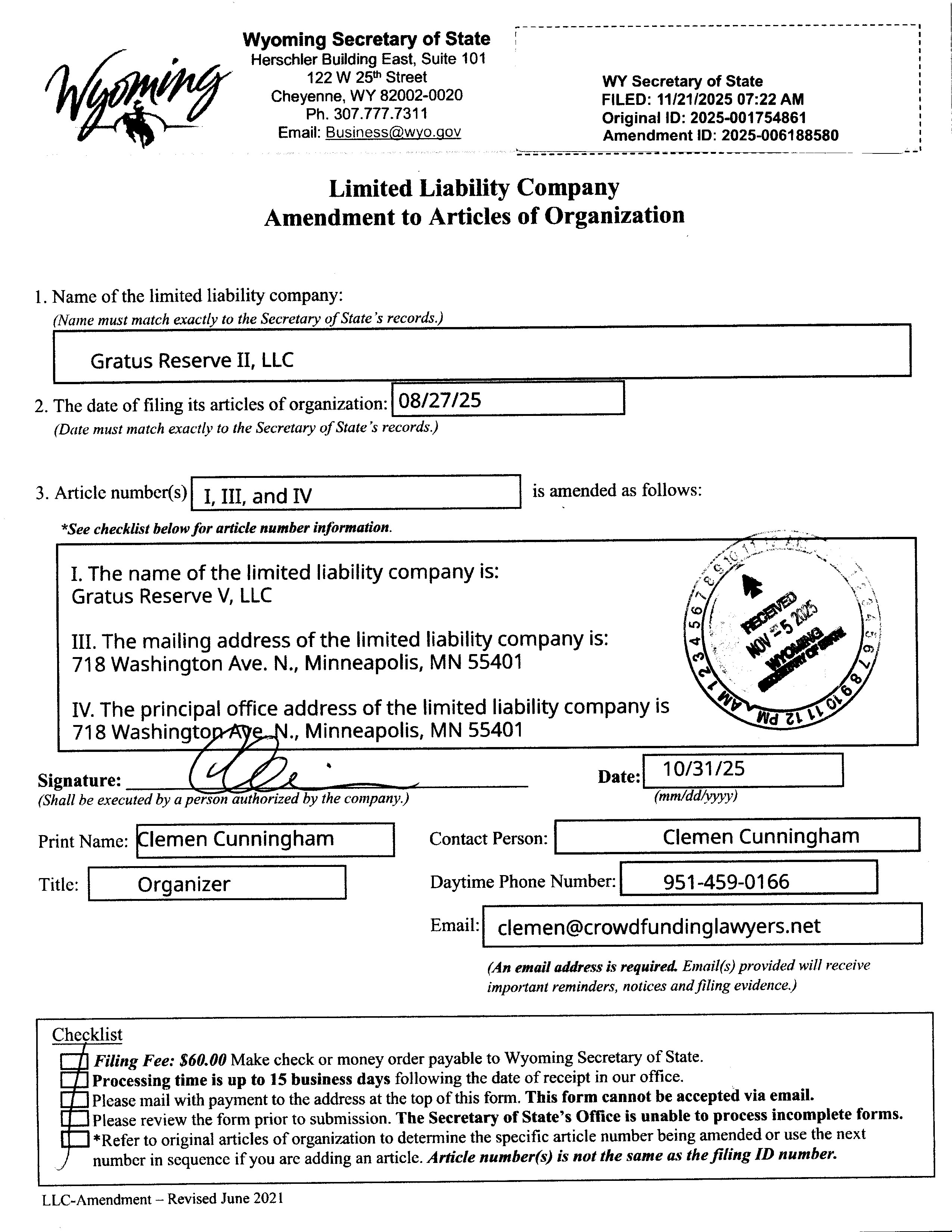
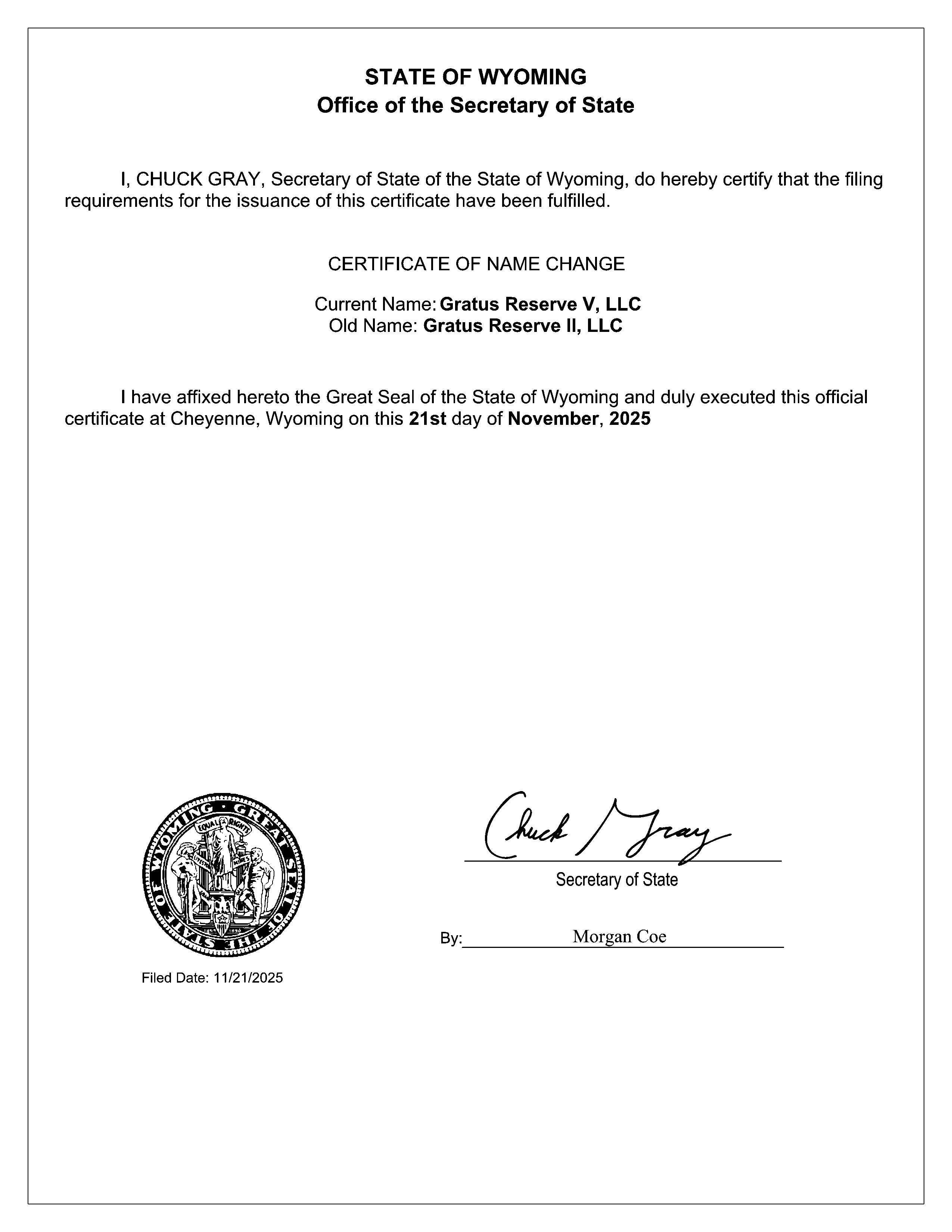
The Company was organized as a limited liability company in Wyoming on August 27, 2025 as Gratus Reserve II, LLC, and changed its name to Gratus Reserve V, LLC on November 21, 2025. The Company was formed to acquire and manage a portfolio of cryptocurrencies and precious metals. The Company does not intend to invest in any cryptocurrency it has deemed to be a security.
The Company’s membership interests are currently divided between Class AA, Class A, Class B, Class C and Class M Units. The Company is authorized to issue an unlimited number of Investor Class Units and up to 100 Class M Units. The Company may authorize additional classes of Units in the sole discretion of the Company’s Manager. No Investor Class Units have been issued to date. All Class M Units have been issued to the Company’s current Manager.
Only Investor Class Units are being sold in this offering. Such Units do not have the right to vote on any Company matter other than the removal of the Company’s Manager for “good cause.” The rights and privileges of the Investor Class Units are identical except for distributions at liquidation and payment at redemption.
Management
The Company’s Manager is GR Manager, LLC. Our Manager shall manage and administer company assets. No other Person shall have any right or authority to act for or bind the Company. Our Manager shall have no personal liability for the obligations of the Company.
Our Manager will receive fees for its services, and it will receive reimbursements for expenses incurred on the Company’s behalf. The Company will reimburse our Manager and its affiliates for offering and initial operating expenses through offering proceeds.
Distributions
The Company does not intend to make distributions until it has been operating for at least three years. Once distributions begin, they will be made first to return the capital contributions of Class AA, Class A, Class B, and Class C (i.e., “Investor Class”) Unit holders. Second, any remaining distributions will be divided between Investor Class Unit Holders and the Manager (the Company’s sole Class M Unit holder) as described in the section titled “Description of Securities” starting on page 49, with Investor Class Units receiving between 75% and 85% of the distribution and the other 25% - 15% being distributed to the Manager.
Transfer Restrictions
Our Company’s Operating Agreement (“Operating Agreement”) contains significant restrictions on transfer of Units. Our Manager may refuse a transfer of Unit(s) for any number of reasons. Furthermore, transfers of our Units may only be effected pursuant to exemptions under the Securities Act and as permitted by applicable state securities laws. In addition, there is no market for our Units and none is likely to develop in the future.
1
Going Concern
The consolidated financial statements included in this offering circular have been prepared on a going concern basis which assumes the Company will be able to realize its assets and discharge its liabilities in the normal course of business for the foreseeable future.
The ability to continue as a going concern is dependent upon the Company generating profitable operations in the future and/or obtaining the necessary financing to meet its obligations and repay its liabilities arising from normal business operations when they come due. The Company’s ability to raise additional capital through future issuances of debt or equity is unknown. The obtainment of additional financing, the successful development of the Company’s contemplated plan of operations, or its attainment of profitable operations are necessary for the Company to continue operations. The ability to successfully resolve these factors raise substantial doubt about the Company’s ability to continue as a going concern. The consolidated financial statements of the Company do not include any adjustments that may result from the outcome of these aforementioned uncertainties.
The Offering
Gratus Reserve V, LLC is offering up to 75,000,000 Units in the Company. Class AA, Class A, Class B, and Class C Units are being offered for $1.00 per Unit. The minimum investment amount required of each investor is $10,000, unless waived in the Company’s sole discretion.
Interests are being offered on a “best efforts” basis. The Company intends to sell the Units to investors directly and not through registered broker-dealers or other individuals who are paid commission.
In order to subscribe to purchase the Units, a prospective investor must visit our website, _______________ and complete a subscription agreement and send payment by wire transfer, ACH, credit card, or accepted stablecoin.
Investors must comply with the investment limitations set forth in Regulation A Rule 251(d)(2)(i)(C) under the Securities Act, which states that in offerings such as this one, where the securities will not be listed on a registered national securities exchange upon qualification, the aggregate purchase price to be paid by an investor who is a natural person for the securities cannot exceed 10% of the greater of the investor’s annual income or net worth, unless the purchaser is an accredited investor. In the case of an investor who is not a natural person, revenues or net assets for the investor’s most recently completed fiscal year are used instead.
Throughout this offering, we may undertake one or more closings on a “rolling” basis. Closings will occur promptly after receiving investor funds, but in no case less frequently than every 30 days. This offering will terminate on the earlier to occur of (i) the date that all Units hereby offered have been sold, (ii) the date three years from the date this offering circular is initially qualified by the SEC, or (iii) such earlier date as terminated by the Company.
2
The Units offered hereby are highly speculative in nature, involve a high degree of risk and should be purchased only by persons who can afford to lose their entire investment. There can be no assurance that our investment objectives will be achieved or that a secondary market will ever develop for the Units. The risks described in this section should not be considered an exhaustive list of the risks that prospective investors should consider before investing in the Units. Prospective investors should obtain their own legal and tax advice prior to making an investment in the Units and should be aware that an investment in the Units may be exposed to other risks of an exceptional nature from time to time. The following considerations are among those that should be carefully evaluated before making an investment in the Units.
Risks Related to the Company
The Company was recently formed, has no track record and no operating history from which you can evaluate the Company or this investment.
The Company was recently formed and has not generated any revenues and has no operating history upon which prospective investors may evaluate performance. No guarantee can be given that the Company will achieve its investment objectives or the underlying assets to be acquired will be successfully monetized.
Given our start-up nature, investors may not be interested in making an investment and we may not be able to raise all of the capital we seek, which could have a material adverse effect upon the Company.
There can be no guarantee that we will reach our funding target from potential investors. In the event we do not raise sufficient funds through this offering, we may not be able to achieve our investment objectives and may seek capital elsewhere, which could be on different terms than those hereby offered.
Our success depends in large part upon our Manager and its ability to execute our business plan.
The successful operation of the Company is dependent on the ability of our Manager to source, acquire and manage our assets. As our Manager was recently formed it has limited operating history which evidences its ability to source, acquire, manage and utilize our intended assets.
The success of the Company will be highly dependent on the expertise and performance of our Manager and its team to source, acquire and manage the underlying assets. There can be no assurance that these individuals will continue to be associated with our Manager. The loss of the services of one or more of these individuals could have a material adverse effect on our investments and/or operations.
Investment in the Company involves certain tax and ERISA risks of which investors should be aware.
An investment in the Company involves certain tax risks of general application to all investors and certain other risks specifically applicable to Keogh accounts, Individual Retirement Accounts, and other tax-exempt investors. Such investors should consult their tax advisors prior to investing in the Company.
Potential breach of the security measures of our investment platform could have a material adverse effect on the Company.
The highly automated nature of the investment platform through which potential investors acquire Units may make it an attractive target and potentially vulnerable to cyber-attacks, computer viruses, physical or electronic break-ins or similar disruptions. While we intend to take commercially reasonable measures to protect our confidential information and maintain appropriate cybersecurity, the security measures of the investment platform, the Company, our Manager or our service providers could be breached. Any accidental or willful security breaches or other unauthorized access could cause confidential information to be stolen and used for criminal purposes or have other harmful effects. Security breaches or unauthorized access to confidential information could also expose us to liability related to the loss of the information, time-consuming and expensive litigation and negative publicity.
3
There may be deficiencies with our internal controls that require improvements, and if we are unable to adequately evaluate internal controls, we may be subject to sanctions.
As a Tier 2 issuer, we will not need to provide a report on the effectiveness of our internal controls over financial reporting, and we will be exempt from the auditor attestation requirements concerning any such report. We are in the process of evaluating whether our internal control procedures are effective and therefore there is a greater likelihood of undiscovered errors in our internal controls or reported financial statements as compared to issuers that have conducted such evaluations.
Using a credit card to purchase Units may impact the return on your investment as well as subject you to other risks inherent in this form of payment.
Investors in this offering may have the option of paying for their investment with a credit card, which is not usual in the traditional investment markets. Transaction fees charged by your credit card company and interest charged on unpaid card balances (which can reach almost 25% in some states) add to the effective purchase price of the Units you buy. The cost of using a credit card may also increase if you do not make the minimum monthly card payments and incur late fees. Using a credit card is a relatively new form of payment for securities and will subject you to other risks inherent in this form of payment, including that, if you fail to make credit card payments (e.g. minimum monthly payments), you risk damaging your credit score and payment by credit card may be more susceptible to abuse than other forms of payment. Moreover, where a third-party payment processor is used, as in this offering, your recovery options in the case of disputes may be limited. The increased costs due to transaction fees and interest may reduce the return on your investment.
The SEC’s Office of Investor Education and Advocacy issued an Investor Alert dated February 14, 2018 entitled Credit Cards and Investments – A Risky Combination, which explains these and other risks you may want to consider before using a credit card to pay for your investment.
The Operating Agreement has a dispute resolution provision that requires disputes be resolved via mediation or (if mediation fails) binding arbitration in the county of the Company’s principal office, regardless of convenience or cost to you, the investor.
As part of this investment, each investor will be required to agree to the terms of the Operating Agreement. In that agreement, investors agree to resolve disputes arising from or relating to the Company’s Operating Agreement, the breach thereof, or any associated transaction (but not including claims under the Securities Act and/or the Exchange Act) by mediation or (if mediation fails) binding arbitration in the county of the principal office of the Company. The Company believes that the exclusive forum provision applies to all claims other than those arising under the Securities Act or the Exchange Act, but there is uncertainty as to whether a court would enforce such a provision in all situations.
This forum selection provision may limit your ability to obtain a favorable judicial forum for disputes with us. Although we believe the provision benefits us limiting our litigation costs, to the extent it is enforceable, the forum selection provision may limit the ability of investors to bring claims in judicial forums that they find favorable to such disputes, may increase investors’ costs of bringing suit and may discourage lawsuits with respect to such claims. Alternatively, if a court were to find the provision inapplicable to, or unenforceable in an action, the Company may incur additional costs associated with resolving such matters in other jurisdictions, which could adversely affect its business, financial condition or results of operations.
We may experience liability for alleged or actual harm to third parties and costs of litigation.
We are subject to the risk of lawsuits filed by buyers, sellers, past and present employees, contractors, competitors, business partners, and others in the ordinary course of business. As with all legal proceedings, no assurance can be provided as to the outcome of these matters, and legal proceedings can be expensive and time consuming. The Company may not be successful in the defense or prosecution of these lawsuits, which could result in settlements or damages that could result in substantial losses to the Company. Even if the Company is successful, there may be substantial costs associated with the legal proceeding, and our Manager may be delayed or prevented from implementing the business plan of the Company.
4
Financial projections may be wrong.
Certain financial projections concerning the future performance of our investments are based on assumptions of an arbitrary nature and may prove to be materially incorrect. No assurance is given that actual results will correspond with the results contemplated by these projections. It is possible that returns may be lower than projected, or that there may be no returns at all.
These and all other financial projections, and any other statements previously provided to the Purchaser relating to the Company or its prospective business operations that are not historical facts, are forward-looking statements that involve risks and uncertainties. Sentences or phrases that use such words as “believes,” “anticipates,” “plans,” “may,” “hopes,” “can,” “will,” “expects,” “is designed to,” “with the intent,” “potential” and others indicate forward-looking statements, but their absence does not mean that a statement is not forward- looking.
Such statements are based on our Manager’s current estimates and expectations, along with currently available competitive, financial, and economic data. However, forward-looking statements are inherently uncertain. A variety of factors could cause business conditions and results to differ materially from what is contained in any such forward-looking statements.
It is possible that actual results from operation of the properties will be different than the returns anticipated by our Manager and/or that these returns may not be realized in the timeframe projected by our Manager, if at all.
We have broad authority to incur debt and high debt levels could hinder our ability to make distributions and decrease the value of our investors’ investments.
While we do not intend to incur high levels of debt, our policies do not limit us from incurring debt in any amount we can obtain. While our members should not be personally liable for these obligations, and our Manager may issue personal guarantees that these obligations will be repaid, the Company is ultimately responsible for paying off these debts. High debt levels would cause us to incur higher interest charges and higher debt service payments and may also be accompanied by restrictive covenants. These factors could limit the amount of cash we have available to distribute and could result in a decline in the value of our investors’ investments.
The liquidation of the Company may occur at a time when the disposition of the Company’s assets will result in losses to investors.
The Company intends to liquidate after five to fifteen years. Sales of assets in connection with the liquidation of the Company at a time of low prices will likely result in losses, or adversely affect your gains, on your investment.
We intend to grow the size of our organization, and we may experience difficulties in managing any growth we may achieve.
As our plans and strategies develop, we may need additional managerial, operational, financial, accounting, legal, and other resources. Future growth would impose significant added responsibilities on members of management. Our management may not be able to accommodate those added responsibilities, and our failure to do so could prevent us from effectively managing future growth, if any, and successfully growing our company.
If we fail to comply with government laws and regulations it could have a materially adverse effect on our business.
We may be subject to federal, state and local laws and regulations that are extremely complex. We will exercise care in structuring our operations to comply in all material respects with applicable laws to the extent possible. The laws, rules and regulations applicable to our operations are complex and subject to interpretation. In the event of a determination that we are in violation of such laws, rules or regulations, or if further changes in the regulatory framework occur, any such determination or changes could have a material adverse effect on our business. There can be no assurance however that we will not be found in noncompliance in any particular situation.
5
We may not maintain sufficient insurance coverage for the risks associated with our business operations.
Risks associated with our business and operations include, but are not limited to, claims for wrongful acts committed by our officers, directors, and other representatives, the loss of key personnel, and risks of lawsuits from our employees. Any of these risks may result in significant losses. We cannot provide any assurance that our insurance coverage is sufficient to cover any losses that we may sustain, or that we will be able to successfully claim our losses under our insurance policies on a timely basis or at all. If we incur any loss not covered by our insurance policies, or the compensated amount is significantly less than our actual loss or is not timely paid, our business, financial condition and results of operations could be materially and adversely affected.
We may change our investment strategy without member consent, which may result in riskier investments than our current investments.
We may change our investment strategy and guidelines at any time without the consent of our members, which could result in our making investments that are different from, and possibly riskier than, the investments described in this offering circular.
Our management team has limited experience managing a publicly reporting company.
Most members of our management team have limited experience managing a publicly reporting company, interacting with public investors, and complying with the increasingly complex laws pertaining to Regulation A reporting companies. Our management team may not successfully or efficiently manage our transition to being a publicly reporting company that is subject to significant regulatory oversight and reporting obligations under the federal securities laws and the continuous scrutiny of securities analysts and investors. These new obligations and constituents will require significant attention from our senior management and could divert their attention away from the day-to-day management of our business, which could harm our business, financial condition, and results of operations.
If we are required to register any Units under the Exchange Act, it would result in significant expense and reporting requirements that would place a burden on the Company.
Subject to certain exceptions, Section 12(g) of the Exchange Act requires an issuer with more than $10 million in total assets to register a class of its equity securities with the Commission under the Exchange Act if the securities of such class are held of record at the end of its fiscal year by more than 2,000 persons or 500 persons who are not “accredited investors.” To the extent the Section 12(g) assets and holders limits are exceeded, we intend to rely upon a conditional exemption from registration under Section 12(g) of the Exchange Act contained in Rule 12g5-1(a)(7) under the Exchange Act (the “Reg. A+ Exemption”), which exemption generally requires that the issuer (i) be current in its Form 1-K, 1-SA and 1-U filings as of its most recently completed fiscal year end; (ii) engage a transfer agent that is registered under Section 17A(c) of the Exchange Act to perform transfer agent functions; and (iii) have a public float of less than $75 million as of the last business day of its most recently completed semi-annual period or, in the event the result of such public float calculation is zero, have annual revenues of less than $50 million as of its most recently completed fiscal year. If the number of record holders of any Series of Interests exceeds either of the limits set forth in Section 12(g) of the Exchange Act and we fail to qualify for the Reg. A+ Exemption, we would be required to register such Series with the Commission under the Exchange Act. If we are required to register any Units under the Exchange Act, it would result in significant expense and reporting requirements that would place a financial burden on the Company and a time burden on our management.
We do not anticipate paying any cash dividends until liquidation.
We presently do not anticipate that we will pay any dividends until our liquidation. We do not intend to liquidate our assets until 5-15 years from organization, but such time will ultimately be determined by our Manager.
6
Risks Related to Potential Conflicts of Interest
Our Operating Agreement contains provisions that reduce or eliminate duties (including fiduciary duties) of our Manager.
Our Operating Agreement provides that our Manager, in exercising its rights in its capacity as Manager, will be entitled to consider only such interests and factors as it desires and will have no duty or obligation (fiduciary or otherwise) to give any consideration to any interest of or factors affecting us or any of our investors and will not be subject to any different standards imposed by our Operating Agreement, the LLC Act or under any other law, rule or regulation or in equity. The Operating Agreement allows our Manager and its affiliates to have other business interests, including those that compete with the Company.
We do not have a conflicts of interest policy.
Our Manager and its affiliates will try to balance our interests with their own. However, to the extent that such parties take actions that are more favorable to other people or entities than the Company, these actions could have a negative impact on our financial performance and, consequently, on distributions to investors and the value of our assets. We have not adopted, and do not intend to adopt in the future, either a conflicts of interest policy or a conflicts resolution policy.
There may be conflicting interests of investors.
Our Manager will determine whether or not to acquire or liquidate our assets. When determining to acquire or liquidate an investment, our Manager will do so considering all of the circumstances at the time, which may include obtaining or paying a price for an underlying asset that is in the best interests of some but not all of the investors.
Conflicts of interest may arise with service providers, including those compensated with Units, which may not be aligned with investors and may result in dilution.
Our service providers, including legal counsel, may provide services to the Company, our Manager and its affiliates, and may be compensated through the issuance of Units rather than, or in addition to, cash fees, creating conflicts of interest and resulting in dilution to investors. Because such providers may represent multiple parties, their interests may not be aligned with those of the Company or its investors, and, in the event of a conflict, such providers may represent other parties and not the Company. In addition, service providers who receive Units will have a financial interest in the Company and may have incentives to support the completion or continuation of this or future offerings on terms that are not necessarily most favorable to investors, and the value of such Units may not reflect the fair market value of the services provided or be the result of arm’s-length negotiation. Although these arrangements may preserve the Company’s cash, they may make it more difficult for investors to evaluate the true cost of services, and there can be no assurance that the terms of such arrangements are as favorable as those that could have been obtained from unaffiliated third parties. Legal counsel is not representing any prospective investors in connection with this offering, and investors are encouraged to consult their own independent legal and tax advisor.
The Company will Compete with Other Methods of Investing in digital assets and precious metals.
The Company competes with other financial vehicles, including traditional debt and equity securities issued by companies in precious metal industries and other securities backed by or linked to precious metal, exchange traded funds, direct investments in precious metals and investment vehicles similar to the Company. These competing investment alternatives may be more liquid, more widely recognized by investors, or may have longer operating histories and greater market acceptance than the Company’s securities. In addition, many competing investment vehicles may have larger capital resources, lower expense structures, or more established distribution channels, which could make them more attractive to investors. If investors choose alternative methods of investing in digital assets or precious metals instead of investing in the Company, the Company may experience reduced demand for its securities, which could adversely affect its ability to raise capital and execute its investment strategy.
7
Risks Related to this Offering and our Units
There is currently no public trading market for our Units.
There is currently no public trading market for our Units, and none is expected to develop or be sustained. If an active public trading market for our Units does not develop or is not sustained, it may be difficult or impossible for you to resell your Units at any price. Even if a public market does develop, the market price could decline below the amount you paid for your Units.
If a market ever develops for our Units, the market price and trading volume may be volatile.
If a market develops for our Units, the market price of our Units could fluctuate significantly for many reasons, including reasons unrelated to our performance, the underlying assets or the series, such as reports by industry analysts, investor perceptions, or announcements by our competitors regarding their own performance, as well as general economic and industry conditions. For example, to the extent that other companies, whether large or small, within our industry experience declines in their share price, the value of our Units may decline as well.
In addition, fluctuations in our operating results to meet the expectations of investors may negatively impact the price of our securities. Operating results may fluctuate in the future due to a variety of factors that could negatively affect revenues or expenses in any particular reporting period, including vulnerability of our business to a general economic downturn; changes in the laws that affect our operations; competition; compensation related expenses; application of accounting standards; seasonality; and our ability to obtain and maintain all necessary government certifications or licenses to conduct our business.
There are restrictions on an investor’s ability to sell its Units making it difficult to transfer, sell or otherwise dispose of our Units.
Each state has its own securities laws, often called “blue sky” laws, which limit sales of securities to a state’s residents unless the securities are registered in that state or qualify for an exemption from registration. Before a security is sold in a state, there must be a registration in place to cover the transaction, or it must be exempt from registration.
Our Units will not be registered under the laws of any states. There may be significant state blue sky law restrictions on the ability of investors to sell, and on purchasers to buy, our Units. Investors should consider the resale market for our Units to be limited. Investors may be unable to resell their Units, or they may be unable to resell them without the significant expense of state registration or qualification.
In addition, there are significant transfer restrictions contained in our Operating Agreement that prohibit transfers unless approved by our Manager and the transferee and transferor have met other conditions established by our Operating Agreement.
Investors have limited voting rights.
Investors have limited voting rights. Class AA, Class A, Class B, and Class C Units are limited to voting on removal of the Manager for “good cause” by a supermajority vote of 75% of the outstanding Class AA, Class A, Class B, and Class C Units, and the appointment of a replacement manager if all Company managers have resigned or been removed. Class M Units are entitled to vote on all other Company matters. Investors may not necessarily agree with the voting decisions of the Class M member or decisions may not be in the best Units of all the investors but only a limited number, including the Class M Unit holder.
This offering is being conducted on a “best efforts” basis and we may not be able to execute our growth strategy if we are unable to raise this capital.
We are offering the Units on a “best efforts” basis, and we can give no assurance that all of the offered Units will be sold. If you invest in our Units and more than the minimum number of offered Units are sold, but less than all of the offered Units are sold, the risk of losing your entire investment will be increased. If substantially less than the maximum amount of Units offered are sold, we may be unable to fund all the intended uses described in this offering circular from the net proceeds anticipated from this offering without obtaining funds from alternative sources or using working capital that we generate. Alternative sources of funding may not be available to us at what we consider to be a reasonable cost, and the working capital generated by us may not be sufficient to fund any uses not financed by offering net proceeds.
8
The offering prices of the Units may not accurately represent the current value of the Company or our assets at any particular time. Therefore, the purchase price you pay for the Units may not be supported by the value of our assets at the time of your purchase.
This is a fixed price offering, which means that the offering price for the Units is fixed and will not vary based on the underlying value of our assets at any time. Our Manager has determined the offering price in its sole discretion without the input of an investment bank or other third party. The fixed offering price for the Units has not been based on appraisals of any assets we own or may own, or of the Company as a whole, nor do we intend to obtain such appraisals. Therefore, the fixed offering price established for the Units may not be supported by the current value of the Company or our assets at any particular time.
Possible changes in federal/local tax laws or the application of existing federal/local tax laws may result in significant variability in our results of operations and tax liability for the investor.
The Internal Revenue Code of 1986, as amended, is subject to change by Congress, and interpretations may be modified or affected by judicial decisions, by the Treasury Department through changes in regulations and by the Internal Revenue Service through its audit policy, announcements, and published and private rulings. Although significant changes to the tax laws historically have been given prospective application, no assurance can be given that any changes made in the tax law affecting an investment in Units of the Company would be limited to prospective effect. Accordingly, the ultimate effect on an investor’s tax situation may be governed by laws, regulations or interpretations of laws or regulations which have not yet been proposed, passed or made, as the case may be.
Furthermore, investors may reside in various tax jurisdictions throughout the world. To the extent that there are changes to tax laws or tax reporting obligations in any of these jurisdictions, such changes could adversely impact the ability and/or willingness of our clients to purchase Units in the Company. Failure to assess or pay the correct amount of tax on a transaction may expose us to claims from tax authorities.
We may not register or qualify our securities with any state agency pursuant to blue sky regulations.
The holders of our Units and persons who desire to purchase them in the future should be aware that there may be significant state law restrictions upon the ability of investors to resell our shares. We currently do not intend to and may not be able to qualify securities for resale in states which require shares to be qualified before they can be resold by our members.
We may experience investment delays.
There may be a delay between the time an investor’s subscription is accepted by the Company and the time the proceeds of this offering are deployed. During these periods, the Company may invest these proceeds in short-term certificates of deposit, money-market funds, or other liquid assets with FDIC-insured and/or NCUA-insured banking institutions, which will not yield a return as high as if deployed in our operations.
Units are being offered under an offering exemption, and if it were later determined that such exemption was not available, purchasers would be entitled to rescind their purchase agreements.
Units are being offered to prospective investors pursuant to Tier 2 of Regulation A under the Securities Act. If the sale of Units does not qualify for such exemption, the investors might have the right to rescind their purchase of Units. Since compliance with these exemptions is highly technical, it is possible that if an investor were to seek rescission, such investor would succeed. A similar situation prevails under state law in those states where Units may be offered without registration. If a number of investors were to be successful in seeking rescission, the Company would face severe financial demands that could adversely affect the Company and, thus, the non-rescinding investors. Inasmuch as the basis for relying on exemptions is factual, depending on the Company’s conduct and the conduct of persons contacting prospective investors and making the offering, the Company will not receive a legal opinion to the effect that this offering is exempt from registration under any federal or state law. Instead, the Company will rely on the operative facts as documented as the Company’s basis for such exemptions.
9
Because our management will have broad discretion and flexibility in how the net proceeds from this offering are used, we may use the net proceeds in ways in which investors disagree.
The intended use of proceeds from this offering is more particularly described in the Section titled “Use of Proceeds” starting on page 32, however, such description is not binding and the actual use of proceeds may differ from the description contained therein. Accordingly, our management will have significant discretion and flexibility in applying the net proceeds of this offering. Investors will be relying on the judgment of our management with regard to the use of these net proceeds, and will not have the opportunity to assess whether the net proceeds are being used appropriately. It is possible that the net proceeds will be invested in a way that does not yield a favorable, or any, return for us. The failure of our management to use such funds effectively could have a material adverse effect on our business, financial condition, operating results and cash flow.
We may need additional capital, which may be on terms more or less favorable than those offered in this offering.
We may require additional capital and may require additional cash resources due to changed business conditions or other future developments. If our resources are insufficient to satisfy our cash requirements, we may seek to sell additional equity or debt securities or incur debt. The sale of additional equity securities could result in additional dilution to our members. The incurrence of additional indebtedness would result in increased debt service obligations and could result in operating and financing covenants that would restrict our operations. We cannot assure you that financing will be available in amounts or on terms acceptable to us, if at all, or that the terms provided won’t be more or less favorable than those hereby offered.
The fixed price nature of Regulation A offerings could result in early investors bearing greater risks than later investors.
Until the Company effectuates a price change in accordance with Regulation A, all investors will be paying the same price for Units. This means that subsequent investors have the ability to purchase Units on the same basis as did early investors. As a result, early investors therefore may bear greater risks than later investors in the offering and later investor may acquire Units valued higher than earlier investors.
By purchasing Units in this Offering, you are bound by the arbitration provisions contained in our Subscription Agreement, which limits your ability to bring class action lawsuits or seek remedies on a class basis and waives the right a trial by jury.
By purchasing Units in this offering, you agree to be bound by the arbitration, jury waiver and class action waiver provisions contained in our Subscription Agreement to be used for subscriptions on this offering. Pursuant to the terms of the Subscription Agreement, the holders of Units and the Company will agree to (i) resolve disputes of the holders of Units through binding arbitration, instead of through courts of general jurisdiction or through a class action and (ii) waive the right to a trial by jury and to participate in any class action. Pursuant to the terms of the Subscription Agreement, if a holder of Units does not agree to the terms of the arbitration provision, the holder of Units may opt-out of the arbitration provision by sending an arbitration opt-out notice to the Company within 30 days of the holder’s first electronic acceptance of the Subscription Agreement. If the opt-out notice is not received within 30 days, the holder of Units will be deemed to have accepted all terms of the arbitration provision, including the class action and jury waiver. If the investor opts out of the arbitration provision, the investor has also opted out of the jury trial and class action waivers.
The Subscription Agreement provides that, to the extent permitted by law, each party to the Subscription Agreement waives the right to a jury trial or class action of any claim they may have against us arising out of or relating to our Units or the Subscription Agreement. If we were to oppose a jury trial or class action demand based on such waiver, the court would determine whether the waiver was enforceable based upon the facts and circumstances of that case in accordance with applicable state and federal law, including whether a party knowingly, intelligently and voluntarily waived the right to a jury trial or class action. The bondholders of Units will be subject to these provisions of the Subscription Agreement to the extent permitted by applicable law.
10
THE ARBITRATION PROVISION OF THE BOND PURCHASE AGREEMENT IS NOT INTENDED TO BE DEEMED A WAIVER BY ANY HOLDER OF BONDS OF THE COMPANY’S COMPLIANCE WITH THE U.S. FEDERAL SECURITIES LAWS AND THE RULES AND REGULATIONS PROMULGATED THEREUNDER.THE WAIVER OF THE RIGHT TO A JURY TRIAL AND CLASS ACTION CONTAINED IN THE BOND PURCHASE AGREEMENT IS NOT INTENDED TO BE DEEMED A WAIVER BY ANY HOLDER OF BONDS OF THE COMPANY’S COMPLIANCE WITH THE U.S. FEDERAL SECURITIES LAWS AND THE RULES AND REGULATIONS PROMULGATED THEREUNDER.
If the investor opts out of the arbitration provision, the investor has also opted out of the jury trial and class action waivers. If an investor does not opt-out, as described above, the rights of the adverse Unit holder to seek redress in court would be severely limited. These restrictions on the ability to bring a class action lawsuit may result in increased costs and/or reduced remedies, to individual investors who wish to pursue claims against the Company.
11
Risks Related to Digital Assets
The volatility of crypto asset prices is extreme.
Investors should be aware that the Company’s investments in digital assets are subject to extreme price volatility. The value of these assets can fluctuate widely within a single day due to market-driven factors such as supply and demand, market sentiment, regulatory news, technological developments, and broader macroeconomic factors. This volatility may be amplified by the relatively illiquid nature of the market, where large trades by investors can significantly impact the market price. The Company’s operating results may, therefore, vary significantly over short periods, leading to pronounced fluctuations into the financial position and operating results reported in consecutive financial statements. Investors should have a high risk tolerance and the ability to absorb the loss of their entire investment.
Blockchain technology is a relatively new and untested technology. The risks associated with blockchain technology may not emerge until the technology is widely used.
A blockchain is an open, distributed ledger that records transactions between two parties in a verifiable and permanent way using cryptography. Transactions on the blockchain are permanently recorded on the blockchain in collections of transactions called “blocks.” Blockchain networks are based upon software source code that establishes and governs their respective cryptographic systems for verifying transactions.
Blockchain is a nascent and rapidly evolving technology that is novel and largely untested and may contain inherent flaws, limitations, or vulnerabilities. Blockchain systems, and the digital assets that operate on them, may be susceptible to fraud, theft, loss, destruction, or inaccessibility. In particular, the security of digital assets is dependent on the safeguarding of private cryptographic keys that control access to digital wallets. If a private key is lost, destroyed, corrupted, or otherwise becomes inaccessible, the associated digital assets may be permanently and irretrievably lost, and there may be no means of recovery. Unlike traditional financial systems, there is generally no central authority, custodian, or insurance mechanism capable of restoring access to lost private keys or reversing unauthorized transactions.
Digital wallets, whether maintained by the Company, third-party custodians, or counterparties, may be vulnerable to a variety of security risks, including hacking, malware, phishing attacks, insider misconduct, social engineering, and other forms of cyber intrusion. Unauthorized access to a private key or wallet could result in the immediate and irreversible transfer of digital assets to unauthorized parties. In addition, failures in key management processes, including improper storage, inadequate backup procedures, or errors in key generation or transmission, could result in the loss or compromise of private keys. The use of third-party custodians or wallet providers introduces additional counterparty and operational risks, including the risk that such service providers may themselves be subject to security breaches, insolvency, or operational failures.
Technological developments may also lead to technical or other flaws (including undiscovered vulnerabilities) in the underlying blockchain technology or related infrastructure. These may include flaws in the process by which transactions are validated and recorded, vulnerabilities in smart contracts, or the emergence of new hardware or software tools—such as advanced computing techniques or quantum computing—that could compromise existing cryptographic protections. Any such developments could impair the security, functionality, or integrity of blockchain networks and digital wallets, adversely affect the Company’s ability to securely hold or transfer digital assets, and negatively impact investor participation, liquidity, and the value of the Units.
The regulatory regime governing blockchain technologies and digital assets is uncertain, and new regulations or policies may adversely affect the Company’s business plan.
Regulation of digital assets, blockchain technologies, and token exchanges is being developed and likely to rapidly evolve. Regulations on token offerings vary significantly by type of token and among international, federal, state, and local jurisdictions and are subject to significant uncertainty. Various legislative and executive bodies in the United States and in other countries may in the future, adopt laws, regulations, guidance, or other actions, which may severely impact the development, growth, adoption, and utility of such tokens. Failure by the Company or certain users to comply with any laws, rules, and regulations, some of which may not exist yet or are subject to interpretation, could result in a variety of adverse consequences, including civil penalties and fines. This could adversely affect the Company’s business plan, which involves acquiring, holding, and selling digital assets.
12
As blockchain networks and blockchain assets have grown in popularity and in market size, federal and state agencies have begun to take interest in, and in some cases regulate, their use and operations.
In the case of virtual currencies, state regulators like the New York Department of Financial Services have created new regulatory frameworks and special licenses for virtual currency business activities in the State of New York. Others, as in Texas, have published guidance on how their existing regulatory regimes apply to virtual currencies. Some states, like New Hampshire, North Carolina, and Washington, have amended their state’s statutes to include virtual currencies into existing licensing regimes. Treatment of virtual currencies continues to evolve under federal law as well. The Department of the Treasury, the SEC, and the Commodity Futures Trading Commission (the “CFTC”), for example, have published guidance on the treatment of virtual currencies. The IRS released guidance treating virtual currency as property that is not currency for U.S. federal income tax purposes, although there is no indication yet whether other courts or federal or state regulators will follow this classification. Both federal and state agencies have instituted enforcement actions against those violating their interpretation of existing laws. The regulation of non-currency use of Blockchain assets is also uncertain. The CFTC has publicly taken the position that certain Blockchain assets are commodities, and the SEC has issued a public report stating federal securities laws require treating some Blockchain related assets as securities. To the extent that a domestic government or quasi-governmental agency exerts regulatory authority over a Blockchain network or asset, tokens may be adversely affected.
Use of digital asset exchanges and custodians may subject us to risks.
Digital asset markets are relatively new, fragmented, and, in many cases, largely unregulated. Trading in digital assets often occurs across numerous exchanges and trading platforms with varying levels of oversight, transparency, and regulatory compliance. Many of these platforms operate outside of the United States or in jurisdictions with limited regulatory frameworks, which may make it more difficult to detect, prevent, or enforce prohibitions against manipulative trading practices.
Market participants, including large holders of digital assets (sometimes referred to as “whales”), coordinated groups of traders, or other actors, may engage in manipulative activities such as wash trading, spoofing, front-running, pump-and-dump schemes, or the dissemination of false or misleading information. In addition, certain exchanges or trading platforms may themselves engage in practices that artificially inflate trading volumes or otherwise distort market data. The prevalence of algorithmic and high-frequency trading strategies in digital asset markets may further exacerbate price volatility and amplify the effects of manipulative conduct.
Because digital asset markets may lack the depth, liquidity, and regulatory safeguards of more established financial markets, such manipulative activities can have a disproportionate impact on the price of digital assets. Prices may be subject to sudden and significant fluctuations that are not attributable to fundamental factors and may not reflect the true market value of the underlying assets. In some cases, market manipulation may result in prolonged periods of artificial pricing or reduced investor confidence in the integrity of the market.
The Company may have limited ability to detect, prevent, or mitigate the effects of market manipulation, particularly where such activities occur on third-party trading platforms or across multiple jurisdictions. As a result, the value of the digital assets held by the Company may be adversely affected by manipulative practices beyond its control. Such price distortions and volatility could negatively impact the Company’s financial condition, results of operations, and ability to execute its investment strategy, and consequently could adversely affect the value of an investment in the Company’s Units.
Recent disruptions in the cryptocurrency markets could negatively impact our reputation, invite increased regulation, and make it more difficult to raise capital needed to purchase digital assets.
Recent disruptions in the cryptocurrency markets have resulted in increased interest in governmental regulation of all forms of digital representations of assets. Increased regulation or decreased investment could hinder our ability to purchase digital assets or generate returns, and could negatively impact the potential liquidity and value of our digital assets.
13
Use of digital asset exchanges to trade crypto assets and the volatility of crypto asset prices.
Investors should be aware that the Company’s investments in digital assets are subject to extreme price volatility. The Company will initially limit its cryptocurrency asset investments to Bitcoin (BTC) and Ether (ETH), and other cryptocurrencies we have determined are not securities. The value of these assets can fluctuate widely within a single day due to market-driven factors such as supply and demand, market sentiment, regulatory news, technological developments, and broader macroeconomic factors. This volatility may be amplified by the relatively illiquid nature of the market, where large trades by investors can significantly impact the market price.
The Company’s operating results may, therefore, vary significantly over short periods, leading to pronounced fluctuations into the financial position and operating results reported in consecutive financial statements. Investors should have a high risk tolerance and the ability to absorb the loss of their entire investment.
14
Risks Related to Precious Metals
Actual or perceived disruptions in the processes used by the Company to determine the price of precious metals, or lack of confidence in established industry benchmarks, may adversely affect the return on your investment.
Because the objective of the Company is to reflect the performance of the price of precious metals, any disruptions affecting the processes related to how the market determines the price of these metals will have an effect on the value of its Units, and the price at which it acquires additional metals.
Future governmental decisions may have significant impact on the price of precious metals, which may result in a significant decrease or increase in the value of the net assets and the net asset value of the Company.
Generally, metal prices reflect the supply and demand of available metal. Governmental decisions, such as the executive order issued by the President of the United States in 1934 requiring all persons in the United States to deliver silver to the Federal Reserve, have been viewed as having significant impact on the supply and demand of silver and the price of silver. Future governmental decisions may have an impact on the price of metal and may result in a significant decrease or increase in the value of the net assets and the net asset value of the Company. Further regulations applicable to U.S. banks and non-U.S. bank entities operating in the United States with respect to their trading in physical commodities, such as precious metals, may further impact the price of metal in the United States.
Because the Company holds only precious metals and cryptocurrency, an investment in the Company may be more volatile than an investment in a more broadly diversified portfolio.
The Company’s holdings are not diversified, and the Company’s net asset value may be more volatile than another investment vehicle with a more broadly diversified portfolio and may fluctuate substantially over short or long periods of time. Fluctuations in the price of precious metals are expected to have a direct impact on the value of the Company.
An investment in the Company may be deemed speculative and is not intended as a complete investment program. An investment in the Company should be considered only by persons financially able to maintain their investment and who can bear the risk of loss associated.
Holding physical precious metals increases liquidity risks.
Physical precious metals are less liquid than financial instruments or exchange-traded commodities. Finding a buyer at favorable prices can take time and involve additional transaction or transport costs. This lack of immediate liquidity may pose challenges if the Company needs to convert assets to cash quickly.
The trading price of precious metals has recently been, and could potentially continue to be, volatile and unpredictable. This creates the potential for losses if the price of precious metals declines.
The precious metals market in general has experienced extreme price and volume fluctuations that have often been unrelated or disproportionate to factors such as, for example, silver’s uses in jewelry, technology, and industrial applications, or cost and production levels in major silver-producing countries such as China, Mexico, and Peru. In particular, supply chain disruptions resulting from the COVID-19 outbreak and investor speculation have significantly contributed to recent price and volume fluctuations. Precious metals markets have also experienced extended periods of flat or declining prices, which may be caused by (among other things):
| ● | a change in economic conditions, such as a recession, can adversely affect the price of precious metals. For example, silver is used in a wide range of industrial applications, and an economic downturn could have a negative impact on its demand and, consequently, its price and the value of the Company; |
15
| ● | a significant increase in precious metal hedging activity by precious metal producers. For example, traditionally, silver producers have not hedged to the same extent that other producers of precious metals (gold, for example) have. Should there be an increase in the level of hedge activity of silver producing companies, it could cause a decline in world silver prices, adversely affecting the value of the Company; |
| ● | a significant change in the attitude of speculators and investors towards precious metals. Should the speculative community take a negative view towards precious metals, a decline in world prices for those metals could occur, negatively impacting the value of the Company; |
| ● | global supply and demand for precious metals. For example, silver supply and demand, which is influenced by such factors as silver’s uses in jewelry, technology and industrial applications, purchases made by investors in the form of bars, coins and other silver products, forward selling by silver producers, purchases made by silver producers to unwind silver hedge positions, central bank purchases and sales, and production and cost levels in major silver-producing countries such as China, Mexico and Peru; |
| ● | global or regional political, economic or financial events and situations, especially those unexpected in nature; |
| ● | investors’ expectations with respect to the rate of inflation; |
| ● | interest rates; |
| ● | investment and trading activities of hedge funds and commodity funds; |
| ● | other economic variables such as income growth, economic output, and monetary policies; and |
| ● | investor confidence. |
Investors should be aware that while precious metal are used to preserve wealth by investors around the world, there is no assurance that precious metals will maintain its long-term value in terms of future purchasing power. In the event the price of precious metals declines, the Company expects the value of an investment in its Units to decline proportionately.
Furthermore, although precious metals such as silver have been used as a portfolio diversifier due to its historically low-to-negative correlation with stocks and bonds, diversification does not ensure against, nor can it prevent against, risk of loss.
The Company’s precious metals may be subject to loss, damage, theft or restriction on access.
There is a risk that part or all of the Company’s precious metals could be lost, damaged or stolen. Access to the Company’s precious metals could also be restricted by natural events (such as an earthquake) or human actions (such as a terrorist attack). Any of these events may adversely affect the operations of the Company and, consequently, your investment.
The Company’s reliance on third-party custodians to store and safeguard its physical precious metals creates certain risks.
The Company will not have direct control over the day-to-day operations, security procedures, or internal controls of such custodians. The Company must rely on the custodians’ representations, policies, and procedures regarding the safekeeping, handling, and recordkeeping of the metals, and there can be no assurance that such measures will be adequate to protect against all risks.
The storage of precious metals with third-party custodians exposes the Company to a range of risks, including theft, loss, damage, misappropriation, or destruction of the underlying assets. Such risks may arise from external events, such as burglary, fraud, or other criminal activity, as well as from internal failures, including employee misconduct, negligence, or inadequate security protocols. In addition, precious metals may be subject to risks associated with transportation, handling, or storage conditions, including damage or loss during transit or improper storage practices that could affect the quality or integrity of the metals.
16
The Company may also be exposed to the risk that a custodian becomes insolvent, enters bankruptcy, or otherwise experiences financial or operational distress. In such circumstances, the Company may face delays, restrictions, or legal challenges in accessing or recovering its assets, particularly if the metals are not properly segregated or if the Company’s ownership interests are not clearly established or recognized. There is also a risk that a custodian could engage in fraudulent or unauthorized activities, including the improper use, rehypothecation, or misreporting of the Company’s assets, which could result in partial or complete loss.
While the Company intends to conduct due diligence and may seek to engage reputable custodians and implement contractual protections, insurance coverage, and oversight mechanisms, such measures may not fully eliminate these risks. Insurance coverage, if obtained, may be subject to exclusions, limits, or delays in recovery, and may not be sufficient to cover the full extent of any losses. Any failure by a custodian to adequately safeguard the Company’s precious metals could adversely affect the Company’s financial condition and results of operations. Consequently, an investment in the Company’s Units may be adversely affected.
The Company’s lack of insurance protection and the Members’ limited rights of legal recourse against the Company, the Manager, and any custodian hired by the Company exposes the Company and its Members to the risk of loss of the Company’s precious metals for which no person is liable.
The Company does not insure its precious metals. Custodians hired by the Company to store the Company’s precious metals may maintain insurance with regard to its business on such terms and conditions as it considers appropriate, but the Company is not a beneficiary of any such insurance and does not have the ability to dictate the existence, nature or amount of coverage. Therefore, Members cannot be assured that the custodians it hires will maintain adequate insurance or any insurance with respect to the precious metals held on behalf of the Company. In addition, the Manager does not require any custodians to be insured or bonded with respect to their custodial activities or in respect of the precious metals held by them on behalf of the Company. Further, Members’ recourse against the Company, the Manager, and any custodians is limited. Consequently, a loss may be suffered with respect to the Company’s precious metals which is not covered by insurance and for which no person is liable in damages.
The markets for physical precious metals, including gold, silver, platinum, and palladium, are subject to risks of market manipulation.
Trading in precious metals occurs across a combination of physical markets, over-the-counter transactions, and derivatives exchanges, many of which lack full transparency. The pricing of precious metals is often influenced by benchmark pricing mechanisms, futures markets, and large institutional participants, which may create opportunities for manipulation or price distortion.
Market participants, including large financial institutions, commodity traders, and other significant holders of precious metals or related derivatives, may engage in manipulative or disruptive trading practices. These may include spoofing, coordinated trading strategies, dissemination of misleading information, or the use of large derivative positions to influence spot prices. In addition, concentrated ownership or control of significant quantities of a particular metal may enable certain market participants to exert undue influence over supply, pricing, or market sentiment. Allegations of manipulation in precious metals markets have occurred from time to time and have, in certain cases, resulted in regulatory investigations and enforcement actions.
Because the pricing of physical precious metals is closely linked to trading activity in futures, options, and other derivative instruments, distortions or manipulation in those markets may directly or indirectly affect the spot prices at which physical metals are valued. As a result, the market price of precious metals may experience sudden or sustained deviations from levels that would otherwise be expected based on supply and demand fundamentals. Such price movements may increase volatility and reduce investor confidence in the integrity of the market.
The Company will have limited ability to detect, prevent, or mitigate the effects of market manipulation in precious metals markets, particularly where such activities occur across multiple trading venues or jurisdictions. Any such manipulation or price distortion could adversely affect the value of the precious metals held by the Company, impair its ability to transact on favorable terms, and negatively impact its financial condition and results of operations. Consequently, an investment in the Company’s Units may be adversely affected.
17
Risk Related to Lending Activities
The Company may engage in lending activities involving its assets. Such activities may include, without limitation, (i) lending U.S. dollars or U.S. dollar equivalents secured by digital assets and/or physical precious metals and/or (ii) lending digital assets or physical precious metals directly to borrowers. While such activities may generate additional income for the Company, they may also expose the Company to a number of risks that would not exist if the Company held its assets solely for investment purposes.
Counterparty Credit Risk.
Lending transactions expose the Company to the risk that a borrower may fail to return borrowed assets or repay borrowed funds when due. Borrowers may default on their obligations, become insolvent, enter bankruptcy or similar proceedings, or otherwise fail to perform under applicable lending agreements.
Although the Company may require borrowers to post collateral in excess of the value of the borrowed assets or loan amount, there can be no assurance that such collateral will be sufficient to protect the Company from losses. In the event of borrower default, the Company may incur losses if the collateral securing the transaction proves insufficient or cannot be realized in a timely manner.
Borrower Insolvency Risk.
The Company’s lending activities expose it to the risk that borrowers may become insolvent or subject to bankruptcy, receivership, liquidation, or similar proceedings. A borrower’s financial condition may deteriorate rapidly due to market volatility, operational failures, excessive leverage, fraud, or other factors, including declines in the value of digital assets or precious metals that may affect the borrower’s balance sheet or liquidity. In the event of insolvency or financial distress, a borrower may be unable or unwilling to meet its obligations to the Company, including the repayment of principal, interest, or the return of borrowed assets.
In an insolvency proceeding, the Company’s rights as a creditor may be subject to significant legal and procedural uncertainties. If a borrower enters bankruptcy or similar insolvency proceedings, the Company may not have a perfected security interest in collateral or may face legal challenges in enforcing its rights. Bankruptcy courts may impose automatic stays or other restrictions that delay or prevent the Company from recovering lent assets or collateral. Courts or insolvency administrators may also have the authority to recharacterize, subordinate, or otherwise modify the Company’s claims, or to permit the unwinding or avoidance of certain transactions, including the clawback of payments or transfers made prior to the commencement of insolvency proceedings. In certain circumstances, the Company’s claims may be treated as unsecured claims, which could result in partial or total loss of lent assets.
Although the Company may seek to structure its lending transactions to be secured by collateral, including digital assets or precious metals, there can be no assurance that such collateral arrangements will be enforceable or sufficient in an insolvency scenario. Issues relating to the perfection, priority, or segregation of collateral interests, particularly with respect to digital assets held through custodians or on blockchain networks, may give rise to competing claims by other creditors or third parties. In addition, the value of collateral may decline during the pendency of insolvency proceedings, and the Company’s ability to timely liquidate such collateral may be impaired.
The Company may also be exposed to risks arising from interconnectedness among borrowers or market participants, such that the insolvency of one borrower could trigger financial distress or defaults by others. Any borrower insolvency or related proceeding could result in significant delays in recovery, increased costs, and partial or total loss of the Company’s assets. Such events could adversely affect the Company’s financial condition and results of operations, and consequently an investment in the Company’s Units may be adversely affected.
18
Concentration Risk.
The Company’s lending activities may, from time to time, become concentrated with a limited number of borrowers, counterparties, industries, asset types, or collateral categories, including digital assets and precious metals. Such concentration may arise as a result of market conditions, the Company’s investment strategy, or a limited availability of creditworthy borrowers meeting the Company’s underwriting criteria. Concentration of exposures may increase the Company’s vulnerability to adverse developments affecting a particular borrower, group of related borrowers, market segment, or type of collateral.
To the extent the Company has significant exposure to a single borrower or a small number of borrowers, the default, financial distress, or non-performance of any such borrower could have a disproportionate impact on the Company’s financial condition and results of operations. Similarly, concentrations in particular industries or sectors may expose the Company to correlated risks, including regulatory changes, market downturns, or other adverse events that affect multiple borrowers simultaneously. Concentration in particular types of collateral, such as specific digital assets or precious metals, may further increase risk where the value or liquidity of such collateral is subject to common market factors.
In addition, adverse price movements in digital assets or precious metals may be highly correlated across similar asset classes. As a result, declines in the value of one type of collateral may coincide with declines in the value of other collateral securing the Company’s loans, reducing the overall effectiveness of diversification and increasing the likelihood that collateral values may be insufficient to cover outstanding loan balances. In stressed market conditions, the Company may also face challenges in liquidating concentrated collateral positions without incurring significant price discounts.
Collateral Volatility and Margin Risk.
Collateral securing lending transactions may consist of digital assets, precious metals, cash, or other assets acceptable to the Company. The market value of such collateral may fluctuate significantly over time. Digital assets in particular have historically exhibited substantial price volatility, and precious metals may also experience meaningful price movements.
If the value of collateral declines below required thresholds, the Company may issue margin calls requiring borrowers to post additional collateral. Borrowers may fail to meet such margin requirements in a timely manner, particularly during periods of market stress or extreme volatility. In such circumstances, the Company may be forced to liquidate collateral at unfavorable prices or may incur losses if the collateral value is insufficient to cover the borrower’s obligations.
Collateral Liquidation and Market Liquidity Risk.
If a borrower defaults or fails to meet margin requirements, the Company may seek to liquidate posted collateral. However, the Company’s ability to do so may be limited by market conditions, operational constraints, or disruptions affecting relevant markets.
Liquidation of digital assets may depend on the availability and liquidity of trading venues, exchanges, or over-the-counter markets, as well as the functioning of underlying blockchain networks. Liquidation of precious metals may depend on brokers, dealers, or vaulting institutions and may involve settlement delays or logistical constraints. During periods of market disruption or limited liquidity, the Company may be unable to liquidate collateral promptly or at expected prices, which could result in losses.
Risks Associated with Lending Digital Assets or Precious Metals.
If the Company lends digital assets or precious metals directly to borrowers, it may lose control over such assets for the duration of the lending arrangement. Borrowers may use borrowed assets for trading, hedging, or other financial activities, including establishing short positions in the relevant asset.
If a borrower fails to return the borrowed asset when required, the Company may need to acquire replacement assets in the market. If the market price of the asset has increased significantly, the Company could incur losses in replacing the asset. In addition, borrowers may rehypothecate or otherwise pledge borrowed assets to third parties, which may increase the risk that the Company experiences delays or losses in recovering its assets in the event of borrower insolvency.
19
Custody, Settlement, and Transfer Risks.
Lending transactions involving digital assets or physical precious metals may require the transfer and custody of such assets through various intermediaries, including custodians, exchanges, brokers, vault operators, or other service providers. These arrangements expose the Company to operational risks, including cybersecurity incidents, technological failures, settlement errors, fraud, or insolvency of service providers.
Digital asset transfers depend on blockchain networks that may experience congestion, software vulnerabilities, or other technical disruptions. Transfers and settlement of precious metals may rely on vaulting providers, warehouse receipts, or other custodial arrangements that may be subject to operational or logistical challenges. Any disruption affecting custody or settlement systems could impair the Company’s ability to control or recover its assets.
Rehypothecation and Asset Segregation Risk.
Borrowers that obtain digital assets, precious metals, or funds from the Company may use such assets in their business activities and may pledge, transfer, or otherwise rehypothecate them to third parties, depending on the terms of the lending arrangement. If rehypothecation occurs, the Company may become exposed to additional counterparties and may face delays or complications in recovering its assets.
In certain circumstances, lent assets or collateral may not be segregated from the borrower’s other assets. If the borrower becomes insolvent, the Company’s claims to such assets may be subject to competing claims by other creditors or may be delayed by legal proceedings.
Stablecoin and Digital Dollar Risks.
The Company may utilize stablecoins or other digital representations of U.S. dollars in connection with lending transactions. Although stablecoins are generally intended to maintain a value equal or close to one U.S. dollar, they may fail to maintain such parity due to market conditions, loss of confidence, liquidity imbalances, regulatory developments, or issues affecting the assets or institutions supporting the stablecoin.
If a stablecoin used by the Company experiences a loss of its peg to the U.S. dollar or otherwise becomes unstable, the Company could incur losses, experience liquidity constraints, or face disruptions in its lending activities.
Legal and Regulatory Uncertainty.
The regulatory treatment of digital asset lending, collateralized lending involving digital assets, stablecoins, and related activities continues to evolve in the United States and internationally. Similarly, regulations affecting commodities markets and precious metals trading may change over time.
Future regulatory developments could impose new licensing requirements, compliance obligations, or operational restrictions on market participants engaged in lending activities. Changes in laws or regulatory interpretations could also affect the enforceability of lending agreements, collateral arrangements, or custody structures used by the Company.
Operational Complexity.
Lending activities involving digital assets and precious metals may increase the operational complexity of the Company’s strategy. Such activities may require collateral management systems, ongoing monitoring of borrower exposures, margining procedures, custody arrangements, and coordination with multiple service providers.
Failures in risk management systems, operational procedures, or service provider performance could impair the Company’s ability to manage lending transactions effectively and could result in financial losses.
20
Risk Related to Staking of Digital Assets.
The Company may stake certain digital assets on blockchain networks that utilize proof-of-stake or similar consensus mechanisms. The operation, governance, and security of these networks are generally decentralized and are not controlled by the Company. The success of staking activities depends on the continued operation and integrity of the underlying blockchain protocols, validator infrastructure, and associated software.
Blockchain networks may experience technical vulnerabilities, consensus failures, software bugs, malicious attacks, or governance disputes. In addition, protocol upgrades, forks, or other changes to the network may alter staking mechanics, validator requirements, or reward structures. Any such events could reduce or eliminate staking rewards, impair the value of staked assets, or otherwise adversely affect the Company.
Slashing and Validator Penalty Risk.
Certain proof-of-stake networks impose penalties, commonly referred to as “slashing,” on validators that fail to perform their required functions properly. Slashing may occur if a validator engages in prohibited activities, such as signing conflicting blocks, or if a validator experiences operational failures such as prolonged downtime.
If the Company operates its own validator infrastructure or delegates its digital assets to third-party validators, the Company’s staked assets may be subject to such penalties. Slashing events could result in the permanent loss of a portion of the Company’s digital assets and may materially reduce the returns generated through staking.
Lock-Up and Liquidity Risk.
Digital assets that are staked may be subject to lock-up periods, unbonding periods, or withdrawal delays imposed by the underlying blockchain protocol. During such periods, the Company may be unable to transfer, sell, or otherwise access the staked assets.
In some cases, the unbonding period required to withdraw staked assets may last several days or weeks. As a result, if the market value of a staked digital asset declines rapidly, the Company may be unable to liquidate its position promptly to mitigate losses. This reduced liquidity may increase the Company’s exposure to market volatility.
Validator and Delegation Counterparty Risk.
The Company may stake digital assets either by operating its own validator nodes or by delegating its assets to third-party validators or staking service providers. When the Company relies on third-party validators, it is exposed to risks associated with those service providers, including operational failures, cybersecurity incidents, mismanagement, fraud, or insolvency.
If a validator experiences technical problems, security breaches, or other operational disruptions, the Company may lose staking rewards, incur slashing penalties, or experience delays in accessing its assets. Additionally, the Company may have limited ability to monitor or control the activities of third-party validators.
Custody and Smart Contract Risk.
Staking arrangements may involve the use of digital wallets, staking contracts, or other smart contract-based mechanisms to lock or delegate digital assets. These technological systems may contain vulnerabilities or errors that could be exploited by malicious actors.
In addition, certain staking arrangements, particularly those involving liquid staking or other staking derivatives, may rely on complex smart contract systems. If such smart contracts malfunction, are exploited, or are improperly implemented, the Company may suffer losses or may be unable to access its staked assets.
21
Variability of Staking Rewards.
Staking rewards are not guaranteed and may fluctuate significantly depending on network conditions, validator performance, protocol changes, and the overall level of participation in staking on the relevant blockchain network. As more participants stake assets on a network, the rewards available to individual validators or delegators may decrease.
In addition, staking rewards may be affected by protocol upgrades, changes in token issuance schedules, or governance decisions by network participants. As a result, the income generated through staking may be lower than expected or may decline over time.
Regulatory and Tax Uncertainty.
The legal, regulatory, and tax treatment of staking activities remains uncertain in many jurisdictions, including the United States. Regulators may in the future determine that certain staking arrangements constitute regulated financial activities, securities transactions, or other activities subject to regulatory oversight.
In addition, the tax treatment of staking rewards is not entirely settled and may be subject to differing interpretations by tax authorities. Changes in regulatory guidance or tax policy could adversely affect the Company’s ability to engage in staking activities or could reduce the economic benefits associated with such activities.
22
Risks Related to Investment Company Act
We intend to avoid being classified as an investment company, but our classification depends on the percentage of our total assets that constitute securities—and state and federal regulators including the SEC may determine that certain of our assets are securities contrary to the Company’s position.
Under the Investment Company Act, an “investment company” is defined as an issuer which is or holds itself out as being engaged primarily, or proposes to engage primarily, in the business of investing, reinvesting, or trading in securities; is engaged or proposes to engage in the business of issuing face-amount certificates of the installment type, or has been engaged in such business and has any such certificate outstanding; or is engaged or proposes to engage in the business of investing, reinvesting, owning, holding, or trading in securities, and owns or proposes to acquire investment securities having a value exceeding 40% of the value of such issuer’s total assets (exclusive of Government securities and cash items) on an unconsolidated basis.
We intend to operate in such manner as not to be classified as an “investment company” within the meaning of the Investment Company Act of 1940 as we intend to acquire precious metals and to invest in digital assets that we have determined do not constitute securities. In addition, the Company is instituting a policy to review prospective digital asset purchases to determine whether they likely constitute securities, including review of SEC and other regulatory guidance, court cases, and soliciting legal opinions. The Company will also review its investment portfolio on an annual basis to ensure that its digital asset holdings, other than Bitcoin or Ether (which the Company has determined are not securities), do not meet or exceed 40% of the Company’s total assets (exclusive of Government securities or cash items) on an unconsolidated basis. If so, the Company will sell digital assets to remain in compliance. While the Company intends to review its investment portfolio on an annual basis to ensure the Company does not trigger the definition of an investment company under Section 3(a)(1)(C), the Company could trigger such definition at the end of interim quarters. In such a case, the Company intends to rely on Rule 3a-2 if it triggers such definition. In order to rely on Rule 3a-2, the Company would need to comply with the requirement in Rule 3a-2(a)(2) to adopt an appropriate board resolution or other action and, further, pursuant to Rule 3a-2(c) may only rely on Rule 3a-2 once during any three-year period.
Despite the Company’s careful selection of digital assets and efforts to keep digital asset ratio below 40%, excluding Bitcoin and Ether, there is a risk that a court or regulatory body, such as state or federal regulators, including the SEC, might classify some, or all, of the digital assets the Company acquires, including Bitcoin and Ether, as securities. In addition, interests the Company acquires in delegated staking programs could likewise be classified as securities. Such classification could push the Company’s securities holdings over the 40% threshold, subjecting it to the Investment Company Act. If this occurs, the Company may need to quickly sell assets, potentially at a loss, or cease its staking activities, or face registration as an investment company. This could limit the options for selling these assets, increase compliance burdens, and materially impact our operations and ability to generate revenue.
In that circumstance, the Company would either have to immediately sell assets and/or reduce or eliminate its staking activities in order to reduce its securities holding below 40% which could result in significant losses, or the Company would have to register as an investment company. In addition, if our digital assets or delegated staking activities constitute securities, we will have to comply with securities laws when selling such assets and we may therefore be limited in the available exchanges to sell such assets, we may be limited in the amount we can sell at any time, we could be subject to anti-fraud claims, and we may be subject to holding period requirements. These additional restrictions could have a material negative effect on the Company’s operations, and the Company may not be in a position to avoid registering as an investment company if it cannot reduce its security holdings quickly enough. For additional information on potential risks, please review the other risk factors in this section.
In addition, our Manager may become subject to the Investment Advisers Act of 1940. Under that act, an “investment adviser” is defined, in relevant part, as any person who, for compensation, engages in the business of advising others, either directly or through publications or writings, as to the value of securities or as to the advisability of investing in, purchasing, or selling securities, or who, for compensation and as part of a regular business, issues or promulgates analyses or reports concerning securities. We do not currently believe that our Manager is an investment adviser and is therefore not registered with the SEC. But if our digital asset holdings constitute securities, there is a risk that our Manager would considered an investment adviser. Our Manager would then have to either register and become subject to fiduciary duties, anti-fraud provisions, and additional disclosure obligations that may alter the Company’s business plans, or risk potentially significant fines and penalties for failure to register.
23
We could be materially and adversely affected if we are deemed to be an investment company under the Investment Company Act.
We do not believe that at any time we will be deemed an “investment company” under the Investment Company Act. Notwithstanding, the staff of the SEC could possibly disagree with any of our determinations. If the staff of the SEC were to disagree with our analysis under the Investment Company Act, we would need to adjust our investment strategy. Any such adjustment in our strategy could have a material adverse effect on us. If we are deemed to be an investment company, we may be required to register as an investment company if we are unable to dispose of the disqualifying assets, which could have a material adverse effect on us.
Registration under the Investment Company Act would require us to comply with a variety of substantive requirements that impose, among other things:
| ● | limitations on capital structure; | |
| ● | restrictions on specified investments; | |
| ● | restrictions on leverage or senior securities; | |
| ● | restrictions on unsecured borrowings; | |
| ● | prohibitions on transactions with affiliates; and | |
| ● | compliance with reporting, record keeping, voting, proxy disclosure and other rules and regulations that would significantly increase our operating expenses. |
If we were required to register as an investment company but failed to do so, we could be prohibited from engaging in our business, and criminal and civil actions could be brought against us. Registration with the SEC as an investment company would be costly, would subject us to a host of complex regulations and would divert attention from the conduct of our business, which could materially and adversely affect us. In addition, we would no longer be eligible to offer our securities under Regulation A of the Securities Act of 1933, as amended (the “Securities Act”) if we were required to register as an investment company.
If we are deemed to be an investment company under the Investment Company Act and are therefore ineligible to rely on Regulation A to sell securities, the unregistered issuance of our securities to investors pursuant to this offering would be considered in violation of Section 5 of the Securities Act if there was no other available exemption from registration for this issuance giving the investors a right of rescission.
If the Company is deemed to be an investment company under the Investment Company Act, we would no longer be eligible to offer our securities under Regulation A of the Securities Act in this offering, or at all. If this occurs, the Company will have to immediately terminate this offering. The unregistered issuance of our securities to investors pursuant to this Offering would be considered in violation of Section 5 of the Securities Act if there was no other available exemption from registration for this issuance. The securities sold in this Offering prior to such termination would be subject to a private right of action for rescission or damages by the purchasing investors. Additionally, the Company may not have the funds required to address all rescissions if a large number of investors seek rescission at the same time, and as a result, we may be delayed in the delivery of funds for such rescissions and may be required to sell some of our assets, which may take significant amounts of time and may yield less than is needed to meet our rescission obligations. Additionally, the Company would not be able to raise funds in any other offering pursuant to Regulation A to meet such rescission obligations, as the Company would not be eligible to do so.
24
Risk Related to 26 U.S.C. § 4975 and Prohibited Transactions
Compliance with 26 U.S.C. § 4975 “Section 4975” may restrict the Company’s investment and operational flexibility.
Because the Company intends to accept investments from individual retirement accounts (“IRAs”) and other tax-advantaged accounts subject to the prohibited transaction rules of Section 4975 of the Internal Revenue Code of 1986, as amended (“Code”), the Company must structure and conduct its operations in a manner designed to avoid transactions that could constitute “prohibited transactions” under Section 4975. These rules impose significant limitations on transactions between the Company and certain persons associated with the Company, including the Manager and its affiliates, as well as certain investors and persons related to them (collectively, “Disqualified Persons”). As a result, the Company may be prohibited from engaging in transactions that might otherwise be attractive from an investment or operational standpoint, including certain lending arrangements, asset purchases or sales, service arrangements, or other dealings with Disqualified Persons. Compliance with these restrictions may reduce the range of potential investments and counterparties available to the Company and may prevent the Company from implementing certain strategies that might otherwise be pursued in the absence of these rules.
The Company will need to implement compliance procedures that increase costs and administrative burdens. In order to seek to comply with Section 4975, the Company may implement procedures designed to monitor potential prohibited transactions, identify Disqualified Persons, and evaluate relationships between the Company and its investors and counterparties. These procedures may increase the Company’s operational complexity and administrative costs. Such costs will generally be borne by the Company and therefore indirectly by its investors.
The prohibited transaction rules are broad and may apply in unexpected circumstances.
Section 4975 and the regulations and administrative interpretations thereunder are complex and broadly drafted.
The definition of “prohibited transaction” includes many categories of direct or indirect transactions between a plan investor (including an IRA) and a Disqualified Person, including sales, exchanges, leases, loans, extensions of credit, and the furnishing of goods or services. Because these rules are highly technical and may apply to indirect transactions or relationships, there is a risk that a transaction entered into by the Company could be determined to constitute a prohibited transaction even if the Company intended to structure its activities in compliance with applicable law.
The Manager’s efforts to structure the Company to comply with Section 4975 may not be successful.
The Manager intends to operate the Company in a manner designed to avoid prohibited transactions under Section 4975, including by implementing certain structural and operational safeguards. However, no assurance can be given that these efforts will be successful. The application of the prohibited transaction rules depends on specific facts and circumstances and may be subject to differing interpretations by the Internal Revenue Service (“IRS”) or other authorities. In addition, the law in this area may evolve through new legislation, regulations, or administrative or judicial interpretations.
If the Company is found to have failed to comply with Section 4975, IRA investors will suffer significant adverse tax consequences.
If the Company were determined to have engaged in a “prohibited transaction” within the meaning of Section 4975 of the Internal Revenue Code of 1986, as amended (the “Code”), significant adverse tax consequences could result. Under Section 4975, a disqualified person who participates in a prohibited transaction may be subject to an initial excise tax equal to 15% of the “amount involved” in the transaction for each year (or portion thereof) during which the transaction is not corrected. If the prohibited transaction is not timely corrected, an additional excise tax of up to 100% of the amount involved may be imposed. In addition, in the case of an individual retirement account (“IRA”), the occurrence of a prohibited transaction involving the account or its owner may cause the entire IRA to cease to qualify as an IRA as of the first day of the taxable year in which the prohibited transaction occurs. In such circumstances, the value of the IRA could be treated as distributed to the account holder and therefore taxable in the year of the prohibited transaction, potentially subject to income tax and, in certain circumstances, additional penalties.
25
A determination that a prohibited transaction has occurred could also require the Company to unwind, rescind, or restructure affected transactions, which could result in financial losses, increased expenses, and operational disruption to the Company. Such consequences could adversely affect all investors in the Company, including investors who do not hold their interests through IRAs or other tax-advantaged accounts. No assurance can be given that the Company will not inadvertently engage in a transaction that could be determined to be a prohibited transaction under Section 4975.
The Company and non-IRA investors will also be adversely affected if the Company is found to have failed to comply with Section 4975.
Although the prohibited transaction rules primarily apply to transactions involving plan investors and disqualified persons, a determination that the Company has engaged in a prohibited transaction could have adverse consequences for the Company as a whole. For example, the Company could incur significant costs in addressing the matter, including legal, accounting, and tax advisory expenses, and could be required to unwind or restructure transactions that have already been completed. Such actions could disrupt the Company’s operations, result in financial losses, or otherwise adversely affect all investors, including those who do not hold their interests through IRAs or other tax-advantaged accounts.
Future changes in law or regulatory interpretation could adversely affect the Company.
The interpretation and enforcement of Section 4975 are subject to change. Future legislation, regulations, or guidance issued by the IRS or the U.S. Department of Labor could alter the application of the prohibited transaction rules in ways that adversely affect the Company or its investors. Any such changes could require the Company to modify its investment strategies, restructure transactions, or incur additional compliance costs, and there can be no assurance that the Company would be able to do so successfully.
26
SPECIAL INFORMATION REGARDING FORWARD LOOKING STATEMENTS
Some of the statements in this offering circular are “forward-looking statements.” These forward-looking statements involve certain known and unknown risks, uncertainties and other factors which may cause our actual results, performance or achievements to be materially different from any future results, performance or achievements expressed or implied by these forward-looking statements. These factors include, among others, the factors set forth above under “Risk Factors.” The words “believe,” “expect,” “anticipate,” “intend,” “plan,” and similar expressions identify forward-looking statements. We caution you not to place undue reliance on these forward-looking statements.
We undertake no obligation to update and revise any forward-looking statements or to publicly announce the result of any revisions to any of the forward-looking statements in this document to reflect any future developments. However, the Private Securities Litigation Reform Act of 1995 is not available to us as a non-reporting issuer.
27
Dilution means a reduction in value, control or earnings of the investors’ Units. Investors will experience future dilution through the issuance of additional Class AA, Class A, Class B, and Class C Units, and potentially through the creation of and issuance of additional Investor Class Units. Additionally, the Company has agreed to issue 30,000 Class C Units immediately after qualification of this Regulation A offering in partial payment for the legal work of assembling and filing this offering. It does not currently intend to issue further equity for services to other service providers, but has the power to do so, which would create additional dilution.
Our Manager was granted Class M membership Units in the Company without consideration. These Units are entitled to a carried interest of between 15% and 25%. This carried interest dilutes the amount of Distributable Cash to be received by Class AA, Class A, Class B, and Class C Unit holders.
28
We are offering up to $75,000,000 of Class AA, Class A, Class B, and Class C Units in the Company for $1.00 per Unit. The minimum investment for any investor is $10,000.
Investors may purchase Class A Units if they, either individually or in combination with other investors purchasing Units though the same investment adviser, have purchased a total of at least One Hundred Thousand Dollars ($100,000) worth of Investor Class Units in the Company and in other companies managed by the Manager and its affiliates; or if the Manager agrees to admit them as Class A Members for some other reason, as determined in the sole discretion of the Manager. Investors may purchase Class B Units if they, either individually or in combination with other investors purchasing Units though the same investment adviser, have purchased a total of at least One Million Dollars ($1,000,000) worth of Investor Class Units in the Company and in other companies managed by the Manager and its affiliates; or if the Manager agrees to admit them as Class B Members for some other reason, as determined in the sole discretion of the Manager. Investors may purchase Class C Units if they, either individually or in combination with other investors purchasing Units though the same investment adviser, have purchased a total of at least Ten Million Dollars ($10,000,000) worth of Investor Class Units in the Company and in other companies managed by the Manager and its affiliates; or if the Manager agrees to admit them as Class C Members for some other reason, as determined in the sole discretion of the Manager. Any investor may purchase Class AA Units.
The Company has not engaged a broker dealer or selling agent. Units will be sold directly by the Company on a best efforts basis. All inquiries regarding this offering should be made directly to the Company. No compensation will be paid to any party with respect to the sale of the Units. The Company will sell Units on a rolling basis. We intend to hold closings no less frequently than every 30 days. This offering shall be terminated upon (i) the date which is three years from the date the offering statement of which this offering circular is a part is initially qualified by the SEC, (ii) the sale of the Maximum Offering Amount of Units, or (iii) such earlier date as terminated by the Company.
Investor Qualification
The Company will not accept investments from SEP-IRAs or any form of non-IRA retirement account (“Prohibited Retirement Accounts”), and that Members must represent to the Company that they will not attempt to “rollover” or otherwise transfer Company Units from their investing IRA to a Prohibited Retirement Account, and that they will indemnify the Manager and all other Company Members for any damages or expenses which may incur as a result of them doing so.
Additionally, our Class AA, Class A, Class B, and Class C Units are being offered and sold only to “qualified purchasers” (as defined in Regulation A under the Securities Act). “Qualified purchasers” include: (i) “accredited investors” under Rule 501(a) of Regulation D and (ii) all other investors so long as their aggregate investment in Units sold through this offering does not represent more than 10% of the greater of their annual income or net worth (for natural persons), or 10% of the greater of annual revenue or net assets at fiscal year-end (for non-natural persons). Before making any representation that your investment does not exceed applicable federal thresholds, we encourage you to review Rule 251(d)(2)(i)(C) of Regulation A. Our Manager will make the determination of whether subscribers in this offering are qualified purchasers in reliance on the information and representations provided by the subscriber. We reserve the right to reject any investor’s subscription in whole or in part for any reason, including if we determine in our sole and absolute discretion that such investor is not a “qualified purchaser” for purposes of Regulation A.
For an individual to be an “accredited investor” for purposes of satisfying one of the tests in the “qualified purchaser” definition, the investor must be a natural person who has:
| 1. | an individual net worth, or joint net worth with the person’s spouse, that exceeds $1,000,000 at the time of the purchase, excluding the value of the primary residence of such person and the mortgage on that primary residence (to the extent not underwater), but including the amount of debt that exceeds the value of that residence and including any increase in debt on that residence within the prior 60 days, other than as a result of the acquisition of that primary residence (this definition of net worth will also apply to investors that are non-accredited natural persons for purposes of determining whether they are qualified purchasers); or |
29
| 2. | earned income exceeding $200,000 in each of the two most recent years or joint income with a spouse exceeding $300,000 for those years and a reasonable expectation of the same income level in the current year. |
If the investor is not a natural person, different standards apply. See Rule 501 of Regulation D for more details. For purposes of determining whether a potential investor is a “qualified purchaser,” annual income and net worth should be calculated as provided in the “accredited investor” definition under Rule 501 of Regulation D.
If you live outside the United States, it is your responsibility to fully observe the laws of any relevant territory or jurisdiction outside the United States in connection with any purchase, including obtaining required governmental or other consent and observing any other required legal or other formalities.
In addition to the foregoing, each prospective investor must represent in writing that they meet, among other things, all of the following requirements:
| ● | The prospective investor has received, reviewed, and understands this offering circular and its exhibits, including our Operating Agreement; | |
| ● | The prospective investor understands that an investment in Units involves substantial risks; | |
| ● | The prospective investor has adequate means of providing for their financial requirements, both current and anticipated, and has no need for liquidity in this investment; | |
| ● | The prospective investor can bear the economic risk of losing their entire investment in Units; | |
| ● | The prospective investor has such knowledge and experience in business and financial matters as to be capable of evaluating the merits and risks of an investment in Units; and | |
| ● | Except as set forth in the subscription agreement, no representations or warranties have been made to the prospective investor by the Company or any partner, agent, employee, or affiliate thereof, and in entering into this transaction the prospective investor is not relying upon any information, other than that contained in the offering statement of which this offering circular is a part, including its exhibits. |
Investors must agree to indemnify the Company for their misrepresentations to the Company within the subscription agreement. Notwithstanding the foregoing, the Company is not requiring, and cannot require, investors to waive any of their rights to bring claims against the Company under the Securities Act, Exchange Act or similar state laws.
An investment in our Units may involve significant risks. Only investors who can bear the economic risk of the investment for an indefinite period of time and the loss of their entire investment should invest in our Units. For general information on investing, we encourage you to refer to http://www.investor.gov.
How to Subscribe
Any potential investor wishing to acquire our Units must:
| 1. | Visit our website at _______________ and follow the prompts to invest. |
| 2. | Carefully read this offering circular, and any current supplement, as well as any documents described in the offering circular and attached to the offering statement of which this offering circular is a part or which you have requested. |
30
| 3. | Consult with your tax, legal and financial advisors to determine whether an investment in Units is suitable for you, if desired. |
| 4. | Review and complete the subscription agreement. Except as otherwise required by law, subscriptions may not be withdrawn or cancelled by subscribers. |
| 5. | Transfer funds in an amount equal to the purchase price for the Units. |
Our Manager will review the subscription documentation completed and signed by you. You may be asked to provide additional information. We reserve the right to accept or reject any subscription, in whole or in part, for any or no reason. Once the review is complete, we will inform you whether or not your application to subscribe for the Units is approved or denied. If your subscription is rejected in whole or in part, then your rejected subscription amount will be refunded promptly, without interest or deduction.
If all or a part of your subscription is approved, then your bonds will be issued electronically. Upon acceptance, your subscription funds will be transferred to our operating account and we will issue you the Units.
Offering Expenses
Our Manager and its affiliates have incurred and will incur certain fees, costs and expenses incurred in connection with this offering and the Company’s operations. Such offering expenses consist of legal, accounting, marketing, technology, marketing, filing and compliance costs, as applicable. We will reimburse our Manager and its affiliates for such expenses incurred once we raise the Minimum Offering Amount. We will not reimburse such expenses if the Minimum Offering Amount is not raised.
Additional Information Regarding this Offering Circular
We have not authorized anyone to provide you with information other than as set forth in this offering circular. Except as otherwise indicated, all information contained in this offering circular is given as of the date of this offering circular. Neither the delivery of this offering circular nor any sale made hereunder shall under any circumstances create any implication that there has been no change in our affairs since the date hereof.
From time to time, we may provide an “offering circular supplement” that may add, update or change information contained in this offering circular. Any statement that we make in this offering circular will be modified or superseded by any inconsistent statement made by us in a subsequent offering circular supplement. The offering statement we filed with the SEC includes exhibits that provide more detailed descriptions of the matters discussed in this offering circular. You should read this offering circular and the related exhibits filed with the SEC and any offering circular supplement together with additional information contained in our annual reports, semiannual reports and other reports and information statements that we will file periodically with the SEC.
The offering statement and all supplements and reports that we have filed or will file in the future can be read on the SEC website at www.sec.gov.
31
The following table illustrates the amount of net proceeds to be received by the Company on the sale of the Investor Class Units offered hereby and the intended uses of such proceeds. It is possible that we may not raise the entire offering amount through this offering circular. In such case, we will reallocate the use of proceeds as the Manager deems to be in the best interests of the Company in order to effectuate its business plan. The intended use of proceeds are as follows:
Capital Sources and Uses
| 5% | 25% | 50% | 75% | 100% | ||||||||||||||||
| Gross Proceeds | $ | 3,750,000 | $ | 18,750,000 | $ | 37,500,000 | $ | 56,250,000 | $ | 75,000,000 | ||||||||||
| Offering Expenses (BlueSky, Legal, Accounting, etc.)1 | $ | 167,300 | $ | 167,300 | $ | 167,300 | $ | 167,300 | $ | 167,300 | ||||||||||
| Marketing & Syndication Costs (Estimated as 5% of Gross Proceeds) | $ | 187,500 | $ | 937,500 | $ | 1,875,000 | $ | 2,812,500 | $ | 3,750,000 | ||||||||||
| SEI Altigo Transaction Fees (Estimated as $50 per $100,000 in capital raised)2 | $ | 1,875 | $ | 9,375 | $ | 18,750 | $ | 28,125 | $ | 37,500 | ||||||||||
| Asset Management Fee (Year 1)3 | $ | 150,000 | $ | 750,000 | $ | 1,500,000 | $ | 2,250,000 | $ | 3,000,000 | ||||||||||
| $ | - | $ | - | $ | - | $ | - | $ | - | |||||||||||
| Net Proceeds | $ | 3,243,325 | $ | 16,885,825 | $ | 33,938,950 | $ | 50,992,075 | $ | 68,045,200 | ||||||||||
| Acquisition & Origination Fees | $ | - | $ | - | $ | - | $ | - | $ | - | ||||||||||
| Security & Insurance | $ | 37,500 | $ | 187,500 | $ | 375,000 | $ | 562,500 | $ | 750,000 | ||||||||||
| Working Capital | $ | 75,000 | $ | 375,000 | $ | 750,000 | $ | 1,125,000 | $ | 1,500,000 | ||||||||||
| Annual Legal and Accounting4 | $ | 15,000 | $ | 20,000 | $ | 25,000 | $ | 30,000 | $ | 35,000 | ||||||||||
| Related Acquisition Costs (Closing Costs) | $ | 16,648 | $ | 86,351 | $ | 173,492 | $ | 260,632 | $ | 347,773 | ||||||||||
| Acquisitions (NET PURCHASES)5 | $ | 3,099,177 | $ | 16,216,974 | $ | 32,615,458 | $ | 49,013,943 | $ | 65,412,427 | ||||||||||
| Total Use of Proceeds | $ | 3,750,000 | $ | 18,750,000 | $ | 37,500,000 | $ | 56,250,000 | $ | 75,000,000 | ||||||||||
Notes:
| (1) |
The Company expects to spend approximately $167,300 in expenses relating to this offering, including legal, accounting, compliance, travel, marketing, platform, and other miscellaneous fees, which may be paid by our Manager and reimbursed by the Company. The Company has budgeted as these expenses as follows: |
| Legal Fees | $ | 75,000 | |||
| Tax & Accounting Set Up | $ | 15,000 | |||
| Custodian and Banking Set Up | $ | 13,500 | |||
| FactRight diligence fee | $ | 30,000 | |||
| Organization, Blue-Sky Fees, and Issuer-Dealer Fees (paid to states) | $ | 15,700 | |||
| Estimated fees paid for filing costs | $ | 8,600 | |||
| SEI Altigo- new offering fee | $ | 2,000 | |||
| Transfer Agent Fees | $ | 3,500 | |||
| Other Professional Fees | $ | 4,000 |
32
| (2) | The Company will pay a per transaction fee of approximately $50 per transaction to SEI Altigo for Units purchased through SEI Altigo’s platform by certain Registered Investment Advisers. |
| (3) | The Manager or its designated assigns (solely as a service provider with respect to the services described herein) will receive an asset management fee for its ongoing administrative and management services that are ministerial in nature and necessary for the operation of the Company. This fee accrues monthly at an annualized rate equal to four percent (4%) until the start of the calendar month which begins 18 full months after qualification of the Company’s Regulation A offering, or thereafter (starting on the first day of the calendar month which begins 18 full months after qualification of the Company’s Regulation A offering) an annualized rate of two percent (2%), of the net asset value “NAV” of the Company determined pursuant to the objective valuation standards set forth below at the close of each quarter (i.e., approximately 1% initially and 0.5% per quarter). |
| (4) | Estimated costs for accounting and legal fees associated with being a public company for the next 12 months. It is anticipated that these costs will be paid from cash generated from operations. |
| (5) | The Company will allocate these funds between precious metals and cryptocurrencies in such proportion as determined by our Manager, in its sole discretion. |
The allocation of the use of proceeds among the categories of anticipated expenditures represents management’s best estimates based on the current status of the Company’s proposed operations, plans, investment objectives, capital requirements, and financial conditions. Future events, including changes in economic or competitive conditions of our business plan or the completion of less than the total offering, may cause the Company to modify the above-described allocation of proceeds. The Company’s use of proceeds may vary significantly in the event any of the Company’s assumptions prove inaccurate. We reserve the right to change the allocation of net proceeds from the offering as unanticipated events or opportunities arise.
33
The Company
The Company was formed on August 27, 2025 as Gratus Reserve II, LLC, and changed its name to Gratus Reserve V, LLC on November 21, 2025. The Company was formed to invest in the foundational assets of the future financial system—gold, silver, and blockchain-based value—and develop the technology to bring them into that future. The Company believes that the US is in a debt spiral where the country has no option but to borrow more money to pay off existing debt, and that such debt spiral will result in the printing of money, decreasing the buying power of the dollar. The Company believes the solution is to restore integrity to the dollar by restoring a direct connection between our nation’s money supply and hard assets to prevent it from being printed on demand and put confidence back into the purchasing power of the US dollar. The Company believes that precious metals and digital assets should, and will likely, be such assets to back the dollar and that the value of the investments we intend to make will be significantly increased if the US reverts to an asset-backed monetary system backed by precious metals and/or digital assets as we predict.
The Company will use approximately 85% of net capital raised (after offering expenses) to acquire precious metals and/or digital assets (including the cost of acquisition), with approximately 15% being used to pay acquisition and management costs (including the Manager’s fees). Once the Company is adequately capitalized, it may deploy its assets into yield-generating activities such as lending on metals or digital assets and staking of digital assets to generate operational income. The Company will track the net asset value (NAV) of its assets and adjust the price at which it sells units on a quarterly basis, which it initially plans to do one full month after the Company commences operations.
The Company has not acquired any assets or begun operations. The Company has been structured with the ability to operate perpetually; however, the Manager anticipates that it will wind-up and liquidate the Company in approximately 5-15 years. Prior to such time, investors may request that the Company redeem their Units pursuant to the terms of the Company’s redemption policy, attached as Exhibit A to the Company’s Operating Agreement and summarized in section entitled “Description of Securities--Redemptions” starting on page 52. After the Company has been operating for approximately three years, the Manager intends to use reasonable efforts to formulate and execute a plan to allow Members who wish to liquidate their Interests to do so. Assets may be held in special purpose entities, parallel funds, and/or co-investment vehicles. The hold time for any asset could be days, weeks, months or years and will be determined in the Manager’s sole discretion.
Business Description
The Company is raising funds in this Offering (1) to acquire and manage two asset classes, digital assets such as cryptocurrencies and precious metals, and (2) to deploy those assets into yield-generating activities such as lending money borrowed against its metals or digital assets, lending out metals or digital assets, and staking of digital assets.
While the Company does not intend to employ leverage in the acquisition of precious metals or digital assets, the Company plans to borrow using existing assets as collateral in order to facilitate yield-generation activities. When it borrows money, the Company plans to use no more than 10% of borrowed funds for ongoing Company expenses, with at least 80% of borrowed funds being used as capital in its lending business. The Company intends to use approximately 95% of borrowed funds as capital in its lending business, but may change that plan in the Manager’s discretion depending on market opportunities. The Company will not borrow more than 75% of the value of the Fund’s assets. The Company plans to borrow no more than 75% of the value of the fund’s Assets, but may change that plan in the Manager’s discretion depending on market opportunities.
34
Digital Assets
We intend to acquire various digital assets, including (a) established cryptocurrencies with a large capitalization (e.g., BTC, ETH, SOL), (b) cryptocurrencies which conform to ISO-20022 (e.g., XRP, ADA, XLM, HBAR, ALGO, XDC, QNT, IOTA), or (c) meme coins such as DOGE, SHIB, TRUMP, BONE, and LUNC. Notwithstanding the foregoing, the Company does not intend to acquire digital assets we determine are securities or participate in any staking program if such interests arising from such a program are securities. The Company will review each potential digital asset’s whitepaper to understand the digital asset’s technological underpinnings, to be better informed about the functionality of the asset. In making such determinations, the Company will apply a facts-and-circumstances analysis informed by applicable law and regulatory guidance, including the framework articulated under the Howey Test, as well as more recent interpretive guidance and enforcement posture reflected in SEC and CFTC’s March 17, 2026 Release entitled “Application of the Federal Securities Laws to Certain Types of Crypto Assets and Certain Transactions Involving Crypto Assets.” Consistent with this guidance, our team will assess the economic realities of the asset, including, among other factors: the degree of decentralization of the relevant network; the role, if any, of a promoter, sponsor, or core development team; the existence of ongoing managerial or entrepreneurial efforts that may reasonably be expected to drive the value of the asset; the manner in which the asset is marketed and distributed; any rights or expectations of holders to share in profits, revenues, or governance; and the functionality and current utility of the asset within its ecosystem.
The Company will also consider whether secondary market transactions in a given digital asset may themselves implicate securities law considerations under evolving regulatory interpretations, as highlighted in recent SEC guidance. The Company will consult with external legal counsel as it deems appropriate and will maintain internal compliance policies designed to incorporate regulatory developments on an ongoing basis. The Company will continuously monitor for new or updated guidance, rulemaking, enforcement actions, and judicial decisions that may affect the classification or regulatory treatment of digital assets. Any significant regulatory announcements, court rulings, or changes in the asset’s structure or operation will prompt a reevaluation of its status. In this way, we intend to avoid classification as an investment company or the classification of its Manager or any of its Manager’s affiliates as Investment Advisers.
The Company is pursuing a buy and hold strategy and does not intend to actively trade digital assets to attempt to profit on short-term fluctuations in value. However, the Company does not intend to act as a cryptocurrency treasury and intends to periodically rebalance its digital assets portfolio as determined by our Manager.
The Company will hold its digital assets in either “hot” wallets, “cold” wallets, or institutional custody arrangements which are insured against theft or loss. The Company intends to limit how much is on a hot wallet to what is waiting to be bought or sold, and to keep most of its digital assets either in insured institutional custody or in one or more “cold” wallets. Institutional custody services typically cost roughly 0.50% of the value of the held digital assets per year. The Company intends to use insured, institutional-grade custodians for digital assets, but it reserves the right to self-custody assets when management deems it in the company’s best interest. When assets are held in self-custody, the Company will use a cold wallet which can only be accessed with the ledger device and passcode. The Company will store the ledger device in a secure location and keep the passcode in physical (i.e., non-digital) form in multiple redundant (but different) secure locations to prevent unauthorized access. This strategy will limit our exposure to exchange hacking. We will be using large cryptocurrency exchanges based in the US, like Coinbase, that we deem to be sufficiently capitalized, trusted, secure and insured.
All digital asset acquisitions will occur through institutional-grade exchange accounts rather than retail exchanges, which gives the Company a substantial advantage in acquiring digital assets over individual retail purchasers. Retail customers have a wider “bid/ask” spread then institutional accounts, and are charged significantly higher exchange fees when purchasing or selling digital assets. For example, on October 14, 2025, an affiliate of the Manager conducted a direct comparison between an institutional “Coinbase Prime” account and a Coinbase retail account, with each account attempting to purchase approximately $5,000 of XRP. Due to a lower bid ask spread and lower commission taken by Coinbase for the Coinbase Prime account, the total “cost” of the purchase was approximately 10 times larger for the Coinbase retail account than the Coinbase prime account. The results of this test are summarized in the following table:
| Bid | Ask | Purchase Price | Spread | Cost of Spread (on $5000) |
Coinbase Commission |
XRP Coins Purchased |
Total Cost of XRP |
Value of XRP Purchased |
Cost of Spread + Commissions |
Cost (% of Value Purchased) |
||||||||||||||||||||||||||||||||||
|
Coinbase Prime |
2.501 | 2.5025 | 2.5025 | 0.00075 | $ | 1.495 | $ | 12.46 | 1992.99643 | $ | 4,999.93 | $ | 4,987.47 | $ | 13.95 | 0.2798 | % | |||||||||||||||||||||||||||
|
Coinbase Retail |
2.48 | 2.53 | 2.53 | 0.025 | $ | 47.642 | $ | 90.30 | 1905.66789 | $ | 4,959.28 | $ | 4,821.34 | $ | 137.94 | 2.8611 | % | |||||||||||||||||||||||||||
35
For the purpose of calculating Net Asset Value, the Company currently plans to value its digital assets using CoinMarketCap values as of 5:00 p.m. central time on the last business day of each period. CoinMarketCap is a digital-asset data service owned by a Binance-affiliated company which aggregates real-time data from numerous cryptocurrency exchanges and calculates a volume-weighted average price (VWAP) for each token. This provides a single reference price based on active global trading. Management may update these valuation procedures from time to time, but any change shall be limited to substitution with a comparable, nationally or internationally recognized third-party pricing service, shall be made solely for bona fide valuation purposes, applied consistently, and shall not be made for the purpose of increasing the asset management fee or otherwise providing additional economic benefit to the Manager or its Affiliates.
Precious Metals
We intend to acquire primarily silver and gold bullion, although the Company may also acquire and hold other precious metals such as platinum, paladium, and copper. The Company intends to acquire physical precious metals that it will store in third party warehouses, and currently intends to utilize the Texas Precious Metals Depository in Shiner, Texas. Storage costs at this facility range from approximately 0.40% to 0.43% of the value of the stored metals per year, depending on total volume.
To faciliate the purchase of metals, the Company anticipates purchasing metals from its designated repository facility or other unaffiliated third parties. The company’s approach results in significantly lower acquisition costs than typically available to individuals through retail channels, since the price the Company will pay is expected to closely track the spot price of the metal on COMEX (i.e., Commodity Exchange, Inc., which is the world’s primary clearinghouse and exchange for trading metals futures and options). For example, on January 14, 2026, the Manager compared the cost of acquiring silver by ordering via the COMEX vs. two common methods by which individuals can purchase silver on the APMEX marketplace:
| Method | Cost Per Ounce |
Premium over COMEX |
||||||
| COMEX | $ | 92.15 | N/A | |||||
| APMEX – American Eagle Coins | $ | 104.38 | 13.27 | % | ||||
| APMEX – 100 Ounce Silver Bars | $ | 99.73 | 8.23 | % | ||||
In addition to the discrepancy in purchase price, retail channels will generally pay a lower price than the current spot price for silver when an individual wishes to convert their silver back into dollars. Consequently, an individual purchasing silver, or any other precious metals, would not realize any gains on purchasing and holding metals until the price rises far enough to cover the premium that individual pays when purchasing plus the discount that individual is forced to accept when selling.
Asset Mix and Monitoring
The Company’s allocation between digital assets and precious metals will be determined by the Manager based on prevailing market conditions, liquidity considerations, macroeconomic indicators, and the Manager’s assessment of relative value opportunities between asset classes. The Manager intends to maintain flexibility rather than adhere to fixed allocation targets, allowing the Company to respond dynamically to changing economic and regulatory environments.
The Manager will use a combination of qualitative and quantitative factors to determine when to buy, sell, or rebalance holdings, including, but not limited to, macroeconomic data, monetary policy shifts, market structure, blockchain adoption metrics, and long-term trend analysis. The goal is not high-frequency trading but rather strategic adjustments over time as the Manager perceives meaningful changes in risk/reward dynamics.
The Manager believes that both digital assets and precious metals may benefit from structural monetary and geopolitical trends, though each at different times and magnitudes. Accordingly, the Company may periodically reallocate capital between these asset types to capture opportunities where the Manager believes one asset class exhibits superior upside potential or defensive characteristics relative to the other. The intent is to allow appreciation in one class to strengthen the position in the other, creating a compounding effect over successive cycles.
36
Lending USD secured by Metals and/or Digital Assets
The Company may make loans to qualified borrowers who post precious metal or digital asset collateral pursuant to its underwriting guidelines. These transactions would be over-collateralized, with automatic liquidation provisions protecting the company’s position in the event of a collateral shortfall. Collateral will be valued at current market prices using recognized benchmarks, with maximum loan-to-value ratios not to exceed fifty percent for precious metals and forty percent for digital assets. In addition to these thresholds, the Company will also underwrite the borrower: identity, source of collateral, financial capacity, purpose of the loan, and overall suitability for a secured lending relationship. The company will mark collateral to market daily, initiate margin calls as needed, and require that collateral remain segregated under institutional-grade custodians or depositories. All collateral is held in controlled custody—vaulted metals, secure wallets, or blockchain-based smart contracts—until the loan is repaid. Collateral will not be rehypothecated, and all custody arrangements will be bankruptcy-remote where possible. No unsecured lending will occur, and no single counterparty exposure will exceed ten percent of total assets.
These loans are expected to range from thirty days to one year, with interest paid in U.S. dollars and collateral released only upon full repayment. The Company intends to fund these loans by borrowing U.S. dollars secured by a portion of its portfolio. The Company will seek to borrow U.S. dollars at low cost and then re-lend those funds at slightly higher rates, capturing a modest spread.
Staking of Digital Assets
Staking is the process of placing digital assets into a blockchain network so those assets can participate in validating transactions and securing the system. In exchange for staking its digital assets to helping maintain the network, the Company receives a pre-determined reward paid by the protocol. The company intends to use staking to enhance yield on assets it already owns or accepts as collateral. The company may stake certain digital assets through institutional custodians such as Coinbase Prime or Uphold, which it expects will earn protocol rewards in the range of three to four percent net of costs. We will only stake on established networks with strong security, clear reward structures, and meaningful liquidity. The company will diversify validator exposure, and will only utilize custodians which maintain full insurance coverage and prohibit rehypothecation. We also evaluate lock-up periods and withdrawal terms to ensure we maintain sufficient liquidity and risk control.
Lending of Metal and/or Digital Assets
While it does not intend to do so until at least Q3 2026, the Company is investigating the possibility of lending its assets to third parties in exchange for collateral and a fee.
Section 4975 Compliance and Prohibited Transactions
The Company intends to accept investments from individual retirement accounts (“IRAs”) and other tax-advantaged accounts. Such accounts are generally subject to the prohibited transaction rules set forth in Section 4975 of the Internal Revenue Code of 1986, as amended (the “Section 4975”). The Company will not accept investments from SEP-IRAs or any form of non-IRA retirement account (“Prohibited Retirement Accounts”), and that Members must represent to the Company that they will not attempt to “rollover” or otherwise transfer Company Units from their investing IRA to a Prohibited Retirement Account, and that they will indemnify the Manager and all other Company Members for any damages or expenses which may incur as a result of them doing so. Excluding all investments from Prohibited Retirement Accounts should prevent the Company from being subject to the provisions of the Employee Retirement Income Security Act of 1974 (ERISA), but if retirement account investors hold 25% or more of any equity class in the Company, the Company will be subject to Section 4975.
Section 4975 is designed to prevent retirement accounts from engaging in certain transactions with persons who may have the ability to influence or benefit improperly from the assets of such accounts. The statute prohibits a variety of direct or indirect transactions between a retirement account and certain related persons, referred to as “disqualified persons,” which may include the account holder, certain family members of the account holder, fiduciaries, service providers, and entities in which such persons have significant ownership interests. Prohibited transactions may include, among other things, certain sales or exchanges of property, loans or extensions of credit, the furnishing of goods or services, and certain transfers or uses of retirement plan assets for the benefit of a disqualified person.
37
The Company currently anticipates that a significant portion of the capital invested in the Company may be derived from IRAs and other retirement accounts. The Company may, at some point, permit retirement account investors to comprise more than 25% of the Company’s invested capital. Prior to permitting retirement account investors to exceed such level, the Company intends to implement policies and procedures designed to facilitate compliance with the requirements of Section 4975. These policies and procedures may include internal compliance protocols, transaction review processes, limitations on certain categories of transactions, and monitoring of relationships between the Company, its investors, and potential counterparties in order to identify and mitigate potential prohibited transaction risks.
Because the prohibited transaction rules are complex and broadly drafted, compliance may require the Company to evaluate the structure of certain transactions and relationships involving the Company. Accordingly, the Company may implement structural safeguards intended to reduce the risk that the Company or its investors could become involved in a prohibited transaction. Such safeguards may include, among other things, limiting or restricting certain transactions involving investors or their affiliates, allocating or segregating particular investments or strategies between retirement account investors and non-retirement investors, utilizing separate vehicles or internal allocations for certain transactions, or otherwise structuring investments in a manner intended to mitigate prohibited transaction risk.
While the Company will seek to implement such measures in a manner it believes is consistent with the Company’s investment objectives and equitable to investors, these structural safeguards may reduce the range of investment opportunities available to the Company or limit the Company’s ability to pursue certain strategies that might otherwise be available. Such measures may also result in different allocations of investments, returns, or risks among investors, including between investors investing through retirement accounts and those investing with non-retirement capital.
Net Asset Value Calculations
In order to ensuring a reasonable, practical, and consistent approach to valuing digital assets and precious physical metals when adjusting its pricing, processing redemptions, calculating assets under management fees, and facilitating its Member’s ability to borrow cash secured by Units in the Fund, the Company will determine its Net Asset Value (NAV) using a practical approach designed to balance accuracy and efficiency. NAV shall be calculated on a quarterly basis by reference to objective, third-party pricing data. All calculations will be determined on a best effort basis. The Company expects to utilize the following methodology for calculating its NAV:
NAV shall be calculated as NAV = (Total Value of Digital Asset Holdings) + (Total Value of Precious Metals) + (Other Eligible Assets) - (Liabilities), where:
| ● | Digital Asset Holdings = Valued as of 5:00 p.m. central time on the last business day of each period, at their published market value according to a single nationally or internationally recognized financial publication or pricing service, which is currently anticipated to be CoinMarketCap.com. |
| ● | Precious Metals = Valued as of 5:00 p.m. central time on the last business day of each period, using publicly available market prices published by a nationally or internationally recognized financial publication or pricing service, which is currently anticipated to be the Wall Street Journal published prices for the applicable continuous contracts. |
| ● | Other Eligible Assets = Cash, receivables, or any other included assets, valued at face or book value. |
| ● | Liabilities = Any debts, obligations, or payables of the entity. |
While the Manager may change the valuation sources identified above, any change to such valuation sources shall be limited to substitution with a comparable, nationally or internationally recognized third-party pricing service, shall be made solely for bona fide valuation purposes, applied consistently, and shall not be made for the purpose of increasing the asset management fee or otherwise providing additional economic benefit to the Manager or its Affiliates. NAV calculations are not subject to third-party audits.
38
Competition
The Company competes with many others engaged in our investments including but not limited to individuals, corporations, bank and insurance company investment accounts, ETFs, and private funds. Significant increases in the number of listings for entry level housing in the geographic areas where the Company’s properties are located, if not met by a similar increase in demand, is likely to cause downward pressure on rental rates and, potentially, impact the value of our real estate assets.
Employees
We do not currently have employees. The members, employees and contractors of our Manager will operate the Company through our Manager. Our Manager may also engage employees and contractors on our behalf as necessary but has not done so at this point.
Government Regulation
The Company’s business is subject to extensive and evolving regulation at the federal, state, and local levels in the United States and, to the extent it conducts activities with counterparties or assets located abroad, in certain foreign jurisdictions. The regulatory landscape applicable to the purchase, ownership, custody, transfer, and lending of precious metals and digital assets is complex and, in many respects, unsettled. Governmental authorities, including financial services regulators, commodities and securities regulators, banking authorities, and tax agencies, have asserted or may in the future assert jurisdiction over various aspects of the Company’s operations. New laws, regulations, interpretive guidance, or enforcement priorities may be adopted or modified at any time, potentially with retroactive effect, and may materially alter the manner in which the Company conducts its business.
In particular, the Company may be subject to laws and regulations relating to commodities trading, securities issuance and brokerage activities, anti-money laundering (“AML”) and counter-terrorist financing (“CTF”) requirements, know-your-customer (“KYC”) obligations, sanctions compliance, money transmission, lending activities, and the custody and safeguarding of client assets. The classification of digital assets for regulatory purposes remains uncertain and may vary by jurisdiction or regulatory body; certain digital assets may be deemed securities, commodities, or other regulated instruments, which could subject the Company to additional registration, licensing, disclosure, reporting, or operational requirements. Similarly, transactions involving precious metals may be subject to specific trading, storage, transport, and reporting regulations. Compliance with these regimes may require the Company to obtain licenses or approvals, implement extensive compliance programs, and incur significant ongoing costs.
The Company’s lending activities may also subject it to additional regulatory scrutiny, including laws governing commercial lending, collateralization, margin practices, foreclosure and repossession procedures, and borrower protections. If the Company is deemed to be engaging in regulated lending or financing activities in any jurisdiction, it may be required to register or qualify to do business in such jurisdiction or comply with additional regulatory requirements, any of which could impose operational constraints or increase compliance costs. Moreover, counterparties with whom the Company transacts may themselves be subject to regulatory requirements, and the Company’s ability to engage in transactions may be adversely affected by such counterparties’ compliance obligations or regulatory status.
While the Company intends to implement policies and procedures designed to promote compliance with applicable laws and regulations, there can be no assurance that such measures will be effective in preventing violations or alleged violations. Regulatory authorities may bring enforcement actions, conduct examinations or audits, or impose fines, penalties, cease-and-desist orders, or other sanctions for actual or perceived noncompliance. In addition, private litigants may assert claims arising out of alleged violations of law, including class action lawsuits or other collective proceedings. Any such actions, whether or not ultimately resolved in the Company’s favor, could result in significant costs, reputational harm, diversion of management’s attention, and disruption to the Company’s operations.
39
Changes in law or regulatory interpretation could also adversely affect the Company’s ability to execute its investment strategy. For example, new restrictions on the transfer, custody, or lending of digital assets or metals, increased capital or reserve requirements, limitations on leverage, or enhanced disclosure obligations could reduce the availability of attractive investment opportunities or increase the costs associated with such activities. Additionally, adverse regulatory developments affecting digital asset markets, including increased enforcement actions or restrictions on trading platforms, custodians, or other market infrastructure, could negatively impact liquidity, pricing, and counterparty availability.
While the Company will use its best efforts to comply with all laws, including federal, state, and local laws and regulations, claims arising out of actual or alleged violations of law could be asserted against us by individuals or governmental authorities. These legal actions could expose the Company to significant damages, legal fees or other penalties that would adversely affect the Company and its ability to distribute income to Investors.
Legal Proceedings
None of the Company, our Manager, or any managing member of our Manager is presently subject to any material legal proceedings.
Transfer Agent
The Company has entered into an agreement with Great Lakes to provide transfer agent services.
Reports to Security Holders
We are required to keep appropriate books of the business at our principal offices. The books will be maintained for both tax and financial reporting purposes on a basis that permits the preparation of financial statements in accordance with GAAP. For financial reporting purposes and tax purposes, the fiscal year will end on December 31 for financial reporting purposes and will be on the same day each year, unless otherwise determined by our Manager
Under the Securities Act, we must update this offering circular upon the occurrence of certain material events. We will file offering circular amendments and supplements as appropriate. We are also subject to the informational reporting requirements under the Exchange Act that are applicable to Tier 2 companies whose securities are offered pursuant to Regulation A, and accordingly, we will file annual reports, semi-annual reports and other information with SEC. We will provide such documents and periodic reports through the SEC’s EDGAR system at www.sec.gov. We will provide holders with copies via email or paper upon request.
We will also provide each investor a form K-1 each year so that investors can file their state and federal tax returns.
40
We currently share a corporate address with our Manager at 718 Washington Ave N, Ste. 400, Minneapolis, MN 55401, for which we do not have a lease or other agreement to use. We do not currently pay rent at this location and do not expect to do so in the future. We do not otherwise own or lease properties at this point. We believe that all our properties have been adequately maintained, are generally in good condition, and are suitable and adequate for our business.
41
MANAGEMENT’S DISCUSSION AND ANALYSIS
OF FINANCIAL CONDITION AND RESULTS OF OPERATION
Overview
Since our formation on August 27, 2025, the Company has been engaged primarily in formulating our business plan and developing the financial, offering and other materials to begin fundraising. We are considered to be a development stage company, since we are devoting substantially all of our efforts to establishing our business and planned principal operations have not commenced.
Operating Results
We have not generated any revenues as of the date of this offering circular. We do not intend to generate revenues for at least six months after this offering has commenced.
Liquidity and Capital Resources
As of the date of this offering statement, the Company does not have cash or cash equivalents on hand and holds no assets. All funding has been provided by our Manager and its affiliates, which will be reimbursed through the offering. We do not currently have any significant capital commitments.
Plan of Operations
We have not commenced operations, are not capitalized, and have no assets. We intend to start acquiring assets promptly after receiving investor funds. We intend to deploy approximately 90% of net offering proceeds from each closing. The amount we are able to deploy in the first year will be dependent on how much capital we raise in this offering. We believe that the proceeds from this offering will satisfy our cash requirements for at least the next 12 months to implement the foregoing plan of operations.
Trend Information
The Company is newly formed and does not have any historic information on which to base trend analysis.
42
MANAGERS, EXECUTIVE OFFICERS AND SIGNIFICANT EMPLOYEES
Our Manager
The Company operates under the direction of our Manager, which is responsible for directing the operations of our business, directing our day-to-day affairs, and implementing our investment strategy. Our Manager is GR Manager, LLC. Pursuant to our Operating Agreement, our Manager and its members are not required to devote all of their time to our business and are only required to devote such time to our affairs as their duties require; however, it is expected that members of our Manager will devote full time to the Company’s operations unless otherwise noted herein. Our Manager will perform its duties and responsibilities pursuant to our Operating Agreement. Our Manager is recently formed and has limited experience raising or investing capital. The Manager currently manages another fund with similar investment objectives as the Company.
Directors, Executive Officers And Key Employees Of Our Manager
We do not have officers or directors but are managed by our Manager, GR Manager, LLC. The following table sets forth the name and position of each of the current managers of our Manager as of the date of this offering circular.
| Name | Position | Age | Term of Office (Beginning) |
Approximate Hours Per Week for Part-Time Employees | ||||
| Jason Weimer | Manager | 43 | August 2025 | Expected Full Time | ||||
| Robert Barlau | Manager | 41 | August 2025 | Expected 15 Hours Per Week | ||||
| Jack Weimer | Manager | 69 | August 2025 | Expected 5 Hours Per Week |
Jason Weimer
As the founder of Gratus Capital, Jason has built an experienced team of qualified professionals with a track record of properly assessing the needs of an asset and finding the right resource to get the job done. Jason Weimer has been managing his family office over multiple asset classes throughout multiple market environments. Jason is relentlessly searching for value in any deal in consideration, giving extra weight to opportunities that align with making the world function better for everyday people. That is one of the key components to not only successful investments, but a conviction of where it is most needed to invest and therefore offers most favorable risk reward scenarios.
Robert Barlau
Since joining Gratus Capital in 2016, Bob has been a driving force in building the firm’s infrastructure. After transitioning to a full-time partner in 2020, he has overseen critical functions, including audits, SEC filings, fundraising, fund administration, and investor relations. Bob’s leadership has been pivotal in expanding the firm’s offerings and ensuring that Gratus Capital operates with efficiency and transparency.
Before joining Gratus full-time, Bob spent a decade at Aerotek, where he earned multiple performance awards and rose to a leadership position, directing a high-performing team that became the largest market segment in his division.
Jack Weimer
Jack is a graduate of Valparaiso Technical Institute of Valparaiso, IN holding an AS degree in Engineering Electronics. He later received a BA degree from Trinity International University of Deerfield, IL in 1985. Jack spent 36 years in various technical and leadership roles at Eagle Test Systems, an international leader in automated electronic test equipment, where he ultimately served as Chief Technical Officer helping build the company to more than $120 MM in revenue by the time the company went public on the New York exchange in 2006.
43
Having had the responsibility of managing his own retirement funds, Jack had the unique opportunity to watch and compare the various investment options offered to him and others his age. Despite having access to some of the most sophisticated investment products Wall Street had to offer and the associated volatility, he was less than impressed with the overall performance. In 2016, Jack left his 36-year career and became a partner at Gratus Capital. Jack has a passion for helping others avoid many of the investment mistakes and headaches he’s had along the way, providing tried and true alternatives for folks desiring good quality investment options.
Family Relationships
Jack Weimer is Jason Weimer’s father.
Legal Matters
To the best of our knowledge, neither our Manager nor its managers, during the past five years has:
| ● | been convicted in a criminal proceeding (excluding traffic violations and other minor offences); or | |
| ● | had any petition under the federal bankruptcy laws or any state insolvency law was filed by or against, or a receiver, fiscal agent or similar officer was appointed by a court for the business or property of such person, or any partnership in which he was general partner at or within two years before the time of such filing, or any corporation or business association of which he was an executive officer at or within two years before the time of such filing. |
44
Our Manager has not received any compensation as of the date of this offering circular. The Manager will receive the following fees from the Company:
Asset Management Fee: The Manager or its designated assigns (solely as a service provider with respect to the services described herein) will receive an asset management fee for its ongoing administrative and management services that are ministerial in nature and necessary for the operation of the Company. This fee accrues monthly at an annualized rate of four percent (4%) until the start of the calendar month which begins 18 full months after qualification of the Company’s Regulation A offering, or thereafter (starting on the first day of the calendar month which begins 18 full months after qualification of the Company’s Regulation A offering) an annualized rate of two percent (2%), which rate is fixed and non-discretionary, of the net asset value “NAV” of the Company determined pursuant to the objective valuation standards set forth below at the close of each quarter (i.e., approximately 1% per quarter initially and 0.5% per quarter thereafter). The asset management fee will be calculated as of the last day of each calendar quarter and payable quarterly in arrears (i.e. 1% initially and 0.5% of the NAV at the last day of each calendar quarter, payable within 30 days from the end of each calendar quarter), without any acceleration, adjustment, or increase, provided that in no event shall such fee exceed reasonable compensation within the meaning of § 4975(d)(2) of the Internal Revenue Code.
NAV shall be calculated on a quarterly basis by reference to objective, third-party pricing data. The Company anticipates that NAV will be calculated as follows:
Digital Assets: Valued at their published market value according to a single nationally or internationally recognized financial publication or pricing service, which is currently anticipated to be CoinMarketCap.com.
Precious Metals: Valued using publicly available market prices published by a nationally or internationally recognized financial publication or pricing service, which is currently anticipated to be the Wall Street Journal published prices for the applicable continuous contracts.
While the Manager may change the valuation sources identified above, any change to such valuation sources shall be limited to substitution with a comparable, nationally or internationally recognized third-party pricing service, shall be made solely for bona fide valuation purposes, applied consistently, and shall not be made for the purpose of increasing the asset management fee or otherwise providing additional economic benefit to the Manager or its Affiliates.
Reimbursement of Expenses; Fees for Professional Services: The Manager or its Affiliates will receive reimbursement of reasonable, documented, and actually incurred out-of-pocket expenses paid by the Manager or its Affiliates to independent third parties on behalf of, and directly allocable to, the Company in connection with the Company’s operations, including legal, financial, tax reporting, and accounting costs that are necessary for the operation of the Company. Such reimbursements may be paid from Capital Contributions, operating revenue, or reserves. No reimbursement shall include (i) any markup, profit element, overhead, internal cost, or compensation component, (ii) any expense primarily attributable to the general business operations of the Manager or its Affiliates, or (iii) any amount that would constitute compensation for services rendered by the Manager or its Affiliates.
While the Company’s Operating Agreement empowers the Manager or its Affiliates to be paid the fair value for provision of additional services to the Company at reasonable commercial rates (on either an hourly or per-service basis), no such services have been provided or paid for to date, and the Company does not expect that any such additional services will be provided or paid for.
45
SECURITY OWNERSHIP OF MANAGEMENT AND CERTAIN SECURITYHOLDERS
As of the date of this offering circular, the Company has issued 100 Class M Units to the Manager:
| Title of Class | Name and Address of Beneficial Owner |
Amount and Nature of Beneficial Ownership |
Amount and Nature of Beneficial Ownership Acquirable |
Percent of Class |
||||||
| Class M Units | GR Manager, LLC(1) 718 Washington Ave N Ste. 400 Minneapolis, MN 55401 |
100 Class M Units | N/A | 100 | % | |||||
| (1) | The Manager is managed and controlled by Jason Weimer and Bob Barlau. |
In addition to the above, the Company has agreed to issue 30,000 Class C Units to Dodson Robinette PLLC, or an affiliate Dodson Robinette PLLC, immediately after qualification of this Regulation A offering.
46
INTEREST OF MANAGEMENT AND OTHERS IN CERTAIN TRANSACTIONS
Related Party Transactions
Except as described herein (or within the section entitled “Compensation of Directors and Executive Officers” of this report), none of the following parties (each a “Related Party”) has, since inception to the date of this offering circular, had any material Unit, direct or indirect, in any transaction with us or in any presently proposed transaction that has or will materially affect us:
| ● | any of our Manager or its members or managers; | |
| ● | any person who beneficially owns, directly or indirectly, shares carrying more than 10% of the voting rights attached to our outstanding Units; or | |
| ● | any member of the immediate family (including spouse, parents, children, siblings and in- laws) of any of the above persons. |
Our Manager has been issued all Class M Units in the Company. As a Class M member, our Manager has executed and is a party to our Operating Agreement.
Our Manager and/or its affiliates have paid for all of the Company’s offering and other expenses, which will be reimbursed by the Company through offering proceeds. The Company anticipates such reimbursement will amount to approximately $158,000 as summarized in the section entitled “Use of Proceeds,” starting on page 32.
Conflicts of Interest
There may be conflicts of interests between the Company, its management, and investors. Our Manager and its members and managers may act as members and/or managers of other entities and may have current or future responsibilities to such entities, which entities may have similar business plans to the Company and may compete with the Company. Investors will have no right to participate in such entities or have any rights to the assets or operations thereof. To the extent our Manager or its members are required to spend time on such investment and/or management activities, they may not be able to devote full-time to the Company’s operations. Specifically, the Manager currently manages entities with similar investment objectives as the Company. The Manager does not expect these entities to compete with the Company for investments, but in such event, the Manager will allocate investments in a manner it finds equitable to both funds.
Our Manager and its members try to balance our interests with their duties to other entities owned or managed by them. However, to the extent that such persons take actions that are more favorable to other entities than to us, these actions could have a negative impact on our financial performance and, consequently, on distributions to our investors and the value of our interests. To the extent that those other entities have investment objectives that compete with the Company, our Manager will allocate opportunities between the Company and these other entities using its business judgement. Factors that our Manager may consider include investment objectives and criteria for each entity, cash requirements and capital in the Company and the other entities available for investment when the opportunity arises, the effect of inclusion of the opportunity on portfolio diversity, leverage ability for each entity, and anticipated cash flow and holding periods.
The Company may compensate certain service providers, including legal counsel engaged in connection with this and other securities offerings, through the issuance of Units rather than, or in addition to, cash fees, which creates conflicts of interest and may result in dilution to investors. Service providers who receive Units will have a financial interest in the Company that may differ from, or not be aligned with, those of other investors and may have an incentive to support the completion or continuation of this offering or future offerings on terms that are not necessarily most favorable to investors. In addition, issuing Units as compensation increases the number of outstanding Units and will dilute existing investors’ ownership interests and potential returns, while the value attributed to such Units may not reflect the fair market value of the services provided or be the result of arm’s-length negotiation. Although such arrangements may preserve the Company’s cash, they may make it more difficult for investors to evaluate the true cost of services, and there can be no assurance that the terms on which Units are issued to service providers are as favorable to the Company or its investors as those that could have been obtained from unaffiliated third parties.
47
Our Manager’s interests in our Distributable Cash may cause its managers to make more risky business decisions than they would otherwise in the absence of such carried interest.
Certain legal, accounting, and other advisors of the Company may also serve as representatives or agents of our Manager or its affiliates. As a result, conflicts of interests could arise and, in such cases, such representatives or agents may have to withdraw from representation of the Company if such conflicts cannot be resolved.
The Company does not have any formal policies in place to resolve conflicts of interest.
48
The rights and obligations of the Company’s members are governed by our Operating Agreement, which each prospective investor will agree to be bound by via its execution of the subscription agreement. The following summary covers certain significant provisions of the Operating Agreement and is qualified in its entirety by the provisions of the Operating Agreement. It is the intent of the Company that this offering circular accurately summarize and represent the terms of the Operating Agreement; however, in the event that any term of this offering circular conflicts with the Operating Agreement, the Operating Agreement shall control. Each prospective investor should carefully study the Operating Agreement in its entirety before purchasing Units.
Interests
The Company is a limited liability company formed pursuant to the Wyoming limited liability company act. Membership interests in the Company are divided between Class AA, Class A, Class B, Class C (collectively referred to as “Investor Class Units”), and Class M Units. The Company is authorized to issue an unlimited number of Investor Class Units and 100 Class M interests. No Class AA, Class A, Class B, or Class C Units have been issued. The Company has issued all Class M Units to the Manager. The Company has the authority to amend the Operating Agreement to add additional classes of Units.
Voting
Investor Class Units are limited to voting on only removal of the Manager for “good cause” and the appointment of a replacement manager if all Company managers have resigned or been removed. The approval of a majority of the Class M Units is required for all other matters subject to vote. Other than removal and replacement of the Manager, Investor Class Units shall be non-voting.
Distributions
Distributions will be made in accordance with the terms of our Operating Agreement. “Distributable Cash” is defined as: all cash of the Company derived from operations and capital transactions, less the following items: (i) payment of all fees, costs, indebtedness, and expenses of the Company, (ii) any required tax withholdings, and (iii) reserves for future expenses related to the Company’s operations, as established in the reasonable discretion of the Manager.
The Manager will divide Distributable Cash into categories based on the relative proportion of Investor Class Units sold. For purposes of illustration, if total units sold were 100,000, 35,000 of which were Class A Units, the Class A Unit Percentage Share would be 35%. The Company does not expect to make distributions until it has been operating for at least three years. Subject to the availability of Distributable Cash, Distributable Cash will be distributed as follows:
| ● | First, the Investor Class Members shall receive all Distributable Cash until they have been returned all of their Unreturned Capital Contributions. |
| ● | Second, the Distributable Cash will be allocated to each Investor Class in the same proportion as that the number of Investor Class Units in that class divided by the total number of outstanding Investor Class Units, with Distributable Cash to be distributed as follows: |
| ○ | Out of the Class AA Unit Percentage Share, seventy-five percent (75%) will be distributed to the Class AA Members, and twenty-five percent (25%) will be distributed to the Class M Members, ratably apportioned according to their respective Class AA and Class M Membership Interests. |
| ○ | Out of the Class A Unit Percentage Share, eighty percent (80%) will be distributed to the Class A Members, and twenty percent (20%) will be distributed to the Class M Members, ratably apportioned according to their respective Class A and Class M Membership Interests. |
49
| ○ | Out of the Class B Unit Percentage Share, eighty-two and one half percent (82.5%) will be distributed to the Class B Members, and seventeen and one half percent (17.5%) will be distributed to the Class M Members ratably apportioned according to their respective Class B, and Class M Membership Interests. |
| ○ | Out of the Class C Unit Percentage Share, eighty five percent (85%) will be distributed to the Class C Members, and fifteen percent (15%) will be distributed to the Class M Members, ratably apportioned according to their respective Class C and Class M Membership Interests. |
Allocations
Except as otherwise provided in the Operating Agreement, profit and loss (including individual items of profit, income, gain, loss, credit, deduction and expense) of the Company shall be allocated among the Members in a manner such that the Capital Account balance of each such Member, immediately after making such allocation, is, as nearly as possible, equal (proportionately) to the distributions that would be made to such Member pursuant to a liquidation if the Company were dissolved, its affairs wound up and its assets sold for cash equal to their fair market value, all Company liabilities were satisfied (limited with respect to each nonrecourse liability to the fair market value of the assets securing such liability), and the net assets of the Company were distributed in accordance with the Company’s liquidation procedures to the members immediately after making such allocation, adjusted for applicable special allocations, computed immediately prior to the hypothetical sale of assets.
Prospective investors should read the Operating Agreement for a more detailed description of how Profits and Losses will be allocated to the members.
Members
The members are not permitted to take part in the management or control of the business or operations of the Company. Assuming that the Company is operated in accordance with the terms of the Operating Agreement, a Member generally will not be liable for the obligations of the Company in excess of its total capital contributions and share of undistributed profits. However, a member may be liable for any distributions made to the member if, after such distribution, the remaining assets of the Company are not sufficient to pay its then outstanding liabilities. The Operating Agreement provides that the Members will not be personally liable for the expenses, liabilities, or obligations of the Company.
Term and Dissolution
The term of the Company commenced upon the filing of the Company’s Articles of Organization with the Wyoming Secretary of State on August 27, 2025 as Gratus Reserve II, LLC, and changed its name to Gratus Reserve V, LLC on November 21, 2025. The Company will last in perpetuity or until such time as the winding up and liquidation of the Company and its business is completed following a liquidating event.
The Company will be dissolved upon the occurrence of any of the following events:
| ● | The liquidation of all Company assets, as determined by the Manager. |
| ● | A vote of a majority of the Class M Units. |
| ● | The withdrawal of the Manager unless (i) the Company has at least one other Manager, or (ii) within 90 days after the withdrawal, the Members vote to continue the business of the Company and to appoint one or more additional Managers. |
| ● | The withdrawal of all the members, unless the Company is continued in accordance with the limited liability company act. |
| ● | The entry of a decree of judicial dissolution. |
50
Access to Information
Members, but not assignees, may examine and audit the Company’s books, records, accounts, and assets at the principal office of the Company, or such other place as the Manager may specify, subject to such reasonable restrictions as may be imposed by the Manager. All expenses attributable to any such examination or audit shall be borne by such member.
Indemnification
The Operating Agreement generally provides that the Company will indemnify the Manager, its affiliates, and certain other parties against any claim or loss incurred in connection with any action, suit, or proceeding resulting from such party’s relationship to the Company. A party will not be indemnified with respect to matters as to which the party is finally adjudicated in any such action, suit or proceeding (a) to have acted in bad faith, or in the reasonable belief that the party’s action was opposed to the best interests of the Company, or with gross negligence or willful misconduct, or in breach of such party’s fiduciary duty to the Company (if any), or (b) with respect to any criminal action or proceeding, to have had cause to believe beyond any reasonable doubt the party’s conduct was criminal. The Company will pay the expenses incurred by an indemnified party in connection with any such action, suit, or proceeding, or in connection with claims arising in connection with any potential or threatened action, suit, or proceeding, in advance of the final disposition of such action, suit, or proceeding. Upon receipt of a final judgment indicating that indemnification should not have applied, then such party will repay indemnification payments.
Manager Removal
The Manager may be removed for “good cause” by 75% of the outstanding Class AA, Class A, Class B, and Class C Units. For purposes of the foregoing, “good cause” means that the Manager conducted itself on behalf of the Company in a manner that (i) constitutes gross negligence or willful misconduct and (ii) has a material, adverse effect on the Company, as determined by a non-appealable judgement by a court of competent jurisdiction.
No member, including a Manager, if applicable, will have any special right to withdraw upon a removal of a Manager.
Transfer of Units
A Member is not permitted to assign, pledge, mortgage, hypothecate, give, sell, or otherwise dispose of or encumber all or a portion of its Units, unless such transfer:
| ● | Is approved by the Manager, subject to such conditions as the Manager may impose; |
| ● | Is evidenced by a written agreement, in form and substance satisfactory to the Manager, which is executed by the transferor, the transferee(s), and the Manager; |
| ● | Will not result in violation of the registration requirements of the Securities Act; |
| ● | Will not require the Company to register as an investment company under the Investment Company Act of 1940, as amended; and |
| ● | Will not result in the Company being classified for federal income tax purposes as an association taxable as a corporation. |
The transferor of any Units is required to reimburse the Company for any expenses reasonably incurred in connection with a transfer, including any legal, accounting, and other expenses, whether or not such transfer is consummated.
The transferee of any Units in the Company that is admitted to the Company as a substituted Member will succeed to the rights and liabilities of the transferor Member and, after the effective date of such admission, the capital account of the transferor will become the capital account of the transferee, to the extent of Units transferred.
51
Additional Capital Contributions
Additional Capital Contributions may not be required.
Redemption
The Manager has the authority to adopt, amend, suspend, and terminate one or more redemption programs to redeem Investor Class Units. Any redemption payments will be subject to the availability of Distributable Cash. The Manager may amend any adopted redemption policy at any time without member approval. The Company’s current redemption policy, which is intended to remain in effect for the life of the Company, but may be suspended or modified by the Manager if changes are required to comply with relevant regulations, is attached as Exhibit A to the Company’s Operating Agreement, and summarized below:
The Company’s redemption program is designed to provide limited interim liquidity to holders of its Investor Class Units. The program will not commence until the beginning of the calendar quarter following the second anniversary of the Company’s operations. In addition, Units submitted for redemption must have been held for at least six months, and Units held for less than two years will be subject to a greater redemption discount than Units held for two years or more. The redemption program will be available to holders of all Investor Class Units being sold in this offering (Class AA, Class A, Class B and Class C).
The redemption program is expected to operate on a quarterly basis. Members may submit written redemption requests during a 30-day redemption window each calendar quarter, beginning on the date the Company publishes its Net Asset Value for that quarter. Redemption payments will be made within 90 days following the close of the applicable redemption period and will be made only to the extent the Company has available distributable cash. The number of Units the Company may repurchase in any calendar quarter will be limited to no more than 2.5% of the outstanding Investor Class Units as of the start of the quarter. If redemption requests exceed this limit, the Company expects to repurchase Units on a pro rata basis.
The price paid for redeemed Units will be based on the Company’s NAV at the beginning of the applicable quarter, subject to class-specific return percentages and redemption discounts. The applicable class return percentages are expected to be 75% for Class AA Units, 80% for Class A Units, 82.5% for Class B Units and 85% for Class C Units. The resulting amount will then be discounted by an additional 20% for Units total held for less than two years (resulting in total discounts of 60% for Class AA, 64% for Class A, 66% for Class B, and 68% for Class C) or an additional 10% for Units held for two years or more (resulting in total discounts of 67.5% for Class AA, 72% for Class A, 74.25% for Class B, and 76.5% for Class C). The Company will not actively solicit redemptions.
Side Letters
The Manager has the authority on the behalf of the Company, without the consent of any member, to enter into one or more written agreements (each, a “Side Letter”) with any member or prospective member, which Side Letter may (i) alter or supplement the rights, obligations, or restrictions of such member under the Operating Agreement, including without limitation, with respect to fee rates, liquidity rights, reporting, co-investment opportunities, and other economic or non-economic terms, or (ii) grant such member or prospective member additional rights, benefits, or privileges not provided to other members. Any Side Letter entered into by the Manager shall be binding solely upon the Company, Manager and the member(s) that are party thereto, and no other member shall be entitled to any rights or benefits conferred under such Side Letter. The Manager has no obligation to offer or grant to any other member the rights or benefits set forth in any Side Letter.
Dispute Resolution
The Operating Agreement contains a detailed internal alternative dispute resolution procedure (in lieu of litigation) which requires the parties to any dispute to engage in good-faith negotiations for no less than 90 days, followed by a minimum of 3 face-to-face mediations, and, as a last resort, binding arbitration, all of which shall be performed in accordance with the rules of the American Arbitration Association and will take place in the county of the principal office of the Company. In the event of a dispute, a member is limited to seeking its initial capital contributions plus any Distributable Cash to which it is entitled. Each party will bear its own attorneys’ fees and costs regardless of the outcome. In the event arbitration is required, discovery will be limited, and, by signing the Operating Agreement, the parties are giving up their rights to a jury trial. The Manager will be required to maintain the status quo with respect to Company operations and distributions pending the outcome of any dispute, except for any distributions to the complaining member, which will be held in trust pending the outcome of the proceeding. Investors are encouraged to seek their own legal counsel as to the effect of this provision.
52
MATERIAL UNITED STATES TAX CONSIDERATIONS
The potential investor should be aware of the material Federal and State income tax aspects of an investment in the Units. Investors should consult with their tax professionals to determine the effects of the tax treatment of the Units with respect to their individual situation.
Reporting Status of the Company
The Company will elect to be treated as a partnership for Federal and State income tax purposes unless an election is made to treat the Company as a corporation. By maintaining partnership tax status, the Company will be responsible for preparing appropriate federal and state partnership tax returns, reporting income or loss and allocating such income and loss to each Member for such Member’s share of profits and losses from operations and disposition. Such will be made to the Members in accordance with the laws and regulations governing federal income taxation. This process will make the Company a pass-through entity for tax purposes.
Classification as a Partnership
The Company was formed as a limited liability company, accordingly, pursuant to applicable U.S. Treasury Regulations, the Company will be treated as a partnership, rather than a corporation, for U.S. federal income tax purposes unless the Company affirmatively elects to be treated as a corporation for such purposes. The Manager has no intention of making such an election on behalf of the Company and does not anticipate any circumstances under which such an election would be made on behalf of the Company. In certain cases under Code §7704, a partnership that is classified as a publicly traded partnership (“PTP”), the interests of which are either publicly traded on an established securities market or readily tradable on a secondary market (or the substantial equivalent thereof), may be taxed as a corporation for U.S. federal income tax purposes. Under Treasury Regulation §1.7704-1(d), interests in a partnership are not considered traded on an established securities market or readily tradable on a secondary market unless the partnership participates in the establishment of the market or the inclusion of its interests in a market, or the partnership recognizes any transfers made on the market by redeeming the transferor partner, admitting the transferee as a partner, or otherwise recognizing any rights of the transferee.
We will not list any Units on any stock exchange. The Treasury Regulations provide certain safe harbors that, if satisfied, will allow transfers to occur that will not result in the Units being treated as publicly-traded or treated as readily tradable on a secondary market or the substantial equivalent. The safe harbors include transfers:
| ● | In “private” transfers; |
| ● | Pursuant to a qualified matching service (“QMS”); or |
| ● | In limited amounts that satisfy a 2% test. |
“Private” transfers include, among others:
| ● | Transfers in which the basis of the partnership interest in the transferee is determined, in whole or in part, by reference to its basis in the hands of the transferor or is determined under Code §732, related to distributions from a partnership; |
| ● | Transfers at death, including transfers from an estate or testamentary trust; |
| ● | Transfers between members of a family as defined in Code §267(c)(4); |
53
| ● | Transfers from retirement plans qualified under Code §401(a) or an IRA; and |
| ● | “Block transfers.” A block transfer is a transfer by a Member and any related persons as defined in the Code in one or more transactions during any 30 calendar day period of Units that in the aggregate represents more than 2% of the total interests in partnership capital or profits. |
In addition, interests are not treated as readily tradable if the sum of the percentage of the interests transferred during the entity’s tax year, excluding private transfers, does not exceed two percent (2%) of the total interests in partnership capital or profits.
If we are classified as an association taxable as a corporation instead of as a partnership, for any year, we would be subject to U.S. federal income tax on our taxable income at rates applicable to corporations and any applicable state and local taxes; distributions to Members would be taxable as dividends to the Members to the extent of our current and accumulated earnings and profits and would not be deductible by us; and our deductions, if any, would be allowed only by the Company, rather than being passed through to Members.
The remainder of this discussion of “Federal and State Taxes” assumes that we will be classified as a partnership, and not as a corporation, for U.S. federal income tax purposes. Thus, the following rules applicable to partnerships and their partners will apply to us and our Members unless otherwise indicated.
Taxation of Members
The Company will be treated as a partnership for federal tax purposes. A partnership is not generally a taxable entity. For U.S. federal income tax purposes, a partnership is not a taxable entity but rather a conduit through which items of income, gain, loss, deduction and credit are passed and its partners must report. Thus, each Member will be required to report on its federal income tax return its allocable share of items of income, gain, loss, deduction or credit realized by us. Because portions of our available cash will be used to fund certain expenses and may be used to repay borrowings for which we are liable, such funds may not be available for distribution to Members. Consequently, a Member may be allocated income from us in a particular year yet may not receive a cash distribution in respect of such income and would have to find an alternate source of funds to pay its taxes on such amount. Taxable income or loss allocated to Members from us will retain the same character, as capital gain or loss, or ordinary income or loss, for the Members as determined at the Company level. Such income will be capital gain or loss to the extent that it arises from the sale of capital assets.
Code §704(b) and the Treasury Regulations thereunder provide that a partner’s distributive share of income, gain, loss, deduction or credit will be controlled by the partnership agreement if the allocation provided for in the partnership agreement has “substantial economic effect.” If the allocation provided for in the partnership agreement does not have substantial economic effect, then a partner’s distributive share must be allocated in accordance with each partner’s interest in the partnership, which will be determined by taking into account all the facts and circumstances, such as a partner’s interest in profits and losses, relative share of capital contributed, interest in cash flow and right to distributions upon liquidation.
Treasury Regulations promulgated under Code §704(b) provide certain guidelines which, if satisfied by the Company, will result in the allocation of profits and losses being deemed to have substantial economic effect. If the IRS were to contend successfully that the allocation of profits and losses under the terms of the Series Designation was not in accordance with such guidelines, then each Member’s share of the income, gain, losses, deductions or credits from us would be determined in accordance with his, her or its interest in the Company, taking into account all the facts and circumstances, including those discussed above.
Basis of the Company
An original tax basis will be established for the Company in each asset acquired by the Company. The tax basis of the Company will be adjusted during the operations of the Series under applicable partnership tax principles.
54
Basis and Risk of a Member
Tax Basis in a Unit. A Member’s tax basis in the Company initially will equal the amount paid to acquire such Unit by capital contribution. It will be increased by (i) any subsequent cash contributions the Member makes to the Company, (ii) the Member’s distributive share of the Company’s taxable income, (iii) the Member’s distributive share of the Company’s tax-exempt income, and (iv) any increase in the Member’s share of the Company’s liabilities. It will be decreased (but not below zero) by (i) actual distributions the Company makes to the Member, (ii) the Member’s distributive share of the Company’s losses (even if such losses are deferred as described below), (iii) the Member’s distributive share of the Company’s non-deductible expenses that are not properly chargeable to a capital account and (iv) a decrease in the Member’s share of the Company’s liabilities.
Basis & At Risk Limitations on Deductions. Members’ ability to deduct their share of deductions and losses will be limited to their adjusted tax basis in their Units, or in the case of a Member that is an individual or a corporation (if more than 50% of the value of such corporation’s stock is owned directly or indirectly by five or fewer individuals or certain tax-exempt organizations), to the amount that the Member is considered to be “at risk” with respect to our activities, if that is less than the Member’s adjusted tax basis. A Member must recapture losses deducted in previous years to the extent that our distributions cause the Member’s at risk amount to be less than zero at the end of any taxable year. Losses disallowed to a Member or recaptured as a result of these limitations will carry forward and will be allowable to the extent that the Member’s tax basis or at risk amount (whichever is the limiting factor) is increased above zero.
In general, each Member will be at risk to the extent of the purchase price of its Units, but this will be less than the Member’s tax basis in its Units to the extent of the Member’s share of any of our nonrecourse liabilities (other than certain “qualified nonrecourse financing”). A Member’s at risk amount will increase or decrease as the adjusted tax basis of the Member’s Units increase or decrease except that changes in our nonrecourse liabilities (other than with respect to certain “qualified nonrecourse financing”) will not increase or decrease the Member’s at risk amount.
Qualified business Income. Under current law, and subject to certain restrictions, individuals (or entities treated as individuals), trusts and estates will generally be entitled to deduct twenty percent (20%) of their “qualified business income” for a taxable year. Qualified business income includes, for these purposes, income and gain from certain qualified trades or businesses, but does not include investment-related income such as net capital gain, dividend or interest income. For taxpayers whose income exceeds certain threshold amounts: (i) the deduction is subject to various limitations, including limitations based on the wages paid with respect to, and the adjusted tax basis of property held by, a qualified trade or business, and (ii) the deduction is not available with respect to income from certain service businesses. A portion of a Member’s allocable share of income or gain from the Company may constitute qualified business income, in which case it generally will be eligible for the deduction described above. There can be no assurance that any portion of a Member’s allocable share of income or gain from the Company will constitute qualified business income. Prospective investors that are individuals, trusts or estates should consult their tax advisors as to whether they are eligible to deduct a portion of any income allocated to them for U.S. federal income tax purposes by the Company.
Investment Interest Expense Deductions. To the extent that the Company has interest expense and such interest expense is considered allocable to investment property, a non-corporate Member may be subject to the “investment interest” limitations of Code §163(d). Investment interest includes interest paid or accrued on indebtedness incurred or continued to purchase or carry property held for investment, and short sale expenses. Investment interest is not deductible in the current taxable year to the extent it exceeds a taxpayer’s “net investment income,” consisting of net gain and ordinary income from investments in the current year. For the purposes of this limitation, net long-term capital gains are generally excluded from the computation of investment income, unless the taxpayer elects to pay tax on such gains at ordinary income tax rates.
55
If or to the extent that the limitation on investment interest applies, a non-corporate Member could be denied a deduction for all or part of its distributive share of Company interest expenses unless such Member had sufficient investment income from all sources, including the Company. In such case, a Member that could not deduct such interest expenses currently as a result of the application of this limitation would be entitled to carry such amounts forward to future years when the same limitation would again apply. The limitations on the deductibility of investment interest would also apply to interest paid by a Member on debt incurred to finance its investment in the Company.
Passive Activity Losses. The passive activity limitations of Code §469 apply to individuals, trusts, estates, personal service corporations, and certain closely-held C corporations. In general, these rules limit the deductibility of losses from passive activities (which may include losses attributable to a trade or business carried on as an investing Member) as well as any rental activity or other business activity in which the taxpayer does not materially participate, to the income generated from the taxpayer’s other passive activities. In general, a Member may realize passive income or loss from our operations. If a Member is subject to these rules, such Member’s share of passive losses, if any, from our operations may be used to offset such Member’s net income (and associated tax liability) from other passive activities. Conversely, such Member may utilize losses, if any, from its other passive activities to offset their passive income, if any, from our operations. However, any “excess” passive loss from our operations cannot be utilized to offset the Member’s income from other sources, such as “active income” (i.e., wages and active trade or business income) or “portfolio income” (i.e., dividend, interest, royalty and annuity income and gains derived from assets producing portfolio income).
If a Member’s passive losses exceed its passive income, such excess may not be used to offset such Member’s other taxable income and must be carried forward to future years to offset passive income recognized in those years under the same rules or upon the disposition in full of such passive interest. Therefore, a Member will receive no current tax benefit from our losses to the extent that such Investor has no passive activity income from other sources during that tax year.
Portfolio income earned by a taxpayer is treated as non-passive income of the taxpayer and cannot be offset by such taxpayer’s passive losses, if any. Consequently, to the extent that we generate portfolio income, each Member will have an increased tax liability regardless of the amount of passive losses, if any, realized by the Company from its operations. Please note that certain income (including dividend and royalty income) generated by the Company may constitute portfolio income to Members.
The passive activity loss rules are applied after other applicable limitations on deductions such as the tax basis limitation and the at risk rules described above.
Limitation on Deductibility of Excess business Losses. Under current law, individuals (or entities treated as individuals), trusts and estates are not permitted to deduct “excess business losses,” very generally defined to be aggregate deductions with respect to a taxable year attributable to trades or business of the taxpayer that exceed certain threshold amounts. In the case of partnerships, the limitation is applied at the partner level and each partner must take into account its allocable share of partnership income, gain, deductions and losses from trades or businesses of the partnership for purposes of calculating its excess business loss, if any. The limitation on deductibility of excess business losses is applied after the limitation on passive losses described above. The limitations on deductions of “excess business losses” may limit the deductibility of certain of the Company’s losses. Any losses disallowed as a result of this limitation may be carried forward to future years, subject to certain limitations.
Treatment of Distributions. In the event cash distributions made to a Member by us exceed such Member’s adjusted tax basis in his, her or its Series Units, such Investor must recognize gain equal to such excess. Cash distributions in excess of a Member’s adjusted tax basis generally will be considered gain from the sale or exchange of an interest in the Company, which gain may be treated, at least in part, as capital gain. Please note that any reduction in a Member’s share of our liabilities will be treated as a cash distribution for federal income tax purposes.
56
Surtax on Unearned Income. Code §1411 imposes a 3.8% surtax on the “net investment income” of certain U.S. persons who are citizens and resident aliens, and on the undistributed “net investment income” of certain U.S. estates and trusts. Among other items, “net investment income” generally would include a Member’s allocable share of the Company’s net gains and certain other income such as interest and dividends, less deductions allocable to such income. In addition, “net investment income” may include gain from the sale, exchange or other taxable disposition of an interest in the Company, less certain deductions. Prospective investors should consult their own advisors concerning its potential applicability to their individual circumstances.
Disposition of a Unit. Upon the sale of Units, a Member will recognize gain or loss equal to the difference between such Member’s “amount realized” and such Member’s adjusted tax basis in their Units. A Member’s “amount realized” will equal the sum of the cash and fair market value of other property received plus the portion of our nonrecourse liabilities allocated to the Units sold and any Member recourse liabilities of which the Member is relieved. If the amount of cash and fair market value of other property received plus the allocable share of our nonrecourse liabilities and Member recourse liabilities of which the Member is relieved exceeds the Member’s adjusted basis with respect to the Units disposed of, such Member will recognize gain equal to such excess. The tax liability resulting from such gain could exceed the amount of cash received upon the disposition of such Units. To the extent that a portion of the gain upon the sale of Units is attributable to a Member’s share of our “inventory items” and “unrealized receivables,” (customarily referred to as “hot assets”) as those terms are defined in Code §751, such portion will be treated as ordinary income. Unrealized receivables include (i) to the extent not previously includable in our income, any rights to pay for services rendered or to be rendered and (ii) amounts that would be subject to recapture as ordinary income if we had sold our assets at their fair market value at the time of the transfer of such Units.
Capital gain or loss recognized by an individual Member on the sale or exchange of a Unit held for more than 12 months will be long-term capital gain or loss for United States federal income tax purposes. All other gains will be taxed at ordinary income rates. A Member’s ability to deduct capital losses may be severely limited.
If a Member sells or otherwise disposes of a Unit prior to the end of a taxable year in which the Company has net income, such Investor will be liable for the income taxes due on its proportionate share of the net income attributable to such Unit for that period ending on the date of disposition, even though the Member may not have received any cash distributions.
Pursuant to the current law, if any portion of the gain realized by a Member on a sale or disposition (or deemed sale or disposition, including any deemed disposition resulting from a subsequent closing of the Company) of its interest (or any portion thereof) in the Company would be treated as effectively connected with the conduct of a U.S. trade or business, the Company may be required to withhold taxes from future distributions to a transferee Member in an amount up to ten percent (10%) of the amount realized by the transferor Member unless (x) the transferor Member provides an affidavit of non-foreign status within the meaning of Section 1446 of the Code in connection with such transfer or (y) the transferee withholds and remits a sufficient amount from the purchase price. The Manager shall provide the form and content of such affidavit based on advice of tax counsel and its sole reasonable discretion. A Member is expected to be required to provide and certify its correct taxpayer identification number, and to provide other relevant certifications regarding its identity and U.S. federal income tax characteristics in order to avoid ten percent (10%) withholding upon the sale, transfer, or other disposition of its interest (or any portion thereof) in the Company, and each Member will be required to indemnify the Company for any liabilities arising from any tax liability described above.
Deductibility of Prepaid and Other Expenses
The Company will incur expenditures for legal fees in association with the set-up of the Company. These expenditures will be capitalized and will be deducted on dissolution of the Company based on current tax law.
The Company will incur expenditures for professional fees associated with the preparation and filing of the annual income tax and informational return and the preparation of Schedule K-1 reports to be distributed to the Members. These expenditures will be deducted on an annual basis. All other normal operating expenses will be deducted on an annual basis by the Company, which will use a calendar accounting year.
57
Cost Recovery and Recapture
The tax basis of the Company’s assets will be used for purposes of computing depreciation and cost recovery deductions and, ultimately, gain or loss on the disposition of these assets. If a Series disposes of depreciable property by sale, foreclosure or otherwise, all or a portion of any gain, determined by reference to the amount of depreciation deductions previously taken, may be subject to the recapture rules and taxed as ordinary income rather than capital gain. Similarly, a Member who has taken cost recovery or depreciation deductions with respect to property the Company owns will likely be required to recapture some or all of those deductions as ordinary income upon a sale of its interest in the Company.
The costs the Company incurs in offering and selling its Units must be capitalized and cannot be deducted currently, ratably or upon the Company’s termination. While there are uncertainties regarding the classification of certain costs as organization expenses, which may be amortized by the Company, and as Offering expenses, which may not be amortized by the Company, the underwriting discounts and commissions the Company incurs will be treated as Offering expenses.
Deductibility of Other Expenses
Our organizational expenses are not currently deductible, but may, at our election, be amortized ratably over a period of not less than 15 years (and may be amortized over a different period for book purposes). Our Offering expenses (i.e., expenditures made in connection with the marketing and issuance of Units, including placement fees) are neither deductible nor amortizable. The Internal Revenue Service may disagree with us as to the allocation of expenses between organizational and syndication expenses and may assert that a portion of any management fees paid by us to the Manager should be deemed to be a reimbursement for organizational or nondeductible Offering expenses. The IRS may also challenge the deductions of other expenses, depending on all the facts and circumstances.
Taxable Gain
The tax basis of each of the Company’s assets will be used for purposes of computing depreciation and cost recovery deductions and, ultimately, gain or loss on the disposition of these assets. If the Company disposes of depreciable property by sale, foreclosure or otherwise, all or a portion of any gain, determined by reference to the amount of depreciation deductions previously taken, may be subject to the recapture rules and taxed as ordinary income rather than capital gain. Similarly, a Member who has taken cost recovery or depreciation deductions with respect to property the Company owns will likely be required to recapture some or all of those deductions as ordinary income upon a sale of its interest in the Company.
Phantom Income
It may occur that in any year the Members will receive an allocation of taxable income and not receive cash distributions sufficient to pay the tax liability arising from such income. Colloquially, this is referred to as “phantom income.” In this event, the Members may owe tax on the reportable income, which the Member will need to pay out of pocket.
Unrelated business Income Tax (UBIT)
Employee benefit plans and most organizations exempt from federal income taxes (“Exempt Organizations”), including IRAs and other similar retirement plans, are subject to tax to the extent that their unrelated business taxable income (“UBTI”) exceeds $1,000.00 during any tax year. To the extent that an Exempt Organization is allocated UBTI from the Partnership, it would be subject to tax on such amounts exceeding $1,000 at the trust tax rates. UBTI generally means the gross income derived from any unrelated trade or business regularly carried on by the exempt organization, less the deductions directly connected with carrying on the trade or business. Certain types of income (and deductions directly connected with the income) are generally excluded when calculating UBTI, such as rents from real property and gains or losses from the sale, exchange, or other disposition of property. However, there are exceptions to the exclusion that will likely apply with respect to Company investments. In this regard, it is likely that the Company investments will be acquired with funds from loans, which will be “acquisition indebtedness” and result in a portion of the net income therefrom, generally equal to the ratio of acquisition indebtedness to basis in property, being UBTI. The fact that UBTI will be generated and allocated to the Company (and ultimately the Members) may make an investment in the Company less desirable for an Exempt Organization, IRA or other similar retirement plan.
58
Audits
Election Out of Bipartisan Budget Act Audit Rules
Effective for partnership returns for tax years beginning on or after January 1, 2018, partnerships will be subject to the audit rules of sections 6221 through 6241 of the Internal Revenue Code, as amended by Bipartisan Budget Act of 2015 (BBA). Under the previous rules, partnership audits (subject to certain exceptions for small partnerships) were conducted at the partnership level, through interaction with a Tax Matters Partner (TMP) authorized to bind all partners (subject to participation in some instances by Notice Partners). Tax adjustments were made at the partnership level, but the adjustments would flow through to the partners who were partners during the year(s) under audit. Collection would then occur at the partner level.
Under the BBA audit rules, the IRS will assess and collect tax deficiencies directly from the partnership at the entity level. Generally, the tax is imposed on and paid by the partnership in the current year, calculated at the highest individual rate. The result is that the underlying tax burden of the underpayment may be shifted from the partners who were partners during the year(s) under audit to current partners.
In addition, the positions of TMP and Notice Partners have been eliminated and replaced with a Partnership Representative, which must be designated annually on the partnership’s timely filed return. The Partnership Representative has the sole authority to act on behalf of the partnership and the partners in an audit, and those powers cannot be limited.
A partnership may elect out of the BBA audit rules if certain conditions are met. In order to elect out, the partnership must issue 100 or fewer K-1s each year with respect to its partners. Moreover, each partner must be either an individual, a C corporation, a foreign entity that would be treated as a C corporation if it were domestic, an S corporation, or the estate of a deceased partner. Thus, a partnership is ineligible to elect out if any partner is a trust (including a grantor trust), a partnership, or a disregarded entity, such as an LLC where the social security number of the individual Member is used for income tax reporting purposes. The election out must be made annually on the partnership’s timely filed return and must include a disclosure of the name and taxpayer identification number of each partner. In the case of a partner that is an S corporation, each K-1 issued by the S corporation partner counts toward the limit of 100 K-1s. The partnership must notify each partner of the election.
It is the intent of the Company to elect out of the BBA audit rules, if possible. By electing out of the BBA audit rules, the Company will be subject to audit procedures similar to the TEFRA and pre-TEFRA rules, but the IRS will be required to assess and collect any tax that may result from the adjustments at the individual partner level. However, this opt-out provision likely will not be available to the Company based on the tax classification of the Members.
Members will be required timely to furnish the Company with the information necessary to make the annual election, and the Company will be authorized to provide such information to the IRS.
Push Out Election (Audit)
The “push out” election of Internal Revenue Code section 6226 provides an alternative to the general rule that the partnership must pay any tax resulting from an adjustment made by the IRS. Under section 6226, a partnership may elect to have its reviewed year partners consider the adjustments made by the IRS and pay any tax due as a result of those adjustments. The partnership must make the “push out” election no later than 45 days after the date of the notice of final partnership adjustment and must furnish the Secretary and each partner for the reviewed year a statement of the partner’s share of the adjustment.
If the Company fails to make a valid election out of the BBA audit rules or is otherwise disqualified from electing out of their application, the Company intends to elect the application of the “push out” procedures. In the event of a push out, a former Member may owe additional tax if they were a Member during the reviewed year.
59
THE U.S. FEDERAL INCOME TAX TREATMENT OF HOLDERS OF OUR UNITS DEPENDS IN SOME INSTANCES ON DETERMINATIONS OF FACT AND INTERPRETATIONS OF COMPLEX PROVISIONS OF U.S. FEDERAL INCOME TAX LAW FOR WHICH NO CLEAR PRECEDENT OR AUTHORITY MAY BE AVAILABLE. IN ADDITION, THE TAX CONSEQUENCES OF HOLDING OUR UNITS TO ANY PARTICULAR INVESTOR WILL DEPEND ON THE INVESTOR’S PARTICULAR TAX CIRCUMSTANCES. YOU ARE URGED TO CONSULT YOUR TAX ADVISOR REGARDING THE U.S. FEDERAL, STATE, LOCAL, AND NON-U.S. INCOME AND OTHER TAX CONSEQUENCES TO YOU, IN LIGHT OF YOUR PARTICULAR INVESTMENT OR TAX CIRCUMSTANCES, OF ACQUIRING, HOLDING, AND DISPOSING OF OUR UNITS.
THE MANAGER MAY DETERMINE IN ITS SOLE AND ABSOLUTE DISCRETION WHETHER TO MAKE ANY AVAILABLE ELECTION UNDER THE CODE IN RESPECT OF THE COMPANY, AND MAY REVOKE ANY SUCH ELECTION IF, IN ITS SOLE AND ABSOLUTE DISCRETION, IT DETERMINES THAT SUCH REVOCATION IS IN THE BEST INTEREST OF THE MEMBERS TAKEN AS A WHOLE. UNDER THE COMPANY AGREEMENT, THE MANAGER SHALL BE UNDER NO OBLIGATION TO TAKE INTO ACCOUNT THE TAX CONSEQUENCES TO ANY SHAREHOLDER. THE COMPANY AGREEMENT ALSO PROVIDES THAT NEITHER THE MANAGER NOR THE COMPANY SHALL HAVE LIABILITY TO A MEMBER UNDER ANY CIRCUMSTANCES AS A RESULT OF AN INCOME TAX LIABILITY INCURRED BY SUCH MEMBER AS A RESULT OF AN ACTION (OR INACTION) BY THE MANAGER PURSUANT TO ITS AUTHORITY UNDER SUCH AGREEMENT.
60
Our financial statements for the period from inception (August 27, 2025) to August 31, 2025 included in this offering circular have been audited by Abdi Sheikh-Ali, CPA, PLLC as stated in its report appearing herein. Such financial statements have been so included in reliance upon the report of such firm given upon its authority as an expert in accounting and auditing.
WHERE YOU CAN FIND ADDITIONAL INFORMATION
We have filed with the SEC an offering statement on Form 1-A under the Securities Act with respect to the Units offered by this offering circular. This offering circular does not contain all of the information included in the offering statement, portions of which are omitted as permitted by the rules and regulations of the SEC. For further information pertaining to us and the Units to be sold in this offering, you should refer to the offering statement and its exhibits. Whenever we make reference in this offering circular to any of our contracts, agreements or other documents, the references are not necessarily complete, and you should refer to the exhibits attached to the offering statement for copies of the actual contract, agreement or other document filed as an exhibit to the offering statement or such other document, each such statement being qualified in all respects by such reference. Upon the closing of this offering, we will be subject to the informational requirements of Tier 2 of Regulation A and will be required to file annual reports, semi-annual reports, current reports and other information with the SEC. We anticipate making these documents publicly available, free of charge, on our website as soon as reasonably practicable after filing such documents with the SEC.
You can read the offering statement and our future filings with the SEC over the Internet at the SEC’s website at www.sec.gov. You may also read and copy any document we file with the SEC at its public reference facility at 100 F Street, N.E., Room 1580, Washington, D.C. 20549. You may also obtain copies of the documents at prescribed rates by writing to the Public Reference Section of the SEC. Please call the SEC at 1-800-SEC-0330 for further information on the operation of the public reference facilities.
Our Manager will answer inquiries from potential investors concerning the Units, the Company, our Manager and other matters relating to the offer and sale of the Units under this offering circular. We will afford the potential investors the opportunity to obtain any additional information to the extent we possess such information or can acquire such information without unreasonable effort or expense that is necessary to verify the information in this offering circular.
Requests and inquiries regarding this offering circular should be directed to:
Gratus Reserve V, LLC
718 Washington Ave N
Ste. 400
Minneapolis, MN 55401
Phone No.: (651) 999-5344
Email: [______________]
We will provide requested information to the extent that we possess such information or can acquire it without unreasonable effort or expense.
61
Gratus Reserve II, LLC (name changed to Gratus Reserve V, LLC on November 21, 2025)
Table of Contents
F-1
| 450 Century Parkway, Suite 250 | Tel. (972) 217-4646 |
| Allen, Texas 75013 | Fax. (972) 217-4645 |
| www.abdisheikh.com | cpa@abdisheikh.com |
INDEPENDENT AUDITOR’S REPORT
To the Managing Member(s) of
Gratus Reserve II, LLC:
Opinion
We have audited the financial statements of Gratus Reserve II, LLC, which comprise the statement of financial condition as of August 31, 2025, and the related statements of operations, cash flows, and changes in shareholders’ equity, from inception (August 27, 2025) to August 31, 2025, and the related notes (collectively referred to as the “financial statements”).
In our opinion, the financial statements present fairly, in all material respects, the financial position of Gratus Reserve II, LLC as of August 31, 2025, and the results of its operations and its cash flows from inception (August 27, 2025) to August 31, 2025, in accordance with accounting principles generally accepted in the United States of America.
Basis of Opinion
We conducted our audit in accordance with auditing standards generally accepted in the United States of America (GAAS). Our responsibilities under those standards are further described in the “Auditor’s Responsibilities for the Audit of the Financial Statements” section of our report. We are required to be independent of Gratus Reserve II, LLC, in accordance with U.S. federal securities laws and the applicable rules and regulations of the Securities and Exchange Commission, and to meet our other ethical responsibilities in accordance with the relevant ethical requirements relating to our audit. We believe that the audit evidence we have obtained is sufficient and appropriate to provide a basis for our audit opinion.
Substantial Doubt About the Company’s Ability to Continue as a Going Concern
The accompanying financial statements have been prepared assuming that the Company will continue as a going concern. As discussed in Note 3 to the financial statements, certain conditions indicate that Gratus Reserve II, LLC may be unable to continue as a going concern. The financial statements do not include any adjustments that might result from the outcome of this uncertainty. Our opinion is not modified in respect to this matter.
Responsibilities of Management for the Financial Statements
Management is responsible for the preparation and fair presentation of the financial statements in accordance with U.S. generally accepted accounting principles (GAAP); this includes the design, implementation, and maintenance of internal control relevant to the preparation and fair presentation of financial statements that are free from material misstatement, whether due to fraud or error.
In preparing the financial statements, management is required to evaluate whether there are conditions or events, considered in the aggregate, that raise substantial doubt about Gratus Reserve II, LLC.’s ability to continue as a going concern for a period of one year from the date that the financial statements are issued.
F-2
Auditor’s Responsibilities for the Audit of the Financial Statements
Our objectives are to obtain reasonable assurance about whether the financial statements as a whole are free from material misstatement, whether due to fraud or error, and to issue an auditor’s report that includes our opinion. Reasonable assurance is a high level of assurance, but is not absolute assurance, and therefore is not a guarantee that an audit conducted in accordance with GAAS will always detect a material misstatement when it exists. The risk of not detecting a material misstatement resulting from fraud is higher than for one resulting from error, as fraud may involve collusion, forgery, intentional omissions, misrepresentations, or the override of internal control. Misstatements are considered material if, individually or in the aggregate, they would influence the judgment made by a reasonable user based on the financial statements.
In performing an audit in accordance with GAAS, we:
| Ø | Exercise professional judgment and maintain professional skepticism throughout the audit. | |
| Ø | Identify and assess the risks of material misstatement of the financial statements, whether due to fraud or error, and design and perform audit procedures responsive to those risks. Such procedures include examining, on a test basis, evidence regarding the amounts and disclosures in the financial statements. | |
| Ø | Obtain an understanding of internal control relevant to the audit in order to design audit procedures that are appropriate in the circumstances, but not for the purpose of expressing an opinion on the effectiveness of Gratus Reserve II, LLC’s internal control. Accordingly, no such opinion is expressed. | |
| Ø | Evaluate the appropriateness of accounting policies used and the reasonableness of significant accounting estimates made by management, as well as evaluate the overall presentation of the financial statements. | |
| Ø | Conclude whether, in our judgment, there are conditions or events, considered in the aggregate, that raise substantial doubt about Gratus Reserve II, LLC’s ability to continue as a going concern for a reasonable period of time. |
We are required to communicate with those charged with governance regarding, among other matters, the planned scope and timing of the audit, significant audit findings, and certain internal control—related matters that we identified during the audit.

Allen, Texas
September 8, 2025
F-3
Gratus Reserve II, LLC (name changed to Gratus Reserve V, LLC on November 21, 2025)
Statement of Financial Condition
As of August 31, 2025
| ASSETS | ||||
| Deferred offering costs | $ | 39,692 | ||
| Total assets | $ | 39,692 | ||
| LIABILITIES | ||||
| Accrued expenses | $ | 1,000 | ||
| Due to related parties | 39,050 | |||
| Total liabilities | $ | 40,050 | ||
| MEMBERS’ CAPITAL | ||||
| Accumulated deficit | $ | (358 | ) | |
| Total members’ capital | $ | (358 | ) | |
| Total liabilities and members’ capital | $ | 39,692 |
See accompanying footnotes and accountant’s report
F-4
Gratus Reserve II, LLC (name changed to Gratus Reserve V, LLC on November 21, 2025)
Statement of Operations
For the inception-to-date period ended August 31, 2025
| REVENUE | ||||
| Investment income | $ | - | ||
| Total revenue | $ | - | ||
| OPERATING EXPENSES | ||||
| Organizational costs | $ | 358 | ||
| Total operating expenses | $ | 358 | ||
| Net investment income (loss) | $ | (358 | ) |
See accompanying footnotes and accountant’s report
F-5
Gratus Reserve II, LLC (name changed to Gratus Reserve V, LLC on November 21, 2025)
Statement of Cash Flows
For the inception-to-date period ended August 31, 2025
| Cash flows from operating activities | ||||
| Net investment income (loss) | $ | (358 | ) | |
| Adjustments to reconcile Change in net assets to net cash provided by operating activities: | ||||
| Decrease (increase) in deferred offering costs | (39,692 | ) | ||
| Increase (decrease) in accrued expenses | 1,000 | |||
| Increase (decrease) in due to related parties | 39,050 | |||
| Net cash provided (used) by Operating activities | $ | - | ||
| Cash flows from investing activities | ||||
| Decrease (increase) in investments | $ | - | ||
| Net cash provided (used) by Financing activities | $ | - | ||
| Cash flows from financing activities | ||||
| Capital contributions | $ | - | ||
| Net cash provided (used) by Financing activities | $ | - | ||
| Net increase (decrease) in cash | $ | - | ||
| Cash at beginning of period | $ | - | ||
| Cash at end of period | $ | - | ||
| Supplemental disclosure of cash flow information | ||||
| Cash paid during the year for interest | $ | - |
See accompanying footnotes and accountant’s report
F-6
Gratus Reserve II, LLC (name changed to Gratus Reserve V, LLC on November 21, 2025)
Statement of Changes in Members’ Equity
For the inception-to-date period ended August 31, 2025
| Description | Amount | |||
| Members’ Equity at inception - August 27, 2025 | $ | - | ||
| Capital contributions | - | |||
| Capital distributions | - | |||
| Syndication costs | - | |||
| Accumulated deficit | (358 | ) | ||
| Members’ Equity at August 31, 2025 | $ | (358 | ) | |
See accompanying footnotes and accountant’s report
F-7
Gratus Reserve II, LLC (name changed to Gratus Reserve V, LLC on November 21, 2025)
Notes to Financial Statements - as of August 31, 2025
| 1. | Company and Nature of Operations |
Gratus Reserve II, LLC (the “Company”) is a limited liability company organized in the State of Wyoming on August 27, 2025. Gratus Capital is an alternative investment platform created to help people position in the best assets during this once-in-a-generation financial system transition. Through its flagship Gratus Reserve Fund, the Company brings together the most time-tested stores of value—precious metals such as gold, silver, and copper—with the most promising new infrastructure of money—blockchain networks, specifically large-cap cryptocurrencies and ISO 20022-aligned coins that are becoming the backbone of global payments. The Company’s mission is to restore integrity to money by equipping investors with direct access to assets that preserve wealth, generate growth, and position them on the right side of the coming monetary reset. The Company is pursuing Crowdfunding (CF) to expand this mission, broaden investor access, and scale a portfolio that combines the “best of the old” with the “best of the new.”
| 2. | Significant Accounting Policies |
| a. | Basis of Presentation |
The accompanying financial statements have been prepared on the accrual basis of accounting in accordance with accounting principles generally accepted in the United States of America (GAAP) as detailed in the Financial Accounting Standards Board’s Accounting Standards Codification (“FASB ASC”). The accompanying financial statements are for the financial statements of the Company.
| b. | Cash & Cash Equivalents |
Cash & cash equivalents include cash in bank accounts and highly liquid debt instruments purchased with an original maturity of three months or less.
| c. | Concentration of Credit Risk |
As of August 31, 2025, the Company did not have a bank account, but when it obtains one, it plans to maintain cash with US-based financial institutions. The Federal Deposit Insurance Corporation (FDIC) insures the total deposits at U.S-based financial institutions up to $250,000 per depositor.
| d. | Property, Plant, & Equipment |
The Company follows the practice of capitalizing all expenditures for property, furniture, fixtures, equipment, and leasehold improvements in excess of $5,000. Depreciation of all such items is computed on a straight-line basis over the estimated useful lives of the assets which generally are as follows:
| Buildings | 39 years | ||
| Building improvements | 15 - 39 years | ||
| Furniture and equipment | 5 - 7 years | ||
| Software | 5 years | ||
| Vehicles | 5 years | ||
| Leasehold improvements | life of lease or useful life (whichever is shorter) |
The Company did not have any property, plant, and equipment as of August 31, 2025.
F-8
Gratus Reserve II, LLC (name changed to Gratus Reserve V, LLC on November 21, 2025)
Notes to Financial Statements - as of August 31, 2025
| e. | Accrued Expenses |
Accrued expenses consists of short-term liabilities incurred in the ordinary course of business. As of August 31, 2025, accrued expenses totaled $1,000.
| f. | Income Taxes |
The Company is structured as a limited liability company (LLC) and is currently registered as a partnership for federal and state income tax purposes. As a result, all taxable income, deductions, and credits are passed through to the individual members, who are responsible for reporting and paying any related income taxes on their personal tax returns. Accordingly, no provision for income taxes has been included in the accompanying financial statements as of August 31, 2025. The Company evaluates uncertain tax positions in accordance with ASC Topic 740, Income Taxes, which outlines the requirements for recognition, measurement, presentation, and disclosure of such positions in the financial statements. As a newly formed entity, management has not identified any uncertain tax positions requiring disclosure or adjustment.
| g. | Use of Estimates |
The preparation of financial statements in conformity with generally accepted accounting principles at times requires the use of management’s estimates. Actual results could vary from these estimates.
| h. | Advertising Costs |
The Company expenses advertising costs as they are incurred. The Company did not incur any advertising expenses for the inception-to-date period ended August 31, 2025.
| i. | Related Party Transactions |
For the inception-to-date period ended August 31, 2025, the Fund manager paid various start-up costs on behalf of the Company. Consequently, as of August 31, 2025, the Company recorded $39,050 in Due to Related Parties liability in the accompanying Balance Sheet.
| j. | Startup Costs |
In accordance with GAAP, the Company classifies its startup costs into two categories: (a) organization costs and (b) offering costs. Organization costs, which include legal and filing fees related to the formation of the Company, are expensed as incurred. Offering costs, which consist primarily of legal, accounting, audit, and other professional fees directly attributable to equity offerings, are initially recorded as Deferred Offering Costs within other assets. Upon the successful completion of an offering, such costs are reclassified as a reduction of the gross proceeds and charged against additional paid-in capital. If an offering is not completed, such costs are expensed as incurred in the statement of operations. For the inception-to-date period ended August 31, 2025, the Company incurred $358 in organization costs and $39,692 in deferred offering costs.
| k. | Capital Structure |
The Company is organized as a limited liability company that is owned by members. The members are allocated ownership by being provided units of membership (the “Units). As of August 31, 2025, the Company had yet to issue any units of membership.
F-9
Gratus Reserve II, LLC (name changed to Gratus Reserve V, LLC on November 21, 2025)
Notes to Financial Statements - as of August 31, 2025
| l. | Subsequent Events |
The Company’s management has evaluated subsequent events and transactions for potential recognition or disclosure through September 8, 2025, the date that the financial statements were available to be issued. Management is not aware of any subsequent events that would require recognition or disclosure in the financial statements.
| m. | Risks and Uncertainties |
Management of the Company seeks investment opportunities that offer the possibility of attaining substantial capital appreciation and or residual income from real estate transactions. Certain events particular to the industry in which the Company invests, as well as general economic, political conditions, or the possible resurgence of the coronavirus pandemic may have a significant negative impact on the Company’s operations and profitability. Additionally, the Company is subject to changing regulatory and tax environments. Such events are beyond the Company’s control, and the likelihood that they may occur cannot be predicted.
| 3. | Going Concern |
These financial statements are prepared on a going concern basis. The Company was founded on August 27, 2025 and as such has and will most likely incur significant additional costs before significant revenue is achieved. These matters raise substantial doubt about the Company’s ability to continue as a going concern. During the next 12 months, the Company intends to fund its operations with funding from its proposed crowd-funding campaign and any additional equity financing as deemed necessary. There are no assurances that management will be able to raise capital on terms acceptable to the Company. If the Company is unable to obtain sufficient amounts of additional capital, it will be required to immediately expense its deferred offering costs and possibly reduce the scope of its planned development, which could harm its business, financial condition, and operating results. The accompanying financial statements do not take into account any adjustments that could result from these uncertainties.
F-10
PART III – EXHIBITS
Exhibit Index
| Exhibit No. | Description | |
| 2.1 | Articles of Organization | |
| 2.2 | Operating Agreement | |
| 4.1 | Form of Subscription Agreement | |
| 6.1 | Great Lakes Transfer Agent Agreement | |
| 11.1 | Consent of Auditor | |
| 12.1 | Opinion of Legality from Dodson Robinette, PLLC |
62
SIGNATURES
Pursuant to the requirements of Regulation A, the issuer certifies that it has reasonable grounds to believe that it meets all of the requirements for filing on Form 1-A and has duly caused this offering statement to be signed on its behalf by the undersigned, thereunto duly authorized, in the City of Minneapolis on March 31, 2026.
| Gratus Reserve V, LLC | ||
| By: | GR Manager, LLC, its Manager | |
| By: | /s/ Jason Weimer | |
| Jason Weimer, its Co-Manager |
This offering statement has been signed by the following persons, in the capacities, and on the dates indicated.
| SIGNATURE | TITLE | DATE | ||
| /s/ Jason Weimer | Co-Managing Member of GR Manager, LLC | March 31, 2026 | ||
| Jason Weimer | Principal Executive Officer | |||
| /s/ Robert Barlau | Co-Managing Member of GBI Manager LLC | March 31, 2026 | ||
| Robert Barlau | Principal Financial and Accounting Officer |
63