THE UNITED STATES SECURITIES AND EXCHANGE COMMISSION DOES NOT PASS UPON THE MERITS OF OR GIVE ITS APPROVAL TO ANY SECURITIES OFFERED OR THE TERMS OF THE OFFERING, NOR DOES IT PASS UPON THE ACCURACY OR COMPLETENESS OF ANY OFFERING CIRCULAR OR OTHER SOLICITATION MATERIALS. THESE SECURITIES ARE OFFERED PURSUANT TO AN EXEMPTION FROM REGISTRATION WITH THE COMMISSION; HOWEVER, THE COMMISSION HAS NOT MADE AN INDEPENDENT DETERMINATION THAT THE SECURITIES OFFERED ARE EXEMPT FROM REGISTRATION.
THE SECURITIES OFFERED HAVE NOT BEEN APPROVED OR DISAPPROVED BY ANY STATE REGULATORY AUTHORITY NOR HAS ANY STATE REGULATORY AUTHORITY PASSED UPON OR ENDORSED THE MERITS OF THE OFFERING OR THE ACCURACY OR ADEQUACY OF THIS OFFERING CIRCULAR. ANY REPRESENTATION TO THE CONTRARY IS UNLAWFUL.
Form 1-A Offering Circular
Regulation A Tier 2 Offering
Offering Circular
For
CONCORDE ESSENTIAL PROPERTIES FUND, LLC
A Florida Limited Liability Company
March 16, 2026
| SECURITIES OFFERED | : |
Equity in the form of LLC membership interests denominated as Class B Units for $100.00 per Class B Unit.
|
| MAXIMUM OFFERING AMOUNT | : |
$75,000,000.00 for 750,000 Class B Units
|
| MINIMUM OFFERING AMOUNT | : |
$500,000.00 for 5,000.0 Class B Units
|
| MINIMUM INVESTMENT AMOUNT | : |
$10,000.00 for 100.0 Class B Units per Investor
|
| CONTACT INFORMATION | : |
Concorde Essential Properties Fund, LLC 1600 S. Federal Highway, Suite #570
|
1
Generally, no sale may be made to you in this offering if the aggregate purchase price you pay is more than ten percent (10%) of the greater of your annual income or net worth. Different rules apply to accredited investors and non-natural persons. Before making any representation that your investment does not exceed applicable thresholds, Investors are encouraged to review rule 251(d)(2)(i)(C) of Regulation A. For general information on investing, we encourage you to refer to www.investor.gov.
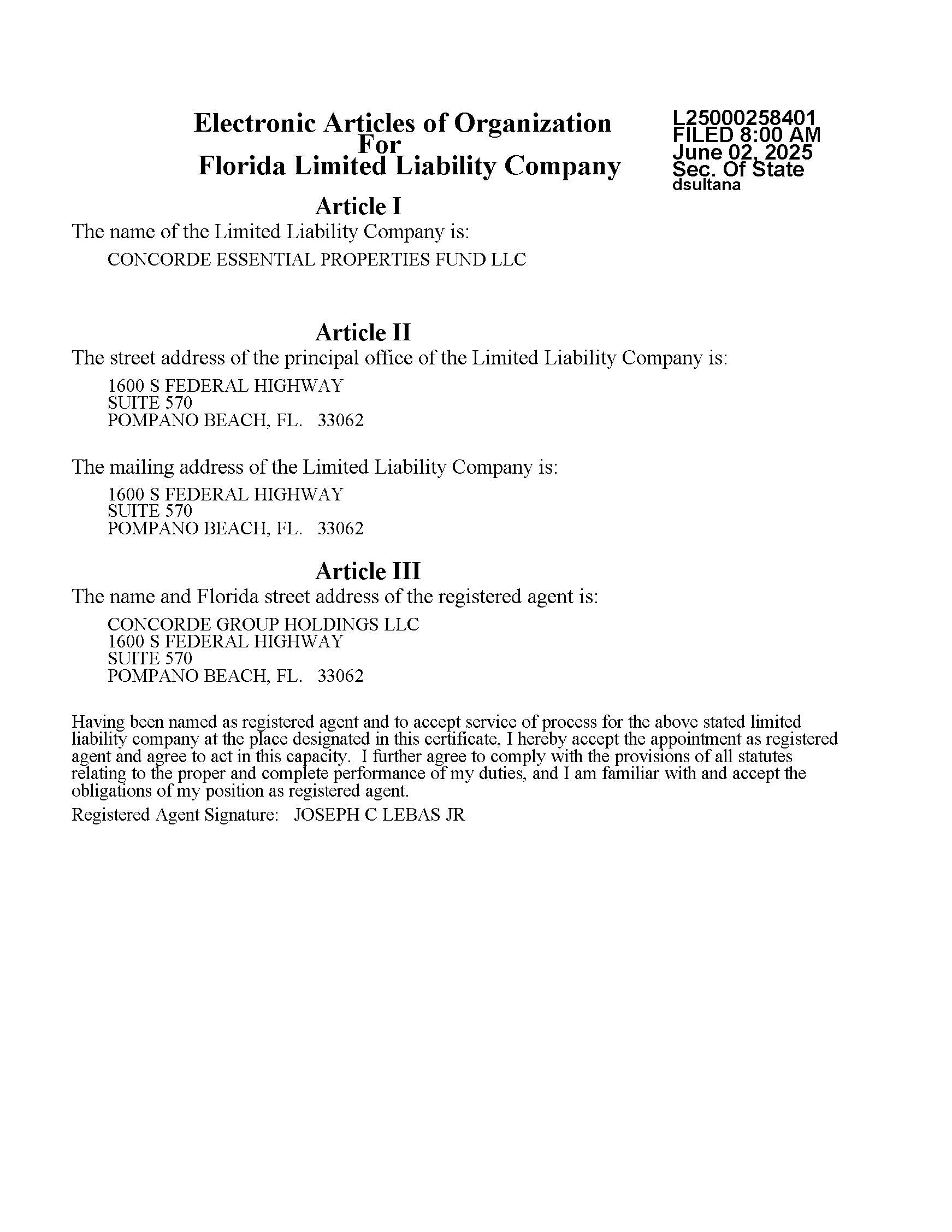
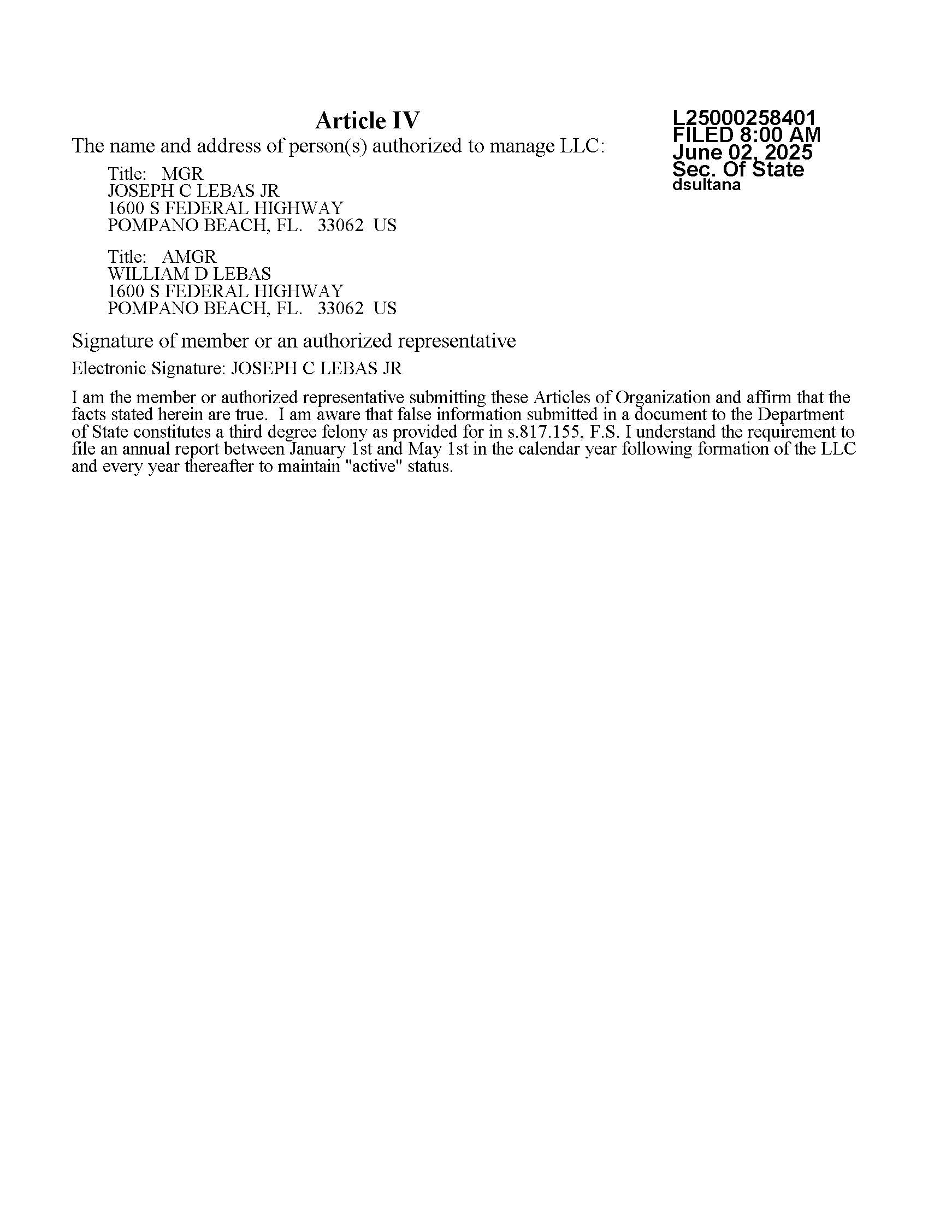
Concorde Essential Properties Fund, LLC (the “Company” or “Issuer”) is a Florida limited liability company formed on June 2, 2025 (see Exhibit 2, Articles of Organization). The purpose of the Company is to invest primarily in grocery-anchored shopping centers (“Shopping Centers”) in high-growth Sunbelt regions such as Texas, Florida, Georgia, and the Carolinas.
The Company is offering by means of this offering circular (the “Offering Circular”), equity in the form of Class B LLC Membership Interests denominated as Class B Units (the “Units,” or in the singular, a “Unit”) on a best-efforts basis to those who meet the investor suitability standards (the “Investor(s)”) as set forth herein. See “Investor Suitability Standards” below.
The minimum investment amount per Class B Investor is ten thousand dollars ($10,000.00), in exchange for one hundred (100.0) Class B Units. The Company does not intend to list the Class B Units for trading on any exchange or other trading market, no market for the Company Units may exist in the future and any transfer of the Class B Units requires the prior written authorization of the Manager based upon the discretion of the Manager. See “Securities Being Offered” below.
The Company is managed by a manager, Concorde Group Holdings, LLC, a Florida limited liability company (the “Manager”). The Company intends to use the proceeds of this Offering (the “Proceeds”) to fund Company investments in opportunities sourced by the Manager.
Sales of the Class B Units pursuant to this Regulation A Tier 2 Offering (the “Offering”) will commence immediately upon qualification by the Securities and Exchange Commission (the “Effective Date”) and will terminate on the earliest of: (a) the date the Company, in its sole discretion, elects to terminate, (b) the date upon which all Units have been sold, or (c) exactly twelve (12) months after the Effective Date (the “Offering Period”).
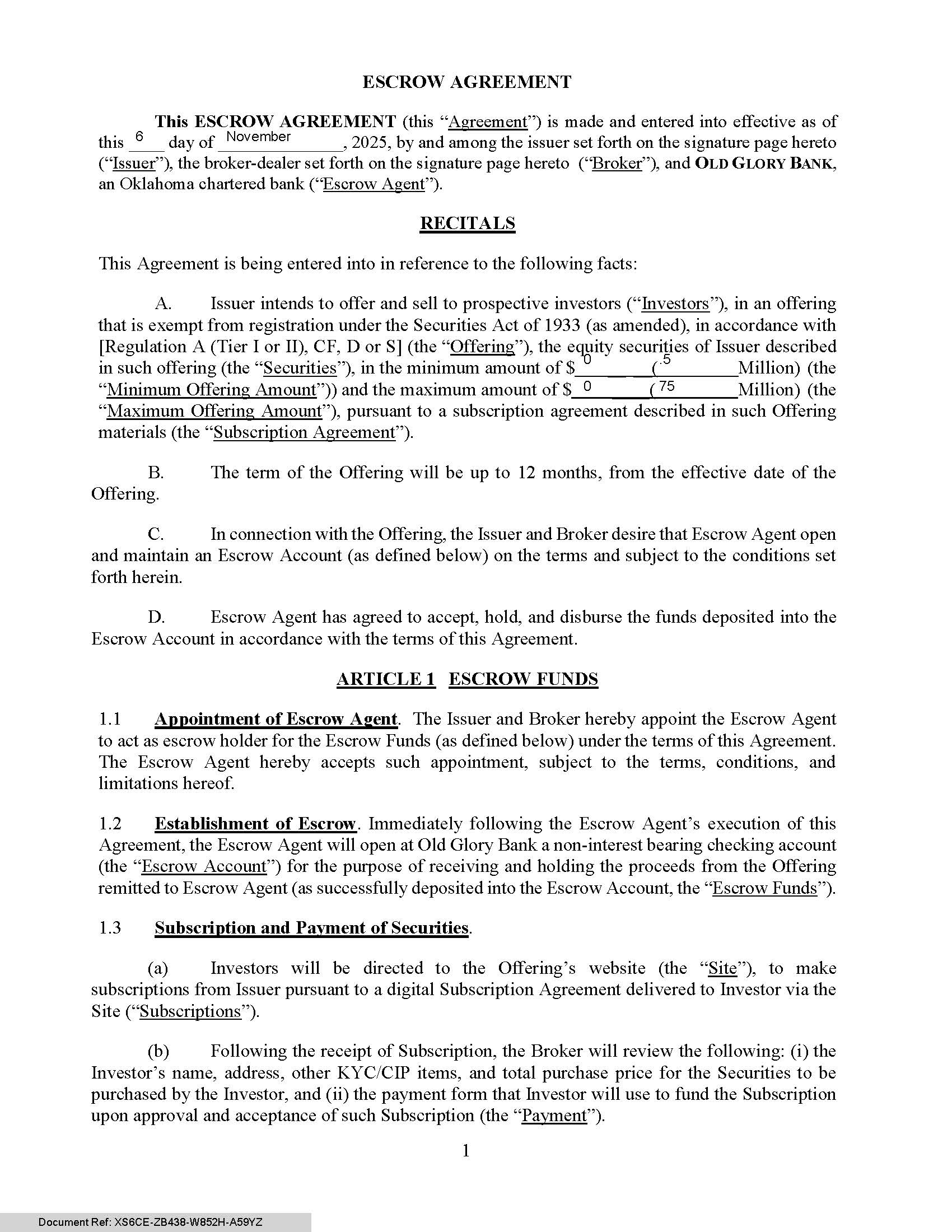
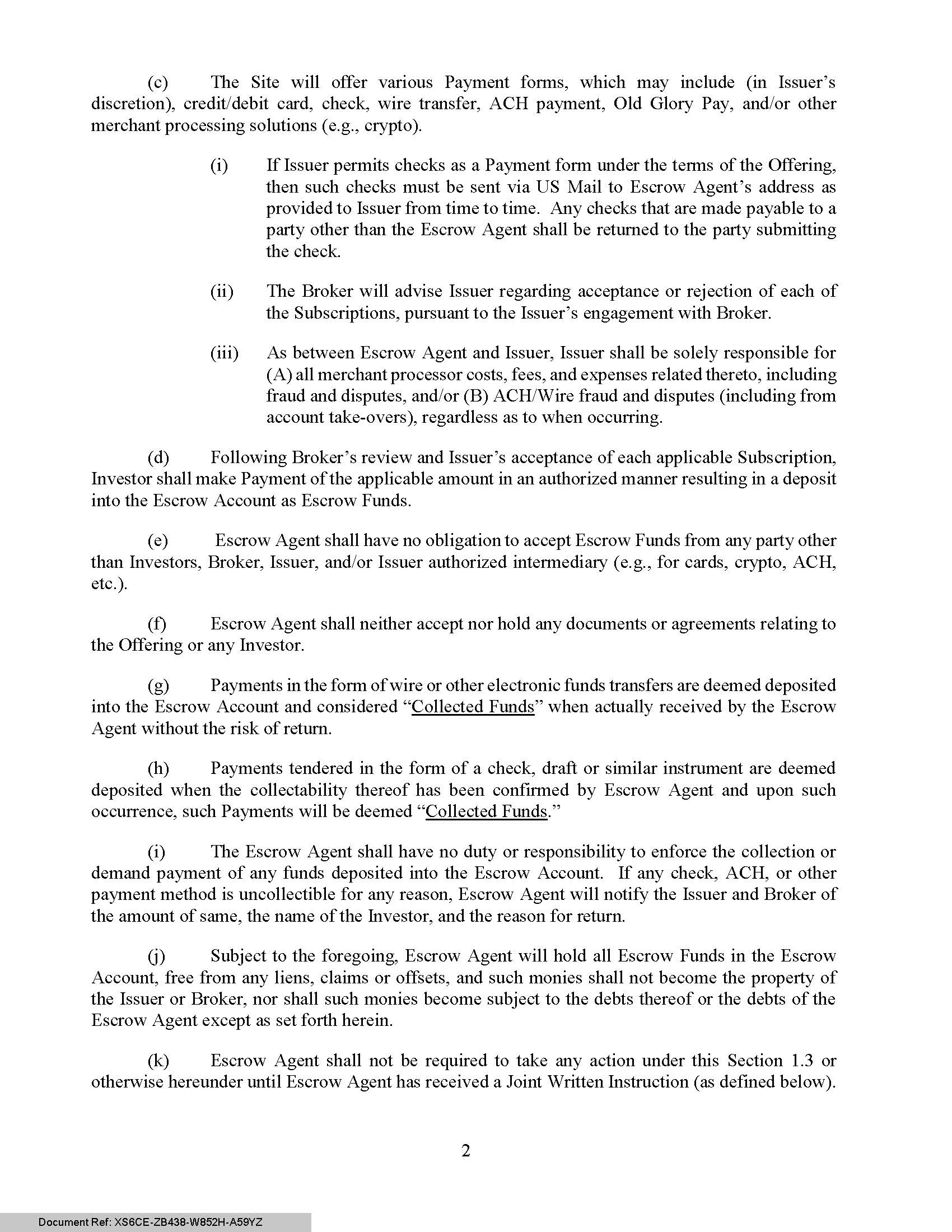
The Company will offer Class B Units via the website https://invest.cep-fund.com/ (the “Platform”) on a continuous and ongoing basis. Mundial Financial Group LLC (“Mundial”), a FINRA broker-dealer, will act as the administrative broker-dealer for this Offering. Proceeds from this Offering will be held in escrow until the Minimum Offering Amount of five-hundred thousand dollars ($500,000) is met. The escrow account is administered by Old Glory Bank (“Old Glory”). As of the date of this Offering Circular, the Company has engaged KoreConX as the transfer agent for this Offering. See “Plan of Distribution” below.
Persons who purchase Class B Units will be members of the Company subject to the terms of the Operating Agreement of the Company (“Members” or in the singular a “Member”) and will hereinafter be referred to as “Investors” or in the singular an “Investor.” The Company intends to use the proceeds of this Offering (“Proceeds”) to commence operations and execution of the Company’s business plan. The acceptance of Investor funds may be briefly paused at times to allow the Company to effectively and accurately process and settle subscriptions that have been received. There are no selling securityholders in this Offering.
Prior to this Offering, there has been no public market for the Class B Units, and none is expected to develop. The Offering price for a Class B Unit is arbitrary and does not bear any relationship to the value of the assets of the Company. The Company does not currently have plans to list any Company Units on any securities market. The Manager and Affiliates will receive compensation and income from the Company and these transactions may involve certain conflicts of interest. See “Risk Factors,” “Compensation of Officers and the Manager” and “Conflicts of Interest” below. Investing in the Units is speculative and involves substantial risks, including risk of complete loss. Prospective Investors should purchase these securities only if they can afford a complete loss of their investment. See “Risk Factors” below. There are material income tax risks associated with investing in the Company that prospective investors should consider. See “Federal Tax Treatment” below.
RULE 251(D)(3)(I)(F) DISCLOSURE. RULE 251(D)(3)(I)(F) PERMITS REGULATION A OFFERINGS TO CONDUCT ONGOING CONTINUOUS OFFERINGS OF SECURITIES FOR MORE THAN THIRTY (30) DAYS AFTER THE QUALIFICATION DATE IF: (1) THE OFFERING WILL COMMENCE WITHIN TWO (2) DAYS AFTER THE QUALIFICATION DATE; (2) THE OFFERING WILL BE MADE ON A CONTINUOUS AND ONGOING BASIS FOR A PERIOD THAT MAY BE IN EXCESS OF THIRTY (30) DAYS OF THE INITIAL QUALIFICATION DATE; (3) THE OFFERING WILL BE IN AN AMOUNT THAT, AT THE TIME THE OFFERING CIRCULAR IS QUALIFIED, IS REASONABLY EXPECTED TO BE OFFERED AND SOLD WITHIN ONE (1) YEAR FROM THE INITIAL QUALIFICATION DATE; AND (4) THE SECURITIES MAY BE OFFERED AND SOLD ONLY IF NOT MORE THAN THREE (3) YEARS HAVE ELAPSED SINCE THE INITIAL QUALIFICATION DATE OF THE OFFERING, UNLESS A NEW OFFERING CIRCULAR IS SUBMITTED AND FILED BY THE COMPANY PURSUANT TO RULE 251(D)(3)(I)(F) WITH THE SEC COVERING THE REMAINING SECURITIES OFFERED UNDER THE PREVIOUS OFFERING; THEN THE SECURITIES MAY CONTINUE TO BE OFFERED AND SOLD UNTIL THE EARLIER OF THE QUALIFICATION DATE OF THE NEW OFFERING CIRCULAR OR ONE HUNDRED EIGHTY (180) CALENDAR DAYS AFTER THE THIRD ANNIVERSARY OF THE INITIAL QUALIFICATION DATE OF THE PRIOR OFFERING CIRCULAR. THE COMPANY INTENDS TO OFFER THE SHARES DESCRIBED HEREIN ON A CONTINUOUS AND ONGOING BASIS PURSUANT TO RULE 251(D)(3)(I)(F). THE COMPANY INTENDS TO COMMENCE THE OFFERING IMMEDIATELY AND NO LATER THAN TWO (2) DAYS FROM THE INITIAL QUALIFICATION DATE. THE COMPANY REASONABLY EXPECTS TO OFFER AND SELL THE SECURITIES STATED IN THIS OFFERING CIRCULAR WITHIN ONE (1) YEAR FROM THE INITIAL QUALIFICATION DATE.
The Company will commence sales of the Class B Units immediately upon qualification of the Offering by the SEC.
| 3 |
OFFERING PROCEEDS TABLE
| Price to Public* | Underwriting Discounts and Commissions** | Proceeds to the Company*** | Proceeds to other Persons**** | |
| Amount to be Raised per Unit | $100.00 | $2.00 | $98.00 | N/A |
| Minimum Investment Amount Per Investor | $10,000.00 | $200.00 | $9,800.00 | N/A |
|
Minimum Offering Amount |
$500,000.00 | $10,000.00 | $490,000.00 | N/A |
| Maximum Offering Amount | $75,000,000.00 | $1,500,000.00 | $73,500,000.00 | N/A |
*The Offering price of a Class B Unit to Investors was arbitrarily determined by the Manager.
** The Company is not using an underwriter for the sale of the Units. The commissions listed are those for Mundial Financial Group LLC (“Mundial”), a FINRA broker-dealer, acting as an administrative broker-dealer for this Offering on a best-efforts basis. Mundial will receive a two percent (2.0%) commission on the sales of the Units. A pass-through corporate filing fee of $11,750.00 will be charged to the Company and paid by Mundial to FINRA, which will be due and payable prior to any submission by Mundial to FINRA. This FINRA fee is equal to 0.00015 of total offering amount + $500.
*** Units will be offered and sold directly by the Company, the Manager and the Manager’s respective members, Officers and employees. No commissions for selling Units will be paid to the Company the Manager or the Manager’s respective members, Officers or employees.
**** There are no selling securityholders in this Offering.
| 4 |
TABLE OF CONTENTS
| Page | |
| SUMMARY OF THE OFFERING | 6 |
| FORWARD LOOKING STATEMENTS | 7 |
| INVESTOR SUITABILITY STANDARDS | 7 |
| RISK FACTORS | 8 |
| DILUTION | 18 |
| PLAN OF DISTRIBUTION | 18 |
| SELLING SECURITYHOLDERS | 19 |
| USE OF PROCEEDS | 20 |
| DESCRIPTION OF THE BUSINESS | 21 |
| AFFILIATES | 23 |
| CONFLICTS OF INTEREST | 23 |
| FIDUCIARY RESPONSIBILITY OF THE MANAGER | 23 |
| DESCRIPTION OF PROPERTY | 24 |
| MANAGEMENT'S DISCUSSION AND ANALYSIS OF FINANCIAL CONDITION AND RESULTS OF OPERATIONS | 24 |
| BAD ACTOR DISCLOSURE | 24 |
| BANKRUPTCY AND LEGAL PROCEEDINGS | 24 |
| OFFICERS AND SIGNIFICANT EMPLOYEES OF MANAGER | 24 |
| COMPENSATION OF THE MANAGER AND AFFILIATES | 25 |
| SECURITY OWNERSHIP OF MANAGEMENT AND CERTAIN SECURITYHOLDERS | 25 |
| INTEREST OF MANAGEMENT AND OTHERS IN CERTAIN TRANSACTIONS | 26 |
| FEDERAL TAX TREATMENT | 26 |
| ERISA CONSIDERATIONS | 28 |
| SECURITIES BEING OFFERED | 29 |
| Part F/S | 31 |
| EXHIBIT INDEX | 38 |
| SIGNATURE PAGE | 39 |
| 5 |
SUMMARY OF THE OFFERING
The following information is only a brief summary of, and is qualified in its entirety by, the detailed information appearing elsewhere in this Offering. This Offering Circular, together with the exhibits attached including, but not limited to, the Company’s Operating Agreement, a copy of which is attached hereto as Exhibit 3 and should be carefully read in its entirety before any investment decision is made. If there is a conflict between the terms contained in this Offering Circular and the Operating Agreement, the Operating Agreement shall prevail and control, and no Investor should rely on any reference herein to the Operating Agreement without consulting the actual underlying document.
| COMPANY INFORMATION AND BUSINESS | Concorde Essential Properties Fund, LLC is a Florida limited liability company with a principal place of business located at 1600 S. Federal Highway, Suite #570, Pompano Beach, FL 33062 USA. Through this Offering, the Company is offering equity in the Company in the form of Class B Units on a “best-efforts” and ongoing basis to qualified Investors who meet the Investor suitability standards as set forth herein See “Investor Suitability Standards.” As further described in the Offering Circular, the Company has been organized to invest primarily in grocery-anchored shopping centers in high-growth Sunbelt regions such as Texas, Florida, Georgia, and the Carolinas. |
| MANAGEMENT | The Company is a manager-managed limited liability company. The Manager is an Affiliate, Concorde Group Holdings, LLC, a Florida limited liability company. All investment and operating decisions as well as the day-to-day management of all Company activity is vested solely in the Manager. |
| THE OFFERING | This Offering is the first capital raise by the Company in its history. The Company is exclusively selling equity in the form of LLC membership interests, denominated as Class B Units. The Company will use the Proceeds of this Offering to begin operations and execution of the Company business plan. |
| SECURITIES BEING OFFERED |
The Units are being offered at a purchase price of one hundred dollars and zero cents ($100.00) per Class B Unit. The Minimum Investment is ten thousand dollars ($10,000.00) for one hundred (100.0) Class B Units per Investor.
Class B Members (along with Class A Members) will receive a preferred return of either 5.0%, 5.5%, or 6.0% per annum on unreturned invested capital, corresponding to lock-up periods of 12 months, 24 months, and 36 months, respectively, during which their invested capital cannot be redeemed. After the preferred return has been paid, Class B Members (along with Class A Members) will receive 75%, pro rata, of any remaining distributable cash for the life of the Company or the duration of their investment. Upon purchase of the Class B Units, a Member is granted certain rights detailed in the “Securities Being Offered” section below. The Units are non-transferrable without the prior written consent of Manager except in limited circumstances, and no market is expected to form with respect to the Units. |
| COMPENSATION TO MEMBERS/MANAGER |
Neither the Manager nor the Members of the Company will be compensated through commissions for the sale of the Class B Units through this Offering.
The Manager will be compensated by the Company through a Fund Management Fee, Acquisition Fee, Disposition Fee, and Financing Fee (if applicable). See “Compensation of the Manager and Affiliates” below for a more comprehensive description of these fees. |
| PRIOR EXPERIENCE OF COMPANY MANAGEMENT | The Manager, Concorde Group Holdings, LLC, was formed in 2015. The members of the Manager and its executive team are experienced real estate professionals and, through positions with current and prior companies, have successfully engaged in related real estate development and management activities in excess of ten (10) years. See also “Officers and Significant Employees” below. |
| INVESTOR SUITABILITY STANDARDS |
The Class B Units will not be sold to any person or entity unless such person or entity is a “Qualified Purchaser.” A Qualified Purchaser includes: (1) an “Accredited Investor” as that term is defined in Rule 501(a) of Regulation D promulgated under the Securities Act of 1933 (the “Securities Act”); or (2) all other Investors who meet the investment limitations set forth in Rule 251(d)(2)(i)(C) of Regulation A. Such persons as stated in (2) above must conform with the “Limitations on Investment Amount” section as described immediately below. Each person purchasing Units will be subject to the terms of the Operating Agreement, a copy of which is provided in Exhibit 3. Each person or entity acquiring Class B Units may be required to represent that he, she, or the entity is purchasing the Units for his, her, or the entity’s own account for investment purposes and not with a view to resell or distribute these securities.
Each prospective Purchaser of Class B Units may be required to furnish such information or certification as the Company may require in order to determine whether any person or entity purchasing Units is an Accredited Investor, if such is claimed by the Investor. |
| LIMITATIONS ON INVESTMENT AMOUNT |
For Qualified Purchasers who are Accredited Investors, there is no limitation as to the amount invested in the Company through the purchase of Class B Units. For non-Accredited Investors, the aggregate purchase price paid to the Company for the purchase of the Units cannot be more than ten percent (10%) of the greater of the purchaser’s (1) annual income or net worth, if purchaser is a natural person; or (2) revenue or net assets for the Purchaser’s most recently completed fiscal year if purchaser is a non-natural person. Different rules apply to Accredited Investors and non-natural persons. Each Investor should review to review Rule 251(d)(2)(i)(C) of Regulation A before purchasing the Units. |
| COMMISSIONS FOR SELLING UNITS |
The Class B Units will be offered and sold directly by the Company, the Manager, and the Members, Directors, Officers and employees of the Manager. No commissions will be paid to the Company, Manager, the Members, Directors, Officers or employees of the Manager for selling the Units. Mundial Financial Group, LLC (“Mundial”) is the administrative broker dealer for this Offering. Mundial will receive a two percent (2%) commission on the sales of the Units. |
| NO LIQUIDITY | There is no public market for the Class B Units, and none is expected to develop. Additionally, the Class B Units will be non-transferable, except as may be permitted in the Operating Agreement or required by law, and will not be listed for trading on any exchange or automated quotation system. See “Risk Factors” and “Securities Being Offered” below. The Company will not facilitate or otherwise participate in the secondary transfer of any Units. Prospective Investors are urged to consult their own legal advisors with respect to secondary trading or transfer of the Units. See “Risk Factors” below. |
|
CONFLICTS OF INTEREST
|
Owners of the Manager of the Company are also owners and managers of a development firm that will be managing development and overseeing construction work on the Company’s assets. Owners of the Manager of the Company are also owners of a property management company that may manage property operations on behalf of the Company. See “Affiliates” and “Conflicts of Interest” below.
|
| COMPANY EXPENSES |
Except as otherwise provided herein, the Company shall bear all costs and expenses associated with the costs associated with the Offering and the operation of the Company, including, but not limited to, the annual tax preparation of the Company’s tax returns, any state and federal income tax due, accounting fees, filing fees, independent audit reports, costs and expenses associated with the acquisition, holding, development, leasing, and management of real estate property and costs and expenses associated with the disposition of real estate property.
|
FORWARD LOOKING STATEMENTS
Investors should not rely on forward-looking statements because they are inherently uncertain. Investors should not rely on forward-looking statements in this Offering Circular. This Offering Circular contains forward-looking statements that involve risks and uncertainties. The use of words such as “anticipated,” “projected,” “forecasted,” “estimated,” “prospective,” “believes,” “expects,” “plans,” “future,” “intends,” “should,” “can,” “could,” “might,” “potential,” “continue,” “may,” “will,” and similar expressions identify these forward-looking statements. Investors should not place undue reliance on these forward-looking statements, which may apply only as of the date of this Offering Circular.
INVESTOR SUITABILITY STANDARDS
All persons who purchase the Class B Units of the Company pursuant to the Subscription Agreement, attached hereto as Exhibit 4, must comply with the Investor Suitability Standards as provided below. It is the responsibility of the purchaser of the Class B Units to verify compliance with the Investor Suitability Standards. The Company may request that Investor verify compliance, but the Company is under no obligation to do so. By purchasing Class B Units pursuant to this Offering, the Investor self-certifies compliance with the Investor Suitability Standards. If, after the Company receives Investor’s funds and transfers ownership of the Class B Units, the Company discovers that the Investor does not comply with the Investor Suitability Standards as provided, the transfer will be deemed null and void ab initio and the Company will return Investor’s funds to the purported purchaser. The amounts returned to the purported purchaser will be equal to the purchase price paid for the Class B Units less any costs incurred by the Company in the initial execution of the null purchase and any costs incurred by the Company in returning the Investor’s funds. These costs may include any transfer fees, sales fees/commissions, or other fees paid to transfer agents or brokers.
The Company’s Class B Units are being offered and sold only to “Qualified Purchasers” as defined in Regulation A.
Qualified Purchasers include:
(i) “Accredited Investors” defined under Rule 501(a) of Regulation D (as explained below); and
(ii) All other Investors so long as their investment in the Company’s Interests does not represent more than ten percent (10%) of the greater of the Investor’s, alone or together with a spouse or spousal equivalent, annual income or net worth (for natural persons), or ten percent (10%) of the greater of annual revenue or net assets at fiscal year-end (for non-natural persons).
The Interests are offered hereby and sold to Investors that meet one of the two categories above, to qualify as an Accredited Investor, for purposes of satisfying one of the tests in the Qualified Purchaser definition, an Investor must meet one of the following conditions:
1) An Accredited Investor, in the context of a natural person, includes anyone who:
(i) Earned income that exceeded $200,000 (or $300,000 together with a spouse or spousal equivalent) in each of the prior two years, and reasonably expects the same for the current year, or
(ii) Has a net worth over $1,000,000, either alone, or together with a spouse or spousal equivalent (excluding the value of the person’s primary residence), or
(iii) Holds in good standing a Series 7, 65, or 82 license.
2) Additional Accredited Investor categories include:
(i) Any bank as defined in Section 3(a)(2) of the Act, or any savings and loan association or other institution as defined in Section 3(a)(5)(A) of the Securities Act, whether acting in its individual or fiduciary capacity; any broker or dealer registered pursuant to Section 15 of the Securities and Exchange Act of 1934 (the “Exchange Act”); any investment advisor registered pursuant to Section 203 of the Investment Advisers Act of 1940 (the “Investment Advisors Act”) or registered pursuant to the laws of a state; any investment adviser relying on the exemption from registering with the Commission under Section 203(l) or (m) under the Investors Advisers Act; any insurance company as defined in Section 2(a)(13) of the Securities Act; any investment company registered under the Investment Fund Act of 1940 or a business development company as defined in Section 2(a)(48) of that Act; any Small Business Investment Company (SBIC) licensed by the U.S. Small Business Administration under Section 301(c) or (d) of the Small Business Investment Act of 1958; any Rural Business Investment Company as defined in Section 384A of the Consolidated Farm and Rural Development Act; any plan established and maintained by a State, its political subdivisions, or any agency or instrumentality of a state or its political subdivisions, for the benefit of its employees, if such plan has total assets in excess of $5,000,000; any employee benefit plan within the meaning of the Employee Retirement Income Security Act of 1974 if the investment decision is made by a plan fiduciary, as defined in Section 3(21) of such Act, which is either a bank, savings and loan association, insurance company, or registered investment adviser, or if the employee benefit plan has total assets in excess of $5,000,000 or, if a self-directed plan, with investment decisions made solely by persons who are Accredited Investors;
(ii) Any private business development company as defined in Section 202(a)(22) of the Investment Advisors Act of 1940;
(iii) Any organization described in Section 501(c)(3) of the Internal Revenue Code of 1986, as amended (the “Code”), corporation, Massachusetts or similar business trust, or partnership, or limited liability company, not formed for the specific purpose of acquiring the securities offered, with total assets in excess of $5,000,000;
(iv) Any director or executive officer, or general partner of the issuer of the securities being offered or sold, or any director, executive officer, or general partner of a general partner of that issuer;
(v) Any trust, with total assets in excess of $5,000,000, not formed for the specific purpose of acquiring the securities offered, whose purchase is directed by a sophisticated person as described in Section 506(b)(2)(ii) of the Securities Act;
(vi) Any entity in which all of the equity owners are Accredited Investors as defined above;
(vii) Any natural person who is a “knowledgeable employee,” as defined in Rule 3c-5(a)(4) under the Investment Company Act (17 CFR 270.3c-5(a)(4)), of the issuer of the securities being offered or sold where the issuer would be an investment company, as defined in Section 3 of such Act, but for the exclusion provided by either Section 3(c)(1) or Section 3(c)(7) of such Act;
(viii) Any “family office,” as defined in Rule 202(a)(11)(G)-1 under the Investment Advisers Act (17 CFR 275.202(a)(11)(G)-1):
| (i) | With assets under management in excess of $5,000,000; |
| (ii) | That is not formed for the specific purpose of acquiring the securities offered; and |
| (iii) | Whose prospective investment is directed by a person who has such knowledge and experience in financial and business matters that such family office is capable of evaluating the merits and risks of the prospective investment. |
(ix) Any “family client,” as defined in Rule 202(a)(11)(G)-1 under the Investment Advisers Act (17 CFR 275.202(a)(11)(G)-1)), of a family office meeting the requirements defined in the immediately preceding criterion and whose prospective investment in the issuer is directed by such family office pursuant to the “family office” sub-criterion (c) above; and,
(x) Any entity, of a type not listed in criteria (i), (ii), (iii), (v) or (vi) above, not formed for the specific purpose of acquiring the securities offered, owning investments in excess of $5,000,000 where “investments” for the purposes of this criterion is defined in Rule 2a51-1(b) under the Investment Company Act (17 CFR 270.2a51-1(b)).
Each prospective purchaser of Class B Units may be required to furnish such information as the Company may demand to determine whether any person or entity purchasing Class B Units is an Accredited Investor.
RISK FACTORS
The Company commenced preliminary business development operations on June 2, 2025, and is organized as a limited liability company under the laws of the State of Florida. Accordingly, the Company has only a limited history upon which an evaluation of its prospects and future performance can be made. The Company’s proposed operations are subject to all business risks associated with new enterprises. The likelihood of the Company’s success must be considered in light of the problems, expenses, difficulties, complications, and delays frequently encountered in connection with the acquisition and operations of income-producing shopping center assets, in a competitive industry. There is a possibility that the Company could sustain losses in the future.
There can be no assurances that the Company will operate profitably. An investment in the Class B Units involves a number of risks. Investors should carefully consider the following risks and other information in this Offering Circular before purchasing Units. Without limiting the generality of the foregoing, Investors should consider, among other things, the following risk factors:
Asset-Specific and Operational Risks
Each Shopping Center investment comes with several property-level risks. The Company’s value-add strategy assumes the Company can lease vacant spaces and renew leases at higher rents. There is a risk that tenants may not be found on acceptable terms or that existing tenants could default or vacate. Anchor tenant closures (e.g., a grocery store bankruptcy) could significantly impact foot traffic and co-tenant occupancy. If occupancy or rental rates fall short of projections, net operating income, directly reducing investor returns. The cash flow from the Company’s portfolio depends on tenants meeting their lease obligations. Financially weak tenants or those in industries facing headwinds (e.g. certain retailers threatened by e-commerce) may default or seek rent relief. Even “essential” tenants like grocers can face competition. Rent collection issues or tenant bankruptcies would also impair the Company’s income. Additionally, the Company may incur costs re-leasing space related to downtime and tenant improvement allowances.
The Company’s properties will also compete with other shopping centers and retail formats (including new developments or renovated centers in the same trade area) for both tenants and shoppers. Competing landlords might offer aggressive lease concessions to attract tenants. Additionally, consumer shifts towards online shopping or alternative retail (like open-air markets) could reduce demand for the Company’s brick-and-mortar spaces over time, even though grocery-anchored centers have been resilient to e-commerce trends so far.
The Company’s strategy relies on successful execution of renovations and leasing programs. There is risk in development and construction activities, where projects could encounter cost overruns, contractor delays, permitting issues, or fail to yield the desired increase in rents/property value. If capital improvements run over budget or do not generate commensurate rent uplift, investment returns will suffer. The Manager’s ability to execute the business plan for each asset is critical; any mismanagement or operational inefficiency could adversely affect performance.
While the Company will diversify across several states, it is focused on the Southern U.S. region, which could expose investors to localized risks, such as economic downturns, employer closures or industry slumps affecting one metro area, or region-specific events (hurricanes, natural disasters common in the Southeast, or regulatory changes) that might not impact other markets. If a large portion of the portfolio is in one state (say, Texas or Florida), and that state experiences an economic or property market downturn, the Company could be disproportionately hurt. Likewise, the Company’s focus on one property type (retail shopping centers) means lack of diversification across asset classes. Adverse developments in the retail sector as a whole (e.g., a new wave of e-commerce disruption, changes in consumer behavior, oversupply of retail space) would impact all Company assets. The Company is not hedging this sector-specific risk by investing in other property types.
No Guaranteed Distributions or Return of Capital
All distributions from the Company (including the Preferred Return) are contingent on performance and available cash. There is no guarantee as to timing or amount of distributions. Investors could potentially receive little or no cash flow if properties underperform. Moreover, principal is at risk – this is not a bond or debt; investors can lose some or all of their invested capital. There is no insurance or government backing on this investment. In a worst-case scenario, if the portfolio’s value fell dramatically (e.g., due to market crash) and Shopping Centers had to be liquidated at losses, Investors could suffer significant losses and not recoup their full capital. Furthermore, the Company’s ability to pay the quarterly Preferred Return is not guaranteed; it depends on sufficient cash flow. In early years or during value-add periods, cash flows may be lower than expected, and while unpaid Preferred Returns will accrue, there is risk that prolonged shortfalls erode Investor returns. Additionally, because the Preferred Return rates (5–6%) are relatively low, Investors are relying on the Manager to generate extra returns via the profit split. If the Manager only achieves modest improvements and no excess cash beyond the Preferred Returns, Investors’ total returns would be limited to that 5–6% yield, which may be below the target and possibly below inflation or alternative investments.
Inadequacy Of Funds
Gross Offering Proceeds up to seventy-five million dollars ($75,000,000.00) may be realized. Company’s Manager believes that such Proceeds will capitalize and sustain the Company sufficiently to allow for the implementation of its business plan for the acquisition, development, operation and management of real property assets. If only a fraction of this Offering is sold, or if certain assumptions contained in Company Manager’s business plans prove to be incorrect, Company may have inadequate funds to fully develop its business in accordance with its business model and may need debt financing or other capital investment to fully implement its business plans. Furthermore, if the funds raised through this Offering are inadequate, the percentage ownership of an Investor may be reduced in the future if the Company is required to raise additional capital through the issuance of additional units with rights and preferences as determined in the sole discretion of the Company.
Dependence On Manager
In the early stages of development, the Company’s business will be significantly dependent on the experience, knowledge, skills and abilities of Company’s Manager and the Manager’s Members, Officers and employees. The loss of the Manager or any of Manager’s Members, Officers or employees could have a material adverse effect on the Company.
Limited Operating History Which Makes Future Performance Difficult to Predict
The Company has limited operating history. You should consider an investment in Class B Units of this Offering in light of the risks, uncertainties and difficulties frequently encountered by other newly formed companies with similar objectives. The Company will have minimal operating capital and for the foreseeable future will be dependent upon our ability to finance our operations from the sale of equity or other financing alternatives. The failure to successfully raise operating capital, could result in Company bankruptcy or other event which would have a material adverse effect on the Company and its Investors. There can be no assurance that Company will achieve its investment or operating objectives. The Company is newly organized and has no operating history or realized track record as an entity (though the Manager’s principals have prior experience in similar investments). Investors must rely on the Manager’s skill and cannot review past fund performance for assurance.
Investors Should Seek Their Own Independent Counsel
Investors in the Company have not been represented by independent counsel with respect to this Offering. Attorneys assisting in the formation of the Company and the preparation of this Offering Circular have represented only the Company and its principals and Affiliates. The terms of our Operating Agreement, including the Manager’s rights and obligations and the compensation payable to our Manager and its Affiliates, were not negotiated at arm’s length. Potential investors are advised to seek the opinions of independent legal and tax counsel prior to investing in the Company. (See also “Conflicts of Interest” below.)
Company is Not Subject to Sarbanes-Oxley Regulations and May Lack the Financial Controls and Procedures of Public Companies
The Company may not have the internal control infrastructure that would meet the standards of a public company, including the requirements of the Sarbanes-Oxley Act of 2002. As a privately-held (non-public) Company, the Company is currently not subject to the Sarbanes-Oxley Act of 2002, and its financial and disclosure controls and procedures reflect its status as a development stage, non-public company. There can be no guarantee that there are no significant deficiencies or material weaknesses in the quality of the Company’s financial and disclosure controls and procedures. If it were necessary to implement such financial and disclosure controls and procedures, the cost to the Company of such compliance could be substantial and could have a material adverse effect on the Company’s results of operations and financial conditions.
Sensitivity to General Economic Conditions
The performance of the Company is subject to general economic conditions and real estate market fluctuations, and the Company has no control over these conditions and changes. Adverse economic events such as a recession, rising interest rates, inflation, or a downturn in consumer spending, could reduce tenant demand for retail space, increase vacancy, and depress property values. For example, if the currently strong Sunbelt migration trends reverse or retail sales decline, the Company’s target markets may underperform expectations. Real estate is cyclical, and no assurance can be given that favorable market conditions (e.g. low vacancies, rent growth) will continue over the Company’s investment horizon.
Possible Fluctuations in Company Operating Results
The Company’s operating results may fluctuate significantly from period to period as a result of a variety of factors, including many factors that are not in the control of the Company. Some factors that may contribute to operating result fluctuations include, but are not limited to: debt service requirements; debt principal-reduction payments, real estate market variances in sales prices, capitalization rates, and future rental rates; market rates may negatively affect property values; credit risks that property tenants may default on payments; elevated vacancy rates; potential liabilities associated with accidents that could happen on the premises of any Company-related property; inability to obtain favorable financing; market illiquidity for Company assets; and general economic conditions. Consequently, Company revenues and expenses may vary by fiscal quarter, and the Company’s operating results may experience fluctuations.
Risks Of Borrowing and Indebtedness
Leverage amplifies both gains and losses. If property values or incomes decline, high leverage can quickly erode equity. The Company anticipates using debt financing in the execution of its business plan, with a target of approximately sixty percent (60%) loan-to-value (“LTV”) on acquisitions of Shopping Centers, and potentially higher on refinancing transactions. Therefore a portion of its cash flow will have to be dedicated to the payment of principal and interest on such indebtedness.
There is no guarantee that Company will be able to refinance outstanding indebtedness or refinance the indebtedness at terms that are advantageous or acceptable to Company. Typical loan agreements also might contain restrictive covenants which may impair the Company’s operating flexibility. Such loan agreements would also provide for default under certain circumstances, such as failure to meet certain financial covenants, such as if the net operating income (“NOI”) falls and debt service coverage is not maintained. A default under a loan agreement could result in the loan becoming immediately due and payable and, if unpaid, a judgment in favor of such lender which would be senior to the rights of owners of the Company. A judgment creditor would have the right to foreclose on any of Company’s assets resulting in a material adverse effect on its business, which in turn would result in a material adverse effect on the Company’s operating results and financial condition.
Rising interest rates pose a risk as well. Although acquisitions may use fixed-rate loans initially, any floating-rate debt or future refinancing could face higher interest costs, squeezing cash flow. If credit markets tighten, the Company might struggle to refinance or secure new debt, which could force asset sales at unfavorable times. Furthermore, property loans typically require lump-sum repayment at maturity; there’s a refinance risk if market conditions are poor or lender underwriting standards change at that time.
Changes to Execution of The Business Plan Possible
The Company Manager’s business plan will focus on the grocery-anchored retail centers and that focus may change. The Company’s primary business endeavor of investing in the purchase, development, and operation of Shopping Centers is capital intensive and may be subject to statutory or regulatory requirements as well as variable market conditions. Company’s Manager believes that the Company’s chosen activities and strategies are achievable in light of current economic and legal conditions with the background, experience, knowledge, skills, and abilities of the Company’s Manager, Manager’s Members, Officers, employees and advisors. Company’s Manager reserves the right to make significant modifications to the Company’s stated investment strategies and business operations depending on future events.
Management Discretion as To Use of Proceeds
The net proceeds from this Offering will be used for the purposes described under the “Use of Proceeds” section. The Company and Company’s Manager reserves the right to use the funds obtained from this Offering for other similar purposes not presently contemplated which it deems to be in the best interests of the Company and its Members in order to address changed circumstances or opportunities. As a result of the foregoing, the success of the Company will be substantially dependent upon the discretion and judgment of the Manager with respect to application and allocation of the net proceeds of this Offering. Investors in the Units offered hereby will be entrusting their funds to the Company’s Manager, upon whose judgment and discretion the Investors must depend.
Control By Management and Exclusive to Manager
The Company’s Manager and the Members, Officers and employees of Manager possess exclusive control on investment decisions, operations, management and the day-to-day activities of the Company. Investors in this Offering will have no control or input in determining the investment strategies implemented by Manager, the operations or day-to-day activities of the Company. The Manager may change investment strategies or operations from time-to-time at the sole discretion of the Manager without input of Investors and no assurances can be given that such a change in investment strategy or operations would not be adverse to the interests of the Investors.
Company's Success Depends on Performance of Co-Investors, Partners, Distributors, Contractors and Suppliers
The Company will be dependent on our co-investors, corporate partners, distributors, contractors and suppliers during the execution of the business plan. The loss of or lack of performance by the Company’s co-investors, corporate partners, distributors, contractors or suppliers that provide key products or services associated with the acquisition, development, or operation of a Shopping Center could harm the Company's business, financial condition, cash flow and performance. In the event a project co-investor is unable to timely provide funds in accordance with any investment agreements or construction contracts, Company may be required to provide additional funds to a project or possibly lose its investment in the project if funds are not available. Similarly, in the event that a key supplier of either labor or products to the operations of a Shopping Center were to be unable to perform their duties, Company may experience increased expenses or possibly the inability to operate until the labor or products are replaced. Loss of or non-performance of a co-investor, corporate partner, distributor, contractor or supplier may cause adverse material effect on Company operating results and financial condition. Consequently, you should not invest in the Company unless you are willing to entrust the Company Manager’s selection of co-investors and the selection and contracting of corporate partners, contractors and suppliers to provide key products and services to the Company properties.
Damage to Reputation Could Negatively Impact our Business, Results of Operations and Financial Condition
The Company’s reputation and the quality of our brand, operations and properties are critical to our business success and will be instrumental to our future success as we form and enter into new projects and markets. Any incident that erodes confidence in the Company’s brand, operations or properties could significantly reduce the Company's value and damage our brand, business and future business opportunities. We may be adversely affected by any negative publicity, regardless of its source or accuracy. Also, there has been a marked increase in the use of social media platforms and similar devices, including blogs, social media websites and other forms of internet-based communications that provide individuals with access to a broad audience. The availability of information on social media platforms is virtually immediate as is its impact. Information posted may be adverse to our interests or may be inaccurate, each of which may harm our brand, performance, prospects or business. The harm may be immediate and may disseminate rapidly and broadly, without affording us an opportunity for redress or correction. The costs to the Company to correct inaccuracies or attempt to repair any reputational damage to Company’s brand, operations or properties may be significant and require material expenditures over an unknown duration. Reputational damage could result in a material adverse effect on the Company’s brand, business, operating results and financial condition.
Investors Will be Unable to Evaluate Company’s Property Asset Portfolio Prior to Investment
The Company does not own any real property assets prior to or at the time of this Offering. None of the specific real property assets in which the Company will acquire are identified at this time; therefore, any potential Investor is unable to review and evaluate the Company’s property assets portfolio to determine whether to invest in the Company. However, the general business goals of the Company are to acquire Shopping Centers and develop and operate them as further described herein. The Company may later have a specific, identifiable portfolio of real property which Investors may be able to review in accordance with the terms and conditions of the Company’s Operating Agreement.
| 10 |
Company Possesses Right to Change and Mix its Investment Profile
The Company reserves the right, in the sole and absolute discretion of Manager, to modify, change or revise its typical investment profile and the mix of real properties that the Company invests in or otherwise participates in the acquisition, development or operation thereof. Accordingly, Investors have no guarantee, and should not assume that the real property-class mix, investment mix and profile of the Company will not change substantially over time.
Company Property Portfolio May Not Be Diversified
The Company’s potential profitability and our ability to diversify our investments may be limited, both geographically and by the type or size of properties acquired, operated and potentially disposed. We will be able to purchase real property only as additional funds are raised to execute the Company’s business plan. Given the limited number of real property assets in the geographic areas we are targeting, our properties may not be well diversified either geographically or by real property class, and their economic performance could be affected by changes in local economic conditions or changes uniquely affecting one or more particular asset classes. Similarly, if adverse environmental events occur such as surface water flooding or an extreme high-wind event impact a wide geographic area in which the Company has real property or active projects, the Company may incur material expenses or losses associated with those regional assets. The Company’s performance is therefore linked to economic conditions in the regions in which the Company will acquire, develop and operate properties and in the target market for Company real estate properties generally. Therefore, to the extent that there are adverse economic or environmental conditions in the geographic region in which Company properties are located and the market for the class of real estate properties the Company owns, such adverse conditions could result in a material adverse effect on the Company’s business, operating results and financial condition.
Limited Transferability and Liquidity
To satisfy the requirements of certain exemptions from registration under the Securities Act, and to conform with applicable state securities laws, each Investor must acquire the Class B Units for investment purposes only and not with a view towards sale or distribution. Consequently, certain conditions of the Securities Act may need to be satisfied prior to any sale, transfer, or other disposition of the Class B Units. Some of these conditions may include a minimum holding period, availability of certain reports, including financial statements from the Company, limitations on the percentage of Class B Units sold and the manner in which they are sold. The Company can prohibit any sale, transfer or disposition unless it receives an opinion of counsel provided at the holder’s expense, in a form satisfactory to the Company, stating that the proposed sale, transfer or other disposition will not result in a violation of applicable federal or state securities laws and regulations.
No public market exists for the Company’s Units and no market is expected to develop. Consequently, owners of the Class B Units may have to hold their investment indefinitely and may not be able to liquidate their investments in the Company or pledge them as collateral for a loan in the event of an emergency. Although the Company offers optional liquidity after 1-3 years, there is no guarantee that cash will be available for redemptions or that the Manager can honor all redemption requests, especially if many Investors seek to exit simultaneously or if market conditions are poor. Further, additional limitations on any potential or contemplated transfer of Units are expressly defined in the Company’s Operating Agreement.
Broker Dealer Sales of Units
The Company’s Units are not presently included for trading on any exchange, and there can be no assurances that the Company will ultimately be registered on any exchange. No assurance can be given that the Units of the Company will ever qualify for inclusion on the NASDAQ System or any other trading market. As a result, the Company’s Units are covered by a Securities and Exchange Commission rule that imposes additional sales practice requirements on broker-dealers who sell such securities to persons other than established customers and investors. For transactions covered by the rule, the broker-dealer must make a special suitability determination for the purchaser and receive the purchaser’s written agreement to the transaction prior to the sale. Consequently, the rule may affect the ability of broker-dealers to sell the Company’s securities and may also affect the ability of Investors to sell their Units in the secondary market.
Long Term Nature of Investment in Company
An investment in the Class B Units of this Offering may be long term and illiquid. As discussed above, the offer and sale of the Class B Units will not be registered under the Securities Act or any foreign or state securities laws by reason of exemptions from such registration which depends in part on the investment intent of the investors. Prospective investors will be required to represent in writing that they are purchasing the Class B Units for their own account as a long-term investment and not with a view towards resale or distribution. Accordingly, purchasers of Class B Units must be willing and able to bear the economic risk of their investment in the Company for an indefinite time period. It is likely that any investor will not be able to liquidate their investment in the Class B Units the event of an emergency.
No Current or Expected Future Market for Units
There is no current market for the Class B Units offered in this Offering and no market for Company Units is expected to develop in the near future.
Offering Price
The Offering price of the Class B Units offered was arbitrarily established by the Company, considering such matters as the state of the Company’s business development and the general condition of the industry in which it operates. The Offering price bears little relationship to the assets, net worth, or any other objective criteria of value applicable to the Company.
Compliance With Securities Laws
The Class B Units are being offered for sale in reliance upon certain exemptions from the registration requirements of the Securities Act, applicable Florida securities laws, and other applicable state securities laws. If the sale of Class B Units were to fail to qualify for these exemptions, purchasers may seek rescission of their purchases of Units. If a number of purchasers were to obtain rescission, the Company would face significant financial demands which could adversely affect the Company as a whole, as well as any non-rescinding purchasers.
Lack Of Firm Underwriter
The Class B Units are offered on a “best efforts” basis by the Company, Manager and Members, Officers and employees of the Manager without compensation and on a “best efforts” basis through a FINRA registered broker-dealer via a Participating Broker-Dealer Agreement with the Company. Accordingly, there is no assurance that the Company, Manager or any FINRA broker-dealer, will sell the maximum Class B Units offered or any lesser amount.
The U.S. Securities and Exchange Commission (SEC) Does Not Pass Upon the Merits of the Securities or the Terms of the Offering, Nor Does the SEC Pass Upon the Accuracy or Completeness of any Offering Document or Literature
You should not rely on the fact that a Form 1-A, filed by the Company to the SEC providing notice of an exempt offering of securities under Regulation A of the Securities Act, is accessible through the U.S. Securities and Exchange Commission’s EDGAR filing system as an approval, endorsement or guarantee of compliance as it relates to this Offering.
Projections: Forward Looking Information
The Manager has prepared projections regarding the Company’s anticipated financial performance. The Company’s projections are hypothetical and based upon factors influencing the business of the Company. The projections are based on the Manager’s best estimate of the probable results of operations of the Company, based on present circumstances, and have not been reviewed by the Company’s independent accountants. These projections are based on several assumptions, set forth therein, which the Manager believes are reasonable. Some assumptions upon which the projections are based, however, invariably will not materialize due to the inevitable occurrence of unanticipated events and circumstances beyond the Company Manager’s control. Therefore, actual results of operations will vary from the projections, and such variances may be material. Assumptions regarding future changes in revenues and costs are necessarily speculative in nature.
In addition, projections do not and cannot take into account such factors as general economic conditions, unforeseen regulatory changes, the entry into the Company’s target market of additional competitors, the terms and conditions of future capitalization, and the many other risks inherent to the Company’s business. While the Manager believes that the projections accurately reflect possible future results of the Company’s operations, those results cannot be guaranteed.
The Company’s Success Will Depend Upon the Acquisition of Real Property by Manager, and Manager May be Unable to Consummate the Acquisitions on Advantageous Terms, and the Properties May Not Perform as Expected
The Company intends to acquire, develop, lease, operate and potentially dispose of real property assets. The acquisition of real property entails various risks, including the risks that the real estate assets may not perform as expected, that Company or Manager may be unable to quickly and efficiently integrate new assets into its existing operations and the cost estimates for the development, construction, lease, operation or sale of a new property may prove inaccurate. These risks may result in a material adverse effect on Company’s business, which in turn would result in a material adverse effect on the Company’s operating results and financial condition.
Reliance on Manager to Select Appropriate Properties and Investments
The Company’s ability to achieve its investment objectives is dependent upon the Manager’s expertise, key personnel, decision-making, and performance of the Manager’s team in the selection of appropriate real property for acquisition and operation of the Shopping Centers. Investors in the Class B Units offered will have no opportunity to evaluate the terms of any proposed real property transactions or other economic or financial data concerning Company’s investments. Investors in the Class B Units must rely entirely on the Manager’s knowledge, skill and ability and Manger’s Members, Officers, employees and advisors in their processes related to real property selection and investment.
Company Expects to Invest in Properties Operating in a Highly-Regulated Environment
The Company and its Shopping Centers are subject to various laws including securities laws, real estate and zoning laws, and environmental regulations. Any failure to comply with such laws and regulations could result in liability or penalties. For instance, Shopping Centers may have hidden environmental issues like soil contamination that require costly remediation. Retail properties must comply with ADA (disability access) and other regulations, and non-compliance could necessitate expensive retrofits or result in fines. Zoning or local ordinances could limit redevelopment plans. Additionally, changes in tax law (e.g. elimination of certain real estate tax benefits) or in securities regulations could impact after-tax returns or the Company’s operations. The Company’s exemptions to registering its securities or offerings carry regulatory requirements. If the Company were to fail to adhere to the applicable rules and regulations, it could face securities law violations or rescission risk. The Manager will take all reasonable steps to comply with applicable regulations, but regulatory changes or compliance failures remain a risk.
Competition May Increase Costs and Decrease Rates of Return
The Company may experience competition from other developers of grocery-anchored retail centers and other sophisticated investors supporting or participating in those competing real-property developers and investors. Competition may increase the costs of assets, labor and materials for Company investments and decrease the intended lease rates or the potential return on investment of real estate assets developed or owned and operated by the Company. These cost increases or return on investment decreases may result in a material adverse effect on the Company’s business, operating results and financial condition.
12
Delays in Property Development, Construction or Operations
Delays the Company and Manager may encounter in the acquisition and development Shopping Centers or any type of real property include government-related delay such as the permitting, inspection or certificate-of-occupancy processes; construction-related delays such as weather, adverse site conditions and material- or labor-supply disruptions; and finance-related delays such as extended due diligence processes, funding and closing procedures. Delays in initiating or completing any acquisition, development or renovation project or the operations of a Company property could result in a material adverse effect on the Company’s business, operating results and financial condition.
Manager’s Discretion in the Future Disposition or Company’s Exit of Properties or Investments
The Company’s Manager cannot predict with any certainty the various market conditions affecting any Company real property or real estate investments which will exist at any particular time in the future. Due to the uncertainty of various market conditions which may affect the future market value or disposition of any of the Company’s properties, the Company cannot assure the Investor that Company will be able to sell its properties or exit a real property investment at a profit in the future. Accordingly, the timing of liquidation of Company’s real property or real estate investments will be dependent upon fluctuating market conditions, which in turn could result in a material adverse effect on the Company’s business, operating results and financial condition.
Real Estate Investments are Not as Liquid as Other Types of Assets, Which May Reduce Economic Returns to Investors
Real property and real estate investments are not as liquid as other types of investments, and this lack of liquidity may limit the Company Manager’s ability to react promptly to changes in economic, financial, investment or other conditions. In addition, significant expenditures associated with real property and real estate investments, such as mortgage payments, real estate taxes and maintenance costs, are generally not reduced when circumstances cause a reduction in income or cash flow from the investments. Thus, Company Manager’s ability at any time to sell or liquidate Company assets or exit a real property investment may be restricted. This lack of liquidity may limit the Company’s ability to vary its portfolio promptly in response to rapid changes in economic financial, investment or other conditions and, as a result, could cause a material adverse effect on the Company’s business, operating results and financial condition.
Company May be Unable to Lease or Sell a Property If or When Manager Decides to Do So, Including as a Result of Uncertain Market Conditions, Which Could Adversely Affect the Return on an Investment in the Company
Company Manager’s ability to lease or sell real properties on advantageous terms depends on factors beyond the Company’s control, including competition from other sellers and investors, and the availability of attractive financing for potential buyers of the Company’s real property assets or investments. The Company cannot predict the various market conditions affecting real estate investments which will exist at any particular time in the future. Due to the uncertainty of market conditions which may affect the future disposition of the properties Company acquires, the Company cannot assure its Investors that Company will be able to lease or sell such properties at a profit in the future. Accordingly, the extent to which the Company’s Members will receive cash distributions and realize potential appreciation on Company’s real estate investments will be dependent upon fluctuating market conditions. Furthermore, Company may be required to expend funds to correct defects or to make improvements before a property can be leased or sold. Company cannot assure the Investors that it will have funds available to correct such defects or to make such improvements. In developing a property, Company may agree to restrictions that prohibit the sale of that property for a specified period or impose other restrictions, such as a limitation on the amount of debt that can be placed or repaid on that real property. These provisions would restrict Company’s ability to sell a property, which in turn could result in a material adverse effect on the Company’s business, operating results and financial condition.
Illiquidity of Real Estate Investments Could Significantly Impede Company’s Ability to Respond to Adverse Changes in the Company Performance and Harm Company’s Financial Condition
Since real property and real estate investments are relatively illiquid, Company’s ability to promptly sell its assets in response to changing economic, financial and investment conditions may be limited. In particular, these risks could arise from weakness in, or even the lack of an established market for a property, changes in the financial condition or prospects of prospective purchasers, changes in local, regional national or international economic conditions, and changes in laws, regulations or fiscal policies of jurisdictions in which the property is located. Company may be unable to realize its investment objectives by sale, other disposition or refinance at attractive prices within any given period of time or may otherwise be unable to complete any exit strategy. This lack of liquidity in turn could result in a material adverse effect on the Company’s business, operating results and financial condition.
Terms of New or Renewal Leases May Result in a Reduction in Income and Valuation
The terms of new or renewal leases at Company properties or real property investments may be less favorable to Company than the initial or preceding lease terms. Certain significant expenditures that Company, as a landlord, may be responsible for, such as loan payments, real estate taxes, utilities and maintenance costs generally are not reduced as a result of a reduction in rental revenues. If lease rates for new or renewal leases are substantially lower than those for the previous leases, Company’s rental income and the real property’s value might suffer a significant reduction. Additionally, Company may not be able to sell the property at the price, on the terms or within the time frame it may seek due to reduction in the lease revenue and operating income. Changes in lease terms at Company real property assets or investments may result in a material adverse effect on the Company’s business, operating results and financial condition.
Company May Be Unable to Lease Company Properties
If properties owned by Company experience a significant decrease in demand for any reason or Company is not able to sufficiently develop and then lease and relet a significant portion of available and soon-to-be-available commercial space, the Company’s financial condition, results of operations, cash flow, the market value of Company interests and the ability to satisfy debt obligations and make distributions to members could be adversely affected. An inability to lease all or portions of Company real property assets on advantageous terms may result in a material adverse effect on the Company’s business, operating results and financial condition.
Property Acquired by Company May Have Liabilities or Other Encumbrances
Company’s Manager intends to perform appropriate due diligence for each property it acquires, develops and operates or where the Company may possess a financial interest therein through investment. Company also will seek to obtain appropriate representations and indemnities from sellers in respect of such properties or other investments. Company and Manager may, nevertheless, acquire properties or other real property investments that are subject to uninsured liabilities or that otherwise have encumbrances potentially affecting their value. In some instances, Company may have only limited or perhaps even no recourse for any such liabilities or other encumbrances or, if Company has received indemnification from a seller, the resources of such seller may not be adequate to fulfill seller’s indemnity obligation. As a result, Company could be required to resolve or cure any such liability or other encumbrance, and such efforts and expenses could have an adverse effect on Company’s resources or cash flow available to meet other expenses, which in turn could result in a material adverse effect on the Company’s business, operating results and financial condition.
Company’s Investments May be Subject to Risks from the Use of Borrowed Funds
Company’s Manager expects at various times during business plan execution to develop or acquire real property by borrowing funds. Company and Manager may also incur or increase its indebtedness by obtaining loans secured by certain properties in order to use the proceeds for further development of a property or other Company business purpose. In general, for any particular property, Company and Manager expect that the property’s cash flow will be sufficient to pay the cost of its mortgage indebtedness, in addition to the operating and related costs of the property. However, if there is insufficient cash flow from the property, Company may be required to use funds from other sources to make the required debt service payments, which generally would reduce the amount available for distribution to the Company, which in turn would reduce the amount of distributions made to Investors. The incurrence of mortgage indebtedness increases the risk of loss from Company’s investments since one or more defaults on mortgage loans secured by its properties could result in foreclosure of those mortgage loans by the lenders with a resulting loss of Company’s investment in the properties securing the loans. For tax purposes, a foreclosure of one of Company’s properties would be treated as a sale of the property for a purchase price equal to the outstanding balance of the indebtedness secured by the mortgage. If that outstanding balance exceeds Company’s tax basis in the property, Company would recognize a taxable gain as a result of the foreclosure, but it would not receive any cash proceeds as a result of the foreclosure transaction. This in turn could result in a material adverse effect on the Company’s operating results and financial condition.
Mortgage loans or other financing arrangements with balloon payments in which all or a substantial portion of the original principal amount of the loan is due at maturity, may involve greater risk of loss than those financing arrangements in which the principal amount of the loan is amortized over its term. At the time a balloon payment is due, the Company may or may not be able to obtain alternative financing on favorable terms, or at all, to make the balloon payment or to sell the property in order to make the balloon payment out of the sale proceeds. If interest rates are higher when the Company obtains replacement financing for its existing loans, the cash flows from its properties, as well as the amounts Company may be able to distribute to its Investors, including the Company, could be reduced, which in turn would reduce the amount available to the Company to distribute to Investors. If interest rates are higher when the Company obtains replacement financing for its existing loans, the cash flows from its properties could be materially reduced, which in turn would reduce the amount available to the Company to distribute to Investors. In some instances, the Company may only be able to obtain recourse financing, in which case, in addition to the property or other investments securing the loan, the lender may also seek to recover against the Company’s other assets for repayment of the debt. Accordingly, if the Company does not repay a recourse loan from the sale or refinancing of the property or other investment securing the loan, the lender may seek to obtain repayment from one or more of the Company’s other assets. This in turn could result in a material adverse effect on the Company’s business, operating results and financial condition.
Uninsured Losses Relating to Real Property May Adversely Affect Company
Company Manager will attempt to assure that all of Company’s properties are comprehensively insured (including but not limited to liability, fire, and extended coverage) in amounts sufficient to permit replacement in the event of a total loss or cover incurred liabilities, subject to applicable deductibles. However, to the extent of any such deductible is incurred and in the event that any of Company’s properties incurs a casualty loss or operating liability which is not fully covered by insurance, the value of Company’s assets will be reduced by any such loss or liability. Also, certain types of losses, generally of a catastrophic nature, resulting from, among other things, earthquakes, floods, tornados, hurricanes, riots, mayhem or terrorist acts may not be insurable or even if they are, such losses may not be insurable on terms commercially reasonable to the Company. Further, Company may not have a sufficient external source of funding to repair or reconstruct a damaged property or pay the outstanding liability; there can be no assurance that any such source of funding will be available to Company for such purposes in the future. In the event of a loss or liability not covered by insurance policies could result in a material adverse effect on the Company’s business, operating results and financial condition.
Competition For Real Property Investments May Increase Costs and Reduce Returns
Company Manager will experience competition for real property investments from various sources including individuals, corporations, and bank and insurance company investment accounts, as well as other real estate limited partnerships, real estate investment funds, commercial developers, pension plans, other institutional and foreign investors and other entities engaged in real estate investment activities. Company will compete against other potential purchasers of high-quality commercial properties leased to credit-worthy tenants, and because of a numerous economic factors, there may be greater competition for the properties of the type in which Company will seek to acquire and develop. Some of these competing entities may have greater financial and other resources allowing them to compete more effectively than the Company. This competition may result in Company paying higher prices to acquire and develop real properties than it otherwise would, or Company may be unable to acquire properties that Manager believes meet its investment objectives and are otherwise desirable investments. Market competition could result in a material adverse effect on the Company’s operating results and financial condition.
In addition, Company properties may be located close to properties that are owned by other real estate investors that compete with Company for tenants or buyers. These competing properties may be better located and more suitable for desirable tenants or buyers than the Company’s properties, resulting in a competitive advantage for these other real properties. This competition may limit Company’s ability to lease space, increase its costs of securing tenants, limit its ability to charge rents and/or require it to make capital improvements it otherwise might not make to lease or dispose of its properties. As a result, Company may suffer a material adverse effect on the Company’s business, operating results and financial condition.
Risks of Real Property Ownership that Could Affect the Marketability and Profitability of Company Properties
There is no assurance that Company’s real properties will be profitable or that cash from operations will be available for distribution, which in turn may decrease the distributions the Company may be able to make to Investors. Real property, like many other types of long-term investments, historically has experienced significant fluctuations and cycles in value and specific-market conditions may result in occasional or permanent reductions in the value of real property interests. The marketability and value of real property will depend upon many factors beyond the control of the Company and Manager, including but not limited to:
| 1. | Changes in general or local economic conditions; |
| 2. | Changes in supply or demand of competing real property in a geographic area or property type (e.g., as a result of over-building); |
| 3. | Changes in interest rates; |
| 4. | Promulgation and enforcement of governmental regulations relating to land use and zoning restrictions, environmental protection and occupational safety; |
| 5. | Condemnation and other taking of property by the government; |
| 6. | Unavailability of mortgage funds that may increase borrowing costs and/or render the sale of a real property difficult; |
| 7. | Unexpected environmental conditions; |
| 8. | Financial condition of tenants, ground lessees, ground lessors, buyers and sellers of real property; | |
| 9. | Changes in real estate taxes and any other operating expenses; |
| 10. | Energy and supply shortages and the resulting increases in operating costs or the costs of materials and construction; and |
| 11. | Various uninsured, underinsurance or uninsurable risks (such as losses from terrorist acts), including risks for which insurance is unavailable at reasonable rates or with reasonable deductibles. |
14
Environmental Regulation and Issues, Certain of Which the Company May Have No Control Over, May Adversely Impact the Company’s Business
Federal, State, City and local environmental laws, ordinances and regulations impose environmental controls, disclosure rules and zoning restrictions which directly impact the use, or sale of real property. Such laws and regulations tend to discourage sales and leasing activities and mortgage lending with respect to some properties and may therefore adversely affect Company specifically, and the real estate industry in general. A current or previous owner or operator of real property may be liable for the cost of removal or remediation of hazardous or toxic substances on, under or in such property. Such laws often impose liability whether or not the owner or operator knew of, or was responsible for, the presence of such hazardous or toxic substances. Failure by Company Manager to uncover and adequately protect against environmental issues in connection with the acquisition or development of real property may subject Company to liability as the buyer of such real property or asset. Environmental laws and regulations impose liability on current or previous real property owners or operators for the cost of investigating, cleaning up or removing contamination caused by hazardous or toxic substances at the property. Environmental laws also may impose restrictions on the manner in which property may be used or businesses may be operated, and these restrictions may require expenditures.
Liability for environmental issues can be imposed even if the original actions were legal and Company had no knowledge of, or was not responsible for, the presence of the hazardous or toxic substances. Environmental laws provide for sanctions in the event of non-compliance and may be enforced by governmental agencies or, in certain circumstances, by private parties. In connection with the development and ownership of properties, Company may be potentially liable for compliance-related costs. The cost of defending against claims of liability, complying with environmental regulatory requirements or remediation any contaminated property could materially adversely affect the business, assets or results of operations of the Company. Company may also be held responsible for the entire payment of the liability if Company is subject to joint and several liability and the other responsible parties are unable to pay. Further, Company may be liable under common law to third parties for damages and injuries resulting from environmental contamination emanating from the site. Insurance for such environmental matters may not be available or available on terms acceptable to Company. Environmental issues and matters could result in a material adverse effect on the Company’s business, operating results and financial condition.
Americans with Disabilities Act (ADA) Compliance
Under the Americans with Disabilities Act of 1990 (the “ADA"), all public properties are required to meet certain federal requirements related to access and use by disabled persons. Properties acquired by the Company or in which the Company makes an investment may not be in full compliance with the ADA. If a property is not in compliance with the ADA, the Company may be required to make modifications to such property to bring it into compliance with the ADA, or face the possibility of imposition, or an award, of damages to private litigants. In addition, changes in governmental rules and regulations or enforcement policies affecting the use or operation of any Company property, including changes to building, fire and life-safety codes, may occur which could result in the Company experiencing increased expenses or capital investment and causing a material adverse effect on the Company’s business, operating results and financial condition.
Adverse Weather Events Could Cause Property Damage, Increase Costs or Delay Projects
Real property owned or invested in by Company may experience adverse weather events, such as but not limited to extended, extreme low temperature freezing or surface water flooding, which could cause direct or indirect damage to Company’s real estate assets or materially delay development and construction projects. Direct or indirect damage caused during adverse weather events may require unanticipated repairs, maintenance, and tenant dislocation, all of which could increase costs for Company and reduce profitability or asset values. Even in the event insurance policies cover the event causing property damage or loss(es), the expense of any applicable deductible and the damage repair or loss of property use may not be fully covered by insurance, and the value of Company’s asset(s) will be reduced by any such loss(es). Company may be required to expend funds to remedy damage to real property, delay or increase the cost of development or construction, or possibly cause the Company to abandon the development of real property. Adverse weather events could result in a material adverse effect on the Company’s business, operating results and financial condition.
Loss of Property Utilities Could Cause Property Damage and Increase Costs
Company real property may experience short-term or long-term loss of utilities such as electric, natural gas, potable water, wastewater sewer and storm sewer systems. In the event there is a loss of electric or natural gas utilities during a sustained period of below-freezing temperatures, the loss of heating systems could cause direct or indirect damage to Company’s real estate assets. Similarly, failure of a storm sewer system not owned or controlled by the Company during a high-rainfall event may cause flooding either in the vicinity of, on or inside a Company property thereby causing direct or indirect damage to the Company’s real estate assets due to flooding that may not be covered by an insurance policy. Lastly, loss of electricity for an extended period of time can shut down air-conditioning systems such that humidity levels increase and allow for conditions that are conducive for mold growth. Such direct or indirect damage may require unanticipated repairs, maintenance, and tenant dislocation, all of which could increase costs for Company and reduce its profitability. Insurance policies may cover the event causing property, though the expense of any deductible and the damage repair or loss of property use is not fully covered by insurance, the value of Company’s asset(s) will be reduced by any such loss(es). Loss of utilities, especially for an extended period of time, could result in a material adverse effect on the Company’s business, operating results and financial condition
Real Estate May Develop Harmful Mold, Which Could Lead to Liability for Adverse Health Effects and Costs of Remediating the Problem
When excessive moisture accumulates in buildings or on building materials, mold growth may occur, particularly if the moisture problem remains undiscovered or is not addressed over a period of time. Some molds may produce airborne toxins or irritants. Concern about indoor exposure to mold has been increasing as exposure to mold may cause a variety of adverse health effects and symptoms, including allergic or other reactions. As a result, the presence of significant mold at any of Company’s properties could require Company to undertake a costly remediation program to contain or remove the mold from the affected property. In addition, the presence of significant mold could expose Company to liability from its tenants, employees of such tenants, Company agents or employees and other persons present on the property if health concerns arise. The presence of excessive mold or certain types of mold at a Company property could result in a material adverse effect on the Company’s business, operating results and financial condition.
Real Estate May Contain Radon Gas, Which Could Increase Maintenance Costs or Incur Costs of Remediation
Radon is a naturally occurring radioactive gas caused by the degradation of uranium in soil, found in low-average concentrations in ambient air, can increase in concentration inside an enclosed structure and recognized as a cause of lung cancer. Laws regarding testing and disclosure of radon-related information known to a property owner or landlord to prospective buyers or tenants are different in, and specific to, each state. The USEPA has set an indoor air concentration of four (4.0) pCi/L as a threshold in which remedial action to lower the indoor air concentration should be instituted. While no uniform radon testing, disclosure or remediation requirements currently exist across all states, some states and financial institutions do require or compel radon testing and remediation systems where site conditions require compliance with regulatory or lender requirements. Future radon-related compliance activity, liabilities or potential sanctions could result in a material adverse effect on the Company’s business, operating results and financial condition.
Real Estate May Contain Lead Pipes or Lead-based Paint, Which Could Increase Maintenance Costs or Cause Liability for Adverse Health Effects and Costs of Remediation
Lead pipes, pipe fittings, fixtures and solder were commonly utilized throughout the United States prior to being banned in 1986. Lead-based paint was commonly utilized in and on structures throughout the United States prior to it being banned from production and use in 1978. Lead is a serious health-hazard for humans of all ages, especially children, with predominant exposure routes being ingestion or inhalation. Ingestion sources can come from the metal leaching from pipes and fixtures into domestic water or lead-based paint chips and dust. Inhalation sources can come from lead-based paint chips and dust. Property containing lead-based paint or lead pipes may be suitable for businesses but require additional maintenance programs and procedures to limit the potential for lead exposure to occupants. Excessive lead exposure to occupants at any of Company’s properties could require Company to undertake a costly remediation program to contain or remove the lead source from the affected property. In addition, the presence of significant lead-exposure sources could expose Company to liability from its tenants, employees of such tenants and other third parties if property damage or health concerns arise. In extreme circumstances, properties with high-lead exposure rates can be declared health hazards and their use, or remediation requirements, governed by applicable state agencies.
Property owners and landlords, agents and property managers are required to disclose any information the property owner possesses related to the existence of lead-based paint in a property constructed prior to 1978 and they may face material financial sanctions for noncompliance with the disclosure requirements. Lead-related liabilities or sanctions could result in a material adverse effect on the Company’s business, operating results and financial condition.
Real Estate May Contain Asbestos, Which Could Increase Maintenance Costs or Cause Liability for Adverse Health Effects and Costs of Remediation
Many products commonly utilized in construction projects throughout the United States contained asbestos prior to manufacturing limitations and the ban on certain uses being promulgated in the 1970s and 1980s. Asbestos-containing material (ACM) product categories include, but not limited to, roofing, siding, flooring, insulation, drywall-finishing, decorative-surface finishes and heating systems. Asbestos is a health-hazard and known carcinogen with predominant exposure being through inhalation. Inhalation sources are generally recognized as the release fibers and dust from ACM during maintenance, repair and renovation activities. Property containing ACM are suitable residences and businesses when the ACM remains in good condition or encapsulated but also require additional maintenance programs and procedures to limit the potential for asbestos exposure to occupants, employees and workers.
While no uniform ACM testing, disclosure or remediation requirements currently exist across all states, some states and financial institutions do require or compel testing for the presence of ACM under certain circumstances and the USEPA provides guidance on the institution of an operations and maintenance plans for ACM where they have been identified. Demolition or renovation activities at a property that include disturbing ACM require the participation and actions of licensed professionals including health and safety protocols, remediation and proper disposal of the ACM at additional costs beyond the proposed construction activity. Future asbestos-related compliance activity, liabilities or potential sanctions could result in a material adverse effect on the Company’s operating results and financial condition. Asbestos exposure to occupants or employees at any Company property could require Company to undertake a costly remediation program to contain or remove the asbestos source from the affected property. In addition, significant exposure to asbestos could expose Company to liability from its tenants, Company employees, employees of tenants and other third parties if property damage or health concerns arise. Asbestos-related property management, remediation, liabilities or sanctions could result in a material adverse effect on the Company’s business, operating results and financial condition.
15
Terrorist Attacks or Other Acts of Violence or War May Affect the Industry in Which the Company Operates, Company Operations and Profitability
Terrorist attacks, acts of violence, riots, mayhem or war may harm Company’s real property or results of operations and either directly or indirectly an Investor’s investment. There can be no assurance that there will not be more terrorist attacks against the United States or U.S. businesses. These attacks or armed conflicts may directly or indirectly impact the value of the property Company owns or that secure its loans. Losses resulting from these types of intentional and violent events may be uninsurable or not insurable to the full extent of the loss suffered. Moreover, any of these events could cause local or regional consumer confidence and spending to decrease or result in increased volatility in the local, regional or national and worldwide financial markets and economies. They could also result in economic uncertainty in the location or region of the events or the United States as nation or abroad. Adverse economic conditions resulting from terrorist activities could reduce demand for space in Company’s properties due to the adverse effect on the local, regional or national economy and thereby reduce the value of Company’s properties or investments in real property. Terrorist attacks, riots, mayhem or other violent events could result in a material adverse effect on the Company’s business, operating results and financial condition.
Company Will be Subject to Risks Related to the Geographic Location of the Property the Company Acquires or Makes Investments
Company intends to acquire, develop, lease, operate and eventually sell real estate assets. If the commercial market or general economic conditions in the geographic area of a Company property declines, Company may experience a greater rate of default by tenants on their leases with respect to properties in this area and the value of the properties in the geographic area could decline. Similarly, environmental, weather or any other extreme event such as mayhem or riots can affect the region or specific location in which a Company owns or invests in real property. Any of these events could materially adversely affect the Company’s business, financial condition or results of operations.
Unforeseen Changes
While the Company has enumerated certain material risk factors herein, it is impossible to know all risks which may arise in the future. In particular, Investors may be negatively affected by changes in any of the following: (i) laws, rules, and regulations; (ii) regional, national, and/or global economic factors and/or real estate trends; (iii) the capacity, circumstances, and relationships of partners of Affiliates, the Company or the Manager; (iv) general changes in financial or capital markets, including (without limitations) changes in interest rates, investment demand, valuations, or prevailing equity or bond market conditions; or (v) the presence, availability, or discontinuation of real estate and/or housing incentives.
Potential Conflicts of Interest
There are also conflicts of interest inherent in the structure of the Company. For example, the Manager and potential Affiliates earn transaction and management fees regardless of profitability, which could incentivize more acquisitions or higher leverage. Potential conflicts of interest exist among Company, Manager, members of Manager and Company Affiliates. Members of the Company Manager are owners of the Class C Units of the Company, the property management company that may manage the Company’s real estate assets, and the general contractor that will be managing construction work on the Company’s assets. The Manager and members, Officers and employees of Manager and Affiliates are permitted to devote their time to these Affiliates and other ventures to the detriment of the Company if deemed reasonable or necessary by the Manager and members, Officers and employees of Manager. While policies are in to mitigate conflicts Investors should be aware that the Manager’s interests may not always be perfectly aligned, even though the co-invest and promote structure is intended to align their interests with Class B Members in the long run. See further discussion provided in “Conflicts of Interest” and “Affiliates” below.
COVID-19 and Future Pandemics
In December 2019, the 2019 novel coronavirus (“Covid19”) surfaced in Wuhan, China. The World Health Organization (“WHO”) declared a global emergency on January 30, 2020, with respect to the outbreak and several countries, including the United States, have initiated travel restrictions. On May 5, 2023, the WHO declared Covid19 is now an established and ongoing health issue which no longer constitutes a public health emergency. The final impacts of the outbreak, and economic consequences, are unknown and still evolving. The Covid19 health crisis adversely affected the U.S. and global economy, resulting in an economic downturn. A similar new pandemic occurrence could impact demand for the Company’s services. The future impact of the outbreak remains highly uncertain and cannot be predicted and there is no assurance that the outbreak will not have a material adverse impact on the future results of the Company. The extent of the impact, if any, will depend on future developments, including actions taken to contain the coronavirus or other rapidly transmitted viruses. Any future novel virus or pandemic could result in a material adverse effect on the Company’s business, operating results and financial condition.
Changes in Governmental Rules and Regulations Could Affect Company’s Profitability
Changes in governmental rules and regulations or enforcement policies affecting the use or operation of the properties, including changes to building, fire and life-safety codes, may occur which could have adverse consequences to Company, which in turn could result in a material adverse effect on the Company’s business, operating results and financial condition.
Cyber Security Threats, Attacks and Other Disruptions Could Negatively Impact Company
The Company may face advanced and persistent attacks on our information infrastructure where we manage and store various proprietary information and sensitive/confidential data relating to our operations. These attacks may include sophisticated malware (viruses, worms, and other malicious software programs) and phishing emails that attack our products or otherwise exploit any security vulnerabilities. These intrusions sometimes may be zero-day malware that are difficult to identify because they are not included in the signature set of commercially available antivirus scanning programs. Experienced computer programmers and hackers may be able to penetrate our network security and misappropriate or compromise our confidential information or that of our customers or other third-parties, create system disruptions, or cause shutdowns. Additionally, sophisticated software and applications that we produce or procure from third-parties may contain defects in design or manufacture, including “bugs” and other problems that could unexpectedly interfere with the operation of the information infrastructure. A disruption, infiltration or failure of our information infrastructure systems or any of our data centers as a result of software or hardware malfunctions, computer viruses, cyber-attacks, employee theft or misuse, power disruptions, natural disasters or accidents could cause breaches of data security, loss of critical data and performance delays, which in turn could materially adversely affect the Company’s business, results of operations and financial condition.
Tax Risks to Investors Due to Company Structure and Designations
There are a number of substantial federal income tax risks relating to the intended business of Company and which affect the advisability or suitability in investing in Class B Units of this Offering. No rulings have been sought from the Internal Revenue Service (IRS) with respect to any tax-related matters and each potential Investor should consult his, her or the entity’s own tax advisor as to the relevant tax considerations and as to how those considerations may affect any investment and to determine whether an investment in Company is a suitable investment for that person or entity. Set forth below are some of the tax risks relating to an investment in Company and this list is intended to be informative through not all-inclusive regarding tax-related matters. POTENTIAL INVESTORS ARE NOT TO CONSTRUE ANY OF THE CONTENTS OF THIS OFFERING CIRCULAR AS TAX ADVICE AND ARE URGED TO CONSULT WITH THEIR OWN TAX ADVISORS CONCERNING THE TAX ASPECTS RELATING TO AN INVESTMENT IN COMPANY.
Significant and fundamental changes in the federal income tax laws have been made in recent years and additional changes are likely in the future. Any such change may affect Company and the Members. Moreover, judicial decisions, regulations, or administrative pronouncements could unfavorably affect the tax consequences of an investment in the Company.
Treasury Regulations under Section 7701 of the Internal Revenue Code of 1986, as amended provide that a domestic business entity, other than a “corporation,” may elect whether to be treated as a partnership or an association (taxable as a corporation) for federal income tax purposes.
Treasury Regulation Section 301.7701-2(b) defines “corporations” to include corporations denominated as such under applicable law, associations (that elect to be classified as such), joint stock companies, insurance companies, and other business entities, not including partnerships. Under a default rule in the Treasury Regulations, partnerships formed under a state statute, such as the Company, are treated as partnerships for federal income tax purposes, unless such entities affirmatively elect to be treated as associations taxable as corporations. Company will not elect to be treated as an association nor taxable as a corporation for federal income tax purposes.
The proper federal income tax treatment of all Company items will be determined at the member level. Adjustments, if any, resulting from a Company audit will result in corresponding adjustments of Company items reflected on the Members’ own tax returns. In addition, a Member will be designated as the “Tax Matters Member,” and, as such, has primary responsibility for member level matters involving the IRS, including the power to extend the statute of limitations for all members as to Company items.
Each Investor/member must include in his, her or the entity’s gross income for federal income tax purposes his distributive share of Company’s income. Such income is subject to taxation without regard to whether any cash or property is distributed to such member. Taxable income may exceed distributable cash because of differences in timing and possible expenditure of cash for nondeductible items. Taxable income also may exceed distributable cash because of amounts paid by Company to lenders to repay principal on any Company borrowings.
16
RISKS RELATED TO EMPLOYEE BENEFIT PLANS AND INDIVIDUAL RETIREMENT ACCOUNTS
In Some Cases, if the Investors Fails to Meet the Fiduciary and Other Standards Under the Employee Retirement Income Security Act of 1974, as Amended (“ERISA”), the Code or Common Law as a Result of an Investment in the Company’s Units, the Investor Could be Subject to Liability for Losses as Well as Civil Penalties
There are special considerations that apply to investing in the Company’s Units on behalf of pension, profit sharing or 401(k) plans, health or welfare plans, individual retirement accounts or Keogh plans. If the investor is investing the assets of any of the entities identified in the prior sentence in the Company’s Units, the Investor should satisfy themselves that:
| 1. | The investment is consistent with the Investor’s fiduciary obligations under applicable law, including common law, ERISA and the Code; |
| 2. | The investment is made in accordance with the documents and instruments governing the trust, plan or IRA, including a plan’s investment policy; |
| 3. | The investment satisfies the prudence and diversification requirements of Sections 404(a)(1)(B) and 404(a)(1)(C) of ERISA, if applicable, and other applicable provisions of ERISA and the Code; |
| 4. | The investment will not impair the liquidity of the trust, plan or IRA; |
| 5. | The investment will not produce “unrelated business taxable income” for the plan or IRA; |
| 6. | The Investor will be able to value the assets of the plan annually in accordance with ERISA requirements and applicable provisions of the applicable trust, plan or IRA document; and The investment will not constitute a prohibited transaction under Section 406 of ERISA or Section 4975 of the Code. |
Failure to satisfy the fiduciary standards of conduct and other applicable requirements of ERISA, the Code, or other applicable statutory or common law may result in the imposition of civil penalties and can subject the fiduciary to liability for any resulting losses as well as equitable remedies. In addition, if an investment in the Company’s Units constitutes a prohibited transaction under the Code, the “disqualified person” that engaged in the transaction may be subject to the imposition of excise taxes with respect to the amount invested.
17
DILUTION
Seven Hundred Fifty Thousand (750,000.0) Class B Units of the Company are authorized and unissued prior to this Offering. Class B Units are offered at a price of One Hundred Dollars ($100.00) per Class B Unit.
Thirty thousand (30,000.0) Class A Units of the Company are authorized and unissued prior this Offering. Class A Units are not offered to the public in this Offering.
The Class A and Class B Units of the Company when issued will, in aggregate, represent seventy-five percent (75%) of the equity interests in the Company for the purposes of distributions pursuant to the Company’s Operating Agreement.
Twenty thousand (20,000.0) Class C Units were authorized and issued to an Affiliate, Concorde Palmetto Centre, LLC, at the founding of the Company for $2,000,000.00. This co-investment by the Manager into the Company is to further support acquisitions and ensure alignment of interests, meaning the Manager will invest its own money alongside Investors in each deal. The Class C Units, in aggregate, represent twenty-five percent (25%) of the equity interests in the Company for the purposes of distributions pursuant to the Company’s Operating Agreement. Class C Units are not offered to the public in this Offering.
The Company may engage in other financings including future equity raises. In the event the Company sells equity securities subsequent to an Investor’s purchase of Class B Units through this Offering or future offerings, the Investor’s proportionate ownership of the Company will be diluted.
PLAN OF DISTRIBUTION
The Offering will be made through general solicitation, direct solicitation, and marketing efforts whereby Investors will be directed to invest.cep-fund.com (the “Platform”) to invest. The Company has engaged Mundial Financial Group, LLC (“Mundial”), an independent FINRA broker-dealer to assist with the Class B Unit sales. Mundial will receive a two percent (2%) commission on the sales of the Units.
The Offering is conducted on a best-efforts basis. No Commissions or any other remuneration for the Class B Unit sales will be provided to the Company, the Manager, the members, Directors, any Officer, or any employee of the Company or Manager, relying on the safe harbor from broker-dealer registration set forth in Rule 3a4-1 under the Securities Exchange Act of 1934 (the “Exchange Act”), as amended.
The Company will not limit or restrict the sale of the Class B Units during this twelve (12) month Offering period other than the investor suitability standard qualifications and restrictions specified above or in the Company Operating Agreement. No market exists for the Class B Units and no market is anticipated or intended to exist in the near future, therefore there is no plan to stabilize the market for any of the Company securities to be offered.
The Company, Manager and members, Directors, Officers, and employees of the Manager are primarily engaged in the Company’s business of real estate development and management, and none of them are, or have ever been, brokers nor dealers of securities in the United States. The Company, Manager and members, Directors, Officers, and employees of Manager will not be compensated in connection with the sale of securities through this Offering. The Company believes that the members, Directors, Officers, and employees of Manager are associated persons of the Company not deemed to be brokers under Exchange Act Rule 3a4-1 because: (1) no member, Director, Officer, or employee is subject to a statutory disqualification, as that term is defined in section 3(a)(39) of the Exchange Act at the time of their participation; (2) no member, Director, Officer, or employee will be compensated in connection with his participation by the payment of commissions or by other remuneration based either directly or indirectly on transactions in connection with the sale of securities through this Offering; (3) no member, Director, Officer, or employee is an associated person of a broker or dealer; (4) the members, Directors, Officers, and employees primarily perform substantial duties for the Company other than the sale or promotion of securities; (5) no member, Director, Officer, or employee has acted as a broker or dealer within the preceding twelve months of the date of this Offering Circular; (6) no member, Director, Officer, or employee will participate in selling this Offering after more than twelve months from the Effective Date of the Offering.
18
Mundial has agreed to act as an administrative broker-dealer to assist in connection with this Offering. Mundial is not purchasing or selling any securities offered by this Offering Circular, nor is it required to arrange the purchase or sale of any specific number or dollar amount of securities. However, Mundial has agreed to use their best efforts to arrange for the sale of the Class B Units offered through this Offering Circular.
The Company will also publicly market the Offering using general solicitation through methods that include e-mails to potential Investors, the internet, social media, and any other means of widespread communication.
This Offering Circular will be furnished to prospective investors via download twenty-four (24) hours per day, seven (7) days per week on the Company’s Platform at invest.cep-fund.com and via of the EDGAR filing system.
The following table shows the total discounts and commissions payable to Mundial in connection with this Offering by the Company:
| Price Per Unit | Total Offering | |
| Public Offering Price | $100.00 | $75,000,000.00 |
| Placement Agent Commissions | $2.00 | $1,500,000.00 |
| Proceeds, Before Expenses | $98.00 | $73,500,000.00 |
Other Broker-Dealer Terms
Mundial has also agreed to perform the following services in exchange for the compensation discussed above:
- Act as the Broker of Record for Form 1-A (SEC), FINRA Rule 5110 filing compliance;
- Provide introductions and coordination regarding the engagement with additional parties and service providers;
- Assist with use of a “Reg A Raise” website where potential and current investors begin the process of onboarding/investing by entering their interest, required personal information, and review and sign all offering related documentation;
- Coordination with SEC registered Transfer Agent;
- Coordination with the escrow agent for the Offering;
- Coordination with the Company’s legal partners;
- Providing other financial advisory services normal and customary for Regulation A offerings and as may be mutually agreed upon by Mundial and the Company;
- Performing Anti-Money Laundering (AML)/Know Your Customer (KYC) checks on all Investors (which may include subscription agreement review, exceptions handled by the Company, proactive outreach handled by the Company, application issues, payment issues);
- Marketing material review; and
- Coordination with “Payment Rails” for use of providing Investors with the ability to invest in the Offering using credit cards and/or ACH.
The Company will also be responsible for all FINRA filing fees associated with the offering (“Filing Fees”). The Filing Fees are estimated to be eleven thousand seven hundred fifty dollars ($11,750.00), comprising the one-time FINRA standard document fee ($500.00), plus 0.015% of the proposed maximum aggregate offering of seventy-five million dollars ($75,000,000) equaling an additional eleven thousand seven hundred fifty dollars ($11,750.00).
SELLING SECURITYHOLDERS
There are no selling securityholders in this Offering.
19
USE OF PROCEEDS
Proceeds from the Offering will be deployed primarily into property acquisitions and value-creation initiatives, with a portion allocated to fees, expenses, and reserves, as summarized below:
| Minimum | 25% | 50% | 75% | 100% | |
| Gross Proceeds | $500,000 | $18,750,000 | $37,500,000 | $56,250,000 | $75,000,000 |
| Offering and Organizational Expenses1 | $50,000 | $1,875,000 | $3,750,000 | $5,625,000 | $7,500,000 |
| Property Acquisitions2 | $400,000 | $15,000,000 | $30,000,000 | $45,000,000 | $60,000,000 |
| Value-Creation Capital Expenditures (CapEx)3 | $25,000 | $937,500 | $1,875,000 | $2,812,500 | $3,750,000 |
| Operating Reserves and Working Capital4 | $25,000 | $937,500 | $1,875,000 | $2,812,500 | $3,750,000 |
| Total Use of Proceeds | $500,000 | $18,750,000 | $37,500,000 | $56,250,000 | $75,000,000 |
| 1. | Offering and Organizational Expenses. Up to approximately 10% of the gross Proceeds will cover fund formation costs, legal and accounting fees, and capital raising expenses. The Manager is budgeting for marketing campaigns, including an online platform and investor outreach efforts, and may pay commissions to third-party broker-dealers for facilitating capital introductions. Any unused portion of the allocated Offering and Organizational Expenses will be redirected into Property Acquisitions, as described below. |
| 2. | Property Acquisitions. The majority of investor capital (approximately 80%) will be used to fund equity investments in Shopping Center purchases. The Company anticipates acquiring approximately three (3) properties in the first year and scaling up to a total of fourteen (14) properties by year 3, though there is no hard cap on fund size or number of assets. Each Shopping Center is expected to be in the ~$20–$30 million price range and consist of an average of 125,000 square feet of gross leasable area. Each Shopping Center will be acquired at approximately 60% loan-to-value (“LTV”), using acquisition financing. Thus, roughly 40% of each purchase price will be funded by the Company’s equity. For example, a typical $25 million Shopping Center acquisition would require about $10 million of equity (plus closing costs), with the remaining $15 million financed via bank loan. Deploying moderate leverage aims to enhance equity returns while maintaining prudent debt coverage. The purchase/closing costs (e.g. due diligence, legal, loan fees, transfer taxes) are estimated at ~3.5% of the purchase price and will be funded by the equity capital. The Company expects to place a 2% refundable deposit on acquisitions in advance of closing, though deposits are treated as part of the equity at closing. |
| 3. | Value-Creation Capital Expenditures (CapEx). An estimated 5% of the Proceeds will be set aside for property improvements and lease-up costs. This includes funds for deferred maintenance, remodeling of common areas or façades, parking lot repairs, updated pylon signage, and tenant improvement allowances or brokerage leasing commissions to attract new tenants. These strategic CapEx investments are aimed at increasing occupancy and rental rates, thereby growing net operating income (“NOI”) and property value. The business plan for each acquisition will outline a specific CapEx budget and timeline (typically within 12-18 months post-acquisition) to achieve stabilization. |
| 4. | Operating Reserves and Working Capital. The Company will reserve approximately 5% of the Proceeds to maintain adequate reserves for property operating shortfalls, debt service, and contingencies. This ensures coverage of any temporary vacancies or unforeseen expenses and provides flexibility for opportunistic leasing or tenant retention efforts. Reserves also support the Company’s ability to pay the quarterly preferred returns to Investors even during leasing/upgrading phases, before full revenue potential is realized. |
As of the date of this Offering, the Manager has incurred approximately Two-Hundred Forty-Seven Thousand, Seven Hundred and Fifty dollars ($247,750.00) of Offering-related expenses on behalf of the Company and the Manager will be reimbursed for this outstanding balance regardless of the number of Class B Units sold.
The Company hereby reserves the right to change the anticipated or intended Use of Proceeds of this Offering as described in this Section and as described elsewhere within this Offering Circular.
DESCRIPTION OF THE BUSINESS
Overview
Concorde Essential Properties Fund, LLC (the “Company”) is a Manager-managed private real estate fund formed to acquire and reposition shopping center assets in top-performing Southern U.S. markets (the “Shopping Centers”).
The Company’s strategy is to target value-add, income-producing retail properties - primarily grocery-anchored shopping centers, power centers, and high-traffic neighborhood centers – located in high-growth Sunbelt regions such as Texas, Florida, Georgia, and the Carolinas. These markets are experiencing robust population and job growth, which drives retail demand. For example, Florida and Texas led the nation in net migration last year, gaining approximately 475,000 and 404,000 new residents respectively, fueling increased consumer spending and tenant expansion in those states. Meanwhile, new retail development has been limited in recent years, resulting in constrained supply of quality shopping centers.
This dynamic of rising demand and limited supply has improved occupancy and rent growth for existing centers. As of Q4 2024, U.S. shopping center vacancy stood at only ~6.6% and market asking rents averaged $24.76 per square foot, continuing an upward trend. Grocery-anchored centers in particular have proven resilient – recording rent growth of 3.4% over the 12 months ending July 2024, above the retail average – and remain favored by tenants and investors for their stable foot traffic and necessity-based appeal. Industry analyses project that investors will continue to prioritize grocery-anchored and strip retail centers as preferred assets, given their stability and consistent cash flows.
The Company seeks to capitalize on the best of essential core retail properties by assembling a diversified portfolio of well-located Shopping Centers in the Sunbelt that offer upside through proactive asset management. Each acquisition will be an income expansion of existing core properties with strong existing tenant bases and cash flow, but potential for income growth via lease-up of vacancies, rental rate increases, re-tenanting, and targeted capital improvements (such as modernizing façades, parking/lighting upgrades, and signage enhancements).
By leveraging the Manager’s retail expertise and local market knowledge, the Company will aim to unlock hidden value in centers and improve net operating income (“NOI”) over a 1-3 year period. The Manager’s team has a track record of hands-on leasing and repositioning of shopping centers, aiming to increase occupancy, attract high-credit tenants, leveraging proprietary technology methodology and systems, and boost tenant sales – all driving higher property valuations. In executing this strategy, the Company benefits from strong tailwinds: many Sunbelt markets are seeing steady rent growth and high tenant demand as retailers expand their physical footprints to serve growing populations. At the same time, retail assets in these regions often trade at capitalization rates that are attractive relative to other property types (often 100+ basis points higher than single-tenant net lease assets), allowing the Company to acquire at reasonable pricing and achieve favorable yield spreads. Overall, the Company’s narrative is one of identifying fundamentally sound shopping centers in thriving Southern markets, applying value-creation initiatives to drive income growth, and delivering investors a combination of stable quarterly cash returns and capital appreciation as properties are refinanced or revalued.
Investment Strategy
The Company targets grocery-anchored shopping centers ranging from 50,000 to 150,000 square feet, where the grocery anchor occupies 40% to 60% of the gross leasable area (“GLA”). Properties are in high growth, business-friendly states, with a focus on suburban corridors experiencing strong population inflows, job creation, and household income growth. We pursue assets anchored by nationally recognized or high-performing regional grocers such as Publix, H-E-B, Kroger, Aldi, Lidl, Albertsons, and Walmart Neighborhood Market. Inline tenants are selected for their service-based, internet-resistant profiles, contributing to high-frequency, daily-needs customer traffic.
Acquisition targets are typically $10 million to $100 million in value, with 6.0% to 7.0% cap rates and $200–$300/square foot pricing (up to $350/square foot in premium markets). Anchors should have a minimum of 7.5 years remaining on base term, while shorter inline leases are preferred to enable proactive mark-to-market rent resets.
The Company executes with either all-cash
or low-leverage loan structures, depending on transaction profile and speed requirements. In either case, the strategy targets
a refinance event within 18 months, unlocking equity for redeployment and enhancing overall portfolio-level returns.
Capital Structure & Value Creation Strategy
The Company is structured to enhance long-term returns through a combination of acquisition efficiency and prudent refinancing. Properties are acquired with either all-cash or low-leverage financing, enabling the Company to act decisively and competitively in bidding situations.
Following the acquisition, each asset is targeted for refinancing within 12 to 18 months at 65%–75% loan-to-value, utilizing long-term debt from life insurance companies, banks, or institutional lenders. This approach allows the Company to unlock equity while maintaining a conservative leverage profile, ultimately enhancing portfolio-level internal rates of return.
Distributions are made on a quarterly basis, and excess proceeds from refinancing may be allocated toward future acquisitions, allowing for strategic portfolio expansion without diluting investor returns or requiring capital calls. This capital strategy supports scalable growth, while prioritizing capital preservation and yield optimization.
Asset Management & Operational Strategy
The Company employs a disciplined, data-driven approach to asset management, combining local execution with centralized oversight. The Company partners with experienced property managers and leasing agents in each market while retaining full control through its in-house asset management team. This hybrid structure ensures responsive leasing, proactive tenant engagement, and institutional-grade reporting. Lease rollovers are strategically managed with a focus on renewal control, rental growth, and minimizing long-term fixed commitments. Wherever possible, renewal options are limited to retain flexibility and capture future market upside.
Capital expenditures are focused on maintenance and light enhancements, with a preference for post-2005 construction to reduce structural risk and limit deferred maintenance. Rent increases are implemented based on market trends and submarket performance benchmarks, aligning tenant health with long-term value creation.
Acquisition Criteria
Acquisition Profile
| • | Asset Type: Open-air grocery-anchored shopping centers |
| • | Center Size: 50,000 – 150,000 SF+ |
| • | Transaction Size: $10 million – $100 million |
| • | Anchor Criteria: National or top-performing regional grocers |
| • | GLA Composition: Grocery anchor must occupy 40%–60% of total GLA |
| • | Inline Tenants: Preference for lifestyle and essential retail categories (medical, QSR, pet, beauty, optical, etc.) |
| • | Markets: Business-friendly, high-growth states including FL, TX, GA, NC, SC, TN, AZ, UT, AL, AR, OK, VA |
Performance & Physical Standards
| • | Trade area population growth of 2%+ annually |
| • | Median household incomes of $85,000+ |
| • | Traffic counts of 40,000+ vehicles per day |
| • | Preference for post-2005 construction to limit structural exposure |
| • | Roofs with 10+ years remaining on warranty |
| • | Parking lots equipped with LED lighting |
| • | Grocery anchor must rank in the top 20% statewide and top 65% nationally in sales per square foot |
Projected Returns and Financial Highlights
Based on the Company’s financial model and pro forma projections, the targeted fund-level internal rate of return (“IRR”) is ~13% to 14% (net to Investors, over the long term). This IRR target falls in the mid-teens range, which is consistent with typical value-add real estate fund performance goals. The Company’s strategy prioritizes a combination of recurring income and capital appreciation, aiming to deliver investors a steady cash yield (5–6% Preferred Return paid quarterly) plus additional upside from profit participation and asset value growth.
Key forecasted performance metrics include:
- Portfolio Growth: The pro forma envisions the Company raising and deploying ~$45 million of equity per year in the initial years, reaching $135 million of total Investor capital by Year 3 (though, as noted, the fund is open-ended without a fixed cap). Leveraging this equity with ~60% debt, the Company would acquire assets totaling roughly $350 million in gross value by the end of Year 3. In this scenario, the portfolio would comprise about 14 Shopping Centers across multiple states by Year 3, providing diversification by geography and tenant mix. The average purchase cap rate is projected around 6.5%–7.0%, with an exit/stabilized cap rate of ~5.75% - 6.25% (assuming improved asset quality and net operating income (“NOI”) growth).
- Income and Cash Flow: Net operating income is projected to ramp up as properties are added and stabilized. By Year 3 (steady-state with the initial portfolio assembled), annual Net Cash Flow from operations is forecast at approximately $14.93 million. This represents the cash available after property expenses and debt service, before distributions. The increasing cash flow should support the growing Preferred Return obligations and profit splits. According to the projections, net cash yield on invested equity improves from ~5.1% in Year 1 to ~8.7% by Year 3 (as value-add measures take effect and occupancy rises). Investors’ quarterly Preferred Returns are fully covered by cash flow in the model – e.g. in Year 2, the Company generates ~$7.85M in net cash, out of which $3.71M is paid as the Preferred Return to investors (covering a blended ~5.5% Preferred Return on ~$90M average capital). By Year 3, with ~$135M equity deployed, the Preferred Return totals about $6.19M/year (at a 5.5% weighted rate) and is likewise paid from the $14.93M cash flow. After paying the Preferred Returns, the remaining cash is split 75/25, resulting in additional distributions to Class B and Class A Members.
- Refinancing and Capital Events: A core element of the Company’s strategy to achieve mid-teens IRRs without selling assets is to utilize refinancings to return capital to investors.
- As properties appreciate and NOI increases, the Manager plans to refinance certain assets at higher valuations and pull out equity. The model anticipates a major refinance wave around Year 2–3 (once the first acquisitions have been stabilized for ~18–24 months). In Year 2, a partial refinancing of some assets is projected to return about $4.77 million of equity back to Investors; in Year 3, additional refinances return approximately $19.1 million. These proceeds are distributed to Investors (treated as return of capital and profit) on top of the regular income distributions. The effect is twofold: investors recover a chunk of their principal early (boosting IRR by returning dollars sooner), and the Company can redeploy some of the refinance proceeds to new acquisitions (further growing the portfolio). After these refinancings, the portfolio remains owned and generating cash, but with a higher leverage ratio appropriate for stabilized assets (e.g., taking leverage from 60% initially up to ~70% on refinanced properties). Importantly, even after the Year 3 refinances, the model shows the Company still retains over $100 million in equity (net of refinancing returns) invested in the portfolio, providing a substantial asset base for ongoing operations. The targeted fund-level IRR of ~13–14% takes into account these interim liquidity events instead of waiting for final asset sales. By continuously optimizing the capital structure, the Company aims to deliver much of the total return to investors via ongoing distributions (Preferred Return + refinance payouts), rather than relying purely on back-end sales.
- Equity Multiple: While the Company does not have a finite life, an illustrative 5-year projection yields an expected equity multiple of roughly 1.5x–1.6x (i.e. Investors might receive ~$1.50–$1.60 back for every $1 invested, over a 5-year period). This is in line with a mid-teens IRR outcome. In a more traditional closed-end sense, if the assets were all sold after a 5-year term, the combination of distributed cash flow, returned capital via refi, and remaining equity in the assets (sale proceeds) would target around a 1.8x gross multiple, which equates to high-teens gross IRR (~18% as projected in similar funds). Net to Investors (after fees and carry), that corresponds to ~13–14% IRR. It is worth noting that some comparable institutional funds target 13–15% gross returns with higher Preferred Returns (8–9%); in contrast, the Company targets a similar IRR but delivers more of the return in current pay and interim distributions. The somewhat lower Preferred Return (5–6%) is balanced by more frequent liquidity and profit share.
- Breakdown of Returns: The Investor returns from the Company are expected to be derived roughly 40%–50% from current income (the Preferred Return portion, which is essentially a contractual yield) and 50%–60% from appreciation/exit proceeds (realized through refinancings or eventual sales, and shared via the 75/25 split). The exact mix will vary by Investor depending on term and reinvestment, but generally the strategy offers a healthy cash yield plus growth. By continuing to hold the assets beyond Year 3, there remains significant embedded value for future returns (since properties were not sold, they can continue generating cash and appreciate further).
In summary, the financial projections illustrate
a target return profile of mid-teens IRR with a strong cash component (quarterly payouts) and partial return of capital by year
3, achieved without needing to liquidate the portfolio. This is achieved through skillful asset management driving NOI growth, and strategic recapitalization events
(refinances) to harvest gains. It aligns with the Company’s dual objectives: provide investors consistent income (Preferred
Returns) plus the upside of value creation in growing markets. Of course, actual performance will depend on market conditions and
execution. The target returns here are not guaranteed, but they are grounded in conservative underwriting and are comparable to
peer real estate funds’ targets (typical value-add retail funds aim for mid-teens net IRRs, with many achieving multiples
above 1.5x on realized investments).
AFFILIATES
The following entities are affiliated with the Company, and are owned and managed by the Manager of the Company or a member, Officer or employee of the Manager ("Affiliates"):
Concorde Group Holdings, LLC. Concorde Group Holdings, LLC is the Manager of the Company and is owned 100% by Joseph C. LeBas, Jr.
Concorde Property Advisors, LLC. Concorde Property Advisors, LLC is a Wyoming limited liability company and is owned 90% by Joseph C. LeBas, Jr. and 10% by William D. LeBas. It will perform property management services for the Shopping Centers on behalf of the Company.
Luxor Advisory Services, LLC. Luxor Advisory Services, LLC is a Wyoming limited liability company and is owned 100% by Joseph C. LeBas, Jr. It will perform construction/rehabilitation as needed for the Shopping Centers on behalf of the Company.
Concorde Palmetto Centre, LLC. Concorde Palmetto Centre, LLC is a Florida limited liability company and is owned 75% by Joseph C. LeBas, Jr. and 25% by William D. LeBas. It is the Class C Member of the Company.
CONFLICTS OF INTEREST
The following transactions may result in a conflict between the interests of an Investor and those of the Manager or its Affiliates:
Concorde Group Holdings, LLC, as Manager of Company, will receive compensation for its services pursuant to the “Manager Fee Schedule” provided below and may be paid a greater amount than the fees listed. The potential conflict is mitigated by limiting any such greater amounts to what is reasonable and not in excess of the customary management fees which would be paid to an independent third party in connection with the development and management of such real estate and any further potential conflict is mitigated by the terms of the Operating Agreement.
Concorde Property Advisors, LLC, through its technology-enabled approach and its team of CRE veterans, takes a hands-on approach to managing property operations, tenant relations, local government relations, and all accounting and bookkeeping operations for the Shopping Centers under management.
The terms of our Operating Agreement (including the Manager’s rights and obligations and the compensation payable to our Manager and its Affiliates) were not negotiated at arm’s length.
Pursuant to the Operating Agreement, the resolution of any conflict of interest by the Manager shall be conclusively deemed to be fair and reasonable to the Company and the Members and not a breach of any duty at law, in equity or otherwise.
FIDUCIARY RESPONSIBILITY OF THE MANAGER
A manager of a Florida limited liability company may be accountable to the Company as a fiduciary and consequently must exercise good faith and integrity in handling the Company's affairs. This is a rapidly developing and changing area of the law and potential Investors who have questions concerning the duties of the Manager relative to the Company and its Members should consult with their legal counsel.
Exculpation. The Manager may not be liable to the Company or its Members for errors in judgment or other acts or omissions not amounting to fraud, bad faith or willful misconduct, since provision has been made in the Company's Operating Agreement for exculpation of the Manager when the Manager reasonably believed to be acting in or not opposed to the best interests of the Company and did not constitute fraud, bad faith or willful misconduct. Similarly, Manager is not liable for the negligence, dishonesty or bad faith of any employee, broker or other agent of the Company, provided that such employee, broker or agent was selected, engaged or retained with reasonable care. Therefore, Investors have a more limited right of action available to them than they would absent the limitation specified in the Operating Agreement. Further, disputes regarding the operation of the Company shall be subject to mediation and if necessary, thereafter binding arbitration as set forth in the Operating Agreement.
Indemnification. The Operating Agreement provides for indemnification of the Manager by the Company for liabilities it incurs in dealings with other Members or third parties on behalf of the Company so long as the Manager or such other Persons reasonably believed to be acting in or not opposed to the best interests of the Company and did not constitute fraud, bad faith or willful misconduct. The Manager and its shareholders, officers, directors, employees and agents and the employees and agents of the Company shall be entitled to be indemnified and held harmless by the Company, at the expense of the Company, against any loss, expense, claim or liability (including reasonable attorneys’ fees, which shall be paid as incurred) resulting from the assertion of any claim or legal proceeding relating to the performance or nonperformance of any act concerning the activities of the Company, including claims or legal proceedings brought by a third- party or by Members, on their own behalf or as a Company derivative suit, so long as the party to be indemnified acted in good faith and in a manner which such party reasonably determined to be in or not opposed to the best interests of the Company and did not constitute fraud, bad faith or willful misconduct; provided, that any such indemnity shall be paid solely from the assets of the Company. To the extent that the indemnification provisions purport to include indemnification for liabilities arising under the Securities Act of 1933, in the opinion of the Securities Exchange Commission, such indemnification is contrary to the public policy and therefore unenforceable with respect to alleged securities law violations.
Pursuant to the Operating Agreement, the Manager shall be entitled to consider only such interests and factors as it desires, including its own interests, and shall have no duty or obligation (fiduciary or otherwise) to give any consideration to any interest of or factors affecting the Company or any Members, and shall not be subject to any other or different standards imposed by this Agreement, any other agreement contemplated hereby, under Florida law or under any other applicable law or in equity. The Manager shall not have any duty (including any fiduciary duty) other than the duties of a good faith and fair dealing Member to the Company, or any other Member or Person, including any fiduciary duty associated with self-dealing or corporate opportunities, all of which are expressly waived.
DESCRIPTION OF PROPERTY
The Company does not currently own any business personal property or real property of any material significance. The Company does not currently lease any business personal property or real property.
The Company intends to begin building its real property asset portfolio by using the Proceeds of this Offering as soon as the funds are released from escrow when the gross Proceeds exceed the Minimum Offering Amount.
MANAGEMENT'S DISCUSSION AND ANALYSIS OF FINANCIAL CONDITION AND RESULTS OF OPERATIONS
Plan of Operations
The Company is recently formed and thus does not have operating history to discuss and analyze, however the Company anticipates pursuing the following plans, with the caveat that this Plan of Operations may not be fully implemented or may materially change based upon factors that may be outside of the control of the Company.
| 1. | Identify potential Shopping Center acquisitions within the target markets conforming to the Company’s acquisition criteria. |
| 2. | Acquire three (3) Shopping Centers within the first year of operations. |
| 3. | Engage in value-creation capital expenditures to physically improve the acquired Shopping Centers to increase occupancy and rental rates. |
| 4. | Manage the acquired Shopping Centers to maintain and increase occupancy and rental rates. |
| 5. | Refinance acquired Shopping Centers. |
BAD ACTOR DISCLOSURE
The Company is not subject to bad actor disqualifications under any relevant U.S. securities laws including those specified in 17 CFR 230.506(d).
BANKRUPTCY AND LEGAL PROCEEDINGS
No Bankruptcy, Investigations, or Criminal Proceedings
Neither the Company nor any of the Company’s Manager’s members have been part of any bankruptcy proceedings, proceedings whereby there was a material evaluation of the integrity or ability of the Manager’s members, investigations regarding moral turpitude, or criminal proceedings or convictions (excluding traffic violations).
No Legal Proceedings Material to Company
The Company, Manager and members of Manager, and Affiliates have not been part of any legal proceedings, including proceedings that are material to the business or the financial condition of the Company.
OFFICERS AND SIGNIFICANT EMPLOYEES OF MANAGER
| Name | Position/Title | Age | Term of Office | Approximate Hours per week |
| Joseph C. LeBas, Jr. | Chief Executive Officer | 54 | June 2025 - present | 40 |
| William D. LeBas | Chief Operating Officer | 47 | June 2025 - present | 40 |
Business Experience of Manager Personnel
Joseph C. LeBas, Jr., Chief Executive Officer
Joe LeBas is an accomplished career entrepreneur and technology executive with superior results in market creation and profitable growth. Across his career, Mr. LeBas has delivered a proven record of building dynamic and innovative businesses in multiple industries and around the world, returning over $500M+ to investors.
In
addition to commercial real estate, technology/software companies Mr. LeBas has built have been acquired by Fortune 750 companies:
HP, IBM, NASDAQ and ICE/NYSE. Over the last 11 years, Concorde Group Holdings has owned over 1M sq feet of commercial retail, office,
industrial and executive housing assets across the United States, United Arab Emirates and India.
William D. LeBas, Chief Operating Officer
William LeBas, has over 25 years in executive development, concept creation, and management of large metro-market national credit franchise retail and restaurants, in robust infill locations such as New York City, Chicago, Atlanta, and Tampa Bay including start-up experience in building site and construction operations, as well as marketing & sales.
In his 10 years with Concorde Group Holdings, Will has driven operation excellency leading to Net IRRs well into the 25% across the portfolio as well as dozens of new leases and retentions.
| 24 |
Nature of Family Relationship
Joseph C. LeBas, Jr. and William D. LeBas are brothers.
COMPENSATION OF THE MANAGER AND AFFILIATES
The Manager or Manager’s Members, Directors, Officers or employees will not receive salaries or compensation from the Offering Proceeds within their roles as Manager of the Company.
The Manager entity will receive fees for the operation of the Company, as described below. The Members, Directors, Officers and employees of the Manager and any affiliate performing services for the benefit of the Company will then be compensated through the Manager entity.
Manager Fee Schedule
Fund Management Fee: The Manager will charge an annual Fund Management Fee of 2.0% of the equity under management, calculated on either committed capital or net invested capital (defined in the Operating Agreement). This fee covers the ongoing asset management services provided, including sourcing and evaluating deals, executing business plans, overseeing property managers, and reporting to investors. It is paid quarterly from Company assets. During the investment period, the Fund Management Fee will be charged on committed capital; thereafter on remaining invested capital.
Transaction Fees: The Manager’s affiliated management company will receive one-time transaction fees in connection with deals, which collectively are no more than 2.5% of each Shopping Center’s purchase price. These will include an Acquisition Fee of 1.5% of the purchase price of a Shopping Center for sourcing, due diligence and closing the Shopping Center purchase. If the Manager arranges debt financing, the Manager will receive 1.0% of the purchase price as a Financing Fee. To compensate for the effort of marketing and transacting the sale of a Shopping Center, the Manager will receive a Disposition Fee of 1.5% of the sale price.
Affiliate Share of Company Net Distributable Proceeds
Prior to the return of all capital investments by Class A and Class B Members, the Concorde Palmetto Centre, LLC as the Class C Member, is entitled to receive twenty-five percent (25%) of the net distributable proceeds generated by operations of the Company (the “Incentive Allocation”) as more particularly described in the Operating Agreement. After the return of all capital contributions made by Class A and Class B Members and their respective unrecovered capital contribution account balances are zero, Concorde Palmetto Centre, LLC (as the Class C Member) is entitled to receive twenty-five percent (25%) of the net distributable proceeds of the Company and Class A and Class B Members are entitled to seventy percent (75%), pro rata, of the net distributable proceeds for the remaining operating life of the Company.
Manager Costs and Expense Reimbursement
The Manager shall be reimbursed by the Company for all operating expenses, fees, or costs incurred on behalf of the Company, including, without limitation, organizational expenses, legal fees, filing fees, accounting fees, costs of reporting to any governmental agencies, insurance premiums, travel, identification of real property, due diligence efforts, underwriting of assets for the Company, costs associated with evaluating any potential real estate-related investments, sales commissions and expenses such as real estate commissions, leasing agent fees, mortgage brokerage fees, costs associated with communication with Members, “broken deal” costs and fees, closing costs related to each real property or real estate-related investment vehicle, consulting fees related to the Company, and any other Company-related costs and expenses. The Manager may subcontract due diligence functions to third parties (e.g. appraisers, inspectors, subcontractors, real estate brokers, etc.) for the benefit of the Company and the costs of which will be Company expenses.
Compensation to Affiliates
Manager will engage and utilize affiliates of Manager and the Company to perform various service on behalf of Company such as performing real property due diligence efforts, real property administration, oversight and management of real property development and construction of improvements, and real property management and maintenance. Any affiliate utilized by Manager will be compensated by Manager for any activity performed for the benefit of the Company based upon then current market rates for any services rendered to the Company by the affiliate. The affiliate will also be reimbursed by Manager for the reasonable expenses incurred by the affiliate while performing services for the benefit of the Company.
SECURITY OWNERSHIP OF MANAGEMENT AND CERTAIN SECURITYHOLDERS
The following table contains certain information as of the Effective Date as to the number of voting Units beneficially owned by (i) each person known by the Company to own beneficially more than ten percent (10%) of the Company’s Units, (ii) each person who is a Manager of the Company, (iii) all persons as a group who are Managers and/or Officers of the Company, and as to the percentage of the outstanding Units held by them on such dates and as adjusted to give effect to this Offering.
As of the date of this Offering there are no option agreements or other instruments in place providing for the purchase of the Company’s Class A, Class B or Class C Units.
|
Title of Class |
Name and Address of Beneficial Owner |
Amount and Nature of Beneficial Ownership | Amount and Nature of Beneficial Ownership Acquirable |
Percent of Class |
|
Class C Units |
Concorde Palmetto Centre, LLC 1600 S. Federal Highway, Pompano Beach FL 33062
|
20,000.0 Class C Units | - | 100% |
25
INTEREST OF MANAGEMENT AND OTHERS IN CERTAIN TRANSACTIONS
The Company has not had any related-party transactions within the previous two (2) fiscal years.
FEDERAL TAX TREATMENT
The following is a summary of certain relevant federal income tax considerations resulting from an investment in Concorde Essential Properties Fund, LLC but does not purport to cover all of the potential tax considerations applicable to any specific purchaser. Prospective investors are urged to consult with and rely upon their own tax advisors for advice on these and other tax matters with specific reference to their own tax situation and potential changes in applicable law discussion is a general summary of certain federal income tax consequences of acquiring, holding and disposing of partnership interests in the Company and is directed to individual investors who are United States citizens or residents and who will hold their interests in the Company as “capital assets” (generally, property held for investment). It is included for general information only and is not intended as a comprehensive analysis of all potential tax considerations inherent in making an investment in the Company. The tax consequences of an investment in the Company are complex and will vary depending upon each investor’s individual circumstances, and this discussion does not purport to address federal income tax consequences applicable to all categories of investors, some of whom may be subject to special or other treatment under the tax laws (including, without limitation, insurance companies, qualified pension plans, tax-exempt organizations, financial institutions or broker-dealers, traders in securities that elect to mark to market, Members owning capital stock as part of a “straddle,” “hedge” or “conversion transaction,” domestic corporations, “S” corporations, REITs or regulated investment companies, trusts and estates, persons who are not citizens or residents of the United States, persons who hold their interests in the Company through a company or other entity that is a pass-through entity for U.S. federal income tax purposes or persons for whom an interest in the Company is not a capital asset or who provide directly or indirectly services to the Company). Further, this discussion does not address all of the foreign, state, local or other tax laws that may be applicable to the Company or its partners.
Prospective Investors also should be aware that uncertainty exists concerning various tax aspects of an investment in the Company. This summary is based upon the IRS Code, the Treasury Regulations (the “Treasury Regulations”) promulgated thereunder (including temporary and proposed Treasury Regulations), the legislative history of the IRS Code, current administrative interpretations and practices of the Internal Revenue Service (“IRS”), and judicial decisions, all as in effect on the date of this offering circular and all of which are under continuing review by Congress, the courts and the IRS and subject to change or differing interpretations. Any such changes may be applied with retroactive effect. Counsel to the Company has not opined on the federal, state or local income tax matters discussed herein, and no rulings have been requested or received from the IRS or any state or local taxing authority concerning any matters discussed herein. Consequently, no assurance is provided that the tax consequences described herein will continue to be applicable or that the positions taken by the Company in respect of tax matters will not be challenged, disallowed or adjusted by the IRS or any state or local taxing authority.
| 26 |
Prospective Investors are urged to consult with and rely upon their own tax advisors for advice on these and other tax matters with specific reference to their own tax situation and potential changes in applicable law.
FOREIGN INVESTORS: NON-U.S. INVESTORS ARE SUBJECT TO UNIQUE AND COMPLEX TAX CONSIDERATIONS. THE COMPANY AND THE MANAGER MAKE NO DECLARATIONS AND OFFER NO ADVICE REGARDING THE TAX IMPLICATIONS TO SUCH FOREIGN INVESTORS, AND SUCH INVESTORS ARE URGED TO SEEK INDEPENDENT ADVICE FROM ITS OWN TAX COUNSEL OR ADVISORS BEFORE MAKING ANY INVESTMENT.
Tax Classification of the Company as a Partnership
General Partnership Discussion
The federal income tax consequences to the investors of their investment in the Company will depend upon the classification of the Company as a “Partnership” for federal income tax purposes, rather than as an association taxable as a corporation. For federal income tax purposes, a partnership is not an entity subject to tax, but rather a conduit through which all items of partnership income, gain, loss, deduction and credit are passed through to its partners. Thus, income and deductions resulting from Company operations are allocated to the investors in the Company and are taken into account by such investors on their individual federal income tax returns. In addition, a distribution of money or marketable securities from the Company to a partner generally is not taxable to the partner unless the amount of the distribution exceeds the partner’s tax basis in his interest in the Company. In general, an unincorporated entity formed under the laws of a state in the United States with at least two members, such as the Company, will be treated as a partnership for federal income tax purposes provided that (i) it is not a “publicly traded partnership” under Section 7704 of the IRS Code and (ii) does not affirmatively elect to be classified as an association taxable as a corporation under the so-called “check the box” regulations relating to entity classification. The Company is not currently a “publicly traded partnership” within the meaning of Section 7704 of the IRS Code for the reasons discussed below. In addition, the Manager does not intend to affirmatively elect classification of the Company as an association taxable as a corporation. Accordingly, the Manager expects that the Company will be classified as a partnership for federal income tax purposes.
Publicly Traded Partnership Rules
Under Section 7704 of the IRS Code, a partnership that meets the definition of a “publicly traded partnership” may be treated as a corporation depending on the nature of its income. If the Company were so treated as a corporation for federal income tax purposes, the Company would be a separate taxable entity subject to corporate income tax, and distributions from the Company to a partners would be taxable to the partners in the same manner as a distribution from a corporation to a shareholder (i.e., as dividend income to the extent of the current and accumulated earnings and profits of the Company, as a nontaxable reduction of basis to the extent of the partner’s adjusted tax basis in his interests in the Company, and thereafter as gain from the sale or exchange of the investors interests in the Company). The effect of classification of the Company as a corporation would be to reduce substantially the after-tax economic return on an investment in the Company.
A partnership will be deemed a publicly traded partnership if (a) interests in such partnership are traded on an established securities market, or (b) interests in such partnership are readily tradable on a secondary market or the substantial equivalent thereof. As discussed in this offering circular, interests in the Company (i) will not be traded on an established securities market; and (ii) will be subject to transfer restrictions set forth in the Operating Agreement. Specifically, the Operating Agreement generally prohibits any transfer of a partnership interest without the prior consent of the Manager except in connection with an Exempt Transfer. The Manager will consider prior to consenting to any transfer of an interest in the Company if such transfer would or could reasonably be expected to jeopardize the status of the Company as a partnership for federal income tax purposes.
The remaining discussion assumes that the Company will be treated as a Partnership and not as an association taxable as a corporation for federal income tax purposes.
Allocation of Partnership Income, Gains, Losses, Deductions and Credits
Profits and Losses are allocated to the partners under the Operating Agreement. In general, Profits or Losses during any fiscal year will be allocated as of the end of such fiscal year to each partner in accordance with their ownership interests. Certain allocations may be effected to comply with the “qualified income offset” provisions of applicable Treasury Regulations relating to partnership allocations (as referenced below).
Under Section 704(b) of the IRS Code, a Company’s allocations will generally be respected for federal income tax purposes if they have “substantial economic effect” or are otherwise in accordance with the “member’s interests in the partnership.” The Company will maintain a capital account for each Member in accordance with federal income tax accounting principles as set forth in the Treasury Regulations under Section 704(b), and the Operating Agreement does contain a qualified income offset provision. The Operating Agreement requires liquidating distributions to be made in accordance with the economic intent of the transaction and the allocations of Company income, gain, loss and deduction under the Operating Agreement are designed to be allocated to the members with the economic benefit of such allocations and are in a manner generally in accord with the principles of Treasury Regulations issued under Section 704(b) of the IRS Code relating to the partner’s interest in the partnership. As a result, although the Operating Agreement may not follow in all respects applicable guidelines set forth in the Treasury Regulations issued under Section 704(b), the Manager anticipates that the Company’s allocations would generally be respected as being in accordance with the Member’s interest in the Company. However, if the IRS were to determine that the Company’s allocations did not have substantial economic effect or were not otherwise in accordance with the Members’ interests in the Company, then the taxable income, gain, loss and deduction of the Company might be reallocated in a manner different from that specified in the Operating Agreement and such reallocation could have an adverse tax and financial effect on Members.
Limitations on Deduction of Losses
The ability of a Member to deduct the Member’s share of the Company’s losses or deductions during any particular year is subject to numerous limitations, including the basis limitation, the at-risk limitation, the passive activity loss limitation and the limitation on the deduction of investment interest. Each prospective investor should consult with its own tax advisor regarding the application of these rules to it in respect of an investment in the Company.
Basis Limitation. Subject to other loss limitation rules, a Member is allowed to deduct its allocable share of the Company’s losses (if any) only to the extent of such Member’s adjusted tax basis in its interests in the Company at the end of the Company’s taxable year in which the losses occur.
At-Risk Limitation. In the case of a Member that is an individual, trust, or certain type of corporation, the ability to utilize tax losses allocated to such Member under the Operating Agreement may be limited under the “at-risk” provisions of the IRS Code. For this purpose, a Member who acquires a Company interest pursuant to the Offering generally will have an initial at-risk amount with respect to the Company’s activities equal to the amount of cash contributed to the Company in exchange for its interest in the Company. This initial at-risk amount will be increased by the Member’s allocable share of the Company’s income and gains and decreased by their share of the Company’s losses and deductions and the amount of cash distributions made to the Member. Liabilities of the Company, whether recourse or nonrecourse, generally will not increase a Member’s amount at-risk with respect to the Company. Any losses or deductions that may not be deducted by reason of the at-risk limitation may be carried forward and deducted in later taxable years to the extent that the Member’s at-risk amount is increased in such later years (subject to application of the other loss limitations). Generally, the at-risk limitation is to be applied on an activity-by-activity basis. If the amount for which a Member is considered to be at-risk with respect to the activities of the Company is reduced below zero (e.g., by distributions), the Member will be required to recognize gross income to the extent that their at-risk amount is reduced below zero.
Passive Loss Limitation. To the extent that the Company is engaged in trade or business activities, such activities will be treated as “passive activities” in respect of any Member to whom Section 469 of the IRS Code applies (individuals, estates, trusts, personal service corporations and, with modifications, certain closely-held C corporations), and, subject to the discussion below regarding portfolio income, the income and losses in respect of those activities will be “passive activity income” and “passive activity losses.” Under Section 469 of the IRS Code, a taxpayer’s losses and income from all passive activities for a year are aggregated. Losses from one passive activity may be offset against income from other passive activities. However, if a taxpayer has a net loss from all passive activities, such taxpayer generally may not use such net loss to offset other types of income, such as wage and other earned income or portfolio income (e.g., interest, dividends and certain other investment type income). Member income and capital gains from certain types of investments are treated as portfolio income under the passive activity rules and are not considered to be income from a passive activity. Unused passive activity losses may be carried forward and offset against passive activity income in subsequent years. In addition, any unused loss from a particular passive activity may be deducted against other income in any year if the taxpayer’s entire interest in the activity is disposed of in a fully taxable transaction.
| 27 |
Non-Business Interest Limitation. Generally, a non-corporate taxpayer may deduct “investment interest” only to the extent of such taxpayer’s “net investment income.” Investment interest subject to such limitations may be carried forward to later years when the taxpayer has additional net investment income. Investment interest is interest paid on debt incurred or continued to acquire or carry property held for investment. Net investment income generally includes gross income and gains from property held for investment reduced by any expenses directly connected with the production of such income and gains. To the extent that interest is attributable to a passive activity, it is treated as a passive activity deduction and is subject to limitation under the passive activity rules and not under the investment interest limitation rules.
Limitation on Deductibility of Capital Losses. The excess of capital losses over capital gains may be offset against ordinary income of a non-corporate taxpayer, subject to an annual deduction limitation of three thousand dollars ($3,000.00). A non-corporate taxpayer may carry excess capital losses forward indefinitely.
Taxation of Undistributed Company Income (Individual Investors)
Under the laws pertaining to federal income taxation of limited liability companies that are treated as partnerships, no federal income tax is paid by the Company as an entity. Each individual Member reports on his federal income tax return his distributive share of Company income, gains, losses, deductions and credits, whether or not any actual distribution is made to such member during a taxable year. Each individual Member may deduct his distributive share of Company losses, if any, to the extent of the tax basis of his Units at the end of the Company year in which the losses occurred. The characterization of an item of profit or loss will usually be the same for the member as it was for the Company. Since individual Members will be required to include Company income in their personal income without regard to whether there are distributions of Company income, such investors will become liable for federal and state income taxes on Company income even though they have received no cash distributions from the Company with which to pay such taxes.
Tax Returns
Annually, the Company will provide the Members sufficient information from the Company's informational tax return for such persons to prepare their individual federal, state and local tax returns. The Company's informational tax returns will be prepared by a tax professional selected by the Manager.
ERISA CONSIDERATIONS
In Some Cases, if the Investors Fails to Meet the Fiduciary and Other Standards Under the Employee Retirement Income Security Act of 1974, as Amended (“ERISA”), the Code or Common Law as a Result of an Investment in the Company’s Units, the Investor Could be Subject to Liability for Losses as Well as Civil Penalties:
There are special considerations that apply to investing in the Company’s Units on behalf of pension, profit sharing or 401(k) plans, health or welfare plans, individual retirement accounts or Keogh plans. If the investor is investing the assets of any of the entities identified in the prior sentence in the Company's Units, the Investor should satisfy themselves that:
| 1. | The investment is consistent with the Investor’s fiduciary obligations under applicable law, including common law, ERISA and the Code; |
| 2. | The investment is made in accordance with the documents and instruments governing the trust, plan or IRA, including a plan’s investment policy; |
| 3. | The investment satisfies the prudence and diversification requirements of Sections 404(a)(1)(B) and 404(a)(1)(C) of ERISA, if applicable, and other applicable provisions of ERISA and the Code; |
| 4. | The investment will not impair the liquidity of the trust, plan or IRA; |
| 5. | The investment will not produce “unrelated business taxable income” for the plan or IRA; |
| 6. | The Investor will be able to value the assets of the plan annually in accordance with ERISA requirements and applicable provisions of the applicable trust, plan or IRA document; and The investment will not constitute a prohibited transaction under Section 406 of ERISA or Section 4975 of the Code. |
Failure to satisfy the fiduciary standards of conduct and other applicable requirements of ERISA, the Code, or other applicable statutory or common law may result in the imposition of civil penalties and can subject the fiduciary to liability for any resulting losses as well as equitable remedies. In addition, if an investment in the Company’s Units constitutes a prohibited transaction under the Code, the “disqualified person” that engaged in the transaction may be subject to the imposition of excise taxes with respect to the amount invested.
SECURITIES BEING OFFERED
Please refer to the Company Operating Agreement for a complete and definitive description of the rights and obligations of the Members relative to the Company and its Manager.
The securities being offered are equity interests in Concorde Essential Properties Fund, LLC. The equity interests are in the form of Class B LLC membership interests represented by Class B Units. Class B Units, combined with Class A Units, constitute a total equity interest in the Company of seventy percent (75%) with the remaining thirty percent (25%) of equity interest in the Company vesting to the Class C Member(s). Class B Units, as a class of Company Members, constitute a total equity interest in the Company of thirty-seven and one-half percent (37.5%) if fully issued. Each Class B Unit is offered by Company at one hundred dollars ($100.00) per Class B Unit. The Minimum Investment Amount to become a Class B Member is ten thousand U.S. dollars ($10,000.00) or one hundred (100.0) Class B Units.
By purchasing Class B Units through this Offering, an Investor will become a Class B Member of the Company and will be granted rights as stated below.*
*Please note that the following is a summary of the rights granted to an Investor and is not exhaustive. For a complete description of all rights associated with Membership in the Company, please see Exhibit 3, “Operating Agreement.” All capitalizations in this section are defined in Article I of the Operating Agreement and all references to Sections or Articles relate to the applicable Section or Article in the Operating Agreement.
The Company equity is also represented by thirty thousand (30,000.0) Class A Units which are authorized and subject to issuance
pursuant to an exempt offering pursuant to Regulation D. Class A Units will, in aggregate, represent thirty-seven and one-half
percent (37.5%) of the equity interests in the Company, if fully issued. Class A Units are not being sold through this Offering.
The remaining twenty-five percent (25.0%) of the Company’s equity is represented by twenty thousand (20,000.0) Class C Units
which were authorized and issued to an Affiliate, Concorde Palmetto Centre, LLC, at the founding of the Company for $2,000,000.00.
Class C Units are not being sold through this Offering.
To determine the
percentage of ownership in the Company, the LLC membership interests are denominated into Membership Units, with a ratio whereby
the number of Class B Units owned by Investor is divided by total number of outstanding Class B Units multiplied by a factor of
0.375.
The business and affairs of the Company shall be managed, operated and controlled by or under the exclusive direction of the Manager. The Manager shall have full and complete power, authority and discretion for, on behalf of and in the name of the Company to take such actions as the Manager may deem necessary or advisable to carry out any and all of the objectives and purposes of the Company, without the consent, approval or knowledge of the Members. All Company investment, operations, managerial and day-to-day activity decisions shall be made by the Manager without the input of any Member.
DISTRIBUTION RIGHTS
Preferred Returns.
The Company shall pay to its Members a Preferred Return of either five percent (5.0%), five and one-half percent (5.5%), or six percent (6.0%), corresponding to Holding Periods of 12 months, 24 months, and 36 months, respectively, as described Article 1 of the Operating Agreement. The Preferred Return shall be calculated per annum based upon each Member’s Unreturned Capital Contribution as calculated as of the last day of the Fiscal Year of the previous Fiscal Year of when the Preferred Return is to be paid.
The Company will pay one fourth (1/4) of the annual Preferred Return within forty-five (45) calendar days from end of every Fiscal Quarter. The Preferred Return is cumulative and non-compounding, meaning the Company will owe any unpaid Preferred Returns, but any unpaid Preferred Returns will not compound at the annualized Preferred Return rate. Notwithstanding anything to the contrary in this Section 11.2, during the first twelve (12) months of operations of the Company (deemed to start at the purchase of the first Property), the Preferred Return will accrue but not be paid. For the avoidance of doubt, the Preferred Return shall begin to accrue starting on the first (1st) day of the calendar month following the Company’s purchase of its first Property. Additionally, for all other Members whose Unit Issue Date occurs after such period, the accrual of the Preferred Return shall begin on the first (1st) day of the calender month following the Unit Issue Date.
Distributions of Distributable Cash from Cashflows.
All distributions of Distributable Cash from Cashflows shall be distributed as follows:
(1) first, to the Class A and Class B Members’ Preferred Return until all accumulated but unpaid Preferred Return has been paid;
(2) then seventy-five percent (75%) to the Class A and Class B Members, as a group, pro rata, and twenty-five percent (25%) to the Class C Members.
Distributions to the Class A Members, Class B Members, and Class C Members shall be owed and disbursed concurrently. Distributions under paragraph (2) shall count as a return of Capital Contributions and will be reflected in the Capital Account Balances of the Members.
Disposition Event Distributions. The term Disposition Events shall refer to the sale of one or more of the Company’s properties and subsidiary companies, in part or in full. Distributions of Distributable Cash from Disposition Events, if any, shall be determined and issued in Manager’s sole and unreviewable discretion. The Company shall strive to make distributions on a Fiscal Quarterly basis. All distributions of Distributable Cash from Disposition Events shall be distributed:
(1) first, to the Class A Members’ Preferred Return until all accumulated but unpaid Preferred Return has been paid;
(2) then seventy-five percent (75%) to the Class A Members, pro rata, and twenty-five percent (25%) to the Class C Members. Distributions to the Class A Members and Class C Members shall be owed and disbursed concurrently.
Distributions under paragraph (2) shall count as a return of Capital Contributions and will be reflected in the Capital Account Balances of the Members.
Capital Event Distributions. The term Capital Events shall refer to the refinancing of one or more of the Company’s properties and subsidiary companies, in part or in full. Distributions of Distributable Cash from Capital Events, if any, shall be determined and issued in Manager’s sole and unreviewable discretion. The Company shall strive to make distributions on a Fiscal Quarterly basis. All distributions of Distributable Cash from Capital Events shall be distributed:
(1) first, to the Class A and Class B Members’ Preferred Return until all accumulated but unpaid Preferred Return has been paid;
(2) then seventy-five percent (75%) to the Class A and Class B Members, as a group, pro rata, and twenty-five percent (25%) to the Class C Members.
Distributions under to the Class A Members,
Class B Members, and Class C Members shall be owed and disbursed concurrently. Distributions under paragraph (2) shall count as
a return of Capital Contributions and will be reflected in the Capital Account Balances of the Members.
VOTING RIGHTS
Pursuant to the Operating Agreement, to the fullest extent permitted by applicable law, except as expressly provided therein, holders of the Class B Units shall have no right to vote with respect to such Class B Units on any Company matter and do thereby expressly waive any right to vote that can be waived.
LIQUIDATION RIGHTS
Distributions upon liquidation of the Company shall be distributed:
(1) first, to the Class A and Class B Members’ Preferred Return until all accumulated but unpaid Preferred Return has been paid;
(2) then seventy-five percent (75%) to the Class A and Class B Members, as a group, pro rata, and twenty-five percent (25%) to the Class C Members.
NO PREEMPTIVE RIGHTS
Class B Unit Holders have no preemptive rights to Company securities made through future offerings.
NO CONVERSION RIGHTS
Class B Unit Holders have no conversion rights associated with the Class A Units.
REDEMPTION OR WITHDRAWAL PROVISIONS
Redemption. After the Holding Period corresponding to a Member’s Preferred Return, a Class A Member or Class B Member may request between October 1st and October 31st that the Company redeem, from said member, a maximum of hundred percent (100%) of the then outstanding Membership Units held by the Member at the time of request (“Redemption”) pursuant to Sections 4.18 through 4.27 of the Operating Agreement. All Redemptions are subject to the Manager’s discretion and may be subject to a processing fee and penalty as a disincentive for prematurely liquidating a Member’s Interest in the Company.
Withdrawal. No Class A Member, Class B Member, or Class C Member may have the right to voluntarily or involuntarily withdraw, resign, or otherwise disassociate (a “Withdrawal” or to “Withdraw”) or receive a return of its Capital Contribution and any unpaid distributions from the Company except on the prior written consent of the Manager, which may be withheld, conditioned or delayed in Manager’s sole discretion. Any Withdrawal for which no consent has been given shall be null, void and of no effect whatsoever. Class C Members have no right to Withdraw.
NO SINKING FUND PROVISIONS
The Operating Agreement provides for no sinking fund provisions for any Class B Units.
NO LIABILITY TO FURTHER CALLS OR TO ASSESSMENT BY THE ISSUER
The Operating Agreement does not provide for further calls or to assessment by the Company.
RESTRICTIONS ON ALIENABILITY AND TRANSFERS
No transfers of all or any portion of a Membership Interest consisting of Class B Units are permitted, either directly or indirectly, by either gift, bequest, mortgage, pledge, or other hypothecation, without the prior written consent of the Manager and admission of the proposed transferee as a Member where said approval and admission may withheld in Manager’s sole and absolute discretion. Further, the proposed transfer of any Class B Units shall also be required to meet the explicit conditions of Article 12 of the Operating Agreement.
LIMITED LIABILITY OF MEMBERS AND MANAGER
Except as expressly set forth in the Operating Agreement or required by law, no Member shall be personally liable for any debt, obligation or liability of the Company, whether arising in contract, tort or otherwise, solely by reason of being a Member of the Company. Similarly, except as expressly set forth in the Operating Agreement or required by law, no Manager shall be personally liable for any debt, obligation, or liability of the Company, whether arising in contract, tort or otherwise, solely by reason of being a Manager of the Company.
NO DISCRIMINATION PROVISIONS
There are no provisions discriminating against any existing or prospective holder of Class B Units as a result of such Member owning a substantial amount of Company Class B Units.
| 30 |
Part F/S
Independent Auditor’s Report
To the Shareholder of
Concorde Essential Properties Fund LLC
Opinion
We have audited the accompanying financial statements of Concorde Essential Properties Fund LLC (the “Company”), which comprise the balance sheet as of September 30, 2025, and the related statements of operations, changes in shareholder's deficit, and cash flow for the period from June 2, 2025 (inception) to September 30, 2025 and the related notes to the financial statements.
In our opinion, the financial statements referred to above present fairly, in all material respects, the financial position of the Company as of September 30, 2025, and the related statements of operations, changes in shareholder's deficit, and cash flow for the period from June 2, 2025 (inception) to September 30, 2025, in accordance with accounting principles generally accepted in the United States of America.
Basis for Opinion
We conducted our audits in accordance with auditing standards generally accepted in the United States of America. Our responsibilities under those standards are further described in the Auditor’s Responsibilities for the Audit of the Financial Statements section of our report. We are required to be independent of the Company and to meet our other ethical responsibilities in accordance with the relevant ethical requirements relating to our audits. We believe that the audit evidence we have obtained is sufficient and appropriate to provide a basis for our audit opinion.
Responsibilities of Management for the Financial Statements
Management is responsible for the preparation and fair presentation of the financial statements in accordance with accounting principles generally accepted in the United States of America, and for the design, implementation, and maintenance of internal control relevant to the preparation and fair presentation of financial statements that are free from material misstatement, whether due to fraud or error.
In preparing the financial statements, management is required to evaluate whether there are conditions or events, considered in the aggregate, that raise substantial doubt about the Company’s ability to continue as a going concern within one year after the date that the financial statements are available to be issued.
Auditor’s Responsibilities for the Audit of the Financial Statements
Our objectives are to obtain reasonable assurance
about whether the financial statements as a whole are free from material misstatement, whether due to fraud or error, and to issue
an auditor’s report that includes our opinion. Reasonable assurance is a high level of assurance but is not absolute assurance
and therefore is not a guarantee that an audit conducted in accordance with generally accepted auditing standards will always detect
a material misstatement when it exists. The risk of not detecting a material misstatement resulting from fraud is higher than for
one resulting from error, as fraud may involve collusion, forgery, intentional omissions, misrepresentations, or the override of
internal control. Misstatements are considered material if there is a substantial likelihood that, individually or in the aggregate,
they would influence the judgment made by a reasonable user based on the financial statements.
In performing an audit in accordance with generally accepted auditing standards, we:
| · | Exercise professional judgment and maintain professional skepticism throughout the audit. |
| · | Identify and assess the risks of material misstatement of the financial statements, whether due to fraud or error, and design and perform audit procedures responsive to those risks. Such procedures include examining, on a test basis, evidence regarding the amounts and disclosures in the financial statements. |
| · | Obtain an understanding of internal control relevant to the audit in order to design audit procedures that are appropriate in the circumstances, but not for the purpose of expressing an opinion on the effectiveness of the Company’s internal control. Accordingly, no such opinion is expressed. |
| · | Evaluate the appropriateness of accounting policies used and the reasonableness of significant accounting estimates made by management, as well as evaluate the overall presentation of the financial statements. |
| · | Conclude whether, in our judgment, there are conditions or events, considered in the aggregate, that raise substantial doubt about the Company’s ability to continue as a going concern for a reasonable period of time. |
Doubt about the Company's Ability to Continue as a Going Concern
The accompanying financial statements have been prepared assuming that the Company will continue as a going concern. As discussed in Note C to the financial statements include no assets or equity. These conditions raise substantial doubt about the Company’s ability to continue as a going concern. Management’s evaluation of the events and conditions and management's plans regarding those matters are also described in Note C. The financial statements do not include any adjustments that might result from the outcome of this uncertainty. Our opinion is not modified with respect to this matter.
We are required to communicate with those charged with governance regarding, among other matters, the planned scope and timing of the audit, significant audit findings, and certain internal control related matters that we identified during the audit.
Coral Springs, Florida
November 1, 2025
| Concorde Essential Properties Fund, LLC | ||||||||||
| Balance Sheet | ||||||||||
| As of September 30th, 2025 | ||||||||||
| ASSETS | ||||||||||
| Current Assets | ||||||||||
| Cash | $ - | |||||||||
| Total Current Assets | - | |||||||||
| TOTAL ASSETS | $ - | |||||||||
| LIABILITIES AND MEMBER'S DEFICIT | ||||||||||
| Current Liabilities | ||||||||||
| Related party payable | $ 159,652 | |||||||||
| Total Current Liabilities | 159,652 | (Loan from Sponsor) | ||||||||
| TOTAL LIABILITIES | 159,652 | |||||||||
| Member's Deficit | ||||||||||
| Class A Units, 30,000 authorized, and 0 issued | ||||||||||
| and outstanding as of Sept 30, 2025 | - | |||||||||
| Class B Units, 750,000 authorized, and 0 issued and | ||||||||||
| outstanding as of Sept 30, 2025 | - | |||||||||
| Class C Units, 20,000 authorized, and 0 issued | ||||||||||
| and outstanding as of Sept 30, 2025 | ||||||||||
| Retained Deficit | (159,652) | |||||||||
| TOTAL MEMBER'S DEFICIT | (159,652) | |||||||||
| TOTAL LIABILITIES AND MEMBER’S DEFICIT | ||||||||||
| $ - | ||||||||||
The accompanying notes are an integral part of this financial statement.
| 33 |
| Concorde Essential Properties Fund, LLC | ||||||||
| Statement of Operations | ||||||||
| For the period from June 2nd, 2025 to September 30th, 2025 | ||||||||
| REVENUE | ||||||||
| Total revenue | $ - | |||||||
| EXPENSES | ||||||||
| Total operating expenses | 159,652 | |||||||
| LOSS FROM OPERATIONS | (159,652) | |||||||
| OTHER INCOME (EXPENSES) | - | |||||||
| NET LOSS | $ (159,652) | |||||||
The accompanying notes are an integral part of this financial statement.
| 34 |
| Concorde Essential Properties Fund, LLC | |||||||||||||
| Statement of Cash Flows | |||||||||||||
| For the period from June 2nd, 2025 to September 30th, 2025 | |||||||||||||
| CASH FLOWS FROM OPERATING ACTIVITIES | |||||||||||||
| Income (Loss) | $ (159,652) | ||||||||||||
| Adjustments to reconcile net income (loss) | |||||||||||||
| to net cash provided by (used in) | |||||||||||||
| operating activities: | |||||||||||||
| Net cash used by operating activities | (159,652) | ||||||||||||
| CASH FLOWS FROM INVESTING ACTIVITIES | |||||||||||||
| Net cash (used in) investing activities | - | ||||||||||||
| CASH FLOWS FROM FINANCING ACTIVITIES | |||||||||||||
| Related party payable | 159,652 | ||||||||||||
| Net cash provided by financing activities | 159,652 | ||||||||||||
| NET INCREASE IN CASH | - | ||||||||||||
| Cash at beginning of year | - | ||||||||||||
| Cash at end of year | $ - | ||||||||||||
| SUPPLEMENTAL DISCLOSURE OF CASH FLOW INFORMATION | |||||||||||||
| Cash paid during year for interest | $ - | ||||||||||||
| Cash paid during year for income taxes | $ - | ||||||||||||
The accompanying notes are an integral part of this financial statement.
| 35 |
| Concorde Essential Properties Fund, LLC | ||||||||
| Statement of Member's Deficit | ||||||||
| For the period from June 2nd, 2025 to September 30th, 2025 | ||||||||
| Class A | Class B | Class C | ||||||
| Units $0 Par | Units $0 Par | Units $0 Par | Retained | Total | ||||
| Value | Value | Value | Deficit | Member's Deficit | ||||
| June 2nd, 2025 | $ - | $ - | $ - | $ - | ||||
| Net income (loss) | - | - | - | (159,652) | (159,652) | |||
| September 30th, 2025 | $ - | $ - | $ - | $ (159,652) | $ (159,652) | |||
The accompanying notes are an integral part of this financial statement.
| 36 |
Concorde Essential Properties Fund, LLC
Notes to Financial Statements
30 September 2025
Note A – Nature of Business and Organization
Nature of Operations
Concorde Essential Properties Fund, LLC was organized as a FL Limited Liability Company on June 2, 2025 to raise capital from accredited and non-accredited investors for the purpose of acquiring and operating grocery- anchored retail centers in the Sunbelt of the United States.
Note B – Significant Accounting Policies
Basis of Accounting
The accompanying financial statements have been prepared on the accrual basis of accounting in accordance with accounting principles generally accepted in the United States of America (U.S. GAAP).
Financial Instruments
The Company's financial instruments consist primarily of cash and investments. The carrying value of the financial instruments are considered to be representative of their respective fair value.
Revenue Recognition
The Company recognizes revenue on a cash basis upon distributions of proceeds from its investments in cash- generating grocery-anchored retail centers.
Income Taxes
Concorde Essential Properties Fund, LLC, with the consent of its members, has elected to be taxed as a partnership. In lieu of income taxes, the members of partnerships are taxed on their proportionate share of the Company's taxable income, Therefore, no provision or liability for income taxes has been included in the financial statements.
Management has determined that the Company does not have any uncertain tax positions and associated unrecognized benefits that materially impact the financial statements or related disclosures. Since tax matters are subject to some degree of uncertainty, there can be no assurance that the Company's tax returns will not be challenged by the taxing authorities and that the Company will not be subject to additional tax, penalties, and interest as a result of such challenge.
Use of Estimates
The preparation of financial statements in conformity with accounting principles generally accepted in the United States of America requires management to make judgments, estimates and assumptions that affect the application of accounting policies, reported amounts, and disclosures. Actual results could differ from these estimates.
Segment Reporting
We manage the Company as one reportable segment, Tenant Leases. Tenant leases are the source of our revenues. The segment information aligns with how the Company’s Chief Operating Decision Maker (“CODM”) reviews and manages our business. The Company’s CODM is the Company’s Manager’s CEO.
Financial information and annual operating plans and forecasts are prepared and are reviewed by the CODM. CODM assesses performance for the Tenant Leases segment and decides how to allocate resources based on revenue and net income that is reported on the Statements of Operations. The Company’s objective in making resource allocation decisions is to optimize the financial results. The accounting policies of our Tenant Leases segment are the same as those described in the summary of significant accounting policies herein.
Note C – Going Concern
The accompanying financial statements have been prepared assuming the Company will continue as a going concern. The ability of the Company to continue as a going concern is dependent upon future sales and obtaining additional capital and financing. While the Company believes in the viability of its ability to raise additional funds, there can be no assurances to that effect. The financial statements do not include adjustments to reflect the possible effects on the recoverability and classification of assets or the amounts and classification of liabilities that may result from the outcome of this uncertainty.
Note D – Member’s Capital
Contributions
In accordance with Concorde Essential Properties Fund, LLC, if the Manager of the Company determines that additional funds are required by the Company to meet the Company's operating expenses, the members of the Company have the right, but not the obligation to contribute the additional funds. The additional funds may be provided in the form of member loans, additional capital contributions, or a combination of both to the Company; as determined by the Manager in their sole and absolute discretion.
As of September 30th, 2025, Concorde Essential Properties Fund, LLC has authorized Class A Units of 30,000 and 0 issued and outstanding, Class B Units of 750,000 and 0 issued and outstanding, and Class C Units of 20,000 and 0 issued and outstanding. Concorde Essential Properties Fund, LLC received a total of $0.0 in member contributions during the period September 30, 2025.
Voting Rights
Each Class C Unit shall be entitled to one (1) vote per Class C Unit on each matter to which the Class C Unitholders are entitled to vote under this Agreement, the Act or applicable law. Class A Unitholders and Class B Unitholders shall not have any voting rights with respect to Class A Units and Class B Units except as expressly set forth in this Agreement or as otherwise required by the Act or applicable law.
Profit and Loss Allocation
Allocations of net profits and losses, as determined for each taxable year of the Company, shall be allocated among the members pro rata in proportion to their ownership of the membership interest, as outlined in the Operating Agreement.
Distributions
Distributable cash from operations, as defined in the Operating Agreement, shall be determined at such times and in such amounts by the Manager. Members shall receive distributions at the same time without preference or priority of any single member, and distributed to the members after certain priority payments have been made, as outlined in the Operating Agreement.
Note E - Subsequent Events
Subsequent events have been evaluated through November 1, 2025 which is the date the financial statements were available to be issued.
| 37 |
Exhibit Index
Exhibit 2: Articles of Organization
Exhibit 3: LLC Operating Agreement
Exhibit 4: Form of Subscription Agreement
Exhibit 8: Form of Escrow Agreement
Exhibit 11: Accountant’s Consent
Exhibit 12: Attorney Letter Certifying Legality
| 38 |
Signature Page
Pursuant to the requirements of Regulation A, the Issuer certifies that it has reasonable grounds to believe that it meets all of the requirements for filing on Form 1-A and has duly caused this Offering Statement to be signed on its behalf by the undersigned, thereunto duly authorized, in Pompano Beach, Florida on March 16, 2026.
ISSUER COMPANY LEGAL NAME AND ADDRESS:
Concorde Essential Properties Fund, LLC
1600 S. Federal Highway, Suite #570
Pompano Beach FL 33062 USA
By: Concorde Group Holdings, LLC, Manager
Name: Joseph C. LeBas, Jr.
Title: Chief Executive Officer
Date: March 16, 2026
Location signed: Pompano Beach, Florida
This Offering Statement has been signed by the following principals in the capacities and on the dates indicated:
/s/ Joseph C. LeBas, Jr.
Joseph C. LeBas, Jr., Chief Executive Officer of the Manager of the Company
Date: March 16, 2026
Location Signed: Pompano Beach, Florida
/s/ William D. LeBas
William D. LeBas, Chief Operating Officer and acting in the capacity of Chief Financial Officer and chief accounting officer of the Manager of the Company
Date: March 16, 2026
Location Signed: Pompano Beach, Florida
39