| Offering Circular |
Bequest Bonds I, Inc.
2 N Tamiami Trail, Suite 101 | Sarasota, FL 34236
941.957.9979
Series A Bonds at $1,000 per unit
$75,000,000 Maximum Offering
Dated October 28, 2024
Bequest Bonds I, Inc., a Delaware corporation, or the “Company,” is offering a maximum of $75,000,000 in its Series A Bonds (the “Bonds”) pursuant to this offering circular. The purchase price is $1,000 per Series A Bond with a minimum purchase amount of $1,000.00 (the “Minimum Purchase Amount”); however, the Company, in the Manager’s sole discretion, reserves the right to accept lesser purchase amounts.
The Bonds described in this offering circular will be offered and sold on a continuous basis directly through the websites www.bqfunds.com and www.bytefederal.com, as well as through Byte Federal, Inc. platforms, which include Byte Federal Bitcoin ATMs and the ByteWallet app, which can be found on Apple App Store and Google Play Store. See more information in the “Byte Federal Process Flow.”
The aggregate initial offering price of the Bonds will not exceed $75,000,000 in any 12-month period, and there is no minimum number of Bonds that need to be sold as a condition of closing this Offering. This Offering is being conducted on a “best efforts” basis, which means that there is no guarantee that any minimum amount will be sold in this Offering.
We have engaged Dalmore Group, LLC (the “BOR” or “Dalmore”), member Financial Industry Regulatory Authority(“FINRA”)/Securities Investor Protection Corporation (“SIPC”) and registered as a broker-dealer in all 50 states, to act as the broker-dealer of record to provide processing and compliance services in connection with this offering. The Company will pay Dalmore a fee equal to 1% of the aggregate amount raised by Dalmore up to the first $25,000,000, then a fee equal to 0.60% for any additional amount raised, which does not include a one-time set-up fee and consulting fee payable by the Company to Dalmore. If any other broker-dealer or other agent/person is engaged by the Company in connection with the offering of our Bonds, we will file a post-qualification amendment to the offering statement of which this offering circular forms a part disclosing the names and compensation arrangements prior to any sales by such persons. To the extent that the Company’s officers and directors make any communications in connection with this Offering they intend to conduct such efforts in accordance with an exemption from registration contained in Rule 3a4-1 under the Securities Exchange Act of 1934, as amended (the “Exchange Act”), and, therefore, none of them is required to register as a broker-dealer.
We expect to commence the sale of the Bonds as of the date on which the offering statement is declared qualified by the United States Securities and Exchange Commission (the “SEC” or “Commission”) and terminate the offering on earliest of: (i) the date we sell the Maximum Offering Amount, (ii) one year from qualification, or (ii) the date upon which our Manager determines to terminate the offering in its sole discretion. This Offering is being conducted pursuant to Regulation A of Section 3(6) of the Securities Act of 1933, as amended, (the “Securities Act”), for Tier 2 offerings.
| Price per Bond | Maximum Offering | |||||||
| Per Series A Bond | $ | 1,000 | $ | 75,000,000 | (1) | |||
| Selling Commission | $ | 0.10 | * | $ | 750,000 | |||
| Proceeds, before expense, to Company | $ | 9.90 | $ | 74,250,000 | ||||
| (1) | This includes (a) the Management fee of 3% of net offering proceeds, (b) a managing broker-dealer fee of up to 1% of the aggregate amount raised by Dalmore up to the first $10,000,000, then a fee equal to 0.60% for any additional amount raised, and a (c) a non-accountable expense reimbursement of approximately $45,000 to the Manager for fund set up and administrative costs. Each of the foregoing items of compensation may be re-allowed in whole or in part to Selling Group Members (collectively, the “Selling Commissions and Expenses”). |
| (2) | All figures are rounded to the nearest dollar. |
Generally, no sale may be made to you in the offering if the aggregate purchase price you pay is more than 10% of the greater of your annual income or net worth. Different rules apply to accredited investors and non-natural persons. Before making any representation that your investment does not exceed applicable thresholds, we encourage you to review Rule 251(d)(2)(i)(C) of Regulation A. For general information on investing, we encourage you to refer to www.investor.gov.
An investment in the Bonds is subject to certain risks and should be made only by people or entities able to bear the risk of and to withstand the total loss of their investment. Currently, there is no market for the Bonds being offered, nor does our Company anticipate one developing. Prospective investors should carefully consider and review that risk as well as the RISK FACTORS beginning on Page 6 of this offering circular. We are not an investment company and are not required to register under the Investment Company Act of 1940; therefore, investors will not receive the protections of such act.
THE SEC DOES NOT PASS UPON THE MERITS OR GIVE ITS APPROVAL TO ANY SECURITIES OFFERED OR THE TERMS OF THE OFFERING, NOR DOES IT PASS UPON THE ACCURACY OR COMPLETENESS OF ANY OFFERING CIRCULAR OR OTHER SELLING LITERATURE. THESE SECURITIES ARE OFFERED PURSUANT TO AN EXEMPTION FROM REGISTRATION WITH THE SEC; HOWEVER, THE COMMISSION HAS NOT MADE AN INDEPENDENT DETERMINATION THAT THE SECURITIES OFFERED ARE EXEMPT FROM REGISTRATION.
FORM 1-A DISCLOSURE FORMAT IS FOLLOWED.
TABLE OF CONTENTS
i
ABOUT THIS OFFERING CIRCULAR
The information in this offering circular may not contain all of the information that is important to you. You should read this entire offering circular and the exhibits carefully before deciding whether to invest in the Bonds.
Unless the context otherwise indicates, references in this prospectus supplement to the terms “company,” “we,” “us,” and “our,” refer to Bequest Bonds I, Inc., a Delaware corporation.
[REMAINDER OF PAGE INTENTIONALLY LEFT BLANK]
ii
This summary highlights information contained elsewhere in this offering circular. This summary does not contain all of the information that you should consider before deciding whether to invest in the Series A Bonds. You should carefully read this entire offering circular, including the information under the heading “Risk Factors.”
Our Company. Bequest Bonds I, Inc., a Delaware corporation, was formed on February 20, 2024. Our business plan is to make investments in companies that specialize in two distinct areas:
| ● | Performing and Non-performing Loans; and |
| ● | Commercial Real Estate & Real Estate Technology. |
Our principal executive office is located at 2 N Tamiami Trail, Suite 101, Sarasota, FL 34236 and our phone number is 941.957.9979.
Our Management. The Management Team will control the management of the Company and LMMS Management LLC (“Manager”) will own 100% of the common shares of the Company and will be entitled to yield extensive influence regarding the Management Team and the Board of Directors. LMMS Management LLC was formed on April 12, 2024, by filing Articles of Organization with the State of Delaware. LMMS Management LLC does not have any operating history, nor does it own any assets outside of this Offering. The Management Team will consist of Shawn Muneio – Chief Executive Officer, Lennart Lopin – President, and Mark Paolillo – Chief Operating Officer. The Board of Directors will consist of five (5) members, as follows: Shawn Muneio, Martin Saenz, P. James Hirchak, Jr., Lennart Lopin and Mark Paolillo. Finally, the Investment Committee will consist of five (5) seats, appointed by LMMS Management LLC. This committee will be responsible for making all final investment decisions for the capital raised by the fund. The Management Team will employ a dedicated staff of asset managers, analysts, and accountants who have field experience in the intended markets in which the Company seeks to engage.
The Offering. We are offering investors the opportunity to purchase up to an aggregate of $75,000,000 of Bonds. See “Plan of Distribution - Who May Invest” for further information. The offering will continue until the earlier of: (i) the date we sell the Maximum Offering Amount, (ii) one year from the date of qualification, or (ii) the date upon which our Manager determines to terminate the offering in its sole discretion (the “Offering Termination Date”).
Our Company will conduct closings in this offering on the 20th of each month, or if the 20th is not a business day, the next succeeding business day, assuming there are funds to close, or the “closing dates,” and each, a “closing date,” until the Offering Termination Date. Once a subscription has been submitted and accepted by the Company, an investor will not have the right to request the return of its subscription payment prior to the next closing date. If subscriptions are received on a closing date and accepted by the Company prior to such closing, any such subscriptions will be closed on that closing date. If subscriptions are received on a closing date but not accepted by the Company prior to such closing, any such subscriptions will be closed on the next closing date. It is expected that settlement will occur on the same day as each closing date. On each closing date, offering proceeds for that closing will be disbursed to us, and Bonds be issued to investors, who are referred to herein as the “Bondholders,” and, in conjunction with the holders of Bonds. If the Company is dissolved or liquidated after the acceptance of a subscription, the respective subscription payment will be returned to the subscriber. The offering is being made on a best-efforts basis through Dalmore Group, LLC.
| Company: | Bequest Bonds I, Inc. | |
| Securities Offered: | A maximum of 75,000 Bonds at $1,000 per unit for an aggregate of $75,000,000. Bonds will be sold for a minimum investment by each investor of $1,000, or one (1) Bond. However, the Company reserves the right in its sole discretion to accept commitments of lesser amounts. | |
| Interest & Maturity: | There will be three (3) classes of Bonds, as follows: | |
| Class A Bonds carry a per annum interest rate of 5% and are immediately redeemable; | ||
| Class B Bonds carry a per annum interest rate of 6% and carry a six-month maturity, beginning on the first day of the first month following the Investor’s purchase of Bond(s); and | ||
| Class C Bonds carry a per annum interest rate of 7% and carry a one-year maturity, beginning on the first day of the first month following the Investor’s purchase of Bond(s). |
1
| Voting Rights: | Bonds have no voting rights. See “Description of Securities” for further information. |
| Term: | The Company expects to operate the Company for an estimated period of five (5) to seven (7) years from the date of qualification by the SEC. |
| Distributions: | Accrued interest will be paid monthly beginning on such payment date immediately following the first full fiscal quarter after the initial closing in the Offering and continuing until the Maturity Date. Interest will accrue and be paid based on a 360-day year consisting of twelve 30-day months. Interest on each Bond will begin to accrue on the first day of the first month following the Investor’s purchase of the Bond(s). Distributions will be made using income received through the Company’s investments, as outlined in Use of Proceeds. |
| Ranking: | The Bonds will be general unsecured obligations and will rank equally with all our other unsecured debt unless such debt is senior to or subordinate to the Bonds by their terms. We may issue secured debt in our sole discretion without notice to or consent from the holders of Bonds. |
| Security | The Bonds are unsecured. |
| Bondholder Redemption | Except as otherwise provided herein, the Bonds are subject to repayment at the demand of Bondholders in accordance with the Bond’s stated maturity. The Bondholder has the right to cause the Company to repay the bond upon five (5) days’ notice and the outstanding principal balance together with the interest earned through the repurchase date will be credited to the bondholder’s account within five (5) business days; provided, however, if the Bondholder requests a repayment of Bonds in the aggregate principal amount greater than $50,000, the Company may make such repayment to such bond holder within thirty (30) days of the request for such repayment. | ||
| Redemption by Company | Each Bond is redeemable by the Company at any time at par value plus any accrued but unpaid interest up to but not including the date of redemption. The Bonds are redeemable upon five (5) days’ notice by the Company to the bond holder and the outstanding principal balance together with the interest will be credited to the Bondholder’s account within five (5) business days following the redemption date | ||
| Redemption upon death or disability | Within 60 days of the death or total permanent disability of a Bondholder who is a natural person, the estate of such Bondholder, such Bondholder, or legal representative of such Bondholder may request that we repurchase, in whole but not in part, the Bonds held by such Bondholder by delivering to us a written notice requesting such Bonds be redeemed. Any such request shall specify the event giving rise to the right of the holder or beneficial holder to have his or her Bonds redeemed. If a Bond held jointly by natural persons who are legally married, then such request may be made by (i) the surviving Bondholder upon the death of the spouse, or (ii) the disabled Bondholder (or a legal representative) upon total permanent disability of the spouse. In the event a Bond is held together by two or more natural persons that are not legally married, neither of these people shall have the right to request that the Company repurchase such Bond unless each Bondholder has been affected by such an event.
Upon receipt of redemption request in the event of death or total permanent disability of a Bondholder, we will have 90 days from the date we receive facts or certifications establishing to the reasonable satisfaction of the Company supporting the right to be redeemed to designate a date for the redemption of such Bonds which shall be the last day of the corresponding quarterly period. Within 25 days of the designated date, we will redeem such Bonds at a price per Bond that is equal to $930 plus all accrued and unpaid interest, to but not including the date on which the Bonds are redeemed. | ||
| Default | Events of Default. The following will be events of default under the Bonds: | ||
| ● | if we fail to pay interest when due and our failure continues for 90 days; | ||
| ● | if we fail to pay the principal, or interest, if any, when due whether by demand of a bondholder or by our redemption; and | ||
| ● | if we cease operations, file, or have an involuntary case filed against us, for bankruptcy, are insolvent or make a general assignment in favor of our creditors. | ||
2
| Events of default will be subject to our company’s right to cure within a certain number of days of such event of default. Our company will have the right to cure any payment default within 60 days before a party may declare a default and exercise the remedies under the indenture. |
| Form | Bonds will be issued by computer-generated program on our website and electronically signed by us in favor of the investor. The Bonds will be stored by us and will remain in our custody for ease of administration with a copy available in investor’s Bond account. The Company reserves the right to tokenize the Bonds in the future. An example of the form of the Bond and the Investor Agreement are attached hereto as Exhibits 4.1 and 4.2. |
| Transfer | The Bonds are non-transferable. | |
| Conversion or Exchange Rights | The Bonds are not convertible or exchangeable into any other security. | |
| Outstanding Securities: | 100% of the common shares of the Company are owned by LMMS Management LLC. The Company is not offering any membership interest as part of this offering but reserves the right to do so in the future. | |
| Reporting Requirements | Following this Tier 2, Regulation A offering, we will be required to comply with certain ongoing disclosure requirements under Rule 257 of Regulation A. We will be required to file: an annual report with the SEC on Form 1-K, a semi-annual report with the SEC on Form 1-SA, current reports with the SEC on Form 1-U, and a notice under cover of Form 1-Z. The necessity to file current reports will be triggered by certain corporate events. Parts I & II of Form 1-Z will be filed by us if and when we decide to and are no longer obligated to file and provide annual reports pursuant to the requirements of Regulation A. | |
| Tax Considerations | You should consult your tax advisors concerning the U.S. federal income tax consequences of owning the Series A Bonds considering your own specific situation, as well as consequences arising under the laws of any other taxing jurisdiction. It is intended that, for U.S. federal income tax purposes, the Company will be treated as a C-Corp. | |
| Securities Laws Matters | The Bonds being offered are not being registered under the Securities Act in reliance upon exemptions from the registration requirements of the Securities Act and such state securities laws and may not be transferred or resold except as permitted under the Securities Act and applicable state securities laws pursuant to registration or exemption therefrom. In addition, the Company does not intend to be registered as an investment company under the Investment Company Act of 1940 nor does the Manager plan to register as an investment adviser under the Investment Advisers Act of 1940, as amended. | |
| Transfer Agent | Vertalo, an SEC registered transfer agent and broker dealer with offices in Austin, TX (https://www.vertalo.com) will act as paying agent and registrar for our Bonds. | |
| Risk Factors | An investment in the Bonds involves certain risks. You should carefully consider the risks above, as well as the other risks described under “Risk Factors” of this offering circular before making an investment decision. |
3
CAUTIONARY STATEMENT REGARDING FORWARD-LOOKING STATEMENTS
This offering circular contains certain forward-looking statements that are subject to various risks and uncertainties. Forward-looking statements are generally identifiable by use of forward-looking terminology such as “may,” “will,” “should,” “potential,” “intend,” “expect,” “outlook,” “seek,” “anticipate,” “estimate,” “approximately,” “believe,” “could,” “project,” “predict,” or other similar words or expressions. Forward-looking statements are based on certain assumptions, discuss future expectations, describe future plans and strategies, contain financial and operating projections or state other forward-looking information. Our ability to predict results or the actual effect of future events, actions, plans, or strategies is inherently uncertain. Although we believe that the expectations reflected in our forward-looking statements are based on reasonable assumptions, our actual results and performance could differ materially from those set forth or anticipated in our forward-looking statements. Factors that could have a material adverse effect on our forward-looking statements and upon our business, results of operations, financial condition, funds derived from operations, cash flows, liquidity and prospects include, but are not limited to, the factors referenced in this offering circular, including those set forth below.
When considering forward-looking statements, you should keep in mind the risk factors and other cautionary statements in this offering circular. Readers are cautioned not to place undue reliance on any of these forward-looking statements, which reflect our views as of the date of this offering circular. The matters summarized below and elsewhere in this offering circular could cause our actual results and performance to differ materially from those set forth or anticipated in forward-looking statements. Accordingly, we cannot guarantee future results or performance. Furthermore, except as required by law, we are under no duty to, and we do not intend to, update any of our forward-looking statements after the date of this offering circular, whether as a result of new information, future events or otherwise.
4
SELECTED HISTORICAL CONSOLIDATED FINANCIAL DATA
The following table presents our summary of historical consolidated financial data for the period indicated. The summary of historical consolidated financial data for the period from February 20, 2024 (inception) through March 15, 2024 and the balance sheet data as of March 28, 2024 and is derived from the audited consolidated financial statements.
Historical results are included for illustrative and informational purposes only and are not necessarily indicative of results we expect in future periods, and results of interim periods are not necessarily indicative of results for the entire year. You should read the following summary financial data in conjunction with “Management’s Discussion and Analysis of Financial Condition and Results of Operations” and our consolidated financial statements and related notes appearing elsewhere in this Offering Circular.
Bequest Bonds I, Inc.
Balance Sheet
As of March 28, 2024
| Assets | ||||
| Cash and cash equivalents | $ | - | ||
| Total Current Assets | - | |||
| Total Assets | - | |||
| Liabilities & Stockholders’ Equity Liabilities | ||||
| Accounts payable and accrued expenses | - | |||
| Total Current Liabilities | - | |||
| Total Liabilities | - | |||
| Stockholders’ Equity | ||||
| Common stock, 75,000 shares authorized; zero shares issued and outstanding; $1,000 - par value per share | ||||
| Retained Earnings | - | |||
| Total Stockholders’ Equity | - | |||
| Total Liabilities & Stockholders’ Equity | $ | - |
5
SUMMARY RISK FACTORS
An investment in our Company involves numerous risks and uncertainties, including those highlighted in the section of this offering circular titled “Risk Factors.” These risks include the following:
| ● | We have a limited operating history and may not be able to operate our business successfully or generate sufficient cash flows to accomplish our business objectives; |
| ● | We have minimal operating capital and for the foreseeable future will be dependent upon our ability to finance our operations from the sale of equity or other financing alternatives; |
| ● | We have set the offering price in this Offering arbitrarily and it may not reflect the value of the Bonds; |
| ● | There is no minimum amount required as a condition of our accepting subscriptions and using the funds raised in this Offering. |
REGULATION A+
We are offering our Bonds pursuant to rules adopted by the SEC mandated under the Jumpstart Our Business Startups Act of 2012, or the JOBS Act. These offering rules are often referred to as “Regulation A+.” We are relying upon “Tier 2” of Regulation A+, which allows us to offer up to $75 million in a 12-month period.
In accordance with the requirements of Tier 2 of Regulation A+, we will be required to publicly file annual, semiannual, and current event reports with the SEC after the qualification of the offering statement of which this Offering Circular is a part.
Risks Related to the Securities and to this Offering.
We have no operating history, which makes it difficult for you to evaluate this investment.
The Company was formed on February 20, 2024, and has no operating or financial history, which makes it difficult for you to evaluate this investment. As such, we are subject to all the business risks and uncertainties associated with any new business, including that we may not be able to execute our business plan as described in this offering circular.
The characteristics of the Bonds, including interest rate, maturity date, lack of collateral security or guarantee, and lack of liquidity, may not satisfy your investment objectives.
The Bonds may not be a suitable investment for you, and we advise you to consult your investment, tax, and other professional financial advisors prior to purchasing Bonds. The characteristics of the bonds, including the maturity date, interest rate, lack of collateral security or guarantee, and lack of liquidity, may not satisfy your investment objectives. The Bonds may not be a suitable investment for you based on your ability to withstand a loss of interest or principal or other aspects of your financial situation, including your income, net worth, financial needs, investment risk profile, return objectives, investment experience and other factors. Prior to purchasing any Bonds, you should consider your investment allocation with respect to the amount of your contemplated investment in the Bonds in relation to your other investment holdings and the diversity of those holdings.
The Bonds are not the obligations of our subsidiaries and will be effectively subordinated to any future obligations of our Company’s subsidiaries, if any. Structural subordination increases the risk that we will be unable to meet our obligations on the Bonds.
The Bonds are our obligations exclusively and not of any of our subsidiaries. We do not currently have any subsidiaries, but we are not precluded from acquiring or forming subsidiaries. If acquired or formed, our Company’s subsidiaries are not expected to be guarantors of the Bonds and the Bonds are not required to be guaranteed by any subsidiaries our Company may acquire or form in the future. The Bonds are effectively subordinated to all of the liabilities of our Company’s subsidiaries, to the extent of their assets, since they are separate and distinct legal entities with no obligation to pay any amounts due under our Company’s indebtedness, including the Bonds, or to make any funds available to make payments on the Bonds. Our Company’s right to receive any assets of any subsidiary in the event of a bankruptcy or liquidation of the subsidiary, and therefore the right of our Company’s creditors to participate in those assets, will be effectively subordinated to the claims of that subsidiary’s creditors, including trade creditors, in each case to the extent that our Company is not recognized as a creditor of such subsidiary. In addition, even where our Company is recognized as a creditor of a subsidiary, our Company’s rights as a creditor with respect to certain amounts are subordinated to other indebtedness of that subsidiary, including secured indebtedness to the extent of the assets securing such indebtedness.
6
The Bonds are unsecured.
The Bonds do not represent an ownership interest in any specific Company asset or their proceeds. The Bonds are unsecured general obligations of the Company only. The Bonds will be general unsecured obligations, and will rank equally with all our other unsecured debt unless such debt is senior to or subordinate to the Bonds by their terms. We may issue secured debt in our sole discretion without notice to or consent from the holders of Bonds. Therefore, as unsecured obligations, there is no security to be provided to the holders of the Bonds.
Bondholders must rely on the Company as registrar and paying agent under the Bonds.
The Company will not be required to redeem the Bonds at the request of any Bondholder prior to the Bond’s maturity; however the Company may be permitted to prepay some or all of the Bonds in its sole discretion. The Bonds do not contain provisions allowing the Bondholders to require the Company to redeem the Bonds prior to maturity. While we have adopted a redemption policy, any such redemptions are entirely discretionary on the part of the Company and carry penalties. Consequently, opportunities for Bondholders to gain liquidity very limited and uncertain.
Our investment objectives may become more difficult to reach depending on the amount of funds raised in this offering.
While we believe we will be able to reach our investment objectives regardless of the amount of the raise, it may be more difficult to do so if we sell less Bonds than we anticipate. Such a result may negatively impact our liquidity. In that event, our investment costs may increase, which may decrease our ability to make payments to Bondholders.
The Bonds will have limited transferability and liquidity.
Prior to this Offering, there was no active market for the Bonds. Although we may apply for quotation of the Bonds on an alternative trading system or over the counter market, even if we obtain that quotation, we do not know the extent to which investor interest will lead to the development and maintenance of a liquid trading market. Further, the Bonds will not be quoted on an alternative trading system or over the counter market until after the termination of this offering, if at all. Therefore, investors will be required to wait until at least after the final termination date of this offering for such a quotation. The initial public offering price for the Bonds has been determined by us. You may not be able to sell the Bonds you purchase at or above the initial offering price.
Alternative trading systems and over-the-counter markets, as with other public markets, may from time-to-time experience significant price and volume fluctuations. As a result, the market price of the Bonds may be similarly volatile, and Bondholders may from time to time experience a decrease in the value of their Bonds, including decreases unrelated to our operating performance or prospects. The price of the Bonds could be subject to wide fluctuations in response to a number of factors, including those listed in this “Risk Factors” section of this offering circular.
No assurance can be given that the market price of the Bonds will not fluctuate or decline significantly in the future or that Bondholders will be able to sell their Bonds when desired on favorable terms, or at all. Further, the sale of the Bonds may have adverse federal income tax consequences.
You will not have the opportunity to evaluate our investments before we make them, and we may make investments that would have changed your decision as to whether to invest in the Bonds.
As of the date of this offering circular, we own no assets. We are not able to provide you with information to evaluate our future investments. We will seek to invest substantially all the offering proceeds available for investment, after the payment of fees and expenses, in the acquisition of interests in companies that acquire and maintain promissory notes and commercial real estate and real estate-related technology. We have established criteria for evaluating potential investments. However, you will be unable to evaluate the transaction terms or data concerning the investments before we make investments. You will be relying entirely on the ability of our Manager to identify suitable investments and propose transactions for our Manager to oversee and approve. These factors increase the risk that we may not generate the returns that you seek by investing in the Bonds.
7
The Company may prepay some or all the Bonds in its sole discretion however no Bondholder has the right to require the Company to redeem some or all of the Bonds at the request of the Bondholder prior to the Bond’s maturity.
The Company will not be required to redeem the Bonds at the request of any Bondholder prior to maturity, however the Company may be permitted to prepay some or all the Bonds in its sole discretion. The Bonds do not contain provisions allowing the Bondholders to require the Company to redeem the Bonds early. Consequently, opportunities for Bondholders to gain liquidity will be further circumscribed even in circumstances where a Bondholder may receive a higher interest rate by redeeming all or part of his or her Bonds and purchasing different securities.
There is no established trading market for the Bonds and we do not expect one to develop. Therefore, Bondholders may not be able to resell them for the price that they paid or sell them at all.
Prior to this offering, there was no active market for the Bonds and we do not expect one to develop. We do not have any present intention to apply for a quotation for the Bonds on an alternative trading system or over the counter market and even if we obtain that quotation in the future, we do not know the extent to which investor interest will lead to the development and maintenance of a liquid trading market. Further, the Bonds will not be quoted on an alternative trading system or over the counter market until after the termination of this offering, if at all. Therefore, investors will be required to wait until at least after the final termination date of this offering for such quotation. The initial public offering price for the Bonds has been determined by us. You may not be able to sell the Bonds you purchase at or above the initial offering price or sell them at all.
Alternative trading systems and over-the-counter markets, as with other public markets, may from time to time experience significant price and volume fluctuations. As a result, if the Bonds are listed on such a trading system, the market price of the Bonds may be similarly volatile, and Bondholders may from time to time experience a decrease in the value of their Bonds, including decreases unrelated to our operating performance or prospects. The price of the Bonds could be subject to wide fluctuations in response to a number of factors, including those listed in this “Risk Factors” section of this offering circular. No assurance can be given that the market price of the Bonds will not fluctuate or decline significantly in the future or that Bondholders will be able to sell their Bonds when desired on favorable terms, or at all. Further, the sale of the Bonds may have adverse federal income tax consequences.
Bonds with longer terms may be subject to higher risk as a result.
We are offering Bonds with differences in maturity dates of up to a year. A Bond with a longer term will be subject to and affected by the potential risks to the Company’s operations for a longer period than will a shorter-term bond. Resultingly, there will be a greater chance of an adverse event occurring to the Company during the term of a longer termed Bond. Risks that may be increased by the passage of time may include:
| ● | Our Company’s ability to attract and retain key personnel; | |
| ● | Changing regulations and legislation that affect our Company’s business; | |
| ● | Short and Long-term fluctuations in the relevant market; | |
| ●· | The potential for a change of control or other significant transaction with respect to us. |
We may prepay all or any part of the Bonds that have been issued before their maturity, and you may be unable to reinvest the proceeds at either the same or a higher rate of return.
We may prepay all or any part of the outstanding Bonds prior to maturity. If prepaid, you may be unable to reinvest the money you receive in the redemption at a rate that is equal to or higher than the rate of return on the Bonds.
Our Manager’s inability to retain or obtain key personnel could impair its ability to honor its obligations under the terms of the Loan, which could adversely affect our business results.
Our success depends to a significant degree upon the contributions of our Management Team. If any of them were to cease their affiliation with our Company, our Management Team may be unable to find suitable replacements, and our operating results would suffer. Competition for highly skilled personnel is intense and attempts to attract and retain such skilled personnel may be difficult and unsuccessful. If our Company loses or is unable to obtain the services of highly skilled personnel, our Company’s operations could be delayed or hindered, and its ability to pay obligations on the Loan may be materially and adversely affected.
8
Because the Bonds will have insurance or guarantee, you could lose all or a part of your investment if we do not have enough cash to pay.
There is no insurance or guarantee of our obligation to make payments on the Bonds. While we may eventually establish a sinking fund provision, there is currently no sinking fund to make interest or principal payments on the Bonds. The Bonds are not certificates of deposit or similar obligations of, and are not guaranteed or insured by, any depository institution, the Federal Deposit Insurance Corporation, the Securities Investor Protection Corporation, or any other governmental or private fund or entity. Therefore, if you invest in the Bonds, you will have to rely only on our cashflow from operations and possible funding from the Company for repayment of principal and interest upon your demand of repayment or upon redemption by us. If our cash flow from operations are not sufficient to pay any amounts owed under the Bonds, then you may lose all or part of your investment.
Digital Operations Risks
The Company is nearly paperless, with all documents secured and managed digitally. The Company utilizes industry proven software that allows it to track and manage its investments with confidence and accuracy. However, there are risks associated with technology. Defects in software products and errors or delays in processing of electronic transactions could result in:
| ● | transaction or processing errors; |
| ● | diversion of technical and other resources from other efforts; |
| ● | loss of credibility with current or potential customers; |
| ● | harm to reputation; or |
| ● | exposure to liability claims. |
In addition, the Company relies on technologies supplied by third parties that may also contain undetected errors, viruses, or defects that could have a material adverse effect on the Company’s financial condition and results of operations.
We rely upon several web service providers to operate certain aspects of our service and any disruption of or interference with our use of the web services operations could impact our operations and our business would be adversely impacted.
Risks relating to personally identifiable information
We may collect, process, store, use and disclose personal information of borrowers (including, but not limited to, names, addresses, social security numbers, bank account numbers, credit card numbers and credit history information). Such information is subject to various federal, state and other laws regarding data privacy and protection. The regulatory framework for data privacy and protection issues in the United States and internationally is constantly evolving and is likely to remain fluid for the foreseeable future. We may be required to expend significant time, money and other resources towards compliance with such laws, and we may be subject to orders, fines, penalties or other adverse consequences from governmental authorities, as well as lawsuits from consumers, if we fail to comply with such laws. An actual or perceived failure by the Company to properly safeguard and use sensitive personal information could severely damage our reputation and harm our business.
Risks related to our Corporate Structure
Because we are dependent upon our Management Team and affiliates of LMMS Management LLC to conduct our operations, any adverse changes in the financial health of LMMS Management LLC or its affiliates or our relationship with them could hinder our operating performance and our ability to meet our financial obligations.
We are dependent on our Management Team to manage our operations and acquire and manage our portfolio of assets. Our Management Team makes all decisions with respect to our management. Our Management Team depends upon the fees and other compensation that it receives from us in connection with the management of our assets to conduct its operations.
You will have no control over changes in our policies and day-to-day operations, which lack of control increases the uncertainty and risks you face as an investor in the Bonds. In addition, our Management Team may change our major operational policies without your approval.
Our Management Team determines our major policies, including our policies regarding financing, growth, debt capitalization, and distributions. Our Management Team may amend or revise these and other policies without your approval. As a Bondholder, you will have no rights under the Bylaws of our company. A copy of the Bylaws are attached hereto as Exhibit 2.2.
9
The Management Team will control the management of the Company and consists of the executive officers, the Board of Directors, and the Investment Committee. The Company is wholly owned by LMMS Management LLC, which will be entitled to exert extensive influence on the management of the Company. The executive officers are Shawn Muneio – Chief Executive Officer, Lennart Lopin – President, and Mark Paolillo – Chief Operating Officer. The Board of Directors will consist of five (5) members, as follows: Shawn Muneio, Martin Saenz, P. James Hirchak, Jr., Lennart Lopin and Mark Paolillo. The Investment Committee will consist of five (5) seats, appointed by LMMS Management LLC. This committee will be responsible for making all final investment decisions for the capital raised by the fund. The Management Team will employ a dedicated staff of asset managers, analysts, and accountants who have field experience in the intended markets in which the Company seeks to engage.
You will have no control over the Investment Committee and LMMS Management LLC may choose to alter the composition of, or eliminate, the Investment Committee in its sole discretion. In addition, our Management Team may retain independent contractors to provide various services for us, and you should note that such contractors will have no fiduciary duty to you and may not perform as expected or desired.
Bondholders will have no right to remove executive officers or otherwise change our management, even if we are underperforming and not attaining our investment objectives.
Only the owner of the Company (LMMS Management LLC), through the Board of Directors, will have the right to remove executive officers. Bondholders will have no rights in our management.
Our Management Team will have limited liability for, and will be indemnified and held harmless from, the losses of our Company.
Our Management Team and their agents and assigns, will not be liable for, and will be indemnified and held harmless (to the extent of our Company’s assets) from any loss or damage incurred by them, our company or LMMS Management LLC in connection with the business of our Company resulting from any act or omission performed or omitted in good faith, which does not constitute fraud, willful misconduct, gross negligence or breach of fiduciary duty. A successful claim for such indemnification could deplete our Company’s assets by the amount paid. See Bylaws, Exhibit 2.2.
If we sell substantially less than all the Bonds, the costs we incur to comply with the rules of the SEC regarding financial reporting and other fixed costs will be a larger percentage of our net income and may reduce the return on your investment.
We expect to incur significant costs in maintaining compliance with the financial reporting for a Tier II Regulation A issuer and that our management will spend a significant amount of time assessing the effectiveness of our internal control over financial reporting. We do not anticipate that these costs or the amount of time our management will be required to spend will be significantly less if we sell substantially less than all the Bonds we are offering.
Risks Related to Conflicts of Interest
A large portion of the proceeds of this Offering will be invested in companies that are affiliated with the Management Team and the Key Men.
A significant portion of the funds raised in this Offering will be invested in companies controlled and/or owned by one or all of the Key Men. While the Company’s investment into these companies will be on market-based terms available to similarly situated investors, the relationship between the Key Men, the Company, and the target companies can create a conflict of interest.
Our Management, its executive officers, and its affiliates face conflicts of interest relating to the purchase of assets and investments, and such conflicts may not be resolved in our favor, which could limit our investment opportunities, impair our ability to make interest payments and reduce the value of your investment.
We rely on our Management Team, its executive officers and its affiliates to identify suitable investment opportunities. We may be acquiring assets at the same time as other entities that are affiliated with members of our Management Team. We may also invest in companies owned and/or managed by members of the Management Team. Members of our Management Team may in the future, or concurrently, sponsor similar private and public investment opportunities that have investment objectives similar to ours. Therefore, our Management Team and its affiliates could be subject to conflicts of interest between our company and other programs. Many investment opportunities would be suitable for us as well as other programs. Our Management Team could direct attractive investment opportunities to other entities.
10
Payment of fees to our Company will reduce cash available for investment and fulfillment of our obligations with respect to the Bonds.
Our Management Team provides services for the Company in connection with the selection, acquisition and disposition of investments. Pursuant to the Management Services Agreement, LMMS Management LLC will receive certain fees and expense reimburse for providing management services. The payment of the fees and reimbursements will reduce the amount of cash available for investment and for payment of our obligations with respect to the Bonds. Although customary in the industry, the fees to be paid for the management were not determined in an arm’s-length negotiation, nor was the Management Services Agreement negotiated at arm’s length. We cannot assure you that a third party unaffiliated with our Management Team would not be willing to provide such services to us at a lower price.
If the maximum offering amount is raised and used to acquire assets, we estimate that we will pay a Management Fee of approximately $2,250,000 annually. In addition to this, LMMS Management LLC will receive reimbursement in the amount of $45,000 for startup and administrative costs. See “Compensation of our Manager and its Affiliates” for more information.
Risks related to affiliated transactions
It is likely that a portion (not to exceed 33%) of the funds raised in this Offering will be invested in companies that are owned and operated by affiliates of the Manager. The Company and Manager will seek to ensure that the purchased assets are valued at market level pricing, however, such non-arms length transactions pose a risk that the Company may overpay or underpay for an asset because it was not purchased on the market in competition with others. While the Company will take such steps to attempt to conduct these transactions at fair market value, there is no assurance that the Company will not overpay for these investments.
Other General Risks of an Investment in the Company
Unspecified Investments
The Company does not currently own any Asset and has not presently identified any such Assets that it intends to purchase. Accordingly, an Investor must rely upon the ability of the Company in making investments consistent with the Company’s investment objectives and policies. Although the principals have been successful in locating investments in the past, past success does not guarantee future success. The Company may experience trouble in sourcing and locating potential assets for a variety of reasons, to include market saturation, inflated pricing, and other economic reasons outside of the control of the Company.
Furthermore, there may be a time between when the Company invests the proceeds of this Offering and when the Company is able to make interest payments. The Company will attempt to invest the proceeds as quickly as prudence and circumstances permit; however, no assurance can be given as to how quickly the proceeds will be invested. Consequently, the interest payments you receive on your investment may be reduced pending the investment of the Offering proceeds.
Risks related to the Company’s buying power and the lack of minimum investment amount.
As stated herein, the Company intends to make preferred equity investments in subsidiaries and target companies that acquire and manage mortgage notes (and related instruments) throughout the United States. The Company also intends to invest in subsidiaries and target companies that acquire and manage commercial real estate and real estate related technology. The Company intends to make said investments on a rolling basis as Bonds are sold to Investors. The Company may, in its sole discretion, hold funds in its operating account in order to increase its buying power and/or garner better terms through larger investments/purchases.
There are risks relating to the lack of a minimum investment amount. The Company is not basing this Offering on reaching a minimum investment amount but will instead deploy invested funds shortly after their receipt from the investors. This investment strategy poses certain risks. These risks include the possibility that the Company may not be able to obtain and/or negotiate better investment terms when deploying funds than if the Company waited and deployed a larger investment amount. Additional risk factors include the failure to raise sufficient funds to cover the Company’s overhead costs and return the interest incurred on the Bonds.
Risks associated with making interest payments on the Bonds.
The ability to make interest payments on the Bonds is dependent on the revenue generated by the underlying assets. Any delays or shortfalls in revenue could impact on the Company’s ability to meet interest obligations.
11
Risks associated with redemption.
There is a risk that the cash flows from the underlying assets may not be sufficient to fund the redemption or principal payments at maturity. To mitigate this risk, the Company may establish a sinking fund provision, that will be maintained to accumulate funds for principal payments. The Company may also consider refinancing options as a contingency plan, depending on market conditions.
The Company’s Due Diligence May Not Reveal All Factors Affecting an Investment and May Not Reveal Weaknesses in Such Investments.
There can be no assurance that the Company’s due diligence processes will uncover all relevant facts that would be material to an investment decision. Before making an investment, the Company will assess the strength of the underlying assets and any other factors that they believe are material to the performance of the investment. In making the assessment and otherwise conducting customary due diligence, the Company will rely on the resources available to them and, in some cases, investigations by third parties.
Risk of Litigation
The Company’s investment activities may include activities that will subject it to the risks of becoming involved in litigation by third parties. The expense of defending claims against the Company by third parties and paying any amounts pursuant to settlements or judgments would be borne by the Company and would reduce net assets.
Risks Associated with a Changing Economic Environment
As a result of the credit crisis and the occurrence of several high-profile bankruptcies, recent government bailouts, bank failures, other negative corporate events, and certain other recent events, the financial markets have been disrupted in general and the availability and cost of capital for the Company and that of the Company’s competitors have been adversely affected. The achievement of the Company’s targeted rate of return is dependent, at least in part, upon the Company’s ability to access capital at rates and on terms the Company determines to be acceptable. If the Company’s ability to access capital becomes significantly constrained, the Company’s financial condition and future investments may be significantly adversely affected.
Risks of Uninsured Losses
The Company’s investments will generally be uninsurable. Losses from earthquakes, floods, or other weather phenomena, for example, that could occur may be uninsured and cause losses to the Company.
Competition for Assets
The business and arena in which the Company is engaged is highly competitive, and the Company competes with numerous established entities, some of which have more financial resources and experience in the business than the Company. The Company expects to encounter significant competition from other market participants including private lenders, private equity LLC managers, real estate developers, pension LLCs, real estate investment trusts, other private parties, potential investors or homeowners, and other people and/or entities with objectives similar in whole or in part to those of the Company. Any general increase in the availability of capital for such purposes may increase competition for Company assets and could reduce the yields they produce, including those of the Company.
12
Risks Related to Compliance and Regulation
As a non-listed company conducting an exempt offering pursuant to Regulation A, we are not subject to several corporate governance requirements, including the requirements for a board of directors or independent board committees. As a non-listed company conducting an exempt offering pursuant to Regulation A, we are not subject to several corporate governance requirements that an issuer conducting a registered public offering or listing on a national stock exchange would be. Accordingly, are we are not required to have (i) a board of directors of which a majority consists of “independent” directors under the listing standards of a national stock exchange, (ii) an audit committee composed entirely of independent directors and a written audit committee charter meeting a national stock exchange’s requirements, (iii) a nominating/corporate governance committee composed entirely of independent directors and a written nominating/corporate governance committee charter meeting a national stock exchange’s requirements, (iv) a compensation committee composed entirely of independent directors and a written compensation committee charter meeting the requirements of a national stock exchange, and (v) independent audits of our internal controls. Accordingly, you may not have the same protections afforded to shareholders of companies that are subject to all of the corporate governance requirements of a national stock exchange.
Because of the exemptions from various reporting requirements provided to us under Regulation A and because we are only permitted to raise up to $75,000,000 in any 12-month period under Regulation A (although we may raise capital in other ways), we may be less attractive to investors and it may be difficult for us to raise additional capital as and when we need it. Investors may be unable to compare our business with other companies in our industry if they believe that our financial accounting is not as transparent as other companies in our industry. If we are unable to raise additional capital as and when we need it, our financial condition and results of operations may be materially and adversely affected.
We may intend to use the extended transition period for complying with new or revised accounting standards under part F/S of Regulation A.
We may intend to elect to use the extended transition period for complying with new or revised accounting standards under part F/S of Regulation A, that allows us to delay the adoption of new or revised accounting standards that have different effective dates for public and private companies until those standards apply to private companies. As a result of this election, our financial statements may not be comparable to companies that comply with public company effective dates.
Relaxed Ongoing Reporting Requirements
Under Regulation A, we expect, as a Tier-2 issuer, we would be required to publicly report on an ongoing basis according to requirements that are more relaxed than those for reporting companies that qualify as “emerging growth companies” under the Securities Exchange Act of 1934 (the “Exchange Act”). The differences include, but are not limited to, being required to file only annual and semiannual reports, rather than annual and quarterly reports. Annual reports are due within 120 calendar days after the end of the issuer’s fiscal year, and semiannual reports are due within 90 calendar days after the end of the first six months of the issuer’s fiscal year.
If we become a public reporting company in the future, we will be required to publicly report on an ongoing basis as an “emerging growth company” (as defined in the Jumpstart Our Business Startups Act of 2012, which we refer to as the JOBS Act) under the reporting rules set forth under the Exchange Act. As long as we remain an “emerging growth company,” we may take advantage of certain exemptions from various reporting requirements that are applicable to other Exchange Act reporting companies that are not “emerging growth companies,” including but not limited to:
| ● | not being required to comply with the auditor attestation requirements of Section 404 of the Sarbanes-Oxley Act; | |
| ● | taking advantage of extensions of time to comply with certain new or revised financial accounting standards; | |
| ● | being permitted to comply with reduced disclosure obligations regarding executive compensation in our periodic reports and proxy statements; and | |
| ● | being exempt from the requirement to hold a non-binding advisory vote on executive compensation and shareholder approval of any golden parachute payments not previously approved. |
If we become a public reporting company in the future, we expect to take advantage of these reporting exemptions until we are no longer an emerging growth company. We would remain an “emerging growth company” for up to five years, although if the market value of our common stock that is held by non-affiliates exceeds $700 million as of June 30 or before that time, we would cease to be an “emerging growth company” as of the following December 31.
In either case, we will be subject to ongoing public reporting requirements that are less rigorous than Exchange Act rules for companies that are not “emerging growth companies,” and our shareholders could receive less information than they might expect to receive from more mature public companies.
There may be deficiencies with our internal controls that require improvements, and if we are unable to adequately evaluate internal controls, we may be subject to sanctions.
As a Tier 2 issuer, we will not need to provide a report on the effectiveness of our internal controls over financial reporting, and we will be exempt from the auditor attestation requirements concerning any such report so long as we are a Tier 2 issuer.
13
Laws intended to prohibit money laundering may require our Company to disclose investor information to regulatory authorities.
The Uniting and Strengthening America By Providing Appropriate Tools Required to Intercept and Obstruct Terrorism Act of 2001 requires that financial institutions establish and maintain compliance programs to guard against money laundering activities, and requires the Secretary of the U.S. Treasury (“Treasury”) to prescribe regulations in connection with anti-money laundering policies of financial institutions. The Financial Crimes Enforcement Network (“FinCEN”), an agency of the Treasury, has announced that it is likely that such regulations would subject certain pooled investment vehicles to enact anti-money laundering policies. It is possible that there could be promulgated legislation or regulations that would require our Company or its service providers to share information with governmental authorities with respect to prospective investors in connection with the establishment of anti-money laundering procedures. Such legislation and/or regulations could require us to implement additional restrictions on the transfer of shares of our common stock to comply with such legislation and/or regulations. We reserve the right to request such information as is necessary to verify the identity of prospective shareholders and the source of the payment of subscription monies, or as is necessary to comply with any customer identification programs required by FinCEN and/or the SEC. In the event of delay or failure by a prospective shareholder to produce any information required for verification purposes, an application for, or transfer of, shares of our common stock may be refused.
Recent and Anticipated Legislative and Regulatory Activity
The U.S. Congress, the SEC, and other regulators have taken, or represented that they may take, action to increase or otherwise modify the laws, rules, and regulations applicable to techniques and instruments in which the Company may invest. New (or modified) laws, rules, and regulations may prevent, or significantly limit the ability of, the management from using certain such instruments or from engaging in such transactions. This may impair the ability of management to carry out the Company’s investment strategy and may otherwise have an adverse impact on the Company’s returns. Compliance with such new or modified laws, rules, and regulations may also increase the Company’s expenses and therefore, may adversely affect the Company’s performance. It is not possible at this time to predict with certainty what, if any, impact the new or modified regulations will have on the Company, and it is possible that such impact could be adverse and material.
Risks Relating to the Lending Industry
The Company intends to invest a significant amount of the funds raised through this offering into companies that specialize in the acquisition and management of performing and non-performing loans. Additionally, these companies may also engage in private commercial lending origination. As such, there are certain risks that accompany an investment into this market segment.
A target company may not be able to resell residential real estate mortgage notes or underlying real property when it wants or needs to do so
In order to raise funds or to realize profits, a target company may sell residential mortgage notes or underlying real property that it owns as a result of foreclosures. A target company may not be able to sell these notes or properties when it wants to or at a valuation that it deems desirable. If the target company is not able to re-sell these mortgage notes or properties when it wants to or at a valuation that it deems desirable, then it may not be able to raise the funds it needs to generate any net profits or to pay any distributions to its investors.
If the loans that a target company extends to real estate purchasers and developers default and the market value of real estate in the respective geographic area where these properties are located declines, then the target company may not be able to recover all or a substantial amount of the loan and it will be more difficult for the target company to pay returns to its members or to redeem their interests after the optional redemption dates.
When a target company extends loans to real estate purchasers or developers, the amount of these loans or the purchase price of these properties will likely be substantially higher than the purchase price of a residential real estate mortgage note. Accordingly, each of these loans could be more difficult to recover full value on than the purchase of any real estate note or pool of real estate notes with equal value. If any of these loans default and the market value of real estate in the respective geographic area where these properties are located declines, then the target company may not be able to recover all or a substantial amount of the loan, which may make it more difficult to pay the Bond interest and redeem the Bonds upon their respective maturity.
If the underlying businesses of the loan borrowers that a target company purchases are not successful, then the target company may not be repaid on its loans in a timely manner or at all.
When a target company purchases a seller financing note from the seller of a business, it becomes reliant on the operations of the underlying business to generate sufficient funds to allow the purchaser of the business to repay the loan in a timely manner. If the underlying business is not successful or the purchaser is unable to successfully operate the business, then the target company may not receive its loan payments in a timely manner, or at all, which may make it more difficult to pay the Bond interest and redeem the Bonds upon their respective maturity.
14
If sellers of residential real estate mortgage notes do not provide the target company with appropriate documentation to support the chain of title showing ownership of the notes it purchases from them, then the target company will not be able to recognize the full value of these notes.
When a target company purchases residential real estate mortgage notes, it does not always receive the full documentation of the mortgage loan at the closing of the sale. There are occasions where, when it receives this documentation, the target company realizes that a loan does not have the lien position or security interest that the seller represented that it had or that the company does not have proper title to the loan. While a target company can use the legal system to try to recover funds from the seller, in many situations, the target company will lose the funds that it paid to the seller in these transactions.
If the geographic regions in which a target company purchases assets experience economic downturns or substantial economic events, then the value of the target company’s assets may decline and it will be more difficult for the target company to pay returns to its members or to redeem their interests.
If the geographic regions in which a target company purchases assets experience economic downturns or substantial economic events, then the value of the target company’s assets may decline and it will be more difficult for the target company to pay returns to its members or to redeem their interests, which will in turn affect the Company’s ability to make interest payments.
Changes in regulations can adversely affect a target company’s ability to purchase and own-performing residential real estate notes.
States and local jurisdictions may implement statutes or regulations that make it more difficult or expensive for the target company to purchase and own residential real estate mortgage loans, to service residential real estate mortgage loans, or to foreclose on the underlying real estate properties in these jurisdictions. If these statutes or regulations are implemented, then the target company may not be able to purchase a sufficient amount of residential real estate mortgage loans at desirable prices to be able to satisfy its Bond obligations to members, which include the payment of the Bond interest and the redemption of the Bonds upon their respective maturity.
Risks relating to the Commercial Real Estate Industry
The Company intends to invest a significant amount of the funds raised through this offering into companies that specialize in the acquisition and management of commercial real estate and real estate related technology. As such, there are certain risks that accompany an investment into this market segment.
Most target companies have not identified a significant number of specific properties that they intend to purchase and may not be able to purchase a significant number of properties to enable them to fully implement their business plans.
Most target companies do not have a significant number of real properties or a strong pipeline of properties on which it can make bids. In the event that a target company is unable to locate a sufficient volume of properties that it deems qualified for purchase, then it may be unable to pay returns to the Company as they come due or redeem the investments of the Company upon exercise of the redemption rights.
If the properties that a target company purchases are unprofitable, and the market value of real estate in the respective geographic area where these properties are located declines, then the target company may not be able to recover all or a substantial amount of the purchase price paid for the real property and it will be more difficult for the target company to pay returns to the Company or to redeem the Company’s investments after the optional redemption dates.
When a target company purchases real estate, the purchase price of each property will likely be substantial. Accordingly, each of these real estate deals could be difficult to recover full value on. In the event that any of these properties turn out to be unprofitable, and the market value of real estate in the respective geographic area where these properties are located declines, then the target company may not be able to recover all or a substantial amount of the price paid for such real property, which may make it more difficult to pay returns to the Company or to redeem the Company’s investment after the optional redemption dates.
15
A target company may not be able to resell real property when it wants or needs to do so.
In order to raise additional funds or to realize profits, a target company may sell real property that it owns. A target company may not be able to sell these properties when it wants to or at a valuation that it deems desirable. If the target company is not able to re-sell these properties when it wants to or at a valuation that it deems desirable, then it may not be able to raise the funds it needs to generate any net profits or to pay any distributions to the Company.
Investments in office buildings and commercial properties will expose a target company to unique risks.
Investments in office buildings and commercial properties involve certain unique risks. Office buildings are particularly vulnerable to the risks that the population levels, economic conditions, or employment conditions may decline in the surrounding geographic area. Any of these changes likely would have an adverse impact on the size or affluence of the tenant population in the area and a negative impact on the occupancy rates, rent levels and property values of apartment complexes in the area. Unlike many other types of real estate investments, office complexes do not have tenants occupying large portions of the property whose lease payments provide reliable sources of income for extended lease terms. Instead, office complexes typically have individual commercial tenants with limited net worth and with lease terms that are typically for three years or less. Office buildings generally experience frequent tenant turnover due to factors such as cash flow constraints, new competition in the area, and changes in the tenants’ economic status. In addition to continuously needing to replace vacating tenants, tenant turnover at office complexes causes the property owner to incur significant rehabilitation and maintenance costs to prepare units for new tenants.
A target company’s ownership or operation of multifamily/residential properties will expose it to risks.
The value and successful operation of multifamily and/or residential property may be affected by a number of factors, such as the location of the property, the ability of management to provide adequate maintenance and insurance, the types of services provided by the property, the level of mortgage rates, the presence of competing properties, the relocation of tenants to new projects with better amenities, adverse economic conditions in the locale, the amount of rent charged, and the oversupply of units due to new construction. In addition, ownership or operation of multifamily/residential properties will expose the target company to governmental regulations and restrictions, particularly the need to comply with municipal building codes and to obtain licenses and permits thereunder and changes in applicable laws and regulations (including tax laws); adverse changes in local market conditions, population trends, neighborhood values, community conditions, general regional and local economic conditions, local employment conditions and unemployment rates, interest rates and real estate tax rates; changes in fiscal policies; and uninsured losses and other risks that are beyond the control of the Manager. In addition, real estate is subject to long-term cyclical trends that give rise to significant fluctuation and cycles in real estate values. There is no assurance that a target company will be able to renovate, lease or sell any of its real estate properties as projected, which could have an adverse effect on the target company’s ability to pay returns or to redeem the Company’s investment after the optional redemption dates.
A target company’s ownership or operation of single tenant properties will expose it to risks.
Certain properties held by a target company may be occupied by only one tenant or derive a majority of their rental income from one tenant. The success of such properties will thereby be materially dependent on the financial stability of such tenants. In the event of a default by any such tenant, the target company may experience delays in enforcing its legal rights and may incur substantial costs in protecting its investment and re-letting the property. If a single tenant lease is terminated or an existing tenant elect not to renew a lease upon its expiration, there is no assurance that the target company will be able to lease the property at all, or for the rent previously received, or to sell the property without incurring a loss. The target company will still continue to incur and have the responsibility to pay all expenses associated with such property regardless of whether or not it is able to locate a new tenant and re-let the property. Accordingly, such tenant defaults or lease terminations will have a material adverse effect on the target company’s business.
In many of its real estate projects, a target company will be dependent on the performance of property managers.
In many instances where a target company purchases or invests in commercial or residential real estate projects, either it or its joint venture partners will hire a property manager to supervise daily operations at the property. As such, the performance of the property will be highly dependent on the skills and continued performance of these property managers. If a property manager is not capable of managing a project, the target company or its joint venture partners may not discover this fact for months, which could lead to unexpected losses. In addition, if a skilled property manager terminates his relationship with the project, then the target company may not be able to find a suitable replacement in a timely manner. Any delay in replacing a property manager can lead to increased losses incurred on the project.
16
Our business may be adversely affected by the regulatory environment in which we operate and by governmental policies.
The regulatory environment applicable to our business is always changing, both at a federal level and at the state level. The level of regulation and supervision to which we are subject varies from jurisdiction to jurisdiction and based on the type of business activities that we conduct. In general, compliance with applicable law and regulations is costly because of the required new processes, forms, controls and additional infrastructure required to comply with the new requirements. Any failure to comply with these laws and regulations could result in significant statutory civil and criminal penalties, monetary damages, attorneys’ fees and costs, possible revocation of licenses and damage to reputation, brand and valued customer relationships. This could have an adverse effect on the overall return on your investment in this Offering.
The real estate industry is subject to a wide variety of risks, any of which may adversely affect a target company’s ability to implement its business plan.
A target company may invest directly in real estate. The direct ownership of real estate is subject to many risks including, but not limited to: declines in the value of real estate, general and local economic conditions, unavailability of mortgage funds, overbuilding, extended vacancies of properties, increased competition, increases in property taxes and operating expenses, changes in zoning laws, losses due to costs of cleaning up environmental problems, liability to third parties for damages resulting from environmental problems, casualty or condemnation losses, changes in neighborhood values and the appeal of properties to buyers or tenants, and changes in interest rates. An economic downturn could have a material adverse effect on the real estate markets, which in turn could result in the target company not achieving its investment objectives.
Real property investments are subject to varying degrees of risk. The yields available from investments in real estate depend on the amount of income and capital appreciation generated by the related properties. Income and real estate values may also be adversely affected by such factors as applicable laws, interest rate levels and the availability of financing. The performance of the economy in each of the regions in which the real estate owned by a target company is located will impact the income from such properties and their underlying values. The financial results of major local employers also may have an impact on the cash flow and value of certain properties. The occurrence of any of these events could have a material adverse effect on the results of operations and cash flow of the Company.
Real estate development projects are subject to a wide variety of risks, any of which may adversely affect a target company’s ability to implement its business plan.
As a target company may invest or participate in real estate development projects, it will be subject to the risks normally associated with development activities. Such risks include, without limitation, risks relating to the availability and timely receipt of zoning and other regulatory approvals, the cost and timely completion of construction (including risks beyond the control of the target company, such as adverse weather or labor conditions or material shortages) and the availability of both construction and permanent financing on favorable terms. These risks could result in substantial unanticipated delays or expenses and, under certain circumstances, could prevent completion of development activities once undertaken, any of which could have an adverse effect on the financial condition and results of operations of the target company.
Risks Related to Being Deemed an Investment Company under the Investment Company Act
We could be materially and adversely affected if we are deemed to be an investment company under the Investment Company Act.
We rely on the exception from the Investment Company Act set forth in Section 3(c)(5)(C) of the Investment Company Act, which excludes from the definition of investment company “any person who is not engaged in the business of issuing redeemable securities, face-amount certificates of the installment type or periodic payment plan certificates, and who is primarily engaged in one or more of the following businesses… (C) purchasing or otherwise acquiring mortgages and other liens on and interests in real estate. “The SEC Staff generally requires that, for the exception provided by Section 3(c)(5)(C) to be available, at least 55% of an entity’s assets be comprised of mortgages and other liens on and interests in real estate, also known as “qualifying interests,” and at least another 25% of the entity’s assets must be comprised of additional qualifying interests or real estate-type interests (with no more than 20% of the entity’s assets comprised of miscellaneous assets). We intend to acquire assets with the proceeds of this offering in satisfaction of such SEC requirements to fall within the exception provided by Section 3(c)(5)(C). Notwithstanding, it is possible that the staff of the SEC could disagree with any of our determinations. If the staff of the SEC were to disagree with our analysis under the Investment Company Act, we would need to adjust our investment strategy. Any such adjustment in our strategy could have a material adverse effect on us. If we are deemed to be an investment company, we may be required to register as an investment company if we are unable to dispose of the disqualifying assets, which could have a material adverse effect on us.
17
Registration under the Investment Company Act would require us to comply with a variety of substantive requirements that impose, among other things:
| ● | limitations on capital structure; | |
| ● | restrictions on specified investments; | |
| ● | restrictions on leverage or senior securities; | |
| ● | restrictions on unsecured borrowings; | |
| ● | prohibitions on transactions with affiliates; and | |
| ● | compliance with reporting, record keeping, voting, proxy disclosure and other rules and regulations that would significantly increase our operating expenses. |
If we were required to register as an investment company but failed to do so, we could be prohibited from engaging in our business, and criminal and civil actions could be brought against us. Registration with the SEC as an investment company would be costly, would subject us to a host of complex regulations and would divert attention from the conduct of our business, which could materially and adversely affect us. In addition, we would no longer be eligible to offer our securities under Regulation A of the Securities Act if we were required to register as an investment company.
If we are deemed to be an investment company under the Investment Company Act and are therefore ineligible to rely on Regulation A to sell securities, the unregistered issuance of our securities to the investors pursuant to this Offering would be considered in violation of Section 5 of the Securities Act if there was no other available exemption from registration for this issuance giving the investors a right of rescission.
We rely on the exception from the Investment Company Act set forth in Section 3(c)(5)(C) of the Investment Company Act, however, if the Company is deemed to be an investment company under the Investment Company Act, we would no longer be eligible to offer our securities under Regulation A of the Securities Act in this Offering, or at all. If this occurs, the Company would have to immediately terminate this Offering. The unregistered issuance of our securities to the investors pursuant to this Offering would be considered in violation of Section 5 of the Securities Act if there was no other available exemption from registration for this issuance. The securities sold in this Offering prior to such termination would be subject to a private right of action for rescission or damages by the purchasing investors. Additionally, the Company may not have the funds required to address all rescissions if a large number of investors seek rescission at the same time, and as a result, we may be delayed in the delivery of funds for such rescissions and may be required to sell some of our assets, which may take significant amounts of time and may yield less than is needed to meet our rescission obligations. Additionally, the Company would not be able to raise funds in any other offering pursuant to Regulation A to meet such rescission obligations, as the Company would not be eligible to do so.
If we are deemed to be an investment company under the Investment Company Act and are therefore ineligible to rely on Regulation A for this Offering, it could result in many investors demanding repayment in a short period of time, and the Company may not have funds to satisfy those demands.
We rely on the exception from the Investment Company Act set forth in Section 3(c)(5)(C) of the Investment Company Act, however, if the Company is deemed to be an investment company under the Investment Company Act, we would no longer be eligible to offer our Bonds under Regulation A of the Securities Act in this Offering, or at all. If this occurs, it could result in many investors demanding repayment in a short period of time, and the Company may not have funds to satisfy those demands. As a result, we may be delayed in the delivery of funds and may be required to sell some of our assets, which may take significant amounts of time and may yield less than is needed to meet our obligations. Additionally, the Company would not be able to raise funds in any other offering pursuant to Regulation A to meet such demands, as the Company would not be eligible to do so.
If we are deemed to be an investment company under the Investment Company Act and sell securities in reliance on Regulation A and operate as an unregistered investment company, we could be subject to liability under Section 5 of the Securities Act.
In the event that the Company is deemed to be an investment company under the Investment Company Act, and if we sell securities in reliance on Regulation A and operate as an unregistered investment company due to a failure to qualify for the Section (3)(c)(5)(C) exemption of the Investment Company Act, for any Bonds sold by us in reliance on Regulation A, the Company could be liable for violating Section 5 of the Securities Act if any of the securities issued in this Offering would be considered to be an unregistered issuance of securities if no other exemption from registration is available. Section 5 allows purchasers to sue the Company for selling a non-exempt security without registering it, whereby the purchasers seek rescission with interest, or damages if the purchaser sold his securities for less than he purchased them. The Company could also be subject to enforcement action by the SEC that claims a violation of Section 5 of the Securities Act. Additionally, if the Company was required to register as an investment company but failed to do so and therefore operated as an unregistered investment company, the Company could be subject to monetary penalties and injunctive relief in an action brought by the SEC.
18
If all $75,000,000 of our Bonds are sold for cash, we estimate we will receive net proceeds from this offering of approximately $72,330,000, after subtracting the broker dealer fee, Management Fee, and Expense Reimbursement Fee. We expect that the amount of expenses of the offering that will be paid by the Manager without using the proceeds of the offering will be approximately $150,000, which includes professional and compliance fees and other costs of the offering, not including marketing costs or administrative/back-office fees. These offering expenses will be paid by the Manager using a combination of the Management Fee and Expense Reimbursement Fee.
We intend to use (i) approximately 90% of the net proceeds from this offering to preferred equity investments in subsidiaries and target companies that acquire and manage mortgage notes (and related instruments) throughout the United States. The Company also intends to invest in subsidiaries and target companies that acquire and manage commercial real estate and real estate related technology and (ii) up to 5% of the proceeds for working capital and for general corporate purposes, including the reimbursement amounts due under the Management Services Agreement (the “Management Services Agreement”) with LMMS Management LLC. Reimbursement amounts due to LMMS Management LLC under the Management Services Agreement will be paid using the proceeds of this offering allocated to working capital and income generated from the assets of the Company, which reimbursement payments will be made in advance on a monthly basis. We reserve the right however to change the estimated use of proceeds from this offering at any time so long as doing so does not result in the loss of our exemption from the Investment Company Act of 1940. The Company will not directly (or indirectly through an affiliate) transfer any of the offering proceeds to any affiliates, other than to LMMS Management LLC pursuant to the terms of the Management Services Agreement. For the avoidance of doubt, the only proceeds of the Offering that will be transferred to LMMS Management LLC will be the Management Fee, the Expense Reimbursement Fee of $45,000, and any reimbursements for fees incurred by the Manager on behalf of the Company. The investments will be made directly from the Company and not through the Manager.
If all the Bonds being sold for cash are sold in this offering with the processing and compliance services of Dalmore, we expect to receive net process from this offering in an amount equal to the gross proceeds in this offering of approximately $74,550,000 minus estimated commissions to the BOR.
| 25% Sold | 50% Sold | 75% Sold | 100% Sold | |||||||||||||
| Gross Proceeds | $ | 18,750,000 | $ | 37,500,000 | $ | 56,250,000 | $ | 75,000,000 | ||||||||
| Selling Commissions | $ | (100,000 | ) | $ | (150,000 | ) | $ | (281,250 | ) | $ | (375,000 | ) | ||||
| Dealer Manager Fee | $ | (100,000 | ) | $ | (135,000 | ) | $ | (168,750 | ) | $ | (225,000 | ) | ||||
| Net Proceeds Before Expenses | $ | 18,550,000 | $ | 37,215,000 | $ | 55,800,000 | $ | 74,400,000 | ||||||||
| Offering Expenses | ||||||||||||||||
| Dealer Manager Expenses | $ | 45,000 | $ | 45,000 | $ | 45,000 | $ | 45,000 | ||||||||
| Legal & Accounting | $ | 75,000 | $ | 75,000 | $ | 75,000 | $ | 75,000 | ||||||||
| Publishing/Edgar | $ | 1,200 | $ | 1,200 | $ | 1,200 | $ | 1,200 | ||||||||
| Marketing Expense | $ | 150,000 | $ | 150,000 | $ | 150,000 | $ | 150,000 | ||||||||
| Employee Salaries/Expenses[1] | $ | - | $ | - | $ | - | $ | - | ||||||||
| Transfer Agent Fees | $ | 10,000 | $ | 20,000 | $ | 30,000 | $ | 40,000 | ||||||||
| Technology Costs | $ | 30,000 | $ | 60,000 | $ | 90,000 | $ | 120,000 | ||||||||
| Total Offering Expenses | $ | 311,200 | $ | 351,200 | $ | 391,200 | $ | 431,200 | ||||||||
| Approximate Amount Available For Portfolio Investments | $ | 17,676,300 | $ | 35,738,800 | $ | 53,721,300 | $ | 71,718,800 | ||||||||
| Total Fees to Manager | $ | 562,500 | $ | 1,125,000 | $ | 1,687,500 | $ | 2,250,000 | ||||||||
| Total Use of Proceeds | $ | 18,238,800 | $ | 37,500,000 | $ | 56,250,000 | $ | 75,000,000 | ||||||||
1. We will pay a managing broker-dealer fee of up to 1.0% of gross proceeds of the offering.
19
2. The amount for working capital and general corporate expenses is calculated as 3.57% of the gross proceeds of this offering and includes the Management Fee and the expense reimbursement fee. Additionally, this amount is intended to be allocated as follows: 84% of such amount shall be allocated to working capital, which includes the accrual amounts for the reimbursements due under the Management Fee and expense reimbursement fee; and 16% shall be allocated to general corporate purposes. The Company will not directly (or indirectly through an affiliate) transfer any of the offering proceeds to any affiliates, other than to the Manager.
Vertalo will act as our transfer agent with an initial set up fee $200. Thereafter, costs will be dependent on the number of investors and it is estimated to cost $699/month plus costs for proxy services. It is intended that this will be an operational cost.
The Company has estimated that costs for marketing the offering will be less than 1% of the total amount raised.
The Company does not intend to pay any asset acquisition or disposition fee.
The Company will reimburse management for actually incurred, third-party organization and offering costs, which are not expected to exceed that which is identified above. Please see “Management Compensation” for a description of fees and expenses that we will pay Management. The aforementioned amount is an estimate that is intended to include all expenses to be paid by the Company in connection with the qualification of the Offering, the marketing and distribution of shares, including, without limitation, expenses for printing, engraving and amending offering statements or supplementing offering circulars, mailing and distributing costs, telephones, internet and other telecommunications costs, all advertising and marketing expenses, charges of experts and fees, expenses and taxes related to the filing, registration and qualification of the sale of shares under federal and state laws, including taxes and fees and accountants’ and attorneys’ fees. See “Plan of Distribution.”
20
Up to $75 million of our Bonds are being offered pursuant to this offering circular. The Bonds described in this offering circular will be offered and sold on a continuous basis directly through the websites www.bqfunds.com and www.bytefederal.com, as well as through Byte Federal, Inc. platforms, which include Byte Federal Bitcoin ATMs and the ByteWallet app, which can be found on Apple App Store and Google Play Store. Each of the platforms will contain a link to this Offering Circular.
The sale of the Bonds is being additionally facilitated by the Dalmore Group, which is a registered broker-dealer under the Exchange Act and a member of FINRA.
The Dalmore Group is registered in each of the United States. It is anticipated that Bonds will be offered and sold in each such state.
Byte Federal, Inc. and Bequest Capital, LLC are the owners of LMMS Management, LLC and have entered into the Management Services Agreement, a copy of which is included as Exhibit 5.3.
LMMS Management, LLC owns 100% of the common shares of the Company. LMMS Management, LLC is owned by Martin Saenz, Shawn Muneio, and Byte Federal, Inc. Mr. Saenz and Mr. Muneio are the owners of Bequest Capital, LLC. Bequest Funds and Byte Federal, Inc., as the owners of the Company, are offering and selling securities on their own behalf and not on the behalf of clients or others.
The Byte Federal and Bequest platforms will enable investment through an “invest now” button/link that will take the potential investor to a portal managed by Dalmore Group, the broker-dealer of record. This link will provide access to all the relevant documents relating to the Offering, to specifically including the Circular and its attachments. If the potential investor elects to move forward with an investment, the investor will deposit the funds into an escrow account managed by Dalmore Group. The funds will stay in the escrow account until Dalmore Group reviews and approves the transaction. Dalmore Group’s fees for providing these services are included in the Compensation section immediately below.
Neither Byte Federal nor Bequest will receive any fees or compensation for providing the “buttons.” Similarly, neither Bequest nor Byte Federal, nor their employees are required to be registered broker dealers in that they qualify under the Issuer’s Exemption (Rule3a4-1).
As such, they are of the opinion that they do not meet the definition of a broker-dealer and are thus not required to be registered.
With respect to the Bonds:
| ● | The Company is the entity which issues the Bonds; |
| ● | Dalmore Group, which is a registered broker-dealer, acts as the broker of record with respect to the offering. Dalmore Group will provide processing and compliance services in connection with the offering. |
Compensation
The Company has engaged Dalmore Group as a broker-dealer registered with the Commission and a member of FINRA, to act as the broker-dealer of record for this Offering, but not for underwriting or placement agent services. As compensation, the Company has agreed to pay Dalmore a commission equal to 1.0% of the amount raised in the Offering to support the Offering on all invested funds after the issuance of a No Objection Letter by FINRA. In addition, the Company has paid Dalmore a one-time advance set up fee of $5,000.00 to cover reasonable out-of-pocket accountable expenses anticipated to be incurred by Dalmore, such as, among other things, preparing the FINRA filing. Dalmore will refund any fee related to the advance to the extent it is not used, incurred or provided to the Company. In addition, the Company will pay a one-time $25,000.00 consulting fee that will be due immediately after FINRA issues a No Objection Letter. Assuming a fully subscribed offering for the Shares is exercised, the Company estimates that the total amount payable to Dalmore, including the one-time advance expense allowance fee of $5,000.00 and consulting fee of $25,000.00, would be $255,000.00.
Management Fee
The Manager will be compensated through the Management Fee. The Management Fee is calculated as an annualized 3% of the total sum of invested monies, calculated as of the last calendar day of each month. The Management Fee will be paid monthly. The Manager is also entitled to receive a one-time payment of $45,000 as partial reimbursement of formation costs.
Selling Security Holders
No securities are being sold for the accounts of security holders; all net proceeds of this Offering will go to the Company.
21
Transfer Agent
The Company has engaged Vertalo, an SEC registered transfer agent with offices in Austin, TX. https://www.vertalo.com, to act as our Transfer Agent for the Company’s securities.
Purchases by Officers and Directors
The Manager’s members and employees are permitted to purchase Bonds. Any such purchases shall be conducted in compliance with the applicable provisions of Regulation M.
Offer Restrictions outside the United States
Other than in the United States, no action has been taken by us or the dealer manager that would permit a public Offering of the securities offered by this Offering Circular in any jurisdiction where action for that purpose is required. The securities offered by this Offering Circular may not be offered or sold, directly or indirectly, nor may this Offering Circular or any other Offering material or advertisements in connection with the offer and sale of any such securities be distributed or published in any jurisdiction, except under circumstances that will result in compliance with the applicable rules and regulations of that jurisdiction. Persons into whose possession this Offering Circular comes are advised to inform themselves about and to observe any restrictions relating to the Offering and the distribution of this Offering Circular. This Offering Circular does not constitute an offer to sell or a solicitation of an offer to buy any securities offered by this Offering Circular in any jurisdiction in which such an offer or a solicitation is unlawful.
Establishing a Bonds Account on the Bequest Funds or Byte Federal Website
The first step to being able to purchase Bonds is to set up an account, which we refer to as a “Bond Account.” To set up a Bond Account, you need to do the following:
| ● | if you are an individual, you will need to establish a Bond Account through the Bequest Funds Website www.bqfunds.com_all of this will be revied by ByteFederal by registering and providing your name, email address, social security number, the type of account and other specified information; |
| ● | if you are subscribing for the Bonds as a corporation, limited liability company, partnership, or other entity, the entity will need to establish a Bond Account through the Bequest Funds Website by registering and providing the name of the organization, the type of organization, email address, tax identification number, type of account and other specified information; and |
| ● | in either case, you must agree to our terms of use and privacy policy which provide for the general terms and conditions of using the Bequest Funds Website and other applicable terms and conditions. |
By subscribing for Bonds, you will be consenting to receiving all notifications required by law or regulation or provided for by the Bequest Funds Website electronically at your last electronic address you provided to us.
After you have successfully registered with the Bequest Funds Website, you may view the Bond offering circular and related documents. Please note that you are not obligated to submit a subscription for any Bonds simply because you have registered on the Bequest Funds Website.
If you have difficulty opening an account or otherwise using the Bequest Funds Website, you may contact a customer service representative. Customer service representatives will help you with technical issues related to your use of the Bequest Funds Website. However, customer service representatives will not provide you with any investment advice, nor how much to invest in Bonds, or the merits of investing or not investing in Bonds.
Establishing an Account Using the Byte Federal App
Procedurally, Byte Federal App users register on the application via the www.bytefederal.com website or via the mobile App, which may be downloaded for free from the Apple Store or from Google Play and simply link to their bank account. Whenever users want to buy a bond, they click the “Buy Bonds” button to purchase. Users can make one time or recurring purchases of Bonds.
22
Establishing an Account Using the Byte Federal ATMs
Subscribing for Bonds
Once you have opened a Bond Account, in order for you to complete a subscription for Bonds, you must first provide funds. We will instruct you on how to do so. You may then submit purchase orders by:
| ● | indicating the amount of Bonds that you wish to purchase; |
| ● | reviewing the applicable offering circular for Bonds, including the Form of Bond; |
| ● | submitting a subscription order by clicking the “Buy Bonds” button; and |
| ● | reviewing the subscription to ensure accuracy, checking the box to confirm accuracy and confirming the subscription by clicking the confirmation button. |
You will not be able to subscribe for a Bond unless you have completed all of the above steps.
Once you submit a subscription to one of the aforementioned platforms, your subscription will constitute an offer to purchase Bonds. For purposes of the electronic order process, the time as maintained on the applicable platform will constitute the official time of a subscription.
As part of these terms and conditions to subscribe to purchase Bonds, you will be required to certify to us that:
| ● | you will have had the opportunity to view this offering circular and any offering circular supplement each time you purchase Bonds; |
| ● | if you are an individual investor, your subscription is submitted for and on behalf of your account; |
| ● | if you are an organization, your subscription has been submitted by an officer or agent who is authorized to bind the organization; and |
| ● | you had the opportunity to review the Bond Investor Agreement, meet the qualifications to subscribe for Bonds and agree to be legally bound by the terms and conditions of the agreement. |
Your subscription and all other consents submitted through the aforementioned platforms are legal, valid and enforceable contracts. We are not providing any investment or tax advice to subscribers of Bonds. We are not a broker dealer or investment adviser. The Bonds may not be a suitable investment for you, even if you qualify to purchase Bonds. Moreover, even if you qualify to purchase Bonds and place a subscription, you may not receive an allocation of Bonds for any number of reasons.
Reinvestment
Upon the purchase of Bonds, the investor will have the choice of reinvesting interest distributions back into the purchase of additional Bonds. Reinvested funds will not be subject to investment minimums. The Bonds purchased through automatic reinvestment will be of the same Class as of the Bonds that created the investment proceeds.
Investment Amount Limitations
Generally, no sale may be made to you in this Offering if the aggregate purchase price you pay is more than 10% of the greater of your annual income or net worth. Different rules apply to accredited investors and non-natural persons. Before making any representation that your investment does not exceed applicable thresholds, we encourage you to review Rule 251(d)(2)(i)(C) of Regulation A. For general information on investing, we encourage you to refer to www.investor.gov.
23
As a Tier 2, Regulation A Offering, investors must comply with the 10% limitation to investment in the Offering. The only investor in this Offering exempt from this limitation is an “accredited investor” as defined under Rule 501 of Regulation D. If you meet one of the following tests you should qualify as an accredited investor:
| - | A person who had individual income in excess of $200,000 in each of the two most recent years or joint income with their spouse or spousal equivalent in excess of $300,000 in each of those years and has a reasonable expectation of reaching the same income level in the current year; |
| - | A person whose individual net worth, or joint net worth with their spouse or spousal equivalent, exceeds $1,000,000; |
| - | A director or executive officer of our Company; |
| - | A person holding one of the following licenses in good standing: General Securities Representative license (Series 7), the Private Securities Offerings Representative license (Series 82), or the Investment Adviser Representative license (Series 65); |
| - | An entity all of whose beneficial equity owners are accredited investors; |
| - | An entity that has total assets in excess of $5,000,000, was not formed for the specific purpose of acquiring the securities offered and is one or more of the following(A) an organization described in Section 501(c)(3) of the Internal Revenue Code of 1986, as amended; (B) a corporation, (C) a Massachusetts or similar business trust,(D) a partnership, or (E) a limited liability company; |
| - | A trust with total assets exceeding $5,000,000, which was not formed for the specific purpose of acquiring the securities offered and whose purchase is directed by a person who has such knowledge and experience in financial and business matters that he or she is capable of evaluating the merits and risks of the investment in the securities offered; |
| - | A bank, as defined in section 3(a)(2) of the Securities Act, or any savings and loan association or other institution as defined in section 3(a)(5)(A) of the Securities Act whether acting in its individual or fiduciary capacity; |
| - | A broker or dealer registered pursuant to section 15 of the Exchange Act; |
| - | An investment adviser registered pursuant to section 203 of the Investment Advisers Act of 1940 or registered pursuant to the laws of a state; |
| - | An investment adviser relying on the exemption from registering with the SEC under section 203(l) or (m) of the Investment Advisers Act of 1940, or the Investment Advisers Act; |
| - | An insurance company as defined in section 2(a)(13) of the Securities Act; |
| - | An investment company registered under the Investment Company Act of 1940, or the Investment Company Act, or a business development company as defined in section 2(a)(48) of the Investment Company Act; |
| - | A Small Business Investment Company licensed by the U.S. Small Business Administration under section 301(c) or (d) of the Small Business Investment Act of 1958; |
| - | A Rural Business Investment Company as defined in section 384A of the Consolidated Farm and Rural Development Act; |
| - | A plan established and maintained by a state, its political subdivisions, or any agency or instrumentality of a state or its political subdivisions, for the benefit of its employees, if such plan has total assets in excess of $5,000,000; |
| - | An employee benefit plan within the meaning of Title I of the Employee Retirement Income Security Act of 1974 and (A) the investment decision is made by a plan fiduciary, as defined therein, in Section 3(21), which is either a bank, savings and loan association, insurance company, or registered investment adviser; or (B) the employee benefit plan has total assets in excess of $5,000,000; or (C) the plan is a self-directed plan with investment decisions made solely by persons who are “accredited investors” as defined therein; |
24
| - | A private business development company as defined in Section 202(a)(22) of the Investment Advisers Act; |
| - | A “family office,” as defined in rule 202(a)(11)(G)-1 under the Investment Advisers Act: (A) with assets under management in excess of $5,000,000, (B) that is not formed for the specific purpose of acquiring the securities offered, and (C) whose prospective investment is directed by a person who has such knowledge and experience in financial and business matters that such family office is capable of evaluating the merits and risks of the prospective investment; |
| - | A “family client,” as defined in rule 202(a)(11)(G)-1 under the Investment Advisers Act, of a family office meeting the requirements in the bullet above and whose prospective investment in the issuer is directed by such family office pursuant to clause (C) of that bullet; and/or |
| - | An entity, of a type not listed in the bullets above for entities, not formed for the specific purpose of acquiring the securities offered, owning investments in excess of $5,000,000. |
For purposes of calculating net worth, a person’s primary residence is not included as an asset; indebtedness that is secured by a primary residence, up to the estimated fair market value of the primary residence at the time of the purchase of securities, is not included as a liability (except that if the amount of such indebtedness outstanding at the time of the purchase of securities exceeds the amount outstanding 60 days before such time, other than as a result of the acquisition of the primary residence, the amount of such excess is included as a liability); and indebtedness that is secured by a primary residence in excess of the estimated fair market value of the primary residence at the time of the purchase of securities is included as a liability.
In determining income, an investor should add to the investor’s adjusted gross income any amounts attributable to tax-exempt income received, losses claimed as a limited partner in any limited partnership, deduction claimed for depletion, contribution to an IRA or Keogh plan, alimony payments, and any amount by which income for long-term capital gains has been reduced in arriving at adjusted gross income.
Suitability
The Bonds may not be a suitable investment for you, and we advise you to consult your investment, tax and other professional financial advisors prior to purchasing the Bonds. The characteristics of the notes, including no maturity date, repayable at your demand, redeemable by us, interest rate, lack of collateral security or guarantee, and lack of liquidity, may not satisfy your investment objectives. The Bonds may not be a suitable investment for you based on your ability to withstand a loss of interest or principal or other aspects of your financial situation, including your income, net worth, financial needs, investment risk profile, return objectives, investment experience and other factors. Prior to purchasing any Bonds, you should consider your investment allocation with respect to the amount of your contemplated investment in the Bonds in relation to your other investment holdings and the diversity of those holdings.
The Offering
We are offering a maximum offering amount of $75,000,000 of Bonds to the public at a price of $1,000.00 per Bond.
Our Manager has arbitrarily determined the selling price of the Bonds and such a price bears no relationship to our book or asset values, or to any other established criteria for valuing issued or outstanding Bonds.
The Bonds are being offered on a “best efforts” basis, which means generally that our managing broker-dealer is required to use only its best efforts to sell the Bonds and it has no firm commitment or obligation to purchase any of the Bonds. The offering will continue until the offering termination. Once a subscription has been submitted and accepted by the Company, an investor will not have the right to request the return of its subscription payment prior to the next closing date. If subscriptions are received on a closing date and accepted by the Company prior to such closing, any such subscriptions will be closed on that closing date. If subscriptions are received on a closing date but not accepted by the Company prior to such closing, any such subscriptions will be closed on the next closing date. It is expected that settlement will occur on the same day as each closing date. On each closing date, the offering proceeds for that closing will be disbursed to us, at which time the Company intends to immediately make preferred equity investments as set forth in the Use of Proceeds section. The Company may, in its sole discretion, hold funds in its operating account prior to deployment in order to increase its buying power. If the Company is dissolved or liquidated after the acceptance of a subscription, the respective subscription payment will be returned to the subscriber. The offering is being made on a best-efforts basis through Dalmore Group, Inc., our managing broker-dealer.
25
PRIOR PERFORMANCE OF MANAGEMENT
Neither the Company nor the Manager have conducted business operations prior to this Offering, however, Mr. Saenz and Mr. Muneio have owned and operated similar endeavors. Mr. Saenz and Mr. Muneio co-founded Bequest Funds, LLC and Bequest Legacy Fund I, LLC. Both of these companies seek to provide returns through investments in promissory notes, mortgages, commercial real estate, and similar investments. Please find below tables setting forth the returns of the companies as compared to the S&P 500.*
Table I. Experience in Raising and Investing Funds.
Fund A: Bequest Funds LLC (the Company) is a Delaware limited liability company organized under the Act primarily to purchase performing and reperforming residential real estate notes at a discount with the goal of realizing cash flow through the collection of ongoing borrower payments and through the occasional loan payoff on borrower’s account. In addition, the Company also makes secured loans to real estate investors looking to purchase residential real estate properties and acquires short-term business loans.
With regards to re-performing and performing notes, the Company’s mission is to provide its investors with a fixed rate of return through the purchase of cash flowing notes and/or by the sale of such notes at a profit while the Company retains the excess proceeds from the servicing or sale of these notes. The Company also makes secured loans to real estate investors looking to purchase residential real estate properties or large pools of residential mortgage notes. In this manner, it will acquire a first, second or third lien mortgage on a property, but at a higher dollar amount than most of the notes it holds in its portfolio of re-performing and performing residential real estate notes.
The Company also purchases short term business loans for yield and liquidity whereby the loans are collateralized by the assets of the underlying business and personal guarantees of the business owners. Many businesses are sold in transactions where the seller takes back a note from the buyer for a portion of the purchase price. In order to liquidate these notes and remove further risk of not getting paid, these note holders are willing to sell their notes to the Company at a discount. The Company then services these notes to realize a profit on its purchase.
Fund B: Bequest Legacy Fund I, LLC (The Company) is a limited liability company organized under the Delaware Limited Liability Company Act (the “LLC Act”) in February 2023 to make investments in other companies that specialize in three distinct areas:
| ● | Performing Loans; |
| ● | Commercial Real Estate; and |
| ● | Gas and Oil Wells. |
The Performing Loan target companies will likely be in the business of acquiring, servicing and managing and selling performing loans including residential real estate mortgage notes, commercial mortgage notes and business loans. These companies will also engage in private lending transactions. The Company’s goal will be to earn a high enough return from these companies to pay a significant portion of the Operating Preferred Returns to the Investor Members and otherwise satisfy the Company’s operating expenses. A significant portion of the Company’s investment in this sector will be made in Bequest Income Fund I LLC, a company that is managed by the Manager of the Company and primarily owned by its affiliates.
The Commercial Real Estate target companies will likely be in the business of acquiring apartment complexes, multifamily housing units and office buildings. These companies will acquire these assets, renovate them as deemed necessary and feasible and then hold and manage these properties until a sale or refinancing is advantageous. A significant portion of the Company’s investment in this sector will be made in Bequest Equity Fund VI LLC, a company that is managed by the Manager of the Company and primarily owned by its affiliates.
The Gas and Oil Well target companies will likely be in the business of participating in existing gas and oil wells that produce oil and gas and conducting exploration activities for future production and mining. A significant portion of the Company’s investment in this sector will be made in Bequest Energy Fund I LLC, a company that is managed by the Manager of the Company and primarily owned by its affiliates.
While the Company may enter into these business segments and perform these activities on its own, it is highly likely that a substantial portion of the funds raised in this Offering will be invested in other companies working in each of these segments. The Company will determine the amount that it will invest in each segment as well as the amount that each company in each segment will receive. In this manner, the Company believe that the Investor Members will receive investment diversification while receiving payment of their Operating Preferred Returns.
Fund C: Bequest Equity Fund V, LLC (The Company) is a Delaware limited liability company organized under the Act primarily to purchase 11301 Fallbrook Drive, Houston, TX 77065 (the “Property”) and a pool of performing mortgages. The Company’s management team hopes to use its real estate experience of managing a portfolio of commercial and residential properties in the Washington DC area since 2009 to manage this office building in Houston, TX. The building is currently in good physical condition with strong property management in place. Our efforts will be concentrated on leasing up the building space with more medical related businesses. As for the pool of performing mortgages, the Company’s management team has been managing pools of performing mortgages throughout the United States since 2013.
The 61,164 square foot Property is referred to as the Steeplechase Corner Professional Building. It consists of 27 offices over 3 stories with 280 car spaces. The building underwent full renovation in 2018 and currently sits at 78% occupancy.
26
The Company generally believes that it will be able to liquidate the property it acquires within approximately seven (7) years of acquisition, although there can be no assurance of this timetable. Additionally, the Company plans on purchasing a pool of performing mortgages around the same time from capital raised from Class A and Class B Members. The pool of mortgages will allow for additional cash flow while the building is being leased up and will be sold in year 2. Once the pool of mortgages and property are liquidated, the Company intends to use the net proceeds from the sale to make distributions to its Members.
| Fund A - Bequest Funds, LLC – Launched March 2020 | Fund B - Bequest Legacy Fund I, LLC – Launched April 2023 | Fund C - Bequest Equity Fund V, LLC – Launched September 2022 | ||||||||||
| Dollar amount offered | $ | 50,000,000.00 | $ | 50,000,000.00 | $ | 4,201,000.00 | ||||||
| Dollar amount raised (100%) | $ | 18,880,000.00 | $ | 4,444,000.00 | $ | 4,201,000.00 | ||||||
| Less offering expenses: | ||||||||||||
| Selling commissions and discounts retained by affiliates | $ | 0.00 | $ | 0.00 | $ | 0.00 | ||||||
| Organizational expenses | $ | 45,000.00 | $ | 25,000.00 | $ | 50,000.00 | ||||||
| Other (explain) | $ | 0.00 | $ | 0.00 | $ | 0.00 | ||||||
| Reserves | $ | 200,000.00 | $ | 45,000.00 | $ | 175,000.00 | ||||||
| Percent available for investment | 98.7 | % | 98.4 | % | 94.6 | % | ||||||
| Acquisition costs: | ||||||||||||
| Prepaid items and fees related to purchase of property | $ | 0.00 | $ | 0.00 | $ | 0.00 | ||||||
| Cash down payment | $ | 23,147,000.00 | $ | 3,870,000.00 | $ | 7,830,000.00 | ||||||
| Acquisition fees | $ | 0.00 | $ | 24,000.00 | $ | 45,900.00 | ||||||
| Other (explain) | $ | 0.00 | $ | 0.00 | $ | 0.00 | ||||||
| Total acquisition cost | $ | 23,147,000.00 | $ | 3,894,000.00 | $ | 7,875,900.00 | ||||||
| Percent leverage (mortgage financing divided by total acquisition cost) | 25.6 | % | 0.0 | % | 50.3 | % | ||||||
| Date offering began | March 13, 2020 | April 10, 2023 | June 3, 2022 | |||||||||
| Length of offering (in months) | 120 | 120 | 3 | |||||||||
| Months to invest 90% of amount available for investment (measured from beginning of offering) | 2 | 2 | 1 | |||||||||
Table II. Compensation to Sponsor
| Bequest Funds, LLC | Bequest Legacy Fund I, LLC | Bequest Equity Fund V, LLC | ||||||||||
| Type of Compensation | Launched March 2020 | Launched April 2023 | Launched September 2022 | |||||||||
| Date offering commenced | ||||||||||||
| Dollar amount raised | $ | 18,880,000.00 | $ | 4,444,000.00 | 4,201,000.00 | |||||||
| Amount paid to sponsor from proceeds of offering: | $ | 0.00 | . | . | ||||||||
| Underwriting fees | $ | 0.00 | $ | 0.00 | $ | 0.00 | ||||||
| Acquisition fees | $ | 0.00 | $ | 24,000.00 | $ | 45,990.00 | ||||||
| — real estate commissions | $ | 0.00 | $ | 0.00 | $ | 72,211.00 | ||||||
| — advisory fees | $ | 0.00 | $ | 0.00 | $ | 16,500.00 | ||||||
| — other (Title Related) | $ | 0.00 | $ | 0.00 | $ | 8,816.00 | ||||||
| Other – Attorney Closing Fee | $ | 0.00 | $ | 0.00 | $ | 6,892.00 | ||||||
| Dollar amount of cash generated from operations before deducting payments to Sponsor – 3 Year Totals | $ | 5,925,457.00 | $ | 555,386.00 | $ | 821,665.00 | ||||||
| Amount paid to sponsor from operations: | $ | 2,667,841.00 | $ | 213,857.00 | $ | 43,500.00 | ||||||
| Property management fees | $ | 0.00 | $ | 0.00 | $ | 254,500.00 | ||||||
| Partnership management fees | $ | 0.00 | $ | 52,970.00 | $ | 150,038.00 | ||||||
| Reimbursements | $ | 0.00 | $ | 0.00 | $ | 0.00 | ||||||
| Leasing commissions | $ | 0.00 | $ | 0.00 | $ | 0.00 | ||||||
| Other (identify and quantify) | $ | 0.00 | $ | 0.00 | $ | 0.00 | ||||||
| Dollar amount of property sales and refinancing before deducting payments to sponsor | $ | 0.00 | $ | 0.00 | $ | 0.00 | ||||||
| — cash | $ | 0.00 | $ | 0.00 | $ | 0.00 | ||||||
| — notes | $ | 0.00 | $ | 0.00 | $ | 0.00 | ||||||
| Amount paid to sponsor from property sales and refinancing: | $ | 0.00 | $ | 0.00 | $ | 0.00 | ||||||
| Real estate commissions | $ | 0.00 | $ | 0.00 | $ | 0.00 | ||||||
| Incentive fees – Not Applicable4 | $ | 0.00 | $ | 0.00 | $ | 0.00 | ||||||
| Other (identify and quantify) | $ | 0.00 | $ | 0.00 | $ | 0.00 | ||||||
Table III. Operating Results of Prior Programs. – Not Applicable
Table IV. Results of Completed Programs – Not Applicable
Table V. Sales or Disposals of Properties - Not Applicable
Table VI. Acquisitions of Properties by Programs - Not Applicable
27
The Company reserves the right to potentially tokenize the Bonds in the future. Should the Company elect to tokenize the Bonds, the Company’s Transfer Agent, Vertalo, will manage this process by using their Vertalo Securities Protocol (“VSP”). Through a highly customizable, API-based, multi, or single tenant database system that combines a suite of on-chain, smart contracts, off chain database elements, and middleware layers, such as oracles, VSP can meet the unique demand of various user types, asset classes, asset lifecycle stages, and jurisdictional regulatory schemes.
VSP is hosted in an off-chain environment with advanced capabilities for reading chain data, synchronizing its internal or instantiated database with such data. All on-chain events are recorded and stored in alignment with existing regulatory and jurisdictional structures, enabling users to realize the efficiencies of digitalization and tokenization without needing to face the challenges of fully on-chained apparatuses.
Below is a diagram setting forth the tokenization process using the VSP technology:
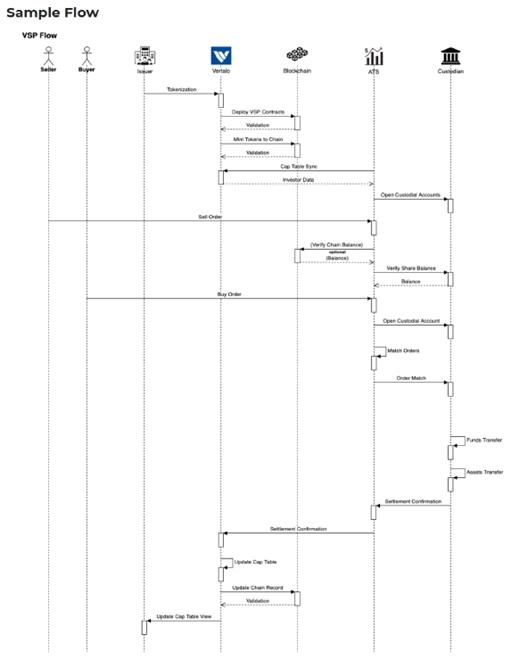
28
Unlike competing technologies that encode all pertinent data on-chain, VSP does not solely rely on chain data, which can become expensive, slow, or experience downtime. The minimum viable on chain data for tokenization is simply, “balance”, which VSP reads and writes. In the context of contemporary block chains, writing additional chain data results in heightened costs and a dilution of benefits. VSP can write additional data to chain, and the system configuration is customizable to the users needs, asset class, regulatory requirements, network configuration, etc. As such VSP presents a flexible, chain agnostic solution that combines on and off chain elements to meet the emerging demands of tokenized asset market participants and service providers in the context of today and tomorrow.

29
Description of Securities
The Company is offering up to $75,000,000 in Series A Bonds. There will be three classes of Bonds, as follows:
| ● | Class A Bonds carry a per annum interest rate of 5% and are immediately redeemable; |
| ● | Class B Bonds carry a per annum interest rate of 6% and carry a six-month maturity, beginning on the first day of the first month following the Investor’s purchase of Bond(s); and |
| ● | Class C Bonds carry a per annum interest rate of 7% and carry a one-year maturity, beginning on the first day of the first month following the Investor’s purchase of Bond(s). |
Bondholders are not required to redeem at maturity, but may instead continue to hold their Bonds.
Voting Rights
Investors will have no right to vote or otherwise participate in the management of the Company. Instead, the Company is managed by the Management team, as outlined on pages 1 and 36.
Distributions
Accrued interest will be paid monthly beginning on such payment date immediately following the first full fiscal quarter after the initial closing in the Offering and continuing until the Maturity Date. Interest will accrue and be paid based on a 360-day year consisting of twelve 30-day months. Interest on each Bond will begin to accrue on the first day of the first month following the Investor’s purchase of the Bond(s).
Distributions will be made using income received through the Company’s investments, as outlined in Use of Proceeds. A portion of the Offering proceeds may be allocated to an interest reserve account to ensure timely interest payments, particularly in the initial stages before the assets generate sufficient revenue. Any excess revenue from the underlying assets will be reinvested to ensure continued liquidity and the ability to meet interest payment obligations.
IMPORTANT NOTE: There is no guaranty that we will have enough money to pay Bondholders the stated interest, or even to return their capital.
No Guaranty
The Company can only distribute as much money as it generates. There is no guaranty that we will have enough money, after paying expenses, to distribute enough to pay the Bond interest or even to return all the invested capital.
Mandatory Withdrawals
Management may require an Investor to redeem all or a portion of the Investor’s capital account upon five days-notice, for any or no reason whatsoever.
If Management causes an Investor to withdraw all of the Investor’s capital account, the Investor will be paid interest to the date of notice of redemption.
Limited Right of Liquidity
Bondholders will be required to hold their Bonds until the Bond’s applicable maturity date. Early redemption requests for reasons of financial hardship or emergency prior to maturity may be considered on a case-by-case basis subject to a penalty against the amount invested (the “Redemption Fee”) in the amount of 10% of the Bond purchase amount.
Except as otherwise provided herein, the Bonds are subject to repayment at the demand of bond holders in accordance with the Bond’s stated maturity. The bond holder has the right to cause the Company to repay the bond upon five (5) days’ notice and the outstanding principal balance together with the interest earned through the repurchase date will be credited to the bondholder’s account within five (5) business days; provided, however, if the bond holder requests a repayment of Bonds in the aggregate principal amount greater than $50,000, the Company may make such repayment to such bond holder within thirty (30) days of the request for such repayment.
Principal repayments will be funded from the cash flows generated by the underlying assets and investments of the Company. The Company may establish a sinking fund in which a portion of the revenue is periodically set aside to accumulate sufficient funds for the redemption of the Bonds at maturity. In certain cases, the Company may consider refinancing options to meet redemption obligations, depending on the market conditions.
30
The Company was formed in 2024 as a Delaware limited liability company. The Company will make preferred equity investments in subsidiaries and target companies that acquire and manage mortgage notes (and related instruments) throughout the United States. The Company also intends to invest in subsidiaries and target companies that acquire and manage commercial real estate and real estate related technology.
The Company’s investment objectives with respect to acquiring Assets are to effectively deploy the proceeds of this Offering into investments which are expected to: Preserve and protect each Investor’s contributed capital; and provide the Investor with the interest return commensurate with the Investor’s class of Bond, and to eventually return the Investor’s proceeds. No assurance can be given that these objectives will be attained or that the Company’s capital will not decrease.
The business in which the Company operates is not dependent on patents, trademarks, franchises, concessions, royalty agreements or labor contracts. To the extent that licenses are required to engage in the business in any jurisdiction, Management is experienced in obtaining said license and does not expect the process to hinder or delay the business of the Company. The business of the Company does not involve environmental issues, and as such, does not expect to incur any significant costs relating to environmental compliance.
Company History
As previously stated, the Company is a newly formed entity without any operating history. While the company is newly formed, the Key Men have extensive history in the industry, as more fully set forth on pages 41 & 42, below. Neither the Company, the Manager, nor any Key Man has been a debtor in any bankruptcy, receivership or similar proceeding. There has not been any material reclassification, merger, consolidation, or purchase or sale of a significant amount of assets of the Company or the Manager not in the ordinary course of business.
Real Estate Loans
Residential Notes – Niche Market
Residential mortgage notes are deemed non-performing if the borrower has failed to make payments for at least 90 days. Residential mortgage notes are deemed re-performing if the borrower has returned to current payment status under the note for a period of at least six months and are deemed performing if the borrower has returned to current payment status under the note for a period of at least twelve months. Re-performing notes generally have higher valuations than non-performing notes of the same principal balance but lower valuations than performing notes of the same principal balance.
Target companies that the Company will invest in will focus their business on the purchase of re-performing or performing notes, but may opportunistically invest in non-performing notes. In acquiring and managing notes, there are generally four stages of operations prior to liquidating the note. These four stages are as follows:
Administration
This stage involves sending all new loans purchased to a licensed independent loan servicing company via an application process. Once an application is submitted and approved, the target company sends the required legal notices to the homeowner of the property underlying the note. The target company will also review collateral files and an accounting of the note, and record the note assignment, the instrument transferring title to the note from the selling company to the target company, in all the proper jurisdictions.
Risk Management
Subsequent to completion of the Administration Stage, the target company begins to assess the risks associated with holding the note. This process involves review of the status of any other liens on the underlying property, as well as the tax and insurance status of the underlying property and a search for any special liens or other title issues that could impact the target company’s collateral position with regards to the note. If the note is non-performing, or when defaults occur, the target company’s management will employ their expertise in working out or modifying non-performing notes with the intention of returning these borrowers’ loans to good standing.
31
Borrower Management
The majority of the Borrower Management is handled by the loan servicing company, for example FCI Lender Services, Inc., unless the loan is, or returns to, non-performing status. In the event a note is non-performing, then the target company follows up with the borrower to assess the homeowner’s intentions and determine the best course of action. The target company assesses the status of the homeowner, which can range from cooperating to hostile, from unlocatable to deceased. The target company also assesses the individual’s financial status to determine proximity to bankruptcy. If the borrower is not a pending bankruptcy and is willing to cooperate, then the target company assesses the homeowner’s intentions and designs a mutually beneficial plan to work with the homeowner. If the borrower is in bankruptcy, then the target company either coordinates with the bankruptcy trustee to ensure payment or proceeds with legal action to remove borrower from bankruptcy to ensure payment. If the note was purchased from a company that provides a warranty of performance, then the target company will work with such company to perform these tasks with the Borrower.
Implementing Exit Strategies
The target company derives its revenue from several exit strategies. Its primary exit strategy will ordinarily be to hold the note and collect payments until the note is re-sold or cashed out by the borrower. Depending on the cash-flow and/or market value of the note at that time, the target company may decide to continue to hold and service the note or to sell the note to a third party. Revenue may entail partial payments then full payments over time, full payments with arrears paid upon exit, discounted or short-term payment of arrears today plus monthly payments, and numerous combinations thereof. Another exit strategy is to refinance the note. The target company may offer seller assistance in situations where the homeowner is cooperative due to a shared equity plan and permits the homeowner to stay rent-free until the note is sold. The target company derives its revenue by purchasing the note at a discount, then selling the note at market value, which should be a premium to the original purchase price.
Note Acquisition Strategy
Target companies will generally approach the loan originators, servicers and wholesale note sellers in its network regarding the purchase of non-performing, re-performing and performing notes. A target company should be continuously networking throughout the lending community to develop and extend its relationships with wholesalers, loan service companies, originators, and other sources of notes. Once a note source aggregates some notes, the target company reviews these notes and conducts its due diligence review on the underlying properties. Upon completion of this due diligence review, the target company identifies the notes that it wishes to purchase and completes these purchases. Upon receiving title to the notes, the target company completes the appropriate documents to record the assignments of mortgage in each jurisdiction to perfect its security interest in the properties.
Private Real Estate Loans
Target companies will likely also engage in private lending transactions to third parties who will use these loans for real estate investment purposes. The companies will typically charge loan origination fees fee ranging from 3-8% and generally seek to obtain an interest rate ranging from 10-16% per annum on these loans. These loans will be documented by a promissory note and will be secured by a first, second or third lien mortgage on the purchased real estate and commercial guaranty, confession of judgment (where applicable), personal guaranty and assignment of rents granted to the target company. The target company will also be named as an insured party in any insurance policy, ensuring the real estate that is the subject of the mortgage. The target company has determined that, due to the large proliferation of residential rehabilitation projects occurring in the United States, there is a significant opportunity to participate in these transactions on a short-term basis and in a manner that generates a return for the target company and its Members. Accordingly, these loans will be targeted as shorter-term opportunities when the target company has cash on hand that is not deployed on larger purchases of residential notes. For loans to note purchasers, a target company may selectively acquire notes that enter re-performing or performing status in exchange for forgiveness of the loans extended.
Business Loans
A target company is expected to work with its network of business brokers to locate business notes to purchase. Many business sales involve some form of seller financing, which is a largely untapped market. If a target company pursues this type of loan, it will evaluate the borrower, its business operations, business assets, strength of personal guarantees and collateral possibilities in order to assess the creditworthiness and valuation of these loans.
32
Commercial Real Estate and Technology Related Business
The Key Men have been engaged in acquiring and managing commercial real estate properties since 2009 and will look to invest in companies that acquire and manage commercial real estate. A target company’s goal in commercial real estate is to acquire value add properties that need improvements with occupancy, small scale renovations, leasing strategies and property management efficiencies. This strategy typically involves purchasing properties that are underperforming or have significant room for improvement, such as properties with high vacancy rates, occupancy rates ranging from 50% to 95% or lower than market rental rates. Once acquired, the property is evaluated to identify areas where improvements can be made, such as upgrades to the physical structure, updating amenities or services, improving management or repositioning the property in the market. Our target area for acquisitions is currently the sunbelt region of the United States but this area can expand or change over time due to changes in market conditions.
As it relates to real estate related technology opportunities, we intend to target investment opportunities in target companies that offer technology services to real estate and other industries. These target companies will typically buy start-ups and/or early-stage companies that seek to fill a need in real estate and other industries using automation and technology. The due diligence process, asset management and disposition for such acquisitions will be determined on a case-by-case basis.
Acquisition Strategy
Our acquisition strategy for Commercial Real Estate focuses on acquiring value-add commercial real estate, which includes all types of commercial real estate, with a particular focus on medical office space. To achieve our investment objectives, we identify target companies that generally perform a comprehensive set of key steps, including:
| ● | Market Analysis: Our target companies conduct a comprehensive market analysis to identify areas with high demand for medical office space and limited supply. This analysis generally takes into account factors such as population growth, demographics, and proximity to major hospitals and medical centers. |
| ● | Property Analysis: Once potential acquisition targets have been identified, a target company generally conducts a thorough property analysis to assess the potential for value-add improvements. This includes evaluating the property’s physical condition, tenant mix, lease terms, and the potential for upgrades and renovations to increase the property’s value. |
| ● | Investment Strategy: Based on the market and property analysis, the target company generally develops an investment strategy that outlines the potential value-add improvements for each property. For medical office space, this may include upgrades to the building’s infrastructure, amenities or services, management practices, and marketing efforts to attract healthcare providers and medical specialties as tenants. |
| ● | Execution: We identify target companies that execute an acquisition strategy working closely with property managers, contractors, and other professionals to implement value-add improvements and optimize the property’s performance. |
Overall, our acquisition strategy for medical office space involves identifying target companies that generally use a comprehensive understanding of the market, property, and investment potential, as well as careful planning, execution, and ongoing management to ensure we achieve our investment objectives. By following this approach, we aim to generate strong returns for our investors and build a portfolio of high-quality medical office properties.
Due Diligence Process
During the due diligence process, a target company will generally focus on the financial, legal, physical, market, title and risk analysis aspects of a property. In terms of the financial aspects, a target company will generally analyze the property’s historical financial statements, rent rolls, occupancy rates and other financial documents. For legal, a target company will generally review contracts, leases, zoning regulations and environmental reports. As for physical due diligence, a target company will generally inspect the property’s physical condition and key in on any physical issues that may affect valuation and financials. For the market review, the target company will generally analyze the local real estate market and the property’s competitive landscape. As for a title review, the target company will generally analyze the property’s title history, including any liens, judgments or encumbrances on the property. In conclusion, once due diligence has been performed, the target company will generally conduct risk analysis to evaluate the risks associated with the property to determine whether an acquisition makes economic sense.
33
Property Management
Once the property is acquired, the target company generally uses a third-party property management company to manage the property. The target company will generally carefully vet the local property management team before contracting with them. The goal is to gain an understanding of the property management company’s track record with tenant relations, lease management, property maintenance, budgeting and accounting and compliance record with all applicable laws and regulations. The target company will generally take an initial look at an existing property management company that is working at the property. It will then bring in additional property management company candidates to ensure that it is getting an accurate representation of the local market.
Disposition
The disposition strategy for Commercial Real Estate will generally focus on the following key steps:
| ● | Market Analysis: The first step in a target company’s successful disposition strategy is to conduct a comprehensive market analysis. This includes an assessment of the demand for medical office space in the market local to the property, as well as the supply of similar properties in such market. The analysis takes into account factors such as population growth, demographics and proximity to major hospitals and medical centers. | |
| ● | Property Analysis: Once a decision to sell has been made, a target company generally conducts a thorough property analysis to identify any potential issues or challenges that may affect the property’s value. This may include assessing the property’s physical condition, tenant mix, lease terms, and the potential for any necessary repairs or improvements. | |
| ● | Pricing Strategy: Based on the market and our property analysis, a target company generally develops a pricing strategy that reflects the property’s value and takes into account any factors that may affect its marketability. This may involve working with a trusted commercial broker to determine a fair market price based on recent sales of comparable properties. | |
| ● | Marketing Strategy: To ensure the property reaches its target market, a target company generally develops a marketing strategy that leverages a variety of channels to reach potential buyers. This includes online listings, print ads, targeted outreach to potential buyers and other tactics to generate interest in the property. | |
| ● | Negotiation and Closing: Once the potential buyer has been identified, negotiations will begin to finalize the sale. This may involve multiple rounds of offers and counteroffers, as well as inspections, appraisals, and other due diligence measures to ensure the property is accurately represented. Once a final agreement has been reached, the closing process can begin, which involves transferring ownership of the property to the buyer. | |
| ● | Tax Planning: As a value-add medical office building, the disposition strategy also takes into account tax planning opportunities to minimize any tax implications of the sale. This may involve working the fund CPA’s and tax advisors to identify potential tax benefits and strategies for maximizing after-tax returns. |
Overall, a successful disposition strategy for Commercial Real Estate requires a comprehensive understanding of the market, property and investment potential, as well as careful planning, execution, and ongoing management to ensure the property achieves its maximum value.
34
ACCOUNTING EXPERTS
The consolidated financial statements of our Company for the period ended March 31, 2024, have been audited by Tesseract Advisory Group, an independent auditor, to the extent and for the periods set forth in their reports appearing elsewhere herein and in the Offering Statement, and are included in reliance on such reports, given the authority of said firm as an expert in auditing and accounting. Please find below the audited financial report prepared by Tesseract Advisory Group.
35
Bequest Bonds I, Inc.
Financial Statements and Report March 31, 2024
Table of Contents
| Independent Auditor’s Report | F-2 |
| Balance Sheet | F-5 |
| Statement of Income | F-6 |
| Statement of Stockholders’ Equity | F-7 |
| Statement of Cash Flows | F-8 |
| Notes to the Financial Statements | F-9 |
F-1

To Management of:
Bequest Bonds I, Inc.
Sarasota, FL
Report on the Audit of the Financial Statements
Opinion
We have audited the financial statements of Bequest Bonds I, Inc., which comprise the balance sheet as of March 31, 2024, and the related statement of income, statement of stockholders’ equity, and cash flows for the period then ended (since inception on February 15, 2024), and the related notes to the financial statements.
In our opinion, the accompanying financial statements present fairly, in all material respects, the financial position of Bequest Bonds I, Inc. as of March 31, 2024, and the results of its operations and its cash flows for the period then ended (since inception on February 15, 2024) in accordance with accounting principles generally accepted in the United States of America.
Basis for opinion
We conducted our audits in accordance with auditing standards generally accepted in the United States of America (GAAS). Our responsibilities under those standards are further described in the Auditor’s Responsibilities for the Audit of the Financial Statements section of our report. We are required to be independent of Bequest Bonds I, Inc. and to meet our other ethical responsibilities, in accordance with the relevant ethical requirements relating to our audits. We believe that the audit evidence we have obtained is sufficient and appropriate to provide a basis for our audit opinion.
Responsibilities of Management for the Financial Statements
Management is responsible for the preparation and fair presentation of the financial statements in accordance with accounting principles generally accepted in the United States of America, and for the design, implementation, and maintenance of internal control relevant to the preparation and fair presentation of financial statements that are free from material misstatement, whether due to fraud or error.
In preparing the financial statements, management is required to evaluate whether there are conditions or events, considered in the aggregate, that raise substantial doubt about Bequest Bonds I, Inc.’s ability to continue as a going concern within one year after the date that the financial statements are available to be issued.
F-2
Auditor’s Responsibilities for the Audit of the Financial Statements
Our objectives are to obtain reasonable assurance about whether the financial statements as a whole are free from material misstatement, whether due to fraud or error, and to issue an auditor’s report that includes our opinion. Reasonable assurance is a high level of assurance but is not absolute assurance and therefore is not a guarantee that an audit conducted in accordance with GAAS will always detect a material misstatement when it exists. The risk of not detecting a material misstatement resulting from fraud is higher than for one resulting from error, as fraud may involve collusion, forgery, intentional omissions, misrepresentations, or the override of internal control. Misstatements are considered material if there is a substantial likelihood that, individually or in the aggregate, they would influence the judgment made by a reasonable user based on the financial statements.
In performing an audit in accordance with GAAS, we:
| ● | Exercise professional judgment and maintain professional skepticism throughout the audit. |
| ● | Identify and assess the risks of material misstatement of the financial statements, whether due to fraud or error, and design and perform audit procedures responsive to those risks. Such procedures include examining, on a test basis, evidence regarding the amounts and disclosures in the financial statements. |
| ● | Obtain an understanding of internal control relevant to the audit in order to design audit procedures that are appropriate in the circumstances, but not for the purpose of expressing an opinion on the effectiveness of Bequest Bonds I, Inc.’s internal control. Accordingly, no such opinion is expressed. |
| ● | Evaluate the appropriateness of accounting policies used and the reasonableness of significant accounting estimates made by management, as well as evaluate the overall presentation of the financial statements. |
| ● | Conclude whether, in our judgment, there are conditions or events, considered in the aggregate, that raise substantial doubt about Bequest Bonds I, Inc.’s ability to continue as a going concern for a reasonable period of time. |
We are required to communicate with those charged with governance regarding, among other matters, the planned scope and timing of the audit, significant audit findings, and certain internal control–related matters that we identified during the audit.
F-3
Substantial Doubt About the Company’s Ability to Continue as a Going Concern
The accompanying financial statements have been prepared assuming that the Company will continue as a going concern. As discussed in Note 5 to the financial statements, the Company was recently incorporated and has yet to receive financing or begin full operations. The conditions raise an uncertainty about the Company’s ability to continue as a going concern. Management’s evaluation of the events and conditions and management’s plans regarding these matters are also described in Note 5. The financial statement does not include any adjustments that might result from the outcome of this uncertainty. Our conclusion is not modified with respect to this matter.

Tesseract Advisory Group, LLC OWINGS MILLS, MD
April 11, 2024
F-4
Balance Sheet
As of March 31, 2024
| Assets | ||||
| Cash and cash equivalents | $ | - | ||
| Total Current Assets | - | |||
| Total Assets | - | |||
| Liabilities & Stockholders’ Equity Liabilities | ||||
| Accounts payable and accrued expenses | - | |||
| Total Current Liabilities | - | |||
| Total Liabilities | - | |||
| Stockholders’ Equity | ||||
| Common stock, 75,000 shares authorized; zero shares issued and outstanding; $1,000 - par value per share | ||||
| Retained Earnings | - | |||
| Total Stockholders’ Equity | - | |||
| Total Liabilities & Stockholders’ Equity | $ | - |
F-5
Statement of Income
For the period (since inception on February 15, 2024) ended March 31, 2024
| Revenues | $ | - | ||
| Cost of Revenues | - | |||
| Gross Profit (Loss) | - | |||
| Operating Expenses | - | |||
| Salaries and wages | - | |||
| Total Operating Expenses | - | |||
| Net Income (Loss) | $ | - |
F-6
Statement of Stockholders’ Equity
For the period (since inception on February 15, 2024) ended March 31, 2024
| Common Stock | Additional Paid-In Capital | Retained Earnings | Total Stockholders’ Equity | |||||||||||||
| Balance at February 15, 2024 | - | - | - | - | ||||||||||||
| Net income (loss) | - | - | - | - | ||||||||||||
| Balance at March 31, 2024 | $ | - | $ | - | $ | - | $ | - | ||||||||
F-7
Statement of Cash Flows
For the period (since inception on February 15, 2024) ended March 31, 2024
| Cash Flows | ||||
| Cash Flows From Operating Activities | ||||
| Net income (loss) | - | |||
| Adjustments to Reconcile Net Income (Loss) to Net Cash Provided by (Used in) Operating Activities | ||||
| Depreciation and amortization | - | |||
| (Increase) decrease in operating assets, net of effects of businesses acquired | ||||
| Accounts receivable | - | |||
| Increase (decrease) in operating liabilities, net of effects of businesses acquired | ||||
| Accounts payable and accrued liabilities | - | |||
| Net Cash Provided by (Used in) Operating Activities | $ | - | ||
| Cash Flows from Investing Activities | ||||
| Purchase of property, plant, and equipment | - | |||
| Net Cash Provided by (Used in) Investing Activities | - | |||
| Cash Flows from Financing Activities | ||||
| Proceeds from issuance of common stock | - | |||
| Net Cash Provided by (Used in) Financing Activities | - | |||
| Net Increase (Decrease) in Cash, Cash Equivalents, and Restricted Cash | - | |||
| Cash, cash equivalents, and restricted cash at beginning of period | - | |||
| Cash, Cash Equivalents, and Restricted Cash at End of Period | $ | - | ||
| Supplemental Cash Flow Information Cash Paid During the Period for | ||||
| Interest | - | |||
| Income taxes | - |
F-8
Notes to the Financial Statements
F-9
1. Summary of significant accounting policies
a. Nature of operations
Bequest Bonds I, Inc. (the Company) is offering a maximum of $75,000,000 in its Series A Bonds (the “Bonds”). The purchase price is $1,000 per Series A Bond with a minimum purchase amount of $1,000; however, the Company, at management’s sole discretion, reserves the right to accept lesser purchase amounts. These private Bonds will offer a 7% annual preferred yield with a 1-year lock up period.
The Bonds will be offered and sold on a continuous basis directly through the websites www.bqfunds.com and www.bytefederal.com, as well as through Byte Federal, Inc. platforms, which include Byte Federal Bitcoin ATMs and the ByteWallet app, which can be found on Apple App Store and Google Play Store.
The aggregate initial offering price of the Bonds will not exceed $75,000,000 in any 12-month period, and there is no minimum number of Bonds that need to be sold. This Bond offering is being conducted on a “best efforts” basis, which means that there is no guarantee that any minimum amount will be sold.
An investment in the Company involves numerous risks and uncertainties, including the following:
| ● | We have a limited operating history and may not be able to operate our business successfully or generate sufficient cash flows to accomplish our business objectives; |
| ● | We have minimal operating capital and for the foreseeable future will be dependent upon our ability to finance our operations from the sale of equity or other financing alternatives; |
| ● | We have set the offering price arbitrarily and it may not reflect the value of the Bonds; |
| ● | There is no minimum amount required as a condition of our accepting subscriptions and using the funds raised from the issuance of these Bonds. |
The Company was originally formed as a Limited Liability Company in the State of Delaware on February 15, 2024. The Company converted to a Delaware Corporation on March, 19, 2024.
b. Basis of accounting
The financial statements have been prepared in conformity with accounting principles generally accepted in the United States of America (“GAAP”) as detailed in the Financial Accounting Standards Board’s Accounting Standards Codification. The financial statements have been prepared on the accrual basis of accounting. The financial statements cover the period from the Company’s inception on February 15, 2024 through March 31, 2024.
F-10
c. Use of estimates
The preparation of the financial statements in conformity with accounting principles generally accepted in the United States of America (GAAP) requires management to make estimates and assumptions that affect the reported amounts of assets and liabilities and disclosure of contingent assets and liabilities at the date of the financial statements and the reported amounts of revenues and expenses during the reporting period. Actual results could materially differ from those estimates.
d. Fair value measurements
Generally accepted accounting principles define fair value as the price that would be received to sell an asset or be paid to transfer a liability in an orderly transaction between market participants at the measurement date (exit price) and such principles also establish a fair value hierarchy that prioritizes the inputs used to measure fair value using the following definitions (from highest to lowest priority):
| ● | Level 1 – Unadjusted quoted prices in active markets that are accessible at the measurement date for identical, unrestricted assets or liabilities. |
| ● | Level 2 – Observable inputs other than quoted prices included within Level 1 that are observable for the asset or liability, either directly or indirectly, including quoted prices for similar assets and liabilities in active markets; quoted prices for identical or similar assets and liabilities in markets that are not active; or other inputs that are observable or can be corroborated by observable market data by correlation or other means. |
| ● | Level 3 – Prices or valuation techniques requiring inputs that are both significant to the fair value measurement and unobservable. |
The Company does not have any assets or liabilities that require fair value measurement.
e. Income taxes
The Company applies ASC 740 Income Taxes (“ASC 740”). Deferred income taxes are recognized for the tax consequences in future years of differences between the tax bases of assets and liabilities and their financial statement reported amounts at each period end, based on enacted tax laws and statutory tax rates applicable to the periods in which the differences are expected to affect taxable income. Valuation allowances are established, when necessary, to reduce deferred tax assets to the amount expected to be realized. The provision for income taxes represents the tax expense for the period, if any and the change during the period in deferred tax assets and liabilities. ASC 740 also provides criteria for the recognition, measurement, presentation and disclosure of uncertain tax positions. A tax benefit from an uncertain position is recognized only if it is “more likely than not” that the position is sustainable upon examination by the relevant taxing authority based on its technical merit. The Company is subject to tax filing requirements as a corporation in the federal jurisdiction of the United States.
F-11
The Company uses a calendar year end for income tax reporting purposes and files a Corporate tax return annually. The Company’s provision for income taxes is based on the asset and liability method of accounting whereby deferred tax assets and liabilities are recognized for future tax consequences attributable to differences between the financial statement carrying amounts of existing assets and liabilities and their respective tax bases. Deferred tax assets and liabilities are measured using enacted tax rates expected to apply to taxable income in the years in which those temporary differences are expected to be recovered or settled. The effect on deferred tax assets and liabilities of a change in tax rates is recognized in income in the period that includes the enactment date. Deferred tax assets and liabilities are related to differences in calculating depreciation on fixed assets, timing of deductions for certain accrued expenses, and taxes related to net operating losses.
f. Concentrations of credit risk
Financial instruments that potentially subject the Company to concentrations of credit risk consist principally of cash and cash equivalents. The Company generally maintains balances in various operating accounts at financial institutions that management believes to be of high credit quality, in amounts that may exceed federally insured limits. The Company has not experienced any losses related to its cash and cash equivalents and does not believe that it is subject to unusual credit risk beyond the normal credit risk associated with commercial banking relationships.
g. Cash and cash equivalents
Cash and cash equivalents includes short-term investments and highly liquid investments in money market instruments which are carried at the lower of cost and market value with a maturity date of three months or less from the acquisition date. These are valued at cost which approximates market value.
h. Recently issued accounting pronouncements
From time to time, new accounting pronouncements are issued by the Financial Accounting Standards Board, or FASB, or other standard setting bodies and adopted by the Company as of the specified effective date. The Company believes that the impact of recently issued standards that are not yet effective will not have a material impact on its financial position or results of operations upon adoption.
i. Comprehensive income
The Company does not have any comprehensive income items other than net income.
2. Stockholders’ equity
Under the articles of incorporation, the total number of Common Shares of stock that the Company shall have authority to issue is 75,000 shares with a $1,000 par value per share. As of March 31, 2024 zero shares had been issued.
F-12
3. Operating and management services agreements
The Company has entered into a Management Services Agreement (the “Agreement”) with LMMS Management, LLC, a related party under common ownership and control. LMMS Management LLC and it’s Management Team will control the management of the Company and LMMS Management LLC will own 100% of the common shares of the Company and will be entitled to yield extensive influence regarding the Board of Directors. There have been no shares issued to LMMS Management LLC to date. The Management Team will consist of Shawn Muneio – Chief Executive Officer, Lennart Lopin – President, and Mark Paolillo – Chief Operating Officer. The Board of Directors of LMMS Management LLC will consist of five (5) members, as follows: Shawn Muneio, Martin Saenz, P. James Hirchak, Jr., Lennart Lopin and Mark Paolillo.
The Company is dependent on the Management Team to manage operations and acquire and manage the Company’s portfolio of assets. Accordingly, any adverse changes in the financial health of LMMS Management LLC, or its affiliates, or our relationship with them could hinder our operating performance and our ability to meet our financial obligations. The Management Team depends upon the fees and other compensation that it receives in connection with the management of the Company’s assets to conduct its operations. Under the Agreement, the Company will pay the Management Team a fee calculated as an annualized 3% of the total sum of invested monies, calculated as of the last calendar day of the month. If the maximum offering amount is raised and used to acquire assets, the Company estimates that it will pay a management Fee of approximately $2,250,000 annually. Additionally, LMMS Management LLC will receive reimbursement in the amount of $45,000 for startup and administrative costs.
4. Commitments and contingencies
The Company may be subject to pending legal proceedings and regulatory actions in the ordinary course of business. The results of such proceedings cannot be predicted with certainty, but the Company does not anticipate that the final outcome, if any, arising out of any such matters will have a material adverse effect on its business, financial condition or results of operations. The Company is not currently involved with and does not know of any pending or threatening litigation against the Company.
5. Going concern
The financial statements have been prepared on a going concern basis, which assumes that the Company will continue in operation for the foreseeable future. The Company was recently incorporated and has yet to be capitalized or begin operations. Those factors and conditions create a substantial doubt about the Company’s ability to continue as a going concern for the year following the date the financial statements are available to be issued. Management of the Company has evaluated these conditions and has proposed a plan to raise funds via a Regulation A offering. The ability of the Company to continue as a going concern and meet its obligations as they become due is dependent on management’s ability to successfully implement the plan. The financial statements do not include any adjustments that might be necessary if the Company is unable to continue as a going concern.
6. Subsequent events
The Company intends to initiate a Regulation A offering of its shares after March 31, 2024. The Company is authorized to raise $75 million and as of April 11, 2024, the Company has not raised any funds. Management has executed all related Company documents required to file its application with the US SEC for Reg A securities exemption.
Management evaluated all activity of the Company through April 11, 2024 (the issuance date of the financial statements) and concluded that no other subsequent events have occurred that would require recognition in the financial statements or disclosure in the related notes to the financial statements.
F-13
MANAGEMENT DISCUSSION
The Management Team
The Management Team has the sole right to manage the business of the Company and to make any decisions with respect thereto. No Bondholder shall take part in, or interfere in any manner with the management, conduct or control of the business and affairs of the Company and shall not have any right or authority to act for or bind the Company. The Bondholders have no right to elect the Manager or vote for its removal and shall have no right to manage the Company. LMMS Management, LLC has entered into a Management Agreement to provide management services to the Company. A copy of the Management Agreement is attached hereto as Exhibit 5.3.
Officers
LMMS Management LLC shall have the power to appoint officers to assist it in managing the daily operations of the Company. The current officers and their relevant business experience are as follows:
| Name | Position | Information | ||
| Shawn Munieo | CEO | Shawn Muneio is 45 years old at the time of this Offering. He is the Chief Executive Officer of the Company and oversees and manages the Company’s day-to-day operations. He works closely with other officers to develop and implement investment strategies that align with the Company’s overall business objectives, focusing on Performing Loans, Commercial Real Estate and Oil and Gas. This involves identifying target companies that have developed expertise in their respective fields. This also involves monitoring market trends and economic indicators to identify investment opportunities and risks and to determine how much of the Company’s resources to devote to each focus area. He also analyzes and assesses the performance of individual investments and the overall investment portfolio.
As the Chief Executive Officer, Mr. Muneio ensures compliance with regulatory requirements and internal policies and procedures, and he communicates investment performance and strategy to the Company’s investors. He also manages relationships with external partners, including investment banks, rating agencies, and other financial institutions.
In addition to managing the Company’s investments, Mr. Muneio provides strategic guidance to other departments within the Company, including finance, accounting and operations. He participates in investor relations activities, including investor meetings and conferences. His expertise in managing investments and achieving returns for investors has been demonstrated through his successful operation of various funds since 2019.
Overall, Mr. Muneio’s role as Chief Executive Officer is critical to the Company’s success, and he plays a crucial role in managing its investment portfolio to ensure investments align with the Company’s overall goals and objectives. Mr. Muneio received his Executive MBA degree and his M.S. in Information Systems from the University of South Florida. For the past five years he has been the co-managing partner of Bequest Funds, LLC, Bequest Capital, LLC and NDF1, LLC in Sarasota, FL. | ||
| Martin Saenz | Boardmember - Manager | Martin Saenz is 50 years old at the time of this Offering. For the past five years he has been the co-managing partner of Bequest Funds, LLC, Bequest Capital, LLC and NDF1, LLC in Sarasota, FL. Martin has founded and sold a Government Contracting company that produced 14MM in federal contracts, purchased and managed 10MM in commercial & residential properties, co-founded a 35MM hedge fund that that has helped save over 1000 homeowners from foreclosure, and has co-founded a 50MM Income Fund that manages a portfolio of performing mortgage notes
Martin is the author of five books, four of which are on investing and one on Government Contracting.
Martin is an Owner of the Manager and a member of the Board of Directors of the Manager and will therefore have significant influence on the Manager. |
36
| Name | Position | Information | ||
| Lennart Lopin | Chief Technology Officer | Lennart is 46 years old at the time of this Offering. He graduated from the Universities of Rostock and Goettingen, Germany, with a Master’s in Computer Science and a concentration in machine learning. He has professionally engineered and overseen various public and private software projects since 2003, starting at Novomind AG where he co-developed their machine learning based iMail program. As a consultant, he integrated software at Bertelsmann, Otto, Citi Bank, and EnBW. In 2007 he assumed the lead software developer position for Proactive Reliability Services, an IoT sensornet startup, designing a vibration analysis platform for mid and large sized US manufacturing plants. In 2009 Lennart co-founded a knowledge database and email marketing company. Together with Lee Hansen, Lennart co-founded ByteFederal, a FinTech self-service company. For the last five years has been employed at Byte Federal, Inc. in the role as Chief Technology Officer. | ||
| Mark Paolillo | Chief Financial Officer | Mark is 55 years old at the time of this Offering. He graduated from South Carolina’s Clemson University in 1990, with a Bachelor of Science in Accounting. He holds professional memberships in the American Institute of Certified Public Accountants (AICPA), Florida Institute of Certified Public Accountants (FICPA), and the Consulting Services Section of the AICPA. Mark started his career as the Assistant Controller of a large local real estate development company. It was here he first realized that being an accountant in the private sector was not going to allow him the ability to utilize his skills to their fullest extent. After a few years at this capacity, Mark moved into the public sector where he furthered his expertise in taxation, business management and accounting, while serving as Senior Accountant for a Hyde Park (Tampa)-based C.P.A. firm. In October of 1996, Mark returned to his home town (Venice, Fl) as the Senior Accountant for Hough & Company, P.A., C.P.A.s. Within less than three years he was admitted as a partner and shareholder at the age of 31. Mark worked at Hough& Company, P.A. from 1997 through 2020. He started as a senior accountant and tax preparer and ended as the firm’s CEO and managing partner. Mark is now the Chief Executive Officer and the firm has grown by 400% since his arrival. During this time, he has been exposed to hundreds of businesses, management styles and has consulted on many business acquisitions. In addition to his duties with Hough & Company, Mark has participated in several successful start-ups in both the real estate development and the procurement space. Through these experiences he has focused himself on finding the perfect “annuity style” business operation. Byte Federal is that business operation, which he co-founded. Mark has been employed by Byte Federal from 2020 to present in the role of CFO and Chairman of the Board. |
Involvement in Certain Legal Proceedings
No executive officer, member of the Manager, or significant employee or control person of our Company has been involved in any legal proceeding listed in Item 401(f) of Regulation S-K in the past 10 years.
Fees to Manager
As set forth in Section 1 of the Management Services Agreement, the Manager will be compensated in three separate manners:
| - | Management Fee. The Company will pay the Manager the Management Fee. The Management Fee is calculated as an annualized 3% of the total sum of invested monies, calculated as of the last calendar day of each month. The Management Fee will be paid monthly. |
| - | Expense Reimbursement Fee. The Company agrees to provide the Manager (the “Expense Reimbursement Fee”) in advance, in the amount of $45,000 for start-up and related costs associated with this Offering. |
| - | Reimbursements. The Company agrees to reimburse the Manager for all fees incurred on behalf of the Company. |
37
It is likely that a portion (not to exceed 33%) of the funds raised in this Offering will be invested in companies that are owned and operated by affiliates of the Manager. The Company will determine the amount that it will invest in each of these companies and all investments will be made on the same terms and conditions that other third-party investors may invest in these companies. In all situations, the Company will ensure that the purchased assets are valued at market level pricing and will not pay a price in excess of such valuation for such assets. While the Company will take such steps to attempt to conduct these transactions at fair market value, there is no assurance that the Company will not overpay for these investments.
To ensure that the purchased assets are valued at market level pricing and that the company does not pay more than market level, the Company implements a comprehensive valuation and acquisition process. This process includes the following steps:
1. Market Research and Analysis:
Market Data: Utilize comprehensive market data from reliable sources to assess the current market trends, pricing, and demand for the types of assets being considered.
Economic Indicators: Monitor economic indicators and real estate market trends that could impact asset values, ensuring that our valuations are aligned with broader market conditions.
2. Internal Valuation Expertise:
In-House Analysts: Leverage the expertise of our in-house real estate analysts and valuation experts who will conduct detailed due diligence and perform their own valuation assessments.
Valuation Models: Develop and use sophisticated valuation models that incorporate numerous factors, including income potential, location, market trends, and risk assessments, to arrive at an accurate market value.
3. Due Diligence Process:
Comprehensive Due Diligence: Perform extensive due diligence on each potential acquisition, including financial analysis, property inspections, legal reviews, and environmental assessments.
Risk Assessment: Evaluate potential risks associated with each asset, such as market volatility, tenant stability, and property condition, and factor these risks into the valuation.
4. Negotiation Strategy:
Target Pricing: Establish target pricing based on the independent valuations and market analysis and adhere to these pricing guidelines during negotiations.
Negotiation Leverage: Use our findings from due diligence and market research as leverage during negotiations to ensure that we do not overpay for any asset.
5. Oversight and Governance:
Investment Committee Review: All potential acquisitions will be reviewed and approved by an investment committee composed of experienced professionals who will ensure that each purchase meets our valuation criteria.
Conflict of Interest Policies: Implement strict conflict of interest policies to ensure that all transactions are conducted at arm’s length and in the best interest of our investors.
By employing these rigorous valuation and acquisition procedures, the Company intends to ensure that all purchased assets are valued at market level pricing and that the Company does not pay a price more than such valuations. This disciplined approach not only protects our investors’ interests but also enhances the overall financial performance and stability of our investment portfolio.
As stated herein, a large portion of the funds raised in this Offering may be invested in companies owned and/or operated by affiliates of the Manager. At this time, the Company has not identified any specific investments in companies that are owned and/or operated by affiliated companies. We intend to determine the probability of such investments based on ongoing evaluations and due diligence processes. This includes assessing the alignment of the investment with our strategic goals, financial health, and growth potential of the target company, and ensuring there are no conflicts of interest.
38
There are no active negotiations with affiliated companies, nor has the Company entered into any agreements for acquisitions involving affiliated companies. There are no letters of intent in place with such companies, nor have any specific companies been identified for investment at this stage.
Management Affiliates
Mr. Saenz and Mr. Muneio are principals in other companies involved in affiliated businesses. These Affiliates include, but are not limited to: Bequest Capital, LLC Bequest Legacy Fund I, LLC and Bequest Funds, LLC, Bequest Equity Fund V, LLC, CMJV2, LLC, CMJV3, LLC, Bequest Energy Fund I, LLC, NDF1, LLC, Lighted Signs Direct, Inc., MAK Business Resources, LLC, 2nd Chance Funding, LLC, New Day Funding, LLC and STM Properties, LLC.
Lennart Lopin - Chief Technology Officer
Lennart graduated from the Universities of Rostock and Goettingen, Germany, with a Master’s in Computer Science and a concentration in machine learning. He has professionally engineered and overseen various public and private software projects since 2003, starting at Novomind AG where he co-developed their machine learning based iMail program. As a consultant, he integrated software at Bertelsmann, Otto, Citi Bank, and EnBW. In 2007 he assumed the lead software developer position for Proactive Reliability Services, an IoT sensornet startup, designing a vibration analysis platform for mid and large sized US manufacturing plants. In 2009 Lennart co-founded a knowledge database and email marketing company. Together with Lee Hansen, Lennart co-founded ByteFederal, a FinTech self-service company
Mark Paolillo - Chief Financial Officer
Organizational Structure, Strategy, Finance and Compliance
Mark graduated from South Carolina’s Clemson University in 1990, with a Bachelor of Science in Accounting. He holds professional memberships in the American Institute of Certified Public Accountants (AICPA), Florida Institute of Certified Public Accountants (FICPA), and the Consulting Services Section of the AICPA. Mark started his career as the Assistant Controller of a large local real estate development company. It was here he first realized that being an accountant in the private sector was not going to allow him the ability to utilize his skills to their fullest extent. After a few years at this capacity, Mark moved into the public sector where he furthered his expertise in taxation, business management and accounting, while serving as Senior Accountant for a Hyde Park (Tampa)-based C.P.A. firm. In October of 1996, Mark returned to his home town (Venice, Fl) as the Senior Accountant for Hough & Company, P.A., C.P.A.s. Within less than three years he was admitted as a partner and shareholder at the age of 31. Mark is now the Chief Executive Officer and the firm has grown by 400% since his arrival. During this time, he has been exposed to hundreds of businesses, management styles and has consulted on many business acquisitions. In addition to his duties with Hough & Company, Mark has participated in several successful start-ups in both the real estate development and the procurement space. Through these experiences he has focused himself on finding the perfect “annuity style” business operation. Byte Federal is that business operation, which he co-founded.
Operating Results
The Company was created on February 20, 2024. The Company has not conducted any business and therefore has no operating results.
Liquidity and Capital Resources
The Company is seeking to raise up to $75,000,000 of capital in this Offering by selling the Bonds to Investors. The Company is expected to obtain its liquidity from this Offering and is not expected to borrow money from banks or other lenders as a principal business operating strategy. The Company reserves the right to seek additional loan facilities in the sole judgment of the Manager.
The Company does not currently have any capital commitments. We expect to deploy most of the capital we raise in the Offering shortly after its receipt, as described in the “Use of Proceeds” section on page 19. Should we need more capital for any reason, we could either sell more Bonds or sell other classes of securities.
39
Plan of Operation
The Company, upon successfully raising sufficient capital, intends to operate in the manner described in the “Our Business” section starting on page 31.
The Company expects the proceeds of the Offering will satisfy its cash requirements. If the Company raises less than $75,000,000, the Company will make fewer investments.
Ownership Interest of Management
The Company will have one class of ownership. Bondholders will not hold or possess any ownership in the Company. The Company will be owned in its entirety by LMMS Management LLC.
As the owner of the Company, LMMS Management LLC will have the right to receive any proceeds after the Bondholders receive their interest. The amount of profits LMMS Management LLC will receive from owning the Company depends on a number of factors, including:
| ● | How much capital is raised in the Offering; |
| ● | The investment returns the Company can achieve; |
| ● | When those returns are achieved (the Company might not achieve the same return every year); |
| ● | When the Company pays interest to Investors; and |
| ● | The amount of expenses the Company incurs. |
Given these variables, it is impossible to predict with any accuracy how much money LMMS Management LLC will make from owning the Company.
Report to Investors
No less than once per year, the Company will provide Investors with a detailed statement showing the Company’s cashflow, to include the fees paid to Management. In each case, the detailed statement will describe the services performed and the amount of compensation paid.
Method of Accounting
The compensation described in this section was calculated using the accrual method of accounting.
40
INTEREST OF MANAGEMENT AND OTHERS IN CERTAIN TRANSACTIONS
Martin Saenz and Shawn Muneio are Key Men of LMMS Management LLC and will be responsible for the day-to-day operations of the Company. LMMS Management LLC is the sole owner of the Company. Mr. Saenz and Mr. Muneio are also owners of NDF1, LLC, 2nd Chance Funding, LLC and Bequest Capital, LLC. The Company may make investments into one or all of these affiliates. The Company will do so on the same terms and conditions that other third-party investors may invest in these companies.
Security Ownership of Management and Certain Owners
The following table sets out, as of April 1, 2024, the voting interests of the Company and the Manager that are owned by executive officers and directors, and other persons holding more than 10% of any class of the Company’s voting securities or having the right to acquire those securities. The table assumes that all options and warrants have vested. The Company’s voting securities include all membership interests.
Name and Address of Beneficial Owner of Bequest Bonds I, Inc. 2 N Tamiami Trail, Suite 101 Sarasota, FL 34236 |
Title of Class | Amount and Nature of Beneficial Ownership | Amount and Nature of Beneficial Ownership Acquirable | Percent | ||||||||||
| LMMS Management LLC | Member | 100 | % | 0 | 100 | % | ||||||||
Name and Address of Beneficial Owner of LMMS Management, LLC 2 N Tamiami Trail, Suite 101 Sarasota, FL 34236 |
Title of Class | Amount and Nature of Beneficial Ownership | Amount and Nature of Beneficial Ownership Acquirable | Percent | ||||||||||
| Martin Saenz | Member | 25 | % | 0 | 25 | % | ||||||||
| Shawn Muneio | Member | 25 | % | 0 | 25 | % | ||||||||
| ByteFederal | Member | 50 | % | 0 | 50 | % | ||||||||
41
ITEM 3: INDEX TO EXHIBITS
| * | Filed previously |
42
SIGNATURE
Pursuant to the requirements of Regulation A, the issuer certifies that it has reasonable grounds to believe that it meets all of the requirements for filing on Form 1-A and has duly caused this offering statement to be signed on its behalf by the undersigned, thereunto duly authorized, in the city of Sarasota, Florida, on October 28, 2024.
| Bequest Bonds I, LLC | ||
By LMMS Management, LLC | ||
| By: | //Martin Saenz// | |
| Martin Saenz, President | ||
SIGNATURES AND POWER OF ATTORNEY
KNOW ALL PERSONS BY THESE PRESENTS, that each person whose signature appears below constitutes and appoints Martin Saenz as his or her true and lawful attorney-in-fact and agent, with full power of substitution and resubstitution, for him or her and in his or her name, place and stead, in any and all capacities (including his capacity as a director and/or officer of the Manager) to sign any or all amendments (including post-effective amendments) to this offering statement and any and all supplements thereto, and to file the same, with all exhibits thereto, and all other documents in connection therewith, with the Securities and Exchange Commission, granting unto said attorney-in-fact and agent, full power and authority to do and perform each and every act and thing requisite and necessary to be done in and about the premises, as fully to all intents and purposes as they, he or she might or could do in person, hereby ratifying and confirming all that said attorney-in-fact and agent or any of them, or their, his or her substitute or substitutes, may lawfully do or cause to be done by virtue hereof.
This offering statement has been signed by the following persons in the capacities and on the dates indicated below:
| Signature | Title | Date | ||
| //Martin Saenz// | Member of LMMS Management LLC | October 28, 2024 | ||
| Martin Saenz | ||||
| //Shawn Muneio// | Member of LMMS Management LLC | October 28, 2024 | ||
| Shawn Muneio | ||||
| //Lennart Lopin// | Authorized Representative of Member of Manager | October 28, 2024 | ||
| Lennart Lopin |
43