AN OFFERING STATEMENT PURSUANT TO REGULATION A RELATING TO THESE SECURITIES HAS BEEN FILED WITH THE SECURITIES AND EXCHANGE COMMISSION. INFORMATION CONTAINED IN THIS PRELIMINARY OFFERING CIRCULAR IS SUBJECT TO COMPLETION OR AMENDMENT. THESE SECURITIES MAY NOT BE SOLD NOR MAY OFFERS TO BUY BE ACCEPTED BEFORE THE OFFERING STATEMENT FILED WITH THE COMMISSION IS QUALIFIED. THIS PRELIMINARY OFFERING CIRCULAR SHALL NOT CONSTITUTE AN OFFER TO SELL OR THE SOLICITATION OF AN OFFER TO BUY NOR MAY THERE BE ANY SALES OF THESE SECURITIES IN ANY STATE IN WHICH SUCH OFFER, SOLICITATION OR SALE WOULD BE UNLAWFUL BEFORE REGISTRATION OR QUALIFICATION UNDER THE LAWS OF SUCH STATE. THE COMPANY MAY ELECT TO SATISFY ITS OBLIGATION TO DELIVER A FINAL OFFERING CIRCULAR BY SENDING YOU A NOTICE WITHIN TWO BUSINESS DAYS AFTER THE COMPLETION OF THE COMPANY’S SALE TO YOU THAT CONTAINS THE URL WHERE THE FINAL OFFERING CIRCULAR OR THE OFFERING STATEMENT IN WHICH SUCH FINAL OFFERING CIRCULAR WAS FILED MAY BE OBTAINED.
PRELIMINARY OFFERING CIRCULAR DATED FEBRUARY 10, 2023
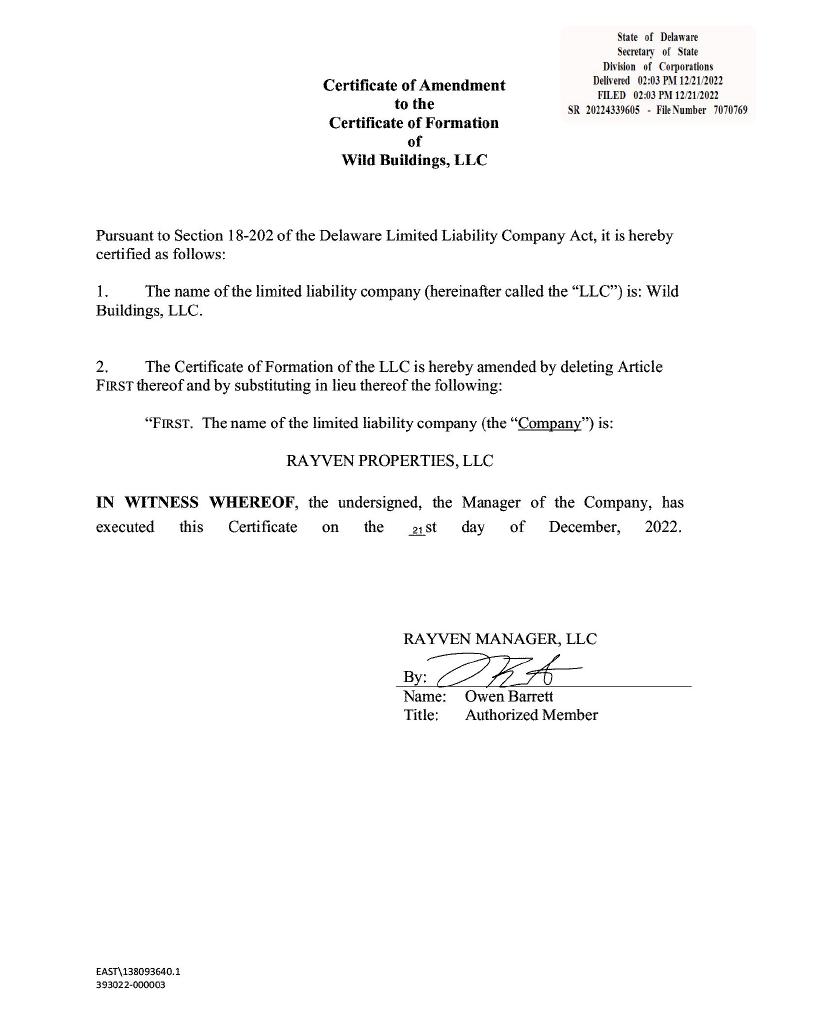
RAYVEN PROPERTIES, LLC

1759 Oceanside Blvd., Suite C506, Oceanside, CA 92054
(619) 535-1632
10% PROMISSORY NOTES
MAXIMUM OFFERING AMOUNT: $75,000,000
Rayven Properties, LLC, a Delaware limited liability company (the “Company”), is offering up to $75,000,000 (the “Maximum Offering Amount”) of its 10% Promissory Notes (the “Notes”) described in this offering circular (the “Offering Circular”) with a minimum amount of $250.00 (the “Offering”). For more information on the terms of Notes being offered, please see the “Securities Being Offered” section of this Offering Circular. The proceeds from this Offering will be used primarily to purchase commercial real estate to effect the Company’s business plan, as well as for general corporate purposes of the Company, including covering the costs related to this Offering.
The Notes will be offered and sold on a continuous basis directly through the Company’s website at www.joinrayven.com. The aggregate initial offering price of the Notes will not exceed $75,000,000 in any 12-month period, and there is no minimum number of Notes that need to be sold as a condition of closing this Offering. This offering is being conducted on a “best efforts” basis, which means that there is no guarantee that any minimum amount will be sold in this Offering. The Company has engaged Dalmore Group, LLC to act as its broker-dealer of record in connection with this offering. See “Plan of Distribution” in this Offering Circular.
To the extent that the Company’s officers and directors make any communications in connection with this offering they intend to conduct such efforts in accordance with an exemption from registration contained in Rule 3a4-1 under the Securities Exchange Act of 1934, as amended (the “Exchange Act”), and, therefore, none of them is required to register as a broker-dealer. See “Plan of Distribution” in this Offering Circular.
The approximate date of the commencement of the proposed sales to the public of the Notes will be within two calendar days from the date on which the Offering is qualified by the Securities and Exchange Commission (the “SEC”) and on a continuous basis thereafter until the maximum number of Notes offered hereby is sold. The minimum purchase is $250.00 (or one Note). Funds received by us will not be placed in escrow, and we may undertake one or more closings on a rolling basis. After each closing, funds tendered by investors will be made available to us. After the initial closing of this Offering, we expect to hold closings on at least a monthly basis. All offering expenses will be paid out of the proceeds of this Offering. The termination of the Offering will occur on the earlier of (i) the date that subscriptions for the Notes offered hereby equal $75,000,000 or (ii) an earlier date determined by the Company in its sole discretion.
1
No public market has developed nor is expected to develop for Notes, and we do not intend to list Notes on a national securities exchange or interdealer quotational system.
We are governed by the terms of our Limited Liability Company Operating Agreement, and are managed by Rayven Manager, LLC, a Delaware limited liability corporation, under the terms of a Management Agreement. See “Our Limited Liability Company Operating Agreement” and “Our Business -- Management Agreement with Rayven Manager, LLC.
This Offering is being made pursuant to Tier 2 of Regulation A, promulgated under the Securities Act of 1933, as amended.
Investing in our securities involves a high degree of risk, including the risk that you could lose all of your investment. Please read the section entitled “Risk Factors” beginning on page 13 of this Offering Circular about the risks you should consider before investing.
Generally, no sale may be made to you in this offering if the aggregate purchase price you pay is more than 10% of the greater of your annual income or net worth. Different rules apply to accredited investors and non-natural persons. Before making any representation that your investment does not exceed applicable thresholds, we encourage you to review Rule 251(d)(2)(i)(C) of Regulation A. For general information on investing, we encourage you to refer to www.investor.gov.
We are an “emerging growth company” as that term is used in the Jumpstart Our Business Startups Act of 2012, or the “JOBS Act,” and, as such, have elected to comply with certain reduced public company reporting requirements. See “Offering Circular Summary—Implications of Being an Emerging Growth Company Status.”
| Price to
Public | Underwriting Discount and Commissions (1) | Proceeds
to Issuer(2) | ||||||||||
| Per Note | $ | 250 | $ | 2.50 | $ | 247.50 | ||||||
| Total Maximum | $ | 75,000,000 | $ | 750,000 | $ | 74,250,000 | ||||||
| (1) | The Company has engaged Dalmore Group, LLC, member FINRA/SIPC (“Dalmore”) as our broker-dealer. The amount reported in the table above includes the 1% commission fee, but does not include the one-time expense and consulting fees payable by the Company to Dalmore of $25,000. The maximum amount that Dalmore will receive under this arrangement is $775,000. FINRA fees will be paid by the Company. See “Plan of Distribution” for a description of our arrangement with Dalmore.
|
| (2) | Does not include expenses of this Offering, which we estimate will be approximately $10,000,000, not including state filing fees. See the “Use of Proceeds” section of this Offering Circular. |
THE SEC DOES NOT PASS UPON THE MERITS OF OR GIVE ITS APPROVAL TO ANY SECURITIES OFFERED OR THE TERMS OF THE OFFERING, NOR DOES IT PASS UPON THE ACCURACY OR COMPLETENESS OF ANY OFFERING CIRCULAR OR OTHER SOLICITATION MATERIALS. THESE SECURITIES ARE OFFERED PURSUANT TO AN EXEMPTION FROM THE REGISTRATION REQUIREMENTS OF THE SECURITIES ACT OF 1933, AS AMENDED (THE “SECURITIES ACT”); HOWEVER, THE SEC HAS NOT MADE AN INDEPENDENT DETERMINATION THAT THE SECURITIES OFFERED ARE EXEMPT FROM REGISTRATION.
NEITHER THE SECURITIES AND EXCHANGE COMMISSION NOR ANY STATE SECURITIES COMMISSION HAS APPROVED OR DISAPPROVED OF THESE SECURITIES OR PASSED UPON THE ADEQUACY OR ACCURACY OF THIS OFFERING CIRCULAR. ANY REPRESENTATION TO THE CONTRARY IS A CRIMINAL OFFENSE.
2
The Company is following the “Offering Circular” format of disclosure under Regulation A.
The date of this Offering Circular is , 2023
In the event that we become a reporting company under the Securities Exchange Act of 1934, we intend to take advantage of the provisions that relate to “Emerging Growth Companies” under the JOBS Act of 2012. See “Offering Circular Summary -- Implications of Being an Emerging Growth Company.”
3
TABLE OF CONTENTS
The information contained on, or accessible through, the Company’s website at www. joinrayven.com is not part of, and is not incorporated by reference in, this Offering Circular.
THIS OFFERING CIRCULAR MAY CONTAIN FORWARD-LOOKING STATEMENTS AND INFORMATION RELATING TO, AMONG OTHER THINGS, THE COMPANY, ITS BUSINESS PLAN AND STRATEGY, AND ITS INDUSTRY. THESE FORWARD-LOOKING STATEMENTS ARE BASED ON THE BELIEFS OF, ASSUMPTIONS MADE BY, AND INFORMATION CURRENTLY AVAILABLE TO THE COMPANY’S MANAGEMENT. WHEN USED IN THE OFFERING MATERIALS, THE WORDS “ESTIMATE,” “PROJECT,” “BELIEVE,” “ANTICIPATE,” “INTEND,” “EXPECT” AND SIMILAR EXPRESSIONS ARE INTENDED TO IDENTIFY FORWARD-LOOKING STATEMENTS, WHICH CONSTITUTE FORWARD LOOKING STATEMENTS. THESE STATEMENTS REFLECT MANAGEMENT’S CURRENT VIEWS WITH RESPECT TO FUTURE EVENTS AND ARE SUBJECT TO RISKS AND UNCERTAINTIES THAT COULD CAUSE THE COMPANY’S ACTUAL RESULTS TO DIFFER MATERIALLY FROM THOSE CONTAINED IN THE FORWARD-LOOKING STATEMENTS. INVESTORS ARE CAUTIONED NOT TO PLACE UNDUE RELIANCE ON THESE FORWARD-LOOKING STATEMENTS, WHICH SPEAK ONLY AS OF THE DATE ON WHICH THEY ARE MADE. THE COMPANY DOES NOT UNDERTAKE ANY OBLIGATION TO REVISE OR UPDATE THESE FORWARD-LOOKING STATEMENTS TO REFLECT EVENTS OR CIRCUMSTANCES AFTER SUCH DATE OR TO REFLECT THE OCCURRENCE OF UNANTICIPATED EVENTS.
4
This summary highlights certain information about us and this offering contained elsewhere in this Offering Circular. Because it is only a summary, it does not contain all the information that you should consider before investing in our securities and it is qualified in its entirety by, and should be read in conjunction with, the more detailed information appearing elsewhere in this Offering Circular. Before you decide to invest in our securities, you should read the entire Offering Circular carefully, including “Risk Factors” and our financial statements and the accompanying notes included in this Offering Circular. Unless the context otherwise indicates, when used in this Offering Circular, the terms “the Company,” “Rayven Properties,” “we,” “us,” “our” and similar terms refer to Rayven Properties, LLC, a Delaware limited liability company, and the term “Manager” refers to Rayven Manager, LLC, a Delaware limited liability company.
Our Company
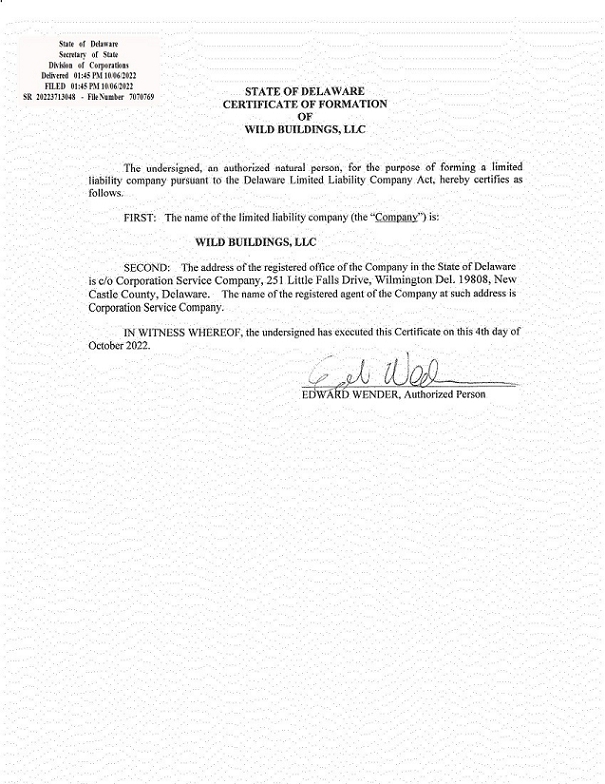
Rayven Properties, LLC is organized as a Delaware limited liability company, formed to acquire and develop commercial real estate properties located in the United States into net zero energy properties. Proceeds from the sale of the Promissory Notes in this offering will be used to provide the capital for these activities. We are managed by Rayven Manager, LLC, a Delaware limited liability company, pursuant to a Management Agreement. See “Our Limited Liability Company Operating Agreement” and “Our Business -- Management Agreement with Rayven Manager, LLC”. We were incorporated under the laws of the State of Delaware on October 6, 2022.
We are an early-stage company, that either directly or through wholly owned subsidiaries, intends to purchase, manage, improve, develop and decarbonize commercial real estate properties (each a “Property”, or collectively, the “Properties”). Our current objective is to focus on incorporating these renovations on Class A and Class B multi-family properties that provide an opportunity for net zero energy improvements. We will use the proceeds from the Offering to acquire Properties and effect the improvements and decarbonization on those Properties.
Our non-member manager, Rayven Manager, LLC (the “Manager”), is responsible for the management of the operations of the Company, identifying and evaluating potential Properties for our business plan, and supervising the conversion of Properties to net zero energy, among other obligations. Properties selected and improved upon are typically income-generating upon acquisition, and improvements are made with the objective of increasing the value and marketability of such Properties. For a further description of our business objectives and the management of the Company, see “Our Business”.
Net Zero Energy
Net zero energy refers to a building, community, or organization that uses no more energy than it generates on an annual basis. This can be achieved through a combination of energy conservation measures and on-site renewable energy generation, such as solar panels or wind turbines. The goal of net zero energy is to reduce or eliminate the need for fossil fuels and reduce greenhouse gas emissions. The demand for net zero real estate is growing rapidly as large asset managers make ESG (environmental, social, governance) commitments. We believe that by establishing ourselves as leaders in net zero multi-family real estate, our properties will be more attractive for purchase in the future than conventional multi-family real estate.
5
Investment Strategy
Working through established real estate brokers, pre-existing professional relationships, independent property owners and public/city properties, our manager will select properties that are ideal candidates for our business objective. We aim to select those properties that will benefit from net zero energy improvements. The properties we have acquired to date include Class A and Class B multi-family residential buildings, which property type will remain our focus for the next five years. Our Manager may consider other real estate types if the property meets the Company’s business objective criteria. The typical property profile for the Company’s target acquisition are as follows; however, such criteria may vary from time to time:
| Asset | Multifamily A and B class assets | |
| Location | Located in the United States | |
| Strategy | Identify and acquire properties that would benefit from net zero energy improvements, as well as the potential to invest in other improvements that would increase property value. | |
| Age of Property | Built after 1980 | |
| Number of Units | 50+ units | |
| Purchase Price | $5,000,000+ | |
| Equity Required | 20 – 50% | |
| Debt Assumptions | Debt may be from, but is not limited to: The United States Department of Housing and Urban Development program (HUD), Fannie Mae, Freddie Mac, local banks, Commercial-Property Assessed Clean Energy (C-PACE) program, New Market Tax Credits (NMTC), City Tax Increment Financing (TIF), and Bridge and Mortgage lenders including Federal National Mortgage Association | |
| Projected Improvement Time per Property | Properties will be net zero energy within 12 months following acquisition | |
| Projected Hold Time | Properties will be acquired, improved, and held 5 - 10 years |
The above represents our intended asset target acquisition characteristics. Actual acquisitions may vary depending on market opportunities.
Promissory Notes
The Notes offered hereby are available to retail investors for purchase through the Company’s website at www.joinrayven.com. Funds from the sale of Notes will be invested into real estate properties purchased directly by the Company, with the intent that the properties will be improved upon (the “Properties”, or each, a “Property”) pursuant to the Company’s business model. The Properties will be purchased at the sole discretion of the Company. Investors in Notes do not directly invest in Properties held by the Company; rather, the Notes are general obligations of the Company, and the proceeds thereof will be used primarily to fund the acquisition by the Company of such Properties.
The Notes will be priced at $250.00 each, and represent a full and unconditional obligation of our company. The Notes will bear simple interest at 10% per calendar year; or simple interest computed on the basis of a year consisting of 365 days, calculated based on the outstanding principal amount of the Note that remains unpaid. The Notes will have a five-year term (which can be extended by the Company in its sole discretion), will be callable, redeemable, and prepayable (in whole or in part) at any time by the Company, are not payment dependent on any underlying real estate investments, and are unsecured. To the extent there is available cash from operations of the Company (excluding capital contributions to the Company and the proceeds from the offering of the Notes), the Company intends to pay, in quarterly installments, half of the interest accrued each year (an amount equal to simple interest at 5% of the outstanding principal amount). To the extent there is available cash, the Company intends that the first quarterly payment for a Note will be on the 15th day after the end of the quarter one year after the issuance of such Note, which will include payment for that quarter as well as any outstanding accrued interest for prior quarters.
The offering of the Notes is being conducted as a continuous offering pursuant to Rule 251(d)(3) of the Securities Act of 1933 (“Securities Act”). Continuous offerings allow for a sale of securities to be made over time, with no specific offering periods or windows in which securities are available. Sales of securities may happen sporadically over the term of the continuous offering, and are not required to be made on any preset cadence. The active acceptance of new investor subscriptions to Notes, whether via the Company’s website at www.joinrayven.com or otherwise, may at times be briefly paused, or the ability to subscribe may be periodically restricted to certain individuals to allow the Company time to effectively and accurately process and settle subscriptions that have been received. The Company may discontinue this offering at any time.
6
For more information on the terms of Notes being offered, please see the “Securities Being Offered” section of this Offering Circular.
Rayven Properties, LLC
We were formed as a Delaware limited liability company on October 6, 2022. Our principal offices are located at 1759 Oceanside Blvd., Suite C506, Oceanside, CA 92054. The phone number for our offices is (619) 535-1632.
The Offering
| Securities offered by us: | Up to $75,000,000 of 10% Promissory Notes on a “best efforts” basis. | |||
| Description of the Notes | The Notes will: | |||
| ● | be priced at $250.00 each; | |||
| ● | represent a full and unconditional obligation of our company; | |||
| ● | bear simple interest at 10% per calendar year from the date of issuance. For clarification purposes, we will pay simple interest computed on the basis of a year consisting of 365 days, calculated based on the outstanding principal amount of the Note that remains unpaid; | |||
| ● | have a five-year term, which may be extended by the Company in its sole discretion; | |||
| ● | to the extent there is available cash (excluding capital contributions to the Company and the proceeds from the offering of Notes), will pay up to 5% simple interest each year*; | |||
| ● | will be callable, redeemable, and prepayable (in whole or in part) at any time by the Company; | |||
| ● | are not payment dependent on any underlying real estate investments; and | |||
| ● | are unsecured. | |||
| Principal amount of the Notes: | We will not issue the Notes offered hereby having gross proceeds in excess of $75 million during any 12-month period. The Notes offered hereby will be offered on a continuous basis. As of the date of this Offering Circular we have not sold any Notes. | |||
| Manner of offering: | We will offer and sell the Notes described in this Offering Circular on a continuous basis directly through the Company’s website at www.joinrayven.com. This offering is being conducted on a “best efforts” basis, which means that there is no guarantee that any minimum amount will be sold in this Offering. Please see the “Plan of Distribution”. | |||
| Broker: | The Company has engaged Dalmore Group, LLC to act as its broker-dealer in connection with this offering, who will offer, sell and process the subscriptions for the Notes. To the extent that the Company’s officers and directors make any communications in connection with this offering they intend to conduct such efforts in accordance with an exemption from registration contained in Rule 3a4-1 under the Exchange Act, and, therefore, none of them is required to register as a broker-dealer. Please see “Plan of Distribution”. | |||
7
| Minimum and Maximum Investment Amount | The minimum investment amount per subscriber is $250.00. There is no maximum investment amount per subscriber. | |
| Investment Amount Restrictions | Generally, no sale may be made to you in this Offering if the aggregate purchase price you pay is more than 10% of the greater of your annual income or net worth. Different rules apply to accredited investors and non-natural persons. Before making any representation that your investment does not exceed applicable thresholds, you are encouraged to review Rule 251(d)(2)(i)(c) of Regulation A. For general information on investing, you are encouraged to refer to www.investor.gov. | |
| Voting Rights | The Notes do not have any voting rights. | |
| Risk Factors | Purchasing the Notes and our business in general is subject to numerous risks and uncertainties, including those highlighted in the section titled “Risk Factors” beginning on page 13. | |
| How to invest: | Please visit the Company’s website at www.joinrayven.com and click the “Invest Now” link at the top of the home page. Please see “Plan of Distribution”. | |
| Use of proceeds: | If we sell all $75,000,000 of gross proceeds from the Notes offered under this Offering Circular, we estimate our net proceeds, after deducting estimated commissions and expenses, will be approximately $65,000,000, assuming our offering expenses are $10,000,000. We intend to use the net proceeds from this offering to implement the business model described above and for general corporate purposes including the costs of this Offering. See “Use of Proceeds.” | |
| Termination of the Offering | The termination of the Offering will occur on the earlier of (i) the date that subscriptions for the Notes offered hereby equal $75,000,000 or (ii) an earlier date determined by the Company in its sole discretion. We reserve the right to terminate this offering for any reason at any time. |
* The Company intends to make the first payment on a Note beginning on the 15th day following the end of the first quarter ending one year after the issuance of such Note. Interest begins accruing when the Note is issued. Please see “Securities Being Offered” for more details on this provision.
Implications of Being an Emerging Growth Company
We are not subject to the ongoing reporting requirements of the Securities Exchange Act of 1934, as amended (the “Exchange Act”) because we are not registering our securities under the Exchange Act. Rather, we will be subject to the more limited reporting requirements under Regulation A, including the obligation to electronically file:
| · | annual reports (including disclosure relating to our business operations for the preceding two fiscal years, or, if in existence for less than two years, since inception, related party transactions, beneficial ownership of the issuer’s securities, executive officers and directors and certain executive compensation information, management’s discussion and analysis (“MD&A”) of the issuer’s liquidity, capital resources, and results of operations, and two years of audited financial statements); |
| · | semiannual reports (including disclosure primarily relating to the issuer’s interim financial statements and MD&A); and |
| · | current reports for certain material events. |
8
In addition, at any time after completing reporting for the fiscal year in which our offering statement was qualified, if the securities of each class to which this offering statement relates are held of record by fewer than 300 persons and offers or sales are not ongoing, we may immediately suspend our ongoing reporting obligations under Regulation A.
If and when we become subject to the ongoing reporting requirements of the Exchange Act, as an issuer with less than $1.07 billion in total annual gross revenues during our last fiscal year, we will qualify as an “emerging growth company” under the Jumpstart Our Business Startups Act of 2012 (the “JOBS Act”) and this status will be significant. An emerging growth company may take advantage of certain reduced reporting requirements and is relieved of certain other significant requirements that are otherwise generally applicable to public companies. In particular, as an emerging growth company we:
| · | will not be required to obtain an auditor attestation on our internal controls over financial reporting pursuant to the Sarbanes-Oxley Act of 2002; |
| · | will not be required to provide a detailed narrative disclosure discussing our compensation principles, objectives and elements and analyzing how those elements fit with our principles and objectives (commonly referred to as “compensation discussion and analysis”); |
| · | will not be required to obtain a non-binding advisory vote from our stockholders on executive compensation or golden parachute arrangements (commonly referred to as the “say-on-pay,” “say-on-frequency” and “say-on-golden-parachute” votes); |
| · | will be exempt from certain executive compensation disclosure provisions requiring a pay-for-performance graph and CEO pay ratio disclosure; |
| · | may present only two years of audited financial statements and only two years of related Management’s Discussion and Analysis of Financial Condition and Results of Operations, or MD&A; and |
| · | will be eligible to claim longer phase-in periods for the adoption of new or revised financial accounting standards. |
We intend to take advantage of all of these reduced reporting requirements and exemptions, including the longer phase-in periods for the adoption of new or revised financial accounting standards under Section 107 of the JOBS Act. Our election to use the phase-in periods may make it difficult to compare our financial statements to those of non-emerging growth companies and other emerging growth companies that have opted out of the phase-in periods under Section 107 of the JOBS Act.
Under the JOBS Act, we may take advantage of the above-described reduced reporting requirements and exemptions for up to five years after our initial sale of common equity pursuant to a registration statement declared effective under the Securities Act of 1933, as amended, or such earlier time that we no longer meet the definition of an emerging growth company. Note that this offering, while a public offering, is not a sale of common equity pursuant to a registration statement, since the Offering is conducted pursuant to an exemption from the registration requirements. In this regard, the JOBS Act provides that we would cease to be an “emerging growth company” if we have more than $1.07 billion in annual revenues, have more than $700 million in market value of our common stock held by non-affiliates, or issue more than $1 billion in principal amount of non-convertible debt over a three-year period.
Certain of these reduced reporting requirements and exemptions are also available to us due to the fact that we may also qualify, once listed, as a “smaller reporting company” under the Commission’s rules. For instance, smaller reporting companies are not required to obtain an auditor attestation on their assessment of internal control over financial reporting; are not required to provide a compensation discussion and analysis; are not required to provide a pay-for-performance graph or CEO pay ratio disclosure; and may present only two years of audited financial statements and related MD&A disclosure.
9
Summary Risk Factors
Below is a summary of material risks, uncertainties and other factors that could have a material effect on the Company and its operations:
Risks Related to our Business
| · | We are an early-stage startup with no operating history, and we may never become profitable. |
| ● | Our independent public accounting firm has included an explanatory paragraph relating to our ability to continue as a going concern in its audit report with respect to our audited financial statement as of October 6, 2022 (inception). |
| · | If we do not raise sufficient funds in this offering we will be unable to implement our business plan. |
| · | Our ability to protect the confidential information of our investors may be adversely affected by cyber-attacks, computer viruses, physical or electronic break-ins or similar disruptions. |
| · | We have not yet identified the properties we intend to acquire. |
| · | We are reliant on the efforts of Owen Barrett and Chris Pomerleau. |
| · | Compliance with Regulation A and reporting to the SEC could be costly. |
| · | We will be required to publicly report on an ongoing basis under the reporting rules set forth in Regulation A for Tier 2 issuers. Therefore, we will be subject to ongoing public reporting requirements that are less rigorous than Exchange Act rules for companies that are not “emerging growth companies,” and our investors could receive less information than they might expect to receive from exchange traded public companies. |
| · | The Company’s management structure requires a supermajority of its founders to approve many of its decisions. |
| · | Uninsured losses or premiums for insurance coverage may adversely affect the value of your Notes. |
| · | Our operating results may be negatively affected by potential development and construction delays and the resulting increase in costs and risks. |
| · | Outbreaks of epidemic and pandemic diseases and governmental responses thereto could adversely affect our business. |
| · | Our success is dependent on our ability to find, underwrite and acquire cash-flowing properties that are well suited for net zero conversions. |
| · | If our tenants are unable to pay their rent or lease obligations, our real estate properties may never become and/or maintain profitability. |
| · | Because real estate properties are illiquid and may be difficult to sell, we could face future difficulties in selling these properties and may not be able to sell them at a profit. |
Risks Related to our Industry
| · | We compete with numerous other parties or entities for real estate assets and tenants. |
| · | The commercial and multi-family real estate market is competitive and rapidly changing. |
| · | Delays in locating suitable investments could adversely affect the return on your investment. |
| · | There are inherent risks with real estate investments. |
10
| · | Your investment is directly affected by general economic and regulatory factors that impact real estate investments. |
| · | We will depend on tenants for the majority of our revenue, and lease terminations or the exercise of any co-tenancy rights could have an adverse effect. |
| · | We may utilize mortgages and indebtedness/additional capital and therefore you will be subject to risks associated with debt financing. |
| · | The Company could be adversely affected by rising interest rates. |
| · | The financial covenants in any loans may limit the Company’s flexibility and ability to pay cash flow, including payment on the Notes. |
| · | We rely on our ability to obtain bank loans. |
| · | Technological breakthroughs in renewable energy may limit the perceived value of our improved Properties. |
| · | Since we employ general contractors for our improvements, we face typical risks of a construction company. |
| · | Our improvement projects may be seasonal in certain geographic areas, and may be subject to adverse weather conditions, which can adversely impact our business. |
Risks Related to Regulation and Policy
| · | Existing rules, regulations and policies pertaining to electricity pricing and technical interconnection of customer-owned electricity generation and changes to these regulations and policies might deter the use of solar energy systems and negatively impact development of the solar energy industry. |
| · | An increase in real estate taxes may decrease our income from Properties. |
| · | Because of environmental laws, we may have liability under environmental laws even though we did not violate these laws. |
| · | Our properties may contain or develop harmful mold, which could lead to liability for adverse health effects and costs of remediating the problem. |
| · | We may incur significant costs to comply with the Americans With Disabilities Act. |
Risks Related to the Notes and this Offering
| · | The characteristics of the Notes, including interest rate, maturity date that the Company can extend in its sole discretion, lack of collateral security or guarantee, and lack of liquidity, may not satisfy your investment objectives. |
| · | The Notes pay simple interest, and the maturity date of the notes can be extended by the Company in its sole discretion. |
| · | Holders of the Notes are exposed to the credit risk of the Company. |
| · | The Notes are unsecured obligations. |
11
| · | There has been no public market for the Notes, and none is expected to develop. |
| · | Holders of the Notes will have no voting rights. |
| · | The Company may not be able to generate sufficient cash to service its obligations under the Notes. |
| · | Because the Notes will have no sinking fund, insurance, or guarantee, you could lose all or a part of your investment if we do not have enough cash to pay. |
| · | By purchasing Notes in this Offering, unless you opt-out in accordance with the terms of the Promissory Note Investor Agreement, you are bound by the arbitration provisions contained in our Promissory Note Investor Agreement to be used for subscriptions in this offering which limits your ability to bring class action lawsuits or seek remedies on a class basis and waives the right a trial by jury. |
Risks Related to Our Relationship with Our Manager
| · | We are dependent on our Manager for all aspects of our business. |
| · | Our Manager may have conflicts of interest with us and has limited duties to us and our members, and our Manager may favor its own interests or those of its equity holders to the detriment of us and our members. |
| · | The interests of the Managers, its principals, and its other affiliates may conflict with your interests. |
| · | We must indemnify our Voting Members and Manager and its officers, directors and employees, to the fullest extent permitted by law, against liabilities, costs and expenses incurred by our Manager or these other persons. |
12
Investing in our securities involves risks. In addition to the other information contained in this Offering Circular, you should carefully consider the following risks before deciding to purchase our securities in this Offering. The occurrence of any of the following risks might cause you to lose all or a part of your investment. Some statements in this Offering Circular, including statements in the following risk factors, constitute forward-looking statements. Please refer to “Cautionary Statement Regarding Forward-Looking Statements” for more information regarding forward-looking statements.
Risks Related to Our Company
We are an early-stage startup with no operating history, and we may never become profitable.
We do not expect to be profitable for the foreseeable future. Payment on the Notes will only occur if there is available cash (essentially accounting for reserves the cash coming into the Company exceeds the cash required for expenses). If we are unable to obtain or maintain profitability, we will not be able pay any interest or return the principal amount of your investment.
Our independent public accounting firm has included an explanatory paragraph relating to our ability to continue as a going concern in its audit report with respect to our audited financial statement as of October 6, 2022 (inception).
We are an early-stage startup with no operating history, and we may never become profitable. Our independent public accounting firm has included an explanatory paragraph in their opinion on our audited financial statement as of October 6, 2022 (inception), that states that there is a substantial doubt about our ability to continue as a going concern, and the accompanying financial statements have been prepared assuming that we will continue as a going concern. We cannot assure you that we will generate sufficient revenue or obtain necessary financing to continue as a going concern.
If we do not raise sufficient funds in this offering we will be unable to implement our business plan.
We have not generated any revenues and we are dependent on the proceeds from this offering to provide funds to implement our business model. The uncertainty of the amount of the Notes that we will sell makes it difficult to predict our planned operations. If we do not raise sufficient funds in this offering we may not be able to implement our business plan.
Our ability to protect the confidential information of our investors may be adversely affected by cyber-attacks, computer viruses, physical or electronic break-ins or similar disruptions.
We process certain sensitive data from our investors. While we have taken steps to protect confidential information that we receive or have access to, our security measures could be breached. Any accidental or willful security breaches or other unauthorized access to our systems could cause confidential borrower and investor information to be stolen and used for criminal purposes. Security breaches or unauthorized access to confidential information could also expose us to liability related to the loss of the information, time-consuming and expensive litigation and negative publicity. If security measures are breached because of third-party action, employee error, malfeasance or otherwise, or if design flaws in our website are exposed and exploited, our relationships with investors could be severely damaged, and we could incur significant liability.
Because techniques used to sabotage or obtain unauthorized access to systems change frequently and generally are not recognized until they are launched against a target, we may be unable to anticipate these techniques or to implement adequate preventative measures. In addition, federal regulators and many federal and state laws and regulations require companies to notify individuals of data security breaches involving their personal data. These mandatory disclosures regarding a security breach are costly to implement and often lead to widespread negative publicity, which may cause investors to lose confidence in the effectiveness of our data security measures. Any security breach, whether actual or perceived, would harm our reputation, we could lose investors and our business and operations could be adversely affected.
13
The satisfactory performance, reliability and availability of our technology are critical to our operations, customer service, reputation and our ability to attract new and retain existing investors. To date, we have not experienced any cyber incidents that were material, either individually or in the aggregate.
We have not yet identified the properties we intend to acquire.
The Company has not yet acquired or definitively identified any assets for purchase. As a result, there is no information regarding the performance of particular assets that you can evaluate when determining whether to invest in the Notes, and investors will not have an opportunity to evaluate or to approve the Company’s investments. You must rely solely on the Manager and Voting Members with respect to the selection, amount, character of investment and economic merits of each potential investment. As a result, we may use the net proceeds from this Offering to invest in investments with which you may not agree and would not support if you were evaluating the investment directly. The Company may make investments in non-performing or other troubled assets that involve a significant degree of financial risk. In addition, because the Company may acquire investments over an extended period of time, the Company will be subject to the risks of adverse changes in long-term interest rates and in the real estate market generally. Additionally, because the Company may only make a limited number of investments, poor performance by one or two of the investments could adversely affect are ability to pay interest and return your principal on the Notes.
We are reliant on the efforts of Owen Barrett and Chris Pomerleau.
We rely on our management team and need additional key personnel to grow our business, and the loss of key employees or inability to hire key personnel could harm our business. We believe our success has depended, and continues to depend, on the efforts and talents of our Managers, Owen Barrett and Chris Pomerleau, each of whom have expertise that could not be easily replaced if we were to lose any or all of their services.
Compliance with Regulation A and reporting to the SEC could be costly.
Compliance with Regulation A could be costly and requires legal and accounting expertise. After qualifying this Form 1-A, we will be required to file an annual report on Form 1-K, a semiannual report on Form 1-SA, and current reports on Form 1-U.
Our legal and financial staff may need to be increased in order to comply with Regulation A. Compliance with Regulation A will also require greater expenditures on outside counsel, outside auditors, and financial printers in order to remain in compliance. Failure to remain in compliance with Regulation A may subject us to sanctions, penalties, and reputational damage and would adversely affect our results of operations.
We will be required to publicly report on an ongoing basis under the reporting rules set forth in Regulation A for Tier 2 issuers. Therefore, we will be subject to ongoing public reporting requirements that are less rigorous than Exchange Act rules for companies that are not “emerging growth companies,” and our investors could receive less information than they might expect to receive from exchange traded public companies.
We will be required to publicly report on an ongoing basis under the reporting rules set forth in Regulation A for Tier 2 issuers. The ongoing reporting requirements under Regulation A are more relaxed than for “emerging growth companies” under the Exchange Act. The differences include, but are not limited to, being required to file only annual and semiannual reports, rather than annual and quarterly reports. Annual reports are due within 120 calendar days after the end of the issuer’s fiscal year, and semiannual reports are due within 90 calendar days after the end of the first six months of the issuer’s fiscal year. Therefore, our investors could receive less information than they might expect to receive from exchange traded public companies.
The Company’s management structure requires a supermajority of its founders to approve many of its decisions.
Under the Company’s operating agreement, many of its decisions, including certain decisions to have capital calls, and/or sell additional membership interests, generally require the approval of 5 out of its 6 founders. This structure may make it difficult to execute its business plan and/or attract outside funds, to the extent needed, which could mean a delay in the payment of interest and return of principal of the Notes, if at all.
14
Uninsured losses or premiums for insurance coverage may adversely affect the value of your Notes.
We attempt to adequately insure all of our properties against casualty losses. There are types of losses, generally catastrophic in nature, such as losses due to wars, acts of terrorism, earthquakes, floods, hurricanes, pollution or environmental matters that are uninsurable or not economically insurable, or may be insured subject to limitations, such as large deductibles or co-payments. Risks associated with potential acts of terrorism could sharply increase the premiums we pay for coverage against property and casualty claims. These policies may not be available at a reasonable cost, if at all, which could inhibit our ability to finance or refinance our properties. In such instances, we may be required to provide other financial support, either through financial assurances or self-insurance, to cover potential losses. If we incur any casualty losses not fully covered by insurance, the value of our assets will be reduced by the amount of the uninsured loss. In addition, other than any reserves we may establish, we have no source of funding to repair or reconstruct any uninsured damaged property, and we cannot assure you that any of these sources of funding will be available to us in the future.
Our operating results may be negatively affected by potential development and construction delays and the resulting increase in costs and risks.
We intend to invest in properties with the intent to renovate and/or improve them. Renovations and improvements subject us to uncertainties such as the ability to achieve desired zoning for development, environmental concerns of governmental entities or community groups, ability to control construction costs or to build in conformity with plans, specifications and timetables. Delays in completing construction also could give tenants the right to terminate preconstruction leases for space at a newly-developed project. We may incur additional risks when we make periodic progress payments or advance other costs to third parties prior to completing construction. These and other factors can increase the costs of a project or cause us to lose our investment. In addition, we will be subject to normal lease-up risks relating to newly constructed projects. Furthermore, we must rely upon projections of rental income and expenses and estimates of fair market value upon completing construction when agreeing upon a price to be paid for the property at the time we acquire the property. If our projections are inaccurate, we may pay too much for a property.
Outbreaks of epidemic and pandemic diseases and governmental responses thereto could adversely affect our business.
Our operations are subject to risks related to outbreaks of infectious diseases, including the ongoing Covid-19 outbreak, which was declared a pandemic in March 2020. The Covid-19 outbreak has negatively affected economic conditions and caused energy prices to become more volatile, and negatively affected the supply chain and the labor market. Governments in affected countries, including the Unites States, have been imposing and may continue to impose travel bans, quarantines and other emergency public health measures. As a result, this outbreak, as well as any future epidemic or pandemics, may impact our operations, and the operations of our contractors, property management, service providers and suppliers. These measures, though temporary in nature, may continue and increase.
The extent of the effect of Covid-19 and future epidemics or pandemics on our operational and financial performance will depend on future developments, including the duration, spread and intensity of the outbreak, all of which are uncertain and difficult to predict considering the evolving landscape. We may be impacted by any epidemic or pandemic that occurs in the future in the following ways:
| · | service providers, contractors and construction employees may be canceled, delayed or otherwise unable to complete scheduled property improvements and complete routine maintenance work due to stay-at-home orders or other government restrictions on working on-site; |
| · | shortages or a lack of access to materials needed to complete our improvements and maintain our Properties as a result of shortage in labor or other disruptions at our suppliers’ business or in delivery of materials; and |
| · | disruptions to our business from, or additional costs related to, new regulations, directives or practices implemented in response to the pandemic, such as increased inspection regimes, hygiene measures (such as quarantining and physical distancing) or increased implementation of remote working arrangements. |
Potential worker shortages due to pandemic or epidemic restrictions and social distancing restrictions imposed by governments or corporate policies could impose constraints on our ability to comply with deadlines and requirements set forth in environmental laws and regulations to which our operations are subject. In addition, the impact of a pandemic or epidemic on our Property tenants, including governmental and other third-party responses thereto, could enhance the risk of nonpayment of rent by such tenants and negatively affect our business, results of operations and financial condition. Given the recent fluidity of developments and the extensive response to the outbreak, we are continually reassessing the impact of Covid-19 and potential other epidemics or pandemics on our operations.
15
Our success is dependent on our ability to find, underwrite and acquire cash-flowing properties that are well suited for net zero conversions.
If the business model adopted by the Company for acquiring properties with positive cash flow is inadequate, our company may not be successful in attaining its profitability goal.
If our tenants are unable to pay their rent or lease obligations, our real estate properties may never become and/or maintain profitability.
If the tenants of our properties are unable to pay their obligations under a lease or rental agreement from us, we may foreclose on the real estate property. We cannot assure you that we or third parties engaged by us can manage real estate or operate real estate projects profitably.
Because real estate properties are illiquid and may be difficult to sell, we could face future difficulties in selling these properties and may not be able to sell them at a profit.
Real estate investments are relatively illiquid, which limits our ability to react quickly to adverse changes in economic or other market conditions. Our ability to dispose of assets in the future will depend on prevailing economic and market conditions. Interested buyers may be unable to obtain the financing they need. We may be unable to sell our properties when we would prefer to do so to raise capital we need to fund additional planned development or to fund distributions to investors, including paying the Notes at our intended maturity date.
Risks Related to our Industry
We compete with numerous other parties or entities for real estate assets and tenants.
We compete with numerous other persons or entities seeking to buy real estate assets, or to attract tenants to properties we already own. These persons or entities may have greater experience in this industry and greater financial strength. There is no assurance that we will be able to acquire additional real estate assets, or attract tenants for our Properties that we develop or acquire on favorable terms, if at all. For example, our competitors may be willing to offer space at properties that compete with ours at rental rates below our existing rates, causing us to lose existing or potential tenants and pressuring us to reduce our rental rates to retain existing tenants or convince new tenants to lease space at our properties.
The commercial and multi-family real estate market is competitive and rapidly changing.
We expect competition to persist and intensify in the future, which could harm our ability to acquire properties.
Our principal competitors include major banking institutions, private equity funds, real estate investment trusts, insurance companies, private lending funds, hedge funds, specialty finance companies, as well as online lending platforms that compete with the us. Competition could result in fewer investment opportunities available to the Company, reduced margins, overpaying for the asset, or the failure to achieve or maintain more widespread market acceptance, any of which could harm our business. In addition, in the future we may experience new competition from more established internet companies possessing large, existing customer bases, substantial financial resources and established distribution channels. If any of these companies or any major financial institution decided to enter the real estate business, acquire one of our existing competitors or form a strategic alliance with one of our competitors, our ability to compete effectively could be significantly compromised and our operating results could be harmed, adversely affecting your investment in the Company.
Most of our current or potential competitors listed above have significantly more financial, technical, marketing and other resources than we do and may be able to devote greater resources to the development, promotion, sale and support of their acquisitions. We may not be able to compete successfully with our competitors for investments. In addition, the number of entities and the amount of funds competing for suitable investments may increase. If we pay higher prices for investments, our returns will be lower and the value of our assets may not increase or may decrease significantly below the amount we paid for such assets. If such events occur, you may experience a lower return on your investment.
16
Our potential competitors may also have longer operating histories, more extensive customer bases, greater brand recognition and broader customer relationships than we have. These competitors may be better able to develop new products, to respond quickly to new technologies and to undertake more extensive marketing campaigns. The online real estate investing industry is driven by constant innovation. If we or are unable to compete with such companies and meet the need for innovation, the resultant opportunity to the Company could stagnate or substantially decline.
Delays in locating suitable investments could adversely affect the return on your investment.
Even if we are able to access sufficient capital, we may suffer from delays in deploying the capital into properties or other real estate assets. Delays may occur, for example, as a result of our relying on our Manager to identify these opportunities. Delays in selecting, acquiring and developing Properties could adversely affect our ability to pay the interest payable on and return the principal on the notes. Further, we also may experience delays as a result of negotiating or obtaining the necessary purchase documentation to close an acquisition.
There are inherent risks with real estate investments.
Investments in real estate assets are subject to varying degrees of risk. For example, an investment in real estate cannot generally be quickly converted to cash, limiting our ability to promptly vary our portfolio in response to changing economic, financial and investment conditions. Investments in real estate assets are also subject to adverse changes in general economic conditions which may reduce the demand for rental space. Other factors that may affect the value of real estate assets including:
| · | federal, state or local regulations and controls affecting rents, zoning, prices of goods, fuel and energy consumption, water and environmental restrictions; |
| · | the attractiveness of a property to tenants; and |
| · | labor and material costs of general maintenance and of property improvements. |
Further, our investments may not generate revenues sufficient to meet operating expenses.
Your investment is directly affected by general economic and regulatory factors that impact real estate investments.
Because we invest primarily in commercial real estate, we are impacted by general economic and regulatory factors impacting real estate investments. These factors are generally outside of our control. Among the factors that could impact our real estate assets and the value of your investment are:
| · | local conditions, such as an oversupply of space or reduced demand for real estate assets of the type that we own or seek to acquire; |
| · | an inability to collect rent from tenants; |
| · | vacancies or inability to rent space on favorable terms; inflation and other increases in operating costs, including insurance premiums, utilities and real estate taxes; |
| · | adverse changes in the laws and regulations applicable to us; |
| · | the relative illiquidity of real estate investments; |
17
| · | changing market demographics; |
| · | an inability to acquire and finance properties on favorable terms; |
| · | acts of God, such as earthquakes, floods or other uninsured losses; and |
| · | changes or increases in interest rates and availability of permanent mortgage funds. |
In addition, periods of economic slowdown or recession, or declining demand for real estate, or the public perception that any of these events may occur, could result in a general decline in rents or increased defaults under existing leases.
We will depend on tenants for the majority of our revenue, and lease terminations or the exercise of any co-tenancy rights could have an adverse effect.
Defaults on lease payment obligations by our tenants would cause us to lose the revenue associated with that lease and require us to find an alternative source of revenue to pay our mortgage indebtedness and prevent a foreclosure action. If a tenant defaults or declares bankruptcy, we may experience delays in enforcing our rights as a landlord and may incur substantial costs in protecting our investment.
We may utilize mortgages and indebtedness/additional capital and therefore you will be subject to risks associated with debt financing.
The Manager anticipates that the Company will often use mortgage financing to acquire some or all of the properties in order to permit the ownership of each property with less of an equity investment than if no debt was involved, with the objective of increasing the potential return on invested capital. As a result, the Company’s business is subject to the risks normally associated with debt financing, including the risk that the cash receipts from the operation of a property are insufficient to meet the principal and interest payments on such debt. If the Company fails to make payments as due on a mortgage, the lender could declare that mortgage in default and institute foreclosure proceedings against the property and, possibly, other properties owned by the Company to the extent any loans have been cross-collateralized.
The Company could be adversely affected by rising interest rates.
Increases in interest rates would increase the company’s interest expense, which could adversely affect the company’s cash flow and the company’s ability to service its debt, including the Notes. In addition, increases in costs of financing may lessen the appeal of some development or acquisition opportunities to the Company.
The financial covenants in any loans may limit the Company’s flexibility and ability to pay cash flow, including payment on the Notes.
These covenants may limit the Company’s flexibility in its operations, and breaches of these covenants could result in defaults under the credit facility even if the Company has satisfied its payment obligations.
We rely on our ability to obtain bank loans.
Our commercial real estate property acquisitions are dependent on loans from financial institutions. We plan to rely on bank loans for approximately 75% of the financing that goes into construction and costs of our development projects.. If we are unable to obtain this funding at any time and for any reason, as we rely on bank loans for approximately 75% of the financing for our construction and development projects, our business performance could be affected, and our ability to pay interest and return the principal on the Notes may be limited.
18
Technological breakthroughs in renewable energy may limit the perceived value of our improved Properties.
The renewable energy industry is subject to technological change and product innovation. A number of companies and researchers are pursuing new ways to achieve clean energy. If they are successful in developing these technologies, the demand for the renewable energy technology that we currently implement in our Property improvements could decline, and have a material adverse effect on our business or results of operations.
Since we employ general contractors for our improvements, we face typical risks of a construction company.
We employ licensed contractors for the improvements on our properties, and are subject to risks associated with construction, cost overruns, delays, regulatory compliance and other contingencies, any of which could have a material adverse effect on our business and results of operations. We may rely on any of a licensed subcontractor, a construction manager, or an installer to support our energy improvements, including our solar panel installations. In either case we are responsible for the completion of the project and must take steps to make sure that it and our subcontractors comply with all applicable laws and regulations. We may be liable to tenants for any damage we cause to their belongings or property during the installation of our systems. In addition, shortages of skilled labor for our projects could significantly delay a project or otherwise increase costs. Assumptions we make as to the cost of such project, cost overruns, delays or other execution issues may impair our ability to generate the gross margins that we are seeking. In addition, the installation of solar energy systems and other modifications to buildings as part of our business plan is subject to oversight and regulation in accordance with national, state and local laws and ordinances relating to building codes, safety, environmental protection, utility interconnection and metering, and related matters. It can be difficult and costly to track the requirements of every individual authority with jurisdiction over our installations and to design solar energy systems to comply with these varying standards. Any new government regulations or utility policies pertaining to our systems may result in additional expenses to us and, as a result, could cause a significant reduction in our profitability.
Our improvement projects may be seasonal in certain geographic areas, and may be subject to adverse weather conditions, which can adversely impact our business.
Some of our construction operations occur outdoors in areas in which hurricanes, tornadoes, tropical storms, and/or wild fires are common. Seasonal changes and adverse weather conditions, such as extended snow, rain or cold weather, can adversely affect our business operations through delays in our construction schedules, and reduced efficiencies in our contracting operations, resulting in under-utilization of crews and equipment and lower contract profitability. Climate change may lead to increased extreme weather and changes in precipitation and temperature, including natural disasters. Should the impact of climate change be significant or occur for lengthy periods of time, our financial condition or results of operations would be adversely affected.
Risks Related to Regulation and Policy
Existing rules, regulations and policies pertaining to electricity pricing and technical interconnection of customer-owned electricity generation and changes to these regulations and policies might deter the use of solar energy systems and negatively impact development of the solar energy industry.
The market for solar energy systems is heavily influenced by foreign, federal, state and local government regulations and policies concerning the electric utility industry, as well as policies adopted by electric utilities. These regulations and policies often relate to electricity pricing and technical interconnection of customer-owned electricity generation. For example, the vast majority of states have a regulatory policy known as net energy metering, or “net metering”, which allows customers to interconnect their on-site solar energy systems to the utility grid and offset their utility electricity purchases by receiving a bill credit at the utility’s retail rate for energy generated by their solar energy system that is exported to the grid and not consumed on-site. The customer consequently pays for the net energy used or receives a credit at the retail rate if more electricity is produced than consumed. Net metering, in some states, is being replaced with lower credits for the excess electricity sent onto the grid from solar energy systems, and utilities are imposing minimum or fixed monthly charges on owners of solar energy systems. These regulations and policies have been modified in the past and may be modified in the future in ways that can restrict the interconnection of solar energy systems and deter purchases of solar energy systems by customers. Electricity generated by solar energy systems also competes most favorably in markets with tiered rate structures or peak hour pricing that increase the price of electricity when more is consumed. Modifications to these rate structures by utilities, such as reducing peak hour or tiered pricing or adopting flat rate pricing, could require our cost of solar energy systems to be reduced in order to compete with the price of utility generated electricity. The price of electricity from utilities also may grow less quickly than the escalator feature in certain of our solar service agreements, which could also make our systems less competitive with the price of electricity from the electrical grid and result in a material adverse effect on our business, financial condition and results of operations.
19
An increase in real estate taxes may decrease our income from Properties.
From time to time the amount we pay for property taxes will increase as either property values increase or assessment rates are adjusted. Increases in a property’s value or in the assessment rate will result in an increase in the real estate taxes due on that property. If we are unable to pass the increase in taxes through to our tenants, our net operating income for the property will decrease.
Because of environmental laws, we may have liability under environmental laws even though we did not violate these laws.
Under federal, state, and local environmental laws, ordinances, and regulations, we may be required to investigate and clean up the effects of releases of hazardous or toxic substances at our properties, regardless of our knowledge or responsibility, simply because of our current or past ownership or operation of the real estate. If environmental problems arise, we may have to take extensive measures to remedy the problems, which could adversely affect our cash flow and operating results. The presence of hazardous or toxic substances and the failure to remediate that contamination properly may materially and adversely affect our ability to borrow against, sell, or lease an affected property. In addition, applicable environmental laws create liens on contaminated sites in favor of the government for damages and costs it incurs in connection with a contamination.
Our properties may contain or develop harmful mold, which could lead to liability for adverse health effects and costs of remediating the problem.
The presence of mold at any of our properties could require us to undertake a costly program to remediate, contain or remove the mold. Mold growth may occur when moisture accumulates in buildings or on building materials. Some molds may produce airborne toxins or irritants. Concern about indoor exposure to mold has been increasing because exposure to mold may cause a variety of adverse health effects and symptoms, including allergic or other reactions. The presence of mold could expose us to liability from our tenants, their employees and others if property damage or health concerns arise.
We may incur significant costs to comply with the Americans With Disabilities Act.
Investment in real estate assets also may be subject to the Americans With Disabilities Act of 1990, as amended. Under this act, all places of public accommodation are required to comply with federal requirements related to access and use by disabled persons. The act has separate compliance requirements for “public accommodations” and “commercial facilities” that generally require that buildings and services be made accessible and available to people with disabilities. The act’s requirements could require us to remove access barriers and could result in the imposition of injunctive relief, monetary penalties or, in some cases, an award of damages.
20
Risks Related to the Notes and this Offering
The characteristics of the Notes, including interest rate, maturity date that the Company can extend in its sole discretion, lack of collateral security or guarantee, and lack of liquidity, may not satisfy your investment objectives.
The Notes may not be a suitable investment for you, and we advise you to consult your investment, tax and other professional financial advisors prior to purchasing Notes. The characteristics of the notes, including a maturity date that can be extended by the Company in its sole discretion, redeemable by us, interest rate (which is based on simple interest), lack of collateral security or guarantee, and lack of liquidity, may not satisfy your investment objectives. The Notes may not be a suitable investment for you based on your ability to withstand a loss of interest or principal or other aspects of your financial situation, including your income, net worth, financial needs, investment risk profile, return objectives, investment experience and other factors. Prior to purchasing any Notes, you should consider your investment allocation with respect to the amount of your contemplated investment in the Notes in relation to your other investment holdings and the diversity of those holdings.
The Notes pay simple interest, and the maturity date of the notes can be extended by the Company in its sole discretion.
The Notes pay simple interest, which means interest will be paid on the principal amount and not the accrued interest Although to the extent there are available funds, the Company intends to pay investors half of the interest earned on the Notes (5% per year), investors will not have benefit from the time value of money on the other 5% as well as any amounts of interest that remain outstanding on the Notes. Therefore, even though you receive interest on the principal amount, you will not receive interest on any interest amounts that are outstanding (this is the 5% that is paid at later periods any interest amount not paid quarterly under the Notes)., and though the Company intends to pay the Notes back in five years, it has the ability to extend the maturity in its sole discretion and reap the benefits of not being required to pay interest on those amounts, and may be incentivized to extend the maturity date.
Holders of the Notes are exposed to the credit risk of the Company.
The Notes are the full and unconditional obligations of the Company and are fully recourse to the Company’s assets. You will have a first priority security interest in all assets of the Company. However, the Notes may still be subject to non-payment by the Company in the event of our bankruptcy or insolvency. In an insolvency proceeding, there can be no assurances that you will recover the full amount of your investment in the Notes.
The Notes are unsecured obligations.
The Notes do not represent an ownership interest in the Company or any specific Property. The Notes are unsecured general obligations of the Company. The Notes will be general unsecured obligations and will rank equally with all of our other unsecured debt unless such debt is senior to or subordinate to the Notes by their terms. We may issue secured debt (including mortgages on the Properties) in our sole discretion without notice to or consent from the holders of the Notes. Therefore, as unsecured obligations, there is no security to be provided to the holders of the Notes.
There has been no public market for the Notes, and none is expected to develop.
The Notes are newly issued securities. Although under Regulation A the securities are not restricted, the Notes are still highly illiquid securities. No public market has developed nor is expected to develop for the Notes, and we do not intend to list the Notes on a national securities exchange or interdealer quotational system. You should be prepared to hold your Notes through their maturity dates as the Notes are expected to be highly illiquid investments.
Holders of the Notes will have no voting rights.
Holders of the Notes will have no voting rights and therefore will have no ability to control the Company. The Notes do not carry any voting rights and therefore the holders of the Notes will not be able to vote on any matters regarding the operation of the Company. As a noteholder purchaser in this Offering will have no right to vote upon or receive notice of any corporate actions we may undertake which you might otherwise have if you owned equity in our Company.
The Company may not be able to generate sufficient cash to service its obligations under the Notes.
The Company’s ability to make payments on outstanding Notes will depend on the performance of the portfolio of real estate that the Company holds, which is subject to prevailing economic and competitive conditions and to certain financial, business and other factors beyond the Company’s control. The Company may be unable to maintain a level of cash flows from its portfolio of real estate loans sufficient to permit the Company to pay principal and interest on the Notes. The Notes are responsibility of the Company and no other party is obligated to make any payments holders of the Notes, nor does any party guarantee payments from the real estate investments. Further, the Notes are not insured or guaranteed by the United States or any governmental entity. Payments on any Notes will depend solely on the amount and timing of payments and other collections in respect of the income from the real estate owned by the Company. There is no guarantee that such amounts received by the Company are sufficient to make full and timely payments on the Notes. If delinquencies and losses create shortfalls, you may experience delays in payments due under the Notes you hold and you could suffer a loss.
21
Because the Notes will have no sinking fund, insurance, or guarantee, you could lose all or a part of your investment if we do not have enough cash to pay.
There is no sinking fund, insurance or guarantee of our obligation to make payments on the Notes. We will not contribute funds to a separate account, commonly known as a sinking fund, to make interest or principal payments on the Notes. The Notes are not certificates of deposit or similar obligations of, and are not guaranteed or insured by, any depository institution, the Federal Deposit Insurance Corporation, the Securities Investor Protection Corporation, or any other governmental or private fund or entity. Therefore, if you invest in the Notes, you will have to rely only on our cash flow from operations for repayment of principal and interest upon redemption by us. If our cash flow from operations are not sufficient to pay any amounts owed under the Notes, then you may lose all or part of your investment.
By purchasing Notes in this Offering, unless you opt-out in accordance with the terms of the Promissory Note Investor Agreement, you are bound by the arbitration provisions contained in our Promissory Note Investor Agreement to be used for subscriptions in this offering which limits your ability to bring class action lawsuits or seek remedies on a class basis and waives the right a trial by jury.
By purchasing shares in this Offering, unless you opt-out in accordance with the terms of the Promissory Note Investor Agreement, you agree to be bound by the arbitration, jury waiver and class action waiver provisions contained in Section 13 of our Investor Purchase Agreement to be used for subscriptions on this offering. Pursuant to the terms of the Promissory Note Investor Agreement, the holders of Notes and the Company will agree to (i) resolve disputes of the holders of Notes through binding arbitration, instead of through courts of general jurisdiction or through a class action and (ii) waive the right to a trial by jury and to participate in any class action. Pursuant to the terms of the Promissory Note Investor Agreement, if a holder of Notes does not agree to the terms of the arbitration provision, the holder of Notes may opt-out of the arbitration provision by sending an arbitration opt-out notice to the Company within thirty (30) days of the holder’s first electronic acceptance of the Promissory Note Investor Agreement. If the opt-out notice is not received within thirty (30) days, the holder of Notes will be deemed to have accepted all terms of the arbitration provision, including the class action and jury waiver. If the investor opts out of the arbitration provision, the investor has also opted out of the jury trial and class action waivers. As arbitration provisions in commercial agreements have generally been respected by federal courts and state courts of Delaware, we believe that the arbitration provision in the Promissory Note Investor Agreement is enforceable under federal law and the laws of the State of Delaware. Although holders of Notes will be subject to the arbitration provisions of the Promissory Note Investor Agreement, the arbitration provisions do not preclude holders of Notes from pursuing claims under the U.S. federal securities laws in federal courts. THE ARBITRATION PROVISION OF THE PROMISSORY NOTE INVESTOR AGREEMENT IS NOT INTENDED TO BE DEEMED A WAIVER BY ANY HOLDER OF NOTES OF THE COMPANY’S COMPLIANCE WITH THE U.S. FEDERAL SECURITIES LAWS AND THE RULES AND REGULATIONS PROMULGATED THEREUNDER. THE ARBITRATION PROVISION OF THE PROMISSORY NOTE INVESTOR AGREEMENT DO NOT APPLY TO CLAIMS BROUGHT UNDER THE EXCHANGE ACT AND SECURITIES ACT.
The Promissory Note Investor Agreement provides that, to the extent permitted by law, each party to the Promissory Note Investor Agreement waives the right to a jury trial or class action of any claim they may have against us arising out of or relating to our Notes or the Promissory Note Investor Agreement. If we were to oppose a jury trial or class action demand based on such waiver, the court would determine whether the waiver was enforceable based upon the facts and circumstances of that case in accordance with applicable state and federal law, including whether a party knowingly, intelligently and voluntarily waived the right to a jury trial or class action. The bondholders of Notes will be subject to these provisions of the Promissory Note Investor Agreement to the extent permitted by applicable law. THE WAIVER OF THE RIGHT TO A JURY TRIAL AND CLASS ACTION CONTAINED IN THE PROMISSORY NOTE INVESTOR AGREEMENT IS NOT INTENDED TO BE DEEMED A WAIVER BY ANY HOLDER OF NOTES OF THE COMPANY’S COMPLIANCE WITH THE U.S. FEDERAL SECURITIES LAWS AND THE RULES AND REGULATIONS PROMULGATED THEREUNDER. THE JURY WAIVER AND CLASS ACTION WAIVER PROVISIONS OF THE PROMISSORY NOTE INVESTOR AGREEMENT DO NOT APPLY TO CLAIMS BROUGHT UNDER THE EXCHANGE ACT AND SECURITIES ACT.
22
If the investor opts out of the arbitration provision, the investor has also opted out of the jury trial and class action waivers. If an investor does not opt-out, as described above, the rights of the adverse bond holder to seek redress in court would be severely limited. These restrictions on the ability to bring a class action lawsuit may result in increased costs and/or reduced remedies, to individual investors who wish to pursue claims against the Company.
Risks Related to Our Relationship with Our Manager
We are dependent on our Manager for all aspects of our business.
We are managed by our Manager pursuant to the terms of our Limited Liability Company Operating Agreement and the Management Agreement between us and our Manager. We do not have any officers or directors of our own and our members will have no voting rights with respect to the officers and directors of our Manager or the supervision of our Manager’s management of our Company. With only limited exceptions, our Manager has the complete discretion to operate our business as it sees fit.
Until such time as we generate sufficient revenues to cover our operating costs, we will be completely dependent on our Manager for operating costs. We are also dependent on our Manager for overseeing the day-to-day operations of our business.
Any failure of our Manager to fund our operations pending generation of revenues sufficient to offset our operating costs, to develop, maintain and improve on our Properties, or to run and grow our business effectively will have a material adverse effect on the timing and amount of cash available to pay the interest and principal on the Notes.
Our Manager may have conflicts of interest with us and has limited duties to us and our members, and our Manager may favor its own interests or those of its equity holders to the detriment of us and our members.
Conflicts of interest may arise between our Manager, and us, our members and the holders of Notes. In resolving these conflicts of interest, our Manager may favor its own interests over our interests and the interests of the other stakeholders, including the holders of the Note. In particular, to maximize the value of our Manager’s outstanding equity, our Manager may elect unilaterally to modify our Management Agreement to increase the fees payable to our Manager, or take other actions in its management of our business, which may result in reduced or even no amounts being available to pay interest and principal on the Notes. See “Our Business -- Management Agreement with Rayven Manager, LLC”.
The interests of the Managers, its principals, and its other affiliates may conflict with your interests.
The Limited Liability Agreement provides the Manager with broad powers and authority, which may result in one or more conflicts of interest between your interests and those of the Manager, its principals and its other affiliates. Potential conflicts of interest include, but are not limited to, the following:
| · | the Manager, its principals and/or its other affiliates may originate and offer other real estate investment opportunities, and may make investments in real estate assets for their own respective accounts, whether or not competitive with our business; |
| · | affiliates of the Manager may compete with us with respect to certain investments which we may want to acquire, and as a result we may either not be presented with the opportunity or have to compete with the affiliates to acquire these investments. The Manager and our officers may choose to allocate favorable investments to its affiliates instead of to us. The ability of the Manager, its officers and individuals providing services to the Manager to engage in other business activities may reduce the time the Manager spends managing us; |
| · | the Managers, its principals and/or other affiliates are not required to devote all of their time and efforts to our affairs. During turbulent conditions in the mortgage industry, distress in the credit markets or other times when we will need focused support and assistance from the Manager, other entities for which the Manager may also acts as an investment manager will likewise require greater focus and attention, placing the Manager’s resources in high demand. In such situations, we may not receive the necessary support and assistance we require or would otherwise receive if we were internally managed or if the Manager did not act as a manager for other entities; |
23
| · | we pay the Manager management fees regardless of the performance of our portfolio. The Manager’s entitlement to compensation that is not performance-based might reduce its incentive to devote its time and effort to seeking investments that provide attractive risk-adjusted returns for our portfolio; |
| · | the Manager is entitled to a quarterly 0.175% fund management fee and a monthly 2% asset management fee, which are payable on all assets in our portfolio, including any investments acquired through debt financing, and a 2% acquisition fee, payable on the purchase price of acquired properties. As a result, the Manager may have an incentive to seek debt financing in order to increase assets under management and earn the increased asset management fee; |
| · | the Manager, its principals and its other affiliates will not be required to disgorge any profits or fees or other compensation they may receive from any other business they own separately from us, and you will not be entitled to receive or share in any of the profits return fees or compensation from any other business owned and operated by the Manager its principals and/or its other affiliates for their own benefit; and |
| · | we may engage the Manager or affiliates of the Manager to perform services at prevailing market rates. Prevailing market rates are determined by the Manager based on industry standards and expectations of what the Manager would be able to negotiate with third parties on an arm’s length basis. |
To the extent the Manager engages in any of the above, it may reduce the amount available for disbursement to pay interest and principal on the Notes.
We must indemnify our Voting Members and Manager and its officers, directors and employees, to the fullest extent permitted by law, against liabilities, costs and expenses incurred by our Manager or these other persons.
We must indemnify our Voting Members as well as our Manager and its officers, directors and employees, to the fullest extent permitted by law, against liabilities, costs and expenses incurred by our these individuals and entities in connection with managing our Company. We must provide this indemnification unless there has been a final and non-appealable judgment by a court of competent jurisdiction determining that these persons acted in bad faith or engaged in fraud or willful misconduct in connection with the claim brought against them. Further, under the Company’s operating agreement, there is no requirement that the members of the Company provide the funds to indemnify these individuals. Thus, we may be obligated to indemnify our Voting Members and Manager for their negligent and self-interested acts, which means there will be less funds available for disbursements including the payment of interest and principal on the notes.
24
We are offering up to $75,000,000 of our Notes pursuant to this Offering Circular. The Notes offered hereby will only be offered through our website at www.joinrayven.com. This Offering Circular will be furnished to prospective investors before or at the time of all written offers and will be available for viewing on our website, as well as on the SEC’s website at www.sec.gov.
The Company intends to market the Notes in this offering both through online and offline means. Online marketing may take the form of contacting potential investors through electronic media and posting its Offering Circular or “testing the waters” materials on an online investment platform.
The termination of the Offering will occur on the earlier of (i) the date that subscriptions for the Notes offered hereby equal $75,000,000 or (ii) an earlier date determined by the Company in its sole discretion. The Company may undertake one or more closings on an ongoing basis. After each closing, funds tendered by investors will be available to the Company. After the initial closing of this Offering, the Company expects to hold closings on at least a monthly basis.
The Company is offering the Notes in all states.
The Company has engaged Dalmore Group, LLC (“Dalmore”) a broker-dealer registered with the SEC and a member of FINRA, to perform the following administrative and technology related functions in connection with this offering, but not for underwriting or placement agent services:
| · | Review investor information, including KYC (“Know Your Customer”) data, AML (“Anti Money Laundering”) and other compliance background checks, and provide a recommendation to the Company whether or not to accept investor as a customer. | |
| · | Review each investors subscription agreement to confirm such investors participation in the Offering, and provide a determination to the Company whether or not to accept the use of the subscription agreement for the investor’s participation. | |
| · | Contact and/or notify the Company, if needed, to gather additional information or clarification on an investor. | |
| · | Not provide any investment advice nor any investment recommendations to any investor. | |
| · | Keep investor details and data confidential and not disclose to any third-party except as required by regulators or pursuant to the terms of the agreement (e.g. as needed for AML and background checks). | |
| · | Coordinate with third party providers to ensure adequate review and compliance. |
As compensation for the services listed above, the Company has agreed to pay Dalmore $25,000 in one-time set up fees, consisting of the following:
| · | $5,000 advance payment for out of pocket expenses. |
| · | $20,000 consulting fee due and payable within five days after FINRA issues a no objection letter. |
In addition, the Company will pay Dalmore a commission equal to 1% of the amount raised in the Offering to support the Offering once the SEC has qualified the Offering Statement and the Offering commences. Assuming that the Offering is open for 12 months, the Company estimates that fees due to pay Dalmore, pursuant to the 1% commission would be $750,000 for a fully-subscribed offering. Finally, the total fees that the Company estimates that it will pay Dalmore, pursuant to a fully-subscribed offering would be $775,000. These assumptions were used in estimating the fees due in the “Use of Proceeds.”
No Minimum Offering Amount
The Notes being offered will be issued in one or more closings. No minimum number of Notes must be sold before a closing can occur; however, investors may only purchase Notes in minimum principal amount of $250. Potential investors should be aware that there can be no assurance that any other funds will be invested in this offering other than their own funds.
25
No Selling Shareholders
No securities are being sold for the account of security holders; all net proceeds of this Offering will go to the Company.
Process of Subscribing
After the Offering Statement has been qualified by the Securities and Exchange Commission (the “SEC”), the Company will accept tenders of funds to purchase Notes. The Company may close on investments on a “rolling” basis (so not all investors will receive their Notes on the same date).
Investors will be required to complete a subscription agreement in order to invest. The subscription agreement includes a representation by the investor to the effect that, if the investor is not an “accredited investor” as defined under securities law, the investor is investing an amount that does not exceed the greater of 10% of their annual income or 10% of their net worth (excluding the investor’s principal residence).
Any potential investor will have ample time to review the subscription agreement, along with their counsel, prior to making any final investment decision. Dalmore will review all subscription agreements completed by the investor. After Dalmore has completed its review of a subscription agreement for an investment in the Company, Dalmore will provide confirmation of completion of such subscription documents to the Company. Dalmore will generally review all subscription agreements on the same day, but not later than the day after the submission of the subscription agreement.
The Company maintains the right to accept or reject subscriptions in whole or in part, for any reason or for no reason, including, but not limited to, in the event that an investor fails to provide all necessary information, even after further requests from the Company, in the event an investor fails to provide requested follow up information to complete background checks or fails background checks, and in the event the Company receives oversubscriptions in excess of the maximum offering amount.
In the interest of allowing interested investors as much time as possible to complete the paperwork associated with a subscription, the Company has not set a maximum period of time to decide whether to accept or reject a subscription. If a subscription is rejected, funds will not be accepted by wire transfer or ACH, and payments made by debit card or check will be returned to subscribers within 30 days of such rejection without deduction or interest. Upon acceptance of a subscription, the Company will send a confirmation of such acceptance to the subscriber.
Dalmore has not investigated the desirability or advisability of investment in the Notes nor approved, endorsed or passed upon the merits of purchasing the Notes. Dalmore is not participating as an underwriter and under no circumstance will it solicit any investment in the Company, recommend the Company’s securities or provide investment advice to any prospective investor, or make any securities recommendations to investors. Dalmore is not distributing any offering circulars or making any oral representations concerning this Offering Circular or this Offering. Based upon Dalmore’s anticipated limited role in this offering, it has not and will not conduct extensive due diligence of this Offering and no investor should rely on the involvement of Dalmore in this offering as any basis for a belief that it has done extensive due diligence. Dalmore does not expressly or impliedly affirm the completeness or accuracy of the Offering Statement and/or Offering Circular presented to investors by the Company. All inquiries regarding this offering should be made directly to the Company.
No Escrow
The proceeds of this Offering will not be placed into an escrow account. We will offer our Notes on a best efforts basis. As there is no minimum offering amount, upon the approval of any subscription to this Offering Circular, the Company shall immediately deposit said proceeds into the bank account of the Company and may dispose of the proceeds as set forth in the “Use of Proceeds” section of this Offering Circular.
26
State Law Exemption and Offerings to “Qualified Purchasers”
Our Notes are being offered and sold only to “qualified purchasers” (as defined in Regulation A under the Securities Act). As a Tier 2 offering pursuant to Regulation A under the Securities Act, this offering will be exempt from state “Blue Sky” law review, subject to certain state filing requirements and anti-fraud provisions, to the extent that the Notes offered hereby are offered and sold only to “qualified purchasers” or at a time when the Notes are listed on a national securities exchange. “Qualified purchasers” include:
| ● | “accredited investors” under Rule 501(a) of Regulation D of the Securities Act; and | |
| ● | all other investors so long as their investment in the Notes does not represent more than 10% of the greater of their annual income or net worth (for natural persons), or 10% of the greater of annual revenue or net assets at fiscal year-end (for non-natural persons). |
Accordingly, we reserve the right to reject any investor’s subscription in whole or in part for any reason, including if we determine in our sole and absolute discretion that such investor is not a “qualified purchaser” for purposes of Regulation A.
Investment Amount Limitations
Generally, no sale may be made to you in this offering if the aggregate purchase price you pay is more than 10% of the greater of your annual income or net worth. Different rules apply to accredited investors and non-natural persons. Before making any representation that your investment does not exceed applicable thresholds, we encourage you to review Rule 251(d)(2)(i)(C) of Regulation A. For general information on investing, you are encouraged to refer to www.investor.gov.
As a Tier 2, Regulation A offering, investors must comply with the 10% limitation to investment in the Offering. The only investor in this Offering exempt from this limitation is an accredited investor, an “Accredited Investor,” as defined under Rule 501 of Regulation D. If you meet one of the following tests you should qualify as an Accredited Investor:
| (i) | You are a natural person who has had individual income in excess of $200,000 in each of the two most recent years, or joint income with your spouse or spousal equivalent in excess of $300,000 in each of these years, and have a reasonable expectation of reaching the same income level in the current year; | |
| (ii) | You are a natural person and your individual net worth, or joint net worth with your spouse or spousal equivalent, exceeds $1,000,000 at the time you purchase the Notes(please see below on how to calculate your net worth); | |
| (iii) | You are a director, executive officer or general partner of the issuer or a manager or executive officer of the general partner of the issuer; | |
| (iv) | You are an organization described in Section 501(c)(3) of the Internal Revenue Code of 1986, as amended, a corporation, a Massachusetts or similar business trust or a partnership or limited liability company, not formed for the specific purpose of acquiring the Notes, with total assets in excess of $5,000,000; | |
| (v) | You are a bank or a savings and loan association or other institution as defined in the Securities Act, a broker or dealer registered pursuant to Section 15 of the Exchange Act, an investment advisor registered pursuant to the Investment Advisers Act of 1940 or registered pursuant to the laws of a state, an investment advisor relying on the exemption of registering with the SEC under the Investment Advisers Act of 1940, an insurance company as defined by the Securities Act, an investment company registered under the Investment Company Act of 1940, or a business development company as defined in that act, any Small Business Investment Company licensed by the Small Business Investment Act of 1958, or a Rural Business Investment Company as defined in the Consolidated Farm and Rural Development Act, or a private business development company as defined in the Investment Advisers Act of 1940; |
| (vi) | You are an entity (including an Individual Retirement Account trust) in which each equity owner is an accredited investor; | |
| (vii) | You are a trust with total assets in excess of $5,000,000, your purchase of the Notes is directed by a person who either alone or with his purchaser representative(s) (as defined in Regulation D promulgated under the Securities Act) has such knowledge and experience in financial and business matters that he is capable of evaluating the merits and risks of the prospective investment, and you were not formed for the specific purpose of investing in the Notes; |
27
| (viii) | You are a plan established and maintained by a state, its political subdivisions, or any agency or instrumentality of a state or its political subdivisions, for the benefit of its employees, if such plan has assets in excess of $5,000,000; an employee benefit plan within the meaning of the Employee Retirement Income Security Act of 1974 if the investment decision is made by a plan fiduciary, as defined in such act, which is either a bank, savings and loan association, insurance company, or registered investment adviser, or if the employee benefit plan has total assets in excess of $5,000,000 or, if a self-directed plan, with investment decisions made solely by persons that are accredited investors; | |
| (ix) | You are an entity, of a type not listed in the above paragraphs iv, v, vi, vii, or viii, not formed for the specific purpose of acquiring the Notes, owning investments in excess of $5,000,000; | |
| (x) | You are a natural person holding in good standing one or more professional certifications or designations or credentials from an accredited educational institution that the SEC has designated as qualifying an individual for accredited investor status; | |
| (xi) | You are a “family office,” as defined by the Investment Advisers Act of 1940, with assets under management in excess of $5,000,000, and is not formed for the specific purpose of acquiring the Notes, and your prospective investment is directed by a person who has such knowledge and experience in financial and business matters that such family office is capable of evaluating the merits and risks of the prospective investment; or | |
| (xii) | You are a “family client,” as defined under the Investment Advisers Act of 1940, of a family office meeting the requirements in the above paragraph xi, and your prospective investment in the issuer is directed by such family office pursuant to the above paragraph xi. |
For the purposes of calculating your Net Worth, it is defined as the difference between total assets and total liabilities. This calculation must exclude the value of your primary residence and may exclude any indebtedness secured by your primary residence (up to an amount equal to the value of your primary residence). In the case of fiduciary accounts, net worth and/or income suitability requirements may be satisfied by the beneficiary of the account or by the fiduciary, if the fiduciary directly or indirectly provides funds for the purchase of the Notes.
In order to purchase the Notes and prior to the acceptance of any funds from an investor, an investor will be required to represent, to our satisfaction, that he or she is either an accredited investor or is in compliance with the 10% of net worth or annual income limitation on investment in this Offering.
Tax and Legal Treatment
Notes will receive interest income. At the end of the calendar year, investors with over $10 of realized interest will receive a form 1099-INT. These will need to be filed in accordance with the United States Tax Code. Investor’s tax situations will likely vary greatly and all tax and accounting questions should be directed towards a certified public accountant.
28
If we sell all $75,000,000 of Notes offered hereby, we estimate we will receive net proceeds from this offering of approximately $65,000,000. All of our expenses in this offering, which we estimate will be approximately $10,000,000 will be paid out of the proceeds of this Offering.
We intend to use (i) approximately 95% of the net proceeds from this offering to purchase or otherwise acquire real estate properties and (ii) up to 5% of the proceeds for working capital and for general corporate purposes. We reserve the right, however, to change the estimated use of proceeds from this offering at any time.
We cannot guarantee that we will sell all of the Notes being offered by us hereby. The following table summarizes how we anticipate using the gross proceeds of this Offering assuming sell 25%, 50%, 75%, or 100% of the Notes being offered:
| If 25%
of Notes Sold | If 50%
of Notes Sold | If 75%
of Notes Sold | If 100%
of Notes Sold | |||||||||||||
| Gross Proceeds | $ | 18,750,000 | $ | 37,500,000 | $ | 56,250,000 | $ | 75,000,000 | ||||||||
| Other Offering Expenses (Marketing, Accounting, Etc.) | $ | (2,500,000 | ) | $ | (5,000,000 | ) | $ | (7,500,000 | ) | $ | (10,000,000 | ) | ||||
| Net Proceeds | $ | 16,250,000 | $ | 32,500,000 | $ | 48,750,000 | $ | 65,000,000 | ||||||||
| Our intended use of the net proceeds is as follows: | ||||||||||||||||
| Acquisition of Real Estate Properties | $ | 15,500,000 | $ | 30,875,000 | $ | 46,250,000 | $ | 61,750,000 | ||||||||
| Working Capital and General Corporate Purposes (1) | $ | 750,000 | $ | 1,625,000 | $ | 2,500,000 | $ | 3.250,000 | ) | |||||||
| Total Use of Proceeds | $ | 16,250,000 | $ | 32,500,000 | $ | 48,750,000 | $ | 65,000,000 | ||||||||
| (1) | The amount for working capital and general corporate purposes is calculated as 5% of the net proceeds of this Offering. The Company will not directly (or indirectly through an affiliate) transfer any of the Offering proceeds to any affiliates, other than to the Manager pursuant to the terms of the Management Agreement for purposes of carrying out our business plan. |
We intend to use the net proceeds of this Offering to acquire and decarbonize real estate, see “Our Business – Investment Strategy”.
Pending use of the net proceeds from this offering, we may invest in short- and intermediate-term interest-bearing obligations, investment-grade instruments, certificates of deposit or direct or guaranteed obligations of the U.S. government.
29
Our History
Rayven Properties, LLC is organized as a Delaware limited liability company, formed to acquire and develop commercial real estate properties located in the United States into net zero energy properties. We are managed by Rayven Manager, LLC, a Delaware limited liability company, pursuant to a Management Agreement. We were incorporated as Wild Buildings LLC under the laws of the State of Delaware on October 6, 2022, and changed our name to Rayven Properties, LLC on December 21, 2022. Our principal office is located at 1759 Oceanside Blvd., Suite C506, Oceanside, California, 92054 and our phone number is (619) 535-1632. Our corporate website address is located at www.joinrayven.com. Information contained on, or accessible through, the website is not a part of, and is not incorporated by reference into, this Offering Circular.
Our Business
Investment Objectives
Our primary investment objectives are:
| · | to realize growth in the value of our investments over the long term; | |
| · | to grow net cash flow from operations to ensure we can make interest payments to Note investors; and | |
| · | to preserve, protect, and return your investment. |
Investment Strategy
We intend to become a leader in the sustainability movement, focusing on implementing energy efficiency and renewable energy strategies into our properties. With a focus on clean technology projects and developments, we acquire existing real estate and decarbonize it. We are the only company committed to true net zero (net zero energy without the use of carbon offsets). The built environment is the largest source of greenhouse gas emissions in the United States, yet most organizations are focused on net zero through new construction. If we want a realistic chance of combatting the climate crisis, we need to quickly decarbonize existing buildings. Rayven is doing precisely that.
We intend to use the net proceeds from this offering to originate, acquire, asset manage, operate, selectively leverage, and opportunistically sell commercial real estate. Our management has extensive experience investing in numerous types of properties. We focus on acquiring properties with significant possibilities for capital appreciation, such as those requiring development, redevelopment or repositioning, those located in markets with high growth potential and those available from sellers who are distressed or face time-sensitive deadlines.
For debt investments, our Manager intends to directly structure, underwrite and originate many of the debt products in which we invest as this provides for the best opportunity to manage our borrower and partner relationships and optimize the terms of our investments. Our proven underwriting process, which our management team has successfully developed over their extensive real estate careers in a variety of market conditions, involves comprehensive financial, structural, operational and legal due diligence. We feel the current and future market environment for multifamily real estate provides a wide range of opportunities to generate compelling investments with strong risk-return profiles for our Note investors.
We may selectively employ leverage to enhance total returns to our shareholders through senior financing on our real estate acquisitions. We seek to secure conservatively structured leverage that is long-term and non-recourse. Our Manager may from time to time modify our leverage policy in its discretion. However, it is our policy to not borrow more than 85% of the fair market value of our assets.
Our Manager is responsible for identifying and evaluating potential properties. The Manager will assess a property as a potential acquisition and determine the appropriate amount of consideration to be paid, considering a variety of factors including: location; demographics; rent levels in relation to market rates; expenses; utility rates; ad valorem tax rates; maintenance expenses; and the level of competition in the rental market. The Manager will consider location, access, whether the property has been well maintained, as well as whether it is subject to competition from similar properties within its respective market area, and if the economic performance of the tenants in the Property could be affected by changes in local economic conditions.
30
Multifamily properties increase in value when net operating income (“NOI”) increases, and there are typically two ways to do this; (i) increase revenue (rent), and/or (ii) decrease operating costs. While other real estate operators are talented at increasing revenue and decreasing minor operating costs, most operators have shortcomings when it comes to decreasing utility costs, which are generally one of the largest operating costs. Our Company is able to leverage its experience minimizing utility consumption and costs, increasing NOI at a higher rate than competitors. We also are able to take advantage of federal tax credits, extensive relationships with solar energy installers, and strategic partnerships.
Net Zero Energy
Net Zero Energy, as used in this Offering Circular, is defined as buildings that uses no more energy than they generate on an annual basis. This can be achieved through a combination of energy efficiency measures, such as insulation and energy-efficient appliances, and the use of renewable energy sources, such as solar panels or wind turbines, to generate electricity. The goal of net zero energy is to reduce reliance on fossil fuels and reduce greenhouse gas emissions. To be certified as net zero energy, buildings must meet certain criteria, such as demonstrating that they generate at least as much energy as they consume on an annual basis.
Commercial and multi-family building owners and management companies are often unwilling to adopt clean technology, citing the expenses of solar installations, challenges with metering, and risky returns. Refusing to implement improvements limits their ability to increase rental income and recognize market value increases on those real estate assets.
Our Company is able to capitalize on our extensive experience in clean technology, and capture the increased rental revenues and property value increases. We aim to transform our properties, implementing solar installations and conversions that others are unwilling to undertake, recognizing value increases in each property. Our experience and understanding of metering, infrastructure and utilities provides a distinct advantage to our property management team.
Our primary modifications include solar installations, though we may make additional improvements to assist in achieving Net Zero Energy including:
| · | Conversion to electric appliances; | |
| · | Electric vehicle and bicycle chargers; and | |
| · | Energy efficiency. |
We design solar PV systems, submit plans to local building departments to get systems permitted, and specify materials (modules, optimizers, inverters, and racking) in-house. Once we have a permitted set of plans, we use a competitive bid process to select the most qualified contractor for the installation.
31
Investment Strategy
Working through established real estate brokers, pre-existing professional relationships, independent property owners and public/city properties, our manager will select properties that are ideal candidates for our business objective. We aim to select those properties that will benefit from net zero energy improvements. The properties the members of our team have acquired to date include Class A, Class B, and Class C multi-family residential buildings. Class A and Class B buildings will remain our focus for the next five years. Our Manager may consider other real estate types if the property meets the Company’s business objective criteria. The typical property profile for the Company’s target acquisition are as follows; however, such criteria may vary from time to time:
| Asset | Multifamily A and B class assets | |
| Location | Located in the United States in well-established middle-income neighborhoods. | |
| Strategy | Identify and acquire properties that would benefit from net zero energy improvements, as well as the potential to invest in other improvements that would increase property value. Our properties are generally workforce housing. We target rents that are affordable for individuals and families earning 80 – 120% of area median income. | |
| Age of Property | Built after 1980 | |
| Number of Units | 50+ units | |
| Purchase Price | $5,000,000+ | |
| Equity Required | 20- 50% | |
| Debt Assumptions | Debt may be from, but is not limited to: The United States Department of Housing and Urban Development program (HUD), Freddie Mae, Fannie Mac, Local banks, Commercial-Property Assessed Clean Energy (C-PACE) program, New Market Tax Credits (NMTC), City Tax Increment Financing (TIF), and Bridge and Mortgage lenders including Federal National Mortgage Association | |
| Projected Improvement Time per Property | Properties will be net zero energy within 12 months of acquisition | |
| Projected Hold Time | Properties will be acquired, improved and held 5 – 10 years |
The above represents our intended asset target acquisition characteristics. Actual acquisitions may vary depending on market opportunities
Competition
While the number of companies retrofitting buildings to net zero energy remain minimal, there are a number of companies engaged in real estate and in property development. We expect that the skill, experience and innovative nature of our management team, and their track record of success in the net zero and eco-friendly industry we operate in will be the drivers of our success.
We compete with other real estate development companies and companies seeking real estate investments. We seek to, but may not be able to effectively compete with, such competitors.
We believe we benefit from the following competitive strengths:
| · | We have a master electrician on our senior leadership team, allowing us to effectively install solar PV on all of our properties. |
| · | We have a Certified Energy Manager on our senior leadership team, allowing us to effectively implement energy efficiency on all of our properties. |
| · | Our senior leadership is experienced in the electrification of large real estate portfolios, allowing us to electrify our properties when it is cost effective to do so. |
Our Organizational Structure
Rayven Properties, LLC currently has two classes of securities, Voting Units and Non-Voting Units, and is managed through its Management Agreement with Rayven Manager, LLC. See, “Our Amended and Restated Limited Liability Company Agreement” and “ – Management Agreement with Rayven Manager, LLC” below.
Voting Members
The following details the holders of our Voting Units:

| (1) | Chris Pomerleau is the trustee of the Chris Pomerleau Revocable Trust, which is the sole member of Sharmaleau Holdings, LLC, a Nebraska limited liability company (“Shamerleau Holdings”). Shamerleau Holdings holds 50% of the membership interests of LeavenWealth Holdings, LLC. Collin Schwartz is the trustee of the Collin Schwartz Revocable Trust, which is the sole member of Schwartz Real Estate Holdings, LLC, a Nebraska limited liability company (“Schwartz R.E. Holdings”). Schwartz R.E. Holdings holds 50% of the membership interests of LeavenWealth Holdings, LLC. |
| (2) | AMBO Holdings, LP, a Delaware limited partnership (“AMBO Holdings”) is the sole member of CashFlow Ventures, LLC. AMBO Holdings, is controlled by AMBO Management, Inc. (“AMBO Management”), a Delaware corporation. Both AMBO Holdings and AMBO Management are controlled by Owen Barrett and his spouse Amber Bouge. Owen Barrett and Amber Barrett each beneficially own approximately 48% of AMBO Holdings. The remaining beneficial owners of AMBO Holdings, include their family members, including minor children, and AMBO Management. |
| (3) | Earl Mohler and Rachele Mohler are the trustees of the Earl and Rachele Mohler Trust. |
All of the holders of the Voting Units own 16.667% of the Voting Units, except for LeavenWealth Holdings, LLC, which holds 33.332% of the Voting Units.
Manager
Our Manager is managed by its two named Managers: Owen Barrett and Chris Pomerleau. Further, our Manager is equally owned by six individuals who are also officers of the Manager: Owen Barrett, Chris Pomerleau, Grant Bowman, Joel Cesare, Earl Mohler and Collin Schwartz, see “Directors, Officers and Significant Employees.”
32
Management Agreement with Rayven Manager, LLC
On February 6, 2023, we entered into an Amended and Restated Management Agreement (the “Management Agreement”) with Rayven Manager, LLC (the “Manager”). Rayven Manager, LLC was established on October 6, 2022 to act as the “manager” of Rayven Properties, LLC. As a result, our executive officers and the other personnel which provide services to us are all employed by Rayven Manager, LLC.
Under the terms of the Management Agreement, Rayven Manager, LLC agreed to act as manager and manage the Company, including to:
| · | conduct day-to-day operations of the Company; |
| · | identify, evaluate and supervise the conduct of due diligence on investment opportunities to be presented to the Company pursuant to the Operating Agreement; |
| · | upon approval of an investment opportunity pursuant to the Operating Agreement, supervise the pursuit of the acquisition and the closing of the acquisition of the investment opportunity upon terms and conditions the Manager deems acceptable; |
| · | supervise the Membership Interest Offering and the Regulation A Offering; |
| · | supervise the financing of acquisitions; |
| · | provide asset management services or retain asset managers for properties owned by the Company or a Company Subsidiary; |
| · | supervise the Company’s retention of property managers for each of the Properties on terms and conditions the Manager deems acceptable; |
| · | supervise the conversion of Properties to net zero energy properties; |
| · | identify Properties that may be disposed of by the Company and supervise and negotiate the disposition of Properties; and |
| · | undertake all the duties and responsibilities of the “Manager” under the Operating Agreement. |
The fees under the Management Agreement include a Fund Management Fee, Asset Management Fee, Acquisition Fee and Disposition Fee, as described below under the heading “Compensation to Our Manager”.
Pursuant to the Management Agreement, Rayven Manager assumes no responsibility under that agreement other than to render the services called for hereunder in good faith. Rayven Manager and its affiliates, and any of their members, stockholders, managers, partners, personnel, officers, directors, employees, consultants, attorneys, accountants, auditors, and any person providing advisory or sub-advisory services to Rayven Manager, will not be liable to the Company or its members for any acts or omissions by any such person (including errors that may result from ordinary negligence, such as errors in the investment decision making process or in the trade process) performed in accordance with and pursuant to this Management Agreement and the Operating Agreement, except as provided in the Operating Agreement.
For additional information, please see the Management Agreement, which is filed as Exhibit 6.1 to the Offering Statement of which this Offering Circular forms a part.
33
Recent Developments
COVID-19
The Company’s operations may be affected by the recent and ongoing outbreak of COVID-19, declared a pandemic by the World Health Organization in March 2020. The ultimate disruption which may be caused by the outbreak or by future epidemic or pandemics is uncertain; however, it may result in a material adverse impact on the Company’s financial position, operations and cash flows.
Possible areas that may be affected include, but are not limited to, higher default on lease payments by renters of our properties and the unavailability of materials and professional services for property improvements. In addition, the employees of companies that provide services to us could be medically or mentally affected by the pandemic and may be required to work remotely or unable to perform work required in person. This situation could cause of reduction in productivity or the inability to complete critical tasks for the Company.
The entire actual effects of the spread of COVID-19 are difficult to assess at this time as the actual effects will depend on many factors beyond the control and knowledge of the Company. However, the spread of COVID-19, if it continues, may cause an overall decline in the economy as a whole and therefore may materially harm our business, results of operations and financial condition.
Employees
We do not have any full-time employees. We are dependent upon the services provided under the Management Agreement with Rayven Manager, LLC for our operations.
Legal Proceedings
From time to time, we may become party to various lawsuits, claims and other legal proceedings that arise in the ordinary course of our business. We are not currently a party, as plaintiff or defendant, nor are we aware of any threatened or pending legal proceedings, that we believe to be material or which, individually or in the aggregate, would be expected to have a material effect on our business, financial condition or results of operation if determined adversely to us.
Executive Offices
Rayven Manager, LLC provides office space to us under the terms of the Management Agreement described above.
No Public Market
Although under Regulation A the Notes are not restricted, the Notes are still highly illiquid securities. No public market has developed nor is expected to develop for the Notes, and we do not intend to list the Notes on a national securities exchange or interdealer quotational system. You should be prepared to hold the Notes as the Notes are expected to be highly illiquid investments.
34
MANAGEMENT’S DISCUSSION
AND ANALYSIS OF FINANCIAL CONDITION
AND RESULTS OF OPERATIONS
The following discussion of our financial condition and results of operations should be read in conjunction with the financial statements and the notes to those statements that are included elsewhere in this Offering Circular. Our discussion includes forward-looking statements based upon current expectations that involve risks and uncertainties, such as our plans, objectives, expectations and intentions. Actual results and the timing of events could differ materially from those anticipated in these forward-looking statements as a result of a number of factors, including those set forth under the Risk Factors, Cautionary Notice Regarding Forward-Looking Statements and Our Business sections in this Offering Circular. We use words such as “anticipate,” “estimate,” “plan,” “project,” “continuing,” “ongoing,” “expect,” “believe,” “intend,” “may,” “will,” “should,” “could,” and similar expressions to identify forward-looking statements. Our future operating results, however, are impossible to predict and no guaranty or warranty is to be inferred from those forward-looking statements.
Overview
Rayven Properties, LLC is organized as a Delaware limited liability company, and is an early-stage company formed to acquire, develop and manage commercial properties into net zero energy properties. Proceeds from the sale of the Notes in this offering to provide the capital for these activities. We are managed by Rayven Manager, LLC, or our Manager, under the terms of a Management Agreement. We were incorporated as Wild Buildings LLC under the laws of the State of Delaware on October 6, 2022, and changed our name to Rayven Properties, LLC on December 21, 2022.
As of the date of this Offering Circular, the company has not generated any revenue, and has incurred approximately $262,000 in operating expenses. These operating expenses were primarily comprised of marketing, as well as legal and other professional expenses incurred in connection with organizational matters, including this Offering.
Plan of Operations
General
For the twelve months following the commencement of the Offering, we will seek to sell the Notes and invest the proceeds in real estate properties and net zero energy renovations to those properties in accordance with our business model. Proceeds from net operating income will first pay primary debt on said properties and then pay interest on our Notes.
In, order to operate our Company for the future 12 months, we estimate that $65,000,000 in Note proceeds (when leveraged with primary debt) will allow us to acquire and decarbonize around $175,000,000 worth of real estate. The source of such funds is anticipated to be up to 87% of the net proceeds from our sales of the Notes in this offering. If we fail to generate at least $1,000,000 from our sales of the Notes, we may not be able to fully carry out our plan of operations.
We believe the proceeds from our sales of the Notes together with the proceeds of an earlier private placement (see “—Liquidity and Capital Resources”) will allow us to operate for five plus years should such amounts equal $5,000,000 or more. However, the extent of our operations will be less depending on the amount of proceeds received and the results of operations of our operating subsidiary.
We plan to continue acquiring properties for modification to net zero energy in accordance with our business model as we receive funds from selling the Notes in this offering, through the efforts of the Manager and through a network of referral sources including mortgage brokers, professional and business advisers, commercial banks and Chambers of Commerce and other business and trade organizations. The Company currently does not have any contracts with third parties related to the services it intends to provide.
Liquidity and Capital Resources
At December 31, 2022, we had cash on hand of $261,822. We do not have any external sources of capital to provide funds for our operations until we begin receiving proceeds from the sale of the Notes in this Offering.
35
In December 2022, the Company commenced a private placement of 300 Voting Units and 1,160 Non-Voting Units under Rule 506(b) of Regulation D. As of January 23, 2023, the placement has closed, and we received $1,460,000 in gross proceeds.
Going Concern
The Company’s financial statements have been prepared assuming that the Company will continue as a going concern. The Company has not yet generated any revenue and has no operating history. These conditions raise substantial doubt about the Company’s ability to continue as a going concern for a period of twelve months from the date the financial statements were issued.
The financial statements do not include adjustments related to the recoverability and classifications of assets or the amounts and classification of liabilities that might be necessary should we be unable to continue as a going concern.
Contingent Liabilities
We may be subject to lawsuits, investigations and claims (some of which may involve substantial dollar amounts) that can arise out of our normal business operations. We would continually assess the likelihood of any adverse judgments or outcomes to our contingencies, as well as potential amounts or ranges of probable losses, and recognize a liability, if any, for these contingencies based on a thorough analysis of each matter with the assistance of outside legal counsel and, if applicable, other experts. Because most contingencies are resolved over long periods of time, liabilities may change in the future due to new developments (including new discovery of facts, changes in legislation and outcomes of similar cases through the judicial system), changes in assumptions or changes in our settlement strategy. There were no contingent liabilities as of December 31, 2022.
Income Taxes
The Notes receive interest income. At the end of the calendar year, investors with over $10 of realized interest will receive a form 1099-INT. These will need to be filed in accordance with the United States Tax Code. Investor’s tax situations will likely vary greatly and all tax and accounting questions should be directed towards a certified public accountant.
As of December 31, 2022, we had no federal and state income tax expense.
Significant Accounting Policies
Our management’s discussion and analysis of our financial condition and results of operations is based on our financial statements, which have been prepared in accordance with U.S. generally accepted accounting principles, or “GAAP.” The preparation of these financial statements requires us to make estimates and assumptions that affect the reported amounts of assets and liabilities, disclosure of contingent assets and liabilities at the date of the financial statements, and the reported amounts of revenue and expenses during the reported period. In accordance with GAAP, we base our estimates on historical experience and on various other assumptions that we believe are reasonable under the circumstances. Actual results may differ from these estimates under different assumptions or conditions. Our significant accounting policies are fully described in Note 3 to our financial statements appearing elsewhere in this Offering Circular, and we believe those accounting policies are critical to the process of making significant judgments and estimates in the preparation of our financial statements.
36
OUR AMENDED AND RESTATED LIMITED LIABILITY COMPANY OPERATING AGREEMENT
The following is a summary of certain provisions of our Amended and Restated Limited Liability Company Operating Agreement, as amended (the “Operating Agreement”). This summary does not purport to be complete and is qualified in its entirety by the provisions of the Operating Agreement, which is filed as Exhibit 2.3 to the Offering Statement of which this Offering Circular forms a part. The Operating Agreement was entered into on February 6, 2023, by and among (i) the persons (collectively, with their permitted successors and assigns, referred to herein as a “Voting Member” and collectively, as the “Voting Members”) and Owen Barrett, as the initial member and a Voting Member, and (ii) Rayven Manager, LLC, a Delaware limited liability company, as manager (the “Manager”).
The Company currently has 300 Voting Units outstanding and 1,460 Non-Voting Units outstanding, and is authorized to sell up to 2,000 Non-Voting Units (collectively with the Voting Units, the “Units”). Initially, six individuals owned 50 Voting Units, and each of those individuals or their successors, as the case may be, is a “Voting Member”. Specifically, each of CashFlow Ventures, LLC, Philip Grant Bowman, The Earl and Rachele Mohler Trust and Joel Cesare are a single Voting Member, and LeavenWealth Holdings, LLC counts as two Voting Members.
The Company can issue additional Units (of either type) to the extent additional capital contributions are required, and such determination will generally be made by the Majority of Interest of the Voting Members. The “Majority of Interest of the Voting Members” means, at any time, at least all but one of the Voting Members, excluding any Voting Member subject to a disability.
Purpose
Generally under our Operating Agreement, our purpose is to acquire, develop and manage commercial real estate properties and to seek to convert the properties so that they are net zero energy properties.
Management
Pursuant to the Amended and Restated Management Agreement entered into on February 6, 2023 by and between the Company and Rayven Manager, LLC (the “Manager”), a copy of which is filed with this Offering Circular, the Manager will conduct and exercise full control over, and make all decisions with respect to, all activities, affairs and business of our Company, and shall be responsible for the day to day operations of the Company and any subsidiaries, and the supervision and monitoring of the financial condition and performance of the Company.
We have no officers, directors or employees. Accordingly, we sometimes refer to our Manager’s officers, directors and employees as our officers, directors and employees. Our Manager and its officers, directors and key personnel may engage in other or new business interests independent from our business, including competitive businesses, and need only devote as much of their time and attention to our Company as may be reasonably required to promote our purposes.
Our Manager will be paid certain management fees, as described below under the heading “Compensation to Our Manager”.
Distributions and Dividends
We are required under our Operating Agreement to effect a distribution of Available Cash if any, on a quarterly basis (the “Quarterly Distribution”), and subject to the availability of sufficient Available Cash. “Available Cash “means for any fiscal quarter or other period means the excess, if any, of (a) the sum of (i) the amount of all cash receipts of the Company and any subsidiary of the Company (excluding “Capital Contributions,” or the total amount of cash and cash equivalents contributed to the Company by a Member, and capital contributions made by the Company to any subsidiary of the Company) during the period, in each case without reduction for any non-cash charges, and (ii) any cash reserves of the Company and the subsidiaries of the Company existing at the start of such period over (b) the sum of (i) all cash amounts paid in the period on account of expenses and capital expenditures incurred in connection with the business and the Company and its subsidiaries (including general operating expenses, capital expenditures, taxes, amortization or interest on any debt of the Company), (ii) cash allocated for the acquisition of additional properties in the subsequent fiscal quarter, and (iii) cash reserves which may be required for the working capital and future expenses, debt payments, and other needs of the Company or any of its subsidiaries, as determined in by the Manager.
37
Distributions. 80% of the Available Cash (after payment of interest and principal required to be paid on debt of the Company) shall be distributed in each Quarterly Distribution to all Members (both the Non-Voting Members and Voting Members) in accordance with their respective percentage interests based on their capital contributions, and 20% of the Available Cash (after payment of interest and principal required to be paid on debt of the Company) shall be distributed to the Voting Members in accordance with their respective Percentage Interests of the Voting Members. Notwithstanding any provision to the contrary, the Company shall not make any distribution to Members if such distribution would violate § 18-607 of the Act or other Applicable Law, or if such distributions shall cause the Company or any subsidiary of the Company, if any, to violate any provision of any applicable debt financing of a subsidiary.
We will comply with any applicable tax withholding obligations in connection with making distributions.
Major Decisions
The consent of a Majority in Interest of the Voting Members shall be required to approve any “Major Decision,” including:
| · | The participation on the Company or any of its subsidiaries in any merger, consolidation, reorganization, or conversion of any kind; | |
| · | The sale or transfer not in the ordinary course of business of all or any substantial portion of any real estate property owned by the Company or any of its subsidiaries or the sale or transfer of all or an ownership interest in any subsidiary of the company; | |
| · | The liquidation or dissolution of the Company or any of its subsidiaries; | |
| · | The determination of the terms and conditions of any obligation for borrowed money of the Company to be marketed pursuant to the Regulation A Offering; | |
| · | The incurrence of any obligation of the Company or any of its subsidiaries other than obligations incurred (i) in the ordinary course of business, (ii) in accordance with a capital budget or (iii) an obligation for borrowed money for a principal amount, whether incurred in one installment or a plan of borrowing, in excess of $100,000 that (A) is non-recourse to the Company (other than for customary non-recourse carve-outs), and/or (B) is not secured by a pledge of membership interests in the Company or any of its subsidiaries; | |
| · | The entering into a contract, outside the ordinary course of business and not otherwise included in the annual budget of the Company or its subsidiaries, obligating the Company or any of its subsidiaries to pay an amount, in any one-year period, in excess of $100,000; pursuant to additional provisions in the Operating Agreement; | |
| · | Approve any capital budget or annual budget for the Company; | |
| · | Any guarantee by the Company or any of its subsidiaries of any contractual obligation or obligation for borrowed money of any person or entity other than the Company or one of its subsidiaries or the pledge of any security interest or mortgage in any property of the Company or any of its subsidiaries to secure any contractual obligation or obligation for borrowed money of any person or entity other than the Company or any of its subsidiaries; | |
| · | The loan of any funds by the Company or any of its subsidiaries, other than in the ordinary course of business, to any person or entity; | |
| · | Admission of any assignee or transferee of a Member as a substituted Member other than as expressly provided for in the Operating Agreement; | |
| · | Any filing seeking commencement of, or any action to facilitate the institution of, a Bankruptcy, receivership or the benefit of any other statute for the benefit of creditors with respect to the Company or any of its subsidiaries or over any substantial portion of the property of the Company or any of its subsidiaries; and | |
| · | Any amendment to the Management Agreement with the Manager or the Operating Agreement of the Company or any of its subsidiaries to pay the Manager or any Voting Member or an Affiliate of any one or more of the Voting Members any compensation or guaranteed payment not otherwise provided for in the Operating Agreement or in the Management Agreement. |
If a Majority in Interest of the Voting Members do not approve a Major Decision that requires that the Company or any of its subsidiaries take any action, the Company and any relevant subsidiary shall not take such action unless the action is approved pursuant to the terms of the Operating Agreement.
38
Dissolution and Liquidation
We will be dissolved only upon:
| · | The determination of the Majority in Interest of the Voting Members to dissolve the Company; or | |
| · | The sale, exchange, involuntary conversion or other disposition or Transfer of all or substantially all the assets of the Company or the conversion or other disposition or Transfer of all or substantially all of the assets of the Company Subsidiaries. |
If the Company is dissolved, the Company shall be liquidated and its business and affairs wound up in accordance with the Act and pursuant to the provisions of Article 11 of the Operating Agreement.
Liability, Exculpation and Indemnification
Except to the extent required by applicable law, the debts, obligations and liabilities of the Company and its subsidiaries, whether arising in contract, tort or otherwise, shall be solely the debts, obligations and liabilities of the Company and its subsidiary, and no Covered Person shall be obligated personally for any such debt, obligation or liability solely by reason of being a Covered Person. A “Covered Person” is the Voting Members, the Manager and their successors and the officers and managers of the subsidiaries of the Company.
Exculpation. No Covered Person shall be liable to the Company, any of its subsidiaries or any other Covered Person for any loss incurred by reason of any act or omission performed or omitted by such Covered Person on behalf of the Company or any of its subsidiaries within the scope of authority conferred on the Covered Person by the Operating Agreement, except that a Covered Person shall be liable for any such loss incurred by reason of such Covered Person’s willful misconduct or breach of the Operating Agreement
Fiduciary Duty. The members waive and release all members, and the Manager from any fiduciary duty to the Company except for the duty to comply in good faith with the terms, conditions and obligations of the Operating Agreement and the obligation to act in good faith and fair dealing. The members acknowledge that the Voting Members and Manager have participated in the marketing of the membership interest offering and the Regulation A Offering and may in the future sponsor or organize entities that seek to acquire properties and undertake activities that may compete with the Company or otherwise deal with commercial real estate. The Members acknowledge that the Voting Members and Manager have an interest in and may utilize the list of investors in the Company under the membership interest Offering and the Regulation A Offering in marketing membership interests, stock, debt or other securities in connection with the marketing of interests in connection with such activities.
Indemnification. To the fullest extent permitted by applicable law, a Covered Person shall be entitled to indemnification from the Company for any loss incurred by the Covered Person by reason of any act or omission performed or omitted by the Covered Person on behalf of the Company or any of its subsidiaries within the scope of authority conferred on the Covered Person by the Operating Agreement; provided that, no Covered Person shall be entitled to indemnification to the extent the loss arises out of, directly or indirectly,
| · | the Covered Person’s willful misconduct or breach of the Operating Agreement, or | |
| · | the violation or breach by the Covered Person of any duties or obligations owed to the Company or any of its subsidiaries which cannot be waived as a matter of law. |
Expenses. To the fullest extent permitted by Applicable Law, expenses (including reasonable attorneys’ fees, disbursements, fines and amounts paid in settlement) incurred by a Covered Person in defending any claim, demand, action, suit or proceeding relating to or arising out of their performance of their duties on behalf of the Company or a Company Subsidiary shall, from time to time, be advanced by the Company prior to the final disposition of the claim, demand, action, suit or proceeding upon receipt by the Company of an undertaking by or on behalf of the Covered Person to repay such amount if it shall ultimately be determined that the Covered Person is not entitled to be indemnified as authorized in Section 8.04.
Insurance. The Manager arrange for the Company to purchase insurance to cover losses covered by the indemnification provisions and to otherwise cover losses for any breach or alleged breach by any Covered Person of such Covered Person’s duties; however, the Manager is not required to do so and the amounts of covered by such insurance (including limits and deductibles) will be determined by the Manager.
39
Funding of Indemnification Obligation. Notwithstanding anything contained herein to the contrary, any indemnity by the Company relating to the matters covered in Article VIII of the Operating Agreement shall be provided out of and to the extent of Company assets only, and no member shall have personal liability on account thereof or shall be required to make any capital contributions to pay any indemnity by the Company.
Governing Law; Jurisdiction
All issues and questions concerning the application, construction, validity, interpretation and enforcement of the Operating Agreement shall be governed by and construed and enforced in accordance with the internal laws of the State of Delaware, without giving effect to any choice or conflict of law provision or rule (whether of the State of Delaware or any other jurisdiction) that would cause the application of laws of any jurisdiction other than those of the State of Delaware. Any suit, action or proceeding seeking to enforce any provision of, or based on any matter arising out of or in connection with, the Operating Agreement or the transactions contemplated hereby, whether in contract, tort or otherwise, may be brought in any state court or the United States District Court having jurisdiction over Douglas County, Nebraska so long as one of such courts shall have subject-matter jurisdiction over such suit, action or proceeding.
40
DIRECTORS, OFFICERS AND SIGNIFICANT EMPLOYEES
We do not have any directors, officers, or significant employees. We are managed by our Manager, and we sometimes refer to our Manager’s officers and directors as our officers and directors and as our management. Neither our Manager, nor our Manager’s directors, are elected by our members. No other person or entity controls our Manager.
Our Manager has two managers, Owen Barrett and Chris Pomerleau. The following are the managers, key officers and significant employees of our Manager, who by virtue of their collective ownership of our Manager, control our Manager. No other person or entity controls our Manager.
Below is a summary of the officers of the Manager:
| Name | Position with Manager | Age | Term of Office | Approximate Hours per Week for Part-Time Employees | ||||
| Owen Barrett | President | 36 | Indefinite (10/6/22) | 40 | ||||
| Chris Pomerleau | VP, Investment Strategy | 38 | Indefinite (10/6/22) | 40 | ||||
| Grant Bowman | VP, Investor Relations | 33 | Indefinite (10/6/22) | 40 | ||||
| Joel Cesare | VP, Net Zero | 40 | Indefinite (10/6/22) | 20 | ||||
| Julia Childress | VP, Marketing | 28 | Indefinite (10/6/22) | 20 | ||||
| Earl Mohler | VP, Solar | 46 | Indefinite (10/6/22) | 40 | ||||
| Collin Schwartz | VP, Operations | 37 | Indefinite (10/6/22) | 40 |
Owen Barrett, President.
Owen Barrett co-founded Rayven Properties, LLC with Chris Pomerleau, and serves as the Company’s President. Mr. Barrett’s primary purpose is merging energy management with multifamily acquisitions. Mr. Barrett’s experience includes Lumeo, LLC a niche ESCO, which he sold in 2018. In 2010, Mr. Barrett developed SustainaBall Change, a 5019(c)(3) organization. Additionally, Mr. Barrett served as a Global Energy Manager for Life Technologies from 2012 – 2015. Mr. Barrett also served as a Proxy Analyst providing institutional shareholder guidance and proxy research at Glass Lewis from 2009 - 2011. Mr. Barrett graduated Magna Cum Laude with a Bachelor of Science in Finance and Economics from Bentley University in Waltham, MA in 2008, and a Master of Science in Environmental Science and Management from the University of California, Santa Barbara, in 2012.
Chris Pomerleau, VP, Investment Strategy
Chris Pomerleau co-founded Rayven Properties, LLC with Owen Barrett, and serves as the Company’s VP, Investment Strategy, combining experience in legal, negotiation and real estate experience. Together with Collin Schwartz, Mr. Pomerleau is a co-founder of LeavenWealth Capital, a real estate investment firm with over 2,600 apartment units and $226 million assets under management spreading across 7 states, and began investing in real estate 2013. From 2013 – 2022 Mr. Pomerleau served as an attorney at Nebraska Legal Group in Omaha, NE. Prior to that, Mr. Pomerleau served in the United States Army from 2010 - 2013 and was named Battalion Commander of the Creighton University Army ROTC program, ranked #1 as Lieutenant in his 990-soldier Battalion, and was promoted to Battalion S-4 Logistics Officer. Mr. Pomerleau’s role as Battalion S-4 was the planning and implementation of energy and water conservation and waste management. Mr. Pomerleau Mr. Pomerleau received a Bachelor of Arts in Sociology from Augustana College in 2006, and received a Juris Doctor and Masters in Negotiation and Dispute Resolution from Creighton University School of Law in 2010.
Grant Bowman, VP, Investor Relations
Grant Bowman was appointed as VP, Investor Relations in October 2022, and oversees sourcing opportunities, equity, and debt for acquisitions across the United States. From 2012 - 2014, Mr. Bowman served as an environmental volunteer in the Peace Corps, where he spent more than two years in the Congo River Basin creating an ecotourism business in partnership with the Cameroonian government. From 2019 - 2021, Mr. Bowman taught environmental science at Seattle Academy, an elite private school in Seattle, Washington, and was credited with reshaped the existing curriculum to focus on real-world environmental issues, prioritizing climate change and the actions humanity can take to mitigate damage. Prior to Seattle Academy, Mr. Bowman taught astronomy, biology, and chemistry at the Open Window School in Bellevue, Washington from 2019 - 2021. From 2015 - 2017, Mr. Bowman served in various roles, including account executive specializing in conceptualizing, qualifying, and developing energy-saving projects for private and public sector clients, at McKinstry, an ESCO in Seattle, Washington. Mr. Bowman receive a Bachelor of Arts in Economics and Environmental Studies from Western Washington University with a focus on natural resource economics in 2011 and a Masters in Teaching from the University of Washington in 2020.
41
Joel Cesare, VP, Net Zero
Joel Cesare was appointed as VP, Net Zero in October, 2022, developing company strategy, managing clean technology at scale, and accessing his vast network for capital partner opportunities. Mr. Cesare worked with Google, Inc. from 2019 – current on the Sustainability Team. Mr. Cesare served in roles at Skanska from 2012 to 2014, in roles in architecture services division and in the sustainability program, and at AIG from 2005 – 2007. Mr. Cesare’s recognitions include Top 25 Newsmaker in 2018 from ENR Magazine, Hero in 2019 at the International Living Future Institute UnConference, First in the World achievement from the USGBC in 2017 and 40 under 40 in Building & Construction Magazine in 2017. Mr. Cesare graduated Magna Cum Laude with a Bachelor of Arts in Government and Law and Environmental Geology from Lafayette College in 2004. Mr. Cesare received a Masters in Environmental Science & Management from the Bren School at University of California, Santa Barbara in 2012.
Julia Childress, VP, Marketing
Julia Childress was appointed as VP, Marketing in October, 2022. Ms. Childress was the Chief Marketing Officer of Schilling Cider from 2017 – 2021 and a Marketing Consultant for Numerator from 2021 – Present. Ms. Childress received a Bachelor of Arts from Willamette University in 2016 and a Master of Business Administration from Willamette University in 2017.
Earl Mohler, VP, Solar
Earl Mohler was appointed as VP, Solar in October, 2022. Mr. Mohler carries a C-10 Electrical Contractor and a C-46 California Solar Contractor’s License. Mr. Mohler has been in the construction industry for 25 years and has been installation commercial solar PV systems for 15 years.
Collin Schwartz, VP, Operations
Collin Schwartz was appointed as VP, Operations in October, 2022. Together with Mr. Pomerleau, Mr. Schwartz is a co-founder of LeavenWealth Capital. In 2017, Mr. Schwartz founded Brick Town Management, a property management company in Nebraska, and developed a real estate meetup in Nebraska which holds nearly 4,000 members. Mr. Schwartz also served in roles as a store manager for Hy Vee from 2007 – 2013. Mr. Schwartz graduated with a Master of Business Administration with a focus in Finance from Bellevue University in Bellevue, Nebraska in 2013.
42
Our Company does not have any directors, officers or employees. The operation of our Company is managed by our Manager. Pursuant to the Management Agreement, entered into by the Company and Rayven Manager, LLC (the “Manager”), the Company is obligated to pay to the Manager (i) a quarterly 0.175% fund management fee (the “Fund Management Fee”); (ii) a monthly 2% asset management fee (the “Asset Management Fee”); (iii) a 2% acquisition fee (the “Acquisition Fee”); and (iv) a 2% disposition fee (the “Disposition Fee”), each as further described below:
Fund Management Fee. The Manager shall receive a quarterly fee equal to 0.175% of the total assets of the Company as of the last day of the quarter. Total assets of the Company shall be determined by the Manager of the Company in its good faith discretion based on the fair market value of the Company’s assets and the Manager’s determination shall be binding absent manifest error.
Asset Management Fee. The Company shall pay to the Manager a monthly asset management fee of 2% of the monthly gross revenue generated by the Properties. The Asset Management Fee shall be paid in arrears on a monthly basis.
Acquisition Fee. The Company shall pay an acquisition fee equal to 2% of the purchase price of any Property acquired by the Company within five days after closing of the acquisition of the Property. If there are any Property Guarantors with respect to the Property for which an acquisition fee is paid, one half of such fee, or one percent of the purchase price of the Property, shall be paid to the Property guarantors to be divided equally among the Property guarantors. The remaining portion of the acquisition fee, after payment to the Property guarantors, if any payment is required to be made to Property guarantors, shall be paid to the Manager.
Disposition Fee. The Company shall pay or cause the applicable Company Subsidiary to pay to Manager a disposition fee equal to 2% of the cash sale price of any Property acquired by the Company or a Company Subsidiary within five days after closing of the disposition of a Property.
For more information on the Management Agreement, see “Our Business -- Management Agreement with Rayven Manager, LLC”. The above description of the compensation of our Manager does not purport to be complete, and is qualified in its entirety to the copy of the Management Agreement attached as Exhibit 6.1 to the Offering Statement of which the Offering Circular forms a part.
43
INTEREST OF MANAGEMENT AND OTHERS IN CERTAIN TRANSACTIONS
Due to Related Party
As of the inception date, the Company owed Owen Barrett $25,000 for prepaid professional fees. The advance was non-interest bearing. As of the date of this Offering Circular, the Company has repaid these advances.
Management Agreement
On February 6, 2023, we entered into the Management Agreement with Rayven Manager, LLC, a Delaware limited liability company (the “Manager”), which members of the Manager include Owen Barrett and Chris Pomerleau, each of whom are members of the Company.
The terms of the Management Agreement are described in this Offering Circular under the section entitled “Our Business –Management Agreement.” Pursuant to the Management Agreement, we are obligated to pay compensation to the Manager as described in the section titled “Compensation Of Our Manager.”
To date, that have been no payments under the Management Agreement to Mr. Barrett and Mr. Pomerleau.
44
SECURITY OWNERSHIP OF MANAGEMENT AND CERTAIN SECURITYHOLDERS
At February 7, 2023, the Company had 300 voting units of membership outstanding (“Voting Units”), which were held as provided in the table below. Unless specified below, the business address of each of the members is c/o Rayven Properties LLC, 1759 Oceanside Blvd, Suite C506, Oceanside, California, 92054.
| Name and Address of Beneficial Owner | Amount of Voting Units held | Percent of class | ||||||
| Cashflow Ventures, LLC (1) | 50 | 16.67 | % | |||||
| Phillip Grant Bowman | 50 | 16.67 | % | |||||
| Joel Cesare | 50 | 16.67 | % | |||||
| The Earl and Rachele Mohler Trust (2) | 50 | 16.67 | % | |||||
| LeavenWealth Holdings, LLC (3) | 100 | 33.33 | % | |||||
| (1) | AMBO Holdings, LP, a Delaware limited partnership (“AMBO Holdings”) is the sole member of CashFlow Ventures, LLC, a Delaware limited liability company. AMBO Holdings is controlled by AMBO Management, Inc. (“AMBO Management”), a Delaware corporation. Both AMBO Holdings and AMBO Management are controlled by Owen Barrett and his spouse Amber Bouge. Owen Barrett and Amber Barrett each beneficially own approximately 48% of AMBO Holdings. The remaining beneficial owners of AMBO Holdings include their family members, including minor children, and AMBO Management. |
| (2) | The address of the Earl and Rachele Mohler Trust (the “Mohler Trust”) is 2760 Firebrand Drive, Alpine, CA 91901. As trustees of the Mohler Trust, Earl Mohler and Rachele Mohler may be deemed to be beneficial owners of the voting units reported herein. |
| (3) |
The address of LeavenWealth Holdings, LLC, a Nebraska limited liability company (“LeavenWealth”), is 117 S 25th St, Omaha, NE 68131. Sharmaleau Holdings, LLC, a Nebraska limited liability company (“Sharmaleau Holdings”), and Schwartz Real Estate Holdings, LLC, a Nebraska limited liability company (“Schwartz R.E. Holdings”), each hold 50% of the membership interests of LeavenWealth.
As the trustee of the Chris Pomerleau Revocable Trust, the sole member of Sharmaleau Holdings, and as Manager of Sharmaleau Holdings, Chris Pomerlau may be deemed to be beneficial owners of the voting units reported herein.
As the trustee of the Collin Schwartz Revocable Trust, the sole member of Schwartz R.E. Holdings, and as Manager of Schwartz R.E. Holdings, Collin Schwartz may be deemed to be beneficial owners of the voting units reported herein. |
45
We may offer Notes with a total value of up to $75,000,000 on a continuous basis under this Offering Circular. We will not issue more than $75,000,000 of securities pursuant to this Offering Circular in any 12-month period.
The Notes will:
| ● | be priced at $250.00 each; | |
| ● | represent a full and unconditional obligation of our company; | |
| ● | bear simple interest at 10% per calendar year from the date of issuance. For clarification purposes, we will pay simple interest computed on the basis of a year consisting of 365 days, calculated based on the outstanding principal amount of the Note that remains unpaid; | |
| ● | have a five-year term, which can be extended by the Company in its sole discretion; | |
| ● | to the extent there is available cash (excluding capital contributions to the Company and the proceeds from the offering of Notes), will pay investors up to 5% simple interest each year*; | |
| ● | will be callable, redeemable, and prepayable (in whole or in part) at any time by the Company; | |
| ● | are not payment dependent on any underlying real estate loans or investments; and | |
| ● | are unsecured. |
*With respect to the payment of interest on a Note, the Company intends to make the first payment beginning on the 15th day following the end of the first quarter ending one year after the issuance of such Note. Therefore, all Notes sold in this Offering will be entitled to their first of their prepayments at the same time, even though the amounts may vary, as investors who were issued Notes earlier will have a longer period to have accrued interest as interest accrues from the date of issuance. The Company determines if there is available cash by reference to “Available Cash” definition in the Company’s Limited Liability Company Agreement, and adjusting it exclude any of these prepayments for that period.
In addition, if for any period, the Company did not have sufficient funds to pay all of the prepayment amounts for the interest accrued in the prior quarter, they would pay the amounts pro rata based on how much interest was accrued and unpaid. And, any unpaid prepayment amounts will be available to be prepaid in future quarter, the “shortfall amounts”. In addition, if the Company has sufficient funds to pay all of the prepayment amounts for the interest accrued in the prior quarter but not for prior quarters, the funds will be distributed pro rata based on shortfall amounts.
Ranking. The Notes will be our general unsecured obligations and will rank equally with all of our other unsecured debt unless such debt is senior to or subordinate to the Notes by their terms. Though the Company does not have an senior debt, in the future financing lenders may require a senior secured debt position, and the Notes would be subordinate to those lenders. The Company may place any debt holder in a senior secured position as it may determine, in its sole discretion, is in the best interests of the Company.
Form and Custody. The Notes will be issued by computer-generated program on the Company’s website and electronically signed by us in favor of the investor. The Notes will be stored by us and will remain in our custody for ease of administration with a copy available in investor’s account.
Transfer. The Notes are transferable free of charge.
Conversion or Exchange Rights. The Notes are not convertible or exchangeable into any other securities.
46
Events of Default.
The following will be events of default under the Notes:
| · | if we fail to pay the outstanding principal balance or any accrued but unpaid interest when due and our failure continues for 30 days after receives notice from the investor; and | |
| · | if we file a petition for relief or commence a proceeding under any bankruptcy, insolvency, reorganization or similar law, have any liquidator, administrator, trustee or custodian appointed with respect to it or any substantial portion of its business or assets, make a general assignment for the benefit of creditors or generally admit its inability to pay its debts as they come due; then if the investor sends notice to us in accordance with the Note, then such Note and all such accrued Interest shall become and be immediately due and payable without presentment, demand, protest or other notice of any kind. |
If any such event described above shall occur, the entire Outstanding Principal Balance together with all Interest accrued and unpaid thereon shall automatically become due and payable without presentment, demand, protest or other notice of any kind.
Governing Law.
The Notes will be governed and construed in accordance with the laws of the State of Delaware.
Arbitration.
Pursuant to the terms of the Note Purchase Agreement, the holders of Notes and the Company will agree to (i) resolve disputes of the holders of Notes through binding arbitration, instead of through courts of general jurisdiction or through a class action and (ii) waive the right to a trial by jury and to participate in any class action.
Pursuant to the terms of the Note Purchase Agreement, if a holder of Notes does not agree to the terms of the arbitration provision, the holder of Notes may opt-out of the arbitration provision by sending an arbitration opt-out notice to the Company within thirty days of the holder’s first electronic acceptance of the Note Purchase Agreement. If the opt-out notice is not received within thirty days, the holder of Notes will be deemed to have accepted all terms of the arbitration provision, including the class action and jury waiver. If the investor opts out of the arbitration provision, the investor has also opted out of the jury trial and class action waivers.
As arbitration provisions in commercial agreements have generally been respected by federal courts and state courts of Delaware, we believe that the arbitration provision in the Note Purchase Agreement is enforceable under federal law and the laws of the State of Delaware. Although holders of Notes will be subject to the arbitration provisions of the Note Purchase Agreement, the arbitration provisions do not preclude holders of Notes from pursuing claims under the Exchange Act and Securities Act in federal courts. THE ARBITRATION PROVISION OF THE NOTE PURCHASE AGREEMENT IS NOT INTENDED TO BE DEEMED A WAIVER BY ANY HOLDER OF NOTES OF THE COMPANY’S COMPLIANCE WITH THE U.S. FEDERAL SECURITIES LAWS AND THE RULES AND REGULATIONS PROMULGATED THEREUNDER. THE ARBITRATION PROVISION OF THE NOTE PURCHASE AGREEMENT DO NOT APPLY TO CLAIMS BROUGHT UNDER THE EXCHANGE ACT AND SECURITIES ACT.
Jury Trial and Class Action Waivers.
The Note Purchase Agreement provides that, to the extent permitted by law, each party to the Note Purchase Agreement waives the right to a jury trial or class action of any claim they may have against us arising out of or relating to our Notes or the Note Purchase Agreement. If we were to oppose a jury trial or class action demand based on such waiver, the court would determine whether the waiver was enforceable based upon the facts and circumstances of that case in accordance with applicable state and federal law, including whether a party knowingly, intelligently and voluntarily waived the right to a jury trial or class action. The holders of Notes will be subject to these provisions of the Note Purchase Agreement to the extent permitted by applicable law. THE WAIVER OF THE RIGHT TO A JURY TRIAL AND CLASS ACTION CONTAINED IN THE NOTE PURCHASE AGREEMENT IS NOT INTENDED TO BE DEEMED A WAIVER BY ANY HOLDER OF NOTES OF THE COMPANY’S COMPLIANCE WITH THE U.S. FEDERAL SECURITIES LAWS AND THE RULES AND REGULATIONS PROMULGATED THEREUNDER. THE JURY WAIVER AND CLASS ACTION WAIVER PROVISIONS OF THE NOTE PURCHASE AGREEMENT DO NOT APPLY TO CLAIMS BROUGHT UNDER THE EXCHANGE ACT AND SECURITIES ACT. If the investor opts out of the arbitration provision, the investor has also opted out of the jury trial and class action waivers.
47
The form of Note and Note Purchase Agreement are filed as Exhibit 3.1 and 4.1, respectively, to the Offering Statement of which this Offering Circular forms a part.
ONGOING REPORTING AND SUPPLEMENTS TO THIS OFFERING CIRCULAR
We will be required to make annual and semi-annual filings with the SEC. We will make annual filings on Form 1-K, which will be due by the end of April each year and will include audited financial statements for the previous fiscal year. We will make semi-annual filings on Form 1-SA, which will be due by September 28 each year, which will include unaudited financial statements for the six months ended June 30. We will also file a Form 1-U to announce important events such as the loss of a senior officer, a change in auditors or certain types of capital-raising. We will be required to keep making these reports unless we file a Form 1-Z to exit the reporting system, which we will only be able to do if we have less than 300 stockholders of record and have filed at least one Form 1-K.
At least every 12 months, we will file a post-qualification amendment to the Offering Statement of which this Offering Circular forms a part, to include the Company’s recent financial statements.
We may supplement the information in this Offering Circular by filing a Supplement with the SEC.
These filings will be available on the SEC’s website at www.sec.gov. You should read all the available information before investing.
48
| TABLE OF CONTENTS | ||
| INDEPENDENT AUDITOR’S REPORT | F-1 | |
| FINANCIAL STATEMENT AS OF OCTOBER 6, 2022 (INCEPTION) | ||
| Balance Sheet | F-3 | |
| Notes to the Financial Statements | F-4 |
49
To the Manager of
Wild Buildings, LLC
Oceanside, CA
Opinion
We have audited the accompanying financial statement of Wild Buildings, LLC (the “Company”) which comprise the balance sheet as of October 6, 2022 (inception), and the related notes to the financial statement.
In our opinion, the financial statement referred to above presents fairly, in all material respects, the financial position of the Company as of October 6, 2022 (inception) in accordance with accounting principles generally accepted in the United States of America.
Basis for Opinion
We conducted our audit in accordance with auditing standards generally accepted in the United States of America (GAAS). Our responsibilities under those standards are further described in the Auditor’s Responsibilities for the Audit of the Financial Statement section of our report. We are required to be independent of the Company and to meet our other ethical responsibilities in accordance with the relevant ethical requirements relating to our audits. We believe that the audit evidence we have obtained is sufficient and appropriate to provide a basis for our audit opinion.
Substantial Doubt About the Company’s Ability to Continue as a Going Concern
The accompanying financial statement has been prepared assuming that the Company will continue as a going concern. As described in Note 2 to the financial statement, the Company has not commenced planned principal operations, plans to incur significant costs in pursuit of its capital financing plans, and has not generated any revenues or profits as of October 6, 2022 (inception). These factors, among others, raise substantial doubt about the Company’s ability to continue as a going concern. Management’s plans in regard to these matters are also described in Note 2. The financial statement does not include any adjustments that might result from the outcome of this uncertainty. Our opinion is not modified with respect to this matter.
Responsibilities of Management for the Financial Statement
Management is responsible for the preparation and fair presentation of the financial statement in accordance with accounting principles generally accepted in the United States of America, and for the design, implementation, and maintenance of internal control relevant to the preparation and fair presentation of the financial statement that is free from material misstatement, whether due to fraud or error.
In preparing the financial statement, management is required to evaluate whether there are conditions or events, considered in the aggregate, that raise substantial doubt about the Company’s ability to continue as a going concern within one year after the date that the financial statement is available to be issued.
Auditor’s Responsibilities for the Audit of the Financial Statement
Our objectives are to obtain reasonable assurance about whether the financial statement as a whole is free from material misstatement, whether due to fraud or error, and to issue an auditor’s report that includes our opinion. Reasonable assurance is a high level of assurance but is not absolute assurance and therefore is not a guarantee that an audit conducted in accordance with generally accepted auditing standards will always detect a material misstatement when it exists. The risk of not detecting a material misstatement resulting from fraud is higher than for one resulting from error, as fraud may involve collusion, forgery, intentional omissions, misrepresentations, or the override of internal control. Misstatements, including omissions, are considered material if there is a substantial likelihood that, individually or in the aggregate, they would influence the judgment made by a reasonable user based on the financial statement.
F-1
In performing an audit in accordance with generally accepted auditing standards, we:
| · | Exercise professional judgment and maintain professional skepticism throughout the audit. | |
| · | Identify and assess the risks of material misstatement of the financial statement, whether due to fraud or error, and design and perform audit procedures responsive to those risks. Such procedures include examining, on a test basis, evidence regarding the amounts and disclosures in the financial statements. | |
| · | Obtain an understanding of internal control relevant to the audit in order to design audit procedures that are appropriate in the circumstances, but not for the purpose of expressing an opinion on the effectiveness of the Company’s internal control. Accordingly, no such opinion is expressed. | |
| · | Evaluate the appropriateness of accounting policies used and the reasonableness of significant accounting estimates made by management, as well as evaluate the overall presentation of the financial statement. | |
| · | Conclude whether, in our judgment, there are conditions or events, considered in the aggregate, that raise substantial doubt about the Company’s ability to continue as a going concern for a reasonable period of time. |
We are required to communicate with those charged with governance regarding, among other matters, the planned scope and timing of the audit, significant audit findings, and certain internal control related matters that we identified during the audit.
/s/ Artesian CPA, LLC
Artesian CPA, LLC
Denver, Colorado
November 30, 2022
F-2
| WILD BUILDINGS, LLC | ||||
| BALANCE SHEET | ||||
| As of October 6, 2022 (inception) |
| ASSETS | ||||
| Current assets: | ||||
| Prepaid expenses, related party | $ | 25,000 | ||
| TOTAL ASSETS | $ | 25,000 | ||
| LIABILITIES AND MEMBERS’ EQUITY | ||||
| Current liabilities: | ||||
| Due to related party | $ | 25,000 | ||
| Total liabilities | 25,000 | |||
| Member’s equity: | - | |||
| TOTAL LIABILITIES AND MEMBER’S EQUITY | $ | 25,000 | ||
See Independent Auditor’s Report and accompanying notes, which are an integral part of this financial statement.
F-3
| WILD BUILDINGS, LLC |
| NOTES TO THE FINANCIAL STATEMENT |
| As of October 6, 2022 (inception) |
NOTE 1: NATURE OF OPERATIONS
Wild Buildings, LLC (the “Company”) is a limited liability company organized on October 6, 2022 under the laws of Delaware. The Company was formed to acquire multi-family residential projects that will be modified to become energy neutral through the installation of solar panels and other improvements. The Company's headquarters are Oceanside, California.
As of October 6, 2022 (inception), the Company has not yet commenced planned principal operations nor generated revenue. The Company’s activities since inception have consisted of formation activities and preparations to raise capital. Once the Company commences its planned principal operations, it will incur significant additional expenses. The Company is dependent upon additional capital resources for the commencement of its planned principal operations and is subject to significant risks and uncertainties; including failing to secure additional funding to operationalize the Company’s planned operations or failing to profitably operate the business.
NOTE 2: GOING CONCERN
The accompanying financial statement has been prepared on a going concern basis, which contemplates the realization of assets and the satisfaction of liabilities in the normal course of business. The Company has not yet commenced planned principal operations, plan to incur significant costs in pursuit of its capital financing plans, and has not generated revenues or profits since inception. The Company’s ability to continue as a going concern for the next twelve months following the date the financial statement was available to be issued is dependent upon its ability to obtain additional capital financing from investors sufficient to meet current and future obligations and deploy such capital to produce profitable operating results. No assurance can be given that the Company will be successful in these efforts.
These factors, among others, raise substantial doubt about the ability of the Company to continue as a going concern for a reasonable period of time. The financial statement does not include any adjustments relating to the recoverability and classification of recorded asset amounts or the amounts and classification of liabilities that might be necessary should the Company be unable to continue as a going concern.
NOTE 3: SUMMARY OF SIGNIFICANT ACCOUNTING POLICIES
Basis of Presentation
The accounting and reporting policies of the Company conform to accounting principles generally accepted in the United States of America (GAAP).
The Company adopted the calendar year as its basis of reporting.
Use of Estimates
The preparation of financial statements in conformity with GAAP requires management to make estimates and assumptions that affect the reported amounts of assets and liabilities and disclosures of contingent assets and liabilities at the date of the financial statements and the reported amounts of revenues and expenses during the reporting period. Actual results could differ from those estimates.
Cash Equivalents and Concentration of Cash Balance
The Company considers all highly liquid securities with an original maturity of less than three months to be cash equivalents. The Company’s cash and cash equivalents in bank deposit accounts, at times, may exceed federally insured limits. As of October 6, 2022 (inception), the Company has not established a deposit account with a financial institution.
F-4
Prepaid Expenses
Prepaid expenses includes agreements for professional fees that the Company entered into before and on its inception, owed to a related party as of October 6, 2022.
Fair Value of Financial Instruments
Financial Accounting Standards Board (“FASB”) guidance specifies a hierarchy of valuation techniques based on whether the inputs to those valuation techniques are observable or unobservable. Observable inputs reflect market data obtained from independent sources, while unobservable inputs reflect market assumptions. The hierarchy gives the highest priority to unadjusted quoted prices in active markets for identical assets or liabilities (Level 1 measurement) and the lowest priority to unobservable inputs (Level 3 measurement). The three levels of the fair value hierarchy are as follows:
Level 1 - Unadjusted quoted prices in active markets for identical assets or liabilities that the reporting entity has the ability to access at the measurement date. Level 1 primarily consists of financial instruments whose value is based on quoted market prices such as exchange-traded instruments and listed equities.
Level 2 - Inputs other than quoted prices included within Level 1 that are observable for the asset or liability, either directly or indirectly (e.g., quoted prices of similar assets or liabilities in active markets, or quoted prices for identical or similar assets or liabilities in markets that are not active).
Level 3 - Unobservable inputs for the asset or liability. Financial instruments are considered Level 3 when their fair values are determined using pricing models, discounted cash flows or similar techniques and at least one significant model assumption or input is unobservable.
The carrying amounts reported in the balance sheet approximate their fair value.
Organizational Costs
In accordance with Financial Accounting Standards Board (FASB) Accounting Standards Codification (ASC) 720, organizational costs, including accounting fees, legal fees, and costs of incorporation, are expensed as incurred.
Income Taxes
The Company is a limited liability company. Accordingly, under the Internal Revenue Code, all taxable income or loss flows through to its members. Therefore, no provision for income tax has been recorded in the financial statement. Income from the Company is reported and taxed to the members on their individual tax returns.
The Company uses the liability method of accounting for income taxes as set forth in ASC 740, Income Taxes. Under the liability method, deferred taxes are determined based on the temporary differences between the financial statement and tax basis of assets and liabilities using tax rates expected to be in effect during the years in which the basis differences reverse. A valuation allowance is recorded when it is unlikely that the deferred tax assets will not be realized. The Company assesses its income tax positions and record tax benefits for all years subject to examination based upon our evaluation of the facts, circumstances and information available at the reporting date. In accordance with ASC 740-10, for those tax positions where there is a greater than 50% likelihood that a tax benefit will be sustained, our policy will be to record the largest amount of tax benefit that is more likely than not to be realized upon ultimate settlement with a taxing authority that has full knowledge of all relevant information. For those income tax positions where there is less than 50% likelihood that a tax benefit will be sustained, no tax benefit will be recognized in the financial statement.
NOTE 4: MEMBER’S EQUITY
The Company is managed by Wild Buildings Manager, LLC, a Delaware limited liability company and managing non-member of the Company (the “Manager”). The Manager shall have full and complete authority, power and discretion to manage and control the business, affairs and properties of the Company, to make all decisions regarding those matters, to execute any contracts or other instruments on behalf of the Company, and to perform any and all other acts or activities customary or incidental to the management of the Company’s business. Major decisions, as defined in the Company's LLC agreement, require a majority vote of the Company's voting members.
F-5
The Company has authorized two classes of its membership units: Voting Units and Non-Voting Units. The Non-Voting Units are to be issued to the six original voting members. Up to 1,000 Non-Voting Units will be issued at $1,000 per unit. All unitholders are subject to calls for additional contributions in accordance with the terms outlined in the Company's LLC agreement.
The Company’s six voting members have committed to a total capital contribution of $300,000 in the form of cash contributions in exchange for 50 Voting Units each (300 Voting Units total). These contributions have not yet been funded. No capital has been contributed to the Company as of October 6, 2022 (inception).
The debts, obligations, and liabilities of the Company, whether arising in contract, tort, or otherwise, are solely the debts, obligations, and liabilities of the Company, and no member of the Company is obligated personally for any such debt, obligation, or liability.
NOTE 5: RELATED PARTY TRANSACTIONS
Management Agreement
Beginning on October 15, 2023 and on the 15th day of January, April, July, and October thereafter, the Manager shall receive a quarterly fee equal to .50% of the total capital of the Company being the sum of the capital contributions of the members of the Company and the sums raised and received by the Company pursuant to the planned equity offering as of the first day of the fiscal quarter proceeding the date such payment is due.
The Company shall pay the Manager a monthly asset management fee of 1.0% of the monthly gross revenue generated by the Company’s properties. The asset management fee shall be paid in arrears on a monthly basis.
The Company shall pay to the Manager and/or any guarantors an acquisition fee equal to 2% of the purchase price of any property acquired by the Company within five days after closing of the acquisition of the property.
The Company shall pay the Manager a disposition fee equal to 2% of the cash sale price of any property acquired by the Company within five days after closing of the disposition of a property.
Due to Related Party
As of the inception date, there was $25,000 due to an officer of the Company, a related party, for prepaid professional fees. The advances are non-interest bearing and due on demand.
NOTE 6: RECENT ACCOUNTING PRONOUNCEMENTS
In May 2014, the FASB issued ASU 2014-09, Revenue from Contracts with Customers (Topic 606). This ASU supersedes the previous revenue recognition requirements in ASC Topic 605—Revenue Recognition and most industry-specific guidance throughout the ASC. The core principle within this ASU is to recognize revenues when promised goods or services are transferred to customers in an amount that reflects the consideration expected to be received for those goods or services. In August 2015, the FASB issued ASU 2015-14, Revenue from Contracts with Customers, which deferred the effective date for ASU 2014-09 by one year to fiscal years beginning after December 15, 2017, while providing the option to early adopt for fiscal years beginning after December 15, 2016. Transition methods under ASU 2014-09 must be through either (i) retrospective application to each prior reporting period presented, or (ii) retrospective application with a cumulative effect adjustment at the date of initial application. The Company adopted this new standard effective at its inception date.
In February 2016, the FASB issued ASU 2016-02, Leases (Topic 842). This ASU requires a lessee to recognize a right-of-use asset and a lease liability under most operating leases in its balance sheet. The ASU is effective for annual and interim periods beginning after December 15, 2021, including interim periods within those fiscal years. Early adoption is permitted. The Company adopted this new standard effective at its inception date.
F-6
Management does not believe that any other recently issued, but not yet effective, accounting standards could have a material effect on the accompanying financial statement. As new accounting pronouncements are issued, we will adopt those that are applicable under the circumstances.
NOTE 7: SUBSEQUENT EVENTS
On October 7, 2022, the Manager entered into two agreements for prepaid professional fees on behalf of the Company for a total of $96,073. The advances are non-interest bearing, unsecured and due on demand.
Through the date of this financial statement, the Company has received $225,000 in initial capital contributions from the original voting members.
Management’s Evaluation
Management has evaluated subsequent events through November 30, 2022, the date the financial statement was available to be issued. Based on this evaluation, no additional material events were identified which require adjustment or disclosure in this financial statement.
F-7
PART III - EXHIBITS
Index to Exhibits
50
SIGNATURES
Pursuant to the requirements of Regulation A, the registrant has duly caused this Form 1-A to be signed on its behalf by the undersigned, thereunto duly authorized, in the City of Oceanside, State of California, on February 10, 2023.
| Rayven Properties, LLC | |||
| By: | Rayven Manager, LLC Its Manager | ||
| By: | /s/ Owen Barrett | ||
| Owen Barrett | |||
| Manager | |||
This offering statement has been signed by the following persons in the capacities and on the dates indicated.
| Name | Positions | Date | ||
| /s/ Owen Barrett | Manager of Rayven Manager, LLC |
February 10, 2023 | ||
| Owen Barrett | (Principal executive officer, principal financial officer and principal accounting officer) | |||
| /s/ Chris Pomerleau | Manager of Rayven Manager, LLC | February 10, 2023 | ||
| Chris Pomerleau |
51