0001683168-23-000045.txt : 20230105 0001683168-23-000045.hdr.sgml : 20230105 20230105140618 ACCESSION NUMBER: 0001683168-23-000045 CONFORMED SUBMISSION TYPE: 1-A/A PUBLIC DOCUMENT COUNT: 7 FILED AS OF DATE: 20230105 DATE AS OF CHANGE: 20230105 FILER: COMPANY DATA: COMPANY CONFORMED NAME: MCI Income Fund VII, LLC CENTRAL INDEX KEY: 0001954416 STANDARD INDUSTRIAL CLASSIFICATION: REAL ESTATE [6500] IRS NUMBER: 920274196 STATE OF INCORPORATION: DE FISCAL YEAR END: 1231 FILING VALUES: FORM TYPE: 1-A/A SEC ACT: 1933 Act SEC FILE NUMBER: 024-12073 FILM NUMBER: 23510645 BUSINESS ADDRESS: STREET 1: 2101 CEDAR SPRINGS ROAD STREET 2: SUITE 700 CITY: DALLAS STATE: TX ZIP: 75201 BUSINESS PHONE: 8884183730 MAIL ADDRESS: STREET 1: 2101 CEDAR SPRINGS ROAD STREET 2: SUITE 700 CITY: DALLAS STATE: TX ZIP: 75201 1-A/A 1 primary_doc.xml 1-A/A LIVE 0001954416 XXXXXXXX 024-12073 true MCI Income Fund VII, LLC DE 2022 0001954416 1521 92-0274196 0 0 2101 CEDAR SPRINGS ROAD SUITE 700 DALLAS TX 75201 888-418-3730 Robert Kaplan Other 0.00 0.00 0.00 0.00 0.00 0.00 0.00 0.00 0.00 0.00 0.00 0.00 0.00 0.00 0.00 0.00 Lane Gorman Trubitt, LLC N/A 0 000000N/A N/A N/A 0 000000N/A N/A Class A Bonds, Class B Bonds 0 000000N/A N/A true true Tier2 Audited Debt Y Y N Y N N 75000 0 1000.0000 75000000.00 0.00 0.00 0.00 75000000.00 Primus Financial Services, LLC 375000.00 Primus Financial Services, LLC 5625000.00 Lane Gorman Trubitt, LLC 5000.00 Whiteford, Taylor & Preston, LLP 115000.00 Whiteford, Taylor & Preston, LLP 25500.00 307060 66750000.00 Primus Financial Services, LLC serves as managing broker dealer and will reallow commissions to eligible soliciting dealers. Legal fees listed are in the aggregate, payable to Whiteford, Taylor & Preston, LLP. true AL AK AZ AR CA CO CT DE FL GA HI ID IL IN IA KS KY LA ME MD MA MI MN MS MO MT NE NV NH NJ NM NY NC ND OH OK OR PA RI SC SD TN TX UT VT VA WA WV WI WY DC AL AK AZ AR CA CO CT DE FL GA HI ID IL IN IA KS KY LA ME MD MA MI MN MS MO MT NE NV NH NJ NM NY NC ND OH OK OR PA RI SC SD TN TX UT VT VA WA WV WI WY DC true PART II AND III 2 mci_vii-1aa1.htm AMENDMENT NO. 1

Table of Contents


An offering statement pursuant to Regulation A relating to these securities has been filed with the Securities and Exchange Commission. Information contained in this Preliminary Offering Circular is subject to completion or amendment. These securities may not be sold nor may offers to buy be accepted before the offering statement filed with the Commission is qualified. This Preliminary Offering Circular shall not constitute an offer to sell or the solicitation of an offer to buy nor may there be any sales of these securities in any state in which such offer, solicitation or sale would be unlawful before registration or qualification under the laws of any such state. We may elect to satisfy our obligation to deliver a Final Offering Circular by sending you a notice within two business days after the completion of our sale to you that contains the URL where the Offering Circular was filed and may be obtained.


Preliminary Offering Circular

January 5, 2023
Subject to Completion


MCI INCOME FUND VII, LLC
2101 Cedar Springs, Suite 700
Dallas, Texas 75201
(888) 418-3730


7.00% Senior Secured Bonds (Class A Bonds)
7.50% Senior Secured Bonds (Class B Bonds)


$75,000,000 Aggregate Maximum Offering Amount (75,000 Bonds)
$10,000 Minimum Purchase Amount (10 Bonds)


MCI Income Fund VII, LLC, a Delaware limited liability company, or the Company, is offering a maximum of $75,000,000 in the aggregate, its 7.00% senior secured bonds, or the “Class A Bonds” and its 7.50% senior secured bonds, or the “Class B Bonds” and collectively, the “Bonds,” pursuant to this offering circular. The purchase price per Bond is $1,000, with a minimum purchase amount of $10,000, or the “minimum purchase;” however, the Company, in the Manager’s sole discretion, reserves the right to accept smaller purchase amounts. The Class A Bonds and Class B Bonds will be offered serially, over a maximum period of two years (subject to extension), starting from the date of qualification of the Offering Statement of which this Offering Circular is a part. See Plan of Distributionfor more information. Each series of Bonds beginning with Series A-1 for Class A Bonds and Series B-1 for Class B Bonds will correspond to a particular closing for the applicable class of Bonds every 12 months. The Class A Bonds and Class B Bonds will bear interest at a rate equal to 7.00% and 7.50% per year, respectively, payable to the record holders of the Bonds monthly in arrears on or before the 30th of each month, beginning on the first such date that corresponds to the first full month after the initial closing in the offering. Each series of Class A and Class B Bonds will initially mature on June 30th of the fourth year following the initial year of issuance of the applicable series of Bonds. Upon maturity, and subject to the terms and conditions described in this offering circular, the Bonds will be automatically renewed for at the same interest rate for two additional three-year terms, unless otherwise redeemed at our or your election pursuant to the terms of the Indenture.


The Bonds will be secured by a senior blanket lien on all of our assets, or the “collateral,” and will rank pari passu in right of payment with all our other senior secured indebtedness from time to time outstanding, senior in right of payment to our future indebtedness from time to time outstanding that is expressly subordinated to the Bonds, senior to all of our unsecured indebtedness to the extent of the value of the Bonds’ security interest in the collateral owned by us, and structurally junior to all the indebtedness of our subsidiaries.


The Bondholders will have the right to have their Bonds redeemed (i) during their term and (ii) in the case of a holder’s death or total permanent disability, each subject to notice, discounts and other provisions contained in this offering circular. See Description of Bonds —Redemption Upon Death or Disabilityand Description of Bonds — Bondholder Redemptionfor more information.


The Bonds will be offered to prospective investors on a best efforts basis by Primus Financial Services, LLC, or our “managing broker-dealer,” a Florida limited liability company and a member of the Financial Industry Regulatory Authority, or “FINRA.” “Best efforts” means that our managing broker-dealer is not obligated to purchase any specific number or dollar amount of Bonds, but it will use its best efforts to sell the Bonds. Our managing broker-dealer may engage additional broker-dealers, or “selling group members,” who are members of FINRA to assist in the sale of the Bonds. At each closing date, the proceeds for such closing will be disbursed to our Company and Bonds relating to such proceeds will be issued to their respective investors. We expect to commence the sale of the Bonds as of the date on which the offering statement is declared qualified by the United States Securities and Exchange Commission, or the “SEC” and terminate the offering on the earliest of: (i) the date we sell the Maximum Offering Amount; (ii) the second anniversary of the date of qualification of this offering statement; or (iii) such date upon which we determine to terminate the offering, in our sole discretion. Notwithstanding the previous sentence, our Manager has the right to extend this offering beyond the second anniversary of the date of qualification of this offering statement for up to one year.


Price to

Investors

   Managing Broker-Dealer Fee, Commissions and Expense Reimbursements (1)(2)  

Proceeds to

Company


Proceeds to

Other Persons

 
Per Class A Bond(3)  $1,000   $90   $910.00   $0 
Per Class B Bond(3)  $1,000   $30   $970.00   $0 
Maximum Offering Amount of Class A Bonds (3)(4)  $75,000,000   $6,750,000   $68,250,000   $0 
Maximum Offering Amount of Class B Bonds (3)(5)  $75,000,000   $2,250,000   $72,750,000   $0 


(1)This includes (a) selling commissions of 6.00% of gross offering proceeds on the sale of Class A Bonds, (b) a managing broker-dealer fee of up to 0.5% of the gross proceeds of the offering, (c) a wholesaling fee of up to 1.50% of gross proceeds from the certain sales of the Bonds, and (d) a nonaccountable expense reimbursement of up to 1.00% of gross offering proceeds on the sale of Class A Bonds. The Class B Bonds will be sold solely to certain purchasers, including those purchasing through a registered investment advisor. See Plan of Distribution —Eligibility to Purchase Class B Bonds.We will not pay selling commissions on the sale of Class B Bonds; however, we will pay a managing broker-dealer fee and a wholesaling fee, and may pay nonaccountable expense reimbursements of up to 1.00% on such sales. See Use of Proceedsand Plan of Distributionfor more information.


(2)The table above does not include an organizational and offering fee, or O&O Fee, of 2.00% of offering proceeds ($1,500,000 at the maximum offering amount) payable to our Manager. Our Manager will be entitled to retain as compensation any amount by which the O&O Fee exceeds actual organization and offering expenses. To the extent organizational and offering expenses exceed 2.00% of the gross proceeds raised in the offering, our Manager will pay such amounts without reimbursement from us. In no event will the O&O Fee payable to our Manager exceed 2.00% of the offering proceeds.


(3)All figures are rounded to the nearest dollar.


(4)The table above shows amounts payable to our managing broker-dealer if we sell the maximum offering amount comprised solely of Class A Bonds.


(5)The table above shows amounts payable to our managing broker-dealer if we sell the maximum offering amount comprised solely of Class B Bonds. We will pay our managing broker-dealer the same amount for sales of Class B Bonds.


(6)The table above shows amounts payable to our managing broker-dealer if we sell half of the maximum offering amount comprised solely of Class A Bonds.


(7)The table above shows amounts payable to our managing broker-dealer if we sell half of the maximum offering amount comprised solely of Class B Bonds. We will pay our managing broker-dealer the same amount for sales of Class B Bonds.


Generally, no sale may be made to you in the offering if the aggregate purchase price you pay is more than 10% of the greater of your annual income or net worth. Different rules apply to accredited investors and non-natural persons. Before making any representation that your investment does not exceed applicable thresholds, we encourage you to review Rule 251(d)(2)(i)(C) of Regulation A. For general information on investing, we encourage you to refer to www.investongov.


An investment in the Bonds is subject to certain risks and should be made only by persons or entities able to bear the risk of and to withstand the total loss of their investment. Currently, there is no market for the Bonds being offered, nor does our Company anticipate one developing. Prospective investors should carefully consider and review that risk as well as the RISK FACTORS beginning on page 9 of this offering circular. We are not an investment company and are not required to register under the Investment Company Act of 1940; therefore, investors will not receive the protections of such act.


THE SEC DOES NOT PASS UPON THE MERITS OR GIVE ITS APPROVAL TO ANY SECURITIES OFFERED OR THE TERMS OF THE OFFERING, NOR DOES IT PASS UPON THE ACCURACY OR COMPLETENESS OF ANY OFFERING CIRCULAR OR OTHER SELLING LITERATURE. THESE SECURITIES ARE OFFERED PURSUANT TO AN EXEMPTION FROM REGISTRATION WITH THE SEC; HOWEVER, THE COMMISSION HAS NOT MADE AN INDEPENDENT DETERMINATION THAT THE SECURITIES OFFERED ARE EXEMPT FROM REGISTRATION.


FORM 1-A DISCLOSURE FORMAT IS BEING FOLLOWED.


TABLE OF CONTENTS


ABOUT THIS OFFERING CIRCULAR 1
OFFERING CIRCULAR SUMMARY2
CAUTIONARY STATEMENT REGARDING FORWARD-LOOKING STATEMENTS8
RISK FACTORS9
USE OF PROCEEDS32
PLAN OF DISTRIBUTION34
MANAGEMENT’S DISCUSSION AND ANALYSIS OF FINANCIAL CONDITION AND RESULTS OF OPERATIONS42
GENERAL INFORMATION AS TO OUR COMPANY 43
BUSINESS PLAN 45
MATERIAL U.S. FEDERAL INCOME TAX CONSIDERATIONS 51
ERISA CONSIDERATIONS 53
DESCRIPTION OF BONDS 54
LEGAL PROCEEDINGS 61
SECURITY OWNERSHIP OF CERTAIN BENEFICIAL OWNERS AND MANAGEMENT 62
EXECUTIVE OFFICERS 63
EXECUTIVE COMPENSATION 65
COMPENSATION OF OUR MANAGER AND ITS AFFILIATES 66
LIMITATIONS ON LIABILITY 67
INDEPENDENT AUDITORS 68
LEGAL MATTERS 69
WHERE YOU CAN FIND ADDITIONAL INFORMATION 70
INDEX TO FINANCIAL STATEMENTS F-1


 i 


ABOUT THIS OFFERING CIRCULAR


The information in this offering circular may not contain all of the information that is important to you. You should read this entire offering circular and the exhibits carefully before deciding whether to invest in the Bonds. See Where You Can Find Additional Informationin this offering circular.


Unless the context otherwise indicates, references in this prospectus supplement to the terms “company,” “we,” “us,” and “our,” refer to MCI Income Fund VII, LLC, a Delaware limited liability company; our “Manager” refers to Megatel Capital Investment, LLC, a Delaware limited liability company, our manager; and our “Sponsor” refers to our Manager.


 1 


OFFERING CIRCULAR SUMMARY


This summary highlights information contained elsewhere in this offering circular. This summary does not contain all of the information that you should consider before deciding whether to invest in the Bonds. You should carefully read this entire offering circular, including the information under the heading “Risk Factors” and all information included in this offering circular.


Our Company. MCI Income Fund VII, LLC, a Delaware limited liability company, was formed on August 26, 2022 to provide secured financing exclusively to MCI Development 1, LLC, a Wyoming limited liability company (the “Developer”) for: (A) the acquisition of land and the development of single-family homes and condominiums, multi-family residential communities, and commercial or mixed-use facilities to be marketed for sale; and (B) the acquisition of single-family homes; existing multi-family properties and/or existing commercial properties for their redevelopment and sale. We will provide this financing through multiple loans (the “Loans”) to the Developer or its wholly-owned subsidiaries, each referred to as a “special purpose entity”, or “SPE”, formed to hold title to the subject real estate and project being financed. We anticipate that the real estate projects will be primarily located in Texas, although we may also provide financing to properties located anywhere in the continental United States. Each SPE of the Developer may also be referred to herein as “Borrower” or multiple SPE’s collectively as “Borrowers.”


Each Loan to an SPE of the Developer will be underwritten, secured, and documented in accordance with the Company’s Loan Policies and Procedures described herein. Each potential Loan to an SPE of Developer, if conforming to the lending criteria requirements of the Loan Policies and Procedures, will be approved by the Manager. See Business Plan – Loan Policies and Procedures for further information. We anticipate that the terms of the Loans, including the interest rates, will generally conform with the terms described herein. We will seek to set interest rates that reflect the market interest rates for loans of the same or similar type and purpose, but such rates are subject to change by the Manager at its sole discretion. We anticipate that Loans will be structured typically to mature on June 30th of the fourth year following the year the respective note memorializing the applicable Loan was issued, provided however, that the SPE has the right to request two additional three-year term extensions of the relevant Loan, on or after the initial loan maturity date. Moreover, the SPE will have the ability, in its sole discretion, to pay principal and/or interest on the outstanding principal balance of the relevant Note without prepayment fee or penalty. We anticipate that Developer will have a limited guaranty on any principal outstanding on any Loan to an SPE. These limited guaranties from the Developer will not include interest on the Loans, nor will the Loans be cross collateralized amongst the assets of the various SPEs or any other entity. An interest reserve intended to cover debt service payments under the Loan shall be included in the budget for each development and/or construction project and will funded from the proceeds of the applicable Loan, as needed.


Our investment objective is to preserve and protect our capital while producing attractive risk-adjusted returns generated from current income on our portfolio of Loans.


Our principal executive offices are located at 2101 Cedar Springs Road, Suite 700, Dallas, Texas 75201 and our telephone number is (888) 418-3730. For more information on our Sponsor, its website is www.MCIinvest.com. The information on, or otherwise accessible through, our Sponsor’s website does not constitute a part of this offering circular.


 2 


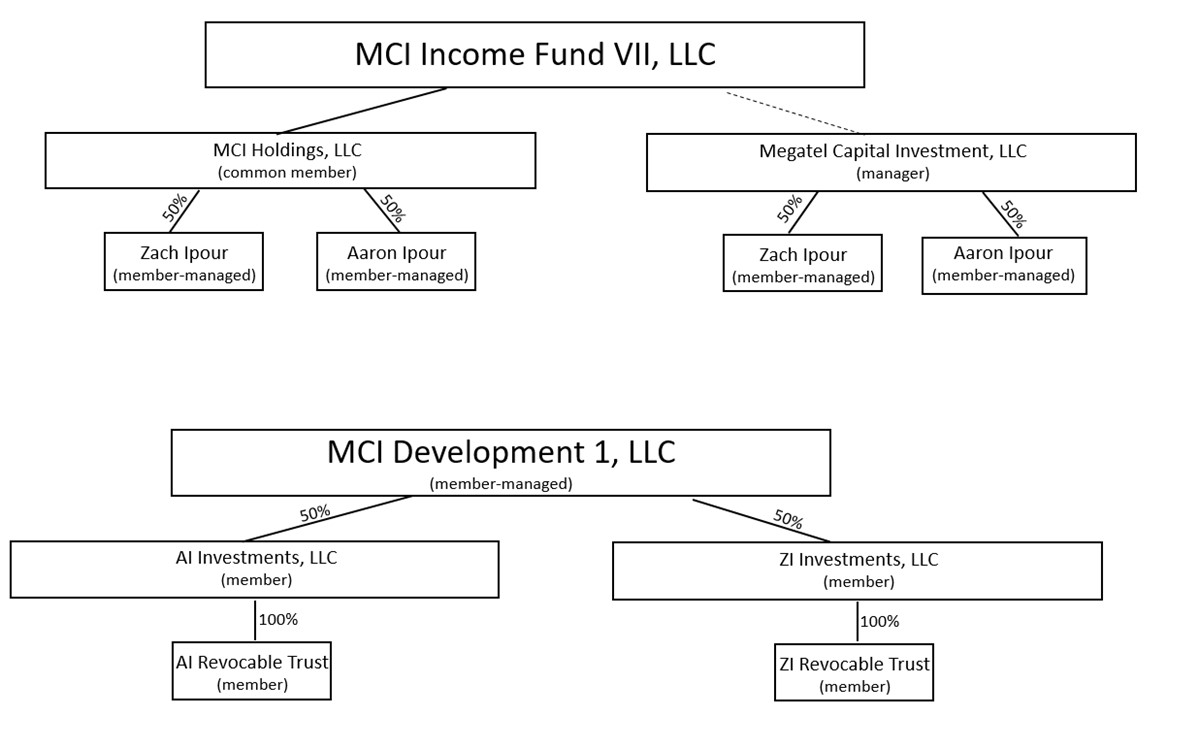
Our Sponsor and Management. Our Sponsor and Manager is a Dallas, Texas based commercial real estate company specializing in the underwriting, operational development, management, and investment in commercial real estate. Our Sponsor and Manager is owned equally by Zach Ipour and Aaron Ipour. See “General Information as to our Company – Organizational Chart” for more information about the beneficial owners and ownership structure of each entity and “Executive Officers” for more information about Zach Ipour and Aaron Ipour. Our Sponsor and Manager has significant experience in the marketing and origination of project transactions in which to properly and efficiently evaluate suitable investments for our Company.


The Developer. The Developer and its affiliated SPEs will use funding from the Loans for investment in the acquisition and/or development of real estate, which may be located anywhere in the continental United States. The Developer is a member-managed limited liability company owned equally by AI Investments, LLC and ZI Investments, LLC, each of which is owned by a revocable trust for which Zach Ipour and Aaron Ipour act as Trustee, respectively. The members of the Developer have each committed to contribute capital to the Developer, to be called by the Developer as required for working capital purposes and to fund the acquisition and/or development of real estate assets, such as those for which we will provide financing. See “General Information as to our Company – Organizational Chart” and Business Plan – Description of Developer for more information about the beneficial owners and ownership structure of each entity.


The Offering. We are offering to investors the opportunity to purchase up to an aggregate of $75,000,000 of Class A Bonds and Class B Bonds. See Plan of Distribution - Who May Investfor further information. The offering will terminate on the earliest of: (i) the date we sell the Maximum Offering Amount; (ii) the second anniversary of the date of qualification of this offering statement; or (iii) such date upon which we determine to terminate the offering, in our sole discretion. Notwithstanding the previous sentence, we have the right to extend this offering beyond the second anniversary of the date of qualification for an additional year. Our Company will conduct closings in this offering on every Friday (except bank holidays) or the “closing dates,” and each, a “closing date,” until the offering termination. Once a subscription has been submitted and accepted by the Company, an investor will not have the right to request the return of its subscription payment prior to the next closing date, except as may otherwise be required by law. If subscriptions are received on a closing date and accepted by the Company prior to such closing, any such subscriptions will be closed on that closing date. If subscriptions are received on a closing date but not accepted by the Company prior to such closing, any such subscriptions will be closed on the next closing date. It is expected that settlement will occur on the same day as each closing date. On each closing date, offering proceeds for that closing will be disbursed to us and Bonds will be issued to investors, or the “Bondholders.” If the Company is dissolved or liquidated after the acceptance of a subscription, the respective subscription payment will be returned to the subscriber. The offering is being made on a best-efforts basis through Primus Financial Services, LLC, or our managing broker-dealer.


Issuer  

MCI Income Fund VII, LLC, a Delaware limited liability company.

     
Securities Offered   Maximum — $75,000,000, aggregate principal amount of the Bonds.


Maturity Date


The Class A Bonds and Class B Bonds will each be offered serially, over a maximum period of two years (subject to extension) starting from the date of qualification of the Offering Statement of which this Offering Circular is a part. Each series of Class A and Class B Bonds will initially mature on June 30th of the fourth year following the initial year of issuance of the applicable series of Bonds. Upon the initial maturity, and subject to the terms and conditions described in this offering circular, the Bonds will be automatically renewed at the same interest rate for two additional three-year terms, unless otherwise redeemed at our or your election in accordance with the terms of the Indenture and Bond described herein.


See “Offering Circular Summary – Bondholder Redemption” and “Description of the Bonds-Maturity and Renewal” for more information.


Interest Rate


Class A Bonds — 7.00% per annum computed on the basis of a 365-day year.


Class B Bonds — 7.50% per annum computed on the basis of a 365-day year.


 3 


Interest Payments

  Interest payments will be made to the record holders of the Bonds monthly in arrears on or before the 30th of each month, beginning on the first such date that corresponds to the first full month after the initial closing in the offering. Interest will accrue and be paid on the basis of a 365-day year. Interest on each Bond will accrue and be cumulative from the end of the most recent interest period for which interest has been paid on such Bond, or if no interest has paid, from the date of issuance.
     

Offering Price

  $1,000 per Bond.
     

Ranking


The Bonds will be senior secured obligations and will rank:

·  pari passu in right of payment with all our other senior secured indebtedness from time to time outstanding;

·  senior in right of payment to our future indebtedness, if any, from time to time outstanding that is expressly subordinated to the Bonds;

·  senior to all of our unsecured indebtedness to the extent of the value of the Bonds’ security interest in the collateral owned by us; and

·  structurally junior to all the indebtedness of our subsidiaries.[1]


Security

  The Bonds will be secured by a senior blanket lien on all assets of our Company, including all of our assets acquired with proceeds from the offering, pursuant to the Pledge and Security Agreement attached as Exhibit 3(d).
     

Use of Proceeds


We estimate that the net proceeds we will receive from this offering, without taking into account any sales of Class B Bonds, will be approximately $66,750,000 if we sell the maximum offering amount, after deducting selling commissions and fees payable to our managing broker-dealer and selling group members, and payment of the O&O Fee to our Manager. As sales of Class B Bonds are without the selling commissions of 6%, the net proceeds from the offering will depend upon the sales mix of the Bonds.

We plan to use substantially all of the net proceeds from this offering to originate and make the Loans. We may also use a portion of the net proceeds to pay fees to our Manager or its affiliates, for working capital, bond payment obligations and for other general corporate purposes. See Use of Proceedsfor additional information.


Certain Covenants


The indenture will prohibit the indebtedness incurred by us, directly or indirectly (including debt of our subsidiaries). For purposes of complying with the limitation on indebtedness described above, the following will not be considered indebtedness: (i) any principal owed on the Bonds and (ii) any financing on any real estate we acquire through foreclosure on a Loan.


Bondholder

Redemption

  Redemption During Redemption Period or Renewed Redemption Period. Bonds may be redeemed, in whole, but not in part, at the option of the Bondholder, by providing written notice of redemption to the Company at the Company’s principal place of business and to the Bond Registrar, as provided in the Indenture, during (i) the Redemption Period; or (ii) the Renewed Redemption Period. Notices must be given in conformity with the Indenture and postmarked no earlier than June 9 and no later than June 30 of the respective redemption period to be deemed timely received. Interest will accrue on any Bond redeemed hereunder until the actual date of redemption of such Bond. Any redemption made within the Redemption Period or Renewed Redemption Period at the option of the Bondholder will occur without penalty at a price equal to the then outstanding principal amount of the Bonds, plus any accrued but unpaid interest.


____________

1 Our Company is a new entity and currently has no existing indebtedness. Additionally, under the indenture, we are prohibited from incurring indebtedness, directly or indirectly (including the debt of our subsidiaries). For purposes of complying with the limitation on indebtedness described above, the following will not be considered indebtedness: (i) any principal owed on the Bonds and (ii) any indebtedness on any real property we may acquire through foreclosure on any Loan.

 4 


All Bonds to be redeemed at option of the Bondholder during the Redemption Period or Renewed Redemption Period will be redeemed by the Company on a “first come, first served” basis over ten (10) equal installments of 10% of the aggregate amount to be paid by Company pursuant to such requests each calendar quarter until requests are fully honored. To the extent that the quarterly limit would result in a partial payment to a Bondholder in a given quarter, all payments to that Bondholder will be held until the next applicable quarter’s payment date. Payments will be made on or before the 30th day of the month immediately following the end of the applicable quarter. The foregoing notwithstanding, in the event that the Company has not realized gross income from operations in sufficient amounts to recoup those amounts from principal used to pay certain fees of offering the Bonds (specifically, any managing broker-dealer fees, servicing fee, Selling Commissions, and Organization and Offering Expenses) by the date in which a redemption request may be made, the Company may adjust the quarterly payment cap to 5% of aggregate amount owed pursuant to redemption requests, paid over 20 calendar quarters.  If the Company realizes sufficient gross income during the period in which redemption payments are being made, the payment schedule will revert back to the quarterly payment cap of 10% of aggregate amount owed pursuant to redemption requests and a schedule of 10 calendar quarters, with any remaining amounts paid in the final payment.


For illustrative purposes only, if the Company receives $1,000,000 in redemption requests during the respective redemption period, the Company will make redemptions of $100,000 per quarter for 10 quarters. Investors A, B and C have made redemption requests within the Redemption Period for $50,000, $25,000 and $50,000, respectively, and in that order. In the first quarter, Investors A and B will be redeemed fully since their aggregate redemption amounts aggregate to $75,000, but Investor C must wait until the next quarter since only $25,000 of his $50,000 redemption amount can be redeemed, otherwise total redemptions for that quarter would exceed $100,000.


Redemption Outside of Redemption Period or Renewed Redemption Period. At any time outside the Redemption Period or Renewed Redemption Period, the Bondholder may request to redeem the Bonds, in whole, but not in part, at the Bondholder’s option, at the then outstanding principal amount of the Bonds to be redeemed, subject to an 11% discount, plus any accrued but unpaid interest, by providing written notice of redemption to the Company at the Company’s principal place of business and to the Bond Registrar, as provided in the Indenture. Notices must be given in conformity with the Indenture. The Manager, at its sole and absolute discretion, may accept a Bondholder’s request to redeem outside the Redemption Period or Renewed Redemption Period.


Bond redemptions made outside of the Redemption Period or Renewed Redemption Period will be subject to an aggregate limit of 1.0% of the outstanding principal amount of the Bonds in the year the request is made and a cumulative aggregate limit of 5.0% of the outstanding principal amount of Bonds. Such redemption requests will be considered on a quarterly basis, and if approved, payments will be made on or before the 30th day of the month immediately following the end of the quarter after the quarter in which the request was made.


For illustrative purposes only, if the Company approves $100,000 in redemption requests outside the Redemption Period or Renewed Redemption Period at the end of the first quarter of 2023, the Company will make the approved redemption payments on or before the 30th day of the month immediately following the second quarter of 2023.


See Risk Factors – Risks Related to the Bonds and Offering.


 5 


Redemption Upon Death or Disability


Within 60 days of the death or total permanent disability of a Bondholder who is a natural person, the estate of such Bondholder, such Bondholder, or legal representative of such Bondholder may request that we repurchase, in whole but not in part, the Bonds held or beneficially held by such Bondholder (including Bonds of such Bondholder held or beneficially held in his or her individual retirement accounts), as the case may be, by delivering to the Company a redemption request in conformity with the Indenture. Any such request shall specify the particular event giving rise to the right of the holder or beneficial holder to have his or her Bonds redeemed and include evidence thereof (such as a copy of a death certificate). If a Bond held jointly by natural persons who are legally married, then such request may be made by (i) the surviving Bondholder upon the death of the spouse, or (ii) the disabled Bondholder (or a legal representative) upon total permanent disability of the spouse. A holder or beneficial holder that is not an individual natural person does not have the right to request redemption upon death or disability. In the event a Bond is held together by two or more natural persons that are not legally married, neither of these persons shall have the right to request that the Company repurchase such Bond unless each Bondholder has been affected by such an event.


Upon receipt of redemption request in the event of death or total permanent disability of a Bondholder, we will designate a date for the redemption of such Bonds and notify the Trustee of such redemption date, which date shall not be later than after 120 days we receive facts or certifications establishing to the reasonable satisfaction of the Company supporting the right to be redeemed. For redemption requests due to death or total permanent disability, on the designated date, we will redeem such Bonds at the then outstanding principal amount of the Bonds to be redeemed, subject to an 11% discount, plus any accrued but unpaid interest up to but not including the date on which the Bonds are redeemed.


The Company shall pay the paying agent, as designated below, for payment to the holder, or the estate of the holder, in accordance with the terms of the Bond being repurchased, and the paying agent shall pay out the redemption price upon the surrender of the Bond to the Trustee. No interest shall accrue on a Bond to be redeemed under this Section for any period of time on or after the Redemption Date for such Bond, provided that the Company has timely tendered the redemption price to the paying agent.


All Bonds to be redeemed upon death or disability will be subject to an aggregate limit of 1.0% of the outstanding principal amount of the Bonds in the year the request is made and a cumulative aggregate limit of 5.0% of the outstanding principal amount of Bonds. The limit applies only to redemption upon death or disability and is a separate limit from the which applies only to redemption at the option of the Bondholder outside the Redemption Period or Renewed Redemption Period. Requests under either method of redemption only count towards their own respective aggregate limits.


Optional Redemption

  The Bonds may be redeemed, in whole or in part at the Company’s option at no penalty within 18 months of the Maturity Date during the initial term. If the Bonds are renewed for any additional three-year term, the Company may redeem the Bonds at any time during such renewal period. Any such redemption will occur without penalty at a price equal to the then outstanding principal amount of the Bonds, plus any accrued but unpaid interest. If we elect to redeem Bonds at our option, we will give notice of redemption to the trustee not less than 120 days before the redemption date, together with such documentation and records as shall enable the trustee to select the Bonds to be redeemed.
     

Default

  The indenture governing the Bonds will contain events of default, the occurrence of which may result in the acceleration of our obligations under the Bonds in certain circumstances. Events of default, other than payment defaults, will be subject to our Company’s right to cure within a certain number of days of such event of default. Our Company will have the right to cure any payment default within 90 days, in the case of default on payment of any installment of interest on any Bond, or 60 days, in the case default on payment of the principal of the Bonds, before the trustee may declare a default and exercise the remedies under the indenture. See Description of Bonds - Event of Defaultfor more information.


 6 


Form

  The Bonds purchased through a participant in the Depository Trust Company, or DTC, will be evidenced by global bond certificates deposited with a nominee holder, either DTC or its nominee Cede & Co. Bonds purchased directly will be registered in book-entry form only on the books and records of UMB Bank, N.A. in the name of Phoenix American Financial Services, Inc. (“Phoenix American”) as record holder of such Bonds for the benefit of such direct purchasers. See “Description of Bonds - Book-Entry, Delivery and Form” for more information.
     

Denominations

  We will issue the Bonds only in denominations of $1,000.
     

Payment of Principal and Interest

  Principal and interest on the Bonds will be payable in U.S. dollars or other legal tender, coin or currency of the U.S.
     

Future Issuances

  We may, from time to time, without notice to or consent of the Bondholders, increase the aggregate principal amount of any series of the Bonds outstanding by issuing additional bonds in the future with the same terms of such series of Bonds, except for the issue date and offering price, and such additional bonds shall be consolidated with the applicable series of Bonds and form a single series.
     

Securities Laws Matters

  The Bonds being offered are not being registered under the Securities Act in reliance upon exemptions from the registration requirements of the Securities Act and such state securities laws and may not be transferred or resold except as permitted under the Securities Act and applicable state securities laws pursuant to registration or exemption therefrom. In addition, the Company does not intend to be registered as an investment company under the Investment Company Act of 1940 nor does the Manager plan to register as an investment adviser under the Investment Advisers Act of 1940, as amended.
     

Trustee, Registrar and Paying Agent

  We have designated UMB Bank, N.A. as paying agent in respect of Bonds purchased through a participant in DTC and deposited with a nominee holder, either DTC or its nominee Cede & Co., and Phoenix American Financial Services, Inc. a California corporation, as paying agent in respect of Bonds registered to it as record holder. UMB Bank, N.A. will also act as trustee under the indenture and registrar for the Bonds. As such, UMB Bank, N.A. will make payments on the Bonds to DTC and Phoenix American to Bondholders who are direct purchasers. The Bonds will be issued in book-entry form only, evidenced by global certificates, as such, payments are being made to DTC, its nominee or to Phoenix American.
     

Governing Law

  The indenture and the Bonds will be governed by the laws of the State of Delaware.
     

Material Tax Considerations

  You should consult your tax advisors concerning the U.S. federal income tax consequences of owning the Bonds in light of your own specific situation, as well as consequences arising under the laws of any other taxing jurisdiction.
     

Risk Factors

  An investment in the Bonds involves certain risks. You should carefully consider the risks above, as well as the other risks described under Risk Factors of this offering circular before making an investment decision.


 7 


CAUTIONARY STATEMENT REGARDING FORWARD-LOOKING STATEMENTS


This offering circular contains certain forward-looking statements that are subject to various risks and uncertainties. Forward-looking statements are generally identifiable by use of forward-looking terminology such as “may,” “will,” “should,” “potential,” “intend,” “expect,” “outlook,” “seek,” “anticipate,” “estimate,” “approximately,” “believe,” “could,” “project,” “predict,” or other similar words or expressions. Forward-looking statements are based on certain assumptions, discuss future expectations, describe future plans and strategies, contain financial and operating projections or state other forward-looking information. Our ability to predict results or the actual effect of future events, actions, plans or strategies is inherently uncertain. Although we believe that the expectations reflected in our forward-looking statements are based on reasonable assumptions, our actual results and performance could differ materially from those set forth or anticipated in our forward-looking statements. Factors that could have a material adverse effect on our forward-looking statements and upon our business, results of operations, financial condition, funds derived from operations, cash flows, liquidity and prospects include, but are not limited to, the factors referenced in this offering circular, including those set forth below.


When considering forward-looking statements, you should keep in mind the risk factors and other cautionary statements in this offering circular. Readers are cautioned not to place undue reliance on any of these forward-looking statements, which reflect our views as of the date of this offering circular. The matters summarized below and elsewhere in this offering circular could cause our actual results and performance to differ materially from those set forth or anticipated in forward-looking statements. Accordingly, we cannot guarantee future results or performance. Furthermore, except as required by law, we are under no duty to, and we do not intend to, update any of our forward-looking statements after the date of this offering circular, whether as a result of new information, future events or otherwise.


 8 


RISK FACTORS


An investment in the Bonds is highly speculative and is suitable only for persons or entities that are able to evaluate the risks of the investment. An investment in the Bonds should be made only by persons or entities able to bear the risk of and to withstand the total loss of their investment. Prospective investors should consider the following risks before making a decision to purchase the Bonds. To the best of our knowledge, we have included all material risks to investors in this section.


Risks Related to the Bonds and to this Offering


The Bonds are not obligations of our subsidiaries and will be effectively subordinated to any future obligations of our Company’s subsidiaries, if any. Structural subordination increases the risk that we will be unable to meet our obligations on the Bonds.


The Bonds are our obligations exclusively and not of any of our subsidiaries. We do not currently have any subsidiaries, but we are not precluded from acquiring or forming subsidiaries by the indenture or otherwise. If acquired or formed, our Company’s subsidiaries are not expected to be guarantors of the Bonds and the Bonds are not required to be guaranteed by any subsidiaries our Company may acquire or form in the future. The indenture will prohibit the indebtedness incurred by us, directly or indirectly (including debt of our subsidiaries), with the exception of any principal owed on the Bonds and any indebtedness on real property that we acquire through foreclosure on a Loan. Notwithstanding this prohibition, the Bonds are effectively subordinated to all of the liabilities of our Company’s subsidiaries, to the extent of their assets, since they are separate and distinct legal entities with no obligation to pay any amounts due under our Company’s indebtedness, including the Bonds, or to make any funds available to make payments on the Bonds. Our Company’s right to receive any assets of any subsidiary in the event of a bankruptcy or liquidation of the subsidiary, and therefore the right of our Company’s creditors to participate in those assets, will be effectively subordinated to the claims of that subsidiary’s creditors, including trade creditors, in each case to the extent that our Company is not recognized as a creditor of such subsidiary. In addition, even where our Company is recognized as a creditor of a subsidiary, our Company’s rights as a creditor with respect to certain amounts are subordinated to other indebtedness of that subsidiary, including secured indebtedness to the extent of the assets securing such indebtedness.


We are not limited in the amount of distributions we may make to our Member.


Neither the Indenture nor the forms of Bonds contain any covenant limiting the ability of our Manager to cause us to make distributions of cash from us to our Member. We anticipate that distributions of cash will be made from us to our Member, in amounts as determined by our Manager, and that such amounts will be at least sufficient to pay all expenses and liabilities of our Member. As our Manager will conduct all of our operations through its personnel, we believe such distributions to be necessary; however, amounts distributed to our Member will not be available to us to make payments of interest or principal or to fund redemption requests on the Bonds.


The Bonds will be protected by limited restrictive covenants, which in turn may allow us to engage in a variety of transactions that may impair our ability to fulfill our obligations under the Bonds.


The indenture governing the Bonds will contain limited financial covenants and will not restrict us from paying dividends, or issuing other securities. Because the indenture will contain limited covenants or other provisions designed to afford the Bondholders protection in the event of a highly leveraged transaction involving us including as a result of a takeover, recapitalization, highly leveraged transaction or similar restructuring involving us, except to the extent described under “Description of Bonds — Certain Covenants,” we may engage in transactions that may impair our ability to fulfill our obligations under the Bonds.


 9 


Some significant restructuring transactions that may adversely affect you may not constitute a “Change of Control/Repurchase Event” under the indenture, in which case we would not be obligated to offer to repurchase the Bonds.


Upon the occurrence of a Change of Control/Repurchase Event, you will have the right, at your option, to require us to repurchase your Bonds for cash. However, the definition of Change of Control/Repurchase Event contained in the indenture will be limited to certain transactions. Transactions such as asset sales, mergers or acquisitions of the Company by an affiliate of the Company, or a sales of a minority of membership units entitled to vote are among the types of transactions which do not constitute a Change of Control/Repurchase Event. As a result, the Change of Control/Repurchase Event provision of the indenture will not afford protection to Bondholders in the event of other transactions that could adversely affect the Bonds. In the event of any such transaction, Bondholders would not have the right to require us to repurchase their Bonds, even though such a transaction could increase the amount of our indebtedness, or otherwise adversely affect the Bondholders.


Events that constitute a “Change of Control/Repurchase Event” include a purchase, merger or other acquisition transaction or series of purchases, mergers or other acquisition transactions of membership units entitling the purchaser or acquirer to exercise more than 50% of the total voting power of all the membership units entitled to vote in meetings of our Company. See Description of Bonds — Certain Covenants for more information.


Our investment objectives may become more difficult to reach depending on the amount of funds raised in this offering.


While we believe we will be able to reach our investment objectives regardless of the amount of the raise, it may be more difficult to do so if we sell less Bonds than we anticipate. Such a result may negatively impact our liquidity. In that event, our investment costs may increase, which may decrease our ability to make payments to Bondholders.


If we sell substantially less than all of the Bonds we are offering, the costs we incur to comply with the rules of the Securities and Exchange Commission, or the SEC, regarding financial reporting and other fixed costs (such as those relating to the offering) will be a larger percentage of our revenue and may reduce our financial performance and our ability to fulfill our obligations under the Bonds.


We expect to incur significant costs in maintaining compliance with the financial reporting for a Tier II Regulation A issuer and that our management will spend a significant amount of time assessing the effectiveness of our internal control over financial reporting. We do not anticipate that these costs or the amount of time our management will be required to spend will be significantly less if we sell substantially less than all of the Bonds we are offering.


It may be difficult to realize the value of the collateral securing the Bonds.


The value of the collateral at any time will depend on market and other economic conditions, including the availability of suitable buyers. By their nature, some or all of the pledged assets may be illiquid and may have no readily ascertainable market value. The value of the assets pledged as collateral could be impaired in the future as a result of changing economic conditions, our failure to implement our business strategy, competition, unforeseen liabilities and other future events. Accordingly, there may not be sufficient collateral to pay all or any of the amounts due on the Bonds. Any claim for the amount, if any, realized by Bondholders from the sale of the collateral and the obligations under the Bonds will rank pari passu in right of payment with all of our other senior secured indebtedness. Additionally, the collateral underlying the Loans could be subordinated by other indebtedness, including mortgages on the properties, including mortgages, which may be cross-collateralized across multiple properties. In the event that a bankruptcy case is commenced by or against us, if the value of the collateral is less than the amount of principal and accrued and unpaid interest on the Bonds and all other senior secured obligations, interest may cease to accrue on the Bonds from and after the date the bankruptcy petition is filed. Although we anticipate that the Developer will have a limited guaranty on any principal outstanding on any Loan to an SPE, no affiliate of the Company will enter a guaranty for the Bond obligations.


 10 


The security interest of the trustee will be subject to practical problems generally associated with the realization of security interests in collateral. For example, the trustee may need to obtain the consent of a third party to obtain access to collateral or enforce a security interest in a contract. We cannot assure you that the trustee will be able to obtain any such consent. We also cannot assure you that the consents of any third parties will be given when required to facilitate a foreclosure on such assets. Accordingly, the trustee may not have the ability to foreclose upon those assets and the value of the collateral may significantly decrease.


Our trustee shall be under no obligation to exercise any of the rights or powers vested in it by the indenture at the request, order or direction of any of the Bondholders, pursuant to the provisions of the indenture, unless such Bondholders shall have offered to the trustee reasonable security or indemnity against the costs, expenses and liabilities that may be incurred therein or thereby.


The indenture governing the Bonds provides that in case an event of default occurs and cannot be cured, the trustee will be required, in the exercise of its power, to use the degree of care of a reasonable person in the conduct of his own affairs. Subject to such provisions, the trustee will be under no obligation to exercise any of its rights or powers under the indenture at the request of any Bondholder, unless the Bondholder has offered to the trustee security and indemnity satisfactory to it against any loss, liability or expense.


The Bonds will have limited transferability and liquidity.


Prior to this offering, there was no active market for the Bonds. Although we may apply for quotation of the Bonds on an alternative trading system or over the counter market, even if we obtain that quotation, we do not know the extent to which investor interest will lead to the development and maintenance of a liquid trading market. Further, the Bonds will not be quoted on an alternative trading system or over the counter market until after the termination of this offering, if at all. Therefore, investors will be required to wait until at least after the final termination date of this offering for such quotation. The initial public offering price for the Bonds has been determined by us. You may not be able to sell the Bonds you purchase at or above the initial offering price.


Alternative trading systems and over the counter markets, as with other public markets, may from time to time experience significant price and volume fluctuations. As a result, the market price of the Bonds may be similarly volatile, and Bondholders may from time to time experience a decrease in the value of their Bonds, including decreases unrelated to our operating performance or prospects. The price of the Bonds could be subject to wide fluctuations in response to a number of factors, including those listed in this “Risk Factors” section of this offering circular.


No assurance can be given that the market price of the Bonds will not fluctuate or decline significantly in the future or that Bondholders will be able to sell their Bonds when desired on favorable terms, or at all.


Our lack of operating history makes it difficult for you to evaluate this investment.


We are a recently formed entity with no operating history and may not be able to successfully operate our business or achieve our investment objectives. We may not be able to conduct our business as described in our plan of operation.


You will not have the opportunity to evaluate our Loans before we make them, and we may make Loans that would have changed your decision as to whether to invest in the Bonds.


As of the date of this offering circular, we own no assets. We are not able to provide you with information to evaluate the investments which underlie any future Loans. We will seek to invest substantially all of the offering proceeds available for investment in the Loans, after the payment of commissions, fees and expenses, in the origination of the Loans. We have established criteria for funding the Loans. However, you will be unable to evaluate the transaction terms or data concerning the Loans. You will be relying entirely on the ability of the Developer, our Manager and its affiliates, and their management teams, to perform on the Loans and successfully use the proceeds of the Loans to operate, manage and sell the underlying real estate investments. These factors increase the risk that we may not generate the returns that you seek by investing in the Bonds.


 11 


The inability to retain or obtain key personnel could delay or hinder implementation of our investment strategies, which could impair our ability to honor our obligations under the terms of Bonds and could reduce the value of your investment.


Our success depends to a significant degree upon the contributions of our Manager’s management team and the Developer’s management. We do not have employment agreements with any of these individuals nor do we currently have key man life insurance on any of these individuals. If any of them were to cease their affiliation with us, our Manager, or our Developer, our Manager and our Developer’s manager may be unable to find suitable replacements, and our operating results and the operating results of our Developer could suffer. Competition for highly skilled personnel is intense and attempts to attract and retain such skilled personnel may be difficult and unsuccessful. If our Manager or Developer’s manager loses or is unable to obtain the services of highly skilled personnel, our ability and our Developer’s ability to implement our investment strategies and operations could be delayed or hindered, and our ability to pay obligations on the Bonds may be materially and adversely affected.


We rely on Primus Financial Services, LLC, our managing broker-dealer, to sell the Bonds pursuant to this offering. If our managing broker-dealer is not able to market the Bonds effectively, we may be unable to raise sufficient proceeds to meet our business objectives.


We have engaged Primus Financial Services, LLC, to act as our managing broker-dealer for this offering, and we rely on our managing broker-dealer to use its best efforts to sell the Bonds offered hereby. It would also be challenging and disruptive to locate an alternative managing broker-dealer for this offering. Without improved capital raising, our portfolio will be smaller relative to our general and administrative costs and less diversified than it otherwise would be, which could adversely affect the value of your investment in us.


Redemption requests of Bonds at the option of the Bondholder will be limited by the redemption limits and for redemption requests made outside of the Redemption Period or Renewed Redemption Period, to the extent they are accepted, will be subject to financial penalties for redemption made.


There are limited periods wherein the Bondholder may redeem the Bonds without penalty. Further, redemptions within the Redemption Period or Renewed Redemption Period are still subject to the limits as provided in the Indenture. Bondholders may request that Bonds be redeemed at the option of the Bondholder at any time outside the Redemption Period or Renewed Redemption Period at the then outstanding principal amount of the Bonds to be redeemed, subject to an 11% discount, plus any accrued but unpaid interest. The Manager, at its sole and absolute discretion, may accept Holder’s request to redeem outside the Redemption Period or Renewed Redemption Period.


Under certain circumstances, we may redeem the Bonds before maturity, and you may be unable to reinvest the proceeds at the same or a higher rate of return.


Under certain circumstances, we may redeem all or a portion of the Bonds. See Description of Bonds - Optional Redemptionfor more information. If redeemed, you may be unable to reinvest the money you receive in the redemption at a rate that is equal to or higher than the rate of return on the Bonds.


We may have to liquidate some of our investments at inopportune times to redeem Bonds in the event of the death or disability of a Bondholder and redeem Bonds pursuant to the Bondholder Redemption.


The Bonds carry an early redemption right, or the Bondholder Redemption, and a redemption right in the event of death or disability of the Bondholder. As a result, one or more Bondholders may elect to have their Bonds redeemed prior to maturity. In such an event, we may not have access to the necessary cash to redeem such Bonds, and we may be required to liquidate certain assets in order to make such redemptions. Our Loans are not intended to be liquid, and as a result any such liquidation may be at a price that represent a discount to the actual value of such investment.


 12 


Our payment of the Bonds is dependent on the predictability of income streams and the consistency of the Developer’s and its SPEs’ deal flow.


Our ability to pay interest on the Bonds and satisfy redemption requests is dependent on our income stream, which is largely influenced by the Developer’s and its SPEs’ continuous real estate transactions. The Developer and its SPEs intend to continuously take out and pay off the Loans, as well as make interest payments on the Loans, as they cycle through various development and sales projects. A deviation from the typical pace of Developer’s deal flow may affect the predictability of our income stream, thereby potentially affecting our ability to make interest payments or payout redemption requests.


We have limited capitalization and a lack of working capital and as a result are entirely dependent on cash flow to service the Bonds.


We have limited capitalization and require the proceeds from this Offering in order to make Loans to Developer and its SPEs. Should we fail to obtain sufficient working capital through this Offering, we may be forced to modify our business plan. Moreover, we are dependent on the cash flow from our Loans to Developer and its SPEs to service the Bonds. Although Loans will be secured by the underlying properties as collateral, there is no other guaranty for the debt under the Bonds. Therefore, in the event Developer or its SPEs are delinquent on Loan payments or are in default on one or more Loans, we may have insufficient cash flow to meet our obligations under the Bonds.


Risks Related to Our Corporate Structure


Because we are dependent upon our Manager and its affiliates to conduct our operations, any adverse changes in the financial health of our Manager or its affiliates or our relationship with them could hinder our operating performance and our ability to meet our financial obligations.


We are dependent on our Manager to manage our operations and the Developer to acquire and manage the Loans and the underlying real estate investment. Our Manager makes all decisions with respect to our management. Our Manager depends upon the fees and other compensation that it receives from us in connection with the origination and management of the Loans to conduct its operations. Any adverse changes in the financial condition of our Manager or the Developer could hinder its ability to successfully manage our operations and our portfolio of investments.


You will have no control over changes in our policies and day-to-day operations, which lack of control increases the uncertainty and risks you face as an investor in the Bonds. Our Company, our Manager, and the Developer are all under common beneficial ownership.


Our Manager, which is under common beneficial ownership with the Developer and us, determines our major policies, including our policies regarding financing, growth, debt capitalization, and distributions. Our Manager may amend or revise these and other policies without your approval. As a Bondholder, you will have no rights under the limited liability company agreement of our company, or our “LLC Agreement.” See General Information as to Our Company — LLC Agreementherein for a detailed summary of our operating agreement.


Our Manager is responsible for the day-to-day operations of our Company and the selection and management of the Loans and has broad discretion over the use of proceeds from this offering. Our Manager may make certain changes to the Loans or other operations of our Company at its sole discretion. Accordingly, you should not purchase Bonds unless you are willing to entrust all aspects of the day-to-day management and the selection and management of investments to our Manager. Specifically, our Manager is controlled by Messrs. Zach and Aaron Ipour. They will be able to exert exclusive control over our operations through our Manager. As a result, we are dependent on our Manager to properly choose investments and manage our Company. In addition, our Manager may, or may cause our Company to, retain independent contractors to provide various services for us, and you should note that such contractors will have no fiduciary duty to you and may not perform as expected or desired.


Bondholders will have no right to remove our Manager or otherwise change our management, even if we are underperforming and not attaining our investment objectives.


Only the members of our Company will have the right to remove our Manager, and currently our Manager is under common ownership. Bondholders will have no rights in our management and will have no ability to remove our Manager.


 13 


Our Manager and its executive officers will have limited liability for, and will be indemnified and held harmless from, the losses of our Company.


Our Manager and its executive officers and their agents and assigns, will not be liable for, and will be indemnified and held harmless (to the extent of our Company’s assets) from any loss or damage incurred by them, our Company or the members in connection with the business of our Company resulting from any act or omission performed or omitted in good faith, which does not constitute fraud, willful misconduct, gross negligence or breach of fiduciary duty. A successful claim for such indemnification could deplete our Company’s assets by the amount paid. See General Information as to Our Company - LLC Agreement - Indemnificationbelow for a detailed summary of the terms of our operating agreement. Our operating agreement is filed as an exhibit this offering circular.


Risks Related to Conflicts of Interest


The members of our Manager also maintain beneficial ownership and control of the Developer and SPEs of the Developer. Thus, there are conflicts of interest among us, the Manager and its affiliates.


The members of our Manager are also the beneficial owners of the Developer and will have control of operations for the Developer and any SPEs of the Developer. Accordingly, the members of the Manager will have executive control over the projects the Developer and SPEs of the Developer undertake as well as approval of the Loans for us. Therefore, we anticipate that each Loan to an SPE of the Developer will be approved by the Manager at its sole discretion without independent, third-party assessment, so long as it conforms to the lending criteria requirements. See Business Plan – Underwriting Procedures; Lending Criteria.Each of our executive officers is an executive officer of the Manager. All the agreements and arrangements between such parties are not the result of arm’s-length negotiations. The Manager and its affiliates will try to balance our interests with their own. However, to the extent that such parties take actions that are more favorable to other entities than us, these actions could have a negative impact on our financial performance and, consequently, on distributions to investors and the value of our interests. The operating agreement provides the Manager with broad powers and authority which may exacerbate the existing conflicts of interest among your interests and those of the Manager, its executive officers and its other affiliates.


The ability of the Manager and its officers and other personnel to engage in other business activities, including managing other similar companies, may reduce the time the Manager spends managing the business of our Company and may result in certain conflicts of interest between us, our Developer and its SPEs, and our Manager.


Our Manager has sponsored similar privately offered programs and may in the future, or concurrently, sponsor similar private and public programs that have investment objectives similar to the Developer and its SPEs. Our Manager and its affiliates and officers may have obligations to those programs, the fulfillment of which might not be in the best interests of us, or any of our investors. Our officers and the Manager may face conflicts of interest in allocating Loan opportunities, administration and underwriting of the Loans, enforcement of the loans, and other business opportunities.


Moreover, these other business activities may reduce the time our Manager and its executives spend managing our business. Our officers, our Developer’s officers, and our Manager’s officers also serve or may serve as officers or employees of other Manager-sponsored vehicles. These other business activities may reduce the time these persons spend managing our business. Further, if and when there are turbulent conditions in the real estate markets or distress in the credit markets or other times when we will need focused support and assistance from the Manager, the attention of the Manager’s personnel and our executive officers and the resources of the Manager may also be required by the Manager-sponsored vehicles.  In such situations, we may not receive the level of support and assistance that we may receive if we were internally managed or if we were not managed by the Manager. We expect that as our activities expand, our Manager will attempt to hire additional employees who would devote substantially all of their time to our business. There is no assurance that our Manager will devote adequate time to our business. If our Manager suffers or is distracted by adverse financial or operational problems in connection with its operations unrelated to us, it may allocate less time and resources to our operations. If any of these things occur, our ability to honor obligations under the Bonds may be adversely affected.


 14 


The inability to retain or obtain key personnel could delay or hinder implementation of our investment strategies, which could impair our ability to honor our obligations under the terms of Bonds and could reduce the value of your investment.


Our success depends to a significant degree upon the contributions of our Sponsor’s management team. We do not have employment agreements with any of these individuals nor do we currently have key man life insurance on any of these individuals. If any of them were to cease their affiliation with us, our Manager or our Sponsor, our Sponsor may be unable to find suitable replacements, and our operating results could suffer. Competition for highly skilled personnel is intense, and our Sponsor may be unsuccessful in attracting and retaining such skilled personnel. If our Sponsor loses or is unable to obtain the services of highly skilled personnel, our ability to implement our investment strategies could be delayed or hindered, and our ability to pay obligations on the Bonds may be materially and adversely affected.


The members of the Developer have agreed to contribute capital to the Developer, which these members currently have full control over.


The members of the Developer, AI Investments, LLC and ZI Investments, LLC, have each agreed to contribute capital to the Developer, pursuant to the operating agreement of the Developer, in an amount to be called by the Developer as required for working capital purposes and to fund the acquisition and/or development of real estate assets, such as those for which we will provide financing. However, the operating agreement of the Developer does not specify a specific amount each member must contribute. Moreover, AI Investments, LLC and ZI Investments, LLC are currently the only members of the Developer. Therefore, together they solely control the Developer’s ability to make calls to its members for capital, and they also have the ability to amend the Developer’s operating agreement, including provisions related to capital contributions.


Risks Related to Our Lending Activities


Our loans and investments expose us to risks associated with debt-oriented real estate investments generally.


We seek to invest primarily in the Loans. As such, we are subject to, among other things, risk of defaults on the Loans in paying debt service on the Loans and the underlying real estate investments. Any deterioration of real estate fundamentals generally, and in the U.S. in particular, could negatively impact our performance by making it more difficult for borrowers of our Loans to satisfy their debt payment obligations, increasing the default risk applicable to borrower entities, and/or making it more difficult for us to generate attractive risk-adjusted returns. Changes in general economic conditions will affect the creditworthiness of borrower entities and/or the value of underlying real estate collateral relating to our Loans and may include economic and/or market fluctuations, changes in environmental, zoning and other laws, casualty or condemnation losses, regulatory limitations on rents, decreases in property values, changes in the appeal of properties to tenants, changes in supply and demand, fluctuations in real estate fundamentals, the financial resources of borrower entities, energy supply shortages, various uninsured or uninsurable risks, natural disasters, political events, terrorism and acts of war, changes in government regulations, changes in real property tax rates and/or tax credits, changes in operating expenses, changes in interest rates, changes in inflation rates, changes in the availability of debt financing and/or mortgage funds which may render the sale or refinancing of properties difficult or impracticable, increased mortgage defaults, increases in borrowing rates, negative developments in the economy and/or adverse changes in real estate values generally and other factors that are beyond our control.


We cannot predict the degree to which economic conditions generally, and the conditions for real estate debt investing in particular, will improve or decline. Any declines in the performance of the U.S. and global economies or in the real estate debt markets could have a material adverse effect on our business, financial condition, and results of operations.


The Loans are limited on a portfolio basis to an aggregate 90% of the appraised value of the underlying real estate investment, on an as built, best and highest use valuation.


 15 


Real estate-related investments that are secured by real property are subject to delinquency, foreclosure and loss, which could result in losses to us.


Real estate debt instruments (e.g., mortgages) that are secured by real property are subject to risks of delinquency and foreclosure and risks of loss. The ability of a borrower to repay a loan secured by an income-producing property typically is dependent primarily upon the successful operation of the property or the value of the underlying real estate. If the net operating income of the property is reduced, or the value of the underlying real estate diminishes, the borrower’s ability to repay the loan may be impaired. Net operating income of a real property can be affected by, among other things:


·tenant mix and tenant bankruptcies;
·success of tenant businesses;
·property management decisions, including with respect to capital improvements, particularly in older building structures;
·property location and condition;
·competition from other properties offering the same or similar services;
·changes in laws that increase operating expenses or limit rents that may be charged;
·any need to address environmental contamination at the property;
·changes in global, national, regional, or local economic conditions and/or specific industry segments;
·declines in global, national, regional or local real estate values;
·declines in global, national, regional or local rental or occupancy rates;
·changes in interest rates, foreign exchange rates, and in the state of the credit and securitization markets and debt and equity capital markets, including diminished availability or lack of debt financing for commercial real estate;
·changes in real estate tax rates, tax credits and other operating expenses;
·changes in governmental rules, regulations and fiscal policies, including income tax regulations and environmental legislation;
·acts of God, terrorism, social unrest and civil disturbances, which may decrease the availability of or increase the cost of insurance or result in uninsured losses; and
·adverse changes in zoning laws.


Specifically, changes in federal, state and local laws and regulations may affect certain income producing properties more than others. For example, we may provide loans secured by property used in the production, sale and/or testing of cannabis-related products. Any change to the federal, state and local regulations applicable to this industry may negatively affect the ability of the property owner to produce income and materially diminish the value of the property used to secure the loan. In addition, we are exposed to the risk of judicial proceedings with our borrowers and entities we invest in, including bankruptcy or other litigation, as a strategy to avoid foreclosure or enforcement of other rights by us as a lender or investor.


In the event that any of the properties or entities underlying or collateralizing our loans or investments experiences any of the foregoing events or occurrences, the value of, and return on, such investments could be reduced, which would adversely affect our results of operations and financial condition.


It is unlikely Bondholders will know in advance the exact mixture of property types underlying the Loans in our portfolio.


We anticipate that Loans made to the Developer or its SPEs will be approved by the Manager at its sole discretion without independent, third-party assessment, so long as it conforms to the lending criteria requirements. The properties underlying our Loans will consist of a mix of single-family residential, multi-family residential, and commercial properties. Bondholders will have no opportunity to evaluate or approve the Loans made by us or the properties underlying the Loans, nor will we be able to inform Bondholders in advance of the exact makeup of our Loan portfolio with respect to property type underlying each Loan.


The continuing spread of a new strain of coronavirus (also known as the COVID-19 virus) may adversely affect our investments and operations.


The World Health Organization declared the spread of the COVID-19 virus a global pandemic, and the President of the United States declared a national state of emergency in the United States in response to the outbreak. Considerable uncertainty still surrounds the COVID-19 virus and its potential effects, and the extent of and effectiveness of any responses taken on a national and local level. However, measures taken to limit the impact of this coronavirus, including social distancing and other restrictions on travel, congregation and business operation have already resulted in significant negative short term economic impacts. The long-term impact of this coronavirus on the U.S. and world economies remains uncertain, but can result in long term infrastructure and supply chain disruption, as well as dislocation and uncertainty in the financial markets that could significantly and negatively impact the global, national and regional economies, the length and breadth of which cannot currently be predicted.


 16 


Our investments are mortgage loans secured by real estate properties. In the event of a large-scale quarantine in the United States or specific areas within the United States as a result of the COVID-19 virus, real estate values may be impacted.


To the extent the COVID-19 virus results in a world-wide economic downturn, there may be widespread corporate downsizing and an increase in unemployment. This could negatively impact our Loans secured by residences, multi-family and other properties, and our ability to make payments of interest and principal to our Bondholders. Further, continuing shutdowns and economic turmoil may result in delays in the deployment of funds raised in this offering.


Fluctuations in interest rates or the accrual of interest payment obligations could reduce our ability to generate income on our loans and other investments, which could lead to a significant decrease in our results of operations, cash flows and the market value of the Loans.


Our primary interest rate exposures relate to the yield on the Loans and the value of the underlying real estate investment and the cost of debt. Changes in interest rates and credit spreads may affect our net income from the Loans based on the value and performance of the underlying real estate investments. In addition, some of the Loans may allow for balloon payments, accrual of interest features, extension of maturities and other features that could result in reduction in interest and principal payments on the Loans which would result in operating losses for us. Changes in the level of interest rates and credit spreads also may affect our ability to make loans or investments, the value of our loans and investments and our ability to realize gains from the disposition of assets. Increases in interest rates and credit spreads may also negatively affect demand for loans and could result in higher borrower default rates.


We operate in a competitive market for lending and investment opportunities which may intensify, and competition may limit our ability to originate or acquire Loans or dispose of assets we target and could also affect the yields of these assets and have a material adverse effect on our business, financial condition, and results of operations.


We operate in a competitive market for lending and investment opportunities, which may intensify. Our profitability depends, in large part, on our ability to originate or acquire Loans on attractive terms. In originating or acquiring our Loans, we compete for opportunities with a variety of lenders and investors, including REITs, specialty finance companies, public and private funds (including funds managed by affiliates of our Sponsor), commercial and investment banks, commercial finance and insurance companies and other financial institutions. Some competitors may have a lower cost of funds and access to funding sources that are not available to us, such as the U.S. Government. Many of our competitors are not subject to the operating constraints associated with maintaining an exclusion from regulation under the Investment Company Act. In addition, some of our competitors may have higher risk tolerances or different risk assessments, which could allow them to consider a wider variety of loans and investments, offer more attractive pricing or other terms and establish more relationships than us. Furthermore, competition for originations of and investments in our target assets may lead to decreasing yields, which may further limit our ability to generate desired returns. Also, as a result of this competition, desirable loans and investments in our target assets may be limited in the future and we may not be able to take advantage of attractive lending and investment opportunities from time to time, thereby limiting our ability to identify and originate or acquire loans or make investments that are consistent with our investment objectives. We cannot assure you that the competitive pressures we face will not have a material adverse effect on our business, financial condition and results of operations.


Prepayment rates may adversely affect our financial performance and the value of certain of our assets.


Our business is currently focused on originating Loans secured by real estate assets. Our borrowers may be able to repay their loans prior to their stated maturities. In periods of declining interest rates and/or credit spreads, prepayment rates on loans generally increase. If general interest rates or credit spreads decline at the same time, the proceeds of such prepayments received during such periods may not be reinvested for some period of time or may be reinvested by us in assets yielding less than the yields on the assets that were prepaid.


 17 


Prepayment rates on loans may be affected by a number of factors including, but not limited to, the then-current level of interest rates and credit spreads, the availability of mortgage credit, the relative economic vitality of the area in which the related properties are located, the servicing of the loans, possible changes in tax laws, other opportunities for investment, and other economic, social, geographic, demographic and legal factors beyond our control. Consequently, such prepayment rates cannot be predicted with certainty and no strategy can completely insulate us from prepayment or other such risks.


Difficulty in redeploying the proceeds from repayments of our Loans may cause our financial performance and our ability to fulfill our obligations relative to the Bonds.


As the Loans are repaid, we will look to redeploy the proceeds we receive into new Loans, pay interest on the Bonds or redeem outstanding Bonds. It is possible that we will fail to identify reinvestment options that would provide returns or a risk profile that is comparable to the asset that was repaid. If we fail to redeploy the proceeds we receive from repayment of a loan in equivalent or better alternatives, our financial performance and our ability to fulfill our obligations related to the Bonds will suffer.


The lack of liquidity in certain of our assets may adversely affect our business.


The illiquidity of certain of our assets may make it difficult for us to sell such investments if the need or desire arises. Certain assets such as mortgages or real estate assets we acquire through foreclosure are relatively illiquid investments. In addition, certain of our assets may become less liquid after our investment as a result of periods of delinquencies or defaults or turbulent market conditions, which may make it more difficult for us to dispose of such assets at advantageous times or in a timely manner. Moreover, the Loans we invest in are not registered under the relevant securities laws, resulting in limitations or prohibitions against their transfer, sale, pledge or their disposition except in transactions that are exempt from registration requirements or are otherwise in accordance with such laws. As a result, many of our assets will be illiquid, and if we are required to liquidate all or a portion of our portfolio quickly, we may realize significantly less than the value at which we have previously recorded our investments. Further, we may face other restrictions on our ability to liquidate an investment to the extent that we or our Manager (and/or its affiliates) has or could be attributed as having material, non-public information regarding the borrower entity. As a result, our ability to vary our portfolio in response to changes in economic and other conditions may be relatively limited, which could adversely affect our results of operations, financial condition and ability to fulfill our obligations related to the Bonds.


Loans we make that later become distressed may subject us to losses and other risks relating to bankruptcy, proceedings.


While the Loans focus primarily on “performing” real estate-related interests, the Loans may also include making distressed investments from time to time (e.g., investments in defaulted, out-of-favor or distressed loans and debt securities) or may involve investments that become “sub-performing” or “non-performing” following our acquisition thereof. Some of the assets underlying the Loans may include properties that typically are highly leveraged, with significant burdens on cash flow and, therefore, involve a high degree of financial risk. During an economic downturn or recession, loans or securities of financially or operationally troubled borrowers or issuers are more likely to go into default than loans or securities of other borrowers or issuers. Loans or securities of financially or operationally troubled issuers are less liquid and more volatile than loans or securities of borrowers or issuers not experiencing such difficulties. The market prices of such securities are subject to erratic and abrupt market movements and the spread between bid and ask prices may be greater than normally expected. Investment in the loans or securities of financially or operationally troubled borrowers or issuers involves a high degree of credit and market risk.


In certain limited cases (e.g., in connection with a workout, restructuring and/or foreclosing proceedings involving one or more of our investments), the success of our investment strategy will depend, in part, on our ability to effectuate loan modifications and/or restructure and improve the operations of our borrower entities. The activity of identifying and implementing successful restructuring programs and operating improvements entails a high degree of uncertainty. There can be no assurance that we will be able to identify and implement successful restructuring programs and improvements with respect to any distressed loans or investments we may have from time to time.


 18 


These financial or operating difficulties may never be overcome and may cause borrower entities to become subject to bankruptcy or other similar administrative proceedings. There is a possibility that we may incur substantial or total losses on the Loans and in certain circumstances, become subject to certain additional potential liabilities that may exceed the value of our original investment therein. For example, under certain circumstances, a lender that has inappropriately exercised control over the management and policies of a debtor may have its claims subordinated or disallowed or may be found liable for damages suffered by parties as a result of such actions. In any reorganization or liquidation proceeding relating to the Loans, we may lose our entire investment, may be required to accept cash or securities with a value less than our original investment and/or may be required to accept different terms, including payment over an extended period of time. In addition, under certain circumstances, payments to us may be reclaimed if any such payment or distribution is later determined to have been a fraudulent conveyance, preferential payment, or similar transaction under applicable bankruptcy and insolvency laws. Furthermore, bankruptcy laws and similar laws applicable to administrative proceedings may delay our ability to realize value from collateral for loan positions held by us, may adversely affect the economic terms and priority of such loans through doctrines such as equitable subordination or may result in a restructuring of the debt through principles such as the “cramdown” provisions of the bankruptcy laws.


We are subject to additional risks associated with priority loan participations.


Some of our loans may be participation interests in which we share the rights, obligations and benefits of the Loan with other lenders. From time to time these participations may be structured so that other participants have a priority to payments of interest and principal over us, or, in other words, our rights to payments of interest and principal will be subordinate to the satisfaction of the priority rights of those participants; provided that we will retain a senior lien interest in the underlying collateral. In such cases, if a borrower defaults on a participation loan, or if the borrower is in bankruptcy, our interest in the participation loan will be satisfied only after the interests of the other lenders in the participation loan are satisfied. In those instances, our risk of loss is greater than the risk associated with those participants with priority over our other loans. If the underlying collateral is insufficient to pay off the other participating lenders, then we may experience losses that would have a material adverse effect on our operations.


Loans on properties in transition will involve a greater risk of loss than conventional mortgage loans.


We may invest in transitional loans to borrowers who are typically seeking relatively short-term capital to be used in an acquisition or rehabilitation of a property. The typical borrower in a transitional loan has usually identified an undervalued asset that has been under-managed and/or is located in a recovering market. If the market in which the asset is located fails to improve according to the borrower’s projections, or if the borrower fails to improve the quality of the asset’s management and/or the value of the asset, the borrower may not receive a sufficient return on the asset to satisfy the transitional loan, and we bear the risk that we may not recover some or all of our investment.


In addition, borrowers usually use the proceeds of a conventional mortgage to repay a transitional loan. Transitional loans therefore are subject to the risk of a borrower’s inability to obtain permanent financing to repay the transitional loan. In the event of any default under transitional loans that may be held by us, we bear the risk of loss of principal and non-payment of interest and fees to the extent of any deficiency between the value of the mortgage collateral and the principal amount and unpaid interest of the transitional loan. To the extent we suffer such losses with respect to these transitional loans, it could adversely affect our results of operations and financial condition.


Risks of cost overruns and noncompletion of renovations of properties in transition may result in significant losses.


The renovation, refurbishment or expansion of a property by a borrower involves risks of cost overruns and noncompletion. Estimates of the costs of improvements to bring an acquired property up to standards established for the market position intended for that property may prove inaccurate. Other risks may include rehabilitation costs exceeding original estimates, possibly making a project uneconomical, environmental risks, delays in legal and other approvals and rehabilitation and subsequent leasing of the property not being completed on schedule. If such renovation is not completed in a timely manner, or if it costs more than expected, the borrower may experience a prolonged reduction of net operating income and may not be able to make payments on the Loans on a timely basis or at all, which could result in significant losses.


 19 


There are increased risks involved with our lending activities to renovation or rehabilitation projects.


Lending to projects involving renovations or rehabilitations, which include our investment in loans that fund such projects, may expose us to increased lending risks. Lending to projects involving renovations or rehabilitations generally is considered to involve a higher degree of risk of non-payment and loss than other types of lending due to a variety of factors, including the difficulties in estimating costs and anticipating delays and, generally, the dependency on timely, successful completion and the lease-up and commencement of operations post-completion. In addition, since such loans generally entail greater risk than mortgage loans collateralized by income-producing property, we may need to increase our allowance for loan losses in the future to account for the likely increase in probable incurred credit losses associated with such loans. Further, as the lender under a such a loan, we may be obligated to fund all or a significant portion of the loan at one or more future dates. We may not have the funds available at such future date(s) to meet our funding obligations under the loan. In that event, we would likely be in breach of the loan unless we are able to raise the funds from alternative sources, which we may not be able to achieve on favorable terms or at all.


If a borrower fails to complete the project or experiences cost overruns, there could be adverse consequences associated with the loan, including a decline in the value of the property securing the loan, a borrower claim against us for failure to perform under the loan documents if we choose to stop funding, increased costs to the borrower that the borrower is unable to pay, a bankruptcy filing by the borrower, and abandonment by the borrower of the collateral for the loan.


Changes to, or the elimination of LIBOR may adversely affect interest expense related to our loans and investments.


On December 31, 2021, the FCA ceased publication of most tenors of LIBOR, except that the date upon which the LIBOR administrator will cease publication of U.S. Dollar LIBOR was deferred to June 30, 2023 for certain tenors (including overnight rates and one, three, six and 12 month rates). The LIBOR administrator may discontinue or modify remaining LIBOR tenors prior to that date. In addition, the LIBOR administrator has strongly advised that no new contracts using U.S. dollar LIBOR should be entered into after December 31, 2021. Accordingly, the continuation of U.S. LIBOR on the current basis cannot be guaranteed after December 31, 2021 and, in the absence of further deferrals, will be fully discontinued on June 30, 2023. The U.S. Federal Reserve, together with the Alternative Reference Rates Committee, have identified the Secured Overnight Financing Rate (SOFR) as their preferred replacement index, however some uncertainty remains as to whether SOFR or another rate will actually replace LIBOR.


We cannot predict the effect of the FCA’s decision not to sustain LIBOR, or, if changes are ultimately made to LIBOR, the effect of those changes. Any such changes could increase our financing costs, which could impact our results of operations, cash flows and the market value of our investments.


Our success depends on the availability of attractive investments and our Manager’s ability to identify, structure, consummate, manage and realize returns on our Loans.


Our operating results are dependent upon the availability of, as well as our Manager’s ability, to identify, structure, consummate, manage and realize returns on our Loans. In general, the availability of favorable investment opportunities and, consequently, our returns, will be affected by general economic conditions, the demand for investment opportunities in our target assets and the supply of capital for such investment opportunities. We cannot assure you that our Manager will be successful in identifying and consummating investments that satisfy our rate of return objectives or that such investments, once made, will perform as anticipated.


Our loans are concentrated in terms of geography, asset types, and borrower.


We are not required to observe specific diversification criteria. Therefore, the assets underlying our Loans are concentrated in certain property types that may be subject to higher risk of default or foreclosure or secured by properties concentrated in a limited number of geographic locations.


 20 


Although we may provide Loans for real estate projects anywhere in the continental U.S., we expect the vast majority of the assets underlying our Loans to be concentrated in Texas, and specifically in the Dallas/Fort Worth area and mostly related to residential real estate. These types of investments may result in defaults on a number of the Loans within a short time period, which could adversely affect our results of operations and financial condition. In addition, because of asset concentrations, even modest changes in the value of the underlying real estate assets could have a significant impact on the value of the Loans. As a result of any high levels of concentration, any adverse economic, political or other conditions that disproportionately affects those geographic areas or asset classes could have a magnified adverse effect on our results of operations and financial condition, and the value of our Bondholder’s investments could vary more widely than if we invested in a more diverse portfolio of loans.


Our loans are not diversified with respect to the borrower of the loans.


We are making Loans solely to Developer and its wholly-owned SPE subsidiaries, meaning that our Loans will not be diversified with respect to the borrowers of such Loans. As such, our income stream from our portfolio of Loans will be entirely dependent on the Developer’s operational success and ability to maintain its own income stream to make payments on the Loans. Any failure of Developer to generate sufficient income, either through its own management or by means of any adverse economic, political or other conditions, could impact its ability to satisfy its Loan obligations to us. The value of our Bondholder’s investments could vary more widely than if we made Loans to a wider variety of borrowers.


The due diligence process that our Manager undertakes in regard to investment opportunities may not reveal all facts that may be relevant in connection with an investment and if our Manager incorrectly evaluates the risks of our investments, we may experience losses.


Each Loan to an SPE of Developer, if conforming to the lending requirements of the Loan Policies and Procedures, will be approved by our Manager. We will largely be dependent on the diligence of our Manager. When conducting due diligence, our Manager may be required to evaluate important and complex business, financial, tax, accounting, environmental and legal issues. Outside consultants, legal advisors, accountants and investment banks may be involved in the due diligence process in varying degrees depending on the type of potential investment. Our Manager’s loss estimates may not prove accurate, as actual results may vary from estimates. If our Manager underestimates the asset-level losses relative to the price we pay for a particular investment, we may experience losses with respect to such investment.


Moreover, investment analyses and decisions by our Manager may frequently be required to be undertaken on an expedited basis to take advantage of investment opportunities and in a conflict situation because of the common ownership with the Developer, our likely borrower. In such cases, the information available to our Manager at the time of making an investment decision may be limited, and they may not have access to detailed information regarding such investment. Therefore, we cannot assure you that our Manager will have knowledge of all circumstances that may adversely affect such investment.


Insurance on loans and collateral may not cover all losses.


There are certain types of losses, generally of a catastrophic nature, such as earthquakes, floods, hurricanes, terrorism or acts of war, which may be uninsurable or not economically insurable. Inflation, changes in building codes and ordinances, environmental considerations and other factors also might result in insurance proceeds insufficient to repair or replace a property if it is damaged or destroyed. Under these circumstances, the insurance proceeds received with respect to a property relating to one of the Loans might not be adequate to restore our economic position with respect to our investment. Any uninsured loss could result in the corresponding nonperformance of or loss on the Loans related to such property.


The impact of any future terrorist attacks and the availability of affordable terrorism insurance expose us to certain risks.


Terrorist attacks, the anticipation of any such attacks, and the consequences of any military or other response by the U.S. and its allies may have an adverse impact on the U.S. financial markets and the economy in general. We cannot predict the severity of the effect that any such future events would have on the U.S. financial markets, the economy or our business. Any future terrorist attacks could adversely affect the credit quality of some of our loans and investments. Some of our loans and investments will be more susceptible to such adverse effects than others, particularly those secured by properties in major cities or properties that are prominent landmarks or public attractions. We may suffer losses as a result of the adverse impact of any future terrorist attacks and these losses may adversely impact our results of operations.


 21 


In addition, the enactment of the Terrorism Risk Insurance Act of 2002, or TRIA, and the subsequent enactment of the Terrorism Risk Insurance Program Reauthorization Act of 2015 and the Terrorism Risk Insurance Program Reauthorization Act of 2019, which extended TRIA through the end of 2020 and 2027, respectively, requires insurers to make terrorism insurance available under their property and casualty insurance policies and provides federal compensation to insurers for insured losses. However, this legislation does not regulate the pricing of such insurance and there is no assurance that this legislation will be extended beyond 2020. The absence of affordable insurance coverage may adversely affect the general real estate lending market, lending volume and the market’s overall liquidity and may reduce the number of suitable investment opportunities available to us and the pace at which we are able to make investments. If the properties that we invest in are unable to obtain affordable insurance coverage, the value of those investments could decline and in the event of an uninsured loss, we could lose all or a portion of our investment.


We may need to foreclose on certain of the Loans we originate or acquire, which could result in losses that harm our results of operations and financial condition.


We may find it necessary or desirable to foreclose on certain of the Loans we originate or acquire, and the foreclosure process may be lengthy and expensive. If we foreclose on an asset, we may take title to the property securing that asset, and if we do not or cannot sell the property, we would then come to own and operate it as “real estate owned.” Owning and operating real property involves risks that are different (and in many ways more significant) than the risks faced in owning an asset secured by that property. In addition, we may end up owning a property that we would not otherwise have decided to acquire directly at the price of our original investment or at all, and the liquidation proceeds upon sale of the underlying real estate may not be sufficient to recover our cost basis in the loan, resulting in a loss to us.


Whether or not we have participated in the negotiation of the terms of any such Loans, we cannot assure you as to the adequacy of the protection of the terms of the applicable loan, including the validity or enforceability of the loan and the maintenance of the anticipated priority and perfection of the applicable security interests. Furthermore, claims may be asserted by lenders or borrowers that might interfere with enforcement of our rights. Borrowers may resist foreclosure actions by asserting numerous claims, counterclaims and defenses against us, including, without limitation, lender liability claims and defenses, even when the assertions may have no basis in fact, in an effort to prolong the foreclosure action and seek to force the lender into a modification of the loan or a favorable buy-out of the borrower’s position in the loan. In some states, foreclosure actions can take several years or more to litigate. At any time prior to or during the foreclosure proceedings, the borrower may file for bankruptcy, which would have the effect of staying the foreclosure actions and further delaying the foreclosure process and could potentially result in a reduction or discharge of a borrower’s debt. Foreclosure may create a negative public perception of the related property, resulting in a diminution of its value. Even if we are successful in foreclosing on a loan, the liquidation proceeds upon sale of the underlying real estate may not be sufficient to recover our cost basis in the loan, resulting in a loss to us. Furthermore, any costs or delays involved in the foreclosure of the loan or a liquidation of the underlying property will further reduce the net sale proceeds and, therefore, increase any such losses to us.


If we foreclose on certain of the Loans we originate or acquire, then we are subject to the general risks of owning real estate.


Fluctuations in vacancy rates, rent schedules and operating expenses can adversely affect operating results or render the sale or refinancing of a property difficult or unattractive. No assurance can be given that certain assumptions as to the future levels of occupancy, cost of tenant improvements or future costs of operating a property will be accurate since such matters will depend on events and factors beyond the control of the Manager. Such factors include continued validity and enforceability of the leases, vacancy rates for similar properties, financial resources of tenants and rent levels near the properties, adverse changes in local population trends, market conditions, neighborhood values, local economic and social conditions, supply and demand for property, competition from similar properties, interest rates and real estate tax rates, governmental rules, regulations and fiscal policies, the enactment of unfavorable real estate laws, rent control, environmental or zoning law, and hazardous material law, uninsured losses, effects of inflation, and other risks. Properties may not perform in accordance with expectations which could result in losses that harm our results of operations and financial conditions. There’s no certainty that we will be able to sell or refinance such properties on favorable terms, or at all.


 22 


Properties obtained through the foreclosure on one of our Loans we originate or acquire may involve substantial risks.


Properties obtained through a foreclosure may be distressed, poorly managed or in need of repositioning or other improvements. We may underestimate the amount of time, difficulty and cost of leasing vacant space. Additionally, we may underestimate the costs of improvements required to bring a property up to standards suitable for its intended use or its intended market position. No assurance can be given that the Manager will manage such properties in a way that is profitable to the Company.


The properties underlying our investments may be subject to unknown liabilities, including environmental liabilities, that could affect the value of these properties and as a result, our investments.


Collateral properties underlying our investments may be subject to unknown or unquantifiable liabilities that may adversely affect the value of our investments. Such defects or deficiencies may include title defects, title disputes, liens, servitudes or other encumbrances on the mortgaged properties. The discovery of such unknown defects, deficiencies and liabilities could affect the ability of our borrowers to make payments to us or could affect our ability to foreclose and sell the underlying properties, which could adversely affect our results of operations and financial condition.


Furthermore, to the extent we foreclose on properties with respect to which we have extended loans, we may be subject to environmental liabilities arising from such foreclosed properties. Under various U.S. federal, state and local laws, an owner or operator of real property may become liable for the costs of removal of certain hazardous substances released on its property. These laws often impose liability without regard to whether the owner or operator knew of, or was responsible for, the release of such hazardous substances.


If we foreclose on any properties underlying our investments, the presence of hazardous substances on a property may adversely affect our ability to sell the property and we may incur substantial remediation costs, therefore the discovery of material environmental liabilities attached to such properties could adversely affect our results of operations and financial condition.


We may be subject to lender liability claims, and if we are held liable under such claims, we could be subject to losses.


In recent years, a number of judicial decisions have upheld the right of borrowers to sue lending institutions on the basis of various evolving legal theories, collectively termed “lender liability.” Generally, lender liability is founded on the premise that a lender has either violated a duty, whether implied or contractual, of good faith and fair dealing owed to the borrower or has assumed a degree of control over the borrower resulting in the creation of a fiduciary duty owed to the borrower or its other creditors or stockholders. We cannot assure prospective investors that such claims will not arise or that we will not be subject to significant liability if a claim of this type did arise.


Investments in non-conforming and non-investment grade rated loans involve increased risk of loss.


Many of our investments may not conform to conventional loan standards applied by traditional lenders and either will not be rated (as is typically the case for private loans) or will be rated as non-investment grade by the rating agencies. Private loans often are not rated by credit rating agencies. Non-investment grade ratings typically result from the overall leverage of the loans, the lack of a strong operating history for the properties underlying the loans, the borrowers’ credit history, the underlying properties’ cash flow or other factors. As a result, these investments should be expected to have a higher risk of default and loss than investment-grade rated assets. Any loss we incur may be significant and may adversely affect our results of operations and financial condition. There are no limits on the percentage of unrated or non-investment grade rated assets we may hold in our investment portfolio.


 23 


We must manage our portfolio so that we do not become an investment company that is subject to regulation under the Investment Company Act.


We conduct our operations so that we avail ourselves of the statutory exclusion provided in Section 3(c)(5)(C) for companies engaged primarily in investment in mortgages and other liens on or interests in real estate. In order to qualify for this exclusion, we must maintain, on the basis of positions taken by the SEC’s Division of Investment Management, or the “Division,” in interpretive and no-action letters, a minimum of 55% of the value of our total assets in mortgage loans and other related assets that are considered “mortgages and other liens on and interests in real estate,” which we refer to as “Qualifying Interests,” and a minimum of 80% in Qualifying Interests and real estate-related assets. In the absence of SEC or Division guidance that supports the treatment of other investments as Qualifying Interests, we will treat those other investments appropriately as real estate-related assets or miscellaneous assets depending on the circumstances.


In August 2011, the SEC staff commenced an advance notice rulemaking initiative, indicating that it is reconsidering its interpretive policy under Section 3(c)(5)(C) and whether to advance rulemaking to define the basis for the exclusion. We cannot predict the outcome of this reconsideration or potential rulemaking initiative and its impact on our ability to rely on the exclusion. To the extent that the SEC or its staff provides more specific guidance regarding any of the matters bearing upon the requirements of Section 3(c)(5)(C) of the Investment Company Act, we may be required to adjust our strategy accordingly. Any additional guidance from the SEC or its staff could further inhibit our ability to pursue the strategies we have chosen.


Because registration as an investment company would significantly affect our ability to engage in certain transactions or be structured in the manner we currently are, we intend to conduct our business so that we will continue to satisfy the requirements to avoid regulation as an investment company. If we do not meet these requirements, we could be forced to alter our investment portfolio by selling or otherwise disposing of a substantial portion of the assets that do not satisfy the applicable requirements or by acquiring a significant position in assets that are Qualifying Interests. Any such investments may not represent an optimum use of capital when compared to the available investments we and our subsidiaries target pursuant to our investment strategy and present additional risks to us. We continue to analyze our investments and may make certain investments when and if required for compliance purposes. Altering our portfolio in this manner may have an adverse effect on our investments if we are forced to dispose of or acquired assets in an unfavorable market.


If it were established that we were an unregistered investment company, there would be a risk that we would be subject to monetary penalties and injunctive relief in an action brought by the SEC, that we would be unable to enforce contracts with third parties, that third parties could seek to obtain rescission of transactions undertaken during the period it was established that we were an unregistered investment company. In order to comply with provisions that allow us to avoid the consequences of registration under the Investment Company Act, we may need to forego otherwise attractive opportunities and limit the manner in which we conduct our operations. Therefore, compliance with the requirements of the Investment Company Act may hinder our ability to operate solely on the basis of maximizing profits.


Rapid changes in the values of our other real estate-related investments may make it more difficult for us to maintain our exclusion from regulation under the Investment Company Act.


If the market value or income potential of real estate-related investments declines, we may need to alter the mix of our portfolio of assets in order to maintain our exclusion from the Investment Company Act regulation. If the decline in real estate asset values and/or income occurs quickly, this may be especially difficult to accomplish. This difficulty may be exacerbated by the illiquid nature of any non-qualifying assets that we may own. We may have to make investment decisions that we otherwise would not make absent the Investment Company Act considerations.


 24 


The Manager is not registered and does not intend to register as an investment adviser under the Investment Advisers Act of 1940, as amended (the “Advisers Act. If the Manager is required to register as an investment adviser under the Advisers Act, it could impact our operations and possibly reduce your investment return.


The Manager is not currently registered as an investment adviser under the Advisers Act and does not expect to register as an investment adviser because the Company does not believe that it meets the registration requirements under the Advisers Act. In order to fall under the Advisers Act, the Manager must: (i) be in the business of (ii) providing advice or analyses on securities (iii) for compensation. First, the Company does not believe the Manager advises on “securities” because its investments in secured mortgages are not securities under the Advisers Act. Second, the Company believes that any investments in securities will be solely incidental to its investment strategy and therefore, the Manager would not be considered to be “in the business of providing advice on securities. Third, whether an adviser has sufficient regulatory assets under management to require registration under the Advisers Act depends on the nature of the assets it manages. In calculating regulatory assets under management, the Manager must include the value of each “securities portfolio” it manages. The Manager expects that our assets will not constitute a securities portfolio so long as a majority of our assets consist of assets that we believe are not securities. However, the SEC will not affirm our determination of what portion of our investments are not securities. As a result, there is a risk that such determination is incorrect and, as a result, our investments are a securities portfolio. In such event, the Manager may be acting as an investment adviser subject to registration under the Advisers Act but not be registered. If our investments were to constitute a securities portfolio, then the Manager may be required to register under the Advisers Act, which would require it to comply with a variety of regulatory requirements under the Advisers Act on such matters as record keeping, disclosure, compliance, limitations on the types of fees it could earn and other fiduciary obligations. As a result, the Manager would be required to devote additional time and resources and incur additional costs to manage our business, which could possibly reduce your investment return.


Risks Related to Real Estate Investments Generally


Real estate valuation is inherently subjective and uncertain.


The valuation of real estate and therefore the valuation of any collateral underlying our Loans is inherently subjective due to, among other factors, the individual nature of each property, its location, the expected future rental revenues from that particular property and the valuation methodology adopted. In addition, where we invest in loans for ground up construction, renovation or rehabilitation projects, initial valuations will assume completion of the project. As a result, the valuations of the real estate assets against which we will make or acquire loans are subject to a large degree of uncertainty and are made on the basis of assumptions and methodologies that may not prove to be accurate, particularly in periods of volatility, low transaction flow or restricted debt availability in the commercial or residential real estate markets. This is true regardless of whether we internally perform such valuation or hire a third party to do so.


Our Developer may be subject to unknown or contingent liabilities related to properties that it acquires, for which it may have limited or no recourse against the sellers.


Assets and entities that the Developer or its SPEs may acquire in the future may be subject to unknown or contingent liabilities. Unknown or contingent liabilities might include liabilities for clean-up or remediation of environmental conditions, claims of tenants, vendors or other persons dealing with the acquired entities, tax liabilities and other liabilities whether incurred in the ordinary course of business or otherwise. In the future, the Developer may enter into transactions with limited representations and warranties or with representations and warranties that do not survive the closing of the transactions or that only survive for a limited period, in which event it would have no or limited recourse against the sellers of such properties. While sellers are expected to indemnify buyers with respect to breaches of representations and warranties that survive, such indemnification is often limited and subject to various materiality thresholds, a significant deductible or an aggregate cap on losses.


As a result, there is no guarantee that the Developer will recover any amounts with respect to losses due to breaches by the sellers of their representations and warranties. In addition, the total amount of costs and expenses that the Developer may incur with respect to liabilities associated with acquired properties and entities may exceed our expectations, which may adversely affect our business, financial condition, results of operations and cash flow.


 25 


Our Developer may not be able to sell its properties at a price equal to, or greater than, the price for which it purchased such properties, which may lead to a decrease in the value of our assets.


The value of a property to a potential purchaser may not increase over time, which may restrict our Developer’s ability to sell a property, or if it is able to sell such property. This may lead to a sale price less than the price that Developer paid to purchase a property, which may adversely affect our business, financial condition, results of operations and cash flow.


Property taxes could increase due to property tax rate changes or reassessment, which could impact our cash flow.


The real property taxes on the properties underlying our Loans may increase as property tax rates change or as the properties are assessed or reassessed by taxing authorities. If the property taxes on such properties increase, our Developer’s financial condition, results of operations, cash flow, the value of its interests and ability to satisfy the principal and interest obligations on the Loans and to could be adversely affected.


Potential development and construction delays and resultant increased costs and risks may hinder Developer’s operating results and decrease its net income.


Our Developer or its SPEs intend to acquire unimproved real property or properties that are under development or construction. Investments in such properties will be subject to the uncertainties associated with the development and construction of real property, including those related to re-zoning land for development, environmental concerns of governmental entities and community groups and our Developer’s ability to build in conformity with plans, specifications, budgeted costs and timetables. If a builder fails to perform, Developer may resort to legal action to rescind the purchase or the construction contract or to compel performance. A builder’s performance may also be affected or delayed by conditions beyond the builder’s control. Our Developer may incur additional risks when it makes periodic progress payments or other advances to builders before they complete construction. These and other factors can result in increased costs of a project or loss of Developer’s investment, adversely affecting its ability to satisfy its Loan obligations to us.


Costs imposed pursuant to governmental laws and regulations may reduce our Developer’s net income and available cash.


Real property and the operations conducted on real property are subject to federal, state and local laws and regulations relating to protection of the environment and human health. Developer and its SPEs could be subject to substantial liability in the form of fines, penalties or damages for noncompliance with these laws and regulations. Even if not subject to liability, other costs, which our Developer may undertake to avoid or mitigate any such liability, such as the cost of removing or remediating hazardous or toxic substances, could be substantial. These laws and regulations generally govern wastewater discharges, air emissions, the operation and removal of underground and above-ground storage tanks, the use, storage, treatment, transportation and disposal of solid and hazardous materials, the remediation of contamination associated with the release or disposal of solid and hazardous materials, the presence of toxic building materials and other health and safety-related concerns.


Some of these laws and regulations may impose joint and several liability on the tenants, owners or operators of real property for the costs to investigate or remediate contaminated properties, regardless of fault, whether the contamination occurred prior to purchase, or whether the acts causing the contamination were legal. The condition of properties at the time or purchase, operations in the vicinity of the properties, such as the presence of underground storage tanks, or activities of unrelated third parties may affect the properties underlying the Loans.


The presence of hazardous substances, including hazardous substances that have not been detected, or the failure to properly manage or remediate these substances, may hinder the ability to sell, rent or pledge such property as collateral for future borrowings. Certain environmental laws and common law principles could be used to impose liability for the release of and exposure to hazardous substances, including asbestos-containing materials and lead-based paint. Third parties may seek recovery from real property owners or operators for personal injury or property damage associated with exposure to released hazardous substances and governments may seek recovery for natural resource damage. The costs of defending against claims of environmental liability, of complying with environmental regulatory requirements, of remediating any contaminated property, or of paying personal injury, property damage or natural resource damage claims could reduce the amounts available to our Developer’s and adversely affect its ability to satisfy its obligations under the Loans. 


 26 


Environmental laws also may impose liens on property or restrictions on the manner in which property may be used or businesses may be operated, and these restrictions may require substantial expenditures or prevent our Developer or its SPEs and their assignees from operating such properties. Some of these laws and regulations have been amended so as to require compliance with new or more stringent standards as of future dates. Compliance with new or more stringent laws or regulations or stricter interpretation of existing laws may require our Developer to incur material expenditures. Future laws, ordinances or regulations may impose material environmental liability. These factors can result in increased costs of a project or loss of Developer’s investment, adversely affecting Developer’s ability to satisfy its Loan obligations to us.


Developer may purchase properties that contain lead-based paint, which may cause health problems, exposing the Developer to third-party liability or potentially causing it to be in violation of environmental laws or regulations, either of which would adversely affect the Developer’s operating results.


Some existing structures which the Developer seeks to acquire may have been built prior to 1978, and housing built prior to such time may contain lead-based paint. The existence of lead-based paint is especially a concern in residential units and can cause health problems, particularly for children. As a result, Federal, state and local laws and regulations impose certain disclosure requirements and restrict and regulate renovation activities on housing built before 1978. Any violation of these restrictions could result in fines or criminal liability, and the Developer could be subject to liability arising from lawsuits alleging personal injury or related claims, thereby affecting its ability to satisfy its Loan obligations to us.


Risks Related to Single-Family Residential Real Estate


Acquiring properties during periods when the single-family home sector is experiencing substantial inflows of capital and intense competition may result in inflated purchase prices and increase the likelihood that our properties will not appreciate in value and may, instead, decrease in value.


The allocation of substantial amounts of capital for investment in the single-family home sector and significant competition for income producing real estate may inflate the purchase prices for such assets. To the extent Developer purchased, or in the future purchases, real estate in such an environment, it is possible that the value of such properties may not appreciate and may, instead, decrease in value, perhaps significantly, below the amount paid for such properties. In addition to macroeconomic and local economic factors, technical factors, such as a decrease in the amount of capital allocated to the single-family home sector and the number of investors participating in the sector, could cause the value of Developer’s properties to decline, inhibiting its ability to satisfy its obligations to us under the Loans and our ability to sufficiently collect on our Loans in the event of Developer’s default and our foreclosure on the respective property.


Increasing interest rates and inflation may cause a decrease in demand for the Developer’s single-family residential properties.


Interest rates have risen significantly throughout 2022. Meanwhile, inflation has risen significantly to levels not seen for 40 years. The real estate market has already seen a decrease in demand due to higher interest rates for mortgages. If interest rates continue to rise, individuals previously in the market for single-family homes might choose alternatives to buying single-family real estate, such as rentals or multi-family real estate, or wait until interest rates decrease before purchasing single-family real estate. A shift in demand for single-family properties might diminish the value of the Developer’s single-family real estate or make it harder to sell, adversely impacting Developer’s ability to satisfy its obligations to us under the Loans and inhibiting our ability to sufficiently collect on our Loans in the event of Developer’s default and our foreclosure on the respective property.


Single-family properties that are being sold through short sales or foreclosure sales are subject to risks of theft, mold, infestation, vandalism, illegal activity on the premises, deterioration or other damage that could require extensive renovation, and adversely impact Developer’s operating results.


When a single-family property is put into foreclosure due to a default by the homeowner on its mortgage obligations or the value of the property is substantially below the outstanding principal balance on the mortgage and the homeowner decides to seek a short sale, the homeowner may abandon the property or cease to maintain the property as rigorously as the homeowner normally would. Neglected and vacant properties are subject to increased risks of theft, mold, infestation, vandalism, illegal activity on the premises, general deterioration and other maintenance problems that may persist without appropriate attention and remediation. If Developer purchases properties which it is unable to inspect immediately before the closings on the purchases, it may purchase properties that may be subject to these problems, which may result in maintenance and renovation costs and time frames that far exceed Developer’s estimates. These circumstances could substantially impair Developer’s ability to quickly renovate such properties in a cost-efficient manner or at all, which would adversely impact its operating results and affect its ability to satisfy its Loan obligations to us.


 27 


The lack of feasibility in renting single-family properties may adversely affect Developer’s ability to sell its properties.


Although a market exists for single-family rentals, such properties are not as attractive to would-be landlords as rental properties as multi-family residential or certain commercial properties. Thus, an owner invested in a single-family residential property typically is limited to the resale of the property in order to receive a return on the investment. This lack of diversity in investment models creates a risk for the Developer directly and indirectly through any prospective buyer of one of Developer’s single-family properties who is also limited in investment models. These factors could adversely affect the pool of potential buyers for Developer’s properties and may reduce the demand or market value of such single-family real estate. Additionally, in the event of a downturn in the market for single-family residential sales, Developer does not have a feasible alternative in renting single-family properties which would not be profitable to sell. Prospective buyers purchasing for resale may also take into consideration this lack of feasibility with respect to renting single-family property, thus decreasing the market value of such property. Such a decrease in market value will adversely affect Developer’s ability to satisfy its Loan obligations to us and inhibit our ability to sufficiently collect on our Loans in the event of Developer’s default and our foreclosure on the respective property.


Risks Related to Multi-Family Residential Real Estate


Competition and any increased affordability of single-family homes could decrease demand for apartments in multi-family residential properties.


The multi-family industry is highly competitive, and the Developer faces competition from many sources, including from other multi-family apartment communities both in the immediate vicinity and the geographic market where its properties will be located. If so, this would increase the number of apartments units available and may decrease occupancy and unit rental rates, potentially making it harder to sell the properties to prospective buyers. Furthermore, multi-family properties Developer invests in compete, or will compete, with numerous housing alternatives in attracting residents, including owner-occupied single and multi-family homes available to rent or purchase. The number of competitive properties and/or condominiums in a particular area, or any increased affordability of owner-occupied single and multi-family homes caused by declining housing prices, mortgage interest rates and government programs to promote home ownership, could adversely affect Developer’s ability to market multi-family properties to prospective buyers who intend to lease such properties, and such adverse effects could affect Developer’s ability to satisfy its Loan obligations to us and also inhibit our ability to sufficiently collect on our Loans in the event of Developer’s default and our foreclosure on the respective property.


Multi-family properties that experience significant vacancy could be difficult to sell.


Certain multi-family residential properties belonging to Developer may have some level of extended vacancy. If vacancies continue for a long period of time, the resale value of the property could be diminished because the market value may depend on a potential buyer’s ability to lease units in the multi-family property. Such a decrease in the property’s market value will affect Developer’s income and in turn affect its ability to satisfy its Loan obligations to us, and it will also inhibit our ability to sufficiently collect on our Loans in the event of Developer’s default and our foreclosure on the respective property.


The prospect of finding creditworthy tenants for multi-family residential units, tenant turnover rates, or tenants potentially defaulting on rent payments or filing for bankruptcy, could significantly affect the value of or demand for Developer’s multi-family residential properties.


A prospective buyer of Developer’s multi-family properties will likely intend to lease units to tenants and receive rent from tenants during the terms of their respective leases. A tenant’s ability to pay rent is often initially determined by the creditworthiness of the tenant and the income of the tenant. Furthermore, tenant turnover rates in multi-family residential properties may be difficult to predict. If a large number of resident lease agreements at a multi-family property terminate at or around the same time, and if the units remain unoccupied, then revenues and earnings could be adversely affected. Any prospective buyer will likely value Developer’s multi-family properties based on its observations of the pool of tenants, tenant turnover rates, the overall residential rental market, and the reliability of receiving periodic rent payments from tenants.


Additionally, a prospective buyer may also consider the possibility of tenants’ credit or income deteriorating and the potential default or bankruptcy of tenants. The bankruptcy or insolvency of tenants or other failure to pay is likely to adversely affect the income produced by multi-family real estate investments. Any bankruptcy filings by, or relating to, one tenant could bar a landlord from collecting pre-bankruptcy debts from that tenant or its properties. A tenant bankruptcy could delay efforts to collect past due balances under the relevant leases and could ultimately preclude full collection of these sums. If a tenant files for bankruptcy, a landlord may not be able to evict the tenant solely because of such bankruptcy or failure to pay. In sum, it is highly likely that a landlord may recover substantially less than the full value of any unsecured claims against tenants. These factors in rent collection and tenants’ financial conditions, and the variations of the rental market at any given time affecting such factors, may reduce the demand or market value of multi-family real estate. Such a decrease in the property’s market value will affect Developer’s income and in turn affect its ability to satisfy its Loan obligations to us, and it will also inhibit our ability to sufficiently collect on our Loans, in the event of Developer’s default and our foreclosure on the respective property.


 28 


The significance of effective property management with respect to multi-family real estate may affect the value of or demand for Developer’s multi-family residential properties.


The success of multi-family real estate investments and their leasing operations is highly dependent on the expertise and performance of the respective property manager and the property manager’s network and other investment professionals to source, acquire and manage the multi-family property. The potential loss or inadequacy of the services of a property manager and its affiliates could have a material and adverse effect on the operations and income of the respective multi-family property. This risk may adversely influence a prospective purchaser of any of Developer’s multi-family residential properties, thereby reducing the demand or market value of multi-family real estate owned by Developer. Such a decrease in the property’s market value will affect Developer’s income and in turn affect its ability to satisfy its Loan obligations to us, and it will also inhibit our ability to sufficiently collect on our Loans, in the event of Developer’s default and our foreclosure on the respective property.


Developer may not have control over costs arising from rehabilitation of multi-family residential properties.


Certain multi-family residential projects Developer undertakes may require some degree of rehabilitation. Consequently, Developer may retain independent vendors to perform the actual physical rehabilitation and/or construction work and will be subject to risks in connection with a vendor’s ability to control rehabilitation and/or construction costs, the timing of completion of rehabilitation and/or construction, and a vendor’s ability to build in conformity with plans and specification. Although Developer will use its best efforts to predict rehabilitation costs, certain unforeseen costs and issues may arise relating to costs and supply of materials, costs and supply of labor, environmental regulations, building code regulations, and contracts with independent vendors. Increased rehabilitation costs and issues related to such for multi-family properties may reduce the market value of Developer’s multi-family real estate owned by Developer, adversely affecting Developer’s ability to satisfy its Loan obligations to us and our ability to sufficiently collect on our Loans, in the event of Developer’s default and our foreclosure on the respective property.


Multi-family properties underlying our Loans may include condominium interests. Condominium interests are subject to special risks that may reduce your return on investment.


Properties underlying the Loans may include condominium interests, which is a type of common ownership interest. Common ownership interests are subject to special risks that may reduce your return on investment. For example, common ownership interests are governed by associations which we, as a condominium unit owner, have a vote. Our Developer or its SPEs may be outvoted by the other members of the condominium respecting matters that materially impact the management, appearance, safety or financial soundness of the dwelling or of the association.


The value of common ownership interests may be decreased by the default of other interest holders on their homeowners’ association, or HOA, fees or similar fees. If enough holders default on their fees, the HOA’s liquidity and net worth may decrease dramatically. If the HOA or board is forced to foreclose on any delinquent interests representing the condominium interests, a lowered value realized at the foreclosure sale may adversely impact the market value of every other unit.


Common interest owners are also required to pay HOA fees. If our Developer or its SPEs defaults in its payment of such fees, it may be obligated to pay financial penalties or, in severe circumstances, the condominium unit may be foreclosed on by the board or the HOA. If the board or HOA is mismanaged or if the applicable property suffers from neglect or deferred maintenance, HOA fees may increase, which may reduce Developer’s cash flow from operations, adversely affecting its ability to satisfy its Loan obligations to us.


 29 


Environmental laws governing multi-family properties may increase costs associated with rehabilitating and maintaining such properties.


The presence of hazardous substances, including hazardous substances that have not been detected, or the failure to properly manage or remediate these substances, may hinder Developer’s ability to sell such multi-family residential property. Certain environmental laws and common law principles could be used to impose liability for the release of and exposure to hazardous substances, including asbestos-containing materials and lead-based paint. Third parties may seek recovery from real property owners or operators for personal injury or property damage associated with exposure to released hazardous substances and governments may seek recovery for natural resource damage. The costs of defending against claims of environmental liability, of complying with environmental regulatory requirements, of remediating any contaminated property, or any other material expenditures, fines, penalties or damages Developer must pay will adversely affect its ability to satisfy its Loan obligations to us. Additionally, environmental issues with multi-family property, or liability under environmental laws governing such multi-family property, may decrease in the property’s market value, which will affect Developer’s income and in turn affect its ability to satisfy its Loan obligations to us, and it will also inhibit our ability to sufficiently collect on our Loans, in the event of Developer’s default and our foreclosure on the respective property.


Multi-family properties may contain mold, requiring remediation.


When excessive moisture accumulates in buildings or on building materials, mold growth may occur, particularly if the moisture problem remains undiscovered or is not addressed over a period of time. Some molds may produce airborne toxins or irritants. Concern about indoor exposure to mold has been increasing, as exposure to mold may cause a variety of adverse health effects and symptoms, including allergic or other reactions. As a result, the presence of significant mold at any of Developer’s projects could require it to undertake a costly remediation program to contain or remove the mold from the affected property or development project, which would adversely affect Developer’s operating results and income and its ability to satisfy its Loan obligations to us. Additionally, a multi-family property with mold contamination may significantly reduce the resale value of the property, which would inhibit our ability to sufficiently collect on our Loans, in the event of Developer’s default and our foreclosure on the respective property.


Costs associated with complying with the Fair Housing Amendments Act of 1988 and similar laws (including but not limited to the Rehabilitation Act of 1973) with respect to multi-family residential property may decrease cash available for distributions to our investors.


The Fair Housing Amendments Act of 1988 requires apartment communities first occupied after March 13, 1991 to comply with design and construction requirements for disabled access. For projects receiving federal funds, the Rehabilitation Act of 1973 also has requirements regarding disabled access.  If one or more acquired properties are not in compliance with such laws, then our Developer or its SPEs may incur additional costs to bring the property into compliance. We cannot predict the ultimate amount of the cost of compliance with such laws. Noncompliance with these laws could also result in the imposition of fines or an award of damages to private litigants. Substantial costs incurred to comply with such laws, as well as fines or damages resulting from actual or alleged noncompliance with such laws, could adversely affect our Developer, including our future results of operations and cash flows, thereby affecting its ability to satisfy its Loan obligations to us. Debts, liens, or penalties associated with Developer’s multi-family properties due to such laws and regulations may also affect our rights in Developer’s multi-family properties as collateral under our Loans, thereby inhibiting our ability to sufficiently collect on our Loans, in the event of Developer’s default and our foreclosure on such properties.


Risks Related to Commercial Real Estate


To the extent Developer acquires retail properties, its ability to procure buyers for such properties may be significantly impacted by the success and economic viability of obtaining retail anchor tenants.


In the retail sector, a tenant occupying all or a large portion of the gross leasable area of a retail center, commonly referred to as an anchor tenant, may become insolvent, may suffer a downturn in business and default on or terminate its lease, or may decide not to renew its lease. Any of these events would result in a reduction or cessation in rental payments to the landlord from that tenant. Developer’s ability to sell any commercial properties it owns may depend on the prospect of a potential buyer being able to procure viable anchor tenants. In the event that procuring such tenants becomes difficult in the commercial real estate market, the market value of such properties could be diminished or the time it takes to find an adequate buyer for such properties may be extended past estimations. Such a decrease in the property’s market value will affect Developer’s income and in turn affect its ability to satisfy its Loan obligations to us, and it will also inhibit our ability to sufficiently collect on our Loans, in the event of Developer’s default and our foreclosure on the respective property.


 30 


Compliance with governmental laws, regulations and covenants that are specifically applicable to commercial properties may adversely affect Developer’s business and growth strategies.


Commercial properties owned or to be purchased by Developer may be subject to various covenants, local laws and regulatory requirements, including permitting and licensing requirements. Local regulations, including municipal or local ordinances, zoning restrictions and restrictive covenants imposed by previous developers or owners, may restrict Developer’s use of commercial properties and may require it to obtain approval from local officials or community standards organizations at any time with respect to its commercial properties, including prior to acquiring such properties or when undertaking renovations. Among other things, these restrictions may relate to fire and safety, seismic, asbestos-cleanup or hazardous material abatement requirements. Such existing regulatory policies may adversely affect Developer’s operations or the timing or cost of any future acquisitions or renovations. Additional regulations may also be adopted that would increase such delays or result in additional costs. Developer’s business and growth strategies may be materially and adversely affected by its ability to obtain permits, licenses and zoning approvals. Developer’s failure to obtain such permits, licenses and zoning approvals could have a material adverse effect on Developer’s operations and adversely impact its ability to fulfill its Loan obligations to us. Debts, liens, or penalties associated with Developer’s commercial properties due to governmental laws, regulations and covenants may also affect our rights in Developer’s commercial properties as collateral under our Loans, thereby inhibiting our ability to sufficiently collect on our Loans, in the event of Developer’s default and our foreclosure on such commercial properties.


Commercial properties may contain mold, requiring remediation.


Originally occurring in residential property, mold claims have recently begun to appear in commercial properties as well.  Several insurance companies have reported a substantial increase in mold-related claims, causing a growing concern that real estate owners might be subject to increasing lawsuits regarding mold contamination.  No assurance can be given that a mold condition will not exist at one or more of Developer’s properties, with the risk of substantial damages, legal fees and diminishment in the value of such properties. As a result, the presence of significant mold at any of Developer’s commercial projects could require it to undertake a costly remediation program to contain or remove the mold from the affected property or development project, which would adversely affect Developer’s operating results and income and its ability to satisfy its Loan obligations to us. Additionally, a multi-family property with mold contamination may significantly reduce the resale value of the property, which would inhibit our ability to sufficiently collect on our Loans, in the event of Developer’s default and our foreclosure on the respective property.


Costs associated with complying with the Americans with Disabilities Act and similar laws (including but not limited to the Rehabilitation Act of 1973) may decrease cash available for distributions to our investors.


It is likely that commercial properties underlying the Loans will be subject in some form to the Americans with Disabilities Act of 1990, as amended, or the ADA. Under the ADA, all places of public accommodation are required to comply with federal requirements related to access and use by disabled persons. For projects receiving federal funds, the Rehabilitation Act of 1973 also has requirements regarding disabled access.  If one or more acquired properties are not in compliance with such laws, then our Developer or its SPEs may incur additional costs to bring the property into compliance. We cannot predict the ultimate amount of the cost of compliance with such laws. Noncompliance with these laws could also result in the imposition of fines or an award of damages to private litigants. Substantial costs incurred to comply with such laws, as well as fines or damages resulting from actual or alleged noncompliance with such laws, could adversely affect our Developer, including our future results of operations and cash flows, thereby affecting its ability to satisfy its Loan obligations to us. Debts, liens, or penalties associated with Developer’s commercial properties due to such laws and regulations may also affect our rights in Developer’s commercial properties as collateral under our Loans, thereby inhibiting our ability to sufficiently collect on our Loans, in the event of Developer’s default and our foreclosure on such commercial properties.


Developer may not have control over costs arising from rehabilitation of commercial properties.


Existing commercial structures which Developer acquires may require some degree of rehabilitation. Developer may retain independent vendors to perform the actual physical rehabilitation and/or construction work related to each commercial property and will be subject to risks in connection with a vendor’s ability to control rehabilitation and/or construction costs, the timing of completion of rehabilitation and/or construction, and a vendor’s ability to build in conformity with plans and specification. Although Developer will use its best efforts to predict rehabilitation costs, certain unforeseen costs and issues may arise relating to costs and supply of materials, costs and supply of labor, environmental regulations, building code regulations, and contracts with independent vendors. Increased rehabilitation costs and issues related to such for commercial properties may reduce the market value of Developer’s commercial real estate, adversely affecting Developer’s ability to satisfy its Loan obligations to us and our ability to sufficiently collect on our Loans, in the event of Developer’s default and our foreclosure on the respective property.


 31 


USE OF PROCEEDS


We estimate that the net proceeds we will receive from this offering, without taking into account any sales of Class B Bonds, will be approximately $66,750,000 if we raise the maximum offering amount, or $33,375,000 if we raise half of the maximum offering amount, after deducting selling commissions and fees payable to our managing broker-dealer and selling group members, and payment of the O&O Fee to our Manager. As sales of Class B Bonds are without selling commissions, the net proceeds from the offering will depend upon the sales mix of the Bonds.


We plan to use substantially all of the net proceeds from this offering to make Loans to our Developer and its SPEs for the acquisition and/or development of real estate, which may be located anywhere in the continental U.S., including: (A) the acquisition of parcels of real property (including but not limited to raw/unentitled land and/or finished lots) (i) for development into single-family residential lots, (ii) for the construction of single-family homes to be marketed and sold to homebuyers, (iii) for the construction of condominiums to be marketed and sold to homebuyers, (iv) for the development and/or construction of multi-family residential communities, and (v) for the development and/or construction of storage facilities, retail, and/or other commercial real estate assets, or mixed-use properties; (B) existing single-family homes to be redeveloped, renovated, and/or repositioned for marketing and sale; (C) existing multi-family properties to be redeveloped, renovated, and/or repositioned for marketing and sale, and/or (D) existing commercial properties to be redeveloped, renovated, and/or repositioned for marketing and sale.


The table below demonstrates our anticipated uses of offering proceeds, but the table below does not require us to use offering proceeds as indicated. Our actual use of offering proceeds will depend upon market conditions, among other considerations. The numbers in the table are approximate. The table below does not take into account any sales of Class B Bonds, which will be sold solely to certain purchasers, including purchasing through a registered investment advisor, without selling commissions.


Maximum Offering Amount


   Class A Bonds (7) 
   Amount   Percent 
Gross offering proceeds  $75,000,000    100.00% 
Less offering expenses:          
Selling commissions(1)   4,500,000    6.00% 
Managing broker-dealer fee(2)   375,000    0.50% 
Wholesaling fee(3)   1,125,000    1.50% 
Expense Reimbursement(4)   750,000    1.00% 
O&O Fee(5)   1,500,000    2.00% 
           
Net Proceeds  $66,750,000    89.00% 
           
Amount available for investment  $66,750,000    89.00% 


75% of Maximum Offering Amount


    Class A Bonds (7) 
   Amount   Percent 
Gross offering proceeds  $56,250,000    100.00% 
Less offering expenses:          
Selling commissions(1)   3,375,000    6.00% 
Managing broker-dealer fee(2)   281,250    0.50% 
Wholesaling fee(3)   843,750    1.50% 
Expense Reimbursement(4)   562,500    1.00% 
O&O Fee(5)   1,125,000    2.00% 
           
Net Proceeds  $50,062,500    89.00% 
           
Amount available for investment  $50,062,500    89.00% 


 32 


50% of Maximum Offering Amount


   Class A Bonds (7) 
   Amount   Percent 
Gross offering proceeds  $37,500,000    100.00% 
Less offering expenses:          
Selling commissions(1)   2,250,000    6.00% 
Managing broker-dealer fee(2)   187,500    0.50% 
Wholesaling fee(3)   562,500    1.50% 
Expense Reimbursement(4)   375,000    1.00% 
O&O Fee(5)   750,000    2.00% 
           
Net Proceeds  $33,375,000    89.00% 
           
Amount available for investment  $33,375,000    89.00% 


25% of Maximum Offering Amount


   Class A Bonds (7) 
   Amount   Percent 
Gross offering proceeds  $18,750,000    100.00% 
Less offering expenses:          
Selling commissions(1)   1,125,000    6.00% 
Managing broker-dealer fee(2)   93,750    0.50% 
Wholesaling fee(3)   281,250    1.50% 
Expense Reimbursement(4)   187,500    1.00% 
O&O Fee(5)   375,000    2.00% 
           
Net Proceeds  $16,687,500    89.00% 
           
Amount available for investment  $16,687,500    89.00% 


(1)We will pay (a) selling commissions of 6.00% of gross offering proceeds on the sale of Class A Bonds. Our managing broker-dealer may reallow selling commissions to selling group members, in whole or in part.
(2)We will pay a managing broker-dealer fee of up to 0.50% of the gross offering proceeds on the sale of Class A Bonds.
(3)We may pay a wholesaling fee of up to 1.50% of gross proceeds on the sale of Class A Bonds. We are not required to pay the wholesaling fee, but we may agree to pay the wholesaling fee to our managing broker-dealer for sales made by certain selling group members, which it may reallow, in whole or in part, to those selling group members.
(4)We will pay a nonaccountable expense reimbursement of 1.00% of gross offering proceeds on the sale of Class A Bonds to the Managing Broker-Dealer.
(5)We will pay our Manager the O&O Fee of 2.00% of gross proceeds from the offering. To the extent actual organizational and offering expenses exceed 2.00% of the gross proceeds raised in the offering, our Manager will pay such amounts without reimbursement from us. If actual organization and offering expenses are less than 2.00% of the gross proceeds from the offering, the Manager will be entitled to retain any excess of the O&O Fee over actual organization and offering expenses as compensation for its services in organizing our Company and this offering. In no event will the O&O Fee payable to our Manager exceed 2.00% of the offering proceeds.
(6)This assumes we sell the maximum offering amount comprised solely of Class A Bonds.
(7)This assumes we sell half of the maximum offering amount comprised solely of Class A Bonds


 33 


PLAN OF DISTRIBUTION


Who May Invest


As a Tier II, Regulation A offering, investors must meet certain investor suitability requirements and comply with the 10% limitation to investment in the offering, as prescribed in Rule 251. The only investor in this offering exempt from this limitation is an accredited investor, an “Accredited Investor,” as defined under Rule 501 of Regulation D. If you meet one of the following tests you qualify as an Accredited Investor:


(i)You are a natural person who has had individual income in excess of $200,000 in each of the two most recent years, or joint income with your spouse (or spousal equivalent) in excess of $300,000 in each of these years, and have a reasonable expectation of reaching the same income level in the current year;


(ii)You are a natural person and your individual net worth, or joint net worth with your spouse (or spousal equivalent), exceeds $1,000,000 at the time you purchase the Bonds (please see below on how to calculate your net worth);


(iii)You are an executive officer, director, trustee, general partner or advisory board member of the issuer or a person serving in a similar capacity as defined in the Investment Company Act of 1940, as amended, the Investment Company Act, or a manager or executive officer of the general partner of the issuer;


(iv)You are an investment adviser registered pursuant to Section 203 of the Investment Advisers Act of 1940 or an exempt reporting adviser as defined in Section 203(1) or Section 203(m) of that act, or an investment adviser registered under applicable state law;


(v)You are an organization described in Section 501(c)(3) of the Internal Revenue Code of 1986, as amended, the Code, a corporation, a Massachusetts or similar business trust or a partnership or a limited liability company, not formed for the specific purpose of acquiring the Bonds, with total assets in excess of $5,000,000;


(vi)You are an entity, with investments, as defined under the Investment Company Act, exceeding $5,000,000, and you were not formed for the specific purpose of acquiring the Bonds;


(vii)You are a bank or a savings and loan association or other institution as defined in the Securities Act, a broker or dealer registered pursuant to Section 15 of the Securities Exchange Act of 1934, as amended, the Exchange Act, an insurance company as defined by the Securities Act, an investment company registered under the Investment Company Act of 1940, as amended, the Investment Company Act, or a business development company as defined in that act, any Small Business Investment Company licensed by the Small Business Investment Act of 1958, any Rural Business Investment Company as defined in the Consolidated Farm and Rural Development Act of 1961 or a private business development company as defined in the Investment Advisers Act of 1940;


(viii)You are an entity with total assets not less than $5,000,000 (including an Individual Retirement Account trust) in which each equity owner is an accredited investor;


(ix)You are a trust with total assets in excess of $5,000,000, your purchase of the Bonds is directed by a person who either alone or with his purchaser representative(s) (as defined in Regulation D promulgated under the Securities Act) has such knowledge and experience in financial and business matters that he is capable of evaluating the merits and risks of the prospective investment, and you were not formed for the specific purpose of investing in the Bonds;


 34 


(x)You are a family client of a family office, as defined in the Investment Advisers Act, with total assets not less than $5,000,000, your purchase of the Bonds is directed by a person who has such knowledge and experience in financial and business matters that the family office is capable of evaluating the merits and risks of the prospective investment, and the family office was not formed for the specific purpose of investing in the Bonds;


(xi)You are a plan established and maintained by a state, its political subdivisions, or any agency or instrumentality of a state or its political subdivisions, for the benefit of its employees, if such plan has assets in excess of $5,000,000; or


(xii)You are a holder in good standing of certain professional certifications or designations, including the Financial Industry Regulatory Authority, Inc. Licensed General Securities Representative (Series 7), Licensed Investment Adviser Representative (Series 65), or Licensed Private Securities Offerings Representative (Series 82) certifications.


Under Rule 251 of Regulation A, non-accredited, non-natural investors are subject to the investment limitation and may only invest funds which do not exceed 10% of the greater of the purchaser’s revenue or net assets (as of the purchaser’s most recent fiscal year end). A non-accredited, natural person may only invest funds which do not exceed 10% of the greater of the purchaser’s annual income or net worth (please see below on how to calculate your net worth).


NOTE: For the purposes of calculating your net worth, Net Worth is defined as the difference between total assets and total liabilities. This calculation must exclude the value of your primary residence and may exclude any indebtedness secured by your primary residence (up to an amount equal to the value of your primary residence). In the case of fiduciary accounts, net worth and/or income suitability requirements may be satisfied by the beneficiary of the account or by the fiduciary, if the donor or grantor is the fiduciary and the fiduciary directly or indirectly provides funds for the purchase of the Bonds.


Determination of Suitability


The selling group members and registered investment advisors recommending the purchase of Bonds in this offering have the responsibility to make every reasonable effort to determine that your purchase of Bonds in this offering is a suitable and appropriate investment for you based on information provided by you regarding your financial situation and investment objectives. In making this determination, these persons have the responsibility to ascertain that you:


  · meet the minimum income and net worth standards set forth under “Plan of Distribution — Who May Invest” above;
  · can reasonably benefit from an investment in the Bonds based on your overall investment objectives and portfolio structure;
  · are able to bear the economic risk of the investment based on your overall financial situation;
  · are in a financial position appropriate to enable you to realize to a significant extent the benefits described in this offering circular of an investment in the Bonds; and
  · have apparent understanding of:
  · the fundamental risks of the investment;
  · the risk that you may lose your entire investment;
  · the lack of liquidity of the Bonds;
  · the restrictions on transferability of the Bonds; and
  · the tax consequences of your investment.


Relevant information for this purpose will include at least your age, investment objectives, investment experience, income, net worth, financial situation, and other investments as well as any other pertinent factors. The Selling Group Members and registered investment advisors recommending the purchase of Bonds in this offering must maintain, for a six-year period, records of the information used to determine that an investment in Bonds is suitable and appropriate for you.


 35 


The Offering


We are offering a maximum offering amount of $75,000,000 of the Bonds to the public through our managing broker-dealer at a price of $1,000.00 per Bond.


Our Manager has arbitrarily determined the selling price of the Bonds and such price bears no relationship to our book or asset values, or to any other established criteria for valuing issued or outstanding Bonds.


The Bonds are being offered on a “best efforts” basis, which means generally that our managing broker-dealer is required to use only its best efforts to sell the Bonds and it has no firm commitment or obligation to purchase any of the Bonds. The offering will continue until the offering termination. We will conduct closings on the 20th of each month or, if the 20th is not a business day, the next succeeding business day, assuming there are funds to close, until the offering termination. Once a subscription has been submitted and accepted by the Company, an investor will not have the right to request the return of its subscription payment prior to the next closing date. If subscriptions are received on a closing date and accepted by the Company prior to such closing, any such subscriptions will be closed on that closing date. If subscriptions are received on a closing date but not accepted by the Company prior to such closing, any such subscriptions will be closed on the next closing date. It is expected that settlement will occur on the same day as each closing date. On each closing date, offering proceeds for that closing will be disbursed to us and the Bonds purchased will be issued to the investors in the offering. If the Company is dissolved or liquidated after the acceptance of a subscription, the respective subscription payment will be returned to the subscriber. The offering is being made on a best-efforts basis through Primus Financial Services, LLC, our managing broker-dealer.


Managing Broker-Dealer and Compensation We Will Pay for the Sale of the Bonds


Our managing broker-dealer will receive (a) selling commissions of 6.00% of gross offering proceeds on the sale of Class A Bonds, and (b) a managing broker-dealer fee of up to 0.50% of the gross proceeds of the offering, and (c) a nonaccountable expense reimbursement of up to 1.00% of gross offering proceeds on the sale of Class A Bonds. In addition, we may pay a wholesaling fee of up to 1.50% of gross proceeds of the offering. We are not required to pay the wholesaling fee, but we may agree to pay the wholesaling fee to our managing broker-dealer for sales made by certain selling group members. Our managing broker-dealer may reallow all or a portion of selling commissions, managing broker-dealer fee and the wholesaling fee to selling group members. The Class B Bonds will be sold solely to certain purchasers, including those purchasing through a registered investment advisor. See Plan of Distribution — Series Class B-Bond Eligibility.We will not pay selling commissions on the sale of Class B Bonds; however, we will pay a managing broker-dealer fee and a wholesaling fee, and may pay nonaccountable expense reimbursements of up to 1.0% on such sales. Total underwriting compensation to be received by or paid to participating FINRA member broker-dealers, including commissions, managing broker-dealer fee, and wholesaling fee will not exceed 10% of proceeds raised with the assistance of those participating FINRA member broker-dealers.


Set forth below are tables indicating the estimated compensation and expenses that will be paid in connection with the offering to our managing broker-dealer. The tables below do not take into account any sales of Class B Bonds.


   Per A Bond   Half of Maximum
Offering
Amount
   Maximum
Offering
Amount
 
Offering:        
Price to investor:  $1,000.00   $37,500,000   $75,000,000 
Less selling commissions:   60    2,250,000    4,500,000 
Less managing broker-dealer fee:   5    187,500    375,000 
Less expense reimbursement   10    375,000    750,000 
Less wholesaling fee:   15    562,500    1,125,000 
Remaining Proceeds:  $910   $33,375,000   $66,750,000 


 36 


We have agreed to indemnify our managing broker-dealer, the selling group members and selected registered investment advisors, against certain liabilities arising under the Securities Act. However, the SEC takes the position that indemnification against liabilities arising under the Securities Act is against public policy and is unenforceable.


In accordance with the rules of FINRA, the table above sets forth the nature and estimated amount of all items that will be viewed as “underwriting compensation” by FINRA that are anticipated to be paid by us in connection with the offering. The amounts shown assume we sell all the Bonds offered hereby and that all Bonds are sold in the offering with the maximum wholesaling fee, which is the distribution channel with the highest possible selling commissions and fees.


It is illegal for us to pay or award any commissions or other compensation to any person engaged by you for investment advice as an inducement to such advisor to advise you to purchase the Bonds; however, nothing herein will prohibit a registered broker-dealer or other properly licensed person from earning a sales commission in connection with a sale of the Bonds.


Eligibility to Purchase Class B Bonds


We may only sell Class B Bonds and pay no selling commissions in connection with the sale of such Bonds in this offering to:


·registered principals or representatives of our managing broker-dealer and selling group members (and immediate family members of any of the foregoing persons);
·our employees and officers or those of our Manager or our Sponsor, or the affiliates of any of the foregoing entities (and the immediate family members of any of the foregoing persons);
·clients of an investment advisor registered under the Investment Advisers Act of 1940 or under applicable state securities laws (other than any registered investment advisor that is also registered as a broker-dealer, with the exception of clients who have “wrap” accounts which have asset-based fees with such dually registered investment advisor/broker-dealer); or
·persons investing in a bank trust account with respect to which the authority for investment decisions made has been delegated to the bank trust department.


For purposes of the foregoing, “immediate family members” means such person’s spouse, parents, children, brothers, sisters, grandparents, grandchildren and any such person who is so related by marriage such that this includes “step-” and “-in-law” relations as well as such persons so related by adoption. All sales must be made through a registered broker-dealer participating in this offering, and investment advisors must arrange for the placement of sales accordingly. The net proceeds to us will not be affected by eliminating selling commissions and the wholesaling fees payable in connection with sales to or through the persons described above. Purchasers purchasing net of all of the selling commissions and wholesaling fees will receive Bonds in principal amount of $1,000 per Bond purchased.


Either through this offering or subsequently on any secondary market, affiliates of our Company may buy the Bonds if and when they choose. There are no restrictions to these purchases. Affiliates that become Bondholders will have rights on parity with all other Bondholders.


 37 


How to Invest


Subscription Agreement


All investors will be required to complete and execute a subscription agreement in the form attached hereto as Exhibit B. The subscription agreement is available from your registered representative or financial adviser and should be delivered to Phoenix American Financial Services, Inc., Attn: MCI Income Fund VII, LLC, 2101 Cedar Springs Road, Suite 700, Dallas TX, 75201, together with payment in full by check, ACH or wire of your subscription purchase price in accordance with the instructions in the subscription agreement. All checks should be made payable to “MCI Income Fund VII, LLC.” We will hold closings on every Friday (except bank holidays) assuming there are funds to close. Once a subscription has been submitted and accepted by the Company, an investor will not have the right to request the return of its subscription payment prior to the next closing date. If subscriptions are received on a closing date and accepted by the Company prior to such closing, any such subscriptions will be closed on that closing date. If subscriptions are received on a closing date but not accepted by the Company prior to such closing, any such subscriptions will be closed on the next closing date. It is expected that settlement will occur on the same day as each closing date. If the Company is dissolved or liquidated after the acceptance of a subscription, the respective subscription payment will be returned to the subscriber.


By completing and executing your subscription agreement or order form you will also acknowledge and represent that you have received a copy of this offering circular, you are purchasing the Bonds for your own account and that your rights and responsibilities regarding your Bonds will be governed by the indenture and the form of bond certificate each included as an exhibit to this offering circular.


Book-Entry, Delivery and Form


The Bonds purchased through a participant in the Depository Trust Company, or DTC, will be evidenced by global bond certificates deposited with a nominee holder, either DTC or its nominee Cede & Co. Bonds purchased directly will be registered in book-entry form only on the books and records of UMB Bank, N.A. in the name of Phoenix American Financial Services, Inc. as record holder of such Bonds for the benefit of such direct purchasers.


We intend to gain eligibility for the Bonds to be issued and held through the book-entry systems and procedures of DTC prior to the initial closing of the offering and intend for all Bonds purchased through DTC participants to be held via DTC’s book-entry systems and to be represented by certificates registered in the name of Cede & Co. (DTC’s nominee). For investors not purchasing through a DTC participant, the ownership of such Bonds will be reflected on the books and records of UMB Bank, N.A. in the name of Phoenix American Financial Services, Inc. as record holder of such Bonds for the benefit of such direct purchasers.


So long as nominees, as described above, are the registered owners of the certificates representing the Bonds, such nominees will be considered the sole owners and holders of the Bonds for all purposes and the indenture. Owners of beneficial interests in the Bonds will not be entitled to have the certificates registered in their names, will not receive or be entitled to receive physical delivery of the Bonds in definite form and will not be considered the owners or holders under the indenture, including for purposes of receiving any reports delivered by us or the trustee pursuant to the indenture. Accordingly, each person owning a beneficial interest in a Bond registered to DTC or its nominee must rely on either the procedures of DTC or its nominee on the one hand, and, if such entity is not a participant, on the procedures of the participant through which such person owns its interest, in order to exercise any rights of a Bondholder. A Purchaser owning a Bond directly registered with Phoenix American will directly exercise its rights as a Bondholder.


As a result:


·all references in this offering circular to actions by Bondholders will refer to actions taken by DTC upon instructions from its direct participants; and
·all references in this offering circular to payments and notices to Bondholders will refer either to (i) payments and notices to DTC or Cede & Co. for distribution to you in accordance with DTC procedures, or (ii) payments and notices to Bondholders through UMB Bank in accordance with their applicable procedures.


 38 


The Depository Trust Company


We have obtained the information in this section concerning DTC and its book-entry systems and procedures from sources that we believe to be reliable. The description of the clearing system in this section reflects our understanding of the rules and procedures of DTC as they are currently in effect. DTC could change its rules and procedures at any time.


DTC will act as securities depositary for the Bonds registered in the name of its nominee, Cede & Co. DTC is:


·a limited-purpose trust company organized under the New York Banking Law;
·a “banking organization” under the New York Banking Law;
·a member of the Federal Reserve System;
·a “clearing corporation” under the New York Uniform Commercial Code; and
·a “clearing agency” registered under the provisions of Section 17A of the Exchange Act.


DTC holds securities that its direct participants deposit with DTC. DTC facilitates the settlement among direct participants of securities transactions, such as transfers and pledges, in deposited securities through electronic computerized book-entry changes in direct participants’ accounts, thereby eliminating the need for physical movement of securities certificates.


Direct participants of DTC include securities brokers and dealers, banks, trust companies, clearing corporations and certain other organizations. DTC is owned by a number of its direct participants. Indirect participants of DTC, such as securities brokers and dealers, banks and trust companies, can also access the DTC system if they maintain a custodial relationship with a direct participant.


Purchases of Bonds under DTC’s system must be made by or through direct participants, which will receive a credit for the Bonds on DTC’s records. The ownership interest of each beneficial owner is in turn to be recorded on the records of direct participants and indirect participants. Beneficial owners will not receive written confirmation from DTC of their purchase, but beneficial owners are expected to receive written confirmations providing details of the transaction, as well as periodic statements of their holdings, from the direct participants or indirect participants through which such beneficial owners entered into the transaction. Transfers of ownership interests in the Bonds are to be accomplished by entries made on the books of participants acting on behalf of beneficial owners. Beneficial owners will not receive certificates representing their ownership interests in the Bonds.


Conveyance of notices and other communications by DTC to direct participants, by direct participants to indirect participants and by direct participants and indirect participants to beneficial owners will be governed by arrangements among them, subject to any statutory or regulatory requirements as may be in effect from time to time.


UMB Bank, N.A.


All Bonds purchased by investors prior to DTC eligibility or not through a DTC participant will be registered on the books and records of UMB Bank. Direct purchasers of Bonds will receive a credit for Bonds on UMB Bank’s records. Beneficial owners purchasing this way will receive written confirmation from UMB Bank, as our Bond registrar, upon closing of their purchases. Transfers of such Bonds will be accomplished by entries made on the books and records of our Bond registrar.


 39 


Phoenix American Financial Services, Inc.


All Bonds not purchased through a DTC participant will be registered in book-entry form only on the books and records of UMB Bank, N.A. in the name of Phoenix American Financial Services, Inc. as record holder of such Bonds for the benefit of such direct purchasers. Beneficial owners registered through Phoenix American will receive written confirmation from Phoenix American Financial Services, Inc. upon closing of their purchases. Transfers of Bonds registered to Phoenix American will be accomplished by entries made on the books of UMB Bank, N.A. at the direction of Phoenix American acting on behalf of its beneficial holders.


Book-Entry Format


Under the book-entry format, UMB Bank, N.A., as our paying agent, will pay interest or principal payments to Cede & Co., as nominee of DTC, or directly to Phoenix American. DTC will forward all payments it receives to the direct participants, who will then forward the payment to the indirect participants or to you as the beneficial owner. Phoenix American will forward payments directly to beneficial owners of Bonds registered to Phoenix American. You may experience some delay in receiving your payments under this system. Neither we, the trustee, nor the paying agent has any direct responsibility or liability for the payment of principal or interest on the Bonds to owners of beneficial interests in the certificates.


DTC is required to make book-entry transfers on behalf of its direct participants and is required to receive and transmit payments of principal, premium, if any, and interest on the Bonds. Any direct participant or indirect participant with which you have an account is similarly required to make book-entry transfers and to receive and transmit payments with respect to the Bonds on your behalf. We and the trustee under the indenture have no responsibility for any aspect of the actions of DTC or any of its direct or indirect participants or of Phoenix American. In addition, we and the trustee under the indenture have no responsibility or liability for any aspect of the records kept by DTC or any of its direct or indirect participants or Phoenix American relating to or payments made on account of beneficial ownership interests in the Bonds or for maintaining, supervising or reviewing any records relating to such beneficial ownership interests. We also do not supervise these systems in any way.


The trustee will not recognize you as a Bondholder under the Indenture, and you can only exercise the rights of a Bondholder indirectly through DTC and its direct participants or through Phoenix American, as applicable. DTC has advised us that it will only take action regarding a Bond if one or more of the direct participants to whom the Bond is credited directs DTC to take such action and only in respect of the portion of the aggregate principal amount of the Bonds as to which that participant or participants has or have given that direction. DTC can only act on behalf of its direct participants. Your ability to pledge Bonds, and to take other actions, may be limited because you will not possess a physical certificate that represents your Bonds.


If the global bond certificate representing Bonds is held by DTC, conveyance of notices and other communications by the trustee to the beneficial owners, and vice versa, will occur via DTC. The trustee will communicate directly with DTC. DTC will then communicate to direct participants. The direct participants will communicate with the indirect participants, if any. Then, direct participants and indirect participants will communicate to beneficial owners. Such communications will be governed by arrangements among them, subject to any statutory or regulatory requirements as may be in effect from time to time.


If the global bond certificate representing your Bonds is held by Phoenix American, conveyance of notices and other communications by the trustee to the beneficial owners, and vice versa, will occur via Phoenix American. The trustee will communicate directly with Phoenix American, which will communicate directly with the beneficial owners.


The Trustee


UMB Bank has agreed to be the trustee under the indenture. The indenture contains certain limitations on the rights of the trustee, should it become one of our creditors, to obtain payment of claims in certain cases, or to realize on certain property received in respect of any claim as security or otherwise. The trustee will be permitted to engage in other transactions with us and our affiliates.


 40 


The indenture provides that in case an event of default specified in the indenture shall occur and not be cured, the trustee will be required, in the exercise of its power, to use the degree of care of a reasonable person in the conduct of his own affairs. Subject to such provisions, the trustee will be under no obligation to exercise any of its rights or powers under the indenture at the request of any Bondholder, unless the Bondholder has offered to the trustee security and indemnity satisfactory to it against any loss, liability or expense.


Resignation or Removal of the Trustee.


The trustee may resign at any time or may be removed by the holders of a majority of the principal amount of then-outstanding Bonds. In addition, upon the occurrence of contingencies relating generally to the insolvency of the trustee, we may remove the trustee, or a court of competent jurisdiction may remove the trustee, upon petition of a holder of certificates. However, no resignation or removal of the trustee may become effective until a successor trustee has been appointed.


We are offering the Bonds pursuant to an exemption to the Trust Indenture Act of 1939, or the Trust Indenture Act. As a result, investors in the Bonds will not be afforded the benefits and protections of the Trust Indenture Act. However, in certain circumstances, the indenture makes reference to the substantive provisions of the Trust Indenture Act.


Registrar and Paying Agent


We have designated UMB Bank, N.A. as paying agent in respect of Bonds purchased through a participant in DTC and deposited with a nominee holder, either DTC or its nominee Cede & Co., and Phoenix American Financial Services, Inc. a California corporation, as paying agent in respect of Bonds registered to it as record holder. UMB Bank, N.A. will also act as trustee under the indenture and registrar for the Bonds. As such, UMB Bank, N.A. will make payments on the Bonds to DTC and Phoenix American to Bondholders who are direct purchasers. The Bonds will be issued in book-entry form only, evidenced by global certificates, as such, payments are being made to DTC, its nominee or to Phoenix American.


 41 


MANAGEMENT’S DISCUSSION AND ANALYSIS OF FINANCIAL CONDITION AND RESULTS OF OPERATIONS


General


As of the date of this offering circular, we have not yet commenced active operations. Offering Proceeds will be applied to invest in the Loans, and the payment or reimbursement of selling commissions and other fees, expenses and uses as described throughout this offering circular. We will experience a relative increase in liquidity as we receive additional proceeds from the sale of Bonds and a relative decrease in liquidity as we spend net offering proceeds in connection with the acquisition and operation of our assets.


Further, we have not entered into any arrangements creating a reasonable probability that we will own a specific Loan or other asset. The number of Loans and other assets that we will acquire will depend upon the number of Bonds sold and the resulting amount of the net proceeds available for investment in Loans.


We intend to make reserve allocations as necessary to (i) aid our objective of preserving capital for our investors by supporting the maintenance and viability of assets we acquire in the future and (ii) meet the necessary covenants of the Bonds. If reserves and any other available income become insufficient to meet our covenants and cover our operating expenses and liabilities, it may be necessary to obtain additional funds by borrowing, restructuring property loans or liquidating our investment in one or more assets. There is no assurance that such funds will be available, or if available, that the terms will be acceptable to us. If necessary, we can use the proceeds of this offering to meet our obligation. Additionally, our ability to borrow additional funds will be limited by the restrictions placed on our and our subsidiaries' borrowing activities by our indenture.


Results of Operations


Having not commenced active operations, we have not acquired any property loans or other assets, our management is not aware of any material trends or uncertainties, favorable or unfavorable, other than national economic conditions affecting our targeted assets, the residential real estate industry and real estate generally, which may be reasonably anticipated to have a material impact on the capital resources and the revenue or income to be derived from the operation of our assets.


Liquidity and Capital Resources


We are offering and selling to the public in this offering up to $75,000,000 of bonds. Our principal demands for cash will be for the origination of Loans to Developer or its SPEs for acquisition of: (A) land and the development of single-family homes and condominiums, multi-family residential communities, and commercial or mixed-use facilities to be marketed for sale; and (B) the acquisition of single-family homes; existing multi-family properties and/or existing commercial properties for their redevelopment and sale. We will provide this financing through multiple Loans to the Developer or its wholly-owned SPE subsidiaries formed to hold title to the subject real estate and project being financed. We anticipate that the real estate projects will be primarily located in Texas, although we may also provide financing to properties located anywhere in the continental United States. In addition, we will use offering proceeds for the payment of certain operating and administrative expenses we incur, and all continuing service obligations (if any), including our debt service on the Bonds. As we are dependent on the capital raised in this offering to conduct our business, our investment activity over the next twelve (12) months will be dictated by the capital raised in this offering.


We anticipate that adequate cash will be generated from operations to fund our operating and administrative expenses, and all continuing debt service obligations, including the debt service obligations of the Bonds. However, our ability to finance our operations is subject to some uncertainties. Our ability to liquidate our assets is partially dependent upon the state of real estate. In general, we intend to pay debt service from cash flow obtained from operations. If cash flow from operations is insufficient then we may exercise the option to partially leverage the asset to increase liquidity. If we have not generated sufficient cash flow from our operations and other sources, such as from borrowings, we may use funds out of our offering proceeds. Moreover, our Manager may change this policy, in its sole discretion, at any time to facilitate meeting its cash flow obligations. See Description of Bonds - Certain Covenantsin this offering circular for more information.


The indenture will prohibit indebtedness incurred by us, directly or indirectly (including the debt of our subsidiaries). For purposes of complying with the limitation on indebtedness described above, the following will not be considered indebtedness: (i) any principal owed on the Bonds and (ii) any indebtedness on any real property we may acquire through foreclosure on any Loan.


 42 


GENERAL INFORMATION AS TO OUR COMPANY


Our Company


MCI Income Fund VII, LLC, a Delaware limited liability company was formed on August 26, 2022. Our sole member is MCI Holdings, LLC, a Delaware limited liability company. See the “Organizational Chart” below for a further breakdown of beneficial ownership. Our principal executive offices are located at 2101 Cedar Springs Road, Suite 700, Dallas, Texas 75201, and our telephone number is (888) 418-3730. For more information on our Sponsor or Manager, its website is www.MCIinvest.com. The information on, or otherwise accessible through, our Sponsor’s website does not constitute a part of this offering circular.


Summary of the Company’s Limited Liability Company Agreement (“LLC Agreement”)


The Company is governed by the LLC Agreement, dated August 26, 2022. The following summarizes some of the key provisions of the LLC Agreement. This summary is qualified in its entirety by the LLC Agreement itself, which is included as an exhibit attached hereto.


Classes of Ownership


The limited liability company interests in the Company consist of a class of common limited liability company interests held by Members. The LLC Agreement authorizes the Company to issue 100 common limited liability company interests.


Management; Voting Rights


The LLC Agreement vests exclusive authority over the business and affairs of the Company in our Manager, Megatel Capital Investment, LLC. Except as otherwise set forth in the LLC Agreement, the Manager shall have full and complete authority, power and discretion to manage and control the business, affairs and all property of the Company, to make all decisions regarding those matters and to perform any and all other acts or activities customary or incident to the management of the Company’s business. No Member (with the exception of the Manager, in the event the Manager becomes a Member) shall have the authority or power to act for, or on behalf of, the Company, to do any act that would be binding on the Company, or to incur any expenditure on behalf of the Company. No non-Manager shall have the right to vote on or consent to any action by the Company or the Manager. The LLC Agreement authorizes the Manager to appoint officers of the Company from time to time and give them such duties and responsibilities as the Manage shall determine.


Distributions


The Manager shall cause the Company to distribute, at least monthly, 100% of the Company’s distributable cash (as such term is defined in the LLC Agreement) to the Members in proportion to each Member’s membership interest in the Company. The Manager shall have sole discretion to determine the amounts available as distributable cash, which shall be net of, among other items, reserves and expenses.


Amendments


No amendment to the LLC Agreement shall be adopted without the consent of the Members constituting a majority of the membership interests then outstanding for any action that would (A) modify or adversely affect the limited liability of any Member, as defined in the LLC Agreement; (B) approve the issuance of any equity securities that are pari passu or senior to the membership interests; (C) otherwise materially affect the amount or timing of distributions to which any Member would be entitled to receive pursuant to this Agreement (which in no event shall be interpreted to include occurrences of dilution as a result of the issuance of additional membership interests of any class by the Manager pursuant to this Agreement), or (D) otherwise materially and adversely change or alter the rights of any membership interest.


 43 


Organizational Chart


 44 


BUSINESS PLAN


We will seek to invest substantially all of the offering proceeds available for investment, after the payment of fees and expenses, in Loans to SPEs of Developer for the acquisition and development of residential real estate. Loans will finance the acquisition by SPEs of Developer of (A) parcels of real property (including but not limited to raw/unentitled land and/or finished lots) (i) for development into single-family residential lots, (ii) for the construction of single-family homes to be marketed and sold to homebuyers, (iii) for the construction of condominiums to be marketed and sold to homebuyers, (iv) for the development and/or construction of multi-family residential communities, and (v) for the development and/or construction of storage facilities, retail, and/or other commercial real estate assets, or mixed-use properties; (B) existing single-family homes to be redeveloped, renovated, and/or repositioned for marketing and sale; (C) existing multi-family properties to be redeveloped, renovated, and/or repositioned for marketing and sale; (D) existing commercial properties to be redeveloped, renovated, and/or repositioned for marketing and sale.


Loan Policies and Procedures


We will make Loans to SPEs of Developer and underwrite the Loans in accordance with our Loan Policies and Procedures, which are described herein and attached as an exhibit to this Offering Circular. The Loan Policies and Procedures may be amended by the Manager in its sole and absolute discretion.


Underwriting Procedures; Lending Criteria


When an SPE of Developer is seeking to borrow funds from us, the Borrower will be responsible for preparing the respective loan application packet, including supporting documents such as a budget and appraisal, and an authorized representative of Borrower will certify that the Borrower is compliant with the terms of the Loan Policies and Procedures. The loan application will then be provided to our Manager for review and approval.


Our lending criteria for Loans to SPEs of Developer include the following requirements:


·Each Loan is issued on a per-project basis.
·Properties associated with Loans (whether residential or commercial in nature) will be located in the continental United States.
·The proposed Loan amount must be reasonably supported by the budget and appraisal.
·The aggregate amount of all Loans then outstanding, inclusive of the Loan that is subject to approval, must not exceed 90% appraised portfolio value (based upon the ‘as built, highest and best use’ valuations). See “Loan Amounts; Leverage” above for more information.
·The documented purpose of the Loan must be indicated on the loan application.
·Additional information, such as title reports, zoning reports, geotechnical reports, and evidence of entitlements for a particular project or other documentation, as may be reasonably required by us, may also be requested as part of our diligence review for the Loan.


Each potential Loan to an SPE of Developer, if conforming to the foregoing lending criteria requirements, will be approved by the Manager.


 45 


Once approved, we will engage the title company of our choice to prepare for closing. At or prior to closing, we will require Borrower to execute a promissory note, deed of trust, and for Loans involving real property to be developed, redeveloped, and/or constructed, a construction loan agreement. At closing, we will fund the requested loan in accordance with the closing instructions. For Loans that include funds that will be used for development, redevelopment, and/or construction efforts, we will provide subsequent draws based on the construction loan agreement and subsequently received requests and approvals. Please see the Loan Policies and Procedures attached as an exhibit to this Offering Circular for additional information.


Loan Collateral


The Loans typically will be secured by a Deed of Trust similar in form attached as an exhibit to the Loan Policies and Procedures attached as an exhibit to this Offering Circular. In the event of an acquisition conducted through the acquisition of ownership interests in an SPE holding title to underlying real estate, the Borrower will be required to enter into a collateral pledge of membership interests in the respective SPE to us, similar in form attached as an exhibit to the Loan Policies and Procedures attached as an exhibit to this Offering Circular. Loans may also include the purchase and assignment of a lien held by another lender.


The Loans can either in be first-priority lien position, or subordinated to lien positions of other creditors. We anticipate that Loans made for the purpose of purchasing lots (which are often purchased in groups based on a lot takedown schedule with the developer) and constructing single-family homes thereon, will generally be secured by a first priority lien. We anticipate that Loans made for the purpose of purchasing raw land and the subsequent subdivision developments to generally be secured by a subordinate lien to a third-party bank lender. If we decided to lend on a multi-family or other commercial asset, we also anticipate that these Loans would likely be secured by a subordinate lien to a third-party bank lender. To the extent that our Loans are secured by a collateral pledge of the membership interests in an SPE, our security interest therein will be constructively subordinated to any lien interest in title to the applicable the real estate held by a creditor.


We anticipate that Developer will have a limited guaranty on any principal outstanding on any Loan to an SPE. These limited guaranties from the Developer will not include interest on the Loans, nor will the Loans be cross collateralized amongst the assets of the various SPEs or any other entity.


Notwithstanding the foregoing, we have broad discretion over the use of proceeds from this offering, and we will make Loans based on opportunities presented and prevailing market conditions, in our sole discretion. See Risk Factors – Risks Related to Our Corporate Structure.


Loan Amounts; Leverage


The proposed amount of each Loan will be set forth in the loan application and reasonably supported by the budget for the project and appraisal. The budget shall include the purchase price and other land and lot costs and estimates for material supplies; fees to third parties; other acquisition, development, and/or construction costs; and must include a reserve for interest, taxes, homeowners’ association fees, and closing costs (including title insurance). Appraisals will be by a third-party appraiser and based on an “as built, highest and best use” valuation of the underlying real estate investment.


There will be no limit on the percentage of the loan in relation to the appraised ‘as built, highest and best use’ value, commonly referred to as “LTV,” however, we intend to issue Loans in such amounts as requested and supported by the budget and/or appraisal subject to the 90% aggregate portfolio threshold described below.


The Borrower will use Loan proceeds to carry out all aspects of the acquisition of such assets, including, but not limited to, placement of earnest money deposits to be applied to the purchase of assets. In connection with the placement of earnest money deposits, Borrower’s right to receive a refund of earnest money deposits may be subordinate to pre-existing third party liens. Borrower’s inability to secure the refund of the earnest money deposits in the event that an acquisition does not close may in turn negatively affect Borrower’s ability to repay our Loans.


 46 


The aggregate amount of all Loans to SPEs of Developer outstanding at any time (factoring for any Loans then being underwritten), on a portfolio basis, shall not exceed an aggregate of 90% of appraised values of the assets underlying the Loans (based upon the `as built, highest and best use’ valuations). The Developer will have a limited guaranty on any principal outstanding on any Loan to an SPE. These limited guaranties from the Developer will not include interest on the Loans. The foregoing notwithstanding, Loans to SPEs of the Developer will NOT be cross-collateralized. Nevertheless, we believe this to be an important feature in helping to insure repayment of loans, since the interest reserves associated with these Loans are intended to be fully funded at closing from Loan proceeds. Further, the threshold will act as a “quality-control” on the selection of projects for which the Developer seeks funding.


We intend to issue Loans on a revolving basis; once a Loan is paid off, the funds may be reissued to other Loans. We are not limited by the number of Loans we may issue at any given time so long as investor capital is adequate for funding purposes. The Company does not intend to borrow funds from other sources to make Loans.


Repayment Terms; Loan Maturity


The Loans will generally be interest-only loans with interest paid currently. The Loans will generally be pre-payable at any time without premium or penalty. Each Loan will mature on June 30th of the fourth year following the year each Note was issued, provided however, that Borrower has the right to request two additional three-year term extensions of the relevant Loan, on or after the Loan maturity date, and we may grant such extension pursuant to the terms of the Loan Policies and Procedures. On the date of maturity, all principal and accrued and outstanding interest will become due and payable.


Notwithstanding the maturity date, upon the sale of property to a third-party buyer, the respective Loan shall be repaid in full as a condition to the release of the lien or other security. Loans are expected to be issued on a rolling-basis, so that once a Loan is repaid, those funds may be reissued in another Loan. Additionally, Borrower may pay principal and/or interest on the outstanding principal balance of the relevant Note without prepayment fee or penalty.


Borrower may request that any Loan outstanding as of its respective maturity date be extended, and we reserve the right to grant such extension request for up to two additional three-year terms. Borrower may also request new loans even after the maturity date of the Loans and we reserve the right to approve such Loans. In either instance, such approval or grant will be subject to the Company’s ability to meet current and reasonable estimated liabilities, including Bond interest payments and obligations related to approved redemption requests.


Interest Rates; Interest Reserve


We will set the terms of the Loans, including the interest rates. We will seek to set interest rates that reflect the market interest rates for loans of the same or similar type and purpose, while supporting our obligations, including the obligations under the Bonds provided that such interest rates shall be no less than 7% and no more than 11% per annum.


An interest reserve intended to cover debt service payments under the Loan shall be included in the budget for each development and/or construction project and will funded from the proceeds of the applicable Loan, as needed. The Loans may be subordinate to third party and/or affiliated lender loans The required interest reserve for any particular Loan will be calculated by us, and generally based upon the amount of interest to accrue on monthly basis multiplied by the anticipated length of the Loan to remain outstanding. For purposes of the interest reserve calculation, the anticipated life of the Loan will be determined based upon the projected time to develop, construct, and sell a given project to a third-party buyer. While the maturity of the Loans will generally be approximately four years with certain rights of extension, we anticipate the average life-span of a Loan used for a single-family home to be less than 24 months after issuance. For Loans that are made to Borrower for multi-family or other commercial purposes, if any, the average life-spans for such Loans are more difficult to discern, as the nature of their size and scope may vary significantly, but we anticipate that any Loan made for such purpose would likely remain outstanding for three years or more. Notwithstanding the foregoing, the interest reserve for any particular loan may vary from the timeframes noted above, as determined in our discretion.


 47 


Defaults and Remedies


Upon the occurrence of an Event of Default, as defined below, we shall have the immediate right, at our sole discretion and without notice, to: (i) declare the entire unpaid balance of the indebtedness then due at once immediately due and payable; (ii) foreclose any liens and security interests securing payment hereof; (iii) refuse to make any Loan or extension of a Loan to Borrower, even if we had previously agreed to make such Loan; and (iv) exercise any of our other rights, powers, recourses and remedies under the note or deed of trust. All such rights (A) shall be cumulative and concurrent; (B) may be pursued separately, singly, successively or concurrently against Borrower or others obligated for the repayment of the indebtedness or any part hereof, or against any one or more of them, or against all or any portion of Loan collateral, at our sole discretion; (C) may be exercised as often as occasion therefor shall arise, it being agreed by Borrower that the exercise, discontinuance of the exercise of or failure to exercise any of the same shall in no event be construed as a waiver or release thereof or of any other right, remedy, or recourse; and (D) are intended to be, and shall be, nonexclusive. All our rights and remedies shall extend to any period after the initiation of foreclosure proceedings, judicial or otherwise, with respect to all or any portion of the Loan collateral. No delay on our part in exercising any power or right shall operate as a waiver of such power or right nor shall any single or partial exercise of any power or right further preclude exercise of that power or right.


An Event of Default shall mean Borrower’s failure, refusal, or neglect to pay and satisfy, in full and in the applicable method and manner required, any required payment of principal or interest under a Loan within ninety days (90) days after the same shall become due and payable but has not been paid, whether at the stipulated due date thereof, at a date fixed for payment or at maturity, by acceleration or otherwise.


Description of Developer


We will invest substantially all of the proceeds from this offering available for investment, after the payment of fees and expenses, in the financing of the acquisition and/or development of real estate in the continental United States by


MCI Development 1, LLC (“Developer”). Developer was formed as a Wyoming limited liability company on August 26, 2022, and is governed by a Limited Liability Company Agreement, dated August 26, 2022. Developer was formed for the acquisition of: (A) parcels of real property (including but not limited to raw/unentitled land and/or finished lots) (i) for development into single-family residential lots, (ii) for the construction of single-family homes to be marketed and sold to homebuyers, (iii) for the construction of condominiums to be marketed and sold to homebuyers, and (iv) for the development and/or construction of multi-family residential communities, (v) for the development and/or construction of storage facilities, retail, and/or other commercial real estate assets, or mixed-use properties; (B) the acquisition of existing single-family homes to be redeveloped, renovated, and/or repositioned for marketing and sale; (C) the acquisition of existing multi-family properties to be redeveloped, renovated, and/or repositioned for marketing and sale, and/or (D) the acquisition of existing commercial properties to be redeveloped, renovated, and/or repositioned for marketing and sale.


As of the date of this Offering Circular, Developer has no operating history. Developer is anticipated to acquire and develop land and property through debt financing from the Company and third-party lenders, as well as capital contributions from the Developer’s members, pursuant to the capital call provisions of its limited liability company agreement. Construction, development, marketing and sales services associated with projects undertaken by the Developer will be provided by contracted vendors, which may be affiliates of Megatel Capital Investment, LLC, or third parties, pursuant to contractual arrangements agreed to at the time such services are engaged.


The Developer is owned equally by AI Investments, LLC and ZI Investments, LLC, each of which is owned by a respective revocable trust. Pursuant to the operating agreement of Developer, AI Investments, LLC and ZI Investments, LLC have each agreed to contribute capital to the Developer in an amount to be called by the Developer as required for working capital purposes and to fund the acquisition and/or development of real estate assets, such as those for which we will provide financing. Should one of the Developer’s members fail to make any capital contributions or other payments required under the Developer’s operating agreement, such member will be deemed as being in default, and non-defaulting members may elect to enforce one or more provisions. These provisions (i) the non-defaulting Member may cause the Developer to borrow the due and unpaid amount for or on behalf of the defaulting member, in which case the interest and all other expenses incurred in connection with such borrowing shall be paid by the defaulting member; (ii) until such time as the unpaid contribution or payment and accrued interest thereon shall have been paid the non-defaulting member may elect to withhold any or all distributions to be made to such defaulting member and recover any such unpaid contribution or payment and accrued interest thereon by setoff against any such distributions so withheld; and (iii) the non-defaulting member may deny the defaulting Member the right to participate in any vote or consent of the members. See “Risk Factors – Risks Related to Conflicts of Interest.”


 48 


In the future, we may pursue in connection with a potential initial public offering by Megatel, or another entity formed for such purpose, a merger, or Merger Event, with or into Developer or Megatel, in which Bondholders may elect to receive shares of in the public issuance and/or cash. Although we reserve the right to pursue such a merger or liquidity event, we have no obligation to do so, and there can be no assurance that we will complete a liquidity event within the term of the Bonds or at all. If we do not consummate a liquidity event, Bondholders may have to hold their Bonds until final maturity, subject to Redemption.


Competitive Advantages Associated with the Developer


We will make Loans to the Developer and its SPEs for acquisition, construction, development, redevelopment, and/or repositioning activities. We believe this presents the Developer’s members a compelling investment proposition based on their collective competitive advantages, established reputation, and successful business practices.


Geographic Focus


We intend to target locations that have recognizable trends for positive migration patterns and increased job growth. Our principals have been building homes in Texas and Oklahoma with Megatel for more than ten years.


Established History of Home Building and Home Sales


Our principals’ hands-on management approach and intimate knowledge of all areas of Megatel’s operations, for both land development and home building, has established Megatel as one of the largest private residential homebuilders in Dallas. In addition, construction teams and builders are trained to work diligently to create the most effective and efficient architectural designs in order to produce maximum home values. In order to measure sales reception and maximize home prices, sales teams are trained to closely monitor competition within each market they are assigned.


Building and Selling Homes Outside of the Competitive Box


Competitive edge is gained by ensuring that homes, both inventory and build-to-suit homes contain more features than those offered by competitors. Typical production home builders are up-grade dependent, meaning that significant margins are made through such upgrades. A Megatel-brand home base price includes the upgrades, such as wood or tile flooring. If a Megatel-brand home customer wishes to have a home built to suit, any additional upgrade costs are merely passed through to the buyer. In addition, Megatel-brand model homes are not furnished, thus saving costs over and above competitors.


Proactive Management Approach


Our principals and executive team maintain a proactive management style, which involves anticipating situations that might lead to issues and planning ahead to prevent potential problems. This style of management includes managing the building and sales activities through active communication and strategically monitoring operations at the various communities, neighborhoods, and areas in which it operates its business.


Strategic Financial Management


At a fundamental level, financial management concerns managing an organization’s assets, liabilities, revenues, profitability and cash flow. Our executive team takes strategic financial management a step further by ensuring we remain on track to meet short-term and long-term goals. Our financial management activities involve defining our finances, from land acquisition to development to home building, to objectives to identify capital sources, analyze sales results and make decisions on construction materials, to tracking the variances between actual and budgeted results and identifying the reasons for any variance all along the timeline.


 49 


Market Opportunity


Based on research and findings of the current real estate and economic trends, the Developer believes that there will be continual growth into the foreseeable future for buyer demand of quality homes within its targeted acquisition and development areas of Texas and Oklahoma. Therefore, our Company and the Developer are preparing to respond to the increased demand and will therefore increase home building and land development activities in its growth markets. We will also continue to explore with Developer expansion into commercial asset opportunities, particularly in the multi-family sector.


In Zillow’s 2021 Consumer Housing Trends Report, Millennials were identified as the largest share of homebuyers at 37 percent. A Trulia study showed that while many Millennials plan to purchase a home, they face significant obstacles such as the burden of student debt, rising home values, and insufficient savings, all of which have delayed these plans for many.


Trends Driving Single-Family and Multi-Family Construction


The Developer anticipates the combination of population growth, migration patterns, demographic trends, new employment opportunities, and job growth will continue to drive the growing demand for housing, whether home purchases or rental properties, in our key markets. Local economic conditions and changes in industry conditions will also have an impact on real estate trends. Key trends and drivers include the following:


·Unemployment / Employment Levels;
·Job Growth and New Employment Opportunities;
·Growth in the Formation of New Businesses;
·Demographic Trends: Population Increases and Decreases;
·Migration Patterns;
·Increased Demand for Quality of Life by Community Residents;
·Buyer (“investor”) sentiment;
·Light Rail and Infrastructure Development and Expansion — Ease of Transportation Access; and
·Transportation Costs for Automobiles, including Parking and Commuting Expenses.


 50 


MATERIAL U.S. FEDERAL INCOME TAX CONSIDERATIONS


The following discussion is a summary of certain material U.S. federal income tax consequences relevant to the purchase, ownership and disposition of the Bonds, but does not purport to be a complete analysis of all potential tax consequences. The discussion is based upon the Code, current, temporary and proposed U.S. Treasury regulations issued under the Code, or collectively the Treasury Regulations, the legislative history of the Code, IRS rulings, pronouncements, interpretations and practices, and judicial decisions now in effect, all of which are subject to change at any time. Any such change may be applied retroactively in a manner that could adversely affect a Bondholder. This discussion does not address all of the U.S. federal income tax consequences that may be relevant to a holder in light of such Bondholder’s particular circumstances or to Bondholders subject to special rules, including, without limitation:


·a broker-dealer or a dealer in securities or currencies;
·an S corporation;
·a bank, thrift or other financial institution;
·a regulated investment company or a real estate investment trust;
·an insurance company;
·a tax-exempt organization;
·a person subject to the alternative minimum tax provisions of the Code;
·a person holding the Bonds as part of a hedge, straddle, conversion, integrated or other risk reduction or constructive sale transaction;
·a partnership or other pass-through entity;
·a person deemed to sell the Bonds under the constructive sale provisions of the Code;
·a U.S. person whose “functional currency” is not the U.S. dollar; or
·a U.S. expatriate or former long-term resident.


In addition, this discussion is limited to persons that purchase the Bonds in this offering for cash and that hold the Bonds as “capital assets” within the meaning of Section 1221 of the Code (generally, property held for investment). This discussion does not address the effect of any applicable state, local, non-U.S. or other tax laws, including gift and estate tax laws.


As used herein, “U.S. Holder” means a beneficial owner of the Bonds that is, for U.S. federal income tax purposes:


·an individual who is a citizen or resident of the U.S.;
·a corporation (or other entity treated as a corporation for U.S. federal income tax purposes) created or organized in or under the laws of the U.S., any state thereof or the District of Columbia;
·an estate, the income of which is subject to U.S. federal income tax regardless of its source; or
·a trust that (1) is subject to the primary supervision of a U.S. court and the control of one or more U.S. persons that have the authority to control all substantial decisions of the trust, or (2) has a valid election in effect under applicable Treasury Regulations to be treated as a U.S. person.


If an entity treated as a partnership for U.S. federal income tax purposes holds the Bonds, the tax treatment of an owner of the entity generally will depend upon the status of the particular owner and the activities of the entity. If you are an owner of an entity treated as a partnership for U.S. federal income tax purposes, you should consult your tax advisor regarding the tax consequences of the purchase, ownership and disposition of the Bonds.


We have not sought and will not seek any rulings from the IRS with respect to the matters discussed below. There can be no assurance that the IRS will not take a different position concerning the tax consequences of the purchase, ownership or disposition of the Bonds or that any such position would not be sustained.


THIS SUMMARY OF MATERIAL FEDERAL INCOME TAX CONSIDERATIONS IS FOR GENERAL INFORMATION ONLY AND DOES NOT CONSTITUTE TAX ADVICE. PROSPECTIVE INVESTORS SHOULD CONSULT THEIR TAX ADVISORS REGARDING THE APPLICATION OF THE TAX CONSIDERATIONS DISCUSSED BELOW TO THEIR PARTICULAR SITUATIONS, POTENTIAL CHANGES IN APPLICABLE TAX LAWS AND THE APPLICATION OF ANY STATE, LOCAL, FOREIGN OR OTHER TAX LAWS, INCLUDING GIFT AND ESTATE TAX LAWS, AND ANY TAX TREATIES.


 51 


U.S. Holders


Interest


A U.S. Holder generally will be required to recognize and include in gross income any stated interest as ordinary income at the time it is paid or accrued on the Bonds in accordance with such holder’s method of accounting for U.S. federal income tax purposes.


Sale or Other Taxable Disposition of the Bonds


A U.S. Holder will recognize gain or loss on the sale, exchange, redemption (including a partial redemption), retirement or other taxable disposition of a Bond equal to the difference between the sum of the cash and the fair market value of any property received in exchange therefore (less a portion allocable to any accrued and unpaid stated interest, which generally will be taxable as ordinary income if not previously included in such holder’s income) and the U.S. Holder’s adjusted tax basis in the Bond. A U.S. Holder’s adjusted tax basis in a Bond (or a portion thereof) generally will be the U.S. Holder’s cost therefore decreased by any payment on the Bond other than a payment of qualified stated interest. This gain or loss will generally constitute capital gain or loss. In the case of a non-corporate U.S. Holder, including an individual, if the Bond has been held for more than one year, such capital gain may be subject to reduced federal income tax rates. The deductibility of capital losses is subject to certain limitations.


Medicare Tax


Certain individuals, trusts and estates are subject to a Medicare tax of 3.8% on the lesser of (i) “net investment income,” or (ii) the excess of modified adjusted gross income over a threshold amount. Net investment income generally includes interest income and net gains from the disposition of Bonds, unless such interest payments or net gains are derived in the ordinary course of the conduct of a trade or business (other than a trade or business that consists of certain passive or trading activities). U.S. Holders are encouraged to consult with their tax advisors regarding the possible implications of the Medicare tax on their ownership and disposition of Bonds in light of their individual circumstances.


Information Reporting and Backup Withholding


A U.S. Holder may be subject to information reporting and backup withholding when such holder receives interest and principal payments on the Bonds or proceeds upon the sale or other disposition of such Bonds (including a redemption or retirement of the Bonds). Certain holders (including, among others, corporations and certain tax-exempt organizations) generally are not subject to information reporting or backup withholding. A U.S. Holder will be subject to backup withholding if such holder is not otherwise exempt and:


·such holder fails to furnish its taxpayer identification number, or TIN, which, for an individual is ordinarily his or her social security number;
·the IRS notifies the payor that such holder furnished an incorrect TIN;
·in the case of interest payments such holder is notified by the IRS of a failure to properly report payments of interest or dividends;
·in the case of interest payments, such holder fails to certify, under penalties of perjury, that such holder has furnished a correct TIN and that the IRS has not notified such holder that it is subject to backup withholding; or
·such holder does not otherwise establish an exemption from backup withholding.


A U.S. Holder should consult its tax advisor regarding its qualification for an exemption from backup withholding and the procedures for obtaining such an exemption, if applicable. Backup withholding is not an additional tax. Any amounts withheld under the backup withholding rules from a payment to a U.S. Holder will be allowed as a credit against the holder’s U.S. federal income tax liability or may be refunded, provided the required information is furnished in a timely manner to the IRS.


Non-U.S. Holders are encouraged to consult their tax advisors.


 52 


ERISA CONSIDERATIONS


The following is a summary of material considerations arising under ERISA and the prohibited transaction provisions of the Code that may be relevant to a prospective investor, including plans and arrangements subject to the fiduciary rules of ERISA and plans or entities that hold assets of such plans (“ERISA Plans”); plans and accounts that are not subject to ERISA but are subject to the prohibited transaction rules of Section 4975 of the Code, including IRAs, Keogh plans, and medical savings accounts (together with ERISA Plans, “Benefit Plans” or “Benefit Plan Investors”); and governmental plans, church plans, and foreign plans that are exempt from ERISA and the prohibited transaction provisions of the Code but that may be subject to state law or other requirements, which we refer to as Other Plans. This discussion does not address all the aspects of ERISA, the Code or other laws that may be applicable to a Benefit Plan or Other Plan, in light of their particular circumstances.


In considering whether to invest a portion of the assets of a Benefit Plan or Other Plan, fiduciaries should consider, among other things, whether the investment:


·will be consistent with applicable fiduciary obligations;
·will be in accordance with the documents and instruments covering the investments by such plan, including its investment policy;
·in the case of an ERISA plan, will satisfy the prudence and diversification requirements of Sections 404(a)(1)(B) and 404(a)(1)(C) of ERISA, if applicable, and other provisions of the Code and ERISA;
·will impair the liquidity of the Benefit Plan or Other Plan;
·will result in unrelated business taxable income to the plan; and
·will provide sufficient liquidity, as there may be only a limited or no market to sell or otherwise dispose of our Bonds.


ERISA and the corresponding provisions of the Code prohibit a wide range of transactions involving the assets of the Benefit Plan and persons who have specified relationships to the Benefit Plan, who are “parties in interest” within the meaning of ERISA and, “disqualified persons” within the meaning of the Code. Thus, a designated plan fiduciary of a Benefit Plan considering an investment in our shares should also consider whether the acquisition or the continued holding of our shares might constitute or give rise to a prohibited transaction. Fiduciaries of Other Plans should satisfy themselves that the investment is in accord with applicable law.


Section 3(42) of ERISA and regulations issued by the Department of Labor, or DOL, provide guidance on the definition of plan assets under ERISA. These regulations also apply under the Code for purposes of the prohibited transaction rules. Under the regulations, if a plan acquires an equity interest in an entity which is neither a “publicly-offered security” nor a security issued by an investment company registered under the Investment Company Act, the plan’s assets would include both the equity interest and an undivided interest in each of the entity’s underlying assets unless an exception from the plan asset regulations applies


We do not believe the DOL’s plan assets guidelines apply to our Bonds or our Company because our Bonds are debt securities and not equity interests in us.


If the underlying assets of our Company were treated by the Department of Labor as “plan assets,” the management of our Company would be treated as fiduciaries with respect to Benefit Plan Bondholders and the prohibited transaction restrictions of ERISA and the Code could apply to transactions involving our assets and transactions with “parties in interest” (as defined in ERISA) or “disqualified persons” (as defined in Section 4975 of the Code) with respect to Benefit Plan Bondholders. If the underlying assets of our Company were treated as “plan assets,” an investment in our Company also might constitute an improper delegation of fiduciary responsibility to our Company under ERISA and expose the ERISA Plan fiduciary to co-fiduciary liability under ERISA and might result in an impermissible commingling of plan assets with other property.


If a prohibited transaction were to occur, an excise tax equal to 15% of the amount involved would be imposed under the Code, with an additional 100% excise tax if the prohibited transaction is not “corrected.” Such taxes will be imposed on any disqualified person who participates in the prohibited transaction. In addition, our Manager, and possibly other fiduciaries of Benefit Plan Bondholders subject to ERISA who permitted such prohibited transaction to occur or who otherwise breached their fiduciary responsibilities, could be required to restore to the plan any losses suffered by the ERISA Plan or any profits realized by these fiduciaries as a result of the transaction or beach. With respect to an IRA or similar account that invests in our Company, the occurrence of a prohibited transaction involving the individual who established the IRA, or his or her beneficiary, would cause the IRA to lose its tax-exempt status. In that event, the IRA or other account owner generally would be taxed on the fair market value of all the assets in the account as of the first day of the owner’s taxable year in which the prohibited transaction occurred.


 53 


DESCRIPTION OF BONDS


This description sets forth certain terms of the Bonds that we are offering pursuant to this offering circular. We refer you to the indenture for a full disclosure of all such terms, as well as any other capitalized terms used in this offering circular for which no definition is provided.


Because this section is a summary, it does not describe every aspect of the Bonds or the indenture. We urge you to read the indenture because that document and not this summary defines your rights as a Bondholders. Please review a copy of the indenture. The indenture is filed as an exhibit to the offering statement, of which this offering circular is a part, at www.sec.gov. You may also obtain a copy of the indenture from us without charge. See Where You Can Find More Informationfor more information. You may also review the indenture at the trustee’s corporate trust office at 928 Grand Blvd, 12th Floor, Kansas City, Missouri 64106.


Ranking


The Bonds will be our direct, senior secured obligations and will rank:


·pari passu in right of payment with all our other senior secured indebtedness from time to time outstanding;
·rank senior in right of payment to our future indebtedness, if any, from time to time outstanding that is expressly subordinated to the Bonds;
·rank senior to all of our unsecured indebtedness to the extent of the value of the Bonds’ security interest in the collateral owned by us; and
·structurally junior to all of the indebtedness of our subsidiaries.[2]


Interest


The Class A Bonds and Class B Bonds will bear interest at a rate equal to 7.00% and 7.50% per year, respectively, payable to the record holders of the Bonds monthly in arrears on or before the 30th of each month, beginning on the first such date that corresponds to the first full month after the initial closing in the offering.


Interest will accrue and be paid on the basis of a 365-day year consisting of twelve 30-day months. Interest on each Bond will accrue and be cumulative from the end of the most recent interest period for which interest has been paid on such Bond, or if no interest has paid, from the date of issuance.


Manner of Offering


The offering is being made on a best-efforts basis through our managing broker-dealer and selling group members. Neither our managing broker-dealer, nor any selling group member, will be required to purchase any of the Bonds.


____________

2 Our Company is a new entity and currently has no existing indebtedness. Additionally, under the indenture, we are prohibited from incurring indebtedness, directly or indirectly (including the debt of our subsidiaries). For purposes of complying with the limitation on indebtedness described above, the following will not be considered indebtedness: (i) any principal owed on the Bonds and (ii) any indebtedness on any real property we may acquire through foreclosure on any Loan.


 54 


Maturity and Renewal


The Class A Bonds and Class B Bonds will each be offered serially, over a maximum period of two years (subject to extension) starting from the date of qualification of the Offering Statement of which this Offering Circular is a part. Each series of Class A and Class B Bonds will initially mature on June 30th of the fourth year following the initial year of issuance of the applicable series of Bonds. Upon the initial maturity, and subject to the terms and conditions described in this offering circular, the Bonds will be automatically renewed at the same interest rate for two additional three-year terms, unless redeemed upon initial maturity at our or your election. If the Bondholder elects to not renew the Bonds during the Redemption Period or Renewed Redemption Period, subject to certain specified limits (see “Description of Bonds – Bondholder Redemption"), we will pay the principal remaining on the Bonds at a price equal to the then outstanding principal amount of the Bonds, plus any accrued but unpaid interest.


For any Bonds offered hereby that mature after the three-year anniversary of the commencement of this offering, we expect that the renewal of such Bonds may require us to file a new offering statement. In such a case, the new offering statement must be declared qualified before we will be able to renew your Bond. In this event, if the new offering statement has not yet been filed or become effective, we will extend your period to elect to be redeemed until ten days following the date of our notice to you that the new offering statement has become effective, which notice will include a new offering circular.


THE REQUIRED INTEREST PAYMENTS AND PRINCIPAL PAYMENT ARE NOT A GUARANTY OF ANY RETURN TO YOU NOR ARE THEY A GUARANTY OF THE RETURN OF YOUR INVESTED CAPITAL. While our Company is required to make interest payments and principal payment as described in the indenture and above, we do not intend to establish a sinking fund to fund such payments. Therefore, our ability to honor these obligations will be subject to our ability to generate sufficient cash flow or procure additional financing in order to fund those payments. If we cannot generate sufficient cash flow or procure additional financing to honor these obligations, we may be forced to sell some or all of our Company’s assets to fund the payments, or we may not be able to fund the payments in their entirety or at all. If we cannot fund the above payments, Bondholders will have claims against us with respect to such violation.


Bondholder Redemption


Redemption During Redemption Period or Renewed Redemption Period. Bonds may be redeemed, in whole, but not in part, at the option of the Bondholder, by providing written notice of redemption to the Company at the Company’s principal place of business and to the Bond Registrar, as provided in the Indenture, during (i) the Redemption Period; or (ii) the Renewed Redemption Period. Notices must be given in conformity with the Indenture and postmarked no earlier than June 9 and no later than June 30 of the respective redemption period to be deemed timely received. Interest will accrue on any Bond redeemed hereunder until the actual date of redemption of such Bond. Any redemption made within the Redemption Period or Renewed Redemption Period at the option of the Bondholder will occur without penalty at a price equal to the then outstanding principal amount of the Bonds, plus any accrued but unpaid interest.


All Bonds to be redeemed at option of the Bondholder during the Redemption Period or Renewed Redemption Period will be redeemed by the Company on a “first come, first served” basis over ten (10) equal installments of 10% of the aggregate amount to be paid by Company pursuant to such requests each calendar quarter until requests are fully honored. To the extent that the quarterly limit would result in a partial payment to a Bondholder in a given quarter, all payments to that Bondholder will be held until the next applicable quarter’s payment date. Payments will be made on or before the 30th day of the month immediately following the end of the applicable quarter. The foregoing notwithstanding, in the event that the Company has not realized gross income from operations in sufficient amounts to recoup those amounts from principal used to pay certain fees of offering the Bonds (specifically, any managing broker-dealer fees, servicing fee, Selling Commissions, and Organization and Offering Expenses) by the date in which a redemption request may be made, the Company may adjust the quarterly payment cap to 5% of aggregate amount owed pursuant to redemption requests, paid over 20 calendar quarters.  If the Company realizes sufficient gross income during the period in which redemption payments are being made, the payment schedule will revert back to the quarterly payment cap of 10% of aggregate amount owed pursuant to redemption requests and a schedule of 10 calendar quarters, with any remaining amounts paid in the final payment. See Risk Factors – Risks Related to the Bonds and Offering.


For illustrative purposes only, if the Company receives $1,000,000 in redemption requests during the respective redemption period, the Company will make redemptions of $100,000 per quarter for 10 quarters.  Investors A, B and C have made redemption requests within the Redemption Period for $50,000, $25,000 and $50,000, respectively, and in that order.  In the first quarter, Investors A and B will be redeemed fully since their aggregate redemption amounts aggregate to $75,000, but Investor C must wait until the next quarter since only $25,000 of his $50,000 redemption amount can be redeemed, otherwise total redemptions for that quarter would exceed $100,000.


 55 


Redemption Outside of Redemption Period or Renewed Redemption Period. At any time outside the Redemption Period or Renewed Redemption Period, the Bondholder may request to redeem the Bonds, in whole, but not in part, at the Bondholder’s option, at the then outstanding principal amount of the Bonds to be redeemed, subject to an 11% discount, plus any accrued but unpaid interest, by providing written notice of redemption to the Company at the Company’s principal place of business and to the Bond Registrar, as provided in the Indenture. Notices must be given in conformity with the Indenture. The Manager, at its sole and absolute discretion, may accept a Bondholder’s request to redeem outside the Redemption Period or Renewed Redemption Period. 


Bond redemptions made outside of the Redemption Period or Renewed Redemption Period will be subject to an aggregate limit of 1.0% of the outstanding principal amount of the Bonds in the year the request is made and a cumulative aggregate limit of 5.0% of the outstanding principal amount of Bonds. Such redemption requests will be considered on a quarterly basis, and if approved, payments will be made on or before the 30th day of the month immediately following the end of the quarter after the quarter in which the request was made. See Risk Factors – Risks Related to the Bonds and Offering.


For illustrative purposes only, if the Company approves $100,000 in redemption requests outside the Redemption Period or Renewed Redemption Period at the end of the first quarter of 2023, the Company will make the approved redemption payments on or before the 30th day of the month immediately following the second quarter of 2023.


Additional terms to effect redemption of the bonds are specified in the Indenture and Form of Bond, attached hereto as exhibits.


Redemption Upon Death or Disability


Within 60 days of the death or total permanent disability of a Bondholder who is a natural person, the estate of such Bondholder, such Bondholder, or legal representative of such Bondholder may request that we repurchase, in whole but not in part, the Bonds held or beneficially held by such Bondholder (including Bonds of such Bondholder held or beneficially held in his or her individual retirement accounts), as the case may be, by delivering to the Company a redemption request in conformity with the Indenture. Any such request shall specify the particular event giving rise to the right of the holder or beneficial holder to have his or her Bonds redeemed and include evidence thereof (such as a copy of a death certificate). If a Bond held jointly by natural persons who are legally married, then such request may be made by (i) the surviving Bondholder upon the death of the spouse, or (ii) the disabled Bondholder (or a legal representative) upon total permanent disability of the spouse. A holder or beneficial holder that is not an individual natural person does not have the right to request redemption upon death or disability. In the event a Bond is held together by two or more natural persons that are not legally married, neither of these persons shall have the right to request that the Company repurchase such Bond unless each Bondholder has been affected by such an event.


Upon receipt of redemption request in the event of death or total permanent disability of a Bondholder, we will designate a date for the redemption of such Bonds and notify the Trustee of such redemption date, which date shall not be later than after 120 days we receive facts or certifications establishing to the reasonable satisfaction of the Company supporting the right to be redeemed. or total permanent disability, on the designated date, we will redeem such Bonds at the then outstanding principal amount of the Bonds to be redeemed, subject to an 11% discount, plus any accrued but unpaid interest up to but not including the date on which the Bonds are redeemed.


The Company shall pay the paying agent, as designated below, for payment to the holder, or the estate of the holder, in accordance with the terms of the Bond being repurchased, and the paying agent shall pay out the redemption price upon the surrender of the Bond to the Trustee. No interest shall accrue on a Bond to be redeemed under this Section for any period of time on or after the Redemption Date for such Bond, provided that the Company has timely tendered the redemption price to the paying agent.


All Bonds to be redeemed upon death or disability will be subject to an aggregate limit of 1.0% of the outstanding principal amount of the Bonds in the year the request is made and a cumulative aggregate limit of 5.0% of the outstanding principal amount of Bonds. The limit applies only to redemption upon death or disability and is a separate limit from the which applies only to redemption at the option of the Bondholder outside the Redemption Period or Renewed Redemption Period. Requests under either method of redemption only count towards their own respective aggregate limits.


 56 


Optional Redemption


The Bonds may be redeemed, in whole or in part at the Company’s option at no penalty within 18 months of the Maturity Date during the initial term. If the Bonds are renewed for any additional three-year term, the Company may redeem the Bonds at any time during such renewal period. Any such redemption will occur without penalty at a price equal to the then outstanding principal amount of the Bonds, plus any accrued but unpaid interest. If we elect to redeem Bonds at our option, we will give notice of redemption to the trustee not less than 120 days before the redemption date, together with such documentation and records as shall enable the trustee to select the Bonds to be redeemed.


Merger, Consolidation or Sale


We may consolidate or merge with or into any other corporation, and we may sell, lease or convey all or substantially all of our assets to any corporation, provided that the successor entity, if other than us:


·is organized and existing under the laws of the United States of America or any United States, or U.S., state or the District of Columbia; and
·assumes all of our obligations to perform and observe all of our obligations under the Bonds and the indenture;


and provided further that no event of default under the indenture shall have occurred and be continuing.


Except as described below under “- Certain Covenants — Offer to Repurchase Upon a Change of Control Repurchase Event,” the indenture does not provide for any right of acceleration in the event of a consolidation, merger, sale of all or substantially all of the assets, recapitalization or change in our stock ownership. In addition, the indenture does not contain any provision which would protect the Bondholders against a sudden and dramatic decline in credit quality resulting from takeovers, recapitalizations or similar restructurings.


Certain Covenants


Offer to Repurchase Upon a Change of Control Repurchase Event


“Change of Control Repurchase Event” means (A) the acquisition by any person, including any syndicate or group deemed to be a “person” under Section 13(d)(3) of the Exchange Act, of beneficial ownership, directly or indirectly, through a purchase, merger or other acquisition transaction or series of purchases, mergers or other acquisition transactions of the membership units entitling that person to exercise more than 50% of the total voting power of all the membership units entitled to vote in meetings of our Company (except that such person will be deemed to have beneficial ownership of all securities that such person has the right to acquire, whether such right is currently exercisable or is exercisable only upon the occurrence of a subsequent condition); and (B) following the closing of any transaction referred to in subsection (A), neither we nor the acquiring or surviving entity has a class of common securities (or American Depositary Receipts representing such securities) listed on the New York Stock Exchange, or the NYSE, the NYSE Amex Equities, or the NYSE Amex, or the Nasdaq Stock Market, or listed or quoted on an exchange or quotation system that is a successor to the NYSE, the NYSE Amex or the Nasdaq Stock Market. Transactions such as asset sales, mergers or acquisitions of the Company by an affiliate of the Company, or a sales of a minority of membership units entitled to vote are among the types of transactions which do not constitute a Change of Control/Repurchase Event.


If a Change of Control Repurchase Event occurs, unless we have exercised our option to redeem the Bonds as described above “Description of Bonds – Optional Redemption,we must offer to repurchase the Bonds at a price that is equal to all accrued and unpaid interest, to but not including the date on which the Bonds are redeemed, plus (i) 1.015 times the then outstanding principal amount of the Bonds if such Bonds are at least two years, but no more than three years, from maturity; (ii) 1.01 times the then outstanding principal amount of the Bonds if such Bonds are at least one years, but no more than two years, from maturity; or (iii) the then outstanding principal amount of the Bonds if such Bonds are no more than one year from maturity.


 57 


Debt Limit


The indenture will prohibit indebtedness incurred by us, directly or indirectly (including the debt of our subsidiaries). For purposes of complying with the limitation on indebtedness described above, the following will not be considered indebtedness: (i) any principal owed on the Bonds and (ii) any indebtedness on any real property we may acquire through foreclosure on any Loan.


Reports


We will furnish the following reports to each Bondholder:


Reporting Requirements under Tier II of Regulation A. After launching this Tier II, Regulation A offering, we will be required to comply with certain ongoing disclosure requirements under Rule 257 of Regulation A. We will be required to file: an annual report with the SEC on Form 1 - K; a semi-annual report with the SEC on Form 1-SA; current reports with the SEC on Form 1-U; and a notice under cover of Form 1-Z. The necessity to file current reports will be triggered by certain corporate events, similar to the ongoing reporting obligation faced by issuers under the Exchange Act, however the requirement to file a Form 1-U is expected to be triggered by significantly fewer corporate events than that of the Form 8-K. Parts I & II of Form 1-Z will be filed by us if and when we decide to and are no longer obligated to file and provide annual reports pursuant to the requirements of Regulation A.


Annual Reports. As soon as practicable, but in no event later than one hundred twenty (120) days after the close of our fiscal year, ending December 31st, our Manager will cause to be mailed or made available, by any reasonable means, to each Bondholder as of a date selected by our Manager, an annual report containing financial statements of our Company for such fiscal year, presented in accordance with GAAP, including a balance sheet and statements of operations, Company equity and cash flows, with such statements having been audited by an accountant selected by our Manager.


Our Manager shall be deemed to have made a report available to each Bondholder as required if it has either (i) filed such report with the SEC via its Electronic Data Gathering, Analysis and Retrieval (EDGAR) system and such report is publicly available on such system or (ii) made such report available on any website maintained by our Company and available for viewing by the Bondholders.


Payment of Taxes and Other Claims


We will pay or discharge or cause to be paid or discharged, before the same shall become delinquent: (i) all taxes, assessments and governmental charges levied or imposed upon us or upon our income, profits or assets; and (ii) all lawful claims for labor, materials and supplies which, if unpaid, might by law become a lien upon our property; provided, however, that we will not be required to pay or discharge or cause to be paid or discharged any such tax, assessment, charge or claim whose amount, applicability or validity is being contested in good faith by appropriate proceedings or for which we have set apart and maintain an adequate reserve.


Prior to this offering, there has been no public market for the Bonds. We may apply for quotation of the Bonds on an alternative trading system or over the counter market beginning after the final closing of this offering. However, even if the Bonds are listed or quoted, no assurance can be given as to (1) the likelihood that an active market for the Bonds will develop, (2) the liquidity of any such market, (3) the ability of Bondholders to sell the Bonds or (4) the prices that Bondholders may obtain for any of the Bonds. No prediction can be made as to the effect, if any, that future sales of the Bonds, or the availability of the Bonds for future sale, will have on the market price prevailing from time to time. Sales of substantial amounts of the Bonds, or the perception that such sales could occur, may adversely affect prevailing market prices of the Bonds. See Risk Factors — Risks Related to the Bonds and the Offering.


 58 


Event of Default


The following are events of default under the indenture with respect to the Bonds:


·default in the payment of any interest on the Bonds when due and payable, which continues for 90 days, a cure period;
·default in the payment of any principal of or premium on the Bonds when due, which continues for 60 days, a cure period;
·default in the performance of any other obligation or covenant contained in the indenture or in this offering circular for the benefit of the Bonds, which continues for 120 days after written notice, a cure period;
·specified events in bankruptcy, insolvency or reorganization of us; and
·any final and non-appealable judgment or order for the payment of money in excess of $25,000,000 singly, or in the aggregate for all such final judgments or orders against us is rendered against us and is not paid or discharged.


Book-entry and other indirect Bondholders should consult their banks or brokers for information on how to give notice or direction to or make a request of the trustee and how to declare or rescind an acceleration of maturity.


Annually, within 120 days following December 31st while the Bonds are outstanding, we will furnish to the trustee a written statement of certain of our officers certifying that to their knowledge we are in compliance with the indenture, or else specifying any event of default and the nature and status thereof. We will also deliver to the trustee a written notification of any uncured event of default within 30 days after we become aware of such uncured event of default.


Remedies if an Event of Default Occurs


Subject to any respective cure period, if an event of default occurs and is continuing, the trustee or the Bondholders of not less than a majority in aggregate principal amount of the Bonds may declare the principal thereof, premium, if any, and all unpaid interest thereon to be due and payable immediately. In such event, the trustee will have the right to step into our position in any of the Loans. If we are able to foreclose on any of the Loans that are in default under their terms, we may be forced to sell any real property held by us or any subsidiary of ours. We will be required to contribute the proceeds of any such sale to the repayment of the Bonds. With respect to subsidiaries for which we do not have the unilateral right to sell their assets (for example, if we acquire a property in a joint venture), the trustee has the right to force us to sell our equity in such subsidiary in order to repay the Bonds.


At any time after the trustee or the Bondholders have accelerated the repayment of the principal, premium, if any, and all unpaid interest on the Bonds, but before the trustee has obtained a judgment or decree for payment of money due, the Bondholders of a majority in aggregate principal amount of outstanding Bonds may rescind and annul that acceleration and its consequences, provided that all payments and/or deliveries due, other than those due as a result of acceleration, have been made and all events of default have been remedied or waived.


The Bondholders of a majority in principal amount of the outstanding Bonds may waive any default with respect to that series, except a default:


·in the payment of any amounts due and payable or deliverable under the Bonds; or
·in an obligation contained in, or a provision of, the indenture which cannot be modified under the terms of the indenture without the consent of each Bondholder.


The Bondholders of a majority in principal amount of the outstanding Bonds may direct the time, method and place of conducting any proceeding for any remedy available to the trustee or exercising any trust or power conferred on the trustee with respect to the Bonds, provided that (i) such direction is not in conflict with any rule of law or the indenture, (ii) the trustee may take any other action deemed proper by the trustee that is not inconsistent with such direction and (iii) the trustee need not take any action that might involve it in personal liability or be unduly prejudicial to the Bondholders not joining therein. Subject to the provisions of the indenture relating to the duties of the trustee, before proceeding to exercise any right or power under the indenture at the direction of the Bondholders, the trustee is entitled to receive from those Bondholders security or indemnity satisfactory to the trustee against the costs, expenses and liabilities which it might incur in complying with any direction.


 59 


A Bondholder will have the right to institute a proceeding with respect to the indenture or for any remedy under the indenture, if:


·that Bondholder previously gives to the trustee written notice of a continuing event of default in excess of any cure period;
·the Bondholders of not less than a majority in principal amount of the outstanding bonds have made written request;
·such Bondholder or Bondholders have offered to indemnify the trustee against the costs, expenses and liabilities incurred in connection with such request;
·the trustee has not received from the Bondholders of a majority in principal amount of the outstanding Bonds a direction inconsistent with the request (it being understood and intended that no one or more of such Bondholders shall have any right in any manner whatever by virtue of, or by availing of, any provision of the indenture to affect, disturb or prejudice the rights of any other of such Bondholders, or to obtain or to seek to obtain priority or preference over any other of such Bondholders or to enforce any rights under the indenture, except in the manner herein provided and for equal and ratable benefit of all Bondholders); and
·the trustee fails to institute the proceeding within 60 days.


However, the Bondholder has the right, which is absolute and unconditional, to receive payment of the principal of and interest on such Bond on the respective due dates (or any redemption date, subject to certain discounts) and to institute suit for the enforcement of any such payment and such rights shall not be impaired without the consent of such Bondholder.


 60 


LEGAL PROCEEDINGS


There are currently no legal proceedings involving our Company.


 61 


SECURITY OWNERSHIP OF CERTAIN BENEFICIAL OWNERS AND MANAGEMENT


Security Ownership of Certain Beneficial Owners (5% or more)


Title of Class Name and Address of Beneficial Owner Amount and Nature of Beneficial Ownership Acquirable Percent of Class

LLC Interests

Zach Ipour* N/A 50.00%

LLC Interests

Aaron Ipour* N/A 50.00%
LLC Interests All Executives and Managers* N/A 100.00%


*Each beneficial owner’s address is 2101 Cedar Springs Road, Suite 700, Dallas, Texas 75201. The beneficial owners are the sole beneficiaries of revocable trusts which ultimately own the sole member of our Company. See General Information as to Our Company – Organizational Chart.


Zach Ipour and Aaron Ipour are the sole members of the common member of the Company.


 62 


EXECUTIVE OFFICERS


The following table sets forth information on our executive officers of our Manager. Consequently, we do not have our own separate board of managers or executive officers.


Name Age Position with our Company Manager/Officer Since

Zach Ipour

43

Co-Founder and Co-President
Nov 2020
Aaron Ipour 50 Co-Founder and Co-President Nov 2020
Richard Wygle 58 Chief Financial Officer* Nov 2020


Executive Officers and Managers


Set forth below is biographical information for our Sponsor's executive officers.


Aaron Ipour, also known as Arash Afzalipour, is the co-founder and co-president of Megatel, a full-service developer and builder of single-family homes in Texas and Oklahoma. In 2006, Mr. Ipour co-founded Megatel with his brother, Zach Ipour. From its initial formation through 2007, Megatel concentrated on remodeling and selling existing homes; and after successfully renovating and selling approximately seven homes, Megatel transitioned into building single-family homes. Since 2007, Mr. Ipour and his brother have grown Megatel into a well-known and recognized builder of quality single-family homes. Mr. Ipour is actively responsible for Megatel’s corporate operations, which includes maintaining the Company’s production and institutional relationships, as well as managing all financial aspects of Megatel and its affiliates. Mr. Ipour was also instrumental in the development of Megatel’s luxury custom home brand, Oxbridge, which has been prominently featured in both the Dallas area “D” Magazine, and Luxe Interiors + Design Magazine. In addition to his role with Megatel, Mr. Ipour has been co-president of MCI Mortgage, Inc. (f/k/a RCM Mortgage, Inc.), a residential mortgage company and an affiliate of Megatel since 2013. Aaron Ipour was born in 1972 and he holds a master’s degree in Industrial Management with a Minor in Productivity and Efficiency Management.


Zach Ipour, also known as Armin Afzalipour, is the co-founder and co-president of Megatel, a full-service developer and builder of single-family homes in Texas and Oklahoma. In 2006, Mr. Ipour co-founded Megatel with his brother, Aaron Ipour. From its initial formation through 2007, Megatel concentrated on remodeling and selling existing homes; and after successfully renovating and selling approximately seven homes, Megatel transitioned into building single-family homes. Since 2007, Mr. Ipour and his brother have grown Megatel into a well-known and recognized builder of quality single family homes. Mr. Ipour is actively responsible for the organization’s field operations, including the sales and building divisions. Mr. Ipour is also instrumental in the growth of Megatel’s land acquisition, and development division. In addition to his role with Megatel, Mr. Ipour has been co-president of MCI Mortgage, Inc. (f/k/a RCM Mortgage, Inc.), a residential mortgage company and an affiliate of Megatel since 2013. Zach Ipour was born in 1979 and he holds a bachelor’s degree in Software Engineering with a minor in Computer Programming.


Richard Wygle is the Chief Financial Officer for our Company as well as Megatel/MCI. In this capacity, Mr. Wygle oversees the accounting functions for these companies. Previously, Mr. Wygle served as the Chief Financial Officer for Servitas/Collegiate Companies, a national student housing developer/builder/property management company as the Chief Financial Officer. During his tenure, he managed the accounting function along with human resources and property management. Mr. Wygle brings over 20 years of accounting experience to Megatel/MCI. The majority of that has been spent in Real Estate. In these rolls, he was responsible for GAAP reporting to outside investors, making sure policy and procedures were being followed and for helping maintain banking relationships. Mr. Wygle graduated from West Texas A&M University with a bachelor’s degree in Accounting. He is a Certified Public Accountant and a Certified Management Accountant.


 63 


Family Relationships


Aaron Ipour and Zach Ipour are brothers.


Legal Proceedings


During the past five years, none of the persons identified above have been involved in any bankruptcy or insolvency proceeding or convicted in a criminal proceeding, excluding traffic violations and other minor offenses.


Track Record of Our Sponsor


The information presented in this section represents the historical experience of private real estate lending programs sponsored by the Sponsor, which will serve as our manager. The Sponsor has not sponsored any public real estate programs in the past.


The primary investment objectives of the funds listed below include lending capital to Megatel for the acquisition of real property for development and construction of single-family residential homes and multi-family residential properties and the acquisition of single-family residential and multi-family properties (all material portions of the proceeds will be deployed for these objectives). There have been no adverse business developments related to the funds noted below.


MCI has sponsored three closed programs, MCI Secured Income Fund, LLC, or MCI SIF; MCI Preferred Equity Fund, LLC, or MCI PEF; and MCI Preferred Income Fund II, LLC, or MCI PIFII. MCI has three active Regulation D private placement equity offering, MCI Preferred Income Fund IV, LLC, or MCI PIFIV, MCI Preferred Income Fund V-A, LLC, or MCI V-A, and MCI Preferred Income Fund VI, LLC, or MCI VII.


MCI SIF commenced an offering of up to $50 million of secured promissory notes pursuant to a private placement memorandum on April 17, 2015. The final closing in MCI SIF ‘s offering occurred on April 13, 2017, with approximately $8.9 million of notes being sold.


MCI PEF commenced an offering of up to $100 million of preferred equity membership interests pursuant to a private placement memorandum on January 12, 2016. The final closing in MCI PEF’s offering occurred on February 9, 2018, with approximately all $100 million of preferred interests being sold.


MCI PIF II commenced an offering of up to $200 million of preferred equity membership interests pursuant to a private placement memorandum on October 2, 2017. The final closing in MCI PIF II’s offering occurred on October 7, 2020, with approximately all $200 million of preferred interests being sold.


MCI PIFIV commenced an offering of up to $500 million of preferred equity membership interests pursuant to a private placement memorandum on August 1, 2019. The offering for MIC PIFIV is ongoing.


MCI PIFVI commenced an offering of up to $500 million of preferred equity membership interests pursuant to a private placement memorandum on December 1, 2021. The offering for MIC PIFVI is ongoing.


MCI PIFV-A commenced an offering of up to $50 million of preferred equity membership interests pursuant to a private placement memorandum on September 1, 2022. The offering for MIC PIFIV is ongoing.


 64 


EXECUTIVE COMPENSATION


Our Company does not have executives. It is operated by our Manager. We will not reimburse our Manager for any portion of the salaries and benefits to be paid to its executive officers named in “Board of Managers and Executive Officers;” provided that, we may reimburse our Manager for expenses incurred by its executive officers while acting on behalf of our Company (such as travel or entertainment expenses). See Compensation of Our Manager and Its Affiliatesfor a list of fees payable to Manager or its affiliates.


 65 


COMPENSATION OF OUR MANAGER AND THEIR AFFILIATES


The following is a description of compensation we may pay to our Manager or Developer, and each of their affiliates, or in connection with the proceeds of the offering. These compensation arrangements have been established by our Manager or Developer, and each of their affiliates, and are not the result of arm’s-length negotiations. Services for which our Company engages our Manager or Developer, and each their affiliates, and which are not described below will be compensated at the market rate. Fees payable to our Manager or Developer and their affiliates in excess of the rate set forth in this section will require the affirmative consent of a majority of the Bonds. Our Manager or Developer, and each of their affiliates, may elect to waive or defer certain of these fees in its sole discretion. This table assumes that the maximum offering amount of $75,000,000 in the aggregate is raised.


Form of

Compensation

  Description   Estimated Amount of
Compensation
       

Offering and Organization Stage:


O&O Fee:   Our Manager will receive the O&O Fee equal to 2.00% of gross proceeds. The Manager will pay our actual organization and offering expenses out of the O&O Fee and will be entitled to retain as compensation the excess, if any, of the O&O fee over actual organization and offering expenses. To the extent organizational and offering expenses exceed 2.00% of the gross proceeds raised in the offering, our Manager will pay such amounts without reimbursement from us.   $1,500,000
       
Operating Stage:      
       

Accountable Expense

Reimbursements

  Our Manager will be entitled to receive an accountable expense reimbursement for documented expenses of our Manager and its affiliates incurred on behalf of our Company that are reasonably necessary for the performance by our Manager of its duties and functions. The accountable expense reimbursement will be reimbursed monthly to our Manager.   Indeterminable at this time.


 66 


LIMITATIONS ON LIABILITY


Our Manager and executive officers, if any are appointed by our Manager, will owe fiduciary duties to our Company and our members in the manner prescribed in the Delaware Limited Liability Company Act and applicable case law. Neither our Manager nor any executive officer will owe fiduciary duties to our bondholders. Our Manager is required to act in good faith and in a manner that it determines to be in our best interests. However, nothing in our operating agreement precludes our Manager or executive officers or any affiliate of our Manager or any of their respective officers, directors, employees, members or trustees from acting, as a director, officer or employee of any corporation, a trustee of any trust, an executor or administrator of any estate, a member of any company or an administrative official of any other business entity, or from receiving any compensation or participating in any profits in connection with any of the foregoing, and neither our Company nor any member shall have any right to participate in any manner in any profits or income earned or derived by our Manager or any affiliate thereof or any of their respective officers, directors, employees, members or trustees, from or in connection with the conduct of any such other business venture or activity. Our Manager, its executive officers, any affiliate of any of them, or any shareholder, officer, director, employee, partner, member or any person or entity owning an interest therein, may engage in or possess an interest in any other business or venture of any nature or description, provided that such activities do not compete with the business of our Company or otherwise breach their agreements with our Company; and no member or other person or entity shall have any interest in such other business or venture by reason of its interest in our Company.


Our Manager or executive officers have no liability to our Company or to any member for any claims, costs, expenses, damages, or losses suffered by our Company which arise out of any action or inaction of any manager or executive officer if such manager or executive officer meets the following standards: (i) such manager or executive officer, in good faith, reasonably determined that such course of conduct or omission was in, or not opposed to, the best interests of our Company, and (ii) such course of conduct did not constitute fraud, willful misconduct or gross negligence or any breach of fiduciary duty to our Company or its members. These exculpation provisions in our operating agreement are intended to protect our Manager and executive officers from liability when exercising their business judgment regarding transactions we may enter into.


Insofar as the foregoing provisions permit indemnification or exculpation of our Manager, executive officers or other persons controlling us from liability arising under the Securities Act, we have been informed that in the opinion of the SEC this indemnification and exculpation is against public policy as expressed in the Securities Act and is therefore unenforceable.


 67 


INDEPENDENT AUDITORS


The financial statements of our Company and the Developer, which comprise the balance sheet as of September 30, 2022, and the related statements of operations, members’ equity and cash flows for the period from August 26, 2022 (date of inception) through September 30, 2022, included in this offering circular and the related notes to those financial statements, have been audited by Lane Gorman Trubitt, LLC, an independent public accounting firm, as stated in their report appearing elsewhere herein


 68 


LEGAL MATTERS


Certain legal matters in connection with this offering, including the validity of the Bonds, will be passed upon for us by Whiteford, Taylor & Preston, LLP.


 69 


WHERE YOU CAN FIND ADDITIONAL INFORMATION


Our Manager maintains a website, www.MCIInvest.com, which contains additional information concerning us, our Manager and our Sponsor. We will file, annual, semi-annual and special reports, and other information, as applicable, with the SEC. You may read and copy any document filed with the SEC at the SEC’s public company reference room at Room 1580, 100 F Street, N.E., Washington, D.C. 20549. Please call the SEC at 1-800-SEC-0330 for further information on the public reference room. The SEC also maintains a web site that contains reports, and informational statements, and other information regarding issuers that file electronically with the SEC (http://www.sec.gov).


Our Company has filed an offering statement of which this offering circular is a part with the SEC under the Securities Act. The offering statement contains additional information about us. You may inspect the offering statement without charge at the office of the SEC at Room 1580, 100 F Street, N.E., Washington, D.C. 20549, and you may obtain copies from the SEC at prescribed rates.


This offering circular does not contain all of the information included in the offering statement. We have omitted certain parts of the offering statement in accordance with the rules and regulations of the SEC. For further information, we refer you to the offering statement, which may be found at the SEC’s website at http://www.sec.gov. Statements contained in this offering circular and any accompanying supplement about the provisions or contents of any contract, agreement or any other document referred to are not necessarily complete. Please refer to the actual exhibit for a more complete description of the matters involved.


 70 


INDEX TO FINANCIAL STATEMENTS


MCI INCOME FUND VII, LLC

SEPTEMBER 30, 2022


  Page
   
INDEPENDENT AUDITORS' REPORT F-2 - F-3
FINANCIAL STATEMENTS  
BALANCE SHEET F-4
STATEMENT OF OPERATIONS AND CHANGES IN MEMBERS' CAPITAL F-5
STATEMENT OF CASH FLOWS F-6
NOTES TO FINANCIAL STATEMENTS F-7 - F-9


MCI DEVELOPMENT 1, LLC 

SEPTEMBER 30, 2022


  Page
   
INDEPENDENT AUDITORS' REPORT F-10 - F-11
FINANCIAL STATEMENTS  
BALANCE SHEET F-12
STATEMENT OF OPERATIONS AND CHANGES IN MEMBERS' CAPITAL F-13
STATEMENT OF CASH FLOWS F-14
NOTES TO FINANCIAL STATEMENTS F-15 - F-16


 F-1 


LANE GORMAN TRUBITT, LLC


Accountants & Advisors


Independent Auditors' Report


To the Members

MCI Income Fund VII, LLC


Report on the Financial Statements


We have audited the accompanying financial statements of MCI Income Fund VII, LLC (the "Company"), which comprise the balance sheet as of September 30, 2022, and the related statements of operations and changes in members' capital and cash flows for the period of August 26, 2022 (Inception) through September 30, 2022, and the related notes to the financial statements.


In our opinion, the financial statements referred to above present fairly, in all material respects, the financial position of MCI Income Fund VII, LLC as of September 30, 2022, and the results of its operations and its cash flows for the year then ended in accordance with accounting principles generally accepted in the United States of America.


Basis for Opinion


We conducted our audit in accordance with auditing standards generally accepted in the United States of America. Our responsibilities under those standards are further described in the Auditor's Responsibilities for the Audit of the Financial Statements section of our report. We are required to be independent of MCI Income Fund VII, LLC and to meet our other ethical responsibilities in accordance with the relevant ethical requirements relating to our audit. We believe that the audit evidence we have obtained is sufficient and appropriate to provide a basis for our audit opinion.


Responsibilities of Management for the Financial Statements


Management is responsible for the preparation and fair presentation of the financial statements in accordance with accounting principles generally accepted in the United States of America, and for the design, implementation, and maintenance of internal control relevant to the preparation and fair presentation of financial statements that are free from material misstatement, whether due to fraud or error.


In preparing the financial statements, management is required to evaluate whether there are conditions or events, considered in the aggregate, that raise substantial doubt about MCI Income Fund VII, LLC's ability to continue as a going concern within one year after the date that the financial statements are available to be issued.


Auditors' Responsibilities for the Audit of the Financial Statements


Our objectives are to obtain reasonable assurance about whether the financial statements as a whole are free from material misstatement, whether due to fraud or error, and to issue an auditor's report that includes our opinion. Reasonable assurance is a high level of assurance but is not absolute assurance and therefore is not a guarantee that an audit conducted in accordance with generally accepted auditing standards will always detect a material misstatement when it exists. The risk of not detecting a material misstatement resulting from fraud is higher than for one resulting from error, as fraud may involve collusion, forgery, intentional omissions, misrepresentations, or the override of internal control. Misstatements are considered material if there is a substantial likelihood that, individually or in the aggregate, they would influence the judgment made by a reasonable user based on the financial statements.


 F-2 


Auditors' Responsibilities for the Audit of the Financial Statements (Continued)


In performing an audit in accordance with generally accepted auditing standards, we:


·Exercise professional judgment and maintain professional skepticism throughout the audit.


·Identify and assess the risks of material misstatement of the financial statements, whether due to fraud or error, and design and perform audit procedures responsive to those risks. Such procedures include examining, on a test basis, evidence regarding the amounts and disclosures in the financial statements.


·Obtain an understanding of internal control relevant to the audit in order to design audit procedures that are appropriate in the circumstances, but not for the purpose of expressing an opinion on the effectiveness of MCI Income Fund VII, LLC's internal control. Accordingly, no such opinion is expressed.


·Evaluate the appropriateness of accounting policies used and the reasonableness of significant accounting estimates made by management, as well as evaluate the overall presentation of the financial statements.


·Conclude whether, in our judgment, there are conditions or events, considered in the aggregate, that raise substantial doubt about MCI Income Fund VII, LLC's ability to continue as a going concern for a reasonable period of time.


We are required to communicate with those charged with governance regarding, among other matters, the planned scope and timing of the audit, significant audit findings, and certain internal control related matters that we identified during the audit.


/s/ Lane Gorman Trubitt, LLC


Dallas, Texas

November 14, 2022


 F-3 


MCI Income Fund VII, LLC 

Balance Sheet 

September 30, 2022


Assets     
Total assets  $ 
      
Liabilities and Members’ Capital     
Total liabilities  $ 
      
Total members' capital  $ 
Total liabilities and members' capital  $ 


 F-4 


MCI Income Fund VII, LLC

Statement of Operations and Changes in Members' Capital

For the period August 26, 2022 (Inception) through September 30, 2022


Revenue     
Total revenue  $ 
      
Expenses     
Total expenses  $ 
      
Net income (loss)  $ 
      
Members' capital, August 26, 2022 (Inception)  $ 
      
Members' capital, September 30, 2022  $ 


 F-5 


MCI Income Fund VII, LLC

Statement of Cash Flows

For the period August 26, 2022 (Inception) through September 30, 2022


Cash flows from operating activities     
Net income (loss)  $ 
      
Adjustments to reconcile net income (loss) to net cash provided by (used in) operating activities  $ 
      
Net cash provided by (used in) operating activities  $ 
      
Cash flows from financing activities     
Net cash provided by (used in) financing activities  $ 
      
Cash flows from investing activities     
Net cash provided by (used in) investing activities  $ 
      
Net change in cash and cash equivalents     
Cash and cash equivalents, at August 26, 2022 (Inception)  $ 
      
Cash and cash equivalents, end of period  $ 


 F-6 


MCI Income Fund VII, LLC

NOTES TO FINANCIAL STATEMENTS


NATURE OF BUSINESS


MCI Income Fund VII, LLC (the Company), is a Delaware limited liability company formed to originate loans collateralized by residential and commercial real estate in the United States of America. The Company's plan is to originate, acquire, and manage residential and commercial real estate loans and securities. Megatel Capital Investment, LLC is the Manager of the Company. The Company is headquartered in Dallas, Texas.


The Company was formed on August 26, 2022 and has not commenced operations. The Company anticipates raising a maximum of $75 million of capital in the form of bonds pursuant to an exemption from registration under the amendments to Regulation A (“Regulation A”) of the Jumpstart Our Business Startups Act of 2020 (the “JOBS act”), which amended section 3(b) of the Securities Act of 1933. The Company's term is indefinite as of September 31, 2022.


1. SUMMARY OF SIGNIFICANT ACCOUNTING POLICIES


A summary of the significant accounting policies consistently applied in the preparation of the accompanying financial statements follows.


Member Liability


A member is not personally liable or bound for the expenses, liabilities or obligations of the Company beyond the amount of such member's capital contributions as defined in the company agreement. No member shall be obligated to provide additional capital contributions outside the “original capital contribution” made upon admission to the Company or to make a loan to the Company.


Cash


The Company considers all highly liquid investments with an original maturity of three months or less when purchased, to be cash. The Company maintains cash balances in financial institution transactional accounts in Texas, which at times may exceed insured limits. The Company is exposed to credit risk due to current market conditions but has not experienced any loss in such accounts and does not anticipate any loss as a result of such credit risk.


Notes Receivable and Allowance for Losses


Notes receivable are stated at unpaid principal balances. Interest on the notes receivable is recognized over the term of the note and is calculated using the simple-interest method on principal amounts outstanding.


Notes receivable are charged-off to expense when they are deemed uncollectible. Management's periodic evaluation of uncollectible notes receivable is based on past loss experience, known and other risks inherent in the portfolio, specific impaired notes receivable, adverse situations that may affect the borrower's ability to repay, estimated value of any underlying collateral, and current economic conditions.


The Company considers a note uncollectible when based on current information or factors, it is probable that the Company will not collect the principal and interest payments according to the note agreement. Management considers many factors in determining whether a note is impaired, such as payment history and value of collateral. As of September 30, 2022, no notes receivable have been issued or determined to be uncollectible by the Company.


Bonds Payable


The Company issued bonds will be held as a liability upon the effective date of closing. The bond interest will be expensed on an accrual basis.


 F-7 


MCI Income Fund VII, LLC

NOTES TO FINANCIAL STATEMENTS


1. SUMMARY OF SIGNIFICANT ACCOUNTING POLICIES (Continued)


Revenue Recognition


Revenue is derived from interest income earned on notes receivable from related parties. Interest income is recognized on the accrual basis of accounting, based on the terms of the note receivable agreement. As of September 30, 2022, the Company has not issued any notes receivable due from related parties and has not recognized any interest income.


Expense Recognition


Operating and other related expense are recorded on an accrual basis as incurred.


Income Taxes


The Company has elected to be taxed as a partnership. In lieu of corporation income taxes, the members of the Company are responsible for their pro-rata share of The Company's taxable income.


The Company evaluates tax positions taken or expected to be taken in the course of preparing the Company's tax returns to determine whether the tax positions are "more-likely-than-not" of being sustained by the applicable tax authority. A tax position that meets the more-likely-than-not recognition threshold is measured at the largest amount of benefit that is greater than fifty percent likely of being realized upon ultimate settlement. Tax positions that previously failed to meet the more-likely-than-not recognition threshold should be recognized in the first subsequent financial reporting period in which that threshold is met. Previously recognized tax positions that no longer meet the more-likely-than-not recognition threshold should be derecognized in the first subsequent financial reporting period in which that threshold is no longer met. Management has evaluated the Company's tax positions and concluded that the Company has taken no uncertain tax positions that require adjustment to the financial statements to comply with the provisions of this guidance. The Company recognizes accrued interest and penalties associated with uncertain tax positions as part of the income tax provision. No interest and penalties have been accrued as of September 30, 2022.


Use of Estimates


In preparing the Company's financial statements, management is required to make estimates and assumptions that affect the collectability of the notes receivable — related parties and the accrued interest on the notes payable, and the reported amounts of revenues and expenses during the reporting period. Actual results could differ from these estimates. It is at least reasonably possible that the estimates will change materially in the near term.


Allocation of Net Income and Loss


The operating agreement provides detailed provisions regarding the allocation of net income and losses among the members of the Company. Generally, items of income and expense are allocated among members in proportion to their applicable membership interest. Members of the Company should refer to the operating agreement for a complete description of the membership provisions.


2. BONDS PAYABLE


After the close of the initial bond issuance and first full quarter of operations, the Company anticipates making monthly interest payments to the A and B bondholders at a rate of 7.00% and 7.50% per annum, respectively. The bonds will be secured by the underlying liens form the loans made to related parties.


The bonds will mature on June 30th of the fourth year following the initial year of issuance of the applicable series of bonds. The bonds will automatically renew at the same interest rate for two additional three-year terms, unless redeemed upon maturity at the Company's or bondholder's election.


 F-8 


MCI Income Fund VII, LLC

NOTES TO FINANCIAL STATEMENTS


2. BONDS PAYABLE (Continued)


The bonds will be redeemable beginning July 1, 2025 at a rate of 10.0% per quarter unless the load from issuing the bonds has not been fully recovered, then the bonds will redeem at 5% per quarter.


As of September 30, 2022, the Company has not issued any bonds.


3. MEMBERS' EQUITY


The operations of the Company are governed by the Company agreement. The common member of the Company is MCI Holdings, LLC. The common member of the Company is responsible for all management and decisions of the Company. No members will be liable for additional calls in excess of the original commitment.


4. COMMITMENTS AND CONTINGENCIES


The managing member has incurred and will continue to incur organizational and offering expenses which are reimbursable from the Company, at 2% of total gross proceeds from the bond offerings. Organizational and offering costs include all costs and expenses to be paid by the Company in connection with the formation of the Company and the offering, including the Company's legal, accounting, printing, mailing and filing fees, charges of our escrow agent, reimbursement of our dealer manager and participating broker-dealers for due diligence expenses, and other costs in connection with administrative oversight of the offering and the marketing process. The organizational and offering costs are not represented on the Company's financial statements due to these being contingent upon a successful completion of the bond offerings. The Company will begin to accrue organizational and offering expenses when proceeds from the offering are received. The Company will expense organization costs when incurred. As of September 30, 2022, there have been approximately $35,000 of organizational costs incurred by the managing member.


The Company has provided general indemnifications to the Managing Member, any affiliate of the managing member and any person acting on behalf of the managing member or that affiliate when they act, in good faith, in the best interest of the Company. The Company is unable to develop an estimate of the maximum potential amount of future payments that could potentially result from any hypothetical future claim but expects the risk of having to make any payments under these general business indemnifications to be remote.


5. SUBSEQUENT EVENTS


Management has evaluated subsequent events through November 14, 2022, which is the date the financial statements were available to be issued.


 F-9 


LANE GORMAN TRUBITT, LLC

Accountants & Advisors


Independent Auditors' Report


To the Members

MCI Development 1, LLC


Report on the Financial Statements


We have audited the accompanying financial statements of MCI Development 1, LLC (the "Company"), which comprise the balance sheet as of September 30, 2022, and the related statements of operations and changes in members' capital and cash flows for the period of August 26, 2022 (Inception) through September 30, 2022, and the related notes to the financial statements.


In our opinion, the financial statements referred to above present fairly, in all material respects, the financial position of MCI Development 1, LLC as of September 30, 2022, and the results of its operations and its cash flows for the year then ended in accordance with accounting principles generally accepted in the United States of America.


Basis for Opinion


We conducted our audit in accordance with auditing standards generally accepted in the United States of America. Our responsibilities under those standards are further described in the Auditor's Responsibilities for the Audit of the Financial Statements section of our report. We are required to be independent of MCI Development 1, LLC and to meet our other ethical responsibilities in accordance with the relevant ethical requirements relating to our audit. We believe that the audit evidence we have obtained is sufficient and appropriate to provide a basis for our audit opinion.


Responsibilities of Management for the Financial Statements


Management is responsible for the preparation and fair presentation of the financial statements in accordance with accounting principles generally accepted in the United States of America, and for the design, implementation, and maintenance of internal control relevant to the preparation and fair presentation of financial statements that are free from material misstatement, whether due to fraud or error.


In preparing the financial statements, management is required to evaluate whether there are conditions or events, considered in the aggregate, that raise substantial doubt about MCI Development 1, LLC's ability to continue as a going concern within one year after the date that the financial statements are available to be issued.


Auditors' Responsibilities for the Audit of the Financial Statements


Our objectives are to obtain reasonable assurance about whether the financial statements as a whole are free from material misstatement, whether due to fraud or error, and to issue an auditor's report that includes our opinion. Reasonable assurance is a high level of assurance but is not absolute assurance and therefore is not a guarantee that an audit conducted in accordance with generally accepted auditing standards will always detect a material misstatement when it exists. The risk of not detecting a material misstatement resulting from fraud is higher than for one resulting from error, as fraud may involve collusion, forgery, intentional omissions, misrepresentations, or the override of internal control. Misstatements are considered material if there is a substantial likelihood that, individually or in the aggregate, they would influence the judgment made by a reasonable user based on the financial statements.


 F-10 


Auditors' Responsibilities for the Audit of the Financial Statements (Continued)


In performing an audit in accordance with generally accepted auditing standards, we:


·Exercise professional judgment and maintain professional skepticism throughout the audit.
  
·Identify and assess the risks of material misstatement of the financial statements, whether due to fraud or error, and design and perform audit procedures responsive to those risks. Such procedures include examining, on a test basis, evidence regarding the amounts and disclosures in the financial statements.
  
·Obtain an understanding of internal control relevant to the audit in order to design audit procedures that are appropriate in the circumstances, but not for the purpose of expressing an opinion on the effectiveness of MCI Development 1, LLC's internal control. Accordingly, no such opinion is expressed.
  
·Evaluate the appropriateness of accounting policies used and the reasonableness of significant accounting estimates made by management, as well as evaluate the overall presentation of the financial statements.
  
·Conclude whether, in our judgment, there are conditions or events, considered in the aggregate, that raise substantial doubt about MCI Development 1, LLC's ability to continue as a going concern for a reasonable period of time.


We are required to communicate with those charged with governance regarding, among other matters, the planned scope and timing of the audit, significant audit findings, and certain internal control related matters that we identified during the audit.


/s/ Lane Gorman Trubitt, LLC


Dallas, Texas

December 27, 2022


 F-11 


MCI Development I, LLC

Balance Sheet

September 30, 2022


Assets     
Total assets  $ 
      
Liabilities and Members’ Capital     
Total liabilities  $ 
      
Commitments and Contingencies  $ 
      
Total members' capital  $ 
Total liabilities and members' capital  $ 


 F-12 


MCI Development 1, LLC

Statement of Operations and Changes in Members' Capital

For the period August 26, 2022 (Inception) through September 30, 2022


Revenue     
Total revenue  $ 
      
Expenses     
Total expenses  $ 
      
Net income (loss)  $ 
      
Members' capital, August 26, 2022 (Inception)  $ 
      
Members' capital, September 30, 2022  $ 


 F-13 


MCI Development 1, LLC

Statement of Cash Flows

For the period August 26, 2022 (Inception) through September 30, 2022


Cash flows from operating activities     
Net income (loss)  $ 
      
Adjustments to reconcile net income (loss) to net cash provided by (used in) operating activities  $ 
      
Net cash provided by (used in) operating activities  $ 
      
Cash flows from financing activities     
Net cash provided by (used in) financing activities  $ 
      
Cash flows from investing activities     
Net cash provided by (used in) investing activities  $ 
      
Net change in cash and cash equivalents     
Cash and cash equivalents, at August 26, 2022 (Inception)  $ 
      
Cash and cash equivalents, end of period  $ 


 F-14 


MCI Development 1, LLC

NOTES TO FINANCIAL STATEMENTS


NATURE OF BUSINESS


MCI Development 1, LLC (the Company), is a Wyoming limited liability company formed for the acquisition of: (A) parcels of real property (including but not limited to raw/unentitled land and/or finished lots) (i) for development into single-family residential lots, (ii) for the construction of single-family homes to be marketed and sold to homebuyers, (iii) for the construction of condominiums to be marketed and sold to homebuyers, and (iv) for the development and/or construction of multi-family residential communities, (v) for the development and/or construction of storage facilities, retail, and/or other commercial real estate assets, or mixed-use properties; (B) the acquisition of existing single-family homes to be redeveloped, renovated, and/or repositioned for marketing and sale; (C) the acquisition of existing multifamily properties to be redeveloped, renovated, and/or repositioned for marketing and sale, and/or (D) the acquisition of existing commercial properties to be redeveloped, renovated, and/or repositioned for marketing and sale. 


The Company was formed on August 26, 2022 and has not commenced operations


The Company’s operational activity will be derived from the sale of land and property which has been acquired, developed and constructed through debt financing from MCI Income Fund VII, LLC, third party lenders, as well as capital contributions from the Company’s members, pursuant to the capital call provisions of its limited liability company agreement. Construction, development, marketing and sales services associated with projects undertaken by the Company will be provided by contracted vendors, which may be affiliates of Megatel Capital Investment, LLC, or third parties, pursuant to contractual arrangements agreed to at the time such services are engaged.


1. SUMMARY OF SIGNIFICANT ACCOUNTING POLICIES


A summary of the significant accounting policies consistently applied in the preparation of the accompanying financial statements follows.


Member Liability


A member is not personally liable or bound for the expenses, liabilities or obligations of the Company beyond the amount of such member's capital contributions as defined in the company agreement. No member shall be obligated to provide additional capital contributions outside the “original capital contribution” made upon admission to the Company or to make a loan to the Company.


Cash


The Company considers all highly liquid investments with an original maturity of three months or less when purchased, to be cash. The Company maintains cash balances in financial institution transactional accounts in Texas, which at times may exceed insured limits. The Company is exposed to credit risk due to current market conditions but has not experienced any loss in such accounts and does not anticipate any loss as a result of such credit risk.


Inventory


Inventory is stated at the lower of cost and net realizable value. Net realizable value is equal to the estimated sales price of the property in the ordinary course of business, less reasonably predictable costs of completion. Inventory includes the costs of lot acquisition and construction costs, capitalized interest, real estate taxes and direct overhead costed incurred during the development and construction of the property. As of September 30, 2022, the Company had no costs capitalized for the purchase or development/construction of the properties held in inventory.


Revenue Recognition


Revenue and the associated profits from sales of the properties are recognized at the time of the closing of a sale, when title to and possession of the property are transferred to the purchaser. The Company's performance obligation, to deliver the agreed-upon property, is generally satisfied in less than one year from the original contract date.


For the period of August 26, 2022 (inception) to September 30, 2022, there were no sales or associated profits generated from the sale of properties by the Company.


 F-15 


MCI Development 1, LLC

NOTES TO FINANCIAL STATEMENTS


1. SUMMARY OF SIGNIFICANT ACCOUNTING POLICIES (Continued)


Expense Recognition


All costs incurred during the development and construction of the property are capitalized and recorded as inventory and recognized as cost of sales upon closing of the property. Costs incurred after the properties are completed are charged to selling, general and administrative ("SG&A") as incurred. Operating and other related expense are expensed as incurred.


For the period of August 26, 2022 (inception) to September 30, 2022, the Company incurred did not have any sales of properties charged to cost of sales, did not incur any SG&A costs for completed properties, or incur any operating or other related expenses.


Income Taxes


The Company has elected to be taxed as a partnership. In lieu of corporation income taxes, the members of the Company are responsible for their pro-rata share of The Company's taxable income. 


The Company evaluates tax positions taken or expected to be taken in the course of preparing the Company's tax returns to determine whether the tax positions are "more-likely-than-not" of being sustained by the applicable tax authority. A tax position that meets the more-likely-than-not recognition threshold is measured at the largest amount of benefit that is greater than fifty percent likely of being realized upon ultimate settlement. Tax positions that previously failed to meet the more-likely-than-not recognition threshold should be recognized in the first subsequent financial reporting period in which that threshold is met. Previously recognized tax positions that no longer meet the more-likely-than-not recognition threshold should be derecognized in the first subsequent financial reporting period in which that threshold is no longer met. Management has evaluated the Company's tax positions and concluded that the Company has taken no uncertain tax positions that require adjustment to the financial statements to comply with the provisions of this guidance. The Company recognizes accrued interest and penalties associated with uncertain tax positions as part of the income tax provision. No interest and penalties have been accrued as of September 30, 2022. 


Use of Estimates


In preparing the Company's financial statements, management is required to make estimates and assumptions that affect the amounts reported in the financial statements and accompanying notes. Actual results could differ from these estimates. It is at least reasonably possible that the estimates could change materially in the near term. 


2. MEMBERS' EQUITY 


The operations of the Company are governed by the Company agreement. No members will be liable for additional calls in excess of the original commitment. 


The operating agreement provides detailed provisions regarding the allocation of net income and losses among the members of the Company. Generally, items of income and expense are allocated among members in proportion to their applicable membership interest. Members of the Company should refer to the operating agreement for a complete description of the membership provisions. 


3. SUBSEQUENT EVENTS 


Management has evaluated subsequent events through December 27, 2022, which is the date the financial statements were available to be issued.


 F-16 


PART III - EXHIBITS


EXHIBIT INDEX


Exhibit  
Number Exhibit Description
   
(1)(a) Managing Broker-Dealer Agreement by and between Primus Financial Services, LLC and MCI Income Fund VII, LLC *
   
(2)(a) Certificate of Formation of MCI Income Fund VII, LLC *
   
(2)(b) Limited Liability Company Agreement of MCI Income Fund VII, LLC **
   
(3)(a) Form of Indenture *
   
(3)(b) Form of Class A Bond *
   
(3)(c) Form of Class B Bond *
   
(3)(d) Pledge and Security Agreement *
   
(3)(e) Form of Promissory Note *
   
(4) Subscription Agreement *
   
(11)(a) Consent of Lane Gorman Trubitt, LLC **
   
(11)(b) Consent of Whiteford, Taylor & Preston, LLP ***
   
(12) Opinion of Whiteford, Taylor & Preston, LLP regarding legality of the Bonds **
   
(99) MCI Income VII, LLC Loan Policies and Procedures **

__________________________

*Previously filed.
**Filed herewith.
***Included with the legal opinion provided pursuant to Item (12).


 69 


SIGNATURES


Pursuant to the requirements of Regulation A, the issuer certifies that it has reasonable grounds to believe that it meets all of the requirements for filing on Form 1-A and has duly caused this offering statement to be signed on its behalf by the undersigned, thereunto duly authorized, in the City of Dallas, Texas on January 5, 2023.


By: MCI HOLDINGS, LLC  
  Its: Sole Member  
       
       
  By:   /s/ Arash Afzalipour  
  Name: Arash Afzalipour  
  Its: Co-President  
       
       
  By:   /s/ Armin Afzalipour  
  Name: Armin Afzalipour  
  Its: Co-President  


By: /s/ Armin Afzalipour                                                

Name: Armin Afzalipour

Its: Co-President

(Principal Executive Officer)


By: /s/ Richard Wygle                                                    

Name: Richard Wygle

Its: Chief Financial Officer

(Principal Financial Officer and Principal Accounting Officer)


 70 


EX1A-2B BYLAWS 3 mci_vii-exhibit2b.htm LIMITED LIABILITY COMPANY AGREEMENT OF MCI INCOME FUND VII, LLC

Exhibit 2(b)


LIMITED LIABILITY COMPANY AGREEMENT

OF

MCI INCOME FUND VII, LLC


THIS LIMITED LIABILITY COMPANY AGREEMENT (the “Agreement”) is effective as of August 26, 2022 (the “Effective Date”), between and among Megatel Capital Investment, LLC, a Delaware limited liability company (the “Manager”) and MCI Holdings, LLC, a Delaware limited liability company (the “Initial Member), on the terms and conditions below. All capitalized terms not otherwise defined herein shall have the meaning set forth for such terms in Appendix I.


RECITALS


By execution of this Agreement, pursuant to and in accordance with the Delaware Limited Liability Company Act, 6 Del. C. §18- 101, et seq„ as amended from time to time (the “Act”), the Manager and the Initial Member hereby agree as follows:


SECTION I
THE COMPANY


1.1 Formation. The Company has been organized as a limited liability company under and pursuant to the provisions of the Act by the filing of the certificate of formation of the Company (as amended from time to time, the “Certificate”) with the office of the Secretary of State of Delaware, State of Delaware on August 26, 2022. The fact that the Certificate is on file in the office of the Secretary of State, State of Delaware, shall constitute notice that the Company is a limited liability company. The rights and liabilities of the holders of membership interests (the “Members”) shall be as provided under the Act, the Certificate, and this Agreement.


1.2 Name. The name of the Company is “MCI Income Fund VII, LLC,” and all business of the Company shall be conducted in such name. The Manager of the Company may change the name of the Company upon notice to the Members.


1.3 Purpose. The Company is formed for the object and purpose of, and the nature of the business to be conducted and promoted by the Company is, engaging in any lawful act or activity for which limited liability companies may be formed under the Act and engaging in any and all activities necessary or incidental to the foregoing.


1.4 Powers. In furtherance of the foregoing, but not as a limitation thereon, the Company shall have the power and authority to take any and all actions necessary, appropriate, advisable, convenient or incidental to or for the furtherance of the purpose set forth in Section 1.3, including, but not limited to, the power to:


(a)conduct its business, carry on its operations, and have and exercise the powers granted to a limited liability company by the Act in any state, territory, district, or possession of the United States, or in any foreign country that may be necessary, convenient, or incidental to the accomplishment of the purpose of the Company;


(b)engage in a private offering of securities pursuant to an offering circular, including the issuance of senior secured bonds;


(c)fund loans to MCI Development 1, LLC, a Wyoming limited liability company, and/or its special purpose entity, or “SPE”, subsidiaries formed to hold title for the acquisition and development of real estate, on such terms and conditions as the Manager determines, in its sole discretion;


(d)enter into an escrow or depository agreement providing for the escrow and/or deposit of proceeds raised from an offering of securities;


(e)enter into a managing broker-dealer agreement by and between the Company and a FINRA-registered broker-dealer in connection with an offering of securities;


(f)acquire, operate, purchase, maintain, finance, improve, own, sell, convey, assign, mortgage, lease or demolish or otherwise dispose of any real or personal property which may be necessary, convenient or incidental to the accomplishment of the purposes of the Company;


 1 


(g)act as a trustee, executor, nominee, bailee, director, officer, agent or in some other fiduciary capacity for any person or entity and to exercise all of the powers, duties, rights and responsibilities associated therewith;


(h)take any and all actions necessary, convenient or appropriate as trustee, executor, nominee, bailee, director, officer, agent or other fiduciary, including the granting or approval of waivers, consents or amendments of rights or powers relating thereto and the execution of appropriate documents to evidence such waivers, consents or amendments;


(i)purchase, take, receive, subscribe for, or otherwise acquire, own, hold, vote, use, employ, sell, mortgage, lend, pledge, or otherwise dispose of, and otherwise use, and deal in and with, shares or other interests in or obligations of domestic or foreign corporations, associations, general or limited partnerships (including, without limitation, the power to be admitted as partner thereof and to exercise the rights and perform the duties created thereby), trusts, limited liability companies (including, without limitation, the power to be admitted as a member or appointed as guarantors thereof and to exercise the rights and perform the duties created thereby), and other entities or individuals, or direct or indirect obligations of the United States or any foreign country or of any government, state, territory, governmental district, or municipality or of any instrumentality of any of them;


(j)sue and be sued, complain and defend and participate in administrative or other proceedings, in its name;


(k)pay, collect, compromise, litigate, arbitrate, or otherwise adjust or settle any and all other claims or demands of or against the Company or to hold such proceeds against the payment of contingent liabilities;


(l)indemnify any person or entity and to obtain any and all types of insurance;


(m)lend money for any proper purpose, invest and reinvest its funds, and take and hold real and personal property for the payment of funds so loaned or invested;


(n)invest any funds of the Company pending distribution or payment of the same pursuant to the provisions of this Agreement;


(o)prepay in whole or in part, refinance, recast, increase, modify, or extend any indebtedness of the Company and, in connection therewith, execute any extensions, renewals, or modifications of any mortgage or security agreement securing such indebtedness;


(p)enter into, perform, and carry out contracts of any kind, including, without limitation, contracts with Affiliates, necessary to, in connection with, convenient to, or incidental to the accomplishment of the purposes of the Company;


(q)make, execute, acknowledge, and file any and all documents or instruments necessary, convenient, or incidental to the accomplishment of the purpose of the Company;


(r)employ or otherwise engage employees, guarantors, contractors, advisors, attorneys, and consultants and pay reasonable compensation for such services;


(s)enter into partnerships, limited liability companies, trusts, associations, corporations, or other ventures with other persons or entities in furtherance of the purposes of the Company; and


(t)do such other things and engage in such other activities related to the foregoing as may be necessary, convenient, or incidental to the conduct of the business of the Company, and have and exercise all of the powers and rights conferred upon limited liability companies formed pursuant to the Act;


(u)Notwithstanding the foregoing, the Company shall not be permitted to borrow money or issue evidences of indebtedness; except that the Company reserves the right, in its sole and absolute discretion, to borrow money from, and/or issue evidences of indebtedness to, affiliates of the Company provided that such incurrence of indebtedness be interest free and without other cost or expense beyond principal, for the life of the loan. The Company shall not be permitted to secure any Company indebtedness by mortgage, pledge, or other lien on the assets of the Company.


 2 


1.5 Registered Office; Registered Agent; Principal Place of Business.


(a) The registered office of the Company required by the Act to be maintained in the State of Delaware is the initial registered office named in the Certificate or such other office (which need not be the place of business of the Company) as the Manager may designate from time to time in the manner provided by the Act.


(b) The registered agent of the Company in the State of Delaware shall be the initial registered agent named in the Certificate or such other Person or Persons (a “Person” being an individual, partnership, limited liability company, corporation, trust, estate, association, nominee or other entity) as the Manager may designate in the manner provided by the Act.


(c) The principal place of business of the Company is at 2101 Cedar Springs Road, Suite 700, Dallas, Texas 75201. The Manager may change the principal place of business of the Company to any other place within or outside of the State of Delaware upon notice to the Members, and the Company shall maintain records there for inspection as required by the Act. The Company may have such other offices as the Manager may designate from time to time.


1.6 Term. The term of the Company commenced on the date the Certificate was filed in the office of the Secretary of State of Delaware in accordance with the Act and shall continue perpetually until it is dissolved and liquidated in accordance with Section XI of this Agreement.


1.7 Title to Property. All real and personal property acquired by the Company, including cash, and any improvements thereon, and both tangible and intangible property (“Property”) shall be owned by the Company as an entity, and at all times after the Effective Date, the Company shall hold title to all of its Property in the name of the Company and not in the name of any Member. No Member shall have any ownership interest in the Company’s Property in its individual name (notwithstanding each Member’s limited liability company interest in the Company, which shall be the personal property of each Member for all purposes).


1.8 Required Filings. The Manager shall execute, acknowledge, file, record, and/or publish such certificates and documents as may be required by this Agreement or by law in connection with the formation and operation of the Company.


SECTION II

INTERESTS, CAPITALIZATION AND FINANCING


2.1 Interests. The limited liability company interests in the Company shall consist of a class of common limited liability company interests (the “Common Interests” or the “Interests”). Each owner of one or more Common Interests shall be referred to herein as a “Common Member,” or the “Members,” and each, a “Member.” The Interests will not be evidenced by certificates unless otherwise determined by the Manager in its sole discretion. The aggregate number of Interests that the Company shall have authority to issue shall be One Hundred (100), of which One Hundred (100) shall be Common Interests.


2.2 Initial Member Capital Contribution for Common Interests. The Initial Member shall contribute the sum of $100.00 in cash to the Company as of the Effective Date and shall receive 100 Common Interests therefor.


2.3 Admission of a Member. To the extent required by law, the Manager shall amend this Agreement and take such other action as the Manager deems necessary or appropriate promptly after receipt of the Members’ Capital Contributions to reflect the admission of those Persons as Members of the Company.


2.4 Liabilities of Members. Except as specifically provided in this Agreement or as required by law, neither the Manager nor any Member shall be required to make any additional Capital Contributions to the Company, and no Manager or Member shall be liable for the expenses, liabilities or any other obligations of the Company solely by reason of being a Manager or Member of the Company, nor shall the Manager or the Members be required to lend any funds to the Company or to repay to the Company, any Member, any creditor of the Company or any other Person, any portion of, or all of, any deficit balance in a Member’s Capital Account. For the avoidance of doubt, the Manager has no authority to bind the Members to any agreement that would preempt the foregoing limitation on liabilities, whether acting through a power of attorney as granted to the Manager in each Member’s Subscription Agreement, or otherwise.


2.5 Third Party Beneficiaries. The parties to this Agreement shall be entitled to all of the privileges, benefits, and rights contained herein; no other party shall be a third-party beneficiary or have any rights hereunder or be able to enforce any provision contained herein.


 3 


SECTION III
ALLOCATIONS


3.1 Profits and Losses.


(a) Profits. After giving effect to the special allocations set forth in Sections 3.2 and 3.3, Profits for any Allocation Year shall be allocated to the Members in proportion to their Membership Percentages.


(b) Losses. After giving effect to the special allocations set forth in Sections 3.2 and 3.3 and subject to Sections 3.4 and 3.5, Losses for any Allocation Year shall be allocated to the Members in proportion to their Membership Percentages.


3.2 Special Allocations and Section 754 Adjustments.


(a) Certain Special Allocations. Notwithstanding Section 3.1(a) and Section 3.1(b), special allocations of Profits, Losses, or specific items of income, gain, loss or deduction may be specially allocated for any Allocation Year as follows:


(i) Minimum Gain Chargeback. The Company shall allocate items of income and gain among the Members at such times and in such amounts as necessary to satisfy the minimum gain chargeback requirements of Regulations Sections 1.704-2(f) and 1.704-2(i)(4).


(ii) Member Minimum Gain. Chargeback. Except as otherwise provided in Section 1.704-2(i)(4) of the Regulations, notwithstanding any other provision of this Section 3, if there is a net decrease in Member Nonrecourse Debt Minimum Gain attributable to a Member Nonrecourse Debt during any Allocation Year, each Member who has a share of the Member Nonrecourse Debt Minimum Gain attributable to such Member Nonrecourse Debt, determined in accordance with Section 1.704-2(i)(5) of the Regulations, shall be specially allocated items of Company income and gain for such Allocation Year (and, if necessary, subsequent Allocation Years) in an amount equal to such Member’s share of the net decrease in Member Nonrecourse Debt Minimum Gain attributable to such Member Nonrecourse Debt, determined in accordance with Regulations Section 1.704--2(i)(4). Allocations pursuant to the previous sentence shall be made in proportion to the respective amounts required to be allocated to each Member pursuant thereto. The items to be so allocated shall be determined in accordance with Sections 1.704-2(i)(4) and 1.704-2(j)(2) of the Regulations. This Section 3.2(a)(ii) is intended to comply with the minimum gain chargeback requirement in Section 1.704-2(i)(4) of the Regulations and shall be interpreted consistently therewith.


(iii) Qualified Income Offset. The Company shall specially allocate items of income and gain when and to the extent required to satisfy the “qualified income offset” requirements within the meaning of Regulations Section 1.704-1(b)(2)(ii)(d).


(b) Nonrecourse Deductions. Nonrecourse Deductions for any Allocation Year (or other applicable period) shall be specially allocated pro rata among the Members, based upon their respective Membership Percentages except to the extent that the Code and Regulations require that such deductions be allocated in some other manner.


(c) Member Nonrecourse Deductions. Any Member Nonrecourse Deductions for any Allocation Year shall be specially allocated to the Member who bears the economic risk of loss with respect to the Member Nonrecourse Debt to which such Member Nonrecourse Deductions are attributable in accordance with Regulations Section 1.704-2(i)(1).


(d) Allocations Relating to Taxable Admission of Additional Members/Issuance of Interests. Any income, gain, loss, or deduction realized as a direct or indirect result of the admission of additional Members to the Company and/or the issuance of Interests (“Issuance Items”) shall be allocated among the Members so that, to the maximum extent possible, the net amount of such Issuance Items, together with all other allocations under this Agreement to each Member shall be equal to the net amount that would have been allocated to each such Member if the Issuance Items had not been realized.


(e) Compliance with Code. It is the intent of the Members that allocations (including allocations on liquidation) of income, gain and loss (or items thereof) of the Company shall be made in a manner which complies with provisions of Section 704(b) of the Code and the Regulations thereunder and which reflects the Members’ interests in the Company as determined under Regulations Section 1.704-1(b)(3). In furtherance of the foregoing, the Manager is authorized and directed to allocate income, gain, loss or deduction in a manner which is inconsistent with this Section III to the extent necessary to comply with Section 704(b) of the Code and the Regulations thereunder; provided that such allocations shall be made, to the extent possible, to reflect the economics set forth in the distribution provisions of Sections 4 and 11.2.


 4 


(f) Maintenance of Capital Accounts. The provisions of this Agreement relating to the maintenance of Aggregate Capital Accounts are intended to comply with Regulations Section 1.704-1(b), and shall be interpreted and applied in a manner consistent with such Regulations; provided, however, that the Gross Asset Value of each asset shall be computed in accordance with the definition of “Gross Asset Value” in Appendix I. In the event the Manager shall determine that it is prudent to modify the manner in which the Aggregate Capital Accounts, or any debits or credits thereto (including, without limitation, debits or credits relating to liabilities which are secured by contributed or distributed Property or which are assumed by the Company or any Members), are computed in order to comply with such Regulations, the Manager may make such modification, provided that it is not likely to have a material effect on the amounts distributed hereunder. The Manager shall also have the authority to make appropriate modifications in the event unanticipated events might otherwise cause this Agreement not to comply with Regulations Section 1.704-1(b).


3.3 Curative Allocations. The Manager shall have the right and obligation to adjust the allocations of Profits and Losses to reflect the intended economics of the Company. The allocations set forth in Sections 3.2(a), 3.2(b) 3.2(c) and 3.4 (the “Regulatory Allocations”) are intended to comply with certain requirements of the Regulations. It is the intent of the Members that, to the extent possible, all Regulatory Allocations shall be offset either with other Regulatory Allocations or with special allocations of other items of Company income, gain, loss or deduction pursuant to this Section 3.3. Therefore, notwithstanding any other provision of this Section III (other than the Regulatory Allocations), the Manager in good faith shall make such offsetting special allocations of Company income, gain, loss, or deduction in whatever manner it determines appropriate so that, after such offsetting allocations are made, each Member’s Aggregate Capital Account balance is, to the extent and as quickly as possible, equal to the Aggregate Capital Account balance such Member would have had if the Regulatory Allocations were not part of the Agreement and all Company items were allocated pursuant to Sections 3.1 and 3.2 To the extent possible, the offsetting special allocations made to a Member pursuant to the preceding sentence shall be made to the separate Capital Account balances of such Member in such proportions as will cause such separate Capital Account balances to be the same as if the Regulatory Allocations were not part of the Agreement and all Company items were allocated pursuant to Section 3.1.


3.4 Loss Limitation. Losses allocated pursuant to Section 3.1 shall not exceed the maximum amount of Losses that can be allocated without causing any Member to have an Adjusted Capital Account Deficit at the end of any Allocation Year. In the event some but not all of the Members would have Adjusted Capital Account Deficits as a consequence of an allocation of Losses pursuant to Section 3.1 hereof, the limitation set forth in this Section 3.4 shall be applied on a Member-by-Member basis, and Losses not allocable to any Member as a result of such limitation shall be allocated to the other Members in accordance with the positive balances in such Member’s Aggregate Capital Accounts so as to allocate the maximum permissible Losses to each Member under Section 1.704-1(b)(2)(ii)(d) of the Regulations.


3.5 Other Allocation Rules.


(a) For purposes of determining the Profits, Losses, or any other items allocable to any period, Profits, Losses, and any such other items shall be determined on a daily, monthly, or other basis, as determined by the Manager using any permissible method under Code Section 706 and the Regulations thereunder.


(b) The Members are aware of the income tax consequences of the allocations made by this Section III and hereby agree to be bound by the provisions of this Section III in reporting their shares of Company income and loss for income tax purposes, except to the extent otherwise required by law.


(c) Solely for purposes of determining a Member’s proportionate share of the “excess nonrecourse liabilities” of the Company within the meaning of Regulations Section 1.752-3(a)(3), the Member’s interests in Company Profits are in proportion to their respective Membership Percentages on the date with respect to which such determination is being made.


(d) Tax credits and any other items other than Profits and Losses that are not otherwise expressly provided for herein shall be allocated to the Members in proportion to their respective Membership Percentages on the date with respect to which such determination is being made.


(e) To the extent permitted by Section 1.704-2(h)(3) of the Regulations, the Members shall endeavor to treat distributions as having been made from the proceeds of a Nonrecourse Liability or a Member Nonrecourse Debt only to the extent that such distributions would cause or increase an Adjusted Capital Account Deficit for any Member.


 5 


SECTION IV
DISTRIBUTIONS


4.1 Distributions.


(a) The Manager shall cause the Company to distribute, at least monthly, 100% of the Company’s Distributable Cash to the Common Members in proportion to the Common Capital Account of each Common Member.


(b) The Manager shall have sole discretion to determine the amounts available as Distributable Cash, which shall be net of, among other items, Reserves and expenses. The Members acknowledge that expenses of the Company and its Affiliates shall be paid or provided for before the determination of Distributable Cash available to be distributed hereunder, and it is the Manager’s intention to allocate such expenses fairly between the Company and its Affiliates in which the Company has an interest. The Manager shall, in its discretion, periodically review any Reserves created for the payment of anticipated Company fees and expenses, commitments, clawbacks or other legal obligations and release any excess amounts in such Reserves for distribution in accordance with this Section IV. Distributions made to any Member during a fiscal year shall be considered drawings of money against their distributive shares of income for purposes of Regulations Section 1.731-1(a)(1)(ii).


4.1 Withholding Obligations.


(a) If the Company is required (as determined in good faith by the Manager) to make a payment with respect to any Member to discharge any legal obligation of the Company or the Manager to make payments to any governmental authority with respect to any federal, foreign, state or local tax liability of such Member arising as a result of such Member’s Interests in the Company (a “Tax Payment”), then, notwithstanding any other provision of this Agreement to the contrary, the amount of any such Tax Payment shall be deemed to be a loan by the Company to such Member, which loan shall bear interest at the Prime Rate and be payable upon demand or by offset to any distribution which otherwise would be made to such Member.


(b) If and to the extent the Company is required to make any Tax Payment with respect to any Member, or elects to make payment on any loan described in Section 4.2(a) by offset to a distribution to a Member, either (i) such Member’s proportionate share of such distribution shall be reduced by the amount of such Tax Payment, or (ii) such Member shall pay to the Company prior to such distribution an amount of cash equal to such Tax Payment.


(c) The Manager shall be entitled to hold back any distribution to any Member to the extent the Manager believes in good faith that a Tax Payment will be required with respect to such Member in the future and the Manager believes that there will not be sufficient subsequent distributions to make such Tax Payment.


SECTION V
MANAGEMENT


5.1 General. The business and affairs of the Company shall be managed solely by the Manager. Except as otherwise set forth in this Agreement, the Manager shall have full and complete authority, power and discretion to manage and control the business, affairs and all Property of the Company, to make all decisions regarding those matters and to perform any and all other acts or activities customary or incident to the management of the Company’s business. No Member (with the exception of the Manager, in the event the Manager becomes a Member) shall have the authority or power to act for, or on behalf of, the Company, to do any act that would be binding on the Company, or to incur any expenditure on behalf of the Company.


5.2 Exclusive Management by Manager. Except as may otherwise be expressly provided in this Agreement, the Manager shall have complete and exclusive discretion in the management and control of the business and affairs of the Company, including the right to make and control all ordinary and usual decisions concerning the business and affairs of the Company. Except as otherwise provided herein, no non-Manager shall have the right to vote on or consent to any action by the Company or the Manager. Except as required in this Agreement or the Act, the Manager shall possess all power, on behalf of the Company, to do or authorize the Company (or to direct the officers of the Company, if any, on behalf of the Company), to do all things necessary or convenient to carry out the business and affairs of the Company. Without limiting the generality of the foregoing, the Manager is authorized to endorse checks, drafts, and other evidences of indebtedness made payable to the order of the Company, and may sign all checks, drafts and other instruments obligating the Company to pay money and may sign contracts and other obligations on behalf of the Company. Notwithstanding anything to the contrary herein, this Agreement shall not in any way limit any rights of any employee under any employment or similar agreement with the Company.


 6 


5.3 Compensation. For the services rendered by it in its capacity as a Manager under this Agreement, the Manager shall receive such compensation, if any, as set forth herein. Any compensation paid to a Member will be deemed for all purposes as a guaranteed payment under Section 707(c) of the Code.


5.4 Other Business.


(a) The Manager is not obligated to devote all of its time or business efforts to the affairs of the Company but shall comply with the terms of the governing documents of the Company and any other entity or organization applicable thereto. The Manager shall devote to the Company whatever time, effort, and skill that the Manager deems appropriate to carry out the duties of the Manager set forth herein or for the operation of the Company.


(b) Subject to Section 5.4(c), the Manager may engage or invest, independently or with others, directly or indirectly, in any business activity and may purchase, sell, hold, or otherwise deal with any securities or real estate opportunities for the account of any such other business, for its own accounts or for others. Neither the Company nor the Members shall have any rights in or to such independent ventures or activities or the income or profits therefrom by virtue of this Agreement.


(c) For the duration of the Company, the Manager shall not form, sponsor, or act (other than through the Company), directly or indirectly, as general partner of any pooled investment entity that meets the Company’s investment criteria, unless such entity is formed solely for the purpose of holding the investments of the Person who controls the Manager or the investments of any members of such Person’s extended family.


5.5 Appointment of Officers.


(a) The Manager shall have the right to appoint officers of the Company to assist with the day-to-day management of the business and affairs of the Company. Such officers may include a president, one or more vice presidents, a chief financial officer, a secretary and one or more assistant secretaries. The officers shall serve at the pleasure of the Manager, subject to all rights, if any, of any officer under any contract of employment. Any individual may hold any number of offices. The officers shall exercise such powers and perform such duties as shall be determined from time to time by the Manager.


(b) The Manager may designate signatories to execute documents for and on behalf of the Company.


5.6 Standard of Care; Liability; Indemnification.


(a) The Manager shall discharge its duties as such in good faith and shall act fairly in all dealings with other Persons in its capacity as a Manager, with the care an ordinarily prudent person in a like position would exercise under similar circumstances, and in a manner it reasonably believes to be in the best interests of the Company.


(b) The Manager and its members, managers, affiliates, owners, officers, employees, attorneys, and agents, and each officer or employee of the Company (each, an “Indemnitee”) shall, to the fullest extent permitted or required by the Act, be exculpated from, and indemnified by, the Company against any liability, loss, damage, penalty, action, claim, judgment, settlement, cost, or expense of any kind or nature whatsoever (including all reasonable attorneys’ fees, costs, and expenses of defense, appeal, and settlement of any proceedings instituted against such Indemnitee or the Company and all costs of investigation in connection therewith) that relates to or arises out of, or is alleged to relate to or arise out of, any action or inaction on the part of the Company or such Indemnitee acting on behalf of the Company; provided, an Indemnitee shall be entitled to indemnification hereunder only to the extent that such Indemnitee’s conduct did not constitute gross fraud, willful misconduct, or gross negligence. The Company shall advance expenses incurred by such Indemnitee upon the receipt by the Company of the signed statement of such Indemnitee agreeing to reimburse the Company for such advance in the event it is ultimately determined that such Indemnitee is not entitled to be indemnified by the Company for such expenses. No Indemnitee shall be liable for the acts, receipts, neglects, defaults, or omissions of any other Indemnitee or agent of the Company.


 7 


(c) Not Exclusive. The indemnification and advancement of expenses provided by or granted pursuant to this Section 5.6 shall not be deemed exclusive of any other rights to which those seeking indemnification or advancement of expenses may be entitled under any agreement or by applicable law.


(d) Beneficiaries. The indemnification and advancement of expenses provided by, or granted pursuant to, this Section 5.6 shall continue as to a Person who has ceased to be the Manager (and the members, managers, affiliates, owners, officers, employees, attorneys, and agents of such Person), an officer, or an employee, and shall inure to the benefit of the personal representatives, executors, or administrators of such a Person.


(e) Limit on Liability of Members. The indemnification set forth in this Section 5.6 shall in no event cause the Members to incur any personal liability beyond their positive Capital Accounts, nor shall it result in any liability of the Members to any third party.


SECTION VI

ROLE OF MEMBERS: WITHDRAWAL, PARTITION AND OTHER ISSUES


6.1 Withdrawal/Resignation. Except as otherwise provided in Sections II, IV and XI hereof, no Member shall demand or receive a return on or of its Capital Contribution or withdraw from the Company without the consent of the Manager. Under circumstances requiring a return of any Capital Contribution, no Member has the right to receive Property other than cash except as may be specifically provided herein.


6.2 Member Compensation. No Member shall receive any interest, salary, or drawing with respect to its Capital Contribution or any Capital Account or for services rendered on behalf of the Company, or otherwise, in its capacity as a Member, except as otherwise provided in this Agreement or any employment agreement entered into by Company with such Member.


6.3 Member Liability. No Member shall be liable under a judgment, decree, or order of a court, or in any other manner for the Debts or any other obligations or liabilities of the Company. A Member shall be liable only to make its Capital Contributions. No Member shall be required to restore a deficit balance in its Aggregate Capital Account or to lend any funds to the Company or, after its Capital Contributions have been made, to make any additional contributions, assessments, or payments to the Company, notwithstanding anything to the contrary contained herein.


6.4 Partition. While the Company remains in existence or is continued, each Member agrees and waives its rights to have any Property partitioned, or to file a complaint or to institute any suit, action, or proceeding at law or in equity to have any such Property partitioned, and each Member, on behalf of itself, its successors, and assigns hereby waives any such right.


6.5 Other Instruments. Each Member hereby agrees to execute and deliver to the Company within five (5) Business Days after receipt of a written request therefor, such other and further documents and instruments, statements of interest and holdings, designations, powers of attorney and other instruments and to take such other action as the Manager reasonably deems necessary, useful or appropriate to comply with any laws, rules or regulations as may be necessary to enable the Company to fulfill its responsibilities under this Agreement.


SECTION VII

ACCOUNTING, BOOKS AND RECORDS


7.1 Books and Records.


(a) The Company shall keep at its principal place of business each of the records required to be maintained by the Act, as well as any others agreed upon by the Manager or otherwise required for the Company to fulfill its financial and accounting obligations to the Members.


(b) On written request stating the purpose, a Member may examine and copy in person, at any reasonable time, for any proper purpose reasonably related to such Member’s Interest, and at the Member’s expense, records required to be maintained under the Act and such other information regarding the business, affairs, and financial condition of the Company as is just and reasonable for the Member to examine and copy.


 8 


7.2 Tax Matters.


(a) Tax Elections. The Company may designate a partnership representative for any taxable year pursuant to Code Section 6223 (the “Partnership Representative”). The Partnership Representative shall, without any further consent of the Members being required (except as specifically required herein), have the authority to decide whether to make any and all elections for federal, state, local, and foreign tax purposes, and to extend the statute of limitations for assessment of tax deficiencies against the Members with respect to adjustments to the Company’s federal, state, local, or foreign tax returns. To the extent provided in Code Sections 6221 through 6223 (as in effect before amendment of the Bipartisan Budget Act of 2015) and similar provisions of federal, state, local, or foreign law, the Partnership Representative shall represent the Company and the Members before taxing authorities or courts of competent jurisdiction in tax matters affecting the Company or the Members in their capacities as Members, and to file any tax returns and execute any agreements or other documents relating to or affecting such tax matters, including agreements or other documents that bind the Members with respect to such tax matters or otherwise affect the rights of the Company and the Members. Arash Afzalipour is specifically authorized to act as the Partnership Representative under the Code and in any similar capacity under applicable state or local law.


(b) Tax Information. Necessary tax information shall be delivered to each Member as soon as practicable after the end of each Fiscal Year of the Company.


7.3 Financial Statements and Other Reports. The Manager shall make available to each Member, upon request, and as soon as reasonably practicable: (a) after the end of each calendar quarter, a written update on the business and affairs and the financial status of the Company; and (b) after the end of each Fiscal Year of the Company, audited financial statements of the Company for such Fiscal Year prepared by the Company.


7.4 Tax Status. It is intended that the Company shall be treated as a partnership (or as a disregarded entity if there is only one Member) for federal and state income tax purposes. Notwithstanding the foregoing, no provision of this Agreement shall be deemed or construed to constitute the Company a partnership (including, without limitation, a limited partnership) or joint venture, or any Member a partner or joint venturer of or with any other Member, for any purposes other than federal and state tax purposes.


7.5 Fiscal Year. The fiscal year of the Company shall be the calendar year.


SECTION VIII
TRANSFERS


8.1 Restrictions on Transfers. No Interest may be Transferred in whole or in part by any Member to any Person, except with the written consent of the Manager, which may be granted or withheld by the Manager in its sole discretion (an “Approved Transfer”). In no event shall any Interest be assigned or Transferred to any Person if (a) such assignment or transfer could cause the Company to become a “publicly traded partnership,” or to have more than ninety (90) partners, within the meaning of Code Section 7704 and the Regulations promulgated thereunder, or (b) unless otherwise agreed to by the Manager, such assignment or transfer could cause a termination of the Company within the meaning of Code Section 708(b)(1)(B).


THE INTERESTS HEREIN HAVE NOT BEEN REGISTERED UNDER THE SECURITIES ACT OF 1933, AS AMENDED, AND MAY NOT BE SOLD, TRANSFERRED, OR OTHERWISE DISPOSED OF BY A MEMBER WITHOUT THE PRIOR WRITTEN CONSENT OF THE MANAGER, COMPLIANCE WITH THE TERMS OF THIS AGREEMENT, AND COMPLIANCE WITH ALL APPLICABLE PROVISIONS OF THE SECURITIES ACT OF 1933, AS AMENDED, THE INVESTMENT COMPANY ACT OF 1940, AS AMENDED, THE RULES AND REGULATIONS PROMULGATED UNDER EACH OF SUCH ACTS AND ANY APPLICABLE STATE “BLUE SKY” OR SECURITIES LAWS.


8.2 Prohibited Transfers. Except as specifically provided in Section 8.1, any purported Transfer of Interests shall be null and void and of no force or effect whatever; provided that, if the Company is required to recognize a Transfer that is not an Approved Transfer, the Interests Transferred shall be strictly limited to the Transferor’s rights to allocations and distributions as provided by this Agreement with respect to the Transferred Interests, which allocations and distributions may be applied (without limiting any other legal or equitable rights of the Company) to satisfy any debts, obligations, or liabilities for damages that the Transferor or Transferee of such Interests may have to the Company.


 9 


In the case of a Transfer or attempted Transfer of Interests that is not an Approved Transfer, the parties engaging or attempting to engage in such Transfer shall be liable to indemnify and hold harmless the Company and the other Members from all cost, liability, and damage that any of such indemnified Members and the Company may incur (including, without limitation, incremental tax liabilities, attorney fees and expenses and the costs of reversing an unapproved transfer) as a result of such Transfer or attempted Transfer and efforts to enforce the indemnity granted hereby.


8.3 Rights of Unadmitted Assignees. A Person who acquires Interests but who is not admitted as a substituted Member pursuant to Section 8.4 shall be entitled only to allocations and distributions with respect to such Interests in accordance with this Agreement and shall have no right to any information or accounting of the affairs of the Company, shall not be entitled to inspect the books or records of the Company, and shall not have any of the rights of a Member under the Act or this Agreement.


8.4 Admission of Substituted Members. Subject to the other provisions of this Section VIII, a Transferee of Interests may be admitted to the Company as a substituted Member only upon satisfaction of the conditions set forth in this Section 8.4:


(a) The Interests with respect to which the Transferee is being admitted were acquired by means of an Approved Transfer;


(b) The Transferee of Interests (other than, with respect to clauses (i) and (ii) below, a Transferee that was a Member prior to the Transfer) shall, by written instrument in form and substance reasonably satisfactory to the Manager (and, in the case of clause (ii) below, the Transferor Member), (i) accept and adopt the terms and provisions of this Agreement and (ii) assume the obligations of the Transferor Member under this Agreement with respect to the Transferred Interests. The Transferor Member shall be released from all such assumed obligations except (x) those obligations or liabilities of the Transferor Member prior to Transfer arising out of a breach of this Agreement by Transferor Member, (y) in the case of a Transfer to any Person other than a Member or any of its controlled Affiliates, those obligations or liabilities of the Transferor Member based on events occurring, arising, or maturing prior to the date of Transfer, and (z) in the case of a Transfer to any of its controlled Affiliates, any Capital Contribution or other financing obligation of the Transferor Member under this Agreement;


(c) The Transferee pays or reimburses the Company for all reasonable legal, filing, and publication costs that the Company incurs in connection with the admission of the Transferee as a Member with respect to the Transferred Interests; and


(d) Except in the case of a Transfer involuntarily by operation of law, if required by the Manager, the Transferee shall deliver to the Company evidence of the authority of such Person to become a Member and to be bound by all of the terms and conditions of this Agreement, and the Transferee and Transferor shall each execute and deliver such other instruments as the Manager reasonably deems necessary or appropriate to effect, and as a condition to, such Transfer, including amendments to the Certificate or any other instrument filed with the State of Delaware or any other state or governmental authority.


8.5 Distributions and Allocations in Respect of Transferred Interests. If any Interests are Transferred during any Allocation Year in compliance with the provisions of this Section VIII, Profits, Losses, each item thereof, and all other items attributable to the Transferred Interests for such Allocation Year shall be divided and allocated between the Transferor and the Transferee by taking into account their varying holdings of Interests during the calendar year in accordance with Code Section 706(d), using any conventions permitted by law and selected by the Manager. All distributions on or before the date of such Transfer shall be made to the Transferor, and all distributions thereafter shall be made to the Transferee. Solely for purposes of making such allocations and distributions, the Company shall recognize such Transfer not later than the end of the calendar month during which it is given notice of such Transfer, provided that, if the Company is given notice of a Transfer at least ten (10) Business Days prior to the Transfer, the Company shall recognize such Transfer as of the date of such Transfer, and provided further that if the Company does not receive a notice stating the date such Interests were Transferred and such other information as the Manager may reasonably require within thirty (30) Business Days after the end of the Allocation Year during which the Transfer occurs, then all such items shall be allocated, and all distributions shall be made, to the Person who, according to the books and records of the Company, was the owner of the Interests on the last day of such Allocation Year. Neither the Company nor any Member shall incur any liability for making allocations and distributions in accordance with the provisions of this Section 8.5, whether or not the Company has knowledge of any Transfer of ownership of any Interests.


 10 


SECTION IX

DISSOLUTION AND WINDING UP


9.1 Dissolution Events.


(a) Except as otherwise provided in the Act, the Company shall dissolve and shall commence winding up and liquidation upon (i) the written election of the Manager to dissolve, wind up, and liquidate the Company; or (ii) the removal of the Manager for Cause pursuant to Section 5.7 hereof (each, a “Dissolution Event”).


(b) The Bankruptcy, dissolution, retirement, death, or resignation of the Manager shall not cause the dissolution of the Company.


9.2 Winding Up. Upon the occurrence of a Dissolution Event, the Company shall continue solely for the purposes of winding up its affairs in an orderly manner, liquidating its assets, and satisfying the claims of its creditors and Members, and no Member shall take any action that is inconsistent with, or not necessary to, or appropriate for, the winding up of the Company’s business and affairs, provided that all covenants contained in this Agreement and obligations provided for in this Agreement shall continue to be fully binding upon the Members until such time as the Company’s assets have been distributed pursuant to this Section 9.2 and the Certificate has been canceled pursuant to the Act. The Liquidator shall be responsible for overseeing the winding up and dissolution of the Company, which winding up and dissolution shall, to the extent practical, be completed within twelve (12) months of the occurrence of the Dissolution Event. The Liquidator shall take full account of the Company’s Debts, other liabilities and assets and shall cause any assets or the proceeds from the sale thereof, to the extent sufficient therefor, to be applied and distributed, to the maximum extent permitted by law, in the following order:


(a) First, to creditors (including Members who are creditors, to the extent otherwise permitted by law) in satisfaction of all of the Company’s Debts and other liabilities (whether by payment or the making of reasonable provision for payment thereof), other than liabilities for which reasonable provision for payment has been made and liabilities for distribution to Members under Section 18-601 or 18-604 of the Act;


(b) Second, except as provided in this Agreement, and subject to Section 4.1 herein, to Members and former Members of the Company in satisfaction of liabilities for distribution under Section 18-601 or 18-604 of the Act; and


(b) The balance, if any, to the Members in accordance with their respective positive (credit) balances in their Capital Accounts after all adjustments, and further subject to Section 4.1 herein.


9.3 Deficit Aggregate Capital Accounts. If any Member has a deficit balance in its Aggregate Capital Account (after giving effect to all contributions, distributions, and allocations for all Allocation Years, including the Allocation Year during which such liquidation occurs), such Member shall have no obligation to make any contribution to the capital of the Company with respect to such deficit, and such deficit shall not be considered a debt owed to the Company or to any other Person for any purpose whatsoever. In the discretion of the Liquidator, a pro rata portion of the distributions that would otherwise be made to the Members pursuant to this Section XI may be:


(a) Distributed to a trust established for the benefit of the Members for the purposes of liquidating Company assets, collecting amounts owed to the Company, and paying any contingent or unforeseen liabilities or obligations of the Company. The assets of any such trust shall be distributed to the Members from time to time, in the reasonable discretion of the Liquidator, in the same proportions as the amount distributed to such trust by the Company would otherwise have been distributed to the Members pursuant to Section 9.2; or


(b) Withheld to provide a reasonable reserve for Company liabilities (contingent or otherwise) and to reflect the unrealized portion of any installment obligations owed to the Company, provided that such withheld amounts shall be distributed to the Members as soon as practicable.


9.4 Rights of Members. Except as otherwise provided in this Agreement, each Member shall look solely to the Property of the Company for the return of its Capital Contribution and has no right or power to demand or receive Property other than cash from the Company. If the assets of the Company remaining after payment or discharge of the Debts or liabilities of the Company are insufficient to return such Capital Contribution, the Members shall have no recourse against the Company or any other Member.


 11 


9.5 Notice of Dissolution/Termination.


(a) In the event a Dissolution Event occurs, the Manager shall, within thirty (30) Business Days thereafter, provide written notice thereof to each of the Members and to all other parties with whom the Company regularly conducts business (as determined in the sole discretion of the Manager).


(b) Upon completion of the distribution of the Company’s Property as provided in this Section XI, the Company shall be terminated, and the Liquidator shall cause the filing of the Certificate of Cancellation pursuant to Section 18-203 of the Act and shall take all such other actions as may be necessary to terminate the Company.


9.6 Allocations During Period of Liquidation. Except as otherwise provided in Section 9.2, during the period commencing on the first day of the year during which a Dissolution Event occurs and ending on the date on which all of the assets of the Company have been distributed to the Members pursuant to Section 9.2 (the “Liquidation Period”), the Members shall continue to share Profits, Losses, gain, loss and other items of Company income, gain, loss or deduction in the manner provided in Section IV.


9.7 The Liquidator. The “Liquidator” shall mean a Person appointed by the Manager (including, without limitation, the Collateral Agent in its capacity as Manager following the removal of the Manager for Cause, or the Person appointed thereby) to oversee the liquidation of the Company.


(a) Fees. The Company is authorized to pay a reasonable fee to the Liquidator for its services performed pursuant to this Section IX and to reimburse the Liquidator for its reasonable costs and expenses incurred in performing those services.


(b) Indemnification. The Company shall indemnify, save harmless, and pay all judgments and claims against such Liquidator or any officers, directors, agents or employees of the Liquidator relating to any liability or damage incurred by reason of any act performed or omitted to be performed by the Liquidator, or any officers, directors, agents or employees of the Liquidator in connection with the liquidation of the Company, including reasonable attorneys’ fees incurred by the Liquidator, officer, director, agent, or employee in connection with the defense of any action based on any such act or omission, which attorneys’ fees may be paid as incurred, except to the extent such liability or damage is caused by the gross fraud, intentional misconduct of, or a knowing violation of the laws by the Liquidator which was material to the cause of action.


9.8 Form of Liquidating Distributions. Notwithstanding anything to the contrary contained in this Agreement, for purposes of making distributions required by Section 9.2, the Liquidator may determine whether to distribute all or any portion of the Property in-kind or to sell all or any portion of the Property and distribute the proceeds therefrom; provided, however, that no such distribution in-kind shall be made to a Member who holds his Interests in a qualified retirement account, including without limitation an individual retirement account without the prior written consent of the custodian or trustee then acting for such Member. In the case of an in-kind distribution of the Property, the Capital Accounts of the Members shall be adjusted in accordance with Section 1.704-1(b)(2)(iv)(e)(1) of the Regulations to reflect the manner in which the unrealized income, gain, loss and deduction inherent in the Property (that has not previously been reflected in the Capital Accounts) would be allocated among the Members if there were a taxable disposition of the Property for its fair market value (taking into account Code Section 7701(g)) on the date of the distribution.


SECTION X

MISCELLANEOUS


10.1 Notices. Any notice, request, instruction or other document to be given hereunder by any party to the other shall be in writing and shall be deemed given to the party to whom addressed: (i) when delivered to such party by hand, (ii) one Business Day after being sent to such party by overnight courier, (iii) three (3) Business Days after being sent to such party by registered or certified mail (return receipt requested, postage prepaid), or (iv) when delivered via email to the Person to whom such notice is addressed, in each case at the following address: (A) if to the Company, to the address determined pursuant to Section 1.5(g); and (b) if to the Members, to the address the Company has on file for such Member.


 12 


10.2 Amendments.


(a) Except as provided in Section 10.2(c) hereof, the Manager may amend this Agreement without the consent of the Members (i) to reflect changes validly made in the membership of the Company, in Capital Contributions and Capital Accounts, and take such actions as may be necessary or appropriate to avoid the assets of the Company being treated for any purpose of the Employee Retirement Income Security Act of 1974, as amended (“ERISA”) or Section 4975 of the Code as assets of any “employee benefit plan” as defined in and subject to ERISA or of any “Plan” as defined in and subject to Section 4975 of the Code (or any corresponding provisions of succeeding law) or to avoid the Company’s engaging in a prohibited transaction as defined in Section 406 of ERISA or Section 4975(c) of the Code; and (ii) otherwise as the Manager may determine, in the Manager’s sole discretion.


(b) Notwithstanding Section 10.2(c) hereof, the Manager, without the necessity of obtaining the consent of any Member, shall amend this Agreement from time to time in each and every manner necessary to comply with the existing requirements of the Code, Regulations and rulings of the Internal Revenue Service (or any successor agency thereto) affecting the status of the Company as a “partnership” for federal income tax purposes; and no amendment of this Agreement shall be made that would adversely affect or jeopardize the status of the Company as a “partnership” for federal income tax purposes.


(c) Except as provided in Section 10.2(b) hereof, and notwithstanding anything otherwise to the contrary contained in this Agreement, no Member shall be required without his prior written consent to make any Capital Contribution in excess of the amount set forth in this Agreement.


All amendments made in accordance with this Section 10.2 shall be evidenced by a writing, executed by the Manager in its capacity as such and as attorney-in-fact for the Members, and a copy of such amendments shall be kept at the principal place of business of the Company.


10.3 Binding Effect. Except as otherwise provided in this Agreement, every covenant, term, and provision of this Agreement shall be binding upon and inure to the benefit of the Members and their respective successors, Transferees, and assigns.


10.4 Construction. Every covenant, term, and provision of this Agreement shall be construed simply according to its fair meaning and not strictly for or against any Member. References to Sections are references to Sections of this Agreement unless otherwise specified.


10.5 Time. In computing any period of time pursuant to this Agreement, the day of the act, event or default from which the designated period of time begins to run shall not be included, but the time shall begin to run on the next succeeding day. The last day of the period so computed shall be included, unless it is a Saturday, Sunday or legal holiday, in which event the period shall run until the end of the next day which is not a Saturday, Sunday or legal holiday.


10.6 Headings. Section and other headings contained in this Agreement are for reference purposes only and are not intended to describe, interpret, define, or limit the scope, extent, or intent of this Agreement or any provision hereof.


10.7 Severability. Except as otherwise provided in the succeeding sentence, every provision of this Agreement is intended to be severable, and, if any term or provision of this Agreement is illegal or invalid for any reason whatsoever, such illegality or invalidity shall not affect the validity or legality of the remainder of this Agreement. The preceding sentence of this Section 10.7 shall be of no force or effect if the consequence of enforcing the remainder of this Agreement without such illegal or invalid term or provision would be to cause any Member to lose the material benefit of its economic bargain.


10.8 Incorporation by Reference. Every exhibit, appendix, schedule, and other addendum attached to this Agreement and referred to herein is incorporated in this Agreement by reference unless this Agreement expressly otherwise provides.


10.9 Variation of Terms. All terms and any variations thereof shall be deemed to refer to masculine, feminine, or neuter, singular or plural, as the identity of the Person or Persons may require.


10.10 Governing Law. The laws of the State of Delaware shall govern the validity of this Agreement, the construction of its terms, and the interpretation of the rights and duties arising hereunder.


 13 


10.11 Arbitration. Any dispute, controversy or claim arising out of or in connection with or relating to this Agreement or any breach or alleged breach hereof shall be submitted to, and determined and settled by, arbitration in Dallas County, Texas, pursuant to the rules of the American Arbitration Association, and judgment upon any such arbitration award rendered may be entered in any court having jurisdiction thereof.


10.12 Confidentiality.


(a) Each Member agrees not to divulge, communicate, use to the detriment of the Company or for the benefit of any other Person, or misuse in any way, any confidential information or trade secrets of the Company or its Affiliates, or of any other Member or its Affiliates, including personnel information, secret processes, know-how, customer lists, formulas or other technical data, except as may be required by law (“Confidential Information”); provided, however, this prohibition shall not apply to any information which, through no improper action of such Member, is publicly available or generally known in the industry. Each Member acknowledges and agrees that any Confidential Information such Member has acquired was received in confidence and as a fiduciary of the Company.


(b) It is agreed between the Members that the Company would be irreparably damaged by reason of any violation of the provisions of this Section 10.12, and that any remedy at law for a breach of such provisions would be inadequate. Therefore, the Company shall be entitled to seek and obtain injunctive or other equitable relief (including, but not limited to, a temporary restraining order, a temporary injunction, or a permanent injunction) against any Member, or such Member’s agents, assigns, or successors for a breach or threatened breach of such provisions and without the necessity of proving actual monetary loss or posting of any bond or other security. It is expressly understood among the parties of this Agreement that this injunctive or other equitable relief shall not be the Company’s exclusive remedy for any breach of this Section 10.12, and the Company shall be entitled to seek any other relief or remedy that it may have by contract, statute, law, or otherwise for any breach hereof, and it is agreed that the Company shall also be entitled to recover its attorneys’ fees and expenses in any successful action or suit against any Member relating to any such breach.


(c) Notwithstanding anything in this Agreement to the contrary, to comply with Regulations Section 1.6011-4(b)(3), each Member (and any employee, representative, or other advisor of such Member) may disclose to any and all persons of any kind, the tax treatment and tax structure of the Company or any transactions contemplated by the Company, it being understood and agreed, for this purpose (i) the name of, or any other identifying information regarding (A) the Company or any existing or future Member (or any Affiliate thereof) of the Company, or (B) any investment or transaction entered into by the Company, and/or (ii) any performance information relating to the Company or its investments, the Manager or their Affiliates, does not constitute such tax treatment or tax structure information.


10.13 Counsel to the Company. The Members each acknowledge that this Agreement has been prepared by Whiteford, Taylor & Preston, LLP (both and each, “Counsel”), as counsel to the Company, with the consent of each Member. Each Member acknowledges that he has been advised by Counsel to the Company that a conflict may exist among his individual interests with respect to this Agreement, that he or she should seek the advice of independent counsel, and that he or she has had the opportunity to seek the advice of independent counsel. Each Member further acknowledges that Counsel has provided no advice or representations to him regarding the tax consequences of this Agreement to him, and that he has been advised to seek the advice and consultation of his own personal tax advisers with respect to such tax consequences and that counsel is not counsel to any Member or to any Affiliate of a Member, except with respect to the Manager.


10.14 Member Acknowledgement.


(a) Each Member represents and agrees that it fully understands its right to discuss all aspects of this Agreement with its private attorney, and that to the extent, if any, that it desired, it availed itself of such right. Each Member further represents that it has carefully read and fully understands all of the provisions of this Agreement, that it is competent to execute this Agreement and that it has read this Agreement in its entirety and fully understands the meaning, intent, and consequences of this Agreement.


(c) Each Member hereby represents and warrants that such Member has had the opportunity to seek and obtain the advice of independent tax counsel of its choice regarding all tax issues pertaining to its participation in the Company, including, without limitation, the federal and state income tax consequences of becoming a Member in the Company and, if applicable, the federal and state income tax consequences of the receipt of any Interests in the Company and the advisability of filing within thirty (30) days of such receipt an election pursuant to Code Section 83(b) (and corresponding provisions of state law) with respect to any of such Interests received from the Company.


 14 


10.15 Entire Agreement. This Agreement constitutes the entire agreement and understanding among the parties hereto pertaining to the subject matter hereof and supersedes all prior and contemporaneous agreements, other than agreements specifically contemplated by this Agreement or which specifically refer to this Agreement.


10.16 Compliance with Anti-Money Laundering Requirements. Notwithstanding any other provision of this Agreement to the contrary, the Manager, in its own name and on behalf of the Company, shall be authorized without the consent of any Person, including any Member, to take such action as it determines in its discretion to be necessary or advisable to comply with any anti-money laundering or anti-terrorist laws, rules, regulations, directives, or special measures.


10.17 Counterpart Execution. This Agreement may be executed in any number of counterparts with the same effect as if all of the Members had signed the same document. All counterparts shall be construed together and shall constitute one agreement.


[Signature Page Follows]


 15 


IN WITNESS WHEREOF, the parties have executed and entered into this Agreement as of the date first above set forth.


COMPANY: MCI INCOME FUND VII, LLC,
  a Delaware limited liability company


  By: MCI Holdings, LLC


  Its: Sole Member
     

By:                                                                   

Name: Arash Afzalipour

Its: Co-President


By:                                                                    

Name: Armin Afzalipour

Its: Co-President


MANAGER: MEGATEL CAPITAL INVESTMENT, LLC,
  a Delaware limited liability company
   

By:                                                                                  

Name: Arash Afzalipour

Its: Co-President


By:                                                                                   

Name: Armin Afzalipour

Its: Co-President


INITIAL MEMBER: MCI HOLDINGS, LLC,
  a Delaware limited liability company
   

By:                                                                                  

Name: Arash Afzalipour

Its: Co-President


By:                                                                                   

Name: Armin Afzalipour

Its: Co-President


 16 


APPENDIX I


DEFINED TERMS


Act” means the Delaware Limited Liability Company Act, 6 Del. C. §18-101 et as amended from time to time (or any corresponding provisions of succeeding law).


Adjusted Capital Account Deficit” means, with respect to any Member, the deficit balance, if any, in such Member’s Aggregate Capital Account as of the end of the relevant Allocation Year, after giving effect to the following adjustments:


(i) Credit to such Aggregate Capital Account any amounts which such Member is deemed to be obligated to restore pursuant to the penultimate sentences in Sections 1.704-2(g)(1) and 1.704-2(i)(5) of the Regulations; and


(ii) Debit to such Aggregate Capital Account the items described in Sections 1.704-1(b)(2)(ii)(d)(4), 1.704-1(b)(2)(ii)(d)(5) and 1.704-1(b)(2)(ii)(d)(6) of the Regulations.


The foregoing definition of Adjusted Capital Account Deficit is intended to comply with the provisions of Section 1.704-1(b)(2)(ii)(d) of the Regulations and shall be interpreted consistently therewith.


Affiliate” means, with respect to any Person, (i) any Person directly or indirectly controlling, controlled by or under common control with such Person or (ii) any officer, director, member, partner or trustee of such Person. For purposes of this definition, the terms “controlling,” “controlled by” or “under common control with” shall mean the possession, direct or indirect, of the power to direct or cause the direction of the management and policies of a Person or entity, whether through the ownership of voting securities, by contract or otherwise, or the power to elect at least 50% of the directors, members, or Persons exercising similar authority with respect to such Person or entities.


Aggregate Capital Account” means, with respect to any Member, the sum of such Member’s Capital Accounts. In the event that all of the Capital Accounts of a Member are negative, then all such Capital Accounts shall be added to produce a total deficit Aggregate Capital Account for such Member. A positive balance in any of the Capital Account(s) of a Member shall be offset with a negative balance in its other Capital Account(s) to produce either a positive or a negative Aggregate Capital Account, as the case may be. In the event any Interests are Transferred in accordance with the terms of this Agreement, the Transferee shall succeed to the Capital Account(s) of the Transferor to the extent such Capital Account(s) relate to the Transferred Interests.


Agreement” means this Limited Liability Company Agreement, the Appendices attached hereto, as the same shall be amended from time to time. This Limited Liability Company Agreement shall constitute a limited liability company agreement within the meaning of 18-101(7) of the Act. Words such as “herein,” “hereinafter,” “hereof,” “hereto” and “hereunder” refer to this Agreement as a whole, unless the context otherwise requires.


Allocation Year” means (i) the period commencing on the Effective Date and ending on the first December 31, (ii) any subsequent twelve (12) month period commencing on January 1 and ending on December 31, or (iii) any portion of the period described in clauses (i) or (ii) for which the Company is required to allocate Net Income, Net Loss and other items of Company income, gain, loss, deduction or other items pursuant to Section III.


Approved Transfer” has the meaning provided in Section 8.1.


Bankruptcy” means, with respect to any Person, a “Voluntary Bankruptcy” or an “Involuntary Bankruptcy.” A “Voluntary Bankruptcy.” means, with respect to any Person (i) the inability of such Person generally to pay its debts as such debts become due, or an admission in writing by such Person of its inability to pay its debts generally or a general assignment by such Person for the benefit of creditors, (ii) the filing of any petition or answer by such Person seeking to adjudicate itself as bankrupt or insolvent, or seeking for itself any liquidation, winding up, reorganization, arrangement, adjustment, protection, relief, or composition of such Person or its debts under any law relating to bankruptcy, insolvency, or reorganization or relief of debtors, or seeking, consenting to, or acquiescing in the entry of an order for relief or the appointment of a receiver, trustee, custodian, or other similar official for such Person or for any substantial part of its property, or (iii) corporate action taken by such Person to authorize any of the actions set forth above.


 17 


Business Day” means any day other than Saturday, Sunday or other day of the year on which banks are not required or authorized to close in Dallas, Texas.


Capital Account” means the capital account required to be maintained under Section 704(b) of the Code and its Regulations to meet the alternative test for economic effect under such Regulations. The Manager shall have the right and obligation to cause such Capital Accounts to be maintained and adjusted as required to reflect the economics of the Company and in compliance with such Regulations.


Capital Contribution” means, with respect to any Member, the amount of cash contributed to the Company with respect to any Interests.


Certificate” means the certificate of formation filed with the Secretary of State of the State of Delaware pursuant to the Act to form the Company, as originally executed and amended, modified, supplemented or restated from time to time, as the context requires.


Certificate of Cancellation” means a certificate filed in accordance with 6 Del. C. §18-203.


Code” means the Internal Revenue Code of 1986, as amended, or corresponding provisions of subsequent superseding federal revenue laws.


Common Capital Account” means, with respect to any Member, the Capital Account maintained for such Member’s Common Interests.


Common Interests” has the meaning set forth in Section 2.1.


Common Member” has the meaning set forth in Section 2.1.


Company” means the limited liability company formed pursuant to this Agreement and the Certificate and the limited liability company continuing the business of this Company in the event of dissolution of the Company as herein provided.


Company Minimum Gain” shall have the same meaning as the term “partnership minimum gain” set forth in Section 1.704-2(d) of the Regulations.


Confidential Information” has the meaning provided in Section 10.12(a).


Debt” means (i) any indebtedness for borrowed money, including loans, or the deferred purchase price of property as evidenced by a note, bonds, or other instruments, (ii) obligations as lessee under capital leases, (iii) obligations secured by any mortgage, pledge, security interest, encumbrance, lien, or charge of any kind existing on any asset owned or held by the Company whether or not the Company has assumed or become liable for the obligations secured thereby, (iv) any obligation under any interest rate swap agreement, (v) accounts payable, and (vi) obligations under direct or indirect guarantees of (including obligations, contingent or otherwise, to assure a creditor against loss in respect of) indebtedness or obligations of the kinds referred to in clauses (i), (ii), (iii), (iv), and (v) above; provided that, Debt shall not include obligations in respect of any accounts payable that are incurred in the ordinary course of the Company’s business and are not delinquent or are being contested in good faith by appropriate proceedings.


Depreciation” means, for each Allocation Year, an amount equal to the depreciation, amortization, or other cost recovery deduction allowable with respect to an asset for such Allocation Year, except that if the Gross Asset Value of an asset differs from its adjusted basis for federal income tax purposes at the beginning of such Allocation Year, Depreciation shall be an amount which bears the same ratio to such beginning Gross Asset Value as the federal income tax depreciation, amortization, or other cost recovery deduction for such Allocation Year bears to such beginning adjusted tax basis; provided, however, if the adjusted basis for federal income tax purposes of an asset at the beginning of such Allocation Year is zero, Depreciation shall be determined with reference to such beginning Gross Asset Value using any reasonable method selected by the Manager.


Dissolution Event” shall have the meaning set forth in Section 9.1.


 18 


Distributable Cash” means cash that is available for distribution to the Members after Reserves and payment of expenses, as determined by the Manager in its discretion, pursuant to certain debt subordination requirements as provided in Section 1.4(u) herein, or as required to be distributed pursuant to Section 4.1.


Effective Date” has the meaning set forth in the preamble to this Agreement.


ERISA” has the meaning set forth in Section 10.2.


Fiscal Year” has the meaning set forth in Section 7.5.


Governmental Body” means any foreign, federal, state, local, or other governmental or regulatory agency, board, bureau, body, department or authority.


Gross Asset Value” means with respect to any asset, the asset’s adjusted basis for federal income tax purposes, except that the Gross Asset Values of all Company assets shall be adjusted to equal their respective gross fair market values (taking Code Section 7701(g) into account), as determined by the Manager, as of the following times: (A) the liquidation of the Company pursuant to a Dissolution Event, for purposes of Section 9.2(e); or (B) in the sole discretion of the Manager, as permitted pursuant to Regulations Section 1.704-1(b)(2)(iv)(6. If the Gross Asset Value of an asset has been determined or adjusted pursuant to the preceding sentence, such Gross Asset Value shall thereafter be adjusted by the Depreciation taken into account with respect to such asset, for purposes of computing Profits and Losses.


Indemnitee” has the meaning set forth in Section 5.6(b).


Initial Member” has the meaning set forth in the preamble to this Agreement.


Interests” has the meaning set forth in Section 2.1.


Involuntary Bankruptcy” means, with respect to any Person, without the consent or acquiescence of such Person, the entering of an order for relief or approving a petition for relief or reorganization or any other petition seeking any reorganization, arrangement, composition, readjustment, liquidation, dissolution or other similar relief under any present or future bankruptcy, insolvency or similar statute, law or regulation, or the filing of any such petition against such Person which petition shall not be dismissed within ninety (90) days, or without the consent or acquiescence of such Person, the entering of an order appointing a trustee, custodian, receiver or liquidator of such Person or of all or any substantial part of the property of such Person which order shall not be dismissed within ninety (90) days.


Liquidation Period” has the meaning set forth in Section 9.6.


Liquidator” has the meaning set forth in Section 9.7.


Losses” has the meaning set forth in the definition of “Profits” and “Losses.”


Manager” shall have the meaning set forth in the preamble to this Agreement.


Managing Broker-Dealer” shall mean Primus Financial Services, LLC, or any successor FINRA-registered broker-dealer acting in the same capacity.


Member” shall mean any holder of a Common Interest who is admitted to the Company as a Member.


Member Nonrecourse Debt” has the same meaning as the term “partner nonrecourse debt” in Section 1.704-2(b)(4) of the Regulations.


Member Nonrecourse Debt Minimum Gain” means an amount, with respect to each Member Nonrecourse Debt, equal to the Company Minimum Gain that would result if such Member Nonrecourse Debt were treated as a Nonrecourse Liability, determined in accordance with Section 1.704-2(i)(3) of the Regulations.


 19 


Member Nonrecourse Deductions” has the same meaning as the term “partner nonrecourse deductions” in Sections 1.704-2(i)(1) and 1.704-2(i) (2) of the Regulations.


Membership Percentage” shall mean, with respect to each Member, the number of Interests in a share class held by such Member as of any determination date, divided by the total number of Interests held by all Members of the same class of Interests on such determination date, expressed as a percentage. The sum of the Membership Percentages of all Members in a particular class of Interests, as of any determination date, shall equal 100%. The initial Membership Percentage of the Common Interests of the Initial Member as of the Effective Date is as set forth on Appendix II hereto.


Net Income” or “Net Loss” shall mean, respectively, for each Allocation Year of the Company, the taxable income and taxable loss (exclusive of Built-In Gain or Loss) of the Company as determined for federal income tax purposes in accordance with Section 703(a) of the Code—including all items of income, gain, loss, or deduction required to be separately stated pursuant to Section 703(a)(1) of the Code (other than any specific item of income, gain (exclusive of Built-In Gain), loss (exclusive of Built-In Loss), deduction, or credit subject to special allocation under this Agreement—with the following modifications:


(i) The amount determined above shall be increased by any income exempt from federal income tax;


(ii) The amount determined above shall be reduced by any expenditures described in Section 705(a)(2)(B) of the Code or expenditures treated as such pursuant to Treasury Regulations Section 1.704-1(b)(2)(iv)(i);


(iii) Depreciation, amortization, and other cost recovery deductions shall be computed based on book value instead of on the amount determined in computing taxable income or loss. Any item of deduction, amortization, or cost recovery specially allocated to a Member and not included in Net Income or Net Loss shall be determined for Capital Account purposes in a similar manner; and


(iv) For purposes of this Agreement, any book gain and book loss attributable to a revaluation of property attributable to unrealized gain or loss in such property shall be treated as Net Income and Net Loss.


Nonrecourse Deductions” has the meaning set forth in Section 1.704-2(b)(1) of the Regulations.


Nonrecourse Liability” has the meaning set forth in Section 1.704-2(b)(3) of the Regulations.


Partnership Representative” has the meaning set forth in Section 7.2(a).


Person” means any individual, partnership (whether general or limited), limited liability company, corporation, trust, estate, association, nominee or other entity.


Prime Rate” shall mean the reference rate announced from time-to-time by the Wall Street Journal, and changes in the Prime Rate shall be deemed to occur at the end of each calendar month.


Profits” and “Losses” mean, for each Allocation Year, an amount equal to the Company’s taxable income or loss for such Allocation Year, determined in accordance with Code Section 703(a) (for this purpose, all items of income, gain, loss, or deduction required to be stated separately pursuant to Code Section 703(a)(1) shall be included in taxable income or loss), with the following adjustments (without duplication):


(i) Any income of the Company that is exempt from federal income tax and not otherwise taken into account in computing Profits or Losses pursuant to this definition of “Profits” and “Losses” shall be added to such taxable income or loss;


(ii) Any expenditures of the Company described in Code Section 705(a)(2)(B) or treated as Code Section 705(a)(2)(B) expenditures pursuant to Regulations Section 1.704-1(b)(2)(iv)(i), and not otherwise taken into account in computing Profits or Losses pursuant to this definition of “Profits” and “Losses” shall be subtracted from such taxable income or loss;


(iii) In the event the Gross Asset Value of any Company asset is adjusted pursuant to subparagraphs (ii) or (iii) of the definition of Gross Asset Value, the amount of such adjustment shall be treated as an item of gain (if the adjustment increases the Gross Asset Value of the asset) or an item of loss (if the adjustment decreases the Gross Asset Value of the asset) from the disposition of such asset and shall be taken into account for purposes of computing Profits or Losses;


 20 


(iv) Gain or loss resulting from any disposition of Property with respect to which gain or loss is recognized for federal income tax purposes shall be computed by reference to the Gross Asset Value (as defined herein) of the Property disposed of, notwithstanding that the adjusted tax basis of such Property may differ from its Gross Asset Value;


(v) In lieu of the depreciation, amortization, and other cost recovery deductions taken into account in computing such taxable income or loss, there shall be taken into account Depreciation for such Allocation Year, computed in accordance with the definition of Depreciation; and


(vi) Notwithstanding any other provision of this definition, any items which are specially allocated pursuant to Sections 3.2 or 3.3 shall not be taken into account in computing Profits or Losses.


The amounts of the items of Company income, gain, loss or deduction available to be specially allocated pursuant to Section 3.2 or Section 3.3 shall be determined by applying rules analogous to those set forth in subparagraphs (i) through (v) above.


Property” means all real and personal property acquired by the Company, including cash, and any improvements thereto, and shall include both tangible and intangible property.


Regulations” means the Income Tax Regulations, (whether final, temporary, or proposed) validly promulgated under the Code, as such Regulations are amended from time to time.


Regulatory Allocations” has the meaning set forth in Section 3.3.


Reserves” means the sum of funds or amounts set aside or otherwise allocated for working capital, to pay taxes and future, anticipated, potential or contingent obligations, and all of the other costs and expenses incident to the Company’s operations or ownership of the Company assets, as determined by the Manager.


Selling Group” means the broker-dealers who are members of the Financial Industry Regulatory Authority, Inc. and non-affiliated registered investment advisors that engage in the offer and sale of the Interests;


Tax Basis Capital Account” shall mean, with respect to each Member as of any determination date, such Member’s Capital Account balance as of the most recent December 31 preceding such determination date, and adjusted for (a) Profits, Losses, and other items of income, gain, loss or deduction that are attributable to the Company’s ownership and operation of its Properties through the date of determination and (b) distributions, including Tax Distributions and distributions pursuant to Section 9.2(c), made to such Member through such date of determination, but excluding (i) any Profits, Losses, distributions and other items of income, gain, loss or deduction that are attributable to the sale of all remaining Company assets; and (ii) any “book up” adjustments to Capital Accounts pursuant to Regulations Section 1.704-1(b)(2)(iv)(f). The Tax Basis Capital Account of any Member as of any given date shall be determined in the reasonable discretion of the Manager.


Transfer” means, as a noun, any voluntary or involuntary transfer, sale, pledge or hypothecation or other disposition and, as a verb, voluntarily or involuntarily to transfer, sell, pledge or hypothecate or otherwise dispose of. The terms “Transferred,” whether used as a verb or adjective, “Transferor” and “Transferee” shall each have comparable meanings.


Voluntary Bankruptcy” has the meaning set forth in the definition of “Bankruptcy.”


 21 


APPENDIX II


INITIAL MEMBER AND CAPITAL CONTRIBUTION


Members: Capital Contribution Common Interests Percentage of Class
MCI Holdings, LLC $100 100 100.0%


 22 


EX1A-11 CONSENT 4 mci_vii-exhibit11a.htm CONSENT OF LANE GORMAN TRUBITT, LLC

Exhibit 11(a)


CONSENT OF INDEPENDENT REGISTERED PUBLIC ACCOUNTING FIRM


We hereby consent to the references to our firm in the offering statement pursuant to Regulation A of MCI Income Fund VII, LLC and to the use of our report dated November 14, 2022 on the financial statements of MCI Income Fund VII, LLC as of September 30, 2022.


/s/ Lane Gorman Trubitt, LLC


November 14, 2022


CONSENT OF INDEPENDENT REGISTERED PUBLIC ACCOUNTING FIRM


We hereby consent to the references to our firm in the offering statement pursuant to Regulation A of MCI Income Fund VII, LLC and to the use of our report dated December 27, 2022 on the financial statements of MCI Development 1, LLC as of September 30, 2022.


/s/ Lane Gorman Trubitt, LLC


December 27, 2022

EX1A-12 OPN CNSL 5 mci_vii-ex12.htm OPINION

Exhibit 12


January 5, 2023


MCI Income Fund VII, LLC

2101 Cedar Springs Road, Suite 700

Dallas, Texas 75201


RE: MCI Income Fund VII, LLC – Bonds


Ladies and Gentlemen:


We have acted as counsel to you in connection with the preparation and filing by you of an Offering Statement on Form 1-A (File No. 024-12073) (as amended, the “Offering Statement”) under the Securities Act of 1933, as amended (the “Act”) and Regulation A promulgated thereunder, with respect to the qualification of $75,000,000 in the aggregate, of its 7.00% senior secured bonds and its 7.50% senior secured bonds, collectively the “Bonds,” of MCI Income Fund VII, LLC (the “Company”).


This opinion letter is being delivered in accordance with the requirements of Item 17 of Form 1-A under the Securities Act.


In rendering the opinions expressed below, we have acted as counsel for the Company and have examined and relied upon originals, or copies certified or otherwise identified to our satisfaction, of (i) the Offering Statement, (ii) the form of Indenture between the Company, as obligor and UMB Bank, N.A., as trustee (the “Trustee”) filed as Exhibit 3(a) to the Offering Statement (the “Indenture”), (iii) the form of Bonds filed as Exhibits 3(b) and 3(c) to the Offering Statement, (iv) the preliminary offering circular contained within the Offering Statement, (v) the relevant Company filings with the Delaware Secretary of State, (vi) the Company Opinion Certificate and (vii) the operating agreements and such other documents and records of the Company and MCI Development 1, LLC, a Wyoming limited liability company, certificates of public officials and representatives of the Company, resolutions and forms of resolutions and other documents and have examined such questions of law and have satisfied ourselves to such matters of fact, as we have deemed necessary or appropriate as a basis for the opinions set forth herein. We have assumed the authenticity of all documents submitted to us as originals, the genuineness of all signatures, and the legal capacity of all natural persons. We have also assumed the conformity with the original documents of any copies thereof submitted to us for our examination and the authenticity of the originals of such documents.


Based on the foregoing, we are of the opinion that the Bonds are duly and validly authorized for issuance and, upon the due execution, authentication and issuance of the Bonds as contemplated by the form of Indenture, the Offering Statement and the offering circular contained therein, and upon payment and delivery of the Bonds as contemplated by the Offering Statement, the Bonds will be: (i) validly issued, fully paid and non-assessable; and (ii) valid and binding obligations of the Company.


The foregoing opinions are subject to: (i) the effect of bankruptcy, insolvency, reorganization, fraudulent conveyance, moratorium or other similar laws now or hereafter in effect relating to or affecting the rights and remedies of creditors; (ii) general principles of equity (whether considered in a proceeding in equity or at law); and (iii) the unenforceability under certain circumstances under law or court decisions of provisions providing for the indemnification of, or contribution to, a party with respect to a liability where such indemnification or contribution is contrary to public policy. We express no opinion concerning the enforceability of any waiver of rights or defenses with respect to stay, extension or usury laws, and we express no opinion with respect to whether acceleration of the Bonds may affect the collectability of any portion of the stated principal amount thereof which might be determined to constitute unearned interest thereon.


We assume for purposes of this opinion that the Company will remain duly organized, validly existing and in good standing under Delaware law.


To the extent that the obligations of the Company under an Indenture may be dependent thereon, we assume for purposes of this opinion that the Trustee is duly organized, validly existing and in good standing under the laws of its jurisdiction of organization; that the Trustee is duly qualified to engage in the activities contemplated by the Indenture; that, when executed, the Indenture will have been duly authorized, executed and delivered by the Trustee and will constitute a legally valid, binding and enforceable obligation of the Trustee, enforceable against the Trustee in accordance with its terms; that the Trustee is in compliance, generally and with respect to acting as Trustee under the Indenture, with all applicable laws and regulations; and that the Trustee will have the requisite organizational and legal power and authority to perform its obligations under the Indenture.


We consent to the use of this opinion as an exhibit to the Offering Statement and to the use of the name of our firm therein.


Very truly yours,


/s/ Whiteford, Taylor & Preston, LLP


Whiteford, Taylor & Preston, LLP


ADD EXHB 6 mci_vii-exhibit9900.htm MCI INCOME VII, LLC LOAN POLICIES AND PROCEDURES

Exhibit 99


MCI INCOME FUND VII, LLC


LOAN POLICIES AND PROCEDURES


Table of Contents


SECTION 1 GENERAL PROVISIONS  
1.1 Purpose 1
1.2 Loan Policy 1
1.3 Administration 1
1.3.1 The Borrower 1
1.3.2 The Company 1
     
SECTION 2 LOAN UNDERWRITING  
2.1 Lending Criteria 2
2.2 Loan Application 2
2.2.1 General 2
2.2.2 Loan Application Form 2
2.2.3 Purpose 3
2.2.4 Budget 3
2.2.5 Appraisal 3
2.2.6 Submission 3
2.3 Loan Application Review 3
2.3.1 The Company 3
2.4 Change in Approved Terms/Structure Modifications 3
     
SECTION 3 LOAN CLOSING  
3.1 Loan Closing Process 4
3.2 Closing Checklists 4
3.3 Loan Documents 4
3.3.1 Promissory Note 4
3.3.2 Deed of Trust 4
3.3.3 Construction Loan Agreement 4
     
SECTION 4 LOAN SERVICING  
4.1 Documentation Files 5
4.2 Advance Requests 5
4.3 Loan Modifications 5
4.4 Enforcement 5
4.5 Extension of Loans after Maturity Date; Loans After Maturity 5


SECTION 1: GENERAL PROVISIONS


1.1 Purpose


The purpose of the loan policies and procedures (hereafter referred to as the “Loan Policies and Procedures”) is to present the mandatory and discretionary criteria which governs the lending activities of MCI Income Fund VII, LLC (the “Company”) to MCI Development 1, LLC, a Wyoming limited liability company (the “Developer”) and its special purpose entity, or “SPE”, subsidiaries formed to hold title to the subject real estate and, if applicable, development projects being financed. The Developer and SPEs of the Developer shall be referred to herein as “Borrower.”


1.2 Loan Policy


The Company was organized to offer (the “Offering”) an aggregate principal amount of up to $75,000,000 in senior secured bonds (the “Bonds”), pursuant to its Offering Circular, as may be amended and supplemented (collectively with all exhibits and addendums thereto, the “Offering Circular”).


The Company will seek to invest substantially all of the Offering proceeds available for investment, after the payment of fees and expenses, in making loans to Borrower (the “Loans”).


The policies and procedures in these Loan Policies and Procedures are to be used as required guidelines for making lending decisions that are sensible and consistent with industry standards. Capitalized terms used but not defined herein shall have the meaning ascribed to such terms in the Offering Circular.


1.3. Loan Administration


1.3.1 The Borrower


Borrower shall prepare a Loan Application, substantially in the form attached as Exhibit A hereto, including supporting documents for a Budget and Appraisal, and when applicable, due diligence items and any other information reasonably required by the Company to obtain and fund the Loans, and will work with the designated title company on the preparation of the respective loan documents to be filed with the appropriate counties.


Borrower shall ensure that proposed Loans are in compliance with this Loan Policies and Procedures and applicable laws and regulations and then send to the Company for its review and approval.


1.3.2 The Company


The Company will review Borrower’s Loan Application, including a Budget and Appraisal, and when applicable, due diligence items and any other documentation requested by the Company to ensure that all proposed Loans are in compliance with the Loan Policies and Procedures and applicable laws and regulations.


Upon approval, the Company will fund such Loans to Borrower in accordance with the closing instructions and/or draw requests received and approved in accordance with these Loan Policies and Procedures.


 1 


SECTION 2: LOAN UNDERWRITING


2.1 Lending Criteria


Regardless of priorities or the lending conditions, every Loan must meet the lending criteria set forth below (collectively, the “Lending Criteria”):


a.Under these Loan Policies and Procedures, Loans may only be made to the Developer or any of its SPE subsidiaries.


b.Each Loan shall be issued on a per-Project basis. Borrower shall submit to the Company in writing a request for each Loan describing the Project. For purposes herein, a “Project” includes (i) the acquisition of real property (whether title is held directly or indirectly) and the development, re-development and/or construction of residential communities (whether single-family, multifamily, or condominiums), storage facilities, retail and/or other commercial real estate assets or mixed-use properties and other improvements incidental thereto, and (ii) the development and/or construction thereof, as the case may be. A Project may include one or more parcels of real property.


c.The proposed amount of each Loan shall be the amount set forth in the Loan Application and supported by a Budget and Appraisal approved by the Company; provided, however, that the aggregate principal amount of all Loans outstanding, on a portfolio basis, shall not exceed 90% of the appraised value of the assets underlying the Loans.


d.The documented purpose for the Loan is for the acquisition of one of the following: (A) parcels of real property (including but not limited to raw/unentitled land and/or finished lots) (i) for development into single-family residential lots, (ii) for the construction of single-family homes to be marketed and sold to homebuyers, (iii) for the construction of condominiums to be marketed and sold to homebuyers, (iv) for the development and/or construction of multi-family residential communities, and (v) for the development and/or construction of storage facilities, retail, and/or other commercial real estate assets, or mixed-use properties; (B) existing single-family homes to be redeveloped, renovated, and/or repositioned for marketing and sale; (C) existing multi-family properties to be redeveloped, renovated, and/or repositioned for marketing and sale; (D) existing commercial properties to be redeveloped, renovated, and/or repositioned for marketing and sale.


2.2 Loan Application


2.2.1 General


Borrower shall gather any necessary information concerning the loan application and present such completed Loan Application to the Company for approval.


2.2.2 Loan Application


All requests for Loans should be documented on the appropriate Loan Application. Each Loan Application should be completed in its entirety to the extent that any reasonable person would have no material questions about the details of the Loan.


2.2.3 Purpose of the Loan


The purpose of the Loan (i.e., the specific use of funds) must be clearly stated on each Loan Application to comply with the lending criteria set forth Section 2.1(d) herein and determine the applicability of lending regulations.


 2 


2.2.4 Budget


Borrower shall include with each completed Loan Application a budget of acquisition, development, and/or construction costs (the “Budget”) which should be included with each Loan Application. The Budget shall include the purchase price and other land and lot costs and estimates for material supplies; fees to third parties; other acquisition, development, and/or construction costs; and must include a reserve for interest, taxes, homeowners’ association fees, and closing costs (including title insurance).


2.2.5 Appraisal


Borrower shall include with each completed Loan Application an appraisal of the Project property/properties (the “Appraisal”) based on an “as built, highest and best use” valuation upon completion, whether being (i) an appraisal of the actual subject property to be built or (ii) an appraisal of a similar property to be built in the same neighborhood as the subject property and of similar plans that is less than 12 months old, in any case being prepared by a third-party appraiser with experience appraising real property of a kind and nature similar to, and in the same geographic area as, the Project property. Copies of the applicable Appraisals should be included with each Loan Application.


2.2.6 Submission


Once all of the appropriate information has been acquired, Borrower shall submit the completed Loan Application, including the Budget and Appraisal, to the Company for review and approval of the requested Loan.


2.3 Loan Application Review


2.3.1 The Company


Upon receipt of the completed Loan Application, including the Budget, applicable Appraisals, and other due diligence items provided, the Company will review the Loan Application and other documentation, and upon determination that the requested Loan will comply with the lending criteria and that all information has been appropriately completed.


2.4 Change in Approved Terms/Structure Modifications


Loans should be closed in substantial accordance with the terms outlined in the Loan Application and other approval documentation. Any material changes in approved terms must be re-approved by the Company either via an amended Loan Application or, if a closing has already occurred, via a Loan Modification (such form being provided by the Company) signed by the Company.


 3 


SECTION 3: LOAN CLOSING


3.1 Loan Closing Process


Once the requested Loan has been approved by the Company, the Company and Borrower may proceed toward closing the Loan.


Borrower shall gather and review all of the due diligence and prepare or obtain all of the documentation required for closing pursuant to the Loan Application. Once such due diligence and documentation have been obtained, drafted, reviewed, and approved, Borrower shall submit such items to the Company for approval.


The Company shall promptly review such items and confirm that all of the matters required pursuant to the Loan Application—and if, requested by the Company, such items on the closing checklist—have been received in appropriate form.


Upon completion of the Company’s review and approval of the Loan Application and the other items received or to be received therewith, the Company shall indicate such approval of the Loan for funding and closing, as evidenced by the Company’s signature on the Loan Application.


3.2 Closing Checklists, if applicable


If additional due diligence items are requested by the Company in its reasonable business judgment, other than the Budget and Appraisal, a closing checklist shall be provided to Borrower denoting additional due diligence items to be provided for underwriting the Loan. Conclusive underwriting approval shall be indicated by the Company’s signatures on the Loan Application.


3.3 Loan Documents


3.3.1 Promissory Note


Borrower will provide to the Company a fully executed Promissory Note for each Loan, substantially in the form attached as Exhibit B hereto, secured by either (a) a deed of trust executed by Borrower; or (b) in the case of the acquisition of ownership interests in an SPE holding title to underlying real estate, a collateral pledge of membership interests in the respective SPE to the Company until the Loan is paid in full.


3.3.2 Deed of Trust


Borrower will provide to the Company either (a) a Deed of Trust executed by Borrower, substantially in the form attached as Exhibit C hereto (or in another form the Manager deems appropriate) and cause the same to be recorded in the land records in the jurisdiction in which the Project is located, or (b) in the case of the acquisition of ownership interests in an SPE holding title to underlying real estate, a Collateral Pledge of Membership Interests Agreement in the respective SPE to the Company, substantially in the form attached as Exhibit D hereto (or in another form the Manager deems appropriate).


The Company will ensure such deed of trust to be recorded in the land records in the jurisdiction in which the Project is located, as applicable.


3.3.3 Construction Loan Agreement


For Loans involving real property to be developed, redeveloped, and/or constructed, Borrower will enter into a Construction Loan Agreement substantially in the form attached as Exhibit E hereto.


3.3.4 Limited Guaranty


The Developer will enter into a Limited Guaranty, substantially in the form attached as Exhibit F hereto, on any principal outstanding on any Loan to an SPE. Any Limited Guaranties from the Developer will not include interest on the Loans, nor will the Loans be cross collateralized amongst the assets of the various SPEs or any other entity.


 4 


SECTION 4: LOAN SERVICING


4.1 Documentation Files


The Company will be responsible for the safekeeping of all documents presented and will keep on file all requisite documentation as may be necessary in order to protect the interests of the Company, including holding all promissory notes made by Borrower, and all deeds of trust and other collateral securing any projects, homes, land, beneficial interests, or other real estate for which Loans to Borrower are made.


4.2 Advance Requests


Once a Loan has been closed, Borrower may submit Advance Requests for approval, substantially in the form attached as Exhibit G hereto. Each such request must be sent to the Company for review and approval. If the funds being requested are related to construction efforts, such advance request must also include a third-party inspection report verifying that the work specified in such advance request has been completed.


4.3 Loan Modifications


If Borrower becomes aware of any material changes to the information provided during the Loan approval process, Borrower will notify the Company and submit a modified Loan Application for its approval prior to funding. If a closing has already occurred, and Borrower seeks to modify an existing Loan, Borrower will submit a Loan Modification, substantially in the form attached as Exhibit H hereto, to the Company for approval.


4.4 Enforcement.


Upon a default under any promissory notes, deeds of trust, or other Loan Documents made by Borrower thereunder, the Company will have the power to pursue all remedies necessary to cure the default or to foreclose on any and all collateral.


4.5 Extension of Loans after Maturity Date; Loans After Maturity.


Unless sooner paid in accordance with the applicable promissory note or in the event of a default resulting in earlier repayment obligations, all Loans by the Company then outstanding, shall be due and payable on their maturity date subject to the terms and conditions of the applicable promissory note. Borrower shall have the right to request an extension of any Loan(s) outstanding on or after its maturity date, and the Company shall grant such extension requests for up to two additional three-year terms. Similarly, Borrower shall have the right to request a new Loan after the Maturity Date, and the Company reserves the right to approve any such new Loan. In either instance, such approval or grant will be subject to the Company’s ability to meet current and reasonable estimated liabilities, including Bond interest payments and obligations related to approved redemption requests. In addition, upon any extension of a Loan as described herein, the budget of the applicable project must be revised to provide for funding to cover the additional debt service payments or such reserves must otherwise be funded prior to the extension. The Loans may be subordinate to third party and/or affiliated lender loans.


 5 


EXHIBIT A


Form of Loan Application


MCI INCOME FUND VII, LLC

LOAN APPLICATION


Date of Application:  
 
Applicant Borrower:  
 
General Project Description:  
 
Requested Loan Amount: $
 
Description of Collateral: Street/Common Address:  
(If Property does not have a lot/block identifier, include legal description here here or attached as addendum.) City:   State:    
Subdivision:  
Lot:   Block:  
County:  
If more than one Property in Project, check here:  
   For additional properties, Applicant must include Collateral Addendum —
 

Existing Lienholder

(if so, holder and amount):


Purpose of Loan Request

(Check all applicable boxes):

       
  (A)   Acquisition of parcels of real property (also including raw/unentitled land and/or finished lots)
 

If (A) is checked above, applicant must also check one or more of the below

subsections (i)-(vi):

    (i) For development into single-family residential lots
    (ii) For the construction of single-family homes to be marketed and sold to homebuyers
    (iii) For construction of condominiums to be marketed and sold to homebuyers
    (iv) For the development and/or construction of planned residential communities
    (v) For the development and/or construction of multi-family residential communities
    (vi) For storage facilities, retail, and/or other commercial real estate assets or mixed-use properties
  (B)   Acquisition of existing single-family homes to be redeveloped, renovated, and/or repositioned for marketing and sale
  (C)   Acquisition of existing multi-family properties to be redeveloped, renovated, and/or repositioned for marketing and sale
  (D)   Acquisition of existing commercial properties to be redeveloped, renovated, and/or repositioned for marketing and sale
  (E)  

Other:______________________________


 A-1 


ADDITIONAL DOCUMENT REQUIREMENTS:

Application must also include a copy of the applicable:


Budgets, Appraisals, Closing Checklist (if required).

 
APPLICANT BORROWER CERTIFICATION
By signing below, I hereby represent and acknowledge to MCI Income Fund VII, LLC, as Lender that: (i) the information provided in this Loan Application is true and correct as of the date set forth above; (ii) the loan requested pursuant to this Loan Application will be secured by a deed of trust or other security instrument on the property or properties described herein; (iii) the Lender and its agents and service providers may continuously rely on the information contained in this Loan Application, and I am obligated to amend and/or supplement the information provided herein if any material facts represented herein should change prior to the closing of the Loan; (iv) ownership of the Loan may be transferred with such notice as may be required by law; and (v) my transmission of this Loan Application as an “electronic record” as that term is defined in applicable federal and/or state laws shall be effective, enforceable, and valid as if a paper version of this Loan Application were delivered containing my original written signature.
APPLICANT BORROWER: _______________________________________


By: ____________________________________

Name: __________________________________

Title: ___________________________________


FOR LENDER USE
Loan Number:  
Type of Loan: Interest only for life on loan, with balloon payment at maturity
Interest Rate:   %
Loan Maturity Date:  

Additional, Required Documentation

with Loan Application:


Budget/s
Appraisal/s

Any additional items requested

(if checked, Closing Checklist form should be included)

LENDER APPROVAL AND CONSENT

By signing below, we hereby acknowledge and agree as to the following:

(a)   We have reviewed the Loan Application, including the Budget, Appraisal, and any other due diligence items that may have been requested and/or received from the Applicant Borrower for compliance with the Loan Policies and Procedures attached thereto, and we have concluded in our reasonable discretion, that this Loan Application and ancillary documentation satisfy the requirements therein.

(b)   We have confirmed that a Management Rights Letter has been fully executed and delivered by the Applicant Borrower to the Company prior to the first loan approved for issuance to the Applicant Borrower (whether being this loan or a preceding loan).

(c)   The proposed loan complies with the Lending Criteria as set forth in the Loan Policies and Procedures, including:

(1)   The loan is to be issued on a per-Project basis (as defined in the Loan Policies and Procedures).

(2)   The proposed principal loan amount for the Project when included in the aggregate amount of all Loans outstanding on a portfolio basis, issued by the Company pursuant to the terms of the Loan Policies and Procedures, as of the date of this Loan Application, does not exceed 90% of the aggregated appraised values of the assets underlying portfolio of loans.

(3)   The documented purpose of the Loan, as identified herein, complies with the Lending Criteria as set forth in the Loan Policies and Procedures.


MCI INCOME FUND VII, LLC


By: ____________________________________

Name: __________________________________

Title: ___________________________________


 A-2 


COLLATERAL ADDENDUM


Descriptions of Collateral Underlying Project:  
  Street/Common Address:  
  City:   State:  
Subdivision:  
  Lot:   Block:  
Allocated Loan Amount:  
 
  Street/Common Address:        
  City:   State:  
Subdivision:        
  Lot:   Block:  
Allocated Loan Amount:        
           
  Street/Common Address:        
  City:   State:  
Subdivision:        
  Lot:   Block:  
Allocated Loan Amount:        
 
  Street/Common Address:  
  City:   State:  
Subdivision:  
  Lot:   Block:  
Allocated Loan Amount:  
 
  Street/Common Address:  
  City:   State:  
Subdivision:  
  Lot:   Block:  
Allocated Loan Amount:  
 
  Street/Common Address:  
  City:   State:  
Subdivision:        
  Lot:   Block:  
Allocated Loan Amount:  
 
  Street/Common Address:  
  City:   State:  
Subdivision:  
  Lot:   Block:  
Allocated Loan Amount:  
     
  Street/Common Address:  
    City:   State:  
  Subdivision:  
    Lot:   Block:  
  Allocated Loan Amount:  
     
  Street/Common Address:  
    City:   State:  
  Subdivision:  
    Lot:   Block:  
  Allocated Loan Amount:  


 A-3 


EXHIBIT B


Form of Promissory Note


SECURED PROMISSORY NOTE


$___________.00 ____________, 20__


FOR VALUE RECEIVED, ___________________________, a _____________________ (“Borrower”), hereby unconditionally promises to pay to the order of MCI INCOME FUND VII, LLC, a Delaware limited liability company (the “Lender”), as hereinafter provided, the original principal sum of _____________________ and 00/100 Dollars ($________.00), or so much thereof as may be advanced by Lender from time to time hereunder to or for the benefit or account of Borrower, subject to the Modification Threshold described herein, and together with interest thereon at the rate of interest hereinafter provided, without right of offset in favor of Borrower and otherwise in strict accordance with the terms and provisions hereof.


1. Loan Documents; Security. This Secured Promissory Note (this “Note”) evidences a Loan governed by that certain Loan Agreement dated as of __________, 20__ (as may be amended and modified from time to time, the “Loan Agreement”), by and between Borrower and Lender and is one of the “Notes” referenced in the Loan Agreement. Capitalized terms used but not defined in this Note shall have the respective meanings given to such terms in the Loan Agreement. Payment hereof is secured by, among other things, all Deeds of Trust executed by Borrower, as grantor for the benefit of Lender, covering certain real property located in ________________County in the State of _____________, and reference is hereby made to said Deed of Trust and the other Loan Documents for a description of the security and the liens therein granted and the rights of Borrower and Lender thereunder.


2. Interest. Unless the Default Rate (as defined herein) shall apply, interest shall accrue on the principal balance from day to day outstanding under this Note at a rate equal to ____% (the “Base Rate”). Interest on the outstanding principal amount of this Note shall be computed on the basis of a three hundred sixty-five (365) day year and shall accrue on the actual number of days elapsed for any whole or partial month in which interest is being calculated. Upon the occurrence and during the continuation of an Event of Default (as defined herein), the outstanding principal amount of this Note shall, at Lender’s option, automatically and without the necessity of notice to Borrower, bear interest from the date of such Event of Default at 18% (the “Default Rate”), unless and until all delinquent amounts are paid and all Events of Default have been cured to Lender’s satisfaction as confirmed by Lender’s execution of a written agreement specifically acknowledging and describing the Event of Default so cured, and/or waived by Lender as confirmed by Lender’s execution of a written agreement specifically acknowledging and describing the Event of Default so waived.


3. Modification Threshold. The principal amount due under the Note, upon consent of the Lender or otherwise pursuant to subsequent amendment to the Note, may be adjusted to an amount not to exceed, in the aggregate with other lienholders of the real property described herein (excepting creditors with involuntary liens), $_______________, such amount based on the appraised value of the Mortgaged Property (“Modification Threshold”), but in no case may the aggregate principal amount of all loans outstanding under the Loan Agreement, on a portfolio basis, exceed 90% of the appraised value of the assets underlying the portfolio of loans.


4. Interest and Principal Payments. Except upon any acceleration of this Note, Borrower shall pay to Lender all principal and accrued and outstanding interest on the Redemption Date (as defined in the Loan Agreement). Notwithstanding the foregoing, Borrower may, in Borrower’s sole discretion, choose to pay interest on the outstanding principal balance of this Note without prepayment fee or penalty on a monthly or other basis.


5. Payments. All amounts are payable to Lender at the address for Lender provided in the Loan Agreement. Payments shall be made in lawful money of the United States, without set-off, deduction, or counterclaim. Under no circumstance may Borrower offset any amount owing by Borrower to Lender with an amount owed by Lender to Borrower under any arrangement. All payments shall be made in cash or cash equivalents in immediately available funds.


6. Prepayment. Borrower may prepay this Note in whole or in part at any time and from time to time without incurring any prepayment fee or penalty; provided that, interest shall accrue on the outstanding principal balance of any principal prepayment through the date of such prepayment.


 B-1 


7. Default and Remedies.


(a) The happening or occurrence, at any time and from time to time, of any one or more of the following shall immediately constitute an “Event of Default” under this Note:


(i) Borrower shall fail, refuse, or neglect to pay and satisfy, in full and in the applicable method and manner required, any required payment of principal or interest under this Note or any other sum payable under the Loan Documents within ninety days (90) days after the same shall become due and payable but has not been paid, whether at the stipulated due date thereof, at a date fixed for payment or at maturity, by acceleration or otherwise; or


(ii) an Event of Default as defined in any of the Loan Documents.


(b) Upon the occurrence of an Event of Default, Lender shall have the immediate right, at the sole discretion of Lender and without notice, presentment for payment, demand, notice of nonpayment or nonperformance, protest, notice of protest, notice of intent to accelerate, notice of acceleration or any other notice or any other action (ALL OF WHICH BORROWER HEREBY EXPRESSLY WAIVES AND RELINQUISHES) (i) to declare the entire unpaid balance of the Indebtedness then due—the “Indebtedness” representing money borrowed from Lender which is created, assumed, incurred, or guaranteed in any manner by Borrower or for which Borrower is otherwise responsible or liable—at once immediately due and payable (and upon such declaration, the same shall be at once immediately due and payable) and may be collected forthwith, whether or not there has been a prior demand for payment and regardless of the stipulated date of maturity, (ii) to foreclose any liens and security interests securing payment hereof or thereof (including any liens and security interests covering all or any portion of the Mortgaged Property (as defined in the Deed of Trust)), (iii) refuse to make any Loan to Borrower, even if Lender had previously agreed to make such Loan, and (iv) to exercise any of Lender's other rights, powers, recourses and remedies under this Note, under any other Loan Document, or at law or in equity, and the same (A) shall be cumulative and concurrent, (B) may be pursued separately, singly, successively or concurrently against Borrower or others obligated for the repayment of the Indebtedness or any part hereof, or against any one or more of them, or against all or any portion of the Mortgaged Property, at the sole discretion of Lender, (C) may be exercised as often as occasion therefor shall arise, it being agreed by Borrower that the exercise, discontinuance of the exercise of or failure to exercise any of the same shall in no event be construed as a waiver or release thereof or of any other right, remedy, or recourse, and (D) are intended to be, and shall be, nonexclusive. All rights and remedies of Lender hereunder and under the other Loan Documents shall extend to any period after the initiation of foreclosure proceedings, judicial or otherwise, with respect to all or any portion of the Mortgaged Property. No delay on the part of Lender in exercising any power or right shall operate as a waiver of such power or right nor shall any single or partial exercise of any power or right further preclude exercise of that power or right. This Note is also subject to the terms and provisions of the Loan Agreement.


8. Attorneys' Fees and Costs. If Lender retains an attorney-at-law in connection with any Event of Default or at maturity or to collect, enforce, or defend this Note or any part hereof, or any of the other Loan Documents, in any lawsuit or in any probate, reorganization, bankruptcy, or other proceeding, or otherwise, Borrower agrees to pay all reasonable costs and expenses of collection, including but not limited to, Lender's reasonable attorneys' fees, whether or not any legal action shall be instituted.


 B-2 


9. Usury Savings Provisions. It is expressly stipulated and agreed to be the intent of Borrower and Lender at all times to comply strictly with the applicable Texas law governing the maximum rate or amount of interest payable on the Indebtedness, or applicable United States federal law (the “Highest Lawful Rate”) to the extent that such law permits Lender to contract for, charge, take, reserve, or receive a greater amount of interest than under Texas law. If the applicable law is ever judicially interpreted so as to render usurious any amount contracted for, charged, taken, reserved or received in respect of the Indebtedness, including by reason of the acceleration of the maturity or the prepayment thereof, then it is Borrower's and Lender's express intent that all amounts charged in excess of the Highest Lawful Rate shall be automatically canceled, ab initio, and all amounts in excess of the Highest Lawful Rate theretofore collected by Lender shall be credited on the principal balance of the Indebtedness (or, if the Indebtedness has been or would thereby be paid in full, refunded to Borrower), and the provisions of this Note and the other Loan Documents shall immediately be deemed reformed and the amounts thereafter collectible hereunder and thereunder reduced, without the necessity of the execution of any new document, so as to comply with the applicable laws, but so as to permit the recovery of the fullest amount otherwise called for hereunder and thereunder; provided, however, if this Note has been paid in full before the end of the stated term hereof, then Borrower and Lender agree that Lender shall, with reasonable promptness after Lender discovers or is advised by Borrower that interest was received in an amount in excess of the Highest Lawful Rate, either credit such excess interest against the Indebtedness then owing by Borrower to Lender and/or refund such excess interest to Borrower. Borrower hereby agrees that as a condition precedent to any claim seeking usury penalties against Lender, Borrower will provide written notice to Lender, advising Lender in reasonable detail of the nature and amount of the violation, and Lender shall have sixty (60) days after receipt of such notice in which to correct such usury violation, if any, by either refunding such excess interest to Borrower or crediting such excess interest against the Indebtedness then owing by Borrower to Lender. All sums contracted for, charged, taken, reserved or received by Lender for the use, forbearance or detention of the Indebtedness shall, to the extent permitted by applicable law, be amortized, prorated, allocated or spread, using the actuarial method, throughout the stated term of this Note (including any and all renewal and extension periods) until payment in full so that the rate or amount of interest on account of the Indebtedness does not exceed the Highest Lawful Rate from time to time in effect and applicable to the Indebtedness for so long as Indebtedness is outstanding. In no event shall the provisions of Chapter 346 of the Texas Finance Code (which regulates certain revolving credit loan accounts and revolving triparty accounts) apply to this Note or any other part of the Indebtedness. Notwithstanding anything to the contrary contained herein or in any of the other Loan Documents, it is not the intention of Lender to accelerate the maturity of any interest that has not accrued at the time of such acceleration or to collect unearned interest at the time of such acceleration. The terms and provisions of this paragraph shall control and supersede every other term, covenant or provision contained herein, in any of the other Loan Documents or in any other document or instrument pertaining to the Indebtedness.


10. Ceiling Election. To the extent that Lender is relying on Chapter 303 of the Texas Finance Code to determine the Highest Lawful Rate payable on this Note or any other part of the Indebtedness, Lender will utilize the weekly ceiling from time to time in effect as provided in such Chapter 303, as amended. To the extent United States federal law permits Lender to contract for, charge, take, receive or reserve a greater amount of interest than under Texas law, Lender will rely on United States federal law instead of such Chapter 303 for the purpose of determining the Highest Lawful Rate. Additionally, to the extent permitted by applicable law now or hereafter in effect, Lender may, at its option and from time to time, utilize any other method of establishing the Highest Lawful Rate under such Chapter 303 or under other applicable law by giving notice, if required, to Borrower as provided by such applicable law now or hereafter in effect.


11. WAIVER. EXCEPT AS SPECIFICALLY PROVIDED IN THE LOAN DOCUMENTS TO THE CONTRARY, BORROWER, THE BORROWER-RELATED PARTIES AND ANY SURETY, ENDORSER, OR GUARANTOR OF THIS NOTE SEVERALLY AND EXPRESSLY (A) WAIVE AND RELINQUISH PRESENTMENT FOR PAYMENT, DEMAND, NOTICE OF NONPAYMENT OR NONPERFORMANCE, PROTEST, NOTICE OF PROTEST, NOTICE OF INTENT TO ACCELERATE, NOTICE OF ACCELERATION, GRACE, DILIGENCE IN COLLECTING THIS NOTE OR ENFORCING ANY SECURITY THEREFOR, OR ANY OTHER NOTICES OR ANY OTHER ACTION, AND (B) CONSENT TO ALL RENEWALS, EXTENSIONS, REARRANGEMENTS, AND MODIFICATIONS WHICH FROM TIME TO TIME MAY BE GRANTED BY LENDER WITHOUT NOTICE AND TO ALL PARTIAL PAYMENTS HEREON, WHETHER BEFORE OR AFTER MATURITY, WITHOUT PREJUDICE TO LENDER. LENDER SHALL SIMILARLY HAVE THE RIGHT TO DEAL IN ANY WAY, AT ANY TIME, WITH ONE OR MORE OF THE FOREGOING PARTIES WITHOUT NOTICE TO ANY OTHER PARTY, AND TO GRANT ANY SUCH PARTY ANY EXTENSIONS OF TIME FOR PAYMENT OF ANY OF SAID INDEBTEDNESS, OR TO GRANT ANY OTHER INDULGENCES OR FORBEARANCES WHATSOEVER, WITHOUT NOTICE TO ANY OTHER PARTY AND WITHOUT IN ANY WAY AFFECTING THE PERSONAL LIABILITY OF ANY PARTY HEREUNDER.


12. CHOICE OF LAW. EXCEPT TO THE EXTENT THAT THE VALIDITY OR PERFECTION OF SECURITY INTERESTS OR REMEDIES IN RESPECT OF ANY PARTICULAR COLLATERAL IS GOVERNED BY THE LAWS OF A JURISDICTION OTHER THAN THE STATE OF TEXAS, THIS NOTE, AND THE OTHER LOAN DOCUMENTS SHALL BE CONSTRUED IN ACCORDANCE WITH AND GOVERNED BY THE SUBSTANTIVE LAWS OF THE STATE OF TEXAS, WITHOUT REGARD TO ITS CONFLICTS OF LAWS PROVISIONS.


 B-3 


13. JURISDICTION; VENUE. BORROWER IRREVOCABLY AGREES THAT ANY LEGAL PROCEEDING IN RESPECT OF THIS NOTE AND THE OTHER LOAN DOCUMENTS SHALL BE BROUGHT BY IT IN THE DISTRICT COURTS OF DALLAS COUNTY, TEXAS, OR THE UNITED STATES DISTRICT COURTS FOR THE NORTHERN DISTRICT OF TEXAS, SHERMAN DIVISION (THE “SPECIFIED COURTS”). BORROWER HEREBY IRREVOCABLY SUBMITS TO THE NONEXCLUSIVE JURISDICTION OF THE SPECIFIED COURTS. BORROWER HEREBY IRREVOCABLY WAIVES, TO THE FULLEST EXTENT PERMITTED BY LAW, ANY OBJECTION WHICH IT MAY NOW OR HEREAFTER HAVE THAT THE LAYING OF VENUE OF ANY SUIT, ACTION OR PROCEEDING BROUGHT IN ANY SUCH SPECIFIED COURT HAS BEEN BROUGHT IN AN INCONVENIENT FORUM AND HEREBY IRREVOCABLY AGREES TO A TRANSFER OF ALL SUCH PROCEEDINGS TO THE SPECIFIED COURTS. NOTHING HEREIN SHALL AFFECT THE RIGHT OF LENDER TO COMMENCE LEGAL PROCEEDINGS OR OTHERWISE PROCEED AGAINST BORROWER OR ANY BORROWER-RELATED PARTY IN ANY JURISDICTION OR TO SERVE PROCESS IN ANY MANNER PERMITTED BY APPLICABLE LAW.


14. WAIVER OF JURY TRIAL, PUNITIVE DAMAGES, ETC. BORROWER HEREBY KNOWINGLY, VOLUNTARILY, INTENTIONALLY, AND IRREVOCABLY (A) WAIVES, TO THE MAXIMUM EXTENT NOT PROHIBITED BY LAW, ANY RIGHT SUCH PARTY MAY HAVE TO A TRIAL BY JURY IN RESPECT OF ANY LITIGATION BASED HEREON, OR DIRECTLY OR INDIRECTLY AT ANY TIME ARISING OUT OF, UNDER OR IN CONNECTION WITH THIS NOTE OR THE LOAN DOCUMENTS OR ANY TRANSACTION CONTEMPLATED HEREBY OR THEREBY OR ASSOCIATED HEREWITH OR THEREWITH; (B) WAIVES, TO THE MAXIMUM EXTENT NOT PROHIBITED BY LAW, ANY RIGHT SUCH PARTY MAY HAVE TO CLAIM OR RECOVER IN ANY SUCH LITIGATION ANY “SPECIAL DAMAGES”, AS DEFINED BELOW, (C) CERTIFIES THAT NO PARTY HERETO NOR ANY REPRESENTATIVE OF LENDER OR COUNSEL FOR ANY PARTY HERETO HAS REPRESENTED, EXPRESSLY OR OTHERWISE, OR IMPLIED THAT LENDER WOULD NOT, IN THE EVENT OF LITIGATION, SEEK TO ENFORCE THE FOREGOING WAIVERS, AND (D) ACKNOWLEDGES THAT LENDER HAS BEEN INDUCED TO ENTER INTO THIS NOTE AND THE OTHER LOAN DOCUMENTS AND THE TRANSACTIONS CONTEMPLATED HEREBY AND THEREBY BASED UPON, AMONG OTHER THINGS, THE WAIVERS AND CERTIFICATIONS CONTAINED IN THIS SECTION. AS USED IN THIS SECTION, “SPECIAL DAMAGES” INCLUDES ALL SPECIAL, CONSEQUENTIAL, EXEMPLARY, OR PUNITIVE DAMAGES (REGARDLESS OF HOW NAMED), BUT DOES NOT INCLUDE ANY PAYMENTS OR FUNDS WHICH ANY PARTY HERETO HAS EXPRESSLY PROMISED TO PAY OR DELIVER TO ANY OTHER PARTY HERETO.


15. Notices. Any notice or demand required or given hereunder shall be delivered in accordance with the notice provisions of the Loan Agreement.


16. Successors and Assigns. This Note and all the covenants, promises, and agreements contained herein shall be binding upon and shall inure to the benefit of Borrower and Lender, and their respective successors and assigns.


17. Time is of the Essence. Time is of the essence with respect to all provisions of this Note and the other Loan Documents.


18. Termination. This Note may not be terminated orally, but only by a discharge in writing signed by Lender at the time such discharge is sought.


19. Right of Setoff. In addition to all liens upon and rights of setoff against the money, securities, or other property of Borrower given to Lender now or in the future that may exist under applicable law, Lender shall have and Borrower hereby grants to Lender a lien upon and a right of setoff after reasonable notice to Borrower against all money, securities, and other property of Borrower, now or hereafter in possession of or on deposit with Lender, whether held in a general or special account or deposit, for safe-keeping or otherwise, and every such lien and right of setoff may be exercised without demand upon or notice to Borrower. No lien or right of setoff shall be deemed to have been waived by any act or conduct on the part of Lender, or by any neglect to exercise such right of setoff or to enforce such lien, or by any delay in so doing, and every right of setoff and lien shall continue in full force and effect until such right of setoff or lien is specifically waived or released by an instrument in writing executed by Lender.


 B-4 


20. Statement of Unpaid Balance. At any time and from time to time, Borrower will furnish promptly, upon the request of Lender, a written statement or affidavit, in form satisfactory to Lender, stating the unpaid balance of the Indebtedness and that there are no offsets or defenses against full payment of the Indebtedness and the terms hereof, or if there are any such offsets or defenses known by Borrower, specifying them.


21. NO ORAL AGREEMENTS. THIS SECURED PROMISSORY NOTE AND THE OTHER LOAN DOCUMENTSREPRESENT THE FINAL, ENTIRE AGREEMENT AMONG THE PARTIES HERETO AND SUPERSEDE ANY AND ALL PRIOR COMMITMENTS, AGREEMENTS, REPRESENTATIONS AND UNDERSTANDINGS, WHETHER WRITTEN OR ORAL, RELATING TO THE SUBJECT MATTER HEREOF AND THEREOF AND MAY NOT BE CONTRADICTED OR VARIED BY EVIDENCE OF PRIOR, CONTEMPORANEOUS OR SUBSEQUENT ORAL AGREEMENTS OR DISCUSSIONS OF THE PARTIES HERETO. THERE ARE NO UNWRITTEN ORAL AGREEMENTS AMONG THE PARTIES HERETO. The provisions hereof and the other Loan Documents may be amended or waived only by an instrument in writing signed by Borrower and Lender.


[The remainder of this page is left blank intentionally.]


 B-5 


EXECUTED effective as of the day and year first written above.


BORROWER:


___________________________________

a __________________________________


By: ________________________________

Name: ______________________________

Its: _________________________________


 B-6 


EXHIBIT C


Form of Deed of Trust


NOTICE OF CONFIDENTIALITY RIGHTS: IF YOU ARE A NATURAL PERSON, YOU MAY REMOVE OR STRIKE ANY OR ALL OF THE FOLLOWING INFORMATION FROM ANY INSTRUMENT THAT TRANSFERS AN INTEREST IN REAL PROPERTY BEFORE IT IS FILED FOR RECORD IN THE PUBLIC RECORDS: YOUR SOCIAL SECURITY NUMBER OR YOUR DRIVER’S LICENSE NUMBER.


DEED OF TRUST
(WITH SECURITY AGREEMENT AND ASSIGNMENT OF RENTS)


Date:__________ ___, 20__
Grantor:________________
Grantor’s Mailing Address: 2101 Cedar Springs Road

Suite 700

Dallas, Texas 75201


Beneficiary:MCI INCOME FUND VII, LLC
Beneficiary’s Mailing Address: 2101 Cedar Springs Road

Suite 700

Dallas, Texas 75201


Trustee:J. Marc Hesse
Trustee’s Mailing Address: 5560 Tennyson Parkway

Suite 250

Plano, Texas 75024


Debt Secured: See Article 1 below


Maturity Date: See Article 1.1 below


Mortgaged Property: See attached Exhibit A


TOGETHER WITH the following, whether now owned or hereafter acquired by Grantor: (a) all improvements (the “Improvements”) now or hereafter attached to or placed, erected, constructed, or developed on the land; (b) all water and water rights, timber, crops, and mineral interests pertaining to the land to the extent owned by Grantor; (c) all building materials now or hereafter delivered to and intended to be installed in or on the land or the Improvements; (d) all plans and specifications for the Improvements, to the extent assignable; (e) all contracts relating to the land or the Improvements, to the extent assignable; (f) all bank accounts and funds held by Grantor, documents, contract rights, construction contracts, architectural agreements and general intangibles (including, without limitation, trademarks, trade names and symbols), to the extent assignable, arising from or by virtue of any transactions related to the land or the Improvements; (g) all permits, licenses, franchises, certificates, and other rights and privileges obtained in connection with the land and the Improvements; (h) all proceeds arising from or by virtue of the sale, lease or other disposition of the land or the Improvements; (i) all proceeds (including premium refunds) of each policy of insurance relating to the land or the Improvements; (j) all proceeds from the taking of any of the land, the Improvements, or any rights appurtenant thereto by right of eminent domain or by private or other purchase in lieu thereof including change of grade of streets, curb cuts or other rights of access, for any public or quasi-public use under any law; (k) all right, title and interest of Grantor in and to all streets, roads, public places, easements and rights-of-way, existing or proposed, public or private, adjacent to or used in connection with, belonging or pertaining to the land; (l) all of the leases, rents, royalties, bonuses, issues, profits, revenues or other benefits of the land or the Improvements, including without limitation cash or securities deposited pursuant to leases to secure performance by the lessees of their obligations thereunder; (m) all rights, hereditaments and appurtenances pertaining to the foregoing; and (n) other interests of every kind and character that Grantor now has or at any time hereafter acquires in and to the land and Improvements and all property that is used or useful in connection therewith, including rights of ingress and egress and all reversionary rights or interests of Grantor with respect to such property. The above described property is collectively referred to herein as the “Mortgaged Property.”


 C-1 


For value received and to secure payment of the Debt (as defined below), Grantor conveys the Mortgaged Property to Trustee in trust. If Grantor performs all of Grantor’s covenants contained in this Deed of Trust and pays the Debt according to its terms, this Deed of Trust, together with the lien granted hereunder, shall have no further effect, and Beneficiary shall release it at Grantor’s expense.


ARTICLE 1.


DEBT SECURED


This Deed of Trust is given to secure each of the following:


1.1 Note. The Note (the “Note”) of even date herewith in the amount of $_____,000.00, such Note maturing on the Redemption Date as defined in, and pursuant to, that certain Loan Agreement, dated as of _________ __, 20__, as may be amended and modified from time to time;


1.2 The Construction Loan Agreement (the “Loan Agreement”) of even date herewith executed by and among Grantor and Beneficiary, if so required by Beneficiary;


1.3 Note Covenants. Performance of all obligations of Grantor under the Note, the Loan Agreement, or any other agreement between Grantor and Beneficiary or among Grantor, Beneficiary, and any other parties pertaining to the use of the proceeds of the Borrower’s Note defined in the Loan Agreement.


1.4 Deed of Trust. Payment of all sums advanced by Beneficiary to or for the benefit of Grantor contemplated hereby and performance of all obligations and covenants herein contained.


The obligations above described are hereinafter collectively called the “Debt.” This Deed of Trust, the Note, the Loan Agreement, and any other instrument given to evidence or further secure, govern, or guarantee the Debt are hereinafter collectively called the “Loan Instruments.” All payments on the Debt shall be payable at the address of Beneficiary as set forth above and, unless otherwise provided in any instrument evidencing the Debt, shall bear interest at the rate set forth in the Note, but not in excess of the highest rate permitted by applicable law, from the date of accrual of the Debt until paid.


ARTICLE 2.


ASSIGNMENT OF RENTS


2.1 Assignment of Rents, Profits, etc. All of the rents, royalties, bonuses, issues, profits, revenue, income, and other benefits derived from the Mortgaged Property or arising from the use or enjoyment of any portion thereof or from any lease (collectively, the “Leases”) or agreement pertaining thereto and liquidated damages following default under such leases, and all proceeds payable under any policy of insurance covering loss of rents resulting from untenantability caused by damage to any part of the Mortgaged Property, together with any and all rights that Grantor may have against any tenant under such leases or any subtenants or occupants of any part of the Mortgaged Property (hereinafter called the “Rents”), are hereby absolutely and unconditionally assigned to Beneficiary, to be applied by Beneficiary in payment of the Debt. Prior to an Event of Default (as hereinafter defined), Grantor shall have a license to collect and receive all Rents as trustee for the benefit of Beneficiary and Grantor, and Grantor shall apply the funds so collected first to the payment of the Debt in such manner as Beneficiary elects and thereafter to the account of Grantor.


2.2 Beneficiary in Possession. Beneficiary’s acceptance of this assignment shall not, prior to entry upon and taking possession of the Mortgaged Property by Beneficiary, be deemed to constitute Beneficiary as a “mortgagee in possession,” nor obligate Beneficiary to appear in or defend any proceeding relating to any of the Leases or to the Mortgaged Property, take any action hereunder, expend any money, incur any expenses, or perform any obligation or liability under the Leases, or assume any obligation for any deposits delivered to Grantor by any lessee and not delivered to Beneficiary. Beneficiary shall not be liable for any injury or damage to person or property in or about the Mortgaged Property.


 C-2 


2.3 Appointment of Attorney. Grantor hereby appoints Beneficiary its attorney-in-fact, coupled with an interest, empowering Beneficiary to subordinate any Leases to this Deed of Trust.


2.4 Indemnification. Grantor hereby agrees to indemnify and hold Beneficiary harmless from all liability, damage, or expense incurred by Beneficiary from any claims under the Leases, if any, including, without limitation, claims by tenants for security deposits or for rental payments more than one (1) month in advance and not delivered to Beneficiary. All amounts indemnified against hereunder, including reasonable attorneys’ fees, if paid by Beneficiary, shall bear interest at the maximum lawful rate and shall be payable by Grantor immediately without demand and shall be secured hereby.


2.5 Records. As soon as practicable after the execution of a Lease, Grantor shall deliver a copy of the Lease to Beneficiary and a copy of all records relating thereto.


2.6 Merger. There shall be no merger of the leasehold estates, created by the Leases, with the fee estate of the land without the prior written consent of Beneficiary.


2.7 Right to Rely. Grantor hereby authorizes and directs the tenants under the Leases to pay Rents to Beneficiary upon written demand by Beneficiary, without further consent of Grantor, and the tenants may rely upon any written statement delivered by Beneficiary to the tenants. Any such payment to Beneficiary shall constitute payment to Grantor under the Leases.


ARTICLE 3.


SECURITY AGREEMENT


3.1 Security Interest. This Deed of Trust shall be a security agreement between Grantor, as the debtor, and Beneficiary, as the secured party, covering the Mortgaged Property constituting personal property or fixtures governed by the Texas Uniform Commercial Code (hereinafter called the “Code”), and Grantor grants to Beneficiary a security interest in such portion of the Mortgaged Property. In addition to Beneficiary’s other rights hereunder, Beneficiary shall have all rights of a secured party under the Code. Grantor shall execute and deliver to Beneficiary all financing statements that may be required by Beneficiary to establish and maintain the validity and priority of Beneficiary’s security interest, and Grantor shall bear all costs thereof, including all Code searches reasonably required by Beneficiary. If Beneficiary should dispose of any of the Mortgaged Property pursuant to the Code, ten (10) days’ written notice by Beneficiary to Grantor shall be deemed to be reasonable notice; provided, however, Beneficiary may dispose of such property in accordance with the foreclosure procedures of this Deed of Trust in lieu of proceeding under the Code.


3.2 Notice of Changes. Grantor shall give advance notice in writing to Beneficiary of any proposed change in Grantor's name, identity, or structure and shall execute and deliver to Beneficiary, prior to or concurrently with the occurrence of any such change, all additional financing statements that Beneficiary may require to establish and maintain the validity and priority of Beneficiary’s security interest with respect to any of the Mortgaged Property described or referred to herein.


3.3 Fixtures. Some of the items of the Mortgaged Property described herein are goods that are or are to become fixtures related to the land, and it is intended that, as to those goods, this Deed of Trust shall be effective as a financing statement filed as a fixture filing from the date of its filing for record in the real estate records of the county in which the Mortgaged Property is situated. Information concerning the security interest created by this instrument may be obtained from Beneficiary, as secured party, at the address of Beneficiary stated above. The mailing address of the Grantor, as debtor, is as stated above.


 C-3 


ARTICLE 4.


REPRESENTATIONS, WARRANTIES, COVENANTS
AND AGREEMENTS OF GRANTOR


Grantor does hereby covenant, warrant, and represent to and agree with Beneficiary as follows:


4.1 Payment and Performance. Grantor shall make all payments on the Debt when due and shall punctually and properly perform all of Grantor’s covenants, obligations, and liabilities under the Loan Instruments.


4.2 Title to Mortgaged Property and Lien of this Deed of Trust. Grantor has good and indefeasible title to the land, free and clear of any liens, charges, encumbrances, security interests, and adverse claims whatsoever, except as otherwise provided on Exhibit B attached hereto. If the interest of Beneficiary in the Mortgaged Property or any part thereof shall be endangered or shall be attacked, directly or indirectly, Grantor hereby authorizes Beneficiary, at Grantor’s expenses, to take all necessary and proper steps for the defense of such interest, including the employment of counsel, the prosecution or defense of litigation, and the compromise or discharge of claims made against such interest.


4.3 Organization and Power. Grantor (a) is an entity duly organized, validly existing under the laws of the state of its incorporation and in good standing under the laws of the State of Texas, (b) has complied with all conditions prerequisite to its lawfully doing business in the state where the land is situated, and (c) has all requisite power and all governmental certificates of authority, licenses, permits, qualifications, and documentation to own, lease and operate its properties and to carry on its business as now being, and as proposed to be, conducted.


4.4 Existence of Grantor. Grantor shall preserve and keep in full force and effect its existence, rights, franchises, and trade names.


4.5 Insurance. Grantor shall, at its sole cost and expense, obtain and maintain (a) title insurance (in the form of a commitment, binder or policy as Beneficiary may require), and (b) insurance upon and relating to the Mortgaged Property in accordance with the Loan Agreement.


4.6 Taxes and Assessments. Grantor shall pay all taxes and assessments against or affecting the Mortgaged Property as the same become due and payable, and upon request Grantor shall deliver to Beneficiary written evidence satisfactory to Beneficiary that all taxes and assessments for the previous year were paid, and, if Grantor has failed to pay in a timely manner, Beneficiary may pay them, together with all costs and penalties thereon, at Grantor’s expense; provided, however, that Grantor may in good faith, in lieu of paying such taxes and assessments as they become due and payable, by appropriate proceedings, contest the validity thereof. Pending such contest, Grantor shall not be deemed in default hereunder because of such nonpayment if, prior to delinquency of the asserted tax or assessment, Grantor furnishes Beneficiary an indemnity bond secured by a deposit in cash or other security acceptable to Beneficiary, or with a surety acceptable to Beneficiary, in the amount of the tax or assessment being contested by Grantor plus a reasonable additional sum to pay all costs, interest and penalties that may be imposed or incurred in connection therewith (provided such amount shall not exceed 10% of the tax or assessment being contested), conditioned that such tax or assessment, with interest, cost and penalties, be paid as herein stipulated, and if Grantor promptly pays any amount adjudged by a court of competent jurisdiction to be due, with all costs, penalties and interest, thereon, on or before the date such judgment becomes final; provided that in any event the tax, assessment, penalties, interest, and costs shall be paid prior to the date on which any writ or order is issued under which the Mortgaged Property may be sold in satisfaction thereof.


4.7 Tax and Insurance Escrow. Upon the occurrence of an Event of Default that is not timely cured, and after a request by Beneficiary, Grantor shall create a fund or reserve for the payment of all insurance premiums, taxes and assessments against or affecting the Mortgaged Property by paying to Beneficiary, with each installment payment under the Note prior to the maturity of the Note, a sum equal to the premiums that will next become due and payable on the insurance policies covering the Mortgaged Property, or any part thereof, plus taxes and assessments next due on the Mortgaged Property, or any part thereof, as estimated by Beneficiary, less all sums paid previously to Beneficiary therefor, divided by the number of installment payments to be made before one month prior to the date when such premiums, taxes and assessments will become delinquent, such sums to be held by Beneficiary, without interest, unless interest is required by applicable law, for the purpose of paying such premiums, taxes and assessments. Any excess reserve shall, at the discretion of Beneficiary, be credited by Beneficiary on subsequent reserve payments or subsequent payments to be made on the Note, and any deficiency shall be paid by Grantor to Beneficiary before one month prior to the date when such premiums, taxes, and assessments shall become delinquent. Transfer of legal title to the Mortgaged Property shall automatically transfer to Beneficiary the interest of Grantor in all sums deposited with Beneficiary under the provisions hereof or otherwise, to be applied to the Debt.


 C-4 


4.8 Condemnation. All judgments, decrees, and awards for injury or damage to the Mortgaged Property, and all awards pursuant to proceedings for condemnation thereof, are hereby assigned in their entirety to Beneficiary, who may apply the same to the Debt in such manner as it may elect, and Beneficiary is hereby authorized, in the name of Grantor, to execute and deliver valid acquittances for, and to appeal from, any such award, judgment, or decree. Immediately upon its obtaining knowledge of the institution or the threatened institution of any proceedings for the condemnation of the Mortgaged Property, Grantor shall notify Beneficiary of such fact. Grantor shall then, if requested by Beneficiary, file or defend its claim thereunder and prosecute same with due diligence to its final disposition and shall cause any awards or settlements to be paid over to Beneficiary for disposition pursuant to the terms of this Deed of Trust. Beneficiary shall be entitled to participate in and to control same and to be represented therein by counsel of its own choice, and Grantor shall deliver, or cause to be delivered, to Beneficiary such instruments as may be requested by it from time to time to permit such participation.


4.9 Taxes on Note or Deed of Trust. At any time any law shall be enacted imposing or authorizing the imposition of any tax upon this Deed of Trust, or upon any rights, titles, liens, or security interests created hereby, or upon the Note, or any part thereof, Grantor shall immediately pay all such taxes; provided that, if it is unlawful for Grantor to pay such taxes, Grantor shall prepay the Note in full without penalty within one hundred eighty (180) days after demand therefor by Beneficiary.


4.10 Statements by Grantor. Within fifteen (15) days of the written request of Beneficiary, Grantor shall furnish promptly a written statement or affidavit, in such form as may be required by Beneficiary, stating the unpaid balance of the Note, the date to which interest has been paid and that there are no offsets or defenses against full payment of the Note and performance of the terms of the Loan Instruments or, if there are any such offsets or defenses, specifying them.


4.11 Repair, Waste, Alterations, etc. Grantor shall keep every part of the Mortgaged Property in good operating order, repair and condition and shall not commit or permit any waste thereof. Grantor shall promptly make all repairs, renewals and replacements necessary to such end. Grantor shall discharge all claims for labor performed and material furnished therefor and shall not suffer any lien of mechanics or materialmen to attach to any part of the Mortgaged Property. Grantor shall have the right to contest in good faith the validity of any such mechanic’s or materialman’s lien, provided Grantor shall first deposit with Beneficiary a bond or other security satisfactory to Beneficiary in such amount as Beneficiary shall reasonably require, but not more than one hundred ten percent (110%) of the amount of the claim, and provided further that Grantor shall thereafter diligently proceed to cause such lien to be removed and discharged. If Grantor shall fail to discharge any such lien within thirty (30) days of the date filed, then, in addition to any other right or remedy of Beneficiary, Beneficiary may, but shall not be obligated to, discharge the same, either by paying the amount claimed to be due, or by procuring the discharge of such lien by depositing in court a bond for the amount claimed, or otherwise giving security for such claim, or by taking such action as may be prescribed by law. Grantor shall guard every part of the Mortgaged Property from removal, destruction and damage, and shall not do or suffer to be done any act whereby the value of any part of the Mortgaged Property may be lessened.


4.12 No Drilling or Exploration. Without the prior written consent of Beneficiary, there shall be no drilling or exploring for or extraction, removal, or production of minerals from the surface or subsurface of the land. The term “minerals” as used herein shall include, without limiting the generality of such term, oil, gas, casinghead gas, coal, lignite, hydrocarbons, methane, carbon dioxide, helium, uranium, and all other natural elements, compounds and substances, including sand and gravel.


4.13 No Pledge or Change of Stock Ownership or Partnership Interest. If Grantor is a corporation or limited liability company, the shareholders or members of Grantor shall not sell, pledged, or assign of any shares of the stock or membership interests of Grantor without the prior written consent of Beneficiary. If Grantor is a partnership or joint venture, the partners or joint venturers of Grantor shall not sell, pledge, or assign any of their partnership or joint venture interest in Grantor and no general partners or joint venturers shall withdraw from or be admitted into Grantor without the prior written consent of Beneficiary.


4.14 Compliance with Laws. Grantor, the Mortgaged Property, and the use thereof by Grantor shall comply with all laws, rules, ordinances,’ regulations, covenants, conditions, restrictions, orders, and decrees of any governmental authority or court applicable to Grantor or the Mortgaged Property and its use, and Grantor shall pay all fees or charges of any kind in connection therewith.


 C-5 


4.15 Financial Reporting. Grantor shall at all times keep complete and accurate business records, and Beneficiary may from time to time, upon reasonable request, have access to and examine and copy reports and records concerning Grantor’s business and financial affairs, including consolidated balance sheets and consolidated statements of income and cash flows for each of the first three quarters of a fiscal year and/or income tax returns as filed with the Internal Revenue Service.


4.16 Hold Harmless. Grantor shall defend, at its own cost and expense, and hold Beneficiary harmless from any proceeding or claim affecting the Mortgaged Property or the Loan Instruments. All costs and expenses incurred by Beneficiary in protecting its’ interests hereunder, including all court costs and reasonable attorneys’ fees, shall be borne by Grantor.


4.17 Trade Names. At the request of Beneficiary, Grantor shall execute a certificate in form satisfactory to Beneficiary listing the trade names under which Grantor intends to operate the Mortgaged Property and representing and warranting that Grantor does business under no other trade name with respect to the Mortgaged Property. Grantor shall immediately notify Beneficiary in writing of any change in said trade names, and shall, upon request of Beneficiary, execute any additional financing statements and other certificates required to reflect the change in trade names and shall execute and file any assumed name certificate required by applicable laws.


4.18 Further Assurances. Grantor, upon the request of Beneficiary, shall execute, acknowledge, deliver, and record such further instruments and do such further acts as may be necessary, desirable or proper to carry out the purposes of the Loan Instruments and to subject to the liens and security interests created thereby any property intended by the terms thereof to be covered thereby, including specifically but without limitation any renewals, additions, substitutions, replacements, improvements, or appurtenances to the Mortgaged Property.


4.19 Recording and Filing. Grantor shall cause the Loan Instruments and all amendments, supplements and extensions thereto and substitutions therefor to be recorded, filed, rerecorded and refiled in such manner and in such places as Beneficiary shall reasonably request, and shall pay all such recording, filing, rerecording and refiling fees, title insurance premiums, and other charges.


ARTICLE 5.


SUBORDINATE DEED OF TRUST


Grantor shall not, without the prior written consent of Beneficiary, grant any lien, security interest, or other encumbrance (hereinafter called “Subordinate Deed of Trust”) covering any of the Mortgaged Property. If Beneficiary consents to a Subordinate Deed of Trust or if the foregoing prohibition is determined by a court of competent jurisdiction to be unenforceable, any such Subordinate Deed of Trust shall contain express covenants to the effect that:


5.1 the Subordinate Deed of Trust is unconditionally subordinate to this Deed of Trust;


5.2 if any action (whether judicial or pursuant to a power of sale) shall be instituted to foreclose or otherwise enforce the Subordinate Deed of Trust, no tenant of any of the Leases shall be named as a party defendant, and no action shall be taken that would terminate any occupancy or tenancy without the prior written consent of Beneficiary;


5.3 Rents, if collected by or for the holder of the Subordinate Deed of Trust, shall be applied first to the payment of the Debt then due and expenses incurred in the ownership, operation and maintenance of the Mortgaged Property in such order as Beneficiary may determine, prior to being applied to any debt secured by the Subordinate Deed of Trust; and


5.4 a copy of any notice of default under the Subordinate Deed of Trust and written notice of the commencement of any action (whether judicial or pursuant to a power of sale) to foreclose or otherwise enforce the Subordinate Deed of Trust shall be contemporaneously given to Beneficiary.


 C-6 


ARTICLE 6.


MISCELLANEOUS


6.1 Collection. If the Debt shall be collected by legal proceedings, whether through a probate or bankruptcy court or otherwise, or shall be placed in the hands of an attorney for collection after default or maturity, Grantor agrees to pay the reasonable attorneys’ and collection fees in the amount set forth in the Note, and such fees shall be a part of the Debt.


6.2 Change in Ownership. If the ownership (legal or beneficial) of the Mortgaged Property or any part thereof becomes vested in a person other than Grantor (other than in connection with a partial release of a platted lot or other unplatted portion (each a “Parcel”) from the lien of this Deed of Trust), or in the event of a change of any ownership of Grantor (legal or beneficial), Beneficiary may, without notice to Grantor, deal with such successor or successors in interest with reference to this Deed of Trust and to the Debt in the same manner as with Grantor without in any way vitiating or discharging Grantor’s liability hereunder or upon the Debt. No sale of the Mortgaged Property (other than in connection with a partial release of a Parcel from the lien of this Deed of Trust), and no forbearance on the part of Beneficiary, and no extension of the time for the payment of the Debt, shall operate to release or affect the original liability of Grantor.


6.3 Release of Lien. If Grantor shall perform each of the covenants and agreements herein contained, then this conveyance shall become null and void and shall be released at Grantor’s expense; otherwise, it shall remain in full force and effect. No release of this conveyance, or of the lien, security interest, or assignment created and evidenced hereby, shall be valid unless executed by Beneficiary.


6.4 Partial Release of Lien, Extension, Etc. Any part of the Mortgaged Property may be released by Beneficiary without affecting the lien, security interest, and assignment thereof against the remainder. The lien, security interest, and other rights granted hereby shall not affect or be affected by any other security taken for the Debt. The taking of additional security, or the extension or renewal of the Debt or any part thereof, shall not release or impair the lien, security interest, and other rights granted hereby, nor shall it affect the liability of any endorser or guarantor or improve the right of any permitted junior lienholder. This Deed of Trust, as well as any instrument given to secure any renewal or extension of the Debt, or any part thereof, shall be and remain a first and prior lien, except as otherwise provided herein, on all of the Mortgaged Property not expressly released until the Debt is paid.


6.5 Waiver of Marshaling and Certain Rights. To the extent that Grantor may lawfully do so, Grantor hereby expressly waives any right pertaining to the marshaling of assets, the exemption of homestead, the administration of estates of decedents, or other matter to defeat, reduce, or affect the right of Beneficiary to sell the Mortgaged Property for the collection of the Debt (without the prior or different resort for collection), or the right of Beneficiary to the payment of the Debt out of the proceeds of sale of the Mortgaged Property in preference to every other person and claimant.


6.6 Subrogation. To the extent that proceeds of the Debt are used to pay any outstanding lien, charge, or encumbrance affecting the Mortgaged Property, such proceeds have been advanced by Beneficiary at Grantor’s request, and Beneficiary shall be subrogated to all rights, interest, and liens owned or held by any owner or holder of such outstanding liens, charges, and encumbrances, irrespective of whether such liens, charges, or encumbrances are released of record; provided, however, that the terms and provisions hereof shall govern the rights and remedies of Beneficiary and shall supersede the terms, provisions, rights, and remedies under the lien or liens to which Beneficiary is subrogated hereunder.


6.7 No Waiver. No waiver of any default on the part of Grantor or breach of any of the provisions of this Deed of Trust or of any other instrument executed in connection with the Debt shall be considered a waiver of any other or subsequent default or breach, and no delay or omission in exercising or enforcing the rights and powers herein granted shall be construed as a waiver of such rights or powers, and likewise no exercise or enforcement of any rights or powers hereunder shall be held to exhaust such rights and powers, and every such right and power may be exercised from time to time. Acceptance by Beneficiary of partial payments shall not constitute a waiver of the default by failure to make full payments.


 C-7 


6.8 Limitation on Interest. All agreements between Grantor and Beneficiary, whether now existing or hereafter arising and whether written or oral, are hereby limited so that in no contingency, whether by reason of demand for payment of or acceleration of the maturity of any of the Debt or otherwise, shall any compensation held or found to be interest and the interest contracted for, charged, received, paid, or agreed to be paid by or to Beneficiary exceed the maximum amount permissible under applicable law. If, from any circumstance whatsoever, interest and any compensation held or found to be interest would otherwise be payable to Beneficiary in excess of the maximum lawful amount, the interest and any such compensation payable or paid to Beneficiary shall be reduced to the maximum amount permitted under applicable law; and if from any circumstance Beneficiary shall ever receive interest or anything of value deemed interest by applicable law in excess of the maximum lawful amount, an amount equal to any such excessive interest shall be applied to the reduction of the principal balance of the Debt and not to the payment of interest or, if such excessive interest exceeds the unpaid balance of principal of the Debt, such excess shall be refunded to Grantor. All interest and any compensation held or found to be interest paid or agreed to be paid to Beneficiary shall, to the extent permitted by applicable law, be amortized, prorated, allocated, and spread in equal parts during the period of the full stated term of the Debt so that the interest thereon for such full stated term shall not exceed the maximum amount permitted by applicable law; and in the event the Debt is paid in full by Grantor prior to the end of the full stated term and the interest or any compensation held or found to be interest received for the actual period of the existence of the Debt exceeds the maximum lawful rate, Beneficiary shall refund to Grantor the amount of the excess or shall credit the amount of the excess against amounts owing on the Debt.


6.9 Successors and Assigns: Use of Terms. The covenants herein contained shall bind and the benefits and advantages shall inure to the respective heirs, executors, administrators, personal representatives, successors, and assigns of the parties hereto. Whenever used, the singular number shall include the plural and the plural the singular, and the use of any gender shall be applicable to all genders. The term “Grantor” shall include in their individual capacities and jointly all parties herein above named a Grantor. The term “Beneficiary” shall include any lawful owner, holder, pledgee, or assignee of any of the Debt. The duties, covenants, conditions, obligations, and warranties of Grantor in this Deed of Trust shall be joint and several obligations of Grantor and each Grantor, if more than one, and each Grantor’s heirs, personal representatives, successors and assigns. Each party who executes this Deed of Trust and each subsequent owner of the Mortgaged Property, or any part thereof (other than Beneficiary), covenants and agrees that it will perform, or cause to be performed, each term and covenant of this Deed of Trust.


6.10 Beneficiary’s Consent. Except and to the extent as otherwise provided in the Loan Agreement, in any instance hereunder where Beneficiary’s approval or consent is required, or the exercise of Beneficiary’s judgment is required, the granting or denial of such approval or consent and the exercise of such judgment shall be within the commercially reasonable discretion of Beneficiary.


6.11 Severability. If any provision of this Deed of Trust is held to be illegal, invalid, or unenforceable under present or future laws effective while this Deed of Trust is in effect, the legality, validity, and enforceability of the remaining provisions of this Deed of Trust shall not be affected thereby, and in lieu of each such illegal, invalid, or unenforceable provision there shall be added automatically as a part of this Deed of Trust a provision that is legal, valid, and enforceable and as similar in terms to such illegal, invalid, or unenforceable provision as may be possible. If any of the Debt shall be unsecured, the unsecured portion of the Debt shall be completely paid prior to the payment of the secured portion of such Debt, and all payments made on account of the Debt shall be considered to have been paid on and applied first to the complete payment of the unsecured portion of the Debt.


6.12 Modification or Termination. The Loan Instruments may only be modified or terminated by a written instrument or instruments executed by the party against which enforcement of the modification or termination is asserted. Any alleged modification or termination that is not so documented shall not be effective as to any party.


6.13 No Partnership. Nothing contained in the Loan Instruments is intended to create any partnership, joint venture, or association between Grantor and Beneficiary, or in any way make Beneficiary a co-principal with Grantor with reference to the Mortgaged Property, and any inferences to the contrary are hereby expressly negated.


6.14 No Homestead. With respect to each Grantor who is an individual, no part of the Mortgaged Property constitutes any part of his business or residential homestead.


6.15 Headings. The Article, Paragraph, and Subparagraph headings hereof are inserted for convenience of reference only and shall not alter, define, or be used in construing the text of such Articles, Paragraphs, or Subparagraphs.


 C-8 


6.16 Applicable to Prior Liens. If this Deed of Trust is or becomes subordinate to any other liens, security interests, assignments of leases or rents or any other encumbrances (collectively, the “Prior Liens”) affecting any of the Mortgaged Property (all documents creating the Prior Liens and evidencing and governing the debt secured thereby being collectively called the “Prior Lien Documents”) the provisions of this Section 6.16 shall apply. Grantor shall not enter into any renewal, extension, modification, increase, or refinancing of any of the Prior Lien Documents or the debt secured thereby without prior consent of Beneficiary. Grantor shall pay when due all debt evidenced and secured by the Prior Lien Documents and shall timely perform all other obligations of the Grantor under the Prior Lien Documents. Beneficiary may, but shall not be obligated to, pay any such debt or perform any such obligations for the account of Grantor and any sum so expended shall be secured hereby. Grantor shall pay to Beneficiary all amounts so expended by Beneficiary with interest on such amounts from the date paid at the rate set forth in the Note, but not in excess of the highest rate permitted by applicable law. Any default under any of the Prior Lien Documents shall constitute an event of default hereunder. Grantor shall send to Beneficiary a copy of each notice of default or notice of acceleration or other notice received by Grantor from the holder of any of the Prior Lien Documents within one (1) business day after receipt thereof by Grantor. Notwithstanding the foregoing, Beneficiary does not consent to any Prior Lien unless otherwise expressly permitted in this Deed of Trust.


6.17 Entire Agreement. The Loan Instruments constitute the entire understanding and agreement between Grantor and Beneficiary with respect to the transactions arising in connection with the Debt and supersede all prior written or oral understandings and agreements between Grantor and Beneficiary in connection therewith.


ARTICLE 7.


EVENTS OF DEFAULT


The occurrence of any of the following shall be a default hereunder (“Event of Default”):


7.1 Failure to Pay Debt. Any of the Debt not paid in accordance with the terms of the Note.


7.2 Nonperformance of Covenants. Any covenant in the Loan Instruments is not fully and timely performed within the applicable cure period provided in the Loan Instruments, or the occurrence of any event of default thereunder after the expiration of all notice and cure periods.


7.3 False Representation. Any statement, representation, or warranty in the Loan Instruments, any financial statement, or any other writing delivered to Beneficiary in connection with the Debt is false, misleading, or erroneous in any material respect and such default is not cured within any applicable cure period provided in the Loan Instruments.


7.4 Transfer of the Mortgaged Property. Title to all or any part of the Mortgaged Property (unless in connection with a partial release of a Parcel from the lien of this Deed of Trust) shall become vested in any party other than Grantor, whether by operation of law or otherwise; provided, that this provision shall not constitute an event of default when the grantee’s integrity, reputation, character, credit worthiness, and management ability are satisfactory to Beneficiary, in its sole judgment, and grantee has executed, prior to such sale or transfer, a written assumption agreement containing such terms as Beneficiary may require, including, if required by Beneficiary, a principal pay-down on the Note, an increase in the rate of interest payable under the Note and a transfer fee.


7.5 Bankruptcy or Insolvency. The Grantor or any person obligated to pay any part of the Debt:


7.5.1 does not pay its debts as they become due or admits in writing its inability to pay its debts or makes a general assignment for the benefit of creditors; or


7.5.2 commences any case, proceeding or other action seeking reorganization, arrangement, adjustment, liquidation, dissolution or composition of it or its debts under any law relating to bankruptcy, insolvency, reorganization or relief of debtors; or


7.5.3 in any involuntary case proceeding or other action commenced against it which seeks to have an order for relief entered against it, as debtor, or seeks reorganization, arrangement, adjustment, liquidation, dissolution or composition of it or its debts under any law relating to bankruptcy, insolvency, reorganization or relief of debtors, (i) fails to obtain a dismissal of such case, proceeding or other action within sixty (60) days of its commencement, or (ii) converts the case from one chapter of the Federal Bankruptcy Code to another chapter, or (iii) is the subject of an order for relief; or


 C-9 


7.5.4 conceals, removes, or permits to be concealed or removed, any part of its property, with intent to hinder, delay or defraud its creditors or any of them, or makes or suffers a transfer of any of its property which may be fraudulent under any bankruptcy, fraudulent conveyance or similar law; or makes any transfer of its property to or for the benefit of a creditor at a time when other creditors similarly situated have not been paid; or suffers or permits while insolvent, any creditor to obtain a lien upon any of its property through legal proceedings which is not vacated within sixty (60) days from the date thereof; or


7.5.5 has a trustee, receiver, custodian or other similar official appointed for or take possession of all or any part of the Mortgaged Property or any other of its property or has any court take jurisdiction of any other of its property which remains undismissed for a period of sixty (60) days; or


7.5.6 fails to have discharged within a period of sixty (60) days any attachment, sequestration, or similar writ levied upon any property of such person; or


7.6 Dissolution (Applicable to Corporate. Partnership or Joint Venture Grantor). Grantor dissolves, liquidates, or (if corporate Grantor) merges with or is consolidated into any other corporation.


7.7 Foreclosure of Other Liens. The holder of any lien or security interest on the Mortgaged Property institutes foreclosure or other proceedings for the enforcement of its remedies thereunder.


ARTICLE 8.


REMEDIES


If an Event of Default shall occur, and after such notice and right to cure, if any, as may be provided in the Loan Agreement, Beneficiary may exercise any one or more of the following remedies, without notice:


8.1 Acceleration. Beneficiary may declare the Debt immediately due and payable, without notice, whereupon the same shall become immediately due and payable. Grantor hereby waives notice of intent to accelerate, except as may be otherwise provided in the Loan Agreement.


8.2 Enforcement of Assignment of Rents. Beneficiary may:


8.2.1 terminate the license granted to Grantor to collect the Rents, collect and sue for the Rents in Beneficiary’s own name, give receipts and releases therefor, and after deducting all expenses of collection, including reasonable attorneys’ fees, apply the net proceeds thereof to any Debt as Beneficiary may elect;


8.2.2 make, modify, enforce, cancel, or accept surrender of any Leases, evict tenants, adjust the Rents, maintain, decorate,’ refurbish, repair, clean, and make space ready for renting, and otherwise do anything Beneficiary deems advisable in connection with the Mortgaged Property;


8.2.3 apply the Rents so collected to the operation and management of the Mortgaged Property, including the payment of reasonable management, brokerage and attorneys’ fees, or to the Debt; and


8.2.4 require Grantor to transfer all security deposits and records thereof to Beneficiary.


 C-10 


8.3 Foreclosure. Beneficiary may require the Trustee to sell all or part of the Mortgaged Property, at public auction, to the highest bidder, for cash, at the door of the county courthouse of the county in Texas in which such Mortgaged Property or any part thereof is situated, between the hours of 10:00 o’clock A.M. and 4:00 o’clock P.M. on the first Tuesday of any month, after giving notice of the time, place and terms of said sale and of the property to be sold, by posting written notice thereof at least twenty-one (21) days preceding the date of the sale at the courthouse door of the county in which the sale is to be made, and if the property to be sold is situated in more than one county one notice shall be posted at the courthouse door of each county in which the property to be sold is situated. In addition, Beneficiary shall, at least twenty-one (21) days preceding the date of sale, serve written notice of the proposed sale by certified mail on each debtor obligated to pay the debt secured hereby according to the records of Beneficiary and file a copy of such written notice in each county in which the property to be sold is situated. Service of such notice shall be completed upon deposit of the notice, enclosed in a postpaid wrapper, properly addressed to such debtor at the most recent address as shown by the records of Beneficiary, in a post office or official depository under the care and custody of the United States Postal Service. The affidavit of any person having knowledge of the facts to the effect that such service was completed shall be prima facie evidence of the fact of service. Any notice that is required or permitted to be given to Grantor may be addressed to Grantor at Grantor’s address as stated above. Any notice that is to be given by certified mail to any other debtor may, if no address for such other debtor is shown by the records of Beneficiary, be addressed to such other debtor at the address of Grantor as is shown by the records of Beneficiary. Notwithstanding the foregoing provisions of this paragraph, notice of such sale given in accordance with the requirements of the applicable laws of the State of Texas in effect at the time of such sale shall constitute sufficient notice of such sale. Trustee may sell all or any portion of the Mortgaged Property, together or in lots or parcels, and may execute and deliver to the purchaser or purchasers of such property good and sufficient deeds of conveyance of fee simple title with covenants of general warranty made on behalf of Grantor. In no event shall Trustee be required to exhibit, present or display at any such sale any of the personalty described herein to be sold at such sale. Trustee making such sale shall receive the proceeds thereof and shall apply the same as follows: (a) first, he shall pay the reasonable expenses of Trustee and a reasonable Trustee’s fee or commission; (b) second, he shall pay, so far as may be possible the Debt, discharging first that portion of the Debt arising under the covenants or agreements herein contained and not evidenced by the Note; (c) third, he shall pay the residue, if any, to the persons legally entitled thereto. Payment of the purchase price to Trustee shall satisfy the obligation of the purchaser at such sale therefor, and such purchaser shall not be responsible for the application thereof. The sale or sales by Trustee of less than the whole of the Mortgaged Property shall not exhaust the power of sale herein granted, and Trustee is specifically empowered to make successive sale or sales under such power until the whole of the Mortgaged Property shall be sold; and if the proceeds of such sale or sales of less than the whole of the Mortgaged Property shall be less than the aggregate of the Debt and the expenses thereof, this Deed of Trust and the lien, security interest and assignment hereof shall remain in full force and effect as to the unsold portion of the Mortgaged Property just as though no sale or sales had been made; provided, however, that Grantor shall never have any right to require the sale or sales of less than the whole of the Mortgaged Property, but Beneficiary shall have the right, at its sole election, to request Trustee to sell less than the whole of the Mortgaged Property. If default is made hereunder, the holder of the Debt or any part thereof on which the payment is delinquent shall have the option to proceed with foreclosure in satisfaction of such item either through judicial proceedings or by directing Trustee to proceed as if under a full foreclosure, conducting the sale as herein provided without declaring the entire Debt due, and if sale is made because of default of an installment, or a part of an installment, such sale may be made subject to the unmatured part of the Debt; and it is agreed that such sale, if so made, shall not in any manner affect the unmatured part of the Debt, but as to such unmatured part this Deed of Trust shall remain in full force and effect as though no sale had been made under the provisions of this paragraph. Several sales may be made hereunder without exhausting the right of sale for any unmatured part of the Debt. At any such sale (a) Grantor hereby agrees, in its behalf and in behalf of its heirs, executors, administrators, successors, personal representatives and assigns, that any and all recitals made in any deed of conveyance given by Trustee with respect to the identity of Beneficiary, the occurrence or existence of any default, the acceleration of the maturity of any of the Debt, the request to sell, the notice of sale, the giving of notice to all debtors legally entitled thereto, the time, place, terms, and manner of sale, and receipt, distribution and application of the money realized therefrom, or the due and proper appointment of a substitute Trustee, and, without being limited by the foregoing, with respect to any other act or thing having been duly done by Beneficiary or by Trustee hereunder, shall be taken by all courts of law and equity as prima facie evidence that the statements or recitals state facts and are without further question to be so accepted, and Grantor hereby ratifies and confirms every act that Trustee or any substitute Trustee hereunder may lawfully do in the premises by virtue hereof, and (b) the purchaser may disaffirm any easement granted, or rental, lease or other contract made, in violation of any provision of this Deed of Trust, and may take immediate possession of the Mortgaged Property free from, and despite the terms of, such grant of easement and rental or lease contract. Beneficiary may bid and become the purchaser of all or any part of the Mortgaged Property at any trustee’s or foreclosure sale hereunder, and the amount of Beneficiary’s successful bid may be credited on the Debt.


 C-11 


8.4 Tenancy at Will. In the event of a trustee’s sale hereunder and if at the time of such sale Grantor or any other party occupies the portion of the Mortgaged Property so sold or any part thereof, such occupant shall immediately become the tenant of the purchaser at such sale, which tenancy shall be a tenancy from day to day, terminable at the will of either tenant or landlord, at a reasonable rental per day based upon the value of the portion of the Mortgaged Property so occupied, such rental to be due and payable daily to the purchaser. An action of forcible detainer shall lie if the tenant holds over after a demand in writing for possession of such Mortgaged Property.


8.5 Substitute Trustee. If, for any reason, Beneficiary prefers to appoint a substitute Trustee hereunder, Beneficiary may, from time to time, by written instrument, appoint substitute Trustees, who shall succeed to all the estate, rights, powers, and duties of the original Trustee named herein. Such appointment may be executed by anyone acting in a representative capacity, and such appointment shall be conclusively presumed to have been executed with appropriate authority.


8.6 Indemnification of Trustee. Except for gross negligence, gross fraud, or willful misconduct, Trustee shall not be liable for any act or omission or error of judgment. Trustee may rely on any document believed by him in good faith to be genuine. All money received by Trustee shall, until used or applied as herein provided, be held in trust, but need not be segregated (except to the extent required by law), and Trustee shall not be liable for interest thereon. Grantor shall indemnify Trustee against all liability and expenses that he may incur in the performance of his duties hereunder.


8.7 Lawsuits. Beneficiary may proceed by a suit or suits in equity or at law, whether for the specific performance of any covenant or agreement herein contained or in aid of the execution of any power herein granted, or for any foreclosure hereunder or for the sale of the Mortgaged Property under the judgment or decree of any court or courts of competent jurisdiction.


8.8 Entry on Mortgaged Property. Upon occurrence of an Event of Default hereunder that is not cured within any applicable cure period, Beneficiary may enter into and upon and take possession of all or any part of the Mortgaged Property, and may exclude Grantor, and all persons claiming under Grantor, and its or their agents or servants, wholly or partly therefrom; and, holding the same, Beneficiary may use, administer, manage, operate, and control the Mortgaged Property and may exercise all rights and powers of Grantor in the name, place, and stead of Grantor, or otherwise, as the Beneficiary shall deem best, and in the exercise of any of the foregoing rights and powers Beneficiary shall not be liable to Grantor for any loss or damage thereby sustained unless due solely to the willful misconduct or gross negligence of Beneficiary.


8.9 Trustee or Receiver. Beneficiary may make application to a court of competent jurisdiction, as a matter of strict right and without notice to Grantor or regard to the adequacy of the Mortgaged Property for the repayment of the Debt, for appointment of a receiver of the Mortgaged Property, and Grantor does hereby irrevocably consent to such appointment. Any such receiver shall have all the usual powers and duties of receivers in similar cases, including the full power to rent, maintain and otherwise operate the Mortgaged Property upon such terms as may be approved by the court, and shall apply the Rents in accordance with the provisions of Paragraph 2.1 hereof.


8.10 Beneficiary’s Right to Perform. Upon Grantor’s failure to make a payment or perform an act required by the Loan Instruments beyond any applicable cure period, then at any time thereafter, and without notice to or demand upon Grantor and without waiving or releasing any other right, remedy or recourse, Beneficiary may (but shall not be obligated to) make such payment or perform such act for the account of and at the expense of Grantor, and shall have the right to enter upon the Mortgaged Property for such purpose and to take all such action as it may deem necessary or appropriate.


8.11 Reimbursement of Expenditure. If Beneficiary shall expend any money chargeable to Grantor or subject to reimbursement by Grantor under the terms of the Loan Instruments, Grantor shall repay the same to Beneficiary immediately at the place where the Note is payable, together with interest thereon at the highest rate permitted by applicable law from and after the date of each such expenditure by Beneficiary.


8.12 Other Rights. Beneficiary may exercise any and all other rights, remedies and recourses granted under the Loan Instruments now or hereafter existing in equity or at law for the protection and preservation of the Mortgaged Property.


 C-12 


8.13 Remedies Cumulative, Concurrent, and Nonexclusive. Beneficiary shall have all rights, remedies, and recourses granted in the Loan Instruments and available at law or equity (including, without limitation, those granted by the Code and applicable to the Mortgaged Property, or any portion thereof), and same (a) shall be cumulative and concurrent, (b) may be pursued separately, successively, or concurrently against Grantor or others obligated for the Debt, or any part thereof or against any one or more of them, or against the Mortgaged Property, at the sole discretion of Beneficiary, (c) may be exercised as often as occasion therefor shall arise, it being agreed by Grantor that the exercise of or failure to exercise any of same shall in no event be construed as a waiver or release thereof or of any other right, remedy or recourse, and (d) are intended to be, and shall be, nonexclusive.


8.14 Rights and Remedies of Sureties. Grantor waives any right or remedy which Grantor may have or be able to assert pursuant to Chapter 34 of the Business and Commerce Code of the State of Texas pertaining to the rights and remedies of sureties.


ARTICLE 9


ENVIRONMENTAL MATTERS


9.1 Representations: Warranties: Covenants: and Indemnities. To its current, actual knowledge, Grantor hereby represents, warrants, and covenants to Beneficiary:


9.1.1 the location, construction, occupancy, operation and use of the Mortgaged Property do not violate any applicable law, statute, ordinance, rule, regulation, order or determination of any governmental authority or any board of fire underwriters (or other body exercising similar functions), or any restrictive covenant or deed restriction (recorded or otherwise) affecting the Mortgaged Property, including without limitation all applicable zoning ordinances and building codes, flood disaster laws and health and environmental laws and regulations (hereinafter sometimes collectively called “Applicable Laws”).


9.1.2 without limitation of 9.1.1 above, the Mortgaged Property and Grantor are not in material violation of or subject to any existing, pending or threatened investigation or inquiry by any governmental authority or to any remedial obligations under any Applicable Laws pertaining to health or the environment (hereinafter sometimes collectively called “Applicable Environmental Laws”), including without limitation the Comprehensive Environmental Response, Compensation, and Liability Act of 1980 (“CERCLA”), the Hazardous Materials Transportation Act (“HMTA”), the Resource Conservation and Recovery Act of 1976 (“RCRA”), the Texas Water Code, the Texas Solid Waste Disposal Act (“TSWDA”) and any amendment to these statutes, and this representation and warranty would continue to be true and correct following disclosure to the applicable governmental authorities of all relevant facts, conditions and circumstances, if any, pertaining to the Mortgaged Property.


9.1.3 Grantor has obtained all requisite permits, licenses or similar authorizations that might be necessary to construct, occupy, operate or use any improvements forming a part of the Mortgaged Property by reason of any Applicable Environmental Laws. In addition, if applicable, Grantor has registered any aboveground or underground petroleum storage tanks as may be required by the Texas Commission on Environmental Quality (“TCEQ”) and has paid all registration fees currently. Grantor represents that Grantor will file, if applicable, an appropriate affidavit to that effect and obtain certification from the Texas Water Commission relating to such registration and payment of fees. Grantor further represents, as applicable, that Grantor will maintain the registration fees in a current status and will not allow them to become delinquent. Grantor further represents and warrants to the best of its actual knowledge after due inquiry that the Mortgaged Property contains no asbestos or presumed asbestos containing materials (herein, collectively referred to as “Asbestos”), or that if any Asbestos is present, Grantor will comply with all laws and regulations applicable to the Asbestos and will develop and implement an Operations and Maintenance Plan (“O&M Plan”) to address any Asbestos at the Mortgaged Property, which O&M Plan will include provisions for the periodic monitoring of the condition of the Asbestos.


 C-13 


9.1.4 Grantor has taken all commercially reasonable steps necessary to determine and has determined that no hazardous substances have been released on, under or to the Mortgaged Property. Grantor has no knowledge of, or reason to believe that there has been, except as previously disclosed to and acknowledged by Beneficiary in writing, any use, generation, manufacture, storage, treatment, disposal, release or threatened release of any hazardous substance by any prior owners or occupants of the Mortgaged Property or any actual or threatened litigation or claims of any kind by any person relating to such matters. The use which Grantor makes and intends to make of the Mortgaged Property will not result in the release of any hazardous substance on, under or to the Mortgaged Property. The term “hazardous substance” shall mean (i) “hazardous substance” and “pollutant or contaminant” as those terms are defined or used in Section 101 of CERCLA, (ii) asbestos containing materials and presumed asbestos containing materials, (iii) petroleum, petroleum products, natural gas liquids, and any waste associated with the exploration, development or production of the same, (iv) radioactive materials, and (v) “solid waste” as that term is defined in the TSWDA. The term “release” shall have the meaning specified in CERCLA; provided, in the event CERCLA is amended so as to broaden the meaning of any term defined thereby, such broader meaning shall apply subsequent to the effective date of such amendment and provided further, to the extent that the laws of the State of Texas establish a meaning for "hazardous substance” or “release,” which is broader than the meaning specified in either CERCLA or RCRA, such broader meaning shall apply.


9.1.5 in the event that any hazardous substances are released on, from and/or under the Mortgaged Property, resulting in the contamination or pollution to the Mortgaged Property or any adjoining property, whether occurring before or after the date of this document, then Grantor shall indemnify and hold harmless the Beneficiary and its successors and assigns from and against any and all liability of said contamination or pollution, whether or not caused by or consented to by the Grantor.


9.1.6 in the event that any hazardous substances are released on, from and/or under the Mortgaged Property, resulting in the contamination or pollution to the Mortgaged Property or any adjoining property, whether occurring before or after the date of this document, then Grantor shall have the absolute responsibility for all cleanup of said pollution or contamination or reclamation of, the Mortgaged Property and all costs and expenses thereof, arising out of said contamination or pollution, whether or not caused by or consented to by the Grantor, which cleanup or reclamation must be in compliance with all Applicable Environmental Laws.


9.1.7 Grantor authorizes Beneficiary and its agents to enter upon the Mortgaged Property to make such inspections and tests as Beneficiary may deem appropriate in its sole discretion to determine compliance of the Mortgaged Property with this paragraph. Any inspections or tests made by Beneficiary shall be for Beneficiary’s purposes only and shall not be construed to create any responsibility or liability on the part of Beneficiary to Grantor or to any other person.


9.1.8 the provisions of this paragraph, including the obligation to indemnify, shall survive the payment of the indebtedness secured by this Deed of Trust and the satisfaction and reconveyance of the lien of this Deed of Trust and shall not be affected by Beneficiary’s acquisition of any interest in the Mortgaged Property, whether by foreclosure or otherwise, unless such liability arose from and after the date Beneficiary acquired a fee interest in the Mortgaged Property.


9.1.9 Beneficiary shall have the right, but shall not be obligated, to cure any violation of Applicable Environmental Laws or remediate any release of a hazardous substance. If Beneficiary chooses to exercise this privilege, then Beneficiary shall be subrogated to any claim which Grantor might have to remediation funds regulated by the TCEQ as well as the Environmental Protection Agency. Any funds expended by Beneficiary to cure such violations or remediate any release of a hazardous substance which are not reimbursed by remediation funds shall become a part of the indebtedness secured by the Deed of Trust. Failure to comply with the agreements in this paragraph and any violation of the representations and covenants herein, shall constitute an event of default under the Deed of Trust. Beneficiary shall have all rights and remedies under the Deed of Trust relating to such default.


9.1.10 Grantor has provided, and in the future shall provide, to Beneficiary copies of all reports, information, materials, data, records, drawings, specifications, engineering and other documents relating to the Mortgaged Property and compliance with Applicable Environmental Laws or Hazardous Substances.


 C-14 


ARTICLE 10


MISCELLANEOUS


10.1 Construction Deed of Trust. This Deed of Trust constitutes a “construction mortgage” as defined in Section 9.334 of the Code and secures an obligation incurred for the construction of the Improvements, including the acquisition cost of the land.


10.2 Partial Releases. Provided no Event of Default has occurred and remains uncured, Beneficiary shall release from the lien of this Deed of Trust a Parcel upon receipt of the Partial Release Price (as defined in the Loan Agreement) which shall be applied as a prepayment of principal on Note.


[Remainder of this page intentionally left blank.]


 C-15 


EXECUTED on the date first set forth above.


____________________________

a ___________________________


By: _________________________

Name: _______________________

Title: ________________________


ACKNOWLEDGMENT


STATE OF TEXAS §
COUNTY OF __________ §


BEFORE ME, the undersigned authority, on this day personally appeared _____________, the Co-President of _____________________ a ________________, known to me to be the person whose name is subscribed to the foregoing instrument and acknowledged to me that he or she executed the same for the purposes and consideration therein expressed and in the capacity therein stated.


Given under my hand and seal of office this _____ day of ________________, 20__.


______________________________________

NOTARY PUBLIC, STATE OF TEXAS

Printed Name: ___________________________

My Commission Expires: ___________________


 C-16 


EXHIBIT “A”
TO
DEED OF TRUST


Legal Description of Real Property


 C-17 


EXHIBIT “B”
TO
DEED OF TRUST


Permitted Exceptions


NONE


 C-18 


EXHIBIT D


Form of Collateral Pledge of Membership Interests Agreement


COLLATERAL PLEDGE OF MEMBERSHIP INTERESTS AGREEMENT


THIS COLLATERAL PLEDGE OF MEMBERSHIP INTERESTS AGREEMENT (the “Agreement”) is made and entered into as of the ____ day of _________, 20__, by and between MCI INCOME FUND VII, LLC, a Delaware limited liability company (“Pledgee”), and MCI DEVELOPMENT 1, LLC, a Wyoming limited liability company (“Pledgor”).


W I T N E S S E T H:


Pledgee and [Pledgor]/[the Company (as defined below)] have entered a Loan Agreement, dated of even date herewith (the “Loan Agreement”), for a loan by Pledgee to [Pledgor]/[the Company] in the amount of $_________________ (the “Loan”), which Loan is evidenced by that certain promissory note in the original principal amount of _____________________________________, dated of even date herewith, executed by [Pledgor]/[the Company] and payable to the order of Pledgee (the “Note”). As a condition of the Loan, Pledgee requires that Pledgor pledge to Pledgee a continuing security interest in all of Pledgor’s respective membership interests in [SPE ENTITY], a ___________ limited liability company (the “Company”), as collateral security for the payment by [Pledgor]/[the Company] all indebtedness evidenced by and all amounts owing in connection with the Note.


NOW, THEREFORE, for value received, the receipt and sufficiency of which are hereby acknowledged, and in order to secure fully the payment and performance of the Loan and all of the other obligations of Pledgor and the Company thereunder and hereunder, Pledgor hereby covenants and agrees as follows:


1. Pledge of Pledged Interest.


(a) For the purposes of further securing the indebtedness under the Note, Pledgor hereby grants to Pledgee a lien upon, security interest in, and security title to Pledgor’s one-hundred percent (100%) Membership Interest in the Company, all rights and privileges pertaining thereto, and all such interest and other dividends and distributions paid or payable on such Membership Interest (all of the foregoing, collectively, the “Pledged Interest”). Subject to the provisions hereof, Pledgor has delivered to Pledgee a certificate representing the Pledged Interest and an undated membership interest power endorsed in blank, as security for the indebtedness under the Note. Pledgee shall exercise reasonable care with respect to the certificate representing the Pledged Interest in its custody hereunder. In addition, Pledgor hereby authorizes Pledgee, in its sole discretion, to file a financing statement with the appropriate officials to evidence the security interest being granted to Pledgee hereunder.


(b) In the event the percentage Membership Interest owned by Pledgor in the Company is adjusted following the date hereof, Pledgor hereby agrees to deliver to Pledgee (i) a new certificate and duly executed undated membership interest power endorsed in blank, reflecting such adjusted percentages, and (ii) an amendment to this Agreement in such form as reasonably requested by Pledgee.


2. Covenants. So long as the indebtedness under the Note shall remain outstanding, Pledgor shall, unless Pledgee shall otherwise consent in writing in its reasonable discretion:


(a) at Pledgee’s expense, at any time and from time to time, promptly execute and deliver such instruments and documents, and take such actions that are necessary to (i) perfect and protect the security interest purported to be created hereby, or (ii) reasonably enable Pledgee to exercise and enforce its rights and remedies hereunder in respect of the Pledged Interest;


(b) not create nor suffer to exist any lien, security interest or other charge or encumbrance upon or with respect to any Pledged Interest except for the security interest created hereby;


(c) not permit the issuance of (i) any additional membership interests of any class of the Company (except for any membership interests issued to Pledgee or any entity affiliated with, or under common ownership with, Pledgee), (ii) any securities convertible voluntarily by the holder thereof or automatically upon the occurrence or nonoccurrence of any event or condition into, or exchangeable for, any such interest in the membership interests of the Company, (iii) any warrants, options, contracts or other commitments entitling any person to purchase or otherwise acquire any membership interests of the Company or (iv) any dividends or other distributions with respect to the membership interests of the Company;


 D-1 


(d) vote in favor of or agree or consent to (i) any agreement restricting or otherwise governing the disposition of any Pledged Interest, or (ii) a dissolution of the Company; and


(e) not sell, assign, pledge, exchange or otherwise dispose of any Pledged Interest or any interest therein.


3. Representations and Warranties of Pledgor. Pledgor hereby represents and warrants to Pledgee as follows:


(a) Pledgor is a limited liability company duly organized, validly existing and in good standing under the laws of Wyoming. Pledgor has all requisite power and authority to enter into this Agreement and any other agreements, documents and instruments to be executed by Pledgor in connection herewith (collectively, the “Related Documents”), and to consummate the transactions contemplated hereby and thereby.


(b) Neither the execution, delivery nor performance of this Agreement or any of the Related Documents by Pledgor will, with or without the giving of notice or the passage of time, or both, conflict with, result in a default, right to accelerate or loss of rights under, or result in the creation of any lien, charge or encumbrance pursuant to, any mortgage, deed of trust, lease, license, agreement, contract, understanding, law, rule or regulation or any order, judgment or decree to which Pledgor is a party or by which it may be bound or affected, nor violate or conflict with any provisions of Pledgor’s Articles of Organization or Operating Agreement. All proceedings required to be taken Pledgor to authorize the execution, delivery and performance of this Agreement and the Related Documents to be executed by it pursuant hereto have been properly taken. This Agreement has been duly executed and delivered by Pledgor and constitutes, and all Related Documents to be executed by Pledgor, when executed and delivered by Pledgor, will constitute, the legal, valid and binding obligation of Pledgor, enforceable in accordance with the terms hereof and thereof, except to the extent limited by bankruptcy, insolvency, moratorium and other laws of general application relating to or affecting the enforcement of creditors’ rights, by equitable limitations on its enforceability, and by other laws of general application relating to general equitable principles.


(c) Prior to the consummation of the transactions contemplated hereby, Pledgor holds all right, title and interest in and to the Pledged Interest, free and clear of any and all charges, claims, pledges, liens, mortgages, restrictions and security interests (collectively, “Encumbrances”) except for Encumbrances arising under any applicable federal, state or local securities laws, rules and regulations or the operating agreement of the Company (the “Operating Agreement”).


4. Waiver of Restrictions. As evidenced by its respective execution and delivery below, each of Pledgor and Pledgee hereby waives all rights of first refusal, restrictions on transfer, preemptive and other similar restrictions imposed under the Operating Agreement, if any, with respect to the consummation of any of the transactions contemplated under this Agreement including, without limitation, the vesting in Pledgee of ownership or any other rights in and to the Pledged Interest upon the occurrence of an Event of Default (as defined below).


5. Ownership and Property Rights with Respect to the Pledged Interest.


(a) Unless and until an Event of Default (as hereinafter defined) occurs and subject to the terms hereof, Pledgor shall:


(i)have and retain full legal and beneficial ownership of the Pledged Interest, subject only to the rights of Pledgee hereunder;


(ii)have the sole right to exercise all voting and other consensual rights with respect to the Pledged Interest (subject to the limitation herein);


(iii)have the sole right to any income (including, without limitation, dividends) from the Pledged Interest; and


(iv)pay taxes, assessments or other charges upon or with respect to the Pledged Interest or the income therefrom, or dividends thereon, or the gain or less of value thereof.


 D-2 


(b) Upon the occurrence and during the continuation of an Event of Default:


(i)upon the giving of written notice by Pledgee to Pledgor, following the occurrence of an Event of Default and cure period applicable thereto, which notice states that Pledgee is terminating Pledgor’s rights to exercise the voting and other consensual rights which Pledgor would otherwise be entitled to exercise pursuant to Paragraph 5(a) hereof, all rights to Pledgor to exercise the voting and other consensual rights which it would have otherwise be entitled to exercise pursuant to Paragraph 5(a) hereof, shall cease, and all such rights shall thereupon become vested in Pledgee which shall thereupon have the sole right to exercise such voting and other consensual rights and to receive and hold the Pledged Interest;


(ii)without limiting the generality of the foregoing, Pledgee may at its option, exercise any and all rights of conversion, exchange, subscription or any other rights, privileges or option pertaining to the Pledged Interest as if it were the absolute owner thereof, including, without limitation, the right to exchange, in its discretion, any and all of the Pledged Interest upon the merger, consolidation, reorganization, recapitalization or other adjustment of Pledgor upon the exercise by Pledgor or any right, privilege or option or option pertaining to any Pledged Interest, and in connection therewith, to deposit and deliver any and all of the Pledged Interest with any committee, depository, transfer agent, registrar or other designated agent upon such terms and conditions as it may determine; and


(iii)all cash, income, distributions, dividends and interest payments that are received by Pledgor shall be received in trust for the benefit of Pledgee, shall be segregated from other funds of Pledgor, and shall be forthwith paid over to Pledgee in the exact form received with any necessary endorsement and/or appropriate membership interest powers duly executed in blank, to be held by Pledgee as further collateral security for the Note.


6. Release of Pledged Interest; Termination of Pledge. The Pledged Interest shall be held by Pledgee as pledgee hereunder in accordance with the terms hereof to assure the faithful performance of Pledgor of its obligations to pay the indebtedness under the Note. All Pledged Interest hereunder shall be released upon full and final payment of all obligations under the Note.


All right and interest of Pledgee in the Pledged Interest to be released as set forth above (the “Released Interest”) shall terminate upon payment in full of the indebtedness under the Note as set forth above, at which time Pledgee shall immediately return to Pledgor the certificates representing such Released Interest and all rights received by Pledgee as a result of its possessory interest in such Released Interest.


7. Event of Default. The occurrence of any one or more of the following events shall constitute an Event of Default (each, an “Event of Default”) hereunder:


(a) a default in the payment of any installment or payment of principal and/or interest due under the Note;


(b) a default under the Loan Agreement or under any other loan document to be executed pursuant to, or under, the Loan Agreement;


(c) Pledgor violates any of the covenants contained herein;


(d) Pledgor becomes insolvent, makes an assignment for the benefit of creditors, has a receiver, liquidator or trustee appointed for it, or any petition for bankruptcy is filed by or against Pledgor, and in the case of an action or petition in bankruptcy being filed against Pledgor, any such action or petition is consented to by Pledgor or is not dismissed within sixty (60) days following its commencement or filing;


(e) the dissolution, merger or consolidation of the Company or Pledgor without the express written consent of Pledgee; and


(f) the sale, transfer or exchange, either directly or indirectly, of a controlling interest in the Company or Pledgor without the express written consent of Pledgee.


 D-3 


8. Remedies Upon Default. If an Event of Default shall have occurred and be continuing beyond the cure period applicable thereto:


(a) Pledgee may transfer the Pledged Interest into Pledgee's name (or the name of Pledgee’s designee) and thereafter receive all cash equity interests and other dividends or distributions paid or payable in respect thereof, and otherwise act with respect thereto as the absolute owner thereof.


(b) Pledgee may exercise in respect of the Pledged Interest, in addition to other rights and remedies provided herein or otherwise available to it, all of the rights and remedies of a secured party in default under the Uniform Commercial Code then in effect in the State of ____________; and, without limiting the generality of the foregoing and without notice except as specified in the preceding sentence, sell the Pledged Interest or any part thereof in one or more parcels at public or private sale, at any exchange or broker’s board or elsewhere, at such price or prices and on such other terms as Pledgor may deem commercially reasonable, subject to the restrictions set forth in the Operating Agreement. Notwithstanding anything contained herein or elsewhere to the contrary, before any sale of the Pledged Interest, Pledgee shall first give Pledgor thirty (30) days’ written notice of such proposed sale and the opportunity to cure such Event of Default. Pledgor agrees that, to the extent notice of the sale shall be required by law, such thirty (30) days’ notice to Pledgor of the time and place of any public sale or the time after which any private sale is to be made shall constitute reasonable notification. Pledgee shall not be obligated to make any sale of the Pledged Interest regardless of notice to sale having been given. Pledgee may adjourn any public or private sale from time to time by announcement at the time and place fixed therefor, and such sale may, without further notice, be made at the time and place to which it was so adjourned.


(c) In the event that Pledgee determines to exercise its rights to sell all or any part of the Pledged Interest pursuant to Paragraph 8(a) above, Pledgor will, at Pledgor’s expense and upon written request by Pledgee; (i) execute and deliver all such instruments and documents, and do or cause to be done all such other acts and things, as may be necessary or, in the reasonable opinion of Pledgee, required under the provisions of the Securities Act of 1933, as amended (the “Securities Act”) or under the provisions of the state securities of “Blue Sky” laws of each jurisdiction; (ii) obtain all necessary government approvals for the sale or such Pledged Interest, as reasonably requested by Pledgee; and (iii) do or cause to be done all other such acts and things as may be necessary to make such sale of such Pledged Interest valid and binding and in compliance with applicable law.


(d) Notwithstanding the provisions of Paragraph 8(b) above, Pledgor recognizes that Pledgee may deem it impracticable to effect a public sale of all or any part of the Pledged Interest and that Pledgee may determine to make one or more private sales of any such securities to a restricted group or purchasers who will be obligated to agree, among other things, to acquire such securities for their own account, for investment and not with a view to the distribution or resale thereof. Pledgor acknowledges that any such private sale may be at prices and on terms less favorable to a seller than those that might have been obtained at a public sale, and notwithstanding the foregoing, agrees that such private sales shall be deemed to have been made in a commercially reasonable manner and that Pledgee shall have no obligation to delay sale of any such securities for the period of time necessary to permit the issuer of such securities to register such securities for public sale under the Securities Act. Pledgor further acknowledges and agrees that any offer to sell such securities which has been (i) publicly advertised on a bona fide basis in a newspaper or other publication of general circulation in the financial community of ________________ (to the extent that such an offer may be so advertised without prior registration under the Securities Act), or (ii) made privately in the manner described above to not less than fifteen (15) bona fide offerees shall be deemed to involve a public sale for the purposes of Section 9-504(3) of the Uniform Commercial Code (or any successor or similar applicable statutory provision) as then in effect in the State of _____________, notwithstanding that such sale may not constitute a “public offering” under the Securities Act, and that Pledgee may in such event bid for the purchase of such securities.


(e) All cash proceeds received by Pledgee in respect of any sale of, collection from or other realization upon all or any part of the Pledged Interest may, in the discretion of Pledgee, be held by Pledgee as collateral for and/or then or at any time thereafter applied after payment of any amounts payable to Pledgee, in whole or in part, by Pledgee against all or any part of the obligations under the Note in such order as Pledgee shall elect. Any surplus of such cash or cash proceeds held by Pledgee and remaining after payment in full of the Note shall be paid over to Pledgor or to such other person as may be lawfully entitled to receive such surplus.


 D-4 


(f) In the event that the proceeds of any such sale, collection or realization are insufficient to pay all amounts to which Pledgee is legally entitled, Pledgor shall be liable for the deficiency, together with interest thereon at the highest rate specified in the Note for interest on overdue principal thereof or such other rate as shall be fixed by applicable law, together with the costs of collection and the reasonable attorneys’ fees of Pledgee to collect such deficiency.


9. Governing Law. This Agreement shall be deemed to be made under and shall be governed by the laws of the State of Texas in all respects, including matters of construction, validity and performance.


10. Binding Agreement. This Agreement shall be binding upon the undersigned Pledgor and its successors and assigns, and shall inure to the benefit of Pledgee and its successor and assigns.


11. Notices. Any notice or demand required or given hereunder shall be delivered in accordance with the notice provisions of the Loan Agreement.


12. Submission to Jurisdiction. Each of the parties hereto hereby agrees that all actions, suits or other proceedings arising out of or relating in any way to this Agreement shall be brought only in federal or state courts in the State of Texas. Each of the parties hereto hereby knowingly, voluntarily, intelligently, absolutely and irrevocably waives and agrees not to assert any objection he may now or hereafter have to the laying of venue of all actions, suits or proceedings arising out of or relating in any way to this Agreement in federal and state courts in the State of Texas and irrevocably submits to the jurisdiction of such courts for such purposes. Each of the parties hereto hereby knowingly, voluntarily, intelligently, absolutely and irrevocably waives and agrees not to assert in any such action, suit or proceeding that he is not subject to the personal jurisdiction of such courts or that the action, suit or proceeding should be transferred to a different venue under forum non conveniens principles or statutes embodying such principles.


13. Entire Agreement. This Agreement supersedes all prior discussions and agreements between the parties with respect to the subject matter hereof, and this Agreement contains the sole and entire agreement among the parties with respect to the matters covered hereby. This Agreement shall not be altered or amended except by an instrument in writing signed by or on behalf of the parties hereto.


[SIGNATURE PAGE FOLLOWS]


 D-5 


IN WITNESS WHEREOF, the parties have hereunto set their hands and seals to day and year first above written.


PLEDGOR:


MCI DEVELOPMENT 1, LLC,

a Wyoming limited liability company


By: _____________________________________

Name: ___________________________________

Title: ____________________________________


PLEDGEE:


MCI INCOME FUND VII, LLC,

a Delaware limited liability company


By: _____________________________________

Name: ___________________________________

Title: ____________________________________


 D-6 


EXHIBIT E


Form of Construction Loan Agreement


CONSTRUCTION LOAN AGREEMENT


THIS CONSTRUCTION LOAN AGREEMENT (“Loan Agreement”), dated as of ___________, 20__ is made by and between MCI INCOME FUND VII, LLC, a Delaware limited liability company, whose address is 2101 Cedar Springs Road, Suite 700, Dallas, TX 75201; (“Lender”) and ___________________, a Texas limited liability company, whose address is 2101 Cedar Springs Road, Suite 700, Dallas, TX 75201; (“Borrower”) with respect to a loan in the principal sum of _______________________ ($_____________), such loan provided pursuant to a secured promissory note of even date herewith between the Lender and Borrower, and further pursuant to the terms of the Loan Policies and Procedures.


ARTICLE 1 – Definitions


For purposes of this Loan Agreement, the following terms shall have the respective meanings assigned to them.


1.1 Advance. The term “Advance” or “Advances” shall mean a disbursement or disbursements, respectively, by Lender of any of the proceeds of the Loan and/or the Borrower's Deposit.


1.2 Affidavit of Borrower. The term “Affidavit of Borrower” shall mean a sworn affidavit of Borrower (and/or such other parties as Lender may require, including the Contractor) to the effect that all statements, invoices, bills, and other expenses incident to the acquisition of the Property and the construction of the Improvements incurred to a specified date, whether or not specified in the Approved Budget, have been paid in full, except for (a) amounts retained pursuant to a Construction Contract, and (b) items to be paid from the proceeds of an Advance then being requested or in another manner satisfactory to Lender.


1.3 Advance Request. The term “Advance Request” shall mean a written application (substantially in the form of Exhibit G to the Loan Policies and Procedures) which Borrower will submit or will cause the Contractor to submit to Lender and, if so requested by Lender, an Affidavit of Borrower, accompanied by such schedules, affidavits, releases, waivers, statements, invoices, bills, and other documents as Lender may request.


1.4 Approved Budget. The term “Approved Budget” shall mean a budget or cost itemization submitted by Borrower and approved by Lender specifying the cost by item of (a) all labor, materials, and services necessary for the construction of the Improvements in accordance with the Plans, the Permanent Loan Commitment and all Governmental Requirements, and (b) all other expenses anticipated by Borrower incident to the Loan, the construction of the Improvements and the Property, including if applicable, the cost for the acquisition of the Property.


1.5 Architect. The term “Architect” shall mean the Architect, if any, hired by Borrower to perform services in relation to the development and/or construction of the Property.


1.6 Architectural Contract. The term “Architectural Contract” shall mean a written agreement between Borrower and Architect for architectural services pertaining to construction of the Improvements, if applicable.


1.7 Borrower. The term “Borrower” shall mean all parties named Borrower in the first paragraph of this Loan Agreement.


1.8 Borrower's Deposit. The term “Borrower's Deposit” shall mean such cash sums in addition to the Loan as Lender may deem necessary from time to time until the Loan is paid in full, for the payment of the costs of labor, materials, and services required for the construction of the Improvements, other costs and expenses specified in the Approved Budget, and other costs and expenses required to be paid in connection with the construction of Improvements in accordance with the Plans, any Governmental Requirements and the requirements of the Permanent Loan Commitment, if applicable.


1.9 Code. The term “Code” shall mean the Texas Business and Commerce Code.


1.10 Construction Contract. The term “Construction Contract” shall mean a construction contract executed by and between Borrower and the Contractor, for the construction of the Improvements.


 E-1 


1.11 Contractor. The term “Contractor” shall mean the Contractor hired by Borrower to develop the land and/or construct the Improvements thereon.


1.12 Debtor Relief Laws. The term “Debtor Relief Laws” shall mean any applicable liquidation, conservatorship, bankruptcy, moratorium, rearrangement, insolvency, reorganization, or similar laws affecting the rights or remedies of creditors generally, as in effect from time to time.


1.13 Deed of Trust. The term “Deed of Trust” shall mean the Deed of Trust, Security Agreement and Assignment of Rents or any other similar instrument or document securing the payment of the Note and the payment and performance of all obligations specified in the Deed of trust and this Loan Agreement.


1.14 Event of Default. The term “Event of Default” shall mean the occurrence of any one of the following:


(a) Any portion of any indebtedness evidenced, governed or secured by any of the Loan Documents, when the same shall become due and payable, shall fail to be paid and such non-payment is not cured with ninety (90) days;


(b) Any covenant or agreement in this Loan Agreement or any of the other Loan Documents shall fail to be discharged fully and timely or the occurrence of any default or event of default thereunder;


(c) Any representation, warranty, covenant or agreement contained in this Loan Agreement or any of the other Loan Documents, or other information, including without limitation, any Financial Statements or cost estimates, supplied to Lender, is now or hereafter false, misleading or erroneous in any material respect;


(d) Failure of the construction of the Improvements or any materials for which an Advance has been requested, to comply with the Plans, any Governmental Requirements or the requirements of the Permanent Loan Commitment;


(e) Failure of Borrower to satisfy any condition specified herein as precedent to the obligation of Lender to make an Advance after an Advance Request has been submitted by Borrower to Lender;


(f) Borrower or any person or entity obligated to pay any part of the indebtedness evidenced, governed or secured by any of the Loan Documents, including any Guarantor, shall (i) voluntarily be adjudicated a bankrupt or insolvent; (ii) seek, consent to or not contest the appointment of a receiver or trustee for itself or himself or for all or any part of its or his assets; (iii) file a petition seeking relief under any Debtor Relief Laws; (iv) make a general assignment for the benefit of its or his creditors; or (v) admit in writing its or his inability to pay its or his debts as they mature;


(g) When (i) a petition is filed against Borrower or any person or entity obligated to pay any part of the indebtedness evidenced, governed or secured by the Loan Documents, including Guarantor, seeking relief under any Debtor Relief Laws, and such petition is not withdrawn or discharged within ninety (90) days; or (ii) a court of competent jurisdiction enters an order, judgment or decree appointing a receiver or trustee for any part of Borrower's assets or any assets of any person or entity obligated to pay any part of the indebtedness evidenced, governed or secured by the Loan Documents, including Guarantor;


(h) Borrower or any person or entity obligated to pay any part of the indebtedness evidenced, governed or secured by the Loan Documents, including Guarantor, shall dissolve or liquidate, merge with or be consolidated into any other entity, or transfer any portion of or interest in the Property, or shall attempt to do any of the same, or if Borrower or any person obligated to pay any part of the indebtedness evidenced, governed or secured by the Loan Documents, including Guarantor, shall die or become mentally incompetent;


(i) Any portion of the Property is abandoned, substantially damaged, or threatened with substantial damage, so that in Lender's judgment it cannot promptly be restored with available funds to a profitable condition;


 E-2 


(j) The holder of any lien or security interest on the Property (notwithstanding that the creation of the same may constitute a separate default hereunder) institutes foreclosure or other proceedings for the enforcement of its remedies thereunder;


(k) A final judgment shall be entered against Borrower or any person or entity obligated to pay any part of the indebtedness evidenced, governed or secured by the Loan Documents, including Guarantor, and if, within ninety (90) days after any entry thereof, such judgment shall not have been discharged or execution thereof stayed pending appeal, or if, within ninety (90) days after the expiration of any such stay, such judgment shall not have been discharged;


(l) If Lender, in its sole judgment, determines that the ability of Borrower or any person or entity obligated to pay any part of the indebtedness evidenced, governed or secured by the Loan Documents, including Guarantor, to perform any covenant or agreement in this Loan Agreement or any of the other Loan Documents or pay any indebtedness evidenced, governed or secured by any of the Loan Documents, has deteriorated or been significantly impaired, or that the Property is insufficient as security for said indebtedness;


(m) Any condemnation proceeding is instituted or threatened which would, in Lender's sole judgment, materially impair the use or enjoyment of the Property for its intended purposes;


(n) Without the prior written consent of Lender, Borrower grants any easement or dedication, files any plat or restriction, or otherwise encumbers the Property, unless such action is expressly permitted by the Loan Documents or does not affect the Property;


(o) If Borrower is a corporation, partnership or entity other than an individual and, without the prior written consent of Lender, there is (i) a change in the legal or beneficial ownership of such corporation, partnership or entity; (ii) a conveyance or other transfer of any of the capital stock of such corporation, including the grant of a security interest therein; or (iii) a conveyance or other transfer of any interest in such partnership or entity, including the grant of a security interest therein;


(p) In the reasonable opinion of Lender, there exists any condition and/or circumstance which constitutes an uncorrected violation by Borrower of any Governmental Requirements pertaining to Hazardous Materials, or any condition which requires, or may require, a clean-up, removal, or other remedial action by Borrower under any Governmental Requirements pertaining to Hazardous Materials, and (i) such clean up, removal or other remedial action is not promptly initiated by Borrower within thirty (30) days from the date of written notice from Lender to Borrower and diligently pursued thereafter and (ii) within such thirty (30) day period, security for payment of all costs and expenses of such clean up, removal or other remedial action is not established, and thereafter maintained, by Borrower with Lender in an amount and in a form and content acceptable to Lender;


(q) Borrower or any person or entity obligated to pay any part of the indebtedness evidenced, governed or secured by the Loan Documents, including Guarantor, shall voluntarily become a party to any proceeding seeking to effect a suspension or having the effect of suspending any of the rights of Lender granted or referred to in this Loan Agreement or any of the other Loan Documents.


(r) Title to all or any part of the Property (other than obsolete or worn personal property replaced by adequate substitutes of equal or greater value than the replaced items when new) shall become vested in any party other than Borrower, whether by operation of law or otherwise unless and until Lender’s lien on the Property is released by Lender, in Lender’s sole and absolute discretion.


1.15 Financial Statements. The term “Financial Statements” shall mean such balance sheets, bank statements, tax returns, profit and loss statements and other financial statements, documents and information of Borrower and, if required, of Guarantor, as shall be required (in a form acceptable to Lender) by Lender from time to time, with all of the foregoing being certified as true and correct by the party submitting the foregoing if required by Lender.


1.16 Financing Statements. The term “Financing Statements” shall mean the Form UCC-l financing statements perfecting the security interests securing the Loan, if so filed with the appropriate offices for the perfection of a security interest in any of the Property.


 E-3 


1.17 Governmental Authority. The term “Governmental Authority” shall mean any and all governmental or quasi-governmental entities of any nature whatsoever, whether federal, state, county, district, city or otherwise, and whether now or hereafter in existence and whether foreseen or unforeseen, ordinary or extraordinary.


1.18 Governmental Requirements. The term “Governmental Requirements” shall mean all laws, ordinances, rules, and regulations of any Governmental Authority applicable to Borrower, Guarantor, or the Property.


1.19 Guarantor. The term “Guarantor” shall mean all Guarantors (whether one or more), if any, and, if more than one, each guarantor, individually, of the Loan.


1.20 Hazardous Materials. The term “Hazardous Materials” shall mean (a) any “hazardous waste” as defined by the Resource Conservation and Recovery Act of 1976 (42 U.S.C. Section 6901 et seq.), as amended from time to time, and regulations promulgated thereunder; (b) any “hazardous substance” as defined by the Comprehensive Environmental Response, Compensation and Liability Act of 1980 (42 U.S.C. Section 9601 et seq.), as amended from time to time, and regulations promulgated thereunder; (c) asbestos in any form; (d) urea formaldehyde foam insulation; (e) polychlorinated biphenyls; (f) crude oil and fractions, fuel oil, gasoline, other petroleum products or by-products; (g) any flammable explosives, radioactive materials, hazardous materials, hazardous wastes, hazardous, controlled or toxic substances, pollutants or contaminants which may or could pose a hazard to the health or safety to the occupants of the Property, the Borrower or any future owners of the Property; (h) any substance the presence of which on the Property is prohibited by any Governmental Requirements; and (i) any other substance which by any Governmental Requirements requires special handling or notification of any federal, state or local governmental entity in its collection, storage, treatment or disposal.


1.21 Hazardous Materials Contamination. The term “Hazardous Materials Contamination” shall mean the contamination (whether presently existing or hereafter occurring) of the Improvements, facilities, soil, groundwater, air or other elements on or of the Property by Hazardous Materials, or the contamination of the buildings, facilities, soil, groundwater, air or other elements on or off any other property as a result of Hazardous Materials at any time (whether before or after the date of this Loan Agreement) emanating from the Property.


1.22 Improvements. The term “Improvements” shall all improvements now or hereafter attached to or placed, erected, constructed or developed on the Property.


1.23 Inspecting Architects/Engineers/Representatives. The term “Inspecting Architects/ Engineers/ Representatives” shall mean such employees, representatives and agents of Lender or third parties, if any, who may, from time to time, conduct inspections of the Property or offer such other services related thereto on behalf of Lender and not on behalf or for the benefit of Borrower.


1.24 Insurance Policies. The term “Insurance Policies” shall mean:


(a) All-risk builder's risk insurance during the construction of the Improvements, in an amount equal to 100% of the replacement cost of the Improvements, providing all risk coverage on the Improvements and materials stored on the Property and elsewhere, and including the perils of collapse, damage resulting from error in design or faulty workmanship or materials, water damage and, if requested by Lender, flood, earthquake, business interruption and other risks;


(b) All-risk insurance after the completion of the construction of the Improvements, as determined by Lender, in the amount of at least 100% of the replacement cost of such Improvements or in such additional amounts as Lender may require, providing all-risk coverage on the Improvements, and, if requested by Lender, to include the perils of flood, earthquake, business interruption and other risks;


(c) Comprehensive General Liability Insurance for owners and contractors, including blanket contractual liability, products and completed operations, personal injury (including employees), independent contractors, explosion, collapse and underground hazards for not less than $l,000,000 arising out of any one occurrence or in any increased amount required by Lender;


 E-4 


(d) Comprehensive Automobile Liability Insurance for contractors for not less than $500,000 for bodily injury and $100,000 for property damage arising out of any one occurrence or in any increased amount required by Lender;


(e) Worker's Compensation Insurance for contractors for statutory limits; and


(f) Such other insurance as Lender may require.


Borrower will obtain or will cause the Contractor to obtain any or all of the Insurance Policies as required by Lender from time to time. All insurance Policies required by Lender shall be issued on forms and by companies satisfactory to Lender. Any or all of the Insurance Policies (or copies thereof) required by Lender shall be delivered to Lender by Borrower or the Contractor. Any or all of the Insurance Policies as required by Lender, shall name Lender as an additional insured (where possible) and shall have loss made payable to Lender as mortgagee together with the standard mortgage clause or such other form as Lender may approve. Comprehensive General Liability, Comprehensive Automobile Liability and Worker's Compensation coverages shall have a provision giving Lender fifteen (l5) days prior notice of cancellation or material change of the coverage.


1.25 Lender. The term “Lender” shall mean the Lender named in the first paragraph of this Loan Agreement.


1.26 Loan. The term “Loan” shall mean the construction loan by Lender to Borrower, in an amount up to the amount set forth in the first paragraph of this Loan Agreement, not to exceed, in the aggregate, the payment of the costs of labor, materials, and services supplied for the construction of the Improvements and all other expenses incident to the acquisition and the construction of the Property, all as specified in the Approved Budget.


1.27 Loan Documents. The term “Loan Documents” shall mean this Loan Agreement, the Deed of Trust, the Note, title and hazard insurance policies, and such other instruments evidencing, securing, or pertaining to the Loan as shall, from time to time, be executed and delivered by Borrower, Guarantor, or any other party to Lender pursuant to this Loan Agreement.


1.28 Loan Policies and Procedures. The term “Loan Policies and Procedures” shall mean the document describing the policies and procedures for each loan issued by Lender.


1.29 Note. The term “Note” shall mean the promissory note from Borrower to Lender dated of even date herewith and evidencing the Loan.


1.30 Partial Release. The term “Partial Release” shall mean a release of Lender’s lien on a specific portion of the Property, which shall be granted, executed and delivered by Lender only upon satisfaction of all requirements of Lender, which may include repayment of all Advances of the Loan made by Lender for the portion of the Property and other charges due under such Loan, if any, with respect to such portion of the Property, as determined by Lender, in Lender’s reasonable discretion.


1.31 Permanent Lender. The term “Permanent Lender” shall mean the party issuing a Permanent Loan Commitment which may hereinafter be issued.


1.32 Permanent Loan. The term “Permanent Loan” shall mean a loan, if any, contemplated by the Permanent Loan Commitment.


1.33 Permanent Loan Commitment. The term “Permanent Loan Commitment” shall mean the commitment, if any, issued by Permanent Lender to Borrower to make a Permanent Loan secured by the Property or any commitment hereinafter issued for a Permanent Loan secured by the Property.


1.34 Plans. The term “Plans” shall mean the final working drawings and specifications for the construction of the Improvements.


 E-5 


1.35 Property. The term “Property” shall mean the real property together with the Improvements thereon and all other property constituting the “Mortgaged Property,” as described in the Deed of Trust. Borrower and Lender hereby acknowledge and agree that Advances are specifically limited to construction of Improvements on the Property, and Lender shall make no Advances for the construction of Improvements in locations other than the Property. For purposes of clarity: Pursuant to the Loan Policies and Procedures, Loans are issued on a per-Project basis, and a “Project” may include one or more parcels of real property under the terms thereof. As such, for purposes herein, a “Property” may be a single parcel of real property or multiple parcels of real property, so long as all described real property for which an Advance is to be made is a part of the same “Project” under the Loan Documents.


1.36 Survey. The term “Survey” shall mean (i) a current certified survey of the Property acceptable to Lender or a recorded plat or map of the Property, as required by Lender, which such plat or map shall be approved and accepted by all Governmental Authorities having jurisdiction of the Property or (ii) a formboard survey of the Property acceptable to Lender and furnished to Lender immediately following such time as the foundation is poured, together with a recorded plat or map of the Property, as required by Lender, which such plat or map shall be approved and accepted by all Governmental Authorities having jurisdiction of the Property.


1.37 Title Company. The term “Title Company” shall mean the Title Company engaged by the Lender to assist in the close and funding of the Loan.


1.38 Title Insurance. The term “Title Insurance” shall mean a title insurance commitment, binder, or policy, as Lender may require, in the amount of the Loan, insuring or committing to ensure that the Deed of Trust constitutes a valid lien covering the Property having the priority required by Lender and subject only to those exceptions and encumbrances which Lender may approve, issued by the Title Company.


ARTICLE 2 – ADVANCES OF THE LOAN


2.1 Commitment of Lender. Subject to the conditions hereof, Lender will make Advances to Borrower in accordance with this Loan Agreement.


2.2 Interest on the Loan. Interest on the Loan, at the rate or rates specified in the Note, shall be computed on the unpaid principal balance which exists from time to time and shall be computed with respect to each Advance only from the date of such Advance (as to the portion of each Advance not constituting a portion of Borrower's Deposit).


2.3 Advances. An initial Advance may be requested at the closing for the Loan for the purchase of the Property and certain ancillary costs associated therewith (such as marketing expenses, closing fees, interest reserves, taxes, earnest money, etc., as may be documented in an Approved Budget). Advances for the payment of costs of labor, materials, and services supplied for the construction of the Improvements and all other items shown in the Approved Budget (other than funds drawn in the initial Advance) shall be made by Lender after actual commencement of construction of the improvements, for work actually done during the preceding period. From time to time, Borrower shall submit or cause the Contractor to submit an Advance Request to Lender requesting an Advance for the payment of costs and expenses as specified in the Approved Budget. Each Application Request submitted to Lender shall be executed by Borrower and approved by Lender. Upon request, Contractor must provide the Borrower with a signed periodic statement listing the bills or expenses that the Contractor represents will be paid or have been paid and for which the Contractor is requesting payment. However, where the Contractor has obtained a valid lien release or waiver from the subcontractor or supplier to whom the bills or expenses are owed, the Contractor is not required to include these bills and expenses in the statement so long as the statement includes a written representation that the balance of any funds that are not itemized in the statement will be paid to the subcontractor or supplier who provided the lien release or waiver, or will be paid to the Contractor as reimbursement for expenses incurred, profit, or overhead. Borrower shall retain for its records a copy of each Advance Request. In no event shall Lender and its affiliates, subsidiaries and/or partners and its and their officers, directors, shareholders, partners, agents, attorneys and employees and its and their heirs, legal representatives, successors and assigns, have liability to Borrower, the Contractor, or to any other party with respect in any way, directly or indirectly, to any Advance Request or the making of any Advance. Lender may require an inspection of and favorable report on the Improvements by the Inspecting Architects/ Engineers/ Representatives prior to making any Advance, the costs of such inspection and report to be paid for by Borrower. Advances for payment of costs of construction of the Improvements and the other items shown in the Approved Budget (including any change orders requested by Borrower) shall be limited to the amounts for that particular cost by item as shown in the Approved Budget, unless (a) the approval of Lender is obtained (and such approval for this particular Advance shall not constitute a similar approval for future Advances) and (b) if required by Lender, a Borrower's Deposit in an amount requested by Lender is made pursuant to Section 4.9 hereof.


 E-6 


Unless otherwise approved by Lender pursuant to this Section, Advances shall not exceed the aggregate of (a) the costs of labor, materials, and services incorporated into the Improvements in a manner acceptable to Lender and the other items shown in the Approved Budget where the costs for these items have been incurred by Borrower and/or Contractor, plus (b) if approved by Lender, the purchase price of all uninstalled materials to be utilized in the construction of the Improvements, title to which has passed to Borrower, stored on the Property or elsewhere with the written consent of, and in a manner acceptable to, Lender, less (c) retainage, if any, less (d) all prior Advances for payment of costs of labor, materials, and services for the construction of the Improvements and the other items shown in the Approved Budget, and less (e) any other amounts Lender deems necessary to withhold. Each Advance Request shall be submitted by Borrower to Lender a reasonable time prior to the date on which an Advance is desired by Borrower. If required by Lender, the final Advance, including all retainage, will not be made until the Lender has received any or all of the following as requested by Lender: (a) a completion certificate from the Inspecting Architects/Engineers/Representatives, (b) evidence that all Governmental Requirements have been satisfied, including, but not limited to, delivery to Lender of certificates of occupancy permitting the Improvements to be legally occupied, (c) evidence that no mechanic's or materialman's liens or other encumbrances have been filed and remain in effect against the Property, and (d) final lien releases or waivers by Architect, Contractor, all subcontractors, materialmen and all other parties who have supplied labor, materials, or services for the construction of the Improvements, or who otherwise might be entitled to claim a contractual, statutory, or constitutional lien against the Property, and (e) if available under local rules, the Title Insurance shall be endorsed and extended to acknowledge completion of construction of the Improvements without any encroachment and in compliance with all applicable matters of public record and Governmental Requirements, with no additional exception objectionable to Lender. In addition, the final Advance hereunder shall, at Lender's option, be withheld until thirty (30) days after (a) the “completion” (as that term is defined in Section 53.001 of the Texas Property Code) of the Improvements and (b) an affidavit of completion has been filed with the county clerk of the county in which the Property is located in compliance with Section 53.106 of the Texas Property Code.


2.4 General Conditions Precedent. The following must be satisfied as conditions precedent to Lender’s obligation to make any Advance at any time:


(a) All representations and warranties set forth in this Agreement, in each Advance Request and in all other Loan Documents shall be true and complete in all material respects on and as of the date of any such Advance (unless made as to a specific date, in which case such representation and warranty will be true and complete in all material respects as of such specific date), with the same effect as if made and repeated on that date.


(b) As of the date of any such Advance,


(1) Borrower is in compliance with all of the covenants, agreements, obligations and undertakings required to be performed by Borrower under this Agreement and under any of the other Loan Documents unless compliance thereof shall have been waived in writing by Lender;


(2) No Event of Default as defined herein or in any other Loan Instrument, and no event or condition which with the notice or the passage of time or both as prescribed herein or in any such other Loan Document, would constitute any such Event of Default remains uncured to Lender’s satisfaction;


(3) There shall have been no material adverse change in the condition of the Property or the Improvements located thereon or in the business or financial condition or management of Borrower or Guarantor, and neither the Property nor the Improvements shall have suffered any significant damage by fire or other casualty, that is damage by fire or other casualty of in excess of One Hundred Thousand and No/100 Dollars ($100,000.00) which is not adequately covered by insurance and no condemnation or adverse zoning or usage change proceedings shall have been commenced or threatened, and no law, regulation, ordinance, moratorium, injunctive proceeding, restriction or similar matter shall have been enacted, adopted or threatened by any Governmental Authority if the result of such law, regulation, ordinance, moratorium, injunctive proceeding, restriction or like matter would have the effect in Lender’s reasonable judgment, of materially and adversely affecting the expected benefits to be gained by Borrower in connection with the Property or by Lender in connection with its assisting Borrower in financing the subject transaction for any reason, whether because of Borrower’s being prohibited or delayed in completing any of the Improvements or otherwise;


 E-7 


(4) All statements contained in Borrower’s Advance Request are true and complete in all material respects, and all other certificates, statements and data furnished to Lender by or on behalf of Borrower or in connection with the transactions contemplated by this Agreement or any of the other Loan Documents are true and complete in all material respects, and there are no facts or events known to Borrower which, if disclosed to Lender, would make such statements, certificates or data untrue in any material respect;


(5) All documentation submitted to Lender by Borrower shall at all times be in form and content reasonably acceptable to Lender; and


(6) Lender’s inspectors have approved and/or confirmed completion of all work on the Property, as needed, of which an Advance Request is being submitted, and such approval is submitted with each Advance Request.


(c) Lender shall have no obligation: (i) to make any Advance if any condition precedent set forth herein has not been fully satisfied or waived, (ii) to make any Advance for a line item which exceeds the sums for such line item on the Approved Budget (subject to the provisions of Section 2.7 hereof), (iii) to make any Advance which would cause the aggregate of all Advances by Lender to exceed the maximum amount of the Loan, or (iv) to make any Advance which would cause the aggregate of all Advances by Lender with respect to the Note to exceed the principal amount set forth on the Note.


2.5 Conditions to the First Advance. As a condition precedent to the first Advance hereunder: (1) Borrower must satisfy the conditions required hereby and execute and deliver to, procure for and deposit with, and pay to Lender and, if appropriate, record in the proper records with all filing and recording fees paid, such documents, instruments, certificates and other items as Lender may reasonably require; (2) As a condition precedent to the first Advance for labor, materials, or construction services (whether or not it is the first Advance), if requested by Lender, Borrower and each original contractor, including the Contractor, shall have executed and recorded with the county clerk of the county in which the Property is situated an affidavit of commencement of work, in form and substance approved by Lender, which contains the information required by Section 53.124(c) of the Texas Property Code, provided further that the date of commencement of work specified in such affidavit shall be subsequent to the date of recordation of the Deed of Trust. Such affidavit shall be executed and recorded after the date the work actually commenced, but not later than the 30th day thereafter.


In addition to the requirements and conditions stated elsewhere in this Agreement, the obligation of Lender to fund the Loan, and make the first Advance hereunder is subject to Borrower’s delivery to Lender of the documents, certificates, and other items that are set forth below, if requested by Lender, together with such other documents, instruments, and certificates as Lender, or its legal counsel, may reasonably require from time to time:


(a) As a condition precedent to the first construction Advance with respect to the Property hereunder, the Borrower must satisfy the conditions required hereby, including, without limitation, the conditions set forth in Sections 2.3 and 2.4 of this Agreement.


(b) The Loan Documents duly executed and in recordable form by the Borrower, Guarantor, and other parties thereto, if applicable;


(c) Current survey of the Property to be funded with such Advance prepared in compliance with standards established by Lender and certified to the benefit of Lender and the Title Company, by a duly registered land surveyor or engineer, acceptable to Lender;


(d) The Borrower shall, at its expense, have provided Lender with a Mortgagee Title Policy binder (the “Mortgagee Title Binder”) for the Property, together with a tax deletion endorsement issued by the Title Company, dated the date the Deed of Trust for the Property is filed of record, committing to insure the lien of the Deed of Trust is a first and prior lien upon the Property subject only to such other exceptions as Lender may expressly approve in writing; provided, however, at any time, Lender may require that the Borrower, at Borrower’s expense, provide Lender with a Mortgagee Title Policy (“Mortgagee Title Policy”) for the Property if Lender reasonably determines that such Mortgagee Title Policy is necessary to protect Lender’s interest in the Property;


(e) Evidence that all taxes and assessments levied against or affecting the Property that are due and payable have been paid and are current;


 E-8 


(f) The insurance policies or certificates of such insurance policies as specified herein;


(g) Evidence of the applicable Property’s compliance with the requirements of all applicable “environmental protection” laws, rules, codes and regulations, whether federal, state, or municipal and that the Improvements are in full compliance with all Governmental Requirements relating to the use, occupancy and operation thereof;


(h) Evidence reasonably satisfactory to Lender that all necessary action on the part of Borrower has been taken with respect to the execution and delivery of this Agreement and the consummation of the transactions contemplated hereby, so that this Agreement and all Loan Documents to be executed and delivered by or on behalf of Borrower will be valid and binding upon Borrower or the person or entity executing and delivering such document in accordance with its terms;


(i) Evidence of approval of the Plans for the Property by any necessary Governmental Authority;


(j) All building permits and other permits or licenses required by the Governmental Requirements with respect to the construction of the Property, all of which are to be assigned to Lender as additional security for the Loan, in such manner as shall be reasonably acceptable to Lender;


(k) Copies of the executed agreement with the Architect, Contractor and any engineer in form reasonably acceptable to Lender, as applicable;


(l) Evidence that all applicable zoning ordinances or restrictive covenants affecting the applicable Property permit the use for which the applicable Property is intended and have been or will be complied with; and


(m) Such other documents as Lender or its counsel shall require in its commercially reasonable discretion.


2.6 Conditions to Subsequent Advances. As conditions precedent to each Advance other than the first Advance, in addition to all other requirements herein, Borrower must satisfy any or all of the following requirements as required by Lender and deliver to Lender an Advance Request acceptable to Lender and evidence of satisfaction of any or all of the following requirements as required by Lender:


(a) All conditions precedent to the first Advance shall have been satisfied;


(b) There shall then exist no Event of Default and no event which, with the passage of time or giving of notice, would constitute an Event of Default;


(c) Either (i) a foundation survey, if required by Lender, shall have been furnished to Lender within ten (10) days after laying of the foundation of the Improvements, or alternatively, (ii) a form survey, if required by Lender, shall have been furnished to Lender within five (5) days before laying of the foundation of the Improvements, with either (i) or (ii) as the case may be, showing no encroachment of the Improvements on any boundary line, easement, building setback line, or other restricted area;


(d) The representations and warranties made in this Loan Agreement shall be true and correct on and as of the date of each Advance, with the same effect as if made on that date;


(e) Borrower will procure and deliver to Lender an Advance Request, together with, if and to the extent required by Lender, releases or waivers of mechanic's or materialman's liens and receipted bills showing payment of all parties who have furnished materials or services or performed labor of any kind in connection with the construction of any of the Improvements;


(f) If requested by Lender, copies (certified by the Borrower to be true and correct in all material respects) of a check register detailing all checks issued by Borrower since the immediately preceding Advance from the Loan for the Property, in connection with the Property or construction of the Improvements or any other use of the Loan proceeds, together with any and all other evidence of payments requested by Lender; and


 E-9 


(g) The Title Insurance shall be endorsed and extended, if available under the local rules, to cover each Advance with no additional title exceptions objectionable to Lender.


2.7 Reallocation of Approved Budget. Lender reserves the right to make Advances which are allocated to any of the designated items in the Approved Budget for such other purposes or in such different proportions as Lender may, in its sole discretion, deem necessary or advisable. Borrower may not materially change the Approved Budget without the prior written consent of Lender.


2.8 No Waiver. No Advance shall constitute a waiver of any condition precedent to the obligation of Lender to make any further Advance or preclude Lender from thereafter declaring the failure of Borrower to satisfy such condition precedent to be an Event of Default.


2.9 Conditions Precedent and Requirements for the Benefit of Lender. All conditions precedent to the obligation of Lender to make any Advance and any other requirements of this Loan Agreement or of Lender, are imposed hereby solely for the benefit of Lender, and: (i) such conditions precedent or other requirements shall not be construed as creating any rights, claims or causes of action against Lender and its affiliates, subsidiaries and/or partners and its and their officers, directors, shareholders, partners, agents, attorneys and employees and its and their heirs, legal representatives, successors and assigns and (ii) no other party, including but not limited to Borrower and the Contractor, may require satisfaction of any such conditions precedent or other requirements or be entitled to assume that Lender will refuse to make any Advance in the absence of strict compliance with such conditions precedent or other requirements. Any or all conditions precedent or other requirements of this Loan Agreement may be waived by Lender in whole or in part, at any time.


2.10 Subordination. Lender shall not be obligated to make, nor shall Borrower be entitled to, any Advance until such time as Lender shall have received, to the extent requested by Lender, subordination agreements from Architect, Contractor, and all other persons or entities furnishing labor materials, or services for the design or construction of the Improvements, subordinating to the lien of the Deed of Trust any lien, claim, or charge they may have against Borrower or the Property.


ARTICLE 3 – REPRESENTATIONS AND WARRANTIES OF BORROWER


3.1 Financial Statements. The Lender reserves the right to request Financial Statements prior to the approval of any Advance. If so requested, the Financial Statements provided by Borrower are true, correct, and complete as of the dates specified therein and fully and accurately present the financial condition of Borrower and, if required, of Guarantor as of the dates specified. No material adverse change has occurred in the financial condition of Borrower or Guarantor since the dates of the Financial Statements.


3.2 Suits, Actions, Etc. There are no material actions, suits, or proceedings pending or, to the knowledge of Borrower, threatened, in any court or before or by any Governmental Authority against or affecting Borrower, Guarantor, or the Property, or involving the validity, enforceability, or priority of any of the Loan Documents, at law or in equity. The consummation of the transactions contemplated hereby, and the performance of any of the terms and conditions hereof and any of the other Loan Documents, will not result in a breach of, or constitute a default in, any mortgage, deed of trust, lease, promissory note, loan agreement, credit agreement, partnership agreement, or other agreement to which Borrower or Guarantor is a party or by which Borrower or Guarantor may be bound or affected. Neither Borrower nor Guarantor is in default of any order of any court or any requirement of any Governmental Authority.


3.3 Valid and Binding Obligation. All Loan Documents, and all other documents referred to herein to which Borrower or Guarantor is a party, upon execution and delivery, will constitute valid and binding obligations of Borrower and, Guarantor, enforceable in accordance with their terms except as limited by Debtor Relief Laws.


3.4 Title to the Property. Borrower holds full legal and equitable title to the Property, subject only to title exceptions set forth in the Title Insurance.


 E-10 


3.5 Commencement of Construction. Unless and to the extent otherwise approved by Lender in writing in advance, prior to the recordation of the Deed of Trust, no work of any kind (including the destruction or removal of any existing improvements, site work, clearing, grading, grubbing, draining, or fencing of the Property) has commenced or has been performed on the Property, no equipment or material has been delivered to or upon the Property for any purpose whatsoever. Further, no affidavit of commencement showing a commencement date prior to the recordation of the Deed of Trust has been filed in the records of the county in which the Property is located.


3.6 Disclosure. There is no fact that Borrower has not disclosed to Lender in writing that could materially adversely affect the business or financial condition of Borrower or the Property.


3.7 Compliance with Environmental Requirements; No Hazardous Materials. To the best of Borrower's knowledge, after reasonable inquiry:


(a) No asbestos or asbestos-containing materials have been installed, used, incorporated into or disposed of on the Property at any time.


(b) No underground tanks or containers of any nature are located on the Property or were located on the Property and subsequently removed or filled.


(c) There are no polychlorinated biphenyls (PCB's) located upon or in the Property.


(d) There are no Hazardous Materials located upon or in the Property and no Hazardous Materials have ever been used on, from or affecting the Property in any manner which violates any Governmental Requirements.


(e) The Property is currently, and at all times in the past has been, in compliance with all Governmental Requirements.


(f) There are no conditions (with regard to the Property, any adjacent property, any other property or otherwise) which exist, or which are likely to exist in the foreseeable future, which would or might cause the Property to fail to be in compliance with all Governmental Requirements.


(g) No permits, licenses or approvals are required under any Governmental Requirements relative to the Property.


All representations and warranties contained in this Section shall survive the full repayment of the Loan and the consummation of the transactions contemplated in this Loan Agreement.


3.8 System Compliance. The storm and sanitary sewer system, water system, all mechanical systems of the Property and other parts of the Improvements do (or when constructed will) comply with all applicable environmental, pollution control and ecological laws, ordinances, rules and regulations, and all Governmental Authorities having jurisdiction of the Property have issued all necessary permits, licenses or other authorizations for the construction, occupancy, operation, and use of the Improvements (specifically including the named systems).


3.9 Submittals. The Loan Documents and all Financial Statements, Plans, budgets, schedules, opinions, certificates, confirmations, Contractor's statements, applications, affidavits, agreements, Construction Contract, Architectural Contract and other materials and information submitted to the Lender in connection with or in furtherance of the Loan Documents by or on behalf of the Borrower, Guarantor or the Contractor, are true and correct and fully and fairly state the matters with which they purport to deal, and neither misstate any material fact, nor, separately or in the aggregate, fail to state any material fact necessary to make the statements made not misleading.


3.10 Utility Availability. Subject only to payment of fees to be paid from the Approved Budget, all utility and municipal services required for the construction, occupancy and operation of the Improvements, including, but not limited to, water supply, storm and sanitary sewer systems, gas, electric and telephone facilities, are available for use and tap-in at the boundaries of the Property and will be available in sufficient amounts for the normal and intended use of the Improvements, and written permission has been or will be obtained from the applicable utility companies or municipalities to connect the Improvements into each of said services.


 E-11 


3.11 Inducement to Lender. The representations and warranties contained in this Loan Agreement and the other Loan Documents are made by Borrower as an inducement to Lender to make the Loan and Borrower understands that Lender is relying on such representations and warranties and that such representations and warranties shall survive any (a) bankruptcy proceedings involving Borrower, Guarantor or the Property, or (b) foreclosure of the Deed of Trust or (c) conveyance of title to the Property in lieu of foreclosure of the Deed of Trust. Acceptance of each Advance constitutes reaffirmation, as of the date of such acceptance, of the representations and warranties of Borrower in the Loan Documents, on which Lender shall rely in making such Advance.


ARTICLE 4 – COVENANTS AND AGREEMENTS OF BORROWER


Borrower hereby covenants and agrees as follows:


4.1 Compliance with Governmental Requirements. Borrower shall fully and timely comply with all Governmental Requirements and deliver to Lender evidence thereof. Borrower assumes full responsibility for the compliance of the Plans and the Property with all Governmental Requirements and with sound building and engineering practices, and, notwithstanding any approvals by Lender, Lender shall have no obligation or responsibility whatsoever for the Plans or any other matter incident to the Property or the construction of the Improvements. Immediately upon Borrower's receipt of any notice from a Governmental Authority of noncompliance with any Governmental Requirements, Borrower shall provide Lender with written notice thereof.


4.2 Construction Contract. A Construction Contract shall provide that all liens of the Contractor are subordinate to the Deed of Trust and that the Contractor waives any right to remove removable improvements and shall require all subcontracts and purchase orders to contain a provision subordinating the subcontractors' and materialmen's liens to the Deed of Trust and waiving any right to remove removable improvements.


4.3 Construction of the Improvements. Borrower shall commence construction of the Improvements within thirty (30) days from the date hereof, unless consent of the Lender provides otherwise, and the construction of the Improvements shall be prosecuted with diligence and continuity, in a good and workmanlike manner, and in accordance with sound building and engineering practices, all applicable Governmental requirements, the Plans and the requirements of the Permanent Loan Commitment. Borrower shall not allow the Contractor to permit cessation of work for a period in excess of 30 days without the prior written consent of Lender and shall complete construction of the Improvements pursuant to the terms of this Loan Agreement free and clear of all liens (except those as to which Borrower has furnished a bond or other security acceptable to Lender and otherwise complied with the requirements of Section 4.2).


4.4 Correction of Defects. Borrower shall correct or cause to be corrected (a) any material defect in the Improvements, (b) any material departure in the construction of the Improvements from the Plans, the requirements of the Permanent Loan Commitment or Governmental Requirements, or (c) any encroachment by any part of the Improvements, or any structure located on the Property, on any easement, property line, or restricted area, or any encroachment by any such structure on any building line.


4.5 Storage of Materials. Borrower shall cause all materials supplied for, or intended to be utilized in, the construction of the Improvements, but not affixed to or incorporated into the Improvements or the Property, to be stored on the Property or at such other location as may be approved by Lender in writing, with adequate safeguards, as required by Lender, to prevent loss, theft, damage, or commingling with other materials or projects.


4.6 Inspection of the Property. Borrower shall permit Lender, Permanent Lender, any Governmental Authority, and their agents and representatives, to enter upon the Property and any location where materials intended to be utilized in the construction of the Improvements are stored, for the purpose of inspection of the Property and such materials at all reasonable times.


4.7 Special Account. If requested by Lender, Borrower shall maintain a special account with Lender, into which all Advances (but no other funds), and excluding direct disbursements made by Lender pursuant to Section 4.10 hereof, shall be deposited by Borrower, and against which checks shall be drawn only for the payment of (a) costs of labor, materials, and services supplied for the construction of the Improvements specified in the Approved Budget, and (b) other costs and expenses incident to the Loan, the Property, and the construction of the Improvements specified in the Approved Budget.


 E-12 


4.8 Application of Advances. Borrower shall disburse all Advances for payment of costs and expenses specified in the Approved Budget, and for no other purpose.


4.9 Borrower's Deposit. If Lender determines at any time that the unadvanced portion of the Loan will be insufficient for payment in full of (a) costs of labor, materials, and services required for the construction of the Improvements, (b) other costs and expenses specified in the Approved Budget, (c) interest from time to time owing or to become owing on the Loan, and (d) other costs and expenses required to be paid in connection with the construction of the Improvements in accordance with the Plans, any Governmental Requirements or the requirements of the Permanent Loan Commitment, then Borrower shall, on request of Lender, make the Borrower's Deposit with Lender. Lender shall not be required to pay interest on such Borrower's Deposit. Lender may, but shall not be obligated to, advance all or a portion of the Borrower's Deposit prior to advancing any portion of the Loan proceeds. Borrower shall promptly notify Lender in writing if and when the remaining cost of the construction of the Improvements exceeds, or appears likely to exceed, the amount of the unadvanced portion of the Loan and the unadvanced portion of the Borrower's Deposit.


4.10 Direct Disbursement and Application by Lender. Lender shall have the right but not the obligation, to disburse and directly apply the proceeds of any Advance to the satisfaction of any of Borrower's obligations hereunder or under any of the other Loan Documents. Any Advance by Lender for such purpose, except Borrower's Deposit, shall be part of the Loan and shall be secured by the Loan Documents. Borrower hereby authorizes Lender to hold, use, disburse, and apply the Loan and the Borrower's Deposit for payment of costs of construction of the Improvements, expenses incident to the Loan and the Property, and the payment or performance of any obligation of Borrower hereunder or under any of the other Loan Documents. Borrower hereby assigns and pledges the proceeds of the Loan and the Borrower's Deposit to Lender for such purposes. Lender may advance and incur such expenses as Lender deems necessary for the completion of construction of the Improvements and to preserve the Property, the Permanent Loan Commitment and any other security for the Loan, and such expenses, even though in excess of the amount of the Loan, shall be secured by the Loan Documents and payable to Lender. Lender may disburse any portion of any Advance at any time, and from time to time, to persons and/or entities other than Borrower for the purposes specified in this Section 4.10 irrespective of the provisions of Sections 2.3, 2.4, 2.5 and 2.6 hereof, and the amount of Advances to which Borrower shall thereafter be entitled shall be correspondingly reduced.


4.11 Costs and Expenses. Borrower shall pay or have paid when due all costs and expenses required by this Loan Agreement, including, without limitation, (a) all taxes and assessments applicable to the Property, (b) all fees for filing or recording the Loan Documents, (c) all fees and commissions lawfully due to brokers, salesmen, and agents in connection with the Loan, the Permanent Loan or the Property (d) all fees and expenses of counsel to Lender, (e) all title insurance and title examination charges, including premiums for the Title Insurance, (f) all survey costs and expenses, including the cost of the Survey, (9) all premiums for the Insurance Policies, and (h) all other costs and expenses payable to third parties incurred by Lender in connection with the consummation of the transactions contemplated by this Loan Agreement.


4.12 Additional Documents. Borrower shall execute and deliver to Lender, from time to time as requested by Lender, such other documents as shall reasonably be necessary to provide the rights and remedies to Lender granted or provided for by the Loan Documents.


4.13 Inspection of Books and Records. Borrower shall permit Lender and Permanent Lender, at all reasonable times, to examine and copy the books and records of Borrower pertaining to the Loan and the Property, and all contracts, statements, invoices, bills, and claims for labor, materials, and services supplied for the construction of the Improvements.


4.14 No Liability of Lender. Lender shall have no liability, obligation, or responsibility whatsoever with respect to the construction of the improvements except to advance the Loan and the Borrower's Deposit pursuant to this Loan Agreement. Lender shall not be obligated to inspect the Property or the construction of the Improvements, nor be liable or responsible for any defect in the Property or the Improvements by reason of inspecting same, nor be liable for the performance or default of Borrower, Architect, the Inspecting Architects/Engineers/Representatives, Contractor, or any other party, or for any failure to construct, complete, protect, or insure the Improvements, or for the payment of costs of labor, materials, or services supplied for the construction of the improvements, or for the performance of any obligation of Borrower whatsoever. Nothing, including without limitation any Advance or acceptance of any document or instrument, shall be construed as a representation or warranty, express or implied, to any party by Lender.


 E-13 


4.15 No Conditional Sale Contracts. Etc. No materials, equipment, or fixtures shall be supplied, purchased, or installed for the construction or operation of the improvements pursuant to security agreements, conditional sale contracts, lease agreements, or other arrangements or understandings whereby a security interest is retained by any party, title is retained by any party other than Borrower, or the right is reserved or accrues to any party to remove or repossess any materials, equipment, or fixtures intended to be utilized in the construction or operation of the Improvements.


4.16 Defense of Actions. Lender may (but shall not be obligated to) commence, appear in, or defend any action or proceeding purporting to affect the Loan, the Property, or the respective rights and obligations of Lender and Borrower pursuant to this Loan Agreement. Lender may (but shall not be obligated to) pay all necessary expenses, including attorneys' fees and expenses incurred in connection with such proceedings or actions, which Borrower agrees to repay to Lender on demand.


4.17 Assignment of Permanent Loan Commitment. If applicable, as additional security for payment of the Loan, Borrower hereby transfers and assigns to Lender, to the extent assignable, the full interest of Borrower in (but not its obligations under) the Permanent Loan Commitment, including all refundable deposits made thereunder, upon the following terms and conditions:


(a) Borrower agrees to take and close the Permanent Loan prior to the expiration of the Permanent Loan Commitment and in accordance with the terms thereof, and should Borrower fail to take and close the Permanent Loan as aforesaid, Lender may do so as attorney-in-fact for Borrower, and the proceeds of the Permanent Loan shall be paid directly to Lender for application upon the balance of the Loan.


(b) The Permanent Loan Commitment shall not be modified without the prior written consent of Lender.


(c) Lender shall have the right at any time (but shall have no obligation) to take in its name or in the name of Borrower such action as Lender may at any time determine to be necessary or advisable to cure any default under the Permanent Loan Commitment or to protect the rights of Borrower or Lender thereunder.


(d) Lender shall incur no liability if any action so taken by it or in its behalf shall prove to be inadequate or invalid, and Borrower agrees to hold Lender free and harmless against and from any loss, cost, liability or expense (including, but not limited to, attorneys' fees and expenses) incurred in connection with any such action.


(e) Borrower hereby irrevocably constitutes and appoints Lender as Borrower's attorney-in-fact, in Borrower's name or in Lender's name, to enforce all rights of Borrower under the Permanent Loan Commitment.


4.18 Assignment of Construction Contract. As additional security for the payment of the Loan, Borrower hereby transfers and assigns to Lender all of Borrower's rights and interest, but not its obligations, in, under, and to the Construction Contract, upon the following terms and conditions:


(a) Borrower represents and warrants that the copy of the Construction Contract it has furnished to Lender is a true and complete copy thereof and that Borrower's interest therein is not subject to any claim, setoff, or encumbrance.


(b) Neither this assignment nor any action by Lender shall constitute an assumption by Lender of any obligation under the Construction Contract, and Borrower shall continue to be liable for all obligations of Borrower thereunder, Borrower hereby agreeing to perform all of its obligations under the Construction Contract. Borrower indemnifies and holds Lender harmless against and from any loss, cost, liability, or expense (including, but not limited to, attorneys' fees and expenses) resulting from any failure of Borrower to so perform.


 E-14 


(c) Lender shall have the right at any time (but shall have no obligation) to take in its name or in the name of Borrower such action as Lender may at any time determine to be necessary or advisable to cure any default under the Construction Contract or to protect the rights of Borrower or Lender thereunder. Lender shall incur no liability if any action so taken by it or in its behalf shall prove to be inadequate or invalid, and Borrower agrees to hold Lender free and harmless against and from any loss, cost, liability or expense (including, but not limited to, attorneys' fees and expenses) incurred in connection with any such action.


(d) Borrower hereby irrevocably constitutes and appoints Lender as Borrower's attorney-in-fact, in Borrower's name or in Lender's name, to enforce all rights of Borrower under the Construction Contract.


(e) Prior to an Event of Default, Borrower shall have the right to exercise its rights as owner under the Construction Contract, provided that Borrower shall not cancel or amend the Construction Contract or do or suffer to be done any act which would impair the security constituted by this assignment without the prior written consent of Lender


(f) This assignment shall inure to the benefit of Lender, its successors and assigns, including any purchaser upon foreclosure of the Deed of Trust, any receiver in possession of the Property, and any corporation formed by or on behalf of Lender which assumes Lender's rights and obligations under this Loan Agreement.


4.19 Assignment of Architectural Contract. As additional security for the payment of the Loan, Borrower hereby transfers and assigns to Lender all of Borrower's rights and interest, but not its obligations, in, under, and to the Architectural Contract, upon the following terms and conditions:


(a) Borrower represents and warrants that the copy of the Architectural Contract it has furnished to Lender is a true and complete copy thereof and that Borrower's interest therein is not subject to any claim, setoff, or encumbrance.


(b) Neither this assignment nor any action by Lender shall constitute an assumption by Lender of any obligation under the Architectural Contract, and Borrower shall continue to be liable for all obligations of Borrower thereunder, Borrower hereby agreeing to perform all of its obligations under the Architectural Contract. Borrower indemnifies and holds Lender harmless against and from any loss, cost, liability, or expense (including, but not limited to, attorney's fees and expenses) resulting from any failure of Borrower to so perform.


(c) Lender shall have the right at any time (but shall have no obligation) to take in its name or in the name of Borrower such action as Lender may at any time determine to be necessary or advisable to cure any default under the Architectural Contract or to protect the rights of Borrower or Lender thereunder. Lender shall incur no liability if any action so taken by it or in its behalf shall prove to be inadequate or invalid, and Borrower agrees to hold Lender free and harmless against and from any loss, cost, liability or expense (including, but not limited to, attorneys' fees and expenses) incurred in connection with any such action.


(d) Borrower hereby irrevocably constitutes and appoints Lender as Borrower's attorney-in-fact, in Borrower's name or in Lender's name, to enforce all rights of Borrower under the Architectural Contract.


(e) Prior to an Event of Default, Borrower shall have the right to exercise its rights as owner under the Architectural Contract, provided that Borrower shall not cancel or amend the Architectural Contract or do or suffer to be done any act which would impair the security constituted by this assignment without the prior written consent of Lender.


(f) This assignment shall inure to the benefit of Lender, its successors and assigns, including any purchaser upon foreclosure of the Deed of Trust, any receiver in possession of the Property, and any corporation formed by or on behalf of Lender which assumes Lender's rights and obligations under this Loan Agreement.


4.20 Assignment of Plans. As additional security for the payment of the Loan, Borrower hereby transfers and assigns to Lender all of Borrower's right, title, and interest in and to the Plans and hereby represents and warrants to and agrees with Lender as follows:


(a) The Plans delivered to Lender are complete and accurate.


 E-15 


(b) The Plans are complete and adequate for the construction of the Improvements and there have been no modifications thereof. The Plans shall not be modified without the prior written consent of Lender and Permanent Lender.


(c) Lender may direct the Architect to supply it (without cost) a copy of the Plans at any time and may use the Plans for any purpose relating to the Improvements, including but not limited to inspections of construction and the completion of the Improvements.


(d) Lender's acceptance of this assignment shall not constitute approval of the Plans by Lender. Lender has no liability or obligation whatsoever in connection with the Plans and no responsibility for the adequacy thereof or for the construction of the Improvements contemplated by the Plans. Lender has no duty to inspect the Improvements, and, if Lender should inspect the Improvements, Lender shall have no liability or obligation to Borrower arising out of such inspection. No such inspection nor any failure by Lender to make objections after any such inspection shall constitute a representation by Lender that the Improvements are in accordance with the Plans or constitute a waiver of Lender's right thereafter to insist that the Improvements be constructed in accordance with the Plans.


(e) This assignment shall inure to the benefit of Lender, its successors and assigns, including any purchaser upon foreclosure of the Deed of Trust, any receiver in possession of the Property, and any corporation formed by or on behalf of Lender which assumes Lender's rights and obligations under this Loan Agreement.


4.21 Payment of Claims. Borrower shall promptly pay or cause to be paid when due all costs and expenses incurred in connection with the Property and the construction of the Improvements, and Borrower shall keep the Property free and clear of any lien, charge, or claim other than the encumbrances of the Deed of Trust and other liens approved in writing by Lender. Notwithstanding anything to the contrary contained in this Loan Agreement, Borrower (a) may contest the validity or amount of any claim of any other contractor, subcontractor, consultant, architect, or other person or entity providing labor, materials, or services with respect to the Property, (b) may contest any tax or special assessments levied by any Governmental Authority, and (c) may contest the enforcement of or compliance with any Governmental Requirements, and such contest on the part of Borrower shall not be a default hereunder and shall not release Lender from its obligations to make Advances hereunder; provided, however, that during the pendency of any such contest Borrower shall furnish to Lender and Title Company an indemnity bond with a corporate surety satisfactory to Lender and Title Company or other security acceptable to them in an amount equal to the amount being contested plus a reasonable additional sum to cover possible costs, interest, and penalties, and provided further that Borrower shall pay any amount adjudged by a court of competent jurisdiction to be due, with all costs, interest, and penalties thereon, before such judgment becomes a lien on the Property.


4.22 Tax Receipts. Borrower shall furnish Lender with receipts or tax statements marked “Paid” to evidence the payment of all taxes levied on the Property on or before thirty (30) days prior to the date such taxes become delinquent.


4.23 Notice of Litigation, Claims, and Financial Change. Borrower shall inform Lender of (a) any litigation against Borrower or affecting the Property, which if determined adversely, is expected to have a material adverse effect upon the financial condition of Borrower or Guarantor, or might cause an Event of Default and (b) any material adverse change in the financial condition of Borrower or Guarantor.


4.24 No Occupancy Contrary to Builder's Risk Policy. The Improvements shall not be occupied until Borrower has obtained and furnished to Lender a “permission to occupy” endorsement to the builder's risk insurance policy, which endorsement is satisfactory to Lender, or Borrower has obtained replacement coverage in the form of an all-risk insurance policy upon the completed Improvements, which policy will not be impaired by the occupancy of the Improvements and is satisfactory to Lender.


4.25 Hold Harmless. Borrower shall defend, at its own cost and expense, and hold Lender harmless from, any proceeding or claim in any way relating to the Property or the Loan Documents. All costs and expenses incurred by Lender in protecting its interests hereunder, including all court costs and attorneys' fees and expenses, shall be borne by Borrower. The provisions of this Section shall survive the payment in full of the Loan and all other indebtedness secured by the Deed of Trust and the release of the Deed of Trust as to events occurring and causes of action arising before such payment and release.


 E-16 


4.26 Hazardous Materials; Indemnification.


(a) Borrower agrees to (i) give notice to Lender immediately upon Borrower's acquiring knowledge of the presence of any Hazardous Materials on the Property or of any Hazardous Materials Contamination with a full description thereof; (ii) promptly, at Borrower's sole cost and expense, comply with any Governmental Requirements requiring the removal, treatment or disposal of such Hazardous Materials or Hazardous Materials Contamination and provide Lender with satisfactory evidence of such compliance; and (iii) provide the Lender, within thirty (30) days after demand by Lender, with a bond, letter of credit or similar financial assurance evidencing, to Lender's satisfaction, that the necessary funds are available to pay the cost of removing, treating and disposing of such Hazardous Materials or Hazardous Materials Contamination and discharging any assessments which may be established on the Property as a result thereof.


(b) Borrower shall not cause or suffer any liens to be recorded against the Property as a consequence of, or in any way related to, the presence, remediation or disposal of Hazardous Materials in or about the Property, including any state, federal or local so-called “Superfund” lien relating to such matters.


(c) Borrower shall at all times retain any and all liabilities arising from the presence, handling, treatment, storage, transportation, removal or disposal of Hazardous Materials on the Property. Regardless of whether any Event of Default shall have occurred and be continuing or any remedies in respect of the Property are exercised by Lender, Borrower shall defend, indemnify and hold harmless Lender and its affiliates, subsidiaries and/or partners and its and their officers, directors, shareholders, partners, agents, attorneys and employees and its and their heirs, legal representatives, successors and assigns from and against any and all liabilities (including strict liability), suits, actions, claims, demands, penalties, damages (including, without limitation, lost profits, consequential damages, interest, penalties, fines and monetary sanctions), losses, costs or expenses (including, without limitation, attorneys' fees and expenses, and remedial costs) (the foregoing are hereafter collectively referred to as “Liabilities”) which may now or in the future (whether before or after the culmination of the transactions contemplated by this Loan Agreement) be incurred by, imposed upon, alleged to be due from or suffered by Lender or any other parties by reason of, resulting from, in connection with, or arising in any manner whatsoever out of the breach of any covenant or agreement or the inaccuracy of any representation or warranty of Borrower contained or referred to in this Section or Section 3.7 of this Loan Agreement or which may be asserted as a direct or indirect result of the presence on or under, or escape, seepage, leakage, spillage, discharge, emission, or release from the Property of any Hazardous Materials or any Hazardous Materials Contamination or arise out of or result from the environmental condition of the Property or the applicability of any Governmental Requirements relating to Hazardous Materials, whether or not occasioned wholly or in part by any condition, accident or event caused by any act or omission of Lender or any other parties. Such Liabilities shall include, without limitation: (i) injury or death to any person; (ii) damage to or loss of the use of any property; (iii) the cost of army demolition and rebuilding of the Improvements, repair or remediation and the preparation of any activity required by any Governmental Authority; (iv) any lawsuit brought or threatened, good faith settlement reached, or governmental order relating to the presence, disposal, release or threatened release of any Hazardous Materials on, from or under the Property; and (v) the imposition of any lien on the Property arising from the activity of Borrower or Borrower's predecessors in interest on the Property or from the existence of Hazardous Materials or Hazardous Materials Contamination upon the Property. The covenants and agreements contained in this Section shall survive the full repayment of the Loan and the consummation of the transactions contemplated by this Loan Agreement.


4.27 Disclaimer of Permanent Financing. Borrower acknowledges and agrees that Lender has not made any commitments, either express or implied, to extend the term of the Loan past its stated maturity date or to provide Borrower with permanent financing once the Improvements have been completed or upon the final maturity of the Note. Further, Borrower acknowledges and agrees that in the event Lender refers or recommends Borrower to a Permanent Lender, such Permanent Lender shall, in its sole discretion, determine whether to extend permanent financing to Borrower, and Lender does not warrant that the Borrower actually qualifies for any Permanent Loan offered by such Permanent Lender. Borrower will undertake its own due diligence in evaluating any and all prospective Permanent Lenders and expressly agrees that the selection of any such Permanent Lender is the sole decision of the Borrower. Additionally, Borrower hereby acknowledges and agrees that Lender shall have no liability related to (i) the extension or denial of any permanent financing from any Permanent Lender, (ii) for the acts or omissions of any such Permanent Lender in approving or denying any permanent financing or in extending any such permanent financing, or (iii) for the loss, for any reason, of any mortgage rate lock provided by any Permanent Lender.


 E-17 


ARTICLE 5 – RIGHTS AND REMEDIES OF LENDER


5.1 Rights of Lender. Upon the occurrence of an Event of Default, Lender shall have the right, in addition to any other right or remedy of Lender, but not the obligation, in its own name or in the name of Borrower, to enter into possession of the Property, to perform all work necessary to complete the construction of the Improvements substantially in accordance with the Plans, Governmental Requirements and the requirements of the Permanent Loan Commitment; and to employ watchmen and other safeguards to protect the Property. Borrower hereby appoints Lender as the attorney-in-fact of Borrower, with full power of substitution, and in the name of Borrower, if Lender elects to do so, that upon the occurrence of an Event of Default, Lender may (a) use such sums as necessary, including any proceeds of the Loan and the Borrower's Deposit, make such changes or corrections in the Plans, and employ such architects, engineers and contractors as may be required for the purpose of completing the construction of the Improvements substantially in accordance with the Plans, Governmental Requirements and the requirements of the Permanent Loan Commitment, (b) execute all applications and certificates in the name of Borrower which may be required for the completion of construction of the Improvements, (c) endorse the name of Borrower on any checks or drafts representing proceeds of the Insurance Policies, or other checks or instruments payable to Borrower with respect to the Property, (d) do every act with respect to the construction of the Improvements which Borrower may do, and (e) prosecute or defend any action or proceeding incident to the Property. The power of attorney granted hereby is a power coupled with an interest and irrevocable. Lender shall have no obligation to undertake any of the foregoing actions, and, if Lender should do so, it shall have no liability to Borrower for the sufficiency or adequacy of any such actions taken by Lender.


5.2 Acceleration. Upon the occurrence of an Event of Default, Lender may, at its option, declare the Loan immediately due and payable without notice of any kind (unless notice is required by applicable law or otherwise expressly provided for in the Loan Documents).


5.3 Cessation of Advances. Upon the occurrence of an Event of Default, the obligation of Lender to disburse the Loan and the Borrower's Deposit and all other obligations of Lender hereunder shall, at Lender's option, immediately terminate.


5.4 Funds of Lender. Any funds of Lender used for any purpose referred to in this Article 5 shall constitute Advances secured by the Loan Documents and shall bear interest at the rate specified in the Note to be applicable after default thereunder.


5.5 No Waiver or Exhaustion. No waiver by Lender of any of its rights or remedies hereunder, in the other Loan Documents, or otherwise, shall be considered a waiver of any other or subsequent right or remedy of Lender; no delay or omission in the exercise or enforcement by Lender of any rights or remedies shall ever be construed as a waiver of any right or remedy of Lender; and no exercise or enforcement of any such rights or remedies shall ever be held to exhaust any right or remedy of Lender.


ARTICLE 6 – PARTIAL RELEASES


6.1 Partial Releases. Provided that an Event of Default has not occurred and remains uncured, Lender will grant partial releases of the lien of the Deed of Trust against a platted lot or other unplatted portion (each a “Parcel”) of the Property in question subject to and conditioned upon the payment by Borrower to Lender of a partial release price as negotiated between the parties in the applicable purchase and sales agreement (such negotiated price being the “Partial Release Price”). Notwithstanding the foregoing, Lender’s obligation to grant partial releases of lien upon payment of the Partial Release Prices with respect to any Parcel is expressly subject to the following conditions being met by Borrower prior to such releases of lien: (a) the designation of which platted lot(s) as shown on the current TLTA Survey is to be conveyed; (b) the designation of which platted lot(s) as shown on the current TLTA Survey are remaining to be conveyed from the Property (the “Remaining Property”) and containing a legal description for the Remaining Property; (c) Borrower has satisfied all applicable legal requirements and obtained all required governmental approvals in connection with the subdivision of the Property and the sale of the Parcel in question (including, without limitation, all platting and zoning requirements); (d) after the sale of the Parcel in question, the Remaining Property have direct access to a publicly dedicated right-of-way and access to all public utilities; and (e) Borrower has paid all costs and expenses incurred by Lender (including, without limitation, reasonable attorney’s fees) in connection with Lender’s review of Borrower’s compliance with this paragraph. As used herein, the term “Net Sales Proceeds” shall mean the amount of money and any other consideration by which the proceeds from the sale of a Parcel exceed the actual out of pocket, customary, and reasonable third party direct sales expenses, including, without limitation, brokerage commissions, attorney’s fees, survey costs, title company expenses, and any other customary charges and fees due on a real estate transaction in Dallas, Texas.


 E-18 


ARTICLE 7 – GENERAL TERMS AND CONDITIONS


7.1. Notices. All notices, demands, requests, approvals and other communications required or permitted hereunder shall be in writing and shall be deemed to have been given when presented personally or deposited in a regularly maintained mail receptacle of the United States Postal Service, postage prepaid, registered or certified, return receipt requested, addressed to Borrower or Lender, as the case may be, at the respective addresses set forth on the first page of this Loan Agreement, or such other address as Borrower or Lender may from time to time designate by written notice to the other as herein required.


7.2. Entire Agreement and Modifications. The Loan Documents constitute the entire understanding and agreement between the undersigned with respect to the transactions arising in connection with the Loan and supersede all prior written or oral understandings and agreements between the undersigned in connection therewith. No provision of this Loan Agreement or the other Loan Documents may be modified, waived, or terminated except by instrument in writing executed by the party against whom a modification, waiver, or termination is sought to be enforced.


7.3. Severability. In case any of the provisions of this Loan Agreement shall for any reason be held to be invalid, illegal, or unenforceable, such invalidity, illegality, or unenforceability shall not affect any other provision hereof, and this Loan Agreement shall be construed as if such invalid, illegal, or unenforceable provision had never been contained herein.


7.4. Election of Remedies. Lender shall have all of the rights and remedies granted in the Loan Documents and available at law or in equity, and these same rights and remedies shall be cumulative and may be pursued separately, successively, or concurrently against Borrower, Guarantor, or any property covered under the Loan Documents, at the sole discretion of Lender. The exercise or failure to exercise any of the same shall not constitute a waiver or release thereof or of any other right or remedy, and the same shall be nonexclusive.


7.5. Form and Substance. All documents, certificates, insurance policies and other items required under this Loan Agreement to be executed and/or delivered to Lender shall be in form and substance satisfactory to Lender.


7.6. Limitation on Interest. The parties hereto expressly stipulate and agree that it is their intent to strictly comply with all applicable usury laws from time to time in effect. All agreements between Borrower and the Lender, whether now existing or hereafter arising, and whether written or oral, are hereby expressly limited so that under no contingency or event whatsoever, whether by reason of acceleration of the maturity of any of the Loan Documents, a voluntary prepayment by Borrower or otherwise, shall the amount paid, or agreed to be paid, to the Lender for the use, forbearance or detention of the money due under any of the Loan Documents, or otherwise, or for the payment or performance of any covenant or obligation contained in any of the Loan Documents, exceed the maximum amount permissible under applicable law. If from any circumstance whatsoever the fulfillment of any provision of any of the Loan Documents, at the time performance of such provision shall be due, shall involve transcending the limit of validity prescribed by law, then, ipso facto, the obligations to be fulfilled shall be reduced to the limit of such validity; and if from any circumstance the Lender shall ever charge or receive as interest or otherwise an amount which would exceed the maximum rate of interest permitted by applicable law, the amount, if any which would exceed the maximum rate of interest permitted by applicable law shall be applied to the reduction of amounts, (other than interest) due under the Note, and not to the payment of interest, or if such excessive interest exceeds such amounts (other than interest) due under the Note, the amount of such excessive interest that exceeds such amounts (other than interest) shall be credited or refunded to Borrower. All sums paid or agreed to be paid to the Lender for the use, forbearance, or detention of the indebtedness of Borrower to the Lender or otherwise shall be amortized, prorated, allocated and spread through the full term of such indebtedness until paid in full so that the actual rate of interest on account of such indebtedness is uniform throughout the term hereof. This Section shall control all agreements between the Borrower and the Lender. This provision overrides other provisions in any of the Loan Documents.


The terms “maximum amount” or “maximum rate” as used herein include, as to Article 5069-1.04 of the Revised Civil Statutes of the State of Texas (and as may be incorporated by reference in other statutes of the State of Texas), but otherwise without limitation, that rate based upon the “indicated rate ceiling”; provided, however, that this designation shall not preclude the rate of interest contracted for, charged or received with respect to the indebtedness from being governed by, or construed in accordance with, any other state or federal law, including but not limited to Public Law 96-221.


 E-19 


7.7. Borrower in Control. In no event shall Lender's rights and interests under the Loan Documents be construed to give Lender the right to or be deemed to indicate that Lender is in control of the business, management or properties of Borrower or has power over the daily management functions and operating decisions made by Borrower; provided that Borrower has granted Lender certain management rights.


7.8. Number and Gender. Whenever used herein, the singular number shall include the plural and the plural the singular, and the use of any gender shall be applicable to all genders. The duties, covenants, agreements, obligations, representations and warranties of Borrower in this Loan Agreement shall be joint and several obligations of Borrower and of each Borrower if more than one.


7.9. Applicable Law. This Loan Agreement and the Loan Documents shall be governed by and construed in accordance with the laws of the State of Texas and the laws of the United States applicable to transactions within the State of Texas.


7.10. Statutory Notice. THIS CONSTRUCTION LOAN AGREEMENT REPRESENTS THE FINAL AGREEMENT BETWEEN THE PARTIES AND MAY NOT BE CONTRADICTED BY EVIDENCE OF PRIOR, CONTEMPORANEOUS, OR SUBSEQUENT ORAL AGREEMENTS OF THE PARTIES. THERE ARE NO UNWRITTEN ORAL AGREEMENTS BETWEEN THE PARTIES.


7.11. Attorney’s Fees. In the event of any suit, action, or other proceeding at law or in equity, (collectively, “action”), by either party hereto against the other, by reason of any matter arising out of or related to the Loan Documents, the prevailing party shall recover its attorney’s fees and costs reasonably incurred for the maintenance or defense of said action.


[Remainder of page intentionally left blank.]


 E-20 


EXECUTED AND DELIVERED on the date first recited above.


LENDER: MCI Income Fund VII, LLC,

a Delaware limited liability company


By:   Megatel Capital Investment, LLC

         a Delaware limited liability company

Its:   Manager


By: ________________________________

Name: ______________________________

Title: _______________________________


BORROWER: ___________________________________

a Texas limited liability company


By:   _______________________________

Name: ______________________________


 E-21 


EXHIBIT F


Form of Limited Guaranty


LIMITED GUARANTY


This GUARANTY (this “Guaranty”) is made as of __________ __, 20__, by MCI Development 1, LLC, a Wyoming limited liability company (the “Guarantor”).


In order to induce MCI Income Fund VII, LLC (the “Lender”) to issue loans pursuant to that certain loan agreement dated of even date herewith (the “Loan Agreement”) by and among Lender, [SPE ENTITY], a ___________ limited liability company (the “Borrower”), the parties hereto agree to the following:


A. Guarantor hereby guarantees the repayment of principal on all promissory notes made pursuant to the Loan Agreement (the “Notes”) by Borrower.


B. This Guaranty shall remain in full force throughout the term of any and all Notes outstanding under the Loan Agreement.


C. Guarantor hereby waives notice of acceptance of this Guaranty and all other notices in connection herewith or in connection with the liabilities, obligations, and duties guaranteed hereby, including notices to it of default by Borrower under the Loan Documents.


D. Guarantor further agrees, to the extent permitted by law, to pay any costs or expenses, including reasonable attorney fees, incurred by Lender in enforcing this Guaranty.


E. This Guaranty is not assignable and shall be binding upon Guarantor and its respective permitted successors and assigns and shall inure to the benefit of Lender—and in extension, to the benefit of the members of Lender.


F. This Guaranty shall be governed by and construed and enforced in accordance with the laws of the State of Wyoming.


IN WITNESS WHEREOF, Guarantor has caused this Guaranty to be executed as follows:


MCI Development 1, LLC

a Wyoming limited liability company


By:___________________________________

Name: Arash Afzalipour

Its: Co-President


By:____________________________________

Name: Armin Afzalipour

Its: Co-President


 F-1 


EXHIBIT G


Form of Advance Request


If Loan Documents have been amended, check here


MCI INCOME FUND VII, LLC – ADVANCE REQUEST – No. __

Address: ______________________________________


1.Submission Pursuant to Loan Agreement. This Advance Request is executed and delivered by _______________________________, a Wyoming limited liability company (“Borrower”), to MCI Income Fund VII, LLC, a Delaware limited liability company (“Lender”), pursuant to that certain Construction Loan Agreement (the “Loan Agreement”) dated _______________ ___, 20__, by and between Borrower and Lender in the original principal amount of $_______________.00, as may be amended (the “Loan Agreement”) and such principal amount as further evidenced by that certain Secured Promissory Note dated _______________ ___, 20__, as may be amended, the “Note”). Capitalized terms used but not defined in this Advance Request shall have the respective meanings assigned to such terms in the Loan Agreement.


2.Request for Borrowing. Borrower hereby requests that Lender approve an advance of principal under the Loan Agreement, as follows:


a.Date of this Advance Request: ______________, 20__

b.Principal Amount of Advance Requested: $______________


3.Certification. The undersigned, acting in the capacity set forth below, certifies that, on and as of the date of this Advance Request:


a.All representations and warranties made by Borrower in the Loan Agreement, the Note, and any other agreements executed by the Borrower in favor of the Lender in connection with the respective Loan Agreement and Note (all aforementioned documents collectively referred to herein as the “Loan Documents”) are true and correct in all material respects.
b.No known Event of Default (as such terms are defined therein) exists under any of the Loan Agreement or the Note, and no known “default” or “event of default” exists under any of the other Loan Documents. Additionally, no event has occurred that, upon the passage of time, would constitute an Event of Default under the Loan Agreement or the Note or would constitute a “default” or “event of default” under any of the other Loan Documents (the terms “default” and “event of default” having the respective meanings given to such terms in the respective Loan Documents).
c.Borrower and each other party to the Loan Documents has complied with all conditions required of such party and is in compliance in all respects with all covenants and agreements applicable to such party, contained in the Loan Agreement, the Note, and any other applicable Loan Documents.


This Advance Request is executed and certified on this __ day of ______, 20__, by the undersigned officer of the Borrower who hereby certifies that each and every matter contained herein is true and correct.


_________________________________,


By:                                                                      

Name: __________________________ _

Its: ______________________________


Approved by:


MCI INCOME Fund VII, LLC

By: Megatel Capital Investment, LLC, its Manager


By: ________________________________

Name: ______________________________

Its: Co-President 


Date: ______________________________


 G-1 


EXHIBIT H


Form of Loan Modification


MCI INCOME FUND VII, LLC – LOAN MODIFICATION REQUEST


Date: __________________


Lender: MCI Income Fund VII, LLC, a Delaware limited liability company


Borrower: _______________


Collateral Description: _______________________________________________________


Original Loan Amount: $__________________


New Loan Amount: $__________________


Terms: See Loan Agreement dated ______________ __, 20__, as may be amended


Documentation: The budget of all acquisition, development and construction costs, and appraisal, as well as a disclosure of any existing financing is attached to the original Loan Application for Collateral.


Borrower Certification: The undersigned, acting in the capacity set forth below, certifies that, on and as of the date of this Notice of Change:


a.All representations and warranties made by Borrower in the Secured Promissory Note (the “Note”) and any other agreements executed by the Borrower in favor of the Lender in connection with the respective Note (all such documents collectively referred to herein as the “Loan Documents”) remain true and correct in all material respects.
b.No known Event of Default (as such terms are defined therein) exists under the Loan Agreement or the Note, and no known “default” or “event of default” exists under any of the other Loan Documents. Additionally, no event has occurred that, upon the passage of time, would constitute an Event of Default under the Loan Agreement or the Note or would constitute a “default” or “event of default” under any of the other Loan Documents (the terms “default” and “event of default” having the respective meanings given to such terms in the respective Loan Documents).
c.Borrower and each other party to the Loan Documents has complied with all conditions required of such party and is in compliance in all respects with all covenants and agreements applicable to such party, contained in the Loan Agreement, the Note and any other applicable Loan Documents.


This Loan Modification Request is executed and certified on the date first written above, by the undersigned officer of the Borrower who hereby certifies that each and every matter contained herein is true and correct.


Borrower:


Date:

APPROVED BY:    


MCI Income Fund VII, LLC


 H-1 


GRAPHIC 7 image_001.jpg GRAPHIC begin 644 image_001.jpg M_]C_X 02D9)1@ ! 0$ > !X #_VP!# ," @," @,# P,$ P,$!0@%!00$ M!0H'!P8(# H,# L*"PL-#A(0#0X1#@L+$!80$1,4%145# \7&!84&!(4%13_ MVP!# 0,$! 4$!0D%!0D4#0L-%!04%!04%!04%!04%!04%!04%!04%!04%!04 M%!04%!04%!04%!04%!04%!04%!04%!3_P 1" +M!*\# 2( A$! Q$!_\0 M'P 04! 0$! 0$ $" P0%!@<("0H+_\0 M1 @$# P($ P4% M! 0 %] 0(# 01!1(A,4$&$U%A!R)Q%#*!D:$((T*QP152T? D,V)R@@D* M%A<8&1HE)B7J#A(6&AXB)BI*3E)66EYB9FJ*CI*6FIZBIJK*SM+6VM[BYNL+#Q,7& MQ\C)RM+3U-76U]C9VN'BX^3EYN?HZ>KQ\O/T]?;W^/GZ_\0 'P$ P$! 0$! M 0$! 0 $" P0%!@<("0H+_\0 M1$ @$"! 0#! <%! 0 0)W $" M Q$$!2$Q!A)!40=A<1,B,H$(%$*1H;'!"2,S4O 58G+1"A8D-.$E\1<8&1HF M)R@I*C4V-S@Y.D-$149'2$E*4U155E=865IC9&5F9VAI:G-T=79W>'EZ@H.$ MA8:'B(F*DI.4E9:7F)F:HJ.DI::GJ*FJLK.TM;:WN+FZPL/$Q<;'R,G*TM/4 MU=;7V-G:XN/DY>;GZ.GJ\O/T]?;W^/GZ_]H # ,! (1 Q$ /P#]4Z*** "B MBB@ HHHH **** "BBB@ HHHH **** "BBB@ HHHH **** "BBB@ HHHH *** M* "BBB@ HHHH **** "BBB@ HHHH **** "BBB@ HHHH **** "BBB@ HHHH M **** "BBB@ HHHH **** "BBB@ HHHH **** "BBB@ HHHH **** "BBB@ MHHHH **** "BBB@ HHHH **** "BBB@ HHHH **** "BBB@ HHHH **** "B MBB@ HHHH **** "BBB@ HHHH **** "BBB@ HHHH **** "BBB@ HHHH *** M* "BBB@ HHHH **** "BBB@ HHHH **** "BBB@ HHHH **** "BBB@ HHHH M **** "BBB@ HHHH **** "BBB@ HHHH **** "BBB@ HHHH **** "BBB@ MHHHH **** "BBB@ HHHH **** "BBB@ HHHH *\K^/G[1WAC]G/2]"O?$MGK M.H'6[[^SK*UT.Q-W/+-L9]H0$$\*>F:]4KY:_;,_Y*A^S+_V4*#_ -)Y: $_ MX>%>#_\ HF_Q7_\ "-N/\:/^'A7@_P#Z)O\ %?\ \(VX_P :^IJ* /EG_AX5 MX/\ ^B;_ !7_ /"-N/\ &C_AX5X/_P"B;_%?_P (VX_QKZFHH ^6?^'A7@__ M *)O\5__ C;C_&C_AX5X/\ ^B;_ !7_ /"-N/\ &OJ:B@#Y9_X>%>#_ /HF M_P 5_P#PC;C_ !H_X>%>#_\ HF_Q7_\ "-N/\:^IJ* /EG_AX5X/_P"B;_%? M_P (VX_QH_X>%>#_ /HF_P 5_P#PC;C_ !KZFHH ^6?^'A7@_P#Z)O\ %?\ M\(VX_P :/^'A7@__ *)O\5__ C;C_&OJ:B@#Y9_X>%>#_\ HF_Q7_\ "-N/ M\:/^'A7@_P#Z)O\ %?\ \(VX_P :^IJ* /EG_AX5X/\ ^B;_ !7_ /"-N/\ M&C_AX5X/_P"B;_%?_P (VX_QKZFHH ^6?^'A7@__ *)O\5__ C;C_&C_AX5 MX/\ ^B;_ !7_ /"-N/\ &OJ:B@#Y9_X>%>#_ /HF_P 5_P#PC;C_ !H_X>%> M#_\ HF_Q7_\ "-N/\:^IJ* /EG_AX5X/_P"B;_%?_P (VX_QH_X>%>#_ /HF M_P 5_P#PC;C_ !KZFHH ^6?^'A7@_P#Z)O\ %?\ \(VX_P :/^'A7@__ *)O M\5__ C;C_&OJ:B@#Y9_X>%>#_\ HF_Q7_\ "-N/\:/^'A7@_P#Z)O\ %?\ M\(VX_P :^IJ* /EG_AX5X/\ ^B;_ !7_ /"-N/\ &C_AX5X/_P"B;_%?_P ( MVX_QKZFHH ^6?^'A7@__ *)O\5__ C;C_&C_AX5X/\ ^B;_ !7_ /"-N/\ M&OJ:B@#Y9_X>%>#_ /HF_P 5_P#PC;C_ !H_X>%>#_\ HF_Q7_\ "-N/\:^I MJ* /EG_AX5X/_P"B;_%?_P (VX_QH_X>%>#_ /HF_P 5_P#PC;C_ !KZFHH M^6?^'A7@_P#Z)O\ %?\ \(VX_P :/^'A7@__ *)O\5__ C;C_&OJ:B@#Y9_ MX>%>#_\ HF_Q7_\ "-N/\:/^'A7@_P#Z)O\ %?\ \(VX_P :^IJ* /EG_AX5 MX/\ ^B;_ !7_ /"-N/\ &C_AX5X/_P"B;_%?_P (VX_QKZFHH ^6?^'A7@__ M *)O\5__ C;C_&C_AX5X/\ ^B;_ !7_ /"-N/\ &OJ:B@#Y9_X>%>#_ /HF M_P 5_P#PC;C_ !H_X>%>#_\ HF_Q7_\ "-N/\:^IJ* /EG_AX5X/_P"B;_%? M_P (VX_QH_X>%>#_ /HF_P 5_P#PC;C_ !KZFHH ^6?^'A7@_P#Z)O\ %?\ M\(VX_P :/^'A7@__ *)O\5__ C;C_&OJ:B@#Y9_X>%>#_\ HF_Q7_\ "-N/ M\:/^'A7@_P#Z)O\ %?\ \(VX_P :^IJ* /EG_AX5X/\ ^B;_ !7_ /"-N/\ M&C_AX5X/_P"B;_%?_P (VX_QKZFHH ^6?^'A7@__ *)O\5__ C;C_&C_AX5 MX/\ ^B;_ !7_ /"-N/\ &OJ:B@#Y9_X>%>#_ /HF_P 5_P#PC;C_ !H_X>%> M#_\ HF_Q7_\ "-N/\:^IJ* /EG_AX5X/_P"B;_%?_P (VX_QH_X>%>#_ /HF M_P 5_P#PC;C_ !KZFHH ^6?^'A7@_P#Z)O\ %?\ \(VX_P :/^'A7@__ *)O M\5__ C;C_&OJ:B@#Y9_X>%>#_\ HF_Q7_\ "-N/\:/^'A7@_P#Z)O\ %?\ M\(VX_P :^IJ* /EG_AX5X/\ ^B;_ !7_ /"-N/\ &C_AX5X/_P"B;_%?_P ( MVX_QKZFHH ^6?^'A7@__ *)O\5__ C;C_&C_AX5X/\ ^B;_ !7_ /"-N/\ M&OJ:B@#Y9_X>%>#_ /HF_P 5_P#PC;C_ !H_X>%>#_\ HF_Q7_\ "-N/\:^I MJ* /EG_AX5X/_P"B;_%?_P (VX_QH_X>%>#_ /HF_P 5_P#PC;C_ !KZFHH M^6?^'A7@_P#Z)O\ %?\ \(VX_P :/^'A7@__ *)O\5__ C;C_&OJ:B@#Y9_ MX>%>#_\ HF_Q7_\ "-N/\:/^'A7@_P#Z)O\ %?\ \(VX_P :^IJ* /EG_AX5 MX/\ ^B;_ !7_ /"-N/\ &C_AX5X/_P"B;_%?_P (VX_QKZFHH ^6?^'A7@__ M *)O\5__ C;C_&C_AX5X/\ ^B;_ !7_ /"-N/\ &OJ:B@#Y9_X>%>#_ /HF M_P 5_P#PC;C_ !H_X>%>#_\ HF_Q7_\ "-N/\:^IJ* /EG_AX5X/_P"B;_%? M_P (VX_QJ.Z_X**^";&UFN;GX>_%.WMX4,DDTO@^=410,EF). !G)KZJKB? MCA_R17X@?]B_J'_I-)0!H_#7X@:5\5O .@>,-#\_^R-;LX[VU^TQ^7)Y;C*[ MER<'\:Z6O$/V(?\ DT/X1?\ 8N6?_HL5[?0 4444 %%%% !1110 4444 %%% M% !1110 4444 %%%% !1110 4444 %%%% !1110 4444 %%%% !1110 4444 M %%%% !1110 4444 %%%% !1110 4444 %%%% !1110 4444 %%%% !1110 M4444 %%%% !1110 4444 %%%% !7RS^V;_R5#]F7_LH4'_I/+7U-7RS^V;_R M5#]F7_LH4'_I/+0!]34444 %%%% !1110 4444 %%%% !1110 4444 %%%% M!1110 45\T_\% /VAO%?[-/P+A\4^#8;"76Y]7MM/3^T8C+$JN').T,,GY0. MO>H?V$?VG]=_:,\#^)+3QK9V>F^/O"NJ/IVJVMDC1QD')CD"DG&2KKP2/DSW MH ^G**Y_X@>-M.^&_@?7?%.KS+!IND6Z!)X@TV&TMV6=(6>(P$N7.X%).>!Z\4 ?H/17SY M^UM^UQIW[,^DZ+I]EI$WBWQ]XCF^S:%X;M20]R^0N]R 2J;F4<#))P.^/*X/ M$G[=OV[L4 ?:]%?+?QK_ &F?''@G]BN] M^*L?A8>$/&T,4?FZ)K2&86LOG^6X8 J6! )'3@BO=/@_XJO?'/PJ\)>(=2$0 MU#5-+M[RX$"E4\QXPS;1DX&3TS0!V%%>;_M(_$#5/A3\!?'OC#1%@;5]$T>X MOK472%XO,1"5W*",C/;(K,_9.^*&L_&C]G7P-XV\0BV76M9LC<7(LXS'%N$C MK\JDG PH[T >MT444 %%%% !1110 4444 %%%% !1110 445^=_PQ_:(_:J_ M:(\8?$:+X?S> ;#1_"^N3:4(]6M)?-P&;9R'^;Y5Y.!S0!^B%%>)_L[V_P > MX;W6S\9KOPE&X9$([9(X'=3Z$*2*^7/\ @G#\8/&'QG^#6O:OXTUN77=2M_$%W:17$T:( MRQ*1M3"*!@9]* /J^BO/_C_KWBOPK\%O&6M^!X[:;Q5INFRWMC%>0F6.1HQO M9"@())56 &>I%?#/C6]%NFMS"2UU2&U4K''=1L5?"DG (V MN!DX#B@#VZBOFO\ ;N_:0U[]G7X8Z--X.BL[GQMXAU>#2M*M[Z$RQL6.7)4$ M$\8'7JPKGOVM/VDO'_P"F^ MAIXTJ34/%VMV^E:ZT]LSKR8%D\D;QLYD?&<] MJ /K6BOFS]O_ /:!\4_LU? /_A,/""V+:P=6M;(?VC 9HA')OW':&7GY1WKZ M$T"^DU/0=-O)@HEN+:.5]HP-S*"6PN4+Q^8JY7'QV\2_LY?LZZKXV\)K9-K5M>VEO'_:$)EBVR2A M6RH9\2LV!V&2:\W_:H_ M:@\._LL?#L>(=9@FU/4[V;[)I.C6O^NOK@CA1Z*.I/;CJ2!0![-17Q'H_C+] MN#Q=IB>)K7PIX!\/V&,C(5Y-^$;![XQCFOI#]GWXA>+_ (D> M FO_ !WX+F\">)K6\ELKK3))/,1RFTB:)N\;!N#[&@#TRBBB@ HHHH **** M"BBB@ HHHH **** "BBB@ HHHH *XCXX_P#)%?B!_P!B]J'_ *325V]<1\(?L0_P#)H?PB_P"Q M#_ !(,VO@[XO:1%I][VBCU!$15;T7+"(_\#>NF_P"" MP!Q^RWIF?^AFLO\ T&6NF_X*"?!RX^*G[(XU+248^)/",=OX@TUXU)<-$@,B MJ!U)3=^(% &1_P %'/%-]XTC^'WP"\/SLFL_$+58UOC&V#%IT3AI6/L2._\ M<-<1\+_#]GX3_P""M.N:'IT8AT_3/A];V=O&H "QQQ6BJ./857_X)]ZKK7[6 M'QT\4_M!^*K3R$TK3K?PYHT#$E4D$0^T2*>F29BMKPK_P IC?&7_8D1 M_P#H%I0!G6L2?$#_ (+&:G#K"_:8?!WAB.33(VY6-VMXFW8]CW>M>#;BT72?%,=BA=X%VF/S&] 4\LJ3@;HL$C M<*]YD_X*/?L[1^%AKO\ PLFP:(Q[Q9+!,;O./N>3LW;NWI[XYH S/^"G?_)E M_COZ6_\ Z.2O8?V;?^3?_AW_ -@&S_\ 1*U\R_MI?%:T^-G_ 3I\3^,K#2= M2T6PU(0O;V^K0^5.8Q<*JN5R?^BS7E'[-]S-9_P#!,'19[>62">/PA>LDL3%71@9L$$<@ M^]>K_MN?\FB_%S_L7+S_ -%FO(_V=_\ E%SI/_8G7W\YZ /%OV2?V:?B!^U5 M^SWX5UOXC?%CQ'I?AJ"V>VT'2/#UV8795=P;FYER6DD+$@ ]E%>K?\$]?'GC M?2?'WQ?^"7C/7;CQ4? -]&FGZQ>,6F>WD+A49CR1A PR>-Q%>A_\$V?^3*_A MM_U[3_\ I1)7FG[(Q_XS]_:JY_Y:Z?\ ^U* .5C_ .$N_;\_::^)?AN3QKK7 M@SX3?#^Y735L_#]QY$VI76YE+NXYQF.0^P* =37OGP3^!GBG]EG5/%%S=?$O M4_&/PM32I+NWTS7V,U[87,;;R4F[QF/<,>H7TKYI^ /Q2T/]B/\ :S^-?@?X MGW1\+Z#XLU+^W-!UJ[1S;3(SR'!D .,JZC/0,C D<5]1^'_VDOA_^U3J'CGX M;>!+RY\00Q:%-]KU^W@9=/227]VL*RG!9_F+<#&%.">< 'S+\"?AUXR_X**6 M.L_%+QY\0_$7ACP?)J4UGH/A?PW=&U2.*/C?(PZGD#W(8],"M?X=:UXZ_8R_ M;%\)_!W5_&FJ>//AQXXM7?29=:D\RZL)EW<;SU^9,$="'4X!!K#_ ."?_P"T MUX*_9I\ :S\%_BWJ:> O%GAO5KDC^U4>.&ZC=L[D?&.H/7&05(S5T>*+#]M_ M]OWP#XD\ I-J?P]^&MJ\E_XA:!TM[BY8LRQQE@"3N*8XZ*QZ8- $W[27_"SO M%'_!1C0_!GP[\83^%'UCP8(KV]9V=+2V\Z1I9HHB=OG84*K8SSUK@OVH/AWX M_P#^"?6L^!?'OPX^)OB+Q%_;FH?V/J.F^*KHW4%S.R,RNPS@!L.2 !@@$'M7 MM_B _P#&V[PR._\ P@,O_HR2L;_@K]_R2_X4_P#8[VW_ *(FH YG]H#]DGXD M?#OX*:U\8[OXV>*KOXMZ'!_:]TUO=E-..W&^WBA& J*"=I(YQR,' ^@%_:QN M=%_8)M/C??VT=QK!\/QW/V=1\DEXQ$2Y_P!GS""?;-=E^VP(/B3I_P 1/ 7BGQ%#XQU+P+JWV*T\21.'_M*S=I!%(6'#$>6?F]&7 MKC->/?LP^(?V./$7P?T"T\=^&? ?AGQWI-HEAKECXDL([>Y^U1*$D?,@^?<0 M6X)/.#@BOK?]EW4/@5JVG>)+GX':?H=MI\-VEIJ=QH>GFVBEF525&XHOF !C M@C(Y- 'N5?DU^Q[^U+;?L^^-OCE83> _%WB]M0\6SSB;PWIK74<.UG7:Y X) MZU^LM?!?_!+EL^(/VB!GC_A-)>/Q>@#Z1_9[_:.@_:"L];F@\%^*/!_]F-&I M7Q)I[6IGWACF/=][&WGTR*\"_P""7OB+5O$6F?&J35=4O=3>'QIG..PKF_VN+OXG:O\ MZ?#[PG\-O%3^&+[6O"LUO->2LSPVL)ED,LZ MQ9VF4*/E.,YQ7(>!OC9I/Q__ ."HW@OQ7X6P">N#TZ5ZW\4O^4IWPG_ .Q1N_\ T.6@#R']J#X*>,?V$]#\._&3 MP-\4O%GB.YM-6@M==L/$-\9X+Z.0L2Q3H 6&TKVW@C&*^E?V]OVDM7^!G[-\ M&M>%6^R^*/$US;Z5I4SJ&^SR3*79_3BVDE_-X1OK'7)[6$99X5A:-SCT42;C[ T 4M/_ M &!_'_@_P'_PENE_'#Q9'\6EM&N[N:^NC/IMS(4W/;O"V?DZKNZ]_:K?_!(4 MSM^SIX@-T%%S_P )+=^:(_N[\+NQ[9S75WW_ 4E^#VN_">UU'1=7D\0>+]8 MM5M[3P=IL$CZA)>2+M\C;M^7#'&\\8&1GI7,?\$C5N%_9]\2K=V[6ETOBB\$ MUN_WHG^7H)C_(U6_P""H7_(]_LQ_P#8[Q_^C;:NJ_X)G^&;W7/!7CCXRZTC_P!L?$?7 M9[^(R@;DLXW98E!],EQC_9%1B.4(21AE!(!R#T)KA_VQ MO^36?BC_ -@&Z_\ 0* .3_X)V_\ )F?PQ_[!Q_\ 1CUPO_!6K_DR_7_^PII_ M_H]:YO\ 8=_:[^#/P_\ V5_A_H'B+XC:'H^M6-B8[FRNKC;)$WF,<,,>A%/_ M ."F'Q \.?$[]@G5O$7A36+77=#N=5L5AOK-]T;E;D*P!]B"/PH ^O?A'_R2 MCP7_ -@2R_\ 1"5\0_M/1CQY_P %.?@/X7U4?:-%TRS;4$M6Y1IAYL@8CIG= M&G_?(KV_X9_MO? ?2?AOX4LKSXI^';>[MM)M(9H7N?F1UA0,IXZ@@BO&?V^/ M#.N:;XR^$W[4'PXM&\56GA;:U_#8J7\ZQ8EA,N.2I5Y%)[;@3Q0!^@5%?,?A MS_@I)^SUKWA&/7I?B%9Z2?+#S:;?0RI=Q-CE/+"DL1T^3(/8UZ=^S[\?-%_: M.\&WGBKP[IFJV&AI?R65I/JUMY#7J(J'SXUS_JR7(!]5/3I0!Z=1110 4444 M %%%% !1110 4444 %%%% !1110 4444 %<1\N(^ M./\ R17X@?\ 8O:A_P"DTE '#_L0_P#)H?PB_P"Q\?:6 M-,\3:%IWB'3EE686FJ6J7$0D7[K[7!&1V-:LEI!-:M:O#&]LR>6T+*"A4C!4 MCIC'&*FHH Q?"/@GP]\/]%32/#&AZ=X>TI':1;'2[5+>$,QRS!$ &2>IQ4<7 M@/PU#XPF\61^'],3Q1- +636EM(Q>/",8C,V-Q7@<9QP*WJ* ([BWBNX)(9X MDFAD&UXY%#*P/4$'J*X&Q_9W^%FFZY_;-I\-_"=MJ^_S/MT6BVRS;O7>$SFO M0J* ,KQ)X4T7QCH<^BZ]I%CK.D7 "S6%_;I-!( <@,C J<$#J.U7-.TZUT>P MM[&QMH;.RMXUBAMX$"1QH!@*JC@ #L*LT4 4M:T73_$>DW>EZK8V^I:;=QM# M<6=W$LL4T9&"KHP(8$=C533?!N@Z/X73PW8:+I]GX>2%K9=*M[9$M5B.BZ3:J5@L=/@6""($DD*B@ &M)\36<;;TM]7LH[I%;U =2 :M>%O!^@^!])CTOPYHNG MZ#IL?W+33;5+>)?HJ "MBB@#D?&WPA\"_$J2%_%O@W0?$SP\1MJ^FPW13Z%U M.*V_#OAG2/".EPZ9H>EV>CZ=",1VEA;I#$GT50 *TZ* ,23P/X=F\6Q>*7T+ M37\316YM(]8:U0W:PDDF,2XW!,DG;G'-,\6> _#7CZWLX/$OA_3/$$-E<+=V MT>IVD=PL$R@A9$#@[6 )PPYYK>HH I:UHNG^)-)NM+U:QM]3TV[C,5Q9W<2R MQ3(>JLK A@?0TS0/#^E^%-&M-(T73K72=*LT\JWL;&%8884_NHB@!1[ 5H44 M <)XJ^ OPT\=:M_:GB/X?^&->U+.?MFI:1;SR_\ ?;H375Z'X?TOPQIT6GZ/ MIUII5A$,):V4"PQK]%4 "M"B@ K"\,^!/#?@N;4I?#^@:;HDFI3_ &J]?3[2 M. W,QZR2%0-[>YR:W:* "N2\9?"+P-\1KNUNO%7@[0?$ES:_ZB;5M-AN7BYS M\I=21^%=;10!@CP#X977=-UL>'M+&L:;;M:65^+.,3VL+<&.-\913_=! I]U MX)\/7WBFT\37&AZ=/XBM(6MK?5I+5&NH8B22B2D;E4Y/ ..:VZ* ,;Q9X,T# MQ]HLFD>)=$T_Q!I4CK(]CJ=JEQ"S*F*DHH XSP[\%_A_X1\0S:]H?@CP[H^N39\W4K'2X(;A\]G>&M)M=+TBPMM M,TVTC$5O9V<2Q0Q(.BJB@!1["L_Q1X!\->-IM,E\0^'],UR72[@7=B^HVD%OAGX6ACTWP=JVH1GQ3K G1&M;"$JPACCR M&9I#@#:" $P< U](44 9/A/POIG@CPSI7A_1K5;+2=+MH[2UMUZ)&BA5'N<# MKWJYJ>EV>M:=:ZZB@#RC_ADSX)?]$A\#_P#A/6G_ ,;KTS3=)LM'TRWTZPLX++3[>,0P MVMO&$BCC P%50, <8%6Z* //+G]G7X5WFN?VU/\-O"@ Z5)10 4444 %%%% !1110 4444 %%%% M !1110 4444 %%%% !7$?''_ )(K\0/^Q>U#_P!)I*[>N(^./_)%?B!_V+VH M?^DTE '#_L0_\FA_"+_L7+/_ -%BO;Z\0_8A_P"30_A%_P!BY9_^BQ7M] !1 M110 4444 %%%% !1110 4444 %%%% !1110 4444 %%%% !1110 4444 %%% M% !1110 4444 %%%% !1110 4444 %%%% !1110 4444 %%%% !1110 4444 M %%%% !1110 4444 %%%% !1110 4444 %%%% !1110 4444 %?(/[?GC#1O M /BC]GCQ%XAOX]+T73?'D5S=WDH8K%&MO+EB "_Z .F?^ &?\/$OVY_\(7X>_Z .F?^ _Z .F?^ Y_\ "%^'O^@#IG_@''_\31_PA?A[_H Z9_X!Q_\ Q- 'AG_# MQ+]G+_HJND_]^;C_ .-T?\/$OV_Z .F?^ &?\/$OV_Z .F?^ &?\/$OVY_\(7X M>_Z .F?^ _Z .F?^ Y_\ "%^'O^@#IG_@''_\31_PA?A[_H Z M9_X!Q_\ Q- 'AG_#Q+]G+_HJND_]^;C_ .-T?\/$OV_Z .F?^ &?\/$OV_Z .F?^ '=5U8G9'IF@V:ZC<2 M/_<"PJP#>S$5Q'_"_/&WQ*S'\+/V8KQK60XCUKQU%!H]NO\ M& @R,O^[VH M[O\ X>)?LY?]%5TG_OSBWDZEQ_P!\UUWPS_X)Z?!SX<^)+?Q-/H]UXM\4 MPN)?[8\1W)NG,@Z/Y?$8/T6@"S_P\2_9R_Z*KI/_ 'YN/_C='_#Q+]G+_HJN MD_\ ?FX_^-U[G_PA?A[_ * .F?\ @''_ /$T?\(7X>_Z .F?^ _Z .F? M^ _Z .F?^ _Z .F?^ _Z .F?^ _Z .F?^ _Z .F? M^ _Z .F?^ _Z .F?^ $=(MM-N9;'POI-[>)&S0VTD$<2R,!PI? M8=N?7!KC[?Q#X7TGP:^O^-/!4/@B.&?[/-'?VD-PJGLX>$./+/\ ?;;CN!0! MPW_#Q+]G+_HJND_]^;C_ .-T?\/$OV)?LY?]%5TG_OS)?LY?]%5TG_OS)?LY?]%5TG_OS)?LY?]%5TG_OS%89\R2/ ZJHS'W) KZ>_X0OP]_P! '3/_ #C_P#B:/\ A"_# MW_0!TS_P#C_^)H \I_8@_P"30_A%_P!BY:?^BQ7N%1V]O%9P)#!$D,,8VI'& MH55'H .@J2@ HHHH **** "BBB@ HHHH **** "BBB@ HHHH **** "BBB@ MHHHH **** "BBB@ HHHH **** "BBB@ HHHH **** "BBB@ HHHH **** "B MBB@ HHHH **** "BBB@ HHHH **** "BBB@ HHHH **** "BBB@ HHHH *** M* "BBB@ HHHH **** "BBB@ HHHH **** "BBB@ HHHH **** "BBB@ HKG/ M&/Q'\*_#VPEO?$_B/2] M8UWM)J%VD( ]?F(S7@.M?\ !0SX;7%\^F^ ]/\ M$?Q5U;=M2W\):5+/$Q]//8+'^M 'U#2$A023@5\HCXB_M4_%1@/#/PY\-_"K M2Y"2FH>,+\WMV%][:'&UOJ30O[%_C+XA;9/BS\=O%WB2-N7TCPVRZ-9 GJO[ MKYG7_>.: /9?B1^TI\+OA$A_X2[QUHFC3;=RVLMVK7#^RQ*2['V KQMOV\AX MX8P_"+X3>-OB4S';'J0L3INFY_VIY\%1_P KTGX;_L<_!GX4L)?#_P]T9+W M.XWU]#]LN"W][S)MQ!SW&*]C55C4*H"JHP% P * /E+^R_VN?BIG[7JW@OX* M:7)_RSL(6UK4XAZ;FQ ?J,5+;?\ !/GPQXHF2[^*GCGQI\6;O.]K?6M7D@L5 M;U2WA*A1[;B*^JJ* .(^'_P1\ ?"FU$'A#P;HGAU<8+V%C''(_\ O.!N8^Y) MKMZ** "BBB@ HHHH **** "BBB@ HHHH **** "BBB@ HHHH **** "BBB@ MHHHH **** "BBB@ HHHH **** "BBB@ HHHH **** "FLJR*590RG@@C(-.H MH Y/QC\+_#_CA=-_M""Y@FTUB]G<:;>364L!.,A7A93@[1E3P<*=74J2<9#*P^E=910!Q^B^,-=FUS6;+6_" M5WH]A9(\UOJZ74-Q;W<8/ 55;S%?'.UD'L35SP3\1O#7Q&TN34/#FL6VJVT4 MGDRM"WS128!V.IP5;GH1FNDK'\3>$=)\8:/>:5JUF+FRO !.B.T3-CH=Z$," M,#!!!% &Q17":IX"US2_"^F:5X(\3-H+:>QVMJL#:F)T_P">;L\@?Z-N)'O5 MS5O%'B/1_%&DZ='X3GU;1[I8TN-:M+J)1:R$D'?"Q#E,8.YQEF( M5&]UR* /J;4M4LM%LY+S4+RWL+2,9>>YE6.-?JS$ 5X-XY_;T^"G@C4'TR/Q M:OBG6U;:-)\+6[ZE<,?81 J?^^JYS3O^">?@75KU-0^(_B3Q;\6-24AO,\3Z MO(T'T\B,JFWV(->]>!OA+X*^&=BEGX3\*:/X>MTZ)IUE'#^H&: /GM?VFOC? M\350?#/X"WFF6J-<298\<9 KZPHH ^&+Y-2U+P]<>-M94AO[2\ M6WLNI3;AW'F':/RKW_1]!TSP[9K::3IUIIEHO2"S@6&,?\!4 5?HH **** " MBBB@ HHHH **** "BBB@ HHHH **** "BBB@ HHHH **** "BBB@ HHHH ** M** "BBB@ HHHH **** "BBB@ HHHH **** "BBB@ HHHH **** "BBB@ HHH MH **** "BBB@"":S@N6#2PQR.%9 S*-P4]0#U&:XC2/@_8>"=!UVP\%7UUX8 MGU(^9',7:\CM9?[\<4S,H!YRO0YKOJ* .!N-0\=>#?!5HTNGP?$#78YRMRUG M(FG%X,G$BJVY2X&WY 0"2<$5>U+XK>'?#^HZ)INN7C:'JFL1*]M:WD3@;C@> M69 #&'R<;2V3VS785%<6T-T@2:))E!#!9%# $=#SWH EHKE(?ACX?M/'4GB^ MUMIK37)E*7,EO<2)'=#:%!EC!VN0 ,$C(JGHNE^./#4>N/>:W:^,D*M+IEO< M6R6,X;)/E22Q@H5Q@!O+SQDYH [>BN"C^*\6A^#?[?\ &^CWO@L1W'V::&ZMY \STZ35%T\"3RV<' MS&1E_AQS@>]>YU\L_MC_ /)7?V8O^Q]7_P!)I* &?\+X_:B_Z-6^GVLES=3QVUO&-SS M3.$11ZDG@"DLKZVU*UCN;2XBNK:0;DFA<.C#U!'!H ^7?^%\?M1?]&N6/_AP MK'_XW1_POC]J+_HURQ_\.%8__&Z^G8-8L+K4+BPAOK::^MP#-;1RJTL8/0LH M.1G(ZU3U7QEX?T*^BL=2US3=/O90&CMKJ[CBD<$D A6()R01^% 'S=_POC]J M+_HURQ_\.%8__&Z/^%\?M1?]&N6/_APK'_XW7U#_ &A:B^%D;F$7A3S1;[QY MA3.-VWKC/>BZU"UL6A6YN8;=IG$40E<*9'/15SU/!X% 'R]_POC]J+_HURQ_ M\.%8_P#QNC_A?'[47_1KEC_X<*Q_^-U]0W&H6UI-!%/E6* /C/QC^UM^TAX&.GC4/V4KJ[>_E,,*:1XLBOVW 9.\0P-L&/XFP/ M>L;QQ\7OVWO%FGH?!WP.\/\ @Y)H\^9J.OVM[<)GN TL:J?9D-?9.N>-M!\, MZSH>DZKJUK8:EKDSV^F6LS[7NY$0NRQCN0H)/M6AK&K6?A_2;W5-1N8[/3[* M![FYN9CA(HD4L[L>P !)^E 'Y=3?!/\ :S\>3-)\6O OB?X@Q,?GTNQ^)%AH MVG2#T:"!#^C"O4_AOX-^(OPB:.3PG^PWX6TNZC&%O7\=6%Q=?C/)&TA_[ZK[ M/M?BYX,OM1\*6%OXETZ6\\5VKWNAP+,"VHP)&)&DA'\2A"&SZ&NOH ^55^.W M[4*J O[+=@H'0#X@V/\ \;I?^%\?M1?]&N6/_APK'_XW7U310!\K?\+X_:B_ MZ-65UCC0%F=S@*!U M)/84 ?+/_"^/VHO^C7+'_P .%8__ !NC_A?'[47_ $:Y8_\ APK'_P"-U]1V M]Y!>6J7,$T<]O(N])HW#(R^H(X(I+*^MM2MDN+2XBNK=_NS0N'1NW!'!H ^7 M?^%\?M1?]&N6/_APK'_XW1_POC]J+_HURQ_\.%8__&Z^D-9\9>'_ [=1VVK M:[INF7,B[TAO+N.%V4DC(#$$C((_"MF@#Y6_X7Q^U%_T:Y8_^'"L?_C='_"^ M/VHO^C7+'_PX5C_\;KZIHH ^5O\ A?'[47_1KEC_ .'"L?\ XW1_POC]J+_H MURQ_\.%8_P#QNOJFB@#Y6_X7Q^U%_P!&N6/_ (<*Q_\ C='_ OC]J+_ *-< ML?\ PX5C_P#&Z^J:* /E;_A?'[47_1KEC_X<*Q_^-T?\+X_:B_Z-K^+/$W[- M%G8:#I,!N;RZ3QY:2F.,$ G8D19NHX KZV\+ZT?$GAG2-7,/V3NW; M-Z!MN<#.,XSBO%/V^O\ DS?XL?\ 8%?_ -#6O6/A?_R33PE_V"+3_P!$I0!T M]%%% !1110 4444 %%%% !1110 4444 >?\ QZ^,^C_L]_"?7?'^O6E[?Z3H MXA,UOIRHT[^9,D*[0[*OWI!U(X!KQ9?VZM3901^S=\;B#R#_ ,(PG_QZIO\ M@IO_ ,F0_$CZ:?\ ^G"VKZ=L_P#CS@_ZYK_*@#Y=_P"&Z-4_Z-M^-W_A,)_\ M>H_X;HU3_HVWXW?^$PG_ ,>KZHHH ^5_^&Z-4_Z-M^-W_A,)_P#'J/\ ANC5 M/^C;?C=_X3"?_'J^J** /E?_ (;HU3_HVWXW?^$PG_QZC_ANC5/^C;?C=_X3 M"?\ QZOJBB@#Y7_X;HU3_HVWXW?^$PG_ ,>H_P"&Z-4_Z-M^-W_A,)_\>KZH MHH ^5_\ ANC5/^C;?C=_X3"?_'J/^&Z-4_Z-M^-W_A,)_P#'J^J** /E?_AN MC5/^C;?C=_X3"?\ QZC_ (;HU3_HVWXW?^$PG_QZOJBB@#Y7_P"&Z-4_Z-M^ M-W_A,)_\>H_X;HU3_HVWXW?^$PG_ ,>KZHHH ^5_^&Z-4_Z-M^-W_A,)_P#' MJ/\ ANC5/^C;?C=_X3"?_'J^J** /E?_ (;HU3_HVWXW?^$PG_QZC_ANC5/^ MC;?C=_X3"?\ QZOJBB@#Y7_X;HU3_HVWXW?^$PG_ ,>H_P"&Z-4_Z-M^-W_A M,)_\>KZHHH ^5_\ ANC5/^C;?C=_X3"?_'J/^&Z-4_Z-M^-W_A,)_P#'J^J* MKV.H6NIPF:SN8;N(,R&2"0.NX'!&1W!X(H ^7F_;FU-U*M^S9\;F4\$'PPF/ M_1U.%\9PZE:?!+XUC060+"H7Y /S13+<*R$G&=P<<<8K7L?V M\?$:V]S)JO[,WQDLQ&[%#;Z")5,8Z,Q9TVG'4<@>IKZWHH ^4[?]N_4+J%)H M?V#CL:LT ?*__ W1JG_1MOQN_P#"83_X]1_PW1JG M_1MOQN_\)A/_ (]7U'H_X;HU3_ *-M^-W_ (3"?_'J^J** /E?_ANC5/\ MHVWXW?\ A,)_\>H_X;HU3_HVWXW?^$PG_P >KZHHH ^5_P#ANC5/^C;?C=_X M3"?_ !ZC_ANC5/\ HVWXW?\ A,)_\>KZHHH ^5_^&Z-4_P"C;?C=_P"$PG_Q MZC_ANC5/^C;?C=_X3"?_ !ZOJBB@#Y7_ .&Z-4_Z-M^-W_A,)_\ 'J/^&Z-4 M_P"C;?C=_P"$PG_QZOJBB@#Y7_X;HU3_ *-M^-W_ (3"?_'J/^&Z-4_Z-M^- MW_A,)_\ 'J^J** /E?\ X;HU3_HVWXW?^$PG_P >H_X;HU3_ *-M^-W_ (3" M?_'J^J** /E?_ANC5/\ HVWXW?\ A,)_\>H_X;HU3_HVWXW?^$PG_P >KZHH MH ^5_P#ANC5/^C;?C=_X3"?_ !ZC_ANC5/\ HVWXW?\ A,)_\>KZHHH ^5_^ M&Z-4_P"C;?C=_P"$PG_QZC_ANC5/^C;?C=_X3"?_ !ZOJBB@#Y7_ .&Z-4_Z M-M^-W_A,)_\ 'J/^&Z-4_P"C;?C=_P"$PG_QZOJBB@#Y7_X;HU3_ *-M^-W_ M (3"?_'JI:U_P4"E\-Z/?:MJW[/7QGTW2[&%[FZO+KPY''%!$BEG=V,^%4 $ MDGH!7UK7DO[7/_)J_P 8/^Q1U7_TDEH [OP!XRL_B)X%\.>*M/BF@L-,_\ $BF//U%>4_LT_$+2_P!F7PM\2O ?B&>:'0/! M>FQ>+=&>8\R:37?&S]C:Q^,WB#X8ZC<:XVGQ^&(X['6+>.$E=*46LGS#">;"K8.X,+5M5U;5]6 MM4GFD>9F/EQLP)CC12$54("XR.237IZ?!5O^&BM0^);PI\/?&>AP^"4DD?3K7Q!I$MU= MZ6DCLS112QS1JZ*6)02*Q'0DB@#"BTJUT;]OC0+*SB\JVM/AN]O"I)8K&MZ MHW$DG@=S3/VWM2_L:^^!^H?V=>:LUKX]M)5L].A$MQ*1!/\ +&I(!;\17I-G M\%;V'X]:5\1[G7_MS6?A?_A'I;>2U"2W$AF$IN"RD*NE6OC-\'YO MBMJGP^NXM4331X6\10ZZZ/ 9/M*QQR)Y0.X;2=^=W/3I0!X-\7?B4_C[X^?L M\PR^"O%/AK[/XGN)%G\06$<$;DV4PVHRR/\ -[8'%=GH?C;XG_'35OB!?>#/ M$NG>"]$\+ZO<:#IUO<:6MZ^IW$"*99)V9AY<9=@@" M?#/Q#'JB6">#]6EU.2W: N;H/;O%L#;ALQOSG!Z=*XT? 7QQX'UKQO\ \*V\ M9Z5H>A>+KY]4N;35]*>ZETZ\E0)/+:.DJ#Y]JOMD5P&'H<4 >-ZM\6)_C;XM M_9!\77>GKI.H7GB+58KRRC:6XSOC=CO*!1@;%!R":]0'[)MAH] MU\$8M U=[33/AO?75XT=W%YTVHM/ \;LS@@*Y>1G)P1S@ 5D:E^RUXLL])^( M'A#POX[M=!\ ^,[J[O;B!M,,NHV$ERA\^.WE\P1^6[\G?&6 =P"#@@ X[X0^ M.+_1;W]C_P -6]MI\EAKG@J[EN9KBT62YC,%A:L@BE/,8)=MP'WAC-9-M\=O MC/K/P=^+7Q+B\1:'8V7@/7M9MK/25TH2'5+:SG(V3R%LQ'8NU6C[\FO8O#?[ M,MSX?\1? G4SX@BF3X::#=Z-+$+0@WYFMH81(IW_ +L#R*J:7^RQ M=:?\ ?BK\.#XCA>;QMJ.M7T>H_8R%M!?.S!2F_Y]F[KD9]J *>O?&'QA\0OB M1X \'>$]6L_ \.O^$CXLGU:ZLUO9FR45;:*-R$.WS-SL>0,8QG->7^'_ -I+ MXGP_LQZ1XTU77(;VYU/Q9)I.H^)K30-]MHFFQ3R127JV\9)E0B('/O%5AX/TCPYX MM/M-;UVTMFM=3G64+(MN;H&.)E5 M07 )8AE'05[!\ M>^(?Q"^%5S'X:U'1;#3=#UJXTS1=3OM"VZ?XATI%"QS_9 MXVC*#)(5HBJ-MS@@T >R_!7Q%+XJ\ 6.J'QAIGCVUN29+77M+A6%+F$\KO12 M55QG:0,=!D Y%6?C0 WP?\<@C(_L.]_]$/7A#_#3QO\ /P(= \ 7J77Q \? M>,SJU]J-MI6-*TY9&5[MA&=RPPB"'8H9BS.PP2QKZ/\ &WAYO%W@W7=#6<6K M:G83V8F*[A'YD;)NQD9QG.,T >6?LM*%_8_^':@ */"MN ./]0*YW]AF\71 M_P!C7P==B/%-+9T9 MO[&NH[V6)I&/_ !SHVF^,?%?C M![C4-1U#5[1+AE5II D$6\'RHHTPH1<#@GJ37TUH>BV7AO1[+2M.A^SV%G$L M$$.]FV(HP!EB2>/4UXAX3^!OC[X-VM_H/PU\6Z%;^#)[F:[L]+\2:3+=2Z6T MLCO)%!)%/'F+WZ)9W>GZ/9VM]J#ZK>PQ*DU])$D;3N!RY5 M%4D\X Q0!>HHHH **** "BBB@ HHHH **** "BBB@ HHHH **** "BBB@ HH MHH \ _;Z_P"3-_BQ_P!@5_\ T-:]8^%__)-/"7_8(M/_ $2E>3_M]?\ )F_Q M8_[ K_\ H:UZQ\+_ /DFGA+_ +!%I_Z)2@#IZ*** "BBB@ HHHH **** "BB MB@ HHHH ^7/^"F__ "9#\2/II_\ Z<+:OIVS_P"/.#_KFO\ *OF+_@IO_P F M0_$CZ:?_ .G"VKZ=L_\ CS@_ZYK_ "H FHHHH **** "BBB@ HHHH **** " MBBB@ K\[?V._'&N> _C9=7&MZ_?ZEX:^(GB3Q!HL,6H7+RI9:C8W3-!''N)V MB2%G&.F4 ]*_1*OCU?V1?&*_LW^*/"UOJ&FV/CV/QG>^,/#6HQ3,T-M<->&> MW+L4R,J65AM(^8CD4 H6'A3PE\0-'\%V\%G<21 MP7]W*LLVH-(H(#A-L$0SD95_4U[3X^_:IOH_B)XN\+>$]3\"Z0_A/9#>R^-M M7^R-?73Q+*(;9 P(558!I&XW, !\IJA/^RCKNF_!OX->%=-N[&YU?PSXQL?% M7B"]N9747-_$?AWPGX7\?:)XO MN(M1DM->NA9W.FW:1)$^R0P3>9%($#;?E*D'&0: (+/]K:]^)'A?X2-\/=#M M3X@^(J74]NNNSM]ET^*T#?:3(T7,A#*54)C)(/ J[\'/C-\5?B-I?CZ"ZT#P MH/$/AS7Y/#R06=W<+;AT"EKB1W!+)AU(11NZC(->;_M#>$]=\:_&KX&>"H-3 MTSPWXEMM.U75RUF]S9V4#*B(3;M#+'*S_O"-H8#:68CM69X?\&^)/&W@'Q_\ M'_"D>D66K>#_ !-9W>K7NFW]U':>)XIOW]U;7%PS231SN"1(2TAR%[' /8= M!^,'Q"U'Q=\0/AKKFF^&[/QKI.CP:SIFI6&_#G@O0=:\/Q:7'HN@WLMT\,J3.2[R/&@< MLK Y4+CA<'&XY7A[]EGQCJ/[+E '1?#S]J/4;SXM>&/ WB6_P#!&NR^)K:XDLKSP1JWVL6< M\">8\-PC,6PRYVR# )4C%1?\$]5"_ /4,#'_ !5FO?\ IPFKN_ACH_C1-=LI MM=^'G@GP=;PVY^U76BWAO)[B4J!B+]Q%Y29R3N+DC XZU%^RG\(];^"OPON_ M#WB"2SEOY==U/4E:QD:2/RKBZDEC&2JG=M89&.#W- 'GWA#3(?VH/C5\5_\ MA+KF\NO"'@K5(_#>E^'K>[EM[?[0D2RSW,G->M_\(;KO MPQ\(Q:%\-[:*^:6[9HF\3:C-+;Z;$1N*CK(Z9&U4#9!?.<#%<8/A=XX^$?Q< M\8>+?A]9:/XCT#QD\=YJGA_5+UM/DM;^-!&;F&=8I0RR(!O1DSN4$-C(JC\9 M/AG\3?BYX7\+/J-GHI6@7]U!-=B,EVCD"R?ZL(Q4 K MQR 45_:D\1Z)X#^.3^(-!TM/&/PNB$TZ64TAL+Y)+?SX73<-Z@J"&!R01Q38 M?VE/B!X>TWX=>,/&7A+1]*\#^,KNST_[/9WDDVI:9+=(/L\DIQY;HS\$+@J' M7.<&O*/$G[/^L_!?X!_M5:WJ>E:%H.E>*M#6YL='T&YDF2S6&TE1XV9U&6R0 M=PX))^5>E=UX4^%WQ)^,'P]^#6@^)QH-IX-T Z7KMQK%C<2&ZU400H]M"+8H M!!AB-[>8^=G &[@ Y?XB>*KNX^&O[7 \&:!HOA75=(OIHM1U6.6X6;4%^P"1 MI]R$%9QN 4CY>.:]P^%NH?%9?@;X8<6WAC5->NK2T%K<>?Q%>__ 4!?@9\.@!@#PYIV!_V[1U\Y>%OV2?%6EZ#\>H; M?1O#/A9/'VAPV.E:/I=Y-+#9S)#-&1+(T8+9+JQ=5 .3\HQS]1?"_P .7?@_ MX:^$M!OS&U]I>D6EC.T+%D,D4*(VTD D94X.!0!\?_#'X^>(?@_^S+J'B6VL M&\8:GP#XV?$?0/B1J/@+Q!H/A MV3Q!J'AFYU_PW-ID\WV=YH&*O:7.X;@?GB.]."-W'2N%C_9/\:K\";?P>;C2 M/[6C^) \6%OM+^5]C_M$W.-WEY\S9_#C&>,]Z]C\1_"K6M6_:>\&_$"&2T&A M:1X?O]+N$>1A.9II(F0JNW!7"'))';B@#BD_:PO-=^"?PD\4^']'L[CQ/X^U M.STE-+NI'6*VF9B+S) W8A$:AY9N3*A4*%7$X3!/$Q]*@\(_ GQA\'K[Q5I'A_P;X-\: MZ%JNKW.KZ;JNN7)M[K3FN7+R13)Y$AG5)"64JZ$J=O&,T 7_ !5^U-J6K>._ M WA3P2/#NF7'BCPVOB2UU#QE<2007"R2)'%:0+'R\^6R1G@8P#FN4^+^L?%) MOVO_ (.0:1+H.F&[T/5I(]-O;BZDBWB. S"?RR%D*D_NV XYSVKT+]H+X9^* M_B3X6F\,+X&\%^+]-N-.\NWN=2NI+)]+OMA43QJ(I2RJQ5E",C#;C<<@C$U# MX!^.?".M? _Q'HE[:>.-9\!Z1=:)J2:S>O9/J"SP1H;A9A'+AE>(':RG(;J" M.0"WJ/QT^)FM_%[X@^ ?"/AOPZ\GA33[*^.K:M=S+#*TT3L83&@W;B5^5@< M YR<5Q^G_MC^.;OX1>%OBY=>"=*T[P+>:A;Z;J5@]\\FI(7G^SO<0E1Y9C64 MC"-\Q4$\<5ZMX)^$>O:%\=/BOXRO&LAI?BJPTVWLHXIF:5'@BD63S!M RXP M03GVKS%OV6?&3?L6Z1\*O/TG_A)[348;N23[0_V78NH_:3A]F[.S_9Z\>] ' M5?$S]IRXTSXLZMX \-:IX,T.^T.R@O-2U'QQJ?V6%WG!:*"!%8,[;!N9_NJ& M4*_"_A"UUC5O%7B\>$+G2GU%5BAG'VA9'BN%!5D#P MAL8*-GK72>*O@KXD\.?'#Q#X^\.>'/#GCK3_ !18VL.HZ/X@G%I)9W-LGEQS M03&&;*/&<,A48**0>2*M?$3X->+?'VE?!Q_LGA_2+WPSXRM?$6J66GL\=M%; MI'.ICA.W]Y(/-09(0,0Q^7@4 0:7\9/'USXX\;_"_7;'PY;^-+'PXGB#2]2L M6N#ITUN\C0LLJD^8KJX_A/(((K(_X)[:AXXU7]G/PI=^)KW3-0TF6UE-E/') M<27[,+F4-Y[RL0W3 QV KM6^#FM3?M5:Q\0GEM%\.7O@I?#JJLC&Y%Q]K,I; M9MQLVGKNSGM7GGA.[\:?L=_LPZGHNIZ3H^HS^&XI;7PWZM\ S<7]Y<7]Q_PD.M)YUU,TK[5OY@J M[F). !V KW3PK<:K>>&=*GUVVALM:EM8GO;:V8M'%,5!=%)Z@-D?A7S_\ MLX^"?BO\#O"Z>#[OPAX?U33&UN^O7UB'Q(Z.L-Q=O-D0&T.657^[OY(ZB@"U M^Q;J=[J>G?&,WM['-"T&&\FM[:SCM=JRSD1,I>61R$?#WB+2O$/B^_P#$,%\?$CVLD<-P8P$:(VC_ #*$SPV#G%:G MA_X8^/O@7XV\977@/3=%\5^$/%.H/K3:/J.HOIL^F7KA1,8Y%AE62*0KNVE5 M*MGD@T >R^"/!MIX!\.V^B6%U?75E;EO(.HW37$D:$Y$8=OF*J.!DD@ I,4:G_=% 'T+17RU M\*/&7BW4/@A8_&O4/'%[K%]J&DWNJ2>$C';C3BPCE>.VMPJ"5'B\M06+N3LD MRHS\N1HOC3QOX1T'X&>-KCXB7GBN?X@:GI]KJFBW,-N+'R[V(RLUFL:"2/R> M,%G?*J=W7- 'UY17PEK?Q,^*$/PQ\PMWL3:F]C MM]LZ[0\I D)4JZ$8 .>M>@ZEXQ\:_#'Q1\8_"C^,]1\2)IG@ ^*-.U'5(8!< M6=YBY1@GEQJICS$C!64D$$9(- 'U917QMH]]\2KKQ)\$]/D^*VL.GQ$T6XNM M98V%I_H[16T4X-D G[ECN927\T.?A-9_''PKI_C"^ MUV3PWX:L]O!KNO!.O>+_ 5\?/!? MAO5?&6H>+=*\7>%[G4[B+4H($%I>6[0G=;^6BE8W6<@HQ?&U>>M 'TC17@'Q MCU3Q7K'[17P[\#:/XPU#PKH6KZ+JMYJ)TR"%KB5H'MO+,;RHPC8;VYPP()&. M01XQIGQ.^)>F?#"W\?WGQ OM2N='\=_\(H-+:SMX[6]LTU$VC/< )N:=E.[> MC( 0/D]0#[@N;.WO%47$$E?%_C3XD?&/ MXA>/_BG;>"HM8M3X.U :=IJZ?J.F6UAO6!)A)?1W699$QU"XTNX8Q/'LN('V2IA@,X88R.#V-?*WPS^ M)OQ";3_V?O&VL^-+G67^(=Y]@U71/L<,.GPQM:32(\"A3(DBM I+&1@VYOE4 M$ <3X>U;Q+\/O@K\7/B+H7CVZL9_#?CG59H?#L45N;.XSJ #0W(93(S2!L*5 M9",C - 'Z T5\7^-OB3\7_B'\1/B?8^#(=;L/^$/FBL].73=1TRVLUE-NLPE MODN@99(V9L'84&Q6 )/([;1-:\?>/OVCAX:U+Q?=>'-+T_P=I>MWNEZ&L#I) M?23R+(%G='/E$(00/O#;@K@Y /??"/C;1O'5G?7.C7?VF.QOKC3;E6C:-X;B M&0I)&RL 001Z8(((R"#6[7@GP3=K']I+X_Z7;@KIWVW2-0V _*MQ-8J)<#L2 M(XV/KNKWN@ HHHH **** "BBB@ HHHH **** "BBB@ HHHH **** "BBB@ H MHHH \ _;Z_Y,W^+'_8%?_P!#6O6/A?\ \DT\)?\ 8(M/_1*5Y/\ M]?\F;_% MC_L"O_Z&M>L?"_\ Y)IX2_[!%I_Z)2@#IZ*** "BBB@ HHHH **** "BBB@ MHHHH ^7/^"F__)D/Q(^FG_\ IPMJ^G;/_CS@_P"N:_RKYB_X*;_\F0_$CZ:? M_P"G"VKZ=L_^/.#_ *YK_*@":BBB@ HHHH **** "BBB@ HHHH **** "BBB M@ HHHH YKQO\-?"?Q*L[:T\6>&]*\26UM)YT$6J6<=PL3X(W+N!P<$C(]:N> M$_!N@^!-&CTGPYHUCH6EQL62ST^W2"($G).U0!DGO6S10 4444 %%%% !111 M0!1US0].\3:/>:3J]C;ZGI=Y$T%S9W<2RQ31L,,CJPPP([&JVEZEHEG??\(U MI]Q90W>GVL;?V7;LH>WM_NQGRQ]U/EP.,<<5KU\>Z/\ $#5/!G@O]J3XIV*P MS^(]/U^YM+5;Z,LBPV4,20QL 0=OS.>#_%F@#["HKY:M?B%\9YOBEX7\$2>( M/"BOXL\.R:^NHII$Q.D>2T8DB2,RXN0YGC 9S%M"L<$X%1Z?^TIXEUKX+>&; MV;4++2O&E_J]_HL@TW19]4FO9+.:6.22TLD<%@PB#L&<"-2W+8&0#ZIHKY!T M_P#:@\?:O\*- O+*WT^'Q7-\0E\%7,FL:;-:(Z&0CS7M]Y>!]K(2FYL$'L>. MFA^/'BCP/+\7/#OC#7=!FU/P?;Z?>6?B(V$MM;RQW@(57MT>1C(KJ55$;]X2 MH^7.: /IBBOCS1_VKO&OAW2_BU!K=C-JVH>%O#UOK^G3:KX?FT*282O+&8VM MWDD+*K1@AE.6W%0,BHM*_:6\=^'=-^(/C"[UW3O'_@?PQX;CU&.XT_P[-I@N M-1=F!M/,DE;[@$;':IXD&<$8(!]D5GZUX@TSPW:QW.JW]OIUO),D"374HC4R M.=J("3U)( '9)7\]'^90?E8%1QSQB1ZIXW^.7[%/BOQ?XYU31U75_#$^IV6FZ58-']AF@# MRQRF9I&+MNB1L;1M(ZF@#Z]HKE/A/XAN/%GPN\(:W=AA=:AI-K=3;Q@[WB5F M)_$FNKH **** "BBB@ IKQI)C>JM@Y&X9P?6G44 %%%% !1110 4444 %%%% M !1110 4444 %%%% !1110 5Y+^US_R:O\8/^Q1U7_TDDKUJO)?VN?\ DU?X MP?\ 8HZK_P"DDE %O]EO_DV?X2_]BEI/_I'%7I]>8?LM_P#)L_PE_P"Q2TG_ M -(XJ]/H **** "BBB@ HHHH **** "BBB@ KY9_;'_Y*[^S%_V/J_\ I-)7 MU-7SK^UY\(?B%\2+WX7Z[\-X]!GUSP=X@_MDP>(;B6&WE A9 N8U+'EO;ZT M?15%?+/]O?ME_P#0K?!W_P &6H__ !-']O?ME_\ 0K?!W_P9:C_\30!]345\ ML_V]^V7_ -"M\'?_ 9:C_\ $T?V]^V7_P!"M\'?_!EJ/_Q- 'U-17RS_;W[ M9?\ T*WP=_\ !EJ/_P 31_;W[9?_ $*WP=_\&6H__$T ?4U%?+/]O?ME_P#0 MK?!W_P &6H__ !-']O?ME_\ 0K?!W_P9:C_\30!]345\L_V]^V7_ -"M\'?_ M 9:C_\ $T?V]^V7_P!"M\'?_!EJ/_Q- 'U-17RS_;W[9?\ T*WP=_\ !EJ/ M_P 31_;W[9?_ $*WP=_\&6H__$T ?4U%?+/]O?ME_P#0K?!W_P &6H__ !-' M]O?ME_\ 0K?!W_P9:C_\30!]345\L_V]^V7_ -"M\'?_ 9:C_\ $T?V]^V7 M_P!"M\'?_!EJ/_Q- 'U-17RS_;W[9?\ T*WP=_\ !EJ/_P 31_;W[9?_ $*W MP=_\&6H__$T ?4U%?%?Q-^.O[4/P=\/1:WXNTSX,:/ITUU#9122:CJ;-)-*P M5$550LQSS@ X )Z"NN_M[]LO_H5O@[_X,M1_^)H ^IJ\]UKX7RW7QL\._$'3 MKV*UEM=+N-&U.VD0DW=N[K)#M(/RM'(&//42-7C?]O?ME_\ 0K?!W_P9:C_\ M31_;W[9?_0K?!W_P9:C_ /$T >S>'/@'\/\ PCXJN/$>D>%[.QU>=IG:6,N8 MU:4DRLD1;RT+Y;)503N;U.8_"7[//PZ\"^)#K^A>%+/3]4!E:*56=DMS(VY_ M)C9BD623_JPO!QTXKQW^WOVR_P#H5O@[_P"#+4?_ (FC^WOVR_\ H5O@[_X, MM1_^)H ]QE^"_@B;PWJ/A^3PW9-HVHZD=7N[,J=DUX95E,S<_>WJK?45?U7X M:>%]_;+_Z%;X._^#+4?_B: /H&'X;>&+:\\,W<6C6R7/AJ M![71Y #FRB>,1LB<]"BA>>PK.O/@KX'U#PYK&@W'AJRDTG5[Y]3O;8J0);MR M"T^*]-\37.G0S:]IMO-:V ME^P/F0Q2E3*B^S%$S_NBL5O@SX(;PW+H!\-V9T:35#K3V>T[#>F;SS/U^]YO MS_6O#?[>_;+_ .A6^#O_ (,M1_\ B:/[>_;+_P"A6^#O_@RU'_XF@#V7Q=\ M?A_XZ\2+K^M^&;:\U?:B/Z M]%I%M'J]Y81Z7/=(N&>U0L4A/;:"[8 ]:^>?[>_;+_Z%;X._^#+4?_B:/[>_ M;+_Z%;X._P#@RU'_ .)H ]WL_A%X.T_2_"FG6WA^SAL?"LHGT2!5.VP<(T8: M/G@[7<<]F-<^_P"S'\+9-?BUH^"M-_M&.];43( P22Y,AD,TD>[9(^\E@S@D M'IC%>4?V]^V7_P!"M\'?_!EJ/_Q-']O?ME_]"M\'?_!EJ/\ \30![+XS^ /P M_P#B#XB37=?\,VU]JPC6)[E9)(C,BG(24(RB51D\.&&"1TKI+'P+H&F>*)_$ M=II5M;:W/91:;)>1KM=K:-F:.+T"J68@ =Z^=O[>_;+_ .A6^#O_ (,M1_\ MB:/[>_;+_P"A6^#O_@RU'_XF@#V3X3_#&;P%?>,]7U*\AU'7?%&M3:I=7$*% M52(!8K:$9).(X8XU)[MN/>O0J^6?[>_;+_Z%;X._^#+4?_B:\V^+'[3?[4_P M5UKPK9^*O!_PMLM/\17GV"#7%O;\V%K.?N)<2$@Q[NQVD<=10!]WT5\L#7_V MRV (\+?!T@]#_:>H_P#Q-+_;W[9?_0K?!W_P9:C_ /$T ?4U%?+/]O?ME_\ M0K?!W_P9:C_\31_;W[9?_0K?!W_P9:C_ /$T ?4U%?+/]O?ME_\ 0K?!W_P9 M:C_\31_;W[9?_0K?!W_P9:C_ /$T ?4U%?+/]O?ME_\ 0K?!W_P9:C_\31_; MW[9?_0K?!W_P9:C_ /$T ?4U%?+/]O?ME_\ 0K?!W_P9:C_\31_;W[9?_0K? M!W_P9:C_ /$T ?4U%?+/]O?ME_\ 0K?!W_P9:C_\31_;W[9?_0K?!W_P9:C_ M /$T ?4U%?+/]O?ME_\ 0K?!W_P9:C_\31_;W[9?_0K?!W_P9:C_ /$T ?4U M%?+/]O?ME_\ 0K?!W_P9:C_\31_;W[9?_0K?!W_P9:C_ /$T ?4U%?+/]O?M ME_\ 0K?!W_P9:C_\31_;W[9?_0K?!W_P9:C_ /$T ?4U%?+/]O?ME_\ 0K?! MW_P9:C_\31_;W[9?_0K?!W_P9:C_ /$T =/^WU_R9O\ %C_L"O\ ^AK7K'PO M_P"2:>$O^P1:?^B4KY,^,W@S]KSXU?"WQ)X&U30/A+8Z?KEHUI-<6FI7_FQJ M2#E=R$9X[@U]@^"](G\/^#M!TNZ*&YL;""VE,9RN](U5L'N,@T ;-%%% !11 M10 4444 %%%% !1110 4444 ?+G_ 4W_P"3(?B1]-/_ /3A;5].V?\ QYP? M]7?LU?]%1M/_!9??\ QBC_ (>7?LU?]%1M/_!9??\ QB@# MZ7?LU?\ 14;3_P %E]_\8H_X>7?LU?\ 14;3_P %E]_\8H ^G**^ M8_\ AY=^S5_T5&T_\%E]_P#&*/\ AY=^S5_T5&T_\%E]_P#&* /IRBOF/_AY M=^S5_P!%1M/_ 67W_QBC_AY=^S5_P!%1M/_ 67W_QB@#Z7?LU?]%1M/_!9 M??\ QBC_ (>7?LU?]%1M/_!9??\ QB@#Z7?LU?\ 14;3_P %E]_\ M8H_X>7?LU?\ 14;3_P %E]_\8H ^G**^8_\ AY=^S5_T5&T_\%E]_P#&*/\ MAY=^S5_T5&T_\%E]_P#&* /IRBOF/_AY=^S5_P!%1M/_ 67W_QBC_AY=^S5 M_P!%1M/_ 67W_QB@#Z(172=. WEHX8 M'N17,_\ #R[]FK_HJ-I_X++[_P",4?\ #R[]FK_HJ-I_X++[_P",4 >U1_"? M0(_''A_Q:$N?[7T/29=%LV\\^6+:1HV8,O\ $V84^;Z^MA)-:/BS]G3P9XTU+QG?:I;WDMQXLMK.UU!D MNF3;]D8M;O%C_5NC'<&'<"O,?^'EW[-7_14;3_P67W_QBC_AY=^S5_T5&T_\ M%E]_\8H F^)/[(<$W@/Q\_A?5-2UGQOXDTVVL+B^\4:D\_VN&"<2K$6 'E,5 MW(LBCY25;!QS5^&O[/\ JFH>+M6_MWP@G@[X?WVA3:3J7A>X\13:RNL22.NV M1BYQ$(T$BC;\S&7_ &14G_#R[]FK_HJ-I_X++[_XQ1_P\N_9J_Z*C:?^"R^_ M^,4 >G^!_@'I/@>%H%\0^*-!S6)X M_P#@C<6?[-D_PJ\ _N+::T31XYK^Y):"S=P)W+8)9A&7P.Y(KB_^'EW[-7_1 M4;3_ ,%E]_\ &*/^'EW[-7_14;3_ ,%E]_\ &* /H[0]'M_#VBZ?I5FNRTL; M>.VA7T1%"J/R J]7S'_P\N_9J_Z*C:?^"R^_^,4?\/+OV:O^BHVG_@LOO_C% M 'TY17S'_P /+OV:O^BHVG_@LOO_ (Q1_P /+OV:O^BHVG_@LOO_ (Q0!].4 M5\Q_\/+OV:O^BHVG_@LOO_C%'_#R[]FK_HJ-I_X++[_XQ0!].45\Q_\ #RW] MFK_HJ-I_X++[_P",4?\ #R[]FK_HJ-I_X++[_P",4 ?3E%?,?_#R[]FK_HJ- MI_X++[_XQ1_P\N_9J_Z*C:?^"R^_^,4 ?3E%?,?_ \N_9J_Z*C:?^"R^_\ MC%'_ \N_9J_Z*C:?^"R^_\ C% 'TY17S'_P\N_9J_Z*C:?^"R^_^,4?\/+O MV:O^BHVG_@LOO_C% 'TY17S'_P /+OV:O^BHVG_@LOO_ (Q1_P /+OV:O^BH MVG_@LOO_ (Q0!].45\Q_\/+OV:O^BHVG_@LOO_C%'_#R[]FK_HJ-I_X++[_X MQ0!].45\Q_\ #R[]FK_HJ-I_X++[_P",4?\ #R[]FK_HJ-I_X++[_P",4 ?3 ME%?,?_#R[]FK_HJ-I_X++[_XQ1_P\N_9J_Z*C:?^"R^_^,4 ?3E%?,?_ \N M_9J_Z*C:?^"R^_\ C%'_ \N_9J_Z*C:?^"R^_\ C% 'TY7DO[7/_)J_Q@_[ M%'5?_222O/?^'EW[-7_14;3_ ,%E]_\ &*\Z_:._X*#?L^^-_P!GWXE>'M$^ M(UM?:SJOAO4+&RM5T^\4S326TB(@+0@#+$#)('- 'TE^RW_R;/\ "7_L4M)_ M](XJ]/KS#]EP$?LS_"4'@_\ "):3_P"D<5>GT %%%% !1110 4444 %%%% ! M1110 4444 %%%% !1110 4444 %%%% !1110 4444 %%%% !6!XV\?>'?AOH M,FM>*-9L]"TJ-UC:ZO9 B;F.%7W)]!6]TKX[^+WQKUGXAZ-;>*M!\$^);7P; MX?U>233_ !WH_D7DT4L#O#-.VFDB2:UR)4;!#$ D8XH [+2OVD/^$3O_ !59 M332>.)[[6K63PJMC/$JWUM?1EX(TE9A&$1HI5W$]0!U(KU[X=_%33?'WA2\U MI[6[\/2:;--;:I8:NHBEL)HO]8LA!*D %?@QX8U32?A]K6G2 M6/Q(\)>++B^M=;N=+LS#:E+I_M,,D,:L3;1PSQ-C#;D9SR":QOC!HT'CWQ?: M?LL_"J2ZTW1Y2-5^(6O+=27$]M9NP8V[3R,S-//T.XDA?;( !J?"6SG_ &TO MCM_PM_5X9/\ A4_@NYDM/!&GS*0FIWBG;+J;*>H!&V//IG@@Y^S:R?"GA72O M _AG2_#^AV46G:/IENEK:6L(PD4:#"J/P%:U !1110 4444 %%%% !1110 4 M444 %%%% !1110 4444 %%%% !7+_$SX:^'_ (O>!=7\(^*;!-2T35(3#/"W M!'HZG^%E."&'0@5U%% 'R9^S;\2M>^"OC[_AGKXH:A+>:C;0F7P9XFN^!K>G MKP(6?I]HB& 1U('Y_5\EQ%#)'&\J))(2$5F +8Y.!WKRO]I+X :=^T'X!_LJ M2Z;1O$6G3"_T'7H!B;3;U.4D4CG!( 8=Q7BOPY\8>(/VB-&7PIXBO8O _P"T M1\,;Y9I&:/S+>Y.TQ_:!'D>9:W$;88*?E)!!X% '1:]^T%\2;SQUXJO?#WAB MW_X1'P'J2V.N:!.K/KFIPLH+7=LB_*L:J0\:\F4*WW3Q7TW:W"WEK#.@8)*@ M=1(I5@",C(/(/L:^-H[OXI>"_C5K5K;/H?BWXV^,-,ME>.RCE@T#PUI-N\BQ MW%PS?O97:223"C!8C P!FO1_ _C#QKX!^.^B_#GQ5XTM?B#-KFD7.JRM;Z8M MG-I30L@#$(S#R9"Q5=WS;EZGF@#Z'HHHH **** "BBB@ HHHH **** "BBB@ M HHHH **** "BBB@ HHHH **** "BBB@ HHHH **** "BBB@!DT,=Q&8Y461 M&ZJX!!_"JW]C:?\ \^-M_P!^5_PJY10!3_L;3_\ GQMO^_*_X4?V-I__ #XV MW_?E?\*N44 4_P"QM/\ ^?&V_P"_*_X4?V-I_P#SXVW_ 'Y7_"KE% %/^QM/ M_P"?&V_[\K_A1_8VG_\ /C;?]^5_PJY10!3_ +&T_P#Y\;;_ +\K_A1_8VG_ M //C;?\ ?E?\*N44 4_[&T__ )\;;_ORO^%']C:?_P ^-M_WY7_"KE% %/\ ML;3_ /GQMO\ ORO^%']C:?\ \^-M_P!^5_PJY10!3_L;3_\ GQMO^_*_X4?V M-I__ #XVW_?E?\*N44 4_P"QM/\ ^?&V_P"_*_X4?V-I_P#SXVW_ 'Y7_"KE M5]0U"VTJQN;V\F2VM+>-IIII#A411EF)[ $T 4-0CT+28XWOETZR21Q&C7 MCC#,>BC.,GVKQ#PU\?M&\/\ @\)XUTQ[WQ=:ZM?:39(8U M+>6L+Q.6_P!KO7DGQL^+WA/XR:]X.N9=%6UT^?SK?2A\2M(FM_#VNQSJ%5X+ MH*QMY^%:.0J"0V!C.:W-!_9[D\.?$3POX;US7]4BU?4-#6^L?%>CW+"YM]3M M?WD]])Q\H5=P7 M/4Y(SMQ7H7C+Q;X2_8[^ EUJNH7-S-I.BPD1BXD#W6H73L2J @ -))(>P Y) MP *XC]C_ .#.OZ;_ &Y\7_B5'O\ BGXYVSW$#)],A\WPQXBEA41^(--7A3G'^OC VLO4XS]?K:O' MOVFOV>[3X_>"88+6^D\/^,]%F&H>'?$-MQ-I]XO*G/=&P%9>X/M0!ZK_ &-I M_P#SXVW_ 'Y7_"C^QM/_ .?&V_[\K_A7B?[*_P"T)=?%K2=4\+>,+1-"^*OA M.06?B'1S\NYNBW40_BBD'S C@9QZ5/\ &;XD:QXH^"GQ#O/AGJZ:;X@\-7-Q M9WTEU$$FA%N0UR(]_"R&++1.P*Y*M@B@#V3^Q]//2QMC_P!L5_PI?[&T_P#Y M\;;_ +\K_A7AW[._@V;P%#!JN@^)KC5_A3XHTNWUFR7Q'=O+J%K>3*C$B1OO M),K;RI/RN#M&&P/?: *?]C:?_P ^-M_WY7_"C^QM/_Y\;;_ORO\ A5RB@"G_ M &-I_P#SXVW_ 'Y7_"C^QM/_ .?&V_[\K_A5RB@"G_8VG_\ /C;?]^5_PH_L M;3_^?&V_[\K_ (5VN> M*-0OYO+33[$AEA"#(W2.XSD_*J(Q)R17SY\-?B/+X5\<^(K?X":QIOQ3\'33 M2:K>> ;FX:PO],:9V9Y]/EF4++;R2;FVGY06.UN:^E/BO^SYX&^-$EC-XHT? M[1=V;_)=VTK03O&2-\#NA!>%P,-&<@BN&\3:&NC?&-_B=XCL++P;X&^'NBW5 MK;7I=!+?K*BF1B%X2"-5PJ'DN<@#'(!YIJ7CK6/V2O@WKUT=!M;3XB?$+Q)< M2^%_ FG2"=+:ZN-H5,J I"D&60J N6P.M>Q_LJ_L_CX"_#V2/5+K^V/'&O3G M5?$NM27LG+#/]Q,[5'H,]S7EG[,'A/5OV@/B5=_M&^.+*:U@GC>Q\"Z)= M?\P_3TLW7/4*?<5]=T %%%% !1110 4444 %%%% !1110 4444 %%% M% !1110 4444 %%%% !1110 5\Z_M4? ;6O$]UI'Q2^&C)IWQ<\) R6+_=CU M>UZRV$_]Y7&=I/1OKD?15% 'RIX(U.W_ &G-)C^+?P[\:3_#'Q7]@.@^*+2Z MT^*[>U:%FDS>'O&,/Q-N-8EDF\27 M'_"4);:EKMP% MVGN(^1:1G>?)BV@94\XKT7]H3P+K7[.OQ&N/C]\/=.?4M) MND6'X@>%+=?$,D_WES[YL?%19?B-I?@KQ#\-]$O-?^'6J:;- M=BK16R@RE]N2'4!E(XH ]$_9Q^)V@W'@WP[X/G\:0> M*_%=M;NEQ-;QS,C,K$E%D=1N"*0@8G)"@GDU[=7*?"W0]9\/_#_P_8^)9[:\ M\106D:7US;)A'FQ\Q!P,^F[OC/>NKH **** "BBB@ HHHH **** "BBB@ HH MHH **** "BBB@ HHHH **** "BBB@ HHHH **** "BBB@ HHHH **** "BBB M@ HHHH **** "BBB@ HHHH **** "O)=:^(FB?$;Q1XV^'LMFTWAG3-(DB\1 M>(&N%AMK2:5>+4,>KB(M(Y!P@*9^]7K5>(>,/V2O"/BSQI-K8N]2TS2M2N1> M>(O#=I-C3=>E7!1[F(_Q!@N2N-X4*V10!XUX=\?WNB_#&?X=>./"#_'?X<_9 MCI>E>*?!,46I)>PJ L5O>0*^89U7:/,4[.-;^,'CC3_V<_A_>R6F MIZS"+KQ=K5L,_P!CZ3D;DW=I9ON@>A]Z ,/P5"_[<7[0"^.;Q3+\%?A[>O#X MF.;M/#OPB_:Z^&]U\5X[+6XG>T9?$?A[2[^6TDNYK=26LKZ%"/ M,92-O(!*D=1@5];5\?\ QS\)ZO\ LI_$Z[^//@6RFO?"&IE4^(/A>U7(DB!P M-3@0?\M8\_.!]X9/J: .:T?P_P"!=0^$.C?&'X]ZU#J]KJVGQR>'?!VG3NEA MIEO(J_9[*RM8F#3W.W8A8Y8-D#:!FO6/V5_BM9:7X+\.> O%VNQVWCU5E9-# MO)VGNK*W9V>VM9YL;3.L!0%"V_CH<9I=/\#_ KT&X\._$[X=?"F'QI6;8)&*!R2 W.0!0!]TT5B>$-4UK5]'%QKVB)X?O\ MS&4V<=XMT-H/#;PJ]?3'%;= !1110 4444 %%%% !1110 4444 %%%% !111 M0 4444 %%%% !1110 4444 %%%% !1110 4444 %%%% !1110 F<G?\_P#:_P#?Y?\ &C^V]._Y M_P"U_P"_R_XU\X_\.U/V:O\ HEUG_P"#*]_^/T?\.U/V:O\ HEUG_P"#*]_^ M/T ?1W]MZ=_S_P!K_P!_E_QKXW^+FM1_ME?'@?">POX8_A-X+N([SQE>K* N MJ7@PT.GH<\J"-SD<<8[8KNO^':G[-7_1+K/_ ,&5[_\ 'Z7_ (=J_LU_]$NL M_P#P8WO_ ,?H ^A[34-'T^UAM;:ZLK>VA18XH8I$5$4# 4 '@ #I4W]MZ=_S M_P!K_P!_E_QKYQ_X=J?LU?\ 1+K/_P &5[_\?H_X=J?LU?\ 1+K/_P &5[_\ M?H ^CO[;T[_G_M?^_P O^-']MZ=_S_VO_?Y?\:^_P#Q^@#Z._MO3O\ G_M?^_R_XT?VWIW_ #_VO_?Y M?\:^_\ Q^C_ (=J?LU?]$NL_P#P97O_ ,?H ^CO M[;T[_G_M?^_R_P"-']MZ=_S_ -K_ -_E_P :^Z:MO?1W MMU(T8DOH(W^5Y64Y5F'([U^C- !1110 4444 %0W%Y;V84W$\< ;IYCA<_G4 MU?&W[<'P\\/?%;]H+]F7PIXKTU=8\/:EJNM)=V4DCQK*%LE=061E8895/!'2 M@#Z\_MO3O^?^U_[_ "_XT?VWIW_/_:_]_E_QKYQ_X=J?LU?]$NL__!E>_P#Q M^C_AVI^S5_T2ZS_\&5[_ /'Z /H[^V]._P"?^U_[_+_C1_;>G?\ /_:_]_E_ MQKYQ_P"':G[-7_1+K/\ \&5[_P#'Z/\ AVI^S5_T2ZS_ /!E>_\ Q^@#Z._M MO3O^?^U_[_+_ (T?VWIW_/\ VO\ W^7_ !KYQ_X=J?LU?]$NL_\ P97O_P ? MH_X=J?LU?]$NL_\ P97O_P ?H ^CO[;T[_G_ +7_ +_+_C1_;>G?\_\ :_\ M?Y?\:^__'Z/^':G[-7_ $2ZS_\ !E>__'Z /HR3 M5]+FC:.2]M'1@596E4@@]01FOC9=0@_8/^+1DM;F.7]G_P ::A^\BBE#KX5U M24_>"Y^6VE/IPI_ 'O?^':G[-7_1+K/_ ,&5[_\ 'Z7_ (=J_LU_]$NL_P#P M8WO_ ,?H ^BX]>TR1%=-1M'1AD,LZD$>HYIW]MZ=_P _]K_W^7_&OG'_ (=J M?LU?]$NL_P#P97O_ ,?H_P"':G[-7_1+K/\ \&5[_P#'Z /H[^V]._Y_[7_O M\O\ C1_;>G?\_P#:_P#?Y?\ &OG'_AVI^S5_T2ZS_P#!E>__ !^C_AVI^S5_ MT2ZS_P#!E>__ !^@#Z._MO3O^?\ M?\ O\O^-']MZ=_S_P!K_P!_E_QKYQ_X M=J?LU?\ 1+K/_P &5[_\?H_X=J?LU?\ 1+K/_P &5[_\?H ^CO[;T[_G_M?^ M_P O^-']MZ=_S_VO_?Y?\:^_P#Q^@#Z._MO3O\ G_M?^_R_XU-;WUM>%A;W$4Y7KY;AL?E7S7_P[4_9 MJ_Z)=9_^#*]_^/UP_P"RK\)_"?P5_;6^.7A;P5H\>A:!;Z#HCVM]YLSSO&V?-&1D8[]NE;_\ PS'\>?\ HZW7/_"1T_\ MQH ^IZ*^6/\ AF/X\_\ 1UNN?^$CI_\ C1_PS'\>?^CK=<_\)'3_ /&@#ZGH MKY8_X9C^//\ T=;KG_A(Z?\ XT?\,Q_'G_HZW7/_ D=/_QH ^IZ*^6/^&8_ MCS_T=;KG_A(Z?_C1_P ,Q_'G_HZW7/\ PD=/_P : /2/VH/C]:_L^_#6758K M?^UO%&I2C3O#^BQG][?WTG$: ==H/S,>P%9/[)GP!NO@SX-OM5\47(U?XE>* MKC^U?$VK,Q=GN'Y$*$](XP=H XX)KS'7/V*_BUXDUO1-8U3]I;4;_5-%E>;3 M;J?P;IS/:NR[69#G@D5N?\,Q_'G_ *.MUS_PD=/_ ,: /J>BOEC_ (9C^//_ M $=;KG_A(Z?_ (T?\,Q_'G_HZW7/_"1T_P#QH ^IZ*^6/^&8_CS_ -'6ZY_X M2.G_ .-'_#,?QY_Z.MUS_P )'3_\: /J>BOEC_AF/X\_]'6ZY_X2.G_XT?\ M#,?QY_Z.MUS_ ,)'3_\ &@#ZGHKY8_X9C^//_1UNN?\ A(Z?_C1_PS'\>?\ MHZW7/_"1T_\ QH ^IZ*^6/\ AF/X\_\ 1UNN?^$CI_\ C1_PS'\>?^CK=<_\ M)'3_ /&@#ZGHKYN_83\<^,/&WPY\:Q^-O$TWBW5M!\::IH,>J7%M%;O+#;F- M$)2,!1D[CW^]U-?2- !1110 445\O>(?VX)['XC>,/"/AWX->/O&\WA>^%A? M7^@VL,L E*!P 3(",ANXH ^H:*^6?^&T_%W_ $;/\6?_ 70?_':/^&T_%W_ M $;/\6?_ 70?_': /J:BOEG_AM/Q=_T;/\ %G_P70?_ !VC_AM/Q=_T;/\ M%G_P70?_ !V@#ZFHKY9_X;3\7?\ 1L_Q9_\ !=!_\=H_X;3\7?\ 1L_Q9_\ M!=!_\=H ^IJ*^6?^&T_%W_1L_P 6?_!=!_\ ':/^&T_%W_1L_P 6?_!=!_\ M': /J:H[BWBNH)(9HUFAD4H\YMI=- M@PRD=0?-X8'D$<@@&N0_9V_:$^)_P=^',?A'7O@=\7/%D.FW,D.DWL^F0>>F MG@CR(IF\SYW097=Z 4 ?>M%?+/\ PVGXN_Z-G^+/_@N@_P#CM'_#:?B[_HV? MXL_^"Z#_ ..T ?4U%?+/_#:?B[_HV?XL_P#@N@_^.T?\-I^+O^C9_BS_ ."Z M#_X[0!]345\L_P##:?B[_HV?XL_^"Z#_ ..T?\-I^+O^C9_BS_X+H/\ X[0! M]345\L_\-I^+O^C9_BS_ ."Z#_X[6?JW[?=[X5DTR3Q-\!_B3X8TV^O[?3AJ M6J6<$<$;ZF@#ZVHHHH **** "BBB@ HHHH **** "BBB@ HHHH * M*** "BBB@ HHHH **** "BBB@ HHHH S/$W_ "+>K?\ 7I+_ .@&OG[_ ()O M_P#)DOPL_P"O*X_]*YJ^@?$W_(MZM_UZ2_\ H!KY^_X)O_\ )DOPL_Z\KC_T MKFH ^E**** "N=\"?VD/AS\1/%H\+ MZ!XECO/$+6S7@TV6UGMYC"I :0++&OR@D#->EU\S_LY^$=7O_#_C'XT^.+K_ M (1OQ;XUA:XMIKLH?^$>TA5)M(?WGRJ54^<^>"S<]*\^\-_&"PT?]H;X/Z=X M&^(7B_QAHOC"74+/5T\217CVTI[AM1\)WD5AJ0FA*()9(EE78W\0VL.:\0^#NG>(?VAK?Q' MX[U#QYXBT">'Q)>Z?H^FZ)>>59VEK:7!B19H""D[N49G+@Y# # K@/!/@/4 M?&/QH_:KG@\8Z[X:@L=9M9K>/0;C[*_VD:7&1+)(!N=0,#RS\O4D$XP ?;U8 M/AKQUH'C"_UVRT;5(=0NM#O3IVI10YS;7 57,;9'7:RGCUK@_P!DWXC:O\6O MV;_A]XNU]TEUG5-+26[DC7:KR E2V.V=N?QKY4\1>,-:\ _"/]M7Q!X>U*XT MC6K#QD9;6]M6VR1-Y%D,@_0D?C0!^@M%?*WB>'Q?\#_&_P &=:/CS6_%4OBS M7(_#WB'3]4F!LKC[1;O(+BW@ VV[1O#D+'@%68'/6L[P':^+?VBO!_Q"\=W? MQ"\0>%[RTUC5--\/66@WOV>SL(;.1XXWFB Q.[NA9_,R,$*,"@#ZZHKXW^'O MQY\7_$KQ/^RWJEY?RZH6\?AO0+&XT58Y<#3Y&L&=GBX^4EP&/O0!]DT5Y1^SCX7U?3?AW MHNO>(?%FK>*O$&N:9:75]->W#?9ED,8;]Q!]V(?-@X^]M!/->KT %%%% 'RO M_P %./\ DS7Q?_U_:3_ZWL&FV<]W=2K!;6\;2RRR'"HBC+,3V )J>OG']O+XEP>!O@7)H M7]J6^D7_ (VO[?PO#>7,JQQV\=RX6XF9F( 5(?,).>,B@#V;X<_$[PM\7/#, M?B'P=K=KK^C22O"MY:DE=Z'#+R 00?45U%?&_P"S'XX\'>"_VJ?B5\,_"/B' M1]6\,Z]IMGXJT==&NXKB"&9(Q;7J%HV(#L8XY-O7&3WS7._&WXS:?X NM/\ M$G@SXJ^*_%'BBW\565A?6[17,N@W,,MRL,UN-L7V12B2 H^[FVM[)+5RBRW$8&)W9\LV_ M(V@* !0!]5T5\+Z1\7O'OQMD_971O%=_X4/C.TUQ/$1T<+']M%M HW)D?NV8 MJQ5EY3>2O(%>Q?LYZ]KFE_&3XR?#K4->U+Q%HWAJXTVYTJZUB:ZLM/;/F3Q18\QUXQA M=PSSWK?KYE^)G_)_GP5_[%?7OYV]>4?#E?B#X^_9O^(_Q%O?BMXFMM=\.:EK MLNA1V]P([:!;*XE98[A,8N48Q;2),A4.T4 ?>-%?)^G?$3Q/^T'\3/AWX2DU MN^\':'=> 8/&FKIH-P;>[N[BXD\F*!9A\\<495W.W!8E0>*XGXD?$SQQ\./A MM^T;X/M_%VJ7LW@E=-N]#\0SS;M1AAO#O,$LN/G9"KA7/)1E!Z9H ^YJ*^=? MC%XU\0:+\7OV;]/L-8N[.QUS4;R+5+>)\)>JMB759!W ;YOK6)^S#!XH^(GC MSXF:[XC\<:]?:?X>\:ZAI^D:-%=&*WBB3&5F"_ZY?F&U6X7;QUH ^I:*** " MOEGX3_\ *0;X]?\ 8N^'_P#T"6OJ:OEGX3_\I!OCU_V+OA__ - EH ^IJ*** M "BBB@ HHHH **** "BBB@ HHHH **** "BBB@ HHHH **** "BBB@ HHHH M**** "BBB@ HHHH ^6?"G_*2?QY_V3O3_P#TM>OJ:OEGPI_RDG\>?]D[T_\ M]+7KZFH **** "BD90ZE6&5(P17P_P#M ? OP%XT^+?ACX0^"/#EOI>O:DXU MOQ/KEA+*L^EZ6CYPK!_DEG?]VO\ L[C0!]PT5X[\6-<^*/@O1=;U+P=9>%5T M'P_IK7,4&M-RJR,HA^Z4!;S,GYCCI7.7'[2VJ^-M/\ A-I_@+2+ M2/Q+\0M).NQOK9>2TTJSCCC>5IA&5:1LR+&H4KECDG H ]YOM8L-+DM([V]M M[.2[E$%NL\JH9I""0B GYFP#P.>*N5\9_M377CF&X^ ,GB#2]%OO%5M\2;=; M2/2[B2&TO%\B;RY#Y@9H>IRI+_P?#'XN>+KGXV>)OAAXXM-&?5+#2; M?7+'5-!26.">WD=HVC>.5W975UZAL$$<"@#VRBOG+]I:\N+;X\?LW10W$T,4 MWB:]66..1E61182D!@#AAGGFL_1/CI\7OB+KGQ8L/"/A[PK:V_@?6[G38+O5 MY)W&I[(4D6$*C QO\QW2$E?F7"\$T ?3M%?-5G^UI>_$?1_A1:> -#@7Q/\ M$&QN-21=<9S:Z3;VV! M-/!OAYO$MC=:9YJZ=JEH4?8=CL7C99(RC+N.<@@T ?2-%?/WB[]HS6_#OPK^ M"WBB#2M/EO/'.N:/I=[!(S^7;QW<3O(T6#GOEC_@GU_R)WQ>_P"RH>(?_1L=?4] M!1110 5\M?LD?\E[_:B_[&^W_P#2-*^I:^6OV2/^2]_M1?\ 8WV__I&E 'U+ M1110 5@>.O'GA_X9^%;_ ,2^*=5M]$T*Q4-N2:Q*M#L=9TB\BU#2[Z%;BVNH#E)8V&58'T(K0KX^_8O^)&DCX2_$KP M)!XVL8(? &L7UE:^(X;B":"+3Y&::VN%9B8RB*Q7YLC]W@U0\!_%FRTO]I;X M7Z#X)\=^,/%OAKQ;8ZF-3A\5Q7K1%H(%F@N+62YB0?-\X(C)4@KP.,@'VA17 MQM\#?$7BO4M"^,OQ'\2^--//"?[*5G\>F^(FN7?C=;&U\176G-=YT::.5D+V:VF-B)Y;[0P^<, M V
)?BU^UIXN\,3^-/$.@>$+?PCI.J?V1I%V;=A<2O+\RS* M-\?3Y@I&[C/2N\_8V\;:]XT^#LJ>)-4EUS4]#UK4="_M2Y $UW%;7#1QR2XX M,A0+N;N03WH ]6TOQUH&M>*]9\-6.J07.O:,D,NH6*$^9;K*"8BW'\04X^E; MU?&FM:Q>^'_C)^UKJ>G74ME?V?A339[>Y@;;)%(MK<%64]B"*R;W5_'WPS_9 M_P#A1\7I_B)KGB/Q->W.B1:KI][,!IU[:WC1Q/&+8#:LBB0,)1\Q923G.* / MN&BOE_PK#KW[2'Q,^+<6H^-/$/AC0_">L_\ ".Z38^&+\V3*ZP(\MS,RC,C% MG&U6RH"].37!:5\<_'?B'P;\"9=0UZ2/5I/B7/X8UB[T\"&/5H+70< / MY2,5'&X4 ?;M%?-.N^.O$5O^UQX]\/QZU>)H=G\,TU2WT]9,117?VJ53.H[/ MM &?:I?V&+'Q)XD^!/@OQ]XO\:ZUXJU_7-)221;NX*VL<9/R 0CY3( .9#\S M9.: /I&BBB@ KY:_X*+_ /)$?#?_ &.NA?\ I6M?4M?+7_!1?_DB/AO_ +'7 M0O\ TK6@#ZEHHHH **** "BBB@ HHHH **** "BBB@ HHHH **** "BBB@ H MHHH **** "BBB@ HHHH S/$W_(MZM_UZ2_\ H!KY^_X)O_\ )DOPL_Z\KC_T MKFKZ!\3?\BWJW_7I+_Z :^?O^";_ /R9+\+/^O*X_P#2N:@#Z4HKCX/B9I]Y M\5;KP';6]Q<:C9Z6FJ7ETFWR;=7D*1QLT? M5M#\6_$3Q%XP\.:I8S:?=Z3?6VGP1/'(NTD/;VT<@('3#8]0:P]!_91L-/\ M%7@+7M5\<>*O$ESX'9_[$M]0EMD@AC:W:W*,D4*!_D;[[9?Y1\V,@^Z5Q?C/ MXHV/@KQKX'\-7-G=7%UXLN[BTMIH=OEPM# TS&3)!P0I P#S0!Q]O^S7::+X M@UN[\,^,_$OA+1MX8@RNCM$TT)DVC=Y4B(/$<7A>%QH&DZQ<1O;Z6TD80L"L:R3.J917G>1E!.#DYJ#5/ MV5]+DO?%":'XP\3>$_#WBFX>[UKP_H\\"VMU-(,3R(SQ-+ 95P'\ETSC/!R: M]NHH \I\9?LY^'/$>F^"8-&NK[P7>^"WSH.H:&8Q)9QF+RFBVRHZ.C)@$.IZ M ]:YW2OV/?"NF:3\3[-]<\07TWQ$M$MM;O;RZ228N(FC:6,E,(S;B=N"@X"J MH&*]XHH S/#&@0>%?#>E:+:O));:=:Q6D3S$%V6- H+$ #.!Z5IT44 %%(3@ M$XS7CW@G]IK0?&FF_#F_32]0TZR\<27=O8377E[8;B#<1#)M8_-(LYGF8X"1HI9B?H :R_A[XPC^( M7@?0_$T-C=:;;ZM:1WL-K>@"9(W&Y"P!(!*D'&>,T =#7G_B[X*Z'XX^*/A+ MQOK$MU>7/A>"ZBT_39"C6:R3J%>=E*[C($&T'=@ GBO0** /-_&'P%\-^+O' MG@CQ@//T?6O"<]Q+:2:8(XA/'/%Y'H[BW2WM)EN3<*N\0^9(@1U,");A@A0!=P)WG.2>W2N0U?]F'3YM8\3 M7&@>,/$O@_3/%$YNM3,-LLBM)$\D#2+PQA=,]>#S79_"OXJV'Q8 ML?$%UI]E=62:-K=WHD^$/B7XU\;VES M>2ZIXL6S6]AF=3#']FC9$\L!01D..YV;RX*[BPV#&& Y.0:^8OV*=4\7> M$M.U[Q-JSZQX<1EMXM3MS>N8R?,C,D221A03 R;U/.&]?T;5-2\$^)/#]J^G6.JZ$8@XLF #6KQS1R121Y"L R$JR@J1SFMI_[, M_A"/X?>,?"NK-?>(O^$R>27Q!JVHSYO;^1E"!RZ!0FQ54(J!50*-H'.?6:* M/"-(_9+TJW\:>!_%FM>-/%7BG7/!Q9-+GU2X@""%H?*,3QQ0HK?WC)CS"1RQ M'%=_\+_A'I/PG/BDZ5!]&O+.ZNI_%FJMI-M);[=L,@@DFW29(.W$1'&3DB@#M:^6 M?A/_ ,I!OCU_V+OA_P#] EKW;X9_$RP^)VFZM/:6UQI]UI.J7.D7UC=[?-@G MA;!!VDC#*4<<]'%>$_"?_E(-\>O^Q=\/_P#H$M 'U-1110 4444 %%%% !11 M10 4444 %%%% !1110 4444 %%%% !1110 4444 %%%% !1110 4444 %%%% M 'RSX4_Y23^//^R=Z?\ ^EKU]35\L^%/^4D_CS_LG>G_ /I:]?2OB#Q#IGA3 M1[G5M8OH-,TVU4--=73A(XP2 "2>G) _&@#1HIL'/!?BGQ5XHU1[V]UE_$MU;GR M5^6WMDC^P/LCC3 W'DL>]?4E% 'R3\5/V7/%_Q"\=>-M6U#2?!_B^#Q)I\% MKIUQXGN[B1O#!$+)(EM (BDBEV,@8-$Q8_-T%:NA_LV^-? .A?!'6?#U]H][ MXS\ :"?#^H:=>3RPZ?J=M)'&L@681L\;*\2NAV'/((KZ:OKV#3;.XN[J5+>U MMXVEEFD.%1%&68GL 35?0=>T[Q1H=AK&D7L.HZ5?P)=6MY;N'CFB=0R.I'4 M$$$'WH \-^(7PD^(7Q8O/A7JVMMX=TR^\+^,X]?NK.QGGDC2R2)T$22M&#++ MEL[BD:X.,<9/36'PEU>U_:DU;XDOK_$'XG?"#Q'IUS9PV7A#6;C4;^.Y9A))'):O"HB 4@MN M8$Y(&*\ ^"UO\3YO&G[247@-O#=U;7WC2\M576YI8&T^Y^S0C[0#'&_GJ0R_ MNCLYC^_\QQ]MUGZ7X?TO0YKZ73M-L]/EOIS=7;VL"1M<3$ &20J!O<@ ;CD\ M"@#YUM?V5]9^%]K\(]4^'^IV6I>(? 6G7&D3VVN.]O;:O;7)5K@EXU-=6^)?B7Q]>V-EKOC+0O\ A&8+'1)'GM]+L0LF,2R* MC32,\A\57]S9S:?XOU"RN M[&.W9C+&L-JL+"4%0 2P)&">*];HH **** "BN=UCXA>&O#^IWVG:EK=E97] MCICZSE_ WP]8_%KQ-\0[EKC5==URSMM/:.^V206E MO#N*QPKM&T%F+-DDDUZ)10!XOXQ_9-\$^-O%WBS6[S[;;1>*O#P\.ZQI=FZ1 M6MU$KEHYB NX2ID@,&QCJ#3= _9CM=/\?>#?&&M>./%'BK5_"45Q;Z4NIR6R M01Q30^4ZM'##&K'&#O/SDJ,D@8KVJLWQ)K<7AGP[JFKSQO+#86LMT\<>-S*B M%B!GC) H Y'X9_!70OA?HGBG2;&6ZU&R\1ZS?:W>IJ#*_P"]NB#+&NU1^[XP M */$=_\/-.NENK3P7 "" !7JOPY\;6OQ*\ >'/%EE;S6EGK>GP:C#!<8\R-)8PZJV"1D!N<$B MNCH X72/A#I&B__B-!K2/>NK.);B4R.HVJ/E!/'?')M7\33Z;H%I9:I!X+U25/LEGJ"Q [G!C$S>6[.5C>0HIZ+P,?4- M% 'D/B+]G6WO/&/B#Q+X8\9>(O 6H>(HD365T%[V>M>MT4 >+^$OV7-$\,^/O$?C6Y\1^(-?\3^(M$.AZE?:E<1$2Q;RP M=8TC5(F PH5 J8&=N22>Y^$?PSTWX-_#3P[X(T>XNKK2]#M%L[>:]96F=%S@ MN5503SV KKZ* "BBO.O%'QFM/#?CW4?"*:-J&I:K:>&IO$RBV\O;/''*8_)3 M$CC/'O0!Z+7RU_P47_Y(CX;_ .QUT+_TK6OHGP/XQTWXA>#M%\3:/+Y^ MEZO9Q7MLYX.QU# $=B,X([$&OG;_ (*+_P#)$?#?_8ZZ%_Z5K0!]2T444 %% M%% !1110 4444 %%%% !1110 4444 %%%% !1110 4444 %%%% !1110 444 M4 9GB;_D6]6_Z])?_0#7S]_P3?\ ^3)?A9_UY7'_ *5S5] ^)O\ D6]6_P"O M27_T U\_?\$W_P#DR7X6?]>5Q_Z5S4 8&FW-Q9^./VOKB>7R-4BL;9[>6-RL MB6XTEC$P/48;>-XIIH[O4-*32;^QPIM[I$WNRS7$+0J4F+##%QC#9'7-5[/POHNG:6^FVFD6%KITC;WM(;9$A9N M.2@&">!V["@#Y4'P=T%OVHH? 3ZCX@?PIJ'@T:[?:4VNW6V\OENS$+B1@^\- MM).$95)P2.*\KLO$UGXT^''[*=YX^\27<>GR:QJMG>:JUX\+R1)%-"B2SKR% M8!$=\KP3EEZU^AGV&W^UBZ^SQ?:@GE";8-^S.=N[KC/.*JOX=TJ2S6T?3+-K M1595@:W0H WW@%QC![^M 'P3XJ\9:MH'@_Q_I7@;7FG^$\/CK3=,36+S4+F6 MSM[&6W0W\7VQ"91;"<['D1ODWR ,,9%GQ%9ZWX(_9Z^.EWI/Q T.XTD:;926 M=CX0U6[O$TFY,NUYDNYG9@TBA%M%TW2Y--M-(L+73I&+/9PVR)"Q.,DH!@G@=NP MH \UTWP+XJ^'_AW2K/X;+HLD%P![US6H]9\'W$5UHC6NKSQ0Z7<)IL,OF11JP7)<#(8%2%'')S] MY@!0 !@#H*JOI-C(MVC65NRW?_'PK1*1-QCY^/FXXY[4 ?)_AVU'PI^./@5= M*U'6[V/Q-X&U+5M;AN=0DNI-1NH?LTB3!7)59/Y;K MX_?"'5-+U72;:#QE%J4FH:39^(;S4M0:/[,94745D8PQSJX4D1JA#[P!M!Q] M_?V?:_:(9_LT/GPH8XI/+&Y%.,JI[ X' ]!5*Q\)Z)I=T]U9Z-I]IH>(+PZU,JW< M".T5FA$"VTD<^ MM5[CPIHEYJ+ZA/H^GSW\BA'NI+5&E9000"Q&2 5'Y#TH _/KXR:_:^./C-\2 M=!UW49-/N(/$=C:6'B>[UV]LXM&LDCM9)8#;0 (5;=-AF8;O.RQ4 &M;XCQZ MWXP^*WQ0TG4?&/AKPHVBRV]MX8E\0:W?V-Q96AM(VBN;-(G5+C,N\DG>2R;2 M,8!^C-<_99.J2>+]-M?'FM:;X,\77\M_K/AV*WMY%G:946X1;AT,T:R!,85O ME!(7 Q7KLO@CP_<1Z>ESHMA>'3XUBM'NK9)7A5<;0K,"1C Z4 ?*&K7VE:Y\ M:KW2/B_XPFM+'2?!VFW6A7$5_-ID=[=.&^UWD"*RF282*@$9#$ @;>:XSP=) MYG[&O[.;VC^;?GQQIIM'DSO8_:Y_,)[[C%YN?QS7W;J7A_2]9GM9M0TVSOIK M5_,MY+F!)&A;(.Y"P.TY Y'I7,^(OA3I7B3Q=X-UJ>22&#PO-<7=GID*(MNU MS+'Y8F88SN16EVX('[QB<\4 >&_\%./^3-?%_P#U_:3_ .G*VKZHKY7_ ."G M'_)FOB__ *_M)_\ 3E;5]44 %%%% !1110 5\L?M._\ )VG[*7_87US_ --X MKZGKY8_:=_Y.T_92_P"POKG_ *;Q0!WO[:7VO_AE/XH?8_\ 6?V)/OQG_5X' MF=/]C=7!?$S1;+QE\=O@9X7?4=0A\+7WA_4I)M/T^_DMHKN..& QK)Y; LHS MD8(/O7TSKFBV?B/1;_2M0A6XL;Z![:>%AD/&ZE6!^H)K%\ > ;3P'X1\/:$M MQ)JQT.S6PM=0OE5KCRE 506 '.T*"1UQS0!\(0V$_A[X'ZIXYM_$OB"7Q#X9 M^(RZ'H]S=:Q-(EG8KJ<<'V786VR(8Y'4^8'8Y'/ QK?%23Q#XV^+GQ8M=;\8 M>&O".IZ/FU[6+^QNK&U\A7@NK."%ECN!YF]CD.6=2A&,"OO0Z+IS6SV MYL+4V[R>N:@U+POHVM7UO>:AI%A?7EO@PW%S;)))%@ MY&UF!(P>>.] 'RIJ'@L?$C]HK7]"\7:YJFJVVG_#K3+QK>PU&XLK:6\,UTK7 M0CC92K\''/&>0<#'$?"6:]TOPS^RYX]/B+6=0\5>,K];+6[^_P!2DF6_@>TF M;RVB)\O"F)"I501MZG)S]W_8;;[4]S]GB^TR((GFV#>R DA2>I')X]ZBCT>P MCBM8DL;9(K0[K=%A4"$XQE!CY>">GK0!^?M6Z9H_BW7=0UJ+3/ASI>HR6MG>SVEG=7WVVX4W;0H MRG/!P#V."#@8TOVH-4^)FC_L[_%"\UZ\T'2[2&Q4Z=>>&[BZBO(F^T1@,S/@ M*=IZKW]J^F19VXO#=B",73((C/L&\H"2%W=<9)./>B[LX-0MWM[J".Y@D&'B MF0,K?4'@T ?(G_"H-"_X:>TSP*VH^()/"VJ>#FUS4M+;7;K;?7J70C6XD8/O M#8=CB,HI."1QBO/M%^(]SXH^ OP:T+Q!J%M>S:M$SG;NZXSVJC>>%-$U M#34T^ZT?3[FP1_,6UFM4>(-S\P0C&>3SCN: /@OP?XCU+Q[\#_@MIEYXFOFL MY_BK=Z$UUI&HW$?VBP1=0"6XE&;3^ MTK[POI&J:''8V4VL31I8_;HPDIENF+21VP8!W(.0I?:1FOM./1=.B2)$L+5$ MBE,\:K"H"2'.7''#1=Z;0[*2% MR"OS U;TG49M%\$_&?QK\/+B30/$$6C64.G>&TUN_P!3N;"'SE6ZO5$PZ,A; M!1&(,6)/%5]XT\3&P_LJWO+RV@M4M[4OYC1K'"BJ2 MS\EFR> .@H ^:OAO9^(?"\OBK7O OC3PGJQ_X0Z]GC\.>%]6OM6-U=JJM;7+ MFX=_)<%F7'!?>1@[..^&O%ESK_B;4M5^U:TLFK2WAEG.G M2F66XC9F$,PD8J%^3&^0!2!\OWGHOAC1O#AG.DZ38Z6;@@S&RMDA\PC."VT# M.,GKZFFV/A/1--GDFL]&T^UFDE\]Y(+5$9I,$;R0.6^9N>O)]: /$?V>\_\ M"_OVAQ;X_L_^V].QMZ?:/L2^=^/^KKG/A/\ \I!OCU_V+OA__P! EKW7X8_# M.Q^&.FZO!:W5QJ-YJ^J7.KW]]=;?-GGF;.3M &%4(@'H@KPKX3_\I!OCU_V+ MOA__ - EH ^IJ*** "BBB@ HHHH **** "BBB@ HHHH **** "BBB@ HHHH M**** "BBB@ HHHH **** "BBB@ HHHH ^6?"G_*2?QY_V3O3_P#TM>NH_:VE M;41\*/#,F[^SM>\<:?;WP'W)(HEDG$;>Q>)/^^:Y?PI_RDG\>?\ 9.]/_P#2 MUZ]9_:"^&>H?$SP9I\>ARPP>(]$U>SUO2Y+ERL7GP2 E7(!(#1M(O3^(4 >6 M_$+XE?$^^^)7Q?T;PSXBT?0-*\%:':ZM:_:-+-U-<3/;R2&)R7 $9,?+#YAG MBH_A_P#&KXAR>+?@[?\ B74-(O=%^)>EW=V=%T^R:/\ LEX[,7<1CG9MTP** MR,&4?,V1P*]M;X1^';K6?%^LS6DRZCXNL(M/U*.-HU5!G"D*[#(P3U MJ&Q^"?A739OA_)!:W ;P+;O;:)NN7/E1O;&V8/S^\_=G&6SSSUH ^;/ ?[2G MQ;^(%]H7BK1?#.M:IX?U35S;OH:>'TCLH; 3M"TRZ@9MS2*J^8DRZU86)OFU(>'X=6G72DN6.YI%M=VP$OE\#C<2<777COQO MI7BSQEX!\7:QI_B.&^\"7'B.WNK*P^R&S?=+$]N!N;S$^Z0YPW!R*X[X&^-/ MB!\*_A3^SK>:KK.F:MX7\46NFZ%_8=MIYBDLDDLBUO,DY;=(V(UWJR@9=MO" MBOIG5/A'X;UCQ9/XDN;:9M5FT-_#KR+<.%-FSERNW.-V2?FZUR?@?]E7P#\/ M=4T"ZTN#5)+7P\C+HVEWVIS7%EIKLNUI8(78JDA!;YNOSMC&: /#O"/[2WQ; M\>7FF>*?#_A?6M4T.]UE[3^P8_#Z+9+9),/B!\4;Z]U*!_"G@OQ!<:5;Z%I6E":]U!%AC<9D9QA@7P-H^;G.*[ M;1OV:_"'AWQ+/JNES:WI]G/?MJ-XJT"X7X52-(TO\ 8Q6375^S1W7ERKOVV^$;RPT>23R0,8/U+XN^ M'>B^.-4\,ZAJT,LMSX=U$:II[1S,@2<1O'E@#\PVR-P>.:PM3^ _A#5]-^(= MC,_'+]H+Q-ITAC\&ZG=IJ M=EX?CUZZTG2/#9U5XED0NGVN5I$6&-BI"[,L0LA(^49DL_C1\0/BI\0/AWH' MAK6-+\)V/B3P(GBB[N9-/^VRPSF1%V1!F"E3OQ\W89ZUZ1XP_9=\#^-KY[J[ M75K,W&E1Z)?1:;JDUK'J-F@98XKE48>:%#O@GD;CS6[X7^!WA/P?K_A[6=,M M+B._T'0AX: /"M/_:5\3^(?@[X/=]3&G>.M4U+ M4-*>'0]$;4KF^DLI&2:2WMF=55,*'8NV%# #)(K)7]JSQ;>-;SPE?ZU/HKRW%K%;&9C<'3T9CYC+"JLH8K&78Y(6O;)OV6O _]BZ1I]B- M7T:72=0O-3L=2TO5)K>\MY;MF:Y"S*V[8Y;E.G"^@KSOXC_LD6>F:+X,L/!7 MAZSU_0=%U^\UV_\ #NLZK-;O>SW$$D9D6[P[KM:0N4((;OTH XU?VAOBKX;\ M#ZAW$6KS:[IVA^&]0=W1@'^7ID MUU7P[_9@6^\,Z]9>,[)='LKO6(M6T/1=&U2>5_#LD<83S+>[.UQ([ N2H4#= MC'7/H,G[//A*^\#ZOX7U8ZKX@M-5D2:ZO=7U*:XO3)&08G6=CN1HR 5*XQB@ M#R#P=X?\1VO[:6H:7XTUJQ\5M+\/%2.\AL1:&6!K^0,DL09ESN+ ;3RN,\UV MW[$>HW%Y^S?X;MKB22;^RKB^TB&64Y+PVMY-!$<]_DC49]JVM'_9_P!(^'.H M:YXO\,"_UCX@7&CR:?%J7B'59KAKHKN>%)G]PQ+S2?\ I&<_C0!XI_P3Z_Y$[XO?]E0\0_^C8Z^ MIZ^6/^"?7_(G?%[_ +*AXA_]&QU]3T %%%% !7RU^R1_R7O]J+_L;[?_ -(T MKZEKY:_9(_Y+W^U%_P!C?;_^D:4 =/\ M;9\SX.>=C^S/^%@Z;]JS_USG\K/ MMYFS\=M>8_$GPK;>.OBQ^T<=7U76FA\.^&M/N],M;75I[:&SN&L[AOM"+&RX MD!1<$\=<@U]/?%3X;Z?\6/!5WX=U&>:S226&Y@O+7'G6MQ#*LL4J9!&Y713R M.>1WKHX]+M5\YGMX9);A%CN)6B7=, , /QR.3P?6@#XW^&L%UX7\8_LU^(+; M7=7O]=\?:!=7'B&XU#49)EU.0Z8MTA:,GRUV2!=IC5<+QS7G_P 'F\6>.=2\ M.^(KOX@>&- ^("^(F358[K5+]]9<),?ZS&[I MQUH ^#?'VFR77P]_:/\ &Y\0Z]!XD\,>,Y8]$O(=7F1=+"RV_$48;9@[VRKJ MPYZ"O1[S0XOAO\8/%/AO1]0U*32M8^%MYJU_;:AJ$MU]HO(YM@N3YC':Y65P MVS:IXX&!7UFVC:?)#UA>8 MQ& R-&"WEDY*9Q]WVZ4 ? OP.OO#FC:#^S5=> /$UYJGC;5#:6OB*Q_M26XD M:Q%F1.+BV)VPQQ%8PC;%^ZF"V&/#GQ B\321Z@M MYJE^=8VQW;*UFVG[A#L:':HVIMVE7SU-?H#9>&](TW4)+^TTJRM;Z5!%)HW'V"QS:Q_+Y2-C:Q/[>RF_X0Z]N;=;BT:QNBT4C/ACN(.0.P&,$9'U); MV5O:/,\$$4+S/YDK1H%+MTW-CJ? M1ZT ? OBCP-9Z;H?[3 M]<\0PV_P_>.?PS;#7+GR])E:RCN&=/GW,3)SB0L, M< 5)^T1\2/^$HBO;6]NM-TK5='\$6NN)JGB#7KNQ\^::!VW:=;VQ7S)%9,L M6W#.P8 SG[Q;2;&1;H-96["[_P"/@&)3YW&/GX^;CCFJU]X7T;5)K:6\TBQN MY;5=D$D]LCM$O3"$CY1]* /D'PU')\:_BO\ !RQ\5ZIJMU8:E\,_[3O]/M]2 MEMH[RX\V(>9*(F4L06)R".?;BN3TKQ]+??!GX?\ @S6;Z&]CN/$>OZ-;ZQXH MUZ>QT^.#3YY5@CNIXF$DLOEH%1=X)V,S9P:^](=+LK>:*6*T@CEAC\F-TB4, MB?W <<+[#BJM[X5T74K#[#=Z/875EYIG^S36R/'YA))?:1C=R>>O)H _.Y?B MQJ/_ S[X'M=1U&37M"/Q$U/29[6QU.Z@@OK& 3RQ0+=D&<1@JA3=\SA%#'! M-65FNO#?P7TQO#_B&RBT3Q)X\DC\0?;M:U":WT>R9&-M875T2)HH]VT%U" [ MU&<&13&^Y#C M)&1U!J;X<_!73O!$'B674[^?Q;K'B:Y6YUG4-5BCQ=LB".-?)11&B*B@!0/4 M]30!\H:DWB+P'\#_ !_]@\>:9>^$KK7-(MKK_A$+^ZO(_#]A+)&M^\=W,S/A MT)9L,?+WN1M[=A\)+/P'I?[:&H67@/66U?14\!%Y%34I+^V@EOIMGIEG::W]H7'E?AMQCVQ7*?\%%_^2(^&_P#L=="_]*UKZ(\"^#=-^'?@W1/# M&CQ&'2](LXK*V4\G8BA02>Y.,D]R37SO_P %%_\ DB/AO_L=="_]*UH ^I:* M** "BBB@ HHHH **** "BBB@ HHHH **** "BBB@ HHHH **** "BBB@ HHH MH **** (+ZS34+&XM9"RQSQM$Q7J P(./SKY)\+_ /!.N#P1H-IH?A[X^?&3 M0]&LU*VVGZ?XBBA@A!8L0B+ 22>.Y-?7M% 'RM_P ,*ZG_ -')?'#_ ,*A M/_C-'_#"NI_]')?'#_PJ$_\ C-?5-% 'RM_PPKJ?_1R7QP_\*A/_ (S1_P , M*ZG_ -')?'#_ ,*A/_C-?5-% 'RM_P ,*ZG_ -')?'#_ ,*A/_C-'_#"NI_] M')?'#_PJ$_\ C-?5-% 'RM_PPKJ?_1R7QP_\*A/_ (S1_P ,*ZG_ -')?'#_ M ,*A/_C-?5-% 'RM_P ,*ZG_ -')?'#_ ,*A/_C-'_#"NI_]')?'#_PJ$_\ MC-?5-% 'RM_PPKJ?_1R7QP_\*A/_ (S1_P ,*ZG_ -')?'#_ ,*A/_C-?5-% M 'RM_P ,*ZG_ -')?'#_ ,*A/_C-'_#"NI_]')?'#_PJ$_\ C-?5-% 'RM_P MPKJ?_1R7QP_\*A/_ (S1_P ,*ZG_ -')?'#_ ,*A/_C-?5-% 'RM_P ,*ZG_ M -')?'#_ ,*A/_C-'_#"NI_]')?'#_PJ$_\ C-?5-% 'R'XD_P""=-IXUTIM M)\2_';XP>(]'DDCEETW5/$$4]O*4<.FY&@P<,JD>X%?7E%% !1110 4444 % M>,_M#?LPZ7^T-?>$-1NO%GB;P=JWA>:XGT[4O"UXEK<(TR*C_.T;$?*N.,<, M?6O9J* /E;_AA74_^CDOCA_X5"?_ !FC_AA74_\ HY+XX?\ A4)_\9KZIHH M^5O^&%=3_P"CDOCA_P"%0G_QFC_AA74_^CDOCA_X5"?_ !FOJFB@#Y6_X85U M/_HY+XX?^%0G_P 9H_X85U/_ *.2^.'_ (5"?_&:^J:* /E;_AA74_\ HY+X MX?\ A4)_\9H_X85U/_HY+XX?^%0G_P 9KZIHH ^5O^&%=3_Z.2^.'_A4)_\ M&:/^&%=3_P"CDOCA_P"%0G_QFOJFB@#Y6_X85U/_ *.2^.'_ (5"?_&:/^&% M=3_Z.2^.'_A4)_\ &:^J:* /E;_AA74_^CDOCA_X5"?_ !FC_AA74_\ HY+X MX?\ A4)_\9KZIHH ^5O^&%=3_P"CDOCA_P"%0G_QFC_AA74_^CDOCA_X5"?_ M !FOJFB@#Y6_X85U/_HY+XX?^%0G_P 9H_X85U/_ *.2^.'_ (5"?_&:^J:* M /E;_AA74_\ HY+XX?\ A4)_\9KM_@'^RCIGP'\8^)_%*^-O%WCC7?$-O;VM MW?>++^.[EV0EO+"NL:G@,1R3P!7N5% !1110 4444 %%%% !1110 4444 %% M%% !1110 4444 %%%% !1110 4444 %%%% !1110 4444 %%%% 'S)\5_P!E MSXB^(OCW??%#X=?%Z'X>7]]HL&B7-M+X;AU/?'%(TFV/_P V/_ ,V/_P < MKZIHH ^5O^%"_M0?]'2V?_AO;'_XY1_PH7]J#_HZ6S_\-[8__'*^J:* /E;_ M (4+^U!_T=+9_P#AO;'_ ..4?\*%_:@_Z.EL_P#PWMC_ /'*^J:* /E;_A0O M[4'_ $=+9_\ AO;'_P".4?\ "A?VH/\ HZ6S_P##>V/_ ,V/_P :XV%QY0=@/F4G@@?-C Q7LM%% !1110 5\(^#_BYKW[ M.?Q_^/3:E\&_B=XJL?$GB.*_T_4?"_AYKJVDB6V1"=[.H/.>F17W=10!\K?\ M-Z2_]&[_ !R_\)$?_'J/^&])?^C=_CE_X2(_^/5]4T4 ?*W_ WI+_T;O\H_X;TE_Z-W^.7_A(C_X]7U310!\K?\-Z2_\ 1N_QR_\ "1'_ ,>H M_P"&])?^C=_CE_X2(_\ CU?5-% 'RM_PWI+_ -&[_'+_ ,)$?_'J/^&])?\ MHW?XY?\ A(C_ ./5]4T4 ?*W_#>DO_1N_P DO_ $;O\H_X;TE_Z-W^.7_A(C_X]7U310!\K?\ #>DO_1N_QR_\)$?_ !ZO M)/VE/CUK_P"T9X1\-^$M"^!7Q[7Q1I6H27FM>&&AMHXH;E6;_ (16 MQBN5B@D=D4L#(K#YEQTQR* /HBBOEC_AM[7_ /HVKXR_^"*+_P"/4?\ #;VO M_P#1M7QE_P#!%%_\>H ^IZ*^6/\ AM[7_P#HVKXR_P#@BB_^/4?\-O:__P!& MU?&7_P $47_QZ@#ZGHKY8_X;>U__ *-J^,O_ ((HO_CU'_#;VO\ _1M7QE_\ M$47_ ,>H ^IZ*^6/^&WM?_Z-J^,O_@BB_P#CU'_#;VO_ /1M7QE_\$47_P > MH ^IZ*^6/^&WM?\ ^C:OC+_X(HO_ (]1_P -O:__ -&U?&7_ ,$47_QZ@#ZG MHKY8_P"&WM?_ .C:OC+_ ."*+_X]1_PV]K__ $;5\9?_ 11?_'J /J>BOEC M_AM[7_\ HVKXR_\ @BB_^/4?\-O:_P#]&U?&7_P11?\ QZ@#ZGHKY8_X;>U_ M_HVKXR_^"*+_ ./4?\-O:_\ ]&U?&7_P11?_ !Z@#ZGHKY8_X;>U_P#Z-J^, MO_@BB_\ CU'_ V]K_\ T;5\9?\ P11?_'J /J>BOEC_ (;>U_\ Z-J^,O\ MX(HO_CU'_#;VO_\ 1M7QE_\ !%%_\>H ^IZ*^6/^&WM?_P"C:OC+_P""*+_X M]1_PV]K_ /T;5\9?_!%%_P#'J /J>BOEC_AM[7_^C:OC+_X(HO\ X]1_PV]K M_P#T;5\9?_!%%_\ 'J /J>BOEC_AM[7_ /HVKXR_^"*+_P"/4?\ #;VO_P#1 MM7QE_P#!%%_\>H ^IZ*^6/\ AM[7_P#HVKXR_P#@BB_^/4?\-O:__P!&U?&7 M_P $47_QZ@#ZGHKY8_X;>U__ *-J^,O_ ((HO_CU'_#;VO\ _1M7QE_\$47_ M ,>H ^IZ*^6/^&WM?_Z-J^,O_@BB_P#CU'_#;VO_ /1M7QE_\$47_P >H ^I MZ*^6/^&WM?\ ^C:OC+_X(HO_ (]1_P -O:__ -&U?&7_ ,$47_QZ@#ZGHKY8 M_P"&WM?_ .C:OC+_ ."*+_X]1_PV]K__ $;5\9?_ 11?_'J /J>BOEC_AM[ M7_\ HVKXR_\ @BB_^/4?\-O:_P#]&U?&7_P11?\ QZ@#ZGHKY8_X;>U__HVK MXR_^"*+_ ./4?\-O:_\ ]&U?&7_P11?_ !Z@#ZGHKY8_X;>U_P#Z-J^,O_@B MB_\ CU'_ V]K_\ T;5\9?\ P11?_'J /J>BOEC_ (;>U_\ Z-J^,O\ X(HO M_CU'_#;VO_\ 1M7QE_\ !%%_\>H ^IZ*^6/^&WM?_P"C:OC+_P""*+_X]1_P MV]K_ /T;5\9?_!%%_P#'J /J>BOEC_AM[7_^C:OC+_X(HO\ X]1_PV]K_P#T M;5\9?_!%%_\ 'J /J>BOEC_AM[7_ /HVKXR_^"*+_P"/4?\ #;VO_P#1M7QE M_P#!%%_\>H ^IZ*^6/\ AM[7_P#HVKXR_P#@BB_^/4?\-O:__P!&U?&7_P $ M47_QZ@#ZGHKY8_X;>U__ *-J^,O_ ((HO_CU'_#;VO\ _1M7QE_\$47_ ,>H M ^IZ*^6/^&WM?_Z-J^,O_@BB_P#CU'_#;VO_ /1M7QE_\$47_P >H ^IZ*^6 M/^&WM?\ ^C:OC+_X(HO_ (]1_P -O:__ -&U?&7_ ,$47_QZ@#ZGHKY8_P"& MWM?_ .C:OC+_ ."*+_X]1_PV]K__ $;5\9?_ 11?_'J /J>BOEC_AM[7_\ MHVKXR_\ @BB_^/4?\-O:_P#]&U?&7_P11?\ QZ@#ZGHKY8_X;>U__HVKXR_^ M"*+_ ./4?\-O:_\ ]&U?&7_P11?_ !Z@#ZGHKY8_X;>U_P#Z-J^,O_@BB_\ MCU'_ V]K_\ T;5\9?\ P11?_'J /J>BOEC_ (;>U_\ Z-J^,O\ X(HO_CU' M_#;VO_\ 1M7QE_\ !%%_\>H ^IZ*^6/^&WM?_P"C:OC+_P""*+_X]1_PV]K_ M /T;5\9?_!%%_P#'J /J>BOEC_AM[7_^C:OC+_X(HO\ X]1_PV]K_P#T;5\9 M?_!%%_\ 'J /J>BOEC_AM[7_ /HVKXR_^"*+_P"/4?\ #;VO_P#1M7QE_P#! M%%_\>H ^IZ*^6/\ AM[7_P#HVKXR_P#@BB_^/4?\-O:__P!&U?&7_P $47_Q MZ@#ZGHKY8_X;>U__ *-J^,O_ ((HO_CU'_#;VO\ _1M7QE_\$47_ ,>H ^IZ M*^6/^&WM?_Z-J^,O_@BB_P#CU'_#;VO_ /1M7QE_\$47_P >H ^IZ*^6/^&W MM?\ ^C:OC+_X(HO_ (]5.^_X* ?V!>Z-'XD^!OQ1\*V.J:E;:7'J6L:5#!;) M-/($0,QF]3VYX- 'UG1110 4444 %%%% !1110 4444 %%%% !1110 4444 M%%%% !1110 4444 %%%% !1110 4444 %%%% !1110 4444 %%%% !1110 4 M444 %%%% !1110 4444 %%%% !1110 4444 %%%% !1110 4444 %%%% !11 M10 4444 %%%% !7RSX7_ .4E7C?_ +)Q8?\ I<]?4U?+/A?_ )25>-_^R<6' M_I<] 'U-1110 4444 %%%% !1110 4444 %%%% !1110 4444 %%%% !117X MN_%3QQ\0O _[5WQ:^*FC>)-6FT[P#XMLS?Z6;N0V[64S>6RF/.-O 7&,8.: M/VBHK,\,^(K'Q=X=TO7-,F%QIVI6T=W;RC^*-U#*?R(K\T_^"E_Q&\5?$KX@ M:YX(\'Z]?Z-H7PW\//XBU^XT^=HA+@#]/Z*\"_97\< M1Z+^Q3\/_%GB749)(+'PI%?W]]=2%WV1Q%G=F/).%ZFOE[X/^$_B3_P4>FU; MXA^,/&^N> OA4MZ]KH/AGP[/]GDN4C.#)+(.3UP3SE@0, 4 ?H]17RO\+?V/ M_&'P)^)>BZGX/^+WB#4_!'F.-7\+^)I#>+)&4(4PR'E6#<\^]>?>&/$&JR?\ M%=/%VD/J=XVE1^"TD2Q:=S K;+4[A'G:#R><=S0!]TT45^=/[77A&X^,7_!0 MOX9_#J_\2Z]HWAS4/#LLTL>CW[VYWKY[[A@XR2B@G'04 ?HM17PAXX_8"\:? M"O1;SQ+\#_B_XQL_%=C'YT6DZUJ!NK6^V\F,[AP6Z#((]?6O9OV'?VHI?VH? MA+)J6KV::9XPT2Z;3-;LXP0HG4?ZQ1V##G'8@CM0!]$T5Y3\5/VJ?A+\$]2C MT[QMX\TG0M1<9^QR2-+,H/0LD89E'U KJ_ _Q4\(?$SPL?$GA3Q%8:_HBABU MY82B14P,D,!RIQS@C/M0!U=%<;\+/C%X-^-GAV77?!&OVWB'2HIVM9+BW#KL ME4 E65P&!Y'4=Z9XB^,W@OPG\0O#_@;5O$%O9^+=?1I-,TIE=I;E5W9(PI ' MRM]XC[IH [6BO._BO^T-\-O@;' WCOQCI?AM[@9BANI29G'J(U!31?"?Q$ MT?5=6D.([/>T,DA]$$BKN/L,UWGQ&^)?AGX1^%;CQ+XOU>'0]#MY(XI;V=69 M5:1PB#"@GEF Z=Z .GHKQWX@?M@?!GX6ZU;Z3XH^(FCZ5J4Z+(MJTC2.JM@@ MN$5MF00?FQQ7J>A:]IWBC1[/5M(OK?4],O(Q-;WEK()(I4/1E8<$4 7Z*\>O M/VP/@UI_@5/&-S\0M(M_#DEU)91WDCNIDFC(#HD97>VTD9*J1R*W?#/[0WPT M\8> ;SQMI'C;1[OPK9C_ $G5/M(2. ^DF[!0^@(!/:@#T2BO+OA3^U!\*OCA MJ5SI_@;QQI?B'4+==\EI [)+M'5@CA2P]P"*[_Q%XDTGPCHUUJ^N:E:Z1I=J MN^>\O9EBBC'J68@"@#2HKQ7P1^VA\$/B-XG3P]X>^).B:AK,C^7%:F1HC*V< M!4:155R3T"DYR,5Z-\0OB+X;^%/A*]\3^+=5AT30;+;]HOIPQ2/@#I**\<\=?MB?!?X::C96'B7XB:-I=[>1)/%;M(SN$=0R,X13Y>00?GQ MP179>(_C!X+\)_#B3Q]JGB.R@\&I#'.=9C&_+L98_-L-O+8-??]O/'= M01S1,'BD4.C#H01D&@"2BO$_VE_%OQ;TNQT/P_\ !_PU;ZAKVN3/%-X@U)@+ M+1HE7)ED7JS'.%&#R.AKY<_X)XQ^+-!_:S_:&\,>+/&6H^-+[2/LL4FH7LC; M99/,?UNY & M%A!N"M* >-V2<$] K'L*Y[3_ /@FG+NH:Y\-Y,33:U:ZFT<:R\$ M[(CD;<]B: /MJBO._@+X.\:^ ?AU;:'X\\6#QMKEK/,J:T8O+DGM]Y,7F#NX M7@FO1* "BBB@ HHHH **** "BBB@ HHHH **** "BBB@ HHHH *^6O\ @H?_ M ,DI\"_]C_H/_I37U+7RU_P4/_Y)3X%_['_0?_2F@#ZEHHHH **** "BBB@ MHHHH **** "BBB@ HHHH **** "BBB@ HHHH **** "BBB@ HHHH **** "B MBB@ HHHH **** "BBB@ HHHH **** "BBB@ HHHH **** "BBB@ HHHH *** M* "BBB@ HHHH **** "BBB@ HHHH **** "BBB@ KY9\+_\ *2KQO_V3BP_] M+GKZFKY9\+_\I*O&_P#V3BP_]+GH ^IJ*** "BBB@ HHHH **** "BBB@ HH MHH **** "BBB@ HHHH *_.'X _#RP^+/[27[9G@[4T#V6M%;-]W\);<%;ZAL M'\*_1ZOC3]DGX8^+?"/[7G[1NOZUX=U#2]$UF^@?3=0NH"D-XN6),3'A@!Z> MM ',?L$_M!)\/OV9_'OACQQ/]GU;X0375I=K,=A>V0NT6,G/+!D!]UKR;PSX M'U&Z_P""=_Q^^,/B2)O^$I^)8EU9Y)% 9;03J(%!'\)RS#V85:_;4_8_^)'B M3]J;=\/+#4!X+^)L=K;^*KFPB/D0>5*ID:=\84$*KC/4BOK_ /:T^&=W=?L8 M>-O W@W1Y]0N8]#CL-.TRQBW22!&C 55'4X7M0!XK?+F:GIEXA21 T122-U/(.">*^6/A9H'Q_P#^">^H M:OX/TGX?WGQG^$US>O=Z7<:+)_I]B'/*F, G. N5(VYR0W)% 'Z-5\#>%?\ ME,;XQ_[$B/\ ] M*]-^&OQL_:%^,GQ(T+;\(Q\+_ (=V\_F:M>>*)]VH74>T MXCBA !0EL+IQ MFC#:S(A498 Y!R2.RFO;_V7/V4-&_9W^!,O@*:Y_MF]U83 M2Z[J.,&\GF3;(1GG:%^49YP,GF@#X$_8I^-.@Z%X/UGQEXE^ WC[XK>-_$NI MW5UJ'BNP\._VE;R*7($44K= ,'$]LMQ#'(03%+#VYY.<8);&01CZ:^!/QI^(WQ9\3:B?$7P@U/X< M^%(;3S+6^UR\3[9<7!=1Y9MU&4786.XGJ,4 ?.?[*2#]G7]NSXP_!^3%MHGB ME1XHT./J"3EG4'H.&<8'_/,5:_9WB_X:'_X* ?%;XIR?Z3X>\$0KX7T63(>( MS=)73T. YX_YZUH_\%$OA5X_A\4?#CXQ?";0;S7?&WAF>:REM=/@::5[>5&V ML4498*Q/_?5>K_L$_!2_^!_[..A:=KEK):>*=6>35]8CG4"5;F9MQ1_=5VK^ M!H ^$_V??CEI>K?&_P"+GQ(\:?!GQG\7/$]SKLEE8WFB:(=4M-*M8\JL"YX1 M]NT=,[0/4UZ!X!U75]=_;Q\!>-OAQ\$/'?PUT+4;>73O%:ZMH3Z?93J0Q69@ M!LR.#DX)*KBNV\-^#_BO^PA\8/'MSX4^'>H?%3X3>,=1_M:.WT!P=0TRX8MN M7ROXA@A<]"%4Y!!%>]?"']H7XF?%;Q]8V5U\#->\"^#C%*]YK7B>ZC@N(V"' MRU2W RVY\ G/ .: /*?B)_RE3^&'_8I7G\I*XGQAH-A^U)_P4XN_!7C:+^U_ M!/@70A=VNA7&3;37#",L\B=&YE/7J%4=*]8\=?#OQ1??\%(/AYXOM] U";PM M9^&+NVN-82 FVAE8/A&?H&.1Q[URW[2'P;^*7PG_ &I++]H;X2>'U\;BZTX: M9XA\,+,(YIHU 4-%ZDA4Z D%>F#0!#_P4@_9H\ Z?^S5K?CCP[X3?\$J[S4/#-G\8/AG/=R7FE^$?$TD.G%W+"*-BP*#VRF[ MZDU7\(_M%_M+?"WX9Z3X2O?@?>>/]<&FP)HWBO09I/K&K1Q2"18';A8@PZD#)."1E MC@F@#YK_ ."6?[-?@3QQX0\4^/\ Q3HT'B76(=>N]-L8=4036]C$N&8Q1ME0 MSESEL9P/K7.^!_V5? 6M_P#!2_X@> ;K3V7P!I]I#XCC\+PL4L)+CRX=JR1= M&16ED8+TYQTXKZ7_ ."8_P .?%/PR^!_B+3?%OA_4/#FH3>)KRYCM=2@:&1X MF$>UP#U4X.#[5G_#OX8^+=/_ ."FWQ'\:7/AW4;?PE>>&H;:VUJ2 BUFE MP M41^A;Y6X']TT >=_M;?#WPY\$OVQ/V:UH.M>+/!,I?6]2\-^'XFFN]5=&=4 MC$0(WA?+)QZ,U>I?MP?#'Q9X[^.7[/&H^'O#NH:S8:/X@,^HW5G 7CM(]T9W MRL.%'!Y/I6K^VM^SWXU\6>,OA[\8OA=#;W_C_P "3L5TFZD$:ZA:L27B5CP& MPSCGJ'/?J ?-?[3GCKPY\:O@O?\ A?PY^RG\2O#OB2VCC?0M4A\'&V-C,C*5 M(>,;@I *D#L:];_:JU'Q+JG_ 2Q-UXQM;JR\4MHFF#48;U"DXG66(,9%/(8 MD;B#T)KK[?\ ;.^+FJ62V6G_ ++7CI/$A&TKJ$D=MIX?H?\ 2&'*Y[XZ5T7[ M=7A/Q=\3?V+?$NDZ?X$/B;; M^*?#^H>'Y[[QA>7=K'J$#1--"V-LB@]5/8T >:_\$U/!^@:OXM_:$6^T/3;U M;?QA(D(N+2.01+E_E7(X'L*_0E5"J !@#@ 5^OB]8Z1\&=6^ M(_AGQGJ[:OI&H:*VR&)F9B%F?:P08< YP05R,@U^BUM)));Q/+'Y,K("\><[ M6QR,]\4 2U\#_L8_\I /VKO^OJW_ /1CU]._M#?&KQ'\&-*T>[\._#+Q%\2Y M;Z=XIK?P]'O>U55!#N,'@G@?2O@CX'_$KXN?"7]HWXP_$NX_9P^(5_:>.9HY M+>QBT]UDMMC,<.2N#G=VH _5*BOGC]I_]I#6O@O^R5J'Q/L=(ATCQ.;:S:UT M77U),<\TL:M#(JLI+JK2' (^X:]5^#/B37?&7PE\'Z]XGL(]+\0ZGI5M>7UG M$I589I(U9E"DDK@GH22.AH \U_;V_P"3.?BS_P!@.7_T):/V"?\ DSGX3?\ M8#B_]":M7]LOPIK'CC]EOXEZ#H&GSZMK-]H\L5K96R[I9GR#M4=SQTKY7_9Y M_::^*GP3^"7@WP+=?LQ?$?4KG0M/2SDNX;)E24@D[@"N0.: .R_X+ ?\FBK_ M -C%8_REK[&\'_\ (I:)_P!>,'_HM:^+/VZ-/\>?M,_L/Z==:/\ #?Q!IWB: MXUFVNI?"TUN7OX(T:5"Q0#)ZJW3HU:6B_MN_$[2]'L+(_LK_ !*=K:WCA+"T M."54#/W/:@#B_B5(D'_!8+X?-J1Q:OX9V6?G.+4+/3]2(1F5@LC6LAZ+(C\<\?>!(SFLG2_VS?V M@;?35TK4OV6/$MQXM3$1GM9]NF2/TW^<4(53UQDX]: /MNBO-?V?[KXG:AX M2]^+-II.F>*KJYEF&FZ.VZ*T@)_=Q,V2&<#J02.:]*H **** "BBB@ HHHH M**** "BBB@ HHHH **** "BBB@ KY:_X*'_\DI\"_P#8_P"@_P#I37U+7RU_ MP4/_ .24^!?^Q_T'_P!*: /J6BBB@ HHHH **** "BBB@ HHHH **** "BBB M@ HHHH **** "BBB@ HHHH **** "BBB@ HHHH **** "BBB@ HHHH **** M"BBB@ HHHH **** "BBB@ HHHH **** "BBB@ HHHH **** "BBB@ HHHH * M*** "BBB@ HHHH **** "OEGPO\ \I*O&_\ V3BP_P#2YZ^IJ^6?"_\ RDJ\ M;_\ 9.+#_P!+GH ^IJ*** "BBB@ HHHH **** "BBB@ HHHH **** "BBB@ MHHHH **** "BBB@ HHHH **** "BBB@ HHHH ***KZAJ%OI.GW-[=RK!:VT3 M332N6?M$#!9-O/ M*Y/![T =57B7[9'P%U/]I;X!ZUX!TC4[31[^_N+69+N^5FB413I(00O/(4BO M;:* ,CP?HLGAOPGHFD2R+-+86,%J\B A6*1JI(]CBM>BB@ HHHH **** "BB MB@ HKD_&GQ,T;P'KGA/2=3^T_:_$VH'3;#R(MZ^<(VD^] '3T444 %%%% 'C_QL M_9PTSX\^,O 6H^)-5N)/#GA6];4SX:6)3;ZA=8Q%),Q.2(^2%Q@[B#UKV"BB M@ HHHH **** "BBB@ HHHH **** "BBB@ HHHH **** "BBB@ HHHH **** M"BBB@ KY:_X*'_\ )*? O_8_Z#_Z4U]2U\M?\%#_ /DE/@7_ +'_ $'_ -*: M /J6BBB@ HHHH **** "BBB@ HHHH **** "BBB@ HHHH **** "BBB@ HHH MH **** "BBB@ HHHH **** "BBB@ HHHH **** "BBB@ HHHH **** "BBB@ M HHHH **** "BBB@ HHHH **** "BBB@ HHHH **** "BBB@ HHHH **** " MOEGPO_RDJ\;_ /9.+#_TN>OJ:OB[6OBMX-^$W_!1GQ;?^-/%&E>%K*Y^'MC! M!<:M=I;I))]L=MJEB,G )Q[4 ?:-%>,?\-H? ;_HK_@W_P ','_Q5'_#:'P& M_P"BO^#?_!S!_P#%4 >ST5XQ_P -H? ;_HK_ (-_\','_P 51_PVA\!O^BO^ M#?\ PST5XQ_PVA\!O^BO^#?_ ,?\ M#:'P&_Z*_P"#?_!S!_\ %4?\-H? ;_HK_@W_ ,','_Q5 'L]%>,?\-H? ;_H MK_@W_P ','_Q5'_#:'P&_P"BO^#?_!S!_P#%4 >ST5XQ_P -H? ;_HK_ (-_ M\','_P 51_PVA\!O^BO^#?\ PST5XQ_PVA\!O^BO^#?_ ,?\ #:'P&_Z*_P"#?_!S!_\ %4?\-H? ;_HK_@W_ ,', M'_Q5 'L]%>,?\-H? ;_HK_@W_P ','_Q5'_#:'P&_P"BO^#?_!S!_P#%4 >S MT5XQ_P -H? ;_HK_ (-_\','_P 51_PVA\!O^BO^#?\ PST5XQ_P MVA\!O^BO^#?_ M&]4T+4OBUX+GT_4K62TN(SK,'S(ZE6_B]#0!RWCJ._U#XN? CP)I'B?6/#OA M74O#]^UU;Z'=FV:YC@MX?*7>OS+C/#(0P[$9->56NO\ C+1/@_K'CIOB+XHO M]6\*>/AXN?#W]H#]GKP;X9\ M)6.I?&+P)XAUKPW8?V=9ZY<7UJERL.T)A3O)4E%0-@_-MR?2M=OVD/V8'TFY MTQO'WPX;3;F[^WSV9O;3RI;G>)/.9,X+[P&W'G(!SF@#S'QYKOQ,^)?Q<^+F MDZ-J:Z1)X3DM[?2F_P"$RET2.Q1[5)DNIK9+>1;I&D+G,IVD1E !@D]#?0^* MO'_QR/AK7?'.L:=:VWPZM-6N[?PIJ;VEM-J!E97GBD3#A,YQ@@,,9!'%=#XJ M^._[*'CC5[35?$7C'X8Z[J=HH6WO-1N;.>:(!MP"NV2 #SQWK9_X:L_9P_MB M75O^%F> ?[4EMA9R7O\ :5MYSP [A$7SDIDD[26))S6#'>2>%_A;\? M?&^C>/-6TOQ3X:\;:G-I^CV>I>5:^<;E"DUG>Y@OFGLC-%*[EWD5^H8L2Q.>.];:_M7?LY1ZY M_;*_$[P$NK_9OL?V\:G;"?R-V[RM^<[-W.W.,\T 8G[3'C[XE>'_ -G_ .)F MIS:79>"Y+"Q#Z9K6C:Z]U<[_ +1&H)0VT8C^4D_>;TYZUS4/A#6F_:(T;P$W MQ'\:MX6[2?RPTW0A\F.$JIV@8QQ7H6N?M9?LZ>) M])N=+UCXG^ ]5TVY7;/9WFJ6TL4HR#AD8D$9 //I3/\ AJS]G :U#K ^)G@$ M:M#;&SCOO[3MO.2 G<8@^0^%_BQXB\8?!7X3>'[S4-:UKQ7XA MO=4M(I[;7?[%%U'8/("]S>HC2JVQ4.V-29&SNX!-87AWXG^-/%GP>\!6)\9: MCI]W+\4Y/"\VJ:;J8O)I;%9I0(_M+(//^7"^8RY;:&ZUZ_JOQS_9.USP[;^' M]1\7_#"^T*VG-U!IMQ_S 9^8^M6K/\ :(_9:TZSL[.T M\<_#6VM+.\&H6T$-Y:*D-R.DR*.%D_VAS[T D33:D)-0ADU!"AA^V3[BD9=!^\;)C#,5YQ7&W'Q@\<_#70?VA]&? M7);.Y\.Z3IMW8+-XD?7GL)KAO*<"[GC1E+<$!QMC)W=,U[MJ?[2/[,&M+K(U M#Q]\.;X:U$D.IBXO;23[;&@(19LG]X%!. V<9XK@_'/CK]E?Q#\.M6\+>'/B M;\/? YOA ?M>BW-G'S#*LT:R(I42Q[E^:,D @D9&>Z'\3-;T7P7\9?B/ MX)\7:]J-MH7AJVCTW1=?\7Q:[+:W;,_VB]>*&>>-8]NS:7).8I,*%R#W_AFX M^*/PY&I^([75;34-%_X12]OQI=YXUF\1W.HW,<8>WN;99+>/RTR2'"$H0Z\< M"E\$_&/X-Z=\1_\ A-_%O[0/P^UW6(=)?1;6WTAH--M$MWE620R(;B5I'+(H M!+ * 0%Y)KL?!?QX_91^',ES)X4\9?#+PV]TH6=M*NK.V,@&Z_ '_1_P!H#]H6TM?^0%N)+&,S #U.%)]S6/HOQJ_9)\-Z@;[2 M?%7PMTV]^T_;/M%I-91R>?S^\W+@[OF;YNO)JM\*?C[\ ?AE#XCE;XW>#]6U M7Q!K%QK%_?/JEO$7DD("H%#G"HBJ@YZ+[T ?4-%>,?\ #:'P&_Z*_P"#?_!S M!_\ %4?\-H? ;_HK_@W_ ,','_Q5 'L]%>,?\-H? ;_HK_@W_P ','_Q5'_# M:'P&_P"BO^#?_!S!_P#%4 >ST5XQ_P -H? ;_HK_ (-_\','_P 51_PVA\!O M^BO^#?\ PST5XQ_PVA\!O^BO^#?_ M,?\ #:'P&_Z*_P"#?_!S!_\ %4?\-H? ;_HK_@W_ ,','_Q5 'L]%>,?\-H? M ;_HK_@W_P ','_Q5'_#:'P&_P"BO^#?_!S!_P#%4 >ST5XQ_P -H? ;_HK_ M (-_\','_P 51_PVA\!O^BO^#?\ PST5XQ_PVA\!O^BO^#?_

,?\ #:'P&_Z*_P"#?_!S!_\ %4?\-H? ;_HK_@W_ M ,','_Q5 'L]%>,?\-H? ;_HK_@W_P ','_Q5'_#:'P&_P"BO^#?_!S!_P#% M4 >ST5XQ_P -H? ;_HK_ (-_\','_P 51_PVA\!O^BO^#?\ PSU\ MM?\ !0__ ))3X%_['_0?_2FN^_X;0^ W_17_ ;_ .#F#_XJOGO]M7]HWX6_ M$[P+X$T7PE\0?#OB/5_^$[T.86.F:C%/+L6Y&YMJDG R,F@#[KHHHH **** M"BBB@ HHHH **** "BBB@ HHHH **** "BBB@ HHHH **** "BBB@ HHHH * M*** "BBB@ HHHH **** "BBB@ HHHH **** "BBB@ HHHH **** "BBB@ HH MHH **** "BBB@ HHHH **** "BBB@ HHHH **** "BBB@ KE?$OPI\$^--1& MH>(/!V@:[?A!$+K4M+@N)=@R0NYT)P,GCW-=510!Y_\ \,]_"S_HFG@__P $ M-K_\;H_X9[^%G_1-/!__ ((;7_XW7H%% 'G_ /PSW\+/^B:>#_\ P0VO_P ; MH_X9[^%G_1-/!_\ X(;7_P"-UZ!10!Y__P ,]_"S_HFG@_\ \$-K_P#&Z/\ MAGOX6?\ 1-/!_P#X(;7_ .-UZ!10!Y__ ,,]_"S_ *)IX/\ _!#:_P#QNC_A MGOX6?]$T\'_^"&U_^-UZ!10!Y_\ \,]_"S_HFG@__P $-K_\;H_X9[^%G_1- M/!__ ((;7_XW7H%% 'G_ /PSW\+/^B:>#_\ P0VO_P ;H_X9[^%G_1-/!_\ MX(;7_P"-UZ!10!Y__P ,]_"S_HFG@_\ \$-K_P#&Z/\ AGOX6?\ 1-/!_P#X M(;7_ .-UZ!10!Y__ ,,]_"S_ *)IX/\ _!#:_P#QNC_AGOX6?]$T\'_^"&U_ M^-UZ!7%_$SXQ>$/A#9V5QXKU<:=]ND:*T@C@EN)[EU7<5CCC5F8@<\"@"G_P MSW\+/^B:>#__ 0VO_QNC_AGOX6?]$T\'_\ @AM?_C=8/CC]H2#0?AWX:U_1 M-"OM2U;Q5J$.E:'H^HH;&66XE+;3,'&8D"HSDD9P!QS7E_BK]HSQI##K?A'Q M#IH\$^*]&O\ 3YM3U#10;^,Z+&+N\O'N;:SD27793-/;:4RVZC),D$=Q#_\ P0VO_P ;KT"J&M:]IGANQ>^U?4;32[)/O7%[.L,:_5F( M H X[_AGOX6?]$T\'_\ @AM?_C='_#/?PL_Z)IX/_P#!#:__ !NO,O&'_!0# MX,>&=0?2]+\07/CG6U)7^R_"%C+J4Y/_ &S&W_QZN<'[0?[0GQ.^7X?? U/" M]BZDIJWQ U$6^0>C+;Q9?/?!H ]P_P"&>_A9_P!$T\'_ /@AM?\ XW7)^.O" MO[/'PQL9+OQ9X?\ ASX>@C&6;4--L8CC_=*9/Y5YW_PS)\;OB8N[XE_'J^TZ MTD #Z/X"LDTZ(J>JM,V7/ID8KKO _P"P9\%/!.H)J3>$4\3:RK!QJGB>X?4K MC([[I21^E 'CNI?M"_LZ:M>OI_PW^!\?Q8U$-M5?#7@R VQ]_M$D:ICZ$U5C M^%/Q@^*6PZ-\!?A#\(=-DRRW7B+3+?4[W;VS#%&%5O8DBON33=+LM&M$M=/L MX+&U3[L-M$L:+]% %6J /AZQ_X)8^$O%E]#J/Q0\4W7BR[C(9;31=+L]$M$ M/==MO&&9>W)S7O\ X)_8[^"?P_T\V>C_ Q\-K$V-S7M@EW(Q'#_\ P0VO_P ;H_X9[^%G_1-/!_\ X(;7_P"-UZ!10!Y__P ,]_"S_HFG M@_\ \$-K_P#&Z/\ AGOX6?\ 1-/!_P#X(;7_ .-UZ!10!Y__ ,,]_"S_ *)I MX/\ _!#:_P#QNC_AGOX6?]$T\'_^"&U_^-UZ!10!Y_\ \,]_"S_HFG@__P $ M-K_\;H_X9[^%G_1-/!__ ((;7_XW7H%% 'G_ /PSW\+/^B:>#_\ P0VO_P ; MH_X9[^%G_1-/!_\ X(;7_P"-UZ!10!Y__P ,]_"S_HFG@_\ \$-K_P#&Z/\ MAGOX6?\ 1-/!_P#X(;7_ .-UZ!10!Y__ ,,]_"S_ *)IX/\ _!#:_P#QNC_A MGOX6?]$T\'_^"&U_^-UZ!10!Y_\ \,]_"S_HFG@__P $-K_\;H_X9[^%G_1- M/!__ ((;7_XW7H%% 'G_ /PSW\+/^B:>#_\ P0VO_P ;H_X9[^%G_1-/!_\ MX(;7_P"-UZ!10!Y__P ,]_"S_HFG@_\ \$-K_P#&Z/\ AGOX6?\ 1-/!_P#X M(;7_ .-UZ!10!Y__ ,,]_"S_ *)IX/\ _!#:_P#QNC_AGOX6?]$T\'_^"&U_ M^-UZ!10!Y_\ \,]_"S_HFG@__P $-K_\;H_X9[^%G_1-/!__ ((;7_XW7H%% M 'G_ /PSW\+/^B:>#_\ P0VO_P ;H_X9[^%G_1-/!_\ X(;7_P"-UZ!10!Y_ M_P ,]_"S_HFG@_\ \$-K_P#&Z/\ AGOX6?\ 1-/!_P#X(;7_ .-UZ!10!\Z_ M'+X#OINBZ;=_"GX2?"_6-1AN=U]INO:/! +B#:?EBD6/"-NQRW&*\:A^,WPY M\ NEK\9?V6T^'<@^5]4M?#%KJFF,P/)6:&/(7W*U]WTR:%+B)XI462-QM9'& M0P/4$4 >"?#6']F?XP6JS^#=(^&^O@G'E6NF61E!QG!C*!@?PKOO^&>_A9_T M33P?_P""&U_^-UQGQ*_8F^#?Q0O#J&H^#;72M:R"NL:"S:?=H1W$D17]#_P#P0VO_ ,;H_P"&>_A9_P!$T\'_ /@AM?\ XW7AW_#5GQ<^%;>7\6_@ M9JCV49 D\0> IAJEK@]_)XE'OZ5Z1\,?VRO@Y\6Y1;:'XYTZ'5!Q)I6J,;*[ MC;.-ACEVDM[#- '4_P##/?PL_P"B:>#_ /P0VO\ \;H_X9[^%G_1-/!__@AM M?_C==^K!@"#D'D$4M 'G_P#PSW\+/^B:>#__ 0VO_QNC_AGOX6?]$T\'_\ M@AM?_C=>@44 >?\ _#/?PL_Z)IX/_P#!#:__ !NC_AGOX6?]$T\'_P#@AM?_ M (W7H%>0^&?VK/AOXH\93^&(=8FLM4749=+MC?VDD,%_/'(8G6WF(\N4AP5P M&R2#Q0!O?\,]_"S_ *)IX/\ _!#:_P#QNC_AGOX6?]$T\'_^"&U_^-UZ!10! MY_\ \,]_"S_HFG@__P $-K_\;H_X9[^%G_1-/!__ ((;7_XW7H%% 'G_ /PS MW\+/^B:>#_\ P0VO_P ;J:T^ _PSL+J&YM?AWX3MKF%UDBFAT2V5T8'(92$R M"" 017=44 %%%% !1110 4444 %%%% !1110 4444 %%%% !1110 4444 %% M%% !1110 4444 %%%% !1110 4444 %%%% !1110 4444 %%%% !1110 444 M4 %%%% !1110 4444 %%%% !1110 4444 %%%% !1110 4444 %%%% !1110 M 4444 %%%% !1110 4444 %%%% !1110 4444 %%%% !1110 5Y?\;OA/J7Q M&F\(ZMH&OP>&/$?AK4S?6FHW%F+I=CQ/%-'L++]Y'/)/! X-:_Q ^.7P^^%- MK]H\7^,]$\/)SA;^]CC=L=@I.2?8"OG7QQ^VGX!^,NCWGACP9\,O%_QKM9R$ MECTW2)(+$,#E2\\NS: 0#N4&@# \82?$[QOJ'C3P8-8L_B-XG^&NI:/XMT;5 MK*SCM))Y-[F73I50^6)?*W[2,9W+N'>O3?!-_>?%[]I32_B%9>&==\-^'=*\ M*7&D7\WB/3WL7NKB6>.184CDPS"()(2^-IW\$UPO@GP?^TI=Z.-)\&^#OAW^ MSOX9D8R-$O\ Q-=1W'_EIB,"(OZ[^?>NB3]@M/&[";XO?%GQO\3G;_6:<]\= M,TQO^W:#&/P:@#D/B%\0OA/X,M=8U+QY\5](\._$&;Q4=>LI/#\RZI=6/DJ; M:T@$*H^0;;Y&5E S*_UI_P ,/VCO%&G^";#PM\&/@AXV\96L+SR_\)#XM6+1 M+266>9YI)AO^\A>5R%0# . .*^D/AO\ LW?"[X0JG_"(>!-#T2=1C[5#:*UP MW^],V7/XM7I XX' H ^4?^%<_M5?%/)\3_$GPS\*]-DX?3_!NG->W6WT^TSD M;&]U!%7]%_X)Y?#2;4$U/QW?>)/BKK ;:=%8>&/#NEZ!9Q#:D.G6B0J!_P ! KHJ** "BBB@ HHHH **** " MBBB@ HHHH **** "BBB@ HHHH **** "BBB@ HHHH **** "BBB@ HHHH ** M** "BBB@ HHHH **** "BBB@ HHHH **** "BBB@ KS7XG?LV_#'XQPE/&'@ MG1]9EP0EU);*EQ'GNLJX=3[@UZ510!\G']B+Q#\-V,WP7^,_BKP-&IW1Z)K$ M@UC2Q[>5,=PSZ[C2?\+=_:;^$.%\;?"K2?B?I$8^;6/ =Z8;H*/XWM9N6;_9 MCKZRHH ^*M371]8UN[^'WB'H^C^-K)]+G0^[2?N^O^W7T+IVI MV>L6<5W87<%[:2KNCGMY!(CCU# X(K$\;?#;PG\2=-;3_%?AO2O$=DW_ "PU M.SCG4>XW X/N*^>M2_X)\>$O#]Y+J7PI\7^+/@_J;-OV^']3>2Q=O62VE+*P M_P!D$"@#Z'\>>.-!^'OA]M4\2ZFNCZ4TJ6SWT@81PLYVJ68 [!G^(X XR17R MGX+^)&D?L\^)M=\%V7B2U^(7PY\,>%+KQ8EPR0S7.BR)-E87GC&V0S%W9=W[ MS()R16O<1?M8?"NWEM[VT\'_ !\\/;2CIQH^J2)WW*08&X_A .:X[4/VD/@M M=>!_$?PV^(G@#7?@ WB2W>TO!?:&+6!V9<>:MQ"I0[>"&? XH O:L/'_ (%^ M'WP[^)^I>.->E^(_BS7]-CD\.O=EM+^SWDH)L5M#\JB*%B?, W[D9B><5[)\ M-?VFG\?>--,T^308[+0==@U"[T?44O1),;>SE$3RW,6T"%78G8=S9P8QE#9DX86L16,LQ M+,Y!H ^R/!GCW0/B%IUQJ'AS4H]7T^&X>U-W;JQA>1#AMCD8< \;E)7@\UT% M<'\"/%Y\??!_PGX@_L2/PX+^P25=+@&(X%Y"A!@?*0 1P."*[R@ HHHH *** M* "BBB@ HHHH **** "BBB@ HHHH **** "BBB@ HHHH **** "BBB@ HHHH M **** "BBB@ HHHH **** "BBB@ HHHH **** "BBB@ HHHH **** "BBB@ MHHKY;\0_ME^*E^*?C?P9X.^"'B'QV?"=W%9WVH:=J5M#'ODB65?EDP1D$^O2 M@#ZDHKY:_P"&KOC!_P!&L^,/_!S8_P"-'_#5WQ@_Z-9\8?\ @YL?\: /J6BO MEK_AJ[XP?]&L^,/_ $;)KS7-8L='M54L9K MZY2%<#KRQ%?/OB;_ (*&?"#3;UM.\,W^I_$;6.B67@_3I;[++:^^;NPC+A%^@%>_\ AGX^?$'P99+9 MZ!^Q_P"(-%M5 40Z??Z="N!TX7&: +S?&C]I?XHLR>"?@YI_P_T^0A5U7Q]J M(\Y/]HVD/S'_ +ZI?^&3?BM\2L2?%3X^:[);2-NDT7P/ NDVP]A,,RD?6K7_ M U=\8/^C6?&'_@YL?\ &C_AJ[XP?]&L^,/_ Z%] M8^!;'5M6ZR:IKQ;4;F1O[S-,6&[W %>YVMK#8V\<%O#';P1C:D42A54>@ X MKY?_ .&KOC!_T:SXP_\ !S8_XT?\-7?&#_HUGQA_X.;'_&@#ZEHKY:_X:N^, M'_1K/C#_ ,'-C_C1_P -7?&#_HUGQA_X.;'_ !H ^I:*^6O^&KOC!_T:SXP_ M\'-C_C1_PU=\8/\ HUGQA_X.;'_&@#ZEHKY:_P"&KOC!_P!&L^,/_!S8_P"- M'_#5WQ@_Z-9\8?\ @YL?\: /J6BOEK_AJ[XP?]&L^,/_ PV5]IVI7,<[[Y(S(.8^! M\N/7J*]LH **** "BBB@ HHHH **** "BBB@ HHHH **\@^/G[4'A+]G6]\, M67B.PU[4[_Q(URFG6>@::U[-(8%1I/D4@\+(#QG@'TKSC_AX;X*_Z)]\4_\ MPCKC_&@#ZFHKY9_X>&^"O^B??%/_ ,(ZX_QH_P"'AO@K_HGWQ3_\(ZX_QH ^ MIJ*^6?\ AX;X*_Z)]\4__".N/\:/^'AO@K_HGWQ3_P#".N/\: /J:BOEG_AX M;X*_Z)]\4_\ PCKC_&C_ (>&^"O^B??%/_PCKC_&@#ZFHKY9_P"'AO@K_HGW MQ3_\(ZX_QH_X>&^"O^B??%/_ ,(ZX_QH ^IJ*^6?^'AO@K_HGWQ3_P#".N/\ M:/\ AX;X*_Z)]\4__".N/\: /J:BOEG_ (>&^"O^B??%/_PCKC_&C_AX;X*_ MZ)]\4_\ PCKC_&@#ZFHKY9_X>&^"O^B??%/_ ,(ZX_QH_P"'AO@K_HGWQ3_\ M(ZX_QH ^IJ*^6?\ AX;X*_Z)]\4__".N/\:/^'AO@K_HGWQ3_P#".N/\: /J M:BOEG_AX;X*_Z)]\4_\ PCKC_&C_ (>&^"O^B??%/_PCKC_&@#ZFJEJ^BZ?X M@T^6QU2QMM2LI1B2VO(5EC<>ZL"#7S-_P\-\%?\ 1/OBG_X1UQ_C1_P\-\%? M]$^^*?\ X1UQ_C0!J>,?^"?OPB\0:G)K'A[3M1^''B!B6_M7P7?R:=)GME%. MPC/8**X;Q3^S[^T%X9TY;&T\6^%/COX9AD65=!^(VDHESE1@!)T!7./XF&>O MK72_\/#?!7_1/OBG_P"$=Z7SE)&<&,D,#^%>-R?\%"? \T;1R?#SXI.C JRMX-N""#U!&:\2^) MGCK]F;XJW1OM5^!7Q&L-8X*:MHO@ZYL+M".XDB*\_7- 'Z*T5^5D/QJ\6_"J M-I/A9XU^,5W8P@^5X>\>> Y]2AV]0B3@B1?J&^"O^B??%/_PCKC_&C_AX;X*_Z)]\ M4_\ PCKC_&@#ZFHKY9_X>&^"O^B??%/_ ,(ZX_QH_P"'AO@K_HGWQ3_\(ZX_ MQH ^IJ*^6?\ AX;X*_Z)]\4__".N/\:/^'AO@K_HGWQ3_P#".N/\: /J:BOE MG_AX;X*_Z)]\4_\ PCKC_&C_ (>&^"O^B??%/_PCKC_&@#ZFHKY9_P"'AO@K M_HGWQ3_\(ZX_QH_X>&^"O^B??%/_ ,(ZX_QH ^IJ*^6?^'AO@K_HGWQ3_P#" M.N/\:/\ AX;X*_Z)]\4__".N/\: /J:BOEG_ (>&^"O^B??%/_PCKC_&C_AX M;X*_Z)]\4_\ PCKC_&@#ZFHKY9_X>&^"O^B??%/_ ,(ZX_QH_P"'AO@K_HGW MQ3_\(ZX_QH ^IJ*^6?\ AX;X*_Z)]\4__".N/\:/^'AO@K_HGWQ3_P#".N/\ M: /J:BOEG_AX;X*_Z)]\4_\ PCKC_&C_ (>&^"O^B??%/_PCKC_&@#ZFHKY9 M_P"'AO@K_HGWQ3_\(ZX_QH_X>&^"O^B??%/_ ,(ZX_QH ^IJ*^6?^'AO@K_H MGWQ3_P#".N/\:/\ AX;X*_Z)]\4__".N/\: /J:BOEG_ (>&^"O^B??%/_PC MKC_&C_AX;X*_Z)]\4_\ PCKC_&@#ZFHKY9_X>&^"O^B??%/_ ,(ZX_QH_P"' MAO@K_HGWQ3_\(ZX_QH ^IJ*^6?\ AX;X*_Z)]\4__".N/\:/^'AO@K_HGWQ3 M_P#".N/\: /J:BOEG_AX;X*_Z)]\4_\ PCKC_&I])_X*%?#[4?%'AW0[GPOX M^T.XU[4[?2+*XUCPU+:P-:9::QK>G:5=ZG+Y%C!?7<<+W<@QE(E8@NW(X7)YJ?6O$6E>& MX[1]6U.STM+NY2SMVO)TB$T[G"1)N(W.V#A1R<<5\)_M*01?M ?$7XQ365_8 MV]Q\+= A@T&:>95=-:#B\E= 3G(2*.+CKN(KLOCQ\2++XQ? /]G3QG9,)(-9 M\=^&[LCCY)"S[U/H0VX?A0!]A:EJ5GHNGW-_J%U#8V-M&TT]SO -%\;>.(;K]E;X?^%O$H\-:3XF\#M)J4RV45Q*%@L+ M9E:(NI"R#)VDY7GYE;I0!]GT5\4>)/B[\5O#'A#XZZ98>)KC7=8^&.K6&I6V MI26-M]JU'3'19Y[695C6/<(Q*-Z(IP!WKOO''[0VJ_\ "RX;WP_>%_!/A?P% M=>-M=MX40F],D9-E;F1E)3Y8IG^7!Z9R* /IFBOB/P?\V;ZWX:F\$S6VBP6=P1YIM;G[.KKY(9661YG#A"$;&;2(6T;7+41H9#)=/&29F=RNQ98R,( &.<@'U! M:>(M*O\ 6+[2;;4[.XU2Q5&N[&*=6FMPXRAD0'*A@"1D<]JT:^0/@WX)U6/] MM[XTSGQSKTB6D6CW$T#166R\1HI"L,I%ON"(/E785;'5B>:XI?C%\7YOV:?B M'\7#\0"EYX1U_48[#1TTNV%M>6UO?;##=,8R[93**T1C(&"=QYH ^]**^9+? MQOX_^'_QI^#]CKGBT^)M,^(4%['?Z:UC#!;Z?<1VPN(WM"J^8$X9"LKR$@YS MFO,KC]HOXA_$#1/&OBOPU>^-+35=,U*]LO#WAK1?!LM_I%XMK,T:BYNA;.S- M,RL&,\0:9X6TBYU76=1M-(TNU7?/>WTZPPQ+D#+.Q 49 M(ZGO7S/KWQ"^)/C+]HCX>^"K+7Y? >EZYX%;7M8LTL(9KNVN1*@*1-*C!'4M MM.]67"GY-M7MU:!XQ M<((]JD"49,03)0'ID4 ?H0DBR(KHP9&&0RG((]:=7S!\9M<\=?!OX7>#VL?$ MWBC5M"FU%9/$OBJWTNVO=3TG3A 7+1016X39N0*7,3E59CR<8]E^"?B6S\7? M#K3=5T[QE'X]L)]Q@UP11Q22KG[LJQ@*)%^ZP"IR.5!S0!V.I:G9Z+I]S?ZA M=0V-C;1M+/6\NG/#]H6\253$8\;MX M?.-N.C#''_ AL?_I'0!ZG MH^M:?XBTNUU/2KZVU/3KI!+!>6C*ZDAA[@USGB+XQ> O".NIHFN>- M?#VC:RX0KI]_JD$$YW'"XC9@W)Z<L)I_".FWVN7EQ-IFGQ';#&UBEO\ _2B);^YCBVO+D':$50K%1C'S M "O5;[]I#QAX;\0>+_"FO>!+!?&6F>%I/%>DV>EZRT]MJ<$;E)(3*T"-'*K; M1C8P.[(/% 'T-17A]_\ M.6MQX4^#VJZ!I UBZ^)%Y:P6EJ;GRQ:Q/"9KB5F MVG/E*K9&!DC&17(ZU^V1>)H'BGQIH?AG3=4^'WAN[GMKJZN-;$&J7:V[E+F: MVM?+*LBD-@/(C-L.!TR ?3U%>$^(/VD+_4/B5IG@KP)H>FZWJ5SX?B\2/+K> MJG3DDMI7VQ1P 12&24\D@A57*Y;GCA_B!XX^*EO^V7X)TC1++35TFZ\+WERN MD:AKT\$,Q#P;Y)TC@D02QLS*FW>""3N7.* /JZBOG?4/VE/&.I_$/XG^$O"/ MP^M-6G\"+;S7-_J&M?98+E);8S"--L+L)200 1LP"2ZG .)I/[:&HZCX%\$? M$>?P(VG?#7Q-J%KI:7MQJ0.HPRSOY23&V5"AA\W"Y\T/CG8!0!]1T5X?XN_: M"U9OB)XA\&^!M$T;6-1\-P12ZM<>(-:_LR 2S)OBMX2(I6DD*\L2%5>('\>:Q+H<>FM=QV\UE<1B59 S'*,$DA92<@8!8 M9Z4 ?2M%?/?_ O;Q=JUS\2_ E]X;TO1OB'X>T9-6MUM]8EEL+JTF5U65)_L MZR(RLC@J8^H&#@Y'G/P&_:*\6?#O]AWPY\1/'UI#KD2:9:K97BZO+<7FH2RS M>6K7;2Q*(1N9=S;Y,*">V* /LJBN0^'/B#Q3K^GSR>*-$TO2I@RM;SZ+JGV^ MUN(R,Y5VCC8$'(.4QZ$UU=P2MO(0<$*?Y4 245X+^Q#XDU;Q9^S[INHZWJEY MK&H/J>IQM=7T[32E4O9E12S$G 4 =@ *@_8S\3:QXH\)_$.;6=5O-6EM?'> MLV<$E[.TK10)*H2)2Q.$4=%' H ^@:*^7_@[#=_M37GC/QCXC\0:Y:^'+37K MO1- T30M7N=-C@AMG\J2:5[=T>621U8_.Q51@*!R:^A_"/AU_"?AVSTE]6U# M6_LJE%O=5D66Y=/^_]?5-?*O[>_P#S M;W_V5O0?_:] 'U51110 4444 %%%% !1110 4444 %%%% !7RS^RO_ROM0NM2OM?U[1[>:YN)9I"Y&65BJJ"%"YP *YW2_V* M[#1O!.E>$;3Q7=1:!H_CN+QII5J+-,6<:2-*+ '=S'N=L/U .,5]*44 -(=?0 M6=Q/J,"QL+!(?(AM."5R>3DU[E63XM\4Z;X'\+ZOXBUFY6STG2K26]NY MVYV11J68X[\ \=Z /*_AO\"_%_PWM=!\/VWQ0N[SP/HDBK::9-I47VYK:,DP MVTEX7.]%&U"1&&9%QD$[JK_$S]G/6/BY,^D>)/'L][X!DU2#5'T$Z9&MR3#( MLJ0B[# B,2(#CR]V.-W>O8]!UB/Q#H>GZI##/;PWMO'<)%=1^7*BNH8!U_A; M!Y':K] 'E$/P1O-%^.NJ?$70/$S:;%KMO:V^N:-<6*W"7?V<.L;12;U,+;6P M>&!P.!7+Q_LDV4?[._CCX4#Q+<_9O%%[?WKZI]E7S+./A;XD?6)K>3P(]P\5NL*E;SS;8P'<<_)@'=QGTKF]*_9 MW\0^!=4UZ+P#\0Y/"WA?6]0EU2XT>;2([Q[:XF;=.UK,SKY2N?F"E7"L21UQ M7N+L(T9CT49->.+[5%Y59#,SC'S97& ,#?C/X:U+6;N[L/B9JDVJ7+)$L;V+/'&JJAR=VTQ*V3C/2O>:* /+%^'7 MQ%B\*Z1:0_$^.+7K"1E?4/\ A'XS;74!0*$DMO-SO4@$.L@ZGY3GCSB?X0^+ MOA+H'A+P1\.=2U'^T_$'BR3Q#XI\6&VC$(C9S->;D(*IYQ"QHB\C.<\$U[K\ M/OB!I'Q,\.#6M&>;[,+F>SEBN8S'-#/#*T4L;H?NLKHPQ72T "1GI7 >!?@WXX\,^&(/"^K?$6SUKPU M!I+:2EM%X=6UGV>3Y2.91.PR!R?EY]J]EHH \0^#/P*\:?"3PWX<\*2?$6RU MWP=H]J+(:=+X;6&>>$*5"M,)R >>3LY]*J^&?V<_%/PUTN;PWX ^)L_A[P5Y MLCVFDWNCQWT^G)(Q9XK:X:1=L8+'8'1]F>K 8KWFB@"OI]JUC86ULUQ-=M#$ ML9N+@@R2D #P_](EKZFH **** "BBB@ HHHH **** "BBB@ HHHH ^5OVDO\ D]#]DW_K M[\2_^FU:^J:^5OVDO^3T/V3?^OOQ+_Z;5KZIH **** "BBB@ HHHH **** " MBBB@ HHHH **** "BBB@ HHHH *^>OVQ/!?CWXF>'O#7A/PSX>_M[PC?:BLW MBR&'48;2XN+*(AQ:1F4@8E? 9L\*I'\5?0M% 'S=\8=%\?\ QL_9X^(?@*V^ M&K^$+R^T-K/2UNM7LY(97)"K$/*<[ %'4X'&*]Z\'Z=/H_A+1+"Z4+<5[9J7POUZ\_:ZTOQY]E@?PM#X-N-%EF:8>9]I>[CD"^ M7U*[%//3M7M-% 'RK^S]^SAXH\ _%V277K:U3P1X-34;;P5Y,ZN[1WT_G2,Z M#E#&I>(9ZJU<_P"!_P!F_4?A0NN>&I_@CX0^)D$VK7-YI7BV_%BCB"XE:14O M%E0REHBY!*!MR@8YXK[*JM;ZE:7EQ^'_#,WAW6_P#3(K.XGED$)-XIE(5@6C;* MY!^8$5]+44 >"?#_ .$?B;P_\7/V@]>O;6!-,\8'3SH\BW"LTOE63Q2;U_@P MY YZ]:\Q_P"&:?'G_#$OPM^&WV"T_P"$LT#5=*N[ZW^V)Y:1P7PFD(DZ,0G. M!UZ5]DT4 ?*WBSX WGASXX^-/&'_ JSP_\ %W0_%@MK@0:@MFM[I5S#$(F M:Z&UHI% 8!3E64Y'.:WO&'P9\0ZU>? >?2?"^B>'+7POXB?5=5TK294BMK*% MX)E(B 50[;Y!G:.26//6OH"/5K&34I=.2\MWU"*-9I+195,J1L2%_%'QG#X;70-#OI[2/PG\,/[4^UB.\($92.12X5KB5MPCCR%QG YKZZTV: M\OM#M9+ZV6SOYK=6GME?>(I"HW(&[@'(S[5->:;::EY'VNUANO(E6>+SHP_E MR#.'7(X89.".>:LT ?,?[+^D_$WX,^"=-\#ZS\-)IH(]4O)9=;MM[ MDE$GEEQ)PKC*XSD&H?@-HGQ/^"+>,-$N?AI+K=EJ_B[4-9@U6SUNS2,6]Q*I M4F-W#@@#)&*^HJ* /F[P'X)^('[-^M>+=)\,>$8O'?@;6M6GUS34L]2ALKK3 M))R&GMY%F(5TW[F5E.<$@CI7O/A&ZUN^\/VEQXBL+72]7E!>:SLYS.D())5- MY W,%P&(&,YP2,&MBB@ HHHH **** "BBB@ HHHH **** "BBB@ HHHH *** M* "BBB@ KY5_;W_YM[_[*WH/_M>OJJOE7]O?_FWO_LK>@_\ M>@#ZJHHHH * M*** "BBB@ HHHH **** "BBB@ KY9_97_P"3F_VJ/^QBTS_TA%?4U?+/[*__ M "=3@Z65UJNDVU\V<8MGU&W63 M/L0=I]F->]URWQ2^'MA\5OAWXA\(:FS16>L6%B/DE7_:1@K#W44 M>*>/K/5O&G[43^#_ /A,/$.A>&(/! U1K#0K]K0R7 NS&K^8GSKA3_#KQ=XVL? GP"\?ZA\0/$&MZUXD\4Q>']2MKRX L9[,O/;X-LH">8!$K M^;C>6R23TK[+T'P?:Z:+"^U"&SU+Q)#IT>FW&M"T6.:>-<%E[E4+Y;9D@$TL M/P]\+V^FZ5IT7AW2X[#2;D7FGVJV<8CM)PS,)8EQA'RS'<,'+'UH ^,8O$WQ M?^)VL>/_ !!HVM6^B:IX?\43:9;2:AXQ>QL-.AAE0)%<::+=DD$B$G<[[G\Q M2","NC\>W7BGQ)X\_:-FD\=^)-'B\%Z'9ZEI%AH^H-;V]O=?V89F<@K3Z?$]TI7[I$A7=QVYXK6D\ M&:!-/K4TFBZ>\VMQ+!JDC6R%KZ,(8PDQQ^\ 0E<-G@XH ^8_A_K/B;0OB-\$ M;N[\9:WKY^(&@7]UK=KJ5P&M3*EK%<1O;P !(-K$KB, %3SD\UY)\)]4O/ O M[-_@;QKX=\=ZI/X@7QBVCCPY'J :Q:.7594ELVM%^4R&.1I=[#S!N!SM K[X M3P;H,<^D3)HU@LVCQ-!IT@MD#6<;($9(CCY%*@*0N,@8K&T[X-> M'\0VFO6 M/@S0;/6K12EOJ%OIT*3Q*=V0KA>)/B[\2_$?Q,U;0M8@T M?4?#7B:?2[&:]\8OI]CI\,+IY8N=.%NZ2B1227D?+AQC&!7J7@Z#7_'7[5GQ M!L]7\7ZW#H_ANTT6ZM-$TR_>"S^T2P%I6;;@NC%?N$[3DDBO9]7^#_@;Q!XK M@\3ZGX/T._\ $<.SR]6N=/B>Y79]S$A7=QGCGBMZT\.Z5I^L7^K6NFVMOJE^ ML:W=[%"JS7 080.X&6"C@9Z4 >)_LSLT/Q#^/MG!SID/C9I(N>!-)96SS@>G MSG)]V->^UP_PC^&,?PM\/ZA9M?MJVIZIJEWK&HZBT0B-Q<7$I=CM!.U5!5%& M3A4%=Q0 4444 %%%% !1110 4444 %%%% !1110 4444 %%%% !1110 4444 M %%%% !1110!\L_LH_\ )Q_[4W_8SV'_ *1+7U-7RS^RC_RBC)Q7QA\._BMK M?PT_9;D^)>E:=8ZUXH\9>,Y))X]0=HHW-QJ!MD#.O*[(T0#@@8Z5]HU\Z>!? MV;))/A[K/P\\4"YMO#VF^+FUS0KRQN8]\UO]I%W$C ABNV0NC @9 �!F3_ M !D^-"^./'7@B&R\#MK'AG28=?\ [8>.[%M-!*D@2U^S^9O$F^&3,WF;0H7] MV2>*VN?MB7FI:5\-(M T^/2=4\7>'/\ A)IKB]TB^UB*R@!C3RA!9#S'9GEQ MO)50%YR6 KVS_A3VC?\ "?>+/%WVB]_M+Q)I%OHUW'YB^4D,/F[6C&W(8^&M7\&::VD:=KNGS0FZDLV50\,ZR1/%*I* M(W,?RL@*XYR Y77P.TW5+SP)>ZIK>MZKJ/A'4)=3MKR\N4:2YFD MA>)O.^3&W;(V%0(!@8 '%9VJ_LU^&=8\-_$O19KW5%M?'UX;W4V29 \3E$3$ M)V848C7[P;J: /)IKKQEJW[8GBJY\"#0K2\NO ^DS2W7B".6:.-#/5% M@LQYK[I3\K$JJJ,G)(%>J>(OV;=/U7QI+XMTGQ?XG\*>()=)@T1KK2+F$*;6 M(N0ICEB="Q+YWE=RX&TKDY9+^R[X9T_3?!L/AC4]9\':EX3@GM=.U?2;B-[@ MPS\SQS"9)(YA(P#G>A(;M^U%\0]0\*_#];#PA9:?XE\1^*KCPS*VN M6MW9VS)'#)(M]#%(%F\I@JD(W/WESD9K=UH:KX0_:P^%-[J$]G)JGBCP]J6D M:PVFP/%!.UMLN(75&9F 4LX&YB0&QFO1;SX&Z=JTG@FXU;7=I8XH ]:HHHH **** "BBB@ HHHH **** "BBB@ MHHHH **** "BBB@ HHHH **** "BBB@ KY5_;W_YM[_[*WH/_M>OJJOE7]O? M_FWO_LK>@_\ M>@#ZJHHHH **** "BBB@ HHHH **** "BBB@ KXW.G7L-O:&.YM)FBE0F]MP<,I!&02.O0D4 9?_ V; MXU_Z-E^*?_@);_\ QRC_ (;-\:_]&R_%/_P$M_\ XY7TWI+%M*LB223"A)/7 M[HJW0!\L_P##9OC7_HV7XI_^ EO_ /'*/^&S?&O_ $;+\4__ $M_P#XY7U- M10!\L_\ #9OC7_HV7XI_^ EO_P#'*/\ ALWQK_T;+\4__ 2W_P#CE?4U% 'R MS_PV;XU_Z-E^*?\ X"6__P )/!&M^!K?Q3K=G>V%CKT2I.R); M>6Q^4D'#+V]17U7110 4444 %%%% !1110 4444 %%%% !1110!\=_MC>.- M^'/[57[+7B+Q1J]KH6AV5UXC:YO[U]D40:PC1#C.!G'H*QO^%.> ?^ MA'\-_P#@HM__ (B@#SG_ (;J_9^_Z*WX7_\ T4?\-U?L_?]%;\+_P#@:*]& M_P"%.> ?^A'\-_\ @HM__B*/^%.> ?\ H1_#?_@HM_\ XB@#SG_ANK]G[_HK M?A?_ ,#11_PW5^S]_P!%;\+_ /@:*]&_X4YX!_Z$?PW_ ."BW_\ B*/^%.> M?^A'\-_^"BW_ /B* /.?^&ZOV?O^BM^%_P#P-%'_ W5^S]_T5OPO_X&BO1O M^%.> ?\ H1_#?_@HM_\ XBC_ (4YX!_Z$?PW_P""BW_^(H \Y_X;J_9^_P"B MM^%__ T4?\-U?L_?]%;\+_\ @:*]&_X4YX!_Z$?PW_X*+?\ ^(H_X4YX!_Z$ M?PW_ ."BW_\ B* /.?\ ANK]G[_HK?A?_P #11_PW5^S]_T5OPO_ .!HKT;_ M (4YX!_Z$?PW_P""BW_^(H_X4YX!_P"A'\-_^"BW_P#B* /.?^&ZOV?O^BM^ M%_\ P-%'_#=7[/W_ $5OPO\ ^!HKT;_A3G@'_H1_#?\ X*+?_P"(H_X4YX!_ MZ$?PW_X*+?\ ^(H \Y_X;J_9^_Z*WX7_ / T4?\ #=7[/W_16_"__@:*]&_X M4YX!_P"A'\-_^"BW_P#B*/\ A3G@'_H1_#?_ (*+?_XB@#SG_ANK]G[_ **W MX7_\#11_PW5^S]_T5OPO_P"!HKT;_A3G@'_H1_#?_@HM_P#XBC_A3G@'_H1_ M#?\ X*+?_P"(H \Y_P"&ZOV?O^BM^%__ -%'_#=7[/W_16_"_\ X&BO1O\ MA3G@'_H1_#?_ (*+?_XBC_A3G@'_ *$?PW_X*+?_ .(H \Y_X;J_9^_Z*WX7 M_P# T4?\-U?L_?\ 16_"_P#X&BO1O^%.> ?^A'\-_P#@HM__ (BC_A3G@'_H M1_#?_@HM_P#XB@#SG_ANK]G[_HK?A?\ \#11_P -U?L_?]%;\+_^!HKT;_A3 MG@'_ *$?PW_X*+?_ .(H_P"%.> ?^A'\-_\ @HM__B* /.?^&ZOV?O\ HK?A M?_P-%'_#=7[/W_16_"__ (&BO1O^%.> ?^A'\-_^"BW_ /B*/^%.> ?^A'\- M_P#@HM__ (B@#SG_ (;J_9^_Z*WX7_\ T4?\-U?L_?]%;\+_P#@:*]&_P"% M.> ?^A'\-_\ @HM__B*/^%.> ?\ H1_#?_@HM_\ XB@#SG_ANK]G[_HK?A?_ M ,#11_PW5^S]_P!%;\+_ /@:*]&_X4YX!_Z$?PW_ ."BW_\ B*/^%.> ?^A' M\-_^"BW_ /B* /.?^&ZOV?O^BM^%_P#P-%'_ W5^S]_T5OPO_X&BO1O^%.> M ?\ H1_#?_@HM_\ XBOGW]B70=&^)WPM\0ZIXI\/Z'K6H6_BS5["*XN-(M0R M6\5P5CC&V,<*.!0!WG_#=7[/W_16_"__ (&BC_ANK]G[_HK?A?\ \#17HW_" MG/ /_0C^&_\ P46__P 11_PISP#_ -"/X;_\%%O_ /$4 ><_\-U?L_?]%;\+ M_P#@:*/^&ZOV?O\ HK?A?_P-%>C?\*<\ _\ 0C^&_P#P46__ ,11_P *<\ _ M]"/X;_\ !1;_ /Q% 'G/_#=7[/W_ $5OPO\ ^!HH_P"&ZOV?O^BM^%__ -% M>C?\*<\ _P#0C^&__!1;_P#Q%'_"G/ /_0C^&_\ P46__P 10!YS_P -U?L_ M?]%;\+_^!HH_X;J_9^_Z*WX7_P# T5Z-_P *<\ _]"/X;_\ !1;_ /Q%'_"G M/ /_ $(_AO\ \%%O_P#$4 ><_P##=7[/W_16_"__ (&BC_ANK]G[_HK?A?\ M\#17HW_"G/ /_0C^&_\ P46__P 11_PISP#_ -"/X;_\%%O_ /$4 ><_\-U? ML_?]%;\+_P#@:*/^&ZOV?O\ HK?A?_P-%>C?\*<\ _\ 0C^&_P#P46__ ,11 M_P *<\ _]"/X;_\ !1;_ /Q% 'G/_#=7[/W_ $5OPO\ ^!HH_P"&ZOV?O^BM M^%__ -%>C?\*<\ _P#0C^&__!1;_P#Q%'_"G/ /_0C^&_\ P46__P 10!YS M_P -U?L_?]%;\+_^!HH_X;J_9^_Z*WX7_P# T5Z-_P *<\ _]"/X;_\ !1;_ M /Q%'_"G/ /_ $(_AO\ \%%O_P#$4 ><_P##=7[/W_16_"__ (&BC_ANK]G[ M_HK?A?\ \#17HW_"G/ /_0C^&_\ P46__P 11_PISP#_ -"/X;_\%%O_ /$4 M ><_\-U?L_?]%;\+_P#@:*/^&ZOV?O\ HK?A?_P-%>C?\*<\ _\ 0C^&_P#P M46__ ,11_P *<\ _]"/X;_\ !1;_ /Q% 'G/_#=7[/W_ $5OPO\ ^!HH_P"& MZOV?O^BM^%__ -%>C?\*<\ _P#0C^&__!1;_P#Q%'_"G/ /_0C^&_\ P46_ M_P 10!YS_P -U?L_?]%;\+_^!HH_X;J_9^_Z*WX7_P# T5Z-_P *<\ _]"/X M;_\ !1;_ /Q%'_"G/ /_ $(_AO\ \%%O_P#$4 ><_P##=7[/W_16_"__ (&B MC_ANK]G[_HK?A?\ \#17HW_"G/ /_0C^&_\ P46__P 11_PISP#_ -"/X;_\ M%%O_ /$4 ><_\-U?L_?]%;\+_P#@:*/^&ZOV?O\ HK?A?_P-%>C?\*<\ _\ M0C^&_P#P46__ ,11_P *<\ _]"/X;_\ !1;_ /Q% 'G/_#=7[/W_ $5OPO\ M^!HKP+]J[]I+X7?O@%H_@KQUHOB75(/BIH5U)::?<"218@TJER/0,Z#ZL M*^P_^%.> ?\ H1_#?_@HM_\ XBIK+X4^"=-O(;NT\':!:W4#B2*>'2X$>-@< MAE8+D$'G(H ZJBBB@ HHHH **** "BBB@ HHHH **** "BBB@ HHHH **** M"BBB@ HHHH **** "BBB@ HHHH **** "BBB@ HHHH **** "BBB@ HHHH * M*** "OF/_@I=_P F/_%#_KVL_P#TNMZ^G*^8_P#@I=_R8_\ %#_KVL__ $NM MZ /8/'/Q@\&?!7P-9:[XW\16?AS2RD4*37;'=(Y 5$4%G/?"@D#)Z FM3QG M\3/#7P_T.UU;7M36SL[R1(;54ADFFN9'&52*&-6DD8CG:JDX!..*\7_;2T?P M]VZ^'%74K,73S*8%OI+$"$%NFX@.J\]>* /8+'X\^ M0\$ZAXMC\1V\>A M:?,UM>37,4D$MO,"!Y+P.HE64D@",KN.X8!R*RS^TOX!E\*>)-=M=3N;E?#_ M )2W^FR6,UK?I),56!/L]PL;@RLZJA("L3UX./DKQ]>6T_QH\4>*8I8W\ V_ MQ0\-B^O5P;4S16KQRN6QM(25HE9N@;&3QQZYXB\)Z+\9?VJ_'6EK=>9H"^!K M"UU:^T^1?]'O5OI+BU;?@KYL859!NS@;\L=6TR M;3]0_L>?0+J!#J7V\LJQVJQH[(TDF^,H%<@AU)(YQZ?!(9H8Y#&T190QCDQN M7(Z'!(R/K7PII<6HV?B7PQXET36(;O2M<\1WB:%XC\:6RRQ7%T+.:2?5YHX3 M I9TMA:VP78!'E^2XKZ[^"_CJY^)OPK\,>*+RU2RN]3LTGEAB),>[D%DSSL8 MCQ% ':4444 %%%% !1110 4444 %%%% !1110 4444 %%%% !1110 444 M4 %%%% !1110 4444 %%%% !1110 4444 %%%% !1110 4444 %%%% !1110 M 4444 %%%% !1110 4444 %%%% !1110 4444 %%%% !1110 4444 %%%% ! M1110 4444 %?+7_!.K_DBWBG_L=]=_\ 2HU]2U\5_L@>!4^(W[,/C;0Y]9U; M1;2;QQKCW$FC7/V>>>);IBT)D +*C]&V%6QP&&: /M/.>>U"L&&5(8>QKX7T M/6+_ $G_ ()]_"32["[N;&WUS5M*T"\N+>5TE6SGU'RI560?,I9/DW9SACS3 M?VB&7]F7Q=XLM_AA:)X5L]4^'6H7T]GI:F*&"Z@N(8XKQ4'RK*$F<;^^!GH* M /ND2*&_&T=X_A[Q!I>O)92F"Z;3+R.X$$@ZH^QCM;V/- M?*WC;X3Z!\,?'WP8LO!=NV@3^,8=0\.ZU>37"Z_I>N?"I]4\+ZM+9VW_%.Z7HVLR>$)GED&FQ/Y,>2Z1A;V]=Q$J\ MA$,CE^ : /O+1]:T_P 0:;!J&EWUMJ5A."8KJSF66*0 D$JRD@\@CCTJ[7 _ M!7QAHOBCP<;31=$N/#*:#UG_ .EUO7TY7S'_ ,%+O^3'_BA_U[6?_I=;T >W:M\-_"7Q TG1 MSXH\+:+XD-K /L_]KZ?#=>3N5=VSS%.W.U68?[)CLXUM/+)R4\H+LVG)XQCFH]"\!^&O"^ASZ+HWAW2=(T: M??YNG6-C%!;R;AAMT:J%.1P&G;QWKCF^T5XDN,"Z;*YECD7!SS\N>.HK M[$KY:_X)U?\ )%O%/_8[Z[_Z5&@#N_#?[*/A?0?A'?\ PUN];\1>(/"D\:1V M\&J7D9EL"C^8CV\D42,KK)APQ+8*CMQ6KH/[./AJQ;Q#-KU]J_CF_P!>TXZ/ M>W_B6X2:4V)'-L@C2-4C))8X7))R2<#'JM% 'D_@']G'0? WB+2=;FUOQ#XI MO=%M&L=&_P"$@O4G73(64*RPA(TR2H52[[WP,;N3FW<_L]>%;WP=XG\/W+7] MQ_PD5^=3O]4DG'VUKD.KQ2+(%^7RBB!!C"A0,'G/IM% ')?#7X:Z;\+]%NK" MPNK[4I[V\EU"]U'4Y5DN;NXD.7DD955<] J@ 8%=;110 4444 %%%% !11 M10 4444 %%%% !1110 4444 %%%% !1110 4444 %%%% !1110 4444 %%%% M !1110 4444 %%%% !1110 4444 %%%% !1110 4444 %%%% !1110 4444 M%%%% !1110 4444 %?(?[45OXK\:+\1/$W@'2-:T?5KN\E\-W0A MDD> 1LF=P(/4CD=Z^O*^6?BS_P I!O@+_P!B[X@_] CH /\ ABKQ7_T*_^CF/BW_X, MX/\ XU7U(SK&I9B%51DL3@"JUKJUC?2-';7MO<2*,E(I58C\ : /F3_ABKQ7 M_P!',?%O_P &<'_QJC_ABKQ7_P!',?%O_P &<'_QJOJ:B@#Y9_X8J\5_]',? M%O\ \&<'_P :H_X8J\5_]',?%O\ \&<'_P :KZFHH ^6?^&*O%?_ $>)OO1S:A;NI^H,6#7U510!\L_\,5>*_P#H MYCXM_P#@S@_^-4?\,5>*_P#HYCXM_P#@S@_^-5](V?BK1M1\0:CH5KJEG<:S MIT<E_;KE+*U^US+'Y M\[_*_\ HYCXM_\ @S@_^-4?\,5>*_\ MHYCXM_\ @S@_^-5]*?\ "2:3MS_:EECIG[0G^-7XI4FC62-UDC895E.01Z@T M ?+G_#%7BO\ Z.8^+?\ X,X/_C5'_#%7BO\ Z.8^+?\ X,X/_C5?4U% 'RS_ M ,,5>*_^CF/BW_X,X/\ XU53]C6;Q1H?QC^/O@;7_'7B#QW8^%M0TF#3[SQ% M<":=%FM&EDZ 99@.!T45]7--&DB1LZK(^=JDC+8ZX'>OEO]F/\ Y.V_:M_[ M"VA?^F\T ?4]%%% !1110 4444 %%%% !1110 4444 %%%% !1110 4444 % M%%% !1110 4444 %%%% !1110 4444 %%%% !1110 4444 %%%% !1110 44 M44 %%%% !1110 4444 %%%% !1110 4444 >0?M;_&;5/V>_V>?%_P 0=&L; M34M2T:.W>&UOMWDOYES%$=VT@\"0G@]0*\UA\1?ME31)(OA7X.[74,/^)EJ/ M?_@-6?\ @II_R8[\3_\ KC8_^E]M7TOIO_(-M/\ KDG_ *"* /F+^WOVR_\ MH5O@[_X,M1_^)H_M[]LO_H5O@[_X,M1_^)KZFHH ^6?[>_;+_P"A6^#O_@RU M'_XFC^WOVR_^A6^#O_@RU'_XFOJ:B@#Y9_M[]LO_ *%;X._^#+4?_B:/[>_; M+_Z%;X._^#+4?_B:^IJ* /EG^WOVR_\ H5O@[_X,M1_^)H_M[]LO_H5O@[_X M,M1_^)KZFHH ^6?[>_;+_P"A6^#O_@RU'_XFL7PGI'[5W@33I[#P]\/_ (): M-937,MY)!9WNH1H\TC;I)" OWF8Y)K[ HH ^6?[>_;+_ .A6^#O_ (,M1_\ MB:/[>_;+_P"A6^#O_@RU'_XFOJ:B@#Y9_M[]LO\ Z%;X._\ @RU'_P")H_M[ M]LO_ *%;X._^#+4?_B:^IJ* /EG^WOVR_P#H5O@[_P"#+4?_ (FC^WOVR_\ MH5O@[_X,M1_^)KZFHH ^6?[>_;+_ .A6^#O_ (,M1_\ B:/[>_;+_P"A6^#O M_@RU'_XFOJ:B@#Y$TWX]?M >"?CM\+_!7Q.\-_#^VTCQM=7EM'<^&[J\FGB^ MSVS3$_O<*,G8.A[]*^NZ^6/VG/\ D[;]E+_L+:[_ .F\5]3T %%%% !1110 M4444 %%%% !1110 4444 %%%% !1110 4444 %%%% !1110 4444 %%%% !1 M110 4444 %%%% !1110 4444 %%%% !1110 4444 %%%% !1110 4444 %%% M% !1110 5\L_%G_E(-\!?^Q=\0?^@1U]35\L?%O/_#P3X#;<;O\ A'?$&,]/ M]7'0!YW^UAH^I?'SXE>.X?#XD>X^#_AR/5],N(W.T:Z\BW 7@\D6\&TK_P!- M*ZK]I3XA6?Q8_9A^$/C"P%&?>L'3/V,-OBCX9V_AG7K?]FK0O /A&;P'\0HX;#5;[7+C2O['_M'3 MXK=/MH63:OVX2;E^7YN#OX'-?>?Q/\)S>//AQXH\-6]Q':7&KZ9<6,=Q*I9( MVDC9 Q Y(!.:\@\5_LR:KJWP;^$N@:7KEG8^,_AY-IES8ZS)"YA9[>-8IUV@ M[MDL>]<9[C/2@#@/''[7U_=^./B!IFC>-/#7@F/PC=/IUMI^MZ;->SZS./&.I_#?6_#[Z'XLOO[6N]+\2PS ML;*]9 DLD#1$91PJL5;HPX.#6E\>/@IXE^*7PYT&VTCQ+:Z;\0=!O(M0T_Q% M/:$1I/L:*4F-#D*\.KKPIX,DEB M<00V4 =9+^X(;,H#0S,%7;G"C(R376I\8O%_PC^+EOX,^(=_IWB;2]6T&]UK M3M;TK3FL9(GLP&N()83)("#&P97##D$$=ZO^*/V8TD^%/P\T#PIJJ:'XB^'\ MUO?:'J$L1D@>XCC9'6=,@M'*'TK@!>P51QR30!5^!_BSXL?%7P[X6^(5UJ/A M[3O#>OD7G_"*O82?:+6Q<'RS]K$AWS;=C%?+"_,1G@$\Q\4OC=X[^#>M^&M3 MU;Q5X.UJTU'Q)9Z+?^$=/@9;JSAN9?*66.X,NZ1D)1B&A7.2..#74_!_X1_$ M_P"%>BZ#X'3Q7H5UX#T,F"UOFM)3J\MFN[RH'RWE!@"J^8!G" XR37D*_L(^ M)VT+0M ?4_!@@T7Q%!KH\3'2))-"&;/8UE MQ?LAW]G\/? NBQ^)8;O6]+\:1^--&O D/@^?^SX;?7-,FO9M8NQ$LC\HZB&(%A&"-[$[ MC@8 /T'\%?B ?C5\&_#?BK4=%.EOKNGB6ZTJZ4L(RV5="& RIP>HY!'%<&OP M<^('PW^(?C/7OAKK/A]](\772ZI?:3XFBG86E\$6-Y8'A()6154LK="O!YKV MKP_:ZA8Z+90:K?)J>I1Q*MQ>1PB%97[L$!.T>V: /DGQ)\#?AO%^W)X+TA/A M]X6329O!>HW$M@NBVP@DE6ZA"R-'LVE@"0&(R 378_"'QY\0/&OQH^(O@[2Q MX<\,_#_P#K%MI]LMKIQ:>YA:WCD-L$$BK$%#'$@!Z@!.":]#U?X0WNI?M(^' MOB4FHVZ:?IGAZZT5[!HV,KO+-'() V< (1C&>:;\(_@]>_#?X@_%7Q#22F+M8_9E^,/CZ>+31KOA3 M5==LM/5+=A 8[.0K#YB[\L<#YB",^U4_'G[2GB73?$'PQT6XU_1/AWIWB;PU M%JTWBS6=->ZLYM0=HT6PC'FQK&QWE\N^<8 '4TSQ%^R5X]7P/\3?AYX5\::/ MHO@GQE?7NJ+=7%C)-J5I)=8::W^]Y;1,X/S??"L<#M1T1M!ATBZMO$FFRS+%,D7E_:(MI^?/!"N."@P>30!Y;\:M*\=ZM^UQ^ MSU);^*]&TO4+G2-<:%H=(:\@MY!;6YG(8S(95DXVYV[ /XLUT'[+:R1_M7?M M4K-()95U300\BKM#-_9W) R<9/;-;FH?LO:UX5A^"EYX(\06MSK7PULKG2XS MXE21X=0M[BW6*1G,9W+(&CC9<9&,CTK$_9=\S_AK#]JKS=OF_P!J:#OV9V[O M[..<>V: /JFBBB@ HHHH **** "BBB@ HHHH **** "BBB@ HHHH **** "B MBB@ HHHH **** "BBB@ HHHH **** "BBB@ HHHH **** "BBB@ HHHH *** M* "BBB@ HHHH **** "BBB@ HHHH **** /E_P#X*:?\F._$_P#ZXV/_ *7V MU>U>,/!\_BKP_IS1^,M=\'16<7FRW&BRVT?F+L&?,,T,@P,9XQ7BO_!33_DQ MWXG_ /7&Q_\ 2^VJ]^V"WC'7/AGX>\&>&/#NN:II'B2XCM?$>I:%$LMQ9:8 M#.L:EU)DE'[L$'@%CZ4 >3>'/B/\1V_9W^._Q8T[Q[KE]X5@TZ[3P/)K$5I) M<%;=6#:AE($!6213L5@1M7)ZU]B_##5;O7?AKX2U*_F-Q?7FD6EQ<3, "\CP MHS-@# R23Q7@_P 3+FY^(_[+_P 0OAYX.^&GBKP])%X5GL-*L=4TZ.UCE_=^ M7'!$?,.6Z<'' ZU[M\+=-NM%^&/A'3[Z!K6]M-'LX)X'QNCD6%%93CN""/PH M ^'=$^-'C;_AGCQ%\2T^+NI7GC_3=K7VCZ?/# MA;ME0\LTS*@S( MK*JYW-M8XP":^9_"O[*NO1?LKZQ>VGA6+P_\:=%\0ZIXA\/ZB+>);YI4OI98 M(S*O+)-"3'M9L8D&>E=)XW^%]QJWQDL_B?XN^&>O^)M$\3^%["UN=,T:XD34 MM#OXM[M')%'-&'C99"I8,VUT]#F@#U;2?VNO#.K-X& TG5;4>)==N/"\_P!H M1$;2-5A5BUK,SL1%;J 2[2L!G:%_B4=37G?BOX!Z?X@_9GU;3O!/@:Y\#:O#JB^)]( MTZXEWW;W\,B2)+(2[%9)!&%*ER>>37-+^S_XT^)?[-OQ%O[S2UT/XF>.M83Q M"VDZI*-L/V>:,VME*XR H2$#(SCS,^M 'K>B_M*2KXB\*:;XO\!Z[X%M?%DI MM]%U#4I;>:*:?89$@E$4C-!(Z E5D R05ZC%2S?M'2ZEXDU^S\)^!-=\9Z+X M>OO[,U?6=,>!4ANE(\Z***1UDG:,,N[RP>25&2#7$^+/^$I_:0UCX::2_@'7 M/!>G^'=>M?$FM7VOQQ1(CVR/LM[;:[>:6D?E^ %7/\6 WX4W?C+]G^Z\:^#[ MOX?:YXI^W^)K[6-$U?1EB-G<07DQE5;B1W'DNC,RN2", $9Z4 =W\5OVAKWX M4V^MZQ=_#SQ!?^#]! ?5-?B>WC2%!@R21PO()9D16!+(I!PP&2IKR[XO_&"_ MT']K7X.3:(-:\0:5KGA75);;0])D81W\S&!H7D5F$:@*6/F28"@]1FN*_:+\ M*_%[XB6?Q@\/7VG^.[ZYOX9K/PM9>&9[:WT&6Q:'Y?M3L=[2EFDWJV,@*JXS MFNFUKPEX^\&_&#X!^+[#P-J&O:5X;\#W&F:Y':21K-;,\=N"D:%AYDH*<(#@ M@-SQ0!?_ &@/V@I?&'[+?QOBL;;5_ GCOPG:^1?Z=+<*EW9,Y1XIHYH6(9)$ M.5=&]1U!KU;5OC<_AVZ\-^$M#\/:CXX\976D1:G/IMC/%#]GM-NWSYIIF5%W M2#:JYW,FZ%X=N#&+Z6"T M0()95#;49V+D(6R% SUK;^)GP1:Q^->E>.?$/@36/'7AG4/"UIHL]OX?N)$O M],O(&=U8QI-'YD3J[*3DE6"\8.: /HWX1_%C2_C!X9N=4T^VN].NK&]FTO4] M+OT"7%A>0D"6"0 D$J2.02"""#@UX+^T1IWC#P+\0?A;::-\5O&5I9^,?%8T MJ^M]U@R06[0RR;8,VA*D%5 +%N/7K7L_P"\(:'X1\%W(T#P1<^ K._OI;QM. MOI2]U,Q"KY\V7Y^-S?"OXCV_P (+/3?%WQ,\8RZ7_;<%U=2VB&6 M$RLC+),!%''LV\;E&=P )-=]X0^,UAXN^)'C[P7%IMY::CX.CL9+R:8H8IOM M4!F41X8GY0I!R!STS7'6G@K7X_VU-1\5MI+_A'^T9\6?$-GX(U;Q?8>.M/TQM)GTDQB*&ZMH)(&ANF=AY*L M61A)A@ 6XXQ0!T%G^V!HFL?#?P3XETKPWJU_J?C+5)](T7P^'ACN)YH9)5D+ M2,XC10L+ODMTP.IQ7)?M.?'SXB>$_!?P]U#P_P"$=8T"_P!0\76&G:C!-_".?3?V1_ WA+XH?"K7-]U">>+0)5. MH:/,E3^!-?75?(WQXUH^(OVFOV1=2.GWVE&YU/7'^Q:E$(KB+ M_B7_ '74$@'\37US0 4444 %%%% !1110 4444 %%%% !1110 4444 %%%% M!1110 4444 %%%% !1110 4444 %%%% !1110 4444 %%%% !1110 4444 % M%%% !1110 4444 %%%% !1110 4444 %%%% !7RS\6?^4@WP%_[%WQ!_Z!'7 MU-7RS\6?^4@WP%_[%WQ!_P"@1T ?4U%%% !1110 5C+XQT9_%\GA9;]&U^.R M74'L55BR6[.461CC !96 !.3@ULU\H:+XDU'3=?_ &N/&%O*;;Q!HH%KI\LB MA_)CMM)6:$A3D;3([-@C!.*/BS=>(_@SILOQ.9E^(FC7%WJ3 M_P!B6@_L]HK>*<-9?)\K$,RGSO.7G.WM6?/^T=\0['X?V6@Q376N^);CXA7O M@M=;L;>TCO7MH0TJRK'*4MA<%,("V$R,[3G% 'VA17Q]XL^)GQL^'?P7^(VI MZK]LTNXT^^TP>'-6\11Z;-?O'/<11SIHS6_&WQ1F^.VI M?#,?%>\33_\ A'(?$?\ :XT:R^W13--+"8(_W7E>3E V'C9^@#CDD ^A=7\; MZ'H/B70?#]_?I;ZQKK3+IUJR,3<&*/S),$# VH,\D>U;M?#MOXT\3_'"X_9. M\0R:W#X<\1ZU%K!N=2MK9)"I%FR2-$CY0.P4[=P95+?=8#%:7B+]H?XA^$K? M7? T%[<^)]>M_'=MX4M?$-M;6:7KV\]HMSD(_EVWVE=QC!8!/NDJ3P0#[0K% MU7QEHVA^(=%T._ODMM4UKSO[/MW5O](,2AI &QM!"L#@D$C.,X./ECQ=\3?C M;\.?@K\4M6U..^TZ33&T^3PWK'B1=-EOV,MQ''/'<0V3-"4&3M;"L0Q[@&N@ M_:'TG6?!_P .?AKJFI>([SQ/XBL?'>C3PWT\$$#@SR^1+$BQ(@">7-)PV3CJ M3C- 'U#1110 4444 %?+'[,?_)VW[5O_ &%M"_\ 3>:^IZ^6/V8_^3MOVK?^ MPMH7_IO- 'U/1110 4444 %%%% !1110 4444 %%%% !1110 4444 %%%% ! M1110 4444 %%%% !1110 4444 %%%% !1110 4444 %%%% !1110 4444 %% M%% !1110 4444 %%%% !1110 4444 %%%% 'R_\ \%-/^3'?B?\ ]<;'_P!+ M[:OI?3?^0;:?]9X4;Q')X75H-;0WT MUT+I[:.2.%HU3RFD5 2\BLN6^4@ G+^.WQDU?Q5\$_CQX-\2:!#X;\4>'_#R M7C+INHF\@E@N$)1EE,<;!P592I7J."10!]#?CYJ_A:^\':#X\\*Q>& M=/UO0Y;[2]0@U(7CXM8$DFCN8UC C?RV##8TBG##/%+?"%B+ M71#I?BRY-KIR:9KRWFJVC,K/$;VT6("$,JD$K))L8J#UR #ZEHKYZ\+_ !"U MO]IWP?X]TNY\'V^B>$$FU7P\=0EU8O=3W%O+)#YD4*Q !,J&W,X(((VD#)ZW M]E/QM??$3]GGP-K>IR>=JZE)R7EA=H78^Y,9)^M 'K%%%% !1110!\L M?M.?\G;?LI?]A;7?_3>*^IZ^6/VG/^3MOV4O^PMKO_IO%?4] !1110 4444 M%%%% !1110 4444 %%%% !1110 4444 %%%% !1110 4444 %%%% !1110 4 M444 %%%% !1110 4444 %%%% !1110 4444 %%%% !1110 4444 %%%% !11 M10 4444 %?+/Q9_Y2#? 7_L7?$'_ *!'7U-7SC^T5\ ?B+X\^,'@/XA_#CQ9 MH?AK6/#-A?6.-:L7NDD%SL!(52.@4_G0!]'45\L_\(!^UW_T5?X>?^$W-_\ M%T?\(!^UW_T5?X>?^$W-_P#%T ?4U%?+/_" ?M=_]%7^'G_A-S?_ !='_" ? MM=_]%7^'G_A-S?\ Q= 'U-7E4?P3C_X6AX_U>=K:Z\)^-](@L]7TERZR/<1H M\+.".-KP,J'!!RN>]>7?\(!^UW_T5?X>?^$W-_\ %T?\(!^UW_T5?X>?^$W- M_P#%T >^6_PM\+6M_P"%;V+2(TNO"UO)::-)YCYM(GC$;JOS?-E% ^;)XK+O MO@/X"U+PWJ^@W/ARWDTO5=2?6;J+S9 YO6()N$D#;XY,J,,A4C'&*\7_ .$ M_:[_ .BK_#S_ ,)N;_XNC_A /VN_^BK_ \_\)N;_P"+H ]CB_9_\!)X2U+P MU)H;7FDZE/%^&O#>@2^%H?[+\-K(-&C2XG1 M[ O]YHI%<.K^CAMP[$593]GOX>IX!N/!9\,V\GAZXN3>S0RS2O,]R6W?:#<, MYF,V<8EW[Q@8(P*\=_X0#]KO_HJ_P\_\)N;_ .+H_P"$ _:[_P"BK_#S_P ) MN;_XN@#V.+X > X_!^K>&)-$>]T?5I(Y+]+Z_N;F:Y:-E:/?/)(TI"E5P-V! MV')J+XH?"VZ^(_B7X?&2YMX?#?AW53K5Y:MN\VXGBB9;55[;%:1G;)ZHF,\U MY#_P@'[7?_15_AY_X3?^$W-_\ %T?\(!^UW_T5?X>?^$W-_P#%T ?4U%?+/_" ?M=_]%7^ M'G_A-S?_ !='_" ?M=_]%7^'G_A-S?\ Q= 'U-7RQ^S'_P G;?M6_P#86T+_ M --YI?\ A /VN_\ HJ_P\_\ ";F_^+KH_P!F#X"^.?A5XR^)WBSX@>)M'\2Z M]XUN;&XEDT:R>UBC-O"T/W6)ZJ4Z=P?6@#Z#HHHH **** "BBB@ HHHH *** M* "BBB@ HHHH **** "BBB@ HHHH **** "BBB@ HHHH **** "BBB@ HHHH M **** "BBB@ HHHH **** "BBB@ HHHH **** "BBB@ HHHH **** "BBB@# MY?\ ^"FG_)COQ/\ ^N-C_P"E]M7TOIO_ "#;3_KDG_H(KQK]M3X3>(/CG^S) MXV\#^%H[>37M6CM5MENYO*C.R[AE;+8./E1OQQ7"P^//VN((8XU^$OP_PBA1 M_P 5-+V'^Y0!]445\M?\+"_:Y_Z)+\/_ /PII?\ XBC_ (6%^US_ -$E^'__ M (4TO_Q% 'U+17RU_P +"_:Y_P"B2_#_ /\ "FE_^(H_X6%^US_T27X?_P#A M32__ !% '?\ Q\\(ZO=>,?A7XUT.QGU.Y\,:\1=VMLFZ1K*ZB:WG<#OL#*^/ M135/6OV7K;6/"/Q?T(^(YXE^(>H&_DG%JI-B2D:;5&[Y_P#5YR<=:XS_ (6% M^US_ -$E^'__ (4TO_Q%'_"POVN?^B2_#_\ \*:7_P"(H ]2UCX":?KWQ TW MQ'?:C)-;6WA:Y\+3:;Y("W$,[(7D+YRIPF, ?Q=:K_"GX/\ BWX:QZ/H\WQ$ M?6/"&BQ&WL--;2(X;IH54I#'<7.]O-"(0,K&A8HI)Z@^:_\ "POVN?\ HDOP M_P#_ II?_B*/^%A?M<_]$E^'_\ X4TO_P 10!U2_LHVR_"FQ\$_\)+<>7:^ M+1XJ%[]D73^)M$U'QMXTG\9V7A_2[C2='LFT^.T,:3Q MK%-+<.C'SI6C15R @'S';DUI_"?X,>*OA?!HVA_\+#DU7P7HBM,DTB..\ M\A05AAGNMY\U40@96-&;8I)ZY\Y_X6%^US_T27X?_P#A32__ !%'_"POVN?^ MB2_#_P#\*:7_ .(H ]&T'X?77P%^#GC2UT5KSQ7J,]WJNM6MO!;A9I)[J629 M854$YVLX7.>0,UM?L[_#NX^$_P $?!OA2\;??Z?IZ"[(Y'GN3)*![;W:O'_^ M%A?M<_\ 1)?A_P#^%-+_ /$4?\+"_:Y_Z)+\/_\ PII?_B* /J6BOEK_ (6% M^US_ -$E^'__ (4TO_Q%'_"POVN?^B2_#_\ \*:7_P"(H ^I:*^6O^%A?M<_ M]$E^'_\ X4TO_P 11_PL+]KG_HDOP_\ _"FE_P#B* &_M.?\G;?LI?\ 86UW M_P!-XKZGKXV3P+^T'\5_VAO@_P"*_'W@SPIX9T#P5>7]S++I&M-