PART II AND III
AN OFFERING STATEMENT PUERUANT TO REGULATION A RELATING TO THESE SECURITIES HAS BEEN FILED WITH THE SECURITIES AND EXCHANGE COMMISSION. INFORMATION CONTAINED IN THIS PRELIMINARY OFFERING CIRCULAR IS SUBJECT TO COMPLETION OR AMENDMENT. THESE SECURITIES MAY NOT BE SOLD NOR MAY OFFERS TO BUY BE ACCEPTED BEFORE THIS OFFERING STATEMENT FILED WITH THE COMMISSION IS QUALIFIED. THIS PRELIMINARY OFFERING CIRCULAR SHALL NOT CONSTITUTE AN OFFER TO SELL OR THE SOLICITATION OF AN OFFER TO BUY NOR MAY THERE BE ANY SALES OF THESE SECURITIES IN ANY STATE IN WHICH SUCH OFFER, SOLICITATION OR SALE WOULD BE UNLAWFUL BEFORE REGISTRATION OR QUALIFICATION UNDER THE LAWS OF SUCH STATE. THE COMPANY MAY ELECT TO SATISFY ITS OBLIGATION TO DELIVER A FINAL OFFERING CIRCULAR BY SENDING YOU A NOTICE WITHIN TWO BUSINESS DAYS AFTER THE COMPLETION OF THE COMPANY’S SALE TO YOU THAT CONTAINS THE URL WHERE THE FINAL OFFERING CIRCULAR OR THIS OFFERING STATEMENT IN WHICH SUCH FINAL OFFERING CIRCULAR WAS FILED MAY BE OBTAINED.
AMENDMENT NO. 2
PRELIMINARY OFFERING CIRCULAR DATED April 6, 2023
WESAVE, INC.

24254 Main Street, Newhall, CA 91321
(661) 286-4334
www.wesaveinc.com
UP TO 75,000,000 UNITS,
EACH CONSISTING OF ONE EQUITY RIGHTS UNIT AND ONE REVENUE SHARING UNIT
SEE "SECURITIES BEING OFFERED" AT PAGE 43
MINIMUM: 1 Unit
WeSave, Inc. (the "Company") is offering to give away a maximum of 75,000,000 Units (the “Offering”). Each Unit consists of (1) one (1) equity rights unit (“ERU”) issued in accordance with the Company’s Equity Rights Plan (the “Plan”) which represents a pro rata share of the economic participation rights associated with the Company’s common stock in the Company’s ERU Pool (the “ERU Pool”) and (2) one revenue sharing units (“RSU”) which represents a pro-rata participation interest in the Company’s Premier Membership Revenue Sharing Pool (the “Revenue Sharing Pool”) which is equal to 3.0% (the "Revenue Share Percentage") of the gross revenues collected by the Company from merchants “Coalition Marketing Fees” or “CMFs”. CMFs represent 10% of the retail price of a product sold through the WeSave Platform. Two percent of the Company’s CMF revenues will be allocated to the Revenue Sharing Pool each month for a period of ten (10) years from the commencement of the program in accordance with the Company’s Revenue Sharing Plan (“RSP”) unless otherwise modified by the Company. The Revenue Sharing Pool shall not include any proceeds from any other Company revenues.
The Company is not selling Units. Units will be issued without additional cost in connection with the purchase of a WeSave Premier Membership (“Membership(s)”). WeSave Memberships are similar to memberships to Costco, Sam’s Club or Amazon Prime and entitle the holder to receive access to the WeSave shopping platform and receive discounts and special offers. For example, Memberships (and renewals) are currently sold at a price of $150.00 per year and in connection with the purchase of a Membership, participants shall be awarded 150 Units without additional cost.
1
Units shall also be issued without charge to participating holders of Memberships as rewards in connection with purchases, participation in promotions and other activities at a value of $1.00 per Unit. No fractional Units will be awarded. The rights to the ERUs and RSUs are separate components that together represent the 75,000,000 Units in this Offering and will be awarded together as a single Unit of value. Each Unit has a dollar value that is derived collectively from the value of 3% of the Company’s common stock (ERU) and 3% of the amount of merchant CMFs which represent 10% of the retail price of a product. These CMF revenues are collected and following a 48-month collection period, these CMF revenues shall be distributed in accordance with the Company’s Revenue Sharing Plan (“RSP”) to all applicable parties including the Revenue Sharing Pool each month for a period of 10 years from the commencement of the program unless otherwise modified by the Company.
The Units are being issued on a "best efforts" basis, which means that there is no guarantee that any minimum amount will be issued in this Offering, and there is no minimum amount we must issue.
Units |
| Price to Public(1) |
|
| Discount and Commissions (2) |
|
| Proceeds to Issuer Before Expenses |
| |||
Price Per Unit |
| $ | 1.00 |
|
| $ | 0.01 |
|
| $ | 0.99 |
|
Total Maximum |
| $ | 75,000,000 |
|
| $ | 750,000 |
|
| $ | 74,250,000 |
|
(1) The Units are issued without cost to participants but are valued at $1.00 per Unit for the purpose of determining commissions.
(2) The Company has engaged Rialto Markets LLC (“Rialto”) to act as the placement agent of this Offering as set forth in “Plan of Distribution”. The Company will pay a cash commission of 1% to Rialto on issuance of the Units. See “Plan of Distribution” on page 18 for details of compensation payable in connection with the Offering.
This Offering will terminate at the earlier of the date at which the maximum Offering amount of Units have been issued, or the date at which this Offering is earlier terminated by the Company, in its sole discretion. At least every 12-months after this Offering has been qualified by the United States Securities and Exchange Commission (the "Commission"), the Company will file a post-qualification amendment to extend or increase the Offering size (up to the maximum amount allowed per 12-month period) and include the Company’s recent financial statements. This Offering is being conducted on a best-efforts basis without any minimum target. The Company may undertake one or more issuances on a rolling basis.
The Company has not engaged and will not use an escrow agent or custodian in connection with the offering and sale of the Units. The Company may hold a series of issuances at which it will issue the Units to participants.
RECEIPT OF THE UNITS IS SPECULATIVE AND INVOLVES SUBSTANTIAL RISKS. SEE "RISK FACTORS" BEGINNING ON PAGE 10 TO READ ABOUT THE MORE SIGNIFICANT RISKS YOU SHOULD CONSIDER BEFORE BUYING THE UNITS OF THE COMPANY.
THE UNITED STATES SECURITIES AND EXCHANGE COMMISSION DOES NOT PASS UPON THE MERITS OR GIVE ITS APPROVAL OF ANY SECURITIES OFFERED OR THE TERMS OF THIS OFFERING, NOR DOES IT PASS UPON THE ACCURACY OR COMPLETENESS OF ANY OFFERING CIRCULAR OR OTHER SOLICITATION MATERIALS. THESE SECURITIES ARE OFFERED PUERUANT TO AN EXEMPTION FROM REGISTRATION WITH THE COMMISSION; HOWEVER, THE COMMISSION HAS NOT MADE AN INDEPENDENT DETERMINATION THAT THE SECURITIES OFFERED ARE EXEMPT FROM REGISTRATION
GENERALLY, A PERSON MAY NOT RECEIVE AN AMOUNT OF UNITS THAT IS MORE THAN 10% OF THE GREATER OF HIS/HER ANNUAL INCOME OR NET WORTH. DIFFERENT RULES APPLY TO ACCREDITED PARTICIPANTS AND NON-NATURAL PERSONS. BEFORE MAKING ANY REPRESENTATION THAT A PARTICIPANT DOES NOT EXCEED APPLICABLE THRESHOLDS, THE COMPANY ENCOURAGES INTERESTED PARTIES TO REVIEW RULE 251(d)(2)(i)(C) OF REGULATION A. FOR GENERAL INFORMATION, THE COMPANY ENCOURAGES YOU TO REFER TO www.investor.gov.
Offering of these securities will commence on qualification, which we anticipate being approximately [__], 2023.
The Company is following the "Offering Circular" format of disclosure under Regulation A.
2
TABLE OF CONTENTS
In this Offering Circular, the terms "WeSave", "our", "we", "us", and the "Company" refer to WeSave, Inc.
THIS OFFERING CIRCULAR MAY CONTAIN FORWARD-LOOKING STATEMENTS AND INFORMATION RELATING TO, AMONG OTHER THINGS, THE COMPANY, ITS BUSINESS PLAN AND STRATEGY, AND ITS INDUSTRY. THESE FORWARD-LOOKING STATEMENTS ARE BASED ON THE BELIEFS OF, ASSUMPTIONS MADE BY, AND INFORMATION CURRENTLY AVAILABLE TO THE COMPANY’S MANAGEMENT. WHEN USED IN THESE OFFERING MATERIALS, THE WORDS "ESTIMATE," "PROJECT," "BELIEVE," "ANTICIPATE," "INTEND," "EXPECT" AND SIMILAR EXPRESSIONS ARE INTENDED TO IDENTIFY FORWARD-LOOKING STATEMENTS, WHICH CONSTITUTE FORWARD LOOKING STATEMENTS. THESE STATEMENTS REFLECT MANAGEMENT’S CURRENT VIEWS WITH RESPECT TO FUTURE EVENTS AND ARE SUBJECT TO RISKS AND UNCERTAINTIES THAT COULD CAUSE THE COMPANY’S ACTUAL RESULTS TO DIFFER MATERIALLY FROM THOSE CONTAINED IN THE FORWARD-LOOKING STATEMENTS. PARTICIPANTS ARE CAUTIONED NOT TO PLACE UNDUE RELIANCE ON THESE FORWARD-LOOKING STATEMENTS, WHICH SPEAK ONLY AS OF THE DATE ON WHICH THEY ARE MADE. THE COMPANY DOES NOT UNDERTAKE ANY OBLIGATION TO REVISE OR UPDATE THESE FORWARD-LOOKING STATEMENTS TO REFLECT EVENTS OR CIRCUMSTANCES AFTER SUCH DATE OR TO REFLECT THE OCCURRENCE OF UNANTICIPATED EVENTS.
3
QUESTIONS AND ANSWERS ABOUT THE OFFERING
The following questions and answers are intended to help you locate answers to questions you may have about this Offering and related matters, but they do not purport to be complete. The following questions and answers are subject to, and qualified in their entirety by, the more detailed information set forth elsewhere in this Offering circular or incorporated herein by reference. See “Risk Factors” and the other information in this Offering circular and the information incorporated herein by reference.
What are the Units?
The Units constitute (1) one equity rights unit (“ERU”) which shall entitle the holder to receive a pro-rata share of the economic participation rights associated with a number of shares of the Company’s common stock set aside by the Company in a ERU Pool (the “ERU Pool”) which shall be equal to up to three percent (3%) of the Company’s common stock (presuming the sale of all 75,000,000 Units offered hereunder) and (2) one revenue sharing unit (“RSU”), which constitutes a pro-rata participation interest in the Company’s Member Revenue Sharing Pool (the “Revenue Sharing Pool”) which shall at all times be equal to 3.0% (the "Revenue Share Percentage") of the gross revenues collected by the Company from merchants’ “Coalition Marketing Fees” or “CMFs” which represent 10% of the retail price of a product (See “How is the CMF allocated?”). Following a 48-month collection period, these CMF revenues shall be distributed in accordance with the Company’s Revenue Sharing Plan (“RSP”) to all applicable participants in the Revenue Sharing Pool each month for a period of ten (10) years from the commencement of the program unless otherwise modified by the Company. The Revenue Share Percentage shall not include any proceeds from any other Company revenues.
Units will be issued without additional cost in connection with the purchase of a WeSave Premier Membership (“Membership(s)”). WeSave Memberships are similar to memberships with Costco, Sam’s Club or Amazon Prime and entitle the holder to receive access to the WeSave shopping platform and receive discounts and special offers. For example, Memberships are currently sold at a price of $150.00 per year and in connection with the purchase of a Membership, participants shall be awarded 150 Units without additional cost. Units will also be issued without cost to holders of Premier Memberships in connection with purchases, promotions and other activities at a value of $1.00 per Unit. No fractional Units (rights) will be awarded. The rights to the ERUs and RSUs are separate components that together represent the 75,000,000 Units in this Offering and will be awarded together as a single Unit of value.
How is the CMF allocated?
WeSave merchants agree to pay 10% of a product’s sale price (not including sales tax or shipping costs) as a Coalition Marketing Fee (CMF) when a qualified purchase transaction is made by a customer. This amount is put through the Revenue Distribution Engine (RDE) and is divided as follows: 20% as a Cashback Reward to the customer; 10% to the person or entity that enrolled the member; 10% to the person or entity that set up the merchant; 5% to a community contribution pool (used to support local humanitarian projects); 3% Revenue Share Percentage; and 62% to licensors, service providers and the Company.
For example, if a customer purchases a product for $100 (not including sales taxes or shipping costs) and the merchant has agreed to pay a CMF of 10%, then as part of the settlement process, our processor will pay $10 directly to WeSave as a CMF and the merchant will receive the remaining $90 minus normal merchant service processing fees. Per the RDE, the $10 CMF would be allocated as follows: $2 Cashback Reward to the customer; $1 to the person or entity that enrolled the customer; $1 to the person or entity that set up the merchant; $0.50 to a community contribution pool; $0.30 Revenue Share Percentage; the remaining $6.20 is paid to licensors, service providers and the Company.
What is the ERU Pool?
The Company will set aside 30,000 shares which is currently three percent (3%) of the total issued and outstanding shares of Common Stock as the ERU Pool. Each holder of Units shall be entitled to participate on a pro-rata basis in the economic rights related to the shares in the ERU Pool, which include the right to receive a portion of any dividends related to such shares and the liquidation proceeds related to the shares upon the sale of the Company. Each ERU represents a pro-rata share of the economic participation rights associated with the shares of the Company’s common stock in the ERU Pool. The ERUs do not constitute ownership of the Company’s common stock, but rather the rights associated with their pro-rata interest in the shares in the ERU Pool. The number of shares allocated to the ERU Pool shall at all times be equal to 30,000 shares of the total issued and outstanding shares of Common Stock.
4
What is the RSU Pool?
The holders of the Units are entitled to their pro rata share of the Revenue Sharing Pool, which shall at all times be equal to 3.0% (the "Revenue Share Percentage") of the gross revenues collected by the Company from merchants “Coalition Marketing Fees” or “CMFs” which represent 10% of the retail price of a product. Following a 48-month collection period, these CMF revenues shall be distributed in accordance with the Company’s Revenue Sharing Plan (“RSP”) to all applicable participants in the Revenue Sharing Pool each month for a period of ten (10) years from the commencement of the program unless otherwise modified by the Company. The Revenue Share Percentage shall not include any proceeds from any other Company revenues.
What is a Unit Holders Pro-Rata Share?
A Unit holder’s pro-rata share in the ERU Pool and the Revenue Sharing Pool shall be equal to a fraction, the numerator of which is the number of Units held by such holder and the denominator being 75,000,000, or such lesser number of Units actually sold. If the Offering closes prior to awarding the full 75,000,000 Units then the ERU Pool and Revenue Sharing Pool shall be adjusted to reflect the decrease in number of participants.
How are the Units Issued?
Units will be issued in connection with the purchase of Premier Memberships and by holders of a Membership in connection with purchases, participation in promotions and other activities.
How does the Membership Interests Work?
When a customer or merchant purchases a WeSave Premier Membership, WeSave will issue a number of Units equal to the price paid for such Membership at a $1.00 per Unit price. It is anticipated that Premier Membership will be sold for $150.00, therefore a customer would be awarded 150 Units in connection with such Membership purchase. Additional Premier Membership benefits include:
oShopping – Access wesave.com; a multi-vendor eCommerce platform filled with great priced products and services.
oCash Back Rewards – Members earn up to 2% Cash Back Rewards on all qualified purchases.
oRefer-a-Friend Rewards – Members earn additional rewards when they refer their friends and family to join WeSave and those customers complete a purchase.
oGift Cards & Digital Wallet – In the future, Members will have access gift cards and a digital wallet for peer-to-peer transfer of digital rewards currency.
oCommunity Contribution - Purchases support “mom and pop” retail stores and local economic recovery and Members enjoy the knowledge that a portion of every sale is set aside to support local humanitarian causes and charities.
Do the Units have Voting Rights?
No, the holders of the Units do not have voting rights or the rights to participate in the management of the Company.
Will I receive a certificate representing my Units?
No. Units will be issued in book-entry form meaning that you will receive a direct registration (DRS) account statement from our transfer agent reflecting ownership of these Units but no physical certificate.
Will the Units be listed on a stock exchange or national market?
No. The Units may not be sold, transferred, or assigned and will not be listed for trading on any stock exchange or market.
5
Who is the transfer agent for the Units and our common stock?
KoreConX, Inc.
If I hold Units, how will I receive any pro-rata share dividends or revenue share?
Dividends, if and when declared, on the common shares allocated to the ERU Pool and revenue which is part of the Revenue Sharing Pool will be paid in cash to the record holders of the Units at their registered addresses. Our ability to pay cash dividends in the future will depend upon our financial results, liquidity, and financial condition.
6
Overview
WeSave, Inc. was established in the fall of 2021 by Source Clearinghouse, Inc., as an eCommerce brand and front-end digital transformation technology and marketing platform to support a coalition of small businesses and consumers. In accordance with its business plan, WeSave recently launched a multi-vendor eCommerce site featuring a unique equity participation and revenue sharing opportunity for its Members and merchant partners.
WeSave is building an integrative mesh of products and services through its decentralized technology platform that drives digital economic transformation for its Members, merchants, businesses owners and community partners. WeSave supports them in gaining more control of their economic prosperity and personal freedom with fractional ownership of the economic rights associated with common stock and revenue sharing within the WeSave ecosystem.
In general terms, “digital economic transformation” is the integration of digital technology into all areas of a business resulting in fundamental changes to how businesses operate and how they deliver value to customers.
According to an article by the Executive Director of J.P. Morgan Merchant Services in October of 2020, “Cloud technology has democratized digital e-commerce solutions that were previously available only to large enterprises. With the right suite of tools — enabled by APIs and a scalable cloud infrastructure — businesses of all sizes can conduct sales seamlessly and in a more far-reaching and impactful way… using digital technology to grow business and provide cutting-edge service.”
The foundation of WeSave’s digital economic transformation and integration of eCommerce begins with “we”, as individuals, who purchase products that sustain and enhance our lives and we, as small business owners, who may be struggling in this economy and looking for solutions to add value and profits to their product offerings. In both cases, whether as a consumer or a seller, WeSave offers a partnership opportunity with its business and financial models whereby merchants and consumers participate in a grass roots marketplace while also enjoying fractional ownership in WeSave and revenue sharing with all the other individuals partnering with WeSave.
In this coopetition business model, everyone can participate in the success and profits of WeSave in the future rather than just spend their money and get their products now. It is a revolutionary business model using the latest digital transformational tools and technology to support the men and women that drive local commerce.
Small businesses are and will be the lifeblood of a healthy economy. As these businesses seek to expand sales channels, mitigate supply chain issues, and inventory risks, and find new ways to engage customers post pandemic, interest by consumers in enterprise shopping platforms has grown significantly. Into that growing market space, WeSave provides:
•eCommerce solutions
•Bankcard service solutions
•Merchant services solutions
•Clearinghouse and loyalty solutions
•Shipping, and inventory management solutions
Our Target Market
WeSave is introducing an alternative partnership-based, economic model to help people enhance their economic future and security rather than just contribute to the bottom line of powerful transnational corporations and governments manipulating markets and currencies.
Most businesses conducting commerce today see their competitors as the enemy. They need to compete directly or indirectly using price, product differentiation or service superiority. This “us against them”, “dog eat dog” small-pie scarcity mentality has been programed into the national business psyche to believe.
7
Into this evolving and unstable socio-economic marketplace, WeSave’s target market are Loyalty Program Operators who are authorized to enroll consumers and small merchants into the WeSave ecosystem. WeSave’s business model supports both sides of the commerce equation—the buyers and sellers who are struggling to optimize commerce with a shrinking dollar in a marketplace dominated by monopolistic companies who offer mainly Chinese-made products with unfair price advantages.
As a global community, this eCommerce trend and competition for commerce will continue into the foreseeable future. For example, according to Marketplace Pulse data, “More than 60 percent of new sellers on Amazon’s U.S. website in January 2021 were from China, compared to less than 40 percent in January 2020.” Therefore, WeSave is targeting and encouraging small businesses to work together in a reciprocal coalition that strengthens their collective impact in the marketplace by offering them valuable services and solutions which help enable them to stay competitive and profitable.
Almost daily there are stories in the news related to banking fraud, and the manipulation and greed of big business. While small businesses suffered under the pandemic restrictions, many big businesses made record-high profits. Oxfam, a global organization that fights inequality to end poverty and injustice, published a report, entitled “Power, Profits and the Pandemic”, stating that “32 of some of the world’s largest companies saw profits jump by $109bn (£84.1bn) in 2020, while globally half a billion people are expected to be pushed into poverty by the economic fallout of the pandemic”.”
There is a growing awareness and backlash by consumers against big business and big data companies who claim ownership to consumer information and use it for their own advantage and profits. Consumer data privacy and ownership is currently being argued in numerous courts. For this and other reasons, WeSave is targeting these disenfranchised and socially conscious consumers who want to become part of a new economic model that cares for people, respects their privacy, that is socially responsible, transparent, and accountable. Consumers hold the power to drive change and to redirect their purchasing power to conscientious corporations and small businesses that want to be a part of an economic revolution.
“Made in China” used to mean a cheaply made merchandise at the bottom of the quality scale. Now, Chinese products have proliferated the world and even American mega companies like Amazon and Walmart sell them here in the US by the container loads. The reality is that even some small “mom and pop” businesses source Chinese made products just to try to stay price competitive and survive big box and big tech dominance. In today’s marketplace, with China’s cheap labor pool, it is increasingly difficult to buy and sell competitively priced American made products. WeSave intends to focus on these merchants and products in its platform.
In the meantime, a WeSave Membership offers subscribers a much greater value than just buying products. WeSave gives back to its Members by providing participation in ownership and profit-sharing pools. WeSave offers an opportunity and a shopping platform for small mom ‘n’ pop merchants to come together in a coalition to survive and thrive into the future by becoming co-owners of WeSave and share in the Company’s over-all revenues and profits. WeSave’s program helps merchants sell their products now to have a better life, and at the same time, own a piece of the future growth and success of WeSave.
Our Business Model
WeSave is offering a reciprocal, partnership-based, economic business model that builds upon successful business models by incorporating new digital tools and technology solutions with features, benefits and rewards that have never been put together or applied to a business model the way WeSave is offering.
WeSave is empowering consumers by bringing present-time value in their purchase decisions and at the same time offer future security by allowing them to own a pro-rata share in WeSave’s “Equity and Revenue Sharing Pools” “ERS Pools”. WeSave also gives a 2% Cashback reward on their purchases and through its “Refer-a-Friend” program, can provide a consumer with a residual income stream from purchases made by people they refer.
WeSave empowers its merchant partners by managing a reciprocal coopetition network whereby a merchant can register its normal customers as WeSave Members and whenever they shop at another merchant in the network, the original registering merchant receives residual commissions on their purchases. WeSave also acts as a marketing partner by sending its Members to shop at participating merchants. Merchants only pay a marketing fee when a consumer actually makes a purchase, so their advertising dollars have a guaranteed return because they pay them after the sale is made. Merchants become Premier Members and also participate in the “ERS Pools”.
8
The WeSave Difference
WeSave applies this concept of present value and future benefits to a partnership-based, economic business model by allowing WeSave Members to participate on a pro-rata basis in the revenues from marketing fees generated from online and “brick and mortar” consumer purchase transactions and through a pro-rata participation in the economic rights of an equity pool made up of 3% of WeSave’s common stock.
The ERS Pools acts as an automatic savings program for WeSave Members that is based on everyday commerce generated in the WeSave ecosystem. There is no other eCommerce site we know of that offers the present time shopping benefits and rewards, residual referral-based income and future security through pro-rata participation in the equity rights and revenue sharing of the parent company.
The Commission requires the Company to identify risks that are specific to its business and its financial condition. The Company is still subject to all the same risks that all companies in its business, and all companies in the economy, are exposed to. These include risks relating to economic downturns, political and economic events and technological developments (such as cyber-attacks and the ability to prevent such attacks). Additionally, early-stage companies are inherently more risky than more developed companies, and the risk of business failure and complete loss of any upside value and benefits related to your Membership and Units is present. You should consider general risks as well as specific risks when deciding whether to purchase.
Risks Related to Our Company
We have a limited marketing and sales history with our core products and services upon which a participant may evaluate our Company.
We are a fintech solutions company that was formed in 2021. To date, our operations, have incurred start-up, development, marketing (primarily documentation) and legal costs and have yet to receive any revenues from sales and operations. The lack of historical results makes it difficult or impossible to accurately forecast our operating results. An evaluation of our business and prospects must be considered in light of the risks and uncertainties often encountered by other companies in a similar stage of development. Any future success that we might enjoy will depend upon many factors, several of which may be beyond our control, or which cannot be predicted at this time, and which could have a material adverse effect upon our financial condition, business prospects and operations. Some of these risks and uncertainties relate to our ability to:
·create relationships with certain technology partners, business aggregators, ISO’s, merchants, affinity groups, financial institutions, program operators, and charitable organizations;
·respond effectively to competitive pressures;
·increase brand awareness and consumer recognition of our “WeSave™” brand; and
·attract and retain qualified management and employees.
If we are unable to address any of these risks, our business may be significantly impacted, and operating results may not meet the expectations of participants.
We are not currently profitable, and our failure to generate significant revenues could prevent us from achieving or maintaining profitability.
Due to the absence of sales or operating revenues and the incurrence of development and other operating expenses, we have incurred and expect to continue to incur operating losses for some time. Although we expect to derive substantial revenues from service fees, member and merchant enrollments and other fees generated by facilitating our merchant, customer, charity, and affinity group relationships, to date we have not had any revenues from these activities and expect to incur substantial operating losses and experience substantial negative cash flows as we commit resources to developing and launching our products and services. Due to lack of cash generated from operations, we have funded our operations primarily through stock sales. We expect to incur significant and increasing sales and marketing, technology research and development, staff wages and salaries, and general and administrative expenses. As a result, we will need to generate significant revenues while containing costs and operating expenses if we are ever to achieve profitability. In addition, there can be no assurance we and our operations will generate revenues, if and when our WeSave Market, products and services become available to the general public. It is highly
9
uncertain how long it will take us to reach profitability or if we will at all, and we cannot assure you that, if we reach profitability, we will be able to achieve profitability on a sustained basis.
The failure to manage growth effectively could have an adverse effect on our employee efficiency, product quality, working capital levels, and results of operations.
During our development stage and as our business grows, we may face problems related to our operational and financial systems and controls, including quality control, customer service, and delivery and service capacities. Any significant growth in the market for our products and services or our entry into new markets may require an expansion of our employee base for managerial, operational, financial, and other purposes. The Company is in negotiations to attract high profile officers with legal, marketing or business experience in the FinTech industry.
Aside from increased difficulties in the management of human resources, we may also encounter working capital issues, as we will need increased liquidity to finance the purchase of supplies, development of new products, and the hiring of additional employees. For effective growth management, we will be required to continue improving our operations, management, and financial systems and control. Our failure to manage growth effectively may lead to operational and financial inefficiencies that will have a negative effect on our profitability. We cannot assure participants that we will be able to timely and effectively meet that demand and maintain the quality standards required by potential customers.
We will be dependent on certain key personnel and loss of these key personnel could have a material adverse effect on our business, financial condition, and results of operations.
The Company’s management team includes a Chief Executive Officer and a President and Chairman of the Board. The CEO is currently unpaid for his efforts and the President is taking a minimal salary for his efforts on behalf of the Company and they both devote significant amounts of their available time and effort to other roles managing other business ventures. In addition, our President will be migrating some of his time and attention to personal and charitable activities and plans on delegating management decisions of our Company to key Company staff until new officers can be hired from outside our Company or promoted from within. Our success and future performance depend in large part upon the hiring of additional members of our management team and the level of service of our current and additional executive officers and key personnel. We do carry D&O insurance coverage. Each of the named executive officers will perform key functions in the operation of our business. The loss of the services of one or more of our key personnel could have a material adverse effect upon our business, financial condition, and results of operations. See also “DIRECTORS, EXECUTIVE OFFICERS AND SIGNIFICANT EMPLOYEES” elsewhere herein.
We will be dependent on a technically trained workforce and an inability to retain or effectively recruit such employees could have a material adverse effect on our business, financial, and results of operations.
We must attract, recruit, and retain a sizeable workforce of technically competent employees to develop our products and provide service support. Our future success also depends on our continuing ability to attract, hire, train and retain a substantial number of highly skilled executive, technical, sales, marketing, and customer support personnel. In addition, employees may require extensive training before they achieve desired levels of productivity. Competition for qualified personnel is intense, and we may fail to retain our key employees or attract or retain sufficient qualified personnel consistent with our operational needs.
The market for our products and services is competitive, and, if we cannot effectively compete, our business will be harmed.
The eCommerce industry is intensely competitive, evolving, and subject to rapid technological change and we expect competition in the industry to increase. Increased competition is likely to result in price reductions, reduced gross margins and loss of market share, any one of which could seriously harm our business. Some of our potential competitors have longer operating histories, significantly greater financial, technical, marketing, and other resources than us, and have greater name recognition and a larger installed base of customers. In addition, many of our future competitors have well-established relationships with our potential customers and have extensive knowledge of our industry. In addition, potential competitors may establish cooperative relationships among themselves or with third parties to increase the ability of their products to address customer needs. Accordingly, it is possible that new competitors or alliances among competitors may emerge and rapidly acquire significant market share. Additionally, our future competitors may be in a stronger position to respond quickly to potential acquisitions and other market opportunities, new or emerging technologies and changes in consumer requirements. We cannot assure you that we will be able to establish or increase our market share against the emergence of these or other sources of competition. Failure to create and enhance our competitive position could materially adversely affect our business and prospects.
10
If we are not successful in convincing merchants to change established business practices to use our products, our business could be harmed.
The market for our various products is currently under development and multi-vendor eCommerce networks and processing services in general are at a mature adoption stage. Our success will depend on a significant number of merchants and customers actively utilizing our WeSave Network. We will need a professional sales force to deliver and implement our merchant products and services. In some cases, these organizations must change established business practices and conduct commerce in new ways or with a paradigm shift in how they see value added services for their customers. Our ability to attract initial customers for our products and services will depend on successfully convincing vendors and consumers that the partnership-based business model associated with the WeSave Network is a potentially superior way of shopping and doing business that will help revitalize their local communities. If we are unable to do so, or if customers do not realize or recognize a benefit from participating in our WeSave Network, then our products and services may not achieve widespread market acceptance and our business would be seriously harmed.
If we are unable to establish an effective pricing or revenue sharing model acceptable to potential customers, we may be unable to achieve market acceptance for our products and services and our results could be adversely affected.
Although we expect to derive a significant portion of our long-term revenue from our products and services, we have not tested or established our pricing and revenue sharing model for our products and services. If we are unable to attract and retain vendor and consumer adoption, our products and services may not be commercially successful, which would seriously harm our business.
Our business depends on the successful introduction and marketing of our products and services and on enhancing their functionality and if we are unable to do that, our business may be harmed.
If we are unable to develop new products and services on a timely and cost-effective basis, or if new products or services do not achieve market acceptance, our business would be seriously harmed. The life cycles of our products and services, if successfully introduced, will be difficult to predict because the market for our products and services under our unique business model (fractionalization, tokenization, etc.) is new and emerging, and is characterized by rapid technological change, changing customer needs and evolving industry standards. The introduction of products or services employing new technologies and emerging industry standards could render our product obsolete and unmarketable. In developing new products and services, we may:
·fail to develop and market products and services that respond to technological changes or evolving industry standards in a timely or cost-effective manner
·encounter products, capabilities or technologies developed by others that render our products and services obsolete or noncompetitive or that shorten the life cycles of our existing products and services
·experience difficulties that could delay or prevent the successful development, introduction and marketing of these new products and services; or
·fail to develop new products and services that adequately meet the requirements of the marketplace or achieve market acceptance
The occurrence of any of the above could have a material adverse effect on our operations.
If the introduction of our products and services to the market is delayed or our they do not achieve market acceptance, our business may be adversely affected.
If our products and services or potential new products and services are delayed or do not achieve market acceptance, we could experience a delay or loss of revenues and customer frustration, and our business would be seriously harmed. Significant delays could result in such substantial net losses that we are unable to efficiently attract new equity investment or available credit to fund our operations further.
11
Third parties may sue us for intellectual property infringement which, if successful, could require us to pay significant damage awards.
It is possible that in the future, third parties may claim that we, or our potential future products, infringe on their intellectual property. We expect that companies holding valuable intellectual property will increasingly be subject to infringement claims as the number of products and competitors in our industry segment grows, and the design or functionality of products in different industry segments overlaps. Third parties may sue us for intellectual property infringement or initiate proceedings to invalidate our intellectual property, either of which, if successful, could disrupt the conduct of our business, cause us to pay significant damage awards or require us to pay licensing fees. Our failure or inability to develop non-infringing technology or applications or to license the infringed or similar technology or applications on a timely basis could force us to withdraw products from the market or prevent us from introducing new products. In addition, even if we are able to license the infringed or similar technology or applications, license fees could be substantial and the terms of such licenses could be burdensome, which may adversely affect our operating results. We may also incur substantial expenses in defending against third-party infringement claims, regardless of their merit. Successful infringement or licensing claims against us may result in substantial monetary liabilities and may materially disrupt the conduct of our business. Even if claims of infringement against us are erroneous, we may nevertheless suffer damages if we do not have the financial capability to defend ourselves adequately.
If we fail to implement sufficient security measures to prevent security breaches, our business may be adversely affected.
The secure transmission of confidential information over electronic networks is a significant barrier to eCommerce and communications. Advances in computer capabilities, new discoveries in the field of cryptography or other events or developments could result in compromises or breaches of our security systems or those of other web sites to protect proprietary information. If any well-publicized compromises of security were to occur, it could substantially reduce the use of the Internet for commerce and communications. Anyone who circumvents our security measures could misappropriate proprietary information or cause interruptions in our services or operations. The Internet is a public network, and data is sent over this network from many sources. In the past, computer viruses and software programs that disable or impair computers have been distributed and have rapidly spread over the Internet. Computer viruses could be introduced into our systems or those of our customers or suppliers, which could make them inaccessible to customers or suppliers. We may be required to expend significant capital and other resources to protect against the threat of security breaches or to alleviate problems caused by breaches. To the extent that our activities may involve the storage and transmission of personal proprietary information, security breaches could expose us to a risk of loss or litigation and possible liability. Our security measures may be inadequate to prevent security breaches, and our business would be harmed if we do not prevent them.
The consideration for the purchase and/or licensing of assets related to building the WeSave Network and Services may ultimately be more or less than the present value of such assets
The compensation consideration of agreements between Source, Inc. and WeSave is based on future percentage payments and not tied to a particular valuation of the assets transferred or the licenses granted. The price paid for the assets transferred or licenses granted may be ultimately more or less than the present value of such assets.
We will be dependent on certain third-party intellectual property and loss of the rights on this third-party IP could have a material adverse effect on our business, financial condition, and results of operations.
The Company may become dependent on third parties for use of their IP, and if those third parties develop further IP relevant to Company’s business and/or services offered, Company may need to enter further agreements to obtain the rights to use those particular patents.
If we do not secure and protect our intellectual property rights, our business and brand could be negatively affected.
The Company relies on a combination of trademark and copyright protection and trade secrets with regards to its intellectual property. In the absence of this protection, our competitors could duplicate our product offerings. Each of the Company’s employees, consultants and independent contractors has signed or will sign an agreement whereby he has agreed to assign to the Company any inventions and/or intellectual property rights relating to any proprietary property developed by the Company during the time period such individual was engaged or employed by the Company and agree to keep the Company’s intellectual property confidential and not disclose or use such information in any manner. There can be no assurance that these steps will provide sufficient protection against similar property developed by the Company’s competitors.
12
The volatile credit and capital markets could have a material adverse effect on our financial condition.
Our ability to manage our debt is dependent on our level of positive cash flow from company- operated and franchised restaurants, net of costs. An economic downturn may negatively impact our cash flows. Credit and capital markets can be volatile, which could make it more difficult for us to refinance our existing debt or to obtain additional debt or equity financings in the future. Such constraints could increase our costs of borrowing and could restrict our access to other potential sources of future liquidity. Our failure to have sufficient liquidity to make interest and other payments required by our debt could result in a default of such debt and acceleration of our borrowings, which would have a material adverse effect on our business and financial condition. The lack of availability or access to build-to-suit leases and equipment financing leases could result in a decreased number of new restaurants and have a negative impact on our growth.
Information technology system failures or breaches of our network security could interrupt our operations and adversely affect our business.
We and our franchisees rely on our computer systems and network infrastructure across our operations, including point-of-sale processing at our restaurants. Our and our franchisees’ operations depend upon our and our franchisees’ ability to protect our computer equipment and systems against damage from physical theft, fire, power loss, telecommunications failure or other catastrophic events, as well as from internal and external security breaches, viruses and other disruptive problems. Any damage or failure of our computer systems or network infrastructure that causes an interruption in our operations could have a material adverse effect on our business and subject us or our franchisees to litigation or to actions by regulatory authorities.
We are continuing to expand, upgrade and develop our information technology capabilities. If we are unable to successfully upgrade or expand our technological capabilities, we may not be able to take advantage of market opportunities, manage our costs and transactional data effectively, satisfy customer requirements, execute our business plan or respond to competitive pressures.
If we are unable to protect our customers’ credit and debit card data, we could be exposed to data loss, litigation, liability, and reputational damage.
In connection with credit and debit card sales, we transmit confidential credit and debit card information by way of secure private retail networks. Although we and our franchisees use private networks, third parties may have the technology or know-how to breach the security of the customer information transmitted in connection with credit and debit card sales, and our and our franchisees’ security measures and those of our and our franchisees’ technology vendors may not effectively prohibit others from obtaining improper access to this information. If a person were able to circumvent these security measures, he or she could destroy or steal valuable information or disrupt our and our franchisees’ operations. Any security breach could expose us and our franchisees to risks of data loss, litigation and liability and could seriously disrupt our and our franchisees’ operations and any resulting negative publicity could significantly harm our reputation.
Matters relating to employment and labor law may adversely affect our business.
Various federal and state labor laws govern our relationships with our employees and affect operating costs. These laws include employee classifications as exempt or non-exempt, minimum wage requirements, unemployment tax rates, workers’ compensation rates, citizenship requirements and other wage and benefit requirements for employees classified as non-exempt. Significant additional government regulations and new laws, including mandating increases in minimum wages, changes in exempt and non- exempt status, or mandated benefits such as health insurance could materially affect our business, financial condition, operating results, or cash flow. Furthermore, if our or our franchisees’ employees unionize, it could materially affect our business, financial condition, operating results, or cash flow.
We are also subject in the ordinary course of business to employee claims against us based, among other things, on discrimination, harassment, wrongful termination, or violation of wage and labor laws. Such claims could also be asserted against us by employees of our franchisees. Moreover, claims asserted against franchisees may at times be made against us as a franchisor. These claims may divert our financial and management resources that would otherwise be used to benefit our operations. The ongoing expense of any resulting lawsuits, and any substantial settlement payment or damage award against us, could adversely affect our business, brand image, employee recruitment, financial condition, operating results, or cash flows.
13
In addition, various states in which we operate are considering or have already adopted new immigration laws or enforcement programs, and the U.S. Congress and Department of Homeland Security from time to time consider and may implement changes to federal immigration laws, regulations, or enforcement programs as well. Some of these changes may increase our obligations for compliance and oversight, which could subject us to additional costs and make our hiring process more cumbersome or reduce the availability of potential employees. Although we require all workers to provide us with government-specified documentation evidencing their employment eligibility, some of our employees may, without our knowledge, be unauthorized workers. We currently participate in the “E-Verify” program, an Internet-based, free program run by the United States government to verify employment eligibility, in states in which participation is required. However, use of the “E-Verify” program does not guarantee that we will properly identify all applicants who are ineligible for employment. Unauthorized workers are subject to deportation and may subject us to fines or penalties, and if any of our workers are found to be unauthorized, we could experience adverse publicity that negatively impacts our brand and may make it more difficult to hire and keep qualified employees. Termination of a significant number of employees who were unauthorized employees may disrupt our operations, cause temporary increases in our labor costs as we train new employees and result in additional adverse publicity. We could also become subject to fines, penalties and other costs related to claims that we did not fully comply with all recordkeeping obligations of federal and state immigration compliance laws. These factors could have a material adverse effect on our business, financial condition, and results of operations.
Risks Related to this Offering
There will be no public market and limited transferability for the Units, and as a result a participant may not be able to sell his Units.
There is no present public or other trading market for any of our securities and we do not expect a market for the securities in the foreseeable future. There is, therefore, no assurance that the Units can be transferred in the future.
Our directors and executive officers will exert significant control over our future direction.
Following the completion of this Offering, our controlling shareholders will beneficially own or control approximately 92.2% of our outstanding shares of Common Stock and the voting power in the Company. These stockholders possess significant influence over the election of the Board of Directors and to the approval of significant corporate transactions. Such ownership and control may also have the effect of delaying or preventing a future change in control, impeding a merger, consolidation, takeover, or other business combination, or discouraging a potential acquirer from making a tender offer or otherwise attempting to obtain control of our Company. The interests of these principal stockholders may differ from the interests of our other stockholders.
The Units do not represent direct ownership in the Company.
The Units represent a pro-rata interest in the Company’s ERU Pool, which consists of three percent (3%) of the Company’s issued and outstanding shares. The interests in the ERU Pool do not constitute ownership in actual shares, but rather a pro-rata economic right to the benefits associated with actual shares contributed to the ERU Pool. The Units are not convertible into actual shares but do entitle the holders to receive their pro-rata share of dividends allocable to the shares constituting the ERU Pool, if declared by the Board of Directors, as well as any liquidation proceeds upon the sale of the Company. As such, the Offering price of the Memberships and Units may not be indicative of the fair market value of the securities, now or in the future. The price offered hereby was determined by us based upon the market for retail club membership clubs and not upon any underlying current or present value of the Units.
The RSU portion of each Unit is subject to a 48-month collection period.
The RSU portion of each Unit entitles each holder to a pro-rata portion of the Revenue Sharing Pool. 3% of each CMF collected by the Company is allocated to the Revenue Sharing Pool which is subject to a 48-month collection period. Because of this waiting period no distributions will be made to RSU holders before the completion of the 48-month waiting period or longer. Unit holders may be adversely affected by the delay in dividends or distributions or total lack thereof. The value of the Revenue Sharing Pool may be decreased significantly due to inflation or other systemic stress in the U.S. financial system. The Revenue Sharing Pool may be lost completely in the event of a bank collapse or the collapse of the U.S. financial system.
14
The Company may modify the terms and conditions of the Equity Rights or Revenue Sharing Plans.
The Company’s use of equity rights and revenue sharing as rewards is a new and proprietary loyalty program. As such, the Company reserves the right to modify and amend the terms and conditions of the Equity Rights or Revenue Sharing Plans that help define the program. However, in accordance with the Plans, the rights under any Equity Rights Unit or Revenue Sharing Unit granted before amendment of either Plan shall not be impaired by any amendment of the Plan unless (a) the Company requests the consent of the Qualified Recipient and (b) the Qualified Recipient consents in writing. To be clear, the program duration may be shortened or lengthened. The program may be terminated or discontinued and Qualified Recipients may receive their pro-rata share of the Equity & Revenue Sharing Pool in a lump sum payout. The value of the Units is tied to the Company’s success and may or may not increase in value.
We face tremendous competition from large competitors, which may make it difficult for our company to gain market acceptance.
We face competition from both online and physical retailers, including Amazon, e-bay, Costco, Sam’s Club and may other established retail platforms and our Company may not gain market acceptance. In addition to Members, our business model relies upon attracting retailers. The failure to attract retailers or gain market acceptance will make it difficult for us to establish a sustainable business strategy and generate service fees and revenue. This would further impact our ability to make distributions from the Revenue Sharing Pool and the value of the ERU Pool.
No Voting Rights.
The holders of the ERUs are not entitled to vote on any matter presented to the holders of the common stock and therefore shall have no ability to elect directors or otherwise control or influence the management of the Company.
No Information or Audit Rights
The Units do not entitle holders to information or audit rights. Participants will not have the right to request information from the Company or audit calculations or reports of the Company. It is possible that errors may occur in the calculation of allocations or distributions which participants will not be able to inspect, audit, verify or challenge.
There is currently no public trading market for our Units; there can be no assurance that any trading market will develop.
There is currently no public trading market for any series of our Units, and an active market may not develop or be sustained. If an active public trading market for our Units does not develop or is not sustained, it may be difficult or impossible for participants to transfer their Units.
There may be state law restrictions on a participant’s ability to sell its Units making it difficult to transfer, sell or otherwise dispose of our Units.
Each state has its own securities laws, often called “blue sky” laws, which (1) limit sales of securities to a state’s residents unless the securities are registered in that state or qualify for an exemption from registration and (2) govern the reporting requirements for broker-dealers and stockbrokers doing business directly or indirectly in the state. Before a security is sold in a state, there must be a registration in place to cover the transaction, or it must be exempt from registration. Also, the broker must be registered in that state. We do not know whether the Units being offered under this Offering circular will be registered, or exempt, under the laws of any states. A determination regarding registration will be made by the broker-dealers, if any, who agree to serve as the market-makers for our Units. There may be significant state blue sky law restrictions on the ability of participants to sell, and on participants to buy, our Units. Participants should consider the resale market for our Units to be limited. Participants may be unable to resell their Units, or they may be unable to resell them without the significant expense of state registration or qualification.
15
Participants are bound by the governing law and jurisdiction provision contained in the Unit Purchase Agreement, which limits a participant’s ability to bring lawsuits in connection with this Offering.
Participants agree to be bound by the governing law and jurisdiction provisions contained in the Unit Purchase Agreement. These provisions apply to claims that may be made regarding this Offering and, among other things, limit the ability of participants to seek remedies outside of the State of California. As such, these provisions may limit a participant’s ability to bring a claim in a judicial forum that the participant believes is favorable for such disputes and may discourage lawsuits with respect to such claims, or participants located outside the State of California may have difficulty bringing a legal claim against the Company due to geographic limitations. This limitation is likely to result in increased costs, both in terms of time and money, to individual participants who wish to pursue claims against us.
Financial projections require caution.
Prospective participants are urged to consider that any financial projections which might be discussed by the Company or its officers, employees, etc. should not be understood as any guarantee or assurance made on behalf of the Company. Projections based on past performance data or mathematical models are subject to externalities and risks of which the compiler may not or could not be aware. Such projections would not and should not be construed as indications or guarantees of future financial performance, nor should they be understood as such by prospective participants. Prospective participants should be aware of the inherent inaccuracies of forecasting. Although the Company has a reasonable basis for projections it might make and provide them herewith in good faith, prospective participants may wish to consult independent market professionals about the Company’s potential future performance.
16
Dilution means a reduction in value, control or earnings of the Units the participant owns. The issuance of the Units has been designed to provide dilution protection. The Company is proposing to issue up to 75,000,000 Units in connection with the sale of Memberships, participation in promotions on the WeSave network and other activities. The Units represent a pro-rata participation interest in the ERU Pool and Revenue Sharing Pool. The Membership ERU Pool will represent economic rights in up to three percent (3%) of the total issued and outstanding shares of the Company’s common stock.
A Unit holder’s pro-rata share in the ERU Pool and the Revenue Sharing Pool shall be equal to a fraction, the numerator of which is the number of Units held by such holder and the denominator being 75,000,000.
If you are making an investment expecting to own a certain percentage of the Company or expecting each Units to hold a certain amount of value, it’s important to realize how the value of those Units can decrease by actions taken by the Company. Dilution can make drastic changes to the value of each Unit, ownership percentage, dividends and earnings per share.
17
Plan of Distribution
In connection with the sale of Premier Memberships and other promotional activities in the Company’s WeSave platform, the Company is issuing up to 75,000,000 Units on a "best efforts" basis at a price of $1.00 per Unit. Each Unit consists of (1) one (1) ERU which entitles the holder to participate pro rata in the ERU Pool and (2) one RSU which entitles the holder to a pro-rata participation interest in the Revenue Sharing Pool which shall at all times be equal to 3.0% (the "Revenue Share Percentage") of the gross revenues collected by the Company from merchants’ “Coalition Marketing Fees” or “CMFs” which represent 10% of the retail price of a product (See “How is the CMF allocated?”). Following a 48-month collection period, these CMF revenues shall be distributed in accordance with the Company’s Revenue Sharing Plan (“RSP”) to all applicable Participants in the Revenue Sharing Pool each month for a period of ten (10) years from the commencement of the program unless otherwise modified by the Company. The Revenue Share Percentage shall not include any proceeds from any other Company revenues.
The rights to the ERUs and RSUs are separate components that together represent the 75,000,000 Units in this Offering and will be awarded together as a single Unit of value.
The minimum amount of Unit rewards the Company can award under its WeSave program is $1.00, or one (1) Unit, however, since the Units are being offered herein primarily in connection with the sale of Memberships which will be sold at a cost of $150 per Membership, the minimum purchase amount will be 150 Units. Under Regulation A, the Company may only offer $75 million worth of Units during a rolling 12-month period.
The Units shall be awarded in connection with the sale of Premier Memberships. The Units may also be issued to holders of Memberships in connection with purchases on the WeSave platform, participation in promotions and other activities. The Company intends to market the Memberships both through online and offline means. Online marketing may take the form of contacting potential participants through electronic media and posting our Offering Circular or “testing the waters” materials on our online platform located at www.wesave.com. This Offering Circular will be furnished to prospective participants via download 24 hours per day, 7 days per week at www.wesave.com or on the Company’s website www.wesaveinc.com on a landing page that relates to this Offering, [www.wesaveinc.com/].
This Offering will terminate at the earlier of the date at which the maximum number of Units have been issued or the date at which this Offering is earlier terminated by the Company, in its sole discretion.
The Company shall undertake issuances on an ongoing basis.
The Company has engaged Rialto Markets LLC ("Rialto"), a broker-dealer registered with the Commission and a member of FINRA, to perform the following administrative and compliance related functions in connection with this Offering, and placement agent services:
| · | Review participant information, including KYC ("Know Your Customer") data, AML ("Anti Money Laundering") and other compliance background checks, and provide a recommendation to the Company whether or not to accept participant as a customer; |
| · | Review each participant’s Unit Purchase Agreement to confirm such participant’s participation in this Offering, and provide a determination to the Company whether or not to accept the use of the Unit Purchase Agreement for the participant’s participation; |
| · | Contact and/or notify the Company, if needed, to gather additional information or clarification on an participant; |
| · | Not provide any investment advice nor any investment recommendations to any participant; |
| · | Keep participant details and data confidential and not disclose to any third-party except as required by regulators or pursuant to the terms of the agreement (e.g. as needed for AML and background checks); and |
| · | Coordinate with third party providers to ensure adequate review and compliance. |
18
As compensation for the services listed above, the Company has agreed to pay Rialto a commission equal to [1]% of the amount raised in this Offering to support this Offering once the Commission has qualified this Offering Statement and this Offering commences. Assuming a fully subscribed Offering for the Units, the Company estimates that the total amount payable to Rialto would be $750,000.
Selling Securityholders
No securities are being sold for the account of security holders; all net proceeds of this Offering will go to the Company.
Transfer Agent
We have engaged KoreConX, Inc. a Utah based corporation (“KoreConX” or the “Transfer Agent”) to serve as the transfer agent and registrar for the securities of our Company.
Process of Issuance
Each participant receiving Units will be required to complete a Unit Purchase Agreement in order to receive Units. The Unit Purchase Agreement includes a representation by the participant to the effect that, if participant is not an "accredited investor" as defined under securities law, participant is receiving a number of Units that does not exceed the greater of 10% of your annual income or 10% of your net worth (excluding your principal residence).
If you decide to purchase a Membership and receive Units in this Offering, you should complete the following steps:
1. | Go to www.wesave.com and click on the "Join" button to register |
2. | Complete the online Membership form and electronically review, execute and deliver to us a Membership Agreement and Unit Purchase Agreement. |
3. | Deliver funds directly by check, wire, debit card, credit card, or electronic funds transfer via ACH to the specified account or deliver evidence of cancellation of debt. |
4. | Once funds or documentation are received an automated AML check will be performed to verify the identity and status of the participant. |
5. | Once AML is verified, participants will electronically receive the custody account agreement, which must be reviewed, executed, and delivered prior to the participant’s investment being accepted by the Company. |
Rialto will review all Unit Purchase Agreements completed by the participant. After Rialto has completed its review of a Unit Purchase Agreement, Rialto shall authorize the issuance form of the Unit Purchase Agreement is filed as an exhibit to the Offering Statement of which this Offering Circular forms a part.
If the Unit Purchase Agreement is not complete or there is other missing or incomplete information, the funds will not be released until the participant provides all required information. In the case of a debit card payment or credit card payment, provided the payment is approved, Rialto will have up to three days to ensure all the documentation is complete. If a participant fails to complete the purchase process by entering into the custody account agreement before the Offering is terminated, the Company will return their funds.
All funds tendered (by check, wire, debit card, credit card, or electronic funds transfer via ACH to the specified account or deliver evidence of cancellation of debt) by participants will be deposited with the Company. Upon issuance, funds tendered by participants for Memberships will be made available to the Company for its use. The Company estimates that approximately 90% of the gross proceeds raised in this Offering will be paid via credit card. This assumption was used in estimating the payment processing fees included in the total Offering expenses set forth in the "Use of Proceeds" section of this Offering Circular.
All funds received by wire transfer will be made available immediately while funds transferred by ACH will be restricted for a minimum of three days to clear the banking system prior to deposit into the Company’s account. Purchases via credit card will be processed by either Digits or Fiserv. The Company estimates that processing fees for credit card purchases will be approximately 0.5% of total funds invested per transaction. The Company intends to pay these fees on behalf of participants. Participants should note that processing of checks and credit cards by financial institutions has been impacted by restrictions on businesses due to the coronavirus pandemic.
19
The Company maintain the right to accept or reject purchases in whole or in part, for any reason or for no reason, including, but not limited to, in the event that an participant fails to provide all necessary information, even after further requests, in the event an participant fails to provide requested follow up information to complete background checks or fails background checks, and in the event this Offering is oversubscribed in excess of the maximum Offering amount.
In the interest of allowing interested participants as much time as possible to complete the paperwork associated with a purchase, there is no maximum period of time to decide whether to accept or reject a purchase. If a purchase is rejected, funds will not be accepted by wire transfer or ACH, and payments made by debit card or check will be returned to subscribers within 30 days of such rejection without deduction or interest. Upon acceptance of a purchase, the Company will send a confirmation of such acceptance to the subscriber.
Upon confirmation that a participant’s funds have cleared, the Company will instruct the Transfer Agent to issue Units to a participant.
Provisions of Note in the Unit Purchaser Agreement
Forum Selection Provision
Our Unit Purchase Agreement (which appears as an exhibit to the Offering Statement of which this Offering Circular forms a part) provides that the State of Nevada is the exclusive forum for all actions or proceedings relating to the Unit Purchase Agreement. However, this exclusive forum provision does not apply to actions arising under the federal securities laws.
The following table below sets forth the Company’s anticipated schedule for sale of Memberships.
| Pre Reg-A | Q1 | Q2 | Q3 | Q4 |
| M1 - M4 | M5 - M7 | M8 - M10 | M11 - M13 | M13 - M16 |
Cumulative Premier Members @ $150 | 0 | 10,290 | 55,090 | 127,610 | 258,930 |
No. of Units Issued w/Membership | 0 | 1,543,500 | 8,263,500 | 19,141,500 | 38,839,500 |
Units Issued as Awards |
| 17,206,500 | 29,236,500 | 37,108,500 | 36,164,000 |
Total Units Issued |
| 18,750,000 | 37,500,000 | 56,250,000 | 75,000,000 |
|
|
|
|
|
|
Cumulative Income | $0 | $1,800,020 | $9,196,687 | $21,170,041 | $42,914,593 |
Cumulative Expenses | $787,500 | $2,496,228 | $6,236,728 | $11,651,256 | $20,671,626 |
Cumulative Profit /Loss includes Use of Proceeds | $(787,500) | $(696,207) | $2,959,959 | $9,518,785 | $22,242,967 |
This table sets forth the uses of proceeds assuming we issue 25%, 50%, 75% and 100% of the maximum Units in connection with the sale of $75,000,000 in Memberships. For further discussion, see the section entitled "Management’s Discussion and Analysis of Financial Condition and Results of Operations—Plan of Operations."
Estimated Expenditure Allocation | Q1 |
| Q2 |
| Q3 |
| Q4 |
|
Marketing | $450,005 | 25% | $2,299,172 | 25% | $5,292,510 | 25% | 10,728,648 | 25% |
Technology Development and Licensing | $450,005 | 25% | $2,299,172 | 25% | $5,292,510 | 25% | 10,728,648 | 25% |
Operations and Staffing (including deferred compensation) | $720,008 | 40% | $3,678,675 | 40% | $8,468,016 | 40% | 17,165,837 | 40% |
Customer Acquisitions, and Reserve | $180,002 | 10% | $919,669 | 10% | $2,117,004 | 10% | 4,291,459 | 10% |
| $1,800,020 | 100% | $9,196,687 | 100% | $21,170,041 | 100% | $42,914,593 | 100% |
20
Sale proceeds from the sale of Memberships may be used to pay compensation to executive officers and/or directors of the Company (out of the "Operations" use category). Because this is a "best efforts" undertaking, we may close without sufficient funds for all the intended purposes set out above, or even to cover the costs of this Offering. The Company does not intend to use any of the proceeds to repay holders of convertible promissory notes issued by the Company. The Company may use a portion of the proceeds to invest in gold and precious metals and then borrow against such assets as an inflationary hedge.
The Company reserves the right to change the above use of proceeds if management believes it is in the best interests of the Company
21
COMPANY OVERVIEW
WeSave, Inc. was established in the fall of 2021 by Source Clearinghouse, Inc., as an eCommerce brand and front-end digital transformation technology and marketing platform to support a coalition of small businesses and consumers. In accordance with its business plan, WeSave recently launched a multi-vendor eCommerce site featuring a unique fractional ownership and revenue sharing opportunity for its Members and merchant partners.
OUR VISION
A sustainable partnership-based business model facilitating socially responsible capitalism and coopetition to help close the wealth inequality gap while remaining people-centric, and ultimately, strengthening the global economy.
OUR MISSION
To consolidate fintech services on a decentralized platform utilizing rewards-based commerce built on our core values of compassion, cooperation, co-ownership, and contribution for the benefit of humanity.
OUR PATH
WeSave is building an integrative mesh of products and services through its decentralized technology platform that drives e-commerce for Members, merchants, businesses owners and community partners.
In general terms, “digital economic transformation” is the integration of digital technology into all areas of a business resulting in fundamental changes to how businesses operate and how they deliver value to customers.
According to an article by the Executive Director of J.P. Morgan Merchant Services in October of 2020, “Cloud technology has democratized digital e-commerce solutions that were previously available only to large enterprises. With the right suite of tools — enabled by APIs and a scalable cloud infrastructure — businesses of all sizes can conduct sales seamlessly and in a more far-reaching and impactful way… using digital technology to grow business and provide cutting-edge service.”
The foundation of WeSave’s digital economic transformation and integration of eCommerce begins with “we”. We, as individuals, who purchase products that sustain and enhance our lives and we, as small business owners, who may be struggling in this economy and looking for solutions to add value and profits to their product offerings. In both cases, whether as a consumer or a seller, WeSave offers a partnership opportunity with its business and financial models whereby the individual can solve his or her present time needs and at the same time participate in fractional ownership in WeSave and share revenues with all the other individuals partnering with WeSave.
In this cooperative business model, everyone can participate in the success and profits of WeSave in the future rather than just spend their money and get their products now. With WeSave, they get their products now and they get to participate in the evolution and growth of the Company from the commerce that they all create together. It is a revolutionary business model using the latest digital transformational tools and technology to support the men and women that drive local commerce.
Small businesses are and will be the lifeblood of a healthy economy. As these businesses seek to expand sales channels, mitigate supply chain issues, and inventory risks, and find new ways to engage customers post pandemic, interest by consumers in enterprise shopping platforms has grown significantly. Into that growing market space, WeSave provides:
•eCommerce solutions
•Bankcard service solutions
•Merchant services solutions
•Clearinghouse and loyalty solutions
•Shipping, and inventory management solutions
22
OUR OFFER
WeSave is combining these services into a common, shared technology platform and ecosystem. WeSave offers a full stack of digital commerce solutions that will integrate with other third-party digital commerce platforms for ease of onboarding merchants, allowing businesses to sell and promote their products directly to customers in an online shopping platform.
What makes WeSave different is its cooperative, shared ownership, and socially responsible business model. WeSave is building a cohort of localized merchants and a movement of conscious consumers who share and support WeSave’s core values of compassion, cooperation, partnership-based business model, and contribution.
WeSave is specifically designed for businesses to cooperate with each other, share customers and enjoy partnership-based business model and revenue sharing with its participants. WeSave shares its income from purchase transactions to all applicable participants in the transaction through the Units.
WeSave.com is the front-end purchase-based member registration and shopping site for our Members and merchants. WeSave caters to businesses that need to integrate their products and services with a vendor-friendly online shopping mall.
WeSave offers the technology platform for sellers to showcase products and to provides inventory control tools to manage the products. The platform offers EZ connectivity tools to cross market with other platforms where a seller might also advertise their products. WeSave’s enterprise-level eCommerce solutions simplify merchant onboarding, product mapping, and sales monitoring. WeSave also provides detailed reporting and admin capabilities to manage the seller’s product listings, pricing, promotions, customers, orders, and sales accounting.
WeSave charges a nominal set up and monthly maintenance fee for its merchant partners. And it provides a secure, credentialed access-only back-office dashboard for both Members and merchants where they can review their profiles, sales transactions and rewards, referral commissions and other information.
CURRENT AND FUTURE FEATURES
·Responsive Design: WeSave offers consistent user experience across multiple devices to improve conversions and reduce bounce rate.
·Safe and Secure: WeSave is built on a robust framework and employs safeguards for storing data and confidential information including security features such as PCI compliant payment gateways that process purchase transactions.
·Search and Filter: This feature allows customers to search quickly, categorize, and filter content. Customers can browse for products by brands, categories, keywords. They can filter and sort products by price, name, size, color, vendor distance, rating, etc.
·Marketing and Promotion:
oAutomated Sales and Email Marketing: WeSave can send out content vendor specific targeted campaigns to subscribers automatically.
oPromotional Banners and Carousels: To provide additional customer reach, WeSave enables vendors to display the best deals, and discounts through promotional banners for a modest advertising fee.
oSocial Media Sharing: WeSave allows Members to share on Facebook, Instagram, and other social media channels.
·Admin Dashboard: WeSave retains detailed (privacy compliant) information about buyers and sellers. WeSave manages the entire online ecosystem of its’ users, including customers, suppliers, and affiliates from a permissions-based Admin Dashboard. Here, WeSave can configure various aspects of the mall, check sales statistics, view recent orders, view product changes, and customize settings for customers, vendors, and affiliates including payment and shipping methods, taxes, and fees. The dashboard also provides information from the database, such as the number of active products and registered customers.
23
oMulti-Vendor Order Management: Streamlined order management allows WeSave to view sales reports, manage orders and shipments, and manage and configure delivery solutions, across all its’ sellers. In the WeSave mall, customers can buy goods from several vendors in one order. A WeSave administrator can see both requests, however, the vendor can view only their part of the order and is responsible for its completion. Payments are split automatically by the platform to ensure that the correct amounts are distributed to each stakeholder.
oOrder Notifications: Auto-generated email notifications are sent to vendors when a new order is received and to customers when an order status has changed.
oAccounting: WeSave tracks every penny that goes through the system (including individual vendor sales, taxes, etc.) and displayed through its back-office dashboards via various accounting reports.
oAdaptive Commissions: Enables WeSave to customize commissions on transactions manually or automatically based on rules or conditions. WeSave controls commissions and can attract more vendors by offering lower commission rates in low margin, high-volume categories and subsequently generate more margin on higher ticket items.
oConfigurable Vendor Plans: WeSave can create purchase plans for vendors with different conditions and limitations. WeSave can also pre-set Coalition Marketing Fees for each program, so vendors can simply choose what suits them best.
·Member Dashboard: Consumer accounts include the ability to update personal details, view order history, manage cashback rewards, and view Refer-a-Friend commission balances as applicable.
·Vendor Dashboard: Each seller on the platform has a separate dashboard, where they can update their business details, manage orders and product listings, import or export products, select payment methods, set shipping methods, view sales and billing reports, and communicate with customers.
oAdd New Products: Vendors can easily add new products in a few clicks and update product variations like size or color or use the WeSave EZ-connectors to import products from existing digital sales channels.
oOrder Management: Allows vendors to view, process, and update statuses of orders received; view detailed sales reports and manage order fulfillment.
oTrack Inventory: Robust inventory tracking tools and notifications ensure that vendors don’t run out of stock. This feature allows sellers to create low limit alerts, automatically restock inventory, hide out of stock products, etc.
oMulti-Level Admin Access: For vendors with multiple store managers, this feature allows the vendor administrator to assign specific permissions to managers to access certain aspects of their store.
oCustomer Communication: The Message Center allows vendors to easily communicate with their customers. Sellers can view received messages and can reply to it on the spot. Vendors can also communicate directly with WeSave admin for assistance or questions.
oCustomizable Mini-Store: Vendors receive a separate mini store inside the WeSave mall, with their own unique page with their URL (subdomain). Their mini store is fully customizable so the seller can add information about their business, logo, products, and product filters for customers to search vendor items. Vendors can also create additional vendor pages, forms, and links.
oVendor Promotions: Vendors have the opportunity to boost sales by creating their own product and basket promotions, including free shipping, discounts, free products, and coupon codes.
oAffiliate Links: Vendors can access and copy their unique links to share with their customers encouraging them to join WeSave. Customer enrollments are tracked and credited back to the vendor.
oVendor Plans & Add-Ons: Vendors may upgrade or downgrade their vendor plan at any time or shop from our selection of vendor add-ons to enhance their selling experience.
24
MARKET TRENDS
Digital commerce business models are evolving toward more-complex offerings beyond just selling simple, physical products. This trend is especially prevalent for eCommerce platforms, which tend to include an ecosystem of sellers that offer products in many categories. Enterprise marketplaces help businesses increase sales, mitigate inventory-related risks, and reach new audiences. Gartner® inquiries on enterprise marketplaces increased almost 100% between 2019 and 2020. Spurred by the COVID-19 pandemic restrictions, this increase was driven primarily by higher investments in digital commerce, formation of new business models, and the desire to mitigate supply chain and inventory risks through increased options of suppliers and sales channels to reach new audiences. This trend continued in 2021, as inquiries grew another 9% relative to 2020. Gartner® sees an increase in both end-user interest in and vendor offerings that support these types of marketplaces.
Many sectors of the economy have suffered a downward trend in profitability in the last two years. This trend is especially evident when viewing the plight of small businesses in America. COVID-19 generated shutdowns crippled small businesses across this country to the point to where, according to a Yelp report, 60% that were forced to close their doors, will never reopen again.2
In an article by The Pendleton Capital Group, titled, “The Death of Small Business”, they asked a compelling question, “What is the tipping point where our business climate has completely shifted from a diversified, fragmented small business economy to a large entity monolithic business climate?” It went on to say, “The effect of this will be seismic” and then added this quote: “When small and medium-sized businesses are dying faster than they’re being born, so is free enterprise,” writes Jim Clifton, Chairman and CEO of Gallup. “And when free enterprise dies, America dies with it.”
Small businesses are the lifeblood of any local, and by extension, national economic health. The destruction of small businesses and communities will take years, if ever to recover under current economic models. As such, a major goal and part of this business model surrounds WeSave’s “Merchants Initiative” (described in further detail below) which is designed around bringing people together in a community and empowering them to help support small businesses.
IMPACT ON CONSUMERS
Consumers are having to manage their purchases in an economic landscape where inflation is at a 40-year high right now. The Federal Reserve is announcing additional interest rate hikes in the near future. Inflation has caused the dollar to take a downward trajectory that in simple terms means a consumer dollar buys less and less real goods and services. The average consumer in America does not understand the domestic ramifications of what is happening in the international financial markets and are unprepared for the future.
Most people just see the price of gas going up and the price of food going up and are trying to stretch their dollars to meet their everyday needs. It’s called, “survival” and unfortunately, it will probably get worse before it gets better.
Consumers typically have a budget of money to spend on products, so they are constantly making decisions over quality and price related to purchases and budgets. Unfortunately, research shows that between 57-69% of people, depending on the survey, have less than $1000 in their savings account. That is just a few weeks’ worth of survival money. If or rather when, there is an emergency, or some kind of unexpected expense, then what?
The powerful and collective “we” reflected in the WeSave brand is about we as individuals and we as a nation being empowered to take back control of our own lives. People must come together and use their collective buying power to create an economic pathway to individual freedom and community prosperity.
OUR TARGET MARKET
WeSave is introducing an alternative co-op economic model to help people control their economic future and security rather than being at the effect of powerful transnational corporations and governments manipulating markets and currencies.
2 https://fee.org/articles/yelp-60-of-business-closed-during-pandemic-are-permanent/
25
As a global community, this eCommerce trend and competition for commerce will continue into the foreseeable future. For example, according to Marketplace Pulse data, “More than 60 percent of new sellers on Amazon’s U.S. website in January 2021 were from China, compared to less than 40 percent in January 2020.” Therefore, WeSave is targeting and encouraging small businesses to work together in a reciprocal coalition that strengthens their collective impact in the marketplace by offering them valuable services and solutions which help enable them to stay competitive and profitable.
Almost daily there are stories in the news related to banking fraud, and the manipulation and greed of big business. For example, while small businesses suffered under the pandemic restrictions, many big businesses made record-high profits. Oxfam, a global organization that fights inequality to end poverty and injustice, published a report, entitled “Power, Profits and the Pandemic”, stating that 32 of some of the world’s largest companies saw profits jump by $109bn (£84.1bn) in 2020, while globally half a billion people are expected to be pushed into poverty by the economic fallout of the pandemic3.
There is a growing awareness and backlash by consumers against big business and big data companies who claim ownership to consumer information and use it for their own advantage and profits. Consumer data privacy and ownership is currently being argued in numerous courts.4 For this and other reasons, WeSave is targeting these disgruntled and conscious consumers who want to become part of a new economic model that cares for people, respects their privacy, that is socially responsible, transparent, and accountable. Consumers hold the power to drive change and to redirect their purchasing power to conscientious corporations and small businesses that want to be a part of an economic revolution.
In the meantime, a WeSave Membership offers subscribers a much greater value than just buying an inexpensive product. WeSave facilitates the future financial stability of its consumers and small businesses with a business model that gives back ownership and profit sharing to them regardless of where sellers get their products. WeSave offers an opportunity and a shopping platform for small mom ‘n’ pop merchants to come together in a coalition to survive and thrive into the future by becoming co-owners of WeSave and share in the Company’s over-all revenues and profits. WeSave’s program helps merchants sell their products now to have a better life, and at the same time, own a piece of the future growth and success of WeSave.
GO-TO-MARKET ROLLOUT STRATEGY
INTRODUCTION
Long before the current economic crisis, Richard G. Stewart, Jr. had a vision to provide an alternative revenue sharing and ownership-driven commerce model where everyone gets to participate. From his experience in other industries, he has first-hand knowledge that this concept works.
In this case, his partnership-based economic model redirects marketing dollars in a proprietary formula that energizes consumer adoption. Consumers gain more control over their future and how and where and why they spend their money. Consumers become the driving force that directs commerce back to their local communities. And in the process, a percentage of every transaction is set aside to be an automatic funding mechanism for supporting humanitarian causes.
As a business visionary, he recognized trends and analyzed how they are affecting the average consumer and how they could be utilized to support a revolutionary economic plan where consumers and merchants become a shareholder in WeSave, Inc. and a partner in owning their own future financial security by simply shopping within the WeSave ecosystem. Therefore, WeSave is rolling out its “Merchants Initiative” and Membership drive in a three-prong approach:
·Onboard online merchants
·Onboard retail point of sale brick ‘n’ mortar merchants in a targeted city-by-city rollout
·Enroll Members
3https://www.yahoo.com/news/the-32-firms-making-109bn-during-the-pandemic-as-half-a-billion-lose-jobs-230100417.html
3 https://www.informationweek.com/big-data/litigation-vs-google-may-cause-ripples-in-data-collection
26
MERCHANT ACQUISITION
·Populate WeSave.com with Online Sellers
The first step was to populate WeSave’s eCommerce mall with online merchants (also referred to as “affiliate merchants”, “sellers” or “vendors”) in order to prime-the-pump with exciting products and great deals.
WeSave started this way in order to give its Members a quality online shopping experience and a reason to participate while WeSave is finalizing its technology and merchant packages to enroll small and medium-sized brick ‘n’ mortar businesses into its merchant coalition and ecosystem.
USING AFFILIATE MERCHANTS
In order to speed up its go-to-market timeline, WeSave will use an affiliate merchant model, whereby merchants will handle their own fulfillment, taxes, inventory, and customer service issues. In affiliate marketing, WeSave acts in the role of a “publisher” by having links from www.wesave.com to the merchant’s website. WeSave simply advertises for them to its Members and the merchants pay WeSave a Coalition Marketing Fee (“CMF”) when one of its Members purchase a product or service from them (See “How is the CMF allocated?”).
In the Merchant Services industry, WeSave works with merchant service providers (“MSPs”) and independent sales organizations (“ISOs”) the same way. We believe this will help us onboard more merchants faster.
WeSave is engaging affiliate merchants both directly, one at a time with its inhouse staff, and indirectly through companies that already have a network of affiliate merchants they represent.
·Direct Affiliate Marketing
Affiliate marketing is a time-tested model designed for exponential growth. It is a way for merchants to reach a wider audience and sell more products and for marketers like WeSave to introduce and refer its Members to these products through its shopping portal and receive a CMF from the merchants for doing so (See “How is the CMF allocated?”).
The basic purpose of WeSave using an affiliate marketing model is to help create a consumer funnel of its Members to its participating merchant affiliates. However, WeSave does more than just advertise the affiliate merchant products in its online mall, it bundles its partnership-based business model to their product offerings and invites them to be part of the WeSave ecosystem that supports local commerce, conscious consumerism, and humanitarian needs.
·Marketing Through Affiliate Networks
Basically, the main difference between a direct affiliate program versus an affiliate network is that an affiliate program is created directly by the Company selling the products and services, while an affiliate network is a separate platform run by a third-party business that functions as the intermediary between the merchant and the affiliate marketers. WeSave is sourcing and contracting with such third-party merchant aggregators that have their own network of merchants WeSave Members will have access to.
Using an affiliate model as a way to speed up its go-to-market launch, WeSave has already contracted with one of these affiliate network companies to help populate its mall with around 2500 online merchants representing 90-million products.
Finally, this affiliate merchant strategy allows WeSave to focus on other priorities like member enrollment and preparing to onboard small brick and mortar merchants through its Merchants Initiative. As part of the Merchants Initiative, WeSave offers to setup or expand a local business’ online presence with its inventory management tools so they can become micro-warehouses able to drop-ship their own products that people order online. Once up and running, they become part of a network of WeSave micro-fulfillment centers. Their customers will be able to buy through their online store and either pick up their purchases from the local store or have same day delivery if they live near the merchant’s location or they can have them shipped to them. These buy online delivery options for local merchants are an example of how commerce has evolved during the COVID crisis.
27
COALITION MARKETING FEE
Merchants agree to pay a Coalition Marketing Fee (“CMF”) to WeSave ONLY when WeSave sends them customers who purchase their goods and services (See “How is the CMF allocated?”).
Generally speaking, the way merchants spend their advertising dollars is some form of shotgun approach. They pay for different types of print or digital media and then try to figure out if there is a correlation between what they spent on advertising and any changes in their customer flow or sales volume.
Every week or every month they have to make those kinds of risky marketing expense decisions. They pay up front and hope for the best. In its model, WeSave promotes its merchant partners and refers customers (its Members) to them. Merchants only pay a CMF on the products that are actually purchased. They pay their marketing fees simultaneously with the sale.
WeSave tracks all its Members’ purchases and so the return on the marketing fees a merchant pays is always directly connected to a sale. And each sale is tracked and reported on their back-office merchant dashboard.
This simultaneous-purchase fee assessment is a fair way for WeSave’s merchant partners to budget and re-direct their marketing dollars. Instead of paying upfront for an ad and hoping for a return on their marketing investment, they simply share a part of their profit margin with WeSave only after a sale is made by one of its referred Members. Merchants then know exactly how their marketing dollars were spent and the return they made on each sale.
SUMMARY OF MERCHANT VALUE PROPOSITION
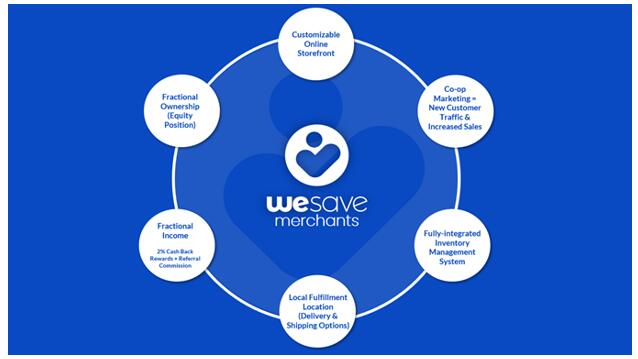
·Premier Merchants receive a pro-rata ownership position in WeSave’s Fractional Ownership and Revenue Sharing Pool
·Custom WeSave Online Storefront with EZ-connect APIs that can synchronize with brick & mortar (POS) inventory management tools in its Mall (expanding their market reach and reducing customer service issues)
·2% cashback rewards for their customers and co-op marketing that increases customer traffic, sales, and loyalty
·Merchant earns 1% residual referral revenues when their registered customers shop at other WeSave merchants
28
·A marketing fee system for merchants to re-direct their advertising expenses for a better ROI whereby the promotion/advertising value to the merchant is immediate and measurable.
·An automatic donation/funding mechanism that supports the community and brings goodwill and customer loyalty to the vendor.
·A buy online – same day delivery option for local brick ‘n’ mortar merchants that allows them to become micro-warehouses and part of a network of micro-fulfillment centers.
BRICK AND MORTAR MERCHANT ENROLLMENT
At the same time, WeSave is adding its online merchant’s storefronts and launching its member enrollment initiative, WeSave is also preparing to onboard brick and mortar merchants as the main target group for its Merchants Initiative.
When WeSave enrolls a merchant, part of its Merchants Initiative will allow these small businesses that may not have an online presence to piggyback and have their own custom storefront on its eCommerce platform where their products can be easily uploaded and sold. By doing so, WeSave helps small businesses secure a broader customer reach with a dynamic, easy to navigate and search web store.
As stated previously, part of its Merchants Initiative is to also facilitate same-day pick-up and delivery options for merchants by them becoming micro-warehouses, that can also drop-ship their own products that their customers order online.
WeSave is currently finalizing several levels of merchant packages at nominal costs for merchants to join. When the packages are ready, WeSave will launch a short-term pilot program, tweak its offerings as necessary and then hit the streets with its direct sales partners on a city-by-city roll out. WeSave will launch its Merchants Initiative by using the strategic relationships it has with Cydcor and Fiserv.
·Collaboration with Cydcor.
WeSave currently has a long-held relationship with one of the largest independent direct sales firms in the country. Cydcor has a network of more than 350 independently owned corporate licensee sales offices in every major market and a majority of the smaller markets throughout the United States and Canada.
Their clients include Fortune 500 companies like AT&T, Direct TV, and Comcast. Through these sales offices, Cydcor can provide access to a team of over 3,500 direct sales professionals who knocked on more than 40 million doors last year alone, second only to the U.S. Postal Service. In a recent conversation, its partner stated that in this economic crisis, he can hire and train as many additional salespeople as WeSave needs to get the job done. This organization will be the boots on the ground spearhead as WeSave launches city-by-city to enroll small businesses into the WeSave coalition.
·Collaboration with Fiserv
Fiserv is the largest transaction processor in the world with 1.4B global accounts on file, 100M digital banking users, 6M merchant locations processing 12K financial transactions per second. They have agreed to provide access to their POS devices and will work with WeSave to integrate WeSave’s value-added services on all their POS devices. Once funding is secured and the integration of its software is complete, WeSave’s sales team will be onboarding merchants into the reciprocal WeSave ecosystem and when possible, WeSave will offer Fiserv merchant services including the option to upgrade or add POS hardware devices as part of the bundled services.
In turn, Fiserv has agreed to add WeSave’s program as a bundled product that their sales professionals can add to their merchant service offerings. They are excited about this collaboration because it creates a whole new and highly lucrative, income stream from WeSave’s Members and partnership-based business model. It can more than double the traditional transaction fees that MSPs and ISOs receive from normal merchant service fees.
29
CITY-BY-CITY LAUNCH
This rollout strategy starts by selecting a local community and concentrating WeSave’s sales efforts within a manageable geographical area. A targeted approach to recruit merchants and Members in a smaller area is like establishing a beach head in a military conflict. It creates a localized working model that has a higher probability of success than shotgun approach over a large area.
Once WeSave establishes one community, then it will establish a second and a third. Typically, these micro-merchant ecosystems will be in communities surrounding a city. The WeSave sales team will then target the downtown merchants and link them with all the outlying communities forming a larger city-wide ecosystem of WeSave merchants and Members.
Once a city-wide, self-sustaining ecosystem is in place, it will duplicate the process just described. As each city-wide ecosystem is established, they will connect with other cities throughout that state in a state-wide network and then grow nationally and internationally. That is WeSave’s boots-on-the-ground Merchants Initiative, and it all starts with one working model, one merchant in one community cooperating with 100 other merchants and it will grow from there. At this time, WeSave’s plan is to launch in selective communities, most likely starting in California near WeSave’s headquarters.
By launching in a smaller targeted community, WeSave’s program is designed to get everyone onboard and excited to rally behind their community for the sake of their whole community. We believe people will come together with enthusiasm to bring the merchants in and to become Members of WeSave.
As part of a community launch operation, WeSave is sourcing local delivery services to partner with as part of its micro-fulfillment network for local merchants. During and now, post COVID, local delivery companies have become a “new norm” in shopping. As a result, there are now technology driven companies that aggregate independent contractors and small delivery services together in a database. They then communicate, select, dispatch and handle payments via mobile apps with their geo-location technology. It’s just another form of an affiliate network that WeSave is also taking advantage of as part of its overall city launch strategy.
This WeSave city-by-city rollout strategy has been developed over years and designed specifically to create a vested interest with a win-win outcome for everyone involved. Ultimately, people will be happy and feel good about being a part of something that gives back to the needs of their community.
MEMBER ENROLLMENT STRATEGY
INTRODUCTION
WeSave will promote its business model through its public facing multi-vendor eCommerce platform. WeSave will facilitate a grassroots movement of awakened, or conscious consumers who are empowered to take care of their present and future needs by partnering with WeSave in supporting local merchants instead of monopolistic companies like Amazon.
WeSave will tap into and encourage this reservoir of consumer spending power, the “power of the purse”, to create a more cooperative and unified marketplace in every community. Members and merchants in their communities will become Unit holders which we believe will incentivize them to support their local merchants more through their everyday shopping, knowing that they are helping to support their local community as a whole.
This is not a small task. But in small increments, one purchase at a time, consumers will use commerce to revitalize local economies and take back control of their lives. Not only do consumers have a great deal of power when they speak and spend with one voice, but unified people in any endeavor are immensely powerful and can change their local communities and the world. That is the energy and passion WeSave represents and encourages.
ENROLLING CONSUMERS
·Cashback Rewards
WeSave’s public-facing brand and eCommerce platform is called “WeSave”. It is a great brand, full of meaning and easy to remember. The products found at www.wesave.com represent well-known brands as well as little-known brands of small entrepreneurs. They are price competitive and as part of the WeSave ecosystem, they come with rewards and other incentives to buy.
30
The main immediate benefit for most consumers is the 2% cashback reward they receive on purchases within WeSave’s merchant community. Consumers shop with their credit cards because they understand this kind of reward and take advantage of it. They understand that credit card companies make enough money from the interest and fees they charge, that they can offer a 2% loyalty reward. However, most banks that issue debit cards do not have enough margin to offer any kind of rewards for their use. That is one reason why historically there is very little “stickiness” or loyalty to debit cards.
But with WeSave, its merchants fund the reward, not the bankcard companies. So, consumers, who prefer to use their debit cards for making purchases, still get that 2% cashback reward from the merchant.
It is a simple, trackable cashback reward program that incentivizes adoption by consumers.
·Ownership and Revenue Sharing with Premier Membership
WeSave’s partnership-based business model offers its Premier Members something unprecedented in other multi-vendor shopping sites, the opportunity for consumers to own Units, which allow participation in the Revenue Sharing Pool and Equity Rights Pool. We believe this is a major incentive for attracting consumers in WeSave’s initial launch. These and other benefits of Membership that are summarized below:
SUMMARY OF MEMBER VALUE PROPOSITION
·All Members receive 2% cashback rewards on all qualified purchases and may apply for a WeSave debit card.
·All Members will have access to gift cards and a digital wallet for peer-to-peer transfer of digital currency
·All Members buy online and can pick-up or get same day delivery from local stores
·All Member purchases support mom & pop retail stores and local economic recovery
·All Members enjoy the knowledge that a portion of every sale is set aside to support local humanitarian causes and charities
·In the first Offering, Premier Members receive a fractional, pro-rata share in WeSave’s Fractional Ownership (equity rights) and Revenue Sharing Pools
AFFINITY GROUP STRATEGY.
For years, WeSave has been building a foundation of relationships with affinity groups and customer-rich organizations that are waiting to sign up as Loyalty Program Operators (“LPOs”). Besides merchants signing up their customers before someone else does, these LPOs will be WeSave’s consumer enrollment launch partners.
LPOs are contracted with WeSave as either merchant acquirers (like MSPs and ISOs previously described in the merchant services industry) or as member enrollers (such as various types of affinity groups, i.e., non-profit organizations, churches, businesses, clubs, social media influencers, etc.). They provide front-line oversite and client/customer service to the individuals they register in the WeSave ecosystem.
As WeSave has been finalizing its merchant offerings, it has also been establishing the value-add for its consumer base in preparation for launching its shopping site. As previously described, every merchant already has some number of loyal customers they can recruit into WeSave. So, every time an LPO enrolls a merchant, they will also be targeting that merchant’s “warm market” of customers.
In addition to this “low hanging fruit”, WeSave has long-term relationships with businesses and affinity groups that have existing customer bases they want to introduce the WeSave program to. One of these businesses waiting in the wings is WeSave’s sponsor bank and partner, MetaBank.
Collaboration with MetaBank
As a founder and leader in the pre-paid debit and bankcard issuing world, MetaBank has agreed to support and empower WeSave with four collaborative and powerful opportunities:
1.Tax Division: MetaBank has agreed to offer the benefits associated with the WeSave mall to their Tax Division customers by giving them a place where they can pre-spend some of
31
their tax return money. This is a win-win strategy because not only will MetaBank make profits by adding a new shopping-based income stream from their Tax Division, but it creates more loyalty with its customers. MetaBank’s Tax Division oversees:
| ü 25,000+ tax preparation firms with 2-3 million taxpayer clients, that ü Represent $6-8 billion dollars in potential consumer spend; and ü Can be duplicated by other tax firms like Liberty Tax and Jackson Hewitt. |

2.MetaBank’s Registered Card Program: MetaBank agreed to add WeSave’s loyalty program to all its existing debit card customers. (where MetaBank acts internally in the role of a Program Manager).
3.Program Manager Introductions: MetaBank also agreed to introduce WeSave to their Program Managers who will also have an opportunity to offer the WeSave loyalty program to their registered cardholders that represent millions of prospective customers with billions more of potential spend.
4.Debit Card Sponsor Bank: Finally, MetaBank is sponsoring WeSave as one of its Program Managers able to offer and issue its own WeSave branded debit card to its Members as well as to create co-branded debit cards for various affinity groups that want to offer the WeSave loyalty program and ecosystem to their supporters.
There is no assurance that MetaBank will perform or that these benefits will be realized.
Employees and Consultants
In 2021, we had 15 full-time employees and consultants.
Government Regulation
We are subject to many U.S. federal and state and foreign laws and regulations, including those related to consumer protection, commerce, e-commerce, privacy, rights of publicity, data protection, content regulation, intellectual property, competition and taxation. These laws and regulations are constantly evolving and may be interpreted, applied, created, or amended, in a manner that could harm our business.
In the area of information security and data protection, the laws in several jurisdictions require companies to implement specific information security controls to protect certain types of information. Data protection, privacy, consumer protection, content regulation, and other laws and regulations are very stringent and vary from jurisdiction to jurisdiction.
Furthermore, foreign data protection, privacy, consumer protection, content regulation, and other laws and regulations are often more restrictive than those in the United States. It is possible that certain governments may seek to block or limit our products or otherwise impose other restrictions that may affect the accessibility or usability of any or all our products for an extended period of time or indefinitely.
Intellectual Property
A summary of the intellectual property of the Company is provided below.
Patents
There are currently no patents or patent applications submitted for WeSave at this time. However, we are doing patent research and believe that we can lay claim to intellectual property rights for our Systems and Methods and Trade Secrets.
oWeSave Proprietary Technology. WeSave provides a cooperative online multi-vendor eCommerce platform designed for businesses to promote and sell their products and services. WeSave is currently
32
developing certain application code and business models utilizing proprietary integration Systems and Methods currently under patent search:
§Systems and Methods for Omnibus Loyalty Integration
§Cooperative Online Inventory and Shopping Software
§Professional Field Service Firms and Tradespersons Integration System
§Point-of-Sale to Online Transaction Synchronization Software
§Method of Sales Training and Certification
Trademarks
The brand “WeSave” is trademarked (https://tmsearch.uspto.gov/bin/showfield?f=doc&state=4809: z29y6o.2.1) and we own the URLs for www.wesave.com (shopping portal) and www.wesaveinc.com (corporate website currently under construction).
Trade Secrets
oKnowledgebase. The two top leaders of WeSave alone have over 80-years of combined successful business experience in loyalty and fintech industries that have resulted in an enormous amount of know-how in Trade Secret Intellectual Properties related to sales and marketing strategies, technology systems and applications, business models and strategic relationships.
oAgreements
§MetaBank. MetaBank®, N.A., a national bank, is a subsidiary of Meta Financial Group, Inc.® (Nasdaq: CASH), a South Dakota-based financial holding company. MetaBank is a 6-billion-dollar global leader in the pre-paid/debit card issuing and processing space. The government chose MetaBank as the U.S. Treasury’s Financial Agent for the U.S. Debit Card program tasked with being the leading issuer of the EIP/Stimulus Debit Cards during the COVID-19 pandemic.
·Exclusive loyalty program provider for MetaBank
·Exclusive access to MetaBank’s client and customer lists for loyalty
oMetaBank agreed to promote a Tax Redemption Loyalty Program (“TRLP”) to its tax return clients using the WeSave eCommerce platform. This TRLP will be an add-on benefit for their Tax Division customers by giving them a place where they can pre-spend some of their tax return money. MetaBank’s Tax Division works with 25,000+ tax preparation firms with 2-3 million taxpayer clients that represent $6-8 billion dollars in potential consumer spend.
oMetaBank agreed to register WeSave’s loyalty program to all its existing debit card customers.
oThey also agreed to make introductions to their Program Managers (like Blackhawk and NetSpend) to their various registered card program cardholders that represent millions of additional potential customers with billions more of potential spend.
·Non-Exclusive Rights to Issue Debit Cards under the WeSave Brand. MetaBank is sponsoring WeSave as one of its Program Managers able to offer and issue its own WeSave branded debit card to its Members as well as to create co-branded debit cards for various affinity groups that want to offer the WeSave loyalty program and ecosystem to their supporters.
§International Clearinghouse (“ICH”). ICH was formed in October of 2019 as a relational data management and processing platform. It functions as a master data repository “hub” that processes loyalty-related consumer purchase transactions. As a stockholder in ICH, WeSave has negotiated exclusive license rights to the following clearinghouse systems:
33
·Technology License. WeSave has secured an exclusive license for all future ICH technology and loyalty processing services related to its reciprocal partnership business model.
oRevenue Distribution Engine (“RDE”). The RDE is a product of the knowledge base of WeSave’s founder, Richard Stewart, and his history related to the loyalty industry and co-opetition described WeSave’s business model.
oThe RDE connects to ICH’s backend processing servers that match and track consumer purchase transactions. When a transaction occurs, a fee is collected from the merchant and as it is forwarded through the payment gateway to be settled by the corresponding banks.
oOnce settled, the RDE governs the reciprocation between the issuer side and the acquirer side of the transaction and produces a fractional calculation and distribution of revenues processed through it to all the stakeholders associated with that individual transaction.
oMethods
§Method of integrating local store inventory that becomes part of a network of micro-warehouses that together as a whole provide a national decentralized inventory management and product fulfillment System.
§Method of issuing units of fractional ownership in an eCommerce platform that includes revenue sharing to its merchants and customers that increases participation and incentivizes loyalty amongst the stakeholders.
Litigation
From time to time, the Company may be involved in a variety of legal matters that arise in the normal course of business.
The Company is not currently involved in any other litigation, and its management is not aware of any pending or threatened legal actions relating to its intellectual property, conduct of its business activities, or otherwise.
The Company’s Property
The Company leases office space at 24254 Main Street, Newhall, CA 91321, a shared-office space which serves as its headquarters.
MANAGEMENT’S DISCUSSION AND ANALYSIS OF FINANCIAL CONDITION AND RESULTS OF OPERATIONS
The following discussion of our financial condition and results of operations should be read in conjunction with our financial statements and the related notes included in this Offering Circular. The following discussion contains forward-looking statements that reflect our plans, estimates, and beliefs. Our actual results could differ materially from those discussed in the forward-looking statements.
Overview
WeSave, Inc. was established in the fall of 2021 by Source Clearinghouse, Inc., as an eCommerce brand and front-end digital transformation technology and marketing platform to support a coalition of small businesses and consumers. In accordance with its business plan, WeSave recently launched a multi-vendor eCommerce site featuring a unique fractional ownership and revenue sharing opportunity for its Members and merchant partners.
Results of Operations
The Company is in a pre-launch, finalizing technology phase and so there are no results to date other than beta testing of the Company’s technology platform which is currently underway.
34
The following discussion of our financial condition and results of operations should be read in conjunction with the financial statements and the related notes included elsewhere in this Offering Circular. The following discussion contains forward-looking statements that reflect our plans, estimates, and beliefs. Our actual results could differ significantly from those discussed in the forward-looking statements. Unless otherwise indicated, the latest results discussed below are as of June 15, 2022.
Critical Accounting Policies
The Securities and Exchange Commission (“SEC”) defines “critical accounting policies” as those that require application of management’s most difficult, subjective or complex judgments, often as a result of the need to make estimates about the effect of matters that are inherently uncertain and may change in subsequent periods. Not all of the accounting policies require management to make difficult, subjective or complex judgments or estimates. However, the following policies could be deemed to be critical within the SEC definition.
Revenue Recognition
We recognize revenue upon the sale of Memberships and Coalition Marketing Fees payable by merchants upon the sale of products conducted over the WeSave platform
Use of Estimates
The preparation of financial statements in conformity with generally accepted accounting principles requires management to make estimates and assumptions that affect the reported amounts of assets and liabilities, disclosure of contingent assets and liabilities at the date of the financial statements, and the reported amounts of revenues and expenses during the reporting period. Actual results could differ from those estimates. Significant estimates include estimates used to review the Company’s goodwill, impairments and estimations of long-lived assets, revenue recognition on percentage of completion type contracts, allowances for uncollectible accounts, inventory valuation, valuations of non-cash capital stock issuances and the valuation allowance on deferred tax assets. The Company bases its estimates on historical experience and on various other assumptions that the Company believes to be reasonable in the circumstances, the results of which form the basis for making judgments about the carrying values of assets and liabilities that are not readily apparent from other sources. Actual results may differ from these estimates under different assumptions or conditions.
35
Results of Operations for the period from October 28, 2021 (Date of Organization)
through December 31, 2021.
| October 28, 2021 (commencement) |
| through December 31, 2021 |
|
|
Revenues, net | $- |
|
|
Operating expenses |
|
Technology | 37,530 |
Professional fees | 4,000 |
Total operating expenses | 41,530 |
|
|
Net Operating Income (Loss) | (41,530) |
|
|
Tax (provision) benefit | - |
|
|
Net Income (Loss) | $(41,530) |
Revenue and Cost of Sales
Percentages of Revenue
|
|
For | October 28, 2021 (commencement) through December 31, 2021 |
Revenue | $- |
Cost of services | - |
Total gross loss | - |
|
|
Operating expenses: |
|
Technology | $37,530 |
Professional Fees | 4,000 |
General & administrative | - |
Total operating expenses | $41,530 |
|
|
Loss from operations | $(41,530) |
|
|
Tax (provision) benefit | - |
Net loss | $(41,530) |
There was no revenue for the period from October 28, 2021 (commencement) through December 31, 2021.
36
Operating Expenses
Technology Expenses
Technology expenses for the period from October 28, 2021 (commencement) through December 31, 2021, were $37,530.
Professional Fees
Professional fees for the period from October 28, 2021 (commencement) through December 31, 2021were $4,000.
Liquidity and Capital Resources
Liquidity is the ability of a company to generate funds to support its current and future operations, satisfy its obligations, and otherwise operate on an ongoing basis. Significant factors in the management of liquidity are funds generated by operations, levels of accounts receivable and accounts payable and capital expenditures.
The financial statements have been prepared on a going concern basis of accounting, which contemplates continuity of operations, realization of assets and liabilities and commitments in the normal course of business. The accompanying consolidated financial statements do not reflect any adjustments that might result if we are unable to continue as a going concern. During the period from October 28, 2021 (commencement) through December 31, 2021, total cash used in operations was $91,530. As of December 31, 2021, we had a working capital deficit of $41,530 and a shareholders’ deficit of $459,220. These factors, among others raise substantial doubt about our ability to continue as a going concern. Our independent auditors, in their report on our audited financial statements for the period from October 28, 2021 (commencement) through December 31, 2021expressed substantial doubt about our ability to continue as a going concern. The ability of us to continue as a going concern and appropriateness of using the going concern basis is dependent upon, among other things, additional cash infusion. We have obtained funds from investors in the period from October 28, 2021 (commencement) through December 31, 2021, and have standing purchase orders and open invoices with customers and we are pursuing various financing alternatives to fund the Company’s operations so it can continue as a going concern in the medium to long term. Management believes this funding will continue from our current investors and new investors. There can be no assurance that such funding will be available to the Company in the amount required at any time or, if available, that it can be obtained on terms satisfactory to the Company. Management believes the existing shareholders, the prospective new investors and current and future revenue will provide the additional cash needed to meet our obligations as they become due and will allow the development of our core business operations.
Cash Flow
The table below, for the periods indicated, provides selected cash flow information:
| October 28, 2021 |
Net cash used in operating activities | $(91,530) |
Net cash used in investing activities | - |
Net cash provided by financing activities | 500,750 |
Net decrease in cash and cash equivalents | $409,220 |
At December 31, 2021, we had cash of $409,220, and working capital deficit of ($41,530).
During the period from October 28, 2021 (commencement) through December 31, 2021, we raised an aggregate of $500,750 in offerings of capital stock. Our ability to continue as a going concern is dependent upon raising capital from financing transactions and future revenue, however, there cannot be any assurance that we will be able to raise additional capital from financings.
Net cash used in operating activities was $(91,530) for the period from October 28, 2021 (commencement) through December 31, 2021.
Net cash flows (used in) investing activities for the period from October 28, 2021 (commencement) through December 31, 2021 were $0.
37
Net cash flows provided by financing activities was $500,750 for the period from October 28, 2021 (commencement) December 31, 2021.
We do not have any material commitments for capital expenditures during the next twelve months. Although our proceeds from the issuance of convertible debt together with revenue from operations are currently sufficient to fund our operating expenses in the near future, we will need to raise additional funds in the future so that we can expand our operations. Therefore, our future operations are dependent on our ability to secure additional financing. Financing transactions may include the issuance of equity or debt securities, obtaining credit facilities, or other financing mechanisms. However, the trading price of our common stock and a downturn in the U.S. equity and debt markets could make it more difficult to obtain financing through the issuance of equity or debt securities. Even if we are able to raise the funds required, it is possible that we could incur unexpected costs and expenses, fail to collect significant amounts owed to us, or experience unexpected cash requirements that would force us to seek alternative financing. Furthermore, if we issue additional equity or debt securities, stockholders may experience additional dilution or the new equity securities may have rights, preferences or privileges senior to those of existing holders of our common stock. The inability to obtain additional capital may restrict our ability to grow and may reduce our ability to continue to conduct business operations. If we are unable to obtain additional financing, we may have to curtail our marketing and development plans and possibly cease our operations.
We have estimated our current average burn and believe that we have assets to ensure that we can function without liquidation for a limited time, due to our cash on hand, growing revenue, and our ability to raise money from our investor base. Based on the aforesaid, we believe we have the ability to continue our operations for the immediate future and will be able to realize assets and discharge liabilities in the normal course of operations. However, there cannot be any assurance that any of the aforementioned assumptions will come to fruition and as such we may only be able to function for a short time.
Recent Trends
Known trends, demands, commitments, events, or uncertainties that are reasonably likely to cause reported financial information not to be necessarily indicative of future operating results is set forth throughout this Offering Circular.
Off-Balance Sheet Arrangements
We do not have any off-balance sheet arrangements that are reasonably likely to have a current or future effect on our financial condition, revenues, and results of operations, liquidity or capital expenditures.
Recent Accounting Pronouncements
See Note 1 in the audited financial statements for details under the caption Recent Accounting Pronouncements for a discussion of new accounting pronouncements.
Relaxed Ongoing Reporting Requirements
If we become a public reporting company in the future, we will be required to publicly report on an ongoing basis as an "emerging growth company" (as defined in the Jumpstart Our Business Startups Act of 2012, which we refer to as the JOBS Act) under the reporting rules set forth under the Exchange Act. For so long as we remain an "emerging growth company", we may take advantage of certain exemptions from various reporting requirements that are applicable to other Exchange Act reporting companies that are not "emerging growth companies", including but not limited to:
·not being required to comply with the auditor attestation requirements of Section 404 of the Sarbanes-Oxley Act;
·taking advantage of extensions of time to comply with certain new or revised financial accounting standards;
·being permitted to comply with reduced disclosure obligations regarding executive compensation in our periodic reports and proxy statements; and
·being exempt from the requirement to hold a non-binding advisory vote on executive compensation and member approval of any golden parachute payments not previously approved.
38
If we become a public reporting company in the future, we expect to take advantage of these reporting exemptions until we are no longer an emerging growth company. We would remain an "emerging growth company" for up to five years, although if the market value of our Common Units that is held by non-affiliates exceeds $700 million as of any June 30 before that time, we would cease to be an "emerging growth company" as of the following December 31.
If we do not become a public reporting company under the Exchange Act for any reason, we will be required to publicly report on an ongoing basis under the reporting rules set forth in Regulation A for Tier 2 issuers. The ongoing reporting requirements under Regulation A are more relaxed than for "emerging growth companies" under the Exchange Act. The differences include, but are not limited to, being required to file only annual and semiannual reports, rather than annual and quarterly reports. Annual reports are due within 120 calendar days after the end of the issuer’s fiscal year, and semiannual reports are due within 90 calendar days after the end of the first six months of the issuer’s fiscal year.
In either case, we will be subject to ongoing public reporting requirements that are less rigorous than Exchange Act rules for companies that are not "emerging growth companies", and our Members could receive less information than they might expect to receive from more mature public companies.
DIRECTORS, EXECUTIVE OFFICERS, AND SIGNIFICANT EMPLOYEES
As of the date of this Offering Circular, the Company’s executive officers, directors, and significant employees are as follows:
Name | Position | Age | Date Appointed to Current Position |
Executive Officers |
|
|
|
Richard G. Stewart, Jr. | Founder and President | 75 | October 28, 2021 |
Bradley C. Hanson | Chief Executive Officer | 58 | November 9, 2021 |
John Paukulis | Chief Growth Officer | 61 | January 15, 2022 |
Sabastian Enges | Chief Strategist Officer | 43 | January 15, 2022 |
RJ Stewart | Chief Operating Officer | 52 | January 15, 2022 |
Board Members |
|
|
|
Richard G. Stewart, Jr. | Director | 75 | October 28, 2021 |
Bradley C. Hanson | Director | 58 | November 9, 2021 |
Kevin P. Rishell | Director | 63 | October 28, 2021 |
Significant Employees |
|
|
|
Kevin P. Rishell | Senior Contracts Manager | 63 | October 28, 2021 |
Richard G. Stewart, Jr.: Founder, President, and Chairman
Mr. Stewart is the epitome of an entrepreneur who takes risks and embraces the responsibilities it takes to chase and enjoy the American Dream. Since his birth in 1946, his life experience has driven him to create a series of business models, all of which have culminated into what he and his team have created today. As a business owner, teacher, real estate developer, financial advisor, inventor and investor, Mr. Stewart has excelled in every endeavor he has focused his attention on for the past 55 years!
For example, he created “the rights to use” rules for reciprocation and coopetition that later became the template for the Time Share Industry. During that same time period, he invented a resort membership program that guaranteed the member all their money back over time. No one had done that before, and it was a hugely successful, win-win business model for selling resort memberships. Also, when he was focused on real estate development, he invented and registered for the first time a financial instrument which allowed thousands of people ownership of multiple real estate development projects through fractional First Trust Deed participation, which he affectionately named, “Trudy Pat”.
With endless energy and ideas, Mr. Stewart is a creative, brilliant visionary who thinks outside the box, particularly with economic solutions for everyday commerce. His ideas include and combine reciprocation, coopetition, fractional ownership, loyalty incentives and contribution back to society. This partnership commerce model brings together everything he’s learned and experienced in this lifetime. It is an open system and architecture that does not just give profits to one company, but it shares profits with everyone and provides for fractional ownership so
39
everyone…merchants, consumers, and their local communities prosper when anyone shops. This model is the partnership economy initiative Mr. Stewart has spearheaded for over two decades.
Now, in his golden years, Mr. Stewart has culminated all his creations, strategic relationships, and business know-how into his final, economic “Swan Song”. In 2021 he formed WeSave, Inc. to help accomplish his vision of a partnership economy. His cooperative business model allows everyone who participates to enjoy more success, benefits, and income through revenue sharing and fractionalized ownership. Now, everything he has ever learned and accomplished is focused on building this economic and humanitarian empowerment platform that will change the world.
Mr. Stewart holds a Ph.D. in Adaptive Science Economics with an educational emphasis in Business and Economics. He presented his doctoral dissertation and oral defense at University of Miami Spectrum Center in 1988 and was invited to serve on the universities’ Advisory Council. His dissertation, “It’s Worth a Billion”, is registered at the Library of Congress, ISBN 00095. Mr. Stewart is an honored member of the National Directory of Who's Who Exclusive Executive Directory in the Executives & Professionals categories. In 2013, Mr. Stewart was honored as a keynote speaker and humanitarian at a UN event in Shanghai, China.
Mr. Stewart is responsible for strategic direction and relationships, funding, and strategic oversight.
Bradley C. Hanson: Chief Executive Officer and Director
Bradley C. Hanson currently serves on the Board of Directors and as CEO of Bankaool, the first 100% digital bank in Mexico. He also serves on the Board of Directors and is CEO of WeSave, Inc and International Clearinghouse, Inc. in the US. Mr. Hanson recently retired as President, CEO and Director of Meta Financial Group, Inc. and MetaBank where he served since 2005. He still retains an advisory role with the companies.
With more than 25 years of experience in banking, payment cards, and financial technology, Mr. Hanson has been widely recognized for the founding role he played in the development and establishment of the prepaid card industry. Mr. Hanson joined Meta Financial in May 2004 where he founded the Meta Payment Systems division. After serving as the President of MetaBank and the Meta Payment Systems division, Mr. Hanson was appointed Chief Executive Officer in October 2018. Mr. Hanson is directly responsible for taking MetaBank from a small regional bank to a 6-billion-dollar global leader in the pre-paid/debit card issuing and processing space. As such, the government chose MetaBank as the U.S. Treasury’s Financial Agent for the U.S. Debit Card program tasked with being the leading issuer of the EIP/Stimulus Debit Cards during the COVID-19 pandemic.
Before joining Meta Financial, Mr. Hanson served as a Senior Vice President at BankFirst, where he gained experience in retail banking, mortgage lending, and credit cards, in addition to managing the technology and project management functions for the bank. Mr. Hanson holds a Bachelor of Arts degree in Economics from the University of South Dakota.
Mr. Hanson is responsible for corporate strategy, execution of marketing plan and strategic partnerships.
Sabastian Enges: Chief Strategist Officer
Fenix Consulting Group was founded on a mission to become a global leader in the outsourced sales industry. Setting roots in Orange County with 16 people on his team in 2011, Sabastian’s charismatic influence has now spread across the country into eleven different cities with over 150 people in his organization. Leading his industry with a passionate interest in the growth and professionalism of his tight-knit direct selling team, they have been recognized as one of Orange County's Best Places to Work, for five years in a row.
Fenix specializes in building and executing target specific marketing plans for some of the largest, most recognizable brands in a broad range of industries including but not limited to telecommunications, retail, energy, loyalty and finance. Consumer loyalty and increased name-brand recognition is what we focus on and what we deliver. Currently, Sabastian is an active partner of WeSave’s development team, bringing a street-level understanding of loyalty-related products, technology, marketing and merchant services to the team and the best way to execute on those goals.
RJ Stewart: Chief Operating Officer
R.J. is a co-founder of Source, Inc., where he led the development of the first platforms for debit cards and early gift cards, in collaboration with early pioneers in the industry. In the early 90's he designed, patented and marketed the first loyalty tracking program. R.J. advised in numerous fields as a business and technology consultant. He has brokered over 20 online portals for clients with international technology teams from Canada and abroad in the early e-commerce years and developed the architecture for the early, social networks designed for the television industry
40
tied to the early goals to deliver competing content over the internet, including rNetwork® founded in early 2001, and educational software platforms. He has been a business financial consultant for a large benefits-and-rewards company and acted as cost analyst for several major companies, including launching over 100,000 merchants during the early implementation of the debit card industry. He has advised companies on professional purchasing including negotiating over a 150,000 products direct-to-manufacturer. Finally, R.J. has acted as professional consultant and project manager for commercial developments and resort properties assisting with contracts, business development, purchasing and operations. He has a Bachelor of Science in Business, is currently working on his master’s degree, writing a thesis on The International Loyalty Coalition.
Kevin P. Rishell: Senior Contracts Manager and Directors
Kevin Rishell has an extensive award-winning background in sales, marketing, and management. He has held positions as a District Sales Manager, Director of Marketing, Manager of Distributor Relations, General Manager, Executive Vice President and COO in small and mid-sized corporations. He is an entrepreneur at heart and has owned and operated several start-up companies as President and CEO where he has honed his skills in business consulting, strategic planning, contract negotiations and all forms of business and legal documentation, raising capital, sales training, personal development coaching, and business management. Kevin is a well-rounded leader, business and sales consultant, inventor, creative writer and published author, life coach, and public speaker.
Kevin continues to consult with various companies regarding capital funding needs, marketing, and business opportunities. Currently, he works full-time as the Senior Contracts Manager in the legal departments for Help Worldwide, Inc., Source, Inc., International Clearinghouse, Inc. and WeSave, Inc. where he also serves on their Board of Directors.
Kevin holds a Bachelor of Business Administration degree from James Madison University in Virginia with a major in Marketing and minoring in English and Economics. As an avid student, he has augmented his degree with numerous sales training, management, and leadership courses. Kevin is a father to four amazing daughters and a proud grandfather.
Mr. Rishell is responsible for all corporate documentation and supports President and CEO compliance and marketing staff.
Family Relationships
RJ Stewart, the Chief Operating Officer is the son of Richard G. Stewart, Jr.
COMPENSATION OF DIRECTORS AND EXECUTIVE OFFICERS
For the fiscal year ended December 31, 2021, we compensated our three highest-paid directors and executive officers as follows:
Name | Capacities in which compensation was received | Cash compensation ($) | Other compensation ($) | Total compensation ($) |
Richard G. Stewart, Jr. | Founder, President, and Chairman | — | — | — |
Bradley C. Hanson | Chief Executive Officer and Director | — | — | — |
John Paukulis | Chief Growth Officer | — | — | — |
Sabastian Enges | Chief Strategist Officer | — | — | — |
RJ Stewart | Chief Operating Officer | — | — | — |
Kevin P. Rishell | Senior Contracts Manager and Director | — | — | — |
After the completion of this Offering, Mr. Stewart, upon approval by the Board, will be offered to sign an employment agreement entitling him to receive $[__] per month in cash compensation, plus bonus (terms of such bonus are yet to be determined). Proceeds from this Offering may be used to pay the compensation to the Company’s executive officers and directors, including Mr. Stewart’s deferred salary.]
41
Other than the compensation listed above, no other compensation was provided to the executive officers of the Company for their services to the Company in such capacities. In addition, no directors of the Company have received compensation from the Company for their services as directors of the Company.
SECURITY OWNERSHIP OF MANAGEMENT AND CERTAIN SECURITYHOLDERS
The following table sets out, as of April 6, 2023, the voting securities of the Company that are owned by executive officers and directors, and other persons holding more than 10% of any class of the Company’s voting securities or having the right to acquire those securities. The following table has been prepared to give effect to the assumed Stock Split of the Company described in the “Securities Being Offered” section of this Offering Circular.
Name and Address of Beneficial Owner (1) | Title of class | Amount and nature of beneficial ownership | Amount and nature of beneficial ownership acquirable | Percent of class (6) |
Source Clearinghouse, Inc. dba Source, Inc. (2) | Common Stock | 325,000 | - | 46.10% |
Help Worldwide, Inc. (3) | Common Stock | 325,000 | - | 46.10% |
Richard G. Stewart, Jr. | Common Stock | - | - | -% |
Bradley C. Hanson | Common Stock | 50,000 (4) | - | 7.10% |
John Paukulis | Common Stock | - | - | -% |
Sabastian Enges | Common Stock | - | - | -% |
RJ Stewart | Common Stock | - | - | -% |
Kevin P. Rishell | Common Stock | - | - | -% |
All officers and directors as a group (5 total) | Common Stock | 700,000 | - | 99% |
Richard Bauer (5) | Common Stock | 10,000 | 0 | 1.00% |
(1)The address of all beneficial owners is the Company’s headquarters, 24254 Main Street, Newhall, CA 91321.
(2)Beneficially owned by Stewart Family Partners which is controlled by Richard Stewart.
(3)Beneficially owned by Stewart Family Partners which is controlled by Richard Stewart.
(4)Represents securities owned by Bradley C. Hanson Living Trust. Mr. Hanson is the Trustee of the trust.
(5)Richard Bauer is a founder of the Company.
(6)Based on 710,000 Units of Common Stock issued and outstanding as of April 6, 2023.
42
INTEREST OF MANAGEMENT AND OTHERS IN CERTAIN TRANSACTIONS
The Company has contracted with International Clearinghouse, Inc. (ICH) to provide certain SaaS services, including technology development and loyalty processing services related to the Company’s reciprocal partnership business model. 20% of ICH is owned by Company. Source, Inc. owns 46.10% of the Company’s issued and outstanding common stock. Source, Inc. owns 68% of ICH’s issued and outstanding common stock. Company’s sponsor bank (MetaBank) owns 12% of ICH. Richard G. Stewart, Jr. owns or controls a majority of Source, Inc’s issued and outstanding common stock and is currently Chairman of the Board of Source, Inc., ICH, and Company.
The Company is offering up to 75,000,000 Units, each consisting of one (1) ERU and one (1) RSU. Our Units will not be certificated and the rights to our ERU Pool and the rights to our Revenue Sharing Pool are separate components that together represent the 75,000,000 Units in this Offering and will be awarded together as a single Unit of value. To be clear, each Unit has a dollar value that is derived from the value of 3% of the Company’s common stock and 3% (the "Revenue Share Percentage") of 100% of the gross revenues collected by the Company from merchant “Coalition Marketing Fees” or “CMFs” which represent 10% of the retail price of a product (See “How is the CMF allocated?”). Following a 48-month collection period, these CMF revenues shall be distributed in accordance with the Company’s Revenue Sharing Plan (“RSP”) to all applicable participants in the Revenue Sharing Pool each month for a period of ten (10) years from the commencement of the program unless otherwise modified by the Company. The Revenue Share Percentage shall not include any proceeds from any other Company revenues.
The price of our Units has been arbitrarily established by us after giving consideration to numerous factors, including market conditions and the perceived valuations. The price of our Units may not be in any way indicative of the Company’s actual value or the value of the rights to the ERU Pool and/or the rights to the Revenue Sharing Pool following the completion of this Offering.
Equity Rights
The Company will set aside two percent (3%) of the total issued and outstanding shares of Common Stock as the ERU Pool. Each holder of Units shall be entitled to participate on a pro-rata basis in the economic rights related to the shares in the pool, which include the right to receive a portion of any dividends related to such shares and the liquidation proceeds related to the shares upon the sale of the Company. Each ERU represents a pro-rata share of the economic participation rights associated with the shares of the Company’s common stock in the ERU Pool. The ERUs do not constitute ownership of the Company’s common stock, but rather the rights associated with their pro-rata interest in the shares in the ERU Pool. The number of shares allocated to the ERU Pool shall at all times be equal to 3% of the total issued and outstanding shares of Common Stock.
Revenue Sharing
The holders of the Units are entitled to their pro rata share of the Revenue Sharing Pool, which shall at all times be equal to 3.0% (the "Revenue Share Percentage") of 100% of the merchant “Coalition Marketing Fees” or “CMFs” which represent 10% of the retail price of a product (See “How is the CMF allocated?”). Following a 48-month collection period, these CMF revenues shall be distributed in accordance with the Company’s Revenue Sharing Plan (“RSP”) to all applicable participants in the Revenue Sharing Pool each month. 3% of 100% (two basis points) of the CMFs shall be allocated to the Revenue Sharing Pool for ten (10) years from the commencement of the program unless otherwise modified by the Company. The Revenue Share Percentage shall not include any proceeds from any other Company revenues.
What is a Unit Holders Pro-Rata Share?
A Unit holder’s pro-rata share in the ERU Pool and the Revenue Sharing Pool shall be equal to a fraction, the numerator of which is the number of Units held by such holder and the denominator being 75,000,000 or of such lesser amount if this Offering closes prior to issuing the full 75,000,000 Units.
43
Description of Capital Stock
The following description summarizes the most important terms of the Company’s capital stock. This summary does not purport to be complete and is qualified in its entirety by the provisions of WeSave’s articles of incorporation and bylaws, copies of which have been filed as Exhibits 2.1 and 2.2, respectively, to the Offering Statement of which this Offering Circular forms a part. For a complete description of WeSave’s capital stock, you should refer to the articles of incorporation and bylaws of the Company and to the applicable provisions of Nevada law.
The rights and preferences of our Common Stock are described below.
Common Stock
The Company has authorized 1,500,000 Units of Common Stock, par value $0.0001. The rights of the holders of our Common Stock generally are summarized below.
Voting Rights
Holders of Common Stock are entitled to one (1) vote for each share on all matters submitted to a vote of the stockholders. Unit holders, as holders of ERUs shall have no voting rights related to their pro-rata share of the Common Stock allocated to the Equity Rights Pool.
Dividend Rights
Holders of Common Stock, and therefore holders of the ERUs are entitled to receive dividends, as may be declared from time to time by the Board of Directors out of legally available funds as detailed in the Company’s articles of incorporation. The Company has never declared or paid cash dividends on any of its capital stock and currently does not anticipate paying any cash dividends after this Offering or in the foreseeable future.
Liquidation Rights
Common Stock do not have a stated return or liquidation preference.
Rights and Preferences
Except as set forth below, holders of our Common Stock have no preemptive, conversion, or other rights, and there are no redemptive or sinking fund provisions applicable to the Common Stock.
Preferred Stock
The Company has no shares of preferred stock authorized.
44
WESAVE, INC. FINANCIAL STATEMENTS
WESAVE INC.
(a Nevada corporation)
Financial Statements and Audit Report
For the inception period of October 28, 2021 through December 31, 2021
F-1

INDEPENDENT AUDITOR’S REPORT
July 15, 2022
To: Board of Directors, H. MULLIGAN BESPOKE LIBATIONS, LLC
Re: 2021 and 2020 Financial Statement Audit
We have audited the accompanying financial statements of WESAVE, INC. (a corporation organized in Nevada) (the “Company”), which comprise the balance sheets as of December 31, 2021, and the related statements of income, members’ equity/deficit, and cash flows for the inception period from October 28, 2021 through December 31, 2021, and the related notes to the financial statements.
Management’s Responsibility for the Financial Statements
Management is responsible for the preparation and fair presentation of these financial statements in accordance with accounting principles generally accepted in the United States of America; this includes the design, implementation, and maintenance of internal control relevant to the preparation and fair presentation of financial statements that are free from material misstatement, whether due to fraud or error.
Auditor’s Responsibility
Our responsibility is to express an opinion on these financial statements based on our audit. We conducted our audit of the Company’s financial statements in accordance with auditing standards generally accepted in the United States of America. Those standards require that we plan and perform the audit to obtain reasonable assurance about whether the financial statements are free from material misstatement.
An audit involves performing procedures to obtain audit evidence about the amounts and disclosures in the financial statements. The procedures selected depend on the auditor’s judgment, including the assessment of the risks of material misstatement of the financial statements, whether due to fraud or error. In making those risk assessments, the auditor considers internal control relevant to the entity’s preparation and fair presentation of the financial statements in order to design audit procedures that are appropriate in the circumstances, but not for the purpose of expressing an opinion on the effectiveness of the entity’s internal control. Accordingly, we express no such opinion.
An audit also includes evaluating the appropriateness of accounting policies used and the reasonableness of significant accounting estimates made by management, as well as evaluating the overall presentation of the financial statements. We believe that the audit evidence we have obtained is sufficient and appropriate to provide a basis for our audit opinion.
Opinion
In our opinion, the financial statements referred to above present fairly, in all material respects, the financial position of the Company as of December 31, 2021, and the results of its operations, shareholders’ equity/deficit and cash flows for the inception period from October 28, 2021 through December 31, 2021 in accordance with accounting principles generally accepted in the United States of America.
Sincerely,
 IndigoSpire CPA Group
IndigoSpire CPA Group, LLC
Aurora, CO
F-2
WESAVE, INC. |
BALANCE SHEET |
As of December 31, 2021 |
See Independent Auditor’s Report and Notes to the Financial Statements |
|
|
ASSETS | 2021 |
Current Assets |
|
Cash and cash equivalents | $409,220 |
Total current assets | 409,220 |
|
|
Prepaid licenses | 50,000 |
|
|
Total Assets | $459,220 |
|
|
LIABILITIES AND SHAREHOLDERS' EQUITY |
|
Current Liabilities |
|
None | $0 |
Total Current Liabilities | 0 |
|
|
Total Liabilities | 0 |
|
|
SHAREHOLDERS' EQUITY |
|
|
|
Common Stock | 500,750 |
Retained deficit | (41,530) |
Total Shareholders’ Equity | 459,220 |
|
|
Total Liabilities and Shareholders' Equity | $459,220 |
F-3
WESAVE, INC. |
STATEMENT OF OPERATIONS |
For inception period from October 28, 2021 through December 31, 2021 |
See Independent Auditor’s Report and Notes to the Financial Statements |
| 2021 |
|
|
Revenues, net | $- |
|
|
Operating expenses |
|
Technology | 37,530 |
Professional fees | 4,000 |
Total operating expenses | 41,530 |
|
|
Net Operating Income (Loss) | (41,530) |
|
|
Tax (provision) benefit | - |
|
|
Net Income (Loss) | $(41,530) |
F-4
WESAVE, INC. |
STATEMENT OF SHAREHOLDERS’ EQUITY |
For inception period from October 28, 2021 through December 31, 2021 |
See Independent Auditor’s Report and Notes to the Financial Statements |
|
|
|
|
| Common Stock $ | Retained Deficit | Total Shareholders’ Equity |
Balance as of October 28, 2021 (inception) | $0 | $0 | $0 |
Share issuance | 500,750 |
| 500,750 |
Net Income (Loss) |
| (41,530) | (41,530) |
Balance as of December 31, 2021 | $500,750 | $(41,530) | $(459,220) |
F-5
WESAVE, INC. |
STATEMENT OF CASH FLOWS |
For inception period from October 28, 2021 through December 31, 2021 |
See Independent Auditor’s Report and Notes to the Financial Statements |
| 2021 |
|
|
Operating Activities |
|
Net Income (Loss) | $(41,530) |
Adjustments to reconcile net income (loss) |
|
Changes in operating asset and liabilities: |
|
(Increase) decrease in prepaid licenses | (50,000) |
|
|
Net cash used in operating activities | (91,530) |
|
|
Investing Activities |
|
None | - |
|
|
Net cash used in investing activities | - |
|
|
Financing Activities |
|
Proceeds from capital raising | 500,750 |
|
|
Net change in cash from financing activities | 500,750 |
|
|
Net change in cash and cash equivalents | 409,220 |
|
|
Cash and cash equivalents at beginning of period | - |
Cash and cash equivalents at end of period | $409,220 |
F-6
WESAVE, INC.
NOTES TO FINANCIAL STATEMENTS
See Independent Auditor’s Report
AS OF DECEMBER 31, 2021
NOTE 1 – NATURE OF OPERATIONS
WESAVE, INC. (which may be referred to as the “Company”, “we,” “us,” or “our”) is a corporation formed under the laws of Nevada on October 28, 2021 and is a financial technology company driving digital transformation for a partnership economy.
Since inception, the Company has been in a development and early revenue stage and has relied on founders’ funds to fund its operations. As of December 31, 2021, the Company had negative retained earnings and will likely incur additional losses prior to generating positive working capital. The company initiated a crowd funding campaign in 2021. The Company intends to fund its operations with funding from the crowdfunding campaign (see Note 9) and the receipt of funds from revenue producing activities, if any. These financial statements and related notes thereto do not include any adjustments that might result from these uncertainties.
NOTE 2 – SUMMARY OF SIGNIFICANT ACCOUNTING POLICIES
Basis of Presentation
The accounting and reporting policies of the Company conform to accounting principles generally accepted in the United States of America ("US GAAP"). The accompanying financial statements include all the information and notes required by GAAP for complete financial statements. In the opinion of management, all adjustments considered necessary for the fair presentation of the unaudited financial statements for the years presented have been included.
Use of Estimates
The preparation of financial statements in conformity with accounting principles generally accepted in the United States requires management to make certain estimates and assumptions that affect the amounts reported in the financial statements and footnotes thereto. Actual results could materially differ from these estimates. It is reasonably possible that changes in estimates will occur in the near term.
Significant estimates inherent in the preparation of the accompanying financial statements include valuation of provision for refunds and chargebacks, equity transactions and contingencies.
Risks and Uncertainties
The Company's business and operations are sensitive to general business and economic conditions in the United States and other countries that the Company operates in. A host of factors beyond the Company's control could cause fluctuations in these conditions. Adverse conditions may include recession, downturn or otherwise, local competition or changes in consumer taste. These adverse conditions could affect the Company's financial condition and the results of its operations.
Concentration of Credit Risk
The Company maintains its cash with a major financial institution located in the United States of America, which it believes to be credit worthy. The Federal Deposit Insurance Corporation insures balances up to $250,000. At times, the Company may maintain balances in excess of the federally insured limits.
Cash and Cash Equivalents
The Company considers short-term, highly liquid investment with original maturities of three months or less at the time of purchase to be cash equivalents. Cash consists of funds held in the Company’s checking account. As of December 31, 2021, the Company had $409,220.
F-7
Fixed Assets
Property and equipment is recorded at cost. Expenditures for renewals and improvements that significantly add to the productive capacity or extend the useful life of an asset are capitalized. Expenditures for maintenance and repairs are charged to expense. When equipment is retired or sold, the cost and related accumulated depreciation are eliminated from the accounts and the resultant gain or loss is reflected in income.
Depreciation is provided using the straight-line method, based on useful lives of the assets which range from three to fifteen years.
The Company reviews the carrying value of property and equipment for impairment whenever events and circumstances indicate that the carrying value of an asset may not be recoverable from the estimated future cash flows expected to result from its use and eventual disposition. In cases where undiscounted expected future cash flows are less than the carrying value, an impairment loss is recognized equal to an amount by which the carrying value exceeds the fair value of assets. The factors considered by management in performing this assessment include current operating results, trends and prospects, the manner in which the property is used, and the effects of obsolescence, demand, competition, and other economic factors. As of December 31, 2021, the Company had no net fixed assets.
Fair Value Measurements
Generally accepted accounting principles define fair value as the price that would be received to sell an asset or be paid to transfer a liability in an orderly transaction between market participants at the measurement date (exit price) and such principles also establish a fair value hierarchy that prioritizes the inputs used to measure fair value using the following definitions (from highest to lowest priority):
·Level 1 – Unadjusted quoted prices in active markets that are accessible at the measurement date for identical, unrestricted assets or liabilities.
·Level 2 – Observable inputs other than quoted prices included within Level 1 that are observable for the asset or liability, either directly or indirectly, including quoted prices for similar assets and liabilities in active markets; quoted prices for identical or similar assets and liabilities in markets that are not active; or other inputs that are observable or can be corroborated by observable market data by correlation or other means.
·Level 3 – Prices or valuation techniques requiring inputs that are both significant to the fair value measurement and unobservable.
Income Taxes
Income taxes are provided for the tax effects of transactions reporting in the financial statements and consist of taxes currently due plus deferred taxes related primarily to differences between the basis of receivables, inventory, property and equipment, intangible assets, and accrued expenses for financial and income tax reporting. The deferred tax assets and liabilities represent the future tax return consequences of those differences, which will either be taxable or deductible when the assets and liabilities are recovered or settled. Deferred tax assets are reduced by a valuation allowance when, in the opinion of management, it is more likely than not that some portion or all of the deferred tax assets will not be realized. Any deferred tax items of the Company have been fully valued based on the determination of the Company that the utilization of any deferred tax assets is uncertain.
The Company complies with FASB ASC 740 for accounting for uncertainty in income taxes recognized in a company’s financial statements, which prescribes a recognition threshold and measurement process for financial statement recognition and measurement of a tax position taken or expected to be taken in a tax return. For those benefits to be recognized, a tax position must be more-likely-than-not to be sustained upon examination by taxing authorities. FASB ASC 740 also provides guidance on derecognition, classification, interest and penalties, accounting in interim periods, disclosure and transition. Based on the Company’s evaluation, it has been concluded that there are no significant uncertain tax positions requiring recognition in the Company’s financial statements. The Company believes that its income tax positions would be sustained on audit and does not anticipate any adjustments that would result in a material change to its financial position.
Revenue Recognition
The Company recognizes revenue in accordance with ASC 606 when it has satisfied the performance obligations under an arrangement with the customer reflecting the terms and conditions under which products or services will be provided, the fee is fixed or determinable, and collection of any related receivable is probable. ASC Topic 606, “Revenue from
F-8
Contracts with Customers” establishes principles for reporting information about the nature, amount, timing and uncertainty of revenue and cash flows arising from the entity’s contracts to provide goods or services to customers. Revenues are recognized when control of the promised goods or services are transferred to a customer, in an amount that reflects the consideration that the Company expects to receive in exchange for those goods or services. The Company applies the following five steps in order to determine the appropriate amount of revenue to be recognized as it fulfills its obligations under each of its agreements: 1) identify the contract with a customer; 2) identify the performance obligations in the contract; 3) determine the transaction price; 4) allocate the transaction price to performance obligations in the contract; and 5) recognize revenue as the performance obligation is satisfied.
The Company has not yet earned revenue as it continues to be in early-stage development of the Company’s financial technology.
Accounts Receivable
The allowance for uncollectible accounts is evaluated on a regular basis by management and is based upon management’s periodic review of the collectability of the receivables in light of historical experience, the nature and type of account, adverse situations that may affect the payor’s ability to repay and prevailing economic conditions. This evaluation is inherently subjective, as it requires estimates that are susceptible to significant revision as more information becomes available. Accounts are deemed to be past due upon invoice due date.
Receivables deemed uncollectible are charged off against the allowance when management believes the assessment of the above factors will likely result in the inability to collect the past due accounts. The Company’s standard terms and conditions with commercial accounts generally requires payment within 30 days of the invoice date, however, timing of payment of specific customers may be separately negotiated.
Advertising
The Company expenses advertising costs as they are incurred.
Recent Accounting Pronouncements
In June 2019, FASB amended ASU No. 2019-07, Compensation – Stock Compensation, to expand the scope of Topic 718, Compensation – Stock Compensation, to include share-based payment transactions for acquiring goods and services from nonemployees. The new standard for nonpublic entities will be effective for fiscal years beginning after December 15, 2019, and interim periods within fiscal years beginning after December 15, 2020, and early application is permitted. We are currently evaluating the effect that the updated standard will have on the financial statements and related disclosures.
In October 2019, amendments to existing accounting guidance were issued through Accounting Standards Update 2019-15 to clarify the accounting for implementation costs for cloud computing arrangements. The amendments specify that existing guidance for capitalizing implementation costs incurred to develop or obtain internal-use software also applies to implementation costs incurred in a hosting arrangement that is a service contract. The guidance is effective for fiscal years beginning after December 15, 2020, and interim periods within fiscal years beginning after December 15, 2021, and early application is permitted. We are currently evaluating the effect that the updated standard will have on the financial statements and related disclosures.
The FASB issues ASUs to amend the authoritative literature in ASC. There have been a number of ASUs to date, including those above, that amend the original text of ASC. Management believes that those issued to date either (i) provide supplemental guidance, (ii) are technical corrections, (iii) are not applicable to us or (iv) are not expected to have a significant impact our financial statements.
NOTE 3 – GOING CONCERN
These financial statements are prepared on a going concern basis. The Company began operation in 2021 and incurred a cumulative loss since inception. The Company’s has raised sufficient cash to continue with its development operations.
NOTE 4 – DEBT
The Company has no outstanding debt as of the balance sheet date.
F-9
NOTE 5 – INCOME TAX PROVISION
The Company has filed its corporate income tax return for the period ended December 31, 2021. The income tax returns will remain subject to examination by the Internal Revenue Service under the statute of limitations for a period of three years from the date it is filed. The Company incurred a loss during the period from inception through December 31, 2021 and carries a federal net operating loss that can be used to offset future corporate taxable income (to extent allowed by law).
NOTE 6 – COMMITMENTS AND CONTINGENCIES
Litigation
The Company, from time to time, may be involved with lawsuits arising in the ordinary course of business. There is no pending or threatened litigation.
NOTE 7 – EQUITY
The Company has authorized 1,500,000 shares of $0.0001 par value of common stock. The Company does not have any other authorized classes of shares.
NOTE 8 – RELATED PARTY TRANSACTIONS
The Company does not have material related party transactions aside from the funds that the shareholders of the Company have extended to the Company to cover operating and set-up costs. The Company has recorded these loans as a contribution to the equity of the Company.
NOTE 9 – SUBSEQUENT EVENTS
Crowdfunded Offering
In 2022, the Company intends to offer securities in a securities offering expected to be exempt from registration under Regulation A+. The offering campaign will be made through a FINRA approved Regulation CF funding portal or broker-dealer.
COVID-19 Related Actions
On March 10, 2020, the World Health Organization declared the coronavirus outbreak (“COVID-19”) to be a pandemic. The outbreak is negatively impacting businesses across a range of industries. The extent of the impact of COVID-19 on the Company’s operational and financial performance will depend on certain developments, including the duration and spread of the outbreak, impact on the Company’s customers, employees and vendors, all of which are uncertain and cannot be predicted. Therefore, the extent to which COVID-19 may impact the Company’s financial condition or results of operations in the future is uncertain.
Management’s Evaluation
Management has evaluated subsequent events through June 15, 2022, the date the financial statements were available to be issued. Based on this evaluation, no additional material events were identified which require adjustment or disclosure in the financial statements.
F-10
WESAVE INC.
(a Nevada corporation)
Financial Statements
For the calendar year ending December 31, 2022 and
the inception period of October 28, 2021 through December 31, 2021
F-11
WESAVE, INC.
BALANCE SHEETS
ASSETS |
| December 31, |
| December 31, |
Current Assets |
|
|
|
|
Cash and cash equivalents |
| $1,555 |
| $409,220 |
Loans receivable, related party |
| 263,503 |
|
|
Total current assets |
| 265,058 |
| 409,220 |
|
|
|
|
|
|
|
|
|
|
Prepaid licenses |
| 75,000 |
| 50,000 |
|
|
|
|
|
Total Assets |
| 340,058 |
| $459,220 |
|
|
|
|
|
LIABILITIES AND SHAREHOLDERS' EQUITY |
|
|
|
|
Current Liabilities |
|
|
|
|
Loan payable, related party |
| $134,904 |
| $0 |
Total Current Liabilities |
| 134,904 |
| 0 |
|
|
|
|
|
Total Liabilities |
| 134,904 |
| 0 |
|
|
|
|
|
SHAREHOLDERS' EQUITY |
|
|
|
|
Common Stock |
| 1,000,000 |
| 500,750 |
Retained deficit |
| (794,845) |
| (41,530) |
Total Shareholders’ Equity |
| 205,154 |
| 459,220 |
|
|
|
|
|
Total Liabilities and Shareholders' Equity |
| $340,058 |
| $459,220 |
F-12
WESAVE, INC.
STATEMENT OF OPERATIONS
For the calendar year 2022 and
the inception period from October 28, 2021 through December 31, 2021
|
| Calendar Year Ended December 31, 2022 (Unaudited) |
| Inception through December 31, 2021 |
|
|
|
|
|
Revenues, net |
| $1,459 |
| $ – |
|
|
|
|
|
Operating expenses |
|
|
|
|
Technology |
| 198,000 |
| 37,530 |
Professional fees |
| 174,182 |
| 4,000 |
Management fee |
| 144,000 |
| – |
Rent |
| 54,001 |
| – |
General and administration |
| 184,370 |
| – |
Total operating expenses |
| 754,553 |
| 41,530 |
|
|
|
|
|
Net Operating Income (Loss) |
| (753,094) |
| (41,530) |
|
|
|
|
|
Interest (expense) |
| 221 |
|
|
|
|
|
|
|
Tax (provision) benefit |
| – |
| – |
|
|
|
|
|
Net Income (Loss) |
| $(753,315) |
| $(41,530) |
F-13
WESAVE, INC.
STATEMENT OF SHAREHOLDERS’ EQUITY
For the calendar year 2022 and
the inception period from October 28, 2021 through December 31, 2021 UNAUDITED – NO ASSURANCE GIVEN
| Common Stock $ |
Retained Deficit | Total Shareholders’ Equity |
Balance as of October 28, 2021 (inception) | $0 | $0 | $0 |
Share issuance | 500,750 |
| 500,750 |
Net Income (Loss) |
| (41,530) | (41,530) |
Balance as of December 31, 2021 | $500,750 | $(41,530) | $(459,220) |
Share issuance | 499,250 |
| 499,250 |
Net Income (Loss) |
| (753,315) | (753,315) |
Balance as of December 31, 2022 | $1,000,000 | $(794,845) | $205,154 |
F-14
STATEMENT OF CASH FLOWS
For the calendar year 2022 and
the inception period from October 28, 2021 through December 31, 2021
|
| Year Ended December 31, 2022 (Unaudited) |
| Inception through December 31, 2021 |
Operating Activities |
|
|
|
|
Net Income (Loss) |
| $(753,315) |
| $(41,530) |
Adjustments to reconcile net income (loss) |
|
|
|
|
Changes in operating asset and liabilities: |
|
|
|
|
(Increase) decrease in prepaid licenses |
| (25,000) |
| (50,000) |
Net cash used in operating activities |
| (778,315) |
| (91,530) |
|
|
|
|
|
Investing Activities |
|
|
|
|
Loans extended to related parties |
| (263,503) |
| - |
Net cash used in investing activities |
| (263,503) |
| - |
|
|
|
|
|
Financing Activities |
|
|
|
|
Proceeds from capital raising |
| 499,250 |
| 500,750 |
Loans received from related party |
| 134,904 |
| - |
|
|
|
|
|
Net change in cash from financing activities |
| 634,154 |
| 500,750 |
|
|
|
|
|
Net change in cash and cash equivalents |
| (407,665) |
| 409,220 |
|
|
|
|
|
Cash and cash equivalents at beginning of period |
| 409,220 |
| - |
|
|
|
|
|
Cash and cash equivalents at end of period |
| 1,555 |
| $409,220 |
F-15
NOTES TO FINANCIAL STATEMENTS AS OF DECEMBER 31, 2022 AND 2021 UNAUDITED – NO ASSURANCE GIVEN
NOTE 1 – NATURE OF OPERATIONS
WESAVE, INC. (which may be referred to as the “Company”, “we,” “us,” or “our”) is a corporation formed under the laws of Nevada on October 28, 2021 and is a financial technology company driving digital transformation for a partnership economy.
Since inception, the Company has been in a development and early revenue stage and has relied on founders’ funds and equity raises to fund its operations. As of December 31, 2022, the Company had negative retained earnings and will likely incur additional losses prior to generating positive working capital. The company initiated a crowd funding campaign in 2021. The Company intends to fund its operations with funding from additional fundraising and the receipt of funds from revenue producing activities, if any. These financial statements and related notes thereto do not include any adjustments that might result from these uncertainties.
NOTE 2 – SUMMARY OF SIGNIFICANT ACCOUNTING POLICIES
Basis of Presentation
The accounting and reporting policies of the Company conform to accounting principles generally accepted in the United States of America ("US GAAP"). The accompanying financial statements include all the information and notes required by GAAP for complete financial statements. In the opinion of management, all adjustments considered necessary for the fair presentation of the unaudited financial statements for the years presented have been included.
Use of Estimates
The preparation of financial statements in conformity with accounting principles generally accepted in the United States requires management to make certain estimates and assumptions that affect the amounts reported in the financial statements and footnotes thereto. Actual results could materially differ from these estimates. It is reasonably possible that changes in estimates will occur in the near term.
Significant estimates inherent in the preparation of the accompanying financial statements include valuation of provision for refunds and chargebacks, equity transactions and contingencies.
Risks and Uncertainties
The Company's business and operations are sensitive to general business and economic conditions in the United States and other countries that the Company operates in. A host of factors beyond the Company's control could cause fluctuations in these conditions. Adverse conditions may include recession, downturn or otherwise, local competition or changes in consumer taste. These adverse conditions could affect the Company's financial condition and the results of its operations.
Concentration of Credit Risk
The Company maintains its cash with a major financial institution located in the United States of America, which it believes to be credit worthy. The Federal Deposit Insurance Corporation insures balances up to
$250,000. At times, the Company may maintain balances in excess of the federally insured limits.
F-16
Cash and Cash Equivalents
The Company considers short-term, highly liquid investment with original maturities of three months or less at the time of purchase to be cash equivalents. Cash consists of funds held in the Company’s checking account. As of December 31, 2022 and 2021, the Company had $1,555 and $409,220 of cash and cash equivalents, respectively.
Fixed Assets
Property and equipment is recorded at cost. Expenditures for renewals and improvements that significantly add to the productive capacity or extend the useful life of an asset are capitalized. Expenditures for maintenance and repairs are charged to expense. When equipment is retired or sold, the cost and related accumulated depreciation are eliminated from the accounts and the resultant gain or loss is reflected in income.
Depreciation is provided using the straight-line method, based on useful lives of the assets which range from three to fifteen years.
The Company reviews the carrying value of property and equipment for impairment whenever events and circumstances indicate that the carrying value of an asset may not be recoverable from the estimated future cash flows expected to result from its use and eventual disposition. In cases where undiscounted expected future cash flows are less than the carrying value, an impairment loss is recognized equal to an amount by which the carrying value exceeds the fair value of assets. The factors considered by management in performing this assessment include current operating results, trends and prospects, the manner in which the property is used, and the effects of obsolescence, demand, competition, and other economic factors. As of December 31, 2021, the Company had no net fixed assets.
Fair Value Measurements
Generally accepted accounting principles define fair value as the price that would be received to sell an asset or be paid to transfer a liability in an orderly transaction between market participants at the measurement date (exit price) and such principles also establish a fair value hierarchy that prioritizes the inputs used to measure fair value using the following definitions (from highest to lowest priority):
•Level 1 – Unadjusted quoted prices in active markets that are accessible at the measurement date for identical, unrestricted assets or liabilities.
•Level 2 – Observable inputs other than quoted prices included within Level 1 that are observable for the asset or liability, either directly or indirectly, including quoted prices for similar assets and liabilities in active markets; quoted prices for identical or similar assets and liabilities in markets that are not active; or other inputs that are observable or can be corroborated by observable market data by correlation or other means.
•Level 3 – Prices or valuation techniques requiring inputs that are both significant to the fair value measurement and unobservable.
Income Taxes
Income taxes are provided for the tax effects of transactions reporting in the financial statements and consist of taxes currently due plus deferred taxes related primarily to differences between the basis of receivables, inventory, property and equipment, intangible assets, and accrued expenses for financial and income tax reporting. The deferred tax assets and liabilities represent the future tax return consequences of those differences, which will either be taxable or deductible when the assets and liabilities are recovered or settled. Deferred tax assets are reduced by a valuation allowance when, in the opinion of management, it is more likely than not that some portion or all of the deferred tax assets will not be realized. Any deferred tax items of the Company have been fully valued based on the determination of the Company that the utilization of any deferred tax assets is uncertain.
The Company complies with FASB ASC 740 for accounting for uncertainty in income taxes recognized in a company’s financial statements, which prescribes a recognition threshold and measurement process for financial statement recognition and measurement of a tax position taken or expected to be taken in a tax return. For those benefits to be recognized, a tax position must be more-likely-than-not to be sustained upon examination by taxing authorities. FASB ASC 740 also provides guidance on derecognition, classification, interest and penalties, accounting in interim periods, disclosure and transition. Based on the Company’s evaluation, it has been concluded that there are no significant uncertain tax positions requiring recognition in the Company’s financial statements. The Company believes that its
F-17
income tax positions would be sustained on audit and does not anticipate any adjustments that would result in a material change to its financial position.
Revenue Recognition
The Company recognizes revenue in accordance with ASC 606 when it has satisfied the performance obligations under an arrangement with the customer reflecting the terms and conditions under which products or services will be provided, the fee is fixed or determinable, and collection of any related receivable is probable. ASC Topic 606, “Revenue from Contracts with Customers” establishes principles for reporting information about the nature, amount, timing and uncertainty of revenue and cash flows arising from the entity’s contracts to provide goods or services to customers. Revenues are recognized when control of the promised goods or services are transferred to a customer, in an amount that reflects the consideration that the Company expects to receive in exchange for those goods or services. The Company applies the following five steps in order to determine the appropriate amount of revenue to be recognized as it fulfills its obligations under each of its agreements: 1) identify the contract with a customer; 2) identify the performance obligations in the contract; 3) determine the transaction price; 4) allocate the transaction price to performance obligations in the contract; and 5) recognize revenue as the performance obligation is satisfied.
The Company has not yet earned material revenue as it continues to be in early-stage development of the Company’s financial technology.
Accounts Receivable
The allowance for uncollectible accounts is evaluated on a regular basis by management and is based upon management’s periodic review of the collectability of the receivables in light of historical experience, the nature and type of account, adverse situations that may affect the payor’s ability to repay and prevailing economic conditions. This evaluation is inherently subjective, as it requires estimates that are susceptible to significant revision as more information becomes available. Accounts are deemed to be past due upon invoice due date.
Receivables deemed uncollectible are charged off against the allowance when management believes the assessment of the above factors will likely result in the inability to collect the past due accounts. The Company’s standard terms and conditions with commercial accounts generally requires payment within 30 days of the invoice date, however, timing of payment of specific customers may be separately negotiated.
Advertising
The Company expenses advertising costs as they are incurred.
Recent Accounting Pronouncements
In June 2019, FASB amended ASU No. 2019-07, Compensation – Stock Compensation, to expand the scope of Topic 718, Compensation – Stock Compensation, to include share-based payment transactions for acquiring goods and services from nonemployees. The new standard for nonpublic entities will be effective for fiscal years beginning after December 15, 2019, and interim periods within fiscal years beginning after December 15, 2020, and early application is permitted. We are currently evaluating the effect that the updated standard will have on the financial statements and related disclosures.
In August 2019, amendments to existing accounting guidance were issued through Accounting Standards Update 2019-15 to clarify the accounting for implementation costs for cloud computing arrangements. The amendments specify that existing guidance for capitalizing implementation costs incurred to develop or obtain internal-use software also applies to implementation costs incurred in a hosting arrangement that is a service contract. The guidance is effective for fiscal years beginning after December 15, 2020, and interim periods within fiscal years beginning after December 15, 2021, and early application is permitted. We are currently evaluating the effect that the updated standard will have on the financial statements and related disclosures.
The FASB issues ASUs to amend the authoritative literature in ASC. There have been a number of ASUs to date, including those above, that amend the original text of ASC. Management believes that those issued to date either (i) provide supplemental guidance, (ii) are technical corrections, (iii) are not applicable to us or (iv) are not expected to have a significant impact our financial statements.
F-18
NOTE 3 – GOING CONCERN
These financial statements are prepared on a going concern basis. The Company began operation in 2021 and incurred a cumulative loss since inception. The Company’s has raised sufficient cash to continue with its development operations.
NOTE 4 – DEBT
The Company has debt as of the balance sheet date including $134,904 of revolving, short-term credit extended to it by a member of the Company’s management and founding team.
NOTE 5 – INCOME TAX PROVISION
The Company has filed its corporate income tax return for the period ended December 31, 2022. The income tax returns will remain subject to examination by the Internal Revenue Service under the statute of limitations for a period of three years from the date it is filed. The Company incurred a loss during the period from inception through December 31, 2022 and carries a federal net operating loss that can be used to offset future corporate taxable income (to extent allowed by law).
NOTE 6 – COMMITMENTS AND CONTINGENCIES
Litigation
The Company, from time to time, may be involved with lawsuits arising in the ordinary course of business. There is no pending or threatened litigation.
NOTE 7 – EQUITY
The Company has authorized 1,500,000 shares of $0.0001 par value of common stock. The Company does not have any other authorized classes of shares.
NOTE 8 – RELATED PARTY TRANSACTIONS
The Company has extended loans and received loans from Company’s related parties to cover operating and set-up costs. The Company has recorded these loans received as a liability of the Company. The Company has recorded loans extended as an asset of the Company.
Because these transactions are among related parties of the Company, there can be no guarantee that these transactions are at an arm’s length.
NOTE 9 – SUBSEQUENT EVENTS
COVID-19 Related Actions
On March 10, 2020, the World Health Organization declared the coronavirus outbreak (“COVID-19”) to be a pandemic. The outbreak is negatively impacting businesses across a range of industries. The extent of the impact of COVID-19 on the Company’s operational and financial performance will depend on certain developments, including the duration and spread of the outbreak, impact on the Company’s customers, employees and vendors, all of which are uncertain and cannot be predicted. Therefore, the extent to which COVID-19 may impact the Company’s financial condition or results of operations in the future is uncertain.
Management’s Evaluation
Management has evaluated subsequent events through February 1, 2023, the date the financial statements were available to be issued. Based on this evaluation, no additional material events were identified which require adjustment or disclosure in the financial statements.
F-19
PART III
INDEX TO EXHIBITS
1.1 | Broker Dealer- Onboarding Agent Engagement Agreement with Rialto Markets LLC |
2.1 | |
2.2 | |
4.1 | |
4.2 | |
4.3 | |
6.1 | |
6.2 | |
11.1 | Consent of Kunzler Bean & Adamson (contained in Exhibit 12.1) |
11.2 | |
12.1 | Opinion of Kunzler Bean & Adamson as to the legality of the securities to be qualified |
13.1 | Testing the Water Materials |
SIGNATURES
Pursuant to the requirements of Regulation A, the issuer certifies that it has reasonable grounds to believe that it meets all of the requirements for filing on Form 1-A and has duly caused this Offering Statement to be signed on its behalf by the undersigned, thereunto duly authorized, in Los Angeles, State of California, on April 6, 2023.
| WESAVE, INC. | |
|
| |
| By | /s/ Richard G. Stewart, Jr. |
| Richard G. Stewart, Jr., President and Chairman
| |
| WeSave, Inc. | |
|
| |
The following persons in the capacities and on the dates indicated have signed this Offering Statement.
/s/ Richard G. Stewart, Jr. |
|
Richard G. Stewart, Jr., |
|
Date: April 6, 2023 |
|
|
|
/s/ Bradley C. Hanson |
|
Bradley C. Hanson, | |
Date: April 6, 2023 |
|
|
|
/s/ Kevin P. Rishell |
|
Kevin P. Rishell, Treasurer and Director Date: April 6, 2023 |
|
|
|

