An offering statement pursuant to Regulation A relating to these securities shall be filed with the Securities and Exchange Commission. Information contained in this Preliminary Offering Circular is subject to completion or amendment. These securities may not be sold nor may offers to buy be accepted before the offering statement filed with the Commission is qualified. This Preliminary Offering Circular shall not constitute an offer to sell or the solicitation of an offer to buy nor may there be any sales of these securities in any state in which such offer, solicitation or sale would be unlawful before registration or qualification under the laws of any such state. We may elect to satisfy our obligation to deliver a Final Offering Circular by sending you a notice within two business days after the completion of our sale to you that contains the URL where the Offering Circular was filed may be obtained.
Preliminary Offering Circular
Subject to Completion. Dated December 22, 2021
UNITED STATES
SECURITIES AND EXCHANGE COMMISSION WASHINGTON, D.C. 20549
FORM 1-A
TIER I OFFERING
POSTD MERCHANT BANQUE
(Exact name of registrant as specified in its charter)
Date: December 22, 2021
| Nevada | 3760 | 84-4483805 |
| (State of Incorporation) | (Primary Standard Classification Code) | (IRS Employer Identification No.) |
333 S. Grand Ave
Suite 3590 North Tower
Los Angeles, CA 90071
213-947-3076
Total Offering: 80,000,000 shares
This is a public offering of shares of common stock of POSTD Merchant Banque
| Price to Public |
Underwriting Discounts |
Proceeds to Issuer |
Proceeds to other persons | |||||||||||
| Per Share /unit | $ | 0.25 | 0 | $ | 0.25 | * | ||||||||
| Total Offering | $ | 0.25 | 0 | $ | 20,000,000 | * | ||||||||
1We are offering our shares without the use of an exclusive placement agent and we do not currently intend to engage anyone to place shares, however, we may offer the offered shares through registered broker-dealers and we may pay finders. However, information as to any such broker-dealer or finder shall be disclosed in an amendment to this offering circular. The Proceeds to Issuer amount of $20,000,000 is before legal expenses, which are $10,000. Thus, net proceed after legal fees will be $19,990,000.
We currently have our common stock on the OTC market under the symbol PMBY. It is expected that our common stock will trade on a sporadic and limited basis.
We expect to commence the sale of the shares as of the date on which the Offering Statement of which this Offering Circular is a part is declared qualified by the United States Securities and Exchange Commission.
Offering to end 1 year after approval date. No minimum purchase requirements All subscription offerings will be used for purposes contained within this offering circular.
Generally, no sale may be made to you in this offering if the aggregate purchase price you pay is more than 10% of the greater of your annual income or net worth. Different rules apply to accredited investors and non-natural persons. Before making any representation that your investment does not exceed applicable thresholds, we encourage you to review Rule 251(d)(2)(i)(C) of Regulation A. For general information on investing, we encourage you to refer to www.investor.gov.
The United States Securities and Exchange Commission does not pass upon the merits of or give its approval to any securities offered or the terms of the offering, nor does it pass upon the accuracy or completeness of any offering circular or other solicitation materials. These securities are offered pursuant to an exemption from registration with the Commission; however, the Commission has not made an independent determination that the securities offered are exempt from registration.
Offering Circular dated December 22, 2021
1See “Risk Factors” on page 4 of the offering circular to read about factors you should consider before buying shares of common stock.
TABLE OF CONTENTS
| Page | |
| SUMMARY | 1 |
| RISK FACTORS | 2 |
| CAUTIONARY NOTE REGARDING FORWARD-LOOKING STATEMENTS | 7 |
| DILUTION | 8 |
| PLAN OF DISTRIBUTION | 9 |
| USE OF PROCEEDS | 11 |
| DIVIDEND POLICY | 11 |
| BUSINESS | 12 |
| MANAGEMENT’S DISCUSSION AND ANALYSIS OF FINANCIAL CONDITION AND RESULTS OF OPERATIONS | 13 |
| MANAGEMENT | 15 |
| SECURITY OWNERSHIP OF MANAGEMENT AND CERTAIN SECURITY HOLDERS | 16 |
| INTEREST OF MANAGEMENT AND OTHERS IN CERTAIN TRANSACTIONS | 16 |
| RELATIONSHIPS AND RELATED PARTY TRANSACTIONS | 16 |
| DESCRIPTION OF CAPITAL STOCK | 17 |
| SHARES ELIGIBLE FOR FUTURE SALE | 19 |
| FINANCIAL STATEMENTS FOR THE YEAR ENDED DECEMBER 31, 2020 | 20 |
| FOOTNOTES TO THE FINANCIAL STATEMENTS FOR THE YEAR ENDED DECEMBER 31, 2020 | 24 |
| FINANCIAL STATEMENTS FOR THE QUARTER ENDED SEPTEMBER 30, 2021 | 26 |
| FOOTNOTES TO THE FINANCIALS STATEMENTS FOR THE QUARTER ENDED SEPTEMBER 30, 2021 | 30 |
| EXPERTS | 32 |
| REPORTS | 32 |
| EXHIBITS | 33 |
No dealer, salesperson or other person is authorized to give any information or to represent anything not contained in this Offering Circular. You must not rely on any unauthorized information or representations. This Offering Circular is an offer to sell only the shares offered hereby, but only under circumstances and in jurisdictions where it is lawful to do so. The information contained in this Offering Circular is current only as of its date.
SUMMARY
This summary highlights information contained elsewhere in this Offering Circular. This summary does not contain all of the information that you should consider before deciding to invest in our common stock. You should read this entire Offering Circular carefully, including the “Risk Factors” section, our historical financial statements and the notes thereto, and unaudited pro forma financial information, each included elsewhere in this Offering Circular. Unless the context requires otherwise, references in this Offering Circular to “the Company,” “we,” “us” and “our” refer to POSTD Merchant Banque
Our Company
POSTD Merchant Banque (the “Company”) was established in Nevada and is a non-depository financial institution that provides assistance in and access to Equity, Credit, and Real Estate Strategies. The company provides corporate finance advisory services. Its services include project financing, credit enhancement, digital banking services, bank vaulting services, restructuring/debt advisory/mergers and acquisitions, and echecks.
Company Information
We are incorporated in the State of Nevada. Our principal executive offices are located at 333 S. Grand Ave, Suite 3590 North Tower, Los Angeles, CA 90071 and our telephone number is 213-947-3076. Our website is www.postdmerchantbanque.com. Information contained on our web site is not incorporated by reference into this Offering Circular. You should not consider information contained on our web site as part of this Offering Circular.
The Offering
| Common Stock we are offering | 80,000,000 shares of common stock | |
| Common Stock outstanding before this offering |
317,206,679 shares of common stock have been issued
A total of 317,206,679 shares of common stock are currently issued and outstanding before this offering. | |
| Use of proceeds | We intend to use the proceeds from this offering to expand marketing and advertising and open new locations. See “Use of Proceeds.” | |
| Risk Factors | See “Risk Factors” and other information appearing elsewhere in this Offering Circular for a discussion of factors you should carefully consider before deciding whether to invest in our common stock. | |
| Offering Price | $0.25 per share. |
1
RISK FACTORS
Investing in our common stock involves a high degree of risk. You should carefully consider each of the following risks, together with all other information set forth in this Offering Circular, including the financial statements and the related notes, before making a decision to buy our common stock. If any of the following risks actually occurs, our business could be harmed. In that case, the trading price of our common stock could decline, and you may lose all or part of your investment.
Risks Related to Our Digital Marketing Operations
Small company in the development stage phase.
We are a development stage company in the early phases of operation. This provides risk as we continue to grow and implement our business plan. Being that we are a startup company, we have limited business operations. Our growth and ability to sustain business expenses will greatly depend on our ability to raise additional capital.
Increases in taxes and regulatory compliance costs may reduce our income.
Increases in the taxes in general may reduce our net income, cash flow, financial condition, ability to pay or refinance our debt obligations, and the trading price of our securities. Similarly, changes in laws increasing the potential liability for operating conditions may result in significant unanticipated expenditures, which could similarly adversely affect our business and results of operations.
Risks Related to the Industry
The industry has large companies that have acquired a large share of the market
Our ability to succeed will depend on our ability to compete with large companies with more financing and easier access to necessary expansion capital. Capturing portions of the market from these large companies will be integral in accomplishing our business plan and growing our business.
Risks Related to Ownership of Our Common Stock
Our common stock may be volatile or may decline regardless of our operating performance, and you may not be able to resell your shares at or above the public offering price.
The market price for our common stock is volatile and the trading in our common stock is limited and sporadic. In addition, the market price of our common stock may fluctuate significantly in response to a number of factors, most of which we cannot control, including:
| ● | Unplanned delays in app development or approval; |
| ● | Stock price performance of our competitors; |
| ● | Default on our indebtedness; |
| ● | Actions by our competitors; |
| ● | Changes in senior management or key personnel; |
| ● | Incurrence of indebtedness or issuances of capital stock; and |
| ● | Economic, legal and regulatory factors unrelated to our performance. |
In addition, stock markets have experienced extreme price and volume fluctuations that have affected and continue to affect the market prices of equity securities of many companies in our industry. In the past, stockholders have instituted securities class action litigation following periods of market volatility. If we were involved in securities litigation, we could incur substantial costs and our resources and the attention of management could be diverted from our business.
Substantial future sales of our common stock, or the perception in the public markets that these sales may occur, may depress our stock price.
Sales of substantial amounts of our common stock in the public market after this offering, or the perception that these sales could occur, could adversely affect the price of our common stock and could impair our ability to raise capital through the sale of additional shares. The shares of common stock offered in this offering will become freely tradable without restriction under the Securities Act.
2
We will continue to incur certain costs as a result of conducting a Tier I offering under Regulation A and in the administration of our organizational structure.
After the offering, we may incur higher legal, accounting, insurance and other expenses than at the level that we are currently experiencing. We also have incurred and will continue to incur costs associated with conducting a Tier I offering under Regulation A and related rules implemented by the Securities and Exchange Commission (“SEC”). Despite the on-going reporting requirements from conducting such an offering, the company will not be “public” once this offering circular is qualified or subject to the Sarbanes-Oxley Act. We will continue to incur ongoing periodic expenses in connection with the administration of our organizational structure. The expenses incurred by for reporting and corporate governance purposes have been increasing. We expect these rules and regulations to increase our legal and financial compliance costs and to make some activities more time-consuming and costly, although we are currently unable to estimate these costs with any degree of certainty. These laws and regulations could also make it more difficult or costly for us to obtain certain types of insurance, including director and officer liability insurance, and we may be forced to accept reduced policy limits and coverage or incur substantially higher costs to obtain the same or similar coverage.
This is a fixed price offering and the fixed offering price may not accurately represent the current value of us or our assets at any particular time. Therefore, the purchase price you pay for our shares may not be supported by the value of our assets at the time of your purchase.
This is a fixed price offering, which means that the offering price for our shares is fixed and will not vary based on the underlying value of our assets at any time. Our Board of Directors has determined the offering price in its sole discretion without the input of an investment bank or other third party. The fixed offering price for our shares has not been based on appraisals of any assets we own or may own, or of our company as a whole, nor do we intend to obtain such appraisals. Therefore, the fixed offering price established for our shares may not be supported by the current value of our company or our assets at any particular time.
We do not currently pay any cash dividends.
As we grow our company and become a successful company, we expect to be in position to generate earnings and cash flow that will enable us to begin paying dividends, however, the projected timing of reaching that point is presently uncertain. Any determination to pay dividends in the future will be at the discretion of our Board of Directors and will depend upon results of operations, financial condition, contractual restrictions, restrictions imposed by applicable law and other factors our Board of Directors deems relevant. Our ability to pay dividends may also be restricted by the terms of any future credit agreement or any future debt or preferred equity securities of ours or of our subsidiaries. Accordingly, if you purchase shares in this offering, realization of a gain on your investment will depend on the appreciation of the price of our common stock, which may never occur. Investors seeking cash dividends in the foreseeable future should not purchase our common stock.
Our Common Stock is currently deemed a “penny stock,” which makes it more difficult for our investors to sell their shares.
The SEC has adopted Rule 15g-9 which establishes the definition of a “penny stock,” for the purposes relevant to us, as any equity security that has a market price of less than $5.00 per share, subject to certain exceptions. For any transaction involving a penny stock, unless exempt, the rules require that a broker or dealer approve a person’s account for transactions in penny stocks, and the broker or dealer receive from the investor a written agreement to the transaction, setting forth the identity and quantity of the penny stock to be purchased.
In order to approve a person’s account for transactions in penny stocks, the broker or dealer must obtain financial information and investment experience objectives of the person and make a reasonable determination that the transactions in penny stocks are suitable for that person and the person has sufficient knowledge and experience in financial matters to be capable of evaluating the risks of transactions in penny stocks.
The broker or dealer must also deliver, prior to any transaction in a penny stock, a disclosure schedule prescribed by the SEC relating to the penny stock market, which, in highlight form sets forth the basis on which the broker or dealer made the suitability determination, and that the broker or dealer received a signed, written agreement from the investor prior to the transaction.
Generally, brokers may be less willing to execute transactions in securities subject to the “penny stock” rules. This may make it more difficult for investors to dispose of our Common Stock if and when such shares are eligible for sale and may cause a decline in the market value of its stock.
3
Disclosure also has to be made about the risks of investing in penny stocks in both public offerings and in secondary trading and about the commission payable to both the broker-dealer and the registered representative, current quotations for the securities and the rights and remedies available to an investor in cases of fraud in penny stock transactions. Finally, monthly statements have to be sent disclosing recent price information for the penny stock held in the account and information on the limited market in penny stock.
As an issuer not required to make reports to the Securities and Exchange Commission under Section 13 or 15(d) of the Securities Exchange Act of 1934, holders of restricted shares may not be able to sell shares into the open market as Rule 144 exemptions may not apply.
Under Rule 144 of the Securities Act of 1933 holders of restricted shares, may avail themselves of certain exemption from registration is the holder and the issuer meet certain requirements. As a company that is not required to file reports under Section 13 or 15(d) of the Securities Exchange Act, referred to as a non-reporting company, we may not, in the future, meet the requirements for an issuer under 144 that would allow a holder to qualify for Rule 144 exemptions. In such an event, holders of restricted stock would have to utilize another exemption from registration or rely on a registration statement to be filed by the Company registered the restricted stock. Currently, the Company has no plans of filing a registration statement with the Commission.
Risk Related to our Company and our Business
Our management has a limited experience operating a public company and are subject to the risks commonly encountered by early-stage companies.
Although the Company has experience in operating the business of the Company, current management has not had to manage expansion while being a public company. Many investors may treat us as an early-stage company. In addition, management has not overseen a company with large growth. Because we have a limited operating history, our operating prospects should be considered in light of the risks and uncertainties frequently encountered by early-stage companies in rapidly evolving markets. These risks include:
| ● | risks that we may not have sufficient capital to achieve our growth strategy; | |
| ● | risks that we may not develop our product and service offerings in a manner that enables us to be profitable and meet our customers’ requirements; | |
| ● | risks that our growth strategy may not be successful; and | |
| ● | risks that fluctuations in our operating results will be significant relative to our revenues. |
These risks are described in more detail below. Our future growth will depend substantially on our ability to address these and the other risks described in this section. If we do not successfully address these risks, our business would be significantly harmed.
We may need significant additional capital, which we may be unable to obtain.
We may need to obtain additional financing over time to fund operations. Our management cannot predict the extent to which we will require additional financing and can provide no assurance that additional financing will be available on favorable terms or at all. The rights of the holders of any debt or equity that may be issued in the future could be senior to the rights of common shareholders, and any future issuance of equity could result in the dilution of our common shareholders’ proportionate equity interests in our company. Failure to obtain financing or an inability to obtain financing on unattractive terms could have a material adverse effect on our business, prospects, results of operation and financial condition.
4
Our resources may not be sufficient to manage our potential growth; failure to properly manage our potential growth would be detrimental to our business.
We may fail to adequately manage our potential future growth. Any growth in our operations will place a significant strain on our administrative, financial, and operational resources, and increase demands on our management and on our operational and administrative systems, controls and other resources. We cannot assure you that our existing personnel, systems, procedures or controls will be adequate to support our operations in the future or that we will be able to successfully implement appropriate measures consistent with our growth strategy. As part of this growth, we may have to implement new operational and financial systems, procedures and controls to expand, train and manage our employee base, and maintain close coordination among our technical, accounting, finance, marketing and sales staff. We cannot guarantee that we will be able to do so, or that if we are able to do so, we will be able to effectively integrate them into our existing staff and systems. To the extent we acquire businesses, we will also need to integrate and assimilate new operations, technologies and personnel. If we are unable to manage growth effectively, such as if our sales and marketing efforts exceed our capacity to install, maintain and service our products or if new employees are unable to achieve performance levels, our business, operating results and financial condition could be materially and adversely affected.
We may need to increase the size of our organization, and we may be unable to manage rapid growth effectively.
Our failure to manage growth effectively could have a material and adverse effect on our business, results of operations and financial condition. We anticipate that a period of significant expansion will be required to address possible acquisitions of business, products, or rights, and potential internal growth to handle licensing and research activities. This expansion will place a significant strain on management, operational, and financial resources. To manage the expected growth of our operations and personnel, we must both improve our existing operational and financial systems, procedures and controls and implement new systems, procedures and controls. We must also expand our finance, administrative, and operations staff. Our current personnel, systems, procedures and controls may not adequately support future operations. Management may be unable to hire, train, retain, motivate and manage necessary personnel or to identify, manage and exploit existing and potential strategic relationships and market opportunities.
We are dependent on the continued services and performance of our senior management, the loss of any of whom could adversely affect our business, operating results and financial condition.
Our future performance depends on the continued services and continuing contributions of our senior management to execute our business plan, and to identify and pursue new opportunities and product innovations. The loss of services of senior management, particularly Kevin Rather, Chief Executive Officer, could significantly delay or prevent the achievement of our strategic objectives. The loss of the services of senior management for any reason could adversely affect our business, prospects, financial condition and results of operations.
If we experience a significant disruption in our information technology systems or if we fail to implement new systems and software successfully, our business could be adversely affected.
We depend on information systems throughout our company to control our manufacturing processes, process orders, manage inventory, process and bill shipments and collect cash from our customers, respond to customer inquiries, contribute to our overall internal control processes, maintain records of our property, plant and equipment, and record and pay amounts due vendors and other creditors. If we were to experience a prolonged disruption in our information systems that involve interactions with customers and suppliers, it could result in the loss of sales and customers and/or increased costs, which could adversely affect our overall business operation.
We may not be successful in the implementation of our business strategy or our business strategy may not be successful, either of which will impede our development and growth.
We do not know whether we will be able to continue successfully implementing our business strategy or whether our business strategy will ultimately be successful. In assessing our ability to meet these challenges, a potential investor should take into account our limited operating history and brand recognition, our management’s relative inexperience, the competitive conditions existing in our industry and general economic conditions. Our growth is largely dependent on our ability to successfully implement our business strategy. Our revenues may be adversely affected if we fail to implement our business strategy or if we divert resources to a business that ultimately proves unsuccessful.
5
Litigation may harm our business.
Substantial, complex or extended litigation could cause us to incur significant costs and distract our management. For example, lawsuits by employees, stockholders, collaborators, distributors, customers, competitors or others could be very costly and substantially disrupt our business. Disputes from time to time with such companies, organizations or individuals are not uncommon, and we cannot assure you that we will always be able to resolve such disputes or on terms favorable to us. Unexpected results could cause us to have financial exposure in these matters in excess of recorded reserves and insurance coverage, requiring us to provide additional reserves to address these liabilities, therefore impacting profits.
6
CAUTIONARY NOTE REGARDING FORWARD-LOOKING STATEMENTS
We make forward-looking statements under the “Summary,” “Risk Factors,” “Business,” “Management’s Discussion and Analysis of Financial Condition and Results of Operations” and in other sections of this Offering Circular. In some cases, you can identify these statements by forward-looking words such as “may,” “might,” “should,” “expect,” “plan,” “anticipate,” “believe,” “estimate,” “predict,” “potential” or “continue,” and the negative of these terms and other comparable terminology. These forward-looking statements, which are subject to known and unknown risks, uncertainties and assumptions about us, may include projections of our future financial performance based on our growth strategies and anticipated trends in our business. These statements are only predictions based on our current expectations and projections about future events. There are important factors that could cause our actual results, level of activity, performance or achievements to differ materially from the results, level of activity, performance or achievements expressed or implied by the forward-looking statements. In particular, you should consider the numerous risks and uncertainties described under “Risk Factors.”
While we believe we have identified material risks, these risks and uncertainties are not exhaustive. Other sections of this Offering Circular describe additional factors that could adversely impact our business and financial performance. Moreover, we operate in a very competitive and rapidly changing environment. New risks and uncertainties emerge from time to time, and it is not possible to predict all risks and uncertainties, nor can we assess the impact of all factors on our business or the extent to which any factor, or combination of factors, may cause actual results to differ materially from those contained in any forward-looking statements.
Although we believe the expectations reflected in the forward-looking statements are reasonable, we cannot guarantee future results, level of activity, performance or achievements. Moreover, neither we nor any other person assumes responsibility for the accuracy or completeness of any of these forward-looking statements. You should not rely upon forward-looking statements as predictions of future events. We are under no duty to update any of these forward-looking statements after the date of this Offering Circular to conform our prior statements to actual results or revised expectations, and we do not intend to do so.
Forward-looking statements include, but are not limited to, statements about:
| ● | our business’ strategies and investment policies; |
| ● | our business’ financing plans and the availability of capital; |
| ● | potential growth opportunities available to our business; |
| ● | the risks associated with potential acquisitions by us; |
| ● | the recruitment and retention of our officers and employees; |
| ● | our expected levels of compensation; |
| ● | the effects of competition on our business; and |
| ● | the impact of future legislation and regulatory changes on our business. |
We caution you not to place undue reliance on the forward-looking statements, which speak only as of the date of this Offering Circular.
7
DILUTION
If you invest in our common stock, your ownership interest will be diluted to the extent of the difference between the offering price per share of our common stock and the as adjusted net tangible book value per share of our common stock immediately after this Offering.
As of September 30, 2021, our net tangible book value was approximately $301,201,000, or $0.61 per share based on 497,206,679 shares of our common stock outstanding at September 30, 2021. Our historical net tangible book value per share is the amount of our total tangible assets less our total liabilities at September 30, 2021, divided by the number of shares of common stock outstanding at September 30, 2021.
Based on an offering price of $0.25 per Share, on an as adjusted basis as of December 16, 2021, after giving effect to the offering of the Shares and the application of the related net proceeds, our net tangible book value would be:
(i) $321,191,000, or $0.56 per share of common stock, assuming the sale of 100% of the Shares (80,000,000 Shares) with net proceeds in the amount of $19,990,000 after deducting estimated Offering expenses of $10,000;
(ii) $316,191,000, or $0.57 per share of common stock, assuming the sale of 75% of the Shares (60,000,000 Shares) with net proceeds in the amount of $14,990,000 after deducting estimated Offering expenses of $10,000;
(iii) $311,191,000, or $0.58 per share of common stock, assuming the sale of 50% of the Shares (40,000,000 Shares) with net proceeds in the amount of $9,990,000 after deducting estimated Offering expenses of $10,000; and
(iv) $303,191,000, or $0.60 per share of common stock, assuming the sale of 10% of the Shares (8,000,000 Shares) with net proceeds in the amount of $1,990,000 after deducting estimated Offering expenses of $10,000.
8
PLAN OF DISTRIBUTION
Pricing of the Offering
The public offering price of the shares in this offering has been determined by our Board of Directors without the assistance of an investment bank or other third party. Among the factors considered in determining the public offering price of the shares, in addition to the prevailing market conditions, are estimates of our business potential and earnings prospects, an assessment of our management and the consideration of the other factors in relation to market valuation of companies in related businesses.
We may sell or issue the securities offered by this offering from time to time in any one or more of the following ways:
| ● | via crowdfunding through one or more regulatory-compliant websites; | |
| ● | through solicitation from employees of the company; | |
| ● | directly to purchasers or a single purchaser; or | |
| ● | through a combination of any of these methods. |
Solicitation from the Company will be conducted by officers, directors and/or employees of the company via in-person, telephone, text and/or email.
There will be no commissions paid for the distribution of securities to third parties or brokers. In the event we decide in the future to employ such third parties or brokers, we will amend the offering circular accordingly to disclose such arrangements.
Investment Limitations
Generally, no sale may be made to you in this offering if the aggregate purchase price you pay is more than 10% of the greater of your annual income or net worth. Different rules apply to accredited investors and non-natural persons. Before making any representation that your investment does not exceed applicable thresholds, we encourage you to review Rule 251(d)(2)(i)(C) of Regulation A. For general information on investing, we encourage you to refer to www.investor.gov.
As a Tier I, Regulation A offering, investors must comply with the 10% limitation to investment in the offering. The only investor in this offering exempt from this limitation is an accredited investor, an “Accredited Investor,” as defined under Rule 501 of Regulation D. If you meet one of the following tests you should qualify as an Accredited Investor:
(1) You are a natural person who has had individual income in excess of $200,000 in each of the two most recent years, or joint income with your spouse in excess of $300,000 in each of these years, and have a reasonable expectation of reaching the same income level in the current year;
(2) You are a natural person and your individual net worth, or joint net worth with your spouse, exceeds $1,000,000 at the time you purchase shares in this offering (please see below on how to calculate your net worth);
(3) You are an organization described in Section 501(c)(3) of the Internal Revenue Code of 1986, as amended, or the Code, a corporation, a Massachusetts or similar business trust or a partnership, not formed for the specific purpose of acquiring the shares in this offering, with total assets in excess of $5,000,000;
(4) You are an entity (including an Individual Retirement Account trust) in which each equity owner is an accredited investor; or
(5) You are a trust with total assets in excess of $5,000,000, your purchase of shares in this offering is directed by a person who either alone or with his purchaser representative(s) (as defined in Regulation D promulgated under the Securities Act) has such knowledge and experience in financial and business matters that he is capable of evaluating the merits and risks of the prospective investment, and you were not formed for the specific purpose of investing in the shares in this offering ; Under Rule 251 of Regulation A, non-accredited, non-natural investors are subject to the investment limitation and may only invest funds which do not exceed 10% of the greater of the purchaser’s revenue or net assets (as of the purchaser’s most recent fiscal year end). A non-accredited, natural person may only invest funds which do not exceed 10% of the greater of the purchaser’s annual income or net worth (please see below on how to calculate your net worth).
9
Net Worth Calculation
Your net worth is defined as the difference between your total assets and total liabilities. This calculation must exclude the value of your primary residence and may exclude any indebtedness secured by your primary residence (up to an amount equal to the value of your primary residence). In the case of fiduciary accounts, net worth and/or income suitability requirements may be satisfied by the beneficiary of the account or by the fiduciary, if the fiduciary directly or indirectly provides funds for the purchase of the shares in the offering.
In order to purchase shares in this offering and prior to the acceptance of any funds from an investor, an investor will be required to represent, to the company’s satisfaction, that he or she is either an accredited investor or is in compliance with the 10% of net worth or annual income limitation on investment in this offering.
10
USE OF PROCEEDS
We intend to use the net proceeds of this offering as follows:
| ● | Project Finance opportunities to allow the formation of strategic partnerships or for company acquisitions. This is expected to use approximately 90% of the funds raised. |
| ● | Remaining funds of approximately 10% will be used for general operating expenses and |
| ● | If all of the securities being qualified in this offering statement are not sold, it will not materially affect the use of proceeds as described above—the stated uses would receive less aggregate funding, but the allocations would remain substantially similar. |
We do not intend to use proceeds from the offering to pay executives or management. It is not planned. However, it could be possible that some of the proceeds could be used to pay down the debt of the company.
The Company intends to use the proceeds from this offering as follows:
| If 25% of the | If 50% of the | If 75% of the | If 100% of the | |
| Offering is Raised | Offering is Raised | Offering is Raised | Offering is Raised | |
| Cost of Offering | -$10,000 | -$10,000 | -$10,000 | -$10,000 |
| Net Proceeds | $1,990,000 | $9,990,000 | $14,990,000 | $19,990,000 |
| Project Finance | $1,791,000 | $8,991,000 | $13,491,000 | $17,991,000 |
| Operating Expense | $199,000 | $999,000 | $1,499,000 | $1,999,000 |
| TOTAL | $1,990,000 | $9,990,000 | $14,990,000 | $19,990,000 |
DIVIDEND POLICY
As we become fully operational, we could be in a position to generate earnings and cash flow that will enable us to begin paying dividends on our Common Stock, however, the projected timing of reaching that point is presently uncertain. The decision to pay a dividend remains within the discretion of our Board of Directors and may be affected by various factors, including our earnings, financial condition, capital requirements, level of indebtedness and other considerations our Board of Directors deems relevant. Future credit facilities, other future debt obligations and statutory provisions, may limit, or in some cases prohibit, our ability to pay dividends.
11
BUSINESS
Overview
POSTD Merchant Banque (the “Company”) was established in Nevada and is a non-depository financial institution that provides assistance in and access to Equity, Credit, and Real Estate Strategies.
Objectives
Company objectives for the first three years of operation include:
Achieve milestone of 320 financings per year and become an SEC Reporting Company
Keys to Short-Term Success
The keys to short-term success are:
Build loan processing department
PROPERTY
The principle office of the Company is located at 333 S. Grand Ave, Suite 3590 North Tower, Los Angeles, CA 90071. This location has approximately 1,200 square feet with access to a conference room for meetings.
12
MANAGEMENT’S DISCUSSION AND ANALYSIS OF FINANCIAL CONDITION AND RESULTS OF OPERATIONS
The following discussion of our financial condition and results of operations should be read in conjunction with the financial statements and the notes thereto of the Company, as well as the financial statements and the notes thereto, included in this Offering Circular. The following discussion contains forward-looking statements. Actual results could differ materially from the results discussed in the forward-looking statements. See “Risk Factors” and “Cautionary Note Regarding Forward-Looking Statements” above.
Results of Operations of the Company for the Year Ending December 31, 2020
The company has initiated our business plan and with the focus of POSTD Merchant Banque to be a a non-depository financial institution that provides assistance in and access to Equity, Credit, and Real Estate Strategies. Service revenues of approximately $661,000 were generated during the period. Significant expenses during the period included approximately $46,000, 29,000, and 21,000, for Legal and Professional Services, Rent and Lease, General and Administrative expenses, respectively, for the year ended December 31, 2020. We realized a net income of approximately $559,000 during the period.
Planned Sources of Revenues and Additional Expenses
POSTD Merchant Banque will attempt to grow revenues by marketing its services as a non-depository financial institution that provides assistance in and access to Equity, Credit, and Real Estate Strategies.
Additional expenses will accrue with the increase of users on our game application platform that we introduce to the market. The increase in expenses will be dictated by the growth of the company and will be directly tied to additional revenue.
Liquidity and Capital Resources of the Company
As previously noted, we are a development stage company and our ability to succeed in the market will greatly depend on our ability to secure investment funding through the sale of securities. We intend to use proceeds of the sale of securities to increase our market presence through advertising and strategic partnerships that will assist us in growing our presence. If we are only able to raise a portion of the proceeds of this offering, we will use that portion of proceeds according to the same strategy but on a slower growth curve. At the period end the company had approximately $118,000 in cash on hand and $887,000 in assets. Revenues are expected to begin this year through the implementation of our business plan. Sources of future liquidity will greatly depend on our ability to secure investment funding through the sale of securities. We intend to raise the funds necessary through security sales and not undertake loans. Expected minimum capital needs to continue development would be approximately $50,000. If needed, we are able to secure loans from private individuals as well as banking institutions to secure this in the case of the offering not receiving subscriptions. We currently have no additional capital commitments.
Results of Operations of the Company for the Nine Months Ending September 30, 2021
The company has initiated our business plan and with the focus of POSTD Merchant Banque to be a a non-depository financial institution that provides assistance in and access to Equity, Credit, and Real Estate Strategies. Service revenues of approximately $903,000 were generated during the period. Significant expenses during the period included approximately $43,000, 67,000, and 180,000, for Contract Labor, Rent and Lease, General and Administrative expenses, respectively, for the nine months ended September 30, 2021. We realized a net income of approximately $592,000 during the period.
Planned Sources of Revenues and Additional Expenses
POSTD Merchant Banque will attempt to grow revenues by marketing its services as a non-depository financial institution that provides assistance in and access to Equity, Credit, and Real Estate Strategies.
Additional expenses will accrue with the increase of users on our game application platform that we introduce to the market. The increase in expenses will be dictated by the growth of the company and will be directly tied to additional revenue.
13
Liquidity and Capital Resources of the Company
As previously noted, we are a development stage company and our ability to succeed in the market will greatly depend on our ability to secure investment funding through the sale of securities. We intend to use proceeds of the sale of securities to increase our market presence through advertising and strategic partnerships that will assist us in growing our presence. If we are only able to raise a portion of the proceeds of this offering, we will use that portion of proceeds according to the same strategy but on a slower growth curve. At the period end the company had approximately $950,000 in cash on hand and $302,476,000 in assets. Revenues are expected to begin this year through the implementation of our business plan. Sources of future liquidity will greatly depend on our ability to secure investment funding through the sale of securities. We intend to raise the funds necessary through security sales and not undertake loans. Expected minimum capital needs to continue development would be approximately $50,000. If needed, we are able to secure loans from private individuals as well as banking institutions to secure this in the case of the offering not receiving subscriptions. We currently have no additional capital commitments.
14
MANAGEMENT
| Name | Position | Age | Start Date | Hours per month | ||||
| Kevin Rather | CEO | 63 | September 1, 2021 | 160 | ||||
| Muhammed Gazanfer Khan | CFO | 63 | December 11, 2021 | 160 |
Business Experience for Executive Officers for Past 5 Years :
Management understands the necessity to employ high quality programmers and employees in the future. Management is determined to find, employ and manage highly qualified staff, managerial and customer service agents who are motivated to work together as a team, work closely with the customers and execute on our business plan. POSTD Merchant Banque will only hire those who are dedicated to serving our growing a strong, happy customer base.
Executive Compensation
| Management | Position | Executive Office | Compensation | |||
| Kevin Rather | CEO | CEO | $7,000 / Month | |||
| Muhammed Gazanfer Khan | CFO | CFO | $6,000 / Month |
Biographical Information
Kevin Rather graduated from Concordia University in 1980 with a Bachelor of Arts in Computer Science and Business, and Dominican University in 1982 with a Masters of Business Administration, majoring in Marketing and Business Management and obtained a Series 6 and 63 License, making him a licensed health and insurance agent.
Mr. Rather started his career from 1976 to 1987 as a Systems Analyst for Concordia University Information Systems. He designed new IT solutions, integrated new features in order to improve business productivity and created accounting systems. Then promoted to Business Manager within the company. Mr. Rather participated in the budgeting process for monthly, quarterly, and annual budget development. He assured his Organization developed budgetary guidelines to meet short-term and long-term financial projections. Overseeing Accounting, he prepared financial forecasts and activity reports. Mr. Rather assisted with allocating resources and project planning design to understand and offer a personalized approach to targeting and receiving high volume in Client acquisitions.
Mr. Kevin Rather is the Chief Executive Officer (CEO) for PostD Merchant Banque, he is responsible for the overall activities and success of the merchant bank. He reports to the Board of Directors, responsible for implementing short-term and long-term objectives in addition to institutional change and cultivating and building successful client relationships.
Mr. Khan is Chairman of “Green Energy Global Partner Ltd, A Belize Corporation. Mr. Khan has also served as CEO for Gold and Silver Trading India from 2006 to the present and CEO of Premium Ranch EST. 1937 USA from 2004 till present.
Mr. Khan was a naturalized US citizen in 1996 and has over 35 years of business experience. Serving multinational companies in the United States, Singapore, Dubai, Mexico, Central America and the United Kingdom. He has worked with organizations in a wide cross-section of industries, including international commodities trading and sale, Gold and Silver, semi- conductors, oil and gas, aerospace and marine transportation, tele- communications, construction, and government projects. He also has experience in large complicated business combinations, joint ventures, and structure equity note through Banks in Europe. The clients he has worked with include, United Technologies, Common- wealth Oil Refining Company, Environmental Treatment & Technol- ogies, Glencoe Corp., Ogden Marine Inc., Isuzu Motors (Japan), Plessey Company (UK), Iveco Steel (Canada). Mr. Khan was educated in the USA and was awarded a Master degree in Computer Science.
Mr. khan has been working on new Technology 100% Green Energy Battery system which has been completed the (TRL9) and ready to go in production by March 2022. New EV cars, Trucks and buses charging stations with different application’s is already ready for USA market by January 10, 2022.
15
SECURITY OWNERSHIP OF MANAGEMENT AND CERTAIN SECURITY HOLDERS
The following table sets forth information as to the shares of common stock beneficially owned as of the date of filing the offering circular by (i) each person known to us to be the beneficial owner of more than 5% of our common stock; (ii) each Director; (iii) each Executive Officer; and (iv) all of our Directors and Executive Officers as a group. Unless otherwise indicated in the footnotes following the table, the persons as to whom the information is given had sole voting and investment power over the shares of common stock shown as beneficially owned by them.
| Directors, Executive Officers, and Owners of more than 5% | Amount | Percent | ||
| PMB Quantum Family Office (Donald Richards) | 278,832,859 | 87.90% | ||
| Richard Vanderhyde (VP, Director) | 3,803,572 | 1.20% | ||
| Estate of John P Kosky (Deceased former director) | 5,555,000 | 1.75% |
| (1) | Preferred class of shares in the amount of 10,000,000 are 100% owned by PMB Quantum Family Office (Donald Richard, Control Person). |
INTEREST OF MANAGEMENT AND OTHERS IN CERTAIN TRANSACTIONS
There are no transactions in the interest of Management or other affiliated parties of POSTD Merchant Banque
RELATIONSHIPS AND RELATED PARTY TRANSACTIONS
Common Stock
During the period from January 1, 2021 through September 30, 2021, the Company issued 425,000,000 common shares to PMB Quantum Family Office, thereby establishing them as a majority shareholder. On April 20, 2021, 75,000,000 of these shares were acquired per a Cash Backed Asset Consideration. On July 1, 2021, 350,000,000 of these shares were acquired per a Share Subscription Agreement. On December 17, 2021, the Company reduced its shares outstanding by 180,000,000, thus reducing PMB Quantum Family Office's shares accordingly.
Accounts and Wages Payable
During the period from January 1, 2021 through September 30, 2021, the Company accrued $0 each for unpaid salary to officers and directors and $0 for rent. The officers and directors owed these amounts elected to contribute their accrued, but unpaid salary to capital.
During the period from January 1, 2021 through September 30, 2021, the Company, an officer and director paid $0 in expenses on behalf of the Company. As of September 30, 2021, the Company owed $0 to the officer and director of the Company.
As of September 30, 2021, the Company owed $0 to the officer and director of the Company.
16
DESCRIPTION OF CAPITAL STOCK
The following summary is a description of the material terms of our capital stock and is not complete. You should also refer to our articles of incorporation, as amended and our bylaws, as amended, which are included as exhibits to the registration statement of which this Offering Circular forms a part.
We are authorized to issue up to 1,000,000,000 shares of common stock, par value $0.0001 per share.
As of the date of this offering, we have 317,206,679 shares of common stock and 10,000,000 shares of preferred stock outstanding. 3,803,572 outstanding shares of common stock are restricted and owned by directors of the company.
Common Stock
Voting
Each holder of our common stock is entitled to one vote for each share of common stock held on all matters submitted to a vote of stockholders. Any action at a meeting at which a quorum is present will be decided by a majority of the votes cast. Cumulative voting for the election of directors is not permitted.
Dividends
Holders of our common stock are entitled to receive dividends when, as and if declared by our Board of Directors out of funds legally available for payment, subject to the rights of holders, if any, of our preferred stock. Any decision to pay dividends on our common stock will be at the discretion of our Board of Directors. Our Board of Directors may or may not determine to declare dividends in the future. See “Dividend Policy.” The Board’s determination to issue dividends will depend upon our profitability and financial condition, and other factors that our Board of Directors deems relevant.
Liquidation Rights
In the event of a voluntary or involuntary liquidation, dissolution or winding up of our company, the holders of our common stock will be entitled to share ratably on the basis of the number of shares held in any of the assets available for distribution after we have paid in full all of our debts and after the holders of all outstanding preferred stock, if any, have received their liquidation preferences in full.
Preferred Stock
Voting
The Series A Preferred stock have Super Voting Rights, meaning that the 1,000 issued Series A Preferred shares represent fifty-one percent (51%) of all authorized, present and future issued common shares of POSTD Merchant Banque
Dividends
The Holders of the Series A Preferred Stock shall not be entitled to receive dividends paid on the corporation’s common stock. "Holder" shall mean the person or entity in which the Series A Preferred Stock is registered on the books of the Corporation.
Liquidation Rights
In the event of a voluntary or involuntary liquidation, dissolution or winding up of our company, the holders of our Series A Preferred stock will be entitled to share ratably on the basis of the number of shares held in any of the assets available for distribution after we have paid in full all of our debts and after the holders of all outstanding preferred stock, if any, have received their liquidation preferences in full.
17
Cash Backed Asset Consideration
Documentation pertaining to Cash Backed Asset Consideration is included in the attached Exhibits.
On April 20, 2021, 75,000,000 common shares were acquired by PMB Quantum Family Office per a Cash Backed Asset Consideration.
Share Subscription Agreement
Share Subscription Agreement is included in the attached Exhibits.
On July 1, 2021, 350,000,000 common shares were acquired by PMB Quantum Family Office per a Share Subscription Agreement.
Limitations on Liability and Indemnification of Officers and Directors
Nevada law authorizes corporations to limit or eliminate (with a few exceptions) the personal liability of directors to corporations and their stockholders for monetary damages for breaches of directors’ fiduciary duties as directors. Our articles of incorporation and bylaws include provisions that eliminate, to the extent allowable under Nevada law, the personal liability of directors or officers for monetary damages for actions taken as a director or officer, as the case may be. Our articles of incorporation and bylaws also provide that we must indemnify and advance reasonable expenses to our directors and officers to the fullest extent permitted by Nevada law. We are also expressly authorized to carry directors’ and officers’ insurance for our directors, officers, employees and agents for some liabilities.
The limitation of liability and indemnification provisions in our articles of incorporation and bylaws may discourage stockholders from bringing a lawsuit against directors for breach of their fiduciary duty. These provisions may also have the effect of reducing the likelihood of derivative litigation against directors and officers, even though such an action, if successful, might otherwise benefit us and our stockholders. In addition, your investment may be adversely affected to the extent that, in a class action or direct suit, we pay the costs of settlement and damage awards against directors and officers pursuant to the indemnification provisions in our articles of incorporation and bylaws.
There is currently no pending litigation or proceeding involving any of directors, officers or employees for which indemnification is sought.
Transfer Agent
The Transfer Agent is:
Pacific Stock Transfer Co.
6725 Via Austi Parkway
Suite 300
Las Vegas, NV 89119
+1 702-361-3033
www.pacificstocktransfer.com
18
SHARES ELIGIBLE FOR FUTURE SALE
Future sales of substantial amounts of our common stock in the public market after this offering could adversely affect market prices prevailing from time to time and could impair our ability to raise capital through the sale of our equity securities. We are unable to estimate the number of shares of common stock that may be sold in the future.
Upon the completion of this offering, we will have outstanding 1,000,000,000 shares of common stock if we complete the offering hereunder. All of the shares sold in this offering will be freely tradable without restriction under the Securities Act unless purchased by one of our affiliates as that term is defined in Rule 144 under the Securities Act, which generally includes directors, officers or 10% stockholders.
Rule 144
Shares of our common stock held by any of our affiliates, as that term is defined in Rule 144 of the Securities Act, may be resold only pursuant to further registration under the Securities Act or in transactions that are exempt from registration under the Securities Act. In general, under Rule 144 as currently in effect, any of our affiliates would be entitled to sell, without further registration, within any three-month period a number of shares that does not exceed the greater of:
| ● | 1% of the number of shares of common stock then outstanding, which will equal about 150,000 shares immediately after this offering, or; |
| ● | the average weekly trading volume of the unrestricted common stock during the four calendar weeks preceding the filing of a Form 144 with respect to the sale. |
Sales under Rule 144 by our affiliates will also be subject to manner of sale provisions and notice requirements and to the availability of current public information about us.
19
FINANCIAL STATEMENTS FOR THE YEAR ENDED DECEMBER 31, 2020
POSTD Merchant Banque
Consolidated Balance Sheets
(Unaudited)
| December 31, | December 31, | |||||||
| 2020 | 2019 | |||||||
| ASSETS | ||||||||
| Current assets: | ||||||||
| Cash and Cash Equivalents | $ | 118,170 | $ | — | ||||
| Accounts Receivable | 75,000 | — | ||||||
| Related Parties Receivable | 686,744 | — | ||||||
| Total Current Assets | 879,914 | — | ||||||
| Other Assets | ||||||||
| Furniture and Fixtures | 7,543 | — | ||||||
| TOTAL ASSETS | $ | 887,457 | $ | — | ||||
| LIABILITIES & STOCKHOLDERS' EQUITY | ||||||||
| Current liabilities: | ||||||||
| Related Parties Payable | $ | 328,825 | $ | — | ||||
| Total current liabilities | 328,825 | — | ||||||
| Total liabilities | 328,825 | — | ||||||
| Stockholders' Equity | ||||||||
| Common Stock, par value $0.0001, 130,000,000 shares | 7,221 | 7,221 | ||||||
| authorized, 72,206,679 and 72,206,679 shares issued as of | ||||||||
| December 31, 2020 and December 31, 2019, respectively | ||||||||
| Class B Preferred Stock, par value $0.0001, 10,000,000 shares | 1,000 | 1,000 | ||||||
| authorized, 10,000,000 and 10,000,000 shares issued as of | ||||||||
| December 31, 2020 and December 31, 2019, respectively | ||||||||
| Treasury Stock | (8,221 | ) | (8,221 | ) | ||||
| Additional Paid-In Capital | — | — | ||||||
| Retained Earnings (Accumulated Deficit) | 558,632 | — | ||||||
| Total stockholder's equity | 558,632 | — | ||||||
| TOTAL LIABILITIES AND STOCKHOLDER'S DEFICIT | $ | 887,457 | $ | — | ||||
The accompanying notes are an integral part of these unaudited consolidated financial statements
20
POSTD Merchant Banque
Consolidated Statements of Operations
(Unaudited)
| For the Years Ended | ||||||||
| December 31, | ||||||||
| 2020 | 2019 | |||||||
| Service Revenue | $ | 660,983 | $ | — | ||||
| Cost of Services Sold | — | — | ||||||
| Gross Profit | 660,983 | — | ||||||
| Expenses: | ||||||||
| General and Administrative | 20,891 | — | ||||||
| Contract Labor | 7,097 | — | ||||||
| Legal and Professional Services | 45,600 | — | ||||||
| Rent and Lease | 28,762 | — | ||||||
| Total Operating Expenses | 102,351 | — | ||||||
| Operating Income | 558,632 | — | ||||||
| Other Income (Expense) | ||||||||
| Interest Income (Expense) | — | — | ||||||
| Total Other Income (Expense) | — | — | ||||||
| Net Income | $ | 558,632 | $ | — | ||||
| Basic and diluted loss per common share | $ | 0.01 | $ | — | ||||
| Weighted average common shares outstanding | 72,206,679 | 72,206,679 | ||||||
The accompanying notes are an integral part of these unaudited consolidated financial statements
21
POSTD Merchant Banque
Consolidated Statements of Cash Flows
(Unaudited)
| For the Years Ended | ||||||||
| December 31, | ||||||||
| 2020 | 2019 | |||||||
| Cash Flow From Operating Activities | ||||||||
| Net Income | $ | 558,632 | $ | — | ||||
| Adjustments to reconcile net loss to net cash used in operating activities: | ||||||||
| Changes in working capital | ||||||||
| Accounts Receivable | (75,000 | ) | — | |||||
| Related Parties Receivable | (686,744 | ) | — | |||||
| Related Parties Payable | 328,825 | — | ||||||
| Net Cash Used in Operating Activities | 125,713 | — | ||||||
| Cash Flow From Investing Activities | ||||||||
| Furniture and Fixtures | (7,543 | ) | ||||||
| Net Cash From Investing Activities | (7,543 | ) | — | |||||
| Cash Flow From Financing Activities | ||||||||
| Net Cash From Financing Activities | ||||||||
| Net Change in Cash | 118,170 | — | ||||||
| Cash at Beginning of Period | — | — | ||||||
| Cash at End of Period | $ | 118,170 | $ | — | ||||
| Net cash paid for: | ||||||||
| Interest | $ | — | $ | — | ||||
| Income Taxes | $ | — | $ | — | ||||
The accompanying notes are an integral part of these unaudited consolidated financial statements
22
| POSTD Merchant Banque |
| Consolidated Statements of Stockholders' Equity |
| For The Three Years Ended December 31, 2020, 2019, and 2018 |
| Class B Preferred Stock | Common Stock | Treasury Stock | Additional Paid In Capital | Retained Earnings (Accumulated Deficit) | Total | ||||||||||||||||||||||||||||
| Shares | Amount | Shares | Amount | Shares | Amount | Amount | Amount | ||||||||||||||||||||||||||
| Balance, December 31, 2017 | 10,000,000 | $ | 1,000 | 72,206,679 | $ | 7,221 | 82,206,679 | $ | 8,221 | $ | — | $ | — | $ | — | ||||||||||||||||||
| Net Loss | — | — | — | — | — | — | — | — | — | ||||||||||||||||||||||||
| Balance, December 31, 2018 | 10,000,000 | $ | 1,000 | 72,206,679 | $ | 7,221 | 82,206,679 | $ | 8,221 | $ | — | $ | — | $ | — | ||||||||||||||||||
| Balance, December 31, 2018 | 10,000,000 | $ | 1,000 | 72,206,679 | $ | 7,221 | 82,206,679 | $ | 8,221 | $ | — | $ | — | $ | — | ||||||||||||||||||
| Net Income | — | — | — | — | — | — | — | — | — | ||||||||||||||||||||||||
| Balance, December 31, 2019 | 10,000,000 | $ | 1,000 | 72,206,679 | $ | 7,221 | 82,206,679 | $ | 8,221 | $ | — | $ | — | $ | — | ||||||||||||||||||
| Balance, December 31, 2019 | 10,000,000 | $ | 1,000 | 72,206,679 | $ | 7,221 | 82,206,679 | $ | 8,221 | $ | — | $ | — | $ | — | ||||||||||||||||||
| Net Income | — | — | — | — | — | — | — | 558,632 | 558,632 | ||||||||||||||||||||||||
| Balance, December 31, 2020 | 10,000,000 | $ | 1,000 | 72,206,679 | $ | 7,221 | 82,206,679 | $ | 8,221 | $ | — | $ | 558,632 | $ | 558,632 | ||||||||||||||||||
The accompanying notes are an integral part of these unaudited consolidated financial statements
23
FOOTNOTES TO THE FINANCIAL STATEMENTS FOR THE YEAR ENDED DECEMBER 31, 2020
POSTD Merchant Banque
Notes to the Financial Statements
For the year ended December 31, 2020
NOTE 1 - ORGANIZATION AND OPERATIONS
Current Operations
POSTD Merchant Banque (“ PMBY ” or the “ Company “), a Nevada corporation, is a non-depository financial institution that provides assistance in and access to equity, credit, and real estate strategies.
Business Plan
The Company's current operations aa a non-depository financial institution that provides assistance in and access to equity, credit, and real estate strategies.
Corporate Management
The Company is currently operated by Kevin Rather, who serves as PMBY’s CEO. Kevin Rather became Chief Executive Officer on or about September 1, 2021. The Company was formally operated by Ruby Calhoun, who was appointed on or about November 4, 2019, at which time the former CEO Ricard Vanderhyde stepped down as President, and Ruby Calhoun was approved and accepted. Ruby Calhoun served as PMBY’s CEO from November 4, 2019, until Kevin Rather became CEO on or about September 1, 2021. Additional officers of the company include Richard Dvorak, who serves as Secretary and Treasurer, and Richard Vanderhyde, who serves as Vice President. Ruby Calhoun acquired operational control from Richard Vanderhyde and PMBY Quantum Family Office, controlled by Managing Director Donald Richards. Managing Director Donald Richards maintains a controlling beneficial equity and voting interest in PMBY.
Corporate History
The Company was originally incorporated in Utah in March 1983 under the name Broadway Energy, Inc. In June 1987 the Company changed its name to Auto Cosmetics, Inc., later changing its name again to Domestic Trading Corporation, before changing its name once more in December 1989 to Micro Ergics, Inc. In January 1990 the Company merged with MEI Corporation, a Nevada corporation. After the merger the company changed its name to Space Propulsion Systems, Inc, before changing its name once again to N.SEP Technology, Inc, commencing trading under symbol SPSY. On or about January 1, 2020, the Company filed amendments to its articles of incorporation, changing its name from N.SEP Technologies, Inc., to POSTD Merchant Banque, commencing trading under symbol PMBY as of September 17, 2020.
NOTE 2 – SUMMARY OF SIGNIFICANT ACCOUNTING POLICIES
Basis of Presentation
The accompanying unaudited financial statements of the Company have been prepared in accordance with accounting principles generally accepted in the United Stated of America (“U.S. GAAP”) for interim unaudited financial information. Accordingly, they do not include all of the information and footnotes required by generally accepted accounting principles for complete financial statements. The unaudited financial statements include all adjustments (consisting of normal recurring adjustments) which are, in the opinion of management, necessary in order to make the condensed financial statements not misleading. Notes to the financial statements which would substantially duplicate the disclosures contained in the annual financial statements for the most recent fiscal period, as reported in the Annual Report, have been omitted.
Recently Adopted Accounting Pronouncements
The Company has implemented all new accounting pronouncements that are in effect and that may impact its financial statements and does not believe that there are any other new pronouncements that have been issued that might have a material impact on its financial position or results of operations.
24
NOTE 3 - GOING CONCERN
The accompanying financial statements have been prepared on a going concern basis which contemplates the realization of assets and the satisfaction of liabilities in the normal course of business. As shown in the financial statements, the Company has incurred recurring net losses since its inception and has raised limited capital. These factors raise substantial doubt regarding the Company’s ability to continue as a going concern. The financial statements do not include any adjustment relating to the recoverability and classification of liabilities that might be necessary should the Company be unable to continue as a going concern. The Company is taking certain steps to provide the necessary capital to continue its operations. These steps include but are not limited to: 1) focus on our new business model and 2) raising equity or debt financing.
NOTE 4 – PREFERRED STOCK
The Company is authorized to issue a class of shares designated as “Preferred Stock”, in the amount of Ten Million (10,000,000) shares, with a par value of $0.001.
NOTE 5 – RELATED PARTY TRANSACTIONS
Management has evaluated related party transactions pursuant to the requirements of ASC Topic 850 and has determined that no material related party transactions exist through the date of this filing apart from the following:
None noted.
NOTE 6 – SUBSEQUENT EVENTS
Management has evaluated subsequent events pursuant to the requirements of ASC Topic 855 and has determined that no material subsequent events exist through the date of this filing apart from the following:
None noted.
25
POSTD Merchant Banque
Consolidated Balance Sheets
(Unaudited)
| September 30, | December 31, | |||||||
| 2021 | 2020 | |||||||
| ASSETS | ||||||||
| Current Assets: | ||||||||
| Cash and Cash Equivalents | $ | 949,879 | $ | 118,170 | ||||
| Accounts Receivable | 929,700 | 75,000 | ||||||
| Note Receivable | 500,000 | — | ||||||
| Related Parties Receivable | 1,177,568 | 686,744 | ||||||
| Deposit and other current assets | 2,500 | — | ||||||
| Total Current Assets | 3,559,647 | 879,914 | ||||||
| Other Assets: | ||||||||
| Furniture and Fixtures | 7,543 | 7,543 | ||||||
| Available for Sale Securities | 8,321 | — | ||||||
| Assets Held in Trust | 298,900,000 | — | ||||||
| TOTAL ASSETS | $ | 302,475,511 | $ | 887,457 | ||||
| LIABILITIES & STOCKHOLDERS' EQUITY | ||||||||
| Current liabilities: | ||||||||
| Accounts Payable & Accrued Liabilities | $ | 500 | $ | — | ||||
| Accrued Interest | 3,682 | — | ||||||
| Related Parties Payable | 1,270,710 | 328,825 | ||||||
| Total current liabilities | 1,274,892 | 328,825 | ||||||
| Total liabilities | 1,274,892 | 328,825 | ||||||
| Stockholders' Equity | ||||||||
| Common Stock, par value $0.0001, 497,206,679 and | 49,721 | 7,221 | ||||||
| 72,206,679 shares issued as of September 30, 2021 and | ||||||||
| December 31, 2020, respectively | ||||||||
| Class B Preferred Stock, par value $0.0001, 10,000,000 shares | 1,000 | 1,000 | ||||||
| authorized, 10,000,000 and 10,000,000 shares issued as of | ||||||||
| September 30, 2021 and December 31, 2020, respectively | ||||||||
| Treasury Stock | (8,221 | ) | (8,221 | ) | ||||
| Additional Paid-In Capital | 300,007,500 | — | ||||||
| Retained Earnings (Accumulated Deficit) | 1,150,619 | 558,632 | ||||||
| Total stockholder's equity | 301,200,619 | 558,632 | ||||||
| TOTAL LIABILITIES AND STOCKHOLDER'S DEFICIT | $ | 302,475,511 | $ | 887,457 | ||||
The accompanying notes are an integral part of these unaudited consolidated financial statements
26
POSTD Merchant Banque
Consolidated Statements of Operations
(Unaudited)
| For the Three Months Ended | For the Nine Months Ended | |||||||||||||||
| September 30, | September 30, | |||||||||||||||
| 2021 | 2020 | 2021 | 2020 | |||||||||||||
| Service Revenue | $ | 4,012 | $ | 165,246 | $ | 903,212 | $ | 495,737 | ||||||||
| Cost of Services Sold | — | — | — | — | ||||||||||||
| Gross Profit | 4,012 | 165,246 | 903,212 | 495,737 | ||||||||||||
| Expenses: | ||||||||||||||||
| General and Administrative | 160,668 | 5,223 | 180,120 | 15,668 | ||||||||||||
| Contract Labor | 20,500 | 1,774 | 43,000 | 5,323 | ||||||||||||
| Legal and Professional Services | 16,835 | 11,400 | 17,585 | 34,200 | ||||||||||||
| Rent and Lease | 17,106 | 7,191 | 66,815 | 21,572 | ||||||||||||
| Total Operating Expenses | 215,109 | 25,588 | 307,520 | 76,763 | ||||||||||||
| Operating Income | (211,097 | ) | 139,658 | 595,692 | 418,974 | |||||||||||
| Other Income (Expense) | ||||||||||||||||
| Interest Income (Expense) | (23 | ) | — | (3,705 | ) | — | ||||||||||
| Total Other Income (Expense) | (23 | ) | — | (3,705 | ) | — | ||||||||||
| Net Income | $ | (211,120 | ) | $ | 139,658 | $ | 591,987 | $ | 418,974 | |||||||
| Basic and diluted loss per common share | $ | (0.00 | ) | $ | 0.00 | $ | 0.00 | $ | 0.01 | |||||||
| Weighted average common shares outstanding | 497,206,679 | 72,206,679 | 234,247,120 | 72,206,679 | ||||||||||||
The accompanying notes are an integral part of these unaudited consolidated financial statements
27
POSTD Merchant Banque
Consolidated Statements of Cash Flows
(Unaudited)
| For the Three Months Ended | For the Nine Months Ended | |||||||||||||||
| September 30, | September 30, | |||||||||||||||
| 2021 | 2020 | 2021 | 2020 | |||||||||||||
| Cash Flow From Operating Activities | ||||||||||||||||
| Net Income | $ | (211,120 | ) | $ | 139,658 | $ | 591,987 | $ | 418,974 | |||||||
| Adjustments to reconcile net loss to net cash used in operating activities: | ||||||||||||||||
| Accrued Expenses | 50,000 | 204,343 | 53,681 | 38,337 | ||||||||||||
| Changes in working capital | ||||||||||||||||
| Accounts Receivable | (295,000 | ) | — | (854,699 | ) | (75,000 | ) | |||||||||
| Related Parties Receivable | (151,678 | ) | (195,548 | ) | (490,824 | ) | (373,168 | ) | ||||||||
| Note Receivable | (500,000 | ) | — | (500,000 | ) | — | ||||||||||
| Accounts Payable | — | — | 500 | — | ||||||||||||
| Related Parties Payable | 676,884 | 39,800 | 941,885 | 324,825 | ||||||||||||
| Deposit and other current assets | — | — | (2,500 | ) | — | |||||||||||
| Net Cash Used in Operating Activities | (430,913 | ) | 188,254 | (259,971 | ) | 333,969 | ||||||||||
| Cash Flow From Investing Activities | ||||||||||||||||
| Furniture and Fixtures | — | — | — | (7,543 | ) | |||||||||||
| Available for Sale Securities | — | — | (8,321 | ) | — | |||||||||||
| Net Cash From Investing Activities | — | — | (8,321 | ) | (7,543 | ) | ||||||||||
| Cash Flow From Financing Activities | ||||||||||||||||
| Proceeds from the Sale of Stock | — | — | — | — | ||||||||||||
| Proceeds from WF Quantom Family Trust | 1,100,000 | — | 1,100,000 | — | ||||||||||||
| Net Cash From Financing Activities | 1,100,000 | — | 1,100,000 | — | ||||||||||||
| Net Change in Cash | 669,087 | 188,253 | 831,709 | 326,425 | ||||||||||||
| Cash at Beginning of Period | 280,792 | 138,172 | 118,170 | — | ||||||||||||
| Cash at End of Period | $ | 949,879 | $ | 326,425 | $ | 949,879 | $ | 326,425 | ||||||||
| Net cash paid for: | ||||||||||||||||
| Interest | $ | — | $ | — | $ | (3,705 | ) | $ | — | |||||||
| Income Taxes | $ | — | $ | — | $ | — | $ | — | ||||||||
The accompanying notes are an integral part of these unaudited consolidated financial statements
28
| POSTD Merchant Banque |
| Consolidated Statements of Stockholders' Equity |
| For The Nine Months Ended September 30, 2021 |
| Class B Preferred Stock | Common Stock | Treasury Stock | Additional Paid In Capital | Retained Earnings (Accumulated Deficit) | Total | ||||||||||||||||||||||||||||
| Shares | Amount | Shares | Amount | Shares | Amount | Amount | Amount | ||||||||||||||||||||||||||
| Balance, December 31, 2020 | 10,000,000 | $ | 1,000 | 72,206,679 | $ | 7,221 | 82,206,679 | $ | 8,221 | $ | — | $ | 558,632 | $ | 558,632 | ||||||||||||||||||
| Net Loss | — | — | — | — | — | — | — | 565,703 | 565,703 | ||||||||||||||||||||||||
| Balance, March 31, 2021 | 10,000,000 | $ | 1,000 | 72,206,679 | $ | 7,221 | 82,206,679 | $ | 8,221 | $ | — | $ | 1,124,336 | $ | 1,124,336 | ||||||||||||||||||
| Balance, March 31, 2021 | 10,000,000 | $ | 1,000 | 72,206,679 | $ | 7,221 | 82,206,679 | $ | 8,221 | $ | — | $ | 1,124,336 | $ | 1,124,336 | ||||||||||||||||||
| Stock Issued for Cash Backed Asset Consideration | — | — | 75,000,000 | 7,500 | 75,000,000 | 7,500 | 300,000,000 | — | 300,000,000 | ||||||||||||||||||||||||
| Net Income | — | — | — | — | — | — | — | 237,403 | 237,403 | ||||||||||||||||||||||||
| Balance, June 30, 2021 | 10,000,000 | $ | 1,000 | 147,206,679 | $ | 14,721 | 157,206,679 | $ | 15,721 | $ | 300,000,000 | $ | 1,361,739 | $ | 301,361,739 | ||||||||||||||||||
| Balance, June 30, 2021 | 10,000,000 | $ | 1,000 | 147,206,679 | $ | 14,721 | 157,206,679 | $ | 15,721 | $ | 300,000,000 | $ | 1,361,739 | $ | 301,361,739 | ||||||||||||||||||
| Prior period adjustment to Treasury Stock | — | — | — | — | (75,000,000 | ) | (7,500 | ) | — | — | 7,500 | ||||||||||||||||||||||
| Prior period adjustment to Additional Paid-In Capital | — | — | — | — | — | — | (48,957,500 | ) | — | (48,957,500 | ) | ||||||||||||||||||||||
| Stock Issued from Purchase Agreement | — | — | 350,000,000 | 35,000 | — | — | 48,965,000 | — | 49,000,000 | ||||||||||||||||||||||||
| Net Income | — | — | — | — | — | — | — | (211,120 | ) | (211,120 | ) | ||||||||||||||||||||||
| Balance, September 30, 2021 | 10,000,000 | $ | 1,000 | 497,206,679 | $ | 49,721 | 82,206,679 | $ | 8,221 | $ | 300,007,500 | $ | 1,150,619 | $ | 301,200,619 | ||||||||||||||||||
The accompanying notes are an integral part of these unaudited consolidated financial statements
29
FOOTNOTES TO THE FINANCIAL STATEMENTS FOR THE QUARTER ENDED SEPTEMBER 30, 2021
POSTD Merchant Banque
Notes to the Financial Statements
For the quarter ended September 30, 2021
NOTE 1 - ORGANIZATION AND OPERATIONS
Current Operations
POSTD Merchant Banque (“ PMBY ” or the “ Company “), a Nevada corporation, is a non-depository financial institution that provides assistance in and access to equity, credit, and real estate strategies.
Business Plan
The Company's current operations aa a non-depository financial institution that provides assistance in and access to equity, credit, and real estate strategies.
Corporate Management
The Company is currently operated by Kevin Rather, who serves as PMBY’s CEO. Kevin Rather became Chief Executive Officer on or about September 1, 2021. The Company was formally operated by Ruby Calhoun, who was appointed on or about November 4, 2019, at which time the former CEO Ricard Vanderhyde stepped down as President, and Ruby Calhoun was approved and accepted. Ruby Calhoun served as PMBY’s CEO from November 4, 2019, until Kevin Rather became CEO on or about September 1, 2021. Additional officers of the company include Richard Dvorak, who serves as Secretary and Treasurer, and Richard Vanderhyde, who serves as Vice President. Ruby Calhoun acquired operational control from Richard Vanderhyde and PMBY Quantum Family Office, controlled by Managing Director Donald Richards. Managing Director Donald Richards maintains a controlling beneficial equity and voting interest in PMBY.
Corporate History
The Company was originally incorporated in Utah in March 1983 under the name Broadway Energy, Inc. In June 1987 the Company changed its name to Auto Cosmetics, Inc., later changing its name again to Domestic Trading Corporation, before changing its name once more in December 1989 to Micro Ergics, Inc. In January 1990 the Company merged with MEI Corporation, a Nevada corporation. After the merger the company changed its name to Space Propulsion Systems, Inc, before changing its name once again to N.SEP Technology, Inc, commencing trading under symbol SPSY. On or about January 1, 2020, the Company filed amendments to its articles of incorporation, changing its name from N.SEP Technologies, Inc., to POSTD Merchant Banque, commencing trading under symbol PMBY as of September 17, 2020.
NOTE 2 – SUMMARY OF SIGNIFICANT ACCOUNTING POLICIES
Basis of Presentation
The accompanying unaudited financial statements of the Company have been prepared in accordance with accounting principles generally accepted in the United Stated of America (“U.S. GAAP”) for interim unaudited financial information. Accordingly, they do not include all of the information and footnotes required by generally accepted accounting principles for complete financial statements. The unaudited financial statements include all adjustments (consisting of normal recurring adjustments) which are, in the opinion of management, necessary in order to make the condensed financial statements not misleading. Notes to the financial statements which would substantially duplicate the disclosures contained in the annual financial statements for the most recent fiscal period, as reported in the Annual Report, have been omitted.
30
Recently Adopted Accounting Pronouncements
The Company has implemented all new accounting pronouncements that are in effect and that may impact its financial statements and does not believe that there are any other new pronouncements that have been issued that might have a material impact on its financial position or results of operations.
NOTE 3 - GOING CONCERN
The accompanying financial statements have been prepared on a going concern basis which contemplates the realization of assets and the satisfaction of liabilities in the normal course of business. As shown in the financial statements, the Company has incurred recurring net losses since its inception and has raised limited capital. These factors raise substantial doubt regarding the Company’s ability to continue as a going concern. The financial statements do not include any adjustment relating to the recoverability and classification of liabilities that might be necessary should the Company be unable to continue as a going concern. The Company is taking certain steps to provide the necessary capital to continue its operations. These steps include but are not limited to: 1) focus on our new business model and 2) raising equity or debt financing.
NOTE 4 – PREFERRED STOCK
The Company is authorized to issue a class of shares designated as “Preferred Stock”, in the amount of Ten Million (10,000,000) shares, with a par value of $0.001.
NOTE 5 – RELATED PARTY TRANSACTIONS
Management has evaluated related party transactions pursuant to the requirements of ASC Topic 850 and has determined that no material related party transactions exist through the date of this filing apart from the following:
None noted.
NOTE 6 – SUBSEQUENT EVENTS
Management has evaluated subsequent events pursuant to the requirements of ASC Topic 855 and has determined that no material subsequent events exist through the date of this filing apart from the following:
None noted.
31
EXPERTS
The financial statements of the Company for the year ended December 31, 2020 and quarter ended September 30, 2021, included in this Offering Circular have been prepared by Pinnacle Tax Services, Inc. Such financial statements of the Company have been so included in reliance upon the report of such firm given upon their authority as experts in accounting.
REPORTS
After the qualification of this Tier I, Regulation A offering, we will become subject to the information and periodic reporting requirements of the Form 1A filers, discussed in the next section. We will not be subject to any Exchange Act reporting requirements unless the Company files an Exchange Act registration statement to become a reporting company under Section 12 of the Exchange Act. This and other information will be available on the Commission's website at: www.sec.gov .
Following this Tier I, Regulation A offering, we will not be required to comply with certain ongoing disclosure requirements under Rule 257 of Regulation A. Companies relying on Tier 1 do not have ongoing reporting obligations other than a final report on the status of the offering.
32
PART III—EXHIBITS
Index to Exhibits
| Exhibit Number | Exhibit Description | |
| 2.1 | Articles of Incorporation | |
| 2.2 | Corporate Bylaws | |
| 3.1 | Cash Backed Asset Consideration | |
| 3.2 | Super Voting Preferred Designations | |
| 4.1 | Subscription Agreement | |
| 6.1 | Lease Agreement | |
| 6.2 | Executive Compensation Agreement | |
| 12.1 | Opinion of Counsel | |
| 14.1 | Appointment of Service Agent | |
33
SIGNATURES
Pursuant to the requirements of Regulation A, the issuer certifies that it has reasonable grounds to believe that it meets all of the requirements for filing on Form 1-A and has duly caused this offering statement to be signed on its behalf by the undersigned, thereunto duly authorized, in the City of Los Angeles, State of California, on December 16, 2021.
POSTD Merchant Banque
| By | /s/ Kevin Rather | |
| CEO | ||
| This offering statement has been signed by the following persons in the capacities and on the dates indicated | ||
| By | /s/ Kevin Rather | December 16, 2021 |
| Chief Operating Officer | Date | |
| By | /s/ Kevin Rather | December 16, 2021 |
| Principal Accounting Officer | Date | |
| By | /s/ Kevin Rather | December 16, 2021 |
| Principal Financial Officer | Date | |
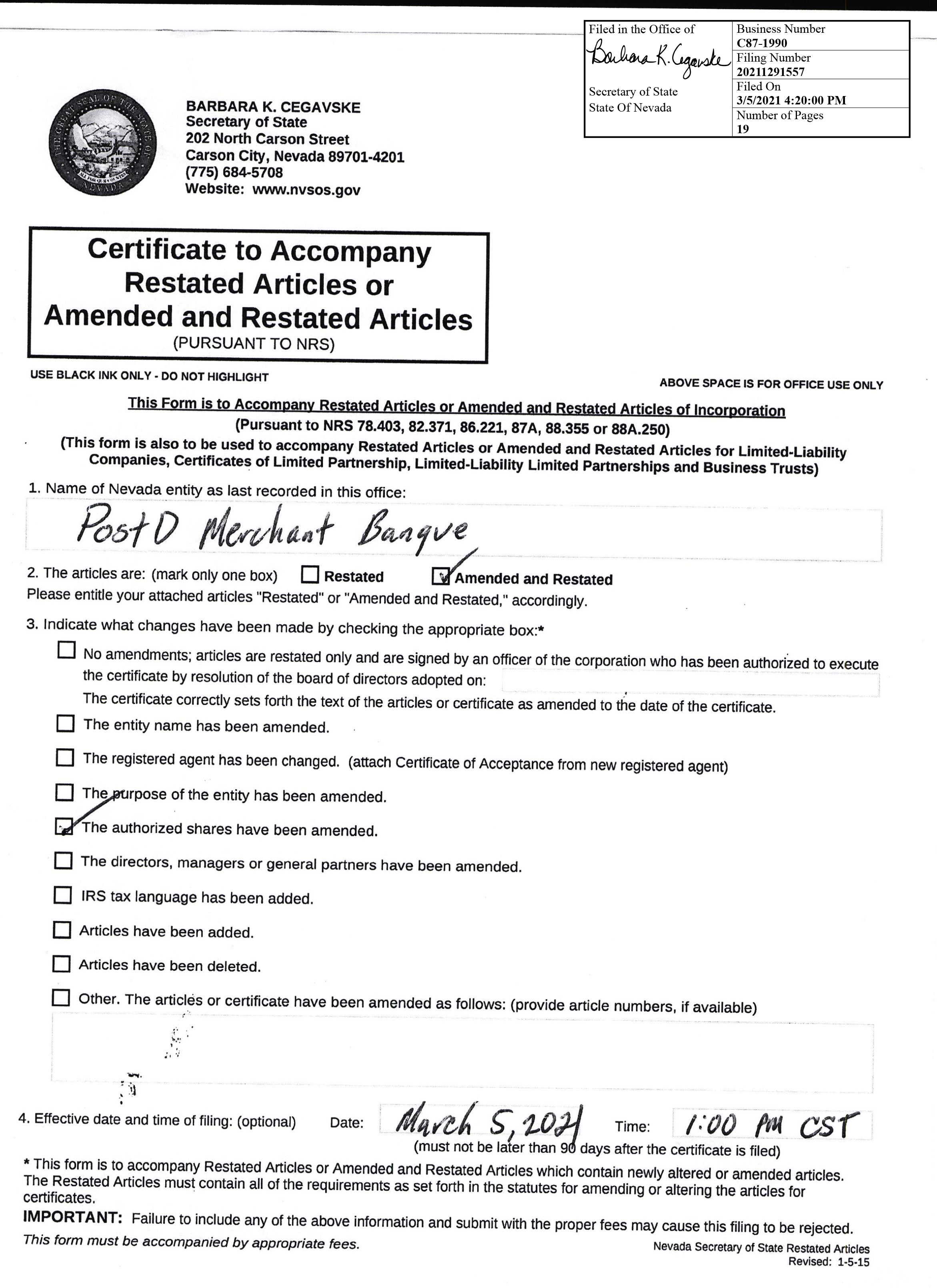
34
Exhibit 2.1

AMENDED AND RESTATED ARTICLES OF INCORPORATION
POSTD Merchant Banque, a corporation organized and existing under the laws of the State of Nevada, hereby certifies as follows:
1. Originally incorporated under the laws of Nevada on May 5, 1990 under the name of Micro-Ergics, and name change documents were filed with the Secretary of State of Nevada on January 1, 2020 under the name of POSTD Merchant Banque.
2. Pursuant to Section 78.315 of the Nevada Revised Statutes, these Amended and Restated Articles of Incorporation restate, integrate, and further amend the provisions of the Articles of Incorporation of this corporation.
3. The text of the Amended and Restated Articles of Incorporation as heretofore amended or supplemented is hereby restated and further amended to read in its entirety as follows:
ARTICLES OF INCORPORATION
OF
POSTD Merchant Banque
ARTICLE I. NAME
The name of the corporation is POSTD Merchant Banque (the "Corporation").
ARTICLE II. REGISTERED OFFICE
The address of the Corporation's registered office in the State of Nevada is 112 North Curry Street, in the City of Carson City, NV, 89703, in the County of Clark, in the State of Nevada, Zip Code 89703. The name of the registered agent at such address is Corporation Service Company.
ARTICLE III. PURPOSE
The purpose or purposes of the corporation is to engage in any lawful act or activity for which corpgrations may be organized under Section 78.315 of the Nevada Revised Statutes.
ARTICLE IV. CAPITAL STOCK
The Corporation is authorized to issue two classes of shares to be designated, respectively, "Preferred Stock" and "Common Stock". The number of shares of Common Stock
authorized to be issued is One Billion (1,000,000,000). The number of shares of Preferred Stock authorized to be issued is One Hundred Thirty Million (130,000,000). The Preferred Stock and the Common Stock shall each have a par value of .0001.
(a) Provisions Relating to the Common Stock. Each holder of Common Stock is entitled to one vote for each share of Common Stock standing in such holder's name on the records of the Corporation on each matter submitted to a vote of the stockholders, except as otherwise required by law.
(b) Provisions Relating to Preferred Stock. Pursuant to Section 78.315 of the Nevada Revised Statutes and this Article IV of the Corporation's Articles of Incorporation, the following shall constitute designations of the Corporation's Preferred Stock:
(I) Series B Preferred Stock. Four (4) shares of Series B Preferred Stock are designated (the "Series A Preferred Stock" or "Series B Preferred Shares").
i. Conversion Rights. Conversion Rights. Shares of Series B Preferred Stock shall not be convertible into common stock of the Corporation, nor any other class of common or preferred shares of the Corporation.
ii. Issuance. Shares of Preferred Stock may only be issued in exchange for the partial or full retirement of debt held by Management, employees or consultants, or as directed by a majority vote of the Board of Directors. The number of Shares of Preferred Stock to be issued to each qualified person (member of Management, employee or consultant) holding a Note shall be determined by the following formula:
For retirement of debt:

where x1 + x2 + x3 represent the discrete notes and other obligations owed the lender (holder), which are being retired.
iii. Voting Rights. If at least one share of Series B Preferred Stock is issued and outstanding, then the total aggregate issued shares of Series A Preferred Stock at any given time, regardless of their number, shall have voting rights equal to four times the sum of: i) the total number
of shares of Common Stock which are issued and outstanding at the time of voting, plus ii) the total number of votes of all other classes of preferred stock which are issued and outstanding at the time of voting.
Each individual share of Series B Preferred Stock shall have the voting rights equal to:
[four times the sum of: {all shares of Common Stock issued and outstanding at time of voting + the total number of votes of all other classes of preferred stock which are issued and outstanding at the time of voting }]
divided by.
[the number of shares of Series B Preferred Stock issued and outstanding at the time of voting].
iv. Dividends. The holders of Series B Preferred Stock shall not be entitled to receive dividends when, and if declared by the Board of Directors.
(ii) Series C Preferred Stock. Ten Million (10,000,000) shares of Series B Preferred Stock are designated (the "Series C Preferred Stock" or "Series C Preferred Shares").
i. Liquidation Rights. Upon any liquidation, dissolution or winding up of the Corporation, whether voluntary or involuntary, before any distribution or payment shall be made to the holders of any stock ranking junior to the Series C Preferred Stock, the holders of the Series C Preferred Stock shall be entitled to be paid out of the assets of the Corporation an amount equal to $1.00 per share or, in the event of an aggregate subscription by a single subscriber for Series C Preferred Stock in excess of $100,000, $0.997 per share (as adjusted for any stock dividends, combinations, splits, recapitalizations and the like with respect to such shares) (the "Preference Value"), plus all declared but unpaid dividends, for each share of Series B Preferred Stock held by them. After the payment of the full applicable Preference Value of each share of the Series B Preferred Stock as set forth herein, the remaining assets of the Corporation legally available for distribution, if any, shall be distributed ratably to the holders of the Corporation's Common Stock.
All shares of Common Stock delivered upon conversion of the Series C Preferred Shares as provided herein shall be duly and validly issued and fully paid and non-assessable.
Shares of Series C Preferred Stock are anti-dilutive to reverse splits, and therefore in the case of a reverse split, are convertible to the number of Common Shares after the reverse split as would have been equal to the ratio established in Section IV(b)(ii) prior to the reverse split.
ii. Voting Rights. Each share of Series C Preferred Stock shall have ten votes each share of Preferred Stock for any election or other vote placed before the shareholders of the Company.
iii. Price. The initial price of each share of Series C Preferred Stock shall be $50.
The price of each share of Series C Preferred Stock may be changed either through a majority vote of the Board of Directors through a resolution at a meeting of the Board, or through a resolution passed at an Action Without Meeting of the unanimous Board, until such time as a listed secondary and/or listed public market develops for the shares.
i. Lock-up Restrictions on Conversion. Shares of Series C Preferred Stock may not be converted into shares of Common Stock for a period of: a) six (6) months after purchase, if the Company voluntarily or involuntarily files public reports pursuant to Section 12 or 15 of the Securities Exchange Act of 1934; or b) twelve (12) months if the Company does not file such public reports.
(iii) Series D Preferred Stock. One Hundred Million (100,000,000) shares of Series C Preferred Stock are designated (the "Series D Preferred Stock" or "Series D Preferred Shares").
i. Dividends. The holders of Series D Preferred Stock shall be entitled to receive dividends when, as and if declared by the Board of Directors, in its sole discretion.
ii. Liquidation Rights. Upon any liquidation, dissolution or winding up of the Corporation, whether voluntary or involuntary, before any distribution or payment shall be made to the holders of any stock ranking junior to the Series B Preferred Stock, the holders of the Series D Preferred Stock shall be entitled to be paid out of the assets of the Corporation an amount equal to $1.00 per share or, in the event of an aggregate subscription by a single subscriber for Series D Preferred Stock in excess of $100,000, $0.997 per share (as adjusted for any stock dividends, combinations, splits, recapitalizations and the like with respect to such shares) (the "Preference Value"), plus all declared but unpaid dividends, for each share of Series D Preferred Stock held by them. After the payment of the full applicable Preference Value of each share of the Series D Preferred Stock as set forth herein, the remaining assets of the Corporation legally available for distribution, if any, shall be distributed ratably to the holders of the Corporation's Common Stock.
iii. Voting Rights. Each share of Series D Preferred Stock shall have ten votes per share of Preferred Stock for any election or other vote placed before the shareholders of the Company.
iv. Price.The initial price of each share of Series D Preferred Stock shall be $100.
The price of each share of Series B Preferred Stock may be changed either through a majority vote of the Board of Directors through a resolution at a meeting of the Board, or through a resolution passed at an Action Without Meeting of the unanimous Board, until such time as a listed secondary and/or listed public market develops for the shares.
ii. Lock-up Restrictions on Conversion. Shares of Series D Preferred Stock may not be converted into shares of Common Stock for a period of: a) six (6) months after purchase, if the Company voluntarily or involuntarily files public reports pursuant to Section 12 or 15 of the Securities Exchange Act of 1934; or b) twelve (12) months if the Company does not file such public reports.
(iv) Series E Preferred Stock. Ten Million (10,000,000) shares of Series B Preferred Stock are designated (the "Series E Preferred Stock" or "Series E Preferred Shares").
i. Dividends. The holders of Series E Preferred Stock shall be entitled to receive dividends when, as and if declared by the Board of Directors, in its sole discretion.
ii. Liquidation Rights. Upon any liquidation, dissolution or winding up of the Corporation, whether voluntary or involuntary, before any distribution or payment shall be made to the holders of any stock ranking junior to the Series E Preferred Stock, the holders of the Series E Preferred Stock shall be entitled to be paid out of the assets of the Corporation an amount equal to $1.00 per share or, in the event of an aggregate subscription by a single subscriber for Series E Preferred Stock in excess of $100,000, $0.997 per share (as adjusted for any stock dividends, combinations, splits, recapitalizations and the like with respect to such shares) (the "Preference Value"), plus all declared but unpaid dividends, for each share of Series E Preferred Stock held by them. After the payment of the full applicable Preference Value of each share of the Series E Preferred Stock as set forth herein, the remaining assets of the Corporation legally available for distribution, if any, shall be distributed ratably to the holders of the Corporation's Common Stock.
iii. Voting Rights. Each share of Series D Preferred Stock shall have ten votes per share of Preferred Stock for any election or other vote placed before the shareholders of the Company.
iv. Price. The initial price of each share of Series D Preferred Stock shall be $100.
The price of each share of Series B Preferred Stock may be changed either through a majority vote of the Board of Directors through a resolution at a meeting of the Board, or through a resolution passed at an Action Without Meeting of the unanimous Board, until such time as a listed secondary and/or listed public market develops for the shares.
ii. Lock-uo Restrictions on Conversion. Shares of Series D Preferred Stock may not be converted into shares of Common Stock for a period of: a) six (6) months after purchase, if the Company voluntarily or involuntarily files public reports pursuant to Section 12 or 15 of the Securities Exchange Act of 1934; or b) twelve (12) months if the Company does not file such public reports.
(iv) Series E Preferred Stock. Ten Million (10,000,000) shares of Series B Preferred Stock are designated (the "Series E Preferred Stock" or "Series E Preferred Shares").
i. Dividends. The holders of Series E Preferred Stock shall be entitled to receive dividends when, as and if declared by the Board of Directors, in its sole discretion.
ii. Liquidation Rights. Upon any liquidation, dissolution or winding up of the Corporation, whether voluntary or involuntary, before any distribution or payment shall be made to the holders of any stock ranking junior to the Series E Preferred Stock, the holders of the Series E Preferred Stock shall be entitled to be paid out of the assets of the Corporation an amount equal to $1.00 per share or, in the event of an aggregate subscription by a single subscriber for Series E Preferred Stock in excess of $100,000, $0.997 per share (as adjusted for any stock dividends, combinations, splits, recapitalizations and the like with respect to such shares) (the "Preference Value"), plus all declared but unpaid dividends, for each share of Series E Preferred Stock held by them. After the payment of the full applicable Preference Value of each share of the Series E Preferred Stock as set forth herein, the remaining assets of the Corporation legally available for distribution, if any, shall be distributed ratably to the holders of the Corporation's Common Stock.
iii. Conversion and Anti-Dilution. Each share of Series E Preferred Stock shall, upon Board of Director's approval, be convertible into 10 shares of common stock, subject to adjustment as may be determined by the Board of Directors from time to time (the "Conversion Rate"). Such conversion shall be deemed to be effective on the business day (the "Conversion Date") following the receipt by the Corporation of written notice from the holder of the Series E Preferred Stock of the holder's intention to convert the shares of Series E Preferred Stock, together with the holder's stock certificate or certificates evidencing the Series E Preferred Stock to be converted.
Promptly after the Conversion Date, the Corporation shall issue and deliver to such holder a certificate or certificates for the number of full shares of Common Stock issuable to the holder pursuant to the holder's conversion of Series E Preferred Shares in accordance with the provisions of this Section. The stock certificate(s) evidencing the Common Stock shall be issued with a restrictive legend indicating that it was issued in a transaction exempt from registration under the Securities Act of 1933, as amended (the "Securities Act"), and that it cannot be transferred unless it is so registered, or an exemption from registration is available, in the opinion of counsel of the Corporation. The Common Stock shall be issued in the same name as the person who is the holder of the Series E Preferred Stock unless, in the opinion of counsel to the Corporation, such transfer can be made in compliance with applicable securities laws. The person in whose name the certificate(s) of Common Stock are so registered shall be treated as a holder of shares of Common Stock of the Corporation on the date the Common Stock certificate(s) are so issued.
All shares of Common Stock delivered upon conversion of the Series D Preferred Shares as provided herein shall be duly and validly issued and fully paid and non-assessable. Effective as of the Conversion Date, such converted Series D Preferred Shares shall no longer be deemed to be outstanding and all rights of the holder with respect to such shares shall immediately terminate except the right to receive the shares of Common Stock issuable upon such conversion.
The Corporation covenants that, within 30 days of receipt of a conversion notice from any holder of shares of Series D Preferred Stock wherein which such conversion would create more shares of Common Stock than are authorized, the Corporation will increase the authorized number of shares of Common Stock sufficient to satisfy such holder of shares of Series D Preferred Stock submitting such conversion notice.
Shares of Series D Preferred Stock are anti-dilutive to reverse splits, and therefore in the case of a reverse split, are convertible to the number of Common Shares after the reverse split as would have been equal to the ratio established in Section
IV(b)(ii) prior to the reverse split. The conversion rate of shares of Series D Preferred Stock, however, would increase proportionately in the case of forward splits, and may not be diluted by a reverse split following a forward split.
iv. Voting Rights. Each share of Series E Preferred Stock shall have ten votes for any election or other vote placed before the shareholders of the Company.
v. Price. The initial price of each share of Series E Preferred Stock shall be $100.
The price of each share of Series C Preferred Stock may be changed either through a majority vote of the Board of Directors through a resolution at a meeting of the Board, or through a resolution passed at an Action Without Meeting of the unanimous Board, until such time as a listed secondary and/or listed public market develops for the shares.
iii. Lock-up Restrictions on Conversion. Shares of Series E Preferred Stock may not be converted into shares of Common Stock for a period of: a) six (6) months after purchase, if the Company voluntarily or involuntarily files public reports pursuant to Section 12 or 15 of the Securities Exchange Act of 1934; or b) twelve (12) months if the Company does not file such public reports.
(v) Series F Preferred Stock. One Hundred Million (100,000,000) shares of Series E Preferred Stock are designated (the "Series E Preferred Stock" or "Series C Preferred Shares").
i. Dividends. The holders of Series E Preferred Stock shall be entitled to receive dividends when, as and if declared by the Board of Directors, in its sole discretion.
ii. Liquidation Rights. Upon any liquidation, dissolution or winding up of the Corporation, whether voluntary or involuntary, before any distribution or payment shall be made to the holders of any stock ranking junior to the Series B Preferred Stock, the holders of the Series E Preferred Stock shall be entitled to be paid out of the assets of the Corporation an amount equal to $1.00 per share or, in the event of an aggregate subscription by a single subscriber for Series E Preferred Stock in excess of $100,000, $0.997 per share (as adjusted for any stock dividends, combinations, splits, recapitalizations and the like with respect to such shares) (the "Preference Value"), plus all declared but unpaid dividends, for each share of Series E Preferred Stock held by them. After the payment of the full applicable Preference Value of each share of the
Series E Preferred Stock as set forth herein, the remaining assets of the Corporation legally available for distribution, if any, shall be distributed ratably to the holders of the Corporation's Common Stock.
iii. Conversion and Anti-Dilution. Each share of Series EPreferred Stock shall, upon Board of Director's approval, be convertible into 10 shares of common stock, subject to adjustment as may be determined by the Board of Directors from time to time (the "Conversion Rate"). Such conversion shall be deemed to be effective on the business day (the "Conversion Date") following the receipt by the Corporation of written notice from the holder of the Series E Preferred Stock of the holder's intention to convert the shares of Series E Preferred Stock, together with the holder's stock certificate or certificates evidencing the Series F Preferred Stock to be converted.
Promptly after the Conversion Date, the Corporation shall issue and deliver to such holder a certificate or certificates for the number of full shares of Common Stock issuable to the holder pursuant to the holder's conversion of Series E Preferred Shares in accordance with the provisions of this Section. The stock certificate(s) evidencing the Common Stock shall be issued with a restrictive legend indicating that it was issued in a transaction exempt from registration under the Securities Act of 1933, as amended (the "Securities Act"), and that it cannot be transferred unless it is so registered, or an exemption from registration is available, in the opinion of counsel of the Corporation. The Common Stcick shall be issued in the same name as the person who is the holder of the Series E Preferred Stock unless, in the opinion of counsel to the Corporation, such transfer can be made in compliance with applicable securities laws. The person in whose name the certificate(s) of Common Stock are so registered shall be treated as a holder of shares of Common Stock of the Corporation on the date the Common Stock certificate(s) are so issued.
All shares of Common Stock delivered upon conversion of the Series E Preferred Shares as provided herein shall be duly and validly issued and fully paid and non-assessable. Effective as of the Conversion Date, such converted Series E Preferred Shares shall no longer be deemed to be outstanding and all rights of the holder with respect to such shares shall immediately terminate except the right to receive the shares of Common Stock issuable upon such conversion.
The Corporation covenants that, within 30 days of receipt of a conversion notice from any holder of shares of Series E Preferred Stock wherein which such conversion would create more shares of Common Stock than are authorized, the Corporation will increase the authorized number of shares of Common Stock sufficient to satisfy such holder of shares of Series E Preferred Stock submitting such conversion notice.
Shares of Series E Preferred Stock are anti-dilutive to reverse splits, and therefore in the case of a reverse split, are convertible to the number of Common Shares after the reverse split as would have been equal to the ratio established in Section IV(b)(ii) prior to the reverse split. The conversion rate of shares of Series E Preferred Stock, however, would increase proportionately in the case of forward splits, and may not be diluted by a reverse split following a forward split.
iv. Voting Rights. Each share of Series E Preferred Stock shall have ten votes per share of PReferred Stock for any election or other vote placed before the shareholders of the Company.
v. Price. The initial price of each share of Series E Preferred Stock shall be $150.
The price of each share of Series E Preferred Stock may be changed either through a majority vote of the Board of Directors through a resolution at a meeting of the Board, or through a resolution passed at an Action Without Meeting of the unanimous Board, until such time as a listed secondary and/or listed public market develops for the shares.
iv. Lock-up Restrictions on Conversion. Shares of Series E Preferred Stock may not be converted into shares of Common Stock for a period of: a) six (6) months after purchase, if the Company voluntarily or involuntarily files public reports pursuant to Section 12 or 15 of the Securities Exchange Act of 1934; or b) twelve (12) months if the Company does not file such public reports.
(vi) Series F Preferred Stock. Ten Million (10,000,000) shares of Series B Preferred Stock are designated (the ''Series F Preferred Stock" or "Series F Preferred Shares'').
i. Dividends. The holders of Series F Preferred Stock shall be entitled to receive dividends when, as and if declared by the Board of Directors, in its sole discretion.
ii. Liquidation Rights. Upon any liquidation, dissolution or winding up of the Corporation, whether voluntary or involuntary, before any distribution or payment shall be made to the holders of any stock ranking junior to the Series B Preferred Stock, the holders of the Series F Preferred Stock shall be entitled to be paid out of the assets of the Corporation an amount equal to $1.00 per share or, in the event of an aggregate subscription by a single subscriber for Series F Preferred Stock in excess of $100,000, $0.997 per share (as adjusted for any stock dividends, combinations, splits, recapitalizations and the like with respect
to such shares) (the "Preference Value"), plus all declared but unpaid dividends, for each share of Series F Preferred Stock held by them. After the payment of the full applicable Preference Value of each share of the Series F Preferred Stock as set forth herein, the remaining assets of the Corporation legally available for distribution, if any, shall be distributed ratably to the holders of the Corporation's Common Stock.
All shares of Common Stock delivered upon conversion of the Series F Preferred Shares as provided herein shall be duly and validly issued and fully paid and non-assessable.
Shares of Series F Preferred Stock are anti-dilutive to reverse splits, and therefore in the case of a reverse split, are convertible to the number of Common Shares after the reverse split as would have been equal to the ratio established in Section IV(b)(ii) prior to the reverse split.
iii. Conversion and Anti-Dilution. Each share of Series F Preferred Stock shall, upon Board of Director's approval, be convertible into 25 shares of common stock, subject to adjustment as may be determined by the Board of Directors from time to time (the "Conversion Rate"). Such conversion shall be deemed to be effective on the business day (the "Conversion Date") following the receipt by the Corporation of written notice from the holder of the Series F Preferred Stock of the holder's intention to convert the shares of Series F Preferred Stock, together with the holder's stock certificate or certificates evidencing the Series F Preferred Stock to be converted.
iv. Voting Rights. Each share of Series F Preferred Stock shall have ten votes for any election or other vote placed before the shareholders of the Company.
v. Price. The initial price of each share of Series F Preferred Stock shall be $250.
The price of each share of Series F Preferred Stock may be changed either through a majority vote of the Board of Directors through a resolution at a meeting of the Board, or through a resolution passed at an Action Without Meeting of the unanimous Board, until such time as a listed secondary and/or listed public market develops for the shares.
v. Lock-up Restrictions on Conversion. Shares of Series F Preferred Stock may not be converted into shares of Common Stock for a period of: a) six (6) months after purchase, if the Company voluntarily or involuntarily files public reports pursuant to Section 12 or 15 of the Securities Exchange Act of 1934; or b) twelve (12) months if the Companydoes not file such public reports.
(c) Additional Provisions Relating to the Preferred Stock. The Board of Directors (the "Board") is authorized, subject to limitations prescribed by law and the provisions of this Article IV, to provide for the issuance of additional shares of Preferred Stock in accordance with Section 78.320 of the Nevada Revised Statutes, in one or more series, and by filing a designation pursuant to the applicable law of the State of Nevada, to establish from time to time the number of shares to be included in each such series, and to fix the designation, powers, preferences and rights of the shares of each such series and the qualification, limitations or restrictions thereof.
ARTICLE V. BOARD OF DIRECTORS
(a) Number. The number of directors, constituting the entire Board shall be fixed from time to time by vote of a majority of the entire Board, provided, however, that the number of directors shall not be reduced so as to shorten the terms of any director at any time in office.
(b) Vacancies. Vacancies on the Board shall be filled by the affirmative vote of the majority of the remaining directors, though less than a quorum of the Board, or by election at an annual meeting or at a special meeting of the stockholders called for that purpose.
(c) Election. Election of directors need not be by written ballot.
ARTICLE VI. BY-LAWS
In furtherance and not in limitation of the powers conferred by statute, the Board is expressly authorized to make, alter, amend or repeal the Bylaws of the Corporation.
ARTICLE VII. AMENDMENT
No amendment or restatement of this Articles of Incorporation shall be valid unless approved by holders of a majority of the voting rights of the Corporation which shall expressly include voting rights associated with the outstanding shares of Common Stock and Preferred Stock of the Corporation.
ARTICLE VIII. LIABILITY
To the fullest extent permitted by the Nevada Business Corporation Act as the same exists or as may hereafter be amended, no director of the Corporation shall be personally liable to the Corporation or its stockholders for or with respect to any acts or omissions in the performance of his or her duties as a director of the Corporation. Any amendment or repeal of
this Article VIII will not eliminate or reduce the effect of any right or protection of a director of the Corporation existing immediately prior to such amendment or repeal.
I, THE UNDERSIGNED, being the Chief Executive Officer of POSTD Merchant Banque pursuant to the Nevada Business Corporation Act, do make this certificate, hereby declaring and certifying, under penalties of perjury, that this is my act and deed and the facts herein stated are true, and accordingly have hereunto set my hand this 5th day of March, 2021.
By: /s/ Ruby Calhoun
Ruby Calhoun, Chief Executive Officer
WRITTEN CONSENT OF
A MAJORITY OF THE OUTSTANDING VOTING SHARES
OF
POSTD MERCHANT BANQUE
February 12, 2021
The undersigned person(s), constituting holders of a majority of the issued and outstanding voting shares (collectively, the "Shareholders") of POSTD Merchant Banque, a Nevada corporation (the "Company" or "PMB"), in accordance with Section 78.320 of the Nevada Revised Statutes, hereby consent, vote in favor of and adopt the following resolution and waive any notice required to be given in connection therewith:
Upon Special Meeting of the majority of shareholders, with notice waived, it was brought upon motion before the shareholders the following:
WHEREAS, upon presentation of a unanimous Board consent to authorize, create and issue Series B Preferred Stock, Series C Preferred Stock, Series D Preferred Stock entitled to a 6% annual dividend and Series E Convertible Preferred Stock, Series F Convertible Preferred Stock, authorize 1,000,000,000 shares of capital stock of the Company, and approve a 1,000:1 Reverse Stock Split.
WHEREAS, the undersigned holder of a majority of the voting shares of the Company holding 42,842,859 shares of Common stock having a voting power of 1 share to 1 vote of common stock for a total of 42,842,859 voting shares with the actual percentage of votes carrying approval being fifty-nine percent (59.31%) for the authorization, creation and issuance of Series B Convertible Preferred Stock, Series C Convertible Preferred Stock, Series D Convertible Preferred Stock, Series E Convertible Preferred Stock to add a 6% annual dividend, Series F Convertible Preferred Stock, authorize 1,000,000,000 shares of capital stock of the Company, and approve a 1,000:1 Reverse Stock Split.
IT IS RESOLVED, that an amendment to the Incorporation Articles authorizing 1,000,000,000 shares of capital stock of the Company be authorized;
IT IS FURTHER RESOLVED that an amendment to the Incorporation Articles authorizing, creating and granting authority to the Board to issue classes Series B Preferred Stock, Series C Preferred Stock, Series D Preferred Stock, Series E Convertible Preferred Stock, and Series F Convertible Preferred Stock is hereby authorized and approved by a majority (59.31%) of the holders of voting stock, and,
IT IS FURTHER RESOLVED that:
Series B Preferred Stock is authorized for 4 shares at $0.0001 par value, and shall have no conversion rights to common stock, Voting Rights. If at least one share of Series B Preferred Stock is issued and outstanding, then the total aggregate issued shares of Series B Preferred Stock at any given time, regardless of their number, shall have voting rights equal to four times the sum of: i) the total number of shares of Common Stock which are issued and outstanding at the time of voting, plus ii) the total number of votes of all other classes of preferred stock which are issued and outstanding at the time of voting.
Series C Preferred Stock is authorized for 10,000,000, shares at $0.0001 par value, and shall have ten common share votes per share of Preferred stock, be non-dilutive with no conversion rights to common stock.
Series D Preferred Stock is authorized for 100,000,000 shares at $0.0001 par value, and shall be shall have ten common share votes per share of Preferred stock, be non-dilutive, with no conversion rights to common stock, and entitled to a six percent (6%) dividend;.
Series E Convertible Preferred Stock is authorized for 10,000,000 shares at $0.0001 par value, and shall be shall have ten common share votes per share of Preferred stock, be non-dilutive with 10:1 conversion rights to common stock (i.e., 1 share of Series E Preferred stock shall convert to 10 shares of common stock.
Series F Convertible Preferred Stock is authorized for 10,000,000 shares at $0.0001 par value, and shall have 25 common share votes per share of Preferred stock, be non-dilutive with a 25:1 conversion rights to common stock (i.e., 1 share of Series F Preferred stock shall convert to 25 shares of common stock.
IT IS FURTHER RESOLVED, that the holder of a majority of the voting shares approve a 1,000:1 Reverse Stock Split;
IT IS FURTHER RESOLVED, that the board of directors will have the authority, without further action by the shareholders, to issue such shares of preferred stock in one or more series and to fix the rights, preferences and the number of shares constituting any series or the designation of such series. The issuance of preferred stock may have the effect of delaying or preventing a change in control or make removal of our management more difficult. Additionally, the issuance of preferred stock may have the effect of decreasing the market price of the common stock and may adversely affect the voting and other rights of the holders of common stock; and,
IT IS FURTHER RESOLVED, that the directors of this corporation are, and each acting alone is, hereby authorized to do and perform any and all such acts, including execution of any and all documents and certificates, as such officers shall deem necessary or advisable, to carry out the purposes and intent of the foregoing resolution.
Being no further business, the meeting was adjourned.
In Witness Whereof, the following shareholders, holding common stock or other securities that are entitled to vote together with common stock, representing a majority (59.31%) of the voting shares of the Company, have executed this Consent on the date indicated below to be effective ten (10) days following the Company's mailing of prompt notice of this Consent to all non-consenting shareholders of the Company. This Consent may be executed in counterparts, all of which together shall constitute one and the same instrument.
| Name
of Majority Shareholder(s) |
Number of Votes Held | Date | ||
| PMB Quantum Family Office | 42,842,859 Common Shares | February 12, 2021 | ||
| By: | ||||
| /s/ Donald G. Richards | ||||
| Name: Donald Richards | February 16, 2021 |


Exhibit 2.2

AMENDED AND RESTATED BY-LAWS
OF
POSTD MERCHANT BANQUE
A Nevada Corporation
ARTICLE I - OFFICES
The registered office of the Corporation in the State of Nevada shall be located in the City and State designated in the Articles of Incorporation. The Corporation may also maintain offices at such other places within or without the State of Nevada as the Board of Directors may, from time to time, determine.
ARTICLE II- MEETING OF SHAREHOLDERS
Section 1 - Annual Meetings.
The annual meeting of the shareholders of the Corporation shall be held at the time fixed, from time to time, by the Directors.
Section 2 - Special Meetings.
Special meetings of the shareholders may be called at any time by the Board of Directors or by the President, and shall be called by the President or the Secretary at the written request of the holders of ten per cent (10%) of the shares then outstanding and entitled to vote thereat, or as otherwise required under the provisions of the Business Corporation Law, and may be held within or without the State of Nevada in person or telephonically.
Section 3 - Place of Meetings.
Meetings of shareholders shall be held at the registered office of the Corporation, or at such other places, within or without the State of Nevada as the Directors may from time to time fix. If no designation is made, the meeting shall be held at the Corporation's registered office in the state of Nevada.
Section 4 - Notice of Meetings.
(a) Written or printed notice of each meeting of shareholders, whether annual or special, signed by the president, vice president or secretary, stating the time when and place where it is to be held, as well as the purpose or purposes for which the meeting is called, shall be served either personally or by mail or by electronic transmission, by or at the direction of the president, the secretary, or the officer or the person calling the meeting, not less than ten or more than sixty days before the date of the meeting, unless the lapse of the prescribed time shall have been
Page 1 of 12
waived before or after the taking of such action, upon each shareholder of record entitled to vote at such meeting, and to any other shareholder to whom the giving of notice may be required by law. If mailed, such notice shall be deemed to be given when deposited in the United States mail, addressed to the shareholder as it appears on the share transfer records of the Corporation or to the current address, which a shareholder has delivered to the Corporation in a written notice. If by electronic transmission, such notice shall be deemed to be given when transmitted by facsimile or electronic mail transmission (including PDF), to the party to whom such notice or communication is directed, to the regularly-monitored electronic mail address of such party.
(b) Further notice to a shareholder is not required when notice of two consecutive annual meetings, and all notices of meetings or of the taking of action by written consent without a meeting to him or her during the period between those two consecutive annual meetings; or all, and at least two payments sent by first-class mail of dividends or interest on securities during a 12-month period have been mailed addressed to him or her at his or her address as shown on the records of the Corporation and have been returned undeliverable.
Section 5 – Quorum.
(a) Except as otherwise provided herein, or by law, or in the Articles of Incorporation (such Articles and any amendments thereof being hereinafter collectively referred to as the "Articles of Incorporation"), a quorum shall be present at all meetings of shareholders of the Corporation, if the holders of a majority of the shares entitled to vote on that matter are represented at the meeting in person or by proxy.
(b) The subsequent withdrawal of any shareholder from the meeting, after the commencement of a meeting, or the refusal of any shareholder represented in person or by proxy to vote, shall have no effect on the existence of a quorum, after a quorum has been established at such meeting.
(c) Despite the absence of a quorum at any meeting of shareholders, the shareholders present may adjourn the meeting.
Section 6 - Voting and Action.
(a) Except as otherwise provided by law, the Articles of Incorporation, or these Bylaws, any corporate action, the affirmative vote of the majority of shares entitled to vote on that matter and represented either in person or by proxy at a meeting of shareholders at which a quorum is present, shall be the act of the shareholders of the Corporation.
(b) Except as otherwise provided by statute, the Certificate of Incorporation, or these Bylaws, at each meeting of shareholders, each shareholder of the Corporation entitled to vote thereat, shall be entitled to one vote for each share registered in his name on the books of the Corporation.
(c) Where appropriate communication facilities are reasonably available, any and all shareholders shall have the right to participate in any shareholders' meeting, by means of conference telephone or any means of communications by which all persons participating in the meeting are able to hear each other.
Page 2 of 12
Section 7 – Proxies.
Each shareholder entitled to vote or to express consent or dissent without a meeting, may do so either in person or by proxy, so long as such proxy is executed in writing by the shareholder himself, his authorized officer, director, employee or agent or by the signature of the stockholder to be affixed to the writing by any reasonable means, including, but not limited to, a facsimile signature, or by his attorney-in-fact there unto duly authorized in writing. Every proxy shall be revocable at will unless the proxy conspicuously states that it is irrevocable and the proxy is coupled with an interest. A telegram, telex, cablegram, or similar transmission by the shareholder, or a photographic, photostatic, facsimile, or electronic mail transmission shall be treated as a valid proxy, and treated as a substitution of the original proxy, so long as such transmission is a complete reproduction executed by the shareholder. If it is determined that the telegram, cablegram or other electronic transmission is valid, the persons appointed by the Corporation to count the votes of shareholders and determine the validity of proxies and ballots or other persons making those determinations must specify the information upon which they relied. No proxy shall be valid after the expiration of six months from the date of its execution, unless otherwise provided in the proxy. Such instrument shall be exhibited to the Secretary at the meeting and shall be filed with the records of the Corporation. If any shareholder designates two or more persons to act as proxies, a majority of those persons present at the meeting, or, if one is present, then that one has and may exercise all of the powers conferred by the shareholder upon all of the persons so designated unless the shareholder provides otherwise.
Section 8 - Action Without a Meeting.
Unless otherwise provided for in the Articles of Incorporation of the Corporation, any action to be taken at any annual or special shareholders' meeting, may be taken without a meeting, without prior notice and without a vote if written consents are signed by a majority of the shareholders of the Corporation, except however if a different proportion of voting power is required by law, the Articles of Incorporation or these Bylaws, than that proportion of written consents is required. Such written consents must be filed with the minutes of the proceedings of the shareholders of the Corporation.
ARTICLE III- BOARD OF DIRECTORS
Section 1 - Number. Term. Election and Qualifications.
(a) The first Board of Directors and all subsequent Boards of the Corporation shall consist of, not less than 1 nor more than 9, unless and until otherwise determined by vote of a majority of the entire Board of Directors. The Board of Directors or shareholders all have the power, in the interim between annual and special meetings of the shareholders, to increase or decrease the number of Directors of the Corporation. A Director need not be a shareholder of the Corporation unless the Certificate of Incorporation of the Corporation or these Bylaws so require.
(b) Except as may otherwise be provided herein or in the Articles of Incorporation, the members of the Board of Directors of the Corporation shall be elected at the first annual shareholders' meeting and at each annual meeting thereafter, unless their terms are staggered in the Articles of Incorporation of the Corporation or these Bylaws, by a majority, but no less than a plurality, of the votes cast at a meeting of shareholders, by the holders of shares entitled to vote in the election.
Page 3 of 12
(c) The first Board of Directors shall hold office until the first annual meeting of shareholders and until their successors have been duly elected and qualified or until there is a decrease in the number of Directors. Thereinafter, Directors will be elected at the annual meeting of shareholders and shall hold office until the annual meeting of the shareholders next succeeding his election, unless their terms are staggered in the Articles of Incorporation of the Corporation (so long as at least one-fourth in number of the are elected at each annual shareholders' meeting) or these Bylaws, or until his prior death, resignation or removal. Any Director may resign at any time upon written notice of such resignation to the Corporation.
(d) All Directors of the Corporation shall have equal voting power unless the Articles of Incorporation of the Corporation provide that the voting power of individual Directors or classes of Directors are greater than or less than that of any other individual Directors or classes of Directors, and the different voting powers may be stated in the Articles of Incorporation or may be dependent upon any fact or event that may be ascertained outside the Articles of Incorporation if the manner in which the fact or event may operate on those voting powers is stated in the Articles of Incorporation. If the Articles of Incorporation provide that any Directors have voting power greater than or less than other Directors of the Corporation, every reference in these Bylaws to a majority or a proportion of Directors shall be deemed to refer to majority or other proportion of the voting power of all the Directors or classes of Directors, as may be required by the Articles of Incorporation.
Section 2 - Duties and Powers.
The Board of Directors shall be responsible for the control and management of the business and affairs, property and interests of the Corporation, and may exercise all powers of the Corporation, except such as those stated under Nevada state law, are in the Articles of Incorporation or by these Bylaws, expressly conferred upon or reserved to the shareholders or any other person or persons named therein.
Section 3 - Regular Meetings: Notice.
(a) A regular meeting of the Board of Directors shall be held either within or without the State of Nevada at such time and at such place as the Board shall fix.
(b) No notice shall be required of any regular meeting of the Board of Directors and, if given, need not specify the purpose of the meeting; provided, however that in case the Board of Directors shall fix or change the time or place of any regular meeting when such time and place was fixed before such change, notice of such action shall be given to each director who shall not have been present at the meeting at which such action was taken within the time limited,
and in the manner set forth in these Bylaws with respect to special meetings, unless such notice shall be waived in the manner set forth in these Bylaws.
Section 4 - Special Meetings: Notice.
(a) Special meetings of the Board of Directors shall be held at such time and place as may be specified in the respective notices or waivers of notice thereof.
Page 4 of 12
(b) Except as otherwise required by statute, written notice of special meetings shall be mailed directly to each Director, addressed to him at his residence or usual place of business, or delivered orally, with sufficient time for the convenient assembly of Directors thereat, or shall be sent to him at such place by telegram, or by electronic transmission, or shall be delivered to him personally or given to him orally, not later than the day before the day on which the meeting is to be held. If mailed, the notice of any special meeting shall be deemed to be delivered on the second day after it is deposited in the United States mails, so addressed, with postage prepaid. If notice is given by telegram, it shall be deemed to be delivered when the telegram is delivered to the telegraph company. If by electronic mail transmission, it shall be deemed delivered the day such notice or communication is faxed or sent electronically, provided that the sender has received a confirmation of such fax or electronic transmission. A notice, or waiver of notice, except as required by these Bylaws, need not specify the business to be transacted at or the purpose or purposes of the meeting.
(c) Notice of any special meeting shall not be required to be given to any Director who shall attend such meeting without protesting prior thereto or at its commencement, the lack of notice to him, or who submits a signed waiver of notice, whether before or after the meeting. Notice of any adjourned meeting shall not be required to be given.
Section 5 – Chairperson.
The Chairperson of the Board, if any and if present, shall preside at all meetings of the Board of Directors. If there shall be no Chairperson, or he or she shall be absent, then the President shall preside, and in his absence, any other director chosen by the Board of Directors shall preside.
Section 6 - Quorum and Adjournments.
(a) At all meetings of the Board of Directors, or any committee thereof, the presence of a majority of the entire Board, or such committee thereof; shall constitute a quorum for the transaction of business, except as otherwise provided by law, by the Certificate of Incorporation, or these Bylaws.
(b) A majority of the directors present at the time and place of any regular or special meeting, although less than a quorum, may adjourn the same from time to time without notice, whether or not a quorum exists. Notice of such adjourned meeting shall be given to Directors not present at time of the adjournment and, unless the time and place of the adjourned meting are announced at the time of the adjournment, to the other Directors who were present at the adjourned meeting.
Section 7 - Manner of Acting.
(a) At all meetings of the Board of Directors, each director present shall have one vote, irrespective of the number of shares of stock, if any, which he may hold.
(b) Except as otherwise provided by law, by the Articles of Incorporation, or these bylaws, action approved by a majority of the votes of the Directors present at any meeting or any committee thereof, at which a quorum is present shall be the act of the Board of Directors or any committee thereof.
Page 5 of 12
(c) Any action authorized in writing made prior or subsequent to such action, by all of the Directors entitled to vote thereon and filed with the minutes of the Corporation shall be the act of the Board of Directors, or any committee thereof, and have the same force and effect as if the same had been passed by unanimous vote at a duly called meeting of the Board or committee for all purposes.
(d) Where appropriate communications facilities are reasonably available, any or all directors shall have the right to participate in any Board of Directors meeting, or a committee of the Board of Directors meeting, by means of conference telephone or any means of communication by which all persons participating in the meeting are able to hear each other.
Section 8 – Vacancies.
(a) Unless otherwise provided for by the Articles of Incorporation of the Corporation, any vacancy in the Board of Directors occurring by reason of an increase in the number of directors, or by reason of the death, resignation, disqualification, removal or inability to act of any director, or other cause, shall be filled by an affirmative vote of a majority of the remaining directors, though less than a quorum of the Board or by a sole remaining Director, at any regular meeting or special meeting of the Board of Directors called for that purpose except whenever the shareholders of any class or classes or series thereof are entitled to elect one or more Directors by the Certificate of Incorporation of the Corporation, vacancies and newly created directorships of such class or classes or series may be filled by a majority of the Directors elected by such class or classes or series thereof then in office, or by a sole remaining Director so elected.
(b) Unless otherwise provided for by law, the Articles of Incorporation or these Bylaws, when one or more Directors shall resign from the board and such resignation is effective at a future date, a majority of the directors, then in office, including those who have so resigned, shall have the power to fill such vacancy or vacancies, the vote otherwise to take effect when such resignation or resignations shall become effective.
Section 9 – Resignation.
A Director may resign at any time by giving written notice of such resignation to the Corporation.
Section 10 – Removal.
Unless otherwise provided for by the Articles of Incorporation, one or more or all the Directors of the Corporation may be removed with or without cause at any time by a vote of two-thirds of the shareholders entitled to vote thereon, at a special meeting of the shareholders called for that purpose, unless the Articles of Incorporation provide that Directors may only be removed for cause, provided however, such Director shall not be removed if the Corporation states in its Articles of Incorporation that its Directors shall be elected by cumulative voting and there are a sufficient number of shares cast against his or her removal, which if cumulatively voted at an election of Directors would be sufficient to elect him or her. If a Director was elected by a voting group of shareholders, only the shareholders of that voting group may participate in the vote to remove that Director.
Page 6 of 12
Section 11 – Compensation.
The Board of Directors may authorize and establish reasonable compensation of the Directors for services to the Corporation as Directors, including, but not limited to attendance at any annual or special meeting of the Board.
Section 12 Committees.
Unless otherwise provided for by the Articles of Incorporation of the Corporation, the Board of Directors, may from time to time designate from among its members one or more committees, and alternate members thereof, as they deem desirable, each consisting of one or more members, with such powers and authority (to the extent permitted by law and these Bylaws) as may be provided in such resolution. Unless the Articles of Incorporation or Bylaws state otherwise, the Board of Directors may appoint natural persons who are not Directors to serve on such committees authorized herein. Each such committee shall serve at the pleasure of the Board and, unless otherwise stated by law, the Certificate of Incorporation of the Corporation or these Bylaws, shall be governed by the rules and regulations stated herein regarding the Board of Directors.
ARTICLE IV - OFFICERS
Section 1 - Number, Qualifications, Election and Term of Office.
(a) The Corporation's officers shall have such titles and duties as shall be stated in these Bylaws or in a resolution of the Board of Directors which is not inconsistent with these Bylaws. The officers of the Corporation shall consist of a president, secretary and treasurer, and also may have one or more vice presidents, assistant secretaries and assistant treasurers and such other officers as the Board of Directors may from time to time deem advisable. Any officer may hold two or more offices in the Corporation.
(b) The officers of the Corporation shall be elected by the Board of Directors at the regular annual meeting of the Board following the annual meeting of shareholders.
(c) Each officer shall hold office until the annual meeting of the Board of Directors next succeeding his election, and until his successor shall have been duly elected and qualified, subject to earlier termination by his or her death, resignation or removal.
Section 2 - Resignation:
Any officer may resign at any time by giving written notice of such resignation to the Corporation.
Section 3 - Removal:
Any officer elected by the Board of Directors may be removed, either with or without cause, and a successor elected by the Board at any time, and any officer or assistant officer, if appointed by another officer, may likewise be removed by such officer.
Page 7 of 12
Section 4 - Vacancies:
(a) A vacancy, however caused, occurring in the Board and any newly created Directorships resulting from an increase in the authorized number of Directors may be filled by the Board of Directors.
Section 5 - Bonds:
The Corporation may require any or all of its officers or Agents to post a bond, or otherwise, to the Corporation for the faithful performance of their positions or duties.
Section 6 - Compensation:
The compensation of the officers of the Corporation shall be fixed from time to time by the Board of Directors.
ARTICLE V - SHARES OF STOCK
Section 1 - Certificate of Stock.
(a) The shares of the Corporation shall be represented by certificates or shall be uncertified shares.
(b) Certificated shares of the Corporation shall be signed, (either manually or by facsimile), by the officers or agents designated by the Corporation for such purposes, and shall; certify the number of shares owned by him in the Corporation. Whenever any certificate is countersigned or otherwise authenticated by a transfer agent or transfer clerk, and by a registrar, then a facsimile of the signatures of the officers or agents, the transfer agent or transfer clerk or the registrar of the Corporation may be printed or lithographed upon the certificate in lien of the actual signatures. If the Corporation uses facsimile signatures of its officers and agents on its stock certificates, it cannot act as registrar of its own stock, but its transfer agent and registrar may be identical if the institution acting in those dual capacities countersigns or otherwise authenticates any stock certificates in both capacities. If any officer who has signed or whose facsimile signature has been placed upon such certificate, shall have ceased to be such officer before such certificate is issued, it may be issued by the Corporation with the same effect as if he were such officer at the date of its issue.
(c) If the Corporation issues uncertificated shares as provided for in these Bylaws, within a reasonable time after the issuance or transfer of such uncertificated shares, and at least annually thereafter, the Corporation shall send the shareholder a written statement certifying the number of shares owned by such shareholder in the Corporation.
(d) Except as otherwise provided by law, the rights and obligations of the holders of uncertificated shares and the rights and obligations of the holders of certificates representing shares of the same class and series shall be identical.
Page 8 of 12
Section 2 - Lost or Destroyed Certificates.
The Board of Directors may direct a new certificate or certificates to be issued in place of any certificate or certificates theretofore issued by the Corporation alleged to have been lost, stolen, or destroyed if the owner:
(a) so requests before the Corporation has notice that the shares have been acquired by a bonafide purchaser,
(b) files with the Corporation a sufficient indemnity bond
(c) satisfies such other requirements, including evidence as may be imposed by the Corporation.
Section 3 - Transfers of Shares.
(a) Transfers or registration of transfers of shares of the Corporation shall be made on the stock transfer books of the Corporation by the registered holder thereof, or by his attorney duly authorized by a written power of attorney; and in the case of shares represented by certificates, only after the surrender to the Corporation of the certificates representing such shares with such shares properly endorsed, with such evidence of the authenticity of such endorsement, transfer, authorization and other matters as the Corporation may reasonably require, and the payment of all stock transfer taxes due thereon.
(b) The Corporation shall be entitled to treat the holder of record of any share or shares as the absolute owner thereof for all purposes and, accordingly, shall not be bound to recognize any legal, equitable or other claim to, or interest in, such share or shares on the part of any other person, whether or not it shall have express or other notice thereof, except as otherwise expressly provided by law.
Section 4 - Record Date.
(a) The Board of Directors may fix, in advance, which shall not be more than sixty days before the meeting or action requiring a determination of shareholders, as the record date for the determination of shareholders entitled to receive notice of, or to vote at, any meeting of shareholders, or to consent to any proposal without a meeting, or for the purpose of determining shareholders entitled to receive payment of any dividends, or allotment of any rights, or for the purpose of any other action. If no record date is fixed, the record date for shareholders entitled to notice of meeting shall be at the close of business on the day preceding the day on which notice is given, or, if no notice is given, the day on which the meeting is held, or if notice is waived, at the close of business on the day before the day on which the meeting is held.
(b) The Board of Directors may fix a record date, which shall not precede the date upon which the resolution fixing the record date is adopted for shareholders entitled to receive payment of any dividend or other distribution or allotment of any rights of shareholders entitled to exercise any rights in respect of any change, conversion or exchange of stock, or for the purpose of any other lawful action.
Page 9 of 12
(c) A determination of shareholders entitled to notice of or to vote at a shareholders' meeting is effective for any adjournment of the meeting unless the Board of Directors fixes a new record date for the adjourned meeting.
Section 5 - Fractions of Shares/Scrip.
The Board of Directors may authorize the issuance of certificates or payment of money for fractions of a share, either represented by a certificate or uncertificated, which shall entitle the holder to exercise voting rights, receive dividends and participate in any assets of the Corporation in the event of liquidation, in proportion to the fractional holdings; or it may authorize the payment in case of the fair value of fractions of a share as of the time when those entitled to receive such fractions are determined; or it may authorize the issuance, subject to such conditions as may be permitted by law, of scrip in registered or bearer form over the manual or facsimile signature of an officer or agent of the Corporation or its agent for that purpose, exchangeable as therein provided for full shares, but such scrip shall not entitle the holder to any rights of shareholder, except as therein provided. The scrip may contain provisions or conditions that the Corporation deems advisable. If a scrip ceases to be exchangeable for full share certificates, the shares that would otherwise have been issuable as provided on the scrip are deemed to be treasury shares unless the scrip contains other provisions for their disposition.
ARTICLE VI- DIVIDENDS
(a) Dividends may be declared and paid out of any funds available therefor, as often, in such amounts, and at such time or times as the Board of Directors may determine and shares may be issued pro rata and without consideration to the Corporation's shareholders or to the shareholders of one or more classes or series.
(b) Shares of one class or series may not be issued as a share dividend to shareholders of another class or series unless:
(i) so authorized by the Articles of Incorporation;
(ii) a majority of the shareholders of the class or series to be issued approve the issue; or
(iii) there are no outstanding shares of the class or series of shares that are authorized to be issued.
ARTICLE VII - FISCAL YEAR
The fiscal year of the Corporation shall be fixed, and shall be subject to change by the Board of Directors from time to time, subject to applicable law.
ARTICLE VIII- CORPORATE SEAL
The corporate seal, if any, shall be in such form as shall be prescribed and altered, from time to time, by the Board of Directors. The use of a seal or stamp by the Corporation on corporate documents is not necessary and the lack thereof shall not in any way affect the legality of a corporate document.
Page 10 of 12
ARTICLE IX - AMENDMENTS
Section 1 - By Shareholders:
All Bylaws of the Corporation shall be subject to alteration or repeal, and new Bylaws may be made, by a majority vote of the shareholders at the time entitled to vote in the election of Directors even though these Bylaws may also be altered, amended or repealed by the Board of Directors.
Section 2 - By Directors.
The Board of Directors shall have power to make, adopt, alter, amend and repeal, from time to time, Bylaws of the Corporation.
ARTICLE X -. WAIVER OF NOTICE
Whenever any notice is required to be given by law, the Articles of Incorporation or these Bylaws, a written waiver signed by the person or persons entitled to such notice, whether before or after the meeting by any person, shall constitute a waiver of notice of such meeting.
ARTICLE XI- INTERESTED DIRECTORS
No contract or transaction shall be void or voidable if such contract or transaction is between the corporation and one or more of its Directors or Officers, or between the Corporation and any other corporation, partnership, association, or other organization in which one or more of its Directors or Officers, are directors or officers, or have a financial interest, when such Director or Officer is present at or participates in the meeting of the Board, or the committee of the shareholders which authorizes the contract or transaction or his, her or their votes are counted for such purpose, if:
(a) the material facts as to his, her or their relationship or interest and as to the contract or transaction are disclosed or are known to the Board of Directors or the committee and are noted in the minutes of such meeting, and the Board or committee in good faith authorizes the contract or transaction by the affirmative votes of a majority of the disinterested Directors, even though the disinterested Directors be less than a quorum; or
(b) the material facts as to his, her or their relationship or relationships or interest or interests and as to the contract or transaction are disclosed or are known to the shareholders entitled to vote thereon, and the contract or transaction is specifically approved in good faith by vote of the shareholders; or
(c) the contract or transaction is fair as to the Corporation as of the time it is authorized, approved or ratified, by the Board of Directors, a committee of the shareholders; or
(d) the fact of the common directorship, office or financial interest is not disclosed or known to the Director or Officer at the time the transaction is brought before the Board of Directors of the Corporation for such action.
Such interested Directors may be counted when determining the presence of a quorum at the Board of Directors' or committee meeting authorizing the contract or transaction.
Page 11 of 12
ARTICLE XII - ANNUAL LIST OF OFFICERS. DIRECTORS AND REGISTERED AGENT
The Corporation shall, within sixty days after the filing of its Articles of Incorporation with the Secretary of State, and annually thereafter on or before the last day of the month in which the anniversary date of incorporation occurs each year, file with the Secretary of State a list of its president, secretary and treasurer its Director(s), along with the post office box or street address, either residence or business, and a designation of its resident agent in the state of Nevada. Such list shall be certified by an officer of the Corporation.
CERTIFICATE OF SECRETARY OF
SPACE PROPULSION SYSTEMS, INC.
The undersigned hereby certifies that he or she is the duly elected and acting Secretary of Space Propulsion Systems, Inc., a Nevada corporation (the “Corporation”), and that the Bylaws attached hereto constitute the Bylaws of said Corporation as duly adopted by resolution of Board of Directors at the Annual / Special Meeting on January 21, 2020.
IN WITNESS WHEREOF, the undersigned has hereunto subscribed his/her name attesting to the above as true and accurate for the 21st day of January 2020.
_________________________________________________________________________________________________________
Richard Dvorak, Secretary
Page 12 of 12
Exhibit 3.1

Exhibit 4.1
SHARE SUBSCRIPTION AGREEMENT
Parties
This SHARE SUBSCRIPTION AGREEMENT PRIVATE LONG FORM (“Agreement”) dated April 19, 2021, is made by and between Ruby Calhoun, of POSTD Merchant Banque (“Company”) and Donald Demery Diaz of Quantum Trust SGSR (“Investor”)
In consideration of the mutual promises and covenants in this Agreement, the Parties agree to the Sale of Goods and the Terms and Conditions as set forth below.
Sale of Goods
The Company has a share capital of 72,206,679 shares issued and outstanding and 927,793,321 shares of which are unissued. The Investor shall purchase 75,000,000 unissued shares for a total sum of $300,000,000.00.
Terms and Conditions
| ● | Subscription Payment. |
The Investor shall pay a total subscription payment of $300,000,000.00 to the Seller.
Ownership and Title.
The Company shall transfer the ownership and title of the shares to the Investor on or before May 1, 2021, the completion date. The Investor shall not be responsible for any liability incurred by the Company before the transfer of ownership.
| ● | Condition Precedent. |
The Investor shall not pay the subscription payment unless this Agreement is duly executed by both parties; the authorized share capital of the Company increased; the Board of Directors of the Company approved the allotment of shares.
| ● | Completion. |
This Agreement shall be completed on or before May 1, 2021. The transaction shall be closed when the Investor pays the subscription payment completely and when the precedents to the transfer of ownership are completed.
| ● | Termination. |
This Agreement can be terminated by the parties’ mutual agreement. The Company can terminate this Agreement if the Investor breaches any fundamental provision in this Agreement. Furthermore, the Investor can terminate this Agreement if the Company is unable to satisfy the precedent conditions.
| ● | Remedies. |
In the event of the Investor’s non-performance, the Company can rescind the Agreement, in which the ownership of the shares shall not be transferred to the Investor and refund any payment. The Company can also demand for liquidated damages.
| ● | Entire Agreement. |
This Agreement constitutes the entire agreement of both parties and supersedes any prior written or oral agreement.
Signatures
![]() |
![]() | |
| Ruby Calhoun | Quantum Trust SGSR | |
| POSTD Merchant Banque | Investor |
Exhibit 6.1
Brookfield
Properties
POSTD MERCHANT BANQUE
WELLS
FARGO CENTER
NORTH TOWER
TABLE OF CONTENTS
| 1. | BASIC LEASE PROVISIONS | 1 |
| 2. | PROJECT | 2 |
| 3. | TERM | 3 |
| 4. | RENT | 5 |
| 5. | USE & OCCUPANCY | 7 |
| 6. | SERVICES & UTILITIES | 8 |
| 7. | REPAIRS | 10 |
| 8. | ALTERATIONS | 10 |
| 9. | INSURANCE | 12 |
| 10. | DAMAGE OR DESTRUCTION | 13 |
| 11. | INDEMNITY | 14 |
| 12. | CONDEMNATION | 15 |
| 13. | TENANT TRANSFERS | 15 |
| 14. | LANDLORD TRANSFERS | 17 |
| 15. | DEFAULT AND REMEDIES | 18 |
| 16. | SECURITY | 19 |
| 17. | BROKERS | 20 |
| 18. | MISCELLANEOUS | 20 |
| 19. | LANDLORD'S WORK | 21 |
LIST OF EXHIBITS
EXHIBIT A – LOCATION OF PREMISES
EXHIBIT B – RULES & REGULATIONS
EXHIBIT C – PARKING
EXHIBIT D – NOTICE OF LEASE TERM
INDEX OF DEFINED TERMS
| A | |
| Additional Rent | 5 |
| Affiliate | 14 |
| Alterations | 10 |
| Amortization Rate | 6 |
| B | |
| Base Building | 2 |
| Base Rent | 1 |
| Billing Address | 2 |
| Brokers | 2 |
| Building | 1 |
| Building Standard | 3 |
| Building Structure | 2 |
| Business Hours | 2 |
| C | |
| CASp | 8 |
| Claims | 14 |
| Commencement Date | 4 |
| Common Areas | 3 |
| Cost-Saving Expenses | 5 |
| D | |
| Date | 1 |
| Default Rate | 19 |
| Design Problem | 11 |
| E | |
| Encumbrance | 17 |
| Estimated Additional Rent | 6 |
| Expenses | 5 |
| Expiration Date | 4 |
| F | |
| Force Majeure | 19 |
| Force Majeure Delay | 22 |
| H | |
| Hazardous Materials | 7 |
| Holdover | 4 |
| Holidays | 2 |
| HVAC | 8 |
| I | |
| Interruption Estimate | 13 |
| L | |
| Land | 2 |
| Landlord | 1 |
| Landlord Parties | 12 |
| Landlord's Broker | 2 |
| Landlord's Representative | 22 |
| Landlord's Work | 21 |
| Late Charge | 7 |
| Laws | 3 |
| Lease | 1 |
| Leasehold Improvements | 3 |
| Liability Limit | 2 |
| M | |
| Mandated Expenses | 5 |
| Mechanical Systems | 2 |
| Month | 4 |
| N | |
| NLT | 4 |
| Notice Addresses | 1 |
| P | |
| Parking Allotment | 2 |
| Parking Facilities | C-1 |
| Patron | C-1 |
| Permitted Transferee | 16 |
| Premises | 1 |
| Project | 2 |
| Q | |
| Quality Expenses | 5 |
| R | |
| REA | 17 |
| REIT | 10 |
| Rent | 7 |
| Repair Estimate | 13 |
| Replacement Premises | 20 |
| RSF | 3 |
| S | |
| Scheduled Commencement Date | 1 |
| Scheduled Term | 1 |
| Security Deposit | 1 |
| Service Provider | 10 |
| Standard Services | 8 |
| Substantially Complete | 22 |
| Successor Landlord | 17 |
| T | |
| Taking | 15 |
| Taxes | 5 |
| Telecommunication Services | 10 |
| Tenant | 1 |
| Tenant Default | 18 |
| Tenant Delay | 22 |
| Tenant's Personal Property | 3 |
| Tenant's Representative | 22 |
| Tenant's Share | 1 |
| Tenant's Wiring | 10 |
| Term | 4 |
| Transfer | 15 |
| Transferee | 15 |
| U | |
| Untenantable | 13 |
| Use | 1 |
| USF | 3 |
| V | |
| Vehicles | C-1 |
| Y | |
| Year | 4 |
LEASE
Landlord and Tenant enter into this Lease ("Lease") as of the Date on the following terms, covenants, conditions, and provisions:
| 1. | BASIC LEASE PROVISIONS |
| 1.1 | Basic Lease Definitions. | In this Lease, the following defined terms have the meanings indicated. | |
| (a) | Date: | 27-Mar-2020 . | |
| (b) | Landlord: | North Tower, LLC, a Delaware limited liability company. | |
| (c) | Tenant: | Postd Merchant Banque, a Nevada corporation. | |
| (d) | Building: | 333 S. Grand Avenue, Los Angeles, California, deemed to contain: | |
| 1,336,156 RSF | |||
| (e) | Premises: | Suite 3590 (identified on Exhibit A), located in the Building and deemed to contain: | |
| 1,344 RSF | |||
| (f) | Use: | General administrative non-governmental office use consistent with that of a first-class office building. | |
| (g) | Scheduled Term: | 60 Months. | |
| (h) | Scheduled Commencement Date: | April 1, 2020. | |
| (i) | Base Rent: | The following amounts, payable in accordance with Article 4: |
| Period | Annual Rate | Annual Base Rent | Monthly Base Rent |
| Months 1 to 12 | $29.00 | $38,976.00 | $3,248.00 |
| Months 13 to 24 | $30.16 | $40,535.04 | $3,377.92 |
| Months 25 to 36 | $31.37 | $42,156.48 | $3,513.04 |
| Months 37 to 48 | $32.62 | $43,842.72 | $3,653.56 |
| Months 49 to 60 | $33.93 | $45,596.40 | $3,799.70 |
| (j) | Tenant's Share: | 0.1006% | |
| (k) | Security Deposit: | $6,073.30 | |
| (l) | Notice Address: | With respect to each party, the following addresses: |
| To Landlord | To Tenant |
| North Tower, LLC | Postd Merchant Banque |
| c/o Brookfield Properties Management | 333 S. Grand Avenue, 1st Floor – Convene Suites |
| 333 S. Grand Avenue, Suite 1525 | Los Angeles, California 90071 |
| Los Angeles, California 90071 | |
| Attn: General Manager with a copy to: | |
| Brookfield Properties Management | |
| 601 S. Figueroa Street, Suite 2200 | |
| Los Angeles, California 90017 Attn: Legal Department |
1
| (m) | Billing Address: | With respect to each party, the following addresses: |
| For Landlord | For Tenant |
| Via Regular Mail | Postd Merchant Banque |
| North Tower, LLC | 333 S. Grand Avenue, 1st Floor – Convene Suites |
| Dept. LA 23267 | Los Angeles, California 90071 |
| Pasadena, California 91185-3267 | |
| Via Electronic Transfer | |
| Bank of the West | |
| Acct. No.: 737-009530 | |
| ABA No.: 121-100-782 | |
| Ref: North Tower, LLC Lockbox; Invoice # |
| (n) | Brokers: | Brookfield Properties Management (CA) Inc. ("Landlord's Broker"). (See Article 17) | |
| (o) | Parking Allotment: | 2 permits, for the use and access to the Building's Parking Facility, subject to the terms set forth in Exhibit C to this Lease. | |
| (p) | Liability Limit: | $5 million for any one accident or occurrence. | |
| (q) | Business Hours: | From 8:00 a.m. to 6:00 p.m., Monday through Friday, and from 9:00 a.m. to 1:00 p.m. on Saturdays, except for the days observed for: New Year's Day, Memorial Day, Independence Day, Labor Day, Thanksgiving Day, Christmas Day and, at Landlord's discretion, other locally or nationally recognized holidays that are observed by other buildings of comparable class in the locale of the Building ("Holidays"). |
2. PROJECT
2.1 Project. The Land, Building, Common Areas and Premises (as defined in §1 and below) are collectively referred to as the "Project." As of the Date, the Project is named "Wells Fargo Center."
2.2 Land. "Land" means the real property on which the Building and Common Areas are located, including easements and other rights that benefit or encumber the real property. Landlord's interest in the Land may be a fee or leasehold interest. The Land may be expanded or reduced after the Date.
2.3 Base Building. "Base Building" means the Building Structure and Mechanical Systems, collectively, defined as follows:
| (a) | Building Structure. "Building Structure" means the structural components in the Building, including foundations, floor and ceiling slabs, roofs, exterior walls, exterior glass and mullions, columns, beams, shafts, and emergency stairwells. The Building Structure excludes the Leasehold Improvements (and similar improvements to other premises) and the Mechanical Systems. |
| (b) | Mechanical Systems. "Mechanical Systems" means the mechanical, electronic, physical or informational systems generally serving the Building or Common Areas, including the sprinkler, plumbing, heating, ventilating, air conditioning, lighting, communications, security, drainage, sewage, waste disposal, vertical transportation, and fire/life safety systems. |
2.4 Common Areas. Tenant will have a non-exclusive right to use the Common Areas subject to the terms of this Lease. "Common Areas" means those interior and exterior common and public areas on the Land (and appurtenant easements) and in the Building designated by Landlord for the non-exclusive use by Tenant in common with Landlord, other tenants and occupants, and their employees, agents and invitees. The Common Areas includes the subterranean parking facilities below the Building.
2
2.5 Premises. Landlord leases to Tenant the Premises subject to the terms of this Lease. Except to the extent that Landlord is obligated elsewhere in this Lease to improve the Premises (i) Tenant accepts the Premises in its "as is" condition and with all faults, (ii) the Premises is deemed in good order, condition, and repair. The Premises includes the Leasehold Improvements and excludes certain areas, facilities and systems, as follows:
| (a) | Leasehold Improvements. "Leasehold Improvements" means all non-structural improvements in the Premises or exclusively serving the Premises, and any structural improvements to the Building made to accommodate Tenant's particular use of the Premises. The Leasehold Improvements may exist in the Premises as of the Date, or be installed by Landlord or Tenant under this Lease at the cost of either party. The Leasehold Improvements include: (1) interior walls and partitions (including those surrounding structural columns entirely or partly within the Premises); (2) the interior one-half of walls that separate the Premises from adjacent areas designated for leasing; (3) the interior drywall on exterior structural walls, and walls that separate the Premises from the Common Areas; (4) stairways and stairwells connecting parts of the Premises on different floors, except those required for emergency exiting; (5) the frames, casements, doors, windows and openings installed in or on the improvements described in the foregoing clauses (1) through (4), or that provide entry/exit to/from the Premises; (6) all hardware, fixtures, cabinetry, railings, paneling, woodwork and finishes in the Premises or that are installed in or on the improvements described in the foregoing clauses (1) through (5); (7) if any part of the Premises is on the ground floor, the ground floor exterior windows (including mullions, frames and glass); (8) integrated ceiling systems (including grid, panels and lighting); (9) carpeting and other floor finishes; (10) kitchen, rest room, laboratory or other similar facilities that exclusively serve the Premises (including plumbing fixtures, toilets, sinks and built-in appliances); and (11) the sprinkler, plumbing, heating, ventilating, air conditioning, electrical, metering, lighting, communications, security, drainage, sewage, waste disposal, vertical transportation, fire/life safety, and other mechanical, electronic, physical or informational systems that exclusively serve the Premises, including the parts of each system that are connected to the Mechanical Systems from the common point of distribution for each system to and throughout the Premises. The Leasehold Improvements exclude Tenant's Personal Property (defined below). |
| (b) | Exclusions from the Premises. The Premises does not include: (1) the exclusive right to use any areas above the finished ceiling or integrated ceiling systems (or, in areas in which these improvements do not exist, the area more than 9 feet above the floor slab), or below the top surface of the floor slab, (2) janitor's closets, (3) stairways and stairwells to be used for emergency exiting or as Common Areas, (4) rooms for Mechanical Systems or connection of telecommunication equipment, (5) vertical or horizontal shafts, risers, chases, flues or ducts that are part of the Base Building or intended for use by Building Systems, and (6) any easements or rights to natural light, air or view. |
2.6 Tenant's Personal Property. "Tenant's Personal Property" means those trade fixtures, furnishings, equipment, work product, inventory, stock-in-trade and other personal property of Tenant that are not permanently affixed to the Project in a way that they become a part of the Project and will not, if removed, impair the value of the Leasehold Improvements that Tenant is required to deliver to Landlord at the end of the Term under §3.3.
2.7 Building Standard. "Building Standard" means the minimum or exclusive type, brand, quality or quantity of materials Landlord designates for use in the Building from time to time.
2.8 Area. "RSF" means rentable square feet or rentable square foot, as the context may require. "USF" means usable square feet or usable square foot, as the context may require.
2.9 Laws. "Laws" means all applicable federal, state, or local laws, rules, or regulations (including laws governing physical access for persons with disabilities).
3. TERM
3.1 Term. "Term" means the period that begins on the Commencement Date and ends on the Expiration Date, subject to renewal, extension, or earlier termination as may be further provided in this Lease. "Month" means a full calendar month of the Term. "Year" means a full calendar year in which all or a part of the Term occurs.
| (a) | Commencement Date. "Commencement Date" means the date that is the later of: |
| (1) | The Scheduled Commencement Date, or |
3
| (2) | The date that Landlord tenders the Premises to Tenant with Landlord's Work substantially complete or the earlier date that Landlord would have tendered possession of the Premises but for Tenant Delay. |
| (b) | Expiration Date. "Expiration Date" means the date that is the Scheduled Term (plus that many additional days required for the Expiration Date to be the last day of a Month) after the Commencement Date. |
| (c) | Early Occupancy. Tenant may not enter the Premises for any purpose until Landlord tenders the Premises to Tenant. Tenant may conduct business in any part of the Premises before the Scheduled Commencement Date without being obligated to pay Base Rent, Taxes or Expenses for that period; provided, however, Tenant shall be responsible for all other obligations hereunder for that period. |
| (d) | Late Occupancy. If Landlord fails to tender possession of the Premises to Tenant by the Scheduled Commencement, such failure will not be a Landlord Default. |
| (e) | Confirmation of Term. Landlord shall notify Tenant of the Commencement Date using a Notice of Lease Term ("NLT") in the form attached to this Lease as Exhibit D. Tenant shall execute and deliver to Landlord the NLT within 10 business days after its receipt, but Tenant's failure to do so will not reduce Tenant's obligations or Landlord's rights under this Lease. |
3.2 Holdover. If Tenant keeps possession of the Premises after the Expiration Date (or earlier termination of this Lease) without Landlord's prior written consent (a "Holdover"), which may be withheld in its sole discretion, then in addition to the remedies available elsewhere under this Lease, Tenant will be a tenant-at-sufferance and must comply with all of Tenant's obligations under this Lease (including the payment of Additional Rent), except that for each Month of Holdover Tenant will pay 200% of the Base Rent payable for the last Month of the Term (or that would have been payable but for abatement or excuse), without prorating for any partial Month of Holdover, plus Additional Rent for such period. Tenant shall indemnify and defend Landlord from and against all claims and damages, both consequential and direct, that Landlord suffers due to Tenant's failure to return possession of the Premises to Landlord at the end of the Term. Landlord's deposit of Tenant's Holdover payment will not constitute Landlord's consent to a Holdover, or create or renew any tenancy.
3.3 Condition on Expiration.
| (a) | Return of the Premises. At the end of the Term, Tenant will return possession of the Premises to Landlord vacant, free of Tenant's Personal Property, in broom-clean condition, and with all Leasehold Improvements in good working order and repair (excepting ordinary wear and tear), except that Landlord may require Tenant, by notice at least 10 days before the expiration of the Term, to remove (and restore the Premises damaged by removal): |
| (1) | All Tenant's Wiring; and |
| (2) | Any item of Leasehold Improvements other than Tenant's Wiring (whether installed as Landlord's Work or Tenant's Work under any Work Letter, or as Alterations) if either: |
| (A) | When Landlord consented to the installation of the improvement, Landlord conditioned its consent upon Tenant's obligation to remove the item of improvement at the end of the Term; or |
| (B) | Tenant failed to obtain Landlord's written consent to the item of improvement (to the extent required under this Lease) and such item of improvement is not a customary improvement for general office use. |
| (b) | Correction by Landlord. If Tenant fails to return possession of the Premises to Landlord in the condition required under (a), then Tenant shall reimburse Landlord for the costs incurred by Landlord to put the Premises in the condition required under (a), plus Landlord's standard administration fee. |
| (c) | Abandoned Property. Tenant's Personal Property left behind in the Premises after the end of the Term will be considered abandoned and Landlord may move, store, retain, or dispose of these items at Tenant's cost, including Landlord's standard administration fee. |
4
4. RENT
4.1 Base Rent. Tenant shall prepay 1 Month's installment of Base Rent by the Date, to be applied against Base Rent first due under this Lease. During the Term, Tenant shall pay all other Base Rent in advance, in equal Monthly installments, on the 1st of each Month. Base Rent for any partial Month will be prorated based on a 30-day month.
4.2 Additional Rent. Tenant's obligation to pay Taxes and Expenses under this §4.2 is referred to in this Lease as "Additional Rent."
| (a) | Taxes. For each full or partial Year Tenant shall pay as in the manner described below the Tenant's Share of the Taxes for such Year. "Taxes" means the total costs incurred by Landlord for: (1) real and personal property taxes and assessments (including ad valorem and special assessments) levied on the Project and Landlord's personal property used in connection with the Project; (2) taxes on rents or other income derived from the Building; (3) capital and place-of-business taxes; (4) taxes, assessments or fees in lieu of the taxes described in the foregoing clauses (1) through (3); and (5) the reasonable costs incurred to reduce the taxes described in the foregoing clauses (1) through (4). Taxes excludes net income taxes and taxes paid by Tenant under §4.3 (and any other tenant of the Building with a similar lease obligation). |
| (b) | Expenses. For each full or partial Year, Tenant shall pay in the manner described below the Tenant's Share of the Expenses for such Year. "Expenses" means the total costs incurred by Landlord to operate, manage, administer, equip, secure, protect, repair, replace, refurbish, clean, maintain, decorate and inspect the Project, including a fee to manage the Project of 3% of the gross revenue of the Project. Expenses that vary with occupancy will be calculated as if the Building is 100% occupied and operating and all such services are provided to all tenants. |
| (1) | Expenses include: |
| (A) | Standard Services provided under §6.1; |
| (B) | Repairs and maintenance performed under §7.2; |
| (C) | Insurance maintained under §9.2 (including deductibles paid); |
| (D) | Wages, salaries, and benefits of personnel of Landlord or its Affiliates to the extent they render services to the Project (including, without limitation, property accounting, technical services, and information technology services); |
| (E) | Costs of operating the Project management office (including reasonable rent); |
| (F) | Amortization installments of costs that are required to be capitalized and are incurred by Landlord either: |
| (i) | To comply with Laws ("Mandated Expenses"); |
| (ii) | With the reasonable expectation of reducing other Expenses or the rate of increase in other Expenses ("Cost-Saving Expenses"); or |
| (iii) | To improve or maintain the safety, health or access of Project occupants, and otherwise maintain the quality, appearance, or integrity of the Project ("Quality Expenses"). |
| (2) | Expenses exclude: |
| (A) | Taxes; |
| (B) | Mortgage payments (principal and interest), and ground lease rent; |
| (C) | Commissions, advertising costs, attorney's fees, and costs of improvements in connection with leasing space in the Building; |
| (D) | Costs reimbursed by insurance proceeds or tenants of the Building (other than as Additional Rent); |
| (E) | Depreciation; |
5
| (F) | Except for the costs identified in §4.2(b)(1)(F), costs required to be capitalized according to sound real estate accounting and management principles, consistently applied; |
| (G) | Collection costs and legal fees paid in disputes with tenants; and |
| (H) | Costs to maintain and operate the entity that is Landlord (as opposed to operation and maintenance of the Project). |
| (c) | Amortization and Accounting Principles. |
| (1) | Each item of Mandated Expenses and Quality Expenses will be fully amortized in equal annual installments, with interest on the principal balance at Amortization Rate, over the number of years, not to exceed 10, that Landlord projects the item of Expenses will be productive for its intended use, without replacement, but properly repaired and maintained. |
| (2) | Each item of Cost-Saving Expenses will be fully amortized in equal annual installments, with interest on the principal balance at the Amortization Rate, over the number of years that Landlord reasonably estimates for the present value of the projected savings in Expenses (discounted at the Amortization Rate) to equal the cost. |
| (3) | Any item of Expenses of significant cost that is not required to be capitalized but is unexpected or does not typically recur may, in Landlord's discretion, be amortized in equal annual installments, with interest on the principal balance at the Amortization Rate, over a number of years determined by Landlord. |
| (4) | "Amortization Rate" means the greater of (A) prime rate of Citibank, N.A. (or a comparable financial institution selected by Landlord) in effect as of the last day of the year in which the costs were incurred, plus 3%, or (B) the actual cost incurred by Landlord for financing. |
| (5) | Landlord may allocate Expenses and Taxes for the Project to various components of the Project on an equitable basis, or as required by any REA (as defined in §14.1). |
| (6) | Subject to the specific provisions of this Article 4, Landlord will use sound real estate accounting and management principles, consistently applied, to determine Additional Rent. |
| (d) | Estimates. Landlord will reasonably estimate Additional Rent for Year. During the Term, Tenant will pay the estimated Additional Rent in advance, in equal Monthly installments, on the first day of each Month. If Landlord has not provided Tenant with Landlord's estimate of Additional Rent for a Year, then Tenant will pay the estimated Additional Rent for the prior Year until the estimate is revised by Landlord. Landlord may reasonably revise its estimate of Additional Rent for a Year and after receipt of the revised estimate Tenant will pay the monthly installments of Additional Rent based on the revised estimate for the remainder of the Year or until the estimate is later revised by Landlord. The aggregate estimates of Additional Rent paid by Tenant in a Year are the "Estimated Additional Rent." |
| (e) | Settlement. As soon as practical after the end of each Year, Landlord will give Tenant a statement of the actual Additional Rent for the Year. Additional Rent for any partial Year will be prorated based on a 365 day calendar year. The statement of Additional Rent is conclusive, binds Tenant, and Tenant waives all rights to contest the statement, except for items of Additional Rent to which Tenant objects by notice to Landlord given within 90 days after receipt of Landlord's statement; however, Tenant's objection will not relieve Tenant from its obligation to pay Additional Rent pending resolution of any objection. If the Additional Rent exceeds the Estimated Additional Rent for the Year, then Tenant shall pay the underpayment to Landlord in a lump sum as Rent within 30 days after receipt of Landlord's statement of Additional Rent. If the Estimated Additional Rent exceeds the Additional Rent for the Year, then Landlord shall credit the overpayment against Rent next due. However, if the Term ends during a Year, then Landlord may, in Landlord's sole discretion, elect either of the following: (1) to forego the settlement of Additional Rent for the Year that is otherwise required and accept the Estimated Additional Rent for the final Year in satisfaction of Tenant's obligations to pay Additional Rent for the final Year, or (2) to have Landlord's and Tenant's obligations under this §4.2(e) survive the end of the Term. |
4.3 Other Taxes. Upon demand, Tenant will reimburse Landlord for taxes paid by Landlord on (a) Tenant's Personal Property, (b) Rent, (c) Tenant's occupancy of the Premises, or (d) this Lease. If Tenant cannot lawfully reimburse Landlord for these taxes, then the Base Rent will be increased to yield to Landlord the same amount after these taxes were imposed as Landlord would have received before these taxes were imposed.
6
4.4 Terms of Payment. "Rent" means all amounts payable by Tenant under this Lease and the exhibits, including Base Rent and Additional Rent. If a time for payment of an item of Rent is not specified in this Lease, then Tenant will pay Rent within 30 days after receipt of Landlord's statement or invoice. Unless otherwise provided in this Lease, Tenant shall pay Rent without notice, demand, deduction, abatement, or setoff, in lawful U.S. currency, at Landlord's Billing Address. Landlord will send invoices payable by Tenant to Tenant's Billing Address; however, neither Landlord's failure to send an invoice nor Tenant's failure to receive an invoice for Base Rent (and installments of Estimated Additional Rent) will relieve Tenant of its obligation to timely pay Base Rent (and installments of Estimated Additional Rent). Any partial payment of Rent by Tenant will be considered a payment on account. No endorsement or statement on any Rent check or any letter accompanying Rent will be deemed an accord and satisfaction, affect Landlord's right to collect the full Rent due, or require Landlord to apply any payment to any Rent other than Rent earliest due. No payment by Tenant to Landlord will be deemed to extend the Term or render any notice, pending suit or judgment ineffective. By notice to the other, each party may change its Billing Address.
4.5 Late Payment. If Landlord does not receive all or part of any item of Rent when due, then Tenant shall pay Landlord 5% of the amount of overdue Rent, plus interest on the unpaid Rent at the Default Rate from the date due until paid (collectively, a "Late Charge") as Rent. Tenant agrees that the Late Charge is not a penalty, and will compensate Landlord for costs not contemplated under this Lease that are impracticable or extremely difficult to fix. Landlord's acceptance of a Late Charge does not waive a Tenant Default. Landlord will waive a Late Charge incurred by Tenant if:
| (a) | Tenant requests in writing from Landlord a waiver of the Late Charge within 30 days after Tenant’s receipt of Landlord’s invoice of the Late Charge; |
| (b) | Tenant has neither incurred any other Late Charge nor received a waiver of any other Late Charge in the 12-Month period before the due date of the overdue Rent upon which the Late Charge was assessed; |
| (c) | No Tenant Default exists beyond applicable cure period; and |
| (d) | Tenant pays Landlord the overdue Rent within 5 business days after the earlier of (i) receipt of notice of such failure from Landlord, or (ii) receipt of Landlord's invoice for the Late Charge. |
5. USE & OCCUPANCY
5.1 Use. Tenant shall use and occupy the Premises only for the Use. Landlord does not represent or warrant that the Project is suitable for the conduct of Tenant's particular business.
5.2 Compliance with Laws.
| (a) | Tenant's Compliance. Subject to the remaining terms of this Lease, Tenant shall comply at Tenant's expense with all Laws concerning: |
| (1) | The Leasehold Improvements and Alterations, |
| (2) | Tenant's use or occupancy of the Premises, |
| (3) | Tenant's employer/employee obligations, |
| (4) | A condition created by Tenant, its Affiliates or their contractors or invitees, |
| (5) | Tenant's failure to comply with this Lease, |
| (6) | The negligence of Tenant or its Affiliates or contractors, or |
| (7) | Any chemical wastes, contaminants, pollutants or substances that are hazardous, toxic, infectious, flammable or dangerous, or regulated by any local, state or federal statute, rule, regulation or ordinance for the protection of health or the environment ("Hazardous Materials") that are introduced to the Project, handled or disposed by Tenant or its Affiliates, or any of their contractors. |
| (b) | Landlord's Compliance. Landlord will comply with all Laws concerning the Project, except to the extent that compliance is Tenant's obligation under subsection (a) of this §5.2 or the obligation of another tenant or occupant of the Building under their respective lease or occupancy agreement; provided, that Landlord may obtain a variance or other waiver of compliance with Laws, and Landlord's costs of compliance will be included in Expenses to the extent allowed under §4.2. |
7
5.3 Access Inspection Status.
| (a) | Pursuant to Section 1938 of the California Civil Code, Landlord hereby advises Tenant that the Premises, Building, and Project have not undergone an inspection by a Certified Access Specialist ("CASp"). Landlord makes no representations or warranties with respect to the Premises, Building or Project complying with any applicable federal, state and local standards, codes, rules and regulations governing physical access for persons with disabilities at places of public accommodation, including, but not limited to, the Americans with Disabilities Act of 1990, California’s Unruh Civil Rights Act, California Building Standards Code, or California Health and Safety Code. |
| (b) | The following disclosure is made pursuant to §1938 of the California Civil Code: "A Certified Access Specialist (CASp) can inspect the subject premises and determine whether the subject premises comply with all of the applicable construction-related accessibility standards under state law. Although state law does not require a CASp inspection of the subject premises, the commercial property owner or lessor may not prohibit the lessee or tenant from obtaining a CASp inspection of the subject premises for the occupancy or potential occupancy of the lessee or tenant, if requested by the lessee or tenant. The parties shall mutually agree on the arrangements for the time and manner of the CASp inspection, the payment of the fee for the CASp inspection, and the cost of making any repairs necessary to correct violations of construction-related accessibility standards within the premises." |
| (c) | Notwithstanding anything to the contrary in this §5.3, if Tenant elects to cause a CASp inspection, then (i) the inspection will be performed at Tenant's sole cost and expense by a CASp reasonably acceptable to Landlord, and (ii) the responsibility for making any repairs necessary to correct violations of construction-related accessibility standards identified by the CASp will be governed by the provisions of §5.2. |
5.4 Occupancy. Tenant shall not interfere with Building services or other tenants' rights to quietly enjoy their respective premises or the Common Areas. Tenant shall not make or continue a nuisance, including any objectionable odor, noise, fire hazard, vibration, or wireless or electromagnetic transmission. Tenant will comply with the reasonable directives of Landlord's insurers concerning their use and occupancy of the Premises, and will not use the Premises in any manner that increases the cost of Landlord's insurance, or requires insurance in addition to the coverage required to be provided by Landlord under §9.2.
5.5 OFAC Certification. Tenant represents that: (a) Tenant is not now and has never been listed or named as a Blocked Person, or (b) Tenant is not now and has never been acting directly or indirectly for, or on behalf of, any Blocked Person. "Blocked Person" means any person, group, entity or nation designated by the United States Treasury Department as a terrorist or a "Specially Designated National and Blocked Person," or that is a banned or blocked person, entity, nation under any law, order, rule or regulation that is enforced or administered by the Office of Foreign Assets Control.
6. SERVICES & UTILITIES
6.1 Standard Services.
| (a) | Standard Services Defined. "Standard Services" means: |
| (1) | Heating, ventilation and air-conditioning ("HVAC") during Business Hours to the extent reasonably required to comfortably use and occupy the Premises and interior Common Areas; |
| (2) | Tempered water from the public utility for use in Common Areas rest rooms, and for use in customary kitchen facilities that may be in the Premises; |
| (3) | Janitorial services to the Premises and interior Common Areas 5 days a week, except Holidays; |
| (4) | Access to the Premises (by at least 1 passenger elevator if not on the ground floor) 24 hours a day, 365 days per year; |
| (5) | Replacement of fluorescent tubes and ballasts in Building Standard light fixtures in the Premises; |
| (6) | Common Areas lighting; |
8
| (7) | Electricity from Landlord's selected provider(s) for lighting and convenience outlets in the Premises, however, (A) the connected load may not exceed 5 watts per USF of the Premises, (B) Tenant may not operate office equipment in the Premises other than customary quantities and types for the Use, and (C) Standard Services does not include the right to consume electricity in the Premises on an unmetered basis that exceeds 3 watts per USF of the Premises per hour of Business Hours, on an annualized basis. |
| (b) | Standard Services Provided. Landlord provides the Standard Services to Tenant throughout the Term subject to the provisions of this Lease. The cost of the Standard Services is included in Expenses. Landlord is not responsible for any inability to provide Standard Services due to: either the concentration of personnel or equipment in the Premises; or Tenant's use of equipment in the Premises that is not customary office equipment or has special cooling requirements. |
6.2 Additional Services. Landlord will provide utilities and services in excess of the Standard Services subject to the following:
| (a) | HVAC. If Tenant requests HVAC service to the Premises during non-Business Hours, Tenant will pay as Rent Landlord's scheduled rate for this service. |
| (b) | Lighting. Landlord will furnish non-Building Standard lamps, bulbs, ballasts, and starters that are part of the Leasehold Improvements for purchase by Tenant at Landlord's cost, plus Landlord's standard administration fee. Landlord will install non-Building Standard items at Landlord's scheduled rate for this service. |
| (c) | Other Utilities and Services. Tenant will pay as Rent the actual cost of utilities or services (other than HVAC and lighting addressed in (a) and (b)) either used by Tenant or provided at Tenant's request in excess of that provided as part of the Standard Services, plus Landlord's standard administration fee. Tenant's excess consumption may be estimated by Landlord unless either Landlord requires or Tenant elects to install Building Standard meters to measure Tenant's consumption. |
| (d) | Additional Systems and Metering. Landlord may require Tenant, at Tenant's expense, to upgrade or modify existing Mechanical Systems serving the Premises or the Leasehold Improvements to the extent necessary to meet Tenant's excess requirements (including installation of Building Standard meters to measure the same). |
| (e) | Chilled Water. Tenant, at its sole cost and expense, may install supplemental HVAC systems and equipment in the Premises for the sole purpose of providing additional cooling and/or servicing to Tenant’s equipment room(s) (the "Tenant HVAC System"). In the event that Tenant installs the Tenant HVAC System, (i), the Tenant HVAC System shall be considered a Leasehold Improvement, (ii) Tenant shall regularly service the Tenant HVAC System at Tenant’s sole cost and expense, and (iii) Tenant may connect into the Building's chilled water system, so long as and to the extent that: (A) Tenant's use of such chilled water pursuant to this §6.2(e) will not adversely affect the chilled water system of the Building, or the use thereof by other current or future tenants of the Project; and (B) such connection by Tenant is otherwise approved by Landlord, which approval shall not be unreasonably withheld, conditioned or delayed. In the event that Tenant connects into the Building's chilled water system in accordance with the terms of this §6.2(e), (x) Landlord may install or require Tenant to install, each at Tenant's sole cost and expense, a meter to measure Tenant's use of such chilled water and (y) Tenant shall reimburse Landlord for Tenant's use of such chilled water at Landlord's actual cost therefor. Landlord may also install or require Tenant to install, each at Tenant’s sole cost and expense, a meter to measure the Tenant HVAC System’s use of electricity, and Tenant shall reimburse Landlord for such use of electricity at Landlord’s actual cost therefor. Notwithstanding any other provisions of this Lease to the contrary, unless Landlord expressly indicates otherwise in written notice to Tenant, upon the expiration or earlier termination of this Lease, Tenant may abandon the Tenant HVAC System in the Premises, in which event the Tenant HVAC System shall be subject to the terms of §3.3(c). |
6.3 Alternate Electrical Billing. Landlord may elect at any time during the Term to separately meter Tenant's total consumption of electricity in the Premises, including lighting and convenience outlets. If Landlord so elects, then Landlord shall notify Tenant of such election and in lieu of including consumption of electricity of tenanted premises in Expenses, Tenant shall pay to Landlord as Rent the actual cost of Tenant's electricity consumption, plus Landlord's standard administration fee.
9
6.4 Telecommunication Services. Tenant will contract directly with third party providers and will be solely responsible for paying for all telephone, data transmission, video and other telecommunication services ("Telecommunication Services") subject to the following:
| (a) | Providers. Each Telecommunication Services provider that does not already provide service to the Building shall be subject to Landlord's approval, which Landlord may withhold in Landlord's sole discretion. Without liability to Tenant, the license of any Telecommunication Services provider servicing the Building may be terminated under the terms of the license, or not renewed upon the expiration of the license. |
| (b) | Tenant's Wiring. Landlord may, in its sole discretion, designate the location of all wires, cables, fibers, equipment, and connections ("Tenant's Wiring") for Tenant's Telecommunication Services, restrict and control access to telephone cabinets and rooms. Tenant may not use or access the Base Building, Common Areas or roof for Tenant's Wiring without Landlord's prior written consent, which Landlord may withhold in Landlord's sole discretion. Tenant's Wiring will be subject to removal in accordance with §3.3. |
| (c) | No Beneficiaries. This §6.4 is solely for Tenant's benefit, and no one else shall be considered a beneficiary of these provisions. |
6.5 Special Circumstances. Without breaching this Lease or creating any liability on the part of Landlord, Landlord may interrupt, limit or discontinue any utility or services Landlord provides under this Article 6 under any of the following circumstances: (a) without notice, in an emergency; (b) with reasonable notice, to comply with Laws or to conform to voluntary government or industry guidelines; (c) with reasonable notice, to repair and maintain the Project under §7.2 (including scheduled annual Building-wide shutdowns); or (d) with reasonable notice, to modify, renovate or improve the Project under §8.2.
6.6 REIT Compliance. If Landlord or any affiliate of Landlord has elected to qualify as a real estate investment trust ("REIT"), any service required or permitted to be performed by Landlord pursuant to this Lease, the charge or cost of which may be treated as impermissible tenant service income under the laws governing a REIT, may be performed by an independent contractor of Landlord, Landlord's property manager, or a taxable REIT subsidiary that is affiliated with either Landlord or Landlord's property manager (each, a "Service Provider"). If Tenant is subject to a charge under this Lease for any such service, then at Landlord's direction Tenant will pay the charge for such service either to Landlord for further payment to the Service Provider or directly to the Service Provider and, in either case (a) Landlord will credit such payment against any charge for such service made by Landlord to Tenant under this Lease, and (b) Tenant's payment of the Service Provider will not relieve Landlord from any obligation under the Lease concerning the provisions of such services.
7. REPAIRS
7.1 Tenant's Repairs. Except as provided in Articles 10 and 12, during the Term Tenant shall, at Tenant's cost, repair, maintain and replace, if necessary, the Leasehold Improvements and keep the Premises in good order, condition and repair. Tenant's work under this §7.1 must be (a) approved by Landlord before commencement, (b) supervised by Landlord at Tenant's cost, if Landlord so reasonably requires, (c) performed in compliance with Laws and Building rules and regulations, and (d) performed lien free and in a first-class manner with materials of at least Building Standard.
7.2 Landlord's Repairs. Except as provided in Articles 10 and 12, during the Term Landlord shall repair, maintain and replace, if necessary, all parts of the Project that are not Tenant's responsibility under §7.1, or any other tenant's responsibility under their respective lease, and otherwise keep the Project in good order and condition according to the standards prevailing for comparable office buildings in the area in which the Building is located. Except in an emergency, Landlord will use commercially reasonable efforts to avoid disrupting the Use of the Premises in performing Landlord's duties under this §7.2; however, Landlord will not be required to employ premium labor to perform any of Landlord's duties under this §7.2. Tenant may not repair or maintain the Project on Landlord's behalf or offset any Rent for any repair or maintenance of the Project that is undertaken by Tenant.
8. ALTERATIONS
8.1 Alterations by Tenant. "Alterations" means any modifications, additions, or improvements to the Premises or Leasehold Improvements made by Tenant during the Term, including modifications to the Base Building or Common Areas required by Laws as a condition of performing the work. Alterations do not include work performed under a Work Letter that is part of this Lease. Alterations are made at Tenant's sole cost and expense, subject to the following:
10
| (a) | Consent Required. All Alterations require Landlord's prior written consent. If a Design Problem exists, Landlord may withhold its consent in Landlord's sole discretion; otherwise, Landlord will not unreasonably withhold its consent. Unless Tenant obtains Landlord's prior written consent to the Alterations becoming part of the Premises to be tendered to Landlord on termination of the Lease, Landlord may require Tenant to remove Alterations and restore the Premises under §3.3 upon termination of this Lease. |
| (b) | Design Problem Defined. "Design Problem" means a condition that results, or will result, from work proposed, being performed or that has been completed that either: |
| (1) | Does not comply with Laws; |
| (2) | Does not meet or exceed the Building Standard; |
| (3) | Exceeds the capacity, adversely affects, is incompatible with, or impairs Landlord's ability to maintain, operate, alter, modify, or improve the Base Building; |
| (4) | Affects the exterior appearance of the Building or Common Areas; |
| (5) | Violates any agreement affecting the Project; |
| (6) | Costs more to demolish than Building Standard improvements; |
| (7) | Violates any insurance regulations or standards for a fire-resistive office building; |
| (8) | Locates any equipment, Tenant's Wiring or Tenant's Personal Property on the roof of the Building, in Common Areas or in telecommunication or electrical closets, except for connections of Tenant's Wiring to service provided by Telecommunications Services providers; or |
| (9) | Causes a "work of visual art" (as defined in the Visual Artists Rights Act of 1990) to be incorporated into or made a part of the Building. |
| (c) | Performance of Alterations. Alterations shall be performed by Tenant in a good and workman-like manner according to plans and specifications approved by Landlord. All Alterations shall comply with Laws and insurance requirements. Landlord's designated contractors must perform Alterations affecting the Base Building or Mechanical Systems; and, all other work will be performed by qualified contractors that meet Landlord's insurance requirements and are otherwise approved by Landlord. Promptly after completing Alterations, Tenant will deliver to Landlord "as-built" CADD plans, proof of payment, a copy of the recorded notice of completion, and all unconditional lien releases. |
| (d) | Bonding. If requested by Landlord, before commencing Alterations Tenant shall at Tenant's cost obtain bonds, or deposit with Landlord other security acceptable to Landlord for the payment and completion of the Alterations. These bonds or other security shall be in form and amount acceptable to Landlord. |
| (e) | Alterations Fee. Tenant shall pay Landlord as Rent 5% of the total construction costs of the Alterations to cover review of Tenant's plans and construction coordination by Landlord's employees. In addition, Tenant shall reimburse Landlord for the actual cost that Landlord reasonably incurs to have engineers, architects, or other professional consultants review Tenant's plans and work in progress, or inspect the completed Alterations. |
8.2 Alterations by Landlord. Landlord may modify, renovate, or improve the Project as Landlord deems appropriate, provided Landlord uses commercially reasonable efforts to avoid disrupting Tenant's business.
8.3 Liens and Disputes. Tenant will keep title to the Land and Building free of any liens concerning the Leasehold Improvements, Alterations, or Tenant's Personal Property, and will promptly take whatever action is required to have any of these liens released and removed of record (including, as necessary, posting a bond or other deposit). To the extent legally permitted, each contract and subcontract for Alterations will provide that no lien attaches to or may be claimed against the Project. Tenant will indemnify Landlord for costs that Landlord reasonably incurs because of Tenant's violation of this §8.3.
11
9. INSURANCE
9.1 Tenant's Insurance.
| (a) | Tenant's Coverage. Before taking possession of the Premises for any purpose (including construction of Tenant Improvements, if any) and during the Term, Tenant will provide and keep in force the following coverage: |
| (1) | Commercial general liability insurance insuring Tenant's use and occupancy of the Premises and use of the Common Areas, and covering personal and bodily injury, death, and damage to others' property of not less than the Liability Limit. Each of these policies shall include cross liability an severability of interests clauses, and be written on an occurrence and not a claims-made, basis. Each of these policies shall name Landlord, each Encumbrance holder, and any other person or entity reasonably designated by Landlord (including any Affiliate of the foregoing) (collectively, the "Landlord Parties") as an additional insured. |
| (2) | All risk insurance (including standard extended coverage endorsement perils, leakage from fire protective devices, and other water damage) covering the full replacement cost of the Leasehold Improvements and Tenant's Personal Property. Each of these policies shall name the Landlord Parties as a loss payee to the extent of their interest in the Leasehold Improvements. Each of thes policies shall include a provision or endorsement in which the insurer waives its right of subrogation against the Landlord Parties. |
| (3) | Insurance covering the perils described in (2) for Tenant's loss of income or insurable gross profi with a limit not less than Tenant's annual Rent. Each of these policies shall include a provision o endorsement in which the insurer waives its right of subrogation against the Landlord Parties. |
| (4) | If any boiler or machinery is operated in the Premises, boiler and machinery insurance. |
| (5) | Insurance required by Laws, including workers' compensation insurance. |
| (6) | Employers liability insurance with limits not less than $1 million. |
| (7) | Commercial automobile liability insurance covering all owned, hired, and non-owned vehicles with a combined single limit of not less than $1 million for each accident or person. |
| (8) | Insurance covering the Leasehold Improvements and Tenant's Personal Property against loss or damage due to earthquake or difference in condition; provided, however, that Tenant may elect to self-insure this coverage. If Tenant does not elect to self-insure this coverage, then each of these policies shall name the Landlord Parties as an additional insured to the extent of their interest in the Leasehold Improvements. |
| (b) | Insurers and Terms. Each policy required under (a) shall be written with insurance companies that are licensed to do business in the state in which the Building is located and have a rating of not less than A an a Financial Size Class of at least VIII by A.M. Best Company. The proceeds of policies providing coverage under subsection (a)(2) of this §9.1 will be payable to Landlord, Tenant and each Encumbrance holder as their interests may appear. Tenant will cooperate with Landlord in collecting any insurance proceeds that may be due in the event of loss, and Tenant will execute and deliver to Landlord proofs of loss and any other instruments that Landlord may require to recover such insurance proceeds. |
| (c) | Proof of Insurance. At least 10 days prior to the Commencement Date, and throughout the Term, Tenant will provide Landlord with certificates of insurance establishing that the coverage required under subsection (a) is in effect. Tenant will provide replacement certificates at least 30 days before any policy expires that the expiring policy has been renewed or replaced. |
9.2 Landlord's Insurance.
| (a) | Landlord's Coverage. During the Term, Landlord will provide and keep in force the following coverage: |
| (1) | Commercial general liability insurance. |
| (2) | All risk insurance (including standard extended coverage endorsement perils, leakage from fire protective devices, and other water damage) covering the Project improvements (excepting the Leasehold Improvements to be insured by Tenant). Each of these policies shall include a provision or endorsement in which the insurer waives its right of subrogation against Tenant. |
12
| (3) | Insurance covering the perils described in (2) for Landlord's loss of rental income or insurable gross profits. Each of these policies shall include a provision or endorsement in which the insurer waives its right of subrogation against Tenant. |
| (4) | Boiler and machinery insurance. |
| (5) | Other insurance that Landlord elects to maintain. |
| (b) | Terms. Each of the policies required under (a) will have those limits, deductibles, retentions and other terms that Landlord prudently determines. |
10. DAMAGE OR DESTRUCTION
10.1 Damage and Repair. If all or any part of the Project is damaged by fire or other casualty, then the parties will proceed as follows:
| (a) | Landlord's Estimates. Landlord will assess the damage to the Project (but not the Leasehold Improvements) and notify Tenant of Landlord's reasonable estimate of the time required to substantially complete repairs and restoration of the Project ("Repair Estimate") within 30 days after the date of the casualty. Landlord will also estimate the time that all or a portion of the Premises will be Untenantable ("Interruption Estimate"). "Untenantable" means that the Premises are not reasonably accessible or are unfit for the Use. Within 30 days after the latest to occur of the casualty, issuance of the Repair Estimate, issuance of the Interruption Estimate, or receipt of any denial of coverage or reservation of rights from Landlord's insurer, each party may terminate the Lease by written notice to the other on the following conditions: |
| (1) | Landlord may elect to terminate this Lease if either: |
| (A) | The Repair Estimate exceeds 180 days, or |
| (B) | The damage or destruction occurs in the last 12 Months of the Term; or |
| (C) | The repair and restoration is not fully covered by insurance maintained or required to be maintained by Landlord (subject only to those deductibles or retentions Landlord elected to maintain) or Landlord's insurer denies coverage or reserves its rights on coverage. |
| (2) | Tenant may elect to terminate this Lease if the Interruption Estimate exceeds 180 days. |
| (b) | Repairs. If neither party terminates the Lease under (a), then the Lease shall remain in full force and effect and the parties will proceed as follows: |
| (1) | Landlord will repair and restore the Project (but not Leasehold Improvements) to the condition existing prior to such damage, except for modifications required by Laws. Landlord will perform such work reasonably promptly, subject to delay for loss adjustment, delay caused by Tenant and Force Majeure. |
| (2) | Tenant will repair and restore the Leasehold Improvements reasonably promptly to the condition existing prior to such damage, but not less than the Building Standard, except for modifications required by Laws. |
| (3) | Tenant may not terminate this Lease if the actual time to perform the repairs and restoration exceeds the Repair Estimate, or the actual interruption exceeds the Interruption Estimate. |
10.2 Rent Abatement. If as a result of the damage or destruction under §10.1 all or any part of the Premises becomes Untenantable and Tenant does not actually use the Untenantable part of the Premises for more than 3 consecutive business days, then Tenant's Base Rent and Additional Rent for the Untenantable part of the Premises that Tenant does not actually use will be abated from the 4th consecutive business day until the Untenantable part of the Premises becomes tenantable; however, Tenant will not be entitled to abatement of Base Rent and Additional Rent after the later of (a) that date that Landlord repairs and restores the Project to the extent necessary for Tenant to reasonably access and use the Premises for the Use, or (b) that date that repair and restoration of the Leasehold Improvements would have been substantially complete if
13
Tenant had performed its obligations under §10.1(b)(2) diligently and in coordination with Landlord's work. Tenant's sole remedies against Landlord for damage or destruction of any part of the Project is abatement of Base Rent and Additional Rent under this §10.2 and/or termination of the Lease as provided in §10.1, and Landlord will not be liable to Tenant for any other amount, including damages to Tenant's Personal Property, consequential damages, actual or constructive eviction, or abatement of any other item of Rent.
11. INDEMNITY
11.1 Claims. "Claims" means any and all liabilities, losses, claims, demands, damages or expenses that are suffered or incurred by a party, including attorneys' fees reasonably incurred by that party in the defense or enforcement of the rights of that party.
11.2 Landlord's Waivers and Tenant's Indemnity.
| (a) | Landlord's Waivers. Landlord waives any Claims against Tenant and Tenant's Affiliates for perils insured or required to be insured by Landlord under subsections (2) and (3) of §9.2(a), except to the extent caused by the willful misconduct of Tenant, Tenant's Affiliates, or Tenant's independent contractors. |
| (b) | Tenant's Indemnity. Unless waived by Landlord under (a), Tenant will indemnify and defend the Landlord Parties and hold each of them harmless from and against Claims arising from: |
| (1) | Any accident or occurrence in or about the Premises, except to the extent caused by the gross negligence of willful misconduct of Landlord or Landlord's Affiliates; |
| (2) | The negligence or willful misconduct of Tenant, Tenant's Affiliates, or Tenant's independent contractors; or |
| (3) | Any claim for commission or other compensation by any person other than the Brokers for services rendered to Tenant in procuring this Lease. |
11.3 Tenant's Waivers and Landlord's Indemnity.
| (a) | Tenant's Waivers. Tenant waives any Claims against the Landlord Parties for: |
| (1) | Any peril insured or required to be insured by Tenant (or which Tenant is permitted to self-insure) under subsections (2), (3) and (8) of §9.1(a), except to the extent caused by the willful misconduct of Landlord or Landlord's Affiliates; |
| (2) | Any special or consequential damages (including interruption of business, loss of income, or loss of opportunity); |
| (3) | Damage caused by any public utility, public work, or other tenants or occupants of the Project, or resulting from any act of protest, civil disobedience or terrorism; or |
| (3) | Damages for perils that Landlord is not required to insure or exceed the limits that Landlord is required to prudently maintain under §9.1. |
| (b) | Landlord's Indemnity. Unless waived by Tenant under (a), Landlord will indemnify and defend Tenant and its Affiliates and hold each of them harmless from and against Claims arising from: |
| (1) | The gross negligence or willful misconduct of Landlord or its Affiliates; or |
| (2) | Any claim for commission or other compensation by any person other than the Brokers for services rendered to Landlord in procuring this Lease. |
11.4 Affiliate Defined. "Affiliate" means with respect to a person or entity (a) that person or entity's partners, co-members and joint venturers, (b) each corporation or other entity that is a parent or subsidiary of that person or entity's, (c) each corporation or other entity that is controlled by or under common control of a parent of such person or entity, and (d) the directors, officers, employees and agents of that person or entity and each Affiliate described in subsections (a) through (c) of this §11.4.
11.5 Survival of Waivers and Indemnities. Landlord's and Tenant's waivers and indemnities under §11.2 and §11.3 will survive the expiration or early termination of this Lease.
14
12. CONDEMNATION
12.1 Taking. "Taking" means acquiring of all or part of the Project for any public or quasi-public use by exercise of a right of eminent domain or under any other Laws, or any sale in lieu thereof. If a Taking occurs:
| (a) | Total Taking. If because of a Taking substantially all of the Premises are Untenantable for substantially all of the remaining Term, then the Lease terminates on the date of the Taking. |
| (b) | Partial Taking. If a Taking does not cause the Lease to be terminated under (a), then Landlord will restore (and alter, as necessary) the Premises to be tenantable, unless the Lease is terminated by either Landlord or Tenant under the following circumstances: |
| (1) | Landlord may terminate the Lease upon 60 days prior written notice to Tenant if Landlord reasonably determines that it is uneconomical to restore or alter the Premises to be tenantable. |
| (2) | Tenant may terminate the Lease upon 60 days prior written notice to Landlord if the Taking causes more than 20% of the Premises to be Untenantable for the remainder of the Term and Tenant cannot reasonably operate Tenant business for the Use in the remaining Premises. |
| (c) | If the Lease is not terminated under (a) or (b), the Rent payable by Tenant will be reduced for the term of the Taking based upon the RSF Premises rendered Untenantable by the Taking and that Tenant does not actually use. |
12.2 Awards. Landlord is entitled to the entire award for any claim for a taking of any interest in this Lease or the Project, without deduction or offset for Tenant's estate or interest; however, Tenant may make a claim for relocation expenses and damages to Tenant's Personal Property and business to the extent that Tenant's claim does not reduce Landlord's award.
13. TENANT TRANSFERS
13.1 Terms Defined.
| (a) | Transfer Defined. "Transfer" means any: |
| (1) | Sublease of all or part of the Premises, or assignment, mortgage, hypothecation or other conveyance of an interest in this Lease; |
| (2) | Use of the Premises by anyone other than Tenant with Tenant's consent; |
| (3) | Change in Tenant's form of organization that reduces the liability of Tenant or Tenant's Affiliates under this Lease (e.g., a change from a general partnership to limited liability company); |
| (4) | Transfer of 51% or more of Tenant's assets, shares (excepting shares transferred in the normal course of public trading), membership interests, partnership interests or other ownership interests; or |
| (5) | Transfer of effective control of Tenant. |
| (b) | Transferee Defined. "Transferee" means a party to whom a Transfer is proposed to be made or actually made in accordance with the provisions of this Lease. |
13.2 Prohibited Transfers. Tenant may not enter into a Transfer or other agreement to use or occupy the Premises that provides for rent or other compensation based in whole or in part on the net income or profits from the business operated in the Premises. Tenant may not enter into a Transfer if the proposed Transferee is directly or indirectly related to the Landlord under §856, et seq. of the Internal Revenue Code of 1986 (as amended). Any such Transfers shall be considered null, void and of no force or effect.
13.3 Consent Not Required. Tenant may effect a Transfer to a Permitted Transferee (defined below) without Landlord's prior consent and without application of §13.5, below, but with notice to Landlord given not later than the date upon which the Transfer to the Permitted Transferee is effective. If the Transfer is an assignment to a Permitted Transferee of all of the Tenant's rights and obligations under this Lease, then upon the date which such assignment is effective, the Permitted Transferee will, subject to §13.6, below, be the Tenant for all purposes under this Lease. "Permitted Transferee" means any person or entity that:
15
| (a) | Either (1) controls, is controlled by, or is under common control with Tenant (for purposes hereof, "control" shall mean ownership of not less than 50% of all of the voting stock or legal and equitable interest in the entity in question), (2) results from the merger or consolidation of Tenant, or (3) acquires all or substantially all of the stock and/or assets of Tenant as a going concern; |
| (b) | Has a tangible net worth and liquid assets immediately following the Transfer not less than the greater of (1) Tenant's tangible net worth and liquid assets preceding the Transfer, or (2) Tenant's tangible net worth and liquid assets as of the execution of this Lease; |
| (c) | Will not, by occupying the Premises, cause Landlord to breach any other lease or other agreement affecting the Project; and |
| (d) | Is not named or listed as a Blocked Person. |
13.4 Consent Required. Each proposed Transfer, other than any Transfer prohibited under §13.2 or permitted under §13.3, requires Landlord's prior consent, in which case the parties will proceed as follows:
| (a) | Tenant's Notice. Tenant shall notify Landlord at least 30 days prior to the proposed Transfer of the name and address of the proposed Transferee and the proposed use of the Premises, and include in the notice the Transfer documents and copies of the proposed Transferee's balance sheet and income statement for the most recent complete fiscal year. |
| (b) | Landlord's Rights. Within 30 days after receipt of Tenant's complete notice, Landlord may either: |
| (1) | If the proposed Transfer is either an assignment of this Lease or sublease of substantially all of the Premises, terminate this Lease as of the proposed Transfer date; |
| (2) | If the proposed Transfer is a sublease of all of the Premises or any part of the Premises that will be separately demised and have its own entrance from the Common Areas, exercise a right of first refusal to sublease such portion of the Premises at the lesser of (A) the Rent (prorated for subletting part of the Premises), or (B) the rent payable in the proposed Transfer; or |
| (3) | Consent or deny consent to the proposed Transfer, provided that consent will not be unreasonably withheld if: |
| (A) | The proposed Transferee, in Landlord's reasonable opinion, has the financial capacity to meet its obligations under the proposed Transfer; |
| (B) | The proposed use is consistent with the Use and will not cause Landlord to be in breach of any lease or other agreement affecting the Project; |
| (C) | The proposed Transferee is typical of tenants that directly lease premises in first-class office buildings; |
| (D) | The proposed Transferee is not an existing tenant or an Affiliate of an existing tenant, or a party with which Landlord is actively negotiating to lease space in the Building (or has, in the last 6 months, been actively negotiating to lease space in the Building); |
| (E) | The proposed Transferee is not an agency of any government, a medical facility, or an entity with sovereign immunity; |
| (F) | No Tenant Default exists; |
| (G) | The proposed Transferee is not named or listed as a Blocked Person; and |
| (H) | The rental rate per RSF payable under such Transfer is less than the then current rental rate per RSF at which Landlord is offering to lease comparable premises in the Building. |
| (c) | Compelling Consent. If Landlord does not consent to a Transfer, Tenant's sole remedy against Landlord will be an action for specific performance or declaratory relief, and Tenant may not terminate this Lease or seek monetary damages. |
16
13.5 Payments to Landlord. Tenant will pay Landlord 50% of Transfer receipts that exceed Tenant's Rent (on a per square foot basis); after Tenant is reimbursed for Tenant's reasonable and customary out-of-pocket costs incurred in the Transfer, including attorneys' fees, cost of improvements (or construction allowances) provided to the Transferee, Alterations, and broker commissions. Tenant shall pay Landlord a $500.00 review fee for each proposed Transfer requiring Landlord's consent, excepting those in which Landlord exercises its rights under subsection (1) or (2) of §13.4(b).
13.6 Effect of Transfers. No Transfer releases the Tenant or any guarantor of this Lease from any Lease obligation. Landlord's acceptance of a payment from any person or entity other than Tenant that occupies the Premises does not waive Tenant's obligations under this Article 13. If a Tenant Default exists, then Landlord may (a) proceed against Tenant without exhausting any remedies against any Transferee, and (b) by written notice to a Transferee, require such Transferee to pay directly to Landlord all consideration payable by Transferee to Tenant under the Transfer (which Landlord will apply against Tenant's obligations under this Lease). Termination of this Lease for any reason will not result in a merger of the Lease and any sublease, each of which will be deemed terminated concurrently with this Lease unless Landlord elects by notice to a subtenant to assume their sublease, in which case the subtenant shall attorn to Landlord under the executory terms of the sublease.
14. LANDLORD TRANSFERS
14.1 Landlord's Transfer. Landlord's right to transfer any interest in the Project or this Lease is not limited by this Lease. Upon any such transfer, Tenant will attorn to Landlord's transferee and Landlord will be released from liability under this Lease, except for any Lease obligations accruing before the transfer that are not assumed by the transferee.
14.2 Subordination. This Lease is, and will at all times be, subject and subordinate to each ground lease, mortgage, deed to secure debt or deed of trust now or later encumbering the Building, including each renewal, modification, supplement, amendment, consolidation or replacement thereof (each, an "Encumbrance") and each reciprocal easement agreement, common interest agreement, or similar agreement that now or later affects the Building or Project and concerns (a) rights of structural support, access, use, and enjoyment of the Project, (b) common management, operation, maintenance, improvement, and repair of the Project, or (c) expansion of the Project (each, a "REA"). At Landlord's request, Tenant will, without charge, promptly execute, acknowledge, and deliver to Landlord (or, at Landlord's request, the Encumbrance holder) any instrument reasonably necessary to evidence this subordination. Notwithstanding the foregoing, each Encumbrance holder may unilaterally elect to subordinate its Encumbrance to this Lease.
14.3 Attornment. Tenant will automatically attorn to any transferee of Landlord's interest in the Project that succeeds Landlord by reason of a termination, foreclosure, or enforcement proceeding of an Encumbrance, or by delivery of a deed in lieu of any foreclosure or proceeding (a "Successor Landlord"). In this event, the Lease will continue in full force and effect as a direct lease between the Successor Landlord and Tenant on all of the terms of this Lease, except that the Successor Landlord shall not be:
| (a) | Liable for any obligation of Landlord under this Lease, or be subject to any counterclaim, defense or offset accruing before Successor Landlord succeeds to Landlord's interest; |
| (b) | Bound by any modification or amendment of this Lease made without Successor Landlord's consent, |
| (c) | Bound by any prepayment of more than one month's Rent; |
| (d) | Obligated to return any Security Deposit not paid over to Successor Landlord, or |
| (e) | Obligated to perform any improvements to the Premises (or provide an allowance therefor). Upon Successor Landlord's request, Tenant will, without charge, promptly (i) execute, acknowledge, and deliver to Successor Landlord any instrument reasonably necessary required to evidence such attornment, and/or (ii) enter into a new lease with Successor Landlord on the same terms and conditions of this Lease that are applicable to the remainder of the Term. |
14.4 Estoppel Certificate. Within 10 days after receipt of Landlord's written request, Tenant (and each guarantor of the Lease and transferee of an interest in the Lease, including subtenants) will execute, acknowledge and deliver to Landlord a certificate upon which Landlord and each existing or prospective Encumbrance holder may rely confirming the following (or whether any exceptions exist to the following):
| (a) | The Commencement Date and Expiration Date; |
| (b) | The documents that constitute the Lease, and that the Lease is unmodified and in full force and effect; |
17
| (c) | The date through which Base Rent, Additional Rent, and other Rent has been paid; |
| (d) | That no Landlord Default or Tenant Default exists; |
| (e) | That Landlord has satisfied all Lease obligations to improve the Premises (or provide Tenant an allowance therefor) and Tenant has accepted the Premises; |
| (f) | That Tenant solely occupies the Premises; and |
| (g) | Such other matters concerning this Lease or Tenant's occupancy that Landlord may reasonably require. |
15. DEFAULT AND REMEDIES
15.1 Tenant's Default and Remedies.
| (a) | A default of Tenant under this Lease ("Tenant Default") will exist if Tenant either: |
| (1) | Fails to pay Rent when due, and the failure continues for 3 days after Landlord notifies Tenant of this failure (Tenant waiving any other notice that may be required by Laws); |
| (2) | Fails to perform a non-monetary Lease obligation of Tenant and the failure continues for 30 days after Landlord notifies Tenant of this failure, but: |
| (A) | In an emergency Landlord may require Tenant to perform this obligation in a reasonable time of less than 30 days, or |
| (B) | If it will reasonably take more than 30 days to perform this obligation, then Tenant will have a reasonable time to perform this obligation, but only if Tenant commences performing this obligation within 30 days after Landlord notifies Tenant of this failure; |
| (3) | Consummates a Transfer that violates Article 13; |
| (4) | Fails, within 15 days after it occurs, to discharge any attachment or levy on Tenant's interest in this Lease; |
| (5) | Fails, within 60 days after it occurs, to have vacated or dismissed any appointment of a receiver or trustee of Tenant's assets (or any Lease guarantor's assets), or any voluntary or involuntary bankruptcy or assignment for the benefit of Tenant's creditors (or any Lease guarantor's creditors); or |
| (6) | Is listed or named as a Blocked Person, or acts directly or indirectly for or on behalf of any Blocked Person in connection with this Lease. |
| (b) | If a Tenant Default exists, Landlord may, without prejudice to the exercise of any other remedy, exercise any remedy available under Laws, including the following: |
| (1) | Landlord has the remedy described in California Civil Code §1951.4. Landlord may continue this Lease in effect after Tenant's breach and abandonment (until Landlord terminates Tenant's right to possess the Premises under (2), below) and recover Rent as it becomes due. If Landlord elects this remedy, any Transfer that Tenant proposes will be subject only to reasonable limitations. |
| (2) | Landlord has the remedy described in California Civil Code §1951.2. If Tenant breaches the Lease and abandons the Premises before the end of the Term, or Tenant’s right to possession is terminated by Landlord as a result of a Tenant Default, then Landlord may recover from Tenant all of the following: |
| (A) | The worth at the time of award (computed by allowing interest at the rate in (3), below, on amounts due prior to award, and discounting amounts due after award at the discount rate of the Federal Reserve Bank of San Francisco at the time of award plus 1%) of: |
| (i) | The unpaid Rent earned as of termination; |
| (ii) | The amount that the unpaid Rent earned after termination to the date of award exceeds the rental loss that Tenant proves could have been reasonably avoided; and |
18
| (iii) | The amount that the unpaid Rent for the balance of the Term after the date of award exceeds the rental loss that Tenant proves could have been reasonably avoided; and |
| (B) | Any other amount necessary to compensate Landlord for damage caused by Tenant's failure to observe this Lease (or which, in the ordinary course of things would be likely to result therefrom, including costs of obtaining mitigating rental income, such as excused rent, brokerage commissions, improvements, parking concessions, lease takeovers, cash payments, advertising, and moving costs). |
(3) For any amounts owed under (1) or (2), recover interest at the greater of the interest rate permitted under Laws or 10% ("Default Rate") from the date each amount is due until paid by Tenant.
15.2 Landlord's Default and Remedies.
| (a) | A default of Landlord under this Lease ("Landlord Default") will exist if Landlord fails to perform any Lease obligation of Landlord and this failure continues for 20 days after Tenant notifies Landlord of such failure in reasonable detail (or such longer period of time as may be reasonable if more than 20 days is reasonably required to perform this obligation, provided that performance commences within this 20-day period and is diligently prosecuted to completion). |
| (b) | If a Landlord Default exists, then Tenant may exercise any remedy available under Laws that is not waived or limited under this Lease, subject to the following: |
| (1) | Tenant may not exercise any remedy to terminate this Lease due to a Landlord Default unless and until Tenant notifies each Encumbrance holder and each Encumbrance holder is provided a reasonable opportunity to gain legal possession of the Project and, after gaining legal possession, cure the Landlord Default. |
| (2) | Landlord's liability under this Lease is limited to Landlord's interest in the Building. |
| (3) | Landlord's Affiliates will not be liable for any Landlord Default. |
15.3 Enforcement Costs. If Landlord or Tenant brings any action against the other to enforce or interpret any provision of this Lease (including any claim in a bankruptcy or an assignment for the benefit of creditors), the prevailing party will be entitled to recover from the other reasonable costs and attorneys' fees incurred in such action.
15.4 Jury Trial. Landlord and Tenant each waive trial by jury in any action, proceeding, or counterclaim brought by either party against the other concerning any matter related to this Lease.
15.5 Force Majeure. "Force Majeure" means any cause or event beyond both Landlord's and Tenant's reasonable control, including any act of God, government act or restriction, labor disturbance, general shortage of materials or supplies, riot, insurrection, or act of war or terrorism. Force Majeure excuses a party from performing any non-monetary Lease obligation for a commercially reasonable time.
16. SECURITY
16.1 Security Deposit.
| (a) | Tenant will deposit the Security Deposit with Landlord on execution of this Lease. Landlord is not required to either segregate the Security Deposit from any other funds or pay any interest on the Security Deposit. The Security Deposit secures Tenant's performance of all Lease obligations. Landlord may apply the Security Deposit against any cost Landlord incurs or damage Landlord suffers because Tenant fails to perform any Lease obligation, including payment of Rent. Tenant will replenish any Security Deposit applied by Landlord within 10 days after receipt of Landlord's demand. |
| (b) | If Tenant fully and faithfully performs all of its Lease obligations, then Landlord will refund the Security Deposit (or any balance remaining) to Tenant within 60 days after the expiration or early termination of the Term and Tenant's vacation and surrender of the Premises to Landlord in the condition required by §3.3. If Tenant has assigned this Lease, Landlord may return the Security Deposit to either Tenant or the then current assignee. Landlord's transfer of the Security Deposit to any transferee of Landlord's interest in the Building relieves Landlord of its obligations under this section, and Tenant will look solely to Landlord's transferee for return of the Security Deposit. |
19
| (c) | Notwithstanding the foregoing, Landlord may retain all or a portion of the Security Deposit to secure any remaining obligations of Tenant hereunder (including, without limitation, Tenant's obligations pursuant to Article 4, which Tenant acknowledges cannot be fully ascertained until as soon as practical after the end of the calendar year). Tenant waives application of California Civil Code §1950.7 to the extent contrary to the provisions of this §16.1. |
16.2 Financial Statements. Unless Tenant is a public company traded on a major stock exchange in the United States, Landlord may from time to time (but nor more often than once each Year) require Tenant to furnish Landlord with an audited financial statement covering the preceding Year and a certified financial statement covering each completed quarter of the current Year for which a statement is reasonably available. All financial statements furnished Landlord will be prepared according to generally accepted accounting principles, consistently applied.
17. BROKERS
17.1 Agency. Pursuant to California Civil Code §2079.17, with respect to the transaction set forth in this Lease, Landlord and Tenant confirm the following:
(a) No broker represented Tenant.
(b) Landlord's Broker is the agent of Landlord exclusively.
17.2 No Other Brokers. Landlord and Tenant each represent to the other that no broker other than Landlord’s Broker represented Tenant or Landlord, respectively, or is entitled to a commission for services provided to Tenant or Landlord with respect to the transaction set forth in this Lease.
17.3 Commission. Landlord will pay commissions to Landlord’s Broker in accordance with a separate agreement between Landlord and Landlord’s Broker.
18. MISCELLANEOUS
18.1 Rules and Regulations. Tenant will comply with the Rules and Regulations attached as Exhibit B. Landlord may reasonably modify or add to the Rules and Regulations upon notice to Tenant. If the Rules and Regulations conflict with this Lease, the Lease shall govern.
18.2 Notice. Notice to Landlord must be given to Landlord's Notice Addresses. Notice to Tenant must be given to Tenant's Notice Addresses. By notice to the other, either party may change its Notice Address. Each notice must be in writing and will be validly given if either: (a) the notice is personally delivered and receipt is acknowledged in writing; (b) the notice is delivered by a nationally recognized overnight courier service (e.g., FedEx) and receipt is acknowledged in writing. If the party to receive notice fails or refuses to accept delivery or acknowledge receipt of the notice in writing, then notice may be validly given by mailing the notice first-class, certified or registered mail, postage prepaid, and the notice will be deemed received by such party 2 business days after the notice's deposit in the U.S. Mail.
18.3 Relocation. Landlord may relocate Tenant to other premises in the Building ("Replacement Premises") upon not less than 30-days' notice, provided that the Replacement Premises is comparably sized and may be comparably configured for Tenant's use. If Landlord elects to relocate Tenant under this §18.3, then Landlord will, at Landlord's cost, construct Leasehold Improvements in the Replacement Premises of comparable quality to those existing in the Premises, move Tenant's personal property from the Premises to the Replacement Premises, relocate Tenant's existing telephone and computer systems, and replace up to $500 of any in-stock stationery identifying the Premises.
18.4 Building Name and Image. Tenant shall not use the Building's name for any purpose other than Tenant's address. Landlord may change the name of the Building without any obligation or liability to Tenant. Tenant may not use any image of the Building without Landlord's prior written consent, which may be withheld in Landlord's sole discretion.
18.5 Entire Agreement. This Lease is deemed integrated and contains all of each party's representations, waivers, and obligations. The parties may only modify or amend this Lease in a writing that is fully executed by, and delivered to each party.
20
18.6 Electronic Signature. It will be valid for the parties to execute and deliver this Lease, amendments thereto, and all documents ancillary to this Lease or contemplated under this Lease and its amendments by means of an “electronic signature” and “electronic record” made in accordance with the Uniform Electronic Transactions Act (Cal. Civ. Code section 1633.1, et seq.), or similar applicable law (including, without limitation, by means of DocuSign).
18.7 Successors. Unless provided to the contrary elsewhere in this Lease, this Lease binds and inures to the benefit of each party's heirs, successors, and permissible assignees.
18.8 No Waiver. A party's waiver of a breach of this Lease will not be considered a waiver of any other breach. No custom or practice that develops between the parties will prevent either party from requiring strict performance of the terms of this Lease. No Lease provision or act of a party creates any relationship between the parties other than that of landlord and tenant.
18.9 Independent Covenants. The covenants of this Lease are independent. A court's declaration that any part of this Lease is invalid, void or illegal will not impair or invalidate the remaining parts of this Lease, which will remain in full force and effect.
18.10 Captions. The use of captions, headings, boldface, italics, or underlining is for convenience only, and will not affect the interpretation of this Lease.
18.11 Authority. Individuals signing this Lease on behalf of either party represent and warrant that they are authorized to bind that party.
18.12 Applicable Law. The laws of the State of California govern this Lease. In any action brought under this Lease, Tenant submits to the jurisdiction of the courts of the State of California, and to venue in the County of Los Angeles.
18.13 Confidentiality. Tenant will not record this Lease or a memorandum of this Lease without Landlord's written consent. Tenant will keep the terms of this Lease confidential and, unless required by Laws, may not disclose the terms of this Lease to anyone other than Tenant's Affiliates to the extent necessary to Tenant's business.
18.14 Reasonableness. Tenant's sole remedy for any claim against Landlord that Landlord has unreasonably withheld or unreasonably delayed any consent or approval shall be an action for injunctive or declaratory relief.
18.15 Time. Time of the essence as to all provisions in this Lease in which time is a factor.
18.16 Quiet Enjoyment. Provided that no Tenant Default exists, Tenant may peacefully and quietly enjoy the Premises for the Term subject to all of the terms and conditions of this Lease. Landlord will not be liable for any interference with Tenant's peaceful and quiet enjoyment of the Premises and use of the Common Areas that is caused by anyone other than Landlord or its Affiliates.
18.17 Landlord's Entry. Landlord may enter the Premises at all reasonable hours to perform its obligations under this Lease. During the last 18 months of the Term, Landlord may enter the Premises with reasonable prior notice to Tenant to show the Premises to prospective tenants.
18.18 Exhibits. The Exhibits attached to this Lease are part of this Lease. If any exhibit is inconsistent with the body of this Lease, then the provisions of the body of this Lease will govern.
19. LANDLORD'S WORK
19.1 Landlord's Work. Once only, to prepare the Premises for Tenant's occupancy, Landlord will at Landlord's cost and expense perform the following improvements to the Premises ("Landlord's Work"):
| (a) | Install Building Standard glass from existing wall to ceiling in interior office to enclose said office; |
| (b) | Install new Building Standard carpet in Premises, and repaint currently painted surfaces of Premises using Building Standard paint; |
| (c) | Clean interior windows in the Premises; |
| (d) | Confirm existing power outlets can provide 110W power; |
| (e) | Repair ceiling tiles where necessary as determined by Landlord in Landlord’s reasonable discretion, and paint touch-up of ceiling using Building Standard paint; |
| (f) | Clean existing air vents. |
21
Tenant acknowledges that there may be minor variation between samples provided for Tenant's review and product as manufactured, and that specific conditions in the Premises may affect final appearance.
19.2 Representatives. Landlord's Director of Construction or Senior Project Manager of Landlord's Construction Department ("Landlord's Representative") will represent Landlord in connection with Landlord's duties under this §19. Tenant will designate an individual ("Tenant's Representative") to represent Tenant in connection with Tenant's duties under this §19. Landlord's Representative and Tenant's Representative will communicate with each other concerning matters covered by this §19. Either party may change its designated representative by giving written notice to the other.
19.3 As-Is. Except for Landlord's obligation to perform Landlord's Work, Tenant accepts the Premises in its as-is condition and Landlord will have no obligation to improve the Premises, Common Areas or Building, or provide Tenant with any allowance to do so; provided, however, that nothing in this §19.3 will excuse Landlord from its continuing obligations under the Lease.
19.4 Performance. Landlord's Work will be performed, constructed, installed, inspected, and supervised in a good and workmanlike manner. Upon the Commencement Date, Landlord's Work will become part of the Leasehold Improvements for the Premises.
19.5 Delay.
| (a) | Tenant Delay. "Tenant Delay" means any delay in the Substantial Completion of Landlord's Work caused by Tenant's act or failure to act, including, without limitation: the failure to perform any act upon which Landlord's Work is dependent by the date specified; change orders required by Tenant; specification of a material, finish or installation that is unavailable or has a lead time exceeding that of comparable products; and failure to cooperate with government authorities having jurisdiction over Landlord's Work. |
| (b) | Force Majeure. "Force Majeure Delay" is defined as any delay in the substantial completion of Landlord's Work caused by Force Majeure, including: an act of God or the elements of nature; fire or other casualty; war, riot, insurrection, or public disturbance; a black-out or other interruption of utility service from the provider to the Building; a strike or other labor disturbance (except to the extent caused by an illegal act of Landlord); changes in government codes or regulations (or the interpretation of same); the unavailability of government permits or approvals within the time customarily available; or a general shortage of materials or supplies. Force Majeure Delay does not include the inability of either Landlord or Tenant to meet their monetary obligations either under this Lease. |
| (c) | Landlord shall promptly give Tenant notice of any claim of Tenant Delay. Any party claiming Force Majeure Delay shall promptly give the other notice of such claim. |
19.6 Substantial Completion. "Substantially Complete" (as such term is modified for the context) means the Landlord's Work is sufficiently complete so that the Premises can be legally occupied and used for the Use, subject only to minor punchlist items.
19.7 Corrective Work. Within 30 days after the later of completion of Landlord's Work, Tenant shall give Landlord written notice of any claimed deficiencies in Landlord's Work. Landlord shall promptly cause corrective work to begin and will diligently prosecute the same to completion. Notwithstanding the foregoing, Landlord shall not be responsible for correcting any damage to Landlord's Work caused by Tenant or its employees, contractors or agents. Except for latent defects in the materials and workmanship of Landlord's Work, if Tenant fails to give Landlord notice of any deficiency as provided herein, then Tenant shall be deemed to have accepted Landlord's Work inclusive of such deficiency and waived any right to corrective work with respect to the same.
22
LANDLORD AND TENANT EXECUTE THIS LEASE AS FOLLOWS:
23
EXHIBIT A – LOCATION OF PREMISES
Wells Fargo Center, North Tower • Los Angeles, California
Suite 3590
A-1
EXHIBIT B – RULES & REGULATIONS
Wells Fargo Center, North Tower • Los Angeles, California
Suite 3590
1. Rules Applied. These Rules and Regulations apply equally to Tenant's Affiliates and others permitted by Tenant to access, use or occupy the Premises.
2. Right to Exclude. Landlord may require that Tenant, its Affiliates, and guests comply with each reasonable security measure that Landlord may establish as a condition entry to the Premises, Building, or Project. These measures may include submitting to a search by persons or devices employed by Landlord, presenting an identification card or pass issued by the government, Landlord, or both, being announced to Tenant and accepted as a visitor by Tenant, and signing a register on entry and exit. Any person who cannot comply with these requirements may be excluded from the Project. If Landlord requires a Building pass issued by Landlord as a condition of entry to the Premises, Building, or Project, Landlord will furnish a Building pass to all persons reasonably designated by Tenant in writing. Landlord may exclude or expel from the Project any person who, in Landlord's reasonable opinion, is intoxicated or under the influence of alcohol or drugs.
3. Obstructions. Tenant will not cause the Common Areas, or sidewalks or driveways outside the Building to be obstructed. Landlord may, at Tenant's expense, remove any such obstruction without prior notice to Tenant.
4. Trash. Tenant may not litter. Tenant will reasonably participate in Landlord's recycling program. Tenant will place trash in proper receptacles in the Premises provided by Tenant at Tenant's cost, or in Building receptacles designated by Landlord for removal by Landlord; however, Tenant, at Tenant's cost, will be responsible for removing trash that results from large move-ins or deliveries.
5. Public Safety. Tenant will not throw anything out of doors, windows, or skylights, down passageways or over walls. Tenant will not use any fire exits or stairways in the Building except in case of emergency. Firearms, weapons, explosives, flammable materials and other hazardous liquids and materials may not be brought into or stored in the Premises, Building, or Project without the prior written consent of Landlord, which Landlord may withhold or condition in Landlord's sole discretion, except reasonable quantities of customary office and cleaning supplies. Tenant must comply with all life safety programs established by Landlord or required by Laws and use commercially reasonable efforts to cause each of Tenant's employees, invitees and guests to likewise comply, including participation in drills. Tenant will provide Landlord with the names and telephone numbers of representatives of Tenant that may be contacted in an emergency, and of all changes in personnel that may access the Premises.
6. Keys, Access Cards, and Locks. Landlord may from time to time install and change locks on entrances to the Project, Building, Common Areas, or Premises, and will provide Tenant a number of keys to meet Tenant's reasonable requirements. Additional keys will be furnished by Landlord at Tenant's cost. At the end of the Term, Tenant will promptly return to Landlord all keys for the Building and Premises issued by Landlord to Tenant. Unless Tenant obtains Landlord's prior written consent, Tenant will not add any locks or change existing locks on any door to the Premises, or in or about the Premises. If with Landlord's consent, Tenant installs any lock incompatible with the Building master locking system, Tenant will: relieve Landlord of each Lease obligation that requires access to each affected area; indemnify Landlord against any Claim resulting from forced entry to each affected area in an emergency; and, at the end of the Term, remove each incompatible lock and replace it with a Building Standard lock at Tenant's expense.
7. Aesthetics. Unless Tenant obtains Landlord's prior written consent (which may be withheld in Landlord's sole discretion), Tenant may not:
| (a) | Attach any awnings, signs, displays, or projections to either the outside walls or windows of the Building, or to any part of the Premises visible from outside the Premises; |
| (b) | Hang any non-Building Standard curtains, blinds, shades, or screens in any window or door of the Premises; |
| (c) | Coat or sunscreen the interior or exterior of any windows; or |
| (d) | Place any objects on windowsills. |
B-1
8. Directories and Signs. Tenant may list 1 trade name and suite number in each Building-wide electronic directory in the Building's main lobby. Tenant will keep all listings accurate and current. Tenant may install 1 Building Standard tenant identification sign containing Tenant's trade name and suite number at the entrance to each separately demised suite leased by Tenant. Tenant will reimburse Landlord for the cost of all directory listings and signs, plus Landlord's standard administration fee. Except as provided in this paragraph or elsewhere in the Lease, Tenant may not install any signs outside the Premises.
9. HVAC Operation. Tenant will not obstruct the HVAC convectors or diffusers, or adjust or interfere with the HVAC system. Tenant will assist the HVAC system in maintaining comfort in the Premises by drawing shades, blinds and other window coverings in the Premises as may be reasonably required. Tenant may not use any method of heating or cooling the Premises other than that supplied by Landlord.
10. Plumbing. Tenant will use plumbing fixtures only for the purpose for which they are constructed. Tenant will reimburse Landlord for any damage caused by Tenant's misuse of plumbing fixtures. Tenant will promptly advise Landlord of any damage, defects or breakage of plumbing, electrical fixtures or HVAC equipment of which Tenant has knowledge. Tenant may not dispose of liquids, materials or substances (including coffee grounds) that may damage plumbing in any rest rooms, kitchen sinks, water closets, or other plumbing fixtures serving the Premises or Building, and shall be responsible for the cost of repairs caused by any misuse or neglect of such fixtures.
11. Equipment Location. Landlord may specify the location of any of Tenant's Business machines, mechanical equipment, or other property that are unusually heavy, may damage the Building, or may cause vibration, noise, or annoyance to other tenants. Tenant will reimburse Landlord for any professional engineering certification or assistance reasonably required to determine the location of these items.
12. Bicycles. Tenant may not bring bicycles, scooters, or other means of personal conveyance (other than medically prescribed devices for use by the physically impaired) into the Building or Premises, and such devices must be parked in areas designated by Landlord.
13. Animals. Tenant may not keep in or bring into the Building or Premises any fish, birds, or animals, except assistance animals that are permitted and identified in accordance with Laws.
14. Carpet Protection. To protect carpeting in the Premises, Tenant will, at its own expense, install and maintain pads to protect the carpet under all chairs having castors other than carpet castors.
15. Elevators. Any use of the passenger elevators for purposes other than normal passenger use (such as moving to or from the Building or delivering freight), whether during or after Business Hours, must be scheduled through the office of the Property Manager. Tenant will reimburse Landlord for any extra costs incurred by Landlord in connection with any such non-passenger use of the elevators.
16. Moving and Deliveries. Moving of Tenant's Personal Property and deliveries of materials and supplies to the Premises must be made during the times and through the entrances, elevators, and corridors reasonably designated by Landlord. Moving and deliveries may not be made through any of the main entrances to the Building without Landlord's prior permission. Any hand truck or other conveyance used in the Common Areas must be equipped with rubber tires and rubber side guards to prevent damage to the Building and its property. Tenant will promptly reimburse Landlord for the cost of repairing any damage to the Building or its property caused by any person making deliveries to the Premises.
17. Solicitation. Canvassing, soliciting and peddling in the Building are prohibited and Tenant will cooperate in preventing the same. Tenant may not post any notices, or distribute any advertisements or handbills outside the Premises.
18. Food and Vending Machines. Only persons approved from time to time by Landlord may prepare, solicit orders for, sell, serve, or distribute food in or around the Project. Except as may be specified in the Lease or on construction drawings for the Premises approved by Landlord, and except for microwave cooking, Tenant will not use the Premises for preparing or dispensing food, or soliciting of orders for sale, serving or distribution of food without the prior written approval of Landlord. Tenant may not place any vending machine or dispensing machine in the Premises without Landlord's prior written consent.
19. Pest Control. At Tenant's sole cost and expense, Tenant must keep the Premises free of insects, rodents, vermin and other pests and to keep insects, rodents, vermin, and other pests from infesting the Premises, other premises, and Common Areas. Tenant will use a pest control service that is approved by Landlord to perform work in the Building and, if Landlord requests coordinate Tenant's pest control efforts with Landlord. Tenant will comply with all requirements of Laws to post warnings in the Premises concerning the use of insecticides and other chemicals for pest control, and post in the
B-2
Premises or distribute to occupants of the Premises any warnings provided by Landlord to Tenant concerning Landlord's pest control efforts. If Tenant fails or refuses to comply with this paragraph, then Landlord may provide pest control services to the Premises at Tenant's cost and expense, plus Landlord's standard administration fee; however, Landlord's performance of pest control on Tenant's behalf does not release Tenant from any obligation under this paragraph.
20. Work Orders and Service Requests. Only authorized representatives of Tenant may request services or work on behalf of Tenant. Tenant may not request that Building employees perform any work outside of their duties assigned by Landlord.
21. Smoking. Neither Tenant nor its Affiliates shall smoke or permit smoking in any part of the Project in which Landlord, in Landlord's sole discretion, prohibits smoking. Landlord may designate the entire Project a no-smoking area, excepting areas in which Landlord, in Landlord's sole discretion, permits smoking.
B-3
EXHIBIT C – PARKING
Wells Fargo Center, North Tower • Los Angeles, California
Suite 3590
1. Parking Commitment. Throughout the Term, Tenant will have the right, but not the obligation, to purchase up to the Parking Allotment of monthly passes to park insured, registered passenger motor vehicles only (each, a "Vehicle"), on an unreserved basis, in the subterranean parking facilities below the Building or the off-site multi-story garage located at 235 S. Hill Street (collectively, the "Parking Facilities"); provided, however, notwithstanding anything contained in the Lease (including this Exhibit C) to the contrary, Tenant shall lose its right for the remainder of the Term to purchase any portion of the Parking Allotment of monthly passes to park Vehicles that Tenant has not exercised its right to purchase on or before the date that is 1 year after the Commencement Date. Tenant may also purchase monthly passes for unreserved parking in the Parking Facilities in excess of the Parking Allotment on a month-to-month basis, subject to availability as reasonably determined by Landlord.
2. Fees.
| (a) | The monthly fee for access to the Parking Facilities shall be the rate from time to time designated by Landlord as standard for the Building. Landlord will give Tenant 30-days' prior notice of any increase in the parking rates at the Parking Facilities. Monthly parking fees are due on or before the 1st of each calendar month and must be paid to Landlord or Landlord's designee (e.g., the manager of the Garage). |
| (b) | Tenant will pay Landlord a nonrefundable fee for each new or replaced parking access card, unless the parking access card is defective, in which case it will be replaced at no charge. Parking access cards will not be activated until the Tenant or Patron provides Landlord with each Vehicle's license plate number and description. |
3. Use. Tenant's parking spaces may be used only by Tenant's employees (each, a "Patron"). Patrons will be granted access to the parking facilities only upon the signing Landlord's standard parking license with Landlord. Storage of Vehicles overnight is prohibited.
4. Assignment. Except as permitted under Article 13, neither Tenant nor any Patron may assign its rights to parking. Landlord may freely assign Landlord's rights and obligations under this exhibit to any successor owner or manager of the Parking Facilities.
5. Disclaimer. Each Patron only has a license to park in the Parking Facilities at the Patron's sole risk. No bailment is created. Landlord is not obligated to secure or insure Vehicles or their contents, and is not be responsible for any fire, theft, damage, or loss to any Vehicle or its contents. Attendants are present solely to assist Patrons and are not required to verify ownership of Vehicles exiting the Parking Facilities. Landlord does not represent, guaranty or warrant that any communication or security systems, devices or procedures in the Parking Facilities will be effective to prevent any loss, damage or injury to Tenant, Patrons or their guests. Landlord may discontinue or modify any of these systems, devices, or procedures at any time without any liability to Tenant, Patrons, or their guests.
6. Repairs, Improvements, Damage, or Condemnation. If any Patron is unable to use the Parking Facilities because of major repairs or improvements, damage or condemnation to the Parking Facilities or Project, Landlord will not be in Default of this Lease, but Tenant's or the Patron's obligation to pay monthly parking fees will be abated for so long as the Parking Facilities cannot reasonably be used by Tenant. Abatement of Tenant's or the Patron's monthly parking fees is Tenant's and the Patron's sole remedy if Landlord fails to provide Tenant with use of the Parking Facilities.
7. Rules and Regulations. This license is conditioned upon each Patron's compliance with the following Rules and Regulations of the Parking Facilities:
| (a) | Patrons may be required to display a sticker, tag, or other identification; |
| (b) | Vehicles must be parked entirely within the stall lines painted on the floor, and parking is prohibited in areas not striped for parking, aisles, areas where "No Parking" signs are posted, in cross hatched areas and in such other areas as may be designated by Landlord including areas designated as "Visitor Parking" or reserved spaces not licensed under this Lease; |
C-1
| (c) | All directional signs and arrows must be observed; |
| (d) | The speed limit shall be 5 miles per hour, unless posted otherwise; |
| (e) | Unless attended parking is required by Landlord, each Patron must park and lock their Vehicle; |
| (f) | Spaces designated for compact Vehicles shall not be used by full-sized Vehicles; |
| (g) | Parking Facilities' managers and attendants are not authorized to make or allow any exceptions to these Rules and Regulations; and |
| (h) | These Rules and Regulations may be modified by Landlord with notice to Tenant. |
8. Default. Failure to timely pay the parking fees due under this license is both a default of this license and a Default under the Lease, and Landlord, in addition to the remedies provided under the Lease, terminate Tenant's right to use the Parking Facilities. Landlord may refuse to permit any Patron who violates the rules to park in the Parking Facilities and may remove the Patron's Vehicle at the Patron's and Tenant's expense, without any liability or interference with Tenant's right to quiet possession of the Premises.
C-2
EXHIBIT D – NOTICE OF LEASE TERM
Wells Fargo Center, North Tower • Los Angeles, California
Suite 3590
This NOTICE OF LEASE TERM (this "NLT") dated _______ is made by and between Postd Merchant Banque, a Nevada corporation ("Tenant") and North Tower, LLC, a Delaware limited liability company ("Landlord"), with respect to that certain Lease dated ___________________, (the "Lease") concerning premises located at 333 S. Grand Avenue, Los Angeles, California ("Building"). Except for those terms defined in this NLT, capitalized terms have the meanings attributed to them in the Lease.
Pursuant to the Lease, Tenant has agreed to lease from Landlord Suite 3590 (the "Subject Premises") in the Building. In accordance with the Lease, Landlord and Tenant certify and confirm the following with respect to the Subject Premises:
(a) The Commencement Date is ____________________.
(b) The Expiration Date is _____________________.
LANDLORD AND TENANT EXECUTE THIS NLT AS FOLLOWS:
D-1
Exhibit 6.2
POSTD MERCHANT BANQUE EXECUTIVE EMPLOYMENT AGREEMENT
This EMPLOYMENT AGREEMENT (“Agreement”) is made and entered into as of August 10, 2021 (“Execution Date”), between POSTD Merchant Banque (“Employer”), and Kevin Rather (“Executive”). This Agreement supersedes and replaces previous employment agreements between the parties, if any.
1. Employment Duties and Authority
The Employer hereby shall employ Executive as its Chief Executive Officer, and Executive shall accept such employment. Executive agrees to perform the duties that are customarily performed by a Chief Executive Officer of a merchant company and accepts all other duties described herein as detail in Exhibit A or as prescribed by the Employer’s Board of Directors (“Board”) and agrees to discharge the same faithfully and to the best of his ability and the highest and best standards of the merchant companies’ industry, in accordance with the policies of the Employer’s Articles of Incorporation, Bylaws, policies and procedures. Executive shall report directly to the Board and devote his full business time and attention to the business and affairs of Employer for which he is employed and shall perform the duties thereof to the best of his ability. Except as permitted by the prior written consent of the Employer’s Board, Executive shall not directly or indirectly render any services of a business, commercial or professional nature to any other person, firm or corporation, whether for compensation or otherwise, which are in conflict with Employer’s interests Executive shall have such responsibility and duties and such authority to transact business on behalf of Employer as are customarily incident to the office of Chief Executive Officer of a merchant company.
2. Term
Employer hereby employs Executive and Executive hereby accepts employment with Employer for the period (the “Term”) commencing August 10, 2021 (the “Effective Date”) with such Term being subject to prior termination as herein provided; provided, that, on August 9, 2022 (“Renewal Date”), unless otherwise agreed between the parties, the Agreement and the Term shall be deemed to be automatically extended, upon the same terms and conditions, for a period of one (1) year.
Where used herein, “Term” shall refer to the entire period of employment of Executive by Employer, whether for the period provided above, or whether terminated earlier as hereinafter provided, or extended by mutual agreement in writing by Employer and Executive.
3. Compensation
Base Salary. In consideration for all services to be rendered by Executive to Employer, Employer agrees to pay Executive a base salary of $60,000.00 per year commencing August 10, 2021. Employer’s Board and/or the Executive Compensation Committee of the Board (“Executive Compensation Committee”) shall in its sole and absolute discretion determine any increases in Executive’s base salary annually following an annual performance evaluation. Executive’s salary shall be paid once monthly. Employer shall deduct therefrom all taxes which may be required to be deducted or withheld under any provision of the law (including, but not limited to, social security payments and income tax withholding) now in effect or which may become effective anytime during the term of this Agreement.
| PMB Initials_______ | Page 1 of 15 | KR Initials_______ |
Commission. For each account Executive brings in and closes, a commission will be paid in addition to the base salary, this commission will be negotiated on an account-by-account basis. Commission will be paid as collected.
Annual Bonus. For each complete calendar year of the Term, the Executive shall be eligible to receive an annual bonus (“Annual Bonus”) pursuant to the Employer’s incentive program, as may be amended from time to time, or any successor plan. As of the Effective Date, the Executive’s annual bonus opportunity shall be set by the Executive Compensation Committee and based on the achievement of performance goals established by the Executive Compensation Committee to be paid 30 days after fiscal year end.
Equity Awards. For each complete calendar year of the Term, the Executive shall be eligible to receive an annual long-term incentive award in the form of stock options as determined by the Executive Compensation Committee with such option agreement being a separate agreement that will be attached hereto and incorporated into this Agreement.
Executive Benefits. Executive shall be entitled to participate in all other executive benefits and plans that may be developed and adopted by Employer and in which Executive is eligible to participate under the terms of such plans, subject to the Employer’s right to amend or terminate such plans.
4. Insurance
Employer agrees to provide Executive with health and life insurance benefits that are now or may hereinafter be in effect for all other full-time executives subject to the eligibility requirements of the plans, subject to Employer’s right to amend or terminate such benefits. Employer may also obtain a “key-man” life insurance policy on the life of Executive which shall be a general asset of the Employer and to which Executive and the Executive’s beneficiary will have no preferred or secured claim.
5. Vacation
Executive shall be entitled to accrue three (3) weeks (120 hours) of vacation during each year, of which at least two (2) weeks (80 hours) must be taken in a consecutive period. Vacation benefits shall accrue in accordance with the Employer’s vacation policy in effect at the applicable time.
6. Holidays and Sick Leave
In addition to vacation time the Employer recognizes the following holidays: Christmas, New Year’s Day, MLK Day, President’s Day, Memorial Day, Independence Day (U.S.), Veterans Day and Thanksgiving. Executive is entitled to10 sick days annually.
7. Termination
Employer shall have the right to terminate this Agreement for any of the reasons specified in (a) and (b) below, such reasons constituting “Cause,” by serving written notice upon Executive. Employer shall have the right to terminate this Agreement for any of the reasons specified in (c) and (d) below by serving written notice upon either the Executive, his Conservator, or his estate. Executive shall have the right to terminate this Agreement for any of the reasons specified in (e) below by serving written notice upon Employer:
| PMB Initials_______ | Page 2 of 15 | KR Initials_______ |
| (a) |
Breach of, habitual neglect of, failure to perform (other than any such failure resulting from incapacity due to physical or mental disability), Executive duties and obligations as Chief Operating Officer, including but not limited to the willful failure to comply with any valid and legal directive of the Board or Executive’s violation of a material policy of the Employer. For purposes of this provision, no act or failure to act on the part of the Executive shall be considered willful unless it is done, or omitted to be done, by the Executive in bad faith or without reasonable belief that the Executive’s action or omission was in the best interests of the Employer. Any act, or failure to act, based upon authority given pursuant to a resolution duly adopted by the Board or upon the advice of counsel for the Employer shall be conclusively presumed to be done, or omitted to be done, by the Executive in good faith and in the best interests of the Employer; |
| (b) |
Illegal conduct, such as a crime involving moral turpitude, conviction of a felony, or any conduct that is detrimental to the interests or reputation of the Employer; |
| (c) |
Physical or mental disability rendering Executive incapable of performing the essential functions of his position, with or without reasonable accommodation provided, however, that Executive shall, if medically necessary, be entitled to a leave of absence for a consecutive period of 180 days, during which time Executive shall continue to receive his base salary and other benefits, once his accrued sick leave has first been exhausted. If applicable state and federal law require an additional leave of absence beyond the 180 days, Employer shall provide such leave, but Executive shall not be entitled to receive his base salary or any other benefits during such time, except for benefits provided under any long-term disability policy of the Employer as may be in effect from time to time; or by death; |
| (d) |
A determination by Employer’s Board, in its sole and absolute discretion, to terminate the employment of Executive for any reason or for no reason. |
| (e) |
“Good Reason” shall mean the occurrence of any of the following, in each case, during the Employment Term without the Executive’s written consent: |
(i) a material reduction in the Executive’s base salary,
(ii) a relocation of the Executive’s principal place of employment by more than 50 miles,
(iii) any material breach by the Employer of any material provision of this Agreement; or
(iv) a material adverse change in the Executive’s authority, duties, or responsibilities (other than temporarily while the Executive is physically or mentally incapacitated or as required by applicable law) provided, however, that Good Reason shall only be deemed to have occurred if: (i) within 90 days after the initial existence of the circumstances constituting Good Reason, Executive provides the Employer with a written notice describing such circumstances, (ii) the Employer fails to cure the circumstances within 30 days after the Employer receives Executive’s notice, and (iii) Executive terminates his employment with the Employer and all affiliates of the Employer within 90 days of the date of Executive’s initial notice.
In the event this Agreement is terminated by Employer for Cause, as specified in paragraphs (a) or (b) above, or by Executive for any reason other than as specified in paragraphs (c) or (e), Executive shall not be entitled to any severance pay. In the event this Agreement is terminated for the reason specified in
| PMB Initials_______ | Page 3 of 15 | KR Initials_______ |
paragraph (c) above, Executive shall be entitled to severance pay in an amount equal to one quarter (1/4) of the Executive’s then Total Compensation Package, which is defined as current annual base salary and the average of the Annual Bonus paid to Executive for services during the preceding three (3) calendar years (or the Executive’s period of employment, if less than three (3) years), calculated as of the date of the Executive’s termination, plus any vacation accrued to, but not taken, as of the date of termination, to be paid in one lump sum.
In the event this Agreement is terminated for any reason specified in paragraphs (d) or (e) above, Executive shall be entitled to severance pay in an amount equal to one time (1.0x) the Executive’s then Total Compensation Package including accrued vacation in one lump sum. In the event this Agreement is terminated for any of the reasons specified above, the Executive shall be deemed to have resigned from positions that the Executive holds as an officer or member of the Board (or a committee thereof) of the Employer or any of its affiliates immediately.
If applicable, in the case of termination in (c), (d), or (e) above, the Employer will also make a lump-sum payment to Executive within 60 days of Executive’s termination of employment in an amount equal to the amount necessary to pay Executive’s COBRA premiums for continuation of group health insurance coverage for 12 months based on such premiums in effect on the date of Executive’s termination; provided, that Executive shall not be obligated to use such lump-sum payment exclusively for payment of COBRA premiums.
The Total Compensation Package and benefits referenced above are collectively referred to herein as “Severance.” Executive acknowledges and agrees that any Severance provided upon termination is in lieu of all damages, payments and liabilities on account of the early termination of this Agreement and is the sole and exclusive remedy for Executive other than rights, if any, to exercise any of the stock options vested prior to such termination and shall only be paid, within 60 days after his separation from service with Employer, subject to Executive’s execution and delivery to Employer, within such 60-day period, of a complete release of all claims Executive may have against the Employer, its officers, directors, agents, executives, predecessors, successors, parents, subsidiaries, and affiliates. If the 60-day period referred to in the immediately preceding sentence begins in one calendar year and ends in the following calendar year, then the payment shall be made in the latter calendar year.
If upon termination of employment Executive chooses to arbitrate any claims pursuant to Section 18, Executive shall be deemed to have waived Executive’s right, if any, to Severance.
Termination of the Executive’s employment shall not be deemed to be for Cause, as specified in paragraphs (a) or (b) above, unless and until the Board delivers to the Executive a written notice finding that the Executive has engaged in the conduct described in any of paragraphs (a) or (b) above. Executive shall give 90 days’ prior notice, in writing, to Employer in the event Executive resigns or voluntarily terminates employment or takes early retirement.
8. Confidential Information and Nondisclosure
| PMB Initials_______ | Page 4 of 15 | KR Initials_______ |
| (a) |
Confidential Information. Employer has and will develop and own certain Confidential Information, which has a great value in its business. Employer also has and will have access to Confidential Information of its Clients.
|
Confidential Information is broadly defined and includes all information which has or could have commercial value or other utility in Employer’s business or the businesses of Employer’s Clients. Confidential Information also includes all information which could be detrimental to the interests of Employer or its Clients if it were disclosed.
By example and without limitation, Confidential Information includes all information concerning loan information, Customer data, including but not limited to Customer and supplier identities, Customer characteristics or agreements and Customer lists, applicant data, employment categories, job classifications, employment histories, job analyses and validations, preferences, credit history, agreements, and any personally identifiable information related to Clients; any information provided to Executive by a Customer, including but not limited to electronic information, documents, software, and trade secrets; historical sales information; advertising and marketing materials and strategies; financial information related to Employer, Clients, Customer’s executives or any other party; labor relations strategies; research and development strategies and results, including new materials research; pending projects and proposals; production processes; scientific or technological data, formulae and prototypes; executive data; pricing and product information; computer data information; inventory levels and products; supplier information and data; testing techniques; processes; formulas; trade secrets; inventions; discoveries; improvements; specifications; data, know-how, and formats; marketing plans; pending projects and proposals; business plans; computer processes; computer programs and codes; technological data; strategies; forecasts; budgets; and projections.
| (b) |
Protection of Confidential Information. Executive agrees that during and after his employment by Employer, Executive will keep confidential and not disclose to any third party or make any use of the Confidential Information of Employer or its Clients, except for the benefit of Employer or its Clients and in the course of his employment. In the event Executive is required by law to disclose such information described in this paragraph, Executive will provide Employer and its legal counsel with immediate notice of such request so that Employer may consider seeking a protective order. For purposes of this Agreement, the disclosure of any Confidential Information, at any time except as required by law, shall be considered unfair competition. Executive also agrees not to remove or permit the removal of Confidential Information from Employer’s place of business without the express written authorization of an officer (other than himself) of Employer or its authorized representative. Executive acknowledges that he is aware that the unauthorized disclosure of Confidential Information of Employer or its Clients may be highly prejudicial to their interests, an invasion of privacy and an improper disclosure of trade secrets and financial information in violation of state and federal law. |
| (c) |
Return of Property. In the event Executive’s employment with Employer is terminated (voluntarily or otherwise), Executive agrees to inform Employer of all Employer property, documents and other data relating to his employment which is in his possession and control and to deliver promptly all such property, documents and data to Employer. |
| (d) |
Sanctions for Unauthorized Taking of Trade Secrets. Executive understands that taking of Employer’s trade secrets is a crime under California Penal Code section 449(c) and could also result in civil liability under California’s Uniform Trade Secrets Act (Civil Code sections 3426-3426.11) and that willful misappropriation may result in an award against Executive of triple the amount of the Employer’s damages and Employer’s attorney fees for collecting such damages. |
| (e) | Notice of Immunity. Notwithstanding any other provision of this Agreement: |
| PMB Initials_______ | Page 5 of 15 | KR Initials_______ |
| i) |
The Executive will not be held criminally or civilly liable under any federal or state trade secret law for any disclosure of a trade secret that: (A) is made (1) in confidence to a federal, state, or local government official, either directly or indirectly, or to an attorney; and (2) solely for the purpose of reporting or investigating a suspected violation of law; or (B) is made in a complaint or other document filed under seal in a lawsuit or other proceeding. |
| ii) |
If the Executive files a lawsuit for retaliation by the Employer for reporting a suspected violation of law, the Executive may disclose the Employer’s trade secrets to the Executive’s attorney and use the trade secret information in the court proceeding if the Executive: (A) files any document containing trade secrets under seal; and (B) does not disclose trade secrets except pursuant to court order. |
| (f) |
Injunctive Relief. Executive acknowledges that breach of this Section may cause Employer irreparable harm for which money is inadequate compensation. Executive therefore agrees that Employer will be entitled to injunctive relief consistent with Section 18 below, without the necessity of posting a bond, to enforce this Section and this Agreement, in addition to damages and other available remedies, and Executive consents to such injunctive relief in accordance with Section 18 below. |
| (g) |
Solicitation of Company Clients. Executive agrees that in the event his employment with the Company shall terminate for any reason, he shall not, for a period of one (1) year, make known to, or call on, solicit or take away, or attempt to call on, solicit or take away on behalf of any person, firm or corporation, which is in competition, either directly or indirectly, with the Company, any existing Clients of the Company or individuals or entities with whom the Company is negotiating for the Company’s services. This provision may be enforced either through injunctive relief in accordance with Section 11 below or by specific performance under this Agreement by the Company.
|
| 9. | INDEMNIFICATION |
To the maximum extent permitted under applicable law and the Company’s bylaws (as may be amended from time to time), Employer shall indemnify and hold harmless Executive in the event that the Executive is made a party or threatened to be made a party to any action, suit, or proceeding, whether civil, criminal, administrative, or investigative (a “Proceeding”), other than any Proceeding initiated by the Executive or the Employer related to any contest or dispute between the Executive and the Employer or any of its affiliates with respect to this Agreement or the Executive’s employment hereunder, by reason of the fact that the Executive is or was a director or officer of the Company or the Company, or any affiliate of the Company or the Company, from and against any liabilities, costs, claims, expenses, judgments, fines, or settlements, including all costs and expenses incurred in defense of any Proceeding (including attorneys’ fees). Costs and expenses incurred by the Executive in defense of such Proceeding (including attorneys’ fees and expenses) shall be paid by the Employer in advance of the final disposition of such litigation upon receipt by the Employer of: (i) a written request for payment; (ii) appropriate documentation evidencing the incurrence, amount, and nature of the costs and expenses for which payment is being sought; and (iii) an undertaking adequate under applicable law made by or on behalf of the Executive to repay the amounts so paid if it shall ultimately be determined that the Executive is not entitled to be indemnified by the Company or the Company under this Agreement.
| PMB Initials_______ | Page 6 of 15 | KR Initials_______ |
Employer or any successor to the Employer shall purchase and maintain, at its own expense, directors’ and officers’ liability insurance providing coverage to the Executive on terms that are no less favorable than the coverage provided to other directors and similarly situated executives of the Employer.
10. Notices
Any notice, request, demand, or other communication required or permitted hereunder shall be deemed to be properly given when personally served in writing, when deposited in the U.S. mail, postage prepaid, or when communicated to a public telegraph company for transmittal, addressed as follows:
Employer: POSTD Merchant Banque
333 S. Grand Ave, Ste. 3590
Los Angeles, California 90071
Executive: Kevin Rather
____________________________(Address)
____________________________(City, State, Zip code)
Any party hereto may change its or his address for purposes of this Section by giving notice in accordance herewith
11. Arbitration.
| (a) |
Agreement to Arbitrate. To resolve employment disputes in an efficient and cost-effective manner, Employer and Executive agree that all claims arising out of or related to Executive’s employment that could be filed in a court of law, including but not limited to, claims of unlawful harassment or discrimination, wrongful demotion, defamation, wrongful discharge, failure to pay wages, breach of contract, or invasion of privacy, shall be submitted to final and binding arbitration, and not to any other forum. This agreement also covers any dispute between Executive and any other person or entity that is or was affiliated with Employer, including supervisors, managers, officers, directors, agents, and representatives, in which Executive seeks to hold Employer liable on account of the other person or entity’s conduct. |
| (b) |
Initiation of Arbitration. The arbitration process shall be initiated by delivering a written request for arbitration to the other party within the time limits that would apply to the filing of a civil complaint in court. A late request will be void. No claim should be submitted to arbitration without first attempting to resolve the matter informally and exhausting Employer’s internal procedures. |
| PMB Initials_______ | Page 7 of 15 | KR Initials_______ |
| (c) |
Arbitration Procedures. The arbitration shall take place at a mutually agreed-upon location in Los Angeles County, California. If Employer and Executive are unable to agree upon a neutral arbitrator, they shall obtain a list of arbitrators from a neutral dispute resolution service, and strike names alternately until one arbitrator remains. The arbitrator shall conduct the arbitration in accordance with the procedures set forth in the most recent version of the American Arbitration Association’s Employment Arbitration Rules and Mediation Procedures, except to the extent that any such rule or procedure would invalidate the enforceability of this agreement to arbitrate, and to the extent that administration of such rules requires the arbitration to be administered by the American Arbitration Association. Regardless of the outcome, Employer shall pay all the costs that are unique to the arbitration forum. The American Arbitration Association modifies its rules from time to time consistent with applicable law and to create an efficient and effective arbitration forum. Therefore, the rules governing this agreement to arbitrate may change from time to time. Both parties agree to be bound by these rules as they may be in effect from time to time, except as otherwise set forth in this Agreement. A copy of the rules may be found at www.adr.org. |
| (d) |
Authority of Arbitrator and Award. The arbitrator shall determine the prevailing party in the arbitration. Costs and attorneys’ fees shall be awarded to the prevailing party in accordance with the same legal standards that would apply had the action been filed in court. The arbitrator shall have the authority to order any legal or equitable remedy that would be available in a civil or administrative action on the claim. The arbitrator shall prepare a brief written decision that includes the essential findings and conclusions upon which the award is based. |
| (e) |
Additional Proceedings. The parties understand and agree that this Agreement shall be governed by and interpreted under the Federal Arbitration Act and the applicable laws of the State of California. This arbitration shall be the exclusive means of resolving any claim arising out of Executive’s employment, and no action will be filed in any court or other forum. However, nothing in this Agreement will affect National Labor Relations Board, Workers’ Compensation Appeals Board, Unemployment Insurance Appeals Board, Department of Fair Employment and Housing, or Equal Employment Opportunity Commission proceedings, petitions for judicial review of a decision issued after an administrative hearing, or the ability of either party to seek injunctive relief consistent with Federal Arbitration Act and California Code of Civil Procedure sections 1281.8 and 527, or any successor statutes.
|
12. Mediation and Negotiation
The parties will attempt in good faith to resolve promptly any dispute, controversy, or claim arising out of or relating to this contract or any claimed breach thereof by direct negotiation between principals of the parties who have authority to settle the controversy. To facilitate such negotiations, it is agreed that a disputing party shall give the other party written notice of the dispute providing reasonable particularity with respect to all issues deemed to be controverted or disputed. Within ten (10) days after such notice is given, the principals of the parties shall meet at a mutually acceptable time and place, and thereafter as often as those individuals reasonably deem necessary, to exchange relevant information and attempt to resolve all disputes.
If the disputes have not been resolved within 30 days after the disputing party gives notice, or if the party receiving notice declines to meet, either party may initiate mediation of the controversy, claim or dispute in accordance with the following mediation provisions. Upon failure of the negotiations as set forth above, the parties to this contract agree to mediate any dispute, controversy or claim arising out of this contract or relating to the work undertaken pursuant to this contract prior to resorting to arbitration as hereinafter provided. Mediation is a process in which parties attempt to resolve a dispute by submitting it to an impartial, neutral mediator who is authorized to facilitate the resolution of the dispute, but who is not empowered to impose a settlement on the parties.
The parties shall attempt to mutually agree upon an impartial mediator, which mediator shall be appointed jointly and compensated equally by the parties. In the event the parties are unable to agree on an impartial mediator, then and in that event each party shall submit to the other a list with two (2) names of retired judges who will mediate in Sacramento County and who have no ongoing professional or business relationship with either of the parties.
| PMB Initials_______ | Page 8 of 15 | KR Initials_______ |
From the lists, the parties shall, in turn, beginning with the Executive, cross unacceptable names from the list until such time as a potential mediator remains. The potential remaining mediator shall then be contacted to determine if he/she is available and willing to act as mediator. Should none of the original list of mediators be available, new lists shall be prepared and the process again undertaken.
Following mediation all disputes, controversies or claims shall be resolved by binding arbitration as set forth herein. If a party commences an arbitration or court action based on a dispute or claim as to which this section applies, without first attempting to resolve the matter through mediation, then and in that event, such party shall not be entitled to recover attorney’s fees, costs or expert fees, even if such would otherwise be available to that party in any such arbitration or court action.
13. Attorney Fees and Costs
In the event of litigation, arbitration or any other action or proceeding between the parties to interpret or enforce this Agreement or any part thereof or otherwise arising out of or relating to this Agreement, the prevailing party shall be entitled to recover its costs related to any such action or proceeding and its reasonable fees of attorneys, accountants and expert witnesses incurred by such party in connection with any such action or proceeding. The prevailing party shall be deemed to be the party which obtains substantially the relief sought by final resolution, compromise or settlement, or as may otherwise be determined by order of a court of competent jurisdiction in the event of litigation, an award or decision of one or more arbitrators in the event of arbitration, or a decision of a comparable official in the event of any other action or proceeding.
EXECUTIVE AND EMPLOYER AGREE THAT BY ENTERING INTO THIS AGREEMENT, EXECUTIVE AND EMPLOYER KNOWINGLY AND VOLUNTARILY WAIVE THEIR RIGHTS TO A TRIAL BY A JUDGE OR JURY. THE EXECUTIVE ACKNOWLEDGES AND AGREES THAT HE HAS FULLY READ, UNDERSTANDS AND VOLUNTARILY ENTERS INTO THIS AGREEMENT AND HAS HAD AN OPPORTUNITY TO ASK QUESTIONS AND CONSULT WITH AN ATTORNEY OF HIS CHOICE BEFORE SIGNING THIS AGREEMENT.
14.Applicable Law
This Agreement is made and entered into in the State of California, and the laws of said State shall govern the validity and interpretation hereof.
15. Invalid Provisions
Should any provision of this Agreement for any reason be declared invalid, void, or unenforceable by a court of competent jurisdiction, the validity and binding effect of any remaining portions shall not be affected, and the remaining portions of this Agreement shall remain in full force and effect as if this Agreement had been executed with said provision eliminated.
16. Benefit of Agreement
| PMB Initials_______ | Page 9 of 15 | KR Initials_______ |
This Agreement shall inure to the benefit of and be binding upon the parties hereto and their respective executors, administrators, successors and assigns.
17. Amendments
This Agreement may only be amendment in a writing signed by both parties.
18. Entire Agreement
This Agreement between Executive and Employer contains the entire Agreement of the parties and, in consideration for the Employer to enter into this Agreement, supersede all other agreements, either oral or in writing, between the parties hereto with respect to the employment of Executive by Employer, except to the extent that it is contemplated that Executive and Employer may enter into one or more agreements relating to equity-based compensation. Each party to this Agreement acknowledges that no representations, promises, or agreements, oral or otherwise, have been made by any party, or anyone acting on behalf of any party, which is not embodied herein, and that no other agreement, statement, or promise not contained in this Agreement shall be valid or binding. This Agreement may not be modified or amended by oral agreement, but only by an agreement in writing signed by the Employer and Executive.
Agreed to and executed by:
Employer
_______________________________
Name: Donald Richards
Title: Chairperson of the Board
POSTD Merchant Banque
Executive
________________________________
Kevin Rather
An Individual
| PMB Initials_______ | Page 10 of 15 | KR Initials_______ |
Exhibit A
| Job Description | |
| Position Title | Chief Executive Officer “CEO” |
| Reports To | Board of Directors |
| Version Date | August 9, 2021 |
| Introductory Period | 6 months |
| Position Information | |
| Assignment Category | Regular, Full time |
| Location | Los Angeles, CA |
| Job Description Summary | |
| The Chief Executive Officer (CEO) is the leader of POSTD Merchant Banque (the Company) and is responsible for the overall success of the Company. Under the supervision of the Board of Directors, the CEO is responsible for the day-to-day management of the Company; developing business strategies and plans ensuring their alignment with short-term and long-term objectives; leading and motivating staff to advance employee engagement; developing a high performing managerial team; and, ultimately overseeing all operations and business activities to ensure they produce the desired results and are consistent with the overall strategy and mission of the Company. Additionally, the CEO is responsible for driving institutional change and continued innovation through a period of transformation as well as representing the Company to clients and external partners and agencies. | |
| Key Functions and Requirements – Major Tasks and Duties Include But Are Not Limited To | |
| PMB Initials_______ | Page 11 of 15 | KR Initials_______ |
|
Mission Advancement 1. Oversee the Company’s capital, liquidity, and credit risk to safeguard its AAA rating. 2. Manage the Company’s relationship with key stakeholders (and capital providers) in government, both Federal (e.g., EPA) and State government. 3. Manage the Company’s issuance of bonds to private investors, including its relationships with ratings agencies, underwriters, financial advisers, bond counsel. 4. Manage the Company’s extension of services for all projects. 5. Work cooperatively with Company partners to ensure that the most deserving projects are consummated/closed. Change Management 1. Enhance the efficiency and effectiveness of the Company, and expand the scope of the Company’s activities, programs and services. 2. Direct the modernization of the Company, implementing new financial accounting systems, computerized processing systems, and business development methodologies. 3. Create and implement innovative programs. 4. Move beyond legacy programs and broaden scope into other areas including but not limited to energy efficiency and renewable energy programs. 5. Expand existing customer base to include businesses governments and countries. |
| PMB Initials_______ | Page 12 of 15 | KR Initials_______ |
6. Redefine the Company’s culture. Build the premier organization within The USA and World for the development of the Company’s programs and mission statement.
Human Resources
| 1. | Oversee a team with a diverse background in program management, finance, accounting, and operations. |
| 2. | Carry out leadership responsibilities in accordance with the Company’s policies and applicable laws to include: training employees, directing workflow, appraising performance, addressing complaints, and succession planning. |
| 3. | Recruit, retain, and develop best in class talent to support the Company’s mission. |
Process Management
| 1. | Ensure the Company has in place the systems, procedures, and resources required to fill its mandatory compliance and reporting requirements. |
| 2. | Direct the creation of policies and procedures necessary for the operation of the Company and implement all policies and procedures adopted by the Board of Directors and or required by the State of Nevada. |
| 3. | Assure compliance with all state and federal statutes, rules, and regulations. |
| 4. | Prepare agendas, attend, and supervise the recording of minutes at all Board of Directors meetings. |
Financial Management
| 1. | Manage the Company’s capital and earnings responsibly, so as to sustain its AAA rating. |
| 2. | Prepare annual operating budgets (and other long term financial plans) and present them to the Board. |
| 3. | Request and administer Capitalization Funding and Investment. |
| 4. | Issue public debt, as required, to leverage capital and fund mission-based loans if necessary. |
| 5. | Ensure the Company’s responsibly to qualifying business, governments, countries, and other agencies. |
| 6. | Manage the investment of the Company’s surplus cash to enhance returns while controlling duration and credit risk. |
| 7. | Manage internal controls over financial reporting for the Company and its programs. |
Relationship Management
| 1. | Act as the bridge between the Bank and external partners, clients and agencies. Develop strong working relationships with external partners, clients, and agencies. |
| 2. | Promote and effectively communicate the Company’s programs and accomplishments. |
| 3. | Capably represent the Company at official functions and meetings. |
| PMB Initials_______ | Page 13 of 15 | KR Initials_______ |
| Qualifications and Experience Profile |
|
· Requires a Bachelor’s degree in Finance, Accounting, Economics or related field (advanced degree or certification strongly preferred). · 10+ years of relevant professional experience or demonstrated high level of success related to finance, law, public administration, environmental sustainability, and/or related area in government or private sector. · 8+ years of managerial experience or demonstrated ability to manage a diverse team at a government or non-profit organization or in managing a complex financial organization. |
| Desired Skills |
|
· Highly organized, self-starter with the ability to manage projects with limited oversight. · Strong leadership, management, supervision, and interpersonal skills. · Excellent verbal and written communications and oral presentation skills. · Demonstrated ability to work collaboratively with diverse stakeholders. · Strong strategic thinking skills. · Ability to make effective decisions by analyzing information and considering priorities. · Excellent analytical, problem solving, and evaluation skills. · Demonstrated knowledge of public administration and corporate governance frameworks. · Creates and fosters ideas that impel the agency towards a results-oriented direction. · Demonstrated experience in managing a large number of projects through a team of direct reports in a cross-functional environment. · Strong desktop computing skills including the full suite of Microsoft Office programs. |
| Supervisory Responsibility |
|
· Direct reports include the COO and Managing Director – Business and Program Development. · Oversees the work of the Finance, Programs Operations and other support functions. |
| Working Conditions/Physical Demands |
|
· This job operates in a professional office environment. This role routinely uses standard office equipment such as computers, phones, photocopiers, filing cabinets and fax machines. · While performing the duties of this job, the employee is regularly required to talk or hear. The employee frequently is required to stand; walk; use hands to finger, handle or feel; and reach with hands and arms. |
The above statements are intended to describe the general nature and level of work being performed by
people assigned to do this job. The above is not intended to be an exhaustive list of all responsibilities and duties required.
| PMB Initials_______ | Page 14 of 15 | KR Initials_______ |
POSTD Merchant Banque is an equal opportunity employer. It is the policy of the Company to prohibit discrimination and harassment of any type and to afford equal employment opportunities to employees and applicants, without regard to race, color, religion, sex, national origin, age, disability, sexual orientation, gender identity or expression, or veteran status. The Company will conform to the spirit as well as the letter of all applicable laws and regulations. The Company will act to employ, advance in employment and treat qualified veterans and disabled veterans without discrimination in all employment practices.
|
Note: External and internal applicants, as well as position incumbents who become disabled as defined under the Americans with Disabilities Act must be able to perform the essential job functions (as listed) either unaided or with the assistance of a reasonable accommodation to be determined by management on a case by case basis. |
15
<^4H!
MB><^5+$!B><^5+$!B><^518M@&)YSY4L6Q HQ/.?*5@N]E0Q/.?*5 &)YSY2
M@-0B^+9T!4E#O*T 0'K:?19?F1N%#\8^(S]I'>LN>9]^*5.:/LHR(=1'856G
M*P@" ( @" ( @" ( @.)KOV/F?\ O!_U< G,/0H_!+\\=M+D':NYA[?OI^].8>A1
M^"7YX[:7(.U=S#R'WT_>G,/0H_!+\\I=>:5MB)[1W,/;]]1^].8>A1^"7YY1
M[S4V+^7A':.YA[?OI^].8>A1^"7YX]YJ;%_+PCM' G,/0H_!+\\>\
MU-B_EX1VCN8>W[Z?O3F'H4?@E^>/>:FQ?R\([1W,/;]]/WIS#T*/P2_/'O-3
M8OY>$=H[F'M^^G[TYAZ%'X)?GCWFIL7\O"7>T=S#V_?7M%GN+[%2W:=N[LEL
M]8SU0@U;:R#Z6OVEH,9Q)CH2=D*5^R6SUBU."3W=0P7C<;Q3F"74HW;);?7,
M:=&.Z[S!D'V1X\)6AJ<38^3=L*/P2_/,&I3CRWEO4HCGF+F['&G\#_.,.<$B
MH$Z%E0S&O*]0^!^4LM%X:EOL))U:*G*^UFUPGU*YV2LG=1DA-U 8:"IW0BT1
MSJ=Q/25WF(]IU^#P 2C^3XQC"^FII3+&12!S#$Q\+>P&P(]!
M:6]4+U^IJ&[?)M1ZI7>KLME?5-]6J#%/V3^VIVZ=AVC%>'
M[R (Z=I
MAT9^MQ<&,,S'8D6PXD-"W='C_A>I'S:T[+/LZGYI3+)T/_@=77QQPNE:ZT[/V<_S3$>18Q7P7TEY2K_,M\,/^PMY/_+VB
M_P# ZQ:G>)PC2ZU>IK_5U-7\TM2R/&V]56>LO*0>Y;X8?]A;R?\ E[1?^!UB
M/O1X+B[)8FI;^RJ?FEMY+C/15OK(^[@[D'A4E;'_ !+><2YK,?\ R@T(TN /
MWEP5]<5X6:WXS\QZ5YDKBS]P9CZ"^E'RFM4_<6\*TP'\0WGDEI=_A$MXY<.6
MRHN*L/;UU]%C]W\Q]!?2CY37(NX6X5Y1B+;O1UD?X2+:.0'ELOA3]Z;IFO
MHR'[OYCZ"^E'RGVUN^C^<%%33P/K:/>^*MT;75#8]Y5"&"0G!VSAEYPP\95U
M<748JS?5GJ2*'PYCV[=Q?2CY3[FU_1V.!FM
+-OU(<'D'^>BS#JO
M+=1RUX%Z? YEA));LG;8]3VE<8MO1>6;I]$L[N>IG@?>;5O_ &2MCV8A!OIM
M.R8]HD[6SE5XQVBO2PS3!Q2WI.WF?D#3BK&6OW3/NSJ6,?VOXA@<"W3OGMKN
M<\F4? I>
X3T:GP1_.*L5K:.3XE54]ZG9;M?Y
MI9K9MAJ])T81FI2VI6=()P*W]#+*ZC?"[:_(:_41A@LQ8*JE?'X_(4NK%;2"
M=!7G
HNPJ*H?&U0.'J,G-'X5DY3.7WA
M3L>BU^RS58]N]>BNDZOGTBVPBR4NZ,@0CM=Z>\J/[$Z5W4M=F.GM ,!I7Z*_
MP]5ZM.'FNRW#X?VF<2XWIPJSAVBMLJS\1U;VOQ.&GVE^BN35JLHI-ZWT'A(4
M:=-6Q5B+[7=/)@O35Y-X2?[-^RS&K5:BC*QZ$F9$=P%O/K![31BST QSO2\#
MR!AH7/:U:5-Z&>7#1S@*EYI@(NQU%;S/R&>LHS%Q4U2>Z[M*\I
M>@L-VJHC-!1/DB#BPO#X0-H8$C!T@/*%F4:D,0[*+WG_ "VE%7+,=1@ZM6FU
M!:[5Y3%?;ZR,R-? YIA+A(-IAV2PD.!P<<<"#J5^=*I35LU8C3U<9AJ$E"K-
M1DW9KO7@*H)8V1AKG '$Z-//X LS"XK#PHJ,I6.U[39X:M3E2MB]%K*2YNDX
MZ-)\2\_F.3YE*,L3&DW0LE*VV-U]M]MQY_&)SJ/=TZ66^U9\+VC[RT>68["8
M#'26,FH-0:TVO2]UJY/44Y?2J*N[5\E]*.P+W(- +IGVU-BVWN_GM?
M&/&W'&$+O:Q,ZV3+>L\[#*WPP--6E9:^
5%NFJ;\ZU6W6:K;N4^FL=5Z^&6.)_R4Z-LM3\
MIB39! =M V!&WVG]
TDX;.UARX+P7>9Q)# 4?T6-5"I[S!-*MN-)TI.S1)/3H=GA.G9/0JUZ
M45NR3W6[GZ1WF^";A5AX9