OFFERING CIRCULAR
THE UNITED STATES SECURITIES AND EXCHANGE COMMISSION ("SEC") DOES NOT PASS UPON THE MERITS OF OR GIVE ITS APPROVAL TO ANY SECURITIES OFFERED OR THE TERMS OF THE OFFERING, NOR DOES IT PASS UPON THE ACCURACY OR COMPLETENESS OF ANY OFFERING CIRCULAR OR OTHER SOLICITATION MATERIALS. THESE SECURITIES ARE OFFERED PURSUANT TO AN EXEMPTION FROM REGISTRATION WITH THE COMMISSION; HOWEVER, THE SEC HAS NOT MADE AN INDEPENDENT DETERMINATION THAT THE SECURITIES OFFERED ARE EXEMPT FROM REGISTRATION.
Amendment Number 3. In this Post-qualification amendment the Company has made Changes to the following sections and subsections in the Offering Circular: (1) Description of Business subsection Principal Market and Distribution of the Company’s Products and Services; (2) Management’s Discussion and Analysis of the Financial Condition and Result of Operations; (3) Directors, Executive Officers, and Significant Employees; (4) Compensation of Directors and Executives; (5) Security Ownership of Management and Certain Securityholders; (6) Interest of Management in Certain Transactions - Patent(s) and Trademark Assignments from Various Persons to the Company; (7) Description of the Securities - SAFEs and Convertible notes; (8) Updated Accountant’s Consent Letter as an Exhibit.
FORM 1-A POS: Amendment #3
Offering Circular
For
Apis Cor Inc.
A Delaware Corporation
OFFERING UP TO 35,000,000 COMMON SHARES
MINIMUM INVESTMENT AMOUNT OF $1,000.00
December 27, 2022
SECURITIES OFFERED : Equity in the form of 35,000,000 Common Shares
MAXIMUM OFFERING AMOUNT : $35,000,000.00
MINIMUM OFFERING AMOUNT : $0.00
MINIMUM INVESTMENT : $1,000.00
CONTACT INFORMATION :
Apis Cor Inc.
3060 Venture Lane #101
Melbourne, FL 32934
Phone: (347) 404-1481
Apis Cor Inc. (“Apis Cor” or the “Company”) is a Delaware Corporation, originally formed on December 19, 2019. On September 15, 2021 the Company filed an amendment to the Articles of Incorporation creating a class of Preferred Stock and executing a stock split for then outstanding Shares of Common Stock (see Exhibit EX1A-2A “Amended And Restated Certificate of Incorporation”)
The Company is offering (the “Offering”) by means of this offering circular (the “Offering Circular”) Company equity in the form of Common Stock denominated in shares (the “Shares”) on a “best efforts” and ongoing basis to investors (‘Investors”) who meet the Investor Suitability standards as set forth herein. (See “Investor Suitability Standards” below.) The Company will offer Shares through its own website apis-cor.com (“Platform”) through the efforts of its Directors, Officers, and employees of the Company and Rialto Markets, a FINRA registered broker-dealer.
There are no underwriting fees currently associated with this Offering. The Company has agreed to pay Rialto Markets three percent (3%) in commissions for all sales of the Shares. Nonetheless, the Company projects to spend One Hundred Fifty Thousand Dollars ($150,000) in total Offering expenses including legal and accounting expenses, and other miscellaneous expenses, not including state notice filing fees.
The Company intends to use the proceeds of this Offering (the “Proceeds”) (i) to fund the research, development and testing of the Apis Cor technologies; (ii) to conduct work in conjunction with real estate developers and homebuilders to determine final products designs and placement; (iii) to expand manufacturing capabilities through the acquisition or leasing of both manufacturing centers and business personal property in the form of equipment; (iv) to bring the Apis Cor products to market; (v) to expand marketing, manufacturing, administrative, and sales operations.
The minimum investment amount per Investor is One Thousand Dollars ($1,000.00) for the Offering (“Minimum Investment Amount”). The Company does not intend to list the Shares for trading on any exchange or other trading market in the near future. The Board reserves the right to list the securities on a trading market in the future.
Sales of the Shares pursuant to the Offering will commence immediately upon qualification of the Offering by the SEC (the “Effective Date”) and will terminate at the discretion of the Board or twelve (12) months following the Effective Date, whichever is earlier. The maximum amount of the Offering shall not exceed Thirty Five Million Dollars ($35,000,000) in any twelve (12) month period (“Maximum Offering Amount”) in accordance with Tier II of Regulation A as set forth under the Securities Act of 1933, as amended.
The Company intends to offer the Shares described herein on a continuous and ongoing basis pursuant to Rule 251(d)(3)(i)(f). Further, the acceptance of Investor subscriptions, may be briefly paused at times to allow the Company to effectively and accurately process and settle subscriptions that have been received. (See “Terms of the Offering” below.) The Company may increase the Maximum Offering Amount at its sole and absolute discretion, subject to qualification by the SEC of a post-qualification amendment.
Prior to this Offering, there has been no public market for the Shares, and none is expected to develop. The Offering price is arbitrary and does not bear any relationship to the value of the assets of the Company. The Company does not currently have plans to list any Shares on any securities market. Investing in the Company through the purchase of Shares involves risks, some of which are set forth below. See the section titled “Risk Factors” to read about the factors an Investor should consider prior to purchasing Shares.
Investors who purchase Shares will become shareholders (“Shareholders”) of the Company subject to the terms of the Amended And Restated Certificate of Incorporation and the Bylaws of Apis Cor (the “Bylaws”) once the Company deposits the Investor’s investment into the Company’s main operating account. (See Exhibits EX1A-2B “Bylaws of Apis Cor Inc.” and Exhibit EX1A-2A “Amended And Restated Certificate of Incorporation”).
The Company has engaged Piermont Bank as Escrow Agent for this Offering..
The Directors and Officers will receive compensation from the Company as employees. (See “Risk Factors”, “Compensation of Directors and Officers” below.) Investing in the Shares is speculative and involves substantial risks, including risk of complete loss. Prospective Investors should purchase these securities only if they can afford a complete loss of their investment. (See “Risk Factors” below starting on Page 4) There are material income tax risks associated with investing in the Company that prospective Investors should consider.
As of the date of this Offering Circular, the Company has engaged KoreConX as transfer agent. The Company will commence sales of the Shares immediately upon qualification of the Offering by the SEC. The Company approximates that sales will commence during Q1 - 2022.
| Price to the Public | Commissions** | Proceeds to the Issuer | Proceeds to other Persons | |||||||||||||
| Amount to Be Raised per Interest | $ | 1.00 | $ | 0.03 | $ | 0.97 | $ | 0.00 | ||||||||
| Minimum Investment Amount | $ | 1,000.00 | $ | 30.00 | $ | 970.00 | $ | 0.00 | ||||||||
| Minimum Offering Amount | $ | 0.00 | $ | 0.00 | $ | 0.00 | $ | 0.00 | ||||||||
| Maximum Offering Amount | $ | 35,000,000.00 | $ | 1,050,000 | $ | 33,950,000 | $ | 0.00 | ||||||||
*The Offering price to Investors was arbitrarily determined by the Board.
** The Company is not using an underwriter for the sale of Shares. These commissions listed are those for Rilato Markets, a FINRA broker-dealer. Rialto Markets is entitled to 3% on all sales of securities as placement agent. If securities are sold through the efforts of Rialto Markets an additional 8% will be due to Rialto Markets up to a maximum of $800,000. The commissions due to Rialto Markets are conditional on the services provided by Rialto Markets with respect to any one sale. See “Plan of Distribution “ Below.
1
TABLE OF CONTENTS
2
The following information is only a brief summary of, and is qualified in its entirety by, the detailed information appearing elsewhere in this Offering Circular. This Offering Circular, together with the exhibits attached including, but not limited to, the Amended And Restated Certificate of Incorporation, a copy of which is attached hereto as Exhibit 1A-2A should be carefully read in its entirety before any investment decision is made. If there is a conflict between the terms contained in this Offering Circular and the Amended And Restated Certificate of Incorporation, the Amended And Restated Certificate of Incorporation shall prevail, and control and no Investor should rely on any reference herein to the Amended And Restated Certificate of Incorporation without consulting the actual underlying document.
Apis Cor Inc. (“Apis Cor” or the “Company”) is a Delaware Corporation, originally formed on December 19, 2019. Operations did not begin until January 2020. On September 15, 2021 the Company filed an amendment to the Certificate of Incorporation creating a class of Preferred Stock and executing a stock split for then outstanding Shares of Common Stock (see Exhibit 1A-2A “Amended And Restated Certificate of Incorporation”)
The Company intends to use the Proceeds of the Offering (i) to fund the research, development and testing of the Apis Cor technologies; (ii) to conduct work in conjunction with real estate developers and homebuilders to determine final products designs and placement; (iii) to expand manufacturing capabilities through the acquisition or leasing of both manufacturing centers and business personal property in the form of equipment; (iv) to bring the Apis Cor products to market; (v) to expand marketing, manufacturing, administrative, and sales operations.
Collectively, the Company’s products will be referred to as the “Technology” (see “Description of the Business” below). Where appropriate, “Technology” may refer to the Company’s associated services to the physical products.
| COMPANY INFORMATION AND BUSINESS | Apis
Cor Inc. (“Apis Cor” or the “Company”) is a Delaware Corporation,
with a principal place of business located at 3060 Venture Lane #101, Melbourne, FL 32934.
Through this Offering, the Company is offering equity in the Company in the form of Common
Stock shares (“Shares”) on a “best efforts” and ongoing basis to
qualified Investors who meet the Investor Suitability Standards as set forth herein (See
“Investor Suitability Standards” below)
| |
| MANAGEMENT | The Company is organized as a corporation, with all authority to direct the operations of the Company vested in a Board of Directors. The day-to-day management and investment decisions of the Company are vested in the Board and the Officers. As of the date for this Offering Circular, there are two (2) Directors and two (2) Officers (the “Directors and “Officers”, respectively).
| |
| THE OFFERING | This Offering is the first capital raise by the Company offered to the public. The Company is exclusively selling Company equity in the form of Common Stock Shares through this Offering. The Company will use the Proceeds of this Offering to continue research and development operations and commence other design activities (see “Use of Proceeds” below).
| |
| SECURITIES BEING OFFERED | The
Shares are being offered at a purchase price of One Dollar ($1.00) per Share. The Minimum
Offering Amount for any Investor is One Thousand Dollars ($1,000.00). Therefore, an Investor
must purchase at least One Thousand (1000) Shares. Upon purchase of Shares, a Shareholder
is granted (1) voting rights; (2) a right to receive dividends or disbursements, if and when
the Board declares such dividends or disbursements or upon liquidation of the Company. For
a complete summary of the rights granted to Shareholders, see “Description of the Securities”
below.
| |
| COMPENSATION TO BOARD | The Board and the Officers of the Company will not be compensated through commissions for the sale of the Shares through this Offering.
| |
| PRIOR EXPERIENCE OF COMPANY MANAGEMENT | The Directors/Officers have relevant prior experience in the construction and technology development industries. For more information please see “Directors, Officers, And Significant Employees” below.
| |
| INVESTOR SUITABILITY STANDARDS | The Shares will not be sold to any person unless they are a “Qualified Purchaser”. A Qualified Purchaser includes: (1) an “Accredited Investor” as that term is defined in Rule 501(a) of Regulation D promulgated under the Securities Act of 1933 (the “Securities Act”); or (2) all other Investors who meet the investment limitations set forth in Rule 251(d)(2) (C) of Regulation A. Such persons as stated in (2) above must conform with the “Limitations on Investment” as described below.
Each person purchasing Shares will be subject to the terms of the Amended And Restated Certificate of Incorporation and Bylaws, copies of which are provided in Exhibit 1A-2A and 1A-2B, respectively.
Each person acquiring Shares may be required to represent that he, she, or it is purchasing the Shares for his, her, or its own account for investment purposes and not with a view to resell or distribute the securities.
Each prospective purchaser of Shares may be required to furnish such information or certification as the Company may require to determine whether any person or entity purchasing Shares is an Accredited Investor if such is claimed by the Investor. | |
| LIMITATIONS ON INVESTMENT AMOUNT | For
Qualified Purchasers who are Accredited Investors, there is no limitation as to the amount
invested through the purchase of Shares. For non-accredited Investors, the aggregate purchase
price paid to the Company for the purchase of the Shares cannot be more than ten (10%) percent
or the greater of the purchaser’s: (1) annual income or net worth (excluding the value
of the primary residence), if purchaser is a natural person; or (2) revenue or net assets
for the purchaser’s most recently completed fiscal year, if purchaser is a non-natural
person.
| |
| COMMISSIONS FOR SELLING Shares | The
Shares will be offered and sold directly by the Company, the Officers, and Company employees.
No commissions for selling the Shares will be paid to the Company, the Officers, or employees.
| |
| NO LIQUIDITY | There is no public market for the Shares, and none is expected to develop in the near future. Additionally, the Shares will be non-transferable, except as may be required by law, and will not be listed for trading on any exchange or automated quotation system. (See “Risk Factors” and “Description of the Securities” below.) The Company will not facilitate or otherwise participate in the secondary transfer of any Shares. Prospective Investors are urged to consult their own legal advisors with respect to secondary trading of the Shares. (See “Risk Factors” below.)
| |
| COMPANY EXPENSES | Except
as otherwise provided herein, the Company shall bear all costs and expenses associated with the operations of the Company, costs associated with the Offering, operation of the Company, including, but not limited to, the annual tax preparation of the Company's tax returns, any state and federal income tax due, accounting fees, filing fees, independent audit reports, costs associated with insurance, and other such costs. |
3
The Commission requires Apis Cor Inc. (“Apis Cor” or the “Company”) to identify risks that are specific to its business and its financial condition. The Company is still subject to all the same risks that all companies in its business, and all companies in the economy, are exposed to. These include risks relating to economic downturns, political and economic events and technological developments (such as hacking and the ability to prevent hacking). Additionally, early-stage companies are inherently riskier than more developed companies. Potential purchasers should consider general risks as well as specific risks when deciding whether to invest.
Risks related to Apis Cor business and product
The Company is an early stage company and have not generated any profits since inception.
Since the Company has been exclusively conducting research and development activities regarding the Company’s Technology and has not generated significant revenue as of the date of this Offering Circular, the Company may not be able to succeed as a business without additional financing. The Company has incurred losses from operations and has had negative cash flows from operating activities since its inception. Its current operating plan indicates that Apis Cor will continue to incur losses from operating activities given ongoing expenditures related to the implementation of the Technology. Without sufficient additional funds, the Company’s ability to continue is a going concern for the next twelve months and is dependent upon the Company’s ability to raise the necessary funds from Investors to meet financial obligations.
If the Company is unable to raise the capital requirements identified in this Offering Circular, it is unlikely that it will be able to continue as a going concern.
The Company’s auditors have issued a “going concern” opinion. The Company’s ability to continue as a “going concern” is dependent on many factors, including, among other things, its ability to raise the necessary capital to fund its operations as identified in this Offering, growth in product production, and improved operating margins. If the Company is unable to achieve these goals, its business would be jeopardized and the Company may not be able to continue. If the Company ceased operations, it is likely that all of its investors would lose their investment.
The Company’s Technology may never be commercially accepted by the market
It is possible that the intended market and customers may not generally accept the Company’s Technology due to its novelty. It is possible that the failure to market the Technology is the result of a change in business model due to the Company making a determination that the business model needs to be changed, or some other external factor not in the Company’s control. Even though the Board will make an effort to steer the Company towards success, the Company cannot guarantee that any changes to the business model will be in the best interest of the Company and its Shareholders.
Developing new products and technologies entails significant risks and uncertainties, including if the Technology does not meet the Company’s projected performance goals, or if unforeseen development costs are incurred and Apis Cor’s cost estimates are understated.
The Company is currently in the research and development stage and has only manufactured prototypes for the Technology. Delays or cost overruns in the development of the Technology and failure of the such to meet anticipated performance estimates may be caused by, among other things, unanticipated technological hurdles, difficulties in manufacturing, changes to design, and regulatory hurdles. Any of these events could materially and adversely affect the performance success of the Technology and the results of operations.
The 3D printing Technology could fail to achieve the sales projections expected.
The growth projections are based on the assumptions that the Company’s 3D Printing Technology can be successfully industrialized, manufactured, sold and supported. The Company assumes that the research, development, and design process will be successful in developing strategic partnerships that will financially support the development of the Technology. It is possible that the Technology will fail to gain market acceptance for any number of reasons. If the new products fail to achieve significant sales and acceptance in the marketplace, this could materially and adversely impact the value of the investment.
The loss of one or more of Apis Cor’s key personnel, could harm the Company’s operations.
The Company currently depends on the continued services and performance of key members of its management team. The loss of key personnel from disability, death, or attrition could disrupt operations and have an adverse effect on the operational success of the business.
Costs may grow more quickly than the Company’s revenues, harming the business and profitability.
Delivering the Apis Cor’s products is costly because of the upfront research and development expenses to get a functional, safe, and marketable Structural 3D Printer Technology to market. Furthermore, the technical and specialized nature of the Company’s products may result in a higher demand for more specialized and skilled, and therefore more expensive, employees. The Company expects operational expenses to continue to increase in the future as the Technology expands and there is a need to hire additional employees. Projected expenses and/or the time to market may be greater than anticipated and any capital investments intended to make the business more efficient may not be successful. In addition, the Company may need to increase marketing, sales, and other operating expenses in order to grow and expand its operations and to remain competitive. Increases in costs may adversely affect the Company’s business and profitability.
The Company relies on third parties to provide services essential to the success of the business. Unavailability of engineers and technicians to support development efforts could cause disruptions in the business.
The Company relies on third parties to provide a variety of essential business functions, including manufacturing, systems integration specialists, marketing, proposal drafting, distribution, and other partners. Quality and timeliness of parts manufacturers is critical to Apis Cor’s ability to build prototypes for development and internal testing.
The Company intends to use the manufacturing licensees, systems integrators, OEMs, and distributors for the manufacturing and distribution of the Company’s products. Discussions with some of those industry players are currently in the early stages. It is possible that some of these third parties will fail to perform their services or will perform them in an unacceptable manner. It is possible that the Company will experience delays, defects, errors, or other problems with their work that will materially impact operations and the Company may have little or no recourse to recover damages for these losses. A disruption in these third parties’ operations could materially and adversely affect the business. As a result, any investment could be adversely impacted by the Company’s reliance on third parties and their performance.
The Company depends on large industrial partners as customers.
The Company may not be able to consummate such strategic partnering agreements with developers and go-to-market partners, which could seriously limit or delay the projected revenue growth and profitability.
The Company’s business, including costs and supply chain, is subject to risks associated with sourcing and manufacturing.
In the event of a significant disruption in the supply of the raw materials used in the manufacture of the Company’s products, Apis Cor might not be able to locate alternative suppliers of materials of comparable quality at an acceptable price.
The Company will face significant market competition, which could adversely affect the Company’s results of operations and financial condition
The industry in which the Company operates in general is subject to intense and increasing competition. Some of its competitors may have greater capital resources, facilities, and diversity of product lines, which may enable them to compete more effectively in this market. The Company’s competitors may devote their resources to developing and marketing products that will directly compete with its product lines. Due to this competition, there is no assurance that the Company will not encounter difficulties in obtaining revenues and market share or in the positioning of its products. There are no assurances that competition in its respective industry will not lead to reduced prices for its products. If the Company is unable to successfully compete with existing companies and new entrants to the market this will have a negative impact on its business and financial condition.
4
RISKS RELATED TO GOVERNMENT AND INTELLECTUAL PROPERTY
Local regulation and evaluation challenges may delay the start or completion of the development of the Company’s properties, increase expenses or limit project building and other activities.
The Company’s projects may be subject to government regulations in the jurisdictions in which they operate. A system of model building codes is adopted by local jurisdictions who have the authority to enforce construction regulations. The International Building Code (“IBC”) is the predominant code in the United States. IBC Section 104.11 allows for the integration of new construction products, systems, and technologies not explicitly described in the code itself, permitting manufacturers to demonstrate that these products are compliant with the intent of the code. There are no provisions for 3D printed construction in the IBC, but acceptance criteria has been developed. This may affect the Company’s ability to sell the Company’s products and may negatively affect Company revenues.
Government regulation could negatively impact the business.
Due to the potential wide geographic scope of the Company’s operations, the Company could be subject to regulation by political and regulatory entities throughout the world. The Company may incur increased costs necessary to comply with existing and newly adopted laws and regulations or penalties for any failure to comply. The Company’s sales could be adversely affected, directly or indirectly, by existing or future laws and regulations relating to its products or industry.
For example, as building projects will cross many differing municipal and state jurisdictions, the Company could be faced with myriad regulations from these jurisdictions as well as the federal government. The Company will need to comply with all government regulations which the Company expects will relate to items such as local zoning codes, technology support applications, quality control procedures, fabrication procedures, maintenance and safety, fire regulations, environmental impact on construction and usage, and other matters. A failure to know the applicable regulations or to successfully abide by such regulations, could negatively impact the Company with potential fines, stoppages or other remedies.
As the Company is introducing a novel concept and innovative plan to the marketplace, the Company is unaware of any specific government regulation that could negatively affect its business. However, because this industry niche is new and because there is a component of risk of loss to persons and property, the Company believes that there may ultimately be regulation affecting its projects on both a state and federal level. It is impossible to predict what such regulation would encompass, but any regulation would most likely be at least include additional reporting requirements, potential project specifications or requirements and possibly even regulation of additional aspects of the industry.
Zoning issues may delay the start of the projects.
By and large, this risk section concerns parts of a project area where a zoning change or variance may be required. While such could be extremely rare, and any delays short-lived, Company Management thought to mention same here.
The blends of Structural 3D Print Materials being extruded by the Structural 3D Robotic Printers, for example, can change as the Company continuously works to improve their formulas, which are often proprietary and adapted to local conditions.
Company management raises this issue here, therefore, in the unlikely event that there may be zoning ordinances, or community ordinances that do not cover such existing assets. Company management or the Company’s customers would retain local zoning counsel, to seek any necessary variance.
Future success is difficult to predict because the Company operates in an emerging and evolving market, and the industry in which the Company competes is subject to volatile and unpredictable cycles.
The 3D printing construction industry in which the Company operates is an emerging and evolving market making it difficult to evaluate its future prospects and which may lead to period-to-period variability in operating results. Products and services are based on unique technology which the Company believes offers significant advantages to customers, but the markets the Company serves are in a relatively early stage of development and it is uncertain how rapidly they will develop. It is also uncertain whether the Technology will achieve high levels of demand and acceptance as these markets grow.
To meet rapidly changing demand in the industry the Company serves, it must effectively manage its resources and production capacity. During periods of decreasing demand for its products, the Company must be able to appropriately align its cost structure with prevailing market conditions, and effectively manage its supply chain. If the Company is not able to timely and appropriately adapt to changes in its business environment or to accurately assess where the Company is positioned within a business cycle, its business, financial condition, or results of operations may be materially and adversely affected.
Even if the Company receives regulatory approval for its products, the Company will be subject to ongoing obligation and continued regulatory review, which may result in significant additional expenses.
The Company believes its products will require ongoing regulatory approval for the future of its products. Even if the Company receives regulatory approval for any of its products, it will be subject to ongoing obligations and continued regulatory review, which may result in significant additional expense.
5
The Company relies on patents and proprietary rights to protect its Technology and enforcing those rights could disrupt its business operation and divert precious resources that could ultimately harm its future prospects.
The Company relies on a combination of trade secrets, provisional and non-provisional patent applications, confidentiality agreements, and procedures to protect its proprietary Technologies. The Company has three granted patents, and it has submitted a number of provisional and non-provisional patent applications to United States Patent and Trademark Office (“USPTO”).
The claims contained in any patent may not provide adequate protection for the Company’s products and Technology. In the absence of patent protection for some of the Company’s inventions, the Company may be vulnerable to competitors who attempt to copy its products or gain access to its trade secrets and know-how. There is a risk that potential competitors who have received patents for their technology will seek to block the approval of any patents or related intellectual property that the Company has applied for. The Company’s dependence on any patents secured by our outsourced manufacturing partners may also come under scrutiny by potential competitors and existing patent holders who may attempt to block the manufacture and distribution of its products for an extended timeframe, limiting its ability to generate revenues. In addition, the laws of foreign countries may not protect its proprietary rights to this technology to the same extent as the laws of the U.S.
If a dispute arises concerning its Structural 3D Printer Technology, the Company could become involved in litigation that might involve substantial cost. Litigation could divert substantial management attention away from its operations and into efforts to enforce its patents, protect its trade secrets or know-how or determine the scope of the proprietary rights of others. If a proceeding resulted in adverse findings, the Company could be subject to significant liabilities to third parties. The Company might also be required to seek licenses from third parties to manufacture or sell its products. The Company’s ability to manufacture and sell its products may also be adversely affected by other unforeseen factors relating to any proceeding or its outcome.
The Company holds three active patents on its products, and its business employs proprietary technology knowledge and information may be difficult to protect and/or infringe on the intellectual property rights of third parties.
The Company currently relies on patents, trade secrets, proprietary know-how, and technology methods that it seeks to protect, in part, by confidentiality agreements and ongoing patent prosecution. The Company cannot assure you that these agreements will not be breached, that it will have adequate remedies for any breach, or that its trade secrets and proprietary knowledge will not otherwise become known or be independently discovered by others. The Company currently holds three patents from the USPTO. The Company’s success depends, in part, on its ability to keep competitors from copying its products, methods, knowledge and maintain trade secrecy and operate without infringing on the proprietary rights of third parties.
The Company cannot assure you that the patents of others will not have an adverse effect on its ability to conduct its business, that any of its trade secrets and applications will be protected, that it will develop additional proprietary technology knowledge or methods that is defensible against theft or will provide us with competitive advantages or will not be challenged by third parties.
6
The Company’s Business Depends on the Protection of Its Patents and Other Intellectual Property, and the Company May Suffer if It Is Unable to Adequately Protect such Intellectual Property
The Company’s success and ability to compete are substantially dependent upon its intellectual property. The Company shall rely on patent laws, trade secret protection and confidentiality or license agreements with its employees, consultants, strategic partners and others to protect its intellectual property rights. However, the steps it takes to protect its intellectual property rights may be inadequate. There are events outside of the Company’s control that pose a threat to the Company’s intellectual property rights as well as to the Company’s products and services. For example, effective intellectual property protection may not be available in every country in which the Company licenses its technology. Also, the efforts the Company will take to protect its proprietary rights may not be sufficient or effective. Also, protecting the Company’s intellectual property rights is costly and time consuming. Any unauthorized use of the Company’s intellectual property could make it more expensive to do business and harm the Company’s operating results. In addition, other parties may independently develop similar or competing technologies designed around any patents that may be issued to the Company.
If the Company is unable to protect its proprietary and technology rights the Company’s operations will be adversely affected.
The Company’s success will depend in part on its ability to protect its proprietary rights and Technologies. The Company’s failure to adequately protect its proprietary rights may adversely affect its operations. Despite its efforts to protect its proprietary rights, unauthorized parties may attempt to copy aspects of its services or to obtain and use trade secrets or other information that it regards as proprietary. Specifically, independent contractors the Company hires to provide technical support may breach confidentiality agreements for proprietary information the obtain during their work performed for us. Based on the nature of its business, the Company may or may not be able to adequately protect its rights through patent, copyright and trademark laws. The Company’s means of protecting its proprietary rights in the United States or abroad may not be adequate, and competitors may independently develop similar technologies. In addition, litigation may be necessary in the future to:
Enforce intellectual property rights;
Protect its trade secrets;
Determine the validity and scope of the rights of others; or
Defend against claims of infringement or invalidity.
Any such litigation could result in substantial costs if the Company is held to have willfully infringed or to expend significant resources to develop non-infringing technology and would divert the attention of management from the implementation of its business strategy. Furthermore, the outcome of litigation is inherently difficult to predict and the Company may not prevail in any litigation in which it becomes involved.
7
Manufacturing and bringing products to market involves the potential for product recalls, product liability and other claims against the Company.
The Company will likely be subject to international, national, state and potentially local consumer product safety and other laws and regulations concerning consumer products generally and 3D printing construction manufacturers specifically, and more restrictive laws and regulations may be adopted in the future. The 3D printing industry in general has been subject to potential product liability claims and it expects 3D printing construction products carry a high risk of such claims due to the close association with newly developed technology procedures. Any significant defects in its designs, products or failure in its quality control procedures may result in, among other things, delay in time-to-market, loss of sales and market acceptance, product liability claims, and damage to its reputation. The costs the Company may incur in correcting any product or design defects may be substantial. Additionally, errors, defects or other performance problems could result in financial damages to its customers, which could result in litigation. Product liability litigation, even if the Company is to prevail, would be time consuming for management and costly to defend. The Company does not presently maintain product liability insurance, and any product liability insurance it may obtain in the future may not be adequate to cover such claims.
The Company Currently Has Limited Marketing And Limited Sales Organization In Place
The Company currently has limited marketing and limited sales organization for its products and services. If it is unable to establish sufficient marketing and sales capabilities or enter into agreements with third parties to market and sell its products and services, the Company may not be able to effectively market and sell its product and services, or generate product revenues.
The Company’s planned products may never achieve market acceptance, which would adversely affect its business.
The Company cannot predict whether its product will ever achieve market acceptance. Due to its currently undercapitalized condition, the Company has not yet engaged experts to advise it on the requirements and expense necessary for such product marketing, and it plans to use Proceeds from this Offering to do so. It is possible that the Company will fail to achieve consumer and customer acceptance of its product, in which case Investors in this Offering would likely lose their entire investment. A number of factors may limit the market acceptance of its product, including:
Consumer acceptance of product;
Full market launch relative to competitive products;
Availability of alternative or competitive products;
The cost of its product relative to any alternative or competitive products; and/or
The extent and success of the marketing efforts by its competitors.
Risks related to the Offering
The Company is controlled by its Board of Directors, and Common Stock Shareholders have voting rights and distribution rights secondary to Preferred Stock Shareholders.
Control of the Company and all of its operations is the responsibility of its Board of Directors and will remain with them. Investors must rely upon the judgment and skills of the Board. The Board of Directors is expressly authorized to make, repeal, alter, amend and rescind any or all of the Bylaws of the Company and may designate one or more committees. The committees generated by the Board of Directors have the right to exercise all the powers and authority of the Board of Directors in the management of the business and affairs of the Company. Holders of the Common Stock are entitled to one vote for each share of Common Stock held at all meetings of shareholders (and written actions in lieu of meetings). The voting, dividend and liquidation rights of the holders of the Common Stock are subject to and qualified by the rights, powers and preferences of the holders of the Preferred Stock.
There is no current market for the Shares.
There is no formal marketplace for the resale of Company Shares and none is expected to arise for the foreseeable future. Investors should assume that they may not be able to liquidate their investment.
The Company may raise additional capital through equity offerings. Therefore, any ownership interest in Apis Cor may be diluted in the future if the Company does not raise enough funds in this fund-raising effort, Apis Cor will conduct another Reg A+ offering, and/or seek angel investors, Venture Capital funds or funds from an equity partner.
The Company might not sell enough securities through this Offering to meet its operational needs. Even if the Proceeds received equal the Maximum Offering Amount, the Company may need to raise more funds in the future through additional Offerings. Apis Cor may offer additional Shares and/or other classes of equity or debt, or other forms of securities. If equity, or a security convertible into equity, is offered in these future offerings, then Shareholders’ ownership percentages in the Company may be diluted.
Management may revise the Use of Proceeds
It is possible that the use of the Proceeds will be revised by management or that adequate funds will not be raised by the Company. Management will have significant flexibility in applying the net Proceeds of this Offering within the scope of the business of the Company. The failure of management to apply such funds effectively could have a material adverse effect on the Company’s business, prospects, financial condition, and results of operations.
The Company may require additional funds
The Company currently anticipates that the net Proceeds of this Offering will be sufficient to meet its anticipated needs for capital expansion. However, the Company may need to raise additional funds in order to fund more rapid expansion, to respond to capital needs, or to acquire complementary products or materials, particularly if less than the maximum Offering is borrowed by the Company. There can be no assurance that additional financing will be available on terms favorable to the Company, or at all. If adequate funds are not available or are not available on acceptable terms, the Company’s ability to fund its Technology development, take advantage of the project expansion opportunities, or respond to capital needs would be significantly limited. Such limitation may have a material adverse effect on the Company’s business, operating results, and financial condition.
8
Risks Related to the Company’s Organization and Structure
Shareholders may vote on the management but have limited ability to influence decisions regarding the business.
Apis Cor’s Bylaws provide that the assets, affairs and business of the Company will be managed under the direction of the Board of Directors. The Shareholders do vote on the management but have only limited voting rights on matters affecting the Company’s business, and therefore limited ability to influence decisions regarding the business.
The Offering price of the Company’s Shares was not established on an independent basis; the actual value of an investment may be substantially less than what the Investor pays.
The Company established the Offering price of the Company’s Shares on an arbitrary basis. The selling price of the Shares bears no relationship to the book or asset values or to any other established criteria for valuing Shares. The Offering price of the Shares of common stock was determined by the Company using best estimates and is based on its own assessment of its financial condition, prospects, and the general condition of the securities market. Further, the Offering price may be significantly more than the price at which the Shares would trade if they were to be listed on an exchange or actively traded by broker-dealers or underwriters.
Investor interest in the Company will be diluted if Apis Cor issues additional shares, which could reduce the overall value of an investment.
Potential investors in this Offering do not have preemptive rights to any shares the Company issues in the future. Under Apis Cor’s Amended And Restated Certificate of Incorporation, the Company has authority to issue a total of 400,000,000 Shares of Common Stock, although, under Regulation A, the Company is only allowed to sell up to 35 million of the Company’s shares in a 12-month period. After an Investor’s purchase in this Offering, the Board of Directors may elect to (i) sell additional Shares in this or future public offerings, (ii) issue equity interests in private offerings, or (iii) issue Shares to the Board of Directors, or its successors or assigns, in payment of an outstanding fee obligation. To the extent Apis Cor issues additional equity interests after your purchase in this Offering, an Investor’s percentage ownership interest in the Company will be diluted. In addition, depending upon the terms and pricing of any additional offerings and the value of the Company’s investments, an Investor may also experience dilution in the book value and fair value of your Shares.
Risks Related to Employee Benefit Plans and Individual Retirement Accounts
In some cases, if an Investor fails to meet the fiduciary and other standards under the Employee Retirement Income Security Act of 1974, as amended (“ERISA”), the Code or common law as
a result of an investment in the Company’s shares, the Investor could be subject to liability for losses as well as civil penalties.
There are special considerations that apply to investing in the Company’s Shares on behalf of pension, profit sharing or 401(k) plans, health or welfare plans, individual retirement accounts or Keogh plans. If the Investor are investing the assets of any of the entities identified in the prior sentence in the Company’s Shares, Investor should satisfy yourself that:
· The investment is consistent with your fiduciary obligations under applicable law, including common law, ERISA and the Code;
· The investment is made in accordance with the documents and instruments governing the trust, plan or IRA, including a plan’s investment policy;
· The investment satisfies the prudence and diversification requirements of Sections 404(a)(1)(B) and 404(a)(1)(C) of ERISA, if applicable, and other applicable provisions of ERISA and the Code;
· The investment will not impair the liquidity of the trust, plan or IRA;
· The investment will not produce “unrelated business taxable income” for the plan or IRA;
· The Investor will be able to value the assets of the plan annually in accordance with ERISA requirements and applicable provisions of the applicable trust, plan or IRA document; and
· The investment will not constitute a prohibited transaction under Section 406 of ERISA or Section 4975 of the Code.
Failure to satisfy the fiduciary standards of conduct and other applicable requirements of ERISA, the Code, or other applicable statutory or common law may result in the imposition of civil penalties and can subject the fiduciary to liability for any resulting losses as well as equitable remedies. In addition, if an investment in the Company’s Shares constitutes a prohibited transaction under the Code, the “disqualified person” that engaged in the transaction may be subject to the imposition of excise taxes with respect to the amount invested.
9
The Founders, Nikita and Anna Cheniuntai received their Common Stock at the inception of the Company in 2019. No Officer, Director, promoter or affiliated person has received Shares at a discount within the past year. On September 15, 2021 the Company executed a 12.0899429354:1 Stock Split for all holders of Common Stock. Therefore, Nikita and Anna Cheniuntai Shares were subject to the stock split affecting all Common Stock Shares. The issuance of the Common Stock Shares pursuant to the stock split was made at par value, with par value set at $0.0001 per Share.
The Offering will be made through general solicitation, direct solicitation, and marketing efforts whereby Investors will be directed to the Portal to invest. The Company has engaged Rialto Markets, an independent FINRA broker-dealer to assist with the Share sales in exchange for a 3% commission fee on the aggregate sales. The Offering is conducted on a best-efforts basis. No Commissions or any other renumeration for the Share sales will be provided to the Company, the Directors, any Officer, or any employee of the Company, relying on the safe harbor from broker-dealer registration set forth in Rule 3a4-1 under the Securities Exchange Act of 1934, as amended.
The Company has engaged Wilmington Trust National Association as Escrow Agent for this Offering. The Company will not limit or restrict the sale of the Shares during this 12-month Offering. No market exists for the Shares and no market is anticipated or intended to exist in the near future, therefore there is no plan to stabilize the market for any of the securities to be offered.
Directors, Officers, and employees of the Company are primarily engaged in the Company’s business of developing and manufacturing Structural 3D Printing Technology, and none of them are, or have ever been, brokers nor dealers of securities. The Directors, Officers, and employees will not be compensated in connection with the sale of securities through this Offering. The Company believes that the Directors, Officers, and employees are associated persons of the Company not deemed to be brokers under Exchange Act Rule 3a4-1 because: (1) no Director, Officer, or employee is subject to a statutory disqualification, as that term is defined in section 3(a)(39) of the Exchange Act at the time of their participation; (2) no Director, Officer, or employee will be compensated in connection with his participation by the payment of commissions or by other remuneration based either directly or indirectly on transactions in connection with the sale of securities through this Offering; (3) no Director, Officer, or employee is an associated person of a broker or dealer; (4) the Directors, Officers, and employees primarily perform substantial duties for the Company other than the sale or promotion of securities; (5) no Director, Officer, or employee has acted as a broker or dealer within the preceding twelve months of the date of this Offering Circular; (6) no Director, Officer, or employee will participate in selling this Offering after more than twelve months from the Effective Date of the Offering.
Rialto Markets LLC (“Rialto”) has agreed to act as placement agent to assist in connection with this Offering. Rialto is not purchasing or selling any securities offered by this Offering Circular, nor is it required to arrange the purchase or sale of any specific number or dollar amount of securities. However, Rialto has agreed to use their best efforts to arrange for the sale of the Shares offered through this Offering Circular. In addition, Rialto may engage other brokers to sell the securities on their behalf. Rialto will receive compensation for sales of the Shares offered and sold through pursuant to this Offering at a rate of 3% of the Gross Proceeds for a maximum of $1,050,000. In addition, the Company may pay Rialto 8% of the Gross Proceeds from the sale of up to $10,000,000 in Common Stock resulting from the direct selling efforts of Rialto not to exceed $800,000.
The Company will also publicly market the Offering using general solicitation through methods that include emails to potential Investors, the internet, social media, and any other means of widespread communication.
This Offering Circular will be furnished to prospective investors via download 24 hours per day, 7 days per week on the Company’s website at apiscor.com and off of the EDGAR website.
The following table shows the total discounts and commissions payable to Rialto in connection with this Offering by the Company:
Per Share | Total | |||||||
| Public offering price | $ | 1.00 | $ | 35,000,000.00 | ||||
| Placement Agent commissions | $ | 0.03 | $ | 1,050,000.00 | ||||
| Proceeds, before expenses | $ | 0.97 | $ | 33,950,000.00 | ||||
In the event that Rialto’s targeted selling efforts lead to sales of up to $10,000,000 in Shares of Common Stock, Rialto will be entitled to 8.0% of the Gross Proceeds from the sale of such shares of Common Stock not to exceed $800,000.
10
Other Terms
Rialto has also agreed to perform the following services in exchange for the compensation discussed above:
- Act as lead broker for the Offering, coordinating efforts of parties involved and providing regulatory guidance;
- Manage the back-end process of the Offering Platform technology, Investors use to invest in the Offering;
- Reviewing marketing materials if requested;
- Performing AML/KYC checks on all Investors, and;
- Providing other financial advisory services normal and customary for Regulation A offerings and coordinate with the Company’s registered transfer agent and legal representatives.
In addition to the commissions described above, the Company will also pay $5,750 to Rialto for out-of-pocket accountable expenses paid prior to commencing the Offering. This fee will be used for the purpose of coordinating filings with FINRA (Form 5110). In addition, the Company will pay Rialto $5,000 consulting fee upon the issuance of the FINRA No Objection Letter and a $5,000 Blue Sky filing service fee for managing the filings required for Blue Sky regulations. The Company will forward the fees required for state notice filing fees, estimated to be approximately $13,000. Assuming the full amount of the offering is raised and that Rialto's targeted selling efforts lead to sales of $10,000,000, the Company estimates that the total fees and expenses of the Offering payable by the Company to Rialto will be approximately $1,060,000. Maximum expected out of pocket expenses total $18,750.
11
The Company intends to raise Offering Proceeds to engage in the following activities: (i) to fund the research, development and testing of the Apis Cor technologies; (ii) to conduct work in conjunction with real estate developers to determine final products designs and placement; (iii) to expand manufacturing capabilities through the acquisition or leasing of both manufacturing centers and business personal property in the form of equipment; (iv) to bring the Apis Cor products to market; (v) to expand marketing, manufacturing, administrative, and sales operations.
Use of Proceeds Table
| Raise % of Maximum Offering Amount | 100% | 75% | 50% | % | 25% | |||||||||||
| (Raise Amount) | $ | 35,000,000 | $ | 26,250,000 | $ | 17,500,000 | $ | 8,750,000 | ||||||||
| Product
Development for 3D Printers and Related Technologies | $3,275,000 (9.36%) | $2,500,000 (9.52%) | $1,900,000 (10.86%) | $1,400,000 (6.00%) | ||||||||||||
| 3D
Print Material Production Facilities, Equipment and Bulk Trucks | $5,000,000 (14.29%) | $3,750,000 (14.29%) | $1,700,000 (9.71%) | $1,000,000 (11.43%) | ||||||||||||
| Company Vehicles | $450,000 (1.29%) | $300,00 (1.14%) | $150,000 (0.86%) | $87,500 (1.00%) | ||||||||||||
| Manufacturing
Facilities and Equipment | $5,870,000 (16.77%) | $4,400,000 (16.76%) | $3,600,000 (20.57%) | $1,300,000 (14.86%) | ||||||||||||
| Product
Development for 3D Print Materials and Building Performance Technologies | $2,400,000 (6.86%) | $1,800,000 (6.86%) | $1,200,000 (6.86%) | $850,000 (9.71%) | ||||||||||||
| Manufacturing
Structural 3D Printers for Internal Use and Projects | $2,000,000 (5.71%) | $1,800,000 (6.86%) | $1,400,000 (8%) | $1,000,000 (11.43%) | ||||||||||||
| Compliance,
Insurance, and Product Certifications | $350,000 (1%) | $250,000 (0.95%) | $175,000 (1.00%) | $87,000 (1.00%) | ||||||||||||
| Land
Acquisition and Model House Development | $1,000,000 (2.86%) | $500,000 (1.90%) | $170,000 (0.97%) | — | ||||||||||||
| Regional
Showrooms and Sales Offices | $350,000 (1%) | $200,000 (0.76%) | $200,000 (1.14%) | $100,000 (1.14%) | ||||||||||||
| IP Portfolio Protection | $500,000 (1.43%) | $500,000 (1.90%) | $400,000 (2.29%) | $400,000 (4.57%) | ||||||||||||
| Workforce Expansion | $12,000,000 (34.29%) | $9,000,000 (34.29%) | $5,900,000 (33.71%) | $2,100,000 (24%) | ||||||||||||
| General
& Administrative | $555,000 (1.59%) | $385,000 (1.47%) | $100,000 (0.57%) | $100,000 (1.14%) | ||||||||||||
| Product(s) Marketing | $150,000 (0.43%) | $100,000 (0.38%) | $80,000 (0.46%) | $50,000 (0.57%) | ||||||||||||
| Training
and Educational Content Production | $100,000 (0.29%) | $75,000 (0.29%) | $35,000 (0.20%) | $25,000 (0.29%) | ||||||||||||
| Reserve Capital | $1,000,000 (2.86%) | $690,000 (2.63%) | $490,000 (2.80%) | $250,000 (2.86%) |
$3,275,000: Product Development for Structural 3D Printers and Mix & Pump Machines
The Company intends to spend approximately $3,275,000 on research and development activities regarding the 3D Printing Robotics and associated technologies (excluding the 3D Print Material). These research and development activities will include, but are not limited to (1) designing, fabricating and testing new solutions in order to improve the equipment and technology (Printers, Mix & Pump Machines, Bulk Trucks) (2) after successful procedure of (1) modifying the current 3D Printing Robotics designs for manufacturing scaling; (3) modifying the current 3D Printing Materials Pump and Mixer designs for manufacturing scaling; (4) modifying the current Smart Truck designs for manufacturing scaling; (5) software improvement and development (6) incorporating technology features (7) ongoing research and development of all 3D Printing technologies for improved product(s) quality.
$5,000,000: 3D Print Material Production Facilities, Equipment, and Bulk Trucks
The Company intends to spend approximately $5,000,000 to establish and deploy batching plants to produce and supply 3D Print Material for customers. These batching plants are key component to generate revenue of 3D Print Material. Due to the potentially high cost of transporting the 3D Print Material across regions, the Company intends to have several material production facilities across the United States as the Company’s reach spreads.
Transportation of the 3D Print Material from the production facilities to the development site will require the use of the Company’s “Smart Trucks”. Use of these Proceeds includes expansion and maintenance of the of the Company’s truck fleet.
$5,870,000: Manufacturing Facilities and Equipment
The Company intends to use approximately $5,870,000 on Manufacturing Facilities and Equipment for the production of the Structural 3D Printing Robotics and the Mix & Pump machines. These amounts are intended to be for (1) the purchase or lease of one or more robotics manufacturing facilities; (2) the purchase or lease of necessary manufacturing equipment; and (3) tooling costs.
$2,400,000: Product Development for 3D Print Materials and Building Performance Technologies
The Company intends to spend approximately $2,400,000 on research and development activities regarding the 3D Printing Materials. The Company intends to constantly improve upon the 3D Print Materials and to introduce new material mixes, designs, and potential uses.
Additionally, the Company intends to use these amounts to ensure the 3D Print Materials comply with building codes. The Company will commission third-party testing of the 3D Print Materials for various purposed including structural support ratings. The Company will also use these amounts to push for adoption of 3D Print Materials use within various States’ regulatory bodies. The Company intends to use these Proceeds to set up an in-house laboratory equipped with standard lab equipment and tooling needed to facilitate in-house development/testing of new components, designs, and new mix compositions before completing the third party tests and certifications.
$2,000,000: Manufacturing Structural 3D Robotic Printers and Mix and Pump Machines for Early Adopters and for Internal Use
Company intends to use $2,000,000 approximately for the manufacture of ten (10) Structural 3D Robotic Printers for:
1) Leasing out the Printers for early adopters;
2) Execution of construction projects for early Customers and internal construction projects;
Company intends to spend $1,000,000 of these Proceeds to manufacture approximately five (5) Printers for internal use. These Printers will be used to execute own construction projects, provide 3D Printing services and conduct internal tests.
$350,000: Compliance and Insurance (OSHA, Insurances, Workman’s Comp Insurance, General Liability Insurance, etc.) and Product Certification
Company intends to spend $350,000 for ongoing compliance with required policies and laws which includes:
1) OSHA compliance for all manufacturing and production facilities of using the equipment on site;
2) Workers compensation for Company employees to operate the Structural 3D Robotic Printers on development sites;
3) General liability insurance for the manufacturing and production facilities and on-site construction carried out by Company employees;
4) Equipment and Products Liability insurance;
5) Third Party Product Certification for the Structural 3D Robotic Printers and the Mix and Pump Machines.
$1,000,000: Land Acquisition and Model Home(s) Development
Company intends to spend $1,000,000 to acquire a real property to conduct field testing and to develop one or more model homes (or structures). These amounts include property acquisition costs, construction costs for the development of the model homes (or structures), property security costs, and testing costs.
$12,000,000 Workforce Expansion
Upon a successful Offering, the Company intends to use $12,000,000 of the Proceeds to significantly expand the workforce necessary to scale the Technology and business:
1) Engineering staff (research and development, product improvement)
2) Manufacturing staff
3) Management team expansion (both C-Level and middle-management)
4) Business Development and Sales staff
5) In-field Service teams, Customer Technical Support staff
6) Construction Management staff
7) Customer and In-House Training staff
$100,000 Training and Educational Content Creation
The Company currently has a set of training and educational materials called “Apis Cor University” consisting of promotional and educational videos. The Company intends to spend $100,000 of the Proceeds to expand the training content including online training for (1) prospective and current customers; (2) certification programs to become an Apis Cor repair technician, architect, or maintenance specialist; and (3) internal employee training for current and new employees. These specialists will be in addition to in-house Apis Cor’s staff.
$450,000: Expansion of Company Equipment Transportation Fleet
The Company intends to spend $450,000 for the purchase or lease of standard pick-up trucks, cars, and trailers to transport the Structural 3D Robotic Printers to and from customer development sites. These vehicles will also be used for internal logistical needs of the Company.
$150,000: Marketing and Public Relations
The Company intends to use $150,000 for marketing and public relations activities including, but not limited to advertising, content/media creation, and public acceptance campaigns for Structural 3D Printing Technology.
$350,000: Opening Showrooms and Sales Offices
The Company intends to use $350,000 for the opening of regional showrooms and sales offices to increase sales and reinforcing the Company brand. The showrooms will provide demonstrations of sample of 3D printed structures and the Company’s 3D Printing Technology.
$555,000: General & Administrative Expenses
The Company intends to use $555,000 for general and administrative expenses including legal, accounting, and other associated expenses.
$500,000 Improving IP Portfolio
The Company intends use $500,000 of the Proceeds to protect its intellectual property through the filing and prosecution of patentable technology with both the USPTO and patents under the Patent Cooperation Treaty (the “PCT”).
$1,000,000 Reserve Capital
The Company intends use $1,000,000 of the Proceeds for reserve capital.
12
Summary
Apis Cor Inc. is a robotics technology design and manufacturing company. The Company was formed with the purpose of designing and developing the underlying robotics and construction materials to 3D print full-scale concrete single-family style houses (collectively, the “Technology” or “Structural 3D Printing Technology”).
Additive manufacturing, or 3D printing, is a process whereby a material is deposited one layer at a time to create a three-dimensional structure. Over the past 20 years, 3D printing has revolutionized the manufacturing world, providing a cheaper and more efficient way to create prototypes and test designs. Apis Cor is bringing 3D printing to building structures. Structural 3D printing allows developers to build faster, cheaper, and more consistently.
The intention of the Company is to provide advanced Structural 3D Printing Robotics and durable 3D Print Materials to developers and homebuilders to reduce the costs of building. Structural 3D printing will enable construction companies decrease labor costs, increase productivity, and enhance the quality of the building itself through consistency between structures.
History of the Business
Apis Cor Inc. is a Delaware Corporation incorporated on December 19, 2019. The Company was originally operating in Russia until 2018. The Founders then moved the principal place of business and operations to Florida. Since inception, the Company has been exclusively conducting research and development activities regarding the Technology. The Company intends to use the Proceeds of this Offering to further develop the Technology, as well as to increase manufacturing capacity and market presence.
The Company has created several prototypes and has already printed several structures using funding from the founders and through the sale of convertible promissory notes and simple agreements for future equity (“SAFES”) (see “Description of the Securities”). Below is a description of the Company’s accomplishments as of the date of this Offering Circular.
On September 15, 2021 the Company amended its Certificate of Incorporation to authorize two classes of Equity securities in addition to Common Stock, Preferred Shares. Through this filing, the Company increased the authorized number of Common Stock Shares to 400,0000,000 and Preferred Stock shares to 100,000,000. Additionally, the Amended And Restated Certificate of Incorporation affected a 12.0899429354:1 stock split for all outstanding Common Stock as of September 15, 2021.
The Company’s Products and Services
Apis Cor Inc. is a robotics technology design and manufacturing company. The Company was formed with the purpose of designing and developing the underlying robotics and construction materials to 3D print full-scale concrete single-family style houses and other structures.
The Company’s products and services derive directly from the 3D printing process, which enables real estate developers and the construction industry, just like others in the manufacturing sector the following benefits:
(1) Increased productivity and fast construction process;
(2) Better and constant quality including a drastic reduction of human error which cuts off the cost for fixing the errors and post finishing works;
(3) Significant reduction of reliance on human labor on job site causing an unprecedented ability to scale the development process;
(4) Marked increase in freedom in design for any structure. Less limitation on prefabricated materials such as cinderblocks;
(5) Marked reduction in the cost of construction through cutting the need for human labor costs.
Modern construction cannot keep up with the growing demand because construction heavenly mainly relies on manual labor which:
The US Census Bureau’s 2018 Survey of Construction found the average stick-built house takes 7.7 months to construct. This includes about one month for building authorization and permits, followed by 6.7 months of actual construction. Note that this timeline refers to houses built for sale, such as custom homes in a new housing development. Homes built by the homeowners themselves took considerably longer, at 12.5 months, likely due to less experience and smaller crews.
In contrast, the Company’s Structural 3D Robotic Printers do not require a large crew to operate, and are capable of building the walls of a 2,300 SF house in about 40 hours which may drastically reduce the overall construction to 2-3 months (the remaining parts like roofing, windows and finishing are still done traditionally).
To compare (average 2,300SF house, 1 floor):
Wall construction of concrete masonry house: approx. 400 hours
Wall printing using Apis Cor 3D printer: approx. 40 hours
Nationally, the United States is facing a shortage of more than 7.2 million affordable homes, with over 500,000 people experiencing homelessness on any given night. Due to a lack of skilled labor, the construction industry simply cannot keep up with the growing demand. The Company’s Structural 3D Printing Technology provides an optimal solution to fill the national shortage that gap by delivering more houses without filling a human’s role.
13
Synopsis of the Company’s Structural 3D Printing Technology
The Company has invented and developed three main technologies for Structural 3D Printing. The primary technology is the Structural 3D Robotic Printer. The secondary, yet just as crucial is the proprietary 3D Print Material(s), which provides the raw material for the walls of the structure. The third major technology is the 3D Print Material mixing and pumping unit (the “Mix and Pump Machine”). The Company will supply its customers with all of these Technologies through equipment lease arrangements.
Structural 3D Robotic Printers

Apis Cor has invented and developed robotics equipment to 3D print full scale walls on various structure types, including full scale houses, using proprietary cementitious materials. Development of the Structural 3D Robotic Printers began in 2015 in Russia. The current Structural 3D Robotic Printer design weighs approximately 2,900 pounds, has the ability to print up to three floors, and only takes 30 minutes to set up. The Structural 3D Robotic Printers can be set up by two persons and is controlled by a tablet such as an iPad. The 3D Robotic Printer printing arm comes equipped with a Company-designed smart spatula installed on the printing nozzle’s end. The proprietary design prevents the "sausage" effect common to other structural 3D printers, eliminating the need for long and costly finishing processes.
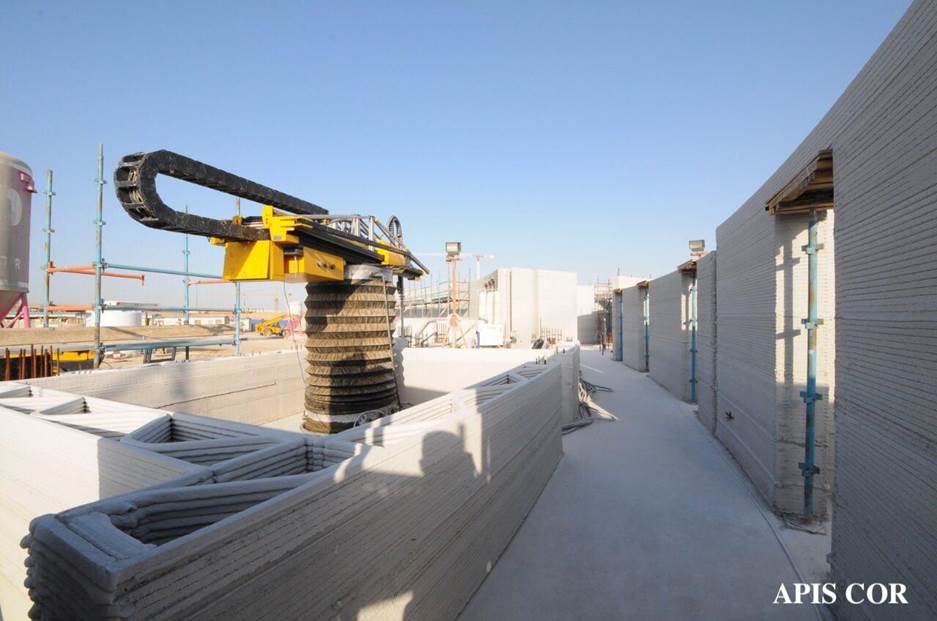
The Structural 3D Robotic Printer is mounted on tracks and includes a four-point leveling system. This ensures that the Printer is able to move around the printed structure and deposit the material in a level and consistent manner.
The Company intentionally made the Structural 3D Robotic Printer extremely mobile. Small enough to fit onto the bed of a pick-up truck or a trailer. Because of this, the Structural 3D Robotic Printer can be moved all around the job site. The only restriction to the printed structure’s size is the area of the development site itself. Using the Structural 3D Robotic Printer’s continuous track mobile platform, the Printer can reposition itself when a layer is complete and continue depositing 3D Print Material in a matter of minutes. This compact size increases accessibility of 3D printed structures to a greater number of developers. Additionally, setup does not require cranes or heavy machinery. The rugged lightweight design means the Structural 3D Robotic Printer can travel over any surface including sand, grass, and gravel.
In addition to decreased labor and opportunity costs normally associated with construction, the Structural 3D Robotic Printer allows for immeasurable amount of consistency between structures. The Company has essentially invented a skilled robot equipped with precise dosage devices and sophisticated algorithms to ensure repeatable builds with machine accuracy.
3D Print Materials
While concrete is the construction industry standard, it’s use poses myriad problems within 3D printing applications. The Company, therefore, has developed proprietary printing material(s) that would flow easily through the Mix and Pump Machine and the Structural 3D Robotic Printer’s extruder without slumping — while still bonding between layers, curing quickly, and maintaining its layer shape. The end product is a dry mortar with aggregates pre-mixed in the proper ratio, delivering perfect results every time with no guesswork.
By means of the Company’s equipment, the cementitious material is distributed layer-by-layer forming the walls. The material itself is manufactured by the Company and will exclusively be sold though the Company.
The Company intends to manufacture several types of 3D Print Materials for different uses an applications.
3D Structure Printing Design
When referring to the “3D Structural Printing Design” within this Offering Circular, it includes the proprietary shape of the walls and methodologies employed by the Company in printing any structure. The term is inclusive in that the Company has more than one Designs for structural elements (walls).
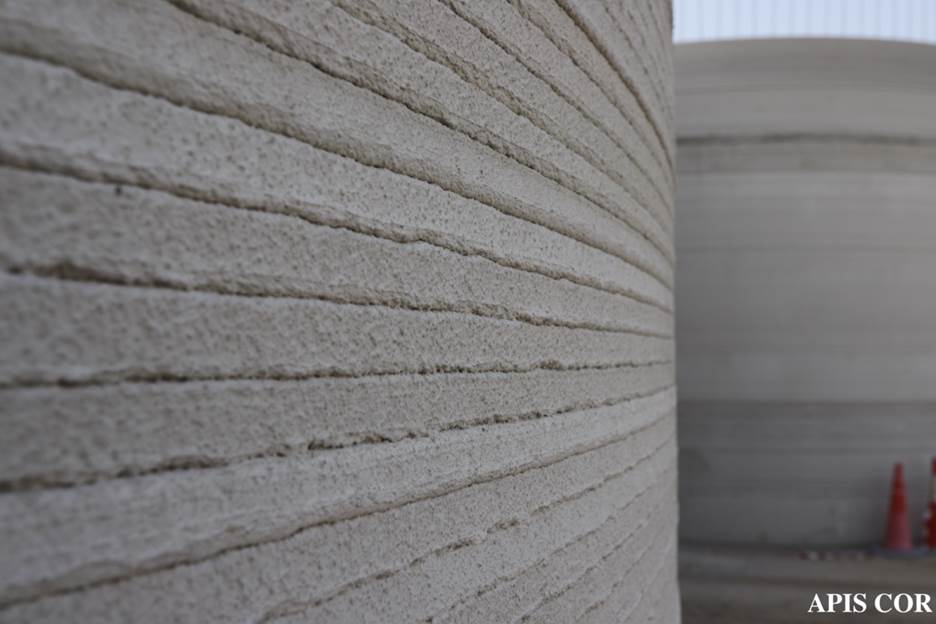
The 3D Structural Printing Design employs a Company-designed shape designed to emulate Concrete Masonry Units (“CMU(s)”) also known as cinderblocks. CMUs are the gold-standard for resilient construction because they are independently stable and allow for reinforcement with reinforcing bars (“rebar(s)”) and other stabilization/reinforcement methods. The Company has designed the 3D Structure Printing Design to emulate CMUs with respect to the ability to sustain stability independently and with reinforcement. Additionally, the Company’s Structure Design allows for mechanical, electrical, and plumbing components to be seamlessly included in the structures.
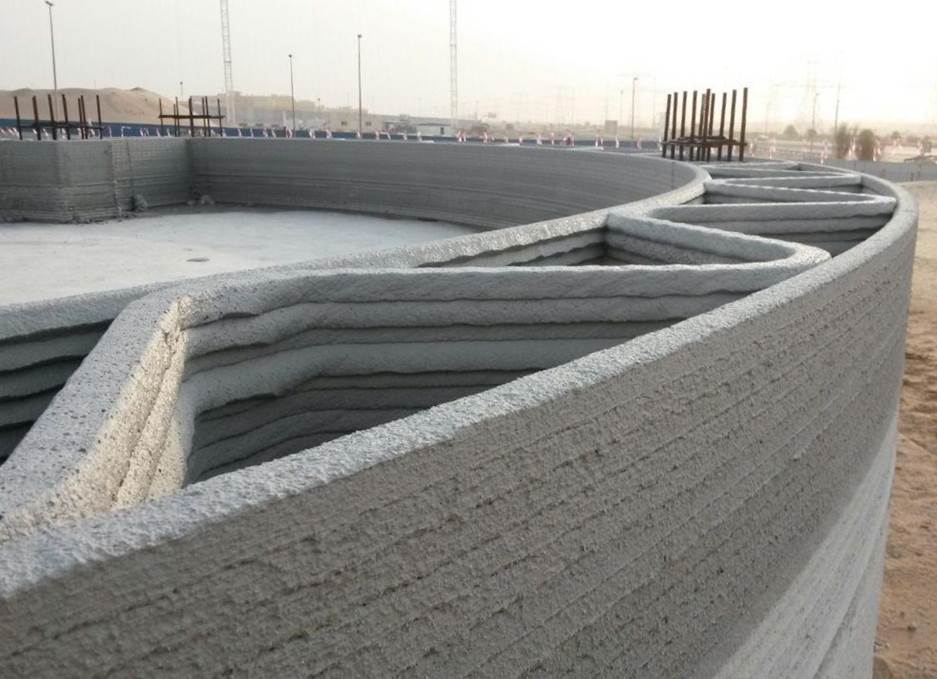
Apis Cor's 3D printed walls are virtually identical to CMU construction walls in both form and function. This enables the 3D Structural Printing Design to:
- Conform with existing CMU-based building codes
- Resist wind, water, fire, mold, and pests
-Simplify integration with plumbing, electrical, mechanical and finishing work
The 3D Structural Printing Design was developed by Company engineers to simplify the necessary structural calculations such that the design complies with local building codes that incorporate and are based on the use of CMUs. The Company’s 3D material reaches the ability to withstand 3,627 psi of vertical pressure after 28 days of curing, exceeding construction code standards for CMUs. The 3D Structural Printing Design conforms with the International Building Code for masonry construction – which many regional/local building codes adopted and incorporate.
14
Mixing and Pump Machine for 3D Printing Structural Material
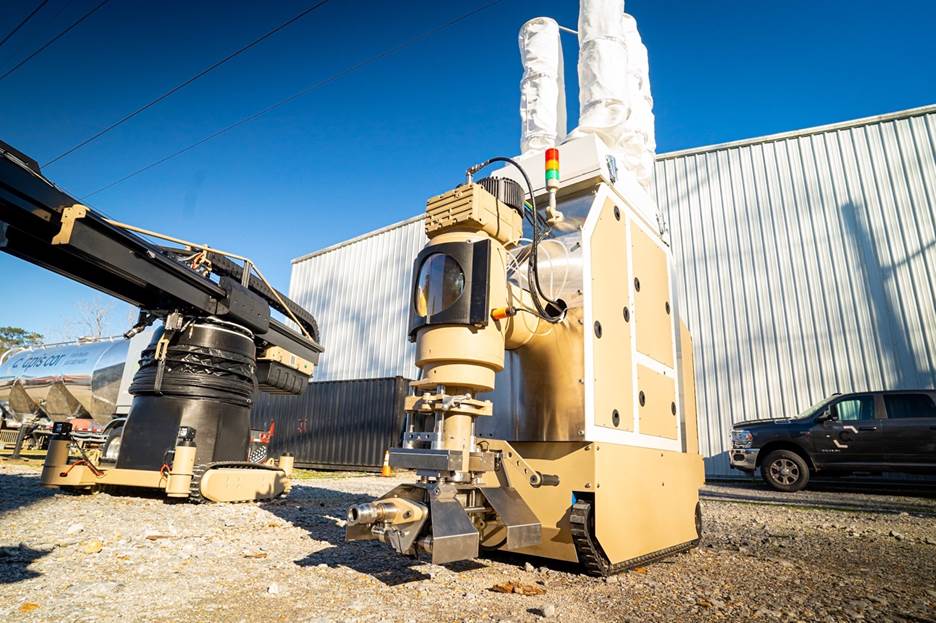
The Company has also developed a proprietary 3D print material delivery system specific to the Company’s 3D Printing Robot. The inclusion of the mixer to the whole system reduces labor time significantly by reducing the need to mix the concrete or structuring materials by hand on the job site. The mixer will mix the correct ratio of materials and pump it to the 3D Printing Robotics.
Company Bulk Trucks
The Company also intends to purchase and deploy a fleet of proprietary and Company-owned smart bulk trucks to deliver the perfect blend of dry print material in a vacuum sealed container. Transportation of the 3D Printing Structural Material requires a vacuum sealed container and specific temperature requirements to avoid tainting of the material. The Company will develop a fleet of these specialized bulk trucks upon a successful Offering.
Achievements of the Company as of the Date of this Offering Circular
The Company has already surpassed the proof of concept stage. The Company currently has working equipment, testing it on a several groundbreaking projects:
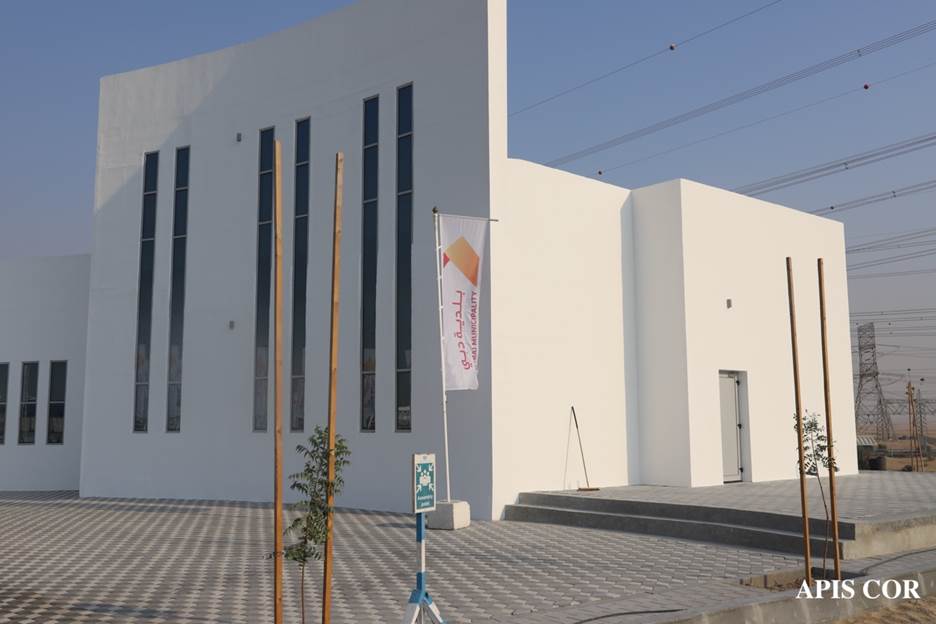
Achievement 1: Guinness World Record
In October 16, 2019 the Company completed 3D printed a two story building for the Dubai municipality which is today the largest 3D printed building on Earth and holds the World Guinness Record. Standing at 9.5 meters tall with an area of 640 square meters, it’s the world’s largest 3D printed building to date.


Achievement 2: NASA 3D Printed Habitat Challenge Prize
Starting in 2018 the Company collaborated with SEArch+ (a New York based architecture company) winning the three top prizes of NASA’s “3D Printed Habitat Challenge”. The Challenge was implemented in three Phases for which the collaborative team won each of the top prizes. Phase 1 was completed as of August 22, 2018
Phase 1 evaluation consisted of the following parameters:
“For this level of the competition, teams had to additively construct a foundation slab without human intervention. The slabs were evaluated and scored based on multiple criteria, including strength, durability and material composition. To test their strength, a standard Olympic shot put was dropped on each slab three times to simulate a meteor strike. For durability, each slab was subjected to freeze/thaw tests, enduring temperature extremes. The teams earned prize money based on scores assigned by a panel of subject matter experts from NASA, academia and industry.”
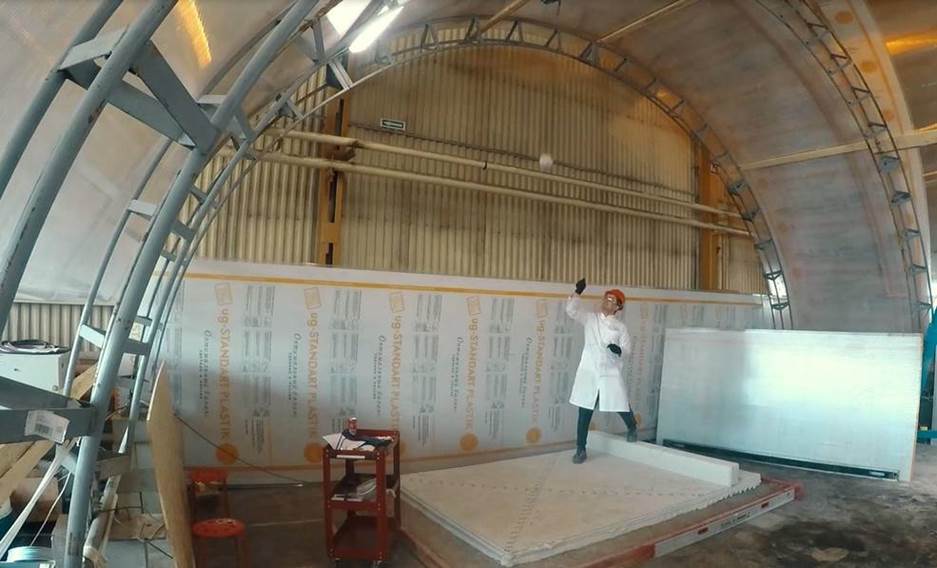
Phase 2 evaluation consisted of the following parameters:
“Four teams will share a $300,000 prize for successful completion of the seal test stage of the 3D-Printed Habitat Challenge, a competition to create sustainable shelters suitable for the Moon, Mars or beyond using resources available on site in these locations. For this level of the competition, teams submitted 3D-printed samples that were tested for their ability to hold a seal, for strength and for durability in temperature extremes.”
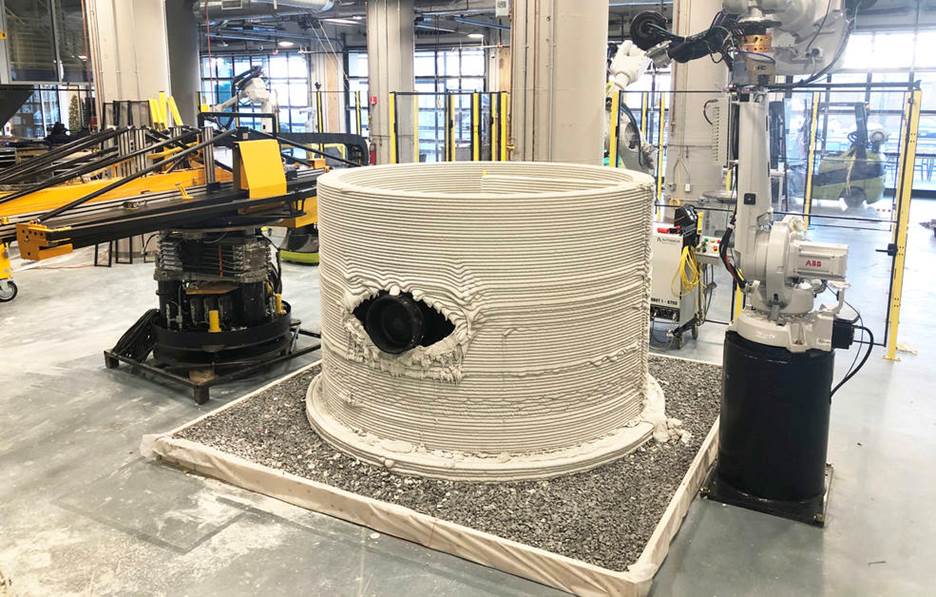
Credits: SEArch+/Apis Cor
Phase 3 evaluation consisted of the following parameters:
“Teams competing in NASA’s 3D-Printed Habitat Challenge completed the latest level of the competition – complete virtual construction – and the top three were awarded a share of the $100,000 prize purse. This stage of the challenge required teams to create a full-scale habitat design, using modeling software. This level built upon an earlier stage that also required virtual modeling.
Eleven team entries were scored and awarded points based on architectural layout, programming, efficient use of interior space, and the 3D-printing scalability and constructability of the habitat. Teams also prepared short videos providing insight into their designs as well as miniature 3D-printed models that came apart to showcase the interior design. Points were also awarded for aesthetic representation and realism. After evaluation by a panel of judges, NASA and challenge partner Bradley University of Peoria, Illinois, awarded the Apis Cor $33,954.11 along with two other teams.”

Team SEArch+/Apis Cor won first place in the Phase 3: Level 4 software modeling stage of NASA’s 3D-Printed Habitat Challenge. The unique shape of their habitat allows for continuous reinforcement of the structure. Light enters through trough-shaped ports on the sides and top.
15
Achievement 3: Completed Home in Missouri
The Company has used the Technology to build a single family home in Missouri. The home is approximately 750 square feet and is located in Branson, MO. The Company completed this building in mid-2021.

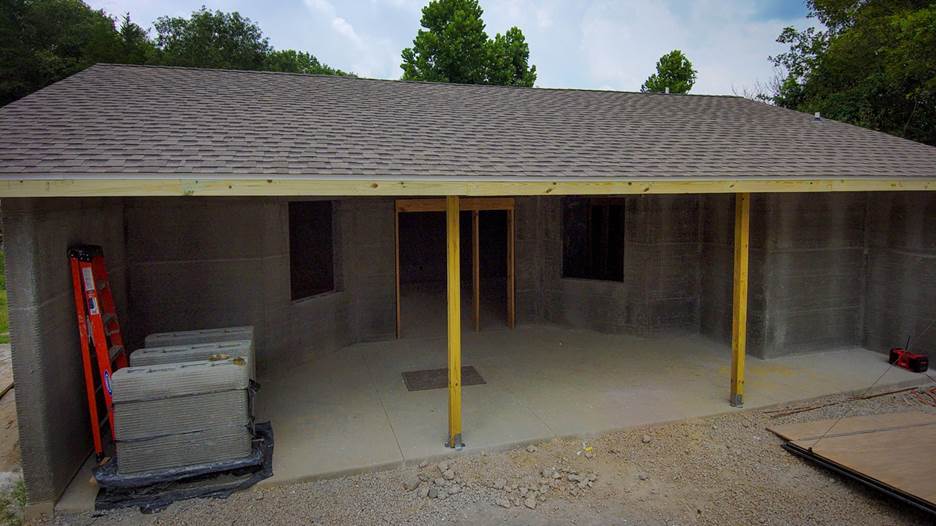

Status of the Apis Cor Products
The Company has announced all of the above-named products to the public through the Company website (www.apis-cor.com). All of the Technologies are past the “proof of concept” prototype stage. The designs are now being optimized for the production stage. The Company will use the Proceeds of this Offering to continue research and development activities for the underlying Technologies. This research and development process will continue through the life of the Company, but the ratio of funds devoted to research and development will decrease as funds devoted to marketing, manufacturing, and scaling activities increases. The Company’s Technologies are essentially fully deployable as of the date of this Offering Circular, however the Company will devote time and Proceeds to expand manufacturing capabilities, including minor alterations of the Technologies to achieve manufacturing scaling and efficiency. This will require a material investment of the Proceeds and Company assets to achieve the intended scaling capacity. (see “Use of Proceeds” above)
Principal Market and Distribution of the Company’s Products and Services
The Company has adopted an equipment leasing and sale strategy with respect to the Structural 3D Robotic Printers, and a material sale strategy with respect to the 3D Print Material(s). In addition to these three revenue streams, the Company will provide technical assistance and customer support for its Customers.
The Company will distribute the “Apis Cor University” training and promotional materials through its website. The Company does intend to generate revenues from Apis Cor University.
The Company also intends to open regional showrooms and sales offices to increase sales and reinforce the Company brand. The showrooms will provide demonstrations of sample of 3D printed structures and the Company’s 3D Printing Technology. Furthermore, the Company intends to purchase real property and to place model homes and structures on that property for demonstration purposes.
Target Customers and Market
The Company’s target customers (the “Customers”) include, but are no limited to, the low-rising residential construction companies, contractors, subcontractors, homebuilders, and real estate developers in the United States.
The Customers the Company will be marketing to are those who build multiple units within a single development including, but not limited to, residential housing projects/subdivisions (50+ units annually). The Customers will generally have previously built with masonry and wood framed single family residences, luxury residences, and middle class residences.
In 2018 approximately 876,000 single family homes were built, 920,000 in 2020. Within the United States, there are 200 home builders who build 150+ units annually and more than 30,000 general contractors who build single-family homes.
16
Distribution of Apis Cor Products
Apis Cor’s goal is to become the leading manufacturer and provider of Structural 3D printing equipment through both equipment leasing, 3D Print Material sales, and associated services provided by the Company. The core of revenue growth is around the leasing of the Structural 3D Robotic Printers and the sale of the 3D print material.
The Company intends to market the novel technologies by initially providing printing services acting as a subcontractor or executing own construction projects acting as a developer and/or construction partner. The goal of penetration strategy is to increase the customer acceptance, get more cases of permitted houses, and improve the product to a stage ready for mass production and use.
The Company will prove the Technology to potential customers by delivering information regarding the successful cases of 3D printed houses to increase customer acceptance. Although the Technology brings significant interest from potential customers, many are cautious to adopt the construction methods as a result of the novelty of the Company’s products. Rather than taking the perceived risk of being early adopters, many potential Customers will want to see more successful cases of 3D printed houses, smooth use of the equipment, and examples of how easily the Customers can learn to operate the equipment.
The Company will expand and build the in-house sales department to (1) execute direct outreach to the homebuilders and developers; (2) work with inbound inquires, educating them about the Technology and informing them as to the Company’s services.
The Company intends to open several regional showrooms in order to demonstrate the Company’s printed walls and other non-structural 3D printed objects and as a location for personal meetings with Customers. The showrooms are intended to raise awareness about the Technology in order to increase sales of the Company’s products and services. Additionally, the Company intends to build several model houses around the country to demonstrate the end product as well as building permit process, building performance features (insulation, reinforcement, different finishes, etc.).
The Company will also increase the advertising profile of its Apis Cor University in order to educate potential customers about the Technology. This will feature both free and paid videos demonstrating the Company’s products and services.
Apis Cor will also strive to be featured in widespread media features from documentary production companies. The Company has been contacted on several occasions by these production companies, but has not been able to be featured due to capital restraints.
Competitive Advantages
There are a handful of companies with strong presence and positive track record in the 3D printing construction market. However, most of these competitors use bulky equipment and expensive methods. Because of this, the competitors do not provide a service that achieves significant cost savings relative to traditional construction.
Apis Cor’s advantage is the unique design of the Structural 3D Robotic Printers which feature true mobility and compact dimensions causing the Technology to be easy to use and very scalable. The mobility of the equipment allows the Technology to print houses of any square footage, as the Structural 3D Robotic Printers can be easily moved along a whole construction area. No other current 3D construction technology matches this capability.
Special Purpose Entities
The Company may establish Special Purpose Entities (if singular “SPE”, if plural “SPEs”) for the sole purpose of (1) acquiring, purchasing, disposing of, transferring, developing, redeveloping, or rehabilitating one or more properties; (2) acting as subcontractor(s) for one or more projects; or (3) acquiring, purchasing, disposing of, transferring, developing, redeveloping, rehabilitating, and/or renting business personal property including, but not limited to equipment and other business personal property. Every SPE is intended to be a wholly-owned or wholly-controlled subsidiary. The Board has the sole and absolute discretion as to whether a Company will utilize a SPE structure for any transaction or series of transactions. Furthermore, the Board has sole and absolute discretion as to the structuring, including fee schedules, compensation, and governance, of any SPE.
Employees
As of the date of this Offering Circular, the Company has seven employees. Five of these employees are full time.
Legal Proceedings
The Company is not presently a party to any material litigation, nor is any litigation known to be threatened against the Company. Furthermore, the Company has no bankruptcies, investigations, or criminal proceedings to disclose.
17
As of the Date of this offering Circular, the Company does not own real property or business personal property of material significance.
MANAGEMENT’S DISCUSSION AND ANALYSIS OF THE FINANCIAL CONDITION AND RESULT OF OPERATIONS
The following is a statement by the management regarding the period of January 1, 2022 through June 30, 2022. The following balance sheets were prepared by the Company.
This discussion contains forward-looking statements reflecting our current expectations that involve risks and uncertainties. In some cases, you can identify forward-looking statements by terminology such as “may,” “will,” “would,” “should,” “expect,” “plan,” “anticipate,” “believe,” “estimate,” “future,” “intend,” “could,” “hope,” “predict,” “target,” “potential,” or “continue” or variations of these terms, the negative of these terms or other similar expressions. Actual results and the timing of events may differ materially from those contained in these forward-looking statements due to a number of factors, including those discussed in the section entitled “Risk Factors” in our Offering Circular which received Notice of Qualification under Regulation A+ from the Securities Exchange Commission on December 27, 2021 (“Regulation A+ Offering”.)
The following discussion of our financial condition and results of our operations should be read in conjunction with our financial statements and related notes appearing in in this semi-annual report and our annual report filed on Form 1-K with the Securities and Exchange Commission. The financial statements included in this filing are unaudited and may not include year-end adjustments necessary to make those financial statements comparable to audited results, although in the opinion of management all adjustments necessary to make the interim financial statements not misleading have been included.
Overview
Apis Cor Inc. (“the Company”) was organized in December 2019 in the state of Delaware and began operations in January 2020. The Company was formed with the purpose of designing and developing the underlying robotics and construction materials to 3D print full-scale concrete single-family style houses (collectively, the “Technology” or “Structural 3D Printing Technology”).
Additive manufacturing, or 3D printing, is a process whereby a material is deposited one layer at a time to create a three-dimensional structure. Over the past 20 years, 3D printing has revolutionized the manufacturing world, providing a cheaper and more efficient way to create prototypes and test designs. Apis Cor is bringing 3D printing to building structures. Structural 3D printing allows developers to build faster, cheaper, and more consistently.
The intention of the Company is to provide advanced Structural 3D Printing Robotics and durable 3D Print Materials to developers and homebuilders to reduce the costs of building. Structural 3D printing will enable construction companies decrease labor costs, increase productivity, and enhance the quality of the building itself through consistency between structures.
Products and Services
The Company’s products and services derive directly from the 3D printing process, which enables real estate developers and the construction industry, just like others in the manufacturing sector the following benefits:
(1) Increased productivity and fast construction process;
(2) Better and consistent quality including a drastic reduction of human error which cuts cost of fixing errors and post-finishing work;
(3) Significant reduction of reliance on human labor on job sites resulting an unprecedented ability to scale the development process;
(4) Marked increase in freedom in design for any structure. Less limitation on prefabricated materials such as cinderblocks;
(5) Marked reduction in the cost of construction through cutting the need for human labor costs.
Principal Market and Distribution of the Company’s Products and Services
The Company has adopted an equipment leasing strategy with respect to the Structural 3D Robotic Printers, and a material sale strategy with respect to the 3D Print Material(s). In addition to these two revenue streams, the Company will provide technical assistance and customer support for its Customers.
The Company plans to distribute the “Apis Cor University” training and promotional materials through its website. The Company does intend to generate revenues from Apis Cor University.
The Company also intends to open regional showrooms and sales offices to increase sales and reinforce the Company brand. The showrooms will provide demonstrations of samples of 3D printed structures and the Company’s 3D Printing Technology. Furthermore, the Company intends to purchase real property and to place model homes and structures on that property for demonstration purposes.
18
Competitive Advantages
There are a handful of companies with a strong presence and positive track record in the 3D printing construction market. However, most of these competitors use bulky equipment and expensive methods. Because of this, the competitors do not provide a service that achieves significant cost savings relative to traditional construction.
Apis Cor’s advantage is the unique design of the Structural 3D Robotic Printers which feature true mobility and compact dimensions causing the Technology to be easy to use and very scalable. The mobility of the equipment allows the Technology to print houses of any square footage, as the Structural 3D Robotic Printers can be easily moved along a whole construction area. No other current 3D construction technology matches this capability.
Our technology is protected with four granted patents and multiple patent applications. We also have advanced material which was successfully used in different climate zones - Dubai, Boca Chica TX, Missouri and for NASA competition which set the highest bar for material quality, durability and physical properties.
Status of Products
The Company has announced its products to the public through the Company website (www.apis-cor.com). All the Technologies are past the “proof of concept” prototype stage. The designs are now being optimized for the production stage.
Results of Operations
Since its inception, the Company has been mainly conducting research and development and product improvement activities regarding the Technology as well as delivering commercial projects for a limited number of selected customers.
Revenue
Total revenue increased to $22,473 for the six months ended June 30, 2022 from $9,030 for the six months ended June 30, 2022. Customer deposits for future sales was approximately $161,000 and $193,000 at June 30, 2022 and 2021, respectively.
The following summarizes the Company’s major sources of revenue:
3D Printed Structures
These projects provide 3D printed interior and exterior walls and could include any number of additional services including site preparation, insulation, roofing, HVAC and other mechanical components. There were no 3D structures printed during the six months ended June 30, 2022 and 2021, respectively.
Training Programs
The Company has developed 3D printing training programs offered in on-demand download and live workshop formats. Total revenue from training programs increased to $22,473 for the six months ended June 30, 2022 from $9,030 for the six months ended June 30, 2022.
Structural 3D Printers and Mix & Pump Machines
The Company is continuing to focus on further development of its Technologies and equipment for sale and/or lease. The Company has not yet generated revenue from this product line.
19
Operating Expenses
The Company classifies its operating expenses primarily as research and development, payroll and related expenses, professional fees, advertising, facilities and maintenance expense and other operating expenses (other general and administrative, travel and entertainment and depreciation).
Professional Fees increased to $238,945 for the six months ended June 30, 2022 from $14,236 for the six months ended June 30, 2021. The increase in Professional Fees of $224,709 is primarily attributed to the further development and implementation of the corporate infrastructure, including compliance and contractual agreements, and process development and controls among others.
Advertising increased to $161,730 for the six months ended June 30, 2022 from $5,651 for the six months ended June 30, 2021. The increase in Advertising of $156,079 is primarily attributed to the launch of its Regulation A+ offering which received Notice of Qualification from the Securities and Exchange Commission on December 27, 2021.
Payroll and Related Expenses increased to $149,083 for the six months ended June 30, 2022 from $57,308 for the six months ended June 30, 2021. During fiscal year 2021, the Company hired a core staff to support the advancement of product offerings and expansion of production capabilities. This resulted in increased expense as the core staff was in place for the entire six months ended June 30, 2022.
Facility and Maintenance increased to $87,039 for the six months ended June 30, 2022 from $37,923 for the six months ended June 30, 2021. During fiscal year 2021, the Company entered into a lease agreement for a manufacturing and warehouse facility. The Company also opened a showroom to support industry and consumer interest and promote the Company’s Technologies. This resulted in increased expense as these facilities were operating during the entire six months ended June 30, 2022.
Research and Development decreased to $59,176 for the six months ended June 30, 2022 from $369,235 for the six months ended June 30, 2021. The decrease in Research and Development of $310,059 is primarily attributed to the Company’s concentration of efforts on the launch of its Regulation A+ offering effective December 27, 2021.
Net Loss from Operating Activities
As a result of the foregoing, the Company increased its Net Loss to $ 774,871 for the six months ended June 30, 2022 from $582,622 for the six months ended June 30, 2021. The Company’s Technologies have made significant improvements, and Management believes that revenues will increase significantly in the future. This belief is based on the fact that the Company has several functional prototypes, completed several successful 3D Printed Structures during 2021 and many of the Technologies are positioned to bring marketable products to the market upon a successful Regulation A+ offering.
Liquidity and Capital Resources
Cash and Working Capital
As of June 30, 2022, the Company’s cash on-hand was $160,528 compared to $65,515 at December 31, 2021. The Company had a working capital deficit at June 30, 2022 of $301,115 compared to a deficit of $127,431 at December 31, 2021. The additional working capital deficit was primarily attributed to an increase of $120,795 in customer deposits for future sales and an increase of $110,106 from current portion of operating lease liabilities recorded as a result of the implementation of Accounting Standards Update 2016-02, Leases (Topic 842) on January 1, 2022.
The Company will use the proceeds of its Equity Offerings to continue research and development and product development activities for the underlying Technologies. This research and development process will continue through the life of the Company, but the ratio of funds devoted to research and development will decrease as funds devoted to marketing, manufacturing, and scaling activities increase. The Company’s Technologies are essentially fully deployable as of the date of the filing of this Form 1-SA, however, the Company will devote time and proceeds to expand manufacturing capabilities, including minor alterations of the Technologies to achieve manufacturing scaling and efficiency. This will require a material investment of the proceeds and Company assets to achieve the intended scaling capacity.
Therefore, the Company plans to continue to raise equity capital through the sale of its securities. (See Equity Offerings). Absent additional capital, the Company may have to significantly
reduce, delay, scale back or discontinue further development of its Technologies and patents and expansion of its capabilities or discontinue operations completely.
20
Cash Flows from Operating Activities
Net cash used in operating activities was $673,391 for the six months ended June 30, 2022 compared to net cash used in operating activities of $624,021 for the six months ended June 30, 2021. Operating activities were concentrated on the Company’s launch of its Regulation A+ offering effective December 27, 2021 and development of its Technologies, for the six months ended June 30, 2022 and 2021, respectively.
Cash Flows from Investing Activities
Net cash used in investing activities was $117,266 for the six months ended June 30, 2022 compared to net cash used in investing activities of $103,032 for the six months ended June 30, 2021. Net cash used in investing activities was primarily comprised of the purchase of production equipment.
Cash Flows from Financing Activities
Net cash provided by financing activities was $885,671 for the six months ended June 30, 2022 compared to net cash provided by financing activities of $846,557 for the six months ended June 30, 2021. Net cash provided by financing activities is primarily comprised of proceeds of sale of common stock less offering costs to sell.
Off-Balance Sheet Arrangements
We have no off-balance sheet arrangements, including arrangements that would affect the liquidity, capital resources, market risk support, and credit risk support or other benefits.
Critical Accounting Policies and Estimates
Recently Issued Accounting Pronouncements
From time to time, new accounting pronouncements are issued by the Financial Accounting Standards Board, or FASB, or other standard setting bodies and adopted by the Company as of the specified effective date.
In February 2016, the FASB issued Accounting Standards Update (“ASU”) 2016-02, Leases (Topic 842). This ASU requires lessees to recognize a right of use (“ROU”) asset and lease liability in the balance sheet for all leases, including operating leases, with terms of more than twelve months. The Company adopted the standard effective January, 1 2022, resulting in the recording of a ROU which is reflected on the Balance Sheet at June 30, 2022 and did not have a material impact on the Statements of Operations or Statements of Cash Flows.
The Company believes that the impact of recently issued standards that are not yet effective will not have a material impact on its financial position or results of operations upon adoption. Our
significant accounting policies are more fully described in the notes to our financial statements included herein for the six months ended June 30, 2022.
21
Debt and Equity Offerings
SAFE Liabilities
During 2021 and 2020, the Company offered their investors a Simple Agreement for Future Equity (“SAFE”) contract, which allowed an investor to make an upfront payment for the right to future Standard or SAFE Preferred Shares issued at a discount of 0% to 85%. Upon conversion, these shareholders would have the same rights as any other preferred shareholders, if any.
As of June 30, 2022 and 2021, respectively, the Company had raised $1,930,000 and $1,140,000 through these SAFE contracts. Subsequent to the date of the balance sheet, the Company raised an additional $1,000,000 through the offering of a SAFE contract.
Effective September 1, 2022, the SAFE’s converted under its Equity Financing terms (see Note G in attached financial statements) resulting in the issuance of 30,585,060 shares of Preferred Stock.
Convertible Notes Payable
During 2020, the Company offered their investors a series of 18-month 2% convertible promissory notes, (collectively, the “Notes”). Upon conversion, these shareholders would have the same rights as any other common shareholder or preferred shareholder, if any.
During the fiscal year ended December 31, 2020, the Company had raised $160,000 and issued $9,800 in convertible notes payable for research and development services through these convertible notes. Interest expense was $1,635 and $1,678 for the six months ended June 30, 2022 and 2021, respectively, and accrued interest related to these notes was $6,239 and $4,604 as of June 30, 2022 and December 31, 2021, respectively.
Effective September 1, 2022, the Notes converted under its Qualified Financing terms (see Note H in attached financial statements) resulting in the issuance of 1,112,062 shares of Common Stock $1 par value and 2,762,172 shares of Preferred Stock.
Regulation A+ Offering
On December 27, 2021, the Company received Notice of Qualification from the Securities and Exchange Commission under Regulation A+ to proceed with the public offering of its securities (the “Regulation A+ Offering”). The Regulation A+ Offering permits the Company to offer and sell 35,000,000 shares of common stock at a price of $1.00 per share, or $35,000,000 in total, to accredited investors. All shares are exempt from registrations contained in Section 4(a)(2) of the Securities Act and/or Regulation D promulgated thereunder. There are no underwriting fees associated with this Regulation A+ Offering. There is presently no public market for the Company’s securities and the Company has engaged a fully regulated broker-dealer at a 3% commission of all sales.
For the six months ended June 30, 2022, the Company issued 1,028,227 shares of common stock at a purchase price of $1 per share and recognized $261,411 of offering costs which reduced additional paid-in capital. Subsequent to the date of the balance sheet, the Company raised an additional $307,400 through this offering.
22
Regulation Crowdfunding
As of September 1, 2022, the Company has initiated a raise of additional funds through Regulation Crowdfunding with a funding goal of $5,000,000. The Company has not yet issued any shares under this offering.
Trends
We are tackling the construction market, which is $16 trillion and keeps growing. Plus the construction 3D printing market is projected to reach $40 Billion by 2027.
The world needs to build more than two billion new homes over the next 80 years.
Within the United States, there are 200 home builders who build from 150 to 58,434 units annually and there are 178,619 companies classified as General Contractors-Single-Family Houses in this industry in the USA.
Modern construction cannot keep up with the growing demand because construction heavily relies on manual labor.
The US Census Bureau’s 2018 Survey of Construction found the average stick-built house takes 7.7 months to construct. This includes about one month for building authorization and permits, followed by 6.7 months of actual construction. Note that this timeline refers to houses built for sale, such as custom homes in a new housing development. Homes built by the homeowners themselves took considerably longer, at 12.5 months, likely due to less experience and smaller crews.
In contrast, the Company’s Structural 3D Robotic Printers do not require a large crew to operate and we believe are capable of building the walls of a 2,300 SF house in about 60 hours which may drastically reduce the overall construction to 2-3 months (the remaining parts like roofing, windows and finishing are still done traditionally).
Nationally, the United States is facing a shortage of more than 7.2 million affordable homes, with over 500,000 people experiencing homelessness on any given night. Due to a lack of skilled labor, the construction industry simply cannot keep up with the growing demand. The Company’s Structural 3D Printing Technology provides an optimal solution to fill the national shortage gap by delivering more houses without filling a human’s role.
Target Customers and Market
The Company’s target customers (the “Customers”) include, but are not limited to, the low-rising residential construction companies, contractors, subcontractors, homebuilders, and real estate developers in the United States.
The Customers the Company will be marketing to are those who build multiple units within a single development including, but not limited to, residential housing projects/subdivisions (50+ units annually). The Customers will generally have previously built masonry and wood-framed single-family residences, luxury residences, and middle-class residences.
Planned Road Map
The Company intends to expand its operations and start implementing the go-to-market strategy in 2023 by focusing on working with selected customers to deliver more 3D-printed houses in the USA. The Company then intends to steadily increase the number of 3D printers to scale the Technology and business.
23
MANAGEMENT’S DISCUSSION AND ANALYSIS OF THE FINANCIAL CONDITION AND RESULT OF OPERATIONS FOR FY2021 (ENDED DECEMBER 31, 2021)
Management’s Discussion and Analysis of Financial Condition and Results of Operations (“MD&A”) is designed to provide a reader of our financial statements with a narrative from the perspective of our management on our financial condition, results of operations, liquidity and certain other factors that may affect our future results.
The following discussion of our financial conditions and results of operations should be read in conjunction with the financial statements and the related notes included in this Annual Report on Form 1-K. The following discussion contains forward-looking statements that reflect our plans, estimates and beliefs. The Company’s actual results could differ significantly from those discussed in the forward-looking statements. Unless otherwise indicated, the latest results discussed below are as of December 31, 2021.
Overview
Our Company
Apis Cor Inc. (“the Company”) is a privately-held entity organized in December 2019 in the state of Delaware and began operations in January 2020. The Company is a developer of on-site circular mobile 3D printers built for the construction industry. The Company offers a robotics arm that distributes a concrete mortar to create the desired shape of a building, with the intention of enabling clients to reduce the costs of building. The Company has created several prototype 3D printers and has already printed several developmental structures in addition to the development and release of on-demand 3D printing training courses and live workshop offerings.
Components of Results of Operations
Revenue
Total revenue for the fiscal year 2021 and 2020 was $233,750 and $0, respectively. The following summarizes the Company’s major sources of revenue:
3D Printed Structures
Revenue from 3D printed structures for fiscal year 2021 was $62,800 from the completion of two structures located in Missouri and Texas which are offered at a discount while the Company is utilizing its prototype equipment under development. These projects provide 3D printed interior and exterior walls and could include any number of additional services including site preparation, insulation, roofing, HVAC and other mechanical components.
Training Programs
The Company has developed 3D printing training programs offered in on-demand downloads and live workshop formats. Total revenue from training programs for fiscal year 2021 was $160,950.
During fiscal year 2021, the company completed development and released its first online on-demand course generating revenue of $74,845.
In September 2021, the Company offered its first live workshop on-site at its Company facility which generating revenue of $86,105.
Structural 3D Printers and Mix & Pump Machines
The Company is continuing to focus on further development of its Technologies and equipment for sale and/or lease. In FY2021 and 2020, the Company had not yet generated revenue from this product line.
Operating Expenses
The Company classifies its operating expenses as research and development, payroll and related expenses, professional fees, facilities and maintenance expense and other operating expenses (other general and administrative, travel and entertainment, advertising and depreciation).
Cost of Goods Sold was $182,900 for fiscal year 2021, or 291% of related revenue from 3D printed structures. These costs were high primarily due to transportation and direct expenses incurred at a higher cost on location. Cost advantages were not yet achievable due to the limited projects in fiscal year 2021.
Research and Development increased by $182,926, or 50%, to $552,261 for fiscal year 2021 as compared to $369,335 for fiscal year 2020. The increase in fiscal year 2021 was primarily due to the Company’s focus on the continued development of the Technologies. Research and development expenses consist primarily of salaries, materials, tooling, shipping costs, manufacturing costs, and testing costs to design, develop, and test the Technologies. Also included are parts, tools and equipment acquired to produce prototypes for testing.
Payroll and Related Expenses was $217,919 for fiscal year 2021 and $0 for fiscal year 2020. During fiscal year 2021, the Company hired a core staff and anticipates that it will increase these expenses to support to increased product offerings and expansion of production capabilities.
Professional Fees increased by $101,702, or 694%, to $116,366 for fiscal year 2021 as compared to $14,664 for fiscal year 2020 primarily in support of the Company’s development and growth.
Facility and Maintenance increased by $108,804, or 1789%, to $114,886 for fiscal year 2021 as compared to $6,082 for fiscal year 2020. During fiscal year 2021, the Company entered into a lease agreement for a manufacturing and warehouse facility. The Company also opened a showroom to support industry and consumer interest and promote the Company’s Technologies.
Net Loss from Operating Activities increased by $689,683, or 142%, to $1,174,192 for fiscal year 2021 as compared to $484,509 for fiscal year 2020. During fiscal year 2021 and 2020, the Company was primarily focused on developing its Technologies and training programs. In fiscal year 2021, the Company has made significant improvements in its Technologies, and Management believes that revenues will increase significantly in the future. This belief is based on the fact that the Company has several functional prototypes of many of the Technologies, already used in the production and sale of 3D printed structures, and is ready to bring marketable products to the market upon a successful Offering.
24
Liquidity and Capital Resources
Net cash used in operating activities for fiscal year 2021 was $1,268,819, compared to $285,719 for fiscal year 2020. The increase in net cash used in operating activities in fiscal year 2021 compared to fiscal year 2020 is primarily attributable to increased payroll and related expenses, research and development activities, and facility and maintenance expenses.
As of December 31, 2021, the Company had cash of $65,514, total assets of $718,477, working capital deficit of $103,467 and stockholders’ deficit of $1,658,653. The Company has financed its operations primarily through a combination of SAFE agreements and Convertible Notes Payable.
The Company will have additional capital requirements during fiscal year 2022 to bring its functional prototypes to market.
Therefore, the Company is currently raising additional capital through the sale of its securities from its Regulation A+ Offering Circular (the “Offering”). On December 27, 2021, the Company’s received Notice of Qualification from the Securities and Exchange Commission for its initial Offering for a maximum of 35,000,000 shares of its Common Stock at price of $1.00 per share, with potential aggregate gross proceeds of $35,000,000. The Company has subsequently issued 515,201 shares of common stock with gross proceeds of $515,201 under this Offering from December 31, 2021 to April 27, 2022.
Management believes that sales of its 3D printers will commence in 2022, and that with additional financing from private and public offerings of its common stock from its in-process Offering in 2022, the Company will have sufficient funds to continue operations for at least twelve months from the date of this report.
There can be no assurance that the Company will be successful in acquiring additional funding at levels sufficient to fund its future capital requirements. If the Company is unable to raise additional capital in sufficient amounts or on terms acceptable to it, the Company may have to significantly reduce, delay, scale back or discontinue the development of its technologies and patents or discontinue operations completely.
25
MANAGEMENT’S DISCUSSION AND ANALYSIS OF THE FINANCIAL CONDITION AND RESULT OF OPERATIONS FOR FY2020 (ENDED DECEMBER 31, 2020)
Apis Cor Inc. (“the Company”) is a privately-held entity organized in December 2019 in the State of Delaware and began operations in January 2020. Therefore, a year-over-year discussion of material changes cannot be included.
Components of Results of Operations
The following discussion of our financial conditions and results of operations should be read in conjunction with the financial statements and the related notes included elsewhere in this Offering Statement. The following discussion contains forward-looking statements that reflect our plans, estimates and beliefs. The Company’s actual results could differ significantly from those discussed in the forward-looking statements. Unless otherwise indicated, the latest results discussed below are as of December 31, 2020.
Revenue
The Company is, and has been, solely focused on further development of its Technologies. In FY2020 the Company did not generate revenues and anticipates to generate revenues upon a successful Offering.
Operating Expenses
The Company classifies its operating expenses as research and development, general and administrative expenses, and other operating expenses (professional fees, travel and entertainment, rent, and advertising).
Research and Development Expense
The Company’s research and development efforts are focused on the continued development of the Technologies. Research and development expenses consist primarily of salaries, materials, tooling, shipping costs, manufacturing costs, and testing costs to design, develop, and test the Technologies. Also included are parts, tools and equipment acquired to produce prototypes for testing.
In FY2020, the Company spent $369,335 on research and development expenses. The Company anticipates that the Company will increase these expenses significantly upon a successful Offering. (see “Use of Proceeds”) above.
General and Administrative
The Company spent $78,434 on general and administrative expenses for FY2020. The Company anticipates these expenses will increase significantly upon a successful Offering. (see “Use of Proceeds”) above. These expenses consisted of meals, storage, software, automobile expenses, subcontractor labor, banking and related and services.
Net Loss from Operating Activities
During FY2020, the Company was solely focused on developing its Technologies and did not generate any revenue. In FY2020, the Company had a Net Loss From Operating Activities of $484,509. The Company’s Technologies have made significant improvements, and Management believes that revenues will increase significantly in the future. This belief is based on the fact that the Company has several functional prototypes of many of the Technologies and is ready to bring marketable products to the market upon a successful Offering.
Due to Shareholders
Due to Shareholders increased from $0 at December 31, 2019 to $4,522 at December 31, 2020. The increase was driven by advances made by Shareholders to fund the Company’s operating activities.
Liquidity and Capital Resources
As of December 31, 2020, the Company had cash of $61,755, total assets of $213,164, working capital deficit of $185,545 and stockholders’ deficit of $484,409. The Company has financed its operations primarily through a combination of SAFE agreements and Convertible Notes Payable. The Company issued additional SAFE contracts of $1,340,000 from December 31, 2020 to September 9, 2021.
The Company will have additional capital requirements during fiscal year 2021 to bring its functional prototypes to market . Therefore, the Company will attempt to raise additional capital through the sale of its securities in this Regulation A+ offering. The Company’s initial offering is for a maximum of 35,000,000 shares of its Common Stock at price of $1.00 per share, with potential aggregate gross proceeds of $35,000,000.
There can be no assurance that the Company will be successful in acquiring additional funding at levels sufficient to fund its future capital requirements. If the Company is unable to raise additional capital in sufficient amounts or on terms acceptable to it, the Company may have to significantly reduce, delay, scale back or discontinue the development of its technologies and patents or discontinue operations completely.
26
DIRECTORS, EXECUTIVE OFFICER, AND SIGNIFICANT EMPLOYEES
Directors
| Name | Position | Age | Term of Office | |||||||
| Anna Cheniuntai | Director | 28 | March 2020 - Present | |||||||
| Nikita Cheniuntai | Director | 31 | December 2019 - Present | |||||||
Officers
| Name | Position | Age | Term of Office | |||||||
| Anna Cheniuntai | Chief Executive Officer | 28 | March 2020 - Present | |||||||
| Nikita Cheniuntai | Chief Technology Officer | 31 | December 2019 - Present | |||||||
Significant Employees
| Name | Position | Age | Term of Office | |||||||
| Trevor Ragno | Director of Building Science and Performance | 26 | March 2020 - Present | |||||||
Nikita Cheniuntai, Founder and CTO
Education and Experience
Nikita Cheniuntai is an inventor, engineer, and entrepreneur with extensive experience in robotics and construction. His first company specialized in the manufacturing of industrial CNC machines and composite materials used for construction. After this position, Nikita founded a construction company. In 2014, Nikita executed two projects totaling approximately $5,000,000 USD in relation to building infrastructure for Olympic Games in Sochi, Russia. These projects for the Olympics were to manufacture and deploy 5,000 signs (within only six months). These signs were made with concrete, metal frame, and high-resolution printed information - everything according to strict design requirements by the International Olympic Games Committee. Nikita’s exceptional experience in engineering and fabrication caused this previous company to execute the project on time and on such a high level that the company was recognized by Organizing Committees for the Olympic Games. Later, Nikita decided to apply his engineering talent and experience to change the way developers build today by founding Apis Cor. Nikita is an author of several patents related to Apis Cor Technology.
Nikita and his work have been recognized with several awards, including:
Publications and Awards
-Autodesk Technology Center in Boston - Resident
-Alumni of Alchemist Accelerator - 2020
-2020 list of Maverick Awards winners byBuiltWorlds - April 2020
-Leaders of Tomorrow, 49th St. Gallen Symposium, Switzerland - April 2019
-1st Place, NASA Phase 3 Construction Level 1&2, Final Design Level of 3D Printed-Habitat
-Centennial Challenge by NASA - 2018-2019 (see “Narrative of the Business” above)
-50 EMERGING GLOBAL ENTREPRENEURS TO WATCH IN 2017, by INC Magazine - April 2017
-Kairos50, Kairos Society, New York - Apr 2017
Duties of Nikita with the Company as CTO:
(1) Product Development and Design (including software and hardware);
(2) Design and direction of the Technology;
(3) Building technical team; selecting the key employees and C-Suite officers related to technology side of the business;
(4) Setup manufacturing processes; determining fabrication and manufacturing processes, approaches and technologies;
(5) Determining key vendors and suppliers;
(6) Driving Technology and product development strategy.
Anna Cheniuntai, co-founder and CEO
Education and Experience
Anna Cheniuntai is the Chief Executive Officer of Apis Cor. After earning her bachelor’s degree in Space Physics in 2014, Anna pursued a career in scientific research to entrepreneurship. She joined construction and industrial machinery manufacturing ventures pursued by Nikita Cheniuntai. Working alongside Nikita, Anna had successfully managed a $5M worth project to construct and deploy the ground navigation system around the infrastructure of Olympic Games, 2014.
Duties of Anna with the Company as CEO:
(1) Directing the Operations of the Company;
(2) Directing day-to-day affairs of the Company;
(3) Implementing business and sales strategies;
(4) Finding, recruiting, vetting key employees including new Executive Officers and Significant Employees.
Trevor Ragno, Director of Building Science and Performance
Education and Experience
Trevor Ragno is the Director of Building Science and Performance for Apis Cor. He has two Bachelor of Science degrees in both Real Estate and Business Management with an Associate’s degree in Urban Planning. He received a Masters degree in Real Estate Development from Clemson University - College of Business
Since 2016, Trevor Ragno has been a Chief Real Estate Partner of Aeronody Corporation, an Autonomous Aerial Systems (AAS) company offering remote centralized inspections and monitoring services using commercial UAVs to clients in the energy and utilities, critical infrastructure, agriculture and forestry, and public safety.
Duties of Trevor with the Company as Director of Building Science and Performance:
(1) Research, develop, and implement emerging and current applied construction technologies for construction 3D printing processes;
(2) Research and develop the construction technologies and solutions needed to integrate robotics 3D printing with conventional construction technologies;
(3) Development of educational content and information needed to demonstrate the integration of 3D printing with conventional construction technologies;
(4) Development of integration systems and technologies to improve and facilitate the use of the Company’s Structural 3D Robotic Printers with conventional construction methods;
(5) Heading the Apis Cor University project. Developing strategies and implementation of the training centers and training courses for current and potential Customers;
(6) Working with field personnel to train and educate them on technologies within current and future construction projects;
(7) Ensuring the correct implementation of the 3D Printing Technology with the construction projects;
(8) Public speaking and presentations at industry events;
(9) Building the training department of printer operators and other in-field staff.
27
Legal Proceedings Disclosure
There are no legal proceedings to disclose on behalf of the Company, its Directors, or Officers, including but not limited to bankruptcy, civil, or criminal proceedings.
Family Relationship Disclosure
Nikita and Anna Cheniuntai are husband and wife.
28
COMPENSATION OF DIRECTORS AND EXECUTIVES
| Name | Capacities in which Compensation was Received | Cash Compensation | Other
Compensation (Cash Value) | Total Compensation | ||||||||||
| Nikita Cheniuntai | CTO | $ | 70,293.60 | * | $ | 0 | $ | 33,200.00 | ||||||
| Anna Cheniuntai | CEO | $ | 70,293.60 | ** | $ | 0 | $ | 24,800.00 | ||||||
*Nikita Cheniuntai compensation for FY 2020 was as a 1099 independent contractor totaling $33,200.00 for 2020. He received $24,760.48 as a 1099 independent contractor until May 1, 2021. On May 3, 2021 he was converted into a W-2 employee with an annual salary of $33,382.08. On August 2, 2021 his salary was increased to $76,403.28 annually.
**Anna Cheniuntai compensation for FY 2020 was as a 1099 independent contractor totaling $24,800.00 for 2020. She received $28,973.23 as a 1099 independent contractor until May 1, 2021. On May 3, 2021 she was converted into a W-2 employee with an annual salary of $33,382.08. On August 2, 2021 her salary was increased to $76,403.28 annually.
Increases to Compensation for the Officers
The Company intends to increase the annual salaries of the above-named persons upon the receipt of sufficient Proceeds pursuant to this Offering. The proposed increase is not tied to the performance of the Officers. The salaries of the Officers will be set as below:
Nikita Cheniuntai – $96,000 gross annual salary
Anna Cheniuntai – $96,000 gross annual salary
Compensation pursuant to the Company Stock Options Plan
The Company has allocated 6,044,971 Shares (6%) of the Company’s Common Stock to be subject to the 2021 Equity Ownership Plan. The plan was adopted on September 15, 2021. As of the date of the Offering Circular no compensation has been granted to the Directors or Officers under this plan.
29
SECURITY OWNERSHIP OF MANAGEMENT AND CERTAIN SECURITYHOLDERS
| Title of Class | Name of Beneficial Owner | Amount of Shares Owned | Amount of Shares Acquirable | Percent of Class | ||||||||||
| Common Stock | Nikita Cheniuntai | 62,766,954 | 0 | 46.99 | % | |||||||||
| Common Stock | Anna Cheniuntai | 26,900,123 | 0 | 20.14 | % | |||||||||
| Preferred Stock* | At One Ventures | 0 | 28,324,878 | 21.2 | % | |||||||||
*Throughout 2020, 2021, and 2022, the Company issued SAFEs to raise capital. In August 2022, the Company sold $1,000,000 in SAFEs to At One Ventures. the Company converted all outstanding SAFEs all outstanding convertible notes on September 3, 2022. The conversion resulted in the issuance of 33,347,232 shares of Preferred Stock, representing all outstanding shares of Preferred Stock as of the date of this post-qualification amendment. There are no longer any convertible notes or SAFEs outstanding.
Nikita and Anna Cheniuntai: 3060 Venture Lane #101, Melbourne, FL 32934
At One Ventures: 767 19th Ave. #2, San Fransisco, CA 94121
30
INTEREST OF MANAGEMENT IN CERTAIN TRANSACTIONS
Loan to Nikita Cheniuntai
On January 3, 2020 the Company granted Nikita Cheniuntai a loan in the form of a promissory note with the principal amount of $43,000 at an interest rate of 2.00% per annum. The maturity date of the promissory note is three years, coming to maturity on January 3, 2023. Nikita Cheniuntai is the co-founder and Chief Technical Officer of Apis Cor.
This promissory note was made in light of the COVID-19 Pandemic and the economic difficulties resulting therefrom.
Patent(s) and Trademark Assignments from Various Persons to the Company
| Name on Patent (Application) | Number of Patent (Applications) |
| Nikita Cheniuntai | 3 Non-provisional Patent applications |
| Nikita Cheniuntai and Anna Cheniuntai | 1 Provisional Patent Application, 1 Non-provisional Patent Application |
| Viktor Skundrik | 1 Non-provisional Patent Application |
| Anna Cheniuntai and Sergey Nefedov | 1 Non-provisional Patent |
Nominal consideration ($1.00) will be given to these persons for the assignment of each of the patents once the assignments are approved by the United States Patent and Trademark Office.
31
Summary of Company Equity
The Company has two authorized classes of equity stock, Preferred Stock and Common Stock. As of the date of this Offering Circular, no Preferred Stock is outstanding. For rights associated with Preferred Stock refer to Exhibit 3 “Amended And Restated Certificate of Incorporation”
SAFEs and Convertible Notes
Throughout 2020 and 2021, the Company issued Convertible Notes and SAFEs to raise capital. The Company converted all outstanding SAFEs and all outstanding convertible notes on September 3, 2022. The conversion resulted in the issuance of 33,347,232 shares of preferred stock, representing all outstanding shares of preferred stock as of the date of this post-qualification amendment. There are no longer any convertible notes or SAFEs outstanding.
This as of the date of this post qualification amendment, there are 133,555,405 total outstanding shares of stock, comprised of 33,347,232 shares of Preferred Stock and 100,208,173 Shares of Common Stock.
Description of the Common Stock Offered through this Offering
The voting, dividend and liquidation rights of the holders of the Common Stock are subject to and qualified by the rights, powers and preferences of the holders of the Preferred Stock set forth herein.
Dividends
The Corporation will not declare, pay or set aside any dividends, including any cash distributions, on Shares of any other class or series of capital stock of the Corporation (other than dividends on Shares of Common Stock payable in Shares of Common Stock) unless the holders of the Series A Preferred Stock then outstanding shall first receive, or simultaneously receive, an equivalent or greater dividend on each outstanding share of Series A Preferred Stock.
Voting
The holders of the Common Stock are entitled to one vote for each share of Common Stock held at all meetings of stockholders (and written actions in lieu of meetings). The number of authorized Shares of Common Stock may be increased or decreased (but not below the number of shares thereof then outstanding) by the affirmative vote of the holders of shares of capital stock of the Corporation representing a majority of the votes represented by all outstanding shares of capital stock of the Corporation entitled to vote, irrespective of the provisions of Section 242(b)(2) of the General Corporation Law of Delaware.
Distributions and Liquidation
In the event of any voluntary or involuntary liquidation, dissolution or winding up of the Corporation (but not including a Deemed Liquidation Event), after the payment of all preferential amounts required to be paid to the holders of shares of Series A Preferred Stock, the remaining assets of the Corporation available for distribution to its stockholders shall be distributed among the holders of Shares of Common Stock, pro rata based on the number of Shares held by each such holder.
“Deemed Liquidation Events”
“Deemed Liquidation Events” include
(1) a merger or consolidation in which (i) the Corporation is a constituent party; or (ii) a subsidiary of the Corporation is a constituent party and the Corporation issues shares of its capital stock pursuant to such merger or consolidation,
(2) the sale, lease, transfer, exclusive license or other disposition, in a single transaction or series of related transactions, by the Corporation or any subsidiary of the Corporation of all or substantially all the assets of the Corporation and its subsidiaries taken as a whole.
Distributions in forms other than Cash
If the amount deemed paid or distributed pursuant to a Deemed Liquidation Event is made in property other than in cash, the value of such distribution shall be the fair market value of such property, as determined pursuant to Section 2.3.3 of the Amended And Restated Certificate of Incorporation (see “Exhibit 1A-2A”):
Redemption Provisions
Common Stock does not have any redemption rights.
Sinking Fund Provisions
The Amended And Restated Certificate of Incorporation does not contain any Sinking Fund Provisions.
Liability to Further Calls
The Amended And Restated Certificate of Incorporation does not contain any provisions regarding liability to further calls.
Restrictions on Alienability
The Shares have no restrictions on alienability for Shares of Common Stock.
32
FINANCIAL STATEMENTS (UNAUDITED)
Apis Cor Inc.
Balance Sheets
(Unaudited)
As of June 30, 2021 - 2022
| 2022 | 2021 | |||||||
| ASSETS | ||||||||
| Current assets | ||||||||
| Cash | $ | 160,528 | $ | 181,259 | ||||
| Accounts receivable | 26,056 | — | ||||||
| Prepaid expenses | 13,384 | 40,649 | ||||||
| Due from Stockholder | 8,973 | — | ||||||
| Total current assets | 208,941 | 221,908 | ||||||
| Non-current assets | ||||||||
| Property and equipment, net | 457,469 | 169,111 | ||||||
| Operating lease right-of-use asset | 211,031 | — | ||||||
| Loans receivable from stockholder | 90,000 | 43,000 | ||||||
| Equipment deposit | 10,000 | 32,771 | ||||||
| Security deposits | 22,346 | 19,596 | ||||||
| Total assets | $ | 999,787 | $ | 486,386 | ||||
| LIABILITIES AND STOCKHOLDERS’ DEFICIT | ||||||||
| Liabilities | ||||||||
| Current Liabilities | ||||||||
| Accounts payable and accrued expenses | $ | 39,705 | $ | 3,000 | ||||
| Customer deposits | 160,814 | 193,325 | ||||||
| Due to stockholders | — | 4,095 | ||||||
| Equipment loans payable | 23,392 | 6,391 | ||||||
| Convertible notes payable and accrued interest | 176,039 | 172,741 | ||||||
| Operating lease liability, current portion | 110,106 | — | ||||||
| Total current liabilities | 510,056 | 379,552 | ||||||
| Long-term liabilities | ||||||||
| Equipment loans payable, non-current | 124,428 | 33,865 | ||||||
| SAFE liabilities | 1,930,000 | 1,140,000 | ||||||
| Operating lease liability, non-current | 102,077 | — | ||||||
| Total Liabilities | 2,666,491 | 1,553,417 | ||||||
| Stockholders’ deficit | ||||||||
| Preferred stock, $0.00001 par value, 100,000,000 authorized, 0 shares issued and outstanding | — | — | ||||||
| Common stock, $0.00001 par value, 400,000,000 authorized, 100,749,520 shares issued, and 93,697,054 and 100,749,520 shares and outstanding, respectively | 100 | 100 | ||||||
| Common stock, $1.00 par value, 35,000,000 authorized, 100,028,227 and 0 shares issued and outstanding respectively | 1,028,227 | — | ||||||
| Additional paid-in capital | (261,388 | ) | — | |||||
| Treasury stock, 7,052,466 shares, at cost | (71 | ) | — | |||||
| Accumulated deficit | (2,433,572 | ) | (1,067,131 | ) | ||||
| Total stockholders’ deficit | (1,666,704 | ) | (1,067,031 | ) | ||||
| Total liabilities and stockholders’ deficit | $ | 999,787 | 486,386 | |||||
Apis Cor Inc.
Statements of Operations
(Unaudited)
For the Six Months Ended June 30, 2022 and 2021
| 2022 | 2021 | |||||||
| REVENUE | $ | 22,473 | $ | 9,030 | ||||
| Training programs revenue | ||||||||
| EXPENSES | ||||||||
| Professional fees | 238,945 | 14,236 | ||||||
| Advertising | 161,730 | 5,651 | ||||||
| Payroll and related expenses | 149,083 | 57,308 | ||||||
| Facility and maintenance expense | 87,039 | 37,923 | ||||||
| Research and development | 59,176 | 369,253 | ||||||
| Other general and administrative | 57,273 | 76,564 | ||||||
| Travel and entertainment | 13,570 | 21,023 | ||||||
| Depreciation | 22,014 | 6,831 | ||||||
| Loss on disposal of asset | 2,202 | — | ||||||
| Total operating expenses | 791,032 | 588,789 | ||||||
| LOSS FROM OPERATIONS | (768,559 | ) | (579,759 | ) | ||||
| OTHER INCOME (EXPENSES) | ||||||||
| Interest expense | (7,205 | ) | (3,289 | ) | ||||
| Interest income | 893 | 426 | ||||||
| NET LOSS | $ | (774,871 | ) | $ | (582,622 | ) | ||
Apis Cor Inc.
Statements of Stockholders’ Deficit
(Unaudited)
For the Six Months Ended June 30, 2022 and 2021
| Preferred Stock | Preferred Stock | Common Stock | Common Stock | Common Stock | Common Stock | Additional Paid-in Capital | Treasury stock | Treasury stock | Accumulated Deficit | Total | ||||||||||||||||||||||||||||||||||
| Shares | Amount | Shares | Amount | Shares | Amount | Shares | Amount | |||||||||||||||||||||||||||||||||||||
| January 1, 2021 | — | $ | — | 100,749,520 | $ | 100 | $ | — | — | — | — | $ | — | $ | (484,509 | ) | $ | (484,409 | ) | |||||||||||||||||||||||||
| Net Loss | — | $ | — | — | — | $ | — | — | — | — | — | (582,622 | ) | (582,622 | ) | |||||||||||||||||||||||||||||
| June 30, 2021 | — | $ | — | 100,749,520 | $ | 100 | $ | — | $ | — | — | — | $ | — | $ | (1,067,131 | ) | $ | (1,067,031 | ) | ||||||||||||||||||||||||
| January 1, 2022 | — | $ | — | 93,697,054 | $ | 100 | $ | — | $ | — | 19 | 7,052,466 | $ | (71 | ) | $ | (1,658,701 | ) | $ | (1,658,653 | ) | |||||||||||||||||||||||
| Stock-based compensation | — | — | — | — | — | — | 4 | — | — | — | 4 | |||||||||||||||||||||||||||||||||
| Issuance of stock | — | — | — | — | 1,028,227 | 1,028,227 | — | — | — | — | 1,028,227 | |||||||||||||||||||||||||||||||||
| Stock offering costs | — | — | — | — | — | — | (261,411 | ) | — | — | — | (261,411 | ) | |||||||||||||||||||||||||||||||
| Net loss | — | — | — | — | — | — | — | — | — | (774,871 | ) | (774,871 | ) | |||||||||||||||||||||||||||||||
| June 30, 2022 | — | $ | — | 93,697,054 | $ | 100 | 1,028,227 | $ | 1,028,227 | $ | (261,388 | ) | 7,052,466 | $ | (71 | ) | $ | (2,433,572 | ) | $ | (1,666,704 | ) | ||||||||||||||||||||||
Apis Cor Inc.
Statements of Cash Flows
(Unaudited)
For the Six Months Ended June 30, 2022 and 2021
| 2022 | 2021 | |||||||
| Cash flows from operating activities: | ||||||||
| Net loss | $ | (774,871 | ) | $ | (582,622 | ) | ||
| Adjustments to reconcile net loss to net cash used by operating activities: | ||||||||
| Depreciation | 22,014 | 6,831 | ||||||
| Accrued interests on convertible notes payable | 1,635 | 1,678 | ||||||
| Loss on disposal of equipment | 2,202 | — | ||||||
| Changes in working capital components: | ||||||||
| Accounts receivable | 11,469 | — | ||||||
| Prepaid expenses | 2,026 | (37,918 | ) | |||||
| Operating lease right-of-use assets | 52,435 | — | ||||||
| Security deposits | — | (19,596 | ) | |||||
| Accounts payable and accrued expenses | (59,743 | ) | (15,000 | ) | ||||
| Operating lease liabilities | (51,353 | ) | — | |||||
| Customer deposits | 120,795 | (22,606 | ) | |||||
| Net cash used by operating activities | (673,391 | ) | (624,021 | ) | ||||
| Cash flows from investing activities: | ||||||||
| Purchases of property and equipment | (159,266 | ) | (70,261 | ) | ||||
| Disposals of property and equipment | 42,000 | — | ||||||
| Equipment deposit | — | (32,771 | ) | |||||
| Net cash used by investing activities | (117,266 | ) | (103,032 | ) | ||||
| Cash flows from financing activities: | ||||||||
| Proceeds from equipment loans payable | 55,734 | — | ||||||
| Repayments on equipment loans payable | (41,173 | ) | (3,016 | ) | ||||
| Proceeds from issuance of SAFE liabilities | — | 850,000 | ||||||
| Net loans to and repayments from stockholders | (3,134 | ) | (427 | ) | ||||
| Proceeds from issuance of common stock | 874,244 | — | ||||||
| Net cash provided by financing activities | 885,671 | 846,557 | ||||||
| Net change in cash | 95,014 | 119,504 | ||||||
| Cash, beginning of year | 65,514 | 61,755 | ||||||
| Cash, end of period | $ | 160,528 | $ | 181,259 | ||||
| Supplemental and non-cash disclosures | ||||||||
| Cash paid for interest | $ | 5,570 | $ | 3,289 | ||||
| Cash paid for amounts included in measurements of operating lease liability | $ | 61,056 | $ | — | ||||
| Right-of-use assets obtained in exchange for new operating lease obligation | $ | 263,466 | $ | — | ||||
33
Apis Cor Inc.
Notes to Financial Statements (Unaudited)
June 30, 2022 and 2021
Note A – Nature of Business and Organization
Apis Cor Inc. (the “Company”) was organized in December 2019 in the state of Delaware and began operations in January 2020. The Company is a developer of on-site circular mobile 3D printers built for the construction industry. The Company offers a robotics arm that distributes a concrete mortar to create the desired shape of a building, with the intention of enabling clients to reduce the costs of building. The Company has created several prototype 3D printers and has already printed several developmental structures in addition to development of on-demand 3D printing training courses and live workshop offerings. As of the date of these unaudited financial statements, the Company had not yet sold any 3D printing equipment.
Note B – Significant Accounting Policies
Basis of Presentation
The unaudited financial statements are prepared in accordance with accounting principles generally accepted in the United States of America (“U.S. GAAP”).
The interim financial data as of June 30, 2022 and 2021 is unaudited and is not necessarily indicative of the results to be expected for the years ending June 30, 2022 and 2021 or for any other interim period or for any other future periods. In the opinion of the Company’s management, the accompanying unaudited financial statements includes only normal and recurring adjustments necessary for a fair statement of the Company’s financial position as of June 30, 2021 and 2020, and its results of operations and cash flows for the six months ended June 30, 2021 and 2020, respectively.
Use of Estimates
The preparation of financial statements in conformity with U.S. GAAP requires management to make estimates and assumptions that affect the reported amounts of assets and liabilities and disclosure of contingent assets and liabilities at the date of the financial statements and reported amounts of revenues and expenses during the reporting period. Actual results could differ from those estimates.
Recent Accounting Pronouncements
Accounting standards promulgated by the Financial Accounting Standards Board (“FASB”) are subject to change. Changes in such standards may have an impact on the Company’s future financial statements.
The Company periodically reviews new accounting standards that are issued. Although some of these accounting standards may be applicable to the Company, the Company has not identified any new standards that it believes merit further discussion, and the Company expects that none would have a significant impact on its financial statements.
In February 2016, the FASB issued Accounting Standards Update (“ASU”) 2016-02, Leases (Topic 842). ASU 2016-02 requires lessees to recognize a right of use (“ROU”) asset and lease liability in the balance sheet for all leases, including operating leases, with terms of more than twelve months. Recognition, measurement and presentation of expenses and cash flows from a lease by a lessee have not significantly changed from previous guidance. The amendments also require qualitative disclosures along with specific quantitative disclosures. The Company adopted this guidance using the cumulative-effect adjustment method on January 1, 2022, meaning we did not restate prior periods. Current year financial information is presented under the guidance in Topic 842, while prior year information will continue to be presented under Topic 840. Adoption of the standard resulted in the recognition of an operating ROU asset and lease liability of approximately $263,000. Adoption of the standard effective January, 1 2022, resulted in the recording of a ROU which is reflected on the Balance Sheet at June 30, 2022 and did not have a material impact on the Statements of Operations or Statements of Cash Flows (see Leases and Note L).
Cash and Cash Equivalents
Cash and cash equivalents include cash on hand and on deposit. The Company deposits cash and cash equivalents with financial institutions which management believes is of high credit quality. At June 30, 2022 and 2021, there were no cash equivalents.
Accounts Receivable
Accounts receivable are customer obligations due under normal trade terms. Management reviews accounts receivable on a regular basis to determine collectability. Balances that are determined to be uncollectible are written off to the allowance for doubtful accounts. As of June 30, 2022, management determined that no allowance for doubtful accounts was needed.
Property and Equipment
Property and equipment are recorded at cost. Depreciation is calculated using the straight-line method over the estimated useful lives of the assets. Maintenance and repairs are charged to expense as incurred. Betterments and renewals are capitalized. When property and equipment are sold or otherwise disposed of, the asset account and related accumulated depreciation account are relieved, and any gain or loss is included in operations. The straight- line method of depreciation is used over the following estimated useful lives:
| Production equipment | 8-15 years |
| Vehicles and trailers | 8-10 years |
| Computers and equipment | 5 years |
| Furniture & fixtures | 7 years |
| Leasehold improvements | Life of Lease |
Additions and improvements are capitalized, while replacements, maintenance, and repairs, which do not improve or extend the life of the respective assets, are expensed as incurred. Gains and losses from the disposition of assets are recorded in the year of disposition.
34
Leases
The Company determines if an arrangement is a lease at inception. On our balance sheet, our manufacturing space is included in Operating lease right-of-use asset, Right-of-use liability, current portion, and Right-of-use liability, non-current.
ROU assets represent our right to use an underlying asset for the lease term and lease liabilities represent our obligation to make lease payments arising from the lease. Operating lease ROU assets and liabilities are recognized at the commencement date based on the present value of lease payments over the lease term. For leases that do not provide an implicit rate, we use our incremental borrowing rate based on the information available at commencement date in determining the present value of lease payments. We use the implicit rate when readily determinable. Lease expense for lease payments is recognized on a straight-line basis over the lease term.
Customer Deposits
Customer deposits are recorded when payments from customers are received for future sales or services and are recognized as revenue on the date of the completion of the building workshop or training program or delivery of equipment. As of June 30, 2022 and 2021, customer deposits totaled approximately $161,000 and $193,000, respectively.
Revenue Recognition
All revenues from exchange transactions are recorded in accordance with Accounting Standards Codification (“ASC”) 606, Revenue from Contracts with Customers, which is recognized when: (i) a contract with a customer has been identified, (ii) the performance obligation(s) in the contract have been identified, (iii) the transaction price has been determined, (iv) the transaction price has been allocated to each performance obligation in the contract, and (v) the Company has satisfied the applicable performance obligation at a point in time or over time.
The Company’s revenues are currently generated from 3D printed structures, on-demand training courses and live workshops. These services predominantly contain a single performance obligation, and revenue for such sales is recognized when the customer obtains control, which is typically when the product is delivered, or the service is provided to the customer. Management has determined that there are no significant variable considerations.
The following summarizes the Company’s major revenue sources: 3D Printed Structures
3D printed structure revenue is generated from single projects. These projects provide 3D printed interior and exterior walls and could include any number of additional services including site preparation, insulation, roofing, HVAC and other mechanical components. The projects are scoped using a combination of variable and hourly expenses and fixed fee services. The revenue is typically earned upon completion and the customer takes control of the structure.
Training Program Sales
The Company has developed 3D printing training programs offered in on-demand download and live workshop formats. Revenue from the sale of these programs is recognized when the customer obtains control, which is typically when payment is made and download is available to the customer.
Payment terms and conditions vary, although terms generally include a requirement of payment at the time of the sale or performance of the service and are typically due within 30 days. Payments received in advance and not earned are included in customer deposits and recognized in the period in which it is earned. In circumstances where the timing of revenue recognition differs from the timing of invoicing, the Company has determined that the Company's contracts generally do not include a significant financing component. All revenue is earned in the United States.
Research and Development
Research is planned search or critical investigation aimed at discovery of new knowledge with the hope that such knowledge will be useful in developing a new product or service (hereinafter “product”) or a new process or technique (hereinafter “process”) or in
bringing about a significant improvement to an existing product or process. Development is the translation of research findings or other knowledge into a plan or design for a new product or process or for a significant improvement to an existing product or process whether intended for sale or use. It includes the conceptual formulation, design, and testing of product alternatives, construction of prototypes, and operation of pilot plants. It does not include routine or periodic alterations to existing products, production lines, manufacturing processes, and other on-going operations even though those alterations may represent improvements and it does not include market research or market testing activities.
Per ASC 730, Research and Development, the Company expenses research and development cost as
incurred. Research and development costs for the six months ended June 30, 2022 and 2021, was approximately
$59,000 and $369,000, respectively.
Advertising
Advertising costs are expensed when incurred. During the six months ended June 30, 2022 and 2021, advertising related expenses were approximately $162,000 and $6,000, respectively.
Income Taxes
The Company utilizes an asset and liability approach to financial accounting and reporting for income taxes. Deferred income tax assets and liabilities are computed annually for differences between the financial statement and tax basis of assets and liabilities that will result in taxable deductible amounts in the future based on enacted tax laws and rates applicable to the periods in which the differences are expected to affect taxable income. The federal net operating loss may be carried forward indefinitely but are limited to 80% of the taxable income in any one tax period. Valuation allowances are established when necessary to reduce deferred tax assets to the amount expected to be realized.
The Company’s income tax returns are subject to review and examination by federal and state authorities in accordance with prescribed statutes. When accrued, interest and penalties related to unpaid taxes are included in income tax expense.
The Company adopted the income tax standard for uncertain tax positions. As a result of this implementation, the Company evaluated its tax positions and determined that it has no uncertain tax positions as of June 30, 2022 and 2021, respectively. The Company’s 2021 and 2020 tax years are open for examination for federal and state taxing authorities.
Note C – Liquidity
The accompanying financial statements are prepared assuming the Company will continue as a going concern. At June 30, 2022, the Company had an accumulated deficit of approximately $2,434,000. The net cash used in operating activities for the six months ended June 30, 2022 totaled approximately $673,000.
Management believes that with sales of its 3D printers and that with additional financing from private and public offerings of its common stock from its in-process Offering Circular, the Company will have sufficient funds to continue operations for at least twelve months from the date of this report.
Note D – Property and Equipment
Property and equipment consists of the following as of June 30:
| 2021 | 2020 | |||||||
| Production equipment | $ | 278,180 | $ | 91,493 | ||||
| Vehicles and trailers | 103,639 | 85,089 | ||||||
| Computers and equipment | 21,616 | 1,098 | ||||||
| Furniture & fixtures | 6,717 | — | ||||||
| Construction in progress | 77,668 | — | ||||||
| Leasehold improvements | 7,704 | — | ||||||
| Total property and equipment | 495,524 | 177,680 | ||||||
| Less: accumulated depreciation | (38,055 | ) | (8,569 | ) | ||||
| Property and equipment, net | $ | 457,469 | $ | 169,111 | ||||
For the six months ended June 30, 2022 and 2021, respectively, total depreciation expense was $22,014 and $6,831. At June 30, 2022 and 2021, there was approximately $77,668 and $29,000, respectively, in property and equipment that had not yet been placed in service.
35
Note E - Loans Receivable from Stockholder
On January 3, 2020, the Company entered into an unsecured promissory note with a stockholder for $43,000, with interest at 2% per annum. The note matures on the third anniversary of the effective date, with the principal balance outstanding plus accrued but unpaid interest being due and payable on the maturity date. As of June 30, 2022 and 2021, accrued interest of $426 and $426, respectively, was paid by the stockholder and is recorded in interest income in the financial statements.
On January 13, 2021, the Company entered into an unsecured promissory note with a stockholder for $47,000, with interest at 2% per annum. The note matures on the third anniversary of the effective date, with the principal balance outstanding plus accrued but unpaid interest being due and payable on the maturity date. As of June 30, 2022 and 2021, accrued interest of $466 and $433, respectively, was paid by the stockholder and is recorded in interest income in the financial statements.
Note F – Equipment Loans Payable
On September 28, 2020, the Company purchased equipment and entered into a loan in the amount of $36,933. This loan has a 75-month term with an interest rate of 7.24% and a monthly payment of $615. As of February 2022, the equipment was traded-in on new equipment and the loan was satisfied. Interest expense paid during the six months ended
June 30, 2022 and 2021, respectively, totaled $368 and $1,254. As of June 30, 2022 and 2021, respectively, the outstanding principal balance was $0 and $33,701, with $0 and $5,146 of the total payable recorded as a current liability.
On November 4, 2020, the Company purchased equipment and entered into a loan in the amount of $7,125. This loan has a 60-month term with an interest rate of 10.49% and a monthly payment of $155. Interest expense paid during the six months ended June 30, 2022 and 2021, respectively, totaled $294 and $357. As of June 30, 2022 and 2021, respectively, the outstanding principal balance was $5,311 and $6,556, with $1,380 and $1,245 of the total payable recorded as a current liability.
On July 29, 2021, the Company purchased equipment and entered into a loan in the amount of $98,500. This loan has a 72-month term with an interest rate of 6.06%. The first two monthly payments were $500 each with the following 70 monthly payments of $1,674. Interest expense paid during the six months ended June 30, 2022 totaled $2,822. As of June 30, 2022, the outstanding principal balance was $88,915 with $15,114 of the total payable recorded as a current liability.
On February 14, 2022, the Company purchased equipment paid in part with value from trade-in equipment and entered into a loan in the amount of $55,734. This loan has a 75-month term with an interest rate of 10.49% and a monthly payment of $1,016. Interest expense paid during the six months ended June 30, 2022 totaled $1,926. As of June 30, 2022, the outstanding principal balance was $53,595, with $6,898 of the total payable recorded as a current liability.
The aggregate future maturities of notes payable are as follows as of December 31, 2021:
| Years Ending December 31, | Amount | |||||
| 2023 | $ | 23,392 | ||||
| 2024 | 25,231 | |||||
| 2025 | 27,251 | |||||
| 2026 | 28,257 | |||||
| 2027 | 29,721 | |||||
| Thereafter | 13,969 | |||||
| $ | 147,820 | |||||
Note G – SAFE Liabilities
During 2021 and 2020, the Company offered their investors a Simple Agreement for Future Equity (“SAFE”) contract, which allowed an investor to make an upfront payment for the right to future Standard or SAFE Preferred Shares issued in the next equity financing round at a discount of 0% to 85%. Upon conversion, these shareholders would have the same rights as any other preferred shareholders, if any. The key events that will cause conversion of these agreements into future equity include:
Equity Financing: If there is an equity financing before the termination of this SAFE, on the initial closing of such equity financing, this SAFE will automatically convert into the greater of: (1) the number of shares of Standard Preferred Stock equal to the purchase amount divided by the lowest price per share of the Standard Preferred Stock; or (2) the number of shares of SAFE Preferred Stock equal to the purchase amount divided by the SAFE price.
Liquidity Event: If there is a liquidity event before the expiration or termination of this SAFE, this SAFE will automatically be entitled (subject to the liquidation priority set forth below) to receive a portion of proceeds, due and payable to the investor immediately prior to, or concurrent with, the consummation of such liquidity event, equal to the greater of (i) the purchase amount or (ii) the amount payable on the number of shares of common stock equal to the purchase amount divided by the liquidity price. If any of the Company’s security holders are given a choice as to the form and amount of proceeds to be received in a liquidity event, the investor will be given the same choice, provided that the investor may not choose to receive a form of consideration that the investor would be ineligible to receive as a result of the investor’s failure to satisfy any requirement or limitation generally applicable to the Company’s security holders, or under any applicable laws.
Dissolution Event: If there is a dissolution event before the termination of this SAFE, the investor will automatically be entitled (subject to the liquidation priority) to receive a portion of proceeds equal to the purchase amount, due and payable to the investor immediately prior to the consummation of the dissolution event.
Liquidation Priority: In a liquidity event or dissolution event, this SAFE is intended to operate like standard non-participating Preferred Stock. The investor’s right to receive its purchase amount is:
(i) Junior to payment of outstanding indebtedness and creditor claims, including contractual claims for payment and convertible promissory notes (to the extent such convertible promissory notes are not actually or notionally converted into common stock);
(ii) On par with payments for other SAFEs and/or preferred stock, and if the applicable proceeds are insufficient to permit full payments to the investor and such other SAFEs and/or preferred stock, the applicable proceeds will be distributed pro rata to the investor and such other SAFEs and/or preferred stock in proportion to the full payments that would otherwise be due; and
(iii) Senior to payments for common stock.
The investor’s right to receive his or her conversion amount is (a) on par with payments for common stock and other SAFEs and/or preferred stock who are also receiving conversion amounts or proceeds on a similar as-converted to common stock basis, and (b) junior to payments described in clauses (i) and (ii) above (in the latter case, to the extent such payments are proceeds or similar liquidation preferences).
Termination: This SAFE will automatically terminate (without relieving the Company of any obligations arising from a prior breach of or non-compliance with this SAFE) immediately following the earliest to occur of: (i) the issuance of common stock to the investor pursuant to the automatic conversion of this SAFE under an equity financing; or (ii) the payment, or setting aside for payment, of amounts due the investor pursuant to a liquidity or dissolution event.
As of June 30, 2022 and 2021, respectively, the Company had raised $1,930,000 and $1,140,000 through these SAFE contracts. These are reflected as liabilities in the
accompanying balance sheets. See Note M for subsequent events and conversion related to SAFE Liabilities.
36
Note H – Convertible Notes Payable
Convertible notes consists of the following as of June 30:
| 2022 | 2021 | |||||||
| Convertible notes payable | $ | 169,800 | $ | 169,800 | ||||
| Accrued interest | 6,239 | 2,941 | ||||||
| 176,039 | 172,741 | |||||||
| Less: Current portion | (176,039 | ) | (172,741 | ) | ||||
| Non-current portion | $ | — | $ | — | ||||
During 2020, the Company offered their investors a series of 18-month 2% convertible promissory notes, (collectively, the “Notes”). Upon conversion, these shareholders would have the same rights as the current preferred shareholders. The key events that will cause conversion of these agreements into future equity at any time between the date hereof and the respective maturity dates include:
Qualified Financing: If there is a qualified financing prior to a change in control or payment in full of these Notes, all principal together with all accrued but unpaid interest under these Notes shall automatically convert into shares of the Company’s preferred stock at the lesser of (i) a range of 80% to 85%, as defined in each individual Note, of the price per share paid by the purchasers for cash of the largest number of equity securities in the qualified financing, or (ii) the price obtained by dividing the target valuation by the Company’s fully-diluted outstanding capitalization (including these Notes and other convertible securities issued by the Company, including but not limited to: (a) SAFE contracts; (b) convertible promissory notes and other convertible debt instruments; and (c) convertible securities that have the right to convert into shares of common stock) immediately prior to the qualified financing (the “Conversion Price”). The total number of shares of stock that the holder shall be entitled to upon conversion of these Notes shall be equal to the number obtained by dividing (i) all principal and accrued but unpaid interest under such Note by (ii) the Conversion Price (the “Total Number of Shares”).
Optional Conversion: In the event that neither a qualified financing nor payment in full of these Notes has occurred on or before the maturity date, the principal and accrued but unpaid interest under the Notes shall, at the option of the holders of a majority of the principal of the outstanding Company Notes (“Majority Noteholders”), automatically convert into shares of the Company’s preferred stock at a price per share agreed by the Company and the Majority Noteholders, which price per share shall not be less than a price obtained by dividing the target valuation by the Company’s fully-diluted capitalization (assuming the conversion and exercise of all convertible and exercisable securities of the Company then outstanding). The total
number of shares of capital stock issued to the holder, if any, shall be referred to as the “Non-Qualified Financing Conversion Shares”.
Change in Control: In the event of a change of control prior to the qualified financing, optional conversion or payment in full of the Notes, in connection with such change of control, at the option of the holder, either (i) the holder shall receive a payment equal to the accrued but unpaid interest on the Notes plus 1.5x the principal of the Notes, or (ii) the Notes shall convert into shares of preferred stock of the Company at a price obtained by dividing the target valuation by the Company’s fully-diluted outstanding capitalization (excluding the shares issuable upon conversion of the Notes) immediately prior to the change of control.
As of December 31, 2020, the Company had raised $160,000 through these convertible notes with maturity dates ranging from November 11, 2021 to June 20, 2022. During the fiscal year ended December 31, 2020, the Company also issued $9,800 in convertible notes payable for research and development services. Interest expense accrued at June 30, 2022 and 2021, respectively was $6,239 and $2,941. During the fiscal year ended December 31, 2021 all notes had reached maturity and the holders had not exercised the optional conversion feature. Since the next qualified equity issuance is contingent on factors not controllable by the Company the beneficial conversion feature is not recognized until that contingency is resolved. See Note M for subsequent events and conversion related to the Convertible Notes Payable.
37
Note I – Stockholder’s Deficit
On September 15, 2021, the Company executed an Amended and Restated Certificate of Incorporations which, among other things, authorized the issuance 100,000,000 shares of preferred stock with a par value of $0.00001 per share with 50,000,000 designated to Series A Preferred Stock. Such designation, rights and preferences may be determined from time-to-time by the Company’s board of director and authority is expressly vested in the board of directors, to authorize the issuance of one or more series of preferred stock. All 100,000,000 shares remained unissued as of June 30, 2022.
Additionally, pursuant to the Amended and Restated Certificate of Incorporation, the Company increased the number of authorized common stock to 400,000,000 shares available for issuance on the same terms and at the same price as the initial authorization and effected a 12.0899429354-for-1 stock split of the issued common stock. Immediately following this stock split 7,052,466 shares were redeemed for par value to be held as treasury stock until duly issued by the Company.
On December 27, 2021, the Company received Notice of Qualification from the Securities and Exchange Commission under Regulation A+ to proceed with the public offering of its securities (the “Regulation A+ Offering”). The Regulation A+ Offering permits the Company to offer and sell 35,000,000 shares of common stock at a price of $1.00 per share, or $35,000,000 in total, to accredited investors. All shares are exempt from registrations contained in Section 4(a)(2) of the Securities Act and/or Regulation D
promulgated thereunder. There are no underwriting fees associated with this Regulation A+ Offering. There is presently no public market for the Company’s securities and the Company has engaged a fully regulated broker-dealer at a 3% commission of all sales. For the six months ended June 30, 2022, the Company issued 1,028,227 shares of common stock at a purchase price of $1 per share.
The Company capitalizes certain legal, accounting, and other third-party fees directly associated with in-process equity financing as deferred offering costs. The deferred offering costs are recognized as an offset against the proceeds upon consummation of the offering. As of June 30, 2022, the Company recognized $261,411 of offering costs related to the Company’s Regulation A+ Offering. These costs are netted against additional paid-in capital as a cost of the stock issuance.
Note J – Stock Option Plan
In September 2021, the Company established the 2021 Equity Ownership Plan (the “2021 Plan”). The purpose of the plan is to attract and retain the services of selected employees, officers, managers, advisors and other key contributors to the Company and believes that the 2021 Plan will encourage the participants to contribute materially to the Company’s growth, thereby benefiting its shareholders, and will align the economic interests of the participants with those of the shareholders. The maximum number of shares that may be the subject of awards under the 2021 Plan shall be equal to ten percent (10%) of the outstanding capital stock of the Company, on a fully converted basis.
The fair value of each option award is estimated on the date of grant using the Black-Scholes option valuation model that uses the assumptions noted in the following table. Expected volatility has been estimated based on the historical volatility of an industry sector index. The expected life of options granted is derived from the termination date related to the option. The risk-free rate for periods within the contractual life of the option is based on the U.S. Treasury yield curve in effect at the time of grant.
The following assumptions were used to determine the fair value of the stock options for the six months ended June 30:
| 2022 | ||||
| Estimated fair value of underlying stock at grant date | $ | 0.00001 | ||
| Exercise price | $ | 0.00001 | ||
| Expected life | 10 years | |||
| Risk-free interest rates | 1.52%-1.61% | |||
| Volatility | 0% | |||
Total stock-based compensation charged to operations for option-based arrangements amounted to approximately $4 for the six months ended June 30, 2022. At June 30, 2022, there was approximately $21 of unrecognized stock-based compensation expense.
A summary of the status of the Company's outstanding stock options as of June 30, 2022 and 2021 and changes during the six months ended June 30, 2022 and 2021 are as follows:
| Shares | Weighted Average Exercise Price | |||||||||
| Outstanding at June 30, 2021 | - | $- | ||||||||
| Outstanding at January 1, 2022 | 5,142,426 | 0.00001 | ||||||||
| Outstanding at June 30, 2022 | 5,142,426 | 0.00001 | ||||||||
A summary of the status of the Company’s outstanding stock options as of June 30, 2022 is as follows:
| Exercise Price | Shares | Contractual Life (Days) | ||||||||
| $ | 0.00001 | 5,142,426 | 3,380 | |||||||
38
Note K – Income Taxes
No provision or benefit for federal or state income taxes has been reflected for the six months ended June 30, 2022 and 2021, respectively, since the Company reported losses and has established a valuation allowance against the total net deferred tax asset.
Significant components of the Company’s net deferred tax assets are as follows as of June 30:
| 2022 | 2021 | |||||||
| Net operating loss carry forward | $ | 659,000 | $ | 241,000 | ||||
| Property and equipment | (187,000 | ) | (63,000 | ) | ||||
| Valuation allowance | (472,000 | ) | (178,000 | ) | ||||
| Net deferred tax asset | $ | — | $ | — | ||||
At December 31, 2021 and 2020, the Company had federal net operating loss carryforwards of approximately $1,618,000 and $543,000, respectively. The federal net operating loss may be carried forward indefinitely but are limited to 80% of the taxable income in any one tax period. The utilization of the net operating loss carryforwards may be limited in the case of certain events including significant changes in ownership interests. The Company’s federal and state blended tax rate was 27.32% for the years ended December 31, 2021 and 2020, respectively.
The entire balance of the deferred tax asset has been offset by a valuation allowance since there may be limitations on the amount of net operating loss carryforwards which can be used in future years, and utilization of net operating loss carryforwards cannot be sufficiently assured at June 30, 2022 and 2021.
Note L – Commitments and Contingencies
Leases
On April 1, 2021, the Company entered into a 36-month operating lease agreement for manufacturing space expiring in April 2024. Monthly payments consist of a fixed base rent and a pro rata share of common area maintenance charges which may be adjusted for
the landlords operating costs at the beginning of each calendar year each. The Company has also entered into various month-to-month operating lease agreements for showroom, office and storage space. As of June 30, 2022 the remaining average discount rate was 8% with a weighted average remaining lease term of 1.8 years.
As of June 30, 2022, maturities of lease liabilities were as follows:
| Years Ended December 31 | Total | |||||
| 2022 | 60,935 | |||||
| 2023 | 125,339 | |||||
| 2024 | 42,650 | |||||
| Total minimum lease payments | 228,923 | |||||
| Less: amount representing interest | (16,810 | ) | ||||
| Present value of capital lease liabilities | $ | 212,113 | ||||
Total operating lease expense for all leases was approximately $80,000 and $31,000 for the six months ended June 30, 2022 and 2021, respectively.
COVID-19
Management has concluded that the COVID-19 outbreak in 2021 and 2020 may have a significant impact on business in general, but the potential impact on the Company is not currently measurable. Due to the level of risk this virus has had on the global economy, it is at least reasonably possible that it could have an impact on the operations of the Company in the near term that could materially impact the Company’s financials. Management has not been able to measure the potential financial impact on the Company but will review commercial and federal financing options should the need arise.
Note M – Subsequent Events
Subsequent to the date of the balance sheet, the Company issued an additional 307,400 shares of common stock at a purchase price of $1 per share.
Subsequent to the date of the balance sheet, the Company raised an additional $1,000,000 through the offering of SAFE contracts.
The Company is in the process of converting the Safe Liabilities under its Equity Financing terms. The conversion, effective September 1, 2022, will result in the issuance of 28,562,624 shares of Series A Preferred Stock.
Additionally, the Company is in the process of converting the Convertible Promissory Notes under its Qualified Financing terms. The conversion, effective September 1, 2022, will result in the issuance of 1,034,688 shares of Common Stock $1 par value and 2,582,765 shares Series A Preferred Stock.
39
FINANCIAL STATEMENTS AND INDEPENDENT AUDITOR’S REPORT FOR APIS COR INC.
For the Period Ended December 31, 2021 and 2020
INDEPENDENT AUDITOR’S REPORT
To the Stockholders of Apis Cor Inc.
Opinion
We have audited the accompanying financial statements of Apis Cor Inc. (the “Company”), which comprise of the balance sheets as of December 31, 2021 and 2020, and the related statements of operations, stockholders’ deficit, and cash flows for the years then ended, and the related notes to the financial statements.
In our opinion, the financial statements referred to above present fairly, in all material respects, the financial position of the Company as of December 31, 2021 and 2020, and the results of its operations and cash flows for the years then ended in accordance with accounting principles generally accepted in the United States of America (“U.S. GAAP”).
Basis of Opinion
We conducted our audits in accordance with auditing standards generally accepted in the United States of America (“U.S. GAAS”). Our responsibilities under those standards are further described in the Auditor’s Responsibilities for the Audit of the Financial Statements section of our report. We are required to be independent of the Company and to meet our other ethical responsibilities in accordance with the relevant ethical requirements relating to our audits. We believe that the audit evidence we have obtained is sufficient and appropriate to provide a basis for our audit opinion.
Substantial Doubt about the Company’s Ability to Continue as a Going Concern
The accompanying financial statements have been prepared assuming that the Company will continue as a going concern. As discussed in Note C to the financial statements, the Company has incurred net losses of approximately $1,174,000 for the year ended December 31, 2021. At December 31, 2021, the Company had an accumulated deficit of the approximately $1,269,000. Management’s evaluation of the events and conditions and management’s plans regarding those matters are also described in Note C. The financial statements do not include any adjustments that might result from the outcome of this uncertainty. Our opinion is not modified with respect to that matter.
Responsibilities of Management for the Financial Statements
Management is responsible for the preparation and fair presentation of the financial statements in accordance with U.S. GAAP, and for the design, implementation, and maintenance of internal control relevant to the preparation and fair presentation of financial statements that are free from material misstatement, whether due to fraud or error.
In preparing the financial statements, management is required to evaluate whether there are conditions or events, considered in the aggregate, that raise substantial doubt about the Company’s ability to continue as a going concern within one year after that the financial statements are available to be issued.
40
Auditor’s Responsibilities for the Audit of the Financial Statements
Our objectives are to obtain reasonable assurance about whether the financial statements as a whole are free from material misstatement, whether due to fraud or error, and to issue an auditor’s report that includes our opinion. Reasonable assurance is a high level of assurance but is not absolute assurance and therefore is not a guarantee that an audit conducted in accordance with U.S. GAAS will always detect a material misstatement when it exists. The risk of not detecting a material misstatements resulting from fraud is higher than for one resulting from error, as fraud may involve collusion, forgery, intentional omissions, misrepresentations, or the override of internal control. Misstatements are considered material if there is a substantial likelihood that, individually or in the aggregate, they would influence the judgements made by a reasonable user based on the financial statements.
In performing an audit in accordance with U.S. GAAS, we:
· Exercise professional judgement and maintain professional skepticism throughout the audit.
· Identify and assess the risks of material misstatements of the financial statements, whether due to fraud or error, and design and perform audit procedures responsive to those risks. Such procedures include examining, on a test basis, evidence regarding the amounts and disclosures in the financial statements.
· Obtain an understanding of internal control relevant to the audit in order to design audit procedures that are appropriate in the circumstances, but not for the purpose of expressing an opinion on the effectiveness of the Company’s internal control. Accordingly, no such opinion is expressed.
· Evaluate the appropriateness of accounting policies used and the reasonableness of significant accounting estimates made by management, as well as evaluate the overall presentation of the financial statements.
· Conclude whether, in our judgement, there are conditions or events, considered in the aggregate, that raise substantial doubt about the Company’s ability to continue as a going concern for a reasonable period of time.
We are required to communicate with those charged with governance regarding, among other matters, the planned scope and timing of the audit, significant audit findings, and certain internal control related matters that we identified during the audit.
s//: Assurance Dimensions
Jacksonville, Florida
April 27, 2022
41
Apis Cor Inc.
Balance Sheets
As of December 31, 2021 and 2020
| 2021 | 2020 | |||||||
| Current assets | ||||||||
| Cash | $ | 65,514 | $ | 61,755 | ||||
| Accounts receivable | 37,525 | — | ||||||
| Prepaid expenses | 15,410 | 2,731 | ||||||
| Due from stockholder | 5,839 | — | ||||||
| Deferred offering costs | 107,424 | — | ||||||
| Total current assets | 231,712 | 64,486 | ||||||
| Non-current assets | ||||||||
| Property and equipment, net | 364,419 | 105,681 | ||||||
| Loans receivable form stockholder | 90,000 | 43,000 | ||||||
| Equipment deposits | 10,000 | — | ||||||
| Security deposits | 22,346 | — | ||||||
| Total assets | $ | 718,477 | $ | 213,167 | ||||
| LIABILITIES AND STOCKHOLDERS’ DEFICIT | ||||||||
| Liabilities | ||||||||
| Current liabilities | ||||||||
| Accounts payable and accrued expenses | $ | 99,448 | $ | 18,000 | ||||
| Customer deposits | 40,019 | 170,719 | ||||||
| Due to stockholders | — | 4,522 | ||||||
| Equipment loans payable | 21,308 | 6,149 | ||||||
| Convertible notes payable accrued interest | 174,404 | 50,641 | ||||||
| Total current liabilities | 335,179 | 250,031 | ||||||
| Long-term liabilities | ||||||||
| Equipment loans payable, non-current | 111,951 | 37,123 | ||||||
| SAFE liabilities | 1,930,000 | 290,000 | ||||||
| Convertible notes payable and accrued interest, non-current | — | 120,422 | ||||||
| Total liabilities | 2,377,130 | 697,576 | ||||||
| Stockholder’s deficit | ||||||||
| Preferred stock, $0.000001 per value, 100,000,000 authorized, 0 shares issued and outstanding | — | — | ||||||
| Common stock, $0.000001 per value, 400,000,000 authorized, 100,749,520 shares issued, and 93,697,054 and 100,749,520 shares outstanding, respectively | 100 | 100 | ||||||
| Additional paid-in capital | 19 | — | ||||||
| Treasury stock, 7,052,466 shares, at cost | (71) | — | ||||||
| Accumulated deficit | (1,658,701) | (484,509) | ||||||
| Total stockholder’s deficit | (1,658,653) | (484,409) | ||||||
| Total liabilities and stockholders’ deficit | $ | 718,477 | $ | 213,167 | ||||
Apis Cor Inc.
Statements of Operations
For the Years Ended December 31, 2021 and 2020
| 2021 | 2020 | |||||||
| REVENUE | ||||||||
| Training programs | $ | 160,950 | $ | — | ||||
| 3D building printing | 62,800 | — | ||||||
| Total revenue | 223,750 | — | ||||||
| COSTS OF GOODS SOLD | ||||||||
| Materials and supplies | 73,703 | — | ||||||
| Labor and outside services | 48,915 | — | ||||||
| Other direct expenses | 60,282 | — | ||||||
| Total costs of goods sold | 182,900 | — | ||||||
| GROSS PROFIT | 40,850 | — | ||||||
| OPERATING EXPENSES | ||||||||
| Research and development | 552,261 | 369,335 | ||||||
| Payroll and related expenses | 217,919 | — | ||||||
| Professional fees | 116,366 | 14,664 | ||||||
| Facility and maintenance expense | 114,886 | 6,082 | ||||||
| Other general and administrative | 89,679 | 78,434 | ||||||
| Travel and entertainment | 47,979 | 11,351 | ||||||
| Advertising | 44,698 | 1,368 | ||||||
| Depreciation | 23,815 | 1,738 | ||||||
| Total operating expenses | 1,207,603 | 482,972 | ||||||
| LOSS FROM OPERATIONS | (1,166,753) | (482,972) | ||||||
| OTHER INCOME (EXPENSES) | ||||||||
| Interest expense | (9,206) | (1,862) | ||||||
| Interest income | 1,767 | 325 | ||||||
| NET LOSS | $ | (1,174,192) | $ | (484,509) | ||||
Apis Cor Inc.
Statements of Stockholders’ Deficit
For the Years Ended December 31, 2021 and 2020
| Preferred Stock Shares | Amount | Common Stock Shares | Amount | Additional paid-in capital | Treasury Stock Shares | Amount | Accumulated Deficit | Total | ||||||||||||||||||||||||||||
| January 1, 2020 | - | $ - | - | - | $ - | - | $- | $- | $- | |||||||||||||||||||||||||||
| Issuance of common stock | — | — | — | 100 | — | — | — | — | 100 | |||||||||||||||||||||||||||
| Net loss | — | — | — | — | — | — | — | (484,509) | (484,509) | |||||||||||||||||||||||||||
| December 31, 2020 | — | — | — | 100 | — | — | — | (484,509) | (484,409) | |||||||||||||||||||||||||||
| Stock-based compensation | — | — | — | — | 19 | — | — | — | 19 | |||||||||||||||||||||||||||
| Treasury stock purchases | — | — | — | — | — | 7,052,466 | (71) | — | (71) | |||||||||||||||||||||||||||
| Net loss | — | — | — | — | — | — | — | (1,174,192) | (1,174,192) | |||||||||||||||||||||||||||
| December 31, 2021 | — | $ | — | — | $ | 100 | $ | 19 | $ | (71) | $ | (1,658,701) | $ | (1,658,653) | ||||||||||||||||||||||
Apis Cor Inc.
Statements of Cash Flows
For the Years Ended December 31, 2021 and 2020
| 2021 | 2020 | |||||||
| Cash flows from operating activities: | ||||||||
| Net loss | $ | (1,174,192 | ) | $ | (484,509 | ) | ||
| Adjustments to reconcile net loss to net cash used by operating activities: | ||||||||
| Depreciation | 23,815 | 1,738 | ||||||
| Services received in exchange for convertible notes payable | — | 9,800 | ||||||
| Accrued interest on convertible notes payable | 3,341 | 1,262 | ||||||
| Stock-based compensation | 19 | — | ||||||
| Changes in working capital components: | ||||||||
| Accounts receivable | (37,525 | ) | — | |||||
| Prepaid expenses | (12,679 | ) | (2,730 | ) | ||||
| Security deposits | (22,346 | ) | — | |||||
| Accounts payable and accrued expenses | 81,448 | 18,000 | ||||||
| Customer deposits | (130,700 | ) | 170,720 | |||||
| Net cash used by operating activities | (1,268,819 | ) | (285,719 | ) | ||||
| Cash flows from investing activities: | ||||||||
| Purchases of property and equipment | (282,553 | ) | (107,419 | ) | ||||
| Equipment deposit | (10,000 | ) | — | |||||
| Net cash used by investing activities | (292,553 | ) | (107,419 | ) | ||||
| Cash flows from financing activities: | ||||||||
| Proceeds from equipment loans payable | 98,500 | 44,158 | ||||||
| Repayments on equipment loans payable | (8,513 | ) | (887 | ) | ||||
| Proceeds from issuance of SAFE liabilities | 1,640,000 | 290,000 | ||||||
| Proceeds from issuance of convertible notes payable | — | 160,000 | ||||||
| Net loans to and repayments from stockholders | (57,361 | ) | (38,478 | ) | ||||
| Proceeds from issuance of common stock | — | 100 | ||||||
| Purchase of treasury stock | (71 | ) | — | |||||
| Payments of deferred offering costs | (107,424 | ) | — | |||||
| Net cash provided by financing activities | 1,565,131 | 454,893 | ||||||
| Net change in cash | 3,759 | 61,755 | ||||||
| Cash, beginning of year | 61,755 | — | ||||||
| Cash, end of period | $ | 65,514 | $ | 61,755 | ||||
| Supplemental and non-cash disclosures | ||||||||
| Cash paid for interest | $ | 4,744 | $ | — | ||||
42
Apis Cor Inc.
Notes to Financial Statements
December 31, 2021 and 2020
Note A – Nature of Business and Organization
Apis Cor Inc. (“the Company”) is a privately-held entity organized in December 2019 in the state of Delaware and began operations in January 2020. The Company is a developer of on-site circular mobile 3D printers built for the construction industry. The Company offers a robotics arm that distributes a concrete mortar to create the desired shape of a building, with intention of enabling clients to reduce the costs of building. The Company has created several prototype 3D printers and has already printed several developmental structures in addition to development of on-demand 3D printing training courses and live workshop offerings. As of the date of the audit opinion, the Company had not yet sold any 3D printing equipment which is still in prototype stage.
Note B – Significant Accounting Policies
Basis of Presentation
The financial statements are prepared in accordance with accounting principles generally accepted in the United States of America (“U.S. GAAP”).
Use of Estimates
The preparation of financial statements in conformity with U.S. GAAP requires management to make estimates and assumptions that affect the reported amounts of assets and liabilities and disclosure of contingent assets and liabilities at the date of the financial statements and reported amounts of revenues and expenses during the reporting period. Actual results could differ from those estimates.
Recent Accounting Pronouncements
Accounting standards promulgated by the Financial Accounting Standards Board (“FASB”) are subject to change. Changes in such standards may have an impact on the Company’s future financial statements.
The Company periodically reviews new accounting standards that are issued. Although some of these accounting standards may be applicable to the Company, the Company has not identified new standards that it believes merit further discussion, and the Company expects that none would have a significant impact on its financial statements.
In February 2016, the FASB issued Accounting Standards Update (“ASU”) 2016-02, Leases (Topic 842). This guidance amends the existing accounting standards for lease accounting, including requiring lessees to recognize most leases on their balance sheet. It also makes targeted changes to lessor accounting, including a change to the treatment of initial direct leasing costs, which no longer considers fixed internal leasing salaries as a capitalizable costs. Under ASU 2020-05, ASU 2016-02 is effective for years beginning on or after December 15, 2021. Management is evaluating the impact of this ASU on the Company’s financial reporting.
In August 2020, the FASB issued ASU 2020-06, Accounting for Convertible Instruments and Contracts in an Entity’s Own Equity, as part of its overall simplification initiative to reduce costs and complexity of applying accounting standards while maintaining or improving the usefulness of the information provided to users of financial statements. Among other changes, the new guidance removes from U.S. GAAP separation models for convertible debt that require the convertible debt to be separated into a debt and equity component, unless the conversion feature is required to be bifurcated and accounted for as a derivative or the debt is issued at a substantial premium. As a result, after adopting the guidance, entities will no longer separately present such embedded conversion features in equity and will instead account for the convertible debt wholly as debt. The guidance is effective for financial statements issued for fiscal years beginning after December 15, 2021. Management is evaluating the impact of this ASU on the Company’s financial reporting.
Cash and Cash Equivalents
Cash and cash equivalents include cash on hand and on deposit. The Company deposits cash and cash equivalents with financial institutions which management believes is of high credit quality. At December 31, 2021 and 2020, there were no cash equivalents.
Accounts Receivable
Accounts receivable are customer obligations due under normal trade terms. Management reviews accounts receivable on a regular basis to determine collectability. Balances that are determined to be uncollectible are written off to the allowance for doubtful accounts. As of December 31, 2021, management determined that no allowance for doubtful accounts was needed.
Deferred Offering Costs
Deferred offering costs represent amounts paid for legal, consulting, and other offering expenses in conjunction with the in-process Offering Circular. These costs are recognized as an offset against the proceeds upon consummation of the offering. As of December 31, 2021 and 2020, the Company has deferred approximately $107,000 and $0, respectively, related to the Company’s Offering Circular of its common stock.
Property and Equipment
Property and equipment are recorded at cost. Depreciation is calculated using the straight-line method over the estimated useful lives of the assets. Maintenance and repairs are charged to expense as incurred. Betterments and renewals are capitalized. When property and equipment are sold or otherwise disposed of, the asset account and related accumulated depreciation account are relieved, and any gain or loss is included in operations. The straight-line method of depreciation is used over the following estimated useful lives:
Production equipment 8-15 years
Vehicles and trailers 8-10 years
Computers and equipment 5 years
Furniture & fixtures 7 years
Leasehold improvements Life of lease
Additional and improvements are capitalized, while replacements, maintenance, and repairs, which do not improve or extend the life of the respective assets, are expensed as incurred. Gains and losses from the disposition of assets are recorded in the year of disposition.
Customer Deposits
Customer deposits are recorded when payments from customers are received for future sales or services and are recognized as revenue on the date of the completion of the building workshop or training program or delivery of equipment. As of December 31, 2021 and 2020, customer deposits totaled approximately $40,000 and $171,000, respectively.
43
Revenue Recognition
All revenues from exchange transactions are recorded in accordance with Accounting Standards Codification (“ASC”) 606, Revenue from Contracts with Customers, which is recognized when: (i) a contract with a customer has been identified, (ii) the performance obligation(s) in the contract have been identified, (iii) the transaction price has been determined, (iv) the transaction price has been allocated to each performance obligation in the contract, and (v) the Company has satisfied the applicable performance obligation at a point in time over time.
The Company’s revenues are currently generated from 3D printed structures, on-demand training courses and live workshops. These services predominantly contain a single performance obligation, revenue for such sales is recognized when the customer obtains control, which is typically when the product is delivered or the service is provided to the customer. Management has determined that there are no significant variable considerations.
The following summarizes the Company’s major revenue sources:
3D Printed Structures
3D printed structures revenue is generated from single projects. These projects provide 3D printed interior and exterior walls and could include any number of additional services including site preparation, insulation, roofing, HVAC and other mechanical components. The projects are scoped using a combination of variable and hourly expenses and fixed fee services. The revenue is typically earned upon completion and the customer takes control of the structure.
Training Program Sales
The Company has developed 3D printing training programs offered in on-demand download and live workshop formats. Revenue from the sale of these programs is recognized when the customer obtains control, which is typically when payment is made and download is available to the customer.
Payment terms and conditions vary, although terms generally include a requirement of payment at the time of the sale or performance of the service and are typically due within 30 days. Payments received in advance and not earned are included in customer deposits and recognized in the period in which it is earned. In circumstances where the timing of revenue recognition differs from the timing of invoicing, the Company has determined that the Company’s contracts generally do not include a significant financing component. All revenue is earned in the United States.
Research and Development
Research is planned search or critical investigation aimed at discovery of new knowledge with the hope that such knowledge will be useful in developing a new product or service (hereinafter “product”) or a new process or technique (hereinafter “process”) or in bringing about a significant improvement to an existing product or process. Development is the translation of research findings or other knowledge into a plan or design for a new product or process or for significant improvements to an existing product or process whether intended for sale or use. It includes the conceptual formulation, design, and testing of product alternatives, construction of prototypes, and operation of pilot plants. It does not include routine or periodic alterations to existing products, production lines, manufacturing processes, and other on-going operations even though those alterations may represent improvements and it does not include market research or market testing activities.
Per ASC 730, Research and Development, the Company expenses research and development cost as incurred. Research and development costs for the year ended December 31, 2021 and 2020, was approximately $552,000 and $369,000, respectively.
Advertising
Advertising costs are expanded when incurred. During the year ended December 31, 2021 and 2020, advertising related expenses were approximately $45,000 and $1,000, respectively.
Income Taxes
The Company utilizes an asset and liability approach to financial accounting and reporting for income taxes. Deferred income tax assets and liabilities are computed annually for differences between the financial statement and tax basis of assets and liabilities are computed annually for differences between the financial statement and tax basis of assets and liabilities that will result in taxable deductible amounts in the future based on enacted tax laws and rates applicable to the periods in which the differences are expected to affect taxable income. The federal net operating loss may be carried forward indefinitely but are limited to 80% of the taxable income in any one tax period. Valuation allowances are established when necessary to reduce deferred tax assets to the amount expected to be realized.
The Company’s income tax returns are subject to review and examination by federal and state authorities in accordance with prescribed statutes. When accrued, interest and penalties related to unpaid taxes are included in income tax expense.
The Company adopted the income tax standard for uncertain tax positions. As a result of this implementation, the Company evaluated its tax positions and determined that it has no uncertain tax positions as of December 31, 2021 and 2020, respectively. The Company’s 2021 and 2020 tax years are open for examination for federal and state taxing authorities.
44
Offering Circular
On December 27, 2021, the Company received Notice of Qualification from the Securities and Exchange Commission to proceed with the public offering of its securities (the “Offering”). The Offering permits the Company to offer and sell 35,000,000 shares of common stock at a price of $1.00 per share, or $35,000,000 in total, to accredited investors. All shares are exempt from registrations contained in Section 4(a)(2) of the Securities Act and/or Regulation D promulgated thereunder. There are no underwriting fees associated with this offering. There is presently no public market for the Company’s securities and the Company has engaged a fully regulated broker-dealer at a 3% commission of all sales.
Note C – Liquidity
The accompanying financial statements are prepared assuming the Company will continue as a going concern. At December 31, 2021, the Company had an accumulated deficit of approximately $1,659,000. The net cash used in operating activities for the years ended December 31, 2021 totaled approximately $1,269,000.
Management believes that sales of its 3D printers will commence in 2022, and that with additional financing from private and public offerings of its common stock from its in-process Offering Circular in 2022, the Company will have sufficient funds to continue operations for at least twelve months from the date of this report.
Note D – Property and Equipment
Property and equipment consists of the following as of December 31:
| 2021 | 2020 | |||||||
| Production equipment | $ | 275,180 | $ | 22,330 | ||||
| Vehicles and trailers | 85,089 | 85,089 | ||||||
| Computers and equipment | 15,282 | — | ||||||
| Furniture & fixtures | 6,717 | — | ||||||
| Leasehold improvements | 7,704 | — | ||||||
| Total property and equipment | 389,972 | 107,419 | ||||||
| Less: accumulated depreciation | (25,553) | (1,738) | ||||||
| Property and equipment, net | $ | 364,419 | $ | 105,681 | ||||
Note D – Property and Equipment
For the year ended December 31, 2021 and 2020, respectively, total depreciation expense was approximately $24,000 and $2,000. At December 31, 2021 and 2020, there was approximately $0 and $46,000, respectively, in property and equipment that had not yet been placed in service.
Note E – Loans Receivable from Stockholder
On January 3, 2020, the Company entered into an unsecured promissory note with a stockholder for $43,000, with interest at 2% per annum. The note matures on the third anniversary of the effective date, with the principal balance outstanding plus accrued but unpaid interests being due and payable on the maturity date. As of December 31, 2021 and 2020, accrued interest of $860 and $325, respectively, was paid by the stockholder and is recorded in interest income in the financial statements.
On January 13, 2021, the Company entered into an unsecured promissory note with a stockholder of $47,000, with interest at 2% per annum. The note matures on the third anniversary or the effective date, with the principal balance outstanding plus accrued but unpaid interest being due and payable on the maturity date. As of December 31, 2021, accrued interest of $906 was paid by the stockholder and is recorded in interest income in the financial statements.
Note F – Equipment Loans Payable
On September 28, 2020, the Company purchased equipment and entered into a loan in the amount of $36,933. This loan has a 75-month term with an interest rate of 7.24% and a monthly payment of $615. Interest expense paid during the year ended December 31, 2021 and 2020 totaled $2,420 and $437, respectively. As of December 31, 2021 and 2020, respectively, the outstanding principal balance was $31,173 and $36,140, with $5,333 and $4,966 of the toal payable recorded as a current liability.
On November 4, 2020, the Company purchased equipment and entered into a loan in the amount of $7,125. This loan has a 60-month term with an interest rate of 10.49% and a monthly payment of $155. Interest expense paid during the year ended December 31, 2021 and 2020, respectively, totaled $683 and $62. As of December 31, 2021 and 2020, respectively, the outstanding principal balance was $5,949 and $7,132, with $1,311 and $1,183 of the total payable recorded as a current liability.
On July 29, 2021, the Company purchased equipment and entered into a loan in the amount of $98,500. This loan has a 72-month term with an interest rate of 6.06%. The first two monthly payments were $500 each with the following 70 monthly payments of $1,674. Interest expense paid during the year ended December 31, 2021 totaled $1,984. As of December 31, 2021, the outstanding principal balance was $96,136 with $14,664 of the total payable recorded as a current liability.
The aggregate future maturities of notes payable are as follows as of December 31, 2021:
| Years Ending December 31, | Amount | |||||
| 2022 | $ | 21,308 | ||||
| 2023 | 22,757 | |||||
| 2024 | 24,308 | |||||
| 2025 | 25,756 | |||||
| 2026 | 25,764 | |||||
| Thereafter | 13,366 | |||||
| $ | 133,259 | |||||
45
Note G – SAFE Liabilities
During 2021 and 2020, the Company offered their investors a Simple Agreement for Future Equity (“SAFE”) contract, which allowed an investor to make an upfront payment for the right to future Standard or SAFE Preferred Shares issued in the next equity financing round at a discount of 0% to 85%. Upon conversion, these shareholders would have the same rights as any other preferred shareholders, if any. The key events that will cause conversion of these agreements into future equity include:
Equity Financing: If there is an equity financing before the termination of this SAFE, on the initial closing of such equity financing, this SAFE will automatically convert into the greater of: (1) the number of shares of Standard Preferred Stock equal to the purchase amount divided by the lowest price per share of the Standard Preferred Stock; or (2) the number of shares of SAFE Preferred Stock equal to the purchase amount divided by the SAFE price.
Liquidity Event: If there is a liquidity event before the expiration or termination of this SAFE, this SAFE will automatically be entitled (subject to the liquidation priority set forth below) to receive a portion of proceeds, due and payable to the investor immediately prior to, or concurrent with, the consummation of such liquidity event, equal to the greater of (i) the purchase amount or (ii) the amount payable on the number of shares of common stock equal to the purchase amount divided by the liquidity price. If any of the Company’s security holders are given a choice as to the form and amount of proceeds to be received in a liquidity event, the investor will be given the same choice, provided that the investor may not choose to receive a form of consideration that the investor would be ineligible to receive as a result of the investor’s failure to satisfy any requirement or limitation generally applicable to the Company’s security holders, or under any applicable laws.
Dissolution Event: If there is a dissolution event before the termination of this SAFE, the investor will automatically be entitled (subject to the liquidation priority) to receive a portion of proceeds equal to the purchase amount, due and payable to the investor immediately prior to the consummation of the dissolution event.
Liquidation Priority: In a liquidity event or dissolution event, this SAFE is intended to operate like standard non-participating Preferred Stock. The investor’s right to receive its purchase amount is:
(i) Junior to payment of outstanding indebtedness and creditor claims, including contractual claims for payment and convertible promissory notes (to the extent such convertible promissory notes are not actually or notionally converted into common stock);
(ii) On par with payments for other SAFEs and/or preferred stock, and if the applicable proceeds are insufficient to permit full payments to the investor and such other SAFEs and/or preferred stock, the applicable proceeds will be distributed pro rata to the investor and such other SAFEs and/or preferred stock in proportion to the full payments that would otherwise be due; and
(iii) Senior to payments for common stock.
The investor’s right to receive his or her conversion amount is (a) on par with payments for common stock and other SAFEs and/or preferred stock who are also receiving conversion amounts or proceeds on a similar as-converted to common stock basis, and (b) junior to payments described in clauses (i) and (ii) above (in the latter case, to the extent such payments are proceeds or similar liquidation preferences).
Termination: This SAFE will automatically terminate (without relieving the Company of any obligations arising from a prior breach of or non-compliance with this SAFE) immediately following the earliest to occur of: (i) the issuance of common stock to the investor pursuant to the automatic conversion of this SAFE under an equity financing; or (ii) the payment, or setting aside for payment, of amounts due the investor pursuant to a liquidity or dissolution event.
As of December 31, 2021 and 2020, respectively, the Company had raised $1,930,000 and $290,000 through these SAFE contracts. These are reflected as liabilities in the accompanying balance sheets.
Note H – Convertible Notes Payable
Convertible notes consists of the following as of December 31:
| 2021 | 2020 | |||||||
| Convertible notes payable | $ | 169,800 | $ | 169,800 | ||||
| Accrued interest | 4,604 | 1,263 | ||||||
| Less: current portion | 174,404 (174,404) | 171,063 (50,691) | ||||||
| Non-current portion | $ | — | $ | 120,422 | ||||
During 2020, the Company offered their investors a series of 18-month 2% convertible promissory notes, (collectively, the “Notes”). Upon conversion, these shareholders would have the same rights as the current preferred shareholders. The key events that will cause conversion of these agreements into future equity at any time between the date hereof and the respective maturity dates include:
Qualified Financing: If there is a qualified financing prior to a change in control or payment in full of these Notes, all principal together with all accrued but unpaid interest under these Notes shall automatically convert into shares of the Company’s preferred stock at the lesser of (i) a range of 80% to 85%, as defined in each individual Note, of the price per share paid by the purchasers for cash of the largest number of equity securities in the qualified financing, or (ii) the price obtained by dividing the target valuation by the Company’s fully-diluted outstanding capitalization (including these Notes and other convertible securities issued by the Company, including but not limited to: (a) SAFE contracts; (b) convertible promissory notes and other convertible debt instruments; and (c) convertible securities that have the right to convert into shares of common stock) immediately prior to the qualified financing (the “Conversion Price”). The total number of shares of stock that the holder shall be entitled to upon conversion of these Notes shall be equal to the number obtained by dividing (i) all principal and accrued but unpaid interest under such Note by (ii) the Conversion Price (the “Total Number of Shares”).
Optional Conversion: In the event that neither a qualified financing nor payment in full of these Notes has occurred on or before the maturity date, the principal and accrued but unpaid interest under the Notes shall, at the option of the holders of a majority of the principal of the outstanding Company Notes (“Majority Noteholders”), automatically convert into shares of the Company’s preferred stock at a price per share agreed by the Company and the Majority Noteholders, which price per share shall not be less than a price obtained by dividing the target valuation by the Company’s fully-diluted capitalization (assuming the conversion and exercise of all convertible and exercisable securities of the Company then outstanding). The total number of shares of capital stock issued to the holder, if any, shall be referred to as the “Non-Qualified Financing Conversion Shares”.
Change in Control: In the event of a change of control prior to the qualified financing, optional conversion or payment in full of the Notes, in connection with such change of control, at the option of the holder, either (i) the holder shall receive a payment equal to the accrued but unpaid interest on the Notes plus 1.5x the principal of the Notes, or (ii) the Notes shall convert into shares of preferred stock of the Company at a price obtained by dividing the target valuation by the Company’s fully-diluted outstanding capitalization (excluding the shares issuable upon conversion of the Notes) immediately prior to the change of control.
As of December 31, 2020, the Company had raised $160,000 through these convertible notes with maturity dates ranging from November 11, 2021 to June 20, 2022. During the fiscal year ended December 31, 2020, the Company also issued $9,800 in convertible notes payable for research and development services. Interest expense accrued at December 31, 2021 and 2020, respectively was $3,341 and $1,263. During the fiscal year ended December 31, 2021 all notes had reached maturity and the holders had not exercised the optional conversion feature. Since the next qualified equity issuance is contingent on factors not controllable by the Company the beneficial conversion feature is not recognized until that contingency is resolved.
46
Note I – Stockholder’s Deficit
On September 15, 2021, the Company executed an Amended and Restated Certificate of Incorporation which, among other things, authorized the issuance 100,000,000 shares of preferred stock with a par value of $0.00001 per share with 50,000,000 designated to Series A Preferred Stock. Such designation, rights and preferences may be determined from time-to-time by the Company’s board of director and authority is expressly vested in the board of directors, to authorize the issuance of one or more series of preferred stock. All 100,000,000 shares remained unissued as of December 31, 2021.
Additionally, pursuant to the Amended and Restated Certificate of Incorporation, the Company increased the number of authorized common stock to 400,000,000 shares available for issuance on the same terms and at the same price as the initial authorization and effected a 12.0899429354-for-1 stock split of the issued common stock. Immediately following this stock split 7,052,466 shares were redeemed for par value to be held as treasury stock until duly issued by the Company.
Note J – Stock Option Plan
In September 2021, the Company established the 2021 Equity Ownership Plan (the “2021 Plan”). The purpose of the plan is to attract and retain the services of selected employees, officers, managers, advisors and other key contributors to the Company and believes that the 2021 Plan will encourage the participants to contribute materially to the Company’s growth, thereby benefiting its shareholders, and will align the economic interests of the participants with those of the shareholders. The maximum number of shares that may be the subject of awards under the 2021 Plan shall be equal to ten percent (10%) of the outstanding capital stock of the Company, on a fully converted basis.
The fair value of each option award is estimated on the date of grant using the Black-Scholes option valuation model that uses the assumptions noted in the following table. Expected volatility has been estimated based on the historical volatility of an industry sector index. The expected life of options granted is derived from the termination date related to the option. The risk-free rate for periods within the contractual life of the option is based on the U.S. Treasury yield curve in effect at the time of grant.
The following assumptions were used to determine the fair value of the stock options for the year ended December 31:
| 2021 | ||||
| Estimated fair value of underlying stock at grant date | $ | 0.00001 | ||
| Exercise price | $ | 0.00001 | ||
| Expected life | 10 years | |||
| Risk-free interest rates | 1.52%-1.61% | |||
| Volatility | 0% | |||
Total stock-based compensation charged to operations for option-based arrangements amounted to approximately $19 for the year ended December 31, 2021. At December 31, 2021, there was approximately $50 of unrecognized stock-based compensation expense.
A summary of the status of the Company's outstanding stock options as of December 31, 2021 and changes during 2021 are as follows:
| Shares | Weighted Average Exercise Price | |||||||||
| Outstanding at December 31, 2020 | - | $- | ||||||||
| Granted | 6,049,173 | 0.08328 | ||||||||
| Exercised | — | — | ||||||||
| Forfeited | (906,747) | (0.55556) | ||||||||
| Outstanding at December 31, 2021 | 5,142,426 | 0.00001 | ||||||||
A summary of the status of the Company's outstanding stock options as of December 31, 2021 is as follows:
| Exercise Price | Shares | Contractual Life (Days) | ||||||||
| $ | 0.00001 | 5,142,426 | 3,561 | |||||||
47
Note K – Income Taxes
No provision or benefit for federal or state income taxes has been reflected for the years ended December 31, 2021 and 2020, respectively, since the Company reported losses and has established a valuation allowance against the total net deferred tax asset.
Significant components of the Company’s net deferred tax assets are as follows as of December 31:
| 2021 | 2020 | |||||||
| Net operating loss carry forward | 438,849 | 137,613 | ||||||
| Property and equipment | (99,559) | (14,979) | ||||||
| Valuation allowance | (339,290) | (122,634) | ||||||
| Net deferred tax asset | $ | — | $ | — | ||||
At December 31, 2021 and 2020, the Company had federal net operating loss carryforwards of approximately $1,618,000 and $543,000, respectively. The federal net operating loss may be carried forward indefinitely but are limited to 80% of the taxable income in any one tax period. The utilization of the net operating loss carryforwards may be limited in the case of certain events including significant changes in ownership interests. The Company’s federal and state blended tax rate was 27.32% for the years ended December 31, 2021 and 2020, respectively.
The entire balance of the deferred tax asset has been offset by a valuation allowance since there may be limitations on the amount of net operating loss carryforwards which can be used in future years, and utilization of net operating loss carryforwards cannot be sufficiently assured at December 31, 2021 and 2020.
Note L – Commitments and Contingencies
Operating Leases
On April 1, 2021, the Company entered into a 36-month operating lease agreement for manufacturing space expiring in April 2024. Monthly payments consist of a fixed base rent and a pro rata share of common area maintenance charges which may be adjusted for the landlords operating costs at the beginning of each calendar year each. The Company has also entered into various month-to-month operating lease agreements for showroom, office and storage space. Total rent expense for all leases was approximately $63,000 and $6,000 for the years ended December 31, 2021 and 2020, respectively.
Future minimum lease payments as of December 31, 2021 are as follows:
| Year Ended December 31, | Total | |||||
| 2022 | $ | 102,854 | ||||
| 2023 | 91,766 | |||||
| 2024 | 30,887 | |||||
| Total minimum | ||||||
| Lease payments | $ | 225,507 | ||||
Contingencies
Certain conditions may exist as of the date the financial statements are issued, which may result in a loss to the Company but which will only be resolved when one or more future events occur or fail to occur. The Company’s management and its legal counsel assess such contingent liabilities, and such assessment inherently involves an exercise of judgment. In assessing loss contingencies related to legal proceedings that are pending against the Company or unasserted claims that may result in such proceedings, the Company’s legal counsel evaluates the perceived merits of any legal proceedings or unasserted claims as well as the perceived merits of the amount of relief sought or expected to be sought therein. If the assessment of a contingency indicates that it is probable that a material loss has been incurred and the amount of the liability can be estimated, then the estimated liability would be accrued in the Company’s financial statements. If the assessment indicates that a potentially material loss contingency is not probable, but is reasonably possible, or is probable but cannot be estimated, then the nature of the contingent liability, together with an estimate of the range of possible loss if determinable and material, would be disclosed.
COVID-19
Management has concluded that the COVID-19 outbreak in 2021 and 2020 may have a significant impact on business in general, but the potential impact on the Company is not currently measurable. Due to the level of risk this virus has had on the global economy, it is at least reasonably possible that it could have an impact on the operations of the Company in the near term that could materially impact the Company’s financials. Management has not been able to measure the potential financial impact on the Company but will review commercial and federal financing options should the need arise.
Note M – Subsequent Events
Subsequent to the date of the balance sheet, the Company issued an additional 515,201 shares of common stock at a purchase price of $1 per share.
The Company evaluated subsequent events and transactions for potential recognition or disclosure in the financial statements through April 27, 2022, the date the financial statements
48
Financial
Statements and Report of
Independent Certified Public Accountants
Apis Cor Inc.
December 31, 2020
Independent Auditor’s Report
To the Board of Directors and Stockholders of Apis Cor Inc.
Report on the Financial Statements
We have audited the accompanying financial statements Apis Cor Inc. (the “Company”) which comprise the balance sheet as of December 31, 2020, and the related statements of operations, stockholders’ deficit, and cash flows for the year then ended, and the related notes to the financial statements.
Management’s Responsibility for the Financial Statements
Management is responsible for the preparation and fair presentation of these financial statements in accordance with accounting principles generally accepted in the United States of America; this includes the design, implementation, and maintenance of internal control relevant to the preparation and fair presentation of financial statements that are free from material misstatement, whether due to fraud or error.
Auditor’s Responsibility
Our responsibility is to express an opinion on these financial statements based on our audit. We conducted our audit in accordance with auditing standards generally accepted in the United States of America. Those standards require that we plan and perform the audit to obtain reasonable assurance about whether the financial statements are free from material misstatement.
An audit involves performing procedures to obtain audit evidence about the amounts and disclosures in the financial statements. The procedures selected depend on the auditor’s judgment, including the assessment of the risks of material misstatement of the financial statements, whether due to fraud or error. In making those risk assessments, the auditor considers internal control relevant to the Company’s preparation and fair presentation of the financial statements in order to design audit procedures that are appropriate in the circumstances, but not for the purpose of expressing an opinion on the effectiveness of the Company’s internal control. Accordingly, we express no such opinion. An audit also includes evaluating the appropriateness of accounting policies used and the reasonableness of significant accounting estimates made by management, as well as evaluating the overall presentation of the financial statements.
We believe that the audit evidence we have obtained is sufficient and appropriate to provide a basis for our audit opinion.
Opinion
In our opinion, the financial statements referred to above present fairly, in all material respects, the financial position of the Company as of December 31, 2020, and the results of its operations and cash flows for the year then ended in accordance with accounting principles generally accepted in the United States of America.
Going Concern
The accompanying financial statements have been prepared assuming that the Company will continue as a going concern. As discussed in Note C to the financial statements, at December 31, 2020, the Company had an accumulated deficit of approximately $485,000. The net cash used in operating activities for the year ended December 31, 2020 totaled approximately $286,000. These conditions raise substantial doubt about its ability to continue as a going concern. Management’s plans regarding those matters also are described in Note C. The financial statements do not include any adjustments that might result from the outcome of this uncertainty. Our opinion is not modified with respect to that matter.
s/Assurance
Dimensions
Jacksonville, Florida
September 9, 2021
49
Apis Cor Inc.
Balance Sheet
December 31, 2020
| ASSETS | ||||
| Current Assets | ||||
| Cash | $ | 61,755 | ||
| Prepaid expenses | 2,731 | |||
| Total Current Assets | 64,486 | |||
| Non-Current Assets | ||||
| Property and equipment, net | 105,681 | |||
| Loan receivable from stockholder | 43,000 | |||
| TOTAL ASSETS | $ | 213,167 | ||
| LIABILITIES AND STOCKHOLDERS' DEFICIT | ||||
| Liabilities | ||||
| Current Liabilities | ||||
| Accounts payable | $ | 18,000 | ||
| Customer deposits | 170,719 | |||
| Advances from stockholders | 4,522 | |||
| Current portion of equipment loans payable | 6,149 | |||
| Convertible note payable and accrued interest | 50,641 | |||
| Total Current Liabilities | 250,031 | |||
| Long-Term Liabilities | ||||
| Equipment loans payable | 37,123 | |||
| SAFE liabilities | 290,000 | |||
| Convertible notes payable and accrued interest | 120,422 | |||
| TOTAL LIABILITIES | 697,576 | |||
| Stockholders' Deficit | ||||
| Common stock, $0.00001 par value, 10,000,000 authorized, and | ||||
| 8,333,333 issued and outstanding | 100 | |||
| Accumulated deficit | (484,509 | ) | ||
| TOTAL STOCKHOLDERS' DEFICIT | (484,409 | ) | ||
| TOTAL LIABILITIES AND | ||||
| STOCKHOLDERS' DEFICIT | $ | 213,167 | ||
| The accompanying notes are an integral part of this financial statement. |
Apis Cor Inc.
Statements of Operations
For the Year Ended December 31, 2020
| REVENUE | ||||
| Total revenue | $- | |||
| EXPENSES | ||||
| Research and development | 369,335 | |||
| Other general and administrative | 78,434 | |||
| Professional fees | 14,664 | |||
| Travel and entertainment | 11,351 | |||
| Rent expense | 6,082 | |||
| Depreciation | 1,738 | |||
| Advertising | 1,368 | |||
| Total operating expenses | 482,972 | |||
| LOSS FROM OPERATIONS | (482,972 | ) | ||
| OTHER INCOME (EXPENSES) | ||||
| Interest expense | (1,862 | ) | ||
| Interest income | 325 | |||
| NET LOSS | $ | (484,509 | ) | |
Apis Cor Inc.
Statement of Stockholders’ Deficit
For the Year Ended December 31, 2020
| Common Stock | Accumulated | |||||||||||||||
| Shares | Amount | Deficit | Total | |||||||||||||
| January 1, 2020 | $- | $- | $- | $- | ||||||||||||
| Issuance of common stock | 8,333,333 | 100 | — | 100 | ||||||||||||
| Net loss | — | — | (484,509 | ) | (484,509 | ) | ||||||||||
| December 31, 2020 | 8,333,333 | $ | 100 | $ | (484,509 | ) | $ | (484,409 | ) | |||||||
Apis Cor Inc.
Statement of Cash Flows
For the Year Ended December 31, 2020
| Cash flows from operating activities: | ||||
Net loss | $ | (484,509 | ) | |
| Adjustments to reconcile net loss to net cash | ||||
| used by operating activities: | ||||
| Depreciation | 1,738 | |||
| Services received in exchange for convertible notes payable | 9,800 | |||
| Accrued interest on convertible notes payable | 1,262 | |||
| Increase (decrease) in cash due to changes in: | ||||
| Prepaid expenses | (2,730 | ) | ||
| Accounts payable | 18,000 | |||
| Customer deposits | 170,720 | |||
| Net cash used by operating activities | (285,719 | ) | ||
| Cash flows from investing activities: | ||||
| Purchase of property and equipment | (107,419 | ) | ||
| Net cash used by investing activities | (107,419 | ) | ||
| Cash flows from financing activities: | ||||
| Proceeds from equipment loans payable | 44,158 | |||
| Repayments on equipment loans payable | (887 | ) | ||
| Proceeds from the issuance of SAFE liabilities | 290,000 | |||
| Proceeds from the issuance of convertible notes payable | 160,000 | |||
| Net loans to and advances from stockholders | (38,478 | ) | ||
| Proceeds from the issuance of common stock | 100 | |||
| Net cash provided by financing activities | 454,893 | |||
| Net increase in cash | 61,755 | |||
| Cash, beginning of year | — | |||
| Cash, end of year | $ | 61,755 | ||
| Supplemental and non-cash disclosures | ||||
| Cash paid for income taxes | $ | — | ||
| Cash paid for interest | $ | — |
50
Note A – Nature of Business and Organization
Apis Cor Inc. (“the Company”) is a privately-held entity organized in December 2019 in the State of Delaware and began operations in January 2020. The Company is a developer of on-site circular mobile 3D printers built for the construction industry. The Company offers a robotics arm that distributes a concrete mortar to create the desired shape of a building, thus enabling clients to save time and money. As of the date of the audit opinion, the Company had not yet sold any printers.
Note B – Significant Accounting Policies
Basis of Presentation
The financial statements are prepared in accordance with accounting principles generally accepted in the United States of America (“U.S. GAAP”).
Use of Estimates
The preparation of financial statements in conformity with U.S. GAAP requires management to make estimates and assumptions that affect the reported amounts of assets and liabilities and disclosure of contingent assets and liabilities at the date of the financial statements and reported amounts of revenues and expenses during the reporting period. Actual results could differ from those estimates.
Recent Accounting Pronouncements
Accounting standards promulgated by the Financial Accounting Standards Board (“FASB”) are subject to change. Changes in such standards may have an impact on the Company’s future financial statements.
The Company periodically reviews new accounting standards that are issued. Although some of these accounting standards may be applicable to the Company, the Company has not identified any new standards that it believes merit further discussion, and the Company expects that none would have a significant impact on its financial statements.
Cash and Cash Equivalents
Cash and cash equivalents include cash on hand and on deposit. The Company deposits cash and cash equivalents with financial institutions which management believes is of high credit quality. At December 31, 2020, there were no cash equivalents.
Property and Equipment
Property and equipment are recorded at cost. Depreciation is calculated using the straight-line method over the estimated useful lives of the assets. Maintenance and repairs are charged to expense as incurred. Betterments and renewals are capitalized. When property and equipment are sold or otherwise disposed of, the asset account and related accumulated depreciation account are relieved, and any gain or loss is included in operations. The straight-line method of depreciation is used over the following estimated useful lives:
| Vehicles | 8 Years |
| Trailers | 10 Years |
| Equipment | 5-10 Years |
Additions and improvements are capitalized, while replacements, maintenance, and repairs, which do not improve or extend the life of the respective assets, are expensed as incurred. Gains and losses from the disposition of assets are recorded in the year of disposition.
51
Note B – Significant Account Policies
Customer Deposits
Customer deposits are recorded when payments from customers are received for future sales or services and are recognized as revenue on the date of the completion of the building workshop or training program or delivery of equipment. As of December 31, 2020, customer deposits totaled approximately $171,000.
Advances from Stockholders
Advances from stockholders are non-interest bearing. The advances from stockholders are expected to be repaid in 2021 and are classified as current liabilities in the accompanying balance sheet.
Research and Development
Research is planned search or critical investigation aimed at discovery of new knowledge with the hope that such knowledge will be useful in developing a new product or service (hereinafter “product”) or a new process or technique (hereinafter “process”) or in bringing about a significant improvement to an existing product or process. Development is the translation of research findings or other knowledge into a plan or design for a new product or process or for a significant improvement to an existing product or process whether intended for sale or use. It includes the conceptual formulation, design, and testing of product alternatives, construction of prototypes, and operation of pilot plants. It does not include routine or periodic alterations to existing products, production lines, manufacturing processes, and other on-going operations even though those alterations may represent improvements and it does not include market research or market testing activities. Per FASB Accounting Standards Codification (“ASC”) 730, Research and Development, the Company expenses research and development cost as incurred. Research and development costs for the year ended December 31, 2020 was approximately $369,000.
Advertising
Advertising costs are expensed when incurred. During the year ended December 31, 2020, advertising related expenses were approximately $1,400.
Income Taxes
The Company utilizes an asset and liability approach to financial accounting and reporting for income taxes. Deferred income tax assets and liabilities are computed annually for differences between the financial statement and tax basis of assets and liabilities that will result in taxable deductible amounts in the future based on enacted tax laws and rates applicable to the periods in which the differences are expected to affect taxable income. Valuation allowances are established when necessary to reduce deferred tax assets to the amount expected to be realized.
The Company’s income tax returns are subject to review and examination by federal and state authorities in accordance with prescribed statutes. When accrued, interest and penalties related to unpaid taxes are included in income tax expense.
The Company adopted the income tax standard for uncertain tax positions. As a result of this implementation, the Company evaluated its tax positions and determined that it has no uncertain tax positions as of December 31, 2020. The Company’s 2020 tax year is open for examination for federal and state taxing authorities.
52
Note C – Liquidity
The accompanying financial statements are prepared assuming the Company will continue as a going concern. At December 31, 2020, the Company had an accumulated deficit of approximately $485,000. The net cash used in operating activities for the year ended December 31, 2020 totaled approximately $286,000.
Management believes that sales of its 3D printers will commence in 2021, and that with additional financing from additional SAFE agreements in 2021, the Company will have sufficient funds to continue operations for at least twelve months from the date of this report.
Note D – Property and Equipment
Property and equipment consists of the following as of December 31, 2020:
| Gross Carrying Amount | Accumulated Depreciation | Net Carrying Amount | ||||||||||
| Vehicles | $ | 53,714 | $ | (1,679) | $ | 52,035 | ||||||
| Trailers | 31,375 | (59) | 31,316 | |||||||||
| Equipment | 22,330 | — | 22,330 | |||||||||
| Total property and equipment | $ | 107,419 | $ | (1,738) | $ | 105,681 | ||||||
For the year ended December 31, 2020, total depreciation expense was approximately $2,000. At December 31, 2020, there was approximately $46,000 in property and equipment that had not yet been placed in service.
Note E - Loan Receivable from Stockholder
On January 3, 2020, the Company entered into an unsecured promissory note with a stockholder for $43,000, with interest at 2% per annum. The note matures on the third anniversary of the effective date, with the principal balance outstanding plus accrued but unpaid interest being due and payable on the maturity date. As of December 31, 2020, accrued interest of $325 was paid by the stockholder and is recorded in interest income in the financial statements.
Note F – Equipment Loan Payable
On September 28, 2020, the Company purchased equipment and entered into a loan in the amount of $36,933. This loan has a 75-month term with an interest rate of 7.24% and a monthly payment of $615. Interest expense paid during 2020 totaled $437. As of December 31, 2020, the outstanding principal balance was $36,140, with $4,966 of the total payable recorded as a current liability.
On November 4, 2020, the Company purchased an additional piece of equipment and entered into a loan in the amount of $7,125. This loan has a 60-month term with an interest rate of 10.49% and a monthly payment of $155. Interest expense paid during 2020 totaled $62. As of December 31, 2020, the outstanding principal balance was $7,132, with $1,183 of the total payable recorded as a current liability.
The aggregate future maturities of notes payable are as follows as of December 31, 2020:
| Years Ending December 31, | Amount | ||||
| 2021 | $ | 6,149 | |||
| 2022 | 6,821 | ||||
| 2023 | 7,385 | ||||
| 2024 | 7,997 | ||||
| 2025 | 8,506 | ||||
| Thereafter | 6,414 | ||||
| $ | 43,272 | ||||
53
Note G – SAFE Contracts
During 2020, the Company offered their investors a Simple Agreement for Future Equity (“SAFE”) contract, which allowed an investor to make an upfront payment for the right to future Standard or SAFE Preferred Shares issued in the next equity financing round at a discount of 0% to 85%. Upon conversion, these shareholders would have the same rights as any other preferred shareholders, if any. The key events that will cause conversion of these agreements into future equity include:
Equity Financing: If there is an equity financing before the termination of this SAFE, on the initial closing of such equity financing, this SAFE will automatically convert into the greater of: (1) the number of shares of Standard Preferred Stock equal to the purchase amount divided by the lowest price per share of the Standard Preferred Stock; or (2) the number of shares of SAFE Preferred Stock equal to the purchase amount divided by the SAFE price.
Liquidity Event: If there is a liquidity event before the expiration or termination of this SAFE, this SAFE will automatically be entitled (subject to the liquidation priority set forth below) to receive a portion of proceeds, due and payable to the investor immediately prior to, or concurrent with, the consummation of such liquidity event, equal to the greater of (i) the purchase amount or (ii) the amount payable on the number of shares of common stock equal to the purchase amount divided by the liquidity price. If any of the Company’s security holders are given a choice as to the form and amount of proceeds to be received in a liquidity event, the investor will be given the same choice, provided that the investor may not choose to receive a form of consideration that the investor would be ineligible to receive as a result of the investor’s failure to satisfy any requirement or limitation generally applicable to the Company’s security holders, or under any applicable laws.
Dissolution Event: If there is a dissolution event before the termination of this SAFE, the investor will automatically be entitled (subject to the liquidation priority) to receive a portion of proceeds equal to the purchase amount, due and payable to the investor immediately prior to the consummation of the dissolution event.
Liquidation Priority: In a liquidity event or dissolution event, this SAFE is intended to operate like standard non-participating Preferred Stock. The investor’s right to receive its purchase amount is:
(i) Junior to payment of outstanding indebtedness and creditor claims, including contractual claims for payment and convertible promissory notes (to the extent such convertible promissory notes are not actually or notionally converted into common stock);
(ii) On par with payments for other SAFEs and/or preferred stock, and if the applicable proceeds are insufficient to permit full payments to the investor and such other SAFEs and/or preferred stock, the applicable proceeds will be distributed pro rata to the investor and such other SAFEs and/or preferred stock in proportion to the full payments that would otherwise be due; and
(iii) Senior to payments for common stock.
The investor’s right to receive his or her conversion amount is (a) on par with payments for common stock and other SAFEs and/or preferred stock who are also receiving conversion amounts or proceeds on a similar as-converted to common stock basis, and (b) junior to payments described in clauses (i) and (ii) above (in the latter case, to the extent such payments are proceeds or similar liquidation preferences).
Termination: This SAFE will automatically terminate (without relieving the Company of any obligations arising from a prior breach of or non-compliance with this SAFE) immediately following the earliest to occur of: (i) the issuance of common stock to the investor pursuant to the automatic conversion of this SAFE under an equity financing; or (ii) the payment, or setting aside for payment, of amounts due the investor pursuant to a liquidity or dissolution event.
Note G – SAFE Contracts
As of December 31, 2020, the Company had raised $290,000 through these SAFE contracts, all of which was received in 2020. These are reflected as liabilities in the accompanying balance sheet.
54
Note H – Convertible Notes Payable
| December 31, 2020 | |||
| Convertible notes payable | $ | 169,800 | |
| Accrued interest | 1,263 | ||
| Total convertible notes and accrued interest | $ | 171,063 | |
The aggregate future maturities of convertible notes payable plus accrued interest are as follows as of December 31, 2020:
| Years Ending December 31, | Amount | |||||
| 2021 | $ | 50,641 | ||||
| 2022 | 120,422 | |||||
| $ | 171,063 | |||||
During 2020, the Company offered their investors a series of 18-month 2% convertible promissory notes, (collectively, the “Notes”). Upon conversion, these shareholders would have the same rights as the current preferred shareholders. The key events that will cause conversion of these agreements into future equity at any time between the date hereof and the respective maturity dates include:
Qualified Financing: If there is a qualified financing prior to a change in control or payment in full of these Notes, all principal together with all accrued but unpaid interest under these Notes shall automatically convert into shares of the Company’s preferred stock at the lesser of (i) a range of 80% to 85%, as defined in each individual Note, of the price per share paid by the purchasers for cash of the largest number of equity securities in the qualified financing, or (ii) the price obtained by dividing the target valuation by the Company’s fully-diluted outstanding capitalization (including these Notes and other convertible securities issued by the Company, including but not limited to: (a) SAFE contracts; (b) convertible promissory notes and other convertible debt instruments; and (c) convertible securities that have the right to convert into shares of common stock) immediately prior to the qualified financing (the “Conversion Price”). The total number of shares of stock that the holder shall be entitled to upon conversion of these Notes shall be equal to the number obtained by dividing (i) all principal and accrued but unpaid interest under such Note by (ii) the Conversion Price (the “Total Number of Shares”).
Optional Conversion : In the event that neither a qualified financing nor payment in full of these Notes has occurred on or before the maturity date, the principal and accrued but unpaid interest under the Notes shall, at the option of the holders of a majority of the principal of the outstanding Company Notes (“Majority Noteholders”), automatically convert into shares of the Company’s preferred stock at a price per share agreed by the Company and the Majority Noteholders, which price per share shall not be less than a price obtained by dividing the target valuation by the Company’s fully-diluted capitalization (assuming the conversion and exercise of all convertible and exercisable securities of the Company then outstanding). The total number of shares of capital stock issued to the holder, if any, shall be referred to as the “Non-Qualified Financing Conversion Shares”.
Note H – Convertible Notes Payable
Change in Control: In the event of a change of control prior to the qualified financing, optional conversion or payment in full of the Notes, in connection with such change of control, at the option of the holder, either (i) the holder shall receive a payment equal to the accrued but unpaid interest on the Notes plus 1.5x the principal of the Notes, or (ii) the Notes shall convert into shares of preferred stock of the Company at a price obtained by dividing the target valuation by the Company’s fully-diluted outstanding capitalization (excluding the shares issuable upon conversion of the Notes) immediately prior to the change of control.
As of December 31, 2020, the Company had raised approximately $160,000 through these convertible notes with maturity dates ranging from November 11, 2021 to June 20, 2022. The Company also issued $9,800 in convertible notes payable for research and development services. Interest expense accrued at December 31, 2020 was $1,263. Since the next qualified equity issuance is contingent on factors not controllable by the Company the beneficial conversion feature is not recognized until that contingency is resolved.
Note I – Stockholder’s Deficit
Stockholder’s deficit consists of one class of common stock. The Company has authorized the issuance of 10,000,000 shares of common stock with a par value of $0.00001. At December 31, 2020, the Company had 8,333,333 common shares issued and outstanding.
55
Note J – Income Taxes
No provision or benefit for federal or state income taxes has been reflected for the year ended December 31, 2020 since the Company reported losses and has established a valuation allowance against the total net deferred tax asset.
Significant components of the Company’s deferred tax assets (liabilities) as of December 31, 2020 are as follows:
| Net operating loss carry forward | $ | 137,613 | |
| Property and equipment | (14,979) | ||
| Valuation allowance | (122,634) | ||
| Net deferred tax asset | $ | — |
At December 31, 2020, the Company had federal net operating loss carryforwards of approximately $543,000. The federal net operating loss may be carried forward indefinitely but are limited to 80% of the taxable income in any one tax period. The utilization of the net operating loss carryforwards may be limited in the case of certain events including significant changes in ownership interests. The Company’s federal and state blended tax rate was 27.32% for the year ended December 31, 2020.
The entire balance of the deferred tax asset has been offset by a valuation allowance since there may be limitations on the amount of net operating loss carryforwards which can be used in future years, and utilization of net operating loss carryforwards cannot be sufficiently assured at December 31, 2020.
Note K – Commitments and Contingencies
Operating Leases
The Company has entered into various month-to-month operating lease agreements for office space and storage. Total rent expense was approximately $6,000 for the year ended December 31, 2020.
Note K – Commitments and Contingencies
Contingencies
Certain conditions may exist as of the date the financial statements are issued, which may result in a loss to the Company but which will only be resolved when one or more future events occur or fail to occur. The Company’s management and its legal counsel assess such contingent liabilities, and such assessment inherently involves an exercise of judgment. In assessing loss contingencies related to legal proceedings that are pending against the Company or unasserted claims that may result in such proceedings, the Company’s legal counsel evaluates the perceived merits of any legal proceedings or unasserted claims as well as the perceived merits of the amount of relief sought or expected to be sought therein. If the assessment of a contingency indicates that it is probable that a material loss has been incurred and the amount of the liability can be estimated, then the estimated liability would be accrued in the Company’s financial statements. If the assessment indicates that a potentially material loss contingency is not probable, but is reasonably possible, or is probable but cannot be estimated, then the nature of the contingent liability, together with an estimate of the range of possible loss if determinable and material, would be disclosed.
COVID-19
Management has concluded that the COVID-19 outbreak in 2020 may have a significant impact on business in general, but the potential impact on the Company is not currently measurable. Due to the level of risk this virus has had on the global economy, it is at least reasonably possible that it could have an impact on the operations of the Company in the near term that could materially impact the Company’s financials. Management has not been able to measure the potential financial impact on the Company but will review commercial and federal financing options should the need arise.
Note L – Subsequent Events
The Company evaluated subsequent events and transactions for potential recognition or disclosure in the financial statements through September 9, 2021, the date the financial statements were available for issuance, and determined that the following items required disclosure.
Subsequent to the date of the balance sheet, the Company issued an additional $1,340,000 of SAFE agreements, with terms similar to those described in Note G.
56
Exhibit Index
EX1A-2A Amended And Restated Certificate of Incorporation*
EX1A-2B Bylaws of Apis Cor Inc.*
EX1A-4. Subscription Agreement*
EX1A-8 Escrow Agreement with Wilmington Trust National Association
EX1A-11. Written Expert Consent Letter of Assurance Dimensions
EX1A-12. Legal Opinion of Trevor Brewer*
*Provided previously on Form 1A/A Amendment #1 (filed 11/29/2021) and Form 1A/A Amendment #2 filed (12/14/21)
57
Pursuant to the requirements of Regulation A, the issuer certifies that it has reasonable grounds to believe that it meets all of the requirements for filing on Form 1-A and has duly caused this Offering Statement to be signed on its behalf by the undersigned, thereunto duly authorized, in the City of Melbourne, FL on December 27, 2022.
(Exact name of the Issuer as specified in its Charter)
Apis Cor Inc.
3060 Venture Lane #101
Melbourne, FL 32934
This Offering Statement has been signed by the following persons in the capacities and on the dates indicated.
s/Anna Cheniuntai
Anna Cheniuntai, Chief Executive Officer
(Date): December 27, 2022
Location Signed: City of Melbourne, FL
s/Nikita Cheniuntai
Nikita Cheniuntai, Chief Technology Officer
(Date): December 27, 2022
Location Signed: City of Melbourne, FL
This Offering Statement has been signed by the following Directors in the capacities and on the dates indicated.
s/Nikita Cheniuntai
Nikita Cheniuntai, Director
(Date): December 27, 2022
Location Signed: City of Melbourne, FL
s/Anna Cheniuntai
Anna Cheniuntai, Director
(Date): December 27, 2022
Location Signed: City of Melbourne, FL