0001193125-21-361342.txt : 20211217 0001193125-21-361342.hdr.sgml : 20211217 20211217171704 ACCESSION NUMBER: 0001193125-21-361342 CONFORMED SUBMISSION TYPE: 1-A/A PUBLIC DOCUMENT COUNT: 40 FILED AS OF DATE: 20211217 DATE AS OF CHANGE: 20211217 FILER: COMPANY DATA: COMPANY CONFORMED NAME: Amalgamated Specialty Group Holdings, Inc. CENTRAL INDEX KEY: 0001846702 STANDARD INDUSTRIAL CLASSIFICATION: FIRE, MARINE & CASUALTY INSURANCE [6331] IRS NUMBER: 854184821 STATE OF INCORPORATION: PA FISCAL YEAR END: 1231 FILING VALUES: FORM TYPE: 1-A/A SEC ACT: 1933 Act SEC FILE NUMBER: 024-11534 FILM NUMBER: 211502641 BUSINESS ADDRESS: STREET 1: 8401 CONNECTICUT AVENUE STREET 2: SUITE 300 CITY: CHEVY CHASE STATE: MD ZIP: 20815 BUSINESS PHONE: 202-547-8700 MAIL ADDRESS: STREET 1: 8401 CONNECTICUT AVENUE STREET 2: SUITE 300 CITY: CHEVY CHASE STATE: MD ZIP: 20815 1-A/A 1 primary_doc.xml 1-A/A LIVE 0001846702 XXXXXXXX 024-11534 Amalgamated Specialty Group Holdings, Inc. PA 2020 0001846702 6331 85-4184821 0 0 8401 Connecticut Avenue, Suite 300 Chevy Chase MD 20815 202-547-8700 Wesley R. Kelso Insurance 0.00 0.00 0.00 0.00 0.00 0.00 0.00 0.00 0.00 0.00 0.00 0.00 0.00 0.00 0.00 0.00 Johnson Lambert LLP common stock 0 N/A OTC Pink Series A 8.5% Cumulative Conve 0 N/A N/A N/A 0 N/A N/A true true false Tier2 Audited Equity (common or preferred stock) Y N N Y N N 3060000 0 10.0000 30600000.00 0.00 0.00 0.00 30600000.00 Griffin Financial Group, LLC 1231000.00 N/A 0.00 N/A 0.00 Johnson Lambert LLP 300000.00 Stevens & Lee, P.C. 250000.00 N/A 0.00 N/A 0.00 18348000.00 true FL GA IN KY MD MN MS MO OH SC TN TX VA WA WI DC true PART II AND III 2 d340984dpartiiandiii.htm PART II AND III PART II AND III
Table of Contents

An offering statement pursuant to Regulation A relating to these securities has been filed with the Securities and Exchange Commission. Information contained in this Preliminary Offering Circular is subject to completion or amendment. These securities may not be sold nor may offers to buy be accepted before the offering statement filed with the Commission is qualified. This Preliminary Offering Circular shall not constitute an offer to sell or the solicitation of an offer to buy nor may there be any sales of these securities in any state in which such offer, solicitation, or sale would be unlawful before registration or qualification under the laws of any such state. We may elect to satisfy our obligation to deliver a Final Offering Circular by sending you a notice within two business days after the completion of our sale to you that contains the URL where the Final Offering Circular or the offering statement in which such Final Offering Circular was filed may be obtained.


Preliminary Offering Circular        Subject to Completion, dated January [    ], 2021

Forge Group, Inc.

We are offering up to 2,300,000 shares of our common stock for sale at a price of $10.00 per share in connection with the conversion of Amalgamated Casualty Insurance Company, or ACIC, from the mutual to stock form of organization. Immediately following the conversion, we will acquire all of the newly issued shares of ACIC common stock. This is our initial public offering. For a description of our common stock, see “Description of Our Capital Stock.”

We are offering shares of our common stock in a subscription offering and a public offering. The subscription offering will be made in the following order of priority: (1) first, to eligible members of ACIC, who were the policyholders of ACIC as of February 3, 2021, which we refer to herein as “eligible members”; (2) second, to our employee stock ownership plan, which we refer to as our ESOP; and (3) third, to the trustees, officers, and employees of ACIC. The minimum number of shares that a person may subscribe to purchase is 50 shares. For information regarding limitations on the number of shares that may be purchased, see “The Conversion and Offering — Limitations on Purchases of Common Stock.”

Each eligible member will receive the right to purchase shares of our common stock. In addition to the right to purchase shares of our common stock, if the offering and the conversion are completed, ACIC will distribute $4,594 to each eligible member. See “The Conversion and Offering — Cash Distribution to Eligible Members.”

The subscription offering will end at noon, Eastern Time, on [    ], 2022. Concurrently with the subscription offering and subject to the prior right of subscribers in the subscription offering, shares will be offered in a public offering to the general public. This phase of the stock offering is referred to as the public offering. We refer to the subscription offering and the public offering as the offering.

Our ability to complete this offering is subject to two conditions. First, a minimum of 1,700,000 shares of common stock must be sold to complete this offering. Second, ACIC’s plan of conversion must be approved by the affirmative vote of at least a majority of the votes cast at the special meeting of members to be held on February [    ], 2022. Until such time as these conditions are satisfied, all funds submitted to purchase shares will be held in escrow with Computershare Trust Company, N.A. If the offering is terminated, purchasers will have their funds promptly returned without interest.

Shares purchased by the ESOP and by trustees, employees and officers of ACIC will be counted toward satisfaction of the minimum amount needed to complete this offering. If more orders are received than shares offered, shares will be allocated in the manner and priority described in this offering circular.

Generally, no sale may be made to you in this offering if the aggregate purchase price you pay is more than 10% of the greater of your annual income or net worth. Different rules apply to accredited investors and non-natural persons. Before making any representation that your investment does not exceed applicable thresholds, we encourage you to review Rule 251(d)(2)(C) of Regulation A. For general information on investing, we encourage you to refer to www.investor.gov.

Griffin Financial Group LLC will act as our placement agent and will use its best efforts to assist us in selling our common stock in this offering, but Griffin Financial is not obligated to purchase any shares of common stock that are being offered for sale. Any commissions paid in connection with the purchase of shares of common stock in this offering will be paid by us from the gross proceeds of the offering.

There is currently no public market for our common stock. We do not intend to apply for the listing of our common stock on any stock exchange. This will materially and adversely affect the liquidity of our stock. We intend to apply to have “buy” and “sell” quotes for shares of our common stock reported on the “OTC Pink” market by broker-dealers that agree to make a market in our common stock. See “Risk Factors — Risks Relating to Ownership of Our Common Stock — Our shares will not be listed on any stock exchange, and there will not be an active, liquid market for our common stock.”

Our principal executive offices are located at 8401 Connecticut Avenue, Suite 300, Chevy Chase, Maryland 20815, our phone number is (202) 547-8700 and our website address is asginsurance.com. This is a Regulation A+ Tier 2 offering. This offering circular is intended to provide the information required by the Offering Circular format of Part II of Form 1-A.

Investing in our common stock involves risks. For a discussion of the material risks that you should consider, see “Risk Factors” beginning on page 13 of this offering circular.

OFFERING SUMMARY

Price: $10.00 per share


     Minimum      Midpoint      Maximum  

Number of shares

     1,700,000        2,000,000        2,300,000  

Gross offering proceeds

   $ 17,000,000      $ 20,000,000      $ 23,000,000  

Less: Proceeds from ESOP shares(1)

   $ 1,683,000      $ 1,980,000      $ 2,277,000  

Estimated offering expenses

   $ 3,270,269      $ 3,270,269      $ 3,270,269  

Commissions(2)(3)

   $ 728,886      $ 891,141      $ 1,053,396  

Cash distribution to eligible members

   $ 7,300,000      $ 7,300,000      $ 7,300,000  

Net proceeds(4)

   $ 4,017,845      $ 6,558,900      $ 9,099,335  

Net proceeds per share

   $ 2.36      $ 3.28      $ 3.96  


(1)

The calculation of net proceeds from this offering does not include the shares being purchased by our ESOP because ACIC will loan a portion of the proceeds to the ESOP to fund the purchase of such shares. The ESOP is purchasing such number of shares as will equal 9.9% of the total number of shares sold in the offering.

(2)

Represents the amount to be paid to Griffin Financial, based on (i) 2.0% of the proceeds from shares sold in the offering to policyholders, trustees, officers, and employees of ACIC and the ESOP, and (ii) 6.25% of the proceeds from all other shares sold in the offering. See “The Conversion and Offering — Marketing Arrangements” for a description of the placement agent compensation.

(3)

Assumes that at the offering minimum, the offering midpoint, and at the offering maximum 916,525, 1,157,125, and 1,397,725 shares, respectively, are sold in the offering to persons other than the policyholders, trustees, officers and employees and the ESOP.

(4)

Does not include the $7,300,000 cash distribution that will be paid to eligible members shortly after completion of the conversion and offering.

The District of Columbia Department of Insurance, Securities and Banking has not approved or disapproved of these securities or determined if this offering circular is accurate or complete.

The United States Securities and Exchange Commission does not pass upon the merits of or give its approval to any securities offered or the terms of the offering, nor does it pass upon the accuracy or completeness of any offering circular or other solicitation materials. These securities are offered pursuant to an exemption from registration with the Commission; however, the Commission has not made an independent determination that the securities offered are exempt from registration.

For assistance, please call the Stock Information Center at (610) 205-6005.

Griffin Financial Group LLC

The date of this Offering Circular is January[    ], 2021


Table of Contents

TABLE OF CONTENTS


OFFERING CIRCULAR SUMMARY

     1  

RISK FACTORS

     13  

FORWARD-LOOKING STATEMENTS

     27  

SELECTED FINANCIAL AND OTHER DATA

     28  

USE OF PROCEEDS

     30  

MARKET FOR THE COMMON STOCK

     31  

DIVIDEND POLICY

     31  

CAPITALIZATION

     32  

UNAUDITED PRO FORMA FINANCIAL INFORMATION

     34  

MANAGEMENT’S DISCUSSION AND ANALYSIS OF FINANCIAL CONDITION AND RESULTS OF OPERATIONS

     44  

BUSINESS

     79  

THE CONVERSION AND OFFERING

     99  

FEDERAL INCOME TAX CONSIDERATIONS

     117  

MANAGEMENT

     121  

CERTAIN RELATIONSHIPS AND RELATED TRANSACTIONS

     132  

DESCRIPTION OF OUR CAPITAL STOCK

     133  

LEGAL MATTERS

     143  

EXPERTS

     143  

ADDITIONAL INFORMATION

     143  

INDEX TO FINANCIAL STATEMENTS

     F-1  


i


Table of Contents

CERTAIN IMPORTANT INFORMATION

This Offering Circular

You should rely only on the information contained in this offering circular. We have not, and Griffin Financial has not, authorized any other person to provide information that is different from that contained in this offering circular. If anyone provides you with different or inconsistent information, you should not rely on it. We and Griffin Financial are offering to sell and seeking offers to buy our common stock only in jurisdictions where such offers and sales are permitted. You should assume that the information contained in this offering circular is accurate only as of the date of this offering circular, regardless of the time of delivery of this offering circular or of any sale of our common stock. Our business, financial condition, results of operations, and prospects may have changed since that date. Information contained on our website, or any other website operated by us, is not part of this offering circular.

Frequently Used Terms

Unless the context otherwise requires, as used in this offering circular:


“ACIC” refers to Amalgamated Casualty Insurance Company and its consolidated subsidiaries;


“the Company,” “we,” “us,” and “our” refer to Forge Group, Inc. prior to the conversion as described in this offering circular, and to Forge Group, Inc. and its consolidated subsidiaries after the conversion;


“conversion” refers to a series of transactions by which ACIC will convert from mutual to stock form and become a subsidiary of Forge Group, Inc. under the terms of the plan of conversion adopted by the board of trustees of ACIC;


“Department” means the District of Columbia Department of Insurance, Securities and Banking;


“ESOP” means our employee stock ownership plan;


“mutual form” refers to an insurance company organized as a mutual company, which is a form of organization in which the policyholders or members have certain membership rights in the mutual company, such as the right to vote with respect to the election of directors and approval of certain fundamental transactions, including the conversion from mutual to stock form; however, unlike shares held by shareholders, membership rights are not transferable and do not exist separately from the related insurance policy;


“stock form” is a form of organization in which the only rights that policyholders have are contractual rights under their insurance policies and in which voting rights reside with shareholders under state corporate law;


“subscription offering” refers to this offering of up to 2,300,000 shares of our common stock under the plan of conversion to eligible members, the ESOP, and trustees, officers, and employees of ACIC;


“public offering” refers to this offering of up to 2,300,000 shares of our common stock to the general public under the plan of conversion;


“offering” refers to the subscription offering and the public offering taken together;


“eligible member” refers to a person who was an owner of an insurance policy issued by ACIC and in-force on February 3, 2021, the date the plan of conversion was adopted by the board of trustees of ACIC;


“member” refers to a person who is the owner of an in-force insurance policy issued by ACIC;


“ARM” refers to American Risk Management, Inc., a producer for ACIC under a nonexclusive agency agreement; and


“MCIF” refers to Mutual Capital Investment Fund, LP, an investment fund that intends to purchase up to 550,000 shares of the common stock of the Company being offered in the offering.


ii


Table of Contents

Market and Industry Data

Market data and other statistical information used throughout this offering circular are based on independent industry publications, government publications, publicly available information, reports by market research firms, or other published independent sources. Independent industry publications, government publications, and other published independent sources generally indicate that the information included therein was obtained from sources believed to be reliable. Some data are based upon good faith estimates derived from our management’s review of the independent sources referenced herein and from experience with partners, licensees, and other contacts in the markets in which ACIC operates.


iii


Table of Contents

OFFERING CIRCULAR SUMMARY

This summary highlights information contained elsewhere in this offering circular. Before making a decision to purchase our common stock, you should read the entire offering circular carefully, including the “Risk Factors” and “Forward-Looking Statements” sections and our consolidated financial statements and the notes to those financial statements.

Overview

ACIC provides commercial automobile insurance products targeted to owners and operators of taxi cabs, passenger sedans, and other light transportation vehicles, including golf carts and school vans, in 13 states and the District of Columbia. ACIC strives to deliver to this market affordable insurance products through American Risk Management, Inc., its controlling producer (“ARM”), and 30 independent insurance agent sub-producers.

ACIC incurred losses in three of the last six years due to expansion into unprofitable products and underperforming states, which was exacerbated by the prolonged low interest rate environment which has depressed interest income. To address these shortcomings, ACIC exited unprofitable non-core business segments and territories and implemented significant expense reductions. In 2021, ACIC began implementing an expansion plan focused on commercial auto insurance for vehicles used in a business such as contractors and other artisans instead of essentially being the business, such as taxis. See “— Our Market and Opportunities.”

For the year ended December 31, 2020, ACIC had total written premiums of $6.3 million, net premiums earned of $8.1 million, and comprehensive income of $4.4 million. For the six-months ended June 30, 2021, ACIC had total written premiums of $4.2 million, net premiums earned of $3.6 million, and comprehensive income of $1.1 million. As of June 30, 2021, ACIC had approximately 1,600 policyholders, total assets of $88.3 million, and equity of $43.3 million.

ACIC, a District of Columbia-domiciled mutual property and casualty insurance company, was incorporated in 1938. ACIC is rated B++ by A.M. Best. ACIC’s executive office is located in Chevy Chase, Maryland. After the completion of the conversion, ACIC intends to change its name to Forge Insurance Company.

Acquisition of American Risk Management, Inc.

We have entered into a stock purchase agreement with MCW Holdings, Inc. (“MCW”) to acquire all of the outstanding capital stock of American Risk Management, Inc. (“ARM”) concurrently with the completion of the conversion and the offerings. ARM is the controlling producer of ACIC. In connection with the acquisition of ARM, we will issue to MCW 550,000 shares of our Series A 8.5% cumulative convertible preferred stock (“Series A Preferred Stock”). For additional information regarding the acquisition of ARM, see “Business Acquisition of American Risk Management, Inc.” Patrick J. Bracewell, the Chairman, President and Chief Executive Officer of the Company and ACIC, and his father Joseph Bracewell, a director of the Company and ACIC are significant shareholders of MCW. See “Certain Relationships and Related Transactions.” For a description of our Series A Preferred Stock, see “Description of our Capital Stock.”

Under a nonexclusive agency agreement between ARM and ACIC, ARM solicits commercial automobile and general liability insurance for ACIC directly with customers in the District of Columbia and Maryland and partners with 30 independent producers in other states to obtain commercial auto insurance business for ACIC. ARM receives a commission of 18.3% on substantially all premiums paid to ACIC on business solicited by ARM and ARM’s independent insurance agent sub-producers. ARM also shares space in ACIC’s offices at 8401 Connecticut Avenue, Chevy Chase, Maryland under a cost-sharing agreement with ACIC. See “Certain Relationships and Related Transactions.” After completion of the conversion, ARM intends to change its name to Forge Risk Management, Inc.


1


Table of Contents

Background and Reasons for the Conversion

ACIC believes that the state of the commercial auto insurance business in the United States currently presents it with the opportunity to extend its reach into its target market and provide affordable insurance products to this market. ACIC has examined various alternatives ranging from maintenance of the status quo, expansion or acquisition of other lines of business or companies, and various forms of demutualization of ACIC permitted by District of Columbia law. After careful study and consideration, ACIC has concluded that the subscription rights method of demutualization best suits ACIC’s circumstances. See “The Conversion and the Offering — Background and Reasons for the Conversion.”

Our Market and Opportunities

Market for Our Commercial Automobile Products

ACIC currently offers its specialty commercial auto insurance products in the District of Columbia and 13 states. Traditionally, ACIC’s customers have been primarily taxi cab and passenger sedan operators, with a majority of its business written in the Mid-Atlantic States. Commencing in 2016, ACIC expanded into the Midwest and Southeast, and in 2016 ACIC began to offer commercial auto coverage to non-emergency medical transportation providers. The non-emergency medical transportation product proved to be unprofitable, and ACIC discontinued that product in 2018. ACIC also stopped writing premium in certain states that it determined to be unprofitable in 2019, including Florida, Kentucky, Georgia, and Mississippi.

The taxi cab and passenger sedan insurance market, which accounts for substantially all of ACIC’s written premiums historically, has been under pressure for several years due to competition from ride-sharing services such as Uber and Lyft, and the reduction in demand resulting from COVID-19 has added additional stress to this market. ACIC intends to continue to offer taxi cab and passenger sedan products and is introducing commercial auto insurance to trade and service providers, including electricians, plumbers, and carpenters, that its research has indicated present lower loss risk and other favorable business characteristics.

Our Competitive Strengths

We believe that we are strategically positioned to take advantage of the following competitive strengths:


Experienced Management Team. Our management team, led by Patrick Bracewell, has an average of 25 years of experience in the commercial automobile insurance business. We recently added two new executive officers who have significant experience in the commercial insurance industry.


Rich History and Strong Reputation for Service. We have been in business since 1938 and are widely recognized in the specialty commercial automobile insurance industry for our customer service.


Scalable Platform. We believe that we will be able to significantly increase our policy volume without a significant increase in administrative expense. We are currently making investments in our technology infrastructure and product design. We believe these investments will enable us to process and service additional policy volumes without a significant increase in personnel.

Our Growth Strategies

We intend to use our competitive strengths and the capital from this offering to grow our business through the following strategies:


Introduce New Insurance Products to Trade and Service Providers. We are developing a commercial auto insurance product that we intend to introduce to trade and service providers such as electricians, plumbers, carpenters, and other service providers that our research has indicated present lower loss risk and other favorable business characteristics. In this market, the vehicle is a tool used in the business and is typically driven significantly fewer miles than in the taxi cab and passenger sedan business where the vehicle is the business.


2


Table of Contents
   

Expand our Distribution Capacity by Increasing our Agent Force. We intend to significantly expand our small force of independent producers by recruiting a substantial number of additional producers over the next five years. We also intend to explore relationships with agency networks and insurers that offer insurance to trade and service providers but who do not have a commercial auto product.


Pursue Acquisitions of Insurance Companies and Related Businesses. We intend to use the additional capital provided by this offering to explore possible acquisitions of other insurance companies to grow our business and leverage our existing available administrative capacity. We will also explore opportunities to acquire related businesses, such as insurance agencies, that can expand our distribution network.


Focus on Profitability and Improve Operating Efficiency. We are committed to improving our profitability by continuously seeking efficiencies within our operations. The expanded use of technological resources will continue to allow us to improve our processes, scalability, and response times.

Our Challenges and Risks

Our company and our business are subject to numerous risks as more fully described in the section of this offering circular entitled “Risk Factors.” As part of your evaluation of our business, you should consider the challenges and risks we face in implementing our business strategies:


Low Interest Rate Environment. Although the Federal Reserve raised key short term interest rates multiple times from the end of 2015 until the first quarter of 2020, the Federal Reserve cut short term rates in response to the economic downturn resulting from the COVID-19 pandemic. As a result, interest rates remain historically low. The prolonged period of low interest rates that began in 2008 has significantly reduced the returns on our investment portfolio.


History of Losses. ACIC experienced losses in three of the last six years primarily due to our expansion into new insurance products and new territories. Although ACIC has begun to target a new niche market of customers that it believes present a lower loss risk, acceptance of ACIC’s insurance products by these customers will take time and we may not achieve the market penetration that we project. Our B++ A.M. Best rating may also limit our ability to grow our business, which impairs our ability to leverage our operating expenses over a larger premium base.


Lack of Marketing Resources. We are small in relation to many of the insurance companies with which we compete. Larger insurance companies have a substantial advantage with respect to the resources that they can devote to advertising, marketing, and agent recruitment. Furthermore, their larger surplus permits them to maintain a larger book of business and spread their administrative expenses over a larger revenue base. In addition, we will need to develop and implement new marketing strategies in connection with the introduction of our new insurance products.


Lack of Multiple Distribution Channels. We rely primarily on ARM and ARM’s limited number of independent agents to distribute our insurance products. Growth in our written premiums will depend on our ability to recruit a number of new independent agents to distribute our insurance products. Much of the competition for talent involves agent recruitment. If our competitors have higher A.M. Best ratings, provide the agents with better technology, or pay higher commissions, our ability to attract and retain agents may be impaired, which could have a material and adverse effect on our ability to grow our business.


Intense Competition for Policyholders. We face intense competition for policyholders and compete with much larger insurance companies, many of which seek to sell commercial automobile insurance products to the same markets that we target. Most of these companies devote substantial resources to advertising and marketing to potential policyholders as well as to agent recruitment. Many of these


3


Table of Contents
 

companies have multiple distribution channels for their products and some employ in-house agents, which reduces their commission expense. In addition, several of these companies have well established Internet sales capabilities.

Business Segments

We manage our business through two segments: insurance and commercial real estate investments. ACIC engages in the principal business line of commercial automobile insurance.

Our Companies

The Company is a newly created Pennsylvania business corporation organized to be the stock holding company for ACIC following the conversion. We formed the Company so that it could acquire all of the capital stock of ACIC as part of the conversion and acquire ARM. Prior to the conversion, the Company has not engaged and will not engage in any significant operations and does not have any assets or liabilities. After the conversion, our primary assets will be the outstanding capital stock of ACIC, the outstanding capital stock of ARM, and a portion of the net proceeds of the offerings.

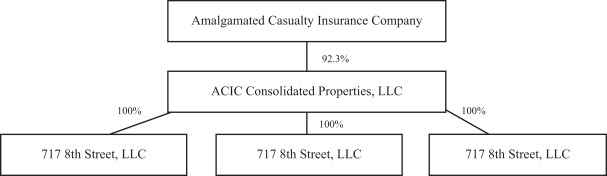
ACIC has three indirect subsidiaries that hold investments in real estate in Washington, D.C.

In connection with the conversion, the Company has entered into an agreement with MCW pursuant to which upon completion of the conversion the Company will purchase all of the outstanding capital stock of American Risk Management, Inc. in exchange for 550,000 shares of convertible preferred stock of the Company. Completion of the purchase of ARM is contingent upon completion of the conversion and the offerings. See “Business — American Risk Management, Inc.”

Our executive offices are located at 8401 Connecticut Avenue, Suite 300, Chevy Chase, Maryland, 20815, and our phone number is (202) 547-8700. Our website address is www.asginsurance.com. Information contained on our website is not incorporated by reference into this offering circular, and such information should not be considered to be part of this offering circular.

Our Structure Prior to the Conversion

Our current corporate structure is shown in the following chart:


LOGO

Prior to the conversion, the Company has not engaged in any significant operations and does not have any assets or liabilities.

Our Structure Following the Conversion

Immediately upon the conversion of ACIC, all of the authorized capital stock of the converted ACIC will be issued to the Company, and the issued and outstanding shares of our capital stock will consist of the shares of


4


Table of Contents

common stock sold in the offerings, shares of preferred stock issued in connection with the acquisition of ARM, and any shares of our common stock that become subject to restricted stock awards granted under our stock based incentive plan.

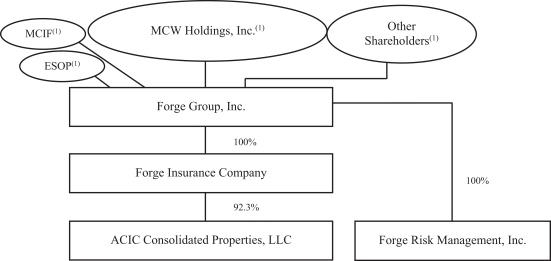
Following the completion of these actions, our corporate structure will be as shown in the following chart:


LOGO


(1)

Following completion of the conversion and the offerings, the respective ownership and voting percentages of the number of shares of the Company’s outstanding capital stock owned by MCW Holdings, Inc., the ESOP, and all other shareholders of the Company are as follows, assuming that 2,000,000 shares are sold in the offering, which is the midpoint of the offering range, and that all of the shares of Series A Preferred Stock have been converted to shares of common stock:


     Ownership Percentage     Voting Percentage  

MCW Holdings, Inc

     18.6     18.6

MCIF

     22.4     22.4

ESOP

     8.1     8.1

All other shareholders

     50.9     50.9

The Conversion of ACIC from Mutual to Stock Form

ACIC is a District of Columbia mutual insurance company. As a mutual company, it has no shareholders but it does have members. A member of ACIC is the owner of an in force individual policy issued by ACIC.

Like shareholders, the members have certain rights with respect to ACIC, such as voting rights with respect to the election of members of the board of trustees and approval of certain fundamental transactions, including the conversion of ACIC from mutual to stock form. However, unlike shares held by shareholders, the memberships in ACIC are not transferable and do not exist separately from the related insurance policy issued by ACIC. Therefore, these membership rights are extinguished when a member’s policy with ACIC is terminated by surrender, lapse, nonrenewal, or cancellation. Those membership interests will also be extinguished upon conversion of ACIC from mutual to stock form in accordance with District of Columbia law and the plan of conversion.


5


Table of Contents

The board of trustees of ACIC adopted a plan of conversion on February 3, 2021, under which ACIC will convert from a mutual insurance company to a stock insurance company. In response to comments received from the Department, the board of trustees of ACIC adopted an amended and restated plan of conversion on November 9, 2021. Following the conversion, ACIC will become a wholly-owned subsidiary of the Company. A special meeting of the members of ACIC eligible to vote (those persons who were members of ACIC as of the close of business on February 3, 2021) will be held on February [    ], 2022 (special meeting date), to approve the plan of conversion. To become effective, the plan must be approved by the affirmative vote of at least a majority of the votes cast at the special meeting.

The sale of sufficient shares to meet the offering minimum of 1,700,000 shares does not indicate that sales have been made to investors who have no financial or other interest in the offering, and the sale of 1,700,000 shares in the offering should not be viewed as an indication of the merits of the offering.

Cash distribution to eligible members

Upon completion of the conversion and the offering, ACIC will distribute $4,594 in cash to each of the eligible members. The distribution will be made shortly after completion of the conversion and the offering. If the offering and the conversion are not completed for any reason, including the failure of eligible members to approve the plan of conversion, no cash distribution will be made.

The Subscription Offering

We are offering shares of our common stock in a subscription offering. The subscription offering will end at noon, Eastern Time, on February [    ], 2022. In the subscription offering, 2,300,000 shares of common stock are being offered in the following order of priority: first, to the policyholders of ACIC as of the close of business on February 3, 2021, whom we refer to as eligible members, second, to our ESOP, and third, to the trustees, officers, and employees of ACIC.

The number of shares of common stock issued in the offerings will not exceed 2,300,000 shares. Shares purchased by the ESOP and by the trustees, officers, and employees of ACIC will be purchased for investment and not for resale and will be counted toward satisfaction of the minimum amount needed to complete this offering.

Except for any shares of restricted stock that will be granted to officers and directors of the Company upon completion of the offerings, and which will be subject to the satisfaction of certain conditions of vesting, the shares issued in the offerings will constitute all of the outstanding shares of the Company’s common stock after completion of the offerings.

The Public Offering

If less than 1,700,000 shares are subscribed for in the subscription offering, we will offer the remaining shares to the general public. The public offering will end at noon, Eastern Time, on February [    ], 2022.


6


Table of Contents

The following table shows those persons that are eligible to purchase shares in the various phases of the offering and the shares available for purchase in each phase of the offering. We expect to conduct the subscription offering and the public offering simultaneously.


Offering


Eligible Purchasers


Shares Available for Purchase

Subscription Offering    Policyholders of ACIC at February 3, 2021;    2,300,000 shares
     
   The ESOP; and    227,700 shares
     
   Officers, trustees and employees of ACIC    2,300,000 shares, less shares subscribed for by eligible members and the ESOP
Public Offering    The general public.    2,300,000 shares, less shares subscribed for in the subscription offering

The following table presents a summary of selected pricing ratios for the peer group companies, and the resulting pricing ratios for the Company on an as converted pro forma basis. Compared to the average as converted pricing ratios of the peer group, the Company’s as converted pro forma pricing ratios at the midpoint of the offering range indicated a discount of 24.8% on an as converted pro forma price-to-earnings basis, a discount of 32.7% on an as converted pro forma price-to-book value basis and a discount of 27.4% on an as converted pro forma price-to-tangible book value basis.


     As Converted Pro
Forma Price-to-Earnings
Multiple(1)
     As Converted Pro
Forma Price-to-Book
Value Ratio(1)
    As Converted Pro
Forma Price-to-Tangible
Book Value Ratio(1)
 

Company


Maximum

     15.2        48.5     53.0

Midpoint

     13.2        45.2     49.7

Minimum

     11.4        41.7     46.0

Valuation of peer group companies as of October 15, 2021(2)


Averages

     17.5x        67.2     68.5

Medians

     10.8x        57.9     59.0


(1)

See the footnotes to the table at “Pro Forma Information — Additional Pro Forma Information” for the assumptions underlying the pro forma data for the Company.

(2)

Information for the peer group companies is based upon actual earnings for the twelve months ended June 30, 2021. Information for the Company is based upon annualized as converted pro forma diluted income per share for the six months ended June 30, 2021. For additional information regarding the peer group of companies, see “The Conversion and Offering — The Appraisal.”

The as converted pro forma calculations for the Company are based on the following assumptions:


A number of shares equal to 9.9% of the shares sold in the conversion are purchased by the employee stock ownership plan, with the expense to be amortized over ten years; and


no effect is given to any shares that may be issued pursuant to restricted stock awards and stock options that will be granted to directors and officers of the Company and ACIC upon the closing of the offering.

The independent appraisal does not indicate trading market value. Do not assume or expect that our valuation as indicated in the appraisal means that after the offering the shares of our common stock will trade at or above the $10.00 per share price. Furthermore, Boenning used the pricing ratios presented in the appraisal to estimate ACIC’s pro forma appraised value for regulatory purposes and not to compare the relative value of shares of our common stock with the value of the capital stock of the peer group. The


7


Table of Contents

value of the capital stock of a particular company may be affected by a number of factors such as financial performance, asset size and market location.

For a more complete discussion of the amount of common stock we are offering for sale and the independent appraisal, see “The Conversion and Offering — The Appraisal.”

Conditions to Completion of the Conversion and this Offering

Before we can complete this offering and issue our common stock, the members of ACIC eligible to vote must approve the plan of conversion and we must sell at least the minimum number of shares offered in the offerings. No funds will be released from the escrow account until all of these conditions have been satisfied.

In 2011, MCW received approval from the Department to be the ultimate controlling party of ACIC in its mutual form. As detailed in the conversion application, which was approved on [    ], 2021, MCW will have a controlling interest in our stock. MCIF, which is expected to own in excess of 20% of our outstanding capital stock, will also be considered a controlling party of ACIC, and MCIF’s acquisition of such controlling interest was also approved by the Department as part of the conversion application.

Termination of this Offering

We have the right to cancel this offering at any time. In addition, the completion of this offering is subject to market conditions and other factors beyond our control. If this offering is not completed, all funds received will be promptly returned to purchasers without interest.

Stock Pricing and Number of Shares to be Issued

The plan of conversion requires that the number of shares to be issued in connection with the conversion must be based on the range of valuation of our estimated consolidated pro forma market value. Under the plan of conversion, the valuation must be in the form of a range consisting of a midpoint valuation, a valuation fifteen percent (15%) above the midpoint valuation, and a valuation fifteen percent (15%) below the midpoint valuation. We retained Boenning to determine the valuation range for this offering. Boenning has determined that, as of October 15, 2021, the estimated consolidated pro forma market value of ACIC is $20.0 million at the midpoint, and the range of value of the total number of shares of common stock to be issued in the offering is between a minimum value of $17.0 million and a maximum value of $23.0 million. We plan to issue between 1,700,000 and 2,300,000 shares of our common stock in this offering. This range was determined by dividing the $10.00 price per share into the range of Boenning’s valuation. Shares purchased by the ESOP and the trustees, officers, and employees of ACIC will be purchased for investment and not for resale and will be counted toward satisfaction of the minimum amount needed to complete this offering.

We determined to offer the common stock in the subscription offering at the price of $10.00 per share to ensure a sufficient number of shares are available for purchase by eligible members. In addition, Griffin Financial Group, LLC. (“Griffin”) advised us that the $10.00 per share offering price is commonly used in mutual-to-stock conversions of other insurance companies and savings banks and savings associations that use the subscription rights conversion model. These were the only factors considered by our board of trustees in determining to offer shares of common stock at $10.00 per share.

How Do I Buy Stock in this Offering?

If you wish to purchase shares of common stock in the subscription offering, you must sign and complete the stock order form that accompanies this offering circular and send it to us with your payment such that your


8


Table of Contents

order is received before the offering deadline. You may submit your order to us by overnight delivery to the address indicated for this purpose on the top of the stock order form or by mail using the stock order reply envelope provided. Payment by personal check, cashier’s check or money order must accompany the stock order form. No cash or third party checks will be accepted. All checks or money orders must be made payable to “Computershare Trust Company, N.A., escrow agent, on behalf of Forge Group, Inc.” We may permit certain persons who submit orders in the public offering to make payment by a wire transfer to the escrow agent of the purchase price for any shares that they seek to purchase.

The completed stock order form and payment in full for the shares ordered must be received (not postmarked) no later than noon, Eastern Time, on February [    ], 2022. Once submitted, your order is irrevocable without our consent unless we terminate this offering. Our consent to any modification or withdrawal request may or may not be given in our sole discretion. We may reject a stock order form if it is incomplete, improperly completed, or not timely received.

Offering Deadline

All subscription rights will expire at noon, Eastern Time, on February [    ], 2022. Subscription rights not exercised prior to the termination date of this offering will be void, whether or not we have been able to locate each person entitled to receive subscription rights.

Limits on Your Purchase of Common Stock

The plan of conversion and District of Columbia law establish the following minimum and maximum purchase limitations for participants (including such participants’ associates or a group acting in concert) in the subscription offering:


No person may purchase fewer than 50 shares in this offering.


No person other than the ESOP may purchase more than 25,000 shares in the subscription offering.


A person who is not an “accredited investor” as defined in Rule 501 of SEC Regulation D cannot purchase shares with an aggregate purchase price in excess of the greater of (x) 10% of their annual net income or net worth, as calculated in accordance with Rule 501 of Regulation D and (y) if the person is not a natural person, 10% of such person’s net assets or revenue for the most recently completed fiscal year. See “The Conversion and Offering — Limitations on Purchases of Common Stock.”


Subject to the prior right of each eligible member to subscribe for up to 25,000 shares in the subscription offering, in no event may any person purchase more than 5% of the total number of shares sold in the subscription and public offerings without the prior approval of the Commissioner.


In addition to the limitations set forth above, no person may acquire, directly or indirectly, in this offering or any public offering, more than 5% of the capital stock of the Company for a period of five years from the effective date of the conversion without the approval of the Department.

For purposes of the limitations described above, an associate of a person includes:


any relative or spouse of such person, or any relative of such person’s spouse, who shares the same home as such person;


any corporation or other organization (other than the Company or a majority owned subsidiary of the Company) of which such person is an officer, director, or partner, or of which such person is, directly or indirectly, a beneficial owner of 10% or more of any class of equity securities;


9


Table of Contents
   

any trust or other estate in which such person has a substantial beneficial interest or as to which such person serves as trustee or in a similar fiduciary capacity (exclusive of any employee stock benefit plan of the Company, such as the ESOP); and


any person acting in concert with any of the persons or entities listed above.

If anyone who has been granted subscription rights places an order for more than 25,000 shares, any amount in excess of 25,000 shares will be treated as an offer to purchase in the public offering, which the Company has the absolute discretion to accept or reject.

We have the right in our absolute discretion and without liability to any participant in the subscription offering or to any other person to determine which persons and which subscriptions and orders in this offering meet the criteria provided in the plan of conversion for eligibility to purchase shares of common stock and the number of shares eligible for purchase by any person. Our determination of these matters will be final and binding on all parties and all persons.

Oversubscription

If you are an eligible member and we receive subscriptions in the subscription offering for more than 2,300,000 shares, your requested subscription for shares may be reduced.

If eligible members in the aggregate subscribe for more than 2,300,000 shares, the shares of common stock will be allocated so as to permit each subscribing eligible member to purchase up to the lesser of the number of shares subscribed for or 1,000 shares. Any remaining shares will be allocated among the eligible members whose subscriptions remain unsatisfied in the proportion in which the number of shares as to which each such eligible member’s subscription remains unsatisfied bears to the aggregate number of shares as to which all such eligible members’ subscriptions remain unsatisfied.

Management Purchases of Stock

If the eligible members and the ESOP subscribe for less than the maximum number of shares, the trustees, officers, and employees of ACIC, together with their affiliates and associates, have indicated their intention to purchase up to approximately 1,452,000 shares of common stock in the subscription offering. The trustees, officers, and employees of ACIC and their affiliates and associates are not obligated to purchase this number of shares, and in the aggregate they may purchase a greater or smaller number of shares. See “The Conversion and Offering — Proposed Management Purchases.”

If there are insufficient shares remaining after the subscriptions of eligible members and the ESOP to satisfy in full all of the subscriptions of trustees, officers, and employees of ACIC, the available shares of common stock will be allocated among the subscribing trustees, officers, and employees in the proportion in which the number of shares as to which each such person subscribed bears to the aggregate number of shares remaining.

Undersubscription

If less than 1,700,000 shares are subscribed for in the subscription and public offerings, we will promptly return all funds received in the offerings to purchasers, without interest. In that event, we may cause a new valuation of ACIC to be performed, and based on this valuation amend the Offering Statement of which this offering circular is a part and commence a new offering of our common stock. In that event, people who submitted subscriptions or orders will be permitted to submit new subscriptions or orders. See “The Conversion and the Offering — Resolicitation.” Shares purchased by the ESOP and by directors, trustees, officers, and employees in the offering will be counted towards satisfying the requirement that at least 1,700,000 shares must be sold in the offerings.


10


Table of Contents

Benefits to Management

Our board of directors has also adopted a stock based incentive plan for the benefit of our directors, executive officers, and other eligible employees. Under the stock based incentive plan, we may award options to purchase common stock or award shares of restricted stock or restricted stock units to directors, executive officers, and other eligible employees. The exercise price of stock options will be no less than the fair market value of our common stock on the date of the option award. All awards under the stock based incentive plan will be subject to such vesting, performance criteria, or other conditions as the compensation committee of our board of directors may establish. Restricted stock units, shares of restricted stock, and options to purchase shares in an amount equal to 14.0% of the number of shares issued in the offering may be awarded under the stock based incentive plan, provided that the total number of shares represented by restricted stock units and restricted shares can be no more than 4.0% of the number of shares issued in the offering.

As discussed in more detail under “Executive Compensation,” we expect that grants of stock options to purchase 190,000 shares will be made to our executive officers and grants of 15,000 shares of restricted stock will be made to our non-employee directors, subject to completion of this offering.

The following table presents information regarding the participants in the stock based incentive plan, and the total amount, the percentage, and the dollar value of the stock that we intend to set aside for the stock based incentive plan. The table assumes the following:


that 2,000,000 shares will be sold in the offerings; and


that the value of the stock in the table is $10.00 per share.

The exercise price of any options granted under the stock based incentive plan will be at least equal to the fair market value of the stock on the day the options are awarded or, in the case of options granted at the time of this offering, the price at which stock is sold in this offering. As a result, anyone who receives an option will benefit from the option only if the price of the stock rises above the exercise price and the option is exercised. The numbers in the following table assumes that 2,000,000 shares are sold in the offering, which is the midpoint of the offering.


Stock Based Incentive Plan


Individuals
Eligible to
Receive Awards

   Number
of Shares
    Percentage
of shares
issued in
the
offering
    Value of
shares Based
on $10.00
Share Price
 

ESOP

   All full time employees      198,000       9.9   $ 1,980,000  

Shares available for restricted stock or restricted stock unit awards

   Directors and selected officers      80,000 (1)      4.0   $ 800,000 (1) 

Shares available for stock options

   Directors and selected officers      200,000 (1)      10.0  


(1)

Assumes that options to purchase 10% of the number of shares issued in the offering are awarded under the plan and shares of restricted stock or restricted stock unit awards equal to 4.0% of the number of shares issued in the offerings are granted under the plan. Stock options will be granted with a per share exercise price at least equal to the market price of our common stock on the date of the grant. The value of a stock option will depend, among other things, upon increases, if any, in the price of our common stock during the term of the option.

A minimum of 1,700,000 shares and a maximum of 2,300,000 shares of our common stock will be issued in the subscription and public offerings, excluding any shares that may be issued under our stock based incentive plan.


11


Table of Contents

Use of Proceeds

We estimate the net proceeds from the offerings, after taking into account the repayment of $1.4 million of indebtedness that we will assume as part of the purchase of ARM, will be approximately $2.6 million at the minimum, $5.2 million at the midpoint, and $7.7 million at the maximum of the offering range. See the “Offering Summary” on the front cover of this offering circular for the assumptions used to arrive at these amounts. The amount of net proceeds from the sale of common stock in the offerings will depend on the total number of shares actually sold in the subscription and public offerings.

We plan to contribute substantially all of the net proceeds from the offering to ACIC, retaining $0.5 million to fund twelve months’ of working capital obligations at the Company. ACIC plans to use the remaining net proceeds for general corporate purposes, including (i) supporting organic growth of our insurance business; (ii) funding new product launches; and (iii) selectively deploying new capital to retain, acquire, and bolster talent in key areas.

ACIC may also use such remaining net proceeds for general corporate purposes, which may include acquisitions of other insurance companies or related businesses, and to pay dividends to the Company so that the Company can pay dividends on the Series A Preferred Stock. On a short term basis, the proceeds will be invested primarily in securities consistent with our investment strategy until utilized. We have no other current specific plans for use of the net proceeds of the offering. See “Use of Proceeds.”

Dividend Policy

Following completion of this offering, our board of directors will have the authority to declare dividends on our shares of common stock, subject to statutory and regulatory requirements. Any decision to pay a dividend will depend on many factors, including our financial condition and results of operations, liquidity requirements, market opportunities, capital requirements of our subsidiaries, legal requirements, regulatory constraints, intercompany dividends from our subsidiaries, and other factors as the board of directors deems relevant. As part of the order issued by the Department approving the conversion, the Company will be prohibited from paying any cash dividends on the Company’s common stock for three years after completion of the conversion without the prior approval of the Department.

We currently expect to pay quarterly cash dividends on our Series A Preferred Stock when such dividends are due. The accrued dividends payable on our Series A Preferred Stock will total $468 thousand per year. For additional information regarding restrictions on our ability to pay dividends, see “Dividend Policy.”

Market for Common Stock

We do not intend to apply for the listing of our common stock on the NASDAQ Capital Market or any other stock exchange. People considering purchasing shares in the offerings should note that this will materially and adversely affect the liquidity of our stock. See “Risk Factors — Risks Relating to Ownership of Our Common Stock — Our shares will not be listed on any stock exchange, and there will not be an active, liquid market for our common stock.” We intend to apply to have “buy” and “sell” quotes for shares of our common stock reported on the “OTC Pink” market by broker-dealers that agree to make a market in our common stock. We may also engage in share repurchases from time to time if we determine that we have excess capital.

How You May Obtain Additional Information Regarding this Offering

If you have any questions regarding the stock offering, please call the Stock Information Center at (610) 205-6005, Monday through Friday between 10:00 a.m. and 4:00 p.m., Eastern Time.


12


Table of Contents

RISK FACTORS

An investment in our common stock involves a number of risks. Before making a decision to purchase our common stock, you should carefully consider the following information about these risks, together with the other information contained in this offering circular. Many factors, including the risks described below, could result in a significant or material adverse effect on our business, financial condition, and results of operations. If this were to happen, the price of our common stock could decline significantly and you could lose all or part of your investment.

Risks Relating to Our Business

ACIC has incurred both statutory and GAAP net losses in recent years.

ACIC has incurred both statutory and GAAP net losses in three of the last six years. ACIC’s losses are due principally to high loss ratios resulting from our expansion into unprofitable non-core product lines such as non-emergency medical transportation and into unprofitable states, as well as prevailing low returns on our investment portfolio. We need to increase the sales of our profitable core insurance products and deploy new profitable insurance products, by investing in new product development, expanding distribution capability, and implementing technology solutions in order to continue our return to profitability.

If we cannot expand our distribution network and resulting sales of our products, we may incur further losses.

Our ability to increase sales of our existing and new insurance products will depend on our success in expanding our distribution network. We depend on ARM, ACIC’s controlling producer, and on its network of independent insurance agents to generate almost all of the sales of our insurance products. If we are unable to increase sales to customers by establishing relationships with other distribution partners, it may be difficult to remain profitable.

The impact of COVID-19 and responses thereto, and related risks, could continue to materially affect our results of operations, financial position, and/or liquidity.

Beginning in March 2020, the global pandemic related to novel coronavirus COVID-19 started to impact the global and U.S. economy. The extent of this pandemic continues to evolve, thus the full direct and indirect impacts of COVID-19 are not yet known and may not emerge for some time. ACIC has experienced a decrease in premiums due to the COVID-19 pandemic, that has negatively impacted our taxi cab and sedan customers, who are highly exposed to the travel and leisure industries. Those industries have been adversely impacted by COVID-19, and our premiums may continue to decrease as the travel and leisure industries remain depressed and our insureds seek to limit expenses, including the cost of insurance.

Federal, state, and local government actions to address and contain the impact of COVID-19 may adversely affect us. For example, we could be subject to proposed legislative and/or regulatory action that seeks to retroactively mandate coverage for losses which our insurance policies were not designed or priced to cover. Currently, in some states, there is proposed legislation to require insurers to cover business interruption claims irrespective of terms, exclusions, or other conditions included in the policies that would otherwise preclude coverage. Regulatory restrictions or requirements could also impact pricing, risk selection, and our rights and obligations with respect to our policies and insureds, including our ability to cancel policies or our right to collect premiums. At least one state regulator has issued an order requiring insurers to issue premium refunds, and regulators in other states could take similar actions. It is also possible that changes in economic conditions and steps taken by federal, state, and local governments in response to COVID-19 could require an increase in taxes at the federal, state, and local levels, which would adversely impact our results of operations and place further stress on our insureds.

Our corporate fixed income portfolio may be adversely impacted by ratings downgrades, increased bankruptcies, and credit spread widening in distressed industries. In addition, many state and local governments


13


Table of Contents

may be operating under deficits or projected deficits. These deficits may be exacerbated by the costs of responding to COVID-19 and reduced tax revenues due to adverse economic conditions. The severity and duration of these deficits could have an adverse impact on the collectability and valuation of our municipal bond portfolio. Our investment portfolio also includes residential and commercial mortgage-backed securities, which could be adversely impacted by declines in real estate valuations and/or financial market disruption, including a heightened collection risk on the underlying mortgages. Further disruptions in global financial markets due to the continuing impact of COVID-19 could result in additional net realized and unrealized investment losses. In addition, declines in fixed income yields would result in decreases in net investment income from future investment activity, including re-investments.

We expect that the impact of COVID-19 on general economic activity may continue to negatively impact our premium volumes. We have experienced this impact in the last three quarters of 2020 and this impact may further persist for much of 2021, but the degree of the impact will depend on the extent and duration of the economic contraction. As a result of the anticipated impact of the pandemic on our earned premiums, our underwriting expense ratio may increase in the near term.

It is possible that changes in economic conditions and steps taken by the federal government and the Federal Reserve in response to COVID-19 could lead to higher inflation than we had anticipated, which could in turn lead to an increase in our loss costs and the need to strengthen claims and claim adjustment expense reserves. These impacts of inflation on loss costs and claims and claim adjustment expense reserves could be more pronounced for those types of claims that require a relatively longer period of time to finalize and settle and, accordingly, are relatively more inflation sensitive. Inflation could also adversely impact our general and administrative expenses. Changes in interest rates caused by inflation affect the carrying value of our fixed maturity investments and returns on our fixed maturity and short-term investments. An increase in interest rates reduces the market value of existing fixed maturity investments, thereby negatively impacting our book value.

Our results of operations have been adversely affected by the current low interest rate environment and will continue to be adversely affected if interest rates remain low or if interest rates should rapidly increase.

Although the Federal Reserve moved to marginally increase short-term interest rates from 2015 to December 2019, medium and long-term interest rates have remained at historically low levels. In response to the economic downturn resulting from the COVID-19 pandemic, the Federal Reserve has cut short-term interest rates to near record lows. During a period of decreasing interest rates or a prolonged period of low interest rates, our investment earnings may decrease because the interest earnings on our recently purchased fixed income investments will likely have declined in parallel with market interest rates. In addition, callable fixed income securities in our investment portfolio will be more likely to be prepaid or redeemed as borrowers seek to borrow at lower interest rates. Consequently, we may be required to reinvest the proceeds in securities bearing lower interest rates. An extended period of declining or prolonged low interest rates may also cause us to change our assumptions of the interest rates that we can earn on our investments and the long-term interest rate that we assume in our calculation of insurance assets and liabilities under GAAP. This revision would result in increased reserves, accelerated amortization of deferred acquisition costs (“DAC”), and other unfavorable consequences. In addition, certain statutory capital and reserve requirements are based on formulas or models that consider interest rates, and an extended period of low interest rates may increase the statutory capital we are required to hold and the amount of assets we must maintain to support statutory reserves.

Conversely, an increase in market interest rates could also have a material adverse effect on the value of our investment portfolio by, for example, decreasing the estimated fair values of the fixed income securities within our investment portfolio. Also, certain statutory reserve requirements are based on formulas or models that consider forward interest rates and an increase in forward interest rates may increase the statutory reserves we are required to hold, thereby reducing statutory capital.


14


Table of Contents

Our B++ rating from A.M. Best limits our ability to attract agents and to sell rating sensitive products.

ACIC is rated B++ by A.M. Best. This rating adversely affects our ability to attract agents and sell our products because ratings assigned by A.M. Best are an important factor influencing the competitive position of insurance companies. Financial strength ratings are used by producers and customers as a means of assessing the financial strength and quality of insurers. A.M. Best ratings, which are reviewed at least annually, represent independent opinions of financial strength and ability to meet obligations to policyholders and are not directed toward the protection of investors. Any future downgrade of our A.M. Best rating could negatively affect our ability to implement our strategy. See “Business — Competition and Ratings.”

We rely on our systems and employees, and those of certain third-party vendors and service providers, in conducting our operations, and certain failures, operational errors, systems malfunctions, or cyber-security incidents, could materially adversely affect our operations.

We are exposed to many types of operational risk, including clerical and recordkeeping errors, and computer or telecommunications systems malfunctions. If any of our operational, accounting, or other data processing systems fail or have other significant shortcomings, we could be materially adversely affected. We use a third party servicer to provide all of our data processing and storage functions. While our third party provider takes commercially reasonable measures to keep their systems and our data secure, it is difficult or impossible to defend against all risks being posed by changing technologies as well as criminals intent on committing cybercrime. Increasing sophistication of cyber criminals and terrorists make keeping up with new threats difficult and could result in a breach. As a result, our outside service provider may be unable to anticipate the type or manner of attempts to breach their security or to implement adequate preventative measures against these attempts. We may be required to expend significant capital to alleviate problems caused by security breaches.

Any breach or perceived breach of our security could damage our reputation and our relationship with our policyholders and agents. Reputational damage of this kind could significantly harm our business. For example, insureds and agents may be less likely to use our products following a breach because of a perceived weakness in our information security measures. Additionally, we could be subject to significant liability as well as regulatory action, which would have a material and adverse effect on our business, financial condition, results of operations, and prospects.

Our operations are dependent on access to key technology tools; if we lose access to these tools, our ability to conduct business could be significantly impaired.

In the event of a disaster such as a natural catastrophe, an epidemic, an industrial accident, a blackout, a computer virus, a terrorist attack, a cyber-attack, or a war that causes the data processing systems of our third party servicers to not function, unanticipated problems with our disaster recovery systems would have an adverse impact on our ability to conduct business and on our results of operations and financial position, particularly if those problems affect our internet access, computer-based data processing, transmission, storage and retrieval systems or destroy valuable data. Despite such third party servicers’ implementation of security measures, disaster recovery plans, system backup plans, and offsite arrangements to reduce the risk of a loss of access to these critical systems, there is no assurance that these security measures and backup plans will work when needed or would protect the Company in all circumstances that could arise. An interruption in our business because of our inability to access our key technology tools could result in the loss of revenue and damage to our reputation, and could have a material and adverse effect on our business, financial condition, results of operations, and prospects.

In the ordinary course of our business we can face coverage disputes and lawsuits that are expensive and time consuming and may include claims for extra-contractual damages, which, if resolved adversely, could harm our business, financial condition, or results of operations.

From time to time, we are involved in coverage and other types of lawsuits in the ordinary course of our business. Defending these claims is costly and can impose a significant burden on our management and


15


Table of Contents

employees. We utilize reinsurance to limit our exposure on the insurance policies we issue. Our reinsurance arrangements provide a level of coverage for extra-contractual damages, subject to the terms and limits of those arrangements. If we are found to be liable for significant extra-contractual damages in future cases, however, there could be a material and adverse effect on our business, financial condition, results of operations, and prospects.

Legal and regulatory investigations and actions are increasingly common in the insurance business and may result in financial losses and harm our reputation.

We face a risk of litigation and regulatory investigations and actions in the ordinary course of operating our business, including the risk of class action lawsuits. ACIC may become subject to class actions and regulatory actions or may become subject to individual lawsuits relating, among other things, to sales or underwriting practices, payment of contingent or other sales commissions, claims payments and procedures, product design, disclosure, administration, additional premium charges for premiums paid on a periodic basis, denial or delay of benefits, and breaches of fiduciary or other duties to customers. Plaintiffs in class action and other lawsuits against ACIC may seek very large or indeterminate amounts, including punitive and treble damages, which may remain unknown for substantial periods of time.

ACIC is also subject to various regulatory inquiries, such as information requests, subpoenas, market conduct exams, and books and record examinations, from state and federal regulators and other authorities, which may result in fines, recommendations for corrective action or other regulatory actions. Current or future investigations, proceedings, or regulatory actions could have an adverse effect on our business, results of operations, and financial condition. Moreover, even if we ultimately prevail in the investigation, proceeding, or regulatory action, we could suffer significant reputational harm, which could have an adverse effect on our business. Increased regulatory scrutiny and any resulting investigations or proceedings could result in new legal actions or precedents and industry-wide regulations or practices that could have a material and adverse effect on our business, financial condition, results of operations, and prospects.

We rely on the leadership of the members of our executive management team. The loss of any of these executives could have an adverse impact on our business and our ability to implement our business strategy.

The success of our business is dependent, to a large extent, on our ability to attract and retain key employees including the following members of our executive management team: Patrick Bracewell, Chairman, President and Chief Executive Officer; Daniel McFadden, Treasurer and Secretary; Richard Hutchinson, President and Chief Operating Officer of ACIC, Brian Mancino, Vice President — Distribution of ACIC; Michael McColley, Vice President — Insurance Operations of ACIC; and Joseph Niemer, Vice President — Digital Commerce and Technology of ACIC. Our executive management team has extensive experience in the insurance business. Were we to lose any of these employees, it may be challenging for us to attract a replacement employee with comparable skills and experience in our market niches. Except for the employment agreement with Patrick Bracewell, we do not have employment agreements with our executive officers. See “Executive Compensation- Employment Agreements.” We do not currently maintain key man life insurance policies with respect to any member of our senior management team.

We may be required to establish an additional valuation allowance against deferred income tax assets if our business does not generate sufficient taxable income or if our tax planning strategies are modified, which could have a material adverse effect on our results of operations and financial condition.

Deferred income tax represents the tax effect of the differences between the financial accounting and tax basis of assets and liabilities. Deferred tax assets represent the tax benefit of future deductible temporary differences, operating loss carryforwards, and tax credit carryforwards. We periodically evaluate and test our ability to realize our deferred tax assets. Deferred tax assets are reduced by a valuation allowance if, based on the weight of evidence, it is more likely than not that some portion, or all, of the deferred tax assets will not be


16


Table of Contents

realized. In assessing the more likely than not criteria, we consider future taxable income as well as prudent tax planning strategies. Future facts, circumstances, tax law changes, and financial accounting or GAAP developments may result in an increase in the valuation allowance. An increase in the valuation allowance could have a material adverse effect on the Company’s results of operations and financial condition.

As of December 31, 2020, ACIC had recorded a valuation allowance of $221 thousand to the net deferred tax asset of $221 thousand. To the extent we are required to establish an additional valuation allowance against future deferred income tax assets, the amount of such valuation allowance would be charged against our net income for the period in which that valuation allowance is established, which could have a material and adverse effect on our business, financial condition, results of operations, and prospects.

We operate in a heavily state regulated industry, and the prospect exists for further federal involvement in the regulation of insurance companies.

Our business is regulated by government agencies in the states in which we do business, and we must comply with a number of state and federal laws and regulations. Most insurance regulations are intended to protect the interests of current and potential policyholders rather than those of shareholders and other investors in insurance services companies.

State laws and regulations that apply to us include those governing the financial condition of insurers, including standards of solvency, risk-based capital requirements, types, quality and concentration of investments, establishment and maintenance of reserves, required methods of accounting, reinsurance and requirements, and those governing the business conduct of insurers, including transactions with affiliates, sales and marketing practices, claim procedures and practices, and policy form content. In addition, state insurance laws require licensing of insurers and their agents. State insurance regulators have the power to grant, suspend, and revoke licenses to transact business and to impose substantial fines and other penalties.

We may be unable to comply fully with the wide variety of applicable laws and regulations that are frequently undergoing revision. In addition, we follow practices based on our interpretations of laws and regulations that we believe are generally followed by the insurance industry. These practices may be different from interpretations of insurance regulatory agencies. Moreover, in order to enforce applicable laws and regulations or to protect policyholders, insurance regulatory agencies have relatively broad discretion to impose a variety of sanctions, including examinations, corrective orders, suspension, revocation or denial of licenses, and the takeover of insurance companies. As a result, if we fail to comply with these laws and regulations, state insurance departments can exercise a range of remedies from the imposition of fines to being placed in rehabilitation or liquidation. State insurance departments also conduct periodic examinations of the affairs of insurance companies and require the filing of annual, quarterly, and other reports relating to financial condition, holding company issues and other matters. These regulatory requirements may adversely affect or inhibit our ability to achieve some or all of our business objectives. Changes in the level of regulation of the insurance industry or changes in laws or regulations or interpretations of laws and regulations by regulatory authorities could adversely affect our ability to operate our business.

We are subject to various accounting and financial requirements established by the National Association of Insurance Commissioners (“NAIC”) as adopted by the states in which we operate. In addition, state regulators and the NAIC continually re-examine existing laws and regulations, with an emphasis on insurance company solvency issues and fair treatment of policyholders. Insurance laws and regulations could change or additional restrictions could be imposed that are more burdensome. Because these laws and regulations are for the protection of policyholders, any changes may not be in your best interest as a shareholder.

The commercial auto specialty transportation insurance industry in which we operate is highly competitive, which may limit our ability to maintain and increase our share of our target market.

Our competition includes companies that are almost all larger and which have significantly more resources at their disposal. Competition in the commercial auto specialty transportation insurance industry is based on


17


Table of Contents

many factors. These factors include the perceived financial strength of the insurer, premiums charged, policy terms and conditions, services provided, reputation, financial ratings assigned by independent rating agencies, and the experience of the insurer in the line of insurance to be written.

Certain of the insurance companies we compete against have substantially greater financial, technical, and operating resources than we have. The line of insurance we write is subject to significant price competition. If our competitors price their products aggressively, our ability to grow or renew our business may be adversely affected. We pay producers on a commission basis to produce business. Some of our competitors may offer higher commissions or offer insurance products at lower premium rates. Increased competition could adversely affect our ability to attract and retain business and thereby adversely affect our business, financial condition, or results of operations.

We also compete for access to talented independent agents. Much of the competition for talent involves agent recruitment. If our competitors provide the agents with better technology, pay higher commissions, or provide access to products that are perceived to be better than those we can provide, our ability to attract and retain agents may be reduced, which could have a material and adverse effect on our business, financial condition, results of operations, and prospects.

We expect that our ability to use beneficial U.S. tax attributes will be subject to limitations.

At December 31, 2020, ACIC had $11.6 million in tax loss carryforwards. Section 382 of the U.S. Internal Revenue Code of 1986, as amended (the “Code”), operates as an anti-abuse rule, the general purpose of which is to prevent trafficking in tax losses, but which can apply without regard to whether a “loss trafficking” transaction occurs or is intended. Similar rules apply to capital loss carryforwards. These rules are triggered when an “ownership change” -generally defined as when the ownership of a company, or its parent, changes by more than 50% (measured by value) on a cumulative basis in any three-year period-occurs and the company is a “loss” corporation. A company is a loss corporation if, at the date of the ownership change, the company has a tax loss carryforward which may be used in a tax year after the ownership change. When triggered, the amount of the taxable income for any post-change year which may be offset by a pre-change loss is subject to an annual limitation. An annual limitation not used in one year may be carried over to a subsequent year. Generally speaking, the annual limitation is derived by multiplying the fair market value of the stock of the taxpayer immediately before the date of the ownership change by the applicable federal long-term tax-exempt rate. In addition, to the extent that a company has a net unrealized built-in loss or deduction at the time of an ownership change, Section 382 of the Code limits the utilization of any such loss or deduction which is realized and recognized during the 5-year period following the ownership change.

The Tax Cut and Jobs Act enacted in December 2017 limits the deduction for net operating losses to 80% of current year taxable income and eliminates the deduction for net operating loss carrybacks. Following the completion of this offering, we expect that these limitations will apply, which could substantially limit our ability to utilize our net operating loss carryforwards.

Our pension plan obligations are currently underfunded, and we may have to make significant cash contributions to our plan, which could reduce the cash available for our business.

Our pension plan is estimated to be underfunded by $444 thousand as of December 31, 2020. We incur costs relating to pension benefits, which can vary substantially as a result of volatility in investment returns on pension plan assets and changes in discount rates used to calculate related liabilities. Our estimates of liabilities and expenses for pension benefits require the use of assumptions, including assumptions relating to the rate used to discount the future estimated liability, the rate of return on plan assets, and several assumptions relating to the employees covered by our pension plan, such as mortality. Actual results may differ, which may have a material adverse effect on our business, prospects, financial condition or results of operations. Future volatility and disruption in the financial markets could cause a decline in the asset values of our pension plan. In addition, a


18


Table of Contents

decrease in the discount rate used to determine minimum funding requirements could result in increased future contributions. If either occurs, we may need to make additional pension contributions above what is currently estimated, which could reduce the cash available for our businesses.

Risks Relating to Our Insurance Business

Our results may fluctuate as a result of many factors, including cyclical changes in the insurance industry, which may lead to reduced premium volume.

Results of companies in the insurance industry, and particularly the property and casualty insurance industry, historically have been subject to significant fluctuations and uncertainties. The industry’s profitability can be affected significantly by:


rising levels of actual costs that are not known by companies at the time they price their products;


volatile and unpredictable developments, including man-made and natural catastrophes;


changes in reserves resulting from the general claims and legal environments as different types of claims arise and judicial interpretations relating to the scope of insurers’ liability develop; and


fluctuations in interest rates, inflationary pressures and other changes in the investment environment, which affect returns on invested capital and may impact the ultimate payout of losses.

Historically, the financial performance of the insurance industry has fluctuated in cyclical periods of low premium rates and excess underwriting capacity resulting from increased competition (a so-called “soft market”), followed by periods of high premium rates and a shortage of underwriting capacity resulting from decreased competition (a so-called “hard market”). Fluctuations in underwriting capacity, demand and competition, and the impact on our business of the other factors identified above, could have a negative impact on our results of operations and financial condition.

Because estimating future losses is difficult and uncertain, if our actual losses exceed our loss reserves, our operating results may be adversely affected.

ACIC maintains reserves to cover amounts it estimates will be needed to pay for insured losses and for the expenses necessary to settle claims. Estimating loss and loss expense reserves is a difficult and complex process involving many variables and subjective judgments. ACIC regularly reviews its reserve estimate protocols and its overall amount of reserves. ACIC reviews historical data and considers the impact of various factors such as:


trends in claim frequency and severity;


information regarding each claim for losses;


legislative enactments, judicial decisions and legal developments regarding damages; and


trends in general economic conditions, including inflation.

Our actual losses could exceed our reserves. If we determine that our loss reserves are inadequate, we will have to increase them. This adjustment would reduce income during the period in which the adjustment is made, which could have a material adverse impact on our financial condition and results of operations. Such adjustments to loss reserve estimates are referred to as “loss development.” If existing loss reserves exceed the revised estimate, it is referred to as positive loss development. Negative loss development occurs when the revised estimate of expected losses with respect to a calendar year exceed existing loss reserves. For additional information, see “Business — Loss and LAE Reserves.”

Assessments and premium surcharges for state guaranty funds may reduce our profitability.

Most states require insurance companies licensed to do business in their state to participate in guaranty funds, which require the insurance companies to bear a portion of the unfunded obligations of impaired, insolvent


19


Table of Contents

or failed insurance companies. These obligations are funded by assessments, which are expected to continue in the future. State guaranty associations levy assessments, up to prescribed limits, on all member insurance companies in the state based on their proportionate share of premiums written in the lines of business in which the impaired, insolvent or failed insurance companies are engaged. Accordingly, the assessments levied on us may increase as we increase our written premiums. See “Business — Regulation.”

The actual experience of our insurance products can differ from the assumptions used to develop and price our insurance products, which can cause us to experience losses from these products.

To develop our insurance products we make assumptions regarding policy persistency, frequency and severity of claims, the level of investment income that will be earned from investing the product cash flows, and our expenses to underwrite, sell, and service the policies. These assumptions, along with our anticipated profit levels, are used to develop the premiums that we will charge customers for our products. In many cases, these premium rates are level and cannot be raised during the initial term of the policy. Our operating results may be materially adversely impacted by variances between our pricing assumptions and our actual experience.

Our key product pricing assumptions are based on a combination of industry studies and other third party data as well as our own experience. We regularly monitor our experience and can adjust premium rates on new business sales should the actual results indicate trends or results that we believe need to be reflected. If the actual product experience for any of these areas varies adversely from the assumptions used to price our products, it could have a material and adverse effect on our business, financial condition, results of operations, and prospects.

Our investment performance may suffer as a result of adverse capital market developments, which may adversely affect our financial results and ability to conduct business.

We allocate a portion of the insurance premiums we receive from policyholders to fund reserves, which are invested until these amounts are needed to pay insured claims. We invest in various securities to earn incremental income. As of December 31, 2020, ACIC held fixed income and equity securities with an estimated fair value of $31.8 million. For the year ended December 31, 2020, ACIC had net investment income of $1.4 million.

Our investments are subject to a variety of risks that are outside of our control, including risks relating to general economic conditions, market volatility, the extended low interest environment that currently exists, interest rate fluctuations, liquidity risk, and credit risk. For example, an unexpected increase in the number or level of claims may force us to liquidate securities in order to pay such claims. If the duration of our investments does not match our need for liquidity, we may be forced to liquidate investments prior to maturity at a significant loss to cover such payments. Investment losses could significantly decrease our asset base and capital position, thereby adversely affecting our ability to conduct business.

In the current economic environment, we are experiencing historically low interest rates across all fixed income investment markets. The effective yield or rate of our fixed income investments has declined as currently available interest rates on investments purchased are lower than the rates on our maturing investments. Low current interest rates have resulted in unrealized holding gains recorded as Other Comprehensive Income. However, if interest rates were to rise, it is possible that the market value of the securities and other investments we hold may decline, negatively affecting our earnings and capital level through realized and unrealized investment losses. If market interest rates remain at historically low levels our investment returns will continue to decline and our investment earnings will be reduced. This could have a material and adverse effect on our business, financial condition, results of operations, and prospects.

Some of our investments are relatively illiquid and are in asset classes that have been experiencing significant market valuation fluctuations.

ACIC holds certain assets that lack liquidity, such as privately placed fixed income securities, real estate and other illiquid assets. These asset classes represented a significant percentage of the carrying value of our total


20


Table of Contents

cash and invested assets as of December 31, 2020. If we require significant amounts of cash on short notice in excess of normal cash requirements, we may have difficulty selling these investments in a timely manner, be forced to sell them for less than we otherwise would have been able to realize, or both.

The reported fair values of our relatively illiquid types of investments do not necessarily reflect the current market price for the asset. If we were forced to sell certain of our assets in the current market, there can be no assurance that we would be able to sell them for the prices at which we have recorded them and we might be forced to sell them at significantly lower prices.

If we are unable to enter into reinsurance transactions on a cost-effective basis, we will be less profitable and subject to greater risk and we may be unable to expand our business because of capital limitations.

ACIC relies on the availability of reinsurance to manage the risks of its insurance products and to manage the level of capital required to write new business. Reinsurance is the practice of transferring part of an insurance company’s liability under an insurance policy and the premium associated with that insurance policy to another insurance company. We enter into reinsurance contracts to limit and manage the amount of risk we retain relating to the insurance policies we issue. This reduction in risk is intended to reduce volatility in year-to-year operating results. For example, ACIC limits its retention of exposure under any insurance policy or policies it issues to a maximum of $400 thousand. Our ability to write policies in excess of this amount is therefore typically dependent on the availability of reinsurance for the excess amount of the issued policy at commercially reasonable rates. We also use reinsurance to manage the level of capital required to write new business.

The availability and cost of reinsurance are subject to current market conditions and our experience and may vary significantly over time. Any decrease in the amount of reinsurance available will increase the amount of loss that we retain and could decrease our regulatory capital position. ACIC currently relies on its reinsurance arrangement with its reinsurers to continue to write new business. Should these reinsurers cease to reinsure our business, or should we be unable to obtain replacement reinsurance or otherwise be unable to obtain reinsurance coverage in desired amounts, our inability to obtain such reinsurance could increase the amount of risk that we retain, expose our financial results to more year-to-year variability, and limit the amount of new business that we can write. If the cost of reinsurance coverage increases, we may charge higher premiums and that could reduce future sales. Alternatively, we may decide to absorb all or a part of the increased reinsurance costs, which could have a material and adverse effect on our business, financial condition, results of operations, and prospects.

Should any of our reinsurers fail to meet their contractual commitments to us, our financial condition and results of operations could be adversely affected.

The reinsurance contracts that we enter into to help manage our risks require us to pay premiums to the reinsurance carriers who will in turn reimburse us for a portion of covered policy claims. In many cases, a reinsurer will be called upon to reimburse us for policy claims many years after we paid insurance premiums to the insurer. We remain liable to each of our policyholders for their claims, and we rely on our reinsurers to reimburse us for that portion of a claim for which it is responsible. Accordingly, we are subject to loss and credit risk if our reinsurers are not capable of fulfilling their financial obligations to us. We purchase reinsurance coverage from a number of reinsurers. We have not entered into reinsurance agreements with companies that have an A.M. Best financial rating lower than “A-” (Excellent), which is the fourth highest of fifteen ratings. ACIC had no material reinsurance recovery receivable as of December 31, 2020.

During the contract term, the financial position of our reinsurers can deteriorate and our reinsurers could become insolvent or otherwise unable to reimburse us for ceded claims. Should the financial condition of a reinsurer to which we have ceded premiums deteriorate, it may be unable to reimburse us for losses under its contractual obligations to us. This could materially adversely affect our results of operations and financial condition.


21


Table of Contents

Risks Relating to this Offering

The broad valuation range of the subscription offering make your percentage ownership of our common stock uncertain.

The number of shares offered in the subscription offering is based on Boenning’s valuation of the consolidated pro forma market value of ACIC. Boenning has determined that, as of October 15, 2021, the estimated consolidated pro forma market value of ACIC is $20.0 million at the midpoint, and the range of value of the total number of shares of Company common stock to be issued in the offering is between $17.0 million and $23.0 million.

There is a difference of $6.0 million between the minimum and maximum of the estimated valuation range. The aggregate dollar value of the shares sold in the subscription offering must be within this estimated valuation range. As a result, the percentage interest in the Company that a subscriber acquires can vary based on the number of shares sold in the subscription offering. A subscriber for a fixed number of shares of our common stock will have approximately a 26% smaller ownership at the maximum of the range than at the minimum. See “The Conversion and Offering.”

The amount of the net proceeds from the offerings is uncertain, and we will have broad discretion over the use of the net proceeds from the offerings.

The amount of proceeds from the sale of common stock in the offerings will depend on the total number of shares actually sold in the subscription and public offerings. As a result, the net proceeds from the sale of common stock cannot be determined until this offering is completed. See “Use of Proceeds.”

Although we expect to use the net proceeds of the offerings to support the growth of our business and potentially to make open market purchases of our shares for our stock-based incentive plan, our management will have broad discretion with respect to the use of net proceeds from these offerings. Except as specified above, we expect to use the net proceeds for general corporate purposes, which may include, among other things, purchasing investment securities.

Risks Relating to Ownership of Our Common Stock

Our shares will not be listed on any stock exchange, and there will not be an active, liquid market for our common stock.

We do not intend to list our shares of common stock on the NASDAQ Stock Market or any other stock exchange. Moreover, it is highly likely that approximately 70% of our common stock will be purchased by MCIF, the ESOP, our directors, and the officers and trustees of ACIC and their affiliates. The shares purchased by trustees, directors, and officers will be subject to lockup periods for up to one year. Accordingly, there will be a limited market for your shares, and you may be unable to sell your shares if you need to do so for any reason. In addition, the value of your shares may be impaired because of the lack of any market for the shares.

Our independent auditor noted significant accounting and control weaknesses and indicated that we needed significant changes to our technical expertise and internal controls.

ACIC has been in business since 1938 as a mutual insurance company. While ACIC has been required in the past to file, and has filed, statutory financial statements with the Department, ACIC has not been required to maintain, and has not maintained, its financial records in accordance with generally accepted accounting principles, nor has ACIC sought or obtained an independent audit of its financial statements in accordance with generally accepted accounting principles. In preparation for this offering, the Company engaged Johnson Lambert, LLP to perform such an audit. The auditors issued an unqualified opinion on the financial statements; however, as part of its required communications to our audit committee, Johnson Lambert, LLP called to the attention of the Board a


22


Table of Contents

number of significant accounting and control weaknesses. In response to these concerns, management has decided to supplement its finance and accounting team with a combination of additional full-time resources and external consultants.

We are an “emerging growth company,” and we intend to take advantage of reduced disclosure and governance requirements applicable to emerging growth companies, which could result in our common stock being less attractive to investors.

We are an “emerging growth company,” as defined in the Jumpstart Our Business Startups Act of 2012, which we refer to as the JOBS Act, and we intend to take advantage of certain exemptions from various reporting requirements that are applicable to other public companies that are not emerging growth companies. For example:


We will not be required to comply with the auditor attestation requirement on the effectiveness of our internal control over financial reporting contained in Section 404(b) of the Sarbanes-Oxley Act;


We will be subject to reduced disclosure obligations regarding executive compensation in our periodic reports and proxy statements;


We will not be required to hold a non-binding advisory vote on executive compensation and golden parachute arrangements not previously approved;


We will be exempt from certain audit requirements of the Public Company Accounting Oversight Board, unless the SEC determines otherwise; and


We will take advantage of the extended transition period provided in Section 7(a)(2)(B) of the Securities Act for complying with new or revised accounting standards.

We cannot predict whether investors will find our common stock less attractive if we rely on these exemptions. If some investors find our common stock less attractive as a result, there may be a less active trading market for our common stock and our stock price may be more volatile. We may take advantage of these reporting exemptions until we are no longer an emerging growth company, which in certain circumstances could be for up to five years. See “Offering Circular Summary — Implications of Being an Emerging Growth Company.”

The stock-based incentive plan and the ESOP will increase our costs, which will reduce our net income.

We have adopted a stock-based incentive plan under which we may award participants restricted shares or restricted stock units or options to purchase shares of our common stock. We will make restricted stock and restricted stock unit awards at no cost to the participants. The number of shares of common stock that may be issued pursuant to restricted stock or restricted stock unit awards or upon exercise of stock option awards under the stock-based incentive plan may not exceed 14.0% of the number of shares issued in the offerings, of which no more than 4.0% can be issued as restricted shares or restricted stock units.

The costs associated with the grant of restricted stock or restricted stock units awarded under the stock-based incentive plan will be recognized and expensed over the related vesting period at the fair market value of the shares on the date they are awarded. We intend to issue 15,000 shares of restricted stock and options to purchase 190,000 shares to our directors and officers upon the closing of the conversion from our authorized but unissued shares of common stock.

Finally, accounting rules require companies to recognize as compensation expense the award-date fair value of stock options. This compensation expense will be recognized over the appropriate vesting period. When we record an expense for the award of options using the fair value method, we will incur significant compensation and benefits expense, which will reduce our net income.


23


Table of Contents

In addition, the additional compensation expense resulting from the ESOP will adversely affect our profitability. We will recognize expenses for our ESOP when shares are committed to be released to participants’ accounts. For further discussion of these plans, see “Management — Benefit Plans.”

The implementation of the stock-based incentive plan may dilute your percentage ownership interest and may also result in downward pressure on the price of our stock.

The proposed stock-based incentive plan will be funded from the issuance of authorized but unissued shares and possibly in part through open market purchases. In the event that authorized but unissued shares are used to fund restricted stock or restricted stock unit awards and the exercise of stock option awards under the plan in an amount equal 4.0% and 10.0% of the number of shares issued in the offerings, respectively, shareholders would experience a reduction in ownership interest of approximately 12.3%. In addition, the number of shares of common stock available for issuance pursuant to restricted stock or upon the vesting of restricted stock unit awards or exercise of stock option awards may be perceived by the market as having a dilutive effect, which could lead to a decrease in the price of our common stock.

The valuation of our common stock in this offering is not necessarily indicative of the future price of our common stock, and the price of our common stock may decline after this offering.

There can be no assurance that shares of our common stock will be able to be sold in the market at or above the $10.00 per share initial offering price in the future. The final aggregate purchase price of our common stock sold in this offering will be based upon an independent appraisal. The appraisal is not intended, and should not be construed, as a recommendation of any kind as to the advisability of purchasing shares of common stock. The valuation is based on estimates and projections of a number of matters, all of which are subject to change from time to time. See “The Conversion and Offering — The Appraisal” for the factors considered by Boenning in determining the appraised value.

The trading price of our common stock may be volatile and subject to wide price fluctuations in response to various factors, including:


market conditions in the broader stock market in general;


actual or anticipated fluctuations in our quarterly financial and operating results;


changes in interest rates;


departure of key executives;


introduction of new services or announcements of significant contracts, acquisitions, or capital commitments by us or our competitors;


regulatory or political developments;


issuance of new or changed securities analysts’ reports or recommendations, or any negative change in our A.M. Best rating;


availability of capital;


litigation and government investigations;


legislative and regulatory developments;


future sales of our common stock;


investor perceptions of us and the commercial automobile insurance industry; and


economic conditions.


24


Table of Contents

These and other factors may cause the market price of our common stock to fluctuate substantially, which may limit or prevent investors from readily selling their shares of common stock and may otherwise negatively affect the liquidity of our common stock.

In addition, the stock market has in the past experienced substantial price and volume fluctuations that sometimes have been unrelated or disproportionate to the operating performance of companies. As a result, the trading price of shares of our common stock may be below the initial public offering price, and you may not be able to sell your shares at or above the price you pay to purchase them.

Anti-takeover provisions contained in our articles of incorporation, which we refer to as our articles, and our amended and restated bylaws, which we refer to as our bylaws, as they will be in effect upon completion of this offering, as well as provisions of District of Columbia law, may render more difficult or discourage takeover attempts on the Company that you may believe are in your best interests or that might result in a substantial profit to you.

The District of Columbia Official Code requires prior approval by the District of Columbia Department of Insurance, Securities, and Banking (the “Department of Insurance”) for a change of control of an insurance holding company. Under District of Columbia law, the acquisition of 10% or more of the outstanding voting stock of an insurer or its holding company is presumed to be a change in control. Approval by the Department of Insurance may be withheld even if the transaction would be in the shareholders’ best interest if the Department of Insurance determines that the transaction would be detrimental to policyholders. In addition, for 5 years following the effective date of the conversion, no person may acquire more than 5% of the capital stock of the Company in this offering or any other public offering without the approval of the Department of Insurance.

In 2011, MCW received approval to be the ultimate controlling party of ACIC in its mutual form. As detailed in the conversion application, which was approved on [    ], 2021, MCW will have a controlling interest in our stock.

Additionally, our articles and bylaws contain provisions that could have the effect of rendering more difficult or discouraging a change in control. These provisions include:


A prohibition on a person, including a group acting in concert, other than MCIF and MCW Holdings, Inc., from acquiring voting control of more than 10% of our outstanding stock without prior approval of our board of directors;


A classified board of directors divided into three classes serving for successive terms of three years each;


The prohibition of cumulative voting in the election of directors;


The requirement that nominations for the election of directors made by shareholders and any shareholder proposals for inclusion on the agenda at any shareholders’ meeting must be made by notice (in writing) delivered or mailed to us not less than 90 days prior to the meeting;


The prohibition of shareholders’ action without a meeting and of shareholders’ right to call a special meeting;


The requirement imposing a mandatory tender offer requirement on a shareholder that has a combined voting power of 35% or more of the votes that our shareholders are entitled to cast, unless acquisition of such voting power by such shareholder was approved by our board of directors;


The requirement that the foregoing provisions of our articles of incorporation can only be amended by an affirmative vote of shareholders entitled to cast at least 80% of all votes that shareholders are entitled to cast, unless approved by an affirmative vote of at least 80% of the members of the board of directors; and


25


Table of Contents
   

The requirement that certain provisions of our bylaws can only be amended by an affirmative vote of shareholders entitled to cast at least 66 2/3%, or in certain cases 80%, of all votes that shareholders are entitled to cast.

These provisions of our articles and bylaws, alone or together with certain provisions of District of Columbia and Pennsylvania law, could serve to entrench management and may discourage a takeover attempt that you may consider to be in your best interest or in which you would receive a substantial premium over the current market price. These provisions may make it extremely difficult for any one person, entity, or group of affiliated persons or entities to acquire voting control of the Company, with the result that it may be extremely difficult to bring about a change in the board of directors or management. Some of these provisions also may perpetuate present management because of the additional time required to cause a change in the control of the board of directors. See “Description of Our Capital Stock.”

Our ability to pay dividends will be limited.

Upon completion of this offering, the Company will be a holding company with no operations of its own. The Company’s primary assets will be its equity interests in ACIC and ARM and any net proceeds of the offerings that are not contributed to ACIC. Thus, the ability of the Company to pay dividends to holders of our common stock depends upon the cash and liquid investments held at the holding company and our subsidiaries ability to pay dividends to the Company. In addition, all accrued dividends on our Series A Preferred Stock must be paid in full before any cash dividends can be paid on our common stock. ACIC’s ability to pay dividends to the Company is subject to limitations under District of Columbia insurance laws and regulations. See “Dividend Policy.”


26


Table of Contents

FORWARD-LOOKING STATEMENTS

This offering circular contains “forward-looking” statements that are intended to enhance the reader’s ability to assess our future financial and business performance. Forward-looking statements include, but are not limited to, statements that represent our beliefs concerning future operations, strategies, financial results or other developments, and contain words and phrases such as “may,” “expects,” “should,” “believes,” “anticipates,” “estimates,” “intends” or similar expressions. In addition, statements that refer to our future financial performance, anticipated growth, trends in our business and in our industry, and other characterizations of future events or circumstances are forward-looking statements. Because these forward-looking statements are based on estimates and assumptions that are subject to significant business, economic, and competitive uncertainties, many of which are beyond our control or are subject to change, actual results could be materially different.

Consequently, such forward-looking statements should be regarded solely as our current plans, estimates, and beliefs with respect to, among other things, future events and financial performance. Except as required under the federal securities laws, we do not intend, and do not undertake, any obligation to update any forward-looking statements to reflect future events or circumstances after the date of such statements.

The forward-looking statements include, among other things, the factors discussed under “Risk Factors” and those listed below:


future economic conditions in the markets in which we compete that could be less favorable than expected and could have impacts on demand for our products and services;


our ability to grow and develop our insurance business and successfully develop and market new products and new distribution channels;


our inability to maintain or grow our strategic partnerships;


our inability to manage future growth and integration of any businesses that we may acquire;


our ability to enter new markets successfully and capitalize on growth opportunities either through acquisitions or organically;


financial market conditions, including, but not limited to, changes in interest rates and the level and trends of stock market prices causing a reduction of investment income or realized losses and reduction in the value of our investment portfolios;


increased competition in our business, including the potential impacts of aggressive price competition by other insurance companies, payment of higher commissions to agents that could affect demand for our insurance products and impact the ability to grow and retain agents, and the entry of new competitors and the development of new products by new or existing competitors, resulting in a reduction in the demand for our products and services;


the effect of legislative, judicial, economic, demographic and regulatory events in the jurisdictions where we do business;


costs, availability and collectability of reinsurance;


the potential impact on our reported net income that could result from the adoption of future accounting standards issued by the Public Company Accounting Oversight Board or the Financial Accounting Standards Board or other standard-setting bodies; and


changes in industry trends and financial strength ratings assigned by nationally recognized rating organizations.

You should review carefully the section captioned “Risk Factors” in this offering circular for a complete discussion of the material risks of an investment in our common stock.


27


Table of Contents

SELECTED FINANCIAL AND OTHER DATA

The following table sets forth selected consolidated financial and other data for ACIC prior to this offering. You should read this data in conjunction with our financial statements and accompanying notes, “Management’s Discussion and Analysis of Financial Condition and Results of Operations” and other financial information included elsewhere in this offering circular. The balance sheet data as of December 31, 2020 and 2019, and the statement of operations data for each of the years in the two-year period ended December 31, 2020 are derived from our audited financial statements that are included elsewhere in this offering circular. The balance sheet data as of June 30, 2021, and the statement of operations data for each of the six-month periods ended June 30, 2021 and 2020 are derived from our unaudited financial statements that are included elsewhere in this offering circular.

These historical results are not necessarily indicative of future results.


     For the
Six-Months Ended
June 30,
     For the
Years Ended
December 31,
 

(dollars in thousands)

   2021      2020      2020      2019  

Statement of Operations Data:

     (unaudited      (unaudited      

Premiums written

   $ 4,227      $ 2,341      $ 6,302      $ 13,128  

Ceded premiums

     166        90        240        533  


Net premiums written

     4,061        2,251        6,062        12,595  


Net premiums earned

     3,614        4,438        8,133        11,728  

Income from real estate held for investment

     1,056        1,011        2,064        2,276  

Net investment income

     584        702        1,447        1,516  

Net realized investment (losses)

     95        5        (15      (214

Net unrealized gains (losses) on equity securities

     1,172        (517      814        735  

Service fee income

     72        41        67        94  

Gain on extinguishment of related party loan

     —          —          400        —    

Other income

     1        —          2        3  


Total revenues

     6,594        5,680        12,912        16,138  


Expenses


Loss and loss adjustment expense

     1,410        2,181        2,684        8,829  

Policy acquisition costs and other operating expenses

     1,725        1,106        2,334        2,542  

Related party commissions incurred

     774        400        1,094        2,376  

Depreciation and amortization

     542        559        1,111        1,098  

Real estate operating expense

     92        47        142        122  

Interest expense on debt

     657        602        1,314        1,329  

Lease expense

     154        154        308        308  

Sublease income

     (24      (24      (47      (47

Other expenses

     (10      14        285        251  


Total expenses

     5,320        5,039        9,255        16,808  


Income (loss) before income taxes

     1,274        641        3,687        (670

Deferred income tax (benefit)

     46        18        (146      (206


Net income (loss)

     1,228        623        3,833        (464


Net loss attributable to non-controlling interest

     17        15        37        23  


Net gain (loss) attributable to Amalgamated

   $ 1,245      $ 638      $ 3,870      $ (441


28


Table of Contents
     June 30,     December 31,  

(dollars in thousands)

   2021     2020     2019  

Balance Sheet Data:


Total investments, cash and cash equivalents

   $ 72,939     $ 74,521     $ 75,097  

Premiums and reinsurance balances receivable

     4,493       3,545       5,430  

Deferred policy acquisition costs

     684       378       218  

Ceded unearned premiums

     139       125       212  

Reinsurance balances recoverable on unpaid losses

     877       1,200       833  

Deferred Rent

     1,879       1,690       1,448  

Leases in place

     3,215       3,364       3,743  

Right of use asset, net

     1,876       1,974       2,191  

Prepaid stock offering expenses

     1,698       710       —    

Accrued investment income

     232       255       281  

Other assets

     295       531       486  


Total Assets

   $ 88,327     $ 88,293     $ 89,939  


Unpaid losses and loss adjustment expenses

   $ 8,079     $ 9,861     $ 12,415  

Unearned premiums

     3,765       3,304       5,461  

Reinsurance payable

     —         4       117  

Accrued expenses

     770       686       614  

Commissions payable to related party

     901       646       957  

Notes payable

     27,778       28,019       28,353  

Defined benefit plan unfunded liability

     379       444       820  

Related party loan

     398       —         —    

Operating lease liability, net

     2,750       2,829       2,979  

Other liabilities

     26       306       409  


Total Liabilities

   $ 45,076     $ 46,099     $ 52,125  

Retained earnings

     42,876       41,631       37,762  

Accumulated other comprehensive income (loss)

     (355     (184     (732

Noncontrolling interest

     730       747       784  


Total equity

   $ 43,251     $ 42,194     $ 37,814  


Total liabilities and equity

   $ 88,327     $ 88,293     $ 89,939  


Non GAAP Ratios(1):


Loss and loss adjustment expense ratio(2)

     39     33     75

Expense ratio(3)

     73     48     40


Combined ratio(4)

     112     81     115


Statutory Data(1):


Statutory surplus

   $ 38,745     $ 39,082     $ 35,186  

Ratio of net premiums written to statutory surplus

     10.5     15.5     35.8


(1)

Applies only to ACIC, excluding its subsidiaries.

(2)

Calculated by dividing loss and loss adjustment expense by net premiums earned.

(3)

Calculated by dividing amortization of deferred policy acquisition costs and net underwriting expenses and administrative expenses by net premiums earned.

(4)

The sum of the loss and loss adjustment expense ratio and the underwriting expense ratio. A combined ratio of less than 100% means a company is making an underwriting profit.


29


Table of Contents

USE OF PROCEEDS

Although the actual proceeds from the sale of our common stock cannot be determined until the offering is complete, we estimate the net proceeds from the offerings, after taking into account the repayment of $1.4 million of indebtedness that we will assume as part of the purchase of ARM, will be approximately $2.6 million at the minimum, $5.2 million at the midpoint, and $7.7 million at the maximum of the offering range. See the “Offering Summary” on the front cover of the offering circular for the assumptions used to arrive at these amounts. The amount of net proceeds from the sale of common stock in the offerings will depend on the total number of shares actually sold in the subscription and public offerings. As a result, the net proceeds from the sale of common stock cannot be determined until the offerings are completed.

After the payment of our conversion and offering expenses and commissions, we will use proceeds received from the sale of our shares of common stock in the offering to make a loan to our ESOP in an amount sufficient to permit the ESOP to buy an amount equal to 9.9% of the shares sold in the offering. We will also use $7.3 million of the proceeds of the offering to pay a one-time cash distribution to the eligible members.

We plan to contribute substantially all of the net proceeds to ACIC, retaining $0.5 million to fund twelve months’ of working capital obligations at the Company. ACIC plans to use the remaining net proceeds for general corporate purposes, including (i) supporting organic growth of our insurance business; (ii) funding new product launches; and (iii) selectively deploying new capital to retain, acquire, and bolster talent in key areas. ACIC may also use such remaining net proceeds to acquire other insurance companies or related businesses or to pay dividends to the Company so that the Company can pay dividends on the Series A Preferred Stock. See “Dividend Policy.” On a short-term basis, the remaining net proceeds will be invested by ACIC primarily in securities consistent with our investment policy until utilized. We have no other current specific plans for the use of the net proceeds of the offering, and we have no current understandings or agreements with anyone to acquire any company or business.

Under the District of Columbia mutual-to-stock conversion statute, the plan of conversion must provide that the total consideration for the stock to be issued in the conversion offering is equal to the estimated pro forma market value of the converted insurance company. Accordingly, the amount of the offering is established by the independent valuation required by the conversion statute, and we cannot sell shares at an aggregate price less than the minimum of the range established by such valuation.

No proceeds of the offering will be used to compensate or otherwise make payments to officers or directors of the Company or any of its subsidiaries.


30


Table of Contents

MARKET FOR THE COMMON STOCK

We do not intend to apply for the listing of our common stock on the NASDAQ Capital Market or any other stock exchange. Accordingly, there will be no market for our common stock and it will be very illiquid. We cannot assure you that you will be able to sell your shares of common stock for a price at or above $10.00 per share, or that you will be able to sell your shares at all if you need to do so.

See “Risk Factors — Risks Relating to Ownership of Our Common Stock — Our shares will not be listed on any stock exchange, and there will not be an active, liquid market for our common stock.”

DIVIDEND POLICY

Following completion of this offering we do not intend to pay a dividend on our common stock. However, our board of directors will have the authority to declare dividends on our shares of common stock, subject to statutory and regulatory requirements. Any decision to pay a dividend will depend on many factors, including our financial condition and results of operations, liquidity requirements, market opportunities, capital requirements of our subsidiaries, legal requirements, regulatory constraints, dividends from our subsidiaries, and other factors as the board of directors deems relevant. We currently expect to pay quarterly cash dividends on our Series A Preferred Stock when such dividends are due. The accrued dividends payable on our Series A Preferred Stock will total $468 thousand per year.

The Company initially will have no significant source of cash flow other than intercompany dividends from ACIC and ARM, if any. Therefore, the payment of dividends by us to shareholders would depend significantly upon our receipt of dividends from ACIC and ARM.

ACIC’s ability to pay dividends is subject to restrictions contained in the insurance laws of District of Columbia, which require that all dividends be approved by the District of Columbia Department of Insurance prior to their payment. An extraordinary dividend is generally defined as a dividend that, together with all other dividends paid within the last twelve months, exceeds the lesser of 10% of its statutory policyholders’ surplus as of the preceding year end or the statutory net income of the company (excluding realized capital gains) for the preceding year. Statutory net income from the previous two years that has not been used to pay dividends can be carried forward and used to pay dividends. Statutory policyholders’ surplus, as determined under statutory accounting principles, or SAP, is the amount remaining after all liabilities, including loss and loss adjustment expenses, are subtracted from all admitted assets. Admitted assets are assets of an insurer prescribed or permitted by a state insurance regulator to be recognized on the statutory balance sheet. Insurance regulators have broad powers to prevent the reduction of statutory surplus to inadequate levels, and there is no assurance that dividend payments will be permitted.

As part of the order issued by the Department approving the conversion, the Company will be prohibited from paying any cash dividends on the Company’s common stock for three years after completion of the conversion without the prior approval of the Department.


31


Table of Contents

CAPITALIZATION

The following table displays information regarding the consolidated historical capitalization of ACIC and its subsidiaries as of June 30, 2021. The table also displays the pro forma consolidated capitalization of the Company. The pro forma information gives effect to the sale of common stock at the minimum, midpoint, and maximum of the estimated valuation range of our consolidated pro forma market value, as determined by the independent evaluation of Boenning. The pro forma consolidated capitalization of the Company also gives effect to the acquisition of American Risk Management, Inc. See “Business Acquisition of American Risk Management, Inc.” The various capital positions are displayed based upon the assumptions set forth under “Use of Proceeds.” For additional financial information regarding ACIC, see our consolidated financial statements and related notes beginning on page F-1 of this offering circular. The total number of shares to be issued in the conversion will range from 1,700,000 shares to 2,300,000 shares. See “Use of Proceeds” and the subsection entitled “The Conversion and Offering — Stock Pricing and Number of Shares to be Issued.”


            Pro Forma Capitalization of the
Company as of June 30, 2021(2)
 
            (dollars in thousands except share and
per share data)
 
     Historical
Consolidated
Capitalization of
ACIC and

ARM at
June 30, 2021
     Minimum      Midpoint      Maximum  

Shareholders’ equity(1):


Common Stock, par value $0.01 per share; authorized 10,000,000 shares; shares to be outstanding — 1,700,000 at the minimum and 23,000,000 at the maximum(2)(3)

   $ 1      $ 17      $ 20      $ 23  

Preferred Stock, no par value, authorized 1,000,000 shares; 550,000 shares of Series A to be outstanding

     -0-        5,500        5,500        5,500  

Additional paid-in capital(2)(3)

     -0-        12,984        15,819        18,653  

Retained earnings

     43,254        35,353        35,353        35,353  

Accumulated other comprehensive income (loss), net of tax

     (355      (355      (355      (355

Less: common stock to be acquired by ESOP(4)

     -0-        (1,683      (1,980      (2,277

Noncontrolling interest

     730        730        730        730  


Total shareholders’ equity

   $ 43,630      $ 52,546      $ 55,087      $ 57,627  


Capitalization table footnotes (in thousands except share and per share data)


(1)

Pro forma shareholders’ equity is not intended to represent the fair market value of the common stock or the net fair market value of the Company’s assets and liabilities. The amounts indicated also are not intended to represent what would be available for distribution to shareholders, if any, in the event of liquidation. The pro forma data may be materially affected by a change in the number of shares sold in the conversion and by other factors.

(2)

These pro forma amounts include the estimated net proceeds from the conversion.

(3)

Does not reflect additional shares of common stock that could be issued under our stock-based incentive plan. The aggregate amount of common stock issuable under this plan is equal to 14.0% of the number of shares issued in the offerings. We expect that grants of stock options to purchase 260,000 shares and 15,000 shares of restricted stock will be made to our executive officers, directors, and certain employees under the stock-based incentive plan subject to completion of this offering. An undetermined portion of the remaining


32


Table of Contents
  shares available for issuance under the stock-based incentive plan may be issued from any treasury shares purchased by the Company in the open market. Each of these methods and amounts would have different and varying effects on our shareholders’ equity. Your ownership percentage would decrease by approximately 12.3% if all of the shares available under the plan were issued from our authorized but unissued shares upon the grant of all potential restricted stock awards and upon the vesting of restricted stock units and the exercise of all potential stock options. No decrease in your ownership percentage will occur if such shares are purchased for the plan on the open market, but shareholders equity will be reduced. See “Unaudited Pro Forma Financial Information — Additional Pro Forma Data” and “Executive Compensation — Equity Compensation in Connection With This Offering — Stock-Based Incentive Plan.”
(4)

Assumes that 9.9% of the common stock sold in the offering will be purchased by the ESOP. The common stock acquired by the ESOP is reflected as a reduction in shareholders’ equity. Assumes the funds used to acquire the ESOP shares will be borrowed from the Company. See Note 1 to the table set forth under “Unaudited Pro Forma Financial Information — Additional Pro Forma Data” and “Management — Benefit Plans and Employment Agreements — Employee Stock Ownership Plan.”


33


Table of Contents

UNAUDITED PRO FORMA FINANCIAL INFORMATION

The following unaudited pro forma condensed balance sheet as of June 30, 2021 gives effect to the conversion and completion of this offering and the acquisition of American Risk Management, Inc., as if it had occurred as of June 30, 2021. The data is based on the assumption that 2,000,000 shares of common stock (the midpoint of the offering) are sold to eligible members of ACIC, the ESOP, and the trustees, officers, and employees of ACIC. For information on the impact of transaction sizes above the midpoint level, see “Additional Pro Forma Data” beginning on page 41.

The following unaudited pro forma condensed statements of operations six-months ended June 30, 2021 and for the year ended December 31, 2020, present our operating results as if this offering was completed as of January 1, 2021 and January 1, 2020, respectively.

Completion of this offering is contingent on the sale of a minimum of 1,700,000 shares of common stock in this offering. If less than 1,700,000 shares are subscribed for in the subscription offering, the remaining shares will be sold in the public offering.

The unaudited pro forma information does not claim to represent what our financial position or results of operations would have been had this offering occurred on the dates indicated. This information is not intended to project our financial position or results of operations for any future date or period. The pro forma adjustments are based on available information and certain assumptions that we believe are factually supportable and reasonable under the circumstances. The unaudited pro forma financial information should be read in conjunction with our financial statements, the accompanying notes, and the other financial information included elsewhere in this offering circular.

The pro forma adjustments and pro forma amounts are provided for informational purposes only. Our financial statements will reflect the effects of this offering only from the date it is completed.


34


Table of Contents

Unaudited Pro Forma Financial Information — Balance Sheet(1)(7)

June 30, 2021

(in thousands)


     ACIC
Historical
Consolidated
     ARM
Historical
     Pro Forma
Adjustments
    Forge
Group, Inc.
Pro Forma
Consolidated
 

Assets


Total investments, cash and cash equivalents

   $ 72,939      $ 1,413      $ 5,800 (2)    $ 80,152  

Premiums and other receivables

     4,493        —          (904 )(3)      3,589  

Ceded unearned premiums

     139        —          —         139  

Reinsurance receivable

     878        —          —         878  

Deferred policy acquisition costs

     684        —          (224     460  

Accrued investment income

     232        —          —         232  

Deferred rent

     1,879        —          —         1,879  

Leases in place

     3,215        —          —         3,215  

Right of use asset

     1,876        —          —         1,876  

Prepaid stock offering expenses

     1,698        —          (1,698     —    

Due from affiliates

     —          1,644        (1,644     —    

Intangible assets

     —          —          2,004       2,004  

Goodwill

     —          —          4,891       4,891  

Other assets

     294        17        —         311  


Total assets

   $ 88,327      $ 3,074      $ 8,225     $ 99,626  


     ACIC
Historical
Consolidated
     ARM
Historical
     Pro Forma
Adjustments
     Forge
Group, Inc.
Pro Forma
Consolidated
 

Liabilities


Reserve for Losses and LAE

   $ 8,079      $ —        $ —        $ 8,079  

Unearned premiums

     3,765        —          —          3,765  

Notes payable

     27,778        1,493        (1,493      27,778  

Operating lease liabilities

     2,750        —          —          2,750  

Accrued expenses

     770        359        —          1,129  

Due to affiliates

     901        614        (1,515      —    

Related party loan

     398        —          —          398  

Other liabilities

     635        5        —          640  


Total liabilities

     45,076        2,471        3,008        44,359  


Common stock

     —          1        19 (1)(4)(5)       20  

Additional paid in capital

     —          —          15,819        15,819  

Retained earnings

     42,876        602        (8,125      35,353  

Accumulated other comprehensive income (loss)

     (355      —          —          (355

ESOP/Unearned compensation

     —          —          (1,980 )(8)       (1,980

Preferred stock

     —          —          5,500        5,500  

Non-controlling interest

     730        —          —          730  


Total shareholders’ equity

     43,251        603        11,233        55,087  


Total liabilities and shareholders’ equity

   $ 88,327      $ 3,074      $ 8,225      $ 99,626  


35


Table of Contents


Balance sheet footnotes (in thousands, except share and per share data):


(1)

The unaudited pro forma condensed balance sheet, as prepared, gives effect to the sale of the common stock at the midpoint of the estimated range of ACIC’s consolidated pro forma market value, as determined by the independent valuation of Boenning. The unaudited pro forma condensed balance sheet is based on the assumptions set forth under “Use of Proceeds.”

(2)

As shown in the table below, represents the net cash proceeds expected to be received by the Company after the offering at the midpoint of the offering and the acquisition of ARM. On a short-term basis, the proceeds retained at the holding company will be invested primarily in U.S. government securities, other federal agency securities, and other securities consistent with our investment policy until utilized.


Net offering proceeds


Sale of 2,000,000 shares at $10 per share

   $ 20,000  

Less: Estimated offering expenses

     (3,270

Less: Cash distribution to eligible members

     (7,300

Less: Commissions

     (891

Less: Proceeds from ESOP shares

     (1,980


Net offering proceeds

   $ 6,559  


Pre-closing cash adjustments related to ARM acquisition


Repayment of debt

     (93

Distribution of excess working capital

     (964


Pre-closing cash adjustments related to ARM acquisition

   $ (1,057


Adjustments to proceeds


Transaction costs paid to date

     1,698  

Payoff of ARM loan

     (1,400


Adjustments to proceeds

   $ 298  


Net cash proceeds


Net offering proceeds

     6,559  

Pre-closing cash adjustments related to ARM acquisition

     (1,057

Adjustments to proceeds

     298  


Net cash proceeds

   $ 5,800  


(3)

Represents premiums collected by ARM and payable to ACIC.

(4)

Pro forma common stock and additional paid in capital includes the net proceeds from the conversion as follows:


Sale of 2,000,000 shares at $10 per share

   $ 20,000  

Conversion and offering expenses

     (3,270

Commissions

     (891


Total

   $ 15,839  


Common stock

     20  

Additional paid in capital

     15,819  


Total

   $ 15,839  


(5)

No effect has been given to any issuances of additional shares in connection with the grant of options or awards of stock under the stock-based incentive plan that we have adopted. Under the stock-based incentive plan, we may issue shares of our common stock equal to 14.0% of the number of shares issued in the offerings. Of this up to 4.0% may be granted as awards of restricted stock or restricted stock units and the rest may be used to award stock options under the stock-based incentive plan. The issuance of authorized but unissued shares of our


36


Table of Contents
  common stock upon the exercise of stock options or for purposes of making restricted stock awards or the vesting of restricted stock unit awards under the stock-based incentive plan instead of open market purchases would dilute the voting interests of existing shareholders by approximately 12.3%.
(6)

Reflects the $1,980,000 loan from us to our ESOP, the proceeds of which will be used to purchase 9.9% of the common stock issued in the offering at a purchase price of $10.00 per share. The amount of this borrowing has been reflected as a reduction from net proceeds to determine the estimated funds available for investment. The amount of the ESOP loan will increase to $2.3 million if 2,300,000 shares are sold in the offering. The ESOP loan will bear interest at an annual rate equal to the current long-term Applicable Federal Rate with annual compounding in effect on the closing date of the offering.

(7)

The aggregate consideration for American Risk Management, Inc. paid by the Company was calculated to be $6,900,000. The purchase price included 550,000 shares of the Company’s Series A Preferred Stock to be issued to MCW and the assumption by the Company of $1,400,000 of ARM indebtedness. The 550,000 shares of Series A Preferred Stock were determined to have a value of approximately $5,500,000 based on a liquidation preference of $10 per share. Pursuant to the stock purchase agreement with MCW Holdings, Inc., ARM will have $5,000 of net working capital at the closing of the acquisition. The purchase price was allocated among the net tangible and intangible assets and the good will of ARM based on a valuation of ARM’s assets and liabilities prepared by an independent valuation firm engaged by the Company for the purpose preparing the Company’s financial statements. The independent valuation firm valued ARM’s net tangible and intangible assets as follows:


Net tangible assets purchased


Cash and cash equivalents

     356,683  

Commissions receivable, net

     610,314  

Other receivables and prepaid expenses

     17,013  

Less: Commissions and accounts payable

     (359,157

Less: Due to affiliate

     (614,073

Less: Deferred commissions revenue

     (5,780


Total

     5,000  


Net intangible assets purchased


Agency relationships

     1,840,000  

Trade name

     120,000  

Licenses

     44,000  

Goodwill

     4,891,000  


Total

     6,895,000  


Total net tangible and intangible assets purchased

     6,900,000  


Such allocation was made in compliance with Accounting Standards Codification Topic 805.


(8)

The ESOP loan will require at least annual payments of principal and interest for a term of 10 years. The Company intends to make contributions to the ESOP at least equal to the principal and interest requirement of the ESOP loan. As the ESOP loan is repaid, the shareholders’ equity of the Company will increase. The ESOP expense reflects adoption of Accounting Standards Codification (ASC) 718-40, which requires recognition of expense based upon shares committed to be allocated under the ESOP, and the exclusion of unallocated shares from earnings per share computations. The valuation of shares committed to be allocated under the ESOP would be based upon the average market value of the shares during the year. For purposes of this calculation, the average market value was assumed to be equal to $10.00 per share. See “Management — Benefit Plans and Employment Agreements.”


37


Table of Contents

Unaudited Pro Forma Financial Information — Statement of Operations

Six Months Ended June 30, 2021

(Dollars in thousands)

   ACIC
Historical
Consolidated
     ARM
Historical
     Pro Forma
Adjustments
    Forge
Group, Inc.
Pro Forma
Consolidated
 

Revenues


Net premiums earned

   $ 3,614      $ —        $ —       $ 3,614  

Income from real estate held for investment


1,056


—  


—  


1,056


Net investment income, incl. gains & losses


1,851


1


—  

(1) 


1,852


Service fee and other income

     72        —          —         72  

Commission revenue

     —          776        (776     —    


Total revenue

   $ 6,593        777        (776   $ 6,594  


Expenses


Loss and loss adjustment expense

   $ 1,410      $ —        $ 39 (2)(3)(5)    $ 1,449  

Policy acquisition costs and other operating expenses

     1,725        —          329 (2)(3)(5)      2,054  

Related and third party commissions

     774        357        (776     355  

Depreciation and amortization

     542        —          109 (6)      651  

Interest expense on debt

     657        38        —         695  

Other expense, net

     212        217        —         429  


Total expenses

     5,320        612        (299     5,632  


Net income before taxes

     1,273        165        (477     962  

Tax (expense) benefit

     45        —          —         45  


Net income

     1,228        165        (477     917  


Net loss attributable to non-controlling interest

     17        —          —         17  


Net gain (loss) attributable to Amalgamated

   $ 1,245      $ 165      $ (477   $ 933  


Earnings per share data


Basic earnings per common share

           $ 0.51  

Diluted earnings per common share

           $ 0.38  

Weighted average common shares outstanding

             1,818,900 (5) 

Diluted common shares outstanding

             2,465,333 (7) 


Statement of Operations Footnotes (dollars in thousands, except share and per share data):


(1)

We anticipate that we would earn approximately $98 thousand of investment income, assuming the net proceeds after the redemption of subscription rights and the purchase of the ESOP shares were received and available for investment as of January 1, 2021, and that they were invested with an average annual pre tax rate of return of 3.4%. This income is not included as it is not “factually supportable” as that term is used in the Securities and Exchange Commission’s rules and regulations and therefore no pro forma adjustment of investment income or realized investment gains is reflected.

(2)

General operating expenses include a pro forma adjustment to recognize compensation expense under the ESOP for shares of common stock committed to be released to participants as the principal and interest of the $2.0 million loan from us to the ESOP is repaid. The pro forma adjustment reflects the amounts repaid on the ESOP loan based on ten equal annual installments of principal.


38


Table of Contents
(3)

Includes $75 thousand of compensation expense in connection with the granting of 15,000 shares of restricted stock to the Company’s directors and options to purchase 190,000 shares to the Company’s executive officers upon the closing of the offerings, a portion of which will vest at the end of each year after the date of grant.

(4)

No adjustment has been made to reflect any federal income tax effects of notes (2) and (3) above because the Company has net operating loss carryforwards.

(5)

Includes 15,000 shares expected to be granted as restricted stock awards to the Company’s directors at the closing of the offerings. No effect has been given to any issuances of additional shares in connection with the grant of options or awards of stock under the stock-based incentive plan that we have adopted. Under the stock-based incentive plan, we may issue shares of our common stock equal to 14.0% of the number of shares issued in the offerings. Of this, up to 4.0% may be granted as restricted stock or restricted stock unit awards and the rest may be used to award stock options under the stock-based incentive plan. The issuance of authorized but unissued shares of our common stock upon the exercise of stock options or for purposes of making restricted stock awards or the vesting of restricted stock unit awards under the stock-based incentive plan instead of open market purchases would dilute the voting interests of existing shareholders by approximately 12.3%.

(6)

Gives effect to the amortization of intangible assets arising from allocating part of the excess of the ARM purchase price over the net assets acquired to intangible assets (agency relationships, the trade name, and licenses), which are amortized over periods between two and ten years.

(7)

Includes 458,333 shares of common stock issuable upon conversion of the 550,000 shares of Series A Preferred Stock at the current conversion price of $12.00 per share.


39


Table of Contents

Unaudited Pro Forma Financial Information — Statement of Operations

Year Ended December 31, 2020


(Dollars in thousands)

   ACIC
Historical
Consolidated
    ARM
Historical
     Pro Forma
Adjustments
    Forge
Group, Inc.
Pro Forma
Consolidated
 

Revenues


Net premiums earned

   $ 8,133     $ —        $ —       $ 8,133  

Income from real estate held for investment

     2,064       —          —         2,064  

Net investment income, incl. gains & losses

     2,246       —          —   (1)      2,246  

Gain on extinguishment of loan

     400       —          —         400  

Service fee and other income

     69       —          —         69  

Commission revenue

     —         1,171        (1,171     —    


Total revenue

     12,912       1,171        (1,171     12,912  


Expenses


Loss and loss adjustment expense

     2,684       —          141 (2)(3)(5)      2,825  

Policy acquisition costs and other operating expenses

     2,335       —          200 (2)(3)(5)      2,535  

Related and third party commissions

     1,094       503        (1,094     503  

Depreciation and amortization

     1,111       —          218 (6)      329  

Interest expense on debt

     1,314       —          —         1,314  

Other expense, net

     687       265        —         952  


Total expenses

     9,225       768        (535     9,458  


Income (loss) before taxes

     3,687       403        (636     3,454  

Tax benefit

     (146 )(4)      —          —         (146


Net gain (loss)

     3,833       403        (636     3,600  


Net loss attributable to non-controlling interest

     37       —          —         37  


Net gain (loss) attributable to Amalgamated

   $ 3,870     $ 403      $ (636   $ 3,637  


Earnings per share data


Basic earnings per common share

          $ 1.59  

Diluted earnings per common share

            1.23  

Weighted average common shares outstanding

            2,424,827 (5) 

Diluted common shares outstanding

            3,133,333 (7) 


Statement

of Operations Footnotes (dollars in thousands, except share and per share data):


(1)

We anticipate that we would earn approximately $197 thousand of investment income, assuming the net proceeds after the redemption of subscription rights and the purchase of the ESOP shares were received and available for investment as of January 1, 2020, and that they were invested with an average annual pre-tax rate of return of 3.4%. This income is not included as it is not “factually supportable” as that term is used in the Securities and Exchange Commission’s rules and regulations and therefore no pro forma adjustment of investment income or realized investment gains is reflected.

(2)

General operating expenses include a pro forma adjustment to recognize compensation expense under the ESOP for shares of common stock committed to be released to participants as the principal and interest of the $2.0 million loan from us to the ESOP is repaid. The pro forma adjustment reflects the amounts repaid on the ESOP loan based on ten equal annual installments of principal.

(3)

Includes $150 thousand of compensation expense in connection with the granting of 15,000 shares of restricted stock to the Company’s directors and options to purchase 190,000 shares to the Company’s executive officers upon the closing of the offerings, a portion of which will vest at the end of each year after the date of grant.


40


Table of Contents
(4)

No adjustment has been made to reflect any federal income tax effects of notes (2) and (3) above because the Company has net operating loss carryforwards.

(5)

Includes 15,000 shares expected to be granted as restricted stock awards to the Company’s directors at the closing of the offerings. No effect has been given to any issuances of additional shares in connection with the grant of options or awards of stock under the stock-based incentive plan that we have adopted. Under the stock-based incentive plan, we may issue shares of our common stock equal to 14.0% of the number of shares issued in the offerings. Of this, up to 4.0% may be granted as restricted stock or restricted stock unit awards and the rest may be used to award stock options under the stock-based incentive plan. The issuance of authorized but unissued shares of our common stock upon the exercise of stock options or for purposes of making restricted stock awards or the vesting of restricted stock unit awards under the stock-based incentive plan instead of open market purchases would dilute the voting interests of existing shareholders by approximately 12.3%.

(6)

Gives effect to the amortization of intangible assets arising from allocating part of the excess of the ARM purchase price over the net assets acquired to intangible assets (agency relationships, the trade name, and licenses), which are amortized over periods between two and ten years.

(7)

Includes 458,333 shares of common stock issuable upon conversion of the 550,000 shares of Series A Preferred Stock at the current conversion price of $12.00 per share.

Additional Pro Forma Data

The actual net proceeds from the sale of our common stock in the offering cannot be determined until the offering is completed. However, the offering net proceeds, after taking into account the repayment of $1.4 million of indebtedness that we will assume as part of the purchase of ARM, are currently estimated to be between $2.6 million and $7.7 million, based on the following assumptions:


Our ESOP will purchase an amount equal to 9.9% of the shares of common stock sold in the offering with a loan from us;


Expenses of the conversion and the offering will be $3.3 million;


Distribution of $7.3 million eligible members upon completion of the conversion and the offering; and


Placement agent commissions will be between $0.7 million and $1.1 million.

We have prepared the following table which sets forth our historical net loss and retained earnings prior to the offering and pro forma net loss and shareholders’ equity following the offering. In preparing this table and in calculating the pro forma data, the following assumptions have been made:


Pro forma earnings have been calculated assuming the stock had been sold at the beginning of the period;


Pro forma per share amounts have been calculated by dividing historical and pro forma amounts by the indicated number of shares, as adjusted to give effect to the purchase of shares by our ESOP; and


Pro forma shareholders’ equity amounts have been calculated as if our common stock had been sold in the offering on January 1, 2020, and, accordingly, no effect has been given to the assumed earning effect of the net proceeds from the offering.

The following pro forma information may not be representative of the financial effects of the offering at the date on which the offering actually occurs and should not be taken as indicative of future results of operations. The pro forma shareholders’ equity is not intended to represent the fair market value of the common stock and may be different from amounts that would be available for distribution to shareholders in the event of liquidation.


41


Table of Contents

The following table summarizes historical data and our pro forma data at June 30, 2021, based on the assumptions set forth above and in the table and should not be used as a basis for projection of the market value of the common stock following the completion of the offering.


     At or for the Six Months Ended June 30, 2021  
     1,700,000 shares
sold at $10.00
per share
(Minimum of
Range)
    2,000,000 shares
sold at $10.00
per share
(Midpoint of
Range)
    2,300,000 shares
sold at $10.00
per share
(Maximum of
Range)
 
     (dollars in thousands, except share and per share data)  

Pro forma offering proceeds


Gross proceeds of public offering

   $ 17,000     $ 20,000     $ 23,000  

Less offering expenses and commissions

     (3,999     (4,161     (4,324


Net proceeds

     13,001       15,839       18,676  

Less cash distribution to eligible members

     (7,300     (7,300     (7,300

Less ESOP shares(1)

     (1,683     (1,980     (2,277


Net proceeds after ESOP shares

   $ 4,018     $ 6,559     $ 9,098  


Pro forma consolidated equity


Historical Equity (adjusted for non-controlling interest)

   $ 43,028     $ 43,028     $ 43,028  

Net proceeds after ESOP shares(1)

     4,018       6,559       9,098  

Issuance of Series A Preferred(2)

     5,500       5,500       5,500  


Pro forma shareholders’ equity(2)

   $ 52,546     $ 55,087     $ 57,626  


Pro forma per share data


Total shares outstanding after the offering(3)

     2,158,333       2,458,333       2,758,333  

Pro forma book value per share

   $ 24.01     $ 22.11     $ 20.63  

Pro forma price-to-book value per share

     41.7     45.2     48.5

Pro forma book value per share (net of good will)

     21.74       20.12       18.85  

Pro forma price-to-book value per share (net of good will)

     46.0     49.7     53.0

Pro forma net income


Historical net income

   $ 1,157     $ 1,157     $ 1,157  

Amortization of intangible assets

     109       109       109  

ESOP expense(5)

     100       115       129  


Pro forma income

   $ 948     $ 933     $ 919  


Weighted average shares outstanding(4)

         1,818,900  

Pro forma income per share

   $ 0.61     $ 0.51     $ 0.44  

Pro forma diluted income per share

     0.44       0.38       0.33  


(1)

It is assumed that 9.9% of the aggregate shares sold in the offering will be purchased by the ESOP. The funds used to acquire such shares are assumed to have been borrowed by the ESOP from us. The amount to be borrowed is reflected as a reduction to shareholders’ equity. Annual contributions are expected to be made to the ESOP in an amount at least equal to the principal and interest requirement of the debt. The pro forma net income assumes: (i) that the contribution to the ESOP is equivalent to the debt service requirements for the six months ended June 30, 2021; and (ii) only the ESOP shares committed to be released were considered outstanding for purposes of the net income per share calculations.

(2)

Gives effect to the acquisition of ARM and the issuance of 550,000 shares of Series A Preferred Stock in connection with that acquisition.


42


Table of Contents
(3)

Includes 458,333 shares of common stock issuable upon conversion of the 550,000 shares of Series A Preferred Stock. No effect has been given to any issuances of additional shares in connection with the grant of options or awards of stock under the stock-based incentive plan that we have adopted. Under the stock-based incentive plan, we may issue shares of our common stock equal to 14.0% of the number of shares issued in the offerings. Of this, up to 4.0% may be granted as restricted stock or restricted stock unit awards and the rest may be used to award stock options under the stock-based incentive plan. The issuance of authorized but unissued shares of our common stock upon the exercise of stock options or for purposes of making restricted stock awards or upon the vesting of restricted stock unit awards under the stock-based incentive plan instead of open market purchases would dilute the voting interests of existing shareholders by approximately 12.3%.

(4)

Includes 458,333 shares of common stock issuable upon conversion of the 550,000 shares of Series A Preferred Stock and also includes 15,000 shares that would vest after one year under the grant of 15,000 shares of restricted stock immediately after the closing of the offerings.

(5)

It is assumed that 9.9% of the shares issuable in the offering will be purchased by our ESOP. For purposes of this table, the funds used to acquire such shares are assumed to have been borrowed by the ESOP from the Company. The amount to be borrowed is reflected as a reduction to shareholders’ equity of the Company. Annual contributions are expected to be made to the ESOP in an amount at least equal to the principal and interest requirement of the debt. The annual payment of the ESOP debt is based upon ten equal annual installments of principal and interest. The pro forma net earnings assumes: (i) that the contribution to the ESOP is equivalent to the debt service requirement for the six months ended June 30, 2021; (ii) that 16,830, 19,800, and 22,770 shares at the minimum, midpoint, and maximum of the offering range, respectively, were committed to be released at the end of the year ended December 31, 2020, at an average fair value of $10.00 per share in accordance with ASC 718-40; and (iii) for purposes of calculating the net income per share, the weighted average of the ESOP shares which have not been committed for release, equal to 151,470, 178,200, and 204,930 at the minimum, midpoint, and maximum of the offering range during the six months ended June 30, 2021, were subtracted from total shares outstanding of 1,700,000, 2,000,000, and 2,300,000 at the minimum, midpoint, and maximum of the offering range on such dates.


43


Table of Contents

MANAGEMENT’S DISCUSSION AND ANALYSIS OF

FINANCIAL CONDITION AND RESULTS OF OPERATIONS

The following discussion and analysis of our financial condition and results of operations should be read in conjunction with the financial statements and accompanying notes included elsewhere in this prospectus. Some of the information contained in this discussion and analysis or set forth elsewhere in this prospectus constitutes forward-looking information that involves risks and uncertainties. Please see “Forward-Looking Information” and “Risk Factors” for more information. You should review “Risk Factors” for a discussion of important factors that could cause actual results to differ materially from the results described, or implied by, the forward-looking statements contained herein.

Overview

ACIC is a property and casualty insurance company incorporated in the District of Columbia and focused exclusively on providing commercial auto insurance coverage to taxi cab, passenger sedan, and other specialty transportation owners and operators. On the effective date of the conversion, ACIC will become a wholly owned subsidiary of Forge Group, Inc. The consolidated financial statements of ACIC prior to the conversion will become the consolidated financial statements of Forge Group, Inc. upon completion of the conversion.

For the year ended December 31, 2020, we had net premiums written of $6.1 million, net premiums earned of $8.1 million, and net gain attributable to Amalgamated of $1.2 million. For the year ended December 31, 2019, we had net premiums written of $12.6 million, net premiums earned of $11.7 million, and a net loss attributable to Amalgamated of $0.4 million.

For the six-months ended June 30, 2021, we had net premiums written of $4.1 million, net premiums earned of $3.6 million, and net gain attributable to Amalgamated of $1.2 million. For the six-months ended June 30, 2020, we had net premiums written of $2.3 million, net premiums earned of $4.4 million, and a net gain attributable to Amalgamated of $0.6 million.

We are an “emerging growth company” as defined in the JOBS Act, and we may take advantage of certain exemptions from various reporting requirements that are applicable to other public companies that are not “emerging growth companies” including, but not limited to: not required to comply with the auditor attestation requirements of Section 404 of the Sarbanes-Oxley Act; reduced disclosure obligations regarding executive compensation in our periodic reports and proxy statements; exemptions from the requirements of holding an annual non-binding advisory vote on executive compensation and nonbinding shareholder approval of any golden parachute payments not previously approved.

In addition, Section 107 of the JOBS Act also provides that an “emerging growth company” can take advantage of the extended transition period provided in Section 7(a)(2)(B) of the Securities Act for complying with new or revised accounting standards. In other words, an “emerging growth company” can delay the adoption of certain accounting standards until those standards would otherwise apply to private companies. We have taken advantage of the extended transition period provided by Section 107 of the JOBS Act. However, we may decide to comply with the effective dates for financial accounting standards applicable to emerging growth companies at a later date in compliance with the requirements in Sections 107(b)(2) and (3) of the JOBS Act. If we do so, we will prominently disclose this decision in the first periodic report or registration statement following our decision, and such decision is irrevocable.

Principal Revenue and Expense Items

We derive our revenue primarily from premiums earned, net investment income and net realized gains (losses) from investments.


44


Table of Contents

Gross and net premiums written

Gross premiums written is equal to direct and assumed premiums before the effect of ceded reinsurance. Net premiums written is the difference between gross premiums written and premiums ceded or paid to reinsurers (ceded premiums written).

Premiums earned

Premiums earned is the earned portion of our net premiums written. Gross premiums written include all premiums recorded by an insurance company during a specified policy period. Insurance premiums on property and casualty insurance contracts are recognized in proportion to the underlying risk insured and are earned ratably over the duration of the policies. At the end of each accounting period, the portion of the premiums that is not yet earned is included in unearned premiums and is realized as revenue in subsequent periods over the remaining term of the policy. Our policies typically have a term of twelve months. Thus, for example, for a policy that is written on July 1, 2020, one-half of the premiums would be earned in 2020 and the other half would be earned in 2021.

Net investment income and net realized gains (losses) on investments

We invest our surplus and the funds supporting our insurance liabilities (including unearned premiums and unpaid loss and loss adjustment expenses) in cash, cash equivalents, equities, fixed maturity securities and real estate. Investment income includes interest and dividends earned on invested assets. Net realized gains and losses on invested assets are reported separately from net investment income. We recognize realized gains when invested assets are sold for an amount greater than their cost or amortized cost (in the case of fixed maturity securities) and recognize realized losses when investment securities are written down as a result of an other than temporary impairment (“OTTI”) or sold for an amount less than their cost or amortized cost, as applicable. Our portfolio of investment securities is managed internally.

ACIC’s underwriting and investment expenses consist primarily of employee salaries and benefits, commissions, taxes, licenses and fees, board bureau and association fees, underwriting reports, rent and office expenses, professional fees, fees paid to third party service providers, and other administrative expenses incurred to support the production and underwriting of premium written and policyholder service.

Loss and loss adjustment expense

Loss and loss adjustment expenses represent the largest expense item and include: (1) claim payments made, (2) estimates for future claim payments and changes in those estimates for prior periods, and (3) costs associated with investigating, defending and adjusting claims.

Amortization of deferred policy acquisition costs and underwriting and administrative expenses

Expenses incurred to underwrite risks are referred to as policy acquisition expenses. Variable policy acquisition costs consist of commission expenses, premium taxes and certain other underwriting expenses that vary with, and are primarily related to, the writing and acquisition of new and renewal business. These policy acquisition costs are deferred and amortized over the effective period of the related insurance policies. Fixed policy acquisition costs, referred to herein as underwriting and administrative expenses, are expensed as incurred. These costs include salaries, rent, office supplies, depreciation and all other operating expenses not otherwise classified separately.

Income taxes

We use the asset and liability method of accounting for income taxes. Deferred income taxes arise from the recognition of temporary differences between financial statement carrying amounts and the tax basis of our assets and liabilities. A valuation allowance is provided when it is more likely than not that some or all of the deferred tax asset will not be realized. The effect of a change in tax rates is recognized in the period of the enactment date.


45


Table of Contents

Key Financial Measures

We evaluate our insurance operations by monitoring certain key measures of growth and profitability. In addition to reviewing our financial performance based on results determined in accordance with generally accepted accounting principles in the United States (GAAP), we utilize certain non-GAAP financial measures that we believe are valuable in managing our business and for comparison to our peers. These non-GAAP measures are combined ratio, written premiums, underwriting income, the loss and loss adjustment expense ratio, the expense ratio, the ratio of net written premiums to statutory surplus and return on average equity.

We measure growth by monitoring changes in gross premiums written and net premiums written. We measure underwriting profitability by examining loss and loss adjustment expense, underwriting expense and combined ratios. We also measure profitability by examining underwriting income (loss) and net income (loss).

Loss and loss adjustment expense ratio

The loss and loss adjustment expense ratio is the ratio (expressed as a percentage) of loss and loss adjustment expenses incurred to premiums earned. We measure the loss ratio on an accident year and calendar year loss basis to measure underwriting profitability. An accident year loss ratio measures loss and loss adjustment expenses for insured events occurring in a particular year, regardless of when they are reported, as a percentage of premiums earned during that year. A calendar year loss ratio measures loss and loss adjustment expense for insured events occurring during a particular year and the change in loss reserves from prior accident years as a percentage of premiums earned during that year.

Expense ratio

The underwriting expense ratio is the ratio (expressed as a percentage) of amortization of deferred policy acquisition costs and net underwriting and administrative expenses (attributable to insurance operations) to premiums earned, and measures our operational efficiency in producing, underwriting and administering our insurance business.

GAAP combined ratio

Our GAAP combined ratio is the sum of the loss and loss adjustment expense ratio and the expense ratio and measures the overall underwriting profit of ACIC. If the GAAP combined ratio is below 100%, we are making an underwriting profit. If our combined ratio is at or above 100%, we are not profitable without investment income and may not be profitable if investment income is insufficient.

Net premiums written to statutory surplus ratio

The net premiums written to statutory surplus ratio represents the ratio of net premiums written, after reinsurance ceded, to statutory surplus. This ratio measures our exposure to pricing errors in our current book of business. The higher the ratio, the greater the impact on surplus should pricing prove inadequate.

Underwriting income (loss)

Underwriting income (loss) measures the pre-tax profitability of our insurance operations. It is derived by subtracting loss and loss adjustment expense, amortization of deferred policy acquisition costs, and underwriting and administrative expenses from earned premiums. Each of these items is presented as a caption in our statements of operations.

Net income (loss) and return on average equity

We use net income (loss) to measure our profit and return on average equity to measure our effectiveness in utilizing equity to generate net income. In determining return on average equity for a given year, net income (loss) is divided by the average of the beginning and ending equity for that year.


46


Table of Contents

Critical Accounting Policies

General

The preparation of financial statements in accordance with GAAP requires both the use of estimates and judgment relative to the application of appropriate accounting policies. We are required to make estimates and assumptions in certain circumstances that affect amounts reported in our financial statements and related footnotes. We evaluate these estimates and assumptions on an on-going basis based on historical developments, market conditions, industry trends and other information that we believe to be reasonable under the circumstances. There can be no assurance that actual results will conform to our estimates and assumptions and that reported results of operations will not be materially adversely affected by the need to make accounting adjustments to reflect changes in these estimates and assumptions from time to time. We believe the following policies are the most sensitive to estimates and judgments.

Investments

The Company classifies its investments in all debt and equity securities as available-for-sale.

Available-for-Sale Securities

Debt and equity securities are classified as available-for-sale and reported at fair value. Unrealized gains and losses on debt securities are excluded from net earnings but are recorded as a separate component of comprehensive earnings and shareholders’ equity, net of deferred income taxes. Changes in the fair value of equity securities are recognized as a component of net earnings.

Other Than Temporary Impairment

Under current accounting standards, an OTTI write-down of debt securities, where fair value is below amortized cost, is triggered by circumstances where (1) an entity has the intent to sell a security, (2) it is more likely than not that the entity will be required to sell the security before recovery of its amortized cost basis or (3) the entity does not expect to recover the entire amortized cost basis of the security. If an entity intends to sell a security or if it is more likely than not the entity will be required to sell the security before recovery, an OTTI write-down is recognized in earnings equal to the difference between the security’s amortized cost and its fair value. If an entity does not intend to sell the security or it is not more likely than not that it will be required to sell the security before recovery, the OTTI write-down is separated into an amount representing the credit loss, which is recognized in earnings, and the amount related to all other factors, which is recognized in other comprehensive income. Impairment losses result in a reduction of the underlying investment’s cost basis.

The Company regularly evaluates its fixed income securities using both quantitative and qualitative criteria to determine impairment losses for other-than-temporary declines in the fair value of the investments. The following are the key factors for determining if a security is other-than-temporarily impaired:


The extent to which the fair value is less than cost;


The assessment of significant adverse changes to the cash flows on a fixed income investment;


The occurrence of a discrete credit event resulting in the issuer defaulting on a material obligation, the issuer seeking protection from creditors under the bankruptcy laws, the issuer proposing a voluntary reorganization under which creditors are asked to exchange their claims for cash or securities having a fair value substantially lower than par value;


The probability that the Company will recover the entire amortized cost basis of the fixed income securities prior to maturity; or


The ability and intent to hold fixed income securities until maturity.


47


Table of Contents

Quantitative and qualitative criteria are considered during this process to varying degrees depending on the sector the analysis is being performed.

Corporate Securities

The Company performs a qualitative evaluation of holdings that fall below the price threshold. The analysis begins with an opinion of industry and competitive position. This includes an assessment of factors that enable the profit structure of the business (e.g., reserve profile for exploration and production companies), competitive advantage (e.g., distribution system), management strategy, and an analysis of trends in return on invested capital. Analysts may also review other factors to determine whether an impairment exists including liquidity, asset value cash flow generation, and industry multiples.

Municipal Securities

The Company analyzes the screened impairment candidates on a quantitative and qualitative basis. This includes an assessment of the factors that may be contributing to the unrealized loss and whether the recovery value is greater or less than current market value.

Structured Securities

The “stated assumptions” analytic approach relies on actual 6-month average collateral performance measures (voluntary prepayment rate, gross default rate, and loss severity) sourced through third party data providers or remittance reports. The analysis applies the stated assumptions throughout the remaining term of the transaction using forecasted cash flows, which are then applied through the transaction structure (reflecting the priority of payments and performance triggers) to determine whether there is a loss to the security (“Loss to Tranche”). For securities or sectors for which no actual loss or minimal loss has been observed (certain Prime Residential Mortgage Backed Securities (RMBS) and Commercial Mortgage Backed Securities (CMBS), for example), sector-based assumptions are applied or an alternative quantitative or qualitative analysis is performed.

Property and Equipment

Property and equipment (including major renewals, replacements and betterments) with a cost of $5,000 or greater are capitalized and stated at cost. Expenditures for ordinary maintenance and repair items are charged to operations as incurred. Upon the sale or other disposition of property, the cost and related accumulated depreciation are eliminated from the accounts and any resulting gain or loss is reflected in the results of operations.

Other Invested Assets

Other invested assets consist of the Company’s interest in unaffiliated limited partnerships and a limited liability company. The Company’s pro rata share of the audited GAAP equity of the partnership is the fair value equivalent.

Investment Income

Interest on fixed maturities and short-term investments is credited to earnings on an accrual basis. Premiums and discounts are amortized or accreted over the lives of the related fixed maturities. Dividends on equity securities are credited to earnings on the ex-dividend date. Realized gains and losses on disposition of investments are based on specific identification of the investments sold on the settlement date, which does not differ significantly from trade date accounting.


48


Table of Contents

Cash and Cash Equivalents

Cash consists of uninvested balances in bank accounts. Cash equivalents consist of investments with original maturities of 90 days or less, primarily AAA-rated prime and government money market funds. Cash equivalents are carried at cost, which approximates fair value. The Company has not experienced losses on these instruments.

Unpaid Losses and Loss Adjustment Expense Reserves

We maintain reserves for the payment of claims (incurred losses) and expenses related to adjusting those claims (loss adjustment expenses or “LAE”). Our loss reserves consist of case reserves, which are reserves for claims that have been reported to us; defense and cost containment expense (DCC) reserve, which includes all defense and litigation-related expenses, whether internal or external to us; Adjusting and Other reserves (“A&O”), which includes internal claims adjustment expenses; and reserves for claims that have been incurred but have not yet been reported or for case reserve deficiencies or redundancies (“IBNR”).

When a claim is reported to us, our claims personnel establish a case reserve for the estimated amount of the ultimate payment. The amount of the loss reserve for the reported claim is based primarily upon a claim-by-claim evaluation of coverage, liability, injury severity or scope of property damage, and any other information considered pertinent to estimating the exposure presented by the claim. Each claim is settled individually based upon its merits, and some claims may take years to settle, especially if legal action is involved. Case reserves are reviewed on a regular basis and are updated as new data becomes available.

In addition to case reserves, we maintain an estimate of reserves for loss and loss adjustment expenses incurred but not reported. Some claims may not be reported for several years. As a result, the liability for unpaid loss and loss adjustment reserves includes significant estimates for IBNR.

We utilize an independent actuary to assist with the estimation of our loss and LAE reserves on an annual basis. This actuary prepares estimates of the ultimate liability for unpaid losses and LAE based on established actuarial methods described below. Our management reviews these estimates and supplements the actuarial analysis with information not fully incorporated into the actuarially based estimate, such as changes in the external business environment and changes in internal company processes and strategy. We may adjust the actuarial estimates based on this supplemental information in order to arrive at the amount recorded in the financial statements.

We accrue liabilities for unpaid loss and loss adjustment expenses based upon estimates of the ultimate amount payable.

Policy Acquisition Costs

The Company defers commissions, premium taxes, and certain other costs that are incrementally or directly related to the successful acquisition of new or renewal insurance contracts. Acquisition-related costs may be deemed ineligible for deferral when they are based on contingent or performance criteria beyond the basic acquisition of the insurance contract or when efforts to obtain or renew the insurance contract are unsuccessful. All eligible costs are capitalized and charged to expense in proportion to premium revenue recognized. The method followed in computing deferred policy acquisition costs limits the amount of such deferred costs to their estimated realizable value. This deferral methodology applies to both gross and ceded premiums and acquisition costs.

Premiums

Premiums are recorded and billed and recognized as income ratably over the term of the contracts, net of ceded reinsurance. Unearned premiums represent the portion of premiums written relative to the unexpired terms


49


Table of Contents

of coverage. Unearned premiums are calculated on a daily pro rata basis. A premium deficiency reserve is recognized if the sum of expected claim costs and claim adjustment expenses, unamortized acquisition costs, and maintenance costs exceed related unearned premiums. The Company anticipates investment income, if applicable, as a factor in the premium deficiency calculation.

Reinsurance

Ceded unearned premiums and reinsurance balances recoverable on paid and unpaid losses and settlement expenses are reported separately as assets instead of being netted with the related liabilities, since reinsurance does not relieve us of our legal liability to our policyholders. Amounts recoverable from reinsurers are estimated in a manner consistent with the claim liability associated with the reinsured policy and in accordance with the terms of the reinsurance agreement.

Quarterly, the Company monitors the financial condition of its reinsurers. The Company’s monitoring efforts include, but are not limited to, the review of annual summarized financial data and analysis of the credit risk associated with reinsurance balances recoverable by monitoring the A.M. Best and Standard & Poor’s (S&P) ratings. If necessary, the Company’s policy is to charge to earnings, in the form of an allowance, an estimate of unrecoverable amounts from reinsurers.

Real Estate Held for the Production of Income

Real estate leases are recognized in accordance with GAAP, which often requires significant judgment due to complex provisions. The two primary criteria that are used to classify transactions as sales-type or operating leases are (i) review of the lease term to determine if it is equal to or greater than 75% of the economic life of the building and (ii) review of the present value of the minimum lease payments to determine if they are equal to or greater than 90% of the fair market value of the equipment at lease inception. Operating lease income is recognized on a straight-line basis over the life of the lease.

Income Taxes

Federal income taxes are accounted for using the asset and liability method under which deferred income taxes are recognized for the tax consequences of “temporary differences” by applying enacted statutory tax rates applicable to future years to differences between the financial statement carrying amounts and the tax bases of existing assets and liabilities, operating losses and tax credit carry forwards. Deferred income tax assets and liabilities are established for temporary differences between the financial reporting basis and tax basis of assets and liabilities at enacted tax rates expected to be in effect when such amounts are realized or settled. The effect on deferred taxes for a change in tax rates is recognized in income in the period that includes the enactment date. Deferred tax assets are reduced by a valuation allowance if it is more likely than not all or some of the deferred tax assets will not be realized.

The Company considers uncertainties in income taxes and recognizes those in its financial statements as required. As it relates to uncertainties in income taxes, unrecognized tax benefits, including interest and penalty accruals, are not considered material to the consolidated financial statements. Also, no tax uncertainties are expected to result in significant increases or decreases to unrecognized tax benefits within the next 12-month period. Penalties and interest related to income tax uncertainties, should they occur, would be included in income tax expense in the period in which they are incurred.

As an insurance company, the Company is subject to minimal state income tax liabilities. On a state basis, since the majority of income is from insurance operations, the Company pays premium taxes in lieu of state income tax. Premium taxes are a component of policy acquisition costs and calculated as a percentage of gross premiums written.


50


Table of Contents

Comprehensive Earnings

Comprehensive earnings include net earnings plus unrealized gains/losses on available-for-sale debt securities, net of tax. In reporting the components of comprehensive earnings on a net basis in the statement of earnings, the Company used a 21% percent tax rate.

Reserving Methods

In developing our loss and DCC reserve estimates, we relied upon five widely used and accepted loss reserving methods (described below). Based on the deemed predictive qualities of each of the applied methods, we selected estimated ultimates by year in order to determine our reserve estimates. Our estimates can be considered actuarial central estimates, which means that they represent an expected value over the range of reasonably possible outcomes.

Loss Development Methods (Paid and Incurred Loss and DCC). Loss development ultimates are determined by multiplying current reported values by cumulative loss development factors. Incremental loss development factors are determined by analyzing historical development of losses and assuming that future development will mimic historical. Cumulative development factors are calculated from the selection of incremental factors.

This method is also applied to incurred DCC to incurred loss ratios and paid DCC to paid loss ratios to estimate ultimate DCC.

Loss development methods are particularly appropriate when historical loss development patterns have been relatively stable and can be predicted with reasonable accuracy.

Expected Loss Ratio Method. The expected loss ratio method applies a selected ultimate loss ratio to premium to determine ultimate losses and LAE. Expected loss ratios for 2007 and prior were selected based on the results of the loss development methods discussed above, industry experience, actual loss experience of ICC to date and general industry conditions. Beginning with 2008, expected loss ratios have been calculated based on the prior expected loss ratios, rate changes and loss trend.

Bornhuetter-Ferguson (B-F) Methods (Paid and Incurred Loss). The Loss Development Methods rely heavily on data as of the most recent evaluation date, and a relatively small swing in early reported (or paid) losses may result in a large swing in the ultimate loss projections. Therefore, other methods may also be considered.

The B-F Methods offer a blend of stability and responsiveness by estimating ultimate losses as a weighted combination of an expected loss estimate and current loss data. The weight applied to the expected loss estimate is based on the appropriate cumulative loss development factor from the Loss Development Methods. This percentage is multiplied by expected losses to determine expected future development. This estimate of future loss development is then added to losses as of the current evaluation date to project ultimate losses.

Range of Estimates

In addition to our actuarial central estimate, we have also developed a range of estimates. This range is not designed to represent minimum or maximum possible outcomes. It is developed to represent low and high ends for a reasonable range of expected outcomes given the selection of alternative, but reasonable assumptions. Actual results may fall outside of this range.

High and low net reserve estimates were developed by stressing our expected loss ratio and loss development factor selections. By applying a factor to increase (and decrease) these assumptions, we developed high (and low) ultimate loss and DCC estimates. These estimates, along with paid and incurred loss information, result in a range of reserves. The gross reserve range is based on selected percentages which produce a range which is slightly wider than the net range.


51


Table of Contents

We estimate IBNR reserves by first deriving an actuarially based estimate of the ultimate cost of total loss and loss adjustment expenses incurred by line of business as of the financial statement date. We then reduce the estimated ultimate loss and loss adjustment expenses by loss and loss adjustment expense payments and case reserves carried as of the financial statement date. The actuarially determined estimate is based upon indications from one of the above actuarial methodologies or uses a weighted average of these results. The specific method used to estimate the ultimate losses for individual lines of business, or individual accident years within a line of business, will vary depending on the judgment of the actuary as to what is the most appropriate method for a line of business’ unique characteristics. Finally, we consider other factors that impact reserves that are not fully incorporated in the actuarially based estimate, such as changes in the external business environment and changes in internal company processes and strategy.

The process of estimating loss reserves involves a high degree of judgment and is subject to a number of variables. These variables can be affected by both internal and external events, such as changes in claims handling procedures, economic inflation, legal trends, and legislative changes, among others. The impact of many of these items on ultimate costs for claims and claim adjustment expenses is difficult to estimate. Loss reserve estimation difficulties also differ significantly by line of business due to differences in claim complexity, the volume of claims, the potential severity of individual claims, the determination of occurrence date for a claim, and reporting lags (the time between the occurrence of the policyholder event and when it is actually reported to the insurer). Informed judgment is applied throughout the process, including the application of various individual experiences and expertise to multiple sets of data and analyses. We continually refine our loss reserve estimates in a regular ongoing process as historical loss experience develops and additional claims are reported and settled. We consider all significant facts and circumstances known at the time loss reserves are established.

Due to the inherent uncertainty underlying loss reserve estimates, final resolution of the estimated liability for loss and loss adjustment expenses may be higher or lower than the related loss reserves at the reporting date. Therefore, actual paid losses, as claims are settled in the future, may be materially higher or lower in amount than current loss reserves. We reflect adjustments to loss reserves in the results of operations in the period the estimates are changed.

Results of Operations

Our results of operations are influenced by factors affecting the commercial auto insurance industry in general. The operating results of the United States commercial auto insurance industry are subject to significant variations due to competition, weather, catastrophic events, regulation, general economic conditions, judicial trends, fluctuations in interest rates and other changes in the investment environment.

Our premium growth and underwriting results have been, and continue to be, influenced by market conditions. Pricing in the commercial auto insurance industry historically has been cyclical. During a soft market cycle, price competition is more significant than during a hard market cycle and makes it difficult to attract and retain properly priced commercial business. A hard market typically has a positive effect on premium growth.


52


Table of Contents

The major components of operating revenues and net (loss) income for the years ended December 31, 2020 and 2019 are as follows (dollars in thousands):


     For the year ended
December 31
 
     2020      2019  

Revenues


Net premiums earned

   $ 8,133      $ 11,728  

Income from real estate held for investment

     2,064        2,277  

Investment income, net of investment expense

     1,447        1,516  

Realized investment gains (losses), net

     (15      (214

Other income

     1,283        831  


Total revenues

     12,912        16,138  


Expenses


Loss and loss adjusting expense

     2,684        8,829  

Policy acquisition costs and other operating expenses

     2,335        2,542  

Related party commissions

     1,094        2,376  

Depreciation and amortization

     1,111        1,098  

Interest expense

     1,314        1,329  

Other expenses

     687        634  


Total expenses

     9,225        16,808  


Income (loss), before income taxes

     3,687        (670

Income tax expense (benefit)

     (146      (206

Net loss attributable to noncontrolling interest

     37        23  


Net income (loss)

     3,870        (441


Total other comprehensive (loss) earnings

     548        776  


Comprehensive Income

   $ 4,381      $ 312  


53


Table of Contents

The major components of operating revenues and net (loss) income for the six-months ended June 30, 2021 and 2020 are as follows (dollars in thousands):


     For the six-months
ended June 30
 
     2021      2020  

Revenues


Net premiums earned

   $ 3,614      $ 4,438  

Income from real estate held for investment

     1,056        1,011  

Investment income, net of investment expense

     584        702  

Realized investment gains, net

     95        5  

Other income

     1,245        (476


Total revenues

   $ 5,594      $ 5,680  


Expenses


Loss and loss adjusting expense

     1,410        2,181  

Policy acquisition costs and other operating expenses

     1,725        1,106  

Related party commissions

     774        400  

Depreciation and amortization

     542        559  

Interest expense

     657        602  

Other expenses

     212        191  


Total expenses

     5,320        5,309  


Income, before income taxes

     1,274        641  

Income tax expense

     45        18  

Net loss attributable to noncontrolling interest

     16        15  


Net income

     1,245        638  


Total other comprehensive loss

     (171      (61


Comprehensive income

   $ 1,058      $ 556  


Recent Developments

Set forth below are the unaudited selected financial and other information for the three months ended September 30, 2021 and September 30, 2020. These amounts should not be viewed as a substitute for our full interim or annual financial statements prepared in accordance with U.S. generally accepted accounting practices (“U.S. GAAP”). Further, these amounts are not necessarily indicative of the results to be expected for any future period as a result of various factors, including, but not limited to, those discussed in the sections titled “Risk Factors” and “Special Note Regarding Forward-Looking Statements.” This information should be read in conjunction with the information for prior periods included in this offering circular.

The unaudited financial information presented below have been prepared by, and are the responsibility of, management. Johnson Lambert LLP, our independent registered public accounting firm, has not audited, reviewed, compiled, or performed any procedures with respect to the preliminary financial information. Accordingly, Johnson Lambert LLP does not express an opinion or any other form of assurance with respect thereto.

Our unaudited selected financial and other information for the three months ended September 30, 2021 and September 30, 2020 are as follows:


Gross written premiums are $3.0 million for the three months ended September 30, 2021, an increase of 39.7% compared to $2.2 million for the three months ended September 30, 2020 as premium recovers from depressed level during the COVID-19 pandemic.


54


Table of Contents
   

The combined ratio for the three months ended September 30, 2021 is 269%, composed of a loss and LAE ratio of approximately 186% primarily driven by a limited number of severe losses and associated reserve increases and an expense ratio of approximately 83% attributed to the Company’s investment in the expansion of its future product offerings. The combined ratio for the three months ended September 30, 2020 was 99%, composed of a loss and LAE ratio of 31% and an expense ratio of 68%.


Income from real estate held for investment for the three months ended September 30, 2021 is $532 thousand, an increase of 3% compared to $517 thousand for the three months ended September 30, 2020.


Net investment income for the three months ended September 30, 2021 is $346 thousand, a decrease of 11% compared to $391 thousand for the three months ended September 30, 2020.


Net loss attributable to ACIC for the three months ended September 30, 2021 is $3.2 million. Comprehensive loss for the three months ended September 30, 2021 is $3.5 million. Net income attributable to ACIC and comprehensive income were $0.9 million and $1.2 million, respectively, for the three months ended September 30, 2020.


Total equity is $39.7 million as of September 30, 2021, compared to $43.3 million as of June 30, 2021. Equity, net of non-controlling interest, is $39.0 million as of September 30, 2021, compared to $42.5 as of June 30, 2021.

Year Ended December 31, 2020 Compared to Year Ended December 31, 2019

Premiums

Direct premiums written decreased by $6.8 million, or 52%, in 2020 primarily due to decreased use of taxi cabs and passenger sedans as a result of the COVID – 19 pandemic, and net written premiums decreased by $6.5 million, or 52%, during the same period from 2019. Net premiums earned decreased by $3.6 million, or 31%.

For the year ended December 31, 2020, we ceded to reinsurers $240 thousand of written premiums, compared to $533 thousand of written premiums for the year ended December 31, 2019. Ceded written premiums as a percent of direct premiums written were 3.8% in 2020, and 4.14% in 2019. The change is primarily a result of ACIC increasing the attachment point of the excess of loss reinsurance program to $400 thousand from $200 thousand per loss occurrence on June 1, 2019.

Premiums are earned ratably over the term of the policy whereas written premiums are reflected on the effective date of the policy.

Income from real estate held for investment

Real estate assets held for the production of income, which were $31.7 million and $32.5 million at December 31, 2020 and 2019, respectively, generated income of $2.1 million during 2020, a reduction of $212 thousand over the prior year, principally due to rent concessions given to tenants, as a result of COVID-19.

Investment income and realized gains (losses)

ACIC’s investment portfolio, excluding real estate assets held for the production of income is generally highly liquid and 88.7% and 84.5% of the fixed income portfolio consisted of readily marketable, investment-grade fixed-income securities as of December 31, 2020 and 2019, respectively. The remainder of the portfolio is generally comprised of unrated fixed income securities, preferred stocks, common stocks, and limited partnership interests in funds which primarily invest in small-capitalization public equities. Net investment income is primarily comprised of interest earned and dividends paid on these securities and rental income on investment real estate, net of related investment expenses, and excludes realized gains and losses.


55


Table of Contents

Net investment income decreased by $69 thousand for the year ended December 31, 2020 as compared to 2019, primarily from a decrease in the yield on invested assets. Excluding real estate held for the production of income, average cash and invested assets were $42.7 million in 2020, which were comparable to $42.5 million in 2019.

For additional information, see “Business — Investments.”

Other income

Other income includes additional charges to policyholders for services outside of the premium charge, such as installment billing or policy endorsement costs, as well as other miscellaneous sources of revenue. In 2020, other income increased by $453 thousand compared to 2019, primarily as a result of a $400 thousand gain on extinguishment of related party debt, related to the Paycheck Protection Program.

Unpaid Losses and Settlement Expenses

The table below details our unpaid losses and settlement expenses (“LAE”) and loss reserves for the years ended December 31, 2020 and 2019.


     Years Ended
December 31,
 
(dollars in thousands)    2020     2019  

Unpaid losses and LAE at beginning of year:


Gross

   $ 12,415     $ 12,579  

Ceded

     833       703  


Net

     11,582       11,876  

Increase (decrease) in incurred losses and LAE:


Current year

     5,201       9,823  

Prior years

     (2,517     (994


Total incurred

     2,684       8,829  

Loss and LAE payments for claims incurred:


Current year

     1,365       3,270  

Prior years

     4,240       5,854  


Total paid

     5,605       9,124  

Net unpaid losses and LAE at end of year

     8,661       11,582  


Unpaid losses and LAE at end of year:


Gross

     9,861       12,415  

Ceded

     1,200       833  


Net

   $ 8,661     $ 11,582  


Differences from the initial reserve estimates emerged as changes in the ultimate loss estimates as those estimates were updated through the reserve analysis process. The recognition of the changes in initial reserve estimates occurred over time as claims were reported, initial case reserves were established, initial reserves were reviewed in light of additional information and ultimate payments were made on the collective set of claims incurred as of that evaluation date. The new information on the ultimate settlement value of claims is updated until all claims in a defined set are settled. As a small specialty insurer with a niche product portfolio, our experience will ordinarily exhibit fluctuations from period to period. While management attempts to identify and react to systematic changes in the loss environment, management must also consider the volume of experience directly available to us and interpret any particular period’s indications with a realistic technical understanding of the reliability of those observations.


56


Table of Contents

We experienced favorable development in 2020 relative to the December 31, 2019 reserve estimates primarily from the 2018 and 2019 accident years.

Policy Acquisition Costs and Other Operating Expenses

Our policy acquisition costs and operating expenses decreased by $208 thousand or 8.2%, in 2020 as compared to 2019. The decrease was primarily due to reduced policy acquisition costs on lower premium volume resulting from COVID-19. ACIC refocused on its core business and reduced its operating expenses in 2020, compared to 2019 After an initial period of investment in product development and infrastructure, as we grow the business, we expect the expense ratio to continue to decline.

Expense Ratio

Our expense ratio is calculated by dividing the sum of policy acquisition costs and other operating expenses by net premiums earned. We use the expense ratio to evaluate the operating efficiency of our insurance operations. Costs that cannot be readily identifiable as a direct cost of a product line remain in Other Expenses.

The incremental change in the expense ratio to 48% in 2020 relative to 40% in 2019 is primarily attributed to comparable personnel and infrastructure costs at lower premium levels during the COVID-19 pandemic period. The decision allowed the Company to best serve its policyholders during this difficult time while positioning the Company to pursue post-pandemic recovery and expansion opportunities. The Company did realize the benefit of expense savings on costs that that vary more closely with premium levels, specifically underwriting, commissions and other policy acquisition costs partially offsetting the increases in the expense ratio.

Income Tax Expense (Benefit)

After including the taxes reported as a component of other comprehensive income, and, as a result of ACIC’s net operating loss carry forwards, we reported no income tax expense or benefit in 2020 or 2019. ACIC is in a net operating loss position with a full valuation allowance equal to the net deferred tax assets as of December 31, 2020 and 2019.

Financial Position

The major components of our assets and liabilities as of December 31, 2020 and 2019 are as follows (dollars in thousands):


     As of  
Dollars in thousands    December 31,
2020
     December 31,
2019
 

Assets


Investments and cash:


Fixed maturity, at fair value (amortized cost — $30,163, at December 31, 2020 and $31,832, at December 31, 2019)

   $ 31,527      $ 32,631  

Common stock, at fair value

     1,374        989  

Preferred securities, at fair value

     1,986        2,138  

Other invested assets

     3,593        2,671  

Real estate held for the production of income, net

     31,686        32,451  

Cash and cash equivalents

     4,355        4,217  


Total investments and cash

     74,521        75,097  


57


Table of Contents
     As of  
Dollars in thousands    December 31,
2020
     December 31,
2019
 

Accrued investment income

     255        281  

Premiums and reinsurance balances receivable

     3,545        5,430  

Ceded unearned premiums

     125        212  

Reinsurance balances recoverable on unpaid losses

     1,200        833  

Deferred policy acquisition costs

     378        218  

Deferred rent

     1,690        1,448  

Leases in place

     3,364        3,743  

Right of use asset

     1,974        2,191  

Prepaid stock offering expenses

     710        —    

Other assets

     531        486  


Total assets

   $ 88,293      $ 89,939  


Liabilities and Equity


Liabilities:


Unpaid losses and loss adjusting expenses

   $ 9,861      $ 12,415  

Unearned premiums

     3,304        5,461  

Reinsurance balances payable

     4        117  

Commissions payable to related party

     646        957  

Notes payable

     28,019        28,353  

Defined benefit plan

     444        820  

Accrued expenses

     686        615  

Operating lease liability

     2,829        2,979  

Other liabilities

     306        409  


Total liabilities

     46,099        52,126  


Equity:


Accumulated other comprehensive income (loss), net of tax

     (184      (733

Retained earnings

     41,631        37,762  

Non-controlling interest

     747        784  


Total equity

     42,194        37,813  


Total liabilities and equity

   $ 88,293      $ 88,939  


Unpaid Losses and LAE

Our reserves for unpaid loss and LAE are summarized below (dollars in thousands):


     As of December 31  
     2020      2019  

Case reserves

   $ 5,248      $ 7,629  

IBNR reserves

     3,413        3,953  


Net unpaid loss and LAE

     8,661        11,582  

Reinsurance recoverable on unpaid loss and LAE

     1,200        833  


Gross reserves for unpaid loss and LAE

   $ 9,861      $ 12,415  


58


Table of Contents

Actuarial Ranges

The selection of the ultimate loss is based on information unique to each line of business and accident year and the judgment and expertise of our actuary and management.

The following table provides case and IBNR reserves for losses and loss adjustment expenses as of December 31, 2020 and 2019.

As of December 31, 2020


                          Actuarially
Determined Range
of Estimates
 

(dollars in thousands)

   Case
Reserves
     IBNR
Reserves
     Total
Reserves
     Low      High  

Commercial auto liability

   $ 5,187      $ 3,386      $ 8,573      $ 6,669      $ 8,600  

Commercial auto physical

     61        27        88        52        88  


Total net reserves

     5,248        3,413        8,661        6,721        8,688  

Reinsurance recoverables

     727        473        1,200        999        1,399  


Gross Reserves

   $ 5,975      $ 3,886      $ 9,861      $ 7,720      $ 10,087  


As of December 31, 2019


       Actuarially
Determined Range of
Estimates
 

(dollars in thousands)

   Case
Reserves
     IBNR
Reserves
     Total
Reserves
     Low      High  

Commercial auto liability

   $ 7,610      $ 3,894      $ 11,504      $ 9,875      $ 11,532  

Commercial auto physical

     19        59        78        44        78  


Total net reserves

     7,629        3,953        11,582        9,919        11,610  

Reinsurance recoverables

     412        421        833        575        1,091  


Gross Reserves

   $ 8,041      $ 4,374      $ 12,415      $ 10,494      $ 12,701  


Our actuary determined a range of reasonable reserve estimates which reflect the uncertainty inherent in the loss reserve process. This range does not represent the range of all possible outcomes. We believe that the actuarially-determined ranges represent reasonably likely changes in the loss and LAE estimates, however actual results could differ significantly from these estimates. The range was determined by line of business and accident year after a review of the output generated by the various actuarial methods utilized. The actuary reviewed the variance around the select loss reserve estimates for each of the actuarial methods and selected reasonable low and high estimates based on his knowledge and judgment. In making these judgments the actuary typically assumed, based on his experience, that the larger the reserve the less volatility and that property reserves would exhibit less volatility than casualty reserves. In addition, when selecting these low and high estimates, the actuary considered:


historical industry development experience in our business line;


historical company development experience;


the impact of court decisions on insurance coverage issues, which can impact the ultimate cost of settling claims;


changes in our internal claims processing policies and procedures; and


trends and risks in claim costs, such as risk that medical cost inflation could increase.


59


Table of Contents

Our actuary is required to exercise a considerable degree of judgment in the evaluation of all of these and other factors in the analysis of our loss and LAE reserves, and related range of anticipated losses. Because of the level of uncertainty impacting the estimation process, it is reasonably possible that different actuaries would arrive at different conclusions. The method of determining the reserve range has not changed and the reserve range generated by our actuary is consistent with the observed development of our loss reserves over the last few years.

The width of the range in reserves arises primarily because specific losses may not be known and reported for some period and the ultimate losses paid and loss adjustment expenses incurred with respect to known losses may be larger than currently estimated. The ultimate frequency or severity of these claims can be very different than the assumptions we used in our estimation of ultimate reserves for these exposures.

Specifically, the following factors could impact the frequency and severity of claims, and therefore, the ultimate amount of loss and LAE paid:


the rate of increase in labor costs, medical costs, and material costs that underlie insured risks;


development of risk associated with our expanding producer relationships and our growth in new states or states where we currently have small market share; and


impact of changes in laws or regulations.

The estimation process for determining the liability for unpaid loss and LAE inherently results in adjustments each year for claims incurred (but not paid) in preceding years. Negative amounts reported for claims incurred related to prior years are a result of claims being settled for amounts less than originally estimated (favorable development). Positive amounts reported for claims incurred related to prior years are a result of claims being settled for amounts greater than originally estimated (unfavorable development). For the years ended December 31, 2020 and 2019, we experienced favorable development on prior year reserves of $2.5 million and $1.0 million, respectively.

As discussed earlier, the estimation of our reserves is based on several actuarial methods, each of which incorporates many quantitative assumptions. The judgment of the actuary plays an important role in selecting among various loss development factors and selecting the appropriate method, or combination of methods, to use for a given accident year. The ranges presented above represent reasonable variability around the actuarially determined central estimate. The total variability around the midpoint of our actuarially determined range at December 31, 2020 was +/- 7.9%. As shown in the table below, since 2016 the variance in our originally estimated accident year loss reserves has ranged from (42.8)% deficient to 24.8% redundant.

Recent Variabilities of the Liability for Unpaid Loss and LAE, Net of Reinsurance Recoverables


     Accident Year Data  

Dollars in thousands

   2016     2017     2018     2019     2020  

As originally estimated

   $ 3,311     $ 5,466     $ 7,839     $ 6,553     $ 3,836  

As estimated

     4,727       7,033       6,490       4,694       3,836  


Net cumulative redundancy (deficiency)

   $ (1,416   $ (1,567   $ 1,349     $ 1,859     $ —    


% redundancy (deficiency)

     -42.8     -28.7     17.2     28.4     n/a  


60


Table of Contents

The table below summarizes the impact on equity from changes in estimates of unpaid loss and LAE reserves as of December 31, 2020 and 2019 (dollars in thousands):


Reserve Range for Unpaid Loss and LAE

   Aggregate Loss
and LAE Reserve
     Percentage Change
in Equity(1)
 

As of December 31, 2020


Low End

   $ 6,781        4.5

Recorded

   $ 8,661        0.0

High End

   $ 8,688        0.0

As of December 31, 2019


Low End

   $ 9,919        4.4

Recorded

   $ 11,582        0.0

High End

   $ 11,610        -0.1


Net of tax

If the loss and LAE reserves were recorded at the high end of the actuarially-determined range as of December 31, 2020, the loss and LAE reserves would increase by $27 thousand before taxes. This increase in reserves would have the effect of decreasing comprehensive income and equity as of December 31, 2020 by $27 thousand. If the loss and LAE reserves were recorded at the low end of the actuarially-determined range, the loss and LAE reserves at December 31, 2020 would be reduced by $1.9 million with corresponding increases in comprehensive income and equity of $1.9 million.

If the loss and LAE reserves were to adversely develop to the high end of the range, approximately $27 thousand of anticipated future payments for the loss and LAE expenses would be required to be paid, thereby affecting cash flows in future periods, as the payments for losses are made.

Investments

Our fixed maturity and equity securities investments are classified as available-for-sale and carried at estimated fair value as determined by management based upon quoted market prices or a recognized pricing service at the reporting date for those or similar investments. Changes in unrealized investment gains or losses on our fixed maturity investments, net of applicable income taxes, are reflected directly in equity as a component of comprehensive income (loss) and, accordingly, have no effect on net income (loss). Changes in fair value of equity securities are recognized as a component of current earnings. Investment income is recognized when earned, and capital gains and losses are recognized when investments are sold, or other-than-temporarily impaired.

Fair values of interest rate sensitive instruments may be affected by increases and decreases in prevailing interest rates which generally translate, respectively, into decreases and increases in fair values of fixed maturity investments. The fair values of interest rate sensitive instruments also may be affected by the credit worthiness of the issuer, prepayment options, relative values of other investments, the liquidity of the instrument, and other general market conditions.

At December 31, 2020, our fixed maturity portfolio had net unrealized gains of $1.4 million compared to $0.8 million at December 31, 2019. Most of the increase in fair value in our fixed maturity portfolio was in corporate bonds and asset-backed securities, which was a result of decreases in prevailing interest rates during 2020.

The Company monitors the credit quality of its fixed income investments to assess if it is probable that the Company will receive its contractual or estimated cash flows in the form of principal and interest, in accordance with their terms.


61


Table of Contents

The available for sale portfolio contained 9 securities in an unrealized loss position as of December 31, 2020, 3 of which had been in an unrealized loss position for 12 consecutive months or longer and represent $145 thousand in unrealized losses. As of December 31, 2019, the available for sale portfolio contained 10 securities in an unrealized loss position, 3 of which had been in an unrealized loss position for 12 consecutive months or longer and represent $49 thousand in unrealized losses. All fixed income securities in the investment portfolio continue to pay the expected coupon payments in accordance with the contractual terms of the securities. Credit-related impairments on fixed income securities that the Company does not plan to sell, and for which the Company is not more likely than not to be required to sell, are recognized in income before income taxes. Any non-credit related impairment is recognized in comprehensive income. Based on the Company’s analysis, the fixed income portfolio is of high credit quality and it is believed it will recover the amortized cost basis of the fixed income securities.

In order to diversify its investment portfolio and improve expected returns, the Company has made non-controlling (typically less than 5%) investments in a number of unaffiliated, specialized equity investment vehicles (limited partnerships and one limited liability company), which are included in other invested assets. Such investments are broadly diversified and in the aggregate are less than 5% of the Company’s investment portfolio. The limited partnerships generally limit or preclude redemptions within a period of time (the “lock-up” period, usually between one and three years) from the date of the investment. Subsequent to the expiry of any applicable lock-up periods, withdrawals or redemptions generally require between 30 to 90 days’ advance notice, with redemptions being permitted on dates varying from month-end to annually, but typically quarter end. The Company also holds an equity investment in Trustar Bank, a related entity.

Since, amongst other qualifying criteria, these other invested assets do not have a readily determined fair value, the Company values them applying the guidance of Accounting Standards Update Subtopic 820-10, Fair Value Measurements and Disclosures — Overall, which, as a practical expedient, permits the fair value of investments within its scope to be measured on the basis of net asset value per share (or its equivalent).

Unfunded commitments were $37 thousand and $250 thousand at December 31, 2020 and 2019, respectively and relate to the CSE Opportunity Fund II, LLC.

Under current accounting standards, an Other-Than-Temporary-Impairment (“OTTI”) write-down of fixed maturity securities, where fair value is below amortized cost, is triggered by circumstances where (1) an entity has the intent to sell the security, (2) it is more likely than not that the entity will be required to sell the security before recovery of its amortized cost basis, or (3) the entity does not expect to recover the entire amortized cost basis of the security. If an entity intends to sell the security before the recovery, an OTTI write-down is recognized in earnings equal to the difference between the security’s amortized cost and its fair value. If an entity does not intend to sell the security or it is more likely than not that it will be required to sell the security before recovery, the OTTI write-down is separated into an amount representing the credit loss, that is recognized in income before income taxes, and the amount related to all other factors, which is recognized in other comprehensive income. Impairment losses result in a reduction of the underlying investment’s cost basis.

The Company regularly evaluates its fixed maturity securities using both quantitative and qualitative criteria to determine impairment losses for other-than-temporary declines in the fair value of the investments. The following are the key factors used to determine whether a security is other-than-temporarily impaired:


The extent to which the fair value is less than cost,


The assessment of significant adverse changes to the cash flows on a fixed maturity investment,


The occurrence of a discrete credit event resulting in the issuer defaulting on a material obligation, the issuer seeking protection from creditors under the bankruptcy laws, the issuer proposing a voluntary reorganization under which creditors are asked to exchange their claims for cash or securities having a fair value substantially lower than par value,


62


Table of Contents
   

The probability that the Company will recover the entire amortized cost basis of the fixed income securities prior to maturity, or


The ability and intent to hold fixed maturities until maturity.

Quantitative and qualitative criteria are considered to varying degrees depending on the sector for which the analysis is being performed. The sectors are as follows:

Corporate Securities

The Company performs a qualitative evaluation of holdings that fall below the price threshold. The analysis begins with an opinion of industry and competitive position. This includes an assessment of factors that enable the profit structure of the business (e.g., reserve profile for exploration and production companies), competitive advantage (e.g., distribution system), management strategy, and an analysis of trends in return on invested capital. Analysts may also review other factors to determine whether an impairment exists, including liquidity and asset value cash flow generation.

Municipal Securities

The Company analyzes the screened impairment candidates on a quantitative and qualitative basis. This includes an assessment of the factors that may be contributing to an unrealized loss and whether the recovery value is greater or less than current market value.

Asset Backed Securities

The Company uses the “stated assumptions” analytic approach which relies on actual 6-month average collateral performance measures (voluntary prepayment rate, gross default rate, and loss severity) sourced through third party data providers or remittance reports. The analysis applies the stated assumptions throughout the remaining term of the transaction using forecasted cash flows, which are then applied through the transaction structure (reflecting the priority of payments and performance triggers) to determine whether there is a loss to the security (“Loss to Tranche”).

For all fixed income securities in a loss position on June 30, 2021 and on December 31, 2020 and 2019, the Company believes it is probable that it will receive all contractual payments in the form of principal and interest. In addition, the Company is not required to, nor does it intend to sell these investments prior to recovering the entire amortized cost basis for each security, which may be maturity. Accordingly, the fixed income securities in an unrealized loss position were not other-than-temporarily impaired at June 30, 2021 or on December 31, 2020 and 2019.

Fair value is defined as the price in the principal market that would be received for an asset to facilitate an orderly transaction between market participants on the measurement date. The Company determined the fair value of certain financial instruments based on their underlying characteristics and relevant transactions in the marketplace. GAAP guidance requires an entity to maximize the use of observable inputs and minimize the use of unobservable inputs when measuring fair value. The guidance also describes three levels defined by the type of inputs used to measure fair value. The following are the levels of the fair value hierarchy and a brief description of the type of valuation inputs that are used to establish each level:

Level 1: is applied to valuations based on readily available, unadjusted quoted prices in active markets for identical assets.

Level 2: is applied to valuations based upon quoted prices for similar assets in active markets, quoted prices for identical or similar assets in inactive markets; or valuations based on models where the significant inputs are observable (e.g. interest rates, yield curves, prepayment speeds, default rates, loss severities) or can be corroborated by observable market data.


63


Table of Contents

Level 3: is applied to valuations that are derived from techniques in which one or more of the significant inputs are unobservable. Financial assets are classified based upon the lowest level of significant input that is used to determine fair value.

As a part of the process to determine fair value, the Company utilizes widely recognized, third-party pricing sources to determine fair values. The Company has obtained an understanding of the third-party pricing sources’ valuation methodologies and inputs. The following is a description of the valuation techniques used for financial assets that are measured at fair value, including the general classification of such assets pursuant to the fair value hierarchy.

U.S. Treasury Bonds, Common Stocks, and Exchange Traded Funds: U.S. treasury bonds and exchange traded equities have readily observable price levels and are classified as Level 1 (fair value based on quoted market prices). All common stock holdings are deemed Level 1.

Corporate, Agencies, and Municipal Bonds: The pricing source employs a anti-dimensional model that uses standard inputs including (listed in order of priority for use) benchmark yields, reported trades, broker/dealer quotes, issuer spreads, two-sided markets, benchmark securities, market bids/offers and other reference data. The pricing source also monitors market indicators, as well as industry and economic events. All bonds valued using these techniques are classified as Level 2. All Corporate, Agencies, and Municipal securities are deemed Level 2.

Collateralized Mortgage Obligations (“CMO”) and Asset-backed Securities (“ABS”): The pricing source evaluation methodology includes principally interest rate movements and new issue data. Evaluation of the tranches (non-volatile, volatile, or credit sensitivity) is based on the pricing vendors’ interpretation of accepted modeling and pricing conventions. This information is then used to determine the cash flows for each tranche, benchmark yields, pre-payment assumptions and to incorporate collateral.

To evaluate CMO volatility, an option-adjusted spread model is used in combination with models that simulate interest rate paths to determine market price information. This process allows the pricing vendor to obtain evaluations of a broad universe of securities in a way that reflects changes in yield curve, index rates, implied volatility, mortgage rates, and recent trade activity. CMO and ABS with corroborate and observable inputs are classified as Level 2. With the exception of one ABS classified as Level 3, all CMO and ABS holdings are deemed to be Level 2.

Preferred Stock: Redeemable preferred stocks generally do not have readily observable prices but do have quoted prices for similar assets or liabilities in active markets; quoted prices for identical or similar assets in markets that are not active; and inputs other than quoted prices are classified as Level 2. All redeemable preferred stock holdings are deemed Level 2.

Deferred Policy Acquisition Costs

Certain direct acquisition costs consisting of commissions, premium taxes and certain other direct underwriting expenses that vary with and are primarily related to the production of business are deferred and amortized over the effective period of the related insurance policies as the underlying policy premiums are earned. At June 30, 2021 and at December 31, 2020 and 2019, deferred acquisition costs and the related unearned premium reserves, which does not include ceded unearned premiums, were as follows (dollars in thousands):


     June 30,
2021
     December 31,  
     2020      2019  

Deferred acquisition costs, net

   $ 684      $ 378      $ 218  

Unearned premium reserves

   $ 3,765      $ 3,304      $ 5,461  

The method followed in computing deferred acquisition costs limits the amount of deferred costs to their estimated realizable value, which gives effect to the premium to be earned, related investment income, loss and


64


Table of Contents

loss adjustment expenses, and certain other costs expected to be incurred as the premium is earned. Future changes in estimates, the most significant of which is expected loss and loss adjustment expenses, may require adjustments to deferred policy acquisition costs. If the estimation of net realizable value indicates that the deferred acquisition costs are not recoverable, they would be written off.

Income Taxes

We use the asset and liability method of accounting for income taxes. Deferred income taxes arise from the recognition of temporary differences between financial statement carrying amounts and the tax bases of our assets and liabilities. A valuation allowance is provided when it is more likely than not that some portion of the deferred tax asset will not be realized. The effect of a change in tax rates is recognized in the period of the enactment date.

We had deferred tax assets of $3.2 million as of June 30, 2021 and $3.1 million as of December 31, 2020, which includes the tax effect of ACIC’s net operating loss carry forward of $11.6 million. A valuation allowance is required to be established for any portion of the deferred tax asset for which we believe it is more likely than not that it will not be realized. At June 30, 2021 and at December 31, 2020, we had a valuation allowance of $184 thousand and $221 thousand, respectively, offsetting the full amount of the net deferred tax asset.

We exercise significant judgment in evaluating the amount and timing of recognition of the resulting tax liabilities and assets. These judgments require us to make projections of future taxable income. The judgments and estimates we make in determining our deferred tax assets, which are inherently subjective, are reviewed on a continual basis as regulatory and business factors change. Any reduction in estimated future taxable income may require us to record an additional valuation allowance against our deferred tax assets.

As of June 30, 2021, and December 31, 2020, we had no material unrecognized tax benefits or accrued interest and penalties. Federal tax years 2018 through 2020 are open for examination.

Other Assets

As of June 30, 2021 and as of December 31, 2020 and 2019, other assets totaled $295 thousand, $531 thousand, and $486 thousand, respectively. Deferred stock offering and conversion expenses were $1.7 million as of June 30, 2021 and $710 thousand at December 31, 2020.

Right-of-Use Asset and Operating Lease Liability

The Company leases three office suites in Chevy Chase, Maryland under an operating lease that commenced July 1, 2016 has an initial term expiring 15 years after commencement. The lease provides for a 2.5% annual increase in the base rent on the anniversary of the lease commencement date. The Company has an option to extend the lease for one 5-year renewal term at the fair market rent as of the date of the renewal term commencement. However, it is unlikely that the Company will exercise the renewal option. In accordance with Topic 842, the Company recorded an operating lease liability, representing the discounted present value of future lease payments and a right-of-use asset.

In 2017, the Company signed a sublease agreement to sublease a portion of its office space in Chevy Chase to another company. The sublease commenced on October 1, 2017 and expires September 30, 2024 and provides for 4.0% annual escalation in the base rent. Sublease income is recorded on a straight-line basis over the life of the lease. The cumulative difference between lease expense and lease payments is recorded as an adjustment to the right-of-use asset.

The Company has reduced the amount of the operating lease liability by the net present value of contractually committed future lease income. In addition, it has reduced the value of its Right-of-Use asset to reflect the impact of the subleases, which resulted in reduction to the value of the right-of use asset of


65


Table of Contents

$258 thousand and a reduction in the operating lease liability of the same amount. In addition, since the Company’s sublease income is less than the pro-rata lease expense, the Company recognized an impairment charge of $16 thousand and $24 thousand, respectively, for the six-months ended June 30, 2021 and 2020, and $58 thousand and $224 thousand in 2020 and 2019, respectively.

The following summarizes the line items in the balance sheet which include amounts for operating leases as of June 30, 2021 and December 31, 2020 and 2019 (dollars in thousands):


     June 30, 2021  
     Operating Lease      Sublease      Net  

Right-of-use asset

   $ 3,472      $ (258    $ 3,214  

Accumulated amortization

     (961      99        (862

Impairment of RoU

     (476      —          (476


Right of use asset, net

   $ 2,035      $ (159    $ 1,876  


Operating Lease Liability

   $ 2,910      $ (160    $ 2,750  


     2020  
     Operating Lease      Sublease      Net  

Right-of-use asset

   $ 3,472      $ (258    $ 3,214  

Accumulated amortization

     (859      79        (780

Impairment of RoU

     (460      —          (460


Right of use asset, net

   $ 2,153      $ (179    $ 1,974  


Operating Lease Liability

   $ 3,010      $ (181    $ 2,829  


     2019  
     Operating Lease      Sub lease      Net  

Right-of-use asset

   $ 3,472      $ (258    $ 3,214  

Accumulated amortization

     (660      39        (621

Impairment of RoU

     (401      —          (401


Right of use asset, net

   $ 2,411      $ (219    $ 2,192  


Operating Lease Liability

   $ 3,200      $ (221    $ 2,979  


The Company had lease expense of $154 thousand for the six months ended June 30, 2021 and 2020, respectively, and of $308 thousand for the years ended December 31, 2020 and 2019, respectively. In addition, it had sublease income of $23 thousand for each of the six months ended June 30, 2021 and 2020 and of $47 thousand for each of the years ended December 31, 2020 and 2019. Since the Company’s per square foot sublease income is less than the Company’s lease expense, the Company recorded an impairment expense in both 2021 and 2020. In considering the amount of any impairment, the Company incorporated estimates of free rent that would be granted to tenants, brokerage commissions, and the cost of anticipated tenant improvements. In 2020, the calculation was based on the decision made by the Company to sublet additional space, with an expectation that the additional space would be sublet starting in January 2020, at a rate per square foot that was lower than the rate paid by the Company. In 2020 the space was not sublet and, because of COVID-19, the Company revised its estimates of the new sublease start date, as well as the rental income from both the anticipated sublease and the renewal of the existing sublease. As a result of these changes in estimates, the Company recorded a further impairment in 2020. No further impairment was recorded in the six months ended June 30, 2021.


66


Table of Contents

The components of lease expense and supplemental cash flow information related to leases for the six months ended June 30, 2021 and 2020 and for the years ended December 31, 2020 and 2019 are as follows (dollars in thousands):


     June 30,
2021
    June 30,
2020
 

Cash paid for leases.

   $ —       $ —    

Remaining lease term (years)

     10.00       11.00  

Weighted average annual discount rate

     3.50     3.50
     June 30,
2021
    June 30,
2020
 

Sum of remaining payments

   $ 3,478     $ 3,630  

Less imputed interest

     568       522  


Net present value of remaining payments

     2,910       3,108  

Less net present value of sublease rent

     160       202  


Operating lease liability, net

   $ 2,750     $ 2,906  


     December 31,
2020
    December 31,
2019
 

Cash paid for leases.

   $ —       $ —    

Remaining lease term (years)

     10.50       11.50  

Weighted average annual discount rate

     3.50     3.50
     December 31
2020
    December 31,
2019
 

Sum of remaining payments

   $ 3,630     $ 3,929  

Less imputed interest

     620       729  


Net present value of remaining payments

     3,010       3,200  

Less net present value of sublease rent

     181       221  


Operating lease liability, net

   $ 2,829     $ 2,979  


Future minimum lease payments for the lease outlined above at June 30, 2021 are as follows (dollars in thousands):


     Minimum
Commitments
     Sublease
Commitments
     Net
Commitments
 

2022

     314        51        263  

2023

     322        53        269  

2024

     330        41        289  

2025

     339        —          339  

2026

     347        —          —    

Thereafter

     1,671        —          1,671  


   $ 3,323      $ 145      $ 3,178  


Six-Months Ended June 30, 2021 Compared to Six-Months Ended June 30, 2020

Premiums

Direct premiums written increased by $1.9 million, or 81%, in 2021 primarily due to increased use of taxi cabs and passenger sedans as a result of the recovery from the COVID – 19 pandemic, and net written premiums


67


Table of Contents

increased by $1.8 million, or 80%, during the same period from 2020. Net premiums earned decreased by $0.8 million, or 19%.

For the six months ended June 30, 2021, we ceded to reinsurers $166 thousand of written premiums, compared to $90 thousand of written premiums for the six months ended June 30, 2020. Ceded written premiums as a percent of direct premiums written were 3.9% in 2021 and 2020.

Premiums are earned ratably over the term of the policy whereas written premiums are reflected on the effective date of the policy.

Income from real estate held for investment

Real estate assets held for the production of income, which were $31.3 million and $32.1 million at June 30, 2021 and 2020, respectively, generated income of $1.1 million during 2021, an increase of $45 thousand over the prior year.

Investment income and realized gains (losses)

Net investment income decreased by $118 thousand for the six month period ended June 30, 2021 as compared to 2020, primarily from a decrease in the yield on invested assets. Excluding real estate held for the production of income, average cash and invested assets were $42.2 million in 2021, which were comparable to $42.7 million in 2020.

For additional information, see “Business — Investments.”

Other income

Other income includes additional charges to policyholders for services outside of the premium charge, such as installment billing or policy endorsement costs, as well as other miscellaneous sources of revenue. For the six months ended June 30, 2021, other income increased by $2 thousand compared to same period in 2020.

Unpaid Losses and Settlement Expenses

The table below details our unpaid losses and settlement expenses (“LAE”) and loss reserves for the six month periods ended June 30, 2021, and 2020.


Dollars in thousands

     
     As of June 30,
(unaudited)
 
     2021      2020  

Unpaid losses and LAE at beginning of year:


Gross. . . . . . . . . . . . . . . . . . . . . . . . . . . . . . . . . .

   $ 9,861      $ 12,415  

Ceded. . . . . . . . . . . . . . . . . . . . . . . . . . . . . . . . .

     1,200        833  


Net. . . . . . . . . . . . . . . . . . . . . . . . . . . . . . . . . . . . .

     8,661        11,582  


Increase (decrease) in incurred losses and LAE:


Current year. . . . . . . . . . . . . . . . . . . . . . . . . . . .

     2,032        2,695  

Prior years. . . . . . . . . . . . . . . . . . . . . . . . . . . . . .

     (622      (514


Total incurred. . . . . . . . . . . . . . . . . . . . . . . . . . . . .

     1,410        2,181  


Loss and LAE payments for claims incurred:


Current year

   $ 707      $ 628  

Prior years. . . . . . . . . . . . . . . . . . . . . . . . . . . . . .

     2,162        2,818  


Total paid. . . . . . . . . . . . . . . . . . . . . . . . . . . . . . . .

     2,869        3,446  


Net unpaid losses and LAE at end of period. . . . . . .

     7,202        10,317  


68


Table of Contents
     As of June 30,
(unaudited)
 
     2021      2020  

Unpaid losses and LAE at end of period:


Gross. . . . . . . . . . . . . . . . . . . . . . . . . . . . . . . . . .

     8,079        11,482  

Ceded. . . . . . . . . . . . . . . . . . . . . . . . . . . . . . . . .

     877        1,165  


Net. . . . . . . . . . . . . . . . . . . . . . . . . . . . . . . . . . . . .

   $ 7,202      $ 10,317  


Differences from the initial reserve estimates emerged as changes in the ultimate loss estimates as those estimates were updated through the reserve analysis process. The recognition of the changes in initial reserve estimates occurred over time as claims were reported, initial case reserves were established, initial reserves were reviewed in light of additional information and ultimate payments were made on the collective set of claims incurred as of that evaluation date. The new information on the ultimate settlement value of claims is updated until all claims in a defined set are settled. As a small specialty insurer with a niche product portfolio, our experience will ordinarily exhibit fluctuations from period to period. While management attempts to identify and react to systematic changes in the loss environment, management must also consider the volume of experience directly available to us and interpret any particular period’s indications with a realistic technical understanding of the reliability of those observations.

Policy Acquisition Costs and Other Operating Expenses

Our policy acquisition costs and operating expenses increased by $619 thousand or 56.0%, in the first six months of 2021 as compared to the same period in 2020. The increase was primarily due to increased policy acquisition costs on higher premium volume resulting from the gradual economic recovery from COVID-19 in 2021. After an initial period of investment in product development and infrastructure, as we grow the business, we expect the expense ratio to continue to decline.

Expense Ratio

Our expense ratio is calculated by dividing the sum of policy acquisition costs and other operating expenses by net premiums earned. We use the expense ratio to evaluate the operating efficiency of our insurance operations. Costs that cannot be readily identifiable as a direct cost of a product line remain in Other Expenses.

The incremental change in the expense ratio to 73% in the first six months of 2021 relative to 49% in 2020 is primarily attributed to an increase in personnel and infrastructure costs due to ACIC developing and preparing for the launch of the new artisan commercial auto product.

Income Tax Expense (Benefit)

After including the taxes reported as a component of other comprehensive income, and, as a result of ACIC’s net operating loss carry forwards, we reported no income tax expense or benefit in 2021 or 2020. ACIC is in a net operating loss position with a full valuation allowance equal to the net deferred tax assets as of June 30, 2021 and 2020.

Effect of Offering on Our Future Financial Condition and Results of Operations

Our future financial condition and results of operations will be affected by the offering. Upon completion of the offering, our pro forma shareholders’ equity will be between $52.5 million and $57.6 million, an increase of approximately 20% to 32% over our equity at June 30, 2021. See “Use of Proceeds,” “Capitalization” and “Unaudited Pro Forma Financial Information.” This increased capitalization should permit us to (i) increase direct premium volume to the extent competitive conditions permit, (ii) increase net premium volume by decreasing our reliance on reinsurance, and (iii) enhance investment income by increasing our investment portfolio.


69


Table of Contents

Liquidity and Capital Resources

We generate sufficient funds from our operations and maintain a high degree of liquidity in our investment portfolio to meet the demands of claim settlements and operating expenses. The primary sources of funds are premium collections, investment earnings and maturing investments.

We maintain investment and reinsurance programs that are intended to provide sufficient funds to meet our obligations without forced sales of investments. We maintain a portion of our investment portfolio in relatively short-term and highly liquid assets to ensure the availability of funds.

Cash flows from continuing operations for the years ended December 31, 2020 and 2019 were as follows (dollars in thousands):


     Year ended
December 31
 
     2020      2019  

Cash flows provided by (used in) operating activities

   $ (1,217    $ (483

Cash flows provided by (used in) in investing activities

     1,291        3,276  

Cash flows provided by (used in) financing activities

     64        (375


Net increase (decrease) in cash and cash equivalents

   $ 138      $ 2,418  


Cash flows from continuing operations for the six month periods ended June 30, 2021 and 2020 were as follows (dollars in thousands):


     Six Months ended
June 30,
 
     2021      2020  

Cash flows provided by (used in) operating activities

   $ (2,372    $ (735

Cash flows provided by (used in) in investing activities

     1,532        (333

Cash flows provided by (used in) financing activities

     156        230  


Net increase (decrease) in cash and cash equivalents

   $ (684    $ (838


For the six month period ended June 30, 2021, cash flows used in operating activities totaled $2.4 million compared to $0.7 million for the six month period ended June 30, 2020. This decrease in cash flows from operating activities was primarily due to the decrease in premiums collected. Cash flows provided by investing activities totaled $1.5 million for the six months ended June 30, 2021, compared to $0.3 million used for the six month period ended June 30, 2020, primarily resulting from an increase in the sale of investment securities in 2021.

For the year ended December 31, 2020, cash flows used in operating activities totaled $1.2 million compared to $0.5 million for the year ended December 31, 2019. This decrease in cash flows from operating activities was primarily due to the decrease in premiums collected. Cash flows provided by investing activities totaled $1.3 million for the year ended December 31, 2020, compared to $3.3 million provided in 2019, primarily resulting from a reduction in the sale of investment securities in 2020.

Our principal source of liquidity will be dividend payments and other fees received from ACIC and ARM. ACIC is restricted by the insurance laws of District of Columbia as to the amount of dividends or other distributions it may pay to us. Under District of Columbia law, there is a maximum amount that may be paid by ACIC during any twelve-month period. ACIC may pay dividends to us after notice to, but without prior approval of the District of Columbia Department of Insurance, Insurance and Banking in an amount “not to exceed” the lesser of (i) 10% of the surplus as regards policyholders of ACIC as reported on its most recent annual statement filed with the Department, or (ii) the statutory net income of ACIC for the period covered by such annual statement. Dividends in excess of this amount are considered “extraordinary” and are subject to the approval of the Department.


70


Table of Contents

ACIC’s ability to pay dividends is subject to restrictions contained in the insurance laws of District of Columbia, which require that dividends be approved by the District of Columbia Department of Insurance prior to their payment. Prior to its payment of any dividend, ACIC is required to provide notice of the dividend to the Department. This notice must be provided to the Department 30 days prior to the payment of an extraordinary dividend and 10 days prior to the payment of an ordinary dividend. The Department has the power to limit or prohibit dividend payments if ACIC is in violation of any law or regulation. These restrictions or any subsequently imposed restrictions may affect our future liquidity. See “Dividends” for additional information on the limitation on ACIC’s ability to pay dividends.

The following table summarizes, as of December 31, 2020, our future payments under contractual obligations and estimated claims and claims related payments for continuing operations.

As of December 31, 2020


     Payments due by period  
     (Dollars in thousands)  

Contractual Obligations

   Total      Less than
1 year
     1-3 years      3-5 years      More than
5 years
 

Estimated gross loss & loss adjustment expense payments

   $ 9,861      $ 5,741      $ 3,644      $ 476      $ —    

Notes payable

     29,282        498        1,395        6,245        21,144  

Minimum lease obligations

     3,629        307        636        669        2,017  


Total

   $ 42,772      $ 6,546      $ 5,675      $ 7,390      $ 23,161  


The timing of the amounts of the gross loss and loss adjustment expense payments is an estimate based on historical experience and the expectations of future payment patterns. However, the timing of these payments may vary from the amounts stated above.

Off-Balance Sheet Arrangements

We have no off-balance sheet arrangements that have or are reasonably likely to have a current or future effect on our financial condition, changes in financial condition, revenues or expenses, results of operations, liquidity, capital expenditures, or capital reserves.

Quantitative and Qualitative Information about Market Risk

Market Risk

Market risk is the risk that we will incur losses due to adverse changes in the fair value of financial instruments. We have exposure to three principal types of market risk through our investment activities: interest rate risk, credit risk and equity risk. Our primary market risk exposure is to changes in interest rates. We have not entered, and do not plan to enter, into any derivative financial instruments for hedging, trading or speculative purposes.

Interest Rate Risk

Interest rate risk is the risk that we will incur economic losses due to adverse changes in interest rates. Our exposure to interest rate changes primarily results from our significant holdings of fixed rate investments. Fluctuations in interest rates have a direct impact on the fair value of these securities.

The average maturity of the debt securities in our investment portfolio at December 31, 2020, was 3.7 years. Our debt securities investments include U.S. government bonds, securities issued by government agencies,


71


Table of Contents

obligations of state and local governments and governmental authorities, and corporate bonds, most of which are exposed to changes in prevailing interest rates and which may experience moderate fluctuations in fair value resulting from changes in interest rates. We carry these investments as available for sale. This allows us to manage our exposure to risks associated with interest rate fluctuations through active review of our investment portfolio by our management and board of directors.

Fluctuations in near-term interest rates could have an impact on our results of operations and cash flows. Certain of these securities may have call features. In a declining interest rate environment these securities may be called by their issuer and replaced with securities bearing lower interest rates. If we are required to sell these securities in a rising interest rate environment, we may recognize losses.

As a general matter, we attempt to match the durations of our assets with the durations of our liabilities. Our investment objectives include maintaining adequate liquidity to meet our operational needs, optimizing our after-tax investment income, and our after-tax total return, all of which are subject to our tolerance for risk.

The table below shows the interest rate sensitivity of our fixed maturity investments measured in terms of fair value (which is equal to the carrying value for all of our investment securities that are subject to interest rate changes) at December 31, 2020:


As of December 31, 2020  

Hypothetical Change in Interest Rates

   Estimated Change
in Fair Value
     Fair Value  
   (Dollars in thousands)  

200 basis point increase

   $ (2,186    $ 29,341  

100 basis point increase

   $ (1,094    $ 30,433  

No change

   $ —        $ 31,527  

100 basis point decrease

   $ 1,011      $ 32,538  

200 basis point decrease

   $ 1,676      $ 33,203  

Credit Risk

Credit risk is the potential economic loss principally arising from adverse changes in the financial condition of a specific debt issuer. We address this risk by investing primarily in fixed maturity securities that are classified by the NAIC’s Securities Valuation Office (“SVO”) with a designation of NAIC-1 or NAIC-2. Securities meeting the NAIC-1 or NAIC-2 designation have an equivalent credit rating from a Nationally Recognized Statistical Rating Organization (“NRSRO”) like Moody’s, Fitch, S&P, Egan-Jones, Kroll, or Dominion Bond Rating Service that would be the equivalent of an investment grade rating. ACIC’s investment committee has established a strategic asset allocation, based on our business profile and risk appetite, which currently provides that no less than 60% of our invested assets be classified as NAIC-1 or NAIC-2. We also independently monitor the financial condition of all of the issuers of fixed maturity securities in the portfolio. To limit our exposure to credit risk, we have concentration limits governed by our investment policy statement and employ diversification rules that limit the credit exposures by ultimate obligor, issue, and asset class.

Equity Risk

Equity price risk is the risk that we will incur economic losses due to adverse changes in equity prices.

Impact of Inflation

Inflation increases our customers’ needs for property and casualty insurance coverage due to the increase in the value of the property covered and any potential liability exposure. Inflation also increases claims incurred by property and casualty insurers as property repairs, replacements and medical expenses increase. These cost increases reduce profit margins to the extent that rate increases are not implemented on an adequate and timely


72


Table of Contents

basis. We establish property and casualty insurance premiums levels before the amount of loss and loss expenses, or the extent to which inflation may impact these expenses, are known. Therefore, we attempt to anticipate the potential impact of inflation when establishing rates. Because inflation has remained relatively low in recent years, financial results have not been significantly affected by it.

Real Estate Held for the Production of Income

ACIC owns 92.3% of ACIC Consolidated Properties, LLC, the intermediate holding company for 717 8th Street, LLC, 2805 M Street, LLC, and 810 5th Street, LLC (“ACIC Properties”). Through its wholly owned subsidiaries, ACIC Properties owns and leases three commercial real estate properties located in the District of Columbia. The properties are leased to tenants and the leases are primarily triple net with 10 to 20-year terms. The operations of ACIC Properties may be considered a separate business segment.

ACIC has determined that ACIC Properties’ commercial leases should be treated as “operating leases” for purposes of GAAP, and operating lease income and expense is recognized on a straight-line basis over the life of the leases.

The properties are comprised of the following as of December 31, 2020 and 2019(dollars in thousands).


     2020      2019      Depreciable
lives
 

Land

   $ 12,000      $ 12,000     

Building and improvements

     21,457        21,457        39 years  

Leasehold/tenant improvements

     906        906        15 years  

Furniture, fixtures & equipment

     1,081        1,081        7 years  


Real estate held for the production of income

     35,444        35,444     

Accumulated depreciation

     (3,758      (2,993   


Real estate held for the production of income, net

   $ 31,686      $ 32,451     


Depreciation expense was $764 thousand for the years ended December 31, 2020 and 2019.

The properties are comprised of the following as of June 30, 2021 (dollars in thousands).


     2021      Depreciable
lives
 

Land

   $ 12,000     

Building and improvements

     21,457        39 years  

Leasehold/tenant improvements

     906        15 years  

Furniture, fixtures & equipment

     1,081        7 years  


Real estate held for the production of income

     35,444     

Accumulated depreciation

     (4,140   


Real estate held for the production of income, net

   $ 31,304     


Depreciation expense was $382 thousand for the six month periods ended June 30, 2021 and 2020.

810 5th Street, LLC, a wholly owned subsidiary of ACIC Properties, has a mortgage with a financial institution that matures in February 2036 and has a fixed interest rate of 4.15% per annum. A balloon payment of $9.1 million is due at maturity. The loan is secured by the property, held by 810 5th Street LLC, and a replacement reserve of $56 thousand, which is held in escrow, and is not guaranteed by ACIC. The replacement reserve is included in other receivables. The property held by 810 5th Street, LLC is leased to a single tenant, the


73


Table of Contents

District of Columbia, on a triple-net basis. The initial term of the lease expires in February 2036, at which time the tenant has an option to extend the term of the lease for an additional five years. Debt service payments equal to 95% of 810 5th Street LLC’s net rental proceeds are due monthly. As of December 31, 2020, and 2019, monthly debt service payments were $113 thousand and $109 thousand, respectively. The mortgage balance outstanding at 810 5th Street, LLC as of December 31, 2020 and 2019 was $23.8 million and $24.2 million, respectively, before netting unamortized finance costs of $1.3 million and $1.4 million, respectively.

In addition to the mortgage at 810 5th Street, LLC, ACIC Properties, through its wholly owned subsidiaries 717 8th Street, LLC and 2805 M Street, LLC, has two commercial lines of credit with the same financial institution that mature in November 2025. The commercial lines of credit are secured by the properties held by 717 8th Street LLC and 2805 M Street LLC and are not guaranteed by ACIC. The properties held by 717 8th Street, LLC and 2805 M Street, LLC are leased to a commercial tenants on a triple-net basis. Interest, which was calculated at what was initially a floating rated based off the 5-year treasury rate, subject to a floor of 4.25%, became fixed at 4.25% in November 2020. Accordingly, as of both December 31, 2020 and 2019, the interest rate was 4.25% per annum. As of December 31, 2020 and 2019, monthly debt service payments for these commercial lines of credit were $33 thousand. The outstanding balance on the commercial lines of credit as of December 31, 2020 and 2019 was $5.5 million and $5.6 million, respectively, before netting unamortized finance costs of $35 thousand and $43 thousand, respectively. Finance costs incurred are being amortized over the terms of the commercial lines of credit. Interest expense included $94 thousand of amortized finance costs in each of the years ended December 31, 2020 and 2019.

Deferred Rent (on Real Estate Held for the Production of Income)

Deferred rent on leased assets represents the cumulative difference between the actual cash receipts for rent and the rental income recorded in the financial statements, which is calculated on a straight-line basis. Deferred rent as of June 30, 2020 and December 31, 2020 was $1.9 million and $1.7 million, respectively.

Long-term debt maturity is summarized as follows (dollars in thousands):


     June 30,
2021
     December 31,
2020
 

Current maturity

   $ 532      $ 498  


Long-term maturity

     28,461        28,784  

Unamortized finance costs

     (1,216      (1,263


Long-term maturity, net of unamortized finance costs

     27,246        27,521  


Notes payable

   $ 27,778      $ 28,019  


Long-term debt maturities at June 30, 2021 were as follows (dollars in thousands):


     2021  

2023

   $ 697  

2024

     772  

2025

     851  

2026

     5,366  

Thereafter

     20,776  


Total long-term maturities

     28,461  

Unamortized finance costs

     (1,216


Long-term maturity, net of unamortized finance costs

   $ 27,246  


74


Table of Contents

Future rental income from non-cancelable operating leases for the year ended December 31, 2020 was as follows (dollars in thousands):


     2020  

2021

   $ 1,876  

2022

     1,927  

2023

     1,953  

2024

     1,856  

Thereafter

     1,904  

Total long-term maturities

    
20,387


Future rental income from non-cancellable operating leases

   $ 29,903  


Rental income from non-cancelable operating leases in future calendar years as of June 30, 2021 was as follows (dollars in thousands):


     2021  

2022

   $ 1,778  

2023

     1,964  

2024

     2,040  

2025

     2,097  

2026

     2,152  

Thereafter

     19,937  


Future rental income from non-cancellable operating leases

   $ 29,968  


In conjunction with the acquisition of the real estate, the following lease assets and liabilities were acquired and are being amortized throughout the remaining terms of the lease as follows (dollars in thousands):


     June 30,
2021
     December 31,
2020
 

Acquired leases

   $ 4,831      $ 4,831  

Accumulated amortization, acquired leases

     (1,616     
(1,468


Acquired leases, net of accumulated amortization

   $ 3,215      $ 3,364  


Amortization expense for the six month periods ended June 30, 2021 and 2020 was $149 and $168, respectively (dollars in thousands).

In conjunction with the acquisition of the real estate, the following below market leases were acquired and are being offset by rent during the remaining terms of the lease as follows:


     June 30,
2021
     December 31,
2020
 

Below market lease

   $ (134    $ (134

Rent offset

     95        86  


     (39      (48


75


Table of Contents

Financial Position

The major components of our assets and liabilities as of June 30, 2021 and 2020 are as follows (dollars in thousands):


     As of  
Dollars in thousands    June 30,
2021
     June 30,
2020
 

Assets


Investments and cash:


Fixed maturity, at fair value


(amortized cost — $27,439, at June 30, 2021 and $31,519, at June 30, 2020)

   $ 28,653      $ 32,484  

Common stock, at fair value

     1,634        1,144  

Preferred securities, at fair value

     3,234        2,102  

Other invested assets

     4,443        2,461  

Real estate held for the production of income, net

     31,304        32,069  

Cash and cash equivalents

     3,671        3,379  


Total investments and cash

     72,939        73,639  


Accrued investment income

     232        275  

Premiums and reinsurance balances receivable

     4,493        3,366  

Ceded unearned premiums

     139        122  

Reinsurance balances recoverable on unpaid losses

     877        1,165  

Deferred policy acquisition costs

     684        365  

Deferred rent

     1,879        1,555  

Leases in place

     3,215        3,576  

Right of use asset

     1,876        2,089  

Prepaid stock offering expenses

     1,698        —    

Other assets

     295        609  


Total assets

   $ 88,327      $ 86,761  


Liabilities and Equity


Liabilities:


Unpaid losses and loss adjusting expenses

   $ 8,079      $ 11,482  

Unearned premiums

     3,765        3,184  

Reinsurance balances payable

     —          48  

Commissions payable to related party

     901        524  

Notes payable

     27,778        28,186  

Defined benefit plan

     379        791  

Accrued expenses

     770        597  

Related party loan

     398        398  

Operating lease liability

     2,750        2,906  

Other liabilities

     256        276  


Total liabilities

     45,076        48,392  


Equity:


Accumulated other comprehensive income (loss), net of tax

   $ (355    $ (799

Retained earnings

     42,876        38,399  

Non-controlling interest

     730        769  


Total equity

     43,251        38,369  


Total liabilities and equity

   $ 88,327      $ 86,761  


76


Table of Contents

Unpaid Losses and Settlement Expenses

The table below details our unpaid losses and settlement expenses (“LAE”) and loss reserves for the six month period ended June 30, 2021.


Dollars in thousands       
     As of June 30,
(unadjusted)
 
     2021      2020  

Unpaid losses and LAE at beginning of year:


Gross. . . . . . . . . . . . . . . . . . . . . . . . . . . . . . . . . .

   $ 9,861      $ 12,415  

Ceded. . . . . . . . . . . . . . . . . . . . . . . . . . . . . . . . .

     1,200        833  


Net. . . . . . . . . . . . . . . . . . . . . . . . . . . . . . . . . . . . .

     8,661        11,876  

Increase (decrease) in incurred losses and LAE:


Current year. . . . . . . . . . . . . . . . . . . . . . . . . . . .

     2,032        2,695  

Prior years. . . . . . . . . . . . . . . . . . . . . . . . . . . . . .

     (622      (514


Total incurred. . . . . . . . . . . . . . . . . . . . . . . . . . . . .

     1,410        2,181  

Loss and LAE payments for claims incurred:


Current year

     707        628  

Prior years. . . . . . . . . . . . . . . . . . . . . . . . . . . . . .

     2,162        2,817  


Total paid. . . . . . . . . . . . . . . . . . . . . . . . . . . . . . . .

     2,869        3,445  

Net unpaid losses and LAE at end of year. . . . . . .

   $ 7,202      $ 11,482  


Differences from the initial reserve estimates emerged as changes in the ultimate loss estimates as those estimates were updated through the reserve analysis process. The recognition of the changes in initial reserve estimates occurred over time as claims were reported, initial case reserves were established, initial reserves were reviewed in light of additional information and ultimate payments were made on the collective set of claims incurred as of that evaluation date. The new information on the ultimate settlement value of claims is updated until all claims in a defined set are settled. As a small specialty insurer with a niche product portfolio, our experience will ordinarily exhibit fluctuations from period to period. While management attempts to identify and react to systematic changes in the loss environment, management must also consider the volume of experience directly available to us and interpret any particular period’s indications with a realistic technical understanding of the reliability of those observations.

Income Tax Expense (Benefit)

After including the taxes reported as a component of other comprehensive income, and, as a result of ACIC’s net operating loss carry forwards, we reported no income tax expense or benefit in 2021 or 2020. ACIC is in a net operating loss position with a full valuation allowance equal to the net deferred tax assets as of June 30, 2021 and 2020.


77


Table of Contents

The major components of our assets and liabilities at June 30, 2021 are as follows (dollars in thousands):

Unpaid Losses and LAE

Our reserves for unpaid loss and LAE are summarized below (dollars in thousands):


     June 30,
2021
 

Case reserves

   $ 4,666  

IBNR reserves

     2,536  


Net unpaid loss and LAE

     7,202  

Reinsurance recoverable on unpaid loss and LAE

     877  


Gross reserves for unpaid loss and LAE

   $ 8,079  


Investments

At June 30, 2021, our fixed maturity portfolio had net unrealized gains of $1.2 million compared to $1.4 million at December 31, 2020. Most of the increase in fair value in our fixed maturity portfolio was in corporate bonds and asset-backed securities, which was a result of decreases in prevailing interest rates during 2020.

The Company monitors the credit quality of its fixed income investments to assess if it is probable that the Company will receive its contractual or estimated cash flows in the form of principal and interest, in accordance with their terms.

The available for sale portfolio contained 5 securities in an unrealized loss position as of June 30, 2021, 2 of which had been in an unrealized loss position for 12 consecutive months or longer and represent $152 thousand in unrealized losses. As of December 31, 2020, the available for sale portfolio contained 9 securities in an unrealized loss position, 3 of which had been in an unrealized loss position for 12 consecutive months or longer and represent $145 thousand in unrealized losses. All fixed income securities in the investment portfolio continue to pay the expected coupon payments in accordance with the contractual terms of the securities. Credit-related impairments on fixed income securities that the Company does not plan to sell, and for which the Company is not more likely than not to be required to sell, are recognized in income before income taxes. Any non-credit related impairment is recognized in comprehensive income. Based on the Company’s analysis, the fixed income portfolio is of high credit quality and it is believed it will recover the amortized cost basis of the fixed income securities.

In order to diversify its investment portfolio and improve expected returns, the Company has made non-controlling (typically less than 5%) investments in a number of unaffiliated, specialized equity investment vehicles (limited partnerships and one limited liability company), which are included in other invested assets. Such investments are broadly diversified and in the aggregate are less than 5% of the Company’s investment portfolio. The limited partnerships generally limit or preclude redemptions within a period of time (the “lock-up” period, usually between one and three years) from the date of the investment. Subsequent to the expiry of any applicable lock-up periods, withdrawals or redemptions generally require between 30 to 90 days’ advance notice, with redemptions being permitted on dates varying from month-end to annually, but typically quarter end. The Company also holds an equity investment in Trustar Bank, a related entity.

Since, amongst other qualifying criteria, these other invested assets do not have a readily determined fair value, the Company values them applying the guidance of Accounting Standards Update Subtopic 820-10, Fair Value Measurements and Disclosures — Overall, which, as a practical expedient, permits the fair value of investments within its scope to be measured on the basis of net asset value per share (or its equivalent).

The Company had no unfunded commitments as of June 30, 2021. At December 31, 2020, the Company had unfunded commitments of $37 thousand related to the CSE Opportunity Fund II, LLC.


78


Table of Contents

BUSINESS

Overview

ACIC was incorporated in the District of Columbia in 1938. ACIC provides commercial automobile insurance products targeted to owners and operators of taxi cabs, sedans, and other light transportation vehicles in 12 states and the District of Columbia.

We formed the Company so that it could acquire all of the capital stock of ACIC as part of the conversion. Prior to the conversion, the Company has not engaged and will not engage in any significant operations and does not have any assets or liabilities. After the conversion, our primary assets will be the outstanding capital stock of ACIC, the outstanding capital stock of American Risk Management, Inc., and a portion of the net proceeds of the offerings. ACIC Consolidated Properties, LLC is a majority-owned subsidiary of ACIC and the intermediate holding company for 717 8th Street, LLC, 2805 M Street, LLC, and 810 5th Street, LLC, which own commercial real estate in the District of Columbia. After the completion of the conversion, ACIC intends to change its name to Forge Insurance Company.

Our executive offices are located at 8401 Connecticut Avenue, Suite 300, Chevy Chase, Maryland, 20815, and our phone number is 202-547-8700. Our website address is www.asginsurance.com. Information contained on our website is not incorporated by reference into this offering circular, and such information should not be considered to be part of this offering circular.

Acquisition of American Risk Management, Inc.

We have entered into a stock purchase agreement with MCW Holdings, Inc. to acquire all of the outstanding capital stock of American Risk Management, Inc. (“ARM”) concurrently with the completion of the conversion and the offerings. ARM is the controlling producer of ACIC. Upon the acquisition of ARM, we will assume $1,400,000 of ARM’s outstanding debt and issue to MCW Holdings, Inc. 550,000 shares of our Series A 8.5% cumulative convertible preferred stock. Completion of the transaction is conditioned upon the completion of the conversion and the offerings and will occur simultaneously with the closing on the conversion and the offerings. Patrick Bracewell, the Chairman, President and Chief Executive Officer of the Company, and his father Joseph Bracewell, a director of the Company, are significant shareholders of MCW. See “Certain Relationships and Related Transactions.” After completion of the conversion, ARM intends to change its name to Forge Risk Management, Inc.

Our Business

Our business strategy is focused on growing our written premiums through the introduction of new products targeting trade and service providers such as electricians, plumbers, carpenters, and other service providers and through the recruitment of a significant number of new independent agents. ACIC also holds real estate for the production of income. Through its wholly owned subsidiaries, ACIC Properties, of which ACIC owns 92.3%, owns and leases three commercial real estate properties located in the District of Columbia. The properties are leased to tenants, and the leases are primarily triple net with 10 to 20-year terms.

Products

ACIC has specialized in the specialty transportation industry since 1938. Our product language is based on Insurance Services Offices (ISO) forms, which is an industry standard, but tailored to the specific needs of our customers. We began by writing insurance for taxi cab owners and operators, and that remains our largest customer segment today. We also issue commercial auto policies for sedans, golf carts, and other specialty transportation vehicles. 51% of our premiums are written in the District of Columbia, Virginia and Maryland. We are developing new insurance products targeting trade and service providers such as electricians, plumbers, carpenters, and other service providers that we intend to introduce in the first half of 2022.


79


Table of Contents

Marketing and Distribution

Our commercial auto insurance products are marketed and distributed by ARM, our controlling producer. In the District of Columbia and Maryland, ARM solicits business directly from customers. Outside of the District of Columbia and Maryland, ARM works with 30 independent insurance agent sub-producers. We refer to ARM and its independent insurance agent sub-producers as our “distribution partners.” Our distribution partners access multiple insurance companies and are typically established businesses in the communities in which they operate. We view our distribution partners as our primary customers because they are in a position to recommend either our insurance products or those of a competitor to their customers. We consider our relationships with our distribution partners to be a core strength of the Company.

For the year ended December 31, 2020, 4 of our distribution partners were responsible for more than 38% of our direct premiums written and our top 10 distribution partners accounted for approximately 57% of direct premiums written.

Traditionally, our marketing has consisted mainly of attendance at industry trade shows. We intend to increase our marketing efforts in connection with the implementation of our strategic growth plan.

We pay ARM a commission equal to 18.3% of substantially all premiums collected by ACIC on business generated by ARM and ARM’s independent insurance agent sub-producers. ARM’s independent insurance agent sub-producers are generally compensated through a fixed commission specified in the agency agreement (generally 10% of premiums collected) on business they generate, which is paid by ARM.

Our marketing efforts are also supported by our Claims and Underwriting Departments. As industry specialists, we are able to offer expertise in all interactions with distribution partners and/or policyholders. For example, our claims philosophy is to provide prompt and efficient service and claims processing, resulting in a positive experience for both the distribution partners and policyholders. We take an aggressive, defense-oriented position on third party liability claims which is recognized and appreciated by our policyholders. We believe that these positive experiences result in higher policyholder retention and create new business opportunities for our distribution partners. While we rely on our distribution partners for front line distribution and customer support, underwriting, billing, loss control and claim handling responsibilities are retained by us. Many of our distribution partners have had direct relationships with us for a number of years.

Underwriting, Risk Assessment and Pricing

Our underwriting philosophy is aimed at consistently generating profits through sound risk selection, stringent loss control and pricing discipline. One key element in sound risk selection is our use of risk characteristic metrics. Through 83 years of focused underwriting, we have identified predictive metrics of data that many other insurance companies do not recognize or measure. Use of these metrics allows us to more effectively price risks, thereby improving our profitability and allowing us to compete favorably with other insurance carriers.

Our philosophy is to understand our industry and be disciplined in our underwriting efforts. We will not compromise profitability for top line growth.

Our competitive strategy in underwriting is:


Maximize the use of available information acquired through a wide variety of industry resources;


Allow our internal metrics and rating to establish risk pricing and use sound underwriting judgment for risk selection and pricing modification;


Utilize our risk grading system, which combines both objective and subjective inputs, to quantify desirability of risks and improve our overall risk profile; and


80


Table of Contents
   

Provide very high quality service to our distribution partners and insureds by responding quickly and effectively to information requests and policy submissions. Treat our distribution partners as partners and have the same expectation of them.

We underwrite our accounts by evaluating each risk with consistently applied standards. Each policy undergoes a thorough evaluation process prior to every renewal.

Our underwriting staff of seven employees has an average of 15 years of insurance industry experience. Michael McColley, Vice President – Insurance Operations, has been with ACIC since 2017 and has over 30 years of insurance experience.

We strive to be disciplined in our pricing by pursuing targeted rate changes to continually improve our underwriting profitability while still being able to attract and retain profitable customers. Our pricing reviews involve evaluating our claims experience, loss trends, data acquired from inspections, applications and other data sources to identify characteristics that drive the frequency and severity of our claims. These results drive changes to rates and rating metrics as well as understanding what portions of our business are most profitable.

This knowledge and analysis enables us to price risks accurately, improve account retention, and drive profitable new business.

Claims and Litigation Management

Our claims team supports our underwriting strategy by working to provide a timely, good faith claims handling response to our policyholders. Claims excellence is achieved by timely investigation and handling of claims, settlement of meritorious claims for equitable amounts, maintenance of adequate case reserves, and control of claims loss adjustment expenses.

Claims on insurance policies are received directly from the insured or through our independent agents. Our claims department supports our producer relationship strategy by working to provide a consistently responsive level of claim service to our policyholders.

Michael McColley, our Vice President — Insurance Operations, supervises a staff of seven employees with an average of 18 years of experience in processing property and casualty insurance claims. Mr. McColley joined ACIC in 2017 and has over 30 years of experience in claims management.

Technology

We utilize a third-party, cloud based policy administration system that includes policy issuance, claims processing, accounting, loss payment, and document management. This cloud based system provides online access to electronic copies of policies, quotes, inspections, and any other correspondence enabling our associates to quickly and efficiently underwrite policies and adjust claims as well as respond to our producers’ inquiries.

Since the system integrates all aspects of the policy life cycle, from underwriting to billing to claims, we are able to better automate all internal workflows through electronic routing thus lowering costs and providing better service to our customers. This system allows us to leverage loss control data for predictive analytics in both the claims and underwriting areas.

This third-party system permits us to limit each employee’s access by functional area and managerial level to protect confidential data. Our third-party vendor implements virus and malware protections while still enabling our employees to work from any location. The system is tested on a periodic basis for vulnerability to outside penetration to ensure the system’s protections are sufficient.


81


Table of Contents

We have the ability to scale since we are almost entirely a paperless organization. This allows us to integrate off-site employees just as if they are in the office. We intend to remain a leader in the industry by utilizing technology and data analysis to price our coverage based on the risk assumed and to both reduce accidents and provide a prompt response to claims.

Our third-party vendor maintains an off-site co-location facility with real-time, redundant data replication as part of its disaster recovery program. If our offices are affected by a natural disaster or other disruption, we can access this cloud based system to continue our business operations with minimal interruption.

Reinsurance

In accordance with insurance industry practice, we reinsure a portion of our exposure and pay to the reinsurers a portion of the premiums received on all policies reinsured. Insurance policies written by us are reinsured with other insurance companies principally to:


reduce net liability on individual risks;


mitigate the effect of individual loss occurrences (including catastrophic losses);


stabilize underwriting results;


decrease leverage; and


increase our underwriting capacity.

Reinsurance can be facultative reinsurance or treaty reinsurance. Under facultative reinsurance, each policy or portion of a risk is reinsured individually. Under treaty reinsurance, an agreed-upon portion of a class of business is automatically reinsured. Reinsurance also can be classified as quota share reinsurance, pro rata reinsurance or excess of loss reinsurance. Under quota share reinsurance and pro rata reinsurance, the insurance company issuing the policy cedes a percentage of its insurance liability to the reinsurer in exchange for a like percentage of premiums, less a ceding commission. The company issuing the policy in turn recovers from the reinsurer the reinsurer’s share of all loss and loss adjustment expenses incurred on those risks. Under excess of loss reinsurance, an insurer limits its liability to all or a particular portion of the amount in excess of a predetermined deductible or retention. Regardless of type, reinsurance does not legally discharge the insurance company issuing the policy from primary liability for the full amount due under the reinsured policies. However, the assuming reinsurer is obligated to reimburse the company issuing the policy to the extent of the coverage ceded.

We determine the amount and scope of reinsurance coverage to purchase each year based on a number of factors. These factors include the evaluation of the risks accepted, consultations with reinsurance intermediates and a review of market conditions, including the availability and pricing of reinsurance. A primary factor in the selection of reinsurers from whom we purchase reinsurance is their financial strength. Our reinsurance arrangements are generally renegotiated annually. We are currently negotiating our 2021 reinsurance contracts and have early indications of an overall potential increase in costs of $63 thousand, or 15%. For the year ended December 31, 2020, we ceded to reinsurers $240 thousand of written premiums, compared to $533 thousand of written premiums for the year ended December 31, 2019.

Loss and LAE Reserves

We are required by applicable insurance laws and regulations to maintain reserves for payment of loss and loss adjustment expenses (LAE). These reserves are established for both reported claims and for claims incurred but not reported (IBNR), arising from the policies we have issued. The laws and regulations require that provision be made for the ultimate cost of those claims without regard to how long it takes to settle them or the time value of money. The determination of reserves involves actuarial and statistical projections of what we


82


Table of Contents

expect to be the cost of the ultimate settlement and administration of such claims. The reserves are set based on facts and circumstances then known, estimates of future trends in claims severity, and other variable factors such as inflation and changing judicial theories of liability.

Estimating the ultimate liability for losses and LAE is an inherently uncertain process. Therefore, the reserve for losses and LAE does not represent an exact calculation of that liability. Our reserve policy recognizes this uncertainty by maintaining reserves at a level providing for the possibility of adverse development relative to the estimation process. We do not discount our reserves to recognize the time value of money.

When a claim is reported to us, our claims personnel establish a “case reserve” for the estimated amount of the ultimate payment. This estimate reflects an informed judgment based upon general insurance reserving practices and on the experience and knowledge of our claims staff. In estimating the appropriate reserve, our claims staff considers the nature and value of the specific claim, the severity of injury or damage, and the policy provisions relating to the type of loss. Case reserves are adjusted by our claims staff as more information becomes available. It is our policy to resolve each claim as expeditiously as possible.

We maintain IBNR reserves to provide for already incurred claims that have not yet been reported and developments on reported claims. The IBNR reserve is determined by estimating our ultimate net liability for both reported and IBNR claims and then subtracting the case reserves and paid loss and LAE for reported claims.

Each quarter, we compute our estimated ultimate liability using principles and procedures applicable to the lines of business written. However, because the establishment of loss reserves is an inherently uncertain process, we cannot assure you that ultimate losses will not exceed the established loss reserves. Adjustments in aggregate reserves, if any, are reflected in the operating results of the period during which such adjustments are made.

The following table provides information about open claims, reserves, and paid loss and LAE as of December 31, 2020 and December 31, 2019, with dollars in thousands.

As of and for the year ending December 31, 2020


(dollars in thousands)    Open
Claims
     Total
Reserves
     Case
Reserves
     IBNR
Reserves
     Paid Losses
and LAE
 

Commercial auto liability

     246      $ 8,573      $ 5,187      $ 3,386      $ 5,231  

Commercial auto physical damage

     15      $ 88      $ 61      $ 27      $ 374  


Total net amount

     261      $ 8,661      $ 5,248      $ 3,413      $ 5,605  


Reinsurance ceded

      $ 1,200      $ 727      $ 473      $ 357  

Total gross amounts

      $ 9,861      $ 5,975      $ 3,886      $ 5,962  

As of and for the year ending December 31, 2019


(dollars in thousands)    Open
Claims
     Total
Reserves
     Case
Reserves
     IBNR
Reserves
     Paid Losses
and LAE
 

Commercial auto liability

     504      $ 11,504      $ 7,610      $ 3,894      $ 8,452  

Commercial auto physical damage

     15        78        19        59        672  


Total net amount

     519      $ 11,582        7,629        3,953        9,124  


Reinsurance ceded

        833        412        421        647  

Total gross amounts

      $ 12,415      $ 8,041      $ 4,374      $ 9,771  


83


Table of Contents

The following tables provide a reconciliation of beginning and ending unpaid losses and LAE reserve balances of ACIC for the years ended December 31, 2020 and 2019 and for the six months ended June 30, 2021 and 2020, prepared in accordance with GAAP with dollars in thousands.


     December 31,  
     2020      2019  

Unpaid losses and LAE at beginning of year:


Gross

   $ 12,415      $ 12,580  

Ceded

     833        703  


Net

     11,582        11,877  


Increase (decrease) in incurred losses and LAE:


Current year

     5,201        9,823  

Prior years

     (2,517      (994


Total incurred

     2,684        8,829  


Loss and LAE payments for claims incurred:


Current year

     1,365        3,270  

Prior years

     4,240        5,854  


Total paid

     5,605        9,124  


Net unpaid losses and LAE at end of year

   $ 8,661      $ 11,582  


     June 30,  
     2021      2020  

Unpaid losses and LAE at beginning of year:


Gross

   $ 9,861      $ 12,415  

Ceded

     1,200        833  


Net

     8,661        11,876  


Increase (decrease) in incurred losses and LAE:


Current year

     2,032        9,695  

Prior years

     (622      (514


Total incurred

     1,410        2,181  


Loss and LAE payments for claims incurred:


Current year

     707        628  

Prior years

     2,162        2,817  


Total paid

     2,869        3,445  


Net unpaid losses and LAE at end of period

   $ 7,202      $ 11,482  


The estimation process for determining the liability for unpaid losses and LAE inherently results in adjustments each year for claims incurred (but not paid) in preceding years. Negative amounts reported for claims incurred related to prior years are a result of claims being settled for amounts less than originally estimated (favorable development). Positive amounts reported for claims incurred related to prior years are a result of claims being settled for amounts greater than originally estimated (unfavorable or adverse development).


84


Table of Contents

Reconciliation of Reserve for Loss and Loss Adjustment Expenses

The following table shows the development of our reserves for unpaid loss and LAE from 2010 through 2019 on a GAAP basis. The top line of the table shows the liabilities at the balance sheet date, including losses incurred but not yet reported. The upper portion of the table shows the cumulative amounts subsequently paid as of successive years with respect to the liability. The lower portion of the table shows the re-estimated amount of the previously recorded liability based on experience as of the end of each succeeding year. The estimates change as more information becomes known about the frequency and severity of claims for individual years. The redundancy (deficiency) exists when the re-estimated liability for each reporting period is less (greater) than the prior liability estimate. The “cumulative redundancy (deficiency)” depicted in the table, for any particular calendar year, represents the aggregate change in the initial estimates over all subsequent calendar years.

Gross deficiencies and redundancies may be significantly more or less than net deficiencies and redundancies due to the nature and extent of applicable reinsurance.

As noted in the table below, since 2011 the Company has consistently selected initial ultimate loss picks that have proven to be redundant over time (dollars in thousands).


    Year Ended December 31,  
    2011     2012     2013     2014     2015     2016     2017     2018     2019     2020  

Liability for unpaid loss and LAE, net of reinsurance recoverables

  $ 6,166     $ 6,305     $ 6,193     $ 5,978     $ 5,828     $ 6,230     $ 8,106     $ 11,877     $ 11,582     $ 8,661  

Cumulative amount of liability paid through:


One year later

    1,641       1,839       1,938       2,508       2,954       4,624       5,921       5,854       4,239       —    

Two years later

    2,489       2,614       3,027       3,541       4,735       6,271       8,607       7,969       —         —    

Three years later

    2,708       3,153       3,414       3,905       5,241       6,923       8,909       —         —         —    

Four years later

    2,880       3,314       3,499       4,078       5,356       7,034       —         —         —         —    

Five years

    2,886       3,374       3,514       4,080       5,432       —         —         —         —         —    

Six years

    2,887       3,384       3,514       4,084       —         —         —         —         —         —    

Seven years

    2,897       3,384       3,514       —         —         —         —         —         —         —    

Eight years

    2,897       3,384       —         —         —         —         —         —         —         —    

Nine years

    2,897       —         —         —         —         —         —         —         —         —    

Liability estimated after:


One year later

    5,527       5,889       5,729       5,408       5,873       7,264       9,959       10,882       9,066       —    

Two years later

    4,788       5,021       4,498       4,323       5,717       7,242       9,671       10,226       —         —    

Three years later

    3,692       3,553       3,590       4,345       5,466       7,247       9,656       —         —         —    

Four years later

    2,911       3,362       3,594       4,110       5,484       7,246       —         —         —         —    

Five years

    2,912       3,390       3,514       4,128       5,473       —         —         —         —         —    

Six years

    2,915       3,384       3,514       4,117       —         —         —         —         —         —    

Seven years

    2,897       3,384       3,514       —         —         —         —         —         —         —    

Eight years

    2,897       3,384       —         —         —         —         —         —         —         —    

Nine years

    2,897       —         —         —         —         —         —         —         —         —    

Cumulative total redundancy (deficiency)


Gross liability — end of year

    6,166       6,305       6,193       5,978       5,828       6,230       8,468       12,580       12,415       9,861  

Reinsurance recoverable

    0       0       0       0       0       0       362       703       833       1,200  


Net liability — end of year

    6,166       6,305       6,193       5,978       5,828       6,230       8,106       11,877       11,582       8,661  


Gross re-estimated liability — latest

    2,897       3,384       3,514       4,117       5,473       7,329       10,529       11,510       10,459       9,861  

Re-estimated reinsurance recoverables — latest

    —         —         —         —         —         83       873       1,284       1,393       1,200  


Net re-estimated liability — latest

    2,897       3,384       3,514       4,117       5,473       7,246       9,656       10,226       9,066       8,661  


Gross cumulative redundancy (deficiency)

  $ 3,269     $ 2,921     $ 2,679     $ 1,861     $ 355     $ (1,099   $ (2,061   $ 1,070     $ 1,956     $ —    


85


Table of Contents

Investments

Our investments in debt and equity securities are classified as available for sale and are carried at fair value with unrealized gains and losses reflected as a component of equity net of taxes. The goal of our investment activities is to complement and support our overall mission. As such, the investment portfolio’s goal is to maximize after-tax investment income and price appreciation while maintaining the portfolio’s target risk profile.

An important component of our operating results has been the return on invested assets. Our investment objectives are (i) to preserve and grow capital and surplus, in order to improve our competitive position and allow for expansion of insurance operations; (ii) to ensure sufficient cash flow and liquidity to fund expected liability payments and otherwise support our underwriting strategy; (iii) to provide a reasonable and stable level of income; and (iv) to maintain a portfolio which will assist in attaining the highest possible rating from A.M. Best. See “Management’s Discussion and Analysis of Financial Condition and Results of Operations —Quantitative and Qualitative Information about Market Risk.”

In addition to any investments prohibited by the insurance laws and regulations of District of Columbia and any other applicable states, our investment policy prohibits the following investments and investing activities:


short sales;


purchase of securities on margin;


derivatives;


investment in commodities;


mortgage derivatives such as inverse floaters, interest only strips and principal only strips;


options, puts and futures contracts; and


any security that would not be in compliance with the regulations of the District of Columbia Department of Insurance, Securities and Banking.

Our board of directors developed our investment policy and reviews the policy periodically. Exceptions to prohibitions discussed above are allowed with express written authority of the investment committee of ACIC’s board of trustees, but under no circumstance may such exception exceed 10% of our invested assets.

Our investment portfolio is managed internally.

The following table sets forth information concerning our available for sale, fixed maturity investments (dollars in thousands).


     At December 31,  
     2020      2019  
     Cost or
Amortized
Cost
     Estimated
Fair
Value
     Cost or
Amortized
Cost
     Estimated
Fair
Value
 

U.S. government

   $ 300      $ 305      $ 300      $ 302  

States, territories and possessions

     41        45        443        448  

Political subdivisions.

     7,109        7,485        7,320        7,491  

Special Revenue.

     12,609        13,427        13,654        14,091  

Industrial and Miscellaneous

     8,859        9,033        8,842        9,067  

Asset backed

     1,245        1,232        1,273        1,232  


Total rated securities

     30,163        31,527        31,832        32,631  

Redeemable preferred

     1,396        1,388        1,394        1,497  


Total available for sale securities

   $ 31,559      $ 32,915      $ 33,226      $ 34,128  


86


Table of Contents
     At June 30, 2021  
     Cost or
Amortized
Cost
     Estimated
Fair
Value
 

U.S. government

   $ 300      $ 302  

States, territories and possessions

     41        44  

Political subdivisions

     6,774        7,092  

Special Revenue

     12,299        13,019  

Industrial and Miscellaneous

     6,801        7,031  

Asset backed

     1,225        1,165  


Total rated securities

     27,439        28,653  

Redeemable preferred

     1,731        1,817  


Total available for sale securities

   $ 29,170      $ 30,470  


The following table summarizes the distribution of our portfolio of fixed maturity investments as a percentage of total estimated fair value based on credit ratings assigned by Standard & Poor’s Financial Services, LLC (“S&P”) at December 31, 2020 and December 31, 2019 (dollars in thousands).


     December 31, 2020     December 31, 2019  

Rating(1)

   Estimated
Fair
Value
     Percent of
Total(2)
    Estimated
Fair
Value
     Percent of
Total(2)
 

AAA

   $ 455        1.4   $ 1,071        3.3

AA

     14,838        47.1     15,093        46.3

A

     8,670        27.5     8,133        24.8

BBB

     6,422        20.4     5,142        15.8

BB

     1,142        3.6     2,836        8.7

B

     —          0.0     356        1.1


Total

   $ 31,527        100.0   $ 32,631        100.0


(1)

The ratings set forth in this table are based on the ratings assigned by S&P. If S&P’s ratings were unavailable, the equivalent ratings supplied by Moody’s Investors Service, Inc., Fitch Ratings, Inc. or the Securities Valuation Office of the National Association of Insurance Commissioners were used, where available.

(2)

Represents percent of fair value for classification as a percent of the total portfolio.

The table below sets forth the maturity profile of our investments in available for sale, fixed maturity securities by contractual maturities as of June 30, 2021. Expected maturities could differ from contractual maturities because borrowers may have the right to call or prepay obligations, with or without call or prepayment penalties (dollars in thousands).


     June 30, 2020  
     Amortized
Cost
     Estimated
Fair Value(1)
 

Less than one year

   $ 1,256      $ 1,275  

One through five years

     12,765        13,162  

Five through ten years

     6,044        6,444  

Greater than ten years

     6,149        6,608  

MBS/ABS

     1,225        1,165  


Total debt securities

   $ 27,439      $ 28,653  


(1)

Debt securities are carried at fair value in our financial statements beginning on page F-1.


87


Table of Contents

Other invested assets consist of ACIC’s non-controlling interests in unaffiliated limited partnerships, an equity interest in Trustar Bank, a related entity, and an investment in a limited partnership company. ACIC generally owns less than 5% of the equity interests in each of these investments. The following table shows the cost and estimated fair values of such assets at June 30, 2021 and December 31, 2020 and 2019 (dollars in thousands).


                   Gross Unrealized  

June 30, 2021

   Cost      Carrying
Value
     Gains      Losses  

Limited partnership investments

   $ 2,500      $ 4,113      $ 1,613      $ —    

Equity interest in Trustar Bank

     250        217        —          (33

Equity interest in CSE Opportunity Fund II, LLC

     114        114        —          —    


Total other invested assets

   $ 2,864      $ 4,444      $ 725      $ (33


                   Gross Unrealized  

December 31, 2020

   Cost      Carrying
Value
     Gains      Losses  

Limited partnership investments

   $ 2,500      $ 3,194      $ 725      $ (31

Equity interest in Trustar Bank

     250        217        —          (33

Equity interest in CSE Opportunity Fund II, LLC

     182        182        —          —    


Total other invested assets

   $ 2,932      $ 3,593      $ 725      $ (64


                   Gross Unrealized  

December 31, 2019

   Cost      Carrying
Value
     Gains      Losses  

Limited partnership investments

   $ 2,500      $ 2,421      $ 139      $ (218

Equity interest in Trustar Bank

     250        250        —          —    


Total other invested assets

   $ 2,750      $ 2,671      $ 139      $ (218


At December 31, 2020, the average maturity of our fixed maturity investment portfolio was 3.7 years and the average duration was 3.2 years. As a result, the fair value of our investments may fluctuate significantly in response to changes in interest rates. In addition, we may experience investment losses to the extent our liquidity needs require the disposition of fixed maturity securities in unfavorable interest rate environments.

We use quoted values and other data provided by independent pricing services as inputs in our process for determining fair values of our investments. The pricing services cover substantially all of the securities in our portfolio for which publicly quoted values are not available. The pricing services’ evaluations represent an exit price, a good faith opinion as to what a buyer in the marketplace would pay for a security in a current sale. The pricing is based on observable inputs either directly or indirectly, such as quoted prices in markets that are active, quoted prices for similar securities at the measurement date, or other inputs that are observable.

Our independent third party investment management technology provider delivers to us pricing information that they obtain from independent pricing services, to determine the fair value of our fixed maturity securities. After performing a detailed review of the information obtained from the pricing service, limited adjustments may be made by management to the values provided.


88


Table of Contents

Our average cash and invested assets, net investment income and return on average cash and invested assets for the six months ended June 30, 2021 and for the years ended December 31, 2020 and 2019 were as follows (dollars in thousands):


     2021     2020     2019  

Average cash and invested assets(1)

     42,235     $ 42,655     $ 42,482  

Net investment income

     584       1,447       1,516  

Return on average cash and invested assets(2)

     2.8     3.4     3.6


(1)

Average cash and invested assets does not include real estate held for the production of income.

(2)

Return on average cash and invested assets for interim periods is calculated on an annualized basis.

A.M. Best Rating

A.M. Best Company, Inc. (“A.M. Best”) rates insurance companies based on factors of concern to policyholders. A.M. Best currently assigns a “B++” (Good) rating to ACIC. This rating is the fifth highest out of 15 rating classifications. The latest rating evaluation by A.M. Best was published on January 18, 2021. According to the A.M. Best guidelines, companies rated “B++” are considered by A.M. Best to have “a good ability to meet their ongoing insurance obligations.” The rating evaluates the claims paying ability of a company, and is not a recommendation on the merits of an investment in our common stock.

In evaluating a company’s financial and operating performance, A.M. Best reviews:


the company’s profitability, leverage and liquidity;


its book of business;


the adequacy and soundness of its reinsurance;


the quality and estimated fair value of its assets;


the adequacy of its reserves and surplus;


its capital structure;


the experience and competence of its management; and


its marketing presence.

In its ratings report on ACIC, A.M. Best stated that ACIC’s rating reflected significant net losses reported in 2017 and 2018 due to poor underwriting performance, which has resulted in return metrics that underperform the peer group composite and overall P/C industry over the prior five-year period prior to 2020. A.M. Best recognized ACIC’s “Strongest” level of risk-adjusted capitalization, as measured by Best’s Capital Adequacy Ratio (BCAR) and the conservative, liquid investment portfolio primarily made up of high quality municipal bonds and real estate. A.M. Best cited ACIC’s excellent quality of capital, and improvement in underwriting and operating performance reported in 2020 despite significant declines in premiums, as well as frequency, related to the pandemic. ACIC’s combined ratios are trending in a positive direction with a statutory combined ratio of 102.7% for 2020 and 118.8% for 2019. The rating agency acknowledged the traction gained with respect to expense initiatives, strength in loss reserves with redundancies on both an accident and calendar year basis and strong underwriting expertise and a long-standing position within the specialty transportation industry. These factors were somewhat offset by ACIC’s overall weak historical operating return measures. A.M. Best has affirmed ACIC’s “Stable” financial strength rating outlook.

Competition

Given our exclusive focus on providing products and services for the specialty transportation industry, the market conditions for our business varies geographically based upon the number and nature of the other markets


89


Table of Contents

actively writing business for the vehicles classes that we target. In states that have less competition, our primary competitors are Progressive and National Indemnity. In states with a high degree of competition such as Ohio, Wisconsin, and Maryland, we compete with the competitors listed above, in addition to other specialty carriers such as Philadelphia Insurance Company, Lancer Insurance Company, and New York Marine & General, as well as competition from other regional mutual carriers, excess and surplus lines companies, and risk retention groups.

Despite significant competition, the ACIC management team believes the company can continue to maintain strong market share.

Enterprise Risk Management

The review and assessment of enterprise risks is the responsibility of our executive management team with oversight provided by the board of trustees through its audit committee. We have established risk management policies and procedures throughout our organization. To supervise the implementation of these risk management policies and procedures, we have engaged outside consultants on this topic and have established a risk management committee that consists of members of our senior management team.

We have launched an anti-phase risk assessment project focused on formalizing our enterprise risk management process covering our operations and all corporate activities. Project goals include defining key risks and risk events, establishing corporate risk tolerances, and documenting the accountability for the risk management processes. Work is in process to formalize and in some cases develop additional measurements related to enterprise level risks for management and board reporting. The risk assessment project will continue to evolve with the business over the near term and result in the development of more formalized enterprise risk management capabilities.

To limit its exposure in the event of a lawsuit, ACIC maintains a full line of insurance coverages, including errors and omissions, trustees’ and officers’ liability, employment practices liability, and cyber liability insurance.

Legal Proceedings

We are, from time to time, involved in various legal proceedings in the ordinary course of business. While it is not possible to forecast the outcome of such legal proceedings, in light of existing insurance, reinsurance, and established reserves, we believe that there is no individual case pending that is likely to have a material adverse effect on our financial condition or results of operations.

Properties

We lease approximately 9,544 square feet of office space at 8401 Connecticut Avenue, Chevy Chase Maryland. We currently sublease approximately 1,961 square feet of such space to another tenant. We believe that such office space is adequate to accommodate any increase in our workforce.

Employees

As of September 30, 2021, ACIC had 24 full time equivalent employees. We provide health, dental, disability, vision, and life insurance to our full time employees who have completed 90 days of full time employment. Full time employees are also eligible for paid vacation and to participate in the ACIC 401 K plan, which features a safe harbor contribution by ACIC equal to 3% of the employee’s eligible compensation. We have the option to make an additional profit sharing contribution to the plan. None of our employees are covered by a collective bargaining agreement. We believe that relations with our employees are good.


90


Table of Contents

Federal Income Tax

ACIC files a U.S. federal income tax return that includes the pass-through income or loss of majority owned direct and indirect subsidiaries. State tax returns are filed depending on applicable laws. ACIC records adjustments related to prior years’ taxes during the period in which they are identified, generally when the tax returns are filed. The effect of these adjustments on the current and prior periods (during which the differences originated) is evaluated based upon quantitative and qualitative factors and are considered in relation to the consolidated financial statements taken as a whole for the respective years.

The provision for income taxes for the six months ended June 30, 2021 and 2020 and for the years ended December 31, 2020 and 2019, is comprised of the following (dollars in thousands):


     Six months ended
June 30,
 
     2021      2020  

Current federal income tax expense

   $ —        $ —    

Current state income tax expense

     —          —    

Deferred federal and state income tax benefit

     45        18  


Income tax expense (benefit)

   $ 45      $ 18  


     Years ended
December 31,
 
     2020      2019  

Current federal income tax expense

   $ —        $ —    

Current state income tax expense

     —          —    

Deferred federal and state income tax benefit

     (146      (206


Income tax expense (benefit)

   $ (146    $ (206


A reconciliation of the expected income tax expense to the actual income tax expense and the reconciliation of the federal statutory rate to ACIC’s effective tax rate for the periods ended June 30, 2021 and 2020 and for the periods ended December 31, 2020 and 2019 is presented below (dollars in thousands):


     June 30,
2021
     % of Pre-Tax
Income
 

Provision for income taxes at the statutory federal rate

   $ 268        21.0

Increase (reduction) in taxes resulting from:


Permanent differences:


Dividends received deduction

     (13      -1.0

Tax exempt interest

     (23      -1.8

Pass-through entity income

     (47      -3.7

Temporary differences:


Valuation allowance adjustment

     (184      -14.4

Prior year true-ups and other

     44        3.5


Actual income tax, as provided in the consolidated financial statements

   $ 45        -3.6


91


Table of Contents
     June 30,
2020
     % of Pre-Tax
Income
 

Provision for income taxes at the statutory federal rate

   $ 134        21.0

Increase (reduction) in taxes resulting from:


Permanent differences:


Dividends received deduction

     (9      -1.4

Tax exempt interest

     (23      -3.6

Pass-through entity income

     (40      -6.2

Temporary differences:


Valuation allowance adjustment

     (30      -4.6

Prior year true-ups and other

     (16      -2.4


Actual income tax, as provided in the consolidated financial statements

   $ 18        2.8


    December 31,
2021
    % of Pre-Tax
Income
 

Provision for income taxes at the statutory federal rate

  $ 835       21.0

Increase (reduction) in taxes resulting from:


Permanent differences:


Dividends received deduction

    (20     -0.5

Tax exempt interest

    (30     -0.8

Gain on extinguishment of related party loan

    (84     -2.1

Pass-through entity income

    (94     -2.4

Temporary differences:


Valuation allowance adjustment

    (791     -19.9

Prior year true-ups and other

    38       0.9


Actual income tax, as provided in the consolidated financial statements

  $ (146     -3.7


    December 31,
2020
    % of Pre-Tax
Income
 

Provision for income taxes at the statutory federal rate

  $ (141     21.0

Increase (reduction) in taxes resulting from:


Permanent differences:


Dividends received deduction

    (18     2.7

Tax exempt interest

    (48     7.1

Gain on extinguishment of related party loan

    3       -0.5

Pass-through entity income

    (48     7.2

Temporary differences:


Valuation allowance adjustment

    1,008       -150.5

Prior year net operating loss adjustments

    (1,275     190.4

Prior year true-ups and other

    313       -46.7


Actual income tax, as provided in the consolidated financial statements

  $ (206     30.8


92


Table of Contents

Significant components of ACIC’s deferred tax assets and liabilities at December 31, 2020 and 2019 were as follows (dollars in thousands):


     December 31      December 31  
     2020      2019  

Deferred tax assets:


Unearned premiums

   $ 136      $ 228  

Loss discounting

     73        106  

Commission payable

     113        154  

Net operating loss carryforward

     2,434        2,808  

Lease liability

     179        165  

Other

     191        70  

Valuation allowance adjustment

     (221      (1,012


Total deferred tax assets

     2,905        2,519  


Deferred tax liabilities:


Deferred policy acquisition costs

     79        46  

Unrealized gains on investments

     479        258  

Deferred gain — 1031 exchange

     1,879        1,879  

Other

     468        336  


Total deferred tax liabilities

     2,905        2,519  


Net deferred tax liability

   $ —        $ —    


At December 31, 2020, ACIC had net operating loss “NOL” carry forwards available for tax purposes of $11.6 million that will begin to expire in 2032, and foreign tax credit carry-forwards of $1.0 thousand.

In 2015, ACIC Consolidated Properties, LLC sold a building, placed the proceeds in trust and then reinvested the proceeds in similar use (like-kind) property, availing itself of the ability (pursuant to Section 1031 of the tax code) to defer the taxes that would otherwise have been due on the gain. As a result, ACIC established a deferred tax liability of $1.9 million (as shown above).

In assessing the valuation of deferred tax assets, ACIC considers whether it is more likely than not that some portion or all of the deferred tax assets will not be realized. The ultimate realization of deferred tax assets is dependent upon the generation of future taxable income during the periods in which those temporary differences become deductible. A valuation allowance against deferred tax assets has been established, except for NOL limitations, as ACIC believes it is more likely than not the deferred tax assets will be realized based on its historical taxable income, or by offset to deferred tax liabilities.

ACIC had no material unrecognized tax benefits and no adjustments to liabilities or operations were required. There were no interest or penalties related to income taxes that have been accrued or recognized as of and for the years ended December 31, 2020 and 2019. If any had been recognized these would have been reported in income tax expense.

Generally, taxing authorities may examine ACIC’s tax returns for the three years from the date of filing. ACIC’s tax returns for the years ended December 31, 2018 through December 31, 2020 remain subject to examination.

Regulation

Our businesses are subject to a number of federal and state laws and regulations. These laws and regulations apply to ACIC’s operations as an insurance company and after completion of the offerings and the conversion


93


Table of Contents

will apply to ARM’s operations as a licensed insurance agent. Our operations are subject to extensive laws and governmental regulations, including administrative determinations, court decisions, and similar constraints. The purpose of the laws and regulations affecting our operations is primarily to protect our policyholders and not our shareholders. Many of the laws and regulations to which we are subject are regularly re-examined, and existing or future laws and regulations may become more restrictive or otherwise adversely affect our operations. State insurance laws regulate most aspects of our insurance business, and we are regulated by the insurance departments of the states in which we sell insurance policies. The NAIC assists the various state insurance regulators in the development, review, and implementation of a wide range of financial and other regulations over the insurance industry.

Insurance Regulation

ACIC is licensed as a property and casualty insurer in 29 states and the District of Columbia. State insurance laws regulate many aspects of our business. Such regulation is vested primarily in state agencies having broad administrative and in some instances discretionary power dealing with many aspects of our business, which may include, among other things, required reserve liability levels, permitted classes of investments, transactions among affiliates, marketing practices, advertising, privacy, policy forms, reinsurance reserve requirements, acquisitions, mergers, and capital adequacy, and is concerned primarily with the protection of policyholders and other consumers rather than shareholders. We are subject to financial and market conduct examinations by insurance regulators from our domiciliary states and from other states in which we do business.

State laws and regulations governing the financial condition of insurers apply to ACIC, including standards of solvency, risk based capital requirements, types, quality and concentration of investments, establishment and maintenance of reserves, required methods of accounting, reinsurance and minimum capital and surplus requirements, and the business conduct of insurers, including sales and marketing practices, claim procedures and practices, and policy form content. In addition, state insurance laws require licensing of insurers and their agents. State insurance regulators have the power to grant, suspend, and revoke licenses to transact business and to impose substantial fines and other penalties.

Agent Licensing

ACIC sells its insurance products through ARM, its appointed insurance producer. ARM in turn also works with other independent distributors and independent agents. The states in which insurance agents operate require agents to obtain and maintain licenses to sell insurance products. In order to sell insurance products, the agents must be licensed by their resident state and by any other state in which they do business and must comply with regulations regarding licensing, sales and marketing practices, premium collection and safeguarding, and other market conduct practices.

Consistent with various federal and state legal requirements, ARM monitors all of the agents that sell ACIC policies, and ARM monitors the agencies with which the independent distributors and independent agents work in order to understand and evaluate the agencies’ training and general supervision programs relevant to regulatory compliance.

Financial Review

ACIC is required to file detailed annual and quarterly financial reports with the insurance departments in the states in which we do business, and its business and accounts are subject to examination by such agencies at any time. These examinations generally are conducted under NAIC guidelines. Under the rules of these jurisdictions, insurance companies are examined periodically (generally every three to five years) by one or more of the supervisory agencies on behalf of the states in which they do business.


94


Table of Contents

Market Conduct Regulation

The laws and regulations governing our insurance businesses include numerous provisions governing the marketplace activities of insurers, such as ACIC, including regulations governing the form and content of disclosures to consumers, advertising, product replacement, sales and underwriting practices, complaint handling, and claims handling. State insurance regulators enforce compliance, in part, through periodic market conduct examinations.

Insurance Holding Company Regulation

All states in which ACIC conducts insurance business have enacted legislation that requires each insurance company in a holding company system to register with the insurance regulatory authority of its state of domicile and to furnish that regulatory authority financial and other information concerning the operations of, and the interrelationships and transactions among, companies within its holding company system that may materially affect the operations, management, or financial condition of the insurers within the system. These laws and regulations also regulate transactions between insurance companies and their parents and affiliates. Generally, these laws and regulations require that all transactions within a holding company system between an insurer and its affiliates be fair and reasonable and that the insurer’s statutory surplus following any transaction with an affiliate be both reasonable in relation to its outstanding liabilities and adequate to its financial needs. Statutory surplus is the excess of admitted assets over statutory liabilities. For certain types of agreements and transactions between an insurer and its affiliates, these laws and regulations require prior notification to, and non-disapproval or approval by, the insurance regulatory authority of the insurer’s state of domicile. These laws and regulations also require the holding company system to file an annual report identifying certain risks (“enterprise risks”) that, if not remedied, are likely to have a material adverse effect upon the financial condition of the insurer or its holding company system as a whole.

Dividend Limitations

As a holding company with no significant business operations of its own, the Company will depend on intercompany dividends or other distributions from its subsidiaries as the principal source of cash to meet its obligations. ACIC’s ability to pay dividends is subject to restrictions contained in the insurance laws of District of Columbia, which require that dividends be approved by the District of Columbia Department of Insurance, Securities and Banking prior to their payment. Insurance regulators have broad powers to prevent the reduction of statutory surplus to inadequate levels, and there is no assurance that dividend payments will be permitted. See “Dividends” for additional information regarding on the restrictions on ACIC’s ability to pay dividends with the prior approval of the Department.

Change of Control

District of Columbia law requires advance approval by the Commissioner of Insurance of any direct or indirect change of control of a District of Columbia domiciled insurer, such as ACIC. In considering an application to acquire control of an insurer, the Commissioner generally will consider such factors as experience, competence, and the financial strength of the applicant, the integrity of the applicant’s board of directors and officers, the acquirer’s plans for the management and operation of the insurer, and any anti-competitive effects that may result from the acquisition. Under District of Columbia law, there exists a presumption of “control” when an acquiring party acquires 10% or more of the voting securities of an insurance company or of a company which itself controls an insurance company. Therefore, any person acquiring, directly or indirectly, 10% or more of our common stock would need the prior approval of the District of Columbia Commissioner of Insurance, or a determination from the Commissioner that “control” has not been acquired. Under Section 31-906(l) of the D.C. Official Code, no person, together with such purchaser’s associates or a group acting in concert, may acquire, directly or indirectly, in this offering or any public offering, more than 5% of the capital stock of the Company for a period of five years from the effective date of the conversion without the approval of the District of Columbia Commissioner of Insurance.


95


Table of Contents

In addition, a person seeking to acquire, directly or indirectly, control of an insurance company is required in some states to make filings prior to completing an acquisition if the acquirer and the target insurance company and their affiliates have sufficiently large market shares in particular lines of insurance in those states. Approval of an acquisition may not be required in these states, but the state insurance departments could take action to impose conditions on an acquisition that could delay or prevent its consummation.

Risk Based Capital (RBC) Requirements

The NAIC has established a standard for assessing the solvency of insurance companies using a formula for determining each insurer’s RBC. The RBC model act provides that insurance companies must submit an annual RBC report to state regulators reporting their RBC based upon four categories of risk: asset risk, insurance risk, interest rate risk, and business risk. For each category, the capital requirement is determined by applying factors to various asset, premium, and reserve items, with the factor being higher for those items with greater underlying risk and lower for less risky items. The formula is intended to be used by insurance regulators as an early warning tool to identify possible weakly capitalized companies for purposes of initiating further regulatory action. If an insurer’s Total Adjusted Capital (“TAC”) falls below specified levels in relation to its RBC, the insurer would be subject to different degrees of regulatory action depending upon the relationship of its TAC to its RBC. These actions range from requiring the insurer to propose actions to correct the capital deficiency to placing the insurer under regulatory control. For example, if ACIC’s TAC is equal to or less than its “company action level RBC,” then ACIC could be subject to a wide range of regulatory oversight, including a requirement to submit a written plan for capital strengthening to the District of Columbia Commissioner of Insurance. A company’s “company action level RBC” is equal to two times its “authorized control level RBC,” which is the product of the RBC formula as described above. ACIC’s “authorized control level RBC” was $2.5 million, which results in a “company action level RBC” of $5.0 million. At December 31, 2020, ACIC’s TAC was significantly in excess of its “company action level RBC” by $34.0 million. Our other operating subsidiaries and the Company are not subject to RBC requirements.

NAIC Ratios

The NAIC is a voluntary association of state insurance commissioners formed to discuss issues and formulate policy with respect to regulation, reporting, and accounting of insurance companies. Although the NAIC has no legislative authority and insurance companies are at all times subject to the laws of their respective domiciliary states, and to a lesser extent, other states in which they conduct business, the NAIC is influential in determining the form in which such laws are enacted. Model insurance laws, regulations, and guidelines have been promulgated by the NAIC as minimum standards by which state regulatory systems and regulations are measured.

The NAIC also has established a set of 13 financial ratios to assess the financial strength of insurance companies. The key financial ratios of the NAIC’s Insurance Regulatory Information System, or IRIS, which were developed to assist insurance departments in overseeing the financial condition of insurance companies, are reviewed by experienced financial examiners of the NAIC and state insurance departments to select those companies that merit highest priority in the allocation of the regulators’ resources. IRIS identifies these key financial ratios and specifies a range of “unusual values” for each ratio. The NAIC suggests that insurance companies that fall outside the “usual” range in four or more financial ratios are those most likely to require analysis by state regulators. However, according to the NAIC, it may not be unusual for a financially sound company to have several ratios outside the “usual” range. For the year ended December 31, 2020, ACIC was within the “usual” range for all but one ratio. The only ratio outside of the “usual” range was principally the result of the 2020 change in written premium due to COVID 19.

Statutory Accounting Principles (SAP)

SAP is a basis of accounting developed by U.S. insurance regulators to monitor and regulate the solvency of insurance companies. In developing SAP, insurance regulators were primarily concerned with evaluating an


96


Table of Contents

insurer’s ability to pay all its current and future obligations to policyholders. As a result, statutory accounting focuses on conservatively valuing the assets and liabilities of insurers, generally in accordance with standards specified by the insurer’s domiciliary jurisdiction. Uniform statutory accounting practices are established by the NAIC and generally adopted by regulators in the various U.S. jurisdictions. These accounting principles differ somewhat from GAAP, which are designed to measure a business on a going concern basis. GAAP gives consideration to matching of revenue and expenses and, as a result, certain insurer expenses are capitalized when incurred and then amortized over the life of the associated policies. The valuation of assets and liabilities under GAAP is based in part upon best estimate assumptions made by the insurer. Shareholders’ equity under GAAP represents both amounts currently available and amounts expected to emerge over the life of the business. As a result, the values for assets, liabilities, and equity reflected in financial statements prepared in accordance with GAAP may be different from those reflected in financial statements prepared under SAP.

State insurance laws and regulations require ACIC to file with state insurance departments publicly available quarterly and annual financial statements, prepared in accordance with statutory guidelines that generally follow NAIC uniform standards. State insurance laws require that the annual statutory financial statements be audited by an independent public accountant and that the audited statements be filed with the insurance departments in states where the insurer transacts business.

State Insurance Guaranty Funds Laws

In most states, there is a requirement that property and casualty insurers doing business within the state participate in a guaranty association, which is organized to pay contractual benefits owed pursuant to insurance policies issued by impaired, insolvent, or failed insurers. These associations levy assessments, up to prescribed limits, on all member insurers in a particular state on the basis of the proportionate share of the written premium in the state by member insurers in the lines of business in which the impaired, insolvent, or failed insurer is engaged. Some states permit member insurers to recover such paid assessments through full or partial premium tax offsets.

Property and casualty insurance company insolvencies or failures may result in additional guaranty association assessments against ACIC in the future. At this time, we are not aware of any material liabilities for guaranty fund assessments that apply to ACIC with respect to impaired or insolvent insurers that are currently subject to insolvency proceedings.

Regulation of Investments

ACIC is subject to state laws and regulations that require diversification of its investment portfolio and limit the amount of investments in certain asset categories, such as below investment grade fixed income securities, equity real estate, mortgages, other equity investments, foreign investments, and derivatives. Failure to comply with these laws and regulations would cause investments exceeding regulatory limitations to be treated as non-admitted assets for purposes of measuring statutory surplus, and, in most instances, require divestiture.

Federal and State Legislative and Regulatory Changes

From time to time, various regulatory and legislative changes have been proposed for the insurance industry. Among the proposals that have in the past been or are at present being considered are the possible introduction of federal regulation in addition to, or in lieu of, the current system of state regulation of insurers and proposals in various state legislatures (some of which proposals have been enacted) to conform portions of their insurance laws and regulations to various model acts adopted by the NAIC. We are unable to predict whether any of these proposed laws and regulations will be adopted, the form in which any such laws and regulations would be adopted or the effect, if any, these developments would have on our business, financial condition, and results of operations.


97


Table of Contents

Other Laws and Regulations

USA Patriot Act and Similar Regulations

The USA Patriot Act of 2001, enacted in response to the terrorist attacks on September 11, 2001, contains anti money laundering and financial transparency laws and mandates the implementation of various regulations applicable to broker dealers and other financial services companies, including insurance companies. The Patriot Act seeks to promote cooperation among financial institutions, regulators, and law enforcement entities in identifying parties that may be involved in terrorism or money laundering. The increased obligations of financial institutions to identify their customers, watch for and report suspicious transactions, respond to requests for information by regulatory authorities and law enforcement agencies, and share information with other financial institutions, require the implementation and maintenance of internal practices, procedures, and controls.

Privacy of Consumer Information

U.S. federal and state laws and regulations require financial institutions, including insurance companies, to protect the security and confidentiality of consumer financial information and to notify consumers about their policies and practices relating to their collection and disclosure of consumer information and their policies relating to protecting the security and confidentiality of that information. Similarly, federal and state laws and regulations also govern the disclosure and security of consumer health information. In particular, regulations promulgated by the U.S. Department of Health and Human Services regulate the disclosure and use of protected health information by health insurers and others, the physical and procedural safeguards employed to protect the security of that information, and the electronic transmission of such information.


98


Table of Contents

THE CONVERSION AND OFFERING

General

As a mutual insurance company, ACIC does not have shareholders. It has members. The members of ACIC are the owners of the in-force policies of insurance of ACIC. In accordance with District of Columbia law and the articles of incorporation and bylaws of ACIC, the members of ACIC are entitled to certain membership rights, including the right to elect trustees and to approve this conversion. In an insurance company organized as a stock company, policyholders have no governance rights, which reside with shareholders, and instead have only contractual rights under their insurance policies.

Background and Reasons for the Conversion

ACIC believes that the state of the commercial auto specialty transportation insurance business in the United States currently presents it with the opportunity to extend its reach into its target market and provide affordable insurance products to this market. ACIC has examined various alternatives ranging from maintenance of the status quo, expansion or acquisition of other lines of business or companies, and various forms of demutualization of ACIC permitted by District of Columbia law. After careful study and consideration, ACIC has concluded that the subscription rights method of demutualization best suits ACIC’s circumstances. ACIC considered among other things that a subscription rights demutualization would:


permit ACIC to undertake a substantial capital raising transaction;


with additional capital from the conversion, enable ACIC to seek to achieve scale and position it to execute its growth strategy;


provide for a more traditional corporate governance structure;


enhance corporate flexibility for future strategic options;


afford members an opportunity to participate in the success of ACIC through the purchase of stock;


permit the Company to adopt stock incentive plans to enhance its ability to attract and retain highly qualified employees, executives, and directors;


improve the visibility of the ACIC brand; and


enable ACIC to have stock for use as acquisition currency.

We believe that capital raised in a subscription rights demutualization transaction could be used, among other initiatives, (i) to allocate capital to ACIC in support of our risk-based capital as needed to support ongoing new business growth; (ii) to grow our business through the acquisition of other property and casualty insurance companies; (iii) to make investments to strengthen our infrastructure, including our IT platforms; and (iv) to selectively deploy new capital to acquire and bolster talent in key areas of competency linked to competitive advantage.

Accordingly, on February 3, 2021, the board of trustees of ACIC unanimously adopted the plan of conversion, subject to the approval of the District of Columbia Commissioner of Insurance and the eligible members of ACIC. As a result of comments on the plan received from the Department, the board of trustees unanimously adopted an Amended and Restated Plan of Conversion on November 9, 2021. The District of Columbia Official Code requires that we obtain the approval of the Commissioner of Insurance prior to effecting a conversion of ACIC, which we received on [            ], 2021. Approval by the Commissioner of Insurance is not a recommendation or endorsement of this offering. The plan of conversion is also subject to the approval of the eligible members of ACIC as of February 3, 2021, at a special meeting to be held on February [    ], 2022. To be effective, the plan must be approved by the affirmative vote of at least a majority of the votes cast at the special meeting.

The plan of conversion provides that we will offer shares of our common stock for sale in a subscription offering in the following order of priority: (1) first, to eligible members of ACIC, (2) second, to the ESOP, and


99


Table of Contents

(3) third, to the trustees, officers, and employees of ACIC. If less than 1,700,000 shares are subscribed for in the subscription offering, we may elect to offer the shares for sale in a public offering commencing during or upon completion of the subscription offering. See “— Subscription Offering and Subscription Rights” and “— Public Offering.” We have the right to accept or reject, in whole or in part, any order to purchase shares of common stock received in the public offering.

Following the adoption of the plan of conversion and the amended and restated articles of incorporation of ACIC (that will, among other things, create and authorize the shares of capital stock of converted ACIC) by the eligible members at the special meeting, the conversion will be accomplished by:


filing with the Commissioner of Insurance the minutes of the special meeting at which the plan of conversion is adopted along with the amended and restated articles of incorporation and bylaws of converted ACIC;


issuance of all of the shares of capital stock of converted ACIC to the Company; and


issuance of the shares of common stock sold in the offerings.

The conversion will be effected only if subscriptions and orders are received for at least 1,700,000 shares of common stock and the plan of conversion and amended and restated articles of incorporation of ACIC are approved by at least a majority of the votes cast by members of ACIC eligible to vote at a special meeting to be held on February [    ], 2022.

If the conversion fails to be completed for any reason, ACIC will continue as a mutual insurance company. In that event, the members of ACIC will retain the membership rights described above.

A copy of the plan of conversion is available by contacting ACIC’s principal executive offices located at 8401 Connecticut Avenue, Suite 105, Chevy Chase, Maryland 20815, attention: President. A summary of the plan also was sent to each eligible policyholder along with the notice of the special meeting. The plan also is filed as an exhibit to the offering statement of which this offering circular is a part. Copies of the offering statement and the exhibits may be obtained from the SEC. See “Additional Information.”

District of Columbia Conversion Law

ACIC is converting from a mutual insurance company to a stock insurance company under the District of Columbia law governing the conversion of mutual property and casualty insurance companies (the “District of Columbia Conversion Law”). The District of Columbia Conversion Law permits the mutual insurance company to adopt a plan of conversion that grants each eligible member of the mutual insurance company subscription rights and to give eligible members the first right to purchase the capital stock of the converted stock company. The eligible members must have the right, prior to the right of any other person, to purchase in the aggregate 100% of the capital stock of the converted stock company. The law defines “eligible member” as a member whose policy is in force on the date the plan of conversion is adopted. Therefore, policyholders of the converting mutual company on the date the plan is adopted must have the first right to purchase shares in the offering, and collectively they must have the right to purchase all of the shares being offered.

The District of Columbia Conversion Law also requires that the plan of conversion provide that if the eligible members do not purchase all of the shares being offered, the remaining shares must be sold in a public offering. The law states that the aggregate dollar value of the stock offered for sale in the offering must be equal to the estimated pro forma market value of the converted stock company, as successor to the mutual company, based upon an independent valuation by a qualified expert. The pro forma market value may be the value that is estimated to be necessary to attract full subscription for the shares, as indicated by the independent valuation and may be stated as a range. Traditionally, as in mutual to stock conversions for both mutual insurance companies and mutual savings banks, the independent valuation expert selects a midpoint valuation and then sets the offering range, with the minimum being 15% below the midpoint valuation and the maximum being 15% above the midpoint. This results in a minimum dollar amount and a maximum dollar amount for the offering.


100


Table of Contents

Effect of Conversion on ACIC and its Members

In the conversion, ACIC will be converted into stock form pursuant to Chapter 9 of Title 31 of the District of Columbia Official Code. In accordance with Section 31-911 of the District of Columbia Official Code, the corporate existence of ACIC will be continued in converted ACIC. As part of the conversion, all property of every type will be vested in converted ACIC and converted ACIC will assume all the obligations and liabilities of ACIC.

Upon completion of the conversion and the issuance of all its capital stock to the Company, ACIC will be a stock insurance company and wholly owned subsidiary of the Company. Pursuant to the plan of conversion, all membership interests in ACIC held by the members of ACIC will terminate as a result of the conversion. However, the conversion will have no effect on the contractual rights of the policyholders of ACIC.

The conversion will be accounted for as a simultaneous reorganization, recapitalization, and share offering that will not change the historical accounting basis of ACIC’s consolidated financial statements.

Continuity of Insurance Coverage and Business Operations

This conversion will not change the insurance protection or premiums under insurance policies issued by ACIC. During and after the conversion, the normal business of issuing insurance policies will continue without change or interruption. After the conversion, we will continue to provide services to policyholders under current policies. Three members of the board of trustees of ACIC will become members of the board of directors of the Company and are expected to continue to serve on such board of directors after the conversion. See “Management — Directors and Executive Officers.” All of our officers at the time of this offering will retain their same positions after the conversion.

Voting Rights

After the conversion, the policyholders of ACIC will no longer be members of ACIC and will no longer have the right to elect the trustees of ACIC or approve transactions involving ACIC. Instead, voting rights in ACIC will be held by the Company, which will own all of the outstanding capital stock of ACIC. Voting rights in the Company will be held by the shareholders of the Company, subject to the terms of the articles of incorporation and bylaws of the Company and to the provisions of the Pennsylvania Business Corporation Law and federal law. See “Description of Capital Stock — Common Stock” for a description of our common stock.

Subscription Offering and Subscription Rights

We are offering shares of our common stock in a subscription offering to policyholders of ACIC as of the close of business on February 3, 2021, who we refer to as eligible members, to the ESOP, and to the trustees, officers, and employees of ACIC. The subscription offering will end at noon, Eastern Time, on February [    ], 2022. In the subscription offering we are offering up to 2,300,000 shares of common stock in the following order of priority:

Priority 1: Eligible Members. Each eligible member of ACIC will receive, without payment, nontransferable subscription rights to purchase shares, subject to the purchase limitations and all the other terms and conditions of the plan of conversion. See “— Limitations on Purchases of Common Stock.”

If eligible members subscribe for more than 2,300,000 shares, the shares of common stock will be allocated so as to permit each subscribing eligible member to purchase up to the lesser of the number of shares subscribed for or 1,000 shares. Any remaining shares will be allocated among the eligible members whose subscriptions remain unsatisfied in the proportion in which the aggregate number of shares as to which each such eligible member’s subscription remains unsatisfied bears to the aggregate number of shares as to which all such eligible members’ subscriptions remain unsatisfied.


101


Table of Contents

Priority 2: ESOP. Our ESOP will purchase 9.9% of the total shares of common stock sold in the offering.

Priority 3: Director, Officers, and Employees. Each director, officer, and employee of ACIC will receive, without payment, non-transferable subscription rights to purchase shares, subject to the purchase limitations and all other terms and conditions of the plan of conversion. See “ Limitations on Purchases of Common Stock.” Shares purchased by the ESOP and by the trustees, officers, and employees of ACIC will be purchased for investment and not for resale and will be counted toward satisfaction of the minimum amount needed to complete this offering.

If there are insufficient shares remaining after the subscriptions of eligible members and the ESOP to satisfy in full all of the subscriptions of trustees, officers, employees of ACIC, the available shares of common stock will be allocated among the subscribing management participants in the proportion in which the aggregate number of shares as to which each such management participant’s subscription bears to the aggregate number of shares remaining.

All subscriptions received will be subject to the maximum and minimum purchase limitations set forth in the plan of conversion and as described below under “— Limitations on Purchases of Common Stock.”

Stock Pricing and Number of Shares to be Issued

The plan of conversion requires that the range of the value of the total number of shares to be issued in this offering must be based on a valuation of our estimated consolidated pro forma market value. Under the plan of conversion, the valuation must be in the form of a range consisting of a midpoint valuation, a valuation fifteen percent (15%) above the midpoint valuation, and a valuation fifteen percent (15%) below the midpoint valuation. We retained Boenning to determine the valuation range for this offering. Boenning has determined that, as of October 15, 2021, the estimated consolidated pro forma market value of ACIC is $20.0 million at the midpoint, and the range of value of the total number of shares of common stock to be issued in the offering is between a minimum value of $17.0 million and a maximum value of $23.0 million. We plan to issue between 1,700,000 and 2,300,000 shares of our common stock in this offering. This range was determined by dividing the $10.00 price per share into the range of Boenning’s valuation. Shares purchased by the ESOP and the trustees and officers of ACIC will be purchased for investment and not for resale and will be counted toward satisfaction of the minimum amount needed to complete this offering.

We determined to offer the common stock in the subscription offering at the price of $10.00 per share to ensure a sufficient number of shares are available for purchase by eligible members. In addition, Griffin Financial advised us that the $10.00 per share offering price is commonly used in mutual-to-stock conversions of other insurance companies and savings banks and savings associations that use the subscription rights conversion model. These were the only factors considered by our board of trustees in determining to offer shares of common stock at $10.00 per share.

There is a difference of $6.0 million between the low end and the high end of the estimated valuation range of Boenning’s valuation. As a result, the percentage interest in the Company that a subscriber for a fixed number of shares of common stock will have is approximately 26% smaller at the maximum level of the range than at the minimum level. In addition, assuming that the actual consolidated market value of ACIC will be within the broad estimated valuation range, this consolidated market value may be materially more or less than the total amount of subscriptions and orders received. Therefore, purchasers, in total and on a per share basis, may pay more for the common stock than the actual market value.

We cannot assure you that the market price for the common stock immediately following this offering will equal or exceed $10.00 per share. Also, you should be aware that, prior to the completion of this offering, you will not have available to you information concerning the final updated valuation.


102


Table of Contents

If Subscriptions Received in the Subscription Offering Meet or Exceed the Maximum Number of Shares Offered

The number of shares of common stock issued will not exceed 2,300,000. In the event of an oversubscription in the subscription offering by eligible members, the ESOP, and the trustees, officers, and employees of ACIC, shares of common stock will be allocated among the subscribing participants as described above under “- Subscription Offering and Subscription Rights.”

If Subscriptions Received in the Subscription Offering Meet or Exceed the Required Minimum

If the number of shares of common stock subscribed for by eligible members, the ESOP, and the trustees, officers, and employees of ACIC in the subscription offering is equal to or greater than 1,700,000 shares but less than 2,300,000 shares, then this offering will be promptly completed.

If Subscriptions Received in the Subscription Offering Do Not Meet or Exceed the Minimum

If less than 1,700,000 shares are subscribed for in the subscription offering, then we may choose to cancel this offering and return all funds received in the offering, without interest, or we may cause a new valuation of the pro forma market value of ACIC to be performed, and based on this new valuation commence a new offering of the common stock. If we elect to commence a new offering, the funds received from each purchaser will be promptly be returned to such purchaser, without interest.

Costs of the Conversion and Offering

We expect to incur significant costs to complete the conversion and this offering, including among others legal, accounting, valuation and printing expenses, as well as filing fees, commissions and expenses for the marketing and sale of the shares of our common stock. We expect the expenses of the conversion and this offering (excluding commissions) to be approximately $3.3 million, or approximately 19.2% and 14.2% of the gross proceeds at the minimum and the maximum of the offering range, respectively, resulting in net proceeds to us of approximately $4.0 million at the minimum and $9.1 million at the maximum of the offering range after paying the placement agent commissions and deducting the cost of the shares purchased by the ESOP and the one-time cash distribution to eligible members. See “— Marketing Arrangements” for a description of the fees and commissions payable to Griffin Financial in the offerings.

Offering Deadline

All subscription rights will expire at noon, Eastern Time, on February [    ], 2021. Subscription rights not exercised prior to the termination date of this offering will be void, whether or not we have been able to locate each person entitled to receive subscription rights. We reserve the right in our sole discretion to terminate this offering at any time and for any reason, however, we have no intent to terminate the offering early absent the occurrence of a significant material event such as the outbreak of war, major hostilities, or significant civil unrest, the occurrence of another pandemic, or other events that have a material adverse effect on economic conditions or the capital markets. In the event we terminate this offering early, we will cancel your order and return your payment without interest.

Use of Order Forms in this Offering

If you wish to purchase shares of common stock in this offering, you must sign and complete the stock order form that accompanies this offering circular and send it to us with your payment such that your order is received before the offering deadline. You may submit your order to us by overnight delivery to the address indicated for this purpose on the top of the stock order form or by mail using the stock order reply envelope provided. Payment by check or money order must accompany the stock order form. No cash or third party checks will be accepted.


103


Table of Contents

All checks or money orders must be made payable to “Computershare Trust Company, N.A., escrow agent, on behalf of Forge Group, Inc.” We may permit certain persons who submit orders in the public offering to make payment by a wire transfer to the escrow agent of the purchase price for any shares that they seek to purchase.

The completed stock order form and payment in full for the shares ordered must be received (not postmarked) no later than noon, Eastern Time, on February [    ], 2021. Once submitted, your order is irrevocable without our consent, unless we terminate this offering. Our consent to any modification or withdrawal request may or may not be given in our sole discretion.

No offering circular will be mailed any later than five days prior to the expiration date of this offering, or hand delivered any later than two days prior to such date. This procedure is intended to ensure that each purchaser receives an offering circular at least 48 hours prior to the expiration of this offering in accordance with Rule 15c2-8 under the Securities Exchange Act of 1934. Execution of the stock order form will confirm receipt or delivery in accordance with Rule 15c2-8. Stock order forms will be distributed only with or preceded by an offering circular. We reserve the right to reject photocopies and facsimile copies of stock order forms.

A subscription right may be exercised only by the eligible member or other participant to whom it is issued and only for such person’s own account. The subscription rights granted under our plan of conversion are nontransferable. Each eligible member or other participant subscribing for shares of common stock is required to represent that such person is purchasing the shares for such person’s own account. Each eligible member or other participant also must represent that such person has no agreement or understanding with any other person for the sale or transfer of the shares that would result in a violation of the purchase limitation applicable to this offering. We are not aware of any restrictions that would prohibit eligible members purchasing shares of common stock in the subscription offering who are not executive officers or trustees of ACIC from freely transferring shares after this offering. See “— Limitations on Resales.”

We will have the absolute right, in our sole discretion, and without liability to any person, to reject any stock order form, including but not limited to a stock order form that is:


not timely received;


improperly completed or executed;


not accompanied by payment in full for the shares of common stock subscribed for; or


submitted by a person who we believe is making false representations or who we believe may be violating, evading, or circumventing the terms and conditions of the plan of conversion.

We may, but are not required to, waive any improperly completed or executed stock order form. We also may require the submission of a corrected stock order form or the remittance of full payment for the shares of common stock subscribed for by any date that we specify. Our interpretations of the terms and conditions of the plan of conversion and determinations concerning the acceptability of the stock order forms will be final, conclusive, and binding upon all persons. We (and our trustees, officers, employees, and agents) will not be liable to any person in connection with any interpretation or determination.

Cash Distribution to Eligible Members

The plan provides that ACIC will distribute $4,594 in cash to each eligible member upon completion of the conversion and the offering. If the conversion is not completed, no cash distribution will be made.

The following table presents a summary of selected pricing ratios for the peer group companies, and the resulting pricing ratios for the Company on as converted pro forma basis. Compared to the average as converted pricing ratios of the peer group, the Company’s as converted pro forma pricing ratios at the midpoint of the offering range


104


Table of Contents

indicated a discount of 24.8% on an as converted pro forma price-to-earnings basis, a discount of 32.7% on an as converted pro forma price-to-book value basis and a discount of 27.4% on an as converted pro forma price-to-tangible book value basis.


    As Converted Pro
Forma Price-to-Earnings
Multiple(1)
    As Converted Pro
Forma Price-to-Book
Value Ratio(1)
    As Converted Pro
Forma Price-to-Tangible
Book Value Ratio(1)
 

Company


Maximum

    15.2x       48.5     53.0

Midpoint

    13.2x       45.2     49.7

Minimum

    11.4x       41.7     46.0

Valuation of peer group companies as of October 15, 2021(2)


Averages

    17.5x       67.2     68.5

Medians

    10.8x       57.9     59.0


(2)

See the footnotes to the table at “Pro Forma Information —Additional Pro Forma Information” for the assumptions underlying the pro forma data for the Company.

(1)

Information for the peer group companies is based upon actual earnings for the twelve months ended June 30, 2021. Information for the Company is based upon annualized as converted pro forma diluted income per share for the six months ended June 30, 2021.

The fully converted pro forma calculations for the Company are based on the following assumptions:


A number of shares equal to 9.9% of the shares sold in the conversion are purchased by the employee stock ownership plan, with the expense to be amortized over ten years; and


no effect is given to any shares that may be issued pursuant to restricted stock awards and stock options that will be granted to directors and officers of the Company and ACIC upon the closing of the offering.

The independent appraisal does not indicate trading market value. Do not assume or expect that our valuation as indicated in the appraisal means that after the offering the shares of our common stock will trade at or above the $10.00 per share price. Furthermore, Boenning used the pricing ratios presented in the appraisal to estimate ACIC’s pro forma appraised value for regulatory purposes and not to compare the relative value of shares of our common stock with the value of the capital stock of the peer group. The value of the capital stock of a particular company may be affected by a number of factors such as financial performance, asset size and market location.

The offering range may be amended if required or if necessitated by subsequent developments in the financial condition of ACIC or market conditions generally. In the event the offering range is updated to amend the pro forma market value of ACIC, the value of a subscription right will also be updated. If we decide to proceed with the offering, this new subscription right value will be filed with the SEC by post-effective amendment to the registration statement of which this prospectus is a part.

Payment for Shares

When you submit a completed stock order form to us, you must include payment in full for all shares of common stock covered by such order form. Payment may be made by check or money order in U.S. dollars and must be made payable to “Computershare Trust Company, N.A., on behalf of Forge Group, Inc.” We may permit certain persons who submit orders in the public offering to make payment by a wire transfer to the escrow agent of the purchase price for any shares that they seek to purchase. Payments will be placed in an escrow account at Computershare Trust Company, N.A., who will serve as the escrow agent. The escrow account will be administered by the escrow agent. An executed stock order form, once received by us, may not be modified or


105


Table of Contents

rescinded without our consent; provided, however, that no order form will be accepted until the Company’s Offering Statement of which this offering circular is a part has been declared qualified by the SEC, and any order form received prior to that time will be rejected and no sale of common stock will be made in respect thereof. Funds accompanying stock order forms will not be released to us by the escrow agent until this offering is completed.

Delivery of Shares of Common Stock Purchased in the Subscription Offering

All shares of common stock sold will be issued in book entry form. Stock certificates will not be issued. A statement reflecting ownership of shares of common stock issued in the subscription offering will be mailed by our transfer agent to the persons entitled thereto at the registration address noted by them on their stock order forms as soon as practicable following consummation of the conversion and offering. We expect trading in the stock to begin on the day of completion of the conversion and offering or the next business day. The conversion and offering are expected to be completed as soon as practicable following satisfaction of the conditions described below in “— Conditions to Completion of the Conversion and this Offering.” Until a statement reflecting ownership of shares of common stock is available and delivered to purchasers, purchasers may not be able to sell the shares of common stock which they ordered, even though the common stock will have begun trading. Your ability to sell the shares of common stock before receiving your statement will depend on arrangements you may make with a brokerage firm.

Stock Information Center

If you have any questions regarding this offering, please call the Stock Information Center at (610) 205-6005, Monday through Friday from 10:00 a.m. to 4:00 p.m., Eastern Time. The Stock Information Center will be closed on weekends and holidays.

Persons Who Cannot Exercise Subscription Rights

The Company will make reasonable efforts to comply with the securities laws of all states in the United States in which eligible members reside. However, the Company and ACIC are not required to offer stock in the subscription offering to any person who resides in a foreign country or resides in a state or territory of the United States with respect to which the granting of subscription rights or the offer or sale of shares of common stock to such persons would require the Company, or its officers, directors, or employees, under the laws of such jurisdiction, to register as a broker, dealer, salesman, or selling agent or to register or otherwise qualify its securities for sale in such jurisdiction or to qualify as a foreign corporation or file a consent to service of process in such jurisdiction.

Conditions to Completion of the Conversion and this Offering

Before we can complete this offering and issue our common stock, the members of ACIC entitled to vote must approve the plan of conversion, and we must sell at least the minimum number of shares offered. No funds will be released from the escrow account until all of these conditions have been satisfied. If all of these conditions are not satisfied for any reason, we may elect to terminate this offering, in which case all funds delivered to us for the purchase of stock in this offering will be promptly returned to subscribers without interest.

Limitations on Purchases of Common Stock

Minimum Purchase Limitation

The plan of conversion provides that no person may subscribe for fewer than 50 shares in this offering.

Maximum Purchase Limitations

Eligible Members. The plan of conversion provides that no eligible member, together with such person’s associates or a group acting in concert, may directly or indirectly, subscribe for in the subscription offering more


106


Table of Contents

than 25,000 shares. If anyone who has been granted subscription rights places an order for more than 25,000 shares, any amount in excess of 25,000 shares will be treated as an offer to purchase in the public offering. The Company has the absolute discretion to accept or reject any offers to purchase in the public offering.

In the event of an oversubscription in the subscription offering, shares of common stock will be allocated among the subscribing participants as described above under “— Subscription Offering and Subscription Rights.”

Trustees, Officers, and Employees. Subject to the prior rights of eligible members to subscribe for shares in this offering, the plan of conversion provides that no trustee, officer, or employee of ACIC, together with such person’s associates or a group acting in concert, may directly or indirectly, subscribe for or purchase in this offering more than 5% of the total number of shares sold in the offering without the approval of the District of Columbia Commissioner of Insurance. A subscribing director or officer of ACIC who is also an eligible member will be deemed to subscribe first in such person’s capacity as an eligible member. In the event that there are insufficient shares remaining after subscriptions by the eligible members and the ESOP to satisfy in full all of the subscriptions by trustees, officers, and employees of ACIC, the shares available will be allocated among the subscribing management participants as described above under “— Subscription Offering and Subscription Rights.”

Other Limitations. In addition to the limitations set forth above, under District of Columbia law and the plan of conversion, no person, together with such person’s associates or a group acting in concert, may acquire, directly or indirectly, in this offering or any public offering, more than 5% of the capital stock of the Company for a period of five years from the effective date of the conversion without the approval of the District of Columbia Commissioner of Insurance.

A person who is not an “accredited investor” as defined in Rule 501 of SEC Regulation D cannot purchase shares with an aggregate purchase price in excess of the greater of (x) 10% of their annual net income or net worth, as calculated in accordance with Rule 501 of Regulation D and (y) if the person is not a natural person, 10% of such person’s net assets or revenue for the most recently completed fiscal year. “Accredited investors” include the following:


Any director or executive officer of the Company;


Any natural person whose individual net worth, or joint net worth with that person’s spouse, exceeds $1 million, excluding the value of the person’s primary residence and any indebtedness secured by such primary residence up to the value of such residence; and


Any natural person who had an individual income in excess of $200 thousand in each of the two most recent years or joint income with that person’s spouse in excess of $300 thousand in each of those years and has a reasonable expectation of reaching the same income level in the current year.

If you have a question regarding whether you qualify as an “accredited investor”, you should consult with your professional financial advisors. Each person other than a director or executive officer of the Company will be required to represent that such person’s subscription to purchase shares will not violate this limitation.

General Matters Regarding Purchase Limitations

For purposes of the limitations described above, an associate of a person includes:


any relative or spouse of such person, or any relative of such person’s spouse, who shares the same home as such person;


any corporation or other organization (other than the Company or a majority-owned subsidiary of the Company) of which such person is an officer, director, or partner, or of which such person is, directly or indirectly, a beneficial owner of 10% or more of any class of equity securities;


107


Table of Contents
   

any trust or other estate in which such person has a substantial beneficial interest or as to which such person serves as trustee or in a similar fiduciary capacity (exclusive of any employee stock benefit plan of the Company); and


any person acting in concert with any of the persons or entities listed above.

The subscription of any person who subscribes for more shares than the person’s maximum purchase limitation will be reduced to the person’s maximum purchase limitation.

There were 1,589 eligible members of ACIC as of February 3, 2021, the date the plan of conversion was adopted by the board of trustees of ACIC. If subscriptions by eligible members for common stock exceed the maximum of the estimated valuation range set forth in Boenning’s valuation, we will be obligated to sell to eligible members the maximum number of shares offered. Except as set forth below under “— Proposed Management Purchases,” we are unable to predict the number of eligible members that may participate in the subscription offering or the extent of any participation.

Shares of common stock to be purchased and held by any employee stock benefit plans, including the ESOP, will not be attributable to the individual trustees, beneficiaries, or participants of any such plan for purposes of determining compliance with the limitations discussed above. Shares of common stock purchased in this offering by any plan participant in a tax-qualified employee stock benefit plan using funds therein in his or her individual capacity will not be deemed to be purchases by any tax-qualified employee stock benefit plans for purposes of calculating the maximum amount of common stock that any tax-qualified employee stock benefit plans may purchase.

The trustees and officers of ACIC will not be deemed to be associates of one another or a group acting in concert with one another solely as a result of their capacities as such.

Each person purchasing common stock in this offering will be deemed to confirm that the purchase does not conflict with the purchase limitations under the plan of conversion or otherwise imposed by law. We have the right to take any action as we may, in our sole discretion, deem necessary, appropriate, or advisable in order to monitor and enforce the terms, conditions, limitations, and restrictions described above and in the plan of conversion and the terms, conditions and representations contained in the order form, including, but not limited to, our absolute right to reject, limit, or revoke acceptance of any order and to delay, terminate or refuse to consummate any sale of common stock which we believe might violate, or is designed to, or is any part of a plan to, evade or circumvent such terms, conditions, limitations, restrictions, and representations. Any such action will be final, conclusive, and binding on all persons, and we will be free from any liability to any person on account of any such action. To that end, if any person violates the purchase limitations, we will have the right to purchase from that person at the purchase price of $10.00 per share, all shares acquired by the person in excess of the purchase limitation. If the person has sold these excess shares, we are entitled to receive the difference between the aggregate purchase price paid by the person for the excess shares and the proceeds received by the person from the sale of the excess shares. This right of the Company to purchase excess shares is assignable.

We have the right in our absolute discretion and without liability to any subscriber, purchaser, underwriter, or any other person to determine which proposed persons and which subscriptions and orders in this offering meet the criteria provided in the plan of conversion for eligibility to purchase shares of common stock and the number of shares eligible for purchase by any person. Our determination of these matters will be final and binding on all parties and all persons.

Marketing Arrangements

We have engaged Griffin as financial advisor to consult with and advise and assist us in connection with these offerings. Griffin is a broker-dealer registered with the Securities and Exchange Commission and is a member of the Financial Industry Regulatory Authority. In its role as financial advisor, Griffin will:


meet with the Department, as necessary;


108


Table of Contents
   

make oral and written presentations to the Board of Trustees of ACIC as requested by the Board of Trustees;


appear at any meeting of policyholders called to consider or act upon the Conversion and answer appropriate questions of policyholders;


assist in in structuring the Offerings


discuss the appraisal process and analyze the appraisal with the Board of Trustees as needed;


assist us in the review of the conversion application, proxy statement, or policyholder information statement, and this offering circular forming a part of the offering statement filed with the SEC;


advise and assist us through the planning process and organization of the stock information center;


assist us in developing a marketing plan for the Offerings;


assist in the closing of the Offering; and


provide other necessary consultation, advice, and services as needed consistent with its role as financial advisor with respect to the Offering.

Griffin Financial has also agreed to act as our placement agent in connection with the offering and will use its best efforts to assist us in selling our common stock in the offering. Griffin Financial has no obligation to purchase any of our common stock in the offering.

We have agreed to pay Griffin Financial a commission equal to the sum of (i) 2.0% of the aggregate dollar amount of common stock purchased in the subscription offering by eligible members, the ESOP, and trustees, officers and employees of ACIC, and (ii) 6.25% of the aggregate dollar amount of common stock purchased in the offerings by all other persons. We have also agreed to reimburse Griffin Financial only for accountable, reasonable out-of-pocket expenses including legal fees, and expenses of underwriter’s counsel. Griffin has elected to use its own general counsel as underwriter’s counsel in this matter and therefore does not expect to incur any legal fees. Reimbursement for such expenses will not exceed $15 thousand, including any legal and travel expenses.

Griffin Financial is an indirect wholly-owned subsidiary of Stevens & Lee, and the legal fees paid to Stevens & Lee in connection with the offerings may be deemed an item of value for purposes of Finra Rule 5110(a)(6). Stevens & Lee estimates that the total legal fees that it will receive from the Company in connection with the offerings will not exceed $255 thousand.

Pursuant to a separate engagement letter, a special committee comprised of three independent directors of the Company retained Griffin to represent it in connection with the purchase of all of the capital stock of American Risk Management, Inc. from MCW Holdings, Inc. The capital stock of MCW Holdings, Inc. is owned by Patrick Bracewell, the Chairman, President and Chief Executive Officer of the Company, Joseph Bracewell, a director of the Company, and other family members. Griffin Financial advised the special committee of the Company and delivered a fairness opinion to the Company in connection with that transaction. Griffin Financial was paid a fee of $75 thousand in connection with such engagement, of which $50 thousand was paid upon delivery of the fairness opinion.

We have agreed to indemnify Griffin Financial, together with its respective officers, directors, shareholders, employees, agents, and controlling persons, from and against certain liabilities arising from its engagement with us.

We have also engaged Computershare, Inc. to act as our subscription agent in connection with the plan of conversion. In its role as subscription agent Computershare, Inc. will provide the following services: (a) processing of ACIC’s policyholder records for each record date required by the plan of conversion, consolidation of policyholder records by ownership, identification of subscription priorities, calculation of member votes, household sorting of customer records, and coordination with the Company’s financial printer for all required subscriber and member mailings; (b) processing of all stock orders received in the conversion, with daily status reporting to Company management; (c) allocation of shares to


109


Table of Contents

qualifying subscribers if the offering is oversubscribed; (d) coordination with the Company’s transfer agent for stock issuance, required refund check processing; and (e) provide member proxy tabulation and reporting services, target group identification and reporting for solicitation efforts, proxy reminder mailings; act as, or support as needed, the inspector of election for the special meeting of members.

Our trustees and officers may participate in the solicitation of offers to purchase common stock. These persons will be reimbursed for their reasonable out-of-pocket expenses incurred in connection with the solicitation. Other trained employees of ACIC or its affiliates may assist in this offering in ministerial capacities, providing clerical work in effecting a sales transaction or answering questions of a ministerial nature. Questions of prospective purchasers will be directed to executive officers of ACIC or registered representatives of Griffin Financial. Our other employees have been instructed not to solicit offers to purchase shares of common stock or provide advice regarding the purchase of common stock. We will rely on Rule 3a4-1 under the Exchange Act, and sales of common stock will be conducted within the requirements of Rule 3a4-1, so as to permit officers, trustees and employees to participate in the sale of common stock. None of our officers, trustees, or employees will be compensated in connection with their participation in this offering by the payment of commissions or other remuneration based either directly or indirectly on the transactions in the shares of common stock.

This offering will comply with the requirements of Rule 10b-9 under the Exchange Act.

Proposed Management Purchases

The following table lists the approximate number of shares of common stock that each of the trustees and executive officers of ACIC and their associates intend to purchase in this offering. The trustees and executive officers listed below do not have any agreements or obligation to purchase the amounts shown below. Subject to the purchase limitations described above, each director or executive officer may elect to purchase an amount greater or less than those shown below. For purposes of the following table, we have assumed that sufficient shares will be available to satisfy subscriptions in all categories. The following table does not include any shares of restricted stock that the Company intends to grant to the directors upon completion of the offering. See “Management — Director Compensation.”


     % of Stock Owned(1)  

Name

   Amount ($)      Number
of shares
     Number of
shares
issuable
conversion
of Series A
Preferred(2)
     Minimum     Maximum  

Trustees


Patrick J. Bracewell**

   $ 0        0        334,683        15.5     12.1

Joseph S. Bracewell III**

     0        0        96,250        4.5     3.5

Jason K. Wolfe***

     250,000        25,000           1.2     *  

Fred L. Brewer

     250,000        25,000           1.2     *  

Shaza L. Andersen

     200,000        20,000           *       *  

James C. Roumell****

     0        0           *       *  

Thomas E. Hampton

     25,000        2,500           *       *  

Executive Officers (who are not also trustees)


Richard A. Hutchinson

     500,000        50,000           2.3     1.8

Daniel P. McFadden

     150,000        15,000           *       *  

Brian T. Mancino

     100,000        10,000           *       *  

Michael A. McColley

     10,000        1,000           *       *  

Joseph R. Niemer

     30,000        3,000           *       *  


All Trustees and Executive Officers as a Group (13 persons)

   $ 1,515,000        151,500        430,833        27.0     21.1


110


Table of Contents


(1)

The table above includes effect of 458,333 shares of common stock issuable upon conversion of 550,000 shares of Series A Preferred Stock. In the table above, no effect has been given to any issuance of additional shares in connection with the grant of options or awards of stock under the stock based incentive plan that we have adopted.

(2)

Represents number of shares of common stock issuable upon conversion of 550,000 shares of Series A Preferred Stock of the Company that will be beneficially owned by Patrick J. Bracewell and Joseph S. Bracewell III as a result of their ownership interests in MCW Holdings, Inc. Such shares of Series A Preferred Stock will be issued to MCW Holdings, Inc. in connection with the Company’s acquisition of ARM.

*

Less than 1.0%

**

MCW Holdings, Inc., of which Patrick J. Bracewell and Joseph S. Bracewell III own 94%, and its affiliates and associates intend to purchase an additional 250,000 shares in the public offering.

***

Mutual Capital Investment Fund LP, (“MCIF”), an investment fund managed by Mutual Capital Investment Advisors, LLC, of which Jason Wolfe is the Chief Executive Officer, intends to purchase up to 550,000 shares of Company common stock in the public offering.

****

Roumell Opportunistic Value Fund (“RAMSX”), an investment fund managed by an affiliate of James C. Roumell, intends to purchase in the public offering an amount of shares equal to 9.9% of the total shares outstanding after the offering, including shares issuable to holders of our Series A Preferred Stock, which equates to 213,675 shares at the minimum, 243,375 shares at the midpoint, and 273,075 shares at the maximum of the offering.

Limitations on Resales

The common stock issued in this offering will be freely transferable under the Securities Act of 1933. However, the transfer of shares purchased by the trustees and officers of ACIC pursuant to subscription rights granted to them will be restricted for a period of one year from the effective date of the conversion pursuant to the plan of conversion and Section 31-907(a)(3) of the D.C. Official Code. The directors and executive officers of the Company also are subject to additional resale restrictions under Rule 144 of the Securities Act of 1933. Shares of common stock issued to directors and officers will bear a legend giving appropriate notice of these restrictions. We will give instructions to the transfer agent for the common stock regarding these transfer restrictions. Any shares issued to the directors and officers of the Company as a stock dividend, stock split, or otherwise will be subject to the same restrictions. Shares acquired by the directors and executive officers after the completion of this offering will be subject to the requirements of Rule 144. See “Management — Directors and Executive Officers.”

The Appraisal

The plan of conversion requires that the total number of shares of common stock to be issued in this offering must be based on the estimated consolidated pro forma market value of ACIC as a subsidiary of the Company, as determined on the basis of an independent evaluation. This pro forma market value may be that value that is estimated to be necessary to attract full subscription for the shares, as indicated by the independent evaluation, which we refer to as the appraisal (the “Appraisal”).

The plan of conversion requires that the Appraisal be made by an independent appraiser experienced in the valuation of insurance companies. Under our plan of conversion, the valuation range means the range of the value of the total number of shares of common stock to be issued in this offering, based on the estimated consolidated pro forma market value of ACIC as a subsidiary of the Company in accordance with Section 31-906 of the D.C. Official Code (the “Valuation Range”). The plan of conversion requires that the aggregate purchase price of the common stock must be based on the appraised estimated consolidated pro forma market value of the common stock, as determined by the Appraisal. It also may be stated as the Valuation Range of pro forma market values. The plan of conversion requires that the Appraisal be made by an independent appraiser experienced in


111


Table of Contents

the valuation of insurance companies and that the purchase price of our common stock be based on the appraised estimated consolidated pro forma market value of ACIC as a subsidiary of the Company, as determined on the basis of such independent valuation. This pro forma market value may be that value that is estimated to be necessary to attract full subscription for the shares, as indicated by the valuation.

On August 31, 2020 and January 20, 2021, we retained Boenning & Scattergood, Inc. (“Boenning”) to prepare this valuation. On August 16, 2021 and on November 9, 2021, we retained Boenning to update the valuation. Boenning, as part of its investment banking business, is regularly engaged in the valuation of assets, securities and companies in connection with various types of asset and security transactions, including mergers, acquisitions, private placements, public offerings and valuations for various other purposes, and in the determination of adequate consideration in such transactions. For its services in preparing the valuations, Boenning will receive a fee of $347,997 and will be reimbursed for its expenses. We are not affiliated with Boenning, and neither we nor Boenning has an economic interest in, or is held in common with, the other. We have agreed to indemnify Boenning and its employees and affiliates against specified losses, including any losses in connection with claims under the federal securities laws, arising out of its services as independent appraiser, except where such liability results from its negligence or bad faith.

In preparing the Appraisal, Boenning reviewed a draft of ACIC’s plan of conversion. In addition, Boenning conducted an evaluation of ACIC that included discussions with ACIC’s management and various forms of financial analysis. Boenning reviewed ACIC’s GAAP and statutory financial statements as of and for the years ended December 31, 2019 and December 31, 2020 as prepared by management and audited by Johnson Lambert LLP, as well as unaudited consolidated GAAP financial statements for the as of and for the six months ending June 30, 2021. Boenning also conducted due diligence related discussions with the Company’s management and other parties engaged in the Conversion including ACIC’s counsel and its financial and marketing advisor in connection with the stock offering. Additionally, where appropriate, Boenning considered information based on other available published sources that it believed was reliable. However, Boenning cannot guarantee the accuracy and completeness of such information. In preparing the Appraisal, Boenning reviewed and analyzed: (i) financial and operating information with respect to the business, operations, and prospects of ACIC furnished to Boenning by ACIC; (ii) publicly available information concerning ACIC that Boenning believed to be relevant to its analysis; (iii) a comparison of the historical financial results and present financial condition of ACIC with those of selected, publicly-traded insurance companies that Boenning deemed relevant; and (iv) financial performance and market valuation data of certain publicly-traded insurance industry aggregates as provided by industry sources. The independent valuation prepared by Boenning also considered the following factors, among others:


the present operating results and financial condition of ACIC and current economic conditions;


certain historical, financial, and other information relating to ACIC;


a comparative evaluation of the operating and financial statistics of ACIC with those of other similarly situated publicly traded insurance companies;


the aggregate size of the offering of the common stock of ACIC as determined by Boenning;


the impact of the conversion offering on our net worth and earnings potential as determined by Boenning;


the trading market for securities of comparable companies and general conditions in the market for such securities; and


the value which Boenning estimates to be necessary to attract a full subscription of our common stock.

In deriving the estimated consolidated pro forma market value of ACIC as a subsidiary of the Company, Boenning utilized the guideline market approach. The guideline market approach derives a value from the market


112


Table of Contents

pricing of a group of publicly-traded insurance companies sharing reasonably comparable characteristics. Although there are no publicly-traded companies that are exactly comparable to ACIC, Boenning believes that the group of publicly-traded property and casualty insurance companies, taken as a whole, that it selected for a comparable peer group share operating and valuation characteristics that are similar enough to those of ACIC to provide a meaningful basis of comparison for valuation purposes. In general, Boenning considered operating characteristics and marketability and liquidity factors to select the individual members from the universe of publicly-traded property and casualty insurance companies (“Public P&C Insurance Group”). The operating characteristics included financial variables such as profitability, capitalization, growth, risk exposure, liquidity, and other factors such as lines of business and management strategies. Marketability and liquidity factors included the relative ease and promptness with which a security may be sold when desired, the existence of buying interest as well as selling interest, trading volumes, and the spread between the bid and ask price for a security. Boenning’s initial screen of the Public P&C Insurance Group produced a list of 56 insurance companies with equity ranging from -$22.8 million to $478.8 billion. In order to form a sub-group with more similar characteristics to those of ACIC, Boenning then excluded companies that were the target of a merger, were not current in their financial reporting, and had equity over $2 billion. From this sub-group Boenning then began to examine the product offerings, geographical presence, and diversification of each remaining company. Boenning excluded companies that primarily operate in a single state, and/or those that write lines of business that may require fundamentally different valuation characteristics. The further refinement resulted in a group of 11 companies (the “Guideline Group”).

The following tables set forth the publicly-traded insurance companies used by Boenning in its guideline market approach and certain financial data reviewed by Boenning regarding these companies and ACIC as of or for the last twelve months (LTM) ended June 30, 2021 (unless otherwise noted).


    Operating Performance of the Peer Group  
                          2020     Q2'21 YTD     2020     Q2'21 LTM        

Company Name

  Ticker   Net
Premiums
Earned
($000s)
    Net
Premiums
Written
($000s)
    NPW /
Avg Equity
(%)
    Loss
Ratio
(%)
    Expense
Ratio
(%)
    Combined
Ratio (%)
    Loss
Ratio
(%)
    Expense
Ratio
(%)
    Combined
Ratio (%)
    Core
ROAA
(%)
    Core
ROAE
(%)
    Core
ROATCE
(%)
    Core
ROAA
(%)
    Core
ROAE
(%)
    Core
ROATCE
(%)
    Net
Income
(000s)
 

Horace Mann Educators Corp.

  HMN     922,401       1,365,712       78.9       66.3       26.4       92.7       67.2       25.5       92.7       1.15       8.9       10.3       1.38       10.7       12.1       170,265  

Safety Insurance Group Inc.

  SAFT     778,428       767,887       88.2       52.5       34.6       87.1       57.3       33.6       90.9       6.94       17.1       17.1       8.25       19.5       19.5       171,548  

United Fire Group Inc.

  UFCS     1,006,552       952,076       114.7       82.4       33.5       115.9       74.1       30.2       104.3       (3.37     (12.0     3.2       (0.09     (0.3     (0.3     (13,680

Global Indemnity Group LLC

  GBLI     574,492       570,127       79.8       59.2       38.0       97.2       62.0       38.2       100.2       (0.94     (2.7     (2.8     (0.31     (0.8     (0.9     (2,087

Hallmark Financial Services

  HALL     435,098       385,762       215.1       85.7       25.0       110.7       73.3       27.5       100.8       (3.68     (27.5     (28.7     (1.58     (13.1     (13.2     (25,168

Kingstone Companies Inc.

  KINS     124,527       143,895       159.3       61.5       38.9       100.4       61.9       41.9       103.8       0.11       0.4       0.4       0.53       1.8       1.9       2,820  

ICC Holdings

  ICCH     50,083       53,181       75.2       65.5       37.3       102.8       66.4       38.4       104.8       1.37       3.6       3.6       2.52       6.6       6.6       6,448  

Positive Physicians Hldgs Inc

  PPHI     19,969       20,455       27.8       70.0       35.5       105.5       70.0       34.1       104.1       (0.82     (1.7     (1.7     (0.45     (1.0     (1.0     (673

The National Security Group

  NSEC     60,559       63,065       137.4       88.8       37.3       126.1       69.2       37.4       106.5       (6.65     (20.9     (20.9     (3.26     (10.8     (10.8     (3,350

Conifer Holdings Inc.

  CNFR     93,001       101,839       243.1       62.8       45.6       108.4       77.9       42.9       120.8       (1.21     (7.4     (7.6     0.62       3.9       4.0       4,731  

Unico American Corp.

  UNAM     28,059       30,972       80.8       123.0       38.0       161.0       86.0       16.0       102.0       (17.67     (48.6     (48.6     (15.79     (54.8     (54.8     (19,151

Minimum

      19,969       20,455       27.8       123.0       45.6       161.0       86.0       42.9       120.8       (17.67     (48.6     (48.6     (15.79     (54.8     (54.8     (25,168

25th Percentile

      55,321       58,123       79.3       84.1       38.0       113.3       73.7       38.3       104.5       (3.53     (16.4     (14.2     (1.01     (5.9     (5.9     (8,515

50th Percentile

      124,527       143,895       88.2       66.3       37.3       105.5       69.2       34.1       103.8       (0.94     (2.7     (1.7     (0.09     (0.3     (0.3     (673

75th Percentile

      676,460       669,007       148.4       62.2       34.1       98.8       64.2       28.9       100.5       0.63       2.0       3.4       1.00       5.2       5.3       5,590  

Maximum

      1,006,552       1,365,712       243.1       52.5       25.0       87.1       57.3       16.0       90.9       6.94       17.1       17.1       8.25       19.5       19.5       171,548  

Amalgamated

      7,309       7,873       18.4       33.0       28.7       61.7       39.0 ¹      71.2 ¹      110.2 ¹      4.34 ²      9.7 ²      9.7 ²      5.07 ²      10.5 ²      10.5 ²      4,477  


Source:

S&P Capital IQ Pro; financial information reflects GAAP data as of 2Q'21 LTM unless otherwise noted

Notes:


1

Reflects statutory financial data

2

Amalgamated figures reflect unadjusted ROAA, ROAE, and ROATCE


113


Table of Contents

The following table sets forth certain market valuation data for the Guideline Group reviewed by Boenning in its analysis based on closing prices as of October 15, 2021.


    Trading Performance of the Guideline Group  
                        Price /        

Company Name

  Ticker   10/15/21
Stock
Price
($)
   

52-Week
Range ($)

  Market
Capitalization
($000s)
    LTM
EPS
(x)
    BVPS
(%)
    TBVPS
(%)
    Assets
(%)
    LTM
Revenue
(%)
    Dividend
Yield
(%)
 

Horace Mann Educators Corp.

  HMN     39.76     33.91 – 43.98     1,649,654       9.1       90.8       101.8       11.6       121.4       3.1  

Safety Insurance Group Inc.

  SAFT     79.79     67.68 – 87.32     1,195,446       7.1       129.9       129.9       56.7       132.5       4.5  

United Fire Group Inc.

  UFCS     22.01     19.12 – 36.07     552,833       NM       65.9       65.9       18.1       48.6       2.7  

Global Indemnity Group LLC

  GBLI     25.82     22.60 – 31.98     373,419       NM       52.9       55.0       19.3       58.3       3.9  

Hallmark Financial Services

  HALL     3.50     2.71 – 5.42     63,599       NM       35.6       35.8       4.2       13.7       0.0  

Kingstone Companies Inc.

  KINS     6.12     5.77 – 8.70     64,634       43.7       71.8       72.2       20.7       43.2       2.6  

ICC Holdings

  ICCH     16.50     12.20 – 17.24     54,361       10.8       74.0       74.0       27.7       92.8       0.0  

Positive Physicians Hldgs Inc

  PPHI     9.15     6.00 – 15.20     33,082       NM       45.4       45.4       20.8       148.0       0.0  

The National Security Group

  NSEC     10.11     9.93 – 12.49     25,605       NM       57.9       57.9       16.7       38.0       2.4  

Conifer Holdings Inc.

  CNFR     2.61     2.18 – 4.18     25,289       16.8       57.6       59.0       9.4       21.4       0.0  

Unico American Corp.

  UNAM     3.76     2.61 – 6.05     19,946       NM       57.1       57.1       15.1       55.1       0.0  

Minimum

            7.1       35.6       35.8       4.2       13.7       0.0  

25th Percentile

            9.1       55.0       56.1       13.3       40.6       0.0  

50th Percentile

            10.8       57.9       59.0       18.1       55.1       2.4  

75th Percentile

            16.8       72.9       73.1       20.7       107.1       2.9  

Maximum

            43.7       129.9       129.9       56.7       148.0       4.5  


Source:

S&P Capital IQ Pro as of October 15, 2021

Notes:

Financial information reflects GAAP data as of the last twelve months ended June 30, 2021 unless otherwise noted

Boenning reviewed the market price ratios of the Guideline Group for the purpose of developing valuation ratio benchmarks to reach an Appraised Value for converted ACIC. The principal valuation measure considered by Boenning was the price-to-book value ratio. Boenning also considered the price-to-revenue, the price-to-earnings and price-to-assets ratios. Boenning determined that the P/E metric was not a useful tool for comparison due to the lack of profitability of many of the companies in the Guideline Group. Based on quantitative and qualitative comparisons with the selected group of Public P&C Insurance Group, Boenning applied adjusted market pricing ratios to our pro forma financial data to determine our estimated consolidated pro forma market value. The market pricing ratios determined by Boenning took into account market value adjustments customary in mutual-to-stock appraisals for our size, our earnings prospects, our management, liquidity of our shares of common stock, subscription interest, stock market conditions, dividend outlook and the new issue discount warranted for an equity security offering. Boenning determined that a downward adjustment relating to our size was warranted because our assets, annual net written premiums, policy reserves, and equity all were significantly lower than the median of the Guideline Group. Larger companies with greater resources, such as those in the Guideline Group, frequently can be more competitive given their access to marketing and management talent, economies of scale, sophistication, and greater diversification in underwriting activities. Additionally, greater size may offer increased investor protection in the event of extraordinary events and catastrophic losses. Similarly, Boenning determined that a downward adjustment relating to our profitability and earnings prospects was warranted because ACIC historically lagged the median of the Guideline Group in underwriting metrics, including average loss ratio and average expense ratio, and because our core taxi and sedan business will not be the focus of our management’s growth plans and we will face significant headwinds in developing our new business line focused on trade and service providers such as electricians, plumbers, and carpenters. Boenning also determined that a downward adjustment relating to the liquidity of our stock was warranted because unlike ten of the companies in the Guideline Group, our shares will not be listed and traded on a major stock exchange and our small equity capitalization suggests that our stock will be followed less widely by investors, analysts, brokers and market makers after the offering is completed. Boenning also determined that a discount was also appropriate because the Company has not established a formal policy or committed to paying dividends (unlike 6 of the 11 Guideline


114


Table of Contents

Group companies) at any point following the offering. Boenning also determined that a discount for subscription interest was warranted because of historical data on subscription right discounts, the commercial auto segment of the property and casualty insurance market has underperformed other United States property casualty lines in combined ratio, the composition of the Eligible Member group, and numerous uncertainties associated with the conversion.

As discussed in the Appraisal, Boenning reviewed each potential market value adjustment and how such adjustment could impact the Company’s Appraised Value. Based on its comparative analyses and assessment of the appropriate market value adjustments mentioned earlier, Boenning determined that a discount of approximately 35% relative to the Guideline Group’s price-to-book value ratio is warranted for ACIC. Individual discounts and premiums are not necessarily additive and may, to some extent, offset or overlay each other. On the whole, Boenning utilized its professional judgment to conclude that the Company’s pro forma valuation should be discounted to the Guideline Group and that 35% at the midpoint based on the price-to-book valuation metric is reasonable and appropriate for determining the Appraised Value relative to the Guideline Group’s trading ratios.

Based on the application of the pro forma valuation approaches described above, the estimated pro forma market value of ACIC ranged from $17.0 million to $23.0 million, with a midpoint of the offering range of $20.0 million, which implies an aggregate midpoint pro forma price-to-book ratio of 41.4%. Applying a range of value of 15% above and below the midpoint, the resulting minimum of $17.0 million implies a P/B ratio of 37.1% and the resulting maximum of $23.0 million implies a P/B ratio of 45.3%. The Company’s P/B valuation ratios reflect a discount to the Guideline Group’s median ratio of 57.9%, measuring 21.7% at the valuation maximum, 28.5% at the valuation midpoint, and 36.0% at the valuation minimum. The Company’s pro forma P/B valuation ratios reflect discounts to the Guideline Group’s mean ratio of 67.2%, measuring 32.5% at the valuation maximum, 38.3% at the valuation midpoint, and 44.8% at the valuation minimum.

On the basis of the foregoing, Boenning gave its opinion, dated October 15, 2021, that the estimated consolidated pro forma market value of ACIC is $20.0 million, representing a pro forma price-to-book ratio of 41.4%, with the Valuation Range of the total number of shares of common stock to be issued in the offering between $17.0 million and $23.0 million. We determined that the common stock should be sold at $10.00 per share, resulting in a range of 1,700,000 to 2,300,000 shares of common stock being offered in this offering. The offering range may be amended if required or if necessitated by subsequent developments in our financial condition or market conditions generally. In the event the offering range is updated to amend the midpoint value of the shares of common stock to be issued in the offering to below $17.0 million or above $23.0 million and we decide to proceed with the offering, the new appraisal will be filed with the SEC by post-effective amendment to the offering statement of which this offering circular is a part.

The Appraisal of Boenning is an exhibit to the offering statement of which this offering circular is a part and is available for inspection in the manner set forth under “Additional Information.”

The District of Columbia Department of Insurance, Securities, and Banking is required to review and approve the plan of conversion, including the appraisal prepared by Boenning in connection with this offering.

The preceding summary of the appraisal report summarizes the material analyses performed by Boenning, but is not a complete description of all the analyses underlying Boenning’s appraisal. The summary includes information presented in tabular and text format. In order to fully understand the financial analyses, the tables must be read together with the accompanying text and the entire appraisal report. These tables alone do not constitute a complete description of the financial analyses performed by Boenning. The preceding summary is qualified in its entirety by the full appraisal report. Copies of the appraisal report are on file and available for inspection at our principal executive offices. Any subsequent updated appraisal report of Boenning will be available for inspection.


115


Table of Contents

The appraisal is not intended, and must not be construed, as a recommendation of any kind as to the advisability of purchasing common stock. In preparing the appraisal, Boenning relied upon and assumed the accuracy and completeness of financial, statistical, and other information provided to it by ACIC. Boenning did not independently verify the financial statements and other information provided to it by ACIC, nor did Boenning value independently our assets and liabilities. The appraisal considers ACIC only as a going concern and should not be considered as an indication of our liquidation value. The appraisal is necessarily based upon estimates and projections of a number of matters, all of which are subject to change from time to time. We cannot assure you that persons purchasing common stock will be able to sell such shares at or above the initial purchase price.


116


Table of Contents

FEDERAL INCOME TAX CONSIDERATIONS

General

The following is a discussion of the material United States federal income tax considerations to:


ACIC upon the conversion of ACIC from a mutual holding company to a stock holding company;


eligible members that are U.S. Persons that hold their membership interests in ACIC as a capital asset within the meaning of Section 1221 of the Internal Revenue Code of 1986, as amended (the “Code”), of the receipt of the cash payment in connection with the conversion and receipt, exercise and lapse of subscription rights to purchase shares of the common stock of the Company (which we refer to as our common stock) in the subscription offering; and


other purchasers that are U.S. Persons that purchase Company common stock in the offering and hold the common stock as a capital asset within the meaning of Section 1221 of the Code.

The following discussion is based, primarily, on private letter rulings that have been issued by the Internal Revenue Service to certain corporations unrelated to ACIC that have engaged in transactions that are analogous to the conversion. Under the Code, private letter rulings are directed only to the taxpayer that requested the rulings and they may not be used or cited as precedent by other taxpayers.

In addition, some of the discussion below under “— Tax Consequences of Subscription Rights,” is outside the scope of the private letter rulings that have been issued by the Internal Revenue Service and is based on the Code, Treasury regulations promulgated under the Code, judicial authorities, published positions of the Internal Revenue Service and other applicable authorities, all as in effect on the date of this discussion and all of which are subject to change (possibly with retroactive effect) and to differing interpretations. No assurance can be given that the Internal Revenue Service would not assert, or that a court would not sustain, a position contrary to any part of the discussion under “— Tax Consequences of Subscription Rights,” below.

The following discussion is directed solely to eligible members of ACIC that are U.S. Persons and hold membership interests in a qualifying policy as a capital asset within the meaning of Section 1221 of the Code and other purchasers in the offering who are U.S. Persons and acquire the common stock as a capital asset within the meaning of Section 1221 of the Code, and it does not purport to address all of the United States federal income tax consequences that may be applicable to ACIC or to the individual circumstances of particular categories of eligible members of ACIC or other purchasers, in light of their specific circumstances. For example, if a partnership holds membership interests in a qualifying policy, the tax treatment of a partner will generally depend on the status of the partner and the activities of the partnership. If you are a partner of a partnership that holds membership interests in a qualifying policy, you should consult your tax advisor. In addition, the following discussion does not address aspects of United States federal income taxation that may be applicable to eligible members of ACIC or other purchasers subject to special treatment under the Code, such as financial institutions, insurance companies, pass-through entities, regulated investment companies, real estate investment trusts, financial asset securitization investment trusts, dealers or traders in securities, or tax-exempt organizations, or any aspect of the U.S. alternative minimum tax or state, local or foreign tax consequences of the proposed transactions.

For purposes of this discussion, the term “U.S. Person” means (a) a citizen or resident of the United States, (b) a corporation, or entity treated as a corporation for United States federal income tax purposes, created or organized in or under the laws of the United States or any political subdivision thereof, (c) an estate the income of which is subject to United States federal income taxation regardless of its source, or (d) a trust which (i) is subject to the primary supervision of a court within the United Sates and one or more U.S. persons have the authority to control all substantial decisions of the trust or (ii) has a valid election in effect under applicable Treasury Regulations to be treated as a U.S. Person.


117


Table of Contents

This discussion does not constitute tax advice and is not intended to be a substitute for careful tax planning. Each eligible member and other purchaser is urged to consult his own tax advisor with respect to the U.S. federal, state, local and non-U.S. income and other tax consequences of the receipt, exercise and lapse of subscription rights to purchase shares of our common stock in the subscription offering. Each prospective purchaser of shares of our common stock is urged to consult his own tax advisor with respect to the U.S. federal, state, local and non-U.S. income and other tax consequences of the acquisition, ownership and disposition of shares of our common stock purchased pursuant to this offering.

The Conversion

For federal income tax purposes, it is the opinion of Stevens & Lee, P.C. that:


the conversion of ACIC from a mutual holding company to a stock holding company will be a reorganization within the meaning of Section 368(a)(1)(E) of the Code;


ACIC in its post-conversion stock form will constitute one and the same taxable entity as ACIC in its pre-conversion mutual form;


neither ACIC in its pre-conversion mutual form nor ACIC in its post-conversion stock form will recognize gain or loss as a result of the conversion; and


the tax attributes of ACIC in its pre-conversion mutual form will remain unchanged as tax attributes of ACIC in its post-conversion stock form. Thus, ACIC’s basis in its assets, holding period for its assets, net operating loss carryovers, if any, capital loss carryovers, if any, earnings and profits and accounting methods will not be changed by reason of the conversion.

Tax Consequences of Cash Payment and Subscription Rights to Eligible Members

Generally, the federal income tax consequences of the receipt of the cash payment and receipt, exercise and lapse of subscription rights are uncertain. They present novel issues of tax law that are not adequately addressed by any direct authorities. Nevertheless, based upon general principles of federal income tax law, it is the opinion of Stevens & Lee, P.C. that, for U.S. federal income tax purposes:


eligible members will be treated as transferring their membership interests in ACIC to the Company in exchange for the cash payment and subscription rights to purchase Company common stock;


any gain realized by an eligible member as a result of the receipt of the cash payment and a subscription right must be recognized, whether or not such subscription right is exercised;


the amount of gain that must be recognized by an eligible member as a result of the receipt of the cash payment and a subscription right will equal the amount by which the cash payment and fair market value of such subscription right exceeds such eligible member’s basis in the exchanged membership interest (if any);


any gain recognized by an eligible member as a result of the receipt of the cash payment and a subscription right should constitute a capital gain, which will be long-term capital gain if the eligible member has held its membership interest for more than one year; and


if a subscription right has a fair market value when received and an eligible member does not exercise such subscription right, (i) the eligible member should recognize a corresponding loss upon the expiration or lapse of such member’s unexercised subscription right, (ii) the amount of that loss should equal the tax basis of the unexercised subscription right, and (iii) if the common stock that an eligible member would have received upon exercise of the lapsed subscription right would have constituted a capital asset in the hands of that eligible member, the resulting loss upon expiration of the subscription right should constitute a capital loss (and in all likelihood, a short-term loss).


118


Table of Contents

Tax Basis in Membership Interests. The Internal Revenue Service (“IRS”) has traditionally asserted that the basis of a taxpayer, such as an eligible member, in its membership interest in a mutual company such as ACIC equals zero. The general view of the IRS in this regard is that the payment by a policyholder of a mutual insurance company of the premiums called for by the underlying insurance policy represents payment for the cost of insurance, rather than for the membership interest aspect of the policyholder’s interest. As a result, the policyholder’s basis in the membership interest is deemed to be zero.

Recent Court decisions, however, have been split on the validity of this longstanding IRS position. During 2008, the United States Court of Federal Claims in the case of Fisher v. United States, 82 Fed. Cl. 780, 795 (Fed. Cl. 2008) (aff’d without opinion by Fisher v. United States, 333 Fed. Appx. 572 (Fed. Cir. 2009)), held that a policyholder of a mutual insurance company that, in the course of a demutualization that constituted a reorganization under the Code, (a) exchanged its membership interest in the insurer for shares of the common stock of a new holding company and (b) later sold such shares, did not realize any income for federal income tax purposes on the sale of such shares, because the amount realized by the policyholder on such sale was less than the policyholder’s cost basis in its insurance policy as a whole. More recently, in December, 2015, the Ninth Circuit Court of Appeals in the case of Dorrance v. The United States, 808 F.3d 1210 (9th Cir. 2015) ruled that a taxpayer owning insurance policies in a mutual insurance company had a zero tax basis in the attendant membership rights which accompanied such policy ownership, affirming the position of the IRS. The Ninth Circuit in Dorrance overturned a taxpayer-friendly district court decision, which had held that the basis in the underlying policies should be equitably apportioned between the insurance aspect of the policy and the membership interest aspect of such policy. By rejecting the “open transaction” treatment provided for by the Fisher decision, the Ninth Circuit decision in Dorrance creates a conflict between appellate courts and the potential for an eventual determination by the United States Supreme Court. The plan of conversion and the law considered by the court in each of Fisher and Dorrance were in certain respects substantially different than ACIC’s plan of conversion and the corresponding law of the District of Columbia. Nevertheless, if the principles articulated by the court in Fisher, rather than those articulated by the court in Dorrance (and traditionally by the IRS), were determined to be applicable to the subscription offering: eligible members would potentially be able to report a basis in their membership interests deemed exchanged for the subscription rights, and accordingly report less gain than would be required under the approach traditionally adopted by the IRS.

Based upon the weight of the above authority, it is the opinion of Stevens & Lee, P.C. that, more likely than not, the tax basis of an eligible member in its membership interest would be determined to be zero, consistent with the position that the IRS has consistently espoused. However, due to fact that the decisions regarding this matter are relatively recent, the authority is not necessarily directly on point, and there is some conflict in the authority, it is not possible to render a more definitive opinion on this issue. Eligible members should consult with their tax advisors regarding their ability to reflect a basis in their membership interests in calculating the amount of their gain or loss on the exchange of such interests for the subscription rights hereunder.

Value of Subscription Rights. Boenning has advised us that it believes the subscription rights will have a fair market value of $0.00 per share. That fair market value should be used by the eligible member to determine the eligible member’s gain on the receipt of the subscription rights and the cash payment for the eligible member’s membership rights, and should become the tax basis of the subscription rights to the eligible member.

Nevertheless, since the determination of value is a factual issue, not a legal issue, and there is no official guidance regarding the method for valuing the subscription rights for eligible members under these facts and circumstances, no opinion can be provided concerning the value to be placed on the subscription rights for federal income tax purposes by an eligible member. The Internal Revenue Service could assert that an eligible member who receives subscription rights receives some economic benefit from receipt of the subscription rights that must be valued and included in the determination of taxable income.


119


Table of Contents

Eligible members are encouraged to consult with their tax advisors about the U.S. federal, state, local and non-U.S. income and other tax consequences of the receipt, exercise and lapse of subscription rights to purchase shares of our common stock in the subscription offering.

Basis and Holding Period of Stock Acquired through Exercise of a Subscription Right. The adjusted tax basis of a share of our common stock purchased by an eligible member pursuant to the exercise of a subscription right will equal the sum of the amount of cash paid for such share plus the basis, if any, of the subscription right that is exercised to purchase such share, taking into account the income and gain, if any, recognized by such eligible member on the receipt of such subscription right. The holding period of a share of our common stock purchased by an eligible member through the exercise of a subscription right will begin on the date on which the subscription right is exercised.

Tax Consequences of Subscription Rights to Trustees and Officers

Due to the lack of official guidance addressing the specific issue of the tax treatment of the receipt of subscription rights by trustees and officers, there is some uncertainty as to such tax treatment. The IRS could assert that officers and trustees who receive such subscription rights must include the fair market value of such subscription rights, if any, in taxable income as compensation for services. Nevertheless, based upon the valuation of the subscription rights as determined by Boenning and an analysis of the rights conferred by such subscription rights, it is the opinion of Stevens & Lee, P.C. that, more likely than not, and we and intend to take the position that, the grant of subscription rights to the trustees and officers of ACIC does not constitute a taxable event for the recipients of such rights. Instead, we believe that the grant of such rights should be treated as the grant of an option to acquire our common stock pursuant to Section 83 of the Code, and that such option should not be treated at grant as having a “readily ascertainable fair market value” within the meaning of this provision. As such, trustees and officers of ACIC that are entitled to subscription rights should be treated as realizing income upon the exercise of such rights, in an amount equal to the excess of the value of our shares received upon such exercise over the purchase price for such shares. Any income so realized should be treated as compensation income for federal income tax purposes. Trustees and officers of ACIC should consult with their tax advisors with respect to the potential tax consequences to them of the receipt and exercise or lapse of subscription rights based on their particular circumstances.

Tax Consequences to Other Purchasers

The adjusted tax basis of a share of our common stock purchased in the offering other than through exercise of a subscription right will equal the amount paid by such person for the common stock. The holding period of a share of our common stock purchased other than through the exercise of a subscription right will begin on the day after the purchase.

DUE TO THE INDIVIDUAL AND SOMETIMES UNCERTAIN NATURE OF THE FEDERAL INCOME TAX CONSEQUENCES ASSOCIATED WITH THE RECEIPT, EXERCISE, AND LAPSE OF THE SUBSCRIPTION RIGHTS HEREUNDER, EACH ELIGIBLE MEMBER AND EACH DIRECTOR AND OFFICER OF ACIC IN THIS OFFERING IS URGED TO CONSULT HIS OR HER TAX AND FINANCIAL ADVISOR REGARDING SUCH TAX CONSEQUENCES, AS WELL AS ANY STATE, LOCAL, OR OTHER NON-FEDERAL TAX CONSEQUENCES.


120


Table of Contents

MANAGEMENT

Directors and Executive Officers

Our board of directors is divided into three classes, with approximately one-third of the directors being elected at each annual meeting of shareholders. Ms. Andersen and Mr. Joseph Bracewell have terms of office expiring at the annual meeting to be held in 2022. Mr. Brewer and Mr. Wolfe have terms of office expiring at the annual meeting to be held in 2023. Mr. Patrick Bracewell, Mr. Roumell, and Mr. Hampton have terms of office expiring at the annual meeting to be held in 2024.

Our executive officers are elected annually by the board of directors and, subject to their respective employment agreements, hold office until their respective successors have been elected or until death, resignation, or termination. Annually, the director nominees are reviewed and proposed by the nominating/governance committee and are selected by the board of directors.

The table below provides certain information about our current directors and executive officers.


Name

   Age(1)     

Position

Patrick J. Bracewell

     41     

Director, Chairman, President and Chief Executive Officer

Daniel P. McFadden

     58     

Treasurer and Secretary

Richard A. Hutchinson

     61     

President and Chief Operating Officer of ACIC

Brian T. Mancino

     39     

Vice President — Distribution of ACIC

Michael A. McColley

     54     

Vice President — Insurance Operations of ACIC

Joseph R. Niemer

     50     

Vice President — Digital Commerce & Technology of ACIC

Jason K. Wolfe

     44     

Director

Shaza L. Andersen

     55     

Director

Joseph S. Bracewell, III

     73     

Director

Fred L. Brewer

     72     

Director

James C. Roumell

     59     

Director

Thomas E. Hampton

     62     

Director


(1)

Age is as of December 31, 2020

Directors

We believe our board of directors should be composed of individuals with sophistication and experience in many substantive areas that impact our business. In this regard, we believe experience, qualifications or skills in the following areas are the most important: the insurance industry; insurance company operations; financial reporting and investment expertise; legal/regulatory matters relating to insurance companies; marketing; direct distribution and technology. We seek to select individuals who possess the personal and professional qualifications necessary for service on our board. Set forth below is biographical information for each of our directors:

Patrick J. Bracewell is the Chairman, President, and Chief Executive Officer. Mr. Bracewell joined ACIC in 2011 and was elected as Chairman and Chief Executive Officer in 2011. Mr. Bracewell has also served as Chairman and President of ARM since 2011. Prior to joining ACIC, Mr. Bracewell served as a Vice President in the Insurance Investment Banking Group at FBR Capital Markets, a middle-market investment banking firm. Mr. Bracewell holds an A. B. degree from Bowdoin College and has extensive experience with U.S. and Bermuda insurance and reinsurance companies. Mr. Bracewell was selected to serve on our board of directors because of his business, executive, operational and financial experience with property and casualty insurance companies.

Shaza L. Andersen has served as a trustee of ACIC since 2011 and serves as the founder and Chief Executive Officer of Trustar Bank, the first Virginia based bank to be chartered in over a decade. Previously,


121


Table of Contents

Ms. Andersen served as the Vice Chair of the Board of Sandy Spring Bank. Prior thereto, Ms. Andersen founded and served as Chief Executive Officer of WashingtonFirst Bank, a wholly owned subsidiary of WashingtonFirst Bankshares, Inc. Ms. Andersen serves on the FDIC Advisory Committee on Community Banking. She is also a past member of the Federal Home Loan Bank of Atlanta, where she was the Vice Chair of the Corporate Governance Committee and a member of the Housing Committee and also served on the Treasury Board of the Commonwealth of Virginia.

Joseph S. Bracewell, III has served as a trustee of ACIC since 2013. Mr. Bracewell is Chairman of Trustar Bank and previously served as chairman of WashingtonFirst Bank from its inception in 2004 until its merger with Sandy Spring Bank in 2018. Mr.. From 2002 through 2012, he was a partner in the law firm of McKee Nelson LLP and its successor firm of Bingham McCutchen LLP. Mr. Bracewell is a former director and vice chairman of the Federal Home Loan Bank of Atlanta, and a former director of the Independent Bankers Association of America. Mr. Bracewell graduated from Harvard University with an AB in applied mathematics and holds an MBA from Stanford University, a JD from American University, and is a Chartered Financial Analyst.

Fred L. Brewer has served as a trustee of ACIC since 1984. Mr. Brewer previously served as Chairman of ACIC until 2011 and was President of ACIC until November 2014. Mr. Brewer has significant experience in underwriting, legal, claims, and insurance company operations. Mr. Brewer was also the Chairman and President of ARM until 2011. Before joining ACIC, Mr. Brewer served as Deputy Superintendent and Actuary of the District of Columbia Department of Insurance, Securities and Banking where he was responsible for the regulation of property and casualty insurance rates, rules and policy forms, assigned risk plans, statistical bureaus, and insurance consumer complaints. Mr. Brewer received his B.S. from Southeast Missouri State University and is a licensed insurance producer.

Thomas E. Hampton has served as a trustee of ACIC since 2021. Mr. Hampton is a Senior Advisor and Dentons LLP, a multi-national law firm. Mr. Hampton is a member of Dentons’ Insurance practice. Mr. Hampton advises insurance companies, as well as financial services companies, on general regulatory matters, insurance product filings, as well as financial examination and market conduct issues. Mr. Hampton also provides information and advice on insurance regulatory concerns to non-insurance company clients that market financial products. Mr. Hampton has advised clients on regulatory approvals required in insurance agency, insurance company, captive insurance and risk retention group licensing issues. Mr. Hampton has assisted clients with captive insurance company formation and licensing issues. Mr. Hampton has also advised clients with life and health policy form filings. Mr. Hampton has advised a client that is coordinating with state insurance departments and state health departments on the establishment of their state health insurance exchange, as required under the Affordable Care Act. Mr. Hampton has advised clients on financial regulatory matters, including NAIC examination procedure concerns, accounting practices and procedures issues, and annual statement filing concerns. Mr. Hampton also assisted clients with market conduct examination concerns and other market conduct regulatory issues. Mr. Hampton previously held the position of commissioner for the DC Department of Insurance, Securities and Banking, a role in which, most recently, he was responsible for providing oversight and direction of the agency that regulates all financial services industries in the District of Columbia. Mr. Hampton also managed the captives and risk retention group division and assisted in the development of the regulatory procedures for these entities in the District of Columbia. Mr. Hampton was also responsible for establishing the special-purpose-vehicle captive insurance statute in the District of Columbia. Mr. Hampton participated in several leadership positions at the NAIC and NASAA committees and working groups dealing with financial regulatory issues, life insurance, as well as suitability and supervision of broker-dealer firms and their representatives.

James C. Roumell has served as a trustee of ACIC since 2017. Mr. Roumell is a Founder, Partner, and Portfolio Manager of Roumell Asset Management, LLC (“RAM”), an investment adviser with approximately $125 million of assets under management. RAM serves as the investment advisor for Roumell Opportunistic Value Fund (RAMSX). Before founding Roumell Asset Management, Inc. in 1998, he was a Registered Principal at Raymond James Financial Services, Inc. Mr. Roumell is a graduate of Wayne State University in Detroit, MI.


122


Table of Contents

Jason K. Wolfe has served as a trustee of ACIC since 2011. Mr. Wofe is the President and Chief Executive Officer of Mutual Capital Investment Advisors, LLC (“MCIA”), which serves as the investment adviser for Mutual Capital Investment Fund, LP (“MCIF”), an investment fund that is focused principally on providing capital to mutual insurance companies in the U.S. property and casualty insurance segment. MCIF intends to purchase up to 550,000 shares of the Company’s common stock in the public offering. Mr. Wolfe is also a founder and Managing Member at Arbor Hills Asset Management, LLC (“Arbor Hills”), a private investment firm. Prior to founding Arbor Hills, Mr. Wolfe served as a Managing Director at Paragon Capital Group, LLC (“Paragon”), a merchant banking firm that advises and provides growth capital to middle-market businesses in various industries including financial institutions, insurance, real estate, and diversified industrials. Mr. Wolfe joined Paragon in 2010 and specialized in providing merger and acquisition advisory and capital raising services for insurance companies and other financial services businesses. During his career, Mr. Wolfe has advised numerous publicly traded and privately held stock companies as well as mutual insurance companies and reciprocal exchanges. Mr. Wolfe has a B.S. in chemical engineering from Case Western Reserve University. Mr. Wolfe has significant experience advising leading insurance businesses on such matters as capital raising, mergers, acquisitions, and growth initiatives.

Executive Officers

We believe that our executive officers and senior staff play a critical role in the success of our business. A brief description of each of our executive directors other than Patrick J. Bracewell and his or her business experience for at least the last five years is set forth below.

Daniel P. McFadden is the Controller and the Vice President — Finance of ACIC. Mr. McFadden joined ACIC in October 2017 and served as Controller until May 2019 when he was appointed Vice President. Prior to joining ACIC, Mr. McFadden was Controller and Director of Finance at Maksin Management Corporation from 2009 to 2015, during which time the company became a subsidiary of AIG, and was Vice President of Accounting at Global Indemnity, Ltd, a publicly traded specialty commercial property and casualty insurance group, from 2003 to 2009. Mr. McFadden is a licensed Certified Public Accountant and a Certified Property Casualty Underwriter. Mr. McFadden is a graduate of Penn State University with a B. S. in Accounting and a M. S. in Finance from Drexel University.

Richard A. Hutchinson is the President and Chief Operating Officer of ACIC. Mr. Hutchinson joined ACIC in 2021. Prior to joining ACIC, Mr. Hutchinson was President of Hagerty Insurance Agency, a specialty insurance business focused on classic cars. Prior to serving as President of Hagerty, Mr. Hutchinson spent 29 years at Progressive, where he served in various leadership positions. Mr. Hutchinson holds an MBA from University of Chicago and a B.A. from Yale University.

Brian T. Mancino is the Secretary and the Vice President — Distribution of ACIC. Mr. Mancino joined ACIC in 2013 and was appointed to Vice President in May 2019. Prior to joining ACIC, Mr. Mancino was an Analyst at Ramsey Asset Management, LLC, an institutional alternative investment firm. Mr. Mancino holds both a B.S. degree and a M.S. degree of Accountancy from Miami University (Ohio) and is a Chartered Financial Analyst and was a former licensed Certified Public Accountant.

Michael A. McColley is the Vice President — Insurance Operations of ACIC. Mr. McColley joined ACIC in June 2017 and was appointed to Vice President in May 2019. Prior to such appointment, Mr. McColley served as Director of Claims. Prior to joining ACIC, Mr. McColley served as Associate Director — Claims for Nationwide Mutual Insurance Company. Mr. McColley has 29 years of claims experience in the insurance industry. Mr. McColley has a B.A. in History from Virginia Commonwealth University.

Joseph R. Niemer is the Vice President — Digital Commerce & Technology of ACIC. Mr. Niemer joined ACIC in 2021. Prior to joining ACIC, Mr. Niemer was Vice President of Digital Commerce & Valuation at Hagerty Insurance Agency from 2009 to 2019 and was Manager — Business Analysis at Blue Cross Blue Shield of Michigan from 2002 to 2009. Mr. Niemer holds a B.A. from the University of Michigan.


123


Table of Contents

Corporate Governance

Composition of the Board of Directors

Our board of directors currently consists of seven persons and after closing of the offering will have seven members. Our board of directors is authorized to have up to fifteen members, we are considering adding new board members in the future. Each director will be elected at an annual meeting of shareholders by a plurality of the votes cast at the meeting.

Director Independence

We have undertaken a review of the composition of our board of directors and considered whether any director has a relationship with us that could compromise that director’s independent judgment in carrying out that director’s responsibilities and all other facts and circumstances that the board of directors deemed relevant in determining their independence. We have affirmatively determined that each of Jason K. Wolfe, Shaza L. Andersen, James C. Roumell, Fred L. Brewer, and Thomas E. Hampton meet the requirements of Section 31-706(c)(3) and (4) of the D.C. Official Code.

Except for Patrick and Joseph Bracewell, there are no family relationships among any of our directors or executive officers.

Board Leadership Structure

Following this offering, Patrick Bracewell will be the Chairman, President, and Chief Executive Officer of the Company and the Chairman and Chief Executive Officer of ACIC. Upon completion of this offering, Jason Wolfe will act as our lead independent director. As a general policy, our board of directors believes that because we have a lead independent director separation of the positions of Chairman and Chief Executive Officer is not necessary to ensure the independence of the board of directors from management, create an environment that encourages objective oversight of management’s performance, or enhance the effectiveness of the board of directors as a whole.

Risk Oversight

Our board of directors has an active role, as a whole and at the committee level, in overseeing the management of our risks. Our board of directors is responsible for overseeing our risk management process. Our board of directors focuses on our general risk management strategy. Our audit committee receives reports from our management relating to enterprise risk management and oversees the implementation of risk mitigation strategies by our management. Our compensation and nominating and governance committees are responsible for overseeing the management of risks relating to our executive compensation plans and arrangements and the risks associated with the independence of our board of directors and potential conflicts of interest. Our investment committee is responsible for monitoring risks related to our investment practices. While each committee is responsible for evaluating certain risks and overseeing the management of such risks, our entire board of directors is regularly informed through discussions from committee members about such risks. See “Business — Corporate — Enterprise Risk Management.”

Committees of the Board of Directors

The current standing committees of our board of directors, which will remain in place following the completion of this offering, are: the audit committee; the human capital and compensation committee; the finance and investment committee; the nominating/corporate governance committee; and the strategy and risk committee. Each of these committees will operate under a committee charter to be approved by our board of


124


Table of Contents

directors and available on our website at www.asginsurance.com. The composition, duties and responsibilities of our committees are as set forth below:

Audit Committee

The audit committee is responsible for the oversight of the integrity of our consolidated financial statements, our systems of internal control over financial reporting, our risk management, the qualifications and independence of our independent registered public accounting firm, the performance of our internal auditor and independent auditor and our compliance with applicable legal and regulatory requirements. The audit committee has the sole authority and responsibility to select, determine the compensation for, evaluate and, when appropriate, replace our independent registered public accounting firm. All audit and non-audit services, other than de minimis non-audit services, to be provided to us by our independent registered public accounting firm must be approved in advance by our audit committee.

Our audit committee is composed of Mr. Wolfe, as chair, and Mrs. Andersen, Mr. Brewer, and Mr. Hampton. Our board of directors has determined that each of the members of the audit committee meet the requirements of Section 31-706(c)(3) and (4) of the D.C. Official Code. In addition, the board of directors has determined that Mr. Wolfe qualifies as an “audit committee financial expert” as such term is defined in Item 407(d)(5) under Regulation S-K.

Human Capital and Compensation Committee

The human capital and compensation committee is responsible for annually reviewing and approving the corporate goals and objectives relevant to the compensation of our Chief Executive Officer and evaluating our Chief Executive Officer’s performance in light of these goals; reviewing the compensation of our executive officers and other appropriate officers; reviewing and reporting to the board of directors on compensation of directors and board committee members; and administering our incentive and equity-based compensation plans.

The committee is chaired by Mrs. Andersen. Mr. Hampton and Mr. Wolfe are also members of the committee. Our board of directors has determined that each of the members of the committee meets the requirements of Section 31-706(c)(3) and (4) of the D.C. Official Code.

Compensation Committee Interlocks and Insider Participation

None of our executive officers serves, or in the past three years has served, as a member of the board of directors or human capital and compensation committee, or other board committee performing an equivalent function, of any other entity that has one or more of its executive officers serving as a member of our board of directors or our human capital and compensation committee.

Finance and Investment Committee

The finance and investment committee will support the board of directors in fulfilling its oversight responsibilities relating to: ACIC’s investment practices; ACIC’s technical investment and administrative capabilities and expertise; and compliance by ACIC with legal and regulatory requirements with respect to investments. Additionally, the committee will approve investment guidelines and monitor the investments and investment practices of ACIC for suitability with ACIC’s liquidity, capital and surplus needs.

In addition to the statutory requirements related to the investment assets of ACIC, the finance and investment committee will have oversight and responsibility for the investment of the proceeds of the offerings that will not be contributed to our subsidiaries or otherwise deployed in our business. The committee will also advise the board of directors on dividend policy and other capital management issues.


125


Table of Contents

The finance and investment committee is chaired by Mr. Roumell. Mr. Joseph Bracewell, and Mr. Patrick Bracewell are also members of the finance and investment committee.

Nominating/Corporate Governance Committee

The nominating/corporate governance committee will be responsible for identifying and recommending candidates for election to our board of directors and each committee of our board of directors, developing and recommending corporate governance guidelines to the board of directors and overseeing performance reviews of the board of directors, its committees and the individual members of the Board.

The nominating/ corporate governance committee is chaired by Mr. Wolfe. Mr. Joseph Bracewell and Mr. Brewer are members of the committee. Our board of directors has determined that a majority of the members of the committee meets the requirements of Section 31-706(c)(3) and (4) or the D.C. Official Code.

Strategy and Risk Committee

The strategy and risk committee will be responsible for overseeing the Company’s strategic plan and identifying and reviewing risks that could have a material impact on the Company. The committee will, where appropriate, advise and make recommendations to the board about, among other things, (i) the development, adoption and modification of the Company’s strategy, (ii) the review and assessment of external factors, such as changes in the economy, competition, and technology on the Company’s strategy, and (iii) corporate development and growth initiatives, including acquisitions, joint ventures, and strategic alliances.    The committee will also provide oversight of the Company’s overall enterprise risk management, risk profile, and risk assessment.

The strategy and risk committee is chaired by Mr. Patrick Bracewell. Mrs. Andersen, Mr. Joseph Bracewell, Mr. Brewer, Mr. Hampton, Mr. Roumell, and Mr. Wolfe are members of the committee.

Code of Ethics

We have adopted a code of business conduct and ethics applicable to our principal executive, financial and accounting officers and all persons performing similar functions. A copy of that code will be available on our website at www.asginsurance.com. We intend to disclose future amendments to certain provisions of our code of business conduct and ethics, or waivers of such provisions, on our website to the extent required by applicable rules and exchange requirements. The inclusion of our website address anywhere in this offering circular does not incorporate by reference the information on or accessible through our website into this offering circular.

Executive Compensation

Summary Compensation Table

The following table shows the annual compensation information for the three most highly compensated persons who were executive officers or directors of ACIC during the year ended December 31, 2020.


Name


Capacities in which compensation
was received (e.g., Chief Executive
Officer, directors, etc.)

   Cash
Compensation
($)(1)
   Other
Compensation
($)(2)
   Total
Compensation
($)

Patrick J. Bracewell


Chairman, President, and Chief Executive Officer

   $214,968    $17,500    $232,468

Michael A. McColley


Vice President — Claims

   $173,841    $17,500    $191,341

Brian T. Mancino


Secretary and Vice President — Underwriting

   $166,841    $17,500    $184,341


126


Table of Contents


(1)

Includes salary, director’s fees, and bonus and other cash incentive payments.

(2)

All other compensation consists of the following: (i) company portion of health, dental, life, disability and vision insurance premiums and (ii) 401(k) company matching contributions.

Equity Awards

Except for the equity awards to be granted in connection with this offering as described below, the Company has never awarded stock options or other equity awards to any of our named executive officers.

Employment Agreements

In connection with the conversion and the offerings, we have entered into an employment agreement with Patrick Bracewell. The employment agreement provides for a base salary of not less than $400,000, subject to annual increases as determined each year by the Board of Directors. Pursuant to the employment agreement, Mr. Bracewell is eligible to participate in all employee benefit programs of the Company as then in effect. The employment agreement extends for a term of three years that automatically renews for an additional year at each anniversary of the completion of the conversion and the offering unless notice of non-extension is given by the Board of Directors or Mr. Bracewell at least 90 days prior to each such anniversary.

In the event Patrick Bracewell is terminated by the Company without just cause or terminates his employment voluntarily for good reason, he will be entitled to continuation of his then current base salary (payable in monthly installments) for the greater of (i) twenty-four months, or (ii) the remaining term of the employment agreement. Mr. Bracewell would also be entitled to a pro rata payment of the current year’s annual incentive payment (based on the portion of the year completed) and a lump sum payment equal to two times the average of the two most recent annual incentive payments received by Mr. Bracewell. If Mr. Bracewell elects health continuation coverage under COBRA, the Company will pay or reimburse Mr. Bracewell for the monthly premium paid by Mr. Bracewell for himself and his enrolled spouse and dependents, less any amount he would be required to contribute if he were still an active employee of the Company. Such payment or reimbursement will continue until the earliest of (x) the eighteen-month anniversary of his termination date, (y) the date on which he is no longer eligible to receive COBRA continuation coverage, and (z) the date on which he receives substantially similar coverage from another employer or other source. In the event of the death of Patrick Bracewell, his legal representative is entitled to receive his current base salary paid though the end of the month of the date of his death. In the event of disability of Patrick Bracewell (as defined in the employment agreement), the Company shall continue to pay his then current base salary and any annual compensation until the earlier of (i) the termination of his employment by the Company or (ii) the end of the term of the employment agreement. If Mr. Bracewell is receiving disability payments, then the Company may offset for any disability income payments Mr. Bracewell is receiving.

Pursuant to the employment agreement, Mr. Bracewell is subject to noncompetition provisions during the term of employment and during a 24-month period thereafter.

The employment agreement requires the Company to cover and insure the executive under the insurance maintained to indemnify directors or officers of the Company. In the event of a dispute regarding a termination of employment and payment of severance, the Company shall pay reasonable costs, including attorney’s fees, of Mr. Bracewell, providing he prevails in such action.

Equity Compensation in Connection With This Offering

Stock-Based Incentive Plan

In connection with this offering, our Board of Directors has adopted the Forge Group, Inc. 2021 Stock Incentive Plan (the “2021 Plan”). The following description is qualified in its entirety by the full text of the 2021 Plan.


127


Table of Contents

Purpose. The purpose of the 2021 Plan are to provide incentive compensation to enable us to attract, retain, and motivate highly qualified individuals that will contribute to our future success and to provide the participants with ownership interests in us to align the interests of management and directors with those of our shareholders.

Administration. Our compensation committee will administer the 2021 Plan. Each member of the compensation committee is a disinterested director. In order to qualify as “disinterested,” a director must be: (i) a non-employee director under Section 16(b) of the Securities Exchange Act of 1934 and (ii) an independent director under the rules and regulations of any applicable exchange or electronic trading system. Subject to the provisions of the 2021 Plan, the compensation committee will have authority to select employees and non-employee directors to receive awards, to determine the time or times of receipt, to determine the types of awards and the number of shares covered by the awards, and to establish the terms, conditions, and provisions of such awards, including qualified performance-based awards.

The compensation committee is authorized to interpret the 2021 Plan, to establish, amend, and rescind any rules and regulations relating to the 2021 Plan, to determine the terms and provisions of any award agreements, and to make all other determinations that may be necessary or appropriate for the administration of the Plan.

Eligibility. Eligible participants include our and our affiliates’ employees and non-employee directors. The compensation committee will determine the employees and non-employee directors who will receive awards under the 2021 Plan.

Duration of Plan. The 2021 Plan has a term of 10 years following the board’s adoption, subject to earlier termination by our board of directors.

Types of Awards. Awards under the 2021 Plan may be in the form of stock options (including both incentive stock options that meet the requirements of Code Section 422 and non-qualified stock options that do not meet such requirements), restricted stock, and restricted stock units.

Authorized Shares Available for Awards Under the Plan. We can award shares under the 2021 Plan equal to 14.0% of the number of shares issued in the offerings. Awards of awards of restricted stock and restricted stock units cannot in the aggregate exceed 4.0% of the number of shares issued in the offerings. In addition, we can award no more than 100,000 shares of common stock in the aggregate in the form of stock options or more than 20,000 shares in the aggregate in the form of restricted stock or restricted stock units to any individual in any one-year period. In addition, in no event may the aggregate grant date fair value of any awards that we award to our non-employee directors in any calendar year exceed $50,000. If any award under the 2021 Plan otherwise distributable in shares of common stock is surrendered, expires, terminates, or is forfeited or canceled pursuant to the terms of the 2021 Plan, such shares will again be available for award under the 2021 Plan. In addition, shares used to pay the exercise price for an option and shares used to satisfy the tax withholding requirements for any award will become available for reissuance under the 2021 Plan.

If there is a change in our outstanding common stock by reason of a stock dividend, split, spinoff, recapitalization, merger, consolidation, combination, extraordinary dividend, exchange of shares, other change affecting the outstanding shares of common stock as a class without the receipt of consideration, or an equity restructuring within the meaning of certain accounting rules, the aggregate number of shares with respect to which we may make awards under the 2021 Plan, the compensation committee will appropriately adjust the terms and number of shares outstanding under any outstanding awards, the exercise or base price of outstanding stock options and the share limitations set forth above. The compensation committee will also make appropriate adjustments as described in the event of any distribution of assets to shareholders other than a normal cash dividend.

Stock Options. The 2021 Plan authorizes the award of both non-qualified stock options and incentive stock options. Stock options awarded under the 2021 Plan will entitle the holder to purchase a specified number of


128


Table of Contents

shares of common stock at the exercise price stated in the agreement after a certain date and subject to other terms. Incentive stock options are options that meet the requirements of Code Section 422. Non-qualified stock options are options that are not intended to or do not meet the requirements of Code Section 422. We can award incentive stock options to employees; such awards are not permitted to be made to directors.

The exercise price of any options awarded cannot be less than the fair market value of the common stock at the date of the grant (110% of fair market value in the case of an incentive stock option granted to a “10% owner” within the meaning of Code Section 422). If our stock is traded on an established securities market, the fair market value will be the closing sales price on the date the option is awarded. If no such price is available for that day, the exercise price will be determined by reference to the closing sales price on the preceding day on which prices were quoted. If our stock is not traded on an established securities market, the compensation committee will establish the exercise price in good faith by application of a reasonable valuation method.

The compensation committee will determine the term during which a stock option can be exercised. In no case can a participant exercise (i) an incentive stock option more than 10 years after the date of grant (five years in the case of an incentive stock option awarded to a 10% owner) and (ii) a non-qualified stock option more than 10 years and one month after the date of grant. An optionee may purchase shares underlying each stock option at any time after the date the option first becomes exercisable. The compensation committee will determine the vesting schedule for all stock options. An optionee may pay the exercise price for options in cash, by actual or constructive delivery of stock certificates for previously-owned shares of our stock, or by means of a cashless exercise or net exercise. The 2021 Plan permits us to withhold a sufficient number of shares to cover the amount of taxes required to be withheld upon exercise of an option.

Incentive stock options do not result in taxable income to an option holder upon exercise of the option and do not result in tax deductions for us unless the option holder fails to comply with the holding period requirements of Code Section 422. Assuming compliance with Code Section 422, upon the sale of stock acquired through the exercise of an incentive stock option, the seller will recognize capital gains equal to the excess, if any, of the sale price over the exercise price. To comply with Code Section 422, an option holder must hold any shares acquired through the exercise of the option for a period of two years from the date of the stock option award and for more than one year from the date the shares are acquired through the exercise of the option. Upon the exercise of a stock option, the option holder will recognize ordinary income equal to the excess of the fair market value of the stock on the exercise date over the exercise price.

Restricted Stock. The 2021 Plan authorizes the compensation committee to grant to employees and non-employee directors shares of restricted stock. Restricted stock awards are the award of shares of our common stock in which participants’ ownership rights in the stock are restricted until the shares vest (or lapse in restrictions). The compensation committee will determine the vesting period and any specific conditions or performance goals which must be satisfied prior to the vesting of all or a portion of the restricted shares. A participant will not have the right to vote the shares of restricted stock or the right to receive dividends or dividend equivalents on the shares, unless and until the shares become unrestricted. A participant may not sell or otherwise dispose of restricted stock until the conditions that the compensation committee imposes have been satisfied. Once the vesting requirements are met, an individual owns the shares outright and may treat them as he/she would any other share of stock. The participant is deemed to receive ordinary income equal to the fair market value of the underlying shares of restricted stock on the date the restrictions lapse. Generally, we will be entitled to a deduction for federal income tax purposes in connection with an award equal to the amount of any ordinary income the participant recognizes.

Restricted Stock Units. The 2021 Plan authorizes the compensation committee to grant to employees and non-employee directors restricted stock units. Restricted stock unit awards result in the transfer of shares of cash or stock to the participant only after the vesting period and specific conditions are satisfied. The compensation committee will determine the vesting period and any specific conditions or performance goals which must be satisfied prior to the vesting of all or a portion of the restricted stock units. A participant may not sell or


129


Table of Contents

otherwise dispose of restricted stock units until the conditions that the compensation committee imposes have been satisfied. The compensation committee may provide in its discretion that cash and stock dividends that we pay with respect to our common stock be credited to participants’ unvested stock unit account in the form of dividend equivalents. Once the participant’s award satisfies any vesting requirements, we will transfer shares of our common stock (and cash reflecting any dividend equivalents credited to the participant’s account) to the participant. The participant is deemed to receive ordinary income equal to the fair market value of the underlying shares of restricted stock on the date the shares are delivered. Generally, we will be entitled to a deduction for federal income tax purposes in connection with an award equal to the amount of any ordinary income the participant recognizes.

Termination of Service Events. The compensation committee may specify in each award agreement the impact of termination of employment or service of a participant upon outstanding awards under the 2021 Plan. Unless the compensation committee otherwise provides in an award agreement, the following provisions apply:


Death or Disability — A participant’s unvested awards immediately vest upon his or her disability. A participant may exercise his or vested stock options for 12 months after his or her death or disability, or, if sooner, upon the expiration of the option; and


General Termination of Employment — A participant may exercise his or her vested stock options for a period of three months (in the case of incentive stock options) or two years (in the case of non-qualified stock options) after his or her termination of employment, or the expiration date of the options or awards, if sooner. A participant will immediately forfeit all unvested awards and outstanding stock options upon the participant’s termination of employment with cause or voluntary termination of employment, except as provided above in the case of death or disability.

In the event of a participant’s termination of employment or service, subject to the approval of a majority of the disinterested members of the board, the compensation committee may in its discretion waive any minimum vesting period (but not achievement of any performance goals) with respect to a restricted stock or restricted stock unit award.

Change in Control Events. The compensation committee may, in connection with a change in control: (i) arrange for the cancellation of outstanding awards in consideration of a payment in cash, property, or both, with an aggregate value equal to each award; (ii) substitute other property, including cash or other of our or another entity’s securities, in exchange for shares underlying outstanding awards; (iii) arrange for the assumption of outstanding awards by another entity or the replacement of awards with other awards for securities of another entity; and (iv) after providing notice to participants and an opportunity to exercise outstanding options and rights, provide that all unexercised options and rights will be cancelled upon the date of the change in control or such other date as specified by it. Unless provided otherwise in the applicable award agreement, in the event of a change in control, all awards under the 2021 Plan become fully exercisable and vested unless the successor company assumes the award (or issues a substitute award). If the successor company assumes an award (or issues a substitute award) and a participant is terminated without cause within 12 months following the change in control, then: (i) all options held by the participant will become fully vested and may be exercised for two years after the termination, or, if sooner, until the expiration of the applicable award; and (ii) all restricted stock held by the participant will be vested.


130


Table of Contents

Awards Granted in this Offering. We expect that grants of 15,000 shares of restricted stock and options to purchase 190,000 shares will be made to our executive officers, our directors, and certain employees, subject to completion of this offering. The following table sets forth the number of shares of restricted stock units and options to purchase shares of our common stock that we will award upon the closing of the offerings:


Name


Title


Equity Award

Patrick J. Bracewell

   Chairman and Chief Executive Officer    Options to purchase 50,000 shares(1)

Richard A. Hutchinson

   President and COO    Options to purchase 100,000 shares(2)

Joseph R. Niemer

   Vice President — Digital Commerce and Technology    Options to purchase 10,000 shares(3)

Michael A. McColley

   Vice President — Insurance Operations    Options to purchase 10,000 shares(3)

Brian T. Mancino


Vice President — Distribution


Options to purchase 10,000 shares(3)

Daniel P. McFadden


Vice President — Finance


Options to purchase 10,000 shares(3)


(1)

The options will have an exercise price equal to the initial public offering price of our common stock in this offering and will vest in equal annual installments over a seven-year period.

(2)

The options will have an exercise price equal to the initial public offering price of our common stock in this offering. 50,000 options will vest in equal annual installments over a five-year period. The remaining 50,000 options will vest pursuant to reaching performance milestones that are based on growth in our book value per share and ACIC achieving an A- financial strength rating from A.M. Best.

(3)

The options will have an exercise price equal to the initial public offering price of our common stock in this offering and will vest in equal annual installments over a seven-year period.

In addition, we will award each non-employee director 1,000 shares of restricted stock, except our lead director, Jason Wolfe, who we will award 10,000 shares of restricted stock. All of such shares will vest one year from the date of grant, except the shares granted to Jason Wolfe, which will vest over a five-year period.

Director Compensation

In 2020, the total compensation paid to the trustees of ACIC as a group was $99,500. Each of the non-employee trustees of ACIC receive an annual retainer of $30,000 and our lead director, Jason Wolfe, receives an annual retainer of $50,000. Following the completion of the offerings, each non-employee director will continue to receive an annual retainer of $30,000, and our lead director, Jason Wolfe, will continue to receive an annual retainer of $50,000. Commencing one year after completion of the offerings, each director will be granted 1,000 shares of restricted stock annually, except our lead director, who will be granted 1,500 shares of restricted stock annually.


131


Table of Contents

CERTAIN RELATIONSHIPS AND RELATED TRANSACTIONS

American Risk Management, Inc.

American Risk Management, Inc. is the controlling producer of ACIC under a nonexclusive agency agreement between ACIC and ARM. ARM is a wholly-owned subsidiary of MCW Holdings, Inc., and Patrick Bracewell and Joseph Bracewell own 94% of the outstanding capital stock of MCW Holdings, Inc. ARM receives a commission of 18.3% of substantially all premiums collected by ACIC that are produced by ARM or ARM’s independent insurance agent sub-producers. We have entered into a stock purchase agreement with MCW Holdings, Inc. to acquire all of the outstanding capital stock of American Risk Management, Inc. (“ARM”) concurrently with the completion of the conversion and the offerings. In connection with the acquisition of ARM, we will assume $1.4 million of ARM’s outstanding debt and issue to MCW Holdings, Inc. 550,000 shares of our Series A 8.5% cumulative convertible preferred stock (“Series A Preferred Stock”).

ARM and the Company have a cost-sharing agreement whereby ARM operates in the Company’s offices and has the use of one of the Company’s employees to assist in performing its insurance agency functions. ARM reimburses the Company for 10% of certain shared resources, office expenses, and shared personnel.

Trustar Bank

In 2019, the Company invested $250 thousand in the ownership units of Trustar Bank, a newly formed Virginia bank. Certain members of the board of trustees of ACIC serve as directors and executive officers of Trustar Bank.

Limitations of Liability and Indemnification Matters

Our articles of incorporation and bylaws, as they will be in effect upon the closing of this offering, will limit the liability of our directors to the fullest extent permitted by the PBCL and provide that we will indemnify our officers and directors to the fullest extent permitted by the PBCL.

We also maintain director and officer liability insurance.

Related Party Transaction Approval Policy

The board of directors of the Company has adopted a policy governing the consideration and required approval of any transaction between the Company and a “related party.” Under the policy, a “related party” is any (i) senior officer or member of the board of directors of the Company, (ii) a shareholder who owns in excess of five percent of the outstanding shares of stock of the Company, (iii) any person who is an immediate family member of a senior officer or director, and (iv) any entity which is owned or controlled by any person described in clauses (i) or (ii) above or in which any such person has a substantial ownership interest.

Any proposed related party transaction must be submitted to the Nominating/Corporate Governance Committee for its review and approval. The committee must determine that the transaction is on terms reasonably comparable to those that could be obtained in arms-length dealings with an unrelated third party. If the committee approves the transaction, it must also be approved by the disinterested members of the board of directors.


132


Table of Contents

DESCRIPTION OF OUR CAPITAL STOCK

The following is a summary of certain rights of holders of our capital stock and related provisions of our articles and bylaws, as they will be in effect upon the closing of this offering. The following summary does not purport to be complete and is subject to, and qualified in its entirety by, the provisions of our articles and bylaws, each of which is included as an exhibit to the offering statement of which this offering circular is a part, and by the provisions of applicable law.

Certain provisions of our articles and bylaws are intended to encourage potential acquirers to negotiate directly with our board of directors, but which may also deter non-negotiated tender or exchange offers for our stock or a proxy contest for control of the Company. All of these provisions may serve to entrench existing management. These provisions may also deter institutional interest in and ownership of our stock, and accordingly, may depress the market price for, and liquidity or, our common stock.

Authorized Capital Stock

Our authorized capital stock consists of 9,000,000 shares of common stock, par value $0.01 per share, and 1,000,000 shares of preferred stock, no par value. Prior to the completion of this offering, no shares of our capital stock will be outstanding. For additional detail regarding our ownership and structure prior to and following the closing of this offering, see “Offering Circular Summary — Our Structure Prior to the Conversion” and “Offering Circular Summary — Our Structure Following the Conversion.” Upon completion of this offering we will have a minimum of 1,700,000 shares and a maximum of 2,300,000 shares of common stock outstanding, excluding stock awards granted under the Stock Incentive Plan. In addition, 550,000 shares of our Series A 8.5% cumulative convertible preferred stock (“Series A Preferred Stock”) will be issued in connection with the acquisition of ARM by the Company.

Common Stock

Voting Rights. Holders of our common stock will be entitled to one vote per share on all matters submitted to a vote of shareholders, including the election of directors. Holders of our Series A Preferred Stock will be entitled to 0.83 votes per share, subject to adjustment as described below in “— Series A Preferred Stock.” Holders of our capital stock will not be entitled to cumulative voting in the election of directors. Directors of the Company will be elected by a plurality of the votes cast by shareholders present in person or by proxy and entitled to vote thereon. Other than for the election of directors, matters to be voted on by shareholders must generally be approved by the affirmative vote of the majority of the votes cast by shareholders present in person or by proxy and entitled to vote thereon. However, our articles will require that the amendment, repeal, or modification of articles provisions relating to certain matters be approved by holders of 80% of the voting power of our outstanding shares or by an affirmative vote of 80% of the members of the board of directors and of shareholders entitled to cast at least a majority of all votes that shareholders are entitled to cast. See “— Antitakeover Provisions of Our Articles of Incorporation and Bylaws and Under Pennsylvania Law —Amendment of Articles of Incorporation.”

Dividends. Holders of our common stock will be entitled to receive ratably, on a per share basis, the dividends, if any, as may be declared from time to time by our board of directors out of funds legally available therefor. See “Dividend Policy.”

Transfer. The common stock issued in this offering will be freely transferable under the Securities Act of 1933. However, the transfer of shares purchased by our directors and officers pursuant to subscription rights granted to them will be restricted for a period of one year from the effective date of the conversion pursuant to the plan of conversion and Section 31-907(a)(3) of the District of Columbia Official Code. The directors and executive officers of the Company also are subject to additional resale restrictions under Rule 144 of the Securities Act of 1933. Shares of common stock issued to directors and officers will bear a legend giving


133


Table of Contents

appropriate notice of these restrictions. We will give instructions to the transfer agent for the common stock regarding these transfer restrictions. Any shares issued to the directors and officers of the Company as a stock dividend, stock split or otherwise will be subject to the same restrictions. Shares acquired by the directors and executive officers after the completion of this offering will be subject to the requirements of Rule 144. See “Management.”

Liquidation. If there is a liquidation, dissolution, or winding up of the Company, holders of our common stock would be entitled to share in our assets remaining after the payment of liabilities and the satisfaction of any liquidation preference granted to the holders of any outstanding shares of preferred stock.

Other Characteristics. Holders of our common stock have no preemptive or conversion rights or other subscription rights, and no redemption or sinking fund provisions will apply to our common stock. All shares of our common stock to be issued in this offering will be, when issued, fully paid and non-assessable. The rights, preferences, and privileges of the holders of our common stock will be subject to, and may be adversely affected by, the rights of the holders of shares of any series of preferred stock which we may designate in the future.

Series A Preferred Stock

Under our articles, our board of directors is authorized, without further shareholder action, to issue up to 1,000,000 shares of preferred stock in one or more series with such privileges, preferences and rights, including the dividend rate, the amount payable in the event of our voluntary or involuntary liquidation, winding-up or dissolution, and any conversion and voting rights as our board of directors may establish. As of the date of this offering circular, no shares of our preferred stock are outstanding. At the consummation of this offering, we will issue 550,000 shares of our 8.5% Cumulative, Convertible Series A Preferred Stock in connection with the acquisition of ARM.

The Series A Preferred Stock will be convertible into shares of our common stock as described under “— Conversion at the Option of the Holder.” The Series A Preferred Stock has no stated maturity and will not be subject to any sinking fund, retirement fund or purchase fund or any other obligation for us to redeem, repurchase or retire the Series A Preferred Stock. We have the right to redeem some or all of the outstanding shares of Series A Preferred Stock on any dividend payment date occurring on or after the tenth anniversary of the closing of the offerings. See “— Redemption by the Company.”

Ranking

The Series A Preferred Stock will rank, with respect to dividend rights and distribution rights upon our liquidation, winding-up or dissolution, senior to our common stock.

Dividends

Subject to the rights of holders of any class or series of our capital stock ranking senior to the Series A Preferred Stock with respect to dividends, holders of the Series A Preferred Stock will be entitled to receive, when, as and if declared by our board of directors, cumulative cash dividends at the rate of 8.5% per annum on the liquidation preference of $10 per share of the Series A Preferred Stock. Declared dividends on the Series A Preferred Stock will be payable quarterly on March 1, June 1, September 1 and December 1 of each year (each, a “dividend payment date”), commencing on the first dividend payment date after the closing of the offerings.

Dividends on the Series A Preferred Stock will be cumulative. Accordingly, if our board of directors does not declare a dividend on the Series A Preferred Stock before the related dividend payment date, such dividend will continue to accrue until paid.

Except for certain limited exceptions, so long as any share of Series A Preferred Stock remains outstanding, unless the full dividends for the most recently completed dividend period have been declared and paid on all


134


Table of Contents

outstanding shares of Series A Preferred Stock, no cash dividend or distribution can be declared or paid (or set aside for payment) on our common stock and no shares of our common stock can be purchased, redeemed or otherwise acquired for consideration by us or any of our subsidiaries.

Conversion at the Option of the Holder

Holders of the Series A Preferred Stock will have the option to convert their Series A Preferred Stock, in whole or in part (but in no event less than one share of the Series A Preferred Stock), at any time and from time to time into shares of our common stock at the conversion price of $12.00 per share of our common stock (the “Conversion Price”), subject to adjustment as described under “— Anti-Dilution Adjustments” below.

A holder of Series A Preferred Stock other than MCW Holdings, Inc. will only be entitled to convert such number of shares of Series A Preferred Stock as will not result in such holder and its affiliates collectively being deemed to own, control, or have the power to vote, for purposes of state laws and regulations, 10% or more of any class of voting securities of the Company unless such holder receives regulatory approval to do so. The initial holder of the Series A Preferred Stock will be MCW Holdings, Inc. It will receive the Series A Preferred Stock in payment for our acquisition of ARM. MCW Holdings, Inc. is already the ultimate controlling party of the Company and, as such, will not require any additional regulatory approval to convert the Series A Preferred Stock to common stock.

No fractional share of common stock or securities representing a fractional share of common stock will be issued upon any conversion of any shares of the Series A Preferred Stock. If the conversion of any share or shares results in a fraction of a common share, an amount equal to such fraction multiplied by the market value of our common stock on the date of conversion, will be paid to such holder in cash by us.

The market value of our common stock on a particular date will be the average closing price of our common stock for a 30 consecutive trading day period prior to the date of measurement on such national securities exchange or automated quotation system on which our common stock is then listed or authorized for quotation or, if our common stock is not so listed or authorized for quotation, an amount determined in good faith by our board of directors to be the fair value of our common stock.

Redemption by the Company

We will have the right to redeem any or all of the outstanding shares of Series A Preferred Stock on any dividend payment date occurring on or after the tenth anniversary of the closing of the offerings at a price equal to the liquidation preference of $10 per share of Series A Preferred Stock, plus an amount equal to any unpaid dividends on such shares to and including the date of redemption. We must give at least 60 days prior written notice of such redemption to the holders of the shares of Series A Preferred Stock to be redeemed.

Anti-Dilution Adjustments

The Conversion Price of the Series A Preferred Stock will be adjusted in the event of any dividend or distribution of shares of our common stock or any subdivision, split or combination of our common stock.

In the event of any consolidation or merger of the Company with or into another person (other than a merger or consolidation in which the Company is the surviving corporation and in which the shares of our common stock outstanding immediately prior to the merger or consolidation are not exchanged for cash, securities or other property of us or another person), the holders of Series A Preferred Stock will receive the same amount and type of cash or securities that such holder would have received if such holder had converted his or her shares of Series A Preferred Stock into shares of our common stock immediately prior to the effective time of such transaction.


135


Table of Contents

In connection with certain reorganization events, holders of the Series A Preferred Stock may have the right to vote as a class. See “— Voting Rights.”

Liquidation Preference

In the event of our voluntary or involuntary liquidation, winding-up or dissolution, each holder of the Series A Preferred Stock will be entitled to receive a liquidation preference in the amount of $10 per share of the Series A Preferred Stock, plus an amount equal to any unpaid dividends on such shares to, but excluding, the date fixed for liquidation, winding-up or dissolution to be paid out of our assets legally available for distribution to our shareholders, after satisfaction of debt and other liabilities owed to our creditors and holders of shares of any senior stock and before any payment or distribution is made to holders of junior stock (including our common stock).

None of the sale, lease or exchange of all or substantially all of our assets, nor our merger or consolidation into or with any other person, will be deemed to be our voluntary or involuntary liquidation, winding-up or dissolution.

Voting Rights

The holders of the Series A Preferred Stock will have the right to vote in connection with the election of directors of the Company and with respect to every other matter on which the holders of shares of common stock are entitled to vote. The holders of Series A Preferred Stock will have the right to cast the same number of votes as the number of votes that such holder would be entitled to cast if such shares of Series A Preferred Stock were converted into common stock.

So long as any shares of the Series A Preferred Stock are outstanding, we will not, without the affirmative vote or consent of the holders of at least a majority in voting power of the outstanding Series A Preferred Stock, given in person or by proxy, either in writing or by vote at an annual or special meeting of such shareholders:


  (1)

amend or alter the provisions of our articles so as to authorize or create, or increase the authorized amount of, any class or series of senior stock; or


  (2)

amend, alter or repeal any provision of our articles so as to adversely affect the special rights, preferences, privileges or voting powers of the Series A Preferred Stock.

Anti-takeover Effects of Provisions of Our Articles of Incorporation, Bylaws, Pennsylvania Law, and District of Columbia Law

Anti-takeover provisions contained in our articles of incorporation and bylaws, as they will be in effect upon the closing of this offering, as well as provisions of Pennsylvania and District of Columbia law, contain provisions that could make the following transactions more difficult: acquisition of us by means of a tender offer; acquisition of us by means of a proxy contest or otherwise; or removal of our incumbent officers and directors. It is possible that these provisions could make it more difficult to accomplish or could deter transactions that shareholders may otherwise consider to be in their best interest or in our best interests, including transactions that might result in a premium over the market price for our shares.

These provisions are expected to discourage coercive takeover practices and inadequate takeover bids. These provisions are also designed to encourage persons seeking to acquire control of us to first negotiate with our board of directors. We believe that the benefits of increased protection of our potential ability to negotiate with the proponent of an unfriendly or unsolicited proposal to acquire or restructure us outweigh the disadvantages of discouraging these proposals because negotiation of these proposals could result in an improvement of their terms. For additional information about these provisions, see “Risk Factors — Risks Relating to Ownership of Our Common Stock — Statutory provisions and our articles and bylaws may discourage takeover attempts on the Company that you may believe are in your best interests or that might result in a substantial profit to you.”


136


Table of Contents

Antitakeover Provisions of Our Articles of Incorporation and Bylaws and under Pennsylvania Law

1. Prohibition of Ownership and Voting of Shares in Excess of 10%. Our articles of incorporation impose limitations upon the ability of certain shareholders and groups of shareholders to acquire or vote shares of our stock. The articles of incorporation prohibit any person other than MCW Holdings, Inc. and Mutual Capital Investment Fund, LP (whether an individual, company or a group acting in concert, as defined) from acquiring voting control, as defined. Voting control is generally defined as the beneficial ownership at any time of shares with more than 10% of the total voting power of the outstanding stock of the Company. These provisions would not apply to the purchase of shares by underwriters in connection with a public offering. A group acting in concert includes persons seeking to combine or pool their voting power or other interests in common stock for a common purpose. Such a group does not include actions by the board of directors acting solely in their capacity as the Board. This provision will not apply to any person or entity if two-thirds of the members of the board of directors approve in writing the acquisition by such person or entity of beneficial ownership of shares with more than 10% of the total voting power of the outstanding stock of the Company.

Under this provision, shares of common stock, if any, owned in excess of 10% will not be entitled to vote on any matter or take other shareholder action. For purposes of determining the voting rights of other shareholders, these excess shares are essentially treated as no longer outstanding. As a result, where excess shares are present, other shareholders will realize a proportionate increase in their voting power, but this 10% voting restriction will not be applicable to other shareholders if their voting power increases above 10% as a result of application of this provision to another shareholder.

The potential effect of this voting rights limitation is significant. Any person or group acting in concert owning more than 10% of the outstanding common stock will generally be unable to exercise voting rights proportionate to their equity interest. When operating in conjunction with other provisions in our articles of incorporation described below, the practical effect of the limitation on voting rights may be to render it virtually impossible for any one shareholder or group acting in concert to determine the outcome of any shareholder vote.

The 10% voting rights limitation may make it extremely difficult for any one person or group of affiliated persons to acquire voting control of the Company, with the result that it may be extremely difficult to bring about a change in the board of directors or management. This provision may have the effect of discouraging holders of large amounts of shares from purchasing additional shares, or would be holders who may desire to acquire enough shares to exercise control from purchasing any shares. As a result, this provision may have an adverse effect on the liquidity and market price of the shares.

2. Classified Board of Directors. Our articles of incorporation provide for a classified board of directors of between 3 and 15 members, which number is fixed by the board of directors, divided into three classes serving for successive terms of three years each. This provision is designed to assure experience, continuity, and stability in the board’s leadership and policies. We believe that this can best be accomplished by electing each director to a three-year term and electing only approximately one-third of the directors each year.

The election of directors for staggered terms significantly extends the time required to make any change in control of the board of directors and may tend to discourage any surprise or non-negotiated takeover bid for control of the Company. Under the articles of incorporation, it will take at least two annual meetings for holders of a majority of the voting power of the Company’s voting securities to make a change in control of the board of directors because only a minority (approximately one-third) of the directors will be elected at each meeting. In addition, because certain actions require more than majority approval of the board of directors, as described herein, it may take as many as three annual meetings for a controlling block of shareholders to obtain complete control of the board and the Company’s management.

This provision may tend to perpetuate present management because of the additional time required to change control of the board. Because the provision will increase the amount of time required for a takeover


137


Table of Contents

bidder to obtain control without the cooperation of the board even if the takeover bidder were to acquire a majority of the outstanding stock, it may tend to discourage certain tender offers, perhaps including some tender offers that the shareholders may believe would be in their best interests. The classified board provision will apply to all elections of directors and, accordingly, it will make it more difficult for shareholders to change the composition of the board if the shareholders believe such a change would be desirable, even in the absence of any third party’s acquisition of voting control. This is especially true in light of the denial of cumulative voting described below.

3. No Cumulative Voting. Cumulative voting entitles a shareholder to multiply the number of votes to which the shareholder is entitled by the number of directors to be elected, with the shareholder being able to cast all votes for a single nominee or distribute them among the nominees as the shareholder sees fit. The Pennsylvania Business Corporation Law provides that shareholders are entitled to cumulate their votes for the election of directors, unless a corporation’s articles of incorporation provide otherwise.

Cumulative voting is specifically prohibited in the articles of incorporation because we believe that each director should represent and act in the interest of all shareholders and not any special shareholder or group of shareholders. In light of current acquisition techniques and activity, minority representation could be disruptive and could impair the efficient management of the Company for the benefit of shareholders generally. In addition, the absence of cumulative voting also will tend to deter greenmail, in which a substantial minority shareholder uses his holdings as leverage to demand that a corporation purchase his shares at a significant premium over the market value of the stock to prevent the shareholder from obtaining or attempting to obtain a seat on the board of directors. In the absence of cumulative voting, a majority of the votes cast in any election of directors can elect all of the directors of the class in any given year.

The absence of cumulative voting, coupled with a classified board of directors, will also deter a proxy contest designed to win representation on the board of directors or remove management because a group or entity owning less than a majority of the voting stock may be unable to elect a single director. Although this will make removal of incumbent management more difficult, we believe deterring proxy contests will avoid the significant cost, in terms of money and management’s time, in opposing such actions.

4. Nominations for Directors and Shareholder Proposals. Our bylaws require that nominations for the election of directors made by shareholders (as opposed to those made by the board of directors) and any shareholder proposals for the agenda at any annual meeting generally must be made by notice (in writing) delivered or mailed to the Secretary not less than 90 days prior to the meeting of shareholders at which directors are to be elected.

We believe that this procedure will assure that the board of directors and shareholders will have an adequate opportunity to consider the qualifications of all nominees for directors and all proposals, and will permit the shareholders’ meetings to be conducted in an orderly manner. It may have the effect, however, of deterring nominations and proposals other than those made by the board of directors.

5. Mergers, Sale of Assets, Liquidation Approval. Our articles of incorporation provide that any merger, consolidation, sale of assets or similar transaction involving the Company requires the affirmative vote of shareholders entitled to cast at least 80% of the votes which all shareholders are entitled to cast, unless the transaction is approved in advance by two-thirds of the members of the board of directors. If the transaction is approved in advance by two-thirds of the members of the Board, approval by the affirmative vote of a majority of the votes cast by holders of outstanding voting stock at a meeting at which a quorum was present would be required.

The articles of incorporation also provide that liquidation or dissolution of the Company requires the affirmative vote of shareholders entitled to cast at least 80% of the votes that all shareholders are entitled to cast, unless such transaction is approved by two-thirds of the members of the board of directors.


138


Table of Contents

We believe that in a merger or other business combination, the effects on our employees and our customers and the communities we serve might not be considered by a tender offeror when merging the Company into an entity controlled by an offeror as the second part of a two-step acquisition. By requiring approval of a merger or similar transaction by the affirmative vote of shareholders holding 80% or more of the combined voting power of outstanding stock of the Company, it will be extremely difficult for a group or person owning a substantial block of Company stock, after a successful tender or exchange offer, to accomplish a merger or similar transaction without negotiating an agreement acceptable to the board of directors. Accordingly, the board of directors will be able to protect the interests of the remaining shareholders as well as our employees and the customers and communities that we serve. If Board approval is not obtained, the proposed transaction must be on terms sufficiently attractive to obtain approval by a vote of shareholders holding 80% or more of the combined voting power of outstanding Company capital stock.

The 80% approval requirement could result in the Board and management being able to exercise a stronger influence over any proposed takeover by refusing to approve the proposed business combination and obtaining sufficient votes, including votes controlled directly or indirectly by management, to preclude the 80% approval requirement.

Because this provision will tend to discourage nonnegotiated takeover bids and will encourage other takeover bidders to negotiate with the Board, it also will tend to assist the Board and, therefore, management in retaining their present positions. In addition, if the Board does not grant its prior approval, a takeover bidder may still proceed with a tender offer or other purchases of Company stock although any resulting acquisition of the Company may be more difficult and more expensive. Because of the increased expense and the tendency of this provision to discourage competitive bidders, the price offered to shareholders may be lower than if this provision were not present in the articles of incorporation.

6. Mandatory Tender Offer by 35% Shareholder. Our articles of incorporation require any person or entity that acquires stock of the Company with a combined voting power of 35% or more of the total voting power of outstanding capital stock, to offer to purchase, for cash, all outstanding shares of the Company’s voting stock at a price equal to the highest price paid within the preceding twelve months by such person or entity for shares of the respective class or series of Company stock. In the event this person or entity did not purchase any shares of a particular class or series of stock within the preceding twelve months, the price per share for such class or series of Company stock would be the fair market value of such class or series of stock as of the date on which such person acquires 35% or more of the combined voting power of outstanding Company stock. This provision will not apply to any person or entity if two-thirds of the members of the board of directors approve such acquisition prior to such acquisition occurring.

Our board of directors believes that any person or entity who acquires control of the Company in a non-negotiated manner should be required to offer to purchase all shares of voting stock remaining outstanding after the assumption of control, at a price not less than the amount paid to acquire the control position.

A number of companies have been the subject of tender offers for, or other acquisitions of, 20% or more of their outstanding shares of common stock. In many cases, such purchases have been followed by mergers in which the tender offeror or other purchaser has paid a lower price for the remaining outstanding shares than the price it paid in acquiring its original interest in the Company and has paid in a potentially less desirable form in the merger (often securities of the purchaser that do not have an established trading market at the time of issuance). The statutory right of the remaining shareholders of a company to dissent in connection with certain mergers and receive the fair value of their shares in cash may involve significant expense and uncertainty to dissenting shareholders and may not be meaningful because the appraisal standard to be applied under Pennsylvania law does not take into account any appreciation in the stock price due to the merger. This provision in the articles of incorporation is intended to prevent these potential inequities.

In many situations, the provision would require that a purchaser pay shareholders a higher price for their shares or structure the transaction differently than might be the case without the provision. Accordingly, we


139


Table of Contents

believe that, to the extent a merger were involved as part of a plan to acquire control of the Company, adoption of the provision would increase the likelihood that a purchaser would negotiate directly with our board of directors. We further believe that our Board is in a better position than our individual shareholders to negotiate effectively on behalf of all shareholders and that the Board is likely to be more knowledgeable than any individual shareholder in assessing the business and prospects of the Company. Accordingly, we are of the view that negotiations between the board of directors and a would-be purchaser will increase the likelihood that shareholders, as a whole, will receive a higher average price for their shares.

The provision will tend to discourage any purchaser whose objective is to seek control of the Company at a relatively low price by offering a lesser value for shares in a subsequent merger than it paid for shares acquired in a tender or exchange offer. The provision also should discourage the accumulation of large blocks of shares of Company voting stock, which the board of directors believes to be disruptive to the stability of our vitally important relationships with our employees and customers and the communities that we serve, and which could precipitate a change of control of the Company on terms unfavorable to the other shareholders.

Tender offers or other private acquisitions of stock are usually made at prices above the prevailing market price of a company’s stock. In addition, acquisitions of stock by persons attempting to acquire control through market purchases may cause the market price of the stock to reach levels that are higher than otherwise would be the case. This provision may discourage any purchases of less than all of the outstanding shares of voting stock of the Company and may thereby deprive shareholders of an opportunity to sell their stock at a higher market price. Because of having to pay a higher price to other shareholders in a merger, it may become more costly for a purchaser to acquire control of the Company. Open market acquisitions of stock may be discouraged by the requirement that any premium price paid in connection with such acquisitions could increase the price that must be paid in a subsequent merger. The provision may therefore decrease the likelihood that a tender offer will be made for less than all of the outstanding voting stock of the Company and, as a result, may adversely affect those shareholders who would desire to participate in such a tender offer.

7. Prohibition of Shareholders’ Action without a Meeting and of Shareholders’ Right to Call a Special Meeting. Our articles of incorporation prohibit shareholder action without a meeting (i.e., the written consent procedure is prohibited) and prohibit shareholders from calling a special meeting. Therefore, in order for shareholders other than the Company to take any action, it will require prior notice, a shareholders’ meeting and a vote of shareholders. Special meetings of shareholders can only be called by the Chief Executive Officer, the Executive Committee of the Board of Directors, or two-thirds of the board of directors. Therefore, without the cooperation of the Chief Executive Officer or the board of directors, any shareholder will have to wait until the annual meeting of shareholders to have a proposal submitted to the shareholders for a vote.

These provisions are intended to provide the board of directors and non-consenting shareholders with the opportunity to review any proposed action, express their views at the meeting and take any necessary action to protect the interests of our shareholders and the Company before the action is taken, and to avoid the costs of holding multiple shareholder meetings each year to consider proposals of shareholders. These provisions also will preclude a takeover bidder who acquires a majority of outstanding Company stock from completing a merger or other business combination of the Company without granting the board of directors and the remaining shareholders an opportunity to make their views known and vote at an annual shareholders’ meeting. The delay caused by the necessity for an annual shareholders’ meeting may allow us to take preventive actions, even if you believe such actions are not in the best interests of the shareholders.

8. Amendment of Articles of Incorporation. The Pennsylvania Business Corporation Law provides that the articles of incorporation of a Pennsylvania business corporation (such as the Company) may be amended by the affirmative vote of a majority of the votes cast by all shareholders entitled to vote, except as otherwise provided by the corporation’s articles of incorporation. Our articles of incorporation provide that the following provisions of the articles can only be amended by an affirmative vote of shareholders entitled to cast at least 80% of all


140


Table of Contents

votes that shareholders are entitled to cast, or by an affirmative vote of 80% of the members of the board of directors and of shareholders entitled to cast at least a majority of all votes that shareholders are entitled to cast:


  (i)

those establishing a classified board of directors;


  (ii)

the prohibition on cumulative voting for directors;


  (iii)

the prohibition on shareholders calling special meetings;


  (iv)

the provision regarding the votes required to amend the articles of incorporation;


  (v)

the provision that no shareholder shall have preemptive rights;


  (vi)

the provisions that require 80% shareholder approval of certain actions;


  (vii)

the prohibition on acquiring or voting more than 10% of the voting stock;


  (viii)

the provision regarding the votes required to amend the bylaws; and


  (ix)

the requirement of a 35% shareholder to purchase all remaining shareholders’ stock.

On other matters, the articles of incorporation can be amended by an affirmative vote of a majority of the votes cast by all shareholders entitled to vote thereon at a meeting at which a quorum is present.

9. Amendment of Bylaws. Generally, our articles of incorporation vest authority to make and amend the bylaws in the board of directors, acting by a vote of a majority of the entire board. In addition, except as described below, shareholders may amend the bylaws by an affirmative vote of the holders of 66 2/3% of the outstanding voting stock. However, the provision of the bylaws concerning directors’ liability and indemnification of directors, officers and others may not be amended to increase the exposure of directors to liability or decrease the degree of indemnification except by a two-thirds vote of the entire board of directors or 80% of all votes of shareholders entitled to be cast.

This provision is intended to provide additional continuity and stability in our policies and governance so as to enable us to carry out our long range plans. The provision also is intended to discourage non-negotiated efforts to acquire the Company, since a greater percentage of outstanding voting stock will be needed before effective control over its affairs could be exercised. The board of directors will have relatively greater control over the bylaws than the shareholders because, except with respect to the director liability and indemnification provisions, the board could adopt, alter, amend or repeal the bylaws upon a majority vote by the directors.

Pennsylvania Fiduciary Duty Provisions

The Pennsylvania Business Corporation Law provides that:


  (a)

the board of directors, committees of the board, and directors individually, can consider, in determining whether a certain action is in the best interests of the corporation:


  (1)

the effects of any action upon any or all groups affected by such action, including shareholders, employees, suppliers, customers, and creditors of the corporation, and upon communities in which offices or other establishments of the corporation are located;


  (2)

the short-term and long-term interests of the corporation, including benefits that may accrue to the corporation from its long-term plans and the possibility that these interests may be best served by the continued independence of the corporation;


  (3)

the resources, intent, and conduct (past, stated and potential) of any person seeking to acquire control of the corporation; and


  (4)

all other pertinent factors;


141


Table of Contents
  (b)

the board of directors need not consider the interests of any particular group as dominant or controlling;

directors, absent any breach of fiduciary duty, bad faith, or self-dealing, are presumed to be acting in the best interests in the corporation, including with respect to actions relating to an acquisition or potential acquisition of control, and therefore they need not satisfy any greater obligation or higher burden of proof with respect to such actions;


  (c)

actions relating to acquisitions of control that are approved by a majority of disinterested directors are presumed to satisfy the directors’ fiduciary obligations unless it is proven by clear and convincing evidence that the directors did not assent to such action in good faith after reasonable investigation; and


  (d)

the fiduciary duty of directors is solely to the corporation and not its shareholders, and may be enforced by the corporation or by a shareholder in a derivative action, but not by a shareholder directly.

One of the effects of these fiduciary duty provisions may be to make it more difficult for a shareholder to successfully challenge the actions of our board of directors in a potential change in control context. Pennsylvania case law appears to provide that the fiduciary duty standard under the Pennsylvania Business Corporation Law grants directors the almost unlimited statutory authority to reject or refuse to consider any potential or proposed acquisition of the corporation.

Other Provisions of Pennsylvania Law

The Pennsylvania Business Corporation Law also contains provisions that have the effect of impeding a change in control. As permitted by the Pennsylvania Business Corporation Law, we have elected to provide in our articles of incorporation that these provisions will not apply to us.

District of Columbia Insurance Law

We are subject to provisions of District of Columbia insurance law that regulate a change of control. District of Columbia law requires the prior approval of the District of Columbia Department of Insurance, Securities, and Banking of a change of control of an insurance holding company. Under District of Columbia law, the acquisition of 10% or more of the outstanding voting stock of an insurer or its holding company is presumed to be a change in control. Approval by the District of Columbia Department of Insurance, Securities, and Banking may be withheld even if the transaction would be in the shareholders’ best interest if the District of Columbia Department of Insurance, Securities and Banking determines that the transaction would be detrimental to policyholders. In addition to the limitations set forth above, no person may acquire, directly or indirectly, in this offering or any public offering, more than 5% of the capital stock of the Company for a period of five years from the effective date of the conversion without the approval of the District of Columbia Commissioner of Insurance.

Transfer Agent and Registrar

The transfer agent and registrar for our common stock is Computershare Trust Company, N.A.

Listing

We do not intend to apply to have our common stock approved for listing on the NASDAQ Capital Market or any other stock exchange. We intend to apply to have “buy” and “sell” quotes for shares of our common stock reported on the “OTC Pink” market by broker-dealers that agree to make a market in our common stock.


142


Table of Contents

LEGAL MATTERS

The legality of our common stock will be passed upon for us by Stevens & Lee, P.C., Reading, PA. Griffin Financial Group, LLC is an indirect wholly-owned subsidiary of Stevens & Lee, P.C.

EXPERTS

The consolidated financial statements included in this offering circular and in the Offering Statement as of December 31, 2020 and 2019, and for each of the two years in the period ended December 31, 2020, have been audited by Johnson Lambert, LLP, an independent registered public accounting firm, as stated in their reports appearing herein. Such consolidated financial statements are included in reliance upon the reports of such firm given upon their authority as experts in accounting and auditing.

Boenning & Scattergood, Inc. has consented to the publication in this document of the summary of its report to us setting forth its opinion as to the estimated consolidated pro forma market value of ACIC, as determined on the basis of an independent evaluation.

ADDITIONAL INFORMATION

We have filed with the SEC an offering statement on Form 1-A under the Securities Act of 1933 with respect to the shares of our common stock offered in this document. As permitted by the rules and regulations of the SEC, this offering circular does not contain all the information set forth in the offering statement. Such information can be examined without charge at the Public Reference Room of the SEC located at 100 F Street, N.E., Washington, D.C. 20549, and copies of such material can be obtained from the SEC at prescribed rates. The public may obtain more information on the operations of the Public Reference Room by calling the SEC at 1-800-732-0330. The offering statement also is available through the SEC’s worldwide web site on the internet at http://www.sec.gov. The statements contained in this offering circular as to the contents of any contract or other document filed as an exhibit to the offering statement are, of necessity, brief descriptions thereof and are not necessarily complete.


143


Table of Contents

INDEX TO FINANCIAL STATEMENTS


     Page  

Audited Consolidated Financial Statements of Amalgamated Casualty Insurance Company


Report of Independent Registered Public Accounting Firm

     F-2  

Consolidated Balance Sheets (As of December 31, 2020 and 2019)

     F-3  

Consolidated Statements of Operations and Comprehensive Income (Loss) (Years ended December 31, 2020 and 2019)

     F-4  

Consolidated Statements of Equity (Years ended December  31, 2020 and 2019)

     F-5  

Consolidated Statements of Cash Flows (Years ended December  31, 2020 and 2019)

     F-6  

Notes to Consolidated Financial Statements (As of December  31, 2020 and for the two years ended December 31, 2020)

     F-7  


     Page  

Audited Consolidated Financial Statements of American Risk Management, Inc.


Report of Independent Registered Public Accounting Firm

     F-44  

Consolidated Balance Sheets (As of December 31, 2020 and 2019)

     F-45  

Consolidated Statements of Operations and Comprehensive Income (Loss) (Years ended December 31, 2020 and 2019)

     F-46  

Consolidated Statements of Equity (Years ended December  31, 2020 and 2019)

     F-47  

Consolidated Statements of Cash Flows (Years ended December  31, 2020 and 2019)

     F-48  

Notes to Consolidated Financial Statements (As of December  31, 2020 and for the two years ended December 31, 2020)

     F-49  

Unaudited Consolidated Financial Statements of Amalgamated Casualty Insurance Company


Consolidated Balance Sheets (As of June 30, 2021 and December 31, 2020)

     F-54  

Consolidated Statements of Operations and Comprehensive Income (Loss) (Six months ended June 30, 2021 and 2020)

     F-55  

Consolidated Statements of Equity (Six months ended June 30, 2021 and 2020)

     F-56  

Consolidated Statements of Cash Flows (Six months ended June 30, 2021 and 2020)

     F-57  

Notes to Consolidated Financial Statements (As of June 30, 2020 and for the six months ended June 30, 2021)

     F-58  


See notes to condensed consolidated financial statements.


F-1


Table of Contents

Report of Independent Registered Public Accounting Firm

Board of Directors and Policyholders

Amalgamated Casualty Insurance Company

Opinion on the Financial Statements

We have audited the accompanying consolidated balance sheets of Amalgamated Casualty Insurance Company (the Company) as of December 31, 2020 and 2019, and the related statements of operations, comprehensive earnings, equity, and cash flows, for the years then ended and the related notes to the consolidated financial statements. In our opinion, the consolidated financial statements present fairly, in all material respects, the financial position of the Company as of December 31, 2020 and 2019, and the results of its operations and its cash flows for the years then ended, in conformity with accounting principles generally accepted in the United States of America.

Change in Accounting Principle

As discussed in Note 2 to the consolidated financial statements, the Company has changed its method of accounting for leases as of January 1, 2019, due to the adoption of Accounting Standards Update 2016-02, Topic 842, Leases.

Basis for Opinion

These consolidated financial statements are the responsibility of the Company’s management. Our responsibility is to express an opinion on these consolidated financial statements based on our audits. We are a public accounting firm registered with the Public Company Accounting Oversight Board (United States) (“PCAOB”) and are required to be independent with respect to the Company in accordance with the U.S. federal securities laws and the applicable rules and regulations of the Securities and Exchange Commission and the PCAOB.

We conducted our audits in accordance with the standards of the PCAOB. Those standards require that we plan and perform the audits to obtain reasonable assurance about whether the consolidated financial statements are free of material misstatement, whether due to error or fraud. The Company is not required to have, nor were we engaged to perform, an audit of its internal control over financial reporting. As part of our audits, we are required to obtain an understanding of internal control over financial reporting but not for the purpose of expressing an opinion on the effectiveness of the Company’s internal control over financial reporting. Accordingly, we express no such opinion.

Our audits included performing procedures to assess the risks of material misstatement of the financial statements, whether due to error or fraud, and performing procedures that respond to those risks. Such procedures included examining, on a test basis, evidence regarding the amounts and disclosures in the financial statements. Our audits also included evaluating the accounting principles used and significant estimates made by management, as well as evaluating the overall presentation of the consolidated financial statements. We believe that our audits provide a reasonable basis for our opinion.


LOGO

Vienna, Virginia

May 21, 2021

We have served as Company’s auditor since 2019.


See notes to condensed consolidated financial statements.


F-2


Table of Contents

AMALGAMATED CASUALTY INSURANCE COMPANY AND SUBSIDIARIES

CONSOLIDATED BALANCE SHEETS

DECEMBER 31, 2020 and 2019


     2020     2019  

Assets


Investments and cash:


Fixed maturity securities, at fair value (amortized cost — $30,162,556 and $31,832,318, at December 31, 2020 and 2019, respectively)

   $ 31,526,605     $ 32,631,111  

Redeemable preferred stock, at fair value

     1,388,655       1,496,570  

Perpetual preferred stock, at fair value

     597,432       641,073  

Common stock, at fair value

     1,373,925       988,887  

Other invested assets

     3,593,207       2,670,880  

Real estate held for the production of income, net

     31,686,171       32,451,136  

Cash and cash equivalents

     4,175,424       4,053,552  

Restricted cash

     179,507       163,750  


Total investments and cash:

     74,520,926       75,096,959  

Accrued investment income

     255,494       281,346  

Premium and reinsurance balances receivable

     3,544,854       5,429,603  

Ceded unearned premiums

     124,670       211,535  

Reinsurance balances recoverable on unpaid losses

     1,199,729       833,000  

Deferred policy acquisition costs, net

     378,225       218,459  

Deferred rent

     1,690,136       1,447,723  

Leases in place

     3,363,631       3,743,321  

Right-of-use asset, net

     1,973,887       2,191,500  

Prepaid stock offering expenses

     710,093       —    

Other assets

     531,001       485,777  


Total assets

   $ 88,292,646     $ 89,939,223  


Liabilities and Equity


Liabilities:


Unpaid losses and loss adjustment expenses

   $ 9,860,762     $ 12,414,778  

Unearned premium

     3,303,740       5,461,474  

Reinsurance balances payable

     4,189       116,736  

Accrued expenses

     686,128       614,655  

Commissions payable to related party

     646,536       957,251  

Notes payable

     28,019,224       28,353,405  

Defined benefit plan unfunded liability

     444,047       820,228  

Operating lease liability, net

     2,828,529       2,978,694  

Other liabilities

     305,191       408,854  


Total liabilities

     46,098,346       52,126,075  


Equity:


Accumulated other comprehensive income (loss), net of tax

     (184,142     (732,495

Policyholder equity

     41,631,652       37,761,672  

Non-controlling interest

     746,790       783,971  


Total equity

     42,194,300       37,813,148  


Total liabilities and equity

   $ 88,292,646     $ 89,939,223  


See notes to condensed consolidated financial statements.


F-3


Table of Contents

AMALGAMATED CASUALTY INSURANCE COMPANY AND SUBSIDIARIES

CONSOLIDATED STATEMENTS OF OPERATIONS AND COMPREHENSIVE INCOME

YEARS ENDED DECEMBER 31, 2020 and 2019


     2020     2019  

Revenues


Net premiums earned

   $ 8,133,452     $ 11,728,079  

Income from real estate held for investment

     2,064,497       2,276,487  

Net investment income

     1,446,781       1,515,952  

Net realized investment losses

     (14,820     (213,669

Net unrealized gains on equity securities

     814,191       735,128  

Service fee income

     66,656       93,214  

Gain on extinguishment of related party loan

     400,306       —    

Other income

     1,580       2,459  


Total revenues

     12,912,643       16,137,650  


Expenses


Losses and loss adjustment expenses

     2,683,939       8,828,688  

Policy acquisition costs and other operating expenses

     2,334,896       2,542,310  

Related party commissions incurred

     1,094,089       2,376,455  

Depreciation and amortization

     1,110,597       1,098,474  

Real estate operating expense

     141,796       121,726  

Interest expense on debt

     1,314,108       1,328,505  

Lease expense

     307,900       307,900  

Sublease income

     (47,138     (47,138

Other expenses

     285,422       251,111  


Total expenses

     9,225,609       16,808,031  


Income (loss) before income taxes

     3,687,034       (670,381

Income tax benefit


Deferred income tax benefit

     (145,765     (206,197


Total income tax benefit

     (145,765     (206,197


Net gain (loss)

     3,832,799       (464,184

Net loss attributable to non-controlling interest

     37,181       23,037  


Net gain (loss) attributable to Amalgamated

     3,869,980       (441,147


Other comprehensive income (loss), net of tax


Unrealized gains and losses on investments:


Unrealized holding gains on AFS securities arising during the period, net of income tax expense of $100,520 and $247,074, respectively

     339,768       935,342  

Reclassification adjustment for losses (gains) included in net income, net of income tax (benefit) expense of ($5,101) and $781, respectively

     19,190       (2,937

Defined benefit plan, net of income tax expense (benefit) of $50,345 and ($41,657), respectively

     189,395       (156,711


Total other comprehensive income

     548,353       775,694  


Comprehensive income

   $ 4,381,152     $ 311,510  


See notes to condensed consolidated financial statements.


F-4


Table of Contents

AMALGAMATED CASUALTY INSURANCE COMPANY AND SUBSIDIARIES

CONSOLIDATED STATEMENTS OF EQUITY

YEARS ENDED DECEMBER 31, 2020 and 2019


     Policyholder
equity
    Accumulated
other
comprehensive
income (loss)
    Non-controlling
interest
    Total equity  

Balance January 1, 2019

   $ 39,154,635     $ (1,911,351   $ 807,008     $ 38,050,292  

Cumulative effect adjustment from ASU 2016-01

     (403,162     403,162       —         —    

Cumulative effect adjustment from ASU 2016-02

     (548,654     —         —         (548,654

Net gain (loss) attributable to Amalgamated

     (441,147     —         —         (441,147

Unrealized holding gains on AFS securities arising during the period, net

     —         935,342       —         935,342  

Reclassification adjustment for losses (gains) included in net income

     —         (2,937     —         (2,937

Defined benefit plan, net of income tax expense (benefit)

     —         (156,711     —         (156,711

Net loss attributable to non-controlling interest

     —         —         (23,037     (23,037


Balance December 31, 2019

     37,761,672       (732,495     783,971       37,813,148  


Net gain (loss) attributable to Amalgamated

     3,869,980       —         —         3,869,980  

Unrealized holding gains on AFS securities arising during the period, net

     —         339,768       —         339,768  

Reclassification adjustment for losses (gains) included in net income

     —         19,190       —         19,190  

Defined benefit plan, net of income tax expense (benefit)

     —         189,395       —         189,395  

Net loss attributable to non-controlling interest

     —         —         (37,181     (37,181


Balance December 31, 2020

   $ 41,631,652     $ (184,142   $ 746,790     $ 42,194,300  


See notes to condensed consolidated financial statements.


F-5


Table of Contents

AMALGAMATED CASUALTY INSURANCE COMPANY AND SUBSIDIARIES

CONSOLIDATED STATEMENTS OF CASH FLOWS

YEARS ENDED DECEMBER 31, 2020 and 2019


     2020     2019  

Cash flows from operating activities:


Net gain (loss)

   $ 3,869,980       $ (441,147)  

Adjustments to reconcile net gain (loss) to net cash provided by operating activities:


Net realized capital loss on investments

     14,820       213,668  

Gain on extinguishment of related party loan

     (397,810     —    

Net unrealized gains on equity securities

     (574,451     (933,496

Depreciation of property and equipment

     764,965       764,965  

Deferred income taxes, net

     (145,765     (206,197

Net amortization of premiums and discounts on investments

     (88,266     116,353  

Amortization on acquired leases and finance costs

     327,646       317,841  

Interest expense

     790       (848

Changes in assets and liabilities which provided (used) cash:


Premiums and agents’ balances receivable

     1,884,750       (1,008,001

Deferred policy acquisition costs

     (159,766     (171,764

Ceded unearned premiums

     86,865       80,860  

Reinsurance recoverable on paid losses

     (112,547     (193,175

Reinsurance recoverable on unpaid losses

     (366,729     (129,897

Accrued investment income

     25,852       69,538  

Deferred rent

     (242,413     (258,214

Leases in place

     379,690       317,841  

Right-of-use asset, net

     217,613       (2,191,500

Prepaid stock offering expenses

     (710,093     —    

Other assets

     (45,223     (55,373

Unpaid losses and loss expenses

     (2,554,016     (164,936

Unearned premiums

     (2,157,734     786,108  

Accrued expenses and other liabilities

     (360,626     (713,037

Commissions payable to related parties

     (310,715     182,710  

Operating lease liability

     (150,165     2,978,694  

Defined benefit plan

     (376,181     178,370  

Non-controlling interest

     (37,181     (23,037


Net cash provided by operating activities

     (1,216,710     (483,674


Cash flows from investing activities:


Purchases of:


Fixed maturity securities and redeemable preferred stock, available for sale

     (1,364,716     (2,667,461

Common stock and perpetual preferred stock

     (867,637     (73,012

Other invested assets

     (181,896     (250,000

Proceeds from sales, maturities and calls of:


Fixed maturity securities and redeemable preferred stock, available for sale

     3,095,488       5,444,498  

Common stock and perpetual preferred stock

     609,471       566,891  

Other invested assets

     —         255,322  


Net cash provided by investing activities

     1,290,710       3,276,238  


Cash flows from financing activities:


Proceeds from related party loan

     397,810       —    

Repayments of borrowed funds

     (334,181     (374,775


Net cash used in financing activities

     63,629       (374,775


Net increase in cash and cash equivalents

     137,629       2,417,789  


Cash and cash equivalents at beginning of year

     4,217,302       1,799,513  


Cash and cash equivalents at end of period

   $ 4,354,931     $ 4,217,302  


Cash and cash equivalents

     4,175,424       4,053,552  

Restricted cash

     179,507       163,750  


Cash, cash equivalents and restricted cash

   $ 4,354,931     $ 4,217,302  


Supplemental information:


Federal income tax paid

   $ —       $ —    

Interest paid

     1,314,108       1,328,505  

See notes to condensed consolidated financial statements.


F-6


Table of Contents

Note 1 — Description of Business and Segment Information

Amalgamated Casualty Insurance Company (“Amalgamated” or the “Company”) primarily provides commercial automobile property and casualty insurance policies on taxi cabs, sedans, and other public livery and light transportation vehicles for hire. The Company is a District of Columbia (“D.C.”) corporation that was incorporated on August 2, 1938. The Company was organized and operates as a mutual insurance company under the regulatory authority of the District of Columbia Department of Insurance, Securities and Banking (“DCDISB”). The Company is licensed in 29 states and the District of Columbia. During 2020 and 2019, the Company wrote premiums in 17 states. The Company has a nonexclusive agency agreement with American Risk Management, Inc. (“ARM”), pursuant to which ARM is authorized to solicit business, issue policies and collect premiums for the Company. ARM is a wholly-owned subsidiary of MCW Holdings, Inc. (“MCW”) and is considered a related party because the Company’s Chief Executive Officer, who is also the Chairman of its Board of Trustees, owns a majority of the voting securities of ARM.

The Company owns 92.3% of ACIC Consolidated Properties, LLC, (“ACIC”) a real-estate holding company, and its wholly owned subsidiaries, (collectively, “Properties”). Through its wholly owned subsidiaries, 717 8th Street LLC, 2805 M Street LLC, and 810 5th Street LLC, Properties, owns and leases three commercial real-estate properties located in D.C.

Impact of the Coronavirus (“COVID-19”)

In December 2019, a novel strain of coronavirus (“COVID-19”) was reported to have surfaced in China. Subsequently, the World Health Organization declared COVID-19 to constitute a “Public Health Emergency of International Concern” and characterized COVID-19 as a pandemic. Since March 2020, the public auto and livery businesses insured by the Company have been significantly impacted by travel restrictions and overall economic slowdown related to the prevalence of the virus throughout the United States of America. As a result, the Company experienced a significant decline in premium in-force and associated premium revenue in 2020. In addition, the COVID-19 Response Supplemental Emergency Amendment Act of 2020 required rent payments to be frozen across D.C. As a result, Properties’ two retail buildings, located in D.C., had their rents frozen, resulting in reduced cash flow.

The following table identifies selected financial data for the business segments described above:


Revenues:    2020      2019  

Insurance operations

   $ 10,846,566      $ 13,858,704  

Real estate held for investment

     2,066,077        2,278,946  


Total revenues

   $ 12,912,643      $ 16,137,650  


Operating income:    2020      2019  

Insurance operations

   $ 4,169,472      $ (416,260

Real estate held for investment

     (482,438      (254,121


Income (loss) before income taxes

   $ 3,687,034      $ (670,381


Assets:    2020      2019  

Insurance operations

   $ 50,353,906      $ 51,177,202  

Real estate held for investment

     37,809,563        38,762,021  


Total assets

   $ 88,163,469      $ 89,939,223  


See notes to condensed consolidated financial statements.


F-7


Table of Contents

Note 2 — Summary of Significant Accounting Policies

Basis of Presentation

The accompanying consolidated financial statements have been prepared in accordance with accounting principles generally accepted in the United States of America (“GAAP”).

Principles of Consolidation

The consolidated financial statements consist of Amalgamated and its majority owned subsidiary. All significant intercompany transactions and account balances have been eliminated in consolidation.

Revenue Recognition

Net Premiums Earned

Insurance policies issued by the Company are short-duration contracts. Accordingly, premium revenues, net of premiums ceded to reinsurers, are recognized as earned in proportion to the amount of insurance protection provided, on a daily pro rata basis over the terms of the underlying policies. Unearned premiums represent premiums applicable to the unexpired portions of in-force insurance contracts at the end of the year.

The Company recognizes a premium deficiency reserve when the sum of expected claim costs and claim adjustment expenses, unamortized acquisition costs and maintenance costs exceed related unearned premiums. The Company recorded a $306,379 and $903,471 premium deficiency charge against deferred acquisition costs for the years ended December 31, 2020 and 2019, respectively. The Company considers investment income, as a factor in the premium deficiency calculation.

Income from real estate held for investment

The Company accounts for leases in accordance with GAAP, which often requires significant judgment due to complex provisions. The two primary criteria that are used to classify transactions as sales-type or operating leases are (1) whether the lease term is equal to or greater than 75% of the economic life of the building and (2) whether the present value of the minimum lease payments is equal to or greater than 90% of the fair market value of the equipment at lease inception. Properties’ leases are all considered to be “operating leases.” Operating lease income and expense is recognized on a straight-line basis over the life of the lease.

Unpaid Losses and Loss Adjustment Expenses (“LAE”)

Unpaid losses and LAE represent the Company’s best estimates of the ultimate cost of all reported and unreported losses that are unpaid as of the balance sheet dates. The unpaid losses and LAE are estimated on an undiscounted basis, using individual case-basis valuations, statistical analyses, and various actuarial reserving methodologies. The projection of future claim payment and reporting is based on an analysis of the Company’s historical experience, supplemented by an analysis of industry loss data. Unpaid losses and LAE include the net amount for claims, after deducting anticipated salvage and subrogation, which have been reported and are unpaid at statement date, as well as a provision for claims incurred but not reported at statement date. The Company believes that the unpaid losses and LAE are adequate to cover the ultimate cost of losses and claims to date; however, because of inherent uncertainty, including changes in reporting patterns, claims settlement patterns, judicial decisions, legislation, and economic conditions, actual loss experience may not conform to the assumptions used in determining the estimated amounts for such liability at the balance sheet date. Adjustments for these estimates are reflected in expense for the period in which the estimates are changed. Because of the nature of the business historically written, the Company believes that it has no exposure to environmental claim liabilities.


See notes to condensed consolidated financial statements.


F-8


Table of Contents

Note 2 — Summary of Significant Accounting Policies,  continued


Reinsurance

In the ordinary course of business, the Company seeks to limit its exposure to losses on individual claims and the cumulative effect of adverse loss experience by entering reinsurance contracts with reinsurance companies.

Reinsurance balances receivable represent the Company’s best estimate of paid and unpaid losses and LAE recoverable from reinsurers, and ceded losses receivable and unearned ceded premiums under reinsurance agreements. Ceded losses receivables are estimated using techniques and assumptions consistent with those used in estimating the liability for unpaid losses and LAE, in accordance with the terms of the reinsurance agreement. The Company believes that reinsurance receivables as recorded represent its best estimate of such amounts; however, as changes in the estimated ultimate liability for losses and LAE are determined, the estimated ultimate amount receivable from reinsurers will also change. Accordingly, the ultimate receivable could be significantly in excess of, or less than, the amount recorded in the consolidated financial statements. Adjustments in these estimates are reflected in the period in which the estimates are changed. As presented in the Consolidated Statements of Operations and Comprehensive Income, losses and LAE incurred are net of reinsurance recoveries.

The Company has evaluated its reinsurance arrangements and determined that significant insurance risk is transferred to its reinsurers. Reinsurance agreements have been determined to be short-duration prospective contracts and, accordingly, the costs of the reinsurance are recognized over the life of the contract in a manner consistent with the earning of premiums on the underlying policies subject to the reinsurance contract.

The Company estimates uncollectible amounts receivable from reinsurers based on an assessment of factors including the creditworthiness of the reinsurers and the adequacy of collateral obtained, where applicable. There was no allowance for uncollectible reinsurance as of December 31, 2020 or 2019, nor did the Company expense any uncollectible reinsurance for the years then ended. Significant uncertainties are inherent in the assessment of the creditworthiness of reinsurers and estimates of any uncollectible amounts due from reinsurers. Any change in the ability of the Company’s reinsurers to meet their contractual obligations could have a material adverse effect on the consolidated financial statements.

Cash and Cash Equivalents

The Company considers cash at banks in checking and savings accounts, as well as, all highly liquid investments with maturities of three months or less to be cash equivalents. For purposes of reporting cash flows, cash and cash equivalents include cash in bank accounts and short-term investments, which when purchased were due to mature in three months or less.

Investments

Fixed maturity securities and redeemable preferred stock are classified as available for sale (“AFS”) and valued at fair value. Unrealized gains and losses on these securities are excluded from net earnings but are recorded as a separate component of comprehensive income and equity, net of related deferred income taxes.

Equity securities include common stock and perpetual preferred stock. Since January 1, 2019, equity securities have been carried at fair value, with subsequent changes in fair value recorded in net gain (loss). Prior to January 1, 2019, the accounting for subsequent changes in fair value of equity securities was consistent with the treatment of AFS unrealized gains and losses.

Interest on fixed maturity securities and short-term investments is credited to earnings on an accrual basis. Premiums and discounts are amortized or accreted over the lives of the related securities. Dividends on


See notes to condensed consolidated financial statements.


F-9


Table of Contents

Note 2 — Summary of Significant Accounting Policies,  continued

Investments,  continued


equity securities are credited to earnings on the ex-dividend date. Realized investment gains and losses are reported based upon the specific-identification method of investments sold to minimize taxable gains. Declines in the fair value of AFS investments below cost that are deemed other than temporary are charged to earnings resulting in the establishment of a new cost basis.

Premiums Receivable

Premiums receivable include balances due currently or installment premiums contractually due in the future and are presented net of an allowance for doubtful accounts, if any. The allowance for uncollectible amounts is based on an analysis of amounts receivable giving consideration to historical loss experience and current economic conditions and reflects an amount that, in the Company’s judgment, is adequate. At December 31, 2020 and 2019, the Company had an allowance for uncollectible premium receivable balances of $226,625 and $0, respectively. In 2020 and 2019 the Company wrote off $10,189 and $27,387 of uncollectible premium, respectively. In addition at December 31, 2020 and 2019, Properties had an allowance for doubtful accounts of $115,908 and $50,114, respectively and had written-off uncollectible receivables of $112,856 and $31,064, respectively, for each of the years then ended.

Deferred Policy Acquisition Costs

Policy acquisition costs, consisting primarily of commissions, premium taxes, and certain other costs that vary directly with the production of premium revenue, are deferred and amortized over the period in which premiums are earned. Anticipated losses and LAE, expenses for maintenance of policies in force and investment income are considered in the determination of the recoverability of deferred policy acquisition costs. Deferred acquisition costs relate directly to the successful acquisition of a new or renewal insurance contract to qualify for deferral.

Deferred Rent on Real Estate Held for the Production of Income

Deferred rent on leased assets represents the cumulative difference between the actual cash receipts for rent and the rental income recorded in the financial statements, which is calculated on a straight-line basis.

Leases in Place

The acquisition of real estate held for the production of income includes various other assets. These other assets, leases in place, are recorded at cost and are being amortized over the life of the acquired lease terms. Upon the early termination of a lease, the cost and related accumulated amortization is eliminated from the accounts and any resulting gain or loss is reflected in the results of operations. Amortization is provided for under the straight-line method.

Properties leases are all considered to be operating leases. Income from real estate held for investment and real estate operating expense are reflected as separate line items in the Consolidated Statements of Operations.

Right-of-use Asset

The Company’s lease on its main office is considered to be an operating lease. In accordance with GAAP, the Company’s lease is reflected in the consolidated balance sheets as a right-of-use asset, with a corresponding operating lease liability. Lease expense and associated sublease income are reflected as separate line items in the Consolidated Statements of Operations.


See notes to condensed consolidated financial statements.


F-10


Table of Contents

Note 2 — Summary of Significant Accounting Policies,  continued


Property and Equipment

Property and equipment (including major renewals, replacements, and betterments) with a cost of $5,000 or greater are capitalized and stated at cost. Expenditures for ordinary maintenance and repair items are charged to operations as incurred, while expenditures which substantially increase the useful life of the asset are capitalized. Depreciation is provided for using straight-line and accelerated methods for both financial reporting and income tax purposes over the estimated useful lives of the assets. Upon the sale or other disposition of property, the cost and related accumulated depreciation are eliminated from the accounts and any resulting gain or loss is reflected in the results of operations.

Restricted Cash

Restricted cash represents required replacement reserves of certain deposits required by a lender. The restricted cash is in a separate account with a financial institution. On January 1, 2020, the Company adopted Accounting Standards Update (“ASU”) No. 2016-18, Statements of Cash Flows (Topic 230): Restricted Cash. This guidance is intended to clarify the presentation of restricted cash and cash equivalents on the statements of cash flows. All restricted cash consists of required replacement reserve deposits.

Above and Below Market Leases

Above-market and below-market in-place lease values for acquired properties are recorded based on the present value (using a discount rate that reflects the risks associated with the property acquired and the respective tenants) of the difference between (i) the contractual amounts to be paid pursuant to the in-place leases and (ii) management’s estimates of fair market lease rates for the comparable in-place leases, measured over a period equal to the remaining non-cancelable term of the lease. The value of above-market lease values is amortized as a reduction of rental income over the remaining terms of the respective leases. The value of below-market lease values is amortized as an increase to rental income over the remaining terms of the respective leases.

Income Taxes

Deferred income tax assets and liabilities are established for temporary differences between the financial reporting basis and tax basis of assets and liabilities at enacted tax rates expected to be in effect when such amounts are realized or settled. Properties is a limited liability company that files a partnership return. In lieu of entity level corporate taxes, its members are taxed on their respective shares of Properties’ taxable income.

Assessments

The Company is subject to a variety of assessments including insurance related assessments, which are accrued in the period in which they have been incurred and charged to expense.

Concentration, Credit Risk and Market Risk

Financial instruments that potentially expose the Company to concentrations of credit risk consist primarily of debt securities other than U.S. government debt and agency securities, cash and cash equivalents, accounts receivable, reinsurance receivable and accrued investment income.

Non-U.S. government debt securities are diversified, and no one investment accounts for a significant portion of the Company’s invested assets.


See notes to condensed consolidated financial statements.


F-11


Table of Contents

Note 2 — Summary of Significant Accounting Policies,  continued

Concentration, Credit Risk and Market Risk,  continued


The Company maintains cash deposits in a financial institution that are insured through the Federal Deposit Insurance Corporation as well as cash deposits and securities at various brokerage firms that are insured with the Securities Investor Protection Corporation. Cash deposits and securities may exceed insured limits. The Company has not experienced any losses in such accounts and believes it is not exposed to any significant risk on cash and cash equivalents.

Stressed conditions, volatility and disruptions in capital markets or financial asset classes could have an adverse effect on the Company, in part because the Company has a large investment portfolio supporting its insurance liabilities, which are sensitive to changing market factors. These market factors, which include interest rates, credit spreads, equity prices, and the volatility and strength of the capital markets, all affect the business and economic environment and, ultimately, the profitability of the Company’s business. The Company manages its investments to limit credit and other market risks by diversifying its portfolio among various security types and industry sectors based on the Company’s investment committee guidelines, which employ a variety of investment strategies.

The Company receives a significant portion of its business and revenue from issuing insurance contracts to operators of taxi cabs and sedans in the D.C. metropolitan area.

Over 99% of ACIC’s revenue for 2020 and 2019 is generated from the non-exclusive agency contract between ARM and ACIC. ARM’s sole performance obligation under this contract is the solicitation of business on behalf of ACIC.

Use of Estimates

In preparing the consolidated financial statements, the Company is required to make estimates and assumptions that affect the reported amounts of assets and liabilities as of the balance sheet dates, revenues and expenses for the years then ended, and the accompanying notes to the consolidated financial statements. Such estimates and assumptions could change in the future which could impact the amounts reported and disclosed herein. The most significant of these amounts is the liability for unpaid losses and LAE, settlement expenses and the pension benefit obligation. Other estimates include investment valuation, the collectability of reinsurance balances, recoverability of deferred tax assets, and deferred policy acquisition costs. These estimates and assumptions are based on the Company’s best estimates and judgment. The Company evaluates its estimates and assumptions on an ongoing basis using historical experience and other factors, which the Company believes to be reasonable under the circumstances. The Company adjusts such estimates and assumptions when facts and circumstances dictate. Although recorded estimates are supported by actuarial computations and other supportive data, the estimates are ultimately based on expectations of future events. As future events and their effects cannot be determined with precision, actual results could differ significantly from these estimates. Changes in those estimates resulting from continuing changes in the economic environment will be reflected in the consolidated financial statements in future periods.

Other Comprehensive Income

Other comprehensive income refers to revenues, expenses, gains and losses that are included in comprehensive income but are excluded from net gain (loss) as these amounts are recorded directly as an adjustment to equity; such items primarily arise from changes in unrealized gains and losses on available-for-sale securities, net pension liability and related income taxes.


See notes to condensed consolidated financial statements.


F-12


Table of Contents

Note 2 — Summary of Significant Accounting Policies,  continued


Adopted Accounting Pronouncements

In May 2014, the Financial Accounting Standards Board (“FASB”) issued ASU 2014-09, Revenue from Contracts with Customers, that requires an entity to recognize the amount of revenue to which it expects to be entitled for the transfer of promised goods or services to customers. While this guidance will replace most existing GAAP revenue recognition guidance, the scope of the guidance excludes insurance contracts. The new standard is effective on January 1, 2019. The standard permits the use of either the retrospective or the cumulative effect transition method. The Company adopted ASU 2014-09 effective January 1, 2019. Because the accounting for insurance contracts is outside of the scope of the standard, the adoption of this guidance did not have an impact on the Company’s consolidated financial position, results of operations or cash flows.

In January 2016, the FASB issued ASU 2016-01, Financial Instruments — Overall. Effective January 1, 2019, the Company adopted the provisions of ASU 2016-01. The updated guidance requires equity investments, including limited partnership interests, except those accounted for under the equity method of accounting, that have a readily determinable fair value to be measured at fair value with any changes in fair value recognized in net income. Equity securities that do not have readily determinable fair values may be measured at estimated fair value or cost less impairment, if any, adjusted for subsequent observable price changes, with changes in the carrying value recognized in net income. A qualitative assessment for impairment is required for equity investments without readily determinable fair values. The updated guidance also eliminates the requirement to disclose the method and significant assumptions used to estimate the fair value of financial instruments measured at amortized cost on the balance sheet. The adoption of this guidance resulted in the recognition of $403,162 of net after-tax unrealized losses on equity investments as a cumulative effect adjustment that decreased retained earnings as of January 1, 2019 and increased accumulated other comprehensive income (loss) (“AOCI”) by the same amount.

In February 2016, the FASB issued ASU 2016-02Leases (“Topic 842” or “ASU 2016-02”). In July 2018, FASB issued update ASU 2018-11 assisting stakeholders with implementation issues in adoption of the new lease standard. Under Topic 842, the Company recognized a right-of-use-asset and corresponding operating lease liability on the balance sheet for all leases, except for leases covering a period of less than 12 months. The operating lease liability has been measured at the present value of the future minimum lease payments taking into account renewal options if applicable, plus initial incremental direct costs such as commissions. The minimum payments are discounted using rates 3.5%, which approximates the Company’s estimated incremental borrowing rate. The Company adopted Topic 842 effective January 1, 2019 using the cumulative effect adjustment transition method, which applies the provision of the standard at the effective date without adjusting the comparative financial statement and an associated operating lease liability. In addition, the Company has a sublease, which is also treated as an operating lease. The effect of the sublease reduced the right-of use asset and the operating lease liability. The right-of-use asset is amortized as rent expense on a straight-line basis. The adoption of Topic 842 resulted in recognizing a right-of-use asset of $3,004,616 and an associated operating lease liability of $3,376,429, at January 1, 2019. The Company also recognized a cumulative impairment charge at adoption of $176,841, which reduced the carrying value of the right-of-use asset by the same amount, with a cumulative reduction in opening retained earnings of $548,654, at January 1, 2019. The adoption of this ASU did not have a material effect on the Company’s results of operations or liquidity.

In August 2016, the FASB issued ASU 2016-15 – Statement of Cash Flows (Topic 320): Classification of Certain Cash Receipts and Cash Payments (“ASU 2016-15”). The FASB issued the standard to clarify areas where GAAP has been either unclear or lacking in specific guidance. The Company adopted ASU 2016-15 effective January 1, 2019, and it did not have a material impact on the Company’s consolidated financial statements.

In March 2017, the FASB issued ASU 2017-08, Receivables-Nonrefundable Fees and Other Costs, that amends previous guidance on the amortization period for certain purchased callable debt securities held at a


See notes to condensed consolidated financial statements.


F-13


Table of Contents

Note 2 — Summary of Significant Accounting Policies,  continued

Adopted Accounting Pronouncements,  continued


premium. This new guidance shortens the amortization period to the earliest call date. The intent of the new guidance is to align interest income recognition with the expectations incorporated in the market pricing on the underlying securities. The new standard is effective for annual and interim reporting periods beginning after December 15, 2019, with early adoption permitted. The Company evaluated and adopted this guidance with no impact on the current consolidated financial statements.

In August 2018, the FASB issued ASU 2018-13, Fair Value Measurement, that eliminates, adds, and modifies certain disclosure requirements related to fair value measurements. The guidance removes the requirements to disclose the amounts of, and reasons for, transfers between Level 1 and Level 2 of the fair value hierarchy, the policy for the timing of transfers between levels of the fair value hierarchy and the valuation processes for Level 3 fair value measurements. The guidance is effective for annual and interim reporting periods beginning after December 15, 2019 and permits early adoption. The Company has adopted this guidance, which is reflected in its consolidated financial statements.

Recent Accounting Pronouncements

In June 2016, the FASB issued ASU 2016-13, Financial Instruments — Credit Losses, that amends previous guidance on the impairment of financial instruments by adding an impairment model that requires an entity to recognize expected credit losses as an allowance rather than impairments as credit losses are incurred. The intent of this guidance is to reduce complexity and result in a more-timely recognition of expected credit losses. The guidance is effective for annual and interim reporting periods beginning after December 15, 2021. The Company does not expect the adoption of this guidance to have a significant impact on its financial position, results of operations or cash flows.

In December 2019, the FASB issued ASU 2019-12, Income Taxes — Simplifying the Accounting for Income Taxes (ASU 2019-12”). Among other items, the amendments in ASU 2019-12 simplify the accounting treatment of tax law changes and year-to-date losses in interim periods. An entity generally recognizes the effects of a change in tax law in the period of enactment; however, there is an exception for tax laws with delayed effective dates. Under current guidance, an entity may not adjust its annual effective tax rate for a tax law change until the period in which the law is effective. This exception was removed under ASU 2019-12, thereby providing that all effects of a tax law change, including adjustment of the estimated annual effective tax rate, are recognized in the period of enactment, including adjustment of the estimated annual effective tax rate. Regarding year-to-date losses in interim periods, an entity is required to estimate its annual effective tax rate for the full fiscal year at the end of each interim period and use that rate to calculate its income taxes on a year-to-date basis. However, current guidance provides an exception that when a loss in an interim period exceeds the anticipated loss for the year, the income tax benefit is limited to the amount that would be recognized if the year- to-date loss were the anticipated loss for the full year. ASU 2019-12 removes this exception and provides that in this situation, an entity would compute its income tax benefit at each interim period based on its estimated annual effective tax rate. ASU 2019-12 is effective for fiscal years beginning after December 15, 2020, including interim periods within those annual periods. Early adoption is permitted. The Company is currently evaluating the impact of this guidance on its financial condition and results of operations, but does not expect it to have a material impact.

The Company has determined that all other recently issued accounting pronouncements do not or will not have a material impact on its consolidated financial position, results of operations and cash flows, or do not apply to its operations.


See notes to condensed consolidated financial statements.


F-14


Table of Contents

Note 3 — Investments

Available-for-Sale (“AFS”) Fixed Maturity Securities

Following is a schedule of the cost, estimated fair values, and gross gains and losses of investments in securities classified as AFS fixed-maturity securities and equities at December 31, 2020 and 2019.


     Amortized
cost
            Gross Unrealized  

2020

   Fair value      Gains      Losses  

Fixed maturity securities:


U.S. government

   $ 300,075      $ 304,842      $ 4,767      $ —    

States, territories and possessions

     41,105        44,868        3,763        —    

Political subdivisions

     7,109,275        7,484,540        380,751        (5,486

Special revenue

     12,608,444        13,426,609        819,102        (937

Industrial and miscellaneous

     8,858,696        9,033,539        409,602        (234,759

Asset backed securities

     1,244,961        1,232,207        —          (12,754


Total fixed maturity securities

     30,162,556        31,526,605        1,617,985        (253,936

Redeeemable preferred stock

     1,396,505        1,388,655        24,767        (32,617


Total AFS securities

   $ 31,559,061      $ 32,915,260      $ 1,642,752      $ (286,553


     Amortized
cost
            Gross Unrealized  

2019

   Fair value      Gains      Losses  

Fixed maturity securities:


U.S. government

   $ 300,156      $ 301,704      $ 1,548      $ —    

States, territories and possessions

     442,641        447,776        5,135        —    

Political subdivisions

     7,320,222        7,491,006        176,164        (5,380

Special revenue

     13,653,780        14,091,436        469,768        (32,112

Industrial and miscellaneous

     8,842,358        9,067,584        265,031        (39,805

Asset backed securities

     1,273,161        1,231,605        96        (41,652


Total fixed maturity securities

     31,832,318        32,631,111        917,742        (118,949

Redeeemable preferred stock

     1,393,541        1,496,570        103,029        —    


Total AFS securities

   $ 33,225,859      $ 34,127,681      $ 1,020,771      $ (118,949


As required by insurance regulations, certain fixed maturity investments amounting to $1,729,963 and $2,638,468 at December 31, 2020 and 2019, respectively, were on deposit with either regulatory authorities or banks. In addition, to fund required replacement reserves, Properties had restricted cash on deposit with a financial institution of $179,507 and $163,750 at December 31, 2020 and 2019, respectively.


See notes to condensed consolidated financial statements.


F-15


Table of Contents

Note 3 — Investments,  continued

Available-for-Sale (“AFS”) Fixed Maturity Securities,  continued


The amortized cost and fair values of the Company’s investments in AFS fixed maturity securities by contractual maturity as of December 31, 2020 are shown below. Expected maturities may differ from contractual maturities where borrowers may have the right to call or prepay obligations with or without call or prepayment penalties.


     2020  
     Amortized
Cost
     Fair
Value
 

Due in one year or less

   $ 300,075      $ 304,842  

Due after one year through five years

     14,823,749        15,118,227  

Due after five years through ten years

     7,519,814        8,058,048  

Due after ten years

     6,273,957        6,813,281  

Asset backed securities

     1,244,961        1,232,207  


Total fixed maturity securities

     30,162,556        31,526,605  

Redeeemable preferred stock

     1,396,505        1,388,655  

Total AFS securities

   $ 31,559,061      $ 32,915,260  


The schedule below summarizes the fair values of those fixed maturity securities in an unrealized loss position at December 31, 2020 and 2019. The schedule further classifies the securities based on the length of time they have been in an unrealized loss position.


    Less than 12 months     12 months or more     Total  

2020

  Fair
value
    Unrealized
losses
    Fair
value
    Unrealized
losses
    Fair
value
    Unrealized
losses
 

Fixed maturity securities:


Political subdivisions

  $ 394,309     $ (5,486   $ —       $ —       $ 394,309     $ (5,486

Special revenue

    —         —         52,364       (937     52,364       (937

Industrial and miscellaneous

    772,346       (102,751     542,154       (132,008     1,314,500       (234,759

Asset backed securities

    44,051       (910     1,188,156       (11,844     1,232,207       (12,754


Total fixed maturity securities

    1,210,706       (109,147     1,782,674       (144,789     2,993,380       (253,936

Redeeemable preferred stock

    457,241       (32,617     —         —         457,241       (32,617


Total AFS securities

  $ 1,667,947     $ (141,764   $ 1,782,674     $ (144,789   $ 3,450,621     $ (286,553


    Less than 12 months     12 months or more     Total  

2019

  Fair
value
    Unrealized
losses
    Fair
value
    Unrealized
losses
    Fair
value
    Unrealized
losses
 

Fixed maturity securities:


Political subdivisions

  $ —       $ —       $ 402,482     $ (5,380   $ 402,482     $ (5,380

Special revenue

    2,455,418       (30,291     79,452       (1,821     2,534,870       (32,112

Industrial and miscellaneous

    1,250,980       (39,805     —         —         1,250,980       (39,805

Asset backed securities

    —         —         1,158,348       (41,652     1,158,348       (41,652


Total fixed maturity securities

  $ 3,706,398     $ (70,096   $ 1,640,282     $ (48,853   $ 5,346,680     $ (118,949


The Company monitors the credit quality of its fixed income investments to assess if it is probable that the Company will receive its contractual or estimated cash flows in the form of principal and interest, in accordance with their terms.


See notes to condensed consolidated financial statements.


F-16


Table of Contents

Note 3 — Investments,  continued

Available-for-Sale (“AFS”) Fixed Maturity Securities,  continued


The AFS portfolio contained 9 securities in an unrealized loss position as of December 31, 2020, 3 of which had been in an unrealized loss position for 12 consecutive months or longer and represent $144,789 in unrealized losses. As of December 31, 2019, the AFS portfolio contained 10 securities in an unrealized loss position, 3 of which had been in an unrealized loss position for 12 consecutive months or longer and represent $48,853 in unrealized losses. All fixed income securities in the investment portfolio continue to pay the expected coupon payments in accordance with the contractual terms of the securities. Credit-related impairments on fixed income securities that the Company does not plan to sell, and for which the Company is not more likely than not to be required to sell, are recognized in income before income taxes. Any non-credit related impairment is recognized in comprehensive income. Based on the Company’s analysis, the fixed income portfolio is of high credit quality and it is believed it will recover the amortized cost basis of the fixed income securities.

Other invested assets

In order to diversify its investment portfolio and improve expected returns, the Company has made non-controlling (typically less than 5%) investments in a number of unaffiliated, specialized equity investment vehicles (limited partnerships and one limited liability company), which are included in other invested assets. Such investments are broadly diversified and in the aggregate are less than 5% of the Company’s investment portfolio. The limited partnerships generally limit or preclude redemptions within a period of time (the “lock-up” period, usually between one and three years) from the date of the investment. Subsequent to the expiry of any applicable lock-up periods, withdrawals or redemptions generally require between 30 to 90 days’ advance notice, with redemptions being permitted on dates varying from month-end to annually, but typically quarter end. The Company also holds an equity investment in Trustar Bank, a related entity, which is a community bank serving the D.C. area; and an investment in CSE Opportunity Fund II, LLC, which makes short-term loans to finance the development of convenience stores in the mid-Atlantic region, each of which is valued at GAAP equity.

Since, amongst other qualifying criteria, these investments do not have a readily determined fair value, the Company values them applying the guidance of Accounting Standards Update Subtopic 820-10, Fair Value Measurements and Disclosures — Overall, which, as a practical expedient, permits the fair value of investments within its scope to be measured on the basis of net asset value per share (or its equivalent).


See notes to condensed consolidated financial statements.


F-17


Table of Contents

Note 3 — Investments,  continued

Other invested assets,  continued


The following table is a schedule of the cost and estimated fair values of the Company’s other invested assets at December 31, 2020 and 2019.


            Carrying
Value
     Gross Unrealized  

2020

   Cost      Gains      Losses  

Limited partnership investments

   $ 2,500,000        3,194,124      $ 725,543      $ (31,419

Equity interest in Trustar Bank

     250,000        217,187        —          (32,813

Equity interest in CSE Opportunity Fund II, LLC

     181,896        181,896        —          —    


Total other invested assets

   $ 2,931,896        3,593,207      $ 725,543      $ (64,232


            Carrying
Value
     Gross Unrealized  

2019

   Cost      Gains      Losses  

Limited partnership investments

   $ 2,500,000      $ 2,420,880      $ 138,740      $ (217,860

Equity interest in Trustar Bank

     250,000        250,000        —          —    


Total other invested assets

   $ 2,750,000      $ 2,670,880      $ 138,740      $ (217,860


Other invested assets contained two investments in an unrealized loss position as of December 31, 2020, one of which had been in an unrealized loss position for 12 months or more.

Unfunded commitments were $37,500 and $250,000 at December 31, 2020 and 2019, respectively and relate to the CSE Opportunity Fund II, LLC.

Unrealized gains on equity securities, net

The portion of unrealized gains for the years ended December 31, 2020 and 2019 that relates to equity securities held as of the respective year end were $814,191 and $735,128.

Net Investment Income

A summary of net investment income for the years ended December 31, 2020 and 2019 is as follows:


     2020      2019  

AFS, fixed maturity securities

   $ 1,465,714      $ 1,364,030  

AFS, redeeemable preferred stock

     98,724        76,813  

Perpetual preferred stock

     56,480        53,316  

Common stock

     57,890        49,566  

Other invested assets

     —          143,150  

Cash and short-term investments

     7,347        21,434  


Investment income

     1,686,155        1,708,309  

Less investment expenses

     (239,374      (192,357


Net investment income

   $ 1,446,781      $ 1,515,952  


See notes to condensed consolidated financial statements.


F-18


Table of Contents

Note 3 — Investments,  continued


Investment related gains (losses)

The following summarizes of the proceeds from sales, maturities and calls of invested securities and the related gross realized gains and losses for the years ended December 31, 2020 and 2019.


2020


Proceeds


Gains


Losses


Net Realized
Gains/(Losses)


AFS, fixed maturity securities

   $ 2,964,284      $ 2,784      $ (48,820    $ (46,036

AFS, redeeemable preferred stock

     131,204        21,745        —          21,745  

Perpetual preferred stock

     600,000        —          —          —    

Common stock

     9,471        9,471        —          9,471  


Total

   $ 3,704,959      $ 34,000      $ (48,820    $ (14,820


2019


Proceeds


Gains


Losses


Net Realized
Gains/(Losses)


AFS, fixed maturity securities

   $ 5,444,499      $ 11,139      $ (7,422    $ 3,717  

AFS, redeeemable preferred stock

     —          —          —          —    

Perpetual preferred stock

     349,571        —          (2,277      (2,277

Common stock

     217,320        29,570        —          29,570  

Other invested assets

     255,322        —          (244,679      (244,679


Total

   $ 6,266,712      $ 40,709      $ (254,378    $ (213,669


Impairment Review

Under current accounting standards, an Other-Than-Temporary-Impairment (“OTTI”) write-down of fixed maturity securities, where fair value is below amortized cost, is triggered by circumstances where (1) an entity has the intent to sell the security, (2) it is more likely than not that the entity will be required to sell the security before recovery of its amortized cost basis, or (3) the entity does not expect to recover the entire amortized cost basis of the security. If an entity intends to sell the security before the recovery, an OTTI write-down is recognized in earnings equal to the difference between the security’s amortized cost and its fair value. If an entity does not intend to sell the security or it is more likely than not that it will be required to sell the security before recovery, the OTTI write-down is separated into an amount representing the credit loss, that is recognized in income before income taxes, and the amount related to all other factors, which is recognized in other comprehensive income. Impairment losses result in a reduction of the underlying investment’s cost basis.

The Company regularly evaluates its fixed maturity securities using both quantitative and qualitative criteria to determine impairment losses for other-than-temporary declines in the fair value of the investments. The following are the key factors used to determine whether a security is other-than-temporarily impaired:


The extent to which the fair value is less than cost,


The assessment of significant adverse changes to the cash flows on a fixed maturity investment,


The occurrence of a discrete credit event resulting in the issuer defaulting on a material obligation, the issuer seeking protection from creditors under the bankruptcy laws, the issuer proposing a voluntary reorganization under which creditors are asked to exchange their claims for cash or securities having a fair value substantially lower than par value,


See notes to condensed consolidated financial statements.


F-19


Table of Contents

Note 3 — Investments,  continued

Impairment Review,  continued


The probability that the Company will recover the entire amortized cost basis of the fixed income securities prior to maturity, or


The ability and intent to hold fixed maturities until maturity.

Quantitative and qualitative criteria are considered to varying degrees depending on the sector for which the analysis is being performed. The sectors are as follows:

Corporate Securities

The Company performs a qualitative evaluation of holdings that fall below the price threshold. The analysis begins with an opinion of industry and competitive position. This includes an assessment of factors that enable the profit structure of the business (e.g., reserve profile for exploration and production companies), competitive advantage (e.g., distribution system), management strategy, and an analysis of trends in return on invested capital. Analysts may also review other factors to determine whether an impairment exists, including liquidity and asset value cash flow generation.

Municipal Securities

The Company analyzes the screened impairment candidates on a quantitative and qualitative basis. This includes an assessment of the factors that may be contributing to an unrealized loss and whether the recovery value is greater or less than current market value.

Asset Backed Securities

The Company uses the “stated assumptions” analytic approach which relies on actual 6-month average collateral performance measures (voluntary prepayment rate, gross default rate, and loss severity) sourced through third party data providers or remittance reports. The analysis applies the stated assumptions throughout the remaining term of the transaction using forecasted cashflows, which are then applied through the transaction structure (reflecting the priority of payments and performance triggers) to determine whether there is a loss to the security (“Loss to Tranche”).

For all fixed income securities in a loss position on December 31, 2020 and 2019, the Company believes it is probable that it will receive all contractual payments in the form of principal and interest. In addition, the Company is not required to, nor does it intend to sell these investments prior to recovering the entire amortized cost basis for each security, which may be maturity. Accordingly, the fixed income securities in an unrealized loss position were not other-than-temporarily impaired at December 31, 2020 and 2019.

Note 4 — Fair Value Measurements

Fair value is defined as the price in the principal market that would be received for an asset to facilitate an orderly transaction between market participants on the measurement date. The Company determined the fair value of certain financial instruments based on their underlying characteristics and relevant transactions in the marketplace. GAAP guidance requires an entity to maximize the use of observable inputs and minimize the use of unobservable inputs when measuring fair value. The guidance also describes three levels defined by the type of inputs used to measure fair value. The following are the levels of the fair value hierarchy and a brief description of the type of valuation inputs that are used to establish each level:

Level 1: is applied to valuations based on readily available, unadjusted quoted prices in active markets for identical assets.


See notes to condensed consolidated financial statements.


F-20


Table of Contents

Note 4 — Fair Value Measurements,  continued


Level 2: is applied to valuations based upon quoted prices for similar assets in active markets, quoted prices for identical or similar assets in inactive markets; or valuations based on models where the significant inputs are observable (e.g. interest rates, yield curves, prepayment speeds, default rates, loss severities) or can be corroborated by observable market data.

Level 3: is applied to valuations that are derived from techniques in which one or more of the significant inputs are unobservable. Financial assets are classified based upon the lowest level of significant input that is used to determine fair value.

As a part of the process to determine fair value, the Company utilizes widely recognized, third-party pricing sources to determine fair values. The Company has obtained an understanding of the third-party pricing sources’ valuation methodologies and inputs. The following is a description of the valuation techniques used for financial assets that are measured at fair value, including the general classification of such assets pursuant to the fair value hierarchy.

U.S. Treasury Bonds, Common Stocks, and Exchange Traded Funds: U.S. treasury bonds and exchange traded equities have readily observable price levels and are classified as Level 1 (fair value based on quoted market prices). All common stock holdings are deemed Level 1.

Corporate, Agencies, and Municipal Bonds: The pricing source employs a anti-dimensional model that uses standard inputs including (listed in order of priority for use) benchmark yields, reported trades, broker/dealer quotes, issuer spreads, two-sided markets, benchmark securities, market bids/offers and other reference data. The pricing source also monitors market indicators, as well as industry and economic events. All bonds valued using these techniques are classified as Level 2. All Corporate, Agencies, and Municipal securities are deemed Level 2.

Collateralized Mortgage Obligations (“CMO”) and Asset-backed Securities (“ABS”): The pricing source evaluation methodology includes principally interest rate movements and new issue data. Evaluation of the tranches (non-volatile, volatile, or credit sensitivity) is based on the pricing vendors’ interpretation of accepted modeling and pricing conventions. This information is then used to determine the cash flows for each tranche, benchmark yields, pre-payment assumptions and to incorporate collateral performance. To evaluate CMO volatility, an option-adjusted spread model is used in combination with models that simulate interest rate paths to determine market price information. This process allows the pricing vendor to obtain evaluations of a broad universe of securities in a way that reflects changes in yield curve, index rates, implied volatility, mortgage rates, and recent trade activity. CMO and ABS with corroborate and observable inputs are classified as Level 2. With the exception of one ABS classified as Level 3, all CMO and ABS holdings are deemed to be Level 2.

Preferred Stock: Preferred stocks do not have readily observable prices but do have quoted prices for similar assets or liabilities in active markets; quoted prices for identical or similar assets in markets that are not active; and inputs other than quoted prices are classified as Level 2. All preferred stock holdings are deemed Level 2.


See notes to condensed consolidated financial statements.


F-21


Table of Contents

Note 4 — Fair Value Measurements,  continued


Assets measured at fair value on a recurring basis as of December 31, 2020 and 2019, were as summarized below.


2020


Quoted in active
Markets for
Identical Assets
(Level 1)


Significant
Other
Observable
Inputs
(Level 2)


Significant
Unobservable
Inputs
(Level 3)


Total


Fixed maturity securities:


U.S. government

   $ 304,842      $ —        $ —        $ 304,842  

States, territories and possessions

     —          44,868        —          44,868  

Political subdivisions

     —          7,484,540        —          7,484,540  

Special revenue

     —          13,426,609        —          13,426,609  

Industrial and miscellaneous

     —          9,033,539        —          9,033,539  

Asset backed securities

     —          44,051        1,188,156        1,232,207  


Total fixed maturity securities

     304,842        30,033,607        1,188,156        31,526,605  

Redeeemable preferred stock

     —          1,388,655        —          1,388,655  


Total AFS securities

     304,842        31,422,262        1,188,156        32,915,260  

Common stock

     1,373,925        —          —          1,373,925  

Perpetual preferred stock

     —          597,432        —          597,432  


Total marketable investments measured at fair value

   $ 1,678,767      $ 32,019,694      $ 1,188,156      $ 34,886,617  


2019


Quoted in active
Markets for
Identical Assets
(Level 1)


Significant
Other
Observable
Inputs
(Level 2)


Significant
Unobservable
Inputs
(Level 3)


Total


Fixed maturity securities:


U.S. government

   $ 301,704      $ —        $ —        $ 301,704  

States, territories and possessions

     —          447,776        —          447,776  

Political subdivisions

     —          7,491,006        —          7,491,006  

Special revenue

     —          14,091,436        —          14,091,436  

Industrial and miscellaneous

     —          9,067,584        —          9,067,584  

Asset backed securities

     —          73,257        1,158,348        1,231,605  


Total fixed maturity securities

     301,704        31,171,059        1,158,348        32,631,111  

Redeeemable preferred stock

     —          1,496,570        —          1,496,570  


Total AFS securities

     301,704        32,667,629        1,158,348        34,127,681  

Common stock

     988,887        —          —          988,887  

Perpetual preferred stock

     —          641,073        —          641,073  


Total marketable investments measured at fair value

   $ 1,290,591      $ 33,308,702      $ 1,158,348      $ 35,757,641  


As of December 31, 2020, and 2019, the reported fair value of the Company’s investment in Level 3 AFS asset backed securities was $1,188,156 and $1,158,348, respectively. Fair value was determined by discounting the expected contractual cash-flows using two significant inputs: the interpolated treasury rate,


See notes to condensed consolidated financial statements.


F-22


Table of Contents

Note 4 — Fair Value Measurements,  continued


corresponding to the weighted average life of the certificates, and an appropriate credit spread which was determined by considering the market spread for commercial mortgage-backed securities with similar characteristics (eg maturity, underlying assets and credit worthiness.)


2020

  Beginning
Balance at
1/1/2020
    Transfers
into
Level 3
    Transfers
out of
Level 3
    Total gains
included in
Net Income
    Total gains
included in
Equity
    Purchases     Sales     Ending
Balance at
12/31/2020
 

AFS securities:


Asset backed securities

  $ 1,158,348     $ —       $ —       $ —       $ 29,808     $ —       $ —       $ 1,188,156  


Total AFS securities

  $ 1,158,348     $ —       $ —       $ —       $ 29,808     $ —       $ —       $ 1,188,156  


2019


AFS securities:


Asset backed securities

  $ 1,126,080     $ —       $ —       $ —       $ 32,268     $ —       $ —       $ 1,158,348  


Total AFS securities

  $ 1,126,080     $ —       $ —       $ —       $ 32,268     $ —       $ —       $ 1,158,348  


There were no transfers in or out of level 3 either year. Additionally, no securities were transferred in or out of levels 1 or 2 during the years ended December 31, 2020 and 2019.

Note 5 — Real Estate Held for the Production of Income

As of December 31, 2020, and 2019, Properties owned two commercial buildings and one building leased to the District of Columbia. One building is anti-tenant and the other two buildings are leased to single tenants. The leases are primarily triple net with 10 to 20-year terms. The properties comprised the following as of December 31:


    2020     2019     Depreciable
lives
 

Land

  $ 11,999,958     $ 11,999,958    

Building and improvements

    21,457,097       21,457,097       39 years  

Leasehold/tenant improvements

    906,337       906,337       15 years  

Furniture, fixtures & equipment

    1,080,522       1,080,522       7 years  


Real estate held for the production of income

    35,443,914       35,443,914    

Accumulated depreciation

    (3,757,743     (2,992,778  


Real estate held for the production of income, net

  $ 31,686,171     $ 32,451,136    


Depreciation expense for the years ended December 31, 2020 and 2019 was $764,965 and $764,965, respectively.


See notes to condensed consolidated financial statements.


F-23


Table of Contents

Note 5 — Real Estate Held for the Production of Income,  continued


Properties future rental income from non-cancelable operating leases for the years ended December 31, 2020 and 2019 was as follows:


     2020  

2021

   $ 1,876,573  

2022

     1,926,642  

2023

     1,953,017  

2024

     1,855,723  

2025

     1,904,340  

Thereafter

     20,386,932  


Future rental income from non-cancelable operating leases

   $ 29,903,227  


In conjunction with the acquisition of the real estate, the following lease assets were acquired and are being amortized throughout the remaining terms of the lease as follows:


     2020      2019  

Acquired leases

   $ 4,831,335      $ 4,992,853  

Accumulated amortizaton, acquired leases

     (1,467,704      (1,249,532


Acquired leases, net of accumulated amortization

   $ 3,363,631      $ 3,743,321  


During 2020, the Company wrote off an acquired lease asset of $161,518 and associated accumulated amortization of $109,474. Amortization expense for the years ended December 31, 2020 and 2019 was $327,646 and $317,841, respectively.

In conjunction with the acquisition of the real estate, the following below market leases were acquired and are being offset by rent during the remaining terms of the lease as follows:


     2020      2019  

Below-market lease

   $ (133,703    $ (133,703

Rent offset

     86,350        69,637  


   $ (47,353    $ (64,066


During each of the years ended December 31, 2020 and 2019, $16,173 of lease income was recognized in order to offset the acquired below-market lease.

Income from real estate held for investment includes variable lease payments based on a tenant’s gross revenue of ($19,400) and $84,406 for the years ended 2020 and 2019, respectively.


See notes to condensed consolidated financial statements.


F-24


Table of Contents

Note 6 — Deferred Policy Acquisition Costs

Changes in deferred policy acquisition costs for the years ended December 31, 2020 and 2019 were follows:


     2020      2019  

Balance, January 1,

   $ 1,121,930      $ 943,144  

Premium deficiency reserve

     903,471        896,449  


Net balance January 1,

     218,459        46,695  

Acquisition costs deferred, during the year

     1,306,045        2,696,877  

Amortization charged to earnings

     1,743,371        2,518,091  


Balance, December 31,

     684,604        1,121,930  

Premium deficiency reserve

     306,379        903,471  


Net balance December 31,

   $ 378,225      $ 218,459  


Note 7 — Right-of-Use Asset and Operating Lease Liability

The Company leases three office suites in Chevy Chase, Maryland under an operating lease that commenced July 1, 2016 has an initial term expiring 15 years after commencement. The lease provides for a 2.5% annual increase in the base rent on the anniversary of the lease commencement date. The Company has an option to extend the lease for one 5-year renewal term at the fair market rent as of the date of the renewal term commencement. However, it is unlikely that the Company will exercise the renewal option. In accordance with Topic 842, the Company recorded an operating lease liability, representing the discounted present value of future lease payments and a right-of-use asset.

In 2017, the Company signed a sublease agreement to sublease a portion of its office space in Chevy Chase to another company. The sublease commenced on October 1, 2017 and expires September 30, 2024 and provides for 4.0% annual escalation in the base rent. Sublease income is recorded on a straight-line basis over the life of the lease. The cumulative difference between lease expense and lease payments is recorded as an adjustment to the right-of-use asset.

The Company has reduced the amount of the operating lease liability by the net present value of contractually committed future lease income. In addition, it has reduced the value of its right-of-use asset to reflect the impact of the subleases, which resulted in reduction to the value of the right-of use asset of $258,108 and a reduction in the Operating lease liability of the same amount. In addition, since the Company’s sublease income is less than the pro-rata lease expense, the Company recognized an impairment charge of $58,737 and $224,345 in 2020 and 2019, respectively.


See notes to condensed consolidated financial statements.


F-25


Table of Contents

Note 7 — Right-of-Use Asset and Operating Lease Liability,  continued


The following summarizes the line items in the consolidated balance sheet which include amounts for operating leases as of December 31, 2020 and 2019:


     2020  
     Operating
Lease
     Sublease
Agreement
     Net of
Sublease
 

Operating lease right-of-use office space

   $ 3,472,570      $ (258,108    $ 3,214,462  

Accumulated amortization

     (859,363      78,711        (780,652

Impairment of right-of-use asset

     (459,923      —          (459,923


Operating lease right-of-use asset

   $ 2,153,284      $ (179,397    $ 1,973,887  


Operating lease liability

   $ 3,009,755      $ (181,226    $ 2,828,529  


     2019     


     Operating
Lease
     Sublease
Agreement
     Net of
Sublease
 

Operating lease right-of-use office space

   $ 3,472,570      $ (258,108    $ 3,214,462  

Accumulated amortization

     (660,461      38,685        (621,776

Impairment of right-of-use asset

     (401,186      —          (401,186


Operating lease right-of-use asset

   $ 2,410,923      $ (219,423    $ 2,191,500  


Operating lease liability

   $ 3,199,938      $ (221,244    $ 2,978,694  


The Company had lease expense of $307,900 for the years ended December 31, 2020 and 2019, respectively. In addition, it had sublease income of $47,138 for each of the years then ended. Since the Company’s per square foot sublease income is less than the Company’s lease expense, the Company recorded an impairment expense in both 2019 and 2020. In considering the amount of any impairment, the Company incorporated estimates of free rent that would be granted to tenants, brokerage commissions, and the cost of anticipated tenant improvements. In 2019, the calculation was based on the decision made by the Company to sublet additional space, with an expectation that the additional space would be sublet starting in January 2020, at a rate per square foot that was lower than the rate paid by the Company. In the event, the space was not sublet and, because of COVID-19, the Company revised its estimates of the new sublease start date, as well as the rental income from both the anticipated sublease and the renewal of the existing sublease. As a result of these changes in estimates, the Company recorded a further impairment in 2020.

The components of lease expense and supplemental cash flow information related to leases for the years ended December 31, 2020 and 2019 are as follows:


     2020     2019  

Cash paid for leases

   $ —       $ —    

Remaining lease term (in years)

     10.50       11.50  

Weighted average annual discount rate

     3.50     3.50
     2020     2019  

Sum of remaining payments

   $ 3,629,498     $ 3,928,680  

Less: imputed interest

     (619,743     (728,742


Net present value of remaining payments

     3,009,755       3,199,938  

Less: net present value of sublease rent

     181,226       221,244  


Operating lease liability, net

   $ 2,828,529     $ 2,978,694  


See notes to condensed consolidated financial statements.


F-26


Table of Contents

Note 7 — Right-of-Use Asset and Operating Lease Liability,  continued


Future minimum lease payments for the lease outlined above at the years ended December 31, 2020 are as follows:


     Minimum
Commitments
     Sublease
Commitments
     Net
Commitments
 

2021

   $ 306,661      $ 49,014      $ 257,647  

2022

     314,328        50,975        263,353  

2023

     322,186        53,014        269,172  

2024

     330,241        40,941        289,300  

2025

     338,497        —          338,497  

Thereafter

     2,017,585        —          2,017,585  


   $ 3,629,498      $ 193,944      $ 3,435,554  


Note 8 — Unpaid Losses and LAE

Activity in the liability for unpaid losses and LAE for the years ended December 31, 2020 and 2019 was as follows:


     2020      2019  

Balance, January 1

   $ 12,414,778      $ 12,579,714  

Less reinsurance receivable

     (833,000      (703,103


Net balance, January 1

     11,581,778        11,876,611  

Incurred losses and LAE related to:


Current year

     5,200,808        9,822,620  

Prior years

     (2,516,869      (993,932


Total incurred losses and LAE

     2,683,939        8,828,688  


Paid losses and LAE related to:


Current year

     1,365,345        3,270,115  

Prior years

     4,239,339        5,853,406  


Total paid losses and LAE

     5,604,684        9,123,521  


Net balance, December 31

     8,661,033        11,581,778  

Plus reinsurance receivable

     1,199,729        833,000  


Balance, December 31

   $ 9,860,762      $ 12,414,778  


As a result of changes in estimates for unpaid losses and LAE related to insured events of prior years, the liability for losses and LAE decreased by $2,516,869 and $993,932 in 2020 and 2019, respectively. The favorable development in 2020 and 2019 was primarily attributable to re-estimation of unpaid losses and LAE, specifically in the commercial automobile liability line of business related to the two most prior accident years.

The Company made no significant changes in its reserving philosophy, key reserving assumptions or claims management personnel, and has made no significant offsetting changes in estimates that increased or decreased losses and LAE reserves in 2020 or 2019.

The Company determines incurred but not reported (“IBNR”) reserves by subtracting the cumulative losses and LAE amounts the Company has paid and the case reserves the Company has established at the balance sheet date from an actuarial estimate of the ultimate cost of losses and LAE. Accordingly, IBNR reserves


See notes to condensed consolidated financial statements.


F-27


Table of Contents

Note 8 — Unpaid Losses and LAE,  continued


include actuarial projections of the cost of unreported claims, as well as actuarial projected development of case reserves on known claims and reopened claims. The Company’s methodology for estimating IBNR reserves has been in place for many years, and the Company made no significant changes to that methodology during 2020 or 2019.

The Company generally prepares an initial estimate of ultimate losses and LAE for the current accident year by multiplying earned premium by an expected loss ratio for each line of business the Company writes. Expected loss ratios represent the Company’s expectation of losses at the time the Company prices and writes policies before the emergence of any actual claims experience. The Company determines an expected loss ratio by analyzing historical experience and adjusting for loss cost trends, loss frequency and severity trends, premium rate-level changes, reported and paid loss emergence patterns and other known or observed factors.

The Company and its independent actuary utilized several generally accepted actuarial methodologies to estimate the ultimate cost of losses and LAE, including:

Paid Loss Development — historical patterns of paid loss development are used to project future paid loss emergence in order to estimate required reserves.

Incurred Loss Development — historical patterns of incurred loss development, reflecting both paid losses and changes in case reserves, are used to project future incurred loss emergence in order to estimate required reserves.

Paid Bornhuetter-Ferguson (“BF”) — an estimated loss ratio for a particular accident year is determined and is weighted against the portion of the accident year claims that have been paid, based on historical paid loss development patterns. The estimate of required reserves assumes that the remaining unpaid portion of a particular accident year will pay out at a rate consistent with the estimated loss ratio for that year. This method can be useful for situations where an unusually high or low amount of paid losses exists at the early stages of the claims development process.

Incurred Bornhuetter-Ferguson (“BF”) — an estimated loss ratio for a particular accident year is determined and is weighted against the portion of the accident year claims that have been reported,

based on historical incurred loss development patterns. The estimate of required reserves assumes that the remaining unreported portion of a particular accident year will pay out at a rate consistent with the estimated loss ratio for that year. This method can be useful for situations where an unusually high or low amount of reported losses exists at the early stages of the claims development process.

Incremental Claim-Based Methods — historical patterns of incremental incurred losses and paid LAE during various stages of development are reviewed and assumptions are made regarding average loss and LAE development applied to remaining claims inventory. Such methods more properly reflect changes in the speed of claims closure and the relative adequacy of case reserve levels at various stages of development. These methods may provide a more accurate estimate of IBNR for lines of business with relatively few remaining open claims but for which significant recent settlement activity has occurred.

Frequency / Severity Based Methods — historical measurements of claim frequency and average paid claim size (severity) are reviewed for more mature accident years where a majority of claims have been reported and/or closed. These historical averages are trended forward to more recent periods in order to estimate ultimate losses for newer accident years that are not yet fully developed. These methods are useful for lines of business with slow and/or volatile loss development patterns, such as liability lines where information pertaining to individual cases may not be completely known for many years. The claim frequency and severity information for older periods can then be used as reasonable measures for developing a range of estimates for more recent immature periods.


See notes to condensed consolidated financial statements.


F-28


Table of Contents

Note 8 — Unpaid Losses and LAE,  continued


Estimates of indicated Adjusting and Other (“A&O”) reserves were developed based on the Company’s historical average costs incurred to settle unpaid losses applied to case and IBNR reserves at December 31, 2020 and 2019.

The Company considers loss frequency and severity trends when developing expected loss ratios. Loss frequency is a measure of the number of claims per unit of insured exposure, and loss severity is a measure of the average size of claims. Factors that affect loss frequency include changes in operator experience, traffic density, miles driven, safety advances, weather patterns or geographic mix of business. Factors that affect loss severity include changes in policy limits, reinsurance retentions, inflation rates and judicial interpretations.

The Company creates a claim file when it receives notice of a claim (first notice of loss), in most cases that is a telephone call from the insured, claimant, attorney or another insurance company. Some claims are submitted by a fax from the insurance agent, on behalf of the insured. A claims adjuster is assigned immediately upon receipt of the first notice of loss based on customer need and including, but not limited to complexity, severity, geography, and availability. All claims, regardless of active coverage, are assigned for immediate review and investigation.

The Company generally creates a claim file for a policy at the policy level. If there is more than one type of claim (such as collision, medical and property damage) resulting from an accident, there will be separate features set under the same claim. A claim number is automatically assigned once a claim is entered into the administrative system. The Company accumulates the claim counts and report them by line of business. For purposes of the claim development tables presented below, the Company counts claims on policies issued even if such claims are eventually closed without making a loss payment, as claims the Company closes without making a loss payment typically generate loss expenses. The methods used to summarize claim counts have not changed significantly over the time periods reported in the tables below.

The Company is not aware of any claim trends that have emerged or that would cause future adverse development that have not already been contemplated in setting current carried reserves levels.


See notes to condensed consolidated financial statements.


F-29


Table of Contents

Note 8 — Unpaid Losses and LAE,  continued


The following tables present information about incurred and paid claims development as of December 31, 2020 and 2019, net of reinsurance, as well as cumulative claim frequency and the total of IBNR reserves plus expected development on reported claims included within net incurred claims amounts. The tables include unaudited information about incurred and paid claims development for the years ended December 31, 2011 through 2020, which is presented as supplementary information.


All lines

                                                                       
    Incurred Claims and Allocated Claim Adjustment Expenses, Net of Reinsurance
(Unaudited)
             
    For the Year Ended December 31,              

Accident Year


2011


2012


2013


2014


2015


2016


2017


2018


2019


2020


Total IBNR
Plus Expected
Development
on Reported
Claims


Cumulative
Number of
Reported
Claims

 
(in thousands)   Unaudited                    

2011

    4,560       4,991       5,135       4,686       3,916       3,913       3,913       3,913       3,913     $ 3,913       —         1,435  

2012

      4,109       4,431       4,659       3,972       3,781       3,804       3,817       3,817       3,817       —         1,371  

2013

        3,928       4,330       4,568       3,850       3,826       3,752       3,752       3,752       —         1,008  

2014

          4,088       5,048       4,871       4,889       4,734       4,752       4,741       7       1,111  

2015

            6,419       7,549       7,371       7,355       7,355       7,354       7       1,473  

2016

              6,690       7,880       8,109       8,097       8,106       80       1,591  

2017

                10,397       12,271       11,978       11,964       263       1,535  

2018

                  12,397       11,690       11,048       414       1,499  

2019

                    9,823       7,964       821       952  

2020

                      5,201       2,445       393  


Incurred claims and allocated claims adjustment expense, net of reinsurance


    67,860      


All lines

                                                                     
     Cumulative Paid Claims and Allocated Claim Adjustment Expenses, Net of Reinsurance (Unaudited)  
                          For the Year Ended December 31,                       

Accident Year


2011


2012


2013


2014


2015


2016


2017


2018


2019


2020

 
(in thousands)    Unaudited         

2011

     2,021        3,057        3,647        3,818        3,910        3,913        3,913        3,913        3,913      $ 3,913  

2012

        1,689        2,680        3,236        3,603        3,758        3,817        3,817        3,817        3,817  

2013

           1,783        2,946        3,496        3,722        3,747        3,752        3,752        3,752  

2014

              2,200        3,619        4,265        4,544        4,702        4,704        4,708  

2015

                 3,491        5,412        6,829        7,162        7,275        7,347  

2016

                    3,379        6,222        7,363        7,900        7,935  

2017

                       4,930        9,204        11,238        11,429  

2018

                          4,558        7,726        9,539  

2019

                             3,270        5,394  

2020

                                1,365  


Paid claims and allocated claim adjustment expenses, net of reinsurance


     59,199  


All outstanding Liabilities before 2011, net of reinsurance


     —    


Liabilities for claims and claims adjustment expenses, net of reinsurance


   $ 8,661  


See notes to condensed consolidated financial statements.


F-30


Table of Contents

Note 8 — Unpaid Losses and LAE,  continued


The following table presents a reconciliation of the net incurred and paid claims development tables to the liability for losses and loss expenses in the consolidated balance sheet:


     2020      2019  

Net unpaid losses and defense and cost containment expenses,


Commercial Auto/Liability

   $ 7,345,613      $ 9,696,696  

Auto Physical Damage

     86,818        77,224  


Total unpaid loss and defense and cost containment expenses, net of reinsurance

     7,432,431        9,773,920  


Reinsurance recoverable:


Commercial Auto/Liability

     1,070,552        833,000  


Total reinsurance recoverable on unpaid loss and defense and cost containment expenses

     1,070,552        833,000  


Unallocated A&O Reserves

     1,228,602        1,807,858  


Total gross unpaid losses and LAE

   $ 9,731,585      $ 12,414,778  


The following table presents unaudited supplementary information about average historical claims duration as of December 31, 2020:


     Average annual percentage payout of incurred claims by age, net of reinsurance (Unaudited)  
     Year 1     Year 2     Year 3     Year 4     Year 5     Year 6     Year 7     Year 8     Year 9     Year 10  

All product lines

     42.9     29.5     15.6     5.5     2.1     0.6     0.0     0.0     0.0     0.0

The percentages in the above table do not add up to 100% because they represent averages across all accident years at each development stage.

Note 9 — Reinsurance

The Company entered into an excess of loss reinsurance contract which provides the Company with excess of loss reinsurance coverage for commercial automobile liability losses, including 100% of losses in excess of policy limits and 100% of extra contractual obligations, occurring on or after April 1, 2017 through May 31, 2019. Under the agreement, coverage is provided for 80% of losses in excess of $200,000 up to $1.0 million per occurrence per policy. Subject to the terms of the contract, the Company has retained, net, a 20% share of the $800,000 liability in excess of $200,000, which is not reinsured.

The Company has purchased excess of loss coverage for commercial automobile liability losses, including 95% of losses in excess of policy limits and 95% of extra contractual obligations, occurring on or after January 1, 2017 through May 31, 2019. Under the agreement, coverage is limited to $1.0 million per policy in excess of $1.0 million of underlying coverage, with an aggregate limit of reinsurance of $2.0 million under the agreement.

Under a separate arrangement effective April 1, 2017, prior to May 31, 2019, when policy limits exceed $1.0 million, the Company purchased reinsurance coverage on a facultative basis to reinsure the commercial automobile liability losses in excess of $1.0 million not subject to underlying reinsurance coverage. The Company purchased coverage in line with the subject policy limits of up to $4.0 million excess of $1.0 million per occurrence, per policy. Under the same arrangement, subsequent to May 31, 2019, the


See notes to condensed consolidated financial statements.


F-31


Table of Contents

Note 9 — Reinsurance,  continued


Company purchased coverage in line with the subject policy limits of up to $3.0 million excess of $2.0 million per occurrence, per policy, to reinsure the commercial automobile liability losses in excess of the existing underlying reinsurance coverage.

Effective June 1, 2019, the Company’s reinsurance treaties provide for coverage of $1.6 million in excess of a $400,000 Company retention, on commercial automobile liability losses, including losses in excess of policy limits and extra contractual obligation losses occurring on or after the effective date. Aggregate limits under the reinsurance treaties are $6.0 million for losses under $1.0 million and $2.0 million for losses in excess of $1.0 million.

On December 31, 2020 and 2019, the Company had reinsurance recoverable on paid and unpaid losses and LAE totaling $1,262,224 and $884,904, respectively and ceded unearned premium of $124,670 and $211,535, respectively. Excluding one reinsurer that is not rated by AM Best with a balance of $0 in 2020 and $16,924 in 2019, all of the Company’s reinsurance amounts recoverable are due from companies with financial strength ratings of “A” or better by A.M. Best.

The effect of reinsurance on premiums written, premiums earned and loss and LAE incurred for the periods ended was December 31, 2020 and 2019 is as follows:


     2020     2019  
     Premium
Written
    Premium
Earned
    Losses & LAE
Incurred
    Premium
Written
    Premium
Earned
    Losses & LAE
Incurred
 

Direct

   $ 6,302,666     $ 8,460,400     $ 3,278,651     $ 13,128,203     $ 12,342,095     $ 9,606,357  

Ceded

     (240,083     (326,948     (594,712     (533,156     (614,016     (777,669


Net

   $ 6,062,583     $ 8,133,452     $ 2,683,939     $ 12,595,047     $ 11,728,079     $ 8,828,688  


Note 10 — Notes Payable

Properties has a mortgage with a financial institution that matures in February 2036 and has a fixed interest rate of 4.15% per annum. A balloon payment of the remaining mortgage is due at maturity. Installments of 95% of 810 5th Street LLC’s net rental proceeds, less $1,546 in replacement reserves and fees, are due monthly. Replacement reserves are included in other receivables. As of December 31, 2020, and 2019, monthly installments were $113,081 and $109,745, respectively. The mortgage outstanding balance as of December 31, 2020 and 2019 was $22,515,026 and $22,780,864, net of $1,321,677 and $1,408,819 of unamortized finance costs, respectively. The loan is secured by the property, held by 810 5th Street LLC, and a replacement reserve held in escrow.

In addition to the mortgage, Properties has two commercial lines of credit with the same financial institution with monthly payments totaling $32,806, maturing November 2025. Interest which was calculated at what was initially a floating rated, based off the 5-year treasury rate, subject to a floor of 4.25%, became fixed at 4.25% in November 2020. Accordingly, as of both December 31, 2020 and 2019, the interest rate was 4.25% per annum. The outstanding balance on the lines of credit as of December 31, 2020 and 2019 were $5,504,198 and $5,572,541, net of $35,478 and $42,694 in unamortized finance costs, respectively. The lines of credit are secured by the respective properties held by 717 8th Street LLC and 2805 M Street LLC. In order to obtain the loans, finance costs were incurred and are being amortized over the loans’ terms. Interest expense included $94,359 of amortized finance costs in each of the years ended December 31, 2020 and 2019.

Under the terms of each of the credit facilities, each of the borrowers has granted the bank a right of set-off so that, in the event of a default, the bank may set-off the balance in the defaulting borrower’s account


See notes to condensed consolidated financial statements.


F-32


Table of Contents

Note 10 — Notes Payable,  continued


against amounts owed to the bank. At December 31, 2020 and 2019, amounts included in cash and cash equivalents that were subject to the right of set-off were as follows:


Borrower

   2020      2019  

717 8th Street

   $ 135,684      $ 217,166  

2805 M Street LLC

     165,906        174,320  


Total

   $ 301,590      $ 391,486  


Long-term debt maturity is summarized as follows:


     2020      2019  

Current maturity

     498,390        437,120  

Long-term maturity

     28,783,631        29,273,441  

Unamortized finance costs

     (1,262,797      (1,357,156


Long-term maturity, net of unamortized finance costs

     27,520,834        27,916,285  


Notes payable

     28,019,224        28,353,405  


Long-term debt maturities at December 31, 2020 and 2019 were as follows:


     2020  

2022

   $ 661,092  

2023

     733,625  

2024

     810,569  

2025

     5,433,928  

Thereafter

     21,144,417  


Total long-term maturity

     28,783,631  

Unamortized finance costs

     (1,262,797


Long-term maturity, net of unamortized finance costs

   $ 27,520,834  


Note 11 — Employee Retirement Program

In 2007, the Company introduced a Safe Harbor 401(k) plan for its employees. Contributions of 3% of each employee’s compensation are made each year. The Company’s contribution for the Plan year ending December 31, 2020 and 2019 was $62,297 and $50,277, respectively.

Note 12 — Defined Benefit Pension Plan

General information

The Company has a non-contributory defined benefit pension plan (the “Plan”). The Plan benefits are based on years of service and the employee’s compensation. The Plan covered all employees of Amalgamated who had completed one year of service and attained age 21 before June 20, 2006. As of June 20, 2006, the Company decided to freeze the accrual of the future benefits for the Plan. Accordingly, there have been nor will there be additional benefits credited to plan participants after June 20, 2006.

The normal retirement benefit is 2.5% of average monthly compensation multiplied by total years of service, limited to 35 years, but in no event less than $12.00 per month multiplied by total years of service,


See notes to condensed consolidated financial statements.


F-33


Table of Contents

Note 12 — Defined Benefit Pension Plan,  continued

General information,  continued


limited to 35 years. On June 20, 2006, the plan was amended to cease the accrual of future benefits. Upon reaching the plan’s normal retirement date, participants are entitled to receive their accrued benefit as of June 20, 2006.

There were no new benefit provisions or plan amendments during the plan years ended December 31, 2020 and 2019.

The plan sponsor’s funding policy is based on actuarially determined contributions that take into consideration the amount deductible for income tax purposes and the minimum required contributions under the Employee Retirement Income Security Act of 1974, as amended. The Company does not expect to make any required payments in 2021.

Estimated future benefit payments are as follows:


Years Ending December 31,

   2020  

2021

   $ 295,916  

2022

     295,308  

2023

     306,303  

2024

     302,348  

2025

     294,670  

2026 to 2030

     1,418,395  

The benefit obligations, funded status and net periodic benefit costs related to the pension plan were as follows:


     2020      2019  

Benefit obligations

   $ 5,330,835      $ 5,204,972  

Estimated fair value of plan assets

     4,886,788        4,384,744  


Underfunded status

   $ (444,047    $ (820,228


Net periodic benefit costs

   $ (57,595    $ (9,998


See notes to condensed consolidated financial statements.


F-34


Table of Contents

Note 12 — Defined Benefit Pension Plan,  continued

General information,  continued


A summary of assets, benefit obligations and funded status was as follows at December 31, 2020 and 2019:


     2020      2019  

Change in benefit obligation:


Benefit obligation at January 1

   $ 5,204,972      $ 4,544,987  

Interest costs

     162,953        185,469  

Net actuarial loss during year

     237,695        724,736  

Benefits paid

     (274,785      (250,220


Benefit obligation at December 31

   $ 5,330,835      $ 5,204,972  


Change in plan assets:


Estimated fair value of plan assets at January 1

   $ 4,384,744      $ 3,903,129  

Actual return on plan assets

     697,983        721,835  

Employer contributions

     78,846        10,000  

Benefits paid

     (274,785      (250,220


Fair value of plan assets at December 31

   $ 4,886,788      $ 4,384,744  


Underfunded status at December 31,

   $ (444,047    $ (820,228


Amounts recognized in the balance sheets consist of:


Defined benefit plan — liability

   $ (444,047    $ (820,228


AOCI, before income tax:


Net actuarial loss

   $ (1,587,743    $ (1,827,483


Employer contributions are included in Other Expenses in the Consolidated Statements of Operations and Comprehensive Income for the years ended December 31, 2020 and 2019. The components of net periodic benefit costs and other changes in plan assets and benefit obligations recognized in OCI were as follows:


     2020      2019  

Net periodic benefit costs:

   $ —        $ —    

Service costs

     162,953        185,469  

Settlement and curtailment costs

     —          —    

Expected return on plan assets

     277,122        244,583  

Amortization of transition assets or obligations

     —          —    

Amortization of prior service costs

     —          —    

Amortization of actuarial loss

     56,574        49,116  

Recognized gain or loss due to settlement or curtailment

     —          —    


Total net periodic benefit costs

   $ (57,595    $ (9,998


The weighted average assumptions used in determining benefit obligations for the Plan were as follows as of December 31, 2020 and 2019:


     2020     2019  

Weighted average discount rate

     2.52     3.22

Weighted average rate of compensation increase

     —         —    


See notes to condensed consolidated financial statements.


F-35


Table of Contents

Note 12 — Defined Benefit Pension Plan,  continued

General information,  continued


Weighted average assumptions used to determine net periodic benefit costs were as follows as of December 31, 2020 and 2019:


     2020     2019  

Weighted average discount rate

     3.22     4.22

Expected long-term return on plan assets

     6.50     6.50

Weighted average rate of compensation increase

     —         —    

As of December 31, 2020 a discount rate of 2.52% and the RP-2014 mortality table MP-2020 Improvement Scale projected generationally (3.22% and MP-2019 as of December 31, 2019) are used to determine the liability. There is no salary progression assumption used in the measurement of the plan, since there are no future benefit accruals. These assumptions were chosen by the Company.

The Plan invests in a diversified mix of traditional asset classes, including investments in U.S. and foreign equity securities, fixed income securities and cash. The defined benefit pension plan asset allocation as of December 31, 2020 and 2019, and the measurement date presented as a percentage of total plan assets are as follows:


     2020     2019     Target
Allocation
 

Equity securities

     60.86     56.08     35 to 90

Debt securities

     39.14     43.92     5 to 55


     100.00     100.00  


The Plan investments are made to maximize long-term returns, while recognizing the need for adequate liquidity to meet on-going benefit and administrative obligations. Risk tolerance of unexpected investment and actuarial outcomes is continually evaluated by understanding the Plan’s liability characteristics.

Asset allocations and investment performance are formally reviewed quarterly by the Plan’s trustees. More thorough analysis of assets and liabilities is also performed periodically. Investment goals include a return objective designed to satisfy the actuarial return objectives of the Plan. All investment practices are expected to be consistent with the Uniform Prudent Investor’s Act.


See notes to condensed consolidated financial statements.


F-36


Table of Contents

Note 12 — Defined Benefit Pension Plan,  continued

General information,  continued


Plan assets measured at fair value on a recurring basis as of December 31, 2020 and 2019, were as summarized below.


2020

   Quoted in
active
Markets for
Identical
Assets
(Level 1)
     Significant
Other
Observable
Inputs
(Level 2)
     Significant
Unobservable
Inputs
(Level 3)
     Total  

Fixed maturity securities:


U.S. government

   $ 445,359      $ —        $ —        $ 445,359  

Industrial and miscellaneous

     —          1,304,568        —          1,304,568  

Asset backed securities

     —          162,621        —          162,621  


Total fixed maturity securities

     445,359        1,467,189        —          1,912,548  

Common stock

     2,974,240        —          —          2,974,240  


Total marketable investments measured at fair value

   $ 3,419,599      $ 1,467,189      $ —        $ 4,886,788  


2019

   Quoted in
active
Markets for
Identical
Assets
(Level 1)
     Significant
Other
Observable
Inputs
(Level 2)
     Significant
Unobservable
Inputs
(Level 3)
     Total  

Fixed maturity securities:


U.S. government

   $ 311,227      $ —        $ —        $ 311,227  

Industrial and miscellaneous

     —          1,419,775        —          1,419,775  

Asset backed securities

     —          194,758        —          194,758  


Total fixed maturity securities

     311,227        1,614,533        —          1,925,760  

Common stock

     2,458,984        —          —          2,458,984  


Total marketable investments measured at fair value

   $ 2,770,211      $ 1,614,533      $ —        $ 4,384,744  


See notes to condensed consolidated financial statements.


F-37


Table of Contents

Note 13 — Other Comprehensive Income

The following tables summarize the net change in after-tax accumulated other comprehensive income for the years ending December 31, 2020 and 2019 and significant amounts reclassified out of accumulated other comprehensive income for the years ending December 31, 2020 and 2019.


     Unrealized
appreciation on
investments,
net
     Defined
Benefit Plan
     Accumulated other
comprehensiveincome
(loss)
 

Balance at December 31, 2018

   $ (624,350    $ (1,287,001    $ (1,911,351

Cumulative effect adjustment from ASU 2016-01

     403,162        —          403,162  

Other Comprehensive income before reclassifications

     935,342        (156,711      778,631  

Reclassifications from accumulated other comprehensive income

     (2,937      —          (2,937


Balance at December 31, 2019

     711,217        (1,443,712      (732,495

Other Comprehensive income before reclassifications

     339,768        189,395        529,163  

Reclassifications from accumulated other comprehensive income

     19,190        —          19,190  


Balance at December 31, 2019

   $ 1,070,175      $ (1,254,317    $ (184,142

Note 14 — Related Parties

Under the terms of the nonexclusive agreement with the Company, ARM receives commissions in the amount of 18.3% of premiums for performing these services. Additionally, the Company and ARM have a cost-sharing agreement whereby ARM operates within the offices of the Company and uses one of the Company’s employees to assist in performing its agency function. ARM reimburses the Company for 10% of the shared resources, office expenses, and shared personnel.

In 2019, the Company made an investment in Trustar Bank (“Trustar”), a newly formed financial institution. Certain members of the Board of Trustees of the Company maintain board of directors’, advisory director, and executive management positions at Trustar. Accordingly, Trustar is considered a related party. The carrying value, which approximated fair value, of the investment in Trustar was $217,187 and $250,000 on December 31, 2020 and 2019, respectively.

On March 27, 2020, the United States of America passed the COVID-19 Aid, Relief, and Economic Security Act (“CARES Act”), which includes various programs to aid businesses that have been adversely impacted by the COVID-19. The Paycheck Protection Program (“PPP”) is a component of the CARES Act and is being administered by the Small Business Administration (“SBA”), an Agency of the United States of America SBA as part of their 7(a) loan program. Pursuant to the CARES Act, loans made under the PPP will be forgiven as long as the loan proceeds are used to cover payroll costs, mortgage interest, rent, and utility costs over the eight (8) week period after the loan is made, as long as employee and compensation levels are maintained.

On April 17, 2020, the Company closed on the PPP loan from Trustar, an authorized lender for the SBA, and received funds in the amount of $397,810. The Company utilized the PPP loan proceeds for eligible expenses and on December 3, 2020 the Company’s application for loan forgiveness was approved by the SBA and the loan and accrued interest was retired by Trustar. The Company recognized a gain on the forgiveness of the loan and accrued interest of $400,306 in 2020.


See notes to condensed consolidated financial statements.


F-38


Table of Contents

Note 14 — Related Parties,  continued


The following table presents the amounts due from related parties as of December 31, 2020 and 2019 and transactions during the years then ended.


     2020      2019  

Due from ARM — net collected premium

   $ 469,252      $ 890,210  

Due from ARM — cost-sharing reimbursement

     63,633        40,136  

Commission payable ARM

     646,536        957,251  

Commission expense ARM

     1,094,089        2,376,455  

Expense reimbursement per the cost-sharing agreement ARM

     63,633        40,136  

Cash balances on deposit with Trustar

   $ 806,835      $ —    

Trustar loan issued and extinguished

     397,810        —    

Interest expense on Trustar loan

     2,496        —    

All the above transactions and amounts owed or received were conducted in the normal course of business.

Note 15 — Commitments and Contingencies

Litigation

The Company is party to numerous claims, losses, and litigation matters that arise in the normal course of business. Many of such claims, losses, or litigation matters involve claims under policies that the Company underwrites as an insurer. The Company believes that the resolution of these claims and any resulting losses will not have a material adverse effect on the Company’s financial condition, results of operations, or cash flows.

Note 16 — Income Taxes

The Company files a U.S. federal income tax return that includes the pass-through income or loss of majority owned direct and indirect subsidiaries. State tax returns are filed depending on applicable laws. The Company records adjustments related to prior years’ taxes during the period in which they are identified, generally when the tax returns are filed. The effect of these adjustments on the current and prior periods (during which the differences originated) is evaluated based upon quantitative and qualitative factors and are considered in relation to the consolidated financial statements taken as a whole for the respective years.

The provision for income taxes for the year ending December 31, 2020 and 2019, is comprised of the following:


     2020      2019  

Current federal income tax expense

   $ —        $ —    

Current state income tax expense

     —          —    

Deferred federal and state income tax benefit

     (145,765      (206,197


Income tax expense benefit

   $ (145,765    $ (206,197


See notes to condensed consolidated financial statements.


F-39


Table of Contents

Note 16 — Income Taxes,  continued


A reconciliation of the expected income tax expense to the actual income tax expense and the reconciliation of the federal statutory rate to the Company’s effective tax rate for the period ended December 31, 2020 and 2019 is presented below:


     2020      % of
Pre-Tax
Income
 

Provision for income taxes at the statutory federal rate

   $ 835,424        21.0

Increase (reduction) in taxes resulting from:


Permanent differences:


Dividends received deduction

     (20,131      -0.5

Tax exempt interest income

     (29,974      -0.8

Gain on extinguishment of related party loan

     (84,064      -2.1

Pass-through entity income

     (93,504      -2.4

Temporary differences:


Valuation allowance adjustment

     (791,195      -19.9

Prior year true-ups and other

     37,680        0.9


Actual income tax, as provided in the consolidated financial statements

   $ (145,765      -3.7


     2019      % of
Pre-Tax
Income
 

Provision for income taxes at the statutory federal rate

   $ (140,706      21.0

Increase (reduction) in taxes resulting from:


Permanent differences:


Dividends received deduction

     (18,201      2.7

Tax exempt interest income

     (47,545      7.1

Gain on extinguishment of related party loan

     3,160        -0.5

Pass-through entity income

     (48,528      7.2

Temporary differences:


Valuation allowance adjustment

     1,008,206        -150.5

Prior year net operating loss adjustments

     (1,275,814      190.4

Prior year true-ups and other

     313,230        -46.7


Actual income tax, as provided in the consolidated financial statements

   $ (206,197      30.8


See notes to condensed consolidated financial statements.


F-40


Table of Contents

Note 16 — Income Taxes,  continued


Significant components of the Company’s deferred tax assets and liabilities at December 31, 2020 and 2019 were as follows:


     December 31      December 31  
     2020      2019  

Deferred tax assets:


Unearned premiums

   $ 135,558      $ 228,605  

Loss discounting

     73,261        106,352  

Commission payable

     113,207        153,859  

Net operating loss carryforward

     2,434,049        2,807,694  

Lease liability

     179,475        165,236  

Other

     190,693        69,807  

Valuation allowance adjustment

     (221,193      (1,012,388


Total deferred tax assets

     2,905,049        2,519,166  


Deferred tax liabilities:


Deferred policy acquisition costs

     79,427        45,876  

Unrealized gains on investments

     478,597        258,091  

Deferred gain — 1031 exchange

     1,878,987        1,878,987  

Other

     468,038        336,212  


Total deferred tax liabilities

     2,905,049        2,519,166  


Net deferred tax liability

   $ —        $ —    


At December 31, 2020, the Company had net operating loss “NOL” carry forwards available for tax purposes of $11,590,712 that will begin to expire in 2032, and foreign tax credit carry-forwards of $890.

In 2015, the Company sold a building, placed the proceeds in trust and then reinvested the proceeds in similar use (like-kind) property, availing itself of the ability (pursuant to Section 1031 of the tax code) to defer the taxes that would otherwise have been due on the gain. As a result, the Company established has a deferred tax liability of $1,878,967 (as shown above).

In assessing the valuation of deferred tax assets, the Company considers whether it is more likely than not that some portion or all of the deferred tax assets will not be realized. The ultimate realization of deferred tax assets is dependent upon the generation of future taxable income during the periods in which those temporary differences become deductible. A valuation allowance against deferred tax assets has been established as the Company believes it is more likely than not the deferred tax assets will not be realized based on the historical taxable income of the Company, or by offset to deferred tax liabilities.

The Company had no material unrecognized tax benefits and no adjustments to liabilities or operations were required. There were no interest or penalties related to income taxes that have been accrued or recognized as of and for the years ended December 31, 2020 and 2019. If any had been recognized these would have been reported in income tax expense.

Generally, taxing authorities may examine the Company’s tax returns for the three years from the date of filing. The Company’s tax returns for the years ended December 31, 2018 through December 31, 2020 remain subject to examination.

Note 17 — Statutory Information and Dividend Restrictions

Amalgamated is regulated by the DCDISB. The DCDISB requires insurance companies domiciled in the District of Columbia to prepare statutory financial statements in accordance with Statements of Statutory


See notes to condensed consolidated financial statements.


F-41


Table of Contents

Note 17 — Statutory Information and Dividend Restrictions,  continued


Accounting Principles, as promulgated by the National Association of Insurance Commissioners, subject to any deviations prescribed or permitted by the DCISB.

State insurance departments and DCDISB impose risk-based capital (“RBC”) requirements on insurance enterprises. The RBC Model serves as a benchmark for the regulation of insurance companies by state insurance regulators. RBC provides for targeted surplus levels based on formulas, which specify various weighting factors that are applied to financial balances or various levels of activity based on the perceived degree of risk and are set forth in the RBC requirements. Such formulas focus on four general types of risk: (a) the risk with respect to the company’s assets (asset or default risk); (b) the risk of default on amounts due from reinsurers, policyholders, or other creditors (credit risk); (c) the risk of underestimating liabilities from business already written or inadequately pricing business to be written in the coming year (underwriting risk); and (d) the risk associated with items such as excessive premium growth, contingent liabilities, and other items not reflected on the balance sheet (off-balance sheet risk). The amount determined under such formulas is called the authorized control level RBC (“ACL”).

The RBC guidelines define specific capital levels based on a company’s ACL that are determined by the ratio of the company’s total adjusted capital (“TAC”) to its ACL. TAC is equal to statutory capital, plus or minus certain specified adjustments. The Company’s TAC was above the ACL at December 31, 2020 and 2019 and is in compliance with RBC requirements as of the years then ended.

State insurance laws and the DCDISB restrict the ability of the Company to declare dividends. These restrictions are related to surplus and net investment income. All dividends are subject to approval by the DCDISB.

State insurance regulators and the DCDISB require insurance companies to maintain specified levels of statutory capital and surplus. Generally, dividends may only be paid out of unassigned surplus, and the amount of an insurer’s unassigned surplus following payment of any dividends must be reasonable in relation to the insurer’s outstanding liabilities and adequate to meet its financial needs. The Company did not pay any dividends in 2020 or 2019.

The following table presents selected information, as filed with insurance regulatory authorities, for Amalgamated as determined in accordance with statutory accounting practices prescribed or permitted by the DCDISB as of and for the years ended December 31, 2020 and 2019:


AMALGAMATED CASUALTY INSURANCE COMPANY    2020      2019  

Statutory capital and surplus

   $ 39,081,965      $ 35,185,947  

Statutory unassigned surplus

     39,081,965        35,185,947  

Statutory net income (loss)

     2,895,485        (1,212,300

Note 18 — Subsequent Events

The Company expects that COVID-19 will continue to negatively impact its results, until the economy and related travel substantially recover from the effects of the pandemic. The extent of any additional impact of COVID-19 on the Company’s operational and financial performance will depend on future developments. Uncertainty regarding availability, distribution and acceptance of effective vaccines make the timing and strength of the economic recovery, including travel related business, difficult to predict. Accordingly, the incremental financial impact of COVID-19 cannot be determined as of the date of these consolidated financial statements.

On February 3, 2021, the Amalgamated board of trustees approved a plan to demutualize the Company. Under the proposed plan Amalgamated will convert from a mutual insurance company into a stock insurance company through an amendment to its articles of incorporation. The plan of conversion will


See notes to condensed consolidated financial statements.


F-42


Table of Contents

Note 18 — Subsequent Events,  continued


require the approval of the DCDISB and a simple majority of the Company’s voting policyholders. On February 12, 2021, an application for approval of the plan of conversion was filed with the DCDISB. As part of the plan of conversion, the Company will become a subsidiary of Amalgamated Specialty Holdings Group, Inc. (“ASGH”), a newly formed Pennsylvania corporation. In a related transaction, on April 7, 2021, ASGH agreed to purchase 100% of the common stock of ARM from MCW. Upon the approval and completion of these transactions, both ARM and the Company will become subsidiaries of ASGH, which will be a publicly traded company.

On February 9, 2021, the Company closed on a second SBA-PPP loan from Trustar in the amount of $397,810.

In addition to the matters listed above, the Company has evaluated events that occurred subsequent to December 31, 2020 through May 21, 2021, the date on which the consolidated financial statements were issued for matters that required disclosure or adjustment to these consolidated financial statements.


See notes to condensed consolidated financial statements.


F-43


Table of Contents

Report of Independent Registered Public Accounting Firm

Board of Directors and Stockholder

American Risk Management, Inc.

Opinion on the Financial Statements

We have audited the accompanying balance sheets of American Risk Management, Inc. (“ARM”) as of December 31, 2020 and 2019, and the related statements of operations, changes in stockholder’s equity, and cash flows for the years then ended, and the related notes to the financial statements. In our opinion, the financial statements present fairly, in all material respects, the financial position of ARM as of December 31, 2020 and 2019, and the results of its operations and its cash flows for each of the years then ended, in conformity with accounting principles generally accepted in the United States of America.

Basis for Opinion

These financial statements are the responsibility of ARM’s management. Our responsibility is to express an opinion on these financial statements based on our audits. We are a public accounting firm registered with the Public Company Accounting Oversight Board (United States) (“PCAOB”) and are required to be independent with respect to ARM in accordance with the U.S. federal securities laws and the applicable rules and regulations of the Securities and Exchange Commission and the PCAOB.

We conducted our audits in accordance with the standards of the PCAOB. Those standards require that we plan and perform the audits to obtain reasonable assurance about whether the financial statements are free of material misstatement, whether due to error or fraud. ARM is not required to have, nor were we engaged to perform, an audit of its internal control over financial reporting. As part of our audits, we are required to obtain an understanding of internal control over financial reporting but not for the purpose of expressing an opinion on the effectiveness of ARM’s internal control over financial reporting. Accordingly, we express no such opinion.

Our audits included performing procedures to assess the risks of material misstatement of the financial statements, whether due to error or fraud, and performing procedures that respond to those risks. Such procedures included examining, on a test basis, evidence regarding the amounts and disclosures in the financial statements. Our audits also included evaluating the accounting principles used and significant estimates made by management, as well as evaluating the overall presentation of the financial statements. We believe that our audits provide a reasonable basis for our opinion.


LOGO

Vienna, Virginia

May 21, 2021

We have served as ARM’s auditor since 2019.


See notes to condensed consolidated financial statements.


F-44


Table of Contents

American Risk Management, Inc.

Balance Sheets


December 31

   2020      2019  

Assets


Current assets:


Cash and cash equivalents

   $ 620,600      $ 157,247  

Restricted cash

     509,970        881,799  

Commissions receivable, net

     564,916        771,014  

Other receivables

     5,920        23,665  

Prepaid expenses

     4,230        4,637  

Due from affiliates

     1,069,055        —    


Total current assets

     2,774,691        1,838,362  


Total assets

   $ 2,774,691      $ 1,838,362  


Liabilities and stockholder’s equity


Current liabilities:


Commissions and accounts payable

   $ 300,240      $ 433,620  

Accrued occupancy payable

     26,010        30,106  

Deferred commissions revenue

     8,874        35,324  

Due to affiliate

     509,970        881,799  


Total current liabilities

     845,094        1,380,849  

Long-term liabilities:


Note payable

     1,492,250        —    


Total liabilities

     2,337,344        1,380,849  


Stockholder’s equity:


Common stock—$1.00 par value, 1,000 shares authorized, issued and outstanding

     1,000        1,000  

Retained earnings

     436,347        456,513  


Total stockholder’s equity

     437,347        457,513  


Total liabilities and stockholder’s equity

   $ 2,774,691      $ 1,838,362  


See notes to condensed consolidated financial statements.


F-45


Table of Contents

American Risk Management, Inc.

Statements of Operations


For the years ended December 31

   2020      2019  

Commission revenue

   $ 1,170,812      $ 2,404,504  

Commission expense

     502,879        1,110,928  

Other operating expenses

     265,088        370,517  


Income from operations

     402,845        923,059  


Other income:


Interest income

     10        1,354  

Other income

     440        1,233  


Total other income

     450        2,587  


Net income

   $ 403,295      $ 925,646  


See notes to condensed consolidated financial statements.


F-46


Table of Contents

AMERICAN RISK MANAGEMENT, INC.

Statements of Changes in Stockholder’s Equity

For the years ended December 31, 2020 and 2019


     Number of
Outstanding
Shares
Common
Stock
     Common
Stock
     Retained
Earnings
    Total  

Balance — January 1, 2019

     1,000      $ 1,000      $ 404,891     $ 405,891  

Net income

     —          —          925,646       925,646  

Distributions to stockholder

     —          —          (874,024     (874,024


Balance — December 31, 2019

     1,000      $ 1,000      $ 456,513     $ 457,513  

Net income

     —          —          403,295       403,295  

Distributions to stockholder

     —          —          (423,461     (423,461


Balance — December 31, 2020

     1,000      $ 1,000      $ 436,347     $ 437,347  


See notes to condensed consolidated financial statements.


F-47


Table of Contents

American Risk Management, Inc.

Statements of Cash Flows


For the years ended December 31

   2020     2019  

Cash flows from operating activities:


Net income

   $ 403,295     $ 925,646  

Adjustments to reconcile net income to net cash provided by operating activities


(Increase) decrease in


Commissions receivable, net

     206,098       (169,536

Other receivables

     17,745       (17,326

Prepaid expenses

     407       460  

Due from affiliate

     (4,460     —    

Increase (decrease) in


Commissions and accounts payable

     (113,380     129,092  

Accrued occupancy payable

     (4,096     246  

Deferred commissions revenue

     (26,450     13,107  

Due to affiliate

     (371,829     47,965  


Net cash provided by operating activities

     87,330       929,654  


Cash flows from financing activities:


Proceeds from note payable

     435,405       —    

Payments made for loan fees

     (7,750     —    

Distributions to stockholder

     (423,461     (874,024


Net cash provided by (used in) financing activities

     4,194       (874,024


Net increase in cash, cash equivalents and restricted cash

     91,524       55,630  

Cash, cash equivalents and restricted cash — beginning

     1,039,046       983,416  

Cash, cash equivalents and restricted cash — ending

   $ 1,130,570     $ 1,039,046  


Reconciliation of cash, cash equivalents and restricted cash reported on the balance sheet:


Cash and cash equivalents

   $ 620,000     $ 157,247  

Restricted cash

     509,970       881,799  


Total cash, cash equivalents and restricted cash — ending

   $ 1,130,570     $ 1,039,046  


Supplemental disclosure of cash flow information:


Cash paid during the year for Interest

   $ —       $ —    

Income taxes

     —         —    

Supplemental schedule of noncash financing activities:


Loan proceeds used to repay parent company debt

   $ 1,064,595     $ —    

See notes to condensed consolidated financial statements.


F-48


Table of Contents

American Risk Management, Inc.

Notes to Financial Statements

December 31, 2020 and 2019

Note 1: Summary of significant accounting policies:

Nature of operations — American Risk Management, Inc. (“ARM”) was incorporated in the District of Columbia in 1985. ARM is a wholly-owned subsidiary of MCW Holdings, Inc. (“MCW”), which is also domiciled in the District of Columbia. ARM is a licensed insurance producer that is focused on helping light public auto business owners (primarily owners of taxi cabs, sedans, and other public delivery and light transportation vehicles for hire) protect their vehicles and businesses by obtaining commercial automobile property and casualty insurance policies. Building upon its experience in insuring taxis, ARM has expanded its business to offer coverage solutions throughout the country that also protect sedans, limousines, ride-sharing vehicles, sightseeing tours, courtesy shuttles, school shuttles, last-mile delivery and couriers.

As an insurance producer, ARM serves Amalgamated Casualty Insurance Company (“ACIC”), an affiliate, and other insurance carriers by assisting with sales, policy issuance and collection of premiums of commercial public auto owners and operators. In addition, ARM produces premiums through a network of sub-producers composed of licensed and independent intermediary brokers and agents specializing in the commercial automobile insurance business.

Basis of accounting — ARM prepares its financial statements on the accrual basis of accounting in accordance with generally accepted accounting principles in the United States of America (“GAAP”). Accordingly, revenue is recognized when earned and expenses as incurred.

Use of estimates — The preparation of financial statements in conformity with GAAP requires management to make estimates and assumptions that affect the reported amounts of assets and liabilities and disclosure of contingent assets and liabilities at the date of the financial statements and the reported amounts of revenue and expenses during the reporting period. Actual results could differ from those estimates.

Cash and cash equivalents — For purposes of the statement of cash flows, ARM considers all highly liquid investments with an original maturity of three months or less to be cash equivalents.

Restricted cash — Restricted cash represents the portion of the gross premiums collected by ARM that is owed to ACIC, which is the issuer of the related insurance policies. According to the terms of the agency agreement between ARM and ACIC, ARM is required to hold all premiums collected on behalf of ACIC in a fiduciary capacity, and therefore, may not use those premiums to fund its own operations.

Commissions receivable — Commissions receivable represent uncollected commissions due from ACIC less allowances of $10,728 and $18,299 for commission refunds, written premium adjustments and cancellations as of December 31, 2020 and 2019, respectively. Allowances for refunds are net of sub-producer commissions recoverable.

Income taxes — ARM files a consolidated tax return with its parent company, MCW, which has full ownership of ARM. MCW has elected to be taxed under the provisions of Subchapter S of the Internal Revenue Code. Stockholders of an S Corporation are taxed on their proportionate share of the S Corporation’s taxable income. Therefore, no provision or liability for income taxes is included in the financial statements of ARM.

Accounting for uncertainty in income taxes — ARM accounts for the effect of any uncertain tax positions based on a “more likely than not” threshold to the recognition of the tax positions being sustained based on the technical merits of the position under scrutiny by the applicable taxing authority. If a tax position or positions are


See notes to condensed consolidated financial statements.


F-49


Table of Contents

American Risk Management, Inc.

Notes to Financial Statements

December 31, 2020 and 2019

Note 1: Summary of significant accounting policies  (continued):


deemed to result in uncertainties of those positions, the unrecognized tax effect is estimated based on a “cumulative probability assessment” that aggregates the estimated tax liability for uncertain tax positions. Interest and penalties, if any, are accrued as a component of operating expenses when assessed. The parent company has identified its tax status as a corporation electing to be taxed as a pass-through entity as a tax position; however, ARM has determined that such tax position does not result in an uncertainty requiring recognition.

Revenue recognition — ARM’s revenue represents commissions earned on insurance policy premiums. Commission revenue is calculated as a percentage of premiums written on each policy and is recognized on the effective date of the related policies.

Over 99% of ARM’s revenue for 2020 and 2019 is generated from one agency contract between ARM and ACIC. ARM’s sole performance obligation under this contract is the solicitation of business on behalf of ACIC. ARM satisfies this performance obligation on the effective date of each policy brokered by ARM on behalf of ACIC; therefore commission revenue is recognized at a single point in time on the effective date of each policy. Commissions collected in advance of the effective date is reported as deferred commissions revenue on the balance sheets. At the time commission is earned, the Company has no additional performance obligation for the return or refund of premium on policies subsequently cancelled for any reason.

Revenue recognition — (continued) FASB has issued Accounting Standards Update 2014-09, ASC Topic 606, Revenue from Contracts with Customers (“ASC 606”), effective for nonpublic companies with fiscal years beginning after December 15, 2018. The standard’s purpose is to eliminate variations in the way businesses across industries handle accounting for revenue recognition. This is accomplished by identifying customer contracts, performance obligations, and transaction prices, then recording revenue as the company satisfies the performance obligations of each contract. Management has analyzed the provisions of ASC 606 and has concluded that no changes are necessary to ARM’s revenue recognition policies in order to conform to the new standard.

Commission expense — ARM incurs commission expenses on policies that are brokered through its network of sub-producers. The commission expense is equal to a specified percentage of the premiums written on these policies. ARM enters into written agreements with each sub-producer which detail the percentage that is owed to the sub-producer. Commission expenses, as with commission revenues, are incurred on the effective date of the related policies. Commission expenses that are incurred but unpaid at a given time are recorded within commissions and accounts payable on the balance sheets.

Risks and uncertainties — In March 2020, the World Health Organization declared the outbreak of a novel coronavirus disease (“COVID-19”) as a pandemic. As a result, economic uncertainties have arisen which may impact net income moving forward. Other financial impacts could occur though such potential impacts are unknown at this time.

Note 2: Related party transactions:

ARM has an affiliation with ACIC, an insurance carrier located in Chevy Chase, Maryland. The Chairman of the Board of Trustees and the CEO of ACIC serves as the President of ARM and is the majority owner and President of MCW. ARM and ACIC are separate entities, each of which provides its own products and services. While


See notes to condensed consolidated financial statements.


F-50


Table of Contents

American Risk Management, Inc.

Notes to Financial Statements

December 31, 2020 and 2019

Note 2: Related party transactions  (continued):


there is no common ownership between the two entities, together they are referred to under the common brand name “Amalgamated Specialty Group.”

In October 2011, ARM and ACIC entered into an agency agreement, wherein ARM is responsible for soliciting business on behalf of ACIC, and for collecting the gross premiums paid on policies issued by ACIC. Per the terms of the agency agreement, ARM is entitled to 18.30% of premiums written, which represent its commission revenue. ARM pays the premiums net of commissions to ACIC by the 10th of each month following the month in which the premiums were received by ARM.

The agency agreement has since been extended through December 31, 2020 and shall automatically renew for successive terms of one year each unless either party chooses to not renew the agreement by providing written notice of nonrenewal no later than 120 days prior to the end of the current renewal term.

ARM’s commission revenue earned on premiums written by ACIC was $1,167,972 and $2,404,504 for the years ended December 31, 2020 and 2019, respectively, and represents over 99% of ARM’s total commission revenue for each year end.

As of December 31, 2020 and 2019, ARM owed ACIC a total of $509,970 and $881,799 for premiums collected, net of related commissions in December 2020 and 2019, respectively, which are presented on the balance sheets as due to affiliate.

In October 2011, ARM and ACIC entered into a cost-sharing agreement, in which ARM agreed to reimburse ACIC for a portion of the rent on their shared office space, plus a portion of various operating expenses as defined in the agreement. The agreement requires ARM to make annual payments to ACIC, which escalate by approximately 2.50% each year. The original agreement had a term of 39 months and was extended through December 2020.

The agreement shall automatically renew for successive terms of one year each unless either party chooses to not renew the agreement by providing written notice of nonrenewal no later than 120 days prior to the end of the current renewal term.

ARM’s occupancy expense under this agreement for the years ended December 31, 2020 and 2019 was $26,010 and $30,106, which was unpaid and due to ACIC at December 31, 2020 and 2019, respectively. These amounts are reported as accrued occupancy payable on the balance sheets.

During 2020, ARM paid for marketing expenses on behalf of ACIC in the amount of $4,460. This amount is owed to ARM as of December 31, 2020 and is included in the balance sheets as part of the due from affiliates balance. No such transactions occurred during 2019.

As discussed below in Note 4, in December 2020 ARM entered into a $1,500,000 loan agreement with Sandy Spring Bank. In doing so, ARM agreed to pay off a previously outstanding loan on behalf of MCW, also with Sandy Spring Bank. The payoff amount was $1,064,595 and is included in the balance sheets as part of the due from affiliates balance, and in the statements of cash flows as a noncash financing activity. No such transactions occurred during 2019.


See notes to condensed consolidated financial statements.


F-51


Table of Contents

American Risk Management, Inc.

Notes to Financial Statements

December 31, 2020 and 2019

Note 2: Related party transactions  (continued):


From time to time, ARM pays expenses on behalf of MCW. During the years ended December 31, 2020 and 2019, such payments made by ARM were $36,125 and $24,083, respectively, and are included in distributions to stockholder of $423,461 and $874,024 in these financial statements.

One of the shareholders of MCW serves as organizer and chairman of the Board of Trustar Bank. As of December 31, 2020 and 2019, ARM’s total cash balances on deposit with Trustar Bank were $454,604 and $494,002, respectively.

Note 3: Concentrations:

ARM maintains cash balances at various financial institutions. The accounts at each of these institutions are guaranteed by the Federal Deposit Insurance Corporation (FDIC) up to certain limits. At various times throughout the year, cash balances in these institutions exceeded the federally insured limit. ARM has not experienced any losses with respect to its cash balances.

Note 4: Note payable:

Under a loan agreement with Sandy Spring Bank executed on December 31, 2020, ARM borrowed $1,500,000 at an interest rate of 5% per annum. The loan requires monthly interest-only payments through December 31, 2022. Commencing January 1, 2023, equal monthly installments of principal and interest accruing at a fixed rate of 5% per annum will be due and payable through December 31, 2025. Effective January 1, 2026, monthly payments will reflect an interest rate adjusted to the greater of the five-year U.S. Treasury rate on the last business day before December 31, 2025 plus 300 basis points or 5% for the remainder of the loan term. All remaining principal and interest will be due and payable in full upon termination of the loan on December 31, 2030. The loan is secured by a pledge on all of the Company’s assets and is guaranteed by ARM’s President through a guaranty and indemnification agreement executed on December 31, 2020. The note payable as presented on the balance sheets is reduced by the unamortized loan origination costs. Additionally, the amortization of the loan origination costs is reported as interest expense.

The note payable, as presented on the balance sheets, is calculated as follows:


     2020  

Note balance

   $ 1,500,000  

Net unamortized loan origination costs

     (7,750


Note payable

   $ 1,492,250  


Maturities of long-term debt for the years ending December 31 are expected as follows:


2021

   $ —    

2022

     —    

2023

     156,431  

2024

     164,434  

2025

     172,847  

Thereafter

     1,006,288  


   $ 1,500,000  


See notes to condensed consolidated financial statements.


F-52


Table of Contents

American Risk Management, Inc.

Notes to Financial Statements

December 31, 2020 and 2019


Note 5: Subsequent events:

On April 7, 2021, MCW, ARM’s sole stockholder, agreed to sell 100% of the common stock of ARM to Amalgamated Specialty Holdings Group, Inc. (“ASGH”). ASGH is a newly formed Pennsylvania corporation that will become the holding company of ACIC upon the completion of the mutual stock conversion of ACIC in accordance with the laws of the District of Columbia, its domiciliary. The conversion of ACIC is subject to the approval of the District of Columbia Department of Insurance, Securities and Banking (the “DCDISB”) and a simple majority of ACIC’s voting policyholders. ACIC filed for approval for a plan of conversion with DCDISB on February 8, 2021. Simultaneously with or subsequent to, and contingent upon the completion of the conversion of ACIC, ASGH will acquire ARM.

Upon the successful completion of the transactions described above, both ACIC and ARM will become subsidiaries of ASGH, which will be a publicly traded company.

Subsequent events have been evaluated through May 21, 2021, which is the date the financial statements were available to be issued.


See notes to condensed consolidated financial statements.


F-53


Table of Contents

AMALGAMATED CASUALTY INSURANCE COMPANY AND SUBSIDIARIES

CONDENSED CONSOLIDATED BALANCE SHEETS


     As of  
Assets    June 30
2021
    December 31
2020
 

Investments and cash:

     (Unaudited  

Fixed maturity securities, at fair value (amortized cost - $27,439,336 and $30,162,556, at June 30, 2021 and December 31, 2020, respectively)

   $ 28,653,387     $ 31,526,605  

Redeemable preferred stock, at fair value

     1,817,125       1,388,655  

Perpetual preferred stock, at fair value

     1,416,487       597,432  

Common stock, at fair value

     1,633,770       1,373,925  

Other invested assets

     4,443,664       3,593,207  

Real estate held for the production of income, net

     31,303,688       31,686,171  

Cash and cash equivalents

     3,482,312       4,175,424  

Restricted cash

     188,221       179,507  


Total investments and cash:

     72,938,654       74,520,926  

Accrued investment income

     231,688       255,494  

Premium and reinsurance balances receivable

     4,493,104       3,544,854  

Ceded unearned premiums

     138,800       124,670  

Reinsurance balances recoverable on unpaid losses

     877,520       1,199,729  

Deferred policy acquisition costs, net

     684,032       378,225  

Deferred rent

     1,878,963       1,690,136  

Leases in place

     3,214,514       3,363,631  

Right-of-use asset, net

     1,875,922       1,973,887  

Prepaid stock offering expenses

     1,698,240       710,093  

Other assets

     295,082       531,001  


Total assets

   $ 88,326,519     $ 88,292,646  


Liabilities and Equity


Liabilities:


Unpaid losses and loss adjustment expenses

   $ 8,079,274     $ 9,860,762  

Unearned premium

     3,764,896       3,303,740  

Reinsurance balances payable

     —         4,189  

Accrued expenses

     770,054       686,128  

Commissions payable to related party

     900,727       646,536  

Notes payable

     27,777,888       28,019,224  

Defined benefit plan unfunded liability

     378,407       444,047  

Related party loan

     397,810       —    

Operating lease liability, net

     2,750,286       2,828,529  

Other liabilities

     255,253       305,191  


Total liabilities

     45,074,595       46,098,346  


Equity:


Accumulated other comprehensive loss, net of tax

     (355,000     (184,142

Policyholder equity

     42,876,264       41,631,652  

Non-controlling interest

     730,660       746,790  


Total equity

     43,251,924       42,194,300  


Total liabilities and equity

   $ 88,326,519     $ 88,292,646  


See notes to condensed consolidated financial statements.


F-54


Table of Contents

AMALGAMATED CASUALTY INSURANCE COMPANY AND SUBSIDIARIES

CONDENSED CONSOLIDATED STATEMENTS OF OPERATIONS AND COMPREHENSIVE INCOME

(UNAUDITED)


     For the six months ended
June 30,
 
     2021     2020  

Revenues


Net premiums earned

   $ 3,614,306     $ 4,438,466  

Income from real estate held for investment

     1,056,184       1,010,503  

Net investment income

     584,072       702,177  

Net realized investment gains

     95,026       4,740  

Net unrealized gains (losses) on equity securities

     1,172,185       (517,476

Service fee income

     71,330       41,238  

Other income

     837       —    


Total revenues

     6,593,940       5,679,648  


Expenses


Losses and loss adjustment expenses

     1,409,797       2,180,539  

Policy acquisition costs and other operating expenses

     1,725,236       1,105,995  

Related party commissions incurred

     773,803       399,885  

Depreciation and amortization

     541,648       558,541  

Real estate operating expense

     92,470       46,819  

Interest expense on debt

     656,958       602,152  

Lease expense

     153,950       153,950  

Sublease income

     (23,569     (23,569

Other expenses

     (10,253     14,441  


Total expenses

     5,320,040       5,038,753  


Income before income taxes

     1,273,900       640,895  

Income tax expense


Deferred income tax expense

     45,418       17,756  


Total income tax expense

     45,418       17,756  


Net gain

     1,228,482       623,139  

Net loss attributable to non-controlling interest

     16,130       14,544  


Net gain attributable to Amalgamated

     1,244,612       637,683  


Other comprehensive income (loss), net of tax


Unrealized gains and losses on investments:


Unrealized holding losses on AFS securities arising during the period, net of income tax benefit of $27,356 and $22,857, respectively

     (240,613     (63,051

Reclassification adjustment for (gains) losses included in net income, net of income tax (benefit) expense of ($18,542) and $995, respectively

     69,755       (3,745


Total other comprehensive loss

     (170,858     (66,796


Comprehensive income

   $ 1,057,624     $ 556,343  


See notes to condensed consolidated financial statements.


F-55


Table of Contents

AMALGAMATED CASUALTY INSURANCE COMPANY AND SUBSIDIARIES

CONDENSED CONSOLIDATED STATEMENTS OF EQUITY (UNAUDITED)


     Policyholder
equity
     Accumulated
other
comprehensive
income (loss)
    Non-controlling
interest
    Total equity  

Balance January 1, 2020

   $ 37,761,672      $ (732,495   $ 783,971     $ 37,813,148  

Net gain attributable to Amalgamated

     637,683        —         —         637,683  

Unrealized holding losses on AFS securities arising during the period, net

     —          (63,051     —         (63,051

Reclassification adjustment for gains included in net income

     —          (3,745     —         (3,745

Net loss attributable to non-controlling interest

     —          —         (14,544     (14,544


Balance June 30, 2020

   $ 38,399,355      $ (799,291   $ 769,427     $ 38,369,491  


Balance January 1, 2021

   $ 41,631,652      $ (184,142   $ 746,790     $ 42,194,300  

Net gain attributable to Amalgamated

     1,244,612        —         —         1,244,612  

Unrealized holding losses on AFS securities arising during the period, net

     —          (240,613     —         (240,613

Reclassification adjustment for losses included in net income

     —          69,755       —         69,755  

Net loss attributable to non-controlling interest

     —          —         (16,130     (16,130


Balance June 30, 2021

   $ 42,876,264      $ (355,000   $ 730,660     $ 43,251,924  


See notes to condensed consolidated financial statements.


F-56


Table of Contents

AMALGAMATED CASUALTY INSURANCE COMPANY AND SUBSIDIARIES

CONDENSED CONSOLIDATED STATEMENTS OF CASH FLOWS (UNAUDITED)


     Six months ended June 30,  
     2021     2020  

Cash flows from operating activities:


Net gain

   $ 1,244,612     $ 637,683  

Adjustments to reconcile net gain (loss) to net cash provided by operating activities:


Net realized capital gains on investments

     (95,026     (4,739

Net unrealized (gains) losses

     (1,172,185     517,476  

Depreciation of property and equipment

     382,483       382,483  

Deferred income tax expense, net

     45,418       17,756  

Net amortization of premiums and discounts on investments

     32,926       (26,992

Amortization on acquired leases and finance costs

     149,117       167,761  

Interest expense

     (2,415     (401

Changes in assets and liabilities which provided (used) cash:


Premiums and agents’ balances receivable

     (948,249     2,063,320  

Deferred policy acquisition costs

     (305,807     (146,083

Ceded unearned premiums

     (14,130     89,704  

Reinsurance balances payable

     (4,189     (68,571

Reinsurance balances recoverable on unpaid losses

     322,209       (331,656

Accrued investment income

     23,806       6,007  

Deferred rent

     (188,827     (107,420

Leases in place

     149,117       167,761  

Right-of-use asset, net

     97,965       102,526  

Prepaid stock offering expenses

     (988,147     —    

Other assets

     235,920       (123,774

Unpaid losses and loss expenses

     (1,781,488     (933,201

Unearned premiums

     461,156       (2,277,259

Accrued expenses and other liabilities

     (111,170     (318,146

Commissions payable to related parties

     254,191       (432,933

Operating lease liability

     (78,243     (72,815

Defined benefit plan

     (65,640     (28,797

Non-controlling interest

     (16,130     (14,544


Net cash used by operating activities

     (2,372,726     (734,854


Cash flows from investing activities:


Purchases of:


Fixed maturity securities and redeemable preferred stock, available for sale

     (1,996,787     (1,277,000

Common stock and perpetual preferred stock

     (789,892     (850,104

Other invested assets

     (37,500     (143,750

Proceeds from sales, maturities and calls of:


Fixed maturity securities and redeemable preferred stock, available for sale

     4,250,434       1,587,666  

Common stock and perpetual preferred stock

     —         350,000  

Other invested assets

     105,599       —    


Net cash provided (used) by investing activities

     1,531,854       (333,188


Cash flows from financing activities:


Proceeds from related party loan

     397,810       397,810  

Repayments of borrowed funds

     (241,336     (167,679


Net cash provided by financing activities

     156,474       230,131  


Net decrease in cash and cash equivalents

     (684,398     (837,911


Cash, cash equivalents and restricted cash at beginning of year

     4,354,931       4,217,302  


Cash, cash equivalents and restricted cash at end of period

   $ 3,670,533     $ 3,379,391  


Cash and cash equivalents

     3,482,312       3,206,011  

Restricted cash

     188,221       173,380  


Cash, cash equivalents and restricted cash

   $ 3,670,533     $ 3,379,391  


Supplemental information:


Federal income tax paid

   $ —       $ —    

Interest paid

     656,958       602,152  


F-57


Table of Contents

AMALGAMATED CASUALTY INSURANCE COMPANY AND SUBSIDIARIES

NOTES TO CONDENSED CONSOLIDATED FINANCIAL STATEMENTS

Note 1 – Description of Business and Segment Information

Amalgamated Casualty Insurance Company (“Amalgamated” or the “Company”) primarily provides commercial automobile property and casualty insurance policies on taxi cabs, sedans, and other public livery and light transportation vehicles for hire. The Company is a District of Columbia (“D.C.”) corporation that was incorporated on August 2, 1938. The Company was organized and operates as a mutual insurance company under the regulatory authority of the District of Columbia Department of Insurance, Securities and Banking (“DCDISB”). The Company is licensed in 29 states and the District of Columbia. During the six month periods ending June 30, 2021 and 2020, the Company wrote premiums in 12 and 16 states, respectively, and D.C. The Company has a nonexclusive agency agreement with American Risk Management, Inc. (“ARM”), pursuant to which ARM is authorized to solicit business, issue policies and collect premiums for the Company. ARM is a wholly-owned subsidiary of MCW Holdings, Inc. (“MCW”) and is considered a related party because the Company’s Chief Executive Officer, who is also the Chairman of its Board of Trustees, owns a majority of the voting securities of MCW.

The Company owns 92.3% of ACIC Consolidated Properties, LLC, (“ACIC”) a real-estate holding company, and its wholly owned subsidiaries, (collectively, “Properties”). Through its wholly owned subsidiaries, 717 8th Street LLC, 2805 M Street LLC, and 810 5th Street LLC, Properties, owns and leases three commercial real-estate properties located in D.C.

Impact of the Coronavirus (“COVID-19”)

In December 2019, a novel strain of coronavirus (“COVID-19”) was reported to have surfaced in China. Subsequently, the World Health Organization declared COVID-19 to constitute a “Public Health Emergency of International Concern” and characterized COVID-19 as a pandemic. Since March 2020, the public auto and livery businesses insured by the Company have been significantly impacted by travel restrictions and overall economic slowdown related to the prevalence of the virus throughout the United States of America. As a result, the Company experienced a significant decline in premium in-force and associated premium revenue beginning in March 2020. In addition, the COVID-19 Response Supplemental Emergency Amendment Act of 2020 required rent payments to be frozen across D.C. As a result, Properties’ two retail buildings, located in D.C., had their rents frozen, resulting in reduced cash flow.

The Company expects that COVID-19 will continue to negatively impact its results, until the economy and related travel substantially recover from the effects of the pandemic. The extent of any additional impact of COVID-19 on the Company’s operational and financial performance will depend on future developments. Uncertainty regarding availability, distribution and acceptance of effective vaccines make the timing and strength of the economic recovery, including travel related business, difficult to predict. Accordingly, the incremental financial impact of COVID-19 cannot be determined as of the date of these condensed consolidated financial statements.


F-58


Table of Contents

AMALGAMATED CASUALTY INSURANCE COMPANY AND SUBSIDIARIES

NOTES TO CONDENSED CONSOLIDATED FINANCIAL STATEMENTS

Note 1 – Description of Business and Segment Information,  continued

Impact of the Coronavirus (“COVID-19”),  continued


The following table identifies selected financial data for the business segments described above:


     Six months ended June 30,  
Revenues:    2021      2020  

Insurance operations

   $ 5,536,919      $ 4,669,145  

Real estate held for investment

     1,057,021        1,010,503  


Total revenues

   $ 6,593,940      $ 5,679,648  


     Six months ended June 30,  
Operating income (loss):    2021      2020  

Insurance operations

   $ 1,497,907      $ 829,607  

Real estate held for investment

     (224,007      (188,712


Income before income taxes

   $ 1,273,900      $ 640,895  


Assets:    June 30,
2021
     December 31,
2020
 

Insurance operations

   $ 50,961,151      $ 50,483,083  

Real estate held for investment

     37,365,368        37,809,563  


Total assets

   $ 88,326,519      $ 88,292,646  


Note 2 – Summary of Significant Accounting Policies

Basis of Presentation

The accompanying condensed consolidated financial statements have been prepared in accordance with accounting principles generally accepted in the United States of America (“GAAP”). In our opinion, the accompanying unaudited interim condensed consolidated financial statements include all adjustments, consisting of normal recurring adjustments, which are necessary to present fairly our financial position, results of operations, and cash flows. The condensed consolidated balance sheet at December 31, 2020 has been derived from audited financial statements of that date. The unaudited interim condensed consolidated results of operations are not necessarily indicative of the results that may occur for the full fiscal year. The Company believes that the disclosures provided herein are adequate to make the information presented not misleading when these unaudited interim condensed consolidated financial statements are read in conjunction with the audited financial statements and notes previously distributed in our audited consolidated financial statements for the year ended December 31, 2020.

Principles of Consolidation

The condensed consolidated financial statements consist of Amalgamated and its majority owned subsidiary. All significant intercompany transactions and account balances have been eliminated in consolidation.


F-59


Table of Contents

AMALGAMATED CASUALTY INSURANCE COMPANY AND SUBSIDIARIES

NOTES TO CONDENSED CONSOLIDATED FINANCIAL STATEMENTS

Note 2 – Summary of Significant Accounting Policies,  continued


Revenue Recognition

Net Premiums Earned

Insurance policies issued by the Company are short-duration contracts. Accordingly, premium revenues, net of premiums ceded to reinsurers, are recognized as earned in proportion to the amount of insurance protection provided, on a daily pro rata basis over the terms of the underlying policies. Unearned premiums represent premiums applicable to the unexpired portions of in-force insurance contracts at the end of the year.

The Company recognizes a premium deficiency reserve when the sum of expected claim costs and claim adjustment expenses, unamortized acquisition costs and maintenance costs exceed related unearned premiums. The Company recorded a $88,779 and $306,379 premium deficiency charge against deferred acquisition costs for the periods ended June 30, 2021 and December 31, 2020, respectively. The Company considers investment income, as a factor in the premium deficiency calculation.

Income from Real Estate Held for Investment

The Company accounts for leases in accordance with GAAP, which often requires significant judgment due to complex provisions. The two primary criteria that are used to classify transactions as sales-type or operating leases are (1) whether the lease term is equal to or greater than 75% of the economic life of the building and (2) whether the present value of the minimum lease payments is equal to or greater than 90% of the fair market value of the equipment at lease inception. Properties’ leases are all considered to be “operating leases.” Operating lease income and expense is recognized on a straight-line basis over the life of the lease.

Unpaid Losses and Loss Adjustment Expenses (“LAE”)

Unpaid losses and LAE represent the Company’s best estimates of the ultimate cost of all reported and unreported losses that are unpaid as of the balance sheet dates. The unpaid losses and LAE are estimated on an undiscounted basis, using individual case-basis valuations, statistical analyses, and various actuarial reserving methodologies. The projection of future claim payment and reporting is based on an analysis of the Company’s historical experience, supplemented by an analysis of industry loss data. Unpaid losses and LAE include the net amount for claims, after deducting anticipated salvage and subrogation, which have been reported and are unpaid at statement date, as well as a provision for claims incurred but not reported at statement date. The Company believes that the unpaid losses and LAE are adequate to cover the ultimate cost of losses and claims to date; however, because of inherent uncertainty, including changes in reporting patterns, claims settlement patterns, judicial decisions, legislation, and economic conditions, actual loss experience may not conform to the assumptions used in determining the estimated amounts for such liability at the balance sheet date. Adjustments for these estimates are reflected in expense for the period in which the estimates are changed. Because of the nature of the business historically written, the Company believes that it has no exposure to environmental claim liabilities.

Reinsurance

In the ordinary course of business, the Company seeks to limit its exposure to losses on individual claims and the cumulative effect of adverse loss experience by entering reinsurance contracts with reinsurance companies.


F-60


Table of Contents

AMALGAMATED CASUALTY INSURANCE COMPANY AND SUBSIDIARIES

NOTES TO CONDENSED CONSOLIDATED FINANCIAL STATEMENTS

Note 2 – Summary of Significant Accounting Policies,  continued

Reinsurance,  continued


Reinsurance balances receivable represent the Company’s best estimate of paid and unpaid losses and LAE recoverable from reinsurers, and ceded losses receivable and unearned ceded premiums under reinsurance agreements. Ceded losses receivables are estimated using techniques and assumptions consistent with those used in estimating the liability for unpaid losses and LAE, in accordance with the terms of the reinsurance agreement. The Company believes that reinsurance receivables as recorded represent its best estimate of such amounts; however, as changes in the estimated ultimate liability for losses and LAE are determined, the estimated ultimate amount receivable from reinsurers will also change. Accordingly, the ultimate receivable could be significantly in excess of, or less than, the amount recorded in the condensed consolidated financial statements. Adjustments in these estimates are reflected in the period in which the estimates are changed. As presented in the Condensed Consolidated Statements of Operations and Comprehensive Income, losses and LAE incurred are net of reinsurance recoveries.

The Company has evaluated its reinsurance arrangements and determined that significant insurance risk is transferred to its reinsurers. Reinsurance agreements have been determined to be short-duration prospective contracts and, accordingly, the costs of the reinsurance are recognized over the life of the contract in a manner consistent with the earning of premiums on the underlying policies subject to the reinsurance contract.

The Company estimates uncollectible amounts receivable from reinsurers based on an assessment of factors including the creditworthiness of the reinsurers and the adequacy of collateral obtained, where applicable. There was no allowance for uncollectible reinsurance as of June 30, 2021 or December 31, 2020, nor did the Company expense any uncollectible reinsurance for the six month periods ended June 30, 2021 and 2020. Significant uncertainties are inherent in the assessment of the creditworthiness of reinsurers and estimates of any uncollectible amounts due from reinsurers. Any change in the ability of the Company’s reinsurers to meet their contractual obligations could have a material adverse effect on the condensed consolidated financial statements.

Cash and Cash Equivalents

The Company considers cash at banks in checking and savings accounts, as well as, all highly liquid investments with maturities of three months or less to be cash equivalents. For purposes of reporting cash flows, cash and cash equivalents include cash in bank accounts and short-term investments, which when purchased were due to mature in three months or less.

Investments

Fixed maturity securities and redeemable preferred stock are classified as available for sale (“AFS”) and valued at fair value. Unrealized gains and losses on these securities are excluded from net earnings but are recorded as a separate component of comprehensive income and equity, net of related deferred income taxes.

Equity securities include common stock and perpetual preferred stock. Equity securities are carried at fair value, with subsequent changes in fair value recorded in net gain (loss).

Interest on fixed maturity securities and short-term investments is credited to earnings on an accrual basis. Premiums and discounts are amortized or accreted over the lives of the related securities. Dividends on equity securities are credited to earnings on the ex-dividend date. Realized investment gains and losses are reported based upon the specific-identification method of investments sold to minimize taxable gains. Declines in the fair value of AFS investments below cost that are deemed other than temporary are charged to earnings resulting in the establishment of a new cost basis.


F-61


Table of Contents

AMALGAMATED CASUALTY INSURANCE COMPANY AND SUBSIDIARIES

NOTES TO CONDENSED CONSOLIDATED FINANCIAL STATEMENTS

Note 2 – Summary of Significant Accounting Policies,  continued


Premiums Receivable

Premiums receivable include balances due currently or installment premiums contractually due in the future and are presented net of an allowance for doubtful accounts, if any. The allowance for uncollectible amounts is based on an analysis of amounts receivable giving consideration to historical loss experience and current economic conditions and reflects an amount that, in the Company’s judgment, is adequate. At both June 30, 2021, and December 31, 2020, the Company had an allowance for uncollectible premium receivable balances of $226,625. During the six month periods ended June 30, 2021 and 2020, the Company had no write off of uncollectible premium. In addition at June 30, 2021 and December 31, 2020, Properties had an allowance for doubtful accounts of $161,698 and $115,908, respectively. Properties had written-off uncollectible receivables of $45,157 and $58,235, in the six month periods ended June 30, 2021 and 2020, respectively.

Deferred Policy Acquisition Costs

Policy acquisition costs, consisting primarily of commissions, premium taxes, and certain other costs that vary directly with the production of premium revenue, are deferred and amortized over the period in which premiums are earned. Anticipated losses and LAE, expenses for maintenance of policies in force and investment income are considered in the determination of the recoverability of deferred policy acquisition costs. Deferred acquisition costs relate directly to the successful acquisition of a new or renewal insurance contract to qualify for deferral.

Deferred Rent on Real Estate Held for the Production of Income

Deferred rent on leased assets represents the cumulative difference between the actual cash receipts for rent and the rental income recorded in the financial statements, which is calculated on a straight-line basis.

Leases in Place

The acquisition of real estate held for the production of income includes various other assets. These other assets, leases in place, are recorded at cost and are being amortized over the life of the acquired lease terms. Upon the early termination of a lease, the cost and related accumulated amortization is eliminated from the accounts and any resulting gain or loss is reflected in the results of operations. Amortization is provided for under the straight-line method.

Properties leases are all considered to be operating leases. Income from real estate held for investment and real estate operating expense are reflected as separate line items in the Condensed Consolidated Statements of Operations.

Right-of-use Asset

The Company’s lease on its main office is considered to be an operating lease. In accordance with GAAP, the Company’s lease is reflected in the condensed consolidated balance sheets as a right-of-use asset, with a corresponding operating lease liability. Lease expense and associated sublease income are reflected as separate line items in the Condensed Consolidated Statements of Operations.


F-62


Table of Contents

AMALGAMATED CASUALTY INSURANCE COMPANY AND SUBSIDIARIES

NOTES TO CONDENSED CONSOLIDATED FINANCIAL STATEMENTS

Note 2 – Summary of Significant Accounting Policies,  continued


Property and Equipment

Property and equipment (including major renewals, replacements, and betterments) with a cost of $5,000 or greater are capitalized and stated at cost. Expenditures for ordinary maintenance and repair items are charged to operations as incurred, while expenditures which substantially increase the useful life of the asset are capitalized. Depreciation is provided for using straight-line and accelerated methods for both financial reporting and income tax purposes over the estimated useful lives of the assets. Upon the sale or other disposition of property, the cost and related accumulated depreciation are eliminated from the accounts and any resulting gain or loss is reflected in the results of operations.

Restricted Cash

Restricted cash represents required replacement reserves of certain deposits or rent payments restricted to debt service required by a lender. The restricted cash is in a separate account with a financial institution. On January 1, 2020, the Company adopted Accounting Standards Update (“ASU”) No. 2016-18, Statements of Cash Flows (Topic 230): Restricted Cash. This guidance clarifies the presentation of restricted cash and cash equivalents on the statements of cash flows. All restricted cash consists of required replacement reserve deposits or rent payments restricted to debt service.

Above and Below Market Leases

Above-market and below-market in-place lease values for acquired properties are recorded based on the present value (using a discount rate that reflects the risks associated with the property acquired and the respective tenants) of the difference between (i) the contractual amounts to be paid pursuant to the in-place leases and (ii) management’s estimates of fair market lease rates for the comparable in-place leases, measured over a period equal to the remaining non-cancelable term of the lease. The value of above-market lease values is amortized as a reduction of rental income over the remaining terms of the respective leases. The value of below-market lease values is amortized as an increase to rental income over the remaining terms of the respective leases.

Income Taxes

Deferred income tax assets and liabilities are established for temporary differences between the financial reporting basis and tax basis of assets and liabilities at enacted tax rates expected to be in effect when such amounts are realized or settled. Properties is a limited liability company that files a partnership return. In lieu of entity level corporate taxes, its members are taxed on their respective shares of Properties’ taxable income.

Assessments

The Company is subject to a variety of assessments including insurance related assessments, which are accrued in the period in which they have been incurred and charged to expense.

Concentration, Credit Risk and Market Risk

Financial instruments that potentially expose the Company to concentrations of credit risk consist primarily of debt securities other than U.S. government debt and agency securities, cash and cash equivalents, accounts receivable, reinsurance receivable and accrued investment income.


F-63


Table of Contents

AMALGAMATED CASUALTY INSURANCE COMPANY AND SUBSIDIARIES

NOTES TO CONDENSED CONSOLIDATED FINANCIAL STATEMENTS

Note 2 – Summary of Significant Accounting Policies,  continued

Concentration, Credit Risk and Market Risk,  continued


Non-U.S. government debt securities are diversified, and no one investment accounts for a significant portion of the Company’s invested assets.

The Company maintains cash deposits in a financial institution that are insured through the Federal Deposit Insurance Corporation as well as cash deposits and securities at various brokerage firms that are insured with the Securities Investor Protection Corporation. Cash deposits and securities may exceed insured limits. The Company has not experienced any losses in such accounts and believes it is not exposed to any significant risk on cash and cash equivalents.

Stressed conditions, volatility and disruptions in capital markets or financial asset classes could have an adverse effect on the Company, in part because the Company has a large investment portfolio supporting its insurance liabilities, which are sensitive to changing market factors. These market factors, which include interest rates, credit spreads, equity prices, and the volatility and strength of the capital markets, all affect the business and economic environment and, ultimately, the profitability of the Company’s business. The Company manages its investments to limit credit and other market risks by diversifying its portfolio among various security types and industry sectors based on the Company’s investment committee guidelines, which employ a variety of investment strategies.

The Company receives a significant portion of its business and revenue from issuing insurance contracts to operators of taxi cabs and sedans in the D.C. metropolitan area.

Over 99% of ACIC’s revenue for 2021 and 2020 is generated from the non-exclusive agency contract between ARM and ACIC. ARM’s sole performance obligation under this contract is the solicitation of business on behalf of ACIC.

Use of Estimates

In preparing the condensed consolidated financial statements, the Company is required to make estimates and assumptions that affect the reported amounts of assets and liabilities as of the balance sheet dates, revenues and expenses for the years then ended, and the accompanying notes to the condensed consolidated financial statements. Such estimates and assumptions could change in the future which could impact the amounts reported and disclosed herein. The most significant of these amounts is the liability for unpaid losses and LAE, settlement expenses and the pension benefit obligation. Other estimates include investment valuation, the collectability of reinsurance balances, recoverability of deferred tax assets, and deferred policy acquisition costs. These estimates and assumptions are based on the Company’s best estimates and judgment. The Company evaluates its estimates and assumptions on an ongoing basis using historical experience and other factors, which the Company believes to be reasonable under the circumstances. The Company adjusts such estimates and assumptions when facts and circumstances dictate. Although recorded estimates are supported by actuarial computations and other supportive data, the estimates are ultimately based on expectations of future events. As future events and their effects cannot be determined with precision, actual results could differ significantly from these estimates. Changes in those estimates resulting from continuing changes in the economic environment will be reflected in the condensed consolidated financial statements in future periods.

Other Comprehensive Income

Other comprehensive income refers to revenues, expenses, gains and losses that are included in comprehensive income but are excluded from net gain (loss) as these amounts are recorded directly as an


F-64


Table of Contents

AMALGAMATED CASUALTY INSURANCE COMPANY AND SUBSIDIARIES

NOTES TO CONDENSED CONSOLIDATED FINANCIAL STATEMENTS

Note 2 – Summary of Significant Accounting Policies,  continued

Other Comprehensive Income,  continued


adjustment to equity; such items primarily arise from changes in unrealized gains and losses on available-for-sale securities, net pension liability and related income taxes.

Adopted Accounting Pronouncements

In May 2014, the Financial Accounting Standards Board (“FASB”) issued ASU 2014-09, Revenue from Contracts with Customers, that requires an entity to recognize the amount of revenue to which it expects to be entitled for the transfer of promised goods or services to customers. While this guidance will replace most existing GAAP revenue recognition guidance, the scope of the guidance excludes insurance contracts. The new standard is effective on January 1, 2019. The standard permits the use of either the retrospective or the cumulative effect transition method. The Company adopted ASU 2014-09 effective January 1, 2019. Because the accounting for insurance contracts is outside of the scope of the standard, the adoption of this guidance did not have an impact on the Company’s consolidated financial position, results of operations or cash flows.

In January 2016, the FASB issued ASU 2016-01, Financial Instruments - Overall. Effective January 1, 2019, the Company adopted the provisions of ASU 2016-01. The updated guidance requires equity investments, including limited partnership interests, except those accounted for under the equity method of accounting, that have a readily determinable fair value to be measured at fair value with any changes in fair value recognized in net income. Equity securities that do not have readily determinable fair values may be measured at estimated fair value or cost less impairment, if any, adjusted for subsequent

observable price changes, with changes in the carrying value recognized in net income. A qualitative assessment for impairment is required for equity investments without readily determinable fair values. The updated guidance also eliminates the requirement to disclose the method and significant assumptions used to estimate the fair value of financial instruments measured at amortized cost on the balance sheet.

In February 2016, the FASB issued ASU 2016-02Leases (“Topic 842” or “ASU 2016-02”). In July 2018, FASB issued update ASU 2018-11 assisting stakeholders with implementation issues in adoption of the new lease standard. Under Topic 842, the Company recognized a right-of-use-asset and corresponding operating lease liability on the balance sheet for all leases, except for leases covering a period of less than 12 months. The operating lease liability has been measured at the present value of the future minimum lease payments taking into account renewal options if applicable, plus initial incremental direct costs such as commissions. The minimum payments are discounted using rates 3.5%, which approximates the Company’s estimated incremental borrowing rate. The Company adopted Topic 842 effective January 1, 2019 using the cumulative effect adjustment transition method, which applies the provision of the standard at the effective date without adjusting the comparative financial statement and an associated operating lease liability. In addition, the Company has a sublease, which is also treated as an operating lease. The effect of the sublease reduced the right-of use asset and the operating lease liability. The right-of-use asset is amortized as rent expense on a straight-line basis. The adoption of Topic 842 resulted in recognizing a right-of-use asset of $3,004,616 and an associated operating lease liability of $3,376,429, at January 1, 2019. The Company also recognized a cumulative impairment charge at adoption of $176,841, which reduced the carrying value of the right-of-use asset by the same amount, with a cumulative reduction in opening retained earnings of $548,654, at January 1, 2019. The adoption of this ASU did not have a material effect on the Company’s results of operations or liquidity.

In August 2016, the FASB issued ASU 2016-15 – Statement of Cash Flows (Topic 320): Classification of Certain Cash Receipts and Cash Payments (“ASU 2016-15”). The FASB issued the standard to clarify areas


F-65


Table of Contents

AMALGAMATED CASUALTY INSURANCE COMPANY AND SUBSIDIARIES

NOTES TO CONDENSED CONSOLIDATED FINANCIAL STATEMENTS

Note 2 – Summary of Significant Accounting Policies,  continued

Adopted Accounting Pronouncements,  continued


where GAAP has been either unclear or lacking in specific guidance. The Company adopted ASU 2016-15 effective January 1, 2019, and it did not have a material impact on the Company’s condensed consolidated financial statements.

In March 2017, the FASB issued ASU 2017-08, Receivables-Nonrefundable Fees and Other Costs, that amends previous guidance on the amortization period for certain purchased callable debt securities held at a premium. This new guidance shortens the amortization period to the earliest call date. The intent of the new guidance is to align interest income recognition with the expectations incorporated in the market pricing on the underlying securities. The new standard is effective for annual and interim reporting periods beginning after December 15, 2019, with early adoption permitted. The Company evaluated and adopted this guidance with no impact on the current condensed consolidated financial statements.

In August 2018, the FASB issued ASU 2018-13, Fair Value Measurement, that eliminates, adds, and modifies certain disclosure requirements related to fair value measurements. The guidance removes the requirements to disclose the amounts of, and reasons for, transfers between Level 1 and Level 2 of the fair value hierarchy, the policy for the timing of transfers between levels of the fair value hierarchy and the valuation processes for Level 3 fair value measurements. The guidance is effective for annual and interim reporting periods beginning after December 15, 2019 and permits early adoption. The Company has adopted this guidance, which is reflected in its condensed consolidated financial statements.

Recent Accounting Pronouncements

In June 2016, the FASB issued ASU 2016-13, Financial Instruments – Credit Losses, that amends previous guidance on the impairment of financial instruments by adding an impairment model that requires an entity to recognize expected credit losses as an allowance rather than impairments as credit losses are incurred. The intent of this guidance is to reduce complexity and result in a more-timely recognition of expected credit losses. The guidance is effective for annual and interim reporting periods beginning after December 15, 2021. The Company does not expect the adoption of this guidance to have a significant impact on its financial position, results of operations or cash flows.

In December 2019, the FASB issued ASU 2019-12, Income Taxes - Simplifying the Accounting for Income Taxes (“ASU 2019-12”). Among other items, the amendments in ASU 2019-12 simplify the accounting treatment of tax law changes and year-to-date losses in interim periods. An entity generally recognizes the effects of a change in tax law in the period of enactment; however, there is an exception for tax laws with delayed effective dates. Under current guidance, an entity may not adjust its annual effective tax rate for a tax law change until the period in which the law is effective. This exception was removed under ASU 2019-12, thereby providing that all effects of a tax law change, including adjustment of the estimated annual effective tax rate, are recognized in the period of enactment, including adjustment of the estimated annual effective tax rate. Regarding year-to-date losses in interim periods, an entity is required to estimate its annual effective tax rate for the full fiscal year at the end of each interim period and use that rate to calculate its income taxes on a year-to-date basis. However, current guidance provides an exception that when a loss in an interim period exceeds the anticipated loss for the year, the income tax benefit is limited to the amount that would be recognized if the year-to-date loss were the anticipated loss for the full year. ASU 2019-12 removes this exception and provides that in this situation, an entity would compute its income tax benefit at each interim period based on its estimated annual effective tax rate. ASU 2019-12 is effective for fiscal years beginning after December 15, 2020, including interim periods within those annual periods. Early


F-66


Table of Contents

AMALGAMATED CASUALTY INSURANCE COMPANY AND SUBSIDIARIES

NOTES TO CONDENSED CONSOLIDATED FINANCIAL STATEMENTS

Note 2 – Summary of Significant Accounting Policies,  continued

Recent Accounting Pronouncements,  continued


adoption is permitted. The Company is currently evaluating the impact of this guidance on its financial condition and results of operations, but does not expect it to have a material impact.

The Company has determined that all other recently issued accounting pronouncements do not or will not have a material impact on its consolidated financial position, results of operations and cash flows, or do not apply to its operations.

Note 3 – Investments

Available-for-Sale (“AFS”) Fixed Maturity Securities

Following is a schedule of the cost, estimated fair values, and gross gains and losses of investments in securities classified as AFS fixed-maturity securities and equities at June 30, 2021 and December 31, 2020.


     Amortized
cost
            Gross Unrealized  

June 30, 2021

   Fair value      Gains      Losses  

Fixed maturity securities:


U.S. government

   $ 300,034      $ 302,277      $ 2,243      $ —    

States, territories and possessions

     40,900        43,916        3,016        —    

Political subdivisions

     6,773,564        7,091,970        318,406        —    

Special revenue

     12,299,311        13,018,644        720,980        (1,647

Industrial and miscellaneous

     6,800,868        7,031,627        320,778        (90,019

Asset backed securities

     1,224,659        1,164,953        594        (60,300


Total fixed maturity securities

     27,439,336        28,653,387        1,366,017        (151,966

Redeemable preferred stock

     1,730,862        1,817,125        86,263        —    


Total AFS securities

   $ 29,170,198      $ 30,470,512      $ 1,452,280      $ (151,966


     Amortized
cost
            Gross Unrealized  

December 31, 2020

   Fair value      Gains      Losses  

Fixed maturity securities:


U.S. government

   $ 300,075      $ 304,842      $ 4,767      $ —    

States, territories and possessions

     41,105        44,868        3,763        —    

Political subdivisions

     7,109,275        7,484,540        380,751        (5,486

Special revenue

     12,608,444        13,426,609        819,102        (937

Industrial and miscellaneous

     8,858,696        9,033,539        409,602        (234,759

Asset backed securities

     1,244,961        1,232,207        —          (12,754


Total fixed maturity securities

     30,162,556        31,526,605        1,617,985        (253,936

Redeemable preferred stock

     1,396,505        1,388,655        24,767        (32,617


Total AFS securities

   $ 31,559,061      $ 32,915,260      $ 1,642,752      $ (286,553


As required by insurance regulations, certain fixed maturity investments amounting to $1,705,991 and $1,729,963 at June 30, 2021 and December 31, 2020, respectively, were on deposit with either regulatory authorities or banks. In addition, to fund required replacement reserves and debt service, Properties had restricted cash on deposit with a financial institution of $188,221 and $179,507 at June 30, 2021 and December 31, 2020, respectively.


F-67


Table of Contents

AMALGAMATED CASUALTY INSURANCE COMPANY AND SUBSIDIARIES

NOTES TO CONDENSED CONSOLIDATED FINANCIAL STATEMENTS

Note 3 – Investments,  continued

Available-for-Sale (“AFS”) Fixed Maturity Securities,  continued


The amortized cost and fair values of the Company’s investments in AFS fixed maturity securities by contractual maturity as of June 30, 2021 are shown below. Expected maturities may differ from contractual maturities where borrowers may have the right to call or prepay obligations with or without call or prepayment penalties.

     June 30, 2021  
     Amortized
Cost
     Fair Value  

Due in one year or less

   $ 1,255,591      $ 1,274,577  

Due after one year through five years

     12,765,294        13,162,482  

Due after five years through ten years

     6,044,377        6,443,638  

Due after ten years

     6,149,415        6,607,737  

Asset backed securities

     1,224,659        1,164,953  


Total fixed maturity securities

     27,439,336        28,653,387  

Redeemable preferred stock

     1,730,862        1,817,125  


Total AFS securities

   $ 29,170,198      $ 30,470,512  


The schedule below summarizes the fair values of those fixed maturity securities in an unrealized loss position at June 30, 2021 and December 31, 2020. The schedule further classifies the securities based on the length of time they have been in an unrealized loss position.


    Less than 12 months     12 months or more     Total  

June 30, 2021

  Fair     Unrealized
losses
    Fair value     Unrealized
losses
    Fair value     Unrealized
losses
 

Fixed maturity securities:


Special revenue

  $ —       $ —       $ 51,203     $ (1,647   $ 51,203     $ (1,647

Industrial and miscellaneous

    1,073,632       (90,019     —         —         1,073,632       (90,019

Asset backed securities

    —         —         1,139,700       (60,300     1,139,700       (60,300


Total fixed maturity securities

    1,073,632       (90,019     1,190,903       (61,947     2,264,535       (151,966

Redeemable preferred stock

    —         —         —         —         —         —    


Total AFS securities

  $ 1,073,632     $ (90,019   $ 1,190,903     $ (61,947   $ 2,264,535     $ (151,966


    Less than 12 months     12 months or more     Total  

December 31, 2020

  Fair value     Unrealized
losses
    Fair value     Unrealized
losses
    Fair value     Unrealized
losses
 

Fixed maturity securities:


Political subdivisions

  $ 394,309     $ (5,486   $ —       $ —       $ 394,309     $ (5,486

Special revenue

    —         —         52,364       (937     52,364       (937

Industrial and miscellaneous

    772,346       (102,751     542,154       (132,008     1,314,500       (234,759

Asset backed securities

    44,051       (910     1,188,156       (11,844     1,232,207       (12,754


Total fixed maturity securities

    1,210,706       (109,147     1,782,674       (144,789     2,993,380       (253,936

Redeemable preferred stock

    457,241       (32,617     —         —         457,241       (32,617


Total AFS securities

  $ 1,667,947     $ (141,764   $ 1,782,674     $ (144,789   $ 3,450,621     $ (286,553


F-68


Table of Contents

AMALGAMATED CASUALTY INSURANCE COMPANY AND SUBSIDIARIES

NOTES TO CONDENSED CONSOLIDATED FINANCIAL STATEMENTS

Note 3 – Investments,  continued

Available-for-Sale (“AFS”) Fixed Maturity Securities,  continued


The Company monitors the credit quality of its fixed income investments to assess if it is probable that the Company will receive its contractual or estimated cash flows in the form of principal and interest, in accordance with their terms.

The AFS portfolio contained 5 securities in an unrealized loss position as of June 30, 2021, 2 of which had been in an unrealized loss position for 12 consecutive months or longer and represent $61,947 in unrealized losses. As of December 31, 2020, the AFS portfolio contained 9 securities in an unrealized loss position, 3 of which had been in an unrealized loss position for 12 consecutive months or longer and represent $144,789 in unrealized losses. All fixed income securities in the investment portfolio continue to pay the expected coupon payments in accordance with the contractual terms of the securities. Credit-related impairments on fixed income securities that the Company does not plan to sell, and for which the Company is not more likely than not to be required to sell, are recognized in income before income taxes. Any non-credit related impairment is recognized in comprehensive income. Based on the Company’s analysis, the fixed income portfolio is of high credit quality and it is believed it will recover the amortized cost basis of the fixed income securities.

Other Invested Assets

In order to diversify its investment portfolio and improve expected returns, the Company has made non-controlling (typically less than 5%) investments in a number of unaffiliated, specialized equity investment vehicles (limited partnerships and one limited liability company), which are included in other invested assets. Such investments are broadly diversified and in the aggregate are less than 5% of the Company’s investment portfolio. The limited partnerships generally limit or preclude redemptions within a period of time (the “lock-up” period, usually between one and three years) from the date of the investment. Subsequent to the expiry of any applicable lock-up periods, withdrawals or redemptions generally require between 30 to 90 days’ advance notice, with redemptions being permitted on dates varying from month-end to annually, but typically quarter end. The Company also holds an equity investment in Trustar Bank, a related entity, which is a community bank serving the D.C. area; and an investment in CSE Opportunity Fund II, LLC, which makes short-term loans to finance the development of convenience stores in the mid-Atlantic region, each of which is valued at GAAP equity. Since, amongst other qualifying criteria, these investments do not have a readily determined fair value, the Company values them applying the guidance of Accounting Standards Update Subtopic 820-10, Fair Value Measurements and Disclosures - Overall, which, as a practical expedient, permits the fair value of investments within its scope to be measured on the basis of net asset value per share (or its equivalent).


F-69


Table of Contents

AMALGAMATED CASUALTY INSURANCE COMPANY AND SUBSIDIARIES

NOTES TO CONDENSED CONSOLIDATED FINANCIAL STATEMENTS

Note 3 – Investments,  continued

Other Invested Assets,  continued


The following table is a schedule of the cost and estimated fair values of the Company’s other invested assets at June 30, 2021 and December 31, 2020.


            Carrying
Value
     Gross Unrealized  

June 30, 2021

   Cost      Gains      Losses  

Limited partnership investments

   $ 2,500,000      $ 4,112,578      $ 1,612,578      $ —    

Equity interest in Trustar Bank

     250,000        217,289        —          (32,711

Equity interest in CSE Opportunity Fund II, LLC

     113,797        113,797        —          —    


Total other invested assets

   $ 2,863,797        4,443,664      $ 1,612,578      $ (32,711


            Carrying
Value
     Gross Unrealized  

December 31, 2020

   Cost      Gains      Losses  

Limited partnership investments

   $ 2,500,000      $ 3,194,124      $ 725,543      $ (31,419

Equity interest in Trustar Bank

     250,000        217,187        —          (32,813

Equity interest in CSE Opportunity Fund II, LLC

     181,896        181,896        —          —    


Total other invested assets

   $ 2,931,896        3,593,207      $ 725,543      $ (64,232


Other invested assets contained one investment in an unrealized loss position as of June 30, 2021, which had been in an unrealized loss position for 12 months or more.

The Company had no unfunded commitments as of June 30, 2021. At December 31, 2020, the Company had unfunded commitments of $37,500 related to the CSE Opportunity Fund II, LLC.

Unrealized Gains on Equity Securities, net

The portion of unrealized gains (losses) for the periods ended June 30, 2021 and June 30, 2020, that relates to equity securities held as of the respective year end were $1,172,185 and ($517,476), respectively.

Net Investment Income

A summary of net investment income for the years ended June 30, 2021, and 2020 is as follows:


     June 30,
2021
     June 30,
2020
 

AFS, fixed maturity securities

   $ 562,037      $ 713,084  

AFS, redeemable preferred stock

     58,358        43,450  

Perpetual preferred stock

     32,452        23,747  

Common stock

     29,326        23,553  

Cash and short-term investments

     232        7,237  


Investment income

     682,405        811,071  

Less investment expenses

     (98,333      (108,894


Net investment income

   $ 584,072      $ 702,177  


F-70


Table of Contents

AMALGAMATED CASUALTY INSURANCE COMPANY AND SUBSIDIARIES

NOTES TO CONDENSED CONSOLIDATED FINANCIAL STATEMENTS

Note 3 – Investments,  continued


Investment Related Gains (Losses)

The following summarizes of the proceeds from sales, maturities and calls of invested securities and the related gross realized gains and losses for the periods ended June 30, 2021, and June 30, 2020.


June 30, 2021


Proceeds


Gains


Losses


Net Realized
Gains/(Losses)


AFS, fixed maturity securities

   $ 4,175,434      $ 85,682      $ (9,009    $ 76,673  

AFS, redeemable preferred stock

     75,000        18,353        —          18,353  


Total

   $ 4,250,434      $ 104,035      $ (9,009    $ 95,026  


June 30, 2020


Proceeds


Gains


Losses


Net Realized
Gains/(Losses)


AFS, fixed maturity securities

   $ 1,456,462      $ —        $ (17,005    $ (17,005

AFS, redeemable preferred stock

     131,204        21,745        —          21,745  

Perpetual preferred stock

     350,000        —          —          —    


Total

   $ 1,937,666      $ 21,745      $ (17,005    $ 4,740  


Impairment Review

Under current accounting standards, an Other-Than-Temporary-Impairment (“OTTI”) write-down of fixed maturity securities, where fair value is below amortized cost, is triggered by circumstances where (1) an entity has the intent to sell the security, (2) it is more likely than not that the entity will be required to sell the security before recovery of its amortized cost basis, or (3) the entity does not expect to recover the entire amortized cost basis of the security. If an entity intends to sell the security before the recovery, an OTTI write-down is recognized in earnings equal to the difference between the security’s amortized cost and its fair value. If an entity does not intend to sell the security or it is more likely than not that it will be required to sell the security before recovery, the OTTI write-down is separated into an amount representing the credit loss, that is recognized in income before income taxes, and the amount related to all other factors, which is recognized in other comprehensive income. Impairment losses result in a reduction of the underlying investment’s cost basis.

The Company regularly evaluates its fixed maturity securities using both quantitative and qualitative criteria to determine impairment losses for other-than-temporary declines in the fair value of the investments. The following are the key factors used to determine whether a security is other-than-temporarily impaired:


The extent to which the fair value is less than cost,


The assessment of significant adverse changes to the cash flows on a fixed maturity investment,


The occurrence of a discrete credit event resulting in the issuer defaulting on a material obligation, the issuer seeking protection from creditors under the bankruptcy laws, the issuer proposing a voluntary reorganization under which creditors are asked to exchange their claims for cash or securities having a fair value substantially lower than par value,


The probability that the Company will recover the entire amortized cost basis of the fixed income securities prior to maturity, or


The ability and intent to hold fixed maturities until maturity.


F-71


Table of Contents

AMALGAMATED CASUALTY INSURANCE COMPANY AND SUBSIDIARIES

NOTES TO CONDENSED CONSOLIDATED FINANCIAL STATEMENTS

Note 3 – Investments,  continued

Impairment Review,  continued


Quantitative and qualitative criteria are considered to varying degrees depending on the sector for which the analysis is being performed. The sectors are as follows:

Corporate Securities

The Company performs a qualitative evaluation of holdings that fall below the price threshold. The analysis begins with an opinion of industry and competitive position. This includes an assessment of factors that enable the profit structure of the business (e.g., reserve profile for exploration and production companies), competitive advantage (e.g., distribution system), management strategy, and an analysis of trends in return on invested capital. Analysts may also review other factors to determine whether an impairment exists, including liquidity and asset value cash flow generation.

Municipal Securities

The Company analyzes the screened impairment candidates on a quantitative and qualitative basis. This includes an assessment of the factors that may be contributing to an unrealized loss and whether the recovery value is greater or less than current market value.

Asset Backed Securities

The Company uses the “stated assumptions” analytic approach which relies on actual 6-month average collateral performance measures (voluntary prepayment rate, gross default rate, and loss severity) sourced through third party data providers or remittance reports. The analysis applies the stated assumptions throughout the remaining term of the transaction using forecasted cashflows, which are then applied through the transaction structure (reflecting the priority of payments and performance triggers) to determine whether there is a loss to the security (“Loss to Tranche”).

For all fixed income securities in a loss position on June 30, 2021, and December 31, 2020, the Company believes it is probable that it will receive all contractual payments in the form of principal and interest. In addition, the Company is not required to, nor does it intend to sell these investments prior to recovering the entire amortized cost basis for each security, which may be maturity. Accordingly, the fixed income securities in an unrealized loss position were not other-than-temporarily impaired at June 30, 2021 and December 31, 2020.

Note 4 – Fair Value Measurements

Fair value is defined as the price in the principal market that would be received for an asset to facilitate an orderly transaction between market participants on the measurement date. The Company determined the fair value of certain financial instruments based on their underlying characteristics and relevant transactions in the marketplace. GAAP guidance requires an entity to maximize the use of observable inputs and minimize the use of unobservable inputs when measuring fair value. The guidance also describes three levels defined by the type of inputs used to measure fair value. The following are the levels of the fair value hierarchy and a brief description of the type of valuation inputs that are used to establish each level:

Level 1: is applied to valuations based on readily available, unadjusted quoted prices in active markets for identical assets.


F-72


Table of Contents

AMALGAMATED CASUALTY INSURANCE COMPANY AND SUBSIDIARIES

NOTES TO CONDENSED CONSOLIDATED FINANCIAL STATEMENTS

Note 4 – Fair Value Measurements,  continued


Level 2: is applied to valuations based upon quoted prices for similar assets in active markets, quoted prices for identical or similar assets in inactive markets; or valuations based on models where the significant inputs are observable (e.g. interest rates, yield curves, prepayment speeds, default rates, loss severities) or can be corroborated by observable market data.

Level 3: is applied to valuations that are derived from techniques in which one or more of the significant inputs are unobservable. Financial assets are classified based upon the lowest level of significant input that is used to determine fair value.

As a part of the process to determine fair value, the Company utilizes widely recognized, third-party pricing sources to determine fair values. The Company has obtained an understanding of the third-party pricing sources’ valuation methodologies and inputs. The following is a description of the valuation techniques used for financial assets that are measured at fair value, including the general classification of such assets pursuant to the fair value hierarchy.

U.S. Treasury Bonds, Common Stocks, and Exchange Traded Funds: U.S. treasury bonds and exchange traded equities have readily observable price levels and are classified as Level 1 (fair value based on quoted market prices). All common stock holdings are deemed Level 1.

Corporate, Agencies, and Municipal Bonds: The pricing source employs a multi-dimensional model that uses standard inputs including (listed in order of priority for use) benchmark yields, reported trades, broker/dealer quotes, issuer spreads, two-sided markets, benchmark securities, market bids/offers and other reference data. The pricing source also monitors market indicators, as well as industry and economic events. All bonds valued using these techniques are classified as Level 2. All Corporate, Agencies, and Municipal securities are deemed Level 2.

Collateralized Mortgage Obligations (“CMO”) and Asset-backed Securities (“ABS”): The pricing source evaluation methodology includes principally interest rate movements and new issue data. Evaluation of the tranches (non-volatile, volatile, or credit sensitivity) is based on the pricing vendors’ interpretation of accepted modeling and pricing conventions. This information is then used to determine the cash flows for each tranche, benchmark yields, pre-payment assumptions and to incorporate collateral performance. To evaluate CMO volatility, an option-adjusted spread model is used in combination with models that simulate interest rate paths to determine market price information. This process allows the pricing vendor to obtain evaluations of a broad universe of securities in a way that reflects changes in yield curve, index rates, implied volatility, mortgage rates, and recent trade activity. CMO and ABS with corroborate and observable inputs are classified as Level 2. With the exception of one ABS classified as Level 3, all CMO and ABS holdings are deemed to be Level 2.

Preferred Stock: Preferred stocks do not have readily observable prices but do have quoted prices for similar assets or liabilities in active markets; quoted prices for identical or similar assets in markets that are not active; and inputs other than quoted prices are classified as Level 2. All preferred stock holdings are deemed Level 2.

Cash Equivalents: Cash equivalents consist of U.S. government money market funds and are classified as Level 1 (fair value based on quoted market prices).


F-73


Table of Contents

AMALGAMATED CASUALTY INSURANCE COMPANY AND SUBSIDIARIES

NOTES TO CONDENSED CONSOLIDATED FINANCIAL STATEMENTS

Note 4 – Fair Value Measurements,  continued


Assets measured at fair value on a recurring basis as of June 30, 2021 and December 31, 2020, were as summarized below.


June 30, 2021


Quoted in active
Markets for
Identical Assets
(Level 1)


Significant
Other
Observable
Inputs
(Level 2)


Significant
Unobservable
Inputs
(Level 3)


Total


Fixed maturity securities:


U.S. government

   $ 302,277      $ —        $ —        $ 302,277  

States, territories and possessions

     —          43,916        —          43,916  

Political subdivisions

     —          7,091,970        —          7,091,970  

Special revenue

     —          13,018,644        —          13,018,644  

Industrial and miscellaneous

     —          7,031,627        —          7,031,627  

Asset backed securities

     —          25,253        1,139,700        1,164,953  


Total fixed maturity securities

     302,277        27,211,410        1,139,700        28,653,387  

Redeemable preferred stock

     —          1,817,125        —          1,817,125  


Total AFS securities

     302,277        29,028,535        1,139,700        30,470,512  

Common stock

     1,633,770        —          —          1,633,770  

Perpetual preferred stock

     —          1,416,487        —          1,416,487  

Cash equivalents

     926,202        —          —          926,202  


Total marketable investments measured at fair value

   $ 2,862,249      $ 30,445,022      $ 1,139,700      $ 34,446,971  


December 31, 2020


Quoted in active
Markets for
Identical Assets
(Level 1)


Significant
Other
Observable
Inputs
(Level 2)


Significant
Unobservable
Inputs
(Level 3)


Total


Fixed maturity securities:


U.S. government

   $ 304,842      $ —        $ —        $ 304,842  

States, territories and possessions

     —          44,868        —          44,868  

Political subdivisions

     —          7,484,540        —          7,484,540  

Special revenue

     —          13,426,609        —          13,426,609  

Industrial and miscellaneous

     —          9,033,539        —          9,033,539  

Asset backed securities

     —          44,051        1,188,156        1,232,207  


Total fixed maturity securities

     304,842        30,033,607        1,188,156        31,526,605  

Redeemable preferred stock

     —          1,388,655        —          1,388,655  


Total AFS securities

     304,842        31,422,262        1,188,156        32,915,260  

Common stock

     1,373,925        —          —          1,373,925  

Perpetual preferred stock

     —          597,432        —          597,432  

Cash equivalents

     1,436,135        —          —          1,436,135  


Total marketable investments measured at fair value

   $ 3,114,902      $ 32,019,694      $ 1,188,156      $ 36,322,752  


As of June 30, 2021, and December 31, 2020, the reported fair value of the Company’s investment in Level 3 AFS asset backed securities was $1,139,700 and $1,188,156, respectively. Fair value was


F-74


Table of Contents

AMALGAMATED CASUALTY INSURANCE COMPANY AND SUBSIDIARIES

NOTES TO CONDENSED CONSOLIDATED FINANCIAL STATEMENTS

Note 4 – Fair Value Measurements,  continued


determined by discounting the expected contractual cash-flows using two significant inputs: the interpolated treasury rate, corresponding to the weighted average life of the certificates, and an appropriate credit spread, which was determined by considering the market spread for commercial mortgage-backed securities with similar characteristics (eg. maturity, underlying assets and credit worthiness.)

There were no transfers in or out of level 3 during the six month periods ended June 30, 2021 and 2020, and the year ended December 31, 2020. Additionally, no securities were transferred in or out of levels 1 or 2 during the six month periods ended June 30, 2021 and 2020, and the year ended December 31, 2020.

Note 5 – Real Estate Held for the Production of Income

As of June 30, 2021, and December 31, 2020, Properties owned two commercial buildings and one building leased to the District of Columbia. One building is multi-tenant and the other two buildings are leased to single tenants. The leases are primarily triple net with 10 to 20-year terms. On April 27, 2021 the lease of one of the single tenant properties was amended to provide for the exercise of an option to extend the term of the lease five years through September 30, 2028 while retaining the lessee’s option for an additional five years beyond the current expiration date. The properties comprised the following as of June 30, 2021, and December 31, 2020:


    June 30,
2021
    December 31,
2020
    Depreciable
lives
 

Land

  $ 11,999,958     $ 11,999,958    

Building and improvements

    21,457,097       21,457,097       39 years  

Leasehold/tenant improvements

    906,337       906,337       15 years  

Furniture, fixtures & equipment

    1,080,522       1,080,522       7 years  


Real estate held for the production of income

    35,443,914       35,443,914    

Accumulated depreciation

    (4,140,226     (3,757,743  


Real estate held for the production of income, net

  $ 31,303,688     $ 31,686,171    


Depreciation expense for both of the six month periods ended June 30, 2021, and 2020, was $382,483.

Properties future rental income from non-cancelable operating leases as of June 30, 2021, was as follows:


     June 30,
2021
 

2022

   $ 1,777,643  

2023

     1,963,805  

2024

     2,040,387  

2025

     2,097,033  

2026

     2,152,563  

Thereafter

     19,937,060  


Future rental income from non-cancelable operating leases

   $ 29,968,491  


F-75


Table of Contents

AMALGAMATED CASUALTY INSURANCE COMPANY AND SUBSIDIARIES

NOTES TO CONDENSED CONSOLIDATED FINANCIAL STATEMENTS

Note 5 – Real Estate Held for the Production of Income,  continued


In conjunction with the acquisition of the real estate, the following lease assets were acquired and are being amortized throughout the remaining terms of the lease as follows:


     June 30,
2021
     December 31,
2020
 

Acquired leases

   $ 4,831,335      $ 4,831,335  

Accumulated amortizaton, acquired leases

     (1,616,821      (1,467,704


Acquired leases, net of accumulated amortization

   $ 3,214,514      $ 3,363,631  


Amortization expense for the six month periods ended June 30, 2021 and 2020, was $149,117 and $167,761, respectively.

In conjunction with the acquisition of the real estate, the following below market leases were acquired and are being offset by rent during the remaining terms of the lease as follows:


     June 30,
2021
     December 31,
2020
 

Below-market lease

   $ (133,703    $ (133,703

Rent offset

     94,707        86,350  


   $ (38,996    $ (47,353


Income from real estate held for investment includes variable lease revenue adjustments based on a tenant’s gross revenue of $0, ($22,500), and ($19,400) for the six month periods ended June 30, 2021, and 2020, and the year ended December 31, 2020, respectively.

Note 6 – Deferred Policy Acquisition Costs

Changes in deferred policy acquisition costs for the six month period ended June 30, 2021, year ended December 31, 2020 and six month period ended June 30, 2020, were follows:


     June 30,
2021
     December 31,
2020
     June 30,
2020
 

Balance, January 1,

   $ 684,604      $ 1,121,930      $ 1,121,930  

Premium deficiency reserve

     306,379        903,471        903,471  


Net balance January 1,

     378,225        218,459        218,459  

Acquisition costs deferred, during the period

     867,696        1,306,045        497,656  

Amortization charged to earnings

     779,489        1,743,371        942,720  


Balance, end of period

     772,811        684,604        676,866  

Premium deficiency reserve

     88,779        306,379        312,324  


Net balance, end of period

   $ 684,032      $ 378,225      $ 364,542  


Note 7 – Right-of-Use Asset and Operating Lease Liability

The Company leases three office suites in Chevy Chase, Maryland under an operating lease that commenced July 1, 2016 has an initial term expiring 15 years after commencement. The lease provides for a 2.5%


F-76


Table of Contents

AMALGAMATED CASUALTY INSURANCE COMPANY AND SUBSIDIARIES

NOTES TO CONDENSED CONSOLIDATED FINANCIAL STATEMENTS

Note 7 – Right-of-Use Asset and Operating Lease Liability,  continued


annual increase in the base rent on the anniversary of the lease commencement date. The Company has an option to extend the lease for one 5-year renewal term at the fair market rent as of the date of the renewal term commencement. However, it is unlikely that the Company will exercise the renewal option. In accordance with Topic 842, the Company recorded an operating lease liability, representing the discounted present value of future lease payments and a right-of-use asset.

In 2017, the Company signed a sublease agreement to sublease a portion of its office space in Chevy Chase to another company. The sublease commenced on October 1, 2017 and expires September 30, 2024 and provides for 4.0% annual escalation in the base rent. Sublease income is recorded on a straight-line basis over the life of the lease. The cumulative difference between lease expense and lease payments is recorded as an adjustment to the right-of-use asset.

The Company has reduced the amount of the operating lease liability by the net present value of contractually committed future lease income. In addition, it has reduced the value of its right-of-use asset to reflect the impact of the subleases, which resulted in reduction to the value of the right-of use asset of $258,108 and a reduction in the Operating lease liability of the same amount. In addition, since the Company’s sublease income is less than the pro-rata lease expense, the Company recognized an impairment charge of $16,515 and $23,743 for the six month periods ending June 30, 2021, and 2020, respectively.

The following summarizes the line items in the condensed consolidated balance sheet which include amounts for operating leases as of June 30, 2021, and December 31, 2020:


     June 30, 2021  
     Operating
Lease
     Sublease
Agreement
     Net of
Sublease
 

Operating lease right-of-use office space

   $ 3,472,570      $ (258,108    $ 3,214,462  

Accumulated amortization

     (961,365      99,263        (862,102

Impairment of right-of-use asset

     (476,438      —          (476,438


Operating lease right-of-use asset

   $ 2,034,767      $ (158,845    $ 1,875,922  


Operating lease liability

   $ 2,910,265      $ (159,979    $ 2,750,286  


     December 31, 2020  
     Operating
Lease
     Sublease
Agreement
     Net of
Sublease
 

Operating lease right-of-use office space

   $ 3,472,570      $ (258,108    $ 3,214,462  

Accumulated amortization

     (859,363      78,711        (780,652

Impairment of right-of-use asset

     (459,923      —          (459,923


Operating lease right-of-use asset

   $ 2,153,284      $ (179,397    $ 1,973,887  


Operating lease liability

   $ 3,009,755      $ (181,226    $ 2,828,529  


The Company had lease expense of $153,950 for both of the six month periods ended June 30, 2021, and 2020. In addition, it had sublease income of $23,569 for both periods. Since the Company’s per square foot sublease income is less than the Company’s lease expense, the Company recorded an impairment expense in both 2021 and 2020. In considering the amount of any impairment, the Company incorporated estimates of free rent that would be granted to tenants, brokerage commissions, and the cost of anticipated tenant improvements. In 2020, the calculation was based on the decision made by the Company to sublet additional space, with an expectation that the additional space would be sublet starting in January 2020, at a rate per square foot that was lower than the rate paid by the Company. Due to the adverse impact of COVID-19 on


F-77


Table of Contents

AMALGAMATED CASUALTY INSURANCE COMPANY AND SUBSIDIARIES

NOTES TO CONDENSED CONSOLIDATED FINANCIAL STATEMENTS

Note 7 – Right-of-Use Asset and Operating Lease Liability,  continued


the commercial real estate rental market the Company revised its estimates of anticipated rental income from both the anticipated sublease and the renewal of the existing sublease. As a result of these changes in estimates, the Company recorded further impairment in 2020. No further impairment was recorded in the six months ended June 30, 2021.

The components of lease expense and supplemental cash flow information related to leases for the periods ended June 30, 2021, and December 31, 2020, are as follows:


     June 30,
2021
    December 31,
2021
    June 30,
2020
 

Cash paid for leases

   $ —       $ —       $ —    

Remaining lease term (in years)

     10.00       10.50       11.00  

Weighted average annual discount rate

     3.50     3.50     3.50
     June 30,
2021
    December 31,
2020
    June 30,
2020
 

Sum of remaining payments

   $ 3,478,061     $ 3,629,498     $ 3,629,498  

Less: imputed interest

     (567,796     (619,743     (521,977


Net present value of remaining payments

     2,910,265       3,009,755       3,107,521  

Less: net present value of sublease rent

     159,979       181,226       201,642  


Operating lease liability, net

   $ 2,750,286     $ 2,828,529     $ 2,905,879  


Future minimum lease payments for the lease outlined above at June 30, 2021 are as follows:


     Minimum
Commitments
     Sublease
Commitments
     Net
Commitments
 

2022

   $ 314,328      $ 50,975      $ 263,353  

2023

     322,186        53,014        269,172  

2024

     330,241        40,941        289,300  

2025

     338,497        —          338,497  

2026

     346,959        —          346,959  

Thereafter

     1,670,626        —          1,670,626  


   $ 3,322,837      $ 144,930      $ 3,177,907  


F-78


Table of Contents

AMALGAMATED CASUALTY INSURANCE COMPANY AND SUBSIDIARIES

NOTES TO CONDENSED CONSOLIDATED FINANCIAL STATEMENTS


Note 8 – Unpaid Losses and LAE

Activity in the liability for unpaid losses and LAE for the six month period ended June 30, 2021, the year ended December 31, 2020, and the six month period ended June 30, 2020 was as follows:


     June 30,
2021
     December 31,
2020
     June 30,
2020
 

Balance, January 1

   $ 9,860,762      $ 12,414,778      $ 12,414,778  

Less reinsurance receivable

     (1,199,729      (833,000      (833,000


Net balance, January 1

     8,661,033        11,581,778        11,581,778  


Incurred losses and LAE related to:


Current year

     2,031,847        5,200,808        2,694,731  

Prior years

     (622,050      (2,516,869      (514,192


Total incurred losses and LAE

     1,409,797        2,683,939        2,180,539  


Paid losses and LAE related to:


Current year

     707,344        1,365,345        628,268  

Prior years

     2,161,732        4,239,339        2,817,128  


Total paid losses and LAE

     2,869,076        5,604,684        3,445,396  


Net balance, end of period

     7,201,754        8,661,033        10,316,921  

Plus reinsurance receivable

     877,520        1,199,729        1,164,656  


Balance, end of period

   $ 8,079,274      $ 9,860,762      $ 11,481,577  


As a result of changes in estimates for unpaid losses and LAE related to insured events of prior years, the liability for losses and LAE decreased by $622,050 and $514,192 for the six month periods ended June 30, 2021, and 2020, respectively and $2,516,869 for the year ended December 31, 2020. The favorable development was primarily attributable to re-estimation of unpaid losses and LAE, specifically in the commercial automobile liability line of business related to the 2018 and 2020 accident years.

The Company made no significant changes in its reserving philosophy, key reserving assumptions or claims management personnel, and has made no significant offsetting changes in estimates that increased or decreased losses and LAE reserves in 2021 or 2020.

The Company determines incurred but not reported (“IBNR”) reserves by subtracting the cumulative losses and LAE amounts the Company has paid and the case reserves the Company has established at the balance sheet date from an actuarial estimate of the ultimate cost of losses and LAE. Accordingly, IBNR reserves include actuarial projections of the cost of unreported claims, as well as actuarial projected development of case reserves on known claims and reopened claims. The Company’s methodology for estimating IBNR reserves has been in place for many years, and the Company made no significant changes to that methodology during 2021 or 2020.

The Company generally prepares an initial estimate of ultimate losses and LAE for the current accident year by multiplying earned premium by an expected loss ratio for each line of business the Company writes. Expected loss ratios represent the Company’s expectation of losses at the time the Company prices and writes policies before the emergence of any actual claims experience. The Company determines an expected loss ratio by analyzing historical experience and adjusting for loss cost trends, loss frequency and severity trends, premium rate-level changes, reported and paid loss emergence patterns and other known or observed factors.


F-79


Table of Contents

AMALGAMATED CASUALTY INSURANCE COMPANY AND SUBSIDIARIES

NOTES TO CONDENSED CONSOLIDATED FINANCIAL STATEMENTS

Note 8 – Unpaid Losses and LAE,  continued


The Company and its independent actuary utilized several generally accepted actuarial methodologies to estimate the ultimate cost of losses and LAE, including:

Paid Loss Development – historical patterns of paid loss development are used to project future paid loss emergence in order to estimate required reserves.

Incurred Loss Development – historical patterns of incurred loss development, reflecting both paid losses and changes in case reserves, are used to project future incurred loss emergence in order to estimate required reserves.

Paid Bornhuetter-Ferguson (“BF”) – an estimated loss ratio for a particular accident year is determined and is weighted against the portion of the accident year claims that have been paid, based on historical paid loss development patterns. The estimate of required reserves assumes that the remaining unpaid portion of a particular accident year will pay out at a rate consistent with the estimated loss ratio for that year. This method can be useful for situations where an unusually high or low amount of paid losses exists at the early stages of the claims development process.

Incurred Bornhuetter-Ferguson (“BF”) - an estimated loss ratio for a particular accident year is determined and is weighted against the portion of the accident year claims that have been reported, based on historical incurred loss development patterns. The estimate of required reserves assumes that the remaining unreported portion of a particular accident year will pay out at a rate consistent with the estimated loss ratio for that year. This method can be useful for situations where an unusually high or low amount of reported losses exists at the early stages of the claims development process.

Incremental Claim-Based Methods – historical patterns of incremental incurred losses and paid LAE during various stages of development are reviewed and assumptions are made regarding average loss and LAE development applied to remaining claims inventory. Such methods more properly reflect changes in the speed of claims closure and the relative adequacy of case reserve levels at various stages of development. These methods may provide a more accurate estimate of IBNR for lines of business with relatively few remaining open claims but for which significant recent settlement activity has occurred.

Frequency / Severity Based Methods – historical measurements of claim frequency and average paid claim size (severity) are reviewed for more mature accident years where a majority of claims have been reported and/or closed. These historical averages are trended forward to more recent periods in order to estimate ultimate losses for newer accident years that are not yet fully developed. These methods are useful for lines of business with slow and/or volatile loss development patterns, such as liability lines where information pertaining to individual cases may not be completely known for many years. The claim frequency and severity information for older periods can then be used as reasonable measures for developing a range of estimates for more recent immature periods.

Estimates of indicated Adjusting and Other (“A&O”) reserves were developed based on the Company’s historical average costs incurred to settle unpaid losses applied to case and IBNR reserves at June 30, 2021 and December 31, 2020.

The Company considers loss frequency and severity trends when developing expected loss ratios. Loss frequency is a measure of the number of claims per unit of insured exposure, and loss severity is a measure of the average size of claims. Factors that affect loss frequency include changes in operator experience, traffic density, miles driven, safety advances, weather patterns or geographic mix of business. Factors that affect loss severity include changes in policy limits, reinsurance retentions, inflation rates and judicial interpretations.


F-80


Table of Contents

AMALGAMATED CASUALTY INSURANCE COMPANY AND SUBSIDIARIES

NOTES TO CONDENSED CONSOLIDATED FINANCIAL STATEMENTS

Note 8 – Unpaid Losses and LAE,  continued


The Company creates a claim file when it receives notice of a claim (first notice of loss), in most cases that is a telephone call from the insured, claimant, attorney or another insurance company. Some claims are submitted by a fax from the insurance agent, on behalf of the insured. A claims adjuster is assigned immediately upon receipt of the first notice of loss based on customer need and including, but not limited to complexity, severity, geography, and availability. All claims, regardless of active coverage, are assigned for immediate review and investigation.

The Company generally creates a claim file for a policy at the policy level. If there is more than one type of claim (such as collision, medical and property damage) resulting from an accident, there will be separate features set under the same claim. A claim number is automatically assigned once a claim is entered into the administrative system. The Company accumulates the claim counts and report them by line of business. For purposes of the claim development tables presented below, the Company counts claims on policies issued even if such claims are eventually closed without making a loss payment, as claims the Company closes without making a loss payment typically generate loss expenses. The methods used to summarize claim counts have not changed significantly over the time periods reported in the tables below.

The Company is not aware of any claim trends that have emerged or that would cause future adverse development that have not already been contemplated in setting current carried reserves levels.

The following table presents the liability for losses and loss expenses in the condensed consolidated balance sheet:


     June 30,
2021
     December 31,
2020
 

Net unpaid losses and defense and cost containment expenses,


Commercial Auto/Liability

   $ 6,052,592      $ 7,345,613  

Auto Physical Damage

     45,093        86,818  


Total unpaid loss and defense and cost containment expenses, net of reinsurance

     6,097,685        7,432,431  


Reinsurance recoverable:


Commercial Auto/Liability

     877,520        1,199,729  


Total reinsurance recoverable on unpaid loss and defense and cost containment expenses

     877,520        1,199,729  


Unallocated A&O Reserves

     1,104,069        1,228,602  


Total gross unpaid losses and LAE

   $ 8,079,274      $ 9,860,762  


Note 9 – Reinsurance

The Company entered into an excess of loss reinsurance contract which provides the Company with excess of loss reinsurance coverage for commercial automobile liability losses, including 100% of losses in excess of policy limits and 100% of extra contractual obligations, occurring on or after April 1, 2017 through May 31, 2019. Under the agreement, coverage is provided for 80% of losses in excess of $200,000 up to $1.0 million per occurrence per policy. Subject to the terms of the contract, the Company has retained, net, a 20% share of the $800,000 liability in excess of $200,000, which is not reinsured.

The Company has purchased excess of loss coverage for commercial automobile liability losses, including 95% of losses in excess of policy limits and 95% of extra contractual obligations, occurring on or after


F-81


Table of Contents

AMALGAMATED CASUALTY INSURANCE COMPANY AND SUBSIDIARIES

NOTES TO CONDENSED CONSOLIDATED FINANCIAL STATEMENTS

Note 9 – Reinsurance,  continued


January 1, 2017 through May 31, 2019. Under the agreement, coverage is limited to $1.0 million per policy in excess of $1.0 million of underlying coverage, with an aggregate limit of reinsurance of $2.0 million under the agreement.

Under a separate arrangement effective April 1, 2017, prior to May 31, 2019, when policy limits exceed $1.0 million, the Company purchased reinsurance coverage on a facultative basis to reinsure the commercial automobile liability losses in excess of $1.0 million not subject to underlying reinsurance coverage. The Company purchased coverage in line with the subject policy limits of up to $4.0 million excess of $1.0 million per occurrence, per policy. Under the same arrangement, subsequent to May 31, 2019, the Company purchased coverage in line with the subject policy limits of up to $3.0 million excess of $2.0 million per occurrence, per policy, to reinsure the commercial automobile liability losses in excess of the existing underlying reinsurance coverage.

Effective June 1, 2019, the Company’s reinsurance treaties provide for coverage of $1.6 million in excess of a $400,000 Company retention, on commercial automobile liability losses, including losses in excess of policy limits and extra contractual obligation losses occurring on or after the effective date. Aggregate limits under the reinsurance treaties are $6.6 million for losses under $1.0 million and $2.0 million for losses in excess of $1.0 million.

On June 30, 2021, and December 31, 2020, the Company had reinsurance recoverable on paid and unpaid losses and LAE totaling $1,355,787 and $1,262,224, respectively and ceded unearned premium of $138,800 and $124,670, respectively. All of the Company’s reinsurance amounts recoverable are due from companies with financial strength ratings of “A” or better by A.M. Best.

The effect of reinsurance on premiums written, premiums earned and loss and LAE incurred for the six months ended was June 30, 2021, and 2020 is as follows:


     June 30, 2021     June 30, 2020  
     Premium
Written
    Premium
Earned
    Losses &
LAE Incurred
    Premium
Written
    Premium
Earned
    Losses &
LAE Incurred
 

Direct

   $ 4,227,147     $ 3,765,991     $ 1,503,359     $ 2,341,149     $ 4,618,408     $ 2,811,763  

Ceded

     (165,815     (151,685     (93,562     (90,330     (179,942     (631,224


Net

   $ 4,061,332     $ 3,614,306     $ 1,409,797     $ 2,250,819     $ 4,438,466     $ 2,180,539  


Note 10 – Notes Payable

Properties has a mortgage with a financial institution that matures in February 2036 and has a fixed interest rate of 4.15% per annum. A balloon payment of the remaining mortgage is due at maturity. Installments of 95% of 810 5th Street LLC’s net rental proceeds, less $1,546 in replacement reserves and fees, are due monthly. Replacement reserves are included in other receivables. The mortgage outstanding balance as of June 30, 2021, and December 31, 2020, was $22,359,307 and $22,515,026, net of $1,278,104 and $1,321,677 of unamortized finance costs, respectively. The loan is secured by the property, held by 810 5th Street LLC, and a replacement reserve held in escrow.

In addition to the mortgage, Properties has two commercial lines of credit with the same financial institution with monthly payments totaling $32,806, maturing November 2025. Interest which was calculated at what was initially a floating rated, based off the 5-year treasury rate, subject to a floor of 4.25%, became fixed at 4.25% in November 2020. Accordingly, as of both June 30, 2021, and December 31, 2020, the interest rate was 4.25% per annum. The outstanding balance on the lines of credit as of June 30, 2021, and December 31,


F-82


Table of Contents

AMALGAMATED CASUALTY INSURANCE COMPANY AND SUBSIDIARIES

NOTES TO CONDENSED CONSOLIDATED FINANCIAL STATEMENTS

Note 10 – Notes Payable,  continued


2020, were $5,418,581 and $5,504,198, net of $31,870 and $35,478 in unamortized finance costs, respectively. The lines of credit are secured by the respective properties held by 717 8th Street LLC and 2805 M Street LLC. In order to obtain the loans, finance costs were incurred and are being amortized over the loans’ terms. Interest expense included $47,182 of amortized finance costs for both of the periods ended June 30, 2021, and 2020, respectively.

Under the terms of each of the credit facilities, each of the borrowers has granted the bank a right of set-off so that, in the event of a default, the bank may set-off the balance in the defaulting borrower’s account against amounts owed to the bank. At June 30, 2021, and December 31, 2020, amounts included in cash and cash equivalents that were subject to the right of set-off were as follows:


Borrower

   June 30,
2021
     December 31
2020
 

717 8th Street LLC

   $ 202,475      $ 135,684  

2805 M Street LLC

     140,717        165,906  


Total

   $ 343,192      $ 301,590  


Long-term debt maturity is summarized as follows:


     June 30,
2021
     December 31
2020
 

Current maturity

   $ 532,046      $ 498,390  

Long-term maturity

     28,461,457        28,783,631  

Unamortized finance costs

     (1,215,615      (1,262,797


Long-term maturity, net of unamortized finance costs

     27,245,842        27,520,834  


Notes payable

   $ 27,777,888      $ 28,019,224  


Long-term debt maturities at June 30, 2021 were as follows:


     June 30,
2021
 

2023

   $ 696,816  

2024

     771,525  

2025

     850,754  

2026

     5,366,211  

Thereafter

     20,776,151  


Total long-term maturity

     28,461,457  

Unamortized finance costs

     (1,215,615


Long-term maturity, net of unamortized finance costs

   $ 27,245,842  


Note 11 – Employee Retirement Program

In 2007, the Company introduced a Safe Harbor 401(k) plan for its employees. Contributions of 3% of each employee’s compensation are made each year. The Company’s contributions accrued for both of the six month periods ending June 30, 2021, and 2020, were $29,727.


F-83


Table of Contents

AMALGAMATED CASUALTY INSURANCE COMPANY AND SUBSIDIARIES

NOTES TO CONDENSED CONSOLIDATED FINANCIAL STATEMENTS


Note 12 – Defined Benefit Pension Plan

General Information

The Company has a non-contributory defined benefit pension plan (the “Plan”). The Plan benefits are based on years of service and the employee’s compensation. The Plan covered all employees of Amalgamated who had completed one year of service and attained age 21 before June 20, 2006. As of June 20, 2006, the Company decided to freeze the accrual of the future benefits for the Plan. Accordingly, there have been nor will there be additional benefits credited to plan participants after June 20, 2006.

For the six month periods ending June 30, 2021 and 2020, the components of the net periodic benefit costs were as follows:


     June 30,
2021
     June 30,
2020
 

Net periodic benefit costs:


Service costs

   $ —        $ —    

Interest costs

     65,305        81,477  

Settlement and curtailment costs

     —          —    

Expected return on plan assets

     154,012        138,561  

Amortization of transition assets or obligations

     —          —    

Amortization of prior service costs

     —          —    

Amortization of actuarial loss

     23,067        28,287  

Recognized gain or loss due to settlement or curtailment

     —          —    


Total net periodic benefit costs

   $ (65,640    $ (28,797


The Company did not make any contributions to the defined benefit plan during the six month period ended June 30, 2021 and does not anticipate making a contribution during the year ended December 31, 2021. The Company did not make any contributions to the defined benefit plan during the six month period ended June 30, 2020 and made contributions of $78,846 for the year ended December 31, 2020.


F-84


Table of Contents

AMALGAMATED CASUALTY INSURANCE COMPANY AND SUBSIDIARIES

NOTES TO CONDENSED CONSOLIDATED FINANCIAL STATEMENTS


Note 13 – Other Comprehensive Income

The following tables summarize the net change in after-tax accumulated other comprehensive income for the periods ending June 30, 2021, and December 31, 2020, and significant amounts reclassified out of accumulated other comprehensive income for the six month periods ending June 30, 2021 and 2020, and the year ended December 31, 2020.


     Unrealized
appreciation on
investments, net
     Defined
Benefit Plan
     Accumulated other
comprehensive
income (loss)
 

Balance at December 31, 2020

   $ 1,070,175      $ (1,254,317    $ (184,142

Other Comprehensive income before reclassifications

     (240,613      —          (240,613

Reclassifications from accumulated other comprehensive income

     69,755        —          69,755  


Balance at June 30, 2021

   $ 899,317      $ (1,254,317    $ (355,000


Balance at December 31, 2019

   $ 711,217      $ (1,443,712    $ (732,495

Other Comprehensive income before reclassifications

     339,768        189,395        529,163  

Reclassifications from accumulated other comprehensive income

     19,190        —          19,190  


Balance at December 31, 2020

   $ 1,070,175      $ (1,254,317    $ (184,142


Balance at December 31, 2019

   $ 711,217      $ (1,443,712    $ (732,495

Other Comprehensive income before reclassifications

     (63,051      —          (63,051

Reclassifications from accumulated other comprehensive income

     (3,745      —          (3,745


Balance at June 30, 2020

   $ 644,421      $ (1,443,712    $ (799,291


Note 14 – Related Parties

Under the terms of the nonexclusive agreement with the Company, ARM receives commissions in the amount of 18.3% of premiums for performing these services. Additionally, the Company and ARM have a cost-sharing agreement whereby ARM operates within the offices of the Company and uses one of the Company’s employees to assist in performing its agency function. ARM reimburses the Company for 10% of the shared resources, office expenses, and shared personnel.

In 2019, the Company made an investment in Trustar Bank (“Trustar”), a newly formed financial institution. Certain members of the Board of Trustees of the Company maintain board of directors’, advisory director, and executive management positions at Trustar. Accordingly, Trustar is considered a related party. The carrying value, which approximated fair value, of the investment in Trustar was $217,289 and $217,187 on June 30, 2021, and December 31, 2020, respectively.

On March 27, 2020, the United States of America passed the COVID-19 Aid, Relief, and Economic Security Act (“CARES Act”), which includes various programs to aid businesses that have been adversely impacted by the COVID-19. The Paycheck Protection Program (“PPP”) is a component of the CARES Act and is being administered by the Small Business Administration (“SBA”), an Agency of the United States of America, as part of its 7(a) loan program. Pursuant to the CARES Act, loans made under the PPP will be forgiven as long as the loan proceeds are used to cover payroll costs, mortgage interest, rent, and utility


F-85


Table of Contents

AMALGAMATED CASUALTY INSURANCE COMPANY AND SUBSIDIARIES

NOTES TO CONDENSED CONSOLIDATED FINANCIAL STATEMENTS

Note 14 – Related Parties,  continued


costs over the eight (8) week period after the loan is made, as long as employee and compensation levels are maintained.

On April 17, 2020, the Company closed on the PPP loan from Trustar, an authorized lender for the SBA, and received funds in the amount of $397,810. The Company utilized the PPP loan proceeds for eligible expenses and on December 3, 2020 the Company’s application for loan forgiveness was approved by the SBA and the loan and accrued interest was retired by Trustar. The Company recognized a gain on the forgiveness of the loan and accrued interest of $400,306 in the fourth quarter of 2020.

On February 9, 2021, the Company closed on a second SBA-PPP loan from Trustar in the amount of $397,810. The loan from Trustar was outstanding as of June 30, 2021.

The following tables presents the amounts due from, due to or deposited with related parties as of June 30, 2021, and December 31, 2020, and transactions during the six month periods ended June 30, 2021, and 2020.


Amounts due from, due to or on deposit with related parties:

   June 30,
2021
     December 31,
2020
 

Due from ARM - net collected premium

   $ 601,067      $ 469,252  

Due from ARM - cost-sharing reimbursement

     13,006        63,633  

Commission payable ARM

     900,727        646,536  

Cash balances on deposit with Trustar

     320,430        806,835  

Loan payable and interest accrued to Trustar

     399,347        —    

Transactions during the six month periods ended:

   June 30,
2021
     June 30,
2020
 

Commission expense ARM

   $ 773,803      $ 1,094,089  

Expense reimbursement per the cost-sharing agreement ARM

     13,006        12,599  

Trustar loan issued

     397,810        397,810  

Interest expense on Trustar loan

     1,537        2,496  

All the above transactions and amounts owed or received were conducted in the normal course of business.

Note 15 – Commitments and Contingencies

Plan of Demutualization

On February 3, 2021, the Amalgamated board of trustees approved a plan to demutualize the Company. Under the proposed plan Amalgamated will convert from a mutual insurance company into a stock insurance company through an amendment to its articles of incorporation. The plan of conversion will require the approval of the DCDISB and a simple majority of the Company’s voting policyholders. On February 12, 2021, an application for approval of the plan of conversion was filed with the DCDISB. As part of the plan of conversion, the Company will become a subsidiary of Amalgamated Specialty Holdings Group, Inc. (“ASGH”), a newly formed Pennsylvania corporation. In a related transaction, on April 7, 2021, ASGH agreed to purchase 100% of the common stock of ARM from MCW. Upon the approval and completion of these transactions, both ARM and the Company will become subsidiaries of ASGH, which will be a publicly traded company.


F-86


Table of Contents

AMALGAMATED CASUALTY INSURANCE COMPANY AND SUBSIDIARIES

NOTES TO CONDENSED CONSOLIDATED FINANCIAL STATEMENTS

Note 15 – Commitments and Contingencies,  continued


Litigation

The Company is party to numerous claims, losses, and litigation matters that arise in the normal course of business. Many of such claims, losses, or litigation matters involve claims under policies that the Company underwrites as an insurer. The Company believes that the resolution of these claims and any resulting losses will not have a material adverse effect on the Company’s financial condition, results of operations, or cash flows.

Note 16 – Income Taxes

The Company files a U.S. federal income tax return that includes the pass-through income or loss of majority owned direct and indirect subsidiaries. State tax returns are filed depending on applicable laws. The Company records adjustments related to prior years’ taxes during the period in which they are identified, generally when the tax returns are filed. The effect of these adjustments on the current and prior periods (during which the differences originated) is evaluated based upon quantitative and qualitative factors and are considered in relation to the condensed consolidated financial statements taken as a whole for the respective years.

A reconciliation of the expected income tax expense to the actual income tax expense and the reconciliation of the federal statutory rate to the Company’s effective tax rate for the period ended June 30, 2021 and 2020 is presented below:


     June 30,
2021
     % of Pre-Tax
Income
 

Provision for income taxes at the statutory federal rate

   $ 267,519        21.0

Increase (reduction) in taxes resulting from:


Permanent differences:


Dividends received deduction

     (12,614      -1.0

Tax exempt interest income

     (23,338      -1.8

Pass-through entity income

     (47,041      -3.7

Temporary differences:


Valuation allowance adjustment

     (183,567      -14.4

Prior year true-ups and other

     44,459        3.5


Actual income tax, as provided in the consolidated financial statements

   $ 45,418        3.6


     June 30,
2020
     % of Pre-Tax
Income
 

Provision for income taxes at the statutory federal rate

   $ 134,588        21.0

Increase (reduction) in taxes resulting from:


Permanent differences:


Dividends received deduction

     (8,781      -1.4

Tax exempt interest income

     (23,338      -3.6

Pass-through entity income

     (39,631      -6.2

Temporary differences:


Valuation allowance adjustment

     (29,535      -4.6

Prior year true-ups and other

     (15,547      -2.4


Actual income tax, as provided in the consolidated financial statements

   $ 17,756        2.8


F-87


Table of Contents

AMALGAMATED CASUALTY INSURANCE COMPANY AND SUBSIDIARIES

NOTES TO CONDENSED CONSOLIDATED FINANCIAL STATEMENTS

Note 16 – Income Taxes,  continued


Significant components of the Company’s deferred tax assets and liabilities at June 30, 2021 and December 31, 2020 were as follows:


     June 30,
2020
     December 31,
2020
 

Deferred tax assets:


Unearned premiums

   $ 153,623      $ 135,558  

Loss discounting

     58,804        73,261  

Commission payable

     —          113,207  

Net operating loss carryforward

     2,592,043        2,434,049  

Lease liability

     183,616        179,475  

Other

     205,120        190,693  

Valuation allowance adjustment

     (183,567      (221,193


Total deferred tax assets

     3,009,639        2,905,049  


Deferred tax liabilities:


Deferred policy acquisition costs

     143,647        79,427  

Unrealized gains on investments

     275,664        478,597  

Deferred gain - 1031 exchange

     1,878,987        1,878,987  

Other

     711,341        468,038  


Total deferred tax liabilities

     3,009,639        2,905,049  


Net deferred tax liability

   $ —        $ —    


At December 31, 2020, the Company had net operating loss “NOL” carry forwards available for tax purposes of $11,590,712 that will begin to expire in 2032, and foreign tax credit carry-forwards of $890.

In 2015, the Company sold a building, placed the proceeds in trust and then reinvested the proceeds in similar use (like-kind) property, availing itself of the ability (pursuant to Section 1031 of the tax code) to defer the taxes that would otherwise have been due on the gain. As a result, the Company established has a deferred tax liability of $1,878,967 (as shown above).

In assessing the valuation of deferred tax assets, the Company considers whether it is more likely than not that some portion or all of the deferred tax assets will not be realized. The ultimate realization of deferred tax assets is dependent upon the generation of future taxable income during the periods in which those temporary differences become deductible. A valuation allowance against deferred tax assets has been established as the Company believes it is more likely than not the deferred tax assets will not be realized based on the historical taxable income of the Company, or by offset to deferred tax liabilities.

The Company had no material unrecognized tax benefits and no adjustments to liabilities or operations were required. There were no interest or penalties related to income taxes that have been accrued or recognized as of and for the years ended December 31, 2020 and 2019. If any had been recognized these would have been reported in income tax expense.

Note 17 – Statutory Information and Dividend Restrictions

Amalgamated is regulated by the DCDISB. The DCDISB requires insurance companies domiciled in the District of Columbia to prepare statutory financial statements in accordance with Statements of Statutory


F-88


Table of Contents

AMALGAMATED CASUALTY INSURANCE COMPANY AND SUBSIDIARIES

NOTES TO CONDENSED CONSOLIDATED FINANCIAL STATEMENTS

Note 17 – Statutory Information and Dividend Restrictions,  continued


Accounting Principles, as promulgated by the National Association of Insurance Commissioners, subject to any deviations prescribed or permitted by the DCDISB.

State insurance departments and DCDISB impose risk-based capital (“RBC”) requirements on insurance enterprises. The RBC Model serves as a benchmark for the regulation of insurance companies by state insurance regulators. RBC provides for targeted surplus levels based on formulas, which specify various weighting factors that are applied to financial balances or various levels of activity based on the perceived degree of risk and are set forth in the RBC requirements. Such formulas focus on four general types of risk: (a) the risk with respect to the company’s assets (asset or default risk); (b) the risk of default on amounts due from reinsurers, policyholders, or other creditors (credit risk); (c) the risk of underestimating liabilities from business already written or inadequately pricing business to be written in the coming year (underwriting risk); and (d) the risk associated with items such as excessive premium growth, contingent liabilities, and other items not reflected on the balance sheet (off-balance sheet risk). The amount determined under such formulas is called the authorized control level RBC (“ACL”).

The RBC guidelines define specific capital levels based on a company’s ACL that are determined by the ratio of the company’s total adjusted capital (“TAC”) to its ACL. TAC is equal to statutory capital, plus or minus certain specified adjustments. The Company’s TAC was above the ACL at June 30, 2021, and December 31, 2020 and is in compliance with RBC requirements as of the years then ended.

State insurance laws and the DCDISB restrict the ability of the Company to declare dividends. These restrictions are related to surplus and net investment income. All dividends are subject to approval by the DCDISB.

State insurance regulators and the DCDISB require insurance companies to maintain specified levels of statutory capital and surplus. Generally, dividends may only be paid out of unassigned surplus, and the amount of an insurer’s unassigned surplus following payment of any dividends must be reasonable in relation to the insurer’s outstanding liabilities and adequate to meet its financial needs. The Company did not pay any dividends in 2021 or 2020.

The following table presents selected information, as filed with insurance regulatory authorities, for Amalgamated as determined in accordance with statutory accounting practices prescribed or permitted by the DCDISB as of and for the periods ended June 30, 2021 and 2020, and year ended December 31, 2020:


Amalgamated Casualty Insurance Company    June 30,
2021
     December 31,
2020
     June 30,
2020
 
     (unaudited)             (unaudited)  

Statutory capital and surplus

   $ 38,745,416      $ 38,784,615      $ 35,186,934  

Statutory unassigned surplus

     38,745,416        38,784,615        35,186,934  

Statutory net income (loss)

     (101,067      3,280,598        921,448  

Note 18 – Subsequent Events

On July 2, 2021, the Company signed a sublease agreement to sublease 2,408 square feet of its office space in Chevy Chase, MD to another company for an annual rent of $39,936. The sublease commenced on August 1, 2021, and expires July 31, 2024, and provides for a 4.5% annual escalation in the base rent. Future sublease income will be recorded on a straight-line basis over the life of the lease. The cumulative difference between lease expense and lease payments will be recorded as an adjustment to the right-of-use asset.


F-89


Table of Contents

AMALGAMATED CASUALTY INSURANCE COMPANY AND SUBSIDIARIES

NOTES TO CONDENSED CONSOLIDATED FINANCIAL STATEMENTS

Note 18 – Subsequent Events,  continued


In addition to the matters listed above, the Company has evaluated events that occurred subsequent to June 30, 2021, through October 13, 2021, the date on which the condensed consolidated financial statements were issued for matters that required disclosure or adjustment to these condensed consolidated financial statements.


F-90


Table of Contents


You should rely only on the information contained in this offering circular. We have not, and Griffin Financial has not, authorized any other person to provide you with different information. If anyone provides you with different or inconsistent information, you should not rely on it. We are not, and Griffin Financial is not, making an offer to sell these securities to any person in any jurisdiction where the offer or sale is not permitted. You should assume that the information appearing in this offering circular is accurate only as of the date of this offering circular. Our business, financial condition, results of operations, and prospects may have changed since that date. Information contained on our website is not part of this offering circular.

The table of contents is located on the inside of the front cover of this offering circular.

AMALGAMATED SPECIALTY GROUP HOLDINGS, INC.

[LOGO]

UP TO              SHARES COMMON STOCK


OFFERING CIRCULAR


GRIFFIN FINANCIAL GROUP, LLC

[                ], 2022

Until                 , 2022, all dealers effecting transactions in Amalgamated Specialty Group Holdings, Inc. common stock may be required to deliver an offering circular. This is in addition to the obligations of dealers to deliver an offering circular when acting as underwriters and with respect to unsold allotments or subscriptions.


Table of Contents

Form 1-A Issuer Information

FORM 1-A

UNITED STATES

SECURITIES AND EXCHANGE COMMISSION

Washington, D.C. 20549

FORM 1-A

REGULATION A OFFERING STATEMENT

UNDER THE SECURITIES ACT OF 1933

OMB APPROVAL

OMB Number: ####-####

Estimated average burden hours per response: ##.

1-A: Filer Information

Issuer CIK

0001846702


Issuer CCC

7t@wxybb


DOS File Number


Offering File Number

024-11534


Is this a LIVE or TEST Filing?

☒ LIVE ☐ TEST

Would you like a Return Copy?


Notify via Filing Website only?


Since Last Filing?


Table of Contents

Submission Contact Information

Name


Phone


E-Mail Address


1-A: Item 1. Issuer Information

Issuer Information

Exact name of issuer as specified in the issuer’s charter

Forge Group, Inc.


Jurisdiction of Incorporation / Organization

Pennsylvania


Year of Incorporation

2020


CIK

0001846702


Primary Standard Industrial Classification Code

6331


I.R.S. Employer Identification Number

85-4184821


Total number of full-time employees

0


Total number of part-time employees

0


Table of Contents

Contact Information

Address of Principal Executive Offices

Address 1

8401 Connecticut Avenue, Suite 300


Address 2


City

Chevy Chase


State/Country

Maryland, USA


Mailing Zip/ Postal Code

20815


Phone

202–547-8700


Provide the following information for the person the Securities and Exchange Commission’s staff should call in connection with any pre-qualification review of the offering statement.

Name

Wesley R. Kelso


Address 1

51 South Duke Street


Address 2


City

Lancaster


State/Country

Pennsylvania, USA


Mailing Zip/ Postal Code

17602


Phone

(610) 478 – 2242


Table of Contents

Provide up to two e-mail addresses to which the Securities and Exchange Commission’s staff may send any comment letters relating to the offering statement. After qualification of the offering statement, such e-mail addresses are not required to remain active.

wrk@stevenslee.com

Financial Statements

Industry Group (select one)

☐ Banking ☒ Insurance ☐ Other

Use the financial statements for the most recent period contained in this offering statement to provide the following information about the issuer. The following table does not include all of the line items from the financial statements. Long Term Debt would include notes payable, bonds, mortgages, and similar obligations. To determine “Total Revenues” for all companies selecting “Other” for their industry group, refer to Article 5-03(b)(1) of Regulation S-X. For companies selecting “Insurance”, refer to Article 7-04 of Regulation S-X for calculation of “Total Revenues” and paragraphs 5 and 7 of Article 7-04 for “Costs and Expenses Applicable to Revenues”.

Balance Sheet Information

Cash and Cash Equivalents

$0    


Investment Securities

$0    


Total Investments

$0    


Accounts and Notes Receivable

$0    


Loans

$0    


Property, Plant and Equipment (PP&E):

$0    


Property and Equipment

$0    


Table of Contents

Total Assets

$0    


Accounts Payable and Accrued Liabilities

$0    


Policy Liabilities and Accruals

$0    


Deposits

$0    


Long Term Debt

$ 0.00    


Total Liabilities

$0    


Total Stockholders’ Equity

$0    


Total Liabilities and Equity

$0    


Income Statement Information

Total Revenues

$0    


Total Interest Income

$0    


Costs and Expenses Applicable to Revenues

$0    


Total Interest Expenses

$0    


Depreciation and Amortization

$0    


Table of Contents

Net Income

$0    


Earnings Per Share – Basic

$0    


Earnings Per Share – Diluted

$0    


Name of Auditor (if any)

Johnson Lambert LLP    


Outstanding Securities

Common Equity

Name of Class (if any) Common Equity

common stock    


Common Equity Units Outstanding

0    


Common Equity CUSIP (if any):

Common Equity Units Name of Trading Center or Quotation Medium (if any)

OTC Pink    


Preferred Equity

Preferred Equity Name of Class (if any)

Series A 8.5% Cumulative Convertible Preferred Stock    


Preferred Equity Units Outstanding

0    


Preferred Equity CUSIP (if any)

N/A    


Preferred Equity Name of Trading Center or Quotation Medium (if any)

N/A    


Table of Contents

Debt Securities

Debt Securities Name of Class (if any)

N/A    


Debt Securities Units Outstanding

0    


Debt Securities CUSIP (if any):

N/A    


Debt Securities Name of Trading Center or Quotation Medium (if any)

N/A    


1-A: Item 2. Issuer Eligibility

Issuer Eligibility

Check this box to certify that all of the following statements are true for the issuer(s)


Organized under the laws of the United States or Canada, or any State, Province, Territory or possession thereof, or the District of Columbia.


Principal place of business is in the United States or Canada.


Not subject to section 13 or 15(d) of the Securities Exchange Act of 1934.


Not a development stage company that either (a) has no specific business plan or purpose, or (b) has indicated that its business plan is to merge with an unidentified company or companies.


Not an investment company registered or required to be registered under the Investment Company Act of 1940.


Not issuing fractional undivided interests in oil or gas rights, or a similar interest in other mineral rights.


Not issuing asset-backed securities as defined in Item 1101 (c) of Regulation AB.


Not, and has not been, subject to any order of the Commission entered pursuant to Section 12(j) of the Exchange Act (15 U.S.C. 78l(j)) within five years before the filing of this offering statement.


Has filed with the Commission all the reports it was required to file, if any, pursuant to Rule 257 during the two years immediately before the filing of the offering statement (or for such shorter period that the issuer was required to file such reports).


Table of Contents

1-A: Item 3. Application of Rule 262

Application Rule 262

Check this box to certify that, as of the time of this filing, each person described in Rule 262 of Regulation A is either not disqualified under that rule or is disqualified but has received a waiver of such disqualification.


Check this box if “bad actor” disclosure under Rule 262(d) is provided in Part II of the offering statement.


1-A: Item 4. Summary Information Regarding the Offering and Other Current or Proposed Offerings

Summary Information

Check the appropriate box to indicate whether you are conducting a Tier 1 or Tier 2 offering

☐ Tier 1 ☒ Tier 2

Check the appropriate box to indicate whether the financial statements have been audited

☐ Unaudited ☒ Audited

Types of Securities Offered in this Offering Statement (select all that apply)

☒ Equity (common or preferred stock)

Does the issuer intend to offer the securities on a delayed or continuous basis pursuant to Rule 251(d)(3)?

☒ Yes ☐ No

Does the issuer intend this offering to last more than one year?

☐ Yes ☒ No

Does the issuer intend to price this offering after qualification pursuant to Rule 253(b)?

☐ Yes ☒ No

Will the issuer be conducting a best efforts offering?

☒ Yes ☐ No

Has the issuer used solicitation of interest communications in connection with the proposed offering?

☐ Yes ☒ No


Table of Contents

Does the proposed offering involve the resale of securities by affiliates of the issuer?

☐ Yes ☒ No

Number of securities offered

2,300,000


Number of securities of that class outstanding

0    


The information called for by this item below may be omitted if undetermined at the time of filing or submission, except that if a price range has been included in the offering statement, the midpoint of that range must be used to respond. Please refer to Rule 251(a) for the definition of “aggregate offering price” or “aggregate sales” as used in this item. Please leave the field blank if undetermined at this time and include a zero if a particular item is not applicable to the offering.

Price per security

$10.00    


The portion of the aggregate offering price attributable to securities being offered on behalf of the issuer

100%    


The portion of the aggregate offering price attributable to securities being offered on behalf of selling security holders

0%    


The portion of the aggregate offering price attributable to all the securities of the issuer sold pursuant to a qualified offering statement within the 12 months before the qualification of this offering statement

0%    


The estimated portion of aggregate sales attributable to securities that may be sold pursuant to any other qualified offering statement concurrently with securities being sold under this offering statement

0%    


Total (the sum of the aggregate offering price and aggregate sales in the four preceding paragraphs)

$23,000,000    


Anticipated fees in connection with this offering and names of service providers

Underwriters – Name of Service Provider:

Griffin Financial Group, LLC    


Underwriters – Fees

$891,000    


Table of Contents

Sales Commissions – Name of Service Provider

N/A    


Sales Commissions – Fee

$0    


Finders’ Fees – Name of Service Provider

N/A    


Finders’ Fees – Fees

$0    


Audit – Name of Service Provider

Johnson Lambert LLP    


Audit – Fees

$300,000    


Legal – Name of Service Provider

Stevens & Lee, P.C.    


Legal – Fees

$250,000    


Promoters – Name of Service Provider

N/A    


Promoters – Fees

$0    


Blue Sky Compliance – Name of Service Provider

N/A    


Blue Sky Compliance – Fees

$0    


CRD Number of any broker or dealer listed:


Estimated net proceeds to the issuer

$4,017,000    


Table of Contents

Clarification of responses (if necessary)

A minimum of 1,700,000 shares and a maximum of 2,300,000 shares of the issuer’s common stock will be issued in the offering. The underwriter’s fees and the net proceeds to the issuer will depend on the number of shares issued in the offering. In addition, because there are different underwriting fees depending on the nature of the purchaser, the total underwriting fees and the total net proceeds to the issuer will also depend on the composition of the purchasers in the offering.

1-A: Item 5. Jurisdictions in Which Securities are to be Offered

Jurisdictions in Which Securities are to be Offered

Using the list below, select the jurisdictions in which the issuer intends to offer the securities

Selected States and Jurisdictions

FLORIDA

GEORGIA

INDIANA

KENTUCKY

MARYLAND

MINNESOTA

MISSISSIPPI

MISSOURI

OHIO

SOUTH CAROLINA

TENNESSEE

TEXAS

VIRGINIA

WASHINGTON

WISCONSIN

DISTRICT OF COLUMBIA    


Using the list below, select the jurisdictions in which the securities are to be offered by underwriters, dealers or sales persons or check the appropriate box

Same as the jurisdictions in which the issuer intends to offer the securities


Selected States and Jurisdictions

1-A: Item 6. Unregistered Securities Issued or Sold Within One Year

Unregistered Securities Issued or Sold Within One Year

None ☒


Table of Contents

Unregistered Securities Act

(e) Indicate the section of the Securities Act or Commission rule or regulation relied upon for exemption from the registration requirements of such Act and state briefly the facts relied upon for such exemption


Table of Contents

OFFERING CIRCULAR


Table of Contents

PART III

EXHIBITS

Item 16. Index to Exhibits


Exhibit
No.


Description of Exhibit

  1.1    Form of Agency Agreement between Amalgamated Casualty Insurance Company, Forge Group, Inc. and Griffin Financial Group LLC
  2.1    Amended and Restated Articles of Incorporation of Forge Group, Inc.
  2.2    Bylaws of Forge Group, Inc.
  3.1    Amended and Restated Amalgamated Casualty Insurance Company Plan of Conversion from Mutual to Stock Form adopted February 3, 2021.
  3.2    Form of Stock Certificate of Forge Group, Inc.
  3.3    Statement with Respect to Shares for Series A 8.5% Cumulative Convertible Preferred Stock of Forge Group, Inc.
  4.1    Stock Order Form and Instructions
  6.1    Forge Group, Inc. 2021 Stock Incentive Plan**
  6.2    Form of Non-Qualified Stock Option Award Agreement under the Forge Group, Inc. 2021 Stock Incentive Plan**
  6.3    Form of Qualified Stock Option Award Agreement under the Forge Group, Inc. 2021 Stock Incentive Plan**
  6.4    Form of Restricted Stock Award Agreement under the Forge Group, Inc. 2021 Stock Incentive Plan**
  6.5    Automobile Excess of Loss Reinsurance Contract dated June  1, 2020, between Amalgamated Casualty Insurance Company, Swiss Reinsurance America Corporation, Renaissance Reinsurance US, Inc. and Odyssey Reinsurance Company**
  6.6    Forge Group, Inc. Employee Stock Ownership Plan**
  6.7    Employment Agreement dated _____, 2021, between Forge Group, Inc., Amalgamated Casualty Insurance Company and Patrick J. Bracewell*
  6.8    Form of Restricted Stock Unit Award Agreement under the Forge Group, Inc. 2021 Stock Incentive Plan.**
  7.1    Stock Purchase Agreement dated April 7, 2021, between Amalgamated Specialty Group, Inc. and MCW Holdings, Inc.**
  8.1    Escrow Agreement dated ________, 2021, among Griffin Financial Group, LLC, Amalgamated Casualty Insurance Company, Forge Group, Inc., and Computershare Trust Company, N.A.*
10.1    Power of Attorney (included on signature page to this offering statement)**
11.1    Consent of Johnson Lambert, LLP*
11.2    Consent of Boenning & Scattergood, Inc.*
11.3    Consent of Stevens & Lee, P.C. (contained in Exhibit 12.1)*
11.4    Consent of Griffin Financial Group, LLC**
12.1    Opinion of Stevens & Lee, P.C. regarding legality of stock of Forge Group, Inc. being issued*
16.1    Question and Answer Brochure
16.2    Form of Letters and statements to prospective purchasers of stock in offering
16.4    Form of Amalgamated Casualty Insurance Company Member Proxy Materials
16.5    Pro Forma Valuation Appraisal Report of Amalgamated Casualty Insurance Company, dated as of December 30, 2020, of Boenning  & Scattergood, Inc.**
16.6    Update to Pro Forma Valuation Appraisal Report of Amalgamated Casualty Insurance Company, dated as of September 1, 2021, of Boenning & Scattergood, Inc.
16.7    Update to Pro Forma Valuation Appraisal Report of Amalgamated Casualty Insurance Company, dated as of October 15, 2021, of Boenning & Scattergood, Inc.


*

To be filed by amendment.

**

Previously filed.


III-1


Table of Contents

SIGNATURES

Pursuant to the requirements of Regulation A, the issuer certifies that it has reasonable grounds to believe that it meets all of the requirements for filing on Form 1-A, and has duly caused this Amendment No.3 to the offering statement to be signed on its behalf by the undersigned, duly authorized, in the City of Chevy Chase, Maryland, on December 17, 2021.


Forge Group, Inc.
By:  

/s/ Patrick J. Bracewell

  Patrick J. Bracewell
  President and Chief Executive Officer

This offering statement has been signed by the following persons in the capacities and on the date indicated.


Name


Capacity


Date

/s/ Patrick J. Bracewell

Patrick J. Bracewell

   Chairman, President and Chief Executive Officer (Principal Executive Officer), Director    December 17, 2021

/s/ Shaza L. Andersen*

Shaza L. Andersen

   Director    December 17, 2021

/s/ Fred L. Brewer*

Fred L. Brewer

   Director    December 17, 2021

/s/ Joseph S. Bracewell, III*

Joseph S. Bracewell, III

   Director    December 17, 2021

/s/ Jason K. Wolfe*

Jason K. Wolfe

   Director    December 17, 2021

/s/ James C. Roumell*

James C. Roumell

   Director    November 17, 2021

/s/ Thomas Hampton*

Thomas Hampton

   Director    December 17, 2021

/s/ Daniel McFadden*

Daniel McFadden

   Vice President of Finance and Controller (Principal Accounting Officer)    December 17, 2021


*By /s/ Patrick J. Bacewell

Patrick J. Bacewell
Attorney-in-Fact


III-2

EX1A-1 UNDR AGMT 3 d340984dex1a1undragmt.htm EX1A-1 UNDR AGMT EX1A-1 UNDR AGMT

Exhibit 1.1

Forge Group, Inc.

Up to 2,300,000 Shares

COMMON STOCK

($0.01 Par Value)

Subscription Price $10.00 Per Share

AGENCY AGREEMENT

[                ], 2022

Griffin Financial Group, LLC

620 Freedom Business Center

2nd Floor

King of Prussia, Pennsylvania 10019

Ladies and Gentlemen:

Forge Group, Inc., a Pennsylvania business corporation (“HoldCo”), and Amalgamated Casualty Insurance Company, a District of Columbia mutual insurance company (“ACIC” and together with HoldCo, the “Amalgamated Parties”), hereby confirm, jointly and severally, their agreement (the “Agreement”) with Griffin Financial Group, LLC (the “Agent”), as follows:

1. The Offering. On February 3, 2021, the board of directors of ACIC adopted a Plan of Conversion, which was amended and restated by the board of directors of ACIC on November 9, 2001 (the “Plan”). The Plan provides for the conversion of ACIC from mutual to stock form (the “Conversion”). The Plan also provides for (a) the issuance of all of the outstanding common stock of ACIC upon completion of the Conversion to HoldCo, and (b) the formation of HoldCo as a stock holding company that will own 100% of the common stock of ACIC.

In connection with the Conversion, HoldCo is offering up to 2,300,000 shares (the “Shares”) of its common stock, $0.01 par value (the “Common Stock”), in (i) a subscription offering (the “Subscription Offering”), and, if necessary, (ii) a public offering (the “Public Offering”). The Subscription Offering and the Public Offering are herein sometimes collectively referred to as the “Offering.” Except for any shares of Common Stock issued under any stock incentive plan adopted by HoldCo and any shares of 8.5% Cumulative Convertible Preferred Stock, Series A (the “Series A Preferred Stock”) issued in connection with the acquisition of American Risk Management, Inc. (“ARM”) by HoldCo, the Shares will constitute 100% of the outstanding capital stock of HoldCo after completion of the Offering.

HoldCo will issue the Shares at a purchase price of $10.00 per share (the “Purchase Price”). If the number of Shares is increased or decreased in accordance with the Plan, the term “Shares” shall mean such greater or lesser number, where applicable.


1


The shares of Common Stock to be offered in the Subscription Offering will be offered pursuant to nontransferable subscription rights (subject to limitations set forth in the Plan) in the following order of priority:


to eligible members of ACIC, who are the named insureds under policies of insurance issued by ACIC and in force on February 3, 2021 (the “Eligible Members”);


to the employee stock ownership plan of HoldCo (the “ESOP”); and


trustees, officers, and employees of ACIC.

HoldCo may offer shares of Common Stock for which subscriptions have not been received in the Subscription Offering to the general public and to certain significant investors (the “Standby Purchasers”).

In the event a Public Offering is held, it may be held at any time during or immediately after the Subscription Offering. The Agent, a member of the Financial Industry Regulatory Authority (“FINRA”), will act as placement agent for HoldCo in connection with the Offering.

It is acknowledged that the number of Shares to be sold in the Offering may be increased or decreased as described in the Offering Statement (as hereinafter defined), that the purchase of Shares in the Offering is subject to maximum and minimum purchase limitations as described in the Offering Statement, and that HoldCo may reject, in whole or in part, any subscription received in the Public Offering.

HoldCo intends to conduct the offering pursuant to Regulation A promulgated by the U.S. Securities and Exchange Commission (the “Commission”) under the Securities Act of 1933, as amended (the “1933 Act”), and the regulations promulgated thereunder (the “1933 Act Regulations”). In connection therewith, HoldCo has filed an Offering Statement on Form 1-A with the Commission (File No. 024-11534) and has filed such amendments thereto as have been required to the date hereof (the “Offering Statement”). The term “Offering Statement” shall include any documents incorporated by reference therein and all financial schedules and exhibits thereto, including post-effective amendments. The offering circular, as amended, included in the Offering Statement at the time it initially becomes qualified is hereinafter called the “Offering Circular,” except that if any offering circular is filed by HoldCo pursuant to Rule 424(b) or (c) of the 1933 Act Regulations differing from the offering circular included in the Offering Statement at the time it initially becomes qualified, the term “Offering Circular” shall refer to the offering filed pursuant to Rule 424(b) or (c) from and after the time such offering circular is filed with the Commission and shall include any supplements and amendments thereto from and after their dates of qualification or use, respectively.

Concurrently with the execution of this Agreement, HoldCo is delivering to the Agent copies of the Offering Circular, dated                     , 2022, of HoldCo to be used in the Subscription Offering and Public Offering (if any).


2


In accordance with Section 903 of Title 31 of the Official Code of the District of Columbia, 31 D.C. §903 (the “Official Code”), ACIC has filed with the District of Columbia Department of Insurance, Securities, and Banking (the “Department”) an application for conversion and has filed such amendments thereto and supplementary materials as may have been required to the date hereof (such application, as amended to date, is hereinafter referred to as the “Conversion Application”), including a copy of the Proxy Statement for a Special Meeting of the Eligible Members of ACIC relating to the Conversion (the “Proxy Statement”), the Pro Forma Valuation Report prepared by Boenning & Scattergood, Inc. (the “Appraisal”), and the Offering Circular.

2. Appointment of the Agent. Subject to the terms and conditions of this Agreement, the Amalgamated Parties hereby appoint the Agent as their exclusive financial advisor (i) to consult with and to advise and assist the Amalgamated Parties with respect to the sale of the Shares in the Offering, and (ii) to utilize its best efforts to solicit subscriptions for the Shares and to advise and assist HoldCo with respect to the sale of the Shares in the Offering.

It is acknowledged by the Amalgamated Parties that the Agent shall not be obligated to purchase any Shares and shall not be obligated to take any action that is inconsistent with any applicable law, regulation, decision or order. Except as provided in the last Paragraph of this Section 2 and Section 13, the appointment of the Agent hereunder shall terminate upon consummation of the Offering, but in no event later than forty-five (45) days after completion of the Subscription Offering (the “End Date”). All fees or expenses due to the Agent but unpaid will be payable to the Agent in same day funds at the earlier of the Closing Date (as hereinafter defined) or the End Date. In the event the Offering is extended beyond the End Date, the Amalgamated Parties and the Agent may agree to renew this Agreement under mutually acceptable terms.

3. Refund of Purchase Price. In the event that the Offering is not consummated for any reason, including but not limited to the inability of HoldCo to sell a minimum of 1,700,000 Shares during the Offering (including any permitted extension thereof) or such other minimum number of Shares as shall be established consistent with the Plan, this Agreement shall terminate and any persons who have subscribed for or placed orders for any of the Shares shall have refunded to them the full amount that has been received from such person, without interest, as provided in the Offering Statement. In the event the Offering is terminated for any reason not attributable to the action or inaction of the Agent, the Agent shall be paid the fees due to the date of such termination pursuant to Section 4(a) and (b) hereof.

4. Fees. In addition to the expenses specified in Section 9 hereof, as compensation for the Agent’s services under this Agreement, the Agent has received or will receive the following fees from the Amalgamated Parties:


  (a)

A success fee of 2.0% shall be paid based on the aggregate purchase price of Shares sold in the Offering to Eligible Members, the ESOP, trustees, officers and employees of ACIC and its subsidiaries. Any amounts paid to the Agent and related persons shall be repaid to the Amalgamated Parties to the extent any portion thereof is not actually incurred in compliance with FINRA Rule 5110(f)(2)(C).


3


  (b)

A success fee of 6.25% shall be paid based on the aggregate purchase price of Shares sold in the Offering to any person other than Eligible Members, the ESOP, trustees, officers and employees of ACIC and its subsidiaries. Any amounts paid to the Agent and related persons shall be repaid to the Amalgamated Parties to the extent any portion thereof is not actually incurred in compliance with FINRA Rule 5110(f)(2)(C).


  (c)

[Reserved.]


  (d)

The Amalgamated Parties will reimburse the Agent, upon request made from time to time, for its reasonable out-of-pocket expenses incurred in connection with its conversion agent services not to exceed $15,000, including any legal and travel expenses. Any amounts paid to the Agent and related persons shall be repaid to the Amalgamated Parties to the extent any portion thereof is not actually incurred in compliance with FINRA Rule 5110(f)(2)(C).

If this Agreement is terminated in accordance with the provisions of Sections 3, 10, or 14, and the sale of Shares is not consummated, the Agent shall not be entitled to receive the fees set forth in Sections 4(a), (b), and (c), and the Agent will return to the Amalgamated Parties any amounts advanced to the Agent to the extent not actually incurred by the Agent in accordance with FINRA Rule 5110(f)(2)(C).

5. Closing. If the minimum number of Shares required to be sold in the Offering pursuant to the Plan are subscribed for or ordered at or before the termination of the Offering, and the other conditions to the completion of the Offering are satisfied, HoldCo agrees to issue the Shares at the Closing Time (as hereinafter defined) against payment therefor by the means authorized by the Plan; provided, however, that no funds shall be released to HoldCo until the conditions specified in Section 10 hereof have been complied with to the reasonable satisfaction of the Agent. HoldCo shall issue the Shares in such authorized denominations and registered in such names as may be indicated on the stock order forms directly to the purchasers thereof as promptly as practicable after the Closing Time. The Closing (the “Closing”) shall be held at the offices of Stevens & Lee, PC, 620 Freedom Business Center, King of Prussia, Pennsylvania, or at such other place as shall be agreed upon among the Amalgamated Parties and the Agent, at 9:00 a.m., Eastern Time, on the business day selected by HoldCo (the “Closing Date”), which business day shall be no less than two business days following the giving of prior notice by HoldCo to the Agent or at such other time as shall be agreed upon by HoldCo and the Agent. At the Closing, HoldCo shall deliver to the Agent by wire transfer in same-day funds the commissions, fees and expenses owing as set forth in Sections 4 and 9 hereof and the opinions and other documents required hereby shall be executed and delivered to effect the sale of the Shares as contemplated hereby and pursuant to the terms of the Offering Statement; provided, however, that all out-of-pocket expenses to which the Agent is entitled under Section 9 hereof shall be due and payable upon receipt by HoldCo of a written accounting therefor setting forth in reasonable detail the expenses incurred by the Agent. The hour and date upon which HoldCo shall release the Shares for delivery in accordance with the terms hereof is referred to herein as the “Closing Time.”


4


The Agent shall have no liability to any party for the records or other information provided by the Amalgamated Parties (or their agents) to the Agent for use in allocating the Shares. Subject to the limitations of Section 11 hereof, the Amalgamated Parties shall indemnify and hold harmless the Agent for any liability arising out of the allocation of the Shares in accordance with (i) the Plan generally, and (ii) the records or other information provided to the Agent by the Amalgamated Parties (or their respective agents).

6. Representations and Warranties of the Amalgamated Parties. The Amalgamated Parties jointly and severally represent and warrant to the Agent that, except as disclosed in the Offering Statement:


  (a)

Each of the Amalgamated Parties has and, as of the Closing Time, will have all such power, authority, authorizations, approvals and orders as may be required to enter into this Agreement, to carry out the provisions and conditions hereof and to issue and sell the Shares as provided herein and as described in the Offering Statement. Subject to the receipt of regulatory approval, the execution, delivery and performance of this Agreement and the consummation of the transactions herein contemplated have been duly and validly authorized by all necessary corporate action on the part of each of the Amalgamated Parties that is a party thereto. This Agreement has been validly executed and delivered by each of the Amalgamated Parties and is a valid, legal and binding obligation of each of the Amalgamated Parties, enforceable in accordance with its terms, except as the legality, validity, binding nature and enforceability thereof may be limited by (i) bankruptcy, insolvency, moratorium, conservatorship, receivership or other similar laws relating to or affecting the enforcement of creditors’ rights generally; (ii) general equity principles regardless of whether such enforceability is considered in a proceeding in equity or at law; and (iii) the extent, if any, that the provisions of Sections 11 or 12 hereof may be unenforceable as against public policy.


  (b)

The Offering Statement, which was prepared by the Amalgamated Parties and filed with the Commission, was declared qualified by the Commission on                 , 2022, and no stop order has been issued with respect thereto and no proceedings therefor have been initiated or, to the knowledge of the Amalgamated Parties, threatened by the Commission. At the time the Offering Statement, including the Offering Circular contained therein (including any amendment or supplement), became effective, at the Applicable Time (as defined in Section 6(d) hereof) and at the Closing Date, (x) the Offering Statement (including the Offering Circular contained therein) complied and will comply in all material respects with the 1933 Act and the 1933 Act Regulations, and (y) the Offering Statement, including the Offering Circular contained therein (including any amendment or supplement), and any information regarding the Amalgamated Parties contained in any Sales Information (as defined in Section 11(a) hereof) authorized by the Amalgamated Parties for use in connection with the Offering, (i) contained and will contain all statements required to be included therein in accordance with the 1933 Act and the 1933 Act Regulations, and (ii) did not contain an untrue statement of a material fact or omit to state a material fact necessary to make the statements therein, in light of the circumstances under which they were made, not misleading. At the time any Rule 424(b) or (c) Offering Circular was or is filed with the Commission and at the Closing Time referred to in Section 5, the Offering Statement, including the Offering Circular contained therein (including any amendment or supplement thereto), and any state securities law application or any Sales Information authorized by the Amalgamated Parties for use in connection with the Offering did not and will not contain an untrue statement of a material fact or omit to state a material fact necessary in order to make the statements therein, in light of the circumstances under which they were made, not misleading; provided, however, that the representations and warranties in this Section 6(b) shall not apply to statements or omissions made in reliance upon and in conformity with written information furnished to the Amalgamated Parties by the Agent regarding the Agent or the method of conducting the Offering expressly for use in the Offering Statement or Offering Circular, which the parties hereto agree is limited to the information contained in the first three paragraphs under the caption “The Conversion and the Offering —Marketing and Underwriting Arrangements.”


5


  (c)

At the time of filing of the Offering Statement and at the date hereof, HoldCo was not, and is not, an ineligible issuer, as defined in Rule 405. HoldCo will retain the Offering Circular and any other part of the General Disclosure Package in HoldCo’s records for ten (10) years after the Closing Date.


  (d)

As of the Applicable Time (as hereinafter defined), neither (i) the Offering Circular issued at or prior to the Applicable Time and any Other Issuer Writing” (all considered together, collectively, the “General Disclosure Package”), nor (ii) the Proxy Statement provided to the Eligible Members in connection with the meeting of the members of ACIC to vote on approving the Plan, when considered together with the General Disclosure Package, included any untrue statement of a material fact or omitted to state any material fact necessary in order to make the statements therein, in the light of the circumstances under which they were made, not misleading. The preceding sentence does not apply to statements in or omissions from any Offering Circular included in the Offering Circular relating to the offered Shares or any Other Issuer Writing based upon and in conformity with written information furnished to any of the Amalgamated Parties by the Agent specifically for use therein. As used in this Paragraph and elsewhere in this Agreement:


  (i)

“Applicable Time” means each and every date when a potential purchaser submitted a subscription or otherwise committed to purchase Shares.


  (ii)

“Statutory Offering Circular” as of any time, means the Offering Circular relating to the offered Shares that is included in the Offering Circular immediately prior to the Applicable Time, including any document incorporated by reference therein.


6


  (iii)

“Other Issuer Writing” means any written document provided to an Eligible Member or other potential purchaser of Shares in connection with the Offering other than the Proxy Statement and the Offering Circular.


  (e)

None of the Amalgamated Parties has directly or indirectly distributed or otherwise used and will not directly or indirectly distribute or otherwise use any Offering Circular or Other Issuer Writing (including, without limitation, content on HoldCo’s website that may be deemed to be an Offering Circular or Other Issuer Writing) in connection with the offering and sale of the Shares other than the Offering Circular, the Proxy Statement, or other materials distributed by HoldCo and reviewed and approved in advance for distribution by the Agent.


  (f)

Each part of the General Disclosure Package, as of its date of first use and at all subsequent times through the completion of the Offering and sale of the offered Shares or until any earlier date that HoldCo notified or notifies the Agent (as described in the next sentence), did not, does not and will not include any information that conflicted, conflicts or will conflict with the information contained in the Offering Circular, including any document incorporated by reference therein that has not been superseded or modified. If at any time following the date of first use of any part of the General Disclosure Package there occurred or occurs an event or development as a result of which such part of the General Disclosure Package conflicted or would conflict with the information contained in the Offering Circular relating to the offered Shares or included or would include an untrue statement of a material fact or omitted or would omit to state a material fact necessary in order to make the statements therein, in the light of the circumstances prevailing at that subsequent time, not misleading, HoldCo has notified or will notify promptly the Agent so that any use of such Other Issuer Writing may cease until it is amended or supplemented, and HoldCo has promptly amended or will promptly amend or supplement such Other Issuer Writing to eliminate or correct such conflict, untrue statement or omission. The foregoing two sentences do not apply to statements in or omissions from any Other Issuer Writing based upon and in conformity with written information furnished to any of the Amalgamated Parties by the Agent specifically for use therein.


  (g)

[Intentionally Omitted].


  (h)

The Conversion Application, which was prepared by the Amalgamated Parties and filed with the Department, has been approved by the Department and the related Offering Circular and Proxy Statement delivered or to be delivered to eligible voters of ACIC have been authorized for use by the Department. The Conversion Application complies in all material respects with the Conversion Act, except to the extent waived in writing by the Department, and did not and does not include any untrue statement of a material fact or omit to state a material fact required to be stated therein or necessary to make the statements therein, in light of the circumstances under which they were made, not misleading.


7


  (i)

No order has been issued by the Department, the Commission, or any other state or federal regulatory authority, preventing or suspending the use of the Offering Statement, the Offering Circular, the Proxy Statement or any supplemental sales literature, and no action by or before any such government entity to revoke any approval, authorization or order of effectiveness related to the Offering is pending or, to the knowledge of the Amalgamated Parties, threatened.


  (j)

The Plan has been duly adopted by the Board of Directors of ACIC, and the offer and sale of the Shares will have been conducted in all material respects in accordance with the Plan, the Official Code (except to the extent waived or otherwise approved by the Department), and all other applicable laws, regulations, decisions and orders, including all terms, conditions, requirements and provisions precedent to the Offering imposed upon the Amalgamated Parties by the Department or the Commission and in the manner described in the Offering Statement. To the knowledge of the Amalgamated Parties, no person has, or at the Closing Time will have, sought to obtain review of the final action of any state or federal regulatory authority with respect to the Plan or the Offering.


  (k)

Boenning & Scattergood, Inc., which prepared the Appraisal in connection with the Offering, has advised the Amalgamated Parties in writing that it is independent with respect to each of the Amalgamated Parties. The Amalgamated Parties believe that Boenning & Scattergood, Inc. is an expert in preparing appraisals of insurance companies.


  (l)

Johnson Lambert, LLP, which certified the financial statements of ACIC included in the Offering Statement, has advised the Amalgamated Parties that it is an independent registered public accounting firm within the meaning of the Code of Ethics of the American Institute of Certified Public Accountants (the “AICPA”), that it is registered with the Public Company Accounting Oversight Board (“PCAOB”), and that it is, with respect to each of the Amalgamated Parties, an independent certified public accountant within the meaning of, and is not in violation of the auditor independence requirements of the 1933 Act, the 1933 Act Regulations, the regulations of the PCAOB and the Sarbanes Oxley Act of 2002 (the “Sarbanes-Oxley Act”).


  (m)

The consolidated financial statements, schedules and notes thereto that are included in the Offering Statement and that are a part of the Offering Statement present fairly the consolidated financial condition and retained earnings of ACIC and its subsidiaries as of the dates indicated and the consolidated results of operations and cash flows for the periods specified. The financial statements comply in all material respects with the applicable accounting requirements of the 1933 Act Regulations, Regulation S-X of the Commission, and accounting principles generally accepted in the United States of America (“GAAP”) applied on a consistent basis during the periods presented except as otherwise noted therein, and present fairly in all material respects the information required to be stated therein. The other financial, statistical and pro forma information and related notes included in the Offering Statement present fairly the information shown therein on a basis consistent with the audited and unaudited financial statements included in the Offering Statement, and as to the pro forma adjustments, the adjustments made therein have been properly applied on the basis described therein.


8


  (n)

Since the respective dates as of which information is given in the Offering Statement, including the Offering Circular, other than disclosed therein: (i) there has not been any material adverse change in the financial condition or in the earnings, capital, properties, business affairs or prospects of any of the Amalgamated Parties or of the Amalgamated Parties taken as a whole, whether or not arising in the ordinary course of business (“Material Adverse Effect”); (ii) there has not been any material change in total assets of the Amalgamated Parties, nor have any of the Amalgamated Parties issued any securities or incurred any liability or obligation for borrowings other than in the ordinary course of business; and (iii) there have not been any material transactions entered into by any of the Amalgamated Parties, other than those in the ordinary course of business. The capitalization, liabilities, assets, properties and business of the Amalgamated Parties conform in all material respects to the descriptions thereof contained in the Offering Statement, and none of the Amalgamated Parties has any material liabilities of any kind, contingent or otherwise, except as disclosed in the Offering Statement or the Offering Circular.


  (o)

HoldCo is a corporation duly incorporated and validly existing under the laws of the Commonwealth of Pennsylvania, with corporate power and authority to own, lease and operate its properties and to conduct its business as described in the Offering Statement and the Offering Circular, and is, and as of the Closing Date will be, qualified to transact business and in good standing in each jurisdiction in which the conduct of its business requires such qualification unless the failure to qualify in one or more of such jurisdictions would not have a Material Adverse Effect. As of the Closing Time, HoldCo will be in good standing under the laws of the Commonwealth of Pennsylvania and will have obtained all licenses, permits and other governmental authorizations required for the conduct of its business, except those that individually or in the aggregate would not have a Material Adverse Effect; and all such licenses, permits and governmental authorizations are in full force and effect, and HoldCo is, and as of the Closing Date will be, in compliance therewith in all material respects. There are no outstanding options, warrants or other rights to purchase any securities of HoldCo or any of the Amalgamated Parties except as disclosed in the Offering Statement.


  (p)

ACIC is a mutual insurance company organized under the laws of the District of Columbia and validly existing under the laws of the District of Columbia, with power and authority to own, lease and operate its properties and to conduct its business as described in the Offering Statement and the Offering Circular, and is, and as of the Closing Date will be, qualified to transact business and in good standing in each jurisdiction in which the conduct of its business requires such qualification unless the failure to qualify in one or more of such jurisdictions would not have a Material Adverse Effect. As of the Closing Time, ACIC will be in good standing under the laws of the District of Columbia and will have obtained all licenses, permits and other governmental authorizations required for the conduct of its business, except those that individually or in the aggregate would not have a Material Adverse Effect; and all such licenses, permits and governmental authorizations are in full force and effect, and ACIC is, and at the Closing Date will be, in compliance therewith in all material respects. ACIC directly owns all of the outstanding equity interests of ACIC free and clear of any mortgage, pledge, lien, encumbrance, claim or restriction.


9


  (q)

ACIC directly owns 92.3% of the outstanding equity interests of ACIC Consolidated Properties, LLC free and clear of any mortgage, pledge, lien, encumbrance, claim or restriction. ACIC Consolidated Properties, LLC directly owns all of the outstanding equity interests of 171 8th Street, LLC, 2805 M Street, LLC, and 810 5th Street, LLC free and clear of any mortgage, pledge, lien, encumbrance, claim or restriction.


  (r)

The authorized capital stock of HoldCo consists of 9,000,000 shares of Common Stock, $0.01 par value per share, and 1,000,000 shares of preferred stock, no par value. Upon consummation of the Offering, the issued and outstanding Common Stock of HoldCo will be within the range set forth in the Offering Statement under the caption “Capitalization” (except for subsequent issuances, if any, pursuant to reservations, agreements or employee benefit plans referred to in the Offering Statement); and the shares of Common Stock to be subscribed for in the Offering have been duly and validly authorized for issuance and, when issued and delivered by HoldCo pursuant to the Plan against payment of the consideration calculated as set forth in the Plan and the Offering Statement, will be duly and validly issued and fully paid and nonassessable; the issuance of the Shares is not subject to preemptive rights, except for the Subscription Rights granted pursuant to the Plan; and the terms and provisions of the Shares will conform in all material respects to the description thereof contained in the Offering Statement. Upon issuance of the Shares against payment therefor in the Offering as set forth in the Plan and the Offering Statement such shares will be duly authorized, fully paid, and nonassessable. No holder of Shares will be subject to personal liability by reason of being such a holder. After the Closing, there will be 550,000 shares of Series A Preferred Stock of HoldCo issued and outstanding.


  (s)

Upon consummation of the Conversion, the authorized capital stock of ACIC will be 100,000 shares of common stock, no par value (the “ACIC Common Stock”), and no shares of ACIC Common Stock have been or will be issued prior to the Closing Time. The shares of ACIC Common Stock to be issued to HoldCo will have been duly authorized for issuance and, when issued and delivered by ACIC, will be duly and validly issued and fully paid and nonassessable, and all such ACIC Common Stock will be owned beneficially and of record by HoldCo, free and clear of any security interest, mortgage, pledge, lien, encumbrance or legal or equitable claim; the certificates representing the shares of ACIC Common Stock will conform with the requirements of applicable laws and regulations.


10


  (t)

None of the Amalgamated Parties is and, as of the Closing Time, none of the Amalgamated Parties will be, in violation of its respective declaration of organization, charter, certificate or articles of incorporation, certificate of organization, operating agreement or bylaws (collectively, the “Organizational Documents”), or in material default in the performance or observance of any obligation, agreement, covenant, or condition contained in any contract, lease, loan agreement, indenture or other instrument to which any of them is a party or by which any of them, or any of their respective properties, may be bound that would result in a Material Adverse Effect. The consummation of the transactions herein contemplated will not (i) conflict with or constitute a breach of, or default under, the Organizational Documents of any of the Amalgamated Parties, or materially conflict with or constitute a material breach of, or default under, any material contract, lease or other instrument to which any of the Amalgamated Parties is a party or bound, or any applicable law, rule, regulation or order that is material to the financial condition of the Amalgamated Parties, on a consolidated basis; (ii) violate any authorization, approval, judgment, decree, order, statute, rule or regulation applicable to the Amalgamated Parties except for such violations that would not have a Material Adverse Effect; or (iii) result in the creation of any material lien, charge or encumbrance upon any property of any of the Amalgamated Parties.


  (u)

No default exists, and no event has occurred that with notice or lapse of time, or both, would constitute a material default on the part of any of the Amalgamated Parties, in the due performance and observance of any term, covenant or condition of any indenture, mortgage, deed of trust, note, bank loan or credit agreement or any other material instrument or agreement to which any of the Amalgamated Parties is a party or by which any of them or any of their property is bound or affected in any respect that, in any such case, is material to the Amalgamated Parties individually or considered as one enterprise, and such agreements are in full force and effect; and no other party to any such agreements has instituted or, to the knowledge of the Amalgamated Parties, threatened any action or proceeding wherein any of the Amalgamated Parties is alleged to be in default thereunder under circumstances where such action or proceeding, if determined adversely to any of the Amalgamated Parties, would have a Material Adverse Effect.


  (v)

The Amalgamated Parties have good and marketable title to all assets that are material to the businesses of the Amalgamated Parties and to those assets described in the Offering Statement as owned by them, free and clear of all material liens, charges, encumbrances, restrictions or other claims, except such as are described in the Offering Statement or which do not have a Material Adverse Effect, and all of the leases and subleases that are material to the businesses of the Amalgamated Parties, as described in the Offering Statement or Offering Circular, are in full force and effect.


11


  (w)

The Amalgamated Parties are not in material violation of any directive from the Department, the Commission, or any other agency to make any material change in the method of conducting their respective businesses; the Amalgamated Parties have conducted and are conducting their respective businesses so as to comply in all respects with all applicable statutes and regulations (including, without limitation, regulations, decisions, directives and orders of the Department and the Commission), except where the failure to so comply would not reasonably be expected to result in any Material Adverse Effect, and there is no charge, investigation, action, suit or proceeding before or by any court, regulatory authority or governmental agency or body pending or, to the knowledge of any of the Amalgamated Parties, threatened, that would reasonably be expected to materially and adversely affect the Offering, the performance of this Agreement, or the consummation of the transactions contemplated in the Plan as described in the Offering Statement, or that would reasonably be expected to result in a Material Adverse Effect.


  (x)

The Amalgamated Parties have received an opinion of their counsel, Stevens & Lee P.C., with respect to the legality of the Shares and an opinion of Stevens & Lee, P.C. with respect to the federal income tax consequences of the Conversion and the Offering, as described in the Offering Statement and the Offering Circular, and the facts and representations upon which such opinions are based are truthful, accurate and complete, and none of the Amalgamated Parties will take any action inconsistent therewith. All material aspects of the aforesaid opinions are accurately summarized in the Offering Statement. None of the Amalgamated Parties has taken or will take any action inconsistent with such opinions.


  (y)

The Amalgamated Parties have timely filed all required federal and state tax returns, have paid all taxes that have become due and payable in respect of such returns, except where permitted to be extended, have made adequate reserves for similar future tax liabilities, and no deficiency has been asserted with respect thereto by any taxing authority.


  (z)

No approval, authorization, consent or other order of any regulatory, supervisory or other public authority is required for the execution and delivery by the Amalgamated Parties of this Agreement and the issuance of the Shares, except (i) for the approval of the Department (which will have been received as of the Closing Time), (ii) the non-objection of FINRA, and (iii) any necessary qualification, notification, or registration or exemption under the securities or blue sky laws of the various states in which the Shares are to be offered for sale.


  (aa)

None of the Amalgamated Parties has: (i) issued any securities within the last 18 months (except for notes to evidence bank loans or other liabilities in the ordinary course of business or as described in the Offering Statement); (ii) had any dealings with respect to sales of securities within the 18 months prior to the date hereof with any member of FINRA except the Agent, or any person related to or associated with such member, other than discussions and meetings relating to the Offering and purchases and sales of U.S. government and agency and other securities in the ordinary course of business; (iii) entered into a financial or management consulting agreement; or (iv) engaged any intermediary between the Agent and the Amalgamated Parties in connection with the Offering, and no person is being compensated in any manner for such services.


12


  (bb)

None of the Amalgamated Parties nor, to the knowledge of the Amalgamated Parties, any employee of the Amalgamated Parties, has made any payment of funds of the Amalgamated Parties as a loan to any person for the purchase of Shares or has made any other payment of funds prohibited by law, and no funds have been set aside to be used for any payment prohibited by law.


  (cc)

The Amalgamated Parties and their respective subsidiaries comply in all material respects with any applicable financial record keeping and reporting requirements of the Currency and Foreign Transactions Reporting Act of 1970, as amended, and the regulations and rules thereunder. The Amalgamated Parties have established compliance programs and are in compliance in all material respects with the requirements of the USA PATRIOT Act and all applicable regulations promulgated thereunder, and there is no charge, investigation, action, suit or proceeding by or before any court, regulatory authority or governmental entity or body pending or, to the knowledge of the Amalgamated Parties, threatened regarding compliance by the Amalgamated Parties with the USA PATRIOT Act or any regulations promulgated thereunder.


  (dd)

The membership records of ACIC, including, without limitation, as to Eligible Members, are accurate and complete in all material respects.


  (ee)

The Amalgamated Parties comply in all material respects with all laws, rules and regulations relating to environmental protection, and none of them has been notified or is otherwise aware that any of them is potentially liable, or is considered potentially liable, under the Comprehensive Environmental Response, Compensation and Liability Act of 1980, as amended, or any other federal, state or local environmental laws and regulations; no action, suit, regulatory investigation or other proceeding is pending or, to the knowledge of the Amalgamated Parties, threatened against the Amalgamated Parties relating to environmental protection, nor do the Amalgamated Parties have any reason to believe any such proceedings may be brought against any of them; and no disposal, release or discharge of hazardous or toxic substances, pollutants or contaminants, including petroleum and gas products, as any of such terms may be defined under federal, state or local law, has occurred on, in, at or about any facilities or properties owned or leased by any of the Amalgamated Parties.


13


  (ff)

None of the Amalgamated Parties maintains any “pension plan,” as defined in the Employee Retirement Income Security Act of 1974, as amended (“ERISA”). In addition, (A) the employee benefit plans, including employee welfare benefit plans, of the Amalgamated Parties (the “Employee Plans”) have been operated in compliance with the applicable provisions of ERISA, the Internal Revenue Code of 1986, as amended (the “Code”), all regulations, rulings and announcements promulgated or issued thereunder and all other applicable laws and governmental regulations, (B) no reportable event under Section 4043(c) of ERISA has occurred with respect to any Employee Plan of the Amalgamated Parties for which the reporting requirements have not been waived, (C) no prohibited transaction under Section 406 of ERISA, for which an exemption does not apply, has occurred with respect to any Employee Plan of the Amalgamated Parties and (D) all Employee Plans that are group health plans have been operated in compliance with the group health plan continuation coverage requirements of Section 4980B of the Code, except to the extent such noncompliance, reportable event or prohibited transaction would not have, individually or in the aggregate, a Material Adverse Effect. There are no pending or, to the knowledge of the Amalgamated Parties, threatened, claims by or on behalf of any Employee Plan, by any employee or beneficiary covered under any such Employee Plan or by any governmental authority, or otherwise involving such Employee Plans or any of their respective fiduciaries (other than for routine claims for benefits). Each of the Amalgamated Parties has fulfilled, in all material respects, its obligations, if any, under the minimum funding standards of Section 302 of the United States Employee Retirement Income Security Act of 1974, as amended (“ERISA”), and the regulations promulgated thereunder with respect to any “plan” (as defined in Section 3(3) of ERISA and the regulations thereunder), that is maintained by any of the Amalgamated Parties for their employees, and any such plan is in compliance in all material respects with the presently applicable provisions of ERISA and the regulations thereunder. None of the Amalgamated Parties has incurred any unpaid liability under Title IV of ERISA to the Pension Benefit Guaranty Corporation (other than for the payment of premiums in the ordinary course) or to any such plan.


  (gg)

The Stock Purchase Agreement dated as of April 7, 2021, between HoldCo and MCW Holdings, Inc. (the “ARM Stock Purchase Agreement”) is in full force and effect.


  (hh)

Except as disclosed in the Offering Statement, all material reinsurance treaties or agreements to which ACIC is a party or is a named reinsured are in full force and effect. To the knowledge of ACIC, neither ACIC nor any other party thereto, is in default under any such agreement, and no party may terminate any such agreement by reason of the transactions contemplated by the Plan.


  (ii)

There is no contract or other document of a character required to be described in the Offering Statement or the Offering Circular or to be filed as an exhibit to the Offering Statement which is not described or filed as required.


  (jj)

The Amalgamated Parties maintain a system of internal accounting controls sufficient to provide reasonable assurances that (i) transactions are executed in accordance with management’s general or specific authorizations, (ii) transactions are recorded as necessary to permit preparation of financial statements in conformity with generally accepted accounting principles and to maintain accountability for assets, (iii) access to cash and other liquid assets is permitted only in accordance with management’s general or specific authorization, and (iv) the recorded ledger assets are compared with existing assets at reasonable intervals and appropriate action is taken with respect to any differences. To the knowledge of the Amalgamated Parties, Johnson Lambert LLP and the Audit Committee of the Board of Directors have been advised of: (A) any significant deficiencies and material weaknesses in the design or operation of internal control over financial reporting that could adversely affect HoldCo’s ability to record, process, summarize, and report financial data; and (B) any fraud, whether or not material, that involves management or other employees who have a significant role in the internal accounting controls of ACIC and its subsidiaries.


14


  (kk)

Except as described in the Offering Statement, (i) there are no contractual encumbrances or contractual restrictions or regulatory restrictions on the ability of any of the Amalgamated Parties to pay dividends or make any other distributions on its capital stock, and (ii) there are no contractual encumbrances or contractual restrictions on the ability of the Amalgamated Parties (A) to pay any indebtedness owed to any of the Amalgamated Parties or (B) to make any loans or advances to, or investments in, any of the Amalgamated Parties, or (C) to transfer any of its property or assets to any of the Amalgamated Parties.


  (ll)

None of the Amalgamated Parties is required to be registered as an “investment company” under the Investment Company Act of 1940, as amended, or as an “investment advisor” under the Investment Advisor Act of 1940, as amended.


  (mm)

The Amalgamated Parties have taken all actions necessary to obtain at the Closing Time a blue sky memorandum from Stevens & Lee, PC.


  (nn)

The Amalgamated Parties carry, or are covered by, insurance in such amounts and covering such risks as the Amalgamated Parties deem reasonably adequate for the conduct of their respective businesses and the value of their respective properties.


  (oo)

The Amalgamated Parties have not relied upon the Agent for any legal, tax or accounting advice in connection with the Conversion.


  (pp)

The statistical and market related data contained in the Offering Statement and the Offering Circular are based on or derived from sources that the Amalgamated Parties believe were reliable and accurate at the time they were filed with the Commission. No forward-looking statement (within the meaning of Section 27A of the 1933 Act and Section 21E of the 1934 Act) contained in the Offering Statement or the Offering Circular has been made or reaffirmed without a reasonable basis or has been disclosed other than in good faith.


  (qq)

None of the Amalgamated Parties, or any of their subsidiaries nor, to the knowledge of the Amalgamated Parties, any other person associated with or acting on behalf of the Amalgamated Parties or any of their subsidiaries has violated or is in violation of any provision of the Foreign Corrupt Practices Act of 1977, as amended, and the rules and regulations thereunder.


15


  (rr)

There are no persons with registration rights or other similar rights to have any securities of HoldCo registered for sale under the 1933 Act or otherwise registered for sale or sold by HoldCo under the 1933 Act.


  (ss)

There are no contracts or documents that are required to be described in the Offering Statement, the General Disclosure Package or the Offering Circular or to be filed as exhibits to the Offering Statement that have not been so described or filed as required.


  (tt)

The Amalgamated Parties and their subsidiaries own or possess all material patents, copyrights, trademarks, service marks, inventions, trade names or other intellectual property (collectively, “Intellectual Property”), or have valid licenses to use such Intellectual Property necessary to carry on the business now operated by them, except where the failure to own or have the right to use such Intellectual Property, singularly or in the aggregate, would not reasonably be expected to have a Material Adverse Effect. None of the Amalgamated Parties nor any of their subsidiaries has received any notice or is otherwise aware of any infringement of or conflict with asserted rights of others with respect to any Intellectual Property.


  (uu)

None of the Amalgamated Parties nor any of their subsidiaries or, to the knowledge of the Amalgamated Parties, any director, officer, or employee of any of them is an individual or entity currently the subject or target of any sanctions administered or enforced by the United States Government, including without limitation the U.S. Department of the Treasury’s Office of Foreign Assets Control (“OFAC”).

Any certificates signed by an officer of any of the Amalgamated Parties and delivered to the Agent or its counsel that refer to this Agreement shall be deemed to be a representation and warranty by the Amalgamated Parties to the Agent as to the matters covered thereby with the same effect as if such representation and warranty were set forth herein.

7. Representations and Warranties of the Agent. The Agent represents and warrants to the Amalgamated Parties that:


  (a)

The Agent is a limited liability company and is validly existing in good standing under the laws of the Commonwealth of Pennsylvania, with full power and authority to provide the services to be furnished to the Amalgamated Parties hereunder.


  (b)

The execution and delivery of this Agreement and the consummation of the transactions contemplated hereby have been duly and validly authorized by all necessary action on the part of the Agent, and this Agreement is a legal, valid and binding agreement of the Agent, enforceable in accordance with its terms except as the legality, validity, binding nature and enforceability thereof may be limited by (i) bankruptcy, insolvency, moratorium, conservatorship, receivership or other similar laws relating to or affecting the enforcement of creditors’ rights generally; (ii) general equity principles regardless of whether such enforceability is considered in a proceeding in equity or at law; and (iii) the extent, if any, that the provisions of Sections 11 or 12 hereof may be unenforceable as against public policy.


16


  (c)

Each of the Agent and its employees, agents and representatives who shall perform any of the services hereunder has, and until the Offering is completed or terminated shall maintain, all licenses, approvals and permits necessary to perform such services.


  (d)

No action, suit, charge or proceeding before the Commission, FINRA, any state securities commission or any court is pending, or to the knowledge of Agent threatened, against the Agent that, if determined adversely to Agent, would have a material adverse effect upon the ability of the Agent to perform its obligations under this Agreement.


  (e)

The Agent is registered as a broker/dealer pursuant to Section 15(b) of the 1934 Act and is a member of FINRA.


  (f)

Any funds received in the Offering by the Agent from prospective purchasers of the Shares shall be delivered by the Agent to Computershare Trust Company, N. A., as escrow agent (the “Escrow Agent”) for deposit in the escrow account established under the Escrow Agreement dated _______, 2022, by and among ACIC, HoldCo, the Agent, and the Escrow Agent (the “Escrow Agreement”), by noon of the next business day after receipt by the Agent, together with a written account of each purchaser that sets forth, among other things, the name and address of the purchaser, the number of Shares purchased and the amount paid therefor. Any checks received by the Agent that are made payable to any party other than the Escrow Agent shall be returned to the purchaser who submitted the check and shall not be accepted. The Agent shall require any selected dealers agreements with Assisting Brokers to include provisions requiring such Assisting Brokers to comply with Rule 15c2-4 under the 1934 Act.

8. Covenants of the Amalgamated Parties. The Amalgamated Parties hereby jointly and severally covenant with the Agent as follows:


  (a)

HoldCo will not, at any time after the date the Offering Statement is qualified, file any amendment or supplement to the Offering Statement without providing the Agent and its counsel an opportunity to review such amendment or supplement or, except as may be required by law, file any amendment or supplement to which the Agent shall reasonably object. HoldCo will furnish promptly to the Agent and its counsel copies of all correspondence from the Commission with respect to the Offering Statement and HoldCo’s responses thereto.


  (b)

[Intentionally Omitted].


17


  (c)

The Amalgamated Parties will use commercially reasonable efforts to cause any post-effective amendment to the Offering Statement to be declared qualified by the Commission and will immediately upon receipt of any information concerning the events listed below notify the Agent: (i) when the Offering Statement, as amended, has become qualified; (ii) of any request by the Commission or any other governmental entity for any amendment or supplement to the Offering Statement, or of any request for additional information; (iii) of the issuance by the Commission or any other governmental agency of any order or other action suspending the Offering or the use of the Offering Statement or the Offering Circular or any other filing of the Amalgamated Parties under the 1933 Act, the 1933 Act Regulations, the 1934 Act, and the rules and regulations of the Commission promulgated under the 1934 Act (the “1934 Act Regulations”), the Official Code or any other applicable law, or the threat of any such action; or (iv) of the issuance by the Commission of any stop order suspending the qualification of the Offering Statement or of the initiation or threat of initiation of any proceedings for that purpose.


  (d)

For a period of eighteen (18) months after the Closing Time, the Amalgamated Parties will comply in all material respects with any and all terms, conditions, requirements and provisions with respect to the Offering and the transactions contemplated thereby imposed by the Commission or the Department, by applicable state law and regulations (including without limitation the Official Code), and by the 1933 Act, the 1933 Act Regulations, the 1934 Act, and 1934 Act Regulations, and FINRA, to be complied with prior to or subsequent to the Closing Time; and when the Offering Circular is required to be delivered, the Amalgamated Parties will comply in all material respects, at their own expense, with all material requirements imposed upon them by the Commission or the Department, by applicable state law and regulations and by the 1933 Act, the 1933 Act Regulations, the 1934 Act, and the 1934 Act Regulations, in each case as from time to time in force, so far as necessary to permit the continuance of sales or dealing in the Shares during such period in accordance with the provisions hereof and the Offering Statement. If the most recent updated valuation of the Company prepared by Boenning & Scattergood, Inc. is not within the valuation range set forth in the Offering Statement at the time of effectiveness and HoldCo decides to resolicit subscriptions, HoldCo will promptly prepare and file with the Commission an amendment to the Offering Statement relating to the results of the updated valuation prior to any resolicitation of subscriptions.


  (e)

Each of the Amalgamated Parties will inform the Agent of any event or circumstances of which it is or becomes aware as a result of which the Offering Statement and/or Offering Circular, as then supplemented or amended, would include an untrue statement of a material fact or omit to state a material fact necessary in order to make the statements therein not misleading. If it is necessary, in the reasonable opinion of counsel for the Amalgamated Parties and in the reasonable opinion of the Agent, to amend or supplement the Offering Statement or the Offering Circular in order to correct such untrue statement of a material fact or to make the statements therein not misleading in light of the circumstances existing at the time of their use, the Amalgamated Parties will, at their expense, prepare and file with the Commission, as necessary under applicable federal and state rules and regulations, and furnish to the Agent a reasonable number of copies of an amendment or amendments of, or a supplement or supplements to, the Offering Statement and the Offering Circular (in form and substance reasonably satisfactory to the Agent after a reasonable time for review) that will amend or supplement the Offering Statement and/or the Offering Circular so that as amended or supplemented it will not contain an untrue statement of a material fact or omit to state a material fact necessary in order to make the statements therein, in light of the circumstances existing at the time, not misleading. For the purpose of this subsection, each of the Amalgamated Parties will furnish such information with respect to itself as the Agent may from time to time reasonably request.


18


  (f)

Pursuant to the terms of the Plan, HoldCo will endeavor in good faith, in cooperation with the Agent, to register or to qualify the Shares for offer and sale or to exempt such Shares from registration and to exempt HoldCo and its officers, directors and employees from registration as broker-dealers, under the applicable securities laws of the jurisdictions in which the Offering will be conducted; provided, however, that HoldCo shall not be obligated to file any general consent to service of process, to qualify as a foreign corporation to do business in any jurisdiction in which it is not so qualified, or to register its directors or officers as brokers, dealers, salesmen, or agents in any jurisdiction. In each jurisdiction where any of the Shares shall have been registered or qualified as above provided, HoldCo will make and file such statements and reports as are or may be required by the laws of such jurisdiction as a result of, or in connection with, such registration or qualification.


  (g)

HoldCo will not sell or issue, contract to sell or otherwise dispose of, for a period of 180 days after the date hereof, without the Agent’s prior written consent, which consent shall not be unreasonably withheld, any shares of Common Stock, any option, warrant, contract or other right to purchase shares of Common Stock, or any security convertible into or exercisable or exchangeable for shares of Common Stock, other than in connection with any plan or arrangement described in the Offering Statement.


  (h)

For the period of three years from the date of this Agreement, HoldCo will furnish to the Agent upon request (i) a copy of each report of HoldCo furnished to or filed with the Commission under the 1934 Act or any national securities exchange or system or the NASDAQ Stock Market on which any class of securities of HoldCo is listed or quoted, (ii) a copy of each report of HoldCo mailed to holders of Common Stock or non-confidential report filed with the Commission, the Department, or any other supervisory or regulatory authority or any national securities exchange or system or the NASDAQ Stock Market on which any class of the securities of HoldCo is listed or quoted, (iii) each press release and material news item and article released by the Amalgamated Parties, and (iv) from time-to-time, such other publicly available information concerning the Amalgamated Parties as the Agent may reasonably request; provided that, any information or documents available on the Commission’s Electronic Data Gathering, Analysis and Retrieval System shall be considered furnished for purposes of this Section 8(h).


19


  (i)

The Amalgamated Parties will use the net proceeds from the sale of the Shares in the manner set forth in the Offering Statement under the caption “USE OF PROCEEDS.”


  (j)

HoldCo will distribute the Offering Circular or other offering materials in connection with the offering and sale of the Common Stock only in accordance with the 1933 Act, the 1933 Act Regulations, the 1934 Act and the 1934 Act Regulations, and the laws of any state in which the shares are qualified for sale.


  (k)

[Intentionally Omitted].


  (l)

[Intentionally Omitted].


  (m)

HoldCo will report the use of proceeds of the Offering in accordance with Rule 463 under the 1933 Act.


  (n)

The Amalgamated Parties will maintain appropriate arrangements for depositing with the Escrow Agent all funds received from persons mailing subscriptions for or orders to purchase Shares on a non-interest bearing basis as described in the Offering Statement until the Closing Time and satisfaction of all conditions precedent to the release of HoldCo’s obligation to refund payments received from persons subscribing for or ordering Shares in the Offering, in accordance with the Plan as described in the Offering Statement, or until refunds of such funds have been made to the persons entitled thereto. The Amalgamated Parties will maintain, together with the Agent, such records of all funds received to permit the funds of each subscriber to be separately insured by the FDIC (to the maximum extent allowable) and to enable the Amalgamated Parties to make the appropriate refunds of such funds in the event that such refunds are required to be made in accordance with the Plan and as described in the Offering Statement.


  (o)

Until the Closing Time, the Amalgamated Parties will take such actions and furnish such information as are reasonably requested by the Agent in order for the Agent to ensure compliance with Rule 5130 of FINRA.


  (p)

The Amalgamated Parties will conduct their businesses in compliance in all material respects with all applicable federal and state laws, rules, regulations, decisions, directives and orders, including all decisions, directives and orders of the Commission and the Department.


  (q)

The Amalgamated Parties shall comply with any and all terms, conditions, requirements and provisions with respect to the Plan and the transactions contemplated thereby imposed by the Commission, the 1933 Act, the 1933 Act Regulations, the 1934 Act and the 1934 Act Regulations to be complied with subsequent to the Closing Time for so long as such terms, conditions, requirements and provisions are applicable. HoldCo will comply with all provisions of all undertakings contained in the Offering Statement until such undertakings are performed in full or are no longer applicable.


20


  (r)

The Amalgamated Parties will not amend the Plan without the consent of the Agent, which consent shall not be unreasonably withheld or delayed.


  (s)

HoldCo shall provide the Agent with any information necessary to assist with the allocation of the Shares in the Offering in the event of an oversubscription, and such information shall be accurate and reliable in all material respects.


  (t)

HoldCo will not deliver the Shares until the Amalgamated Parties have satisfied or caused to be satisfied each condition set forth in Section 10 hereof, unless such condition is waived in writing by the Agent.


  (u)

Immediately upon completion of the sale by HoldCo of the Shares contemplated by the Plan and the Offering Statement, all of the issued and outstanding shares of capital stock of ACIC shall be owned by HoldCo.


  (v)

Prior to the Closing Time, the Plan shall have been approved by the voting members of ACIC in accordance with the provisions of the Official Code.


  (w)

On or before the Closing Time, the Amalgamated Parties will have completed all conditions precedent to the Offering specified in the Plan and the offer and sale of the Shares will have been conducted in all material respects in accordance with the Plan and with all other applicable laws, regulations, decisions and orders, including all terms, conditions, requirements and provisions precedent to the Offering imposed upon any of the Amalgamated Parties by the Department, the Commission or any other regulatory authority and in the manner described in the Offering Statement.


  (x)

HoldCo shall notify the Agent when funds shall have been received for the minimum number of Shares.


  (y)

The Amalgamated Parties shall cause each of the Persons listed on Schedule A attached hereto to execute and deliver to the Agent a lockup agreement substantially in the form of Exhibit B attached hereto.

9. Payment of Expenses. The Amalgamated Parties will pay for all expenses incident to the performance of this Agreement, including without limitation: (a) the preparation, printing, filing, delivery and shipment of the Offering Statement, including the Offering Circular, and all amendments and supplements thereto, and all filing fees related thereto; (b) all filing fees and expenses in connection with the qualification or registration of the Shares for offer and sale by HoldCo under the securities or “blue sky” laws, including without limitation filing fees, reasonable legal fees and disbursements of counsel in connection therewith, and in connection with the preparation of a blue sky law survey; (c) the filing fees of FINRA related to the Agent’s fairness filing under Rule 5110 (or any successor rule of FINRA); (e) fees and expenses related to the preparation of the Appraisal; (f) fees and expenses related to auditing and accounting services; (g) all expenses relating to advertising, postage, temporary personnel, investor meetings and the operation of the stock information center; (h) transfer agent fees and costs of preparation and distribution of written notices under Conversion Act; and (i) fees and expenses of the Amalgamated Parties relating to presentations or meetings undertaken in connection with the marketing of the Offering and sale of the Shares in the Offering to prospective investors and the Agent’s sales forces, including expenses associated with travel, lodging, and other expenses incurred by the officers of the Amalgamated Parties; provided, however, that the Agent shall pay the fees and expenses of the Agent and any of its affiliates relating to presentations or meetings undertaken in connection with the marketing and sale of the Shares to prospective investors and the Agent’s sales forces, including expenses associated with the production of road show slides and graphics, fees and expenses of any consultants engaged in connection with the road show presentations, travel, lodging and other expenses incurred by the officers of the Agent and any such consultants. In the event that the Agent incurs any expenses on behalf of the Amalgamated Parties, the Amalgamated Parties will pay or reimburse the Agent for such expenses in an amount not to exceed $15,000, including travel and legal expenses, regardless of whether the Offering is successfully completed. Not later than two days prior to the Closing Time, the Agent will provide the Amalgamated Parties with a detailed accounting of all reimbursable expenses to be paid at the Closing.


21


10. Conditions to the Agent’s Obligations. The obligations of the Agent hereunder and the occurrence of the Closing are subject to the conditions that (i) all representations and warranties and other statements of the Amalgamated Parties herein contained are, at and as of the commencement of the Offering and at and as of the Closing Time, true and correct in all material respects, and (ii) the Amalgamated Parties shall have performed all of their obligations hereunder to be performed on or before such dates, and to the following further conditions:


  (a)

The Offering Statement shall have been declared qualified by the Commission, and no stop order or other action suspending the qualification of the Offering Statement shall have been issued under the 1933 Act or proceedings therefor initiated or, to any of the Amalgamated Parties’ knowledge, threatened by the Commission or any state authority and no order or other action suspending the authorization for use of the Offering Statement or the consummation of the Conversion shall have been issued or proceedings therefor initiated or, to any of the Amalgamated Parties’ knowledge, threatened by the Department, the Commission, or any other governmental body. The Conversion Application shall have been approved by the Department.


  (b)

At the Closing Time, the Agent shall have received:

(1) An opinion or opinions, dated as of the Closing Time, of Stevens & Lee, P.C., as counsel to the Amalgamated Parties, in form and substance satisfactory to counsel for the Agent, to the effect that:


  (i)

HoldCo is a corporation duly incorporated and validly subsisting under the laws of the Commonwealth of Pennsylvania, with corporate power and authority to own, lease and operate its properties and to conduct its business as described in the Offering Statement, and, to its knowledge, is duly qualified to transact business and will be in good standing in each jurisdiction in which the conduct of its business requires such qualification and in which the failure to qualify would have a Material Adverse Effect.


22


  (ii)

Prior to the Closing Time ACIC was a mutual insurance company, and, after the Closing Time, ACIC will be a duly incorporated and validly subsisting District of Columbia stock insurance company with corporate power and authority to own, lease and operate its properties and to conduct its business as described in the Offering Statement and to enter into this Agreement and perform its obligations hereunder, and, to its knowledge, is duly qualified to transact business and in good standing in each jurisdiction in which the conduct of its business requires such qualification and in which the failure to qualify would have a Material Adverse Effect.


  (iii)

The authorized capital stock of HoldCo consists of 9,000,000 shares of Common Stock, $0.01 par value per share, and 1,000,000 shares of preferred stock, no par value, and HoldCo has no shares of capital stock issued and outstanding. Immediately upon consummation of the Offering, (a) the shares of Common Stock of HoldCo to be subscribed for or for which orders are placed in the Offering will have been duly and validly authorized for issuance, and when issued and delivered by HoldCo pursuant to the Plan against payment of the consideration calculated as set forth in the Plan, will be fully paid and nonassessable; and (b) the issuance of the shares of Common Stock of HoldCo will not be subject to preemptive rights under the articles of incorporation or bylaws of HoldCo, or arising or outstanding by operation of law or, to the knowledge of such counsel, under any contract, indenture, agreement, instrument or other document, except for the subscription rights under the Plan.


  (iv)

The execution and delivery of this Agreement and the consummation of the transactions contemplated hereby have been duly authorized by all necessary corporate action on the part of the Amalgamated Parties; and this Agreement constitutes a valid and legal obligation of each of the Amalgamated Parties.


  (v)

The Plan has been duly adopted by the Board of Directors of ACIC in the manner required by the Official Code.


  (vi)

Upon consummation of the Offering, to the knowledge of such counsel, (a) the Offering was made in all material respects in accordance with the Plan, (b) all terms, conditions, requirements and provisions with respect to the Conversion and Offering imposed by the Commission or the Department were complied with by the Amalgamated Parties in all material respects or appropriate waivers were obtained, and (c) all notice and waiting periods were satisfied or waived; provided, however, that no opinion need be expressed concerning the state securities or blue sky laws or foreign securities laws of various jurisdictions in which the Shares will be offered.


23


  (vii)

The Offering Statement has become qualified under the 1933 Act and, to such counsel’s knowledge after making inquiry of the Commission, and based upon representations made by staff of the Commission, no stop order suspending the qualification of the Offering Statement has been issued, and, to such counsel’s knowledge, no proceedings for that purpose have been instituted or threatened.


  (viii)

The description of the shares of Common Stock of HoldCo contained in the Offering Statement and the Offering Circular, insofar as such statements purport to summarize certain provisions of the articles of incorporation and bylaws of HoldCo, provide a fair summary thereof.


  (ix)

At the time that the Offering Statement became qualified, the Offering Statement, including the Offering Circular contained therein, as amended or supplemented (other than the financial statements, notes to financial statements, financial tables or other financial and statistical data included therein and the appraisal valuation, as to which counsel need express no opinion), complied as to form in all material respects with the applicable requirements of the 1933 Act and the 1933 Act Regulations.


  (x)

To such counsel’s knowledge, there are no legal or governmental proceedings pending or threatened (i) asserting the invalidity of this Agreement or (ii) seeking to prevent the offer, sale or issuance of the Shares.


  (xi)

The information in the Offering Statement under the captions “BUSINESS — Regulation,” and “DESCRIPTION OF OUR CAPITAL STOCK,” to the extent that it constitutes summaries of legal matters, documents or proceedings, or legal conclusions, fairly presents in all material respects the information required to be presented in Form 1-A.


  (xii)

None of the Amalgamated Parties is required to be registered as an investment company under the Investment Company Act of 1940, as amended.


  (xiii)

To such counsel’s knowledge, none of the Amalgamated Parties is in violation of its Organizational Documents as in effect at the Closing Time. In addition, to such counsel’s knowledge, the execution and delivery of and performance under this Agreement by the Amalgamated Parties, the incurrence of the obligations set forth herein and the consummation of the transactions contemplated herein will not result in any material violation of the provisions of the Organizational Documents of any of the Amalgamated Parties or any material violation of any applicable law, act, regulation, or to such counsel’s knowledge, order or court order, writ, injunction or decree.


24


In rendering such opinion, such counsel may rely as to matters of fact, without independent investigation, on certificates of responsible officers of the Amalgamated Parties (to the extent relevant) and public officials, provided copies of any such certificates are delivered to Agent together with the opinion to be rendered hereunder. Such opinion may be limited to the laws of the Commonwealth of Pennsylvania and the federal securities laws of the United States of America, and such opinion will not be deemed to be rendering any opinion or any other statements regarding the regulatory laws of any other state.

(2) A letter of Stevens & Lee, PC addressed to the Agent to the effect that during the preparation of the Offering Statement and the Offering Circular, representatives of Stevens & Lee, PC participated in conferences with certain officers of and other representatives of the Amalgamated Parties, representatives of the independent public accounting firm for the Amalgamated Parties and representatives of the Agent at which the contents of the Offering Statement and the Offering Circular and related matters were discussed, and although (without limiting the opinions provided pursuant to Section 10(b)(1)) Stevens & Lee, PC has not independently verified the accuracy, completeness or fairness of the statements contained in the Offering Statement and Offering Circular, on the basis of the information obtained in the course of engagement as counsel, nothing has come to the attention of the representatives of Stevens & Lee, PC providing services to the Amalgamated Parties that caused them to believe that (i) the Offering Statement at the time it was ordered qualified by the Commission, (ii) the General Disclosure Package as of the Closing Time, or (iii) the Offering Circular, as of its date and as of the Closing Time, contained or contains any untrue statement of a material fact or omitted to state any material fact necessary to make the statements therein, in light of the circumstances under which they were made, not misleading (it being understood that counsel need not assume any responsibility for the accuracy, completeness or fairness of the statements contained in the Offering Statement, the General Disclosure Package and the Offering Circular, and counsel need not express any belief with respect to the financial statements, schedules and other financial and statistical data included, statistical or appraisal or valuation methodology employed, or information concerning internal controls over financial reporting contained in, the Offering Statement, Offering Circular or General Disclosure Package).

(3) A blue sky memorandum from Stevens & Lee, PC addressed to the Amalgamated Parties and the Agent relating to the Offering, including the Agent’s participation therein. The Blue Sky Memorandum will address the necessity of obtaining or confirming exemptions, qualifications or the registration of the Shares under applicable state securities law.


  (c)

Concurrently with the execution of this Agreement, the Agent shall receive a letter from Johnson Lambert LLP, dated the date hereof and addressed to the Agent, in the form set forth in Exhibit A hereto.


  (d)

At the Closing Time, the Agent shall receive a letter from Johnson Lambert LLP dated the Closing Time, addressed to the Agent, confirming the statements made by its letter delivered by it pursuant to subsection (c) above, the “specified date” referred to in clause (iii)(C) and (D) thereof to be a date specified in such letter, which shall not be more than six business days prior to the Closing Time.


25


  (e)

At the Closing Time, the Agent shall receive a certificate of the Chief Executive Officer and Chief Financial Officer of each of the Amalgamated Parties, dated as of the Closing Time, in form and substance satisfactory to the Agent to the effect that: (i) they have examined the Offering Statement and at the time the Offering Statement became authorized for final use, the Offering Statement did not contain an untrue statement of a material fact or omit to state a material fact necessary in order to make the statements therein, in the light of the circumstances under which they were made, not misleading; (ii) since the date the Offering Statement became authorized for final use, no event has occurred that should have been set forth in an amendment or supplement to the Offering Statement that has not been so set forth, including specifically, but without limitation, any material adverse change in the condition, financial or otherwise, or in the earnings, capital, properties or business of the Amalgamated Parties; (iii) since the respective dates as of which information is given in the Offering Statement, the General Disclosure Package and the Offering Circular, there has been no material adverse change in the condition, financial or otherwise, or in the earnings, capital, properties or business of the Amalgamated Parties independently, or of the Amalgamated Parties considered as one enterprise, whether or not arising in the ordinary course of business; (iv) the representations and warranties contained in Section 6 of this Agreement are true and correct with the same force and effect as though made at and as of the Closing Time; (v) each of the Amalgamated Parties has complied in all material respects with all agreements and satisfied all conditions on its part to be performed or satisfied at or prior to the Closing Time including the conditions contained in this Section 10; (vi) no stop order suspending the qualification of the Offering Statement has been issued or, to their knowledge, is threatened, by the Commission or any other governmental body; (vii) no order suspending the Offering, the Conversion or the use of the Offering Statement has been issued and, to their knowledge, no proceedings for any such purpose have been initiated or threatened by the Department, the Commission, or any other federal or state authority; and (viii) to their knowledge, no person has sought to obtain review of the final action of the Commissioner with respect to the Conversion Application.


  (f)

Prior to and at the Closing Time, none of the Amalgamated Parties shall have sustained, since the date of the latest audited financial statements included in the Offering Statement and Offering Circular, any material loss or interference with its business from fire, explosion, flood or other calamity, whether or not covered by insurance, or from any labor dispute or court or governmental action, order or decree, otherwise than as set forth in the Offering Statement and the Offering Circular, and since the respective dates as of which information is given in the Offering Statement and the Offering Circular, there shall not have been any material change, or any development involving a prospective Material Adverse Effect, otherwise than as set forth or contemplated in the Offering Statement and the Offering Circular, the effect of which, in any such case described above, is in the Agent’s reasonable judgment sufficiently material and adverse as to make it impracticable or inadvisable to proceed with the Offering or the delivery of the Shares on the terms and in the manner contemplated in the Offering Statement.


26


  (g)

At or prior to the Closing Time, the Department shall have issued a letter or order to ACIC, which shall have the force of approving the Conversion and Offering.


  (h)

Subsequent to the date hereof, there shall not have occurred any of the following: (i) a suspension or limitation in trading in securities generally on the New York Stock Exchange or American Stock Exchange or in the over-the-counter market, or quotations halted generally on the Nasdaq Stock Market, or minimum or maximum prices for trading have been fixed, or maximum ranges for prices for securities have been required by either of such exchanges or FINRA or by order of the Commission or any other governmental authority other than temporary trading halts (A) imposed as a result of intraday changes in the Dow Jones Industrial Average, (B) lasting no longer than until the regularly scheduled commencement of trading on the next succeeding business-day, and (C) which, when combined with all other such halts occurring during the previous five business days, total less than three; (ii) a general moratorium on the operations of federally-insured financial institutions or general moratorium on the withdrawal of deposits from federally-insured financial institutions declared by either federal or state authorities; or (iii) any outbreak of hostilities or escalation thereof or other calamity or crisis, including, without limitation, terrorist activities after the date hereof, the effect of any of (i) through (iii) herein, in the judgment of the Agent, is so material and adverse as to make it impracticable to market the Shares or to enforce contracts, including subscriptions or purchase orders, for the sale of the Shares.

All such opinions, certificates, letters and documents will be in compliance with the provisions hereof only if they are reasonably satisfactory in form and substance to the Agent. Any certificate signed by an officer of any of the Amalgamated Parties and delivered to the Agent shall be deemed a representation and warranty by the Amalgamated Parties to the Agent as to the statements made therein. If any condition to the Agent’s obligations hereunder to be fulfilled prior to or at the Closing Time is not fulfilled, the Agent may terminate this Agreement (provided that if this Agreement is so terminated but the sale of Shares is nevertheless consummated, the Agent shall be entitled to the reimbursement of all expenses to the extent contemplated by Section 14 hereof but shall not be entitled to any compensation provided for in Section 4(a) or (b) hereof) or, if the Agent so elects, may waive any such conditions which have not been fulfilled or may extend the time of their fulfillment.


27


  11.

Indemnification.


  (a)

The Amalgamated Parties jointly and severally agree to indemnify and hold harmless the Agent, its officers, directors, agents, and employees and each person, if any, who controls the Agent within the meaning of Section 15 of the 1933 Act or Section 20(a) of the 1934 Act, against any and all loss, liability, claim, damage or expense whatsoever (including but not limited to settlement expenses, subject to the limitation set forth in the last sentence of Paragraph (c) below), joint or several, that the Agent or any of such officers, directors, agents, employees and controlling Persons (collectively, the “Related Persons”) may suffer or to which the Agent or the Related Persons may become subject under all applicable federal and state laws or otherwise, and to promptly reimburse the Agent and any Related Persons upon written demand for any reasonable expenses (including reasonable fees and disbursements of counsel) incurred by the Agent or any Related Persons in connection with investigating, preparing or defending any actions, proceedings or claims (whether commenced or threatened) to the extent such losses, claims, damages, liabilities or actions: (i) arise out of or are based upon any untrue statement or alleged untrue statement of a material fact contained in the Offering Statement (or any amendment or supplement thereto), the Offering Circular (or any amendment or supplement thereto), the General Disclosure Package, the Conversion Application, any Other Issuer Writing or any blue sky application or other instrument or document executed by any of the Amalgamated Parties or based upon written information supplied by any of the Amalgamated Parties filed in any state or jurisdiction to register or qualify any or all of the Shares under the securities laws thereof of to claim an exemption therefrom (collectively, the “Blue Sky Applications”), or any application or other document, advertisement, or communication (“Sales Information”) prepared, made or executed by or on behalf of any of the Amalgamated Parties with its consent or based upon written or oral information furnished by or on behalf of any of the Amalgamated Parties, whether or not filed in any jurisdiction in order to qualify or register the Shares under the securities laws thereof or to claim an exemption therefrom, (ii) arise out of or are based upon the omission or alleged omission to state in any of the foregoing documents or information, a material fact required to be stated therein or necessary to make the statements therein, in light of the circumstances under which they were made, not misleading; (iii) arise from any theory of liability whatsoever relating to or arising from or based upon the Offering Statement (or any amendment or supplement thereto), the Offering Circular (or any amendment or supplement thereto), any Other Issuer Writing, or any Blue Sky Applications or Sales Information or other documentation distributed in connection with the Offering; or (iv) result from any claims made with respect to the accuracy, reliability and completeness of the records of policyholders, including without limitation, Eligible Members, or for any denial or reduction of a subscription or order to purchase Common Stock, whether as a result of a properly calculated allocation pursuant to the Plan or otherwise, based upon such records; provided, however, that no indemnification is required under this Paragraph (a) to the extent such losses, claims, damages, liabilities or actions arise out of or are based upon any untrue material statements or alleged untrue material statements in, or material omission or alleged material omission from, the Offering Statement (or any amendment or supplement thereto) or the Offering Circular (or any amendment or supplement thereto), any Other Issuer Writing, the Blue Sky Applications or Sales Information or other documentation distributed in connection with the Offering made in reliance upon and in conformity with written information furnished to the Amalgamated Parties by the Agent or its representatives with respect to the Agent expressly for use in any such document (or any amendment or supplement thereto); provided, that it is agreed and understood that the only information furnished in writing to the Amalgamated Parties, by the Agent regarding the Agent is set forth in the Offering Statement in the first three paragraphs under the caption “The Conversion and the Offering —Marketing and Underwriting Arrangements”.


28


  (b)

The Agent agrees to indemnify and hold harmless the Amalgamated Parties, their directors and officers, agents, and employees and each person, if any, who controls any of the Amalgamated Parties within the meaning of Section 15 of the 1933 Act or Section 20(a) of the 1934 Act against any and all loss, liability, claim, damage or expense whatsoever (including but not limited to settlement expenses, subject to the limitation set forth in the last sentence of Paragraph (c) below), joint or several which they, or any of them, may suffer or to which they, or any of them, may become subject under all applicable federal and state laws or otherwise, and to promptly reimburse the Amalgamated Parties and any such persons upon written demand for any reasonable expenses (including reasonable fees and disbursements of counsel) incurred by them in connection with investigating, preparing or defending any actions, proceedings or claims (whether commenced or threatened) to the extent such losses, claims, damages, liabilities or actions (i) arise out of or are based upon any untrue statement or alleged untrue statement of a material fact contained in the Offering Statement (or any amendment of supplement thereto), the Offering Circular (or any amendment of supplement thereto), any Other Issuer Writing, or any Blue Sky Applications or Sales Information, or (ii) are based upon the omission or alleged omission to state in any of the foregoing documents a material fact required to be stated therein or necessary to make the statements therein, in the light of the circumstances under which they were made, not misleading; provided, however, that the Agent’s obligations under this Paragraph (b) shall exist only if and only to the extent that such untrue statement or alleged untrue statement was made in, or such material fact or alleged material fact was omitted from, the Offering Statement (or any amendment or supplement thereto), the Offering Circular (or any amendment or supplement thereto), the Blue Sky Applications or Sales Information in reliance upon and in conformity with written information furnished to any of the Amalgamated Parties by the Agent or its representatives (including counsel) with respect to the Agent expressly for use therein; provided, that it is agreed and understood that the only information furnished in writing to the Amalgamated Parties, by the Agent regarding the Agent is set forth in the Offering Statement in the first three paragraphs under the caption “The Conversion and the Offering—Marketing and Underwriting Arrangements”.


29


  (c)

Each indemnified party shall give prompt written notice to each indemnifying party of any action, proceeding, claim (whether commenced or threatened), or suit instituted against it in respect of which indemnity may be sought hereunder, but failure to so notify an indemnifying party shall not relieve it from any liability which it may have on account of this Section, Section 12 or otherwise, except to the extent that such failure or delay causes actual harm to the indemnifying party with respect to such action, proceeding, claim or suit. An indemnifying party may participate at its own expense in the defense of such action. In addition, if it so elects within a reasonable time after receipt of such notice, an indemnifying party, jointly with any other indemnifying parties receiving such notice, may assume the defense of such action with counsel chosen by it reasonably acceptable to the indemnified parties that are defendants in such action, unless such indemnified parties reasonably object to such assumption on the ground that there may be legal defenses available to them that are different from or in addition to those available to such indemnifying party. If an indemnifying party assumes the defense of such action, the indemnifying parties shall not be liable for any fees and expenses of counsel for the indemnified parties incurred thereafter in connection with such action, proceeding or claim, other than reasonable costs of investigation unless such indemnified parties reasonably object to such assumption on the ground that there may be legal defenses available to them that are different from or in addition to those available to such indemnifying party. In no event shall the indemnifying parties be liable for the fees and expenses of more than one separate firm of attorneys for all indemnified parties in connection with any one action, proceeding or claim or separate but similar or related actions, proceedings or claims in the same jurisdiction arising out of the same general allegations or circumstances. The indemnifying party shall be liable for any settlement of any claim against the indemnified party (or its directors, officers, employees, affiliates or controlling persons) made with the indemnifying party’s consent, which consent shall not be unreasonably withheld. The indemnifying party shall not, without the written consent of the indemnified party, settle or compromise any claim against the indemnified party based upon circumstances giving rise to an indemnification claim against the indemnifying party hereunder unless such settlement or compromise provides that indemnified party and the other indemnified parties shall be unconditionally and irrevocably released from all liability in respect of such claim.


30


12. Contribution. In order to provide for just and equitable contribution in circumstances in which the indemnification provided for in Section 11 is due in accordance with its terms but is found in a final judgment by a court to be unavailable from the Amalgamated Parties or the Agent, the Amalgamated Parties and the Agent shall contribute to the aggregate losses, claims, damages and liabilities of the nature contemplated by such indemnification (including any investigation, legal and other expenses incurred in connection with, and any amount paid in settlement of, any action, suit or proceeding, but after deducting any contribution received by the Amalgamated Parties or the Agent from persons other than the other parties thereto, who may also be liable for contribution) in such proportion so that (i) the Agent is responsible for that portion represented by the percentage that the fees paid to the Agent pursuant to Section 4 of this Agreement (not including expenses) (“Agent’s Fees”) bear to the total proceeds received by the Amalgamated Parties from the sale of the Shares in the Offering, net of the Agent’s Fees, and (ii) the Amalgamated Parties shall be responsible for the balance. If, however, the allocation provided above is not permitted by applicable law, then each indemnifying party shall contribute to such amount paid or payable by such indemnified party in such proportion as is appropriate to reflect not only such relative fault of the Amalgamated Parties on the one hand and the Agent on the other in connection with the statements or omissions which resulted in such losses, claims, damages or liabilities (or actions, proceedings or claims in respect thereof), but also the relative benefits received by the Amalgamated Parties on the one hand and the Agent on the other from the Offering, as well as any other relevant equitable considerations. The relative benefits received by the Amalgamated Parties on the one hand and the Agent on the other hand shall be deemed to be in the same proportion as the total proceeds from the Offering, net of the Agent’s Fees, received by the Amalgamated Parties bear to the Agent’s Fees. The relative fault shall be determined by reference to, among other things, whether the untrue or alleged untrue statement of a material fact or the omission or alleged omission to state a material fact relates to information supplied by the Amalgamated Parties on the one hand or the Agent on the other and the parties relative intent, good faith, knowledge, access to information and opportunity to correct or prevent such statement or omission. The Amalgamated Parties and the Agent agree that it would not be just and equitable if contribution pursuant to this Section 12 were determined by pro-rata allocation or by any other method of allocation which does not take account of the equitable considerations referred to above in this Section 12. The amount paid or payable by an indemnified party as a result of the losses, claims, damages or liabilities (or action, proceedings or claims in respect thereof) referred to above in this Section 12 shall be deemed to include any legal or other expenses reasonably incurred by such indemnified party in connection with investigating or defending any such action, proceeding or claim. It is expressly agreed that the Agent shall not be liable for any loss, liability, claim, damage or expense or be required to contribute any amount that in the aggregate exceeds the amount paid (excluding reimbursable expenses) to the Agent under this Agreement. It is understood and agreed that the above-stated limitation on the Agent’s liability is essential to the Agent and that the Agent would not have entered into this Agreement if such limitation had not been agreed to by the parties to this Agreement. No person found guilty of any fraudulent misrepresentation (within the meaning of Section 11(f) of the 1933 Act) shall be entitled to contribution from any person who was not found guilty of such fraudulent misrepresentation. For purposes of this Section 12, each of the Agent’s and the Amalgamated Parties’ officers and directors and each person, if any, who controls the Agent or any of the Amalgamated Parties within the meaning of the 1933 Act and the 1934 Act shall have the same rights to contribution as the Amalgamated Parties and the Agent. Any party entitled to contribution, promptly after receipt of notice of commencement of any action, suit, claim or proceeding against such party in respect of which a claim for contribution may be made against another party under this Section 12, will notify such party from whom contribution may be sought, but the omission to so notify such party shall not relieve the party from whom contribution may be sought from any other obligation it may have hereunder or otherwise than under this Section 12, except to the extent that such failure or delay causes actual harm to the indemnifying party with respect to such action, proceeding, claim or suit. The obligations of the Amalgamated Parties under this Section 12 and under Section 11 shall be in addition to any liability which the Amalgamated Parties and the Agent may otherwise have.

13. Survival. All representations, warranties and indemnities and other statements contained in this Agreement or contained in certificates of officers of the Amalgamated Parties or the Agent submitted pursuant hereto, shall remain operative and in full force and effect, regardless of any termination or cancellation of this Agreement or any investigation made by or on behalf of the Agent or its controlling persons, or by or on behalf of the Amalgamated Parties and shall survive the issuance of the Shares, and any legal representative, successor or assign of the Agent, any of the Amalgamated Parties, and any indemnified person shall be entitled to the benefit of the respective agreements, indemnities, warranties and representations.


31


  14.

Termination.


  (a)

Agent may terminate this Agreement by giving the notice indicated below in this Section at any time after this Agreement becomes effective as follows:


  (i)

If any domestic or international event or act or occurrence has materially disrupted the United States securities markets such as to make it, in the Agent’s reasonable opinion, impracticable to proceed with the offering of the Shares; or if trading on the NYSE shall have suspended (except that this shall not apply to the imposition of NYSE trading collars imposed on program trading); or if the United States shall have become involved in a war or major hostilities or escalation thereof; or if a general banking moratorium has been declared by a state or federal authority which has a material effect on the Amalgamated Parties on a consolidated basis; or if a moratorium in foreign exchange trading by major international banks or persons has been declared; or if any of the Amalgamated Parties shall have sustained a material or substantial loss by fire, flood, accident, hurricane, earthquake, theft, sabotage or other calamity or malicious act, whether or not such loss shall have been insured; or, if there shall have been a material adverse change in the financial condition, results of operations or business of the Amalgamated Parties taken as a whole.


  (ii)

In the event that (x) the Plan is abandoned or terminated by ACIC, (y) HoldCo fails to consummate the sale of the minimum number of the Shares by ,June 30, 2022, in accordance with the provisions of the Plan, or (z) the Agent terminates this relationship because there has been a Material Adverse Effect, this Agreement shall terminate and no party to this Agreement shall have any obligation to the other hereunder, except that (1) the Amalgamated Parties shall remain liable for any amounts due pursuant to Sections 3, 4, 9, 11 and 12 hereof, unless the transaction is not consummated due to the breach by the Agent of a warranty, representation or covenant and (2) the Agent shall remain liable for any amount due pursuant to Sections 11 and 12 hereof, unless the transaction is not consummated due to the breach by the Amalgamated Parties of a warranty representation or covenant.


  (iii)

If any of the conditions specified in Section 10 shall not have been fulfilled when and as required by this Agreement, or by the Closing Time, or waived in writing by the Agent, this Agreement and all of the Agent’s obligations hereunder may be canceled by the Agent by notifying the Amalgamated Parties of such cancellation in writing at any time at or prior to the Closing Time, and any such cancellation shall be without liability of any party to any other party except that (x) the Amalgamated Parties shall remain liable for any amounts due pursuant to Sections 3, 4, 9, 11 and 12 hereof, unless the transaction is not consummated due to breach by the Agent of a warrant, representation or covenant, and (y) the Agent shall remain liable for any amount due pursuant to Sections 11 and 12 hereof, unless the transaction is not consummated due to the breach by the Amalgamated Parties of a warranty representation or covenant.


32


  (b)

If Agent elects to terminate this Agreement as provided in this Section, the Amalgamated Parties shall be notified by the Agent as provided in Section 15 hereof.


  (c)

If this Agreement is terminated in accordance with the provisions of this Agreement, the Amalgamated Parties shall pay the Agent the fees earned pursuant to Section 4 and will reimburse the Agent for its reasonable expenses pursuant to Section 9.


  (d)

Any of the Amalgamated Parties may terminate this Agreement in the event the Agent is in material breach of the representations and warranties or covenants contained in Section 5 and such breach has not been cured within a reasonable time period after the Amalgamated Parties have provided the Agent with notice of such breach.


  (e)

This Agreement may also be terminated by mutual written consent of the parties hereto.

15. Notices. All notices and other communications hereunder shall be in writing and shall be deemed to have been duly given if mailed by United States certified mail, return receipt requested, or sent by a nationally recognized commercial courier promising next business day delivery (such as Federal Express) or transmitted by any standard form of telecommunication (such as facsimile or email) with confirming copy sent by regular U.S. mail. Notices shall be sent as follows:


If to Agent:      Griffin Financial Group, LLC
     620 Freedom Business Center
     2nd Floor
     King of Prussia, Pennsylvania 10019
     Attention: Jeffrey P. Waldron, Senior Managing Director
     Facsimile: (610) 371-7974
     Email: jpw@griffinfingroup.com
If to the Amalgamated Parties:      Amalgamated Casualty Insurance Company
     8401 Connecticut Avenue, Suite 300
     Chevy Chase, MD 20815
     Attention: Patrick J. Bracewell
     Facsimile:
     Email: patrickbracewell@acicinsure.com
With a copy to:      Stevens & Lee, PC
     51 South Duke Street
     Lancaster, Pennsylvania 17602
     Attention: Wesley R. Kelso, Esquire
     Facsimile:
     Email: wrk@stevenslee.com


33


Any party may change the address or other information for notices set forth above by written notice to the other parties, which notice shall be given in accordance with this Section 15.

16. Parties. This Agreement shall inure to the benefit of and be binding upon the Agent and the Amalgamated Parties and their respective successors. Nothing expressed or mentioned in this Agreement is intended or shall be construed to give any person, firm or corporation, other than the parties hereto and their respective successors and the controlling persons and officers, directors, agents and employees referred to in Sections 11 and 12 and their heirs and legal representatives, any legal or equitable right, remedy or claim under or in respect of this Agreement or any provisions herein contained.

17. Partial Invalidity. In the event that any term, provision or covenant herein or the application thereof to any circumstances or situation shall be invalid or unenforceable, in whole or in part, the remainder hereof and the application of said term, provision or covenant to any other circumstance or situation shall not be affected thereby, and each term, provision or covenant herein shall be valid and enforceable to the full extent permitted by law.

18. Governing Law and Construction. This Agreement shall be construed in accordance with the laws of the Commonwealth of Pennsylvania applicable to contracts executed and to be wholly performed therein without giving effects to its conflicts of laws principles or rules.

19. Counterparts. This Agreement may be executed in any number of counterparts, all of which taken together shall constitute one and the same instrument and any of the parties hereto may execute this Agreement by signing any such counterpart. Any signature delivered by facsimile or email (including any delivery by PDF) shall bind the parties hereto with the same effect as the delivery of a manually signed signature page.

20. Entire Agreement. This Agreement, including schedules and exhibits hereto, which are integral parts hereof and incorporated as though set forth in full, constitutes the entire agreement between the parties pertaining to the subject matter hereof superseding any and all prior or contemporaneous oral or prior written agreements, proposals, letters of intent and understandings, and cannot be modified, changed, waived or terminated except by a writing which expressly states that it is an amendment, modification or waiver, refers to this Agreement and is signed by the party to be charged. No course of conduct or dealing shall be construed to modify, amend or otherwise affect any of the provisions hereof.

21. Waiver of Trial by Jury. Each of the Agent and the Amalgamated Parties waives all right to trial by jury in any action, proceeding, claim or counterclaim (whether based on contract, tort or otherwise) related to or arising out of this Agreement.


34


If the foregoing is in accordance with your understanding of our agreement, please sign and return to us a counterpart hereof, whereupon this instrument along with all counterparts will become a binding agreement between you and us in accordance with its terms.

Very truly yours,


FORGE GROUP, INC.
By:  


  Patrick J. Bracewell, President and
  Chief Executive Officer
AMALGAMATED CASUALTY INSURANCE COMPANY
By:  


  Patrick J. Bracewell, President and
  Chief Executive Officer

[COUNTERPART SIGNATURE OF GRIFFIN ON FOLLOWING PAGE]


35


The foregoing Agency Agreement is hereby confirmed and accepted as of the date first set and above written.


GRIFFIN FINANCIAL GROUP, LLC
By:  


  Jeffrey P. Waldron, Senior Managing Director


36


Schedule A

Persons Required to Enter into Lock-up Agreements


Exhibit A

Form of Comfort Letter from Johnson Lambert LLP


Exhibit B

Form of Lockup Agreement

EX1A-2A CHARTER 4 d340984dex1a2acharter.htm EX1A-2A CHARTER EX1A-2A CHARTER

Exhibit 2.1

AMENDED AND RESTATED

ARTICLES OF INCORPORATION

OF

FORGE GROUP, INC.

A Business-Stock Domestic Corporation

The Articles of Incorporation of Forge Group, Inc., a Pennsylvania corporation, are hereby amended and restated to read as follows:

FIRST: The name of the corporation is: Forge Group, Inc. (the “Corporation”).

SECOND: The location and address of the Corporation’s registered office in this Commonwealth of Pennsylvania and the county of venue is: c/o: Corporation Service Company, 2595 Interstate Drive, Suite 103, Harrisburg, Pennsylvania 17110, Dauphin County.

THIRD: The purpose of the Corporation is to have unlimited power to engage in, and do any lawful act concerning, any or all lawful business for which corporations may be incorporated under the provisions of the Pennsylvania Business Corporation Law of 1988, as amended (15 Pa. C.S. §§ 1101, et seq.) (the “Business Corporation Law”), specifically to act as an insurance holding company.

FOURTH: The term for which the Corporation is to exist is perpetual.

FIFTH: The aggregate number of shares of capital stock that the Corporation shall have authority to issue is ten million (10,000,000) shares, divided into two classes consisting of nine million (9,000,000) shares of common stock, par value $0.01 per share (“Common Stock”) and one million (1,000,000) shares of preferred stock, without par value (“Preferred Stock”). Any or all classes of shares of the Corporation, or any part thereof, may be represented by uncertificated shares to the extent determined by the Board of Directors, except that shares represented by a certificate that is issued and outstanding shall be represented thereby until the certificate is surrendered to the Corporation. Within a reasonable time after the issuance or transfer of uncertificated shares, the Corporation shall send to the registered owner of such shares a written notice required by Section 1528(f) of the Business Corporation Law. Except as otherwise expressly provided by law, the rights and obligations of the holders of uncertificated shares of the same class and series shall be identical.

SIXTH: The Preferred Stock may be issued from time to time as a class without series or, if so determined by the board of directors of the Corporation, either in whole or in part, in one or more series. There is hereby expressly granted to and vested in the board of directors of the Corporation authority to fix and determine (except as fixed and determined herein), by resolution, the par value, voting powers, full or limited, or no voting powers, and such designations, preferences and relative, participating, optional or other special rights, if any, and the qualifications, limitations or restrictions thereof, if any, including specifically, but not limited to, the dividend rights, conversion rights, redemption rights and liquidation preferences, if any, of any wholly unissued series of Preferred Stock (or the entire class of Preferred Stock if none of such shares have been issued), the number of shares constituting any such series and the terms and conditions of the issue thereof. Prior to the issuance of any shares of Preferred Stock, a statement setting forth a copy of each such resolution or resolutions and the number of shares of Preferred Stock of each such class or series shall be executed and filed in accordance with the Business Corporation Law. Unless otherwise provided in any such resolution or resolutions, the number of shares of capital stock of any such class or series so set forth in such resolution or resolutions may thereafter be increased or decreased (but not below the number of shares then outstanding), by a statement likewise


1


executed and filed setting forth a statement that a specified increase or decrease therein had been authorized and directed by a resolution or resolutions likewise adopted by the board of directors of the Corporation. In case the number of such shares shall be decreased, the number of shares so specified in the statement shall resume the status they had prior to the adoption of the first resolution or resolutions.

SEVENTH: The Corporation shall be entitled to treat the person in whose name any share of its stock is registered as the owner thereof for all purposes and shall not be bound to recognize any equitable or other claim to, or interest in, such share on the part of any other person, whether or not the Corporation shall have notice thereof, except as expressly provided by applicable law.

EIGHTH: No holder of any class of capital stock of the Corporation shall have preemptive rights, and the Corporation shall have the right to issue and to sell to any person or persons any shares of its capital stock or any option, warrant or right to acquire capital stock, or any securities having conversion or option rights, without first offering such shares, rights or securities to any holder of any class of capital stock of the Corporation.

NINTH: Each holder of Common Stock shall have one vote for each share held by such holder on all matters voted upon by the shareholders of the Corporation. The shareholders of the Corporation shall not be entitled to cumulate their votes for the election of directors.

TENTH: The management, control and government of the Corporation shall be vested in a board of directors consisting of not less than three (3) nor more than fifteen (15) members in number, as fixed by the board of directors of the Corporation from time to time. The directors of the Corporation shall be divided into three classes: Class I, Class II and Class III. Each Class shall be as nearly equal in number as possible. If the number of Class I, Class II or Class III directors is fixed for any term of office, it shall not be increased during that term, except by a majority vote of the board of directors. The term of office of the initial Class I directors shall expire at the annual election of directors by the shareholders of the Corporation in 2022; the term of office of the initial Class II directors shall expire at the annual election of directors by the shareholders of the Corporation in 2023; and the term of office of the initial Class III directors shall expire at the annual election of directors by the shareholders of the Corporation in 2024. After the initial term of each Class, the term of office of each Class shall be three (3) years, so that the term of office of one class of directors shall expire each year when their respective successors have been duly elected by the shareholders and qualified. At each annual election by the shareholders of the Corporation, the directors chosen to succeed those whose terms then expire shall be identified as being of the same class as the directors they succeed. If, for any reason, a vacancy occurs on the board of directors of the Corporation, a majority of the remaining directors shall have the exclusive power to fill the vacancy by electing a director to hold office for the unexpired term in respect of which the vacancy occurred. No director of the Corporation shall be removed from office, as a director, by the vote of shareholders, unless the votes of shareholders cast in favor of the resolution for the removal of such director constitute at least a majority of the votes which all shareholders would be entitled to cast at an annual election of directors.

ELEVENTH: No action required to be taken or which may be taken at any annual or special meeting of shareholders of the Corporation may be taken without a meeting, and the power of the shareholders of the Corporation to consent in writing to action without a meeting is specifically denied. The presence, in person or by proxy, of shareholders entitled to cast at least a majority of the votes which all shareholders are entitled to cast shall constitute a quorum of shareholders at any annual or special meeting of shareholders of the Corporation.


2


TWELFTH: Except as set forth below, the affirmative vote of shareholders entitled to cast at least eighty percent (80%) of the votes which all shareholders of the Corporation are entitled to cast, and if any class of shares is entitled to vote as a separate class, the affirmative vote of shareholders entitled to cast at least a majority of the votes entitled to be cast by the outstanding shares of such class (or such greater amount as required by the provisions of these Articles of Incorporation establishing such class) shall be required to approve any of the following:

A. any merger or consolidation of the Corporation with or into any other corporation;

B. any share exchange in which a corporation, person or entity acquires the issued or outstanding shares of capital stock of the Corporation pursuant to a vote of shareholders;

C. any sale, lease, exchange or other transfer of all, or substantially all, of the assets of the Corporation to any other corporation, person or entity; or

D. any transaction similar to, or having similar effect as, any of the foregoing transactions.

An affirmative vote as provided in the foregoing provisions shall be, to the extent permitted by law, in lieu of the vote of the shareholders otherwise required by law.

The board of directors of the Corporation shall have the power and duty to determine, for purposes of this Article TWELFTH, on the basis of information known to the board, if any transaction is similar to, or has an effect similar to, any of the transactions identified above in this Article TWELFTH. Any such determination shall be conclusive and binding for all purposes of this Article TWELFTH.

The Corporation may voluntarily completely liquidate and/or dissolve only in accordance with all applicable laws and only if the proposed liquidation and/or dissolution is approved by the affirmative vote of shareholders entitled to cast at least eighty percent (80%) of the votes which all shareholders are entitled to cast.

The provisions of this Article TWELFTH shall not apply to any transaction that is approved in advance by at least two-thirds of the members of the board of directors of the Corporation, at a meeting duly called and held.

THIRTEENTH:

Subsection 1. Except for Mutual Capital Investment Fund, LP and MCW Holdings, Inc., no Person or Group Acting in Concert shall Acquire Voting Control of the Corporation, at any time, except in accordance with the provisions of this Article THIRTEENTH. The terms “Acquire,” “Voting Control,” “Group Acting in Concert,” and “Person” as used in this Article THIRTEENTH are defined in Subsection 4 hereof.

Subsection 2. If Voting Control of the Corporation is acquired in violation of this Article THIRTEENTH, all shares with respect to which any Person or Group Acting in Concert has acquired Voting Control in excess of the number of shares the beneficial ownership of which is deemed under Subsection 4 hereof to confer Voting Control of the Corporation (as determined without regard to this Subsection 2) shall be considered from and after the date of acquisition by such Person or Group Acting in Concert to be “excess shares” for purposes of this Article THIRTEENTH. All shares deemed to be excess shares shall thereafter no longer be entitled to vote on any matter or to take other shareholder action. If, after giving effect to the first two sentences of this Subsection 2, any Person or Group Acting in Concert still shall be deemed to be in Voting Control of the Corporation based on the number of votes then entitled to be cast (rather than the number of issued and outstanding shares of common stock of the


3


Corporation), then shares held in excess of the number of shares deemed to confer Voting Control upon such Person or Group Acting in Concert also shall not be entitled to vote on any matter or take any other shareholder action, but this subsequent reduction in voting rights shall be effected only once. The provisions of this Subsection 2 deeming shares to be excess shares shall only apply for so long as such shares shall be beneficially owned by such Person or Group Acting in Concert who has acquired Voting Control. Notwithstanding the foregoing, shares held in excess of the number of shares the beneficial ownership of which would otherwise be deemed under Subsection 4 to confer Voting Control of the Corporation shall not be deemed to be excess shares if such shares are held by a Qualified Stock Plan.

Subsection 3. The provisions of this Article THIRTEENTH shall be of no further force and effect after the consummation of a transaction in which another Person Acquires shares of capital stock of the Corporation entitled to cast eighty percent (80%) or more of the votes which all shareholders are entitled to cast (as determined without regard to the application of this Article THIRTEENTH) and such transaction was approved in advance by two-thirds of the members of the board of directors of the Corporation.

Subsection 4. For purposes of this Article THIRTEENTH:

The term “Acquire” includes every type of acquisition, whether effected by purchase, exchange, operation of law or otherwise.

“Voting Control” means the sole or shared power to vote or to direct the voting of, or to dispose or to direct the disposition of, more than ten percent (10%) of the issued and outstanding shares of common stock of the Corporation; provided that (i) the solicitation, holding and voting of proxies obtained by the board of directors of the Corporation pursuant to a solicitation of proxies shall not constitute Voting Control, (ii) a Qualified Stock Plan that holds more than ten percent (10%) of the voting shares of the Corporation shall not be deemed to have Voting Control of the Corporation, and (iii) any trustee, member of any administrative committee or employee beneficiary of a Qualified Stock Plan shall not be deemed to have Voting Control of the Corporation either (A) as a result of their control of a Qualified Stock Plan, and/or their beneficial interest in voting shares held by a Qualified Stock Plan, or (B) as a result of the aggregation of both their beneficial interest in voting shares held by a Qualified Stock Plan and voting shares held by such trustee, administrative committee member or employee beneficiary independent of a Qualified Stock Plan.

“Group Acting in Concert” includes Persons (i) knowingly participating in a joint activity or interdependent conscious parallel action toward a common goal whether or not pursuant to an express agreement; or (ii) seeking to combine or pool their voting or other interests in the voting shares for a common purpose, pursuant to any contract, understanding, relationship, agreement or other arrangement, whether written or otherwise, provided, that a “Group Acting in Concert” shall not include (w) the members of the board of directors of the Corporation solely as a result of their board membership, (x) the members of the board of directors of the Corporation as a result of their solicitation, holding and voting of proxies obtained by them pursuant to a solicitation of proxies, (y) any member or all the members of the board of directors of the Corporation, or (z) any Qualified Stock Plan and the trustees, administrative committee members and employee beneficiaries thereof.

The term “Person” includes an individual, a Group Acting in Concert, a corporation, a partnership, a limited liability company, an association, a joint stock company, a trust, an unincorporated organization, or any similar entity, syndicate or any other group formed for the purpose of acquiring, holding or disposing of the equity securities of the Corporation.


4


The term “Qualified Stock Plan” means any defined benefit plan or defined contribution plan of the Corporation, such as an employee stock ownership plan, stock bonus plan, profit sharing plan or other plan that, with its related trust, meets the requirements to be “qualified” under Section 401 of the Internal Revenue Code of 1986, as amended.

Subsection 5. This Article THIRTEENTH shall not apply to the purchase of securities of the Corporation by underwriters in connection with a public offering of such securities by the Corporation or by a holder of shares of capital stock of the Corporation with written consent of at least two-thirds of the members of the board of directors of the Corporation; provided, however, that purchasers of securities of the Corporation from any underwriter shall be subject to the provisions of this Article THIRTEENTH.

Subsection 6. The board of directors of the Corporation shall have the power and duty to determine, for purposes of this Article THIRTEENTH, on the basis of information known to the Board, if and when a Person has acquired Voting Control of the Corporation, and/or if any transaction is similar to, or has a similar effect as, any of the transactions identified in this Article THIRTEENTH. Any such determination shall be conclusive and binding for all purposes of this Article THIRTEENTH.

FOURTEENTH: Except as required by applicable law, the authority to make, amend, alter, change or repeal the Bylaws of the Corporation is hereby expressly and solely granted to and vested in the board of directors of the Corporation, subject always to the power of the shareholders to change such action by the affirmative vote of shareholders of the Corporation entitled to cast at least sixty-six and two-thirds percent (66 23%) of the votes which all shareholders are entitled to cast, except that provisions of the Bylaws of the Corporation relating to limitations on directors’ liabilities and indemnification of directors, officers and others may not be amended to increase the exposure to liability for directors or to decrease the indemnification of directors, officers and others except by the affirmative vote of at least sixty-six and two-thirds percent (66 23%) of the entire board of directors or by the affirmative vote of shareholders of the Corporation entitled to cast at least eighty percent (80%) of the votes which all shareholders are entitled to cast.

FIFTEENTH: The board of directors of the Corporation, when evaluating any offer of another party to (a) make a tender or exchange offer for any equity security of the Corporation, (b) merge or consolidate the Corporation with another corporation, (c) purchase or otherwise acquire all or substantially all of the properties and assets of the Corporation, or (d) engage in any transaction similar to, or having similar effects as, any of the foregoing transactions, may, in connection with the exercise of its judgment in determining what is in the best interests of the Corporation and its shareholders, give due consideration to all relevant factors, including without limitation (i) the social and economic effects of the proposed transaction on the policyholders, employees, suppliers and other constituents of the Corporation and its subsidiaries and on the communities in which the Corporation and its subsidiaries operate or are located, (ii) the business reputation of the other party, and (iii) the board of directors’ evaluation of the then value of the Corporation in a freely negotiated sale and of the future prospects of the Corporation as an independent entity.

SIXTEENTH: If any corporation, person, entity, or group becomes the beneficial owner, directly or indirectly, of shares of capital stock of the Corporation having the right to cast in the aggregate thirty-five percent (35%) or more of all votes entitled to be cast by all issued and outstanding shares of capital stock of the Corporation entitled to vote, such corporation, person, entity or group shall within thirty (30) days thereafter offer to purchase all shares of capital stock of the Corporation issued, outstanding and entitled to vote. Such offer to purchase shall be at a price per share equal to the highest price paid for shares of the respective class or series of capital stock of the Corporation purchased by such corporation, person, entity or group within the preceding twelve (12) months. If such corporation, person, entity or


5


group did not purchase any shares of a particular class or series of capital stock of the Corporation within the preceding twelve (12) months, such offer to purchase shall be at a price per share equal to the fair market value of such class or series of capital stock on the date on which such corporation, person, entity or group becomes the beneficial owner, directly or indirectly, of shares of capital stock of the Corporation having the right to cast in the aggregate twenty-five percent (25%) or more of all votes entitled to be cast by all issued and outstanding shares of capital stock of the Corporation. Such offer shall provide that the purchase price for such shares shall be payable in cash.

The provisions of this Article SIXTEENTH shall not apply to any corporation, person, entity, or group if at least two-thirds of the members of the board of directors of the Corporation approve in advance the acquisition of beneficial ownership by such corporation, person, entity or group, of shares of capital stock of the Corporation having the right to cast in the aggregate thirty-five percent (35%) or more of all votes entitled to be cast by all issued and outstanding shares of capital stock of the Corporation.

SEVENTEENTH: The Corporation reserves the right to amend, alter, change or repeal any provision contained in its Articles of Incorporation in the manner now or hereafter prescribed by statute and all rights conferred upon shareholders and directors herein are hereby granted subject to this reservation; provided, however, that the provisions set forth in Articles EIGHTH through SEVENTEENTH, inclusive, of these Articles of Incorporation may not be repealed, altered or amended, in any respect whatsoever, unless such repeal, alteration or amendment is approved by either (a) the affirmative vote of shareholders of the Corporation entitled to cast at least eighty percent (80%) of the votes which all shareholders of the Corporation are then entitled to cast, or (b) the affirmative vote of at least two-thirds of the members of the board of directors of the Corporation and the affirmative vote of shareholders of the Corporation entitled to cast at least a majority of the votes which all shareholders of the Corporation are then entitled to cast.

EIGHTEENTH: The Corporation expressly elects not to be governed by the provisions contained in Subchapters E (Control Transactions), F (Business Combinations), G (Control-Share Acquisitions), H (Disgorgement by Certain Controlling Shareholders Following Attempts to Acquire Control), I (Severance Compensation for Employees Terminated Following Certain Control-Share Acquisitions) and J (Business Combination Transactions – Labor Contracts) of Chapter 25 of the Business Corporation Law.

NINETEENTH: To the fullest extent permitted by Pennsylvania law, a director of the Corporation shall not be personally liable for monetary damages (including, without limitation, any judgment, amount paid in settlement, penalty, punitive damages or expense of any nature (including, without limitation, attorneys’ fees and disbursements)) for any action taken, or any failure to take any action, unless the director has breached or failed to perform the duties of his or her office and the breach or failure to perform constitutes self-dealing, willful misconduct or recklessness.

TWENTIETH: The Corporation shall indemnify any officer or director of the Corporation against any and all expenses, judgments, fines, amounts paid in settlement, and any other liabilities to the fullest extent permitted by the Business Corporation Law and may, at the discretion of the Board, purchase and maintain insurance, at the Corporation’s expense, to protect itself, the directors and officers of the Corporation, and any other persons against any such expense, judgment, fine, amount paid in settlement, or other liability, whether or not the Corporation would have the power to so indemnify such person under the Business Corporation Law.


6


TWENTY-FIRST: A special meeting of the shareholders of the Corporation may be called only by: (i) the Chief Executive Officer, (ii) the Executive Committee of the Board of Directors, or (iii) two-thirds of the members of the board of directors of the Corporation.

TWENTY-SECOND: The Board of Directors of the Corporation may take any action that could be taken at a meeting of the Board of Directors by written consent, provided that such consent is executed by the number of directors required to approve such action at a meeting of the Board of Directors.

TWENTY-THIRD: The fiscal year of the Corporation shall begin on January 1 and shall end on December 31 of each year.

TWENTY-FOURTH: The name and post office address of the incorporator of the Corporation is: Melissa M. Zeiders, 17 North Second Street, 16th Floor, Harrisburg, PA 17101.


7

EX1A-2B BYLAWS 5 d340984dex1a2bbylaws.htm EX1A-2B BYLAWS EX1A-2B BYLAWS

Exhibit 2.2

BYLAWS

OF

FORGE GROUP, INC.

ARTICLE 1

OFFICES

Section 1.1. Registered Office. The registered office of Forge Group, Inc. (the “Corporation”) in the Commonwealth of Pennsylvania shall be as specified in the Amended and Restated Articles of Incorporation of the Corporation, as they may be amended from time to time (the “Articles”), or at such other place as the Board of Directors of the Corporation (the “Board”) may specify in a statement of change of registered office filed with the Department of State of the Commonwealth of Pennsylvania.

Section 1.2. Other Offices. The Corporation may also have an office or offices at such other place or places either within or without the Commonwealth of Pennsylvania as the Board may from time to time determine or as the business of the Corporation requires.

ARTICLE 2

MEETINGS OF THE SHAREHOLDERS

Section 2.1. Place. All meetings of the shareholders shall be held at such places, within or without the Commonwealth of Pennsylvania, as the Board may from time to time determine. If, as permitted by the Board pursuant to Section 2.15 hereof, a meeting of the shareholders is held by means of the Internet or other electronic communications technology in a fashion pursuant to which the shareholders have the opportunity to read or hear the proceedings substantially concurrently with their occurrence, vote on matters submitted to the shareholders and pose questions to the directors, the meeting need not be held at a particular geographic location.

Section 2.2. Annual Meetings.

(1) A meeting of the shareholders for the election of directors and the transaction of such other business as may properly be brought before the meeting shall be held once each calendar year on such date and at such time as may be fixed by the Board.

(2) Nominations of persons for election to the Board and the proposal of business to be considered by the shareholders at an annual meeting of shareholders may be made (A) pursuant to the Corporation’s notice of meeting, (B) by or at the direction of the Board or (C) by any shareholder of the Corporation who was a shareholder of record at the time of giving of notice provided for in this Article 2, who is entitled to vote at the meeting and who complies with the notice procedures set forth in this Article 2.

(3) For nominations or other business to be properly brought before an annual meeting by a shareholder pursuant to clause (C) of paragraph (2) of this Section 2.2, the shareholder must have given timely notice thereof in writing to the Secretary of the Corporation (the “Secretary”) and such other business must otherwise be a proper matter for shareholder action. To be timely, a shareholder’s notice must be received by the Secretary at the principal executive offices of the Corporation not later than the 60th day nor earlier than the 90th day prior to the first anniversary of the preceding year’s annual meeting; provided, however, that in the event that the date of the annual meeting is more than 30 days before or more than 60 days after such anniversary date, notice by the shareholder must be so received not earlier than the 90th day prior to the annual meeting and not later than the later of the 60th day prior to the annual meeting or the 15th day following the day on which public announcement of the date of the meeting is first made by the Corporation. In no event shall the public announcement of an adjournment or postponement of an annual meeting commence a new time period for the giving of a shareholder’s notice as described above. Notwithstanding the foregoing, if the Corporation is required under Rule 14a-8 under the Securities Exchange Act of 1934 (the “Exchange Act”) to include a shareholder’s


1


proposal in its proxy statement, such shareholder shall be deemed to have given timely notice for purposes of this paragraph (3) of Section 2.2 with respect to such proposal. A shareholder’s notice shall set forth (A) as to each person whom the shareholder proposes to nominate for election or reelection as a director: (i) all information relating to such person that is required to be disclosed in solicitations of proxies for election of directors in an election contest or is otherwise required pursuant to Regulation 14A under the Exchange Act, if applicable, (ii) a description of any arrangements or understandings among the shareholder and each such person and any other person with respect to such nomination, and (iii) the consent of each such person to being named in the proxy statement as a nominee and to serving as a director of the Corporation if so elected; (B) as to any other business that the shareholder proposes to bring before the meeting, a brief description of the business desired to be brought before the meeting, the reasons for conducting such business at the meeting and any material interest in such business of such shareholder and the beneficial owner, if any, on whose behalf the proposal is made; and (C) as to the shareholder giving the notice and the beneficial owner, if any, on whose behalf the nomination or proposal is made (i) the name and address of such shareholder, as they appear on the Corporation’s books, and of such beneficial owner; (ii) the class and number of shares of the Corporation which are owned beneficially and of record by such shareholder and such beneficial owner; and (iii) a representation that such shareholder and beneficial owner intend to appear in person or by proxy at the meeting. At the request of the Corporation, any person nominated by a shareholder for election as a director must furnish to the Secretary such other information as may reasonably be required by the Corporation to determine the eligibility of such proposed nominee to serve as an independent director of the Corporation or that could be material to a reasonable shareholder’s understanding of the independence, or lack thereof, of such nominee; in the absence of the furnishing of such information if requested, such shareholder’s nomination shall not be considered in proper form pursuant to this Section 2.2.

(4) Notwithstanding anything in paragraph (3) of this Section 2.2 to the contrary, in the event that the number of directors to be elected to the Board at the annual meeting is increased pursuant to an act of the Board and there is no public announcement by the Corporation naming all of the nominees for director or specifying the size of the increased Board on or before the date which is 15 days before the latest date by which a shareholder may timely notify the Corporation of nominations or other business to be brought by a shareholder in accordance with paragraph (3) of this Section 2.2, a shareholder’s notice required by this Section 2.2 shall also be considered timely, but only with respect to nominees for any new positions created by such increase, if it shall be received by the Secretary at the principal executive offices of the Corporation not later than the 15th day following the day on which such public announcement is first made by the Corporation.

(5) In addition to the requirements of this Section 2.2 and Section 2.3, a shareholder must also comply with all applicable requirements of state law and of the Exchange Act and the rules and regulations thereunder with respect to the matters set forth in this Section 2.2 and Section 2.3; provided, however, that any references in this Section 2.2 to the Exchange Act or the rules and regulations promulgated thereunder are not intended to and shall not limit the requirements applicable to proposals as to any other business to be considered pursuant to this Section 2.2 or Section 2.3.

Section 2.3. Special Meetings of Shareholders. A special meeting of the shareholders for any purpose or purposes shall be called only by the Chief Executive Officer, the Executive Committee of the Board, or two-thirds of the members of the Board. Only such business shall be conducted at a special meeting of shareholders as shall have been brought before the meeting pursuant to the Corporation’s notice of meeting. Nominations of persons for election to the Board may be made at a special meeting of shareholders at which directors are to be elected pursuant to the Corporation’s notice of meeting (1) by or at the direction of the Board or (2) provided that the Board has determined that directors shall be elected at such meeting, by any shareholder of the Corporation who is a shareholder of record at the time of giving of notice provided for in this Section 2.3, who shall be entitled to vote at the meeting and who complies with the notice procedures set forth in this Section 2.3. In the event the Corporation calls a special meeting of shareholders for the purpose of electing one or more directors to the Board, any such shareholder may nominate a person or persons (as the case may be), for election to such position(s) as specified in the Corporation’s notice of meeting, if the shareholder’s notice required by


2


paragraph (3) of Section 2.2 shall be received by the Secretary at the principal executive offices of the Corporation not earlier than the 90th day prior to such special meeting and not later than the later of the 60th day prior to such special meeting or the 15th day following the day on which public announcement is first made of the date of the special meeting and of the nominees proposed by the Board to be elected at such meeting. In no event shall the public announcement of an adjournment or postponement of a special meeting commence a new time period for the giving of a shareholder’s notice as described above.

Section 2.4. Written Ballot. Unless required by vote of the shareholders before the voting begins, elections of directors need not be by written ballot.

Section 2.5. Conduct of Shareholders Meeting. There shall be a presiding officer at every meeting of the shareholders. The presiding officer shall be appointed in the manner provided by the Board. If the Board fails to designate a presiding officer, the Chairman of the Board or in his absence by the Chief Executive Officer, or in their absence by the President, or in his absence by a Vice President, shall be the presiding officer. The Secretary of the Corporation shall act as secretary of the meeting, but in his absence the chairman of the meeting may appoint any person to act as secretary of the meeting. The presiding officer shall determine the order of business and shall have the authority to establish rules for the conduct of the meeting of the shareholders. Any action by the presiding officer in adopting rules for, and in conducting, a meeting of the shareholders shall be fair to the shareholders. The presiding officer shall announce at the meeting when the polls close for each matter voted upon. If no announcement is made, the polls shall be deemed to have closed upon the final adjournment of the meeting. After the polls close, no ballots, proxies or votes, nor any revocations or changes thereto, may be accepted.

Section 2.6. General.

(1) Only such persons who are nominated in accordance with the procedures set forth in this Article 2 and Section 3.5 shall be eligible to serve as directors to the Board and only such business shall be conducted at a meeting of shareholders as shall have been brought before the meeting in accordance with the procedures set forth in this Article 2. Except as otherwise provided by law, the Articles or the Bylaws of the Corporation (the “Bylaws”), the presiding officer at the meeting shall have the power and duty to determine whether a nomination or any business proposed to be brought before the meeting was made or proposed, as the case may be, in accordance with the procedures set forth in this Article 2 and, if any proposed nomination or business is not in compliance with this Article 2, to declare that such defective proposal or nomination shall be disregarded.

(2) For purposes of this Article 2, “public announcement” shall mean disclosure in a press release reported by the Dow Jones News Service, Associated Press or comparable national news service or in a document publicly filed by the Corporation with the Securities and Exchange Commission pursuant to Sections 13, 14 or 15(d) of the Exchange Act.

(3) Nothing in this Article 2 shall be deemed to affect any rights of the holders of any series of Preferred Stock to elect directors.

Section 2.7. Notice of Meetings. Written notice of every meeting of the shareholders, stating the place, the date and hour thereof and, in the case of a special meeting of the shareholders, the general nature of the business to be transacted thereat, shall be given in a manner consistent with the provisions of Section 11.4 of these Bylaws at the direction of the Secretary or, in the absence of the Secretary, any Assistant Secretary, at least ten (10) days prior to the day named for a meeting called to consider a fundamental change under Chapter 19 of the Pennsylvania Business Corporation Law of 1988, as it may from time to time be amended (the “1988 BCL”), or five (5) days prior to the day named for the meeting in any other case, to each shareholder entitled to vote thereat on the date fixed as a record date in accordance with Section 7.1 of these Bylaws or, if no record date be fixed, then of record at the close of business on the tenth (10th) day next preceding the day on which notice is given or, if notice is waived, at the close of business on the day immediately preceding the day of the meeting, at such


3


address (or facsimile, electronic mail address or telephone number), as appears on the transfer books of the Corporation. Any notice of any meeting of shareholders may state that, for purposes of any meeting that has been previously adjourned for one or more periods aggregating at least fifteen (15) days because of an absence of a quorum, the shareholders entitled to vote who attend such a meeting, although less than a quorum pursuant to Section 2.8 of these Bylaws, shall nevertheless constitute a quorum for the purpose of acting upon any matter set forth in the original notice of the meeting that was so adjourned.

Section 2.8. Quorum.

(1) The shareholders present in person or by proxy, entitled to cast at least a majority of the votes that all shareholders are entitled to cast on any particular matter to be acted upon at the meeting, shall constitute a quorum for the purposes of consideration of, and action on, such matter. Treasury shares shall not be counted in determining the total number of outstanding shares for voting purposes at any given time. The shareholders present in person or by proxy at a duly organized meeting can continue to do business until the adjournment thereof notwithstanding the withdrawal of enough shareholders to leave less than a quorum. If a meeting cannot be organized because a quorum has not been achieved, the shareholders present in person or by proxy may, except as otherwise provided by the 1988 BCL and subject to the provisions of Section 2.9 of these Bylaws, adjourn the meeting to such time and place as they may determine.

(2) Abstentions and broker votes and broker nonvotes (only when accompanied by broker votes with respect to at least one matter at the meeting) are considered present and entitled to vote for purposes of establishing a quorum for the transaction of business at a meeting of shareholders. A “broker vote” occurs when a broker votes the shares on any matter pursuant to either (i) the voting instructions and authority received from its client who is the beneficial owner of the shares or (ii) the broker’s discretionary authority to vote the shares under the applicable rules and regulations of the NASDAQ Stock Market LLP ( “NASDAQ”) or other national securities exchange governing the voting authority of brokers. A “broker nonvote” occurs when a broker has not received voting instructions from its client who is the beneficial owner of the shares and the broker is barred from exercising its discretionary authority to vote the shares under the applicable rules and regulations of NASDAQ or other securities exchange governing the voting authority of brokers.

Section 2.9. Adjournments and Postponements.

(1) Any meeting of the shareholders, including one at which directors are to be elected, may be adjourned for such period as the shareholders present in person or by proxy and entitled to vote shall direct. Notice of the adjourned meeting or the business to be transacted thereat need not be given, other than announcement at the meeting at which adjournment is taken, unless the Board fixes a new record date for the adjourned meeting or the 1988 BCL requires notice of the business to be transacted and such notice has not previously been given. At any adjourned meeting at which a quorum is present, any business may be transacted that might have been transacted at the meeting as originally noticed. Those shareholders entitled to vote present in person or by proxy, although less than a quorum pursuant to Section 2.8 of these Bylaws, shall nevertheless constitute a quorum for the purpose of (a) electing directors at a meeting called for the election of directors that has been previously adjourned for lack of a quorum, and (b) acting, at a meeting that has been adjourned for one or more periods aggregating fifteen (15) days because of an absence of a quorum, upon any matter set forth in the original notice of such adjourned meeting, provided that such original notice shall have complied with the last sentence of Section 2.7 of these Bylaws.

(2) Any meeting of the shareholders, including one at which directors are to be elected, may be postponed for any proper purpose for such period as the Board shall determine.

Section 2.10. Action at a Meeting. Subject to the provisions of Section 3.3, any matter brought before a duly organized meeting for a vote of the shareholders, including, without limitation, the amendment of any provision of these Bylaws, shall be decided by a majority of the votes cast at such meeting by the shareholders present in person or by proxy and entitled to vote thereon, unless the matter is one for which a different vote is required by express provision of the 1988 BCL, the Articles or a provision of these Bylaws adopted by the shareholders, in any of which case(s) such express provision shall govern and control the decision on such matter. For clarification purposes, abstentions and broker nonvotes will not be counted as votes cast.


4


Section 2.11. Voting Rights. Except as otherwise provided in the Articles, at every meeting of the shareholders, every shareholder entitled to vote shall have the right to one vote for each share having voting power standing in his or her name on the books of the Corporation. Shares of the Corporation owned by it, directly or indirectly, including treasury shares, shall not be voted.

Section 2.12. Proxies. Every shareholder entitled to vote at a meeting of the shareholders or to express consent or dissent to a corporate action in writing may authorize another person to act for him or her by proxy appointed by an instrument in writing executed (or transmitted by electronic means which results in a writing) by such shareholder or by the shareholder’s attorney thereunto authorized, and delivered to the Secretary or its designated agent. The presence of, or vote or other action at a meeting of shareholders, or the expression of consent or dissent to corporate action in writing, by a proxy of a shareholder, shall constitute the presence of, or vote or action by, or written consent or dissent of the shareholder. Every proxy shall be executed in writing by the shareholder or by the shareholder’s duly authorized attorney-in-fact and filed with the Secretary or its designated agent. A proxy, unless coupled with an interest, shall be revocable at will, notwithstanding any other agreement or any provision in the proxy to the contrary, but the revocation of a proxy shall not be effective until written notice of revocation has been given to the Secretary or its designated agent in writing. An unrevoked proxy shall not be valid after three (3) years from the date of its execution, unless a longer time is expressly provided therein. A proxy shall not be revoked by the death or incapacity of the maker unless, before the vote is counted or the authority is exercised, written notice of such death or incapacity is given to the Secretary or its designated agent.

Section 2.13. Voting Lists. The officer or agent having charge of the transfer books for securities of the Corporation shall make a complete list of the shareholders entitled to vote at a meeting of the shareholders, arranged in alphabetical order, with the address of and the number of shares held by each shareholder, which list shall be produced and kept open at the time and place of the meeting and shall be subject to the inspection of any shareholder during the whole time of the meeting. Failure to comply with the requirements of this Section shall not affect the validity of any action taken at a meeting prior to a demand at the meeting by any shareholder entitled to vote thereat to examine the list. If the Corporation has 1,000 or more shareholders, it may make such information available at the meeting by any other means.

Section 2.14. Judges of Election. In advance of any meeting of the shareholders, the Board may appoint judges of election, who need not be shareholders, to act at such meeting or any adjournment thereof. If judges of election are not so appointed, the presiding officer of any such meeting may, and on the request of any shareholder shall, appoint judges of election at the meeting. The number of judges shall be either one (1) or three (3), as determined by the Board or presiding officer, as the case may be, to be appropriate under the circumstances. No person who is a candidate for office to be filled at the meeting shall act as a judge at the meeting. The judges of election shall do all such acts as may be proper to conduct the election or vote with fairness to all shareholders, and shall make a written report of any matter determined by them and execute a certificate of any fact found by them, if requested by the presiding officer of the meeting or any shareholder or the proxy of any shareholder. If there are three (3) judges of election, the decision, act or certificate of a majority shall be effective in all respects as the decision, act or certificate of all.

Section 2.15. Participation by Electronic Means. The right of any shareholder to participate in any shareholders’ meeting by means of conference telephone, the Internet or other electronic means by which all persons participating in the meeting may hear each other and, in which event, all shareholders so participating shall be deemed present at such meeting, shall be granted solely in the discretion of the Board.

Section 2.16. No Written Consent in Lieu of a Meeting. The shareholders of the Corporation may not take any action by written consent in lieu of a meeting, and must take any actions at a duly called annual or special meeting of shareholders and the power of shareholders to consent in writing without a meeting is specifically denied.


5


ARTICLE 3

DIRECTORS

Section 3.1. Powers. The business and affairs of the Corporation shall be managed under the direction of the Board, which may exercise all powers of the Corporation and do all such lawful acts and things as are not by statute or by the Articles or these Bylaws directed or required to be exercised and done by the shareholders.

Section 3.2. Number, Elections and Term of Office. Subject to the provisions of the Articles (including, but not limited to, for purposes of these Bylaws, pursuant to any duly authorized certificate of designation), the number of directors of the Corporation shall be fixed from time to time exclusively by the Board pursuant to a resolution adopted by a majority of the whole Board, but the size of the Board shall not be less than three or greater than fifteen. The directors, other than those who may be elected by the holders of any series or class of stock, as provided in the Articles, shall be divided into three (3) classes, as nearly equal in term as possible, shall be elected to serve a term of three (3) years and shall hold office until his or her successor shall have been duly elected and qualified, subject to his earlier death, resignation, disqualification or removal. No decrease in the number of authorized directors constituting the whole Board shall shorten the term of any incumbent director. At each annual meeting of the shareholders of the Corporation, commencing with the 2022 annual meeting, the successors of the class of directors whose term expires at that meeting shall be elected by a plurality vote of all votes cast at such meeting to hold office for a term expiring at the annual meeting of shareholders held in the third year following the year of their election.

Section 3.3. Plurality Voting. When directors are to be elected at a meeting of shareholders, the directors shall be elected by a plurality of the votes of the shares present in person or represented by proxy at the meeting and entitled to vote in the election of directors; provided that, whenever the holders of any class or series of common stock of the Corporation are entitled to elect one or more directors pursuant to the provisions of the Articles, such directors shall be elected by a plurality of the votes of such class or series present in person or represented by proxy at the meeting and entitled to vote in the election of such directors.

Section 3.4. Qualifications. Directors shall be natural persons, shall be 18 years or older, and need not be residents of the Commonwealth of Pennsylvania or security holders of the Corporation.

Section 3.5. Nominations of Directors. Nominees for election to the Board shall be selected by the Board or a committee of the Board to which the Board has delegated the authority to make such selections pursuant to Section 3.13 of these Bylaws. Nominees for election to the Board may also be selected by shareholders, provided that such nominations are made in accordance with, and accompanied by the information required by, Section 2.2 and Section 2.3. Only persons duly nominated for election to the Board in accordance with this Section 3.5, Section 2.2 or Section 2.3.

Section 3.6. Vacancies. Subject to the rights of the holders of any capital stock of the Corporation, as specified in the Articles, and unless the Board otherwise determines, newly created directorships resulting from any increase in the authorized number of directors or any vacancies on the Board resulting from death, resignation, retirement, disqualification, removal from office or other cause may be filled only by a majority vote of the directors then in office, though less than a quorum, and shall not be filled by the shareholders unless there are no directors remaining on the Board. Any director so chosen, if chosen to fill a vacancy, shall be a director of the same class as the director whose vacancy he or she fills.


6


Section 3.7. Removal.

(a) Removal by the Shareholders. Subject to the rights of the holders of any series or class of capital stock pursuant to provisions of the Articles, any director may be removed from office at any time, but only for cause and by the affirmative vote of the holders of at least a majority of the voting power of the then outstanding capital stock of the Corporation entitled to vote generally in the election of directors, voting together as a single class.

(b) Removal by the Board. The Board may declare vacant the office of a director who has been judicially declared of unsound mind or who has been convicted of an offense punishable by imprisonment for a term of more than one year, or if, within one hundred twenty days after notice of election, the director does not accept such office either in writing or by attending a meeting of the Board.

Section 3.8. Place of Board Meetings. Meetings of the Board may be held at such place within or without the Commonwealth of Pennsylvania as the Board may from time to time appoint or as may be designated in the notice of the meeting.

Section 3.9. First Meeting of Newly Elected Board. The first meeting of each newly elected Board may be held at the same place and immediately after the meeting at which such directors were elected and no notice shall be required other than announcement at such meeting. If such first meeting of the newly elected Board is not so held, notice of such meeting shall be given in the same manner as set forth in Section 3.10 of these Bylaws with respect to notice of regular meetings of the Board.

Section 3.10. Regular Board Meetings; Notice. Regular meetings of the Board may be held at such times and places as shall be determined from time to time by resolution of the Board at a duly convened meeting, or by unanimous written consent. Notice of each regular meeting of the Board shall specify the purpose, date, place and hour of the meeting and shall be given to each director at least five (5) days before the meeting. Notice shall be given in a manner consistent with Section 11.4 of these Bylaws.

Section 3.11. Special Board Meetings; Notice. Special meetings of the Board may be called by the Chairman of the Board, if any, by the Chief Executive Officer or President, or by a majority of the directors then in office on one day’s notice to each director, either by telephone, or, if in writing, in accordance with the provisions of Section 11.4 of these Bylaws.

Section 3.12. Quorum of the Board; Action of the Board. At all meetings of the Board, the presence of a majority of the directors then in office shall constitute a quorum for the transaction of business, and the acts of a majority of the directors present and voting at a meeting at which a quorum is present shall be the acts of the Board. If a quorum shall not be present at any meeting of directors, the directors present thereat may adjourn the meeting. It shall not be necessary to give any notice of the adjourned meeting or of the business to be transacted thereat other than by announcement at the meeting at which such adjournment is taken.

Section 3.13. Committees of Directors. The Board may establish one or more committees, each committee to consist of one or more of the directors, and may designate one or more directors as alternate members of any committee, who may replace any absent or disqualified member at any meeting of the committee or for the purposes of any written action by the committee. Any such committee, to the extent provided in such resolution of the Board or in these Bylaws, shall have and may exercise all of the powers and authority of the Board; provided, however, that no such committee shall have any power or authority to (a) submit to the shareholders any action requiring approval of the shareholders under the 1988 BCL, (b) create or fill vacancies on the Board, (c) amend or repeal these Bylaws or adopt new Bylaws, (d) amend or repeal any resolution of the Board that by its terms is amendable or repealable only by the Board, (e) act on any matter committed by these Bylaws or by resolution of the Board to another committee of the Board, (f) amend the Articles or adopt a resolution proposing an amendment to the Articles, or (g) adopt a plan or an agreement of merger or consolidation, share exchange, asset sale or division. In the absence or disqualification of a member or alternate member or members of a committee, the member or members thereof present at any meeting and not disqualified from voting, whether or not a quorum is present, may unanimously appoint another director to act at the meeting in the place of any absent or disqualified member. Minutes of all meetings of any committee of the Board shall be kept by the person designated by such committee to keep such minutes. Copies of such minutes and any writing setting forth an action taken by written consent without a meeting shall be distributed to each member of the Board promptly after such meeting is held or such action is taken. Each committee of the Board shall serve at the pleasure of the Board.


7


Section 3.14. Chairman of the Board. The Chairman of the Board, if one is elected, shall preside at all meetings of the Board and of the shareholders. The Chairman of the Board shall perform all duties incident to the office of Chairman of the Board and shall have such other powers and duties as the Board assigns to that individual.

Section 3.15. Participation in Board Meetings by Electronic Means. One or more directors may participate in a meeting of the Board or of a committee of the Board by means of conference telephone or other electronic technology by means of which all persons participating in the meeting can hear each other, and all directors so participating shall be deemed present at the meeting.

Section 3.16. Action by Written Consent of Directors. Any action required or permitted to be taken at a meeting of the Board or of a committee of the Board may be taken without a meeting if, prior or subsequent to the action, a consent or consents in writing setting forth the action so taken shall be signed by all of the directors then in office or the members of the committee, as the case may be, and filed with the Secretary. For purposes of this Section 3.16, a consent may be given by means of a physical written copy or may be transmitted by facsimile transmission, e-mail or similar electronic communications technology.

Section 3.17. Compensation of Directors. The Board may, by resolution, fix the compensation of directors for their services as directors. A director may also serve the Corporation in any other capacity and receive compensation therefor.

Section 3.18. Directors’ Liability. A director of the Board shall not be personally liable for monetary damages as such (including, without limitation, any judgment, amount paid in settlement, penalty, punitive damages or expense of any nature (including, without limitation, attorneys’ fees and disbursements)) for any action taken, or any failure to take any action, unless the director has breached or failed to perform the duties of his or her office under the Articles, these Bylaws or applicable provisions of law and the breach or failure to perform constitutes self-dealing, willful misconduct or recklessness.

ARTICLE 4

OFFICERS

Section 4.1. Number, Qualifications and Designation. The officers of the Corporation shall consist of a President, a Treasurer, and a Secretary and such other officers, including a Chairman of the Board, a Chief Executive Officer, and one or more Vice-Presidents, Assistant Secretaries, or Assistant Treasurers, as the Board of Directors may elect or appoint in accordance with the provisions of this Section 4.1 or Section 4.3 of this Article. One person may hold more than one office. Officers may but need not be directors or shareholders of the Corporation.

Section 4.2. Election and Term of Office. The officers of the Corporation, except those elected by delegated authority pursuant to Section 4.3 of this Article, shall be elected annually by the Board, and each such officer shall hold office until the next annual organization meeting of Board and until a successor shall have been duly chosen and qualified, or until his or her earlier death, resignation, or removal.

Section 4.3. Other and Subordinate Officers, Committees and Agents. The Board may from time to time appoint such other officers and appoint such committees, employees or other agents as the business of the Corporation may require, including an executive Chairman of the Board and one or more deputy or vice-chairmen, a chief executive officer, a chief operating officer, one or more assistant secretaries, and one or more assistant treasurers, each of whom shall hold office for such period, have such authority, and perform such duties as are provided in these Bylaws, or as the Board may from time to time determine. The Board may delegate to any officer or committee the power to appoint subordinate officers and to retain or appoint employees or other agents, or committees thereof, and to prescribe the authority and duties of such subordinate officers, committees, employees or other agents.


8


Section 4.4. Resignations. Any officer or agent may resign at any time by giving written notice to the Board, or to the President or the Secretary. Any such resignation shall take effect at the date of the receipt of such notice or at any later time specified therein and, unless otherwise specified therein, the acceptance of such resignation shall not be necessary to make it effective.

Section 4.5. Removal. Any officer, committee, employee or other agent of the Corporation may be removed, either with or without cause, by the Board or other authority which elected or appointed such officer, committee or other agent. Election or appointment of an officer or employee or other agent shall not of itself create contract rights.

Section 4.6. Vacancies. A vacancy in any office because of death, resignation, removal, disqualification, or any other cause, shall be filled by the Board or by the officer or committee to which the power to fill such office has been delegated pursuant to Section 4.3 of this Article, as the case may be, and if the office is one for which these Bylaws prescribe a term, shall be filled for the unexpired portion of the term.

Section 4.7. General Powers. All officers of the Corporation as between themselves and the Corporation, shall have such authority and perform such duties in the management of the Corporation as may be provided by or pursuant to resolutions or orders of the Board, or in the absence of controlling provisions in the resolutions or orders of the Board, as may be determined by or pursuant to these Bylaws.

Section 4.8. The Chief Executive Officer. The Chief Executive Officer shall have general supervision over the business and operations of the Corporation, subject, however, to the control of the Board. The Chief Executive Officer shall sign, execute, and acknowledge, in the name of the Corporation, deeds, mortgages, bonds, contracts or other instruments, authorized by the Board, except in cases where the signing and execution thereof shall be expressly delegated by the Board, or by these Bylaws, to some other officer or agent of the Corporation; and, in general, shall perform all duties incident to such office or assigned from time to time by the Board. In the absence of the Chairman of the Board, the Chief Executive Officer shall preside at all meetings of the shareholders and all meetings of the Board of Directors.

Section 4.9. The President. The President shall be the Corporation’s chief operations officer and shall have general supervision over the day-to-day business and operations of the Corporation, subject, however, to the control of the Chief Executive Officer and the Board. The President shall perform all duties incident to the office of President and such other duties as from time to time may be assigned by the Board or by the Chief Executive Officer. In the absence of the Chief Executive Officer, the President shall exercise the duties of Chief Executive Officer.

Section 4.10. The Vice Presidents. In the absence of the President, a Vice President, as designated by the Board, shall perform the duties of the President and such other duties as may from time to time be assigned to them by the Board, by the Chief Executive Officer, or by the President.

Section 4.11. The Secretary. The Secretary or an Assistant Secretary shall attend all meetings of the Shareholders and of the Board and shall record all the votes of the shareholders and of the directors and the minutes of the meetings of the shareholders and of the Board and of committees of the Board in a book or books to be kept for that purpose; shall see that notices are given and records and reports properly kept and filed by the Corporation as required by law; shall be the custodian of the seal of the Corporation and see that it is affixed to all documents to be executed on behalf of the Corporation under its seal; and, in general, shall perform all duties incident to the office of Secretary, and such other duties as may from time to time be assigned by the Board, by the Chief Executive Officer, or the President.


9


Section 4.12. The Treasurer. The Treasurer or an Assistant Treasurer shall have or provide for the custody of the funds or other property of the Corporation; shall collect and receive or provide for the collection and receipt of moneys earned by or in any manner due to or received by the Corporation; shall deposit all funds in his or her custody as treasurer in such banks or other places of deposit as the Board may from time to time designate; shall, whenever so required by the Board, render an account showing all transactions as treasurer, and the financial condition of the Corporation; and, in general, shall discharge such other duties as may from time to time be assigned by the Board, by the Chief Executive Officer, or the President.

Section 4.13. Officers’ Bonds. Any officer shall give a bond for the faithful discharge of the duties of the officer in such sum, if any, and with such surety or sureties as the Board may require.

Section 4.14. Salaries. The salaries of the officers elected by the Board shall be fixed from time to time by the Board or by such officer as may be designated by resolution of the Board. The salaries or other compensation of any other officers, employees and other agents shall be fixed from time to time by the officer or committee to which the power to elect such officers or to retain or appoint such employees or other agents has been delegated pursuant to Section 4.1 of this Article. No officer shall be prevented from receiving such salary or other compensation by reason of the fact that the officer is also a director of the Corporation.

ARTICLE 5

CERTIFICATES FOR SHARES

Section 5.1. Share Certificates. Any or all classes and series of shares of the Corporation, or any part thereof, may be represented by uncertificated shares to the extent determined by the Board, except as otherwise required by law or the Articles. To the extent that certificates for shares of the Corporation are issued, such certificates shall be numbered and registered in a share register as they are issued. The share register shall exhibit the names and addresses of all registered holders and the number and class of shares and the series, if any, held by each. To the extent that certificates for shares of the Corporation are issued, each such certificate shall state that the Corporation is incorporated under the laws of the Commonwealth of Pennsylvania, the name of the registered holder and the number and class of shares and the series, if any, represented thereby. If, under its Articles, the Corporation is authorized to issue shares of the Corporation of more than one class or series and certificates for such shares are issued, each such certificate shall set forth, or shall contain a statement that the Corporation will furnish to any shareholder upon request and without charge, a full or summary statement of the designations, voting rights, preferences, limitations and special rights of the shares of each class or series authorized to be issued so far as they have been fixed and determined and the authority of the Board to fix and determine such rights.

Section 5.2. Execution of Certificates. Every share certificate shall be executed, by facsimile or otherwise, by or on behalf of the Corporation, by the Chief Executive Officer and/or President, by any Vice-President, or by the Secretary. In case any officer who has signed or whose facsimile signature has been placed upon any share certificate shall have ceased to be such officer, because of death, resignation or otherwise, before the certificate is issued, it may be issued by the Corporation with the same effect as if the officer had not ceased to be such at the time of issue.

ARTICLE 6

TRANSFER OF SHARES

Section 6.1. Transfer. Transfers of shares shall be made on the share register of the Corporation only by the record holder of such shares, or by the appropriate person or accompanied by proper evidence of succession, assignment or authority to transfer, and, in the case of shares represented by a certificate, upon the presentment of the certificate therefore in the manner set forth herein. Upon presentment to the Corporation or its transfer agent of a share certificate endorsed by the appropriate person or accompanied by proper evidence of


10


succession, assignment or authority to transfer, a new certificate shall be issued to the person entitled thereto and the old certificate canceled and the transfer registered upon the books of the Corporation, unless either: (a) the Corporation has received a demand from an appropriate person to make an indorsement on such certificate that the Corporation not register transfer; or (b) the Corporation has been served with a restraining order, injunction or other process from a court of competent jurisdiction enjoining it from registering the transfer. Any demand to the Corporation not to register transfer shall identify the registered owner and the issue of which such share is a part and provide an address to send communications directed to the person making the demand. No demand described in Section 6.1(a) above shall be effective unless it is received by the Corporation at a time and in a manner affording the Corporation a reasonable opportunity to act on it. To the extent that shares are not represented by certificates, transfer of such shares shall be made pursuant to such procedures as the Board may adopt.

Section 6.2. Request to Register Transfer After Demand. If a share certificate is presented to the Corporation or its transfer agent with a request to register transfer after a demand that the Corporation not register transfer of such certificate has become effective pursuant to Section 6.1 of these Bylaws, then the Corporation shall promptly communicate to each of the person who initiated the demand and the person who presented the certificate for registration of transfer a notification stating that: (a) the certificate has been presented for registration of transfer; (b) a demand that the Corporation not register transfer of such certificate had previously been received; and (c) the Corporation will withhold registration of transfer of such certificate for a period of thirty (30) days (or such shorter period of time as stated in the notification that is not manifestly unreasonable) from the date of the notification in order to provide the person who initiated the demand an opportunity to obtain legal process or an indemnity bond.

Section 6.3. Limitation of Liability. The Corporation shall not be liable to a person who initiated a demand that the Corporation not register transfer for any loss the person suffers as a result of registration of transfer if the person who initiated demand does not, within the time stated in the notification described in Section 6.2 of these Bylaws, either (a) obtain an appropriate restraining order, injunction or other process from a court of competent jurisdiction enjoining the Corporation from registering the transfer, or (b) file with the Corporation an indemnity bond, sufficient in the Board’s reasonable discretion to protect the Corporation or its transfer agent from any loss it or they may suffer by refusing to register the transfer.

ARTICLE 7

RECORD DATE; IDENTITY OF SHAREHOLDERS

Section 7.1. Record Date. The Board may fix a time, prior to the date of any meeting of the shareholders, as a record date for the determination of the shareholders entitled to notice of, or to vote at, the meeting, which time, except in the case of an adjourned meeting, shall not be more than ninety (90) days prior to the date of the meeting. Except as otherwise provided in Section 7.2 of these Bylaws, only the shareholders of record at the close of business on the date so fixed shall be entitled to notice of, or to vote at, such meeting, notwithstanding any transfer of securities on the books of the Corporation after any record date so fixed. The Board may similarly fix a record date for the determination of shareholders for any other purpose. When a determination of shareholders of record has been made as herein provided for purposes of a meeting, the determination shall apply to any adjournment thereof unless the Board fixes a new record date for the adjourned meeting.

Section 7.2. Certification of Nominee. The Board may adopt a procedure whereby a shareholder may certify in writing to the Secretary that all or a portion of the shares registered in the name of the shareholder are held for the account of a specified person or persons. The Board, in adopting such procedure, may specify (a) the classification of shareholder who may certify, (b) the purpose or purposes for which the certification may be made, (c) the form of certification and the information to be contained therein, (d) as to certifications with respect to a record date, the date after the record date by which the certification must be received by the Secretary, and (e) such other provisions with respect to the procedure as the Board deems necessary or desirable. Upon receipt by the Secretary of a certification complying with the procedure, the persons specified in the certification shall be deemed, for the purpose or purposes set forth in the certification, to be the holders of record of the number of shares specified instead of the persons making the certification.


11


ARTICLE 8

REGISTERED SHAREHOLDERS

Before due presentment for transfer of any shares, the Corporation shall treat the registered owner thereof as the person exclusively entitled to vote, to receive notifications and otherwise to exercise all the rights and powers of an owner, and shall not be bound to recognize any equitable or other claim or interest in such securities, whether or not it shall have express or other notice thereof, except as otherwise provided by the laws of the Commonwealth of Pennsylvania or Section 7.2 of these Bylaws.

ARTICLE 9

LOST CERTIFICATES

If the owner of a share certificate claims that it has been lost, destroyed, or wrongfully taken, the Corporation shall issue a new certificate in place of the original certificate if the owner so requests before the Corporation has notice that the certificate has been acquired by a bona fide purchaser, and if the owner has filed with the Corporation an indemnity bond and an affidavit of the facts satisfactory to the Board or its designated agent, and has complied with such other reasonable requirements, if any, as the Board may deem appropriate.

ARTICLE 10

DISTRIBUTIONS

Section 10.1. Distributions. Distributions upon the shares of the Corporation, whether by dividend, purchase or redemption or other acquisition of its shares subject to any provisions of the Articles related thereto, may be authorized by the Board at any regular or special meeting of the Board and may be paid directly or indirectly in cash, in property or by the incurrence of indebtedness by the Corporation.

Section 10.2. Reserves. Before the making of any distributions, there may be set aside out of any funds of the Corporation available for distributions such sum or sums as the Board from time to time, in its absolute discretion, deems proper as a reserve fund to meet contingencies, or for equalizing dividends, or for repairing or maintaining any property of the Corporation, or for such other purpose as the Board shall deem conducive to the interests of the Corporation, and the Board may abolish any such reserve in the manner in which it was created.

Section 10.3. Stock Dividends/Splits. Stock dividends or splits upon the shares of the Corporation, subject to any provisions of the Articles related thereto, may be authorized by the Board at any regular or special meeting of the Board.

ARTICLE 11

GENERAL PROVISIONS

Section 11.1. Checks and Notes. All checks or demands for money and notes of the Corporation shall be signed by such officer or officers as the Board may from time to time designate.

Section 11.2. Fiscal Year. The fiscal year of the Corporation shall begin on each January 1 and end on each December 31.

Section 11.3. Seal. The corporate seal, if any, shall have inscribed thereon the name of the Corporation, the year of its organization and the words “Corporate Seal, Pennsylvania.” Such seal may be used by causing it or a facsimile thereof to be impressed or affixed or in any manner reproduced. The affixation of the corporate seal shall not be necessary to the valid execution, assignment or endorsement of any instrument or other document by the Corporation.


12


Section 11.4. Notices. Whenever, under the provisions of the 1988 BCL or of the Articles or of these Bylaws or otherwise, written notice is required to be given to any person, it may be given to such person either personally or by sending a copy thereof by first class or express mail, postage prepaid, telegram (with messenger service specified), courier service (with charges prepaid), electronic mail, facsimile transmission or by any other means permitted by the 1988 BCL, to his, her or its address, (or to his, her or its electronic mail address, facsimile number or other place as specified in the 1998 BCL), appearing on the books of the Corporation or, in the case of directors, supplied by the director to the Corporation for the purpose of notice. If the notice is sent by mail, telegraph or courier service, it shall be deemed to have been given to the person entitled thereto when deposited in the United States mail or with a telegraph office or courier service for delivery to that person. A notice given by electronic mail or facsimile transmission shall be deemed to have been given when dispatched. Notice or other communications need not be sent to any shareholder with whom the Corporation has been unable to communicate for more than 24 consecutive months because communications to the shareholder are returned unclaimed or the shareholder has otherwise failed to provide the Corporation with a current address. Whenever such shareholder provides the Corporation with a current address, the Corporation shall commence sending notices and other communications to such shareholder in the same manner as to other shareholders.

Section 11.5. Waiver of Notice. Whenever any notice is required to be given by the 1988 BCL or by the Articles or these Bylaws, a waiver thereof in writing, signed by the person or persons entitled to the notice, whether before or after the time stated therein, shall be deemed equivalent to the giving of such notice. Neither the business to be transacted nor the purpose of a meeting need be specified in the waiver of notice of the meeting. Attendance of a person at any meeting shall constitute a waiver of notice of the meeting, except where any person attends a meeting for the express purpose of objecting to the transaction of any business because the meeting was not lawfully called or convened, and the person so objects at the beginning of the meeting.

ARTICLE 12

AMENDMENTS

In furtherance and not in limitation of the powers conferred by the 1988 BCL, the Board is expressly authorized to make, alter, amend, change, add to or repeal any provision of these Bylaws by the affirmative vote of a majority of the total number of directors then in office, subject to the power of the holders of the then outstanding capital stock of the Corporation to alter, amend, change, add to or repeal any provision of these Bylaws made by the Board. Subject to Article FOURTEENTH of the Articles, any alteration, amendment, change, addition to, adoption or repeal of any provision of these Bylaws will require the affirmative vote of a majority of the total number of directors then in office, or the affirmative vote of a majority of the combined voting power of all of the then outstanding shares of the Corporation entitled to vote on such alteration, amendment, change, addition to, adoption or repeal of such provision of these Bylaws.

ARTICLE 13

INDEMNIFICATION

Section 13.1. Officers and Directors - Direct Actions. The Corporation shall indemnify any director or officer of the Corporation (as used herein, the phrase “director or officer of the Corporation” shall mean any person who is or was a director or officer of the Corporation, or is or was serving at the request of the Corporation as a director or officer of another domestic or foreign corporation for profit or not-for-profit, partnership, joint venture, trust or other enterprise), who was or is a party (other than a party plaintiff suing on his or her own behalf), or who is threatened to be made such a party, to any threatened, pending or completed action, suit or proceeding, whether civil, criminal, administrative or investigative (other than an action by or in the right of the Corporation) by reason of the fact that he or she is or was a director or officer of the Corporation, against expenses (including attorneys’ fees), judgments, fines and amounts paid in settlement actually and reasonably incurred by him or her in connection with such action, suit or proceeding if he or she met the standard of conduct of (a) acting in good faith and in a manner he or she reasonably believed to be in, or not opposed to, the best interests of the Corporation, and (b) with respect to any criminal proceeding, having no reasonable cause to believe his or her conduct was unlawful. The termination of any action or proceeding by judgment, order,


13


settlement or conviction or upon a plea of nolo contendere or its equivalent shall not of itself create a presumption that the person (x) did not act in good faith and in a manner that he or she reasonably believed to be in, or not opposed to, the best interests of the Corporation, and (y) with respect to any criminal proceeding, had reasonable cause to believe that his or her conduct was unlawful.

Section 13.2. Officers and Directors - Derivative Actions. The Corporation shall indemnify any director or officer of the Corporation who was or is a party (other than a party suing in the right of the Corporation), or is threatened to be made a party, to any threatened, pending or completed action, suit or proceeding by or in the right of the Corporation to procure a judgment in the Corporation’s favor by reason of the fact that he or she is or was a director or officer of the Corporation, against expenses (including attorneys’ fees) actually and reasonably incurred by him or her in connection with the defense or settlement of the action, suit or proceeding if he or she met the standard of conduct of acting in good faith and in a manner he or she reasonably believed to be in, or not opposed to, the best interests of the Corporation. Indemnification shall not be made under this Section in respect of any claim, issue or matter as to which the person has been adjudged to be liable to the Corporation unless and only to the extent that the Court of Common Pleas of the judicial district embracing the county in which the registered office of the Corporation is located or the court in which the action, suit or proceeding was brought determines upon application that, despite the adjudication of liability but in view of all the circumstances of the case, such person is fairly and reasonably entitled to indemnity for the expenses that the Court of Common Pleas or other court deems proper.

Section 13.3. Employees and Agents. The Corporation may, to the extent permitted by the 1988 BCL, indemnify any employee or agent of the Corporation (as used in this Article 13, the phrase “employee or agent of the Corporation” shall mean any person who is or was an employee or agent of the Corporation, other than an officer, or is or was serving at the request of the Corporation as an employee or agent of another domestic or foreign corporation for profit or not-for-profit, partnership, joint venture, trust or other enterprise) who was or is a party, or who is threatened to be made such a party, to any threatened, pending or completed action, suit or proceeding, whether civil, criminal, administrative or investigative, against expenses (including attorneys’ fees), judgments, fines and amounts paid in settlement actually and reasonably incurred by him or her in connection with such action, suit or proceeding by reason of the fact that he or she is or was an employee or agent of the Corporation, provided he or she has met the standard of conduct set forth in Sections 13.1 and 13.2, subject to the limitations set forth in Section 13.2 in the case of an action, suit or proceeding by or in the right of the Corporation to procure a judgment in the Corporation’s favor.

Section 13.4. Mandatory Indemnification. To the extent that a director or officer of the Corporation or any employee or agent of the Corporation has been successful on the merits or otherwise in defense of any action or proceeding referred to in Sections 13.1, 13.2 or 13.3 of this Article 13, or in defense of any claim, issue or matter therein, he or she shall be indemnified by the Corporation against expenses (including attorneys’ fees) actually and reasonably incurred by him or her in connection therewith.

Section 13.5. Advancing Expenses. Expenses (including attorneys’ fees) incurred by a director or officer of the Corporation or an employee or agent of the Corporation in defending any action or proceeding referred to in this Article 13 may be paid by the Corporation in advance of the final disposition of the action or proceeding upon receipt of an undertaking by or on behalf of such person to repay such amount if it is ultimately determined that he or she is not entitled to be indemnified by the Corporation as authorized in this Article 13.

Section 13.6. Procedure.

(a) Unless ordered by a court, any indemnification under Section 13.1, 13.2 or 13.3 or advancement of expenses under Section 13.5 of this Article 13 shall be made by the Corporation only as authorized in a specific case upon a determination that indemnification of the director, officer, employee or agent is proper in the circumstances because he or she has met the applicable standard of conduct set forth in Section 13.1, 13.2 or 13.3.


14


(b) All determinations under this Section 13.6 shall be made:

(i) With respect to indemnification under Section 13.3 and advancement of expenses to an employee or agent of the Corporation, other than an officer, by the Board.

(ii) With respect to indemnification under Section 13.1 or 13.2 and advancement of expenses to a director or officer of the Corporation,

(A) By the Board, by a majority vote of a quorum consisting of directors who were not parties to such action or proceeding, or

(B) If such a quorum is not obtainable, or, if obtainable and a majority vote of a quorum of disinterested directors so directs, by independent legal counsel in a written opinion, or

(C) By the shareholders.

Section 13.7. Nonexclusivity of Indemnification.

(a) The indemnification and advancement of expenses provided by, or granted pursuant to, this Article 13 shall not be deemed exclusive of any other rights to which a person seeking indemnification or advancement of expenses may be entitled under any bylaw, agreement, vote of shareholders or disinterested directors or otherwise, both as to actions in his or her official capacity and as to actions in another capacity while holding that office. Section 1728 (relating to interested directors; quorum) of the 1988 BCL, or any successor section, shall be applicable to any bylaw, contract or transaction authorized by the directors under this Section 13.7. The Corporation may create a fund of any nature, which may, but need not be, under the control of a trustee, or otherwise secure or insure in any manner its indemnification obligations, whether arising under or pursuant to this Article 13 or otherwise.

(b) Indemnification pursuant to Section 13.7(a) hereof shall not be made in any case where the act or failure to act giving rise to the claim for indemnification is determined by a court to have constituted self-dealing, willful misconduct or recklessness.

(c) Indemnification pursuant to Section 13.7(a) under any bylaw, agreement, vote of shareholders or directors or otherwise, may be granted for any action taken or any failure to take any action and may be made whether or not the Corporation would have the power to indemnify the person under any other provision of law except as provided in this Section 13.7 and whether or not the indemnified liability arises or arose from any threatened or pending or completed action by or in the right of the Corporation.

Section 13.8. Insurance. The Corporation shall have power to purchase and maintain insurance on behalf of any person who is or was a director or officer of the Corporation or an employee or agent of the Corporation, against any liability asserted against such person and incurred by him or her in any such capacity, or arising out of his or her status as such, whether or not the Corporation would have the power to indemnify him or her against that liability under the provisions of this Article 13 or otherwise.

Section 13.9. Past Officers and Directors. The indemnification and advancement of expenses provided by, or granted pursuant to, this Article 13 shall continue as to a person who has ceased to be a director, officer, employee or agent of the Corporation and shall inure to the benefit of the heirs and personal representatives of that person.

Section 13.10. Surviving or New Corporations. References to “the Corporation” in this Article 13 include all constituent corporations absorbed in a consolidation, merger or division, as well as the surviving or new corporation resulting therefrom, so that any director, officer, employee or agent of the constituent, surviving or new corporation shall stand in the same position under the provisions of this Article 13 with respect to the surviving or new corporation as he or she would if he or she had served the surviving or new corporation in the same capacity.


15


Section 13.11. Employee Benefit Plans.

(a) References in this Article 13 to “other enterprise” shall include employee benefit plans and references to “serving at the request of the Corporation” shall include any service as a director, officer, employee or agent of the Corporation that imposes duties on, or involves services by, the person with respect to an employee benefit plan, its participants or beneficiaries.

(b) Excise taxes assessed on a person with respect to an employee benefit plan pursuant to applicable law shall be deemed “fines.”

(c) Action with respect to an employee benefit plan taken or omitted in good faith by a director, officer, employee or agent of the Corporation in a manner he or she reasonably believed to be in the interest of the participants and beneficiaries of the plan shall be deemed to be action in a manner that is not opposed to the best interests of the Corporation.


16

EX1A-6 MAT CTRCT 6 d340984dex1a6matctrct.htm EX1A-6 MAT CTRCT EX1A-6 MAT CTRCT

Exhibit 3.1

As Adopted

AMENDED AND RESTATED PLAN OF CONVERSION

OF

AMALGAMATED CASUALTY INSURANCE COMPANY

Under Chapter 9 of Title 31 of the

District of Columbia Official Code (D.C. Code § 31-901 et seq.)

As Approved on November [    ], 2021

by the Board of Trustees


Table of Contents


         Page  

ARTICLE 1


REASONS FOR THE CONVERSION

     1  

ARTICLE 2


DEFINITIONS

     2  

2.01


Certain Terms

     2  

2.02


Terms Generally

     5  

ARTICLE 3


ADOPTION BY THE BOARD OF TRUSTEES

     5  

3.01


Adoption by the Board

     5  

ARTICLE 4


APPROVAL BY THE COMMISSIONER

     6  

4.01


Application for Approval

     6  

4.02


Commissioner Approval

     6  

ARTICLE 5


TOTAL NUMBER OF SHARES AND PURCHASE PRICE OF COMMON STOCK

     6  

5.01


Independent Appraiser

     6  

5.02


Purchase Price

     7  

5.03


Number of Shares of Common Stock to be Offered

     7  

5.04


Number of Shares of Common Stock to be Sold

     7  

5.05


Results of Offering

     7  

ARTICLE 6


GENERAL PROCEDURE FOR THE OFFERINGS

     9  

6.01


Commencement of Offerings

     9  

ARTICLE 7


SUBSCRIPTION OFFERING

     9  

7.01


Allocation of Subscription Rights

     9  

ARTICLE 8


PUBLIC OFFERING

     11  

8.01


Public Offering

     11  

8.02


Preference in Public Offering

     11  

8.03


Delivery of Offering Materials

     11  

8.04


Commencement of Public Offering

     11  

8.05


Significant Purchasers

     11  

ARTICLE 9


LIMITATIONS ON SUBSCRIPTIONS AND PURCHASES OF COMMON STOCK

     12  

9.01


Maximum Number of Shares That May be Purchased

     12  


i


Table of Contents


         Page  

ARTICLE 10


TIMING OF THE OFFERINGS, MANNER OF


PURCHASING COMMON STOCK AND ORDER FORMS

     13  

10.01


Commencement of the Offering

     13  

10.02


Right to Reject Orders

     13  

10.03


Policyholders Outside the United States

     13  

ARTICLE 11


PAYMENT FOR COMMON STOCK

     14  

11.01


Purchase Price for Shares

     14  

11.02


Payment for Shares by ESOP

     14  

11.03


Shares Nonassessable

     14  

ARTICLE 12


CONDITIONS of THE OFFERING

     14  

12.01


Closing Conditions

     14  

ARTICLE 13


APPROVAL BY ELIGIBLE MEMBERS

     14  

13.01


Special Meeting

     14  

13.02


Notice of the Special Meeting

     15  

ARTICLE 14


THE CONVERSION

     15  

14.01


Effect on ACIC

     15  

14.02


Effect on Existing Policies

     15  

14.03


Filing of Plan of Conversion and Amended and Restated Articles

     16  

14.04


Effectiveness of Plan of Conversion

     16  

14.05


Tax Considerations

     16  

14.06


Producer

     17  

ARTICLE 15


POLICIES

     17  

15.01


Policies

     17  

15.02


Determination of Ownership

     17  

15.03


In Force

     18  

ARTICLE 16


SUBSEQUENT POLICYHOLDERS

     18  

16.01


Notice to Subsequent Policyholders

     18  

16.02


Option to Rescind

     19  


ii


Table of Contents


         Page  

ARTICLE 17


OFFICERS AND TRUSTEES

     19  

17.01


Trustees

     19  

17.02


Officers

     19  

ARTICLE 18


ADDITIONAL PROVISIONS

     19  

18.01


Continuation of Corporate Existence

     19  

18.02


Conflict of Interest

     20  

18.03


Restrictions on Transfer of Common Stock

     20  

18.04


No Preemptive Rights

     20  

18.05


Amendment or Withdrawal of Plan of Conversion

     20  

18.06


Corrections

     21  

18.07


Notices

     21  

18.08


Limitation of Actions

     21  

18.09


Costs and Expenses

     21  

18.10


Headings

     21  

18.11


Governing Law

     21  

18.12


Limitation on Acquisition of Shares of Common Stock

     21  

18.13


Payment of Special Dividend to Policyholders

     21  


iii


AMENDED AND RESTATED PLAN OF CONVERSION

OF

AMALGAMATED CASUALTY INSURANCE COMPANY

Under Chapter 9 of Title 31 of the

District of Columbia Official Code (D.C. Code §31-901 et seq.)

This Amended and Restated Plan of Conversion provides for the conversion of Amalgamated Casualty Insurance Company, a mutual insurance company organized under the laws of District of Columbia (such entity, both before and after the Conversion, being referred to as “ACIC”), from a mutual insurance company into a stock insurance company (the “Conversion”) and the issuance by ACIC of newly-issued shares of common stock of ACIC to Forge Group, Inc., a Pennsylvania corporation (“HoldCo”), as authorized by Chapter 9 of Title 31 of the District of Columbia Official Code (D.C. Code §31-901 et seq.) (the “Demutualization Act”). In the Conversion, all Eligible Members will receive subscription rights to purchase shares of common stock of HoldCo, in exchange for the extinguishment of their Membership Interests in ACIC. As required by Section 902(a) of the Demutualization Act, this Plan of Conversion was originally approved and adopted by at least a majority of the members of the Board of Trustees (the “Board”) of ACIC, at a meeting duly called and held on February 3, 2021 (the “Adoption Date”). After receiving comments from the Department of Insurance, Securities and Banking of the District of Columbia, this Amended and Restated Plan of Conversion was approved and adopted by at least a majority of the members of the Board at a meeting duly called and held on November [ ], 2021. Capitalized terms used herein without definition have the meaning set forth in Article 2 hereof.

ARTICLE 1

REASONS FOR THE CONVERSION

The principal purpose of the Conversion is to convert ACIC from a mutual insurance company into a stock insurance company in order to enhance its capital position and its strategic and financial flexibility and to provide the Eligible Members with the right to acquire an equity interest in HoldCo. The Board believes that the Conversion is in the best interest of ACIC because the additional capital resulting from the Conversion should: (i) sustain and enhance ACIC’s ability to write specialty transportation insurance currently written by ACIC; (ii) support organic growth and diversification initiatives; and (iii) enable HoldCo to attract institutional investors and engage in strategic transactions advantageous to HoldCo and its subsidiaries. The Board further believes that the transaction is fair and equitable, is consistent with the purpose and intent of the Demutualization Act and will not prejudice the interests of the Members.

In its present structure as a mutual insurance company, ACIC can increase its statutory capital only through earnings generated by the businesses of ACIC and its subsidiaries, or by the issuance of surplus notes by ACIC. Reliance on earnings to provide a long-term source of permanent capital, however, limits ACIC’s ability to develop new business, issue new insurance products, and provide greater stability and protection for its policyholders. Surplus notes do not provide permanent capital and must be repaid out of the company’s earnings.


1


ARTICLE 2

DEFINITIONS

2.01 Certain Terms. As used in this Plan of Conversion, the following terms have the meanings set forth below:

ACIC” has the meaning specified in the Preamble.

ACIC Records” means the books, records and accounts of ACIC.

ACIC Shares” means the duly authorized shares of common stock of ACIC to be issued to HoldCo on the Plan Effective Date in accordance with this Plan of Conversion.

Adoption Date” has the meaning specified in the preamble.

Affiliate” means a Person who, directly or indirectly, through one or more intermediaries, controls or is controlled by or is under common control with the Person specified or who is acting in concert with the Person specified.

Amended and Restated Articles of Incorporation” has the meaning specified in Section 13.01(a).

Amended and Restated Bylaws” has the meaning specified in Section 14.03(a).

Application” has the meaning specified in Section 4.01.

Appraised Value” means the estimated pro forma market value of ACIC, as determined by Boenning.

Board” has the meaning specified in the preamble.

Boenning” means Boenning and Scattergood, Inc., a registered broker dealer.

Code” means the Internal Revenue Code of 1986, as amended.

Commissioner” means the Commissioner of the Department.

Common Stock” means the common stock of HoldCo, par value $0.01 per share.

Conversion” has the meaning specified in the preamble.

D.C Code” means the District of Columbia Official Code.


2


Decision and Order” means the final and effective decision and order issued by the Commissioner and evidencing the Commissioner’s approval of the Application and of this Plan of Conversion.

Department” means the District of Columbia Department of Insurance, Securities, and Banking.

Effective Date Filing” has the meaning specified in Section 14.03.

Effective Time” means 12:01 a.m., Eastern Time, on the Plan Effective Date. This is the time that this Plan of Conversion is deemed to be effective.

Eligible Member” means a Member on the Adoption Date; provided that a person insured under a group policy is not an Eligible Member unless all of the conditions in D.C. Code §31-901(3)(A) are satisfied.

Eligible Policy” means any Policy that is In Force on the Adoption Date.

Employee” means any natural person who is a full or part-time employee of ACIC.

ESOP” means the Employee Stock Ownership Plan to be established by HoldCo prior to the commencement of the Offering.

Gross Proceeds” means the product of (x) the Purchase Price and (y) the number of shares for which subscriptions and orders are received in the Offering and accepted by HoldCo.

HoldCo” means Forge Group, Inc., a Pennsylvania corporation that will become the sole stockholder of ACIC, and which will issue shares of Common Stock in the Offering.

In Force” has the meaning specified in Section 15.03(a).

Insider” means any Officer or Trustee of ACIC.

Maximum of the Valuation of Range” has the meaning specified in Section 5.01.

Member” means a person who, according to the ACIC Records and pursuant to its bylaws and in accordance with Article 15 hereof, is deemed to be a holder of a Membership Interest in ACIC.

Membership Interests” means, with respect to ACIC, the interests of Members arising under the law of the District of Columbia and the articles of incorporation and bylaws of ACIC prior to the Conversion, including the right to vote and the right to participate in any distribution of surplus in the event that ACIC is liquidated.

Minimum of the Valuation of Range” has the meaning specified in Section 5.01.


3


MRP” means any executive stock incentive plan that may be established by HoldCo and under which stock options, shares of restricted stock, or restricted stock units may be granted to directors and employees of HoldCo or any of its subsidiaries.

Notice of Special Meeting” has the meaning specified in Section 13.02(a).

Offering” means the offering of shares of Common Stock pursuant to this Plan in the Subscription Offering and any Public Offering.

Offering Circular” means the one or more documents to be used in offering the Common Stock in the Offering and for providing information to Persons in connection with the Offering.

Offering Statement” means the offering statement filed or to be filed with the SEC by HoldCo under Regulation A of the SEC with respect to the offer and sale of shares of HoldCo common stock in the Offering.

Officer” means the people elected to serve as an officer by the Board.

Order Form” means the form provided on behalf of HoldCo by which Common Stock may be ordered in the Offering.

Owner” means, with respect to any Policy, the Person or Persons specified or determined pursuant to the provisions of Section 15.02.

Participant” means a Person to whom Common Stock is offered in the Subscription Offering.

Person” means an individual, partnership, firm, association, corporation, joint-stock company, limited liability company, trust, government or governmental agency, state or political subdivision of a state, public or private corporation, board, association, estate, trustee, or fiduciary, or any similar entity.

Plan Effective Date” has the meaning specified in Section 14.04(a).

Plan of Conversion” means this Amended and Restated Plan of Conversion, as it may be amended from time to time in accordance with Section 18.06 or corrected in accordance with Section 18.07. Any reference to the term “Plan of Conversion” shall be deemed to incorporate by reference all of the Exhibits thereto.

Policy” or “Policies” has the meaning specified in Section 15.01(a).

Public Offering” means a public offering through an underwriter of the shares not subscribed to in the Subscription Offering, as contemplated by Section 31-906(h) of the D.C. Code.

Purchase Price” has the meaning specified in Section 5.02.


4


SEC” means the United States Securities and Exchange Commission.

Securities Act” means the Securities Act of 1933, as amended.

Special Meeting” has the meaning specified in Section 13.01.

Significant Purchaser” has the meaning specified in Section 8.05.

Stock Purchase Agreement” has the meaning specified in Section 8.05.

Subscription Offering” means the offering of the Common Stock that is described in Section 7.01 hereof.

Subscription Rights” means nontransferable rights to subscribe for Common Stock in the Subscription Offering granted to Participants as described in Section 7.01 hereof.

Trustee” means the members of the Board of Trustees of ACIC.

Valuation Range” means the range of the estimated pro forma market value of ACIC as converted to a stock insurance holding company as determined by Boenning in accordance with Section 5.01 hereof.

2.02 Terms Generally. As used in this Plan of Conversion, except to the extent that the context otherwise requires:

(a) when a reference is made in this Plan of Conversion to an Article, Section or Exhibit, such reference is to an Article or Section of, or an Exhibit to, this Plan of Conversion unless otherwise indicated;

(b) the words “hereby”, “herein”, “hereof”, “hereunder” and words of similar import refer to this Plan of Conversion as a whole (including any Exhibits hereto) and not merely to the specific section, paragraph or clause in which such word appears;

(c) whenever the words “include,” “includes,” or “including” (or similar terms) are used in this Plan of Conversion, they are deemed to be followed by the words “without limitation”;

(d) the definitions contained in this Plan of Conversion are applicable to the singular as well as the plural forms of such terms; and

(e) whenever the context may require, any pronoun shall include the corresponding masculine, feminine and neuter forms.

ARTICLE 3

ADOPTION BY THE BOARD OF TRUSTEES

3.01 Adoption by the Board. This Plan of Conversion has been approved and adopted by at least a majority of the members of the Board at a meeting duly called and held on November [ ], 2021. This Plan of Conversion provides for the conversion of ACIC into a stock insurance holding company in accordance with the requirements of D.C. Code § 31-901 et seq.


5


ARTICLE 4

APPROVAL BY THE COMMISSIONER

4.01 Application for Approval. Following the adoption of this Plan of Conversion by the Board, ACIC shall file an amendment to the application (the “Application”) with the Commissioner for approval of this Plan of Conversion in accordance with Section 31-903 of the D.C. Code. The Application shall include true and complete copies of the following documents:

(a) this Plan of Conversion, including the independent appraisal of market value of ACIC provided by Boenning in accordance with Section 5.01 and required by Section 31-906(i) of the D.C. Code;

(b) the form of notice of the Special Meeting, required by Section 31-904(b) of the D.C. Code;

(c) the form of information statement and proxy to be solicited from Eligible Members, required by Section 31-904(b) of the D.C. Code;

(d) the form of notice to persons whose Policies are issued after the Adoption Date but before the Plan Effective Date, required by Section 31-910(a) of the D.C. Code;

(e) the proposed amended and restated articles of incorporation and amended and restated bylaws of ACIC; and

(f) any other information or documentation as the Commissioner may request.

If the Commissioner requires modifications to this Plan of Conversion, the Board shall submit any amended Plan of Conversion to the Commissioner for her review and approval.

4.02 Commissioner Approval. This Plan of Conversion is subject to the approval of the Commissioner.

ARTICLE 5

TOTAL NUMBER OF SHARES AND PURCHASE PRICE OF COMMON STOCK.

The number of shares of Common Stock required to be offered and sold by HoldCo in the Offering will be determined as follows:

5.01 Independent Appraiser. Boenning has been retained by ACIC to determine the Valuation Range. The Valuation Range will consist of a midpoint valuation, a valuation fifteen percent (15%) above the midpoint valuation (the “Maximum of the Valuation Range”) and a valuation fifteen percent (15%) below the midpoint valuation (the “Minimum of the Valuation Range”). The Valuation Range will be based upon the consolidated financial condition and results of operations of ACIC, the consolidated pro forma book value and earnings per share of ACIC as converted to a stock company, a comparison of ACIC with comparable publicly-held


6


insurance companies and insurance holding companies, and such other factors as Boenning may deem to be relevant, including that value that Boenning estimates to be necessary to attract a full subscription for the Common Stock. Boenning will submit to ACIC the Valuation Range and a related report that describes the data and methodology used to determine the Valuation Range.

5.02 Purchase Price. The Purchase Price for Common Stock in the Offering (the “Purchase Price”) will be $10.00 per share and will be uniform as to all purchasers in the Offering.

5.03 Number of Shares of Common Stock to be Offered. The maximum number of shares of Common Stock to be offered in the Offering shall be equal to the Maximum of the Valuation Range divided by the Purchase Price, plus (ii) the number of shares required to enable the ESOP to purchase nine and nine-tenths percent (9.9%) of the total number of shares of Common Stock issued in the Offering.

5.04 Number of Shares of Common Stock to be Sold. Boenning will submit to ACIC the Appraised Value as of the quarter ended June 30, 2021. If the Gross Proceeds of the Offering do not equal or exceed the Minimum of the Valuation Range, then ACIC may cancel the Offering and terminate this Plan, establish a new Valuation Range and extend, reopen or hold a new Offering, or take such other action as it deems to be reasonably necessary.

5.05 Results of Offering.

(a) If the Gross Proceeds of the Offering equal or exceed the Minimum of the Valuation Range, the following steps will be taken:

(1) Subscription Offering Exceeds Maximum. If the number of shares to which Participants subscribe in the Subscription Offering multiplied by the Purchase Price is greater than the Maximum of the Valuation Range, then HoldCo on the Effective Date shall issue shares of Common Stock to the subscribing Participants; which shares shall be allocated among the subscribing Participants as provided in Section 7.01; provided, however, that the number of shares of Common Stock issued shall not exceed the number of shares of Common Stock offered in the Offering as provided in Section 5.03; and provided further, that no fractional shares of Common Stock shall be issued.

(2) Subscription Offering Meets or Exceeds Minimum, but does not Exceed Maximum. If the number of shares of Common Stock subscribed for by Participants in the Subscription Offering multiplied by the Purchase Price is equal to or greater than the Minimum of the Valuation Range, but less than or equal to the Maximum of the Valuation Range, then HoldCo on the Effective Date shall issue shares of Common Stock to the subscribing Participants in an amount sufficient to satisfy the subscriptions of such Participants in full. To the extent that shares of Common Stock remain unsold after the subscriptions of all Participants in the Subscription Offering have been satisfied in full, HoldCo shall have the right in its absolute discretion to accept, in whole or in part, orders received from purchasers in the Public Offering, including without limitation orders from any Significant Purchaser pursuant to a Stock Purchase Agreement; provided, however, that the number of shares of Common Stock issued shall not exceed the Maximum of the Valuation Range; and, provided further, that no fractional shares of Common Stock shall be issued.


7


(3) Subscription Offering Does Not Meet Minimum. If the number of shares of Common Stock subscribed for by Participants in the Subscription Offering multiplied by the Purchase Price is less than the Minimum of the Valuation Range, then in such event HoldCo may accept orders received from purchasers in the Public Offering, including without limitation orders from Significant Purchasers. If the aggregate number of shares of Common Stock subscribed for in the Subscription Offering together with the orders for shares accepted in the Public Offering multiplied by the Purchase Price is equal to or greater than the Minimum of the Valuation Range, then on the Effective Date HoldCo shall: (A) issue shares of Common Stock to subscribing Participants in an amount sufficient to satisfy the subscriptions of such Participants in full, and (B) issue to purchasers in the Public Offering whose orders have been accepted such additional number of shares of Common Stock such that the aggregate number of shares of Common Stock to be issued to subscribing Participants and to purchasers in the Public Offering multiplied by the Purchase Price shall be at least equal to the Minimum of the Valuation Range and may be in any amount up to the Maximum of the Valuation Range, in ACIC’s discretion. In no event shall fractional shares of Common Stock be issued.

(b) Offering Does Not Meet Minimum. If the aggregate number of shares of Common Stock subscribed for in the Subscription Offering together with the orders for shares accepted in the Public Offering multiplied by the Purchase Price is less than the Minimum of the Valuation Range, then in such event HoldCo and ACIC may (w) cancel the Offering and terminate this Plan, (x) establish a new Valuation Range, (y) extend, reopen or hold a new Offering, or (z) take such other action as they deem reasonably necessary. If a new Valuation Range is established and the Offering is extended, reopened or continued as part of a new Offering, Persons who previously submitted subscriptions or orders will be required to confirm, revise or cancel their original subscriptions or orders. If original subscriptions or orders are canceled, any related payment will be refunded (without interest).

If, following a reduction in the Valuation Range, the aggregate number of shares of Common Stock for which subscriptions and orders have been accepted in the Offering multiplied by the Purchase Price is equal to or greater than the Minimum of the Valuation Range (as such Valuation Range has been reduced), then HoldCo on the Effective Date shall: (i) issue shares of Common Stock to Participants in the Subscription Offering in an amount sufficient to satisfy the subscriptions of such subscribers in full, and (ii) issue to purchasers in the Public Offering whose orders have been accepted such additional number of shares of Common Stock such that the aggregate number of shares of Common Stock to be issued multiplied by the Purchase Price shall be at least equal to the Minimum of the Valuation Range (as such Valuation Range has been reduced).

(c) Allocation of Shares. In determining the allocation of shares of Common Stock to purchasers in the Offering: (i) only those orders and subscriptions accepted by ACIC and HoldCo shall be counted; (ii) any orders and subscriptions for shares in excess of the limitations on purchases set forth in Article 9 hereof shall be accepted only up to the applicable limitation on purchases set forth in Article 9 hereof; and (iii) any order or subscription for shares of Common Stock shall only be accepted to the extent of the payment of the Purchase Price for such shares actually received prior to the termination of the Offering.


8


(d) Participant Eligibility. Notwithstanding anything to the contrary set forth in this Plan, ACIC and HoldCo shall have the right in their absolute discretion and without liability to any subscriber, purchaser, underwriter, broker-dealer, or any other Person to determine which proposed Persons and which subscriptions and orders in the Offering meet the criteria provided in this Plan for eligibility to purchase Common Stock and the number of shares eligible for purchase by any Person. The determination of these matters by HoldCo and ACIC shall be final and binding on all parties and all Persons. Except as provided to the contrary in a Stock Purchase Agreement, ACIC and HoldCo shall have absolute and sole discretion to accept or reject, in whole or in part, any offer to purchase that is made or received in the course of the Public Offering, irrespective of a Person’s eligibility under this Plan to participate in the Public Offering.

ARTICLE 6

GENERAL PROCEDURE FOR THE OFFERINGS.

6.01 Commencement of Offerings. As soon as practicable after the Offering Statement is declared to be qualified by the SEC under Regulation A under the Securities Act, and after the receipt of all required regulatory approvals, the Common Stock shall be first offered for sale in the Subscription Offering. It is anticipated that any shares of Common Stock remaining unsold after the Subscription Offering will be sold through the Public Offering. The purchase price per share for the Common Stock shall be a uniform price determined in accordance with Section 5.02 hereof.

ARTICLE 7

SUBSCRIPTION OFFERING.

7.01 Allocation of Subscription Rights. Rights to purchase shares of Common Stock at the Purchase Price (the “Subscription Rights”) will be distributed by HoldCo to the Participants in the following priorities:

(a) Eligible Members (First Priority). Each Eligible Member shall receive, without payment, nontransferable Subscription Rights to purchase up to 25,000 shares of Common Stock in the Subscription Offering; provided, however, that the maximum number of shares that may be purchased by Eligible Members in the aggregate shall be equal to the Maximum of the Valuation Range divided by the Purchase Price.

In the event of an oversubscription for shares of Common Stock pursuant to this Section 7.01(a), available shares shall be allocated among subscribing Eligible Members so as to permit each such Eligible Member, to the extent possible, to purchase a number of shares that will make his or her total allocation equal to the lesser of (i) the number of shares that he or she subscribed for or (ii) 1,000 shares. Any shares of Common Stock remaining after such initial allocation will be allocated among the subscribing Eligible Members whose subscriptions remain unsatisfied in the proportion in which (i) the aggregate number of shares as to which each such Eligible Member’s subscription remains unsatisfied bears to (ii) the aggregate number of shares


9


as to which all such Eligible Members’ subscriptions remain unsatisfied; provided, however, that no fractional shares of Common Stock shall be issued. If, because of the magnitude of the oversubscription, shares of Common Stock cannot be allocated among subscribing Eligible Members so as to permit each such Eligible Member to purchase the lesser of 1,000 shares or the number of shares subscribed for, then shares of Common Stock will be allocated among the subscribing Eligible Members in the proportion in which: (i) the aggregate number of shares subscribed for by each such Eligible Member bears to (ii) the aggregate number of shares subscribed for by all Eligible Members; provided, however, that no fractional shares of Common Stock shall be issued.

(b) ESOP (Second Priority). The ESOP shall receive, without payment, Subscription Rights to purchase at the Purchase Price a number of shares of Common Stock equal to nine and nine-tenths percent (9.9%) of the total number of shares of Common Stock to be issued in the Offering as set forth in Section 5.03. An oversubscription by Eligible Members shall not reduce the number of shares of Common Stock that may be purchased by the ESOP under this section.

(c) Trustees, Officers, and Employees of ACIC (Third Priority). Each Trustee, Officer, and Employee of ACIC shall receive, without payment, nontransferable Subscription Rights to purchase up to 25,000 shares of Common Stock in the Subscription Offering; provided, however, that such Subscription Rights shall be subordinated to the Subscription Rights of the Eligible Members and the ESOP; and provided, further, that such Subscription Rights may be exercised only to the extent that there are shares of Common Stock that could have been purchased by Eligible Members, but which remain unsold after satisfying the subscriptions of all Eligible Members. In the event of an oversubscription among the trustees, Officers, and Employees, the number of shares issued to any one Trustee, Officer, or Employee shall be equal to the product of (i) the number of shares available for issuance to all trustees, Officers, and Employees, and (ii) a fraction, expressed as a percentage, the numerator of which is the number of shares to which the subscribing Trustee, Officer, or Employee subscribed and the denominator of which is the total number of shares subscribed by all trustees, Officers, and Employee. The aggregate number of shares purchased by the Trustees, Officers, and Employees, whether purchased in the Subscription Offering in their capacity as Eligible Members, in the Public Offering, or otherwise, shall be limited as provided in Section 9.1 hereof.

A Trustee, Officer, or Employee who subscribes to purchase shares of Common Stock and who also is eligible to purchase shares of Common Stock as an Eligible Member will be deemed to purchase Common Stock first in his or her capacity as an Eligible Member, provided that any such person shall nevertheless only have subscription rights to purchase 25,000 shares of Common Stock in total (with any other purchases being made in the Public Offering).

(d) Limitations on Subscription Rights. Subscription rights granted under this Plan will be nontransferable, nonnegotiable personal rights to subscribe for and purchase shares of Common Stock at the Purchase Price. Subscription Rights under this Plan will be granted without payment, but subject to all the terms, conditions and limitations of this Plan. Any Person purchasing Common Stock hereunder will be deemed to represent and affirm to HoldCo and ACIC that such Person is purchasing for his or her own account and not on behalf of any other Person.


10


ARTICLE 8

PUBLIC OFFERING.

8.01 Public Offering. If less than the total number of shares of Common Stock offered by HoldCo in connection with the Conversion are sold in the Subscription Offering, it is anticipated that remaining shares of Common Stock shall, if practicable, be sold by HoldCo in the Public Offering.

8.02 Preference in Public Offering. In the Public Offering HoldCo shall accept orders in its discretion, subject, however, to any requirements contained in a Stock Purchase Agreement.

8.03 Delivery of Offering Materials. An Offering Circular and an Order Form shall be furnished to all offerees in the Public Offering. Except to the extent provided in a Stock Purchase Agreement, each order for Common Stock in the Public Offering shall be subject to the absolute right of HoldCo to accept or reject any such order in whole or in part either at the time of receipt of an order or as soon as practicable following completion of the Public Offering. In the event of an oversubscription, subject to the preferences described above, the terms of any Stock Purchase Agreement, and the right of HoldCo to accept or reject, in its sole discretion, any order received in the Public Offering, any available shares will be allocated so as to permit each purchaser whose order is accepted in the Public Offering to purchase, to the extent possible, the lesser of 1,000 shares and the number of shares subscribed for by such person. Thereafter, any shares remaining will be allocated among purchasers whose orders have been accepted but remain unsatisfied on a pro rata basis, provided no fractional shares shall be issued.

8.04 Commencement of Public Offering. HoldCo may commence the Public Offering concurrently with, at any time during, or as soon as practicable after the end of, the Subscription Offering, and the Public Offering must be completed within 45 days after the completion of the Subscription Offering, unless extended by HoldCo. The provisions of Section 9.01 hereof shall not be applicable to the sales to underwriters for purposes of the Public Offering, but shall be applicable to sales by the underwriters to persons other than any Significant Purchaser. The price to be paid by the underwriters in such an offering shall be equal to the Purchase Price less an underwriting discount to be negotiated among such underwriters and HoldCo, subject to any required regulatory approval or consent.

8.05 Significant Purchasers. Subject to Board approval, ACIC may enter into agreements with one or more Persons who will agree to purchase five percent (5%) or more of the total shares of Common Stock sold in the Offering (any such person, a “Significant Purchaser,” and any such agreement, a “Stock Purchase Agreement”). Any Significant Purchaser may be granted priority over other Persons who submit Order Forms in the Public Offering. All references in this Plan to sales of Common Stock in the Public Offering shall be deemed to include sales made to any Significant Purchaser pursuant to a Stock Purchase Agreement.


11


ARTICLE 9

LIMITATIONS ON SUBSCRIPTIONS AND PURCHASES OF COMMON STOCK.

9.01 Maximum Number of Shares That May be Purchased. The following additional limitations and exceptions shall apply to all purchases of Common Stock in the Offering:

(a) To the extent that shares are available, no Person may purchase fewer than the lesser of (i) 50 shares of Common Stock or (ii) shares of Common Stock having an aggregate purchase price of $500.00 in the Offering.

(b) In addition to the other restrictions and limitations set forth herein, except for (i) purchases by any Significant Purchaser, and (ii) the purchase by the ESOP, the maximum amount of Common Stock which any Person together with any Affiliate may, directly or indirectly, subscribe for or purchase in the Offering (including without limitation the Subscription Offering and/or Public Offering), shall not exceed five percent (5%) of the total shares of Common Stock sold in the Offering, provided that any purchase of greater than five percent (5%) of the total shares of Common Stock sold in the Offering must be approved by the Commissioner as otherwise provided under the D.C. Code. The limit set forth in this section applies irrespective of the different capacities in which such person may have received Subscription Rights or other rights or options to place orders for shares of Common Stock under this Plan.

(c) For purposes of the foregoing limitations and the determination of Subscription Rights, (i) Trustees, Officers, and Employees shall not be deemed to be Affiliates or a group acting in concert solely as a result of their capacities as such, and (ii) shares of Common Stock purchased by any plan participant in any tax-qualified retirement account using personal funds or funds held in any tax-qualified retirement account pursuant to the exercise of Subscription Rights granted to such plan participant in his individual capacity as an Eligible Member or as a Trustee or Officer and/or purchases by such plan participant in the Public Offering in such plan participant’s capacity as an employee, Trustee, Officer, or Employee shall not be deemed to be purchases by the tax-qualified retirement account for purposes of calculating the maximum amount of Common Stock that the tax-qualified retirement account may purchase, but shall count towards the individual limitations on purchases set forth in this Plan.

(d) Each Person who purchases Common Stock in the Offering shall be deemed to confirm that such purchase does not conflict with the purchase limitations under this Plan or otherwise imposed by law. ACIC shall have the right to take any action as it may, in its sole discretion, deem necessary, appropriate or advisable in order to monitor and enforce the terms, conditions, limitations and restrictions contained in this Section and elsewhere in this Plan and the terms, conditions and representations contained in the Order Form, including, but not limited to, the absolute right of ACIC and HoldCo to reject, limit or revoke acceptance of any order and to delay, terminate or refuse to consummate any sale of Common Stock that they believe might violate, or is designed to, or is any part of a plan to, evade or circumvent such terms, conditions, limitations, restrictions and representations. Any such action shall be final, conclusive and binding on all Persons, and HoldCo and ACIC shall be free from any liability to any Person on account of any such action.


12


ARTICLE 10

TIMING OF THE OFFERINGS, MANNER OF

PURCHASING COMMON STOCK AND ORDER FORMS.

10.01 Commencement of the Offering. The exact timing of the commencement of the Offering shall be determined by HoldCo in consultation with any financial advisory or investment banking firm retained by it in connection with the Offering. HoldCo may consider a number of factors in determining the exact timing of the commencement of the Offering, including, but not limited to, its pro forma current and projected future earnings, local and national economic conditions and the prevailing market for stocks in general and stocks of insurance companies in particular. HoldCo shall have the right to withdraw, terminate, suspend, delay, revoke or modify the Offering at any time and from time to time, as it in its sole discretion may determine, without liability to any Person, subject to any necessary regulatory approval or concurrence.

10.02 Right to Reject Orders. Subject to the terms of any Stock Purchase Agreement, ACIC and HoldCo shall have the absolute right, in their sole discretion and without liability to any Person, to reject any Order Form as to which there appears to be an irregularity, including, but not limited to, any Order Form that is (i) improperly completed or executed, (ii) not timely received, (iii) not accompanied by the proper payment, or (iv) submitted by a Person whose representations ACIC or HoldCo believes to be false or who it otherwise believes, either alone, or acting in concert with others, is violating, evading or circumventing, or intends to violate, evade or circumvent, the terms and conditions of this Plan. HoldCo and ACIC may, but will not be required to, waive any irregularity on any Order Form or may require the submission of corrected Order Forms or the remittance of full payment for shares of Common Stock by such date as ACIC and HoldCo may specify. The interpretation of ACIC and HoldCo of the terms and conditions of the Order Forms shall be final and conclusive. Once HoldCo receives an Order Form, the order shall be deemed placed and will be irrevocable; provided, however, that no Order Form shall be accepted until the Offering Circular has been filed with the SEC and mailed or otherwise made available to the Persons entitled to Subscription Rights in the Offering, and any Order Form received prior to that time shall be rejected and no sale of Common Stock shall be made in respect thereof.

10.03 Policyholders Outside the United States. HoldCo shall make reasonable efforts to comply with the securities laws of all jurisdictions in the United States in which Persons entitled to subscribe reside. However, HoldCo has no obligation to offer or sell shares to any Person under the Plan if such Person resides in a foreign country or in a jurisdiction of the United States with respect to which (i) there are few Persons otherwise eligible to subscribe for shares under this Plan who reside in such jurisdiction, (ii) the granting of Subscription Rights or the offer or sale of shares of Common Stock to such Persons would require HoldCo or its trustees, Officers or employees, under the laws of such jurisdiction, to register as a broker or dealer, salesman or selling agent or to register or otherwise qualify the Common Stock for sale in such jurisdiction, or HoldCo would be required to qualify as a foreign corporation or file a consent to service of process in such jurisdiction, or (iii) such registration or qualification in the judgment of HoldCo would be impracticable or unduly burdensome for reasons of cost or otherwise.


13


ARTICLE 11

PAYMENT FOR COMMON STOCK.

11.01 Purchase Price for Shares. Payment for shares of Common Stock ordered by Persons in the Offering shall be equal to the Purchase Price per share multiplied by the number of shares that are being ordered. Payment for shares subscribed for or ordered in the Subscription Offering or the Public Offering shall be made by bank draft, check, or money order at the time the Order Form is delivered to HoldCo, or in HoldCo’s sole and absolute discretion by delivery of a wire transfer of immediately available funds. Payment for all shares of Common Stock subscribed for must be received in full and collected by HoldCo or by any subscription agent engaged by HoldCo. All subscription payments will be deposited by HoldCo in an escrow account at a bank designated by HoldCo and ACIC and any wire transfers will be delivered directly to such escrow account.

11.02 Payment for Shares by ESOP. Consistent with applicable laws and regulations, payment for shares of Common Stock ordered by the ESOP may be made with funds contributed or loaned by HoldCo or ACIC and/or funds obtained pursuant to a loan from an unrelated financial institution pursuant to a loan commitment which is in force from the time that any such plan submits an Order Form until the closing of the transactions contemplated hereby.

11.03 Shares Nonassessable. Each share of Common Stock issued in the Offering shall be fully-paid and nonassessable upon payment in full of the Purchase Price.

ARTICLE 12

CONDITIONS OF THE OFFERING

12.01 Closing Conditions. Consummation of the Offering is subject to (i) the receipt of all required federal and state approvals for the issuance of Common Stock in the Offering, (ii) approval of the Plan by the members of ACIC as provided in Section 31-904(c) of the D.C. Code, and (iii) the sale in the Offering of such minimum number of shares of Common Stock within the Valuation Range as may be determined by the Board.

ARTICLE 13

APPROVAL BY ELIGIBLE MEMBERS

13.01 Special Meeting.

(a) After the approval of the Application by the Commissioner, ACIC shall hold a special meeting of Eligible Members to vote on this Plan of Conversion (the “Special Meeting”). At the Special Meeting, each Eligible Member shall be entitled to vote on a single proposal (the “Proposal”) to (i) adopt and approve this Plan of Conversion and the other transactions contemplated by this Plan of Conversion, and (ii) amend and restate the articles of incorporation of ACIC to read in the form attached as Exhibit A (the “Amended and Restated Articles of Incorporation”). The number of votes that each Eligible Member is entitled to cast at the Special Meeting shall be governed by the Bylaws of ACIC. In order to establish a quorum at the Special Meeting, at least a majority of the Eligible Members must be present, either in person or by proxy. Eligible Members will be permitted to vote at the Special Meeting with respect to each Proposal by written proxy or by telephone or internet voting pursuant to the Bylaws of ACIC and such rules and conditions consistent with such Bylaws as are established by the Board.

(b) Adoption of this Plan of Conversion and the Amended and Restated Articles of Incorporation, pursuant to Section 31-904(c) of the D.C. Code, is subject to the approval of at least a majority of the votes cast by Eligible Members who are present in person or by proxy at the Special Meeting.


14


13.02 Notice of the Special Meeting.

(a) ACIC shall mail notice of the Special Meeting in a form satisfactory to the Department (the “Notice of Special Meeting”). The Notice of Special Meeting shall be mailed within forty-five (45) days following the Commissioner’s approval of this Plan of Conversion. Such notice shall inform each Eligible Member of such Eligible Member’s right to vote upon the Proposal and the place, the day, and the hour of the Special Meeting. Such notice and other materials set forth in Section 13.02(b) shall be mailed by first class or priority mail or an equivalent of first class or priority mail, to the last-known address of each Eligible Member as it appears on the ACIC Records, at least thirty (30) days prior to the date of the Special Meeting, and shall be in a form satisfactory to the Commissioner.

Beginning on the date that the first Notice of Special Meeting is mailed pursuant to Section 13.02(a) and continuing until the Plan Effective Date, ACIC shall also make available at its statutory home office located at 8401 Connecticut Avenue #105, Chevy Chase, Maryland 20815, during regular business hours, copies of the Notice of Special Meeting, this Plan of Conversion and its Exhibits, each in its entirety, for inspection by Eligible Members.

(b) The Notice of the Special Meeting shall be accompanied by information relevant to the Special Meeting, including a copy or summary of this Plan of Conversion, a form of proxy allowing the Eligible Members to vote for or against the Plan of Conversion, a policyholder information statement regarding this Plan of Conversion, and such other explanatory information that the Commissioner approves or requires, all of which shall be in a form satisfactory to the Commissioner. With the prior approval of the Commissioner, ACIC may also send supplemental information relating to this Plan of Conversion to Eligible Members either before or after the date of the Special Meeting.

ARTICLE 14

THE CONVERSION

14.01 Effect on ACIC. On the Plan Effective Date, ACIC shall be converted from a mutual insurance company into a stock insurance company in accordance with Section 31-911 of the D.C. Code and the closing of the Offering shall occur in accordance with this Plan of Conversion. Under the terms of this Plan of Conversion, HoldCo will acquire all of the ACIC Shares. HoldCo thereupon will become the sole shareholder of ACIC and will have all the rights, privileges, immunities and powers and will be subject to all of the duties and liabilities to the extent provided by law of a shareholder of a corporation organized under the laws of the District of Columbia.

14.02 Effect on Existing Policies. Any Policy In Force on the Plan Effective Date will remain In Force under the terms of such Policy, except that the following rights, to the extent they existed in ACIC, shall be extinguished on the Plan Effective Date:

(a) any voting rights of the policyholder provided under or as a result of the Policy;


15


(b) any right to share in the surplus of ACIC.

14.03 Filing of Plan of Conversion and Amended and Restated Articles. As soon as practicable following (i) the receipt of the Decision and Order, (ii) the Commissioner’s determination that all conditions to such approval contained in the Decision and Order have been satisfied, except for those conditions required by the Decision and Order to be satisfied after the Plan Effective Date and with respect to which the Commissioner has received commitments, acceptable to the Commissioner, from ACIC and/or HoldCo to satisfy after the Plan Effective Date, (iii) the adoption of this Plan of Conversion and the Amended and Restated Articles of Incorporation by the Eligible Members as provided in this Plan of Conversion, and (iv) the satisfaction or waiver of all of the conditions contained in this Plan of Conversion, ACIC shall file with the Commissioner (A) the minutes of the Special Meeting, and (B) the Amended and Restated Articles of Incorporation and the Amended and Restated Bylaws of ACIC (the filing described in clauses (A) and (B), the “Effective Date Filing”).

14.04 Effectiveness of Plan of Conversion.

(a) The “Plan Effective Date” of the Plan of Conversion shall be the date and time as of which all of the following steps have been completed: (i) the Plan of Conversion has been approved by the Commissioner, (ii) the Eligible Members have approved the Plan of Conversion by the requisite vote, (iii) the Amended and Restated Articles of Incorporation have been duly adopted, (iv) the Effective Date Filing shall have been made by ACIC, and (v) the Articles of Incorporation of HoldCo have been filed with the Pennsylvania Secretary of State. Subsequent to the Plan Effective Date, the bylaws of ACIC shall be substantially in the form attached hereto as Exhibit B (the “Amended and Restated Bylaws”). This Plan of Conversion shall be deemed to have become effective at the Effective Time.

(b) At the Effective Time:

(1) ACIC shall by operation of Section 31-911 of the D.C. Code become a stock insurance company;

(2) the Amended and Restated Articles of Incorporation and the Amended and Restated Bylaws shall without further action become effective; and

(3) all of the Membership Interests shall be extinguished.

(c) On the Plan Effective Date:

(1) ACIC shall issue all of the authorized ACIC Shares to HoldCo, representing all of the issued and outstanding common stock of ACIC; and

(2) HoldCo shall issue shares of Common Stock to Persons whose subscriptions and orders were accepted in the Offering.

14.05 Tax Considerations. This Plan of Conversion shall not become effective and the Conversion shall not occur unless, on or prior to the Plan Effective Date, ACIC shall have received a favorable opinion of Stevens & Lee, P.C., special counsel to ACIC, or other


16


nationally-recognized independent tax counsel to ACIC, dated as of the Plan Effective Date, addressed to the Board and in form and substance satisfactory to ACIC, which, notwithstanding any qualifications expressed therein, is substantially to the effect that ACIC will not recognize any gain or loss for U.S. federal income tax purposes as a result of the Conversion.

14.06 Producer. This Plan of Conversion shall not become effective and the Conversion shall not occur unless, on or prior to the Plan Effective Date, HoldCo shall have acquired or shall simultaneously acquire all of the outstanding voting stock of American Risk Management, Inc., a District of Columbia corporation and the controlling producer of ACIC (“ARM”), such that ARM shall on the Plan Effective Date be a wholly-owned subsidiary of HoldCo.

ARTICLE 15

POLICIES

15.01 Policies.

(a) For the purposes of this Plan of Conversion, the term “Policy” means each insurance policy that has been issued or will be issued or assumed through assumption reinsurance, if any, by ACIC.

(b) The following policies and contracts shall be deemed not to be Policies for purposes of this Plan of Conversion:

(1) any reinsurance assumed by ACIC as a reinsurer on an indemnity basis (but assumption certificates may constitute Policies if they otherwise fall within the definition of Policies as provided in Section 15.01(a));

(2) all administrative services agreements; and

(3) any policy or contract issued by ACIC and ceded to another insurance company through assumption reinsurance.

15.02 Determination of Ownership. Unless otherwise stated herein, the Owner of any Policy as of any date shall be determined on the basis of the ACIC Records as of such date in accordance with the following provisions:

(a) the Owner shall be the owner of the Policy as shown on the ACIC Records;

(b) an additional insured under a Policy shall not be an Owner of the Policy and shall not be a Member;

(c) except as otherwise set forth in this Section 15.02, the identity of the Owner of a Policy shall be determined without giving effect to any interest of any other Person in such Policy;

(d) in any situation not expressly covered by the foregoing provisions of this Section 15.02, the owner of the Policy, as reflected on the ACIC Records, and as determined in good faith by ACIC, shall conclusively be presumed to be the Owner of such Policy for purposes of this Section 15.02, and except for administrative errors, ACIC shall not be required to examine or consider any other facts or circumstances;


17


(e) the mailing address of an Owner as of any date for purposes of this Plan of Conversion shall be the Owner’s last known address as shown on the ACIC Records as of such date;

(f) in no event may there be more than one Owner of a Policy, although more than one Person may constitute a single Owner. If a Person owns a Policy with one or more other Persons, they will constitute a single Owner with respect to the Policy; and

(g) any dispute as to the identity of the Owner of a Policy or the right to vote shall be resolved in accordance with the foregoing and such other procedures as ACIC may determine. Any determinations made by ACIC shall be conclusive as between ACIC and any Owner of a Policy or any other Person with an interest therein but shall not preclude any actions among such Persons.

15.03 In Force.

(a) A Policy shall be deemed to be in force (“In Force”) as of any date if, as shown in the ACIC Records:

(1) the Policy has been issued or coverage has been bound by ACIC or assumed by ACIC through assumption reinsurance as of such date; and

(2) such Policy has not expired, cancelled, non-renewed or otherwise terminated, provided that a Policy shall be deemed to be In Force after lapse for nonpayment of premiums until expiration of any applicable grace period (or similar period however designated in such Policy) during which the Policy is in full force for its basic benefits.

(b) The date of expiration, cancellation or termination of a Policy shall be as shown on the ACIC Records.

(c) A Policy shall not be deemed to be In Force as of a given date if the Policy is returned to ACIC and all premiums are refunded within thirty (30) days of such date.

(d) Any dispute as to whether a Policy is In Force shall be resolved in accordance with the foregoing.

ARTICLE 16

SUBSEQUENT POLICYHOLDERS

16.01 Notice to Subsequent Policyholders. Upon the issuance of a Policy that becomes effective after the Adoption Date and before the Plan Effective Date (excluding renewals of Policies In Force on the Adoption Date), ACIC shall send to the Owner of such Policy (a “Subsequent Policyholder”) a written notice regarding this Plan of Conversion in accordance with Section 31-910 of the D.C. Code. Such notice shall specify such Subsequent Policyholder’s right to rescind such Policy as provided in Section 16.02 within thirty (30) days after the Plan Effective Date and shall be accompanied by a copy or summary of this Plan of Conversion. The form of such notice shall be filed with and approved by the Commissioner.


18


16.02 Option to Rescind. Each Subsequent Policyholder shall be entitled to rescind his Policy and receive a full refund of any amounts paid for the Policy within fifteen (15) days after the receipt by ACIC of the notice of rescission by such Subsequent Policyholder. No Subsequent Policyholder, the estate of such Subsequent Policyholder, or any beneficiary under such policy that has made or filed a claim under a Policy will be entitled to rescission or refund of any premiums paid for such policy. If a Subsequent Policyholder rescinds its Policy pursuant to the right described in this Section 16.02, such Subsequent Policyholder, the estate of such Subsequent Policyholder, or any beneficiary under such policy will have no insurance coverage under such Policy and may not make or file a claim under such Policy.

ARTICLE 17

OFFICERS AND TRUSTEES

17.01 Trustees. Each of the members of ACIC’s Board immediately prior to the Effective Time shall remain as a Trustee of ACIC as of the Effective Time, and thereafter, HoldCo, as the sole shareholder of ACIC, shall have the right to elect the Trustees of ACIC.

17.02 Officers. The Officers of ACIC immediately prior to the Effective Time shall serve as Officers of ACIC after the Effective Time until new Officers are duly elected pursuant to the Amended and Restated Articles of Incorporation and the Amended and Restated Bylaws.

ARTICLE 18

ADDITIONAL PROVISIONS

18.01 Continuation of Corporate Existence. Upon the conversion of ACIC to a stock insurance company in accordance with the terms of this Plan of Conversion and the provisions of Section 31-911 of the D.C. Code:

(a) the corporate existence of ACIC as a mutual insurance company shall be continued in ACIC’s corporate existence as a stock insurance company;

(b) all the rights, franchises and interests of ACIC as a mutual insurance company in and to every type of property, real, personal and mixed, and things in action thereunto belonging, shall be deemed transferred to and vested in ACIC as a stock insurance company without any deed or transfer;

(c) ACIC (as converted to a stock insurance company) shall be deemed to have assumed all the obligations and liabilities of ACIC (as the former mutual insurance company);

(d) Except to the extent any surplus note or other convertible instrument is converted to shares of HoldCo common stock in accordance with its terms, all outstanding surplus notes, guaranty fund interests or other surplus debentures issued by ACIC prior to the Effective Time shall remain in full force and effect following the Conversion.


19


18.02 Conflict of Interest. No Trustee, Officer, agent or Employee of ACIC, or any of its subsidiaries or affiliates or any other person shall receive any fee, commission or other valuable consideration whatsoever, other than his or her usual regular salary and compensation, for in any manner aiding, promoting or assisting in the transactions contemplated by this Plan of Conversion; provided, that ACIC may pay reasonable fees and compensation to attorneys, accountants and actuaries for services performed in the independent practice of their professions, even if such attorney, accountant or actuary is also a Trustee or agent of ACIC or any of its subsidiaries.

18.03 Restrictions on Transfer of Common Stock.

(a) All shares of the Common Stock which are purchased in the Offering by Persons other than Trustees and Officers of ACIC or by a Significant Purchaser shall be transferable without restriction. Shares of Common Stock purchased by trustees and Officers of ACIC in the Offering shall be subject to the restriction that such shares shall not be sold for a period of one year following the date of purchase. Shares of Common Stock purchased by a Significant Purchaser shall be subject such restrictions as are set forth in the applicable Stock Purchase Agreement. The shares of Common Stock issued by HoldCo to Officers and trustees of ACIC shall bear the following legend giving appropriate notice of such one year restriction:

The shares represented by this Certificate may not be sold by the registered holder hereof for a period of one year from the date of the issuance printed hereon. This restrictive legend shall be deemed null and void after one year from the date of this Certificate.

In addition, HoldCo shall give appropriate instructions to the transfer agent for its Common Stock with respect to the applicable restrictions relating to the transfer of restricted stock. Any shares issued at a later date as a stock dividend, stock split or otherwise with respect to any such restricted stock shall be subject to the same holding period restrictions as may then be applicable to such restricted stock.

(b) The foregoing restriction on transfer shall be in addition to any restrictions on transfer that may be imposed by federal and state securities laws.

18.04 No Preemptive Rights. No Member or other Person shall have any preemptive right to acquire ACIC shares in connection with this Plan of Conversion.

18.05 Amendment or Withdrawal of Plan of Conversion.

(a) At any time prior to the Plan Effective Date, ACIC may, by resolution of not less than a majority of the Board, amend or withdraw this Plan of Conversion (including the Exhibits hereto). Any amendment shall require the written consent of the Commissioner. No amendment may change the Plan of Conversion after its approval by the Eligible Members in a manner that the Commissioner determines is material unless the Plan of Conversion, as amended, is submitted for reconsideration by the Eligible Members of ACIC pursuant to the provisions of Sections 13.01 and 13.02. No amendment may change the Adoption Date of the Plan of Conversion.


20


(b) After the Plan Effective Date, the Amended and Restated Articles of Incorporation adopted pursuant to this Plan of Conversion may be amended pursuant to the provisions of such articles of incorporation, the D.C. Code and the statutory provisions generally applicable to the amendment of the articles of incorporation of insurance companies, or such other statutory provisions as may be applicable at the time of the amendment.

18.06 Corrections. Prior to the Plan Effective Date, ACIC, with the prior consent of the Commissioner, may make such modifications as are appropriate to correct errors, cure ambiguities, clarify existing items or make additions to correct manifest omissions in this Plan of Conversion or any exhibits hereto.

18.07 Notices. If ACIC complies substantially and in good faith with the notice requirements of the Demutualization Act with respect to the giving of any required notice to Members, the failure of ACIC to give any Member any required notice does not impair the validity of any action taken under the Demutualization Act.

18.08 Limitation of Actions. Any action or proceeding challenging the validity of or arising out of acts taken or proposed to be taken pursuant to the Demutualization Act shall be commenced within 30 days after the Plan Effective Date. No Person shall have any rights or claims against ACIC or its Board based upon the withdrawal or termination of this Plan of Conversion.

18.09 Costs and Expenses. All the costs and expenses related to the Plan of Conversion, including the costs of outside advisors and consultants of the regulatory agencies, shall be borne, directly or indirectly, by ACIC or HoldCo.

18.10 Headings. Article and Section headings contained in this Plan of Conversion are for convenience only and shall not be considered in construing or interpreting any of the provisions hereof.

18.11 Governing Law. The Plan of Conversion shall be governed by and construed in accordance with the laws of the District of Columbia, without regard to such State’s principles of conflicts of law.

18.12 Limitation on Acquisition of Shares of Common Stock. In accordance with Section 31-906(l) of the D.C. Code, no person or group of persons acting in concert may acquire more than 5% of the outstanding shares of Common Stock, through a public offering or subscription rights, for a period of five (5) years after the Effective Time without the prior approval of the Commissioner.

18.13 Payment of Special Dividend to Policyholders. On the Plan Effective Date, ACIC shall pay to each Eligible Member, a special cash dividend equal to the quotient of (x) $7,300,000 divided by (y) the number of Eligible Members.

[Remainder of this page intentionally left blank]


21


IN WITNESS WHEREOF, ACIC by authority of its Board, has caused this Amended and Restated Plan of Conversion to be duly executed as of the day and year first above written.


Amalgamated Casualty Insurance Company

By:


/s/ Patrick J. Bracewell


Name: Patrick Bracewell


Title: Chairman and Chief Executive Officer


22

EX1A-6 MAT CTRCT 7 d340984dex1a6matctrct1.htm EX1A-6 MAT CTRCT EX1A-6 MAT CTRCT

Exhibit 3.2

CUSIP NO. 022761 100


COMMON STOCK    COMMON STOCK
CERTIFICATE NO.    SHARES

FORGE GROUP, INC.

ORGANIZED UNDER THE LAWS OF THE COMMONWEALTH OF PENNSYLVANIA

[SPECIMEN]

is the owner of:

FULLY PAID AND NONASSESSABLE SHARES OF COMMON STOCK,

PAR VALUE $0.01 PER SHARE, OF FORGE GROUP, INC.

a Pennsylvania stock corporation.

The shares represented by this certificate are transferable only on the stock transfer books of Forge Group, Inc. (the “Company”) by the holder of record hereof, or by such holder’s duly authorized attorney or legal representative, upon the surrender of this certificate properly endorsed. This certificate and the shares represented hereby are issued and shall be held subject to all the provisions contained in the Company’s official corporate papers filed with the Department of State of the Commonwealth of Pennsylvania (copies of which are on file with the Transfer Agent), to all of the provisions the holder by acceptance hereof assents.

This certificate is not valid unless countersigned and registered by the Transfer Agent and Registrar.

IN WITNESS WHEREOF, FORGE GROUP, INC. has caused this certificate to be executed by the signatures of its duly authorized officers and has caused its corporate seal to be hereunto affixed.


Dated:   
   [SEAL]

Treasurer


President and Chief Executive Officer


The following abbreviations, when used in the inscription on the face of this certificate, shall be construed as though they were written out in full according to applicable laws or regulations:


TEN COM   -    as tenants in common    UNIF GIFTS MIN ACT  -    ____________ custodian ____________
TEN ENT   -    as tenants by the entireties             (Cust)                                (Minor)
JT TEN   -    as joint tenants with right of      
     survivorship and not as tenants       under Uniform Gifts to Minors Act
     in common      


           (State)

Additional abbreviations may also be used though not in the above list.

FOR VALUE RECEIVED, __________ hereby sell, assign and transfer unto

PLEASE INSERT SOCIAL SECURITY OR

OTHER IDENTIFICATION NUMBER OF ASSIGNEE

[                                     ]


Please print or typewrite name and address including postal zip code of assignee.

__________________________________________________ shares of the common stock represented by this certificate and do hereby irrevocably constitute and appoint ______________________________________________________________________________, attorney, to transfer the said stock on the books of the within-named corporation with full power of substitution in the premises.


DATED ______________________      


      NOTICE: The signature to this assignment must correspond with the name as written upon the face of the certificate in every particular without alteration or enlargement or any change whatever.


SIGNATURE GUARANTEED:   


   THE SIGNATURE(S) SHOULD BE GUARANTEED BY AN ELIGIBLE GUARANTOR INSTITUTION, (BANKS, STOCKBROKERS, SAVINGS AND LOAN ASSOCIATIONS AND CREDIT UNIONS WITH MEMBERSHIP IN AN APPROVED SIGNATURE GUARANTEE MEDALLION PROGRAM), PURSUANT TO S.E.C. RULE 17Ad-15
ADD EXHB 8 d340984daddexhb.htm ADD EXHB ADD EXHB

Exhibit 3.3

STATEMENT WITH RESPECT TO SHARES

OF

SERIES A 8.5% CUMULATIVE CONVERTIBLE PREFERRED STOCK

OF

FORGE GROUP, INC.

A Pennsylvania Corporation

FORGE GROUP, INC., a corporation organized and existing under the laws of the Commonwealth of Pennsylvania (the “Corporation”), in accordance with the provisions of Section 1522 of the Pennsylvania Business Corporation Law of 1988, as amended (the “BCL”), does hereby certify that:

WHEREAS, the Articles of Incorporation of the Corporation, as amended, (the “Articles of Incorporation”) authorizes the issuance of up to 1,000,000 shares of preferred stock, without par value, of the Corporation (“Preferred Stock”) in one or more series, and expressly authorizes the Board of Directors of the Corporation (the “Board”), subject to limitations prescribed by law, to provide, out of the unissued shares of Preferred Stock, for series of Preferred Stock, and, with respect to each such series, to establish and fix the number of shares to be included in any series of Preferred Stock and the designation, rights, preferences, powers, restrictions and limitations of the shares of such series; and

WHEREAS, it is the desire of the Board to establish and fix the number of shares to be included in a new series of Preferred Stock and the designation, rights, preferences and limitations of the shares of such new series.

NOW, THEREFORE, BE IT RESOLVED, that the Board does hereby provide for the issue of a series of Preferred Stock and does hereby in this Statement With Respect To Shares (the “Shares Statement”) create, establish and fix and herein state and express the designation, rights, preferences, powers, restrictions and limitations of such series of Preferred Stock as follows:

1. Designation. There shall be a series of Preferred Stock that shall be designated as “Series A 8.5% Cumulative Convertible Preferred Stock” (the “Series A Preferred Stock”) and the number of Shares constituting such series shall be 550,000. The rights, preferences, powers, restrictions and limitations of the Series A Preferred Stock shall be as set forth herein. Unless otherwise indicated, references to “sections” or “subsections” in this Shares Statement refer to sections and subsections of this Shares Statement.


1


2. Dividends. From and after the date of the issuance of any shares of Series A Preferred Stock, dividends at the rate per annum of $0.85 per share shall accrue on such shares of Series A Preferred Stock (subject to appropriate adjustment in the event of any stock dividend, stock split, combination or other similar recapitalization with respect to the Series A Preferred Stock) (the “Accruing Dividends”). Accruing Dividends shall accrue from day to day, whether or not declared, and shall be cumulative; provided, however, that except as set forth in the following sentence of this Section 2 or in Subsection 3.1, Section 5.3.1, or Section 6, such Accruing Dividends shall be payable only when, as, and if declared by the Board of Directors and the Corporation shall be under no obligation to pay such Accruing Dividends. The Corporation shall not declare, pay or set aside any dividends on shares of any other class or series of capital stock of the Corporation (other than dividends on shares of Common Stock payable in shares of Common Stock) unless (in addition to the obtaining of any consents required elsewhere in this Shares Statement or the Articles of Incorporation) the holders of the Series A Preferred Stock then outstanding shall first receive, or simultaneously receive, a dividend on each outstanding share of Series A Preferred Stock at least equal to the amount of the aggregate Accruing Dividends then accrued on such share of Series A Preferred Stock and not previously paid. The “Series A Original Issue Price” shall mean $10.00 per share, subject to appropriate adjustment in the event of any stock dividend, stock split, combination or other similar recapitalization with respect to the Series A Preferred Stock. The “Series A Original Issue Date” shall mean the date on which the first share of Series A Preferred Stock is issued.

3. Liquidation, Dissolution or Winding Up; Certain Mergers, Consolidations and Asset Sales.

3.1 Preferential Payments to Holders of Series A Preferred Stock. In the event of any voluntary or involuntary liquidation, dissolution or winding up of the Corporation, the holders of shares of Series A Preferred Stock then outstanding shall be entitled to be paid out of the assets of the Corporation available for distribution to its shareholders before any payment shall be made to the holders of Common Stock by reason of their ownership thereof, an amount per share equal to one times the Series A Original Issue Price, plus any Accruing Dividends accrued but unpaid thereon, whether or not declared, together with any other dividends declared but unpaid thereon (the amount payable pursuant to this sentence is hereinafter referred to as the “Series A Liquidation Amount”). If upon any such liquidation, dissolution or winding up of the Corporation, the assets of the Corporation available for distribution to its shareholders shall be insufficient to pay the holders of shares of Series A Preferred Stock the full amount to which they shall be entitled under this Subsection 3.1, the holders of shares of Series A Preferred Stock shall share ratably in any distribution of the assets available for distribution in proportion to the respective amounts which would otherwise be payable in respect of the shares held by them upon such distribution if all amounts payable on or with respect to such shares were paid in full.

3.2 Payments to Holders of Common Stock. In the event of any voluntary or involuntary liquidation, dissolution or winding up of the Corporation, after the payment in full of all Series A Liquidation Amounts required to be paid to the holders of shares of Series A Preferred Stock, the remaining assets of the Corporation available for distribution to its shareholders shall be distributed among the holders of shares of Common Stock, pro rata based on the number of shares held by each such holder.


2


4. Voting.

4.1 General. On any matter presented to the shareholders of the Corporation for their action or consideration at any meeting of shareholders of the Corporation (or by written consent of shareholders in lieu of meeting), each holder of outstanding shares of Series A Preferred Stock shall be entitled to cast the number of votes equal to the number of whole shares of Common Stock into which the shares of Series A Preferred Stock held by such holder are convertible as of the record date for determining shareholders entitled to vote on such matter. Except as provided by law or by the other provisions of the this Shares Statement or the Articles of Incorporation, holders of Series A Preferred Stock shall vote together with the holders of Common Stock as a single class.

4.2 Series A Preferred Stock Protective Provisions. At any time when shares of Series A Preferred Stock are outstanding, the Corporation shall not, either directly or indirectly by amendment, merger, consolidation or otherwise, do any of the following without (in addition to any other vote required by law or this Shares Statement or the Articles of Incorporation) the written consent or affirmative vote of the holders of at least a majority of the then outstanding shares of Series A Preferred Stock, given in writing or by vote at a meeting, consenting or voting (as the case may be) separately as a class, and any such act or transaction entered into without such consent or vote shall be null and void ab initio, and of no force or effect.

4.2.1 amend, alter or repeal any provision of this Shares Statement, or the Articles of Incorporation or Bylaws of the Corporation in a manner that adversely affects the powers, preferences or rights of the Series A Preferred Stock;

4.2.2 create, or authorize the creation of any additional class or series of capital stock unless the same ranks pari passu with or junior to the Series A Preferred Stock with respect to the distribution of assets on the liquidation, dissolution or winding up of the Corporation, the payment of dividends and rights of redemption, or increase the authorized number of shares of Series A Preferred Stock or increase the authorized number of shares of any additional class or series of capital stock unless the same ranks pari passu with or junior to the Series A Preferred Stock with respect to the distribution of assets on the liquidation, dissolution or winding up of the Corporation, the payment of dividends and rights of redemption;

4.2.3 reclassify, alter or amend any existing security of the Corporation that is pari passu with or junior to the Series A Preferred Stock in respect of the distribution of assets on the liquidation, dissolution or winding up of the Corporation, the payment of dividends or rights of redemption, if such reclassification, alteration or amendment would render such other security senior to the Series A Preferred Stock in respect of any such right, preference, or privilege; and

4.2.4 grant to holders of the Common Stock rights to subscribe for or purchase any warrants, shares of Common Stock, or any other securities (“Subscription Rights”) unless each holder of the Series A Preferred Stock is granted comparable Subscription Rights in proportion to the number of shares of Common Stock into which the shares of Series A Preferred Stock held by such holder are convertible as of the date such Subscription Rights are granted to holders of the Common Stock.


3


5. Optional Conversion.

The holders of the Series A Preferred Stock shall have conversion rights as follows (the “Conversion Rights”):

5.1 Right to Convert.

5.1.1 Conversion Ratio. Each share of Series A Preferred Stock shall be convertible, at the option of the holder thereof, at any time and from time to time, and without the payment of additional consideration by the holder thereof, into such number of fully paid and non-assessable shares of Common Stock as is determined by dividing the Series A Original Issue Price by the Series A Conversion Price (as defined below) in effect at the time of conversion. The “Series A Conversion Price” shall initially be equal to $12.00. Such initial Series A Conversion Price, and the rate at which shares of Series A Preferred Stock may be converted into shares of Common Stock, shall be subject to adjustment as provided below.

5.1.2 Termination of Conversion Rights. In the event of a liquidation, dissolution or winding up of the Corporation , the Conversion Rights shall terminate at the close of business on the last full day preceding the date fixed for the payment of any such amounts distributable on such event to the holders of Series A Preferred Stock.

5.2 Fractional Shares. No fractional shares of Common Stock shall be issued upon conversion of the Series A Preferred Stock. In lieu of any fractional shares to which the holder would otherwise be entitled, the Corporation shall pay cash equal to such fraction multiplied by the fair market value of a share of Common Stock as determined in good faith by the Board of Directors of the Corporation. Whether or not fractional shares would be issuable upon such conversion shall be determined on the basis of the total number of shares of Series A Preferred Stock the holder is at the time converting into Common Stock and the aggregate number of shares of Common Stock issuable upon such conversion.

5.3 Mechanics of Conversion.

5.3.1 Notice of Conversion. In order for a holder of Series A Preferred Stock to voluntarily convert shares of Series A Preferred Stock into shares of Common Stock, such holder shall (a) provide written notice to the Corporation’s transfer agent at the office of the transfer agent for the Series A Preferred Stock (or at the principal office of the Corporation if the Corporation serves as its own transfer agent) that such holder elects to convert all or any number of such holder’s shares of Series A Preferred Stock and, if applicable, any event on which such conversion is contingent and (b), if such holder’s shares are certificated, surrender the certificate or certificates for such shares of Series A Preferred Stock (or, if such registered holder alleges that such certificate has been lost, stolen or destroyed, a lost certificate affidavit and agreement reasonably acceptable to the Corporation to indemnify the Corporation against any


4


claim that may be made against the Corporation on account of the alleged loss, theft or destruction of such certificate), at the office of the transfer agent for the Series A Preferred Stock (or at the principal office of the Corporation if the Corporation serves as its own transfer agent). Such notice shall state such holder’s name or the names of the nominees in which such holder wishes the shares of Common Stock to be issued. If required by the Corporation, any certificates surrendered for conversion shall be endorsed or accompanied by a written instrument or instruments of transfer, in form satisfactory to the Corporation, duly executed by the registered holder or his, her or its attorney duly authorized in writing. The close of business on the date of receipt by the transfer agent (or by the Corporation if the Corporation serves as its own transfer agent) of such notice and, if applicable, certificates (or lost certificate affidavit and agreement) shall be the time of conversion (the “Conversion Time”), and the shares of Common Stock issuable upon conversion of the specified shares shall be deemed to be outstanding of record as of such date. The Corporation shall, as soon as practicable after the Conversion Time (i) issue and deliver to such holder of Series A Preferred Stock, or to his, her or its nominees, a certificate or certificates (if such stock is in certificated form) or a written confirmation of the issuance (if such stock is not in certificated form) for the number of full shares of Common Stock issuable upon such conversion in accordance with the provisions hereof and a certificate (if such shares are certificated) or written confirmation (if such shares are not certificated) for the number (if any) of the shares of Series A Preferred Stock that were not converted into Common Stock, (ii) pay in cash such amount as provided in Subsection 5.2 in lieu of any fraction of a share of Common Stock otherwise issuable upon such conversion and (iii) pay all Accruing Dividends accrued but unpaid on the shares of Series A Preferred Stock converted, whether or not declared, together with any other dividends declared but unpaid thereon.

5.3.2 Reservation of Shares. The Corporation shall at all times when the Series A Preferred Stock shall be outstanding, reserve and keep available out of its authorized but unissued capital stock, for the purpose of effecting the conversion of the Series A Preferred Stock, such number of its duly authorized shares of Common Stock as shall from time to time be sufficient to effect the conversion of all outstanding Series A Preferred Stock; and if at any time the number of authorized but unissued shares of Common Stock shall not be sufficient to effect the conversion of all then outstanding shares of the Series A Preferred Stock, the Corporation shall take such corporate action as may be necessary to increase its authorized but unissued shares of Common Stock to such number of shares as shall be sufficient for such purposes, including, without limitation, engaging in best efforts to obtain the requisite shareholder approval of any necessary amendment to the Articles of Incorporation. Before taking any action which would cause an adjustment reducing the Series A Conversion Price below the then par value of the shares of Common Stock issuable upon conversion of the Series A Preferred Stock, the Corporation will take any corporate action which may, in the opinion of its counsel, be necessary in order that the Corporation may validly and legally issue fully paid and non-assessable shares of Common Stock at such adjusted Series A Conversion Price.


5


5.3.3 Effect of Conversion. All shares of Series A Preferred Stock which shall have been surrendered for conversion as herein provided shall no longer be deemed to be outstanding and all rights with respect to such shares shall immediately cease and terminate at the Conversion Time, except only the right of the holders thereof to receive shares of Common Stock in exchange therefor, to receive payment in lieu of any fraction of a share otherwise issuable upon such conversion as provided in Subsection 5.2 and to receive payment of any dividends accrued but unpaid thereon as provided in Subsection 5.3.1. Any shares of Series A Preferred Stock so converted shall be retired and cancelled and may not be reissued as shares of such series, and the Corporation may thereafter take such appropriate action (without the need for shareholder action) as may be necessary to reduce the authorized number of shares of Series A Preferred Stock accordingly.

5.3.4 No Further Adjustment. Upon any such conversion, no adjustment to the Series A Conversion Price shall be made for any declared but unpaid dividends on the Series A Preferred Stock surrendered for conversion or on the Common Stock delivered upon conversion.

5.3.5 Taxes. The Corporation shall pay any and all issue and other similar taxes that may be payable in respect of any issuance or delivery of shares of Common Stock upon conversion of shares of Series A Preferred Stock pursuant to this Section 5. The Corporation shall not, however, be required to pay any tax which may be payable in respect of any transfer involved in the issuance and delivery of shares of Common Stock in a name other than that in which the shares of Series A Preferred Stock so converted were registered, and no such issuance or delivery shall be made unless and until the person or entity requesting such issuance has paid to the Corporation the amount of any such tax or has established, to the satisfaction of the Corporation, that such tax has been paid.

5.4 Adjustment for Stock Splits and Combinations. If the Corporation shall at any time or from time to time after the Series A Original Issue Date effect a subdivision of the outstanding Common Stock, the Series A Conversion Price in effect immediately before that subdivision shall be proportionately decreased so that the number of shares of Common Stock issuable on conversion of each share of such series shall be increased in proportion to such increase in the aggregate number of shares of Common Stock outstanding. If the Corporation shall at any time or from time to time after the Series A Original Issue Date combine the outstanding shares of Common Stock, the Series A Conversion Price in effect immediately before the combination shall be proportionately increased so that the number of shares of Common Stock issuable on conversion of each share of such series shall be decreased in proportion to such decrease in the aggregate number of shares of Common Stock outstanding. Any adjustment under this subsection shall become effective at the close of business on the date the subdivision or combination becomes effective.

5.5 Adjustment for Certain Dividends and Distributions. In the event the Corporation at any time or from time to time after the Series A Original Issue Date shall make or issue, or fix a record date for the determination of holders of Common Stock entitled to receive, a dividend or other distribution payable on the Common Stock in additional shares of Common Stock, then and in each such event the Series A Conversion Price in effect immediately before such event shall be decreased as of the time of such issuance or, in the event such a record date shall have been fixed, as of the close of business on such record date, by multiplying the Series A Conversion Price then in effect by a fraction:


6


(1) the numerator of which shall be the total number of shares of Common Stock issued and outstanding immediately prior to the time of such issuance or the close of business on such record date, and

(2) the denominator of which shall be the total number of shares of Common Stock issued and outstanding immediately prior to the time of such issuance or the close of business on such record date plus the number of shares of Common Stock issuable in payment of such dividend or distribution.

Notwithstanding the foregoing (a) if such record date shall have been fixed and such dividend is not fully paid or if such distribution is not fully made on the date fixed therefor, the Series A Conversion Price shall be recomputed accordingly as of the close of business on such record date and thereafter the Series A Conversion Price shall be adjusted pursuant to this subsection as of the time of actual payment of such dividends or distributions; and (b) that no such adjustment shall be made if the holders of Series A Preferred Stock simultaneously receive a dividend or other distribution of shares of Common Stock in a number equal to the number of shares of Common Stock as they would have received if all outstanding shares of Series A Preferred Stock had been converted into Common Stock on the date of such event.

5.6 Adjustments for Other Dividends and Distributions. In the event the Corporation at any time or from time to time after the Series A Original Issue Date shall make or issue, or fix a record date for the determination of holders of Common Stock entitled to receive, a dividend or other distribution payable in securities of the Corporation (other than a distribution of shares of Common Stock in respect of outstanding shares of Common Stock) or in other property and the provisions of Section 2 do not apply to such dividend or distribution, then and in each such event the holders of Series A Preferred Stock shall receive, simultaneously with the distribution to the holders of Common Stock, a dividend or other distribution of such securities or other property in an amount equal to the amount of such securities or other property as they would have received if all outstanding shares of Series A Preferred Stock had been converted into Common Stock on the date of such event.

5.7 Adjustment for Merger or Reorganization, etc. Subject to the provisions of Subsection 3.3, if there shall occur any reorganization, recapitalization, reclassification, consolidation or merger involving the Corporation in which the Common Stock (but not the Series A Preferred Stock) is converted into or exchanged for securities, cash or other property (other than a transaction covered by Subsections 5.5 or 5.6), then, following any such reorganization, recapitalization, reclassification, consolidation or merger, each share of Series A Preferred Stock shall thereafter be convertible in lieu of the Common Stock into which it was convertible prior to such event into the kind and amount of securities, cash or other property which a holder of the number of shares of Common Stock of the Corporation issuable upon conversion of one share of Series A Preferred Stock immediately prior to such reorganization, recapitalization,


7


reclassification, consolidation or merger would have been entitled to receive pursuant to such transaction; and, in such case, appropriate adjustment (as determined in good faith by the Board of Directors of the Corporation) shall be made in the application of the provisions in this Section 5 with respect to the rights and interests thereafter of the holders of the Series A Preferred Stock, to the end that the provisions set forth in this Section 5 (including provisions with respect to changes in and other adjustments of the Series A Conversion Price) shall thereafter be applicable, as nearly as reasonably may be, in relation to any securities or other property thereafter deliverable upon the conversion of the Series A Preferred Stock.

5.8 Certificate as to Adjustments. Upon the occurrence of each adjustment or readjustment of the Series A Conversion Price pursuant to this Section 5, the Corporation at its expense shall, as promptly as reasonably practicable but in any event not later than ten (10) days thereafter, compute such adjustment or readjustment in accordance with the terms hereof and furnish to each holder of Series A Preferred Stock a certificate setting forth such adjustment or readjustment (including the kind and amount of securities, cash or other property into which the Series A Preferred Stock is convertible) and showing in detail the facts upon which such adjustment or readjustment is based. The Corporation shall, as promptly as reasonably practicable after the written request at any time of any holder of Series A Preferred Stock (but in any event not later than ten (10) days thereafter), furnish or cause to be furnished to such holder a certificate setting forth (i) the Series A Conversion Price then in effect, and (ii) the number of shares of Common Stock and the amount, if any, of other securities, cash or property which then would be received upon the conversion of Series A Preferred Stock.

5.9 Notice of Record Date. In the event:

(a) the Corporation shall take a record of the holders of its Common Stock (or other capital stock or securities at the time issuable upon conversion of the Series A Preferred Stock) for the purpose of entitling or enabling them to receive any dividend or other distribution, or to receive any right to subscribe for or purchase any shares of capital stock of any class or any other securities, or to receive any other security; or

(b) of any capital reorganization of the Corporation, any reclassification of the Common Stock of the Corporation; or

(c) of the voluntary or involuntary dissolution, liquidation or winding-up of the Corporation,

then, and in each such case, the Corporation will send or cause to be sent to the holders of the Series A Preferred Stock a notice specifying, as the case may be, (i) the record date for such dividend, distribution or right, and the amount and character of such dividend, distribution or right, or (ii) the effective date on which such reorganization, reclassification, consolidation, merger, transfer, dissolution, liquidation or winding-up is proposed to take place, and the time, if any is to be fixed, as of which the holders of record of Common Stock (or such other capital stock or securities at the time issuable upon the conversion of the Series A Preferred Stock) shall be entitled to exchange their shares of Common Stock (or such other capital stock or securities) for securities


8


or other property deliverable upon such reorganization, reclassification, consolidation, merger, transfer, dissolution, liquidation or winding-up, and the amount per share and character of such exchange applicable to the Series A Preferred Stock and the Common Stock. Such notice shall be sent at least ten (10) days prior to the record date or effective date for the event specified in such notice.

6. Optional Redemption by the Corporation.

6.1 General. Unless prohibited by Pennsylvania law governing distributions to shareholders, at the election of the Corporation, shares of Series A Preferred Stock may be redeemed by the Corporation at a price equal to the Series A Original Issue Price per share, plus any Accruing Dividends accrued but unpaid thereon, whether or not declared, together with any other dividends declared but unpaid thereon (the “Redemption Price”), by providing written notice to the holders of Series A Preferred Stock, at any time on or after the tenth (10th) anniversary of the Series A Preferred Stock Original Issue Date (the “Redemption Notice”). The date of each such redemption provided in the Redemption Notice shall be referred to as a “Redemption Date.” On each Redemption Date, the Corporation shall redeem, on a pro rata basis in accordance with the number of shares of Series A Preferred Stock owned by each holder, that number of outstanding shares of Series A Preferred Stock determined by the Corporation to be redeemed on that Redemption Date.

6.2 Redemption Notice Procedure. The Corporation shall send the Redemption Notice to each holder of record of Series A Preferred Stock not less than sixty (60) days prior to each Redemption Date. Each Redemption Notice shall state:

(a) the number of shares of Series A Preferred Stock held by the holder that the Corporation shall redeem on the Redemption Date specified in the Redemption Notice;

(b) the Redemption Date and the Redemption Price;

(c) the date upon which the holder’s right to convert such shares terminates (as determined in accordance with Subsection 5.1); and

(d) for holders of shares in certificated form, that the holder is to surrender to the Corporation, in the manner and at the place designated, his, her or its certificate or certificates representing the shares of Series A Preferred Stock to be redeemed.

6.3 Surrender of Certificates; Payment. On or before the applicable Redemption Date, each holder of shares of Series A Preferred Stock to be redeemed on such Redemption Date, unless such holder has exercised his, her or its right to convert such shares as provided in Section 5, shall, if a holder of shares in certificated form, surrender the certificate or certificates representing such shares (or, if such registered holder alleges that such certificate has been lost, stolen or destroyed, a lost certificate affidavit and agreement reasonably acceptable to the Corporation to indemnify the Corporation against any claim that may be made against the


9


Corporation on account of the alleged loss, theft or destruction of such certificate) to the Corporation, in the manner and at the place designated in the Redemption Notice, and thereupon the Redemption Price for such shares shall be payable to the order of the person whose name appears on such certificate or certificates as the owner thereof. In the event less than all of the shares of Series A Preferred Stock represented by a certificate are redeemed, a new certificate, instrument, or book entry representing the unredeemed shares of Series A Preferred Stock shall promptly be issued to such holder.

6.4 Interest. If any shares of Preferred Stock are not redeemed for any reason on any Redemption Date, all such unredeemed shares shall remain outstanding and entitled to all the rights and preferences provided herein, and the Corporation shall pay interest on the Redemption Price applicable to such unredeemed shares at an aggregate per annum rate equal to four percent (4%), with such interest to accrue daily in arrears.

6.5 Rights Subsequent to Redemption. If the Redemption Notice shall have been duly given, and if on the applicable Redemption Date the Redemption Price payable upon redemption of the shares of Series A Preferred Stock to be redeemed on such Redemption Date is paid or tendered for payment or deposited with an independent payment agent so as to be available therefor in a timely manner, then notwithstanding that any certificates evidencing any of the shares of Series A Preferred Stock so called for redemption shall not have been surrendered, dividends with respect to such shares of Series A Preferred Stock shall cease to accrue after such Redemption Date and all rights with respect to such shares shall forthwith after the Redemption Date terminate, except only the right of the holders to receive the Redemption Price without interest upon surrender of any such certificate or certificates therefor.

7. Redeemed or Otherwise Acquired Shares. Any shares of Series A Preferred Stock that are redeemed or otherwise acquired by the Corporation or any of its subsidiaries shall be automatically and immediately cancelled and retired and shall not be reissued, sold or transferred. Neither the Corporation nor any of its subsidiaries may exercise any voting or other rights granted to the holders of Series A Preferred Stock following redemption.

8. Notices. Any notice required or permitted by the provisions of this Shares Statement to be given to a holder of shares of Series A Preferred Stock shall be mailed, postage prepaid, to the post office address last shown on the records of the Corporation, or given by electronic communication in compliance with the provisions of the Pennsylvania Business Corporation Law of 1988, as amended, and shall be deemed sent upon such mailing or electronic transmission.


10


9. Amendment and Waiver. No provision of this Shares Statement may be amended, modified or waived except with the approval of the Corporation and holders of a majority of the shares of Series A Preferred Stock issued and outstanding, and any such amendment, modification or waiver will be binding upon the Corporation and each holder of Series A Preferred Stock; provided, further, that no amendment, modification or waiver of the terms or relative priorities of the Series A Preferred Stock may be accomplished by the merger, consolidation or other transaction of the Corporation with another corporation or entity unless the Corporation has obtained the prior written consent of the holders in accordance with this Section 9.

[SIGNATURE PAGE FOLLOWS]


11


IN WITNESS WHEREOF, this Shares Statement has been executed by a duly authorized officer of this corporation on this 12th day of November, 2021.


FORGE GROUP, INC.
By:  

/s/ Patrick J. Bracewell

  Name: Patrick J. Bracewell
  Title: Chief Executive Officer


12

EX1A-6 MAT CTRCT 9 d340984dex1a6matctrct2.htm EX1A-6 MAT CTRCT EX1A-6 MAT CTRCT

Exhibit 4.1


STOCK ORDER FORM
                  For Internal Use Only
      Forge Group, Inc.      

BATCH #__________   ORDER #__________   CATEGORY __________


REC’D ___________________________ O __________ C __________


Policy Number

Policy Name

Policy Address


8401 Connecticut Avenue, Suite 300

Chevy Chase, MD 20815

Call us toll-free

at 1-877-___-___

      ORDER DEADLINE & DELIVERY: A Stock Order Form, properly completed and with full payment, must be received (not postmarked) by 12:00 noon, Eastern Time, on __________ __, 2022. Subscription rights cannot be exercised after this time. Stock Order Forms can be delivered by using the enclosed Order Reply Envelope, or by hand or overnight delivery to the Stock Information Center address on this form. Stock Order Forms will only be accepted at this address. Faxes or copies of this form will not be accepted.
                 
                 
PLEASE PRINT CLEARLY AND COMPLETE ALL APPLICABLE SHADED AREAS - READ THE ENCLOSED STOCK ORDER FORM INSTRUCTIONS (BLUE SHEET) AS YOU COMPLETE THIS FORM

(1) NUMBER OF

SHARES


LOGO


SUBSCRIPTION
PRICE PER SHARE


X $10.00 =


(2) TOTAL PAYMENT

DUE


LOGO


(3) METHOD OF PAYMENT - CHECK OR MONEY ORDER

Enclosed is a personal check, bank check or

money order made payable to: Computershare Trust Company, N.A. on behalf of Forge Group, Inc. in the amount of:


LOGO

   
Minimum Number of Shares: 50 ($500). Maximum Number of Shares: 25,000 ($250,000). See Stock Order Form instructions for more information regarding maximum number of shares.    Cash, wire transfers and third party checks will not be accepted for this purchase. Checks and money orders will be cashed upon receipt.

(4)   PURCHASER INFORMATION - SUBSCRIPTION OFFERING

     (descending order of priority)

a.    ☐   Check here if you were a policyholder of Amalgamated Casualty Insurance Company (“ACIC”) as of February 3, 2021. (List policy information below.)


b.    ☐  Check here if you are a trustee, officer or employee of ACIC.


(5)   PURCHASER INFORMATION - PUBLIC OFFERING


c.    ☐   Member of General Public.


LOGO   

PLEASE NOTE: FAILURE TO LIST YOUR ELIGIBLE POLICIES, OR PROVIDING INCORRECT OR INCOMPLETE INFORMATION, COULD RESULT IN THE LOSS OF PART OR ALL OF YOUR SHARE ALLOCATION. ATTACH A SEPARATE PAGE IF ADDITIONAL SPACE IS NEEDED.


(7) MAXIMUM PURCHASER IDENTIFICATION

☐ Check here if you, individually or together with others (see Section 8), are subscribing for the maximum number of shares in the subscription offering and are interested in purchasing more shares. See Section 1 of the Stock Order Form Instructions.

(8) ASSOCIATES/AFFILIATES/ACTION IN CONCERT

☐  Check here if you, or any affiliates and associates or persons acting in concert with you, have submitted other orders for shares. If you check the box, list below all other orders submitted by you or your affiliates and associates or by persons acting in concert with you.


LOGO


LOGO


(9) STOCK REGISTRATION The name(s) and address that you provide below will be reflected on your stock registration, and will be used for communications related to this order. Please PRINT clearly and use full first and last name(s), not initials. You may not add the names of other persons who are not named insureds on your eligible policy if you are purchasing in the Subscription Offering. See Stock Order Form Instructions for further guidance.


LOGO

(10) FORM OF STOCK OWNERSHIP Check the applicable box. See Stock Order Form Instructions for ownership definitions


☐ Individual                    ☐ Joint Tenants                        ☐ Tenants in Common                    ☐ Uniform Transfer to Minors Act

☐ Corporation/Partnership                                                 ☐ Other ___________                           (for reporting SSN, use minor’s)


FOR BROKER USE ONLY                                             


   IRA

     SSN of Beneficial Owner: _____-____-_____

(11) ACKNOWLEDGMENT AND SIGNATURE(S)

I (we) understand that, to be effective, this form, properly completed, together with full payment, must be received by Forge Group, Inc. no later than 12:00 noon Eastern Time, on ______ _____, 2022, otherwise my (our) subscription rights in the Subscription Offering cannot be exercised. (continued on reverse side of this form)

LOGO     ORDER NOT VALID UNLESS SIGNED BY ALL PURCHASERS     LOGO


STOCK ORDER FORM - SIDE 2


(11) ACKNOWLEDGMENT AND SIGNATURES (continued from front of Stock Order Form)


I/we certify that, if signing on behalf of a company registering common stock in Section 9, or otherwise signing in a fiduciary capacity, I/we am/are legally authorized to do so.


I (we) agree that after receipt by Forge Group, Inc., this Stock Order Form may not be modified or canceled without Forge Group, Inc.’s consent. Subscription rights pertain to those eligible to subscribe in the Subscription Offering. District of Columbia law prohibits any person from transferring or entering into any agreement, directly or indirectly, to transfer the legal or beneficial ownership of subscription rights, or the underlying securities to the account of another. Under penalty of perjury, I (we) certify that (1) the Social Security or Tax ID information and all other information provided hereon are true, correct and complete, (2) I am the owner of any subscription rights being exercised, and (3) I am (we are) purchasing shares solely for my (our) own account and that there is no agreement or understanding regarding the sale or transfer of such shares, or the right to subscribe for shares.


I (WE) ACKNOWLEDGE THAT THE SHARES OF COMMON STOCK ARE NOT INSURED, AND ARE NOT GUARANTEED BY FORGE GROUP, INC. OR BY THE FEDERAL OR STATE GOVERNMENT.


I (we) further certify that, before purchasing the common stock of Forge Group, Inc., I (we) received the Offering Circular dated __________ __, 2021, which contains disclosures concerning, among other things, the nature of the security being offered and the risks involved in the investment. See the “Risk Factors” section beginning on page ___ of the Offering Circular.


I (we) further certify that either (i) I (we) am (are) an accredited investor (as defined in Rule 501 as promulgated by the United States Securities and Exchange Commission) or (ii) the total purchase price that we will pay for shares of Forge Group, Inc. in the offering will not exceed 10% of the greater of my (our) annual income or net worth.


By executing this form the investor is not waiving any rights under the Federal securities laws, including the Securities Act of 1933 and the Securities and Exchange Act of 1934.


If you purchase shares of common stock of Forge Group, Inc. in this offering, none of your subscription rights will be redeemed as described in the Offering Circular dated _____________, 2022.


WHETHER OR NOT YOU PURCHASE SHARES OF FORGE GROUP, INC. YOU MUST COMPLETE AND SIGN THE FORM W-9 ON THE LAST PAGE OF THIS ORDER FORM AND SUBMIT THIS FORM TO FORGE GROUP, INC. IN ORDER TO AVOID BACKUP WITHHOLDING TAX ON FUTURE DIVIDENDS OR ON THE AMOUNT RECEIVED IN REDEMPTION OF YOUR SUBSCRIPTION RIGHTS.


FORGE GROUP, INC.
STOCK ORDER FORM INSTRUCTIONS


Sections (1) and (2) - Number of Shares and Total Payment Due. Indicate the Number of Shares that you wish to subscribe for and the Total Payment Due. Calculate the Total Payment Due by multiplying the number of shares by the $10.00 price per share. The minimum purchase is 50 shares ($500). The maximum allowable purchase in the subscription offering for any person or entity, together with associates, affiliates or persons acting in concert with such person or entity, is the lesser of (i) 25,000 shares or (ii) 5% of the total number of shares issued in the offering. If you elect to purchase more than 25,000 shares, any offer to purchase more than 25,000 shares will be treated as an offer to purchase such additional share in the public offering phase of the offering. Please see the Offering Circular section entitled “The Conversion and Offering - Limitations on Purchase of Common Stock,” beginning on Page ___ of the Offering Circular. By signing this form, you are certifying that your order does not conflict with these purchase limitations.


Section (3) - Payment by Check or Money Order. Payment must be made by including with this form a personal check, bank check or money order made payable to “Computershare Trust Company, N.A. on behalf of Forge Group, Inc.” These will be cashed upon receipt; the funds remitted by personal check, must be available within the account when your Stock Order Form is received. Indicate the amount remitted. Please do not remit cash, wire transfers or third party checks for this purchase.
Section (4) - Purchaser Information (Subscription Offering). Please check the box that reflects the highest eligibility priority of the purchasers listed in Section 4 or 5 of the Stock Order Form. If you checked box (a), please list all names and policy numbers that the purchaser(s) had with ACIC at February 3, 2021 (an “Eligible Policyholder”). Include all policies held individually or jointly. If purchasing shares for a minor, list only the minor’s eligible policies. If purchasing shares for a corporation or partnership, list only the entity’s eligible policies. Attach a separate page, if necessary. Box (b) refers to any trustee, officer or employee of ACIC who was not an Eligible Policyholder. Failure to complete this section, or providing incorrect or incomplete information, could result in a loss of part or all of our share allocation in the event of an oversubscription. Orders placed in the Subscription Offering will take preference over orders placed in the Public Offering. See “The Conversion and Offering” section of the Offering Circular for further details about the Subscription Offering and Public Offering, and the method for allocating shares in the event of an oversubscription.
Section (5) Purchaser Information (Public Offering). If boxes (a) and (b) do not apply, please check box (c) in Section 9. Orders placed in the Subscription Offering will take preference over orders placed in the Public Offering. See “The Conversion and Offering” section of the Offering Circular for further details about the Subscription Offering and Public Offering, and the method for allocating shares in the event of an oversubscription.
Section (6) – Redemption of Subscription Rights. Check the box if you want to have your subscription rights redeemed for cash by Forge Group, Inc.
Section (7) - Maximum Purchaser Identification. Check the box, if applicable. If you check the box, you may offer to purchase additional shares in the public offering phase of the offering.
Section (8) - Associates/Affiliates/Acting in Concert. Check the box, if applicable, and provide the requested information. Attach a separate page, if necessary. Please see the Offering Circular section entitled “The Conversion and Offering - Limitations on Purchases of Common Stock” for the definition of “associate,” “affiliate” and “acting in concert.”
Section (9) - Stock Registration. Clearly PRINT the name(s) in which you want the shares registered and the mailing address for all correspondence related to your order, including the notice of the shares issued to you. Each Stock Order Form will generate one notice of the shares issued to you, subject to the stock allocation provisions described in the Offering Circular. IMPORTANT: Subscription rights are non-transferable. If placing an order in the Subscription Offering, you may include the names of one or more named insureds on the eligible policy, but you may not add the names of persons who are not named insureds on your eligible policy. NOTE FOR FINRA MEMBERS: If you are a member of the Financial Industry Regulatory Authority (“FINRA”), or a person affiliated or associated with a FINRA member, you may have additional reporting requirements. Please report this subscription in writing to the applicable FINRA member within one day of payment thereof.

Section (10) - Form of Stock Ownership. For reasons of clarity and standardization, the stock transfer industry has developed uniform stockholder registrations for securities. Beneficiaries may not be named on stock registrations. If you have any questions on wills, estates, beneficiaries, etc., please consult your legal advisor. When registering stock, do not use two initials - use the full first name, middle initial and last name. Omit words that do not affect ownership such as “Dr.” or “Mrs.” Check the one box that applies.


Buying Stock Individually - Used when shares are registered in the name of only one owner. To qualify in the Subscription Offering, the purchaser named in Section 9 of the Stock Order Form must have been a named insured of ACIC as of February 3, 2021, or a trustee, officer or employee of ACIC.


Buying Stock Jointly - To qualify in the Subscription Offering, the persons named in Section 9 of the Stock Order Form must have been a named insured of ACIC as of February 3, 2021, or a trustee, officer or employee of ACIC.


Joint Tenants - Joint Tenancy (with Right of Survivorship) may be specified to identify two or more owners where ownership is intended to pass automatically to the surviving tenant(s). All owners must agree to the sale of shares.


Tenants in Common - May be specified to identify two or more owners where, upon the death of one co-tenant, ownership of the stock will be held by the surviving co-tenant(s) and by the heirs of the deceased co-tenant. All owners must agree to the sale of shares.


Buying Stock for a Minor - Shares may be held in the name of a custodian for a minor under the Uniform Transfer to Minors Act. To qualify in the Subscription Offering, the minor (not the custodian) named in Section 9 of the Stock Order Form must have been a named insured of ACIC as of February 3, 2021, or a trustee, officer or employee of ACIC.


The standard abbreviation for custodian is “CUST.” The Uniform Transfer to Minors Act is “UTMA.” Include the state abbreviation. For example, stock held by John Smith, as custodian for Susan Smith under the PA Uniform Transfer to Minors Act, should be registered as John Smith CUST Susan Smith UTMA-PA (list only the minor’s social security number).


Buying Stock for a Corporation/Partnership - On the first name line, indicate the name of the corporation or partnership and indicate that entity’s Tax ID Number for reporting purposes. To qualify in the Subscription Offering, the corporation or partnership named in Section 9 of the Stock Order Form must have been a named insured of ACIC as of February 3, 2021.


Buying Stock in a Trust/Fiduciary Capacity - Indicate the name of the fiduciary and the capacity under which they are acting (for example, “Executor”), or name of the trust, the trustees and the date of the trust. Indicate the Tax ID Number to be used for reporting purposes. To qualify in the Subscription Offering, the entity named in Section 9 of the Stock Order Form must have been a named insured of ACIC as of February 3, 2021, or a trustee, officer or employee of ACIC.


Buying Stock in a Self-Directed IRA (for trustee/broker use only) - Stock may be purchased using self-directed individual retirement accounts which have the ability to hold the securities, such as at a brokerage firm. The purchase of shares using such funds can only be made through a self-directed retirement account, not through retirement accounts which are not self-directed. Registration should reflect the custodian or trustee firm’s registration requirements. For example, on the first name line indicate the name of the brokerage firm, followed by CUST or TRUSTEE. On the second name line, indicate the name of the beneficial owner (for example, “FBO JOHN SMITH IRA”). You can indicate an account number or other underlying information, and the custodian or trustee firm’s address and department to which all correspondence should be mailed related to this order, including the notice of shares issued. Indicate the Tax ID Number under which the IRA account should be reported for tax purposes.

Section (11) - Acknowledgment and Signature(s). Sign and date the Stock Order Form where indicated. All persons listed in Section 9 of the Stock Order Form must sign the form. If signing on behalf of a company registering common stock in Section 9, or otherwise signing in a fiduciary capacity, you must be legally authorized to do so. Before you sign, please carefully review the information you provided and read the acknowledgment. Verify that you have printed clearly, and completed all applicable shaded areas on the Stock Order Form.

Please review the Offering Circular carefully before making an investment decision. Deliver your completed Stock Order Form, with full payment, so that it is received (not postmarked) by Forge Group, Inc. by 12:00 noon, Eastern Time, on __________ __, 2022. Stock Order Forms can be delivered by using the enclosed postage paid Order Reply Envelope, or by hand or overnight delivery to the Stock Information Center address on the front of the Stock Order Form. Stock Order Forms will only be accepted at this address. We are not required to accept Stock Order Forms that are found to be deficient or incorrect, or that do not include proper payment or the required signature.


OVERNIGHT DELIVERY can be made to the Stock Information Center address provided on the front of the Stock Order Form.

QUESTIONS? Call our Stock Information Center, toll-free, at 1-877-___-____ Monday through Friday from 10:00 a.m. to 4:00 p.m. Eastern Time. The Stock Information Center is not open on weekends or bank holidays.


Form W-9

(Rev. December 2014)

Department of the Treasury      

Internal Revenue Service


Request for Taxpayer    

Identification Number and Certification    


Give Form to the
requester. Do not
send to the IRS


LOGO   

1 Name (as shown on your income tax return). Name is required on this line; do not leave this line blank.


2 Business name/disregarded entity name, if different from above


3 Check appropriate box for federal tax classification; check only one of the following seven boxes:


☐  Individual/sole proprietor or    ☐  C  Corporation     ☐  S Corporation     ☐  Partnership     ☐  Trust/estate

     single-member LLC


☐  Limited Liability company. Enter the tax classification (C=C corporation, S=S corporation, P=partnership) LOGO ________


Note. For a single-member LLC that is disregarded, do not check LLC; check the appropriate box in the line above for the tax classification of the single-member owner.


☐  Other (see instructions) LOGO


4 Exemptions (codes apply only to certain entities, not individuals; see page 3 of instructions):


Exempt payee code (if any) _______


Exemption from FATCA reporting code (if any) _________


(Applies to accounts maintained outside the U.S.)


5 Address (number, street, and apt. or suite no.)


   Requester’s name and address (optional)
  

6 City, state, and ZIP code


7 List account number(s) here (optional)


  Part I      Taxpayer Identification Number (TIN)
Enter your TIN in the appropriate box. The TIN provided must match the name given on line 1 to avoid backup    Social security number     
withholding. For individuals, this is generally your social security number (SSN). However, for a resident alien, sole proprietor, or disregarded entity, see the Part I instructions on page 3. For other entities, it is your employer identification number (EIN). If you do not have a number, see How to get a TIN on page 3.    LOGO   
   or   
     
Note. If the account is in more than one name, see the instructions for line 1 and the chart on page 4 of the    Employer identification number        
instructions for guidelines on whose number to enter.    LOGO   
  Part II      Certification

Under penalties of perjury, I certify that:


1. The number shown on this form is my correct taxpayer identification number (or I am waiting for a number to be issued to me); and


2. I am not subject to backup withholding because: (a) I am exempt from backup withholding, or (b) I have not been notified by the Internal Revenue Service (IRS) that I am subject to backup withholding as a result of a failure to report all interest or dividends, or (c) the IRS has notified me that I am no longer subject to backup withholding; and


3. I am a U.S. citizen or other U.S. person (defined below); and


4. The FATCA code(s) entered on this form (if any) indicating that I am exempt from FATCA reporting is correct.


Certification instructions. You must cross out item 2 above if you have been notified by the IRS that you are currently subject to backup withholding because you have failed to report all interest and dividends on your tax return. For real estate transactions, item 2 does not apply. For mortgage interest paid, acquisition or abandonment of secured property, cancellation of debt, contributions to an individual retirement arrangement (IRA), and generally, payments other than interest and dividends, you are not required to sign the certification, but you must provide your correct TIN. See the instructions on page 3.

Sign
Here      
   Signature of
U.S. person LOGO
                                             Date LOGO

General Instructions


Section references are to the Internal Revenue Code unless otherwise noted.


Future developments. Information about developments affecting Form W-9 (such as legislation enacted after we release it) is at www.irs.gov/fw9.


Purpose of Form


An individual or entity (Form W-9 requester) who is required to file an information return with the IRS must obtain your correct taxpayer identification number (TIN) which may be your social security number (SSN), individual taxpayer identification number (ITIN), adoption taxpayer identification number (ATIN), or employer identification number (EIN), to report on an information return the amount paid to you, or other amount reportable on an information return. Examples of information returns include, but are not limited to, the following:


•   Form 1099-INT (interest earned or paid)

•   Form 1099-DIV (dividends, including those from stocks or mutual funds)

•   Form 1099-MISC (various types of income, prizes, awards, or gross proceeds)

•   Form 1099-B (stock or mutual fund sales and certain other transactions by brokers)

•   Form 1099-S (proceeds from real estate transactions)

•   Form 1099-K (merchant card and third party network transactions)


•  Form 1098 (home mortgage interest), 1098-E (student loan interest), 1098-T (tuition)

•  Form 1099-C (canceled debt)

•  Form 1099-A (acquisition or abandonment of secured property)


Use Form W-9 only if you are a U.S. person (including a resident alien), to provide your correct TIN.


If you do not return Form W-9 to the requester with a TIN, you might be subject to backup withholding. See What is backup withholding? on page 2.


By signing the filled-out form, you:


1.  Certify that the TIN you are giving is correct (or you are waiting for a number to be issued),

2.  Certify that you are not subject to backup withholding, or

3.  Claim exemption from backup withholding if you are a U.S. exempt payee. If applicable, you are also certifying that as a U.S. person, your allocable share of any partnership income from a U.S. trade or business is not subject to the withholding tax on foreign partners’ share of effectively connected income, and


4.  Certify that FATCA code(s) entered on this form (if any) indicating that you are exempt from the FATCA reporting, is correct. See What is FATCA reporting? on page 2 for further information.

      
EX1A-6 MAT CTRCT 10 d340984dex1a6matctrct3.htm EX1A-6 MAT CTRCT EX1A-6 MAT CTRCT

Exhibit 16.1

[ACIC LOGO]

QUESTIONS AND

ANSWERS

ABOUT OUR CONVERSION

AND STOCK OFFERING


1


This pamphlet answers questions about the mutual to stock conversion of Amalgamated Casualty Insurance Company and the related common stock offering of Forge Group, Inc.

ABOUT THE PLAN OF CONVERSION

The board of trustees of Amalgamated Casualty Insurance Company (“ACIC”) adopted a Plan of Conversion on February 3, 2021 (the “Plan of Conversion”), whereby ACIC will convert from a mutual insurance company to a stock insurance company. In connection with the conversion, Forge Group, Inc. (“Forge Group”), a corporation newly formed by ACIC, is conducting an initial public offering of up to 2,300,000 shares of common stock at a purchase price of $10.00 per share. Such shares will constitute 100% of the outstanding shares of common stock of Forge Group following completion of the conversion and the stock offering. Immediately following the conversion, all of the outstanding shares of common stock of ACIC will be issued to Forge Group. ACIC will then be a wholly owned stock subsidiary of Forge Group. As a result of the conversion, policyholders of ACIC will no longer be members of ACIC.

If the conversion is completed, ACIC will distribute $4,594 in cash to each eligible member (see “SPECIAL CASH DISTRIBUTION TO ELIGIBLE MEMBERS”).

There will be no change in the rights of policyholders to insurance coverage under their existing policies of insurance with ACIC as a result of the conversion.

The Plan of Conversion has been approved by the District of Columbia Department of Insurance, Securities, and Banking, subject to approval of the Plan of Conversion by the members of ACIC eligible to vote at the special meeting of eligible members of ACIC. In order to complete the conversion, it is necessary for the Plan of Conversion to receive the affirmative vote of at least a majority of the votes cast by the eligible members of ACIC, so YOUR VOTE IS VERY IMPORTANT. Please return your proxy in the enclosed [COLOR] postage-paid envelope marked “PROXY RETURN.” You will also have the opportunity to vote by phone or through the Internet.

THE BOARD OF TRUSTEES OF ACIC URGES MEMBERS TO VOTE “FOR” THE PLAN OF CONVERSION. PLEASE PROMPTLY VOTE, SIGN AND MAIL YOUR PROXY CARD(S).

MUTUAL TO STOCK CONVERSION

Q: Why is ACIC converting from mutual to stock form?

A: ACIC’s conversion from mutual to stock form and the related stock offering will provide ACIC with additional capital that will enable it to take advantage of anticipated future growth opportunities, including the introduction of new insurance products. The additional capital raised will also provide opportunities to expand the organization’s geographical footprint.


2


Q: Will the conversion affect my coverage with ACIC?

A: No. The insurance coverage under any ACIC policy that you own will not be affected by the conversion.

Q: Will any policy that I hold with ACIC be converted to stock?

A: No. All policies will remain as they were prior to the conversion. Eligible members of ACIC have a right to purchase shares of common stock of Forge Group during the subscription offering. Eligible members of ACIC consist of named insureds under issued and in force ACIC policies as of the close of business on February 3, 2021. These rights to purchase stock can only be transferred to a limited extent, as described in the Offering Circular sent to every eligible member.

ABOUT VOTING RIGHTS

Q: Who is eligible to vote on the conversion?

A: The members of ACIC of record as of February 3, 2021 (“Eligible Members”) are eligible to vote on the conversion.

Q: Am I required to vote?

A: No. Eligible Members are not required to vote. However, because the conversion will produce a fundamental change in ACIC’s corporate structure and the rights of the members of ACIC, the board of trustees of ACIC encourages all Eligible Members to vote.

Q: How can I vote?

A: You may vote by mailing your signed proxy card(s) in the [COLOR] postage-paid envelope marked “PROXY RETURN.” You may also vote by using the Internet at http://www.___________, or by calling _________. Should you choose to attend the special meeting of members or you decide to change your vote, you may do so by revoking any previously signed proxy.

Q: Why did I receive more than one proxy card?

A: Each Eligible Member is entitled to one vote as a member of ACIC. If you have more than one policy, you may have received more than one proxy card depending upon who is named as an insured on your policy. PLEASE VOTE, SIGN AND RETURN ALL PROXY CARDS THAT YOU RECEIVED.

Q: Does my vote for the Plan of Conversion require me to buy common stock of Forge Group, Inc.?

A: No. Voting for the Plan of Conversion does not obligate you to buy shares of common stock of Forge Group. You can also vote against the Plan of Conversion and still elect to buy shares of Forge Group common stock in the offering. However, if a quorum is not obtained for the special meeting of members or if sufficient votes in favor of approving the Plan of Conversion are not cast at the special meeting, the conversion will not occur and Forge Group will not redeem any of the subscription rights granted to the eligible members.


3


SPECIAL CASH DISTRIBUTION TO ELIGIBLE MEMBERS

Q: Will the special cash distribution to eligible members be paid if the conversion is not completed?

A: No if the conversion is not completed for any reason, no cash distribution will be paid by ACIC.

Q: What is the amount of the cash distribution and to whom will it be paid?

A: If the conversion is completed, ACIC will distribute $4,594 in cash to each eligible member. The distribution will be paid within a few business days after the conversion and the offering are completed. The cash distribution will be paid only to eligible members.

Q: Must I purchase shares in order to receive the special cash distribution?

A: No. There is not requirement that you purchase shares in the offering in order to receive the special cash distribution.

ABOUT THE STOCK OFFERING AND PURCHASING SHARES

Investment in our common stock involves certain risks. For a discussion of certain of such risks and other factors, you are urged to read the accompanying Offering Circular.

Q: How many shares are being offered and at what price?

A: In the stock offering, Forge Group is offering up to 2,300,000 shares of common stock for sale at $10.00 per share. All shares will be sold at the same price, and no sales commission will be charged to purchasers in the stock offering.

Q: Who is eligible to purchase stock in the Offering?

A: Pursuant to the Plan of Conversion, the right to purchase shares of common stock at $10.00 per share in a subscription offering has been granted in the following order of priority:

Priority #1 – Eligible members of ACIC, who consist of named insureds under an issued and in force ACIC policy as of the close of business on February 3, 2021;

Priority #2 – the newly formed Employee Stock Ownership Plan of Forge Group (the “ESOP”); and

Priority #3 – Trustees, officers and employees of ACIC who are not eligible members.

Common stock that is not sold in the subscription offering is expected to be offered to members of the public in a public offering at $10.00 per share. Unlike the subscription offering, there are no rights to purchase common stock in the public offering. We have the right to accept or reject any order received in the public offering.


4


In the event that orders are received for more shares than are available for sale in the stock offering, shares will be allocated as described in the Offering Circular.

Q: How can I buy shares during the Offering?

A: Shares may be purchased by completing a Stock Order Form and returning it, with full payment, so that it is received (not postmarked) by 12:00 noon, Eastern Time, on ______, 2022, unless the offering is extended as described in the Offering Circular. Delivery of a Stock Order Form may be made in one of the following ways: (1) by mail, using the Order Reply Envelope provided, or (2) by overnight delivery to the Stock Information Center address noted on the Stock Order Form.

Q: How many shares of common stock can I purchase?

A: The minimum purchase is 50 shares ($500). The maximum allowable purchase in the subscription offering for any person or entity, together with associates, affiliates or persons acting in concert with such person or entity, is the lesser of 25,000 shares ($250,000) or 5% of the total number of shares of common stock sold in the offering. Please review the section in the Offering Circular entitled “The Conversion and Offering – Limitations on Purchases of Common Stock” for more information regarding purchase limitations.

Q: If I purchase the 25,000 share maximum in the subscription offering, may I purchase additional shares in the public offering?

A: Yes. If you purchase the maximum number of shares permitted in the subscription offering, you may offer to purchase additional shares in the public offering. Forge Group may accept or reject any offer to purchase shares in the public offering and for any or no reason. Accordingly, even if you offer to purchase additional shares in the public offering, Forge Group may reject your offer to purchase such additional shares.

Q: How can I pay for the shares?

A: Payment for shares can be remitted by personal check, bank check or money order in U.S. dollars, payable to “Christiana Trust on behalf of Forge Group, Inc.” These will be cashed upon receipt. Cash, wire transfers and third party checks will not be accepted.

Q: What is the deadline for purchasing shares in the Subscription and Public Offerings?

A: An executed Stock Order Form, with full payment, must be received by us, using an accepted method of delivery as described above, by no later than 12:00 noon, Eastern Time, on _____, 2022, unless the offering is extended as described in the Offering Circular.


5


Q: Is it possible that I will not receive any or all of the shares I ordered?

A: Yes. If we receive orders in the offering for more shares than we have available to sell, we will allocate shares as described in the Offering Circular. If we are unable to fill your order, in whole or in part, you will receive a refund check.

Q: Will payments for common stock earn interest?

A: No. Payments that you submit will not earn interest.

Q: May I change my mind after I place an order to subscribe for stock?

A: No. After receipt, your order cannot be modified or withdrawn unless the offering is extended beyond _____, 2022, or the offering range is amended to below 1,700,000 shares.

Q: I am eligible to subscribe for shares of common stock in the Subscription Offering, but I am not interested in purchasing any shares. May I allow someone else to use my Stock Order Form to take advantage of my Subscription Offering priority?

A: No. You cannot transfer any of your subscription rights, and any attempted transfer will be void and not recognized.

On occasion, people attempt to persuade eligible members to transfer subscription rights, or to purchase shares in the offering based on an understanding that the shares will be subsequently transferred to others. Participation in such schemes is against the law and may subject involved parties to prosecution. If you become aware of any such activities, we ask that you notify us promptly so that we can take the necessary steps to protect subscription rights.

Q: Will my common stock be insured?

A: No. Like all stock, the common stock cannot be insured or guaranteed by any government agency, nor will it be insured or guaranteed by Forge Group.

Q: Will dividends be paid on the stock?

A: Following the conversion and the offering, we may consider paying occasional cash dividends, but we have not yet determined the amount that may be paid or when the payment of dividends may begin. Our dividend policy will depend upon our financial condition, results of operations and future prospects, as well as that of our subsidiaries.

Q: How will Forge Group shares trade?

A: We do not intend to apply for the listing of our common stock on any stock exchange. This will materially and adversely affect the liquidity of our stock. We intend to apply to have “buy” and “sell” quotes for our common stock reported on the “OTC Pink” market by broker-dealers that agree to make a market in our common stock under the symbol “____.” Once the shares have begun trading, you may contact a firm offering investment services in order to buy


6


or sell Forge Group shares in the future. Upon completion of the offering, a statement setting forth the number of Forge Group shares owned will be mailed to purchasers in the stock offering. Shareholders may not be able to sell their shares of common stock until such statement is delivered to them, even though the common stock will have begun trading. Shares will be issued in book entry form only, and you will not receive a stock certificate representing the shares you purchase in the offering.

Q: Are officers and directors planning to purchase stock?

A: Yes. Our executive officers and directors, together with their affiliates and associates, plan to purchase approximately 1,400,000 shares of common stock in the offering.

WHERE TO GET MORE INFORMATION

Q: How can I get more information?

A: A Stock Information Center has been established to process orders to purchase stock and to answer any questions related to the conversion and the offering. You may call the Stock Information Center at (___) ____-_____ from 10:00 a.m. to 4:00 p.m., Eastern Time, Monday through Friday or email us at _______@griffinfingroup.com. The Stock Information Center is not open on weekends or bank holidays.

This brochure is neither an offer to sell nor a solicitation of an offer to buy shares of common stock. The offer is made only by means of the Offering Circular.

The shares of common stock are not insured and are not guaranteed by Forge Group, Inc. or by any Federal or state government or agency.


7

EX1A-6 MAT CTRCT 11 d340984dex1a6matctrct4.htm EX1A-6 MAT CTRCT EX1A-6 MAT CTRCT

Exhibit 16.2

[ACIC Letterhead]

Dear Potential Investor/Friend:

I am pleased to tell you about an investment opportunity. In connection with the conversion of Amalgamated Casualty Insurance Company (“ACIC”) from mutual to stock form, Forge Group Holdings, Inc., a newly formed company (“Forge Group”), will be conducting an initial public offering at a price of $10.00 per share. Upon completion of the conversion and related stock offering, Forge Group will become the parent holding company of ACIC. No sales commission will be charged to purchasers in this stock offering.

Before making an investment decision, please carefully review the enclosed Offering Circular. If you are interested in purchasing shares of Forge Group, Inc. common stock, complete the enclosed Stock Order Form and return it, with full payment, in the postage-paid Order Reply Envelope provided. If you wish to purchase stock with funds you have in an IRA, call our Stock Information Center promptly for guidance, because IRA-related orders require additional processing time. Stock Order Forms and full payment must be received (not postmarked) by 12:00 noon, Eastern Time, on                     , 2022, unless the offering is extended as described in the Offering Circular.

If you have questions regarding the offering, please refer to the Offering Circular and Q&A Brochure, or call our Stock Information Center at the number shown below.


Sincerely,
Patrick J. Bracewell
President and Chief Executive Officer

This letter is neither an offer to sell nor a solicitation of an offer to buy shares of common stock. The offer is made only by means of the Offering Circular.

The shares of common stock are not insured and are not guaranteed by Forge Group, Inc., Amalgamated Casualty Insurance Company, or any of its affiliates or by any Federal or state government or agency.


QUESTIONS?

Call our Stock Information Center, toll free, at 1-800-        -        

From 10:00 a.m. to 4:00 p.m., Eastern Time, Monday through Friday

The Stock Information Center is closed on weekends and bank holidays,


[Griffin Financial Group, LLC]

                 [●], 2022

Dear Policyholder of Amalgamated Casualty Insurance Company:

At the request of Amalgamated Casualty Insurance Company (“ACIC”), we have enclosed materials regarding the offering of common stock in connection with the conversion of ACIC from a mutual insurance company to a stock insurance company. As part of this conversion, ACIC will form Forge Group, Inc. (“Forge Group”), which will become the parent holding company of ACIC.

The enclosed materials include an Offering Circular and a stock order form, which offer you the opportunity to subscribe for shares of common stock of Forge Group. A special meeting of the policyholders of ACIC will be held on                     , 2022, to approve the conversion (the “Special Meeting”). Only persons owning policies issued by the Company that were in force at the close of business on February 3, 2021 (“Eligible Members”), are entitled to notice of and to vote at the Special Meeting. A proxy statement relating to the Special Meeting and a proxy that can be used to vote at the Special Meeting are enclosed. If the conversion is approved at the Special Meeting and the transaction is completed, $4,594 will be distributed in cash to each Eligible Member shortly after completion of the conversion. Accordingly, whether or not you plan to attend the Special Meeting, your vote is very important.

Included in the enclosed materials is a questions and answers brochure containing answers to commonly asked questions about the conversion, the offering, and the Special Meeting. You are not obligated to invest in Forge Group, and there will be no change in your insurance coverage as a result of this transaction.

Please read the Offering Circular carefully before making an investment decision. If you decide to subscribe for shares of common stock, you must mail the properly completed and signed stock order form, along with full payment for the shares, to the Stock Information Center in the accompanying postage-paid envelope marked “STOCK ORDER RETURN.” Your order must be physically received by the Stock Information Center no later than 12:00 noon, Eastern Time, on                 , [●], 2022. If you have any questions after reading the enclosed materials, please call the Stock Information Center at (800)         -        , Monday through Friday, between the hours of 10:00 a.m. and 4:00 p.m. Eastern Time, and ask for a Griffin Financial representative or email us at                 @griffinfingroup.com.

We have been asked to forward these documents to you in view of certain requirements of the securities laws of your jurisdiction. We are not recommending or soliciting in any way any action by you with regard to the enclosed material.


Sincerely,
Griffin Financial Group, LLC

This letter is neither an offer to sell nor a solicitation of an offer to buy shares of common stock. The offer is made only by means of the Offering Circular.

The shares of common stock are not insured and are not guaranteed by ACIC or Forge Group or by any Federal or state government or agency.

EX1A-6 MAT CTRCT 12 d340984dex1a6matctrct5.htm EX1A-6 MAT CTRCT EX1A-6 MAT CTRCT

Exhibit 16.4

PROXY FOR AMALGAMATED CASUALTY INSURANCE COMPANY

SPECIAL MEETING OF MEMBERS

The undersigned hereby constitutes and appoints Patrick J. Bracewell and Daniel P. McFadden, or any of them, as his or her lawful attorney-in-fact and agent, each with full power of substitution and resubstitution, to vote on behalf of the undersigned, and to otherwise act in his or her name, place and stead, at the Special Meeting of Members of the Company to be held at ________ on __________, ____________2022 for the following purposes:

1. To approve the Amended and Restated Plan of Conversion of Amalgamated Casualty Insurance Company (the “Plan of Conversion”) and the transactions contemplated hereby, including without limitation the Amended and Restated Articles of Incorporation of the Company.


   FOR    AGAINST   
        

2. To approve an adjournment of the Special Meeting, if necessary or appropriate, to solicit additional proxies if there are not sufficient members present in person or by proxy to establish a quorum or are not sufficient votes at the time of the Special Meeting to approve and adopt the Plan of Conversion referenced in Proposal 1 above.


   FOR    AGAINST   
            

3. To transact such other business as may properly come before the Special Meeting or any adjournment or postponement thereof.

A signed Proxy which does not give direction to vote for or against the above actions will be treated as a vote FOR such actions.

SIGNATURE OF PERSON WHOSE NAME APPEARS ABOVE


DATE __________________, 2022

COMPANY USE ONLY:


NOTICE OF SPECIAL MEETING OF ELIGIBLE MEMBERS

TO BE HELD ____________, 2022


TO ELIGIBLE MEMBERS OF AMALGAMATED CASUALTY INSURANCE COMPANY:

Notice is hereby given that the Special Meeting of Eligible Members (the “Special Meeting”) of Amalgamated Casualty Insurance Company (the “Company” or “ACIC”) will be held at _______ __.m., local time, on ____________, ____________, 2022, at the Company’s offices at 8401 Connecticut Avenue, Suite 300, Chevy Chase, Maryland 20815 to consider and vote upon the following:


  1.

the adoption and approval of an Amended and Restated Plan of Conversion (the “Plan of Conversion”) (a copy of which is enclosed and labeled as Exhibit A);


  2.

the adoption and approval of the proposed amended and restated articles of incorporation of ACIC (a copy of which is enclosed and labeled as Exhibit B);


  3.

a proposal to adjourn the Special Meeting, if necessary, to solicit additional proxies in the event that there are not sufficient Eligible Members present in person or by proxy to establish a quorum or there are not sufficient votes at the time of the Special Meeting to approve the Plan of Conversion and the amended and restated articles of incorporation; and


  4.

to transact any other business that may properly come before the Special Meeting or any adjournment or postponement thereof.

In accordance with the Company’s Bylaws, action of the Board of Trustees, the Plan of Conversion and the provisions of Title 31, Section 904 of the Official Code of the District of Columbia, 31 D.C. 904, only those persons who were named insureds under Amalgamated Casualty Insurance Company insurance policies that were in force on February 3, 2021, which is the date that the Board of Trustees of the Company adopted the Plan of Conversion, are entitled to notice of and to vote at the Special Meeting and any adjournment or postponement thereof.

Whether or not you plan to attend the Special Meeting, your vote is very important, and we encourage you to vote promptly. To vote, please mark, sign and date the enclosed proxy and mail it promptly in the enclosed, postage-paid return envelope. Your proxy will not be valid if received at the Company’s offices after _________, 2022. If you execute a proxy but later decide to attend the Special Meeting in person, your proxy may be revoked and you may vote in person.


By Order of the Board of Trustees,
Secretary

Chevy Chase, Maryland

____________, 2022


1


PROXY STATEMENT

Your proxy, in the form enclosed, is solicited by the board of trustees of Amalgamated Casualty Insurance Company (“ACIC” or the “Company”) for use at a Special Meeting of its members to be held on ____________, 2022 and any adjournment of that meeting, for the purposes set forth below. Only persons owning policies issued by the Company that were in force at the close of business on February 3, 2021 are entitled to notice of and to vote at the Special Meeting. The board of trustees urges you to sign and return your proxy even if you plan to attend the Special Meeting.

IMPORTANT NOTICE

The Plan of Conversion described in this Proxy Statement was approved by the District of Columbia Department of Insurance, Securities, and Banking (the “Insurance Department”). Approval of the Plan of Conversion by the Insurance Department does not constitute or imply that the Insurance Department has endorsed the Plan of Conversion described in this Proxy Statement, nor does such approval constitute investment advice or a recommendation by the Insurance Department on how you should vote on the Plan of Conversion.

Introduction

A special meeting of the Eligible Members (defined below) of ACIC will be held at the Company’s offices at 8401 Connecticut Avenue, Chevy Chase, Maryland 20815 on ______________________, __________, 2022, at _______ __.m., local time (the “Special Meeting”). The purpose of the Special Meeting is to consider and vote upon (i) a Plan of Conversion, as amended (the “Plan of Conversion”), and (ii) the proposed amended and restated articles of incorporation of ACIC (a copy of which is enclosed and labeled as Exhibit B). The Plan of Conversion has been adopted by the Company’s board of trustees and approved by the Insurance Department, and a copy of the Plan of Conversion is enclosed and labeled as Exhibit A. If the Plan of Conversion is approved at the Special Meeting, the Company will convert from a District of Columbia mutual insurance company to a District of Columbia stock insurance company (the “Conversion”) and will form a new stock holding company pursuant to the provisions of Chapter 9 of Title 31 of the District of Columbia Official Code, 31 D.C. 901 (the “Act”).

“Eligible Members” are the persons who were named insureds under ACIC insurance policies that were in force on February 3, 2021, which is the date that the board of trustees of the Company adopted the Plan of Conversion.

Overview of the Conversion

ACIC currently exists and operates as a mutual insurance company. This means that ACIC has no shareholders. Instead, ACIC has members consisting of the policyholders who have insurance coverage with ACIC.

Under the Act, a District of Columbia mutual insurance company, such as ACIC, can adopt a plan to convert from a mutual insurance company to a stock insurance company. Mutual insurance companies may decide to convert into stock companies for many different reasons. Mutual insurance companies have limited access to the capital markets. By converting to stock form, a mutual insurance company gains the ability to raise capital through sales of its stock. By raising additional capital, ACIC enhances its ability to pay claims made by its policyholders. Stock insurance companies also are better able to make strategic acquisitions of other insurance companies and to enter into strategic business combinations with other insurers and insurance holding companies. In addition, stock insurance companies can use stock incentive programs to help them attract and retain key management personnel.

The principal purpose of the Conversion is to convert ACIC from a mutual insurance company into a stock insurance company in order to enhance its strategic and financial flexibility and to provide Eligible Members with the right to acquire an equity interest in HoldCo (as defined below). ACIC’s board of trustees believes that the Conversion is in the best interest of the Company because the additional capital resulting from the Conversion should: (i) support further organic growth in direct written premiums; (ii) provide a more cost effective capital structure; and (iii) enable HoldCo to attract institutional investors and engage in strategic transactions advantageous to HoldCo and ACIC. In addition, the additional capital and holding company structure should enhance the Company’s ability to acquire other property and casualty insurance companies. The Company’s board of trustees further believes that the transaction is fair and equitable, is consistent with the purpose and intent of the Act and will not prejudice the interests of ACIC’s members.


2


In its present structure as a mutual insurance company, ACIC can increase its statutory capital only through earnings generated by ACIC and its subsidiaries or the sale of surplus notes. Reliance on earnings to provide a long-term source of permanent capital, however, limits the Company’s ability to develop new business, offer new insurance products, make acquisitions, and provide greater stability and protection for the Company’s policyholders.

The Company’s Plan of Conversion consists of the following steps:


  1.

ACIC will convert to a stock company. As part of the conversion, ACIC will issue all of its shares of capital stock to Forge Group, Inc., a newly formed Pennsylvania corporation (“HoldCo”). ACIC policyholders who formerly were “members” of ACIC will no longer be members of ACIC. The insurance policies issued by ACIC will remain in full force and effect as insurance policies of ACIC. The Conversion will not change the price, benefits, renewability or any other feature, term or condition of a policyholder’s insurance coverage.


  2.

HoldCo will offer shares of its common stock (“Conversion Stock”) for sale in an offering described in greater detail below (hereinafter, the “Offering”). The common stock of HoldCo will be offered for sale pursuant to an Offering Statement and an Offering Circular filed with and qualified by the United States Securities and Exchange Commission. Immediately after completion of the Offering and the Conversion, ACIC will become a wholly-owned subsidiary of HoldCo. Therefore, HoldCo, through its board of directors, will be able to control who is elected to ACIC’s board of trustees.


  3.

Eligible Members will be granted rights to subscribe to purchase shares of common stock of HoldCo in the Offering. These subscription rights provide such members the opportunity to purchase shares before orders from any other purchasers may be accepted. If shares remain available for sale after the subscriptions of the Eligible Members are filled, such remaining shares will be sold to other purchasers (as described in greater detail in the Offering Circular of HoldCo accompanying this Proxy Statement). The Conversion Stock will be offered for sale at $10.00 per share. An Eligible Member who wishes to subscribe must purchase at least 50 shares of stock and may not subscribe to purchase more than 25,000 shares of stock in the subscription offering. Upon completion of the Conversion and the Offering, the Company will distribute $4,594 in cash to each Eligible Member. For a description of this cash distribution, see “Cash Distribution to Eligible Members” below. Other limitations apply to the Offering, which are described in greater detail in the Offering Circular.

Information Relating to Voting at the Special Meeting

In accordance with the terms of ACIC’s articles of incorporation and bylaws, the terms of the Plan of Conversion and the provisions of the Act, each Eligible Member is entitled to notice of, and to vote at, the Special Meeting. At the Special Meeting, each Eligible Member is entitled to cast one vote on each proposal considered at the Special Meeting.

Approval of each of the Plan of Conversion and the amended and restated articles of incorporation will require the affirmative vote, either in person or by proxy, of at least a majority of the votes cast at the Special Meeting.

Eligible Members may vote at the Special Meeting or any adjournment thereof in person or by proxy. Proxies may be voted by returning the proxy card in the envelope provided or by internet or telephone voting. Instructions for internet or telephone voting are included with this proxy statement mailing. All properly executed proxies received by ACIC before the Special Meeting will be voted in accordance with the instructions indicated thereon. If no contrary instructions are given, such proxies will be voted in favor of (i) the Plan of Conversion, (ii) the amended and restated articles of incorporation of ACIC, and (iii) the adjournment of the Special Meeting, if necessary, to solicit additional proxies in the event that there are not sufficient Eligible Members present to establish


3


a quorum or there are not sufficient votes at the time of the Special Meeting to approve the Plan of Conversion and the amended and restated articles of incorporation. If any other matters are properly presented before the Special Meeting, the proxies solicited hereby will be voted on such matters by the proxyholders according to their discretion. Any Eligible Member giving a proxy will have the right to revoke his or her proxy at any time before it is voted by delivering written notice or a duly executed proxy bearing a later date to the Secretary of ACIC at any time prior to or at the Special Meeting or by attending the Special Meeting and voting in person.

The proxies solicited hereby will be used only at the Special Meeting and at any adjournment thereof. They will not be used at any other meeting.

Under the Bylaws of ACIC, a quorum at any regular or special meeting consists of a majority of the policyholders eligible to vote. If Eligible Members do not return a sufficient number of proxies to constitute a quorum at the Special Meeting, those Eligible Members present at the special meeting, in person or by proxy, may vote to adjourn the Special Meeting to a future date in order to provide the Company with additional time to solicit additional proxies.

Relationship Between this Proxy Statement and the Offering Circular

A copy of the Offering Circular for the offering of HoldCo’s common stock accompanies this Proxy Statement. This Proxy Statement summarizes and presents selected information from the Offering Circular and may not contain all the information that might be important to an Eligible Member in deciding whether to (i) vote for adoption and approval of the Plan of Conversion, and/or (ii) subscribe for the purchase of Conversion Stock in the Offering. To understand the Offering fully, Eligible Members should read the Offering Circular carefully, including the financial statements and the notes to financial statements of ACIC that are included in the Offering Circular. Eligible Members also may wish to review the Plan of Conversion. A copy of the Plan of Conversion is attached hereto as Exhibit A and is available for review and downloading on ACIC’s website at www.asginsurance.com.1

The decisions to be made by an Eligible Member in voting on the Plan of Conversion and in deciding whether to purchase Conversion Stock are separate. For instance, you may vote in favor of the Plan of Conversion, but decide not to purchase any Conversion Stock. Or, you may vote against the Plan of Conversion, but decide to purchase Conversion Stock.

If for any reason the Plan of Conversion is not approved by Eligible Members, the Conversion will not be completed, no Conversion Stock will be sold, your subscription rights will expire without any consideration, and no cash distribution will be paid to the Eligible Members.

The Parties

HoldCo

HoldCo is a Pennsylvania business corporation organized on November 19, 2020 for the purpose of becoming the stock holding company of ACIC and its subsidiaries following closing on the Conversion. HoldCo’s executive offices are located at 8401 Connecticut Avenue, Suite 300, Chevy Chase, Maryland 20815. HoldCo’s board of directors will consist of Shaza L. Andersen, Patrick J. Bracewell, Joseph S. Bracewell III, Fred L. Brewer, James C. Roumell, Thomas E. Hampton, and Jason K. Wolfe, who are currently trustees of the Company.

HoldCo will not have engaged in any operations prior to completion of the Conversion. After completion of the Conversion, HoldCo’s primary assets will be the outstanding capital stock of ACIC, the outstanding capital stock of American Risk Management, Inc., which is being acquired by HoldCo as part of the Conversion and the Offering as described in the Offering Circular, and the net proceeds realized from the Offering of its common stock that remain after the use of such proceeds as described in the Offering Circular.


1 

This reference to ACIC’s website includes only the documents available for review under the “ACIC Plan of Conversion” tab. Any other information available on ACIC’s website is not part of this Proxy Statement.


4


HoldCo does not intend to apply to have its common stock listed for trading on the NASDAQ Stock Market or any other stock exchange.

ACIC

Amalgamated Casualty Insurance Company is a District of Columbia mutual insurance company organized in 1938. Its main offices are located at 8401 Connecticut Avenue, Suite 300, Chevy Chase, Maryland 20815, and its telephone number is (202) 547-8700. At December 31, 2020, ACIC had total consolidated assets of $88.3 million and total equity of $42.2 million. During the year ended December 31, 2020, ACIC had total premiums written of $6.3 million. ACIC issues property and casualty insurance policies in 13 states and the District of Columbia.

The Conversion

ACIC adopted the Plan of Conversion on February 3, 2021. The Conversion involves a series of transactions by which ACIC will convert from a mutual insurance company to a stock insurance company. Following the Conversion, ACIC will become a subsidiary of HoldCo.

As an integral part of the Conversion, HoldCo will offer for sale in a subscription rights offering between 1,700,000 and 2,300,000 shares of HoldCo’s common stock (“Subscription Offering”). The Subscription Offering will be made in the following order of priority:


  1.

First to Eligible Members” – “Eligible Members” are the named policyholders of ACIC who were insured under ACIC insurance policies that were in force on February 3, 2020.


  2.

Second to the ESOP – HoldCo will form an employee stock ownership plan (the “ESOP”) for the benefit of its employees. The ESOP will purchase 9.9% of the total number of shares sold in the Offering. HoldCo will make a loan to the ESOP to fund the purchase of such shares.


  3.

Third, to Trustees, Officers, and Employees –The trustees, officers and employees of ACIC.

Subscriptions will be accepted by HoldCo in order of the priorities described above.

If any shares of Conversion Stock remain available for purchase after the Subscription Offering, any remaining shares will be offered to the general public (the “Public Offering). HoldCo may accept subscriptions under the Subscription Offering and orders received under the Public Offering simultaneously. Payments received on stock orders that are not accepted will be refunded (without interest).

The purchase price for the Conversion Stock will be $10.00 per share. All purchasers will pay the same price per share in the Offering.

The Conversion will permit policyholders of ACIC and the management and employees of ACIC to become equity owners of HoldCo and to share in its future. The Conversion also will provide additional capital that will enhance the ability of ACIC to expand its business.

Completion of the Conversion is subject to various conditions, including approval of the Conversion by the Eligible Members of ACIC, completion of the Offering, and receipt of all necessary regulatory approvals.

Transfers of Subscription Rights

Eligible Members will be granted subscription rights in connection with the Conversion that will permit them to purchase shares of HoldCo common stock in the Offering (the “subscription rights”). An Eligible Member may not transfer such member’s subscription rights.


5


Each Eligible Member has a subscription right to purchase up to 25,000 shares in the subscription offering and may offer to purchase additional shares in the public offering. HoldCo has the right to accept or reject, in whole or in part, any offer to purchase shares in the public offering.

The Company’s Reasons for the Conversion

The principal purpose of the Conversion is to convert ACIC from a mutual insurance company into a stock insurance company in order to enhance its strategic and financial flexibility and to provide the Eligible Members with the right to acquire an equity interest in HoldCo. The Company’s board of trustees believes that the Conversion is in the best interest of the Company because the additional capital resulting from the Conversion should: (i) support organic growth in direct written premiums; (ii) provide a more cost effective capital structure; and (iii) enable HoldCo to attract institutional investors and engage in strategic transactions advantageous to HoldCo and ACIC. In addition, the additional capital and holding company structure should enhance the Company’s ability to acquire other property and casualty insurance companies. The Company’s board of trustees further believes that the transaction is fair and equitable, is consistent with the purpose and intent of the Act and will not prejudice the interests of its members.

In its present structure as a mutual insurance company, ACIC can increase its statutory capital only through earnings generated by ACIC and its subsidiaries or the sale of surplus notes. Reliance on earnings to provide a long-term source of permanent capital, however, limits the Company’s ability to develop new business, offer new insurance products, make acquisitions, and provide greater stability and protection for ACIC’s policyholders.

Effects of the Conversion on Policyholders

In General

Each policyholder of a mutual insurance company, such as ACIC, has certain interests in the insurance company, including the contractual right to insurance coverage and the right to vote when provided by the insurance company’s articles of incorporation or bylaws or as provided by law. Policyholders also may have the right to share in a liquidating distribution of the insurer’s net worth if the insurer were to voluntarily dissolve and liquidate its business and properties.

A policyholder must have an in-force insurance policy issued by the insurance company in order to be a member of that mutual insurance company. Except to the extent that a membership interest is deemed to have value in connection with the conversion of an insurance company from mutual to stock form, this interest as a member has no market value because it cannot be separated from the underlying policy and, in any event, is not transferable. A policyholder whose policy lapses or is cancelled, terminated or not renewed will lose his or her interest as a member. As of the completion of the Conversion, all membership interests in ACIC, except contract rights under policies of insurance, will terminate.

If the Plan of Conversion is not approved by the Eligible Members, or if the Conversion is not completed for any other reason, ACIC will continue to operate as a mutual insurance company. In that case, members will retain the rights described above.

Continuity of Insurance Coverage and Business Operations

ACIC’s conversion to stock form will not change the insurance protection or premiums under ACIC’s in-force insurance policies. During and after the Conversion, the normal business of issuing insurance policies and paying claims will continue without change or interruption. After the Conversion, ACIC will continue to provide insurance coverage and services to its policyholders under in-force policies.


6


Voting Rights

After the Conversion, the voting rights of all members of ACIC will cease. Policyholders will no longer have the right to vote on any matter involving ACIC. HoldCo will own all of the outstanding shares of ACIC capital stock and will elect the trustees of ACIC.

Voting rights in HoldCo will be held by the shareholders of HoldCo. Each holder of HoldCo common stock will be entitled to vote on any matter to be considered by HoldCo shareholders, subject to the terms of HoldCo’s articles of incorporation and bylaws and to the provisions of Pennsylvania law.

Policyholder Dividends

All in-force insurance policies that “participate” or provide for the payment of policy dividends will continue unchanged and any right to the payment of any dividends under such policies will continue. Therefore, the Conversion will not cause any policyholder to lose dividend rights or expectancies that may have existed in the period when ACIC operated as a mutual insurance holding company.

Rights Upon Dissolution After Conversion

After the Conversion, policyholders will have no right to receive a pro rata distribution of any remaining surplus of ACIC upon its dissolution. Instead, this right will vest in HoldCo, as the sole shareholder of ACIC. In the event of a liquidation, dissolution or winding up of HoldCo, shareholders of HoldCo would be entitled to receive, after payment of all debts and liabilities of HoldCo, a pro rata portion of any liquidating distribution that is made of HoldCo’s remaining assets.

Determination of the Price per Share and the Number of Shares to be Offered

The Act requires that, as part of the mutual-to-stock conversion of ACIC, Eligible Members must be offered the right to purchase stock of the converted company (or a holding company for the converted company, in this case, HoldCo). In such stock offering, the aggregate pro forma value of ACIC is determined by a qualified valuation expert engaged for this purpose. The value can be expressed as a valuation range. Boenning & Scattergood, Inc. (“Boenning”), which was engaged to serve as the independent valuation expert in the Conversion, prepared an appraisal report valuing ACIC (the “Appraisal Report”). In its report dated October 15, 2021, Boenning estimated that the appraised value of ACIC is between $17,000,000 and $23,000,000, with a midpoint value of $20,000,000. Accordingly, under the Plan of Conversion, we will offer for sale up to 2,300,000 shares of HoldCo, based upon the underlying pro forma appraised value of ACIC.

The Conversion Stock will be sold at $10.00 per share consistent with the typical offering price per share for many converting mutual companies.

If HoldCo is unable to sell at least 1,700,000 shares, then unless the Offering range is revised with the approval of the Insurance Department, the Conversion and Offering must be terminated, all subscriptions and orders cancelled and all funds returned.

Boenning’s valuation is not a recommendation as to the advisability of purchasing shares of HoldCo. In preparing its Appraisal Report, Boenning did not independently verify the financial statements and other information provided by ACIC, nor did Boenning value independently the assets or liabilities of ACIC. The Appraisal Report considers ACIC as a going concern and should not be considered as an indication of the liquidation value of ACIC. Moreover, because such valuation is necessarily based upon estimates and projections of a number of matters, any of which are subject to change from time to time, no assurance can be given that persons purchasing common stock in the Conversion will thereafter be able to sell such shares at prices at or above the initial purchase price in the Conversion of $10.00 per share.


7


Cash Distribution to Eligible Members

If the Conversion and the Offering are completed, the Company will distribute $4,594 in cash to each Eligible Member. The distribution will be made shortly after completion of the Conversion and the Offering. It is not necessary to purchase shares in the Offering to receive the cash distribution. If the Conversion and the Offering are not completed for any reason, including failure to obtain sufficient votes to approve the Plan of Conversion at the Special Meeting, no cash distribution will be made.

Limitations on Conversion Stock Purchases

The Plan of Conversion includes the following limitations on the number of shares of Conversion Stock that may be purchased in the Conversion:


No fewer than 50 shares or $500 of Conversion Stock may be purchased, to the extent such shares are available;


The maximum number of shares of stock subscribed for in the subscription offering by an eligible member, together with associates of and groups of persons acting in concert with such persons, cannot exceed 25,000 shares;


no person, together with such person’s associates or a group acting in concert, may acquire, directly or indirectly more than 5% of the capital stock of the Company without the approval of the District of Columbia Commissioner of Insurance.

Restrictions on Transfer of Subscription Rights and Shares

Subscription rights granted under the Plan of Conversion are not transferable. Accordingly, any person receiving subscription rights under the Plan of Conversion may not transfer or enter into any agreement or understanding to transfer the legal or beneficial ownership of those subscription rights or the shares of Conversion Stock to be issued upon their exercise. Subscription rights may be exercised only for the account of the person receiving those rights under the Plan of Conversion. A person subscribing to Conversion Stock by exercise of subscription rights received under the Plan of Conversion will be required to certify that he or she is purchasing the shares solely for his or her own account and also that there is no agreement or understanding with any other person regarding the sale or transfer of such shares.

Shares of HoldCo common stock purchased in the Offering will thereafter be freely transferable under the Securities Act of 1933, as amended (“1933 Act”); provided, however that shares issued to trustees and officers of ACIC will be restricted as to transfer for a period of one year from the effective date of the Conversion pursuant to the provisions of the Act (except for certain limited permitted transfers) and will be subject to additional transfer restrictions under Rule 144 of the 1933 Act.

Tax Effects

For a discussion of the material United States federal income tax consequences of the conversion to ACIC and to an Eligible Member of ACIC, see the section titled “Certain Federal Income Tax Considerations” in the accompanying Offering Circular.

ACIC’s Articles of Incorporation and Bylaws

The following is a summary of certain provisions of the Amended Articles of Incorporation and bylaws of ACIC, which will become effective upon the conversion of ACIC from a mutual insurance company to a stock insurance company.


8


ACIC’s amended and restated Articles of Incorporation will authorize ACIC to issue 100,000 shares of common stock. All of ACIC’s outstanding common stock will be owned by HoldCo. Accordingly, exclusive voting rights with respect to the affairs of ACIC after the Conversion will be vested in the board of directors of HoldCo.

As required by District of Columbia law, ACIC’s amended and restated Articles of Incorporation may be further amended only if such amendment is approved by the board of trustees of ACIC, and, if and to the extent required by law, approved by the Insurance Department and by HoldCo as ACIC’s sole shareholder. The bylaws may be amended by a majority vote of the board of trustees of ACIC or by the board of directors of HoldCo as ACIC’s sole shareholder.

Termination of the Plan of Conversion

The Plan of Conversion may be terminated at any time prior to the effective date of the Conversion by the board of trustees of ACIC.

Interpretation and Amendment of the Plan of Conversion

All interpretations of the Plan of Conversion by the board of trustees of ACIC and the board of directors of HoldCo will be final, conclusive and binding upon all persons. The Plan of Conversion may be amended by ACIC’s board of trustees at any time before it is approved by the Insurance Department.

Adjournment

In the event that there are not sufficient votes to constitute a quorum or to approve the proposal to approve the Plan of Conversion and/or the amended and restated articles of incorporation of the Company at the special meeting, the proposals could not be approved unless such meeting was adjourned or postponed to a later date or dates in order to permit further solicitation of proxies. In order to allow proxies that have been received by us at the time of the special meeting to be voted for adjournment or postponement, you are being asked to consider a proposal to approve the adjournment or postponement of the special meeting, if necessary or appropriate, including to permit further solicitation of proxies if necessary to obtain additional votes in favor of the proposals.

If there are sufficient votes to constitute a quorum and approve the proposal to approve and adopt the Plan of Conversion and the amended and restated articles of incorporation of the Company at the special meeting, the chairman of the special meeting may determine that no action will be taken on the proposal to adjourn.

*    *    *    *    *    *     *

RECOMMENDATION OF THE BOARD OF TRUSTEES

The board of trustees recommends that you vote “FOR” approval of the Plan of Conversion, “FOR” approval of the Amended and Restated Articles of Incorporation of ACIC, and “FOR” the adjournment of the special meeting, if necessary, to solicit additional proxies.

PLEASE NOTE: A vote in favor of the Plan of Conversion does not mean that you must purchase conversion stock in the Offering, and a vote against the Plan of Conversion does not mean you may not purchase stock in the Offering. You may vote in favor of the Plan of Conversion and decide not to purchase stock in the Offering. You may also vote against the Plan of Conversion and decide to purchase stock in the conversion. If the Plan of Conversion is not approved by the Eligible Members, the Conversion will not be completed, and no stock will be sold.


9


ADDITIONAL INFORMATION

WE URGE YOU TO CONSIDER CAREFULLY THIS PROXY STATEMENT, INCLUDING PARTICULARLY THE OFFERING CIRCULAR THAT ACCOMPANIES THIS PROXY STATEMENT. WHETHER OR NOT YOU PLAN TO BE PRESENT IN PERSON AT THE SPECIAL MEETING, WE REQUEST THAT YOU FILL IN, DATE, SIGN AND RETURN THE ENCLOSED PROXY AS SOON AS POSSIBLE TO ASSURE THAT YOUR VOTE WILL BE COUNTED. IF YOU EXECUTE A PROXY BUT LATER DECIDE TO ATTEND THE SPECIAL MEETING IN PERSON, YOUR PROXY MAY BE REVOKED AND YOU MAY VOTE IN PERSON. YOUR PROXY SHOULD BE COMPLETED, SIGNED AND MAILED USING THE ENCLOSED ENVELOPE SO THAT IT IS RECEIVED ON OR BEFORE _____________, 2022.

THIS PROXY STATEMENT IS NOT AN OFFER TO SELL OR THE SOLICITATION OF AN OFFER TO BUY THE CONVERSION STOCK. SUCH OFFERS MAY BE MADE ONLY BY MEANS OF THE OFFERING CIRCULAR.

_______________, 2022

Chevy Chase, Maryland


10

EX1A-6 MAT CTRCT 13 d340984dex1a6matctrct6.htm EX1A-6 MAT CTRCT EX1A-6 MAT CTRCT

Exhibit 16.6

LOGO

PRO FORMA VALUATION APPRAISAL UPDATE

OF

AMALGAMATED CASUALTY INSURANCE COMPANY


AS OF SEPTEMBER 1, 2021

4 Tower Bridge • 200 Barr Harbor Drive • Suite 300 • West Conshohocken •    PA    19428-2979

phone (610) 832-1212toll free (800) 883-1212fax (610) 832-5301

www.boenninginc.com • Member FINRA/ SIPC


September 1, 2021

Board of Trustees

Amalgamated Casualty Insurance Company

8401 Connecticut Avenue, Suite #105

Chevy Chase, MD 20815

Members of the Board:

At your request, Boenning & Scattergood Inc. (“Boenning”) completed and hereby provides an updated independent appraisal (the “Appraisal Update”) as of September 1, 2021, of the estimated consolidated pro forma market value (“Appraised Value”) of Amalgamated Casualty Insurance Company, (“Amalgamated”, “ACIC” or the “Company”), a mutual insurance company. This Appraisal Update is furnished pursuant to the Company’s Plan of Conversion, as of February 3, 2021 (the “Plan”), and the transaction described below (the “Offering”).

Because the Plan provides for the conversion of Amalgamated Casualty Insurance Company, a mutual insurance company organized under the laws of District of Columbia from a mutual insurance company into a stock insurance company (the “Conversion”), the Plan must be approved by the Commissioner and a majority of votes cast by Eligible Members pursuant to Sections 31–903 and 31–904, respectively within Chapter 9 of Title 31 of the District of Columbia Official Code (the “Demutualization Act”). Accordingly, and in order to ensure that this Plan is fair to Eligible Members of ACIC, the estimated consolidated Appraised Value of the Company shall be determined by an independent valuation expert and shall represent the aggregate price of Common Stock. Per the Demutualization Act, the Appraised Value may be the value or range of values that is estimated to be necessary to attract full subscription for shares in the Offering. The Company requested Boenning to provide this Appraisal Update to our appraisal as of December 30, 2020 (“Appraisal”) which is incorporated herein by reference..

In addition, as you requested, Boenning completed and hereby provides its updated view as to the value of the individual Subscription Rights granted to policyholders as defined in the Plan in connection with potential repurchases of such individual Subscription Rights from the policyholders receiving such grants.


2


The Plan of Conversion

On February 3, 2021, the Company adopted the Plan attached as Exhibit XV. Boenning understands that the Plan is substantially equivalent to the draft plan of conversion reviewed by Boenning in connection with its Appraisal.

Boenning & Scattergood, Inc.

Boenning, as part of its investment banking business, regularly is engaged in the valuation of assets, securities, and companies in connection with various types of asset and security transactions, including mergers, acquisitions, private placements, public offerings and valuations for various other purposes, and in the determination of adequate consideration in such transactions. The background of Boenning is presented in Exhibit III. We believe that, except for the fee we will receive for our Appraisal Update, we are independent of the Company and the other parties engaged by the Company to assist in the mutual-to-stock conversion and the Offering.

Valuation Methodology

In preparing the Appraisal Update, we conducted an analysis of the Company that included discussions with the Company’s management and various forms of financial analysis. We reviewed ACIC’s GAAP and statutory financial statements as of and for the years ended December 31, 2019 and December 31, 2020 as prepared by management and audited by Johnson Lambert LLP, as well as unaudited consolidated GAAP financial statements for the as of and for the six months ending June 30, 2021. Additionally, where appropriate, we considered information based on other available published sources that we believe are reliable. However, we cannot guarantee the accuracy and completeness of such information.

In preparing the Appraisal Update, we also reviewed and analyzed: (i) financial and operating information with respect to the business, operations, and prospects of the Company furnished to us by the Company; (ii) publicly available information concerning the Company that we believe to be relevant to our analysis; (iii) a comparison of the historical financial results and present financial condition of the Company with those of selected, publicly-traded insurance companies that we deemed relevant; and (iv) financial performance and market valuation data of certain publicly-traded insurance industry aggregates as provided by industry sources.


3


The Appraisal Update is based on the Company’s representation that the information contained in the Plan and additional information furnished to us by the Company and its independent auditor are truthful, accurate, and complete. We did not independently verify any of the financial statements and other information provided by the Company and its independent auditor, nor did we independently value the assets or liabilities of the Company. The Appraisal Update considers the Company only as a going concern on a stand-alone basis and should not be considered as an indication of the liquidation value of the Company.

We have investigated the competitive environment within which the Company operates and have assessed the Company’s strengths and weaknesses relative to guideline insurance companies. We have monitored material regulatory and legislative actions affecting financial institutions generally and, to the extent that we were aware of such matters, analyzed the potential impact of such developments on the Company and the industry as a whole. We have analyzed the potential effects of the Offering on the Company’s operating characteristics and financial performance as they relate to the updated Appraised Value of the Company. We have reviewed the economic characteristics of the industry in which the Company currently operates. We have compared the Company’s financial performance and condition with publicly traded insurance institutions evaluated and selected in accordance with the valuation guidelines noted later in this report. We have reviewed conditions in the securities markets in general and the markets for insurance companies, and insurance holding companies.

Our updated Appraised Value is predicated on a continuation of the current operating environment for ACIC, and for insurance companies and their holding companies. Changes in the local and national economy, the federal and state legislative and regulatory environments for insurance companies, the stock market, interest rates, and other external forces (such as natural disasters or significant world events) may occur from time to time, often with great unpredictability, and may materially impact the value of insurance stocks as a whole or the Company’s value alone. To the extent that such factors can be foreseen, they have been factored into our analysis.

As more fully described in Section VII, Boenning utilized the Black-Scholes option pricing model to determine its view of the value, in connection with potential repurchases thereof from policyholders, of the individual Subscription Rights granted to policyholders as defined in the Plan.


4


Mutual Insurers Holding Company

November 30, 2012

Page 6 of 6


Valuation Conclusion

It is our opinion that, as of September 1, 2021 (“updated Valuation Date”), the updated Appraised Value of the aggregate common shares outstanding immediately following the Offering is $28.5 million which is based on our evaluation of the Company’s operating characteristics and financial performance, our assessment of how the Company compares to guideline companies, and other factors. The updated Appraised Value represents the midpoint of a range of $24.2 million to $32.8 million (“updated Valuation Range”). The updated Valuation Range was based upon a fifteen percent decrease from the midpoint to determine the minimum and a fifteen percent increase from the midpoint to determine the maximum. Exhibits XII and XIII show the assumptions and calculations utilized in determining the updated Valuation Range. Boenning’s use of a range is requested under the Plan, normal and customary in independent appraisals, and consistent with our experience in other similar and precedent transactions. Boenning utilized the valuation standard of freely traded minority interest.

In addition, it is Boenning’s view, as of the date of this report and in accordance with the factual and other assumptions and conditions set forth herein, that the value of the individual Subscription Rights granted to policyholders as defined in the Plan is $0.84 per right.

Limiting Factors and Considerations

Our Appraisal Update is not intended, and must not be construed to be, a recommendation of any kind as to the advisability of: (i) participating in the Offering, (ii) exercising or not exercising subscription rights, and/or (iii) electing to redeem such subscription rights for cash. Moreover, because the Appraisal Update is necessarily based upon estimates and projections of a number of matters, all of which are subject to change from time to time, and estimates and projections may be affected by the impact of any epidemic, pandemic, hurricane or other significant weather event or natural occurrence, war (declared or otherwise), insurrection, terrorism, travel restriction, act of God or other circumstance, foreseen or unforeseen (“Force Majeure”), no assurance can be given that Persons who purchase shares of stock in the Offering will thereafter be able to sell such shares, at prices related to the foregoing updated Appraised Value or otherwise. The Appraisal Update reflects only the updated Valuation Range as of the updated Valuation Date for the updated Appraised Value of the Company immediately upon issuance of the stock and grant of subscription


5


rights, and does not take into account any trading activity with respect to the purchase and sale of Common Stock in the secondary market on the date of issuance of such securities or at any time thereafter following the completion of the Offering, any change in conditions (including, without limitation, following the grant of subscription rights), or any Force Majeure. Any report prepared by Boenning shall not be used as an offer or solicitation with respect to the purchase or sale of any securities or the exercise or redemption of subscription rights. Boenning has made no recommendation regarding the merits of the decision of whether to proceed with the Offering or to take any other actions in connection therewith. The results of our Appraisal Update are but one of the many factors the Company’s Board of Trustees (“Board”) should consider in making its decision. The Company has assured Boenning that it has relied on its own counsel, accountants and other experts for legal, accounting, tax and similar professional advice.

The updated Appraised Value and updated Valuation Range reported herein may be updated at the request of the Company or discretion of Boenning as appropriate. These updates may consider, among other factors, any developments or changes in the Company’s operating performance, financial condition, or management policies, and current conditions in the securities markets for insurance company common stocks. Should any such new developments or changes be material, in our opinion, to the updated Appraised Value, occur in sufficient time for adjustments to be made given the overall timeline for the Offering, and if the Company engages Boenning to do so, appropriate adjustments (if any) will be made to the updated Valuation Range. Boenning is not otherwise obligated to provide any such adjustments and assumes no liability in connection with such adjustments, whether or not it is engaged to perform them.

Respectfully submitted,


LOGO
BOENNING & SCATTERGOOD, INC.


6


TABLE OF CONTENTS


Chapters        Page  

I.

  Company Update – Overview      8  

II.

  Financial Update – Overview      10  

III.

  Industry Update – Overview      13  

IV.

  Valuation Methodologies – Update      14  

V.

  Market Conditions and Market Value Adjustments – Update      19  

VI.

  Valuation Update – Analysis and Conclusions      21  

VII.

  Subscription Rights Valuation – Update      24  

Exhibits

I.

Statement of General Assumptions and Limiting Conditions

II.

Certification

III.

Appraiser’s Background

IV.

ACIC Historical Balance Sheet – Statutory Basis

V.

ACIC Historical Statement of Operations – Statutory Basis

VI.

ACIC Historical Balance Sheet Common Size Analysis – Statutory Basis

VII.

ACIC Historical Statement of Operations Common Size Analysis – Statutory Basis

VIII.

ACIC Historical Balance Sheet Growth Analysis – Statutory Basis

IX.

ACIC Historical Statement of Operations Growth Analysis – Statutory Basis

X.

ACIC Historical Balance Sheet – GAAP Basis

XI.

ACIC Historical Statement of Operations – GAAP Basis

XII.

Pro Forma Assumptions for Conversion Valuation

XIII.

Pro Forma Conversion Valuation Range

XIV.

Adjusted Closing Price of Guideline Companies

XV.

Plan of Conversion


7


I.

Company Update – Overview

Key Personnel Update

During the process of providing this Appraisal Update, management has made Boenning aware of the following updates:


Richard Hutchinson: Richard Hutchinson was hired and appointed as President and Chief Operating Officer of ACIC on January 1, 2021 and will be instrumental in leading all facets of the execution of the go-forward Business Plan and its implementation. Prior to joining ACIC, Mr. Hutchinson was President of Hagerty Insurance Agency, a specialty insurance business focused on classic cars. Prior to serving as President of Hagerty, Mr. Hutchinson spent 29 years at Progressive, where he served in various leadership positions. Mr. Hutchinson holds an MBA from University of Chicago and a B.A. from Yale University.


Joseph Niemer: Mr. Niemer is the Vice President of Digital Commerce & Technology of ACIC. Mr. Niemer joined ACIC in 2021. Prior to joining ACIC, Mr. Niemer was Vice President of Digital Commerce & Valuation at Hagerty Insurance Agency from 2009 to 2019 and was Manager of Business Analysis at Blue Cross Blue Shield of Michigan from 2002 to 2009. Mr. Niemer holds a B.A. from the University of Michigan.


Tom Hampton: Mr. Hampton was added to the Board of Directors in 2021, and serves on the Audit, Human Capital/Compensation, and Strategy/Risk committees. Mr. Hampton serves as a Senior Advisor at Dentons LLP and previously served as a Commissioner of DISB. He is a Certified Public Accountant and a Certified Financial Examiner, and received his B.S. from North Carolina Central University, and an M.B.A. from St. Johns University.

Business Plan Update

Management provided a current update to its business and strategic plans in its Business Plan Update as of August 11, 2021. According to discussions with management and the updated Business Plan, losses are indicated to continue from 2021 – 2023, and a return to profitability will still require execution of a business strategy to transform the taxi and livery policyholder base to policies that target trade and service providers, such as electricians, plumbers, carpenters, and other service providers. While the Company is committed to continuing to serve its traditional public auto segment, it expects these newer products to be the principal growth driver moving forward. The anticipated successful results and future financial performance can be deemed speculative and inconsistent with company historical performance.


8


Additionally, in 2021 the Company formally adopted a stock-based incentive plan, providing maximum flexibility to grant stock-based incentives (e.g., options, restricted stock, RSUs, etc.). The size of the plan, as well as initial grants under the plan, were approved as part of board’s approval of the offering statement. The compensation committee and the board need to explicitly approve the “plan” (i.e., the actual plan document). The Restricted Awards can be equal to 4% of the outstanding shares. The latter is new information since the Appraisal and is considered in the Appraisal Update. Furthermore, the Company had AM Best conduct an update for the operations as of 1H’21, and the rating agency affirmed that there were no material changes, and left the Company’s rating unchanged.

Future Outlook Update

Management indicated that the Company’s COVID-19 era performance is not consistent with its performance prior to the pandemic. Management noted that the pandemic disproportionately impacted the travel and leisure industries, which dramatically accelerated pressure on the Company’s public auto business, which had already been under pressure for several years due to the competition from ride sharing companies. Furthermore, ACIC’s management indicated that the pandemic created a heightened sense of urgency to profitably diversify its vehicle classes and migrate the Company to “healthier” segments of business. This diversification will entail a reduction in premium for its legacy lines of business, which will in turn increase unearned premium releases and experience fewer losses. The Company is not expecting any growth momentum to begin until these new business line initiatives are implemented.

[Remainder of this page intentionally left blank]


9


II.

Financial Update – Overview

Financial Condition – Update

Presented in Exhibit X is selected data concerning the Company’s financial position as of June 30, 2021 and December 31, 2019 and December 31, 2020.

The Company’s total assets were relatively flat at 2Q’21 compared to YE’20, with the asset base primarily comprised of investments and cash, premium and other receivables, reinsurance recoverable, and deferred assets. The composition of the Company’s assets was largely consistent with YE’20, with investments and cash of $72.9 million accounting for the largest portion of the Company’s asset base (82.6% at June 30, 2021), down slightly from 84.4% at December 31, 2020.

The Company’s total liabilities decreased 2.1% to $45.1 million at June 30, 2021 from $46.1 million at December 31, 2020, primarily a function of the Company paying down some of its notes as well as lower loss expenses. The Company’s total equity increased 2.4% to $43.2 million from $42.2 million at December 31, 2020 behind improved earnings as a result of unrealized gains in the Company’s equity portfolio, and lower loss experience due to lower traffic volumes domestically.

Financial Performance – Update

Presented in Exhibit XI is selected data concerning the Company’s financial performance for the last twelve months ended June 30, 2021 and December 31, 2019 and December 31, 2020.

ACIC’s total revenue grew 5.5% to $13.6 million as of LTM June 30, 2021, up from $12.9 million at year end December 31, 2020. Top-line growth was largely attributable to non-core activity, primarily $2.5 million of unrealized gains on equities, up from $814 thousand at YE’20. Consistent with the downward trend in earned premium from 2019 and 2020, the Company’s earned premiums continued to decline, falling 10.1% from YE’20 to $7.3 million as of the LTM June 30, 2021. The Company’s expense base was flat compared to year end December 31, 2020 at $9.2 million and was due to a lower loss experience, slightly offset by higher operating and other expenses.


10


The Company’s loss ratio decreased 6.7 points to 26.3% as of LTM June 30, 2021, down from 33.0% at year ended December 31, 2020. Both periods experienced unusually low losses as a result of the continued lower premium volume and lower driving activity stemming from the Coronavirus pandemic. It’s worth noting that in a more normalized environment, the Company’s loss ratio in 2019 was 75.3%, above 2020 and LTM June 30, 2021. While ACIC’s loss experience was artificially low in the COVID era, the Company’s expense ratio increased 8.5 points to 37.2% as of LTM June 30, 2021, up from 28.7% at year ended December 31, 2020 as the Company continues to execute on its Strategic Plan of becoming a more diversified Company. As a result, the Company’s combined ratio increased 1.8 points to 63.5% at LTM June 30, 2021, up from 61.7% at year ended December 31, 2020. The Company’s combined ratio trended similarly with the loss ratio and was much lower when compared to a combined ratio of 97.0% at year ended December 31, 2019.

While recent performance in terms of earnings have been favorable, according to discussions with management and the updated Business Plan, losses are indicated to continue from 2021 – 2023. The return to consistent profitability will still require execution of a business strategy to transform the Company’s taxi and livery policyholder base to policies that target trade and service providers, such as electricians, plumbers, carpenters, and other service providers. While the Company is committed to continuing to serve its traditional public auto segment, it expects these newer products to be the principal growth driver moving forward. For purposes of the Appraisal Update, the anticipated successful results and future financial performance can be deemed speculative and inconsistent with company historical performance.

Investment Overview – Update

As of June 30, 2021, ACIC’s consolidated investment portfolio had a book value of approximately $72.9 million, down 2.1% from year ended December 31, 2020. The portfolio was comprised mainly of real estate investments and bonds at 42.9% and 39.3%, respectively. The Company’s fixed-income portfolio totaled $28.7 million on June 30, 2021 and consisted primarily of municipal bonds, corporates, US agency securities, and other fixed income instruments. The composition of the Company’s investment grade securities has not changed materially since the original Appraisal.


11


LOGO

Source: Company Provided Documents – reflect GAAP metrics

[Remainder of this page intentionally left blank]


12


III. Industry Update – Overview

Despite the impacts of higher catastrophe losses and COVID-19 in 2020, the P&C industry reported improved underwriting results, with underwriting gain of $12.0 billion compared to $8.4 billion in 2019. The increase in underwriting profit was due largely to sustained premium growth, prior-year-reserve-releases, and much lower loss experience in the personal and commercial auto markets that offset catastrophe losses and pandemic related losses. Despite the broader financial markets recovering from the downturn early in 2020, investment gains were lower compared to 2019 as yields dropped to its lowest point in a decade at 2.78%. Net income of $59.1 billion helped lift surplus levels to $955.1 billion at year ended December 31, 2020 – an all-time high and a 7.1% increase over 2019.

While the P&C insurance industry has generally experienced a “soft market” since 2007, the industry has begun to experience signs of hardening in most lines amidst record catastrophes in 2017 and above average catastrophe losses in 2018. Commercial premium rates have increased in all lines for thirteen consecutive quarters, except for the Workers’ Compensation line. Additionally, commercial premium rates increased by an average of 10.2% for all lines in Q4 2020, which included a 9.1% increase in Commercial Auto rates – marking 38 consecutive quarters of rate increases within the Commercial Auto line.

Personal and Commercial Auto Improvement

Across the country, many state and local governments issued stay at home orders, primarily in the first and second quarters of 2020 to help slow the spread of COVID-19. Many non-essential businesses were temporarily closed, and many Americans began working from home. This had devastating effects on the economy, however, many auto insurers saw improvements to their bottom line as less traffic volume meant fewer accidents – which ultimately contributed to industry underwriting profits. The pure net loss ratio (“PNLR”) in Private Passenger Auto Liability (20.4% of total net premiums written in 2020) improved 10.0-percentage points to 68.4%, while Private Passenger Auto Physical Damage (15.5% of total net premiums written) saw an 8.1-percentage point improvement to 63.1%, and Commercial Auto Liability and Property Damage together saw similar improvements of 7.4-points and 10.4-points to 79.1% and 56.2%, respectively. Overall, the Personal Market combined ratio improved 2.0-percentage points to 96.7% while the Commercial Lines combined ratio worsened 0.4-points to 101.7%, and the Combined Lines Market combined ratio worsened 7.6-points to 97.6%.


13


IV. Valuation Methodologies – Update

Since the original Appraisal, Boenning did not change the application of the established valuation methodologies that were utilized to determine the Appraised Value referred to, and qualified by references, in the original Appraisal. In this Appraisal Update, we again primarily relied on the Guideline Company methodology.

To begin, we re-screened for the Public P&C Insurance Group as of August 31, 2021 and determined the universe of 53 insurance companies that are shown below in Table 1.

Table I


Company Name

   Ticker      Total
Assets

($000s)
     Total Policy
Reserves
($000s)
     Total
Equity
($000s)
    Cash and
Investments
($000s)
     Cash and
Investments
Assets
(%)
     Debt / Total
Capitalization
(%)
     Policy
Reserves /
Total Equity
(x)
     Total Equity /
Total Assets
(%)
    Tangible Equity /
Tangible Assets
(%)
 

Berkshire Hathaway Inc.

     BRK.A        912,493,000        169,033,000        478,800,000       489,002,000        12.6        19.4        0.4        52.5       45.4  

American International Group

     AIG        598,250,000        316,867,000        66,908,000       362,541,000        6.0        34.8        4.7        11.2       10.2  

The Travelers Companies Inc.

     TRV        119,759,000        76,151,000        29,156,000       87,234,000        6.1        20.0        2.6        24.3       21.5  

The Allstate Corp.

     ALL        132,643,000        52,490,000        28,192,000       63,226,000        6.0        22.1        1.9        21.3       17.7  

Loews Corp.

     L        81,608,000        42,357,000        19,398,000       54,952,000        11.2        32.0        2.2        23.8       21.8  

The Progressive Corp.

     PGR        69,824,300        39,451,500        18,675,600       51,057,400        7.7        22.4        2.1        26.7       25.4  

The Hartford Finl Svcs Grp

     HIG        74,732,000        47,165,000        18,244,000       57,095,000        5.8        19.3        2.6        24.4       21.0  

Markel Corp.

     MKL        45,641,513        23,236,964        13,998,049       27,260,254        9.1        22.9        1.7        30.7       22.0  

CNA Financial Corp.

     CNA        66,207,000        42,357,000        12,668,000       50,727,000        4.2        18.0        3.3        19.1       19.0  

Cincinnati Financial Corp.

     CINF        29,677,000        13,416,000        11,858,000       24,064,000        3.1        7.1        1.1        40.0       40.0  

Alleghany Corp.

     Y        30,491,661        16,833,554        9,142,031       21,777,526        6.8        18.4        1.8        30.0       26.5  

Old Repub International Corp.

     ORI        24,678,400        14,013,200        6,778,600       16,458,000        6.4        19.0        2.1        27.5       NA  

W. R. Berkley Corp.

     WRB        30,297,917        19,025,471        6,587,954       22,017,701        10.2        32.0        2.9        21.7       21.3  

Assurant Inc.

     AIZ        45,994,800        20,888,800        5,908,400       10,640,000        5.5        30.2        3.5        12.8       6.2  

American Financial Group Inc.

     AFG        28,780,000        13,552,000        5,601,000       16,125,000        7.3        27.3        2.4        19.5       18.9  

Kemper Corp.

     KMPR        14,950,700        8,393,200        4,306,200       10,547,400        8.2        22.1        1.9        28.8       22.0  

The Hanover Insurance Group

     THG        13,728,100        8,932,800        3,154,000       9,062,300        5.7        19.9        2.8        23.0       22.0  

Selective Insurance Group Inc.

     SIGI        10,167,871        6,228,561        2,891,367       7,764,694        5.4        16.0        2.2        28.4       26.4  

Mercury General Corp.

     MCY        6,696,948        3,562,139        2,178,631       5,419,419        6.2        15.9        1.6        32.5       32.0  

Horace Mann Educators Corp.

     HMN        14,190,100        8,234,800        1,816,600       7,616,900        2.9        18.5        4.5        12.8       11.6  

ProAssurance Corp.

     PRA        6,358,187        4,120,484        1,424,040       5,032,646        7.6        25.3        2.9        22.4       20.8  

RLI Corp.

     RLI        4,280,630        2,558,504        1,241,803       3,182,981        3.8        11.7        2.1        29.0       28.1  

Employers Holdings Inc.

     EIG        3,836,700        2,323,300        1,203,600       2,835,900        0.5        1.6        1.9        31.4       29.6  

Lemonade Inc.

     LMND        1,487,300        230,700        1,101,600       1,163,900        0.0        0.0        0.2        74.1       74.1  

Safety Insurance Group Inc.

     SAFT        2,107,903        1,004,066        920,299       1,603,738        2.8        6.0        1.1        43.7       43.7  

United Fire Group Inc.

     UFCS        3,058,153        2,042,624        839,475       2,225,764        1.6        5.6        2.4        27.5       27.3  

Root Inc.

     ROOT        1,587,700        468,300        762,000       1,109,600        13.4        21.9        0.6        48.0       48.0  

Global Indemnity Group LLC

     GBLI        1,937,317        1,006,602        709,565       1,479,874        7.6        17.3        1.4        36.6       35.5  

Kinsale Capital Group Inc.

     KNSL        1,806,277        1,070,786        629,636       1,503,766        2.4        6.3        1.7        34.9       34.7  

Donegal Group Inc.

     DGIC.A        2,246,401        1,598,608        550,157       1,349,957        1.8        6.8        2.9        24.5       24.3  

Universal Insurance Holdings

     UVE        2,341,535        1,132,554        480,842       1,316,098        0.3        1.6        2.4        20.5       20.5  

AMERISAFE Inc.

     AMSF        1,506,263        924,256        468,366       1,170,346        0.0        0.0        2.0        31.1       31.1  

Heritage Insurance Hldgs Inc

     HRTG        2,351,626        1,251,491        424,873       1,122,130        6.4        26.3        2.9        18.1       10.0  

Tiptree Inc.

     TIPT        3,211,557        1,254,220        405,049       1,133,368        12.9        50.5        3.1        12.6       2.7  

Palomar Holdings Inc.

     PLMR        829,656        391,704        376,745       427,810        0.0        0.0        1.0        45.4       44.7  

United Insurance Holdings

     UIHC        3,148,672        1,885,279        360,422       1,251,532        5.1        30.7        5.2        11.4       8.1  

NI Holdings Inc.

     NODK        708,425        313,932        350,939       511,400        0.3        0.7        0.9        49.5       47.6  

Trupanion Inc.

     TRUP        531,966        35,856        334,205       231,969        0.0        0.0        0.1        62.8       58.2  

Metromile Inc.

     MILE        361,101        82,296        235,516       290,556        7.7        10.6        0.3        65.2       62.5  

HCI Group Inc.

     HCI        1,080,210        513,627        218,049       820,796        15.1        42.9        2.4        20.2       19.2  

Hallmark Financial Services

     HALL        1,506,694        1,111,690        178,884       679,717        8.0        40.3        6.2        11.9       11.8  

Atlantic American Corp.

     AAME        404,486        205,873        142,375       295,556        9.5        21.3        1.4        35.2       33.4  

First Acceptance Corp.

     FACO        341,834        165,213        105,245       204,355        NA        NA        1.6        30.8       NA  

FedNat Holding Co.

     FNHC        1,355,970        963,214        98,414       534,917        9.3        56.1        9.8        7.3       NA  

Kingstone Companies Inc.

     KINS        312,700        178,340        89,965       234,100        9.8        25.4        2.0        28.8       28.7  

ICC Holdings

     ICCH        196,110        97,259        73,492       143,130        9.4        20.1        1.3        37.5       37.5  

Positive Physicians Hldgs Inc

     PPHI        159,195        81,229        72,883       128,348        0.0        0.0        1.1        45.8       45.8  

The National Security Group

     NSEC        153,548        86,226        44,229       122,670        8.9        23.6        1.9        28.8       28.8  

Conifer Holdings Inc.

     CNFR        269,735        180,955        43,884       185,285        13.8        45.8        4.1        16.3       16.0  

FG Financial Group Inc.

     FGF        42,692        3,207        38,990       34,607        0.0        0.0        0.1        91.3       35.8  

Unico American Corp.

     UNAM        132,517        95,173        34,951       99,212        0.0        0.0        2.7        26.4       26.4  

Kingsway Financial Services

     KFS        447,491        1,407        8,091       102,287        61.5        97.1        0.2        1.8       (86.8

Atlas Financial Holdings Inc.

     AFHI.F        102,800        0        (22,798     5,211        33.1        303.2        0.0        (22.2     (24.7

Minimum

        42,692        0        (22,798     5,211        61.5        303.2        9.8        91.3       74.1  

10th Percentile

        210,835        83,082        49,960       131,304        12.9        42.6        4.0        49.2       46.0  

25th Percentile

        708,425        230,700        218,049       427,810        9.2        26.6        2.8        35.2       35.3  

50th Percentile

        2,351,626        1,254,220        762,000       1,479,874        6.1        19.6        2.0        27.5       25.9  

75th Percentile

        28,780,000        13,552,000        5,908,400       16,125,000        2.7        6.7        1.3        20.2       19.0  

Maximum

        912,493,000        316,867,000        478,800,000       489,002,000        0.0        0.0        0.0        (22.2     (86.8

Source: S&P Global Market Intelligence; financial information reflects GAAP data as of most recent LTM period


14


In order to form a sub-group with more similar characteristics to the Company, as in the Appraisal, we then excluded companies that either were the target of a merger, were not current in their financial reporting, or had equity over $2 billion. For the Appraisal Update, Boenning has affirmed the Guideline Group of companies with more similar characteristics to Amalgamated, with the following changes since the original Appraisal:


Merger Targets: State Auto Financial Corp. and Protective Insurance Corp. are no longer part of the Guideline Group due to M&A activity. State Auto is the target of an announced merger, and Protective was acquired by Progressive on June 1, 2021. As a result, their trading metrics are inconsistent with the standard of freely traded minority interest.


Equity Size: Mercury General was in the original Appraisal (and served as the largest company in the Guideline Group) but has since gone over the $2 billion in Equity used as a cut off in the Appraisal. As a result, they have been excluded from this Appraisal Update’s Guideline Group.


Other Changes: Hallmark has been added to the Guideline Group in the Appraisal Update, as the company is now current in its reporting. In the original Appraisal, it was not current in its reporting. Additionally, Global Indemnity has been added to the Guideline Group. The company was not previously a US domiciled company and therefore was not included in the publicly traded universe (Table I) or the Guideline Group. The company redomesticated to the US and is now included in the Guideline Group.

After making these adjustments to the Guideline Group, our analysis yielded the 11 companies presented below:

Table II


Company
Name

   Ticker      Total
Assets
($000s)
     Total Policy
Reserves
($000s)
     Total
Equity
($000s)
     Cash
and
Investments
($000s)
     Cash and
Investments
/ Assets
(%)
     Net
Premiums
Written
($000s)
     Debt / Total
Capitalization
(%)
     NPW /
Average Equity
(%)
     Policy
Reserves /
Total Equity
(x)
     Total Equity /
Total Assets
(%)
     Tangible Equity /
Tangible Assets
(%)
 

Horace Mann Educators Corp.

     HMN        14,190,100        8,234,800        1,816,600        7,616,900        53.7        1,365,712        18.5        78.9        4.5        12.8        11.6  

Safety Insurance Group Inc.

     SAFT        2,107,903        1,004,066        920,299        1,603,738        76.1        767,887        6.0        88.2        1.1        43.7        43.7  

United Fire Group Inc.

     UFCS        3,058,153        2,042,624        839,475        2,225,764        72.8        952,076        5.6        114.7        2.4        27.5        27.5  

Global Indemnity Group LLC

     GBLI        1,937,317        1,006,602        709,565        1,479,874        76.4        570,127        17.3        79.8        1.4        36.6        35.5  

Hallmark Financial Services

     HALL        1,506,694        1,111,690        178,884        679,717        45.1        385,762        40.3        215.1        6.2        11.9        11.8  

Kingstone Companies Inc.

     KINS        312,700        178,340        89,965        234,100        74.9        143,895        25.4        159.3        2.0        28.8        28.7  

ICC Holdings

     ICCH        196,110        97,259        73,492        143,130        73.0        53,181        20.1        75.2        1.3        37.5        37.5  

Positive Physicians Hldgs Inc

     PPHI        159,195        81,229        72,883        128,348        80.6        20,455        0.0        27.8        1.1        45.8        45.8  

The National Security Group

     NSEC        153,548        86,226        44,229        122,670        79.9        63,065        23.6        137.4        1.9        28.8        28.8  

Conifer Holdings Inc.

     CNFR        269,735        180,955        43,884        185,285        68.7        101,839        45.8        243.1        4.1        16.3        16.0  

Unico American Corp.

     UNAM        132,517        95,173        34,951        99,212        74.9        30,972        0.0        80.8        2.7        26.4        26.4  

Minimum

        132,517        81,229        34,951        99,212        45.1        20,455        0.0        27.8        1.1        11.9        11.6  

25th Percentile

        177,653        96,216        58,556        135,739        70.7        58,123        5.8        79.3        1.4        21.3        21.2  

Mean

        132,517        81,229        34,951        99,212        45.1        20,455        0.0        27.8        1.1        11.9        11.6  

50th Percentile

        312,700        180,955        89,965        234,100        74.9        143,895        18.5        88.2        2.0        28.8        28.7  

75th Percentile

        2,022,610        1,059,146        774,520        1,541,806        76.2        669,007        24.5        148.4        3.4        37.1        36.5  

Maximum

        14,190,100        8,234,800        1,816,600        7,616,900        80.6        1,365,712        45.8        243.1        6.2        45.8        45.8  

Amalgamated

        88,349        11,844        43,221        72,987        82.6        7,865        64.3        18.4        0.3        48.9        48.9  

Source: S&P Global Market Intelligence; financial information reflects GAAP data as of most recent LTM period unless otherwise noted

Note: Shading indicates where ACIC ranks compared with the Guideline Group

While none of the companies in the Guideline Group are identical to the Company and there does not appear to be a company that is a perfect guideline or peer company from a valuation standpoint, we believe that the Guideline Group generally provides a meaningful basis of financial comparison for valuation purposes and is a useful approximation for determining how an investor might value the Company.


15


Recent Financial Comparisons

Table II above summarizes certain key financial comparisons between the Company and the Guideline Group. The Public P&C Insurance Group includes all the companies presented in Table I.

Similar to the original Appraisal, when compared to the Guideline Group Amalgamated has a much smaller balance sheet, less scale, and a smaller market presence. The Company’s total GAAP equity of $43.2 million as of June 30, 2021 was smaller compared to the Guideline Group’s median equity of $89.9 million, and the Company’s assets and policy reserves all were significantly lower than the median of the Guideline Group and the Company’s total equity to total assets measured 48.9%, well above the Guideline Group median of 28.8%. Additionally, the Company’s written premium to average equity of 18.4% was much lower when compared to the Guideline Group median of 88.2%, and the Company’s reserves to equity totaled 0.3x and was much lower than the Guideline Group’s median of 2.0x.

Tables III and IV compare the Company with the Guideline Group on selected measures of operating performance and profitability.


Table III  
           

Net

Premiums


Net

Premiums

            2020      Q2’21 YTD      2020     Q2’21 LTM        
            NPW /      Loss      Expense      Combined      Loss      Expense      Combined      Core     Core     Core     Core     Core     Core     Net  
            Earned      Written      Avg Equity      Ratio      Ratio      Ratio      Ratio      Ratio      Ratio      ROAA     ROAE     ROATCE     ROAA     ROAE     ROATCE     Income  

Company Name

   Ticker      ($000s)      ($000s)      (%)      (%)      (%)      (%)      (%)      (%)      (%)      (%)     (%)     (%)     (%)     (%)     (%)     (000s)  

Horace Mann Educators Corp.

     HMN        922,401        1,365,712        78.9        66.3        26.4        92.7        67.2        25.5        92.7        1.15       8.9       10.3       1.38       10.7       12.1       170,265  

Safety Insurance Group Inc.

     SAFT        778,428        767,887        88.2        52.5        34.6        87.1        57.3        33.6        90.9        6.94       17.1       17.1       8.25       19.5       19.5       171,548  

United Fire Group Inc.

     UFCS        1,006,552        952,076        114.7        82.4        33.5        115.9        74.1        30.2        104.3        (3.37     (12.0     3.2       (0.09     (0.3     (0.3     (13,680

Global Indemnity Group LLC

     GBLI        574,492        570,127        79.8        59.2        38.0        97.2        62.0        38.2        100.2        (0.94     (2.7     (2.8     (0.31     (0.8     (0.9     (2,087

Hallmark Financial Services

     HALL        435,098        385,762        215.1        85.7        25.0        110.7        73.3        27.5        100.8        (3.68     (27.5     (28.7     (1.58     (13.1     (13.2     (25,168

Kingstone Companies Inc.

     KINS        124,527        143,895        159.3        61.5        38.9        100.4        61.9        41.9        103.8        0.11       0.4       0.4       0.53       1.8       1.9       2,820  

ICC Holdings

     ICCH        50,083        53,181        75.2        65.5        37.3        102.8       
66.4
 
     38.4        104.8        1.37       3.6       3.6       2.52       6.6       6.6       6,448  

Positive Physicians Hldgs Inc

     PPHI        19,969        20,455        27.8        70.0        35.5        105.5        70.0        34.1        104.1        (0.82     (1.7     (1.7     (0.45     (1.0     (1.0     (673

The National Security Group

     NSEC        60,559        63,065        137.4        88.8        37.3        126.1        69.2        37.4        106.5        (6.65     (20.9     (20.9     (3.26     (10.8     (10.8     (3,350

Conifer Holdings Inc.

     CNFR        93,001        101,839        243.1        62.8        45.6        108.4        77.9        42.9        120.8        (1.21     (7.4     (7.6     0.62       3.9       4.0       4,731  

Unico American Corp.

     UNAM        28,059        30,972        80.8        123.0        38.0        161.0        86.0        16.0        102.0        (17.67     (48.6     (48.6     (15.79     (54.8     (54.8     (19,151

Minimum

        19,969        20,455        27.8        123.0        45.6        161.0        86.0        42.9        120.8        (17.67     (48.6     (48.6     (15.79     (54.8     (54.8     (25,168

25th Percentile

        55,321        58,123        79.3        84.1        38.0        113.3        73.7        38.3        104.5        (3.53     (16.4     (14.2     (1.01     (5.9     (5.9     (8,515

50th Percentile

        124,527        143,895        88.2        66.3        37.3        105.5        69.2        34.1        103.8        (0.94     (2.7     (1.7     (0.09     (0.3     (0.3     (673

75th Percentile

        676,460        669,007        148.4        62.2        34.1        98.8        64.2        28.9        100.5        0.63       2.0       3.4       1.00       5.2       5.3       5,590  

Maximum

        1,006,552        1,365,712        243.1        52.5        25.0        87.1        57.3        16.0        90.9        6.94       17.1       17.1       8.25       19.5       19.5       171,548  

Amalgamated

        7,309        7,865        18.4        33.0        28.7        61.7        39.0¹        71.2¹        110.2¹        4.34²       9.7²       9.7²       5.15²       10.6²       10.6²       4,547  


Source:

S&P Global Market Intelligence; financial information reflects GAAP data as of most recent LTM period unless otherwise noted

Notes: Shading indicates where ACIC ranks compared with the Guideline Group


1

Reflects statutory financial data

2

Amalgamated figures reflect unadjusted ROAA, ROAE, and ROATCE


16


Table IV


            2017–2019 Average      2017–2019 Average  
            Loss      Expense      Combined     

ROAA


ROAE

 
            Ratio      Ratio      Ratio  

Company Name

   Ticker      (%)      (%)      (%)      (%)     (%)  

Horace Mann Educators Corp.

     HMN        76.5        26.7        103.2        2.01       5.2  

Safety Insurance Group Inc.

     SAFT        63.9        31.2        95.2        4.92       12.5  

United Fire Group Inc.

     UFCS        73.3        31.9        105.7        2.68       9.4  

Global Indemnity Group LLC

     GBLI        69.4        39.9        109.2        (1.31     (3.7

Hallmark Financial Services

     HALL        76.8        26.1        102.9        0.66       2.7  

Kingstone Companies Inc.

     KINS        57.1        39.1        96.2        1.62       3.1  

ICC Holdings

     ICCH        65.3        35.7        101.0        1.44       3.7  

Positive Physicians Hldgs Inc

     PPHI        59.6        49.0        108.6        0.53       1.6  

The National Security Group

     NSEC        67.1        35.9        103.0        1.29       2.6  

Conifer Holdings Inc.

     CNFR        74.0        44.4        118.3        (4.66     (14.0

Unico American Corp.

     UNAM        86.7        31.1        117.9        (2.61     (5.5

Minimum

        86.7        49.0        118.3        (4.66     (14.0

25th Percentile

        75.2        39.5        108.9        (0.39     (1.0

50th Percentile

        69.4        35.7        103.2        1.29       2.7  

75th Percentile

        64.6        31.2        102.0        1.81       4.4  

Maximum

        57.1        26.1        95.2        4.92       12.5  

Amalgamated

        95.2        40.3        135.4        (5.04     (7.2


Source:   

S&P Global Market Intelligence; financial information reflects statutory data

Note:      

Shading indicates where ACIC ranks compared with the Guideline Group

As portrayed in Table III, the Company’s GAAP net written premiums of $7.9 million for LTM Q2’21 were far lower when compared to the Guideline Group’s median net written premiums of $143.9 million. The Company’s premium levels represent a significant decrease from prior years, reflecting the Company’s retreat from non-core markets and insurance lines and the effect the pandemic has had on the taxi and sedan business. While GAAP performance in 2020 and Q2’21 YTD has been favorable compared to the Guideline Group, it is largely a factor of the Personal and Commercial Auto industries, which have experienced lower loss experience due to less traffic volume domestically. We do not consider these two periods as a “normalized” operating environment for the Company, and therefore have decided that the periods of 2017 – 2019 reflect a more normalized environment.

Table IV shows that the Company’s operating performance has largely been amongst the worst in the Guideline Group, with an average statutory combined ratio of 135.4% during the three-year period from 2017 – 2019. The primary driver of the Company’s poor performance has been its loss ratio, which averaged 95.2% during the period, well above the median of 69.4% for the Guideline Group. The poor loss ratio was largely due to an increasingly unfavorable commercial


17


auto insurance industry which has experienced increased frequency and severity levels. In addition to elevated loss levels, the Company’s statutory expense ratio of 40.3% during the period compared to the median of 35.7% for the Guideline Group. In the three-year period, ACIC produced less favorable operating metrics compared to the Guideline Group, with Statutory ROAA and ROAE metrics of (5.04%) and (7.2%), respectively.

For Q2’21 YTD, the Company’s statutory combined ratio of 110.2% was above the median of 103.8%, driven by an expense ratio that was 37.1 points higher than the median of the Guideline Group. The Q2’21 YTD loss experience was abnormally low compared to historical levels and was primarily driven by the effects of the pandemic. It is possible that when the effects of the pandemic pass and driving patterns return to normal, the loss ratio may again serve as a drag on underwriting profitability, as it has historically. Due to the low loss levels in Q2’21 LTM, the Company produced more favorable GAAP operating metrics compared to the Guideline Group, with Core ROAA, ROAE, and ROATCE metrics of 5.15%, 10.6%, and 10.6%, respectively while the Guideline Group median values for Core ROAA, ROAE, and ROATCE were (0.09%), (0.3%), and (0.3%), respectively.

As more fully explained in the Market Conditions and Market Value Adjustments – Update section, we have chosen to decrease the discount from approximately 40% to approximately 35% to reflect ACIC’s recent profitability and surplus growth. Aside from this change, the discounts applied during the original appraisal process remain the same, and include the following:


Size;


Management;


Liquidity of the Issue;


Subscription Interest;


Stock Market Conditions;


Dividend Outlook; and


New Issue Risk.


18


V.

Market Conditions and Market Value Adjustments

Stock Market Condition – Update

Table VI summarizes the recent performance of various insurance stock indexes maintained by S&P Global Market Intelligence, particularly market indexes that are related to multiline or P&C insurance companies. The S&P U.S. Insurance Index of all publicly traded insurance companies returned 37.6% over the twelve-month period ended August 31, 2021, while the S&P P&C Index performed slightly worse with a 32.5% return over the same period. The insurance indexes (and financial sector in general) outperformed the broader market indices, reflected by the performance of the Standard & Poor’s 500 and Russell 3000, which returned 29.2% and 31.2%, respectively, over the last year.

Table VI

Selected Stock Market Index Performance

As of August 31, 2021


     Total Return (%)  
     Close      YTD      1 Year  

S&P Insurance Indexes


S&P U.S. BMI Insurance

     298.92        24.59        37.57  

S&P 500 Insurance Brokers

     1,247.21        30.89        33.46  

S&P Insurance

     529.44        27.08        41.46  

NASDAQ Insurance

     11,068.86        12.18        21.72  

S&P Sector Indexes


S&P 500 Multi-line Insurance

     126.32        42.08        73.39  

S&P P&C

     760.40        17.60        32.48  

Broad Market Indexes


S&P 500

     4,522.68        22.21        29.21  

S&P Mid-Cap

     2,753.16        21.31        42.91  

S&P Small-Cap

     1,366.73        23.47        52.06  

S&P Financials

     637.26        31.72        53.36  

MSCI US IMI Financials

     2,290.76        31.44        54.88  

Russell 1000

     2,537.31        21.42        30.38  

Russell 2000

     2,273.77        16.85        45.58  

Russell 3000

     2,682.85        21.10        31.19  


Source:

 S&P Global Market Intelligence


19


As a result of its review and analysis, Boenning determined an estimated overall discount to the Guideline Group of approximately 35%, down from approximately 40% in the original Appraisal. We believe that this change was warranted, largely due to our view of a change in the discount relating to “Profitability and Earnings Prospects.” We believe that the Company’s earnings prospects remain deficient relative to the Guideline Group, and the magnitude of that discount can be reduced relative to our original Appraisal. The Company’s COVID-era results are abnormally favorable in terms of both earnings and return on equity, and above the median of the Guideline Group for year end December 31, 2020 and the LTM June 30, 2021. The earnings and unrealized gains of $2.5 million in the Company’s equity portfolio was the primary driver of the increase in the Company’s equity. Our reduction in the discount for Earnings and Profitability recognizes that the Company has had favorable performance during the COVID-era, but also takes into account the future (challenging) outlook for earnings and growth as well. Aside from the Profitability and Earnings Prospects discount, the other discounts and premiums examined in connection with the Appraisal Update remain relatively unchanged in our view, resulting in the total discount being 35% (down from 40% in the original Appraisal).


20


VI.

Valuation Update – Analysis and Conclusions

Valuation Approach

In determining the updated Appraised Value of the Company we employed the guideline market valuation approach used in the original Appraisal. The methods and pricing metrics used to value the Company are the same as used in the Appraisal. For example, we considered the following pricing ratios: price-to-book value per share (“P/B”), price-to-earnings per share (“P/E”), price-to-assets (“P/A”) and price-to-tangible book value per share (“P/TB”). We believe price-to-book value is the primary determinant of an investor’s interest in a Subscription Rights conversion of an insurance company. The other multiples mentioned above (P/E, P/A, and P/TB) are of secondary value in determining interest in, and the value of, a Subscription Rights conversion.

Table VII displays the trading market price valuation ratios of the Guideline Group as of close of trading on August 31, 2021, the last trading day prior to the date of the Appraisal Update. Table VII also includes volatility data utilized in connection with Boenning’s estimate of the value of the individual Subscription Rights granted to policyholders as defined in the Plan and included in Section VII of this Appraisal Update. Exhibit XII displays the pro forma assumptions and calculations utilized in analyzing the Company’s valuation ratios. In reaching our conclusions, we evaluated the relationship of the Company’s pro forma valuation ratios relative to the Guideline Group’s market valuation data.

Table VII


8/31/21

Stock

Price

($)


Price /

            Volatility  
         

52-Week

Range

($)


Market

Capitalization

($000s)


LTM

EPS

(x)


BVPS

(%)

     TBVPS
(%)
     Assets
(%)
    

LTM

Revenue

(%)


Dividend

Yield

(%)

     2019
(%)
     2020
(%)
     1-Year
(%)
     6-Month
(%)
     90-Day
(%)
 

Company Name


Ticker

Horace Mann Educators Corp.

   HMN      41.00        32.76 –43.98        1,700,972      9.3      99.1        113.4        12.0        132.4        3.0        27.4        47.8        42.1        52.0        44.4  

Safety Insurance Group Inc.

   SAFT      81.31        67.16 –87.32        1,218,219      7.2      145.4        145.4        57.8        145.9        4.4        18.9        41.9        24.2        20.1        17.3  

United Fire Group Inc.

   UFCS      25.96       
19.12 –
36.07
 
 
     652,046      NM      79.5        79.5        21.3        62.0        2.3        27.2        66.6        43.6        35.4        35.0  

Global Indemnity Group LLC

   GBLI      26.50       
20.71 –
31.98
 
 
     383,253      NM      53.5        55.6        19.8        63.7        3.8        37.3        69.5        30.3        28.6        27.6  

Hallmark Financial Services

   HALL      3.76        2.60 – 5.42        68,323      NM      38.8        39.2        4.5        14.1        0.0        31.7        144.2        63.1        67.0        70.1  

Kingstone Companies Inc.

   KINS      7.15        5.69 – 8.70        75,535      NM      84.6        85.0        24.2        56.8        2.2        28.6        39.5        30.8        39.7        21.9  

ICC Holdings

   ICCH      16.83       
11.37 –
17.24
 
 
     47,830      11.1      70.3        70.3        24.4        87.4        0.0        28.6        39.5        30.8        39.7        21.9  

Positive Physicians Hldgs Inc

   PPHI      9.15        6.00 – 15.20        33,082      NM      44.5        44.5        20.8        150.2        0.0        44.4        105.7        142.9        125.7        43.0  

The National Security Group

   NSEC      10.46        9.97 – 12.79        26,491      NM      56.3        56.3        17.3        39.7        2.3        23.3        52.9        30.4        27.1        23.2  

Conifer Holdings Inc.

   CNFR      4.02        2.18 – 4.18        38,951      25.9      91.5        93.6        14.4        39.5        0.0        58.0        90.8        71.3        55.9        63.8  

Unico American Corp.

   UNAM      4.15        2.61 – 6.05        22,015      NM      59.4        59.4        16.6        67.9        0.0        30.3        69.2        58.1        52.0        42.1  

Minimum

              22,015      7.2      38.8        39.2        4.5        14.1        0.0        18.9        39.5        24.2        20.1        17.3  

25th Percentile

              36,017      8.8      54.9        56.0        15.5        48.3        0.0        27.3        44.8        30.6        32.0        22.5  

Mean

              387,883      13.4      74.8        76.6        21.2        78.2        1.6        32.3        69.8        51.6        49.4        37.3  

50th Percentile

              68,323      10.2      70.3        70.3        19.8        63.7        2.2        28.6        66.6        42.1        39.7        35.0  

75th Percentile

              517,650      14.8      88.0        89.3        22.7        109.9        2.7        34.5        80.2        60.6        54.0        43.7  

Maximum

              1,700,972      25.9      145.4        145.4        57.8        150.2        4.4        58.0        144.2        142.9        125.7        70.1  


Source:

  S&P Global Market Intelligence as of August 31, 2021


21


Table VIII below summarizes the stock price and valuation ratio changes for the Guideline Group from December 29, 2020 and August 31, 2021, respectively. Five of the eleven companies experienced a price decrease, while the remainder experienced price increases. Overall, the median valuation multiples for P/B, P/TB, P/LTM EPS, P/A, and P/LTM Revenue were all slightly lower compared to the values from the original Appraisal with a valuation date of December 29, 2020.    

Table VIII


     12/29/20      8/31/21      Change in     Price /                              
     Stock
Price
($)
     Stock
Price
($)
     Closing
Price
(%)
    12/29/20
Book
(%)
     8/31/21
Book
(%)
     12/29/20
Tang. Book
(%)
     8/31/21
Tang. Book
(%)
     12/29/20
LTM EPS
(x)
     8/31/21
LTM EPS
(x)
     12/29/20
Assets
(%)
     8/31/21
Assets
(%)
     12/29/20
LTM Rev.
(%)
     8/31/21  
     LTM Rev.  
     (%)  

Guideline Group Mean

             81.9        74.8        83.6        76.6        16.2        13.4        24.1        21.2        78.6        78.2  

Guideline Group Median

             71.6        70.3        71.9        70.3        13.8        10.2        20.9        19.8        67.5        63.7  

Guideline Group


Horace Mann Educators Corp.

     41.42        41.00        (1.0     100.0        99.1        114.3        113.4        13.8        9.3        13.2        12.0        132.9        132.4  

Safety Insurance Group Inc.

     77.65        81.31        4.7       138.0        145.4        138.0        145.4        10.3        7.2        56.5        57.8        138.5        145.9  

United Fire Group Inc.

     24.69        25.96        5.1       75.3        79.5        76.0        79.5        NM        NM        20.3        21.3        58.8        62.0  

Global Indemnity Group LLC (1)

     27.88        26.50        (4.9     —          53.5        —          55.6        —          NM        —          19.8        —          63.7  

Hallmark Financial Services (1)

     3.31        3.76        13.6       —          38.8        —          39.2        —          NM        —          4.5        —          14.1  

Kingstone Companies Inc.

     6.62        7.15        8.0       79.1        84.6        79.6        85.0        NM        NM        21.6        24.2        52.7        56.8  

ICC Holdings

     14.02        16.83        20.0       67.9        70.3        67.9        70.3        15.3        11.1        25.7        24.4        84.4        87.4  

Positive Physicians Hldgs Inc

     9.50        9.15        (3.7     46.2        44.5        46.2        44.5        NM        NM        22.3        20.8        156.0        150.2  

The National Security Group

     11.24        10.46        (7.0     60.4        56.3        60.4        56.3        NM        NM        18.3        17.3        42.7        39.7  

Conifer Holdings Inc.

     2.65        4.02        51.7       60.2        91.5        61.7        93.6        NM        25.9        9.9        14.4        26.0        39.5  

Unico American Corp.

     4.66        4.15        (10.9     66.7        59.4        66.7        59.4        NM        NM        18.6        16.6        76.3        67.9  


Source:

S&P Global Market Intelligence as of December 29, 2020 and August 31, 2021

1

Global Indemnity and Hallmark were not included in the original Appraisal, and therefore their value does not come into play in this comparison    

The Guideline Group’s market valuation ratios have fluctuated slightly since the Appraisal. As of August 31, 2021, the median P/B ratio of the Guideline Group measured 70.3%, down from 71.6% at December 29, 2020. We have determined a pro forma midpoint value of $28.5 million for the Company on a fully-converted basis, which implies an aggregate midpoint pro forma P/B ratio of 46.6%. Applying a range of value of 15% above and below the midpoint, the resulting minimum of $24.2 million implies a P/B ratio of 41.7% and the resulting maximum of $32.8 million implies a P/B ratio of 51.0%. The Company’s P/B valuation ratios reflect a discount to the Guideline Group’s median ratio of 70.3%, measuring 27.5% at the valuation maximum, 33.7% at the valuation midpoint, and 40.6% at the valuation minimum. The Company’s pro forma P/B valuation ratios reflect discounts to the Guideline Group’s mean ratio of 74.8%, measuring 31.9% at the valuation maximum, 37.7% at the valuation midpoint, and 44.2% at the valuation minimum.

Based on the P/TB measure, the Company’s pro forma midpoint valuation of $28.5 million reflects a P/TB ratio of 46.6%, ranging from 41.7% at the minimum to 51.0% at the maximum. The Company’s pro forma P/TB valuation ratios reflect discounts to the Guideline Group’s median ratio of 70.3%, measuring 27.5% at the valuation maximum, 33.7% at the valuation midpoint, and 40.6% at the valuation minimum. The Company’s P/TB valuation reflects discounts to the Guideline Group’s mean ratio of 76.6%, measuring 33.4% at the valuation maximum, 39.1% at the valuation midpoint, and 45.5% at the valuation minimum.


22


Based on the P/A measure, the Company’s pro forma midpoint valuation of $28.5 million reflects a P/A ratio of 26.6%, ranging from 23.3% at the minimum to 29.8% at the maximum. The Company’s pro forma P/A valuation ratios reflect a premium to the Guideline Group’s median ratio of 19.8%, measuring a premium of 50.4% at the valuation maximum, a premium of 34.6% at the valuation midpoint, and a premium of 17.9% at the valuation minimum. The Company’s P/A valuation ratios reflect a premium/discount to the Guideline Group’s mean ratio of 21.2%, measuring a premium of 40.4% at the valuation maximum, a premium of 25.7% at the valuation midpoint, and a discount of 10.0% at the valuation minimum.

Boenning believes the P/E metric is not a useful tool for comparison in this Appraisal Update due to the majority of the companies in the Guideline Group reporting negative LTM earnings. While Amalgamated reported positive LTM earnings, it was driven by unrealized gains on equity securities, as well as lower loss experience behind a substantial decrease in loss frequency and severity in the commercial auto industry driven by the Covid-19 pandemic. Furthermore, as previously stated, the price to book value is the primary determinant of value for an insurance company similar to Amalgamated. Due to this, a P/E comparative analysis would not be meaningful. Boenning notes that the implied pro forma P/E ratio at the midpoint, 6.1x, is not materially below the few guideline companies that have a current P/E multiple.

In our opinion, the levels of discounts described above are appropriate to reflect the previously discussed adjustments for size, earnings prospects, liquidity of the issue, lack of subscription interest, dividend outlook and the new issue discount. The Company’s ability to deploy the excess capital profitably and to generate growth and improved returns on equity constitutes a significant operating challenge in the highly competitive P&C insurance marketplace in which the Company strives to overcome its relative lack of scale, critical mass, and diversification in its fundamental business model.

Valuation Conclusion

It is our opinion that, as of August 31, 2021, the updated Appraised Value of the shares to be issued immediately following the Offering was within the updated Valuation Range of $24.2 million to $32.8 million, with a midpoint of $28.5 million. The updated Valuation Range was based upon a 15% decrease from the midpoint to determine the minimum and a 15% increase from the midpoint to establish the maximum. Exhibits XII and XIII shows the assumptions and calculations utilized in determining the Company’s updated Valuation Range.


23


VII.

Subscription Rights Valuation – Update

As you requested, Boenning completed and hereby provides its updated view as to the value, in connection with potential repurchases thereof from policyholders, of the individual Subscription Rights granted to policyholders as defined in the Plan (subject to the assumptions and conditions set forth herein, the “Subscription Rights Value”). To estimate the Subscription Right Value issued to Eligible Members in the Offering on that basis, Boenning used the Black-Scholes option pricing model because (i) it is mandated as the valuation tool by the Plan and (ii) it is a widely utilized and accepted means of valuing options, as well as financial instruments and investments that have similar economic characteristics as those of options.

Since the initial Appraisal, the only assumptions as a part of the Black Scholes Model that changed included the following:


Risk-Free-Rate: 0.05%—Boenning used the yield of the 3-month treasury bill as of August 31, 2021 to match the 90-day term mandated by the Plan. The rate in our original Appraisal was 0.10% and had a pricing date as of December 29, 2021.


Annualized Volatility: 42.1%— Boenning determined the annualized volatility in the same manner that it did in the initial Appraisal but determined that a change in the trading history to a 1-year period for volatility was warranted. The 1-year trading history period is typically the most desirable and appropriate for analysis purposes. In the initial Appraisal, a 6-month trading history period was utilized due to the impact of the Coronavirus pandemic had on the global financial markets in 2020, creating an unusually high level of volatility in periods that were any longer than 6-months. Given that the financial markets rebounded in the 3rd quarter of 2020, Boenning determined that it could utilize a 1-year period. Reviewing volatility over the 1-year period ended August 31, 2021 resulted in a level of assumed volatility not too dissimilar to the historical one year periods noted in the initial Appraisal.

Based on the factors considered in this report and the results of the Black-Scholes option pricing model incorporating the above assumptions, the Subscription Right Value Update in the Offering is estimated at $0.84 as of the date of this report.


24


EXHIBIT I

STATEMENT OF GENERAL ASSUMPTIONS AND LIMITING CONDITIONS

This Appraisal Update is subject to the following general assumptions and limiting conditions.


1.

No investigation has been made of, and no responsibility is assumed for, the legal description of the property being valued or legal matters, including title or encumbrances. Title to the property is assumed to be good and marketable unless otherwise stated. The property is assumed to be free and clear of any liens, easements or encumbrances unless otherwise stated.


2.

Information furnished by others, upon which all or portions of this analysis is based, is believed to be reliable, but has not been verified except as set forth in this document. No warranty is given as to the accuracy of such information.


3.

This Appraisal Update and Subscription Rights Value Update have been made only for the purpose stated and shall not be used for any other purpose.


4.

Except as specified in our engagement letter, neither Boenning nor any individual signing or associated with this report shall be required by reason of this Appraisal Update and/or Subscription Rights Value Update to give further consultation, provide testimony, or appear in court or other legal proceeding.


5.

No responsibility is taken for changes in market conditions, or the impact of epidemic, pandemic, hurricane or any other significant weather event or natural occurrence, war (declared or otherwise), insurrection, terrorism, travel restriction, act of God or other circumstance, foreseen or unforeseen, and no obligation is assumed to revise this Appraisal Update and Subscription Rights Value Update to reflect changes, events or conditions which occur subsequent to the date hereof.


6.

The date to which the analysis expressed in this Appraisal Update and Subscription Rights Value Update apply is set forth in the letter of transmittal. Our Appraisal Update and Subscription Rights Value Update are based on the purchasing power of the United States dollar as of that date.


7.

It is assumed that all required certificates of authority and other licenses, permits, certificates of occupancy, consents, or other legislative or administrative authority from any local, state, or national government or private entity or organization have been or can readily be obtained or renewed.


8.

Full compliance with all applicable federal, state and local zoning, use, environmental and similar laws and regulations is assumed, unless otherwise stated.


9.

Competent management is assumed.


10.

The Appraisal Update and Subscription Rights Value Update are predicated on the financial structure prevailing as of the date of this report.


11.

This Appraisal Update and Subscription Rights Value Update are provided solely to and for the sole benefit of the Board of Trustees of the Company and shall not form the basis for any derivative or other suit in the name of the Company or otherwise.


12.

This Appraisal Update and Subscription Rights Value Update are based on unaudited GAAP financial data provided by the Company. On the other hand, insurance companies prepare statutory financial statements in accordance with accounting practices and procedures prescribed or permitted by state insurance departments (“SAP”). GAAP operating results and financial data will not match any SAP disclosures that are available, and we have not attempted to reconcile GAAP and SAP disclosures. This Appraisal Update and Subscription Rights Value Update assume audited GAAP financial data will be identical to the unaudited financial data utilized herein.


EXHIBIT II

CERTIFICATION

We certify that, to the best of our knowledge and belief:


The facts and data reported by the reviewer and used in the review process are true and correct;


The analyses, opinions, and conclusions in this Appraisal Update and Subscription Rights Value Update are limited only by the assumptions and limiting conditions stated in this document, and are our personal, impartial and unbiased professional analyses, opinions and conclusions;


We have no present or prospective interest in the property that is the subject of this Appraisal Update and Subscription Rights Value Update, and we have no personal interest or bias with respect to the parties involved;


Our engagement in this assignment was not contingent upon developing or reporting predetermined results; and


Our compensation is not contingent on an action or event resulting from the analyses, opinions, or conclusions in, or the use of, this report.


LOGO

Anthony A. Latini, Jr.

LOGO

James W. Adducci

LOGO

Tom Haldeman

September 1, 2021


Exhibit III

Overview of Boenning

Founded in 1914, Pennsylvania based Boenning & Scattergood, Inc. is one of the oldest independent securities, asset management and investment banking firms in the region, providing individual, institutional, corporate and municipal clients a full complement of financial services including equity research, investment banking, public finance, asset management as well as equity and fixed income sales and trading.

Background of Appraisers

Anthony A. Latini, Jr., CFA – Managing Director

Tony leads the firm’s insurance practice and has over 30 years of experience with the property/casualty and life segments. His merger & acquisition transaction experience includes in excess of $2 billion in transaction value and he has assisted in raising over $1 billion in debt and junior capital. Prior to joining Boenning & Scattergood, Mr. Latini was Managing Director of Curtis Financial Group’s financial services industry group. He has also held positions at Berwind Financial L.P., Evans & Company, Inc. and CoreStates Financial Corp. Tony received his Bachelor of Science degree in Economics with a concentration in Finance from the Wharton School of the University of Pennsylvania. He holds the Chartered Financial Analyst designation and the FINRA Series 7, 24, 63, and 79 licenses. Tony has experience working on over fifteen demutualizations.

James W. Adducci – Managing Director

James has 20 years of investment banking experience working with public and private companies executing exclusive sale assignments, buy-side transactions, financings and various other strategic advisory assignments. James has completed transactions totaling more than $2 billion in value. James has been involved with multiple deals involving companies in the insurance sector. Prior to joining Boenning in 2004, James worked in the diversified industrials group at Dresdner Kleinwort in New York where he focused on cross-border M&A transactions. James received his BA in Economics from Carleton College. He is registered with FINRA and holds the Series 7 and 63 licenses. James has experience working on ten demutualizations.


Tom Haldeman – Associate

Tom joined Boenning & Scattergood in 2019 after working as an Analyst in Wells Fargo’s Corporate & Investment Banking Group, where he worked on raising capital for clients in the insurance and asset management industries. As part of the Investment Banking Group, Tom has primarily worked on transactions including merger & acquisition advisory and capital raises. Tom received his BS degree from Villanova University with a concentration in Finance, as well as a minor in Management Information Systems. He is registered with FINRA, holds the Series 79 and 63 licenses, and this engagement represents his second demutualization transaction.


Exhibit IV

Amalgamated Casualty Insurance Company

Statutory Balance Sheet — ($000s)


     2016      2017      2018      2019      2020      Q2’21 YTD  

Assets


Investments:


Bonds

     36,794        36,481        34,959        31,832        30,163        27,439  

Preferred Stocks

     605        973        2,037        2,026        1,920        3,108  

Common Stocks

     5,056        3,915        997        989        1,374        1,634  

Cash & Short Term Investments

     1,020        2,235        1,041        3,169        3,487        2,763  

Other Investments

     8,446        10,392        12,036        11,809        12,533        13,164  


Total Cash & Investments

     51,921        53,996        51,070        49,825        49,476        48,108  

Other Assets

     4,824        5,715        4,577        5,671        3,857        4,724  

Total Assets

     56,744        59,711        55,647        55,496        53,334        52,832  


Liabilities


Loss Reserves

     5,028        6,241        9,117        9,499        7,023        5,968  

Loss Adjustment Expense Reserves

     1,202        1,864        2,759        2,083        1,638        1,504  


Total Loss & LAE Reserves

     6,230        8,106        11,877        11,582        8,661        7,472  

Unearned Premium Reserve

     3,691        5,189        4,383        5,250        3,179        3,626  

Other Liabilities

     4,001        3,798        3,172        3,479        2,709        2,989  


Total Liabilities

     13,923        17,093        19,431        20,310        14,549        14,086  


Capital and Surplus


Unassigned Surplus

     42,821        42,618        36,216        35,186        38,785        38,745  


Total Capital and Surplus

     42,821        42,618        36,216        35,186        38,785        38,745  


Total Liabilities & Capital and Surplus

     56,744        59,711        55,647        55,496        53,334        52,832  


Exhibit V

Amalgamated Casualty Insurance Company

Statutory Statements of Income — ($000s)


     2016     2017     2018     2019     2020     Q2’21 LTM  

Underwriting Revenue


Personal P&C Direct Premiums

     1,504       1,654       1,402       1,380       600       815  

Commercial P&C Direct Premiums

     10,640       12,367       10,787       11,748       5,702       7,365  


Direct Premiums Written

     12,144       14,022       12,190       13,128       6,303       8,181  

Net Reinsurance Premiums

     688       617       521       533       240       316  


Net Premiums Written

     11,456       13,404       11,669       12,595       6,063       7,865  

Change in U/E Premiums Reserve

     1,945       1,498       (806     867       (2,071     556  


Net Premiums Earned

     9,511       11,906       12,476       11,728       8,133       7,309  

Losses and LAE Incurred

     6,735       11,428       14,250       8,829       2,684       1,913  

Other Underwriting Expense Incurred

     3,337       4,449       5,142       5,480       4,226       5,027  


Net Underwriting Gain (Loss)

     (561     (3,971     (6,916     (2,580     1,223       369  

Net Investment Income

     970       841       1,371       1,516       1,447       1,340  

Net Realized Capital Gains (Losses)

     4       372       690       (214     385       292  

Finance Service Charges

     39       47       61       93       66       53  

All Other Income

     1       2       1       (27     (225     (182


Net Income after capital gains (loss) before tax

     453       (2,709     (4,793     (1,212     2,895       1,873  

Federal Income Tax

     3       —         —         —         —         —    


Net Income

     450       (2,709     (4,793     (1,212     2,895       1,873  


Loss Ratio (%) (1)

     70.8       96.0       114.2       75.3       33.0       26.2  

Expense Ratio (%) (2)

     29.1       33.2       44.1       43.5       69.7       63.9  

Combined Ratio (%) (3)

     99.9       129.2       158.3       118.8       102.7       90.1  


Exhibit VI

Amalgamated Casualty Insurance Company

Statutory Balance Sheet — Common Size (%)


     2016      2017      2018      2019      2020      Q2’21 YTD  

Assets


Investments:


Bonds

     64.84        61.10        62.82        57.36        56.55        51.94  

Preferred Stocks

     1.07        1.63        3.66        3.65        3.60        5.88  

Common Stocks

     8.91        6.56        1.79        1.78        2.58        3.09  

Cash & Short Term Investments

     1.80        3.74        1.87        5.71        6.54        5.23  

Other Investments

     14.88        17.40        21.63        21.28        23.50        24.92  


Total Cash & Investments

     91.50        90.43        91.77        89.78        92.77        91.06  

Other Assets

     8.50        9.57        8.23        10.22        7.23        8.94  

Total Assets

     100.00        100.00        100.00        100.00        100.00        100.00  


Liabilities


Loss Reserves

     8.86        10.45        16.38        17.12        13.17        11.30  

Loss Adjustment Expense Reserves

     2.12        3.12        4.96        3.75        3.07        2.85  


Total Loss & LAE Reserves

     10.98        13.57        21.34        20.87        16.24        14.14  

Unearned Premium Reserve

     6.50        8.69        7.88        9.46        5.96        6.86  

Other Liabilities

     7.05        6.36        5.70        6.27        5.08        5.66  


Total Liabilities

     24.54        28.63        34.92        36.60        27.28        26.66  


Capital and Surplus


Unassigned Surplus

     75.46        71.37        65.08        63.40        72.72        73.34  


Total Capital and Surplus

     75.46        71.37        65.08        63.40        72.72        73.34  


Total Liabilities & Capital and Surplus

     100.00        100.00        100.00        100.00        100.00        100.00  


Exhibit VII

Amalgamated Casualty Insurance Company

Statutory Statements of Income — Common Size (%)


     2016     2017     2018     2019     2020     Q2’21 LTM  

Underwriting Revenue


Personal P&C Direct Premiums

     15.81       13.90       11.24       11.77       7.38       11.15  

Commercial P&C Direct Premiums

     111.87       103.87       86.47       100.17       70.11       100.76  


Direct Premiums Written

     127.68       117.76       97.71       111.94       77.49       111.92  

Net Reinsurance Premiums

     7.23       5.18       4.17       4.55       2.95       4.32  


Net Premiums Written

     120.45       112.58       93.54       107.39       74.54       107.60  

Change in U/E Premiums Reserve

     20.45       12.58       (6.46     7.39       (25.46     7.60  


Net Premiums Earned

     100.00       100.00       100.00       100.00       100.00       100.00  

Losses and LAE Incurred

     70.81       95.98       114.22       75.28       33.00       26.17  

Other Underwriting Expense Incurred

     35.08       37.37       41.22       46.72       51.96       68.77  


Net Underwriting Gain (Loss)

     (5.90     (33.35     (55.44     (22.00     15.04       5.05  

Net Investment Income

     10.20       7.06       10.99       12.93       17.79       18.33  

Net Realized Capital Gains (Losses)

     0.04       3.12       5.53       (1.82     4.74       4.00  

Finance Service Charges

     0.41       0.40       0.49       0.79       0.81       0.73  

All Other Income

     0.01       0.02       0.01       (0.23     (2.77     (2.49


Net Income after capital gains (loss) before tax

     4.76       (22.75     (38.42     (10.34     35.60       25.62  

Federal Income Tax

     0.03       —         —         —         —         —    


Net Income

     4.73       (22.75     (38.42     (10.34     35.60       25.62  


Exhibit VIII

Amalgamated Casualty Insurance Company

Statutory Balance Sheet — Growth Analysis (%)


     2017     2018     2019     2020     Q2’21 YTD     ‘16–‘20
CAGR
 

Assets


Investments:


Bonds

     (0.85     (4.17     (8.94     (5.25     (17.24     (4.85

Preferred Stocks

     60.87       109.33       (0.55     (5.24     162.07       33.47  

Common Stocks

     (22.56     (74.53     (0.84     38.94       41.40       (27.80

Cash & Short Term Investments

     119.11       (53.42     204.38       10.05       (37.20     35.98  

Other Investments

     23.04       15.82       (1.88     6.13       10.32       10.37  


Total Cash & Investments

     4.00       (5.42     (2.44     (0.70     (5.45     (1.20

Other Assets

     18.47       (19.91     23.91       (31.99     49.97       (5.44

Total Assets

     5.23       (6.81     (0.27     (3.90     (1.87     (1.54


Liabilities


Loss Reserves

     24.13       46.09       4.19       (26.07     (27.78     8.71  

Loss Adjustment Expense Reserves

     55.06       47.98       (24.52     (21.33     (15.78     8.04  


Total Loss & LAE Reserves

     30.10       46.52       (2.48     (25.22     (25.58     8.58  

Unearned Premium Reserve

     40.58       (15.53     19.78       (39.45     30.10       (3.67

Other Liabilities

     (5.08     (16.49     9.69       (22.13     21.72       (9.29


Total Liabilities

     22.77       13.68       4.53       (28.37     (6.26     1.11  


Capital and Surplus


Unassigned Surplus

     (0.47     (15.02     (2.84     10.23       (0.20     (2.45


Total Capital and Surplus

     (0.47     (15.02     (2.84     10.23       (0.20     (2.45


Total Liabilities & Capital and Surplus

     5.23       (6.81     (0.27     (3.90     (1.87     (1.54


Exhibit IX

Amalgamated Casualty Insurance Company

Statutory Statements of Income — Growth Analysis (%)


     2017     2018     2019     2020     Q2’21 LTM     ‘16–‘20
CAGR
 

Underwriting Revenue


Personal P&C Direct Premiums

     10.02       (15.23     (1.57     (56.53     84.61       (20.52

Commercial P&C Direct Premiums

     16.23       (12.77     8.90       (51.46     66.82       (14.44


Direct Premiums Written

     15.46       (13.06     7.70       (51.99     68.47       (15.12

Net Reinsurance Premiums

     (10.25     (15.62     2.38       (54.97     72.77       (23.13


Net Premiums Written

     17.01       (12.94     7.93       (51.87     68.30       (14.71

Change in U/E Premiums Reserve

     (22.99     NM       NM       NM       NM       NM  


Net Premiums Earned

     25.19       4.78       (5.99     (30.65     (19.24     (3.84

Losses and LAE Incurred

     69.69       24.69       (38.04     (69.60     (49.19     (20.55

Other Underwriting Expense Incurred

     33.34       15.57       6.57       (22.87     41.47       6.09  


Net Underwriting Gain (Loss)

     NM       NM       NM       NM       (90.89     NM  

Net Investment Income

     (13.32     63.07       10.55       (4.56     (14.20     10.51  

Net Realized Capital Gains (Losses)

     NM       85.49       NM       NM       (42.44     220.07  

Finance Service Charges

     21.06       27.86       53.72       (29.70     (34.24     13.73  

All Other Income

     183.63       (30.57     NM       NM       NM       NM  


Net Income after capital gains (loss) before tax

     NM       NM       NM       NM       (58.16     59.03  

Federal Income Tax

     (100.00     —         —         —         —         (100.00


Net Income

     NM       NM       NM       NM       (58.16     59.28  


Exhibit X

Amalgamated Casualty Insurance Company

Consolidated Balance Sheet — GAAP Basis


(in thousands of dollars)

   2019     2020     Q2’21 YTD  

Assets


Investments:


Bonds

     32,631       31,527       28,702  

Equities

     3,127       3,360       4,867  

Real Estate

     32,451       31,686       31,304  

Other Invested Assets

     2,671       3,593       4,444  

Cash & Short Term Investments

     4,217       4,355       3,671  


Total Cash & Investments

     75,097       74,521       72,987  

Premiums and Other Receivables

     5,430       3,545       4,468  

Reinsurance Recoverable

     833       1,200       878  

Deferred Acquisition Costs

     218       378       684  

Deferred Rent and Leases in Place

     5,191       5,054       5,092  

Right of Use Asset

     2,192       1,974       1,876  

Other Assets

     979       1,621       2,364  


Total Assets

     89,939       88,293       88,349  


Liabilities


Losses and Loss Adjustment Expenses

     12,415       9,861       8,079  

Unearned and Advance Premiums

     5,461       3,304       3,765  

Notes Payable

     28,353       28,019       27,778  

Accrued Expenses

     615       686       769  

Other liabilities

     5,282       4,228       4,738  


Total Liabilities

     52,126       46,098       45,128  


Equity


AOCI

     (732     (184     (303

Retained Earnings

     37,762       41,632       42,794  

Minority Interest

     784       747       729  


Total Equity

     37,813       42,194       43,221  

Total Liabilities and Equity

     89,939       88,293       88,349  


Exhibit XI    

Amalgamated Casualty Insurance Company

Consolidated Statements of Operations — GAAP Basis


(in thousands of dollars)

   2019     2020     2Q’21 LTM  

Revenues


Net Premiums Written

     12,595       6,063       7,865  

Net Premiums Earned

     11,728       8,133       7,309  

Net Investment Income

     1,516       1,447       1,338  

Net Realized Investment Gains (Losses)

     (214     (15     (108

Net Unrealized Gains (Losses) on Equity Securities

     735       814       2,504  

Service Fee Income

     93       67       97  

Other Income (Losses)

     2,279       2,466       2,489  


Total Revenues

     16,138       12,913       13,629  


Expenses


Losses and Loss Adjustment Expenses

     8,829       2,684       1,921  

Policy Acquisition Costs and Other Operating Expenses

     2,542       2,335       2,721  

Other Expenses

     5,437       4,207       4,583  


Total Expenses

     16,808       9,226       9,225  


Income (Loss) Before Income Taxes

     (670     3,687       4,404  

Income Tax Expense (Benefit)

     (206     (146     (107

Net Income (Loss) Attributable to Minority Interest

     23       37       36  


Net Income (Loss)

     (441     3,870       4,547  

Other Comprehensive (Loss) Income

     776       548       401  


Comprehensive (Loss) Income

     312       4,381       4,912  


Performance Ratios:


Losses and loss adjustment expenses ratio (%) (1)

     75.3       33.0       26.3  

Expense ratio (%) (2)

     21.7       28.7       37.2  

Combined ratio (%) (3)

     97.0       61.7       63.5  

Return on average equity (%)

       9.7       10.6  

Statutory Data:


Statutory net income (loss)

     (1,212     2,895       1,873  

Statutory surplus

     35,186       38,785       38,745  

Ratio of net premiums written to statutory surplus

     0.4x       0.2x       0.2x  


(1)

Calculated by dividing losses and loss adjustment expenses by net premiums earned.

(2)

Calculated by dividing amortization of deferred policy acquisition costs and net underwriting and administrative expenses by net premiums earned.

(3)

The sum of the losses and loss adjustment expenses ratio and the underwriting expense ratio. A combined ratio of less than 100% means a company is making an underwriting profit.


Exhibit XII

Amalgamated Casualty Insurance Company

Pro Forma Assumptions for Conversion Valuation

A-1 The initial offering price is $10.00 per share and the number of shares offered is calculated by dividing the updated Appraised Value by the offering price.

A-2 Conversion and offering expenses were estimated by Company management.

A-3 It is assumed that 9.9% of the shares offered for sale will be acquired by an ESOP. Pro forma adjustments have been made to earnings and equity to reflect the impact of the ESOP. The aggregate purchase price of shares of Common Stock to be purchased by the ESOP in the Offering represents unearned compensation and is reflected as a reduction in capital. It is further assumed that the ESOP purchase is funded through cash in the form of an intercompany loan. No reinvestment is assumed on proceeds used to fund the ESOP. The amount of cash used to purchase Common Stock has been reflected as a reduction from gross proceeds to determine the estimated net funds available for reinvestment. The ESOP expense reflects recognition of expense based upon shares committed to be allocated under the ESOP over a 6-year period. For purposes of this calculation, the average market value was assumed to be equal to the initial offering price of $10.00.

It is assumed that 4% of the shares offered for sale will be acquired by the Company for use as restricted stock awards for leadership. Pro forma adjustments have been made to earnings and equity to reflect the impact of the RSUs, and the aggregate purchase price of shares of Common Stock to be acquired for the RSU in the Offering is reflected as a reduction in capital. The amount of cash used to purchase Common Stock has been reflected as a reduction from gross proceeds to determine the estimated net funds available for reinvestment. The RSU expense reflects recognition of expense based upon shares expected to be allocated over a 5-year period. For purposes of this calculation, the average market value was assumed to be equal to the initial offering price of $10.00.

A-4 It is assumed that 98% of the Subscription Rights issued to Eligible Members are repurchased in the offering for $0.84 per Subscription Right Value.

A-5 The net investable proceeds are fully invested at the beginning of the applicable period. The net investable proceeds are invested to yield a return of 1.30%, which represents the yield on the 10-year U.S. Treasury bond at market close on August 31, 2021. The effective income tax rate was assumed to be 21.0%, resulting in an after-tax yield of 1.03%.

A-6 No effect has been given in the pro forma equity calculation for the assumed earnings initially on the net proceeds.

A-7 For the earnings per share (“EPS”) calculations, pro forma per share amounts have been computed by dividing pro forma amounts by the total outstanding number of shares of stock.

A-8 For the book value calculations, pro forma per share amounts have been computed by dividing pro forma amounts by the total outstanding number of shares of stock.


Exhibit XIII

Pro Forma Conversion Valuation Range—Full Conversion Basis

(Dollars in Thousands, except per share data)


     Minimum     Midpoint     Maximum  

Total implied shares outstanding

     2,422,500       2,850,000       3,277,500  

Offering price

   $ 10.00     $ 10.00     $ 10.00  


Implied Gross Proceeds:

   $ 24,225     $ 28,500     $ 32,775  

Less: estimated expenses

     (3,313     (3,511     (3,710


Implied net offering proceeds

     20,912       24,989       29,065  

Less: Subscription Rights Repurchase

     (1,992     (2,344     (2,696

Less: ESOP Plan Purchase

     (2,398     (2,822     (3,245

Less: Restricted Stock Purchase

     (969     (1,140     (1,311


Net investable proceeds

   $ 15,553     $ 18,683     $ 21,813  


Net Income:


LTM ended 6/30/2021

     4,547       4,547       4,547  

Pro forma income on net investable proceeds

     160       192       224  

Pro forma ESOP expense amortization adjustment

     (316     (371     (427

Pro forma Restricted Stock adjustment

     (153     (180     (207


Pro forma net income

     4,238       4,187       4,136  

Pro forma earnings per share

     1.94       1.63       1.40  

Total Revenue:


LTM ended 6/30/2021

     13,629       13,629       13,629  

Pro forma revenue on net proceeds, pre-tax

     202       243       284  


Pro forma total revenue

     13,831       13,872       13,912  

Pro forma total revenue per share

     5.71       4.87       4.24  

Common Equity:


Common equity at 6/30/2021

     42,491       42,491       42,491  

Net offering proceeds

     20,912       24,989       29,065  

Less: Subscription Rights Repurchase

     (1,992     (2,344     (2,696

Less: ESOP plan purchase

     (2,398     (2,822     (3,245

Less: Restricted Stock plan purchase

     (969     (1,140     (1,311


Pro forma common equity

     58,044       61,174       64,305  

Pro forma book value per share

     23.96       21.46       19.62  

Total Equity:


Total equity at 6/30/2021

     43,221       43,221       43,221  

Net offering proceeds

     20,912       24,989       29,065  

Less: Subscription Rights Repurchase

     (1,992     (2,344     (2,696

Less: ESOP plan purchase

     (2,398     (2,822     (3,245

Less: Restricted Stock plan purchase

     (969     (1,140     (1,311


Pro forma total equity

     58,773       61,904       65,034  

Tangible Common Equity:


Tangible common equity at 6/30/2021

     42,491       42,491       42,491  

Net offering proceeds

     20,912       24,989       29,065  

Less: Subscription Rights Repurchase

     (1,992     (2,344     (2,696

Less: ESOP plan purchase

     (2,398     (2,822     (3,245

Less: Restricted Stock plan purchase

     (969     (1,140     (1,311


Pro forma tangible common equity

     58,044       61,174       64,305  

Pro forma tangible book value per share

     23.96       21.46       19.62  

Total Assets:


Total assets at 6/30/2021

     88,349       88,349       88,349  

Net offering proceeds

     20,912       24,989       29,065  

Less: Subscription Rights Repurchase

     (1,992     (2,344     (2,696

Less: ESOP plan purchase

     (2,398     (2,822     (3,245

Less: Restricted Stock plan purchase

     (969     (1,140     (1,311


Pro forma total assets

     103,902       107,032       110,162  

Pro forma total assets per share

     42.89       37.56       33.61  

Pro Forma Ratios (%):


Price / LTM EPS (x)

     5.2       6.1       7.1  

Price / LTM Revenue

     175.2       205.5       235.6  

Price / Book Value

     41.7       46.6       51.0  

Price / Tangible Book Value

     41.7       46.6       51.0  

Price / Total Assets

     23.3       26.6       29.8  

Total Equity / Assets

     56.6       57.8       59.0  

Tangible Equity / Assets

     56.6       57.8       59.0  


Exhibit XIV

Adjusted Closing Price of Guideline Companies ($)


HMN

    SAFT     UFCS     GBLI      HALL      KINS      ICCH      PPHI      NSEC      CNFR      UNAM  
8/31/2021     41.00       81.31       25.81       26.50        3.76        7.15        16.83        9.15        10.46        4.02        4.15  
8/30/2021     41.11       81.48       26.10       26.01        3.68        7.01        17.15        9.15        10.46        4.18        2.61  
8/27/2021     41.81       82.16       27.31       26.70        3.77        6.93        16.15        9.15        10.46        3.94        2.96  
8/26/2021     40.87       79.94       26.81       26.76        3.66        7.02        16.15        9.15        10.44        3.77        2.96  
8/25/2021     41.46       79.77       27.14       26.25        3.90        7.05        16.50        9.15        10.44        3.87        2.93  
8/24/2021     41.65       80.11       27.11       25.88        3.82        6.89        16.08        9.15        10.44        3.50        2.96  
8/23/2021     41.54       80.89       27.14       26.05        3.90        6.93        16.08        10.00        10.44        3.33        3.26  
8/20/2021     41.13       81.89       26.89       26.00        3.63        6.91        16.08        10.00        11.34        3.01        3.55  
8/19/2021     40.50       81.29       26.64       26.00        3.69        7.00        16.08        10.00        11.34        2.66        3.74  
8/18/2021     40.31       81.74       27.27       26.50        3.73        6.92        16.08        10.00        10.95        2.76        3.62  
8/17/2021     40.80       81.89       27.26       26.57        3.81        6.96        16.08        10.00        10.95        2.75        4.13  
8/16/2021     40.84       82.10       26.90       26.70        3.77        6.93        16.08        10.00        10.95        2.91        4.14  
8/13/2021     40.57       81.83       26.60       27.27        3.73        7.01        16.08        10.00        10.95        3.10        4.25  
8/12/2021     40.35       80.81       26.15       26.65        4.69        7.81        16.08        10.00        10.95        3.14        4.37  
8/11/2021     40.19       81.02       26.58       27.16        4.73        7.90        16.08        10.00        10.95        2.84        4.28  
8/10/2021     40.21       80.08       26.79       26.31        4.65        7.71        16.08        10.00        10.95        2.76        4.30  
8/9/2021     39.86       79.55       26.50       26.40        4.74        7.61        16.08        10.00        10.95        2.80        4.43  
8/6/2021     40.06       78.90       26.43       26.31        4.78        7.42        16.08        10.00        10.55        2.68        4.43  
8/5/2021     39.00       77.53       25.15       26.28        4.72        7.56        16.08        10.00        10.94        2.73        4.25  
8/4/2021     38.97       76.07       25.17       26.40        4.64        7.80        16.08        10.00        10.45        2.72        4.01  
8/3/2021     38.93       76.35       24.21       26.19        4.83        7.74        16.10        10.00        10.70        2.68        4.01  
8/2/2021     39.79       76.19       23.88       25.70        4.84        7.72        16.10        10.00        10.97        2.74        4.01  
7/30/2021     39.81       75.78       24.77       25.71        4.77        7.54        16.10        10.00        10.97        2.75        4.09  
7/29/2021     39.76       75.04       24.04       26.39        4.86        7.55        16.10        10.00        10.97        2.78        4.34  
7/28/2021     39.42       74.26       23.77       26.09        4.82        7.81        16.10        10.00        10.97        2.84        4.01  
7/27/2021     39.19       74.65       23.97       26.22        4.86        7.56        16.10        10.00        10.97        2.85        4.14  
7/26/2021     39.07       74.62       23.95       26.18        5.08        7.67        15.75        10.00        10.97        2.75        4.43  
7/23/2021     38.69       74.62       23.77       26.50        5.09        7.51        15.75        10.00        10.97        2.69        4.32  
7/22/2021     38.55       74.13       23.63       26.75        5.06        7.46        15.75        11.00        10.97        2.80        4.47  
7/21/2021     38.86       75.53       24.80       27.50        5.42        7.53        15.75        11.00        10.97        2.83        4.36  
7/20/2021     38.60       75.90       24.53       27.75        5.10        7.64        16.00        11.00        11.20        2.68        4.36  
7/19/2021     38.16       75.19       23.86       27.25        4.95        7.76        16.50        11.00        11.20        2.71        4.36  
7/16/2021     38.70       76.42       25.08       27.47        4.79        7.71        16.05        11.00        11.20        2.65        4.36  
7/15/2021     38.70       76.54       25.21       27.31        5.05        7.45        15.50        11.00        11.20        2.68        4.42  
7/14/2021     38.30       75.20       24.43       26.99        5.06        7.56        15.97        12.00        11.20        2.74        4.45  
7/13/2021     37.35       74.87       24.28       27.11        5.11        7.44        15.97        12.00        11.20        2.80        4.52  
7/12/2021     38.35       76.41       24.50       27.40        5.22        7.44        16.01        12.00        11.20        2.88        4.47  
7/9/2021     37.50       75.52       24.53       27.26        4.96        7.43        16.01        12.00        11.49        2.76        4.67  
7/8/2021     37.00       74.89       24.31       27.25        4.29        7.37        16.01        12.00        11.49        2.75        4.50  
7/7/2021     38.11       75.74       25.63       27.87        4.39        7.53        16.01        12.00        11.38        2.79        4.85  
7/6/2021     38.19       76.75       25.96       27.41        4.33        7.66        16.01        12.00        11.44        2.85        4.38  
7/2/2021     38.56       77.58       27.25       27.47        4.35        7.69        16.05        12.00        11.44        2.88        4.51  
7/1/2021     37.74       78.44       28.07       27.45        4.43        7.71        16.01        12.00        11.60        2.86        4.51  
6/30/2021     37.42       77.42       27.57       26.95        4.45        7.76        16.01        12.00        10.55        2.91        4.73  
6/29/2021     37.16       77.90       27.79       27.36        4.28        7.93        16.17        12.00        11.02        2.81        4.65  
6/28/2021     37.33       77.42       27.52       27.54        4.32        7.93        16.17        12.00        11.02        2.75        5.17  
6/25/2021     37.88       78.56       27.32       27.58        4.42        7.66        16.17        12.00        11.71        2.74        4.34  
6/24/2021     38.07       77.35       27.48       27.32        4.42        8.06        16.00        12.00        11.11        2.87        4.34  
6/23/2021     37.99       76.88       27.03       27.20        4.39        8.05        16.00        14.00        11.11        2.85        4.34  
6/22/2021     38.54       77.96       27.42       26.95        4.37        8.10        16.10        14.00        11.60        2.88        4.42  
6/21/2021     38.55       78.41       27.54       27.66        4.26        8.24        15.69        14.00        11.60        2.96        4.49  
6/18/2021     37.47       77.82       27.07       27.64        4.35        8.24        15.79        14.00        11.50        3.07        4.55  
6/17/2021     38.61       79.53       28.03       28.54        4.42        8.16        15.55        14.00        10.53        2.90        4.56  
6/16/2021     39.21       80.29       29.09       27.92        4.54        8.13        15.55        14.00        10.53        2.90        4.50  
6/15/2021     38.14       79.88       29.17       27.83        4.51        8.26        15.50        14.00        11.04        2.90        4.56  
6/14/2021     38.30       79.82       28.84       28.85        4.55        8.28        15.50        14.00        11.04        2.80        4.43  
6/11/2021     38.22       79.77       29.07       30.20        4.64        8.21        15.61        14.00        11.04        2.96        4.65  
6/10/2021     37.96       79.64       29.00       29.26        4.49        8.10        15.61        14.00        10.78        3.03        4.67  
6/9/2021     38.11       80.22       29.19       29.84        4.69        8.17        15.61        14.00        10.64        2.86        4.51  
6/8/2021     39.02       81.92       30.07       31.07        4.45        8.05        15.61        14.00        10.39        2.70        4.51  
6/7/2021     39.07       81.70       29.64       30.73        4.55        8.05        15.61        14.00        10.39        2.74        4.54  
6/4/2021     39.37       83.42       30.33       31.39        4.59        8.00        15.43        14.00        10.44        2.75        4.63  
6/3/2021     39.41       82.97       30.80       30.76        4.48        7.96        15.88        14.00        10.61        2.79        4.63  
6/2/2021     39.15       83.27       30.43       31.47        4.46        8.01        15.88        14.00        10.44        2.75        4.64  
6/1/2021     39.41       84.11       30.29       31.22        4.39        7.96        15.88        14.00        10.44        2.67        4.64  
5/28/2021     39.55       84.18       30.32       31.70        4.40        7.98        15.88        14.00        10.44        2.68        4.67  
5/27/2021     38.99       84.04       30.32       31.08        4.46        7.96        15.90        15.20        10.44        2.62        4.71  
5/26/2021     38.92       83.40       30.35       30.78        4.44        8.01        15.80        15.20        11.15        2.66        4.63  
5/25/2021     38.37       82.01       29.97       30.45        4.43        8.06        15.60        15.20        10.46        2.64        4.50  
5/24/2021     38.67       83.66       31.50       30.99        4.54        7.97        15.70        15.00        11.29        2.67        4.50  
5/21/2021     38.80       84.47       32.05       29.94        4.50        7.95        15.70        15.00        11.24        2.72        4.50  
5/20/2021     38.22       84.33       32.17       30.24        4.40        7.91        15.80        15.00        11.24        2.73        5.08  
5/19/2021     37.96       83.75       32.07       30.40        4.37        8.20        15.80        15.00        11.24        2.63        5.09  
5/18/2021     38.07       83.43       32.25       28.88        4.28        8.24        15.80        15.00        11.24        2.63        4.95  
5/17/2021     39.03       84.17       32.30       29.20        4.19        8.00        15.62        15.00        11.24        2.67        4.80  
5/14/2021     39.35       84.85       32.65       28.65        4.22        8.03        15.62        7.11        11.19        2.61        4.80  
5/13/2021     39.47       85.25       32.40       28.61        3.60        7.99        15.62        7.11        11.19        2.56        5.00  
5/12/2021     38.07       82.45       31.30       29.09        3.62        8.17        16.05        11.00        11.14        2.75        4.96  
5/11/2021     38.77       82.60       31.11       28.96        3.75        8.27        16.13        11.00        10.77        3.00        4.82  
5/10/2021     39.69       85.46       31.41       28.79        3.76        8.60        16.13        11.00        10.85        3.17        4.56  
5/7/2021     39.79       84.16       32.15       29.25        3.89        8.21        16.13        11.00        10.84        3.04        4.65  
5/6/2021     40.03       84.86       31.90       29.55        3.85        8.57        16.13        11.00        10.34        3.10        4.83  
5/5/2021     39.19       81.02       31.46       29.36        3.95        8.38        16.13        11.00        11.02        3.06        4.87  
5/4/2021     40.51       81.55       29.80       29.24        3.87        8.22        15.81        11.00        11.39        3.11        4.88  
5/3/2021     40.49       81.55       30.58       28.85        3.92        8.18        15.49        11.00        11.91        3.12        4.95  


Exhibit XIV

Adjusted Closing Price of Guideline Companies ($)


    HMN     SAFT     UFCS     GBLI      HALL      KINS      ICCH      PPHI      NSEC      CNFR      UNAM  
4/30/2021     39.78       80.28       29.94       28.51        3.97        8.29        15.49        11.00        11.91        3.19        4.71  
4/29/2021     40.10       80.69       30.90       29.74        4.03        8.44        15.49        11.00        11.23        3.26        4.71  
4/28/2021     39.54       80.43       30.44       27.76        4.08        8.46        16.25        11.00        10.52        3.30        4.72  
4/27/2021     39.96       79.32       30.44       27.76        4.19        8.51        17.24        11.00        10.52        3.27        4.56  
4/26/2021     40.04       80.30       31.15       27.75        4.20        8.44        17.21        11.00        10.52        3.40        4.76  
4/23/2021     40.14       81.88       31.91       27.69        4.04        8.32        16.34        11.00        10.24        3.30        4.65  
4/22/2021     40.25       81.92       31.75       28.08        3.92        7.94        16.03        11.00        11.01        3.53        4.66  
4/21/2021     41.33       82.89       32.63       27.60        3.86        8.02        15.30        11.00        11.01        3.64        4.59  
4/20/2021     40.82       82.12       32.09       27.65        3.83        8.00        16.57        11.00        9.87        3.60        4.72  
4/19/2021     41.56       83.15       33.00       27.81        4.16        8.20        14.75        11.00        10.31        3.69        4.68  
4/16/2021     41.89       84.18       33.52       27.52        4.01        8.47        15.30        11.00        11.31        3.61        4.76  
4/15/2021     41.89       83.73       33.14       27.89        3.86        8.52        14.26        11.00        11.31        3.55        4.83  
4/14/2021     42.15       83.80       33.69       28.21        3.83        7.64        14.26        11.00        11.27        3.69        4.87  
4/13/2021     41.62       83.44       32.83       27.71        3.69        7.75        15.08        11.00        9.86        3.70        4.90  
4/12/2021     41.80       83.59       33.37       28.19        3.75        8.09        15.34        11.00        10.44        3.72        5.12  
4/9/2021     41.53       83.18       33.41       28.45        3.72        8.07        16.75        11.00        10.44        3.82        6.00  
4/8/2021     41.50       84.19       33.29       29.17        3.75        7.91        14.73        11.00        10.86        3.85        5.91  
4/7/2021     42.10       83.73       34.01       29.24        3.73        8.04        14.99        11.00        10.47        3.95        5.01  
4/6/2021     43.07       84.24       34.48       29.12        3.82        8.17        14.96        11.00        10.47        4.01        5.01  
4/5/2021     43.36       83.33       34.28       29.26        3.77        7.92        14.96        11.00        10.01        4.02        5.25  
4/1/2021     42.77       83.29       34.70       29.24        3.94        8.05        14.78        11.00        10.01        3.90        5.07  
3/31/2021     42.86       82.46       34.43       29.38        3.88        8.45        14.78        11.00        10.01        3.75        5.26  
3/30/2021     43.05       83.40       34.82       29.79        3.97        8.61        14.86        11.00        11.48        3.80        5.26  
3/29/2021     42.74       83.13       34.60       29.54        4.05        7.96        14.86        11.00        11.48        3.78        5.07  
3/26/2021     43.49       83.35       35.68       29.82        4.12        7.60        14.86        11.00        11.48        3.69        5.43  
3/25/2021     42.51       82.53       34.87       28.70        4.14        7.76        14.86        11.00        11.48        3.97        5.08  
3/24/2021     41.88       81.44       33.30       28.65        4.19        7.86        14.86        11.00        10.39        3.83        5.44  
3/23/2021     41.68       82.05       33.79       28.60        4.47        8.03        14.86        11.00        11.56        3.86        5.73  
3/22/2021     41.88       82.30       33.86       29.39        4.79        7.93        14.86        11.00        12.31        3.96        5.73  
3/19/2021     43.12       84.80       34.84       28.75        4.50        7.91        15.00        11.00        11.22        3.85        5.59  
3/18/2021     43.54       85.08       35.14       28.70        4.23        7.75        14.75        11.00        11.54        3.95        5.30  
3/17/2021     43.11       82.70       34.82       28.27        3.69        7.36        14.70        11.00        11.54        3.89        5.30  
3/16/2021     42.89       83.95       34.90       28.01        3.75        7.27        14.75        11.00        11.54        3.86        5.18  
3/15/2021     43.02       84.54       34.68       28.06        4.07        7.31        14.50        11.00        11.39        3.85        5.18  
3/12/2021     43.32       83.56       35.19       28.47        3.97        7.23        14.50        11.00        11.39        3.93        5.43  
3/11/2021     42.35       82.69       34.65       28.19        3.90        7.27        14.50        11.00        11.39        3.79        5.58  
3/10/2021     42.79       82.42       34.84       28.56        3.81        7.24        14.50        11.00        11.39        3.72        5.08  
3/9/2021     41.88       81.34       33.49       28.41        3.81        7.25        14.50        11.00        11.39        3.78        5.38  
3/8/2021     43.16       83.32       34.40       29.55        3.81        7.20        14.41        11.00        11.39        3.61        5.14  
3/5/2021     42.26       81.58       33.64       28.90        3.63        7.09        14.41        11.00        11.39        3.50        5.61  
3/4/2021     40.76       80.00       31.20       28.88        3.51        7.24        14.40        10.89        11.39        3.53        5.70  
3/3/2021     39.50       79.63       31.40       29.18        3.80        7.46        14.44        10.89        11.39        3.68        5.65  
3/2/2021     38.61       79.11       30.27       28.47        3.69        7.43        14.15        10.89        11.64        3.69        5.78  
3/1/2021     38.58       78.70       30.23       28.45        3.77        7.25        14.15        10.89        11.57        3.66        6.00  
2/26/2021     37.96       76.55       29.00       28.71        3.69        6.98        14.15        10.89        11.57        3.59        5.63  
2/25/2021     38.71       79.94       29.34       28.28        3.80        7.00        14.30        10.89        11.57        3.93        5.63  
2/24/2021     38.51       76.73       30.03       28.20        3.92        7.31        14.30        10.89        11.86        4.01        6.00  
2/23/2021     38.50       77.75       29.28       27.68        3.86        7.13        14.27        10.89        11.49        3.68        5.81  
2/22/2021     38.21       75.29       29.31       27.52        3.95        7.15        14.30        10.89        11.49        3.90        5.21  
2/19/2021     37.92       75.02       28.98       27.87        3.90        7.26        14.23        10.89        11.87        3.73        5.32  
2/18/2021     38.03       76.07       28.91       27.42        4.13        7.16        14.23        10.89        11.87        3.75        5.27  
2/17/2021     38.00       76.69       29.94       27.27        4.36        7.25        14.23        10.89        11.53        3.85        5.27  
2/16/2021     37.47       74.72       29.68       27.11        4.07        7.24        14.02        10.89        11.53        3.71        5.44  
2/12/2021     38.12       75.35       29.61       27.48        3.85        7.26        14.02        10.89        11.53        3.64        5.26  
2/11/2021     38.58       76.85       31.82       27.29        3.99        7.15        14.02        10.89        11.38        3.57        5.26  
2/10/2021     38.22       76.89       31.02       26.93        4.04        7.19        14.02        10.89        11.38        3.81        5.81  
2/9/2021     38.63       76.99       31.33       27.12        3.98        7.24        14.02        10.89        11.49        3.91        6.05  
2/8/2021     38.47       76.06       30.64       26.74        4.02        7.33        14.02        10.89        10.50        3.70        5.95  
2/5/2021     38.04       73.91       29.55       26.57        4.26        7.18        14.02        10.89        10.50        3.97        5.91  
2/4/2021     38.50       73.17       29.98       27.93        4.12        7.12        14.16        10.89        10.50        3.47        5.88  
2/3/2021     37.79       71.53       29.47       28.06        3.89        7.11        14.16        10.89        10.82        3.36        5.61  
2/2/2021     39.47       71.65       29.14       26.86        3.85        6.99        14.16        10.89        10.51        3.19        5.60  
2/1/2021     38.80       70.86       28.11       27.10        3.94        6.91        14.11        10.89        11.23        3.17        5.62  
1/29/2021     38.58       71.09       27.12       26.78        3.60        6.90        14.11        10.89        11.23        3.12        5.72  
1/28/2021     39.60       71.79       28.01       27.01        3.57        7.00        14.11        10.89        11.23        3.15        5.72  
1/27/2021     39.44       72.16       28.39       27.42        3.60        6.89        14.25        10.89        11.23        3.11        5.72  
1/26/2021     41.26       73.53       29.35       27.86        3.72        7.01        14.25        10.89        10.33        3.25        5.58  
1/25/2021     41.95       75.07       30.41       28.05        3.53        7.03        14.25        10.89        10.33        3.30        5.03  
1/22/2021     42.22       74.90       30.38       27.99        3.55        7.08        14.11        10.89        10.35        3.15        5.46  
1/21/2021     42.32       75.11       30.05       26.99        3.54        7.21        14.11        10.89        10.35        2.90        5.40  
1/20/2021     43.10       76.18       31.60       27.72        3.38        7.03        14.11        10.89        10.35        2.96        5.20  
1/19/2021     42.79       77.16       31.65       28.21        3.55        6.96        14.25        8.00        10.35        2.94        5.03  
1/15/2021     42.00       77.21       30.66       28.01        3.61        7.15        14.25        10.89        11.25        3.13        4.80  
1/14/2021     42.05       76.60       31.04       28.40        3.56        6.82        14.25        10.39        11.25        3.13        4.80  
1/13/2021     42.46       77.80       30.25       28.28        3.45        6.59        14.25        10.39        11.25        3.20        4.80  
1/12/2021     42.96       78.04       30.45       28.27        3.33        6.41        14.10        10.39        11.25        3.26        4.99  
1/11/2021     42.14       77.35       29.81       28.30        3.35        6.56        14.10        10.39        11.25        3.09        5.00  
1/8/2021     42.17       77.85       28.68       28.51        3.37        6.66        14.10        10.39        11.25        2.93        5.00  
1/7/2021     43.10       79.53       28.48       28.28        3.40        6.79        14.02        10.39        11.25        2.93        5.00  
1/6/2021     42.85       79.46       27.18       28.33        3.34        6.67        14.08        10.39        10.75        2.85        5.00  
1/5/2021     41.18       75.80       24.91       27.81        3.22        6.46        14.20        9.50        10.82        3.05        4.89  
1/4/2021     40.84       75.41       24.49       27.79        3.29        6.40        14.38        9.50        10.58        3.10        4.73  


Exhibit XIV

Adjusted Closing Price of Guideline Companies ($)


    HMN     SAFT     UFCS     GBLI      HALL      KINS      ICCH      PPHI      NSEC      CNFR      UNAM  
12/31/2020     41.41       75.41       24.71       28.10        3.56        6.54        14.30        9.50        10.58        3.29        4.55  
12/30/2020     41.07       74.96       24.79       28.20        3.33        6.51        14.02        9.50        10.58        3.79        4.61  
12/29/2020     40.80       75.17       24.31       27.40        3.31        6.51        14.02        9.50        11.06        2.65        4.66  
12/28/2020     41.26       76.08       24.64       27.52        3.38        6.45        14.30        9.50        11.06        2.51        4.52  
12/24/2020     41.11       75.29       24.15       27.39        3.30        6.42        14.00        9.50        10.84        2.58        4.42  
12/23/2020     40.68       75.77       24.10       27.03        3.31        6.54        14.00        9.50        10.84        2.50        4.38  
12/22/2020     40.14       74.48       23.42       26.54        3.32        6.43        14.00        9.50        10.84        2.27        4.45  
12/21/2020     40.73       76.28       23.50       26.24        3.30        6.28        14.00        9.50        10.84        2.23        4.38  
12/18/2020     41.80       80.08       24.82       25.81        3.31        6.23        14.00        9.50        10.84        2.33        4.53  
12/17/2020     42.82       79.36       24.58       25.89        3.32        6.24        14.45        9.50        10.12        2.30        4.71  
12/16/2020     42.97       80.17       25.24       25.51        3.32        6.16        14.00        9.50        9.97        2.30        4.76  
12/15/2020     42.93       79.67       25.42       25.58        3.39        6.19        14.00        9.50        10.82        2.36        4.78  
12/14/2020     42.05       76.86       24.79       25.85        3.44        6.12        13.93        9.50        10.73        2.33        5.40  
12/11/2020     41.73       75.11       23.65       25.61        3.37        6.08        13.93        9.50        11.75        2.44        4.81  
12/10/2020     41.78       74.90       23.74       25.87        3.29        5.75        13.93        9.50        11.75        2.35        4.80  
12/9/2020     41.19       74.41       23.34       25.83        3.30        5.88        13.93        9.50        11.31        2.29        4.81  
12/8/2020     40.54       73.66       23.46       26.20        3.39        5.92        13.87        9.50        10.97        2.32        4.85  
12/7/2020     39.86       73.07       23.35       26.44        3.39        6.12        14.00        9.50        10.97        2.36        4.98  
12/4/2020     40.08       73.10       23.89       26.38        3.48        6.30        14.00        9.50        10.97        2.37        4.89  
12/3/2020     38.97       71.41       22.51       26.19        3.41        6.27        14.00        9.50        12.04        2.44        5.00  
12/2/2020     39.24       70.03       22.50       26.59        3.44        6.30        14.00        8.00        11.80        2.49        4.89  
12/1/2020     39.50       69.80       22.34       26.47        3.30        6.31        13.20        8.00        11.80        2.40        4.96  
11/30/2020     39.04       68.97       21.39       26.05        3.23        6.49        13.18        8.00        11.80        2.39        4.96  
11/27/2020     40.09       71.53       22.68       26.35        3.38        6.71        13.00        8.00        12.12        2.18        5.00  
11/25/2020     40.81       71.97       23.39       26.16        3.40        6.50        13.00        8.00        12.12        2.25        5.00  
11/24/2020     41.80       71.76       23.80       26.50        3.40        6.43        13.00        9.00        11.35        2.35        5.01  
11/23/2020     41.32       70.96       22.83       26.88        3.29        6.46        13.00        10.00        10.86        2.31        5.00  
11/20/2020     40.70       71.06       22.82       26.54        3.28        6.22        13.00        9.00        10.86        2.39        5.00  
11/19/2020     39.81       70.73       22.98       26.50        3.41        6.51        13.00        6.00        10.86        2.56        5.00  
11/18/2020     39.52       71.76       22.89       26.54        3.52        6.31        13.00        6.00        10.86        2.59        5.00  
11/17/2020     39.09       72.34       23.42       26.60        3.40        6.13        12.65        12.90        12.05        2.63        5.12  
11/16/2020     39.31       72.32       23.75       26.65        3.69        6.03        12.65        12.90        11.00        2.70        5.25  
11/13/2020     38.48       71.27       22.65       26.21        3.29        6.01        12.20        12.90        12.29        2.70        5.27  
11/12/2020     37.59       70.14       22.05       25.68        3.05        6.00        12.20        12.90        12.29        2.75        5.27  
11/11/2020     37.71       71.91       22.61       25.51        3.13        5.96        12.20        12.90        12.29        2.68        5.27  
11/10/2020     38.83       74.42       22.84       26.17        3.02        6.17        12.20        12.90        12.29        2.70        5.27  
11/9/2020     37.58       70.32       21.21       26.44        2.98        5.94        12.20        12.90        12.29        2.66        5.27  
11/6/2020     34.38       67.08       18.74       25.42        2.74        5.82        12.57        12.90        12.29        2.68        5.24  
11/5/2020     34.49       67.90       19.45       24.88        2.96        5.94        12.57        12.90        10.71        2.73        5.24  
11/4/2020     33.95       66.95       18.70       24.70        2.83        5.84        12.57        12.90        11.16        2.73        5.24  
11/3/2020     35.83       68.54       21.06       23.88        2.92        5.97        12.57        12.90        11.16        2.73        5.24  
11/2/2020     33.91       67.59       20.38       24.35        2.82        5.83        12.57        13.00        11.16        2.50        5.24  
10/30/2020     33.17       66.94       20.09       23.87        2.71        5.69        12.57        10.00        11.16        2.51        5.24  
10/29/2020     33.57       66.94       21.55       23.55        2.81        5.88        12.57        10.00        11.16        2.58        5.24  
10/28/2020     33.52       67.13       21.14       22.84        2.72        5.64        12.57        10.00        11.16        2.59        5.24  
10/27/2020     33.91       65.99       21.36       23.27        2.82        5.83        12.57        10.00        11.61        2.68        5.24  
10/26/2020     34.64       66.61       22.07       23.19        2.96        5.83        12.57        10.00        11.61        2.57        5.37  
10/23/2020     34.99       67.51       22.62       23.35        3.11        5.88        12.57        10.15        11.61        2.57        5.49  
10/22/2020     34.83       66.72       22.41       23.25        3.05        5.90        12.57        10.15        11.61        2.52        5.60  
10/21/2020     33.99       66.06       22.10       22.79        3.14        5.92        12.50        10.15        11.61        2.60        5.18  
10/20/2020     34.34       65.18       21.34       22.42        2.81        5.87        12.50        10.15        11.61        2.56        5.18  
10/19/2020     34.37       64.73       21.00       22.01        2.81        5.87        12.50        11.00        11.61        2.61        5.18  
10/16/2020     34.92       65.68       21.35       22.11        2.84        5.86        12.50        13.00        11.61        2.61        5.18  
10/15/2020     34.27       65.30       21.02       22.20        2.71        5.88        12.50        14.00        11.61        2.60        5.46  
10/14/2020     33.65       64.56       20.65       21.97        2.68        5.88        12.50        13.95        11.61        2.60        5.50  
10/13/2020     34.18       65.23       21.02       21.87        2.71        5.90        12.50        13.95        11.61        2.65        5.50  
10/12/2020     35.05       66.80       21.87       21.97        2.77        5.99        12.50        13.95        11.61        2.78        5.50  
10/9/2020     33.49       65.35       20.80       21.73        2.76        5.89        12.50        14.00        11.61        2.79        5.50  
10/8/2020     33.68       65.03       20.94       21.42        2.85        5.89        12.50        10.15        10.67        2.65        5.63  
10/7/2020     33.54       64.83       20.34       21.19        2.73        6.10        12.03        10.15        10.67        2.63        5.63  
10/6/2020     33.41       64.34       20.07       20.65        2.72        6.06        12.03        10.15        10.67        2.79        5.40  
10/5/2020     33.88       65.41       20.32       20.98        2.85        5.89        11.74        10.15        10.67        2.79        5.40  
10/2/2020     33.01       64.92       19.88       20.17        2.73        5.87        11.75        10.15        10.76        2.88        5.40  
10/1/2020     32.73       64.73       19.81       20.27        2.67        5.75        11.75        10.15        11.61        2.88        5.91  
9/30/2020     32.67       66.07       19.88       20.25        2.62        5.76        11.70        10.15        11.50        2.88        6.00  
9/29/2020     32.76       67.00       19.92       20.36        2.75        5.71        11.70        10.15        11.50        2.87        6.00  
9/28/2020     32.97       66.73       20.23       20.89        2.67        5.64        11.74        10.15        11.50        3.03        6.00  
9/25/2020     32.27       64.74       19.34       20.50        2.70        5.90        11.70        10.15        11.61        3.03        5.96  
9/24/2020     32.04       65.18       19.34       20.78        2.60        5.68        11.75        10.15        11.61        2.99        5.38  
9/23/2020     32.36       64.23       19.05       20.59        2.64        5.72        11.75        10.15        11.60        2.96        5.48  
9/22/2020     32.64       65.42       19.99       20.87        2.84        5.92        11.75        10.15        11.60        2.76        5.56  
9/21/2020     32.92       66.21       20.02       21.70        2.93        5.84        11.75        10.15        11.60        2.95        5.02  
9/18/2020     33.41       67.67       20.78       22.58        2.91        5.94        11.65        10.50        11.60        2.62        5.08  
9/17/2020     34.17       66.93       21.14       21.70        3.02        5.92        11.75        10.50        11.60        2.51        5.97  
9/16/2020     33.30       66.83       20.80       22.16        2.99        5.91        11.75        10.50        12.52        2.54        5.98  
9/15/2020     33.30       67.41       20.96       23.09        2.97        5.81        11.82        10.50        12.52        2.68        5.51  
9/14/2020     34.62       67.87       21.81       23.20        3.02        5.83        11.82        10.15        12.52        2.69        5.34  
9/11/2020     34.45       66.73       22.11       23.04        3.00        5.67        11.82        10.15        12.19        2.70        5.34  
9/10/2020     34.85       66.41       22.81       23.22        3.04        5.78        11.65        10.15        12.19        2.80        4.81  
9/9/2020     36.21       67.24       23.28       23.19        3.05        5.73        11.65        10.15        12.19        2.80        5.21  
9/8/2020     36.30       67.21       22.90       23.19        3.07        5.57        11.45        10.15        12.19        2.76        5.34  
9/4/2020     37.46       69.06       23.37       24.55        3.06        5.83        11.45        10.15        12.19        2.89        5.00  
9/3/2020     37.18       68.96       23.28       25.83        3.12        5.94        11.45        10.15        12.19        2.89        5.00  
9/2/2020     37.77       69.58       23.77       25.77        3.14        5.98        11.60        10.15        12.19        2.80        5.00  
9/1/2020     37.65       68.29       23.85       24.41        3.19        6.09        11.37        10.15        12.12        2.97        5.28  
8/31/2020     37.88       69.24       24.30       22.36        3.34        5.84        11.37        10.15        12.12        2.87        5.28  


Exhibit XV

Amalgamated Casualty Insurance Company Plan of Conversion

[Remainder of this page intentionally left blank]

EX1A-6 MAT CTRCT 14 d340984dex1a6matctrct7.htm EX1A-6 MAT CTRCT EX1A-6 MAT CTRCT

Exhibit 16.7


LOGO

PRO FORMA VALUATION APPRAISAL UPDATE

OF

AMALGAMATED CASUALTY INSURANCE COMPANY


AS OF OCTOBER 15, 2021

4 Tower Bridge • 200 Barr Harbor Drive • Suite 300 • West Conshohocken • PA 19428-2979

phone (610) 832-1212 • toll free (800) 883-1212 • fax (610) 832-5301

www.boenninginc.com Member FINRA/ SIPC


October 15, 2021

Board of Trustees

Amalgamated Casualty Insurance Company

8401 Connecticut Avenue, Suite #105

Chevy Chase, MD 20815

Members of the Board:

At your request, Boenning & Scattergood Inc. (“Boenning”) completed and hereby provides an updated independent appraisal (the “October Appraisal Update”) as of October 15, 2021, of the estimated consolidated pro forma market value (“Appraised Value”) of Amalgamated Casualty Insurance Company, (“Amalgamated”, “ACIC” or the “Company”), a mutual insurance company. This October Appraisal Update is furnished pursuant to the Company’s Plan of Conversion, as of February 3, 2021 and as amended on November 9, 2021 (the “Plan”), and the transaction described below (the “Offering”).

Because the Plan provides for the conversion of Amalgamated Casualty Insurance Company, a mutual insurance company organized under the laws of District of Columbia from a mutual insurance company into a stock insurance company (the “Conversion”), the Plan must be approved by the Commissioner and a majority of votes cast by Eligible Members pursuant to Sections 31–903 and 31–904, respectively within Chapter 9 of Title 31 of the District of Columbia Official Code (the “Demutualization Act”). Accordingly, and in order to ensure that this Plan is fair to Eligible Members of ACIC, the estimated consolidated Appraised Value of the Company shall be determined by an independent valuation expert and shall represent the aggregate price of Common Stock. Per the Demutualization Act, the Appraised Value may be the value or range of values that is estimated to be necessary to attract full subscription for shares in the Offering. The Company requested Boenning to provide this October Appraisal Update to our appraisal as of December 30, 2020 (“Appraisal”) and our Appraisal Update as of September 1, 2021 (“September Update”), both of which are incorporated herein by reference.


2


The Plan of Conversion

On February 3, 2021, the Company adopted the Plan. As more fully discussed in Section I, the Company adopted an Amended and Restated Plan of Conversion (“Amended Plan”) on November 9, 2021 during its November board of trustees meeting. Boenning incorporated the Plan (as previously defined to include the Amended Plan) in its October Appraisal Update.

Boenning & Scattergood, Inc.

Boenning, as part of its investment banking business, regularly is engaged in the valuation of assets, securities, and companies in connection with various types of asset and security transactions, including mergers, acquisitions, private placements, public offerings and valuations for various other purposes, and in the determination of adequate consideration in such transactions. The background of Boenning is presented in Exhibit III. We believe that, except for the fee we will receive for our October Appraisal Update, we are independent of the Company and the other parties engaged by the Company to assist in the mutual-to-stock conversion and the Offering.

Valuation Methodology

In preparing the October Appraisal Update, we conducted an analysis of the Company that included discussions with the Company’s management and various forms of financial analysis. We reviewed ACIC’s GAAP and statutory financial statements as of and for the years ended December 31, 2019 and December 31, 2020 as prepared by management and audited by Johnson Lambert LLP, as well as unaudited consolidated GAAP financial statements for the as of and for the six months ending June 30, 2021. Additionally, where appropriate, we considered information based on other available published sources that we believe are reliable. However, we cannot guarantee the accuracy and completeness of such information.

In preparing the October Appraisal Update, we also reviewed and analyzed: (i) financial and operating information with respect to the business, operations, and prospects of the Company furnished to us by the Company; (ii) publicly available information concerning the Company that we believe to be relevant to our analysis; (iii) a comparison of the historical financial results and present financial condition of the Company with those of selected, publicly-traded insurance companies that we deemed relevant; and (iv) financial performance and market valuation data of certain publicly-traded insurance industry aggregates as provided by industry sources.


3


The October Appraisal Update is based on the Company’s representation that the information contained in the Plan and additional information furnished to us by the Company and its independent auditor are truthful, accurate, and complete. We did not independently verify any of the financial statements and other information provided by the Company and its independent auditor, nor did we independently value the assets or liabilities of the Company. The October Appraisal Update considers the Company only as a going concern on a stand-alone basis and should not be considered as an indication of the liquidation value of the Company.

We have investigated the competitive environment within which the Company operates and have assessed the Company’s strengths and weaknesses relative to guideline insurance companies. We have monitored material regulatory and legislative actions affecting financial institutions generally and, to the extent that we were aware of such matters, analyzed the potential impact of such developments on the Company and the industry as a whole. We have analyzed the potential effects of the Offering on the Company’s operating characteristics and financial performance as they relate to the updated Appraised Value of the Company. We have reviewed the economic characteristics of the industry in which the Company currently operates. We have compared the Company’s financial performance and condition with publicly traded insurance institutions evaluated and selected in accordance with the valuation guidelines noted later in this report. We have reviewed conditions in the securities markets in general and the markets for insurance companies, and insurance holding companies.

Our updated Appraised Value is predicated on a continuation of the current operating environment for ACIC, and for insurance companies and their holding companies. Changes in the local and national economy, the federal and state legislative and regulatory environments for insurance companies, the stock market, interest rates, and other external forces (such as natural disasters or significant world events) may occur from time to time, often with great unpredictability, and may materially impact the value of insurance stocks as a whole or the Company’s value alone. To the extent that such factors can be foreseen, they have been factored into our analysis. Importantly, Boenning considered only updated information or changes occurring between the date of the September Appraisal Update and the October Appraisal Update.


4


Valuation Conclusion

It is our opinion that, as of October 15, 2021 (“updated Valuation Date”), the updated Appraised Value of the aggregate common shares outstanding immediately following the Offering is $20.0 million which is based on our evaluation of the Company’s operating characteristics and financial performance, our assessment of how the Company compares to guideline companies, and other factors. The updated Appraised Value represents the midpoint of a range of $17.0 million to $23.0 million (“updated Valuation Range”). The updated Valuation Range was based upon a fifteen percent decrease from the midpoint to determine the minimum and a fifteen percent increase from the midpoint to determine the maximum. Exhibits XII and XIII show the assumptions and calculations utilized in determining the updated Valuation Range. Boenning’s use of a range is requested under the Plan, normal and customary in independent appraisals, and consistent with our experience in other similar and precedent transactions. Boenning utilized the valuation standard of freely traded minority interest.

Limiting Factors and Considerations

Our October Appraisal Update is not intended, and must not be construed to be, a recommendation of any kind as to the advisability of: (i) participating in the Offering, and/or (ii) exercising or not exercising subscription rights. Moreover, because the October Appraisal Update is necessarily based upon estimates and projections of a number of matters, all of which are subject to change from time to time, and estimates and projections may be affected by the impact of any epidemic, pandemic, hurricane or other significant weather event or natural occurrence, war (declared or otherwise), insurrection, terrorism, travel restriction, act of God or other circumstance, foreseen or unforeseen (“Force Majeure”), no assurance can be given that Persons who purchase shares of stock in the Offering will thereafter be able to sell such shares, at prices related to the foregoing updated Appraised Value or otherwise. The October Appraisal Update reflects only the updated Valuation Range as of the updated Valuation Date for the updated Appraised Value of the Company immediately upon issuance of the stock, and does not take into account any trading activity with respect to the purchase and sale of Common Stock in the secondary market on the date of issuance of such securities or at any time thereafter following the completion of the Offering, any change in conditions (including, without limitation, following the grant of subscription rights), or any Force Majeure. Any report prepared by Boenning shall not be used as an offer or solicitation with respect to the purchase or sale of any securities or the exercise of subscription rights. Boenning has made no recommendation regarding the merits of the decision


5


of whether to proceed with the Offering or to take any other actions in connection therewith. The results of our October Appraisal Update are but one of the many factors the Company’s Board of Trustees (“Board”) should consider in making its decision. The Company has assured Boenning that it has relied on its own counsel, accountants and other experts for legal, accounting, tax and similar professional advice.

The updated Appraised Value and updated Valuation Range reported herein may be updated at the request of the Company or discretion of Boenning as appropriate. These updates may consider, among other factors, any developments or changes in the Company’s operating performance, financial condition, or management policies, and current conditions in the securities markets for insurance company common stocks. Should any such new developments or changes be material, in our opinion, to the updated Appraised Value, occur in sufficient time for adjustments to be made given the overall timeline for the Offering, and if the Company engages Boenning to do so, appropriate adjustments (if any) will be made to the updated Valuation Range. Boenning is not otherwise obligated to provide any such adjustments and assumes no liability in connection with such adjustments, whether or not it is engaged to perform them.

Respectfully submitted,

LOGO

BOENNING & SCATTERGOOD, INC.                    


6


TABLE OF CONTENTS


Chapters    Page  

I.   Company Update – Overview

     8  

II. Financial Update – Overview

     10  

III.  Valuation Methodologies – Update

     11  

IV.  Market Conditions and Market Value Adjustments – Update

     16  

V. Valuation Update – Analysis and Conclusions

     17  

Exhibits


I.

Statement of General Assumptions and Limiting Conditions

II.

Certification

III.

Appraiser’s Background

IV.

ACIC Historical Balance Sheet – Statutory Basis

V.

ACIC Historical Statement of Operations – Statutory Basis

VI.

ACIC Historical Balance Sheet Common Size Analysis – Statutory Basis

VII.

ACIC Historical Statement of Operations Common Size Analysis – Statutory Basis

VIII.

ACIC Historical Balance Sheet Growth Analysis – Statutory Basis

IX.

ACIC Historical Statement of Operations Growth Analysis – Statutory Basis

X.

ACIC Historical Balance Sheet – GAAP Basis

XI.

ACIC Historical Statement of Operations – GAAP Basis

XII.

Pro Forma Assumptions for Conversion Valuation

XIII.

Pro Forma Conversion Valuation Range

XIV.

Plan of Conversion


7


I.

Company Update – Overview

In connection with the preparation of this October Appraisal Update, Boenning requested the Company to provide a complete update to Boenning’s information request list provided in connection with the Appraisal and the September Appraisal Update, and Boenning conducted a management interview to determine changes to the Company that could impact Boenning’s view of value. Changes noted by Boenning include those noted in Section I and Section II.

Plan of Conversion Update

As a result of discussions with the Insurance Bureau of the Department of Insurance, Securities and Banking (“DISB”), the Company adopted an Amended and Restated Plan of Conversion on November 9, 2021 during its November Board meeting. Based on a draft Amended Plan provided to Boenning, the principal changes to the company’s original plan of conversion include the following:


Removal of plans to redeem any unexercised subscription rights from policyholders;


A payment to all policyholders, in an aggregate amount that totals $7.3 million; and


Reduction in the number of subscription rights provided to each Eligible Member, trustee, officer and employee of ACIC from 100,000 to 25,000.

Regarding the payment to policyholders noted above, Boenning does not express any opinion regarding the appropriateness of this payment to policyholders from a financial or a legal standpoint.

Business Updates

During the process of providing this October Appraisal Update, management has made Boenning aware of the following updates:


ACIC enhanced its financial reporting capabilities by hiring at least two additional employees to the accounting and finance department;


Management indicated that there are no material updates to the Company’s operations, business plan or future outlook since the September Appraisal Update;


Management noted that the name for the holding company that will own the Company post-conversion changed to Forge Group Inc. from Amalgamated Specialty Group Holdings, Inc.; and


8


Management also noted that it is becoming generally aware of claims activity rising based on what the industry is noting as an increase in miles driven. Management had not received detailed reports or data, nor had it changed its reserve estimates as of the updated Valuation Date.

[Remainder of this page intentionally left blank]


9


II.

Financial Update – Overview

Financial Condition – Update

Presented in Exhibit X is selected data concerning the Company’s financial position as of June 30, 2021 and December 31, 2019 and December 31, 2020. Other than immaterial refinements to the June 30, 2021 statements, Exhibit X is similar to the financial data presented in the September Appraisal Update.

Financial Performance – Update

Presented in Exhibit XI is selected data concerning the Company’s financial performance for the last twelve months ended June 30, 2021 and December 31, 2019 and December 31, 2020. Other than immaterial refinements to the June 30, 2021 statements, Exhibit XI is similar to the financial data presented in the September Appraisal Update.

As noted in the September Appraisal Update, while recent performance in terms of earnings have been favorable, according to discussions with management and the updated Business Plan, losses are indicated to continue from 2021 – 2023. The return to consistent profitability will still require execution of a business strategy to transform the Company’s taxi and livery policyholder base to policies that target trade and service providers, such as electricians, plumbers, carpenters, and other service providers. While the Company is committed to continuing to serve its traditional public auto segment, it expects these newer products to be the principal growth driver moving forward. For purposes of the October Appraisal Update, the anticipated successful results and future financial performance can be deemed speculative and inconsistent with company historical performance.

[Remainder of this page intentionally left blank]


10


III.

Valuation Methodologies – Update

Since the original Appraisal or the September Appraisal Update, Boenning did not change the application of the established valuation methodologies that were utilized to determine the Appraised Value referred to, and qualified by references, in the original Appraisal. In this October Appraisal Update, we again primarily relied on the Guideline Company methodology.

To begin, we re-screened for the Public P&C Insurance Group as of October 15, 2021 and determined the universe of 56 insurance companies that are shown below in Table 1.

Table I


Company Name


Ticker

   Total
Assets
($000s)
     Total Policy
Reserves
($000s)
     Total
Equity
($000s)
     Cash and
Investments
($000s)
     Cash and
Investments
Assets
(%)
     Debt / Total
Capitalization
(%)
     Policy
Reserves /
Total Equity
(x)
     Total Equity /
Total Assets
(%)
     Tangible Equity /
Tangible Assets
(%)
 

Berkshire Hathaway Inc.

   BRK.A      912,493,000        169,033,000        478,800,000        489,002,000        12.6        19.4        0.4        52.5        45.7  

American International Group

   AIG      598,250,000        316,867,000        66,908,000        362,541,000        5.3        32.0        4.7        11.2        10.0  

The Travelers Companies Inc.

   TRV      119,759,000        76,151,000        29,156,000        87,234,000        6.1        20.0        2.6        24.3        20.9  

The Allstate Corp.

   ALL      132,643,000        52,490,000        28,192,000        63,226,000        6.0        22.1        1.9        21.3        16.5  

Loews Corp.

   L      81,608,000        42,357,000        19,398,000        54,952,000        11.2        32.0        2.2        23.8        21.5  

The Progressive Corp.

   PGR      69,824,300        39,451,500        18,675,600        51,057,400        7.0        20.8        2.1        26.7        25.2  

The Hartford Finl Svcs Grp

   HIG      74,732,000        47,165,000        18,244,000        57,095,000        6.6        21.3        2.6        24.4        20.5  

Markel Corp.

   MKL      45,641,513        23,236,964        13,998,049        27,260,254        9.4        23.4        1.7        30.7        21.9  

CNA Financial Corp.

   CNA      66,207,000        42,357,000        12,668,000        50,727,000        4.2        18.0        3.3        19.1        18.9  

Cincinnati Financial Corp.

   CINF      29,677,000        13,416,000        11,858,000        24,064,000        3.0        7.1        1.1        40.0        39.9  

Alleghany Corp.

   Y      30,491,661        16,833,554        9,142,031        21,777,526        8.4        21.8        1.8        30.0        25.6  

American National Group Inc.

   ANAT      30,378,708        21,182,582        6,769,038        26,245,312        0.5        2.3        3.1        22.3        22.2  

W. R. Berkley Corp.

   WRB      30,297,917        19,025,471        6,587,954        22,017,701        11.5        34.5        2.9        21.7        21.5  

Old Repub International Corp.

   ORI      24,678,400        14,013,200        6,778,600        16,458,000        6.4        19.0        2.1        27.5        NA  

Assurant Inc.

   AIZ      45,994,800        20,888,800        5,908,400        10,640,000        4.8        27.1        3.5        12.8        5.9  

American Financial Group Inc.

   AFG      28,780,000        13,552,000        5,601,000        16,125,000        7.3        27.3        2.4        19.5        17.6  

Kemper Corp.

   KMPR      14,950,700        8,393,200        4,306,200        10,547,400        8.2        22.1        1.9        28.8        20.8  

The Hanover Insurance Group

   THG      13,728,100        8,932,800        3,154,000        9,062,300        5.7        19.9        2.8        23.0        21.6  

Selective Insurance Group Inc.

   SIGI      10,167,871        6,228,561        2,891,367        7,764,694        4.9        14.8        2.2        28.4        26.7  

Mercury General Corp.

   MCY      6,696,948        3,562,139        2,178,631        5,419,419        6.1        15.8        1.6        32.5        31.5  

Horace Mann Educators Corp.

   HMN      14,190,100        8,234,800        1,816,600        7,616,900        2.7        17.6        4.5        12.8        11.5  

ProAssurance Corp.

   PRA      6,358,187        4,120,484        1,424,040        5,032,646        7.0        23.9        2.9        22.4        20.8  

RLI Corp.

   RLI      4,280,630        2,558,504        1,241,803        3,182,981        3.9        11.9        2.1        29.0        28.3  

Employers Holdings Inc.

   EIG      3,836,700        2,323,300        1,203,600        2,835,900        0.5        1.5        1.9        31.4        29.3  

Lemonade Inc.

   LMND      1,487,300        230,700        1,101,600        1,163,900        0.0        0.0        0.2        74.1        70.5  

State Auto Financial Corp.

   STFC      3,094,000        1,830,000        978,300        2,859,800        3.9        11.1        1.9        31.6        NA  

Safety Insurance Group Inc.

   SAFT      2,107,903        1,004,066        920,299        1,603,738        2.7        5.9        1.1        43.7        44.0  

United Fire Group Inc.

   UFCS      3,058,153        2,042,624        839,475        2,225,764        1.6        5.6        2.4        27.5        26.5  

Global Indemnity Group LLC

   GBLI      1,937,317        1,006,602        709,565        1,479,874        7.6        17.3        1.4        36.6        34.8  

Kinsale Capital Group Inc.

   KNSL      1,806,277        1,070,786        629,636        1,503,766        2.4        6.3        1.7        34.9        36.4  

Root Inc.

   ROOT      1,587,700        468,300        762,000        1,109,600        13.7        22.2        0.6        48.0        40.1  

Donegal Group Inc.

   DGIC.A      2,246,401        1,598,608        550,157        1,349,957        1.6        6.0        2.9        24.5        23.7  

Universal Insurance Holdings

   UVE      2,341,535        1,132,554        480,842        1,316,098        0.3        1.5        2.4        20.5        21.0  

AMERISAFE Inc.

   AMSF      1,506,263        924,256        468,366        1,170,346        0.0        0.0        2.0        31.1        31.9  

Trean Insurance Group

   TIG      1,405,189        696,948        417,343        541,749        2.6        8.0        1.7        29.7        17.3  

Heritage Insurance Hldgs Inc

   HRTG      2,351,626        1,251,491        424,873        1,122,130        6.5        26.5        2.9        18.1        9.1  

Tiptree Inc.

   TIPT      3,211,557        1,254,220        405,049        1,133,368        12.6        50.0        3.1        12.6        2.7  

Palomar Holdings Inc.

   PLMR      829,656        391,704        376,745        427,810        0.0        0.0        1.0        45.4        44.8  

United Insurance Holdings

   UIHC      3,148,672        1,885,279        360,422        1,251,532        5.1        30.7        5.2        11.4        8.1  

NI Holdings Inc.

   NODK      708,425        313,932        350,939        511,400        0.3        0.7        0.9        49.5        46.6  

Trupanion Inc.

   TRUP      531,966        35,856        334,205        231,969        0.0        0.0        0.1        62.8        58.0  

HCI Group Inc.

   HCI      1,080,210        513,627        218,049        820,796        7.5        27.0        2.4        20.2        26.2  

Metromile Inc.

   MILE      361,101        82,296        235,516        290,556        7.7        10.6        0.3        65.2        62.5  

Hallmark Financial Services

   HALL      1,506,694        1,111,690        178,884        679,717        8.0        40.3        6.2        11.9        11.8  

Atlantic American Corp.

   AAME      404,486        205,873        142,375        295,556        9.5        21.2        1.4        35.2        32.8  

First Acceptance Corp.

   FACO      341,834        165,213        105,245        214,307        NA        NA        1.6        30.8        NA  

Kingstone Companies Inc.

   KINS      312,700        178,340        89,965        234,100        9.8        25.4        2.0        28.8        28.7  

ICC Holdings

   ICCH      196,110        97,259        73,492        143,130        9.4        20.1        1.3        37.5        37.5  

Positive Physicians Hldgs Inc

   PPHI      159,195        81,229        72,883        128,348        0.0        0.0        1.1        45.8        45.8  

FedNat Holding Co.

   FNHC      1,355,970        963,214        98,414        534,917        9.3        56.1        9.8        7.3        NA  

The National Security Group

   NSEC      153,548        86,226        44,229        122,670        8.9        23.6        1.9        28.8        28.8  

Conifer Holdings Inc.

   CNFR      269,735        180,955        43,884        185,285        12.8        44.0        4.1        16.3        15.3  

FG Financial Group Inc.

   FGF      42,692        3,207        38,990        34,607        0.0        0.0        0.1        91.3        35.8  

Unico American Corp.

   UNAM      132,517        95,173        34,951        99,212        0.0        0.0        2.7        26.4        26.4  

Kingsway Financial Services

   KFS      447,491        1,407        8,091        102,287        61.2        97.1        0.2        1.8        (85.5

Atlas Financial Holdings Inc.

   AFHI.F      102,800        0        (22,798      5,211        32.9        306.2        0.0        (22.2      (27.6

Minimum

        42,692        3,207        38,990        34,607        13.7        56.1        9.8        91.3        70.5  

10th Percentile

        318,527        110,850        91,655        217,839        11.0        32.0        4.0        49.2        45.7  

25th Percentile

        1,355,970        468,300        350,939        541,749        8.2        24.2        2.9        35.2        35.8  

50th Percentile

        3,094,000        1,830,000        920,299        1,603,738        6.1        19.6        2.0        28.8        25.6  

75th Percentile

        29,677,000        14,013,200        6,587,954        16,458,000        2.5        6.3        1.4        21.3        20.5  

Maximum

        912,493,000        316,867,000        478,800,000        489,002,000        0.0        0.0        0.1        7.3       
2.7


Source:    

S&P Global Market Intelligence; financial information reflects GAAP data as of most recent LTM period


11


In order to form a sub-group with more similar characteristics to the Company, as in the Appraisal and the September Appraisal Update, we then excluded companies that either were the target of a merger, were not current in their financial reporting, or had equity over $2 billion.

For the October Appraisal Update, Boenning has affirmed the Guideline Group of companies with more similar characteristics to Amalgamated, with the following changes since the original Appraisal:


Merger Targets: State Auto Financial Corp., Protective Insurance Corp., American National Group Inc., and Metromile Inc. are no longer part of the Guideline Group due to M&A activity. State Auto, American National Group, and Metromile are targets of an announced merger, and Protective was acquired by Progressive on June 1, 2021. As a result, their trading metrics are inconsistent with the standard of freely traded minority interest.


Equity Size: Mercury General was in the original Appraisal (and served as the largest company in the Guideline Group) but has since grown in excess of the $2 billion in Equity used as a cut off in the Appraisal. As a result, they have been excluded from this October Appraisal Update’s Guideline Group.


Other Changes: Hallmark has been added to the Guideline Group in the October Appraisal Update, as the company is now current in its reporting. In the original Appraisal, it was not current in its reporting. Additionally, Global Indemnity has been added to the Guideline Group. The company was not previously a US domiciled company and therefore was not included in the publicly traded universe (Table I) or the Guideline Group. The company redomesticated to the US and is now included in the Guideline Group.

After making these adjustments to the Guideline Group, our analysis yielded the 11 companies presented below:

Table II


Company Name


Ticker

   Total Assets
($000s)
     Total
Policy
Reserves
($000s)
     Total
Equity
($000s)
     Cash
and
Investments
($000s)
     Cash and
Investments
/ Assets
(%)
     Net
Premiums
Written
($000s)
     Debt / Total
Capitalization
(%)
     NPW /
Average
Equity
(%)
     Policy
Reserves /
Total
Equity
(x)
     Total
Equity /
Total
Assets
(%)
     Tangible
Equity /
Tangible
Assets
(%)
 

Horace Mann Educators Corp.

   HMN      14,190,100        8,234,800        1,816,600        7,616,900        53.7        1,365,712        18.5        78.9        4.5        12.8        11.6  

Safety Insurance Group Inc.

   SAFT      2,107,903        1,004,066        920,299        1,603,738        76.1        767,887        6.0        88.2        1.1        43.7        43.7  

United Fire Group Inc.

   UFCS      3,058,153        2,042,624        839,475        2,225,764        72.8        952,076        5.6        114.7        2.4        27.5        27.3  

Global Indemnity Group LLC

   GBLI      1,937,317        1,006,602        709,565        1,479,874        76.4        570,127        17.3        79.8        1.4        36.6        35.5  

Hallmark Financial Services

   HALL      1,506,694        1,111,690        178,884        679,717        45.1        385,762        40.3        215.1        6.2        11.9        11.8  

Kingstone Companies Inc.

   KINS      312,700        178,340        89,965        234,100        74.9        143,895        25.4        159.3        2.0        28.8        28.7  

ICC Holdings

   ICCH      196,110        97,259        73,492        143,130        73.0        53,181        20.1        75.2        1.3        37.5        37.5  

Positive Physicians Hldgs Inc

   PPHI      159,195        81,229        72,883        128,348        80.6        20,455        0.0        27.8        1.1        45.8        45.8  

The National Security Group

   NSEC      153,548        86,226        44,229        122,670        79.9        63,065        23.6        137.4        1.9        28.8        28.8  

Conifer Holdings Inc.

   CNFR      269,735        180,955        43,884        185,285        68.7        101,839        45.8        243.1        4.1        16.3        16.0  

Unico American Corp.

   UNAM      132,517        95,173        34,951        99,212        74.9        30,972        0.0        80.8        2.7        26.4        26.4  

Minimum

        132,517        81,229        34,951        99,212        45.1        20,455        0.0        27.8        1.1        11.9        11.6  

25th Percentile

        177,653        96,216        58,556        135,739        70.7        58,123        5.8        79.3        1.4        21.3        21.2  

Mean

        132,517        81,229        34,951        99,212        45.1        20,455        0.0        27.8        1.1        11.9        11.6  

50th Percentile

        312,700        180,955        89,965        234,100        74.9        143,895        18.5        88.2        2.0        28.8        28.7  

75th Percentile

        2,022,610        1,059,146        774,520        1,541,806        76.2        669,007        24.5        148.4        3.4        37.1        36.5  

Maximum

        14,190,100        8,234,800        1,816,600        7,616,900        80.6        1,365,712        45.8        243.1        6.2        45.8        45.8  

Amalgamated

        88,327        11,844        43,252        72,939        82.6        7,873        39.1        18.4        0.3        49.0        49.0  


Source: 

S&P Capital IQ Pro; financial information reflects GAAP data as of 2Q’21 LTM unless otherwise noted

Note:    

Shading indicates where ACIC ranks compared with the Guideline Group


12


While none of the companies in the Guideline Group are identical to the Company and there does not appear to be a company that is a perfect guideline or peer company from a valuation standpoint, we believe that the Guideline Group generally provides a meaningful basis of financial comparison for valuation purposes and is a useful approximation for determining how an investor might value the Company.

Recent Financial Comparisons

Table II above summarizes certain key financial comparisons between the Company and the Guideline Group. The Public P&C Insurance Group includes all the companies presented in Table I.

Similar to the original Appraisal, when compared to the Guideline Group Amalgamated has a much smaller balance sheet, less scale, and a smaller market presence. The Company’s total GAAP equity of $43.3 million as of June 30, 2021 was smaller compared to the Guideline Group’s median equity of $89.9 million, and the Company’s assets and policy reserves all were significantly lower than the median of the Guideline Group and the Company’s total equity to total assets measured 49.0%, well above the Guideline Group median of 28.8%. Additionally, the Company’s written premium to average equity of 18.4% was much lower when compared to the Guideline Group median of 88.2%, and the Company’s reserves to equity totaled 0.3x and was much lower than the Guideline Group’s median of 2.0x.

Tables III and IV compare the Company with the Guideline Group on selected measures of operating performance and profitability.

Table III


         Net
Premiums
Earned
($000s)
     Net
Premiums
Written
($000s)


     2020      Q2’21 YTD      2020      Q2’21 LTM     


Company Name


Ticker

   NPW /
Avg
Equity
(%)
     Loss
Ratio
(%)
     Expense
Ratio
(%)
     Combined
Ratio
(%)
     Loss
Ratio
(%)
     Expense
Ratio
(%)
     Combined
Ratio
(%)
     Core
ROAA
(%)
     Core
ROAE
(%)
     Core
ROATCE
(%)
     Core
ROAA
(%)
     Core
ROAE
(%)
     Core
ROATCE
(%)
     Net
Income
(000s)
 

Horace Mann Educators Corp.

  HMN      922,401        1,365,712        78.9        66.3        26.4        92.7        67.2        25.5        92.7        1.15        8.9        10.3        1.38        10.7        12.1        170,265  

Safety Insurance Group Inc.

  SAFT      778,428        767,887        88.2        52.5        34.6        87.1        57.3        33.6        90.9        6.94        17.1        17.1        8.25        19.5        19.5        171,548  

United Fire Group Inc.

  UFCS      1,006,552        952,076        114.7        82.4        33.5        115.9        74.1        30.2        104.3        (3.37      (12.0      3.2        (0.09      (0.3      (0.3      (13,680

Global Indemnity Group LLC

  GBLI      574,492        570,127        79.8        59.2        38.0        97.2        62.0        38.2        100.2        (0.94      (2.7      (2.8      (0.31      (0.8      (0.9      (2,087

Hallmark Financial Services

  HALL      435,098        385,762        215.1        85.7        25.0        110.7        73.3        27.5        100.8        (3.68      (27.5      (28.7      (1.58      (13.1      (13.2      (25,168

Kingstone Companies Inc.

  KINS      124,527        143,895        159.3        61.5        38.9        100.4        61.9        41.9        103.8        0.11        0.4        0.4        0.53        1.8        1.9        2,820  

ICC Holdings

  ICCH      50,083        53,181        75.2        65.5        37.3        102.8        66.4        38.4        104.8        1.37        3.6        3.6        2.52        6.6        6.6        6,448  

Positive Physicians Hldgs Inc

  PPHI      19,969        20,455        27.8        70.0        35.5        105.5        70.0        34.1        104.1        (0.82      (1.7      (1.7      (0.45      (1.0      (1.0      (673

The National Security Group

  NSEC      60,559        63,065        137.4        88.8        37.3        126.1        69.2        37.4        106.5        (6.65      (20.9      (20.9      (3.26      (10.8      (10.8      (3,350

Conifer Holdings Inc.

  CNFR      93,001        101,839        243.1        62.8        45.6        108.4        77.9        42.9        120.8        (1.21      (7.4      (7.6      0.62        3.9        4.0        4,731  

Unico American Corp.

  UNAM      28,059        30,972        80.8        123.0        38.0        161.0        86.0        16.0        102.0        (17.67      (48.6      (48.6      (15.79      (54.8      (54.8      (19,151

Minimum

       19,969        20,455        27.8        123.0        45.6        161.0        86.0        42.9        120.8        (17.67      (48.6      (48.6      (15.79      (54.8      (54.8      (25,168

25th Percentile

       55,321        58,123        79.3        84.1        38.0        113.3        73.7        38.3        104.5        (3.53      (16.4      (14.2      (1.01      (5.9      (5.9      (8,515

Mean

       372,106        404,997        118.2        123.0        45.6        161.0        86.0        42.9        120.8        (2.25      (8.3      (6.9      (0.74      (3.5      (3.4      26,518  

50th Percentile

       124,527        143,895        88.2        66.3        37.3        105.5        69.2        34.1        103.8        (0.94      (2.7      (1.7      (0.09      (0.3      (0.3      (673

75th Percentile

       676,460        669,007        148.4        62.2        34.1        98.8        64.2        28.9        100.5        0.63        2.0        3.4        1.00        5.2        5.3        5,590  

Maximum

       1,006,552        1,365,712        243.1        52.5        25.0        87.1        57.3        16.0        90.9        6.94        17.1        17.1        8.25        19.5        19.5        171,548  

Amalgamated

       7,309        7,873        18.4        33.0        28.7        61.7        39.0¹        71.2 ¹       110.2 ¹       4.34 ²       9.7 ²       9.7 ²       5.07 ²       10.5²        10.5 ²       4,477  


Source:  S&P

Global Market Intelligence; financial information reflects GAAP data as of most recent LTM period unless otherwise noted

Notes:   

Shading indicates where ACIC ranks compared with the Guideline Group

1

Reflects statutory financial data

2

Amalgamated figures reflect unadjusted ROAA, ROAE, and ROATCE


13


Table IV


            2017–2019 Average      2017–2019 Average  

Company Name

   Ticker      Loss
Ratio
(%)
     Expense
Ratio
(%)
     Combined
Ratio
(%)
     ROAA
(%)
    ROAE
(%)
 

Horace Mann Educators Corp.

     HMN        76.5        26.7        103.2        2.01       5.2  

Safety Insurance Group Inc.

     SAFT        63.9        31.2        95.2        4.92       12.5  

United Fire Group Inc.

     UFCS        73.3        31.9        105.7        2.68       9.4  

Global Indemnity Group LLC

     GBLI        69.4        39.9        109.2        (1.31     (3.7

Hallmark Financial Services

     HALL        76.8        26.1        102.9        0.66       2.7  

Kingstone Companies Inc.

     KINS        57.1        39.1        96.2        1.62       3.1  

ICC Holdings

     ICCH        65.3        35.7        101.0        1.44       3.7  

Positive Physicians Hldgs Inc

     PPHI        59.6        49.0        108.6        0.53       1.6  

The National Security Group

     NSEC        67.1        35.9        103.0        1.29       2.6  

Conifer Holdings Inc.

     CNFR        74.0        44.4        118.3        (4.66     (14.0

Unico American Corp.

     UNAM        86.7        31.1        117.9        (2.61     (5.5

Minimum

        86.7        49.0        118.3        (4.66     (14.0

25th Percentile

        75.2        39.5        108.9        (0.39     (1.0

Mean

        70.0        35.6        105.6        0.6       1.6  

50th Percentile

        69.4        35.7        103.2        1.29       2.7  

75th Percentile

        64.6        31.2        102.0        1.81       4.4  

Maximum

        57.1        26.1        95.2        4.92       12.5  

Amalgamated

        95.2        40.3        135.4        (5.04     (7.2


Source:  

S&P Global Market Intelligence; financial information reflects statutory data

Note:     

Shading indicates where ACIC ranks compared with the Guideline Group

As portrayed in Table III, the Company’s GAAP net written premiums of $7.9 million for LTM Q2’21 were far lower when compared to the Guideline Group’s median net written premiums of $143.9 million. The Company’s premium levels represent a significant decrease from prior years, reflecting the Company’s retreat from non-core markets and insurance lines and the effect the pandemic has had on the taxi and sedan business. While GAAP performance in 2020 and Q2’21 YTD has been favorable compared to the Guideline Group, it is largely a factor of the Personal and Commercial Auto industries, which have experienced lower loss experience due to less traffic volume domestically. We do not consider these two periods as a “normalized” operating environment for the Company, and therefore have decided that the periods of 2017 – 2019 reflect a more normalized environment.

Table IV shows that the Company’s operating performance has largely been amongst the worst in the Guideline Group, with an average statutory combined ratio of 135.4% during the three-year period from 2017 – 2019. The primary driver of the Company’s poor performance has been its loss ratio, which averaged 95.2% during the period, well above the median of 69.4% for the Guideline Group. The poor loss ratio was largely due to an increasingly unfavorable commercial auto insurance industry which has experienced increased frequency and severity levels. In addition to elevated loss levels, the Company’s statutory expense ratio of 40.3% during the period compared to the median of 35.7% for the Guideline Group. In the three-year period, ACIC produced less favorable operating metrics compared to the Guideline Group, with Statutory ROAA and ROAE metrics of (5.04%) and (7.2%), respectively.


14


For Q2’21 YTD, the Company’s statutory combined ratio of 110.2% was above the median of 103.8%, driven by an expense ratio that was 37.1 points higher than the median of the Guideline Group. The Q2’21 YTD loss experience was abnormally low compared to historical levels and was primarily driven by the effects of the pandemic. It is possible that when the effects of the pandemic pass and driving patterns return to normal, the loss ratio may again serve as a drag on underwriting profitability, as it has historically. Due to the low loss levels in Q2’21 LTM, the Company produced more favorable GAAP operating metrics compared to the Guideline Group, with Core ROAA, ROAE, and ROATCE metrics of 5.07%, 10.5%, and 10.5%, respectively while the Guideline Group median values for Core ROAA, ROAE, and ROATCE were (0.09%), (0.3%), and (0.3%), respectively.

As more fully explained in the Market Conditions and Market Value Adjustments – Update section, we have chosen to decrease the discount from approximately 40% to approximately 35% to reflect ACIC’s recent profitability and surplus growth. Aside from this change, the discounts applied during the original appraisal process remain the same, and include the following:


Size;


Management;


Liquidity of the Issue;


Subscription Interest;


Stock Market Conditions;


Dividend Outlook; and


New Issue Risk.


15


IV.

Market Conditions and Market Value Adjustments

Stock Market Condition – Update

Table V summarizes the recent performance of various insurance stock indexes maintained by S&P Global Market Intelligence, particularly market indexes that are related to multiline or P&C insurance companies. The S&P U.S. Insurance Index of all publicly traded insurance companies returned 44.5% over the twelve-month period ended October 15, 2021, while the S&P P&C Index performed slightly worse with a 30.3% return over the same period. The insurance indexes (and financial sector in general) outperformed the broader market indices, reflected by the performance of the Standard & Poor’s 500 and Russell 3000, which returned 28.4% and 29.6%, respectively, over the last year.

Table V

Selected Stock Market Index Performance

As of October 15, 2021


     Total Return (%)  
     Close      YTD      1 Year  

SNL Insurance Indexes


S&P U.S. BMI Insurance

     305.81        27.46        40.47  

S&P 500 Insurance Brokers

     1,343.67        41.01        39.07  

S&P Insurance

     542.75        30.28        44.47  

NASDAQ Insurance

     11,413.52        15.67        22.77  

SNL Sector Indexes


S&P 500 Multi-line Insurance

     133.34        49.98        82.55  

S&P P&C

     737.88        14.12        30.31  

Broad Market Indexes


S&P 500

     4,471.37        20.83        28.35  

S&P Small-Cap

     1,363.91        23.22        47.66  

S&P Mid-Cap

     2,748.28        21.10        37.60  

S&P Financials

     656.87        35.77        58.20  

MSCI US IMI Financials

     2,367.14        35.83        58.96  

Russell 1000

     2,512.94        20.25        29.07  

Russell 2000

     2,265.65        16.43        38.67  

Russell 3000

     2,658.14        19.98        29.60  

Source: Capital IQ Pro


As a result of its review and analysis, Boenning maintained an estimated overall discount to the Guideline Group of approximately 35%, similar to the September Appraisal Update and down from approximately 40% in the original Appraisal. Boenning notes that discounts typically compress when absolute price to book value ratios decline (as has occurred in the October Appraisal Update).


16


V.

Valuation Update – Analysis and Conclusions

Valuation Approach

In determining the updated Appraised Value of the Company we employed the guideline market valuation approach used in the original Appraisal. The methods and pricing metrics used to value the Company are the same as used in the Appraisal. For example, we considered the following pricing ratios: price-to-book value per share (“P/B”), price-to-earnings per share (“P/E”), price-to-assets (“P/A”) and price-to-tangible book value per share (“P/TB”). We believe price-to-book value is the primary determinant of an investor’s interest in a Subscription Rights conversion of an insurance company. The other multiples mentioned above (P/E, P/A, and P/TB) are of secondary value in determining interest in, and the value of, a Subscription Rights conversion.

Table VI displays the trading market price valuation ratios of the Guideline Group as of close of trading on October 15, 2021. Exhibit XII displays the pro forma assumptions and calculations utilized in analyzing the Company’s valuation ratios. In reaching our conclusions, we evaluated the relationship of the Company’s pro forma valuation ratios relative to the Guideline Group’s market valuation data.

Table VI


          10/15/21                   

Price /


Company Name


Ticker

   Stock
Price
($)
     52-Week
Range
($)
     Market
Capitalization
($000s)
    

LTM
EPS
(x)

   BVPS
(%)
     TBVPS
(%)
     Assets
(%)
     LTM
Revenue
(%)
     Dividend
Yield
(%)
 

Horace Mann Educators Corp.

   HMN      39.76        33.91 – 43.98        1,649,654      9.1      90.8        101.8        11.6        121.4        3.1  

Safety Insurance Group Inc.

   SAFT      79.79        67.68 – 87.32        1,195,446      7.1      129.9        129.9        56.7        132.5        4.5  

United Fire Group Inc.

   UFCS      22.01        19.12 – 36.07        552,833      NM      65.9        65.9        18.1        48.6        2.7  

Global Indemnity Group LLC

   GBLI      25.82        22.60 – 31.98        373,419      NM      52.9        55.0        19.3        58.3        3.9  

Hallmark Financial Services

   HALL      3.50        2.71 – 5.42        63,599      NM      35.6        35.8        4.2        13.7        0.0  

Kingstone Companies Inc.

   KINS      6.12        5.77 – 8.70        64,634      43.7      71.8        72.2        20.7        43.2        2.6  

ICC Holdings

   ICCH      16.50        12.20 –17.24        54,361      10.8      74.0        74.0        27.7        92.8        0.0  

Positive Physicians Hldgs Inc

   PPHI      9.15        6.00 – 15.20        33,082      NM      45.4        45.4        20.8        148.0        0.0  

The National Security Group

   NSEC      10.11        9.93 – 12.49        25,605      NM      57.9        57.9        16.7        38.0        2.4  

Conifer Holdings Inc.

   CNFR      2.61        2.18 – 4.18        25,289      16.8      57.6        59.0        9.4        21.4        0.0  

Unico American Corp.

   UNAM      3.76        2.61 – 6.05        19,946      NM      57.1        57.1        15.1        55.1        0.0  

Minimum

              19,946      7.1      35.6        35.8        4.2        13.7        0.0  

25th Percentile

              29,343      9.1      55.0        56.1        13.3        40.6        0.0  

Mean

              368,897      17.5      67.2        68.5        20.0        70.3        1.7  

50th Percentile

              63,599      10.8      57.9        59.0        18.1        55.1        2.4  

75th Percentile

              463,126      16.8      72.9        73.1        20.7        107.1        2.9  

Maximum

              1,649,654      43.7      129.9        129.9        56.7        148.0        4.5  


Source:    

S&P Global Market Intelligence as of October 15, 2021


17


Table VII below summarizes the stock price and valuation ratio changes for the Guideline Group from December 29, 2020, August 31, 2021, and October 15, 2021, respectively. Since the last update, ten of the eleven companies experienced a price decrease, with the last remaining company not experiencing a price change. Overall, the median valuation multiples for P/B, P/TB, P/LTM EPS, P/A, and P/LTM Revenue were all lower compared to the values from the original Appraisal with a valuation date of December 29, 2020 and the first September Appraisal Update with a valuation date of August 31, 2021.

Table VII


     12/29/20
Stock
Price

($)
     8/31/21
Stock
Price

($)
     10/15/21
Stock
Price

($)
     Price /      Price /      Price /      Price /      Price /  
     12/29/20
Book
(%)
     8/31/21
Book
(%)
     10/15/21
Book
(%)
     12/29/20
Tang. Book
(%)
     8/31/21
Tang. Book

(%)
     10/15/21
Tang. Book

(%)
     12/29/20
LTM
EPS (x)
     8/31/21
LTM EPS
(x)
     10/15/21
LTM EPS

(x)
     12/29/20
Assets
(%)
     8/31/21
Assets
(%)
     10/15/21
Assets
(%)
     12/29/20
LTM Rev.
(%)
     8/31/21
LTM Rev.
(%)
     10/15/21
LTM  Rev.
(%)
 

Guideline Group Mean

              81.9        74.8        67.2        83.6        76.6        68.5        16.2        13.4        17.5        24.1        21.2        20.0        78.6        78.2        70.3  

Guideline Group Median

              71.6        70.3        57.9        71.9        70.3        59.0        13.8        10.2        10.8        20.9        19.8        18.1        67.5        63.7        55.1  

Guideline Group


Horace Mann Educators Corp.

     41.42        41.00        39.76        100.0        99.1        90.8        114.3        113.4        101.8        13.8        9.3        9.1        13.2        12.0        11.6        132.9        132.4        121.4  

Safety Insurance Group Inc.

     77.65        81.31        79.79        138.0        145.4        129.9        138.0        145.4        129.9        10.3        7.2        7.1        56.5        57.8        56.7        138.5        145.9        132.5  

United Fire Group Inc.

     24.69        25.96        22.01        75.3        79.5        65.9        76.0        79.5        65.9        NM        NM        NM        20.3        21.3        18.1        58.8        62.0        48.6  

Global Indemnity Group LLC (1)

     27.88        26.50        25.82        —          53.5        52.9        —          55.6        55.0        —          NM        NM        —          19.8        19.3        —          63.7        58.3  

Hallmark Financial Services (1)

     3.31        3.76        3.50        —          38.8        35.6        —          39.2        35.8        —          NM        NM        —          4.5        4.2        —          14.1        13.7  

Kingstone Companies Inc.

     6.62        7.15        6.12        79.1        84.6        71.8        79.6        85.0        72.2        NM        NM        43.7        21.6        24.2        20.7        52.7        56.8        43.2  

ICC Holdings

     14.02        16.83        16.50        67.9        70.3        74.0        67.9        70.3        74.0        15.3        11.1        10.8        25.7        24.4        27.7        84.4        87.4        92.8  

Positive Physicians Hldgs Inc

     9.50        9.15        9.15        46.2        44.5        45.4        46.2        44.5        45.4        NM        NM        NM        22.3        20.8        20.8        156.0        150.2        148.0  

The National Security Group

     11.24        10.46        10.11        60.4        56.3        57.9        60.4        56.3        57.9        NM        NM        NM        18.3        17.3        16.7        42.7        39.7        38.0  

Conifer Holdings Inc.

     2.65        4.02        2.61        60.2        91.5        57.6        61.7        93.6        59.0        NM        25.9        16.8        9.9        14.4        9.4        26.0        39.5        21.4  

Unico American Corp.

     4.66        4.15        3.76        66.7        59.4        57.1        66.7        59.4        57.1        NM        NM        NM        18.6        16.6        15.1        76.3        67.9        55.1  

Source: S&P Global Market Intelligence as of December 29, 2020, August 31, 2021, and October 15, 2021

1

Global Indemnity and Hallmark were not included in the original Appraisal, and therefore their value does not come into play in this comparison

The Guideline Group’s market valuation ratios have fluctuated slightly since the Appraisal. As of October 15, 2021, the median P/B ratio of the Guideline Group measured 57.9%, down from 70.3% at August 31, 2021. We have determined a pro forma midpoint value of $20.0 million for the Company on a fully converted basis, which implies an aggregate midpoint pro forma P/B ratio of 41.4%. Applying a range of value of 15% above and below the midpoint, the resulting minimum of $17.0 million implies a P/B ratio of 37.1% and the resulting maximum of $23.0 million implies a P/B ratio of 45.3%. The Company’s P/B valuation ratios reflect a discount to the Guideline Group’s median ratio of 57.9%, measuring 21.7% at the valuation maximum, 28.5% at the valuation midpoint, and 36.0% at the valuation minimum. The Company’s pro forma P/B valuation ratios reflect discounts to the Guideline Group’s mean ratio of 67.2%, measuring 32.5% at the valuation maximum, 38.3% at the valuation midpoint, and 44.8% at the valuation minimum.

Based on the P/TB measure, the Company’s pro forma midpoint valuation of $20.0 million reflects a P/TB ratio of 41.4%, ranging from 37.1% at the minimum to 45.3% at the maximum. The Company’s pro forma P/TB valuation ratios reflect discounts to the Guideline Group’s median ratio of 59.0%, measuring 23.1% at the valuation maximum, 29.8% at the valuation midpoint, and 37.1% at the valuation minimum. The Company’s P/TB valuation reflects discounts to the Guideline Group’s mean ratio of 68.5%, measuring 33.9% at the valuation maximum, 39.6% at the valuation midpoint, and 45.9% at the valuation minimum.


18


Based on the P/A measure, the Company’s pro forma midpoint valuation of $20.0 million reflects a P/A ratio of 21.3%, ranging from 18.5% at the minimum to 23.8% at the maximum. The Company’s pro forma P/A valuation ratios reflect a premium to the Guideline Group’s median ratio of 18.1%, measuring a premium of 31.8% at the valuation maximum, a premium of 17.6% at the valuation midpoint, and a premium of 2.6% at the valuation minimum. The Company’s P/A valuation ratios reflect a premium/discount to the Guideline Group’s mean ratio of 20.0%, measuring a premium of 19.0% at the valuation maximum, a premium of 6.2% at the valuation midpoint, and a discount of 7.3% at the valuation minimum.

Boenning believes the P/E metric is not a useful tool for comparison in this October Appraisal Update due to the majority of the companies in the Guideline Group reporting negative LTM earnings. While Amalgamated reported positive LTM earnings, it was driven by unrealized gains on equity securities, as well as lower loss experience behind a substantial decrease in loss frequency and severity in the commercial auto industry driven by the Covid-19 pandemic. Furthermore, as previously stated, the price to book value is the primary determinant of value for an insurance company similar to Amalgamated. Due to this, a P/E comparative analysis would not be meaningful. Boenning notes that the implied pro forma P/E ratio at the midpoint, 4.3x, is materially below the median of 10.8x for the Guideline Companies.

In our opinion, the levels of discounts described above are appropriate to reflect the previously discussed adjustments for size, earnings prospects, liquidity of the issue, lack of subscription interest, dividend outlook and the new issue discount. The Company’s ability to deploy the excess capital profitably and to generate growth and improved returns on equity constitutes a significant operating challenge in the highly competitive P&C insurance marketplace in which the Company strives to overcome its relative lack of scale, critical mass, and diversification in its fundamental business model.

Valuation Conclusion

It is our opinion that, as of October 15, 2021, the updated Appraised Value of the shares to be issued immediately following the Offering was within the updated Valuation Range of $17.0 million to $23.0 million, with a midpoint of $20.0 million. The updated Valuation Range was


19


based upon a 15% decrease from the midpoint to determine the minimum and a 15% increase from the midpoint to establish the maximum. Exhibits XII and XIII shows the assumptions and calculations utilized in determining the Company’s updated Valuation Range.

EXHIBIT I

STATEMENT OF GENERAL ASSUMPTIONS AND LIMITING CONDITIONS

This October Appraisal Update is subject to the following general assumptions and limiting conditions.


1.

No investigation has been made of, and no responsibility is assumed for, the legal description of the property being valued or legal matters, including title or encumbrances. Title to the property is assumed to be good and marketable unless otherwise stated. The property is assumed to be free and clear of any liens, easements or encumbrances unless otherwise stated.


2.

Information furnished by others, upon which all or portions of this analysis is based, is believed to be reliable, but has not been verified except as set forth in this document. No warranty is given as to the accuracy of such information.


3.

This October Appraisal Update has been made only for the purpose stated and shall not be used for any other purpose.


4.

Except as specified in our engagement letter, neither Boenning nor any individual signing or associated with this report shall be required by reason of this October Appraisal Update to give further consultation, provide testimony, or appear in court or other legal proceeding.


5.

No responsibility is taken for changes in market conditions, or the impact of epidemic, pandemic, hurricane or any other significant weather event or natural occurrence, war (declared or otherwise), insurrection, terrorism, travel restriction, act of God or other circumstance, foreseen or unforeseen, and no obligation is assumed to revise this October Appraisal Update to reflect changes, events or conditions which occur subsequent to the date hereof.


6.

The date to which the analysis expressed in this October Appraisal Update applies is set forth in the letter of transmittal. Our October Appraisal Update is based on the purchasing power of the United States dollar as of that date.


20


7.

It is assumed that all required certificates of authority and other licenses, permits, certificates of occupancy, consents, or other legislative or administrative authority from any local, state, or national government or private entity or organization have been or can readily be obtained or renewed.


8.

Full compliance with all applicable federal, state and local zoning, use, environmental and similar laws and regulations is assumed, unless otherwise stated.


9.

Competent management is assumed.


10.

The October Appraisal Update is predicated on the financial structure prevailing as of the date of this report.


11.

This October Appraisal Update is provided solely to and for the sole benefit of the Board of Trustees of the Company and shall not form the basis for any derivative or other suit in the name of the Company or otherwise.


12.

This October Appraisal Update is based on unaudited GAAP financial data provided by the Company. On the other hand, insurance companies prepare statutory financial statements in accordance with accounting practices and procedures prescribed or permitted by state insurance departments (“SAP”). GAAP operating results and financial data will not match any SAP disclosures that are available, and we have not attempted to reconcile GAAP and SAP disclosures. This October Appraisal Update assumes audited GAAP financial data will be identical to the unaudited financial data utilized herein.


EXHIBIT II

CERTIFICATION

We certify that, to the best of our knowledge and belief:


The facts and data reported by the reviewer and used in the review process are true and correct;


The analyses, opinions, and conclusions in this October Appraisal Update are limited only by the assumptions and limiting conditions stated in this document, and are our personal, impartial and unbiased professional analyses, opinions and conclusions;


We have no present or prospective interest in the property that is the subject of this October Appraisal Update, and we have no personal interest or bias with respect to the parties involved;


Our engagement in this assignment was not contingent upon developing or reporting predetermined results; and


Our compensation is not contingent on an action or event resulting from the analyses, opinions, or conclusions in, or the use of, this report.


LOGO
Anthony A. Latini, Jr.
LOGO
James W. Adducci
LOGO
Tom Haldeman
October 15, 2021


Exhibit III

Overview of Boenning

Founded in 1914, Pennsylvania based Boenning & Scattergood, Inc. is one of the oldest independent securities, asset management and investment banking firms in the region, providing individual, institutional, corporate and municipal clients a full complement of financial services including equity research, investment banking, public finance, asset management as well as equity and fixed income sales and trading.

Background of Appraisers

Anthony A. Latini, Jr., CFA – Managing Director

Tony leads the firm’s insurance practice and has over 30 years of experience with the property/casualty and life segments. His merger & acquisition transaction experience includes in excess of $2 billion in transaction value and he has assisted in raising over $1 billion in debt and junior capital. Prior to joining Boenning & Scattergood, Mr. Latini was Managing Director of Curtis Financial Group’s financial services industry group. He has also held positions at Berwind Financial L.P., Evans & Company, Inc. and CoreStates Financial Corp. Tony received his Bachelor of Science degree in Economics with a concentration in Finance from the Wharton School of the University of Pennsylvania. He holds the Chartered Financial Analyst designation and the FINRA Series 7, 24, 63, and 79 licenses. Tony has experience working on over fifteen demutualizations.

James W. Adducci – Managing Director

James has 20 years of investment banking experience working with public and private companies executing exclusive sale assignments, buy-side transactions, financings and various other strategic advisory assignments. James has completed transactions totaling more than $2 billion in value. James has been involved with multiple deals involving companies in the insurance sector. Prior to joining Boenning in 2004, James worked in the diversified industrials group at Dresdner Kleinwort in New York where he focused on cross-border M&A transactions. James received his BA in Economics from Carleton College. He is registered with FINRA and holds the Series 7 and 63 licenses. James has experience working on ten demutualizations.


Tom Haldeman – Associate

Tom joined Boenning & Scattergood in 2019 after working as an Analyst in Wells Fargo’s Corporate & Investment Banking Group, where he worked on raising capital for clients in the insurance and asset management industries. As part of the Investment Banking Group, Tom has primarily worked on transactions including merger & acquisition advisory and capital raises. Tom received his BS degree from Villanova University with a concentration in Finance, as well as a minor in Management Information Systems. He is registered with FINRA, holds the Series 79 and 63 licenses, and this engagement represents his second demutualization transaction.


Exhibit IV

Amalgamated Casualty Insurance Company

Statutory Balance Sheet — ($000s)


     2016      2017      2018      2019      2020      Q2’21 YTD  

Assets


Investments:


Bonds

     36,794        36,481        34,959        31,832        30,163        27,439  

Preferred Stocks

     605        973        2,037        2,026        1,920        3,108  

Common Stocks

     5,056        3,915        997        989        1,374        1,634  

Cash & Short Term Investments

     1,020        2,235        1,041        3,169        3,487        2,763  

Other Investments

     8,446        10,392        12,036        11,809        12,533        13,164  


Total Cash & Investments

     51,921        53,996        51,070        49,825        49,476        48,108  

Other Assets

     4,824        5,715        4,577        5,671        3,857        4,724  

Total Assets

     56,744        59,711        55,647        55,496        53,334        52,832  


Liabilities


Loss Reserves

     5,028        6,241        9,117        9,499        7,023        5,968  

Loss Adjustment Expense Reserves

     1,202        1,864        2,759        2,083        1,638        1,504  


Total Loss & LAE Reserves

     6,230        8,106        11,877        11,582        8,661        7,472  

Unearned Premium Reserve

     3,691        5,189        4,383        5,250        3,179        3,626  

Other Liabilities

     4,001        3,798        3,172        3,479        2,709        2,989  


Total Liabilities

     13,923        17,093        19,431        20,310        14,549        14,086  


Capital and Surplus


Unassigned Surplus

     42,821        42,618        36,216        35,186        38,785        38,745  


Total Capital and Surplus

     42,821        42,618        36,216        35,186        38,785        38,745  


Total Liabilities & Capital and Surplus

     56,744        59,711        55,647        55,496        53,334        52,832  


Exhibit V

Amalgamated Casualty Insurance Company

Statutory Statements of Income — ($000s)


     2016     2017     2018     2019     2020     Q2’21 LTM  

Underwriting Revenue


Personal P&C Direct Premiums

     1,504       1,654       1,402       1,380       600       815  

Commercial P&C Direct Premiums

     10,640       12,367       10,787       11,748       5,702       7,365  


Direct Premiums Written

     12,144       14,022       12,190       13,128       6,303       8,181  

Net Reinsurance Premiums

     688       617       521       533       240       316  


Net Premiums Written

     11,456       13,404       11,669       12,595       6,063       7,865  

Change in U/E Premiums Reserve

     1,945       1,498       (806     867       (2,071     556  


Net Premiums Earned

     9,511       11,906       12,476       11,728       8,133       7,309  

Losses and LAE Incurred

     6,735       11,428       14,250       8,829       2,684       1,913  

Other Underwriting Expense Incurred

     3,337       4,449       5,142       5,480       4,226       5,027  


Net Underwriting Gain (Loss)

     (561     (3,971     (6,916     (2,580     1,223       369  

Net Investment Income

     970       841       1,371       1,516       1,447       1,340  

Net Realized Capital Gains (Losses)

     4       372       690       (214     385       292  

Finance Service Charges

     39       47       61       93       66       53  

All Other Income

     1       2       1       (27     (225     (182


Net Income after capital gains (loss) before tax

     453       (2,709     (4,793     (1,212     2,895       1,873  

Federal Income Tax

     3       —         —         —         —         —    


Net Income

     450       (2,709     (4,793     (1,212     2,895       1,873  


Loss Ratio (%) (1)

     70.8       96.0       114.2       75.3       33.0       26.2  

Expense Ratio (%) (2)

     29.1       33.2       44.1       43.5       69.7       63.9  

Combined Ratio (%) (3)

     99.9       129.2       158.3       118.8       102.7       90.1  


Exhibit VI

Amalgamated Casualty Insurance Company

Statutory Balance Sheet — Common Size (%)


     2016      2017      2018      2019      2020      Q2’21 YTD  

Assets


Investments:


Bonds

     64.84        61.10        62.82        57.36        56.55        51.94  

Preferred Stocks

     1.07        1.63        3.66        3.65        3.60        5.88  

Common Stocks

     8.91        6.56        1.79        1.78        2.58        3.09  

Cash & Short Term Investments

     1.80        3.74        1.87        5.71        6.54        5.23  

Other Investments

     14.88        17.40        21.63        21.28        23.50        24.92  


Total Cash & Investments

     91.50        90.43        91.77        89.78        92.77        91.06  

Other Assets

     8.50        9.57        8.23        10.22        7.23        8.94  

Total Assets

     100.00        100.00        100.00        100.00        100.00        100.00  


Liabilities


Loss Reserves

     8.86        10.45        16.38        17.12        13.17        11.30  

Loss Adjustment Expense Reserves

     2.12        3.12        4.96        3.75        3.07        2.85  


Total Loss & LAE Reserves

     10.98        13.57        21.34        20.87        16.24        14.14  

Unearned Premium Reserve

     6.50        8.69        7.88        9.46        5.96        6.86  

Other Liabilities

     7.05        6.36        5.70        6.27        5.08        5.66  


Total Liabilities

     24.54        28.63        34.92        36.60        27.28        26.66  


Capital and Surplus


Unassigned Surplus

     75.46        71.37        65.08        63.40        72.72        73.34  


Total Capital and Surplus

     75.46        71.37        65.08        63.40        72.72        73.34  


Total Liabilities & Capital and Surplus

     100.00        100.00        100.00        100.00        100.00        100.00  


Exhibit VII

Amalgamated Casualty Insurance Company

Statutory Statements of Income — Common Size (%)


     2016     2017     2018     2019     2020     Q2’21 LTM  

Underwriting Revenue


Personal P&C Direct Premiums

     15.81       13.90       11.24       11.77       7.38       11.15  

Commercial P&C Direct Premiums

     111.87       103.87       86.47       100.17       70.11       100.76  


Direct Premiums Written

     127.68       117.76       97.71       111.94       77.49       111.92  

Net Reinsurance Premiums

     7.23       5.18       4.17       4.55       2.95       4.32  


Net Premiums Written

     120.45       112.58       93.54       107.39       74.54       107.60  

Change in U/E Premiums Reserve

     20.45       12.58       (6.46     7.39       (25.46     7.60  


Net Premiums Earned

     100.00       100.00       100.00       100.00       100.00       100.00  

Losses and LAE Incurred

     70.81       95.98       114.22       75.28       33.00       26.17  

Other Underwriting Expense Incurred

     35.08       37.37       41.22       46.72       51.96       68.77  


Net Underwriting Gain (Loss)

     (5.90     (33.35     (55.44     (22.00     15.04       5.05  

Net Investment Income

     10.20       7.06       10.99       12.93       17.79       18.33  

Net Realized Capital Gains (Losses)

     0.04       3.12       5.53       (1.82     4.74       4.00  

Finance Service Charges

     0.41       0.40       0.49       0.79       0.81       0.73  

All Other Income

     0.01       0.02       0.01       (0.23     (2.77     (2.49


Net Income after capital gains (loss) before tax

     4.76       (22.75     (38.42     (10.34     35.60       25.62  

Federal Income Tax

     0.03       —         —         —         —         —    


Net Income

     4.73       (22.75     (38.42     (10.34     35.60       25.62  


Exhibit VIII

Amalgamated Casualty Insurance Company

Statutory Balance Sheet — Growth Analysis (%)


     2017     2018     2019     2020     Q2’21 YTD     ‘16–’20
CAGR
 

Assets


Investments:


Bonds

     (0.85     (4.17     (8.94     (5.25     (17.24     (4.85

Preferred Stocks

     60.87       109.33       (0.55     (5.24     162.07       33.47  

Common Stocks

     (22.56     (74.53     (0.84     38.94       41.40       (27.80

Cash & Short Term Investments

     119.11       (53.42     204.38       10.05       (37.20     35.98  

Other Investments

     23.04       15.82       (1.88     6.13       10.32       10.37  


Total Cash & Investments

     4.00       (5.42     (2.44     (0.70     (5.45     (1.20

Other Assets

     18.47       (19.91     23.91       (31.99     49.97       (5.44

Total Assets

     5.23       (6.81     (0.27     (3.90     (1.87     (1.54


Liabilities


Loss Reserves

     24.13       46.09       4.19       (26.07     (27.78     8.71  

Loss Adjustment Expense Reserves

     55.06       47.98       (24.52     (21.33     (15.78     8.04  


Total Loss & LAE Reserves

     30.10       46.52       (2.48     (25.22     (25.58     8.58  

Unearned Premium Reserve

     40.58       (15.53     19.78       (39.45     30.10       (3.67

Other Liabilities

     (5.08     (16.49     9.69       (22.13     21.72       (9.29


Total Liabilities

     22.77       13.68       4.53       (28.37     (6.26     1.11  


Capital and Surplus


Unassigned Surplus

     (0.47     (15.02     (2.84     10.23       (0.20     (2.45


Total Capital and Surplus

     (0.47     (15.02     (2.84     10.23       (0.20     (2.45


Total Liabilities & Capital and Surplus

     5.23       (6.81     (0.27     (3.90     (1.87     (1.54


Exhibit IX

Amalgamated Casualty Insurance Company

Statutory Statements of Income — Growth Analysis (%)


     2017     2018     2019     2020     Q2’21 LTM     ‘16–’20
CAGR
 

Underwriting Revenue


Personal P&C Direct Premiums

     10.02       (15.23     (1.57     (56.53     84.61       (20.52

Commercial P&C Direct Premiums

     16.23       (12.77     8.90       (51.46     66.82       (14.44


Direct Premiums Written

     15.46       (13.06     7.70       (51.99     68.47       (15.12

Net Reinsurance Premiums

     (10.25     (15.62     2.38       (54.97     72.77       (23.13


Net Premiums Written

     17.01       (12.94     7.93       (51.87     68.30       (14.71

Change in U/E Premiums Reserve

     (22.99     NM       NM       NM       NM       NM  


Net Premiums Earned

     25.19       4.78       (5.99     (30.65     (19.24     (3.84

Losses and LAE Incurred

     69.69       24.69       (38.04     (69.60     (49.19     (20.55

Other Underwriting Expense Incurred

     33.34       15.57       6.57       (22.87     41.47       6.09  


Net Underwriting Gain (Loss)

     NM       NM       NM       NM       (90.89     NM  

Net Investment Income

     (13.32     63.07       10.55       (4.56     (14.20     10.51  

Net Realized Capital Gains (Losses)

     NM       85.49       NM       NM       (42.44     220.07  

Finance Service Charges

     21.06       27.86       53.72       (29.70     (34.24     13.73  

All Other Income

     183.63       (30.57     NM       NM       NM       NM  


Net Income after capital gains (loss) before tax

     NM       NM       NM       NM       (58.16     59.03  

Federal Income Tax

     (100.00     —         —         —         —         (100.00


Net Income

     NM       NM       NM       NM       (58.16     59.28  


Exhibit X

Amalgamated Casualty Insurance Company

Consolidated Balance Sheet — GAAP Basis


(in thousands of dollars)

   2019     2020     Q2’21 YTD  

Assets


Investments:


Bonds

     32,631       31,527       28,653  

Equities

     3,127       3,360       4,867  

Real Estate

     32,451       31,686       31,304  

Other Invested Assets

     2,671       3,593       4,444  

Cash & Short Term Investments

     4,217       4,355       3,671  


Total Cash & Investments

     75,097       74,521       72,939  

Premiums and Other Receivables

     5,430       3,545       4,493  

Reinsurance Recoverable

     833       1,200       878  

Deferred Acquisition Costs

     218       378       684  

Deferred Rent and Leases in Place

     5,191       5,054       5,093  

Right of Use Asset

     2,192       1,974       1,876  

Other Assets

     979       1,621       2,364  


Total Assets

     89,939       88,293       88,327  


Liabilities


Losses and Loss Adjustment Expenses

     12,415       9,861       8,079  

Unearned and Advance Premiums

     5,461       3,304       3,765  

Notes Payable

     28,353       28,019       27,778  

Accrued Expenses

     615       686       770  

Other liabilities

     5,282       4,228       4,682  


Total Liabilities

     52,126       46,098       45,075  


Equity


AOCI

     (732     (184     (355

Retained Earnings

     37,762       41,632       42,876  

Minority Interest

     784       747       731  


Total Equity

     37,813       42,194       43,252  

Total Liabilities and Equity

     89,939       88,293       88,327  


Exhibit XI

Amalgamated Casualty Insurance Company

Consolidated Statements of Operations — GAAP Basis


(in thousands of dollars)

   2019     2020     2Q’21 LTM  

Revenues


Direct Premiums Written


Net Premiums Written

     12,595       6,063       7,873  

Net Premiums Earned

     11,728       8,133       7,309  

Net Investment Income

     1,516       1,447       1,329  

Net Realized Investment Gains (Losses)

     (214     (15     75  

Net Unrealized Gains (Losses) on Equity Securities

     735       814       2,504  

Service Fee Income

     93       67       97  

Other Income (Losses)

     2,279       2,466       2,513  


Total Revenues

     16,138       12,913       13,827  


Expenses


Losses and Loss Adjustment Expenses

     8,829       2,684       1,913  

Policy Acquisition Costs and Other Operating Expenses

     2,542       2,335       2,954  

Other Expenses

     5,437       4,207       4,640  


Total Expenses

     16,808       9,226       9,507  


Income (Loss) Before Income Taxes

     (670     3,687       4,320  

Income Tax Expense (Benefit)

     (206     (146     (118

Net Income (Loss) Attributable to Minority Interest

     23       37       39  


Net Income (Loss)

     (441     3,870       4,477  

Other Comprehensive (Loss) Income

     776       548       444  


Comprehensive (Loss) Income

     312       4,381       4,884  


Performance Ratios:


Losses and loss adjustment expenses ratio (%) (1)

     75.3       33.0       26.2  

Expense ratio (%) (2)

     21.7       28.7       40.4  

Combined ratio (%) (3)

     97.0       61.7       66.6  

Return on average equity (%)

       9.7       10.5  

Statutory Data:


Statutory net income (loss)

     (1,212     2,895       1,873  

Statutory surplus

     35,186       38,785       38,745  

Ratio of net premiums written to statutory surplus

     0.4x       0.2x       0.2x  


(1)

Calculated by dividing losses and loss adjustment expenses by net premiums earned.

(2)

Calculated by dividing amortization of deferred policy acquisition costs and net underwriting and administrative expenses by net premiums earned.

(3)

The sum of the losses and loss adjustment expenses ratio and the underwriting expense ratio. A combined ratio of less than 100% means a company is making an underwriting profit.


Exhibit XII

Amalgamated Casualty Insurance Company

Pro Forma Assumptions for Conversion Valuation

A-1 The initial offering price is $10.00 per share and the number of shares offered is calculated by dividing the updated Appraised Value by the offering price.

A-2 Conversion and offering expenses were estimated by Company management.

A-3 It is assumed that 9.9% of the shares offered for sale will be acquired by an ESOP. Pro forma adjustments have been made to earnings and equity to reflect the impact of the ESOP. The aggregate purchase price of shares of Common Stock to be purchased by the ESOP in the Offering represents unearned compensation and is reflected as a reduction in capital. It is further assumed that the ESOP purchase is funded through cash in the form of an intercompany loan. No reinvestment is assumed on proceeds used to fund the ESOP. The amount of cash used to purchase Common Stock has been reflected as a reduction from gross proceeds to determine the estimated net funds available for reinvestment. The ESOP expense reflects recognition of expense based upon shares committed to be allocated under the ESOP over a 6-year period. For purposes of this calculation, the average market value was assumed to be equal to the initial offering price of $10.00.

It is assumed that 4% of the shares offered for sale will be acquired by the Company for use as restricted stock awards for leadership. Pro forma adjustments have been made to earnings and equity to reflect the impact of the RSUs, and the aggregate purchase price of shares of Common Stock to be acquired for the RSU in the Offering is reflected as a reduction in capital. The amount of cash used to purchase Common Stock has been reflected as a reduction from gross proceeds to determine the estimated net funds available for reinvestment. The RSU expense reflects recognition of expense based upon shares expected to be allocated over a 5-year period. For purposes of this calculation, the average market value was assumed to be equal to the initial offering price of $10.00.

A-4 The policyholder cash payment of $7.3 million was negotiated between the Company and the DISB. Boenning expressed no opinion about the payment and assumes the payment will be made at the time of the conversion transaction.

A-5 The net investable proceeds are fully invested at the beginning of the applicable period. The net investable proceeds are invested to yield a return of 1.59%, which represents the yield on the 10-year U.S. Treasury bond at market close on October 15, 2021. The effective income tax rate was assumed to be 21.0%, resulting in an after-tax yield of 1.26%.

A-6 No effect has been given in the pro forma equity calculation for the assumed earnings initially on the net proceeds.

A-7 For the earnings per share (“EPS”) calculations, pro forma per share amounts have been computed by dividing pro forma amounts by the total outstanding number of shares of stock.

A-8 For the book value calculations, pro forma per share amounts have been computed by dividing pro forma amounts by the total outstanding number of shares of stock.


Exhibit XIII

Pro Forma Conversion Valuation Range—Full Conversion Basis

(Dollars in Thousands, except per share data)


     Minimum     Midpoint     Maximum  

Total implied shares outstanding

     1,700,000       2,000,000       2,300,000  

Offering price

   $ 10.00     $ 10.00     $ 10.00  


Implied Gross Proceeds:

   $ 17,000     $ 20,000     $ 23,000  

Less: estimated expenses

     (4,014     (4,146     (4,277


Implied net offering proceeds

     12,986       15,854       18,723  

Less: Policyholder Cash Payment

     (7,300     (7,300     (7,300

Less: ESOP Plan Purchase

     (1,683     (1,980     (2,277

Less: Restricted Stock Purchase

     (680     (800     (920


Net investable proceeds

   $ 3,323     $ 5,774     $ 8,226  


Net Income:


LTM ended 6/30/2021

     4,477       4,477       4,477  

Pro forma income on net investable proceeds

     42       73       103  

Pro forma ESOP expense amortization adjustment

     (222     (261     (300

Pro forma Restricted Stock adjustment

     (107     (126     (145


Pro forma net income

     4,190       4,162       4,135  

Pro forma earnings per share

     2.74       2.31       2.00  

Total Revenue:


LTM ended 6/30/2021

     13,827       13,827       13,827  

Pro forma revenue on net proceeds, pre-tax

     53       92       131  


Pro forma total revenue

     13,880       13,919       13,958  

Pro forma total revenue per share

     8.16       6.96       6.07  

Common Equity:


Common equity at 6/30/2021

     42,521       42,521       42,521  

Net offering proceeds

     12,986       15,854       18,723  

Less: Policyholder Cash Payment

     (7,300     (7,300     (7,300

Less: ESOP plan purchase

     (1,683     (1,980     (2,277

Less: Restricted Stock plan purchase

     (680     (800     (920


Pro forma common equity

     45,844       48,296       50,747  

Pro forma book value per share

     26.97       24.15       22.06  

Total Equity:


Total equity at 6/30/2021

     43,252       43,252       43,252  

Net offering proceeds

     12,986       15,854       18,723  

Less: Policyholder Cash Payment

     (7,300     (7,300     (7,300

Less: ESOP plan purchase

     (1,683     (1,980     (2,277

Less: Restricted Stock plan purchase

     (680     (800     (920


Pro forma total equity

     46,575       49,026       51,478  

Tangible Common Equity:


Tangible common equity at 6/30/2021

     42,521       42,521       42,521  

Net offering proceeds

     12,986       15,854       18,723  

Less: Policyholder Cash Payment

     (7,300     (7,300     (7,300

Less: ESOP plan purchase

     (1,683     (1,980     (2,277

Less: Restricted Stock plan purchase

     (680     (800     (920


Pro forma tangible common equity

     45,844       48,296       50,747  

Pro forma tangible book value per share

     26.97       24.15       22.06  

Total Assets:


Total assets at 6/30/2021

     88,327       88,327       88,327  

Net offering proceeds

     12,986       15,854       18,723  

Less: Policyholder Cash Payment

     (7,300     (7,300     (7,300

Less: ESOP plan purchase

     (1,683     (1,980     (2,277

Less: Restricted Stock plan purchase

     (680     (800     (920


Pro forma total assets

     91,649       94,101       96,553  

Pro forma total assets per share

     53.91       47.05       41.98  

Pro Forma Ratios (%):


Price / LTM EPS (x)

     3.6       4.3       5.0  

Price / LTM Revenue

     122.5       143.7       164.8  

Price / Book Value

     37.1       41.4       45.3  

Price / Tangible Book Value

     37.1       41.4       45.3  

Price / Total Assets

     18.5       21.3       23.8  

Total Equity / Assets

     50.8       52.1       53.3  

Tangible Equity / Assets

     50.8       52.1       53.3  


Exhibit XIV

Amalgamated Casualty Insurance Company Draft Amended and Restated Plan of Conversion

[Remainder of this page intentionally left blank]

GRAPHIC 15 g340984dsp0001.jpg GRAPHIC begin 644 g340984dsp0001.jpg M_]C_X 02D9)1@ ! $ 8 !@ #__@ ?3$5!1"!496-H;F]L;V=I97,@26YC M+B!6,2XP,0#_VP"$ @&!@<&!0@'!P<*"0@*#18.#0P,#1L3%! 6(!PB(1\< M'QXC*#,K(R8P)AX?+#TM,#4V.3HY(BL_0SXX0S,X.3H.$A8:' MB(F*DI.4E9:7F)F:HJ.DI::GJ*FJLK.TM;:WN+FZPL/$Q<;'R,G*TM/4U=;7 MV-G:X>+CY.7FY^CIZO'R\_3U]O?X^?H1 (! @0$ P0'!00$ $"=P ! @,1 M! 4A,08205$'87$3(C*!"!1"D:&QP0DC,U+P%6)RT0H6)#3A)?$7&!D:)BH*#A(6& MAXB)BI*3E)66EYB9FJ*CI*6FIZBIJK*SM+6VM[BYNL+#Q,7&Q\C)RM+3U-76 MU]C9VN+CY.7FY^CIZO+S]/7V]_CY^O_ !$( !D 5P,!$0 "$0$#$0'_V@ , M P$ A$#$0 _ /3-9N-5N?&%SI]KK=UI]M;V-O,%MXH6W.\DP))DC8](UZ8[ MT 1?8];_ .APU;_OS9__ !B@ ^QZW_T.&K?]^;/_ .,4 'V/6_\ H<-6_P"_ M-G_\8H /L>M_]#AJW_?FS_\ C% !]CUO_H<-6_[\V?\ \8H /L>M_P#0X:M_ MWYL__C% !]CUO_H<-6_[\V?_ ,8H /L>M_\ 0X:M_P!^;/\ ^,4 'V/6_P#H M<-6_[\V?_P 8H N:%+J<'B+[%=ZS=:A#):O*!<1PJ4970<>6B]F/7- $%W_R M4/4_^P79_P#HVZH NT % !0 4 % !0 4 % !0!'IW_(XP_\ 7C+_ .C(Z *6 MJRFS\=WT\T%R89=.M422.W>12RR7!894'D!EX]Q0 [^U[;_GE>?^ 4W_ ,30 M ?VO;?\ /*\_\ IO_B: #^U[;_GE>?\ @%-_\30 ?VO;?\\KS_P"F_\ B: # M^U[;_GE>?^ 4W_Q- !_:]M_SRO/_ "F_P#B: #^U[;_ )Y7G_@%-_\ $T ' M]KVW_/*\_P# *;_XF@ _M>V_YY7G_@%-_P#$T 3:)-]K\5I-%#<"*.RD5GD@ B>, ET(&6 ]#^5 '7T % !0 4 % !0 4 % !0 4 % '__V0$! end GRAPHIC 16 g340984dsp0001a.jpg GRAPHIC begin 644 g340984dsp0001a.jpg M_]C_X 02D9)1@ ! $ 8 !@ #__@ ?3$5!1"!496-H;F]L;V=I97,@26YC M+B!6,2XP,0#_VP"$ @&!@<&!0@'!P<*"0@*#18.#0P,#1L3%! 6(!PB(1\< M'QXC*#,K(R8P)AX?+#TM,#4V.3HY(BL_0SXX0S,X.3H.$A8:' MB(F*DI.4E9:7F)F:HJ.DI::GJ*FJLK.TM;:WN+FZPL/$Q<;'R,G*TM/4U=;7 MV-G:X>+CY.7FY^CIZO'R\_3U]O?X^?H1 (! @0$ P0'!00$ $"=P ! @,1 M! 4A,08205$'87$3(C*!"!1"D:&QP0DC,U+P%6)RT0H6)#3A)?$7&!D:)BH*#A(6& MAXB)BI*3E)66EYB9FJ*CI*6FIZBIJK*SM+6VM[BYNL+#Q,7&Q\C)RM+3U-76 MU]C9VN+CY.7FY^CIZO+S]/7V]_CY^O_ !$( !L 50,!$0 "$0$#$0'_V@ , M P$ A$#$0 _ /3)-5\37-_?"ROM+@MH+AH42:PDE?"]RPF4'\A0 ?:_&'_0 M6T;_ ,%4O_R10 ?:_&'_ $%M&_\ !5+_ /)% !]K\8?]!;1O_!5+_P#)% !] MK\8?]!;1O_!5+_\ )% !]K\8?]!;1O\ P52__)% !]K\8?\ 06T;_P %4O\ M\D4 'VOQA_T%M&_\%4O_ ,D4 'VOQA_T%M&_\%4O_P D4 'VOQA_T%M&_P#! M5+_\D4 :?A75=1U)=5AU-[:2>QO!;B2VB:)74PQ2 [69B#^\(Z]J ,RQ_P"/ MK5/^OZ7^= $/B"\OK#1+FZTV!)KF, A7&0!GDXR,X&3C(SBID[%15W8?H=\^ MI:-;74KQ-(ZG>8E95R#@_*WS*>.0>0>*UFN5V1G%MK4T*@H* "@ H XVY\3: MK#,2GV/R;F:2WM@8GW1.LRQ;G.[Y@K5_E_G8N4;7?;_Y& MYT.BWES>6+F\\HW$,TD+M$I56*L1D DD9';)^M&C2:ZD/1M?ULG^IHT@&>#? M^/[Q1_V%%_\ 22WH RX-3T^UO]5BN+ZWBD%[+E7E52.1V)H 34+OP_JED]I> M7]I)"_4"Y"D8Z$$$$'W!I-7&G86PO= TRSCM+2_M(X8\[0;D,>3DDDDDDDYR M>:IMMW9*5BQ_;>D_]!2S_P"_Z_XTAA_;>D_]!2S_ ._Z_P"- !_;>D_]!2S_ M ._Z_P"- #9=7T>:)HFU6V"L,$I=!3^!!R/PH R9++PE+/<3/>0%[@$-_P 3 M!@%R024&_"$E0>*YN/$TL$J2QMJBX=&# _P"B M6_<4 =2T$+,6:)"?4J* $^S0?\\8_P#OD4 'V:#_ )XQ_P#?(H /LT'_ #QC M_P"^10 ?9H/^>,?_ 'R* #[-!_SQC_[Y% !]F@_YXQ_]\B@ ^S0?\\8_^^10 B ?9H/^>,?_?(H /LT'_/&/\ [Y% #T18QA%"CT Q0!__V0$! end GRAPHIC 17 g340984dsp0001b.jpg GRAPHIC begin 644 g340984dsp0001b.jpg M_]C_X 02D9)1@ ! $ 8 !@ #__@ ?3$5!1"!496-H;F]L;V=I97,@26YC M+B!6,2XP,0#_VP"$ @&!@<&!0@'!P<*"0@*#18.#0P,#1L3%! 6(!PB(1\< M'QXC*#,K(R8P)AX?+#TM,#4V.3HY(BL_0SXX0S,X.3H.$A8:' MB(F*DI.4E9:7F)F:HJ.DI::GJ*FJLK.TM;:WN+FZPL/$Q<;'R,G*TM/4U=;7 MV-G:X>+CY.7FY^CIZO'R\_3U]O?X^?H1 (! @0$ P0'!00$ $"=P ! @,1 M! 4A,08205$'87$3(C*!"!1"D:&QP0DC,U+P%6)RT0H6)#3A)?$7&!D:)BH*#A(6& MAXB)BI*3E)66EYB9FJ*CI*6FIZBIJK*SM+6VM[BYNL+#Q,7&Q\C)RM+3U-76 MU]C9VN+CY.7FY^CIZO+S]/7V]_CY^O_ !$( ", <@,!$0 "$0$#$0'_V@ , M P$ A$#$0 _ .Z71;?5+S4+FZNM2,AO)U_=ZE<1J LA 57 ' '04 2?\(I MIW_/SJW_ (-[K_XY0 ?\(IIW_/SJW_@WNO\ XY0 ?\(IIW_/SJW_ (-[K_XY M0 ?\(IIW_/SJW_@WNO\ XY0 ?\(IIW_/SJW_ (-[K_XY0 ?\(IIW_/SJW_@W MNO\ XY0 ?\(IIW_/SJW_ (-[K_XY0 ?\(IIW_/SJW_@WNO\ XY0 ?\(IIW_/ MSJW_ (-[K_XY0 ?\(IIW_/SJW_@WNO\ XY0 ?\(IIW_/SJW_ (-[K_XY0 ?\ M(IIW_/SJW_@WNO\ XY0 ?\(IIW_/SJW_ (-[K_XY0!I:'=W/]@:;FXE<_9H\ ML[EF/RCDD\D^YH H>&KU=1TM[Y5*+ZOZZ(C[37K^;.FJ1A0 4 % !0 4 4=:OVTO0K M^_50S6T#RA3W*J34RO;3!S6O*G-TUW5GZNQG#6*J/YKY-_H:UA/J.G^)+;3+S4I+^.ZM' MG#RQQJ4=&4$#8J_*=_<$\=:22:EY6_&_^0KNT9=_^'.EJ2@H H:)_P @#3O^ MO:/_ -!% $6@6PLK*>U$CRB&ZFC#R8W-B0C)P ,_0"DDDK+8;;;NRW?P75Q: M,EG>?9)\@K)Y8<<'H5/4'O@@^A% *W4R/#?AV?2'EN[ZZCN+Z:-(F,4>R-44 ML0 "2<_,,'MR,*MR=W);NWX._YDQ]U*/1?Y6_*Y>T[1+V+54U'4]1 MCO)X8#;PB*W,(5206)RS98[1SP..E"=D_.WX7_S)MLNB-RI*"@"AHG_( T[_ M *]H_P#T$4 +IO6__P"OZX_]&M0!>H * "@ H * "@ H * "@ H * "@ H H M:)_R -._Z]H__010!MW7@_PQ?74EU=^'-*N+B4[GEELHV9CZDD9- $/_ @G M@_\ Z%31O_ "+_XF@ _X03P?_P!"IHW_ ( 1?_$T '_"">#_ /H5-&_\ (O_ M (F@ _X03P?_ -"IHW_@!%_\30 ?\()X/_Z%31O_ B_P#B: #_ (03P?\ M]"IHW_@!%_\ $T '_"">#_\ H5-&_P# "+_XF@ _X03P?_T*FC?^ $7_ ,30 M ?\ "">#_P#H5-&_\ (O_B: #_A!/!__ $*FC?\ @!%_\30 ?\()X/\ ^A4T M;_P B_\ B: #_A!/!_\ T*FC?^ $7_Q- !_P@G@__H5-&_\ "+_ .)H V8+ :*TMH(X(+:&*&)0B1H@544# Z #M0!__]D! end GRAPHIC 18 g340984dsp0001c.jpg GRAPHIC begin 644 g340984dsp0001c.jpg M_]C_X 02D9)1@ ! $ 8 !@ #__@ ?3$5!1"!496-H;F]L;V=I97,@26YC M+B!6,2XP,0#_VP"$ @&!@<&!0@'!P<*"0@*#18.#0P,#1L3%! 6(!PB(1\< M'QXC*#,K(R8P)AX?+#TM,#4V.3HY(BL_0SXX0S,X.3H.$A8:' MB(F*DI.4E9:7F)F:HJ.DI::GJ*FJLK.TM;:WN+FZPL/$Q<;'R,G*TM/4U=;7 MV-G:X>+CY.7FY^CIZO'R\_3U]O?X^?H1 (! @0$ P0'!00$ $"=P ! @,1 M! 4A,08205$'87$3(C*!"!1"D:&QP0DC,U+P%6)RT0H6)#3A)?$7&!D:)BH*#A(6& MAXB)BI*3E)66EYB9FJ*CI*6FIZBIJK*SM+6VM[BYNL+#Q,7&Q\C)RM+3U-76 MU]C9VN+CY.7FY^CIZO+S]/7V]_CY^O_ !$( '$!;0,!$0 "$0$#$0'_V@ , M P$ A$#$0 _ /6]8O->'BJQTO2[S3[>"YLYKAFN;-YF#1O$N!ME08(F';C; MWSP 2?8_&'_0=T;_ ,%$O_R30 ?8_&'_ $'=&_\ !1+_ /)- !]C\8?]!W1O M_!1+_P#)- !]C\8?]!W1O_!1+_\ )- '/ZCX@\4:;JDEF][8RQ0>5Y]TFDXB MA\PD+G=>!CT_A4]:$T]]-;?.R?Z@]-%J[7^6O^3&R^*]6C2-TU_39%=]F?[" MG3:,J-Q#W"G;\X.X9!'(HZZ_U;OY^0;[?UOMWO:WJ7+?6=O3OTIV=[=?^'_R8KK?^NG^:*6H>(O%VFZI=64K6[K;0 MB=YX](#(4.0"!]MWG)! &W.?;FI33WTU2^\IJROZ_AO]PVP\7ZKJ'E[==L(? M,<(GF^'KEG]?UT]4[$R?+>_\ 6K7Z:]NIVU=W^D].&/L%)I1]Z2BNNGSM?^O5#E[L7+M_P MQ$OB36?/GBEU_38?*>5/,?0+CRW,8)?#BX*DC:WRYW?*>*5_=YOG\KV_JW;VP0"%7SLL>0< $X(/0@U336 M_P#6_P#D[]K:D)I[?U_P]]._0OV.K:YJ5U+;V?B72)6AC65W&AW'EJK ,/G- MQMS@@XSG':AKE3;Z#ZI=64SXIU$",GQ/I8WL0H/AV[S@8RV/.R$^8'?]W!SG M%"3;26_];]GY,3:2V,L4'E>?=)I.(H?,)"Y MW7@8]/X5/6DFGOIK;YV3_4;TT6KM?Y:_Y,;+XKU:-(W37]-D5WV9_L*=-HRH MW$/<*=OS@[AD$]K>I;AUK7)XE=/$.F#=C8LGA^YC9 M\MM! :<$@D]>G?IS0]/Z]?\ )@FN_P#6G^:_0T+'_A*[^PM[R#7='\J>-9$S MH\H.",C/^DU4H\K:8+S)_L?C#_H.Z-_X*)?_ ))J0#['XP_Z#NC?^"B7_P"2 M: #['XP_Z#NC?^"B7_Y)H S]9G\8:18QW/\ :^C2[[JWM]O]E2KCS9DBS_Q\ M'IOSCOC''6@#0^Q^,/\ H.Z-_P""B7_Y)H /L?C#_H.Z-_X*)?\ Y)H /L?C M#_H.Z-_X*)?_ ))H /L?C#_H.Z-_X*)?_DF@ ^Q^,/\ H.Z-_P""B7_Y)H / ML?C#_H.Z-_X*)?\ Y)H IZM-XKTC2[B_EUC2I4A7/EQ:/(7(0EP=5UK1]%>W=$==0TX+RP^7#+>,O.#QG/MT MJDKVL]W;Y_TQ7LW?M?Y:_P"0\ZYKJ7=W#-XCT.WBM"WFW$VFE(Q@(<\W>.6+_#2301^=*C:>X:-/[S#[5PON>*0%4Z]JBJ M\K^,/#:6J%%^U/I[+$S,,A0QNL$XP<>A%.SV[[>8/3^OE_F7[1_%5Z]RD6NZ M/FWE\I\Z/+UVAN/])Z8846T3_K1M?H*^MBS]C\8?]!W1O_!1+_\ )-(8?8_& M'_0=T;_P42__ "30 ?8_&'_0=T;_ ,%$O_R30 ?8_&'_ $'=&_\ !1+_ /)- M !]C\8?]!W1O_!1+_P#)- !]C\8?]!W1O_!1+_\ )- %CPQJ%YJ>BF:_,+74 M=U,$*68C(0'&3UH Q=?URRTCX@Z.;I+L@:9=\P64TWWI;?'W M%/\ <.?3C.-RY +O_"=Z)_SSU;_P37G_ ,:H /\ A.]$_P">>K?^":\_^-4 M'_"=Z)_SSU;_ ,$UY_\ &J #_A.]$_YYZM_X)KS_ .-4 8=+H5R7B79LPC>3E1C/?J32M:+BNI7,[I]O\ .Y29?"2 M,A1WETJY!92 ,+ ,87& .F>3G-7=[K??YZZ_CZ;:$K1JW3]&FOR_%DUIJV MDQ:]:7MS/K=VEE"ZQ2S:7=M)([D9+*(%4;0,#']X\#NT[7?5V7Y_BV_N^Y2U MHDMOZT]-+^MGOJ[UWK7AF\N;JXD_MP/7S;_ M M^%KKS+OK?RM_7J8\-KX,BO+&ZD&M7,UF05:XT"63=@*%ZVWRXV+RFT\=: MM2:ES=?^"W^K\B6KJS_K^OOW[FC/J_A^]U6:YO%U9X?.$R1C1[OYCY1B(8>3 MTPQ(P>IJ$K)KO?\ &WXZ?<5S.ZMY?@V_\C"L=#\"Z?F<9YQRBOO\ GZB7NN+7 M3_@?Y$,-QX8C+O/=>([J>2/RWEFTBYW%=RG&%@ PBC@=,]SFJO;[T_FOZ_! M"<4].EFOD_\ +IZLGEO/!-QJEYJ=UINH7%[<@#SI="N2\2[-F$;R72KD%E( PL QA<8 Z9Y.1+>:ZTN\9GDD(RSJ ML 4!0/E"_P!X].ZW4EWLOEK=^NO]+1"TLNBU_P EZ:*_GKNM>AL/%^@:?I]M M90IJ_E6\:QKG1KS. ,#_ )954IB?\\]6_P#!->?_ !J@ _X3O1/^>>K?^":\_P#C5 &)XK\9Z13&.< X'4G@9) H V_^$[T3_GGJW_@FO/_ (U0 ?\ "=Z) M_P \]6_\$UY_\:H /^$[T3_GGJW_ ()KS_XU0 ?\)WHG_//5O_!->?\ QJ@ M_P"$[T3_ )YZM_X)KS_XU0 ?\)WHG_//5O\ P37G_P :H S=>\1Z!KVE-ITP MU187EC:16T.[<.JNK%"#'T8#'XT)+F3:O;^O^"--I.W5-?>9E[>>'0ELFAQW M6D1Q+(C1Q^&KHH5D #%5$:@/\O#'(Y.0 S>'+R15^9CAAM&[Y60#D^GM]7CMK>-(K9#HMP-\FW#S;4BP,C X_BX M&:<6E%M=7]RTT_"_W>82NVK]/Q>K_"[];^5QEP=#GN()Q?ZPDJW4T\Q70;O$ MPGGY%MIN]NJ?W6T^?*BA:V>E1>2]S MJ>HS300""$KX;O%6,+"T:$ J>F]FZ\D]JN;<^:_VK_CRW_\ 2;?,SA'E<>RM M\[7?XW7W$C0:9%>B>RU3488PGE"-_#5V^Q/*2+Y?E&& 1L'!^^>#W)-2_S=_P!$OE]U1]R,4OLV_"_^;&II_AY)[C-[K$EN\@:-)-'U%RBE@74@_NR" MHVY" @>M.+LTWO?];_G9B<5:WE;_ ,EY;_<7+S4;*_,HCGU*R*WLDRN?#]W( MQ#!0'1@@*. "H/(QG*D8J8/EY6];7_\ 2F_N>EU^0W9\RMO;_P!)2_K8W-%\ M7:5;1W5Q3F=T_L>[.W@*HR(L9VJN<<9S3VBH]OU;?ZB^TW_6G]7^9 MI_\ "=Z)_P \]6_\$UY_\:I##_A.]$_YYZM_X)KS_P"-4 '_ G>B?\ //5O M_!->?_&J #_A.]$_YYZM_P"":\_^-4 '_"=Z)_SSU;_P37G_ ,:H /\ A.]$ M_P">>K?^":\_^-4 +X%G2Z\-/<1;Q'+J-^Z[T*-@W=$_P"P=>_^C+6@"Q0 4 % !0 4 % !0 4 % !0 4 % !0 4 % !0 4 % ! M0 4 % &)XJ_Y!$'_ &$;'_TJBH VZ "@ H * "@ H * "@ H * "@ H * "@ M H * "@ H * "@ H * %\"?\BR__ &$;_P#]*YJ *WB'_D>=$_[!U[_Z,M: M+% !0 4 % !0 4 % !0 4 % !0 4 % !0 4 % !0 4 % !0 4 8GBK_D$0?] MA&Q_]*HJ -N@ H * "@ H * "@ H * "@ H * "@ H * "@ H * "@ H * " M@!? G_(LO_V$;_\ ]*YJ ,CQ?I-MJ'CK13-)=IG3KO\ U%Y+#]V2WQ]QA_>. M?7 SG:, $7_"*:=_S\ZM_P"#>Z_^.4 '_"*:=_S\ZM_X-[K_ ..4 '_"*:=_ MS\ZM_P"#>Z_^.4 '_"*:=_S\ZM_X-[K_ ..4 '_"*:=_S\ZM_P"#>Z_^.4 ' M_"*:=_S\ZM_X-[K_ ..4 '_"*:=_S\ZM_P"#>Z_^.4 '_"*:=_S\ZM_X-[K_ M ..4 '_"*:=_S\ZM_P"#>Z_^.4 '_"*:=_S\ZM_X-[K_ ..4 '_"*:=_S\ZM M_P"#>Z_^.4 '_"*:=_S\ZM_X-[K_ ..4 '_"*:=_S\ZM_P"#>Z_^.4 '_"*: M=_S\ZM_X-[K_ ..4 '_"*:=_S\ZM_P"#>Z_^.4 '_"*:=_S\ZM_X-[K_ ..4 M '_"*:=_S\ZM_P"#>Z_^.4 '_"*:=_S\ZM_X-[K_ ..4 '_"*:=_S\ZM_P"# M>Z_^.4 '_"*:=_S\ZM_X-[K_ ..4 '_"*:=_S\ZM_P"#>Z_^.4 8_B7PU80Z M5 RSZF2;^S7Y]4N6&#+Y=5C\=:+]@LK2*/\ H#Z3_P"#23_XQ0 ?:O%'_0'TG_P:2?\ QB@ ^U>* M/^@/I/\ X-)/_C% !]J\4?\ 0'TG_P &DG_QB@ ^U>*/^@/I/_@TD_\ C% ! M]J\4?] ?2?\ P:2?_&* #[5XH_Z ^D_^#23_ .,4 'VKQ1_T!])_\&DG_P 8 MH /M7BC_ * ^D_\ @TD_^,4 'VKQ1_T!])_\&DG_ ,8H /M7BC_H#Z3_ .#2 M3_XQ0 ?:O%'_ $!])_\ !I)_\8H /M7BC_H#Z3_X-)/_ (Q0 ?:O%'_0'TG_ M ,&DG_QB@ ^U>*/^@/I/_@TD_P#C% !]J\4?] ?2?_!I)_\ &* #[5XH_P"@ M/I/_ (-)/_C% !]J\4?] ?2?_!I)_P#&* #[5XH_Z ^D_P#@TD_^,4 'VKQ1 M_P! ?2?_ :2?_&* ,?Q+<^(SI4 FTK3$7[?9D%-1D8[OM,>T8\@<$X!/8*/^@/I/_@TD_\ C% !]J\4?] ?2?\ MP:2?_&* #[5XH_Z ^D_^#23_ .,4 'VKQ1_T!])_\&DG_P 8H /M7BC_ * ^ MD_\ @TD_^,4 'VKQ1_T!])_\&DG_ ,8H /M7BC_H#Z3_ .#23_XQ0 ?:O%'_ M $!])_\ !I)_\8H /M7BC_H#Z3_X-)/_ (Q0 ?:O%'_0'TG_ ,&DG_QB@ ^U M>*/^@/I/_@TD_P#C% !]J\4?] ?2?_!I)_\ &* #[5XH_P"@/I/_ (-)/_C% M !]J\4?] ?2?_!I)_P#&* #[5XH_Z ^D_P#@TD_^,4 'VKQ1_P! ?2?_ :2 M?_&* #[5XH_Z ^D_^#23_P",4 'VKQ1_T!])_P#!I)_\8H /M7BC_H#Z3_X- M)/\ XQ0 ?:O%'_0'TG_P:2?_ !B@ ^U>*/\ H#Z3_P"#23_XQ0!L_#XRMX2! MG1$F-_?%U1BRJWVN7(!(&1GO@?04 0^(?^1YT3_L'7O_ *,M: +% !0 4 % M!0 4 % !0 4 % !0 4 % !0 4 % !0 4 % !0 4 8GBK_D$0?]A&Q_\ 2J*@ M#;H * "@ H * "@ H * "@ H * "@ H * "@ H * "@ H * "@ H 7P)_P B MR_\ V$;_ /\ 2N:@#(\7ZUI6F>.M%%_J=I:%=.N\B>=4QNDM]O4]]CX]=I]# M0!%_PF7A?_H9-)_\#8_\: #_ (3+PO\ ]#)I/_@;'_C0 ?\ "9>%_P#H9-)_ M\#8_\: #_A,O"_\ T,FD_P#@;'_C0 ?\)EX7_P"ADTG_ ,#8_P#&@ _X3+PO M_P!#)I/_ (&Q_P"- !_PF7A?_H9-)_\ V/_ !H /^$R\+_]#)I/_@;'_C0 M?\)EX7_Z&32?_ V/_&@ _P"$R\+_ /0R:3_X&Q_XT '_ F7A?\ Z&32?_ V M/_&@ _X3+PO_ -#)I/\ X&Q_XT '_"9>%_\ H9-)_P# V/\ QH /^$R\+_\ M0R:3_P"!L?\ C0 ?\)EX7_Z&32?_ -C_P : #_A,O"__0R:3_X&Q_XT '_" M9>%_^ADTG_P-C_QH /\ A,O"_P#T,FD_^!L?^- !_P )EX7_ .ADTG_P-C_Q MH /^$R\+_P#0R:3_ .!L?^- !_PF7A?_ *&32?\ P-C_ ,: ,?Q+XL\.3Z5 MD/B#3)&%_9N0EW&2%6YC+'KT !)] * -C_A,O"__ $,FD_\ @;'_ (T '_"9 M>%_^ADTG_P #8_\ &@ _X3+PO_T,FD_^!L?^- !_PF7A?_H9-)_\#8_\: #_ M (3+PO\ ]#)I/_@;'_C0 ?\ "9>%_P#H9-)_\#8_\: #_A,O"_\ T,FD_P#@ M;'_C0 ?\)EX7_P"ADTG_ ,#8_P#&@ _X3+PO_P!#)I/_ (&Q_P"- !_PF7A? M_H9-)_\ V/_ !H /^$R\+_]#)I/_@;'_C0 ?\)EX7_Z&32?_ V/_&@ _P"$ MR\+_ /0R:3_X&Q_XT '_ F7A?\ Z&32?_ V/_&@ _X3+PO_ -#)I/\ X&Q_ MXT '_"9>%_\ H9-)_P# V/\ QH /^$R\+_\ 0R:3_P"!L?\ C0 ?\)EX7_Z& M32?_ -C_P : #_A,O"__0R:3_X&Q_XT '_"9>%_^ADTG_P-C_QH /\ A,O" M_P#T,FD_^!L?^- !_P )EX7_ .ADTG_P-C_QH V?A]-%<^$A/!*DL,E_?.CH MP964W=$_P"P=>_^C+6@"Q0 4 % !0 4 % !0 4 % !0 M 4 % !0 4 % !0 4 % !0 4 % &)XJ_Y!$'_ &$;'_TJBH VZ "@ H * "@ MH * "@ H * "@ H * "@ H * "@ H * "@ H * %\"?\BR__ &$;_P#]*YJ M*WB'_D>=$_[!U[_Z,M: +% !0 4 % !0 4 % !0 4 % !0 4 % !0 4 % !0 M 4 % !0 4 8GBK_D$0?]A&Q_]*HJ -N@ H * "@ H * "@ H * "@ H * "@ M H * "@ H * "@ H * "@!? G_(LO_V$;_\ ]*YJ ,CQ?87-WXZT4PZM=V6= M.N\"!8CC$EOG[Z-UW#/^X,8YR 1?V'J/_0UZM_WZM?\ XS0 ?V'J/_0UZM_W MZM?_ (S0 ?V'J/\ T->K?]^K7_XS0 ?V'J/_ $->K?\ ?JU_^,T ']AZC_T- M>K?]^K7_ .,T ']AZC_T->K?]^K7_P",T ']AZC_ -#7JW_?JU_^,T ']AZC M_P!#7JW_ 'ZM?_C- !_8>H_]#7JW_?JU_P#C- !_8>H_]#7JW_?JU_\ C- ! M_8>H_P#0UZM_WZM?_C- !_8>H_\ 0UZM_P!^K7_XS0 ?V'J/_0UZM_WZM?\ MXS0 ?V'J/_0UZM_WZM?_ (S0 ?V'J/\ T->K?]^K7_XS0 ?V'J/_ $->K?\ M?JU_^,T ']AZC_T->K?]^K7_ .,T ']AZC_T->K?]^K7_P",T ']AZC_ -#7 MJW_?JU_^,T ']AZC_P!#7JW_ 'ZM?_C- !_8>H_]#7JW_?JU_P#C- &/XET: M_CTJ!F\3:G*/M]FNUX[; )N8P#Q".03D=LCD$9% &Q_8>H_]#7JW_?JU_P#C M- !_8>H_]#7JW_?JU_\ C- !_8>H_P#0UZM_WZM?_C- !_8>H_\ 0UZM_P!^ MK7_XS0 ?V'J/_0UZM_WZM?\ XS0 ?V'J/_0UZM_WZM?_ (S0 ?V'J/\ T->K M?]^K7_XS0 ?V'J/_ $->K?\ ?JU_^,T ']AZC_T->K?]^K7_ .,T ']AZC_T M->K?]^K7_P",T ']AZC_ -#7JW_?JU_^,T ']AZC_P!#7JW_ 'ZM?_C- !_8 M>H_]#7JW_?JU_P#C- !_8>H_]#7JW_?JU_\ C- !_8>H_P#0UZM_WZM?_C- M!_8>H_\ 0UZM_P!^K7_XS0 ?V'J/_0UZM_WZM?\ XS0 ?V'J/_0UZM_WZM?_ M (S0 ?V'J/\ T->K?]^K7_XS0 ?V'J/_ $->K?\ ?JU_^,T ']AZC_T->K?] M^K7_ .,T ']AZC_T->K?]^K7_P",T ;/P^C:+PD(WE>9DO[Y3(X 9R+N7DX M&3[ #VH A\0_\CSHG_8.O?\ T9:T 6* "@ H * "@ H * "@ H * "@ H * M"@ H * "@ H * "@ H Q/%7_ ""(/^PC8_\ I5%0!MT % !0 4 % !0 4 % M!0 4 % !0 4 % !0 4 % !0 4 % !0 4 +X$_P"19?\ ["-__P"E(@8DD4\"(Y^HZ\X (/MFM_]"?JW_?Z MS_\ C] !]LUO_H3]6_[_ %G_ /'Z #[9K?\ T)^K?]_K/_X_0 ?;-;_Z$_5O M^_UG_P#'Z #[9K?_ $)^K?\ ?ZS_ /C] !]LUO\ Z$_5O^_UG_\ 'Z #[9K? M_0GZM_W^L_\ X_0 ?;-;_P"A/U;_ +_6?_Q^@ ^V:W_T)^K?]_K/_P"/T 'V MS6_^A/U;_O\ 6?\ \?H /MFM_P#0GZM_W^L__C] !]LUO_H3]6_[_6?_ ,?H M /MFM_\ 0GZM_P!_K/\ ^/T 'VS6_P#H3]6_[_6?_P ?H /MFM_]"?JW_?ZS M_P#C] !]LUO_ *$_5O\ O]9__'Z #[9K?_0GZM_W^L__ (_0 ?;-;_Z$_5O^ M_P!9_P#Q^@ ^V:W_ -"?JW_?ZS_^/T 'VS6_^A/U;_O]9_\ Q^@ ^V:W_P!" M?JW_ '^L_P#X_0!G:VGB#4K"*"'PCJ:LEU;3$O/: ;8YDD;_ );=<*<>] &C M]LUO_H3]6_[_ %G_ /'Z #[9K?\ T)^K?]_K/_X_0 ?;-;_Z$_5O^_UG_P#' MZ #[9K?_ $)^K?\ ?ZS_ /C] !]LUO\ Z$_5O^_UG_\ 'Z #[9K?_0GZM_W^ ML_\ X_0 ?;-;_P"A/U;_ +_6?_Q^@ ^V:W_T)^K?]_K/_P"/T 'VS6_^A/U; M_O\ 6?\ \?H /MFM_P#0GZM_W^L__C] !]LUO_H3]6_[_6?_ ,?H /MFM_\ M0GZM_P!_K/\ ^/T 'VS6_P#H3]6_[_6?_P ?H /MFM_]"?JW_?ZS_P#C] !] MLUO_ *$_5O\ O]9__'Z #[9K?_0GZM_W^L__ (_0 ?;-;_Z$_5O^_P!9_P#Q M^@ ^V:W_ -"?JW_?ZS_^/T 'VS6_^A/U;_O]9_\ Q^@ ^V:W_P!"?JW_ '^L M_P#X_0 ?;-;_ .A/U;_O]9__ !^@ ^V:W_T)^K?]_K/_ ./T ;/@VSO+'PXL M5]:O:W#W5U,87969%DN)'7)4D9VL.A- &_0 4 % !0 4 % !0 4 % !0 4 % M !0 4 % !0 4 % !0 4 % !0 4 % !0 4 % !0 4 % !0 4 % !0 4 % !0 24 % !0 4 % !0 4 % !0!__9 end GRAPHIC 19 g340984dsp0001d.jpg GRAPHIC begin 644 g340984dsp0001d.jpg M_]C_X 02D9)1@ ! $ 8 !@ #__@ ?3$5!1"!496-H;F]L;V=I97,@26YC M+B!6,2XP,0#_VP"$ @&!@<&!0@'!P<*"0@*#18.#0P,#1L3%! 6(!PB(1\< M'QXC*#,K(R8P)AX?+#TM,#4V.3HY(BL_0SXX0S,X.3H.$A8:' MB(F*DI.4E9:7F)F:HJ.DI::GJ*FJLK.TM;:WN+FZPL/$Q<;'R,G*TM/4U=;7 MV-G:X>+CY.7FY^CIZO'R\_3U]O?X^?H1 (! @0$ P0'!00$ $"=P ! @,1 M! 4A,08205$'87$3(C*!"!1"D:&QP0DC,U+P%6)RT0H6)#3A)?$7&!D:)BH*#A(6& MAXB)BI*3E)66EYB9FJ*CI*6FIZBIJK*SM+6VM[BYNL+#Q,7&Q\C)RM+3U-76 MU]C9VN+CY.7FY^CIZO+S]/7V]_CY^O_ !$( $,!:@,!$0 "$0$#$0'_V@ , M P$ A$#$0 _ /1])\)^&]0\0>*Y;WP_IES(-47#36<;D9M8&/)'=F9C[L3W MH FGT3X=VLMU%-H&AK):M$DR_P!G1DH9" G 7N2*%KJN]OU_(=M;>5_EK_D, M&F?#!HHI18^%3'*Q2-Q%;8=A@$ XY(R/SH%M^7S)H- ^'-U*L5OI'AJ:1H?/ M58[>W8F/^^ !]WWZ4/1-OIOY M;6ZD=OHOPXNI/+M]%\/2RAD5HULHBZ%AE0 MR[&QBD5.2,953D_*>!R*2U2?=V_+_-#;LV MGTU_K[B2+0/AU/:75U;Z-X=G@M<^>\-I"XCP,D' .#CM1TN-*[Y>I#;:3\.+ ME(B-!T.!YI?)CBNM-2WD9\9VA)$5LX(.,=#FG9WL3>RNR&:T^%D$Z0-I_AEI MFD:$1QVL+MO7JN%!.1D<>]):VM_6MOS'+W5=_P!:7_0L?V1\,]B/_9WA;8\I MA4^3;X,@(!0R0,=>:%K9+KL#TO?IOY$EQX=\ 6FIP:=-X:T=;J?[BC3$( M'7&Y@F%S@XR1G!QFA:NR!Z*[&SZ)\-K9KI;C2_#$36F/M >"W7R<]-V1\N?> ME?2X[.]B6?PU\/K6*VEN-$\.11W+!8&>U@42D] I(^8GMBJLT^7J2FG'F6Q2 MLK'X7ZA<-!:Z9X;DE4,2OV2$9"E@Q&5YQM.<=!ST(I?9YNG_ W^:*:M+E>Y M;MO#WP[O#;BUT?PW.;A2T/EVT#>8!G)7 Y'!Z>E.UM";HH+;?##DM=OZTO^14DXWOT_P"&_KL6ET?X:/%;RIIG MAAX[DE8&6"W(E(ZA<#YB/04/W=^U_EW%;\[?/L2_\([\/O[.>_\ ^$?T(VR M%F%A%E<@$ C;G)R.,9Y%.2<=&$7S;%2.P^&36WGRZ/H%HH8J5O+".V=2 "04 MD56'!!Y'0@]Z3T!)OH2P:3\-+G_5:5X:)*/( ;6 $HA(9P".5!!^;I[T[6_K MN';^O,CO=,^'-A]DW^&]+G-VK/ +/1QFK TX?!7@N>%)H?#&AR1. R.EC"0P/0@A>13::=F M)--70_\ X03P?_T*FC?^ $7_ ,32&'_"">#_ /H5-&_\ (O_ (F@ _X03P?_ M -"IHW_@!%_\30!A^-/!?A6U\"^(;BW\-:3#/%IUP\_8OL^AZ$XO8C-;G^SX MP)%! /)7KST//7C@U335T^GZW_R8/33U7W:?F TGX9&<0#3_ L9B5 C$-ON M);[HQCOV]:0/3<;;:9\,;NUAN8--\,-#-+Y$;?9X!ND_N#(^]_L]::3=K==4 M#TNGTW\BQ)X>^'45OQ7BTOX:2 MSW\2:/X>/]GHKW4GV*(1Q!AD9?;MZ#.,T;+FZ7M\Q+5V6]K_ "')I/PS>5HU MTOPUN6'S\FV@ ,>,[P<8*XZD<#(H>E[]-_+^K@M6DNO_ ?\F#Z3\,8X%G?3 M_"RPO'YJR&&W"E,XW XZ9XS0]'9@M5=%F'PS\/[B]:RAT/P[)=*@D:%+6 N$ M/1BH&<'UH[^0KK3S(%T7X:M&)%TSPN8_,,6X06^-XZKG'4=Q1?2_S'Y?+YD< M&F?#&Y*"'3?#+>86$?\ HT $FU0S%#CY@ 021D"G9K^O.WY@M=O3Y]B1-&^& MDGF[--\+MY,7G28AMSL3.-QXX7/?I2V5_P"M=@6K219L?"?@74[47-EX;T2> M LRB1;"+:Q!(.#MY&1U'%-IK<5T]BS_P@G@__H5-&_\ "+_ .)I#,/QIX+\ M*VO@7Q#<6_AK289XM.N'CDCL8U9&$;$$$+D$'O0!WE '":9XKTS3O$7BN*XC MU'>=37'EZ9YCU+6;6XFN3.\D>A7> M2 JA%^YU5D5@?8\#-)7BE;I?\;_HVANS?O:[?-BN9 [8(B4*M2M:W]?%^LOP(L];OO^*2_S^]E1+71M/34I MX9]7O))XW9(3I&H)^\9<-@']V 1D?I4_<48]K?+4-226ZD#?O/#EVZJ 3TPH(. M-F&!!!0'N14Q5DE_77;[WWT>Q;:;O;^M/PT_X)3:WT::[@ENM2UB9$#"0?V+ MJ*%R9&D5OEPI8,PSN5@=HP%IOK;JK?A;^OS"[27E_P #3\/^'-"TU#3H=)O; M2>^U!I[J:)S+!X;NXE5$" )MVGLG7/>B?O*WJ_F_\M/N%&T7Y6M\M?\ -EBS MU71M.TNXM+6XU-'D@B@1V\/W;*H1:CJL@AW"2*+1-2BCVD@A453\H!4'#[Q["E;?T_'7 M7\?7;4%HOZM;16_#\]![R6$]G9VESJVI&"VC,06+PW=QD(#&5"G:<']V,DYR M2<8'%.3YFV^O_!_#7;RW'%N*LG_76_F]5?SVN.B?26=IKR^U&6=H/L_[KPY= MQHJ93A5VG'RICKW/;BGS6=^[3^:=_N>GW=2'&\>7I9K\&D_57?WFC2+NVNSF/H-QX '/4G%3#W;W^7E=6?WH_0K1O7;_@I_I9=EW)KJ^TB:ST^TAO-4BAM[3['+N\/W;M)&=N=IV# M8QVCGYN.W0U/Z1M^I;LV_._W7D_S?X;&MH&J:%H M:S/YNK2W$L2H9!HU^2""S$YD5V.2V>6/04Y.\7%:?\-_P[^9*^*[_K^DDOD9 MDLME

I'RCJ6V8(WDODD8!Q]WO0G:UNG^:?W:;7Z[CZ-? M\/\ \/V??OL2+=VJ3W=PNKZBD]]"8[ED\-78&<$+Y8*G8O(R.2=HY%)I./(] MOQ^_YNW;S'%\K4NS_P O\OS\K6[34-&L/#*:/;7>KAH)_/MYY="O'*D2;U#C M9E\'@G()]0>:IR;:EU7^37Y/[]2%&*33V?\ P/U7Z%62ZTZ:>>_FU#4)=4DV M,)6\-WAB1E93@1[<[3L7C=GC.:E>[\/]:-?KIZ(I^]O_ %M_P;][M:&?;:?H M45P9)[_59U=077^P]05=Y&UR$'[L!E+C!0D;C\W:JBU#1=+?A;_);6"7O+UO M^+;_ ;.@U*_\):SK=O?ZG97MY%;V[0PV\_AZZ=48L"7&8C@_*!TJ%IS/J[: M]K7_ ,_P$U=)=%?3O>WY6_$R[=M*C&9]1U*1XK9K: KXW]?UI\Q+Y=$E8/975];E68A)/#5W(AR(U4 M$!%(VB,8*D$'!SQ@C;;NWW_%M_?JON)A:,>7T_!6MZ/6_K\SK+3QIHUM9P0. MVL3-%&J&1]&O-SD#&3^ZZFG)WDVB8KE21-_PG>B?\\]6_P#!->?_ !JI*#_A M.]$_YYZM_P"":\_^-4 '_"=Z)_SSU;_P37G_ ,:H Q/&7C/2+KP-X@MXDU,2 M2Z=<(N_2;I%R8V RS1@ >Y( H T[_P 9Z1=Z=5E0ERR4NQR#PZ1!>_:-,U/5+4(BI#&_AV\=81L=7*X4+;YN:_6]_3M\M?D[$P]Q12Z6^>W^2^:N2RQZ ;%K>&ZU2*0 A)/\ A'[L MEHRC +,5.\J!@$@''4MUI3]^,D]W_ ,'I\]>_8:=I M1EV_K^M]V5HY=**RR75]?RW30&%"GAN[2*,?+CY-IR,( 1GG)Z#@-MZM;MI_ M-?H]/NW)22LNEK?G^*N_OV,]]/T>XN'GN]2U262=6^T!-!U&-&G4)*\]?QO_ )_\ ;2>G33\-/RWWW9T>B>*=%TC M1[:Q9M4E>('?(NAW:!V))8A?+.,DGC)IMK1+9)+[E825KONV_O=R_P#\)WHG M_//5O_!->?\ QJD,Q/&7C/2+KP-X@MXDU,22Z=<(N_2;I%R8V RS1@ >Y( H M ] H X>S_P"1E\5?]A&/_P!)+>@#2H * "@ H * "@ H * "@ H * "@ H * M "@ H * "@ H * "@ H * "@ H * "@ H Q/&7_(C>(/^P=%_\ H9-) M_P# V/\ QH /^$R\+_\ 0R:3_P"!L?\ C0 ?\)EX7_Z&32?_ -C_P : #_A M,O"__0R:3_X&Q_XT '_"9>%_^ADTG_P-C_QH /\ A,O"_P#T,FD_^!L?^- ! M_P )EX7_ .ADTG_P-C_QH /^$R\+_P#0R:3_ .!L?^- !_PF7A?_ *&32?\ MP-C_ ,: #_A,O"__ $,FD_\ @;'_ (T '_"9>%_^ADTG_P #8_\ &@ _X3+P MO_T,FD_^!L?^- !_PF7A?_H9-)_\#8_\: #_ (3+PO\ ]#)I/_@;'_C0 ?\ M"9>%_P#H9-)_\#8_\: #_A,O"_\ T,FD_P#@;'_C0 ?\)EX7_P"ADTG_ ,#8 M_P#&@ _X3+PO_P!#)I/_ (&Q_P"- !_PF7A?_H9-)_\ V/_ !H /^$R\+_] M#)I/_@;'_C0 ?\)EX7_Z&32?_ V/_&@ _P"$R\+_ /0R:3_X&Q_XT '_ F7 MA?\ Z&32?_ V/_&@ _X3+PO_ -#)I/\ X&Q_XT '_"9>%_\ H9-)_P# V/\ MQH Q_%GBSPY<^#=<@@\0:9+-)83HD:7<;,S&-@ #R2: -C_ (3+PO\ ]#)I M/_@;'_C0 ?\ "9>%_P#H9-)_\#8_\: #_A,O"_\ T,FD_P#@;'_C0 ?\)EX7 M_P"ADTG_ ,#8_P#&@ _X3+PO_P!#)I/_ (&Q_P"- !_PF7A?_H9-)_\ V/_ M !H /^$R\+_]#)I/_@;'_C0 ?\)EX7_Z&32?_ V/_&@ _P"$R\+_ /0R:3_X M&Q_XT '_ F7A?\ Z&32?_ V/_&@ _X3+PO_ -#)I/\ X&Q_XT '_"9>%_\ MH9-)_P# V/\ QH /^$R\+_\ 0R:3_P"!L?\ C0 ?\)EX7_Z&32?_ -C_P : M ,?Q9XL\.7/@W7((/$&F2S26$Z)&EW&S,QC8 \DF@#UF@#A[/_ )&7Q5_V M$8__ $DMZ -*@ H * "@ H * "@ H * "@ H * "@ H * "@ H * "@ H * M"@ H * "@ H * "@#$\9?\B-X@_[!UQ_Z+:@#;H * "@ H * "@ H * "@ H M * "@ H * ,3QE_R(WB#_L'7'_HMJ /0: .'L_\ D9?%7_81C_\ 22WH TJ M"@ H * "@ H * "@ H * "@ H * "@ H * "@ H * "@ H * "@ H * "@ H M * ,3QE_R(WB#_L'7'_HMJ -N@ H * "@ H * "@ H * "@ H * "@ H Q/& M7_(C>(/^P= M@P!P 7/^$4T[_GYU;_ ,&]U_\ '* #_A%-._Y^=6_\&]U_\5,A! M'L1@T ;'_"*:=_S\ZM_X-[K_ ..4 '_"*:=_S\ZM_P"#>Z_^.4 '_"*:=_S\ MZM_X-[K_ ..4 '_"*:=_S\ZM_P"#>Z_^.4 '_"*:=_S\ZM_X-[K_ ..4 '_" M*:=_S\ZM_P"#>Z_^.4 '_"*:=_S\ZM_X-[K_ ..4 '_"*:=_S\ZM_P"#>Z_^ M.4 '_"*:=_S\ZM_X-[K_ ..4 '_"*:=_S\ZM_P"#>Z_^.4 '_"*:=_S\ZM_X M-[K_ ..4 '_"*:=_S\ZM_P"#>Z_^.4 '_"*:=_S\ZM_X-[K_ ..4 '_"*:=_ MS\ZM_P"#>Z_^.4 8_BSPU86_@W7)DGU,M'83L ^J7+J2(V/*F0@CV(P: /6: M .'L_P#D9?%7_81C_P#22WH TJ "@ H * "@ H * "@ H * "@ H * "@ H M* "@ H * "@ H * "@ H * "@ H * ,3QE_R(WB#_L'7'_HMJ -N@ H * "@ M H * "@ H * "@ H * "@ H Q/&7_(C>(/\ L'7'_HMJ /0: /DKQ3\1_%FD M>._$\%CJWE1G4Y@1]GB;[A\M>JGHD:#\,]2: ,O_ (6[XY_Z#G_DK#_\10 ? M\+=\<_\ 0<_\E8?_ (B@ _X6[XY_Z#G_ )*P_P#Q% !_PMWQS_T'/_)6'_XB M@ _X6[XY_P"@Y_Y*P_\ Q% !_P +=\<_]!S_ ,E8?_B* #_A;OCG_H.?^2L/ M_P 10 ?\+=\<_P#0<_\ )6'_ .(H /\ A;OCG_H.?^2L/_Q% !_PMWQS_P!! MS_R5A_\ B* #_A;OCG_H.?\ DK#_ /$4 '_"W?'/_0<_\E8?_B* #_A;OCG_ M *#G_DK#_P#$4 '_ MWQS_T'/\ R5A_^(H /^%N^.?^@Y_Y*P__ !% !_PM MWQS_ -!S_P E8?\ XB@ _P"%N^.?^@Y_Y*P__$4 '_"W?'/_ $'/_)6'_P"( MH /^%N^.?^@Y_P"2L/\ \10 ?\+=\<_]!S_R5A_^(H /^%N^.?\ H.?^2L/_ M ,10 ?\ "W?'/_0<_P#)6'_XB@ _X6[XY_Z#G_DK#_\ $4 '_"W?'/\ T'/_ M "5A_P#B* #_ (6[XY_Z#G_DK#_\10 ?\+=\<_\ 0<_\E8?_ (B@ _X6[XY_ MZ#G_ )*P_P#Q% !_PMWQS_T'/_)6'_XB@""\^*/C+4+&XLKK6/,M[B-HI$^S M1#U $__"W?'/\ T'/_ "5A_P#B* #_ (6[XY_Z#G_DK#_\10 ? M\+=\<_\ 0<_\E8?_ (B@ _X6[XY_Z#G_ )*P_P#Q% !_PMWQS_T'/_)6'_XB M@ _X6[XY_P"@Y_Y*P_\ Q% !_P +=\<_]!S_ ,E8?_B* #_A;OCG_H.?^2L/ M_P 10 ?\+=\<_P#0<_\ )6'_ .(H /\ A;OCG_H.?^2L/_Q% !_PMWQS_P!! MS_R5A_\ B* #_A;OCG_H.?\ DK#_ /$4 '_"W?'/_0<_\E8?_B* #_A;OCG_ M *#G_DK#_P#$4 07GQ1\9:A8W%E=:QYEO<1M%(GV:(;E88(R%R.#VH ^T* / "_]D! end GRAPHIC 20 g340984dsp0001e.jpg GRAPHIC begin 644 g340984dsp0001e.jpg M_]C_X 02D9)1@ ! $ 8 !@ #__@ ?3$5!1"!496-H;F]L;V=I97,@26YC M+B!6,2XP,0#_VP"$ @&!@<&!0@'!P<*"0@*#18.#0P,#1L3%! 6(!PB(1\< M'QXC*#,K(R8P)AX?+#TM,#4V.3HY(BL_0SXX0S,X.3H.$A8:' MB(F*DI.4E9:7F)F:HJ.DI::GJ*FJLK.TM;:WN+FZPL/$Q<;'R,G*TM/4U=;7 MV-G:X>+CY.7FY^CIZO'R\_3U]O?X^?H1 (! @0$ P0'!00$ $"=P ! @,1 M! 4A,08205$'87$3(C*!"!1"D:&QP0DC,U+P%6)RT0H6)#3A)?$7&!D:)BH*#A(6& MAXB)BI*3E)66EYB9FJ*CI*6FIZBIJK*SM+6VM[BYNL+#Q,7&Q\C)RM+3U-76 MU]C9VN+CY.7FY^CIZO+S]/7V]_CY^O_ !$( &D"X@,!$0 "$0$#$0'_V@ , M P$ A$#$0 _ .\BCUF;Q'XDCC\5:I!%#?JL<:I;LJ*;>%\#?$V "Y&!Z9.2 M22 6_L>M_P#0X:M_WYL__C% !]CUO_H<-6_[\V?_ ,8H /L>M_\ 0X:M_P!^ M;/\ ^,4 'V/6_P#H<-6_[\V?_P 8H /L>M_]#AJW_?FS_P#C% !]CUO_ *'# M5O\ OS9__&* #['K?_0X:M_WYL__ (Q0 ?8];_Z'#5O^_-G_ /&* #['K?\ MT.&K?]^;/_XQ0 ?8];_Z'#5O^_-G_P#&* #['K?_ $.&K?\ ?FS_ /C% !]C MUO\ Z'#5O^_-G_\ &* #['K?_0X:M_WYL_\ XQ0 ?8];_P"APU;_ +\V?_QB M@ ^QZW_T.&K?]^;/_P",4 'V/6_^APU;_OS9_P#QB@ ^QZW_ -#AJW_?FS_^ M,4 'V/6_^APU;_OS9_\ QB@ ^QZW_P!#AJW_ 'YL_P#XQ0 ?8];_ .APU;_O MS9__ !B@ ^QZW_T.&K?]^;/_ .,4 'V/6_\ H<-6_P"_-G_\8H /L>M_]#AJ MW_?FS_\ C% !]CUO_H<-6_[\V?\ \8H /L>M_P#0X:M_WYL__C% !]CUO_H< M-6_[\V?_ ,8H /L>M_\ 0X:M_P!^;/\ ^,4 'V/6_P#H<-6_[\V?_P 8H /L M>M_]#AJW_?FS_P#C% !]CUO_ *'#5O\ OS9__&* #['K?_0X:M_WYL__ (Q0 M ?8];_Z'#5O^_-G_ /&* #['K?\ T.&K?]^;/_XQ0 ?8];_Z'#5O^_-G_P#& M* #['K?_ $.&K?\ ?FS_ /C% !]CUO\ Z'#5O^_-G_\ &* #['K?_0X:M_WY ML_\ XQ0 ?8];_P"APU;_ +\V?_QB@ ^QZW_T.&K?]^;/_P",4 'V/6_^APU; M_OS9_P#QB@ ^QZW_ -#AJW_?FS_^,4 'V/6_^APU;_OS9_\ QB@ ^QZW_P!# MAJW_ 'YL_P#XQ0 ?8];_ .APU;_OS9__ !B@ ^QZW_T.&K?]^;/_ .,4 'V/ M6_\ H<-6_P"_-G_\8H /L>M_]#AJW_?FS_\ C% !]CUO_H<-6_[\V?\ \8H M/L>M_P#0X:M_WYL__C% !]CUO_H<-6_[\V?_ ,8H /L>M_\ 0X:M_P!^;/\ M^,4 'V/6_P#H<-6_[\V?_P 8H /L>M_]#AJW_?FS_P#C% !]CUO_ *'#5O\ MOS9__&* #['K?_0X:M_WYL__ (Q0 ?8];_Z'#5O^_-G_ /&* #['K?\ T.&K M?]^;/_XQ0 ?8];_Z'#5O^_-G_P#&* #['K?_ $.&K?\ ?FS_ /C% !]CUO\ MZ'#5O^_-G_\ &* #['K?_0X:M_WYL_\ XQ0 ?8];_P"APU;_ +\V?_QB@ ^Q MZW_T.&K?]^;/_P",4 'V/6_^APU;_OS9_P#QB@ ^QZW_ -#AJW_?FS_^,4 9 MT+^()/$=[IQ\7:F(8+6"92(+3<6=Y0<_N>F(UQ]30!H_8];_ .APU;_OS9__ M !B@ ^QZW_T.&K?]^;/_ .,4 'V/6_\ H<-6_P"_-G_\8H !::T1D>,=5/;B M&S_^,4 'V/6_^APU;_OS9_\ QB@ ^QZW_P!#AJW_ 'YL_P#XQ0 ?8];_ .AP MU;_OS9__ !B@ ^QZW_T.&K?]^;/_ .,4 'V/6_\ H<-6_P"_-G_\8H /L>M_ M]#AJW_?FS_\ C% !]CUO_H<-6_[\V?\ \8H /L>M_P#0X:M_WYL__C% !]CU MO_H<-6_[\V?_ ,8H /L>M_\ 0X:M_P!^;/\ ^,4 'V/6_P#H<-6_[\V?_P 8 MH /L>M_]#AJW_?FS_P#C% !]CUO_ *'#5O\ OS9__&* #['K?_0X:M_WYL__ M (Q0 ?8];_Z'#5O^_-G_ /&* #['K?\ T.&K?]^;/_XQ0 ?8];_Z'#5O^_-G M_P#&* #['K?_ $.&K?\ ?FS_ /C% !]CUO\ Z'#5O^_-G_\ &* #['K?_0X: MM_WYL_\ XQ0 ?8];_P"APU;_ +\V?_QB@#<\%SS77@7P]<7$KS3RZ=;O))(Q M9G8QJ223R23WH P[/_D9?%7_ &$8_P#TDMZ .9N?!TEYJ6LZO-'NO+B4QP1F M. XC*+'N#E2Z\;C@,/I2B^2*LM;Z_?\ Y>HY-N6^RT^Z_P"97U#0M;DABB6' M4I3) ?/VZD0@+ [E"^8OS#@#JN,]#R:27-9[:?/57?SUO^'83T7N^=OT_K[^ MY?U_1M7FN9I=*1AY-B+6!6E'S[\A\Y/5<(VX\M(+MH\[4D "GSF(!/E]-G^Z,4[\T;MZZ MOYZ?\'JUH$4HM1Z;?+37\+;7U)WTCQ):ZC;_ .GW?]GQ3>:TC2^80 J9+$RI M\I(? PX&?NCBCF2?,UHK_F_TM_FB5&3C;KI]]EK]]_7LS8UZ&^U./1[RQMI" M()%N]C,JG/ "D9_NNQX]/I19QJ?>OO*34H>MON6OYI'*0^%_$=NFI22074MQ M?22!G@NDC;.3L=OF'R ,B?Y.WW7_ (=;O>WW75_PN9UYX:UEA'$Z7MY# RNI-\?,=L1Y.2X(&0_&0 M/042LVVO.WX_?JDQ;Q2?6U_UMZIO[AMGI.O6EWB^A>/2[94#8GRA6)E8, TI M'(3LJ6T2F.1MH4D,XZ+OSC-)+EE+TMY;Z_D@NI03\[_ (/_ #.<2P\62K@^3J*4;))?UT_X-M6ASUZF:6?>5EPQ )+$D%V'0]/2G>S36MEI^"M]UP>O M,GU?W+NON1CV^C>+C<8,,UFDHE:1H;G&#)N)Z2[=RLW41Y^488]*<;*R?DON M:O\ A?L$I2W6KU_6WY)=?D3:AH/BB,JMC=7QA=V$JM=-(VW>VS;F9",#:20P M)SCG&*E7O9^7W]?E]^VW4'9:KS_3\W?M9=M#OK9)([6%)9#)(J ,Y&-QQR<5 M4FFVT3%-129+4E!0 4 % !0 4 % !0 4 % !0 4 % !0 4 % !0 4 % !0 4 M % !0 4 % !0 4 % !0 4 % !0 4 % !0 4 % !0 4 % !0 4 % !0 4 % ! M0 4 8EK_ ,CSJO\ V#K/_P!&7- &9XM\+2>(+N.=54FWMV\O='"^YMP.W+JQ M0D#[RXQ2C[LG+T_6XWJDO7]+:&//9^(X;V9[LZ@]M-<*J007'EM(I)*JK^?\ MI"C!PJ ^IZT^RZW?Y/7TVT_ 3VNM-%^:_'?7\29M'\42[8I9+[S&:,33)?;4 M:+*950&!5QALL ,\\G.!2LWKMU];Z->5NGX=0V;:\[>6CT?G>VNOJ,A\,:O M;Z.W6_MT42M"POSND?21\PX;WR.M*#MRWZ?_:K]'\@LO::[.WW>]_F MB[X,X\WG^EM/ZOW*2^'9EMFC/AF4VJ,I$!:W+22!2"[)N\MAR#NRKY^@JF] MK>=O+;[OE^K$E_P?ZZ_,E?0M?M6%U;6XD:2XADFM_/R!LC3#H6/JI4Y.3P>W M+>]D]/>^5^9?JOZ;!KF6O]W[DT_O7]="TOA.+2[J_N[+18))_L44<AI0:7+TM:_HDKK\'Y%5?>O;7 M_.V_]:Z&CXDT/5;N^O;S3EW-+;16YC:0!95W.6[\,N003UY'?B8Z-?XD_NMK M^?\ 5B:BYJ;CUL_Q_K^M2WX?@U:TO9_ML%V8Y,*S37*RJ7RQ,BC<=J$;0% ' M/\/4TX_#9_UW^_\ JVQ4OBNO/_@?G1)_:*\26#N?^/:#'(F'1=H/J03QG +GV7Q1_T&-)_\ M%0Y-N6BV7WZ7_/3\"OJ%SXC6&%%O-7#SP%W6&R7$6X''S"-B2O VY#9. M1GH*2O+E?DOQ5W_6UM5U$_=5UTO;S[?UU]2_K\FNVUS,^FB[GCMK$1;=I_?2 M29 ?@#+*54G'9C2^)N^EVEZ>?IK;_A@C:*B][7?KMIZ[_P!,S+:_\53M=0+_ M &C;11XV.T(D/-UU=ONT_'LMF$4HM1?I^6OW7Z MEC[9XNAU.VM7E=X?/RT[P%0PPA93LB8!1E\9*'I\QP:=XIZ[*_YO\;6_R9/O M..F_ZV7X=_GJC8\07MXZZ1=::+EX!*MQ)Y2,/,CX&T_7?G!_N^U*SC.S[/[^ MA>\-/+[M_P!+?,Y.&?Q9$FI37$NJ1RW,DBQ"*W:158$A%"D'8A!&6X^[U!HB MDXQB_P"KVOZ6UT_R$W9N71?\'[]4OOOUN76NO$C7X:XDNWNE;=%&XD$:G>0P\N,C.TK]P=0.>Y/2UNS_)V_3_((7=[^7YI/];&= M>-XF CBFO-4(A96>>"W +$B,E0%3!7)<=#CN<426KMYV\][7^:7;1^8MXJ_6 MWRZ/\'?Y!I][XC:_6TNEU".TB$:R22*QY1E+-N$:\,JM_&^=P'!XJKQ3]OU_2WX@VG!-=_PL_P#,YQ-:\33+VM]5L#]W7??]-?SMO\]3OK;SOLL/V@J9M@\PIG&['.,]LU4K7=MB8W MY5S;DM24% !0 4 % !0 4 % !0 4 % !0 4 % !0 4 % !0 4 % !0 4 % ! M0 4 % !0 4 % !0 4 % !0 4 % !0 4 % !0 4 % !0 4 % !0 4 % !0!B6 MO_(\ZK_V#K/_ -&7- %/Q2;A+FW>$ZD2J'RX[19-KR9&,LF0/^VBE.>:(?'] MW_!\OU[ U>/]?\/]WS,AH]5FEN+>TGUB.=Y$,DTBR!8SYRX #90C;G/EG;@' M(Y%.&RM^/H_GO\NP/1N_G_7;TZ]Q)8M;U73-8-W'J5KZ3: NQ MD(W+E6('^T.,T147ROS_ YG>_RMK]PX*TVGM?\ )+\W?YDNKW.LZ9J,%GI/ M]JFUCB82%HS< Y1BK!F1BQW8!S)QZ8.:2;;?X?AZ:/J_R%%)15_ZUU[ZK=+\ M]B34)M=G\+6,D@O5ORTWVE($92A\J7Y1MY*AMH4]_E._4 M4W9/0%>VNY+2&% !0 4 % !0 4 % !0 4 % !0 4 % !0 4 % $W@3_DGGAK M_L%VW_HI: ,>S_Y&7Q5_V$8__22WH TJ "@ H * $9%=&1U#*PP01D$46N"= MM@50BA5 "@8 ':C<$K:(6@ H * "@!LD:2QM'(BO&X*LK#((]"* V' 8&!P* M V"@ H * "@ H * "@ H * "@ H * "@ H * "@ H * "@ H * "@ H * "@ M H * "@ H * "@ H * "@ H * "@ H * "@ H * "@ H * "@ H * "@ H * M "@ H Q+7_D>=5_[!UG_ .C+F@#;H * "@ H * "@ H * "@ H * "@ H * M"@ H * "@ H * "@ H * "@ H F\"?\ )//#7_8+MO\ T4M '))<:^GBGQ2+ M73-.E3^T5YDOW0_\>T&.!">J[2?0DCG&2 7/M7BC_H#Z3_X-)/\ XQ0 ?:O% M'_0'TG_P:2?_ !B@ ^U>*/\ H#Z3_P"#23_XQ0 ?:O%'_0'TG_P:2?\ QB@ M^U>*/^@/I/\ X-)/_C% !]J\4?\ 0'TG_P &DG_QB@ ^U>*/^@/I/_@TD_\ MC% !]J\4?] ?2?\ P:2?_&* #[5XH_Z ^D_^#23_ .,4 'VKQ1_T!])_\&DG M_P 8H /M7BC_ * ^D_\ @TD_^,4 'VKQ1_T!])_\&DG_ ,8H /M7BC_H#Z3_ M .#23_XQ0 ?:O%'_ $!])_\ !I)_\8H /M7BC_H#Z3_X-)/_ (Q0 ?:O%'_0 M'TG_ ,&DG_QB@ ^U>*/^@/I/_@TD_P#C% !]J\4?] ?2?_!I)_\ &* #[5XH M_P"@/I/_ (-)/_C% !]J\4?] ?2?_!I)_P#&* #[5XH_Z ^D_P#@TD_^,4 ' MVKQ1_P! ?2?_ :2?_&* #[5XH_Z ^D_^#23_P",4 'VKQ1_T!])_P#!I)_\ M8H /M7BC_H#Z3_X-)/\ XQ0 ?:O%'_0'TG_P:2?_ !B@ ^U>*/\ H#Z3_P"# M23_XQ0 ?:O%'_0'TG_P:2?\ QB@ ^U>*/^@/I/\ X-)/_C% !]J\4?\ 0'TG M_P &DG_QB@ ^U>*/^@/I/_@TD_\ C% !]J\4?] ?2?\ P:2?_&* #[5XH_Z M^D_^#23_ .,4 'VKQ1_T!])_\&DG_P 8H /M7BC_ * ^D_\ @TD_^,4 'VKQ M1_T!])_\&DG_ ,8H /M7BC_H#Z3_ .#23_XQ0 ?:O%'_ $!])_\ !I)_\8H M/M7BC_H#Z3_X-)/_ (Q0 ?:O%'_0'TG_ ,&DG_QB@ ^U>*/^@/I/_@TD_P#C M% !]J\4?] ?2?_!I)_\ &* #[5XH_P"@/I/_ (-)/_C% !]J\4?] ?2?_!I) M_P#&* #[5XH_Z ^D_P#@TD_^,4 'VKQ1_P! ?2?_ :2?_&* #[5XH_Z ^D_ M^#23_P",4 'VKQ1_T!])_P#!I)_\8H /M7BC_H#Z3_X-)/\ XQ0 ?:O%'_0' MTG_P:2?_ !B@ ^U>*/\ H#Z3_P"#23_XQ0 ?:O%'_0'TG_P:2?\ QB@ ^U>* M/^@/I/\ X-)/_C% !]J\4?\ 0'TG_P &DG_QB@ ^U>*/^@/I/_@TD_\ C% ! M]J\4?] ?2?\ P:2?_&* #[5XH_Z ^D_^#23_ .,4 'VKQ1_T!])_\&DG_P 8 MH /M7BC_ * ^D_\ @TD_^,4 'VKQ1_T!])_\&DG_ ,8H /M7BC_H#Z3_ .#2 M3_XQ0 ?:O%'_ $!])_\ !I)_\8H /M7BC_H#Z3_X-)/_ (Q0 ?:O%'_0'TG_ M ,&DG_QB@ ^U>*/^@/I/_@TD_P#C% &/;7/B,>,M3(TK3#-]@M0RG49 H7S+ MC!!\CDD[LC Q@*/^@/I/\ X-)/_C% M!]J\4?\ 0'TG_P &DG_QB@ ^U>*/^@/I/_@TD_\ C% !]J\4?] ?2?\ P:2? M_&* #[5XH_Z ^D_^#23_ .,4 'VKQ1_T!])_\&DG_P 8H /M7BC_ * ^D_\ M@TD_^,4 'VKQ1_T!])_\&DG_ ,8H /M7BC_H#Z3_ .#23_XQ0 ?:O%'_ $!] M)_\ !I)_\8H /M7BC_H#Z3_X-)/_ (Q0 ?:O%'_0'TG_ ,&DG_QB@ ^U>*/^ M@/I/_@TD_P#C% !]J\4?] ?2?_!I)_\ &* #[5XH_P"@/I/_ (-)/_C% !]J M\4?] ?2?_!I)_P#&* #[5XH_Z ^D_P#@TD_^,4 'VKQ1_P! ?2?_ :2?_&* M #[5XH_Z ^D_^#23_P",4 'VKQ1_T!])_P#!I)_\8H /M7BC_H#Z3_X-)/\ MXQ0 ?:O%'_0'TG_P:2?_ !B@ ^U>*/\ H#Z3_P"#23_XQ0 ?:O%'_0'TG_P: M2?\ QB@#H? G_)//#7_8+MO_ $4M &/9_P#(R^*O^PC'_P"DEO0!SNN>()[+ M5KQ;;68U>&%BMH41@A5"Q:12 ^W.,.&V]B.]**A6ETG_ ,/_ M )Z=M;E9O%6NVVH6-M_H5W',Q165%C:;8VUR-THY)W$!0V !P<\4VKO3S^6M MOPM]_0BS45K\_DO\[?H3>'_$^K:[?60D:UM8'DD8H CLZJO,?RRMAE+ DG!. M/NC!RTN_;_+7TW[^NH-[V[I?F_T_'R.WJ1A0 4 % !0 4 % !0 4 % !0 4 M% !0 4 % !0 4 % !0 4 % !0 4 % !0 4 % !0 4 % !0 4 % !0 4 % !0 M 4 % !0 4 % !0 4 % !0 4 % !0 4 % !0 4 % !0 4 % !0 4 % !0!B6O M_(\ZK_V#K/\ ]&7- %'Q-JIL=1BC.O?V:?L[2118B/VB0$87#J6;TPI!YI)N M[LKM6T^\=E[J>B=[O[O^"9$OCJ_@O[D+##<6UL@>:-(2LD>&"NG^L))&X')5 M>.FR;6J2OZZO^O(T2YGV_2_)_F^UQ9/&>L6]Y:VLMO:,T MLP4NI6-7#+&P0>9*OS8D/(W9V_=&>-.7W^7^MVK_ "MM^)DVU34^ZO\ \#Y] M]/1EW5+W71K5_P#89+O[/;;<\6_V=5\L,V[/[TMSQCCI[UBVU"4GY_EI;Y]_ M,VM>44NMOSU_#L4D\7ZM;R+;7,EB9DVG_5,INB4C81H-W#X<\\]/N^FLDDW; M^M6K^BMK^9C=J"EW5_\ @>KZ?D1W'C37+.SMGEAL7DN$CE5@!&BAU)"$R2J, MDC[V?^ FBWOJ+[V_+;[_ #V-)64I+HO\Y+]/+ #Z<'IFE%>\D_YDORNOGKDU_D_P!?,9?> M,-8TZYD61K.>:(86TCB8-='((6/YB0P#<]?NDX'9;7MK_P /)-^FE_U[Q%\W ME_PT7;UULOR+OA[Q/JVM7=E$PLXXW,K2,H5RRIL^4;)6","Y!R3TZ#-:**W\ MOU_+[_4/LW\U^3?Z>7H9LGBO7/[6CBMIX,7$LT21S1;ECVS^6#\NTG@$]>]9 MJZC\D_O4I?HD%1\D[=+V_P#2%^K93?XC:NEO;M*^EVS31K,'EC?;AHF<)]\? M,67 /N./6GHVETOIW^';_P "_ 'I+E?W]M9*_P"'XD[^/];D=(XK2TMYYI5B M-O-&S26>940-+AQD,')&-O3OSBHPYI63_K73UT_K0>T.9]OOTO?TZ?U8C'CC M5-),5M7+:A+%*OE%&">=L +\8!!_B."O&/FJ59I6_EO\[-_I;_ "T1 M1R\N;YV47^K)BTVUZ?^E-?H>A:+>OJ.AV%](NU[BW25AZ$J#558J$W%=# M.FW**;+U9EA0 4 % !0 4 % !0!-X$_Y)YX:_P"P7;?^BEH Q[/_ )&7Q5_V M$8__ $DMZ -*@ H * "@ H * "@ H * "@ H * "@ H * "@ H * "@ H * M"@ H * "@ H * "@ H * "@ H * "@ H * "@ H * "@ H * "@ H * "@ H M * "@ H * "@ H * "@ H * "@ H * "@ H * "@ H Q+7_D>=5_[!UG_P"C M+F@#;H @N[."]B6*X4M&'5]H8KD@Y&<'D9['BC9I]@>J:)Z "@ H * "@ H M* "@ H @MK2"S\WR$V"60RN,DY8]3[?A1LD@ZW_KL)-96]Q=6US+'NFMBS1- MDC:2,'Z\'O0M'=>G]?<)J^C]?Z^\L4#"@".XMX[JVEMY@3%*I1@&()!&#R.1 M2:3T8TW%W0Z.-(8DBC4*B *H'8"J;;=V2DHJR'4AA0 4 % !0 4 % !0!-X$ M_P"2>>&O^P7;?^BEH Y)-6O8/%/BE8_#VHW _M%?FCDMP.+: #[TH/( 8>S# M.#D N?VYJ/_ $*FK?\ ?VU_^/4 ']N:C_T*FK?]_;7_ ./4 ']N:C_T*FK? M]_;7_P"/4 ']N:C_ -"IJW_?VU_^/4 ']N:C_P!"IJW_ ']M?_CU !_;FH_] M"IJW_?VU_P#CU !_;FH_]"IJW_?VU_\ CU !_;FH_P#0J:M_W]M?_CU !_;F MH_\ 0J:M_P!_;7_X]0 ?VYJ/_0J:M_W]M?\ X]0 ?VYJ/_0J:M_W]M?_ (]0 M ?VYJ/\ T*FK?]_;7_X]0 ?VYJ/_ $*FK?\ ?VU_^/4 ']N:C_T*FK?]_;7_ M ./4 ']N:C_T*FK?]_;7_P"/4 067BBZU"QM[VU\+ZM);W$:RQ/OM1N5AD'! MFR.#WH G_MS4?^A4U;_O[:__ !Z@ _MS4?\ H5-6_P"_MK_\>H /[H /[H /[H /[H @O/%%UI]C<7MUX7U:.WMXVED??:G:JC).!-D\#M0!/_;FH_\ 0J:M M_P!_;7_X]0 ?VYJ/_0J:M_W]M?\ X]0 ?VYJ/_0J:M_W]M?_ (]0 ?VYJ/\ MT*FK?]_;7_X]0 ?VYJ/_ $*FK?\ ?VU_^/4 ']N:C_T*FK?]_;7_ ./4 ']N M:C_T*FK?]_;7_P"/4 ']N:C_ -"IJW_?VU_^/4 ']N:C_P!"IJW_ ']M?_CU M !_;FH_]"IJW_?VU_P#CU !_;FH_]"IJW_?VU_\ CU !_;FH_P#0J:M_W]M? M_CU !_;FH_\ 0J:M_P!_;7_X]0 ?VYJ/_0J:M_W]M?\ X]0 ?VYJ/_0J:M_W M]M?_ (]0!!/XHNK::VBF\+ZLKW4ABB&^U.Y@C/C_ %W'RHQY]* )_P"W-1_Z M%35O^_MK_P#'J #^W-1_Z%35O^_MK_\ 'J #^W-1_P"A4U;_ +^VO_QZ@ _M MS4?^A4U;_O[:_P#QZ@ _MS4?^A4U;_O[:_\ QZ@ _MS4?^A4U;_O[:__ !Z@ M _MS4?\ H5-6_P"_MK_\>H /[H /[H /[H /[&=3+-86JF,26VY0)+C!/[[&#DXP<_*< M@<9 -C^W-1_Z%35O^_MK_P#'J #^W-1_Z%35O^_MK_\ 'J #^W-1_P"A4U;_ M +^VO_QZ@ _MS4?^A4U;_O[:_P#QZ@ _MS4?^A4U;_O[:_\ QZ@ _MS4?^A4 MU;_O[:__ !Z@ _MS4?\ H5-6_P"_MK_\>H /[H /[H /[H /[H /[H /[H /[H /[.>QBLK* M3RY(YPPDD.P,=K X7@\#:OR=[?I\V9WTO\ U?33\7\D MSJZ@H* "@ H * "@ H * "@ H * "@ H Q/!O_(C>'_^P=;_ /HM: ,NZ\1Z MM:RRL/[/DC=P8%;>H\K> 7\Q2P<;(->@>,74-G<^?S"JQ/:L0655+!F?;U<^N%' .15>7 M7_@-_H)M+7^NWYM6^9T^F7AU#3;>[,?EF5 Q4-N ^A[CW[T-6$K]2U2&% !0 M 4 % !0 4 % !0 4 % !0!B:Y_R%_#/_ &$7_P#26>@"]JMX]C9>9$$,KR)$ MGF?=#,P4$^W-%FVDOZTO^@:)-LQ'\27>GR-!>?8;PP.HN)K>0Q;0[;5Q&=WS M9!R-W09SSBBZM?U^]:_U^H^5_P!?+_/3OY$7PA* MCY3EOWBX'&?:J:M)I[7M^GYW^XAR2CS+M?\ /_)?>3Z)XDN]1NUL[JS@CN&_ M?#R9BP$!SM=A MMQXTO80)#I4:H6K:RZ7$CQS)#<8NB=A>0HI3Y!O'!)^[3@E*UNM_O2;?Y"F^1-_P!6 MT_'7;_@%?5?$^K66HZHEM''+#9AL1FPFP (0^YI]VSJ<;<9J(ZI/_@=;?/\ MKL:**&0<8]33E9*_ M]7U7W:;_ (&T_JUD_U_X)$?'-W&+=)="D:XF D\JW>2?$956S\D9^;YQP M0!Q]ZK4??Y.SL_Z_X;YA>\.==M/Q_P BWK'BBYTK5)K=H(Q;GR4AE.?]8[OW>@WIKY7_.WRT_JY7?QQ,T2-;:6LI^R)=NIN=NU M2"2/N\D <=,Y[=:OE]ZWG;_TG_Y(]2G>*?=M?)KW M5[V.W;23:J$9Y6E:1"!D;=BO&I8'/4[<8/6G;?RM^O\ E_P">;5)?TM/\_\ M@F-'X[U+[=-$NGV\ZLRBW3S&B(!:<99L-VA'0=S2T5-2?K\N52_4TLF[+^O> M4?S&GXE3^2'314.(FN>,1")9,CY.6P_W>F1UJG'EDXOIH_O2_444Y)6ZV MM\[_ /R+)1\1))VMEM=(#_;9-EIYMP4)Q((V,@V$Q\G@*%%WMU_2S?Z M&@X>^HV^U;\>;_+^KZ=W9W"W=E!63CV(A+FBI=R:I+"@ H * "@ H * "@";P)_R3SPU_V"[;_T4M &/9_\ MC+XJ_P"PC'_Z26] $TNDZ;/>-=RZ?;27+)Y9F:%2Y3^[NQG'M0M-@>NXR#1[ M2VU$WL2!&V,JQJJJJ;FW.PP,Y8XR23T^M-.RM_6G0'J_Z_KR+]( H * "@ H M * "@ H * "@ H * "@#$\&_\B-X?_[!UO\ ^BUH MKH6D(TK+I5FK3.))"+ M=1O8'(8\@ Z4VVW=B22V)*0PH * "@ H * "@ H * M"@ H Q/&7_(C>(/^P=2WN88YX)!M>.10RL/0@\&DTGN"= MMC,/A70A$L,6DV<-N'WO#%;HJ2?*1AACD?-GZU5PVN:ZJJ*%50J@8 P *6X M)6T0M !0 4 % !0 4 % !0 4 % !0 4 8FN?\A?PS_V$7_\ 26>@#7N+>"[M MWM[F&.:&0;7CD4,K#T(/6DTGN--K8JKHNE1FW*:9:*;92D.(%'E*>H7C@'T% M-ZWOU%L+!H^F6L7E6^G6L,?]V.%5'8] /8?D*+W"PVQTBUTZXGFMUVF7"A0J MJL:C.%4*!QDL>02L)(58%P QR.N !GVHVL^P=+#VTVP< / M96[!!CF@I- MIW1!)I&FRW"7$FGVKS1L621H5+*2 "0<<' _"@6V@DVCZ96SMIMPEMXI-Q4MN0')4Y4GZ'IZ4M@*\6BZ5 M!YGDZ9:1^9G?L@4;LYSGCG.3^="TV_K^K(-W<<=(TPWGVPZ=:FZP1YWDKOP> MOS8SS1:RL MEI>GZ:H6QL;:U4 @"&)4&"S\/Z99!MMK'(QD:0 M-(BLRY+' ..@WMCTW&C[*C\OT_+0=]6_Z_J^OJ07/A+0[J]L[F73K<_900D7 MDIL/"@$C'50H ]*:;4G+K_7XB?P\O3_A_P -67AI&F+<27"Z=:B>1U=Y!"NY MF7[I)QDD=CVI+38&K[D+>'M$>7S6T>Q,FXMO-LF>' M=*O+22 V4,)9"HDBB4.GR[,J<<$+Q].*'J[O_A^_W]1Q?+:W3^E]QI11I#$D M4:A40!5 [ 4VVW=DI**LAU(84 % !0 4 % !0 4 3>!/^2>>&O\ L%VW_HI: M .23Q/H%EXI\4QW6N:= _P#:*_+)=(I^6V@4]3V964^X([4 7/\ A,O"_P#T M,FD_^!L?^- !_P )EX7_ .ADTG_P-C_QH /^$R\+_P#0R:3_ .!L?^- !_PF M7A?_ *&32?\ P-C_ ,: #_A,O"__ $,FD_\ @;'_ (T '_"9>%_^ADTG_P # M8_\ &@ _X3+PO_T,FD_^!L?^- !_PF7A?_H9-)_\#8_\: #_ (3+PO\ ]#)I M/_@;'_C0 ?\ "9>%_P#H9-)_\#8_\: #_A,O"_\ T,FD_P#@;'_C0 ?\)EX7 M_P"ADTG_ ,#8_P#&@ _X3+PO_P!#)I/_ (&Q_P"- !_PF7A?_H9-)_\ V/_ M !H /^$R\+_]#)I/_@;'_C0!C^$_%GARV\&Z'!/X@TR*:*P@1XWNXU96$:@@ M@G@@T ;'_"9>%_\ H9-)_P# V/\ QH /^$R\+_\ 0R:3_P"!L?\ C0 ?\)EX M7_Z&32?_ -C_P : #_A,O"__0R:3_X&Q_XT '_"9>%_^ADTG_P-C_QH /\ MA,O"_P#T,FD_^!L?^- !_P )EX7_ .ADTG_P-C_QH /^$R\+_P#0R:3_ .!L M?^- !_PF7A?_ *&32?\ P-C_ ,: #_A,O"__ $,FD_\ @;'_ (T '_"9>%_^ MADTG_P #8_\ &@ _X3+PO_T,FD_^!L?^- !_PF7A?_H9-)_\#8_\: #_ (3+ MPO\ ]#)I/_@;'_C0!C^+/%GARY\&ZY!!X@TR6:2PG1(TNXV9F,; 'DDT ; M'_"9>%_^ADTG_P #8_\ &@ _X3+PO_T,FD_^!L?^- !_PF7A?_H9-)_\#8_\ M: #_ (3+PO\ ]#)I/_@;'_C0 ?\ "9>%_P#H9-)_\#8_\: #_A,O"_\ T,FD M_P#@;'_C0 ?\)EX7_P"ADTG_ ,#8_P#&@ _X3+PO_P!#)I/_ (&Q_P"- !_P MF7A?_H9-)_\ V/_ !H /^$R\+_]#)I/_@;'_C0 ?\)EX7_Z&32?_ V/_&@ M_P"$R\+_ /0R:3_X&Q_XT '_ F7A?\ Z&32?_ V/_&@ _X3+PO_ -#)I/\ MX&Q_XT '_"9>%_\ H9-)_P# V/\ QH Q]9\6>')=5\//'X@TQUBOV>0K=QD( MOV:<9// R0/J10!L?\)EX7_Z&32?_ V/_&@ _P"$R\+_ /0R:3_X&Q_XT '_ M F7A?\ Z&32?_ V/_&@ _X3+PO_ -#)I/\ X&Q_XT '_"9>%_\ H9-)_P# MV/\ QH /^$R\+_\ 0R:3_P"!L?\ C0 ?\)EX7_Z&32?_ -C_P : #_A,O"_ M_0R:3_X&Q_XT '_"9>%_^ADTG_P-C_QH /\ A,O"_P#T,FD_^!L?^- !_P ) MEX7_ .ADTG_P-C_QH /^$R\+_P#0R:3_ .!L?^- !_PF7A?_ *&32?\ P-C_ M ,: #_A,O"__ $,FD_\ @;'_ (T '_"9>%_^ADTG_P #8_\ &@ _X3+PO_T, MFD_^!L?^- !_PF7A?_H9-)_\#8_\: #_ (3+PO\ ]#)I/_@;'_C0!CVWBSPX MOC+4YSX@TP0O86J*YNX]K,)+@D YZ@,N?J/6@#8_X3+PO_T,FD_^!L?^- !_ MPF7A?_H9-)_\#8_\: #_ (3+PO\ ]#)I/_@;'_C0 ?\ "9>%_P#H9-)_\#8_ M\: #_A,O"_\ T,FD_P#@;'_C0 ?\)EX7_P"ADTG_ ,#8_P#&@ _X3+PO_P!# M)I/_ (&Q_P"- !_PF7A?_H9-)_\ V/_ !H /^$R\+_]#)I/_@;'_C0 ?\)E MX7_Z&32?_ V/_&@ _P"$R\+_ /0R:3_X&Q_XT '_ F7A?\ Z&32?_ V/_&@ M _X3+PO_ -#)I/\ X&Q_XT '_"9>%_\ H9-)_P# V/\ QH /^$R\+_\ 0R:3 M_P"!L?\ C0 ?\)EX7_Z&32?_ -C_P : #_A,O"__0R:3_X&Q_XT '_"9>%_ M^ADTG_P-C_QH /\ A,O"_P#T,FD_^!L?^- !_P )EX7_ .ADTG_P-C_QH /^ M$R\+_P#0R:3_ .!L?^- !_PF7A?_ *&32?\ P-C_ ,: #_A,O"__ $,FD_\ M@;'_ (T '_"9>%_^ADTG_P #8_\ &@ _X3+PO_T,FD_^!L?^- '0^!/^2>>& MO^P7;?\ HI: .@H * "@ H * "@ H * "@ H * "@ H * "@ H * "@ H * M"@ H * "@ H * "@ H * "@ H * "@ H * "@ H * "@ H * "@ H * "@ H M * "@ H * "@ H * "@ H * "@ H * "@ H * "@ H * "@ H * "@ H * " H@ H * "@ H * "@ H * "@ H * "@ H * "@ H * "@ H * "@#_V0$! end GRAPHIC 21 g340984dsp0001f.jpg GRAPHIC begin 644 g340984dsp0001f.jpg M_]C_X 02D9)1@ ! $ 8 !@ #__@ ?3$5!1"!496-H;F]L;V=I97,@26YC M+B!6,2XP,0#_VP"$ @&!@<&!0@'!P<*"0@*#18.#0P,#1L3%! 6(!PB(1\< M'QXC*#,K(R8P)AX?+#TM,#4V.3HY(BL_0SXX0S,X.3H.$A8:' MB(F*DI.4E9:7F)F:HJ.DI::GJ*FJLK.TM;:WN+FZPL/$Q<;'R,G*TM/4U=;7 MV-G:X>+CY.7FY^CIZO'R\_3U]O?X^?H1 (! @0$ P0'!00$ $"=P ! @,1 M! 4A,08205$'87$3(C*!"!1"D:&QP0DC,U+P%6)RT0H6)#3A)?$7&!D:)BH*#A(6& MAXB)BI*3E)66EYB9FJ*CI*6FIZBIJK*SM+6VM[BYNL+#Q,7&Q\C)RM+3U-76 MU]C9VN+CY.7FY^CIZO+S]/7V]_CY^O_ !$( \ >@,!$0 "$0$#$0'_V@ , M P$ A$#$0 _ /4/B#X^MOA_I=I?7-C+=I<3>4%C<*0<$YY^E 'GO_#2ND_] M"]>?]_E_PH /^&E=)_Z%Z\_[_+_A0 ?\-*Z3_P!"]>?]_E_PH /^&E=)_P"A M>O/^_P O^% !_P -*Z3_ -"]>?\ ?Y?\* #_ (:5TG_H7KS_ +_+_A0 ?\-* MZ3_T+UY_W^7_ H /^&E=)_Z%Z\_[_+_ (4 '_#2ND_]"]>?]_E_PH /^&E= M)_Z%Z\_[_+_A0 ?\-*Z3_P!"]>?]_E_PH /^&E=)_P"A>O/^_P O^% !_P - M*Z3_ -"]>?\ ?Y?\* ,SPK\>5'C2]354DBT&^F#0ESN:T. .<=5)Y/IG- 'T M!%/%-$DL4J/&X#*RMD,#T(- '&?$SP _Q!TBSL4U%;$V\_G;S%YF[Y2,8R/6 M@#S+_AF>?_H:H_\ P"/_ ,70 ?\ #,\__0U1_P#@$?\ XN@ _P"&9Y_^AJC_ M / (_P#Q= !_PS//_P!#5'_X!'_XN@ _X9GG_P"AJC_\ C_\70 ?\,SS_P#0 MU1_^ 1_^+H /^&9Y_P#H:H__ "/_P 70 ?\,SS_ /0U1_\ @$?_ (N@ _X9 MGG_Z&J/_ , C_P#%T '_ S//_T-4?\ X!'_ .+H /\ AF>?_H:H_P#P"/\ M\70 ?\,SS_\ 0U1_^ 1_^+H /^&9Y_\ H:H__ (__%T 9'A+X(/J'CG4K+4; MP2Z-I$XBFD0;'N'VAM@&25&&&3^7/( /I&WTRQM+:*WM[.".&) B(L8 50, &#\* /__9 end GRAPHIC 22 g340984dsp0001g.jpg GRAPHIC begin 644 g340984dsp0001g.jpg M_]C_X 02D9)1@ ! $ 8 !@ #__@ ?3$5!1"!496-H;F]L;V=I97,@26YC M+B!6,2XP,0#_VP"$ @&!@<&!0@'!P<*"0@*#18.#0P,#1L3%! 6(!PB(1\< M'QXC*#,K(R8P)AX?+#TM,#4V.3HY(BL_0SXX0S,X.3H.$A8:' MB(F*DI.4E9:7F)F:HJ.DI::GJ*FJLK.TM;:WN+FZPL/$Q<;'R,G*TM/4U=;7 MV-G:X>+CY.7FY^CIZO'R\_3U]O?X^?H1 (! @0$ P0'!00$ $"=P ! @,1 M! 4A,08205$'87$3(C*!"!1"D:&QP0DC,U+P%6)RT0H6)#3A)?$7&!D:)BH*#A(6& MAXB)BI*3E)66EYB9FJ*CI*6FIZBIJK*SM+6VM[BYNL+#Q,7&Q\C)RM+3U-76 MU]C9VN+CY.7FY^CIZO+S]/7V]_CY^O_ !$( !( >P,!$0 "$0$#$0'_V@ , M P$ A$#$0 _ /<-9UG3_#^DW&J:IJ^+]#@NM*NI7EL,O]@S\DWJP_VP.F>W QW /GC0?A[XK\36_UX0Q)&'O\ >VQ0 D,L8(LDX[^] &Q0 4 % !0 4 % !0 4 % !0 4 % !0 4 ?_9 end GRAPHIC 23 g340984dsp40.jpg GRAPHIC begin 644 g340984dsp40.jpg M_]C_X 02D9)1@ ! $ 8 !@ #__@ ?3$5!1"!496-H;F]L;V=I97,@26YC M+B!6,2XP,0#_VP"$ @&!@<&!0@'!P<*"0@*#18.#0P,#1L3%! 6(!PB(1\< M'QXC*#,K(R8P)AX?+#TM,#4V.3HY(BL_0SXX0S,X.3H.$A8:' MB(F*DI.4E9:7F)F:HJ.DI::GJ*FJLK.TM;:WN+FZPL/$Q<;'R,G*TM/4U=;7 MV-G:X>+CY.7FY^CIZO'R\_3U]O?X^?H1 (! @0$ P0'!00$ $"=P ! @,1 M! 4A,08205$'87$3(C*!"!1"D:&QP0DC,U+P%6)RT0H6)#3A)?$7&!D:)BH*#A(6& MAXB)BI*3E)66EYB9FJ*CI*6FIZBIJK*SM+6VM[BYNL+#Q,7&Q\C)RM+3U-76 MU]C9VN+CY.7FY^CIZO+S]/7V]_CY^O_ !$( D " ,!$0 "$0$#$0'_V@ , M P$ A$#$0 _ .VTWQ?XSF^(FK:.OAW[=H<$^Q+S/D^4,<_,>'P>,#FBC[T+ 2RTU?Y]@J^[*T?+\D>DT ?__9 end GRAPHIC 24 g340984dsp41.jpg GRAPHIC begin 644 g340984dsp41.jpg M_]C_X 02D9)1@ ! $ 8 !@ #__@ ?3$5!1"!496-H;F]L;V=I97,@26YC M+B!6,2XP,0#_VP"$ @&!@<&!0@'!P<*"0@*#18.#0P,#1L3%! 6(!PB(1\< M'QXC*#,K(R8P)AX?+#TM,#4V.3HY(BL_0SXX0S,X.3H.$A8:' MB(F*DI.4E9:7F)F:HJ.DI::GJ*FJLK.TM;:WN+FZPL/$Q<;'R,G*TM/4U=;7 MV-G:X>+CY.7FY^CIZO'R\_3U]O?X^?H1 (! @0$ P0'!00$ $"=P ! @,1 M! 4A,08205$'87$3(C*!"!1"D:&QP0DC,U+P%6)RT0H6)#3A)?$7&!D:)BH*#A(6& MAXB)BI*3E)66EYB9FJ*CI*6FIZBIJK*SM+6VM[BYNL+#Q,7&Q\C)RM+3U-76 MU]C9VN+CY.7FY^CIZO+S]/7V]_CY^O_ !$( +8 'P,!$0 "$0$#$0'_V@ , M P$ A$#$0 _ /?Z &2LR0NR+O<*2%]3Z5,FU%M#BDVDSAG\2^(++0H;ZXB6 MY%V4"/%:.AMI"X#1R(23C[V'XY'/:M++GC#S6O=?H_ZWWAM\LI6M9/3L[:>O MG]^VW>5)04 % '%7_CF:RUVZLOL]KY4!VJKSD2R$/&" N.I$GRCOCMFG37/] MZ7WN2_"UWY"J/D^YO[DG^MO4[6D,* "@#S+7[#4I?$=U*+_4[>^\]1:&&"V, M*0_+D^8Z%@?O<$YST![JGI;OK?[^G?2PY]?33UMU^?X'>:"U^^BVQU,-]JP= MV\ ,1D[2P' 8K@D#C.:N5M/1??;7\2(W5[]W]W0T:DH* /*-=T+3)O%=S?[( MGD6ZVRWTFFM(("?+(_>_WE*\'H Y![T4/=:MW^_5Z?.[B^^E@K:QDGV^[2W^ M4OO?4]7H * "@#AM6L?"4VKWEK=:[=0W-Q,K36L5_(J[\#&44X!^[QWXI06R MCWT];_Y_B$]+N7;\#L[2V%I:QVZRRRA!C?*Y=C]2>M4W<25B:D,* /+KV_US M3O$^ISV&O6=MIJ7R"73I AN)&8*"4R.,Y&!SGGD9X*.JBGJFVO35[_F^RU%5 MTYFM':_KIT_+UT/4:!A0 4 <+JWC[1M/\1?96TF:YN()C%)<*B?NE&S<^2M%/WVK:7_SLOO:?W!-J*;?3_*[^Y:_,[J@#D_B'KNH^'O#@O=/=8!Y MF)[IK=IQ;IM)W;!R>0%ST&[)J)2L_P"M7T7E?N:0BFG_ %ZOY$O@/7KWQ%X> M^WWB@JTI$$PA:(31X!#;6Y')(SWQGO6]2*C;^NK_ #6ISPDW?Y?EK]S."U._ ML'^(^HQM_P (G9S+>0QR+?+*UU/M",K#:P7.2,<'D#-10Z6[O;YK^O4NML[] MNOW_ -?Y'LE(9Q'Q,MTN-(TU)'TXQ_;EW0:CE:W]Q*6Z_ MS?Y;(QM:3<=G_D8FM:/KLOC2>XBL=5>[-U&UE=Q7"+9Q0#;N$B$\G[^>"3D8 M-31T:OW=[]5?I\OQ+JZIV[:>OG\_PT/4J0'">-=?TI[]O#.HZY!HJM EP]Q. ML3"5"64HHD! /&K25W!Q:T>WX_P!?(RC;FNMT]3A6T368]:N4GFL[ M0V]_! DS:]<-Y8PFQ3'R"6 /#8)S]"2D[N,GU;_#5K[OZZ!55E)+M^>B?WGN ME24<[JT.@Z9KL&K:G@7%\$L$,B[HQ@LX[?+WY/M1'1N*ZZ_7>(DCM/%%W#-:^*%TBZO(GNDAM8#:2R$H WF$[ MPN0N<>AI4=XI]'I?O=O\]4*JO=DUVUMVM_EH>L4#.+^)4UI'H5G%>6NFR13W M:Q^?J<>^WMCM8[V''IM'(Y85/-:R^&+?;;MJ_SW^9C'24DOZT7Y;'#ZC=: M?)XQU>XU72;S4;.+4(ECG@U/; HQ'C?$9><,<\+CVJ:.G+T;;_-V*K?:[6U^ M[4]HI#.9\5:UJ>ERV5O9>%[C6K>Y0QQZ M\.7>H7NGR/?Z-_9(64K!;LREO+ &"=I(!SG@&K:5EKK_ %^AFMVK:'DFIVMO M8^.[J'3/!^G*UO?)*SOIS2-(&,80*QX4L6=LKP-G(ZTL/]GIK;\7^25_FD.N M])=[7]=/U;4?O9[G2&>=_%6XTV;3;.QNKO3+.!D[F .?:MIW MY8W[?JSGC;FE;^M#F[^+5IO&]W-,/$[W]=/P+J[.VUNGH>JTAGG?Q(U>V@N],LX=0DLK^"9+IYELGN(HXOF0> M;M( 4D]_2E"\JEH^GS>R]>Q4K1IN_7]+-_\ !.OT6RU"WTQK?5[FUNYG8Y:V MM_)0J1TVY/OSFJDDU:Q$6T[I^AR3:+\.--N)YE\/6J&PNHX))H[,E8I&P5^8 M#H,KD]LC-$&[Q<>KLO5?\'1>83M:2?17?I_PVOH>A4AG'^*/ $/B;4)[IM9O M[$7%JMK-';>7MD0,6&=RD]6/2E&\7==T_FMBG*Z2[7_'+NK:>GR?Y M'T'6984 -=2\;*&*D@@,.H]Z35U8:=G<\JEB_LV]U"\CU[63#97\,%WL6U42 MN50,Y&S)/.''0R<_P[.:>'W\[Z]++5?E9^>P5_@] M-NM]+_GI^)[12 * "@#R#Q&_B&+Q7>36UKK$]T;M/[/D@U.*. Q*%WIY)<;C M]\'(YSVHI.UOG?S5W^G^8ZBO=7Z:>3M_G_D>JZ=W@AF24L;:.-S)).I*Y\R1LY ]>370IKG4MM;_)))1]-S.: M;C*.^C7S?VOEH>R5D4% !0!Y[JE]XBB\73VL,EX3)_Q[K&(_(4;X]I.>0,>8 M&SSZ=J=+71]U?T]Z_P"%K>8JMUJNSMZV5OQOY6/0J0PH :[K'&SNP5%&23T MI-J*NQI-NR/*-2B@N?$@NX77[)?H)III+1_.@C:2/8[>@S%\I/0'..*NDG!\ MKZ-??=NWJ[V?EIU(JVE'F3Z-?*R3:\EOZZGK-24% #)HDGADAD&8Y%*L/4'K M4RBI)Q8TW%W1S4/@N**WDA?5;R<3/&)FE$>YX8_N0Y"C"CN>IR>>:TYG=-][ 5^KTU_!:;$."LTNUO1=OQ.HJ2C__9 end GRAPHIC 25 g340984dsp41a.jpg GRAPHIC begin 644 g340984dsp41a.jpg M_]C_X 02D9)1@ ! $ 8 !@ #__@ ?3$5!1"!496-H;F]L;V=I97,@26YC M+B!6,2XP,0#_VP"$ @&!@<&!0@'!P<*"0@*#18.#0P,#1L3%! 6(!PB(1\< M'QXC*#,K(R8P)AX?+#TM,#4V.3HY(BL_0SXX0S,X.3H.$A8:' MB(F*DI.4E9:7F)F:HJ.DI::GJ*FJLK.TM;:WN+FZPL/$Q<;'R,G*TM/4U=;7 MV-G:X>+CY.7FY^CIZO'R\_3U]O?X^?H1 (! @0$ P0'!00$ $"=P ! @,1 M! 4A,08205$'87$3(C*!"!1"D:&QP0DC,U+P%6)RT0H6)#3A)?$7&!D:)BH*#A(6& MAXB)BI*3E)66EYB9FJ*CI*6FIZBIJK*SM+6VM[BYNL+#Q,7&Q\C)RM+3U-76 MU]C9VN+CY.7FY^CIZO+S]/7V]_CY^O_ !$( "0 YP,!$0 "$0$#$0'_V@ , M P$ A$#$0 _ /5TNO$FIZUK4%AJ&F6EK872VZ+/823.V8(I"2PF0=9",8[4 M 6/L?C#_ *#NC?\ @HE_^2: #['XP_Z#NC?^"B7_ .2: ,_0I_&&M^'M,U7^ MU]&A^W6L5QY?]E2MLWJ&QG[0,XSUQ0!H?8_&'_0=T;_P42__ "30!GZ[/XPT M3P]J>J_VOHTWV&UEN/+_ +*E7?L4MC/V@XSCKB@#L* "@##\17^I6LNCVFER MVL,]_>&W:6Y@:54402R9"JZ$G,8'7O0!']C\8?\ 0=T;_P %$O\ \DT 'V/Q MA_T'=&_\%$O_ ,DT 9\T_C"+Q#9:3_:^C'[3:SW'F?V5+\OEM$N,?:.<^;US MQM]^ #0^Q^,/^@[HW_@HE_\ DF@ ^Q^,/^@[HW_@HE_^2: ,_3I_&%_?:M;? MVOHT?]GW2V^[^RI3YF88Y<_\?''^MQCGIGOB@#0^Q^,/^@[HW_@HE_\ DF@ M^Q^,/^@[HW_@HE_^2: ,_1I_&&K6,ES_ &OHT6RZN+?;_94K9\J9XL_\? Z[ M,X[9QSUH T/L?C#_ *#NC?\ @HE_^2: ,_79_&&B>'M3U7^U]&F^PVLMQY?] ME2KOV*6QG[0<9QUQ0!H?8_&'_0=T;_P42_\ R30 ?8_&'_0=T;_P42__ "30 M!GZS/XPTBQCN?[7T:7?=6]OM_LJ5<>;,D6?^/@]-^<=\8XZT :'V/QA_T'=& M_P#!1+_\DT 'V/QA_P!!W1O_ 42_P#R30!GS3^,(O$-EI/]KZ,?M-K/<>9_ M94OR^6T2XQ]HYSYO7/&WWX -#['XP_Z#NC?^"B7_ .2: #['XP_Z#NC?^"B7 M_P"2: #1KW6/^$AU+2=5N;*Y^SVMO<1R6ML\'^L:92"&D?./*'.1U- !X>_Y M#GBS_L*)_P"D=M0!T% !0!S_ ($_Y)YX:_[!=M_Z*6@#H* .?\=_\D\\2_\ M8+N?_134 =!0 4 <_P"(?^0YX3_["C_^D=S0!T% !0!S]Y_R4/1O^P7??^C; M6@#H* "@#G_#W_(<\6?]A1/_ $CMJ .@H * .?\ !O\ R [G_L*:A_Z634 = M!0!S_CO_ ))YXE_[!=S_ .BFH Z"@ H Y_QE_P @.V_["FG_ /I9#0!T% !0 M!S]Y_P E#T;_ +!=]_Z-M: .@H * .?L_P#DH>L_]@NQ_P#1MU0 >'O^0YXL M_P"PHG_I';4 =!0 4 <_X$_Y)YX:_P"P7;?^BEH Z"@#G_'?_)//$O\ V"[G M_P!%-0!T!SCCK0_(#%M[KQ.UU&MSH^E1VY;#O'J+/^PHG_ *1VU '04 % '/\ @W_D!W/_ &%-0_\ 2R:@#H* .?\ '?\ R3SQ M+_V"[G_T4U '04 % '/^,O\ D!VW_84T_P#]+(: .@H * .?O/\ DH>C?]@N M^_\ 1MK0!T% !0!S]G_R4/6?^P78_P#HVZH /#W_ "'/%G_843_TCMJ .@H M* .?\"?\D\\-?]@NV_\ 12T =!0!S_CO_DGGB7_L%W/_ **:@#H* "@#G_$/ M_(<\)_\ 84?_ -([F@#H* "@#G[S_DH>C?\ 8+OO_1MK0!T% !0!S_A[_D.> M+/\ L*)_Z1VU '04 % '/^#?^0'<_P#84U#_ -+)J .@H Y_QW_R3SQ+_P!@ MNY_]%-0!T% !0!S_ (R_Y =M_P!A33__ $LAH Z"@ H Y^\_Y*'HW_8+OO\ MT;:T =!0 4 <_9_\E#UG_L%V/_HVZH /#W_(<\6?]A1/_2.VH Z"@ H Y_P) M_P D\\-?]@NV_P#12T =!0!S_CO_ ))YXE_[!=S_ .BFH Z"@ H Y_Q#_P A MSPG_ -A1_P#TCN: .@H * .?O/\ DH>C?]@N^_\ 1MK0!T% !0!S_A[_ )#G MBS_L*)_Z1VU '04 % '/^#?^0'<_]A34/_2R:@#H* .?\=_\D\\2_P#8+N?_ M $4U '04 % '/^,O^0';?]A33_\ TLAH Z"@ H Y^\_Y*'HW_8+OO_1MK0!T 7% !0!S]G_P E#UG_ +!=C_Z-NJ /_]D! end GRAPHIC 26 g340984dsp41b.jpg GRAPHIC begin 644 g340984dsp41b.jpg M_]C_X 02D9)1@ ! $ 8 !@ #__@ ?3$5!1"!496-H;F]L;V=I97,@26YC M+B!6,2XP,0#_VP"$ @&!@<&!0@'!P<*"0@*#18.#0P,#1L3%! 6(!PB(1\< M'QXC*#,K(R8P)AX?+#TM,#4V.3HY(BL_0SXX0S,X.3H.$A8:' MB(F*DI.4E9:7F)F:HJ.DI::GJ*FJLK.TM;:WN+FZPL/$Q<;'R,G*TM/4U=;7 MV-G:X>+CY.7FY^CIZO'R\_3U]O?X^?H1 (! @0$ P0'!00$ $"=P ! @,1 M! 4A,08205$'87$3(C*!"!1"D:&QP0DC,U+P%6)RT0H6)#3A)?$7&!D:)BH*#A(6& MAXB)BI*3E)66EYB9FJ*CI*6FIZBIJK*SM+6VM[BYNL+#Q,7&Q\C)RM+3U-76 MU]C9VN+CY.7FY^CIZO+S]/7V]_CY^O_ !$( "4 _@,!$0 "$0$#$0'_V@ , M P$ A$#$0 _ /4X(-5UC7=?5?$FH6,%E>);PPVT5L5"_9X9"27B9B=TC=Z M+G_"/:I_T.>L_P#?JS_^,4 '_"/:I_T.>L_]^K/_ .,4 9?AK3]:UGPKI&J7 M'C#5DGO;.&XD6.&S"AG0,0,P$XR?6@#4_P"$>U3_ *'/6?\ OU9__&* ,OQ+ MI^M:-X5U?5+?QAJS3V5G-<1K)#9E2R(6 .( <9'K0!J?\(]JG_0YZS_WZL__ M (Q0 ?\ "/:I_P!#GK/_ 'ZL_P#XQ0!3G@U71M=T!6\2:A?07EX]O-#L_\ ?JS_ /C% !_PCVJ?]#GK/_?JS_\ C% & M7I6GZU?:CKEO+XPU8)87BV\96&SR5-O%)D_N.N9&Z8X H U/^$>U3_H<]9_[ M]6?_ ,8H /\ A'M4_P"ASUG_ +]6?_QB@"3PEW3W<\5Y=V_G2*JL MZQW$D:DA0%SM4= * -R@#'\67UQIG@W7+^SD\JZM;">:)\ [76-B#@\'D#K0 M!7_X1[5/^ASUG_OU9_\ QB@ _P"$>U3_ *'/6?\ OU9__&* ,O7]/UK2M.AN M(/&&K,[WEK;D/#9D;9;B.-CQ!UPYQ[XZT :G_"/:I_T.>L_]^K/_ .,4 '_" M/:I_T.>L_P#?JS_^,4 9<^GZU%XJT_2U\8:MY%Q9W%PS&&SW!HWA50/W&,8E M;/'8?B :G_"/:I_T.>L_]^K/_P",4 '_ CVJ?\ 0YZS_P!^K/\ ^,4 9<&G MZU+XJU#2V\8:L(+>SMKA&$-GN+2/,K _N,8Q$N..Y_ U/\ A'M4_P"ASUG_ M +]6?_QB@ _X1[5/^ASUG_OU9_\ QB@"3PEW3W<\5Y=V_G2*JLZQ MW$D:DA0%SM4= * (_#W_ "'/%G_843_TCMJ .@H * .?\"?\D\\-?]@NV_\ M12T =!0!S_CO_DGGB7_L%W/_ **:@#H* "@#G_$/_(<\)_\ 84?_ -([F@#H M* "@#G[S_DH>C?\ 8+OO_1MK0!T% !0!S_A[_D.>+/\ L*)_Z1VU '04 % ' M/^#?^0'<_P#84U#_ -+)J .@H Y_QW_R3SQ+_P!@NY_]%-0!T% !0!S_ (R_ MY =M_P!A33__ $LAH Z"@ H Y^\_Y*'HW_8+OO\ T;:T =!0 4 <_9_\E#UG M_L%V/_HVZH Z"@ H Y_P;_R [G_L*:A_Z634 'A[_D.>+/\ L*)_Z1VU '04 M % '/^!/^2>>&O\ L%VW_HI: .@H Y_QW_R3SQ+_ -@NY_\ 134 =!0 4 <_ MXA_Y#GA/_L*/_P"D=S0!M7:W+VLBVC?]@N^_]&VM(9T% M !0!S_A[_D.>+/\ L*)_Z1VU '04 % '/^#?^0'<_P#84U#_ -+)J +%[;>) M)+MVL-5TR"V.-L<^G22N..(A,ZO*-*N-[(NU M2?*;) R<#VR:IVOH2KVU.CI#"@#G_&7_ " [;_L*:?\ ^ED- '04 % '/WG_ M "4/1O\ L%WW_HVUH Z"@ H Y^S_ .2AZS_V"['_ -&W5 '04 % '/\ @W_D M!W/_ &%-0_\ 2R:@ \/?\ASQ9_V%$_\ 2.VH Z"@ H Y_P "?\D\\-?]@NV_ M]%+0!T% '/\ CO\ Y)YXE_[!=S_Z*:@#H* "@#G_ !#_ ,ASPG_V%'_]([F@ M#H* "@#G[S_DH>C?]@N^_P#1MK0!T% !0!S_ (>_Y#GBS_L*)_Z1VU '04 % M '/^#?\ D!W/_84U#_TLFH Z"@#G_'?_ "3SQ+_V"[G_ -%-0!T% !0!S_C+ M_D!VW_84T_\ ]+(: .@H * .?O/^2AZ-_P!@N^_]&VM '04 % '/V?\ R4/6 M?^P78_\ HVZH Z"@ H Y_P &_P#(#N?^PIJ'_I9-0!&?"]X-6U2^M_$NH627 M\ZS&"VBM]JD11Q\F2-R2?+SU YZ<9(!)_P (]JG_ $.>L_\ ?JS_ /C% !_P MCVJ?]#GK/_?JS_\ C% %>P\(7>F:=;6%GXNUF*UM8EAB3R[0[44 9,&3P!U MH L?\(]JG_0YZS_WZL__ (Q0!7O_ A=ZGIUS87GB[69+6YB:&5/+M!N1@01 MD09'!/2@"Q_PCVJ?]#GK/_?JS_\ C% !_P (]JG_ $.>L_\ ?JS_ /C% $8\ M+WAU;2[ZX\2ZA>I83M,(+F*WVL3%)'P8XT((\S/4CCISD '24 % &'K'A^?4 M]9L=1M]9NM->U@FA/V:.)F<2-$>3(K >5Z9YZC&" 1_\(]JG_0YZS_WZL__ M (Q0 ?\ "/:I_P!#GK/_ 'ZL_P#XQ0!7M_"%W:3WD M^=Y/VZUEM_,V[MF]2N<9&<9Z9H S_P#A'M4_Z'/6?^_5G_\ &* #_A'M4_Z' M/6?^_5G_ /&* *]YX0N]0@6&Z\7:S)&LLL_\ ?JS_ /C% !_PCVJ?]#GK/_?JS_\ C% %=_"%W)J,-^WB[63= M01/#&_EVG".4+#'D8Y,:?E[F@"Q_PCVJ?]#GK/\ WZL__C% !_PCVJ?]#GK/ M_?JS_P#C% %=/"%W'J,U^OB[61=31)#(_EVG*(7*C'D8X,C_ )^PH L?\(]J MG_0YZS_WZL__ (Q0 ?\ "/:I_P!#GK/_ 'ZL_P#XQ0!F #_]D! end GRAPHIC 27 g340984g0505202217124.jpg GRAPHIC begin 644 g340984g0505202217124.jpg M_]C_X 02D9)1@ ! 0$ 8 !@ #_VP!# @&!@<&!0@'!P<)"0@*#!0-# L+ M#!D2$P\4'1H?'AT:'!P@)"XG("(L(QP<*#7J#A(6&AXB)BI*3E)66EYB9FJ*CI*6FIZBIJK*SM+6VM[BYNL+#Q,7& MQ\C)RM+3U-76U]C9VN'BX^3EYN?HZ>KQ\O/T]?;W^/GZ_\0 'P$ P$! 0$! M 0$! 0 $" P0%!@<("0H+_\0 M1$ @$"! 0#! <%! 0 0)W $" M Q$$!2$Q!A)!40=A<1,B,H$(%$*1H;'!"2,S4O 58G+1"A8D-.$E\1<8&1HF M)R@I*C4V-S@Y.D-$149'2$E*4U155E=865IC9&5F9VAI:G-T=79W>'EZ@H.$ MA8:'B(F*DI.4E9:7F)F:HJ.DI::GJ*FJLK.TM;:WN+FZPL/$Q<;'R,G*TM/4 MU=;7V-G:XN/DY>;GZ.GJ\O/T]?;W^/GZ_]H # ,! (1 Q$ /P#W^BBF3316 MT+S3R+'$@W.[G 4>I- #Z*Q-+\5:9J^HO8VQG$HC,L9EA*+,@(!9">H!(_,5 MMT %%%% !1110 4444 %%%% !1110 45PPUO5;GQ793Q7!&G373VD=J ,.JK MEI">N0>G/:NYH 1F5$9V(55&23T KEK;Q7=ZEV<#H.1R: +]%%% !14-U=165K)7*02R,,JW'K@C'L: ->BBB@ HHHH *YRY3^W?$+VT MC_\ $LTO:TZ'[LTY&Y0?547#8]6'I71$X4D]A7'Z!IR^(?AW(D\CPG6A-<2R M1'# 2L2,'V4J/PH @T/4+/Q'\1-1OK2YA>VTBU^P0K&X.]W*O(P'H-J+GIG- M=Q7GWB+0-+\(:5H^HZ/ EI<:?=V\"%3@SQO(J.C'^+(8GGN,U8MOB58WOCE? M#]M"'M2SQ?VAY@\LRJF\H/4]J .YHKB=>\9W-MXZT'PUI,*7$EVWG7C]1'". MOX\'\JV=;\8Z%X?81W]_$EP2H$"G+G<0!Q^- &[14<\\5M"\T\B1Q(,L[G MK)TKQ9H>M7K6>GZA'/<*I(KO18PYN+6!)I#CY<,2 /KQ4&N^);30@B/'+NM4\87VF66 MC27=NB$6JPBB@#UFFY#H=K @\9!KDUTGQ+KAW:OJ2Z=:MR;.Q^^1 MZ-)_A6GJ3P^%_"=U)9186VA)C4G//J2?]988-!\VVWLPV[ MW8NS_P#?) KT&*6.>%)8G5XW 964Y!![UY5?MIV@6,(L91JE]& MYW9+-QP""3@GM76_#FQ?3_!EG$]X]P2"P#-GR@3PGX#B@#H=1-NNF71N\?9A M$WFY_NXYKC?A>Q33;^UG21;N*<,3(V2T+#,7X;:B^*7B+^Q[/3[*XB?^S[Z< M+PSV\$5ND,!"N5!SR> !0!ZE17FN MA^(KZ^U6ZU76M?@TV"VN6@.E#:>!W)ZDGVK1TKXGZ/J'B#4K"9OL=M:*#'/< MY3SCWQGTH F^(]YJ$>D66FZ64%[J-XD*;V(X!W-T]A7,>++7Q?JVJ:#H%U<: M7'Y]Q]I AC<^6(N06R>1FKMUXFMKOQII>LWR20:'!#,+29XR?-D.!NQCCCIZ MT]M8NX?%UIXHU*PN(]+FMGMK94B+21\Y#.!TW4 =%%IOB]@%G\06:\]8;,9Q M_P "S6WIMK=6EN4O+][V0G/F.BKCVPHKRR#6?$5UX\U'5K?2]18R0"#3K69" MD>WJ9'/0#]:Z2R\:RWGA(QC=-XD-NRO;00ME)L'&?3F@#NP0/K@MEF%JDGF&90"3(Q['.GR#5/$4^H29,][?M:P C_5V]N3DCTRX!/UKFH-2 M^)-OX>N+Z21I$N[P1[S QFAC/5DC[ 8_6MGPQHGBG2[A]7CMENDGW!+>_DV3 M1!FW,V1QEBH45@2^(+BP73H]2L?*N[^Z^SQPQ2!\#:26)]!C]:BUW M3]QG?;'*NS ]_2@">]F74O$$.EKS#:*MUAZK9R:AK'B&ZO(8;.YE6WM&=@ \<61N'J"Q<_3%W4=OY<377(X'"@=%% M '0QSQ3?ZJ5'X!^5@>#T-(MQ \S0K-&TJC+(&!8?45YKX?\ AOKNB63Q6WB$ MVC7L"?;65=\B2*#@1D\!1D?E5G0O 6N:"H^QZCIT5R\>R>^\EI)Y>MJ@!KC=&R^HQ7E7AGPK\1- M+\-V=I:^(;2&-$*B"\MRSQ $@*".V,'\:]7HH X&P^'U[?3K<>,M;DUDQMOB MM5'EP1M_>P.2:O\ _"M/#+:G>#@_A7=T4 _#K2KK7;C6H;B M\L]0F5%$UK)LV*HQM QC!X_(5U]% '&I\.+"WN&N[/5-5MKZ08GNDN,O,/\ M:R,<=JUM-\*Z=I<-P(C-+%=3NXV"/%;L MP8_P\=: /.M+\!V&H75M8:/+=6VF:8#!=:A%(4:]8$DQX'! ).6_"NCO-&L/ M"&N>'[O2K6.VM&E:RG5%ZB3[I)[G?QK&^(87_A"-0E+;7A"RQG_ &U8$?K0!U%17%O#=V\EO<1K)#(NUT89#"EM MW:6VBD889D#$>A(J2@"CIVC:9I$>S3K&WMEQ@^4@!/U/4U9AMH;0RZC=V4\EXY/7E2![ $ MD"O0:Y3P]9ZGJ&N7'B+6+)K&0PK;6MJ[!FCC'+,Q!QDD]/3%=70 4444 02V M=M/=074L*O/!N\IR.4W8SCZX%3T44 <=\,9GF\%QF7B5;NY5U_ND3/Q78U%; MVMO:(R6\*1(S%RJ+@%BSN==\+:?'I]QH\^KVMLHCM[BP9-YC'" MAT=E^8#C()!]JA^SZUXQNH?[3TY])T.%Q(UM.ZM/=,#D!@I(5/49)/M110!V MM%%% !1110 4444 %%%% !1110 4444 %%%% !1110 4444 %%%% !1110 4 &444 ?__9 end GRAPHIC 28 g340984g0505211109889.jpg GRAPHIC begin 644 g340984g0505211109889.jpg M_]C_X 02D9)1@ ! 0$ 8 !@ #_VP!# @&!@<&!0@'!P<)"0@*#!0-# L+ M#!D2$P\4'1H?'AT:'!P@)"XG("(L(QP<*#7J#A(6&AXB)BI*3E)66EYB9FJ*CI*6FIZBIJK*SM+6VM[BYNL+#Q,7& MQ\C)RM+3U-76U]C9VN'BX^3EYN?HZ>KQ\O/T]?;W^/GZ_\0 'P$ P$! 0$! M 0$! 0 $" P0%!@<("0H+_\0 M1$ @$"! 0#! <%! 0 0)W $" M Q$$!2$Q!A)!40=A<1,B,H$(%$*1H;'!"2,S4O 58G+1"A8D-.$E\1<8&1HF M)R@I*C4V-S@Y.D-$149'2$E*4U155E=865IC9&5F9VAI:G-T=79W>'EZ@H.$ MA8:'B(F*DI.4E9:7F)F:HJ.DI::GJ*FJLK.TM;:WN+FZPL/$Q<;'R,G*TM/4 MU=;7V-G:XN/DY>;GZ.GJ\O/T]?;W^/GZ_]H # ,! (1 Q$ /P#W^BBB@ HH MHH **** "BBB@ HHHH **** "BBB@ HJO=7UM9(&N)50'A0>2WT Y-5#KMLI M)>&\2,?\M&M7"_GB@#3HJ&WNH+N(2V\R2QG^)&R*FH **JS:C96TPAGNX(Y& MZ(\@!_*K0.1D4 %%%% !1110 5GWNJ+;3"V@C:YO&&5@0\@?WF/\*^Y_#-,U M:_F@\JSLU#7UR2(MPRJ ?>=O89'U) J;3M.BTZ!E4M)+(=TTS_?E;U)_IT% M&9J4NI65FMU+?(MPTJ1QV\:#RV9F VY/)^O%=!60-/GN];^VWNWR+4XLX@.&WF>"13]CW)M0J/OW#%NPS\OO M@]^)(;G4(K>WU(Z9$(=J0:9;RS_,H(P#@#ECU]E'UH [&TNH;VW6>!MT;$C. M,$$'!!'8@@BIZQ=(MM3L+:WM9([4Q(/WD@E9G=CDLW3'))/XT_4[NXFNTTJP M?9/(F^:<<^1'TR/]H\@?B>U $]UK5C9S-%)(S2*,NL2%R@]6P./QJ:34+:-+ M9S*"ERZI"PY#D@D8_ 5'!I=M:V#6=ONB5P0S@_.Q/5B3U;W--NM'MKC38K%2 MT,<&PP-&<-$4^Z1]* +D\\5O \TTBQQHI9W8X"@=R:J:7?2:C:M>/LQ';/) ],5@7&E_VIXAAL;F\N+V"T N+I9"!'N/^K3:H SP6.<\ >M= M;VH Q=+,1NM0N;L@7D4SJQDX\N$?8 MF[QH.[CH3T'O6IK=V]AH5_>1X\R"WDD7/3(4D5E>"(1!H,B*YDB%U+Y-/XY!D?@!R3[5D^$!?2Z2+RYC6(7DLEUC^)@ M[$KQ_#\NWCDT =)1110 4444 8VG#S_$&K7+\M$T=M'GLH0.?S+_ *"M66XB MA,8ED5#(X1-QQN8]A[\&LJ>VU"RU.>[T^**XCN57S89)-FUU& P.#P1@$>PJ MM/H%WJ4\-Y?:C+#<1%O+2UQLB#*5.,CEN?O?EB@#HJYCQ3=PVMO'86D2MJ&H MRK"L<9"NR$_.2>PP",U<6RUV&-;:+4;=X@H N)8291CV!VD^Y_*G?\(U9?9B MA:8W!D64W>_]\7'1MWY\=.>E &+JEK#I=G:0WLJF:_F5+ET4X\I 6\J,#D+P M% '7Q&!3AH>I-J*ZI)J48OO+,040!HD0D':N3GMR<\_A0 M!T7:L+PV5?3Y]4D(\R\GDE=R>BABJC/H%4?K4MI>WPUHZ=<-;S!;?SG>%"OE MDMA0<4 9*ZI#KGB"&6"7? M9V,C) B-S%M$!R-.A!R>1GOV^GMTK3@MXK:)8H(TCC485$7 'X4 PPR)U &3JE^=:$VC:6!,LR&.ZNAS' IX(S_$ MY&< =.]5;:ZO_#=M9Z%%817LBKY=L8I0A:,?Q.I'RX[GH3TZXK8O[M-,BALK M&"-KJS:Y,K(DJ>59QL,%8KGGZ!:W: "BBB@ HHHH **** "BBB@ JIJ5VUE M82W$<$D\BCY(HQDNQ. /S/7M5NB@#.TC3WLX'DN&$E[<-YMQ(.[>@_V0. /: MM&BB@ HHHH **** "BBB@#EUO;6Q\7ZM/J=PD)$$*6IE.!Y>"6V^N7ZX]!4[ M+-XDF"R120Z.AR5D4JUV1TR.HC'O][Z==YHD<@LJDKR"1G%/H 11@8]/2EHH (H **** /_]D! end GRAPHIC 29 g340984g0505211109998.jpg GRAPHIC begin 644 g340984g0505211109998.jpg M_]C_X 02D9)1@ ! 0$ 8 !@ #_VP!# @&!@<&!0@'!P<)"0@*#!0-# L+ M#!D2$P\4'1H?'AT:'!P@)"XG("(L(QP<*#7J#A(6&AXB)BI*3E)66EYB9FJ*CI*6FIZBIJK*SM+6VM[BYNL+#Q,7& MQ\C)RM+3U-76U]C9VN'BX^3EYN?HZ>KQ\O/T]?;W^/GZ_\0 'P$ P$! 0$! M 0$! 0 $" P0%!@<("0H+_\0 M1$ @$"! 0#! <%! 0 0)W $" M Q$$!2$Q!A)!40=A<1,B,H$(%$*1H;'!"2,S4O 58G+1"A8D-.$E\1<8&1HF M)R@I*C4V-S@Y.D-$149'2$E*4U155E=865IC9&5F9VAI:G-T=79W>'EZ@H.$ MA8:'B(F*DI.4E9:7F)F:HJ.DI::GJ*FJLK.TM;:WN+FZPL/$Q<;'R,G*TM/4 MU=;7V-G:XN/DY>;GZ.GJ\O/T]?;W^/GZ_]H # ,! (1 Q$ /P#W^BBB@# \ M87-Q!H+)9W!M[J>:...1>H^8%L?\!#5OUS'B-S<7\-NO*PB(L#T+2S*@_$*' M_.NGH **S-ZC!8^6K[GED.(XD&6 M;Z#^M5?[3OP:FA\MEPR(@)3([<)NS[UTE[V>]MXA<%HVW@ELX7GHW&?H167I6K0:1)/+8NA MM9MMX;%^&1)1ORA['=N&VMJU\(R1ZG<7ESK%Y*+CF6),1H[ !0QQWP *V+31 MM/LBQ@MD&Y$CY&<*@PH_ 4 >Y51 8\ME]H*J.^'+ XK1USP-H>NLTT]L8;DA<3V[ M;'!4Y!X[C)_.M>VTBPM8((HK6("#[AV#(/KGUH Q+?4K.6'3[C3GGMI+]3)# M;LN0R @;F7/ Y'/N*V[.^::66WN(_*N(0I=0<@@YP0?0X/Y52_X1/1PV]+8Q MR!LJZ.0R>RGL/:M"STZWL?,,2L7D(+N[;F;'3F@!FG'RY+NW)R8YV8<=G^;^ M9-7JHS?Z/J4,Q.(YE\EO]X GRAPHIC 30 g340984g0505211110264.jpg GRAPHIC begin 644 g340984g0505211110264.jpg M_]C_X 02D9)1@ ! 0$ 8 !@ #_VP!# @&!@<&!0@'!P<)"0@*#!0-# L+ M#!D2$P\4'1H?'AT:'!P@)"XG("(L(QP<*#7J#A(6&AXB)BI*3E)66EYB9FJ*CI*6FIZBIJK*SM+6VM[BYNL+#Q,7& MQ\C)RM+3U-76U]C9VN'BX^3EYN?HZ>KQ\O/T]?;W^/GZ_\0 'P$ P$! 0$! M 0$! 0 $" P0%!@<("0H+_\0 M1$ @$"! 0#! <%! 0 0)W $" M Q$$!2$Q!A)!40=A<1,B,H$(%$*1H;'!"2,S4O 58G+1"A8D-.$E\1<8&1HF M)R@I*C4V-S@Y.D-$149'2$E*4U155E=865IC9&5F9VAI:G-T=79W>'EZ@H.$ MA8:'B(F*DI.4E9:7F)F:HJ.DI::GJ*FJLK.TM;:WN+FZPL/$Q<;'R,G*TM/4 MU=;7V-G:XN/DY>;GZ.GJ\O/T]?;W^/GZ_]H # ,! (1 Q$ /P#W^BBH[A'E MMY(T?8[*0&]#ZT 8C>+;%;^>W\N5H8#M>X5@KH]E^\N[MBNX\DD_>-ZC[0R_PH/7ZU5D* MYUFD:A'JFEP7D;;ED7[V,9/>KU5[&TBL+*&UA4+'$H4 5/D9QD9J1BT444 % M%137$-LN^:5(U)QECBE>XAC@\]Y%$0&=Y/&* )**:CI(BNC!E89!'0UB^(]= M32;7RT):ZEX15&2/]H^PH LC7+8S7R88)9C,DG8GT%6-,O'O[&.Y:(Q>9RJD M\X[5S<-FER+?2K=_,CR)KR;^\>N*Z;[99PS1VGGQK(1A(P>:8BP2%!). .IK MGUUN[N]7AAM(%^QERK2-U;'4CVJ;Q)?"VM([;*"\C<)&O5C5VVE:>UBE=-C.H8KZ5P!U:VN]9&J MZD2;;?LM(0,EN?O8]*[LW]JDT4+3(LLOW$)Y-#5@3+-%('4D@,"1U /2H);V MV@F6*6=%D;D*32&6**K7%_:VML;F:=$A SN)[5+!/'(M" $0PQQ@_W% IB.?^RZS#HS_ -HW,0MR,1%6.$_#UI^J M^&?$5QH\.GK=P2QH/+VC*C'J?4UW=%%Q6,*R5O#/A^-+VY,\B *N!U/8"N=U MRQU.&"35A(IO+M?(6!ESL!Z8KN9X8IGB,L:N4;*[AT/K4K*K8W*#CD9'2BX' M!1Z%XETS2K>VMITK]QX2AFNK6Y2ZF2:!B3)G+-G^5=%11=BL8(\* M6Z332I>7:M+C.).XJG#X&M?,N9+J\N;AYLA69N4'M754478[&#<^$M.N],6P ME,K1#');)P.U26OAR.R^2VO+B.W_ .>6[('TK:HHNPL,2(1HJ L0!C)/-%/H $I ?_V0$! end GRAPHIC 31 g340984g1130225019916.jpg GRAPHIC begin 644 g340984g1130225019916.jpg M_]C_X 02D9)1@ ! 0$ 8 !@ #_VP!# @&!@<&!0@'!P<)"0@*#!0-# L+ M#!D2$P\4'1H?'AT:'!P@)"XG("(L(QP<*#7J#A(6&AXB)BI*3E)66EYB9FJ*CI*6FIZBIJK*SM+6VM[BYNL+#Q,7& MQ\C)RM+3U-76U]C9VN'BX^3EYN?HZ>KQ\O/T]?;W^/GZ_\0 'P$ P$! 0$! M 0$! 0 $" P0%!@<("0H+_\0 M1$ @$"! 0#! <%! 0 0)W $" M Q$$!2$Q!A)!40=A<1,B,H$(%$*1H;'!"2,S4O 58G+1"A8D-.$E\1<8&1HF M)R@I*C4V-S@Y.D-$149'2$E*4U155E=865IC9&5F9VAI:G-T=79W>'EZ@H.$ MA8:'B(F*DI.4E9:7F)F:HJ.DI::GJ*FJLK.TM;:WN+FZPL/$Q<;'R,G*TM/4 MU=;7V-G:XN/DY>;GZ.GJ\O/T]?;W^/GZ_]H # ,! (1 Q$ /P#WZBN<_P"$ MRLOMILOLE[]I!QY7E#=Z^M7=.\1V.IWW\965U))';V=](\?WU6(97Z\T706.CHK.T[6(=3AN'B MAF1H'V/'(N&SC.,54L/%>GW^I'3PLT-R,@),NW)';ZT706-RBL_5=7BTBW$\ MT$\D7.YHESL]S4;:W&ND+J1M+KRCSL"#>%_O8STHN@-2BLO1]?L=Y M,1 _>(H*@GL>>M21:S'/I!U)+:X,6-RIM&]AZ@9HN@L:5%9&C^([#7#(MJS" M2/JD@P2/44NJ:_#I,\<<]K=,)"%1XTRI8]NO6BZM<+&M15:2^A@L#>7),$07 M)EEC$\6F7SVI&1,J#D>H&^G:VL+B=1EHXF<#W J+ M3M6LM61WLY?,6,@/P1@^E5M5U)HYXM.MH5FNKE3\K'Y57N6]JF@J]X?TRXTJ]OK>2222V^0P,[9XYX^HKG;? M[;X,U4>?^\L9_O%!Q^'N*[=K^'[!]MA5IXR 5$0R2*Y*"@[HWHM8(;CS/XMR8"?7TK5N;F&SMI+B=PD4:[F8]A77"<9J\69--;D MM%8/_"3HMN+N33;U+,C(FV@_+ZD9R!6M8WL6H6,-Y#GRI5W+NX.*JZ8BQ16( MWB6"2>2*QM+F]\IMKO"HV@^F2>:ET_Q%8:E=FTA,JW*J6>*1"K+C&<_G1= : MU%5K^]BTZPGO)SB.%2QQU/M3K.ZCO;.&ZA.8Y4#K]#3 GHKGI/&%BCSA;:\D M2%V1Y$BRN5Z\U$OC?3WMVN$M+YH5!)D$.5&.O.:7,AV9TU%8=SXIL[>[^S+; MW<[B-9&\F+=M##(S5:'QM87&[R+2^EVG#;('Q?:W%O\ :(;&_DAY^=8LCCKWHYD*QT-%9O\ ;,+: M/'J<4,\L,BAPJ+E@/7%9L/C2QN+>2XAM+V2*/[[K$"%_6CF06.DHJGINJ6FK M68NK.3?&3@YX(/H:KWVO6ME=BS5);F[(SY,*Y('OZ470&I16'_PE-G"ZQW\- MQ8NWW?.3AOH16Q-<16T#332+'$@RSL> *+H"2BL$^*(VB^T0:=>S6O4S+&,8 M]0,Y(K1TS5K/5[7[19R[T!PP/!4^XHN@+M%9U_K5K83I;MOEN9.4AB7BZ"QOT50TW6;'5X3)93"3;]Y3PR_444[ M@Q<1[(TD',C$$(O%.GS0VDT-K9D,\LJ[=WS9P/RK( MH=J\IN_B)I=E-S!"GF!#T+88Y_0?E78301W,#PS*&CD4JRGN#7*^*M'O?[3M M-,=6 __615T^)_-M3]FT^\:[(P(FC( ;W/I5)V;N(ROA\SQG5; M(DF*"<;,]!R0?Y"L_P -WTUCKFN-#9371:0\1XXPS=:Z;PUI+Z'I4LET=]U, MQFFV\\^@_P ]ZY_PY/<:5JNJ7,^G7ACN7W1[8\G[Q/\ 6EM89U/AR;[9I$=_ M(JK<7)+3;1CY@=OZ 5R^J>'Y=6U'6;NSVURACP<;AY:G'UKHM#N;JZN+ MF0V;6=B@ BB=<,S$DLWZU3T6_D_M_4@]EC2$4K/Q M&-6\+ZE9W9VZA#:R!U(QOPIY^OK7568#:/;@C(-NH/\ WS7*^,?#+RJ^J:8A M6Y"GSHT_C4C!(]ZZ3[1]BT"*4Q22,L"CRT7+$[1Q0KWU X"+3[W1-.T[Q%I@ M+*T0^T)U[\_@?TKIWU:WUEO#]W;L.;LATSRC>6W!JQX6E+Z%!87-K+%)#'L= M94X89K&'AB71_%]A/:[FL))BVT?\LSM/7VYZTK66@S5\>_\ (J3?]=(__0JT M_#O_ "+FF_\ 7NG\JS?&Z2W&@&U@ADEEED4J$7. #DYJQH=[]G\-P"6WN%DM M851XRGS$@8X]:K[0NAQS:/=6MA'XATMF\^*>7S4'H)&&?I@8(K>?7(-=TO2Y MX\+*NHP"2//*G/\ *K?A.YD^P-97-I/#()))!YB?*59B>OXUE:CX7>P\266H M6"DVDEU&TL2_P'/7Z?RJ+::#)O&LIFU71M,;/D33AI!_>^8#'ZFNLN;BWL+8 MR3.(H4XSC@?E6#XPT2XU.WM[JQ_X_+1]Z#^\/\<@4Z#Q+YMILN=,N_MF,- ( ML@GZ^E5LV+H3:+<:0=0OCIUVDC7+"9D0<+@8/Y]:HK="#XAR+/@"6 1Q$]N M?UYI_@O1KK2[>[DO(4B>XD#*@Y*CTJ;Q/X??4PEW:';>0C YQN'^-8UE)P4H MK5.Y<+7LS9U#3X-2LGMKAZ2QD.58?S'OZBK=GX MGU2R00:EI\TC+P'5<$_6I+J34?%$8MET\6UMG+2S#YA]*PJ5(U+2IWYEY%QB MXZ2V+GAY8KG6]8U"$@PNZHC#H<#)K2U^P?5-"N[*-@KRIA2>F0<_TKEH[?5? M"-ZQ@C:ZL)#\P4?YP:V;^\FUC0+A]/BGCN8MDD89=I+ @X]^E:T)KEY)*SU) MFM;K8YRV\3:KH:"PUNQ,MN%V;B.=N,8ST-;&IW-OIWP^+:5(Q@9 D39Y 9N? MYD5+-KD-]IKV]SI5RUTZ;/(:+(W8['TIUIX;<^"5T>X8"9D+9ZA7SN'Y&MU? M9$%[PM#%!X9L!"H :$.V.['DG\ZL-I,/]MQZHGRS")HG 'WP<8S],5R>A:MJ M/AZ'^S-3T^Y=(R?+DB7=@>GTK>L]0U&[N'O)K9[73XD.V)AF24^N.P%--6$R MIXFD@U"_MM%EN4AA93/<,S8X'"C\3S^%5? .H$VMSI,K R6KDH0NP:-X? MNC<6T\J-+]Y%RO*@8)KK[6[OAX?FNM1@<3R;BD$:Y*J>%6N?\(6#'1[[1]0M M)X_M#%@63C&T#KZC%)[JP(O>"+%]/T.XO92-MRWG(BG(50./Q_PJ/P#_ *7# MJ.IRG=^$-5NHV MMI9],N&W*\0R4],CZ<4+H!K^([C1;RVDT^_O$AD!#*2#E2.M7Q9H+ZQI,:VN! M<6YWQCIGCD?Y]*'=W Z!(UCC6-%"HHP !P!7$Z3'_9OQ(OK* 8@FC+LHZ#@- M_,_K6I8>)76S2*]L+Q+U%VLBQ$[R!U!HT#2[HZK>ZY?IY5QQS^=6]9O;GQ!8G3-,M9@LY"RSRIM5%SD]> MII+:S'U%MIY+CX:O+*Q9S9R D^V0/Y5+X#&?"D(_Z:2?^A58U.V33O",FGP1 M22'[.8$"+DDD=365X7OY-(T!;6YL+P3([$*L6=V3FGLT+H8'B9Y?#_BNXDTY M_)\^(.0ON>?U&:*Z:QT"74]6NM7UB%5,JA(KI/MS18:I%J&?+BF0; X,B8# ]"*/:1YN6^ MH M.NNP69:HJM%?13V)NX@[I@G&WYN.HQZU2_X2&U.G07PBG,,\GEH0G.%Y9,[$&3@9J*UOX+K3TO4)$+IO!88P*?,KV%8LT5G6NLVUW.D*K(C2Q M^;%O7&]?45.E_#)J#V2[O-1-[97C&<=:2J1>S'9EJBJE_J5MIL<;7#X,CA$4 M=6)-6Z:DF["L%%%%, HHHH **** "BBB@ HHHH **** "BBB@ HHHH **** M"BBB@ HHHH **** "BBB@ JIJ3;=,NCC/[IAC\***BI\+&MS#\,(8-D(CF#K M J3F20%58= HSWS].*CUBV9]9\R*.6*\8H(94<;)%XR'!/;FBBN-*]%+S-OM MFWK)QH]VJJ6=XFC7&.K<#K3-&DQHEOO4JT,8C<''51@]***W?\7Y&?V3GG2Y M,T.M(':Y^U-NA.WB/'3=G^Z!^-:/B5O-.FL$D,<V:2U^S.9+B[>4'(XHIK>#SX9'B5R6DB<*\ M1QP1ZT45'A]J+-(J.><;B.<9QQG&*YF*T,.@V@,=R;F&X7? M'YHV8!W$@9QT_6BBLZJT2\BH]3>\3;KK0_+B0LTLB8&0.^?Y"I]!93!-Y2S> M1YFY&F?_0>]%%:)WKW\B?L&+ \SVNKV"6S-->3R-'N9=NUN,GGM756< M/V:R@@+;C%&J9]<#%%%/#+J*H-OY!'87#')_=D8'N,5G:#›M)U(,<;0R MC/Y]/K1152?[WY"7PE'1-,E_M"*[\V5K.VB,5L)2NX@]>G;Z\U<6;'BUV,;; M'MQ"'XQN!+'WZ$445G;DA&W5E7NWGS[TO?MAVM-%&D>S[G/4'Z\UU<: MLD:JS[F P6QU]Z**TIQ2J2MY$R=XH?111700%%%% !1110 4444 %%%% !11 )10 4444 ?__9 end GRAPHIC 32 g340984g1130225020307.jpg GRAPHIC begin 644 g340984g1130225020307.jpg M_]C_X 02D9)1@ ! 0$ 8 !@ #_VP!# @&!@<&!0@'!P<)"0@*#!0-# L+ M#!D2$P\4'1H?'AT:'!P@)"XG("(L(QP<*#7J#A(6&AXB)BI*3E)66EYB9FJ*CI*6FIZBIJK*SM+6VM[BYNL+#Q,7& MQ\C)RM+3U-76U]C9VN'BX^3EYN?HZ>KQ\O/T]?;W^/GZ_\0 'P$ P$! 0$! M 0$! 0 $" P0%!@<("0H+_\0 M1$ @$"! 0#! <%! 0 0)W $" M Q$$!2$Q!A)!40=A<1,B,H$(%$*1H;'!"2,S4O 58G+1"A8D-.$E\1<8&1HF M)R@I*C4V-S@Y.D-$149'2$E*4U155E=865IC9&5F9VAI:G-T=79W>'EZ@H.$ MA8:'B(F*DI.4E9:7F)F:HJ.DI::GJ*FJLK.TM;:WN+FZPL/$Q<;'R,G*TM/4 MU=;7V-G:XN/DY>;GZ.GJ\O/T]?;W^/GZ_]H # ,! (1 Q$ /P#W^BBHYIXK M:!YIY%CB0;F=C@ 4 245A:=XLT[4]46PACND>5&D@DFA*),JXW%<\G&1U K= MH **** "BBB@ HHHH **** "BBB@ HKA;C6=2N/$]G<6]TR6)OOL4=LN-LP M_>.W';M7=4 (2%4LQ &23VKE$\67E_<>?INGH^E+.(?M4TA4SG.#Y:@=!ZG MK6GXL:9?">J-!GS!;MC'TY_2LW2OL]T^BV-FRBWL[1+APAXR5 4?S- '5T44 M4 %%(2%!)( '4FHKF[M[.V:XN9DBA7&7I'I72=JY#PQ9PZ]X)NVN"VW6);F M25D.#M=V48/LH4?A0!1TG6-.\3?$F::UO(7@TBV:WMT5O];(Y!D9?4*%5>/4 MUWM>?>,-'TGPMX.L[G38(K6XTN>'[&XP&)+@%2>^X$Y^M1GXJ6DGC:'28(X3 MI)F^SR:@\FT"78S;1[< 9]Z /1:*X'Q)XRO/^$P\/^'_ ZT-P]U-YMY*I#B M.!3\PR.A//Y5J^)/B#X=\,;H[V]1KD8Q;Q\L23T^M '4T57NKZULK5KFZGCA MA5=Q>1L "L/2O'>@ZSJXTJTN'^V,AD6.2,J2H_B&>Q[4 ;7G77]I>0;4?9?+ MW"??_%G[N/ZU:K&A\16\_BVX\/HA,T%JMR\@(P,MC;]:CUSQ-!I+I;00O?:A M("4M82-V!U9C_"!ZF@#=HKE?"_C[2?%4EVEH6C-LB,_F$#)(.0/H1@UQ&G_% M;6]6\=W6FZ9I0O+-5=((TX.Y6P69NPH ]AIDP@");0LR(/7UH Y'PR(_^$BU)KN1 M$@T*27YMV06D.XMCV7BO0+2[M[^TBNK6598)5W)(IX8>M>6BZT^TT^R?0F.J M:VT9^U6\"EEN0_+AST')X/M73_#33DTSPL(A+(9&F=Y(')_T20Q64\ESCR%C8R9Z;<>(_$$FGRV5QY::7 #L=<=>F6SZUI6OQ/MCXGO+/ M4;2;3]-CC!@N;B)E\U^X_+I0!H?$B[O4\/0Z?IKJMYJ-S';(6]"+= M,\57T^A>'KG5;)DN[@.5AMB/+6(9R*[G2[EK'RY+>.TB3,L2G!#L/?T[4 ;D>C^(R M!#<>*0K'D"&UC4X_$5M:783V$+)<:A<7KL<[YL9'L,5YG_Q55[\0)]=CT6\C M+6XM[".=L11@_>=_\*WM(\4ZI)X>DL+JUNY_$2(Z.$@*H'Y .>F.E '=)-%( M[(DJ,R<,%8$K]:?7D/AR^U3PI/<:?=:*L^OR68FBCMYM_F@$[C(QZ'/\Q5W2 M;SXC76CZCJ8>$.5\R"WG@(;=CE%'IGC)ZT >HUYU#*=2\3WEW*I-Q<7_ -@M MU8?ZN"'YG(],L.?J*YVUL?B9#H=_?"[N&GNKA5:%X@9ECX#,@Z+CG K9\-^% M/$NF74FL02())20+347+N >K;AT9CR10!Z=VHKF[G7M2TN&P34+.!KR]O%MX MXK=R?E()+<^@!-/U_1=2N=0M=6T:]$%];J8VBER8ID/.& [YZ&@!^H3+J6OP M:0O,-NHNKHYXZ_NU/U()_ 5DZ5K=@VL:KK]W>1Q6DK+:6>[J\<6=S =2"Y;\ MA7-Z'IWC'Q/-K6FF6EY6DMP=QX' ]A]* ->UU"SO@#:74,V4#_ +MP?E/0TD>I6,MXUG'>0/XKS_ $+X7W>DQ,T>NS6TU['C4#;KR[;F(V$_= W8X]*L:+\.M0T- M0EEK441(8272VJFXD!.>7/>@#T*BL2^\//J%K:6TFK7R1P* YBDVM,PQ@L?P M_6ML<#% !VKR_1/AYXFTS3!#9^+KO3U:65C;F-9%4%V*[3VR,<5ZA10!PFD_ M#6*.Y6Z\1:O=Z],IW(EUQ$A]=@X)K9?P-X=EU:?49=-BDEF0(R,,Q\ #(7H# M@ 9KHJ* .5N_A[H,\\<]K%+ITJ(4+V+^474XR#Z]*CO_ (;^&[^PM+*2SQ!; MW'VANM M;2O#6EZ+#*MG 0\H(EFD8M(_U8\UKUE^)+F2T\-:E<19\R.W=EP.>E 'G]IX M'TKQ!=PVEE;O!HVF2NK78TNA%, ML:X!CD^4Y_'!KH/#*6T?A?3%LV#6YMD*-_>R,D_4DYJCX]$?_"#ZL9.@@)7_ M 'AT_6@#HZ1T61&1U#*PP01D&JVF/+)I5F\^?.:!"^1_%M&?UJU0!!:V5K9) MLM;:&!?2- H_2I%CC1F9$56%'YD5HUB^+-(GUSPW=6-K*L5 MRVUX6;H'5@PS[9% '+PV#:?XL\,[R9=1N8[B:\E[G(7] > *]"KE?#NDZO)J MLFM^($@CO!"+>""!]ZQ(.6.< GRAPHIC 33 g340984g1130225020619.jpg GRAPHIC begin 644 g340984g1130225020619.jpg M_]C_X 02D9)1@ ! 0$ 8 !@ #_VP!# @&!@<&!0@'!P<)"0@*#!0-# L+ M#!D2$P\4'1H?'AT:'!P@)"XG("(L(QP<*#7J#A(6&AXB)BI*3E)66EYB9FJ*CI*6FIZBIJK*SM+6VM[BYNL+#Q,7& MQ\C)RM+3U-76U]C9VN'BX^3EYN?HZ>KQ\O/T]?;W^/GZ_\0 'P$ P$! 0$! M 0$! 0 $" P0%!@<("0H+_\0 M1$ @$"! 0#! <%! 0 0)W $" M Q$$!2$Q!A)!40=A<1,B,H$(%$*1H;'!"2,S4O 58G+1"A8D-.$E\1<8&1HF M)R@I*C4V-S@Y.D-$149'2$E*4U155E=865IC9&5F9VAI:G-T=79W>'EZ@H.$ MA8:'B(F*DI.4E9:7F)F:HJ.DI::GJ*FJLK.TM;:WN+FZPL/$Q<;'R,G*TM/4 MU=;7V-G:XN/DY>;GZ.GJ\O/T]?;W^/GZ_]H # ,! (1 Q$ /P#W^BBB@ HI M&8*I9B H&23VKEV^(OA@133I?336L#;9;N"SFEMT/O*J%!^= '4T5#:W=O?6 ML5U:3QSV\JAHY8V#*P/<$=:FH **** "BCM6?I.MZ?KD$\VG3F:."=K>0E&7 M#KU'S 9^O2@#0HHHH **** "BN?O/&_AZPUH:1<:AB]WI&R)"[A&;[H9E!52 M?0D5'JWCO0-$UB'2=0GNH[Z<@0Q+8SOYI_V2J$-U[&@#I**16#*&&<$9Y MT %%%% !13)98X(GEE=4C0%F9C@ "DM[B*ZMH[B!Q)#*H='7HP/(- $E%%% M!113)IH[>%YIG5(T4LS,< =Z 'T5%%<13VJ7,+^9"Z!T91G6/8PVJW3DC!_ UHT %%%!( R> * " MBN;D\>>'8Y9T6]EG6W.)YK:UEFBB/^U(BE5_$UHS^(=(MM$.LRZC;C30F_[2 M'!0CV(Z_04 :=%<_H'C;P[XGM+FYTC4X[B.V&9LHR,@]2K ''OBF2^//#,/A MU=?DU6-=-9BBRE&RS X("XW$_A0!T=%9.A>)M'\3:8=1TB^CN;4$AG *[2.Q M! (_$4[2_$>CZU=75MIFH07XGQY2BTF<29[!E4@G\:NZAXFTS2[RSM+M[E9KP9@"6DKAO7)52 1[D4 M :]%'H+*[NYIKZ**S M8+<;]-N%:+(R"RE,@>^,4 =/17*VGQ&\+7BVKKJ$D,5V<6\UU:RP12GT5Y%" MG\#74@@C(.0>AH 6BBB@ HHHH **** "BBB@ HHHH **** "BBB@ HHHH ** M** "BBB@#BOBTM^_POUQ=.#F;R1O"=?+W#?_ ..YS[9IO@1]-7X/Z6V8A9+I MW[[^Z#@^9G/ONS7;$ @@@$'J#7-OX \,N9E&G-'#,V^6VBN98X'/^U$K!#^( MH \/\-:=X@?X&7VIV-_J5H=/O'N+,6]S)&)(!M\P$*1E>I^H/J:[[5O$-Q;? M#G5O'&CS7GF7%K#';))<221Q#Y59PC$KN!)&C:;%HBZ,MG$=-6$0"W8;E\O&-ISUX]: . \,Z?XCDTTZ MG-?J=%O=)W-&-5GN)C,5R)59D4QGG!56P.U97@#1]5\9?#O3-0NO$^L13(MS M$WEW<@:0DG8Q;=G*GD=>.*]'T[PAHFE:=+I]E;316LB-&8_M4IV*W4(2V4S_ M +.*GT#PYI7A?3S8:/;-;6NXN(C,\@!/7&XG'X4 >;_#6:Z\0:9!9ZE>ZG_: M&A3W$=\QOI@97SA _P WS#J<'^Y[FN3MO&6O:9\+[J5-0NYI9?$+69N9[EF> M*' . [;BO3&>V<]:][M=(L+$WK6MLL37LIFN"A(+N0 3UXX Z5D6OP_\+VFC MW>DQ:6#87;^9/!+-)(&?^]\S$@^XP>!0!RMUX6\62^&]>@;5I+>-XQ/I8L]5 MGFEAD5>5,K*K,C>A)QVKA+7Q)J*VW@_Q3]NU7^S1*MAJ,+7L[!YAG+D%^>Q^ MIQ7O6E:+8:+:"UL8I%B"A0))GE(4= "Y)P.PSBH!X7T0:9'IHT^+[''/]I2+ M)P)-^_=US][GT[=* ,R\:Z\*_#V^N[8W%Q>06LEP!U>> MV.M:MI,'@34X]2OKR[UR?R[^.>X=TD5CU5"<)MXQM KVME5U*LH92,$$<&L' M3_!7AW2[Z.\L]-6.:+=Y.9'=8=QR?+5B53/^R!0!P?@6QAB^-'C-E:6]A(,4HO)D\L_[(5P%_ 4 >6> M,-0U*V\=>+H+?5]3A@M]%-U%%'>R!4DX^8#=Q]!BGZSJ.K1>"_!WC5]3U,I& MT2:E%'=R*DJ;B-S*I SGOWSSFO2[WX>^&=0O[J]NK":2YNX_)G?[;./,3^Z< M/C'M5^/PMHL7AT: MEG2P-HMWE=@!G.,DYZ^] 'G7C?6-0\-^$K:]TZZNP=: MU%=\DMW(?*A;) 0MN\L$=P.-WL*T)](\;67AW5X8-2M$^T/&VGQ'4I9G7^]& M)G56^;L<\5WVJZ)IFMZ8VFZE9Q7-FP ,3C@8Z8QR"/456B\+:-%I@T[[*TEJ MI4A)IY)"-OW?F9B<#L,\4 >1^(=7.K?"[Q-#.-6L[ZR,2S6%Y,Y: ^SYS(AZ M_-GWSQ4NLQSZ5:_#N'3M3U2V2]>);@)J$Q#@H"1AF(Q[8P.U>K#PIHG]FWE@ M]EYMO>_\?(GE>5I?J[$MQVYX[53N? /AJ\CL$FL)"NG_ /'KMNYD,9]00XR> M.IYH \:N]9UJW\+>+)TUW5-^F:O'':$W;DHI?D$YRPQQAB175:WKVNZQXZTG MP[!+LCFTM;D#[=)9B24KG=OC4LA[UV+_ P\(20W4+Z7*T=W()9U-[/B M1PRYMV6ZE0H?7Y6&3[GFHK3P%X9LM/U"P@ MTW_1=0.;J)YY'$A]?F8X/N,4 3^#;.&R\(Z6D+3,KVT;GS9WE.2HS@L20/8< M"O+[*/5Y_C+XSM]'ALGFFM%C9KN9D5 <#("HV[Z M-=JJ&)('U)S^.:R+'P-X?T[67UBUMKE-0D.9)S?3L7]F!0RR_[TA;>?SH \NTFSU'6?A"FO7FO:E(Z:;,DD)N'Q*<\,3N MSD5A:KI5LGP T*Z#W1EDGA+!KR4IRY'"%MH_ >]>Y:7X8T?1M&;1[&T*:>P( M,#RO(N#U W$D#V%9\WP]\+W&CPZ1)IK?8(7WI MU,H![=&R<=L].U '&O.8?#O:KWP?H6HQ6T=U9NYMHS%%*+F59 AZJ9 P8@^A)J._\#^' M-2TZST^YTU?LEDV^WBBE>)4;U^1AD^YH \TN?$FL:+XM\?26EW=3K96*2V\$ MLSR)$Q/)522!^%6;#5M3T75/!#PZC>WCZVA^W)<7#RJ^1G]6[L=/"3HI6-GE>01 M*>2$#$A![*!0!:O]91]61"!^)K+^()OF^'VLG3=X MN3:L5V@AL=_TS73TA (((R#U% 'G_P )VL?^%3:?@Q^4(7^T>F>=V\T324M;ATV,_FR.<>GS,<5;\1>$]%\5V\=OK=FUU#$VY8_/D1<^I"L,_C M0!SOP]\*PZ-9:HUY' +C5IVN9;(8*Q1G@*5Z=.M8'PD@AM?&'C:"WBCAACOM MJ1QJ%51Z #I7=:'X&\.>&K:ZM]&TXV:70Q,8YY-S?1BV1^!%-T?P+X>T#49+ M_3+2>"ZE.97^VSOYA]6#.0Q^H- &;\4?"EMXI\%7B2D1W%FC7-O-CE&49(^A M _E67\)9IO$?ANV\0ZHRS7BQ&RCXX5$.#^+'D_@*[W5-+M-9L)+&]61K>3AU MCF>(L/0E"#CVS5+P_P"%-&\+0/!HUM);0ND"*':UP6 Y/([U?UWP1X?\2W<5UJ]G-^,UZIX$%Z/ NBC4=WVO[)'YF_[V<=_>H;3X>^ M%K+[,(],,D=J>#3M2M;J:W.V9(90YC/3! Z4J:WI M:&[ADBN#B%U<$2?3UJU0 444 M4 %%%% !1110 4444 %%%% !1110 4444 %%%% !1110 4444 %%%% !1110 M 4444 %%%% !1110 4444 %%%% !1110 4444 %%%% !1110 4444 %%%% ! M1110 4444 %%%% !1110 4444 %%%% !163XFUD>'_#E]JGE^8UO$65,XW-V M'YUE>!]5NM6T^]74+BX.I03>7'5$G4S6ZI*40!3*S*NY ML\X!91QW;VH ]*JMJ#!-.N6,C1@1,2ZIN*\=<=_I5FB@#S#P1VE M]I]X8UM]0MM/$$DDK$C;(JCJ/4].]8NC:)>:Q=/I22>5/%9WD5VS X1WFW(& M^O7Z5[310!XC<1^(/#>GV%Q:SY"WM>UQ,[0HTB[ M7*@L/0T^B@ HI,CU%+0 4444 %%%% !1110 4444 %%%% !1110 4444 %%% M% !1110 4444 %%%% !1110 4444 %%%% !1110 4444 %%%% !1110 4444 M %%%% !1110 4444 %%%% !1110 4444 %%%% !1110 4444 5-3TVUU?39[ M"\C\RWG0HZYQQ618^#K+3S$\%[J'G),9GE,PW3-LV#?@ , ,8&.U=%10!B:# MX9@\/P7D-O?7LZWP.4^?_6?,&^? MCGY@#QCFNBHH *.G6LZ_UFWL@5!\R7^ZO;ZUS=YJUU>$AGV)_=7BMH492U,I MUHQ.K;4;59U@\Y3(QP%'/-<-J_Q$N;:ZFM;6Q5'BGL/\:=&YCD5U." MIR*P/'%H(M92]08CO(Q)Q_>Z&N/,HSHTU*F_4B%5SN0W/C;7KDG_ $SR@>T: M 5FR:YJLIR^HW7X2D?RJA17@2JSENV5=FCXGU*^B^&]I-'>W"2_V@PWK*P;& MWIG-OX5U((8 @@@]" M*^,ZZ_PU\2/$'ALI&ER;JT'6"<[@!['J*Y*F ZP9UT\;TFCZ>HKC_"?Q&T7Q M2BQ+*+6]QS;RG!/^Z>]=A7GRA*#M)';&2DKQ"BBBI*"BBB@ HHHH **** "B MBB@ HHHH J:AJ=CI-K]IU"[AM8-P7S)7"C)Z#)J:VNH+VUCN;:5)H)5W)(AR MK#U!K-\2>&['Q3I7]G:@9A!Y@D_=,%.1G'.#ZU;TO38-'TJUTZU+F"VC$:;S MDX'J:KW>7S)][F\C@KGXDZG9:S3=,96W\AE4H,@=^:[9O M$6CI/<0/J5LLULA>>,R#,:CJ2.U<#>?#G6;_ %F^O';2H'N]02Z6\B>0W$*+ M@;%.T=<>N.:MK\/-2COII%O;9XD^U- SEM[M..0_' 'MG-24=?#XHT*YM9[F M#5K.2&W4-+(LH*H#T)/O63H'CJPU'2UN]2FM+%Y+J2VB7S\B4JVW*D@9SQ^= M!M6AL@C3:>EPM[)<))&6^1 M7<,1@K@],8(_$4 >A]1D44B@A0"UNI8'&&C?BOX@4445Z1SA1110 Y M':-U=&*LIR&!P0:]<\"?%R2W:+3/$3F2+A8[ONO^]Z_6O(:*RJ4HU%:1I3J2 MIN\3[*BECGB66)U>-QE64Y!%/KYX^'/Q'G\/7,>FZE*TFEN<*3R83ZCVKZ$A MECGA26)U>-QN5E.017C5J,J4K,]:C6C5C=#Z***Q-0HHHH **** "BBB@ HH MHH **** "BBB@ HHHH **** "BBB@ HHHH **** "BBB@ HHHH **** "BBB M@ HHHH **** "BBB@ HHHH **** "BBB@ HHHH **** "O+_ !UXH-Y.VEV; M_P"CQG$K _?;T^@KJ/&^O_V1I)AA;%U<95,=5'6VG2:%RDB'< MK#L:]'L;^+Q'I_VF,!;Z$8GB'\7^T*Z:%6WNLYZU*_O(AIT;F*59%."IR*;1 M78K<-!BV;$F>N>U20"06Z"4YD M ^8^]*^M@,BV\7^'KR_%C;:M;2717>$]4MT\;:[YE\K0W M&HL8+4P'+M@#>&QTZBG:#XDUFZ\=+IE[=S(9GNO-MBN!$$8"/;QZ'/>F!Z3= M74%C:RW5U*L4$2EGD*/$"V\ MUK<:K?[A9W*LC1 AI5EP@/RX)*]O2MC5[V] \47:ZC>K_P 2RV:S0*"CY49 M4J0><\>] 'LJ.LD:NC!E89!'<4ZO&;'7/%>IS7K?VJ+..,[%A$;9\KY2KK\N M%R,_-SUZ5Z?X7N)KKPW8S3O.\K1C.=3_L[PY*J-B6X/E+^/7],T >9^)-7;6M:FN2?W8.R(>BCI_C M61110 4444 %7-,U*XTJ^CN[9]KH>1V8>AJG10!Z=YEOJM@NJ60PC<31#K&W M^%5JY#0-;ET2^\U?G@?Y9HCT9?\ &NYN88FACO+-_,M)AE&';V-=M"K?W6]>3G5'2-1!2=XV,/Q7_R3"T_["+?^@UYC7IWBO_DF%I_V M$6_]!KS&O;RG_=(''BOX@4445Z1SA1110 4444 %%%% '4_#_P 1MX;\5VMP MSD6TI\J<=MI[_A7U&K*Z*ZD%6&01W%?&=?3GPRUS^V_!=HSONGMAY,GKQT/Y M5YN/I[31WX*IO!G57=P;6UDF6)I2@R$4@9_$]*X]?B592:1;7L6GW$DDS2_N M%9:>@=K=^(88/#8UNWA:X@,/G !@GRXSR3P*R! M\0M.+Z.#;3JNI1K(&./W08D+N^I!Z4L]IK-I8#1K;0[.^TF-4@ DN K21[?F M)!XSFL\_#J :1I6_$F^\[5[>S4_+!'N/U;_ZP_6O4J\.\471N_$U_+G@2E!_P'C^E &11 M110 4444 %%%% !71^%_$ TV9K.\R]A.<./[A_O"N%H[@#,EE)@_[C52\*Z\DD0T;47_=,?W$I_P"6;>GTKI8; M1M]WI=P.+B(I^/8BM:Z6(P\H/3DGY,\R\5_\ ),+3_L(M_P"@UYC7J/C& M)H/AO!"XPR:FZGZA:\NKMRG_ '2)Q8K^(%%%%>DHA19T#A2>1F@"U17CJZUJX\876FV^L:C]J&K>5;BX<&W,( +H>/O8/ M KL=5^(=CIGB"71UL[FZGA \TPC.UBNX#'I[YXS0!V-%>9ZMXUGU?0EN;'[3 MIMS::O;VLR+(#N#,,@D=00:F\47%\OQ"L=/BU'5XK:[LBQ2S< 1ON"ASQP/6 M@#T:BN>O?$3Z=K=GHXLI;AIHP?M!D51W]>IXYQZUSD/Q,GA\+1ZY>Z+(89)9 M?]7,N%C1L9^OM[4 >B45PUS\0EL-3UK[79E-.TV"!Q*'!9WE^Z,>^1],5T7A MO7X_$>E_;8[>6WP[1LD@[@]0<#(/K0!KT444 %%%% !1110 4444 %%%% !1 M110 4444 %%%% !1110 4444 %%%% !1110 4444 -: "BBB@ HHHH **** "BBB@ Z'(KT+PMKHU6* M*QNI +^WY@D/_+0#^$^]>>T^*5X95EC8JZ'*L.H---IW0FDU9G4?&&S6T\*Q M%1@37_FX]"5YKP^O<_$ZWGCSX>%K==U]I\@>2,?\M!CJ/?%>&D$$@@@C@@UZ MV!M[*R/+Q::J7$HHHKM.4**** "BBB@ HHHH *T-"E:#Q!ITBG!6YCY_X$*S MZM:;G^U;/'7STQ_WT*F6PUN?88.1GUHID.?(CSUVC/Y4^OG3W@HHHH **** M"BBB@!DD4#K+4=875'OM2ANEA\A6@N2@"=QC'?K7 M0T4 9$_ARPN+FTGE,S-:E3&#(<$@8!([]:R9OAQH$]@EE(MT;>,2A$\\X D( M+#Z9'%=;10!SEQX)T:Z-]YTG6BV\;;YDTRY): M"3^[_LGW%P%1-VBV5!7DD?4?08HHHKYX]T**** "BB MB@ HHHH **:[I&NYV51ZDXI0P90RD$'H10 M%E '8452@U:QG MT_[:+NW$ +OYJ[4/H3T!I\>IV$T@CBOK9W8X"K*I)XSTSZ,4T&:T"1M:&[-V\X"J@.#D$>OO6H-9TLQF0:E9E P4L)UQD]!G/4T 7J*JO MJ5C';BX>]MEA+;!(95"EO3.<9JO>>(-(L;>ZGN-1M56U&9@)5)3T!&>#0!I4 M5475+!C$!>V^Z6/S(QYJY9>NX<\CWK-\/^)8M?N]4@BA"K87'D^8LH=905#! M@1[&@#=HK$N?$MK:^++/0)(W\Z[@>5)<_+E7_ .L17JE35Z)X1N/M7A>2$G+6LV1]&J*BO$$7[RPM-:TN;2=04-;S#Y6[ MQMV85\^^(_#]YX:UF;3[M>5.8W'21>Q%?0M9GBCPW!XPT4VCX34( 6M9?4_W M3[&M\#B_92Y);,Y\30]HKK='SO14UW:SV-W+:W,;1S1,5=&'((J&O?/("BBB MF 4444 %>K? _2?/UR\U1U^6WC\M#_M-U_2O*:^F/A9H1T3P9;F5=L]V?/<$ M.%22$7 )J6BG=VL*RON44AGDQ\!> M(I=,U"$K#!OU2.]B@BNB!)&%VLI8#Y3W[UM>#_!$NA^(K^ZN;&!;5DA-H3.9 M71E4J2T;1Y;%=\^"78D@XQTYKF]/^'. MN?V;JEI)_!5]JT.AK$1)%:K(E MW;I.8!)O4 L& ZY'XYK/N_A_J3Z-K&GVT%HB7,,?E;Y"Q9Q)O/S$9 ^N>37I M]% 'D_B#X;:MK.H:G*KB-;JWC-LRW3*+:18]I3:!\P/KQUZ5U'@C0=1T6XU> M2^M+:V6[ECEC2"7/E/R#V/I7?T4 >83 M?#_5+O5-)GO?+EMH[)+>:&&X,*PR(^X, H^8>HXZ4[3? NJ66@:19FTLOM=A M,W[WS,JRM*&)(QSP!QU! YKTVB@!!TI:** "BBB@ HHHH **** "BBB@ HHH MH **** "BBB@ HHZ"O,5U5-=^(NHV5Q>WEO9'2779L>'R@) &.X@=0/O?D: M/3J*X+P5#;:;X3NK#3]X4R2-98FC< JP((/I7D6G>*-7T M:]\/Q7\*S@0"V)=B2?WB1LPQQG+ 9.>%/K7L% 'A.O:6^CZQ<6;@A5;,9]5/ M2LVO6O'>@'5--%Y;IFYM@3@=67N*\EH **** "BBB@ HHHH **** "NM\ W. MW5+BS8_+C*.2^(OA >(=/;6M/C']I6Z_OXU'^N0=_J*\1Z'!KZ>AE: M&0.IY'ZUY;\3/!:VCGQ!I47^AS-_I$2#_4N>_P!#7M9?B[_NI_(\[%T/^7D? MF>9T445ZQYX444H!8@ $DG H Z'P1X>E\2^*+6S5285823-V"#K7U3&BQ1K M&@PJ *H] *X3X6>$CX=\/"ZNH]M]>8=\]47LM=[7BXNM[2=ELCUL+2Y(7>[" MBBBN4Z0HHHH **** "BBB@ HHHH **JW&IV%I<1V]S?6T,\GW(Y)55F^@)R: MLJRNH92&4]"#P: %HJ"2\M8;B*WEN84GFSY<;. SXZX'4U/0 457M[^SNY)8 M[:[@F>%MLBQ2!BA]"!T/UHN;^SLFB6ZNX(&E;;&)9 I<^@SU- %BBJ]O?V=W M+)%;7<$TD>-Z1R!BN>F0.E6* "BBJ%YKFD:=-Y-]JMC:RXSLGN$1L>N": +] M%1V]Q!=P)/;31S0N,I)&P96'J".M24 %%%% !1110 4444 %%%% !1110 44 M44 %%%% !1110 4444 %4+O1=,OY)9+NQ@F>:'R)&= 2T><[3[9[5?HH QK7 MPGX?L;>.WM=&LH88Y#*B1P@!7(VEA[D<5H6FGV=C9BTM+:*&W P(XUPOY59H MH I/H^FR-:,]C S6?_'N2@_=?[OI5VBB@ (R,&O)_&_AAM,NVO[5/]#F;+ # M_5M_@:]8J*YMH;RVDMYT#Q2+M93W% 'SY171>*/"UQH%R70&2R<_))_=]C7. MT %%%% !1110 4444 %*"0"X^W:-I]YU+PA&^HXI*RO!MQ]I\- MW%L>6MI=Z_0]:U:YJBM(:"GH8GCDM[B,2VTRE)8VZ,#3**A-IW0'B'COP?)X M6U;,.Z33;@EK>7V_NGW%(-"O/#FL M3:=>KAXS\K#HZ]F%?1X/%*M&SW1Y.)H>SE=;,RZ]1^$_@5M5OEUS48?]"@.8 M%8?ZQ_7Z"LCX>_#^Y\57R75TC1:5$V74>D%%%% !1110 4444 %%%% &3XCM-3 MO=+\K2KCR+GS =^\K\O.1D5;TN*Y@TNVBO)/,N4C D?=G-L%UUE@( M^419ZC'9:6Z\57>F>.;#2+*^0:;YBV[VSP "(&+<#N/S$_B!VQ7:'6=("6[Z MC=:?:W3QK)Y4TZ;E!Z8S@_CBI[;4='OY?]%O;&YD.3^ZE1SQP>A[58'CFM>( MKY]7TUKS6H3?6D\[I)Y<86/]SD;>!D9[,,BN^B\9O%\+[3Q-[>^TW[.C['F:6/8K^A;.,^U5[;Q1X;N3<6T6JZ? MM@D$3J9D"EB,X'//_P!8T >=_#V^DL/$YTL36,C.O%YR?M5N.8_+(."P+'=G M)&*W?',4BZ[]ML=4LK:[AM DMOJ<6;:="S87>?NMG/3FNUM;[2+F54L[JQED M5-ZK#(C$*>XQV]ZCDUG0W@$LFI:)VWBR?0]7EU" MR6&QDD73H9; E3E65@5^;D8X]_6MAOB'X@70K^\%_$7CM8+@L84 MI6EVM"> M/[O//S5Z4=?\-/J,-I]NT]YYXFG0B1""B]\_G^1K1M)=-U&V,UE):7-NYY>% ME=6(]QP: .,U:YU:W\1>#X)M;;R;J>=Y'2-%63"Y13QCH2/?K4?Q2_L^WBT" M6X-M'+)K5L6:0J"R+G/7L,BO03&C;E9%KXP\02^%O#^L2Z M_;K_ &CJ$=G(H@C 4;I QSCV7Z?C7K311N5+QHQ7H2N<4W[/!L">3'M4Y VC M - 'F?@7QSJ>L^([&QOM0M[F.YL)I=J*BD/',4!X[E>;ZKH&I:-(5O+=@F>)%Y0 M_C0!F4444 %%%% !1110!U?@*Z$>M26C'Y+F(I^(Y%=8058J>H.#7FND79L= M7M;D''ER@_K7J-\@6Z8K]Q_G7Z&L:JZC17HHJ>WLY[EL1H@J_7324H/F3LR))25F0 MVMK!8VL=M;1)%#&NU$08 %34458PHHHH **** "BBB@ HHHH **** "N=\V.EZ]9RW$40U!&$!B))A9TP_.!QNS7=T4 >:6/ MP_OK;PT;9K>W_M$E29&OI9 S*I4,"P( P?N[2,<5!_P@.NQVKP"+392=:CU' M?YI0% .5QL.#7J5% 'DNE?#OQ!!/MF:RMHI+"[M7D@N&9@TKEE.-@SC/K5A/ MA]JL/AZSMH[6T:]2]MY[AI;^619!%QD%E.,C^$#CU->I44 >4^'?A[KFGW7F M7\.G2QO9W%JZ"=CM#RLXQ\H/1L=L8KN_"VF7FDZ2UM>>5O\ .=E$9W84GC+8 M&X^^/SK;HH **** "BBB@ HHHH **** "BBB@ HHHH **** "BBB@ HHHH * M*** "BBB@ HHHH **** "BBB@ HHHH **** "FO&DJ%)$5E(P0PR#3J* .6U M3P%H^H$O$C6DA[P_=_+I7)W_ ,-]4@)-I-#JT4 >&7/AO6K, M_OM-N/JB;Q^8S6?);7$/^M@E3_>0BOH.DVJ>JC\J /GBI8[6XF_U4$KY_NH3 M7T#Y:?W%_*EVJ.BC\J /#K7PSK=X1Y.FS_5UV#_Q[%>J6VDW,VGV0NB(YXX@ MD@'/(Z5O44FDU9@48-)MH3DJ9&]6JZ , 8%+10DEL C,%4LQ 4#))/2JHU3 M3S8-?B_M39H"6N!,OEKCKELXKE?B:9CXWLYKJ-+R=0,1Q9Y)SD;>F< MC%1^&=1L-<\,V^CZZEO+,\+R& P;8Y8%; ? &W!P./TI@=-!XBT.ZA$UOK.G MRQ%Q&'CND9=YZ+D'K[5H":)I6B$B&10"R!AD ^HKR?4_!L_6K>@:GKME\0ETNZ)9+F-7FC,8X79PV>O!XZXH ]0 MHHHH **** "BBB@ HHHH **** "BBB@ HHHH **** "BBB@ HHHH **** "B MBB@ HHHH **** "BBB@ HHHH **** "BBB@ HHHH **** "BBB@ HHHH *** M* "BBB@ HHHH **** "BBB@ HHHH **** "BBB@ HHHH **** $(!&",CWHV MCT'ITI:* $P,8QQ1@9S@9]:6B@ HHHH **** "BBB@ HHHH **** "BBB@ H MHHH **** "BBB@ HHHH **** "BBB@ HHHH **** "BBB@ HHHH **** "BB MB@ HHHH **** "BBB@ HHHH **** "BBB@ HHHH **** "BBB@ HHHH **** M "BBB@ HHHH **** "BBB@ HHHH **** "BBB@ HHHH **** "BBB@ HHHH M**** "BBB@ HHHH **** "BBB@ HHHH **** "BBB@ HHHH **** "BBB@#_ !V0$! end GRAPHIC 34 g340984g44m22.jpg GRAPHIC begin 644 g340984g44m22.jpg M_]C_X 02D9)1@ ! 0(!>0%Y #_X3X%:'1T<#HO+VYS+F%D;V)E+F-O;2]X M87 O,2XP+P \/WAP86-K970@8F5G:6X](N^[OR(@:60](EG)E4WI.5&-Z:V,Y9"(_/@H\>#IX;7!M971A('AM;&YS.G@](F%D;V)E.FYS M.FUE=&$O(B!X.GAM<'1K/2)!9&]B92!835 @0V]R92 U+C,M8S Q,2 V-BXQ M-#4V-C$L(#(P,3(O,#(O,#8M,30Z-38Z,C<@(" @(" @("(^"B @(#QR9&8Z M4D1&('AM;&YS.G)D9CTB:'1T<#HO+W=W=RYW,RYO&UL;G,Z>&UP1TEM9STB:'1T M<#HO+VYS+F%D;V)E+F-O;2]X87 O,2XP+V&UP.DUE=&%D871A1&%T M93X*(" @(" @(" @/'AM<#I4:'5M8FYA:6QS/@H@(" @(" @(" @(" \7!E/2)2 M97-O=7)C92(^"B @(" @(" @(" @(" @(" @(#QX;7!'26UG.G=I9'1H/C(U M-CPO>&UP1TEM9SIW:61T:#X*(" @(" @(" @(" @(" @(" @/'AM<$=);6&UP1TEM9SII;6%G93XO.6HO-$%!45-K6DI29T%"06=% M05-!0DE!040O-U%!#AF2'@X9DAX.&9(=T5(0G=C3D1!,%E%0D%91VA54D92;V9(>#AF)B-X03M( M>#AF2'@X9DAX.&9(>#AF2'@X9DAX.&9(>#AF2'@X9DAX.&9(>#AF2'@X9DAX M.&9(>#AF2'@X9DAX.&8O.$%!15%G051!14%!=T52)B-X03M!04E205%-4D%F M+T5!84E!04%!2$%114)!445!04%!04%!04%!05%&07=)1T%104A#06M+0W=% M04%G241!445"05%%04%!04%!04%!)B-X03M!44%#07=11D)G8TE#46],14%! M0T%1341!9U%#0F=C1$)!24=!;DU"06=-4D)!049)4DEX459%1T4R16EC6455 M37!':$)X5WA1:5!")B-X03M5=$AH37A::3A#4GEG=D5L47I25&MQ2WE9,U!# M3E51;FLV3WI.:&156DA41#!U24E*;TU*0VAG6FA*4D92<5,P5G1.5DM"DI$4D1G:&%357E7:5DW3$-",U!33F5*16=X9%5K=V=*0VAG M6DIJ6D9':61K9$95,SAQ3WIW>6=P)B-X03LP*U!Z:$I3:W1-5%4U4%)L9%E7 M5G!B6$8Q95@Q4FQ:;61O85=P5)2>399&8X04Y/2W!28S-8-5HR;'AC,CDR9$IT)B-X03M: MDAR,$%"2G=+<'IA,RM5.%9N4&1M6%-(:71W>&Q%87=/+W=Y=$1T M1V],;7-Q1E)18FYP:%9692\O3%-+)B-X03LW83%N:3 K,V1894E35#(V=W=V M3$%EC>6YQ%9+-W8X:G9*6QR35)G=C1* M;G1V7A"8EA&<#9C:',U9G%#>%%I4C%-)B-X03MC96QL5W15.5%.-FIC6%%'<&)O M1EAO;WA60GHO04I+9FPY4$%K36QN3UDP5E5!1C%C3%5*2UIK-6-82$QJ2653 M,39D=7!Q<6E,:CAO)B-X03LO23EX9'1D>5=S,S%H<&ID8S%U6G=23UEJ1#9I M,&9:;%)V:$DV1VYH:F%P:%HK45!,5FQA1S)S-'!R9&9R5#-Q4TIC5"MQ:S!Q M;%I#)B-X03MK:&-U;UI724E"<'9I<5586#5-95$U6DQM94LP:V=UE-K8S=2=61U4VAE:#E),$%(.&]!>%9D82]K+W=#5')F,%IL:6UA)B-X03LK M:$U%=C%L<#5M-50R,'8Q:4]2:TQL9CDYX5V=(2FU*;TU682\V850O)B-X03M!2TTO*UIU2W!L M:7)S5F1I4U(56AK)B-X03M+%8S-D%S9CDK,VXO045M,VXO5EA&6&9O0W@O,S=E9CE*=#4O M,59X5C,V07-F.2LS)B-X03MN+U-B968X05981EAF;T-X+W="*S-N+U-B968Y M5F-69"MG3$@O9G0U+W="2G0U+S%6>%8S-D%S9CDK,VXO4V)E9CE68U911VQA M6&%3)B-X03M737,Y>F,S9C=U-'4P3'1E,U-G4GB]P3G90.$%QB]P3G90*W%U2W%T;G!.;&%4 M=%!&-G)43V]1=DY03D]E24YA1#%8)B-X03ME;2]H:7%->%8R2W5X5C)+=7A6 M,DMU>%8R2W5X5C)+=7A6,DMU>%8R2W5X5C)+<4XU95%8S-F9S9CA!9E8U+S!H6&XO5DQ&6&9P*W@O,S%E M9CA!)B-X03M31F5F.55S5F0K;C=(+V96-2\P:%AN+U9,1EAF<"MX+S,Q968Y M258U+W="57-69"MN-T@O04@Q968Y258U+S%3>%9,.4XQ2WI85#4W)B-X03MA M-G0W=T-A93=:;"MP6%IR2$YC4T]V4TDY56-95E-+,3AM*U%,5E)&1%HV:W1S M2&=K3G V5W!'071B3UI9*U5:5&EF,W).26$Y5TI0)B-X03M81E4P.'0R2&Q, M>3-&8WAA3EI8='1$9$]S'A6)B-X03LR2W-*,40X,$Q#1%AR=E$T3&-.9#(X,%5%5GIC>6TR=$A:;S58 M;%EZ;4]12W-442MK>$%B.31YE(Y36=T M<'15$4X3&MS M.'%1>48Q-6AL060R-&)F145B<&I3;W%,.#=T2W9B939U9$QS2&MH=$Q,-C-) M8FU626E837-#96U0)B-X03M3*W,Q;W1Y1'E7;THK16)H<4Y+=FLO4$A18E=' M;6\V6'%&3AK.7A"83)&,TDQ=$I*1%!.2C9#4DDV>#-B;T=P2SAN-WHY M2'E52$1B8FQ1:T1&57G)A86)C M43A,>%=$5&%J3DQ#,%1F=2]H4S(Y079.2G9X5#1I)B-X03MO<&ER3#E'=G!B M+U194LW*W%25%=L-5E-:5@Q:&1+<7I2 M1U)35C5"4W=O,T9Q1W4Y2SE+67%M4&U784M(4S%M;619-%ER<7IE4U)Y1E96 M5S=I)B-X03M,37A/=T%(531Q=4AM8GDR44-.5G-Y1'5#3&E,+VUR1E#-X5G1D9#AQ;W=:3E%S5EE6;W=M:$(K23%B=C-06$97:G)F;$UG9S,Y9U%3 M5TDY84AC:VAI979C9TA&6&9P#0O6#=$:C$T)B-X03LK%9A,G(K5#)D6D=V9%!, M%9-&)E54Y8=4Y%:%'E74V1B;5EX;W$]B5R]Z,V952G9Q;6DR0U=5 M56Y/)B-X03M-5"]A;&E$04=-37,O=T%,-VUH27!X1F5P<&A6-DQP3GIE6%=L M,FQX93)Z5U8U3D-J,T9O-TMZ4E--;TQ)5U%S<#1N8EDT1E)E2W5X)B-X03M6 M,DMU>%94=4QE,W596&=U26MM9VM(1U-+4E%Y39$<'-S=6TR5DV3W0U868W,5=X M3G%*678S8E,O=D4K)B-X03LP=C=U3FXS2#)15#!'2W1,2BM7>E)24V\R:G1( M8U)E=D$V+U932DEQ.&9546HW4SAT<6IA=4MQ,#%T-41G84):-&1,:6$V47DR M>7E,)B-X03MB;UI%5F5436=91&M!=35)>%9&6$ALDM7+W)- M;$-E46IP>4DR-C!X5D8O=T-'=DQN+T%&87)0+W!()B-X03MI+S5P>%9!-G9O M96DR,79"4&)A9F)15$IE5UA#5T]'3D=&8G5)1VI+065H>%90.$%&56QL,#-4 M%1M1C5';EE9)B-X03MQ;T-4.'1I8F="=$=*B]!3C8U9W1U56DK15 X M8E5O)B-X03MV=VUU*TMQ.6YO=FLK-F=787ES3E!N9V8T;&MH:6=D1'E!96]+ M9VIC3EA&5G1Z<'9K=3%H:VUU$DP M55565E34O=T)7<7HO-E(T=BMA8U915V\R;FM45$1!3E-H M,'5Y3GDO<#)W=49T)B-X03LT=E5E;&5+8W=V23 W1$95368X06Q756I4,2]1 M65.=T=2,6=I2W-P1E%1474T3TMO2'I"-68P1TQ19%-L:3 R,6IL:G1:,E(Q M9VI$2W=J66=G:&1I35941'DQ+WEJ)B-X03MM;&8X=V1V+T%-;6QX5DUC5E-+ M*SAP5VPSC)Q>"]%<"M!0SAL9B]!1FUX M5DEF35@U439&&M,0EAH97E3>4UU M.%HK)B-X03M&1$Y25C9F0TYT7DO=T-O>4Q&57AX5DQO4#A!;$DW-R]M1'10*U1T>FEQ M631Q9TY:,&%$5EE)-%IP2%)9;DUG)B-X03LT8V0R.4YK6&M'0G%&6GDAQ34UK17%.2&)C46MK<5,O M6D5143A42%%!%9%42]L+TI()B-X03MC M=&1.&%Y=7DK;'AB;D5#2U5O2S1Q>3)'2EEO M:VE46DDQ0W%+06)+2T1954="5C)+<&1O2"LX378O)B-X03M!1$=8=B]56DQI M41H>#-B M,#)295%91V]6;D1J+T%#;$=+<$IC)B-X03MF;#5P='@U96PP86$V;EI*6$P2%-&,4),5S=N365O M=WE14V\P9'1X0U-3)B-X03MP3#EK4D)$>$UD04-T4&E/,D2]E=$YY6G9T5E9A2&)',5144R]Y M=71T)B-X03M-,$LV,%,P,4]:8DLU:W1R9V9U8F-/:S%Q665*0E)&6&E6=&M8 M:58R2&9&55)$*U@X:V1Y,3 R=#-5;'@Y66$W4C)J='%#95,S1G)+)B-X03LW M3#981G5C44EP4V=R:7),65EL:6E32DYK:E5+;V]"6I&6&8W M;F8K,7@O=T)Y:D989C=N9BLQ>"\S)B-X03M+359D+W5D+S=82"]!2$M-5F0O M=60O-UA(+V-O>%8S*S4S+W1C9CA!8V]X5C,K-3,O=&-F.7EJ1E9+8C8W5S,O M045H*VQF<3,Q;3)R)B-X03LV=C9--&,O6%0P=69O+W9/4'%C83AC5EI29U9) M3E0Y8CE.4R]5+W(O04Y:*W)1+U=0<6XQ3&AW.5-B,#8O5W0K5F5F,F-652\Y M>G8O)B-X03M!1W50*S52:%8S*S4S+W1C9CEY:D989C=N9CA!=&-F.7EJ1EAF M-VYF*S%X+S-+359D+W5D+W=#,7@O,TM-5F0O=60O-UA(+V-O>%8S)B-X03LK M-3,O04Q82"]C;WA6,RLU,R]T8V8Y>6I&6&8W;F8X071C9CEY:D95>C!$,&8P M679P97(O04AS+W$O5T](<2MR-C2MS+W4V52MN1E5(+T%,;F8K,7@O,TM- M2W4O,T\O=T1A-"\W;$=+=2\S3R\Y)B-X03MR:B]U55EQ-R]C-R]!3G)J+W55 M67$W+V,W+S)U4"LU4FER=CEZ=CA!,G50*S52:7)V.7IV+V$T+S=L1TMU+S-/ M+W=$830O-VQ'2V]B)B-X03M5=C!H*VIR697=BM/5B]D8U1Z M*WHX6#)A.4XX5F8O,E$]/3PO>&UP1TEM9SII;6%G93X*(" @(" @(" @(" @ M(" @/"]R9&8Z;&D^"B @(" @(" @(" @(#PO"UD M969A=6QT(CYG-#1M,C(\+W)D9CIL:3X*(" @(" @(" @(" @/"]R9&8Z06QT M/@H@(" @(" @(" \+V1C.G1I=&QE/@H@(" @(" \+W)D9CI$97-C&UL;G,Z>&UP5%!G/2)H='1P.B\O;G,N861O8F4N8V]M+WAA<"\Q M+C O="]P9R\B"B @(" @(" @(" @('AM;&YS.G-T1&EM/2)H='1P.B\O;G,N M861O8F4N8V]M+WAA<"\Q+C O7!E/2)297-O=7)C92(^ M"B @(" @(" @(" @(#QS=$1I;3IW/C8Q,BXP,# P,# \+W-T1&EM.G<^"B @ M(" @(" @(" @(#QS=$1I;3IH/CF4^"B @(" @(" @(#QX;7!44&7!E/@H@(" @(" @(" @(" @(" @(" \&UP M5%!G.E-W871C:$=R;W5P&UP1SIG&UP1SIG&UP1SIG&UP5%!G.E-W871C:$=R;W5P7!E+U)E&UL;G,Z&%P+S$N,"]S M5'EP92]297-O=7)C945V96YT(R(^"B @(" @(" @(#QX;7!-33I$;V-U;65N M=$E$/GAM<"YD:60Z1#(S.#8P-D)#1#5$14,Q,3A"-C=&144Q.#!!.$4Q1# \ M+WAM<$U-.D1O8W5M96YT240^"B @(" @(" @(#QX;7!-33I);G-T86YC94E$ M/GAM<"YI:60Z1#(S.#8P-D)#1#5$14,Q,3A"-C=&144Q.#!!.$4Q1# \+WAM M<$U-.DEN&UP+F1I9#I%-S1$0C P-T$Q-4%%0S$Q.3@V,49!,$(S,#(U-D0U M-#PO>&UP34TZ3W)I9VEN86Q$;V-U;65N=$E$/@H@(" @(" @(" \>&UP34TZ M4F5N9&ET:6]N0VQA&UP34TZ4F5N9&ET:6]N0VQA7!E/2)2 M97-O=7)C92(^"B @(" @(" @(" @(#QS=%)E9CII;G-T86YC94E$/G5U:60Z M.6$V-#0U,#4M861F,2TT8F5C+3@P93 M93)B8S0X-&$Q,#$T/"]S=%)E9CII M;G-T86YC94E$/@H@(" @(" @(" @(" \&UP M34TZ2&ES=&]R>3X*(" @(" @(" @(" @/')D9CI397$^"B @(" @(" @(" @ M(" @(#QR9&8Z;&D@6F+?4U=86(2)W>!+EM;5C\RH?DKZ4G1UXM>PW6CPT1/94/R5]*3HZ\6O8;K1X:(GLJ' MY*^E)T=>+7L-UH\-$3V5#\E?2DZ.O%KV&ZT>&B)[*A^2OI2='7BU[#=:/#1$ M]E0_)7TI.CKQ:]ANM'AHB>RH?DKZ4G1UXM>PW6CPT1/94/R5]*3HZ\6O8;K1 MX:(GLJ'Y*^E)T=>+7L-UH\-$3V5#\E?2DZ.O%KV&ZT>&B)[*A^2OI2='7BU[ M#=:/#1$]E0_)7TI.CKQ:]ANM'AHB>RH?DKZ4G1UXM>PW6CPT1/94/R5]*3HZ M\6O8;K1X:(GLJ'Y*^E)T=>+7L-UH\-$3V5#\E?2DZ.O%KV&ZT>&B)[*A^2OI M2='7BU[#=:/#1$]E0_)7TI.CKQ:]ANM'AHB>RH?DKZ4G1UXM>PW6CPT1/94/ MR5]*3HZ\6O8;K1X:(GLJ'Y*^E)T=>+7L-UH\-$3V5#\E?2DZ.O%KV&ZT>&B) M[*A^2OI2='7BU[#=:/#1$]E0_)7TI.CKQ:]ANM'AHB>RH?DKZ4G1UXM>PW6C MPT1/94/R5]*3HZ\6O8;K1X:(GLJ'Y*^E)T=>+7L-UH\-$3V5#\E?2DZ.O%KV M&ZT>&B)[*A^2OI2='7BU[#=:/#1$]E0_)7TI.CKQ:]ANM'AHB>RH?DKZ4G1U MXM>PW6CPT1/94/R5]*6G>SV@>EFK\R<;LB:\:R0]#CY4.0V,6F>=3"9Z<@+1 MIM*4*[!*9]$&.E,,15$O;RA8T:BJJJ*XF9F,$SWWCW M7UTK--4_FNZV_R#AW[O&[1$^4"@^/2!^D]% MY^'I;86$N'YV/I+!WROC;/S/+YWF7RM?&V7D\V^5KV\OEM0?= H.D64DXX9/ MDRA\D:.)0P)94*EC0 YE-,&"P)T ^ $)D*3&')F #8(1C$/,0L."/ACD$)A MGD'=H% H%!TU%13T@B;5%8^22TP@ (9/**B: )$298*WG"F#9LR($7+@!XVO MD(*,)@'A:WERRM:@[>66.&.6>>6.&&.-\LLLKVQQQQQMY][ MWO:UK6\M_P!U!T$U725HM@<1U-.5B8F-\@S2:=+'BPF.(HH%\L!RHHH6>-A@ M!@;WQSO:PH(H=_XP\[6#T*!0=,ZHIZ;8MDHGR9#$X<+)Q/(Z: *V-*!T3T1, M@6N/F'8_[K6O?RWO\ NM0?88H8P> H(F H0F-L@Q \\^.6-[?OM?&][7_ /J]!]T"@4"@4'"9,ER9<9EYF5_-OY [E H% H% H%!6CR+?X MRXT?]2Z)/N'V5HW1I7_2?6E9=1@H% H% H% H% H% H% H% H% H% H% H% MH% H% H% H% H% H% H% H% H-3]]/F,[G_TG[%?= \:+3K';'JS35/YKNMO M\@X=^[QNT1/E H*29!EA[L;;R(-XS::^B6N3QD$WI4ZW(<7F;E$N$*2*NMYM MP=+A5**O8XM JIG;=-$)E7V:::4GJ<032G#&U<=/0$:YDU%IB8OU]LQW:6OW MQEE+-W/LYM'A,4@-]&D",$UKM?DA9VG*4D&(H.J(V4?R=J/$,S$%Y15,I%+& M33O9[OD(7,D,6Q()2R"5.@*:71:;F7 * MR[A'S'9V48E3=W#SF2,&FG(Q9\E=4MX%O5YI/!SV7G*$10FB^6ZT%0%P-6/C M!M]&I%>+,0<\1P7FZQ1 R(GH $YP#%$,XNO@PB+I%M M'"0Y.$7G2F;>,Y?OTSEB4M;U[-1# 1%Z/)VQ07EA%A>;)[%9J2T"2067F(RI MN:;'B5=>QMQ/]7)D$9ZL,Z9R>#68AH"1RTE/!$3$XDUD9G.()2%HF>J;1QUF M,XB;;YQ?A&>Z3E_:;9HQ+3]2FW(\5EV8WN1E@ZB(!*T6&EC$[&\M:C0W-"4Y M#2WA(X I]SM1U23F.FFR/P%(72Q4T"H)V1)03RB&6T6B_1FK7:J8MWV]$+/[ MD5FYDP"O.P1]1T>E&(DS>,^Y$C%IIJ*7?174[=I8UD:#O<]EYRA)Z$T7LW6H MI%W&U(_,&WX;D5SH9QLFD)HHJJ <$4YQ%IF)MXS3?_<=7#-G@NWDAQ]+.Q#; M6)K;PJ"]^2%MZYL=Q/U6:S<:D+1\X>/Z*9\;AM*7@VNX"!,!WR"(6CYHG'0A MK: J.I\DQC'Q@XUW"R@2V7_6_;_E;+NS[(F4$[=;$2?+6IVY4'S _8,).B'] M(6E+R^MQP5NX&#.RH\9+FAF*3A8AA]%TU2*M-H%(B;I7XR;0-C2)+CV#\Q:/ MMQ!0"CT+$1$Q-I_E,9\-+=_5;AX;Y\B2Z.$O:*)#K-@%]7WQM\W$'9(^8'PL MU5-!-1;)AZ%6P_QL\KIHD:O+8$M&"2M@*][("XKBMAM*^1@@O"IR@2+6JWPY M>,7\K]UTASXJ1?KZMEW=&QEEQO+DP.^"(<2^ZFZ(YG>=;",G$CPZ4 MQTI\"(YJ1@V,Z)&,@MLL5 6+G0%X)%(HU$CA?2+[V\NNU[-08SWZF=ULS6A^ M.NR<.Q7L<83-E!_P\FM![EV7(#EV:<$)I64NQ^;7!7JA1[+:,@DT>/Y!C&RP M09DE'EA1?22(Q0$W$$LQ&?5OE.F=ITFW&-9RPWNZ%N1&16ZTV:NO"2(F03 D M1YUS-LX<3&\O:5S1DP8LK8P-M0P 2R0TDFAG\CZVEK:FH58B MU^NB9\[1KO:_?W/>2)-=0O$%N(7EP1'6G\%I9+*B\!0"1&R0"]@HU5E$U9'!""Q+8E MT9=_N$,V'AB9OB3)G/2?#,LA+BC^=/\ :/5@YUO-)V0I(D'J&X[% M@Y2>C#DAMJUU,N::L>/0DDRRQY* :KZ8\JY77$W%58>>!0(1$3;/+*\Z6FT[ MY9SI;A&>ND\QMQD-!%06L"\R3\.I"@V5E>1I M ,/D< 1;D%DK3MCXL7C? NG*3[]^^BQ3$VUSJHCNJO?JX9=N>F4UJVY\KQQ, MBK"DJOUCE4%P;&P%&)>;R[3)M C%C;G'6N59>*D#Z>LKKC;XRDJ23%:9%4?+ M;E',E0E.56_\?%',>2BY%>):)TB=+VUO,3QM;2,YMP[;OXJ[;3P(^P8;09NU M0#D)A19#$IB.UX*2TQV%L.ENF:91C^1<64A H[\7E0FE-N.2*$1%C]P8&T26 M7R2=P% 0SNQQW,B2?@U];G: MH;&#+)%=L'=C.?95!9[+.:[MAXA'?(CJ)SXB'F9SQX@K%C)=0?C:2E=-*7=+ M;;0P0C^-5KWRTZ.=Y[+V\69RLZF3!$RQ(R8A3F_'JIMK/A2+YA?R EI-TUFK MK=@*6)+:PMT\8J,U2LK2)=E-EEI-W$1.AFTM1339E(45(9MEU8D9WXVB\>,1 M;LM,Z-*E+=K]^RD51_L*V7*_P"-CLKP M(S' M'O%)5I$&*.;/+[0W("BU =.0[X$>ISR*[359*,.!O*"[8C7B;YM>P^*0:?K4<0WQ\HDU=5Q+OV#9G;>14J5-H0B028TF-)]>/" MVN=M;3"PZB%!6CR+?XRXT?\ 4NB3[A]E:-T:5_TGUI6748*!0*!0*!0*!0*! M0*!0*!0*!0*!0*!0*!0*!0*!0*!0*!0*!0*!0*!0*!0*#4_?3YC.Y_\ 2?L5 M]T#QHM.L=L>K--4_FNZV_P @X=^[QNT1/E!Q#@ &@!BQD$(P6,!" &"XX> P M X V%PQ01@A+9!BA"AY98"!YXY89X97QRM?&][4&"FHHBT\SRD>G8U8!Q@D! M0AB+'-,YNF&>2& '$- "E&T,G9HI<4$R**8"$!)89!CB"#87L)GEE<."T/1) M8QF;M%L^-"\[]7=LZ L$P@.7 *#PW%0Q4K@Z RI86/&B(7+!O@MB3>H8 .:/<,'! MWE,,"KHQ#QQQ20#EB2LAN%(;BTCK!(=&""%+$V^Z:: M;3E9ZL:ZC0-'+0*M+&,XZ<@8)AV'1C2G%\:)9+$R_$TBC/0!#:K7:2&T&FCN M=(32*8NHS:0TTHX0"^9UT77EU06%E3%YW_WV[]Z5+P_$MS0AV\71U%D 0^2J,1>Q%99K<5";P)-P/$%O$W25/ M)HX#@*H(.& 2,75L#8*6'AB&1P QQM:Q;SO.6G4ZCAA>'7;@W0W7$\:.8-H) M1I":>#A8C76L&NB'B028>1V[BI)1G%$2CB: "GFD]-L6*&"0(108', / .Q& M:*K?05U$.MI<1$A9;BD0$2E%OJJ:3440^EC!>@%33J4;!&(&B H']R(3' $+ MYA?W>0=\/W4&%%86APDS[QZ2B:,RC!NH%%:['*L1K%V?=4(#E31%2NV0DK!% MNH$C)$B9*'+DOA)<Q2[&E0PYTPB23G".>%'%6B),J44 MLC)'@23A"Q;#$*P8:ZH"2W$[&JIICG4&4P$UU&Y!?D2M!K M1TFMB8)& <#8=;5>S]7Q6>9?ME5K.1L%%G.S:=2"&[#7PNHYW$//$0/$VF*AP8>/"L-F<3>!F)8R,8G[(6)[$=AM47$YBUL<<6S8WB(E96,6;N. M..*%8:V=DC''&R?\'M:WD#MAQ'%(1-VIP48QZ&GO\$X6?9$-EMO F]2ZB*=' M4 ':5Q3; .0$^,I*(QP)9P.X&A3YT0?'/,T/<0. A#40)9A'.)D4QLG&V\? M54 T08S8)F$-4*I9%#*J2..72PQ4P^614M,1P#A+( P"EIQ%/#$Q*%"X(8<1 MB$H9-B*PQJ(XQ,BKYEQ'%T4PP6J,(M&W?FEB.PTK9B).62D9= B&BYN(9:FJ1XQE)2C>_ECM M0/M- .'F%?X,"2\K+-F$\0PUK_ RQ<##'"#&PP,%Q,G31/0-<3#'' 1 "\Q)SQQQQR*7M:UJ"#IVU!C"9VFCM4D@LIB!D)$@E]*QY M)CILG17.G:]R0U909+!70?1I^)QDF%QG(Z2JI P@H=FN*II21\5&30"B2+$V M\)CQB8_:;SD1Q0HIR D*$8QZ>26IFJB-=+.,MMFDYMYKI%HXAUIE\ M2C6.9^5*_B--HIA@5;YC+RC(Q?#$%.S+!XVQL6\[R\B((G/QH4<)QT2.ZY@? MCL4@3;BD5[);)1UTXF)80A1L-@HEQ^UF>V4IN-@D,:NG)Y%&#R&5U9Q. Z,8 M55]1'$)Y)CH%!6CR+?XRXT?]2Z)/N'V5HW1I7_2?6E9=1@H% H% H% H% H% M H% H% H% H% H% H% H% H% H% H% H% H% H% H% H-3]]/F,[G_TG[%?= M \:+3K';'JS35/YKNMO\@X=^[QNT1/E H% H% H% H% H% H% H% H% H% H M% H% H% H% H% H% H%!6CR+?XRXT?\ 4NB3[A]E:-T:5_TGUI6748*!0*!0 M*!0*!0*!0*!0*!0*!0*!0*!0*!0*!0*!0*!0*!0*!0*!0*!0*!0*##9&83:E M6/7W%[T*#*#.DAFN=A.P@6.&4\P=;3P1#S>72@!\F("<(C&4M1- A'"HH1DM MGGB, )@+ACE8:*^$OB@@%#3$Y%19OW_1T9'(%$M)24OD-W$3TQ+3$\N&4()R M<0*2^"5)$"14$(L4*%@@BY8N$&""'@'ACC8UBG:GDH^+O=+2%.X'D-]8SN9[ MXZ&*=J>2CXG2TA3N!Y#?6,[F>^.ABG:GDH^)TM(4[@>0WUC.YGOCH8IVIY*/ MB=+2%.X'D-]8SN9[XZ&*=J>2CXG2TA3N!Y#?6,[F>^.ABG:GDH^)TM(4[@>0 MWUC.YGOCH8IVIY*/B=+2%.X'D-]8SN9[XZ&*=J>2CXG2TA3N!Y#?6,[F>^.A MBG:GDH^)TM(4[@>0WUC.YGOCH8IVIY*/B=+2%.X'D-]8SN9[XZ&*=J>2CXG2 MTA3N!Y#?6,[F>^.ABG:GDH^)TM(4[@>0WUC.YGOCH8IVIY*/B=+2%.X'D-]8 MSN9[XZ&*=J>2CXG2TA3N!Y#?6,[F>^.ABG:GDH^)TM(4[@>0WUC.YGOCH8IV MIY*/B=+2%.X'D-]8SN9[XZ&*=J>2CXM*(!T<:;]VTWXB=R[*<@9QDP.[]>$B M-4\'D%V\)F4@C(, ME^N@,XHEI<#.J^1QRJ1LX"(I#&,R8(F),KD$6#P#L6: MIM&5.G0IWF-NINOTM(4[@>0WUC.YGOCHF*=J>2CXG2TA3N!Y#?6,[F>^.ABG M:GDH^)TM(4[@>0WUC.YGOCH8IVIY*/B=+2%.X'D-]8SN9[XZ&*=J>2CXG2TA M3N!Y#?6,[F>^.ABG:GDH^)TM(4[@>0WUC.YGOCH8IVIY*/B=+2%.X'D-]8SN M9[XZ&*=J>2CXG2TA3N!Y#?6,[F>^.ABG:GDH^)TM(4[@>0WUC.YGOCH8IVIY M*/B=+2%.X'D-]8SN9[XZ&*=J>2CXG2TA3N!Y#?6,[F>^.ABG:GDH^)TM(4[@ M>0WUC.YGOCH8IVIY*/B=+2%.X'D-]8SN9[XZ&*=J>2CXG2TA3N!Y#?6,[F>^ M.ABG:GDH^)TM(4[@>0WUC.YGOCH8IVIY*/B=+2%.X'D-]8SN9[XZ&*=J>2CX MO6:G&%KTV9!C62C[_P!MY&78D>I*1&&F3)N/LE,#/1GHG):NBD'%^QDBR.XF MR94R:6O+)$L;'3I_S_.5K^86H?^T]E46=*>S]RLLHC&S3R:!%R)S..NIM MDW>KE\CB2U32XF%W(J%,05$QD:3D,8U@IG2^(".KCY#EBHH5@4M1$OEYA$SD M$'FL22XXE%*/+D92 R9%1$Q8/-Y26&(ZD)W)2>OIGHKJ2&>4&^?4"A183[#@ M7/)@XP9TIZ8+X0 'Z3#RAXZ1-D,N!&)N-!ER,5MO*#LR81!>2'ZU5)&//G#+ M+#-F$U0FK#$3+LPSPSQR;H(^:QCEAECRJ+.E/9^Y66417)-VM#V>&P"0Y6FIJ!J/U^38>F>9B:T@E3625E 3;<)%# M:T6K@ZX0,FSLN7';S4=C2'0%%LDVO9^JYYW(2HOEFL[BQ/C:8[;[]F?ELS6! MS2L3599D1;UO@H''0^$I%2BYUF(P9IN#JOE&FN_9W_;(AOJP?%L-!5YX0I9E!D/AJI^4;$132TE23SO5R3?:;.0%ETNA?4A?0IR&W6^G&59;5SXWDR M]"234TH9.FA?-OZ, $3/R7\GDH*\+U&L%6WG'N_O6.XO.]R"OK*/^ H8*MO./=[D%?64?\ 4,%6WG'N=8[B\[W(*^LH_X" MA@JV\X]SK'<7G>Y!7UE'_ 4,%6WG'N=8[B\[W(*^LH_X"A@JV\X]SK'<7G>Y M!7UE'_ 4,%6WG'N=8[B\[W(*^LH_X"A@JV\X]SK'<7G>Y!7UE'_ 4,%6WG'N M=8[B\[W(*^LH_P" H8*MO./<>YUCN+SO<@KZRC M_@*&"K;SCW.L=Q>=[D%?64?\!0P5;><>[0C6[E(X]6MNAR.OMQ;:Q D,^47M MK(?CUQ'5T<),=Q)IZW--K.0RBC_ K_"0D9Q$S20>R\W'T1T 0+]_D\M%FFK+ M+2.K>6^_6.XO.]R"OK*/^ HF"K;SCW.L=Q>=[D%?64?\!0P5;><>YUCN+SO< M@KZRC_@*&"K;SCW.L=Q>=[D%?64?\!0P5;><>YUCN+SO<@KZRC_@*&"K;SCW M.L=Q>=[D%?64?\!0P5;><>YUCN+SO<@KZRC_ ("A@JV\X]SK'<7G>Y!7UE'_ M %#!5MYQ[G6.XO.]R"OK*/^ H8*MO./=[D%?6 M4?\ 4,%6WG'NS>-N47CWF%^-:+XQVUAYZR"]U3!$:331' (.L+ZL( .9P3T MTOF4#L.9R+EAQ<0_/M>^ 6=__P!;T,-47FVFNC?:C)0*!0*!0*!0*!0*!0*! M0*!0*!0*!0*!0*!0*!0*!0*!0*!0*!0*!0*!0*!0:G[Z?,9W/_I/V*^Z!XT6 MG6.V/5FFJ?S7=;?Y!P[]WC=HB?*!0*!0*!0*!0*!0*!0*!0*!0*!0*!0*!0* M!0*!0*!0*!0*!0*"M'D6_P 9<:/^I=$GW#[*T;HTK_I/K2LNHP4"@4"@4"@4 M"@4"@4"@4"@4"@4"@4"@4"@4"@4"@4"@4"@4"@4"@4"@4"@4&I^^GS&=S_Z3 M]BON@>-%IUCMCU9IJG\UW6W^0<._=XW:(GR@4"@4'@NITMUCM=R/5WK!!NM- MGH"PZ70X%4?$JF(3=;Z<95EM843.?\!<@F)I0R=.#Y?PA%P!!,OW8WH/-<,@ ML5ILHY)#G>#:0& GI "\<>BLLIY%L@(QO ',FIYK1@? AR(U[;. 6HBNE?=[Y,,P@R&0H28[@7HS'ZSUAO1NDF2I M-3D%4;KE:Z6X"K((F3> )IV9IGQ"%D74?//VQ252Y,MIFT;Y1V[>;+UN=HO0 M#;82SR^?,.%Y( KK;C.0VD\G,_3[5+YE03;H$8#;;ZL]$YMD31\@14%Y302: M4GJ2@03#IL!0/%2PQ+??OHRAKR.PWJS<9#:SM0EIBY8+HG[6%% "R#@$V%)2 M1W".*I#9!%@2Z,I(ZH44# N> )80B9N(); .^=!@[5V,AEZJ;126Z\K&C,A? M#KMV3;1"@^<\\0\,Q,O.\W#'+/+S<,A,O-QM?*_FX88Y9YY>2W[L, M,+P;8B8L%!DIL26;>)!CK89\XGETE5(KYZ/GH1!$1SZA 8A/OWQ9SD.!B,&6R&"Q,#!##!%\A,+#"@E\@C<9B=\:+QLT&5LMM-O9X)2.M.,^$J/=RI;2;08Z4W$]65 "9Q M<62 )M5&)AI2,1R-+:V=3D1.45$H/O@RJ@4$96F..,I:$@O%Q992N"SP9!%: M%D9?N9"9!D^822[J$4;)7Q+@ACK!4TB@J&2E8 1:+CH^&>2F%F5Q%LK\-"TQ MQQE+0D%XN++*5PF>#((K0Q1E^YD)D&#XZ27=0BC9*NBX(8ZP5,HH)_)2L (M M%QD?#+)2"S*XA]/*8(\8:ZC-1P+HXCO<*>?6$9EMI!<;W>R@A)(Y4HJN,%FL MI(<#GLV4LZ?3B"FY!$K!"3U!23$\VH G5$D .6TS]M'C+WV0^V?)3:)O!AN% M,=384#:R0)K:0/\ "2!@ZW5M1;:X5P%\F-_3I2\D*:2=#OC;( \1, 9VMD'> MB,LH% H%!6CR+?XRXT?]2Z)/N'V5HW1I7_2?6E9=1@H% H% H% H% H% H% MH% H% H% H% H% H% H% H% H% H% H% H% H% H-3]]/F,[G_TG[%?= \:+ M3K';'JS35/YKNMO\@X=^[QNT1/E H% H-0-I@%"2C+!UO24))7R\F'S3KD8D M\$]PAL%4BN.3*:K*S)75],1%E)^&2&YS+70##*5PL[O6-@93!#+YE$H^*".M M4N2;4YDM68:@E=9LA/8;C*Y!X5O(26AM-[.$Y-NGT1+9M6BQX1J ;0PCDRF8 MG;KGC@^X4ALX+KH5'S 3E!(I1ASF4),/O/\ ]_7_ (W%KS.7^5,VSC*J9XYY M1K:]LIOUMY>0AX-.;^/W=4**V\YI"IMX%E'!JN99:*<0B-LOU$?$+K:TG))S!AN@J\'6/(2$ MW7'9(Q>6#\5FQ MT=0(TE(H\)!9BVHHK$,E V:L/TF8>X#O?+2&(J.9*Z.I36WP7.C9EG+9).9& MGM<-WETX&FH1S,1**G828Z2]45_HJ""SG*(MJ(#.LU%/T"PH8K)PO8CFU<%]83B1% MIB^EXO:=8OG:VNGBT&E9X3P91EU?@I\[-EX;6DSCB4KG5O.3S4FM.6U_;U$; M^QR$0L[$T^ZR98OK5<\H3XPSY,=F1X,E + J$WCJBZ?A$G]QZYK%HC/7_+PP MY<=\XF->O)Y;S?.RK,:-M4QI1<['//3=D&6XH)I\2+C,*1 M/L:3 <"XKRZV%AQ.U*UW;,F@/MBS*"<<+5-FIE>-+S$;6C>\>E]N;^.) ;1%TPA.7!+SL/&>:3A' M6+87 Y#2!/VF+[$$%"/!7'Z515&B=%H\:;Y<)TSSWCPF\1;-K*S'3M''4,0V M7U_19+RD0+7/EH6T*.%)O.HDTE:;D^6P'9K($]6\L)Q1&*KJ^.IN(XP 7'DF M7=B2=4?BX8T0M\)+%FTS,WBUZ;SQM;/+6>NSM /[%+F::I+C34U)V+<\]M'3?E MYBJ,3CI:L[H:.J3FSMDHD-ZK([T;[I#R0;"NJ.&V,90UV5!#Q%^%6Z'9SNIR MKK5!-)I8G.9RZDYZFIIQN\UJ*]9M3MH&UQW:TZSL1"8S:4&LZHM02*S% MCF?38*,Y(;YU\JT@C.9"#3GA=RX'0TT@U7!-BF2L[%1O&[KGT=\M)+U^=.@ZLI.>1WFW90$<;I/+,DHS]7C M.:BWW[@5=Y]7:$DILE#*0\<0,$RG6F?LR5+7=EA%LIFUKS$WRX991Y9:Q;LB M]+<>SR^^7,Y=?I#H<"M"X>OS?8\O&F:2=#>5"Y=J)R< MA243C=-8T@8FL7#DYC.; Q7S:&&L(:0+1&NDTQ.6M]_7JMPO9PD7O+#YBUDO M9M3#N>0-.^<=$VE++$6HMGR*E:+EC&5 D?90L&KR":7G.*"HL-24@Y< 8H]H M.9Q-H)#N;EFX87#1]8)QSME$YQ:TY9=4Y]\Z2]ERMB0H+=.X:*6%S/$4Q(>!]7!3D M=*N(6+E-KV_C7W3_ )3$>,Q;NAE83[GEX.?8DLMRUL=#DS1T-N8VE)LI&O$U MO2+?[+U=<=N&L,O(2D*X+16\L&RR"T9+35*0.7;DS.U=,.]L.(F=5BCQ6$DD MVBVDQ:F9SSO;..KCPMY0VXU+GU1!3&U&LXI#C:LK2))\M-UA#D%J79FB61RT M:-1MNE:=<93 \&J$>;[%6T@^>4VRUY35T];LNHS_ &RSU!XI;1NJ9$F.,:6C M:)VSB_IKE,VF6&.=XI; Y05]XN=.>1=HYZ(-%H6=25'K^<[3C%:^: MVV&TLIH;B#0#Q)9R1!#.*E\6G"IRQ:X!@+/,<.^>,;1[?98R4EE!+(S24DIQFF.X TUX(Y! M2+!+:(G'K#% BVRX93/&-HZWS%SQ&CS>S8>=)40'\BQ9MA!.K!C7B0UYAN^R M:WDF+B\J NV'GF'9&&48E=Q]8?:?)J(T'N4;BBY;/1530RN3M9[C1$H3/^,1 MM,W[[9]>EN[LO9XSADDT@ 'T1 /-I.5#ZVKAIBDBB-U0%'6%Q25#ZR=1#& ) MY.-.0^;-.(L9G20!ED] H% H*T>1;_&7&C_J71)]P^RM M&Z-*_P"D^M*RZC!0*!0*!0*!0*!0*!0*!0*!0*!0*!0*!0*!0*!0*!0*!0*! M0*!0*!0*!0*!0:G[Z?,9W/\ Z3]BON@>-%IUCMCU9IJG\UW6W^0<._=XW:(G MR@4"@4"@4"@4"@4"@4"@4"@4"@4"@4$8QA#L?0X5=Y*/4I322S\?SJD]TX*3 ML=[KR47P]C]U1T+0(KO7EX9*P55#+(UFDHXA!%+"99? DXMCE?&XO?T2=0*! M0>:91THZHIBL<3RII21;'?B@X.#B*.FY*(.)8\*2RSME8L.9*XW*"& K8CW* M"F"MA+ &3 8H>E0*!0*!0*!0*"M'D6_QEQH_ZET2?2]QUUBR(OHQ=MHYIGQRKZ.MM\Y#@*6;A75O=J;34 M*IF;5, J(1-)(1H8.-=V'_AJ4XS#S+*"PW"/[.'D@!341$7\_*+SY=G:@-+W M\V%>[+8*W%T)(KW<4N:P1IMPS41)3'(ICMEBRS'T[.=GL!UD""[D;5W(.]V+ M#<9CO=+'2$0$[*ZXZCS634"/S7QN6UKWO%IM.7&+=7;-M%=S3'0BY0EGEBU5UEO MR/SR@?*,U[^G>&O$]D?GE ^49KW].\->)[(_/*!\HS7OZ M=X:\3V1^>4#Y1FO?T[PUXGLC\\H'RC->_IWAKQ/9'YY0/E&:]_3O#7B>R/SR M@?*,U[^G>&O$]D?GE ^49KW].\->)[(_/*!\HS7OZ=X:\3V1^>4#Y1FO?T[P MUXGLC\\H'RC->_IWAKQ/9'YY0/E&:]_3O#7B>R/SR@?*,U[^G>&O$]D?GE ^ M49KW].\->)[(_/*!\HS7OZ=X:\3V1^>4#Y1FO?T[PUXGLC\\H'RC->_IWAKQ M/9'YY0/E&:]_3O#7B>R/SR@?*,U[^G>&O$]D?GE ^49KW].\->)[(_/*!\HS M7OZ=X:\3V1^>4#Y1FO?T[PUXGLC\\H'RC->_IWAKQ/9'YY0/E&:]_3O#7B>R M/SR@?*,U[^G>&O$]D?GE ^49KW].\->)[(_/*!\HS7OZ=X:\3V1^>4#Y1FO? MT[PUXGLC\\H'RC->_IWAKQ/9'YY0/E&:]_3O#7B>R/SR@?*,U[^G>&O$]D?G ME ^49KW].\->)[(_/*"K+E%VI@%GX:!/W.2VX[T5@N4#X0B/!D+J>X4,];&V/IR]CJ<./@7/DQ,O@ MZBF&O0**8;Q$)J!4L:"$!P,3$QK%NU]R^Z%ECQ/)KU;N*8(O,^/WBZD8):*F MCJ0,IMYO*"N2!4RI$^EG1R(Q@F&$:#*J)(Q<'//T1@//SZ"JH[G'<2\4H62FW3;:+EU%T/!>.(A9#9^09P M6B-;Y3:?]3:V^4M]8QG1%D%V*;:'5FLEJ_Q&04D-G *@:@YE !/P"#=[GP-! MCX%3K6^-59,3&UD5(!"J204+OPN=46L^FL*"9M9L!0*!0*!0*!0*!0*!0*!0 M*!0*!0*!0*!0*!0*!0*!0*!08;(C#;DIL%ZQF\2YHXT)":J^R741)'SB4:/M MIT)9I%74\%33ABZBGYGDLZ:*?#4\R6/E;#7&)&2YG (8,:,#5=>(I770BO%9 M0#"DNHY2-2HHQE54;E'!E#:\L.N)CKJ30S :>X#\=.QP+;J:AI0+"9IKC/XK M%K"'DY(&3Q?]^>KIM+6F(6*F.!':C>-(Q%QM%OQR:#+K2KEFFQDU3[E46Y&C M=%&-B"MMD(8KS=I='1D3(E\4D5\R23#!0N21\$TMYG[]V>FAP#&+;EE8FI%1 M!2+W6TY73S@H)XQBD89.%"B-K+Z@62+96* 'U9LP+#R -GC:Y8FG,0A9**IY ME5:F'I<0EN17>AM,H>'"QMED22K+ M!TJ,L*6?G88@):4$<43(H@8)8J**('AD(B9RB+M'>H1)H AY_!%P/#+X2&6T1 MK,1O$9S[=UX>8LZ6[=;/I"JC[M[CFD".'0FGDERZUZ2-G*'6 KHBH5%3E-LO M6<7KF\)W?:*K)9@T06@FT>AX@J@F1@AD4,ME\&H8HC^,9[U9S'9&GC$_I*,; M\4/&G%+4(,UI:+ZP#HZ=CY 33TA]FR8YC-_-QPN(J/224MV/!8&O;"W]ZJKI MP3']_FY8^=?RB:JIUJF>^6>=.KCZ[%--_LQ0G^B*)>=Y\9.G5Q]=BFF_V8H3 M_1%"\[SXR=.KCZ[%--_LQ0G^B*%YWGQDZ=7'UV*:;_9BA/\ 1%"\[SXR=.KC MZ[%--_LQ0G^B*%YWGQDZ=7'UV*:;_9BA/]$4+SO/C)TZN/KL4TW^S%"?Z(H7 MG>?&3IU?&3IU=Y\9.G5Q]=BFF_V8H3_ $10O.\^ M,G3JX^NQ33?[,4)_HBA>=Y\9.G5Q]=BFF_V8H3_1%"\[SXR=.KCZ[%--_LQ0 MG^B*%YWGQDZ=7'UV*:;_ &8H3_1%"\[SXRKUUCT8TF6]X.3-L+6G>K*NVF2^ M]6"K,;RIKY$J@AM$JNZQM!;7"S823;1&(( "RM&#"NJ@I1=Y6%=.KCZ[%--_LQ0G^B*)>=Y\9.G5Q]=BFF_V8H3_1%"\[SX MR=.KCZ[%--_LQ0G^B*%YWGQDZ=7'UV*:;_9BA/\ 1%"\[SXR=.KCZ[%--_LQ M0G^B*%YWGQDZ=7'UV*:;_9BA/]$4+SO/C)TZN/KL4TW^S%"?Z(H7G>?&3IU< M?78IIO\ 9BA/]$4+SO/C)TZN/KL4TW^S%"?Z(H7G>?&3IU=Y\9.G5Q]=BFF_V8H3_ $10O.\^,G3JX^NQ M33?[,4)_HBA>=Y\9.G5Q]=BFF_V8H3_1%"\[SXR=.KCZ[%--_LQ0G^B*%YWG MQDZ=7'UV*:;_ &8H3_1%"\[SXRR9FZ/:5QRZ$5[Q[J#JZQ'HVSEE%NN]FP!$ M[8=""H8AYA8GD5?1&D15DLYB$**'8R1-@#6#$SPMGYN>5KB\[SXH*EGCR;(K M\7)[U#D1V9@,1X)UFC* MA/(SD83Y R!#"N6)WC%&EIUMU3K'5PZI1:?W768X('X&Y2XH*:^$GZ1., M MLW'B\XU;3&5"[E+"HHA/^U8*Z:\=;7.N%S1D$!L3+=NA%A,<[-F2G(-\''N[ M?LEK_P 9OU:51W<>JUYWB&] >NT%K^#$7 &\"LE&RVHQ2&X?!:$!F3-FRZ(6!$2$!NYGBS>" M%P2"ZM^S+6;S9"/A%<1"R"E )Q6P 0INY@)FH% H% H% H% H% H% H% H% MH% H% H% H% H% H% H%!C3P>C.CUNJ;P?SL;+':2(!U?#,#$+.>&& MT UM=TU1!$RPSP7=H)4,LZ(!RF&.&8@NYR-&P\KYW.%Y)E51="ZW+B"7N)DGLX5MHP>7DL63 M,,<<+":JIBU[1M$1$=\1$1+>*C)0*!0*!0*!0*!0*!0*!0*!0*!0*"M/4_Y_ MG*U_,+4/_:>RJ+.E/9^Y66413VWE%:%9D, NY;<1Z#BV^'(<0FDZIKC@5?1M M$%^;C&X2)NQ7-'32IBRK'Q&.98N1HW'8_BY&/ #JXH$Q.?;P&*%3B=A\2M M[D@2<4C=42Q#:,@HQ21MH8^;@AE)21@%>RLBL%!V&P1(@2,3"27 M*:VP-*$CII[)%6B"&CF;7VBT?K]Z3URL^HA0*!0*!0*!0*!0*!0*!0>2O(*$ MZ455;;G14EQMU=(&DI;0%Y.)JZ*L)AT+(N=355+4 3!%0(&P,\P31,V ,7,! M9Y!BAYX97QN%8)[1>7M63IMW\:DG)<>MO,R.IK6DDVFE]S:G.00<7,P="BM1 M)W/OW5U<.B#FAPR+?#XGR!P$,8FL5_Y1>=XU[^EY3UI5@_D&CU] M/Y.@&?&6ZM0=JCF F)*"YL'3 "L@Y%LL S2G $L)@N<> MCY'5+A3M^Y#?5S;F>YRAAG>GGH^1U2X4[?N0WU>CY'5+A3M^Y#?5S;F>YRAAG>GGH^1U2X4[?N0WU>CY'5+A3M^Y#?5S;F>YRAAG>GGH^1 MU2X4[?N0WU>CY'5+A3M^Y#? M5S;F>YRAAG>GGH^1U2X4[?N0WUF.VNG]3*NHYRE;R[ &S14IK]LGQ\1UF.,!@J9\=6XVW.S!XL")ECB;)$O M[&&AKS'PIX*]L@;GA9OL3RM;(&F-JI_O33'K>?_ .7NL_/CW"<2 M9($_:_\ *CNM*J2/8XGO_.\K%2?)_!*>4+$"&NO(*1(D@ 2I M,F3XX-QRQ0H5+AXA %BQ<&&< 0 L,0P00L, PP\<<,,<<;6M8SAG>GGH^3 ML=4N%.W[D-]7-N9[G*&&=Z>>CY'5+A3M^Y#?5S;F>YRAAG>GGH^1U2X4[?N0 MWU>CY'5+A3M^Y#?5S;F>YRA MAG>GGH^1U2X4[?N0WU:R2]48LHLV3&^VG&"$J-9=1UL@:S3L0#2>HE#0&8@)@(3 M,DQ,6O;.+Q:8G*\QK$S&L2VAHA08V\G8B,-H.I\N4P(4;C,;:X[%\T"7&-C% MD1NIAI853 10M@(8-" D28XF!< /,8;+&P86&6>6.-QJKD0^6?7ESHB.Y6U" MV_+A;CA2T]<0%]#X]MP59$7$16* GTI81U4A$)@BII:F1, '4]0)#CE#I0<$ MR6&$!$PSR-8)_P#SST?)ZG5+A3M^Y#?5S;F>YRAAG>GGH^1U2X4[?N0WU>CY'5+A3M^Y#?5S;F>YRAAG>GG MH^1U2X4[?N0WU>CY'5+A3M^ MY#?5S;F>YRAAG>GGH^1U2X4[?N0WU>CY'5+A3M^Y#?5S;F>YRAAG>GGH^32B =XVFPMM-^)8GGH^1U2X4[?N0WU>CY'5+A3M^Y#?5S;F>YRAAG>GGH^ M1U2X4[?N0WU>CY'5+A3M^Y# M?5S;F>YRAAG>GGH^1U2X4[?N0WU>CY'5+A3M^Y#?5S;F>YRAAG>GGH^1U2X4[?N0WUD4O-N/EMIB$KK"$M,M_HR"YDPP4( MN1(%R^&I@%LKF,L,?+F$);$DQ,:V[IB8\8F8;&40H-6-FMP(IU1O&A61$>6' M2O2^XEQK1ZSH8B)_32^'&KMILGWBO!DF?'*(ON$4NE-I+45@\:#3\P2I B:, MCYA@%QA,"Q$S>ULM;S$>LPUXZI$3]L7)%ZN3;[W4T7#.]//1\CJD1/VQKDV^]U-##. M]//1\CJD1/VQ-%]]I28JD(&8%0 M79QH[='L"2@!CG8FM(1_"*@E5MN).RSR%27(WCR8O)!B]C*8HE#&.(EA%-49 MQ-//1\FB:+O'L7IRKIA. H;Y*=U]9\CQ4F+!NP^CFW*-LG$Z.*-@#?*)MD%F M)1$N5F\CAC9B@,B>@2SF"3B)(?31AP>CW=OJD1/VQKDV^]U-##.]//1\CJD1/VQKDV^]U-##.]//1\ MCJD1/VQKDV^]U-##.]//1\CJD1/VQKDV^]U-##.]//1\CJD1/VQ*)6.3-$B)QZ2=HOLVPFD3.J0UBR<3-N1U1VE(Y8TH&LK+J,E H% H% H% H% H% H% H% H% H% H%!6EIY\^'EO_J)UD_V(:XT M:JTH_K/_ -U++:,E! 6UWS7-D_Y!3%]W;CHM.L=L>K#M#OF.:9?THZ[?="SZ M%6L]L^K:ZB% H% H% H% H% H% H% H% H% H% H%!6EQQ?]^Y&?]2V>ONW@ MZBSI3V?N5EM$*"M';OY]_$O_ #JVL_V4S11J/XU?]?59=1DH% H% H% H% H M% H% H% H% H% H%!^?K_B;O\IN4/YIPG_[T2HW1K/9^X;K\-O\ E8Z'?TWQ M[_XV]$K_ )U?VJ]96749*!0*#4R1]Q6#&$DDXV78\GY1$-O2.(]R?S74D0+82.!W?.+'!$DD$\&,C,Q?))JT>.@%"YP6GROW3;/SCKST=] V&CIU2JVXF;9E06 MU)X0ECL U78F D3K$<,=".!";IUS#@"55-8?CS2X[8#40 "9APO9\+">KK!-N(F*F M?248 SBA-]P+QX^N+".C)B(AJJDI*94L4SSHEO+-U&3-3,>I8G?+%:9JP>?* M_&I5JOY,R:[G,OAKH:@Y5U"3TTR,+@LW*(".L+A151#*DA+B FCN1O*BLW!B M*L;"6Z!0>.@.%"=24 N-M73UU&-"G02JJE&@CJ>:$3CQE,._!C8&68!C \3 M,ELA0<\PLLP3*X12E3TT5B?G?K>42G3C(+'CEF2NX#(Z<0#;(#'D) M<>;99RJ76+*V8IL9:<$=O9*P302.2D2%;QDRI%2:>:3#AXMLK[S,>%K^L/ZE M3TT5B?G=K<52G3C(3'CAF2PX#(Z<0#;(#&D%<>;99ZJ76+*N8IL99<$=O9*P M3 2.2D2%;QDRI%2:>:3#AX6ROPO,=>5IGUAQN&?6FF20HQ V45UR7)C?;*,] M'@TV$31C S&:;C-JI!MK#P6W,NM=KHX[E-(:UBVFWDNC/%PE4=64T9NGDI,/ MGBXMW=OWQ_\ &>QZ_4&36@E/9LAK(*,L9J818!Q(*NUETL,D*Y]$4"JNVW 4 M3UU#4"JBFFRYE+62!%4)"AY 'R94U@* &28LS2@4"@4%:6GGSX>6_P#J)UD_ MV(:XT:JTH_K/_P!U++:,E! 6UWS7-D_Y!3%]W;CHM.L=L>K#M#OF.:9?THZ[ M?="SZ%6L]L^K:ZB% H%!J8K;BL%%F1$A\=E\_!F0.R\; M' -A,TLL^ED]K.Z2[)D9 2H_=AQSG7<>8#-DE(0&*V\4S%9?1U?;K_:>+>S; MI,X475)6 )I1DU;RBT2VG7_XX8'V3:>P!I_)S>94O,95C900$MSH\O1JOQLJ M@G'(DY+J:$3(+X88YSRI-RI\Q8> RR+,6XQ/9FXV;M+$CW6 M4Q,3%0Z13G(A2FZ&8[%D$D1:CS;D)NI(9DIK:,IXJ(XR>GM)?7D@(45U$VYD MMIQRZ\V,%M!)GU(H+>.EN/WL[V1,J>6,_P"5G_$#=P6AG!'L[T9-F M)M1@?8C?/)ZZYGK)Z\IMR/6*U04H5QNI20VXK.]P9E1G KMYN):<@ME#4U93 M57"X$=-P]$42RYHRN*Z,EJ MY:SLYF!,3(D5/;QI*,J**IN?*0,4II/!*.-5 MZYVBUW_L(_1!FNKX *H19N.80DGG3GH]K8XXVM>][WO:UK6O>]_)0>4WU]$=:"B.A MM*I%=;CD2$U?0%M+,AG$U81%@F"HI2JG&PF*%$5*=(#N@O]C;/XVIIQ JWP M,I!1LW$SL4=2"5C RQDLH80ZC?X(3O9+Q R*+5TU1$ )#%MI._W[V.DH[$,^ MS]>D;M%!>LFNB,"Z*8E8"/T<@IDXVNXDK!?0TQP'E980P51UJ+=%+N,)@LN[ MJ?X* H(2N;:YS]RLMHA05H[=_/OXE_YU;6?[*9HHU'\:O^OJLNHR4"@4 M&IDD;BL&+Y()QNNQY/RCF;>D<1[D_FW"SS68H)NZ5%IM-YI))R1PB83;PR%6 M'>WB"H:!-CDT8V?R*J)@ T3/ %BQ%XO>..5\\NI(@6PD<#O"<6*"(YQ7'KRT MFD]9')XLYR^7!$>R:\%9OY-7&Z;8=ZF#9-CKN.(;6!50Q#P8*66&,*F0Q, 6 MTZ_O=WL5@_:9H3N[7FQT>/IPCYSL1MM!VKB5,L3.:+S&:"^U)VI+9/IH;D! M$40U ^Q767_Y?"_H,T&62ZTT\&.^L#AA91$I$/#,QP!(ZLI9ER MMC@MZ7\?_8\7?;>PT=.^5$>)VR94%M2<<*)T_MMV)H1 XQ'%'2LODV\G'T9P M%U$40\:-F3Y,X &&0^""IA@(X&=SL(&'F+97Z[6XLCE.6VM$B24<$SBB("^O'CZXL(Z*EHB&JJ:DIE" MI3/.B6\LW39$TLQZ@%+98K3-6CKW7XX+--^IF38=!EZM=$.N->1"":8&%P6< M2:$F*:T55T,RIH*VA$!'$WE56;I@@K'!.26Z!0>.@.%"=26 N-M73UU&-#'@ M"JJE&@CJ>:$33YE,.V+&P,LP#&!<^3-%LA0<\PLA <_,SRQ\F5PBI+GIHJ\_ MNW6XJE.G&0F3&[-EE?,CIQ -L ,:05UYMAGJI=8LJYBFAUEPQX]DK!,!(Y*1 M,5O&32D5)IYI,.'BVRB>$S,=\6]X?Q+GIHJ\_NW6TJE.G&0F3&[-EE?,CIQ M-L ,60%UYMAGJI=8LK9"&AUEPQX]DK!,!(Y*1,5O&32B5)IQI-.'A;*)X3,Q MWQ;WA\.&?&FER0H1 V45UR7)B V4=ZO!IL(FC&!F,TG&<52#;67@MN9=:[61 MAG,;0EO%M-L1=%>#B+(RNIHK=/)24HGBPMQ^SV??TSV/7Z@R:T4I[-D-9!1E M<14!+ .)!5VLNEAD=8/H:@55FVX":>NH9\LHIILN92UD@15"0@>0!\F5,X"@ M!DF+,TH% H/S]?\ $W?Y3B5_SJ_M5ZRLNHR4"@4&OLEM1POB9H#(9)1C*.X_.OJ8'(LWN%D0-/E#02[! MC1G'2PHEKFPC6,DO*1 !PP!?BE>C!N&E[K M[".XU:.[S;^V9)/$Q&S,AB(EWLVK9"'BQ,%1^ M'BY(XJA@G*690<([9_7LDN#6JX2JS-DDO)*,([ED^6U^ZG- CGC5<;T03&P;&[& T6>74*TXC;$QCI M]_VB>P#BDQ*?J&99[:CM9)EO%K9\)B>,3&L=D9VT:98Z:S =U4CQ@":R/1NR M+&?"X\($;::7#:I(1*W<2DU@@LP\AJ31=AM( =^;_:IQY-F23)TL72#0!9T' M%U%/F0A//.)ZICW:&-'7S8<=S:@.><6B]=DFS!.W$^@,Z09&;D;WV M!+ZSN[79S-2+GM,A&QAMX'7.G2/Y,:LH]&;DE\P^E9PI%AYQH+4CMFP#'4<2A$D M\2,I8ARZLJ1I[HDJK;Y:Z G*3&G023BJEZ$@9,.=80B<,IC.]XSWUC*VGA;> MR:>/JRKKK#&MFISQU]?49/$1ER1FK+9%)C:\?AK<=+I HH#J9IH/527//=:> MKDC+77QVQ=)/$DP$HKJR.>4VFGKHJM,S,=7;I_KT>L.%(+ Y$)YF7.&)5=L: MNO4#6:*V^YV:C(*@64GY&DL[4/-UH0154DO!;IZ5FWO7*T_+^O,OYL^0=(]4H^+6;9)J+XJ9 M)S#DW:%^OAB&!,G4FV,FVZERZT"F2^5#S:RDHYJ(">L#6(#Y8B\88CCBJGNF M*;>DON'$&68/VMV?F%[0]("LQ=SDS7B344\S@T9[*\02!'\-(<3NV$9"2TM7 MLIE@@N9F\>46UVOG M:R=!,GCJ23.*:)DW#QS$4T.B"FR1XTG7,CBC!@*!E-S&3&:K@FFU). M 4LS0!%76"H82H;,O7H% H%!6EIY\^'EO_J)UD_V(:XT:JTH_K/_ -U++:,E M! 6UWS7-D_Y!3%]W;CHM.L=L>K#M#OF.:9?THZ[?="SZ%6L]L^K:ZB% H%!K MZXVJX7AL?'2J?2C <>PVPW2[DT^9N%\!69>D485B(9I)\P2X^*C'\:I\GIRU M8P%B (3F)&N6S$%!,V!+?7K]/MO!&NN#2=[=V#WX<+A:JXAM^3=@(V>$?+2D M5#!(.UN(&J&O<5K"FF98#"#AADGS';K2;@J !$R9 (EUVD;:1EIXKNUEDU8N_'@V=;7ZTW,A:P\7B)"A0JGMU'56Q*4"[&SP^9GN MW<&PYS*"@N% 9$CHQXXKW.EA%=(=+H:A$Z<.FWFWJ+,]\;6M;Q[F@K?U\V M74'9K=(6P<:KDW.-HZX\D,'F90&;<8IDJAHS\EZ#U_5%S2HEH2NC%$F0'/$D M?N\PXC#!"'$17BO*9,ZFHJXZ50ID:O$1,1I-5,VSME$XNNUYROG,1GFPPGJE M(C5BC5]AN'7Z?')'TB:EH++F]'AIRQ<#*\9;C M&+&TK2@YEB7''AFA*RFD, MO!&;\XQFY1%J.W S0EI./ET]YC+AD93?.(M>U[YQ-\HX<=)C//A%IF\)R1#BBR$6-) 51"I&67,711%3]E5 MB(' U\6D>>[=;TQE0B6&62NG/OW_ &EXM%I[L[Q.MXX9Y9WF6S^B"^?C6(-8 M=471 \AQ(]&9I]'#D<9M228\ 8H+G:6"'';]:^1]F/9>-?MN(Y[XNT;,PB@I M:\AKP2P67CJP&N)J:*LYF;WSUSXZ:_18 MT4F6D-(R$]C4;1.?;CH3T[X_>3>NF"%U\4)+*G7'9%23^6?PXFH#)=KGJ)WQ MY^SJ1V>E6)MK]Z907=>9?UM:\J:NRYMXBOF*7N\F[ ML?L2=V(ZHM;/>9OMQWUODLC2Z"@EF%&C..EA1+7-!F_[27?(I<<( M;XJ7HN;IC,0N.8)Y"%X3][_*W>C6*FB[TS=G;A\JC67$YE/>+=6D%G.HV5#P M1W&KQV+.63S))XF(V9G 1$_;ELVR$/%B8"C<^-=(%4,$Y3R)EF8M3'&+W\OO MZFFXTB$YDC&YK$S@BSB^RS1A9!G@-,RNJ/W)P28%(B-FC,^-E M#$M\K<,IZ[\8F%N+2?#3:9S&IS28H>L;V;4I1IPR"P4RR)4-I$14O M>%L%T+!K*: I-1VFT8N\,'\B_MBW9+.G"I=.O_\ D)I=2C)H:PDSMUV\UO%] M;_YWXVF)UVGM72[=QLSYRB)F,B188?,J,UPOAMJJ\.Q%4RT93A8=';3D<;>F MAE*2\SDL3#U[Y^7=G,1EK M%;1U8DV/X(U4+N/76:7BW7/'\OQUN''3%4(R<,OY2.MC-5.@^5E$I-+C.-)P MIS&;"1(#(+KS:<(3F9A&1F\KHYDNDMM0#2Q>)OG$;3;A$6MOG'#W3\U8%EG+ M8U);,NQEL6[4!M.77M[P1-)&0X?7VXU6 S8$CF.I4B>,]\IB+6M:\=?7S&3P%:$F9JJV028VO'^"W':^2+'C"F::#U45RV3L3E))81-8548^J-)/7A5:9F8F-8BV=]-=+6RWXP]8P%(+ Y$9VF;*&)5=T:N MK3W6B*D!SLU'05 LHOV-9CK0@BJHY490PL50I89@I96%*!HALT;.DPE+ MTZ:;P#%XPQ'&*JI[IBFWI+P6\?E9N;URG/Z_KS+^3.D#2#52/2UFX1:B\*ER M>Q)0V@?[W89G/)U)UC)QNI4NM IFOE,!&LI*6:B G+(UB ]\1>,,1?\ Y53W M3%-I\IW?4.H,LPAM=L],;VAY_JS%W.2M=Y+13K.#1WLL0_($>PVBQ0[81D)* M2U:RF6!"R;R4YVT\V^266"84%QXEEM<;PA--,+[[]^\"9B::8XQ>_C>]_*VN M7&^5E""9/G4DF<4T3)N'3F(IH=#%-DCQI.^$CBC!@*!E,S&3,U3T688BM@FF MU). 4LS0!%76"@0*H<,O7H% H/S]?\3=_E-RA_-.$_\ WHE1NC6>S]PW7X;? M\K'0[^F^/?\ QMZ)7_.K^U7K*RZC)0*!0*!0*!0*!0*!0*#BL !8>YFP(5C. M06(&1BP>'I\@,,\Q, ;B^3TEPL1,\\\0[Y>9CGGGE:ULLKWN'+0*!0*!0*!0 M*"M+3SY\/+?_ %$ZR?[$-<:-5:4?UG_[J66T9*" MKOFN;)_R"F+[NW'1:=8 M[8]6':'?,CP]-D#AG MD)@#<7R>DN%CGGGGB'?+S,<\\LK6M?*][ART"@4"@4"@4'Y^O^)N_P IN4/Y MIPG_ .]$J-T:SV?N&.<6/*;QU1)QTZ;QI)>Y$#,E_LF!V0WW:TG"^$\@MMY; M($/1G$M4)"?WA8X6S_A%!S_BPR_=>BUT58JO\:I_RF_'6[Q#3*&"OHU M+'OQUN\0TRA@KZ-7+/L=9'BQ[\=;O$-,H8*^C5RS['61XL>_'6[Q#3*&"OHU M+'OQUN\0TRA@KZ-7+/L=9'BQ[\=;O$-,H8*^C5RS['61XL>_'6[Q# M3*&"OHU+'OQUN\0TRA@KZ-7+/L=9'BQ[\=;O$-,H8*^C5RS['61XL M>_'6[Q#3*&"OHU+'OQUN\0TRA@KZ-7+/L=9'BQ[\=;O$-,H8*^C5R MS['61XL>_'6[Q#3*&"OHU+'OQUN\0TRA@KZ-7+/L=9'BQ[\=;O$-, MH8*^C5RS['61XL>_'6[Q#3*&"OHU+'OQUN\0TRA@KZ-7+/L=9'BQ[ M\=;O$-,H8*^C5RS['61XL>_'6[Q#3*&"OHU+'OQUN\0TRA@KZ-7+/ MLC/C;F6*]@=G.4Z7(3?K:DZ,W9L5KU9MO=H*(2LWEJZ#I7 ;:6;)Y\'^['^+ M5]'5$DWYO_Q'2!D&_P#$'>BU1,11$Q,3ATG*?Y5+>:,%! 6UWS7-D_Y!3%]W M;CHM.L=L>JK[3;EJXTF3J%JJS';NSKXWG6T=;H-;#F0%1^IQ930W"@1BUTI: M1U$MG_$7/)BD4,DC8&7\01@ 0._[\;T:JHKO/^-6L\)W;(]9'BQ[\=;O$-,H MF"OHU+'OQUN\0TRA@KZ-7+/L=9'BQ[\=;O$-,H8*^C5RS['61XL>_ M'6[Q#3*&"OHU+'OQUN\0TRA@KZ-7+/L=9'BQ[\=;O$-,H8*^C5RS[ M'61XL>_'6[Q#3*&"OHU+'OQUN\0TRA@KZ-7+/L=9'BQ[\=;O$-,H8 M*^C5RS['61XL>_'6[Q#3*&"OHU+'OQUN\0TRA@KZ-7+/L=9'BQ[\= M;O$-,H8*^C5RS['61XL>_'6[Q#3*&"OHU+'OQUN\0TRA@KZ-7+/L= M9'BQ[\=;O$-,H8*^C5RS['61XL>_'6[Q#3*&"OHU+'OQUN\0TRA@K MZ-7+/L=9'BQ[\=;O$-,H8*^C5RS['61XL>_'6[Q#3*&"OHU+'OQUN M\0TRA@KZ-7+/L=9'BQ[\=;O$-,H8*^C5RS['61XL>_'6[Q#3*&"OHU M)J26',"%OC)T7NQ%?4?/7D8G-<:;O;AS!00W D&(YA'$!13#H7]V9*BY!YVP M%P_=>^-__P"*%43%HF+3;2>V96QT9*"H3D=F:*]?=J^+66YK?C=C.-&M-NRP M;B>KL/8IJ CYKNH2OLJ&"K;SCW.L;Q;]].O'UY*^RH8*MO./2OLJ&"K;SCW.L;Q;]].O'UY*^RH8*MO./2OLJ&"K;SCW.L;Q;]].O'UY*^RH8* MMO./2OLJ&"K;SCW.L;Q;]].O' MUY*^RH8*MO./2OLJ&"K;SCW.L M;Q;]].O'UY*^RH8*MO./2OLJ& M"K;SCW.L;Q;]].O'UY*^RH8*MO./2OLJ&"K;SCW.L;Q;]].O'UY*^RH8*MO./R/&U(45P/M%$4K2*J2+$RFGLYFN<%673B>C.\J>538!((.V>8! : F'F8,YVOY PL;Y7_P"E&J:9B GRAPHIC 35 g340984g53c11.jpg GRAPHIC begin 644 g340984g53c11.jpg M_]C_X0 817AI9@ 24DJ @ /_L !%$=6-K>0 ! 0 !D M #_X00Z:'1T<#HO+VYS+F%D;V)E+F-O;2]X87 O,2XP+P \/WAP86-K970@ M8F5G:6X](N^[OR(@:60](EG)E4WI.5&-Z:V,Y9"(_/B \ M>#IX;7!M971A('AM;&YS.G@](F%D;V)E.FYS.FUE=&$O(B!X.GAM<'1K/2)! M9&]B92!835 @0V]R92 V+C M8S P-B W.2XQ-C0W-3,L(#(P,C$O,#(O,34M M,3$Z-3(Z,3,@(" @(" @("(^(#QR9&8Z4D1&('AM;&YS.G)D9CTB:'1T<#HO M+W=W=RYW,RYO&UL;G,Z9&,](FAT=' Z+R]P=7)L+F]R M9R]D8R]E;&5M96YT&UL;G,Z&%P+S$N,"]S5'EP92]297-O=7)C95)E9B,B('AM<#I#&UL.FQA;F<] M(G@M9&5F875L="(^36EC&AI8FET(#$V+C8@4V5P M=&5M8F5R(%5P9&%T92!T;R!";V5N;FEN9R!!<'!R86ES86PN9&]C>#PO#IX;7!M971A/B \/WAP86-K970@96YD M/2)R(C\^_^T 2%!H;W1O-O>=9BW445* *K@FF/?Z] 54%DW"*2Z1R* M)*D*HFHF8ITSD.4#$.0Y1$IR'*(" @(@(#Z=!Z]!.@G?H)T$Z"=!.@X]Q?7U M#T[]_7Z 'U$?R#H!KJNGP.458UBFT7\BX?2$?7:O7(5(KFPW&X3BPM:[4ZZT M.=-->6F78"4HJ'3002*=98Z:*:AR@)TZOR;O+87\WIE?Q CUN11I4Z%48>_S MT&<3$.*4U>;H9W!2KXA.Y52,X9%N4P]B*J%*!SAXN8+E50$OG0M[I>]Q[5$H MJU>[5EIF=R?%3*7RC%WBI*KU$9%8WN$B;N#;-_Y2BJ3L)Q C9)M57UMK-H1[ M28K%NISY.(OV=V]H2)NM&F%DQ6:M9J-*LX;KQTHV#SQ\BT5<1\BW$%&ZQP[@ M4,5K.]US,Y"&J#")FM#U2V)K*U#*:05D]MTPT1[)N)V2,\=-(NI4]BJ8"NIB M36;LDA'V%,HJ()B HD-NW?+V\)<]YS/.JWE\E.14+9I:B7J=M,WE1+!*_9H: M:MZLDI)['G3",!O;Z>GU_+O].@ZJJI MHIG55.5--,ICJ*'$"D(0@"8QSF'L4A"E 1$1[ !W'H$M-?+]RBD92%QF-@^'4V+=:[R04DLLHL$NJM)34\[LK0[30-1T"=D%'D]+5[.JD\= M2\M(/5EO<=-%J4WF-:J+ M'.)CF5.@V*)A$1$1'U'H-:TW3*]EM=^^SOS7CEZ^;0E9KD,W*^LMRM,@588B MI5:-.J@61G9U*WY-G M.6U^P15JF=$L=7EG,2JI S21&$0:*9+L'AI20,(1\>WCW"_F42!,R@;1@NG: MW:]&V"@Z;JOYA0RMB>5>L%AGQY$$F8 MJA+E*9LD $[@U_<.W?\ +^/?_3Z] J5HW>TW"\363<=(.*MMBJ[A2.T;3K-\ MQ/)LME0137"NNG4>=*0O>A%273.:$C#D*R(8!?.FIA*F<,CAUWU*4O.P9SI# MZN6U/-S4+[=H]3KKVIQ$Q)6V)E9&PTUW"/)B?(C/4@C)FNLJ@[434:S#8IRD M6(H'0#+)N:.=DSF05W_0:/GFP4NUW6GZ+0'3HS&P1,S7K3+LHDD54A!Q8YMG M/5=)B_8KLT'";]!T51(1]W8 U'+KW:^;>@QVE03>V4#BOC]R>*4T'WR*S:N1 M6HU9RXBU[#+1I%2OXG&:!)@J1HQ7%-Q.S"0J.2$;M2I+ S^[YO9+TRS^PTMW M&(W3)-#B=*K#&<.JG 3Z[.)G*U-UN6613658DFJO9GJ39X5-063WPK"0Y2&* M(*W$\Z7MXY8T/C72J0A&?$1MRNYO;M+-6EAITE 5U9\VKM28PKF1A[(LWDWD M:F]?$=*-P^X)HI@*Q' (!8V @8/S_,!#Z#^0@/05;?W&+H^P"0Q'D!E\O"P6 MXRV@0V!LH^=(Y6JUZH.E+&:S1[S&1XINY*'QZ0%"UMEP.F9J9HLV*H0K]0# MZ.)8%6L<92S\SU_==*N"R$EI6M6<4G%SO\V0!,99\NF0$8>NL%#"2,AF8)Q\ M8V J:1.X&.8,)S&EH6'XI69_^"BQ\BW[R#'03%+R'^<%A-11$OKYS(2#J'I^31\DW. MFK%OM:EHQ^,BLF8JZ,!&.B$$IW29R@X$/#15?B8Z#@XUA$0\1'M(J*BXQHBQ MCHV-8-R-6,>P9MB)H-63-LF5-),A0*0A0 [= .8S&JE':W9=M6^?+7NQ56# MHZ+R7=B]95:HPBSIZI!4YD<@)P#6P2SL7LJ9,14?N4D14,)$$B$#%7S0=)A9 M88FD9*I862"8K2-VL]VKU*I$0V!NHNLY75,,Q9GQ&0)_U@3CBE* "('$ []! M3U)7;D3R+U"O7^'TBDT6PV"J3C"E-JW6Y"R,>._%YY(R:%RY3R-GM'$K50P@]N3<)*M7J/% M-M NNN66^3"PVO2I1EMFH14;8=$EVK?[]+"E#6.),\3:@BDQ:J*]SBR9-P-Z MEZ#:>1%SL[!*@<:\@F).)UC9$Y*/9VY)922D,ORJJHL2:)K+YX^,X44E(QK( M-HR(.X,91Q/238P^X$U1 #16:SFG'3)1BXINRJ.;YK6Y69?NW2IC_$BXIJZF M[)99Z37$SF1E'ADW#Z0>K&.NZ<'45.8QC"/09W,+W6M4SVFZ746\BA6-!KD3 M<8$)B(<04LK$6%DC)1[F1B7B:;QBZ=-'!%#)JE!0 ,'N]>@6KEY-+1\15\YS M..AFW('D/,.,LS^V_:XY69H\%]K590WZE5 MCF.81,81Z ,\N>2]3XKXA=-1GG"3J;8PDHWSZIH_^1+WJ_*,U"5FKQ+!(WR' M(O)4Z(.50#Q-&XF55,0A1'H )PMX2HY!DJCK>2PND;MIAFMGU>P/T0DFD9-N M'4A.&KM7=KA\AFUC)Z=?.EW: I*O))VNMW @(D3"P&&AV\&T38M%G1FB)")H M)NW;I\=%-,H$(0KEZLX='*4H 'ZSF'T^O04W?W*F,G<^5'"O%F$<,FONM?UV M@Q*X+)^RL#&Z#Q[T+0+.9 QBBF9+)J1-MBKE[G*=8J9?YQ 0N7E):,AHU]+R MT@RBXN-9KOY"2D72#%@P9-DA6*>-;/G?>AF$Q M<']IO+X0*84_'X1%/H M@9!)R&YK*R)TQFE=.RHS<@F,9PG3"852DZV( H/O M!@:8+,>,2@"0K^?VB)@/T&^;;R3H.'S.656==(2-RU^^1%(J-3;2<:REEFSC MY+VS7%V60<()M*G1ZY'.Y"0='$I/8W\1!%90A1 RUBUUNZU^(M=2FXRR5F?9 M(R4%/PCM&2B9B.@K,_N"\G72^(;WDN!H. M;K=V544K^JWN$ 7%%P&I6-XS@[5-V^=2'X\G;F%>D7*J->8G._\ &0RSD6J! M!.(!S?K)Q[PSB=>L$R'1D=:U_<7V?T:TR5.F(FR7V^'TBWTS,9>3G9B ,>MT MN(_:;F8&K1*TE:[-X$S? 8"U:IHM *54+)RG 0[#W[@/ M;O[1* C_ )>G;MT%=T[J&RB=M[Y&'A["P3N^D3 M&CQU?D7HI-WKXC=9]-(L_:I$C5L\9ME&2)11<&6.% MHV?1]H95UD:Y&B4YYRG\AW%0!?\ U^ND.!2M:W"*F0;*NX^%;$*@#@Z:9G!R MF4]B93%(4*BHWE2,;RDY4[3:\OU?0V='C)3 ^(,#1:1)VEK='^82*S?>X.OR MT0R.$CC4, MNU\FG7LUYY!ZKE\U1&6HNHU2,K&;"](A)1$-F%)2>/$ZI4&%GCVCEV/E7E)7 MXX&=N%! A"!KMCLG]Q&4C,XGRX]G=1;YE/PTYJ5/KVLL;';M\C&4%)1,_7*$ MZ>5F.KM.C7LD[+*-B2;D'CDS=%L*C8QCJ= 2U.8CRT1Z<7D7'O>KSH;EFAY: MI:J#+Y+7JI(+^Y,S2^:#>4&5>C4(]PF8K@T7]W5,4@BBFJ!BB(""7XO5"/H] MQW7F]J)935FS>-L@ZS7I-W3XWC6<&ZF>4>N;U(X.]D85[FN(S+JM9I;;/%P2ZCF,OFU MK9] 5R31 MG5NO*.HYWJ%KQ;15JTA2K#8JI&5N=9V^HL7KR2B(NR5VU1LI#O'U;D))TK%O MRD3=L_EKI^XZ2AD^@PT/PWQ/X+X=%KJ6X6J:DH69L5\V-%E<[5-2==(Z3@OZ MSAHC'0T1#%?N :QD>W:QR(.%>R(BHH8P8AUP@Q9)15K35]!R:JR15"6?/\AT M2T9]1;8F=$,U MHZ1G7]18T2DT6=']5U%.P "/4;7]"M%7J M.&YW)1(Y124,4+%W41$RH,U).*C MY [-7Y+,7[)L\.S<=O;YVQG"2AD%@)Z>\H@;M^/09+QI_P# OX?@'T#T /X M ?3H._8/IV]/RZ#XF<N&S-JX=O%T&K5HBJZ<.G2Q$&S5! @JK.7"ZQBI((()$$QSF$"E* B/IT"" M9A!MN9MCKG(Z]H/5<6J-F?2G&'.7XK)0UG-".7D0RY&W>+.!"34G/J%77I[1 MP!VT9$&1?@47;H#(!NO)G2;7,2D)Q=Q*86B=JUJ+442I9O1XM.&J5(@8ZM5Z.( MK]A5774$RBZQSJ'$3&$>@W?H)T$Z"=!.@G0>2YSI MHJG22%=4B2ADT0.5,5E"D,)$O(?]"?D, ![A] []QZ!/.--.DH>SWBY['8JH M\Y/Z.SC;) GRAPHIC 36 g340984g53c22.jpg GRAPHIC begin 644 g340984g53c22.jpg M_]C_X0 817AI9@ 24DJ @ /_L !%$=6-K>0 ! 0 !D M #_X00Z:'1T<#HO+VYS+F%D;V)E+F-O;2]X87 O,2XP+P \/WAP86-K970@ M8F5G:6X](N^[OR(@:60](EG)E4WI.5&-Z:V,Y9"(_/B \ M>#IX;7!M971A('AM;&YS.G@](F%D;V)E.FYS.FUE=&$O(B!X.GAM<'1K/2)! M9&]B92!835 @0V]R92 V+C M8S P-B W.2XQ-C0W-3,L(#(P,C$O,#(O,34M M,3$Z-3(Z,3,@(" @(" @("(^(#QR9&8Z4D1&('AM;&YS.G)D9CTB:'1T<#HO M+W=W=RYW,RYO&UL;G,Z9&,](FAT=' Z+R]P=7)L+F]R M9R]D8R]E;&5M96YT&UL;G,Z&%P+S$N,"]S5'EP92]297-O=7)C95)E9B,B('AM<#I#&UL.FQA;F<] M(G@M9&5F875L="(^36EC&AI8FET(#$V+C8@4V5P M=&5M8F5R(%5P9&%T92!T;R!";V5N;FEN9R!!<'!R86ES86PN9&]C>#PO#IX;7!M971A/B \/WAP86-K970@96YD M/2)R(C\^_^T 2%!H;W1OXU\F\VZN[G:JI.MZS=4L[GX2@V!Q]2<-H5M;? MBE#DA3 !,J+&W33-4" 'U>SQZ?SP-XZ^C8QP3$1N,T\LEN'(X!P#@' . < X!P.=G[![*Y_ M"VM+C?MW*\;GN\;S.Q;MJ1PRDX;%LMER5B,?.5%VY(L'VOW:LJ(J>XJBIFAR M)B ^XQ0NJBQ7]%2:=!_&JE_356O17Q+")ED_ZZ):-/C5,(B(JD^'P8?/\AP/ M8M*]@2K4^M4"0ZUI1AI92N)V%5VA7E)]*/SE4U/&K#=H"6NN?:135%&ETJ9(R M#5_X*/D2_XX'FIW>.3T=!XZJ:_52) M/'2Z$-+05Q[//V=F@)!V"2K*+M$;'9 [0K-@>(&.)8YVL1R!BAZ&*8#<"F*% M?=PDK''QEYRVB%JDJVDE4=&R_6/S6#C7;,JJC2/FX2PU"D320R)$O81=C]^D M18Q2* 0H^_@4$'J #_MP%QI6LT/)(5G-WF=)%HRDHA P,#@0^CXOD^C@0W-:IFO9.([J::RE(YU'- M%LQZ:1%4L[>PURV0K%WNG1")"8A0*8QBE$.=&CQ52U?L%E='[:=3'[1':GMDJ6='5[*R]^@UU\_J,S M?7CZUXA6I"$I\3%IPT0HD[EDB214GKIHV7.8'29N!/:KG)L-[5S>E]5$LPZ\ MRL@XN'6O2<>TQ"N9/E.PZ7UQ3B;S$M6\BP!P2J6^XY1KBCZ MCY]0HI2-CWK*U;;T?O='-8C$G&5=HLM8 MWCK*KXYEDIIE=:L,C#.GK!PWDU1;"B5($QT9[A8O%NNK\1JLHE4M [)V[9(- ME*7BF2E;9=D:'ITG-[EE^OI.)U@A'RD>VNDTO6F,C[E43/)=- IRDD&93A?E M+WOI-K5ZV6NXU:K9E]LPB#L5EU_1Z53KEF%#H;:DVZX462&TV&:KS3)+,8LU M1IKV(KHR*3MK%.52&$B)C%!W4;L7*QM;KMGO2OY;E=CF(^MP^XQ5/L=#4CI2 M2D48*)#4LSM;-E-55E,3"J224XQ!:(54=I&.DS0,500V+'*Z:^Z-HN\6MND] ME8^Y7/)V%M3.J<;U@U*!QK> MJSV!I<%'ZS?*P>\N-$K#V?L.V7>JW^OQ:U>0O))N]5)*S&276;)-'31PJW,B M94Y5 <]=R']G5<3DTG_3K[&NMT!$2UOSF M=LM2KU.7?S<(V]LS',2R!D&R1%@6*4H$"HH7H_A["SP5RL36Q M:99X6[7?1G$QJ4NWNRUANU]HE7S.4GYQK(QA8TRD71*@SC8QLT1:,V" '^-( M!-Z!@>P/ZZ>G_9&.KK:\XY UZ=ITJI,T[0\E4N8Z1AY%.!T;.#UVU ML8R8B)9RV>LPQ+V#LRC]@]I-.GNQXL M-&F,\Q,7 .X'#J8UDD%:[6J#6US&^%&+8QWW!"H N50S9$Q0;=X_7SU9O2$; M$NJ [K%,:TUIG4YF>=VNSYQE]_S^.F)VP1M*TFA4N3A:[=JVQF[3)N0;/45" MJGD7)514364(8,U =-:/"LX.OO=,W^X4&N3$1,0^:WG7IZS5!$U?>H25?BY) M5ZC^5V6NPKYH@HC'2LH]9C]NF51,Y"@7@,O&%"1;_6Z,HNP.YJ^JV680;-3* M_I55)"SO42F)Y3,5MX#U*8 !X\";M(%K-=A^N-85C5'RM M?;Z[K0/!()VL,I 52.S1HNJ8$Q*F]?\ _;2Z;?R8!$A%O #X\E"D> < X!P# M@' . DYOY*EL59GC&!.!TB"&A3*ISM44D+;75G]BHJHB<"K*'E(Y]-,Q^HP" MJ5L0"^3!Y!V>0_GSZ?Z\"7JB_&T]L]E=D= HQRO+LLSU!H5- P-K#=I"TZ+: M3FBW2,I7K#'_6F']A S3-!TB F IS)>TWDAC ()EIV/IE*9/H M#>9^$RV^UM@NO+MYU=2/@[BR9D2+^5YF]<)D);8J9$X&)'M!7E&3DXLUD?E( M45 .LL-.J0>@:C:(-W7)W<],G-,3A9:,<1-CB*:6)@J1F<7:(]V4KR.L26>4 GRAPHIC 37 g340984g53c33.jpg GRAPHIC begin 644 g340984g53c33.jpg M_]C_X0 817AI9@ 24DJ @ /_L !%$=6-K>0 ! 0 !D M #_X00Z:'1T<#HO+VYS+F%D;V)E+F-O;2]X87 O,2XP+P \/WAP86-K970@ M8F5G:6X](N^[OR(@:60](EG)E4WI.5&-Z:V,Y9"(_/B \ M>#IX;7!M971A('AM;&YS.G@](F%D;V)E.FYS.FUE=&$O(B!X.GAM<'1K/2)! M9&]B92!835 @0V]R92 V+C M8S P-B W.2XQ-C0W-3,L(#(P,C$O,#(O,34M M,3$Z-3(Z,3,@(" @(" @("(^(#QR9&8Z4D1&('AM;&YS.G)D9CTB:'1T<#HO M+W=W=RYW,RYO&UL;G,Z9&,](FAT=' Z+R]P=7)L+F]R M9R]D8R]E;&5M96YT&UL;G,Z&%P+S$N,"]S5'EP92]297-O=7)C95)E9B,B('AM<#I#&UL.FQA;F<] M(G@M9&5F875L="(^36EC&AI8FET(#$V+C8@4V5P M=&5M8F5R(%5P9&%T92!T;R!";V5N;FEN9R!!<'!R86ES86PN9&]C>#PO#IX;7!M971A/B \/WAP86-K970@96YD M/2)R(C\^_^T 2%!H;W1O)4SRBP[5^$-/]U6)IIJR7*ZI7:E*ICI]EH%]OQ[&3IJRI:QBR=78 M+A H]@XM)\2MR5P2&.8#2AEE$8*4F]IV1$(ZIPC=(/I);#AB<'/+DN6.ZC*4 MM()KB6<8X\<.75(7:^I%>=7KY5HMIZ:R=G=X\]N+9J1O-E4TIIK@[2VA7I'6 M>O#G,"R9].FZ)*4)QQJ!D8U 564HRAJDP.8T,C:1JLT[J0!!\HQD>F& ?F2I MG?*47H#N/,<(CKU[%830UJ)9M4VF2N;>8WF2RY&X)7",J+ D\+0UZ;9KQ"'! M1$W^QV2'MZ]Q3LD4F;XTJ%K83S@&!(: (BP"QD.,-S5Z-TJ\ QR=VZ/T6E%L M;JA.)<8SQQL1)$'&>CRK8B&18Q].,9W=7[=B).,9W^G.[.?Y M<=6W) M:@>H-ZD&KT.FF 1EN>62NZP(LK4'/5ZY647!U$W4KFVGJ]CR1(080XS27"97 M!W6@5#*+0LB0LS'.8K)QBPJB-L;IDZI2:(YMF3TX!N*"Q[36. <]^05K?-Y- MN=:*N&I"]7&FV".L\%B7YDW;:#R.(T[6H7 +41() %-E8YOLD=NS.RPP*%MF M!+WIPY!=BG"$L&,G'%8ST;>@7$F9TTQ#R/(R18#VX#BFG MHTDEXS&M)/(+VF<,G[LILN7(H?)8!&#(G%5T.9LH6;/%Z !)XL8[3&-K[R%,+!&D2B-(<$N7../5F?DJ[:5LX$VD''!LO9TQ6/ M6>=9&L9)IFIV'I9="H4Q3)VO.W53B82UQET8<)VEMB4/2)P#P^N696O*1K5) MH@)BQD*R2NT-2F\MY;,U[3^S<6D2-,>;XX\L,1WL.P.H\OQQ5\ MOJ@W=>>G=NQQWYZ<[N'7MPKK2NOCZ/)M&*(8SC..CAU9Z/5M*(9X<-^[I].Q M$D..&[=GCO%PZ^&.G/7L1+V(BQPQZ_/T;$3)LN*NDZKRHDL?&I4V$R-H(59"G,=&,>E32S5WA]Z/2E,=LBX$)M/5ZZ$G&.4CA47=BS!W7J9FCA MT*3U<085:URRM-$'WR1JT*0K=VH0 [:Y'<72W>X_BCB>7^,1VY=CKEL@*:AM MJ,)3P'^TO;BJY:XF]0[-6G#PX")C$8VBN%>AS]>O-+L&2IVX\#R>E++ MQ@V;J&\(7#F$4:O(YTWUA..,XWV@ U_JBLHE3%:0:IX(WEM4/KZ,-$4CZ( 2P9 WM",M*6:=@HLHL2M6( CCA8#C MG.,$+=T[>9;9*VPVS\\BY7H55QIK%4/+$,I Z]_EZ.KCC?QVHKHA9%C(.4&1 M8$+<+.,AQR!Y19Y\[\XR+'-C&-V.GIV(CW?M^?T>3=L1>=8J2(4BEK6+%AQ:=(D2)BQ'*%*E0<(!)"<@D&1C&,6 @#C.PH%.5\O:H;,HO*W*OY$;#YRACSVVO"N(2HE M$C<3HY(R$"@\QF>R4"\DT:8_ #@@-#G(<;]DH3@VH$.''4,ODNA&F2K :::=D,NNV51 M@JU[)D3S=FI6QUSDE:HT.PY04E]_;TCR['D$HH)7+$C11UC":,LLII:R19"$ M8Q[^*^?K6Z:@?3 :(XL/JKS 752)>HD+S0P;!;3,B24)IRA3 MKELEX(VOY!IB+EU!3MN<1)2@[U3>RI4R\W("R4H%'J3A':TPC8 S:F_5,C!_ M\8 A^#N%Q@^O9+0><7_2!GWD_#%31K:OXN@J=A^G32^6R*M0UON;;0M"P&./ M#6G5PT8FL);I*W LP\T3&S0.,%]N-4H#N(.,),%@6,"VPV=/KVROW'\,!JD3 MQZ=Y5]Q9Z50JI_EEX8CZ]P44^&G8FG*'OTNTHU .6698\*AY4QMC4"V0]4GI MF<2%J?754ML.,]:*SL:)3UQJV2! MAMAD19Z1/.(E*A-R9VRPO)J$PU,F;.JRL V1( M$@X?B%W1G&1(B02"Q4DI5:1>F(6(5*=:C4E!.3*DIQ:E,H),QS -(/)$,HXH M8<[\"#G.,XVS((P.:LXS&2BY->],*9'-(B5:$(Q(:Y>XG&9PW'2%N2YC,GG1 M1QT0C#HI4'$HR9)("BD8N2?9V0[E M_! :K>0+@=LL@FTCK36C6LRD$IAM<5#;E_6Y'F5-.M3UF6.X1>LZR3)C#C$M M:5Y2[%'GN=*ZZA1AF3B$P'-O4/ZT65*Y665)LVUD1&1E&F)P@ Y/4RP#G MLPX*(5W0D9%I6RSD3@.@'(?'BH7I+3UK1I^_=2A'O!-AVCJ ?*Z=7G7I.V>' M)(K%*L9(82E50V"5&UNICO\ $\9EIJY,RQ\P);(6EPE6N"U4, BU&UEVSLIA MF(P!_P",$XDG,RY,SG/@&6,*=S"Z>1E,CQEL(@%1*!.D2@*-4AI?"B8A-X0K$,=.)).+ .^&3R/:2MJ39$RCXY3U?FR'5\N MK#W*&4FBC71JMU.UC<>IFRKOTWF5$&2()AFD+X9&BIY<VF,?PXP!B#(Y M-'FJ8-2I&ODCO-%.7+(R1(DR+ 1A.3:'<;2B@UT",M63Q\7[C@,#D(CO6<:M MQ;:)VF4&S .'[>WB^*L)-]$^KEFU04V\Z;=5=PU_3#! IR*Y9E<=OS#4(Z2^ M22 Y(SQZ.QJH9XX*(%PSE8BQ!;0%%A%8S^W&8 M)B<8M@^D%LV)F#Q+M6<@JQJEBS3PCT[N"=^ M.M/3.SVC:D7C>7L!B0R'F6]9<:B[?-;]A"0 C3'&,M1$-0KCRBR#3C";!X F4=N4!3LEO=O=9"RZLF4<,W #N[$8GFY8J([:VJN4*I!CCDQ['X=O! M._PPO#]OO2H^V79%MSZ&0A-:LF7R\6F"C$RASK2..:N/1R*MRZ8V7,TBF>V+ M)69BC9>,'A&D IF1(&QU!W M=):$JJ7L8"W8'.%/*G4DQ*4<%.E$<.:I1^W@3LCJW,AEEIB?E*0.'Z1CQ4R? MJFW]ZB=\4K-GMGDZRCN^ M8 ]WM6]?/MIIF:.*'M[='YK0N#HL?1 3#4B3EA)&7S=%UVWVU VFF9<"1&H/ MCB(DB/83@%A75=;<=P3$ 8# \,' ?X\E -\T!K,G\+K\W7K#)))GJXK2#5=A MVF_.+I!(V9 TAP!X=1P\TYEVXF( # XJML+9Q O'F+$XENP#W.2OHMK-QECP MT1>,5_7KI4M/Q=B;&-L=[ 1B;)XZ-C2F WMZ*-5^;DQ9'DN$:4&1KW_*=;@6 M9S/O[55.I/!20Z: MYM4DXTZW6UQN9QN 6-%+:M2Q*RS8UB6$_P!@=VHC)A'TYLR98M$G!ECI*QN0 M$G)G%*G(6&#-*5&F&F&;2^Z>K7.N^#P)! !8!N!P)/,XA5KV0JD)0/B8@DC- M^.>"L-07A/UQ0\445>GO[4-+J7-7EK#:N6R&*1%)($A*?*9*P3Z<5[$HM9"&DE,+).4HRQ#P+.W[E9819HK%P_,Q+8O@"3$'JQ/57JVHK<: MI&).6 ^0=.R(^&!3D:>[W 9.[/\ RLO*8.DO7T1$'1FJVL&!2XPUE@Y"0I/6 MS/&Y)(6]A9F%/AM1N+@>VI1 P/*09N\W-)?<+9"!TQ]6 ;4?$3B_%V^?56CM M81E(N=,N P'+@M:I\+"JFRG6ZH:ZU ZQJR(CU<.59QB0QO4K8^#FE@/*+ SE MFQCO0B&J"(V,D.4I)*!*6(.1A,Y^?.=I_P#1L-IMG"HDE_*,^..?Q*?U8BO1 M&4^U_8+207P=])4.@M414U1:;O(:JFH;&1V,18+M&9>_3(UK4M3@Z.AD8[L; MD.7$I6,PP:$E*N$?@)PU(SP]KFTONNZ,B1I$2&9L&^O>XZ*HV5(B 7,@7?B5 M+%J>&/HYNA_KQWL*ME;RAKE1(')+'LR5]);9>^OR$AM"_P!B/(5N9K.'9B0E MFEH,KG4PHCWH[.2QY'OQE#[ANH B,LVX#!N0R'N5K-K381*0.'7/M3QKS13' MJV0-D<:-0&J]S@;"4!%'( ^7@Z*&5A:",9 A8D<@;VMLL5:T-J?E)3EKGQ6( ML@ 0.GZ9?!7C2(@1$I:1U^'8K==RHOZ2_\ ">Y?Q5S^ MY?TOO?W_ /U7WK_$VY7/3-\A[=RV36M/]/)?^X'X*H_5/]//L_O?_P"E_O/1 MM:OSCS=V?/TS^Q^&?ZC^\]&T6>?\ -^[- M1#R_E[LE.>>'5Z>&U5=#/L_9ZN/L[$2>K''VL>UQ]6Q$K/IZ^&_^;?L1#Z.K M^7Y;MB(!Z_:X_:W^3'#?L1%GCCAZ?1P\^Q$K8B;,TY/@Z6=IW-V?PT^]I\1> M\?#_ "=UJN?OWW3_ #7;OZJE7D&67#+N4S13\!0?N[_W7[J?@/WY3]Q_ZO\ C\^V<_-Q[\U< M9+?8]H7^UCV?F^UM52LFQ$6..>'5\_#KV(C\G'U^OJV(AL1#Z?7\M^Q%B_Y? LV.&>&_=[7GZ=WEV(LF.&/EGCU^?R[$1^3Y_V9X>?8B&Q$G_A]GY?[NQ%_]D! end GRAPHIC 38 g340984g55v12.jpg GRAPHIC begin 644 g340984g55v12.jpg M_]C_X 02D9)1@ ! 0(!>0%Y #_XG)E4WI.5&-Z:V,Y9"(_/@H\>#IX;7!M971A('AM;&YS.G@](F%D;V)E.FYS M.FUE=&$O(B!X.GAM<'1K/2)!9&]B92!835 @0V]R92 U+C,M8S Q,2 V-BXQ M-#4V-C$L(#(P,3(O,#(O,#8M,30Z-38Z,C<@(" @(" @("(^"B @(#QR9&8Z M4D1&('AM;&YS.G)D9CTB:'1T<#HO+W=W=RYW,RYO&UP1TEM9SIW:61T M:#XR-38\+WAM<$=);6&UP1TEM9SIF;W)M870^2E!%1SPO>&UP1TEM9SIF;W)M870^"B @ M(" @(" @(" @(" @(" @(#QX;7!'26UG.FEM86=E/B\Y:B\T04%14VM:2E)G M04)!9T5!4T%"24%!1"\W44%S54=H=F1'.7IA1SEW241-=4U!0311:VQ.02LP M04%!04%!0D%!4T%!04%!14$F(WA!.T%10DE!04%!05%!0B\K-$%$:T9K8C)* M;$%'5$%!04%!068O8D%)44%"9U%%0D%514)G549"9VM'0E%92D-W9T="9V=, M1$%O2T-W;TLF(WA!.T1"04U$07=-1$%W441!-%!%03A/1$)-5$9"451%>'=B M1WAS8TAX.&9(>#AF2'@X9DAW14A"=V-.1$$P645"05E':%521E)O9DAX.&8F M(WA!.TAX.&9(>#AF2'@X9DAX.&9(>#AF2'@X9DAX.&9(>#AF2'@X9DAX.&9( M>#AF2'@X9DAX.&9(>#AF2'@X9B\X04%%46=!9D%%04%W15(F(WA!.T%!25)! M44U2068O14%A24%!04%(05%%0D%114%!04%!04%!04%!449!=TE'05%!2$-! M:TM#=T5!06=)1$%114)!445!04%!04%!04$F(WA!.T%104-!=U%&0F=C24-1 M;TQ%04%#05%-1$%G44-"9V-$0D%)1T%N34)!9TU20D%!1DE227A15D5'13)% M:6-9155-<$=H0GA7>%%I4$(F(WA!.U5T2&A->%II.$-2>6=V16Q1>E)4:W%+ M>5DS4$-.55%N:S9/>DYH9%5:2%1$,'5)24IO34I#:&=::$I21E)Q4S!6=$Y6 M2T)R>30O4$4F(WA!.S%/5#!:6%=&;&%7,7AD6&PY5UHR:'!A;71S8E&=:17DF(WA!.V]B2'=& M34A2-%-.0T962FEC=D5Z2D121&=H85-5>5=I63=,0T(S4%-.94I%9WAD56MW M9TI#:&=:2FI:1D=I9&MD1E4S.'%/>G=Y9W F(WA!.S K4'IH2E-K=$U45350 M4FQD65=6<&)81C%E6#%2;%IM9&]A5W!R8D71R<2MV+V%!07=$05%!0T5135)!1#A!.54T<3=&6%EQ-T98 M67%S;FYG9V@F(WA!.V5A95)9;UEW5VML8VA65E(Q3$UD9TU64W=E64)C1VUM M5V,Y*W V6$-G4EG-L-F-%4U,V8C4F M(WA!.VE2:F)!2#5O8U9A1VI85&EL>'$Q-4UV-U-!=W=I=F5J47A2>41R+U K M3TMR=CA/-F%F=&TU;%@K4UB]!2W16;B\P:GAF.$%.3TMT9C1A.'5D9C F(WA!.U9:,2\U:#1V*V%C5F0O M:#-3>#EJ-GA#3S9W,U9Z140W:U)Y2TLT<3$K:%I53DQB53'5)0CEA:"MJ,&@V=TAI>GA+0FEQ65=T,V$S8T,S M1G)-:SA$+UDF(WA!.VQJ64]P<'-A159'2W0S1GAB,C!,>C-%<5%W4FIL2DQ) M=U962&E73D%-5E,P83E*8VHO8UA95#-I;EIB:5%#,G0Y.38X-6%33710,F\F M(WA!.S0S1TMR=W9M95@T;6MS%9S85IQ8D-S M;7-80W0T47A7>7 Y,&M5%#)T,'-M;C-K<#1X M5SDR;VI,=#$T>'E!=$9+,W1'-UEQ;65+=7A6,DMU>%8R2W!*87HV=G)52UA5 M12]W0VI.3FPK3S)E3E5L=5HF(WA!.UEZ=6ML6D$X55-U3G=P4FUP,4MM;T-Q M465C3F8X:RM5,FE(;4M7.&1B:3-U8G%*-5HU-6\U1&%+<&M267I*=T5H5U%C M5D-!2&9#<5@F(WA!.S9J-34O3'94,&AK=5!,>FE'-6AA-71::%HR;VIL:%-A M2T%U:DTV:BLX=44R3D11,399<6Y8;"LY.')A,TY*0G!H=F)/5T]+2S161FXF M(WA!.VUI5&I,1DA+F%X;S!,,U4X+S94 M,#),-#=H<$933S9I:D@R-4%9=VM5<7 Q2SA&86QA1FI24T8F(WA!.UD9/4EIV4MZ4U@Q,'-&1417-FMM3T]22D=&3R](=%A&5D)0>C0P86UJ:65W M:VIF55))8G(F(WA!.VI)1VIH.4]X3C5X4GEQ8WHX56%68TET5TY#940X47%' MF$F(WA!.TAB>DYE M=F%R9%%W,TIH53A:2$-P*S=36G!(67%E65)!9D%L5TE'1E=4*U=T43%M.7-N M:S%A>BMP6$MT1V]J04E"-5%23R]5=%AH2SC%#=G@F(WA!.V9:;U)V:7)#3$A8=GHQ=&IC4U+'!7;W@R0FQE8E1,;TXF(WA!.SE337!, M>5%Y;T]29S5MBML8U%X:G!(1S=6:FPF(WA!.T$V2TA+141Q>EEQ9SE6 M:3AS-G5Y+W W47!P6FQJ:VA73S1S;G5U36-T039H-$9N:BM+;3E'>%9$3EDO M;'I$3DAD='!S359X8G5:27HF(WA!.SE4;%=62$UI4T5H4%1$:CDU1W(Y3V]R M:%95:C@V*U,W6C)7=S1M-$E#3DA(171S4T5*;W!E-"MR>"]#4V1I,DMRD),25=V9$MN3%)&2FHX5&Q+GA65"MP M,F1!4%%J;V\T<4]#-T1F66)F-5(K+T953'$F(WA!.TAL+U).4717=&)U>6EK M9V-Q>DM&-&UQ2&MP<79%-T@S>%98:C!Z5%EL2W@R:TM+5E=-<7-A9T9)>5-I M-T1O<$I)2&)&5E=/,71O+SE)O5W(S67)68U95.5 Q16%724Y* M,5HO4V1!F9716LY07@F(WA!.U%T>$LO M=T-J3D7E-1E56,C9N1E5Q5)V8C9B84)H65)307!* M3DI)3TIN94TF(WA!.S!+2W%64D$R-35-4T)T:7%D67$W1EA9<3=&6%EQ:VM3 M6"MS>5134UA,,FUM4GI3=U(R.7,S0V%5=U-'3C)K;4AX24,V2&ES6E4P-G0F M(WA!.W9X0W)(+T\R'9D6%5G17%#3TUY3DDX M,'%43W=#<6%S>F)D>FA62VPO3S9Y1VQ2,V-7;&]I:6MF,6,F(WA!.S-3:&QA M:W!8:7%2=5=J0S(W1&MO4'A&46]92&QJ4W!Z;U=T85(U:C%&8F$K.'1,83-" M:FQD;759:UHP94=1239T5D)1.&UQ0T0T9$,F(WA!.V-522]5+THY>$9+9%,P M0RMM=$Y4:E=I<$TW5'A3<4154D]:96)H97EJ;'A7<$E7=2M+55AP4&U*8FTS M=$4Q3T57,&PY1D"LP8DXU3%1L6"MB-G4P9DPV8U9D*VE,,4)32%8W=%98 M-T-/3&569FLF(WA!.U=E27E-4#A!6C$Y.%9B1G0U:D9!3"LP245=$-F9S5"]D*T]+<48O<65V,E9J8U@F M(WA!.VML:&%.2&)24$TV'!4<'172C-(+T(T<3$O M:')2,D%&>D4Y-D(K>F53>3-35CA1:WI/9U F(WA!.WE'2W!L1D9&1$=S55-, M2$5G;VE)07%G1'-!3VU+5)/07ES<#9H;$]X M1TMP5U!,=W1Y1'!D-V-A96\F(WA!.S97>6M45R]S;VEM1"MM;R]L:4M9<79" M.#!1-T575C=59&%Y,F1$.'%8;&9V1TMQ86$Q<5EV2DQ36%-M:VQI4DI(*W)4 M4D]V1U9N5D,F(WA!.T1..5@O=T(Y1W5+<2]W0VQB-R]Q>EAN+T%!9&XO=T)L M1TMR9G)F;48Y-#E.9U%5-E0S4E4Q+S4U=WI$.&-65VTQ.'AZ,#E7*V=S,% F M(WA!.S)K=&]3.&\Y;&UM66]F<&AX5F9A*U@Y4&AN4S5M-3,Q-FAQ;#%D%8R2W5X5DM:=$DF(WA!.W9B931L M=61)=59G861J2E!:>G%:3&0S4%8Q;U9E2C)P=5902'%3:%DQ>%9Q4S8Q2G5+ M,S)I9E='56=O,71,0DUG.38S0G170BM3-'$F(WA!.S0V:$1X-'EA4&-Q44-0 M5#E'3C9!;FQ3<4UY8FM6,D]+<6IA<'%B07)&;S%W2D0Y:WI3,GE2,2]Y;5-7 M5F=0:VAX5DQD5W0O33%Z0T0F(WA!.V1R1V1/2DEV3D\P.3(KFA%%DYS=4MP;EDS.6YF,C1U3%-55%%K:V-H,41,$QC M0S%SD9+5E!&64I!3W8X,DMQ;G(K62\F(WA!.RM71WHO M=T-K=5@OB]W0VMU6"]S;7A6,W(K62\K5T=Z+W=#:W58 M+W-M>%8S%8SB]W0VMU6"]S;7A6 M%9-%9'+S1A.'5F.5=Q>B\V4C1V.$%M;D952EIA9C5(,4@Q;'-B8E1,>C!7 M-%A!9U,S;#1-9C)8-&G1B4T='-5=/2T)Z2$M!1TUB:%%E3%591V@S,WA6 M5TAL;GDR3VUL5UER=68Y2&DF(WA!.R]W0V%C5F(O04U.95A0.$%Q,5=F+U-0 M1B]W03 T<3B]Q,5=F.$$P:GAF M.# T<3&8X,#1Q:&1):S!Y=W5T5W1584,Q M:E,W6# T055J5E$Q%9-=C!N<'8O3%A$+WE-6"MU2W4O4V4F M(WA!.VTO.$%,6$0O04UJ1B]R:7)V,&YP=B],6$0O>4U8*W5+=2]396TO.$%, M6$0O04UJ1B]R:7)V,&YP=B],6$0O>4U8*W5+=2]396TO.$$F(WA!.TQ81"]! M36I&+W)I<71$4$)/;D]'4EI5<5)Y46AH561255EQ=GA6,DMU>%8R2W5X5C)+ M=7A6,DMU>%9,=DQ8+TM/858O>D(R+R]*<&,F(WA!.U942$9867$W1EA9<7=( M55!Y8S!#*W-P-V57.'4Q835U3#8W;6Q6;#-K,4-C6$1K2U9+59I,'9Z2D1Q M96YA=$US1G5B:65&6C%I;6Q3-G5*95IB;'=6,EAI4T1Y97 R2%1L>6)6138F M(WA!.R]W1&MV<$]T83%*<3 K<5AC33AL,DQV:$5T=G@R5&=96#5X=GIH669B M4G%H:'-C0W,KF%J%9( M9F]Z5&8K5U-(+T%*1G(O5$989F]Z5&8K5U,F(WA!.T@O:U=V.4U69"MJ3DXO M-5I)9CA!:U=V.4U69"MJ3DXO-5I)9BM282\P>%8S-DTP,R]L:V@O=T-282\P M>%8S-DTP,R]L:V@O-49R+U0F(WA!.T952F]%8V-A6'E2<4528GEA:7%!04]N M65EQ;6U+=7A6,DMU>%8R2W5X5C)+=7A6,DMP4F%A0F,R;'!$87&5#1S-J M5TM-1F)1;FDF(WA!.V=#:7 K%97+U)6.2\Q96)Z+V=,4"]S;GA6,S9+ M=G8X07$X,VXO05=F+UI0:7)V,%9F9CA!5C5V4"M!69&6&9O<2LO-G8F M(WA!.TXU+W=&;B\R5#1Q-SE&6#,O5C5V4"M!%8S-DMV=BMR>F5F M.$):+W=$6E!I<44Q93$Q3WHP;3EV2718=6I,8E%3>DE'4S F(WA!.TML:U%S M2S!G1S(R2V]V.$%25CDO,65B>B]G3% OB]!3WEF1E9B5'1/*W!F5T-B:5%8R2W5X5C)+=7A63%(U M;3AT:T%J5F)-9S=G:31I+S5Q>%9V+T5V;'HO<38R9B]!16M29C@Q67$W+T4F M(WA!.W9L>B]!2W5T;B\P:U)F.$%.5TMU+W=!4RM84"MR$PU8R]W0W)R6B\Y2D58+T%$5FEQ6"M99DU/9U-A0G%C8V5P,FIY4&%4 M<6E,4$=34UDR04%!8D95=R]X3#5C+S9U=&XF(WA!.R]W0DI%6"].5TMS93@T M5U!K+WI21%EX6%=U45&Y*23B]Q-C)F+U-21B]Z5F=6,RM*9DQN M+U8Q%8S*TIF3&XO5C%S+SA!<$EI+S5Q>%8S*TIF M3&XO5C%S+RMK:4PO04IQ>%9&,FPY6EAK6FQS-VE/-6E"-&PT6%8Q1$%!,'$F M(WA!.W!/*RM+<3)+=7A6,DMU>%8R2W5X5DQD12]W0U O=T0U:DIV-%EQ;5=+ M=7A6,DMU>%8R2W5X5C)+=7A6,DMP9#5A+S52>E-V*UE/,R\F(WA!.T%/5%,T M<6U/2W5X5D,V%9&-EIR M;6DV<6I0<&5O5S$K:4%&,G1P;S5G05-Y9VMO5S9S:D0V1#0F(WA!.UEQ:F-6 M9&ER"\O=T1-6DXO1$95>7A6,DMU>%8R2W5X5C(F(WA!.TMU>%8R2W5X5DQV3%@O M2T]A5B]Z0C(O+T%#85A&57AX5C)+;U173DMS.5@P;3@P<2M6;G-R*T=3,G55 M5FEH84M64VIR>5=H1E9.358F(WA!.UDQ%I)2C5: M3'HV5)9;WI%<7%E974@O3%5IP4&Q7>6UT3D]".4M6,4DU8FQ9-&\Q:&AJ M0C-*0U)X:F-N9'549%1I<68F(WA!.UEQ-T9867%L,FQF-S-A>B]!37AI9CE1 M9'9I<5DT<3=&6%EQ-T9867$W1E5T,%0O:B]W1"M9>6(K1TMS1'8O3"]!3V1T M>F1L8F)8-V4F(WA!.WET1VYU05I!23-K5T(W;5)R8VA40GA,4E%-;UEF=$=N M9U-3%8R2W5X5C)+=7A6,DMP6$0U83!Y1TI)66UU,&EJ M54I':3-T,D%Q<4M!065R,D=+B]!2U1B>B]QB]!2W$T<6=D551Y>'!+>'1Q97!3 M,E-Z17)%6CE2=6LU1E)5:&55,B\K9FII<45K,5!Y2D9D>#)K;74X3'%65F5+ M1G15=4%Z3$HF(WA!.T=:54MJ,3DK56%L:#=9<6Y0-D%S9CDK,VXO4V)E9CA! M5EA&6&9O0W@O=T(K,VXO4V)E9CE68U9D*V=,2"]F=#4O=T)*=#4O,59X5C,F M(WA!.S9!%8R2W5X5C)+=7A63&1%+S0F(WA!.R]W1"]! M2FI*=C19<6U72W5X5C)+=7A6,DMU>%8R2W5X5C)+<%A&-6LP>5=.2EEL=7!) M<$%'4C%S-W-Q>6M60D)%5S1/2W(O,"]9+SB]P0W90.$%Q;&ER=C O62]W0RMR>B]P0W90*W%72W4O5#EJ+W9Q M."]W0VM+."\V<%EQ-SE0,E F(WA!.RLKB]!2W!9<6=D9#%I,G5.1#%'0T=#.&5A83)M:FI15U8S57,P6D%(.3$S M3TMO-SE0,E F(WA!.RLK75( M5W1.:&AJ:&II=E)(1V]206)/.5DP555&4S!22BMN07$O.$$F(WA!.U0Y:B]! M3#9V4"MK2S@O-G!9<3B]!2U%R>B]Q;&ER=C O62\W-G90*VM+ M."\V<%EQ:6)++W1R,4AA078K-F8P-49K:F4F(WA!.THQ8FE';U5K5D=(=W-$ M,'A6<3DQ2S%S=E1%-6-T2U-),&EI:VUC:T-P*T=*6&)993)+;V8Y4#)0*RMR M>B]P0W90*W%72W4O5#EJ+W8F(WA!.W$X+S91B]Q M;&EQ03!R5TPF(WA!.V%(-C4VB]!2W!9<3B]Q;&EQ>5AZ2G!K56)Y>7)D M4GA29W,W=%HS659607%34UET9TU65%1&6%EQ-T9867%L,VPF(WA!.W(O;$A. M2R\U9S=F+T%*3DQI<5DT<6LR=F5B.4,P2SDP-GHQ3V8P6G14859B8F%O<$)( M-FIS,V5N,E8R-VM9<6Q8+TMY8D%8='19=' F(WA!.U=O2F18>65P<#AB3&)$ M-G=+4FME;3-R.%)66F58>&QA8U=R43!"859'5&5E3E!G9%).6C-C8V%24E,S M,'A33VQP-CAB4TEK-F@K6F4F(WA!.VDP<$=R+T513RM+;TUF;7@U0DYW3&(Y M2G-T=U%#78F M(WA!.V(S.7!:,VMD,6)F6$Q7,G4T-2]417%+=#1H84I75T9P2F@Y;FE7369' M=$)Y,T=+;VU4.#$O24U5,&--=7!M2U-5<7-9:W1R<$]43W@F(WA!.U)60F%) M0W!+:S X054LT,'%(=&9Z:3AI6$UQ:$QY4DE*1VI3,W5:3&5D16UE6D)* M1TEL6D$W8VMB;%AJ4VTO5&9';%1E2'IP;W0F(WA!.S%B-DAD5TIK=DQ0>D)/ M.7196$UA:$5$2D).8T9P0DM9,U9E1G,O4E-A.7-655EF4%9L4&(R56QT<#DU M4$YE>%,S071),6A-DXQ M475X2W%';U-1841B1E582"MA6&MU-'0W:5-X=E1E5%'-&-4U+,%!G8U93>"]W03=F2FMD:S%Z4#E:9VLK MG%X4FQ:;VEO1F\W8W5F16IO83=9,'$F(WA!.U Q6#@Q M4$LK;5A%54YW='IY=6)/1R]S+S-007IP8U1E9VMA2DM9,T5N3#1I3570C=H=%F,O3#%9>DED5W%O:CE9:&)E-5DK;C9N<$(K2WAK.%,T24(W,%!H M:7%L9"]N2BM83G)B5#-%;7$F(WA!.VMP8E5%-G!B,TQ-:D978TEW.5 T5S1Q M9&UP5'941E5Z,7IZ,V]/:&EX:S%)>E)7="]%,#!D,$EY-F]!.$UA<39,5V)K M-S-+2V]61'8F(WA!.S%P:7%:-E)R96TV=D)*4' XC5A.'8S5$LQ>'!T=$M6:"MR3'II46=1,$E% M9$M5-&=-44(R<69(1E5'=FM(>5-SF5G:$I5.&AX M3S-4.30R,W9I<7@O>3%9D8BM4=DMT65S:$5A,40W8C$K9V)9<6Y'2W5X5DQT2R]W0C'E.-DLQ2T@F(WA!.VQ65'0P4'%.6'AQ8U966E!*6&Q+5T]+ M3U133%8P9VI31T5.17 T4GAL:6EP=#A)6#%'<%1X3TMO669L=C5"16-K82M8 M-T)9-6PT4V\F(WA!.W-#04]U,W=S04YX.$E(,%EQ:#E,+TLS>4QP,6E,3DY* M:&YJ,T)E-%9:2$E*1&-A:V1+<414>#,V:VMQ;VPO>35)V;TYI,&,F M(WA!.W U4W%916\U3F0R,C,K,&5U2V]I8GE6-55N=#1,8693-V5A0S%:,W0T M-48U<6AK;%=:=5!+=$(V:4LQ3V=O2V1-5E)E;"M8.40P:TTF(WA!.TY-E9F*UE/-"]W0U1467%M3TMU>%8R M2W5X5FI59B]+='946#!V,$XV9$)W-"]695 F(WA!.T=M,4MDG!N*V9R-%9D+W=!-EHO;C8F(WA!.RM+=2\U M,'HO040Y9D989C@V6B]N-BM+=2]W0V1-+WHY9D989C@V6B]N-BM+=2\U,'HO M4#$X5F0O>G!N*V9R-'$W+VY44#@O6'A6,R\F(WA!.T%$<&XK9G(T<7!Z+T%/ M0G92:SEF:C9012MR>CEB:GAP.%A+=3%+9&-69B]:/"]X;7!'26UG.FEM86=E M/@H@(" @(" @(" @(" @(" \+W)D9CIL:3X*(" @(" @(" @(" @/"]R9&8Z M06QT/@H@(" @(" @(" \+WAM<#I4:'5M8FYA:6QS/@H@(" @(" \+W)D9CI$ M97-C&UL;G,Z>&UP34T](FAT=' Z+R]N&%P+S$N,"]M;2\B"B @(" @(" @(" @('AM;&YS.G-T4F5F/2)H='1P M.B\O;G,N861O8F4N8V]M+WAA<"\Q+C O7!E+U)E&UP+FEI9#I%0S1$0C P-T$Q-4%%0S$Q.3@V,49!,$(S M,#(U-D0U-#PO>&UP34TZ26YS=&%N8V5)1#X*(" @(" @(" @/'AM<$U-.D1O M8W5M96YT240^>&UP+F1I9#I%0S1$0C P-T$Q-4%%0S$Q.3@V,49!,$(S,#(U M-D0U-#PO>&UP34TZ1&]C=6UE;G1)1#X*(" @(" @(" @/'AM<$U-.D]R:6=I M;F%L1&]C=6UE;G1)1#YU=6ED.C5$,C X.3(T.3-"1D1",3$Y,31!.#4Y,$0S M,34P.$,X/"]X;7!-33I/&UP34TZ1&5R:79E9$9R;VT^"B @(" @(" @(#QX M;7!-33I(:7-T;W)Y/@H@(" @(" @(" @(" \7!E/2)297-O=7)C92(^"B @(" @ M(" @(" @(" @(" @(#QS=$5V=#IA8W1I;VX^&UP+FEI M9#I%031$0C P-T$Q-4%%0S$Q.3@V,49!,$(S,#(U-D0U-#PO&UP M34TZ2&ES=&]R>3X*(" @(" @/"]R9&8Z1&5S8W)I<'1I;VX^"B @(" @(#QR M9&8Z1&5S8W)I<'1I;VX@&UL;G,Z>&UP5%!G/2)H='1P.B\O;G,N861O M8F4N8V]M+WAA<"\Q+C O="]P9R\B"B @(" @(" @(" @('AM;&YS.G-T1&EM M/2)H='1P.B\O;G,N861O8F4N8V]M+WAA<"\Q+C O3X*(" @(" @(" @/'AM<%109SI.4&%G97,^,3PO>&UP5%!G.DY086=E M7!E M/2)297-O=7)C92(^"B @(" @(" @(" @(#QS=$1I;3IW/C8Q,BXP,# P,# \ M+W-T1&EM.G<^"B @(" @(" @(" @(#QS=$1I;3IH/CF4^"B @(" @(" @ M(#QX;7!44&7!E/@H@(" @(" @(" @(" @ M(" @(" \&UP5%!G.E-W871C:$=R;W5P&UP1SIG&UP1SIG&UP1SIG&UP1SIS=V%T8VA.86UE/E=H:71E/"]X;7!' M.G-W871C:$YA;64^"B @(" @(" @(" @(" @(" @(" @(" @(" @(#QX;7!' M.FUO9&4^0TU92SPO>&UP1SIM;V1E/@H@(" @(" @(" @(" @(" @(" @(" @ M(" @(" \>&UP1SIT>7!E/E!23T-%4U,\+WAM<$&UP1SIC M>6%N/@H@(" @(" @(" @(" @(" @(" @(" @(" @(" \>&UP1SIM86=E;G1A M/C N,# P,# P/"]X;7!'.FUA9V5N=&$^"B @(" @(" @(" @(" @(" @(" @ M(" @(" @(#QX;7!'.GEE;&QO=SXP+C P,# P,#PO>&UP1SIY96QL;W<^"B @ M(" @(" @(" @(" @(" @(" @(" @(" @(#QX;7!'.F)L86-K/C N,# P,# P M/"]X;7!'.F)L86-K/@H@(" @(" @(" @(" @(" @(" @(" @(" \+W)D9CIL M:3X*(" @(" @(" @(" @(" @(" @(" @(" @/')D9CIL:2!R9&8Z<&%R7!E/2)297-O=7)C92(^"B @(" @(" @(" @(" @(" @(" @(" @(" @(#QX M;7!'.G-W871C:$YA;64^0FQA8VL\+WAM<$&UP1SIT>7!E/@H@(" @(" @(" @(" @(" @(" @(" @(" @(" \ M>&UP1SIC>6%N/C N,# P,# P/"]X;7!'.F-Y86X^"B @(" @(" @(" @(" @ M(" @(" @(" @(" @(#QX;7!'.FUA9V5N=&$^,"XP,# P,# \+WAM<$65L;&]W M/C N,# P,# P/"]X;7!'.GEE;&QO=SX*(" @(" @(" @(" @(" @(" @(" @ M(" @(" @/'AM<$&UP1SIB;&%C:SX*(" @ M(" @(" @(" @(" @(" @(" @(" @/"]R9&8Z;&D^"B @(" @(" @(" @(" @ M(" @(" @(" @(#QR9&8Z;&D@&UP1SIS=V%T8VA.86UE/D-- M64L@4F5D/"]X;7!'.G-W871C:$YA;64^"B @(" @(" @(" @(" @(" @(" @ M(" @(" @(#QX;7!'.FUO9&4^0TU92SPO>&UP1SIM;V1E/@H@(" @(" @(" @ M(" @(" @(" @(" @(" @(" \>&UP1SIT>7!E/E!23T-%4U,\+WAM<$&UP1SIC>6%N/@H@(" @(" @(" @(" @(" @(" @(" @(" @(" \ M>&UP1SIM86=E;G1A/C$P,"XP,# P,# \+WAM<$65L;&]W/C$P,"XP,# P,# \ M+WAM<$65L;&]W/@H@(" @(" @(" @(" @(" @(" @(" @(" @(" \>&UP M1SIB;&%C:SXP+C P,# P,#PO>&UP1SIB;&%C:SX*(" @(" @(" @(" @(" @ M(" @(" @(" @/"]R9&8Z;&D^"B @(" @(" @(" @(" @(" @(" @(" @(#QR M9&8Z;&D@&UP1SIS=V%T8VA.86UE/D--64L@665L;&]W/"]X M;7!'.G-W871C:$YA;64^"B @(" @(" @(" @(" @(" @(" @(" @(" @(#QX M;7!'.FUO9&4^0TU92SPO>&UP1SIM;V1E/@H@(" @(" @(" @(" @(" @(" @ M(" @(" @(" \>&UP1SIT>7!E/E!23T-%4U,\+WAM<$&UP M1SIC>6%N/@H@(" @(" @(" @(" @(" @(" @(" @(" @(" \>&UP1SIM86=E M;G1A/C N,# P,# P/"]X;7!'.FUA9V5N=&$^"B @(" @(" @(" @(" @(" @ M(" @(" @(" @(#QX;7!'.GEE;&QO=SXQ,# N,# P,# P/"]X;7!'.GEE;&QO M=SX*(" @(" @(" @(" @(" @(" @(" @(" @(" @/'AM<$&UP1SIM;V1E/@H@(" @(" @(" @(" @(" @(" @(" @(" @(" \>&UP M1SIT>7!E/E!23T-%4U,\+WAM<$65L;&]W/C$P,"XP,# P,# \+WAM<$65L;&]W/@H@(" @(" @ M(" @(" @(" @(" @(" @(" @(" \>&UP1SIB;&%C:SXP+C P,# P,#PO>&UP M1SIB;&%C:SX*(" @(" @(" @(" @(" @(" @(" @(" @/"]R9&8Z;&D^"B @ M(" @(" @(" @(" @(" @(" @(" @(#QR9&8Z;&D@&UP1SIS M=V%T8VA.86UE/D--64L@0WEA;CPO>&UP1SIS=V%T8VA.86UE/@H@(" @(" @ M(" @(" @(" @(" @(" @(" @(" \>&UP1SIM;V1E/D--64L\+WAM<$&UP1SIC>6%N/@H@(" @(" @(" @(" @ M(" @(" @(" @(" @(" \>&UP1SIM86=E;G1A/C N,# P,# P/"]X;7!'.FUA M9V5N=&$^"B @(" @(" @(" @(" @(" @(" @(" @(" @(#QX;7!'.GEE;&QO M=SXP+C P,# P,#PO>&UP1SIY96QL;W<^"B @(" @(" @(" @(" @(" @(" @ M(" @(" @(#QX;7!'.F)L86-K/C N,# P,# P/"]X;7!'.F)L86-K/@H@(" @ M(" @(" @(" @(" @(" @(" @(" \+W)D9CIL:3X*(" @(" @(" @(" @(" @ M(" @(" @(" @/')D9CIL:2!R9&8Z<&%R7!E/2)297-O=7)C92(^"B @ M(" @(" @(" @(" @(" @(" @(" @(" @(#QX;7!'.G-W871C:$YA;64^0TU9 M2R!";'5E/"]X;7!'.G-W871C:$YA;64^"B @(" @(" @(" @(" @(" @(" @ M(" @(" @(#QX;7!'.FUO9&4^0TU92SPO>&UP1SIM;V1E/@H@(" @(" @(" @ M(" @(" @(" @(" @(" @(" \>&UP1SIT>7!E/E!23T-%4U,\+WAM<$&UP1SIM86=E;G1A/@H@(" @ M(" @(" @(" @(" @(" @(" @(" @(" \>&UP1SIY96QL;W<^,"XP,# P,# \ M+WAM<$65L;&]W/@H@(" @(" @(" @(" @(" @(" @(" @(" @(" \>&UP M1SIB;&%C:SXP+C P,# P,#PO>&UP1SIB;&%C:SX*(" @(" @(" @(" @(" @ M(" @(" @(" @/"]R9&8Z;&D^"B @(" @(" @(" @(" @(" @(" @(" @(#QR M9&8Z;&D@&UP1SIS=V%T8VA.86UE/D--64L@36%G96YT83PO M>&UP1SIS=V%T8VA.86UE/@H@(" @(" @(" @(" @(" @(" @(" @(" @(" \ M>&UP1SIM;V1E/D--64L\+WAM<$&UP1SIY96QL M;W<^"B @(" @(" @(" @(" @(" @(" @(" @(" @(#QX;7!'.F)L86-K/C N M,# P,# P/"]X;7!'.F)L86-K/@H@(" @(" @(" @(" @(" @(" @(" @(" \ M+W)D9CIL:3X*(" @(" @(" @(" @(" @(" @(" @(" @/')D9CIL:2!R9&8Z M<&%R7!E/2)297-O=7)C92(^"B @(" @(" @(" @(" @(" @(" @(" @ M(" @(#QX;7!'.G-W871C:$YA;64^0STQ-2!-/3$P,"!9/3DP($L],3 \+WAM M<$&UP1SIT>7!E/@H@(" @(" @ M(" @(" @(" @(" @(" @(" @(" \>&UP1SIC>6%N/C$T+CDY.3DY.#PO>&UP M1SIC>6%N/@H@(" @(" @(" @(" @(" @(" @(" @(" @(" \>&UP1SIM86=E M;G1A/C$P,"XP,# P,# \+WAM<$65L;&]W/CDP+C P,# P,#PO>&UP1SIY96QL M;W<^"B @(" @(" @(" @(" @(" @(" @(" @(" @(#QX;7!'.F)L86-K/C$P M+C P,# P,CPO>&UP1SIB;&%C:SX*(" @(" @(" @(" @(" @(" @(" @(" @ M/"]R9&8Z;&D^"B @(" @(" @(" @(" @(" @(" @(" @(#QR9&8Z;&D@&UP1SIS=V%T8VA.86UE/D,],"!-/3DP(%D].#4@2STP/"]X;7!' M.G-W871C:$YA;64^"B @(" @(" @(" @(" @(" @(" @(" @(" @(#QX;7!' M.FUO9&4^0TU92SPO>&UP1SIM;V1E/@H@(" @(" @(" @(" @(" @(" @(" @ M(" @(" \>&UP1SIT>7!E/E!23T-%4U,\+WAM<$&UP1SIC M>6%N/@H@(" @(" @(" @(" @(" @(" @(" @(" @(" \>&UP1SIM86=E;G1A M/CDP+C P,# P,#PO>&UP1SIM86=E;G1A/@H@(" @(" @(" @(" @(" @(" @ M(" @(" @(" \>&UP1SIY96QL;W<^.#4N,# P,# P/"]X;7!'.GEE;&QO=SX* M(" @(" @(" @(" @(" @(" @(" @(" @(" @/'AM<$&UP1SIS=V%T M8VA.86UE/@H@(" @(" @(" @(" @(" @(" @(" @(" @(" \>&UP1SIM;V1E M/D--64L\+WAM<$65L;&]W/CDU+C P,# P,#PO>&UP1SIY96QL;W<^"B @(" @ M(" @(" @(" @(" @(" @(" @(" @(#QX;7!'.F)L86-K/C N,# P,# P/"]X M;7!'.F)L86-K/@H@(" @(" @(" @(" @(" @(" @(" @(" \+W)D9CIL:3X* M(" @(" @(" @(" @(" @(" @(" @(" @/')D9CIL:2!R9&8Z<&%R7!E M/2)297-O=7)C92(^"B @(" @(" @(" @(" @(" @(" @(" @(" @(#QX;7!' M.G-W871C:$YA;64^0STP($T]-3 @63TQ,# @2STP/"]X;7!'.G-W871C:$YA M;64^"B @(" @(" @(" @(" @(" @(" @(" @(" @(#QX;7!'.FUO9&4^0TU9 M2SPO>&UP1SIM;V1E/@H@(" @(" @(" @(" @(" @(" @(" @(" @(" \>&UP M1SIT>7!E/E!23T-%4U,\+WAM<$&UP1SIC>6%N/@H@(" @ M(" @(" @(" @(" @(" @(" @(" @(" \>&UP1SIM86=E;G1A/C4P+C P,# P M,#PO>&UP1SIM86=E;G1A/@H@(" @(" @(" @(" @(" @(" @(" @(" @(" \ M>&UP1SIY96QL;W<^,3 P+C P,# P,#PO>&UP1SIY96QL;W<^"B @(" @(" @ M(" @(" @(" @(" @(" @(" @(#QX;7!'.F)L86-K/C N,# P,# P/"]X;7!' M.F)L86-K/@H@(" @(" @(" @(" @(" @(" @(" @(" \+W)D9CIL:3X*(" @ M(" @(" @(" @(" @(" @(" @(" @/')D9CIL:2!R9&8Z<&%R7!E/2)2 M97-O=7)C92(^"B @(" @(" @(" @(" @(" @(" @(" @(" @(#QX;7!'.G-W M871C:$YA;64^0STP($T],S4@63TX-2!+/3 \+WAM<$&UP1SIT>7!E/@H@(" @(" @(" @(" @(" @(" @(" @ M(" @(" \>&UP1SIC>6%N/C N,# P,# P/"]X;7!'.F-Y86X^"B @(" @(" @ M(" @(" @(" @(" @(" @(" @(#QX;7!'.FUA9V5N=&$^,S4N,# P,# T/"]X M;7!'.FUA9V5N=&$^"B @(" @(" @(" @(" @(" @(" @(" @(" @(#QX;7!' M.GEE;&QO=SXX-2XP,# P,# \+WAM<$65L;&]W/@H@(" @(" @(" @(" @ M(" @(" @(" @(" @(" \>&UP1SIB;&%C:SXP+C P,# P,#PO>&UP1SIB;&%C M:SX*(" @(" @(" @(" @(" @(" @(" @(" @/"]R9&8Z;&D^"B @(" @(" @ M(" @(" @(" @(" @(" @(#QR9&8Z;&D@&UP1SIS=V%T8VA. M86UE/D,]-2!-/3 @63TY,"!+/3 \+WAM<$&UP1SIT>7!E/@H@(" @(" @(" @(" @(" @(" @(" @(" @(" \ M>&UP1SIC>6%N/C4N,# P,# Q/"]X;7!'.F-Y86X^"B @(" @(" @(" @(" @ M(" @(" @(" @(" @(#QX;7!'.FUA9V5N=&$^,"XP,# P,# \+WAM<$65L;&]W M/CDP+C P,# P,#PO>&UP1SIY96QL;W<^"B @(" @(" @(" @(" @(" @(" @ M(" @(" @(#QX;7!'.F)L86-K/C N,# P,# P/"]X;7!'.F)L86-K/@H@(" @ M(" @(" @(" @(" @(" @(" @(" \+W)D9CIL:3X*(" @(" @(" @(" @(" @ M(" @(" @(" @/')D9CIL:2!R9&8Z<&%R7!E/2)297-O=7)C92(^"B @ M(" @(" @(" @(" @(" @(" @(" @(" @(#QX;7!'.G-W871C:$YA;64^0STR M,"!-/3 @63TQ,# @2STP/"]X;7!'.G-W871C:$YA;64^"B @(" @(" @(" @ M(" @(" @(" @(" @(" @(#QX;7!'.FUO9&4^0TU92SPO>&UP1SIM;V1E/@H@ M(" @(" @(" @(" @(" @(" @(" @(" @(" \>&UP1SIT>7!E/E!23T-%4U,\ M+WAM<$&UP1SIM86=E;G1A M/@H@(" @(" @(" @(" @(" @(" @(" @(" @(" \>&UP1SIY96QL;W<^,3 P M+C P,# P,#PO>&UP1SIY96QL;W<^"B @(" @(" @(" @(" @(" @(" @(" @ M(" @(#QX;7!'.F)L86-K/C N,# P,# P/"]X;7!'.F)L86-K/@H@(" @(" @ M(" @(" @(" @(" @(" @(" \+W)D9CIL:3X*(" @(" @(" @(" @(" @(" @ M(" @(" @/')D9CIL:2!R9&8Z<&%R7!E/2)297-O=7)C92(^"B @(" @ M(" @(" @(" @(" @(" @(" @(" @(#QX;7!'.G-W871C:$YA;64^0STU,"!- M/3 @63TQ,# @2STP/"]X;7!'.G-W871C:$YA;64^"B @(" @(" @(" @(" @ M(" @(" @(" @(" @(#QX;7!'.FUO9&4^0TU92SPO>&UP1SIM;V1E/@H@(" @ M(" @(" @(" @(" @(" @(" @(" @(" \>&UP1SIT>7!E/E!23T-%4U,\+WAM M<$&UP1SIM86=E;G1A/@H@ M(" @(" @(" @(" @(" @(" @(" @(" @(" \>&UP1SIY96QL;W<^,3 P+C P M,# P,#PO>&UP1SIY96QL;W<^"B @(" @(" @(" @(" @(" @(" @(" @(" @ M(#QX;7!'.F)L86-K/C N,# P,# P/"]X;7!'.F)L86-K/@H@(" @(" @(" @ M(" @(" @(" @(" @(" \+W)D9CIL:3X*(" @(" @(" @(" @(" @(" @(" @ M(" @/')D9CIL:2!R9&8Z<&%R7!E/2)297-O=7)C92(^"B @(" @(" @ M(" @(" @(" @(" @(" @(" @(#QX;7!'.G-W871C:$YA;64^0STW-2!-/3 @ M63TQ,# @2STP/"]X;7!'.G-W871C:$YA;64^"B @(" @(" @(" @(" @(" @ M(" @(" @(" @(#QX;7!'.FUO9&4^0TU92SPO>&UP1SIM;V1E/@H@(" @(" @ M(" @(" @(" @(" @(" @(" @(" \>&UP1SIT>7!E/E!23T-%4U,\+WAM<$&UP1SIM86=E;G1A/@H@(" @ M(" @(" @(" @(" @(" @(" @(" @(" \>&UP1SIY96QL;W<^,3 P+C P,# P M,#PO>&UP1SIY96QL;W<^"B @(" @(" @(" @(" @(" @(" @(" @(" @(#QX M;7!'.F)L86-K/C N,# P,# P/"]X;7!'.F)L86-K/@H@(" @(" @(" @(" @ M(" @(" @(" @(" \+W)D9CIL:3X*(" @(" @(" @(" @(" @(" @(" @(" @ M/')D9CIL:2!R9&8Z<&%R7!E/2)297-O=7)C92(^"B @(" @(" @(" @ M(" @(" @(" @(" @(" @(#QX;7!'.G-W871C:$YA;64^0STX-2!-/3$P(%D] M,3 P($L],3 \+WAM<$&UP1SIT M>7!E/@H@(" @(" @(" @(" @(" @(" @(" @(" @(" \>&UP1SIC>6%N/C@U M+C P,# P,#PO>&UP1SIC>6%N/@H@(" @(" @(" @(" @(" @(" @(" @(" @ M(" \>&UP1SIM86=E;G1A/C$P+C P,# P,CPO>&UP1SIM86=E;G1A/@H@(" @ M(" @(" @(" @(" @(" @(" @(" @(" \>&UP1SIY96QL;W<^,3 P+C P,# P M,#PO>&UP1SIY96QL;W<^"B @(" @(" @(" @(" @(" @(" @(" @(" @(#QX M;7!'.F)L86-K/C$P+C P,# P,CPO>&UP1SIB;&%C:SX*(" @(" @(" @(" @ M(" @(" @(" @(" @/"]R9&8Z;&D^"B @(" @(" @(" @(" @(" @(" @(" @ M(#QR9&8Z;&D@&UP1SIS=V%T8VA.86UE/D,].3 @33TS,"!9 M/3DU($L],S \+WAM<$&UP1SIT M>7!E/@H@(" @(" @(" @(" @(" @(" @(" @(" @(" \>&UP1SIC>6%N/CDP M+C P,# P,#PO>&UP1SIC>6%N/@H@(" @(" @(" @(" @(" @(" @(" @(" @ M(" \>&UP1SIM86=E;G1A/C,P+C P,# P,CPO>&UP1SIM86=E;G1A/@H@(" @ M(" @(" @(" @(" @(" @(" @(" @(" \>&UP1SIY96QL;W<^.34N,# P,# P M/"]X;7!'.GEE;&QO=SX*(" @(" @(" @(" @(" @(" @(" @(" @(" @/'AM M<$7!E/2)297-O=7)C92(^"B @(" @(" @(" @ M(" @(" @(" @(" @(" @(#QX;7!'.G-W871C:$YA;64^0STW-2!-/3 @63TW M-2!+/3 \+WAM<$&UP1SIT>7!E M/@H@(" @(" @(" @(" @(" @(" @(" @(" @(" \>&UP1SIC>6%N/C&UP1SIC>6%N/@H@(" @(" @(" @(" @(" @(" @(" @(" @(" \ M>&UP1SIM86=E;G1A/C N,# P,# P/"]X;7!'.FUA9V5N=&$^"B @(" @(" @ M(" @(" @(" @(" @(" @(" @(#QX;7!'.GEE;&QO=SXW-2XP,# P,# \+WAM M<$65L;&]W/@H@(" @(" @(" @(" @(" @(" @(" @(" @(" \>&UP1SIB M;&%C:SXP+C P,# P,#PO>&UP1SIB;&%C:SX*(" @(" @(" @(" @(" @(" @ M(" @(" @/"]R9&8Z;&D^"B @(" @(" @(" @(" @(" @(" @(" @(#QR9&8Z M;&D@&UP1SIS=V%T8VA.86UE/D,].# @33TQ,"!9/30U($L] M,#PO>&UP1SIS=V%T8VA.86UE/@H@(" @(" @(" @(" @(" @(" @(" @(" @ M(" \>&UP1SIM;V1E/D--64L\+WAM<$65L;&]W/@H@(" @(" @(" @(" @(" @(" @(" @(" @(" \>&UP1SIB;&%C M:SXP+C P,# P,#PO>&UP1SIB;&%C:SX*(" @(" @(" @(" @(" @(" @(" @ M(" @/"]R9&8Z;&D^"B @(" @(" @(" @(" @(" @(" @(" @(#QR9&8Z;&D@ M&UP1SIS=V%T8VA.86UE/D,]-S @33TQ-2!9/3 @2STP/"]X M;7!'.G-W871C:$YA;64^"B @(" @(" @(" @(" @(" @(" @(" @(" @(#QX M;7!'.FUO9&4^0TU92SPO>&UP1SIM;V1E/@H@(" @(" @(" @(" @(" @(" @ M(" @(" @(" \>&UP1SIT>7!E/E!23T-%4U,\+WAM<$65L;&]W/C N,# P,# P/"]X;7!'.GEE;&QO M=SX*(" @(" @(" @(" @(" @(" @(" @(" @(" @/'AM<$&UP1SIS M=V%T8VA.86UE/@H@(" @(" @(" @(" @(" @(" @(" @(" @(" \>&UP1SIM M;V1E/D--64L\+WAM<$&UP1SIY96QL;W<^"B @ M(" @(" @(" @(" @(" @(" @(" @(" @(#QX;7!'.F)L86-K/C N,# P,# P M/"]X;7!'.F)L86-K/@H@(" @(" @(" @(" @(" @(" @(" @(" \+W)D9CIL M:3X*(" @(" @(" @(" @(" @(" @(" @(" @/')D9CIL:2!R9&8Z<&%R7!E/2)297-O=7)C92(^"B @(" @(" @(" @(" @(" @(" @(" @(" @(#QX M;7!'.G-W871C:$YA;64^0STQ,# @33TY-2!9/34@2STP/"]X;7!'.G-W871C M:$YA;64^"B @(" @(" @(" @(" @(" @(" @(" @(" @(#QX;7!'.FUO9&4^ M0TU92SPO>&UP1SIM;V1E/@H@(" @(" @(" @(" @(" @(" @(" @(" @(" \ M>&UP1SIT>7!E/E!23T-%4U,\+WAM<$&UP1SIY96QL;W<^"B @(" @ M(" @(" @(" @(" @(" @(" @(" @(#QX;7!'.F)L86-K/C N,# P,# P/"]X M;7!'.F)L86-K/@H@(" @(" @(" @(" @(" @(" @(" @(" \+W)D9CIL:3X* M(" @(" @(" @(" @(" @(" @(" @(" @/')D9CIL:2!R9&8Z<&%R7!E M/2)297-O=7)C92(^"B @(" @(" @(" @(" @(" @(" @(" @(" @(#QX;7!' M.G-W871C:$YA;64^0STQ,# @33TQ,# @63TR-2!+/3(U/"]X;7!'.G-W871C M:$YA;64^"B @(" @(" @(" @(" @(" @(" @(" @(" @(#QX;7!'.FUO9&4^ M0TU92SPO>&UP1SIM;V1E/@H@(" @(" @(" @(" @(" @(" @(" @(" @(" \ M>&UP1SIT>7!E/E!23T-%4U,\+WAM<$&UP1SIM86=E;G1A/@H@(" @(" @(" @(" @(" @(" @(" @ M(" @(" \>&UP1SIY96QL;W<^,C4N,# P,# P/"]X;7!'.GEE;&QO=SX*(" @ M(" @(" @(" @(" @(" @(" @(" @(" @/'AM<$7!E/2)297-O=7)C92(^"B @(" @(" @(" @(" @(" @(" @(" @(" @(#QX M;7!'.G-W871C:$YA;64^0STW-2!-/3$P,"!9/3 @2STP/"]X;7!'.G-W871C M:$YA;64^"B @(" @(" @(" @(" @(" @(" @(" @(" @(#QX;7!'.FUO9&4^ M0TU92SPO>&UP1SIM;V1E/@H@(" @(" @(" @(" @(" @(" @(" @(" @(" \ M>&UP1SIT>7!E/E!23T-%4U,\+WAM<$&UP1SIY96QL;W<^"B @(" @ M(" @(" @(" @(" @(" @(" @(" @(#QX;7!'.F)L86-K/C N,# P,# P/"]X M;7!'.F)L86-K/@H@(" @(" @(" @(" @(" @(" @(" @(" \+W)D9CIL:3X* M(" @(" @(" @(" @(" @(" @(" @(" @/')D9CIL:2!R9&8Z<&%R7!E M/2)297-O=7)C92(^"B @(" @(" @(" @(" @(" @(" @(" @(" @(#QX;7!' M.G-W871C:$YA;64^0STU,"!-/3$P,"!9/3 @2STP/"]X;7!'.G-W871C:$YA M;64^"B @(" @(" @(" @(" @(" @(" @(" @(" @(#QX;7!'.FUO9&4^0TU9 M2SPO>&UP1SIM;V1E/@H@(" @(" @(" @(" @(" @(" @(" @(" @(" \>&UP M1SIT>7!E/E!23T-%4U,\+WAM<$&UP1SIY96QL;W<^"B @(" @(" @ M(" @(" @(" @(" @(" @(" @(#QX;7!'.F)L86-K/C N,# P,# P/"]X;7!' M.F)L86-K/@H@(" @(" @(" @(" @(" @(" @(" @(" \+W)D9CIL:3X*(" @ M(" @(" @(" @(" @(" @(" @(" @/')D9CIL:2!R9&8Z<&%R7!E/2)2 M97-O=7)C92(^"B @(" @(" @(" @(" @(" @(" @(" @(" @(#QX;7!'.G-W M871C:$YA;64^0STS-2!-/3$P,"!9/3,U($L],3 \+WAM<$&UP1SIT>7!E/@H@(" @(" @(" @(" @(" @(" @ M(" @(" @(" \>&UP1SIC>6%N/C,U+C P,# P-#PO>&UP1SIC>6%N/@H@(" @ M(" @(" @(" @(" @(" @(" @(" @(" \>&UP1SIM86=E;G1A/C$P,"XP,# P M,# \+WAM<$65L;&]W/C,U+C P,# P-#PO>&UP1SIY96QL;W<^"B @(" @(" @ M(" @(" @(" @(" @(" @(" @(#QX;7!'.F)L86-K/C$P+C P,# P,CPO>&UP M1SIB;&%C:SX*(" @(" @(" @(" @(" @(" @(" @(" @/"]R9&8Z;&D^"B @ M(" @(" @(" @(" @(" @(" @(" @(#QR9&8Z;&D@&UP1SIS M=V%T8VA.86UE/D,],3 @33TQ,# @63TU,"!+/3 \+WAM<$&UP1SIT>7!E/@H@(" @(" @(" @(" @(" @(" @ M(" @(" @(" \>&UP1SIC>6%N/C$P+C P,# P,CPO>&UP1SIC>6%N/@H@(" @ M(" @(" @(" @(" @(" @(" @(" @(" \>&UP1SIM86=E;G1A/C$P,"XP,# P M,# \+WAM<$65L;&]W/C4P+C P,# P,#PO>&UP1SIY96QL;W<^"B @(" @(" @ M(" @(" @(" @(" @(" @(" @(#QX;7!'.F)L86-K/C N,# P,# P/"]X;7!' M.F)L86-K/@H@(" @(" @(" @(" @(" @(" @(" @(" \+W)D9CIL:3X*(" @ M(" @(" @(" @(" @(" @(" @(" @/')D9CIL:2!R9&8Z<&%R7!E/2)2 M97-O=7)C92(^"B @(" @(" @(" @(" @(" @(" @(" @(" @(#QX;7!'.G-W M871C:$YA;64^0STP($T].34@63TR,"!+/3 \+WAM<$&UP1SIT>7!E/@H@(" @(" @(" @(" @(" @(" @(" @ M(" @(" \>&UP1SIC>6%N/C N,# P,# P/"]X;7!'.F-Y86X^"B @(" @(" @ M(" @(" @(" @(" @(" @(" @(#QX;7!'.FUA9V5N=&$^.34N,# P,# P/"]X M;7!'.FUA9V5N=&$^"B @(" @(" @(" @(" @(" @(" @(" @(" @(#QX;7!' M.GEE;&QO=SXQ.2XY.3DY.3@\+WAM<$65L;&]W/@H@(" @(" @(" @(" @ M(" @(" @(" @(" @(" \>&UP1SIB;&%C:SXP+C P,# P,#PO>&UP1SIB;&%C M:SX*(" @(" @(" @(" @(" @(" @(" @(" @/"]R9&8Z;&D^"B @(" @(" @ M(" @(" @(" @(" @(" @(#QR9&8Z;&D@&UP1SIS=V%T8VA. M86UE/D,],C4@33TR-2!9/30P($L],#PO>&UP1SIS=V%T8VA.86UE/@H@(" @ M(" @(" @(" @(" @(" @(" @(" @(" \>&UP1SIM;V1E/D--64L\+WAM<$65L;&]W/@H@(" @(" @(" @(" @(" @ M(" @(" @(" @(" \>&UP1SIB;&%C:SXP+C P,# P,#PO>&UP1SIB;&%C:SX* M(" @(" @(" @(" @(" @(" @(" @(" @/"]R9&8Z;&D^"B @(" @(" @(" @ M(" @(" @(" @(" @(#QR9&8Z;&D@&UP1SIS=V%T8VA.86UE M/D,]-# @33TT-2!9/34P($L]-3PO>&UP1SIS=V%T8VA.86UE/@H@(" @(" @ M(" @(" @(" @(" @(" @(" @(" \>&UP1SIM;V1E/D--64L\+WAM<$65L;&]W/@H@(" @(" @(" @(" @(" @(" @ M(" @(" @(" \>&UP1SIB;&%C:SXU+C P,# P,3PO>&UP1SIB;&%C:SX*(" @ M(" @(" @(" @(" @(" @(" @(" @/"]R9&8Z;&D^"B @(" @(" @(" @(" @ M(" @(" @(" @(#QR9&8Z;&D@&UP1SIS=V%T8VA.86UE/D,] M-3 @33TU,"!9/38P($L],C4\+WAM<$&UP1SIT>7!E/@H@(" @(" @(" @(" @(" @(" @(" @(" @(" \>&UP M1SIC>6%N/C4P+C P,# P,#PO>&UP1SIC>6%N/@H@(" @(" @(" @(" @(" @ M(" @(" @(" @(" \>&UP1SIM86=E;G1A/C4P+C P,# P,#PO>&UP1SIM86=E M;G1A/@H@(" @(" @(" @(" @(" @(" @(" @(" @(" \>&UP1SIY96QL;W<^ M-C N,# P,# T/"]X;7!'.GEE;&QO=SX*(" @(" @(" @(" @(" @(" @(" @ M(" @(" @/'AM<$7!E/2)297-O=7)C92(^"B @ M(" @(" @(" @(" @(" @(" @(" @(" @(#QX;7!'.G-W871C:$YA;64^0STU M-2!-/38P(%D]-C4@2STT,#PO>&UP1SIS=V%T8VA.86UE/@H@(" @(" @(" @ M(" @(" @(" @(" @(" @(" \>&UP1SIM;V1E/D--64L\+WAM<$65L;&]W/@H@(" @(" @(" @(" @(" @(" @(" @ M(" @(" \>&UP1SIB;&%C:SXS.2XY.3DY.38\+WAM<$&UP1SIT>7!E/@H@(" @(" @(" @(" @(" @(" @(" @(" @(" \>&UP1SIC M>6%N/C(U+C P,# P,#PO>&UP1SIC>6%N/@H@(" @(" @(" @(" @(" @(" @ M(" @(" @(" \>&UP1SIM86=E;G1A/C,Y+CDY.3DY-CPO>&UP1SIM86=E;G1A M/@H@(" @(" @(" @(" @(" @(" @(" @(" @(" \>&UP1SIY96QL;W<^-C4N M,# P,# P/"]X;7!'.GEE;&QO=SX*(" @(" @(" @(" @(" @(" @(" @(" @ M(" @/'AM<$&UP1SIM;V1E/@H@(" @ M(" @(" @(" @(" @(" @(" @(" @(" \>&UP1SIT>7!E/E!23T-%4U,\+WAM M<$65L;&]W/C&UP1SIY96QL;W<^"B @(" @(" @(" @(" @(" @(" @(" @(" @ M(#QX;7!'.F)L86-K/C$P+C P,# P,CPO>&UP1SIB;&%C:SX*(" @(" @(" @ M(" @(" @(" @(" @(" @/"]R9&8Z;&D^"B @(" @(" @(" @(" @(" @(" @ M(" @(#QR9&8Z;&D@&UP1SIS=V%T8VA.86UE/D,],S4@33TV M,"!9/3@P($L],C4\+WAM<$&UP M1SIT>7!E/@H@(" @(" @(" @(" @(" @(" @(" @(" @(" \>&UP1SIC>6%N M/C,U+C P,# P-#PO>&UP1SIC>6%N/@H@(" @(" @(" @(" @(" @(" @(" @ M(" @(" \>&UP1SIM86=E;G1A/C8P+C P,# P-#PO>&UP1SIM86=E;G1A/@H@ M(" @(" @(" @(" @(" @(" @(" @(" @(" \>&UP1SIY96QL;W<^.# N,# P M,# P/"]X;7!'.GEE;&QO=SX*(" @(" @(" @(" @(" @(" @(" @(" @(" @ M/'AM<$7!E/2)297-O=7)C92(^"B @(" @(" @ M(" @(" @(" @(" @(" @(" @(#QX;7!'.G-W871C:$YA;64^0STT,"!-/38U M(%D].3 @2STS-3PO>&UP1SIS=V%T8VA.86UE/@H@(" @(" @(" @(" @(" @ M(" @(" @(" @(" \>&UP1SIM;V1E/D--64L\+WAM<$65L;&]W/@H@(" @(" @(" @(" @(" @(" @(" @(" @(" \ M>&UP1SIB;&%C:SXS-2XP,# P,#0\+WAM<$&UP1SIS=V%T8VA.86UE/@H@(" @(" @(" @(" @(" @ M(" @(" @(" @(" \>&UP1SIM;V1E/D--64L\+WAM<$7!E/2)297-O=7)C92(^"B @(" @(" @ M(" @(" @(" @(" @(" @(" @(#QX;7!'.G-W871C:$YA;64^0STU,"!-/3

&UP1SIS=V%T8VA.86UE/@H@(" @(" @(" @(" @(" @ M(" @(" @(" @(" \>&UP1SIM;V1E/D--64L\+WAM<$65L;&]W/@H@(" @(" @(" @(" @(" @(" @(" @(" @(" \ M>&UP1SIB;&%C:SXW,"XP,# P,# \+WAM<$&UP1SI#;VQO7!E/C$\+WAM<$7!E/@H@(" @(" @(" @(" @(" @(" \>&UP1SI#;VQO&UP1SIS=V%T8VA.86UE/@H@(" @(" @(" @(" @(" @ M(" @(" @(" @(" \>&UP1SIM;V1E/D--64L\+WAM<$&UP1SIM86=E;G1A/@H@(" @ M(" @(" @(" @(" @(" @(" @(" @(" \>&UP1SIY96QL;W<^,"XP,# P,# \ M+WAM<$65L;&]W/@H@(" @(" @(" @(" @(" @(" @(" @(" @(" \>&UP M1SIB;&%C:SXQ,# N,# P,# P/"]X;7!'.F)L86-K/@H@(" @(" @(" @(" @ M(" @(" @(" @(" \+W)D9CIL:3X*(" @(" @(" @(" @(" @(" @(" @(" @ M/')D9CIL:2!R9&8Z<&%R7!E/2)297-O=7)C92(^"B @(" @(" @(" @ M(" @(" @(" @(" @(" @(#QX;7!'.G-W871C:$YA;64^0STP($T],"!9/3 @ M2STY,#PO>&UP1SIS=V%T8VA.86UE/@H@(" @(" @(" @(" @(" @(" @(" @ M(" @(" \>&UP1SIM;V1E/D--64L\+WAM<$&UP1SIM86=E;G1A/@H@(" @(" @(" @ M(" @(" @(" @(" @(" @(" \>&UP1SIY96QL;W<^,"XP,# P,# \+WAM<$65L;&]W/@H@(" @(" @(" @(" @(" @(" @(" @(" @(" \>&UP1SIB;&%C M:SXX.2XY.3DT,#4\+WAM<$&UP1SIM;V1E/@H@(" @(" @(" @(" @(" @(" @ M(" @(" @(" \>&UP1SIT>7!E/E!23T-%4U,\+WAM<$&UP M1SIC>6%N/@H@(" @(" @(" @(" @(" @(" @(" @(" @(" \>&UP1SIM86=E M;G1A/C N,# P,# P/"]X;7!'.FUA9V5N=&$^"B @(" @(" @(" @(" @(" @ M(" @(" @(" @(#QX;7!'.GEE;&QO=SXP+C P,# P,#PO>&UP1SIY96QL;W<^ M"B @(" @(" @(" @(" @(" @(" @(" @(" @(#QX;7!'.F)L86-K/C&UP1SIB;&%C:SX*(" @(" @(" @(" @(" @(" @(" @(" @/"]R M9&8Z;&D^"B @(" @(" @(" @(" @(" @(" @(" @(#QR9&8Z;&D@&UP1SIS=V%T8VA.86UE/D,],"!-/3 @63TP($L]-S \+WAM<$&UP1SIT>7!E/@H@(" @(" @(" @(" @ M(" @(" @(" @(" @(" \>&UP1SIC>6%N/C N,# P,# P/"]X;7!'.F-Y86X^ M"B @(" @(" @(" @(" @(" @(" @(" @(" @(#QX;7!'.FUA9V5N=&$^,"XP M,# P,# \+WAM<$65L;&]W/C N,# P,# P/"]X;7!'.GEE;&QO=SX*(" @(" @ M(" @(" @(" @(" @(" @(" @(" @/'AM<$7!E M/2)297-O=7)C92(^"B @(" @(" @(" @(" @(" @(" @(" @(" @(#QX;7!' M.G-W871C:$YA;64^0STP($T],"!9/3 @2STV,#PO>&UP1SIS=V%T8VA.86UE M/@H@(" @(" @(" @(" @(" @(" @(" @(" @(" \>&UP1SIM;V1E/D--64L\ M+WAM<$&UP1SIM86=E;G1A/@H@(" @(" @(" @(" @(" @(" @(" @(" @(" \>&UP M1SIY96QL;W<^,"XP,# P,# \+WAM<$65L;&]W/@H@(" @(" @(" @(" @ M(" @(" @(" @(" @(" \>&UP1SIB;&%C:SXU.2XY.3DQ,#0\+WAM<$&UP1SIM M;V1E/@H@(" @(" @(" @(" @(" @(" @(" @(" @(" \>&UP1SIT>7!E/E!2 M3T-%4U,\+WAM<$&UP1SIC>6%N/@H@(" @(" @(" @(" @ M(" @(" @(" @(" @(" \>&UP1SIM86=E;G1A/C N,# P,# P/"]X;7!'.FUA M9V5N=&$^"B @(" @(" @(" @(" @(" @(" @(" @(" @(#QX;7!'.GEE;&QO M=SXP+C P,# P,#PO>&UP1SIY96QL;W<^"B @(" @(" @(" @(" @(" @(" @ M(" @(" @(#QX;7!'.F)L86-K/C4P+C P,# P,#PO>&UP1SIB;&%C:SX*(" @ M(" @(" @(" @(" @(" @(" @(" @/"]R9&8Z;&D^"B @(" @(" @(" @(" @ M(" @(" @(" @(#QR9&8Z;&D@&UP1SIS=V%T8VA.86UE/D,] M,"!-/3 @63TP($L]-# \+WAM<$&UP1SIT>7!E/@H@(" @(" @(" @(" @(" @(" @(" @(" @(" \>&UP1SIC M>6%N/C N,# P,# P/"]X;7!'.F-Y86X^"B @(" @(" @(" @(" @(" @(" @ M(" @(" @(#QX;7!'.FUA9V5N=&$^,"XP,# P,# \+WAM<$65L;&]W/C N,# P M,# P/"]X;7!'.GEE;&QO=SX*(" @(" @(" @(" @(" @(" @(" @(" @(" @ M/'AM<$7!E/2)297-O=7)C92(^"B @(" @(" @ M(" @(" @(" @(" @(" @(" @(#QX;7!'.G-W871C:$YA;64^0STP($T],"!9 M/3 @2STS,#PO>&UP1SIS=V%T8VA.86UE/@H@(" @(" @(" @(" @(" @(" @ M(" @(" @(" \>&UP1SIM;V1E/D--64L\+WAM<$&UP1SIM86=E;G1A/@H@(" @(" @ M(" @(" @(" @(" @(" @(" @(" \>&UP1SIY96QL;W<^,"XP,# P,# \+WAM M<$65L;&]W/@H@(" @(" @(" @(" @(" @(" @(" @(" @(" \>&UP1SIB M;&%C:SXR.2XY.3@X,#(\+WAM<$&UP1SIM;V1E/@H@(" @(" @(" @(" @(" @ M(" @(" @(" @(" \>&UP1SIT>7!E/E!23T-%4U,\+WAM<$&UP1SIC>6%N/@H@(" @(" @(" @(" @(" @(" @(" @(" @(" \>&UP1SIM M86=E;G1A/C N,# P,# P/"]X;7!'.FUA9V5N=&$^"B @(" @(" @(" @(" @ M(" @(" @(" @(" @(#QX;7!'.GEE;&QO=SXP+C P,# P,#PO>&UP1SIY96QL M;W<^"B @(" @(" @(" @(" @(" @(" @(" @(" @(#QX;7!'.F)L86-K/C$Y M+CDY.3&UP1SIB;&%C:SX*(" @(" @(" @(" @(" @(" @(" @(" @ M/"]R9&8Z;&D^"B @(" @(" @(" @(" @(" @(" @(" @(#QR9&8Z;&D@&UP1SIS=V%T8VA.86UE/D,],"!-/3 @63TP($L],3 \+WAM<$&UP1SIT>7!E/@H@(" @(" @(" @ M(" @(" @(" @(" @(" @(" \>&UP1SIC>6%N/C N,# P,# P/"]X;7!'.F-Y M86X^"B @(" @(" @(" @(" @(" @(" @(" @(" @(#QX;7!'.FUA9V5N=&$^ M,"XP,# P,# \+WAM<$65L;&]W/C N,# P,# P/"]X;7!'.GEE;&QO=SX*(" @ M(" @(" @(" @(" @(" @(" @(" @(" @/'AM<$&UP1SIT>7!E/@H@(" @(" @(" @(" @(" @(" @ M(" @(" @(" \>&UP1SIC>6%N/C N,# P,# P/"]X;7!'.F-Y86X^"B @(" @ M(" @(" @(" @(" @(" @(" @(" @(#QX;7!'.FUA9V5N=&$^,"XP,# P,# \ M+WAM<$65L;&]W/C N,# P,# P/"]X;7!'.GEE;&QO=SX*(" @(" @(" @(" @ M(" @(" @(" @(" @(" @/'AM<$&UP1SI#;VQO&UP1SIG&UP1SIG&UP1SIS M=V%T8VA.86UE/D,],"!-/3$P,"!9/3$P,"!+/3 \+WAM<$&UP1SIT>7!E/@H@(" @(" @(" @(" @(" @(" @ M(" @(" @(" \>&UP1SIC>6%N/C N,# P,# P/"]X;7!'.F-Y86X^"B @(" @ M(" @(" @(" @(" @(" @(" @(" @(#QX;7!'.FUA9V5N=&$^,3 P+C P,# P M,#PO>&UP1SIM86=E;G1A/@H@(" @(" @(" @(" @(" @(" @(" @(" @(" \ M>&UP1SIY96QL;W<^,3 P+C P,# P,#PO>&UP1SIY96QL;W<^"B @(" @(" @ M(" @(" @(" @(" @(" @(" @(#QX;7!'.F)L86-K/C N,# P,# P/"]X;7!' M.F)L86-K/@H@(" @(" @(" @(" @(" @(" @(" @(" \+W)D9CIL:3X*(" @ M(" @(" @(" @(" @(" @(" @(" @/')D9CIL:2!R9&8Z<&%R7!E/2)2 M97-O=7)C92(^"B @(" @(" @(" @(" @(" @(" @(" @(" @(#QX;7!'.G-W M871C:$YA;64^0STP($T]-S4@63TQ,# @2STP/"]X;7!'.G-W871C:$YA;64^ M"B @(" @(" @(" @(" @(" @(" @(" @(" @(#QX;7!'.FUO9&4^0TU92SPO M>&UP1SIM;V1E/@H@(" @(" @(" @(" @(" @(" @(" @(" @(" \>&UP1SIT M>7!E/E!23T-%4U,\+WAM<$&UP1SIC>6%N/@H@(" @(" @ M(" @(" @(" @(" @(" @(" @(" \>&UP1SIM86=E;G1A/C&UP1SIM86=E;G1A/@H@(" @(" @(" @(" @(" @(" @(" @(" @(" \>&UP M1SIY96QL;W<^,3 P+C P,# P,#PO>&UP1SIY96QL;W<^"B @(" @(" @(" @ M(" @(" @(" @(" @(" @(#QX;7!'.F)L86-K/C N,# P,# P/"]X;7!'.F)L M86-K/@H@(" @(" @(" @(" @(" @(" @(" @(" \+W)D9CIL:3X*(" @(" @ M(" @(" @(" @(" @(" @(" @/')D9CIL:2!R9&8Z<&%R7!E/2)297-O M=7)C92(^"B @(" @(" @(" @(" @(" @(" @(" @(" @(#QX;7!'.G-W871C M:$YA;64^0STP($T],3 @63TY-2!+/3 \+WAM<$&UP1SIT>7!E/@H@(" @(" @(" @(" @(" @(" @(" @(" @ M(" \>&UP1SIC>6%N/C N,# P,# P/"]X;7!'.F-Y86X^"B @(" @(" @(" @ M(" @(" @(" @(" @(" @(#QX;7!'.FUA9V5N=&$^,3 N,# P,# R/"]X;7!' M.FUA9V5N=&$^"B @(" @(" @(" @(" @(" @(" @(" @(" @(#QX;7!'.GEE M;&QO=SXY-2XP,# P,# \+WAM<$65L;&]W/@H@(" @(" @(" @(" @(" @ M(" @(" @(" @(" \>&UP1SIB;&%C:SXP+C P,# P,#PO>&UP1SIB;&%C:SX* M(" @(" @(" @(" @(" @(" @(" @(" @/"]R9&8Z;&D^"B @(" @(" @(" @ M(" @(" @(" @(" @(#QR9&8Z;&D@&UP1SIS=V%T8VA.86UE M/D,].#4@33TQ,"!9/3$P,"!+/3 \+WAM<$&UP1SIT>7!E/@H@(" @(" @(" @(" @(" @(" @(" @(" @(" \ M>&UP1SIC>6%N/C@U+C P,# P,#PO>&UP1SIC>6%N/@H@(" @(" @(" @(" @ M(" @(" @(" @(" @(" \>&UP1SIM86=E;G1A/C$P+C P,# P,CPO>&UP1SIM M86=E;G1A/@H@(" @(" @(" @(" @(" @(" @(" @(" @(" \>&UP1SIY96QL M;W<^,3 P+C P,# P,#PO>&UP1SIY96QL;W<^"B @(" @(" @(" @(" @(" @ M(" @(" @(" @(#QX;7!'.F)L86-K/C N,# P,# P/"]X;7!'.F)L86-K/@H@ M(" @(" @(" @(" @(" @(" @(" @(" \+W)D9CIL:3X*(" @(" @(" @(" @ M(" @(" @(" @(" @/')D9CIL:2!R9&8Z<&%R7!E/2)297-O=7)C92(^ M"B @(" @(" @(" @(" @(" @(" @(" @(" @(#QX;7!'.G-W871C:$YA;64^ M0STQ,# @33TY,"!9/3 @2STP/"]X;7!'.G-W871C:$YA;64^"B @(" @(" @ M(" @(" @(" @(" @(" @(" @(#QX;7!'.FUO9&4^0TU92SPO>&UP1SIM;V1E M/@H@(" @(" @(" @(" @(" @(" @(" @(" @(" \>&UP1SIT>7!E/E!23T-% M4U,\+WAM<$&UP1SIY96QL;W<^"B @(" @(" @(" @(" @(" @(" @ M(" @(" @(#QX;7!'.F)L86-K/C N,# P,# P/"]X;7!'.F)L86-K/@H@(" @ M(" @(" @(" @(" @(" @(" @(" \+W)D9CIL:3X*(" @(" @(" @(" @(" @ M(" @(" @(" @/')D9CIL:2!R9&8Z<&%R7!E/2)297-O=7)C92(^"B @ M(" @(" @(" @(" @(" @(" @(" @(" @(#QX;7!'.G-W871C:$YA;64^0STV M,"!-/3DP(%D],"!+/3 \+WAM<$&UP1SIT>7!E/@H@(" @(" @(" @(" @(" @(" @(" @(" @(" \>&UP1SIC M>6%N/C8P+C P,# P-#PO>&UP1SIC>6%N/@H@(" @(" @(" @(" @(" @(" @ M(" @(" @(" \>&UP1SIM86=E;G1A/CDP+C P,# P,#PO>&UP1SIM86=E;G1A M/@H@(" @(" @(" @(" @(" @(" @(" @(" @(" \>&UP1SIY96QL;W<^,"XP M,#,P.3D\+WAM<$65L;&]W/@H@(" @(" @(" @(" @(" @(" @(" @(" @ M(" \>&UP1SIB;&%C:SXP+C P,S Y.3PO>&UP1SIB;&%C:SX*(" @(" @(" @ M(" @(" @(" @(" @(" @/"]R9&8Z;&D^"B @(" @(" @(" @(" @(" @(" @ M(#PO&UL;G,Z<&1F/2)H='1P.B\O;G,N861O M8F4N8V]M+W!D9B\Q+C,O(CX*(" @(" @(" @/'!D9CI02 Q,"XP,3PO<&1F.E!R;V1U8V5R/@H@(" @(" \+W)D M9CI$97-C&UP;65T83X*(" @ M(" @(" @(" @(" @(" @(" @(" @(" @(" @(" @(" @(" @(" @(" @(" @ M(" @(" @(" @(" @(" @(" @(" @(" @(" @(" @(" @(" @(" @(" @(" @ M(" @(" @( H@(" @(" @(" @(" @(" @(" @(" @(" @(" @(" @(" @(" @ M(" @(" @(" @(" @(" @(" @(" @(" @(" @(" @(" @(" @(" @(" @(" @ M(" @(" @(" @(" @(" @(" @"B @(" @(" @(" @(" @(" @(" @(" @(" @ M(" @(" @(" @(" @(" @(" @(" @(" @(" @(" @(" @(" @(" @(" @(" @ M(" @(" @(" @(" @(" @(" @(" @(" @(" @(" *(" @(" @(" @(" @(" @ M(" @(" @(" @(" @(" @(" @(" @(" @(" @(" @(" @(" @(" @(" @(" @ M(" @(" @(" @(" @(" @(" @(" @(" @(" @(" @(" @(" @(" @( H@(" @ M(" @(" @(" @(" @(" @(" @(" @(" @(" @(" @(" @(" @(" @(" @(" @ M(" @(" @(" @(" @(" @(" @(" @(" @(" @(" @(" @(" @(" @(" @(" @ M(" @(" @"B @(" @(" @(" @(" @(" @(" @(" @(" @(" @(" @(" @(" @ M(" @(" @(" @(" @(" @(" @(" @(" @(" @(" @(" @(" @(" @(" @(" @ M(" @(" @(" @(" @(" @(" *(" @(" @(" @(" @(" @(" @(" @(" @(" @ M(" @(" @(" @(" @(" @(" @(" @(" @(" @(" @(" @(" @(" @(" @(" @ M(" @(" @(" @(" @(" @(" @(" @(" @(" @( H@(" @(" @(" @(" @(" @ M(" @(" @(" @(" @(" @(" @(" @(" @(" @(" @(" @(" @(" @(" @(" @ M(" @(" @(" @(" @(" @(" @(" @(" @(" @(" @(" @(" @(" @"B @(" @ M(" @(" @(" @(" @(" @(" @(" @(" @(" @(" @(" @(" @(" @(" @(" @ M(" @(" @(" @(" @(" @(" @(" @(" @(" @(" @(" @(" @(" @(" @(" @ M(" @(" *(" @(" @(" @(" @(" @(" @(" @(" @(" @(" @(" @(" @(" @ M(" @(" @(" @(" @(" @(" @(" @(" @(" @(" @(" @(" @(" @(" @(" @ M(" @(" @(" @(" @(" @( H@(" @(" @(" @(" @(" @(" @(" @(" @(" @ M(" @(" @(" @(" @(" @(" @(" @(" @(" @(" @(" @(" @(" @(" @(" @ M(" @(" @(" @(" @(" @(" @(" @(" @(" @"B @(" @(" @(" @(" @(" @ M(" @(" @(" @(" @(" @(" @(" @(" @(" @(" @(" @(" @(" @(" @(" @ M(" @(" @(" @(" @(" @(" @(" @(" @(" @(" @(" @(" @(" *(" @(" @ M(" @(" @(" @(" @(" @(" @(" @(" @(" @(" @(" @(" @(" @(" @(" @ M(" @(" @(" @(" @(" @(" @(" @(" @(" @(" @(" @(" @(" @(" @(" @ M(" @( H@(" @(" @(" @(" @(" @(" @(" @(" @(" @(" @(" @(" @(" @ M(" @(" @(" @(" @(" @(" @(" @(" @(" @(" @(" @(" @(" @(" @(" @ M(" @(" @(" @(" @(" @"B @(" @(" @(" @(" @(" @(" @(" @(" @(" @ M(" @(" @(" @(" @(" @(" @(" @(" @(" @(" @(" @(" @(" @(" @(" @ M(" @(" @(" @(" @(" @(" @(" @(" @(" *(" @(" @(" @(" @(" @(" @ M(" @(" @(" @(" @(" @(" @(" @(" @(" @(" @(" @(" @(" @(" @(" @ M(" @(" @(" @(" @(" @(" @(" @(" @(" @(" @(" @(" @( H@(" @(" @ M(" @(" @(" @(" @(" @(" @(" @(" @(" @(" @(" @(" @(" @(" @(" @ M(" @(" @(" @(" @(" @(" @(" @(" @(" @(" @(" @(" @(" @(" @(" @ M(" @"B @(" @(" @(" @(" @(" @(" @(" @(" @(" @(" @(" @(" @(" @ M(" @(" @(" @(" @(" @(" @(" @(" @(" @(" @(" @(" @(" @(" @(" @ M(" @(" @(" @(" @(" *(" @(" @(" @(" @(" @(" @(" @(" @(" @(" @ M(" @(" @(" @(" @(" @(" @(" @(" @(" @(" @(" @(" @(" @(" @(" @ M(" @(" @(" @(" @(" @(" @(" @(" @( H@(" @(" @(" @(" @(" @(" @ M(" @(" @(" @(" @(" @(" @(" @(" @(" @(" @(" @(" @(" @(" @(" @ M(" @(" @(" @(" @(" @(" @(" @(" @(" @(" @(" @(" @"B @(" @(" @ M(" @(" @(" @(" @(" @(" @( H\/WAP86-K970@96YD/2)W(C\^_]L 0P ! M 0$! 0$! 0$! 0$! 0$! 0$! 0$! 0$! 0$! 0$! 0$! 0$! 0$! 0$! 0$! M 0$! 0$! 0$! 0$! 0$! 0$!_]L 0P$! 0$! 0$! 0$! 0$! 0$! 0$! 0$! M 0$! 0$! 0$! 0$! 0$! 0$! 0$! 0$! 0$! 0$! 0$! 0$! 0$! 0$!_\ M$0@!!0(G P$1 (1 0,1 ?_$ !X 0 " @(# 0 ("08' @4! M P0*_\0 6! 4$ ("# @*!P8% P4 P0%!@< 0(("1$2&1,4%1@A5UA9 MEYC4UQ87(B-4EIG6&C$Y055YE+C2V"0R,S=">+8*-#A1=[.&&-KY996M:]Z @O)'$^X?D5K. M38 MW,:LU/\ :^,7<\#7?63&W?\ -P/H=Q!)LL9YV25LQ 9'7IF*-LO[$U\(MK7G M!ID--&MRO@>+(AZUK7M>X/*V=\ LQC52O&?ZJHY?'?Q3GQ\PR]#=>H;"$^5@ ML;$[FBK1TOA?_ 8:$ 0A)),0QCCX>@!(-P,A/F^V<,/GZ"*=YOA3]6_H\#S\ M7_%T>7/!=V7T5@\KEX>A&FKLQS(M!6OX<@[+;[L.+YM^\5R>@"8EOZ02AK7;4B+\;WO^/M53<\ M2RRX"EK<[VPMW9&O:W*^>0F5K94$K=7BZOHT.K6$4/\ Q9Q .)@[7XKX=&_1H+;_ .M]WZ:5 M]!U/O#P%OS48'5U^_P"?)USIL2[\\O#S^&'GX36F,/J5^=[WR622VMYY7O?G\O-76CN8GA_]>65(60MU9O;U MGI>[L#VA\'/A:!S8"<_!X?#S\/ROZWAH+=;_ M '5UP8Z2B^5KWO:_/&Y?$*^/*]O!T;VZ/^'E MSO06Z]ZKQ;?J>KJW._*X=\; MV_-RY6H%74MO-)^J/%^%%K4G?^"))W?C/+'^RR8G$'W4)6 \//YH):G%= Z/ MYKAB!"!7M\G+"^/@H+;_ .ODH^T7X;JHG?*:'$/XEK2SQ\(5Q-BFI(X>%[?U M;9AS3$LF=L86ORZ=A\L\\[<[7$M>_2L"JQFFE\5'HT.]#WM;_P AD\5F5E J M%_NI2:-6M5Y%QPQM^+ X?8;&A5;/6O\ X\\U8(;+G?H"A^#HA-.XO!U?5L\? M _B^,[YE)G/A_P Y% O#@(^8 GB!UTUR_%8=49G;^MD"TANAE>^6. M.6/(.@_)E4GQ37*$^K/'? \3ME?,/KAWQ1*H9?PCK.M6Z+<'&/8VY]+(@U-A MHI@S$#/E;G@":>673OE;"XN'1Z6013LJ:XK#DW/)3H<;\3AN-+^_K3G?_7TN M7^2J+[BUA<$Q,M,OAX!1S#OU95Y[2@T^V5KW#.FKE+"!VMGD"'>]\;!9RJI? MC']K,^$FW8HXD&ALVJ=D".=LX.5'7V7$#)BK3Z261(@8^7+YD:.WT*VWN -C M?+' 0(9 #S"$RQ#$QQSRMC<'34KW2XSB[G[S)JX9X"8XYX98YX9XXYX9X96R MQSPRM:^.6.5KWMECE:]KXY6O>U[7M>U^5#)RH!0"@% * 4 H!0' 44, ,088 M3 $$+#(0447/$,,(/#&^68@F>=[8X888VOEEGE>V..-KWO>UK7O0$.)0XB6A ML+CBD9/W$UN:*N#G"?)QS-,=;7J&M?-Q>4V=G>L@6S_A:_#HXE[HQR_LL\M? MV"PK"6O^*]PY=FF.C %K_CO8R #GC_BPM?P4)&;2YOT3//?T;-'?EHG"?W<, M!9>'"ZZ^=)&R+?'ESMTP3>UYG(/+_GA>][VOX/#>A;*WZ>5?VGF^[6VP'RCO M"7V^P"MROED1F#1A2&MCX>?1 !VGPRRR\']7I6O_ ,^7@YA96_3RK^T\=83* M:=\ES\+WB-)%\?[09':>K[Y*86_/?&[-VF5U$;EROX $P2][_ \7XI$4(WSDD:T<0F)B6'^\JSOT3V(<"(3Y?UKF%F*6=)";:V-N> M7,(R+TL<=/FI7JT=TWN+;PW5]3 1#>W<5,%:,7MB"CS497("5< ML[Y6P[%=.F]%CXY@-T\L0[@B XBV$RQ#OAT[VQN%FK)N,8OSRX$Y63(L?26D M8K\/RL>0U^ECX;<[>&ADS& M@% * 4 H!0"@% * 4 H!0"@% * 4 H!0"@% * 4 H!0"@% =,X7$WVBAJCF= M:ZC-AMH9,916G X5,DBH:.GE\>F8/JBLI#EB">3 P^4,:-F 0 L?E9YXV\- M5O'>)RSY+/'&[HW!LQ[UK98R.G"/>+$U.8FLR6I%A<@S *QM#*1AMQJK E\< M,A1?BJRE-2Y=$,%*&'SL%0U9VMI7X;>6/.#AC&'%*G+Y^2]C8-TK:9OY5V/J MW'^4\RV&1,^$0DI3S/Z8GL)/5"P-^P9&6YKF/@$9R%')*PE@BX]PFE8)U<;E MR3?KZW?84X36IB^9+JVPN65@PL \KX7"T]D4_"DGS5_4G9&\/Q)#:-BW8ABZ.HK;^.. M&&*%'#);3'1\< K<@\;)C93$LE;$.W@PMV#EC;P8\J&9;Q( +G2%3 O>U[WRPS L'F'GR$#RQSM;*PJ;6#:X."$V?"BUX9V>1S6*0-E= M+E/GD)@#K//+T0V%D-C>^9>QF$)#,2/! Y4N)>_1*81H7PN%EF%;/"V6.6 M MIO&'Q5[XU**NIZ+ '"1XF.$:)G"AD/$8 ML:*F0,\P3!8P#G@* .#GF$*'GB('EECE:]QD^F@% =0ON!!:B*J.5T+:0VVX MAD3"FM+Z^I$D=%1TTH'<4TH*BJHC%B*>1+!8Y" L<$ $/&^8@F.-KWH"MH MYQ,V]*1XXWM$H%EK>96*FAT\:1&"$G1GJREJ!07((V"I;/R;=)9#CP*VQ[(- MC#J;+A_E>P8:<(8O8&XU9C%I:/'EBGQCJ>,8?XH$X?/RQM1#VGS7-\[",#4* M,P99DD,@9OTA"BAL%L6G&VT"J W[6N=;&NJ78(?+,V %G/<%;P$P$R4=L-@)3EI%ROAE;/L847B.%%A9/+W$M MV3M5*C0@6PRRRQ"!P#ROA<+3V13\*CKCU)E1=K;KO!X )6%X&AJ) [!A!1 MI&+*8V.&%L>CRM\&41,O>^6/@SRRO?+.][WSOE>][W&9;QP@65N5[ MV_%>] 07>_"KX>;Y5\W()JI&+"=^72RL^(.**NO+[P&ROTNVK/2"E2.W-F;Q MSMCG8P*J""7OAA;/++#&V-#5JK-O1WK9L8;1G]-*Y6M%4:5)KA#4KC,$L]=]O-;MK4I44H%EILO MLVWANU7D9B'[9W"R39 C)TDT20&(I8C6R"[1=C;2#&>>.78L!,;=* MXC36*CT?!X/P)(4(* 4 H!0"@% * 4 H!0"@(9SQQ M3-=7.%';[E4LNS"<" MN(EP1$K?.>!1=:S341L,KXYA%1L! L!8I6-7E4^L+KUN/=9E\7E[?(6Y[T*@$H)\ MO(..]?9NV 72O/\ \@-P/Z;(:1#EK6\%C&;#)WOE\NY;E\U033E4_%)>DOH< M^]3X@ZA;I+/%6=B;GEX<\6!IOK&A%\+_ )[%\'RCR@8##_-CB.;-"6_.+E02 MMU>+?T:^@[SG=[&W2"XN&QMQ?^1G6C1$8MS_ /Z0=<2PUL?_ &[:Y\O\7/PV M"U3N4\ZON]^GB^L7$>2_EH'%$(+(F/\ 4#D_1Z&'"6SY?BL/C&SQATQ?I?BS MN 9 _'SPQQ_%033N\GW3]K#8<+A\8-C?+Q.7*K[3T9\0"9(LMSVPX>VS\3 M)(5NR'9'@VS7W(BQ.)!WY'%)2SA8W>:DQ/*VYCB&%&"RG1*8"F1L0,<+8Y!9 M6RI<'*?6[K.A+F =K-<-ID(XX=>YF84JDDH7M=?(MA< $W,1IK%-$@:$(,;0;E&(G>;=UW@6.C.Q&X M,@H@CA:4/)BN&@-EB,O$WDG#S%/[]S+'RD71,FG\'1E+BTDRAQ%Y)RW#D4F< 6T2'QDXTV-,8 ME4L,^SERC U^S.&TU^'DC,3,H#(4Z&9!=RC@" >* MG+HIX MJ+J5&N+?C"V M70H3VEFJ>GD$D@32THB33$Q.*@$4].3RP)(@0)%0L0"Q,F4+8!ERI4L#A@" M7 #P"!"PQ##PQPQM:PR?90"@% * 4 H!0"@% * 4 H!0"@% * 4 H!0"@% * M 4 H#HG.UFR]D!6:;S;J$[FLO$Q4Y<;3G2$]>0%E/'M:PQ%61E4N;3E$F-:U MK"ECA88 2UK=/"_*@*R%;0>1-931M]<,^2P(;#P,#JBUIQ*1Y>=>F\@9BBYF M#Q)JHMQ5!U:R.)0RSRN4<<.#ALT$R$5Q7(O7"MA;XC5J;JE.JQ7T?C?J22U4 MW";6R7PS8SA9;C@W9*(!DY/G+7&0!R(KS8!Q4P%R27"B*Z;GDBR-%;LL7,&F M'*33$';SF(AY8#8)"V744,@(U%^*V/9PT>CO\(.MVHW)2X#66C#T;,-:V#VP ME8B=.Q-KNS5 FF*1Q&(#XDE*29/=IX,='B2&6\>%"++TA.0,3 P9,Z77&WKHAE5%!TGAX^#GV MP3+-V(CPV0LT.%(S$& ^,F>,W2HG.>)A$:[-#Q")!BVH_3 M)Z>022!-+2B)-,3$XJ 13TY/+ DB! D5"Q +$R90M@&7*E2P.& (!< / ($+ M#$,/#'#&UK#)]E * 4 H#6TARTQHO$:9)UJ9C%=?R\(UV$U$9+4G"['HX0$I M07C::W6\C%3JD=Q3$-*4EM<4\P045N(A XM.%22DDJ8.AA'2\ZYESE&+[!++7B(5CA4N*. 7",]BPP&QQL'OF;,H!0"@% * 4!#W8[17 M7C9I43'L[6XJL6;6R%T6+LC#:X;B[8-ABXX= &Z!)K:L75CR6%;P"M)V8.1D M*.%\P59M'P<\@[BIM<-J=Z?A]<5L(OINRVP>C#A06#OXKI*M0FW%=8-AI[>:FY$?I5NXD9*:HH# (Z7.#-Q!B1;43*:7=*1'!\[?L[/ M+WC[_P!L)RU<]W31[8RQXEKX8@8H> H6> H0N&(@8@>6.88@>>-LL,\,\;WQ MSPSQO;+'+&]\D'! M;F5HPWTRV3C=2AEGF((L/9XJ.9YW/A>'$$S$,KSO7%I9,YY7R'/"7Y>4VJOHJD-AW M,<"2=+IQL,\.DFS(J&!K-@[JP;*[:CUQQ>H.-^" M2VJ2D0BUNHB ,6'1@&\QFHZ@0T0X\'N=:R".I*;;3R1 MPR>>#0++H0]MV$Z3[PQ.:GN9$*0=&3CY&0BAXK%LYS(=*'6,K)ALFQ-;WJ0C MV8% 4I2A1M3DV$M0&+FA1FVK@ M(.2\G9CD[Y ]TV<<=;5*+%[7[4,V<:6.FCFK6/AD1'S?B=]35 &Q M[30"[42MHXLBXD7-2"CN%FE,LT=E;"1P >1SCS;3>'R:[I05LD\FH21R "LD M)PL3>KKTH;P;GFKO#!YO(>%E&@A/6-L;0/JY5=V&WE2&UM-.3XR_I)XX:DY! M*N6.HX3C@O9!RC#A>.E= CID-TN-W*3"J2H*14'$\NJIDV%6+6Q7+PV\7B]2 MRJAD4 H!0"@% =>K%S!M+42I12.(YHP2- EE5/#3QCR:.(#GB$>)A*Q%32Q# M)7.^(P."@G'B>0F&.)DH.%?,+("A0IQ"MCT_AHSXJKJTW,]_(+C213BBNW:Z M2 WE-(28)4]G&'L'BRP@+HY5O.2"LDJX)>R>;: ,XV'CPT'F6Q& L]S[N^AN MRK:2P;6.-[AK6'/%+83=@^7Y5V!G*;XIM)CD8K9UD9&NJ(JJ[?;\;CO&49+F M>*BDNN)U+QESL1P-U+:J&WUQIHK;1VBV$'(9QV>IE543Q()'24L9R><\IXSG MX:FI=A90VF@I])\=+4^G1QYJTZEU)A)UI$=19C@#NQ#0Z6M(()1!56B-95/S M@S%_!12([4%-01P#K"?*:C&2HBBB'TT51&%Z:F_%/L\7JB0.F<^.C:%N1=* M+F72C?(Z^,D*5&<<2V?<.VQ;B.&R[_:S@/$&T44T1YPV<:"DDN%#0U,@WSOP MY2C62,!9/*"&1'X+F=D>"B,>RZBHNCKH26K-]BJ[B M[LV0M+)DTX&\$,Z7>J1Y$BR)XY<<9O$\REQ=VLTYBM M64"2.U%O(XS)MVAB>'GP0N5=S?<1( R*TWNKB):@5+ '$]7"(G,11001BA@% M$WWW/HG'4PJ_$0C5)=BVBO6.Y/8C-;;ZV%C94E-R6C\TV0W1K5'JO*C[OFEM M5[K[LQ23T?MATN-%5/@Z&$-BE IAPN05C^">7")P:>E_#:HQ)%M.5'M(;;?H MJ1$[O8;B2FLE+3!&?V3<%;;S&=K3%76W8FJ-IP+ %C"*I=C0GTECB%\D53PR MLGGEA*-$%@T$:\O]CP(R'L98QCI5=B<;D<0X+HP3LE'1E(]FH7V)*#**D3!Q M;0IVP &%W'WLU+!4G)2S2DS-:" M*@K&:>2R5@26>8A,)2R+!W/A%!!/G,RH9JXN &>?R\@K899>&]Z$.PH!0"@% M * 4!4-Q;+AZZ1HT^)@P4FUYDTJ<+7.+@*:/@EGIAUOD)[MUES+ [A/=C$!. MI2DGN !^,JZH54<&Q([31%A( &.*5C@U1>[+PJSV-3#Q6'HV;_T(ULQ$;2*SD00H(XR*!/2-' R?);<23YHB$X#+,7(J((RVAIQC-RF6P]%W(UL4UOVV:J.H*T+Q[(3.DMVH/%DLY!AWRGH!%6,2_N84F[6% M'%/&7,K(3:67=&YAYV8CF()8@46N)YK@SD$;2LN+09X65$-[:/ZM/9L<<=<3 M;[:UK77Q(&O*D>-\GZK M;>N,[7B6O4,B@*VY2U!D&1)V.2RWUA&8MU&25YK/TUVT,H&Y2U&DB"XI9DH1 MJ( 1")B(#U&DN&FHN,I=&.FPVLDC*:@0-EU)?54XL]^_?U-3=$3=UEP]<<&: MS@'46>8#?,6S.50F2XUUN$]U(W?D;%7F(2"O'.R.W:AM!'CNCQQ&6X"F".MI MA]SVF]V>O%F^E*P:@;/)#KRNSDW&N.17X8G ^TY#GITPXM,C/(09MXYFFNDIT8'@':X, 0%$%15"= MT9L*A6QD4"1?.C7..Q$TN:?@IDWCK_K0WHOCF)2*H77 7\S$]NJBR?-/]U/N MX#M B9OQ.YR",N.\^IJ ;+4D9ODKE$ G@DI81DDGK95(2E<&V05#^ :6!C0AL6@% 5+2RN-W;3B+:XQ;' !1WM?14S,4H;0ODF&&=;+; M=>KI2I#<,A/YJ899YMUKM%O67<0#CD3 %0UE@%U8GI!)*Z+<)O;(ZU)(XIAH-!&7![X M$LYO@1NC$H_D&/\ .Y=;4&XA-^1$$FJ("R?-)KW[X!W_ )EM_5?,//@\5CE) M;90R* 4 H!0"@/C42@A\@=(A'C:8(;*CEL%$A8I<\1R&#R#Q-%+'RA\CS?4D5:NJ2+JPG:8/%]EU(H6?"SK MTG N$K9FBJ@29BG@&39)SJI,XX2J0"O7"N2&+J!8XGDC0 LM-/)SXW=C, ]5 M&8DO3;LOXP9)"%+D; M"JAX^H'4:0VVB.- 2'.84SQ@RIJJJ"2=:V*9.J1PR;4#YO,\H#FC&0F8@2[] M<><^J/OB>%HXA%.>:7&K=+MPG($H2#,;M#+Y99=UI"E!PF7,\5T7I?)P$45, MSE?$$+' ($ ($+'&_0OGD(W..BY*%T-1.+3F,'2D;;H2PN/T9+W7)#)LXE@E ME& [;3S,6HT)FRC6%#;MA6S@:BUOI#2%&*9BFL0R=EP$P$YQS*X,*FTT]W#G M-^=[/6)I?#PZ\I+9H5V&P'27AFTE-P=53?@S*RKKZ=3S\2.1\I82*%>Z\V14 M=#*GS+5,-*X7^[S$#W#^A8R>NM$7%*C>!!-OG(VI- MXZ<%$;SZQLX%O,R8&LYL^26KXCH6."7B$O3]WS*'TP-"SEH>\59T,R\3FS*H MS 7I/4H.6RU-?Q63:(MJJ1@":AW7W1=E[UG:2$/Z=$W,127.^Y,D-V32B,5;2$*1@UQ':JHS M7\[X8289>S]CY;:C125]F&'(E)HBZ80$HQBR"CN/&'BFLPBXPDXZGA.BUQOO MF'?_ +KB;2D;7E$EZ+X\C21W@\ECX .J&I NZDLRD)*\Y)"@UUM>0&6Z5FXR M2J%+Y8R T$1V*"67 #3U T6NFGPS:..;(&03CDUS4&NC.C4+*:G<\OCO!R$A MY2F.751O+:DB&&^N.:>([78JDDBKD@&X5&--M88[F7TZ8IL 6QL M D,5">&"7+OBS+HIU;:\/MEHM1MR7.JJGLM;;QY),N^55QSJ9AL-%%6D%KQJ ML'E##+-8C]&)+A@;N<>Q%65A3*)JLY%Y:42>!FX-SCFWS)-4(* 4 H!0"@% M* _.9Q=YDD;<*)9XURT[3\'^P-5BP,Y[G220 R4VBJ*4$'R$JH&GL?'BPF)= MXS"XU9M)[GD,FD#F2<>(B"G-Q>N8<[O ;@3J;IA.:MMRTFZUX;%M>U)2?H'8 M3X:\FL=FR0R%8LOLQ_M9OO1I+A+/$0HL-IT)11;0U0L)C?+'( \F'BQD*]KW M^0+;PT,8&64 H!0$>-F-BFQK,PT%[.JR2$4=$D,.+TU3=+B"93%1%V0%K!&2 M55_OHPG+!9F-4(QEVL*MC)*E<57-)"*6)BG5NJS904IP--]DU3#!*43Z@ MUE%)SPQ*JJ-@KV.)) $IX[%F25$FV&@5Y':PLLQJ&Y7"GEU9!0,WRV<5E:2S M: JNLFH)*;=3L;4"9QK(*ZYBA@H$*$:;R(LK0&0B8EGS1<0PTAMEJTJ(!YUI MFR4#*+72S!(HIN0A+K .(*<84D9+<2>$>5R[@$3RF1QOK:.NENSF [#(RHGJ MF%[D38 ^8L/)\F8G$^V;!D*5I>A1PJK&8TG1U,SABQIL@S(R,HNV449 BF-I M9&?#<;!LD@+O:X*)(60"NEIY%= 2,FZJ',EPV4Q%S+!&#TG#"]KZ'IFO;J.X MXAB5)8CM98DTGHE36TL.-GMB2$4,V737,N@(Z>9/*",2=@J5B<#[IFT<0XD] MJK0B0>*%C0?8#)@L"5Z3E2XP]^)V$F[2-"/YRUV@L@.T74YYQE5UQ>NII1_) MI5WQL(W=>92V"*N%0902[56;9J)4^"6'"+F\E M*UO2^NR3*5+:C6-&2E%=6-BH-2D1(50D-55U*5V(134Y9'0!W6 E'3II>"+E ME$=K%3+F )BB8&!F\6'6@@\TP$0UB$/)\O#UN.F=^S,; !-1-CM\L)^.5Y/I MAM$B30'2C. -,37:YB:.?=2B71E,4Q=*32=SP1(?'+ H?N76_)'0I$^.3%<122ZFHIHBM;1O[7[#N*24"QPHFI35=3G:J]GB955+M MH\ (V,$MR8!AER@Y93,+Y8)) 1\TXX'2[;X?^\"6-""@% * K%2303]XPCF4 M&W>QM.URT !CZ3% MRR+DGQL=.C=?[%:9\6W@[KIK)A%7=-R?*^95*>B4;RO MA@J!V$&OV\:O1._KZZEG5#(H!0"@% * 4 H!0$3MG--(AVDLU5]SB.V/9AC< M0X:B/86(7"*Q)NBLX?PN&>P:[Q* &,#[>5L+W"<+$=J?:B6@J05<,#+(+$VPI,C+)4& M:E]'Q.X)<6K3 ME&,@)$\J\JZ?.<47 $1O[>0M(\&% LQ'58N()TL SB!)"N3$ MOA?/ QD%? 3(++>$/@TW=I,\T3+CG8W7N80"YF))VAN42YK"PA8:.I.9+U", M87MSMD#FVUM3Q$MROSYX7O0C36*:XFY:$% #32$PC LN;6Z[1T(6MGTR+NF./T M96$S#Y]( HBFU\-7/&?!?D5)$C!G*]KVQ"O>W*A8;P3SP>&9&C/BE1>_K7): MF0-M5N4J&.0!!5B2$7(R(E[>%OR+8*4\SYC$D2@I^?/$8911',X[AE;Y# %# M>6%PJ%LO:TIS.HT-,S-<.%\ATXG+1"PES.()TTN8M<<.6W2_ MBC!-5Y@2N&\AL73;;2(X^UR:ME6R#$>UL7%54#5>?W(K#6Z)J1W&Y#RNYX5V M%>(N/;;B29F<:T0?2^&H&VI*#G'&+)@0K5J^EMW2T\5G&QK*+\TBSJ?M=H8V MEC@Y%\W,I-?#0.&R2TFY"#G$U=;#D3,LAD-YL9V(QDBXV4\D(;.YE#=C654M M<3<\Q+%3V 0XX8HRFTY1!0L7XA&E6-B1(NI<2;6U,Y8DNVE=LLG>^/$(&]^1 M8R>61F]$NT1=+(@8XAGCZG$TH*@XM^VQ7JI7[,.]K_7-Y?RU?]7XV=N.+6S" M5HD2*@7B!:I[$.$6/VC)8;0F)!JS$;M,16C.I!?7?6)MGISF.YC M#/L>0*^@LW(RC1T7PO;+,99E1PL5 *@X9C&58$/'I7&E2\<$]KN3X-X^$FDC M46[W;N8W+S^N#:':T*-N1Z!H5?!5S;6R\W@GFD\?%>!8C$T-15!4;MR((?8+9CR M,VFFW24%F-I,!(HQ,H)?/,UD*#RS$4#RF.*.=6552%.*BVHF3:DKG#I\V9,B MC+;=[CV0BJB>X9[S=)Y5B"72@!I2QT;<;O6!3Y^&)B! P M'-DM:5%PJ)@Q$DK= 1/BL11^+M_B$VT&V'( -/\ ->OU;5L>JUS6W':T7#I2 MJEKJ8G+:(I$%E&5R)5325=*.%U%,5$T\!@:(J"R^4$-,F0HZ/(2Z MG+#4/98-IWX%1QU,XB*8(YEN*Q(4-+&)'28Y4X*%F*L<6M5C]"O6+^'X_P") MS$6%6L=899@1N^-IW0T8F//E]+[PVA$D7N)<9IQ4.,E 6"JRZC6 M!Y+;A1N!/%5;#50!$))3 !0;ES?LEXMZ\7Q,5CG0C9=EJ6K5U%TPDI)NMZMK M(K@#)BN^D(TOA0_J:XM;'RDJZ8F,PJG.Q75%I?-/IHR*\!U-PD6V*4BT%,;B M.C67%<65?=C/.9Y1PE^!VB1H),[7BW4AH% ]=G[G#^O,@:P37&TEYOPU%+Z9 MDAF8\,'GTWAT- )*1]<*91V$676"ZF[BW7\A.510%%RH(Z4G+XP3>\;VGK=- MW7'3 R)6T'DM6<)[L3@83=;9_=!R;"8J;76%Y(="1'B[P_UO2(%,0"@#*LGI M;W3!EB[Z3BX:CDA$B18)O!*F>5K*%A)NC2/FDQQQ4$!1=1)FO)*9T@-5VG)(=Q,1I9J#9-"%&:2^"K$30G>6:1IS/ A9YJ MY50"/6%M?VM7N>"V>+Q9]KKT/GIUK19IG7K'.,8$]N=E-D"+\ 7G<6E\BV]I M===EH?<;&!1;,X=!S5XG<.Q QQ@NBSR!++[+:3=03Z$U3:98R=>W[X] JDMF M*2C9-A!E%L1Z/BNX)S^6_A,)FEA*OQ:TJI9.(GXK2"Y\X@37@ZGFVK20MS2ER:T)=99%V(2>HP.Z M,BB6(IR@U(\=2LQ7W*"@5D,BEMI<0A3KA$;GBDE.#B(C7*7?%V%RFADSFMDH MIJK9!3 SZ0L*CC3Q@2P8&)=Q+*8:15-P]@!L&7%7C:.>4$H1:'"$4L4Y24R0 M9K LI'@QQ#): 4 H"!>UFZ@<3N)-UWU]:Q>?MUY 3+F6!"*8?R#1V,C&;XE[ MS%L.Y"5A@XKAANB"X&C2DIW!<+W-8!->/TQ86CF8J>*E*;P2]PEM?IM@S_3C M5^VL$:+">YG"4+1>^I+6A!0"@% * 4 H!0"@% * ^]KVO:@($[ M!:5\,89MKDB[*ZS:8HK<3 \C;@DJ2XRB%H!I@>7.^1A1D%32D'$$]GC?G0MJ/W3#V44QC+O=[OS63V0>T/@1R"[,\##W<>@B!?'*PED[ M'5'9+8H.V7/I=$10V,WG7RQH2W^(R*WL+#96MED4PM>^%@5:6RJ?B2VS-U/U MG&&B3T8<)V9X8%+FXFVAUFB8^6Z.0)V*>%KJTQS. F/AQSN>++!Y7$RM?PW% M&4Q3667RLS.67/*[W[ZF74GBF^-3;]^^$C[ZZ<37@M8$Z=M+?\NF!XNF<8=J^ L\.' M)-A<#PXAJK%V1UW53N./^ 923'QL6F%AA>7*P@2!<$/++PA9XVI[]Y]!^7_L MN3V?QV]#$GMLCM#9IN!D;?\ "C>$BQQ&P5:*W M\%!\F*Z2:PM<45.38[=!H/"V.& !HS8/',(6RKA*:?24N?6X@I"FTB!K>[[, MS1R4UR>6!W'3ZVQ95GO%_-Y$ POV&!'H,M(ML M"-D^,Y,1>WBB",--7-U*'LJIATMZQ*G5;<47BZX;20EM+D74PG@E#!B@FT1PIA,87$.QU/S/)@Y4\., M--8\]CX/:?;.^K^NVSS>":^P<+1Q+R.4Z>27B^&LEK*D@&,[VRN?:Z\,!9=: MJIAECCD$K-Q22U('.UL@3>&7AH$VL&UP<$.;JO^4YVXI\.M#YO8R!]SM4A,/FS"E,FKTC M.!C!&,?[7"\K0.3F:+, ,.66?;AMXE"]@;8BC9 VSQQH+.3I?C').&_!<8-_ M13OWI!.-P08EVWUU?:@-E;"R$AR\QA'0")E?HV!.-0=: ^7R; '4HN-? M*U\>ASM>UA&FL4UQ7N26V F N& @6> @8F..88F&5L\,\,K6RQSPSQO?'+'+ M&]KXY8WO:]KVO:][7H0Y4 H!0"@% * 4 H!0"@% * 4 H#T&C14B7&.'3(!, MH6#R&,&C0P9 15%&SS%O8+#&XE[8W M%AO!-^#--WXGS.>O,+6S5/>+9_(Q\TFKS,UPQ@$(P%F'EF+9:Q:7BGS5,M7,Z7CB(B<61D3/ !Y9=C+F)N'E?Y1&29$D$ UACA@>L:YC7&>_:[R)R26L2^OT2)SP[!$*Z]-(!AP5$\> M1 S2]P\\6Y'#00F@E##AAV#[=.ED,B2Q45$3'G;-KT H#XE)-3EA//I"N0)*J4J$S*SBXXCBBR)K"IGS!DV;S#CH1PQEVZ("(-$F=L,A+C4I_J6DK M]79^-\;4=@0XF[7BPT6;>^D)2AHRY,APB-GT^RGQD:L+AT83' ')M[1QV34& M&EE3&&>(X8$NDHE70<;W!-(H(^%\+A9W6JKXA?JY8\IC,L69;Z9$DMQ.>,=/ M)JOYHJX5ADETLMPI#I;BH#>UKV&3EQ#.'TPZ%>V5KV$+&A<.5[7Y^&U#+35S M4/)F54 H!0"@% * 4 H!0"@% 0:FCB.:B0HY\XW.2=:4IKS[*$0U^U\0EJ>I MS/G LK86)BQQ%Y-QK+<[()E8.RF]+-E"!O;+(VK%@\,\\152WHG=+:2YLTB. M2DK*DT M/9&,XXB@)#>4@K" B_E4_NYI3GFX\"8FMFI\':GM=6;D/-08BHNM2LX)&D)S MK"H\Y6EAV9XYV,O"4Y*/# M@LED2/H04 H!0"@% * 4 H!0"@% 0CV_VC>,/'XQA" 6.ERMMGL*;RF72<,W,]'(M-UC-,+NJN9J"6* MDG>[DL6KW?@EJX]6:UC/ALQT<;T;\>-GN0T'D\32H\W4.(5;R$&09: X3Y<=6,A MY%BI@V6+DKF+X YFL!1 \;]BX:HH/<)1'2GHO9-T&'Y@-O HWH] M'02SN<2BRBC$&=J:@)@SI;F "P>12Z>L66TX1#'4@C&.=!'OBKB1(Z;;@2LE],5I#7&^W5-)8P&3=MBYSP;H.)9E': M@@3L6 "#:$P5;BP[M<#H%K2VK8&THL$;-LQ!(NA#2DYZWP+LTT1&+L!$3!EQKWN((53WNW$ M]9&1S8F../=1MJ@X/==KK8/0PS*KK=/I:P2%##&*'@!0\,\14VL&UPN/SY[? MZ"2AHHZ@MRM=9QF(&-V(0 */I^W'%DO8K72-2.>%[J3B-+PH@^[&IC*+AES+ MWA*U,LWA#B JB(Z&- M"&\C9:T'2Q((:>'#4U-!8,K.H.UP*D4#-I!^$Y/4[XW:KS7"F89["%)*'3WI M8,T4NTE)^D# :G<9:ROTVKBOJKLX=Q:!0R* 4!H25=5=89UL-\=>ND&2YF/C M?$0:2HG8CW,WYVY=+ VY$%1,A"X\K7#&"%P%#RMCD'GCEC:]A4VL&UP;7H1* MSX0VAR7GF9C6-'] *E;+(0JHZW;";"0%W/%RO>]Q"2/%DGMAM84(FGA&#O;^ MK8V7GV%)'75##'P> =R8YY_^8)G>][T%I;M+YKT:]^!Y[VKB4H7RFQQ.&NY[ M!>$,"9=&HP<.1BV/XL#1R(I(@VV%\^7(08L1#M;G?+ "W*V-!-.VGDX]54.X M7&'1.81>2^&](H0?@#'5(=V6BD\9QM^*YC)-FB5R0(F7Y[ER5\,>?@#RYUWX>C[!PY\\&UM7L$R#HW+\^(#BU1W._((IWGXT\IK!\\1?;F-7G#T?O/A>2:G.J M>7BNL*,"!/:;5]3"7W4VV"[).5T\8\7=^)-&"+LID.55P/+0R>3'%(8)P(PB MB<)E1WAZ=PJ4Y_,KE+N>:62S-H]]COYG>]@^%'(F'AY6N:V\U-"Q_%SYY=K/ M<[E:W/P>#'*_Y^C:U2='T[DA;RC@_2/J<>^BXBX]K=J\+7,OE?GR[M;MP04P MM_RMGDCH;ASMS_/T \^7AY<_!SI86]X)/ZP/C_XHY_Y"=PXX&1^ERMB.[>(* M$'8/G^<0JUM5'-EE:U_#>P9KG>UN5O#>@BG>?E7W+WG?#X6<8-8YYE(+X=+% M"SM\G% -4!ME>U^66-N5Z#\F=7E2__3GI M&IX^#'_F3DR<.F-2XG@S,($ ;&RFIE[7_ #@"KNP4:IPV6/\ ^^EXVSO: MU^6%K\J#\N57-+Z,\=Z]Q&ESP.KBC!M_ 7P#!PQI-"+2R#QR_K8$S$M.2>\P MKVQO?' 48,?/&_+/ETK4)-.Q/Q<^B7OF.KA<"_\ .2=Q$>([((@WA.%DJ>&A M!R4+?+^TP+%]?,&'YO4PA<3 JEL=+DU;%C'#6-^E_1 MQM>]J1M]_P""W4L'&RY)>B1,F,->( A$OB5AB#8?B,M@'V'$",HT9C#"L%RM MC608H0N&08F&66&>-\;WM<"O M1Y<+#31<<:@^XV8CEU;DU2$N8-23J!(3RUG<9PWE>^0AM;2XK5D%CN\$N(*=_(Y6XAC&W8BTS#JXE +J(5=1-K0XY[H M8ZPAFBJTDXJ&0-E)),EU(CD.3&"&S"R_^OFIPX3/2[:9%UO_ ^L/][F1Y). M7Y\%[6[:)OBXW_'RS"7(73Q0\K?XL<\,_YN9S&W_O:U!9>F=]5*QXL\7X MF:.J?^!='>)2_P#I\^U\RVGKMC8N:M_AS".SRL1$1P#S\%\!#)D /HWZ5\K6 MYWL#IC&JGG/HGV.-]L]^7?X8SX6[T;Y4SX"2MLIM3K]%0&&.?@P,*")$BAL@ MYRN(7/I#%,TD,QET;X!WYWMG8(IWISA/ZV??-<+M'BYR7\PX)CTAU62!_G!+ MQ1%TK[/OPKA?PV+%71*+FA%C@CVQOT)8P%:X0@?E6QOBTER M4OKZ7^K+ABMN1_GMN-I]N]NK&K7$5&6\I;$AN%#@]_\ #E#&LZ5#;44T["W/ M'!,>63P!RPR$#,9F AZOV\ M$ZF"[E>5D45M,]CX+3665P0+)HBIYQ%TK8^2NB^]7XP?>Q8 V+B9J;@M,TWF MM+3GVU,)B8V'JXFK,J(M/Z*F"S=&TB+ M%)9=>(*+(#PU(C?%LICV>K*0W&*,>/)#M()+M0TQV%SR1FM%2JN.3'/HZ4, M#JPC&&GXMW2]/7&\G7CK?&]F:;9 A52,):M%[.A%PC&54^.8<42,8=A#!V+#P1U",HOB4J!92*L;#(FBY4 8)-0 M[*R\J7+HR4H&P!4I<<]%M?@8YK_J,VR/#_U_TXV9:K5EY-9VN$21-)S<=9 H MY6VKK+.8J"B*F!;$UB-CD$DJR=G=N*Q80)13^TD]13SA<\ "9P%=7YG4KI;: MTER1M^"FVG#I_I$9A2)O%I(G_P!O$BDI".G<);_-O-/[BFTU#5.%?P MK^])9;0R* 4 H!0"@% * 4 H!0"@% * 4 H!0"@% * 4 H"M+4W_ (^^*Y_U M'U$_=*8E"O"GA]666T(* 4 H!0"@% * 4 H!0"@% * 4 H!0"@% * 4 H#!I M,C*/9E83JBZ5F:WI!CM[I(Z&[&]Y=.0\"FHTFM[:F 4S&UDG5[;-W+J+) M[$1R^.-@&S#&V)%,=2FI(Q0&UB#?:L[L]VY)1$N4(AR62)!XX!C4TO%0\Z8A M_P ;DO!J,F=X'Q2HNCW^@;?P=LUI4L%[]KGEB88B6WE#69W#^WLD[#09\:4. MC)V./,4(\X70UA\@+6S,IY3// +(+,S9:JX7='#[@(,O_BE\/V/%:[9,[1QL_'MET\ 8[@XTI["R.8,XY6P MP)!,V077@<%$RP##!,)('*XF&8F08-[B6&E34]D)X-W+FX74TV[MOM^9I M;+AOI+H0N-(4)%53#?E3?YQ@0"W5%5*$AC! DA04VQW3.*P*JC8ERA.\@$X7 M3 3 ]LU!7*E@1Q,02I7ZGMO5-]VV_##"&^!JGAP(42S))B[,&Q+\DN5.)=%* M<.@R='VQZ"AL)T:J%U_#$JH)>OD&-\XHL-GQ.[B]P0D>:F(J/L[*2*+AW7E) M3$-J*"3!MQ"A4N,,'Q>+>CPV)%V]#(H"O2>M$@UN1%+9G4N0,]5]MC(!>Z^] M4-'Q68EGPLG6RN3:NST2!FDY)DA-$"S%($'XGCHQ MWKJN#V<,'M/5!6]@A^14C67<*/\ #5G;!0P&!:S>4EG):A78<,A;'$VX]8Y; M,%4Y.? 0H>8"@?C-= 09=:(1KM99:ALJ3%6QQ6KI5ZSVKBI<>F3+$*&10"@% M * 4 H!0%:6ZW_%YPEO\V\T_N*;34-4X5_"O[TEEM#(H!0"@(V['[:P?JBG, MD_,JZZ"1B1W$>:K$;K%C.2Y=>;J6DM!470K (S(B=I/1VG"Z0WTD^K*R@&C7 M3TTF!<8Z9!QSPZ0J3>&S%MI)<6X1&3K9M1?T5MS]G[O5_+O0MEYT^>C[AULV MHOZ*VY^S]WJ_EWH++SI\]'W#K9M1?T5MS]G[O5_+O067G3YZ/N'6S:B_HK;G M[/W>K^7>@LO.GST?<.MFU%_16W/V?N]7\N]!9>=/GH^X=;-J+^BMN?L_=ZOY M=Z"R\Z?/1]PZV;47]%;<_9^[U?R[T%EYT^>C[AULVHOZ*VY^S]WJ_EWH++SI M\]'W#K9M1?T5MS]G[O5_+O067G3YZ/N'6S:B_HK;G[/W>K^7>@LO.GST?<.M MFU%_16W/V?N]7\N]!9>=/GH^X=;-J+^BMN?L_=ZOY=Z"R\Z?/1]PZV;47]%; M<_9^[U?R[T%EYT^>C[AULVHOZ*VY^S]WJ_EWH++SI\]'W#K9M1?T5MS]G[O5 M_+O067G3YZ/N'6S:B_HK;G[/W>K^7>@LO.GST?<.MFU%_16W/V?N]7\N]!9> M=/GH^XQ#A]O$"7MFN([/+9:DHH<7RG)>N(T76*F-F M6&FS7.*61W"1,)HYK)'P+""6#% %% &!%S"I1&&&QI[7DV6N4,B@% * 4 H! M0"@% * 4 H!0"@% * 4 H!0"@% * 4 H!0$3Y6T/TFG,8R;F#4G7*1E,UGF( M,N.N&V J./LHE[W$&"+C"7O>^8Q=1"%SO?GEG>]"IM8-K@VB/]N$#H M"3Y?!>)G[''0OS PB79C:2)2I;_TV+)T<3.V$P(,/_RP+$KEP[6M;$*UK6M8 M6W5H^*I?JFW@P)IG$3W/!+!X_X<<,1II,"6QQMX,;7$ MROR_'>]!:>5/DH^TU!,^C7#=@!LI[RVKV(G=HLU772[83'#L1Q-]N6LV51QF MT]252S?+'UW8UNI9]5,IB.KJ :5808<7AH6/^3*M<$TN2N)Q,+?\ X0L5)/<"+]O>'Y&Z%SPOW%84R0(S MTGF'C?$._"AFQ7NU>5]C.>M/X:'G --O61B M/[V4%BO=J\K[$0MI=@N$/L[9L.T7B+:M1'L!&5S)N%MEHLV:AI#ER+E$QTLA MR112&8ZMK7.;=3[D MX(WD$^&VU%2P''C=XN(B<))94'15BJ:N#3E3X7K5>)/CK3^&AYP#3;UD8C^] ME"6*]VKROL.M/X:'G --O61B/[V4%BO=J\K[&GIUW1X-FS$=*T43KM_HM([$ M6,P3(R,N[$Q/V9.5"=\LDUPMU8)O$JMM9THXV=S*&Z6VHI3A13?(TEJ10>UA M*!4UJ]4U>5]BOU+XK,+Z!J2<@KN^\"[]:;C'BJ:D.]'G^*GEN[KT1-#X%"91 MZ-U*M/X:'G --O61B/[V4%BO=J\K[#K M3^&AYP#3;UD8C^]E!8KW:O*^PZT_AH>< TV]9&(_O906*]VKROL.M/X:'G - M-O61B/[V4%BO=J\K[#K3^&AYP#3;UD8C^]E!8KW:O*^PZT_AH>< TV]9&(_O M906*]VKROL5][<\1?0-T;1<,=QMO=75A?;\=[/2TXGZMH\\1FI)3+0%3378] MIIJTZ3Y1RBE4)*/NA?0VZ3/J8I8J96EA-3 AIT+ M!.M/X:'G --O61B/[V4,V*]VKROL.M/X:'G --O61B/[V4%BO=J\K[#K3^&A MYP#3;UD8C^]E!8KW:O*^PZT_AH>< TV]9&(_O906*]VKROL5][/\1?0-Q[H< M,QVH&ZNK"VUH\E39=2?KC2IXC(^B,Q.<.ITH-A!/.A4*N44FA%%EQJ2>A)9A M2&+!'E< TV]9&(_O90S8KW:O M*^PZT_AH>< TV]9&(_O906*]VKROL.M/X:'G --O61B/[V4%BO=J\K[#K3^& MAYP#3;UD8C^]E!8KW:O*^PZT_AH>< TV]9&(_O906*]VKROL.M/X:'G --O6 M1B/[V4%BO=J\K[#K3^&AYP#3;UD8C^]E!8KW:O*^PZT_AH>< TV]9&(_O906 M*]VKROL.M/X:'G --O61B/[V4%BO=J\K[#K3^&AYP#3;UD8C^]E!8KW:O*^Q MM2']W=-]A':(PH(VIU[F5[A))Q?$:$82^PGRY0T-.&*%SZOFBMM=45'%-)#G MR0)H[!DBH%@3A,QACIUM^)CB.6,8" BXXB889XXB896MGCCE:W2QM>PU3A7\ M*_O26!?%G&_B^9'U40?8*&1\6<;^+YD?51!]@H!\6<;^+YD?51!]@H!\6<;^ M+YD?51!]@H!\6<;^+YD?51!]@H!\6<;^+YD?51!]@H!\6<;^+YD?51!]@H!\ M6<;^+YD?51!]@H!\6<;^+YD?51!]@H!\6<;^+YD?51!]@H!\6<;^+YD?51!] M@H!\6<;^+YD?51!]@H!\6<;^+YD?51!]@H!\6<;^+YD?51!]@H!\6<;^+YD? M51!]@H!\6<;^+YD?51!]@H!\6<;^+YD?51!]@H!\6<;^+YD?51!]@H!\6<;^ M+YD?51!]@H!\6<;^+YD?51!]@H!\6<;^+YD?51!]@H!\6<;^+YD?51!]@H!\ M6<;^+YD?51!]@H!\6<;^+YD?51!]@H!\6<;^+YD?51!]@H!\6<;^+YD?51!] M@H!\6<;^+YD?51!]@H!\6<;^+YD?51!]@H!\6<;^+YD?51!]@H!\6<;^+YD? M51!]@H!\6<;^+YD?51!]@H!\6<;^+YD?51!]@H"NZ3VRVV[Q6]$[-]OHB%8Y MJ5OYZ^L>\C2BHJZ2T<7,R6?FH(S6<[O,X.&17>B,%F$+D0D M$W8A67 Y'*X%-,;S8;*$GJ*^Y' M IIJ&AII]5/E"@P'0M.8FL[G3DR04Q[MYU6;8CO#2'BPW6UK&VV&H%$O)13U M962@$)1%".'R0:@CD50PO(?;A.S@2DG(Z3Q'%CAS1M6A!0"@-2N&;H]:\OQY M!2P>6@9*E-L/AY,=*+M1T'TI5;D;&6L4?"B8=)%(,-=&^#YE[M($P56EA/.F MZZA+%675=QUP'#M\H$QZ M')Z]UU!8JRZKN.N X=OE F/0Y/7NNH+%675=QUP'#M\H$QZ')Z]UU!8JRZKN M.N X=OE F/0Y/7NNH+%675=QUP'#M\H$QZ')Z]UU!8JRZKN<#'"+OKA^'5Y0![T*;!>ZJA M(>3Y,=A38+W54$/)\F.N'X=7E 'O0IL%[JJ"'D^3/;UP'#P\?2G MZ$-A?=100\GR8ZX#AX>/I3]"&PONHH(>3Y,='CZ4_0AL+[J*"'D^3-WZ_;ZZF[2/1:CJ#):!>;X;[7R>JJV33,D1G*A=J8 M*Q-"$7007TT6SB>(!*ZB13QA2&9JX)@T#@+CA;.UZ!II2TTIB_,E]0@H!0"@ M% * 4 H!0"@% * 4 H!0"@% * 4 H"M+?[^^CA6_K$2G[F^X-#5.%?PK^])9 M;0R* 4 H!0"@% * 4 H""W$ZP553ZHC%TX9#9+.<*L5&P40#XYXH5(I&!E6-D2PPJI%J9GY,;K95Y'/!R?$[+'[4R[IF''0F1/\ KK+"[K9J$2CHJ\7J]]4)FUPFLY'\ MGOYOKLC2RWHE*FT1QLEUR49'3FV'BDDE%Q:OO+3N42;I.G$^%B:5(1=S;#MUT&W"YQW,B"&U(T M]'6^DL\7.)TP1Z]$N*2N3BP:Y9I(@J:NG65&-UVD*%&3O47$4I^8.RS"@2>; MJK!EYJ(,00-QQ#:E*">^F^D( *!)DD.2;M2%!N'4.1@GH;26['?+][DJ;UNU%J!#+C**:^C-"8FTR!(Z)+JT1L>(534IY2W5?HXL]9QPGA% MM/VZ&W7*\4P9^NEOO,NU05E_+!E.C936@W\ZEXJX"28IA M**,UDP%89#): )!FH[IL&@$DK 9=\N5C[>'^DB:$% * 4 H!0"@% * 4!6E- M'Y5O0O\ RE<0+_6FE-#2_15\5/I666T,B@% * 4 H!0"@% * 4 H!0"@*TCO MY8EM?JTGO^]''U#7[/Y?0LMH9% * 4 H!0"@% * 4 H!0"@% * 4 H!0"@% M5I;_ ']]'"M_6(E/W-]P:&J<*_A7]Z2RVAD4 H!0"@% * 4 H!0"@% =0OM] M =B(JMITH:0Y6XND3"8MM]?322RB+":;#N$;3U5*40#)!0(F@LL@C!0V ,7& M#RO@('EC>]J Z)A1O'<5H ;4C!A,N.&L$9&.!-IA-9#9Z &;,8A8#F@T9O$4 MY.P,CX @X##XEK"B8A!8YY96#PM8#-* 4 H#HG.UVR]F\L-)YMU"=S4<2>82 M7 V7.D)Z\WEU+.87"-IJPBJI:#O<,P3.EARP^%[X"AY8WO:@.P))J< MF$B":FD"2>G)1< HED"14 H232A4OVH6*D"H 88!,N6*_P!& !+AAA@E_F0\ M<0_DT!]M * 4 H!0"@% * 4 H!0"@% 5I31^5;T+_P I7$"_UII30TOT5?%3 MZ5EEM#(H!0"@% * 4 H!0"@% * 4 H"M([^6);7ZM)[_ +TV>9MG"*SHZ0W XLTD%R.QNI1D_B0[5+FE8D$*-A MF8"QS3'_ (WZ&J<*EG3"V?NI?HF=[UH\1^35Q&OLZ-OO=14E:\GV)#TYKN.M M'B/R:N(U]G1M][J*2M>3["'IS7<=:/$?DU<1K[.C;[W44E:\GV$/3FNXZT>( M_)JXC7V=&WWNHI*UY/L(>G-=QUH\1^35Q&OLZ-OO=125KR?80].:[CK1XC\F MKB-?9T;?>ZBDK7D^PAZ3["'IS7<=:/$?DU<1K[.C;[W44E:\GV$/3FNXZT>(_)JXC7V M=&WWNHI*UY/L(>G-=QUH\1^35Q&OLZ-OO=125KR?80].:[CK1XC\FKB-?9T; M?>ZBDK7D^PAZ3["'IS7<=:/$?DU<1K[.C;[W44E:\GV$/3FNXZT>(_)JXC7V=&WWNHI M*UY/L(>G-=S&EKB]:YMM7:;?<4*[[H*\_58Z@,9$6=!-JTM6>:ZFH:HYU%%: MB<=C( XX58@VD-:<)U.2 39LJAI"HK#@AD"!LP$GCR?8MEN<+E+_ #4X<]3) M>M'B/R:N(U]G1M][J*2M>3[$AZ3["'IS7<=:/$?DU<1K[.C;[W44E:\GV$/3FNXZT>( M_)JXC7V=&WWNHI*UY/L(>G-=QUH\1^35Q&OLZ-OO=125KR?80].:[CK1XC\F MKB-?9T;?>ZBDK7D^PAZ3["'IS7<=:/$?DU<1K[.C;[W44E:\GV$/3FNXZT>(_)JXC7V M=&WWNHI*UY/L(>G-=QUH\1^35Q&OLZ-OO=125KR?80].:[CK1XC\FKB-?9T; M?>ZBDK7D^PAZ3["'IS7:9H_>VU[ +DB2SCIZPYCDZSD.(98 _/ 4< MQGJ+*Z0Q2I8I@"F)@Y@IL2Z6 OGFZ4!/!N5*82L3R*ABKR KBQ^F^+4:Q>TY MB_5:&_RVR$K169=P6S@K:8:84?EU9/7$E/NZLR,:%@W JV(IR(R[N)75,G0G MM15NUQEWASP]I7XE@Q8R7.EBYPH.$9*&P C M)4R )B* 8+CAXB@C@BX7RP$"%#SQ$#$PO?'/#*V6-[VO:]"'OH!0"@% * 4 MH!0"@% * 4 H!0"@% * 4 H!0"@% * K2._EB6U^K2>_[TDLMH9% * PU2CMBK*\?&6O::"T\J?)1]HZLIM>6IQ+?7AEKVF@M/ M*GR4?:.K*;7EJ<2WUX9:]IH+3RI\E'VCJRFUY:G$M]>&6O::"T\J?)1]HZLI MM>6IQ+?7AEKVF@M/*GR4?:.K*;7EJ<2WUX9:]IH+3RI\E'VCJRFUY:G$M]>& M6O::"T\J?)1]HZLIM>6IQ+?7AEKVF@M/*GR4?:.K*;7EJ<2WUX9:]IH+3RI\ ME'VCJRFUY:G$M]>&6O::"T\J?)1]HZLIM>6IQ+?7AEKVF@M/*GR4?:.K*;7E MJ<2WUX9:]IH+3RI\E'VCJRFUY:G$M]>&6O::"T\J?)1]HZLIM>6IQ+?7AEKV MF@M/*GR4?:.K*;7EJ<2WUX9:]IH+3RI\E'VCJRFUY:G$M]>&6O::"T\J?)1] MIB:_PCXE=2XRG*Y=J>(18V.'F%I_]?+3?>G?=?>D99U93:\M3B6^O#+7M M-!:>5/DH^T=64VO+4XEOKPRU[306GE3Y*/M'5E-KRU.);Z\,M>TT%IY4^2C[ M1U93:\M3B6^O#+7M-!:>5/DH^T=64VO+4XEOKPRU[306GE3Y*/M'5E-KRU.) M;Z\,M>TT%IY4^2C[1U93:\M3B6^O#+7M-!:>5/DH^T=64VO+4XEOKPRU[306 MGE3Y*/M'5E-KRU.);Z\,M>TT%IY4^2C[1U93:\M3B6^O#+7M-!:>5/DH^T=6 M4VO+4XEOKPRU[306GE3Y*/M'5E-KRU.);Z\,M>TT%IY4^2C[1U93:\M3B6^O M#+7M-!:>5/DH^T=64VO+4XEOKPRU[306GE3Y*/M'5E-KRU.);Z\,M>TT%IY4 M^2C[33#0B-Q:O\235R-FYLEMG*+"E_6C;^;@B]UZODVCCZAK]G\OH66T,B@% * 4 H!0"@% * 4 H!0"@% * 4 H!0" M@*TM_O[Z.%;^L1*?N;[@T-4X5_"O[TEEM#(H!0"@% * 4!P$##&#$"%#P%"% MPR#%"$QQS#$#SQOCF&)AE:^.>&>-[XY8Y6OCEC>]KVO:][4!^?C6%24X)TED M;;0I T0.<'7LQQ))!93I0\U,67%IS,[9JQ]Y69K=;*KBIKS M6A2%D1\1ZL,!P%I%4"A9Y2X^C9ENJS*R+/E380:I= /H]U2.G(O.H2%GC$?6 M=%?V@EAJ1,3^FLD\UMUR#K7*3"4T:.'5&3@@-Q+BZ9R07LVSII;(/P@I%!$@ MD!DJI^9YE"IZP=4S;<4,TUSIX"@B!KKH!K1I[9]Y-7>,WPJV=9)1EF.(>A:. M8/5(K: $N;$<705<7';':N]#1$Q"VT&PZBQLDPNAR$Q"HB>12TI/;69$_8Y< MLB)Z(4331)/2<4PX]]S3ARWLIHP>,TJ=CVXZFT"O$'G13:,?O TTVXVR.U67#>E2QL^LPV]#*/(28^XS?:>:(9NQMEW*WKLM\0^1R)I# MU!D)2"+DT_YJ2+W%\.]8/&+MFU:Z0I.:GOO.2ZL%F\P7% P9U7RX8URYXXTG M ZL4?'==QO-JR)89DCEW./F$94&."J2>XDX&DL\:E MQC#PSQP/D=V_,UL9YO-D!O2#'T?;44[G=C<1-BK#=;^UP5%VJK])/AM&CNT7?& M76X\&]'TMN&)DPK(3LU)3"-OJ$$^ M,F.X#:ZAIP[JEUM74D)0#2,$5<"+DUDWG@TLE&+S,P3]OIS6)40H@3)$T^R= MK+3-=' ^!EU>>;52IU:))E+D%&$#NI+X><.,]UA%QV* M_MA2,I(J;( IA(4;9(SK?<>11DVS[02SX!\^AH#P?R^BDP[!*R@3$V>-_P!/ M!OJD=5(DNV@=Y/*#]<1X^8B@N2-(*W^ MDI=5G7%3W/I+T<.BVWCDUZ##P)D9M1\V:VI-;S=**JX:P'*RYVQ(98FV6XVCA$\UB+/<6*RB.$VL"0H;OV1L MSXY/@\S("NY.U*6SI2=ZIG$[L*0K'&EFSL@%VW&+N)JHNO&2A2+U4UYSL2R4FFDSE%:NLG3,7&50(XIJ0PJ\KL3)!75S/+%-[74E4 MPG72261'+',9-LT H!0"@% * 4!6E-'Y5O0O_*5Q O\ 6FE-#2_15\5/I666 MT,B@% * 4 H!0"@% * 4 H!0"@*TCOY8EM?JTGO^]''U#7[/Y?0LMH9% * 4 M H!0"@% * 4 H!0"@% * 4 H!0"@% 5I;_?WT<*W]8B4_U[VH#'VVSFBSDL5#:#5;;511C)DX,CMM#3$-+%-G>7;AH5/3 M"I4H(9-]&W;(^8-Q1^5NRY9\K4!T!*(XH34M+0TZ,8]((J&MA.5$1R3+;95+ M1W& '@$"OI:> FAE$];!""##"52@()X,,/## >V.&-K!+S(UM;1J,V],9V9E M5>57NO7D-RR<@XNQC0>,X6PXW.J*ZL*33I81XG1YJ-MQ!$63*4UD54D8[BFM M4(JRU RL-$H51 19NCOZ3'0E8UV*R&.F'45ELYJM!&4E%06%%):[>2&^F'U= M6OCDJ*AT@DDRA4THJ66&-U \.$(9.7QQN9%$O:W(0Z M#,/DPRP)2*8U*@DL MUD0F$68K7 #*".(OVHX!"P827CB!FNE;6++.05L,E,O;L)VXX?R:"6\7)]R+ M%L9-Q1 6&]'3$058JF HI5416BWTM1+(Q8MVD720#Q%/ ,@I@!.UB@) ,7$J M$6MV# +$+Y%!+SU\G)PR:83R!)@-,H2(&$;YG8'(GBQ04%96/QI'YY4 M7AC9A=4CC-;AE06AU!(Q;Y\=6.#)N9A1&.H.&*(;$."#9F4C'%-&RS)6L#80 M^+R@% * M4 H!0"@*TIH_*MZ%_P"4KB!?ZTTIH:7Z*OBI]*RRVAD4 H!0"@% * 4 H!0" M@% * 4!6D=_+$MK]6D]_WHX^H:_9_+Z%EM#)7SM9(4MLZ5% A"JDI*;_ ,] M-VWPQH[#-B*"2Y)D82]KQ>�C4%$$(G%FZFXG6DIPW:=S"B1/JY'/(P6*YX M "I)XW7I3DG,D)7I-,XD%>5D]I2/()W7Y#BF;EZ%)3+KRRJN)T[%(.K6MCFB M]AICB%&,J#\!47:Z)N=:>R% 5;35^1$9688R2=+-$LTTL6-+Y6.4M/PF$]22 M(SSF^"23X=LP/]4>2.=9@+F6!LDQEDA6[)<8 M,EZ%DP903T*,(6LZ\00'9.*.:*B7.Y>&-]V4:/GDBRMFNXAD ME * 4 H!0"@% * 4 H!0"@% * 4!6AQ <\ YFX5V8F>.&&/$1*=+//*V.-N> MF^X%K<\LKVM;G>]K>&_X[\J&J<*_A7]Z2R7MXE],*_M 7\=#([>)?3"O[0%_ M'0#MXE],*_M 7\= .WB7TPK^T!?QT [>)?3"O[0%_'0#MXE],*_M 7\= .WB M7TPK^T!?QT [>)?3"O[0%_'0#MXE],*_M 7\= .WB7TPK^T!?QT [>)?3"O[ M0%_'0#MXE],*_M 7\= .WB7TPK^T!?QT [>)?3"O[0%_'0#MXE],*_M 7\= M.WB7TPK^T!?QT [>)?3"O[0%_'0#MXE],*_M 7\= .WB7TPK^T!?QT [>)?3 M"O[0%_'0#MXE],*_M 7\= .WB7TPK^T!?QT [>)?3"O[0%_'0#MXE],*_M 7 M\= .WB7TPK^T!?QT [>)?3"O[0%_'0#MXE],*_M 7\= .WB7TPK^T!?QT [> M)?3"O[0%_'0#MXE],*_M 7\= .WB7TPK^T!?QT [>)?3"O[0%_'0%:\QC@#< M5O0SL(P0O1U*X@/2[$)@)T>D]-*N72Z%[\N?*_+GRY\K\OQ7H:7Z*OBI]*RS M*AD4 H!0"@% * 4 H!0"@% * 4!6D=_+$MK]6D]_WHX^H:_9_+Z%EM#(H!0' M&^.-[96OCC>V?]>U[6O;+P6Q^5;E\KY-K6\//P6M;\5J Y4 H!0"@% * 4 H M!0"@% * 4 H!0"@-(3WK5 .TC22V'L5$3$F=FHKB+.Y);4@H!-Q(Z>YR:8JH MQ5=*DSN&80*D72EQ8(!&<;6$P*J1L*U^B-E:XJ;6#:X./0B7U/7"W\@O63T7 M-_V>A;=>]5YGW'4]<+?R"]9/1@MU[U7F?<=3UPM_(+UD]%S?\ 9Z"W M7O5>9]QU/7"W\@O63T7-_P!GH+=>]5YGW'4]<+?R"]9/1@MU[U7F?< M=3UPM_(+UD]%S?\ 9Z"W7O5>9]QU/7"W\@O63T7-_P!GH+=>]5YGW'4]<+?R M"]9/1@MU[U7F?<=3UPM_(+UD]%S?\ 9Z"W7O5>9]QU/7"W\@O63T7- M_P!GH+=>]5YGW'4]<+?R"]9/1@MU[U7F?<=3UPM_(+UD]%S?\ 9Z"W M7O5>9]QU/7"W\@O63T7-_P!GH+=>]5YGW'4]<+?R"]9/1@MU[U7F?< M=3UPM_(+UD]%S?\ 9Z"W7O5>9]QU/7"W\@O63T7-_P!GH+=>]5YGW(![9\+O MAW-#9WAHM9L::Z_(3:8C+Y<,"V"@GD76V MT%P%BPUL@PU1((&\;=D+X7L-*NJ*_P U7Z4\7O4KT;)^=3UPM_(+UD]%S?\ M9Z&;=>]5YGW'4]<+?R"]9/19]QU/7"W\@O63T7-_V>@MU[U7F M?<=3UPM_(+UD]%S?]GH+=>]5YGW'4]<+?R"]9/19]QU/7"W\@ MO63T7-_V>@MU[U7F?<=3UPM_(+UD]%S?]GH+=>]5YGW'4]<+?R"]9/19]QU/7"W\@O63T7-_V>@MU[U7F?<=3UPM_(+UD]%S?]GH+=>]5YGW' M4]<+?R"]9/19]QU/7"W\@O63T7-_V>@MU[U7F?<=3UPM_(+UD M]%S?]GH+=>]5YGW'4]<+?R"]9/19]QU/7"W\@O63T7-_V>@MU M[U7F?DLMH9% * @FX=SNYL_C0$C-)"4G6_[TDLMH9% * U*\X::[[633D6E%S@./!IN-G-9>1 MUO-(5(\37>3+$7.I,$P3 PL@.I7+E"X5WCE@<="8!B(21%9,3S)HH.$[,_H8 MVV=?T]GM@BUV_*,SE"R6044],.CO@-1-)X)PXRC1+M0DI(YM "";Q=CE$EOI M_<6Z0227 \2@J<:NYE$7,5N<8Y<>]YF:)$K,;Z>WDE/)F<4QNN-V/0(@*9OF M65'P]UE:<;F>2WAB'A=17%%Q.=T."]LKAI0"VOFU4!,#/$4,=)$]\CI8.@B/ M]>FB,RHZ+J@".8,H9@?-84LU,Z+BV&(SHP;)?(?(,$.P"''\?LYL%;X 8F#9 M=##4E8=173RJJGQ6Y-RT(* 4 H!0"@% * 4 H!0"@% * 4 H!0"@% * 4 H! M0%:1W\L2VOU:3W_>CCZAK]G\OH66T,B@% * 4 H!0"@% * 4 H!0"@% * 4 MH!0"@(>;A;5+>KR;"(#1A-SS\_)]FPG![$8#6=[*8QP=P&8WDF3A5$VXY 4D MALDR!5"C)9#SQ.*)7,4R8*X YY9W['F*E,RX24Y[4OJ:6[[;?3S3\L>MEIW[ MT:%BG>^5COMM]/-/RQZV6G?O1H(IWOE8[[;?3S3\L>MEIW[T:"*=[Y6.^VWT M\T_+'K9:=^]&@BG>^5COMM]/-/RQZV6G?O1H(IWOE8[[;?3S3\L>MEIW[T:" M*=[Y6.^VWT\T_+'K9:=^]&@BG>^5COMM]/-/RQZV6G?O1H(IWOE8[[;?3S3\ ML>MEIW[T:"*=[Y6.^VWT\T_+'K9:=^]&@BG>^5COMM]/-/RQZV6G?O1H(IWO ME8[[;?3S3\L>MEIW[T:"*=[Y6.^VWT\T_+'K9:=^]&@BG>^5COMM]/-/RQZV M6G?O1H(IWOE8[[;?3S3\L>MEIW[T:"*=[Y6.^VWT\T_+'K9:=^]&@BG>^5D5 M9Y>?$.EV:M,Y23.%_(B0GZQ30^Y07TL]M5J,,<[M>I=ADLEHXI>4;@%3A M14D@BLCBG>0&9!--@!_T@4&A592:M8J,'O4OT3)5=]MOIYI^6/6RT[]Z-"13 MO?*QWVV^GFGY8];+3OWHT$4[WRL=]MOIYI^6/6RT[]Z-!%.]\K'?;;Z>:?EC MULM._>C013O?*QWVV^GFGY8];+3OWHT$4[WRL=]MOIYI^6/6RT[]Z-!%.]\K M'?;;Z>:?ECULM._>C013O?*QWVV^GFGY8];+3OWHT$4[WRL=]MOIYI^6/6RT M[]Z-!%.]\K'?;;Z>:?ECULM._>C013O?*QWVV^GFGY8];+3OWHT$4[WRL=]M MOIYI^6/6RT[]Z-!%.]\K'?;;Z>:?ECULM._>C013O?*QWVV^GFGY8];+3OWH MT$4[WRL=]MOIYI^6/6RT[]Z-!%.]\K.VB7=R7G+LFPM:IWTR?^M;AD^,Y4DU MBN%PS!"DFI*VFQ JQRDNU/S+Q4Z'*:2S8(TGMH0L(JW)A&#,CD0S1<(4OR$S"[,#CF-65";JB9NAO ^?OMM] M/-/RQZV6G?O1H(IWOE8[[;?3S3\L>MEIW[T:"*=[Y6.^VWT\T_+'K9:=^]&@ MBG>^5COMM]/-/RQZV6G?O1H(IWOE8[[;?3S3\L>MEIW[T:"*=[Y6.^VWT\T_ M+'K9:=^]&@BG>^5COMM]/-/RQZV6G?O1H(IWOE8[[;?3S3\L>MEIW[T:"*=[ MY6.^VWT\T_+'K9:=^]&@BG>^5COMM]/-/RQZV6G?O1H(IWOE8[[;?3S3\L>M MEIW[T:"*=[Y615'>?$.&W?2MJ[<+^1+-U/U57]?,VK?:K4;NT(M+$N-J1PG! M@;M*/:-DL$BAC)HA:]^V\C8X8N-NPXY4+^6(M;9P>4$JN^VWT\T_+'K9:=^] M&A(IWOE8[[;?3S3\L>MEIW[T:"*=[Y6.^VWT\T_+'K9:=^]&@BG>^5COMM]/ M-/RQZV6G?O1H(IWOE8[[;?3S3\L>MEIW[T:"*=[Y6.^VWT\T_+'K9:=^]&@B MG>^5COMM]/-/RQZV6G?O1H(IWOE8[[;?3S3\L>MEIW[T:"*=[Y6.^VWT\T_+ M'K9:=^]&@BG>^5COMM]/-/RQZV6G?O1H(IWOE8[[;?3S3\L>MEIW[T:"*=[Y M61SVIXLL_P"ED.K$][&\,Z86-%J"JH**J.$KL;K$[1BZDY5())1@+(K0?2XN M#V-'QP@-#3_33_+U++:&10"@% * 4 H!0"@% * 4 H!0 M"@% * 4 H!0"@% * _/E_M/7Y(Z6_P#J?!__ '$2J'3_ (O_ *4^/]6?H-H< MQ0"@% * 4 H!0%:6_P!_?1PK?UB)3]S?<&AJG"OX5_>DLMH9% * 4 H"'T8; M9IL@[-S=KP>;!AM@1ZU$=[1J]3AT'-.E]MI3H<4:3,=1"]N0J?G#4M-ZS%649)0HOQ9I\*UKI+74'^&HG#9 ML@#4.'BL>,8>#N?H:A:&]C\<:Z@Q9\%F29F"3-P]F-9HW#+V74]HH[*U>NYS MK_F5[8#J2BJ'[ HC=*W3V,AFB(RH['2VFQDYDM)'5GFC"V=NR$^;PT[)O0G: MUUJ24@R^,99!9(+:;*8+GJ;MAX=BC9)AL]A%(UFO(=HP!9V!9/',!M7XP%4Z3N?4!6H;3Q5SXY># MNF>!F:YNUK VDEPKR[*(":B-IC*DGFE<=J/JZ:L1NA.)/:B\_P!E'@VP(6D1 MF("ZL(91>"LK!]@$D]A.5L/+!;R;G<-0;+H;"TF* M1U/<:*.>"'_MT98X9\GDS*C.P\1_#I&/7S=I,D& M-81D*6G5'; ./K43+95]-(JW7T$(EE@UMH)1U?;;M/&3K<&:B.97\T,TU1LE M-]'UA8;@Y"_:MQRYL&HG1P>]C[Y,;)U;.D)6/_!-NP[.WQ7,#M6-9:+/AR(2 M?JM&&RSI45^/C* I/0(XUDMVNO,ZJE6VG(9EM(*2L X8]V2=S8L81?*OT=II M+IM-N(6XT*N!\24RR*BX\L(S2XB/G7-@S'<;;CI,S61NJ,=*89\@AF\7FHJ: M::1#)(JWK*!I4NJC8)AX8S[ ^F\Y6&=N_,VB*E.MNN5/.X M6':;C*D 2..XN:6;' #.77PCF"B5S3.TU0$IEY*>-Z7ACJ:KUWXC\ M2RNR(^.R.";C:17T=DD%.;J(A2#(++76K&LUJL'&)E;,BHK%"0K0DYETJAN% M*?[INW$9';;O;Z@X#I5--E5DP\FL(S31NQ0WC#>75S..#;+FA AY>]G/88H_.(1K19@CN$E\BS(?EQ?3T-[R,^8I92:1.NDFQQ&CF,6PF5BN4!/*+IE M4.4]G[9F:;M9&"8C26ON]^IRB09,E2(T,B#.C25 MC+G0B<(3O&/%29PFKM]&<2FT#0:BS&O(B> 7?95($9(J@?8SU: MSK))>#@R4S:&LECYR$ P4?#Q\$5*;M&^2;^AQ MV;=CV;!:Z,XB:L-9$3G4UGJY!7*DAIBNGW'.I_P,$)A MI1S.X!SNI@/DH%>Y^01X$IG1-GTS5/ZBR9?@379B):4HRML '):^F*;DR.9M M9B1O#R4WSK_?2RFI@Q14C$:S>:1)4;UUE4=-SIIRI""C MK/9Y\,3;L?&Y0%$>)"3DQI@9H[H!),QP,\51!(O-HBM9M'\E]1;RJ94CC06 M'8<=3?&;_=YR 73D1,6@EH2ZP(03Q,NNE[YW0_$V+0"@% * K2FC\JWH7_E* MX@7^M-*:&E^BKXJ?2LLMH9% 5I:Q?E&^*'_\+1__ +,/&AI_II_EZEEM#(H" M#&S6VIG7^<()B]148A:;3F-A3J[S\BRV\##/1VD;A'&-S(J=EG>V))5LYR4B M=D MW.#>-I:8FI(BPIDT\ M8(Y;-?>W(Z=O[FZTNRYS!L28"X3!-R*#-P)(S6>ZDHJSN2#LG$5MKME-*-H4 M^[7"@"0Q*1EQ(S7+*ZBWTMDK2TLER*0$">&"'ESN.Q+;-YICPD MC-!:[745LJBKQ7!,F*-TF_(D M;ZRRJ\P$> R4Y06\9Q<4<2J(M%GPV4!I-E!<:V=3U<--3V_\'6F34AU-?6G( M"ACGF\<0E4DF$A3)LD7!J]I7PXE8:Q7H"2P:*X@):H*$JHSV*'[YB$AS1TN*G8HQ0WD=P$H$IG/9K M?&/$[[<#8MXZ[ZTN+86-HR-RZ=:IMAGAXQ-9*[.=CH;CH>C<;"L4;H"FE9'R M+T()R\*JHK>6D<'-:4B ;<,9)1A1P/E 2EQ*6KP]^[S7\L;Q(K>>>D;7B)'2 M)-1-QWPW")=^XK Y=OLJ-G;%S^DUG/3(J4*#FU<_(!-@K!1E)(XR,44"Z,ZU M$93#R;V1$X$8[(6&;E*/KX1M-LF-T-7R::XED[+[?)([6LSQE=7.DE\FEW3W M^_%B+V8NI"B91PB;C:[BD%OK+33G6W1E5MB+">.7S5<+=#/((?KTO9P-[I:Q MI[5R>:C*9%-0B^)!9;)6&SZ:FRRJO1KG&Z"YV0@1J:6T+X<.)WH MZ(@MDJOH!]742A!<23)P(?O7#Q>6)FBQL?":"^T^-%5^IY=YJKW+QF13,$]< M-E19'-,TO(X3 $72:68;Y9ZVCLT"_P 9K&E0%<+,?+)VF2(+?"%4E=))&@U&.$TN2-H[H+'U6TPF5@E%"PWB(Z%@<0G?D M.MH[H:A JE1&M8MZ6":@INM"14U,=,7+&8921V,HFBKU8UA03+H;Z44&"'S! MIK%9/P>#\3TJ6Z>M"0:R3%*2,RCBP=3A8PC+%94A?&$$\FPQ"DGJK7&CK%IY M/D%>SCH^GO='2Q6]@<<;844Y8;H2J2/E!A@A^VLXQPQ.XC/::(I@DQ9C&.E1 M91'Y>/%AN/;-,P;RL&K$V JGP[\/'CQ)?0TC)IQH[0F'(JNGK2ZCIJ0KX,-X&DYOO$JD'C MQ]M*"TW@UDJ3P<:%FH@TTIC+JI7-7HV]'LHL25"3@/,5=LL8M-TJ3(=9$PFJ MZ$MM=WI!9//GVXY&\X4]*7D%7!35=(5@R2JFE!C*.KI*N5Q'3%,B:,"&?T H M#\^7^T]?DCI;_P"I\'_]Q$JAT_XO_I3X_P!6?H-HO5W&DO\ =0$9YJ1V?6._69\'I':3LS"?"2=3KO%UDV]*9E<4 M5!WGPG^U$)5-8*8?=8%5%G'7HYQRF)7BS-M&Q^;C*2= M$KX8P\E"F'RR%E!H$3J.("?%M3PA+EMT>N3:)YMU MONBZ2IE)'<2&\C:P!K,!KYB-!AEAF19)ZU&.8F;\Z$B@!2,ZVPR MXA9K,15=,O'R8:OW;<*V@J:@?3P$8+5\QM3?%997M^B@R^5.'>T'RU$N%23A(.1,42A1 M3P=[L:Z^@JB*:)W*!:=VBCBI;OY]#.6UHQBWW(2L9E(=Q1TW]I7-N$TVNN-# MLCN3I?=S;=)99+J[\(NHB15V3F_GJY9'*HA%DH*P >.@-K-RC-DMF1,"3Z1X M=]?0TF-PO#AV+8TC,[/V8%HMU1 UQ;KE0XPLG*EG(@2[%4A2RA(2V0S! M0'1#S1!5V(."8*.4@*ME\W$E!'P R(LWN[%SCQE8;9\#('1H!+SX4I:573LP MT!L)SD 5\2>U$F %:*K) Q)TQJ_F:8.MYR1D,>35TCBI'U1*E$)2Q2C"4"<- M782HG9>UAM35S@YRZCCF& #@"< M+64YX3W(23YIO);?9,5.P!W#3',S.=_#SB-!<#>B-8)$4J)]?MR(TF9Z/UZM M%(>ZV97U2Z"WS;E> R:O---,!-FR4RT=#4U_M4X*HG)15MT<+Z+7IM!5X=:H M7DT*:F1+K.2)*=+KEQ9F/%\0*DR='KW1Y;/1\(($T60KOU+-1T\V*F1@U4]F MO 1T/!.,#BN(V]V<\BZP"G)KW[R%K%1==MONG;M3ES=P@SU;TC6E-KS.B$I; M3"*G)&X,&[>-)4,1H8.D6:NP4KZ]J2&S'"C@2(FB/5(6PM?$'N[1W:/);4FUDDY$PGJ8Y7)7D#7\"2HX- MLJDG%$.PS/G M1K]SH#7\6C@,6#;R0GMU-[D'5%: M"8F-JCOL]YGN>FK,EO=]Q7.2A-C8([!PJYG_ )1^ZDR(#X49XQ7*37:C;?L0 MN>-3,L&W&NI"X=9R$^,'(4E1%7D]])",<*"8M;F3W.MFC%AA3"(W-#3_33_+U++:&10$79+UX4Y#V6@">,G@@DVY" MK"G9BJT>*;',+AE[EYR#CD)0-6=/PP32*""B!1R1#Q3S#/<>"K@J'L!C!3' M&A9N:S:?)-?4U'(FCMGR])PS"D JGQ-L8[M [5-1E$,V$I>Z1PUL,J MLD)YMU55V^*C(@XSP;Z7@JE0!15#F5L2Q2PB^6HV88WF7Q!I ^T]7B=_E1(. MCMO%X>BZ%WW#*_ !M_@I#0U_>#Y'A]VP4N/&3C2[#+N7&4YR^+H1)"#F?!&4 MPT0R9#,NAN*QYPB-XIJ^9F>>CXJ/%1$B-FM,T#:24HAV+6&(3B!WR?(,(IY-!>;SQA!UNEMQ)C'!".U9Y2R<5LXXC.2H MIRD7&,G>(YFTN)3S7HJ)X-MADD8J5"UI-T>&V+>R:*F.YE"NH4C'F;4FMG,36IEGB M+R;(C1CF,$J<7-DSS1T)U9$C.(]\$@(%4,@AC4XRL5%UVV9=SE\C7@O#0EM5 M$=AJ!5Z[@<0D%;29['-UQN(QE/618RL+9049BJ9!(* MHC80B6*4(RT%O("&6:A@)66>W-1EWUD[":.&Q)TLM>?V.'LDUDEF;"6V]LY6 MRH0BLK"6EF=FF?'+8:KD+A%9L1+JSPA<5C*AM!/K-S3:5\GF;4,6@AN5MMQP M%'OW_P"!.(NO48WX/58;(TVFOB\+RXY-KY!LO,M//-M9G5->9UMJ\!S6T4JP MRAKJUM7I V*CV>$><') 1-Q*\8#/.GFY% R>MA9[X2.YI.!LE#JTE+Z27-1"O.. MX(.:LC+B8_B) $!21T ,R:P$"U?,7I4K3\L+C>EGF;5:>GDI$W1K_(+KDR"0 M'K##^?#Y7@8FUE,1I*6"]H76 M+(:^J:E.*3NX3Y, $YW0Q$-,>K1EUR)3B;_=97.("NG)3I1UE9 *F&0LML\. MD]RNI-MM.^INYY^&SKIB2TV%@5P36Z-9G$BOE'9P>O6P!&=#9%49AUV9O.Y& M,)/C+%K%S91YM3%L6%)2@HJMUH0HX[X&DLD7LDY!##YT(G$ZJ.J>3RTXD)EC MAANA?:+3:Q_8@@G#,^-=R6:E.!NQ$8(*9=T[3;10_M8VGH7!5)26R%B\2O:% M&JD&&N>+J!>0D4VL8&E1KY&0< !;2RVTXO=36Q+&9TC:6 1\V=@4G!J#21)\ M6.L[F;I9;0R* M4 H!0"@% * 4 H!0"@% * 4 H!0"@% * 4 H!0'Y\O\ :>OR1TM_]3X/_P"X MB50Z?\7_ -*?'^K/T&T.8H!0"@% * 4 H"FCC0/EV0_'.H4[L?-O".N#MR$- M^(R8ZT=26F\M#F]?=A60*G*99(<+84@@;%7>.>#,%53#/$P2!#R"S#%SOB-T M7VD]M,=4_H59]?-N7XO]9/J+*GONH:L+-].PZ^;^Z@L+-].PZ^;^Z@L+- M].PZ^;^Z@L+-].PZ^;^Z@L+-].PZ^;< MOQ?ZR?465/?=06%F^G8=?-N7XO\ 63ZBRI[[J"PLWT[#KYMR_%_K)]194]]U M!86;Z=AU\VY?B_UD^HLJ>^Z@L+-].PZ^;1!&/IB=7W*H/P%O/DA^&)S M-Y$$8^F)U?1!&/IB=7W*H M/P%O/DA^&)S-Y$$8^F)U? M1!&/IB=7W*H/P%O/DA^&)S-Y$$8^F)U?1!&/IB=7W*H/P%O/DA^&)S-Y$$8^F)U?1!&/IB=7W*H/P%O/DA^&)S-Y$$8^F)U?1!&/IB=7W*H/P%O/DA^&)S-Y$$8 M^F)U?1!&/IB=7W*H/P%O/ MDA^&)S-Y$$8^F)U?1!&/I MB=7W*H/P%O/DB!_$A_VBN2.(OJLZM7')K$R(P2G0Y&8XQ75K8W&J?^)4U*I-N)ZIH_]D! end GRAPHIC 39 g340984g72w99.jpg GRAPHIC begin 644 g340984g72w99.jpg M_]C_X 02D9)1@ ! $ 8 !@ #__@ ?3$5!1"!496-H;F]L;V=I97,@26YC M+B!6,2XP,0#_VP"$ @&!@<&!0@'!P<*"0@*#18.#0P,#1L3%! 6(!PB(1\< M'QXC*#,K(R8P)AX?+#TM,#4V.3HY(BL_0SXX0S,X.3H.$A8:' MB(F*DI.4E9:7F)F:HJ.DI::GJ*FJLK.TM;:WN+FZPL/$Q<;'R,G*TM/4U=;7 MV-G:X>+CY.7FY^CIZO'R\_3U]O?X^?H1 (! @0$ P0'!00$ $"=P ! @,1 M! 4A,08205$'87$3(C*!"!1"D:&QP0DC,U+P%6)RT0H6)#3A)?$7&!D:)BH*#A(6& MAXB)BI*3E)66EYB9FJ*CI*6FIZBIJK*SM+6VM[BYNL+#Q,7&Q\C)RM+3U-76 MU]C9VN+CY.7FY^CIZO+S]/7V]_CY^O_ !$( #4!?0,!$0 "$0$#$0'_V@ , M P$ A$#$0 _ /?:0PH * "@ H * "@ H * "@ H * "@ H * "@ H * "@# MFO$EX4U73+*25H[29LRE3C=SP,^F:X,5*TXQ>QK3C=-K<-6\,0O:^=I:?9KN M,?+Y1VA_8XIU<-&UX:,(U'M(Z.+(B4-UQS79"_*KF0ZJ * "@ H * "@ H * M "@ H * "@ H * "@ H * "@ H * "@ H * "@ H * .N:CFL[%6)[3Q/;7&J?V;-;SVMWV28#YN,\$&FI7T%8OZGJMKI-MY M]TQ )PJ*,LY] .YIMV!(S+KQ'OM24 MD]!M6+6JZRVE*CM8SSQL0N^/'!)P F1SR M*2EK8.A#?^)1IVIPV$MA<&6=ML14KM?G'7/'-#E8:6A/K&M_V-:I:E2OI8"34==@L+N*S5'N+N7[D,6"?J?04VQI%:X\1/ID8DU73I MX$/\<6)%'U(Z&ES6"QM)/&]LL^<1LH?)XP,9IMZ7$M78Y2]L[OQ79M<+Y<,$ M9/V8$'<_;)/8&O/E&6)3?8WBU3=B3PWKSAO[*U,F.ZC.U"_&0.Q]_P"=5AJ_ M_+N>X5(?:B:>K:\NCMF:RG:'M*@!7/IUXK:K7=)_"9QAS=2_I]V;ZRCN?)>( M.,A7ZXK:G/GC>UB9+E=BAG/K[53E80MCKGVK M47T^:SFMKJ./>P?&TC('RD=1S0I#'ZEK<&G3PVPCDN+J;[D,0!;'J?0>]-NP M%.[\3MI2!M4TRX@4]'CQ(GT)!X-)L+&]&X= XZ$9I]!&=INMVVIW=[! >;63 M83_>]Q[9!'X4D[CL1:EKZZ??I9)8W-W,T?F%8%S@9QS0Y6$4$\9K+1$ZZ==M-)*T(@"C>"H!/&?<4:]ANF33KE)[;;N@D 5SGTY]*:DQ6*EA MXK.I>;]ETF\L,B.(#Y?=B>@I7"Q6NO$PTJ-6U:PGMP>CIB1"?3([T MXOH+6S:[FD"0*NXL?2J>BN(RCK]T]JM[;Z1<26F,Y) ,(/5B>!0WV M"Q57Q.MM?)9:I:264TAPCDAHVS_M5*EW"Q:UG6AHUN+B2SGF@Z,\>/E^O--R ML"*P\2M_9\5__95XUM(-P9 K$#U(S2YKZA8T-,U:TU:T%Q:2AEZ$'[RGT([5 M2=PL6+QQ87>KVOV="H2'R MG#@GU)X[MZ4[V8UL7=79M/.., M'-3"Z&SL]%D\_1K2=A^\DB5I"1@EL#)/XUHG=$,XM_#;ZG87-]8MY=_!>S$$ M'&\!CQ]?2HY>J*O8MV_B--6T)K6YW)J$+P^8K#&[$JC(_J*?-T&=)XB /AV_ MST\HU4OA(6YRFHV-WX.U-M4TX;].D($L/]T>G\\'M4-F:C;ZIXE6Z MMGW1OIX^H/F'@^]4I78/8H>*N/%WA[_KJ/\ T-:4M6"V-KQ8/^*8OL]-@_\ M0A52V$M#F+^PN/!>J?VI8)YFG2G;)%U*^W^!_"HLX[#6IM:-?V^I^)KN\MFW M1/:18[$?,W!JTU?05K%/PVYN/&>O2R#]XK!!GJ &(_H*4?B#H:OB+5K"RM'M MM2AG,%PA3^%I/LBR*'MR(PX^8C'%9UE>F[#CI)%?PE MJ$5WHL4*G$MN-C+_ "-8X2HI0LNA=6+3]1/$GAM=607%N1'>(."> P]#_C1B M>:J!R, X8=?2N1UFX>SEN;A0 MQK%"D:\*BA1]!7K1T5CE;U..UC1-7CUV?5]$N5,CX#Q;AG( &.>#]*AKJAW) MM ULZAJZVVJ69M]4AC95?D!AP2,?@/6A;V8WH1^'9?/\;:ZTAS*IV)GLH;'] M!1'XF'0ZF^L8-0LI;6X7=%(NU@#6FY!1US4%T30Y)1N+A1''W)8\#_&IDTD- M'#VE_8Z#XELY[)W>VDB$4Y9&4ENA/S#UP?SK):,OH>DK;1"Y:Y" 3,H0MWV@ MYQ^IK;0@Y?1/^1[UW_=']*F-^8?0ZG[+ )A,(D$BYPV.><9_D*NPKG'6_P#R M52Y_ZY?^R+6:=I%=#M!&BN7"@,<9..3BK)."\.2ZG'%K:Z=:QRN9VP[R;=K< M]LO9]/U37;B&R:Z"L M2ZJX4J S<\]?_K5DF]2FC;\&0K>2W^N;U#7_!SP152D MD)&1XQNP^AZ4BATMIY5+!U^;:!QD?K2D]$-':HJA%"\+CC%:=!'&Z7%]D^(N MIP6_$+Q;W Z9.T_S)K..DA] \ R+/-JTS\W#S N3UP:(7!Z%OQ]"C>'# M(<;DE4K_ "_K3FA(CU1WD^&BO(27-O$23UZK1]D:W-CPR/\ BF-.'_3%:A26AUM]I^O3>++?6(M,39"H0(9U MR1SGG_@1K22?-=$K0LW6E:MKVMV<]]:QV=G9MO5?,#NQR">1]!3LV[L:=BUX MET";5#!>6,GE7]L_?'Y_SHDFWH):#!>>)KBT%NNEI;W)&UKAY5*#_:"@ MYIMRL&A?TO2AH6D&&VC,\_+OSM,C_4]*$K('J<[H=CXBT0WA72HI?M#[\&X4 M;3S_ (U*4D4['0:0FKQV=Q/J2J;ESE((V 5 !P ??UII-$Z%+PS!K-E+($U;4=#-K:Z?B6<8?=*O[O!^O.:IIV$C3MEFO M].:+4[)8F<;'CWAPPQUXII::@8^@>'&T+6KXQ FREC7RR3D@@\@U*C9@V0ZC MH>I6.O/K.C%9#* )K=CC?ZX/3_Z]%NHU;J-U6PUGQ/!':S6B:=;HP=S(XD9C M[8I--[B6AU-O"(+2*#)81H%R>^!BKMI81R>H^&;ZQO3?:%(49OO1 X_+/&/8 MUYT\-.$N:B;QJ)JTQT=YXQDPAL85[%VP/_9J:J8IZ)!:FNI+-X0-[;R2WMV\ ME^W20<*OMCTIO!N2O)ZB]K;1!I.<5U>\9:6L2V-E>7NMC5M M0M1:^3'Y4,0<,W/4L1QWII.]V#=MC.UKP_J5MK UG03^_;_6Q%@ WY\8XZ4G M%IZ GIJ687\4:F%@N;>/38>/,D1PTA]=N"ZM80VUI9B60-N\PR!?+]N?6G-7V$GJ7]*DU5 M-)VWUG_I4* "53YI ]>WXT]; [&#IEEXAM/$EUJ4NFQF.ZX=1,N5'8CGVJ5 MS)CTL=FY8(2HW,!P,]:T).'73_$*>*WUM=+CVL-IB\]<[< =?7BL^5W*OH=E M)+.EF94MR\X7(BW@9/IGI5DG(:)9^(]'^VD:5%+]ID\SF=1M/-9I2139NZ0F ML):W-SJ2J;ESE+=&&U0!P 1NW;@=Z;5]P M5D:^N:%'K&C_ &$D*Z &-SV8>M4XIH2=C/L[KQ+:V8LY=)6:6,;$G$RA" ." M1G-3>6P]"]H6BR6!N;N\D674+ILRNHP .RCVHBK;B?D93:%J&A:U)J.C1+<6 M\_$ML6VD=\@GCKT^M*S3T GNK'5/$< M\X*@>N!S1K:PW8OZ5X=M[**1[D+>].=2I&:B"C%JYH_:6MM M.-S>A49$W2;>0#6_,XQO,C1O0BTC41J=GYC)Y5V M1D1^([@:BUM*L'RW7V?:,AB/[U/!XZ]<^W2HA7YI\HW"T;DE]JYL=7@MYGB M2WDC+[B#D$=JJ=5QJ*[N(PL6V"X M2$H2=S!L&UM-H'RR^9SZJ,C\*XL6[)&M+4N>'+F2]T9II-JER>$ M& O Z"M*#YJ9,U9F9X9N&N]7N!*J%[6/RU<+AG&?XCW/%8T'S3N^AI4T0>(K MZ6+Q%8*H7$.'7([L=IS^%%>356(H+W67?%5Y);V]G&JHR2RC>K#(8 @X^E7B M7>*1%)%/1YVB\67UM$JI#(-Q11@ @#D?G65)\M5I%R^!,Q(+R2[UV73Y%3RK MFY\UR!\P((Z'L.*Q7O3Y7U9KML=!XQN7A@LE4# E\SGU49%=.)=K(QI%[P_J M%Q?Z.;R=@9&=N , #H*UHSE.',R912T16\(W+W%C27 U%7"@"8OP.[$Y_E1AY/ED*HMC(T34IV\ M1"SVH(YKAYF;;\P/H#V'%84FU4MW+DM"[XMU&?3M:L;B$(7AB8KN&1\QP:TQ M,G&HI(FFDXZF]H<06T:Y+,TMRWF2$^O3CVXKIHJROW(GO8U.U;;$'+:)=R2> M*]40A0'Y.!_=.T?I7%2F_:LUDO<0]HHM2\4S03Q1A;39(I50&8_[1[XI\JJ5 M=>@7Y8W1#XMOIK*[TUXMN8W,@R,\]/ZFEB)N,H)=P@M&:7B&TM[C1KF>6%'E MC@8HQ'*\=JO$0C*%V$)-.R+6APQPZ)9B- H:)6..Y(&36M!)4U8B>LC0K8D* 7 "@ H * "@ H * "@ H * "@ H __]D! end GRAPHIC 40 g340984g96t22.jpg GRAPHIC begin 644 g340984g96t22.jpg M_]C_X 02D9)1@ ! 0(!>0%Y #_X;&(:'1T<#HO+VYS+F%D;V)E+F-O;2]X M87 O,2XP+P \/WAP86-K970@8F5G:6X](N^[OR(@:60](EG)E4WI.5&-Z:V,Y9"(_/@H\>#IX;7!M971A('AM;&YS.G@](F%D;V)E.FYS M.FUE=&$O(B!X.GAM<'1K/2)!9&]B92!835 @0V]R92 V+C M8S P-" W.2XQ M-C0U-S L(#(P,C O,3$O,3@M,34Z-3$Z-#8@(" @(" @("(^"B @(#QR9&8Z M4D1&('AM;&YS.G)D9CTB:'1T<#HO+W=W=RYW,RYO&UL;G,Z&%P+S$N,"]S5'EP92]297-O=7)C95)E9B,B"B @(" @ M(" @(" @('AM;&YS.G-T179T/2)H='1P.B\O;G,N861O8F4N8V]M+WAA<"\Q M+C O7!E+T1I;65N$$[3&]C86P@5&EM93H@(" @(" @ M(" @(" @,C(M36%Y+3(P,C$@,#4Z,C4Z,C4F(WA!.T535"!4:6UE.B @(" @ M(" @(" @(" @,C(M36%Y+3(P,C$@,#DZ,C4Z,C4F(WA!.U-C$$[26QL=7-T$$[5&AE(&9O;&QO=VEN9R!C;VQO$$[(" @(" @(" @($)L86-K M)B-X03LF(WA!.RTM+2TM+2TM+2TM+2TM+2TM+2TM+2TM+2TM+2TM+2TM+2TM M+2TM+2TM+2TM+2TM+2TM+2TM+2TM+2TM+2TM+2TM+2TM+2TM+2TM+2TM+2TM M+2TM+2TM+2TM+2TM+28C>$$[/"]R9&8Z;&D^"B @(" @(" @(" @(#PO&UP M.DUE=&%D871A1&%T93X*(" @(" @(" @/'AM<#I-;V1I9GE$871E/C(P,C$M M,#4M,C)4,#4Z,C4Z-#,M,#@Z,# \+WAM<#I-;V1I9GE$871E/@H@(" @(" @ M(" \>&UP.D-R96%T941A=&4^,C R,2TP-2TR,E0P-3HR-3HT,RTP.#HP,#PO M>&UP.D-R96%T941A=&4^"B @(" @(" @(#QX;7 Z0W)E871O7!E/2)2 M97-O=7)C92(^"B @(" @(" @(" @(" @(" @(#QX;7!'26UG.G=I9'1H/C(U M-CPO>&UP1TEM9SIW:61T:#X*(" @(" @(" @(" @(" @(" @/'AM<$=);6&UP1TEM9SII;6%G93XO.6HO-$%!45-K6DI29T%"06=% M05-!0DE!040O-U%!#AF2'@X9DAX.&9(=T5(0G=C3D1!,%E%0D%91VA54D92;V9(>#AF)B-X03M( M>#AF2'@X9DAX.&9(>#AF2'@X9DAX.&9(>#AF2'@X9DAX.&9(>#AF2'@X9DAX M.&9(>#AF2'@X9DAX.&8O.$%!15%G05-!14%!=T52)B-X03M!04E205%-4D%F M+T5!84E!04%!2$%114)!445!04%!04%!04%!05%&07=)1T%104A#06M+0W=% M04%G241!445"05%%04%!04%!04%!)B-X03M!44%#07=11D)G8TE#46],14%! M0T%1341!9U%#0F=C1$)!24=!;DU"06=-4D)!049)4DEX459%1T4R16EC6455 M37!':$)X5WA1:5!")B-X03M5=$AH37A::3A#4GEG=D5L47I25&MQ2WE9,U!# M3E51;FLV3WI.:&156DA41#!U24E*;TU*0VAG6FA*4D92<5,P5G1.5DM"DI$4D1G:&%357E7:5DW3$-",U!33F5*16=X9%5K=V=*0VAG M6DIJ6D9':61K9$95,SAQ3WIW>6=P)B-X03LP*U!Z:$I3:W1-5%4U4%)L9%E7 M5G!B6$8Q95@Q4FQ:;61O85=P'1.8U1V,%9%1E-F-TU6960O;#DK M85!M2'I.-31U9$QV=$DO4G5K6$=K>#9T<$%C,75"0V)G=W$Q>%$P)B-X03M6 M<'=E87 R560V,7A6-F1I6E%4W@R=D5K+T3$S M2&9&6'-72W5X5C)+=E Y4B].5S1V3E%U3DPX:F%&)B-X03M0-7%V3%)Z1F58 M85-P839D1$E/<71D>596,EAQ5E%(-31Q;#@O=T-A,VY$>3=*1DXU.#AO='!/ M:5-UEDS4UAS541/,T9F6&I5)B-X03M",5AP5G9U0D\R2W Y*V%(;C)$ M>6XU5&$O=#5O5'%6*U)B85 V:G%)>DY+2VE6,D\S<%),5U(R-E5(=FER>B]Y M0C5*=2].1G9PDI003EE17-4)B-X03M" M,$Y$43!:4U%A155X5EIE86IP.6M94F5854YS8FE266)F,7!&:CE35GI2551K M4GE9.6=..%921TMU>%8R2W5X5FA8-7)E6612E-I3W-::T@W-C0K54U65W(R3DU66D@U8C!#=SAV841984IP-CAB5%0T M56=I.%1X1S=.+VQ-87-F8S1Q:F)Q)B-X03LX=$Q33#%R<65/,VE"04UKD9R,S=Q935K:T535TYK=U!Q M,T5S;%(V9%8R6'93<$C=E95AR;E59;W9Q,6Y9C@P4$MS;'IR,FEE44EF3RMS86YR3W584VTK=')U-6I.C5P+TMR>4AO$93<$E/,BM+=D5V>7 O4$QY:#58.&TR+VPO5F10=4Q9 M-E)Z:6)53E!I3GI:6$Y(66UD6D90)B-X03M,:S5Q5W%+9G%#<5DK879Z9C!0 M.'E.274O2FYK-GEU.5%U.5%I+S!M4U0P3%-.24902GHV;'51X4&-),W)T.$Y61#!Q;S5(-&5/1EAO*W O=T1/44]Q,TAL1DY7 M.'-E)B-X03M43E=U8FE61C1Z6$YU>3)C8D\S0F5-:V148V(W9TI48G%29U9I M1V&1A:C5I,4\Q:3%Z4W)7>D8U3W5N)B-X03MN M:S!R4VQ%6C1I<7%!:V-D2T=L96Y(1DQ,-W9Z2BMF5W-E8TQ7-S!(45)P;FPU M-V5:8F$R,5%R14%7*T9B:3E58W!!=V)D654K2VY8)B-X03M&0U@V>&\O+T%$ M:VYA*U8Y5#!323(K7!A955,)B-X03M(4W!B2%-B<3EU3')L<&PP2M9 M,6-'3%5*86EX,#)+)B-X03LS6EI#,&MS;%1,3DQ)5B]E3W13:3AE2G=+>G91 M3$PO;DEV5'1'=&1,3&%$9%1W."]7,5A5EAZ=W%F579B$7)I4)8-'9/>6U* M2'!53%A&5DAY;"M76#4V=V%'+VQF52]-1G99-D9D>D=A-W9O<#5R;E55:5I1 M1W0W9#-52VET5&9F>$DW9W%O6%,O)B-X03LK8UE,=3D%M6F]Y.%AQ4WE23'@K,$%+,4Y4:71P-7!N+T]05W%A M4C5O:C$W4R]/3GI()B-X03MD=%HO5F)M-W5,84\U=752;W).03AJ96Y%3T%# M<4]$8U)T,W%&5R]-,R]/3#-L2%8R9W5R8E5R,C(Q6E@U,W5O,TQF6&YU;4\O M2UI:)B-X03M31C562#=.0C=92\U>&,X:G)"2DAQ;6\V;'%):VMA8C!J M2VM%0U-U04=D25EK0W%X04$K44$W67%M.34O>FHU-4AV1D5S,7IQ)B-X03M4 M86]*-')K87DQ>4I,,%!B;T5H2'%3238X54$R2$@U-'%I1R])4#A!3'%44W!B M3S5T6PU<"MQ+W=#24Y-:#%(-FEZ3F$K='DK07EC961/ M2D91,T)A9S=B67%J)B-X03MT23!(43E'='AB-E)P.71P.$%&4%1T;VMH6#91 M9T9C5E-Y-2],$UX:VUM:W-B6C-D,DY76FU:0U-3 M97!/)B-X03M+;WI2+TM8;%A22G!*=$6%6945S=&YB43(W371A.%=A M3E9*1F4R2W!R:7)S5F5B-G8U-3AX95IT8G5V3$@U96U*9G%,96QR)B-X03M8 M;7%D9E9T8E(K.$YU;E-E8V1X.6QE+W-Q:F1(+TIN>61A,V$V;G)+4RM:=&(R M3#9LC5O,5)M=48Q4&A35WAS M;T17931-:55B-#)P17%K,%ET-UEQ)B-X03MN,VME>3AV96)V>3,X=5-A>&\Q M;F124E=S84-Z=6)E2V%+2V%"9E%K.4Y*1EE,.%-%0VYB1E=B<7%Q;U9106]& M04)S04)I'15 M36QX8U-K2VE+3S5*>%8U>&)E979Z03@W8BM2.4QJ,&I12"MX-6TQ;%=R2W1A M8W)3)B-X03MZ5VI.-'%Z;FEF631Q:FLO2FY39%%);3@T-G1Q4&UQ-4\W<&1Z M=$)A0G8X06EU,'1Z2$=O.6I81E=-*V90279K2S1U3=-)B-X03M93F(X=V@R=DPQ2S%S=$YJ,FYU M3G5J3CEH3BMV=E1&5U@K5V9,5VIE5W1%=&1&,&4S1G99,FDX63!(,FU0-U1U M9C)N63=S92M+<&YI)B-X03MQ1#%N5CE0,&)3FLX5T\O5$95>"]+;E-P9$PO3'I23%=737=Y=D,Q,4I#,S)K M83=K835+=#=G>3!/2W-S>%8R2W5X5C)+=7A6,DMV3%!/3G(O:FHX)B-X03MZ M-TAY6F,Q8GDS;TYS;7-A-6(Q*T'AQ15)!1E)&1D%!3F=!0FEQ4F5E4$]';BM5)B-X03MV3'1XDLU6$95-'A6,DMU>%8R2W5X5C)+=7A6 M,DMU>%8R2W5X5C)+)B-X03MU>%8R2W5X5C5X*U=%43%N>E0U=S@V4R]'8G$O M8E(Y36)S=&QP,S=S;%!A5U=R9E)IG1Z*TY7-#EA57A6;$AN2'HW-6,X<%=1;C%3 M-#58371&%8R2W5X5C)+=7A6,DMU>%8R)B-X03M+=7A6,DMU>%8R2W5X5C)+=7A6 M,DMV4&9Y059"*U5M9W-P<3AG=5I*,C=M5G)Q57E6.2M64FER,$Q&5TEF;4(U M>'4Y26IT=$4P1TYB)B-X03MV>F1R2DU7:S)H,U=-9G0S8R\X04Q$0U!I4#A! M361S5E1,>5@U5'102RMH4C9D1DDQ>F-U>EA';S,X;3AT>F1Z2&Q.4$EF1FTV M94%O)B-X03M-5E0S1EA9<3=&6%EQ-T9867$W1EA9<6Q0;51Y;C5B.'I727-D M93 V2%5B6EGEM9VYI:D)F,%,Y5U(Q0G!7 M;4MO,C0O3FE85W@Y4R],-U-B;E7IP M1S=%9&M2871I<6,K4V9):39&3&1A=G%T,F18.#%A;E$V;'$X:6AF:$A30T)0 M.3%1<#)59&5P-U56)B-X03M:6FER&UP34TZ26YS=&%N8V5)1#YX;7 N M:6ED.C0V8V8U8S=D+6,Q9#,M8C,T,RUB.#&UP M34TZ26YS=&%N8V5)1#X*(" @(" @(" @/'AM<$U-.D1O8W5M96YT240^>&UP M+F1I9#HT-F-F-6,W9"UC,60S+6(S-#,M8C@W,"TP-3-B,35B8V$T,&8\+WAM M<$U-.D1O8W5M96YT240^"B @(" @(" @(#QX;7!-33I/&UP34TZ3W)I9VEN86Q$;V-U;65N=$E$/@H@(" @(" @(" \>&UP34TZ4F5N M9&ET:6]N0VQA&UP34TZ4F5N9&ET:6]N0VQA7!E/2)297-O M=7)C92(^"B @(" @(" @(" @(#QS=%)E9CII;G-T86YC94E$/GAM<"YI:60Z M,C!C-S1A9F4M93EA-RUB-30Q+3DT.# M-&0U-#-A-CDX,CEA/"]S=%)E9CII M;G-T86YC94E$/@H@(" @(" @(" @(" \&UP34TZ2&ES=&]R>3X*(" @(" @(" @/&EL;'5S=')A=&]R.E-T M87)T=7!03X*(" @(" @(" @/'AM<%109SI.4&%G97,^,3PO>&UP5%!G M.DY086=E7!E/2)297-O=7)C92(^"B @(" @(" @(" @(#QS=$1I;3IW/C8Q,BXP M,# P,# \+W-T1&EM.G<^"B @(" @(" @(" @(#QS=$1I;3IH/CF4^"B @ M(" @(" @(#QX;7!44&&UP5%!G.E-W871C:$=R;W5P&UP1SIG&UP1SIG&UP1SIG&UP1SIS=V%T8VA.86UE/E=H:71E M/"]X;7!'.G-W871C:$YA;64^"B @(" @(" @(" @(" @(" @(" @(" @(" @ M(#QX;7!'.FUO9&4^0TU92SPO>&UP1SIM;V1E/@H@(" @(" @(" @(" @(" @ M(" @(" @(" @(" \>&UP1SIT>7!E/E!23T-%4U,\+WAM<$&UP1SIC>6%N/@H@(" @(" @(" @(" @(" @(" @(" @(" @(" \>&UP1SIM M86=E;G1A/C N,# P,# P/"]X;7!'.FUA9V5N=&$^"B @(" @(" @(" @(" @ M(" @(" @(" @(" @(#QX;7!'.GEE;&QO=SXP+C P,# P,#PO>&UP1SIY96QL M;W<^"B @(" @(" @(" @(" @(" @(" @(" @(" @(#QX;7!'.F)L86-K/C N M,# P,# P/"]X;7!'.F)L86-K/@H@(" @(" @(" @(" @(" @(" @(" @(" \ M+W)D9CIL:3X*(" @(" @(" @(" @(" @(" @(" @(" @/')D9CIL:2!R9&8Z M<&%R7!E/2)297-O=7)C92(^"B @(" @(" @(" @(" @(" @(" @(" @ M(" @(#QX;7!'.G-W871C:$YA;64^0FQA8VL\+WAM<$&UP1SIT>7!E/@H@(" @(" @(" @(" @(" @(" @(" @ M(" @(" \>&UP1SIC>6%N/C N,# P,# P/"]X;7!'.F-Y86X^"B @(" @(" @ M(" @(" @(" @(" @(" @(" @(#QX;7!'.FUA9V5N=&$^,"XP,# P,# \+WAM M<$65L;&]W/C N,# P,# P/"]X;7!'.GEE;&QO=SX*(" @(" @(" @(" @(" @ M(" @(" @(" @(" @/'AM<$&UP1SIB;&%C M:SX*(" @(" @(" @(" @(" @(" @(" @(" @/"]R9&8Z;&D^"B @(" @(" @ M(" @(" @(" @(" @(" @(#QR9&8Z;&D@&UP1SIS=V%T8VA. M86UE/D--64L@4F5D/"]X;7!'.G-W871C:$YA;64^"B @(" @(" @(" @(" @ M(" @(" @(" @(" @(#QX;7!'.FUO9&4^0TU92SPO>&UP1SIM;V1E/@H@(" @ M(" @(" @(" @(" @(" @(" @(" @(" \>&UP1SIT>7!E/E!23T-%4U,\+WAM M<$&UP1SIC>6%N/@H@(" @(" @(" @(" @(" @(" @(" @ M(" @(" \>&UP1SIM86=E;G1A/C$P,"XP,# P,# \+WAM<$65L;&]W/C$P,"XP M,# P,# \+WAM<$65L;&]W/@H@(" @(" @(" @(" @(" @(" @(" @(" @ M(" \>&UP1SIB;&%C:SXP+C P,# P,#PO>&UP1SIB;&%C:SX*(" @(" @(" @ M(" @(" @(" @(" @(" @/"]R9&8Z;&D^"B @(" @(" @(" @(" @(" @(" @ M(" @(#QR9&8Z;&D@&UP1SIS=V%T8VA.86UE/D--64L@665L M;&]W/"]X;7!'.G-W871C:$YA;64^"B @(" @(" @(" @(" @(" @(" @(" @ M(" @(#QX;7!'.FUO9&4^0TU92SPO>&UP1SIM;V1E/@H@(" @(" @(" @(" @ M(" @(" @(" @(" @(" \>&UP1SIT>7!E/E!23T-%4U,\+WAM<$&UP1SIC>6%N/@H@(" @(" @(" @(" @(" @(" @(" @(" @(" \>&UP M1SIM86=E;G1A/C N,# P,# P/"]X;7!'.FUA9V5N=&$^"B @(" @(" @(" @ M(" @(" @(" @(" @(" @(#QX;7!'.GEE;&QO=SXQ,# N,# P,# P/"]X;7!' M.GEE;&QO=SX*(" @(" @(" @(" @(" @(" @(" @(" @(" @/'AM<$&UP1SIM;V1E/@H@(" @(" @(" @(" @(" @(" @(" @(" @ M(" \>&UP1SIT>7!E/E!23T-%4U,\+WAM<$65L;&]W/C$P,"XP,# P,# \+WAM<$65L;&]W/@H@ M(" @(" @(" @(" @(" @(" @(" @(" @(" \>&UP1SIB;&%C:SXP+C P,# P M,#PO>&UP1SIB;&%C:SX*(" @(" @(" @(" @(" @(" @(" @(" @/"]R9&8Z M;&D^"B @(" @(" @(" @(" @(" @(" @(" @(#QR9&8Z;&D@&UP1SIS=V%T8VA.86UE/D--64L@0WEA;CPO>&UP1SIS=V%T8VA.86UE/@H@ M(" @(" @(" @(" @(" @(" @(" @(" @(" \>&UP1SIM;V1E/D--64L\+WAM M<$&UP1SIC>6%N/@H@(" @(" @ M(" @(" @(" @(" @(" @(" @(" \>&UP1SIM86=E;G1A/C N,# P,# P/"]X M;7!'.FUA9V5N=&$^"B @(" @(" @(" @(" @(" @(" @(" @(" @(#QX;7!' M.GEE;&QO=SXP+C P,# P,#PO>&UP1SIY96QL;W<^"B @(" @(" @(" @(" @ M(" @(" @(" @(" @(#QX;7!'.F)L86-K/C N,# P,# P/"]X;7!'.F)L86-K M/@H@(" @(" @(" @(" @(" @(" @(" @(" \+W)D9CIL:3X*(" @(" @(" @ M(" @(" @(" @(" @(" @/')D9CIL:2!R9&8Z<&%R7!E/2)297-O=7)C M92(^"B @(" @(" @(" @(" @(" @(" @(" @(" @(#QX;7!'.G-W871C:$YA M;64^0TU92R!";'5E/"]X;7!'.G-W871C:$YA;64^"B @(" @(" @(" @(" @ M(" @(" @(" @(" @(#QX;7!'.FUO9&4^0TU92SPO>&UP1SIM;V1E/@H@(" @ M(" @(" @(" @(" @(" @(" @(" @(" \>&UP1SIT>7!E/E!23T-%4U,\+WAM M<$&UP1SIM86=E;G1A M/@H@(" @(" @(" @(" @(" @(" @(" @(" @(" \>&UP1SIY96QL;W<^,"XP M,# P,# \+WAM<$65L;&]W/@H@(" @(" @(" @(" @(" @(" @(" @(" @ M(" \>&UP1SIB;&%C:SXP+C P,# P,#PO>&UP1SIB;&%C:SX*(" @(" @(" @ M(" @(" @(" @(" @(" @/"]R9&8Z;&D^"B @(" @(" @(" @(" @(" @(" @ M(" @(#QR9&8Z;&D@&UP1SIS=V%T8VA.86UE/D--64L@36%G M96YT83PO>&UP1SIS=V%T8VA.86UE/@H@(" @(" @(" @(" @(" @(" @(" @ M(" @(" \>&UP1SIM;V1E/D--64L\+WAM<$&UP M1SIY96QL;W<^"B @(" @(" @(" @(" @(" @(" @(" @(" @(#QX;7!'.F)L M86-K/C N,# P,# P/"]X;7!'.F)L86-K/@H@(" @(" @(" @(" @(" @(" @ M(" @(" \+W)D9CIL:3X*(" @(" @(" @(" @(" @(" @(" @(" @/')D9CIL M:2!R9&8Z<&%R7!E/2)297-O=7)C92(^"B @(" @(" @(" @(" @(" @ M(" @(" @(" @(#QX;7!'.G-W871C:$YA;64^0STQ-2!-/3$P,"!9/3DP($L] M,3 \+WAM<$&UP1SIT>7!E/@H@ M(" @(" @(" @(" @(" @(" @(" @(" @(" \>&UP1SIC>6%N/C$U+C P,# P M,#PO>&UP1SIC>6%N/@H@(" @(" @(" @(" @(" @(" @(" @(" @(" \>&UP M1SIM86=E;G1A/C$P,"XP,# P,# \+WAM<$65L;&]W/CDP+C P,# P,#PO>&UP M1SIY96QL;W<^"B @(" @(" @(" @(" @(" @(" @(" @(" @(#QX;7!'.F)L M86-K/C$P+C P,# P,#PO>&UP1SIB;&%C:SX*(" @(" @(" @(" @(" @(" @ M(" @(" @/"]R9&8Z;&D^"B @(" @(" @(" @(" @(" @(" @(" @(#QR9&8Z M;&D@&UP1SIS=V%T8VA.86UE/D,],"!-/3DP(%D].#4@2STP M/"]X;7!'.G-W871C:$YA;64^"B @(" @(" @(" @(" @(" @(" @(" @(" @ M(#QX;7!'.FUO9&4^0TU92SPO>&UP1SIM;V1E/@H@(" @(" @(" @(" @(" @ M(" @(" @(" @(" \>&UP1SIT>7!E/E!23T-%4U,\+WAM<$&UP1SIC>6%N/@H@(" @(" @(" @(" @(" @(" @(" @(" @(" \>&UP1SIM M86=E;G1A/CDP+C P,# P,#PO>&UP1SIM86=E;G1A/@H@(" @(" @(" @(" @ M(" @(" @(" @(" @(" \>&UP1SIY96QL;W<^.#4N,# P,# P/"]X;7!'.GEE M;&QO=SX*(" @(" @(" @(" @(" @(" @(" @(" @(" @/'AM<$&UP M1SIS=V%T8VA.86UE/@H@(" @(" @(" @(" @(" @(" @(" @(" @(" \>&UP M1SIM;V1E/D--64L\+WAM<$65L;&]W/CDU+C P,# P,#PO>&UP1SIY96QL;W<^ M"B @(" @(" @(" @(" @(" @(" @(" @(" @(#QX;7!'.F)L86-K/C N,# P M,# P/"]X;7!'.F)L86-K/@H@(" @(" @(" @(" @(" @(" @(" @(" \+W)D M9CIL:3X*(" @(" @(" @(" @(" @(" @(" @(" @/')D9CIL:2!R9&8Z<&%R M7!E/2)297-O=7)C92(^"B @(" @(" @(" @(" @(" @(" @(" @(" @ M(#QX;7!'.G-W871C:$YA;64^0STP($T]-3 @63TQ,# @2STP/"]X;7!'.G-W M871C:$YA;64^"B @(" @(" @(" @(" @(" @(" @(" @(" @(#QX;7!'.FUO M9&4^0TU92SPO>&UP1SIM;V1E/@H@(" @(" @(" @(" @(" @(" @(" @(" @ M(" \>&UP1SIT>7!E/E!23T-%4U,\+WAM<$&UP1SIC>6%N M/@H@(" @(" @(" @(" @(" @(" @(" @(" @(" \>&UP1SIM86=E;G1A/C4P M+C P,# P,#PO>&UP1SIM86=E;G1A/@H@(" @(" @(" @(" @(" @(" @(" @ M(" @(" \>&UP1SIY96QL;W<^,3 P+C P,# P,#PO>&UP1SIY96QL;W<^"B @ M(" @(" @(" @(" @(" @(" @(" @(" @(#QX;7!'.F)L86-K/C N,# P,# P M/"]X;7!'.F)L86-K/@H@(" @(" @(" @(" @(" @(" @(" @(" \+W)D9CIL M:3X*(" @(" @(" @(" @(" @(" @(" @(" @/')D9CIL:2!R9&8Z<&%R7!E/2)297-O=7)C92(^"B @(" @(" @(" @(" @(" @(" @(" @(" @(#QX M;7!'.G-W871C:$YA;64^0STP($T],S4@63TX-2!+/3 \+WAM<$&UP1SIT>7!E/@H@(" @(" @(" @(" @(" @ M(" @(" @(" @(" \>&UP1SIC>6%N/C N,# P,# P/"]X;7!'.F-Y86X^"B @ M(" @(" @(" @(" @(" @(" @(" @(" @(#QX;7!'.FUA9V5N=&$^,S4N,# P M,# P/"]X;7!'.FUA9V5N=&$^"B @(" @(" @(" @(" @(" @(" @(" @(" @ M(#QX;7!'.GEE;&QO=SXX-2XP,# P,# \+WAM<$65L;&]W/@H@(" @(" @ M(" @(" @(" @(" @(" @(" @(" \>&UP1SIB;&%C:SXP+C P,# P,#PO>&UP M1SIB;&%C:SX*(" @(" @(" @(" @(" @(" @(" @(" @/"]R9&8Z;&D^"B @ M(" @(" @(" @(" @(" @(" @(" @(#QR9&8Z;&D@&UP1SIS M=V%T8VA.86UE/D,]-2!-/3 @63TY,"!+/3 \+WAM<$&UP1SIT>7!E/@H@(" @(" @(" @(" @(" @(" @(" @ M(" @(" \>&UP1SIC>6%N/C4N,# P,# P/"]X;7!'.F-Y86X^"B @(" @(" @ M(" @(" @(" @(" @(" @(" @(#QX;7!'.FUA9V5N=&$^,"XP,# P,# \+WAM M<$65L;&]W/CDP+C P,# P,#PO>&UP1SIY96QL;W<^"B @(" @(" @(" @(" @ M(" @(" @(" @(" @(#QX;7!'.F)L86-K/C N,# P,# P/"]X;7!'.F)L86-K M/@H@(" @(" @(" @(" @(" @(" @(" @(" \+W)D9CIL:3X*(" @(" @(" @ M(" @(" @(" @(" @(" @/')D9CIL:2!R9&8Z<&%R7!E/2)297-O=7)C M92(^"B @(" @(" @(" @(" @(" @(" @(" @(" @(#QX;7!'.G-W871C:$YA M;64^0STR,"!-/3 @63TQ,# @2STP/"]X;7!'.G-W871C:$YA;64^"B @(" @ M(" @(" @(" @(" @(" @(" @(" @(#QX;7!'.FUO9&4^0TU92SPO>&UP1SIM M;V1E/@H@(" @(" @(" @(" @(" @(" @(" @(" @(" \>&UP1SIT>7!E/E!2 M3T-%4U,\+WAM<$&UP1SIM M86=E;G1A/@H@(" @(" @(" @(" @(" @(" @(" @(" @(" \>&UP1SIY96QL M;W<^,3 P+C P,# P,#PO>&UP1SIY96QL;W<^"B @(" @(" @(" @(" @(" @ M(" @(" @(" @(#QX;7!'.F)L86-K/C N,# P,# P/"]X;7!'.F)L86-K/@H@ M(" @(" @(" @(" @(" @(" @(" @(" \+W)D9CIL:3X*(" @(" @(" @(" @ M(" @(" @(" @(" @/')D9CIL:2!R9&8Z<&%R7!E/2)297-O=7)C92(^ M"B @(" @(" @(" @(" @(" @(" @(" @(" @(#QX;7!'.G-W871C:$YA;64^ M0STU,"!-/3 @63TQ,# @2STP/"]X;7!'.G-W871C:$YA;64^"B @(" @(" @ M(" @(" @(" @(" @(" @(" @(#QX;7!'.FUO9&4^0TU92SPO>&UP1SIM;V1E M/@H@(" @(" @(" @(" @(" @(" @(" @(" @(" \>&UP1SIT>7!E/E!23T-% M4U,\+WAM<$&UP1SIM86=E M;G1A/@H@(" @(" @(" @(" @(" @(" @(" @(" @(" \>&UP1SIY96QL;W<^ M,3 P+C P,# P,#PO>&UP1SIY96QL;W<^"B @(" @(" @(" @(" @(" @(" @ M(" @(" @(#QX;7!'.F)L86-K/C N,# P,# P/"]X;7!'.F)L86-K/@H@(" @ M(" @(" @(" @(" @(" @(" @(" \+W)D9CIL:3X*(" @(" @(" @(" @(" @ M(" @(" @(" @/')D9CIL:2!R9&8Z<&%R7!E/2)297-O=7)C92(^"B @ M(" @(" @(" @(" @(" @(" @(" @(" @(#QX;7!'.G-W871C:$YA;64^0STW M-2!-/3 @63TQ,# @2STP/"]X;7!'.G-W871C:$YA;64^"B @(" @(" @(" @ M(" @(" @(" @(" @(" @(#QX;7!'.FUO9&4^0TU92SPO>&UP1SIM;V1E/@H@ M(" @(" @(" @(" @(" @(" @(" @(" @(" \>&UP1SIT>7!E/E!23T-%4U,\ M+WAM<$&UP1SIM86=E;G1A M/@H@(" @(" @(" @(" @(" @(" @(" @(" @(" \>&UP1SIY96QL;W<^,3 P M+C P,# P,#PO>&UP1SIY96QL;W<^"B @(" @(" @(" @(" @(" @(" @(" @ M(" @(#QX;7!'.F)L86-K/C N,# P,# P/"]X;7!'.F)L86-K/@H@(" @(" @ M(" @(" @(" @(" @(" @(" \+W)D9CIL:3X*(" @(" @(" @(" @(" @(" @ M(" @(" @/')D9CIL:2!R9&8Z<&%R7!E/2)297-O=7)C92(^"B @(" @ M(" @(" @(" @(" @(" @(" @(" @(#QX;7!'.G-W871C:$YA;64^0STX-2!- M/3$P(%D],3 P($L],3 \+WAM<$&UP1SIT>7!E/@H@(" @(" @(" @(" @(" @(" @(" @(" @(" \>&UP1SIC M>6%N/C@U+C P,# P,#PO>&UP1SIC>6%N/@H@(" @(" @(" @(" @(" @(" @ M(" @(" @(" \>&UP1SIM86=E;G1A/C$P+C P,# P,#PO>&UP1SIM86=E;G1A M/@H@(" @(" @(" @(" @(" @(" @(" @(" @(" \>&UP1SIY96QL;W<^,3 P M+C P,# P,#PO>&UP1SIY96QL;W<^"B @(" @(" @(" @(" @(" @(" @(" @ M(" @(#QX;7!'.F)L86-K/C$P+C P,# P,#PO>&UP1SIB;&%C:SX*(" @(" @ M(" @(" @(" @(" @(" @(" @/"]R9&8Z;&D^"B @(" @(" @(" @(" @(" @ M(" @(" @(#QR9&8Z;&D@&UP1SIS=V%T8VA.86UE/D,].3 @ M33TS,"!9/3DU($L],S \+WAM<$&UP1SIT>7!E/@H@(" @(" @(" @(" @(" @(" @(" @(" @(" \>&UP1SIC M>6%N/CDP+C P,# P,#PO>&UP1SIC>6%N/@H@(" @(" @(" @(" @(" @(" @ M(" @(" @(" \>&UP1SIM86=E;G1A/C,P+C P,# P,#PO>&UP1SIM86=E;G1A M/@H@(" @(" @(" @(" @(" @(" @(" @(" @(" \>&UP1SIY96QL;W<^.34N M,# P,# P/"]X;7!'.GEE;&QO=SX*(" @(" @(" @(" @(" @(" @(" @(" @ M(" @/'AM<$7!E/2)297-O=7)C92(^"B @(" @ M(" @(" @(" @(" @(" @(" @(" @(#QX;7!'.G-W871C:$YA;64^0STW-2!- M/3 @63TW-2!+/3 \+WAM<$&UP M1SIT>7!E/@H@(" @(" @(" @(" @(" @(" @(" @(" @(" \>&UP1SIC>6%N M/C&UP1SIC>6%N/@H@(" @(" @(" @(" @(" @(" @(" @ M(" @(" \>&UP1SIM86=E;G1A/C N,# P,# P/"]X;7!'.FUA9V5N=&$^"B @ M(" @(" @(" @(" @(" @(" @(" @(" @(#QX;7!'.GEE;&QO=SXW-2XP,# P M,# \+WAM<$65L;&]W/@H@(" @(" @(" @(" @(" @(" @(" @(" @(" \ M>&UP1SIB;&%C:SXP+C P,# P,#PO>&UP1SIB;&%C:SX*(" @(" @(" @(" @ M(" @(" @(" @(" @/"]R9&8Z;&D^"B @(" @(" @(" @(" @(" @(" @(" @ M(#QR9&8Z;&D@&UP1SIS=V%T8VA.86UE/D,].# @33TQ,"!9 M/30U($L],#PO>&UP1SIS=V%T8VA.86UE/@H@(" @(" @(" @(" @(" @(" @ M(" @(" @(" \>&UP1SIM;V1E/D--64L\+WAM<$65L;&]W/@H@(" @(" @(" @(" @(" @(" @(" @(" @(" \>&UP M1SIB;&%C:SXP+C P,# P,#PO>&UP1SIB;&%C:SX*(" @(" @(" @(" @(" @ M(" @(" @(" @/"]R9&8Z;&D^"B @(" @(" @(" @(" @(" @(" @(" @(#QR M9&8Z;&D@&UP1SIS=V%T8VA.86UE/D,]-S @33TQ-2!9/3 @ M2STP/"]X;7!'.G-W871C:$YA;64^"B @(" @(" @(" @(" @(" @(" @(" @ M(" @(#QX;7!'.FUO9&4^0TU92SPO>&UP1SIM;V1E/@H@(" @(" @(" @(" @ M(" @(" @(" @(" @(" \>&UP1SIT>7!E/E!23T-%4U,\+WAM<$65L;&]W/C N,# P,# P/"]X;7!' M.GEE;&QO=SX*(" @(" @(" @(" @(" @(" @(" @(" @(" @/'AM<$&UP1SIS=V%T8VA.86UE/@H@(" @(" @(" @(" @(" @(" @(" @(" @(" \ M>&UP1SIM;V1E/D--64L\+WAM<$&UP1SIY96QL M;W<^"B @(" @(" @(" @(" @(" @(" @(" @(" @(#QX;7!'.F)L86-K/C N M,# P,# P/"]X;7!'.F)L86-K/@H@(" @(" @(" @(" @(" @(" @(" @(" \ M+W)D9CIL:3X*(" @(" @(" @(" @(" @(" @(" @(" @/')D9CIL:2!R9&8Z M<&%R7!E/2)297-O=7)C92(^"B @(" @(" @(" @(" @(" @(" @(" @ M(" @(#QX;7!'.G-W871C:$YA;64^0STQ,# @33TY-2!9/34@2STP/"]X;7!' M.G-W871C:$YA;64^"B @(" @(" @(" @(" @(" @(" @(" @(" @(#QX;7!' M.FUO9&4^0TU92SPO>&UP1SIM;V1E/@H@(" @(" @(" @(" @(" @(" @(" @ M(" @(" \>&UP1SIT>7!E/E!23T-%4U,\+WAM<$&UP1SIY96QL;W<^ M"B @(" @(" @(" @(" @(" @(" @(" @(" @(#QX;7!'.F)L86-K/C N,# P M,# P/"]X;7!'.F)L86-K/@H@(" @(" @(" @(" @(" @(" @(" @(" \+W)D M9CIL:3X*(" @(" @(" @(" @(" @(" @(" @(" @/')D9CIL:2!R9&8Z<&%R M7!E/2)297-O=7)C92(^"B @(" @(" @(" @(" @(" @(" @(" @(" @ M(#QX;7!'.G-W871C:$YA;64^0STQ,# @33TQ,# @63TR-2!+/3(U/"]X;7!' M.G-W871C:$YA;64^"B @(" @(" @(" @(" @(" @(" @(" @(" @(#QX;7!' M.FUO9&4^0TU92SPO>&UP1SIM;V1E/@H@(" @(" @(" @(" @(" @(" @(" @ M(" @(" \>&UP1SIT>7!E/E!23T-%4U,\+WAM<$&UP1SIM86=E;G1A/@H@(" @(" @(" @(" @(" @ M(" @(" @(" @(" \>&UP1SIY96QL;W<^,C4N,# P,# P/"]X;7!'.GEE;&QO M=SX*(" @(" @(" @(" @(" @(" @(" @(" @(" @/'AM<$7!E/2)297-O=7)C92(^"B @(" @(" @(" @(" @(" @(" @(" @ M(" @(#QX;7!'.G-W871C:$YA;64^0STW-2!-/3$P,"!9/3 @2STP/"]X;7!' M.G-W871C:$YA;64^"B @(" @(" @(" @(" @(" @(" @(" @(" @(#QX;7!' M.FUO9&4^0TU92SPO>&UP1SIM;V1E/@H@(" @(" @(" @(" @(" @(" @(" @ M(" @(" \>&UP1SIT>7!E/E!23T-%4U,\+WAM<$&UP1SIY96QL;W<^ M"B @(" @(" @(" @(" @(" @(" @(" @(" @(#QX;7!'.F)L86-K/C N,# P M,# P/"]X;7!'.F)L86-K/@H@(" @(" @(" @(" @(" @(" @(" @(" \+W)D M9CIL:3X*(" @(" @(" @(" @(" @(" @(" @(" @/')D9CIL:2!R9&8Z<&%R M7!E/2)297-O=7)C92(^"B @(" @(" @(" @(" @(" @(" @(" @(" @ M(#QX;7!'.G-W871C:$YA;64^0STU,"!-/3$P,"!9/3 @2STP/"]X;7!'.G-W M871C:$YA;64^"B @(" @(" @(" @(" @(" @(" @(" @(" @(#QX;7!'.FUO M9&4^0TU92SPO>&UP1SIM;V1E/@H@(" @(" @(" @(" @(" @(" @(" @(" @ M(" \>&UP1SIT>7!E/E!23T-%4U,\+WAM<$&UP1SIY96QL;W<^"B @ M(" @(" @(" @(" @(" @(" @(" @(" @(#QX;7!'.F)L86-K/C N,# P,# P M/"]X;7!'.F)L86-K/@H@(" @(" @(" @(" @(" @(" @(" @(" \+W)D9CIL M:3X*(" @(" @(" @(" @(" @(" @(" @(" @/')D9CIL:2!R9&8Z<&%R7!E/2)297-O=7)C92(^"B @(" @(" @(" @(" @(" @(" @(" @(" @(#QX M;7!'.G-W871C:$YA;64^0STS-2!-/3$P,"!9/3,U($L],3 \+WAM<$&UP1SIT>7!E/@H@(" @(" @(" @(" @ M(" @(" @(" @(" @(" \>&UP1SIC>6%N/C,U+C P,# P,#PO>&UP1SIC>6%N M/@H@(" @(" @(" @(" @(" @(" @(" @(" @(" \>&UP1SIM86=E;G1A/C$P M,"XP,# P,# \+WAM<$65L;&]W/C,U+C P,# P,#PO>&UP1SIY96QL;W<^"B @ M(" @(" @(" @(" @(" @(" @(" @(" @(#QX;7!'.F)L86-K/C$P+C P,# P M,#PO>&UP1SIB;&%C:SX*(" @(" @(" @(" @(" @(" @(" @(" @/"]R9&8Z M;&D^"B @(" @(" @(" @(" @(" @(" @(" @(#QR9&8Z;&D@&UP1SIS=V%T8VA.86UE/D,],3 @33TQ,# @63TU,"!+/3 \+WAM<$&UP1SIT>7!E/@H@(" @(" @(" @(" @ M(" @(" @(" @(" @(" \>&UP1SIC>6%N/C$P+C P,# P,#PO>&UP1SIC>6%N M/@H@(" @(" @(" @(" @(" @(" @(" @(" @(" \>&UP1SIM86=E;G1A/C$P M,"XP,# P,# \+WAM<$65L;&]W/C4P+C P,# P,#PO>&UP1SIY96QL;W<^"B @ M(" @(" @(" @(" @(" @(" @(" @(" @(#QX;7!'.F)L86-K/C N,# P,# P M/"]X;7!'.F)L86-K/@H@(" @(" @(" @(" @(" @(" @(" @(" \+W)D9CIL M:3X*(" @(" @(" @(" @(" @(" @(" @(" @/')D9CIL:2!R9&8Z<&%R7!E/2)297-O=7)C92(^"B @(" @(" @(" @(" @(" @(" @(" @(" @(#QX M;7!'.G-W871C:$YA;64^0STP($T].34@63TR,"!+/3 \+WAM<$&UP1SIT>7!E/@H@(" @(" @(" @(" @(" @ M(" @(" @(" @(" \>&UP1SIC>6%N/C N,# P,# P/"]X;7!'.F-Y86X^"B @ M(" @(" @(" @(" @(" @(" @(" @(" @(#QX;7!'.FUA9V5N=&$^.34N,# P M,# P/"]X;7!'.FUA9V5N=&$^"B @(" @(" @(" @(" @(" @(" @(" @(" @ M(#QX;7!'.GEE;&QO=SXR,"XP,# P,# \+WAM<$65L;&]W/@H@(" @(" @ M(" @(" @(" @(" @(" @(" @(" \>&UP1SIB;&%C:SXP+C P,# P,#PO>&UP M1SIB;&%C:SX*(" @(" @(" @(" @(" @(" @(" @(" @/"]R9&8Z;&D^"B @ M(" @(" @(" @(" @(" @(" @(" @(#QR9&8Z;&D@&UP1SIS M=V%T8VA.86UE/D,],C4@33TR-2!9/30P($L],#PO>&UP1SIS=V%T8VA.86UE M/@H@(" @(" @(" @(" @(" @(" @(" @(" @(" \>&UP1SIM;V1E/D--64L\ M+WAM<$65L;&]W/@H@(" @(" @(" @ M(" @(" @(" @(" @(" @(" \>&UP1SIB;&%C:SXP+C P,# P,#PO>&UP1SIB M;&%C:SX*(" @(" @(" @(" @(" @(" @(" @(" @/"]R9&8Z;&D^"B @(" @ M(" @(" @(" @(" @(" @(" @(#QR9&8Z;&D@&UP1SIS=V%T M8VA.86UE/D,]-# @33TT-2!9/34P($L]-3PO>&UP1SIS=V%T8VA.86UE/@H@ M(" @(" @(" @(" @(" @(" @(" @(" @(" \>&UP1SIM;V1E/D--64L\+WAM M<$65L;&]W/@H@(" @(" @(" @(" @ M(" @(" @(" @(" @(" \>&UP1SIB;&%C:SXU+C P,# P,#PO>&UP1SIB;&%C M:SX*(" @(" @(" @(" @(" @(" @(" @(" @/"]R9&8Z;&D^"B @(" @(" @ M(" @(" @(" @(" @(" @(#QR9&8Z;&D@&UP1SIS=V%T8VA. M86UE/D,]-3 @33TU,"!9/38P($L],C4\+WAM<$&UP1SIT>7!E/@H@(" @(" @(" @(" @(" @(" @(" @(" @ M(" \>&UP1SIC>6%N/C4P+C P,# P,#PO>&UP1SIC>6%N/@H@(" @(" @(" @ M(" @(" @(" @(" @(" @(" \>&UP1SIM86=E;G1A/C4P+C P,# P,#PO>&UP M1SIM86=E;G1A/@H@(" @(" @(" @(" @(" @(" @(" @(" @(" \>&UP1SIY M96QL;W<^-C N,# P,# P/"]X;7!'.GEE;&QO=SX*(" @(" @(" @(" @(" @ M(" @(" @(" @(" @/'AM<$7!E/2)297-O=7)C M92(^"B @(" @(" @(" @(" @(" @(" @(" @(" @(#QX;7!'.G-W871C:$YA M;64^0STU-2!-/38P(%D]-C4@2STT,#PO>&UP1SIS=V%T8VA.86UE/@H@(" @ M(" @(" @(" @(" @(" @(" @(" @(" \>&UP1SIM;V1E/D--64L\+WAM<$65L;&]W/@H@(" @(" @(" @(" @(" @ M(" @(" @(" @(" \>&UP1SIB;&%C:SXT,"XP,# P,# \+WAM<$&UP1SIT>7!E/@H@(" @(" @(" @(" @(" @(" @(" @(" @(" \ M>&UP1SIC>6%N/C(U+C P,# P,#PO>&UP1SIC>6%N/@H@(" @(" @(" @(" @ M(" @(" @(" @(" @(" \>&UP1SIM86=E;G1A/C0P+C P,# P,#PO>&UP1SIM M86=E;G1A/@H@(" @(" @(" @(" @(" @(" @(" @(" @(" \>&UP1SIY96QL M;W<^-C4N,# P,# P/"]X;7!'.GEE;&QO=SX*(" @(" @(" @(" @(" @(" @ M(" @(" @(" @/'AM<$&UP1SIM;V1E M/@H@(" @(" @(" @(" @(" @(" @(" @(" @(" \>&UP1SIT>7!E/E!23T-% M4U,\+WAM<$65L;&]W M/C&UP1SIY96QL;W<^"B @(" @(" @(" @(" @(" @(" @ M(" @(" @(#QX;7!'.F)L86-K/C$P+C P,# P,#PO>&UP1SIB;&%C:SX*(" @ M(" @(" @(" @(" @(" @(" @(" @/"]R9&8Z;&D^"B @(" @(" @(" @(" @ M(" @(" @(" @(#QR9&8Z;&D@&UP1SIS=V%T8VA.86UE/D,] M,S4@33TV,"!9/3@P($L],C4\+WAM<$&UP1SIT>7!E/@H@(" @(" @(" @(" @(" @(" @(" @(" @(" \>&UP M1SIC>6%N/C,U+C P,# P,#PO>&UP1SIC>6%N/@H@(" @(" @(" @(" @(" @ M(" @(" @(" @(" \>&UP1SIM86=E;G1A/C8P+C P,# P,#PO>&UP1SIM86=E M;G1A/@H@(" @(" @(" @(" @(" @(" @(" @(" @(" \>&UP1SIY96QL;W<^ M.# N,# P,# P/"]X;7!'.GEE;&QO=SX*(" @(" @(" @(" @(" @(" @(" @ M(" @(" @/'AM<$7!E/2)297-O=7)C92(^"B @ M(" @(" @(" @(" @(" @(" @(" @(" @(#QX;7!'.G-W871C:$YA;64^0STT M,"!-/38U(%D].3 @2STS-3PO>&UP1SIS=V%T8VA.86UE/@H@(" @(" @(" @ M(" @(" @(" @(" @(" @(" \>&UP1SIM;V1E/D--64L\+WAM<$65L;&]W/@H@(" @(" @(" @(" @(" @(" @(" @ M(" @(" \>&UP1SIB;&%C:SXS-2XP,# P,# \+WAM<$&UP1SIS=V%T8VA.86UE/@H@(" @(" @(" @ M(" @(" @(" @(" @(" @(" \>&UP1SIM;V1E/D--64L\+WAM<$7!E/2)297-O=7)C92(^"B @ M(" @(" @(" @(" @(" @(" @(" @(" @(#QX;7!'.G-W871C:$YA;64^0STU M,"!-/3&UP1SIS=V%T8VA.86UE/@H@(" @(" @(" @ M(" @(" @(" @(" @(" @(" \>&UP1SIM;V1E/D--64L\+WAM<$65L;&]W/@H@(" @(" @(" @(" @(" @(" @(" @ M(" @(" \>&UP1SIB;&%C:SXW,"XP,# P,# \+WAM<$&UP1SI#;VQO M7!E/C$\+WAM<$7!E/@H@(" @(" @(" @(" @(" @(" \>&UP1SI#;VQO&UP1SIS=V%T8VA.86UE/@H@(" @(" @(" @ M(" @(" @(" @(" @(" @(" \>&UP1SIM;V1E/D--64L\+WAM<$&UP1SIM86=E;G1A M/@H@(" @(" @(" @(" @(" @(" @(" @(" @(" \>&UP1SIY96QL;W<^,"XP M,# P,# \+WAM<$65L;&]W/@H@(" @(" @(" @(" @(" @(" @(" @(" @ M(" \>&UP1SIB;&%C:SXQ,# N,# P,# P/"]X;7!'.F)L86-K/@H@(" @(" @ M(" @(" @(" @(" @(" @(" \+W)D9CIL:3X*(" @(" @(" @(" @(" @(" @ M(" @(" @/')D9CIL:2!R9&8Z<&%R7!E/2)297-O=7)C92(^"B @(" @ M(" @(" @(" @(" @(" @(" @(" @(#QX;7!'.G-W871C:$YA;64^0STP($T] M,"!9/3 @2STY,#PO>&UP1SIS=V%T8VA.86UE/@H@(" @(" @(" @(" @(" @ M(" @(" @(" @(" \>&UP1SIM;V1E/D--64L\+WAM<$&UP1SIM86=E;G1A/@H@(" @ M(" @(" @(" @(" @(" @(" @(" @(" \>&UP1SIY96QL;W<^,"XP,# P,# \ M+WAM<$65L;&]W/@H@(" @(" @(" @(" @(" @(" @(" @(" @(" \>&UP M1SIB;&%C:SXX.2XY.3DT,# \+WAM<$&UP1SIM;V1E/@H@(" @(" @(" @(" @ M(" @(" @(" @(" @(" \>&UP1SIT>7!E/E!23T-%4U,\+WAM<$&UP1SIC>6%N/@H@(" @(" @(" @(" @(" @(" @(" @(" @(" \>&UP M1SIM86=E;G1A/C N,# P,# P/"]X;7!'.FUA9V5N=&$^"B @(" @(" @(" @ M(" @(" @(" @(" @(" @(#QX;7!'.GEE;&QO=SXP+C P,# P,#PO>&UP1SIY M96QL;W<^"B @(" @(" @(" @(" @(" @(" @(" @(" @(#QX;7!'.F)L86-K M/C&UP1SIB;&%C:SX*(" @(" @(" @(" @(" @(" @(" @ M(" @/"]R9&8Z;&D^"B @(" @(" @(" @(" @(" @(" @(" @(#QR9&8Z;&D@ M&UP1SIS=V%T8VA.86UE/D,],"!-/3 @63TP($L]-S \+WAM M<$&UP1SIT>7!E/@H@(" @(" @ M(" @(" @(" @(" @(" @(" @(" \>&UP1SIC>6%N/C N,# P,# P/"]X;7!' M.F-Y86X^"B @(" @(" @(" @(" @(" @(" @(" @(" @(#QX;7!'.FUA9V5N M=&$^,"XP,# P,# \+WAM<$65L;&]W/C N,# P,# P/"]X;7!'.GEE;&QO=SX* M(" @(" @(" @(" @(" @(" @(" @(" @(" @/'AM<$7!E/2)297-O=7)C92(^"B @(" @(" @(" @(" @(" @(" @(" @(" @ M(#QX;7!'.G-W871C:$YA;64^0STP($T],"!9/3 @2STV,#PO>&UP1SIS=V%T M8VA.86UE/@H@(" @(" @(" @(" @(" @(" @(" @(" @(" \>&UP1SIM;V1E M/D--64L\+WAM<$&UP1SIM86=E;G1A/@H@(" @(" @(" @(" @(" @(" @(" @(" @ M(" \>&UP1SIY96QL;W<^,"XP,# P,# \+WAM<$65L;&]W/@H@(" @(" @ M(" @(" @(" @(" @(" @(" @(" \>&UP1SIB;&%C:SXU.2XY.3DQ,# \+WAM M<$&UP1SIM;V1E/@H@(" @(" @(" @(" @(" @(" @(" @(" @(" \>&UP1SIT M>7!E/E!23T-%4U,\+WAM<$&UP1SIC>6%N/@H@(" @(" @ M(" @(" @(" @(" @(" @(" @(" \>&UP1SIM86=E;G1A/C N,# P,# P/"]X M;7!'.FUA9V5N=&$^"B @(" @(" @(" @(" @(" @(" @(" @(" @(#QX;7!' M.GEE;&QO=SXP+C P,# P,#PO>&UP1SIY96QL;W<^"B @(" @(" @(" @(" @ M(" @(" @(" @(" @(#QX;7!'.F)L86-K/C4P+C P,# P,#PO>&UP1SIB;&%C M:SX*(" @(" @(" @(" @(" @(" @(" @(" @/"]R9&8Z;&D^"B @(" @(" @ M(" @(" @(" @(" @(" @(#QR9&8Z;&D@&UP1SIS=V%T8VA. M86UE/D,],"!-/3 @63TP($L]-# \+WAM<$&UP1SIT>7!E/@H@(" @(" @(" @(" @(" @(" @(" @(" @(" \ M>&UP1SIC>6%N/C N,# P,# P/"]X;7!'.F-Y86X^"B @(" @(" @(" @(" @ M(" @(" @(" @(" @(#QX;7!'.FUA9V5N=&$^,"XP,# P,# \+WAM<$65L;&]W M/C N,# P,# P/"]X;7!'.GEE;&QO=SX*(" @(" @(" @(" @(" @(" @(" @ M(" @(" @/'AM<$7!E/2)297-O=7)C92(^"B @ M(" @(" @(" @(" @(" @(" @(" @(" @(#QX;7!'.G-W871C:$YA;64^0STP M($T],"!9/3 @2STS,#PO>&UP1SIS=V%T8VA.86UE/@H@(" @(" @(" @(" @ M(" @(" @(" @(" @(" \>&UP1SIM;V1E/D--64L\+WAM<$&UP1SIM86=E;G1A/@H@ M(" @(" @(" @(" @(" @(" @(" @(" @(" \>&UP1SIY96QL;W<^,"XP,# P M,# \+WAM<$65L;&]W/@H@(" @(" @(" @(" @(" @(" @(" @(" @(" \ M>&UP1SIB;&%C:SXR.2XY.3@X,# \+WAM<$&UP1SIM;V1E/@H@(" @(" @(" @ M(" @(" @(" @(" @(" @(" \>&UP1SIT>7!E/E!23T-%4U,\+WAM<$&UP1SIC>6%N/@H@(" @(" @(" @(" @(" @(" @(" @(" @(" \ M>&UP1SIM86=E;G1A/C N,# P,# P/"]X;7!'.FUA9V5N=&$^"B @(" @(" @ M(" @(" @(" @(" @(" @(" @(#QX;7!'.GEE;&QO=SXP+C P,# P,#PO>&UP M1SIY96QL;W<^"B @(" @(" @(" @(" @(" @(" @(" @(" @(#QX;7!'.F)L M86-K/C$Y+CDY.3&UP1SIB;&%C:SX*(" @(" @(" @(" @(" @(" @ M(" @(" @/"]R9&8Z;&D^"B @(" @(" @(" @(" @(" @(" @(" @(#QR9&8Z M;&D@&UP1SIS=V%T8VA.86UE/D,],"!-/3 @63TP($L],3 \ M+WAM<$&UP1SIT>7!E/@H@(" @ M(" @(" @(" @(" @(" @(" @(" @(" \>&UP1SIC>6%N/C N,# P,# P/"]X M;7!'.F-Y86X^"B @(" @(" @(" @(" @(" @(" @(" @(" @(#QX;7!'.FUA M9V5N=&$^,"XP,# P,# \+WAM<$65L;&]W/C N,# P,# P/"]X;7!'.GEE;&QO M=SX*(" @(" @(" @(" @(" @(" @(" @(" @(" @/'AM<$&UP1SIT>7!E/@H@(" @(" @(" @(" @ M(" @(" @(" @(" @(" \>&UP1SIC>6%N/C N,# P,# P/"]X;7!'.F-Y86X^ M"B @(" @(" @(" @(" @(" @(" @(" @(" @(#QX;7!'.FUA9V5N=&$^,"XP M,# P,# \+WAM<$65L;&]W/C N,# P,# P/"]X;7!'.GEE;&QO=SX*(" @(" @ M(" @(" @(" @(" @(" @(" @(" @/'AM<$&UP1SI#;VQO&UP1SIS=V%T8VA.86UE/D,],"!-/3$P,"!9/3$P,"!+/3 \+WAM<$&UP1SIT>7!E/@H@(" @(" @(" @(" @ M(" @(" @(" @(" @(" \>&UP1SIC>6%N/C N,# P,# P/"]X;7!'.F-Y86X^ M"B @(" @(" @(" @(" @(" @(" @(" @(" @(#QX;7!'.FUA9V5N=&$^,3 P M+C P,# P,#PO>&UP1SIM86=E;G1A/@H@(" @(" @(" @(" @(" @(" @(" @ M(" @(" \>&UP1SIY96QL;W<^,3 P+C P,# P,#PO>&UP1SIY96QL;W<^"B @ M(" @(" @(" @(" @(" @(" @(" @(" @(#QX;7!'.F)L86-K/C N,# P,# P M/"]X;7!'.F)L86-K/@H@(" @(" @(" @(" @(" @(" @(" @(" \+W)D9CIL M:3X*(" @(" @(" @(" @(" @(" @(" @(" @/')D9CIL:2!R9&8Z<&%R7!E/2)297-O=7)C92(^"B @(" @(" @(" @(" @(" @(" @(" @(" @(#QX M;7!'.G-W871C:$YA;64^0STP($T]-S4@63TQ,# @2STP/"]X;7!'.G-W871C M:$YA;64^"B @(" @(" @(" @(" @(" @(" @(" @(" @(#QX;7!'.FUO9&4^ M0TU92SPO>&UP1SIM;V1E/@H@(" @(" @(" @(" @(" @(" @(" @(" @(" \ M>&UP1SIT>7!E/E!23T-%4U,\+WAM<$&UP1SIC>6%N/@H@ M(" @(" @(" @(" @(" @(" @(" @(" @(" \>&UP1SIM86=E;G1A/C&UP1SIM86=E;G1A/@H@(" @(" @(" @(" @(" @(" @(" @(" @ M(" \>&UP1SIY96QL;W<^,3 P+C P,# P,#PO>&UP1SIY96QL;W<^"B @(" @ M(" @(" @(" @(" @(" @(" @(" @(#QX;7!'.F)L86-K/C N,# P,# P/"]X M;7!'.F)L86-K/@H@(" @(" @(" @(" @(" @(" @(" @(" \+W)D9CIL:3X* M(" @(" @(" @(" @(" @(" @(" @(" @/')D9CIL:2!R9&8Z<&%R7!E M/2)297-O=7)C92(^"B @(" @(" @(" @(" @(" @(" @(" @(" @(#QX;7!' M.G-W871C:$YA;64^0STP($T],3 @63TY-2!+/3 \+WAM<$&UP1SIT>7!E/@H@(" @(" @(" @(" @(" @(" @ M(" @(" @(" \>&UP1SIC>6%N/C N,# P,# P/"]X;7!'.F-Y86X^"B @(" @ M(" @(" @(" @(" @(" @(" @(" @(#QX;7!'.FUA9V5N=&$^,3 N,# P,# P M/"]X;7!'.FUA9V5N=&$^"B @(" @(" @(" @(" @(" @(" @(" @(" @(#QX M;7!'.GEE;&QO=SXY-2XP,# P,# \+WAM<$65L;&]W/@H@(" @(" @(" @ M(" @(" @(" @(" @(" @(" \>&UP1SIB;&%C:SXP+C P,# P,#PO>&UP1SIB M;&%C:SX*(" @(" @(" @(" @(" @(" @(" @(" @/"]R9&8Z;&D^"B @(" @ M(" @(" @(" @(" @(" @(" @(#QR9&8Z;&D@&UP1SIS=V%T M8VA.86UE/D,].#4@33TQ,"!9/3$P,"!+/3 \+WAM<$&UP1SIT>7!E/@H@(" @(" @(" @(" @(" @(" @(" @ M(" @(" \>&UP1SIC>6%N/C@U+C P,# P,#PO>&UP1SIC>6%N/@H@(" @(" @ M(" @(" @(" @(" @(" @(" @(" \>&UP1SIM86=E;G1A/C$P+C P,# P,#PO M>&UP1SIM86=E;G1A/@H@(" @(" @(" @(" @(" @(" @(" @(" @(" \>&UP M1SIY96QL;W<^,3 P+C P,# P,#PO>&UP1SIY96QL;W<^"B @(" @(" @(" @ M(" @(" @(" @(" @(" @(#QX;7!'.F)L86-K/C N,# P,# P/"]X;7!'.F)L M86-K/@H@(" @(" @(" @(" @(" @(" @(" @(" \+W)D9CIL:3X*(" @(" @ M(" @(" @(" @(" @(" @(" @/')D9CIL:2!R9&8Z<&%R7!E/2)297-O M=7)C92(^"B @(" @(" @(" @(" @(" @(" @(" @(" @(#QX;7!'.G-W871C M:$YA;64^0STQ,# @33TY,"!9/3 @2STP/"]X;7!'.G-W871C:$YA;64^"B @ M(" @(" @(" @(" @(" @(" @(" @(" @(#QX;7!'.FUO9&4^0TU92SPO>&UP M1SIM;V1E/@H@(" @(" @(" @(" @(" @(" @(" @(" @(" \>&UP1SIT>7!E M/E!23T-%4U,\+WAM<$&UP1SIY96QL;W<^"B @(" @(" @(" @(" @ M(" @(" @(" @(" @(#QX;7!'.F)L86-K/C N,# P,# P/"]X;7!'.F)L86-K M/@H@(" @(" @(" @(" @(" @(" @(" @(" \+W)D9CIL:3X*(" @(" @(" @ M(" @(" @(" @(" @(" @/')D9CIL:2!R9&8Z<&%R7!E/2)297-O=7)C M92(^"B @(" @(" @(" @(" @(" @(" @(" @(" @(#QX;7!'.G-W871C:$YA M;64^0STV,"!-/3DP(%D],"!+/3 \+WAM<$&UP1SIT>7!E/@H@(" @(" @(" @(" @(" @(" @(" @(" @(" \ M>&UP1SIC>6%N/C8P+C P,# P,#PO>&UP1SIC>6%N/@H@(" @(" @(" @(" @ M(" @(" @(" @(" @(" \>&UP1SIM86=E;G1A/CDP+C P,# P,#PO>&UP1SIM M86=E;G1A/@H@(" @(" @(" @(" @(" @(" @(" @(" @(" \>&UP1SIY96QL M;W<^,"XP,#,Q,# \+WAM<$65L;&]W/@H@(" @(" @(" @(" @(" @(" @ M(" @(" @(" \>&UP1SIB;&%C:SXP+C P,S$P,#PO>&UP1SIB;&%C:SX*(" @ M(" @(" @(" @(" @(" @(" @(" @/"]R9&8Z;&D^"B @(" @(" @(" @(" @ M(" @(" @(#PO#IX;7!M971A/@H@(" @(" @(" @(" @(" @(" @(" @ M(" @(" @(" @(" @(" @(" @(" @(" @(" @(" @(" @(" @(" @(" @(" @ M(" @(" @(" @(" @(" @(" @(" @(" @(" @(" @(" @"B @(" @(" @(" @ M(" @(" @(" @(" @(" @(" @(" @(" @(" @(" @(" @(" @(" @(" @(" @ M(" @(" @(" @(" @(" @(" @(" @(" @(" @(" @(" @(" @(" @(" @(" * M(" @(" @(" @(" @(" @(" @(" @(" @(" @(" @(" @(" @(" @(" @(" @ M(" @(" @(" @(" @(" @(" @(" @(" @(" @(" @(" @(" @(" @(" @(" @ M(" @(" @(" @( H@(" @(" @(" @(" @(" @(" @(" @(" @(" @(" @(" @ M(" @(" @(" @(" @(" @(" @(" @(" @(" @(" @(" @(" @(" @(" @(" @ M(" @(" @(" @(" @(" @(" @(" @"B @(" @(" @(" @(" @(" @(" @(" @ M(" @(" @(" @(" @(" @(" @(" @(" @(" @(" @(" @(" @(" @(" @(" @ M(" @(" @(" @(" @(" @(" @(" @(" @(" @(" @(" *(" @(" @(" @(" @ M(" @(" @(" @(" @(" @(" @(" @(" @(" @(" @(" @(" @(" @(" @(" @ M(" @(" @(" @(" @(" @(" @(" @(" @(" @(" @(" @(" @(" @(" @( H@ M(" @(" @(" @(" @(" @(" @(" @(" @(" @(" @(" @(" @(" @(" @(" @ M(" @(" @(" @(" @(" @(" @(" @(" @(" @(" @(" @(" @(" @(" @(" @ M(" @(" @(" @"B @(" @(" @(" @(" @(" @(" @(" @(" @(" @(" @(" @ M(" @(" @(" @(" @(" @(" @(" @(" @(" @(" @(" @(" @(" @(" @(" @ M(" @(" @(" @(" @(" @(" @(" *(" @(" @(" @(" @(" @(" @(" @(" @ M(" @(" @(" @(" @(" @(" @(" @(" @(" @(" @(" @(" @(" @(" @(" @ M(" @(" @(" @(" @(" @(" @(" @(" @(" @(" @( H@(" @(" @(" @(" @ M(" @(" @(" @(" @(" @(" @(" @(" @(" @(" @(" @(" @(" @(" @(" @ M(" @(" @(" @(" @(" @(" @(" @(" @(" @(" @(" @(" @(" @(" @"B @ M(" @(" @(" @(" @(" @(" @(" @(" @(" @(" @(" @(" @(" @(" @(" @ M(" @(" @(" @(" @(" @(" @(" @(" @(" @(" @(" @(" @(" @(" @(" @ M(" @(" @(" *(" @(" @(" @(" @(" @(" @(" @(" @(" @(" @(" @(" @ M(" @(" @(" @(" @(" @(" @(" @(" @(" @(" @(" @(" @(" @(" @(" @ M(" @(" @(" @(" @(" @(" @( H@(" @(" @(" @(" @(" @(" @(" @(" @ M(" @(" @(" @(" @(" @(" @(" @(" @(" @(" @(" @(" @(" @(" @(" @ M(" @(" @(" @(" @(" @(" @(" @(" @(" @(" @"B @(" @(" @(" @(" @ M(" @(" @(" @(" @(" @(" @(" @(" @(" @(" @(" @(" @(" @(" @(" @ M(" @(" @(" @(" @(" @(" @(" @(" @(" @(" @(" @(" @(" @(" *(" @ M(" @(" @(" @(" @(" @(" @(" @(" @(" @(" @(" @(" @(" @(" @(" @ M(" @(" @(" @(" @(" @(" @(" @(" @(" @(" @(" @(" @(" @(" @(" @ M(" @(" @( H@(" @(" @(" @(" @(" @(" @(" @(" @(" @(" @(" @(" @ M(" @(" @(" @(" @(" @(" @(" @(" @(" @(" @(" @(" @(" @(" @(" @ M(" @(" @(" @(" @(" @(" @"B @(" @(" @(" @(" @(" @(" @(" @(" @ M(" @(" @(" @(" @(" @(" @(" @(" @(" @(" @(" @(" @(" @(" @(" @ M(" @(" @(" @(" @(" @(" @(" @(" @(" @(" *(" @(" @(" @(" @(" @ M(" @(" @(" @(" @(" @(" @(" @(" @(" @(" @(" @(" @(" @(" @(" @ M(" @(" @(" @(" @(" @(" @(" @(" @(" @(" @(" @(" @(" @( H@(" @ M(" @(" @(" @(" @(" @(" @(" @(" @(" @(" @(" @(" @(" @(" @(" @ M(" @(" @(" @(" @(" @(" @(" @(" @(" @(" @(" @(" @(" @(" @(" @ M(" @(" @"B @(" @(" @(" @(" @(" @(" @(" @(" @(" @(" @(" @(" @ M(" @(" @(" @(" @(" @(" @(" @(" @(" @(" @(" @(" @(" @(" @(" @ M(" @(" @(" @(" @(" @(" *(" @(" @(" @(" @(" @(" @(" @(" @(" @ M"CP_>'!A8VME="!E;F0](GQ57317>?7&SW(8/ M&HVT519@&8EZ%(;J%=C2L2%J%Q;;2PW%;NLM]JNNI>WX0/ / / / / / / / M / / 1[ZGZ>J'CFB+"Z'O"2LXU J]!NB;C*SANF3D1?\*O\ 20Z,-%U4LEI7 M*2&J0D"+1S^]R]<:[J[(M$7+E$:DVTEJRA;Y UKUAV%?+3ZT=+#)G369U&[# M&PV(NIM+,:VK7DO?8:59%V%;9?M8A$^=*3IM\.8\ \ \ \ \ \ \ \ \ \ \ \ \ M\ \ \ \ \ \ \ \ \!7A]".E+"JN)P#G[FW^ 0[)ZW/D:PY_:/DL.QU?L6C# M#ZS^AY>U_8MC$'HJ(KJ2AYJHW=ZF).O%(WHQ>ZF%D]!44G;?TK+YODEW>.FI M5]7?+U7RKK+GKYLTP@XDW-OS@,Q[LWMRRS.W]F?O;MF6MG[NE@-B'MMUE3LW M=D71J\K ;/U2@O<8TC,._08E'1C!$4VZKUR=*'AS'@' M@'@'@'@'@'@'@'@*=["K[[H6',Y RB_0GSSYTK%8Z43BY>$U5<-RVB/BVSY? M 9L-MB.@M@Y8OG0U1;3ELJ7J]ESZ\B9/A@\ \ \!K M%I=%4D+>+T$PGL;>W, @S&RCM2#9D@>JF0B=C:; MY4,NK';3$0XRZ'E$QA#9@6',W@IULR=))/=EFZR>@UPDM8OTRO=6B>WA(\ \ M \!J2S;^HBE-6>URW74E2:D=,J#]K-L>'0+5]IC?*>=V>949%8PH#9P!"5UM.(?847=*;I-9)!Y*%E@!RJGC7*B M:!@"](#EE$\;Z9WT3<[;:XVUSMC&-L?J,/HFTTBM<0Z5V#.CHZ+PJ#1PU+I= M)2Z^&PL!&HZ.$R7.WI;+J.$^3(]P9S8O&Y M=-D9E9DC*RB\NJ+ZD3C1HYLVYI9KD[95AFR+[#;^(!8?@P,!:O,-]1<3"C]G MV/YV2+IP(;XG=5LDMELOFK*M_DCUYT+]'.\^Z^O6$OF(O@:$!P?-7.U:OEWJ M$/D\B!GFTF6L]$*M^C9K.=8^FY,25YE%$FB(MR-11ZY)-8H/_@BYQ48Q7\G; M?-75)G1MX6[5;;4;%<326_VYOT M633WS3YFEW-?,XW>X'.A?IB^93(>CNIY+G&F5BMYVRLB;D@=/=/=1+417XW M:N8^V:[X'HB(HV59HHZN=])GR4K) H^& M#$)09PC@Q)'HL>%HHX=N=5,N1*S*9WM$[!8/1NVFNCI=U M! MBV5=-AS]]IA3;04DG_**Z/B_46ON5F=*?83M6A:8LBZ7GQ^O.+0FOHZY-%YI M<5]TG#@(%/99%@R?EPT>(2V0DT/[%XS2P'!Z;DRBRJ8YDL@NY3<)BE!-UQQM MM+"D_P!)??O14U\L*2^W$TMJY/IV.I/DI6T^T!8YP#LOLF2V<$<1NJUG"!!@ M-K2NJL4)2J/P(TP'Q!D 3DWX7KR)PN*J"=\B'NY8V+F_#24$Y5&\)++YMMZ] MEC.V"\4WS)]L+E;9;S_Z0\W?_(.6MC<9AKJ/?W&-G-;QO";M2&:F]"^$3C%@94&/410;&66BH]-;(R3 MNJBHURO/>V[^:E@?A)'WJOI2MN/^>+8Z2MDAJP@]3Q)_)'Z.BR2+XZ2U_8SC ML2"_FSA)4_+Y"Z%QD$@IG":I4JTU6W31_(KH-2;:2U95!\3.5[9'!+I^D?6: M+E/K3Z$&6-A$(^]PX3S4M%I9RZJNMF;1W^KH=MN$W%OEQ[G?^4,C8Z"QT@W: MFH\6_.+\1JU%:1Q?-[OUH]W[/S^66L(YZ^7E-EW0^U_H58.L3L$N)V_<0KOD MV![MY+?\WHZZ>&0Q::R'G/D*%]O"?GESU6T#TK>>VM"*LBU; M6'T$/Q8VMK##$ZT>C%YI_4.U 'XQPQZ328@$7"&K9^&;+8?/GRCM&EX=.3CQ M2;M)NU%)5MNS9-C?$/H7Z57;/.K?HM8D3Y[F9N-0&!U=3',!LM-&D'@<.Q)W M:[:PIP?;1]K)I2_,R1P^U7!-G0QMHHYU0=)H+-QH\8IQBJ2 J9M_IJ.6)8U@W^:'CCQ6FJ'K/4=VU=3:Z>IY5)+NLV=F,Z:Z+FCY&5$5031ZO\ MQ^J M,7J/HNO+2*OAYQJ4KHH3)L!I6+-FV'3(R!:L1D=;NG)_#5H= M9#B>!JDYIJ6<-J3U36=>3T:K? ^I_6TN[DOJO_E#PA&@71A#,F'3[MPDA*70 MBFXE!H64;/@=3VM8<=0(KM8D0F*(@C=(2+JHRXD&&,JJC3Y.7RTJT"!&/"G. M6/[>;?-+IL]GDMRXXX$BW-D@E-Y63+G5^]@6@)8B+,Z!D8=F&P.C3#\6XNI: M5A;/9813U)1K9)%('!H[OLH\RU:O9(3,.FH_ X2Y726(K1:]VWNW_I)(IM^] MOT\J9MH*^7%>= PRJIQT"481+JJ\2>3)N+\WTB2QAQ)8\<0B3,H3=SVPQ>N0 MZD612UW911\Z;R-Q'$)8)/L!?AQ?UTVHZ)5E_P"M="[;B6 \C=8#I(_DEDD@ MDC?1,T/A%>I!L3X^Y#'QCYB8_B1O*(G5OL])+-6&Z3K<.&3;5.UKTWSLOB-< M_3[Z;1C@&MF3.%Q+6\.HYV)-':KH 8\61(.8C$1SV16!:D_69)K/8A5L"BP< MX6,2)\BW2=NQ^P]NL@U:GBX(;"/$\XBM76G)=VW^S ;[^X?&?,7._)M^7#_K M]-[UU64)MF$U% PF9V7'8/*H>.EQ:62@8Z.1MFSBKO\YAZW=YC M0LNF.+9' O#DW)*O*VFWA6G5=WL1+[=_R!(3 J= V#P%%XAT\Z8P.$W7 H.Z ME:U256VUT6:7-7>BLN;Y6[.YY[1ADXL+G>=)SR%5Y8AFK)%+&XLP.C3B81T, M .&M(R<+,&(^6 6K61C]$)0 5>@2&_Y5![YRVPDNJ)<7'#5.KKOSY=GD]V>= M@ M9+S>,"2<)!ZX8LULMMS,A8:/W6S<>PVVS[DQ?#!X#FN^B M/7U)G>RA[^]#9'7B;Y2$(/=%T,X^,VD1"Z>\K+;N6O,E%1<'HLW0DYVLX\N5 MLYZV2((C1)YVBUFNPH8,7(M!TBG6/JG:6F(KZG=XO331/FB=G-'VCXEZ-H6] MNA")^9<[17FB0IQB[8]TE9O8@(-_P EFIB4KD-=Z<6]4:VA,PL9D/'M8(AV M#Z==1A9H1*C(H46 LFZSBI6)G0=K)&BY?,IP^@ZN9.'P5U5%,"PM^$TKXHTM M7>G/OZ:O&I&&9?Y0,JC7-703MYR;@?V74%OSJK2M=Q^0F;%I.JHW'W,8C(JV M[ QJ,1HJMM/#T:U_AR*.LY"'54&KPK:\V&DTZIN]DK>4L MOEN3_&?9QV\Y9J(!2D*:=Z?2"44/"Y1.Z2Y3:N9E6U;V"6B+!_(2EQ3Z/."D M3KH "..%61*+ZR1Q)WQ]/,9$MF3=Q@X/$\&7;X8VZVARH=D1SH4Q/)-I'5$$8YS13=:5%&!2%6IC=V MC!JS83J7 XJ[20CF'YUD#B@)J*'64$U&K<4G7#5+2W)M][I;9:T+B.@/M1]! M^AF_(LSY@Y'ZVHCG:*F*@LSM:\!?-4]L-OG9@7&O+.KV$:;@MQQ^HHX+2)O2 MQM)^PD,T9KL6CC_20Y@_TD8A0BKXI1;IJ*3P[T=[7M]ST^N?J+];)M/X-TGR M;"I]4'SC>WQ&ZVC,C2Y0D-IV1:-8"U&ZEE7_ #J+FZ^DTNA5;Y4_D,X.Q:MJ M\D,G;KI,PF"QL2?4BA<0!C(\,'EIMII---1NU;>;?X6MV6-C/OSQA&F3,96[=1ONEHHCJGOA!OC.4DQ/ ]G%] MI+]M'O,ONSS).5=6'/O._?'3II?;";473/(U@+:;*;9QKHH^+3S>#"!3'7.W M[G1!^\2;M$=5%E<_MUQC8.![N*YW)8Y:6\]B:_-=M=FW.?4E=R7@\"9)!SS2/QD0:93!.3R <45SELGH*'2#BE)MM2>%2O M&];6]-JU[27B?/\ ]O;1(M9'=/T!YHY;984374K'E+EL1<#+9MG;&V![J=]' M.7!)FZ32_1-TNQ#$V^Z^%,--\(_C4R,;@M%)]9-+[)?MD0[3XH^U$'^AUG=E M<\S/A:YG!^D*XH6 2_I-*S \EBE?1D:')S!D-A==C!T64V-S.3+""9, M6YW)Z) THZP7= 41J?A\--366_+5/EKG"Q[\RXU8(E MMQ3<"B\432?%FF,YWP-46]%?X]7HO4H5['!]A?6Z24I;?'W!%\&-J4DT]8Q5WRS:5[VFZ[D@?Z?_ "B8 ";"=97\PKP??Q]4E)0JTLH-(,J8 MT_39PZ;)Q^IHOA?;;'[LX9@0R+#%I':.STQ0Z:3%BFO8A)9TT^6./BM>6UHYYM)4]<)O5TDWZ(L ISB#[HV=RZUK^^/I M>THMR3 FG8T'%( "GO1K8<68;JQBO[-ZC:-8GL(- 5MFK:2SFO(:=DFSG^RV M9R(RVRS12$N7AW:A?=M)^FOI?3)[?S&_Q[Z7XK&$;=O@Q&NC>SSG]F38VC) M2TJ@%22-[_(<-3-?1F6XT<2*4MRJJ9N,K\W][^?<.:XG)1IMW M;:?MC%[O/);WN2I_\='YWP^E6]66Z"L3I&4(Q(7$&=M69/I*RE<'%"BFT@:# M:9&1'NF/Q)7=I9MI*D^_/ULPNR M_P#&BX)L>>*SO6S^R8>Z,156(3AF"Z&?R%>Q0RF!^FP^8R2SH[8,L?"%DQR. MKL"U.,@R^4VWXV3=-FW3T&KQ9)5473M>58?-52OK1B"G^,WRD)MN/RZ"7I?L M:JEU70VJK>J4V7%SDO:,"$D1[O6&C[;.H:3&KXB=&B!<5E86#H-%2$1;N(^# M(QEB1?:+A_5E5-+FG54ZJZ5)O=6L//(EYUU\8.=NGJXY\YSB2XGFCDBJ[4>6 MQ:M"T57P"(:7N:;@M T61,S$2[&.8^J)URP3(GMET9S9 L2*RIU5U%5H"2PU1*S"0Q>N8<-T3TVWT8LUBKH M0)24VUQG^.P:?^RNV<:((;[[8UR,2;T3?;)625^X_(1U\[%\T5[USW$18N%6 M;O/(?,-CV*"0>([9T43VF4D9P>&N6Z>V,95)#C[X;IIG.V'6V==M<#>![TN\ MECTN_L1PZ8^]Y3F*H9-8=O\ S6[UI;8F+,!JCDUJUY VE;F;.<@RSR$QB?'! M-DK$(\4:YT\*7AVZ4XO=TWA;ZJL=^]&=<5?.[E MGISYH46+M*;/+X,VW9&>Y;(OBIK/EL).R/KB;)'E)3-6,P@)>.E<$J_4D12N M& PJDCD5B,--RH ?)1OZ,ADI-2?3RI-7Y5A)IWJLOJVS8%8?X]GR5JB71F;A M.7M9$>BKMB48IV#9]L3Z.D#@_?=1L;D$+D\U(0P^ZUW44SED5 .0?Z[[;:B= M=\XVP#\2;NWKR23KE:5UZE@$+XMYK@/3%L=A *T%[=&7*.BX26V867>&C#"/ MQ&) X4+CL,2)+N6<("N0L=%X.,XPW&?Z@=-TUS*CW5NS3;";=)7A:+N9\VYO MYW90F9UHSH6EVE"5W7]71YI$:S@L.KJ*,,?HQC$$C 2(QYEC&FN MF,- L?8CQK?&----/_%MI_TTUU__ #7&, ?9M#(?O(*1K>5[(I-]I/L" M%[2'+=#7]B*&366N2644=/\ HDEES^Q/7_KIKC'_ !X#)? / / / / / / / M / / / / / / 4P]/=E7[T-?%)R:LN00Y/\NB< M5CHS?/\ 66%T4612<_T\.56W&1M=!74]C5=E)'L'?.Q:BDN*6CTCHY=>B7/? M8D[Q_P#-3F3CM=[-HV )VMT1*-MWUD]57:_S8O0%A'7B6J90B_G1S1P\CH]] MC71+_3D2U"A/XR#75XV?O45'ZPQR;Q=+:*PEOI^W;YLL!\)'@.;GN.)E?J;) MNOQ<LED\D /)#)5F%31QEKE M2SIB9V2F,:::M2))RWQIIC&FOX_TT_ZXQX0U3:Y-KV9(?PP> M > > > > > ^5^_8BV+PF3>-!PT[ZN4-5HVZ0$NC@OAC%>;,MHIZ M?Y/;G2SSHD[3?QTY,ALE9VMT+I-N[.@]-=57=U=CR%:XGC-SG?5QLA"J\-X4 MK*!A63S'Y0# +%=B01!-JW3..(]-+?HNA[59U8.^>'T8CE85*T MTCW(WT9&V9(!54CM,-XG2_8M21K6>R)_!!VOXV,:B5Y5&.DQ-_%QR7\5K+*Z M_*-U'"=V(I$&^*.?JCCO'J^CI+?/3%S_ (0/ / / / / / / / / / / / / M / / / / 5;?4OJVS:1K>M>?.8<-GW:?:LV5I#G%NM^BB4(UV9:/;-O8TC^) M?.D:I>'K[R!X[V;/4F9EX!=/!Q 4@3;Y%P2;;?TQR_TL\W@DGQ)QU6/#'/D2 MH>M,.2FX_9Q(;#L$UC*TPMRT3V$G,VLZ;$E57+PC(904UV6_^V\=_P!4*1& M&2W]<*9Z:"9/B=Z>OXY#L3KV7XH;F( M0IG\F ,A+L]G$XN@TCHFX40AU%0G8C/CY/=F[8MR#:/#R*.6Q7;; J*3;;^E M*W^DNK=(]/\ ^.T6XM^:-BT-3XXE(4ZMYAMU!BNHEES*K+L-[!90:/RDMC\B MJA&8V7.WY V0Q^53*Q@WLT;9U;Z-TM MRE>[?MR]N1)7ENH,\^D*JJI=VAMG9)XY@$&!15T]TWSC7.^'C@4JY_?G7&=\JYWSC&.%UU!#;>6[?-F=^ HZ^B%@2[M>\H[\D.>I&2%,9.-%S_Z( MVQ%U\Z*TUS&NJFNUI]J81_>B.M+HC.NH1B*WV5?,8*N[*$0Q",FR#E@+CY5Q M-?XIK5\^T=^IOH\-B4%@<<#1&'Q@,AAL* 1N/#T!882P0QG M.=&S%@U0;I?NVW4VU3_>KONIMMOL(-77-1 VX9KS1-'AC<0[YPO)W=0U))EJ MY4/KNZ2N2FU8_NYRY0V'-E4K:R<7=:IN_P NP%)CEKC^7ATU&IU?55]T_P!& M_?#!X!X!X!X!X!X!X!X!X!X!X!X!X!X!X!X!X"D7E)CKUA]9>X^M#6/[2#<7 M, 'S^YYPI_[,1DX0'L[#ZED*+?;.4&4I:R8X"@^"C;]SUS%U5AKM1)#75MX6 M\1C&JOS/KJH_:WU31=UX0/ >8:-"(V&+2*0$V 0"!&/S1LR5=H,!8@0+:JOB M1,D^<[IMF3!@R06=O';A1-!NW2465WT3TVVP!4!P-'BW8E_V+]5+&&/VL2E8 M-_2/S_B)UJNU<1'EP67W6/W8L)>Z);C)?TQ*6JDD:N56:!8?5[&,"="+\.7Q MKA\^?.Q+]$VORUS_ZNP\(*D^NN^YN0LU]PQ\]! 2Y>VBK31.03:5/=U7" MJ#7\ZJK6,QQ)TNQC0;";1)9Z07*ER@F3XG>FR2T2Y$S/#!X!X!X!X!X!X!X! MX!X!X!X!X!X!X!X!X!X!X!X"E?X :[R+YNP^[G_Z[R?IV\^HN@IDXW_Y7>2. M87_/PF73I3/Z[*N%0T5#_DWWSG?'[=4ML_\ GX7/$J>RBL](I?[+J/"!X"F7 MK>3D_H+?[KYK5,5?)41 -X_+/I):0!VNV1;Q!SOH7B'',:-LM]%<3FY\MDWU MJJ#W39:(U0W?#5W*Q22K!M'S\%KRKB>N>%=5N^BVK==&7$!@PB.!Q4> #& 0 M""&L0P0,*:(,!8@0+:I,1HP:Q:Z)-F3!@S01:LVC=)-!LW2311TT3TUUP(/2 M\ \ \ \ \ \ \ \ \!&KK#DZG^S:B>TYO)KDUNBOQC\R. MN";12#V+]BNU)13F^G\/:-16*4E6]K.Q&N/QX'D^@@T-?S]=9PA_X$"S#064 M=:;JJ).6CC?59,5Q+50C?_)J^S=>F2P_F3D_G[CNN$:KYVK<-7L6V>JES2S7 M=X4DTQD3G&,/I5.I>9$/G&X#SCJ9SIH/NJ M]MF^AZF.'(B0W4:OY=891'\@F1W/NBF\2KBF6KAP5 > > > M> > > > > > > > > > > > > > > > > > > > > > > > > > > > > K+ M^CW'=8W-"%.DVYZQ:U9NBC^"%BCD4<#RVNI X MU4T-0^5 S W=)X3P-P-5+E%7@J+K&&FTFGIWQ5/JCE[^=7=?=?U4Z-)<;=+] M@W#&ZA8*&&Y]]0(VI:0L:=#@Z+G;83)K"A]8HR)B-,((;LCC>$N(AL09NW26 M5$]MD5$1UG&,5:2ND\VTFWR>'ZV=HW/'-5%'I7)2&$4O[*220F5./\)):NGZNB*6N@XMMY;LWEX8/ M/ / / / / / / / / / / / / / / / / / / / / / / / / / / / / / '/ / / ?_V0$! end