Table of Contents
An offering statement pursuant to Regulation A relating to these securities has been filed with the Securities and Exchange Commission. Information contained in this Preliminary Offering Circular is subject to completion or amendment. These securities may not be sold nor may offers to buy be accepted before the offering statement filed with the Commission is qualified. This Preliminary Offering Circular shall not constitute an offer to sell or the solicitation of an offer to buy nor may there be any sales of these securities in any state in which such offer, solicitation, or sale would be unlawful before registration or qualification under the laws of any such state. We may elect to satisfy our obligation to deliver a Final Offering Circular by sending you a notice within two business days after the completion of our sale to you that contains the URL where the Final Offering Circular or the offering statement in which such Final Offering Circular was filed may be obtained.
Preliminary Offering Circular Subject to Completion, dated August 30, 2021
Amalgamated Specialty Group Holdings, Inc.
We are offering up to 3,060,000 shares of our common stock for sale at a price of $10.00 per share in connection with the conversion of Amalgamated Casualty Insurance Company, or ACIC, from the mutual to stock form of organization. Immediately following the conversion, we will acquire all of the newly issued shares of ACIC common stock. This is our initial public offering. For a description of our common stock, see “Description of Our Capital Stock.”
We are offering shares of our common stock in a subscription offering and a public offering. The subscription offering will be made in the following order of priority: (1) first, to eligible members of ACIC, who were the policyholders of ACIC as of February 3, 2021, which we refer to herein as “eligible members”; (2) second, to our employee stock ownership plan, which we refer to as our ESOP; and (3) third, to the trustees, officers, and employees of ACIC. The minimum number of shares that a person may subscribe to purchase is 50 shares. For information regarding limitations on the number of shares that may be purchased, see “The Conversion and Offering — Limitations on Purchases of Common Stock.”
Each eligible member will receive the right to purchase shares of our common stock. Eligible members that do not purchase any shares of stock in the offering will have such subscription right redeemed by us for $1,489.87 in cash. See “The Conversion and Offering — Redemption of Subscription Rights.”
The subscription offering will end at noon, Eastern Time, on [●], 2021. Concurrently with the subscription offering and subject to the prior right of subscribers in the subscription offering, shares will be offered in a public offering to the general public. This phase of the stock offering is referred to as the public offering. We refer to the subscription offering and the public offering as the offering.
Our ability to complete this offering is subject to two conditions. First, a minimum of 2,260,000 shares of common stock must be sold to complete this offering. Second, ACIC’s plan of conversion must be approved by the affirmative vote of at least a majority of the votes cast at the special meeting of members to be held on [●], 2021. Until such time as these conditions are satisfied, all funds submitted to purchase shares will be held in escrow with Computershare Trust Company, N.A. If the offering is terminated, purchasers will have their funds promptly returned without interest.
Shares purchased by the ESOP and by trustees, employees and officers of ACIC will be counted toward satisfaction of the minimum amount needed to complete this offering. If more orders are received than shares offered, shares will be allocated in the manner and priority described in this offering circular.
Generally, no sale may be made to you in this offering if the aggregate purchase price you pay is more than 10% of the greater of your annual income or net worth. Different rules apply to accredited investors and non-natural persons. Before making any representation that your investment does not exceed applicable thresholds, we encourage you to review Rule 251(d)(2)(C) of Regulation A. For general information on investing, we encourage you to refer to www.investor.gov.
Griffin Financial Group LLC will act as our placement agent and will use its best efforts to assist us in selling our common stock in this offering, but Griffin Financial is not obligated to purchase any shares of common stock that are being offered for sale. Any commissions paid in connection with the purchase of shares of common stock in this offering will be paid by us from the gross proceeds of the offering.
There is currently no public market for our common stock. We do not intend to apply for the listing of our common stock on any stock exchange. This will materially and adversely affect the liquidity of our stock. We intend to apply to have “buy” and “sell” quotes for shares of our common stock reported on the “OTC Pink” market by broker-dealers that agree to make a market in our common stock. See “Risk Factors — Risks Relating to Ownership of Our Common Stock — Our shares will not be listed on any stock exchange, and there will not be an active, liquid market for our common stock.”
Our principal executive offices are located at 8401 Connecticut Avenue, Suite 300, Chevy Chase, Maryland 20815, our phone number is (202) 547-8700 and our website address is asginsurance.com. This is a Regulation A+ Tier 2 offering. This offering circular is intended to provide the information required by the Offering Circular format of Part II of Form 1-A.
Investing in our common stock involves risks. For a discussion of the material risks that you should consider, see “Risk Factors” beginning on page 13 of this offering circular.
OFFERING SUMMARY
Price: $10.00 per share
| Minimum | Midpoint | Maximum | ||||||||||
| Number of shares offered |
2,260,000 | 2,660,000 | 3,060,000 | |||||||||
| Gross offering proceeds |
$ | 22,600,000 | $ | 26,600,000 | $ | 30,600,000 | ||||||
| Less: Proceeds from ESOP shares(1) |
$ | 2,237,400 | $ | 2,633,400 | $ | 3,029,400 | ||||||
| Estimated offering expenses |
$ | 2,020,000 | $ | 2,020,000 | $ | 2,020,000 | ||||||
| Commissions(2)(3) |
$ | 1,014,974 | $ | 1,231,314 | $ | 1,447,654 | ||||||
| Redemption of subscription rights(4) |
$ | 2,367,000 | $ | 2,367,000 | $ | 2,367,000 | ||||||
| Net proceeds |
$ | 14,960,626 | $ | 18,348,286 | $ | 21,735,946 | ||||||
| Net proceeds per share |
$ | 6.62 | $ | 6.90 | $ | 7.10 | ||||||
| (1) | The calculation of net proceeds from this offering does not include the shares being purchased by our ESOP because ACIC will loan a portion of the proceeds to the ESOP to fund the purchase of such shares. The ESOP is purchasing such number of shares as will equal 9.9% of the total number of shares sold in the offering. |
| (2) | Represents the amount to be paid to Griffin Financial, based on (i) 2.0% of the proceeds from shares sold in the offering to policyholders, trustees, officers, and employees of ACIC and the ESOP, and (ii) 6.25% of the proceeds from all other shares sold in the offering. See “The Conversion and Offering — Marketing Arrangements” for a description of the placement agent compensation. |
| (3) | Assumes that at the offering minimum, the offering midpoint, and at the offering maximum 1,324,645, 1,645,445, and 1,966,245 shares, respectively, are sold in the offerings to persons other than the policyholders, trustees, officers and employees and the ESOP. |
| (4) | Assumes that none of the policyholders exercise their right to purchase shares in the offering and their subscription rights are redeemed for cash. |
The District of Columbia Department of Insurance, Securities and Banking has not approved or disapproved of these securities or determined if this offering circular is accurate or complete.
The United States Securities and Exchange Commission does not pass upon the merits of or give its approval to any securities offered or the terms of the offering, nor does it pass upon the accuracy or completeness of any offering circular or other solicitation materials. These securities are offered pursuant to an exemption from registration with the Commission; however, the Commission has not made an independent determination that the securities offered are exempt from registration.
For assistance, please call the Stock Information Center at (610) 205-6005.
Griffin Financial Group LLC
The date of this Offering Circular is , 2021
Table of Contents
| 1 | ||||
| 13 | ||||
| 28 | ||||
| 29 | ||||
| 31 | ||||
| 32 | ||||
| 32 | ||||
| 33 | ||||
| 35 | ||||
| MANAGEMENT’S DISCUSSION AND ANALYSIS OF FINANCIAL CONDITION AND RESULTS OF OPERATIONS |
44 | |||
| 71 | ||||
| 89 | ||||
| 109 | ||||
| 113 | ||||
| 124 | ||||
| 125 | ||||
| 135 | ||||
| 135 | ||||
| 135 | ||||
| F-1 |
i
Table of Contents
CERTAIN IMPORTANT INFORMATION
This Offering Circular
You should rely only on the information contained in this offering circular. We have not, and Griffin Financial has not, authorized any other person to provide information that is different from that contained in this offering circular. If anyone provides you with different or inconsistent information, you should not rely on it. We and Griffin Financial are offering to sell and seeking offers to buy our common stock only in jurisdictions where such offers and sales are permitted. You should assume that the information contained in this offering circular is accurate only as of the date of this offering circular, regardless of the time of delivery of this offering circular or of any sale of our common stock. Our business, financial condition, results of operations, and prospects may have changed since that date. Information contained on our website, or any other website operated by us, is not part of this offering circular.
Frequently Used Terms
Unless the context otherwise requires, as used in this offering circular:
| • | “ACIC” refers to Amalgamated Casualty Insurance Company and its consolidated subsidiaries; |
| • | “the Company,” “we,” “us,” and “our” refer to Amalgamated Specialty Group Holdings, Inc. prior to the conversion as described in this offering circular, and to Amalgamated Specialty Group Holdings, Inc. and its consolidated subsidiaries after the conversion; |
| • | “conversion” refers to a series of transactions by which ACIC will convert from mutual to stock form and become a subsidiary of Amalgamated Specialty Group Holdings, Inc. under the terms of the plan of conversion adopted by the board of trustees of ACIC; |
| • | “Department” means the District of Columbia Department of Insurance, Securities and Banking; |
| • | “ESOP” means our employee stock ownership plan; |
| • | “mutual form” refers to an insurance company organized as a mutual company, which is a form of organization in which the policyholders or members have certain membership rights in the mutual company, such as the right to vote with respect to the election of directors and approval of certain fundamental transactions, including the conversion from mutual to stock form; however, unlike shares held by shareholders, membership rights are not transferable and do not exist separately from the related insurance policy; |
| • | “stock form” is a form of organization in which the only rights that policyholders have are contractual rights under their insurance policies and in which voting rights reside with shareholders under state corporate law; |
| • | “subscription offering” refers to this offering of up to 3,060,000 shares of our common stock under the plan of conversion to eligible members, the ESOP, and trustees, officers, and employees of ACIC; |
| • | “public offering” refers to this offering of up to 3,060,000 shares of our common stock to the general public under the plan of conversion; |
| • | “offerings” refers to the subscription offering and the public offering; |
| • | “eligible member” refers to a person who was an owner of an insurance policy issued by ACIC and in-force on February 3, 2021, the date the plan of conversion was adopted by the board of trustees of ACIC; |
| • | “member” refers to a person who is the owner of an in-force insurance policy issued by ACIC; and |
| • | “ARM” refers to American Risk Management, Inc., a producer for ACIC under a nonexclusive agency agreement. |
ii
Table of Contents
Market and Industry Data
Market data and other statistical information used throughout this offering circular are based on independent industry publications, government publications, publicly available information, reports by market research firms, or other published independent sources. Independent industry publications, government publications, and other published independent sources generally indicate that the information included therein was obtained from sources believed to be reliable. Some data are based upon good faith estimates derived from our management’s review of the independent sources referenced herein and from experience with partners, licensees, and other contacts in the markets in which the Company operates.
iii
Table of Contents
This summary highlights information contained elsewhere in this offering circular. Before making a decision to purchase our common stock, you should read the entire offering circular carefully, including the “Risk Factors” and “Forward-Looking Statements” sections and our consolidated financial statements and the notes to those financial statements.
Overview
ACIC provides commercial automobile insurance products targeted to owners and operators of taxi cabs, passenger sedans, and other light transportation vehicles, including golf carts and school vans, in 13 states and the District of Columbia. ACIC strives to deliver to this market affordable insurance products through American Risk Management, Inc., its controlling producer (“ARM”), and 30 independent insurance agent sub-producers.
ACIC incurred losses in three of the last six years due to expansion into unprofitable products and underperforming states, which was exacerbated by the prolonged low interest rate environment which has depressed interest income. To address these shortcomings, ACIC has exited unprofitable non-core business segments and territories. ACIC has also implemented significant expense reductions. ACIC is also implementing an expansion plan focused on commercial auto insurance for vehicles used in a business such as contractors and other artisans instead of essentially being the business, such as taxis. See “— Our Market and Opportunities.”
For the year ended December 31, 2020, ACIC had total written premiums of $6.3 million, net premiums earned of $8.1 million, and comprehensive income of $4.4 million. As of December 31, 2020, ACIC had approximately 1,600 policyholders, total assets of $88.3 million, and equity of $42.2 million.
ACIC, a District of Columbia-domiciled mutual property and casualty insurance company, was incorporated in 1938. ACIC is rated B++ by A.M. Best. ACIC’s executive office is located in Chevy Chase, Maryland. After the completion of the conversion, ACIC intends to change its name to Forge Insurance Group.
Acquisition of American Risk Management, Inc.
We have entered into a stock purchase agreement with MCW Holdings, Inc. (“MCW”) to acquire all of the outstanding capital stock of American Risk Management, Inc. (“ARM”) concurrently with the completion of the conversion and the offerings. ARM is the controlling producer of ACIC. In connection with the acquisition of ARM, we will issue to MCW 550,000 shares of our Series A 8.5% cumulative convertible preferred stock (“Series A Preferred Stock”). For additional information regarding the acquisition of ARM, see “Business — Acquisition of American Risk Management, Inc.” Patrick J. Bracewell, the Chairman, President and Chief Executive Officer of the Company and ACIC, and his father Joseph Bracewell, a director of the Company and ACIC are significant shareholders of MCW. See “Certain Relationships and Related Transactions.” For a description of our Series A Preferred Stock, see “Description of our Capital Stock.”
Under a nonexclusive agency agreement between ARM and ACIC, ARM solicits commercial automobile and general liability insurance for ACIC directly with customers in the District of Columbia and Maryland and partners with 30 independent producers in other states to obtain commercial auto insurance business for ACIC. ARM receives a commission of 18.3% on substantially all premiums paid to ACIC on business solicited by ARM and ARM’s independent insurance agent sub-producers. ARM also shares space in ACIC’s offices at 8401 Connecticut Avenue, Chevy Chase, Maryland under a cost-sharing agreement with ACIC. See “Certain Relationships and Related Transactions.”
1
Table of Contents
Background and Reasons for the Conversion
ACIC believes that the state of the commercial auto specialty transportation insurance business in the United States currently presents it with the opportunity to extend its reach into its target market and provide affordable insurance products to this market. ACIC has examined various alternatives ranging from maintenance of the status quo, expansion or acquisition of other lines of business or companies, and various forms of demutualization of ACIC permitted by District of Columbia law. After careful study and consideration, ACIC has concluded that the subscription rights method of demutualization best suits ACIC’s circumstances. See “The Conversion and the Offering — Background and Reasons for the Conversion.”
Our Market and Opportunities
Market for Our Commercial Automobile Products
ACIC currently offers its specialty commercial auto insurance products in the District of Columbia and 13 states. Traditionally, ACIC’s customers have been primarily taxi cab and passenger sedan operators, with a majority of its business written in the Mid-Atlantic States. Commencing in 2016, ACIC expanded into the Midwest and Southeast, and in 2016 ACIC began to offer commercial auto coverage to non-emergency medical transportation providers. The non-emergency medical transportation product proved to be unprofitable, and ACIC discontinued that product in 2018. ACIC also stopped writing premium in certain states that it determined to be unprofitable in 2019, including Florida, Kentucky, Georgia, and Mississippi.
The taxi cab and passenger sedan insurance market, which accounts for substantially all of ACIC’s written premiums historically, has been under pressure for several years due to competition from ride-sharing services such as Uber and Lyft, and the reduction in demand resulting from COVID-19 has added additional stress to this market. ACIC intends to continue to offer taxi cab and passenger sedan products and is introducing commercial auto insurance to trade and service providers, including electricians, plumbers, and carpenters, that its research has indicated present lower loss risk.
Our Competitive Strengths
We believe that we are strategically positioned to take advantage of the following competitive strengths:
| • | Experienced Management Team. Our management team, led by Patrick Bracewell, has an average of 25 years of experience in the commercial automobile insurance business. We recently added two new executive officers who have significant experience in the commercial insurance industry. |
| • | Rich History and Strong Reputation for Service. We have been in business since 1938 and are widely recognized in the specialty commercial automobile insurance industry for our customer service. |
| • | Scalable Platform. We believe that we can significantly increase our policy volume without a significant increase in expense. We have the administrative capacity and information systems to process and service additional policy volumes without a significant increase in personnel, additional technology or infrastructure expenditures. |
Our Growth Strategies
We intend to use our competitive strengths and the capital from this offering to grow our business through the following strategies:
| • | Introduce New Insurance Products to Trade and Service Providers. We are developing a commercial auto insurance product that we intend to introduce to trade and service providers such as electricians, plumbers, carpenters, and other service providers that our research has indicated present lower loss risk. In this market, the vehicle is a tool used in the business and is typically driven significantly fewer miles than in the taxi cab and passenger sedan business where the vehicle is the business. |
2
Table of Contents
| • | Expand our Distribution Capacity by Increasing our Agent Force. We intend to significantly expand our small force of independent producers by recruiting a substantial number of additional producers over the next five years. We also intend to explore relationships with agency networks and insurers that offer insurance to trade and service providers but who do not have a commercial auto product. |
| • | Pursue Acquisitions of Insurance Companies and Related Businesses. We intend to use the additional capital provided by this offering to explore possible acquisitions of other insurance companies to grow our business and leverage our existing available administrative capacity. We will also explore opportunities to acquire related businesses, such as insurance agencies, that can expand our distribution network. |
| • | Focus on Profitability and Improve Operating Efficiency. We are committed to improving our profitability by continuously seeking efficiencies within our operations. The expanded use of technological resources will continue to allow us to improve our processes, scalability, and response times. |
Our Challenges and Risks
Our company and our business are subject to numerous risks as more fully described in the section of this offering circular entitled “Risk Factors.” As part of your evaluation of our business, you should consider the challenges and risks we face in implementing our business strategies:
| • | Low Interest Rate Environment. Although the Federal Reserve raised key short term interest rates multiple times from the end of 2015 until the first quarter of 2020, the Federal Reserve cut short term rates in response to the economic downturn resulting from the COVID-19 pandemic. As a result, interest rates remain historically low. The prolonged period of low interest rates that began in 2008 has significantly reduced the returns on our investment portfolio. |
| • | History of Losses. ACIC experienced losses in three of the last six years primarily due to our expansion into new insurance products and new territories. Although ACIC has begun to target a new niche market of customers that it believes present a lower loss risk, acceptance of ACIC’s insurance products by these customers will take time and we may not achieve the market penetration that we project. Our B++ A.M. Best rating may also limit our ability to grow our business, which impairs our ability to leverage our operating expenses over a larger premium base. |
| • | Lack of Marketing Resources. We are small in relation to many of the insurance companies with which we compete. Larger insurance companies have a substantial advantage with respect to the resources that they can devote to advertising, marketing, and agent recruitment. Furthermore, their larger surplus permits them to maintain a larger book of business and spread their administrative expenses over a larger revenue base. In addition, we will need to develop and implement new marketing strategies in connection with the introduction of our new insurance products. |
| • | Lack of Multiple Distribution Channels. We rely primarily on ARM and ARM’s limited number of independent agents to distribute our insurance products. Growth in our written premiums will depend on our ability to recruit a number of new independent agents to distribute our insurance products. Much of the competition for talent involves agent recruitment. If our competitors have higher A.M. Best ratings, provide the agents with better technology, or pay higher commissions, our ability to attract and retain agents may be impaired, which could have a material and adverse effect on our ability to grow our business. |
| • | Intense Competition for Policyholders. We face intense competition for policyholders and compete with much larger insurance companies, many of which seek to sell commercial automobile insurance products to the same markets that we target. Most of these companies devote substantial resources to advertising and marketing to potential policyholders as well as to agent recruitment. Many of these |
3
Table of Contents
| companies have multiple distribution channels for their products and some employ in-house agents, which reduces their commission expense. In addition, several of these companies have well established Internet sales capabilities. |
Business Segments
We manage our business through two segments: insurance and commercial real estate investments. ACIC engages in the principal business line of commercial automobile insurance.
Our Companies
The Company is a newly created Pennsylvania business corporation organized to be the stock holding company for ACIC following the conversion. We formed the Company so that it could acquire all of the capital stock of ACIC as part of the conversion and acquire ARM. Prior to the conversion, the Company has not engaged and will not engage in any significant operations and does not have any assets or liabilities. After the conversion, our primary assets will be the outstanding capital stock of ACIC, the outstanding capital stock of ARM, and a portion of the net proceeds of the offerings.
ACIC has three indirect subsidiaries that hold investments in real estate in Washington, D.C.
In connection with the conversion, the Company has entered into an agreement with MCW pursuant to which upon completion of the conversion the Company will purchase all of the outstanding capital stock of American Risk Management, Inc. in exchange for 550,000 shares of convertible preferred stock of the Company. Completion of the purchase of ARM is contingent upon completion of the conversion and the offerings. See “Business — American Risk Management, Inc.”
Our executive offices are located at 8401 Connecticut Avenue, Suite 300, Chevy Chase, Maryland, 20815, and our phone number is (202) 547-8700. Our website address is www.asginsurance.com. Information contained on our website is not incorporated by reference into this offering circular, and such information should not be considered to be part of this offering circular.
Our Structure Prior to the Conversion
Our current corporate structure is shown in the following chart:

Prior to the conversion, the Company has not engaged in any significant operations and does not have any assets or liabilities.
Our Structure Following the Conversion
Immediately upon the conversion of ACIC, all of the authorized capital stock of the converted ACIC will be issued to the Company, and the issued and outstanding shares of our capital stock will consist of the shares of
4
Table of Contents
common stock sold in the offerings, shares of preferred stock issued in connection with the acquisition of ARM, and any shares of our common stock that become subject to restricted stock awards granted under our stock based incentive plan.
Following the completion of these actions, our corporate structure will be as shown in the following chart:
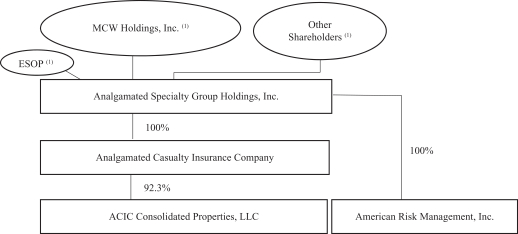
| (1) | Following completion of the conversion and the offerings, the respective ownership and voting percentages of the number of shares of the Company’s outstanding capital stock owned by MCW Holdings, Inc., the ESOP, and all other shareholders of the Company are as follows, assuming that 2,660,000 shares are sold in the offering, which is the midpoint of the offering range, and that all of the shares of Series A Preferred Stock have been converted to shares of common stock: |
| Ownership Percentage | Voting Percentage | |||||||
| MCW Holdings, Inc |
14.7 | % | 14.7 | % | ||||
| ESOP |
8.4 | % | 8.4 | % | ||||
| All other shareholders |
76.9 | % | 76.9 | % | ||||
The Conversion of ACIC from Mutual to Stock Form
ACIC is a District of Columbia mutual insurance company. As a mutual company, it has no shareholders but it does have members. A member of ACIC is the owner of an in force individual policy issued by ACIC.
Like shareholders, the members have certain rights with respect to ACIC, such as voting rights with respect to the election of members of the board of trustees and approval of certain fundamental transactions, including the conversion of ACIC from mutual to stock form. However, unlike shares held by shareholders, the memberships in ACIC are not transferable and do not exist separately from the related insurance policy issued by ACIC. Therefore, these membership rights are extinguished when a member’s policy with ACIC is terminated by surrender, lapse, nonrenewal, or cancellation. Those membership interests will also be extinguished upon conversion of ACIC from mutual to stock form in accordance with District of Columbia law and the plan of conversion.
The board of trustees of ACIC adopted a plan of conversion on February 3, 2021, under which ACIC will convert from a mutual insurance company to a stock insurance company. Following the conversion, ACIC will become a wholly-owned subsidiary of the Company. A special meeting of the members of ACIC eligible to vote (those persons who were members of ACIC as of the close of business on February 3, 2021) will be held on [●],
5
Table of Contents
2021 (special meeting date), to approve the plan of conversion. To become effective, the plan must be approved by the affirmative vote of at least a majority of the votes cast at the special meeting.
The sale of sufficient shares to meet the offering minimum of 2,260,000 shares does not indicate that sales have been made to investors who have no financial or other interest in the offering, and the sale of 2,260,000 shares in the offering should not be viewed as an indication of the merits of the offering.
The Subscription Offering
We are offering shares of our common stock in a subscription offering. The subscription offering will end at noon, Eastern Time, on [●], 2021. In the subscription offering, 3,060,000 shares of common stock are being offered in the following order of priority: first, to the policyholders of ACIC as of the close of business on February 3, 2021, whom we refer to as eligible members, second, to our ESOP, and third, to the trustees, officers, and employees of ACIC.
The number of shares of common stock issued in the offerings will not exceed 3,060,000 shares. Shares purchased by the ESOP and by the trustees, officers, and employees of ACIC will be purchased for investment and not for resale and will be counted toward satisfaction of the minimum amount needed to complete this offering.
Except for any shares of restricted stock that will be granted to officers and directors of the Company upon completion of the offerings, and which will be subject to the satisfaction of certain conditions of vesting, the shares issued in the offerings will constitute all of the outstanding shares of the Company’s common stock after completion of the offerings.
The Public Offering
If less than 2,260,000 shares are subscribed for in the subscription offering, we will offer the remaining shares to the general public. The public offering will end at noon, Eastern Time, on [●], 2021.
The following table shows those persons that are eligible to purchase shares in the various phases of the offering and the shares available for purchase in each phase of the offering. We expect to conduct the subscription offering and the public offering simultaneously.
| Offering |
Eligible Purchasers |
Shares Available for Purchase | ||
| Subscription Offering | Policyholders of ACIC at February3, 2021; | 3,060,000 shares | ||
| The ESOP; and | 302,940 shares | |||
| Officers, trustees and employees of ACIC. | 3,060,000 shares, less shares subscribed for by eligible members and the ESOP | |||
| Public Offering | The general public. | 3,060,000 shares, less shares subscribed for in the subscription offering |
Redemption of Subscription Rights
Under the plan of conversion, each eligible member was granted the right to cause the Company to redeem such member’s right to purchase shares in the subscription offering, provided such member does not exercise his or her right by purchasing shares in the offering. Each eligible member may either:
| • | Exercise his or her subscription right by purchasing shares in the offering at the offering price of $10.00 per share; or |
| • | Elect, either affirmatively or by failing to purchase any shares in the offering, to have the Company redeem for cash such eligible member’s subscription right. Each eligible member who does not purchase any shares in the offering will receive cash in the amount of $1,489.87. |
6
Table of Contents
The redemption price for the subscription rights was determined by Boenning & Scattergood, Inc. (“Boenning”) in accordance with the valuation parameters specified in ACIC’s plan of conversion, including, but not limited to, the use of the Black-Scholes option pricing methodology. An eligible member would be able to purchase approximately 149 shares of the Company’s common stock in the subscription offering with the amount of cash that such member will receive as the redemption price for his subscription rights if the member elects not to purchase shares in the offering.
Any eligible member who has his or her subscription right redeemed will not be permitted to purchase shares of Company common stock in the offering. See “The Conversion and the Offering — Redemption of Subscription Rights for Cash.”
The following table presents a summary of selected pricing ratios for the peer group companies, and the resulting pricing ratios for the Company as converted. Compared to the average as converted pricing ratios of the peer group, the Company’s pro forma fully converted pricing ratios at the midpoint of the offering range indicated a discount of 51.4% on an as converted price-to-earnings basis, a discount of 33.2% on an as converted price-to-book value basis and a discount of 28.2% on an as converted price-to-tangible book value basis.
| As Converted Pro Forma Price-to-Earnings Multiple(1) |
As Converted Pro Forma Price-to-Book Value Ratio(1) |
As Converted Pro Forma Price-to- Tangible Book Value Ratio(1) |
||||||||||
| Amalgamated |
||||||||||||
| Maximum |
7.8 | 51.2 | % | 55.2 | % | |||||||
| Midpoint |
6.7 | 47.8 | % | 51.6 | % | |||||||
| Minimum |
5.6 | 43.9 | % | 47.7 | % | |||||||
| Valuation of peer group companies as of December 29, 2020(2) |
||||||||||||
| Averages |
16.2 | 81.9 | % | 83.6 | % | |||||||
| Medians |
13.8 | 71.6 | % | 71.9 | % | |||||||
| (1) | See the footnotes to the table at “Pro Forma Information — Additional Pro Forma Information” for the assumptions underlying the pro forma data. |
| (2) | Information for the peer group companies is based upon actual earnings for the twelve months ended September 30, 2020, and information for the Company is based upon actual earnings for the twelve months ended December 31, 2020. |
The fully converted pro forma calculations for the Company are based on the following assumptions:
| • | A number of shares equal to 9.9% of the shares sold in the conversion are purchased by the employee stock ownership plan, with the expense to be amortized over 10 years; and |
| • | no effect is given to any shares that may be issued pursuant to restricted stock awards and stock options that will be granted to directors and officers of the Company and ACIC upon the closing of the offering. |
The independent appraisal does not indicate trading market value. Do not assume or expect that our valuation as indicated in the appraisal means that after the offering the shares of our common stock will trade at or above the $10.00 per share price. Furthermore, Boenning used the pricing ratios presented in the appraisal to estimate our pro forma appraised value for regulatory purposes and not to compare the relative value of shares of our common stock with the value of the capital stock of the peer group. The value of the capital stock of a particular company may be affected by a number of factors such as financial performance, asset size and market location.
7
Table of Contents
For a more complete discussion of the amount of common stock we are offering for sale and the independent appraisal, see “The Conversion and Offering — The Appraisal.”
Conditions to Completion of the Conversion and this Offering
Before we can complete this offering and issue our common stock, the members of ACIC eligible to vote must approve the plan of conversion and we must sell at least the minimum number of shares offered in the offerings. No funds will be released from the escrow account until all of these conditions have been satisfied.
In 2011, MCW received approval from the Department to be the ultimate controlling party of ACIC in its mutual form. As detailed in the conversion application, which was approved on [●], 2021, MCW will have a controlling interest in our stock.
Termination of this Offering
We have the right to cancel this offering at any time. In addition, the completion of this offering is subject to market conditions and other factors beyond our control. If this offering is not completed, all funds received will be promptly returned to purchasers without interest.
Stock Pricing and Number of Shares to be Issued
The plan of conversion requires that the number of shares to be issued in connection with the conversion must be based on the range of valuation of our estimated consolidated pro forma market value. Under the plan of conversion, the valuation must be in the form of a range consisting of a midpoint valuation, a valuation fifteen percent (15%) above the midpoint valuation, and a valuation fifteen percent (15%) below the midpoint valuation. We retained Boenning to determine the valuation range for this offering. Boenning has determined that, as of December 30, 2020, the estimated consolidated pro forma market value of ACIC is $26.6 million at the midpoint, and the range of value of the total number of shares of common stock to be issued in the offering is between a minimum value of $22.6 million and a maximum value of $30.6 million. We plan to issue between 2,260,000 and 3,060,000 shares of our common stock in this offering. This range was determined by dividing the $10.00 price per share into the range of Boenning’s valuation. Shares purchased by the ESOP and the trustees, officers, and employees of ACIC will be purchased for investment and not for resale and will be counted toward satisfaction of the minimum amount needed to complete this offering.
We determined to offer the common stock in the subscription offering at the price of $10.00 per share to ensure a sufficient number of shares are available for purchase by eligible members. In addition, Griffin Financial Group, LLC. (“Griffin”) advised us that the $10.00 per share offering price is commonly used in mutual-to-stock conversions of other insurance companies and savings banks and savings associations that use the subscription rights conversion model. These were the only factors considered by our board of trustees in determining to offer shares of common stock at $10.00 per share.
How Do I Buy Stock in this Offering?
If you wish to purchase shares of common stock in the subscription offering, you must sign and complete the stock order form that accompanies this offering circular and send it to us with your payment such that your order is received before the offering deadline. You may submit your order to us by overnight delivery to the address indicated for this purpose on the top of the stock order form or by mail using the stock order reply envelope provided. Payment by personal check, cashier’s check or money order must accompany the stock order form. No cash or third party checks will be accepted. All checks or money orders must be made payable to “Computershare Trust Company, N.A., escrow agent, on behalf of Amalgamated Specialty Group Holdings, Inc.” We may permit certain persons who submit orders in the public offering to make payment by a wire transfer to the escrow agent of the purchase price for any shares that they seek to purchase.
8
Table of Contents
The completed stock order form and payment in full for the shares ordered must be received (not postmarked) no later than noon, Eastern Time, on [●], 2021. Once submitted, your order is irrevocable without our consent unless we terminate this offering. Our consent to any modification or withdrawal request may or may not be given in our sole discretion. We may reject a stock order form if it is incomplete, improperly completed, or not timely received.
How Do I Elect to Have My Subscription Right Redeemed by the Company?
Each eligible member is granted the right under the plan of conversion to purchase shares in the subscription offering. Eligible members may elect to have their subscription right redeemed by the Company for cash equal to $1,489.87 per eligible member. You may elect to have your subscription right redeemed by making such election on the stock order form that accompanies this offering circular and signing and returning it in the envelope provided. Any eligible member that does not purchase shares in the offering will be deemed to have elected to have such subscription right redeemed for cash. See “The Conversion and the Offering — Redemption of Subscription Right for Cash.”
Offering Deadline
All subscription rights will expire at noon, Eastern Time, on [●], 2021. Subscription rights not exercised prior to the termination date of this offering will be void, whether or not we have been able to locate each person entitled to receive subscription rights.
Limits on Your Purchase of Common Stock
The plan of conversion and District of Columbia law establish the following minimum and maximum purchase limitations for participants (including such participants’ associates or a group acting in concert) in the subscription offering:
| • | No person may purchase fewer than 50 shares in this offering. |
| • | No person other than the ESOP may purchase more than 100,000 shares in the subscription offering. |
| • | A person who is not an “accredited investor” as defined in Rule 501 of SEC Regulation D cannot purchase shares with an aggregate purchase price in excess of the greater of (x) 10% of their annual net income or net worth, as calculated in accordance with Rule 501 of Regulation D and (y) if the person is not a natural person, 10% of such person’s net assets or revenue for the most recently completed fiscal year. See “The Conversion and Offering — Limitations on Purchases of Common Stock.” |
| • | Subject to the prior right of each eligible member to subscribe for up to 100,000 shares in this offering, in no event may any person purchase more than 5% of the total number of shares sold in the subscription and public offerings without the prior approval of the Commissioner. |
| • | In addition to the limitations set forth above, no person may acquire, directly or indirectly, in this offering or any public offering, more than 5% of the capital stock of the Company for a period of five years from the effective date of the conversion without the approval of the Department. |
For purposes of the limitations described above, an associate of a person includes:
| • | any relative or spouse of such person, or any relative of such person’s spouse, who shares the same home as such person; |
| • | any corporation or other organization (other than the Company or a majority owned subsidiary of the Company) of which such person is an officer, director, or partner, or of which such person is, directly or indirectly, a beneficial owner of 10% or more of any class of equity securities; |
9
Table of Contents
| • | any trust or other estate in which such person has a substantial beneficial interest or as to which such person serves as trustee or in a similar fiduciary capacity (exclusive of any employee stock benefit plan of the Company, such as the ESOP); and |
| • | any person acting in concert with any of the persons or entities listed above. |
The subscription of any eligible member who subscribes for more than 100,000 shares will be reduced to 100,000 shares.
We have the right in our absolute discretion and without liability to any participant in the subscription offering or to any other person to determine which persons and which subscriptions and orders in this offering meet the criteria provided in the plan of conversion for eligibility to purchase shares of common stock and the number of shares eligible for purchase by any person. Our determination of these matters will be final and binding on all parties and all persons.
Oversubscription
If you are an eligible member and we receive subscriptions in the subscription offering for more than 3,060,000 shares, your requested subscription for shares may be reduced.
If eligible members in the aggregate subscribe for more than 3,060,000 shares, the shares of common stock will be allocated so as to permit each subscribing eligible member to purchase up to the lesser of the number of shares subscribed for or 1,000 shares. Any remaining shares will be allocated among the eligible members whose subscriptions remain unsatisfied in the proportion in which the number of shares as to which each such eligible member’s subscription remains unsatisfied bears to the aggregate number of shares as to which all such eligible members’ subscriptions remain unsatisfied.
Management Purchases of Stock
If the eligible members and the ESOP subscribe for less than the maximum number of shares, the trustees, officers, and employees of ACIC, together with their affiliates and associates, have indicated their intention to purchase up to approximately 800,000 shares of common stock in the subscription offering. The trustees, officers, and employees of ACIC and their affiliates and associates are not obligated to purchase this number of shares, and in the aggregate they may purchase a greater or smaller number of shares. See “The Conversion and Offering — Proposed Management Purchases.”
If there are insufficient shares remaining after the subscriptions of eligible members and the ESOP to satisfy in full all of the subscriptions of trustees, officers, and employees of ACIC, the available shares of common stock will be allocated among the subscribing trustees, officers, and employees in the proportion in which the number of shares as to which each such person subscribed bears to the aggregate number of shares remaining.
Undersubscription
If less than 2,260,000 shares are subscribed for in the subscription and public offerings, we will promptly return all funds received in the offerings to purchasers, without interest. In that event, we may cause a new valuation of ACIC to be performed, and based on this valuation amend the Offering Statement of which this offering circular is a part and commence a new offering of our common stock. In that event, people who submitted subscriptions or orders will be permitted to submit new subscriptions or orders. See “The Conversion and the Offering — Resolicitation.” Shares purchased by the ESOP and by directors, trustees, officers, and employees in the offering will be counted towards satisfying the requirement that at least 2,260,000 shares must be sold in the offerings.
10
Table of Contents
Benefits to Management
Our board of directors has also adopted a stock based incentive plan for the benefit of our directors, executive officers, and other eligible employees. Under the stock based incentive plan, we may award options to purchase common stock or award shares of restricted stock or restricted stock units to directors, executive officers, and other eligible employees. The exercise price of stock options will be no less than the fair market value of our common stock on the date of the option award. All awards under the stock based incentive plan will be subject to such vesting, performance criteria, or other conditions as the compensation committee of our board of directors may establish. Restricted stock units, shares of restricted stock, and options to purchase shares in an amount equal to 14.0% of the number of shares issued in the offerings may be awarded under the stock based incentive plan, provided that the total number of shares represented by restricted stock units and restricted shares can be no more than 4.0% of the number of shares issued in the offerings.
As discussed in more detail under “Executive Compensation,” we expect that grants of stock options to purchase 260,000 shares will be made to our executive officers and grants of 15,000 shares of restricted stock will be made to our non-employee directors, subject to completion of this offering.
The following table presents information regarding the participants in the stock based incentive plan, and the total amount, the percentage, and the dollar value of the stock that we intend to set aside for the stock based incentive plan. The table assumes the following:
| • | that 2,260,000 shares will be sold in the offerings; and |
| • | that the value of the stock in the table is $10.00 per share. |
The exercise price of any options granted under the stock based incentive plan will be at least equal to the fair market value of the stock on the day the options are awarded or, in the case of options granted at the time of this offering, the price at which stock is sold in this offering. As a result, anyone who receives an option will benefit from the option only if the price of the stock rises above the exercise price and the option is exercised. The numbers in the following table assumes that 2,660,000 shares are sold in the offering, which is the midpoint of the offering.
| Stock Based Incentive Plan |
Individuals |
Number of Shares |
Percentage of shares issued in the offering |
Value of shares Based on $10.00 Share Price |
||||||||||
| ESOP |
All full time employees | 263,340 | 9.9 | % | $ | 2,633,400 | ||||||||
| Shares available for restricted stock or restricted stock unit awards |
Directors and selected officers | 106,400 | (1) | 4.0 | % | $ | 1,064,000 | |||||||
| Shares available for stock options |
Directors and selected officers | 266,000 | (1) | 10.0 | % | (1 | ) | |||||||
| (1) | Assumes that options to purchase 10% of the number of shares issued in the offering are awarded under the plan and shares of restricted stock or restricted stock unit awards equal to 4.0% of the number of shares issued in the offerings are granted under the plan. Stock options will be granted with a per share exercise price at least equal to the market price of our common stock on the date of the grant. The value of a stock option will depend, among other things, upon increases, if any, in the price of our common stock during the term of the option. |
A minimum of 2,260,000 shares and a maximum of 3,060,000 shares of our common stock will be issued in the subscription and public offerings, excluding any shares that may be issued under our stock based incentive plan.
11
Table of Contents
Use of Proceeds
We estimate the net proceeds from the offerings will be approximately $15.0 million at the minimum, $18.3 million at the midpoint, and $21.7 million at the maximum of the offering range. See the “Offering Summary” on the front cover of this offering circular for the assumptions used to arrive at these amounts. The amount of net proceeds from the sale of common stock in the offerings will depend on the total number of shares actually sold in the subscription and public offerings.
We expect to use up to approximately $2.4 million of the net proceeds of the offerings to pay the redemption price for subscriptions redeemed by eligible members. We may use a portion of the net proceeds to repay all or part of the $1.4 million of indebtedness that we will assume as part of the purchase of ARM. We plan to contribute approximately $2.0 million of the net proceeds from the offerings to ACIC, which will be used to (i) support organic growth of our insurance business; (ii) fund new product launches; and (iii) selectively deploy new capital to retain, acquire, and bolster talent in key areas.
We expect to retain any remaining net proceeds from the offerings at the Company, to be used for general corporate purposes, which may include acquisitions of other insurance companies or related businesses, and stock repurchases or cash dividends, including dividends on our Series A Preferred Stock. On a short term basis, the proceeds retained at the Company will be invested primarily in securities consistent with our investment strategy until utilized. We have no other current specific plans for use of the net proceeds of the offering. See “Use of Proceeds.”
Dividend Policy
Following completion of this offering, our board of directors will have the authority to declare dividends on our shares of common stock, subject to statutory and regulatory requirements. Any decision to pay a dividend will depend on many factors, including our financial condition and results of operations, liquidity requirements, market opportunities, capital requirements of our subsidiaries, legal requirements, regulatory constraints, intercompany dividends from our subsidiaries, and other factors as the board of directors deems relevant.
We currently expect to pay quarterly cash dividends on our Series A Preferred Stock when such dividends are due. The accrued dividends payable on our Series A Preferred Stock will total $468 thousand per year. For additional information regarding restrictions on our ability to pay dividends, see “Dividend Policy.”
Market for Common Stock
We do not intend to apply for the listing of our common stock on the NASDAQ Capital Market or any other stock exchange. People considering purchasing shares in the offerings should note that this will materially and adversely affect the liquidity of our stock. See “Risk Factors — Risks Relating to Ownership of Our Common Stock — Our shares will not be listed on any stock exchange, and there will not be an active, liquid market for our common stock.” We intend to apply to have “buy” and “sell” quotes for shares of our common stock reported on the “OTC Pink” market by broker-dealers that agree to make a market in our common stock. We may also engage in share repurchases from time to time if we determine that we have excess capital.
How You May Obtain Additional Information Regarding this Offering
If you have any questions regarding the stock offering, please call the Stock Information Center at (610) 205-6005, Monday through Friday between 10:00 a.m. and 4:00 p.m., Eastern Time.
12
Table of Contents
An investment in our common stock involves a number of risks. Before making a decision to purchase our common stock, you should carefully consider the following information about these risks, together with the other information contained in this offering circular. Many factors, including the risks described below, could result in a significant or material adverse effect on our business, financial condition, and results of operations. If this were to happen, the price of our common stock could decline significantly and you could lose all or part of your investment.
Risks Relating to Our Business
ACIC has incurred both statutory and GAAP net losses in recent years.
ACIC has incurred both statutory and GAAP net losses in three of the last six years. ACIC’s losses are due principally to high loss ratios resulting from our expansion into unprofitable non-core product lines such as non-emergency medical transportation and into unprofitable states, as well as prevailing low returns on our investment portfolio. We need to increase the sales of our profitable core insurance products and deploy new profitable insurance products, by investing in new product development, expanding distribution capability, and implementing technology solutions in order to continue our return to profitability.
If we cannot expand our distribution network and resulting sales of our products, we may incur further losses.
Our ability to increase sales of our existing and new insurance products will depend on our success in expanding our distribution network. We depend on ARM, ACIC’s controlling producer, and on its network of independent insurance agents to generate almost all of the sales of our insurance products. If we are unable to increase sales to customers by establishing relationships with other distribution partners, it may be difficult to remain profitable.
The impact of COVID-19 and responses thereto, and related risks, could continue to materially affect our results of operations, financial position, and/or liquidity.
Beginning in March 2020, the global pandemic related to novel coronavirus COVID-19 started to impact the global and U.S. economy. The extent of this pandemic continues to evolve, thus the full direct and indirect impacts of COVID-19 are not yet known and may not emerge for some time. ACIC has experienced a decrease in premiums due to the COVID-19 pandemic, that has negatively impacted our taxi cab and sedan customers, who are highly exposed to the travel and leisure industries. Those industries have been adversely impacted by COVID-19, and our premiums may continue to decrease as the travel and leisure industries remain depressed and our insureds seek to limit expenses, including the cost of insurance.
Federal, state, and local government actions to address and contain the impact of COVID-19 may adversely affect us. For example, we could be subject to proposed legislative and/or regulatory action that seeks to retroactively mandate coverage for losses which our insurance policies were not designed or priced to cover. Currently, in some states, there is proposed legislation to require insurers to cover business interruption claims irrespective of terms, exclusions, or other conditions included in the policies that would otherwise preclude coverage. Regulatory restrictions or requirements could also impact pricing, risk selection, and our rights and obligations with respect to our policies and insureds, including our ability to cancel policies or our right to collect premiums. At least one state regulator has issued an order requiring insurers to issue premium refunds, and regulators in other states could take similar actions. It is also possible that changes in economic conditions and steps taken by federal, state, and local governments in response to COVID-19 could require an increase in taxes at the federal, state, and local levels, which would adversely impact our results of operations and place further stress on our insureds.
Our corporate fixed income portfolio may be adversely impacted by ratings downgrades, increased bankruptcies, and credit spread widening in distressed industries. In addition, many state and local governments
13
Table of Contents
may be operating under deficits or projected deficits. These deficits may be exacerbated by the costs of responding to COVID-19 and reduced tax revenues due to adverse economic conditions. The severity and duration of these deficits could have an adverse impact on the collectability and valuation of our municipal bond portfolio. Our investment portfolio also includes residential and commercial mortgage-backed securities, which could be adversely impacted by declines in real estate valuations and/or financial market disruption, including a heightened collection risk on the underlying mortgages. Further disruptions in global financial markets due to the continuing impact of COVID-19 could result in additional net realized and unrealized investment losses. In addition, declines in fixed income yields would result in decreases in net investment income from future investment activity, including re-investments.
We expect that the impact of COVID-19 on general economic activity may continue to negatively impact our premium volumes. We have experienced this impact in the last three quarters of 2020 and this impact may further persist for much of 2021, but the degree of the impact will depend on the extent and duration of the economic contraction. As a result of the anticipated impact of the pandemic on our earned premiums, our underwriting expense ratio may increase in the near term.
It is possible that changes in economic conditions and steps taken by the federal government and the Federal Reserve in response to COVID-19 could lead to higher inflation than we had anticipated, which could in turn lead to an increase in our loss costs and the need to strengthen claims and claim adjustment expense reserves. These impacts of inflation on loss costs and claims and claim adjustment expense reserves could be more pronounced for those types of claims that require a relatively longer period of time to finalize and settle and, accordingly, are relatively more inflation sensitive. Inflation could also adversely impact our general and administrative expenses. Changes in interest rates caused by inflation affect the carrying value of our fixed maturity investments and returns on our fixed maturity and short-term investments. An increase in interest rates reduces the market value of existing fixed maturity investments, thereby negatively impacting our book value.
Our results of operations have been adversely affected by the current low interest rate environment and will continue to be adversely affected if interest rates remain low or if interest rates should rapidly increase.
Although the Federal Reserve moved to marginally increase short-term interest rates from 2015 to December 2019, medium and long-term interest rates have remained at historically low levels. In response to the economic downturn resulting from the COVID-19 pandemic, the Federal Reserve has cut short-term interest rates to near record lows. During a period of decreasing interest rates or a prolonged period of low interest rates, our investment earnings may decrease because the interest earnings on our recently purchased fixed income investments will likely have declined in parallel with market interest rates. In addition, callable fixed income securities in our investment portfolio will be more likely to be prepaid or redeemed as borrowers seek to borrow at lower interest rates. Consequently, we may be required to reinvest the proceeds in securities bearing lower interest rates. An extended period of declining or prolonged low interest rates may also cause us to change our assumptions of the interest rates that we can earn on our investments and the long-term interest rate that we assume in our calculation of insurance assets and liabilities under GAAP. This revision would result in increased reserves, accelerated amortization of deferred acquisition costs (“DAC”), and other unfavorable consequences. In addition, certain statutory capital and reserve requirements are based on formulas or models that consider interest rates, and an extended period of low interest rates may increase the statutory capital we are required to hold and the amount of assets we must maintain to support statutory reserves.
Conversely, an increase in market interest rates could also have a material adverse effect on the value of our investment portfolio by, for example, decreasing the estimated fair values of the fixed income securities within our investment portfolio. Also, certain statutory reserve requirements are based on formulas or models that consider forward interest rates and an increase in forward interest rates may increase the statutory reserves we are required to hold, thereby reducing statutory capital.
14
Table of Contents
Our B++ rating from A.M. Best limits our ability to attract agents and to sell rating sensitive products.
ACIC is rated B++ by A.M. Best. This rating adversely affects our ability to attract agents and sell our products because ratings assigned by A.M. Best are an important factor influencing the competitive position of insurance companies. Financial strength ratings are used by producers and customers as a means of assessing the financial strength and quality of insurers. A.M. Best ratings, which are reviewed at least annually, represent independent opinions of financial strength and ability to meet obligations to policyholders and are not directed toward the protection of investors. Any future downgrade of our A.M. Best rating could negatively affect our ability to implement our strategy. See “Business — Competition and Ratings.”
We rely on our systems and employees, and those of certain third-party vendors and service providers, in conducting our operations, and certain failures, operational errors, systems malfunctions, or cyber-security incidents, could materially adversely affect our operations.
We are exposed to many types of operational risk, including clerical and recordkeeping errors, and computer or telecommunications systems malfunctions. If any of our operational, accounting, or other data processing systems fail or have other significant shortcomings, we could be materially adversely affected. We use a third party servicer to provide all of our data processing and storage functions. While our third party provider takes commercially reasonable measures to keep their systems and our data secure, it is difficult or impossible to defend against all risks being posed by changing technologies as well as criminals intent on committing cybercrime. Increasing sophistication of cyber criminals and terrorists make keeping up with new threats difficult and could result in a breach. As a result, our outside service provider may be unable to anticipate the type or manner of attempts to breach their security or to implement adequate preventative measures against these attempts. We may be required to expend significant capital to alleviate problems caused by security breaches.
Any breach or perceived breach of our security could damage our reputation and our relationship with our policyholders and agents. Reputational damage of this kind could significantly harm our business. For example, insureds and agents may be less likely to use our products following a breach because of a perceived weakness in our information security measures. Additionally, we could be subject to significant liability as well as regulatory action, which would have a material and adverse effect on our business, financial condition, results of operations, and prospects.
Our operations are dependent on access to key technology tools; if we lose access to these tools, our ability to conduct business could be significantly impaired.
In the event of a disaster such as a natural catastrophe, an epidemic, an industrial accident, a blackout, a computer virus, a terrorist attack, a cyber-attack, or a war that causes the data processing systems of our third party servicers to not function, unanticipated problems with our disaster recovery systems would have an adverse impact on our ability to conduct business and on our results of operations and financial position, particularly if those problems affect our internet access, computer-based data processing, transmission, storage and retrieval systems or destroy valuable data. Despite such third party servicers’ implementation of security measures, disaster recovery plans, system backup plans, and offsite arrangements to reduce the risk of a loss of access to these critical systems, there is no assurance that these security measures and backup plans will work when needed or would protect the Company in all circumstances that could arise. An interruption in our business because of our inability to access our key technology tools could result in the loss of revenue and damage to our reputation, and could have a material and adverse effect on our business, financial condition, results of operations, and prospects.
In the ordinary course of our business we can face coverage disputes and lawsuits that are expensive and time consuming and may include claims for extra-contractual damages, which, if resolved adversely, could harm our business, financial condition, or results of operations.
From time to time, we are involved in coverage and other types of lawsuits in the ordinary course of our business. Defending these claims is costly and can impose a significant burden on our management and
15
Table of Contents
employees. We utilize reinsurance to limit our exposure on the insurance policies we issue. Our reinsurance arrangements provide a level of coverage for extra-contractual damages, subject to the terms and limits of those arrangements. If we are found to be liable for significant extra-contractual damages in future cases, however, there could be a material and adverse effect on our business, financial condition, results of operations, and prospects.
Legal and regulatory investigations and actions are increasingly common in the insurance business and may result in financial losses and harm our reputation.
We face a risk of litigation and regulatory investigations and actions in the ordinary course of operating our business, including the risk of class action lawsuits. ACIC may become subject to class actions and regulatory actions or may become subject to individual lawsuits relating, among other things, to sales or underwriting practices, payment of contingent or other sales commissions, claims payments and procedures, product design, disclosure, administration, additional premium charges for premiums paid on a periodic basis, denial or delay of benefits, and breaches of fiduciary or other duties to customers. Plaintiffs in class action and other lawsuits against ACIC may seek very large or indeterminate amounts, including punitive and treble damages, which may remain unknown for substantial periods of time.
ACIC is also subject to various regulatory inquiries, such as information requests, subpoenas, market conduct exams, and books and record examinations, from state and federal regulators and other authorities, which may result in fines, recommendations for corrective action or other regulatory actions. Current or future investigations, proceedings, or regulatory actions could have an adverse effect on our business, results of operations, and financial condition. Moreover, even if we ultimately prevail in the investigation, proceeding, or regulatory action, we could suffer significant reputational harm, which could have an adverse effect on our business. Increased regulatory scrutiny and any resulting investigations or proceedings could result in new legal actions or precedents and industry-wide regulations or practices that could have a material and adverse effect on our business, financial condition, results of operations, and prospects.
We rely on the leadership of the members of our executive management team. The loss of any of these executives could have an adverse impact on our business and our ability to implement our business strategy.
The success of our business is dependent, to a large extent, on our ability to attract and retain key employees including the following members of our executive management team: Patrick Bracewell, Chairman, President and Chief Executive Officer; Daniel McFadden, Treasurer and Secretary; Richard Hutchinson, President and Chief Operating Officer of ACIC, Brian Mancino, Vice President — Distribution of ACIC; Michael McColley, Vice President — Insurance Operations of ACIC; and Joseph Niemer, Vice President — Digital Commerce and Technology of ACIC. Our executive management team has extensive experience in the insurance business. Were we to lose any of these employees, it may be challenging for us to attract a replacement employee with comparable skills and experience in our market niches. Except for the employment agreement with Patrick Bracewell, we do not have employment agreements with our executive officers. See “Executive Compensation- Employment Agreements.” We do not currently maintain key man life insurance policies with respect to any member of our senior management team.
We may be required to establish an additional valuation allowance against deferred income tax assets if our business does not generate sufficient taxable income or if our tax planning strategies are modified, which could have a material adverse effect on our results of operations and financial condition.
Deferred income tax represents the tax effect of the differences between the financial accounting and tax basis of assets and liabilities. Deferred tax assets represent the tax benefit of future deductible temporary differences, operating loss carryforwards, and tax credit carryforwards. We periodically evaluate and test our ability to realize our deferred tax assets. Deferred tax assets are reduced by a valuation allowance if, based on the weight of evidence, it is more likely than not that some portion, or all, of the deferred tax assets will not be
16
Table of Contents
realized. In assessing the more likely than not criteria, we consider future taxable income as well as prudent tax planning strategies. Future facts, circumstances, tax law changes, and financial accounting or GAAP developments may result in an increase in the valuation allowance. An increase in the valuation allowance could have a material adverse effect on the Company’s results of operations and financial condition.
As of December 31, 2020, ACIC had recorded a valuation allowance of $221 thousand to the net deferred tax asset of $221 thousand. To the extent we are required to establish an additional valuation allowance against future deferred income tax assets, the amount of such valuation allowance would be charged against our net income for the period in which that valuation allowance is established, which could have a material and adverse effect on our business, financial condition, results of operations, and prospects.
We operate in a heavily state regulated industry, and the prospect exists for further federal involvement in the regulation of insurance companies.
Our business is regulated by government agencies in the states in which we do business, and we must comply with a number of state and federal laws and regulations. Most insurance regulations are intended to protect the interests of current and potential policyholders rather than those of shareholders and other investors in insurance services companies.
State laws and regulations that apply to us include those governing the financial condition of insurers, including standards of solvency, risk-based capital requirements, types, quality and concentration of investments, establishment and maintenance of reserves, required methods of accounting, reinsurance and requirements, and those governing the business conduct of insurers, including transactions with affiliates, sales and marketing practices, claim procedures and practices, and policy form content. In addition, state insurance laws require licensing of insurers and their agents. State insurance regulators have the power to grant, suspend, and revoke licenses to transact business and to impose substantial fines and other penalties.
We may be unable to comply fully with the wide variety of applicable laws and regulations that are frequently undergoing revision. In addition, we follow practices based on our interpretations of laws and regulations that we believe are generally followed by the insurance industry. These practices may be different from interpretations of insurance regulatory agencies. Moreover, in order to enforce applicable laws and regulations or to protect policyholders, insurance regulatory agencies have relatively broad discretion to impose a variety of sanctions, including examinations, corrective orders, suspension, revocation or denial of licenses, and the takeover of insurance companies. As a result, if we fail to comply with these laws and regulations, state insurance departments can exercise a range of remedies from the imposition of fines to being placed in rehabilitation or liquidation. State insurance departments also conduct periodic examinations of the affairs of insurance companies and require the filing of annual, quarterly, and other reports relating to financial condition, holding company issues and other matters. These regulatory requirements may adversely affect or inhibit our ability to achieve some or all of our business objectives. Changes in the level of regulation of the insurance industry or changes in laws or regulations or interpretations of laws and regulations by regulatory authorities could adversely affect our ability to operate our business.
We are subject to various accounting and financial requirements established by the National Association of Insurance Commissioners (“NAIC”) as adopted by the states in which we operate. In addition, state regulators and the NAIC continually re-examine existing laws and regulations, with an emphasis on insurance company solvency issues and fair treatment of policyholders. Insurance laws and regulations could change or additional restrictions could be imposed that are more burdensome. Because these laws and regulations are for the protection of policyholders, any changes may not be in your best interest as a shareholder.
The commercial auto specialty transportation insurance industry in which we operate is highly competitive, which may limit our ability to maintain and increase our share of our target market.
Our competition includes companies that are almost all larger and which have significantly more resources at their disposal. Competition in the commercial auto specialty transportation insurance industry is based on
17
Table of Contents
many factors. These factors include the perceived financial strength of the insurer, premiums charged, policy terms and conditions, services provided, reputation, financial ratings assigned by independent rating agencies, and the experience of the insurer in the line of insurance to be written.
Certain of the insurance companies we compete against have substantially greater financial, technical, and operating resources than we have. The line of insurance we write is subject to significant price competition. If our competitors price their products aggressively, our ability to grow or renew our business may be adversely affected. We pay producers on a commission basis to produce business. Some of our competitors may offer higher commissions or offer insurance products at lower premium rates. Increased competition could adversely affect our ability to attract and retain business and thereby adversely affect our business, financial condition, or results of operations.
We also compete for access to talented independent agents. Much of the competition for talent involves agent recruitment. If our competitors provide the agents with better technology, pay higher commissions, or provide access to products that are perceived to be better than those we can provide, our ability to attract and retain agents may be reduced, which could have a material and adverse effect on our business, financial condition, results of operations, and prospects.
We expect that our ability to use beneficial U.S. tax attributes will be subject to limitations.
At December 31, 2020, ACIC had $11.6 million in tax loss carryforwards. Section 382 of the U.S. Internal Revenue Code of 1986, as amended (the “Code”), operates as an anti-abuse rule, the general purpose of which is to prevent trafficking in tax losses, but which can apply without regard to whether a “loss trafficking” transaction occurs or is intended. Similar rules apply to capital loss carryforwards. These rules are triggered when an “ownership change” -generally defined as when the ownership of a company, or its parent, changes by more than 50% (measured by value) on a cumulative basis in any three-year period-occurs and the company is a “loss” corporation. A company is a loss corporation if, at the date of the ownership change, the company has a tax loss carryforward which may be used in a tax year after the ownership change. When triggered, the amount of the taxable income for any post-change year which may be offset by a pre-change loss is subject to an annual limitation. An annual limitation not used in one year may be carried over to a subsequent year. Generally speaking, the annual limitation is derived by multiplying the fair market value of the stock of the taxpayer immediately before the date of the ownership change by the applicable federal long-term tax-exempt rate. In addition, to the extent that a company has a net unrealized built-in loss or deduction at the time of an ownership change, Section 382 of the Code limits the utilization of any such loss or deduction which is realized and recognized during the 5-year period following the ownership change.
The Tax Cut and Jobs Act enacted in December 2017 limits the deduction for net operating losses to 80% of current year taxable income and eliminates the deduction for net operating loss carrybacks. Following the completion of this offering, we expect that these limitations will apply, which could substantially limit our ability to utilize our net operating loss carryforwards.
Our pension plan obligations are currently underfunded, and we may have to make significant cash contributions to our plan, which could reduce the cash available for our business.
Our pension plan is estimated to be underfunded by $444 thousand as of December 31, 2020. We incur costs relating to pension benefits, which can vary substantially as a result of volatility in investment returns on pension plan assets and changes in discount rates used to calculate related liabilities. Our estimates of liabilities and expenses for pension benefits require the use of assumptions, including assumptions relating to the rate used to discount the future estimated liability, the rate of return on plan assets, and several assumptions relating to the employees covered by our pension plan, such as mortality. Actual results may differ, which may have a material adverse effect on our business, prospects, financial condition or results of operations. Future volatility and disruption in the financial markets could cause a decline in the asset values of our pension plan. In addition, a
18
Table of Contents
decrease in the discount rate used to determine minimum funding requirements could result in increased future contributions. If either occurs, we may need to make additional pension contributions above what is currently estimated, which could reduce the cash available for our businesses.
Risks Relating to Our Insurance Business
Our results may fluctuate as a result of many factors, including cyclical changes in the insurance industry, which may lead to reduced premium volume.
Results of companies in the insurance industry, and particularly the property and casualty insurance industry, historically have been subject to significant fluctuations and uncertainties. The industry’s profitability can be affected significantly by:
| • | rising levels of actual costs that are not known by companies at the time they price their products; |
| • | volatile and unpredictable developments, including man-made and natural catastrophes; |
| • | changes in reserves resulting from the general claims and legal environments as different types of claims arise and judicial interpretations relating to the scope of insurers’ liability develop; and |
| • | fluctuations in interest rates, inflationary pressures and other changes in the investment environment, which affect returns on invested capital and may impact the ultimate payout of losses. |
Historically, the financial performance of the insurance industry has fluctuated in cyclical periods of low premium rates and excess underwriting capacity resulting from increased competition (a so-called “soft market”), followed by periods of high premium rates and a shortage of underwriting capacity resulting from decreased competition (a so-called “hard market”). Fluctuations in underwriting capacity, demand and competition, and the impact on our business of the other factors identified above, could have a negative impact on our results of operations and financial condition.
Because estimating future losses is difficult and uncertain, if our actual losses exceed our loss reserves, our operating results may be adversely affected.
ACIC maintains reserves to cover amounts it estimates will be needed to pay for insured losses and for the expenses necessary to settle claims. Estimating loss and loss expense reserves is a difficult and complex process involving many variables and subjective judgments. ACIC regularly reviews its reserve estimate protocols and its overall amount of reserves. ACIC reviews historical data and considers the impact of various factors such as:
| • | trends in claim frequency and severity; |
| • | information regarding each claim for losses; |
| • | legislative enactments, judicial decisions and legal developments regarding damages; and |
| • | trends in general economic conditions, including inflation. |
Our actual losses could exceed our reserves. If we determine that our loss reserves are inadequate, we will have to increase them. This adjustment would reduce income during the period in which the adjustment is made, which could have a material adverse impact on our financial condition and results of operations. Such adjustments to loss reserve estimates are referred to as “loss development.” If existing loss reserves exceed the revised estimate, it is referred to as positive loss development. Negative loss development occurs when the revised estimate of expected losses with respect to a calendar year exceed existing loss reserves. For additional information, see “Business — Loss and LAE Reserves.”
Assessments and premium surcharges for state guaranty funds may reduce our profitability.
Most states require insurance companies licensed to do business in their state to participate in guaranty funds, which require the insurance companies to bear a portion of the unfunded obligations of impaired, insolvent
19
Table of Contents
or failed insurance companies. These obligations are funded by assessments, which are expected to continue in the future. State guaranty associations levy assessments, up to prescribed limits, on all member insurance companies in the state based on their proportionate share of premiums written in the lines of business in which the impaired, insolvent or failed insurance companies are engaged. Accordingly, the assessments levied on us may increase as we increase our written premiums. See “Business — Regulation.”
The actual experience of our insurance products can differ from the assumptions used to develop and price our insurance products, which can cause us to experience losses from these products.
To develop our insurance products we make assumptions regarding policy persistency, frequency and severity of claims, the level of investment income that will be earned from investing the product cash flows, and our expenses to underwrite, sell, and service the policies. These assumptions, along with our anticipated profit levels, are used to develop the premiums that we will charge customers for our products. In many cases, these premium rates are level and cannot be raised during the initial term of the policy. Our operating results may be materially adversely impacted by variances between our pricing assumptions and our actual experience.
Our key product pricing assumptions are based on a combination of industry studies and other third party data as well as our own experience. We regularly monitor our experience and can adjust premium rates on new business sales should the actual results indicate trends or results that we believe need to be reflected. If the actual product experience for any of these areas varies adversely from the assumptions used to price our products, it could have a material and adverse effect on our business, financial condition, results of operations, and prospects.
Our investment performance may suffer as a result of adverse capital market developments, which may adversely affect our financial results and ability to conduct business.
We allocate a portion of the insurance premiums we receive from policyholders to fund reserves, which are invested until these amounts are needed to pay insured claims. We invest in various securities to earn incremental income. As of December 31, 2020, ACIC held fixed income and equity securities with an estimated fair value of $31.8 million. For the year ended December 31, 2020, ACIC had net investment income of $1.4 million.
Our investments are subject to a variety of risks that are outside of our control, including risks relating to general economic conditions, market volatility, the extended low interest environment that currently exists, interest rate fluctuations, liquidity risk, and credit risk. For example, an unexpected increase in the number or level of claims may force us to liquidate securities in order to pay such claims. If the duration of our investments does not match our need for liquidity, we may be forced to liquidate investments prior to maturity at a significant loss to cover such payments. Investment losses could significantly decrease our asset base and capital position, thereby adversely affecting our ability to conduct business.
In the current economic environment, we are experiencing historically low interest rates across all fixed income investment markets. The effective yield or rate of our fixed income investments has declined as currently available interest rates on investments purchased are lower than the rates on our maturing investments. Low current interest rates have resulted in unrealized holding gains recorded as Other Comprehensive Income. However, if interest rates were to rise, it is possible that the market value of the securities and other investments we hold may decline, negatively affecting our earnings and capital level through realized and unrealized investment losses. If market interest rates remain at historically low levels our investment returns will continue to decline and our investment earnings will be reduced. This could have a material and adverse effect on our business, financial condition, results of operations, and prospects.
Some of our investments are relatively illiquid and are in asset classes that have been experiencing significant market valuation fluctuations.
ACIC holds certain assets that lack liquidity, such as privately placed fixed income securities, real estate and other illiquid assets. These asset classes represented a significant percentage of the carrying value of our total
20
Table of Contents
cash and invested assets as of December 31, 2020. If we require significant amounts of cash on short notice in excess of normal cash requirements, we may have difficulty selling these investments in a timely manner, be forced to sell them for less than we otherwise would have been able to realize, or both.
The reported fair values of our relatively illiquid types of investments do not necessarily reflect the current market price for the asset. If we were forced to sell certain of our assets in the current market, there can be no assurance that we would be able to sell them for the prices at which we have recorded them and we might be forced to sell them at significantly lower prices.
If we are unable to enter into reinsurance transactions on a cost-effective basis, we will be less profitable and subject to greater risk and we may be unable to expand our business because of capital limitations.
ACIC relies on the availability of reinsurance to manage the risks of its insurance products and to manage the level of capital required to write new business. Reinsurance is the practice of transferring part of an insurance company’s liability under an insurance policy and the premium associated with that insurance policy to another insurance company. We enter into reinsurance contracts to limit and manage the amount of risk we retain relating to the insurance policies we issue. This reduction in risk is intended to reduce volatility in year-to-year operating results. For example, ACIC limits its retention of exposure under any insurance policy or policies it issues to a maximum of $400 thousand. Our ability to write policies in excess of this amount is therefore typically dependent on the availability of reinsurance for the excess amount of the issued policy at commercially reasonable rates. We also use reinsurance to manage the level of capital required to write new business.
The availability and cost of reinsurance are subject to current market conditions and our experience and may vary significantly over time. Any decrease in the amount of reinsurance available will increase the amount of loss that we retain and could decrease our regulatory capital position. ACIC currently relies on its reinsurance arrangement with its reinsurers to continue to write new business. Should these reinsurers cease to reinsure our business, or should we be unable to obtain replacement reinsurance or otherwise be unable to obtain reinsurance coverage in desired amounts, our inability to obtain such reinsurance could increase the amount of risk that we retain, expose our financial results to more year-to-year variability, and limit the amount of new business that we can write. If the cost of reinsurance coverage increases, we may charge higher premiums and that could reduce future sales. Alternatively, we may decide to absorb all or a part of the increased reinsurance costs, which could have a material and adverse effect on our business, financial condition, results of operations, and prospects.
Should any of our reinsurers fail to meet their contractual commitments to us, our financial condition and results of operations could be adversely affected.
The reinsurance contracts that we enter into to help manage our risks require us to pay premiums to the reinsurance carriers who will in turn reimburse us for a portion of covered policy claims. In many cases, a reinsurer will be called upon to reimburse us for policy claims many years after we paid insurance premiums to the insurer. We remain liable to each of our policyholders for their claims, and we rely on our reinsurers to reimburse us for that portion of a claim for which it is responsible. Accordingly, we are subject to loss and credit risk if our reinsurers are not capable of fulfilling their financial obligations to us. We purchase reinsurance coverage from a number of reinsurers. We have not entered into reinsurance agreements with companies that have an A.M. Best financial rating lower than “A-” (Excellent), which is the fourth highest of fifteen ratings. ACIC had no material reinsurance recovery receivable as of December 31, 2020.
During the contract term, the financial position of our reinsurers can deteriorate and our reinsurers could become insolvent or otherwise unable to reimburse us for ceded claims. Should the financial condition of a reinsurer to which we have ceded premiums deteriorate, it may be unable to reimburse us for losses under its contractual obligations to us. This could materially adversely affect our results of operations and financial condition.
21
Table of Contents
Risks Relating to this Offering
Any person redeeming subscription rights will have taxable income equal to the fair market value of the subscription rights granted to them in excess of any tax basis in the membership rights exchanged for such subscription rights.
The federal income tax consequences of the receipt, exercise, or redemption of subscription rights granted to eligible members of ACIC, the ESOP, and the trustees, officers and employees of ACIC are uncertain. We intend to take the position that, for U.S. federal income tax purposes, eligible members will be treated as transferring their membership interests in ACIC in exchange for subscription rights to purchase Company common stock, and that any gain realized by an eligible member as a result of the receipt of a subscription right that is determined to have ascertainable fair market value on the date of the deemed exchange must be recognized and included in the eligible member’s gross income for federal income tax purposes. As described below, because whether or not the subscription rights will have value to a particular eligible member will not be known until the determination is made whether the subscription right will be redeemed or exercised with respect to the eligible member, we believe that income should not be recognized for federal income tax purposes until the date the conversion becomes effective.
Boenning, which we have engaged to provide us with a valuation of the consolidated pro forma market value of ACIC, has advised us that it believes the subscription rights have a fair market value of $0.89 based on the Black-Scholes option pricing methodology. Such value will be used to determine the amount to be paid to any eligible member who elects or is deemed to elect to have such subscription rights redeemed, and any eligible member who receives cash in redemption of such eligible member’s subscription rights should use such value to determine the member’s taxable gain upon redemption of the subscription rights. An eligible member who elects to exercise the subscription rights will not receive any cash payment for such subscription rights, and will not receive any reduction in the amount such eligible member will be required to pay for shares of Company common stock upon exercise of the subscription rights, but shall pay the same amount per share of common stock as other persons who purchase shares of Company common stock in the offering. It thus appears that subscription rights received by an eligible member who exercises the subscription right to purchase common stock will not have any ascertainable fair market value with respect to that eligible member. Nevertheless, the Internal Revenue Service could disagree with that conclusion and assert that subscription rights received by an eligible member who elects to exercise such subscription rights do have a value that must be used by such eligible member to determine taxable gain upon receipt of the subscription rights. Furthermore, the Internal Revenue Service takes the position that the tax basis of membership rights is zero, but there is a conflict of authority on that issue. Therefore, you should consult your tax advisors with respect to the potential tax consequences to you of the receipt, exercise, and expiration of subscription rights.
For more information see “Federal Income Tax Considerations — Tax Consequences of Subscription Rights to Eligible Members.”
The broad valuation range of the subscription offering make your percentage ownership of our common stock uncertain.
The number of shares offered in the subscription offering is based on Boenning’s valuation of the consolidated pro forma market value of ACIC. Boenning has determined that, as of December 30, 2020, the estimated consolidated pro forma market value of ACIC is $26.6 million at the midpoint, and the range of value of the total number of shares of Company common stock to be issued in the offering is between $22.6 million and $30.6 million.
There is a difference of approximately $8.0 million between the minimum and maximum of the estimated valuation range. The aggregate dollar value of the shares sold in the subscription offering must be within this estimated valuation range. As a result, the percentage interest in the Company that a subscriber acquires can vary based on the number of shares sold in the subscription offering. A subscriber for a fixed number of shares of our
22
Table of Contents
common stock will have approximately a 26% smaller ownership at the maximum of the range than at the minimum. See “The Conversion and Offering.”
The amount of the net proceeds from the offerings is uncertain, and we will have broad discretion over the use of the net proceeds from the offerings.
The amount of proceeds from the sale of common stock in the offerings will depend on the total number of shares actually sold in the subscription and public offerings. As a result, the net proceeds from the sale of common stock cannot be determined until this offering is completed. See “Use of Proceeds.”
Although we expect to use the net proceeds of the offerings to support the growth of our business and potentially to make open market purchases of our shares for our stock-based incentive plan, our management will have broad discretion with respect to the use of net proceeds from these offerings. Except as specified above, we expect to use the net proceeds for general corporate purposes, which may include, among other things, purchasing investment securities.
Risks Relating to Ownership of Our Common Stock
Our shares will not be listed on any stock exchange, and there will not be an active, liquid market for our common stock.
We do not intend to list our shares of common stock on the NASDAQ Stock Market or any other stock exchange. Moreover, it is highly likely that approximately 40% of our common stock will be purchased by the ESOP, our directors, and the officers and trustees of ACIC and their affiliates. The shares purchased by trustees, directors, and officers will be subject to lockup periods for up to one year. Accordingly, there will be a limited market for your shares, and you may be unable to sell your shares if you need to do so for any reason. In addition, the value of your shares may be impaired because of the lack of any market for the shares.
Our independent auditor noted significant accounting and control weaknesses and indicated that we needed significant changes to our technical expertise and internal controls.
ACIC has been in business since 1938 as a mutual insurance company. While ACIC has been required in the past to file, and has filed, statutory financial statements with the Department, ACIC has not been required to maintain, and has not maintained, its financial records in accordance with generally accepted accounting principles, nor has ACIC sought or obtained an independent audit of its financial statements in accordance with generally accepted accounting principles. In preparation for this offering, the Company engaged Johnson Lambert, LLP to perform such an audit. The auditors issued an unqualified opinion on the financial statements; however, as part of its required communications to our audit committee, Johnson Lambert, LLP called to the attention of the Board a number of significant accounting and control weaknesses. In response to these concerns, management has decided to supplement its finance and accounting team with a combination of additional full-time resources and external consultants.
We are an “emerging growth company,” and we intend to take advantage of reduced disclosure and governance requirements applicable to emerging growth companies, which could result in our common stock being less attractive to investors.
We are an “emerging growth company,” as defined in the Jumpstart Our Business Startups Act of 2012, which we refer to as the JOBS Act, and we intend to take advantage of certain exemptions from various reporting requirements that are applicable to other public companies that are not emerging growth companies. For example:
| • | We will not be required to comply with the auditor attestation requirement on the effectiveness of our internal control over financial reporting contained in Section 404(b) of the Sarbanes-Oxley Act; |
23
Table of Contents
| • | We will be subject to reduced disclosure obligations regarding executive compensation in our periodic reports and proxy statements; |
| • | We will not be required to hold a non-binding advisory vote on executive compensation and golden parachute arrangements not previously approved; |
| • | We will be exempt from certain audit requirements of the Public Company Accounting Oversight Board, unless the SEC determines otherwise; and |
| • | We will take advantage of the extended transition period provided in Section 7(a)(2)(B) of the Securities Act for complying with new or revised accounting standards. |
We cannot predict whether investors will find our common stock less attractive if we rely on these exemptions. If some investors find our common stock less attractive as a result, there may be a less active trading market for our common stock and our stock price may be more volatile. We may take advantage of these reporting exemptions until we are no longer an emerging growth company, which in certain circumstances could be for up to five years. See “Offering Circular Summary — Implications of Being an Emerging Growth Company.”
The stock-based incentive plan and the ESOP will increase our costs, which will reduce our net income.
We have adopted a stock-based incentive plan under which we may award participants restricted shares or restricted stock units or options to purchase shares of our common stock. We will make restricted stock and restricted stock unit awards at no cost to the participants. The number of shares of common stock that may be issued pursuant to restricted stock or restricted stock unit awards or upon exercise of stock option awards under the stock-based incentive plan may not exceed 14.0% of the number of shares issued in the offerings, of which no more than 4.0% can be issued as restricted shares or restricted stock units.
The costs associated with the grant of restricted stock or restricted stock units awarded under the stock-based incentive plan will be recognized and expensed over the related vesting period at the fair market value of the shares on the date they are awarded. We intend to issue 15,000 shares of restricted stock and options to purchase 260,000 shares to our directors and officers upon the closing of the conversion from our authorized but unissued shares of common stock.
Finally, accounting rules require companies to recognize as compensation expense the award-date fair value of stock options. This compensation expense will be recognized over the appropriate vesting period. When we record an expense for the award of options using the fair value method, we will incur significant compensation and benefits expense, which will reduce our net income.
In addition, the additional compensation expense resulting from the ESOP will adversely affect our profitability. We will recognize expenses for our ESOP when shares are committed to be released to participants’ accounts. For further discussion of these plans, see “Management — Benefit Plans.”
The implementation of the stock-based incentive plan may dilute your percentage ownership interest and may also result in downward pressure on the price of our stock.
The proposed stock-based incentive plan will be funded from the issuance of authorized but unissued shares and possibly in part through open market purchases. In the event that authorized but unissued shares are used to fund restricted stock or restricted stock unit awards and the exercise of stock option awards under the plan in an amount equal 4.0% and 10.0% of the number of shares issued in the offerings, respectively, shareholders would experience a reduction in ownership interest of approximately 12.3%. In addition, the number of shares of common stock available for issuance pursuant to restricted stock or upon the vesting of restricted stock unit awards or exercise of stock option awards may be perceived by the market as having a dilutive effect, which could lead to a decrease in the price of our common stock.
24
Table of Contents
The valuation of our common stock in this offering is not necessarily indicative of the future price of our common stock, and the price of our common stock may decline after this offering.
There can be no assurance that shares of our common stock will be able to be sold in the market at or above the $10.00 per share initial offering price in the future. The final aggregate purchase price of our common stock sold in this offering will be based upon an independent appraisal. The appraisal is not intended, and should not be construed, as a recommendation of any kind as to the advisability of purchasing shares of common stock. The valuation is based on estimates and projections of a number of matters, all of which are subject to change from time to time. See “The Conversion and Offering — The Appraisal” for the factors considered by Boenning in determining the appraised value.
The trading price of our common stock may be volatile and subject to wide price fluctuations in response to various factors, including:
| • | market conditions in the broader stock market in general; |
| • | actual or anticipated fluctuations in our quarterly financial and operating results; |
| • | changes in interest rates; |
| • | departure of key executives; |
| • | introduction of new services or announcements of significant contracts, acquisitions, or capital commitments by us or our competitors; |
| • | regulatory or political developments; |
| • | issuance of new or changed securities analysts’ reports or recommendations, or any negative change in our A.M. Best rating; |
| • | availability of capital; |
| • | litigation and government investigations; |
| • | legislative and regulatory developments; |
| • | future sales of our common stock; |
| • | investor perceptions of us and the commercial automobile insurance industry; and |
| • | economic conditions. |
These and other factors may cause the market price of our common stock to fluctuate substantially, which may limit or prevent investors from readily selling their shares of common stock and may otherwise negatively affect the liquidity of our common stock.
In addition, the stock market has in the past experienced substantial price and volume fluctuations that sometimes have been unrelated or disproportionate to the operating performance of companies. As a result, the trading price of shares of our common stock may be below the initial public offering price, and you may not be able to sell your shares at or above the price you pay to purchase them.
Anti-takeover provisions contained in our articles of incorporation, which we refer to as our articles, and our amended and restated bylaws, which we refer to as our bylaws, as they will be in effect upon completion of this offering, as well as provisions of District of Columbia law, may render more difficult or discourage takeover attempts on the Company that you may believe are in your best interests or that might result in a substantial profit to you.
The District of Columbia Official Code requires prior approval by the District of Columbia Department of Insurance, Securities, and Banking (the “Department of Insurance”) for a change of control of an insurance
25
Table of Contents
holding company. Under District of Columbia law, the acquisition of 10% or more of the outstanding voting stock of an insurer or its holding company is presumed to be a change in control. Approval by the Department of Insurance may be withheld even if the transaction would be in the shareholders’ best interest if the Department of Insurance determines that the transaction would be detrimental to policyholders. In addition, for 5 years following the effective date of the conversion, no person may acquire more than 5% of the capital stock of the Company in this offering or any other public offering without the approval of the Department of Insurance.
In 2011, MCW received approval to be the ultimate controlling party of ACIC in its mutual form. As detailed in the conversion application, which was approved on [●], 2021, MCW will have a controlling interest in our stock.
Additionally, our articles and bylaws contain provisions that could have the effect of rendering more difficult or discouraging a change in control. These provisions include:
| • | A prohibition on a person, including a group acting in concert, other than MCW Holdings, Inc., from acquiring voting control of more than 10% of our outstanding stock without prior approval of our board of directors; |
| • | A classified board of directors divided into three classes serving for successive terms of three years each; |
| • | The prohibition of cumulative voting in the election of directors; |
| • | The requirement that nominations for the election of directors made by shareholders and any shareholder proposals for inclusion on the agenda at any shareholders’ meeting must be made by notice (in writing) delivered or mailed to us not less than 90 days prior to the meeting; |
| • | The prohibition of shareholders’ action without a meeting and of shareholders’ right to call a special meeting; |
| • | The requirement imposing a mandatory tender offer requirement on a shareholder that has a combined voting power of 35% or more of the votes that our shareholders are entitled to cast, unless acquisition of such voting power by such shareholder was approved by our board of directors; |
| • | The requirement that the foregoing provisions of our articles of incorporation can only be amended by an affirmative vote of shareholders entitled to cast at least 80% of all votes that shareholders are entitled to cast, unless approved by an affirmative vote of at least 80% of the members of the board of directors; and |
| • | The requirement that certain provisions of our bylaws can only be amended by an affirmative vote of shareholders entitled to cast at least 66 2/3%, or in certain cases 80%, of all votes that shareholders are entitled to cast. |
These provisions of our articles and bylaws, alone or together with certain provisions of District of Columbia and Pennsylvania law, could serve to entrench management and may discourage a takeover attempt that you may consider to be in your best interest or in which you would receive a substantial premium over the current market price. These provisions may make it extremely difficult for any one person, entity, or group of affiliated persons or entities to acquire voting control of the Company, with the result that it may be extremely difficult to bring about a change in the board of directors or management. Some of these provisions also may perpetuate present management because of the additional time required to cause a change in the control of the board of directors. See “Description of Our Capital Stock.”
26
Table of Contents
Our ability to pay dividends will be limited.
Upon completion of this offering, the Company will be a holding company with no operations of its own. The Company’s primary assets will be its equity interests in ACIC and ARM and any net proceeds of the offerings that are not contributed to ACIC. Thus, the ability of the Company to pay dividends to holders of our common stock depends upon the cash and liquid investments held at the holding company and our subsidiaries ability to pay dividends to the Company. In addition, all accrued dividends on our Series A Preferred Stock must be paid in full before any cash dividends can be paid on our common stock. ACIC’s ability to pay dividends to the Company is subject to limitations under District of Columbia insurance laws and regulations. See “Dividend Policy.”
27
Table of Contents
This offering circular contains “forward-looking” statements that are intended to enhance the reader’s ability to assess our future financial and business performance. Forward-looking statements include, but are not limited to, statements that represent our beliefs concerning future operations, strategies, financial results or other developments, and contain words and phrases such as “may,” “expects,” “should,” “believes,” “anticipates,” “estimates,” “intends” or similar expressions. In addition, statements that refer to our future financial performance, anticipated growth, trends in our business and in our industry, and other characterizations of future events or circumstances are forward-looking statements. Because these forward-looking statements are based on estimates and assumptions that are subject to significant business, economic, and competitive uncertainties, many of which are beyond our control or are subject to change, actual results could be materially different.
Consequently, such forward-looking statements should be regarded solely as our current plans, estimates, and beliefs with respect to, among other things, future events and financial performance. Except as required under the federal securities laws, we do not intend, and do not undertake, any obligation to update any forward-looking statements to reflect future events or circumstances after the date of such statements.
The forward-looking statements include, among other things, the factors discussed under “Risk Factors” and those listed below:
| • | future economic conditions in the markets in which we compete that could be less favorable than expected and could have impacts on demand for our products and services; |
| • | our ability to grow and develop our insurance business and successfully develop and market new products and new distribution channels; |
| • | our inability to maintain or grow our strategic partnerships; |
| • | our inability to manage future growth and integration of any businesses that we may acquire; |
| • | our ability to enter new markets successfully and capitalize on growth opportunities either through acquisitions or organically; |
| • | financial market conditions, including, but not limited to, changes in interest rates and the level and trends of stock market prices causing a reduction of investment income or realized losses and reduction in the value of our investment portfolios; |
| • | increased competition in our business, including the potential impacts of aggressive price competition by other insurance companies, payment of higher commissions to agents that could affect demand for our insurance products and impact the ability to grow and retain agents, and the entry of new competitors and the development of new products by new or existing competitors, resulting in a reduction in the demand for our products and services; |
| • | the effect of legislative, judicial, economic, demographic and regulatory events in the jurisdictions where we do business; |
| • | costs, availability and collectability of reinsurance; |
| • | the potential impact on our reported net income that could result from the adoption of future accounting standards issued by the Public Company Accounting Oversight Board or the Financial Accounting Standards Board or other standard-setting bodies; and |
| • | changes in industry trends and financial strength ratings assigned by nationally recognized rating organizations. |
You should review carefully the section captioned “Risk Factors” in this offering circular for a complete discussion of the material risks of an investment in our common stock.
28
Table of Contents
SELECTED FINANCIAL AND OTHER DATA
The following table sets forth selected consolidated financial and other data for ACIC prior to this offering. You should read this data in conjunction with our financial statements and accompanying notes, “Management’s Discussion and Analysis of Financial Condition and Results of Operations” and other financial information included elsewhere in this offering circular. The balance sheet data as of December 31, 2020 and 2019, and the statement of operations data for each of the years in the two-year period ended December 31, 2020 are derived from our audited financial statements that are included elsewhere in this offering circular.
These historical results are not necessarily indicative of future results.
| Years Ended December 31, |
||||||||
| (dollars in thousands) |
2020 | 2019 | ||||||
| Statement of Operations Data: |
||||||||
| Premiums written |
$ | 6,302 | $ | 13,128 | ||||
| Ceded premiums |
240 | 533 | ||||||
|
|
|
|
|
|||||
| Net premiums written |
6,062 | 12,595 | ||||||
|
|
|
|
|
|||||
| Net premiums earned |
8,133 | 11,728 | ||||||
| Income from real estate held for investment |
2,064 | 2,276 | ||||||
| Net investment income |
1,447 | 1,516 | ||||||
| Net realized investment (losses) |
(15 | ) | (214 | ) | ||||
| Net unrealized gains on equity securities |
814 | 735 | ||||||
| Service fee income |
67 | 94 | ||||||
| Gain on extinguishment of related party loan |
400 | — | ||||||
| Other income |
2 | 3 | ||||||
|
|
|
|
|
|||||
| Total revenues |
12,912 | 16,138 | ||||||
|
|
|
|
|
|||||
| Expenses |
||||||||
| Loss and loss adjustment expense |
2,684 | 8,829 | ||||||
| Policy acquisition costs and other operating expenses |
2,334 | 2,542 | ||||||
| Related party commissions incurred |
1,094 | 2,376 | ||||||
| Depreciation and amortization |
1,111 | 1,098 | ||||||
| Real estate operating expense |
142 | 122 | ||||||
| Interest expense on debt |
1,314 | 1,329 | ||||||
| Lease expense |
308 | 308 | ||||||
| Sublease income |
(47 | ) | (47 | ) | ||||
| Other expenses |
285 | 251 | ||||||
|
|
|
|
|
|||||
| Total expenses |
9,255 | 16,808 | ||||||
|
|
|
|
|
|||||
| Income (loss) before income taxes |
3,687 | (670 | ) | |||||
| Deferred income tax (benefit) |
(146 | ) | (206 | ) | ||||
|
|
|
|
|
|||||
| Net income (loss) |
3,833 | (464 | ) | |||||
|
|
|
|
|
|||||
| Net loss attributable to non-controlling interest |
37 | 23 | ||||||
|
|
|
|
|
|||||
| Net gain (loss) attributable to Amalgamated |
$ | 3,870 | $ | (441 | ) | |||
|
|
|
|
|
|||||
29
Table of Contents
| Years Ended December 31, |
||||||||
| (dollars in thousands) |
2020 | 2019 | ||||||
| Balance Sheet Data: |
||||||||
| Total investments, cash and cash equivalents |
$ | 74,521 | $ | 75,097 | ||||
| Premiums and reinsurance balances receivable |
3,545 | 5,430 | ||||||
| Deferred policy acquisition costs |
378 | 218 | ||||||
| Ceded unearned premiums |
125 | 212 | ||||||
| Reinsurance balances recoverable on unpaid losses |
1,200 | 833 | ||||||
| Deferred Rent |
1,690 | 1,448 | ||||||
| Leases in place |
3,364 | 3,743 | ||||||
| Right of use asset, net |
1,974 | 2,191 | ||||||
| Prepaid stock offering expenses |
710 | — | ||||||
| Accrued investment income |
255 | 281 | ||||||
| Other assets |
531 | 486 | ||||||
|
|
|
|
|
|||||
| Total Assets |
$ | 88,293 | $ | 89,939 | ||||
|
|
|
|
|
|||||
| Unpaid losses and loss adjustment expenses |
$ | 9,861 | $ | 12,415 | ||||
| Unearned premiums |
3,304 | 5,461 | ||||||
| Reinsurance payable |
4 | 117 | ||||||
| Accrued expenses |
686 | 614 | ||||||
| Commissions payable to related party |
646 | 957 | ||||||
| Notes payable |
28,019 | 28,353 | ||||||
| Defined benefit plan unfunded liability |
444 | 820 | ||||||
| Operating lease liability, net |
2,829 | 2,979 | ||||||
| Other liabilities |
306 | 409 | ||||||
|
|
|
|
|
|||||
| Total Liabilities |
46,099 | 52,125 | ||||||
| Retained earnings |
41,631 | 37,762 | ||||||
| Accumulated other comprehensive income (loss) |
(184 | ) | (732 | ) | ||||
| Noncontrolling interest |
747 | 784 | ||||||
|
|
|
|
|
|||||
| Total equity |
42,194 | 37,814 | ||||||
|
|
|
|
|
|||||
| Total liabilities and equity |
$ | 88,293 | $ | 89,939 | ||||
|
|
|
|
|
|||||
| Non GAAP Ratios(1): |
||||||||
| Loss and loss adjustment expense ratio(2) |
33 | % | 75 | % | ||||
| Expense ratio(3) |
48 | % | 40 | % | ||||
|
|
|
|
|
|||||
| Combined ratio(4) |
81 | % | 115 | % | ||||
|
|
|
|
|
|||||
| Statutory Data(1): |
||||||||
| Statutory surplus |
$ | 39,082 | $ | 35,186 | ||||
| Ratio of net premiums written to statutory surplus |
15.5 | % | 35.8 | % | ||||
| (1) | Applies only to ACIC, excluding its subsidiaries. |
| (2) | Calculated by dividing loss and loss adjustment expense by net premiums earned. |
| (3) | Calculated by dividing amortization of deferred policy acquisition costs and net underwriting expenses and administrative expenses by net premiums earned. |
| (4) | The sum of the loss and loss adjustment expense ratio and the underwriting expense ratio. A combined ratio of less than 100% means a company is making an underwriting profit. |
30
Table of Contents
Although the actual proceeds from the sale of our common stock cannot be determined until the offering is complete, we estimate the net proceeds from the offerings will be approximately $15.0 million at the minimum, $18.3 million at the midpoint, and $21.7 million at the maximum of the offering range. See the “Offering Summary” on the front cover of the offering circular for the assumptions used to arrive at these amounts. The amount of net proceeds from the sale of common stock in the offerings will depend on the total number of shares actually sold in the subscription and public offerings. As a result, the net proceeds from the sale of common stock cannot be determined until the offerings are completed.
After the payment of our conversion and offering expenses and commissions, we will use proceeds received from the sale of our shares of common stock in the offering to make a loan to our ESOP in an amount sufficient to permit the ESOP to buy an amount equal to 9.9% of the shares sold in the offering.
We expect to use approximately $2.4 million to pay the redemption price for subscription rights redeemed by eligible members, and we may use a portion of the net proceeds of the offerings to repay part or all of the $1.4 million of indebtedness that we will acquire as part of the acquisition of ARM from MCW. Such indebtedness bears interest at the rate of 5.0% per annum, and monthly payments of interest are due and payable through December 31, 2022. Thereafter, monthly payments of principal and interest are due through December 31, 2025. Commencing, January 1, 2026, the interest rate will be adjusted to the greater of (i) the five-year U.S. Treasury rate plus 3.00% or (ii) 5.0% for the remainder of the term of the loan. The remaining principal balance and all unpaid, accrued interest on the loan are due and payable on December 31, 2030. The loan is secured by a lien on all of the assets of ARM and is currently guaranteed by Patrick Bracewell, the President of ARM. The Company expects that after the Company acquires ARM, Patrick Bracewell will be released from his personal guaranty. Patrick Bracewell, the Chairman, President and Chief Executive Officer of the Company, and his father Joseph Bracewell, a director of the Company, are significant shareholders of MCW. The purchase price for the acquisition of all of the capital stock of ARM resulted from negotiations between a special committee comprised of three independent directors of the Company and MCW.
We plan to use the remaining net proceeds from the offerings to support our insurance business and possibly to acquire other insurance companies and related businesses. We plan to contribute approximately $2.0 million of the net proceeds from the offerings to ACIC to (i) support organic growth of our insurance business; (ii) fund new product launches; and (iii) selectively deploy new capital to retain, acquire, and bolster talent in key areas. We have no other current specific plans for the use of the net proceeds of the offering, and we have no current understandings or agreements with anyone to acquire any company or business. The principal reason for the offering was to raise additional capital for ACIC to support its growth and new product offerings. We may also use a portion of the net proceeds for stock repurchases or cash dividends, including dividends on our Series A Preferred Stock. See “Dividend Policy.”
Under the District of Columbia mutual-to-stock conversion statute, the plan of conversion must provide that the total consideration for the stock to be issued in the conversion offering is equal to the estimated pro forma market value of the converted insurance company. Accordingly, the amount of the offering is established by the independent valuation required by the conversion statute, and we cannot sell shares at an aggregate price less than the minimum of the range established by such valuation.
We expect to retain any remaining net proceeds from the offering at the Company, to be used for general corporate purposes, including possible acquisitions of other insurance companies and related businesses. On a short-term basis, the proceeds retained at the holding company will be invested primarily in U.S. government securities, other federal agency securities, and other securities consistent with our investment policy until utilized.
No proceeds of the offering will be used to compensate or otherwise make payments to officers or directors of the Company or any of its subsidiaries.
31
Table of Contents
We do not intend to apply for the listing of our common stock on the NASDAQ Capital Market or any other stock exchange. Accordingly, there will be no market for our common stock and it will be very illiquid. We cannot assure you that you will be able to sell your shares of common stock for a price at or above $10.00 per share, or that you will be able to sell your shares at all if you need to do so.
See “Risk Factors — Risks Relating to Ownership of Our Common Stock — Our shares will not be listed on any stock exchange, and there will not be an active, liquid market for our common stock.”
Following completion of this offering we do not intend to pay a dividend on our common stock. However, our board of directors will have the authority to declare dividends on our shares of common stock, subject to statutory and regulatory requirements. Any decision to pay a dividend will depend on many factors, including our financial condition and results of operations, liquidity requirements, market opportunities, capital requirements of our subsidiaries, legal requirements, regulatory constraints, dividends from our subsidiaries, and other factors as the board of directors deems relevant. We currently expect to pay quarterly cash dividends on our Series A Preferred Stock when such dividends are due. The accrued dividends payable on our Series A Preferred Stock will total $468 thousand per year.
The Company initially will have no significant source of cash flow other than intercompany dividends from ACIC and ARM, if any, and the investment earnings on any net proceeds of the offerings not contributed to ACIC. Therefore, the payment of dividends by us to shareholders would depend significantly upon our receipt of dividends from ACIC and ARM and the amount of net proceeds of the offerings retained by the Company that may be available for the declaration of dividends.
ACIC’s ability to pay dividends is subject to restrictions contained in the insurance laws of District of Columbia, which require that all dividends be approved by the District of Columbia Department of Insurance prior to their payment. An extraordinary dividend is generally defined as a dividend that, together with all other dividends paid within the last twelve months, exceeds the lesser of 10% of its statutory policyholders’ surplus as of the preceding year end or the statutory net income of the company (excluding realized capital gains) for the preceding year. Statutory net income from the previous two years that has not been used to pay dividends can be carried forward and used to pay dividends. Statutory policyholders’ surplus, as determined under statutory accounting principles, or SAP, is the amount remaining after all liabilities, including loss and loss adjustment expenses, are subtracted from all admitted assets. Admitted assets are assets of an insurer prescribed or permitted by a state insurance regulator to be recognized on the statutory balance sheet. Insurance regulators have broad powers to prevent the reduction of statutory surplus to inadequate levels, and there is no assurance that dividend payments will be permitted. During the year ending December 31, 2021, ACIC would be able to pay dividends in the aggregate amount of $2.5 million with the prior approval of the Department.
32
Table of Contents
The following table displays information regarding the consolidated historical capitalization of ACIC and its subsidiaries as of December 31, 2020. The table also displays the pro forma consolidated capitalization of the Company. The pro forma information gives effect to the sale of common stock at the minimum, midpoint, and maximum of the estimated valuation range of our consolidated pro forma market value, as determined by the independent evaluation of Boenning. The pro forma consolidated capitalization of the Company also gives effect to the acquisition of American Risk Management, Inc. See “Business — Acquisition of American Risk Management, Inc.” The various capital positions are displayed based upon the assumptions set forth under “Use of Proceeds.” For additional financial information regarding ACIC, see our consolidated financial statements and related notes beginning on page F-1 of this offering circular. The total number of shares to be issued in the conversion will range from 2,260,000 shares to 3,060,000 shares. See “Use of Proceeds” and the subsection entitled “The Conversion and Offering — Stock Pricing and Number of Shares to be Issued.”
| Pro Forma Capitalization of the Company as of December 31, 2020(2) |
||||||||||||||||
| (dollars in thousands except share and per share data) |
||||||||||||||||
| Historical Consolidated Capitalization of ACIC and ARM at December 31, 2020 |
Minimum | Midpoint | Maximum | |||||||||||||
| Shareholders’ equity(1): |
||||||||||||||||
| Common Stock, par value $0.01 per share; authorized 10,000,000 shares; shares to be outstanding — 2,260,000 at the minimum and 3,060,000 at the maximum(2)(3) |
$ | 1 | $ | 23 | $ | 27 | $ | 31 | ||||||||
| Preferred Stock, no par value, authorized 1,000,000 shares; 550,000 shares of Series A to be outstanding |
-0- | 5,500 | 5,500 | 5,500 | ||||||||||||
| Additional paid-in capital(2)(3) |
-0- | 17,175 | 20,955 | 24,735 | ||||||||||||
| Retained earnings |
42,065 | 41,626 | 41,626 | 41,626 | ||||||||||||
| Accumulated other comprehensive income (loss), net of tax |
(184 | ) | (184 | ) | (184 | ) | (184 | ) | ||||||||
| Less: common stock to be acquired by ESOP(4) |
-0- | 2,237 | 2,633 | 3,029 | ||||||||||||
| Noncontrolling interest |
747 | 747 | 747 | 747 | ||||||||||||
|
|
|
|
|
|
|
|
|
|||||||||
| Total shareholders’ equity |
$ | 42,628 | $ | 62,650 | $ | 66,038 | $ | 69,426 | ||||||||
|
|
|
|
|
|
|
|
|
|||||||||
Capitalization table footnotes (in thousands except share and per share data)
| (1) | Pro forma shareholders’ equity is not intended to represent the fair market value of the common stock or the net fair market value of the Company’s assets and liabilities. The amounts indicated also are not intended to represent what would be available for distribution to shareholders, if any, in the event of liquidation. The pro forma data may be materially affected by a change in the number of shares sold in the conversion and by other factors. |
| (2) | These pro forma amounts include the estimated net proceeds from the conversion. |
| (3) | Does not reflect additional shares of common stock that could be issued under our stock-based incentive plan. The aggregate amount of common stock issuable under this plan is equal to 14.0% of the number of shares issued in the offerings. We expect that grants of stock options to purchase 260,000 shares and 15,000 shares of restricted stock will be made to our executive officers, directors, and certain employees under the stock-based incentive plan subject to completion of this offering. An undetermined portion of the remaining |
33
Table of Contents
| shares available for issuance under the stock-based incentive plan may be issued from any treasury shares purchased by the Company in the open market. Each of these methods and amounts would have different and varying effects on our shareholders’ equity. Your ownership percentage would decrease by approximately 12.3% if all of the shares available under the plan were issued from our authorized but unissued shares upon the grant of all potential restricted stock awards and upon the vesting of restricted stock units and the exercise of all potential stock options. No decrease in your ownership percentage will occur if such shares are purchased for the plan on the open market, but shareholders equity will be reduced. See “Unaudited Pro Forma Financial Information — Additional Pro Forma Data” and “Executive Compensation — Equity Compensation in Connection With This Offering — Stock-Based Incentive Plan.” |
| (4) | Assumes that 9.9% of the common stock sold in the offering will be purchased by the ESOP. The common stock acquired by the ESOP is reflected as a reduction in shareholders’ equity. Assumes the funds used to acquire the ESOP shares will be borrowed from the Company. See Note 1 to the table set forth under “Unaudited Pro Forma Financial Information — Additional Pro Forma Data” and “Management — Benefit Plans and Employment Agreements — Employee Stock Ownership Plan.” |
34
Table of Contents
UNAUDITED PRO FORMA FINANCIAL INFORMATION
The following unaudited pro forma condensed balance sheet as of December 31, 2020 gives effect to the conversion and completion of this offering and the acquisition of American Risk Management, Inc., as if it had occurred as of December 31, 2020. The data is based on the assumption that 2,660,000 shares of common stock (the midpoint of the offering) are sold to eligible members of ACIC, the ESOP, and the trustees, officers, and employees of ACIC. For information on the impact of transaction sizes above the midpoint level, see “Additional Pro Forma Data” beginning on page 40.
The following unaudited pro forma condensed statement of operations for the year ended December 31, 2020, present our operating results as if this offering was completed as of January 1, 2020.
Completion of this offering is contingent on the sale of a minimum of 2,260,000 shares of common stock in this offering. If less than 2,260,000 shares are subscribed for in the subscription offering, the remaining shares will be sold in the public offering.
The unaudited pro forma information does not claim to represent what our financial position or results of operations would have been had this offering occurred on the dates indicated. This information is not intended to project our financial position or results of operations for any future date or period. The pro forma adjustments are based on available information and certain assumptions that we believe are factually supportable and reasonable under the circumstances. The unaudited pro forma financial information should be read in conjunction with our financial statements, the accompanying notes, and the other financial information included elsewhere in this offering circular.
The pro forma adjustments and pro forma amounts are provided for informational purposes only. Our financial statements will reflect the effects of this offering only from the date it is completed.
35
Table of Contents
Unaudited Pro Forma Financial Information — Balance Sheet(1)(7)
December 31, 2020
(in thousands)
| ACIC Historical Consolidated |
ARM Historical |
Pro Forma Adjustments |
Amalgamated Specialty Group Holdings, Inc. Pro Forma Consolidated |
|||||||||||||
| Assets |
||||||||||||||||
| Total investments, cash and cash equivalents |
$ | 74,521 | $ | 1,130 | $ | 17,493 | (2) | $ | 93,144 | |||||||
| Premiums and other receivables |
3,545 | — | (536 | )(3) | 3,009 | |||||||||||
| Ceded unearned premiums |
125 | — | — | 125 | ||||||||||||
| Reinsurance receivable |
1,200 | — | — | 1,200 | ||||||||||||
| Deferred policy acquisition costs |
378 | — | (4 | ) | 374 | |||||||||||
| Accrued investment income |
255 | — | — | 255 | ||||||||||||
| Deferred rent |
1,690 | — | — | 1,690 | ||||||||||||
| Leases in place |
3,364 | — | — | 3,364 | ||||||||||||
| Right of use asset |
1,974 | — | — | 1,974 | ||||||||||||
| Prepaid stock offering expenses |
710 | — | — | 710 | ||||||||||||
| Due from affiliates |
— | 1,634 | (1,634 | ) | — | |||||||||||
| Intangible assets |
— | — | 2,004 | 2,004 | ||||||||||||
| Goodwill |
— | — | 4,891 | 4,891 | ||||||||||||
| Other assets |
531 | 10 | — | 541 | ||||||||||||
|
|
|
|
|
|
|
|
|
|||||||||
| Total assets |
$ | 88,293 | $ | 2,774 | $ | 22,214 | $ | 113,281 | ||||||||
|
|
|
|
|
|
|
|
|
|||||||||
36
Table of Contents
| ACIC Historical Consolidated |
ARM Historical |
Pro Forma Adjustments |
Amalgamated Specialty Group Holdings, Inc. Pro Forma Consolidated |
|||||||||||||
| Liabilities |
||||||||||||||||
| Reserve for Losses and LAE |
$ | 9,861 | $ | — | $ | — | $ | 9,861 | ||||||||
| Unearned premiums |
3,303 | — | 82 | 3,385 | ||||||||||||
| Notes payable |
28,019 | 1,492 | (92 | ) | 29,419 | |||||||||||
| Operating lease liabilities |
2,829 | — | 2,829 | |||||||||||||
| Accrued expenses |
686 | 300 | — | 986 | ||||||||||||
| Due to Affiliates |
647 | 536 | (1,183 | ) | — | |||||||||||
| Income taxes — deferred |
— | — | — | — | ||||||||||||
| Other liabilities |
754 | 9 | — | 763 | ||||||||||||
|
|
|
|
|
|
|
|
|
|||||||||
| Total liabilities |
46,099 | 2,337 | (1,193 | ) | 47,243 | |||||||||||
|
|
|
|
|
|
|
|
|
|||||||||
| Common stock |
— | 1 | 26 | (1)(4)(5) | 27 | |||||||||||
| Additional paid in capital |
— | — | 20,955 | 20,955 | ||||||||||||
| Retained earnings |
41,631 | 436 | (441 | ) | 41,626 | |||||||||||
| Accumulated other comprehensive income (loss) |
(184 | ) | — | — | (184 | ) | ||||||||||
| ESOP/Unearned compensation |
— | — | (2,633 | )(8) | (2,633 | ) | ||||||||||
| Preferred stock |
— | — | 5,500 | 5,500 | ||||||||||||
| Non-controlling interest |
747 | — | — | 747 | ||||||||||||
|
|
|
|
|
|
|
|
|
|||||||||
| Total shareholders’ equity |
42,194 | 437 | 23,407 | 66,038 | ||||||||||||
|
|
|
|
|
|
|
|
|
|||||||||
| Total liabilities and shareholders’ equity |
$ | 88,293 | $ | 2,774 | $ | 22,214 | $ | 113,281 | ||||||||
|
|
|
|
|
|
|
|
|
|||||||||
Balance sheet footnotes (in thousands, except share and per share data):
| (1) | The unaudited pro forma condensed balance sheet, as prepared, gives effect to the sale of the common stock at the midpoint of the estimated range of our consolidated pro forma market value, as determined by the independent valuation of Boenning. The unaudited pro forma condensed balance sheet is based on the assumptions set forth under “Use of Proceeds.” |
| (2) | As shown in the table below, represents the net cash proceeds expected to be received by the Company after the offering at the midpoint of the offering and the acquisition of ARM. On a short-term basis, the proceeds retained at the holding company will be invested primarily in U.S. government securities, other federal agency securities, and other securities consistent with our investment policy until utilized. |
| Net offering proceeds |
||||
| Sale of 2,660,000 shares at $10 per share |
26,600 | |||
| Less: Estimated offering expenses |
(2,020 | ) | ||
| Less: Redemption of subscription rights |
(2,367 | ) | ||
| Less: Commissions |
(1,231 | ) | ||
| Less: Proceeds from ESOP shares |
(2,633 | ) | ||
|
|
|
|||
| Net offering proceeds |
18,348 | |||
|
|
|
|||
| Pre-closing cash adjustments related to ARM acquisition |
||||
| Repayment of debt |
(92 | ) | ||
| Distribution of excess working capital |
(763 | ) | ||
|
|
|
|||
| Pre-closing cash adjustments related to ARM acquisition |
(856 | ) | ||
|
|
|
|||
37
Table of Contents
| Net cash proceeds |
||||
| Net offering proceeds |
18,348 | |||
| Pre-closing cash adjustments related to ARM acquisition |
(856 | ) | ||
|
|
|
|||
| Net cash proceeds |
17,493 | |||
|
|
|
|||
| (3) | Represents premiums collected by ARM and payable to ACIC. |
| (4) | Pro forma common stock and additional paid in capital includes the net proceeds from the conversion as follows: |
| Sale of 2,660,000 shares at $10 per share |
$ | 26,600 | ||
| Conversion and offering expenses |
(2,020 | ) | ||
| Redemption of subscription rights of policyholders |
(2,367 | ) | ||
| Commissions |
(1,231 | ) | ||
|
|
|
|||
| Total |
$ | 20,982 | ||
|
|
|
|||
| Common stock |
$ | 27 | ||
| Additional paid in capital |
20,955 | |||
|
|
|
|||
| Total |
$ | 20,982 | ||
|
|
|
| (5) | No effect has been given to any issuances of additional shares in connection with the grant of options or awards of stock under the stock-based incentive plan that we have adopted. Under the stock-based incentive plan, we may issue shares of our common stock equal to 14.0% of the number of shares issued in the offerings. Of this up to 4.0% may be granted as awards of restricted stock or restricted stock units and the rest may be used to award stock options under the stock-based incentive plan. The issuance of authorized but unissued shares of our common stock upon the exercise of stock options or for purposes of making restricted stock awards or the vesting of restricted stock unit awards under the stock-based incentive plan instead of open market purchases would dilute the voting interests of existing shareholders by approximately 12.3%. |
| (6) | Reflects the $2.6 million loan from us to our ESOP, the proceeds of which will be used to purchase 9.9% of the common stock issued in the offering at a purchase price of $10.00 per share. The amount of this borrowing has been reflected as a reduction from net proceeds to determine the estimated funds available for investment. The amount of the ESOP loan will increase to $3.0 million if 3,060,000 shares are sold in the offering. The ESOP loan will bear interest at an annual rate equal to the current long-term Applicable Federal Rate with semi-annual compounding in effect on the closing date of the offering. |
| (7) | The aggregate consideration for American Risk Management, Inc. paid by the Company was calculated to be $6,900,000. The purchase price included 550,000 shares of the Company’s Series A Preferred Stock to be issued to MCW and the assumption by the Company of $1,400,000 of ARM indebtedness. The 550,000 shares of Series A Preferred Stock were determined to have a value of approximately $5,500,000 based on a liquidation preference of $10 per share. Pursuant to the stock purchase agreement with MCW Holdings, Inc., ARM will have $5,000 of net working capital at the closing of the acquisition. The purchase price was allocated among the net tangible and intangible assets and the good will of ARM based on a valuation of ARM’s assets and liabilities prepared by an independent valuation firm engaged by the Company for the purpose preparing the Company’s financial statements. The independent valuation firm valued ARM’s net tangible and intangible assets as follows: |
| Net tangible assets purchased |
||||
| Cash and cash equivalents |
275,028 | |||
| Commissions receivable, net |
564,916 | |||
| Other receivables and prepaid expenses |
10,150 | |||
| Less: Commissions and accounts payable |
(300,240 | ) | ||
| Less: Due to affiliate |
(535,980 | ) | ||
| Less: Deferred commissions revenue |
(8,874 | ) | ||
|
|
|
|||
| Total |
5,000 | |||
|
|
|
38
Table of Contents
| Net intangible assets purchased |
||||
| Agency relationships |
1,840,000 | |||
| Trade name |
120,000 | |||
| Licenses |
44,000 | |||
| Goodwill |
4,891,000 | |||
|
|
|
|||
| Total |
6,895,000 | |||
|
|
|
|||
| Total net tangible and intangible assets purchased |
6,900,000 | |||
| Such allocation was made in compliance with Accounting Standards Codification Topic 805. |
| (8) | The ESOP loan will require at least annual payments of principal and interest for a term of 10 years. The Company intends to make contributions to the ESOP at least equal to the principal and interest requirement of the ESOP loan. As the ESOP loan is repaid, the shareholders’ equity of the Company will increase. The ESOP expense reflects adoption of Statement of Position (SOP) 93-6, which requires recognition of expense based upon shares committed to be allocated under the ESOP, and the exclusion of unallocated shares from earnings per share computations. The valuation of shares committed to be allocated under the ESOP would be based upon the average market value of the shares during the year. For purposes of this calculation, the average market value was assumed to be equal to $10.00 per share. See “Management — Benefit Plans and Employment Agreements.” |
Unaudited Pro Forma Financial Information — Statement of Operations
Year Ended December 31, 2020
| (dollars in thousands) |
ACIC Historical Consolidated |
ARM Historical |
Pro Forma Adjustments |
Amalgamated Specialty Group Holdings, Inc. Pro Forma Consolidated |
||||||||||||
| Revenues |
||||||||||||||||
| Net premiums earned |
$ | 8,133 | $ | — | $ | — | $ | 8,133 | ||||||||
| Income from real estate held for investment |
2,064 | — | — | 2,064 | ||||||||||||
| Net investment income, incl. gains & losses |
2,246 | — | — | (1) | 2,246 | |||||||||||
| Gain on extinguishment of loan |
400 | — | — | 400 | ||||||||||||
| Service fee and other income |
69 | — | — | 69 | ||||||||||||
| Commission revenue |
— | 1,171 | (1,171 | ) | — | |||||||||||
|
|
|
|
|
|
|
|
|
|||||||||
| Total revenue |
12,912 | 1,171 | (1,171 | ) | 12,912 | |||||||||||
|
|
|
|
|
|
|
|
|
|||||||||
| Expenses |
||||||||||||||||
| Loss and loss adjustment expense |
2,684 | — | 141 | (2)(3)(5) | 2,825 | |||||||||||
| Policy acquisition costs and other operating expenses |
2,335 | — | 200 | (2)(3)(5) | 2,535 | |||||||||||
| Related and third party commissions |
1,094 | 503 | (1,094 | ) | 503 | |||||||||||
| Depreciation and amortization |
1,111 | — | 218 | (6) | 329 | |||||||||||
| Interest expense on debt |
1,314 | — | — | 1,314 | ||||||||||||
| Other expense, net |
687 | 265 | — | 952 | ||||||||||||
|
|
|
|
|
|
|
|
|
|||||||||
| Total expenses |
9,225 | 768 | (535 | ) | 9,458 | |||||||||||
|
|
|
|
|
|
|
|
|
|||||||||
39
Table of Contents
| (dollars in thousands) |
ACIC Historical Consolidated |
ARM Historical |
Pro Forma Adjustments |
Amalgamated Specialty Group Holdings, Inc. Pro Forma Consolidated |
||||||||||||
| Income (loss) before taxes |
3,687 | 403 | (636 | ) | 3,454 | |||||||||||
| Tax benefit |
(146 | )(4) | — | — | (146 | ) | ||||||||||
|
|
|
|
|
|
|
|
|
|||||||||
| Net gain (loss) |
3,833 | 403 | (636 | ) | 3,600 | |||||||||||
|
|
|
|
|
|
|
|
|
|||||||||
| Net loss attributable to non-controlling interest |
37 | — | — | 37 | ||||||||||||
|
|
|
|
|
|
|
|
|
|||||||||
| Net gain (loss) attributable to Amalgamated |
$ | 3,870 | $ | 403 | $ | (636 | ) | $ | 3,637 | |||||||
|
|
|
|
|
|
|
|
|
|||||||||
| Earnings per share data |
||||||||||||||||
| Basic earnings per common share |
$ | 1.59 | ||||||||||||||
| Diluted earnings per common share |
1.23 | |||||||||||||||
| Weighted average common shares outstanding |
2,424,827 | (5) | ||||||||||||||
| Diluted common shares outstanding |
3,133,333 | (7) | ||||||||||||||
Statement of Operations Footnotes (dollars in thousands, except share and per share data):
| (1) | We anticipate that we would earn approximately $624 thousand of investment income, assuming the net proceeds after the redemption of subscription rights and the purchase of the ESOP shares were received and available for investment as of January 1, 2020, and that they were invested with an average annual pre-tax rate of return of 3.4%. This income is not included as it is not “factually supportable” as that term is used in the Securities and Exchange Commission’s rules and regulations and therefore no pro forma adjustment of investment income or realized investment gains is reflected. |
| (2) | General operating expenses include a pro forma adjustment to recognize compensation expense under the ESOP for shares of common stock committed to be released to participants as the principal and interest of the $2.6 million loan from us to the ESOP is repaid. The pro forma adjustment reflects the amounts repaid on the ESOP loan based on ten equal annual installments of principal. |
| (3) | Includes $150 thousand of compensation expense in connection with the granting of 15,000 shares of restricted stock to the Company’s directors and options to purchase 260,000 shares to the Company’s executive officers upon the closing of the offerings, a portion of which will vest at the end of each year after the date of grant. |
| (4) | No adjustment has been made to reflect any federal income tax effects of notes (2) and (3) above because the Company has net operating loss carryforwards. |
| (5) | Includes 15,000 shares expected to be granted as restricted stock awards to the Company’s directors at the closing of the offerings. No effect has been given to any issuances of additional shares in connection with the grant of options or awards of stock under the stock-based incentive plan that we have adopted. Under the stock-based incentive plan, we may issue shares of our common stock equal to 14.0% of the number of shares issued in the offerings. Of this, up to 4.0% may be granted as restricted stock or restricted stock unit awards and the rest may be used to award stock options under the stock-based incentive plan. The issuance of authorized but unissued shares of our common stock upon the exercise of stock options or for purposes of making restricted stock awards or the vesting of restricted stock unit awards under the stock-based incentive plan instead of open market purchases would dilute the voting interests of existing shareholders by approximately 12.3%. |
| (6) | Gives effect to the amortization of intangible assets arising from allocating part of the excess of the ARM purchase price over the net assets acquired to intangible assets (agency relationships, the trade name, and licenses), which are amortized over periods between two and ten years. |
| (7) | Includes 458,333 shares of common stock issuable upon conversion of the 550,000 shares of Series A Preferred Stock at the current conversion price of $12.00 per share. |
40
Table of Contents
Additional Pro Forma Data
The actual net proceeds from the sale of our common stock in the offering cannot be determined until the offering is completed. However, the offering net proceeds are currently estimated to be between $15.0 million and $21.7 million, based on the following assumptions:
| • | Our ESOP will purchase an amount equal to 9.9% of the shares of common stock sold in the offering with a loan from us; |
| • | Expenses of the conversion and the offering will be $2.0 million; |
| • | No policyholder purchases shares in the offering and all of the policyholder subscription rights are redeemed for approximately $2.4 million in cash; and |
| • | Placement agent commissions will be between $1.0 million and $1.5 million. |
We have prepared the following table which sets forth our historical net loss and retained earnings prior to the offering and pro forma net loss and shareholders’ equity following the offering. In preparing this table and in calculating the pro forma data, the following assumptions have been made:
| • | Pro forma earnings have been calculated assuming the stock had been sold at the beginning of the period; |
| • | Pro forma per share amounts have been calculated by dividing historical and pro forma amounts by the indicated number of shares, as adjusted to give effect to the purchase of shares by our ESOP; and |
| • | Pro forma shareholders’ equity amounts have been calculated as if our common stock had been sold in the offering on January 1, 2020, and, accordingly, no effect has been given to the assumed earning effect of the net proceeds from the offering. |
The following pro forma information may not be representative of the financial effects of the offering at the date on which the offering actually occurs and should not be taken as indicative of future results of operations. The pro forma shareholders’ equity is not intended to represent the fair market value of the common stock and may be different from amounts that would be available for distribution to shareholders in the event of liquidation.
The following table summarizes historical data and our pro forma data at December 31, 2020, based on the assumptions set forth above and in the table and should not be used as a basis for projection of the market value of the common stock following the completion of the offering.
| At or for the Year Ended December 31, 2020 | ||||||||||||
| 2,260,000 shares sold at $10.00 per share (Minimum of Range) |
2,660,000 shares sold at $10.00 per share (Midpoint of Range) |
3,060,000 shares sold at $10.00 per share (Maximum of Range) |
||||||||||
| (dollars in thousands, except share and per share data) | ||||||||||||
| Pro forma offering proceeds |
||||||||||||
| Gross proceeds of public offering |
$ | 22,600 | $ | 26,600 | $ | 30,600 | ||||||
| Less offering expenses and commissions |
(3,035 | ) | (3,251 | ) | (3,467 | ) | ||||||
|
|
|
|
|
|
|
|||||||
| Net Proceeds |
19,565 | 23,349 | 27,132 | |||||||||
| Less redemption of subscription rights |
(2,367 | ) | (2,367 | ) | (2,367 | ) | ||||||
| Less ESOP shares(1) |
(2,237 | ) | (2,633 | ) | (3,029 | ) | ||||||
|
|
|
|
|
|
|
|||||||
| Net proceeds after ESOP shares |
$ | 14,961 | $ | 18,348 | $ | 21,735 | ||||||
|
|
|
|
|
|
|
|||||||
| Pro forma consolidated equity |
||||||||||||
| Historical Equity (adjusted for non-controlling interest |
$ | 41,444 | $ | 41,444 | $ | 41,444 | ||||||
| Net proceeds after ESOP shares(1) |
14,961 | 18,348 | 21,735 | |||||||||
| Issuance of Series A Preferred(2) |
5,500 | 5,500 | 5,500 | |||||||||
|
|
|
|
|
|
|
|||||||
| Pro forma shareholders’ equity(2) |
$ | 61,905 | $ | 65,292 | $ | 68,679 | ||||||
|
|
|
|
|
|
|
|||||||
41
Table of Contents
| At or for the Year Ended December 31, 2020 | ||||||||||||
| 2,260,000 shares sold at $10.00 per share (Minimum of Range) |
2,660,000 shares sold at $10.00 per share (Midpoint of Range) |
3,060,000 shares sold at $10.00 per share (Maximum of Range) |
||||||||||
| (dollars in thousands, except share and per share data) | ||||||||||||
| Pro forma per share data |
||||||||||||
| Total shares outstanding after the offering(3) |
2,718,333 | 3,118,333 | 3,518,333 | |||||||||
| Pro forma book value per share |
$ | 22.77 | $ | 20.94 | $ | 19.52 | ||||||
| Pro forma price-to-book value per share |
43.9 | % | 47.8 | % | 51.2 | % | ||||||
| Pro forma book value per share (net of good will) |
20.97 | 19.37 | 18.13 | |||||||||
| Pro forma price to book value per share (net of good will) |
47.7 | % | 51.6 | % | 55.2 | % | ||||||
| Pro forma net income |
||||||||||||
| Historical net income |
$ | 4,270 | $ | 4,270 | $ | 4,270 | ||||||
| Amortization of intangible assets |
218 | 218 | 218 | |||||||||
| ESOP expense(5) |
374 | 413 | 453 | |||||||||
|
|
|
|
|
|
|
|||||||
| Pro forma income |
$ | 3,678 | $ | 3,638 | $ | 3,599 | ||||||
|
|
|
|
|
|
|
|||||||
| Weighted average shares outstanding(4) |
2,733,33 | 3,133,333 | 3,533,333 | |||||||||
| Pro forma income per share |
$ | 1.78 | $ | 1.50 | $ | 1.29 | ||||||
| Pro forma diluted income per share |
1.35 | 1.16 | 1.02 | |||||||||
| (1) | It is assumed that 9.9% of the aggregate shares sold in the offering will be purchased by the ESOP. The funds used to acquire such shares are assumed to have been borrowed by the ESOP from us. The amount to be borrowed is reflected as a reduction to shareholders’ equity. Annual contributions are expected to be made to the ESOP in an amount at least equal to the principal and interest requirement of the debt. The pro forma net income assumes: (i) that the contribution to the ESOP is equivalent to the debt service requirements for the year ended December 31, 2020; and (ii) only the ESOP shares committed to be released were considered outstanding for purposes of the net income per share calculations. |
| (2) | Gives effect to the acquisition of ARM and the issuance of 550,000 shares of Series A Preferred Stock in connection with that acquisition. |
| (3) | Includes 458,333 shares of common stock issuable upon conversion of the 550,000 shares of Series A Preferred Stock. No effect has been given to any issuances of additional shares in connection with the grant of options or awards of stock under the stock-based incentive plan that we have adopted. Under the stock-based incentive plan, we may issue shares of our common stock equal to 14.0% of the number of shares issued in the offerings. Of this, up to 4.0% may be granted as restricted stock or restricted stock unit awards and the rest may be used to award stock options under the stock-based incentive plan. The issuance of authorized but unissued shares of our common stock upon the exercise of stock options or for purposes of making restricted stock awards or upon the vesting of restricted stock unit awards under the stock-based incentive plan instead of open market purchases would dilute the voting interests of existing shareholders by approximately 12.3%. |
| (4) | Includes 458,333 shares of common stock issuable upon conversion of the 550,000 shares of Series A Preferred Stock and also includes 15,000 shares that would vest after one year under the grant of 15,000 shares of restricted stock immediately after the closing of the offerings. |
| (5) | It is assumed that 9.9% of the shares issuable in the offering will be purchased by our ESOP. For purposes of this table, the funds used to acquire such shares are assumed to have been borrowed by the ESOP from the Company. The amount to be borrowed is reflected as a reduction to shareholders’ equity of the Company. Annual contributions are expected to be made to the ESOP in an amount at least equal to the principal and interest requirement of the debt. The annual payment of the ESOP debt is based upon ten equal annual installments of principal and interest. The pro forma net earnings assumes: (i) that the contribution to the ESOP is equivalent to the debt service requirement for the year ended December 31, 2020; (ii) that |
42
Table of Contents
| 22,374, 26,334 and 30,294 shares at the minimum, midpoint, and maximum of the offering range, respectively, were committed to be released at the end of the year ended December 31, 2020, at an average fair value of $10.00 per share in accordance with SOP 93-6; and (iii) for purposes of calculating the net income per share, the weighted average of the ESOP shares which have not been committed for release, equal to 201,366, 237,006 and 272,646 at the minimum, midpoint, and maximum of the offering range during the year ended December 31, 2020, were subtracted from total shares outstanding of 2,260,000, 2,660,000, and 3,060,000 at the minimum, midpoint, and maximum of the offering range on such dates. |
43
Table of Contents
MANAGEMENT’S DISCUSSION AND ANALYSIS OF
FINANCIAL CONDITION AND RESULTS OF OPERATIONS
The following discussion and analysis of our financial condition and results of operations should be read in conjunction with the financial statements and accompanying notes included elsewhere in this prospectus. Some of the information contained in this discussion and analysis or set forth elsewhere in this prospectus constitutes forward-looking information that involves risks and uncertainties. Please see “Forward-Looking Information” and “Risk Factors” for more information. You should review “Risk Factors” for a discussion of important factors that could cause actual results to differ materially from the results described, or implied by, the forward-looking statements contained herein.
Overview
ACIC is a property and casualty insurance company incorporated in the District of Columbia and focused exclusively on providing commercial auto insurance coverage to taxi cab, passenger sedan, and other specialty transportation owners and operators. On the effective date of the conversion, ACIC will become a wholly owned subsidiary of Amalgamated Specialty Group Holdings, Inc. The consolidated financial statements of ACIC prior to the conversion will become the consolidated financial statements of Amalgamated Specialty Group Holdings, Inc. upon completion of the conversion.
For the year ended December 31, 2020, we had net premiums written of $6.1 million, net premiums earned of $8.1 million, and net gain attributable to Amalgamated of $3.9 million. For the year ended December 31, 2019, we had net premiums written of $12.6 million, net premiums earned of $11.7 million, and a net loss attributable to Amalgamated of $0.4 million.
We are an “emerging growth company” as defined in the JOBS Act, and we may take advantage of certain exemptions from various reporting requirements that are applicable to other public companies that are not “emerging growth companies” including, but not limited to: not required to comply with the auditor attestation requirements of Section 404 of the Sarbanes-Oxley Act; reduced disclosure obligations regarding executive compensation in our periodic reports and proxy statements; exemptions from the requirements of holding an annual non-binding advisory vote on executive compensation and nonbinding shareholder approval of any golden parachute payments not previously approved.
In addition, Section 107 of the JOBS Act also provides that an “emerging growth company” can take advantage of the extended transition period provided in Section 7(a)(2)(B) of the Securities Act for complying with new or revised accounting standards. In other words, an “emerging growth company” can delay the adoption of certain accounting standards until those standards would otherwise apply to private companies. We have taken advantage of the extended transition period provided by Section 107 of the JOBS Act. However, we may decide to comply with the effective dates for financial accounting standards applicable to emerging growth companies at a later date in compliance with the requirements in Sections 107(b)(2) and (3) of the JOBS Act. If we do so, we will prominently disclose this decision in the first periodic report or registration statement following our decision, and such decision is irrevocable.
Principal Revenue and Expense Items
We derive our revenue primarily from premiums earned, net investment income and net realized gains (losses) from investments.
Gross and net premiums written
Gross premiums written is equal to direct and assumed premiums before the effect of ceded reinsurance. Net premiums written is the difference between gross premiums written and premiums ceded or paid to reinsurers (ceded premiums written).
44
Table of Contents
Premiums earned
Premiums earned is the earned portion of our net premiums written. Gross premiums written include all premiums recorded by an insurance company during a specified policy period. Insurance premiums on property and casualty insurance contracts are recognized in proportion to the underlying risk insured and are earned ratably over the duration of the policies. At the end of each accounting period, the portion of the premiums that is not yet earned is included in unearned premiums and is realized as revenue in subsequent periods over the remaining term of the policy. Our policies typically have a term of twelve months. Thus, for example, for a policy that is written on July 1, 2020, one-half of the premiums would be earned in 2020 and the other half would be earned in 2021.
Net investment income and net realized gains (losses) on investments
We invest our surplus and the funds supporting our insurance liabilities (including unearned premiums and unpaid loss and loss adjustment expenses) in cash, cash equivalents, equities, fixed maturity securities and real estate. Investment income includes interest and dividends earned on invested assets. Net realized gains and losses on invested assets are reported separately from net investment income. We recognize realized gains when invested assets are sold for an amount greater than their cost or amortized cost (in the case of fixed maturity securities) and recognize realized losses when investment securities are written down as a result of an other than temporary impairment (“OTTI”) or sold for an amount less than their cost or amortized cost, as applicable. Our portfolio of investment securities is managed internally.
ACIC’s underwriting and investment expenses consist primarily of employee salaries and benefits, commissions, taxes, licenses and fees, board bureau and association fees, underwriting reports, rent and office expenses, professional fees, fees paid to third party service providers, and other administrative expenses incurred to support the production and underwriting of premium written and policyholder service.
Loss and loss adjustment expense
Loss and loss adjustment expenses represent the largest expense item and include: (1) claim payments made, (2) estimates for future claim payments and changes in those estimates for prior periods, and (3) costs associated with investigating, defending and adjusting claims.
Amortization of deferred policy acquisition costs and underwriting and administrative expenses
Expenses incurred to underwrite risks are referred to as policy acquisition expenses. Variable policy acquisition costs consist of commission expenses, premium taxes and certain other underwriting expenses that vary with, and are primarily related to, the writing and acquisition of new and renewal business. These policy acquisition costs are deferred and amortized over the effective period of the related insurance policies. Fixed policy acquisition costs, referred to herein as underwriting and administrative expenses, are expensed as incurred. These costs include salaries, rent, office supplies, depreciation and all other operating expenses not otherwise classified separately.
Income taxes
We use the asset and liability method of accounting for income taxes. Deferred income taxes arise from the recognition of temporary differences between financial statement carrying amounts and the tax basis of our assets and liabilities. A valuation allowance is provided when it is more likely than not that some or all of the deferred tax asset will not be realized. The effect of a change in tax rates is recognized in the period of the enactment date.
Key Financial Measures
We evaluate our insurance operations by monitoring certain key measures of growth and profitability. In addition to reviewing our financial performance based on results determined in accordance with generally
45
Table of Contents
accepted accounting principles in the United States (GAAP), we utilize certain non-GAAP financial measures that we believe are valuable in managing our business and for comparison to our peers. These non-GAAP measures are combined ratio, written premiums, underwriting income, the loss and loss adjustment expense ratio, the expense ratio, the ratio of net written premiums to statutory surplus and return on average equity.
We measure growth by monitoring changes in gross premiums written and net premiums written. We measure underwriting profitability by examining loss and loss adjustment expense, underwriting expense and combined ratios. We also measure profitability by examining underwriting income (loss) and net income (loss).
Loss and loss adjustment expense ratio
The loss and loss adjustment expense ratio is the ratio (expressed as a percentage) of loss and loss adjustment expenses incurred to premiums earned. We measure the loss ratio on an accident year and calendar year loss basis to measure underwriting profitability. An accident year loss ratio measures loss and loss adjustment expenses for insured events occurring in a particular year, regardless of when they are reported, as a percentage of premiums earned during that year. A calendar year loss ratio measures loss and loss adjustment expense for insured events occurring during a particular year and the change in loss reserves from prior accident years as a percentage of premiums earned during that year.
Expense ratio
The underwriting expense ratio is the ratio (expressed as a percentage) of amortization of deferred policy acquisition costs and net underwriting and administrative expenses (attributable to insurance operations) to premiums earned, and measures our operational efficiency in producing, underwriting and administering our insurance business.
GAAP combined ratio
Our GAAP combined ratio is the sum of the loss and loss adjustment expense ratio and the expense ratio and measures the overall underwriting profit of ACIC. If the GAAP combined ratio is below 100%, we are making an underwriting profit. If our combined ratio is at or above 100%, we are not profitable without investment income and may not be profitable if investment income is insufficient.
Net premiums written to statutory surplus ratio
The net premiums written to statutory surplus ratio represents the ratio of net premiums written, after reinsurance ceded, to statutory surplus. This ratio measures our exposure to pricing errors in our current book of business. The higher the ratio, the greater the impact on surplus should pricing prove inadequate.
Underwriting income (loss)
Underwriting income (loss) measures the pre-tax profitability of our insurance operations. It is derived by subtracting loss and loss adjustment expense, amortization of deferred policy acquisition costs, and underwriting and administrative expenses from earned premiums. Each of these items is presented as a caption in our statements of operations.
Net income (loss) and return on average equity
We use net income (loss) to measure our profit and return on average equity to measure our effectiveness in utilizing equity to generate net income. In determining return on average equity for a given year, net income (loss) is divided by the average of the beginning and ending equity for that year.
46
Table of Contents
Critical Accounting Policies
General
The preparation of financial statements in accordance with GAAP requires both the use of estimates and judgment relative to the application of appropriate accounting policies. We are required to make estimates and assumptions in certain circumstances that affect amounts reported in our financial statements and related footnotes. We evaluate these estimates and assumptions on an on-going basis based on historical developments, market conditions, industry trends and other information that we believe to be reasonable under the circumstances. There can be no assurance that actual results will conform to our estimates and assumptions and that reported results of operations will not be materially adversely affected by the need to make accounting adjustments to reflect changes in these estimates and assumptions from time to time. We believe the following policies are the most sensitive to estimates and judgments.
Investments
The Company classifies its investments in all debt and equity securities as available-for-sale.
Available-for-Sale Securities
Debt and equity securities are classified as available-for-sale and reported at fair value. Unrealized gains and losses on debt securities are excluded from net earnings but are recorded as a separate component of comprehensive earnings and shareholders’ equity, net of deferred income taxes. Changes in the fair value of equity securities are recognized as a component of net earnings.
Other Than Temporary Impairment
Under current accounting standards, an OTTI write-down of debt securities, where fair value is below amortized cost, is triggered by circumstances where (1) an entity has the intent to sell a security, (2) it is more likely than not that the entity will be required to sell the security before recovery of its amortized cost basis or (3) the entity does not expect to recover the entire amortized cost basis of the security. If an entity intends to sell a security or if it is more likely than not the entity will be required to sell the security before recovery, an OTTI write-down is recognized in earnings equal to the difference between the security’s amortized cost and its fair value. If an entity does not intend to sell the security or it is not more likely than not that it will be required to sell the security before recovery, the OTTI write-down is separated into an amount representing the credit loss, which is recognized in earnings, and the amount related to all other factors, which is recognized in other comprehensive income. Impairment losses result in a reduction of the underlying investment’s cost basis.
The Company regularly evaluates its fixed income securities using both quantitative and qualitative criteria to determine impairment losses for other-than-temporary declines in the fair value of the investments. The following are the key factors for determining if a security is other-than-temporarily impaired:
| • | The extent to which the fair value is less than cost; |
| • | The assessment of significant adverse changes to the cash flows on a fixed income investment; |
| • | The occurrence of a discrete credit event resulting in the issuer defaulting on a material obligation, the issuer seeking protection from creditors under the bankruptcy laws, the issuer proposing a voluntary reorganization under which creditors are asked to exchange their claims for cash or securities having a fair value substantially lower than par value; |
| • | The probability that the Company will recover the entire amortized cost basis of the fixed income securities prior to maturity; or |
| • | The ability and intent to hold fixed income securities until maturity. |
47
Table of Contents
Quantitative and qualitative criteria are considered during this process to varying degrees depending on the sector the analysis is being performed.
Corporate Securities
The Company performs a qualitative evaluation of holdings that fall below the price threshold. The analysis begins with an opinion of industry and competitive position. This includes an assessment of factors that enable the profit structure of the business (e.g., reserve profile for exploration and production companies), competitive advantage (e.g., distribution system), management strategy, and an analysis of trends in return on invested capital. Analysts may also review other factors to determine whether an impairment exists including liquidity, asset value cash flow generation, and industry multiples.
Municipal Securities
The Company analyzes the screened impairment candidates on a quantitative and qualitative basis. This includes an assessment of the factors that may be contributing to the unrealized loss and whether the recovery value is greater or less than current market value.
Structured Securities
The “stated assumptions” analytic approach relies on actual 6-month average collateral performance measures (voluntary prepayment rate, gross default rate, and loss severity) sourced through third party data providers or remittance reports. The analysis applies the stated assumptions throughout the remaining term of the transaction using forecasted cash flows, which are then applied through the transaction structure (reflecting the priority of payments and performance triggers) to determine whether there is a loss to the security (“Loss to Tranche”). For securities or sectors for which no actual loss or minimal loss has been observed (certain Prime Residential Mortgage Backed Securities (RMBS) and Commercial Mortgage Backed Securities (CMBS), for example), sector-based assumptions are applied or an alternative quantitative or qualitative analysis is performed.
Property and Equipment
Property and equipment (including major renewals, replacements and betterments) with a cost of $5,000 or greater are capitalized and stated at cost. Expenditures for ordinary maintenance and repair items are charged to operations as incurred. Upon the sale or other disposition of property, the cost and related accumulated depreciation are eliminated from the accounts and any resulting gain or loss is reflected in the results of operations.
Other Invested Assets
Other invested assets consist of the Company’s interest in unaffiliated limited partnerships and a limited liability company. The Company’s pro rata share of the audited GAAP equity of the partnership is the fair value equivalent.
Investment Income
Interest on fixed maturities and short-term investments is credited to earnings on an accrual basis. Premiums and discounts are amortized or accreted over the lives of the related fixed maturities. Dividends on equity securities are credited to earnings on the ex-dividend date. Realized gains and losses on disposition of investments are based on specific identification of the investments sold on the settlement date, which does not differ significantly from trade date accounting.
48
Table of Contents
Cash and Cash Equivalents
Cash consists of uninvested balances in bank accounts. Cash equivalents consist of investments with original maturities of 90 days or less, primarily AAA-rated prime and government money market funds. Cash equivalents are carried at cost, which approximates fair value. The Company has not experienced losses on these instruments.
Unpaid Losses and Loss Adjustment Expense Reserves
We maintain reserves for the payment of claims (incurred losses) and expenses related to adjusting those claims (loss adjustment expenses or “LAE”). Our loss reserves consist of case reserves, which are reserves for claims that have been reported to us; defense and cost containment expense (DCC) reserve, which includes all defense and litigation-related expenses, whether internal or external to us; Adjusting and Other reserves (“A&O”), which includes internal claims adjustment expenses; and reserves for claims that have been incurred but have not yet been reported or for case reserve deficiencies or redundancies (“IBNR”).
When a claim is reported to us, our claims personnel establish a case reserve for the estimated amount of the ultimate payment. The amount of the loss reserve for the reported claim is based primarily upon a claim-by-claim evaluation of coverage, liability, injury severity or scope of property damage, and any other information considered pertinent to estimating the exposure presented by the claim. Each claim is settled individually based upon its merits, and some claims may take years to settle, especially if legal action is involved. Case reserves are reviewed on a regular basis and are updated as new data becomes available.
In addition to case reserves, we maintain an estimate of reserves for loss and loss adjustment expenses incurred but not reported. Some claims may not be reported for several years. As a result, the liability for unpaid loss and loss adjustment reserves includes significant estimates for IBNR.
We utilize an independent actuary to assist with the estimation of our loss and LAE reserves on an annual basis. This actuary prepares estimates of the ultimate liability for unpaid losses and LAE based on established actuarial methods described below. Our management reviews these estimates and supplements the actuarial analysis with information not fully incorporated into the actuarially based estimate, such as changes in the external business environment and changes in internal company processes and strategy. We may adjust the actuarial estimates based on this supplemental information in order to arrive at the amount recorded in the financial statements.
We accrue liabilities for unpaid loss and loss adjustment expenses based upon estimates of the ultimate amount payable.
Policy Acquisition Costs
The Company defers commissions, premium taxes, and certain other costs that are incrementally or directly related to the successful acquisition of new or renewal insurance contracts. Acquisition-related costs may be deemed ineligible for deferral when they are based on contingent or performance criteria beyond the basic acquisition of the insurance contract or when efforts to obtain or renew the insurance contract are unsuccessful. All eligible costs are capitalized and charged to expense in proportion to premium revenue recognized. The method followed in computing deferred policy acquisition costs limits the amount of such deferred costs to their estimated realizable value. This deferral methodology applies to both gross and ceded premiums and acquisition costs.
Premiums
Premiums are recorded and billed and recognized as income ratably over the term of the contracts, net of ceded reinsurance. Unearned premiums represent the portion of premiums written relative to the unexpired terms
49
Table of Contents
of coverage. Unearned premiums are calculated on a daily pro rata basis. A premium deficiency reserve is recognized if the sum of expected claim costs and claim adjustment expenses, unamortized acquisition costs, and maintenance costs exceed related unearned premiums. The Company anticipates investment income, if applicable, as a factor in the premium deficiency calculation.
Reinsurance
Ceded unearned premiums and reinsurance balances recoverable on paid and unpaid losses and settlement expenses are reported separately as assets instead of being netted with the related liabilities, since reinsurance does not relieve us of our legal liability to our policyholders. Amounts recoverable from reinsurers are estimated in a manner consistent with the claim liability associated with the reinsured policy and in accordance with the terms of the reinsurance agreement.
Quarterly, the Company monitors the financial condition of its reinsurers. The Company’s monitoring efforts include, but are not limited to, the review of annual summarized financial data and analysis of the credit risk associated with reinsurance balances recoverable by monitoring the A.M. Best and Standard & Poor’s (S&P) ratings. If necessary, the Company’s policy is to charge to earnings, in the form of an allowance, an estimate of unrecoverable amounts from reinsurers.
Real Estate Held for the Production of Income
Real estate leases are recognized in accordance with GAAP, which often requires significant judgment due to complex provisions. The two primary criteria that are used to classify transactions as sales-type or operating leases are (i) review of the lease term to determine if it is equal to or greater than 75% of the economic life of the building and (ii) review of the present value of the minimum lease payments to determine if they are equal to or greater than 90% of the fair market value of the equipment at lease inception. Operating lease income is recognized on a straight-line basis over the life of the lease.
Income Taxes
Federal income taxes are accounted for using the asset and liability method under which deferred income taxes are recognized for the tax consequences of “temporary differences” by applying enacted statutory tax rates applicable to future years to differences between the financial statement carrying amounts and the tax bases of existing assets and liabilities, operating losses and tax credit carry forwards. Deferred income tax assets and liabilities are established for temporary differences between the financial reporting basis and tax basis of assets and liabilities at enacted tax rates expected to be in effect when such amounts are realized or settled. The effect on deferred taxes for a change in tax rates is recognized in income in the period that includes the enactment date. Deferred tax assets are reduced by a valuation allowance if it is more likely than not all or some of the deferred tax assets will not be realized.
The Company considers uncertainties in income taxes and recognizes those in its financial statements as required. As it relates to uncertainties in income taxes, unrecognized tax benefits, including interest and penalty accruals, are not considered material to the consolidated financial statements. Also, no tax uncertainties are expected to result in significant increases or decreases to unrecognized tax benefits within the next 12-month period. Penalties and interest related to income tax uncertainties, should they occur, would be included in income tax expense in the period in which they are incurred.
As an insurance company, the Company is subject to minimal state income tax liabilities. On a state basis, since the majority of income is from insurance operations, the Company pays premium taxes in lieu of state income tax. Premium taxes are a component of policy acquisition costs and calculated as a percentage of gross premiums written.
50
Table of Contents
Comprehensive Earnings
Comprehensive earnings include net earnings plus unrealized gains/losses on available-for-sale debt securities, net of tax. In reporting the components of comprehensive earnings on a net basis in the statement of earnings, the Company used a 21% percent tax rate.
Reserving Methods
In developing our loss and DCC reserve estimates, we relied upon five widely used and accepted loss reserving methods (described below). Based on the deemed predictive qualities of each of the applied methods, we selected estimated ultimates by year in order to determine our reserve estimates. Our estimates can be considered actuarial central estimates, which means that they represent an expected value over the range of reasonably possible outcomes.
Loss Development Methods (Paid and Incurred Loss and DCC). Loss development ultimates are determined by multiplying current reported values by cumulative loss development factors. Incremental loss development factors are determined by analyzing historical development of losses and assuming that future development will mimic historical. Cumulative development factors are calculated from the selection of incremental factors.
This method is also applied to incurred DCC to incurred loss ratios and paid DCC to paid loss ratios to estimate ultimate DCC.
Loss development methods are particularly appropriate when historical loss development patterns have been relatively stable and can be predicted with reasonable accuracy.
Expected Loss Ratio Method. The expected loss ratio method applies a selected ultimate loss ratio to premium to determine ultimate losses and LAE. Expected loss ratios for 2007 and prior were selected based on the results of the loss development methods discussed above, industry experience, actual loss experience of ICC to date and general industry conditions. Beginning with 2008, expected loss ratios have been calculated based on the prior expected loss ratios, rate changes and loss trend.
Bornhuetter-Ferguson (B-F) Methods (Paid and Incurred Loss). The Loss Development Methods rely heavily on data as of the most recent evaluation date, and a relatively small swing in early reported (or paid) losses may result in a large swing in the ultimate loss projections. Therefore, other methods may also be considered.
The B-F Methods offer a blend of stability and responsiveness by estimating ultimate losses as a weighted combination of an expected loss estimate and current loss data. The weight applied to the expected loss estimate is based on the appropriate cumulative loss development factor from the Loss Development Methods. This percentage is multiplied by expected losses to determine expected future development. This estimate of future loss development is then added to losses as of the current evaluation date to project ultimate losses.
Range of Estimates
In addition to our actuarial central estimate, we have also developed a range of estimates. This range is not designed to represent minimum or maximum possible outcomes. It is developed to represent low and high ends for a reasonable range of expected outcomes given the selection of alternative, but reasonable assumptions. Actual results may fall outside of this range.
High and low net reserve estimates were developed by stressing our expected loss ratio and loss development factor selections. By applying a factor to increase (and decrease) these assumptions, we developed high (and low) ultimate loss and DCC estimates. These estimates, along with paid and incurred loss information, result in a range of reserves. The gross reserve range is based on selected percentages which produce a range which is slightly wider than the net range.
51
Table of Contents
We estimate IBNR reserves by first deriving an actuarially based estimate of the ultimate cost of total loss and loss adjustment expenses incurred by line of business as of the financial statement date. We then reduce the estimated ultimate loss and loss adjustment expenses by loss and loss adjustment expense payments and case reserves carried as of the financial statement date. The actuarially determined estimate is based upon indications from one of the above actuarial methodologies or uses a weighted average of these results. The specific method used to estimate the ultimate losses for individual lines of business, or individual accident years within a line of business, will vary depending on the judgment of the actuary as to what is the most appropriate method for a line of business’ unique characteristics. Finally, we consider other factors that impact reserves that are not fully incorporated in the actuarially based estimate, such as changes in the external business environment and changes in internal company processes and strategy.
The process of estimating loss reserves involves a high degree of judgment and is subject to a number of variables. These variables can be affected by both internal and external events, such as changes in claims handling procedures, economic inflation, legal trends, and legislative changes, among others. The impact of many of these items on ultimate costs for claims and claim adjustment expenses is difficult to estimate. Loss reserve estimation difficulties also differ significantly by line of business due to differences in claim complexity, the volume of claims, the potential severity of individual claims, the determination of occurrence date for a claim, and reporting lags (the time between the occurrence of the policyholder event and when it is actually reported to the insurer). Informed judgment is applied throughout the process, including the application of various individual experiences and expertise to multiple sets of data and analyses. We continually refine our loss reserve estimates in a regular ongoing process as historical loss experience develops and additional claims are reported and settled. We consider all significant facts and circumstances known at the time loss reserves are established.
Due to the inherent uncertainty underlying loss reserve estimates, final resolution of the estimated liability for loss and loss adjustment expenses may be higher or lower than the related loss reserves at the reporting date. Therefore, actual paid losses, as claims are settled in the future, may be materially higher or lower in amount than current loss reserves. We reflect adjustments to loss reserves in the results of operations in the period the estimates are changed.
Results of Operations
Our results of operations are influenced by factors affecting the commercial auto insurance industry in general. The operating results of the United States commercial auto insurance industry are subject to significant variations due to competition, weather, catastrophic events, regulation, general economic conditions, judicial trends, fluctuations in interest rates and other changes in the investment environment.
Our premium growth and underwriting results have been, and continue to be, influenced by market conditions. Pricing in the commercial auto insurance industry historically has been cyclical. During a soft market cycle, price competition is more significant than during a hard market cycle and makes it difficult to attract and retain properly priced commercial business. A hard market typically has a positive effect on premium growth.
52
Table of Contents
The major components of operating revenues and net (loss) income are as follows (dollars in thousands):
| For the year ended December 31 |
||||||||
| 2020 | 2019 | |||||||
| Revenues: |
||||||||
| Net premiums earned |
$ | 8,133 | $ | 11,728 | ||||
| Income from real estate held for investment |
2,064 | 2,277 | ||||||
| Investment income, net of investment expense |
1,447 | 1,516 | ||||||
| Realized investment gains (losses), net |
(15 | ) | (214 | ) | ||||
| Other income |
1,283 | 831 | ||||||
|
|
|
|
|
|||||
| Total revenues |
12,912 | 16,138 | ||||||
|
|
|
|
|
|||||
| Expenses: |
||||||||
| Loss and loss adjusting expense |
2,684 | 8,829 | ||||||
| Policy acquisition costs and other operating expenses |
2,335 | 2,542 | ||||||
| Related party commissions |
1,094 | 2,376 | ||||||
| Depreciation and amortization |
1,111 | 1,098 | ||||||
| Interest expense |
1,314 | 1,329 | ||||||
| Other expenses |
687 | 634 | ||||||
|
|
|
|
|
|||||
| Total expenses |
9,225 | 16,808 | ||||||
|
|
|
|
|
|||||
| Income (loss), before income taxes |
3,687 | (670 | ) | |||||
| Income tax expense (benefit) |
(146 | ) | (206 | ) | ||||
| Net loss attributable to noncontrolling interest |
37 | 23 | ||||||
|
|
|
|
|
|||||
| Net income (loss) |
3,870 | (441 | ) | |||||
|
|
|
|
|
|||||
| Total other comprehensive (loss) earnings |
548 | 776 | ||||||
|
|
|
|
|
|||||
| Comprehensive Income |
$ | 4,381 | $ | 312 | ||||
|
|
|
|
|
|||||
Year Ended December 31, 2020 Compared to Year Ended December 31, 2019
Premiums
Direct premiums written decreased by $6.8 million, or 52%, in 2020 primarily due to decreased use of taxi cabs and passenger sedans as a result of the COVID – 19 pandemic, and net written premiums decreased by $6.5 million, or 52%, during the same period from 2019. Net premiums earned decreased by $3.6 million, or 31%.
For the year ended December 31, 2020, we ceded to reinsurers $240 thousand of written premiums, compared to $533 thousand of written premiums for the year ended December 31, 2019. Ceded written premiums as a percent of direct premiums written were 3.8% in 2020, and 4.14% in 2019. The change is primarily a result of ACIC increasing the attachment point of the excess of loss reinsurance program to $400 thousand from $200 thousand per loss occurrence on June 1, 2019.
Premiums are earned ratably over the term of the policy whereas written premiums are reflected on the effective date of the policy.
Income from real estate held for investment
Real estate assets held for the production of income, which were $31.7 million and $32.5 million at December 31, 2020 and 2019, respectively, generated income of $2.1 million during 2020, a reduction of $212 thousand over the prior year, principally due to rent concessions given to tenants, as a result of COVID-19.
53
Table of Contents
Investment income and realized gains (losses)
ACIC’s investment portfolio, excluding real estate assets held for the production of income is generally highly liquid and 88.7% and 84.5% of the fixed income portfolio consisted of readily marketable, investment-grade fixed-income securities as of December 31 2020 and 2019, respectively. The remainder of the portfolio is generally comprised of unrated fixed income securities, preferred stocks, common stocks, and limited partnership interests in funds which primarily invest in small-capitalization public equities. Net investment income is primarily comprised of interest earned and dividends paid on these securities and rental income on investment real estate, net of related investment expenses, and excludes realized gains and losses.
Net investment income decreased by $69 thousand for the year ended December 31, 2020 as compared to 2019, primarily from a decrease in the yield on invested assets. Excluding real estate held for the production of income, average cash and invested assets were $42.7 million in 2020, which were comparable to $42.5 million in 2019.
For additional information, see “Business — Investments.”
Other income
Other income includes additional charges to policyholders for services outside of the premium charge, such as installment billing or policy endorsement costs, as well as other miscellaneous sources of revenue. In 2020, other income increased by $453 thousand compared to 2019, primarily as a result of a $400 thousand gain on extinguishment of related party debt, related to the Paycheck Protection Program.
Unpaid Losses and Settlement Expenses
The table below details our unpaid losses and settlement expenses (“LAE”) and loss reserves for the years ended December 31, 2020 and 2019.
| Dollars in thousands | ||||||||
| At December 31, | ||||||||
| 2020 | 2019 | |||||||
| Unpaid losses and LAE at beginning of year: |
||||||||
| Gross |
$ | 12,415 | $ | 12,579 | ||||
| Ceded |
833 | 703 | ||||||
|
|
|
|
|
|||||
| Net |
11,582 | 11,876 | ||||||
| Increase (decrease) in incurred losses and LAE: |
||||||||
| Current year |
5,201 | 9,823 | ||||||
| Prior years |
(2,517 | ) | (994 | ) | ||||
|
|
|
|
|
|||||
| Total incurred |
2,684 | 8,829 | ||||||
| Loss and LAE payments for claims incurred: |
||||||||
| Current year |
1,365 | 3,270 | ||||||
| Prior years |
4,240 | 5,854 | ||||||
|
|
|
|
|
|||||
| Total paid |
5,605 | 9,124 | ||||||
| Net unpaid losses and LAE at end of year |
8,661 | 11,582 | ||||||
|
|
|
|
|
|||||
| Unpaid losses and LAE at end of year: |
||||||||
| Gross |
9,861 | 12,415 | ||||||
| Ceded |
1,200 | 833 | ||||||
|
|
|
|
|
|||||
| Net |
$ | 8,661 | $ | 11,582 | ||||
|
|
|
|
|
|||||
54
Table of Contents
Differences from the initial reserve estimates emerged as changes in the ultimate loss estimates as those estimates were updated through the reserve analysis process. The recognition of the changes in initial reserve estimates occurred over time as claims were reported, initial case reserves were established, initial reserves were reviewed in light of additional information and ultimate payments were made on the collective set of claims incurred as of that evaluation date. The new information on the ultimate settlement value of claims is updated until all claims in a defined set are settled. As a small specialty insurer with a niche product portfolio, our experience will ordinarily exhibit fluctuations from period to period. While management attempts to identify and react to systematic changes in the loss environment, management must also consider the volume of experience directly available to us and interpret any particular period’s indications with a realistic technical understanding of the reliability of those observations.
We experienced favorable development in 2020 relative to the December 31, 2019 reserve estimates primarily from the 2018 and 2019 accident years.
Policy Acquisition Costs and Other Operating Expenses
Our policy acquisition costs and operating expenses decreased by $208 thousand or 8.2% %, in 2020 as compared to 2019. The decrease was primarily due to reduced policy acquisition costs on lower premium volume resulting from COVID-19. ACIC refocused on its core business and reduced its operating expenses in 2020, compared to 2019 After an initial period of investment in product development and infrastructure, as we grow the business, we expect the expense ratio to continue to decline.
Expense Ratio
Our expense ratio is calculated by dividing the sum of policy acquisition costs and other operating expenses by net premiums earned. We use the expense ratio to evaluate the operating efficiency of our insurance operations. Costs that cannot be readily identifiable as a direct cost of a product line remain in Other Expenses.
The incremental change in the expense ratio to 48% in 2020 relative to 40% in 2019 is primarily attributed to comparable personnel and infrastructure costs at lower premium levels during the COVID-19 pandemic period. The decision allowed the Company to best serve its policyholders during this difficult time while positioning the Company to pursue post-pandemic recovery and expansion opportunities. The Company did realize the benefit of expense savings on costs that that vary more closely with premium levels, specifically underwriting, commissions and other policy acquisition costs partially offsetting the increases in the expense ratio.
Income Tax Expense (Benefit)
After including the taxes reported as a component of other comprehensive income, and, as a result of ACIC’s net operating loss carry forwards, we reported no income tax expense or benefit in 2020 or 2019. ACIC is in a net operating loss position with a full valuation allowance equal to the net deferred tax assets as of December 31, 2020 and 2019.
55
Table of Contents
Financial Position
The major components of our assets and liabilities are as follows (dollars in thousands):
| As of | ||||||||
| Dollars in thousands | December 31, 2020 |
December 31, 2019 |
||||||
| Assets |
||||||||
| Investments and cash: |
||||||||
| Fixed maturity, at fair value |
||||||||
| (amortized cost — $30,163, at December 31, 2020 and $31,832, at December 31, 2019) |
$ | 31,527 | $ | 32,631 | ||||
| Common stock, at fair value |
1,374 | 989 | ||||||
| Preferred securities, at fair value |
1,986 | 2,138 | ||||||
| Other invested assets |
3,593 | 2,671 | ||||||
| Real estate held for the production of income, net |
31,686 | 32,451 | ||||||
| Cash and cash equivalents |
4,355 | 4,217 | ||||||
|
|
|
|
|
|||||
| Total investments and cash |
74,521 | 75,097 | ||||||
|
|
|
|
|
|||||
| Accrued investment income |
255 | 281 | ||||||
| Premiums and reinsurance balances receivable |
3,545 | 5,430 | ||||||
| Ceded unearned premiums |
125 | 212 | ||||||
| Reinsurance balances recoverable on unpaid losses |
1,200 | 833 | ||||||
| Deferred policy acquisition costs |
378 | 218 | ||||||
| Deferred rent |
1,690 | 1,448 | ||||||
| Leases in place |
3,364 | 3,743 | ||||||
| Right of use asset |
1,974 | 2,191 | ||||||
| Prepaid stock offering expenses |
710 | — | ||||||
| Other assets |
531 | 486 | ||||||
|
|
|
|
|
|||||
| Total assets |
$ | 88,293 | $ | 89,939 | ||||
|
|
|
|
|
|||||
| Liabilities and Equity |
||||||||
| Liabilities: |
||||||||
| Unpaid losses and loss adjusting expenses |
$ | 9,861 | $ | 12,415 | ||||
| Unearned premiums |
3,304 | 5,461 | ||||||
| Reinsurance balances payable |
4 | 117 | ||||||
| Commissions payable to related party |
646 | 957 | ||||||
| Notes payable |
28,019 | 28,353 | ||||||
| Defined benefit plan |
444 | 820 | ||||||
| Accrued expenses |
686 | 615 | ||||||
| Operating lease liability |
2,829 | 2,979 | ||||||
| Other liabilities |
306 | 409 | ||||||
|
|
|
|
|
|||||
| Total liabilities |
46,099 | 52,126 | ||||||
|
|
|
|
|
|||||
| Equity: |
||||||||
| Accumulated other comprehensive income (loss), net of tax |
(184 | ) | (733 | ) | ||||
| Retained earnings |
41,631 | 37,762 | ||||||
| Non-controlling interest |
747 | 784 | ||||||
|
|
|
|
|
|||||
| Total equity |
42,194 | 37,813 | ||||||
|
|
|
|
|
|||||
| Total liabilities and equity |
$ | 88,293 | $ | 89,939 | ||||
|
|
|
|
|
|||||
56
Table of Contents
Unpaid Losses and LAE
Our reserves for unpaid loss and LAE are summarized below (dollars in thousands):
| As of December 31 | ||||||||
| 2020 | 2019 | |||||||
| Case reserves |
$ | 5,248 | $ | 7,629 | ||||
| IBNR reserves |
3,413 | 3,953 | ||||||
|
|
|
|
|
|||||
| Net unpaid loss and LAE |
8,661 | 11,582 | ||||||
| Reinsurance recoverable on unpaid loss and LAE |
1,200 | 833 | ||||||
|
|
|
|
|
|||||
| Gross reserves for unpaid loss and LAE |
$ | 9,861 | $ | 12,415 | ||||
|
|
|
|
|
|||||
Actuarial Ranges
The selection of the ultimate loss is based on information unique to each line of business and accident year and the judgment and expertise of our actuary and management.
The following table provides case and IBNR reserves for losses and loss adjustment expenses as of December 31, 2020 and 2019.
As of December 31, 2020
| Actuarially Determined Range of Estimates |
||||||||||||||||||||
| (dollars in thousands) |
Case Reserves |
IBNR Reserves |
Total Reserves |
Low | High | |||||||||||||||
| Commercial auto liability |
$ | 5,187 | $ | 3,386 | $ | 8,573 | $ | 6,669 | $ | 8,600 | ||||||||||
| Commercial auto physical |
61 | 27 | 88 | 52 | 88 | |||||||||||||||
|
|
|
|
|
|
|
|
|
|
|
|||||||||||
| Total net reserves |
5,248 | 3,413 | 8,661 | 6,721 | 8,688 | |||||||||||||||
| Reinsurance recoverables |
727 | 473 | 1,200 | 999 | 1,399 | |||||||||||||||
|
|
|
|
|
|
|
|
|
|
|
|||||||||||
| Gross Reserves |
$ | 5,975 | $ | 3,886 | $ | 9,861 | $ | 7,720 | $ | 10,087 | ||||||||||
|
|
|
|
|
|
|
|
|
|
|
|||||||||||
As of December 31, 2019
| Actuarially Determined Range of Estimates |
||||||||||||||||||||
| (dollars in thousands) |
Case Reserves |
IBNR Reserves |
Total Reserves |
Low | High | |||||||||||||||
| Commercial auto liability |
$ | 7,610 | $ | 3,894 | $ | 11,504 | $ | 9,875 | $ | 11,532 | ||||||||||
| Commercial auto physical |
19 | 59 | 78 | 44 | 78 | |||||||||||||||
|
|
|
|
|
|
|
|
|
|
|
|||||||||||
| Total net reserves |
7,629 | 3,953 | 11,582 | 9,919 | 11,610 | |||||||||||||||
| Reinsurance recoverables |
412 | 421 | 833 | 575 | 1,091 | |||||||||||||||
|
|
|
|
|
|
|
|
|
|
|
|||||||||||
| Gross Reserves |
$ | 8,041 | $ | 4,374 | $ | 12,415 | $ | 10,494 | $ | 12,701 | ||||||||||
|
|
|
|
|
|
|
|
|
|
|
|||||||||||
Our actuary determined a range of reasonable reserve estimates which reflect the uncertainty inherent in the loss reserve process. This range does not represent the range of all possible outcomes. We believe that the actuarially-determined ranges represent reasonably likely changes in the loss and LAE estimates, however actual results could differ significantly from these estimates. The range was determined by line of business and accident year after a review of the output generated by the various actuarial methods utilized. The actuary reviewed the
57
Table of Contents
variance around the select loss reserve estimates for each of the actuarial methods and selected reasonable low and high estimates based on his knowledge and judgment. In making these judgments the actuary typically assumed, based on his experience, that the larger the reserve the less volatility and that property reserves would exhibit less volatility than casualty reserves. In addition, when selecting these low and high estimates, the actuary considered:
| • | historical industry development experience in our business line; |
| • | historical company development experience; |
| • | the impact of court decisions on insurance coverage issues, which can impact the ultimate cost of settling claims; |
| • | changes in our internal claims processing policies and procedures; and |
| • | trends and risks in claim costs, such as risk that medical cost inflation could increase. |
Our actuary is required to exercise a considerable degree of judgment in the evaluation of all of these and other factors in the analysis of our loss and LAE reserves, and related range of anticipated losses. Because of the level of uncertainty impacting the estimation process, it is reasonably possible that different actuaries would arrive at different conclusions. The method of determining the reserve range has not changed and the reserve range generated by our actuary is consistent with the observed development of our loss reserves over the last few years.
The width of the range in reserves arises primarily because specific losses may not be known and reported for some period and the ultimate losses paid and loss adjustment expenses incurred with respect to known losses may be larger than currently estimated. The ultimate frequency or severity of these claims can be very different than the assumptions we used in our estimation of ultimate reserves for these exposures.
Specifically, the following factors could impact the frequency and severity of claims, and therefore, the ultimate amount of loss and LAE paid:
| • | the rate of increase in labor costs, medical costs, and material costs that underlie insured risks; |
| • | development of risk associated with our expanding producer relationships and our growth in new states or states where we currently have small market share; and |
| • | impact of changes in laws or regulations. |
The estimation process for determining the liability for unpaid loss and LAE inherently results in adjustments each year for claims incurred (but not paid) in preceding years. Negative amounts reported for claims incurred related to prior years are a result of claims being settled for amounts less than originally estimated (favorable development). Positive amounts reported for claims incurred related to prior years are a result of claims being settled for amounts greater than originally estimated (unfavorable development). For the years ended December 31, 2020 and 2019, we experienced favorable development on prior year reserves of $2.5 million and $1.0 million, respectively.
As discussed earlier, the estimation of our reserves is based on several actuarial methods, each of which incorporates many quantitative assumptions. The judgment of the actuary plays an important role in selecting among various loss development factors and selecting the appropriate method, or combination of methods, to use for a given accident year. The ranges presented above represent reasonable variability around the actuarially determined central estimate. The total variability around the midpoint of our actuarially determined range at December 31, 2020 was +/- 7.9%. As shown in the table below, since 2016 the variance in our originally estimated accident year loss reserves has ranged from (42.8)% deficient to 24.8% redundant.
58
Table of Contents
Recent Variabilities of the Liability for Unpaid Loss and LAE, Net of Reinsurance Recoverables
| Accident Year Data | ||||||||||||||||||||
| Dollars in thousands |
2016 | 2017 | 2018 | 2019 | 2020 | |||||||||||||||
| As originally estimated |
$ | 3,311 | $ | 5,466 | $ | 7,839 | $ | 6,553 | $ | 3,836 | ||||||||||
| As estimated |
4,727 | 7,033 | 6,490 | 4,694 | 3,836 | |||||||||||||||
|
|
|
|
|
|
|
|
|
|
|
|||||||||||
| Net cumulative redundancy (deficiency) |
$ | (1,416 | ) | $ | (1,567 | ) | $ | 1,349 | $ | 1,859 | $ | — | ||||||||
|
|
|
|
|
|
|
|
|
|
|
|||||||||||
| % redundancy (deficiency) |
-42.8 | % | -28.7 | % | 17.2 | % | 28.4 | % | n/a | |||||||||||
The table below summarizes the impact on equity from changes in estimates of unpaid loss and LAE reserves as of December 31, 2020 and 2019 (dollars in thousands):
| Reserve Range for Unpaid Loss and LAE |
Aggregate Loss and LAE Reserve |
Percentage Change in Equity(1) |
||||||
| As of December 31, 2020 |
||||||||
| Low End |
$ | 6,781 | 4.5 | % | ||||
| Recorded |
$ | 8,661 | 0.0 | % | ||||
| High End |
$ | 8,688 | 0.0 | % | ||||
| As of December 31, 2019 |
||||||||
| Low End |
$ | 9,919 | 4.4 | % | ||||
| Recorded |
$ | 11,582 | 0.0 | % | ||||
| High End |
$ | 11,610 | -0.1 | % | ||||
| (1) | Net of tax |
If the loss and LAE reserves were recorded at the high end of the actuarially-determined range as of December 31, 2020, the loss and LAE reserves would increase by $27 thousand before taxes. This increase in reserves would have the effect of decreasing comprehensive income and equity as of December 31, 2020 by $27 thousand. If the loss and LAE reserves were recorded at the low end of the actuarially-determined range, the loss and LAE reserves at December 31, 2020 would be reduced by $1.9 million with corresponding increases in comprehensive income and equity of $1.9 million.
If the loss and LAE reserves were to adversely develop to the high end of the range, approximately $27 thousand of anticipated future payments for the loss and LAE expenses would be required to be paid, thereby affecting cash flows in future periods, as the payments for losses are made.
Investments
Our fixed maturity and equity securities investments are classified as available-for-sale and carried at estimated fair value as determined by management based upon quoted market prices or a recognized pricing service at the reporting date for those or similar investments. Changes in unrealized investment gains or losses on our fixed maturity investments, net of applicable income taxes, are reflected directly in equity as a component of comprehensive income (loss) and, accordingly, have no effect on net income (loss). Changes in fair value of equity securities are recognized as a component of current earnings. Investment income is recognized when earned, and capital gains and losses are recognized when investments are sold, or other-than-temporarily impaired.
Fair values of interest rate sensitive instruments may be affected by increases and decreases in prevailing interest rates which generally translate, respectively, into decreases and increases in fair values of fixed maturity investments. The fair values of interest rate sensitive instruments also may be affected by the credit worthiness of the issuer, prepayment options, relative values of other investments, the liquidity of the instrument, and other general market conditions.
59
Table of Contents
At December 31, 2020, our fixed maturity portfolio had net unrealized gains of $1.4 million compared to $0.8 million at December 31, 2019. Most of the increase in fair value in our fixed maturity portfolio was in corporate bonds and asset-backed securities, which was a result of decreases in prevailing interest rates during 2020.
The Company monitors the credit quality of its fixed income investments to assess if it is probable that the Company will receive its contractual or estimated cash flows in the form of principal and interest, in accordance with their terms.
The available for sale portfolio contained 9 securities in an unrealized loss position as of December 31, 2020, 3 of which had been in an unrealized loss position for 12 consecutive months or longer and represent $145 thousand in unrealized losses. As of December 31, 2019, the available for sale portfolio contained 10 securities in an unrealized loss position, 3 of which had been in an unrealized loss position for 12 consecutive months or longer and represent $49 thousand in unrealized losses. All fixed income securities in the investment portfolio continue to pay the expected coupon payments in accordance with the contractual terms of the securities. Credit-related impairments on fixed income securities that the Company does not plan to sell, and for which the Company is not more likely than not to be required to sell, are recognized in income before income taxes. Any non-credit related impairment is recognized in comprehensive income. Based on the Company’s analysis, the fixed income portfolio is of high credit quality and it is believed it will recover the amortized cost basis of the fixed income securities.
In order to diversify its investment portfolio and improve expected returns, the Company has made non-controlling (typically less than 5%) investments in a number of unaffiliated, specialized equity investment vehicles (limited partnerships and one limited liability company), which are included in other invested assets. Such investments are broadly diversified and in the aggregate are less than 5% of the Company’s investment portfolio. The limited partnerships generally limit or preclude redemptions within a period of time (the “lock-up” period, usually between one and three years) from the date of the investment. Subsequent to the expiry of any applicable lock-up periods, withdrawals or redemptions generally require between 30 to 90 days’ advance notice, with redemptions being permitted on dates varying from month-end to annually, but typically quarter end. The Company also holds an equity investment in Trustar Bank, a related entity.
Since, amongst other qualifying criteria, these other invested assets do not have a readily determined fair value, the Company values them applying the guidance of Accounting Standards Update Subtopic 820-10, Fair Value Measurements and Disclosures — Overall, which, as a practical expedient, permits the fair value of investments within its scope to be measured on the basis of net asset value per share (or its equivalent).
Unfunded commitments were $37 thousand and $250 thousand at December 31, 2020 and 2019, respectively and relate to the CSE Opportunity Fund II, LLC.
Under current accounting standards, an Other-Than-Temporary-Impairment (“OTTI”) write-down of fixed maturity securities, where fair value is below amortized cost, is triggered by circumstances where (1) an entity has the intent to sell the security, (2) it is more likely than not that the entity will be required to sell the security before recovery of its amortized cost basis, or (3) the entity does not expect to recover the entire amortized cost basis of the security. If an entity intends to sell the security before the recovery, an OTTI write-down is recognized in earnings equal to the difference between the security’s amortized cost and its fair value. If an entity does not intend to sell the security or it is more likely than not that it will be required to sell the security before recovery, the OTTI write-down is separated into an amount representing the credit loss, that is recognized in income before income taxes, and the amount related to all other factors, which is recognized in other comprehensive income. Impairment losses result in a reduction of the underlying investment’s cost basis.
60
Table of Contents
The Company regularly evaluates its fixed maturity securities using both quantitative and qualitative criteria to determine impairment losses for other-than-temporary declines in the fair value of the investments. The following are the key factors used to determine whether a security is other-than-temporarily impaired:
| • | The extent to which the fair value is less than cost, |
| • | The assessment of significant adverse changes to the cash flows on a fixed maturity investment, |
| • | The occurrence of a discrete credit event resulting in the issuer defaulting on a material obligation, the issuer seeking protection from creditors under the bankruptcy laws, the issuer proposing a voluntary reorganization under which creditors are asked to exchange their claims for cash or securities having a fair value substantially lower than par value, |
| • | The probability that the Company will recover the entire amortized cost basis of the fixed income securities prior to maturity, or |
| • | The ability and intent to hold fixed maturities until maturity. |
Quantitative and qualitative criteria are considered to varying degrees depending on the sector for which the analysis is being performed. The sectors are as follows:
Corporate Securities
The Company performs a qualitative evaluation of holdings that fall below the price threshold. The analysis begins with an opinion of industry and competitive position. This includes an assessment of factors that enable the profit structure of the business (e.g., reserve profile for exploration and production companies), competitive advantage (e.g., distribution system), management strategy, and an analysis of trends in return on invested capital. Analysts may also review other factors to determine whether an impairment exists, including liquidity and asset value cash flow generation.
Municipal Securities
The Company analyzes the screened impairment candidates on a quantitative and qualitative basis. This includes an assessment of the factors that may be contributing to an unrealized loss and whether the recovery value is greater or less than current market value.
Asset Backed Securities
The Company uses the “stated assumptions” analytic approach which relies on actual 6-month average collateral performance measures (voluntary prepayment rate, gross default rate, and loss severity) sourced through third party data providers or remittance reports. The analysis applies the stated assumptions throughout the remaining term of the transaction using forecasted cash flows, which are then applied through the transaction structure (reflecting the priority of payments and performance triggers) to determine whether there is a loss to the security (“Loss to Tranche”).
For all fixed income securities in a loss position on December 31, 2020 and 2019, the Company believes it is probable that it will receive all contractual payments in the form of principal and interest. In addition, the Company is not required to, nor does it intend to sell these investments prior to recovering the entire amortized cost basis for each security, which may be maturity. Accordingly, the fixed income securities in an unrealized loss position were not other-than-temporarily impaired at December 31, 2020 and 2019.
Fair value is defined as the price in the principal market that would be received for an asset to facilitate an orderly transaction between market participants on the measurement date. The Company determined the fair value of certain financial instruments based on their underlying characteristics and relevant transactions in the
61
Table of Contents
marketplace. GAAP guidance requires an entity to maximize the use of observable inputs and minimize the use of unobservable inputs when measuring fair value. The guidance also describes three levels defined by the type of inputs used to measure fair value. The following are the levels of the fair value hierarchy and a brief description of the type of valuation inputs that are used to establish each level:
Level 1: is applied to valuations based on readily available, unadjusted quoted prices in active markets for identical assets.
Level 2: is applied to valuations based upon quoted prices for similar assets in active markets, quoted prices for identical or similar assets in inactive markets; or valuations based on models where the significant inputs are observable (e.g. interest rates, yield curves, prepayment speeds, default rates, loss severities) or can be corroborated by observable market data.
Level 3: is applied to valuations that are derived from techniques in which one or more of the significant inputs are unobservable. Financial assets are classified based upon the lowest level of significant input that is used to determine fair value.
As a part of the process to determine fair value, the Company utilizes widely recognized, third-party pricing sources to determine fair values. The Company has obtained an understanding of the third-party pricing sources’ valuation methodologies and inputs. The following is a description of the valuation techniques used for financial assets that are measured at fair value, including the general classification of such assets pursuant to the fair value hierarchy.
U.S. Treasury Bonds, Common Stocks, and Exchange Traded Funds: U.S. treasury bonds and exchange traded equities have readily observable price levels and are classified as Level 1 (fair value based on quoted market prices). All common stock holdings are deemed Level 1.
Corporate, Agencies, and Municipal Bonds: The pricing source employs a multi-dimensional model that uses standard inputs including (listed in order of priority for use) benchmark yields, reported trades, broker/dealer quotes, issuer spreads, two-sided markets, benchmark securities, market bids/offers and other reference data. The pricing source also monitors market indicators, as well as industry and economic events. All bonds valued using these techniques are classified as Level 2. All Corporate, Agencies, and Municipal securities are deemed Level 2.
Collateralized Mortgage Obligations (“CMO”) and Asset-backed Securities (“ABS”): The pricing source evaluation methodology includes principally interest rate movements and new issue data. Evaluation of the tranches (non-volatile, volatile, or credit sensitivity) is based on the pricing vendors’ interpretation of accepted modeling and pricing conventions. This information is then used to determine the cash flows for each tranche, benchmark yields, pre-payment assumptions and to incorporate collateral.
To evaluate CMO volatility, an option-adjusted spread model is used in combination with models that simulate interest rate paths to determine market price information. This process allows the pricing vendor to obtain evaluations of a broad universe of securities in a way that reflects changes in yield curve, index rates, implied volatility, mortgage rates, and recent trade activity. CMO and ABS with corroborate and observable inputs are classified as Level 2. With the exception of one ABS classified as Level 3, all CMO and ABS holdings are deemed to be Level 2.
Preferred Stock: Redeemable preferred stocks generally do not have readily observable prices but do have quoted prices for similar assets or liabilities in active markets; quoted prices for identical or similar assets in markets that are not active; and inputs other than quoted prices are classified as Level 2. All redeemable preferred stock holdings are deemed Level 2.
Deferred Policy Acquisition Costs
Certain direct acquisition costs consisting of commissions, premium taxes and certain other direct underwriting expenses that vary with and are primarily related to the production of business are deferred and
62
Table of Contents
amortized over the effective period of the related insurance policies as the underlying policy premiums are earned. At December 31, 2020 and 2019, deferred acquisition costs and the related unearned premium reserves, which does not include ceded unearned premiums, were as follows (dollars in thousands):
| December 31 | ||||||||
| 2020 | 2019 | |||||||
| Deferred acquisition costs, net |
$ | 378 | $ | 218 | ||||
| Unearned premium reserves |
$ | 3,304 | $ | 5,461 | ||||
The method followed in computing deferred acquisition costs limits the amount of deferred costs to their estimated realizable value, which gives effect to the premium to be earned, related investment income, loss and loss adjustment expenses, and certain other costs expected to be incurred as the premium is earned. Future changes in estimates, the most significant of which is expected loss and loss adjustment expenses, may require adjustments to deferred policy acquisition costs. If the estimation of net realizable value indicates that the deferred acquisition costs are not recoverable, they would be written off.
Income Taxes
We use the asset and liability method of accounting for income taxes. Deferred income taxes arise from the recognition of temporary differences between financial statement carrying amounts and the tax bases of our assets and liabilities. A valuation allowance is provided when it is more likely than not that some portion of the deferred tax asset will not be realized. The effect of a change in tax rates is recognized in the period of the enactment date.
We had deferred tax assets of $3.1 million as of December 31, 2020, which includes the tax effect of ACIC’s net operating loss carry forward of $11.6 million. A valuation allowance is required to be established for any portion of the deferred tax asset for which we believe it is more likely than not that it will not be realized. At December 31, 2020, we had a valuation allowance of $221 thousand offsetting the full amount of the net deferred tax asset.
We exercise significant judgment in evaluating the amount and timing of recognition of the resulting tax liabilities and assets. These judgments require us to make projections of future taxable income. The judgments and estimates we make in determining our deferred tax assets, which are inherently subjective, are reviewed on a continual basis as regulatory and business factors change. Any reduction in estimated future taxable income may require us to record an additional valuation allowance against our deferred tax assets.
As of December 31, 2020, we had no material unrecognized tax benefits or accrued interest and penalties. Federal tax years 2018 through 2020 are open for examination.
Other Assets
As of December 31, 2020 and 2019, other assets totaled $531 thousand and $486 thousand, respectively. Deferred stock offering and conversion expenses were $710 thousand at December 31, 2020.
Right-of-Use Asset and Operating Lease Liability
The Company leases three office suites in Chevy Chase, Maryland under an operating lease that commenced July 1, 2016 has an initial term expiring 15 years after commencement. The lease provides for a 2.5% annual increase in the base rent on the anniversary of the lease commencement date. The Company has an option to extend the lease for one 5-year renewal term at the fair market rent as of the date of the renewal term commencement. However, it is unlikely that the Company will exercise the renewal option. In accordance with Topic 842, the Company recorded an operating lease liability, representing the discounted present value of future lease payments and a right-of-use asset.
63
Table of Contents
In 2017, the Company signed a sublease agreement to sublease a portion of its office space in Chevy Chase to another company. The sublease commenced on October 1, 2017 and expires September 30, 2024 and provides for 4.0% annual escalation in the base rent. Sublease income is recorded on a straight-line basis over the life of the lease. The cumulative difference between lease expense and lease payments is recorded as an adjustment to the right-of-use asset.
The Company has reduced the amount of the operating lease liability by the net present value of contractually committed future lease income. In addition, it has reduced the value of its Right-of-Use asset to reflect the impact of the subleases, which resulted in reduction to the value of the right-of use asset of $258 thousand and a reduction in the Operating lease liability of the same amount. In addition, since the Company’s sublease income is less than the pro-rata lease expense, the Company recognized an impairment charge of $58 thousand and $224 thousand in 2020 and 2019, respectively.
The following summarizes the line items in the balance sheet which include amounts for operating leases as of December 31, 2020 and 2019 (dollars in thousands):
| 2020 | ||||||||||||
| Operating Lease | Sub lease | Net | ||||||||||
| Right-of-use asset |
$ | 3,472 | $ | (258 | ) | $ | 3,214 | |||||
| Accumulated amortization |
(859 | ) | 79 | (780 | ) | |||||||
| Impairment of RoU |
(460 | ) | — | (460 | ) | |||||||
|
|
|
|
|
|
|
|||||||
| Right of use asset, net |
$ | 2,153 | $ | (179 | ) | $ | 1,974 | |||||
|
|
|
|
|
|
|
|||||||
| Operating Lease Liability |
$ | 3,010 | $ | (181 | ) | $ | 2,829 | |||||
|
|
|
|
|
|
|
|||||||
| 2019 | ||||||||||||
| Operating Lease | Sublease | Net | ||||||||||
| Right-of-use asset |
$ | 3,472 | $ | (258 | ) | $ | 3,214 | |||||
| Accumulated amortization |
(660 | ) | 39 | (621 | ) | |||||||
| Impairment of RoU |
(401 | ) | — | (401 | ) | |||||||
|
|
|
|
|
|
|
|||||||
| Right of use asset, net |
$ | 2,411 | $ | (219 | ) | $ | 2,192 | |||||
|
|
|
|
|
|
|
|||||||
| Operating Lease Liability |
$ | 3,200 | $ | (221 | ) | $ | 2,979 | |||||
|
|
|
|
|
|
|
|||||||
The Company had lease expense of $308 thousand for the years ended December 31, 2020 and 2019, respectively. In addition, it had sublease income of $47 thousand for each of the years then ended. Since the Company’s per square foot sublease income is less than the Company’s lease expense, the Company recorded an impairment expense in both 2019 and 2020. In considering the amount of any impairment, the Company incorporated estimates of free rent that would be granted to tenants, brokerage commissions, and the cost of anticipated tenant improvements. In 2019, the calculation was based on the decision made by the Company to sublet additional space, with an expectation that the additional space would be sublet starting in January 2020, at a rate per square foot that was lower than the rate paid by the Company. In any event, the space was not sublet and, because of COVID-19, the Company revised its estimates of the new sublease start date, as well as the rental income from both the anticipated sublease and the renewal of the existing sublease. As a result of these changes in estimates, the Company recorded a further impairment in 2020.
64
Table of Contents
The components of lease expense and supplemental cash flow information related to leases for the years ended December 31, 2020 and 2019 are as follows (dollars in thousands):
| 2020 | 2019 | |||||||
| Cash paid for leases |
$ | — | $ | — | ||||
| Remaining lease term (years) |
10.50 | 11.50 | ||||||
| Weighted average annual discount rate |
3.50 | % | 3.50 | % | ||||
| 2020 | 2019 | |||||||
| Sum of remaining payments |
$ | 3,630 | $ | 3,929 | ||||
| Less imputed interest |
620 | 729 | ||||||
|
|
|
|
|
|||||
| Net present value of remaining payments |
3,010 | 3,200 | ||||||
| Less net present value of sublease rent |
181 | 221 | ||||||
|
|
|
|
|
|||||
| Operating lease liability, net |
$ | 2,829 | $ | 2,979 | ||||
|
|
|
|
|
|||||
Future minimum lease payments for the lease outlined above at the years ended December 31, 2020 are as follows (dollars in thousands):
| Minimum Commitments |
Sublease commitments |
Net Commitments |
||||||||||
| 2021 |
$ | 307 | $ | 49 | $ | 258 | ||||||
| 2022 |
314 | 51 | 263 | |||||||||
| 2023 |
322 | 53 | 269 | |||||||||
| 2024 |
330 | 41 | 289 | |||||||||
| 2025 |
339 | — | 339 | |||||||||
| Thereafter |
2,018 | — | 2,018 | |||||||||
|
|
|
|
|
|
|
|||||||
| $ | 3,630 | $ | 194 | $ | 3,436 | |||||||
|
|
|
|
|
|
|
|||||||
Effect of Offering on Our Future Financial Condition and Results of Operations
Our future financial condition and results of operations will be affected by the offering. Upon completion of the offering, our pro forma shareholders’ equity will be between $62.7 million and $69.4 million, an increase of approximately 47% to 63% over our equity at December 31, 2020. See “Use of Proceeds,” “Capitalization” and “Unaudited Pro Forma Financial Information.” This increased capitalization should permit us to (i) increase direct premium volume to the extent competitive conditions permit, (ii) increase net premium volume by decreasing our reliance on reinsurance, and (iii) enhance investment income by increasing our investment portfolio.
Liquidity and Capital Resources
We generate sufficient funds from our operations and maintain a high degree of liquidity in our investment portfolio to meet the demands of claim settlements and operating expenses. The primary sources of funds are premium collections, investment earnings and maturing investments.
We maintain investment and reinsurance programs that are intended to provide sufficient funds to meet our obligations without forced sales of investments. We maintain a portion of our investment portfolio in relatively short-term and highly liquid assets to ensure the availability of funds.
65
Table of Contents
Cash flows from continuing operations for the years ended December 31, 2020 and 2019 were as follows (dollars in thousands):
| Year ended December 31 |
||||||||
| 2020 | 2019 | |||||||
| Cash flows provided by (used in) operating activities |
$ | (1,217 | ) | $ | (483 | ) | ||
| Cash flows provided by (used in) in investing activities |
1,291 | 3,276 | ||||||
| Cash flows provided by (used in) financing activities |
64 | (375 | ) | |||||
|
|
|
|
|
|||||
| Net increase (decrease) in cash and cash equivalents |
$ | 138 | $ | 2,418 | ||||
|
|
|
|
|
|||||
For the year ended December 31, 2020, cash flows used in operating activities totaled $1.2 million compared to $0.5 million for the year ended December 31, 2019. This decrease in cash flows from operating activities was primarily due to the decrease in premiums collected. Cash flows provided by investing activities totaled $1.3 million for the year ended December 31, 2020, compared to $3.3 million provided in 2019, primarily resulting from a reduction in the sale of investment securities in 2020.
Our principal source of liquidity will be dividend payments and other fees received from ACIC and ARM. ACIC is restricted by the insurance laws of District of Columbia as to the amount of dividends or other distributions it may pay to us. Under District of Columbia law, there is a maximum amount that may be paid by ACIC during any twelve-month period. ACIC may pay dividends to us after notice to, but without prior approval of the District of Columbia Department of Insurance, Insurance and Banking in an amount “not to exceed” the lesser of (i) 10% of the surplus as regards policyholders of ACIC as reported on its most recent annual statement filed with the Department, or (ii) the statutory net income of ACIC for the period covered by such annual statement. Dividends in excess of this amount are considered “extraordinary” and are subject to the approval of the Department.
ACIC’s ability to pay dividends is subject to restrictions contained in the insurance laws of District of Columbia, which require that dividends be approved by the District of Columbia Department of Insurance prior to their payment. Prior to its payment of any dividend, ACIC is required to provide notice of the dividend to the Department. This notice must be provided to the Department 30 days prior to the payment of an extraordinary dividend and 10 days prior to the payment of an ordinary dividend. The Department has the power to limit or prohibit dividend payments if ACIC is in violation of any law or regulation. These restrictions or any subsequently imposed restrictions may affect our future liquidity. See “Dividends” for additional information on the limitation on ACIC’s ability to pay dividends.
The following table summarizes, as of December 31, 2020, our future payments under contractual obligations and estimated claims and claims related payments for continuing operations.
As of December 31, 2020
| Payments due by period | ||||||||||||||||||||
| (Dollars in thousands) | ||||||||||||||||||||
| Contractual Obligations |
Total | Less than 1 year |
1-3 years | 3-5 years | More than 5 years |
|||||||||||||||
| Estimated gross loss & loss adjustment expense payments |
$ | 9,861 | $ | 5,741 | $ | 3,644 | $ | 476 | $ | — | ||||||||||
| Notes payable |
29,282 | 498 | 1,395 | 6,245 | 21,144 | |||||||||||||||
| Minimum lease obligations |
3,629 | 307 | 636 | 669 | 2,017 | |||||||||||||||
|
|
|
|
|
|
|
|
|
|
|
|||||||||||
| Total |
$ | 42,772 | $ | 6,546 | $ | 5,675 | $ | 7,390 | $ | 23,161 | ||||||||||
|
|
|
|
|
|
|
|
|
|
|
|||||||||||
66
Table of Contents
The timing of the amounts of the gross loss and loss adjustment expense payments is an estimate based on historical experience and the expectations of future payment patterns. However, the timing of these payments may vary from the amounts stated above.
Off-Balance Sheet Arrangements
We have no off-balance sheet arrangements that have or are reasonably likely to have a current or future effect on our financial condition, changes in financial condition, revenues or expenses, results of operations, liquidity, capital expenditures, or capital reserves.
Quantitative and Qualitative Information about Market Risk
Market Risk
Market risk is the risk that we will incur losses due to adverse changes in the fair value of financial instruments. We have exposure to three principal types of market risk through our investment activities: interest rate risk, credit risk and equity risk. Our primary market risk exposure is to changes in interest rates. We have not entered, and do not plan to enter, into any derivative financial instruments for hedging, trading or speculative purposes.
Interest Rate Risk
Interest rate risk is the risk that we will incur economic losses due to adverse changes in interest rates. Our exposure to interest rate changes primarily results from our significant holdings of fixed rate investments. Fluctuations in interest rates have a direct impact on the fair value of these securities.
The average maturity of the debt securities in our investment portfolio at December 31, 2020, was 3.7 years. Our debt securities investments include U.S. government bonds, securities issued by government agencies, obligations of state and local governments and governmental authorities, and corporate bonds, most of which are exposed to changes in prevailing interest rates and which may experience moderate fluctuations in fair value resulting from changes in interest rates. We carry these investments as available for sale. This allows us to manage our exposure to risks associated with interest rate fluctuations through active review of our investment portfolio by our management and board of directors.
Fluctuations in near-term interest rates could have an impact on our results of operations and cash flows. Certain of these securities may have call features. In a declining interest rate environment these securities may be called by their issuer and replaced with securities bearing lower interest rates. If we are required to sell these securities in a rising interest rate environment, we may recognize losses.
As a general matter, we attempt to match the durations of our assets with the durations of our liabilities. Our investment objectives include maintaining adequate liquidity to meet our operational needs, optimizing our after-tax investment income, and our after-tax total return, all of which are subject to our tolerance for risk.
The table below shows the interest rate sensitivity of our fixed maturity investments measured in terms of fair value (which is equal to the carrying value for all of our investment securities that are subject to interest rate changes) at December 31, 2020:
| As of December 31, 2020 | ||||||||
| Hypothetical Change in Interest Rates |
Estimated Change in Fair Value |
Fair Value | ||||||
| (Dollars in thousands) | ||||||||
| 200 basis point increase |
$ | (2,186 | ) | $ | 29,341 | |||
| 100 basis point increase |
$ | (1,094 | ) | $ | 30,433 | |||
| No change |
$ | — | $ | 31,527 | ||||
| 100 basis point decrease |
$ | 1,011 | $ | 32,538 | ||||
| 200 basis point decrease |
$ | 1,676 | $ | 33,203 | ||||
67
Table of Contents
Credit Risk
Credit risk is the potential economic loss principally arising from adverse changes in the financial condition of a specific debt issuer. We address this risk by investing primarily in fixed maturity securities that are classified by the NAIC’s Securities Valuation Office (“SVO”) with a designation of NAIC-1 or NAIC-2. Securities meeting the NAIC-1 or NAIC-2 designation have an equivalent credit rating from a Nationally Recognized Statistical Rating Organization (“NRSRO”) like Moody’s, Fitch, S&P, Egan-Jones, Kroll, or Dominion Bond Rating Service that would be the equivalent of an investment grade rating. ACIC’s investment committee has established a strategic asset allocation, based on our business profile and risk appetite, which currently provides that no less than 60% of our invested assets be classified as NAIC-1 or NAIC-2. We also independently monitor the financial condition of all of the issuers of fixed maturity securities in the portfolio. To limit our exposure to credit risk, we have concentration limits governed by our investment policy statement and employ diversification rules that limit the credit exposures by ultimate obligor, issue, and asset class.
Equity Risk
Equity price risk is the risk that we will incur economic losses due to adverse changes in equity prices.
Impact of Inflation
Inflation increases our customers’ needs for property and casualty insurance coverage due to the increase in the value of the property covered and any potential liability exposure. Inflation also increases claims incurred by property and casualty insurers as property repairs, replacements and medical expenses increase. These cost increases reduce profit margins to the extent that rate increases are not implemented on an adequate and timely basis. We establish property and casualty insurance premiums levels before the amount of loss and loss expenses, or the extent to which inflation may impact these expenses, are known. Therefore, we attempt to anticipate the potential impact of inflation when establishing rates. Because inflation has remained relatively low in recent years, financial results have not been significantly affected by it.
Real Estate Held for the Production of Income
ACIC owns 92.3% of ACIC Consolidated Properties, LLC, the intermediate holding company for 717 8th Street, LLC, 2805 M Street, LLC, and 810 5th Street, LLC (“ACIC Properties”). Through its wholly owned subsidiaries, ACIC Properties owns and leases three commercial real estate properties located in the District of Columbia. The properties are leased to tenants and the leases are primarily triple net with 10 to 20-year terms. The operations of ACIC Properties may be considered a separate business segment.
ACIC has determined that ACIC Properties’ commercial leases should be treated as “operating leases” for purposes of GAAP, and operating lease income and expense is recognized on a straight-line basis over the life of the leases.
The properties are comprised of the following as of December 31, 2020 and 2019(dollars in thousands).
| 2020 | 2019 | Depreciable lives |
||||||||||
| Land |
$ | 12,000 | $ | 12,000 | ||||||||
| Building and improvements |
21,457 | 21,457 | 39 years | |||||||||
| Leasehold/tenant improvements |
906 | 906 | 15 years | |||||||||
| Furniture, fixtures & equipment |
1,081 | 1,081 | 7 years | |||||||||
|
|
|
|
|
|||||||||
| Real estate held for the production of income |
35,444 | 35,444 | ||||||||||
| Accumulated depreciation |
(3,758 | ) | (2,993 | ) | ||||||||
|
|
|
|
|
|||||||||
| Real estate held for the production of income, net |
$ | 31,686 | $ | 32,451 | ||||||||
|
|
|
|
|
|||||||||
68
Table of Contents
Depreciation expense was $764 thousand for the years ended December 31, 2020 and 2019.
810 5th Street, LLC, a wholly owned subsidiary of ACIC Properties, has a mortgage with a financial institution that matures in February 2036 and has a fixed interest rate of 4.15% per annum. A balloon payment of $9.1 million is due at maturity. The loan is secured by the property, held by 810 5th Street LLC, and a replacement reserve of $56 thousand, which is held in escrow, and is not guaranteed by ACIC. The replacement reserve is included in other receivables. The property held by 810 5th Street, LLC is leased to a single tenant, the District of Columbia, on a triple-net basis. The initial term of the lease expires in February 2036, at which time the tenant has an option to extend the term of the lease for an additional five years. Debt service payments equal to 95% of 810 5th Street LLC’s net rental proceeds are due monthly. As of December 31, 2020, and 2019, monthly debt service payments were $113 thousand and $109 thousand, respectively. The mortgage balance outstanding at 810 5th Street, LLC as of December 31, 2020 and 2019 was $23.8 million and $24.2 million, respectively, before netting unamortized finance costs of $1.3 million and $1.4 million, respectively.
In addition to the mortgage at 810 5th Street, LLC, ACIC Properties, through its wholly owned subsidiaries 717 8th Street, LLC and 2805 M Street, LLC, has two commercial lines of credit with the same financial institution that mature in November 2025. The commercial lines of credit are secured by the properties held by 717 8th Street LLC and 2805 M Street LLC and are not guaranteed by ACIC. The properties held by 717 8th Street, LLC and 2805 M Street, LLC are leased to a commercial tenants on a triple-net basis. Interest, which was calculated at what was initially a floating rated based off the 5-year treasury rate, subject to a floor of 4.25%, became fixed at 4.25% in November 2020. Accordingly, as of both December 31, 2020 and 2019, the interest rate was 4.25% per annum. As of December 31, 2020 and 2019, monthly debt service payments for these commercial lines of credit were $33 thousand. The outstanding balance on the commercial lines of credit as of December 31, 2020 and 2019 was $5.5 million and $5.6 million, respectively, before netting unamortized finance costs of $35 thousand and $43 thousand, respectively. Finance costs incurred are being amortized over the terms of the commercial lines of credit. Interest expense included $94 thousand of amortized finance costs in each of the years ended December 31, 2020 and 2019.
Deferred Rent (on Real Estate Held for the Production of Income)
Deferred rent on leased assets represents the cumulative difference between the actual cash receipts for rent and the rental income recorded in the financial statements, which is calculated on a straight-line basis. Deferred rent as of December 31, 2020 and 2019 was $1.7 million and $1.5 million, respectively.
Long-term debt maturity is summarized as follows (dollars in thousands):
| 2020 | 2019 | |||||||
| Current maturity |
$ | 498 | $ | 437 | ||||
|
|
|
|
|
|||||
| Long-term maturity |
28,784 | 29,273 | ||||||
| Unamortized finance costs |
(1,263 | ) | (1,357 | ) | ||||
|
|
|
|
|
|||||
| Long-term maturity, net of unamortized finance costs |
27,521 | 27,916 | ||||||
|
|
|
|
|
|||||
| Notes payable |
$ | 28,019 | $ | 28,353 | ||||
|
|
|
|
|
|||||
69
Table of Contents
Long-term debt maturities at December 31, 2020 were as follows (dollars in thousands):
| 2020 | ||||
| 2022 |
$ | 661 | ||
| 2023 |
734 | |||
| 2024 |
811 | |||
| 2025 |
5,434 | |||
| Thereafter |
21,144 | |||
|
|
|
|||
| Total long-term maturities |
28,784 | |||
| Unamortized finance costs |
(1,263 | ) | ||
|
|
|
|||
| Long-term maturity, net of unamortized finance costs |
$ | 27,521 | ||
|
|
|
|||
Future rental income from non-cancelable operating leases for the year ended December 31, 2020 was as follows (dollars in thousands):
| 2020 | ||||
| 2021 |
$ | 1,876 | ||
| 2022 |
1,927 | |||
| 2023 |
1,953 | |||
| 2024 |
1,856 | |||
| 2025 |
1,904 | |||
| Thereafter |
20,387 | |||
|
|
|
|||
| Future rental income from non-cancellable operating leases |
$ | 29,903 | ||
|
|
|
|||
In conjunction with the acquisition of the real estate, the following lease assets and liabilities were acquired and are being amortized throughout the remaining terms of the lease as follows (dollars in thousands):
| 2020 | 2019 | |||||||
| Acquired leases |
$ | 4,831 | $ | 4,993 | ||||
| Accumulated amortization, acquired leases |
(1,467 | ) | (1,250 | ) | ||||
|
|
|
|
|
|||||
| Acquired leases, net of accumulated amortization |
$ | 3,364 | $ | 3,743 | ||||
|
|
|
|
|
|||||
Amortization expense for the years ended December 31, 2020 and 2019 was $328 and $318, respectively (dollars in thousands).
| 2020 | 2019 | |||||||
| Below market lease |
$ | (134 | ) | $ | (134 | ) | ||
| Rent offset |
87 | 70 | ||||||
|
|
|
|
|
|||||
| $ | (47 | ) | $ | (64 | ) | |||
|
|
|
|
|
|||||
During each of the years ended December 31, 2020 and 2019, $16 thousand of lease income was recognized in order to offset the acquired below-market lease.
70
Table of Contents
Overview
ACIC was incorporated in the District of Columbia in 1938. ACIC provides commercial automobile insurance products targeted to owners and operators of taxi cabs, sedans, and other light transportation vehicles in 12 states and the District of Columbia.
We formed the Company so that it could acquire all of the capital stock of ACIC as part of the conversion. Prior to the conversion, the Company has not engaged and will not engage in any significant operations and does not have any assets or liabilities. After the conversion, our primary assets will be the outstanding capital stock of ACIC, the outstanding capital stock of American Risk Management, Inc., and a portion of the net proceeds of the offerings. ACIC Consolidated Properties, LLC is a majority-owned subsidiary of ACIC and the intermediate holding company for 717 8th Street, LLC, 2805 M Street, LLC, and 810 5th Street, LLC, which own commercial real estate in the District of Columbia. After the completion of the conversion, ACIC intends to change its name to Forge Insurance Group.
Our executive offices are located at 8401 Connecticut Avenue, Suite 300, Chevy Chase, Maryland, 20815, and our phone number is 202-547-8700. Our website address is www.asginsurance.com. Information contained on our website is not incorporated by reference into this offering circular, and such information should not be considered to be part of this offering circular.
Acquisition of American Risk Management, Inc.
We have entered into a stock purchase agreement with MCW Holdings, Inc. to acquire all of the outstanding capital stock of American Risk Management, Inc. (“ARM”) concurrently with the completion of the conversion and the offerings. ARM is the controlling producer of ACIC. Upon the acquisition of ARM, we will assume $1,400,000 of ARM’s outstanding debt and issue to MCW Holdings, Inc. 550,000 shares of our Series A 8.5% cumulative convertible preferred stock. Completion of the transaction is conditioned upon the completion of the conversion and the offerings and will occur simultaneously with the closing on the conversion and the offerings. Patrick Bracewell, the Chairman, President and Chief Executive Officer of the Company, and his father Joseph Bracewell, a director of the Company, are significant shareholders of MCW. See “Certain Relationships and Related Transactions.”
Our Business
Our business strategy is focused on growing our written premiums through the introduction of new products targeting trade and service providers such as electricians, plumbers, carpenters, and other service providers and through the recruitment of a significant number of new independent agents. ACIC also holds real estate for the production of income. Through its wholly owned subsidiaries, ACIC Properties, of which ACIC owns 92.3%, owns and leases three commercial real estate properties located in the District of Columbia. The properties are leased to tenants, and the leases are primarily triple net with 10 to 20-year terms.
Products
ACIC has specialized in the specialty transportation industry since 1938. Our product language is based on Insurance Services Offices (ISO) forms, which is an industry standard, but tailored to the specific needs of our customers. We began by writing insurance for taxi cab owners and operators, and that remains our largest customer segment today. We also issue commercial auto policies for sedans, golf carts, and other specialty transportation vehicles. 51% of our premiums are written in the District of Columbia, Virginia and Maryland. We are developing new insurance products targeting trade and service providers such as electricians, plumbers, carpenters, and other service providers that we intend to introduce in the fourth quarter of 2021.
71
Table of Contents
Marketing and Distribution
Our commercial auto insurance products are marketed and distributed by ARM, our controlling producer. In the District of Columbia and Maryland, ARM solicits business directly from customers. Outside of the District of Columbia and Maryland, ARM works with 30 independent insurance agent sub-producers. We refer to ARM and its independent insurance agent sub-producers as our “distribution partners.” Our distribution partners access multiple insurance companies and are typically established businesses in the communities in which they operate. We view our distribution partners as our primary customers because they are in a position to recommend either our insurance products or those of a competitor to their customers. We consider our relationships with our distribution partners to be a core strength of the Company.
For the year ended December 31, 2020, 4 of our distribution partners were responsible for more than 38% of our direct premiums written and our top 10 distribution partners accounted for approximately 57% of direct premiums written.
Traditionally, our marketing has consisted mainly of attendance at industry trade shows. We intend to increase our marketing efforts in connection with the implementation of our strategic growth plan.
We pay ARM a commission equal to 18.3% of substantially all premiums collected by ACIC on business generated by ARM and ARM’s independent insurance agent sub-producers. ARM’s independent insurance agent sub-producers are generally compensated through a fixed commission specified in the agency agreement (generally 10% of premiums collected) on business they generate, which is paid by ARM.
Our marketing efforts are also supported by our Claims and Underwriting Departments. As industry specialists, we are able to offer expertise in all interactions with distribution partners and/or policyholders. For example, our claims philosophy is to provide prompt and efficient service and claims processing, resulting in a positive experience for both the distribution partners and policyholders. We take an aggressive, defense-oriented position on third party liability claims which is recognized and appreciated by our policyholders. We believe that these positive experiences result in higher policyholder retention and create new business opportunities for our distribution partners. While we rely on our distribution partners for front line distribution and customer support, underwriting, billing, loss control and claim handling responsibilities are retained by us. Many of our distribution partners have had direct relationships with us for a number of years.
Underwriting, Risk Assessment and Pricing
Our underwriting philosophy is aimed at consistently generating profits through sound risk selection, stringent loss control and pricing discipline. One key element in sound risk selection is our use of risk characteristic metrics. Through 83 years of focused underwriting, we have identified predictive metrics of data that many other insurance companies do not recognize or measure. Use of these metrics allows us to more effectively price risks, thereby improving our profitability and allowing us to compete favorably with other insurance carriers.
Our philosophy is to understand our industry and be disciplined in our underwriting efforts. We will not compromise profitability for top line growth.
Our competitive strategy in underwriting is:
| • | Maximize the use of available information acquired through a wide variety of industry resources; |
| • | Allow our internal metrics and rating to establish risk pricing and use sound underwriting judgment for risk selection and pricing modification; |
| • | Utilize our risk grading system, which combines both objective and subjective inputs, to quantify desirability of risks and improve our overall risk profile; and |
72
Table of Contents
| • | Provide very high quality service to our distribution partners and insureds by responding quickly and effectively to information requests and policy submissions. Treat our distribution partners as partners and have the same expectation of them. |
We underwrite our accounts by evaluating each risk with consistently applied standards. Each policy undergoes a thorough evaluation process prior to every renewal.
Our underwriting staff of seven employees has an average of 15 years of insurance industry experience. Michael McColley, Vice President – Insurance Operations, has been with ACIC since 2017 and has over 30 years of insurance experience.
We strive to be disciplined in our pricing by pursuing targeted rate changes to continually improve our underwriting profitability while still being able to attract and retain profitable customers. Our pricing reviews involve evaluating our claims experience, loss trends, data acquired from inspections, applications and other data sources to identify characteristics that drive the frequency and severity of our claims. These results drive changes to rates and rating metrics as well as understanding what portions of our business are most profitable.
This knowledge and analysis enables us to price risks accurately, improve account retention, and drive profitable new business.
Claims and Litigation Management
Our claims team supports our underwriting strategy by working to provide a timely, good faith claims handling response to our policyholders. Claims excellence is achieved by timely investigation and handling of claims, settlement of meritorious claims for equitable amounts, maintenance of adequate case reserves, and control of claims loss adjustment expenses.
Claims on insurance policies are received directly from the insured or through our independent agents. Our claims department supports our producer relationship strategy by working to provide a consistently responsive level of claim service to our policyholders.
Michael McColley, our Vice President — Insurance Operations, supervises a staff of seven employees with an average of 18 years of experience in processing property and casualty insurance claims. Mr. McColley joined ACIC in 2017 and has over 30 years of experience in claims management.
Technology
We utilize a third-party, cloud based policy administration system that includes policy issuance, claims processing, accounting, loss payment, and document management. This cloud based system provides online access to electronic copies of policies, quotes, inspections, and any other correspondence enabling our associates to quickly and efficiently underwrite policies and adjust claims as well as respond to our producers’ inquiries.
Since the system integrates all aspects of the policy life cycle, from underwriting to billing to claims, we are able to better automate all internal workflows through electronic routing thus lowering costs and providing better service to our customers. This system allows us to leverage loss control data for predictive analytics in both the claims and underwriting areas.
This third-party system permits us to limit each employee’s access by functional area and managerial level to protect confidential data. Our third-party vendor implements virus and malware protections while still enabling our employees to work from any location. The system is tested on a periodic basis for vulnerability to outside penetration to ensure the system’s protections are sufficient.
73
Table of Contents
We have the ability to scale since we are almost entirely a paperless organization. This allows us to integrate off-site employees just as if they are in the office. We intend to remain a leader in the industry by utilizing technology and data analysis to price our coverage based on the risk assumed and to both reduce accidents and provide a prompt response to claims.
Our third-party vendor maintains an off-site co-location facility with real-time, redundant data replication as part of its disaster recovery program. If our offices are affected by a natural disaster or other disruption, we can access this cloud based system to continue our business operations with minimal interruption.
Reinsurance
In accordance with insurance industry practice, we reinsure a portion of our exposure and pay to the reinsurers a portion of the premiums received on all policies reinsured. Insurance policies written by us are reinsured with other insurance companies principally to:
| • | reduce net liability on individual risks; |
| • | mitigate the effect of individual loss occurrences (including catastrophic losses); |
| • | stabilize underwriting results; |
| • | decrease leverage; and |
| • | increase our underwriting capacity. |
Reinsurance can be facultative reinsurance or treaty reinsurance. Under facultative reinsurance, each policy or portion of a risk is reinsured individually. Under treaty reinsurance, an agreed-upon portion of a class of business is automatically reinsured. Reinsurance also can be classified as quota share reinsurance, pro rata reinsurance or excess of loss reinsurance. Under quota share reinsurance and pro rata reinsurance, the insurance company issuing the policy cedes a percentage of its insurance liability to the reinsurer in exchange for a like percentage of premiums, less a ceding commission. The company issuing the policy in turn recovers from the reinsurer the reinsurer’s share of all loss and loss adjustment expenses incurred on those risks. Under excess of loss reinsurance, an insurer limits its liability to all or a particular portion of the amount in excess of a predetermined deductible or retention. Regardless of type, reinsurance does not legally discharge the insurance company issuing the policy from primary liability for the full amount due under the reinsured policies. However, the assuming reinsurer is obligated to reimburse the company issuing the policy to the extent of the coverage ceded.
We determine the amount and scope of reinsurance coverage to purchase each year based on a number of factors. These factors include the evaluation of the risks accepted, consultations with reinsurance intermediates and a review of market conditions, including the availability and pricing of reinsurance. A primary factor in the selection of reinsurers from whom we purchase reinsurance is their financial strength. Our reinsurance arrangements are generally renegotiated annually. We are currently negotiating our 2021 reinsurance contracts and have early indications of an overall potential increase in costs of $63 thousand, or 15%. For the year ended December 31, 2020, we ceded to reinsurers $240 thousand of written premiums, compared to $533 thousand of written premiums for the year ended December 31, 2019.
Loss and LAE Reserves
We are required by applicable insurance laws and regulations to maintain reserves for payment of loss and loss adjustment expenses (LAE). These reserves are established for both reported claims and for claims incurred but not reported (IBNR), arising from the policies we have issued. The laws and regulations require that provision be made for the ultimate cost of those claims without regard to how long it takes to settle them or the time value of money. The determination of reserves involves actuarial and statistical projections of what we
74
Table of Contents
expect to be the cost of the ultimate settlement and administration of such claims. The reserves are set based on facts and circumstances then known, estimates of future trends in claims severity, and other variable factors such as inflation and changing judicial theories of liability.
Estimating the ultimate liability for losses and LAE is an inherently uncertain process. Therefore, the reserve for losses and LAE does not represent an exact calculation of that liability. Our reserve policy recognizes this uncertainty by maintaining reserves at a level providing for the possibility of adverse development relative to the estimation process. We do not discount our reserves to recognize the time value of money.
When a claim is reported to us, our claims personnel establish a “case reserve” for the estimated amount of the ultimate payment. This estimate reflects an informed judgment based upon general insurance reserving practices and on the experience and knowledge of our claims staff. In estimating the appropriate reserve, our claims staff considers the nature and value of the specific claim, the severity of injury or damage, and the policy provisions relating to the type of loss. Case reserves are adjusted by our claims staff as more information becomes available. It is our policy to resolve each claim as expeditiously as possible.
We maintain IBNR reserves to provide for already incurred claims that have not yet been reported and developments on reported claims. The IBNR reserve is determined by estimating our ultimate net liability for both reported and IBNR claims and then subtracting the case reserves and paid loss and LAE for reported claims.
Each quarter, we compute our estimated ultimate liability using principles and procedures applicable to the lines of business written. However, because the establishment of loss reserves is an inherently uncertain process, we cannot assure you that ultimate losses will not exceed the established loss reserves. Adjustments in aggregate reserves, if any, are reflected in the operating results of the period during which such adjustments are made.
The following table provides information about open claims, reserves, and paid loss and LAE as of December 31, 2019 and December 31, 2020, with dollars in thousands.
As of and for the year ending December 31, 2020
| (dollars in thousands) | Open Claims |
Total Reserves |
Case Reserves |
IBNR Reserves |
Paid Losses and LAE |
|||||||||||||||
| Commercial auto liability |
246 | $ | 8,573 | $ | 5,187 | $ | 3,386 | $ | 5,231 | |||||||||||
| Commercial auto physical damage |
15 | $ | 88 | $ | 61 | $ | 27 | $ | 374 | |||||||||||
|
|
|
|
|
|
|
|
|
|
|
|||||||||||
| Total net amount |
261 | $ | 8,661 | $ | 5,248 | $ | 3,413 | $ | 5,605 | |||||||||||
|
|
|
|
|
|
|
|
|
|
|
|||||||||||
| Reinsurance ceded |
$ | 1,200 | $ | 727 | $ | 473 | $ | 357 | ||||||||||||
| Total gross amounts |
$ | 9,861 | $ | 5,975 | $ | 3,886 | $ | 5,962 | ||||||||||||
As of and for the year ending December 31, 2019
| (dollars in thousands) | Open Claims |
Total Reserves |
Case Reserves |
IBNR Reserves |
Paid Losses and LAE |
|||||||||||||||
| Commercial auto liability |
504 | $ | 11,504 | $ | 7,610 | $ | 3,894 | $ | 8,452 | |||||||||||
| Commercial auto physical damage |
15 | 78 | 19 | 59 | 672 | |||||||||||||||
|
|
|
|
|
|
|
|
|
|
|
|||||||||||
| Total net amount |
519 | 11,582 | 7,629 | 3,953 | 9,124 | |||||||||||||||
|
|
|
|
|
|
|
|
|
|
|
|||||||||||
| Reinsurance ceded |
833 | 412 | 421 | 647 | ||||||||||||||||
| Total gross amounts |
$ | 12,415 | $ | 8,041 | $ | 4,374 | $ | 9,771 | ||||||||||||
75
Table of Contents
The following table provides a reconciliation of beginning and ending unpaid losses and LAE reserve balances of ACIC for the years ended December 31, 2020 and 2019, prepared in accordance with GAAP with dollars in thousands.
| 2020 | 2019 | |||||||
| Unpaid losses and LAE at beginning of year: |
||||||||
| Gross |
$ | 12,415 | $ | 12,580 | ||||
| Ceded |
833 | 703 | ||||||
|
|
|
|
|
|||||
| Net |
11,582 | 11,877 | ||||||
|
|
|
|
|
|||||
| Increase (decrease) in incurred losses and LAE: |
||||||||
| Current year |
5,201 | 9,823 | ||||||
| Prior years |
(2,517 | ) | (994 | ) | ||||
|
|
|
|
|
|||||
| Total incurred |
2,684 | 8,829 | ||||||
|
|
|
|
|
|||||
| Loss and LAE payments for claims incurred: |
||||||||
| Current year |
1,365 | 3,270 | ||||||
| Prior years |
4,240 | 5,854 | ||||||
|
|
|
|
|
|||||
| Total paid |
5,605 | 9,124 | ||||||
|
|
|
|
|
|||||
| Net unpaid losses and LAE at end of year |
$ | 8,661 | $ | 11,582 | ||||
|
|
|
|
|
|||||
The estimation process for determining the liability for unpaid losses and LAE inherently results in adjustments each year for claims incurred (but not paid) in preceding years. Negative amounts reported for claims incurred related to prior years are a result of claims being settled for amounts less than originally estimated (favorable development). Positive amounts reported for claims incurred related to prior years are a result of claims being settled for amounts greater than originally estimated (unfavorable or adverse development).
Reconciliation of Reserve for Loss and Loss Adjustment Expenses
The following table shows the development of our reserves for unpaid loss and LAE from 2010 through 2019 on a GAAP basis. The top line of the table shows the liabilities at the balance sheet date, including losses incurred but not yet reported. The upper portion of the table shows the cumulative amounts subsequently paid as of successive years with respect to the liability. The lower portion of the table shows the re-estimated amount of the previously recorded liability based on experience as of the end of each succeeding year. The estimates change as more information becomes known about the frequency and severity of claims for individual years. The redundancy (deficiency) exists when the re-estimated liability for each reporting period is less (greater) than the prior liability estimate. The “cumulative redundancy (deficiency)” depicted in the table, for any particular calendar year, represents the aggregate change in the initial estimates over all subsequent calendar years.
Gross deficiencies and redundancies may be significantly more or less than net deficiencies and redundancies due to the nature and extent of applicable reinsurance.
76
Table of Contents
As noted in the table below, since 2011 the Company has consistently selected initial ultimate loss picks that have proven to be redundant over time (dollars in thousands).
| Year Ended December 31, | ||||||||||||||||||||||||||||||||||||||||
| 2011 | 2012 | 2013 | 2014 | 2015 | 2016 | 2017 | 2018 | 2019 | 2020 | |||||||||||||||||||||||||||||||
| Liability for unpaid loss and LAE, net of reinsurance recoverables |
$ | 6,166 | $ | 6,305 | $ | 6,193 | $ | 5,978 | $ | 5,828 | $ | 6,230 | $ | 8,106 | $ | 11,877 | $ | 11,582 | $ | 8,661 | ||||||||||||||||||||
| Cumulative amount of liability paid through: |
||||||||||||||||||||||||||||||||||||||||
| One year later |
1,641 | 1,839 | 1,938 | 2,508 | 2,954 | 4,624 | 5,921 | 5,854 | 4,239 | — | ||||||||||||||||||||||||||||||
| Two years later |
2,489 | 2,614 | 3,027 | 3,541 | 4,735 | 6,271 | 8,607 | 7,969 | — | — | ||||||||||||||||||||||||||||||
| Three years later |
2,708 | 3,153 | 3,414 | 3,905 | 5,241 | 6,923 | 8,909 | — | — | — | ||||||||||||||||||||||||||||||
| Four years later |
2,880 | 3,314 | 3,499 | 4,078 | 5,356 | 7,034 | — | — | — | — | ||||||||||||||||||||||||||||||
| Five years |
2,886 | 3,374 | 3,514 | 4,080 | 5,432 | — | — | — | — | — | ||||||||||||||||||||||||||||||
| Six years |
2,887 | 3,384 | 3,514 | 4,084 | — | — | — | — | — | — | ||||||||||||||||||||||||||||||
| Seven years |
2,897 | 3,384 | 3,514 | — | — | — | — | — | — | — | ||||||||||||||||||||||||||||||
| Eight years |
2,897 | 3,384 | — | — | — | — | — | — | — | — | ||||||||||||||||||||||||||||||
| Nine years |
2,897 | — | — | — | — | — | — | — | — | — | ||||||||||||||||||||||||||||||
| Liability estimated after: |
||||||||||||||||||||||||||||||||||||||||
| One year later |
5,527 | 5,889 | 5,729 | 5,408 | 5,873 | 7,264 | 9,959 | 10,882 | 9,066 | — | ||||||||||||||||||||||||||||||
| Two years later |
4,788 | 5,021 | 4,498 | 4,323 | 5,717 | 7,242 | 9,671 | 10,226 | — | — | ||||||||||||||||||||||||||||||
| Three years later |
3,692 | 3,553 | 3,590 | 4,345 | 5,466 | 7,247 | 9,656 | — | — | — | ||||||||||||||||||||||||||||||
| Four years later |
2,911 | 3,362 | 3,594 | 4,110 | 5,484 | 7,246 | — | — | — | — | ||||||||||||||||||||||||||||||
| Five years |
2,912 | 3,390 | 3,514 | 4,128 | 5,473 | — | — | — | — | — | ||||||||||||||||||||||||||||||
| Six years |
2,915 | 3,384 | 3,514 | 4,117 | — | — | — | — | — | — | ||||||||||||||||||||||||||||||
| Seven years |
2,897 | 3,384 | 3,514 | — | — | — | — | — | — | — | ||||||||||||||||||||||||||||||
| Eight years |
2,897 | 3,384 | — | — | — | — | — | — | — | — | ||||||||||||||||||||||||||||||
| Nine years |
2,897 | — | — | — | — | — | — | — | — | — | ||||||||||||||||||||||||||||||
| Cumulative total redundancy (deficiency) |
||||||||||||||||||||||||||||||||||||||||
| Gross liability — end of year |
6,166 | 6,305 | 6,193 | 5,978 | 5,828 | 6,230 | 8,468 | 12,580 | 12,415 | 9,861 | ||||||||||||||||||||||||||||||
| Reinsurance recoverable |
0 | 0 | 0 | 0 | 0 | 0 | 362 | 703 | 833 | 1,200 | ||||||||||||||||||||||||||||||
|
|
|
|
|
|
|
|
|
|
|
|
|
|
|
|
|
|
|
|
|
|||||||||||||||||||||
| Net liability — end of year |
6,166 | 6,305 | 6,193 | 5,978 | 5,828 | 6,230 | 8,106 | 11,877 | 11,582 | 8,661 | ||||||||||||||||||||||||||||||
|
|
|
|
|
|
|
|
|
|
|
|
|
|
|
|
|
|
|
|
|
|||||||||||||||||||||
| Gross re-estimated liability — latest |
2,897 | 3,384 | 3,514 | 4,117 | 5,473 | 7,329 | 10,529 | 11,510 | 10,459 | 9,861 | ||||||||||||||||||||||||||||||
| Re-estimated reinsurance recoverables — latest |
— | — | — | — | — | 83 | 873 | 1,284 | 1,393 | 1,200 | ||||||||||||||||||||||||||||||
|
|
|
|
|
|
|
|
|
|
|
|
|
|
|
|
|
|
|
|
|
|||||||||||||||||||||
| Net re-estimated liability — latest |
2,897 | 3,384 | 3,514 | 4,117 | 5,473 | 7,246 | 9,656 | 10,226 | 9,066 | 8,661 | ||||||||||||||||||||||||||||||
|
|
|
|
|
|
|
|
|
|
|
|
|
|
|
|
|
|
|
|
|
|||||||||||||||||||||
| Gross cumulative redundancy (deficiency) |
$ | 3,269 | $ | 2,921 | $ | 2,679 | $ | 1,861 | $ | 355 | $ | (1,099 | ) | $ | (2,061 | ) | $ | 1,070 | $ | 1,956 | $ | — | ||||||||||||||||||
|
|
|
|
|
|
|
|
|
|
|
|
|
|
|
|
|
|
|
|
|
|||||||||||||||||||||
Investments
Our investments in debt and equity securities are classified as available for sale and are carried at fair value with unrealized gains and losses reflected as a component of equity net of taxes. The goal of our investment activities is to complement and support our overall mission. As such, the investment portfolio’s goal is to maximize after-tax investment income and price appreciation while maintaining the portfolio’s target risk profile.
An important component of our operating results has been the return on invested assets. Our investment objectives are (i) to preserve and grow capital and surplus, in order to improve our competitive position and allow for expansion of insurance operations; (ii) to ensure sufficient cash flow and liquidity to fund expected liability payments and otherwise support our underwriting strategy; (iii) to provide a reasonable and stable level of income; and (iv) to maintain a portfolio which will assist in attaining the highest possible rating from A.M.
77
Table of Contents
Best. See “Management’s Discussion and Analysis of Financial Condition and Results of Operations —Quantitative and Qualitative Information about Market Risk.”
In addition to any investments prohibited by the insurance laws and regulations of District of Columbia and any other applicable states, our investment policy prohibits the following investments and investing activities:
| • | short sales; |
| • | purchase of securities on margin; |
| • | derivatives; |
| • | investment in commodities; |
| • | mortgage derivatives such as inverse floaters, interest only strips and principal only strips; |
| • | options, puts and futures contracts; and |
| • | any security that would not be in compliance with the regulations of the District of Columbia Department of Insurance, Securities and Banking. |
Our board of directors developed our investment policy and reviews the policy periodically. Exceptions to prohibitions discussed above are allowed with express written authority of the investment committee of ACIC’s board of trustees, but under no circumstance may such exception exceed 10% of our invested assets.
Our investment portfolio is managed internally.
The following table sets forth information concerning our available for sale, fixed maturity investments (dollars in thousands).
| At December 31, | ||||||||||||||||
| 2020 | 2019 | |||||||||||||||
| Cost or Amortized Cost |
Estimated Fair Value |
Cost or Amortized Cost |
Estimated Fair Value |
|||||||||||||
| U.S. government |
$ | 300 | $ | 305 | $ | 300 | $ | 302 | ||||||||
| States, territories and possessions |
41 | 45 | 443 | 448 | ||||||||||||
| Political subdivisions |
7,109 | 7,485 | 7,320 | 7,491 | ||||||||||||
| Special Revenue |
12,609 | 13,427 | 13,654 | 14,091 | ||||||||||||
| Industrial and Miscellaneous |
8,859 | 9,033 | 8,842 | 9,067 | ||||||||||||
| Asset backed |
1,245 | 1,232 | 1,273 | 1,232 | ||||||||||||
|
|
|
|
|
|
|
|
|
|||||||||
| Total rated securities |
30,163 | 31,527 | 31,832 | 32,631 | ||||||||||||
| Redeemable preferred |
1,396 | 1,388 | 1,394 | 1,497 | ||||||||||||
|
|
|
|
|
|
|
|
|
|||||||||
| Total available for sale securities |
$ | 31,559 | $ | 32,915 | $ | 33,226 | $ | 34,128 | ||||||||
|
|
|
|
|
|
|
|
|
|||||||||
78
Table of Contents
The following table summarizes the distribution of our portfolio of fixed maturity investments as a percentage of total estimated fair value based on credit ratings assigned by Standard & Poor’s Financial Services, LLC (“S&P”) at December 31, 2020 and December 31, 2019 (dollars in thousands).
| December 31, 2020 | December 31, 2019 | |||||||||||||||
| Rating(1) |
Estimated Fair Value |
Percent of Total(2) |
Estimated Fair Value |
Percent of Total(2) |
||||||||||||
| AAA |
$ | 455 | 1.4 | % | $ | 1,071 | 3.3 | % | ||||||||
| AA |
14,838 | 47.1 | % | 15,093 | 46.3 | % | ||||||||||
| A |
8,670 | 27.5 | % | 8,133 | 24.8 | % | ||||||||||
| BBB |
6,422 | 20.4 | % | 5,142 | 15.8 | % | ||||||||||
| BB |
1,142 | 3.6 | % | 2,836 | 8.7 | % | ||||||||||
| B |
— | 0.0 | % | 356 | 1.1 | % | ||||||||||
|
|
|
|
|
|
|
|
|
|||||||||
| Total |
$ | 31,527 | 100.0 | % | $ | 32,631 | 100.0 | % | ||||||||
|
|
|
|
|
|
|
|
|
|||||||||
| (1) | The ratings set forth in this table are based on the ratings assigned by S&P. If S&P’s ratings were unavailable, the equivalent ratings supplied by Moody’s Investors Service, Inc., Fitch Ratings, Inc. or the Securities Valuation Office of the National Association of Insurance Commissioners were used, where available. |
| (2) | Represents percent of fair value for classification as a percent of the total portfolio. |
The table below sets forth the maturity profile of our investments in available for sale, fixed maturity securities, at December 31, 2020. Expected maturities could differ from contractual maturities because borrowers may have the right to call or prepay obligations, with or without call or prepayment penalties (dollars in thousands).
| December 31, 2020 | ||||||||
| Amortized Cost |
Estimated Fair Value(1) |
|||||||
| Less than one year |
$ | 300 | $ | 305 | ||||
| One through five years |
14,824 | 15,119 | ||||||
| Five through ten years |
7,520 | 8,058 | ||||||
| Greater than ten years |
6,274 | 6,813 | ||||||
| MBS/ABS |
1,245 | 1,232 | ||||||
|
|
|
|
|
|||||
| Total debt securities |
$ | 30,163 | $ | 31,527 | ||||
|
|
|
|
|
|||||
| (1) | Debt securities are carried at fair value in our financial statements beginning on page F-1. |
Other invested assets consist of ACIC’s non-controlling interests in unaffiliated limited partnerships, an equity interest in Trustar Bank, a related entity, and an investment in a limited partnership company. ACIC generally owns less than 5% of the equity interests in each of these investments. The following table shows the cost and estimated fair values of such assets at December 31, 2020 and 2019 (dollars in thousands).
| Gross Unrealized | ||||||||||||||||
| 2020 |
Cost | Carrying Value |
Gains | Losses | ||||||||||||
| Limited partnership investments |
$ | 2,500 | $ | 3,194 | $ | 725 | $ | (31 | ) | |||||||
| Equity interest in Trustar Bank |
250 | 217 | — | (33 | ) | |||||||||||
| Equity interest in CSE Opportunity Fund II, LLC |
182 | 182 | — | — | ||||||||||||
|
|
|
|
|
|
|
|
|
|||||||||
| Total other invested assets |
$ | 2,932 | $ | 3,593 | $ | 725 | $ | (64 | ) | |||||||
|
|
|
|
|
|
|
|
|
|||||||||
79
Table of Contents
| Gross Unrealized | ||||||||||||||||
| 2019 |
Cost | Carrying Value |
Gains | Losses | ||||||||||||
| Limited partnership investments |
$ | 2,500 | $ | 2,421 | $ | 139 | $ | (218 | ) | |||||||
| Equity interest in Trustar Bank |
250 | 250 | — | — | ||||||||||||
|
|
|
|
|
|
|
|
|
|||||||||
| Total other invested assets |
$ | 2,750 | $ | 2,671 | $ | 139 | $ | (218 | ) | |||||||
|
|
|
|
|
|
|
|
|
|||||||||
At December 31, 2020, the average maturity of our fixed maturity investment portfolio was 3.7 years and the average duration was 3.2 years. As a result, the fair value of our investments may fluctuate significantly in response to changes in interest rates. In addition, we may experience investment losses to the extent our liquidity needs require the disposition of fixed maturity securities in unfavorable interest rate environments.
We use quoted values and other data provided by independent pricing services as inputs in our process for determining fair values of our investments. The pricing services cover substantially all of the securities in our portfolio for which publicly quoted values are not available. The pricing services’ evaluations represent an exit price, a good faith opinion as to what a buyer in the marketplace would pay for a security in a current sale. The pricing is based on observable inputs either directly or indirectly, such as quoted prices in markets that are active, quoted prices for similar securities at the measurement date, or other inputs that are observable.
Our independent third party investment management technology provider delivers to us pricing information that they obtain from independent pricing services, to determine the fair value of our fixed maturity securities. After performing a detailed review of the information obtained from the pricing service, limited adjustments may be made by management to the values provided.
Our average cash and invested assets, net investment income and return on average cash and invested assets for the years ended December 31, 2020 and 2019 were as follows (dollars in thousands):
| 2020 | 2019 | |||||||
| Average cash and invested assets(1) |
$ | 42,655 | $ | 42,482 | ||||
| Net investment income |
1,447 | 1,516 | ||||||
| Return on average cash and invested assets(2) |
3.4 | % | 3.6 | % | ||||
| (1) | Average cash and invested assets does not include real estate held for the production of income. |
| (1) | Return on average cash and invested assets for interim periods is calculated on an annualized basis. |
A.M. Best Rating
A.M. Best Company, Inc. (“A.M. Best”) rates insurance companies based on factors of concern to policyholders. A.M. Best currently assigns a “B++” (Good) rating to ACIC. This rating is the fifth highest out of 15 rating classifications. The latest rating evaluation by A.M. Best was published on January 18, 2021. According to the A.M. Best guidelines, companies rated “B++” are considered by A.M. Best to have “a good ability to meet their ongoing insurance obligations.” The rating evaluates the claims paying ability of a company, and is not a recommendation on the merits of an investment in our common stock.
In evaluating a company’s financial and operating performance, A.M. Best reviews:
| • | the company’s profitability, leverage and liquidity; |
| • | its book of business; |
| • | the adequacy and soundness of its reinsurance; |
| • | the quality and estimated fair value of its assets; |
| • | the adequacy of its reserves and surplus; |
80
Table of Contents
| • | its capital structure; |
| • | the experience and competence of its management; and |
| • | its marketing presence. |
In its ratings report on ACIC, A.M. Best stated that ACIC’s rating reflected significant net losses reported in 2017 and 2018 due to poor underwriting performance, which has resulted in return metrics that underperform the peer group composite and overall P/C industry over the prior five-year period prior to 2020. A.M. Best recognized ACIC’s “Strongest” level of risk-adjusted capitalization, as measured by Best’s Capital Adequacy Ratio (BCAR) and the conservative, liquid investment portfolio primarily made up of high quality municipal bonds and real estate. A.M. Best cited ACIC’s excellent quality of capital, and improvement in underwriting and operating performance reported in 2020 despite significant declines in premiums, as well as frequency, related to the pandemic. ACIC’s combined ratios are trending in a positive direction with a statutory combined ratio of 102.7% for 2020 and 118.8% for 2019. The rating agency acknowledged the traction gained with respect to expense initiatives, strength in loss reserves with redundancies on both an accident and calendar year basis and strong underwriting expertise and a long-standing position within the specialty transportation industry. These factors were somewhat offset by ACIC’s overall weak historical operating return measures. A.M. Best has affirmed ACIC’s “Stable” financial strength rating outlook.
Competition
Given our exclusive focus on providing products and services for the specialty transportation industry, the market conditions for our business varies geographically based upon the number and nature of the other markets actively writing business for the vehicles classes that we target. In states that have less competition, our primary competitors are Progressive and National Indemnity. In states with a high degree of competition such as Ohio, Wisconsin, and Maryland, we compete with the competitors listed above, in addition to other specialty carriers such as Philadelphia Insurance Company, Lancer Insurance Company, and New York Marine & General, as well as competition from other regional mutual carriers, excess and surplus lines companies, and risk retention groups.
Despite significant competition, the ACIC management team believes the company can continue to maintain strong market share.
Enterprise Risk Management
The review and assessment of enterprise risks is the responsibility of our executive management team with oversight provided by the board of trustees through its audit committee. We have established risk management policies and procedures throughout our organization. To supervise the implementation of these risk management policies and procedures, we have engaged outside consultants on this topic and have established a risk management committee that consists of members of our senior management team.
We have launched a multi-phase risk assessment project focused on formalizing our enterprise risk management process covering our operations and all corporate activities. Project goals include defining key risks and risk events, establishing corporate risk tolerances, and documenting the accountability for the risk management processes. Work is in process to formalize and in some cases develop additional measurements related to enterprise level risks for management and board reporting. The risk assessment project will continue to evolve with the business over the near term and result in the development of more formalized enterprise risk management capabilities.
To limit its exposure in the event of a lawsuit, ACIC maintains a full line of insurance coverages, including errors and omissions, trustees’ and officers’ liability, employment practices liability, and cyber liability insurance.
81
Table of Contents
Legal Proceedings
We are, from time to time, involved in various legal proceedings in the ordinary course of business. While it is not possible to forecast the outcome of such legal proceedings, in light of existing insurance, reinsurance, and established reserves, we believe that there is no individual case pending that is likely to have a material adverse effect on our financial condition or results of operations.
Properties
We lease approximately 9,544 square feet of office space at 8401 Connecticut Avenue, Chevy Chase Maryland. We currently sublease approximately 1,961 square feet of such space to another tenant. We believe that such office space is adequate to accommodate any increase in our workforce.
Employees
As of December 31, 2020, ACIC had 20 full time equivalent employees. We provide health, dental, disability, vision, and life insurance to our full time employees who have completed 90 days of full time employment. Full time employees are also eligible for paid vacation and to participate in the ACIC 401 K plan, which features a safe harbor contribution by ACIC equal to 3% of the employee’s eligible compensation. We have the option to make an additional profit sharing contribution to the plan. None of our employees are covered by a collective bargaining agreement. We believe that relations with our employees are good.
Federal Income Tax
ACIC files a U.S. federal income tax return that includes the pass-through income or loss of majority owned direct and indirect subsidiaries. State tax returns are filed depending on applicable laws. ACIC records adjustments related to prior years’ taxes during the period in which they are identified, generally when the tax returns are filed. The effect of these adjustments on the current and prior periods (during which the differences originated) is evaluated based upon quantitative and qualitative factors and are considered in relation to the consolidated financial statements taken as a whole for the respective years.
The provision for income taxes for the year ending December 31, 2020 and 2019, is comprised of the following (dollars in thousands):
| 2020 | 2019 | |||||||
| Current federal income tax expense |
$ | — | $ | — | ||||
| Current state income tax expense |
— | — | ||||||
| Deferred federal and state income tax benefit |
(146 | ) | (206 | ) | ||||
|
|
|
|
|
|||||
| Income tax expense (benefit) |
$ | (146 | ) | $ | (206 | ) | ||
|
|
|
|
|
|||||
82
Table of Contents
A reconciliation of the expected income tax expense to the actual income tax expense and the reconciliation of the federal statutory rate to ACIC’s effective tax rate for the period ended December 31, 2020 and 2019 is presented below (dollars in thousands):
| 2020 | % of Pre-Tax Income |
|||||||
| Provision for income taxes at the statutory federal rate |
$ | 835 | 21.0 | % | ||||
| Increase (reduction) in taxes resulting from: |
||||||||
| Permanent differences: |
||||||||
| Dividends received deduction |
(20 | ) | -0.5 | % | ||||
| Tax exempt interest |
(30 | ) | -0.8 | % | ||||
| Gain on extinguishment of related party loan |
(84 | ) | -2.1 | % | ||||
| Pass-through entity income |
(94 | ) | -2.4 | % | ||||
| Temporary differences: |
||||||||
| Valuation allowance adjustment |
(791 | ) | -19.9 | % | ||||
| Prior year true-ups and other |
38 | 0.9 | % | |||||
|
|
|
|
|
|||||
| Actual income tax, as provided in the consolidated financial statements |
$ | (146 | ) | -3.7 | % | |||
|
|
|
|
|
|||||
Significant components of ACIC’s deferred tax assets and liabilities at December 31, 2020 and 2019 were as follows (dollars in thousands):
| December 31 | December 31 | |||||||
| 2020 | 2019 | |||||||
| Deferred tax assets: |
||||||||
| Unearned premiums |
$ | 136 | $ | 228 | ||||
| Loss discounting |
73 | 106 | ||||||
| Commission payable |
113 | 154 | ||||||
| Net operating loss carryforward |
2,434 | 2,808 | ||||||
| Lease liability |
179 | 165 | ||||||
| Other |
191 | 70 | ||||||
| Valuation allowance adjustment |
(221 | ) | (1,012 | ) | ||||
|
|
|
|
|
|||||
| Total deferred tax assets |
2,905 | 2,519 | ||||||
|
|
|
|
|
|||||
| Deferred tax liabilities: |
||||||||
| Deferred policy acquisition costs |
79 | 46 | ||||||
| Unrealized gains on investments |
479 | 258 | ||||||
| Deferred gain — 1031 exchange |
1,879 | 1,879 | ||||||
| Other |
468 | 336 | ||||||
|
|
|
|
|
|||||
| Total deferred tax liabilities |
2,905 | 2,519 | ||||||
|
|
|
|
|
|||||
| Net deferred tax liability |
$ | — | $ | — | ||||
|
|
|
|
|
|||||
At December 31, 2020, ACIC had net operating loss “NOL” carry forwards available for tax purposes of $11.6 million that will begin to expire in 2032, and foreign tax credit carry-forwards of $1.0 thousand.
In 2015, ACIC Consolidated Properties, LLC sold a building, placed the proceeds in trust and then reinvested the proceeds in similar use (like-kind) property, availing itself of the ability (pursuant to Section 1031 of the tax code) to defer the taxes that would otherwise have been due on the gain. As a result, ACIC established a deferred tax liability of $1.9 million (as shown above).
In assessing the valuation of deferred tax assets, ACIC considers whether it is more likely than not that some portion or all of the deferred tax assets will not be realized. The ultimate realization of deferred tax assets is
83
Table of Contents
dependent upon the generation of future taxable income during the periods in which those temporary differences become deductible. A valuation allowance against deferred tax assets has been established, except for NOL limitations, as ACIC believes it is more likely than not the deferred tax assets will be realized based on its historical taxable income, or by offset to deferred tax liabilities.
ACIC had no material unrecognized tax benefits and no adjustments to liabilities or operations were required. There were no interest or penalties related to income taxes that have been accrued or recognized as of and for the years ended December 31, 2020 and 2019. If any had been recognized these would have been reported in income tax expense.
Generally, taxing authorities may examine ACIC’s tax returns for the three years from the date of filing. ACIC’s tax returns for the years ended December 31, 2018 through December 31, 2020 remain subject to examination.
Regulation
Our businesses are subject to a number of federal and state laws and regulations. These laws and regulations apply to ACIC’s operations as an insurance company and after completion of the offerings and the conversion will apply to ARM’s operations as a licensed insurance agent. Our operations are subject to extensive laws and governmental regulations, including administrative determinations, court decisions, and similar constraints. The purpose of the laws and regulations affecting our operations is primarily to protect our policyholders and not our shareholders. Many of the laws and regulations to which we are subject are regularly re-examined, and existing or future laws and regulations may become more restrictive or otherwise adversely affect our operations. State insurance laws regulate most aspects of our insurance business, and we are regulated by the insurance departments of the states in which we sell insurance policies. The NAIC assists the various state insurance regulators in the development, review, and implementation of a wide range of financial and other regulations over the insurance industry.
Insurance Regulation
ACIC is licensed as a property and casualty insurer in 29 states and the District of Columbia. State insurance laws regulate many aspects of our business. Such regulation is vested primarily in state agencies having broad administrative and in some instances discretionary power dealing with many aspects of our business, which may include, among other things, required reserve liability levels, permitted classes of investments, transactions among affiliates, marketing practices, advertising, privacy, policy forms, reinsurance reserve requirements, acquisitions, mergers, and capital adequacy, and is concerned primarily with the protection of policyholders and other consumers rather than shareholders. We are subject to financial and market conduct examinations by insurance regulators from our domiciliary states and from other states in which we do business.
State laws and regulations governing the financial condition of insurers apply to ACIC, including standards of solvency, risk based capital requirements, types, quality and concentration of investments, establishment and maintenance of reserves, required methods of accounting, reinsurance and minimum capital and surplus requirements, and the business conduct of insurers, including sales and marketing practices, claim procedures and practices, and policy form content. In addition, state insurance laws require licensing of insurers and their agents. State insurance regulators have the power to grant, suspend, and revoke licenses to transact business and to impose substantial fines and other penalties.
Agent Licensing
ACIC sells its insurance products through ARM, its appointed insurance producer. ARM in turn also works with other independent distributors and independent agents. The states in which insurance agents operate require agents to obtain and maintain licenses to sell insurance products. In order to sell insurance products, the agents
84
Table of Contents
must be licensed by their resident state and by any other state in which they do business and must comply with regulations regarding licensing, sales and marketing practices, premium collection and safeguarding, and other market conduct practices.
Consistent with various federal and state legal requirements, ARM monitors all of the agents that sell ACIC policies, and ARM monitors the agencies with which the independent distributors and independent agents work in order to understand and evaluate the agencies’ training and general supervision programs relevant to regulatory compliance.
Financial Review
ACIC is required to file detailed annual and quarterly financial reports with the insurance departments in the states in which we do business, and its business and accounts are subject to examination by such agencies at any time. These examinations generally are conducted under NAIC guidelines. Under the rules of these jurisdictions, insurance companies are examined periodically (generally every three to five years) by one or more of the supervisory agencies on behalf of the states in which they do business.
Market Conduct Regulation
The laws and regulations governing our insurance businesses include numerous provisions governing the marketplace activities of insurers, such as ACIC, including regulations governing the form and content of disclosures to consumers, advertising, product replacement, sales and underwriting practices, complaint handling, and claims handling. State insurance regulators enforce compliance, in part, through periodic market conduct examinations.
Insurance Holding Company Regulation
All states in which ACIC conducts insurance business have enacted legislation that requires each insurance company in a holding company system to register with the insurance regulatory authority of its state of domicile and to furnish that regulatory authority financial and other information concerning the operations of, and the interrelationships and transactions among, companies within its holding company system that may materially affect the operations, management, or financial condition of the insurers within the system. These laws and regulations also regulate transactions between insurance companies and their parents and affiliates. Generally, these laws and regulations require that all transactions within a holding company system between an insurer and its affiliates be fair and reasonable and that the insurer’s statutory surplus following any transaction with an affiliate be both reasonable in relation to its outstanding liabilities and adequate to its financial needs. Statutory surplus is the excess of admitted assets over statutory liabilities. For certain types of agreements and transactions between an insurer and its affiliates, these laws and regulations require prior notification to, and non-disapproval or approval by, the insurance regulatory authority of the insurer’s state of domicile. These laws and regulations also require the holding company system to file an annual report identifying certain risks (“enterprise risks”) that, if not remedied, are likely to have a material adverse effect upon the financial condition of the insurer or its holding company system as a whole.
Dividend Limitations
As a holding company with no significant business operations of its own, the Company will depend on intercompany dividends or other distributions from its subsidiaries as the principal source of cash to meet its obligations. ACIC’s ability to pay dividends is subject to restrictions contained in the insurance laws of District of Columbia, which require that dividends be approved by the District of Columbia Department of Insurance, Securities and Banking prior to their payment. Insurance regulators have broad powers to prevent the reduction of statutory surplus to inadequate levels, and there is no assurance that dividend payments will be permitted. See “Dividends” for additional information regarding on the restrictions on ACIC’s ability to pay dividends with the prior approval of the Department.
85
Table of Contents
Change of Control
District of Columbia law requires advance approval by the Commissioner of Insurance of any direct or indirect change of control of a District of Columbia domiciled insurer, such as ACIC. In considering an application to acquire control of an insurer, the Commissioner generally will consider such factors as experience, competence, and the financial strength of the applicant, the integrity of the applicant’s board of directors and officers, the acquirer’s plans for the management and operation of the insurer, and any anti-competitive effects that may result from the acquisition. Under District of Columbia law, there exists a presumption of “control” when an acquiring party acquires 10% or more of the voting securities of an insurance company or of a company which itself controls an insurance company. Therefore, any person acquiring, directly or indirectly, 10% or more of our common stock would need the prior approval of the District of Columbia Commissioner of Insurance, or a determination from the Commissioner that “control” has not been acquired. Under Section 31-906(l) of the D.C. Official Code, no person, together with such purchaser’s associates or a group acting in concert, may acquire, directly or indirectly, in this offering or any public offering, more than 5% of the capital stock of the Company for a period of five years from the effective date of the conversion without the approval of the District of Columbia Commissioner of Insurance.
In addition, a person seeking to acquire, directly or indirectly, control of an insurance company is required in some states to make filings prior to completing an acquisition if the acquirer and the target insurance company and their affiliates have sufficiently large market shares in particular lines of insurance in those states. Approval of an acquisition may not be required in these states, but the state insurance departments could take action to impose conditions on an acquisition that could delay or prevent its consummation.
Risk Based Capital (RBC) Requirements
The NAIC has established a standard for assessing the solvency of insurance companies using a formula for determining each insurer’s RBC. The RBC model act provides that insurance companies must submit an annual RBC report to state regulators reporting their RBC based upon four categories of risk: asset risk, insurance risk, interest rate risk, and business risk. For each category, the capital requirement is determined by applying factors to various asset, premium, and reserve items, with the factor being higher for those items with greater underlying risk and lower for less risky items. The formula is intended to be used by insurance regulators as an early warning tool to identify possible weakly capitalized companies for purposes of initiating further regulatory action. If an insurer’s Total Adjusted Capital (“TAC”) falls below specified levels in relation to its RBC, the insurer would be subject to different degrees of regulatory action depending upon the relationship of its TAC to its RBC. These actions range from requiring the insurer to propose actions to correct the capital deficiency to placing the insurer under regulatory control. For example, if ACIC’s TAC is equal to or less than its “company action level RBC,” then ACIC could be subject to a wide range of regulatory oversight, including a requirement to submit a written plan for capital strengthening to the District of Columbia Commissioner of Insurance. A company’s “company action level RBC” is equal to two times its “authorized control level RBC,” which is the product of the RBC formula as described above. ACIC’s “authorized control level RBC” was $5.0 million, which results in a “company action level RBC” of $2.5 million. At December 31, 2019, ACIC’s TAC was significantly in excess of its “company action level RBC” by $34.0 million. Our other operating subsidiaries and the Company are not subject to RBC requirements.
NAIC Ratios
The NAIC is a voluntary association of state insurance commissioners formed to discuss issues and formulate policy with respect to regulation, reporting, and accounting of insurance companies. Although the NAIC has no legislative authority and insurance companies are at all times subject to the laws of their respective domiciliary states, and to a lesser extent, other states in which they conduct business, the NAIC is influential in determining the form in which such laws are enacted. Model insurance laws, regulations, and guidelines have been promulgated by the NAIC as minimum standards by which state regulatory systems and regulations are measured.
86
Table of Contents
The NAIC also has established a set of 13 financial ratios to assess the financial strength of insurance companies. The key financial ratios of the NAIC’s Insurance Regulatory Information System, or IRIS, which were developed to assist insurance departments in overseeing the financial condition of insurance companies, are reviewed by experienced financial examiners of the NAIC and state insurance departments to select those companies that merit highest priority in the allocation of the regulators’ resources. IRIS identifies these key financial ratios and specifies a range of “unusual values” for each ratio. The NAIC suggests that insurance companies that fall outside the “usual” range in four or more financial ratios are those most likely to require analysis by state regulators. However, according to the NAIC, it may not be unusual for a financially sound company to have several ratios outside the “usual” range. For the year ended December 31, 2020, ACIC was within the “usual” range for all but one ratio. The only ratio outside of the “usual” range was principally the result of the 2020 change in written premium due to COVID 19.
Statutory Accounting Principles (SAP)
SAP is a basis of accounting developed by U.S. insurance regulators to monitor and regulate the solvency of insurance companies. In developing SAP, insurance regulators were primarily concerned with evaluating an insurer’s ability to pay all its current and future obligations to policyholders. As a result, statutory accounting focuses on conservatively valuing the assets and liabilities of insurers, generally in accordance with standards specified by the insurer’s domiciliary jurisdiction. Uniform statutory accounting practices are established by the NAIC and generally adopted by regulators in the various U.S. jurisdictions. These accounting principles differ somewhat from GAAP, which are designed to measure a business on a going concern basis. GAAP gives consideration to matching of revenue and expenses and, as a result, certain insurer expenses are capitalized when incurred and then amortized over the life of the associated policies. The valuation of assets and liabilities under GAAP is based in part upon best estimate assumptions made by the insurer. Shareholders’ equity under GAAP represents both amounts currently available and amounts expected to emerge over the life of the business. As a result, the values for assets, liabilities, and equity reflected in financial statements prepared in accordance with GAAP may be different from those reflected in financial statements prepared under SAP.
State insurance laws and regulations require ACIC to file with state insurance departments publicly available quarterly and annual financial statements, prepared in accordance with statutory guidelines that generally follow NAIC uniform standards. State insurance laws require that the annual statutory financial statements be audited by an independent public accountant and that the audited statements be filed with the insurance departments in states where the insurer transacts business.
State Insurance Guaranty Funds Laws
In most states, there is a requirement that property and casualty insurers doing business within the state participate in a guaranty association, which is organized to pay contractual benefits owed pursuant to insurance policies issued by impaired, insolvent, or failed insurers. These associations levy assessments, up to prescribed limits, on all member insurers in a particular state on the basis of the proportionate share of the written premium in the state by member insurers in the lines of business in which the impaired, insolvent, or failed insurer is engaged. Some states permit member insurers to recover such paid assessments through full or partial premium tax offsets.
Property and casualty insurance company insolvencies or failures may result in additional guaranty association assessments against ACIC in the future. At this time, we are not aware of any material liabilities for guaranty fund assessments that apply to ACIC with respect to impaired or insolvent insurers that are currently subject to insolvency proceedings.
Regulation of Investments
ACIC is subject to state laws and regulations that require diversification of its investment portfolio and limit the amount of investments in certain asset categories, such as below investment grade fixed income securities,
87
Table of Contents
equity real estate, mortgages, other equity investments, foreign investments, and derivatives. Failure to comply with these laws and regulations would cause investments exceeding regulatory limitations to be treated as non-admitted assets for purposes of measuring statutory surplus, and, in most instances, require divestiture.
Federal and State Legislative and Regulatory Changes
From time to time, various regulatory and legislative changes have been proposed for the insurance industry. Among the proposals that have in the past been or are at present being considered are the possible introduction of federal regulation in addition to, or in lieu of, the current system of state regulation of insurers and proposals in various state legislatures (some of which proposals have been enacted) to conform portions of their insurance laws and regulations to various model acts adopted by the NAIC. We are unable to predict whether any of these proposed laws and regulations will be adopted, the form in which any such laws and regulations would be adopted or the effect, if any, these developments would have on our business, financial condition, and results of operations.
Other Laws and Regulations
USA Patriot Act and Similar Regulations
The USA Patriot Act of 2001, enacted in response to the terrorist attacks on September 11, 2001, contains anti money laundering and financial transparency laws and mandates the implementation of various regulations applicable to broker dealers and other financial services companies, including insurance companies. The Patriot Act seeks to promote cooperation among financial institutions, regulators, and law enforcement entities in identifying parties that may be involved in terrorism or money laundering. The increased obligations of financial institutions to identify their customers, watch for and report suspicious transactions, respond to requests for information by regulatory authorities and law enforcement agencies, and share information with other financial institutions, require the implementation and maintenance of internal practices, procedures, and controls.
Privacy of Consumer Information
U.S. federal and state laws and regulations require financial institutions, including insurance companies, to protect the security and confidentiality of consumer financial information and to notify consumers about their policies and practices relating to their collection and disclosure of consumer information and their policies relating to protecting the security and confidentiality of that information. Similarly, federal and state laws and regulations also govern the disclosure and security of consumer health information. In particular, regulations promulgated by the U.S. Department of Health and Human Services regulate the disclosure and use of protected health information by health insurers and others, the physical and procedural safeguards employed to protect the security of that information, and the electronic transmission of such information.
88
Table of Contents
General
As a mutual insurance company, ACIC does not have shareholders. It has members. The members of ACIC are the owners of the in-force policies of insurance of ACIC. In accordance with District of Columbia law and the articles of incorporation and bylaws of ACIC, the members of ACIC are entitled to certain membership rights, including the right to elect trustees and to approve this conversion. In an insurance company organized as a stock company, policyholders have no governance rights, which reside with shareholders, and instead have only contractual rights under their insurance policies.
Background and Reasons for the Conversion
ACIC believes that the state of the commercial auto specialty transportation insurance business in the United States currently presents it with the opportunity to extend its reach into its target market and provide affordable insurance products to this market. ACIC has examined various alternatives ranging from maintenance of the status quo, expansion or acquisition of other lines of business or companies, and various forms of demutualization of ACIC permitted by District of Columbia law. After careful study and consideration, ACIC has concluded that the subscription rights method of demutualization best suits ACIC’s circumstances. ACIC considered among other things that a subscription rights demutualization would:
| • | permit ACIC to undertake a substantial capital raising transaction; |
| • | with additional capital from the conversion, enable ACIC to seek to achieve scale and position it to execute its growth strategy; |
| • | provide for a more traditional corporate governance structure; |
| • | enhance corporate flexibility for future strategic options; |
| • | afford members an opportunity to participate in the success of ACIC through the purchase of stock; |
| • | permit the Company to adopt stock incentive plans to enhance its ability to attract and retain highly qualified employees, executives, and directors; |
| • | improve the visibility of the ACIC brand; and |
| • | enable ACIC to have stock for use as acquisition currency. |
We believe that capital raised in a subscription rights demutualization transaction could be used, among other initiatives, (i) to allocate capital to ACIC in support of our risk-based capital as needed to support ongoing new business growth; (ii) to grow our business through the acquisition of other property and casualty insurance companies; (iii) to make investments to strengthen our infrastructure, including our IT platforms; and (iv) to selectively deploy new capital to acquire and bolster talent in key areas of competency linked to competitive advantage.
Accordingly, on February 3, 2021, the board of trustees of ACIC unanimously adopted the plan of conversion, subject to the approval of the District of Columbia Commissioner of Insurance and the eligible members of ACIC. The District of Columbia Official Code requires that we obtain the approval of the Commissioner of Insurance prior to effecting a conversion of ACIC, which we received on [●], 2021. Approval by the Commissioner of Insurance is not a recommendation or endorsement of this offering. The plan of conversion is also subject to the approval of the eligible members of ACIC as of February 3, 2021, at a special meeting to be held on [●], 2021. To be effective, the plan must be approved by the affirmative vote of at least a majority of the votes cast at the special meeting.
The plan of conversion provides that we will offer shares of our common stock for sale in a subscription offering in the following order of priority: (1) first, to eligible members of ACIC, (2) second, to the ESOP, and
89
Table of Contents
(3) third, to the trustees, officers, and employees of ACIC. If less than 2,260,000 shares are subscribed for in the subscription offering, we may elect to offer the shares for sale in a public offering commencing during or upon completion of the subscription offering. See “— Subscription Offering and Subscription Rights” and “— Public Offering.” We have the right to accept or reject, in whole or in part, any order to purchase shares of common stock received in the public offering.
Following the adoption of the plan of conversion and the amended and restated articles of incorporation of ACIC (that will, among other things, create and authorize the shares of capital stock of converted ACIC) by the eligible members at the special meeting, the conversion will be accomplished by:
| • | filing with the Commissioner of Insurance the minutes of the special meeting at which the plan of conversion is adopted along with the amended and restated articles of incorporation and bylaws of converted ACIC; |
| • | issuance of all of the shares of capital stock of converted ACIC to the Company; and |
| • | issuance of the shares of common stock sold in the offerings. |
The conversion will be effected only if subscriptions and orders are received for at least 2,260,000 shares of common stock and the plan of conversion and amended and restated articles of incorporation of ACIC are approved by at least a majority of the votes cast by members of ACIC eligible to vote at a special meeting to be held on [●], 2021.
If the conversion fails to be completed for any reason, ACIC will continue as a mutual insurance company. In that event, the members of ACIC will retain the membership rights described above.
A copy of the plan of conversion is available by contacting ACIC’s principal executive offices located at 8401 Connecticut Avenue, Suite 105, Chevy Chase, Maryland 20815, attention: President. A summary of the plan also was sent to each eligible policyholder along with the notice of the special meeting. The plan also is filed as an exhibit to the offering statement of which this offering circular is a part. Copies of the offering statement and the exhibits may be obtained from the SEC. See “Additional Information.”
District of Columbia Conversion Law
ACIC is converting from a mutual insurance company to a stock insurance company under the District of Columbia law governing the conversion of mutual property and casualty insurance companies (the “District of Columbia Conversion Law”). The District of Columbia Conversion Law permits the mutual insurance company to adopt a plan of conversion that grants each eligible member of the mutual insurance company subscription rights and to give eligible members the first right to purchase the capital stock of the converted stock company. The eligible members must have the right, prior to the right of any other person, to purchase in the aggregate 100% of the capital stock of the converted stock company. The law defines “eligible member” as a member whose policy is in force on the date the plan of conversion is adopted. Therefore, policyholders of the converting mutual company on the date the plan is adopted must have the first right to purchase shares in the offering, and collectively they must have the right to purchase all of the shares being offered.
The District of Columbia Conversion Law also requires that the plan of conversion provide that if the eligible members do not purchase all of the shares being offered, the remaining shares must be sold in a public offering. The law states that the aggregate dollar value of the stock offered for sale in the offering must be equal to the estimated pro forma market value of the converted stock company, as successor to the mutual company, based upon an independent valuation by a qualified expert. The pro forma market value may be the value that is estimated to be necessary to attract full subscription for the shares, as indicated by the independent valuation and may be stated as a range. Traditionally, as in mutual to stock conversions for both mutual insurance companies and mutual savings banks, the independent valuation expert selects a midpoint valuation and then sets the offering range, with the minimum being 15% below the midpoint valuation and the maximum being 15% above the midpoint. This results in a minimum dollar amount and a maximum dollar amount for the offering.
90
Table of Contents
Effect of Conversion on ACIC and its Members
In the conversion, ACIC will be converted into stock form pursuant to Chapter 9 of Title 31 of the District of Columbia Official Code. In accordance with Section 31-911 of the District of Columbia Official Code, the corporate existence of ACIC will be continued in converted ACIC. As part of the conversion, all property of every type will be vested in converted ACIC and converted ACIC will assume all the obligations and liabilities of ACIC.
Upon completion of the conversion and the issuance of all its capital stock to the Company, ACIC will be a stock insurance company and wholly owned subsidiary of the Company. Pursuant to the plan of conversion, all membership interests in ACIC held by the members of ACIC will terminate as a result of the conversion. However, the conversion will have no effect on the contractual rights of the policyholders of ACIC.
The conversion will be accounted for as a simultaneous reorganization, recapitalization, and share offering that will not change the historical accounting basis of ACIC’s consolidated financial statements.
Continuity of Insurance Coverage and Business Operations
This conversion will not change the insurance protection or premiums under insurance policies issued by ACIC. During and after the conversion, the normal business of issuing insurance policies will continue without change or interruption. After the conversion, we will continue to provide services to policyholders under current policies. Three members of the board of trustees of ACIC will become members of the board of directors of the Company and are expected to continue to serve on such board of directors after the conversion. See “Management — Directors and Executive Officers.” All of our officers at the time of this offering will retain their same positions after the conversion.
Voting Rights
After the conversion, the policyholders of ACIC will no longer be members of ACIC and will no longer have the right to elect the trustees of ACIC or approve transactions involving ACIC. Instead, voting rights in ACIC will be held by the Company, which will own all of the outstanding capital stock of ACIC. Voting rights in the Company will be held by the shareholders of the Company, subject to the terms of the articles of incorporation and bylaws of the Company and to the provisions of the Pennsylvania Business Corporation Law and federal law. See “Description of Capital Stock — Common Stock” for a description of our common stock.
Subscription Offering and Subscription Rights
We are offering shares of our common stock in a subscription offering to policyholders of ACIC as of the close of business on February 3, 2021, who we refer to as eligible members, to the ESOP, and to the trustees, officers, and employees of ACIC. The subscription offering will end at noon, Eastern Time, on [●], 2021. In the subscription offering we are offering 3,060,000 shares of common stock in the following order of priority:
Priority 1: Eligible Members. Each eligible member of ACIC will receive, without payment, nontransferable subscription rights to purchase shares, subject to the purchase limitations and all the other terms and conditions of the plan of conversion. See “— Limitations on Purchases of Common Stock.”
If eligible members subscribe for more than 3,060,000 shares, the shares of common stock will be allocated so as to permit each subscribing eligible member to purchase up to the lesser of the number of shares subscribed for or 1,000 shares. Any remaining shares will be allocated among the eligible members whose subscriptions remain unsatisfied in the proportion in which the aggregate number of shares as to which each such eligible member’s subscription remains unsatisfied bears to the aggregate number of shares as to which all such eligible members’ subscriptions remain unsatisfied.
91
Table of Contents
Priority 2: ESOP. Our ESOP will purchase 9.9% of the total shares of common stock sold in the offering.
Priority 3: Director, Officers, and Employees. Each director, officer, and employee of ACIC will receive, without payment, non-transferable subscription rights to purchase shares, subject to the purchase limitations and all other terms and conditions of the plan of conversion. See “— Limitations on Purchases of Common Stock.” Shares purchased by the ESOP and by the trustees, officers, and employees of ACIC will be purchased for investment and not for resale and will be counted toward satisfaction of the minimum amount needed to complete this offering.
If there are insufficient shares remaining after the subscriptions of eligible members and the ESOP to satisfy in full all of the subscriptions of trustees, officers, employees of ACIC, the available shares of common stock will be allocated among the subscribing management participants in the proportion in which the aggregate number of shares as to which each such management participant’s subscription bears to the aggregate number of shares remaining.
All subscriptions received will be subject to the maximum and minimum purchase limitations set forth in the plan of conversion and as described below under “— Limitations on Purchases of Common Stock.”
Stock Pricing and Number of Shares to be Issued
The plan of conversion requires that the range of the value of the total number of shares to be issued in this offering must be based on a valuation of our estimated consolidated pro forma market value. Under the plan of conversion, the valuation must be in the form of a range consisting of a midpoint valuation, a valuation fifteen percent (15%) above the midpoint valuation, and a valuation fifteen percent (15%) below the midpoint valuation. We retained Boenning to determine the valuation range for this offering. Boenning has determined that, as of December 30, 2020, the estimated consolidated pro forma market value of ACIC is $26.6 million at the midpoint, and the range of value of the total number of shares of common stock to be issued in the offering is between a minimum value of $22.6 million and a maximum value of $30.6 million. We plan to issue between 2,260,000 and 3,060,000 shares of our common stock in this offering. This range was determined by dividing the $10.00 price per share into the range of Boenning’s valuation. Shares purchased by the ESOP and the trustees and officers of ACIC will be purchased for investment and not for resale and will be counted toward satisfaction of the minimum amount needed to complete this offering.
We determined to offer the common stock in the subscription offering at the price of $10.00 per share to ensure a sufficient number of shares are available for purchase by eligible members. In addition, Griffin Financial advised us that the $10.00 per share offering price is commonly used in mutual-to-stock conversions of other insurance companies and savings banks and savings associations that use the subscription rights conversion model. These were the only factors considered by our board of trustees in determining to offer shares of common stock at $10.00 per share.
There is a difference of approximately $8.0 million between the low end and the high end of the estimated valuation range of Boenning’s valuation. As a result, the percentage interest in the Company that a subscriber for a fixed number of shares of common stock will have is approximately 27% smaller at the maximum level of the range than at the minimum level. In addition, assuming that the actual consolidated market value of ACIC will be within the broad estimated valuation range, this consolidated market value may be materially more or less than the total amount of subscriptions and orders received. Therefore, purchasers, in total and on a per share basis, may pay more for the common stock than the actual market value.
We cannot assure you that the market price for the common stock immediately following this offering will equal or exceed $10.00 per share. Also, you should be aware that, prior to the completion of this offering, you will not have available to you information concerning the final updated valuation.
92
Table of Contents
If Subscriptions Received in the Subscription Offering Meet or Exceed the Maximum Number of Shares Offered
The number of shares of common stock issued will not exceed 3,060,000. In the event of an oversubscription in the subscription offering by eligible members, the ESOP, and the trustees, officers, and employees of ACIC, shares of common stock will be allocated among the subscribing participants as described above under “- Subscription Offering and Subscription Rights.”
If Subscriptions Received in the Subscription Offering Meet or Exceed the Required Minimum
If the number of shares of common stock subscribed for by eligible members, the ESOP, and the trustees, officers, and employees of ACIC in the subscription offering is equal to or greater than 2,260,000 shares but less than 3,060,000 shares, then this offering will be promptly completed.
If Subscriptions Received in the Subscription Offering Do Not Meet or Exceed the Minimum
If less than 2,260,000 shares are subscribed for in the subscription offering, then we may choose to cancel this offering and return all funds received in the offering, without interest, or we may cause a new valuation of the pro forma market value of ACIC to be performed, and based on this new valuation commence a new offering of the common stock. If we elect to commence a new offering, the funds received from each purchaser will be promptly be returned to such purchaser, without interest.
Costs of the Conversion and Offering
We expect to incur significant costs to complete the conversion and this offering, including among others legal, accounting, valuation and printing expenses, as well as filing fees, commissions and expenses for the marketing and sale of the shares of our common stock. We expect the expenses of the conversion and this offering (excluding commissions) to be approximately $2.0 million, or approximately 8.9 % and 6.6% of the gross proceeds at the minimum and the maximum of the offering range, respectively, resulting in net proceeds to us of approximately $15.0 million at the minimum and $21.7 million at the maximum of the offering range after paying the placement agent commissions and deducting the cost of the shares purchased by the ESOP and the cost to redeem the subscription rights of policyholders who do not purchase shares in the offerings. See “— Marketing Arrangements” for a description of the fees and commissions payable to Griffin Financial in the offerings.
Offering Deadline
All subscription rights will expire at noon, Eastern Time, on [●], 2021. Subscription rights not exercised prior to the termination date of this offering will be void, whether or not we have been able to locate each person entitled to receive subscription rights. We reserve the right in our sole discretion to terminate this offering at any time and for any reason, however, we have no intent to terminate the offering early absent the occurrence of a significant material event such as the outbreak of war, major hostilities, or significant civil unrest, the occurrence of another pandemic, or other events that have a material adverse effect on economic conditions or the capital markets. In the event we terminate this offering early, we will cancel your order and return your payment without interest.
Use of Order Forms in this Offering
If you wish to purchase shares of common stock in this offering, you must sign and complete the stock order form that accompanies this offering circular and send it to us with your payment such that your order is received before the offering deadline. You may submit your order to us by overnight delivery to the address indicated for this purpose on the top of the stock order form or by mail using the stock order reply envelope provided. Payment by check or money order must accompany the stock order form. No cash or third party checks will be accepted.
93
Table of Contents
All checks or money orders must be made payable to “Computershare Trust Company, N.A., escrow agent, on behalf of Amalgamated Specialty Group Holdings, Inc.” We may permit certain persons who submit orders in the public offering to make payment by a wire transfer to the escrow agent of the purchase price for any shares that they seek to purchase.
The completed stock order form and payment in full for the shares ordered must be received (not postmarked) no later than noon, Eastern Time, on [●], 2021. Once submitted, your order is irrevocable without our consent, unless we terminate this offering. Our consent to any modification or withdrawal request may or may not be given in our sole discretion.
No offering circular will be mailed any later than five days prior to the expiration date of this offering, or hand delivered any later than two days prior to such date. This procedure is intended to ensure that each purchaser receives an offering circular at least 48 hours prior to the expiration of this offering in accordance with Rule 15c2-8 under the Securities Exchange Act of 1934. Execution of the stock order form will confirm receipt or delivery in accordance with Rule 15c2-8. Stock order forms will be distributed only with or preceded by an offering circular. We reserve the right to reject photocopies and facsimile copies of stock order forms.
A subscription right may be exercised only by the eligible member or other participant to whom it is issued and only for such person’s own account. The subscription rights granted under our plan of conversion are nontransferable. Each eligible member or other participant subscribing for shares of common stock is required to represent that such person is purchasing the shares for such person’s own account. Each eligible member or other participant also must represent that such person has no agreement or understanding with any other person for the sale or transfer of the shares that would result in a violation of the purchase limitation applicable to this offering. We are not aware of any restrictions that would prohibit eligible members purchasing shares of common stock in the subscription offering who are not executive officers or trustees of ACIC from freely transferring shares after this offering. See “— Limitations on Resales.”
We will have the absolute right, in our sole discretion, and without liability to any person, to reject any stock order form, including but not limited to a stock order form that is:
| • | not timely received; |
| • | improperly completed or executed; |
| • | not accompanied by payment in full for the shares of common stock subscribed for; or |
| • | submitted by a person who we believe is making false representations or who we believe may be violating, evading, or circumventing the terms and conditions of the plan of conversion. |
We may, but are not required to, waive any improperly completed or executed stock order form. We also may require the submission of a corrected stock order form or the remittance of full payment for the shares of common stock subscribed for by any date that we specify. Our interpretations of the terms and conditions of the plan of conversion and determinations concerning the acceptability of the stock order forms will be final, conclusive, and binding upon all persons. We (and our trustees, officers, employees, and agents) will not be liable to any person in connection with any interpretation or determination.
Redemption of Subscription Rights
The plan provides that each eligible member is allocated 1,674 notional subscription rights to purchase shares for purposes of determining the redemption price. This amount was determined on a per eligible member basis by dividing the number of shares that would be issued at the midpoint of the offering range (2,660,000 shares) by the number of eligible members (1,589) as of the close of business on February 3, 2021, the date the plan of conversion was adopted by the ACIC board of trustees. If an eligible member elects not to purchase shares in the offering and does not transfer such right, the Company will pay the eligible member $1,489.87 in cash as the redemption price for such notional subscription rights (1,674 multiplied by $0.89 per subscription right).
94
Table of Contents
The redemption price for the subscription rights was determined by Boenning using the Black-Scholes option pricing methodology.
Each eligible member may either:
| • | Purchase shares in the offering, or |
| • | elect, either affirmatively or by failing to purchase shares in the offering, to have the Company redeem for cash such eligible member’s right. Each eligible member who does not purchase shares in the offering will receive cash in the amount of $1,489.87 as the redemption price for such right. |
An eligible member would be able to purchase approximately 149 shares of the Company’s common stock in the subscription offering with the amount of cash that such member will receive as the redemption price for his subscription rights if the member elects not to purchase shares in the offering. Any eligible member who has his or her subscription rights redeemed will not be permitted to purchase shares of the Company in the offering.
The following table presents a summary of selected pricing ratios for the peer group companies, and the resulting pricing ratios for the Company as converted. Compared to the average as converted pricing ratios of the peer group, the Company’s pro forma fully converted pricing ratios at the midpoint of the offering range indicated a discount of 51.4% on an as converted price-to-earnings basis, a discount of 33.2% on an as converted price-to-book value basis and a discount of 28.2% on an as converted price-to-tangible book value basis.
| As Converted Pro Forma Price-to-Earnings Multiple(1) |
As Converted Pro Forma Price-to-Book Value Ratio(1) |
As Converted Pro Forma Price-to-Tangible Book Value Ratio(1) |
||||||||||
| Amalgamated |
||||||||||||
| Maximum |
7.8 | 51.2 | % | 55.2 | % | |||||||
| Midpoint |
6.7 | 47.8 | % | 51.6 | % | |||||||
| Minimum |
5.6 | 43.9 | % | 47.7 | % | |||||||
| Valuation of peer group companies as of December 29, 2020(2) |
||||||||||||
| Averages |
16.2 | 81.9 | % | 83.6 | % | |||||||
| Medians |
13.8 | 71.6 | % | 71.9 | % | |||||||
| (2) | See the footnotes to the table at “Pro Forma Information —Additional Pro Forma Information” for the assumptions underlying the pro forma data |
| (1) | Information for the peer group companies is based upon actual earnings for the twelve months ended September 30, 2020, and information for the Company is based upon actual earnings for the twelve months ended December 31, 2020. |
The fully converted pro forma calculations for the Company are based on the following assumptions:
| • | A number of shares equal to 9.9% of the shares sold in the conversion are purchased by the employee stock ownership plan, with the expense to be amortized over 10 years; and |
| • | no effect is given to any shares that may be issued pursuant to restricted stock awards and stock options that will be granted to directors and officers of the Company and ACIC upon the closing of the offering. |
The independent appraisal does not indicate trading market value. Do not assume or expect that our valuation as indicated in the appraisal means that after the offering the shares of our common stock will trade at or above the $10.00 per share price. Furthermore, Boenning used the pricing ratios presented in the appraisal to estimate our pro forma appraised value for regulatory purposes and not to compare the
95
Table of Contents
relative value of shares of our common stock with the value of the capital stock of the peer group. The value of the capital stock of a particular company may be affected by a number of factors such as financial performance, asset size and market location.
The offering range may be amended if required or if necessitated by subsequent developments in the financial condition of ACIC or market conditions generally. In the event the offering range is updated to amend the pro forma market value of ACIC, the value of a subscription right will also be updated. If we decide to proceed with the offering, this new subscription right value will be filed with the SEC by post-effective amendment to the registration statement of which this prospectus is a part.
Payment for Shares
When you submit a completed stock order form to us, you must include payment in full for all shares of common stock covered by such order form. Payment may be made by check or money order in U.S. dollars and must be made payable to “Computershare Trust Company, N.A., on behalf of Amalgamated Specialty Group Holdings, Inc.” We may permit certain persons who submit orders in the public offering to make payment by a wire transfer to the escrow agent of the purchase price for any shares that they seek to purchase. Payments will be placed in an escrow account at Computershare Trust Company, N.A., who will serve as the escrow agent. The escrow account will be administered by the escrow agent. An executed stock order form, once received by us, may not be modified or rescinded without our consent; provided, however, that no order form will be accepted until the Company’s Offering Statement of which this offering circular is a part has been declared qualified by the SEC, and any order form received prior to that time will be rejected and no sale of common stock will be made in respect thereof. Funds accompanying stock order forms will not be released to us by the escrow agent until this offering is completed.
Delivery of Shares of Common Stock Purchased in the Subscription Offering
All shares of common stock sold will be issued in book entry form. Stock certificates will not be issued. A statement reflecting ownership of shares of common stock issued in the subscription offering will be mailed by our transfer agent to the persons entitled thereto at the registration address noted by them on their stock order forms as soon as practicable following consummation of the conversion and offering. We expect trading in the stock to begin on the day of completion of the conversion and offering or the next business day. The conversion and offering are expected to be completed as soon as practicable following satisfaction of the conditions described below in “— Conditions to Completion of the Conversion and this Offering.” Until a statement reflecting ownership of shares of common stock is available and delivered to purchasers, purchasers may not be able to sell the shares of common stock which they ordered, even though the common stock will have begun trading. Your ability to sell the shares of common stock before receiving your statement will depend on arrangements you may make with a brokerage firm.
Stock Information Center
If you have any questions regarding this offering, please call the Stock Information Center at (610) 205-6005, Monday through Friday from 10:00 a.m. to 4:00 p.m., Eastern Time. The Stock Information Center will be closed on weekends and holidays.
Persons Who Cannot Exercise Subscription Rights
The Company will make reasonable efforts to comply with the securities laws of all states in the United States in which eligible members reside. However, the Company and ACIC are not required to offer stock in the subscription offering to any person who resides in a foreign country or resides in a state or territory of the United States with respect to which the granting of subscription rights or the offer or sale of shares of common stock to such persons would require the Company, or its officers, directors, or employees, under the laws of such
96
Table of Contents
jurisdiction, to register as a broker, dealer, salesman, or selling agent or to register or otherwise qualify its securities for sale in such jurisdiction or to qualify as a foreign corporation or file a consent to service of process in such jurisdiction.
Conditions to Completion of the Conversion and this Offering
Before we can complete this offering and issue our common stock, the members of ACIC entitled to vote must approve the plan of conversion, and we must sell at least the minimum number of shares offered. No funds will be released from the escrow account until all of these conditions have been satisfied. If all of these conditions are not satisfied for any reason, we may elect to terminate this offering, in which case all funds delivered to us for the purchase of stock in this offering will be promptly returned to subscribers without interest.
Limitations on Purchases of Common Stock
Minimum Purchase Limitation
The plan of conversion provides that no person may subscribe for fewer than 50 shares in this offering.
Maximum Purchase Limitations
Eligible Members. The plan of conversion provides that no eligible member, together with such person’s associates or a group acting in concert, may directly or indirectly, subscribe for in the subscription offering more than 100,000 shares.
In the event of an oversubscription in the subscription offering, shares of common stock will be allocated among the subscribing participants as described above under “— Subscription Offering and Subscription Rights.”
Trustees, Officers, and Employees. Subject to the prior rights of eligible members to subscribe for shares in this offering, the plan of conversion provides that no trustee, officer, or employee of ACIC, together with such person’s associates or a group acting in concert, may directly or indirectly, subscribe for or purchase in this offering more than 5% of the total number of shares sold in the offering without the approval of the District of Columbia Commissioner of Insurance. A subscribing director or officer of ACIC who is also an eligible member will be deemed to subscribe first in such person’s capacity as an eligible member. In the event that there are insufficient shares remaining after subscriptions by the eligible members and the ESOP to satisfy in full all of the subscriptions by trustees, officers, and employees of ACIC, the shares available will be allocated among the subscribing management participants as described above under “— Subscription Offering and Subscription Rights.”
Other Limitations. In addition to the limitations set forth above, under District of Columbia law and the plan of conversion, no person, together with such person’s associates or a group acting in concert, may acquire, directly or indirectly, in this offering or any public offering, more than 5% of the capital stock of the Company for a period of five years from the effective date of the conversion without the approval of the District of Columbia Commissioner of Insurance.
A person who is not an “accredited investor” as defined in Rule 501 of SEC Regulation D cannot purchase shares with an aggregate purchase price in excess of the greater of (x) 10% of their annual net income or net worth, as calculated in accordance with Rule 501 of Regulation D and (y) if the person is not a natural person, 10% of such person’s net assets or revenue for the most recently completed fiscal year. “Accredited investors” include the following:
| • | Any director or executive officer of the Company; |
| • | Any natural person whose individual net worth, or joint net worth with that person’s spouse, exceeds $1. million, excluding the value of the person’s primary residence and any indebtedness secured by such primary residence up to the value of such residence; and |
97
Table of Contents
| • | Any natural person who had an individual income in excess of $200 thousand in each of the two most recent years or joint income with that person’s spouse in excess of $300 thousand in each of those years and has a reasonable expectation of reaching the same income level in the current year. |
If you have a question regarding whether you qualify as an “accredited investor”, you should consult with your professional financial advisors. Each person other than a director or executive officer of the Company will be required to represent that such person’s subscription to purchase shares will not violate this limitation.
General Matters Regarding Purchase Limitations
For purposes of the limitations described above, an associate of a person includes:
| • | any relative or spouse of such person, or any relative of such person’s spouse, who shares the same home as such person; |
| • | any corporation or other organization (other than the Company or a majority-owned subsidiary of the Company) of which such person is an officer, director, or partner, or of which such person is, directly or indirectly, a beneficial owner of 10% or more of any class of equity securities; |
| • | any trust or other estate in which such person has a substantial beneficial interest or as to which such person serves as trustee or in a similar fiduciary capacity (exclusive of any employee stock benefit plan of the Company); and |
| • | any person acting in concert with any of the persons or entities listed above. |
The subscription of any person who subscribes for more shares than the person’s maximum purchase limitation will be reduced to the person’s maximum purchase limitation.
There were 1,589 eligible members of ACIC as of February 3, 2021, the date the plan of conversion was adopted by the board of trustees of ACIC. If subscriptions by eligible members for common stock exceed the maximum of the estimated valuation range set forth in Boenning’s valuation, we will be obligated to sell to eligible members the maximum number of shares offered. Except as set forth below under “— Proposed Management Purchases,” we are unable to predict the number of eligible members that may participate in the subscription offering or the extent of any participation.
Shares of common stock to be purchased and held by any employee stock benefit plans, including the ESOP, will not be attributable to the individual trustees, beneficiaries, or participants of any such plan for purposes of determining compliance with the limitations discussed above. Shares of common stock purchased in this offering by any plan participant in a tax-qualified employee stock benefit plan using funds therein in his or her individual capacity will not be deemed to be purchases by any tax-qualified employee stock benefit plans for purposes of calculating the maximum amount of common stock that any tax-qualified employee stock benefit plans may purchase.
The trustees and officers of ACIC will not be deemed to be associates of one another or a group acting in concert with one another solely as a result of their capacities as such.
Each person purchasing common stock in this offering will be deemed to confirm that the purchase does not conflict with the purchase limitations under the plan of conversion or otherwise imposed by law. We have the right to take any action as we may, in our sole discretion, deem necessary, appropriate, or advisable in order to monitor and enforce the terms, conditions, limitations, and restrictions described above and in the plan of conversion and the terms, conditions and representations contained in the order form, including, but not limited to, our absolute right to reject, limit, or revoke acceptance of any order and to delay, terminate or refuse to consummate any sale of common stock which we believe might violate, or is designed to, or is any part of a plan to, evade or circumvent such terms, conditions, limitations, restrictions, and representations. Any such action will be final, conclusive, and binding on all persons, and we will be free from any liability to any person on account of any such action. To that end, if any person violates the purchase limitations, we will have the right to purchase
98
Table of Contents
from that person at the purchase price of $10.00 per share, all shares acquired by the person in excess of the purchase limitation. If the person has sold these excess shares, we are entitled to receive the difference between the aggregate purchase price paid by the person for the excess shares and the proceeds received by the person from the sale of the excess shares. This right of the Company to purchase excess shares is assignable.
We have the right in our absolute discretion and without liability to any subscriber, purchaser, underwriter, or any other person to determine which proposed persons and which subscriptions and orders in this offering meet the criteria provided in the plan of conversion for eligibility to purchase shares of common stock and the number of shares eligible for purchase by any person. Our determination of these matters will be final and binding on all parties and all persons.
Marketing Arrangements
We have engaged Griffin as financial advisor to consult with and advise and assist us in connection with these offerings. Griffin is a broker-dealer registered with the Securities and Exchange Commission and is a member of the Financial Industry Regulatory Authority. In its role as financial advisor, Griffin will:
| • | meet with the Department, as necessary; |
| • | make oral and written presentations to the Board of Trustees of ACIC as requested by the Board of Trustees; |
| • | appear at any meeting of policyholders called to consider or act upon the Conversion and answer appropriate questions of policyholders; |
| • | assist in in structuring the Offerings |
| • | discuss the appraisal process and analyze the appraisal with the Board of Trustees as needed; |
| • | assist us in the review of the conversion application, proxy statement, or policyholder information statement, and this offering circular forming a part of the offering statement filed with the SEC; |
| • | advise and assist us through the planning process and organization of the stock information center; |
| • | assist us in developing a marketing plan for the Offerings; |
| • | assist in the closing of the Offering; and |
| • | provide other necessary consultation, advice, and services as needed consistent with its role as financial advisor with respect to the Offering. |
Griffin Financial has also agreed to act as our placement agent in connection with the offering and will use its best efforts to assist us in selling our common stock in the offering. Griffin Financial has no obligation to purchase any of our common stock in the offering.
We have agreed to pay Griffin Financial a commission equal to the sum of (i) 2.0% of the aggregate dollar amount of common stock purchased in the subscription offering by eligible members, the ESOP, and trustees, officers and employees of ACIC, and (ii) 6.25% of the aggregate dollar amount of common stock purchased in the offerings by all other persons. We have also agreed to reimburse Griffin Financial only for accountable, reasonable out-of-pocket expenses including legal fees, and expenses of underwriter’s counsel. Griffin has elected to use its own general counsel as underwriter’s counsel in this matter and therefore does not expect to incur any legal fees. Reimbursement for such expenses will not exceed $15 thousand, including any legal and travel expenses.
Griffin Financial is an indirect wholly-owned subsidiary of Stevens & Lee, and the legal fees paid to Stevens & Lee in connection with the offerings may be deemed an item of value for purposes of Finra Rule 5110(a)(6). Stevens & Lee estimates that the total legal fees that it will receive from the Company in connection with the offerings will not exceed $255 thousand.
99
Table of Contents
Pursuant to a separate engagement letter, a special committee comprised of three independent directors of Amalgamated Specialty Group Holdings, Inc. retained Griffin to represent it in connection with the purchase of all of the capital stock of American Risk Management, Inc. from MCW Holdings, Inc. The capital stock of MCW Holdings, Inc. is owned by Patrick Bracewell, the Chairman, President and Chief Executive Officer of the Company, Joseph Bracewell, a director of the Company, and other family members. Griffin Financial advised the special committee of the Company and delivered a fairness opinion to the Company in connection with that transaction. Griffin Financial was paid a fee of $75 thousand in connection with such engagement, of which $50 thousand was paid upon delivery of the fairness opinion.
We have agreed to indemnify Griffin Financial, together with its respective officers, directors, shareholders, employees, agents, and controlling persons, from and against certain liabilities arising from its engagement with us.
We have also engaged Computershare, Inc. to act as our subscription agent in connection with the plan of conversion. In its role as subscription agent Computershare, Inc. will provide the following services: (a) processing of ACIC’s policyholder records for each record date required by the plan of conversion, consolidation of policyholder records by ownership, identification of subscription priorities, calculation of member votes, household sorting of customer records, and coordination with the Company’s financial printer for all required subscriber and member mailings; (b) processing of all stock orders received in the conversion, with daily status reporting to Company management; (c) allocation of shares to qualifying subscribers if the offering is oversubscribed; (d) coordination with the Company’s transfer agent for stock issuance, required refund check processing; and (e) provide member proxy tabulation and reporting services, target group identification and reporting for solicitation efforts, proxy reminder mailings; act as, or support as needed, the inspector of election for the special meeting of members.
Our trustees and officers may participate in the solicitation of offers to purchase common stock. These persons will be reimbursed for their reasonable out-of-pocket expenses incurred in connection with the solicitation. Other trained employees of ACIC or its affiliates may assist in this offering in ministerial capacities, providing clerical work in effecting a sales transaction or answering questions of a ministerial nature. Questions of prospective purchasers will be directed to executive officers of ACIC or registered representatives of Griffin Financial. Our other employees have been instructed not to solicit offers to purchase shares of common stock or provide advice regarding the purchase of common stock. We will rely on Rule 3a4-1 under the Exchange Act, and sales of common stock will be conducted within the requirements of Rule 3a4-1, so as to permit officers, trustees and employees to participate in the sale of common stock. None of our officers, trustees, or employees will be compensated in connection with their participation in this offering by the payment of commissions or other remuneration based either directly or indirectly on the transactions in the shares of common stock.
This offering will comply with the requirements of Rule 10b-9 under the Exchange Act.
100
Table of Contents
Proposed Management Purchases
The following table lists the approximate number of shares of common stock that each of the trustees and executive officers of ACIC and their associates intend to purchase in this offering. The trustees and executive officers listed below do not have any agreements or obligation to purchase the amounts shown below. Subject to the purchase limitations described above, each director or executive officer may elect to purchase an amount greater or less than those shown below. For purposes of the following table, we have assumed that sufficient shares will be available to satisfy subscriptions in all categories. The following table does not include any shares of restricted stock that the Company intends to grant to the directors upon completion of the offering. See “Management — Director Compensation.”
| % of Stock Owned(1) | ||||||||||||||||||||
| Name |
Amount ($) | Number of shares |
Number of shares issuable conversion of Series A Preferred(2) |
Minimum | Maximum | |||||||||||||||
| Trustees |
||||||||||||||||||||
| Patrick J. Bracewell** |
$ | 250,000 | 25,000 | 334,683 | 13.2 | % | 10.2 | % | ||||||||||||
| Joseph S. Bracewell III** |
425,000 | 42,500 | 96,250 | 5.1 | % | 3.9 | % | |||||||||||||
| Jason K. Wolfe |
300,000 | 30,000 | 1.1 | % | * | |||||||||||||||
| Fred L. Brewer |
400,000 | 40,000 | 1.5 | % | 1.1 | % | ||||||||||||||
| Shaza L. Andersen |
250,000 | 25,000 | * | * | ||||||||||||||||
| James C. Roumell*** |
0 | 0 | * | * | ||||||||||||||||
| Thomas E. Hampton |
25,000 | 2,500 | * | * | ||||||||||||||||
| Executive Officers (who are not also trustees) |
||||||||||||||||||||
| Richard A. Hutchinson |
500,000 | 50,000 | 1.8 | % | 1.4 | % | ||||||||||||||
| Daniel P. McFadden |
150,000 | 15,000 | * | * | ||||||||||||||||
| Brian T. Mancino |
100,000 | 10,000 | * | * | ||||||||||||||||
| Michael A. McColley |
10,000 | 1,000 | * | * | ||||||||||||||||
| Joseph R. Niemer |
30,000 | 3,000 | * | * | ||||||||||||||||
|
|
|
|
|
|
|
|
|
|
|
|||||||||||
| All Trustees and Executive Officers as a Group (13 persons) |
$ | 2,440,000 | 244,000 | 430,833 | 24.8 | % | 19.2 | % | ||||||||||||
|
|
|
|
|
|
|
|
|
|
|
|||||||||||
| (1) | The table above includes effect of 458,333 shares of common stock issuable upon conversion of 550,000 shares of Series A Preferred Stock. In the table above, no effect has been given to any issuance of additional shares in connection with the grant of options or awards of stock under the stock based incentive plan that we have adopted. |
| (2) | Represents number of shares of common stock issuable upon conversion of 550,000 shares of Series A Preferred Stock beneficially owned by Patrick J. Bracewell and Joseph S. Bracewell III as a result of their ownership interests in MCW Holdings, Inc. |
| * | Less than 1.0% |
| ** | MCW Holdings, Inc., of which Patrick J. Bracewell and Joseph S. Bracewell III own 94%, and its affiliates and associates intend to purchase an additional 182,500 shares in the public offering. In addition, MCW Holdings, Inc. will be issued 550,000 shares of the Company’s Series A Preferred Stock, which is convertible into 458,333 shares of our common stock. |
| *** | Roumell Opportunistic Value Fund (RAMSX), an investment fund managed by an affiliate of James C. Roumell, intends to purchase in the public offering an amount of shares equal to 9.9% of the total shares outstanding after the offering, including shares issuable to holders of our Series A Preferred Stock, which equates to 269,115 shares at the minimum, 308,715 shares at the midpoint, and 348,315 shares at the maximum of the offering. |
101
Table of Contents
Limitations on Resales
The common stock issued in this offering will be freely transferable under the Securities Act of 1933. However, the transfer of shares purchased by the trustees and officers of ACIC pursuant to subscription rights granted to them will be restricted for a period of one year from the effective date of the conversion pursuant to the plan of conversion and Section 31-907(a)(3) of the D.C. Official Code. The directors and executive officers of the Company also are subject to additional resale restrictions under Rule 144 of the Securities Act of 1933. Shares of common stock issued to directors and officers will bear a legend giving appropriate notice of these restrictions. We will give instructions to the transfer agent for the common stock regarding these transfer restrictions. Any shares issued to the directors and officers of the Company as a stock dividend, stock split, or otherwise will be subject to the same restrictions. Shares acquired by the directors and executive officers after the completion of this offering will be subject to the requirements of Rule 144. See “Management — Directors and Executive Officers.”
The Appraisal
The plan of conversion requires that the total number of shares of common stock to be issued in this offering must be based on the estimated consolidated pro forma market value of ACIC as a subsidiary of the Company, as determined on the basis of an independent evaluation. This pro forma market value may be that value that is estimated to be necessary to attract full subscription for the shares, as indicated by the independent evaluation, which we refer to as the appraisal (the “Appraisal”).
The plan of conversion requires that the Appraisal be made by an independent appraiser experienced in the valuation of insurance companies. Under our plan of conversion, the valuation range means the range of the value of the total number of shares of common stock to be issued in this offering, based on the estimated consolidated pro forma market value of ACIC as a subsidiary of the Company in accordance with Section 31-906 of the D.C. Official Code (the “Valuation Range”). The plan of conversion requires that the aggregate purchase price of the common stock must be based on the appraised estimated consolidated pro forma market value of the common stock, as determined by the Appraisal. It also may be stated as the Valuation Range of pro forma market values. The plan of conversion requires that the Appraisal be made by an independent appraiser experienced in the valuation of insurance companies and that the purchase price of our common stock be based on the appraised estimated consolidated pro forma market value of ACIC as a subsidiary of the Company, as determined on the basis of such independent valuation. This pro forma market value may be that value that is estimated to be necessary to attract full subscription for the shares, as indicated by the valuation.
On October 2, 2020 and January 20, 2021, we retained Boenning & Scattergood, Inc. (“Boenning”) to prepare this valuation and the valuation of the subscription rights, respectively. Boenning, as part of its investment banking business, is regularly engaged in the valuation of assets, securities and companies in connection with various types of asset and security transactions, including mergers, acquisitions, private placements, public offerings and valuations for various other purposes, and in the determination of adequate consideration in such transactions. For its services in preparing the valuation and valuation of subscription rights, Boenning will receive a fee of $180,000 and will be reimbursed for its expenses. We are not affiliated with Boenning, and neither we nor Boenning has an economic interest in, or is held in common with, the other. We have agreed to indemnify Boenning and its employees and affiliates against specified losses, including any losses in connection with claims under the federal securities laws, arising out of its services as independent appraiser, except where such liability results from its negligence or bad faith.
In preparing the Appraisal, Boenning reviewed a draft of ACIC’s plan of conversion. In addition, Boenning conducted an evaluation of ACIC that included discussions with ACIC’s management and various forms of financial analysis. Boenning reviewed ACIC’s statutory financial statements audited by BSB LLC as of and for the years ended December 31, 2018 and December 31, 2019 and unaudited statutory financial statements for the nine months ended September 30, 2020, as well as unaudited, internally prepared financial statements for the year ended December 31, 2019 and for the nine months ended September 30, 2020, prepared in accordance with
102
Table of Contents
generally accepted accounting principles (“GAAP”). Boenning also conducted due diligence related discussions with the Company’s management and other parties engaged in the Conversion including ACIC’s counsel and its financial and marketing advisor in connection with the stock offering. Additionally, where appropriate, Boenning considered information based on other available published sources that it believed was reliable. However, Boenning cannot guarantee the accuracy and completeness of such information. In preparing the Appraisal, Boenning reviewed and analyzed: (i) financial and operating information with respect to the business, operations, and prospects of the Company furnished to Boenning by the Company; (ii) publicly available information concerning the Company that Boenning believed to be relevant to its analysis; (iii) a comparison of the historical financial results and present financial condition of the Company with those of selected, publicly-traded insurance companies that Boenning deemed relevant; and (iv) financial performance and market valuation data of certain publicly-traded insurance industry aggregates as provided by industry sources. The independent valuation prepared by Boenning also considered the following factors, among others:
| • | the present operating results and financial condition of ACIC and current economic conditions; |
| • | certain historical, financial, and other information relating to ACIC; |
| • | a comparative evaluation of the operating and financial statistics of ACIC with those of other similarly situated publicly traded insurance companies; |
| • | the aggregate size of the offering of the common stock of ACIC as determined by Boenning; |
| • | the impact of the conversion offering on our net worth and earnings potential as determined by Boenning; |
| • | the trading market for securities of comparable companies and general conditions in the market for such securities; and |
| • | the value which Boenning estimates to be necessary to attract a full subscription of our common stock. |
In deriving the estimated consolidated pro forma market value of ACIC as a subsidiary of the Company, Boenning utilized the guideline market approach. The guideline market approach derives a value from the market pricing of a group of publicly-traded insurance companies sharing reasonably comparable characteristics. Although there are no publicly-traded companies that are exactly comparable to the Company, Boenning believes that the publicly-traded property and casualty insurance companies it selected for a comparable peer group share operating and valuation characteristics that are similar enough to those of the Company to provide a meaningful basis of comparison for valuation purposes. In general, Boenning considered operating characteristics and marketability and liquidity factors to select the individual members from the universe of publicly-traded property and casualty insurance companies (“Public P&C Insurance Group”). The operating characteristics included financial variables such as profitability, capitalization, growth, risk exposure, liquidity, and other factors such as lines of business and management strategies. Marketability and liquidity factors included the relative ease and promptness with which a security may be sold when desired, the existence of buying interest as well as selling interest, trading volumes, and the spread between the bid and ask price for a security. Boenning’s initial screen of the Public P&C Insurance Group produced a list of 58 insurance companies with assets ranging from $37.0 million to $829.9 billion and equity ranging from -$8.5 million to $419.2 billion. In order to form a sub-group with more similar characteristics to those of the Company, Boenning then excluded companies that were the target of a merger, were not current in their financial reporting, and had equity over $2 billion. From this sub-group Boenning then began to examine the product offerings, geographical presence, and diversification of each remaining company. Boenning excluded companies that primarily operate in a single state, and/or those that write lines of business that may require fundamentally different valuation characteristics. The further refinement resulted in a group of 12 companies (the “Guideline Group”).
103
Table of Contents
The following tables set forth the publicly-traded insurance companies used by Boenning in its guideline market approach and certain financial data reviewed by Boenning regarding these companies and ACIC as of or for the last twelve months (LTM) ended September 30, 2020 (unless otherwise noted).
| Operating Performance of the Guideline Group | ||||||||||||||||||||||||||||||||||||||||||||||||||||||||||||||||||
| 2019 | Q3’20 YTD | 2019 | Q3’20 LTM | |||||||||||||||||||||||||||||||||||||||||||||||||||||||||||||||
| Company Name |
Ticker | Net Premiums Earned ($000s) |
Net Premiums Written ($000s) |
NPW / Avg Equity (%) |
Loss Ratio (%) |
Expense Ratio (%) |
Combined Ratio (%) |
Loss Ratio (%) |
Expense Ratio (%) |
Combined Ratio (%) |
Core ROAA (%) |
Core ROAE (%) |
Core ROATCE (%) |
Core ROAA (%) |
Core ROAE (%) |
Core ROATCE (%) |
Net Income (000s) |
|||||||||||||||||||||||||||||||||||||||||||||||||
| Mercury General Corp. |
MCY | 3,559,160 | 3,612,155 | 203.7 | 75.2 | 24.2 | 99.4 | 67.0 | 25.9 | 93.0 | 5.67 | 18.5 | 19.1 | 4.10 | 13.6 | 14.0 | 239,552 | |||||||||||||||||||||||||||||||||||||||||||||||||
| Horace Mann Educators Corp. |
HMN | 937,441 | 1,373,021 | 86.7 | 69.6 | 26.9 | 96.5 | 67.7 | 25.8 | 93.5 | 0.86 | 6.9 | 7.5 | 1.03 | 8.1 | 9.4 | 118,525 | |||||||||||||||||||||||||||||||||||||||||||||||||
| State Auto Financial Corp. |
STFC | 1,347,400 | 1,430,800 | 154.6 | 67.4 | 35.3 | 102.7 | 74.4 | 34.9 | 109.3 | 2.87 | 9.3 | 3.2 | (1.30 | ) | (4.2 | ) | (4.2 | ) | (36,000 | ) | |||||||||||||||||||||||||||||||||||||||||||||
| Safety Insurance Group Inc. |
SAFT | 774,090 | 768,042 | 95.9 | 64.6 | 31.0 | 95.6 | 53.7 | 34.0 | 87.7 | 4.98 | 12.7 | 12.7 | 5.74 | 14.4 | 14.4 | 113,348 | |||||||||||||||||||||||||||||||||||||||||||||||||
| United Fire Group Inc. |
UFCS | 1,064,749 | 1,031,930 | 118.1 | 76.4 | 32.6 | 109.0 | 79.1 | 34.4 | 113.5 | 0.50 | 1.6 | 1.6 | (3.84 | ) | (13.2 | ) | (13.5 | ) | (126,978 | ) | |||||||||||||||||||||||||||||||||||||||||||||
| Protective Insurance Corp. |
PTVC.B | 436,599 | 431,658 | 127.0 | 77.9 | 28.9 | 106.8 | 72.2 | 29.7 | 101.9 | 0.47 | 2.0 | 2.0 | (0.03 | ) | (0.2 | ) | (0.2 | ) | (3,737 | ) | |||||||||||||||||||||||||||||||||||||||||||||
| Kingstone Companies Inc. |
KINS | 113,705 | 99,435 | 116.1 | 70.7 | 38.1 | 108.8 | 60.8 | 38.9 | 99.7 | (3.26 | ) | (10.9 | ) | (11.0 | ) | (0.00 | ) | (0.0 | ) | (0.0 | ) | (609 | ) | ||||||||||||||||||||||||||||||||||||||||||
| Positive Physicians Hldgs Inc |
PPHI | 20,300 | 20,717 | 28.5 | 65.7 | 45.7 | 111.4 | 68.0 | 36.4 | 104.4 | (0.34 | ) | (0.8 | ) | (0.8 | ) | (0.70 | ) | (1.5 | ) | (1.5 | ) | (596 | ) | ||||||||||||||||||||||||||||||||||||||||||
| ICC Holdings |
ICCH | 50,544 | 48,872 | 74.7 | 63.8 | 37.9 | 101.7 | 70.2 | 37.2 | 107.4 | 2.08 | 5.4 | 5.4 | 1.60 | 4.2 | 4.2 | 2,790 | |||||||||||||||||||||||||||||||||||||||||||||||||
| National Security Group Inc. |
NSEC | 60,382 | 61,184 | 121.5 | 62.2 | 37.9 | 100.1 | 90.9 | 35.5 | 126.4 | 1.47 | 4.4 | 4.4 | (3.81 | ) | (11.6 | ) | (11.6 | ) | (4,583 | ) | |||||||||||||||||||||||||||||||||||||||||||||
| Conifer Holdings Inc. |
CNFR | 89,280 | 91,321 | 219.3 | 66.8 | 44.0 | 110.8 | 61.5 | 46.2 | 107.7 | (3.65 | ) | (19.8 | ) | (20.2 | ) | (3.74 | ) | (22.4 | ) | (22.9 | ) | (5,707 | ) | ||||||||||||||||||||||||||||||||||||||||||
| Unico American Corp. |
UNAM | 27,782 | 28,070 | 53.2 | 84.0 | 19.0 | 103.0 | 135.0 | 17.0 | 152.0 | (2.43 | ) | (5.5 | ) | (5.5 | ) | (16.69 | ) | (41.4 | ) | (41.4 | ) | (21,799 | ) | ||||||||||||||||||||||||||||||||||||||||||
| Minimum |
20,300 | 20,717 | 28.5 | 84.0 | 45.7 | 111.4 | 135.0 | 46.2 | 152.0 | (3.65 | ) | (19.8 | ) | (20.2 | ) | (16.69 | ) | (41.4 | ) | (41.4 | ) | (126,978 | ) | |||||||||||||||||||||||||||||||||||||||||||
| 25th Percentile |
57,923 | 58,106 | 83.7 | 75.5 | 37.9 | 108.9 | 75.6 | 36.6 | 110.4 | (0.86 | ) | (1.9 | ) | (1.9 | ) | (3.76 | ) | (12.0 | ) | (12.1 | ) | (9,730 | ) | |||||||||||||||||||||||||||||||||||||||||||
| 50th Percentile |
275,152 | 265,547 | 117.1 | 68.5 | 34.0 | 102.9 | 69.1 | 34.7 | 105.9 | 0.68 | 3.2 | 2.6 | (0.37 | ) | (0.8 | ) | (0.8 | ) | (2,173 | ) | ||||||||||||||||||||||||||||||||||||||||||||||
| 75th Percentile |
969,268 | 1,117,203 | 133.9 | 65.4 | 28.4 | 99.9 | 65.6 | 28.8 | 98.2 | 2.27 | 7.5 | 5.9 | 1.17 | 5.2 | 5.5 | 30,430 | ||||||||||||||||||||||||||||||||||||||||||||||||||
| Maximum |
3,559,160 | 3,612,155 | 219.3 | 62.2 | 19.0 | 95.6 | 53.7 | 17.0 | 87.7 | 5.67 | 18.5 | 19.1 | 5.74 | 14.4 | 14.4 | 239,552 | ||||||||||||||||||||||||||||||||||||||||||||||||||
| Amalgamated |
9,258 | 7,188 | 18.9 | 75.3 | ¹ | 43.5 | ¹ | 118.8 | ¹ | 44.1 | ¹ | 68.2 | ¹ | 112.3 | ¹ | (1.24 | )² | (2.9 | )² | (3.0 | )² | 2.28 | ² | 5.4 | ² | 5.5 | ² | 2,043 | ||||||||||||||||||||||||||||||||||||||
| Source: | S&P Global Market Intelligence and Company financial statements; financial information reflects GAAP data unless otherwise noted. |
| 1 | Reflects statutory financial data |
104
Table of Contents
| Operating Performance of the Guideline Group | ||||||||||||||||||||||||||
| 2017–Q3’20 LTM Average | 2017–Q3’20 LTM Average |
|||||||||||||||||||||||||
| Company Name |
Ticker | Loss Ratio (%) |
Expense Ratio (%) |
Policyholder Dividend Ratio (%) |
Combined Ratio (%) |
ROAA (%) |
ROAE (%) |
|||||||||||||||||||
| Mercury General Corp. |
MCY | 75.6 | 25.0 | 0.0 | 100.6 | 3.04 | 9.4 | |||||||||||||||||||
| Horace Mann Educators Corp. |
HMN | 74.0 | 26.7 | 0.0 | 100.7 | 3.30 | 8.8 | |||||||||||||||||||
| State Auto Financial Corp. |
STFC | 69.1 | 35.2 | 0.0 | 104.3 | 0.60 | 2.1 | |||||||||||||||||||
| Safety Insurance Group Inc. |
SAFT | 62.0 | 31.8 | 0.0 | 93.8 | 5.40 | 13.6 | |||||||||||||||||||
| United Fire Group Inc. |
UFCS | 75.2 | 32.5 | 0.5 | 108.2 | 2.06 | 7.2 | |||||||||||||||||||
| Protective Insurance Corp. |
PTVC.B | 76.5 | 28.5 | 0.0 | 104.9 | 2.31 | 5.7 | |||||||||||||||||||
| Kingstone Companies Inc. |
KINS | 57.7 | 40.1 | 0.0 | 97.8 | 2.46 | 5.6 | |||||||||||||||||||
| Positive Physicians Hldgs Inc |
PPHI | 61.5 | 45.4 | 0.0 | 106.9 | 1.16 | 3.4 | |||||||||||||||||||
| ICC Holdings |
ICCH | 64.5 | 36.0 | 0.0 | 100.5 | 1.56 | 4.0 | |||||||||||||||||||
| National Security Group Inc. |
NSEC | 71.2 | 35.6 | 0.0 | 106.8 | (0.95 | ) | (2.3 | ) | |||||||||||||||||
| Conifer Holdings Inc. |
CNFR | 71.3 | 44.3 | 0.0 | 115.5 | (3.43 | ) | (10.3 | ) | |||||||||||||||||
| Unico American Corp. |
UNAM | 96.8 | 31.0 | 0.0 | 127.8 | (5.25 | ) | (12.0 | ) | |||||||||||||||||
| Minimum |
96.8 | 45.4 | 0.5 | 127.8 | (5.25 | ) | (12.0 | ) | ||||||||||||||||||
| 25th Percentile |
75.3 | 37.0 | 0.0 | 107.2 | 0.22 | 1.0 | ||||||||||||||||||||
| 50th Percentile |
71.2 | 33.9 | 0.0 | 104.6 | 1.81 | 4.8 | ||||||||||||||||||||
| 75th Percentile |
63.9 | 30.4 | 0.0 | 100.6 | 2.60 | 7.6 | ||||||||||||||||||||
| Maximum |
57.7 | 25.0 | 0.0 | 93.8 | 5.40 | 13.6 | ||||||||||||||||||||
| Amalgamated |
81.9 | 45.6 | 0.0 | 127.6 | (2.83 | ) | (3.9 | ) | ||||||||||||||||||
| Source: | S&P Global Market Intelligence and Company financial statements; financial information reflects statutory data |
105
Table of Contents
The following table sets forth certain market valuation data for the Guideline Group reviewed by Boenning in its analysis based on closing prices as of December 29, 2020.
| Trading Performance of the Guideline Group | ||||||||||||||||||||||||||||||||||||||
| Price / | ||||||||||||||||||||||||||||||||||||||
| Company Name |
Ticker | 12/29/20 Stock Price ($) |
52-Week Range ($) |
Market Capitalization ($000s) |
LTM EPS (x) |
BVPS (%) |
TBVPS (%) |
Assets (%) |
LTM Revenue (%) |
Dividend Yield (%) |
||||||||||||||||||||||||||||
| Mercury General Corp. |
MCY | 51.44 | 34.15 – 53.70 | 2,847,600 | 11.8 | 149.8 | 154.1 | 46.3 | 76.9 | 4.9 | ||||||||||||||||||||||||||||
| Horace Mann Educators Corp. |
HMN | 41.42 | 31.30 – 45.66 | 1,715,322 | 13.8 | 100.0 | 114.3 | 13.2 | 132.9 | 2.9 | ||||||||||||||||||||||||||||
| State Auto Financial Corp. |
STFC | 17.64 | 12.18 – 31.73 | 773,298 | NM | 81.9 | 81.9 | 25.2 | 54.9 | 2.3 | ||||||||||||||||||||||||||||
| Safety Insurance Group Inc. |
SAFT | 77.65 | 67.16 – 95.74 | 1,156,496 | 10.3 | 138.0 | 138.0 | 56.5 | 138.5 | 4.6 | ||||||||||||||||||||||||||||
| United Fire Group Inc. |
UFCS | 24.69 | 19.12 – 46.73 | 618,021 | NM | 75.3 | 76.0 | 20.3 | 58.8 | 2.4 | ||||||||||||||||||||||||||||
| Protective Insurance Corp. |
PTVC.B | 13.68 | 10.23 – 16.56 | 195,157 | 29.8 | 56.6 | 56.6 | 11.9 | 42.7 | 2.9 | ||||||||||||||||||||||||||||
| Kingstone Companies Inc. |
KINS | 6.62 | 4.03 – 8.29 | 70,670 | NM | 79.1 | 79.6 | 21.6 | 52.7 | 2.4 | ||||||||||||||||||||||||||||
| Positive Physicians Hldgs Inc |
PPHI | 9.50 | 6.00 – 14.00 | 34,347 | NM | 46.2 | 46.2 | 22.3 | 156.0 | 0.0 | ||||||||||||||||||||||||||||
| ICC Holdings |
ICCH | 14.02 | 9.60 – 14.45 | 46,172 | 15.3 | 67.9 | 67.9 | 25.7 | 84.4 | 0.0 | ||||||||||||||||||||||||||||
| National Security Group Inc. |
NSEC | 11.24 | 10.14 – 16.95 | 28,448 | NM | 60.4 | 60.4 | 18.3 | 42.7 | 2.1 | ||||||||||||||||||||||||||||
| Conifer Holdings Inc. |
CNFR | 2.65 | 2.18 – 4.09 | 25,648 | NM | 60.2 | 61.7 | 9.9 | 26.0 | 0.0 | ||||||||||||||||||||||||||||
| Unico American Corp. |
UNAM | 4.66 | 4.00 – 7.70 | 24,722 | NM | 66.7 | 66.7 | 18.6 | 76.3 | 0.0 | ||||||||||||||||||||||||||||
| Minimum |
24,722 | 10.3 | 46.2 | 46.2 | 9.9 | 26.0 | 0.0 | |||||||||||||||||||||||||||||||
| 25th Percentile |
32,872 | 11.8 | 60.4 | 61.4 | 17.0 | 50.2 | 0.0 | |||||||||||||||||||||||||||||||
| 50th Percentile |
132,913 | 13.8 | 71.6 | 71.9 | 20.9 | 67.5 | 2.3 | |||||||||||||||||||||||||||||||
| 75th Percentile |
869,098 | 15.3 | 86.4 | 90.0 | 25.3 | 96.5 | 2.9 | |||||||||||||||||||||||||||||||
| Maximum |
2,847,600 | 29.8 | 149.8 | 154.1 | 56.5 | 156.0 | 4.9 | |||||||||||||||||||||||||||||||
| Source: | S&P Global Market Intelligence; financial information reflects GAAP data as of the last twelve months ended September 30, 2020 unless otherwise noted |
Boenning reviewed the market price ratios of the Guideline Group for the purpose of developing valuation ratio benchmarks to reach an Appraised Value for converted ACIC. The principal valuation measure considered by Boenning was the price-to-book value ratio. Boenning also considered the price-to-revenue, the price-to-earnings and price-to-assets ratios. Boenning determined that the P/E metric was not a useful tool for comparison due to the lack of profitability of many of the companies in the Guideline Group. Based on quantitative and qualitative comparisons with the selected group of Public P&C Insurance Group, Boenning applied adjusted market pricing ratios to our pro forma financial data to determine our estimated consolidated pro forma market value. The market pricing ratios determined by Boenning took into account market value adjustments customary in mutual-to-stock appraisals for our size, our earnings prospects, our management, liquidity of our shares of common stock, subscription interest, stock market conditions, dividend outlook and the new issue discount warranted for an equity security offering. Boenning determined that a downward adjustment relating to our size was warranted because our assets, annual net written premiums, policy reserves, and equity all were significantly lower than the median of the Guideline Group. Larger companies with greater resources, such as those in the Guideline Group, frequently can be more competitive given their access to marketing and management talent, economies of scale, sophistication, and greater diversification in underwriting activities. Additionally, greater size may offer increased investor protection in the event of extraordinary events and catastrophic losses. Similarly, Boenning determined that a downward adjustment relating to our profitability and earnings prospects was warranted because ACIC historically lagged the median of the Guideline Group in underwriting metrics, including average loss ratio and average expense ratio, and because our core taxi and sedan business will not be the focus of our management’s growth plans and we will face significant headwinds in developing our new business line focused on trade and service providers such as electricians, plumbers, and carpenters. Boenning also determined that a downward adjustment relating to the liquidity of our stock was warranted because unlike eleven of the companies in the Guideline Group, our shares will not be listed and traded on a major stock exchange and our small equity capitalization suggests that our stock will be followed less widely by investors, analysts, brokers and market makers after the offering is completed. Boenning also determined that a discount
106
Table of Contents
was also appropriate because the Company has not established a formal policy or committed to paying dividends (unlike 8 of the 12 Guideline Group companies) at any point following the offering. Boenning also determined that a discount for subscription interest was warranted because of historical data on subscription right discounts, the commercial auto segment of the property and casualty insurance market has underperformed other United States property casualty lines in combined ratio, the composition of the Eligible Member group, and numerous uncertainties associated with the conversion.
As discussed in the Appraisal, Boenning reviewed each potential market value adjustment and how such adjustment could impact the Company’s Appraised Value. Based on its comparative analyses and assessment of the appropriate market value adjustments mentioned earlier, Boenning determined that a discount of approximately 40% relative to the Guideline Group’s price-to-book value ratio is warranted for ACIC. Individual discounts and premiums are not necessarily additive and may, to some extent, offset or overlay each other. On the whole, Boenning utilized its professional judgment to conclude that the Company’s pro forma valuation should be discounted to the Guideline Group and that 40% at the midpoint based on the price-to-book valuation metric is reasonable and appropriate for determining the Appraised Value relative to the Guideline Group’s trading ratios.
Based on the application of the pro forma valuation approaches described above, the estimated pro forma market value of ACIC ranged from $22.6 million to $30.6 million, with a midpoint of the offering range of $26.6 million, which implies an aggregate midpoint pro forma price-to-book ratio of 46.5%. Applying a range of value of 15% above and below the midpoint, the resulting minimum of $22.6 million implies a P/B ratio of 41.7% and the resulting maximum of $30.6 million implies a P/B ratio of 50.8%. The Company’s P/B valuation ratios reflect a discount to the Guideline Group’s median ratio of 71.6%, measuring 29.1% at the valuation maximum, 35.1% at the valuation midpoint, and 41.8% at the valuation minimum. The Company’s pro forma P/B valuation ratios reflect discounts to the Guideline Group’s mean ratio of 81.9%, measuring 38.0% at the valuation maximum, 43.2% at the valuation midpoint, and 49.1% at the valuation minimum.
On the basis of the foregoing, Boenning gave its opinion, dated December 30, 2020, that the estimated consolidated pro forma market value of ACIC is $26.6 million, representing a pro forma price-to-book ratio of 46.5%, with the Valuation Range of the total number of shares of common stock to be issued in the offering between $22.6 million and $30.6 million. We determined that the common stock should be sold at $10.00 per share, resulting in a range of 2,260,000 to 3,060,000 shares of common stock being offered in this offering. The offering range may be amended if required or if necessitated by subsequent developments in our financial condition or market conditions generally. In the event the offering range is updated to amend the midpoint value of the shares of common stock to be issued in the offering to below $22.6 million or above $30.6 million and we decide to proceed with the offering, the new appraisal will be filed with the SEC by post-effective amendment to the offering statement of which this offering circular is a part.
The Appraisal of Boenning is an exhibit to the offering statement of which this offering circular is a part and is available for inspection in the manner set forth under “Additional Information.”
The District of Columbia Department of Insurance, Securities, and Banking is required to review and approve the plan of conversion, including the appraisal prepared by Boenning in connection with this offering.
The preceding summary of the appraisal report summarizes the material analyses performed by Boenning, but is not a complete description of all the analyses underlying Boenning’s appraisal. The summary includes information presented in tabular and text format. In order to fully understand the financial analyses, the tables must be read together with the accompanying text and the entire appraisal report. These tables alone do not constitute a complete description of the financial analyses performed by Boenning. The preceding summary is qualified in its entirety by the full appraisal report. Copies of the appraisal report are on file and available for inspection at our principal executive offices. Any subsequent updated appraisal report of Boenning will be available for inspection.
107
Table of Contents
The appraisal is not intended, and must not be construed, as a recommendation of any kind as to the advisability of purchasing common stock. In preparing the appraisal, Boenning relied upon and assumed the accuracy and completeness of financial, statistical, and other information provided to it by ACIC. Boenning did not independently verify the financial statements and other information provided to it by ACIC, nor did Boenning value independently our assets and liabilities. The appraisal considers ACIC only as a going concern and should not be considered as an indication of our liquidation value. The appraisal is necessarily based upon estimates and projections of a number of matters, all of which are subject to change from time to time. We cannot assure you that persons purchasing common stock will be able to sell such shares at or above the initial purchase price.
108
Table of Contents
FEDERAL INCOME TAX CONSIDERATIONS
General
The following is a discussion of the material United States federal income tax considerations to:
| • | ACIC upon the conversion of ACIC from a mutual holding company to a stock holding company; |
| • | eligible members that are U.S. Persons that hold their membership interests in ACIC as a capital asset within the meaning of Section 1221 of the Internal Revenue Code of 1986, as amended (the “Code”), of the receipt, exercise and lapse of subscription rights to purchase shares of the common stock of the Company (which we refer to as our common stock) in the subscription offering; |
| • | other purchasers that are U.S. Persons that purchase Company common stock in the offering and hold the common stock as a capital asset within the meaning of Section 1221 of the Code; and |
| • | eligible members that have their subscription rights redeemed for cash. |
The following discussion is based, primarily, on private letter rulings that have been issued by the Internal Revenue Service to certain corporations unrelated to ACIC that have engaged in transactions that are analogous to the conversion. Under the Code, private letter rulings are directed only to the taxpayer that requested the rulings and they may not be used or cited as precedent by other taxpayers.
In addition, some of the discussion below under “— Tax Consequences of Subscription Rights,” is outside the scope of the private letter rulings that have been issued by the Internal Revenue Service and is based on the Code, Treasury regulations promulgated under the Code, judicial authorities, published positions of the Internal Revenue Service and other applicable authorities, all as in effect on the date of this discussion and all of which are subject to change (possibly with retroactive effect) and to differing interpretations. No assurance can be given that the Internal Revenue Service would not assert, or that a court would not sustain, a position contrary to any part of the discussion under “— Tax Consequences of Subscription Rights,” below.
The following discussion is directed solely to eligible members of ACIC that are U.S. Persons and hold membership interests in a qualifying policy as a capital asset within the meaning of Section 1221 of the Code and other purchasers in the offering who are U.S. Persons and acquire the common stock as a capital asset within the meaning of Section 1221 of the Code, and it does not purport to address all of the United States federal income tax consequences that may be applicable to ACIC or to the individual circumstances of particular categories of eligible members of ACIC or other purchasers, in light of their specific circumstances. For example, if a partnership holds membership interests in a qualifying policy, the tax treatment of a partner will generally depend on the status of the partner and the activities of the partnership. If you are a partner of a partnership that holds membership interests in a qualifying policy, you should consult your tax advisor. In addition, the following discussion does not address aspects of United States federal income taxation that may be applicable to eligible members of ACIC or other purchasers subject to special treatment under the Code, such as financial institutions, insurance companies, pass-through entities, regulated investment companies, real estate investment trusts, financial asset securitization investment trusts, dealers or traders in securities, or tax-exempt organizations, or any aspect of the U.S. alternative minimum tax or state, local or foreign tax consequences of the proposed transactions.
For purposes of this discussion, the term “U.S. Person” means (a) a citizen or resident of the United States, (b) a corporation, or entity treated as a corporation for United States federal income tax purposes, created or organized in or under the laws of the United States or any political subdivision thereof, (c) an estate the income of which is subject to United States federal income taxation regardless of its source, or (d) a trust which (i) is subject to the primary supervision of a court within the United Sates and one or more U.S. persons have the authority to control all substantial decisions of the trust or (ii) has a valid election in effect under applicable Treasury Regulations to be treated as a U.S. Person.
109
Table of Contents
This discussion does not constitute tax advice and is not intended to be a substitute for careful tax planning. Each eligible member and other purchaser is urged to consult his own tax advisor with respect to the U.S. federal, state, local and non-U.S. income and other tax consequences of the receipt, exercise and lapse of subscription rights to purchase shares of our common stock in the subscription offering. Each prospective purchaser of shares of our common stock is urged to consult his own tax advisor with respect to the U.S. federal, state, local and non-U.S. income and other tax consequences of the acquisition, ownership and disposition of shares of our common stock purchased pursuant to this offering.
The Conversion
For federal income tax purposes, it is the opinion of Stevens & Lee, P.C. that:
| • | the conversion of ACIC from a mutual holding company to a stock holding company will be a reorganization within the meaning of Section 368(a)(1)(E) of the Code; |
| • | ACIC in its post-conversion stock form will constitute one and the same taxable entity as ACIC in its pre-conversion mutual form; |
| • | neither ACIC in its pre-conversion mutual form nor ACIC in its post-conversion stock form will recognize gain or loss as a result of the conversion; and |
| • | the tax attributes of ACIC in its pre-conversion mutual form will remain unchanged as tax attributes of ACIC in its post-conversion stock form. Thus, ACIC’s basis in its assets, holding period for its assets, net operating loss carryovers, if any, capital loss carryovers, if any, earnings and profits and accounting methods will not be changed by reason of the conversion. |
Tax Consequences of Subscription Rights to Eligible Members
Generally, the federal income tax consequences of the receipt, exercise and lapse of subscription rights are uncertain. They present novel issues of tax law that are not adequately addressed by any direct authorities. Nevertheless, based upon general principles of federal income tax law, it is the opinion of Stevens & Lee, P.C. that, for U.S. federal income tax purposes:
| • | eligible members will be treated as transferring their membership interests in ACIC to the Company in exchange for subscription rights to purchase Company common stock; |
| • | any gain realized by an eligible member as a result of the receipt of a subscription right with a fair market value must be recognized, whether or not such right is exercised; |
| • | the amount of gain that must be recognized by an eligible member as a result of the receipt of a subscription right will equal the amount by which the fair market value of such subscription right exceeds such eligible member’s basis in the exchanged membership interest (if any); |
| • | any gain recognized by an eligible member as a result of the receipt of a subscription right with a fair market value should constitute a capital gain, which will be long-term capital gain if the eligible member has held its membership interest for more than one year; and |
| • | if an eligible member is required to recognize gain on the receipt of a subscription right and does not exercise such subscription right, (i) the eligible member should recognize a corresponding loss upon the expiration or lapse of such member’s unexercised subscription right, (ii) the amount of that loss should equal the sum of the gain previously recognized upon receipt of the unexercised subscription right plus such eligible member’s basis in the exchanged membership interest (if any), and (iii) if the common stock that an eligible member would have received upon exercise of the lapsed subscription right would have constituted a capital asset in the hands of that eligible member, the resulting loss upon expiration of the subscription right should constitute a capital loss (and in all likelihood, a short-term loss). |
110
Table of Contents
Tax Basis in Membership Interests. The Internal Revenue Service (“IRS”) has traditionally asserted that the basis of a taxpayer, such as an eligible member, in its membership interest in a mutual company such as ACIC equals zero. The general view of the IRS in this regard is that the payment by a policyholder of a mutual insurance company of the premiums called for by the underlying insurance policy represents payment for the cost of insurance, rather than for the membership interest aspect of the policyholder’s interest. As a result, the policyholder’s basis in the membership interest is deemed to be zero.
Recent Court decisions, however, have been split on the validity of this longstanding IRS position. During 2008, the United States Court of Federal Claims in the case of Fisher v. United States, 82 Fed. Cl. 780, 795 (Fed. Cl. 2008) (aff’d without opinion by Fisher v. United States, 333 Fed. Appx. 572 (Fed. Cir. 2009)), held that a policyholder of a mutual insurance company that, in the course of a demutualization that constituted a reorganization under the Code, (a) exchanged its membership interest in the insurer for shares of the common stock of a new holding company and (b) later sold such shares, did not realize any income for federal income tax purposes on the sale of such shares, because the amount realized by the policyholder on such sale was less than the policyholder’s cost basis in its insurance policy as a whole. More recently, in December, 2015, the Ninth Circuit Court of Appeals in the case of Dorrance v. The United States, 808 F.3d 1210 (9th Cir. 2015) ruled that a taxpayer owning insurance policies in a mutual insurance company had a zero tax basis in the attendant membership rights which accompanied such policy ownership, affirming the position of the IRS. The Ninth Circuit in Dorrance overturned a taxpayer-friendly district court decision, which had held that the basis in the underlying policies should be equitably apportioned between the insurance aspect of the policy and the membership interest aspect of such policy. By rejecting the “open transaction” treatment provided for by the Fisher decision, the Ninth Circuit decision in Dorrance creates a conflict between appellate courts and the potential for an eventual determination by the United States Supreme Court. The plan of conversion and the law considered by the court in each of Fisher and Dorrance were in certain respects substantially different than ACIC’s plan of conversion and the corresponding law of the District of Columbia. Nevertheless, if the principles articulated by the court in Fisher, rather than those articulated by the court in Dorrance (and traditionally by the IRS), were determined to be applicable to the subscription offering: eligible members would potentially be able to report a basis in their membership interests deemed exchanged for the subscription rights, and accordingly report less gain than would be required under the approach traditionally adopted by the IRS.
Based upon the weight of the above authority, it is the opinion of Stevens & Lee, P.C. that, more likely than not, the tax basis of an eligible member in its membership interest would be determined to be zero, consistent with the position that the IRS has consistently espoused. However, due to fact that the decisions regarding this matter are relatively recent, the authority is not necessarily directly on point, and there is some conflict in the authority, it is not possible to render a more definitive opinion on this issue. Eligible members should consult with their tax advisors regarding their ability to reflect a basis in their membership interests in calculating the amount of their gain or loss on the exchange of such interests for the subscription rights hereunder.
Value of Subscription Rights. Boenning has advised us that it believes the subscription rights will have a fair market value of $0.89 per share based on the Black Scholes option pricing model and other valuation parameters specified in ACIC’s plan of conversion. Thus, the best evidence of the fair market value of a subscription right issued to an eligible member whose subscription rights are redeemed should be that value as determined by Boenning. That fair market value should be used by the eligible member to determine the eligible member’s gain on the exchange of the subscription rights for the eligible member’s membership rights, and should become the tax basis of the subscription rights to the eligible member. Accordingly, no further gain or loss should be realized by such an eligible member on redemption of the subscription rights.
The fair market value of subscription rights received by an eligible member who elects to exercise the subscription rights to purchase shares of Company common stock is uncertain. Such an eligible member will pay the same amount for each share of common stock as all other persons purchasing common stock in the offering. Furthermore, such an eligible member will not receive any payment with respect to the subscription rights, and the restrictions on transferability of such subscription rights effectively preclude the possibility that the eligible
111
Table of Contents
member could transfer such subscription rights in exchange for anything of value. Based upon these factors, there does not appear to be any realizable economic value in the subscription rights that are exercised by an eligible member. Nevertheless, since the determination of value is a factual issue, not a legal issue, and there is no official guidance regarding the method for valuing the subscription rights for eligible members who exercise subscription rights under these facts and circumstances, no opinion can be provided concerning the value to be placed on the subscription rights for federal income tax purposes by an eligible member who elects to exercise the subscription rights. The Internal Revenue Service could assert that an eligible member who receives subscription rights that are exercised receives some economic benefit from receipt of the subscription rights that must be valued and included in taxable income.
Eligible members are encouraged to consult with their tax advisors about the U.S. federal, state, local and non-U.S. income and other tax consequences of the receipt, exercise and lapse of subscription rights to purchase shares of our common stock in the subscription offering.
Basis and Holding Period of Stock Acquired through Exercise of a Subscription Right. The adjusted tax basis of a share of our common stock purchased by an eligible member pursuant to the exercise of a subscription right will equal the sum of the amount of cash paid for such share plus the basis, if any, of the subscription right that is exercised to purchase such share, taking into account the income and gain, if any, recognized by such eligible member on the receipt of such subscription right. The holding period of a share of our common stock purchased by an eligible member through the exercise of a subscription right will begin on the date on which the subscription right is exercised.
Tax Consequences of Subscription Rights to Trustees and Officers
Due to the lack of official guidance addressing the specific issue of the tax treatment of the receipt of subscription rights by trustees and officers, there is some uncertainty as to such tax treatment. The IRS could assert that officers and trustees who receive such subscription rights must include the fair market value of such subscription rights, if any, in taxable income as compensation for services. Nevertheless, based upon an analysis of the rights conferred by such subscription rights, it is the opinion of Stevens & Lee, P.C. that, more likely than not, and we and intend to take the position that, the grant of subscription rights to the trustees and officers of ACIC does not constitute a taxable event for the recipients of such rights. Instead, we believe that the grant of such rights should be treated as the grant of an option to acquire our common stock pursuant to Section 83 of the Code, and that such option should not be treated at grant as having a “readily ascertainable fair market value” within the meaning of this provision. As such, trustees and officers of ACIC that are entitled to subscription rights should be treated as realizing income upon the exercise of such rights, in an amount equal to the excess of the value of our shares received upon such exercise over the purchase price for such shares. Any income so realized should be treated as compensation income for federal income tax purposes. Trustees and officers of ACIC should consult with their tax advisors with respect to the potential tax consequences to them of the receipt and exercise or lapse of subscription rights based on their particular circumstances.
Tax Consequences to Other Purchasers
The adjusted tax basis of a share of our common stock purchased in the offering other than through exercise of a subscription right will equal the amount paid by such person for the common stock. The holding period of a share of our common stock purchased other than through the exercise of a subscription right will begin on the day after the purchase.
DUE TO THE INDIVIDUAL AND SOMETIMES UNCERTAIN NATURE OF THE FEDERAL INCOME TAX CONSEQUENCES ASSOCIATED WITH THE RECEIPT, EXERCISE, AND LAPSE OF THE SUBSCRIPTION RIGHTS HEREUNDER, EACH ELIGIBLE MEMBER AND EACH DIRECTOR AND OFFICER OF ACIC IN THIS OFFERING IS URGED TO CONSULT HIS OR HER TAX AND FINANCIAL ADVISOR REGARDING SUCH TAX CONSEQUENCES, AS WELL AS ANY STATE, LOCAL, OR OTHER NON-FEDERAL TAX CONSEQUENCES.
112
Table of Contents
Directors and Executive Officers
Our board of directors is divided into three classes, with approximately one-third of the directors being elected at each annual meeting of shareholders. Ms. Andersen and Mr. Joseph Bracewell have terms of office expiring at the annual meeting to be held in 2022. Mr. Brewer and Mr. Wolfe have terms of office expiring at the annual meeting to be held in 2023. Mr. Patrick Bracewell, Mr. Roumell, and Mr. Hampton have terms of office expiring at the annual meeting to be held in 2024.
Our executive officers are elected annually by the board of directors and, subject to their respective employment agreements, hold office until their respective successors have been elected or until death, resignation, or termination. Annually, the director nominees are reviewed and proposed by the nominating/governance committee and are selected by the board of directors.
The table below provides certain information about our current directors and executive officers.
| Name |
Age(1) | Position | ||||
| Patrick J. Bracewell |
41 | Director, Chairman, President and Chief Executive Officer | ||||
| Daniel P. McFadden |
58 | Treasurer and Secretary | ||||
| Richard A. Hutchinson |
61 | President and Chief Operating Officer of ACIC | ||||
| Brian T. Mancino |
39 | Vice President — Distribution of ACIC | ||||
| Michael A. McColley |
54 | Vice President — Insurance Operations of ACIC | ||||
| Joseph R. Niemer |
50 | Vice President — Digital Commerce & Technology of ACIC | ||||
| Jason K. Wolfe |
44 | Director | ||||
| Shaza L. Andersen |
55 | Director | ||||
| Joseph S. Bracewell, III |
73 | Director | ||||
| Fred L. Brewer |
72 | Director | ||||
| James C. Roumell |
59 | Director | ||||
| Thomas E. Hampton |
62 | Director | ||||
| (1) | Age is as of December 31, 2020 |
Directors
We believe our board of directors should be composed of individuals with sophistication and experience in many substantive areas that impact our business. In this regard, we believe experience, qualifications or skills in the following areas are the most important: the insurance industry; insurance company operations; financial reporting and investment expertise; legal/regulatory matters relating to insurance companies; marketing; direct distribution and technology. We seek to select individuals who possess the personal and professional qualifications necessary for service on our board. Set forth below is biographical information for each of our directors:
Patrick J. Bracewell is the Chairman, President, and Chief Executive Officer. Mr. Bracewell joined ACIC in 2011 and was elected as Chairman and Chief Executive Officer in 2011. Mr. Bracewell has also served as Chairman and President of ARM since 2011. Prior to joining ACIC, Mr. Bracewell served as a Vice President in the Insurance Investment Banking Group at FBR Capital Markets, a middle-market investment banking firm. Mr. Bracewell holds an A. B. degree from Bowdoin College and has extensive experience with U.S. and Bermuda insurance and reinsurance companies. Mr. Bracewell was selected to serve on our board of directors because of his business, executive, operational and financial experience with property and casualty insurance companies.
Shaza L. Andersen has served as a trustee of ACIC since 2011 and serves as the founder and Chief Executive Officer of Trustar Bank, the first Virginia based bank to be chartered in over a decade. Previously,
113
Table of Contents
Ms. Andersen served as the Vice Chair of the Board of Sandy Spring Bank. Prior thereto, Ms. Andersen founded and served as Chief Executive Officer of WashingtonFirst Bank, a wholly owned subsidiary of WashingtonFirst Bankshares, Inc. Ms. Andersen serves on the FDIC Advisory Committee on Community Banking. She is also a past member of the Federal Home Loan Bank of Atlanta, where she was the Vice Chair of the Corporate Governance Committee and a member of the Housing Committee and also served on the Treasury Board of the Commonwealth of Virginia.
Joseph S. Bracewell, III has served as a trustee of ACIC since 2013. Mr. Bracewell is Chairman of Trustar Bank and previously served as chairman of WashingtonFirst Bank from its inception in 2004 until its merger with Sandy Spring Bank in 2018. Mr. . From 2002 through 2012, he was a partner in the law firm of McKee Nelson LLP and its successor firm of Bingham McCutchen LLP. Mr. Bracewell is a former director and vice chairman of the Federal Home Loan Bank of Atlanta, and a former director of the Independent Bankers Association of America. Mr. Bracewell graduated from Harvard University with an AB in applied mathematics and holds an MBA from Stanford University, a JD from American University, and is a Chartered Financial Analyst.
Fred L. Brewer has served as a trustee of ACIC since 1984. Mr. Brewer previously served as Chairman of ACIC until 2011 and was President of ACIC until November 2014. Mr. Brewer has significant experience in underwriting, legal, claims, and insurance company operations. Mr. Brewer was also the Chairman and President of ARM until 2011. Before joining ACIC, Mr. Brewer served as Deputy Superintendent and Actuary of the District of Columbia Department of Insurance, Securities and Banking where he was responsible for the regulation of property and casualty insurance rates, rules and policy forms, assigned risk plans, statistical bureaus, and insurance consumer complaints. Mr. Brewer received his B.S. from Southeast Missouri State University and is a licensed insurance producer.
Thomas E. Hampton has served as a trustee of ACIC since 2021. Mr. Hampton is a Senior Advisor and Dentons LLP, a multi-national law firm. Mr. Hampton is a member of Dentons’ Insurance practice. Mr. Hampton advises insurance companies, as well as financial services companies, on general regulatory matters, insurance product filings, as well as financial examination and market conduct issues. Mr. Hampton also provides information and advice on insurance regulatory concerns to non-insurance company clients that market financial products. Mr. Hampton has advised clients on regulatory approvals required in insurance agency, insurance company, captive insurance and risk retention group licensing issues. Mr. Hampton has assisted clients with captive insurance company formation and licensing issues. Mr. Hampton has also advised clients with life and health policy form filings. Mr. Hampton has advised a client that is coordinating with state insurance departments and state health departments on the establishment of their state health insurance exchange, as required under the Affordable Care Act. Mr. Hampton has advised clients on financial regulatory matters, including NAIC examination procedure concerns, accounting practices and procedures issues, and annual statement filing concerns. Mr. Hampton also assisted clients with market conduct examination concerns and other market conduct regulatory issues. Mr. Hampton previously held the position of commissioner for the DC Department of Insurance, Securities and Banking, a role in which, most recently, he was responsible for providing oversight and direction of the agency that regulates all financial services industries in the District of Columbia. Mr. Hampton also managed the captives and risk retention group division and assisted in the development of the regulatory procedures for these entities in the District of Columbia. Mr. Hampton was also responsible for establishing the special-purpose-vehicle captive insurance statute in the District of Columbia. Mr. Hampton participated in several leadership positions at the NAIC and NASAA committees and working groups dealing with financial regulatory issues, life insurance, as well as suitability and supervision of broker-dealer firms and their representatives.
James C. Roumell has served as a trustee of ACIC since 2017. Mr. Roumell is a Founder, Partner, and Portfolio Manager of Roumell Asset Management, LLC (“RAM”), an investment adviser with approximately $125 million of assets under management. RAM serves as the investment advisor for Roumell Opportunistic Value Fund (RAMSX). Before founding Roumell Asset Management, Inc. in 1998, he was a Registered Principal
114
Table of Contents
at Raymond James Financial Services, Inc.Mr. . Mr. Roumell is a graduate of Wayne State University in Detroit, MI.
Jason K. Wolfe has served as a trustee of ACIC since 2011. Mr. Wolfe is a founder and Managing Member at Arbor Hills Asset Management, LLC, a private investment firm. Prior to founding Arbor Hills Asset Management, Inc., Mr. Wolfe served as a Managing Director at Paragon Capital Group, LLC (Paragon), a merchant banking firm that advises and provides growth capital to middle-market businesses in various industries including financial institutions, insurance, real estate, and diversified industrials. Mr. Wolfe joined Paragon in 2010 and specialized in providing merger and acquisition advisory and capital raising services for insurance companies and other financial services businesses. During his career, Mr. Wolfe has advised numerous publicly traded and privately held stock companies as well as mutual insurance companies and reciprocal exchanges. Mr. Wolfe has a B.S. in chemical engineering from Case Western Reserve University. Mr. Wolfe has significant experience advising leading insurance businesses on such matters as capital raising, mergers, acquisitions, and growth initiatives.
Executive Officers
We believe that our executive officers and senior staff play a critical role in the success of our business. A brief description of each of our executive directors other than Patrick J. Bracewell and his or her business experience for at least the last five years is set forth below.
Daniel P. McFadden is the Controller and the Vice President — Finance of ACIC. Mr. McFadden joined ACIC in October 2017 and served as Controller until May 2019 when he was appointed Vice President. Prior to joining ACIC, Mr. McFadden was Controller and Director of Finance at Maksin Management Corporation from 2009 to 2015, during which time the company became a subsidiary of AIG, and was Vice President of Accounting at Global Indemnity, Ltd, a publicly traded specialty commercial property and casualty insurance group, from 2003 to 2009. Mr. McFadden is a licensed Certified Public Accountant and a Certified Property Casualty Underwriter. Mr. McFadden is a graduate of Penn State University with a B. S. in Accounting and a M. S. in Finance from Drexel University.
Richard A. Hutchinson is the President and Chief Operating Officer of ACIC. Mr. Hutchinson joined ACIC in 2021. Prior to joining ACIC, Mr. Hutchinson was President of Hagerty Insurance Agency, a specialty insurance business focused on classic cars. Prior to serving as President of Hagerty, Mr. Hutchinson spent 29 years at Progressive, where he served in various leadership positions. Mr. Hutchinson holds an MBA from University of Chicago and a B.A. from Yale University.
Brian T. Mancino is the Secretary and the Vice President — Distribution of ACIC. Mr. Mancino joined ACIC in 2013 and was appointed to Vice President in May 2019. Prior to joining ACIC, Mr. Mancino was an Analyst at Ramsey Asset Management, LLC, an institutional alternative investment firm. Mr. Mancino holds both a B.S. degree and a M.S. degree of Accountancy from Miami University (Ohio) and is a Chartered Financial Analyst and was a former licensed Certified Public Accountant.
Michael A. McColley is the Vice President — Insurance Operations of ACIC. Mr. McColley joined ACIC in June 2017 and was appointed to Vice President in May 2019. Prior to such appointment, Mr. McColley served as Director of Claims. Prior to joining ACIC, Mr. McColley served as Associate Director — Claims for Nationwide Mutual Insurance Company. Mr. McColley has 29 years of claims experience in the insurance industry. Mr. McColley has a B.A. in History from Virginia Commonwealth University.
Joseph R. Niemer is the Vice President — Digital Commerce & Technology of ACIC. Mr. Niemer joined ACIC in 2021. Prior to joining ACIC, Mr. Niemer was Vice President of Digital Commerce & Valuation at Hagerty Insurance Agency from 2009 to 2019 and was Manager — Business Analysis at Blue Cross Blue Shield of Michigan from 2002 to 2009. Mr. Niemer holds a B.A. from the University of Michigan.
115
Table of Contents
Corporate Governance
Composition of the Board of Directors
Our board of directors currently consists of seven persons and after closing of the offering will have seven members. Our board of directors is authorized to have up to fifteen members, we are considering adding new board members in the future. Each director will be elected at an annual meeting of shareholders by a plurality of the votes cast at the meeting.
Director Independence
We have undertaken a review of the composition of our board of directors and considered whether any director has a relationship with us that could compromise that director’s independent judgment in carrying out that director’s responsibilities and all other facts and circumstances that the board of directors deemed relevant in determining their independence. We have affirmatively determined that each of Jason K. Wolfe, Shaza L. Andersen, James C. Roumell, Fred L. Brewer, and Thomas E. Hampton meet the requirements of Section 31-706(c)(3) and (4) of the D.C. Official Code.
Except for Patrick and Joseph Bracewell, there are no family relationships among any of our directors or executive officers.
Board Leadership Structure
Following this offering, Patrick Bracewell will be the Chairman, President, and Chief Executive Officer of the Company and the Chairman and Chief Executive Officer of ACIC. Upon completion of this offering, Jason Wolfe will act as our lead independent director. As a general policy, our board of directors believes that because we have a lead independent director separation of the positions of Chairman and Chief Executive Officer is not necessary to ensure the independence of the board of directors from management, create an environment that encourages objective oversight of management’s performance, or enhance the effectiveness of the board of directors as a whole.
Risk Oversight
Our board of directors has an active role, as a whole and at the committee level, in overseeing the management of our risks. Our board of directors is responsible for overseeing our risk management process. Our board of directors focuses on our general risk management strategy. Our audit committee receives reports from our management relating to enterprise risk management and oversees the implementation of risk mitigation strategies by our management. Our compensation and nominating and governance committees are responsible for overseeing the management of risks relating to our executive compensation plans and arrangements and the risks associated with the independence of our board of directors and potential conflicts of interest. Our investment committee is responsible for monitoring risks related to our investment practices. While each committee is responsible for evaluating certain risks and overseeing the management of such risks, our entire board of directors is regularly informed through discussions from committee members about such risks. See “Business — Corporate — Enterprise Risk Management.”
Committees of the Board of Directors
The current standing committees of our board of directors, which will remain in place following the completion of this offering, are: the audit committee; the human capital and compensation committee; the finance and investment committee; the nominating/corporate governance committee; and the strategy and risk committee. Each of these committees will operate under a committee charter to be approved by our board of
116
Table of Contents
directors and available on our website at www.asginsurance.com. The composition, duties and responsibilities of our committees are as set forth below:
Audit Committee
The audit committee is responsible for the oversight of the integrity of our consolidated financial statements, our systems of internal control over financial reporting, our risk management, the qualifications and independence of our independent registered public accounting firm, the performance of our internal auditor and independent auditor and our compliance with applicable legal and regulatory requirements. The audit committee has the sole authority and responsibility to select, determine the compensation for, evaluate and, when appropriate, replace our independent registered public accounting firm. All audit and non-audit services, other than de minimis non-audit services, to be provided to us by our independent registered public accounting firm must be approved in advance by our audit committee.
Our audit committee is composed of Mr. Wolfe, as chair, and Mrs. Andersen, Mr. Brewer, and Mr. Hampton. Our board of directors has determined that each of the members of the audit committee meet the requirements of Section 31-706(c)(3) and (4) of the D.C. Official Code. In addition, the board of directors has determined that Mr. Wolfe qualifies as an “audit committee financial expert” as such term is defined in Item 407(d)(5) under Regulation S-K.
Human Capital and Compensation Committee
The human capital and compensation committee is responsible for annually reviewing and approving the corporate goals and objectives relevant to the compensation of our Chief Executive Officer and evaluating our Chief Executive Officer’s performance in light of these goals; reviewing the compensation of our executive officers and other appropriate officers; reviewing and reporting to the board of directors on compensation of directors and board committee members; and administering our incentive and equity-based compensation plans.
The committee is chaired by Mrs. Andersen. Mr. Hampton and Mr. Wolfe are also members of the committee. Our board of directors has determined that each of the members of the committee meets the requirements of Section 31-706(c)(3) and (4) of the D.C. Official Code.
Compensation Committee Interlocks and Insider Participation
None of our executive officers serves, or in the past three years has served, as a member of the board of directors or human capital and compensation committee, or other board committee performing an equivalent function, of any other entity that has one or more of its executive officers serving as a member of our board of directors or our human capital and compensation committee.
Finance and Investment Committee
The finance and investment committee will support the board of directors in fulfilling its oversight responsibilities relating to: ACIC’s investment practices; ACIC’s technical investment and administrative capabilities and expertise; and compliance by ACIC with legal and regulatory requirements with respect to investments. Additionally, the committee will approve investment guidelines and monitor the investments and investment practices of ACIC for suitability with ACIC’s liquidity, capital and surplus needs.
In addition to the statutory requirements related to the investment assets of ACIC, the finance and investment committee will have oversight and responsibility for the investment of the proceeds of the offerings that will not be contributed to our subsidiaries or otherwise deployed in our business. The committee will also advise the board of directors on dividend policy and other capital management issues.
117
Table of Contents
The finance and investment committee is chaired by Mr. Roumell. Mr. Joseph Bracewell, and Mr. Patrick Bracewell are also members of the investment committee.
Nominating/Corporate Governance Committee
The nominating/corporate governance committee will be responsible for identifying and recommending candidates for election to our board of directors and each committee of our board of directors, developing and recommending corporate governance guidelines to the board of directors and overseeing performance reviews of the board of directors, its committees and the individual members of the Board.
The nominating/ corporate governance committee is chaired by Mr. Wolfe. Mr. Joseph Bracewell and Mr. Brewer are members of the committee. Our board of directors has determined that a majority of the members of the committee meets the requirements of Section 31-706(c)(3) and (4) or the D.C. Official Code.
Strategy and Risk Committee
The strategy and risk committee will be responsible for overseeing the Company’s strategic plan and identifying and reviewing risks that could have a material impact on the Company. The committee will, where appropriate, advise and make recommendations to the board about, among other things, (i) the development, adoption and modification of the Company’s strategy, (ii) the review and assessment of external factors, such as changes in the economy, competition, and technology on the Company’s strategy, and (iii) corporate development and growth initiatives, including acquisitions, joint ventures, and strategic alliances. The committee will also provide oversight of the Company’s overall enterprise risk management, risk profile, and risk assessment.
The strategy and risk committee is chaired by Mr. Patrick Bracewell. Mrs. Andersen, Mr. Joseph Bracewell, Mr. Brewer, Mr. Hampton, Mr. Roumell, and Mr. Wolfe are members of the committee.
Code of Ethics
We have adopted a code of business conduct and ethics applicable to our principal executive, financial and accounting officers and all persons performing similar functions. A copy of that code will be available on our website at www.asginsurance.com. We intend to disclose future amendments to certain provisions of our code of business conduct and ethics, or waivers of such provisions, on our website to the extent required by applicable rules and exchange requirements. The inclusion of our website address anywhere in this offering circular does not incorporate by reference the information on or accessible through our website into this offering circular.
Executive Compensation
Summary Compensation Table
The following table shows the annual compensation information for the three most highly compensated persons who were executive officers or directors of ACIC during the year ended December 31, 2020.
| Name |
Capacities in which compensation |
Cash Compensation ($)(1) |
Other Compensation ($)(2) |
Total Compensation ($) | ||||
| Patrick J. Bracewell |
Chairman, President, and Chief Executive Officer |
$214,968 | $17,500 | $232,468 | ||||
| Mchael A. McColley |
Vice President — Claims |
$173,841 | $17,500 | $191,341 | ||||
| Brian T. Mancino |
Secretary and Vice President — Underwriting |
$166,841 | $17,500 | $184,341 |
118
Table of Contents
| (1) | Includes salary, director’s fees, and bonus and other cash incentive payments. |
| (2) | All other compensation consists of the following: (i) company portion of health, dental, life, disability and vision insurance premiums and (ii) 401(k) company matching contributions. |
Equity Awards
Except for the equity awards to be granted in connection with this offering as described below, the Company has never awarded stock options or other equity awards to any of our named executive officers.
Employment Agreements
In connection with the conversion and the offerings, we have entered into an employment agreement with Patrick Bracewell. The employment agreement provides for a base salary of $400,000, subject to annual increases as determined each year by the Board of Directors. Pursuant to the employment agreement, Mr. Bracewell is eligible to participate in all employee benefit programs of the Company as then in effect. The employment agreement extends for a term of three years that automatically renews for an additional year at each anniversary of the completion of the conversion and the offering unless notice of non-extension is given by the Board of Directors or Mr. Bracewell at least 90 days prior to each such anniversary.
In the event Patrick Bracewell is terminated by the Company without just cause or terminates his employment voluntarily for good reason, he will be entitled to continuation of his then current base salary (payable in monthly installments) for the greater of (i) twenty-four months, or (ii) the remaining term of the employment agreement. Mr. Bracewell would also be entitled to a pro rata payment of the current year’s annual incentive payment (based on the portion of the year completed) and a lump sum payment equal to two times the average of the two most recent annual incentive payments received by Mr. Bracewell. If Mr. Bracewell elects health continuation coverage under COBRA, the Company will pay or reimburse Mr. Bracewell for the monthly premium paid by Mr. Bracewell for himself and his enrolled spouse and dependents, less any amount he would be required to contribute if he were still an active employee of the Company. Such payment or reimbursement will continue until the earliest of (x) the eighteen-month anniversary of his termination date, (y) the date on which he is no longer eligible to receive COBRA continuation coverage, and (z) the date on which he receives substantially similar coverage from another employer or other source. In the event of the death of Patrick Bracewell, his legal representative is entitled to receive his current base salary paid though the end of the month of the date of his death. In the event of disability of Patrick Bracewell (as defined in the employment agreement), the Company shall continue to pay his then current base salary and any annual compensation until the earlier of (i) the termination of his employment by the Company or (ii) the end of the term of the employment agreement. If Mr. Bracewell is receiving disability payments, then the Company may offset for any disability income payments Mr. Bracewell is receiving.
Pursuant to the employment agreement, Mr. Bracewell is subject to noncompetition provisions during the term of employment and during a 24-month period thereafter.
The employment agreement requires the Company to cover and insure the executive under the insurance maintained to indemnify directors or officers of the Company. In the event of a dispute regarding a termination of employment and payment of severance, the Company shall pay reasonable costs, including attorney’s fees, of Mr. Bracewell, providing he prevails in such action.
Equity Compensation in Connection With This Offering
Stock-Based Incentive Plan
In connection with this offering, our Board of Directors has adopted the Amalgamated Specialty Group Holdings, Inc. 2021 Stock Incentive Plan (the “2021 Plan”). The following description is qualified in its entirety by the full text of the 2021 Plan.
119
Table of Contents
Purpose. The purpose of the 2021 Plan are to provide incentive compensation to enable us to attract, retain, and motivate highly qualified individuals that will contribute to our future success and to provide the participants with ownership interests in us to align the interests of management and directors with those of our shareholders.
Administration. Our compensation committee will administer the 2021 Plan. Each member of the compensation committee is a disinterested director. In order to qualify as “disinterested,” a director must be: (i) a non-employee director under Section 16(b) of the Securities Exchange Act of 1934 and (ii) an independent director under the rules and regulations of any applicable exchange or electronic trading system. Subject to the provisions of the 2021 Plan, the compensation committee will have authority to select employees and non-employee directors to receive awards, to determine the time or times of receipt, to determine the types of awards and the number of shares covered by the awards, and to establish the terms, conditions, and provisions of such awards, including qualified performance-based awards.
The compensation committee is authorized to interpret the 2021 Plan, to establish, amend, and rescind any rules and regulations relating to the 2021 Plan, to determine the terms and provisions of any award agreements, and to make all other determinations that may be necessary or appropriate for the administration of the Plan.
Eligibility. Eligible participants include our and our affiliates’ employees and non-employee directors. The compensation committee will determine the employees and non-employee directors who will receive awards under the 2021 Plan.
Duration of Plan. The 2021 Plan has a term of 10 years following the board’s adoption, subject to earlier termination by our board of directors.
Types of Awards. Awards under the 2021 Plan may be in the form of stock options (including both incentive stock options that meet the requirements of Code Section 422 and non-qualified stock options that do not meet such requirements), restricted stock, and restricted stock units.
Authorized Shares Available for Awards Under the Plan. We can award shares under the 2021 Plan equal to 14.0% of the number of shares issued in the offerings. Awards of awards of restricted stock and restricted stock units cannot in the aggregate exceed 4.0% of the number of shares issued in the offerings. In addition, we can award no more than 100,000 shares of common stock in the aggregate in the form of stock options or more than 20,000 shares in the aggregate in the form of restricted stock or restricted stock units to any individual in any one-year period. In addition, in no event may the aggregate grant date fair value of any awards that we award to our non-employee directors in any calendar year exceed $50,000. If any award under the 2021 Plan otherwise distributable in shares of common stock is surrendered, expires, terminates, or is forfeited or canceled pursuant to the terms of the 2021 Plan, such shares will again be available for award under the 2021 Plan. In addition, shares used to pay the exercise price for an option and shares used to satisfy the tax withholding requirements for any award will become available for reissuance under the 2021 Plan.
If there is a change in our outstanding common stock by reason of a stock dividend, split, spinoff, recapitalization, merger, consolidation, combination, extraordinary dividend, exchange of shares, other change affecting the outstanding shares of common stock as a class without the receipt of consideration, or an equity restructuring within the meaning of certain accounting rules, the aggregate number of shares with respect to which we may make awards under the 2021 Plan, the compensation committee will appropriately adjust the terms and number of shares outstanding under any outstanding awards, the exercise or base price of outstanding stock options and the share limitations set forth above. The compensation committee will also make appropriate adjustments as described in the event of any distribution of assets to shareholders other than a normal cash dividend.
Stock Options. The 2021 Plan authorizes the award of both non-qualified stock options and incentive stock options. Stock options awarded under the 2021 Plan will entitle the holder to purchase a specified number of shares of common stock at the exercise price stated in the agreement after a certain date and subject to other terms. Incentive stock options are options that meet the requirements of Code Section 422. Non-qualified stock
120
Table of Contents
options are options that are not intended to or do not meet the requirements of Code Section 422. We can award incentive stock options to employees; such awards are not permitted to be made to directors.
The exercise price of any options awarded cannot be less than the fair market value of the common stock at the date of the grant (110% of fair market value in the case of an incentive stock option granted to a “10% owner” within the meaning of Code Section 422). If our stock is traded on an established securities market, the fair market value will be the closing sales price on the date the option is awarded. If no such price is available for that day, the exercise price will be determined by reference to the closing sales price on the preceding day on which prices were quoted. If our stock is not traded on an established securities market, the compensation committee will establish the exercise price in good faith by application of a reasonable valuation method.
The compensation committee will determine the term during which a stock option can be exercised. In no case can a participant exercise (i) an incentive stock option more than 10 years after the date of grant (five years in the case of an incentive stock option awarded to a 10% owner) and (ii) a non-qualified stock option more than 10 years and one month after the date of grant. An optionee may purchase shares underlying each stock option at any time after the date the option first becomes exercisable. The compensation committee will determine the vesting schedule for all stock options. An optionee may pay the exercise price for options in cash, by actual or constructive delivery of stock certificates for previously-owned shares of our stock, or by means of a cashless exercise or net exercise. The 2021 Plan permits us to withhold a sufficient number of shares to cover the amount of taxes required to be withheld upon exercise of an option.
Incentive stock options do not result in taxable income to an option holder upon exercise of the option and do not result in tax deductions for us unless the option holder fails to comply with the holding period requirements of Code Section 422. Assuming compliance with Code Section 422, upon the sale of stock acquired through the exercise of an incentive stock option, the seller will recognize capital gains equal to the excess, if any, of the sale price over the exercise price. To comply with Code Section 422, an option holder must hold any shares acquired through the exercise of the option for a period of two years from the date of the stock option award and for more than one year from the date the shares are acquired through the exercise of the option. Upon the exercise of a stock option, the option holder will recognize ordinary income equal to the excess of the fair market value of the stock on the exercise date over the exercise price.
Restricted Stock. The 2021 Plan authorizes the compensation committee to grant to employees and non-employee directors shares of restricted stock. Restricted stock awards are the award of shares of our common stock in which participants’ ownership rights in the stock are restricted until the shares vest (or lapse in restrictions). The compensation committee will determine the vesting period and any specific conditions or performance goals which must be satisfied prior to the vesting of all or a portion of the restricted shares. A participant will not have the right to vote the shares of restricted stock or the right to receive dividends or dividend equivalents on the shares, unless and until the shares become unrestricted. A participant may not sell or otherwise dispose of restricted stock until the conditions that the compensation committee imposes have been satisfied. Once the vesting requirements are met, an individual owns the shares outright and may treat them as he/she would any other share of stock. The participant is deemed to receive ordinary income equal to the fair market value of the underlying shares of restricted stock on the date the restrictions lapse. Generally, we will be entitled to a deduction for federal income tax purposes in connection with an award equal to the amount of any ordinary income the participant recognizes.
Restricted Stock Units. The 2021 Plan authorizes the compensation committee to grant to employees and non-employee directors restricted stock units. Restricted stock unit awards result in the transfer of shares of cash or stock to the participant only after the vesting period and specific conditions are satisfied. The compensation committee will determine the vesting period and any specific conditions or performance goals which must be satisfied prior to the vesting of all or a portion of the restricted stock units. A participant may not sell or otherwise dispose of restricted stock units until the conditions that the compensation committee imposes have been satisfied. The compensation committee may provide in its discretion that cash and stock dividends that we
121
Table of Contents
pay with respect to our common stock be credited to participants’ unvested stock unit account in the form of dividend equivalents. Once the participant’s award satisfies any vesting requirements, we will transfer shares of our common stock (and cash reflecting any dividend equivalents credited to the participant’s account) to the participant. The participant is deemed to receive ordinary income equal to the fair market value of the underlying shares of restricted stock on the date the shares are delivered. Generally, we will be entitled to a deduction for federal income tax purposes in connection with an award equal to the amount of any ordinary income the participant recognizes.
Termination of Service Events. The compensation committee may specify in each award agreement the impact of termination of employment or service of a participant upon outstanding awards under the 2021 Plan. Unless the compensation committee otherwise provides in an award agreement, the following provisions apply:
| • | Death or Disability — A participant’s unvested awards immediately vest upon his or her disability. A participant may exercise his or vested stock options for 12 months after his or her death or disability, or, if sooner, upon the expiration of the option; and |
| • | General Termination of Employment — A participant may exercise his or her vested stock options for a period of three months (in the case of incentive stock options) or two years (in the case of non-qualified stock options) after his or her termination of employment, or the expiration date of the options or awards, if sooner. A participant will immediately forfeit all unvested awards and outstanding stock options upon the participant’s termination of employment with cause or voluntary termination of employment, except as provided above in the case of death or disability. |
In the event of a participant’s termination of employment or service, subject to the approval of a majority of the disinterested members of the board, the compensation committee may in its discretion waive any minimum vesting period (but not achievement of any performance goals) with respect to a restricted stock or restricted stock unit award.
Change in Control Events. The compensation committee may, in connection with a change in control: (i) arrange for the cancellation of outstanding awards in consideration of a payment in cash, property, or both, with an aggregate value equal to each award; (ii) substitute other property, including cash or other of our or another entity’s securities, in exchange for shares underlying outstanding awards; (iii) arrange for the assumption of outstanding awards by another entity or the replacement of awards with other awards for securities of another entity; and (iv) after providing notice to participants and an opportunity to exercise outstanding options and rights, provide that all unexercised options and rights will be cancelled upon the date of the change in control or such other date as specified by it. Unless provided otherwise in the applicable award agreement, in the event of a change in control, all awards under the 2021 Plan become fully exercisable and vested unless the successor company assumes the award (or issues a substitute award). If the successor company assumes an award (or issues a substitute award) and a participant is terminated without cause within 12 months following the change in control, then: (i) all options held by the participant will become fully vested and may be exercised for two years after the termination, or, if sooner, until the expiration of the applicable award; and (ii) all restricted stock held by the participant will be vested.
122
Table of Contents
Awards Granted in this Offering. We expect that grants of 15,000 shares of restricted stock and options to purchase 260,000 shares will be made to our executive officers, our directors, and certain employees, subject to completion of this offering. The following table sets forth the number of shares of restricted stock units and options to purchase shares of our common stock that we will award upon the closing of the offerings:
| Name |
Title |
Equity Award | ||
| Patrick J. Bracewell |
Chairman and Chief Executive Officer | Options to purchase 100,000 shares(1) | ||
| Richard A. Hutchinson |
President and COO | Options to purchase 100,000 shares(2) | ||
| Joseph R. Niemer |
Vice President — Digital Commerce and Technology | Options to purchase 15,000 shares(3) | ||
| Michael A. McColley |
Vice President — Insurance Operations | Options to purchase 15,000 shares(3) | ||
| Brian T. Mancino |
Vice President — Distribution | Options to purchase 15,000 shares(3) | ||
| Daniel P. McFadden |
Vice President — Finance | Options to purchase 15,000 shares(3) |
| (1) | The options will have an exercise price equal to the initial public offering price of our common stock in this offering. 50,000 options will vest in equal annual installments over a seven-year period. The remaining 50,000 options will vest pursuant to reaching performance milestones that are based on growth in our book value per shares and ACIC achieving an A- financial strength rating from A.M. Best. |
| (2) | The options will have an exercise price equal to the initial public offering price of our common stock in this offering. 50,000 options will vest in equal annual installments over a five-year period. The remaining 50,000 options will vest pursuant to reaching performance milestones that are based on growth in our book value per shares and ACIC achieving an A- financial strength rating from A.M. Best. |
| (3) | The options will have an exercise price equal to the initial public offering price of our common stock in this offering and will vest in equal annual installments over a seven-year period. |
In addition, we will award each non-employee director 1,000 shares of restricted stock, except our lead director, Jason Wolfe, who we will award 10,000 shares of restricted stock. All of such shares will vest one year from the date of grant.
Director Compensation
In 2020, the total compensation paid to the trustees of ACIC as a group was $99,500. Each of the non-employee trustees of ACIC receive an annual retainer of $30,000 and our lead director, Jason Wolfe, receives an annual retainer of $50,000. Following the completion of the offerings, each non-employee director will continue to receive an annual retainer of $30,000, and our lead director, Jason Wolfe, will continue to receive an annual retainer of $50,000. Commencing one year after completion of the offerings, each director will be granted 1,000 shares of restricted stock annually, except our lead director, who will be granted 1,500 shares of restricted stock annually.
123
Table of Contents
CERTAIN RELATIONSHIPS AND RELATED TRANSACTIONS
American Risk Management, Inc.
American Risk Management, Inc. is the controlling producer of ACIC under a nonexclusive agency agreement between ACIC and ARM. ARM is a wholly-owned subsidiary of MCW Holdings, Inc., and Patrick Bracewell and Joseph Bracewell own 94% of the outstanding capital stock of MCW Holdings, Inc. ARM receives a commission of 18.3% of substantially all premiums collected by ACIC that are produced by ARM or ARM’s independent insurance agent sub-producers. We have entered into a stock purchase agreement with MCW Holdings, Inc. to acquire all of the outstanding capital stock of American Risk Management, Inc. (“ARM”) concurrently with the completion of the conversion and the offerings. In connection with the acquisition of ARM, we will assume $1.4 million of ARM’s outstanding debt and issue to MCW Holdings, Inc. 550,000 shares of our Series A 8.5% cumulative convertible preferred stock (“Series A Preferred Stock”).
ARM and the Company have a cost-sharing agreement whereby ARM operates in the Company’s offices and has the use of one of the Company’s employees to assist in performing its insurance agency functions. ARM reimburses the Company for 10% of certain shared resources, office expenses, and shared personnel.
Trustar Bank
In 2019, the Company invested $250 thousand in the ownership units of Trustar Bank, a newly formed Virginia bank. Certain members of the board of trustees of ACIC serve as directors and executive officers of Trustar Bank.
Limitations of Liability and Indemnification Matters
Our articles of incorporation and bylaws, as they will be in effect upon the closing of this offering, will limit the liability of our directors to the fullest extent permitted by the PBCL and provide that we will indemnify our officers and directors to the fullest extent permitted by the PBCL.
We also maintain director and officer liability insurance.
Related Party Transaction Approval Policy
The board of directors of the Company has adopted a policy governing the consideration and required approval of any transaction between the Company and a “related party.” Under the policy, a “related party” is any (i) senior officer or member of the board of directors of the Company, (ii) a shareholder who owns in excess of five percent of the outstanding shares of stock of the Company, (iii) any person who is an immediate family member of a senior officer or director, and (iv) any entity which is owned or controlled by any person described in clauses (i) or (ii) above or in which any such person has a substantial ownership interest.
Any proposed related party transaction must be submitted to the Nominating/Corporate Governance Committee for its review and approval. The committee must determine that the transaction is on terms reasonably comparable to those that could be obtained in arms-length dealings with an unrelated third party. If the committee approves the transaction, it must also be approved by the disinterested members of the board of directors.
124
Table of Contents
DESCRIPTION OF OUR CAPITAL STOCK
The following is a summary of certain rights of holders of our capital stock and related provisions of our articles and bylaws, as they will be in effect upon the closing of this offering. The following summary does not purport to be complete and is subject to, and qualified in its entirety by, the provisions of our articles and bylaws, each of which is included as an exhibit to the offering statement of which this offering circular is a part, and by the provisions of applicable law.
Certain provisions of our articles and bylaws are intended to encourage potential acquirers to negotiate directly with our board of directors, but which may also deter non-negotiated tender or exchange offers for our stock or a proxy contest for control of the Company. All of these provisions may serve to entrench existing management. These provisions may also deter institutional interest in and ownership of our stock, and accordingly, may depress the market price for, and liquidity or, our common stock.
Authorized Capital Stock
Our authorized capital stock consists of 9,000,000 shares of common stock, par value $0.01 per share, and 1,000,000 shares of preferred stock, no par value. Prior to the completion of this offering, no shares of our capital stock will be outstanding. For additional detail regarding our ownership and structure prior to and following the closing of this offering, see “Offering Circular Summary — Our Structure Prior to the Conversion” and “Offering Circular Summary — Our Structure Following the Conversion.” Upon completion of this offering we will have a minimum of 2,260,000 shares and a maximum of 3,060,000 shares of common stock outstanding, excluding stock awards granted under the Stock Incentive Plan. In addition, 550,000 shares of our Series A 8.5% cumulative convertible preferred stock (“Series A Preferred Stock”) will be issued in connection with the acquisition of ARM by the Company.
Common Stock
Voting Rights. Holders of our common stock will be entitled to one vote per share on all matters submitted to a vote of shareholders, including the election of directors. Holders of our Series A Preferred Stock will be entitled to 0.83 votes per share, subject to adjustment as described below in “— Series A Preferred Stock.” Holders of our capital stock will not be entitled to cumulative voting in the election of directors. Directors of the Company will be elected by a plurality of the votes cast by shareholders present in person or by proxy and entitled to vote thereon. Other than for the election of directors, matters to be voted on by shareholders must generally be approved by the affirmative vote of the majority of the votes cast by shareholders present in person or by proxy and entitled to vote thereon. However, our articles will require that the amendment, repeal, or modification of articles provisions relating to certain matters be approved by holders of 80% of the voting power of our outstanding shares or by an affirmative vote of 80% of the members of the board of directors and of shareholders entitled to cast at least a majority of all votes that shareholders are entitled to cast. See “— Antitakeover Provisions of Our Articles of Incorporation and Bylaws and Under Pennsylvania Law —Amendment of Articles of Incorporation.”
Dividends. Holders of our common stock will be entitled to receive ratably, on a per share basis, the dividends, if any, as may be declared from time to time by our board of directors out of funds legally available therefor. See “Dividend Policy.”
Transfer. The common stock issued in this offering will be freely transferable under the Securities Act of 1933. However, the transfer of shares purchased by our directors and officers pursuant to subscription rights granted to them will be restricted for a period of one year from the effective date of the conversion pursuant to the plan of conversion and Section 31-907(a)(3) of the District of Columbia Official Code. The directors and executive officers of the Company also are subject to additional resale restrictions under Rule 144 of the Securities Act of 1933. Shares of common stock issued to directors and officers will bear a legend giving
125
Table of Contents
appropriate notice of these restrictions. We will give instructions to the transfer agent for the common stock regarding these transfer restrictions. Any shares issued to the directors and officers of the Company as a stock dividend, stock split or otherwise will be subject to the same restrictions. Shares acquired by the directors and executive officers after the completion of this offering will be subject to the requirements of Rule 144. See “Management.”
Liquidation. If there is a liquidation, dissolution, or winding up of the Company, holders of our common stock would be entitled to share in our assets remaining after the payment of liabilities and the satisfaction of any liquidation preference granted to the holders of any outstanding shares of preferred stock.
Other Characteristics. Holders of our common stock have no preemptive or conversion rights or other subscription rights, and no redemption or sinking fund provisions will apply to our common stock. All shares of our common stock to be issued in this offering will be, when issued, fully paid and non-assessable. The rights, preferences, and privileges of the holders of our common stock will be subject to, and may be adversely affected by, the rights of the holders of shares of any series of preferred stock which we may designate in the future.
Series A Preferred Stock
Under our articles, our board of directors is authorized, without further shareholder action, to issue up to 1,000,000 shares of preferred stock in one or more series with such privileges, preferences and rights, including the dividend rate, the amount payable in the event of our voluntary or involuntary liquidation, winding-up or dissolution, and any conversion and voting rights as our board of directors may establish. As of the date of this offering circular, no shares of our preferred stock are outstanding. At the consummation of this offering, we will issue 550,000 shares of our 8.5% Cumulative, Convertible Series A Preferred Stock in connection with the acquisition of ARM.
The Series A Preferred Stock will be convertible into shares of our common stock as described under “— Conversion at the Option of the Holder.” The Series A Preferred Stock has no stated maturity and will not be subject to any sinking fund, retirement fund or purchase fund or any other obligation for us to redeem, repurchase or retire the Series A Preferred Stock. We have the right to redeem some or all of the outstanding shares of Series A Preferred Stock on any dividend payment date occurring on or after the tenth anniversary of the closing of the offerings. See “— Redemption by the Company.”
Ranking
The Series A Preferred Stock will rank, with respect to dividend rights and distribution rights upon our liquidation, winding-up or dissolution, senior to our common stock.
Dividends
Subject to the rights of holders of any class or series of our capital stock ranking senior to the Series A Preferred Stock with respect to dividends, holders of the Series A Preferred Stock will be entitled to receive, when, as and if declared by our board of directors, cumulative cash dividends at the rate of 8.5% per annum on the liquidation preference of $10 per share of the Series A Preferred Stock. Declared dividends on the Series A Preferred Stock will be payable quarterly on March 1, June 1, September 1 and December 1 of each year (each, a “dividend payment date”), commencing on the first dividend payment date after the closing of the offerings.
Dividends on the Series A Preferred Stock will be cumulative. Accordingly, if our board of directors does not declare a dividend on the Series A Preferred Stock before the related dividend payment date, such dividend will continue to accrue until paid.
Except for certain limited exceptions, so long as any share of Series A Preferred Stock remains outstanding, unless the full dividends for the most recently completed dividend period have been declared and paid on all
126
Table of Contents
outstanding shares of Series A Preferred Stock, no cash dividend or distribution can be declared or paid (or set aside for payment) on our common stock and no shares of our common stock can be purchased, redeemed or otherwise acquired for consideration by us or any of our subsidiaries.
Conversion at the Option of the Holder
Holders of the Series A Preferred Stock will have the option to convert their Series A Preferred Stock, in whole or in part (but in no event less than one share of the Series A Preferred Stock), at any time and from time to time into shares of our common stock at the conversion price of $12.00 per share of our common stock (the “Conversion Price”), subject to adjustment as described under “— Anti-Dilution Adjustments” below.
A holder of Series A Preferred Stock other than MCW Holdings, Inc. will only be entitled to convert such number of shares of Series A Preferred Stock as will not result in such holder and its affiliates collectively being deemed to own, control, or have the power to vote, for purposes of state laws and regulations, 10% or more of any class of voting securities of the Company unless such holder receives regulatory approval to do so. The initial holder of the Series A Preferred Stock will be MCW Holdings, Inc. It will receive the Series A Preferred Stock in payment for our acquisition of ARM. MCW Holdings, Inc. is already the ultimate controlling party of the Company and, as such, will not require any additional regulatory approval to convert the Series A Preferred Stock to common stock.
No fractional share of common stock or securities representing a fractional share of common stock will be issued upon any conversion of any shares of the Series A Preferred Stock. If the conversion of any share or shares results in a fraction of a common share, an amount equal to such fraction multiplied by the market value of our common stock on the date of conversion, will be paid to such holder in cash by us.
The market value of our common stock on a particular date will be the average closing price of our common stock for a 30 consecutive trading day period prior to the date of measurement on such national securities exchange or automated quotation system on which our common stock is then listed or authorized for quotation or, if our common stock is not so listed or authorized for quotation, an amount determined in good faith by our board of directors to be the fair value of our common stock.
Redemption by the Company
We will have the right to redeem any or all of the outstanding shares of Series A Preferred Stock on any dividend payment date occurring on or after the tenth anniversary of the closing of the offerings at a price equal to the liquidation preference of $10 per share of Series A Preferred Stock, plus an amount equal to any unpaid dividends on such shares to and including the date of redemption. We must give at least 60 days prior written notice of such redemption to the holders of the shares of Series A Preferred Stock to be redeemed.
Anti-Dilution Adjustments
The Conversion Price of the Series A Preferred Stock will be adjusted in the event of any dividend or distribution of shares of our common stock or any subdivision, split or combination of our common stock.
In the event of any consolidation or merger of the Company with or into another person (other than a merger or consolidation in which the Company is the surviving corporation and in which the shares of our common stock outstanding immediately prior to the merger or consolidation are not exchanged for cash, securities or other property of us or another person), the holders of Series A Preferred Stock will receive the same amount and type of cash or securities that such holder would have received if such holder had converted his or her shares of Series A Preferred Stock into shares of our common stock immediately prior to the effective time of such transaction.
127
Table of Contents
In connection with certain reorganization events, holders of the Series A Preferred Stock may have the right to vote as a class. See “— Voting Rights.”
Liquidation Preference
In the event of our voluntary or involuntary liquidation, winding-up or dissolution, each holder of the Series A Preferred Stock will be entitled to receive a liquidation preference in the amount of $10 per share of the Series A Preferred Stock, plus an amount equal to any unpaid dividends on such shares to, but excluding, the date fixed for liquidation, winding-up or dissolution to be paid out of our assets legally available for distribution to our shareholders, after satisfaction of debt and other liabilities owed to our creditors and holders of shares of any senior stock and before any payment or distribution is made to holders of junior stock (including our common stock).
None of the sale, lease or exchange of all or substantially all of our assets, nor our merger or consolidation into or with any other person, will be deemed to be our voluntary or involuntary liquidation, winding-up or dissolution.
Voting Rights
The holders of the Series A Preferred Stock will have the right to vote in connection with the election of directors of the Company and with respect to every other matter on which the holders of shares of common stock are entitled to vote. The holders of Series A Preferred Stock will have the right to cast the same number of votes as the number of votes that such holder would be entitled to cast if such shares of Series A Preferred Stock were converted into common stock.
So long as any shares of the Series A Preferred Stock are outstanding, we will not, without the affirmative vote or consent of the holders of at least a majority in voting power of the outstanding Series A Preferred Stock, given in person or by proxy, either in writing or by vote at an annual or special meeting of such shareholders:
| (1) | amend or alter the provisions of our articles so as to authorize or create, or increase the authorized amount of, any class or series of senior stock; or |
| (2) | amend, alter or repeal any provision of our articles so as to adversely affect the special rights, preferences, privileges or voting powers of the Series A Preferred Stock. |
Anti-takeover Effects of Provisions of Our Articles of Incorporation, Bylaws, Pennsylvania Law, and District of Columbia Law
Anti-takeover provisions contained in our articles of incorporation and bylaws, as they will be in effect upon the closing of this offering, as well as provisions of Pennsylvania and District of Columbia law, contain provisions that could make the following transactions more difficult: acquisition of us by means of a tender offer; acquisition of us by means of a proxy contest or otherwise; or removal of our incumbent officers and directors. It is possible that these provisions could make it more difficult to accomplish or could deter transactions that shareholders may otherwise consider to be in their best interest or in our best interests, including transactions that might result in a premium over the market price for our shares.
These provisions are expected to discourage coercive takeover practices and inadequate takeover bids. These provisions are also designed to encourage persons seeking to acquire control of us to first negotiate with our board of directors. We believe that the benefits of increased protection of our potential ability to negotiate with the proponent of an unfriendly or unsolicited proposal to acquire or restructure us outweigh the disadvantages of discouraging these proposals because negotiation of these proposals could result in an improvement of their terms. For additional information about these provisions, see “Risk Factors — Risks Relating to Ownership of Our Common Stock — Statutory provisions and our articles and bylaws may discourage takeover attempts on the Company that you may believe are in your best interests or that might result in a substantial profit to you.”
128
Table of Contents
Antitakeover Provisions of Our Articles of Incorporation and Bylaws and under Pennsylvania Law
1. Prohibition of Ownership and Voting of Shares in Excess of 10%. Our articles of incorporation impose limitations upon the ability of certain shareholders and groups of shareholders to acquire or vote shares of our stock. The articles of incorporation prohibit any person other than MCW Holdings, Inc. (whether an individual, company or a group acting in concert, as defined) from acquiring voting control, as defined. Voting control is generally defined as the beneficial ownership at any time of shares with more than 10% of the total voting power of the outstanding stock of the Company. These provisions would not apply to the purchase of shares by underwriters in connection with a public offering. A group acting in concert includes persons seeking to combine or pool their voting power or other interests in common stock for a common purpose. Such a group does not include actions by the board of directors acting solely in their capacity as the Board. This provision will not apply to any person or entity if two-thirds of the members of the board of directors approve in writing the acquisition by such person or entity of beneficial ownership of shares with more than 10% of the total voting power of the outstanding stock of the Company.
Under this provision, shares of common stock, if any, owned in excess of 10% will not be entitled to vote on any matter or take other shareholder action. For purposes of determining the voting rights of other shareholders, these excess shares are essentially treated as no longer outstanding. As a result, where excess shares are present, other shareholders will realize a proportionate increase in their voting power, but this 10% voting restriction will not be applicable to other shareholders if their voting power increases above 10% as a result of application of this provision to another shareholder.
The potential effect of this voting rights limitation is significant. Any person or group acting in concert owning more than 10% of the outstanding common stock will generally be unable to exercise voting rights proportionate to their equity interest. When operating in conjunction with other provisions in our articles of incorporation described below, the practical effect of the limitation on voting rights may be to render it virtually impossible for any one shareholder or group acting in concert to determine the outcome of any shareholder vote.
The 10% voting rights limitation may make it extremely difficult for any one person or group of affiliated persons to acquire voting control of the Company, with the result that it may be extremely difficult to bring about a change in the board of directors or management. This provision may have the effect of discouraging holders of large amounts of shares from purchasing additional shares, or would be holders who may desire to acquire enough shares to exercise control from purchasing any shares. As a result, this provision may have an adverse effect on the liquidity and market price of the shares.
2. Classified Board of Directors. Our articles of incorporation provide for a classified board of directors of between 3 and 15 members, which number is fixed by the board of directors, divided into three classes serving for successive terms of three years each. This provision is designed to assure experience, continuity, and stability in the board’s leadership and policies. We believe that this can best be accomplished by electing each director to a three-year term and electing only approximately one-third of the directors each year.
The election of directors for staggered terms significantly extends the time required to make any change in control of the board of directors and may tend to discourage any surprise or non-negotiated takeover bid for control of the Company. Under the articles of incorporation, it will take at least two annual meetings for holders of a majority of the voting power of the Company’s voting securities to make a change in control of the board of directors because only a minority (approximately one-third) of the directors will be elected at each meeting. In addition, because certain actions require more than majority approval of the board of directors, as described herein, it may take as many as three annual meetings for a controlling block of shareholders to obtain complete control of the board and the Company’s management.
This provision may tend to perpetuate present management because of the additional time required to change control of the board. Because the provision will increase the amount of time required for a takeover
129
Table of Contents
bidder to obtain control without the cooperation of the board even if the takeover bidder were to acquire a majority of the outstanding stock, it may tend to discourage certain tender offers, perhaps including some tender offers that the shareholders may believe would be in their best interests. The classified board provision will apply to all elections of directors and, accordingly, it will make it more difficult for shareholders to change the composition of the board if the shareholders believe such a change would be desirable, even in the absence of any third party’s acquisition of voting control. This is especially true in light of the denial of cumulative voting described below.
3. No Cumulative Voting. Cumulative voting entitles a shareholder to multiply the number of votes to which the shareholder is entitled by the number of directors to be elected, with the shareholder being able to cast all votes for a single nominee or distribute them among the nominees as the shareholder sees fit. The Pennsylvania Business Corporation Law provides that shareholders are entitled to cumulate their votes for the election of directors, unless a corporation’s articles of incorporation provide otherwise.
Cumulative voting is specifically prohibited in the articles of incorporation because we believe that each director should represent and act in the interest of all shareholders and not any special shareholder or group of shareholders. In light of current acquisition techniques and activity, minority representation could be disruptive and could impair the efficient management of the Company for the benefit of shareholders generally. In addition, the absence of cumulative voting also will tend to deter greenmail, in which a substantial minority shareholder uses his holdings as leverage to demand that a corporation purchase his shares at a significant premium over the market value of the stock to prevent the shareholder from obtaining or attempting to obtain a seat on the board of directors. In the absence of cumulative voting, a majority of the votes cast in any election of directors can elect all of the directors of the class in any given year.
The absence of cumulative voting, coupled with a classified board of directors, will also deter a proxy contest designed to win representation on the board of directors or remove management because a group or entity owning less than a majority of the voting stock may be unable to elect a single director. Although this will make removal of incumbent management more difficult, we believe deterring proxy contests will avoid the significant cost, in terms of money and management’s time, in opposing such actions.
4. Nominations for Directors and Shareholder Proposals. Our bylaws require that nominations for the election of directors made by shareholders (as opposed to those made by the board of directors) and any shareholder proposals for the agenda at any annual meeting generally must be made by notice (in writing) delivered or mailed to the Secretary not less than 90 days prior to the meeting of shareholders at which directors are to be elected.
We believe that this procedure will assure that the board of directors and shareholders will have an adequate opportunity to consider the qualifications of all nominees for directors and all proposals, and will permit the shareholders’ meetings to be conducted in an orderly manner. It may have the effect, however, of deterring nominations and proposals other than those made by the board of directors.
5. Mergers, Sale of Assets, Liquidation Approval. Our articles of incorporation provide that any merger, consolidation, sale of assets or similar transaction involving the Company requires the affirmative vote of shareholders entitled to cast at least 80% of the votes which all shareholders are entitled to cast, unless the transaction is approved in advance by two-thirds of the members of the board of directors. If the transaction is approved in advance by two-thirds of the members of the Board, approval by the affirmative vote of a majority of the votes cast by holders of outstanding voting stock at a meeting at which a quorum was present would be required.
The articles of incorporation also provide that liquidation or dissolution of the Company requires the affirmative vote of shareholders entitled to cast at least 80% of the votes that all shareholders are entitled to cast, unless such transaction is approved by two-thirds of the members of the board of directors.
130
Table of Contents
We believe that in a merger or other business combination, the effects on our employees and our customers and the communities we serve might not be considered by a tender offeror when merging the Company into an entity controlled by an offeror as the second part of a two-step acquisition. By requiring approval of a merger or similar transaction by the affirmative vote of shareholders holding 80% or more of the combined voting power of outstanding stock of the Company, it will be extremely difficult for a group or person owning a substantial block of Company stock, after a successful tender or exchange offer, to accomplish a merger or similar transaction without negotiating an agreement acceptable to the board of directors. Accordingly, the board of directors will be able to protect the interests of the remaining shareholders as well as our employees and the customers and communities that we serve. If Board approval is not obtained, the proposed transaction must be on terms sufficiently attractive to obtain approval by a vote of shareholders holding 80% or more of the combined voting power of outstanding Company capital stock.
The 80% approval requirement could result in the Board and management being able to exercise a stronger influence over any proposed takeover by refusing to approve the proposed business combination and obtaining sufficient votes, including votes controlled directly or indirectly by management, to preclude the 80% approval requirement.
Because this provision will tend to discourage nonnegotiated takeover bids and will encourage other takeover bidders to negotiate with the Board, it also will tend to assist the Board and, therefore, management in retaining their present positions. In addition, if the Board does not grant its prior approval, a takeover bidder may still proceed with a tender offer or other purchases of Company stock although any resulting acquisition of the Company may be more difficult and more expensive. Because of the increased expense and the tendency of this provision to discourage competitive bidders, the price offered to shareholders may be lower than if this provision were not present in the articles of incorporation.
6. Mandatory Tender Offer by 35% Shareholder. Our articles of incorporation require any person or entity that acquires stock of the Company with a combined voting power of 35% or more of the total voting power of outstanding capital stock, to offer to purchase, for cash, all outstanding shares of the Company’s voting stock at a price equal to the highest price paid within the preceding twelve months by such person or entity for shares of the respective class or series of Company stock. In the event this person or entity did not purchase any shares of a particular class or series of stock within the preceding twelve months, the price per share for such class or series of Company stock would be the fair market value of such class or series of stock as of the date on which such person acquires 35% or more of the combined voting power of outstanding Company stock. This provision will not apply to any person or entity if two-thirds of the members of the board of directors approve such acquisition prior to such acquisition occurring.
Our board of directors believes that any person or entity who acquires control of the Company in a non-negotiated manner should be required to offer to purchase all shares of voting stock remaining outstanding after the assumption of control, at a price not less than the amount paid to acquire the control position.
A number of companies have been the subject of tender offers for, or other acquisitions of, 20% or more of their outstanding shares of common stock. In many cases, such purchases have been followed by mergers in which the tender offeror or other purchaser has paid a lower price for the remaining outstanding shares than the price it paid in acquiring its original interest in the Company and has paid in a potentially less desirable form in the merger (often securities of the purchaser that do not have an established trading market at the time of issuance). The statutory right of the remaining shareholders of a company to dissent in connection with certain mergers and receive the fair value of their shares in cash may involve significant expense and uncertainty to dissenting shareholders and may not be meaningful because the appraisal standard to be applied under Pennsylvania law does not take into account any appreciation in the stock price due to the merger. This provision in the articles of incorporation is intended to prevent these potential inequities.
In many situations, the provision would require that a purchaser pay shareholders a higher price for their shares or structure the transaction differently than might be the case without the provision. Accordingly, we
131
Table of Contents
believe that, to the extent a merger were involved as part of a plan to acquire control of the Company, adoption of the provision would increase the likelihood that a purchaser would negotiate directly with our board of directors. We further believe that our Board is in a better position than our individual shareholders to negotiate effectively on behalf of all shareholders and that the Board is likely to be more knowledgeable than any individual shareholder in assessing the business and prospects of the Company. Accordingly, we are of the view that negotiations between the board of directors and a would-be purchaser will increase the likelihood that shareholders, as a whole, will receive a higher average price for their shares.
The provision will tend to discourage any purchaser whose objective is to seek control of the Company at a relatively low price by offering a lesser value for shares in a subsequent merger than it paid for shares acquired in a tender or exchange offer. The provision also should discourage the accumulation of large blocks of shares of Company voting stock, which the board of directors believes to be disruptive to the stability of our vitally important relationships with our employees and customers and the communities that we serve, and which could precipitate a change of control of the Company on terms unfavorable to the other shareholders.
Tender offers or other private acquisitions of stock are usually made at prices above the prevailing market price of a company’s stock. In addition, acquisitions of stock by persons attempting to acquire control through market purchases may cause the market price of the stock to reach levels that are higher than otherwise would be the case. This provision may discourage any purchases of less than all of the outstanding shares of voting stock of the Company and may thereby deprive shareholders of an opportunity to sell their stock at a higher market price. Because of having to pay a higher price to other shareholders in a merger, it may become more costly for a purchaser to acquire control of the Company. Open market acquisitions of stock may be discouraged by the requirement that any premium price paid in connection with such acquisitions could increase the price that must be paid in a subsequent merger. The provision may therefore decrease the likelihood that a tender offer will be made for less than all of the outstanding voting stock of the Company and, as a result, may adversely affect those shareholders who would desire to participate in such a tender offer.
7. Prohibition of Shareholders’ Action without a Meeting and of Shareholders’ Right to Call a Special Meeting. Our articles of incorporation prohibit shareholder action without a meeting (i.e., the written consent procedure is prohibited) and prohibit shareholders from calling a special meeting. Therefore, in order for shareholders other than the Company to take any action, it will require prior notice, a shareholders’ meeting and a vote of shareholders. Special meetings of shareholders can only be called by the Chief Executive Officer, the Executive Committee of the Board of Directors, or two-thirds of the board of directors. Therefore, without the cooperation of the Chief Executive Officer or the board of directors, any shareholder will have to wait until the annual meeting of shareholders to have a proposal submitted to the shareholders for a vote.
These provisions are intended to provide the board of directors and non-consenting shareholders with the opportunity to review any proposed action, express their views at the meeting and take any necessary action to protect the interests of our shareholders and the Company before the action is taken, and to avoid the costs of holding multiple shareholder meetings each year to consider proposals of shareholders. These provisions also will preclude a takeover bidder who acquires a majority of outstanding Company stock from completing a merger or other business combination of the Company without granting the board of directors and the remaining shareholders an opportunity to make their views known and vote at an annual shareholders’ meeting. The delay caused by the necessity for an annual shareholders’ meeting may allow us to take preventive actions, even if you believe such actions are not in the best interests of the shareholders.
8. Amendment of Articles of Incorporation. The Pennsylvania Business Corporation Law provides that the articles of incorporation of a Pennsylvania business corporation (such as the Company) may be amended by the affirmative vote of a majority of the votes cast by all shareholders entitled to vote, except as otherwise provided by the corporation’s articles of incorporation. Our articles of incorporation provide that the following provisions of the articles can only be amended by an affirmative vote of shareholders entitled to cast at least 80% of all
132
Table of Contents
votes that shareholders are entitled to cast, or by an affirmative vote of 80% of the members of the board of directors and of shareholders entitled to cast at least a majority of all votes that shareholders are entitled to cast:
| (i) | those establishing a classified board of directors; |
| (ii) | the prohibition on cumulative voting for directors; |
| (iii) | the prohibition on shareholders calling special meetings; |
| (iv) | the provision regarding the votes required to amend the articles of incorporation; |
| (v) | the provision that no shareholder shall have preemptive rights; |
| (vi) | the provisions that require 80% shareholder approval of certain actions; |
| (vii) | the prohibition on acquiring or voting more than 10% of the voting stock; |
| (viii) | the provision regarding the votes required to amend the bylaws; and |
| (ix) | the requirement of a 35% shareholder to purchase all remaining shareholders’ stock. |
On other matters, the articles of incorporation can be amended by an affirmative vote of a majority of the votes cast by all shareholders entitled to vote thereon at a meeting at which a quorum is present.
9. Amendment of Bylaws. Generally, our articles of incorporation vest authority to make and amend the bylaws in the board of directors, acting by a vote of a majority of the entire board. In addition, except as described below, shareholders may amend the bylaws by an affirmative vote of the holders of 66 2/3% of the outstanding voting stock. However, the provision of the bylaws concerning directors’ liability and indemnification of directors, officers and others may not be amended to increase the exposure of directors to liability or decrease the degree of indemnification except by a two-thirds vote of the entire board of directors or 80% of all votes of shareholders entitled to be cast.
This provision is intended to provide additional continuity and stability in our policies and governance so as to enable us to carry out our long range plans. The provision also is intended to discourage non-negotiated efforts to acquire the Company, since a greater percentage of outstanding voting stock will be needed before effective control over its affairs could be exercised. The board of directors will have relatively greater control over the bylaws than the shareholders because, except with respect to the director liability and indemnification provisions, the board could adopt, alter, amend or repeal the bylaws upon a majority vote by the directors.
Pennsylvania Fiduciary Duty Provisions
The Pennsylvania Business Corporation Law provides that:
| (a) | the board of directors, committees of the board, and directors individually, can consider, in determining whether a certain action is in the best interests of the corporation: |
| (1) | the effects of any action upon any or all groups affected by such action, including shareholders, employees, suppliers, customers, and creditors of the corporation, and upon communities in which offices or other establishments of the corporation are located; |
| (2) | the short-term and long-term interests of the corporation, including benefits that may accrue to the corporation from its long-term plans and the possibility that these interests may be best served by the continued independence of the corporation; |
| (3) | the resources, intent, and conduct (past, stated and potential) of any person seeking to acquire control of the corporation; and |
| (4) | all other pertinent factors; |
| (b) | the board of directors need not consider the interests of any particular group as dominant or controlling; |
133
Table of Contents
| (c) | directors, absent any breach of fiduciary duty, bad faith, or self-dealing, are presumed to be acting in the best interests in the corporation, including with respect to actions relating to an acquisition or potential acquisition of control, and therefore they need not satisfy any greater obligation or higher burden of proof with respect to such actions; |
| (d) | actions relating to acquisitions of control that are approved by a majority of disinterested directors are presumed to satisfy the directors’ fiduciary obligations unless it is proven by clear and convincing evidence that the directors did not assent to such action in good faith after reasonable investigation; and |
| (e) | the fiduciary duty of directors is solely to the corporation and not its shareholders, and may be enforced by the corporation or by a shareholder in a derivative action, but not by a shareholder directly. |
One of the effects of these fiduciary duty provisions may be to make it more difficult for a shareholder to successfully challenge the actions of our board of directors in a potential change in control context. Pennsylvania case law appears to provide that the fiduciary duty standard under the Pennsylvania Business Corporation Law grants directors the almost unlimited statutory authority to reject or refuse to consider any potential or proposed acquisition of the corporation.
Other Provisions of Pennsylvania Law
The Pennsylvania Business Corporation Law also contains provisions that have the effect of impeding a change in control. As permitted by the Pennsylvania Business Corporation Law, we have elected to provide in our articles of incorporation that these provisions will not apply to us.
District of Columbia Insurance Law
We are subject to provisions of District of Columbia insurance law that regulate a change of control. District of Columbia law requires the prior approval of the District of Columbia Department of Insurance, Securities, and Banking of a change of control of an insurance holding company. Under District of Columbia law, the acquisition of 10% or more of the outstanding voting stock of an insurer or its holding company is presumed to be a change in control. Approval by the District of Columbia Department of Insurance, Securities, and Banking may be withheld even if the transaction would be in the shareholders’ best interest if the District of Columbia Department of Insurance, Securities and Banking determines that the transaction would be detrimental to policyholders. In addition to the limitations set forth above, no person may acquire, directly or indirectly, in this offering or any public offering, more than 5% of the capital stock of the Company for a period of five years from the effective date of the conversion without the approval of the District of Columbia Commissioner of Insurance.
Transfer Agent and Registrar
The transfer agent and registrar for our common stock is Computershare Trust Company, N.A.
Listing
We do not intend to apply to have our common stock approved for listing on the NASDAQ Capital Market or any other stock exchange. We intend to apply to have “buy” and “sell” quotes for shares of our common stock reported on the “OTC Pink” market by broker-dealers that agree to make a market in our common stock.
134
Table of Contents
The legality of our common stock will be passed upon for us by Stevens & Lee, P.C., Reading, PA. Griffin Financial Group, LLC is an indirect wholly-owned subsidiary of Stevens & Lee, P.C.
The consolidated financial statements included in this offering circular and in the Offering Statement as of December 31, 2020 and 2019, and for each of the two years in the period ended December 31, 2020, have been audited by Johnson Lambert, LLP, an independent registered public accounting firm, as stated in their reports appearing herein. Such consolidated financial statements are included in reliance upon the reports of such firm given upon their authority as experts in accounting and auditing.
Boenning & Scattergood, Inc. has consented to the publication in this document of the summary of its report to us setting forth its opinion as to the estimated consolidated pro forma market value of ACIC, as determined on the basis of an independent evaluation.
We have filed with the SEC an offering statement on Form 1-A under the Securities Act of 1933 with respect to the shares of our common stock offered in this document. As permitted by the rules and regulations of the SEC, this offering circular does not contain all the information set forth in the offering statement. Such information can be examined without charge at the Public Reference Room of the SEC located at 100 F Street, N.E., Washington, D.C. 20549, and copies of such material can be obtained from the SEC at prescribed rates. The public may obtain more information on the operations of the Public Reference Room by calling the SEC at 1-800-732-0330. The offering statement also is available through the SEC’s worldwide web site on the internet at http://www.sec.gov. The statements contained in this offering circular as to the contents of any contract or other document filed as an exhibit to the offering statement are, of necessity, brief descriptions thereof and are not necessarily complete.
135
Table of Contents
| Page | ||||
| Audited Consolidated Financial Statements of Amalgamated Casualty Insurance C |
||||
| F-2 | ||||
| Consolidated Balance Sheets (As of December 31, 2020 and 2019) |
F-3 | |||
| F-4 | ||||
| Consolidated Statements of Equity (Years ended December 31, 2020 and 2019) |
F-5 | |||
| Consolidated Statements of Cash Flows (Years ended December 31, 2020 and 2019) |
F-6 | |||
| F-7 | ||||
| Page | ||||
| Audited Consolidated Financial Statements of American Risk Management, Inc. |
||||
| F-41 | ||||
| Consolidated Balance Sheets (As of December 31, 2020 and 2019) |
F-42 | |||
| F-43 | ||||
| Consolidated Statements of Equity (Years ended December 31, 2020 and 2019) |
F-44 | |||
| Consolidated Statements of Cash Flows (Years ended December 31, 2020 and 2019) |
F-45 | |||
| F-46 | ||||
F-1
Table of Contents
Report of Independent Registered Public Accounting Firm
Board of Directors and Policyholders
Amalgamated Casualty Insurance Company
Opinion on the Financial Statements
We have audited the accompanying consolidated balance sheets of Amalgamated Casualty Insurance Company (the Company) as of December 31, 2020 and 2019, and the related statements of operations, comprehensive earnings, equity, and cash flows, for the years then ended and the related notes to the consolidated financial statements. In our opinion, the consolidated financial statements present fairly, in all material respects, the financial position of the Company as of December 31, 2020 and 2019, and the results of its operations and its cash flows for the years then ended, in conformity with accounting principles generally accepted in the United States of America.
Change in Accounting Principle
As discussed in Note 2 to the consolidated financial statements, the Company has changed its method of accounting for leases as of January 1, 2019, due to the adoption of Accounting Standards Update 2016-02, Topic 842, Leases.
Basis for Opinion
These consolidated financial statements are the responsibility of the Company’s management. Our responsibility is to express an opinion on these consolidated financial statements based on our audits. We are a public accounting firm registered with the Public Company Accounting Oversight Board (United States) (“PCAOB”) and are required to be independent with respect to the Company in accordance with the U.S. federal securities laws and the applicable rules and regulations of the Securities and Exchange Commission and the PCAOB.
We conducted our audits in accordance with the standards of the PCAOB. Those standards require that we plan and perform the audits to obtain reasonable assurance about whether the consolidated financial statements are free of material misstatement, whether due to error or fraud. The Company is not required to have, nor were we engaged to perform, an audit of its internal control over financial reporting. As part of our audits, we are required to obtain an understanding of internal control over financial reporting but not for the purpose of expressing an opinion on the effectiveness of the Company’s internal control over financial reporting. Accordingly, we express no such opinion.
Our audits included performing procedures to assess the risks of material misstatement of the financial statements, whether due to error or fraud, and performing procedures that respond to those risks. Such procedures included examining, on a test basis, evidence regarding the amounts and disclosures in the financial statements. Our audits also included evaluating the accounting principles used and significant estimates made by management, as well as evaluating the overall presentation of the consolidated financial statements. We believe that our audits provide a reasonable basis for our opinion.
Vienna, Virginia
May 21, 2021
We have served as Company’s auditor since 2019.
F-2
Table of Contents
AMALGAMATED CASUALTY INSURANCE COMPANY AND SUBSIDIARIES
DECEMBER 31, 2020 and 2019
| 2020 | 2019 | |||||||
| Assets |
||||||||
| Investments and cash: |
||||||||
| Fixed maturity securities, at fair value (amortized cost — $30,162,556 and $31,832,318, at December 31, 2020 and 2019, respectively) |
$ | 31,526,605 | $ | 32,631,111 | ||||
| Redeemable preferred stock, at fair value |
1,388,655 | 1,496,570 | ||||||
| Perpetual preferred stock, at fair value |
597,432 | 641,073 | ||||||
| Common stock, at fair value |
1,373,925 | 988,887 | ||||||
| Other invested assets |
3,593,207 | 2,670,880 | ||||||
| Real estate held for the production of income, net |
31,686,171 | 32,451,136 | ||||||
| Cash and cash equivalents |
4,175,424 | 4,053,552 | ||||||
| Restricted cash |
179,507 | 163,750 | ||||||
|
|
|
|
|
|||||
| Total investments and cash: |
74,520,926 | 75,096,959 | ||||||
| Accrued investment income |
255,494 | 281,346 | ||||||
| Premium and reinsurance balances receivable |
3,544,854 | 5,429,603 | ||||||
| Ceded unearned premiums |
124,670 | 211,535 | ||||||
| Reinsurance balances recoverable on unpaid losses |
1,199,729 | 833,000 | ||||||
| Deferred policy acquisition costs, net |
378,225 | 218,459 | ||||||
| Deferred rent |
1,690,136 | 1,447,723 | ||||||
| Leases in place |
3,363,631 | 3,743,321 | ||||||
| Right-of-use asset, net |
1,973,887 | 2,191,500 | ||||||
| Prepaid stock offering expenses |
710,093 | — | ||||||
| Other assets |
531,001 | 485,777 | ||||||
|
|
|
|
|
|||||
| Total assets |
$ | 88,292,646 | $ | 89,939,223 | ||||
|
|
|
|
|
|||||
| Liabilities and Equity |
||||||||
| Liabilities: |
||||||||
| Unpaid losses and loss adjustment expenses |
$ | 9,860,762 | $ | 12,414,778 | ||||
| Unearned premium |
3,303,740 | 5,461,474 | ||||||
| Reinsurance balances payable |
4,189 | 116,736 | ||||||
| Accrued expenses |
686,128 | 614,655 | ||||||
| Commissions payable to related party |
646,536 | 957,251 | ||||||
| Notes payable |
28,019,224 | 28,353,405 | ||||||
| Defined benefit plan unfunded liability |
444,047 | 820,228 | ||||||
| Operating lease liability, net |
2,828,529 | 2,978,694 | ||||||
| Other liabilities |
305,191 | 408,854 | ||||||
|
|
|
|
|
|||||
| Total liabilities |
46,098,346 | 52,126,075 | ||||||
|
|
|
|
|
|||||
| Equity: |
||||||||
| Accumulated other comprehensive income (loss), net of tax |
(184,142 | ) | (732,495 | ) | ||||
| Policyholder equity |
41,631,652 | 37,761,672 | ||||||
| Non-controlling interest |
746,790 | 783,971 | ||||||
|
|
|
|
|
|||||
| Total equity |
42,194,300 | 37,813,148 | ||||||
|
|
|
|
|
|||||
| Total liabilities and equity |
$ | 88,292,646 | $ | 89,939,223 | ||||
|
|
|
|
|
|||||
See notes to consolidated financial statements.
F-3
Table of Contents
AMALGAMATED CASUALTY INSURANCE COMPANY AND SUBSIDIARIES
CONSOLIDATED STATEMENTS OF OPERATIONS AND COMPREHENSIVE INCOME
YEARS ENDED DECEMBER 31, 2020 and 2019
| 2020 | 2019 | |||||||
| Revenues |
||||||||
| Net premiums earned |
$ | 8,133,452 | $ | 11,728,079 | ||||
| Income from real estate held for investment |
2,064,497 | 2,276,487 | ||||||
| Net investment income |
1,446,781 | 1,515,952 | ||||||
| Net realized investment losses |
(14,820 | ) | (213,669 | ) | ||||
| Net unrealized gains on equity securities |
814,191 | 735,128 | ||||||
| Service fee income |
66,656 | 93,214 | ||||||
| Gain on extinguishment of related party loan |
400,306 | — | ||||||
| Other income |
1,580 | 2,459 | ||||||
|
|
|
|
|
|||||
| Total revenues |
12,912,643 | 16,137,650 | ||||||
|
|
|
|
|
|||||
| Expenses |
||||||||
| Losses and loss adjustment expenses |
2,683,939 | 8,828,688 | ||||||
| Policy acquisition costs and other operating expenses |
2,334,896 | 2,542,310 | ||||||
| Related party commissions incurred |
1,094,089 | 2,376,455 | ||||||
| Depreciation and amortization |
1,110,597 | 1,098,474 | ||||||
| Real estate operating expense |
141,796 | 121,726 | ||||||
| Interest expense on debt |
1,314,108 | 1,328,505 | ||||||
| Lease expense |
307,900 | 307,900 | ||||||
| Sublease income |
(47,138 | ) | (47,138 | ) | ||||
| Other expenses |
285,422 | 251,111 | ||||||
|
|
|
|
|
|||||
| Total expenses |
9,225,609 | 16,808,031 | ||||||
|
|
|
|
|
|||||
| Income (loss) before income taxes |
3,687,034 | (670,381 | ) | |||||
| Income tax benefit |
||||||||
| Deferred income tax benefit |
(145,765 | ) | (206,197 | ) | ||||
|
|
|
|
|
|||||
| Total income tax benefit |
(145,765 | ) | (206,197 | ) | ||||
|
|
|
|
|
|||||
| Net gain (loss) |
3,832,799 | (464,184 | ) | |||||
| Net loss attributable to non-controlling interest |
37,181 | 23,037 | ||||||
|
|
|
|
|
|||||
| Net gain (loss) attributable to Amalgamated |
3,869,980 | (441,147 | ) | |||||
|
|
|
|
|
|||||
| Other comprehensive income (loss), net of tax |
||||||||
| Unrealized gains and losses on investments: |
||||||||
| Unrealized holding gains on AFS securities arising during the period, net of income tax expense of $100,520 and $247,074, respectively |
339,768 | 935,342 | ||||||
| Reclassification adjustment for losses (gains) included in net income, net of income tax (benefit) expense of ($5,101) and $781, respectively |
19,190 | (2,937 | ) | |||||
| Defined benefit plan, net of income tax expense (benefit) of $50,345 and ($41,657), respectively |
189,395 | (156,711 | ) | |||||
|
|
|
|
|
|||||
| Total other comprehensive income |
548,353 | 775,694 | ||||||
|
|
|
|
|
|||||
| Comprehensive income |
$ | 4,381,152 | $ | 311,510 | ||||
|
|
|
|
|
|||||
See notes to consolidated financial statements.
F-4
Table of Contents
AMALGAMATED CASUALTY INSURANCE COMPANY AND SUBSIDIARIES
CONSOLIDATED STATEMENTS OF EQUITY
YEARS ENDED DECEMBER 31, 2020 and 2019
| Policyholder equity |
Accumulated other comprehensive income (loss) |
Non-controlling interest |
Total equity | |||||||||||||
| Balance January 1, 2019 |
$ | 39,154,635 | $ | (1,911,351 | ) | $ | 807,008 | $ | 38,050,292 | |||||||
| Cumulative effect adjustment from ASU 2016-01 |
(403,162 | ) | 403,162 | — | — | |||||||||||
| Cumulative effect adjustment from ASU 2016-02 |
(548,654 | ) | — | — | (548,654 | ) | ||||||||||
| Net gain (loss) attributable to Amalgamated |
(441,147 | ) | — | — | (441,147 | ) | ||||||||||
| Unrealized holding gains on AFS securities arising during the period, net |
— | 935,342 | — | 935,342 | ||||||||||||
| Reclassification adjustment for losses (gains) included in net income |
— | (2,937 | ) | — | (2,937 | ) | ||||||||||
| Defined benefit plan, net of income tax expense (benefit) |
— | (156,711 | ) | — | (156,711 | ) | ||||||||||
| Net loss attributable to non-controlling interest |
— | — | (23,037 | ) | (23,037 | ) | ||||||||||
|
|
|
|
|
|
|
|
|
|||||||||
| Balance December 31, 2019 |
37,761,672 | (732,495 | ) | 783,971 | 37,813,148 | |||||||||||
|
|
|
|
|
|
|
|
|
|||||||||
| Net gain (loss) attributable to Amalgamated |
3,869,980 | — | — | 3,869,980 | ||||||||||||
| Unrealized holding gains on AFS securities arising during the period, net |
— | 339,768 | — | 339,768 | ||||||||||||
| Reclassification adjustment for losses (gains) included in net income |
— | 19,190 | — | 19,190 | ||||||||||||
| Defined benefit plan, net of income tax expense (benefit) |
— | 189,395 | — | 189,395 | ||||||||||||
| Net loss attributable to non-controlling interest |
— | — | (37,181 | ) | (37,181 | ) | ||||||||||
|
|
|
|
|
|
|
|
|
|||||||||
| Balance December 31, 2020 |
$ | 41,631,652 | $ | (184,142 | ) | $ | 746,790 | $ | 42,194,300 | |||||||
|
|
|
|
|
|
|
|
|
|||||||||
See notes to consolidated financial statements.
F-5
Table of Contents
AMALGAMATED CASUALTY INSURANCE COMPANY AND SUBSIDIARIES
CONSOLIDATED STATEMENTS OF CASH FLOWS
YEARS ENDED DECEMBER 31, 2020 and 2019
| 2020 | 2019 | |||||||
| Cash flows from operating activities: |
||||||||
| Net gain (loss) |
$ | 3,869,980 | $ (441,147) | |||||
| Adjustments to reconcile net gain (loss) to net cash provided by operating activities: |
||||||||
| Net realized capital loss on investments |
14,820 | 213,668 | ||||||
| Gain on extinguishment of related party loan |
(397,810 | ) | — | |||||
| Net unrealized gains on equity securities |
(574,451 | ) | (933,496 | ) | ||||
| Depreciation of property and equipment |
764,965 | 764,965 | ||||||
| Deferred income taxes, net |
(145,765 | ) | (206,197 | ) | ||||
| Net amortization of premiums and discounts on investments |
(88,266 | ) | 116,353 | |||||
| Amortization on acquired leases and finance costs |
327,646 | 317,841 | ||||||
| Interest expense |
790 | (848 | ) | |||||
| Changes in assets and liabilities which provided (used) cash: |
||||||||
| Premiums and agents’ balances receivable |
1,884,750 | (1,008,001 | ) | |||||
| Deferred policy acquisition costs |
(159,766 | ) | (171,764 | ) | ||||
| Ceded unearned premiums |
86,865 | 80,860 | ||||||
| Reinsurance recoverable on paid losses |
(112,547 | ) | (193,175 | ) | ||||
| Reinsurance recoverable on unpaid losses |
(366,729 | ) | (129,897 | ) | ||||
| Accrued investment income |
25,852 | 69,538 | ||||||
| Deferred rent |
(242,413 | ) | (258,214 | ) | ||||
| Leases in place |
379,690 | 317,841 | ||||||
| Right-of-use asset, net |
217,613 | (2,191,500 | ) | |||||
| Prepaid stock offering expenses |
(710,093 | ) | — | |||||
| Other assets |
(45,223 | ) | (55,373 | ) | ||||
| Unpaid losses and loss expenses |
(2,554,016 | ) | (164,936 | ) | ||||
| Unearned premiums |
(2,157,734 | ) | 786,108 | |||||
| Accrued expenses and other liabilities |
(360,626 | ) | (713,037 | ) | ||||
| Commissions payable to related parties |
(310,715 | ) | 182,710 | |||||
| Operating lease liability |
(150,165 | ) | 2,978,694 | |||||
| Defined benefit plan |
(376,181 | ) | 178,370 | |||||
| Non-controlling interest |
(37,181 | ) | (23,037 | ) | ||||
|
|
|
|
|
|||||
| Net cash provided by operating activities |
(1,216,710 | ) | (483,674 | ) | ||||
|
|
|
|
|
|||||
| Cash flows from investing activities: |
||||||||
| Purchases of: |
||||||||
| Fixed maturity securities and redeemable preferred stock, available for sale |
(1,364,716 | ) | (2,667,461 | ) | ||||
| Common stock and perpetual preferred stock |
(867,637 | ) | (73,012 | ) | ||||
| Other invested assets |
(181,896 | ) | (250,000 | ) | ||||
| Proceeds from sales, maturities and calls of: |
||||||||
| Fixed maturity securities and redeemable preferred stock, available for sale |
3,095,488 | 5,444,498 | ||||||
| Common stock and perpetual preferred stock |
609,471 | 566,891 | ||||||
| Other invested assets |
— | 255,322 | ||||||
|
|
|
|
|
|||||
| Net cash provided by investing activities |
1,290,710 | 3,276,238 | ||||||
|
|
|
|
|
|||||
| Cash flows from financing activities: |
||||||||
| Proceeds from related party loan |
397,810 | — | ||||||
| Repayments of borrowed funds |
(334,181 | ) | (374,775 | ) | ||||
|
|
|
|
|
|||||
| Net cash used in financing activities |
63,629 | (374,775 | ) | |||||
|
|
|
|
|
|||||
| Net increase in cash and cash equivalents |
137,629 | 2,417,789 | ||||||
|
|
|
|
|
|||||
| Cash and cash equivalents at beginning of year |
4,217,302 | 1,799,513 | ||||||
|
|
|
|
|
|||||
| Cash and cash equivalents at end of period |
$ | 4,354,931 | $ | 4,217,302 | ||||
|
|
|
|
|
|||||
| Cash and cash equivalents |
4,175,424 | 4,053,552 | ||||||
| Restricted cash |
179,507 | 163,750 | ||||||
|
|
|
|
|
|||||
| Cash, cash equivalents and restricted cash |
$ | 4,354,931 | $ | 4,217,302 | ||||
|
|
|
|
|
|||||
| Supplemental information: |
||||||||
| Federal income tax paid |
$ | — | $ | — | ||||
| Interest paid |
1,314,108 | 1,328,505 | ||||||
See notes to consolidated financial statements
F-6
Table of Contents
Note 1 — Description of Business and Segment Information
Amalgamated Casualty Insurance Company (“Amalgamated” or the “Company”) primarily provides commercial automobile property and casualty insurance policies on taxi cabs, sedans, and other public livery and light transportation vehicles for hire. The Company is a District of Columbia (“D.C.”) corporation that was incorporated on August 2, 1938. The Company was organized and operates as a mutual insurance company under the regulatory authority of the District of Columbia Department of Insurance, Securities and Banking (“DCDISB”). The Company is licensed in 29 states and the District of Columbia. During 2020 and 2019, the Company wrote premiums in 17 states. The Company has a nonexclusive agency agreement with American Risk Management, Inc. (“ARM”), pursuant to which ARM is authorized to solicit business, issue policies and collect premiums for the Company. ARM is a wholly-owned subsidiary of MCW Holdings, Inc. (“MCW”) and is considered a related party because the Company’s Chief Executive Officer, who is also the Chairman of its Board of Trustees, owns a majority of the voting securities of ARM.
The Company owns 92.3% of ACIC Consolidated Properties, LLC, (“ACIC”) a real-estate holding company, and its wholly owned subsidiaries, (collectively, “Properties”). Through its wholly owned subsidiaries, 717 8th Street LLC, 2805 M Street LLC, and 810 5th Street LLC, Properties, owns and leases three commercial real-estate properties located in D.C.
Impact of the Coronavirus (“COVID-19”)
In December 2019, a novel strain of coronavirus (“COVID-19”) was reported to have surfaced in China. Subsequently, the World Health Organization declared COVID-19 to constitute a “Public Health Emergency of International Concern” and characterized COVID-19 as a pandemic. Since March 2020, the public auto and livery businesses insured by the Company have been significantly impacted by travel restrictions and overall economic slowdown related to the prevalence of the virus throughout the United States of America. As a result, the Company experienced a significant decline in premium in-force and associated premium revenue in 2020. In addition, the COVID-19 Response Supplemental Emergency Amendment Act of 2020 required rent payments to be frozen across D.C. As a result, Properties’ two retail buildings, located in D.C., had their rents frozen, resulting in reduced cash flow.
The following table identifies selected financial data for the business segments described above:
| Revenues: | 2020 | 2019 | ||||||
| Insurance operations |
$ | 10,846,566 | $ | 13,858,704 | ||||
| Real estate held for investment |
2,066,077 | 2,278,946 | ||||||
|
|
|
|
|
|||||
| Total revenues |
$ | 12,912,643 | $ | 16,137,650 | ||||
|
|
|
|
|
|||||
| Operating income: | 2020 | 2019 | ||||||
| Insurance operations |
$ | 4,169,472 | $ | (416,260 | ) | |||
| Real estate held for investment |
(482,438 | ) | (254,121 | ) | ||||
|
|
|
|
|
|||||
| Income (loss) before income taxes |
$ | 3,687,034 | $ | (670,381 | ) | |||
|
|
|
|
|
|||||
| Assets: | 2020 | 2019 | ||||||
| Insurance operations |
$ | 50,353,906 | $ | 51,177,202 | ||||
| Real estate held for investment |
37,809,563 | 38,762,021 | ||||||
|
|
|
|
|
|||||
| Total assets |
$ | 88,163,469 | $ | 89,939,223 | ||||
|
|
|
|
|
|||||
F-7
Table of Contents
Note 2 — Summary of Significant Accounting Policies
Basis of Presentation
The accompanying consolidated financial statements have been prepared in accordance with accounting principles generally accepted in the United States of America (“GAAP”).
Principles of Consolidation
The consolidated financial statements consist of Amalgamated and its majority owned subsidiary. All significant intercompany transactions and account balances have been eliminated in consolidation.
Revenue Recognition
Net Premiums Earned
Insurance policies issued by the Company are short-duration contracts. Accordingly, premium revenues, net of premiums ceded to reinsurers, are recognized as earned in proportion to the amount of insurance protection provided, on a daily pro rata basis over the terms of the underlying policies. Unearned premiums represent premiums applicable to the unexpired portions of in-force insurance contracts at the end of the year.
The Company recognizes a premium deficiency reserve when the sum of expected claim costs and claim adjustment expenses, unamortized acquisition costs and maintenance costs exceed related unearned premiums. The Company recorded a $306,379 and $903,471 premium deficiency charge against deferred acquisition costs for the years ended December 31, 2020 and 2019, respectively. The Company considers investment income, as a factor in the premium deficiency calculation.
Income from real estate held for investment
The Company accounts for leases in accordance with GAAP, which often requires significant judgment due to complex provisions. The two primary criteria that are used to classify transactions as sales-type or operating leases are (1) whether the lease term is equal to or greater than 75% of the economic life of the building and (2) whether the present value of the minimum lease payments is equal to or greater than 90% of the fair market value of the equipment at lease inception. Properties’ leases are all considered to be “operating leases.” Operating lease income and expense is recognized on a straight-line basis over the life of the lease.
Unpaid Losses and Loss Adjustment Expenses (“LAE”)
Unpaid losses and LAE represent the Company’s best estimates of the ultimate cost of all reported and unreported losses that are unpaid as of the balance sheet dates. The unpaid losses and LAE are estimated on an undiscounted basis, using individual case-basis valuations, statistical analyses, and various actuarial reserving methodologies. The projection of future claim payment and reporting is based on an analysis of the Company’s historical experience, supplemented by an analysis of industry loss data. Unpaid losses and LAE include the net amount for claims, after deducting anticipated salvage and subrogation, which have been reported and are unpaid at statement date, as well as a provision for claims incurred but not reported at statement date. The Company believes that the unpaid losses and LAE are adequate to cover the ultimate cost of losses and claims to date; however, because of inherent uncertainty, including changes in reporting patterns, claims settlement patterns, judicial decisions, legislation, and economic conditions, actual loss experience may not conform to the assumptions used in determining the estimated amounts for such liability at the balance sheet date. Adjustments for these estimates are reflected in expense for the period in which the estimates are changed. Because of the nature of the business historically written, the Company believes that it has no exposure to environmental claim liabilities.
F-8
Table of Contents
Note 2 — Summary of Significant Accounting Policies, continued
Reinsurance
In the ordinary course of business, the Company seeks to limit its exposure to losses on individual claims and the cumulative effect of adverse loss experience by entering reinsurance contracts with reinsurance companies.
Reinsurance balances receivable represent the Company’s best estimate of paid and unpaid losses and LAE recoverable from reinsurers, and ceded losses receivable and unearned ceded premiums under reinsurance agreements. Ceded losses receivables are estimated using techniques and assumptions consistent with those used in estimating the liability for unpaid losses and LAE, in accordance with the terms of the reinsurance agreement. The Company believes that reinsurance receivables as recorded represent its best estimate of such amounts; however, as changes in the estimated ultimate liability for losses and LAE are determined, the estimated ultimate amount receivable from reinsurers will also change. Accordingly, the ultimate receivable could be significantly in excess of, or less than, the amount recorded in the consolidated financial statements. Adjustments in these estimates are reflected in the period in which the estimates are changed. As presented in the Consolidated Statements of Operations and Comprehensive Income, losses and LAE incurred are net of reinsurance recoveries.
The Company has evaluated its reinsurance arrangements and determined that significant insurance risk is transferred to its reinsurers. Reinsurance agreements have been determined to be short-duration prospective contracts and, accordingly, the costs of the reinsurance are recognized over the life of the contract in a manner consistent with the earning of premiums on the underlying policies subject to the reinsurance contract.
The Company estimates uncollectible amounts receivable from reinsurers based on an assessment of factors including the creditworthiness of the reinsurers and the adequacy of collateral obtained, where applicable. There was no allowance for uncollectible reinsurance as of December 31, 2020 or 2019, nor did the Company expense any uncollectible reinsurance for the years then ended. Significant uncertainties are inherent in the assessment of the creditworthiness of reinsurers and estimates of any uncollectible amounts due from reinsurers. Any change in the ability of the Company’s reinsurers to meet their contractual obligations could have a material adverse effect on the consolidated financial statements.
Cash and Cash Equivalents
The Company considers cash at banks in checking and savings accounts, as well as, all highly liquid investments with maturities of three months or less to be cash equivalents. For purposes of reporting cash flows, cash and cash equivalents include cash in bank accounts and short-term investments, which when purchased were due to mature in three months or less.
Investments
Fixed maturity securities and redeemable preferred stock are classified as available for sale (“AFS”) and valued at fair value. Unrealized gains and losses on these securities are excluded from net earnings but are recorded as a separate component of comprehensive income and equity, net of related deferred income taxes.
Equity securities include common stock and perpetual preferred stock. Since January 1, 2019, equity securities have been carried at fair value, with subsequent changes in fair value recorded in net gain (loss). Prior to January 1, 2019, the accounting for subsequent changes in fair value of equity securities was consistent with the treatment of AFS unrealized gains and losses.
Interest on fixed maturity securities and short-term investments is credited to earnings on an accrual basis. Premiums and discounts are amortized or accreted over the lives of the related securities. Dividends on equity securities are credited to earnings on the ex-dividend date. Realized investment gains and losses are
F-9
Table of Contents
Note 2 — Summary of Significant Accounting Policies, continued
Investments, continued
reported based upon the specific-identification method of investments sold to minimize taxable gains. Declines in the fair value of AFS investments below cost that are deemed other than temporary are charged to earnings resulting in the establishment of a new cost basis.
Premiums Receivable
Premiums receivable include balances due currently or installment premiums contractually due in the future and are presented net of an allowance for doubtful accounts, if any. The allowance for uncollectible amounts is based on an analysis of amounts receivable giving consideration to historical loss experience and current economic conditions and reflects an amount that, in the Company’s judgment, is adequate. At December 31, 2020 and 2019, the Company had an allowance for uncollectible premium receivable balances of $226,625 and $0, respectively. In 2020 and 2019 the Company wrote off $10,189 and $27,387 of uncollectible premium, respectively. In addition at December 31, 2020 and 2019, Properties had an allowance for doubtful accounts of $115,908 and $50,114, respectively and had written-off uncollectible receivables of $112,856 and $31,064, respectively, for each of the years then ended.
Deferred Policy Acquisition Costs
Policy acquisition costs, consisting primarily of commissions, premium taxes, and certain other costs that vary directly with the production of premium revenue, are deferred and amortized over the period in which premiums are earned. Anticipated losses and LAE, expenses for maintenance of policies in force and investment income are considered in the determination of the recoverability of deferred policy acquisition costs. Deferred acquisition costs relate directly to the successful acquisition of a new or renewal insurance contract to qualify for deferral.
Deferred Rent on Real Estate Held for the Production of Income
Deferred rent on leased assets represents the cumulative difference between the actual cash receipts for rent and the rental income recorded in the financial statements, which is calculated on a straight-line basis.
Leases in Place
The acquisition of real estate held for the production of income includes various other assets. These other assets, leases in place, are recorded at cost and are being amortized over the life of the acquired lease terms. Upon the early termination of a lease, the cost and related accumulated amortization is eliminated from the accounts and any resulting gain or loss is reflected in the results of operations. Amortization is provided for under the straight-line method.
Properties leases are all considered to be operating leases. Income from real estate held for investment and real estate operating expense are reflected as separate line items in the Consolidated Statements of Operations.
Right-of-use Asset
The Company’s lease on its main office is considered to be an operating lease. In accordance with GAAP, the Company’s lease is reflected in the consolidated balance sheets as a right-of-use asset, with a corresponding operating lease liability. Lease expense and associated sublease income are reflected as separate line items in the Consolidated Statements of Operations.
F-10
Table of Contents
Note 2 — Summary of Significant Accounting Policies, continued
Property and Equipment
Property and equipment (including major renewals, replacements, and betterments) with a cost of $5,000 or greater are capitalized and stated at cost. Expenditures for ordinary maintenance and repair items are charged to operations as incurred, while expenditures which substantially increase the useful life of the asset are capitalized. Depreciation is provided for using straight-line and accelerated methods for both financial reporting and income tax purposes over the estimated useful lives of the assets. Upon the sale or other disposition of property, the cost and related accumulated depreciation are eliminated from the accounts and any resulting gain or loss is reflected in the results of operations.
Restricted Cash
Restricted cash represents required replacement reserves of certain deposits required by a lender. The restricted cash is in a separate account with a financial institution. On January 1, 2020, the Company adopted Accounting Standards Update (“ASU”) No. 2016-18, Statements of Cash Flows (Topic 230): Restricted Cash. This guidance is intended to clarify the presentation of restricted cash and cash equivalents on the statements of cash flows. All restricted cash consists of required replacement reserve deposits.
Above and Below Market Leases
Above-market and below-market in-place lease values for acquired properties are recorded based on the present value (using a discount rate that reflects the risks associated with the property acquired and the respective tenants) of the difference between (i) the contractual amounts to be paid pursuant to the in-place leases and (ii) management’s estimates of fair market lease rates for the comparable in-place leases, measured over a period equal to the remaining non-cancelable term of the lease. The value of above-market lease values is amortized as a reduction of rental income over the remaining terms of the respective leases. The value of below-market lease values is amortized as an increase to rental income over the remaining terms of the respective leases.
Income Taxes
Deferred income tax assets and liabilities are established for temporary differences between the financial reporting basis and tax basis of assets and liabilities at enacted tax rates expected to be in effect when such amounts are realized or settled. Properties is a limited liability company that files a partnership return. In lieu of entity level corporate taxes, its members are taxed on their respective shares of Properties’ taxable income.
Assessments
The Company is subject to a variety of assessments including insurance related assessments, which are accrued in the period in which they have been incurred and charged to expense.
Concentration, Credit Risk and Market Risk
Financial instruments that potentially expose the Company to concentrations of credit risk consist primarily of debt securities other than U.S. government debt and agency securities, cash and cash equivalents, accounts receivable, reinsurance receivable and accrued investment income.
Non-U.S. government debt securities are diversified, and no one investment accounts for a significant portion of the Company’s invested assets.
F-11
Table of Contents
Note 2 — Summary of Significant Accounting Policies, continued
Concentration, Credit Risk and Market Risk, continued
The Company maintains cash deposits in a financial institution that are insured through the Federal Deposit Insurance Corporation as well as cash deposits and securities at various brokerage firms that are insured with the Securities Investor Protection Corporation. Cash deposits and securities may exceed insured limits. The Company has not experienced any losses in such accounts and believes it is not exposed to any significant risk on cash and cash equivalents.
Stressed conditions, volatility and disruptions in capital markets or financial asset classes could have an adverse effect on the Company, in part because the Company has a large investment portfolio supporting its insurance liabilities, which are sensitive to changing market factors. These market factors, which include interest rates, credit spreads, equity prices, and the volatility and strength of the capital markets, all affect the business and economic environment and, ultimately, the profitability of the Company’s business. The Company manages its investments to limit credit and other market risks by diversifying its portfolio among various security types and industry sectors based on the Company’s investment committee guidelines, which employ a variety of investment strategies.
The Company receives a significant portion of its business and revenue from issuing insurance contracts to operators of taxi cabs and sedans in the D.C. metropolitan area.
Over 99% of ACIC’s revenue for 2020 and 2019 is generated from the non-exclusive agency contract between ARM and ACIC. ARM’s sole performance obligation under this contract is the solicitation of business on behalf of ACIC.
Use of Estimates
In preparing the consolidated financial statements, the Company is required to make estimates and assumptions that affect the reported amounts of assets and liabilities as of the balance sheet dates, revenues and expenses for the years then ended, and the accompanying notes to the consolidated financial statements. Such estimates and assumptions could change in the future which could impact the amounts reported and disclosed herein. The most significant of these amounts is the liability for unpaid losses and LAE, settlement expenses and the pension benefit obligation. Other estimates include investment valuation, the collectability of reinsurance balances, recoverability of deferred tax assets, and deferred policy acquisition costs. These estimates and assumptions are based on the Company’s best estimates and judgment. The Company evaluates its estimates and assumptions on an ongoing basis using historical experience and other factors, which the Company believes to be reasonable under the circumstances. The Company adjusts such estimates and assumptions when facts and circumstances dictate. Although recorded estimates are supported by actuarial computations and other supportive data, the estimates are ultimately based on expectations of future events. As future events and their effects cannot be determined with precision, actual results could differ significantly from these estimates. Changes in those estimates resulting from continuing changes in the economic environment will be reflected in the consolidated financial statements in future periods.
Other Comprehensive Income
Other comprehensive income refers to revenues, expenses, gains and losses that are included in comprehensive income but are excluded from net gain (loss) as these amounts are recorded directly as an adjustment to equity; such items primarily arise from changes in unrealized gains and losses on available-for-sale securities, net pension liability and related income taxes.
Adopted Accounting Pronouncements
In May 2014, the Financial Accounting Standards Board (“FASB”) issued ASU 2014-09, Revenue from Contracts with Customers, that requires an entity to recognize the amount of revenue to which it expects to
F-12
Table of Contents
Note 2 — Summary of Significant Accounting Policies, continued
Adopted Accounting Pronouncements, continued
be entitled for the transfer of promised goods or services to customers. While this guidance will replace most existing GAAP revenue recognition guidance, the scope of the guidance excludes insurance contracts. The new standard is effective on January 1, 2019. The standard permits the use of either the retrospective or the cumulative effect transition method. The Company adopted ASU 2014-09 effective January 1, 2019. Because the accounting for insurance contracts is outside of the scope of the standard, the adoption of this guidance did not have an impact on the Company’s consolidated financial position, results of operations or cash flows.
In January 2016, the FASB issued ASU 2016-01, Financial Instruments — Overall. Effective January 1, 2019, the Company adopted the provisions of ASU 2016-01. The updated guidance requires equity investments, including limited partnership interests, except those accounted for under the equity method of accounting, that have a readily determinable fair value to be measured at fair value with any changes in fair value recognized in net income. Equity securities that do not have readily determinable fair values may be measured at estimated fair value or cost less impairment, if any, adjusted for subsequent observable price changes, with changes in the carrying value recognized in net income. A qualitative assessment for impairment is required for equity investments without readily determinable fair values. The updated guidance also eliminates the requirement to disclose the method and significant assumptions used to estimate the fair value of financial instruments measured at amortized cost on the balance sheet. The adoption of this guidance resulted in the recognition of $403,162 of net after-tax unrealized losses on equity investments as a cumulative effect adjustment that decreased retained earnings as of January 1, 2019 and increased accumulated other comprehensive income (loss) (“AOCI”) by the same amount.
In February 2016, the FASB issued ASU 2016-02 — Leases (“Topic 842” or “ASU 2016-02”). In July 2018, FASB issued update ASU 2018-11 assisting stakeholders with implementation issues in adoption of the new lease standard. Under Topic 842, the Company recognized a right-of-use-asset and corresponding operating lease liability on the balance sheet for all leases, except for leases covering a period of less than 12 months. The operating lease liability has been measured at the present value of the future minimum lease payments taking into account renewal options if applicable, plus initial incremental direct costs such as commissions. The minimum payments are discounted using rates 3.5%, which approximates the Company’s estimated incremental borrowing rate. The Company adopted Topic 842 effective January 1, 2019 using the cumulative effect adjustment transition method, which applies the provision of the standard at the effective date without adjusting the comparative financial statement and an associated operating lease liability. In addition, the Company has a sublease, which is also treated as an operating lease. The effect of the sublease reduced the right-of use asset and the operating lease liability. The right-of-use asset is amortized as rent expense on a straight-line basis. The adoption of Topic 842 resulted in recognizing a right-of-use asset of $3,004,616 and an associated operating lease liability of $3,376,429, at January 1, 2019. The Company also recognized a cumulative impairment charge at adoption of $176,841, which reduced the carrying value of the right-of-use asset by the same amount, with a cumulative reduction in opening retained earnings of $548,654, at January 1, 2019. The adoption of this ASU did not have a material effect on the Company’s results of operations or liquidity.
In August 2016, the FASB issued ASU 2016-15 – Statement of Cash Flows (Topic 320): Classification of Certain Cash Receipts and Cash Payments (“ASU 2016-15”). The FASB issued the standard to clarify areas where GAAP has been either unclear or lacking in specific guidance. The Company adopted ASU 2016-15 effective January 1, 2019, and it did not have a material impact on the Company’s consolidated financial statements.
In March 2017, the FASB issued ASU 2017-08, Receivables-Nonrefundable Fees and Other Costs, that amends previous guidance on the amortization period for certain purchased callable debt securities held at a premium. This new guidance shortens the amortization period to the earliest call date. The intent of the new guidance is to align interest income recognition with the expectations incorporated in the market pricing on
F-13
Table of Contents
Note 2 — Summary of Significant Accounting Policies, continued
Adopted Accounting Pronouncements, continued
the underlying securities. The new standard is effective for annual and interim reporting periods beginning after December 15, 2019, with early adoption permitted. The Company evaluated and adopted this guidance with no impact on the current consolidated financial statements.
In August 2018, the FASB issued ASU 2018-13, Fair Value Measurement, that eliminates, adds, and modifies certain disclosure requirements related to fair value measurements. The guidance removes the requirements to disclose the amounts of, and reasons for, transfers between Level 1 and Level 2 of the fair value hierarchy, the policy for the timing of transfers between levels of the fair value hierarchy and the valuation processes for Level 3 fair value measurements. The guidance is effective for annual and interim reporting periods beginning after December 15, 2019 and permits early adoption. The Company has adopted this guidance, which is reflected in its consolidated financial statements.
Recent Accounting Pronouncements
In June 2016, the FASB issued ASU 2016-13, Financial Instruments — Credit Losses, that amends previous guidance on the impairment of financial instruments by adding an impairment model that requires an entity to recognize expected credit losses as an allowance rather than impairments as credit losses are incurred. The intent of this guidance is to reduce complexity and result in a more-timely recognition of expected credit losses. The guidance is effective for annual and interim reporting periods beginning after December 15, 2021. The Company does not expect the adoption of this guidance to have a significant impact on its financial position, results of operations or cash flows.
In December 2019, the FASB issued ASU 2019-12, Income Taxes — Simplifying the Accounting for Income Taxes (“ASU 2019-12”). Among other items, the amendments in ASU 2019-12 simplify the accounting treatment of tax law changes and year-to-date losses in interim periods. An entity generally recognizes the effects of a change in tax law in the period of enactment; however, there is an exception for tax laws with delayed effective dates. Under current guidance, an entity may not adjust its annual effective tax rate for a tax law change until the period in which the law is effective. This exception was removed under ASU 2019-12, thereby providing that all effects of a tax law change, including adjustment of the estimated annual effective tax rate, are recognized in the period of enactment, including adjustment of the estimated annual effective tax rate. Regarding year-to-date losses in interim periods, an entity is required to estimate its annual effective tax rate for the full fiscal year at the end of each interim period and use that rate to calculate its income taxes on a year-to-date basis. However, current guidance provides an exception that when a loss in an interim period exceeds the anticipated loss for the year, the income tax benefit is limited to the amount that would be recognized if the year- to-date loss were the anticipated loss for the full year. ASU 2019-12 removes this exception and provides that in this situation, an entity would compute its income tax benefit at each interim period based on its estimated annual effective tax rate. ASU 2019-12 is effective for fiscal years beginning after December 15, 2020, including interim periods within those annual periods. Early adoption is permitted. The Company is currently evaluating the impact of this guidance on its financial condition and results of operations, but does not expect it to have a material impact.
The Company has determined that all other recently issued accounting pronouncements do not or will not have a material impact on its consolidated financial position, results of operations and cash flows, or do not apply to its operations.
F-14
Table of Contents
Note 3 — Investments
Available-for-Sale (“AFS”) Fixed Maturity Securities
Following is a schedule of the cost, estimated fair values, and gross gains and losses of investments in securities classified as AFS fixed-maturity securities and equities at December 31, 2020 and 2019.
| Amortized cost |
Gross Unrealized | |||||||||||||||
| 2020 |
Fair value | Gains | Losses | |||||||||||||
| Fixed maturity securities: |
||||||||||||||||
| U.S. government |
$ | 300,075 | $ | 304,842 | $ | 4,767 | $ | — | ||||||||
| States, territories and possessions |
41,105 | 44,868 | 3,763 | — | ||||||||||||
| Political subdivisions |
7,109,275 | 7,484,540 | 380,751 | (5,486 | ) | |||||||||||
| Special revenue |
12,608,444 | 13,426,609 | 819,102 | (937 | ) | |||||||||||
| Industrial and miscellaneous |
8,858,696 | 9,033,539 | 409,602 | (234,759 | ) | |||||||||||
| Asset backed securities |
1,244,961 | 1,232,207 | — | (12,754 | ) | |||||||||||
|
|
|
|
|
|
|
|
|
|||||||||
| Total fixed maturity securities |
30,162,556 | 31,526,605 | 1,617,985 | (253,936 | ) | |||||||||||
| Redeeemable preferred stock |
1,396,505 | 1,388,655 | 24,767 | (32,617 | ) | |||||||||||
|
|
|
|
|
|
|
|
|
|||||||||
| Total AFS securities |
$ | 31,559,061 | $ | 32,915,260 | $ | 1,642,752 | $ | (286,553 | ) | |||||||
|
|
|
|
|
|
|
|
|
|||||||||
| Amortized cost |
Gross Unrealized | |||||||||||||||
| 2019 |
Fair value | Gains | Losses | |||||||||||||
| Fixed maturity securities: |
||||||||||||||||
| U.S. government |
$ | 300,156 | $ | 301,704 | $ | 1,548 | $ | — | ||||||||
| States, territories and possessions |
442,641 | 447,776 | 5,135 | — | ||||||||||||
| Political subdivisions |
7,320,222 | 7,491,006 | 176,164 | (5,380 | ) | |||||||||||
| Special revenue |
13,653,780 | 14,091,436 | 469,768 | (32,112 | ) | |||||||||||
| Industrial and miscellaneous |
8,842,358 | 9,067,584 | 265,031 | (39,805 | ) | |||||||||||
| Asset backed securities |
1,273,161 | 1,231,605 | 96 | (41,652 | ) | |||||||||||
|
|
|
|
|
|
|
|
|
|||||||||
| Total fixed maturity securities |
31,832,318 | 32,631,111 | 917,742 | (118,949 | ) | |||||||||||
| Redeeemable preferred stock |
1,393,541 | 1,496,570 | 103,029 | — | ||||||||||||
|
|
|
|
|
|
|
|
|
|||||||||
| Total AFS securities |
$ | 33,225,859 | $ | 34,127,681 | $ | 1,020,771 | $ | (118,949 | ) | |||||||
|
|
|
|
|
|
|
|
|
|||||||||
As required by insurance regulations, certain fixed maturity investments amounting to $1,729,963 and $2,638,468 at December 31, 2020 and 2019, respectively, were on deposit with either regulatory authorities or banks. In addition, to fund required replacement reserves, Properties had restricted cash on deposit with a financial institution of $179,507 and $163,750 at December 31, 2020 and 2019, respectively.
F-15
Table of Contents
Note 3 — Investments, continued
Available-for-Sale (“AFS”) Fixed Maturity Securities, continued
The amortized cost and fair values of the Company’s investments in AFS fixed maturity securities by contractual maturity as of December 31, 2020 are shown below. Expected maturities may differ from contractual maturities where borrowers may have the right to call or prepay obligations with or without call or prepayment penalties.
| 2020 | ||||||||
| Amortized Cost |
Fair Value |
|||||||
| Due in one year or less |
$ | 300,075 | $ | 304,842 | ||||
| Due after one year through five years |
14,823,749 | 15,118,227 | ||||||
| Due after five years through ten years |
7,519,814 | 8,058,048 | ||||||
| Due after ten years |
6,273,957 | 6,813,281 | ||||||
| Asset backed securities |
1,244,961 | 1,232,207 | ||||||
|
|
|
|
|
|||||
| Total fixed maturity securities |
30,162,556 | 31,526,605 | ||||||
| Redeeemable preferred stock |
1,396,505 | 1,388,655 | ||||||
| Total AFS securities |
$ | 31,559,061 | $ | 32,915,260 | ||||
|
|
|
|
|
|||||
The schedule below summarizes the fair values of those fixed maturity securities in an unrealized loss position at December 31, 2020 and 2019. The schedule further classifies the securities based on the length of time they have been in an unrealized loss position.
| Less than 12 months | 12 months or more | Total | ||||||||||||||||||||||
| 2020 |
Fair value |
Unrealized losses |
Fair value |
Unrealized losses |
Fair value |
Unrealized losses |
||||||||||||||||||
| Fixed maturity securities: |
||||||||||||||||||||||||
| Political subdivisions |
$ | 394,309 | $ | (5,486 | ) | $ | — | $ | — | $ | 394,309 | $ | (5,486 | ) | ||||||||||
| Special revenue |
— | — | 52,364 | (937 | ) | 52,364 | (937 | ) | ||||||||||||||||
| Industrial and miscellaneous |
772,346 | (102,751 | ) | 542,154 | (132,008 | ) | 1,314,500 | (234,759 | ) | |||||||||||||||
| Asset backed securities |
44,051 | (910 | ) | 1,188,156 | (11,844 | ) | 1,232,207 | (12,754 | ) | |||||||||||||||
|
|
|
|
|
|
|
|
|
|
|
|
|
|||||||||||||
| Total fixed maturity securities |
1,210,706 | (109,147 | ) | 1,782,674 | (144,789 | ) | 2,993,380 | (253,936 | ) | |||||||||||||||
| Redeeemable preferred stock |
457,241 | (32,617 | ) | — | — | 457,241 | (32,617 | ) | ||||||||||||||||
|
|
|
|
|
|
|
|
|
|
|
|
|
|||||||||||||
| Total AFS securities |
$ | 1,667,947 | $ | (141,764 | ) | $ | 1,782,674 | $ | (144,789 | ) | $ | 3,450,621 | $ | (286,553 | ) | |||||||||
|
|
|
|
|
|
|
|
|
|
|
|
|
|||||||||||||
| Less than 12 months | 12 months or more | Total | ||||||||||||||||||||||
| 2019 |
Fair value |
Unrealized losses |
Fair value |
Unrealized losses |
Fair value |
Unrealized losses |
||||||||||||||||||
| Fixed maturity securities: |
||||||||||||||||||||||||
| Political subdivisions |
$ | — | $ | — | $ | 402,482 | $ | (5,380 | ) | $ | 402,482 | $ | (5,380 | ) | ||||||||||
| Special revenue |
2,455,418 | (30,291 | ) | 79,452 | (1,821 | ) | 2,534,870 | (32,112 | ) | |||||||||||||||
| Industrial and miscellaneous |
1,250,980 | (39,805 | ) | — | — | 1,250,980 | (39,805 | ) | ||||||||||||||||
| Asset backed securities |
— | — | 1,158,348 | (41,652 | ) | 1,158,348 | (41,652 | ) | ||||||||||||||||
|
|
|
|
|
|
|
|
|
|
|
|
|
|||||||||||||
| Total fixed maturity securities |
$ | 3,706,398 | $ | (70,096 | ) | $ | 1,640,282 | $ | (48,853 | ) | $ | 5,346,680 | $ | (118,949 | ) | |||||||||
|
|
|
|
|
|
|
|
|
|
|
|
|
|||||||||||||
The Company monitors the credit quality of its fixed income investments to assess if it is probable that the Company will receive its contractual or estimated cash flows in the form of principal and interest, in accordance with their terms.
F-16
Table of Contents
Note 3 — Investments, continued
Available-for-Sale (“AFS”) Fixed Maturity Securities, continued
The AFS portfolio contained 9 securities in an unrealized loss position as of December 31, 2020, 3 of which had been in an unrealized loss position for 12 consecutive months or longer and represent $144,789 in unrealized losses. As of December 31, 2019, the AFS portfolio contained 10 securities in an unrealized loss position, 3 of which had been in an unrealized loss position for 12 consecutive months or longer and represent $48,853 in unrealized losses. All fixed income securities in the investment portfolio continue to pay the expected coupon payments in accordance with the contractual terms of the securities. Credit-related impairments on fixed income securities that the Company does not plan to sell, and for which the Company is not more likely than not to be required to sell, are recognized in income before income taxes. Any non-credit related impairment is recognized in comprehensive income. Based on the Company’s analysis, the fixed income portfolio is of high credit quality and it is believed it will recover the amortized cost basis of the fixed income securities.
Other invested assets
In order to diversify its investment portfolio and improve expected returns, the Company has made non-controlling (typically less than 5%) investments in a number of unaffiliated, specialized equity investment vehicles (limited partnerships and one limited liability company), which are included in other invested assets. Such investments are broadly diversified and in the aggregate are less than 5% of the Company’s investment portfolio. The limited partnerships generally limit or preclude redemptions within a period of time (the “lock-up” period, usually between one and three years) from the date of the investment. Subsequent to the expiry of any applicable lock-up periods, withdrawals or redemptions generally require between 30 to 90 days’ advance notice, with redemptions being permitted on dates varying from month-end to annually, but typically quarter end. The Company also holds an equity investment in Trustar Bank, a related entity, which is a community bank serving the D.C. area; and an investment in CSE Opportunity Fund II, LLC, which makes short-term loans to finance the development of convenience stores in the mid-Atlantic region, each of which is valued at GAAP equity.
Since, amongst other qualifying criteria, these investments do not have a readily determined fair value, the Company values them applying the guidance of Accounting Standards Update Subtopic 820-10, Fair Value Measurements and Disclosures — Overall, which, as a practical expedient, permits the fair value of investments within its scope to be measured on the basis of net asset value per share (or its equivalent).
The following table is a schedule of the cost and estimated fair values of the Company’s other invested assets at December 31, 2020 and 2019.
| Carrying Value |
Gross Unrealized | |||||||||||||||
| 2020 |
Cost | Gains | Losses | |||||||||||||
| Limited partnership investments |
$ | 2,500,000 | 3,194,124 | $ | 725,543 | $ | (31,419 | ) | ||||||||
| Equity interest in Trustar Bank |
250,000 | 217,187 | — | (32,813 | ) | |||||||||||
| Equity interest in CSE Opportunity Fund II, LLC |
181,896 | 181,896 | — | — | ||||||||||||
|
|
|
|
|
|
|
|
|
|||||||||
| Total other invested assets |
$ | 2,931,896 | 3,593,207 | $ | 725,543 | $ | (64,232 | ) | ||||||||
|
|
|
|
|
|
|
|
|
|||||||||
| Carrying Value |
Gross Unrealized | |||||||||||||||
| 2019 |
Cost | Gains | Losses | |||||||||||||
| Limited partnership investments |
$ | 2,500,000 | $ | 2,420,880 | $ | 138,740 | $ | (217,860 | ) | |||||||
| Equity interest in Trustar Bank |
250,000 | 250,000 | — | — | ||||||||||||
|
|
|
|
|
|
|
|
|
|||||||||
| Total other invested assets |
$ | 2,750,000 | $ | 2,670,880 | $ | 138,740 | $ | (217,860 | ) | |||||||
|
|
|
|
|
|
|
|
|
|||||||||
F-17
Table of Contents
Note 3 — Investments, continued
Other invested assets, continued
Other invested assets contained two investments in an unrealized loss position as of December 31, 2020, one of which had been in an unrealized loss position for 12 months or more.
Unfunded commitments were $37,500 and $250,000 at December 31, 2020 and 2019, respectively and relate to the CSE Opportunity Fund II, LLC.
Unrealized gains on equity securities, net
The portion of unrealized gains for the years ended December 31, 2020 and 2019 that relates to equity securities held as of the respective year end were $814,191 and $735,128.
Net Investment Income
A summary of net investment income for the years ended December 31, 2020 and 2019 is as follows:
| 2020 | 2019 | |||||||
| AFS, fixed maturity securities |
$ | 1,465,714 | $ | 1,364,030 | ||||
| AFS, redeeemable preferred stock |
98,724 | 76,813 | ||||||
| Perpetual preferred stock |
56,480 | 53,316 | ||||||
| Common stock |
57,890 | 49,566 | ||||||
| Other invested assets |
— | 143,150 | ||||||
| Cash and short-term investments |
7,347 | 21,434 | ||||||
|
|
|
|
|
|||||
| Investment income |
1,686,155 | 1,708,309 | ||||||
| Less investment expenses |
(239,374 | ) | (192,357 | ) | ||||
|
|
|
|
|
|||||
| Net investment income |
$ | 1,446,781 | $ | 1,515,952 | ||||
|
|
|
|
|
|||||
Investment related gains (losses)
The following summarizes of the proceeds from sales, maturities and calls of invested securities and the related gross realized gains and losses for the years ended December 31, 2020 and 2019.
| 2020 |
Proceeds |
Gains |
Losses |
Net Realized |
||||||||||||
| AFS, fixed maturity securities |
$ | 2,964,284 | $ | 2,784 | $ | (48,820 | ) | $ | (46,036 | ) | ||||||
| AFS, redeeemable preferred stock |
131,204 | 21,745 | — | 21,745 | ||||||||||||
| Perpetual preferred stock |
600,000 | — | — | — | ||||||||||||
| Common stock |
9,471 | 9,471 | — | 9,471 | ||||||||||||
|
|
|
|
|
|
|
|
|
|||||||||
| Total |
$ | 3,704,959 | $ | 34,000 | $ | (48,820 | ) | $ | (14,820 | ) | ||||||
|
|
|
|
|
|
|
|
|
|||||||||
| 2019 |
Proceeds |
Gains |
Losses |
Net
Realized |
||||||||||||
| AFS, fixed maturity securities |
$ | 5,444,499 | $ | 11,139 | $ | (7,422 | ) | $ | 3,717 | |||||||
| AFS, redeeemable preferred stock |
— | — | — | — | ||||||||||||
| Perpetual preferred stock |
349,571 | — | (2,277 | ) | (2,277 | ) | ||||||||||
| Common stock |
217,320 | 29,570 | — | 29,570 | ||||||||||||
| Other invested assets |
255,322 | — | (244,679 | ) | (244,679 | ) | ||||||||||
|
|
|
|
|
|
|
|
|
|||||||||
| Total |
$ | 6,266,712 | $ | 40,709 | $ | (254,378 | ) | $ | (213,669 | ) | ||||||
|
|
|
|
|
|
|
|
|
|||||||||
F-18
Table of Contents
Note 3 — Investments, continued
Impairment Review
Under current accounting standards, an Other-Than-Temporary-Impairment (“OTTI”) write-down of fixed maturity securities, where fair value is below amortized cost, is triggered by circumstances where (1) an entity has the intent to sell the security, (2) it is more likely than not that the entity will be required to sell the security before recovery of its amortized cost basis, or (3) the entity does not expect to recover the entire amortized cost basis of the security. If an entity intends to sell the security before the recovery, an OTTI write-down is recognized in earnings equal to the difference between the security’s amortized cost and its fair value. If an entity does not intend to sell the security or it is more likely than not that it will be required to sell the security before recovery, the OTTI write-down is separated into an amount representing the credit loss, that is recognized in income before income taxes, and the amount related to all other factors, which is recognized in other comprehensive income. Impairment losses result in a reduction of the underlying investment’s cost basis.
The Company regularly evaluates its fixed maturity securities using both quantitative and qualitative criteria to determine impairment losses for other-than-temporary declines in the fair value of the investments. The following are the key factors used to determine whether a security is other-than-temporarily impaired:
| • | The extent to which the fair value is less than cost, |
| • | The assessment of significant adverse changes to the cash flows on a fixed maturity investment, |
| • | The occurrence of a discrete credit event resulting in the issuer defaulting on a material obligation, the issuer seeking protection from creditors under the bankruptcy laws, the issuer proposing a voluntary reorganization under which creditors are asked to exchange their claims for cash or securities having a fair value substantially lower than par value, |
| • | The probability that the Company will recover the entire amortized cost basis of the fixed income securities prior to maturity, or |
| • | The ability and intent to hold fixed maturities until maturity. |
Quantitative and qualitative criteria are considered to varying degrees depending on the sector for which the analysis is being performed. The sectors are as follows:
Corporate Securities
The Company performs a qualitative evaluation of holdings that fall below the price threshold. The analysis begins with an opinion of industry and competitive position. This includes an assessment of factors that enable the profit structure of the business (e.g., reserve profile for exploration and production companies), competitive advantage (e.g., distribution system), management strategy, and an analysis of trends in return on invested capital. Analysts may also review other factors to determine whether an impairment exists, including liquidity and asset value cash flow generation.
Municipal Securities
The Company analyzes the screened impairment candidates on a quantitative and qualitative basis. This includes an assessment of the factors that may be contributing to an unrealized loss and whether the recovery value is greater or less than current market value.
Asset Backed Securities
The Company uses the “stated assumptions” analytic approach which relies on actual 6-month average collateral performance measures (voluntary prepayment rate, gross default rate, and loss severity) sourced through third party data providers or remittance reports. The analysis applies the stated assumptions
F-19
Table of Contents
Note 3 — Investments, continued
Impairment Review, continued
Asset Backed Securities, continued
throughout the remaining term of the transaction using forecasted cashflows, which are then applied through the transaction structure (reflecting the priority of payments and performance triggers) to determine whether there is a loss to the security (“Loss to Tranche”).
For all fixed income securities in a loss position on December 31, 2020 and 2019, the Company believes it is probable that it will receive all contractual payments in the form of principal and interest. In addition, the Company is not required to, nor does it intend to sell these investments prior to recovering the entire amortized cost basis for each security, which may be maturity. Accordingly, the fixed income securities in an unrealized loss position were not other-than-temporarily impaired at December 31, 2020 and 2019.
Note 4 — Fair Value Measurements
Fair value is defined as the price in the principal market that would be received for an asset to facilitate an orderly transaction between market participants on the measurement date. The Company determined the fair value of certain financial instruments based on their underlying characteristics and relevant transactions in the marketplace. GAAP guidance requires an entity to maximize the use of observable inputs and minimize the use of unobservable inputs when measuring fair value. The guidance also describes three levels defined by the type of inputs used to measure fair value. The following are the levels of the fair value hierarchy and a brief description of the type of valuation inputs that are used to establish each level:
Level 1: is applied to valuations based on readily available, unadjusted quoted prices in active markets for identical assets.
Level 2: is applied to valuations based upon quoted prices for similar assets in active markets, quoted prices for identical or similar assets in inactive markets; or valuations based on models where the significant inputs are observable (e.g. interest rates, yield curves, prepayment speeds, default rates, loss severities) or can be corroborated by observable market data.
Level 3: is applied to valuations that are derived from techniques in which one or more of the significant inputs are unobservable. Financial assets are classified based upon the lowest level of significant input that is used to determine fair value.
As a part of the process to determine fair value, the Company utilizes widely recognized, third-party pricing sources to determine fair values. The Company has obtained an understanding of the third-party pricing sources’ valuation methodologies and inputs. The following is a description of the valuation techniques used for financial assets that are measured at fair value, including the general classification of such assets pursuant to the fair value hierarchy.
U.S. Treasury Bonds, Common Stocks, and Exchange Traded Funds: U.S. treasury bonds and exchange traded equities have readily observable price levels and are classified as Level 1 (fair value based on quoted market prices). All common stock holdings are deemed Level 1.
Corporate, Agencies, and Municipal Bonds: The pricing source employs a multi-dimensional model that uses standard inputs including (listed in order of priority for use) benchmark yields, reported trades, broker/dealer quotes, issuer spreads, two-sided markets, benchmark securities, market bids/offers and other reference data. The pricing source also monitors market indicators, as well as industry and economic events. All bonds valued using these techniques are classified as Level 2. All Corporate, Agencies, and Municipal securities are deemed Level 2.
Collateralized Mortgage Obligations (“CMO”) and Asset-backed Securities (“ABS”): The pricing source evaluation methodology includes principally interest rate movements and new issue data. Evaluation of the tranches (non-volatile, volatile, or credit sensitivity) is based on the pricing vendors’ interpretation of
F-20
Table of Contents
Note 4 — Fair Value Measurements, continued
accepted modeling and pricing conventions. This information is then used to determine the cash flows for each tranche, benchmark yields, pre-payment assumptions and to incorporate collateral performance. To evaluate CMO volatility, an option-adjusted spread model is used in combination with models that simulate interest rate paths to determine market price information. This process allows the pricing vendor to obtain evaluations of a broad universe of securities in a way that reflects changes in yield curve, index rates, implied volatility, mortgage rates, and recent trade activity. CMO and ABS with corroborate and observable inputs are classified as Level 2. With the exception of one ABS classified as Level 3, all CMO and ABS holdings are deemed to be Level 2.
Preferred Stock: Preferred stocks do not have readily observable prices but do have quoted prices for similar assets or liabilities in active markets; quoted prices for identical or similar assets in markets that are not active; and inputs other than quoted prices are classified as Level 2. All preferred stock holdings are deemed Level 2.
Assets measured at fair value on a recurring basis as of December 31, 2020 and 2019, were as summarized below.
| 2020 |
Quoted in active |
Significant |
Significant |
Total |
||||||||||||
| Fixed maturity securities: |
||||||||||||||||
| U.S. government |
$ | 304,842 | $ | — | $ | — | $ | 304,842 | ||||||||
| States, territories and possessions |
— | 44,868 | — | 44,868 | ||||||||||||
| Political subdivisions |
— | 7,484,540 | — | 7,484,540 | ||||||||||||
| Special revenue |
— | 13,426,609 | — | 13,426,609 | ||||||||||||
| Industrial and miscellaneous |
— | 9,033,539 | — | 9,033,539 | ||||||||||||
| Asset backed securities |
— | 44,051 | 1,188,156 | 1,232,207 | ||||||||||||
|
|
|
|
|
|
|
|
|
|||||||||
| Total fixed maturity securities |
304,842 | 30,033,607 | 1,188,156 | 31,526,605 | ||||||||||||
| Redeeemable preferred stock |
— | 1,388,655 | — | 1,388,655 | ||||||||||||
|
|
|
|
|
|
|
|
|
|||||||||
| Total AFS securities |
304,842 | 31,422,262 | 1,188,156 | 32,915,260 | ||||||||||||
| Common stock |
1,373,925 | — | — | 1,373,925 | ||||||||||||
| Perpetual preferred stock |
— | 597,432 | — | 597,432 | ||||||||||||
|
|
|
|
|
|
|
|
|
|||||||||
| Total marketable investments measured at fair value |
$ | 1,678,767 | $ | 32,019,694 | $ | 1,188,156 | $ | 34,886,617 | ||||||||
|
|
|
|
|
|
|
|
|
|||||||||
F-21
Table of Contents
Note 4 — Fair Value Measurements, continued
| 2019 |
Quoted in active |
Significant |
Significant |
Total |
||||||||||||
| Fixed maturity securities: |
||||||||||||||||
| U.S. government |
$ | 301,704 | $ | — | $ | — | $ | 301,704 | ||||||||
| States, territories and possessions |
— | 447,776 | — | 447,776 | ||||||||||||
| Political subdivisions |
— | 7,491,006 | — | 7,491,006 | ||||||||||||
| Special revenue |
— | 14,091,436 | — | 14,091,436 | ||||||||||||
| Industrial and miscellaneous |
— | 9,067,584 | — | 9,067,584 | ||||||||||||
| Asset backed securities |
— | 73,257 | 1,158,348 | 1,231,605 | ||||||||||||
|
|
|
|
|
|
|
|
|
|||||||||
| Total fixed maturity securities |
301,704 | 31,171,059 | 1,158,348 | 32,631,111 | ||||||||||||
| Redeeemable preferred stock |
— | 1,496,570 | — | 1,496,570 | ||||||||||||
|
|
|
|
|
|
|
|
|
|||||||||
| Total AFS securities |
301,704 | 32,667,629 | 1,158,348 | 34,127,681 | ||||||||||||
| Common stock |
988,887 | — | — | 988,887 | ||||||||||||
| Perpetual preferred stock |
— | 641,073 | — | 641,073 | ||||||||||||
|
|
|
|
|
|
|
|
|
|||||||||
| Total marketable investments measured at fair value |
$ | 1,290,591 | $ | 33,308,702 | $ | 1,158,348 | $ | 35,757,641 | ||||||||
|
|
|
|
|
|
|
|
|
|||||||||
As of December 31, 2020, and 2019, the reported fair value of the Company’s investment in Level 3 AFS asset backed securities was $1,188,156 and $1,158,348, respectively. Fair value was determined by discounting the expected contractual cash-flows using two significant inputs: the interpolated treasury rate, corresponding to the weighted average life of the certificates, and an appropriate credit spread which was determined by considering the market spread for commercial mortgage-backed securities with similar characteristics (eg maturity, underlying assets and credit worthiness.)
| 2020 |
Beginning Balance at 1/1/2020 |
Transfers into Level 3 |
Transfers out of Level 3 |
Total gains included in Net Income |
Total gains included in Equity |
Purchases | Sales | Ending Balance at 12/31/2020 |
||||||||||||||||||||||||
| AFS securities: |
||||||||||||||||||||||||||||||||
| Asset backed securities |
$ | 1,158,348 | $ | — | $ | — | $ | — | $ | 29,808 | $ | — | $ | — | $ | 1,188,156 | ||||||||||||||||
|
|
|
|
|
|
|
|
|
|
|
|
|
|
|
|
|
|||||||||||||||||
| Total AFS securities |
$ | 1,158,348 | $ | — | $ | — | $ | — | $ | 29,808 | $ | — | $ | — | $ | 1,188,156 | ||||||||||||||||
|
|
|
|
|
|
|
|
|
|
|
|
|
|
|
|
|
|||||||||||||||||
| 2019 |
||||||||||||||||||||||||||||||||
| AFS securities: |
||||||||||||||||||||||||||||||||
| Asset backed securities |
$ | 1,126,080 | $ | — | $ | — | $ | — | $ | 32,268 | $ | — | $ | — | $ | 1,158,348 | ||||||||||||||||
|
|
|
|
|
|
|
|
|
|
|
|
|
|
|
|
|
|||||||||||||||||
| Total AFS securities |
$ | 1,126,080 | $ | — | $ | — | $ | — | $ | 32,268 | $ | — | $ | — | $ | 1,158,348 | ||||||||||||||||
|
|
|
|
|
|
|
|
|
|
|
|
|
|
|
|
|
|||||||||||||||||
There were no transfers in or out of level 3 either year. Additionally, no securities were transferred in or out of levels 1 or 2 during the years ended December 31, 2020 and 2019.
Note 5 — Real Estate Held for the Production of Income
As of December 31, 2020, and 2019, Properties owned two commercial buildings and one building leased to the District of Columbia. One building is multi-tenant and the other two buildings are leased to single
F-22
Table of Contents
Note 5 — Real Estate Held for the Production of Income, continued
tenants. The leases are primarily triple net with 10 to 20-year terms. The properties comprised the following as of December 31:
| 2020 | 2019 | Depreciable lives |
||||||||||
| Land |
$ | 11,999,958 | $ | 11,999,958 | ||||||||
| Building and improvements |
21,457,097 | 21,457,097 | 39 years | |||||||||
| Leasehold/tenant improvements |
906,337 | 906,337 | 15 years | |||||||||
| Furniture, fixtures & equipment |
1,080,522 | 1,080,522 | 7 years | |||||||||
|
|
|
|
|
|||||||||
| Real estate held for the production of income |
35,443,914 | 35,443,914 | ||||||||||
| Accumulated depreciation |
(3,757,743 | ) | (2,992,778 | ) | ||||||||
|
|
|
|
|
|||||||||
| Real estate held for the production of income, net |
$ | 31,686,171 | $ | 32,451,136 | ||||||||
|
|
|
|
|
|||||||||
Depreciation expense for the years ended December 31, 2020 and 2019 was $764,965 and $764,965, respectively.
Properties future rental income from non-cancelable operating leases for the years ended December 31, 2020 and 2019 was as follows:
| 2020 | ||||
| 2021 |
$ | 1,876,573 | ||
| 2022 |
1,926,642 | |||
| 2023 |
1,953,017 | |||
| 2024 |
1,855,723 | |||
| 2025 |
1,904,340 | |||
| Thereafter |
20,386,932 | |||
|
|
|
|||
| Future rental income from non-cancelable operating leases |
$ | 29,903,227 | ||
|
|
|
|||
In conjunction with the acquisition of the real estate, the following lease assets were acquired and are being amortized throughout the remaining terms of the lease as follows:
| 2020 | 2019 | |||||||
| Acquired leases |
$ | 4,831,335 | $ | 4,992,853 | ||||
| Accumulated amortizaton, acquired leases |
(1,467,704 | ) | (1,249,532 | ) | ||||
|
|
|
|
|
|||||
| Acquired leases, net of accumulated amortization |
$ | 3,363,631 | $ | 3,743,321 | ||||
|
|
|
|
|
|||||
During 2020, the Company wrote off an acquired lease asset of $161,518 and associated accumulated amortization of $109,474. Amortization expense for the years ended December 31, 2020 and 2019 was $327,646 and $317,841, respectively.
In conjunction with the acquisition of the real estate, the following below market leases were acquired and are being offset by rent during the remaining terms of the lease as follows:
| 2020 | 2019 | |||||||
| Below-market lease |
$ | (133,703 | ) | $ | (133,703 | ) | ||
| Rent offset |
86,350 | 69,637 | ||||||
|
|
|
|
|
|||||
| $ | (47,353 | ) | $ | (64,066 | ) | |||
|
|
|
|
|
|||||
F-23
Table of Contents
Note 5 — Real Estate Held for the Production of Income, continued
During each of the years ended December 31, 2020 and 2019, $16,173 of lease income was recognized in order to offset the acquired below-market lease.
Income from real estate held for investment includes variable lease payments based on a tenant’s gross revenue of ($19,400) and $84,406 for the years ended 2020 and 2019, respectively.
Note 6 — Deferred Policy Acquisition Costs
Changes in deferred policy acquisition costs for the years ended December 31, 2020 and 2019 were follows:
| 2020 | 2019 | |||||||
| Balance, January 1, |
$ | 1,121,930 | $ | 943,144 | ||||
| Premium deficiency reserve |
903,471 | 896,449 | ||||||
|
|
|
|
|
|||||
| Net balance January 1, |
218,459 | 46,695 | ||||||
| Acquisition costs deferred, during the year |
1,306,045 | 2,696,877 | ||||||
| Amortization charged to earnings |
1,743,371 | 2,518,091 | ||||||
|
|
|
|
|
|||||
| Balance, December 31, |
684,604 | 1,121,930 | ||||||
| Premium deficiency reserve |
306,379 | 903,471 | ||||||
|
|
|
|
|
|||||
| Net balance December 31, |
$ | 378,225 | $ | 218,459 | ||||
|
|
|
|
|
|||||
Note 7 — Right-of-Use Asset and Operating Lease Liability
The Company leases three office suites in Chevy Chase, Maryland under an operating lease that commenced July 1, 2016 has an initial term expiring 15 years after commencement. The lease provides for a 2.5% annual increase in the base rent on the anniversary of the lease commencement date. The Company has an option to extend the lease for one 5-year renewal term at the fair market rent as of the date of the renewal term commencement. However, it is unlikely that the Company will exercise the renewal option. In accordance with Topic 842, the Company recorded an operating lease liability, representing the discounted present value of future lease payments and a right-of-use asset.
In 2017, the Company signed a sublease agreement to sublease a portion of its office space in Chevy Chase to another company. The sublease commenced on October 1, 2017 and expires September 30, 2024 and provides for 4.0% annual escalation in the base rent. Sublease income is recorded on a straight-line basis over the life of the lease. The cumulative difference between lease expense and lease payments is recorded as an adjustment to the right-of-use asset.
The Company has reduced the amount of the operating lease liability by the net present value of contractually committed future lease income. In addition, it has reduced the value of its right-of-use asset to reflect the impact of the subleases, which resulted in reduction to the value of the right-of use asset of $258,108 and a reduction in the Operating lease liability of the same amount. In addition, since the Company’s sublease income is less than the pro-rata lease expense, the Company recognized an impairment charge of $58,737 and $224,345 in 2020 and 2019, respectively.
F-24
Table of Contents
Note 7 — Right-of-Use Asset and Operating Lease Liability, continued
The following summarizes the line items in the consolidated balance sheet which include amounts for operating leases as of December 31, 2020 and 2019:
| 2020 | ||||||||||||
| Operating Lease |
Sublease Agreement |
Net of Sublease |
||||||||||
| Operating lease right-of-use office space |
$ | 3,472,570 | $ | (258,108 | ) | $ | 3,214,462 | |||||
| Accumulated amortization |
(859,363 | ) | 78,711 | (780,652 | ) | |||||||
| Impairment of right-of-use asset |
(459,923 | ) | — | (459,923 | ) | |||||||
|
|
|
|
|
|
|
|||||||
| Operating lease right-of-use asset |
$ | 2,153,284 | $ | (179,397 | ) | $ | 1,973,887 | |||||
|
|
|
|
|
|
|
|||||||
| Operating lease liability |
$ | 3,009,755 | $ | (181,226 | ) | $ | 2,828,529 | |||||
|
|
|
|
|
|
|
|||||||
|
|
2019 |
|
||||||||||
| Operating Lease |
Sublease Agreement |
Net of Sublease |
||||||||||
| Operating lease right-of-use office space |
$ | 3,472,570 | $ | (258,108 | ) | $ | 3,214,462 | |||||
| Accumulated amortization |
(660,461 | ) | 38,685 | (621,776 | ) | |||||||
| Impairment of right-of-use asset |
(401,186 | ) | — | (401,186 | ) | |||||||
|
|
|
|
|
|
|
|||||||
| Operating lease right-of-use asset |
$ | 2,410,923 | $ | (219,423 | ) | $ | 2,191,500 | |||||
|
|
|
|
|
|
|
|||||||
| Operating lease liability |
$ | 3,199,938 | $ | (221,244 | ) | $ | 2,978,694 | |||||
|
|
|
|
|
|
|
|||||||
The Company had lease expense of $307,900 for the years ended December 31, 2020 and 2019, respectively. In addition, it had sublease income of $47,138 for each of the years then ended. Since the Company’s per square foot sublease income is less than the Company’s lease expense, the Company recorded an impairment expense in both 2019 and 2020. In considering the amount of any impairment, the Company incorporated estimates of free rent that would be granted to tenants, brokerage commissions, and the cost of anticipated tenant improvements. In 2019, the calculation was based on the decision made by the Company to sublet additional space, with an expectation that the additional space would be sublet starting in January 2020, at a rate per square foot that was lower than the rate paid by the Company. In the event, the space was not sublet and, because of COVID-19, the Company revised its estimates of the new sublease start date, as well as the rental income from both the anticipated sublease and the renewal of the existing sublease. As a result of these changes in estimates, the Company recorded a further impairment in 2020.
The components of lease expense and supplemental cash flow information related to leases for the years ended December 31, 2020 and 2019 are as follows:
| 2020 | 2019 | |||||||
| Cash paid for leases |
$ | — | $ | — | ||||
| Remaining lease term (in years) |
10.50 | 11.50 | ||||||
| Weighted average annual discount rate |
3.50 | % | 3.50 | % | ||||
| 2020 | 2019 | |||||||
| Sum of remaining payments |
$ | 3,629,498 | $ | 3,928,680 | ||||
| Less: imputed interest |
(619,743 | ) | (728,742 | ) | ||||
|
|
|
|
|
|||||
| Net present value of remaining payments |
3,009,755 | 3,199,938 | ||||||
| Less: net present value of sublease rent |
181,226 | 221,244 | ||||||
|
|
|
|
|
|||||
| Operating lease liability, net |
$ | 2,828,529 | $ | 2,978,694 | ||||
|
|
|
|
|
|||||
F-25
Table of Contents
Note 7 — Right-of-Use Asset and Operating Lease Liability, continued
Future minimum lease payments for the lease outlined above at the years ended December 31, 2020 are as follows:
| Minimum Commitments |
Sublease Commitments |
Net Commitments |
||||||||||
| 2021 |
$ | 306,661 | $ | 49,014 | $ | 257,647 | ||||||
| 2022 |
314,328 | 50,975 | 263,353 | |||||||||
| 2023 |
322,186 | 53,014 | 269,172 | |||||||||
| 2024 |
330,241 | 40,941 | 289,300 | |||||||||
| 2025 |
338,497 | — | 338,497 | |||||||||
| Thereafter |
2,017,585 | — | 2,017,585 | |||||||||
|
|
|
|
|
|
|
|||||||
| $ | 3,629,498 | $ | 193,944 | $ | 3,435,554 | |||||||
|
|
|
|
|
|
|
|||||||
Note 8 — Unpaid Losses and LAE
Activity in the liability for unpaid losses and LAE for the years ended December 31, 2020 and 2019 was as follows:
| 2020 | 2019 | |||||||
| Balance, January 1 |
$ | 12,414,778 | $ | 12,579,714 | ||||
| Less reinsurance receivable |
(833,000 | ) | (703,103 | ) | ||||
|
|
|
|
|
|||||
| Net balance, January 1 |
11,581,778 | 11,876,611 | ||||||
| Incurred losses and LAE related to: |
||||||||
| Current year |
5,200,808 | 9,822,620 | ||||||
| Prior years |
(2,516,869 | ) | (993,932 | ) | ||||
|
|
|
|
|
|||||
| Total incurred losses and LAE |
2,683,939 | 8,828,688 | ||||||
|
|
|
|
|
|||||
| Paid losses and LAE related to: |
||||||||
| Current year |
1,365,345 | 3,270,115 | ||||||
| Prior years |
4,239,339 | 5,853,406 | ||||||
|
|
|
|
|
|||||
| Total paid losses and LAE |
5,604,684 | 9,123,521 | ||||||
|
|
|
|
|
|||||
| Net balance, December 31 |
8,661,033 | 11,581,778 | ||||||
| Plus reinsurance receivable |
1,199,729 | 833,000 | ||||||
|
|
|
|
|
|||||
| Balance, December 31 |
$ | 9,860,762 | $ | 12,414,778 | ||||
|
|
|
|
|
|||||
As a result of changes in estimates for unpaid losses and LAE related to insured events of prior years, the liability for losses and LAE decreased by $2,516,869 and $993,932 in 2020 and 2019, respectively. The favorable development in 2020 and 2019 was primarily attributable to re-estimation of unpaid losses and LAE, specifically in the commercial automobile liability line of business related to the two most prior accident years.
The Company made no significant changes in its reserving philosophy, key reserving assumptions or claims management personnel, and has made no significant offsetting changes in estimates that increased or decreased losses and LAE reserves in 2020 or 2019.
The Company determines incurred but not reported (“IBNR”) reserves by subtracting the cumulative losses and LAE amounts the Company has paid and the case reserves the Company has established at the balance sheet date from an actuarial estimate of the ultimate cost of losses and LAE. Accordingly, IBNR reserves include actuarial projections of the cost of unreported claims, as well as actuarial projected development of case reserves on known claims and reopened claims. The Company’s methodology for estimating IBNR
F-26
Table of Contents
Note 8 — Unpaid Losses and LAE, continued
reserves has been in place for many years, and the Company made no significant changes to that methodology during 2020 or 2019.
The Company generally prepares an initial estimate of ultimate losses and LAE for the current accident year by multiplying earned premium by an expected loss ratio for each line of business the Company writes. Expected loss ratios represent the Company’s expectation of losses at the time the Company prices and writes policies before the emergence of any actual claims experience. The Company determines an expected loss ratio by analyzing historical experience and adjusting for loss cost trends, loss frequency and severity trends, premium rate-level changes, reported and paid loss emergence patterns and other known or observed factors.
The Company and its independent actuary utilized several generally accepted actuarial methodologies to estimate the ultimate cost of losses and LAE, including:
Paid Loss Development — historical patterns of paid loss development are used to project future paid loss emergence in order to estimate required reserves.
Incurred Loss Development — historical patterns of incurred loss development, reflecting both paid losses and changes in case reserves, are used to project future incurred loss emergence in order to estimate required reserves.
Paid Bornhuetter-Ferguson (“BF”) — an estimated loss ratio for a particular accident year is determined and is weighted against the portion of the accident year claims that have been paid, based on historical paid loss development patterns. The estimate of required reserves assumes that the remaining unpaid portion of a particular accident year will pay out at a rate consistent with the estimated loss ratio for that year. This method can be useful for situations where an unusually high or low amount of paid losses exists at the early stages of the claims development process.
Incurred Bornhuetter-Ferguson (“BF”) — an estimated loss ratio for a particular accident year is determined and is weighted against the portion of the accident year claims that have been reported,
based on historical incurred loss development patterns. The estimate of required reserves assumes that the remaining unreported portion of a particular accident year will pay out at a rate consistent with the estimated loss ratio for that year. This method can be useful for situations where an unusually high or low amount of reported losses exists at the early stages of the claims development process.
Incremental Claim-Based Methods — historical patterns of incremental incurred losses and paid LAE during various stages of development are reviewed and assumptions are made regarding average loss and LAE development applied to remaining claims inventory. Such methods more properly reflect changes in the speed of claims closure and the relative adequacy of case reserve levels at various stages of development. These methods may provide a more accurate estimate of IBNR for lines of business with relatively few remaining open claims but for which significant recent settlement activity has occurred.
Frequency / Severity Based Methods — historical measurements of claim frequency and average paid claim size (severity) are reviewed for more mature accident years where a majority of claims have been reported and/or closed. These historical averages are trended forward to more recent periods in order to estimate ultimate losses for newer accident years that are not yet fully developed. These methods are useful for lines of business with slow and/or volatile loss development patterns, such as liability lines where information pertaining to individual cases may not be completely known for many years. The claim frequency and severity information for older periods can then be used as reasonable measures for developing a range of estimates for more recent immature periods.
Estimates of indicated Adjusting and Other (“A&O”) reserves were developed based on the Company’s historical average costs incurred to settle unpaid losses applied to case and IBNR reserves at December 31, 2020 and 2019.
F-27
Table of Contents
Note 8 — Unpaid Losses and LAE, continued
The Company considers loss frequency and severity trends when developing expected loss ratios. Loss frequency is a measure of the number of claims per unit of insured exposure, and loss severity is a measure of the average size of claims. Factors that affect loss frequency include changes in operator experience, traffic density, miles driven, safety advances, weather patterns or geographic mix of business. Factors that affect loss severity include changes in policy limits, reinsurance retentions, inflation rates and judicial interpretations.
The Company creates a claim file when it receives notice of a claim (first notice of loss), in most cases that is a telephone call from the insured, claimant, attorney or another insurance company. Some claims are submitted by a fax from the insurance agent, on behalf of the insured. A claims adjuster is assigned immediately upon receipt of the first notice of loss based on customer need and including, but not limited to complexity, severity, geography, and availability. All claims, regardless of active coverage, are assigned for immediate review and investigation.
The Company generally creates a claim file for a policy at the policy level. If there is more than one type of claim (such as collision, medical and property damage) resulting from an accident, there will be separate features set under the same claim. A claim number is automatically assigned once a claim is entered into the administrative system. The Company accumulates the claim counts and report them by line of business. For purposes of the claim development tables presented below, the Company counts claims on policies issued even if such claims are eventually closed without making a loss payment, as claims the Company closes without making a loss payment typically generate loss expenses. The methods used to summarize claim counts have not changed significantly over the time periods reported in the tables below.
The Company is not aware of any claim trends that have emerged or that would cause future adverse development that have not already been contemplated in setting current carried reserves levels.
The following tables present information about incurred and paid claims development as of December 31, 2020 and 2019, net of reinsurance, as well as cumulative claim frequency and the total of IBNR reserves plus expected development on reported claims included within net incurred claims amounts. The tables include unaudited information about incurred and paid claims development for the years ended December 31, 2011 through 2020, which is presented as supplementary information.
| All lines |
||||||||||||||||||||||||||||||||||||||||||||||||
| Incurred Claims and Allocated Claim Adjustment Expenses, Net of Reinsurance (Unaudited) |
||||||||||||||||||||||||||||||||||||||||||||||||
| For the Year Ended December 31, | ||||||||||||||||||||||||||||||||||||||||||||||||
| Accident Year |
2011 |
2012 |
2013 |
2014 |
2015 |
2016 |
2017 |
2018 |
2019 |
2020 |
Total
IBNR |
Cumulative |
||||||||||||||||||||||||||||||||||||
| (in thousands) | Unaudited | |||||||||||||||||||||||||||||||||||||||||||||||
| 2011 |
4,560 | 4,991 | 5,135 | 4,686 | 3,916 | 3,913 | 3,913 | 3,913 | 3,913 | $ | 3,913 | — | 1,435 | |||||||||||||||||||||||||||||||||||
| 2012 |
4,109 | 4,431 | 4,659 | 3,972 | 3,781 | 3,804 | 3,817 | 3,817 | 3,817 | — | 1,371 | |||||||||||||||||||||||||||||||||||||
| 2013 |
3,928 | 4,330 | 4,568 | 3,850 | 3,826 | 3,752 | 3,752 | 3,752 | — | 1,008 | ||||||||||||||||||||||||||||||||||||||
| 2014 |
4,088 | 5,048 | 4,871 | 4,889 | 4,734 | 4,752 | 4,741 | 7 | 1,111 | |||||||||||||||||||||||||||||||||||||||
| 2015 |
6,419 | 7,549 | 7,371 | 7,355 | 7,355 | 7,354 | 7 | 1,473 | ||||||||||||||||||||||||||||||||||||||||
| 2016 |
6,690 | 7,880 | 8,109 | 8,097 | 8,106 | 80 | 1,591 | |||||||||||||||||||||||||||||||||||||||||
| 2017 |
10,397 | 12,271 | 11,978 | 11,964 | 263 | 1,535 | ||||||||||||||||||||||||||||||||||||||||||
| 2018 |
12,397 | 11,690 | 11,048 | 414 | 1,499 | |||||||||||||||||||||||||||||||||||||||||||
| 2019 |
9,823 | 7,964 | 821 | 952 | ||||||||||||||||||||||||||||||||||||||||||||
| 2020 |
5,201 | 2,445 | 393 | |||||||||||||||||||||||||||||||||||||||||||||
|
|
|
|||||||||||||||||||||||||||||||||||||||||||||||
| Incurred claims and allocated claims adjustment expense, net of reinsurance |
|
67,860 | ||||||||||||||||||||||||||||||||||||||||||||||
|
|
|
|||||||||||||||||||||||||||||||||||||||||||||||
F-28
Table of Contents
Note 8 — Unpaid Losses and LAE, continued
| All lines |
||||||||||||||||||||||||||||||||||||||||
| Cumulative Paid Claims and Allocated Claim Adjustment Expenses, Net of Reinsurance (Unaudited) | ||||||||||||||||||||||||||||||||||||||||
| For the Year Ended December 31, | ||||||||||||||||||||||||||||||||||||||||
| Accident Year |
2011 |
2012 |
2013 |
2014 |
2015 |
2016 |
2017 |
2018 |
2019 |
2020 |
||||||||||||||||||||||||||||||
| (in thousands) | Unaudited | |||||||||||||||||||||||||||||||||||||||
| 2011 |
2,021 | 3,057 | 3,647 | 3,818 | 3,910 | 3,913 | 3,913 | 3,913 | 3,913 | $ | 3,913 | |||||||||||||||||||||||||||||
| 2012 |
1,689 | 2,680 | 3,236 | 3,603 | 3,758 | 3,817 | 3,817 | 3,817 | 3,817 | |||||||||||||||||||||||||||||||
| 2013 |
1,783 | 2,946 | 3,496 | 3,722 | 3,747 | 3,752 | 3,752 | 3,752 | ||||||||||||||||||||||||||||||||
| 2014 |
2,200 | 3,619 | 4,265 | 4,544 | 4,702 | 4,704 | 4,708 | |||||||||||||||||||||||||||||||||
| 2015 |
3,491 | 5,412 | 6,829 | 7,162 | 7,275 | 7,347 | ||||||||||||||||||||||||||||||||||
| 2016 |
3,379 | 6,222 | 7,363 | 7,900 | 7,935 | |||||||||||||||||||||||||||||||||||
| 2017 |
4,930 | 9,204 | 11,238 | 11,429 | ||||||||||||||||||||||||||||||||||||
| 2018 |
4,558 | 7,726 | 9,539 | |||||||||||||||||||||||||||||||||||||
| 2019 |
3,270 | 5,394 | ||||||||||||||||||||||||||||||||||||||
| 2020 |
1,365 | |||||||||||||||||||||||||||||||||||||||
|
|
|
|||||||||||||||||||||||||||||||||||||||
| Paid claims and allocated claim adjustment expenses, net of reinsurance |
|
59,199 | ||||||||||||||||||||||||||||||||||||||
|
|
|
|||||||||||||||||||||||||||||||||||||||
| All outstanding Liabilities before 2011, net of reinsurance |
|
— | ||||||||||||||||||||||||||||||||||||||
|
|
|
|||||||||||||||||||||||||||||||||||||||
| Liabilities for claims and claims adjustment expenses, net of reinsurance |
|
$ | 8,661 | |||||||||||||||||||||||||||||||||||||
|
|
|
|||||||||||||||||||||||||||||||||||||||
The following table presents a reconciliation of the net incurred and paid claims development tables to the liability for losses and loss expenses in the consolidated balance sheet:
| 2020 | 2019 | |||||||
| Net unpaid losses and defense and cost containment expenses, |
||||||||
| Commercial Auto/Liability |
$ | 7,345,613 | $ | 9,696,696 | ||||
| Auto Physical Damage |
86,818 | 77,224 | ||||||
|
|
|
|
|
|||||
| Total unpaid loss and defense and cost containment expenses, net of reinsurance |
7,432,431 | 9,773,920 | ||||||
|
|
|
|
|
|||||
| Reinsurance recoverable: |
||||||||
| Commercial Auto/Liability |
1,070,552 | 833,000 | ||||||
|
|
|
|
|
|||||
| Total reinsurance recoverable on unpaid loss and defense and cost containment expenses |
1,070,552 | 833,000 | ||||||
|
|
|
|
|
|||||
| Unallocated A&O Reserves |
1,228,602 | 1,807,858 | ||||||
|
|
|
|
|
|||||
| Total gross unpaid losses and LAE |
$ | 9,731,585 | $ | 12,414,778 | ||||
|
|
|
|
|
|||||
The following table presents unaudited supplementary information about average historical claims duration as of December 31, 2020:
| Average annual percentage payout of incurred claims by age, net of reinsurance (Unaudited) | ||||||||||||||||||||||||||||||||||||||||
| Year 1 | Year 2 | Year 3 | Year 4 | Year 5 | Year 6 | Year 7 | Year 8 | Year 9 | Year 10 | |||||||||||||||||||||||||||||||
| All product lines |
42.9 | % | 29.5 | % | 15.6 | % | 5.5 | % | 2.1 | % | 0.6 | % | 0.0 | % | 0.0 | % | 0.0 | % | 0.0 | % | ||||||||||||||||||||
The percentages in the above table do not add up to 100% because they represent averages across all accident years at each development stage.
F-29
Table of Contents
Note 9 — Reinsurance
The Company entered into an excess of loss reinsurance contract which provides the Company with excess of loss reinsurance coverage for commercial automobile liability losses, including 100% of losses in excess of policy limits and 100% of extra contractual obligations, occurring on or after April 1, 2017 through May 31, 2019. Under the agreement, coverage is provided for 80% of losses in excess of $200,000 up to $1.0 million per occurrence per policy. Subject to the terms of the contract, the Company has retained, net, a 20% share of the $800,000 liability in excess of $200,000, which is not reinsured.
The Company has purchased excess of loss coverage for commercial automobile liability losses, including 95% of losses in excess of policy limits and 95% of extra contractual obligations, occurring on or after January 1, 2017 through May 31, 2019. Under the agreement, coverage is limited to $1.0 million per policy in excess of $1.0 million of underlying coverage, with an aggregate limit of reinsurance of $2.0 million under the agreement.
Under a separate arrangement effective April 1, 2017, prior to May 31, 2019, when policy limits exceed $1.0 million, the Company purchased reinsurance coverage on a facultative basis to reinsure the commercial automobile liability losses in excess of $1.0 million not subject to underlying reinsurance coverage. The Company purchased coverage in line with the subject policy limits of up to $4.0 million excess of $1.0 million per occurrence, per policy. Under the same arrangement, subsequent to May 31, 2019, the Company purchased coverage in line with the subject policy limits of up to $3.0 million excess of $2.0 million per occurrence, per policy, to reinsure the commercial automobile liability losses in excess of the existing underlying reinsurance coverage.
Effective June 1, 2019, the Company’s reinsurance treaties provide for coverage of $1.6 million in excess of a $400,000 Company retention, on commercial automobile liability losses, including losses in excess of policy limits and extra contractual obligation losses occurring on or after the effective date. Aggregate limits under the reinsurance treaties are $6.0 million for losses under $1.0 million and $2.0 million for losses in excess of $1.0 million.
On December 31, 2020 and 2019, the Company had reinsurance recoverable on paid and unpaid losses and LAE totaling $1,262,224 and $884,904, respectively and ceded unearned premium of $124,670 and $211,535, respectively. Excluding one reinsurer that is not rated by AM Best with a balance of $0 in 2020 and $16,924 in 2019, all of the Company’s reinsurance amounts recoverable are due from companies with financial strength ratings of “A” or better by A.M. Best.
The effect of reinsurance on premiums written, premiums earned and loss and LAE incurred for the periods ended was December 31, 2020 and 2019 is as follows:
| 2020 | 2019 | |||||||||||||||||||||||
| Premium Written |
Premium Earned |
Losses & LAE Incurred |
Premium Written |
Premium Earned |
Losses & LAE Incurred |
|||||||||||||||||||
| Direct |
$ | 6,302,666 | $ | 8,460,400 | $ | 3,278,651 | $ | 13,128,203 | $ | 12,342,095 | $ | 9,606,357 | ||||||||||||
| Ceded |
(240,083 | ) | (326,948 | ) | (594,712 | ) | (533,156 | ) | (614,016 | ) | (777,669 | ) | ||||||||||||
|
|
|
|
|
|
|
|
|
|
|
|
|
|||||||||||||
| Net |
$ | 6,062,583 | $ | 8,133,452 | $ | 2,683,939 | $ | 12,595,047 | $ | 11,728,079 | $ | 8,828,688 | ||||||||||||
|
|
|
|
|
|
|
|
|
|
|
|
|
|||||||||||||
Note 10 — Notes Payable
Properties has a mortgage with a financial institution that matures in February 2036 and has a fixed interest rate of 4.15% per annum. A balloon payment of the remaining mortgage is due at maturity. Installments of 95% of 810 5th Street LLC’s net rental proceeds, less $1,546 in replacement reserves and fees, are due monthly. Replacement reserves are included in other receivables. As of December 31, 2020, and 2019, monthly installments were $113,081 and $109,745, respectively. The mortgage outstanding balance as of December 31, 2020 and 2019 was $22,515,026 and $22,780,864, net of $1,321,677 and $1,408,819 of
F-30
Table of Contents
Note 10 — Notes Payable, continued
unamortized finance costs, respectively. The loan is secured by the property, held by 810 5th Street LLC, and a replacement reserve held in escrow.
In addition to the mortgage, Properties has two commercial lines of credit with the same financial institution with monthly payments totaling $32,806, maturing November 2025. Interest which was calculated at what was initially a floating rated, based off the 5-year treasury rate, subject to a floor of 4.25%, became fixed at 4.25% in November 2020. Accordingly, as of both December 31, 2020 and 2019, the interest rate was 4.25% per annum. The outstanding balance on the lines of credit as of December 31, 2020 and 2019 were $5,504,198 and $5,572,541, net of $35,478 and $42,694 in unamortized finance costs, respectively. The lines of credit are secured by the respective properties held by 717 8th Street LLC and 2805 M Street LLC. In order to obtain the loans, finance costs were incurred and are being amortized over the loans’ terms. Interest expense included $94,359 of amortized finance costs in each of the years ended December 31, 2020 and 2019.
Under the terms of each of the credit facilities, each of the borrowers has granted the bank a right of set-off so that, in the event of a default, the bank may set-off the balance in the defaulting borrower’s account against amounts owed to the bank. At December 31, 2020 and 2019, amounts included in cash and cash equivalents that were subject to the right of set-off were as follows:
| Borrower |
2020 | 2019 | ||||||
| 717 8th Street LLC |
$ | 135,684 | $ | 217,166 | ||||
| 2805 M Street LLC |
165,906 | 174,320 | ||||||
|
|
|
|
|
|||||
| Total |
$ | 301,590 | $ | 391,486 | ||||
|
|
|
|
|
|||||
Long-term debt maturity is summarized as follows:
| 2020 | 2019 | |||||||
| Current maturity |
$ | 498,390 | $ | 437,120 | ||||
| Long-term maturity |
$ | 28,783,631 | $ | 29,273,441 | ||||
| Unamortized finance costs |
(1,262,797 | ) | (1,357,156 | ) | ||||
|
|
|
|
|
|||||
| Long-term maturity, net of unamortized finance costs |
27,520,834 | 27,916,285 | ||||||
|
|
|
|
|
|||||
| Notes payable |
$ | 28,019,224 | $ | 28,353,405 | ||||
|
|
|
|
|
|||||
Long-term debt maturities at December 31, 2020 and 2019 were as follows:
| 2020 | ||||
| 2022 |
$ | 661,092 | ||
| 2023 |
733,625 | |||
| 2024 |
810,569 | |||
| 2025 |
5,433,928 | |||
| Thereafter |
21,144,417 | |||
|
|
|
|||
| Total long-term maturity |
28,783,631 | |||
| Unamortized finance costs |
(1,262,797 | ) | ||
|
|
|
|||
| Long-term maturity, net of unamortized finance costs |
$ | 27,520,834 | ||
|
|
|
|||
F-31
Table of Contents
Note 11 — Employee Retirement Program
In 2007, the Company introduced a Safe Harbor 401(k) plan for its employees. Contributions of 3% of each employee’s compensation are made each year. The Company’s contribution for the Plan year ending December 31, 2020 and 2019 was $62,297 and $50,277, respectively.
Note 12 — Defined Benefit Pension Plan
General information
The Company has a non-contributory defined benefit pension plan (the “Plan”). The Plan benefits are based on years of service and the employee’s compensation. The Plan covered all employees of Amalgamated who had completed one year of service and attained age 21 before June 20, 2006. As of June 20, 2006, the Company decided to freeze the accrual of the future benefits for the Plan. Accordingly, there have been nor will there be additional benefits credited to plan participants after June 20, 2006.
The normal retirement benefit is 2.5% of average monthly compensation multiplied by total years of service, limited to 35 years, but in no event less than $12.00 per month multiplied by total years of service, limited to 35 years. On June 20, 2006, the plan was amended to cease the accrual of future benefits. Upon reaching the plan’s normal retirement date, participants are entitled to receive their accrued benefit as of June 20, 2006.
There were no new benefit provisions or plan amendments during the plan years ended December 31, 2020 and 2019.
The plan sponsor’s funding policy is based on actuarially determined contributions that take into consideration the amount deductible for income tax purposes and the minimum required contributions under the Employee Retirement Income Security Act of 1974, as amended. The Company does not expect to make any required payments in 2021.
Estimated future benefit payments are as follows:
| Years Ending December 31, |
2020 | |||
| 2021 |
$ | 295,916 | ||
| 2022 |
295,308 | |||
| 2023 |
306,303 | |||
| 2024 |
302,348 | |||
| 2025 |
294,670 | |||
| 2026 to 2030 |
1,418,395 | |||
The benefit obligations, funded status and net periodic benefit costs related to the pension plan were as follows:
| 2020 | 2019 | |||||||
| Benefit obligations |
$ | 5,330,835 | $ | 5,204,972 | ||||
| Estimated fair value of plan assets |
4,886,788 | 4,384,744 | ||||||
|
|
|
|
|
|||||
| Underfunded status |
$ | (444,047 | ) | $ | (820,228 | ) | ||
|
|
|
|
|
|||||
| Net periodic benefit costs |
$ | (57,595 | ) | $ | (9,998 | ) | ||
|
|
|
|
|
|||||
F-32
Table of Contents
Note 12 — Defined Benefit Pension Plan, continued
General information, continued
A summary of assets, benefit obligations and funded status was as follows at December 31, 2020 and 2019:
| 2020 | 2019 | |||||||
| Change in benefit obligation: |
||||||||
| Benefit obligation at January 1, |
$ | 5,204,972 | $ | 4,544,987 | ||||
| Interest costs |
162,953 | 185,469 | ||||||
| Net actuarial loss during year |
237,695 | 724,736 | ||||||
| Benefits paid |
(274,785 | ) | (250,220 | ) | ||||
|
|
|
|
|
|||||
| Benefit obligation at December 31, |
$ | 5,330,835 | $ | 5,204,972 | ||||
|
|
|
|
|
|||||
| Change in plan assets: |
||||||||
| Estimated fair value of plan assets at January 1, |
$ | 4,384,744 | $ | 3,903,129 | ||||
| Actual return on plan assets |
697,983 | 721,835 | ||||||
| Employer contributions |
78,846 | 10,000 | ||||||
| Benefits paid |
(274,785 | ) | (250,220 | ) | ||||
|
|
|
|
|
|||||
| Fair value of plan assets at December 31, |
$ | 4,886,788 | $ | 4,384,744 | ||||
|
|
|
|
|
|||||
| Underfunded status at December 31, |
$ | (444,047 | ) | $ | (820,228 | ) | ||
|
|
|
|
|
|||||
| Amounts recognized in the balance sheets consist of: |
||||||||
| Defined benefit plan — liability |
$ | (444,047 | ) | $ | (820,228 | ) | ||
|
|
|
|
|
|||||
| AOCI, before income tax: |
||||||||
| Net actuarial loss |
$ | (1,587,743 | ) | $ | (1,827,483 | ) | ||
|
|
|
|
|
|||||
Employer contributions are included in Other Expenses in the Consolidated Statements of Operations and Comprehensive Income for the years ended December 31, 2020 and 2019. The components of net periodic benefit costs and other changes in plan assets and benefit obligations recognized in OCI were as follows:
| 2020 | 2019 | |||||||
| Net periodic benefit costs: |
||||||||
| Service costs |
$ | — | $ | — | ||||
| Interest costs |
162,953 | 185,469 | ||||||
| Settlement and curtailment costs |
— | — | ||||||
| Expected return on plan assets |
277,122 | 244,583 | ||||||
| Amortization of transition assets or obligations |
— | — | ||||||
| Amortization of prior service costs |
— | — | ||||||
| Amortization of actuarial loss |
56,574 | 49,116 | ||||||
| Recognized gain or loss due to settlement or curtailment |
— | — | ||||||
|
|
|
|
|
|||||
| Total net periodic benefit costs |
$ | (57,595 | ) | $ | (9,998 | ) | ||
|
|
|
|
|
|||||
The weighted average assumptions used in determining benefit obligations for the Plan were as follows as of December 31, 2020 and 2019:
| 2020 | 2019 | |||||||
| Weighted average discount rate |
2.52 | % | 3.22 | % | ||||
| Weighted average rate of compensation increase |
— | — | ||||||
F-33
Table of Contents
Note 12 — Defined Benefit Pension Plan, continued
General information, continued
Weighted average assumptions used to determine net periodic benefit costs were as follows as of December 31, 2020 and 2019:
| 2020 | 2019 | |||||||
| Weighted average discount rate |
3.22 | % | 4.22 | % | ||||
| Expected long-term return on plan assets |
6.50 | % | 6.50 | % | ||||
| Weighted average rate of compensation increase |
— | — | ||||||
As of December 31, 2020 a discount rate of 2.52% and the RP-2014 mortality table MP-2020 Improvement Scale projected generationally (3.22% and MP-2019 as of December 31, 2019) are used to determine the liability. There is no salary progression assumption used in the measurement of the plan, since there are no future benefit accruals. These assumptions were chosen by the Company.
The Plan invests in a diversified mix of traditional asset classes, including investments in U.S. and foreign equity securities, fixed income securities and cash. The defined benefit pension plan asset allocation as of December 31, 2020 and 2019, and the measurement date presented as a percentage of total plan assets are as follows:
| 2020 | 2019 | Target Allocation |
||||||||||
| Equity securities |
60.86 | % | 56.08 | % | 35 to 90 | % | ||||||
| Debt securities |
39.14 | % | 43.92 | % | 5 to 55 | % | ||||||
|
|
|
|
|
|||||||||
| 100.00 | % | 100.00 | % | |||||||||
|
|
|
|
|
|||||||||
The Plan investments are made to maximize long-term returns, while recognizing the need for adequate liquidity to meet on-going benefit and administrative obligations. Risk tolerance of unexpected investment and actuarial outcomes is continually evaluated by understanding the Plan’s liability characteristics.
Asset allocations and investment performance are formally reviewed quarterly by the Plan’s trustees. More thorough analysis of assets and liabilities is also performed periodically. Investment goals include a return objective designed to satisfy the actuarial return objectives of the Plan. All investment practices are expected to be consistent with the Uniform Prudent Investor’s Act.
Plan assets measured at fair value on a recurring basis as of December 31, 2020 and 2019, were as summarized below.
| 2020 |
Quoted in active Markets for Identical Assets (Level 1) |
Significant Other Observable Inputs (Level 2) |
Significant Unobservable Inputs (Level 3) |
Total | ||||||||||||
| Fixed maturity securities: |
||||||||||||||||
| U.S. government |
$ | 445,359 | $ | — | $ | — | $ | 445,359 | ||||||||
| Industrial and miscellaneous |
— | 1,304,568 | — | 1,304,568 | ||||||||||||
| Asset backed securities |
— | 162,621 | — | 162,621 | ||||||||||||
|
|
|
|
|
|
|
|
|
|||||||||
| Total fixed maturity securities |
445,359 | 1,467,189 | — | 1,912,548 | ||||||||||||
| Common stock |
2,974,240 | — | — | 2,974,240 | ||||||||||||
|
|
|
|
|
|
|
|
|
|||||||||
| Total marketable investments measured at fair value |
$ | 3,419,599 | $ | 1,467,189 | $ | — | $ | 4,886,788 | ||||||||
|
|
|
|
|
|
|
|
|
|||||||||
F-34
Table of Contents
Note 12 — Defined Benefit Pension Plan, continued
General information, continued
| 2019 |
Quoted in active Markets for Identical Assets (Level 1) |
Significant Other Observable Inputs (Level 2) |
Significant Unobservable Inputs (Level 3) |
Total | ||||||||||||
| Fixed maturity securities: |
||||||||||||||||
| U.S. government |
$ | 311,227 | $ | — | $ | — | $ | 311,227 | ||||||||
| Industrial and miscellaneous |
— | 1,419,775 | — | 1,419,775 | ||||||||||||
| Asset backed securities |
— | 194,758 | — | 194,758 | ||||||||||||
|
|
|
|
|
|
|
|
|
|||||||||
| Total fixed maturity securities |
311,227 | 1,614,533 | — | 1,925,760 | ||||||||||||
| Common stock |
2,458,984 | — | — | 2,458,984 | ||||||||||||
|
|
|
|
|
|
|
|
|
|||||||||
| Total marketable investments measured at fair value |
$ | 2,770,211 | $ | 1,614,533 | $ | — | $ | 4,384,744 | ||||||||
|
|
|
|
|
|
|
|
|
|||||||||
Note 13 — Other Comprehensive Income
The following tables summarize the net change in after-tax accumulated other comprehensive income for the years ending December 31, 2020 and 2019 and significant amounts reclassified out of accumulated other comprehensive income for the years ending December 31, 2020 and 2019.
| Unrealized appreciation on investments, net |
Defined Benefit Plan |
Accumulated other comprehensiveincome (loss) |
||||||||||
| Balance at December 31, 2018 |
$ | (624,350 | ) | $ | (1,287,001 | ) | $ | (1,911,351 | ) | |||
| Cumulative effect adjustment from ASU 2016-01 |
403,162 | — | 403,162 | |||||||||
| Other Comprehensive income before reclassifications |
935,342 | (156,711 | ) | 778,631 | ||||||||
| Reclassifications from accumulated other comprehensive income |
(2,937 | ) | — | (2,937 | ) | |||||||
|
|
|
|
|
|
|
|||||||
| Balance at December 31, 2019 |
711,217 | (1,443,712 | ) | (732,495 | ) | |||||||
| Other Comprehensive income before reclassifications |
339,768 | 189,395 | 529,163 | |||||||||
| Reclassifications from accumulated other comprehensive income |
19,190 | — | 19,190 | |||||||||
|
|
|
|
|
|
|
|||||||
| Balance at December 31, 2019 |
$ | 1,070,175 | $ | (1,254,317 | ) | $ | (184,142 | ) | ||||
Note 14 — Related Parties
Under the terms of the nonexclusive agreement with the Company, ARM receives commissions in the amount of 18.3% of premiums for performing these services. Additionally, the Company and ARM have a cost-sharing agreement whereby ARM operates within the offices of the Company and uses one of the Company’s employees to assist in performing its agency function. ARM reimburses the Company for 10% of the shared resources, office expenses, and shared personnel.
In 2019, the Company made an investment in Trustar Bank (“Trustar”), a newly formed financial institution. Certain members of the Board of Trustees of the Company maintain board of directors’, advisory director, and executive management positions at Trustar. Accordingly, Trustar is considered a related party. The
F-35
Table of Contents
Note 14 — Related Parties, continued
carrying value, which approximated fair value, of the investment in Trustar was $217,187 and $250,000 on December 31, 2020 and 2019, respectively.
On March 27, 2020, the United States of America passed the COVID-19 Aid, Relief, and Economic Security Act (“CARES Act”), which includes various programs to aid businesses that have been adversely impacted by the COVID-19. The Paycheck Protection Program (“PPP”) is a component of the CARES Act and is being administered by the Small Business Administration (“SBA”), an Agency of the United States of America SBA as part of their 7(a) loan program. Pursuant to the CARES Act, loans made under the PPP will be forgiven as long as the loan proceeds are used to cover payroll costs, mortgage interest, rent, and utility costs over the eight (8) week period after the loan is made, as long as employee and compensation levels are maintained.
On April 17, 2020, the Company closed on the PPP loan from Trustar, an authorized lender for the SBA, and received funds in the amount of $397,810. The Company utilized the PPP loan proceeds for eligible expenses and on December 3, 2020 the Company’s application for loan forgiveness was approved by the SBA and the loan and accrued interest was retired by Trustar. The Company recognized a gain on the forgiveness of the loan and accrued interest of $400,306 in 2020.
The following table presents the amounts due from related parties as of December 31, 2020 and 2019 and transactions during the years then ended.
| 2020 | 2019 | |||||||
| Due from ARM — net collected premium |
$ | 469,252 | $ | 890,210 | ||||
| Due from ARM — cost-sharing reimbursement |
63,633 | 40,136 | ||||||
| Commission payable ARM |
646,536 | 957,251 | ||||||
| Commission expense ARM |
1,094,089 | 2,376,455 | ||||||
| Expense reimbursement per the cost-sharing agreement ARM |
63,633 | 40,136 | ||||||
| Cash balances on deposit with Trustar |
$ | 806,835 | $ | — | ||||
| Trustar loan issued and extinguished |
397,810 | — | ||||||
| Interest expense on Trustar loan |
2,496 | — | ||||||
All the above transactions and amounts owed or received were conducted in the normal course of business.
Note 15 — Commitments and Contingencies
Litigation
The Company is party to numerous claims, losses, and litigation matters that arise in the normal course of business. Many of such claims, losses, or litigation matters involve claims under policies that the Company underwrites as an insurer. The Company believes that the resolution of these claims and any resulting losses will not have a material adverse effect on the Company’s financial condition, results of operations, or cash flows.
Note 16 — Income Taxes
The Company files a U.S. federal income tax return that includes the pass-through income or loss of majority owned direct and indirect subsidiaries. State tax returns are filed depending on applicable laws. The Company records adjustments related to prior years’ taxes during the period in which they are identified, generally when the tax returns are filed. The effect of these adjustments on the current and prior periods (during which the differences originated) is evaluated based upon quantitative and qualitative factors and are considered in relation to the consolidated financial statements taken as a whole for the respective years.
F-36
Table of Contents
Note 16 — Income Taxes, continued
The provision for income taxes for the year ending December 31, 2020 and 2019, is comprised of the following:
| 2020 | 2019 | |||||||
| Current federal income tax expense |
$ | — | $ | — | ||||
| Current state income tax expense |
— | — | ||||||
| Deferred federal and state income tax benefit |
(145,765 | ) | (206,197 | ) | ||||
|
|
|
|
|
|||||
| Income tax expense benefit |
$ | (145,765 | ) | $ | (206,197 | ) | ||
|
|
|
|
|
|||||
A reconciliation of the expected income tax expense to the actual income tax expense and the reconciliation of the federal statutory rate to the Company’s effective tax rate for the period ended December 31, 2020 and 2019 is presented below:
| 2020 | % of Pre-Tax Income |
|||||||
| Provision for income taxes at the statutory federal rate |
$ | 835,424 | 21.0 | % | ||||
| Increase (reduction) in taxes resulting from: |
||||||||
| Permanent differences: |
||||||||
| Dividends received deduction |
(20,131 | ) | -0.5 | % | ||||
| Tax exempt interest income |
(29,974 | ) | -0.8 | % | ||||
| Gain on extinguishment of related party loan |
(84,064 | ) | -2.1 | % | ||||
| Pass-through entity income |
(93,504 | ) | -2.4 | % | ||||
| Temporary differences: |
||||||||
| Valuation allowance adjustment |
(791,195 | ) | -19.9 | % | ||||
| Prior year true-ups and other |
37,680 | 0.9 | % | |||||
|
|
|
|
|
|||||
| Actual income tax, as provided in the consolidated financial statements |
$ | (145,765 | ) | -3.7 | % | |||
|
|
|
|
|
|||||
| 2019 | % of Pre-Tax Income |
|||||||
| Provision for income taxes at the statutory federal rate |
$ | (140,706 | ) | 21.0 | % | |||
| Increase (reduction) in taxes resulting from: |
||||||||
| Permanent differences: |
||||||||
| Dividends received deduction |
(18,201 | ) | 2.7 | % | ||||
| Tax exempt interest income |
(47,545 | ) | 7.1 | % | ||||
| Gain on extinguishment of related party loan |
3,160 | -0.5 | % | |||||
| Pass-through entity income |
(48,528 | ) | 7.2 | % | ||||
| Temporary differences: |
||||||||
| Valuation allowance adjustment |
1,008,206 | -150.5 | % | |||||
| Prior year net operating loss adjustments |
(1,275,814 | ) | 190.4 | % | ||||
| Prior year true-ups and other |
313,230 | -46.7 | % | |||||
|
|
|
|
|
|||||
| Actual income tax, as provided in the consolidated financial statements |
$ | (206,197 | ) | 30.8 | % | |||
|
|
|
|
|
|||||
F-37
Table of Contents
Note 16 — Income Taxes, continued
Significant components of the Company’s deferred tax assets and liabilities at December 31, 2020 and 2019 were as follows:
| December 31 | December 31 | |||||||
| 2020 | 2019 | |||||||
| Deferred tax assets: |
||||||||
| Unearned premiums |
$ | 135,558 | $ | 228,605 | ||||
| Loss discounting |
73,261 | 106,352 | ||||||
| Commission payable |
113,207 | 153,859 | ||||||
| Net operating loss carryforward |
2,434,049 | 2,807,694 | ||||||
| Lease liability |
179,475 | 165,236 | ||||||
| Other |
190,693 | 69,807 | ||||||
| Valuation allowance adjustment |
(221,193 | ) | (1,012,388 | ) | ||||
|
|
|
|
|
|||||
| Total deferred tax assets |
2,905,049 | 2,519,166 | ||||||
|
|
|
|
|
|||||
| Deferred tax liabilities: |
||||||||
| Deferred policy acquisition costs |
79,427 | 45,876 | ||||||
| Unrealized gains on investments |
478,597 | 258,091 | ||||||
| Deferred gain — 1031 exchange |
1,878,987 | 1,878,987 | ||||||
| Other |
468,038 | 336,212 | ||||||
|
|
|
|
|
|||||
| Total deferred tax liabilities |
2,905,049 | 2,519,166 | ||||||
|
|
|
|
|
|||||
| Net deferred tax liability |
$ | — | $ | — | ||||
|
|
|
|
|
|||||
At December 31, 2020, the Company had net operating loss “NOL” carry forwards available for tax purposes of $11,590,712 that will begin to expire in 2032, and foreign tax credit carry-forwards of $890.
In 2015, the Company sold a building, placed the proceeds in trust and then reinvested the proceeds in similar use (like-kind) property, availing itself of the ability (pursuant to Section 1031 of the tax code) to defer the taxes that would otherwise have been due on the gain. As a result, the Company established has a deferred tax liability of $1,878,967 (as shown above).
In assessing the valuation of deferred tax assets, the Company considers whether it is more likely than not that some portion or all of the deferred tax assets will not be realized. The ultimate realization of deferred tax assets is dependent upon the generation of future taxable income during the periods in which those temporary differences become deductible. A valuation allowance against deferred tax assets has been established as the Company believes it is more likely than not the deferred tax assets will not be realized based on the historical taxable income of the Company, or by offset to deferred tax liabilities.
The Company had no material unrecognized tax benefits and no adjustments to liabilities or operations were required. There were no interest or penalties related to income taxes that have been accrued or recognized as of and for the years ended December 31, 2020 and 2019. If any had been recognized these would have been reported in income tax expense.
Generally, taxing authorities may examine the Company’s tax returns for the three years from the date of filing. The Company’s tax returns for the years ended December 31, 2018 through December 31, 2020 remain subject to examination.
Note 17 — Statutory Information and Dividend Restrictions
Amalgamated is regulated by the DCDISB. The DCDISB requires insurance companies domiciled in the District of Columbia to prepare statutory financial statements in accordance with Statements of Statutory
F-38
Table of Contents
Note 17 — Statutory Information and Dividend Restrictions, continued
Accounting Principles, as promulgated by the National Association of Insurance Commissioners, subject to any deviations prescribed or permitted by the DCISB.
State insurance departments and DCDISB impose risk-based capital (“RBC”) requirements on insurance enterprises. The RBC Model serves as a benchmark for the regulation of insurance companies by state insurance regulators. RBC provides for targeted surplus levels based on formulas, which specify various weighting factors that are applied to financial balances or various levels of activity based on the perceived degree of risk and are set forth in the RBC requirements. Such formulas focus on four general types of risk: (a) the risk with respect to the company’s assets (asset or default risk); (b) the risk of default on amounts due from reinsurers, policyholders, or other creditors (credit risk); (c) the risk of underestimating liabilities from business already written or inadequately pricing business to be written in the coming year (underwriting risk); and (d) the risk associated with items such as excessive premium growth, contingent liabilities, and other items not reflected on the balance sheet (off-balance sheet risk). The amount determined under such formulas is called the authorized control level RBC (“ACL”).
The RBC guidelines define specific capital levels based on a company’s ACL that are determined by the ratio of the company’s total adjusted capital (“TAC”) to its ACL. TAC is equal to statutory capital, plus or minus certain specified adjustments. The Company’s TAC was above the ACL at December 31, 2020 and 2019 and is in compliance with RBC requirements as of the years then ended.
State insurance laws and the DCDISB restrict the ability of the Company to declare dividends. These restrictions are related to surplus and net investment income. All dividends are subject to approval by the DCDISB.
State insurance regulators and the DCDISB require insurance companies to maintain specified levels of statutory capital and surplus. Generally, dividends may only be paid out of unassigned surplus, and the amount of an insurer’s unassigned surplus following payment of any dividends must be reasonable in relation to the insurer’s outstanding liabilities and adequate to meet its financial needs. The Company did not pay any dividends in 2020 or 2019.
The following table presents selected information, as filed with insurance regulatory authorities, for Amalgamated as determined in accordance with statutory accounting practices prescribed or permitted by the DCDISB as of and for the years ended December 31, 2020 and 2019:
| AMALGAMATED CASUALTY INSURANCE COMPANY | 2020 | 2019 | ||||||
| Statutory capital and surplus |
$ | 39,081,965 | $ | 35,185,947 | ||||
| Statutory unassigned surplus |
39,081,965 | 35,185,947 | ||||||
| Statutory net income (loss) |
2,895,485 | (1,212,300 | ) | |||||
Note 18 — Subsequent Events
The Company expects that COVID-19 will continue to negatively impact its results, until the economy and related travel substantially recover from the effects of the pandemic. The extent of any additional impact of COVID-19 on the Company’s operational and financial performance will depend on future developments. Uncertainty regarding availability, distribution and acceptance of effective vaccines make the timing and strength of the economic recovery, including travel related business, difficult to predict. Accordingly, the incremental financial impact of COVID-19 cannot be determined as of the date of these consolidated financial statements.
On February 3, 2021, the Amalgamated board of trustees approved a plan to demutualize the Company. Under the proposed plan Amalgamated will convert from a mutual insurance company into a stock insurance company through an amendment to its articles of incorporation. The plan of conversion will require the approval of the DCDISB and a simple majority of the Company’s voting policyholders. On
F-39
Table of Contents
Note 18 — Subsequent Events, continued
February 12, 2021, an application for approval of the plan of conversion was filed with the DCDISB. As part of the plan of conversion, the Company will become a subsidiary of Amalgamated Specialty Holdings Group, Inc. (“ASGH”), a newly formed Pennsylvania corporation. In a related transaction, on April 7, 2021, ASGH agreed to purchase 100% of the common stock of ARM from MCW. Upon the approval and completion of these transactions, both ARM and the Company will become subsidiaries of ASGH, which will be a publicly traded company.
On February 9, 2021, the Company closed on a second SBA-PPP loan from Trustar in the amount of $397,810.
In addition to the matters listed above, the Company has evaluated events that occurred subsequent to December 31, 2020 through May 21, 2021, the date on which the consolidated financial statements were issued for matters that required disclosure or adjustment to these consolidated financial statements.
F-40
Table of Contents
Report of Independent Registered Public Accounting Firm
Board of Directors and Stockholder
American Risk Management, Inc.
Opinion on the Financial Statements
We have audited the accompanying balance sheets of American Risk Management, Inc. (“ARM”) as of December 31, 2020 and 2019, and the related statements of operations, changes in stockholder’s equity, and cash flows for the years then ended, and the related notes to the financial statements. In our opinion, the financial statements present fairly, in all material respects, the financial position of ARM as of December 31, 2020 and 2019, and the results of its operations and its cash flows for each of the years then ended, in conformity with accounting principles generally accepted in the United States of America.
Basis for Opinion
These financial statements are the responsibility of ARM’s management. Our responsibility is to express an opinion on these financial statements based on our audits. We are a public accounting firm registered with the Public Company Accounting Oversight Board (United States) (“PCAOB”) and are required to be independent with respect to ARM in accordance with the U.S. federal securities laws and the applicable rules and regulations of the Securities and Exchange Commission and the PCAOB.
We conducted our audits in accordance with the standards of the PCAOB. Those standards require that we plan and perform the audits to obtain reasonable assurance about whether the financial statements are free of material misstatement, whether due to error or fraud. ARM is not required to have, nor were we engaged to perform, an audit of its internal control over financial reporting. As part of our audits, we are required to obtain an understanding of internal control over financial reporting but not for the purpose of expressing an opinion on the effectiveness of ARM’s internal control over financial reporting. Accordingly, we express no such opinion.
Our audits included performing procedures to assess the risks of material misstatement of the financial statements, whether due to error or fraud, and performing procedures that respond to those risks. Such procedures included examining, on a test basis, evidence regarding the amounts and disclosures in the financial statements. Our audits also included evaluating the accounting principles used and significant estimates made by management, as well as evaluating the overall presentation of the financial statements. We believe that our audits provide a reasonable basis for our opinion.
Vienna, Virginia
May 21, 2021
We have served as ARM’s auditor since 2019.
F-41
Table of Contents
American Risk Management, Inc.
| December 31 |
2020 | 2019 | ||||||
| Assets |
||||||||
| Current assets: |
||||||||
| Cash and cash equivalents |
$ | 620,600 | $ | 157,247 | ||||
| Restricted cash |
509,970 | 881,799 | ||||||
| Commissions receivable, net |
564,916 | 771,014 | ||||||
| Other receivables |
5,920 | 23,665 | ||||||
| Prepaid expenses |
4,230 | 4,637 | ||||||
| Due from affiliates |
1,069,055 | — | ||||||
|
|
|
|
|
|||||
| Total current assets |
2,774,691 | 1,838,362 | ||||||
|
|
|
|
|
|||||
| Total assets |
$ | 2,774,691 | $ | 1,838,362 | ||||
|
|
|
|
|
|||||
| Liabilities and stockholder’s equity |
||||||||
| Current liabilities: |
||||||||
| Commissions and accounts payable |
$ | 300,240 | $ | 433,620 | ||||
| Accrued occupancy payable |
26,010 | 30,106 | ||||||
| Deferred commissions revenue |
8,874 | 35,324 | ||||||
| Due to affiliate |
509,970 | 881,799 | ||||||
|
|
|
|
|
|||||
| Total current liabilities |
845,094 | 1,380,849 | ||||||
| Long-term liabilities: |
||||||||
| Note payable |
1,492,250 | — | ||||||
|
|
|
|
|
|||||
| Total liabilities |
2,337,344 | 1,380,849 | ||||||
|
|
|
|
|
|||||
| Stockholder’s equity: |
||||||||
| Common stock—$1.00 par value, 1,000 shares authorized, issued and outstanding |
1,000 | 1,000 | ||||||
| Retained earnings |
436,347 | 456,513 | ||||||
|
|
|
|
|
|||||
| Total stockholder’s equity |
437,347 | 457,513 | ||||||
|
|
|
|
|
|||||
| Total liabilities and stockholder’s equity |
$ | 2,774,691 | $ | 1,838,362 | ||||
|
|
|
|
|
|||||
See accompanying notes to the financial statements.
F-42
Table of Contents
American Risk Management, Inc.
| For the years ended December 31 |
2020 | 2019 | ||||||
| Commission revenue |
$ | 1,170,812 | $ | 2,404,504 | ||||
| Commission expense |
502,879 | 1,110,928 | ||||||
| Other operating expenses |
265,088 | 370,517 | ||||||
|
|
|
|
|
|||||
| Income from operations |
402,845 | 923,059 | ||||||
|
|
|
|
|
|||||
| Other income: |
||||||||
| Interest income |
10 | 1,354 | ||||||
| Other income |
440 | 1,233 | ||||||
|
|
|
|
|
|||||
| Total other income |
450 | 2,587 | ||||||
|
|
|
|
|
|||||
| Net income |
$ | 403,295 | $ | 925,646 | ||||
|
|
|
|
|
|||||
See accompanying notes to the financial statements.
F-43
Table of Contents
AMERICAN RISK MANAGEMENT, INC.
Statements of Changes in Stockholder’s Equity
For the years ended December 31, 2020 and 2019
| Number of Outstanding Shares Common Stock |
Common Stock |
Retained Earnings |
Total | |||||||||||||
| Balance — January 1, 2019 |
1,000 | $ | 1,000 | $ | 404,891 | $ | 405,891 | |||||||||
| Net income |
— | — | 925,646 | 925,646 | ||||||||||||
| Distributions to stockholder |
— | — | (874,024 | ) | (874,024 | ) | ||||||||||
|
|
|
|
|
|
|
|
|
|||||||||
| Balance — December 31, 2019 |
1,000 | $ | 1,000 | $ | 456,513 | $ | 457,513 | |||||||||
| Net income |
— | — | 403,295 | 403,295 | ||||||||||||
| Distributions to stockholder |
— | — | (423,461 | ) | (423,461 | ) | ||||||||||
|
|
|
|
|
|
|
|
|
|||||||||
| Balance — December 31, 2020 |
1,000 | $ | 1,000 | $ | 436,347 | $ | 437,347 | |||||||||
|
|
|
|
|
|
|
|
|
|||||||||
See accompanying notes to the financial statements.
F-44
Table of Contents
American Risk Management, Inc.
| For the years ended December 31 |
2020 | 2019 | ||||||
| Cash flows from operating activities: |
||||||||
| Net income |
$ | 403,295 | $ | 925,646 | ||||
| Adjustments to reconcile net income to net cash provided by operating activities: |
||||||||
| (Increase) decrease in: |
||||||||
| Commissions receivable, net |
206,098 | (169,536 | ) | |||||
| Other receivables |
17,745 | (17,326 | ) | |||||
| Prepaid expenses |
407 | 460 | ||||||
| Due from affiliate |
(4,460 | ) | — | |||||
| Increase (decrease) in: |
||||||||
| Commissions and accounts payable |
(133,380 | ) | 129,092 | |||||
| Accrued occupancy payable |
(4,096 | ) | 246 | |||||
| Deferred commissions revenue |
(26,450 | ) | 13,107 | |||||
| Due to affiliate |
(371,829 | ) | 47,965 | |||||
|
|
|
|
|
|||||
| Net cash provided by operating activities |
87,330 | 929,654 | ||||||
|
|
|
|
|
|||||
| Cash flows from financing activities: |
||||||||
| Proceeds from note payable |
435,405 | — | ||||||
| Payments made for loan fees |
(7,750 | ) | — | |||||
| Distributions to stockholder |
(423,461 | ) | (874,024 | ) | ||||
|
|
|
|
|
|||||
| Net cash provided by (used in) financing activities |
4,194 | (874,024 | ) | |||||
|
|
|
|
|
|||||
| Net increase in cash, cash equivalents and restricted cash |
91,524 | 55,630 | ||||||
| Cash, cash equivalents and restricted cash — beginning |
1,039,046 | 983,416 | ||||||
| Cash, cash equivalents and restricted cash — ending |
$ | 1,130,570 | $ | 1,039,046 | ||||
|
|
|
|
|
|||||
| Reconciliation of cash, cash equivalents and restricted cash reported on the balance sheet: |
||||||||
| Cash and cash equivalents |
$ | 620,600 | $ | 157,247 | ||||
| Restricted cash |
509,970 | 881,799 | ||||||
|
|
|
|
|
|||||
| Total cash, cash equivalents and restricted cash — ending |
$ | 1,130,570 | $ | 1,039,046 | ||||
|
|
|
|
|
|||||
| Supplemental disclosure of cash flow information: |
||||||||
| Cash paid during the year for Interest: |
$ | — | $ | — | ||||
| Income taxes |
— | — | ||||||
| Supplemental schedule of noncash financing activities: |
||||||||
| Loan proceeds used to repay parent company debt |
$ | 1,064,595 | $ | — | ||||
See accompanying notes to the financial statements.
F-45
Table of Contents
American Risk Management, Inc.
December 31, 2020 and 2019
Note 1: Summary of significant accounting policies:
Nature of operations — American Risk Management, Inc. (“ARM”) was incorporated in the District of Columbia in 1985. ARM is a wholly-owned subsidiary of MCW Holdings, Inc. (“MCW”), which is also domiciled in the District of Columbia. ARM is a licensed insurance producer that is focused on helping light public auto business owners (primarily owners of taxi cabs, sedans, and other public delivery and light transportation vehicles for hire) protect their vehicles and businesses by obtaining commercial automobile property and casualty insurance policies. Building upon its experience in insuring taxis, ARM has expanded its business to offer coverage solutions throughout the country that also protect sedans, limousines, ride-sharing vehicles, sightseeing tours, courtesy shuttles, school shuttles, last-mile delivery and couriers.
As an insurance producer, ARM serves Amalgamated Casualty Insurance Company (“ACIC”), an affiliate, and other insurance carriers by assisting with sales, policy issuance and collection of premiums of commercial public auto owners and operators. In addition, ARM produces premiums through a network of sub-producers composed of licensed and independent intermediary brokers and agents specializing in the commercial automobile insurance business.
Basis of accounting — ARM prepares its financial statements on the accrual basis of accounting in accordance with generally accepted accounting principles in the United States of America (“GAAP”). Accordingly, revenue is recognized when earned and expenses as incurred.
Use of estimates — The preparation of financial statements in conformity with GAAP requires management to make estimates and assumptions that affect the reported amounts of assets and liabilities and disclosure of contingent assets and liabilities at the date of the financial statements and the reported amounts of revenue and expenses during the reporting period. Actual results could differ from those estimates.
Cash and cash equivalents — For purposes of the statement of cash flows, ARM considers all highly liquid investments with an original maturity of three months or less to be cash equivalents.
Restricted cash — Restricted cash represents the portion of the gross premiums collected by ARM that is owed to ACIC, which is the issuer of the related insurance policies. According to the terms of the agency agreement between ARM and ACIC, ARM is required to hold all premiums collected on behalf of ACIC in a fiduciary capacity, and therefore, may not use those premiums to fund its own operations.
Commissions receivable — Commissions receivable represent uncollected commissions due from ACIC less allowances of $10,728 and $18,299 for commission refunds, written premium adjustments and cancellations as of December 31, 2020 and 2019, respectively. Allowances for refunds are net of sub-producer commissions recoverable.
Income taxes — ARM files a consolidated tax return with its parent company, MCW, which has full ownership of ARM. MCW has elected to be taxed under the provisions of Subchapter S of the Internal Revenue Code. Stockholders of an S Corporation are taxed on their proportionate share of the S Corporation’s taxable income. Therefore, no provision or liability for income taxes is included in the financial statements of ARM.
Accounting for uncertainty in income taxes — ARM accounts for the effect of any uncertain tax positions based on a “more likely than not” threshold to the recognition of the tax positions being sustained based on the technical merits of the position under scrutiny by the applicable taxing authority. If a tax position or positions are deemed to result in uncertainties of those positions, the unrecognized tax effect is estimated based on a “cumulative probability assessment” that aggregates the estimated tax liability for uncertain tax positions.
F-46
Table of Contents
American Risk Management, Inc.
Notes to Financial Statements
December 31, 2020 and 2019
Note 1: Summary of significant accounting policies: (continued)
Interest and penalties, if any, are accrued as a component of operating expenses when assessed. The parent company has identified its tax status as a corporation electing to be taxed as a pass-through entity as a tax position; however, ARM has determined that such tax position does not result in an uncertainty requiring recognition.
Revenue recognition — ARM’s revenue represents commissions earned on insurance policy premiums. Commission revenue is calculated as a percentage of premiums written on each policy and is recognized on the effective date of the related policies.
Over 99% of ARM’s revenue for 2020 and 2019 is generated from one agency contract between ARM and ACIC. ARM’s sole performance obligation under this contract is the solicitation of business on behalf of ACIC. ARM satisfies this performance obligation on the effective date of each policy brokered by ARM on behalf of ACIC; therefore commission revenue is recognized at a single point in time on the effective date of each policy. Commissions collected in advance of the effective date is reported as deferred commissions revenue on the balance sheets. At the time commission is earned, the Company has no additional performance obligation for the return or refund of premium on policies subsequently cancelled for any reason.
Revenue recognition — (continued) FASB has issued Accounting Standards Update 2014-09, ASC Topic 606, Revenue from Contracts with Customers (“ASC 606”), effective for nonpublic companies with fiscal years beginning after December 15, 2018. The standard’s purpose is to eliminate variations in the way businesses across industries handle accounting for revenue recognition. This is accomplished by identifying customer contracts, performance obligations, and transaction prices, then recording revenue as the company satisfies the performance obligations of each contract. Management has analyzed the provisions of ASC 606 and has concluded that no changes are necessary to ARM’s revenue recognition policies in order to conform to the new standard.
Commission expense — ARM incurs commission expenses on policies that are brokered through its network of sub-producers. The commission expense is equal to a specified percentage of the premiums written on these policies. ARM enters into written agreements with each sub-producer which detail the percentage that is owed to the sub-producer. Commission expenses, as with commission revenues, are incurred on the effective date of the related policies. Commission expenses that are incurred but unpaid at a given time are recorded within commissions and accounts payable on the balance sheets.
Risks and uncertainties — In March 2020, the World Health Organization declared the outbreak of a novel coronavirus disease (“COVID-19”) as a pandemic. As a result, economic uncertainties have arisen which may impact net income moving forward. Other financial impacts could occur though such potential impacts are unknown at this time.
Note 2: Related party transactions:
ARM has an affiliation with ACIC, an insurance carrier located in Chevy Chase, Maryland. The Chairman of the Board of Trustees and the CEO of ACIC serves as the President of ARM and is the majority owner and President of MCW. ARM and ACIC are separate entities, each of which provides its own products and services. While there is no common ownership between the two entities, together they are referred to under the common brand name “Amalgamated Specialty Group.”
F-47
Table of Contents
American Risk Management, Inc.
Notes to Financial Statements
December 31, 2020 and 2019
Note 2: Related party transactions: (continued)
In October 2011, ARM and ACIC entered into an agency agreement, wherein ARM is responsible for soliciting business on behalf of ACIC, and for collecting the gross premiums paid on policies issued by ACIC. Per the terms of the agency agreement, ARM is entitled to 18.30% of premiums written, which represent its commission revenue. ARM pays the premiums net of commissions to ACIC by the 10th of each month following the month in which the premiums were received by ARM.
The agency agreement has since been extended through December 31, 2020 and shall automatically renew for successive terms of one year each unless either party chooses to not renew the agreement by providing written notice of nonrenewal no later than 120 days prior to the end of the current renewal term.
ARM’s commission revenue earned on premiums written by ACIC was $1,167,972 and $2,404,504 for the years ended December 31, 2020 and 2019, respectively, and represents over 99% of ARM’s total commission revenue for each year end.
As of December 31, 2020 and 2019, ARM owed ACIC a total of $509,970 and $881,799 for premiums collected, net of related commissions in December 2020 and 2019, respectively, which are presented on the balance sheets as due to affiliate.
In October 2011, ARM and ACIC entered into a cost-sharing agreement, in which ARM agreed to reimburse ACIC for a portion of the rent on their shared office space, plus a portion of various operating expenses as defined in the agreement. The agreement requires ARM to make annual payments to ACIC, which escalate by approximately 2.50% each year. The original agreement had a term of 39 months and was extended through December 2020.
The agreement shall automatically renew for successive terms of one year each unless either party chooses to not renew the agreement by providing written notice of nonrenewal no later than 120 days prior to the end of the current renewal term.
ARM’s occupancy expense under this agreement for the years ended December 31, 2020 and 2019 was $26,010 and $30,106, which was unpaid and due to ACIC at December 31, 2020 and 2019, respectively. These amounts are reported as accrued occupancy payable on the balance sheets.
During 2020, ARM paid for marketing expenses on behalf of ACIC in the amount of $4,460. This amount is owed to ARM as of December 31, 2020 and is included in the balance sheets as part of the due from affiliates balance. No such transactions occurred during 2019.
As discussed below in Note 4, in December 2020 ARM entered into a $1,500,000 loan agreement with Sandy Spring Bank. In doing so, ARM agreed to pay off a previously outstanding loan on behalf of MCW, also with Sandy Spring Bank. The payoff amount was $1,064,595 and is included in the balance sheets as part of the due from affiliates balance, and in the statements of cash flows as a noncash financing activity. No such transactions occurred during 2019.
From time to time, ARM pays expenses on behalf of MCW. During the years ended December 31, 2020 and 2019, such payments made by ARM were $36,125 and $24,083, respectively, and are included in distributions to stockholder of $423,461 and $874,024 in these financial statements.
F-48
Table of Contents
American Risk Management, Inc.
Notes to Financial Statements
December 31, 2020 and 2019
Note 2: Related party transactions: (continued)
One of the shareholders of MCW serves as organizer and chairman of the Board of Trustar Bank. As of December 31, 2020 and 2019, ARM’s total cash balances on deposit with Trustar Bank were $454,604 and $494,002, respectively.
Note 3: Concentrations:
ARM maintains cash balances at various financial institutions. The accounts at each of these institutions are guaranteed by the Federal Deposit Insurance Corporation (FDIC) up to certain limits. At various times throughout the year, cash balances in these institutions exceeded the federally insured limit. ARM has not experienced any losses with respect to its cash balances.
Note 4: Note payable:
Under a loan agreement with Sandy Spring Bank executed on December 31, 2020, ARM borrowed $1,500,000 at an interest rate of 5% per annum. The loan requires monthly interest-only payments through December 31, 2022. Commencing January 1, 2023, equal monthly installments of principal and interest accruing at a fixed rate of 5% per annum will be due and payable through December 31, 2025. Effective January 1, 2026, monthly payments will reflect an interest rate adjusted to the greater of the five-year U.S. Treasury rate on the last business day before December 31, 2025 plus 300 basis points or 5% for the remainder of the loan term. All remaining principal and interest will be due and payable in full upon termination of the loan on December 31, 2030. The loan is secured by a pledge on all of the Company’s assets and is guaranteed by ARM’s President through a guaranty and indemnification agreement executed on December 31, 2020. The note payable as presented on the balance sheets is reduced by the unamortized loan origination costs. Additionally, the amortization of the loan origination costs is reported as interest expense.
The note payable, as presented on the balance sheets, is calculated as follows:
| 2020 | ||||
| Note balance |
$ | 1,500,000 | ||
| Net unamortized loan origination costs |
(7,750 | ) | ||
|
|
|
|||
| Note payable |
$ | 1,492,250 | ||
|
|
|
|||
Maturities of long-term debt for the years ending December 31 are expected as follows:
| 2021 |
$ | — | ||
| 2022 |
— | |||
| 2023 |
156,431 | |||
| 2024 |
164,434 | |||
| 2025 |
172,847 | |||
| Thereafter |
1,006,288 | |||
|
|
|
|||
| $ | 1,500,000 | |||
|
|
|
Note 5: Subsequent events:
On April 7, 2021, MCW, ARM’s sole stockholder, agreed to sell 100% of the common stock of ARM to Amalgamated Specialty Holdings Group, Inc. (“ASGH”). ASGH is a newly formed Pennsylvania corporation
F-49
Table of Contents
American Risk Management, Inc.
Notes to Financial Statements
December 31, 2020 and 2019
Note 5: Subsequent events: (continued)
that will become the holding company of ACIC upon the completion of the mutual stock conversion of ACIC in accordance with the laws of the District of Columbia, its domiciliary. The conversion of ACIC is subject to the approval of the District of Columbia Department of Insurance, Securities and Banking (the “DCDISB”) and a simple majority of ACIC’s voting policyholders. ACIC filed for approval for a plan of conversion with DCDISB on February 8, 2021. Simultaneously with or subsequent to, and contingent upon the completion of the conversion of ACIC, ASGH will acquire ARM.
Upon the successful completion of the transactions described above, both ACIC and ARM will become subsidiaries of ASGH, which will be a publicly traded company.
Subsequent events have been evaluated through May 21, 2021, which is the date the financial statements were available to be issued.
F-50
Table of Contents
You should rely only on the information contained in this offering circular. We have not, and Griffin Financial has not, authorized any other person to provide you with different information. If anyone provides you with different or inconsistent information, you should not rely on it. We are not, and Griffin Financial is not, making an offer to sell these securities to any person in any jurisdiction where the offer or sale is not permitted. You should assume that the information appearing in this offering circular is accurate only as of the date of this offering circular. Our business, financial condition, results of operations, and prospects may have changed since that date. Information contained on our website is not part of this offering circular.
The table of contents is located on the inside of the front cover of this offering circular.
AMALGAMATED SPECIALTY GROUP HOLDINGS, INC.
[LOGO]
UP TO SHARES COMMON STOCK
OFFERING CIRCULAR
GRIFFIN FINANCIAL GROUP, LLC
[ ], 2021
Until , 2021, all dealers effecting transactions in Amalgamated Specialty Group Holdings, Inc. common stock may be required to deliver an offering circular. This is in addition to the obligations of dealers to deliver an offering circular when acting as underwriters and with respect to unsold allotments or subscriptions.
Table of Contents
Form 1-A Issuer Information
FORM 1-A
UNITED STATES
SECURITIES AND EXCHANGE COMMISSION
Washington, D.C. 20549
FORM 1-A
REGULATION A OFFERING STATEMENT
UNDER THE SECURITIES ACT OF 1933
OMB APPROVAL
OMB Number: ####-####
Estimated average burden hours per response: ##.#
1-A: Filer Information
Issuer CIK
0001846702
Issuer CCC
7t@wxybb
DOS File Number
Offering File Number
Is this a LIVE or TEST Filing?
☒ LIVE ☐ TEST
Would you like a Return Copy?
☐
Notify via Filing Website only?
☐
Since Last Filing?
☐
Table of Contents
Submission Contact Information
Name
Phone
E-Mail Address
1-A: Item 1. Issuer Information
Issuer Information
Exact name of issuer as specified in the issuer’s charter
Amalgamated Specialty Group Holdings, Inc.
Jurisdiction of Incorporation / Organization
Pennsylvania
Year of Incorporation
2020
CIK
0001846702
Primary Standard Industrial Classification Code
6331
I.R.S. Employer Identification Number
85-4184821
Total number of full-time employees
0
Total number of part-time employees
0
Table of Contents
Contact Information
Address of Principal Executive Offices
Address 1
8401 Connecticut Avenue, Suite 300
Address 2
City
Chevy Chase
State/Country
Maryland, USA
Mailing Zip/ Postal Code
20815
Phone
202–547-8700
Provide the following information for the person the Securities and Exchange Commission’s staff should call in connection with any pre-qualification review of the offering statement.
Name
Wesley R. Kelso
Address 1
51 South Duke Street
Address 2
City
Lancaster
State/Country
Pennsylvania, USA
Mailing Zip/ Postal Code
17602
Phone
(610) 478 – 2242
Table of Contents
Provide up to two e-mail addresses to which the Securities and Exchange Commission’s staff may send any comment letters relating to the offering statement. After qualification of the offering statement, such e-mail addresses are not required to remain active.
wrk@stevenslee.com
Financial Statements
Industry Group (select one)
☐ Banking ☒ Insurance ☐ Other
Use the financial statements for the most recent period contained in this offering statement to provide the following information about the issuer. The following table does not include all of the line items from the financial statements. Long Term Debt would include notes payable, bonds, mortgages, and similar obligations. To determine “Total Revenues” for all companies selecting “Other” for their industry group, refer to Article 5-03(b)(1) of Regulation S-X. For companies selecting “Insurance”, refer to Article 7-04 of Regulation S-X for calculation of “Total Revenues” and paragraphs 5 and 7 of Article 7-04 for “Costs and Expenses Applicable to Revenues”.
Balance Sheet Information
Cash and Cash Equivalents
$0
Investment Securities
$0
Total Investments
$0
Accounts and Notes Receivable
$0
Loans
$0
Property, Plant and Equipment (PP&E):
$0
Property and Equipment
$0
Table of Contents
Total Assets
$0
Accounts Payable and Accrued Liabilities
$0
Policy Liabilities and Accruals
$0
Deposits
$0
Long Term Debt
$ 0.00
Total Liabilities
$0
Total Stockholders’ Equity
$0
Total Liabilities and Equity
$0
Income Statement Information
Total Revenues
$0
Total Interest Income
$0
Costs and Expenses Applicable to Revenues
$0
Total Interest Expenses
$0
Depreciation and Amortization
$0
Table of Contents
Net Income
$0
Earnings Per Share - Basic
$0
Earnings Per Share - Diluted
$0
Name of Auditor (if any)
Johnson Lambert LLP
Outstanding Securities
Common Equity
Name of Class (if any) Common Equity
common stock
Common Equity Units Outstanding
0
Common Equity CUSIP (if any):
Common Equity Units Name of Trading Center or Quotation Medium (if any)
OTC Pink
Preferred Equity
Preferred Equity Name of Class (if any)
Series A 8.5% Cumulative Convertible Preferred Stock
Preferred Equity Units Outstanding
0
Preferred Equity CUSIP (if any)
N/A
Preferred Equity Name of Trading Center or Quotation Medium (if any)
N/A
Table of Contents
Debt Securities
Debt Securities Name of Class (if any)
N/A
Debt Securities Units Outstanding
0
Debt Securities CUSIP (if any):
N/A
Debt Securities Name of Trading Center or Quotation Medium (if any)
N/A
1-A: Item 2. Issuer Eligibility
Issuer Eligibility
Check this box to certify that all of the following statements are true for the issuer(s)
☒
| • | Organized under the laws of the United States or Canada, or any State, Province, Territory or possession thereof, or the District of Columbia. |
| • | Principal place of business is in the United States or Canada. |
| • | Not subject to section 13 or 15(d) of the Securities Exchange Act of 1934. |
| • | Not a development stage company that either (a) has no specific business plan or purpose, or (b) has indicated that its business plan is to merge with an unidentified company or companies. |
| • | Not an investment company registered or required to be registered under the Investment Company Act of 1940. |
| • | Not issuing fractional undivided interests in oil or gas rights, or a similar interest in other mineral rights. |
| • | Not issuing asset-backed securities as defined in Item 1101 (c) of Regulation AB. |
| • | Not, and has not been, subject to any order of the Commission entered pursuant to Section 12(j) of the Exchange Act (15 U.S.C. 78l(j)) within five years before the filing of this offering statement. |
| • | Has filed with the Commission all the reports it was required to file, if any, pursuant to Rule 257 during the two years immediately before the filing of the offering statement (or for such shorter period that the issuer was required to file such reports). |
Table of Contents
1-A: Item 3. Application of Rule 262
Application Rule 262
Check this box to certify that, as of the time of this filing, each person described in Rule 262 of Regulation A is either not disqualified under that rule or is disqualified but has received a waiver of such disqualification.
☒
Check this box if “bad actor” disclosure under Rule 262(d) is provided in Part II of the offering statement.
☐
1-A: Item 4. Summary Information Regarding the Offering and Other Current or Proposed Offerings
Summary Information
Check the appropriate box to indicate whether you are conducting a Tier 1 or Tier 2 offering
☐ Tier 1 ☒ Tier 2
Check the appropriate box to indicate whether the financial statements have been audited
☐ Unaudited ☒ Audited
Types of Securities Offered in this Offering Statement (select all that apply)
☒ Equity (common or preferred stock)
Does the issuer intend to offer the securities on a delayed or continuous basis pursuant to Rule 251(d)(3)?
☒ Yes ☐ No
Does the issuer intend this offering to last more than one year?
☐ Yes ☒ No
Does the issuer intend to price this offering after qualification pursuant to Rule 253(b)?
☐ Yes ☒ No
Will the issuer be conducting a best efforts offering?
☒ Yes ☐ No
Has the issuer used solicitation of interest communications in connection with the proposed offering?
☐ Yes ☒ No
Table of Contents
Does the proposed offering involve the resale of securities by affiliates of the issuer?
☐ Yes ☒ No
Number of securities offered
3,060,000
Number of securities of that class outstanding
0
The information called for by this item below may be omitted if undetermined at the time of filing or submission, except that if a price range has been included in the offering statement, the midpoint of that range must be used to respond. Please refer to Rule 251(a) for the definition of “aggregate offering price” or “aggregate sales” as used in this item. Please leave the field blank if undetermined at this time and include a zero if a particular item is not applicable to the offering.
Price per security
$10.00
The portion of the aggregate offering price attributable to securities being offered on behalf of the issuer
100%
The portion of the aggregate offering price attributable to securities being offered on behalf of selling securityholders
0%
The portion of the aggregate offering price attributable to all the securities of the issuer sold pursuant to a qualified offering statement within the 12 months before the qualification of this offering statement
0%
The estimated portion of aggregate sales attributable to securities that may be sold pursuant to any other qualified offering statement concurrently with securities being sold under this offering statement
0%
Total (the sum of the aggregate offering price and aggregate sales in the four preceding paragraphs)
$30,600,000
Anticipated fees in connection with this offering and names of service providers
Underwriters - Name of Service Provider
Griffin Financial Group, LLC
Underwriters - Fees
$1,231,000
Table of Contents
Sales Commissions - Name of Service Provider
N/A
Sales Commissions - Fee
$0
Finders’ Fees - Name of Service Provider
N/A
Finders’ Fees - Fees
$0
Audit - Name of Service Provider
Johnson Lambert LLP
Audit - Fees
$300,000
Legal - Name of Service Provider
Stevens & Lee, P.C.
Legal - Fees
$250,000
Promoters - Name of Service Provider
N/A
Promoters - Fees
$0
Blue Sky Compliance - Name of Service Provider
N/A
Blue Sky Compliance - Fees
$0
CRD Number of any broker or dealer listed:
Estimated net proceeds to the issuer
$18,348,000
Table of Contents
Clarification of responses (if necessary)
A minimum of 2,260,000 shares and a maximum of 3,060,000 shares of the issuer’s common stock will be issued in the offering. The underwriter’s fees and the net proceeds to the issuer will depend on the number of shares issued in the offering. In addition, because there are different underwriting fees depending on the nature of the purchaser, the total underwriting fees and the total net proceeds to the issuer will also depend on the composition of the purchasers in the offering.
1-A: Item 5. Jurisdictions in Which Securities are to be Offered
Jurisdictions in Which Securities are to be Offered
Using the list below, select the jurisdictions in which the issuer intends to offer the securities
Selected States and Jurisdictions
FLORIDA
GEORGIA
INDIANA
KENTUCKY
MARYLAND
MINNESOTA
MISSISSIPPI
MISSOURI
OHIO
SOUTH CAROLINA
TENNESSEE
TEXAS
VIRGINIA
WASHINGTON
WISCONSIN
DISTRICT OF COLUMBIA
Using the list below, select the jurisdictions in which the securities are to be offered by underwriters, dealers or sales persons or check the appropriate box
None
Same as the jurisdictions in which the issuer intends to offer the securities
☒
Selected States and Jurisdictions
1-A: Item 6. Unregistered Securities Issued or Sold Within One Year
Unregistered Securities Issued or Sold Within One Year
None ☒
Table of Contents
Unregistered Securities Act
(e) Indicate the section of the Securities Act or Commission rule or regulation relied upon for exemption from the registration requirements of such Act and state briefly the facts relied upon for such exemption
Table of Contents
OFFERING CIRCULAR
Table of Contents
PART III
EXHIBITS
Item 16. Index to Exhibits
| * | To be filed by amendment. |
| ** | Previously filed. |
III-1
Table of Contents
Pursuant to the requirements of Regulation A, the issuer certifies that it has reasonable grounds to believe that it meets all of the requirements for filing on Form 1-A, and has duly caused this Amendment No.2 to the offering statement to be signed on its behalf by the undersigned, duly authorized, in the City of Chevy Chase, Maryland, on August 30, 2021.
| Amalgamated Specialty Group Holdings, Inc. | ||
| By: | /s/ Patrick J. Bracewell | |
| Patrick J. Bracewell | ||
| President and Chief Executive Officer | ||
This offering statement has been signed by the following persons in the capacities and on the date indicated.
| Name |
Capacity |
Date | ||
| /s/ Patrick J. Bracewell Patrick J. Bracewell |
Chairman, President and Chief Executive Officer (Principal Executive Officer), Director | August 30, 2021 | ||
| /s/ Shaza L. Andersen* Shaza L. Andersen |
Director | August 30, 2021 | ||
| /s/ Fred L. Brewer* Fred L. Brewer |
Director | August 30, 2021 | ||
| /s/ Joseph S. Bracewell, III* Joseph S. Bracewell, III |
Director | August 30, 2021 | ||
| /s/ Jason K. Wolfe* Jason K. Wolfe |
Director | August 30, 2021 | ||
| /s/ James C. Roumell* James C. Roumell |
Director | August 30, 2021 | ||
| /s/ Thomas Hampton* Thomas Hampton |
Director | August 30, 2021 | ||
| /s/ Daniel McFadden* Daniel McFadden |
Vice President of Finance and Controller (Principal Accounting Officer) | August 30, 2021 | ||
| *By /s/ Patrick J. Bacewell |
| Patrick J. Bacewell |
| Attorney-in-Fact |
III-2
