AN OFFERING STATEMENT PURSUANT TO REGULATION A RELATING TO THESE SECURITIES HAS BEEN FILED WITH THE SECURITIES AND EXCHANGE COMMISSION. INFORMATION CONTAINED IN THIS PRELIMINARY OFFERING CIRCULAR IS SUBJECT TO COMPLETION OR AMENDMENT. THESE SECURITIES MAY NOT BE SOLD NOR MAY OFFERS TO BUY BE ACCEPTED BEFORE THE OFFERING STATEMENT FILED WITH THE COMMISSION IS QUALIFIED. THIS PRELIMINARY OFFERING CIRCULAR SHALL NOT CONSTITUTE AN OFFER TO SELL OR THE SOLICITATION OF AN OFFER TO BUY NOR MAY THERE BE ANY SALES OF THESE SECURITIES IN ANY STATE IN WHICH SUCH OFFER, SOLICITATION OR SALE WOULD BE UNLAWFUL BEFORE REGISTRATION OR QUALIFICATION UNDER THE LAWS OF SUCH STATE. THE COMPANY MAY ELECT TO SATISFY ITS OBLIGATION TO DELIVER A FINAL OFFERING CIRCULAR BY SENDING YOU A NOTICE WITHIN TWO BUSINESS DAYS AFTER THE COMPLETION OF THE COMPANY’S SALE TO YOU THAT CONTAINS THE URL WHERE THE FINAL OFFERING CIRCULAR OR THE OFFERING STATEMENT IN WHICH SUCH FINAL OFFERING CIRCULAR WAS FILED MAY BE OBTAINED.
OFFERING CIRCULAR

STARTENGINE REAL ESTATE REIT 1 LLC
(the “STARTENGINE REIT”)
Up to $50,000,000 in Common Shares
StartEngine Real Estate REIT 1 LLC is a Delaware limited liability company formed to invest in and manage a diversified portfolio of commercial and residential real estate properties. We may also invest, to a limited extent, in real estate loans, as well as real estate debt securities and other real estate-related assets. All of our investments will be held through our controlled subsidiary, StartEngine Real Estate Management 1 LLC (the “Operating Subsidiary”). The Operating Subsidiary may make our investments through majority-owned subsidiaries.
We are managed by our board of director (our “Board”). Our Board has delegated specific tasks related to the administration of the StartEngine REIT to StartEngine Assets LLC (the “Administrative Manager”) and Real Estate Income Investors, LLC (the “Investment Manager”, and collectively with the Administrative Manager, the “Managers”). Further, the Operating Subsidiary is controlled by the StartEngine REIT, and has also delegated specific responsibilities with respect to the management of the company and its investments to the Administrative Manager and the Investment Manager. Our Investment Manager intends to delegate certain of its responsibilities to its affiliate Aii Capital Management, LLC which is an investment adviser registered with the Securities and Exchange Commission (the “SEC”). Registration with the SEC does not imply a certain level of skill or training. StartEngine Assets is a wholly-owned subsidiary StartEngine Crowdfunding, Inc., which owns and operates an online investment platform www.startengine.com (the “StartEngine Platform”), an equity crowdfunding platform where everyday people can find and invest in early-growth companies and startups. Real Estate Income Investors, LLC is a real estate investment firm specializing in the acquisition and management of real estate investments. We intend to be elect to be treated as a real estate investment trust, or REIT, for U.S. federal income tax purposes.
The membership interests of company may collectively be referred to in this Offering Circular as the “common shares” and each, individually, as a “common share”. See “Securities Being Offered” for additional information regarding the shares.
We are offering up to $50,000,000 in our common shares, which represent limited liability company interests in our Company, to the public at $10.00 per share. The minimum investment in our common shares for initial purchases is 50 shares, or $500 based on the current $10.00 per share price.
We expect to offer common shares in this offering until we raise the maximum amount being offered, unless terminated by our Administrative Manager at an earlier time. Until December 31, 2022, the per share purchase price for our common shares in this offering will be $10.00 per share, an amount that was arbitrarily determined by our Managers. Thereafter, the per share purchase price for our common shares will be adjusted at the end of each quarter, or such other period as determined by our Administrative Manager in its sole discretion, but no less frequently than annually. Initially, we will adjust the per share purchase price in this offering annually, as of January 1 of each year (or as soon as commercially reasonable and announced by us thereafter), to our net asset value, or NAV, divided by the number of our common shares outstanding as of the end of the prior annual period (the “NAV per share”). Investors will pay the most recent publicly announced purchase price as of the date of their subscription.
We intend to distribute our shares primarily through the StartEngine Platform.
Investing in our common shares is speculative and involves substantial risks. You should purchase these securities only if you can afford a complete loss of your investment. See “Risk Factors” beginning on page 27 to read about the more significant risks you should consider before buying our common shares. These risks include the following:
| · | Global economic, political and market conditions and economic uncertainty caused by the recent outbreak of coronavirus (COVID-19) may adversely affect our business, results of operations and financial condition. |
| · | We depend on our Managers to select our investments and conduct our operations. We will pay fees and expenses to our Managers and their affiliates that are not determined on an arm’s length basis, and therefore we will not have the benefit of arm’s length negotiations of the type normally conducted between unrelated parties. These fees increase your risk of loss. |
| · | We have no operating history, and as of the date of this offering circular, our total assets consist of $0 in cash. The prior performance of our Investment Manager and its affiliated entities does not predict our future results. Therefore, there is no assurance that we will achieve our investment objectives. |
| · | This is a “blind pool” offering because we have not identified any investments to acquire with the net proceeds of this offering. You will not be able to evaluate our investments prior to purchasing shares. |
| · | Our Managers’ executive officers and key real estate professionals are also officers, directors, managers and/or key professionals of other entities and their affiliates. As a result, they will face conflicts of interest, including time constraints, allocation of investment opportunities and significant conflicts created by our Managers’ compensation arrangements with us and other affiliated entities. |
2
| · | Affiliates of our Managers may in the future sponsor other companies that compete with us, and none of these entities has an exclusive management arrangement with us. |
| · | If we raise substantially less than the maximum offering amount, we may not be able to acquire a diverse portfolio of investments and the value of your shares may vary more widely with the performance of specific assets. |
| · | If we internalize our management functions, your interest in us could be diluted and we could incur other significant costs associated with being self-managed. |
| · | We may change our investment guidelines without shareholder consent, which could result in investments that are different from those described in this offering circular. |
| · | We do not expect to declare any distributions until the proceeds from our public offering are invested and generating operating cash flow. While our goal is to pay distributions from our cash flow from operations, we may use other sources to fund distributions, including offering proceeds, borrowings or sales of assets. We have not established a limit on the amount of proceeds we may use to fund distributions. If we pay distributions from sources other than our cash flow from operations, we will have less funds available for investments and your overall return may be reduced. In any event, we intend to make annual distributions as required to comply with REIT distribution requirements and avoid U.S. federal income and excise taxes on retained income. |
| · | Our Managers’ internal accountants and asset management team will calculate our NAV on an annual basis using valuation methodologies that involve subjective judgments and estimates. As a result, our NAV may not accurately reflect the actual prices at which our real estate assets and investments, including related liabilities, could be liquidated on any given day. |
| · | Our Managers face a conflict of interest because they receive distributions based on our Net Cash Flow, for which they are responsible for calculating. |
| · | Our operating agreement does not require our Managers to list our shares for trading by a specified date. No public market currently exists for our shares. Until our shares are listed, if ever, you may not sell your shares. If you are able to sell your shares, you may have to sell them at a substantial loss. |
| · | If we fail to qualify as a REIT for U.S. federal income tax purposes and no relief provisions apply, we would be subject to entity-level U.S. federal corporate income tax and, as a result, our cash available for distribution to our shareholders and the value of our shares could materially decrease. |
| · | Real estate investments are subject to general downturns in the industry as well as downturns in specific geographic areas, and downturns caused by public health crises, pandemics and endemics, such as the novel coronavirus (COVID-19). We cannot predict what the occupancy level will be in a particular building or that any tenant will remain able to pay their rent. We also cannot predict the future value of our properties. Accordingly, we cannot guarantee that you will receive cash distributions or appreciation of your investment. |
| · | Our intended investments in residential and commercial real estate and other select real estate-related assets will be subject to risks relating to the volatility in the value of the underlying real estate, default on underlying income streams, fluctuations in interest rates, and other risks associated with real estate investments generally. These investments are only suitable for sophisticated investors with a high-risk investment profile. |
| · | We expect our property portfolio to be comprised of residential and commercial real estate properties. As a result, we will be subject to risks inherent in investments in such types of property. |
3
The United States Securities and Exchange Commission (the “Commission”) does not pass upon the merits of or give its approval to any securities offered or the terms of the offering, nor does it pass upon the accuracy or completeness of any offering circular or other solicitation materials. These securities are offered pursuant to an exemption from registration with the Commission; however, the Commission has not made an independent determination that the securities offered are exempt from registration.
The use of projections or forecasts in this offering is prohibited. No one is permitted to make any oral or written predictions about the cash benefits or tax consequences you will receive from your investment in our common shares.
| Per Share | Total Minimum | Total Maximum | ||||||||||
| Public Offering Price (1) | $ | 10.00 | $ | 1,000,000.00 | (2) | $ | 50,000,000.00 | |||||
| Underwriting Discounts and Commissions (3) | $ | — | $ | — | $ | — | ||||||
| Total Proceeds to Us (Before Expenses) | $ | 10.00 | $ | 1,000,000.00 | (2) | $ | 50,000,000.00 | |||||
| (1) | The initial price per share shown was arbitrarily determined by the Managers and will apply until December 31, 2022. Thereafter, our price per share will be our NAV per share (after giving effect to any share purchases, redemptions, contributions or distributions made through the end of the prior period) as of the end of the prior period. |
| (2) | This is a “best efforts” offering. See “How to Subscribe”. |
|
(3)
|
Investors will not pay upfront selling commissions in connection with the purchase of our common shares. We will reimburse our Managers for organization and offering costs, which are expected to be approximately $200,000. Reimbursement payments can never exceed the 2% of the aggregate gross offering proceeds annually from this offering; provided. If the sum of the total unreimbursed amount of such organization and offering costs, plus new costs incurred since the last reimbursement payment, exceeds the reimbursement limit described above for the applicable year, the excess will be eligible for reimbursement in subsequent periods (subject to the 2% annual limit), calculated on an accumulated basis, until our Managers have been reimbursed in full. See “Management Compensation” for a description of additional fees and expenses that we will pay our Managers. |
We will offer our common shares in this offering on a best efforts basis through the online StartEngine Platform, an affiliate of our Administrative Manager. There will be no fee for our usage of the StartEngine Platform.
Generally, no sale may be made to you in this offering if the aggregate purchase price you pay is more than 10% of the greater of your annual income or net worth. Different rules apply to non-natural persons and we are entitled to apply different rules to accredited investors as defined under Rule 501(a) of Regulation D. Before making any representation that your investment does not exceed applicable thresholds, we encourage you to review Rule 251(d)(2)(i)(C) of Regulation A. For general information on investing, we encourage you to refer to www.investor.gov.
This Offering Circular follows the Form S-11 disclosure format.
The date of this offering circular is February 22, 2021.
4
IMPORTANT INFORMATION ABOUT THIS OFFERING CIRCULAR
Please carefully read the information in this offering circular and any accompanying offering circular supplements, which we refer to collectively as the offering circular. You should rely only on the information contained in this offering circular. We have not authorized anyone to provide you with different information. This offering circular may only be used where it is legal to sell these securities. You should not assume that the information contained in this offering circular is accurate as of any date later than the date hereof or such other dates as are stated herein or as of the respective dates of any documents or other information incorporated herein by reference.
This offering circular is part of an offering statement that we filed with the SEC, using a continuous offering process. Periodically, as we make material investments, update our annual NAV per share amount, or have other material developments, we will provide an offering circular supplement that may add, update or change information contained in this offering circular. Any statement that we make in this offering circular may be modified or superseded by statements made by us in a subsequent offering circular supplement. The offering statement we filed with the SEC includes exhibits that provide more detailed descriptions of the matters discussed in this offering circular. You should read this offering circular and the related exhibits filed with the SEC and any offering circular supplement, together with additional information contained in our annual reports, semi-annual reports and other reports and information statements that we will file periodically with the SEC. See the section entitled “Additional Information” below for more details.
The offering statement and all supplements and reports that we have filed or will file in the future can be read at the SEC website, www.sec.gov, or on the StartEngine Platform website, www.startengine.com. The contents of the StartEngine Platform website (other than the offering statement, this offering circular and the appendices and exhibits thereto) are not incorporated by reference in or otherwise a part of this offering circular.
Our Administrative Manager and those selling shares on our behalf in this offering are permitted to make a determination that the purchasers of shares in this offering are “qualified purchasers” in reliance on the information and representations provided by the shareholder regarding the shareholder’s financial situation. Before making any representation that your investment does not exceed applicable thresholds, we encourage you to review Rule 251(d)(2)(i)(C) of Regulation A. For general information on investing, we encourage you to refer to www.investor.gov.
5
TABLE OF CONTENTS
6
STATE LAW EXEMPTION AND PURCHASE RESTRICTIONS
Our common shares are being offered and sold only to “qualified purchasers” (as defined in Regulation A). As a Tier 2 offering pursuant to Regulation A, this offering will be exempt from state law “Blue Sky” review, subject to meeting certain state filing requirements and complying with certain anti-fraud provisions, to the extent that our common shares offered hereby are offered and sold only to “qualified purchasers” or at a time when our common shares are listed on a national securities exchange. “Qualified purchasers” include: (i) “accredited investors” under Rule 501(a) of Regulation D and (ii) all other investors so long as their investment in our common shares does not represent more than 10% of the greater of their annual income or net worth (for natural persons), or 10% of the greater of annual revenue or net assets at fiscal year-end (for non-natural persons). However, our common shares are being offered and sold only to those investors that are within the latter category (i.e., investors whose investment in our common shares does not represent more than 10% of the applicable amount), regardless of an investor’s status as an “accredited investor.” Accordingly, we reserve the right to reject any investor’s subscription in whole or in part for any reason, including if we determine in our sole and absolute discretion that such investor is not a “qualified purchaser” for purposes of Regulation A.
For purposes of determining whether a potential investor is a “qualified purchaser,” annual income and net worth should be calculated as provided in the “accredited investor” definition under Rule 501 of Regulation D. In particular, net worth in all cases should be calculated excluding the value of an investor’s home, home furnishings and automobiles.
7
QUESTIONS AND ANSWERS ABOUT THIS OFFERING
The following questions and answers about this offering highlight material information regarding us and this offering that is not otherwise addressed in the “Offering Summary” section of this offering circular. You should read this entire offering circular, including the section entitled “Risk Factors,” before deciding to purchase our common shares.
| Q: | What is StartEngine Real Estate REIT 1 LLC? |
| A: | We were organized as a Delaware limited liability company to invest in and manage a diversified portfolio of commercial and residential real estate properties. Residential properties include single-family homes and one to four-unit rental residences and commercial properties include, office, retail, industrial, multifamily (of five or more units), hotel, and special purpose buildings. We expect to continue to use substantially all of the net proceeds from this offering to acquire and structure a diversified portfolio of commercial and residential real estate properties. We may also invest, to a limited extent, in real estate loans, as well as real estate debt securities and other real estate-related assets. All of our investments will be held through our controlled subsidiary, StartEngine Real Estate Management 1 LLC (the “Operating Subsidiary”). Our Operating Subsidiary may make our investments through majority-owned subsidiaries. The use of the terms “StartEngine REIT”, the “company”, “we”, “us” or “our” in this offering circular refer to StartEngine Real Estate REIT, LLC and its subsidiaries unless the context indicates otherwise. |
| Q: | What is a real estate investment trust, or REIT? |
| A: | In general, a REIT is an entity that: |
| · | combines the capital of many investors to acquire or provide financing for a diversified portfolio of real estate investments under professional management; |
| · | is able to qualify as a “real estate investment trust” under the Internal Revenue Code of 1986, as amended, the Code, for U.S. federal income tax purposes and is therefore generally entitled to a deduction for the dividends it pays and not subject to U.S. federal corporate income taxes on its net income that is distributed to its shareholders. This treatment substantially eliminates the “double taxation” (taxation at both the corporate and shareholder levels) that generally results from investments in a corporation; and |
| · | generally pays distributions to investors of at least 90% of its annual ordinary taxable income. |
In this offering circular, we refer to an entity that qualifies to be taxed as a real estate investment trust for U.S. federal income tax purposes as a REIT. We will elect to be treated as a REIT for U.S. federal income tax purposes commencing with our taxable year ended December 31, 2021.
| Q: | Who chooses which assets to purchase? |
| A: | Our Board is ultimately responsible for asset selection including decisions related to purchase, management and sales of our assets. Under the direction of the Board, Real Estate Investment Income Investors LLC or our Investment Manager has been delegated investment related responsibilities, including asset selection. Our Investment Manager will be advised by its affiliate, Aii Capital Management, LLC, an investment adviser registered with the SEC. Registration with the SEC does not imply a certain level of skill or training. |
8
| Q: | Who is StartEngine Assets LLC? |
| A: | StartEngine Assets LLC is our Administrative Manager. Our Administrative Manager will be the investor liaison to our company including assisting with communications to our investors, shareholder services, handling the distributions of dividends, and overseeing our shareholder records. Our Administrative Manager will coordinate with its affiliates who will serve in various capacities, including StartEngine Secure LLC, who will act as our transfer agent, StartEngine Primary LLC, who through its alternative trading system branded as “StartEngine Secondary” will facilitate resales of our shares, and StartEngine Crowdfunding Inc. that owns and operates an online investment platform www.startengine.com (the “StartEngine Platform”). |
| Q: | Why should I invest in residential and commercial real estate investments? |
| A: | Our goal is to provide a professionally managed, diversified portfolio consisting primarily of high-quality residential and commercial real estate properties, and, to a limited extent, real estate debt investments and other real estate-related assets, to investors who have very limited direct access to such investments in the past. Allocating some portion of your portfolio to a direct investment in high-quality real estate assets may provide you with: |
| · | a reasonably predictable level of current income from the investment; | |
| · | diversification of your portfolio, by investing in an asset class that historically has not been correlated with the stock market generally and an asset class designed to produce current income; and | |
| · | the opportunity for capital appreciation. |
| Q: | Why should I invest specifically in a company that is focused primarily on residential and commercial real estate? |
| A: | We believe that there is an investment opportunity in the residential and commercial real estate industry below the radar of traditional institutional real estate investors, which market inefficiency can result in attractive risk-adjusted returns. Most established real estate funds prefer to focus on larger real estate properties, equity investments of $20 million of equity per transaction or more. Our experience is that there are fewer experienced investors at or below $15 million of equity per transaction; this is an opportunity for us to find consistent rental properties with upside in operations and financial returns. |
| Q: | What kind of offering is the StartEngine REIT securities offering? |
| A: | We are offering a maximum of $50,000,000 in our common shares to the public on a “best efforts” basis for $10.00 a share, primarily through the StartEngine Platform. |
This offering is being conducted as a continuous offering pursuant to Rule 251(d)(3) of Regulation A, meaning that while the offering of securities is continuous, active sales of securities may happen sporadically over the term of the offering. Further, the acceptance of subscriptions, whether via the StartEngine Platform or otherwise, may be briefly paused at times to allow us to effectively and accurately process and settle subscriptions that have been received.
9
| Q: | How is an investment in your common shares different from investing in shares of a listed REIT? |
| A: | The fundamental difference between our common shares and the shares of a listed REIT is the continuous liquidity available with a listed REIT. Although we intend to facilitate resales on StartEngine Secondary, an alternative trading platform, StartEngine Secondary is a new market entrant and it may never achieve the same liquidity available on more established trading platforms. Therefore, for investors with a short-term investment horizon, a listed REIT is a more appropriate investment than our common shares. Additionally, listed REITs are subject to more demanding public disclosure and corporate governance requirements than we will be subject to. While we are subject to the scaled reporting requirements of Regulation A, such periodic reports are substantially less than what would be required for a listed REIT that files reports pursuant to the Securities Exchange Act of 1934, as amended (the “Exchange Act”). |
| Q: | How is an investment in your common shares different from investing in shares of a traditional non-exchange traded REIT? |
| A: | Investors do not pay any up-front broker-dealer distribution fees, a significant savings in upfront expenses as compared to a traditional, non-traded REIT. Traditional non-traded REITs use a highly labor-intensive method with hundreds to thousands of commissioned-based sales brokers calling on investors to sell their offerings. Our Administrative Manager is affiliated with a digital platform, which we intend to leverage in conducting this offering, thus reducing the transaction costs to investors to purchase our common shares. |
| Q: | Will I be able to sell my shares? |
| A: | Our goal is to have the shares be listed on StartEngine Secondary, alternative trading platform, run by our affiliate, StartEngine Primary LLC. StartEngine Secondary is a new market entrant and there is no guarantee that it will gain market acceptance, or it will achieve anywhere near same liquidity available on more established trading platforms. Alternatively, you may be able to sell your shares in private transaction. However, in neither of those instances is there any guarantee that you will be able to sell shares at all, sell your shares for the value that you believe they are worth or even the current NAV of those shares. You may need to hold to your shares indefinitely. |
| Q: | What is the purchase price for your common shares? |
| A: | Our Managers set our initial offering price at $10.00 per share, which will continue to be the purchase price of the Company’s shares until December 31, 2022. Thereafter, the per share purchase price in this offering will be adjusted annually, on the last business day of December of each year (or as soon as commercially reasonable) and announced by us thereafter equal to the quotient of NAV divided by the number of shares outstanding as of the close of business on the last business day of the fiscal year. Our website, www.startengine.com, will identify the current NAV per share. Any subscriptions that we receive during the 2023 fiscal year and thereafter will be executed at a price equal to our NAV per share in effect for that fiscal year. If we decide to update our NAV between these annual updates, we intend to disclose the updated price and the reason for the change in an offering circular supplement as promptly as reasonably practicable and will update the NAV information provided on our website. See “Description of Our Common Shares—Annual Share Price Adjustments” for more details. |
| Q: | How will your NAV per share be calculated? |
| A: | Our NAV per share is calculated at the end of each fiscal year by our Administrative Manager’s internal accountants using a process that reflects several components, including (1) estimated values of each of our real estate assets and investments, as determined our Investment Manager’s asset management team, including related liabilities, based upon (a) market capitalization rates, comparable sales information, interest rates, net operating income, (b) with respect to debt, default rates, discount rates and loss severity rates, (c) for properties that have development or value add plans, progress along such development or value add plan, and (d) in certain instances reports of the underlying real estate provided by an independent valuation expert, (2) the price of liquid assets for which third party market quotes are available, (3) accruals of periodic distributions (4) estimated accruals of operating revenues and expenses (including reserves). For joint venture or direct equity investments, our Administrative Manager relies on discounted cash flow method. Note, however, that the determination of our NAV is not based on, nor intended to comply with, fair value standards under GAAP, and our NAV may not be indicative of the price that we would receive for our assets at current market conditions. In instances where an appraisal of the real estate asset is necessary, including, but not limited to, instances where our Managers are unsure of its ability on its own to accurately determine the estimated values of our real estate assets and investments, or instances where third-party market values for comparable properties are either nonexistent or extremely inconsistent, we will engage an appraiser that has expertise in appraising real estate assets, to act as our independent valuation expert. Any independent valuation expert would not be responsible for, nor would it prepare, our annual NAV per share. See “Description of our Common Shares—Valuation Policies” for more details about our NAV and how it will be calculated. |
10
| Q: | How exact will the calculation of the NAV per share be? |
| A: | Our assets will consist principally of residential and commercial real estate equity investments and loans. Our Investment Manager’s internal accountants’ valuation of our real estate assets is subject to a number of judgments and assumptions that may not prove to be accurate. The use of different judgments or assumptions would likely result in different estimates of the value of our real estate assets. Moreover, although we evaluate and provide our NAV per share on an annual basis, our NAV per share may fluctuate daily, so that the NAV per share in effect for any annual period may not reflect the precise amount that might be paid for your shares in a market transaction. Further, our published NAV per share may not fully reflect certain material events to the extent that they are not known or their financial impact on our portfolio is not immediately quantifiable. Any resulting potential disparity in our NAV per share may be in favor of either shareholders who sell their shares, or shareholders who buy new shares, or existing shareholders. In addition, the determination of our NAV is not based on, nor intended to comply with, fair value standards under GAAP, and our NAV may not be indicative of the price that we would receive for our assets at current market conditions. See “Description of our Common Shares—Valuation Policies.” |
| Q: | How will you structure the ownership and operation of your assets? |
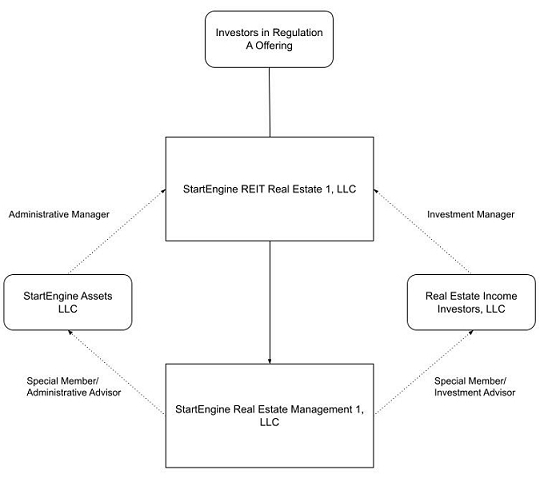
| A: | We plan to own substantially all of our assets and conduct our operations through our wholly-owned Operating Subsidiary. We are the managing member of the Operating Subsidiary and, as of the date of this offering circular, the only other members of our Operating Subsidiary are Real Estate Income Investors LLC and StartEngine Real Estate REIT LLC, our Investment Manager and Administrative Manager, respectively. Each of Investment Manager and Administrative Manager own special membership interests in our Operating Subsidiary, which will entitle them to payments from the company, see “Distributions” below. Because we plan to conduct substantially all of our operations through the Operating Subsidiary, we are considered an Umbrella Partnership Real Estate Investment Trust, or UPREIT. |
| Using an UPREIT structure may give us an advantage in acquiring properties from persons who might not otherwise sell their properties because of unfavorable tax results. Generally, a sale of property directly to a REIT, or a contribution in exchange for REIT shares, is a taxable transaction to the selling property owner. However, in an UPREIT structure, a seller of a property who desires to defer taxable gain on the sale of property may transfer the property to the operating subsidiary in exchange for membership interests in the Operating Subsidiary without recognizing gain for tax purposes. |
| We intend to present our financial statements and income, expenses and depreciation on a consolidated basis. All items of income, gain, deduction (including depreciation), loss and credit flow through the Operating Subsidiary to us as all subsidiary entities are disregarded for federal tax purposes. These tax items do not generally flow through us to our stockholders. Investors will have taxable income on distributions and capital gains or losses on the disposition of their shares. |
| Q: | Will I be charged upfront selling commissions? |
| A: | No. Investors will not, nor will we, pay upfront selling commissions as part of the price per common share purchased in this offering. |
11
Q:
A: |
Who will pay your organization and offering costs?
Our Managers and their affiliates have paid and will continue to pay on our behalf all costs incurred in connection with our organization and the offering of our shares. See “Estimated Use of Proceeds” for more information about the types of costs that may be incurred. Following the completion of our initial offering, we will reimburse our Managers, without interest, for these offering costs incurred both before and after such date. However, the amount reimbursed annually shall be no more than 2% of the gross proceeds raised in this offering. To the extent, there are unreimbursed costs, the timing of the reimbursement payments will be in the sole discretion of the Managers. The Managers do not intend to be reimbursed until there are sufficient funds to do so. |
| Q: | What fees and expenses do you pay to your Managers or any of your affiliates? |
| A: | We will pay the Managers a quarterly asset management fee at an annualized rate of up to 0.50% calculated on our capital contributions as of the end of each quarter until December 31, 2022, and thereafter will be based on our NAV at the end of each prior quarter. We will also pay our Investment Manager or its affiliates, an acquisition fee equal to 1.0% of the purchase price of any real estate properties acquired, directly or indirectly, by the Company, excluding any acquisition and origination expenses. If our Investment Manager or an affiliate manages one of our properties, we will pay a monthly property manager fee between 2% to 5% of the gross receipts derived from such property for the month. Our Managers, or their affiliates, will be entitled to reimbursement for costs incurred in connection with the special servicing of any non-performing asset. |
| We will reimburse our Managers for the organization and offering expenses that the Managers have paid or will pay on our behalf. However, the amount reimbursed annually shall be no more than 2% of gross proceeds raised in this offering. We will also reimburse our Managers for out-of-pocket expenses in connection with the origination of our investments, although with respect to our debt investments, it is expected that those expenses will be reimbursed by the borrower. Additionally, we reimburse our Managers for out-of-pocket expenses paid to third parties in connection with providing services to us. This does not include the Managers’ overhead, employee costs borne by the Managers, utilities or technology costs. The expense reimbursements that we will pay to our Managers include expenses incurred by affiliates of Managers in the performance of services on our behalf. The expense reimbursements that we will pay to our Managers include expenses incurred by Aii Capital Management, LLC (“Aii Capital Management”) in the performance of services under the shared services agreement between our Investment Manager and Aii Capital Management. See “Management—Shared Services Agreement.” |
The payment by us of fees and expenses will reduce the cash available for investment and distribution and will directly impact our annual NAV.
See “Management Compensation” for more details regarding the fees paid to our Managers and their affiliates.
| Q: | Will you use leverage? |
| A: | Yes, we may use leverage. Our targeted portfolio-wide leverage, after we have acquired a substantial portfolio, is between 50-75% of the greater of cost (before deducting depreciation or other non-cash reserves) or fair market value of our assets. During the period when we are acquiring our initial portfolio, we may employ greater leverage on individual assets (that will also result in greater leverage of the initial portfolio) in order to quickly build a diversified portfolio of assets. Please see “Investment Objectives and Strategy” for more details. |
| Q: | How will distributions be calculated? |
| A: | Each time dividends are paid, to the extent there are available funds you will receive distributions equal to your preferred return (plus any unpaid preferred returns from prior periods). To the extent there are additional funds, the additional funds will be split evenly between you and the Managers, with each Manager being paid 25% of these excess funds. For instance, let’s say you invested $100 in the company, each year you will be entitled to $6 from the Company as your preferred return. So, in the first year the company has $10 in net cash to allocate, you would receive $8 (your preferred return and 50% of the remaining net cash flow) and each Manager would receive $1. However, if there is only $3 dollars to allocate, you would receive $3, and in the following year you would need to receive $9 as your preferred return (the $3 accrued from this year plus the $6 from next year) prior to any distributions that would be paid to either Manager. |
| To the extent there are available funds, the Company anticipates paying the shareholders monthly for their preferred return and quarterly for any distributions in excess of the preferred return and anticipates paying the Managers annually. |
12
| Q: | What is my preferred return? |
| A: | The preferred return is an amount equal to a 6% cumulative, non-compounded, preferred annual return on the aggregate amount an investor originally invested into the fund. This is the amount that you as the investor will receive prior to the Managers receiving their distribution. The preferred return will begin to accrue immediately upon the Company’s acceptance of your subscription. |
| Q: | How often will I receive distributions? |
| A: | We expect that our Administrative Manager will declare and pay distributions monthly in arrears; however, our Administrative Manager may declare other periodic distributions as circumstances dictate. With respect to determining distributions, the Managers will be entitled to exercise discretion in making such computations, since the amount of the Net Cash Flow will depend, among other things, upon the assessment as to whether available cash flow should be used to fund the Company’s indebtedness, obligations and liabilities, and to be set aside for reserves. Distributions will be paid to shareholders as of the record dates selected by the Administrative Manager. In addition, the REIT distribution requirements generally require that we make aggregate annual distributions to our shareholders of at least 90% of our REIT taxable income, computed without regard to the dividends paid deduction and excluding net capital gain. Moreover, even if we make the required minimum distributions under the REIT rules, we will be subject to U.S. federal income and excise taxes on our undistributed taxable income and gains. The Administrative Manager intends to distribute all Net Cash Flow, which it believes will be beyond the minimum REIT distribution, to avoid such taxes. See “Description of Our Common Shares — Distributions” and “U.S. Federal Income Tax Considerations.” |
| Q: | What will be the source of the distributions? |
| A: | We may pay distributions from sources other than cash flow from operations, including from the proceeds of this offering, interest or dividend income received from our investments, redemption and/or redemption premiums of investments in residential and commercial real estate through majority-owned subsidiaries, the sale of investments or loan proceeds, among others, and we have no limit on the amounts we may pay from such sources. |
| Q: | Will the distributions I receive be taxable as ordinary income? |
| A. | Unless your investment is held in a qualified tax-exempt account or we designate certain distributions as capital gain dividends, distributions that you receive generally will be taxed as ordinary income to the extent they are from current or accumulated earnings and profits. However, for taxable years beginning before January 1, 2026, subject to certain limitations, non-corporate taxpayers are generally eligible for a deduction of up to 20% on most ordinary REIT dividends. |
The portion of your distribution in excess of current and accumulated earnings and profits is considered a return of capital for U.S. federal income tax purposes and will reduce the tax basis of your investment, rather than result in current tax, until your basis is reduced to zero. Return of capital distributions made to you in excess of your tax basis in our common shares will be treated as sales proceeds from the sale of our common shares for U.S. federal income tax purposes. Distributions we designate as capital gain dividends will generally be taxable at long-term capital gains rates for U.S. federal income tax purposes. However, because each investor’s tax considerations are different, we recommend that you consult with your tax advisor. You also should review the section of this offering circular entitled “Certain U.S. Federal Income Tax Considerations”.
13
| Q: | May I reinvest my cash distributions in additional shares? |
| A: | Yes. While we have not adopted a distribution reinvestment plan whereby investors may elect to have their cash distributions automatically reinvested in additional common shares, so long as this offering remains ongoing, you may choose to use the proceeds of any distribution to purchase additional shares hereunder at the then-current purchase price either directly or through a program established by our Managers. The purchase price for such shares will be $10.00 until December 31, 2022. Thereafter, the per share purchase price for our common shares will be adjusted at the beginning of each annual period, or such other period as determined by our Administrative Manager in its sole discretion, but no less frequently than annually. We have initially determined to adjust the per share purchase price in this offering annually. Investors will pay the most recent publicly announced purchase price as of the date of their subscription. Note, however, the aggregate maximum dollar amount we are offering is $50 million. |
| Q: | Who might benefit from an investment in your shares? |
| A: | An investment in our shares may be beneficial for you if you seek to diversify your personal portfolio with a public residential and commercial real estate investment vehicle, seek to receive current income, seek to preserve capital and are able to hold your investment for a length of time. On the other hand, we caution persons who require immediate liquidity or guaranteed income, or who seek a short-term investment, that an investment in our shares will not meet those needs. |
| Q: | Are there any risks involved in buying your shares? |
| A: | Investing in our common shares involves a high degree of risk. If we are unable to effectively manage the impact of these risks, we may not meet our investment objectives, and accordingly you should purchase these securities only if you can afford a complete loss of your investment. See “Risk Factors” for a description of the risks relating to this offering and an investment in our shares. |
| Q: | How does a “best efforts” offering work? |
| A: | When common shares are offered to the public on a “best efforts” basis, we are only required to use our best efforts to sell our common shares. Neither of our Managers or any other party has a firm commitment or obligation to purchase any of our common shares. |
| Q: | Who can buy shares? |
| A: | Generally, you may purchase shares if you are a “qualified purchaser” (as defined in Regulation A). “Qualified purchasers” include: |
| · | “accredited investors” under Rule 501(a) of Regulation D; and |
| · | all other investors so long as their investment in our common shares does not represent more than 10% of the greater of their annual income or net worth (for natural persons), or 10% of the greater of annual revenue or net assets at fiscal year-end (for non-natural persons). |
14
However, our common shares are being offered and sold only to those investors that are within the latter category (i.e., investors whose investment in our common shares does not represent more than 10% of the applicable amount), regardless of an investor’s status as an “accredited investor.”
Net worth in all cases should be calculated excluding the value of an investor’s home, home furnishings and automobiles. We reserve the right to reject any investor’s subscription in whole or in part for any reason, including if we determine in our sole and absolute discretion that such investor is not a “qualified purchaser” for purposes of Regulation A. Please refer to the section above entitled “State Law Exemption and Purchase Restrictions” for more information.
| Q: | How do I buy shares? |
| A: | If you want to purchase our common shares in this offering, first you will need to login to your StartEngine Platform account, or create one if you do not have one already. Once at our campaign page, click the green "Invest Now" button. You will then need to fill out some personal information, your method of payment, as well as the amount you want to invest. Once you fill out that information, it will populate a subscription agreement, which is the contract that represents your investment similar to the one attached to this offering circular as Appendix A. You will then need to review, confirm payment method and sign the subscription agreement. |
| Q: | Is there any minimum investment required? |
| A: | Yes. If you are a first-time investor in our common shares, you must initially purchase at least $500 in common shares based on the current per share price. There is no minimum investment requirement on additional purchases after you have purchased a minimum of $500 in common shares. However, in certain instances, we may revise the minimum purchase requirements in the future or elect to waive the minimum purchase requirement. |
| Q: | May I make an investment through my IRA or other tax-deferred retirement account? |
| A: | Generally, yes. We currently accept investments through IRAs maintained with certain custodians, although we intend to limit the amount of IRA investments to less than 25 percent of our shares. However, IRAs or other tax-deferred retirement accounts that invest in our shares generally will be subject to tax on all or a significant portion of their share of our profits as “unrelated business taxable income” under the Code. |
| Q: | What will you do with the proceeds from your offering? |
| A: | We expect to use substantially all of the net proceeds from this offering (after paying or reimbursing organization and offering expenses) to invest in and manage a diversified portfolio of residential and commercial real estate properties. We may also invest, to a limited extent, in real estate loans, as well as real estate debt securities (including CMBS, CDOs, and REIT senior unsecured debt) and other select real estate-related assets. Our Operating Subsidiary may make our investments through majority-owned subsidiaries. We expect that any expenses or fees payable to our Managers for their services in connection with managing our daily affairs, including but not limited to, the selection and acquisition of our investments, will be paid from cash flow from operations. If such fees and expenses are not paid from cash flow (or waived) they will reduce the cash available for investment and will directly impact our NAV. See “Management Compensation” for more details regarding the fees that will be paid to our Managers and their affiliates. |
We may not be able to promptly invest the net proceeds of this offering in real estate and other select real estate-related assets. In the interim, we may invest in short-term, highly liquid or other authorized investments. Such short-term investments will not earn as high of a return as we expect to earn on our real estate-related investments.
15
| Q: | How long will this offering last? |
| A: | We currently expect that this offering will remain open for investors until we raise the maximum amount being offered, unless terminated by us at an earlier time. We reserve the right to terminate this offering for any reason at any time. |
| Q: | Will I be notified of how my investment is doing? |
| A: | Yes, we will provide you with periodic updates on the performance of your investment in us, including: |
| · | an annual report; |
| · | a semi-annual report; |
| · | current event reports for specified material events within four business days of their occurrence; |
| · | supplements to the offering circular, if we have material information to disclose to you; and |
| · | other reports that we may file or furnish to the SEC from time to time. |
We will provide this information to you by posting such information on the SEC’s website at www.sec.gov, on the StartEngine Platform at www.startengine.com, or via e-mail.
| Q: | When will I get my detailed tax information? |
| A: | Your IRS Form 1099-DIV tax information, if required, will be provided by January 31 of the year following each taxable year. |
| Q: | Who can help answer my questions about the offering? |
| A: | If you have more questions about the offering, or if you would like additional copies of this offering circular, you should contact us by email at contact@startengine.com or by mail at: |
StartEngine Real Estate REIT 1 LLC
3900 W Alameda
Ave., Suite 1200
Burbank, CA 91505
Attn: Investor Relations
This offering summary highlights material information regarding our business and this offering that is not otherwise addressed in the “Questions and Answers About this Offering” section of this offering circular. Because it is a summary, it may not contain all of the information that is important to you. To understand this offering fully, you should read the entire offering circular carefully, including the “Risk Factors” section before making a decision to invest in our common shares.
StartEngine Real Estate REIT 1 LLC
StartEngine Real Estate REIT 1 LLC is a Delaware limited liability company formed to primarily invest in and manage a diversified portfolio of residential and commercial real estate properties. We expect to use substantially all of the net proceeds from this offering to acquire and structure a diversified portfolio of residential and commercial real estate properties located in the United States. We may also invest, to a limited extent, in real estate loans, as well as real estate debt securities and other real estate-related assets. We may make our investments through majority-owned subsidiaries. We intend to continue to operate in a manner that will allow us to qualify as a REIT for U.S. federal income tax purposes. Among other requirements, REITs are required to distribute to shareholders at least 90% of their annual REIT taxable income (computed without regard to the dividends paid deduction and excluding net capital gain).
Our office is located at 3900 W Alameda Ave., Suite 1200, Burbank, CA 91505. Our telephone number is 1 (800) 317-2200 . Information regarding our Company is also available on our web site at www.startengine.com.
16
Our Structure
StartEngine REIT intends to hold its investments in real property through special purpose, wholly-owned limited liability companies, which will be wholly-owned subsidiaries of StartEngine Real Estate Management 1 LLC, a Delaware limited company (the “Operating Subsidiary”). StartEngine REIT is the managing member of the Operating Subsidiary. StartEngine REIT intends to own all of its assets and conduct its operations through the Operating Subsidiary. Because StartEngine REIT conducts substantially all of its operations through the Operating Subsidiary, StartEngine REIT is considered an Umbrella Partnership Real Estate Investment Trust, or UPREIT. Using an UPREIT structure gives StartEngine REIT an advantage in acquiring properties from persons who might not otherwise sell their properties because of unfavorable tax results. Generally, a sale of property directly to a REIT, or a contribution in exchange for REIT shares, is a taxable transaction to the selling property owner. However, in an UPREIT structure, a seller of a property who desires to defer taxable gain on the sale of property may transfer the property to the operating subsidiary in exchange for membership interest in the Operating Subsidiary without recognizing gain for tax purposes.
StartEngine REIT is managed by its Board, which has delegated responsibilities to Real Estate Income Investors LLC and StartEngine Assets LLC, our Investment Manager and Administrative Manager, respectively. Further, StartEngine REIT is the Managing Member of our Operating Subsidiary, as the Manager Member has also delegated responsibilities to our Investment Manager and Administrative Manager. Our operating agreement and that of our Operating Subsidiary govern our relationship with our Managers. Each of our Investment Manager and our Administrative Manager own special membership interests in our Operating Subsidiary which entitle them to a net profits interest in the fund after the preferred return to the limited partners has been paid, see “Distributions”
Investment Strategy
We intend to use substantially all of the proceeds of this offering to originate, acquire, manage, operate, selectively leverage, syndicate and opportunistically sell residential and commercial real estate properties. We intend to acquire and operate real estate and real estate-related assets on an opportunistic basis. Our Investment Manager has extensive experience investing in numerous types of properties. Thus, we may acquire a wide variety of commercial properties, including retail, office, industrial, and retail, residential properties, including, single-tenant net lease properties (“NNN”), and other real properties. These properties may be existing, income-producing properties, newly constructed properties or properties under development or construction. We focus on acquiring properties that are generally classified as core or core plus, those with existing income streams, some with potential for capital appreciate, such as those requiring moderate levels of development, redevelopment or repositioning, those located in major metropolitan areas as well as those in suburbs and secondary metropolitan areas. We also may invest in real estate-related securities, including securities issued by other real estate companies, either for investment or in change of control transactions completed on a negotiated basis or otherwise, and in bridge and mezzanine loans that may lead to an opportunity to purchase a real estate interest.
We may enter into one or more joint ventures, tenant-in-common investments or other coownership arrangements for the acquisition, development or improvement of properties with third parties or affiliates of our Manager, including present and future real estate investment offering and REITs sponsored by affiliates of our Investment Manager.
17
Investment Objectives
Our primary investment objectives are:
| · | to generate income from the properties sufficient to distribute 6% or more in the invested capital; and |
| · | grow values through increased income and distributing capital gains as assets were sold. |
We will also seek to realize growth in the value of our investments by capital and operational improvements and timing their sale to maximize value. However, there is no assurance that our investment objectives will be met.
Market Opportunities
We believe that well located real estate that serves a needed purpose will always be in demand and provide consistent rental income. The real estate market provides the opportunity to buy mismanaged and underperforming properties and improve the property or operations and thereby increase value. We believe that our investment strategy, combined with the experience and expertise of our Investment Manager’s management team, will allow us to find quality investment opportunities that achieve the optimum balance of return and prudent growth, to identify assets that offer the greatest reward in exchange for a measurable risk and to return profits to our investors that meets our investment objectives.
Our Board
We operate under the direction of our Board, which is responsible for directing the management of our business and affairs, managing our day-to-day affairs, and implementing our investment strategy. The board of directors has delegated responsibilities to Real Estate Income Investors LLC and StartEngine Assets LLC, our Investment Manager and Administrative Manager, respectively. Our operating agreement and that of our Operating Subsidiary govern our relationship with our Managers.
Our Investment Manager
Real Estate Income Investors LLC, our Investment Manager, manages our day-to-day operations concerning our real estate assets. Our Investment Manager will be advised by its affiliate, Aii Capital Management, LLC, an investment adviser registered with the SEC. Registration with the SEC does not imply a certain level of skill or training. A team of real estate professionals, acting through our Investment Manager, makes all the decisions regarding the selection, negotiation, financing and disposition of our investments, subject to the limitations in our operating agreement and the operating agreement of our Operating Subsidiary.
Our Administrative Manager
StateEngine Assets, LLC, our Administrative Manager provides marketing, investor relations and other administrative services on our behalf.
About the StartEngine Platform
We are also an affiliate of StartEngine Crowdfunding, Inc., the owner and operator of an online technology platform, focused on the democratization of investing, which may be found on the website: www.startengine.com (the “StartEngine Platform”). StartEngine Assets LLC is a wholly-owned subsidiary of StartEngine Crowdfunding, Inc.
18
About StartEngine Secondary
We intend to list our securities on an alternative trading system or “ATS” branded as “StartEngine Secondary” and operated by an affiliate of our Administrative Manager of our company, StartEngine Primary LLC. However, this ATS is a new entrant to the market, and there is no guarantee that there will be frequent trading on the ATS and, specifically, trading of our shares. Further, even if there is trading, there may be no guarantee that anyone would be interested in purchasing the shares you have purchased in this offering at your desired price or any price at all.
Alternatively, subject to then existing market conditions, we may consider other alternatives as a means for providing liquidity to our shareholders. Our Board has the discretion to consider a liquidity transaction at any time if it determines such event to be in our best interests. A liquidity transaction could consist of a sale or partial sale of our assets, a sale or merger of our Company, a consolidation transaction with other companies managed by our Managers or their affiliates, a listing of our shares on a national securities exchange or a similar transaction. We do not have a stated term, as we believe setting a finite date for a possible, but uncertain future liquidity transaction may result in actions that are not necessarily in the best interest or within the expectations of our shareholders.
Management Compensation
Our Managers and their affiliates receive fees and expense reimbursements for services relating to this offering, as well as the investment and management of our assets. The items of compensation are summarized in the following table. None of our Managers or their affiliates receive any selling commissions or dealer manager fees in connection with the offer and sale of our common shares. See “Management Compensation” for a more detailed explanation of the fees and expenses payable to our Managers and their affiliates.
| Form of Compensation and Recipient | Determination of Amount (1) | Estimated Amount | ||
| Offering and Organizational Stage | ||||
|
Reimbursement of Organization and Offering Expenses — Managers |
To date, the Managers have paid approximately $75,000 in organization and offering expenses on our behalf. We will reimburse the Managers for these costs and future organization and offering costs they may incur on our behalf. We expect organization and offering expenses to not exceed $200,000 or, if we raise the maximum offering amount, approximately 0.40% of gross offering proceeds. However, the amount reimbursed annually shall be no more than 2% of the gross proceeds raised in this offering |
$200,000 | ||
| Acquisition and Development Stage | ||||
| Acquisition Fee — Investment Manager or its Affiliate | The Company will pay the Investment Advisor or its affiliate 1.0% of the purchase price of any real estate properties acquired by the Company or its affiliates, excluding any acquisition and origination expenses. |
Paid by the property ownership entity, or joint-venture at closing.
Actual amounts are dependent upon the offering proceeds we raise (and any leverage we employ); we cannot determine these amounts at the present time. | ||
19
|
||||
| Reimbursement of Acquisition Expenses — Investment Manager | We reimburse our Investment Manager for actual expenses incurred in connection with the selection, acquisition or financing of an investment, whether or not we ultimately acquire an investment. | Actual amounts are dependent upon the outside factors and any leverage we employ; we cannot determine these amounts at the present time. | ||
|
|
Operational Stage |
|||
|
Asset Management Fee — Managers |
Quarterly asset management fee currently equal to an annualized rate of 0.25% to our Investment Manager and an annualized rate of 0.25% to our Asset Manager based on aggregate capital contributions through December 31, 2022 and thereafter, based on our NAV at the end of each prior quarter. |
Actual amounts are dependent upon the offering proceeds we raise (and any leverage we employ) and the results of our operations; we cannot determine these amounts at the present time. | ||
|
Property Management Fee – Investment Manager or Other Party
|
For each real estate investment for which the Investment Manager or an affiliate is acting as the property manager, the Company will pay a monthly property management fee related to such real estate assets equal to a percent of the gross receipts per month, which percentage shall be no greater than 5% and no less than 2% as ultimately determined by the Board.
|
Actual amounts are dependent upon the gross receipts of the individual assets; we cannot determine these amounts at the present time.
| ||
|
Reimbursement of Special Servicing Expenses – Managers or Other Party |
We will reimburse our Managers for actual expenses incurred on our behalf in connection with the special servicing of non-performing assets. Whether an asset is deemed to be non-performing will ultimately be in the sole discretion of our Board. |
Actual amounts are dependent upon the offering proceeds we raise (and any leverage we employ) and the results of our operations; we cannot determine these amounts at the present time. | ||
|
Reimbursement of Other Operating Expenses — Managers |
We will reimburse our Managers for out-of-pocket expenses paid to third parties in connection with providing services to us. This does not include the Managers’ overhead, employee costs borne by the Managers, utilities or technology costs.
The expense reimbursements that we pay to our Managers also include expenses incurred by Aii Capital Management in the performance of services under the shared services agreement between our Investment Manager and Aii Capital Management, including any increases in insurance attributable to the management or operation of our Company. |
Actual amounts are dependent upon the results of our operations; we cannot determine these amounts at the present time. | ||
|
|
Liquidation |
|||
|
Reimbursement of Equity Liquidation Expenses – Investment Manager |
We will reimburse our Investment Manager for actual expenses incurred on our behalf in connection with the liquidation of investments in real estate. Whether to liquidate an investment in real estate will ultimately be in the sole discretion of our Board. |
Actual amounts are dependent upon the liquidation of a real estate asset, and the results of our operations; we cannot determine these amounts at the present time. |
20
Summary of Risk Factors
Investing in our common shares involves a high degree of risk. You should carefully review the “Risk Factors” section of this offering circular, beginning on page 27, which contains a detailed discussion of the material risks that you should consider before you invest in our common shares.
Conflicts of Interest
Our Managers and its affiliates experience conflicts of interest in connection with the management of our business. Some of the material conflicts that our Administrative Manager, Investment Manager and their affiliates face include the following:
| · | The asset management fee paid to our Managers is based on our NAV, which is calculated by our Managers’ internal accountants and asset management team. Our Managers may benefit by us retaining ownership of our assets at times when our shareholders may be better served by the sale or disposition of our assets in order to avoid a reduction in our NAV. |
| · |
Our Investment Manager’s real estate professionals acting on behalf of our Investment Manager must determine which investment opportunities to recommend to us and other of its affiliated entities. An affiliate of our Investment Manager has is currently operating, as of the date of this offering circular, the following similar programs: |
| · | Transformation Housing Fund, L.P. |
| · | Real estate professionals acting on behalf of our Investment Manager have to allocate their time among us, their business and other programs and activities in which they are involved. |
| · |
Professionals acting on behalf of our Managers, including marketing and administrative professionals have to allocate their time among us, their business and other programs and activities in which they are involved. |
| · | The terms of our operating agreement (including the Managers’ rights and obligations and the compensation payable to our Managers and their affiliates) were not negotiated at arm’s length. |
| · | Our shareholders may only remove our Managers for “cause” following the affirmative vote of shareholders holding two-thirds of the outstanding common shares. Unsatisfactory financial performance does not constitute “cause” under the operating agreement. |
| · | Our Managers may, without shareholder consent unless otherwise required by law, determine that we should merge or consolidate through a roll-up or other similar transaction involving other entities, including entities affiliated with our Managers, into or with such other entities. |
| · | As a non-listed company conducting an exempt offering pursuant to Regulation A, we are not subject to a number of corporate governance requirements, including the requirements for independent board committees and members. |
21
Distributions
If there is Net Cash Flow available for distribution, the Administrative Manager may begin distributions shortly after 90 days after the first closing of this offering, the point at which it first begins evaluating the Company’s performance. We expect the Administrative Manager to declare and pay distributions monthly when it determines such cash flow exists; however, the Administrative Manager may declare other periodic distributions as circumstances dictate. In order that investors may generally begin receiving distributions immediately upon our acceptance of their subscription, we expect to authorize and declare distributions based on daily record dates.
With respect to determining distributions, the Managers will be entitled to exercise discretion in making such computations, since the amount of the Net Cash Flow will depend, among other things, upon the assessment as to whether available cash flow should be used to fund the Company’s indebtedness, obligations and liabilities, and to be set aside for reserves. Distributions will be paid to shareholders as of the record dates selected by the Administrative Manager. In addition, the Managers’ ability to exercise discretion as to the payment of distributions will be limited by the REIT distribution requirements, which generally require that we make aggregate annual distributions to our shareholders of at least 90% of our REIT taxable income, computed without regard to the dividends paid deduction and excluding net capital gain. Moreover, even if we make the required minimum distributions under the REIT rules, we will be subject to federal income and excise taxes on our undistributed taxable income and gains. As a result, the Administrative Manager intends to make such additional distributions, beyond the minimum REIT distribution, to avoid such taxes. See “Description of Our Common Shares — Distributions” and “U.S. Federal Income Tax Considerations.”
Any distributions that we make will directly impact our NAV, by reducing the amount of our assets. Our goal is to provide a reasonably predictable and stable level of current income, through monthly or other periodic distributions, while at the same time maintaining a fair level of consistency in our NAV. Over the course of your investment, your distributions plus the change in NAV per share (either positive or negative) will produce your total return.
Our distributions will generally constitute a return of capital to the extent that they exceed our current and accumulated earnings and profits as determined for U.S. federal income tax purposes. To the extent that a distribution is treated as a return of capital for U.S. federal income tax purposes, it will reduce a holder’s adjusted tax basis in the holder’s shares, and to the extent that it exceeds the holder’s adjusted tax basis will be treated as gain resulting from a sale of such shares.
Preferred Return and Distributions to the Managers
Under the Subsidiary Operating Agreement, annual distributions shall be made as follows:
| · | first to investor to an amount equal to a 6% annual return on their investment (a “preferred return”) (including any accrued and unpaid amounts from prior periods); |
| · | second, half of the remaining Net Cash Flow pro rata in accordance with the number of shares; |
| · | third, half of the remaining Net Cash Flow to the Managers, to be split equally between them. |
The preferred return is an amount equal to a 6% cumulative, non-compounded, preferred annual return on the aggregate amount the original investor invested into the fund. This is the amount that you as the investor will receive prior to the Managers receiving their distribution. The preferred return shall begin to accrue immediately upon the Company’s acceptance of a subscription.
Distributions will be paid out of the available “Net Cash Flow”, which consists of the excess of (a) the sum of (i) all cash or marketable securities received by the Company or any of its subsidiaries from investments and other assets received during such period, including, but not limited to, litigation proceeds, financing proceeds, insurance proceeds, rents and all other amounts, (ii) all withholding payments withheld from amounts described in clause (i) that are treated as distributed to a Member and (iii) any amounts that were previously retained as reserves and are no longer needed by the Company, less (b) the sum of (i) all expenses, including administrative expenses, and other liabilities and obligations of the Company paid or satisfied during such period relating to the Company’s investments and other assets, including any taxes not treated as withholding payments distributed to a shareholders and (ii) amounts determined are necessary or appropriate to create or increase reserves for actual and anticipated expenses and liabilities of the Company.
To the extent there are available funds, the Company anticipates paying the shareholders monthly for their preferred return and quarterly for any distributions in excess of the preferred return and anticipates paying the Managers annually. No distributions of Net Cash Flow shall be made to the Managers with respect to a calendar year until investors have received distributions of the full amount of the aggregate preferred return that has accrued for that year plus amounts that have accrued for a prior year but not been paid.
22
Borrowing Policy
We believe that Investment Manager’s ability to obtain both competitive interim and term financings and its relationships with top tier financial institutions should allow our Investment Manager to successfully employ moderate levels of borrowing in order to enhance our returns to shareholders.
We intend to employ leverage in order to provide more funds available for investment. We believe that careful use of conservatively structured leverage will help us to achieve our diversification goals and potentially enhance the returns on our investments. We expect that once we have fully invested the proceeds of this offering, our debt financing, on a portfolio-wide basis, will be between 50%-75% of the greater of the cost basis or fair market value of our assets. Our Board may from time to time modify our leverage policy in its discretion. However, other than during our initial period of operations, it is our policy to not borrow more than 75% of the greater of cost (before deducting depreciation or other non-cash reserves) or fair market value of our assets.
Valuation Policies
At the end of each fiscal year, our Managers’ internal accountants and asset management team will calculate our NAV per share using a process that reflects (1) estimated values of each of our commercial and residential real estate assets and investments, as determined by our Investment Manager’s asset management team, including related liabilities, based upon (a) market capitalization rates, comparable sales information, interest rates, net operating income, (b) with respect to debt, if any, default rates, discount rates and loss severity rates, and (c) in certain instances reports of the underlying real estate provided by an independent valuation expert, (2) the price of liquid assets for which third party market quotes are available, (3) accruals of the Company’s periodic distributions and (4) estimated accruals of the Company’s operating revenues and expenses, including reserves. For the value of joint venture or direct equity investments, the Investment Manager will primarily rely on discounted cash flow method. Under the discounted cash flow method, its asset management team will calculate the distributions due from the respective investment based on a property-level pro forma over a likely-hold period. The Investment Manager’s asset management team will then discount future cash-flow projections at an appropriate market levered-discount rate to determine present value, which value is considered the net asset value of the investment. The Investment Manager may alternatively apply the hypothetical sales method to value its investments. Under this approach, our Investment Manager’s asset management team will assume (i) the sale of the property at a price equal to the concluded property value, (ii) the liquidation of any additional assets after paying all liabilities, and (iii) the distribution of the net sale proceeds to investors. The distributed amount is considered the net asset value of each respective investment. For debt and fixed-return preferred equity investment, assuming no material adverse change in the property, the Investment Manager’s asset management team will record these investments at their cost basis (including any accrued unpaid interest). If there were to be material adverse changes in these properties, the asset management team intends to value these investments using the hypothetical sales method described above. For our investments that have closed within three to nine months and no material changes have occurred from the original underwriting, our asset management team will typically apply the original property purchase price (or pre-closing third party appraisal value) for the property valuation, and the investment cost basis for the investment-level valuation.
23
Note, however, that the determination of our NAV is not based on, nor intended to comply with, fair value standards under GAAP, and our NAV may not be indicative of the price that we would receive for our assets at current market conditions. In instances where we determine that an appraisal of the real estate asset is necessary, including, but not limited to, instances where our Investment Manager is unsure of its ability on its own to accurately determine the estimated values of our residential and commercial real estate assets and investments, or instances where third party market values for comparable properties are either nonexistent or extremely inconsistent, it will engage an appraiser that has expertise in appraising real estate assets, to act as our independent valuation expert. The independent valuation expert is not responsible for, or for preparing, our annual NAV per share. If a material event occurs between scheduled annual valuations that our Managers believe may materially affect the value of any of our real estate assets and investments, including related liabilities, our Managers anticipate informing the independent valuation expert so that, if appropriate, the valuation may adjust compared to the most recent valuations provided in the applicable report, if any, to account for the estimated impact. We will determine our NAV per share by dividing our NAV in such fiscal year by the number of our common shares outstanding as of the end of such fiscal year, prior to giving effect to any share purchases or redemptions to be effected for such fiscal year.
Our goal is to provide a reasonable estimate of the value of our shares on an annual basis. However, we intend that the majority of our assets will consist of residential and commercial real estate equity investments and, as with any real estate valuation protocol, any conclusions are based on a number of judgments, assumptions and opinions about future events that may or may not prove to be correct. The use of different judgments, assumptions or opinions would likely result in different estimates of the value of our real estate assets and investments. In addition, for any given year, our published NAV per share may not fully reflect certain material events, to the extent that the financial impact of such events on our portfolio is not immediately quantifiable. As a result, the annual calculation of our NAV per share may not reflect the precise amount that might be paid for your shares in a market transaction. If we decide to update our NAV between annual updates of NAV, we intend to disclose the updated price and the reason for the change in an offering circular supplement as promptly as reasonably practicable and will update the NAV information provided on our website.
Annual Share Price Adjustments
Our Managers set our initial offering price at $10.00 per share, which will continue to be the purchase price of our common shares until December 31, 2022. Thereafter, the per share purchase price in this offering will be adjusted at least every fiscal year and, as of January 1st of each year (or as soon as commercially reasonable and announced by us thereafter), will be equal to our NAV divided by the number of shares outstanding as of the close of business on the last business day of the prior fiscal year, in each case prior to giving effect to any share purchases or redemptions to be effected on such day.
We will file with the SEC on an annual basis an offering circular supplement disclosing the annual determination of our NAV per share that is applicable for such fiscal year, which we refer to as the pricing supplement. We also post that fiscal year’s NAV on the public StartEngine Platform, www.startengine.com. The StartEngine Platform also contains this offering circular, including any supplements and amendments. We will disclose, on an annual basis in an offering circular supplement filed with the SEC, the principal valuation components of our NAV. If we decide to update our NAV between annual updates, we intend to disclose the updated price and the reason for the change in an offering circular supplement as promptly as reasonably practicable and will update the NAV information provided on our website.
Any subscriptions that we receive prior to the end of a fiscal year will be executed at a price equal to our NAV per share applicable to such fiscal year. Thus, even if settlement occurs in the following year, the purchase price for the shares will be the price in effect at the time the subscription was received. See “Description of Our Common Shares—Annual Share Price Adjustments” for more details.
24
Liquidity
We currently have no intention of liquidating our assets within any given timeframe. We primarily intent to re-invest any proceeds from sales or assets after payment of distributions to our investors and Managers.
Voting Rights
Our common shareholders have voting rights only with respect to certain matters, primarily relating to amendments to our operating agreement that would adversely change the rights of the common shares, and removal of a Manager for “cause”. Each outstanding common share entitles the holder to one vote on all matters submitted to a vote of common shareholders. Our shareholders do not elect or vote on our Managers, and, unlike the holders of common shares in a corporation, have only limited voting rights on matters affecting our business, and therefore limited ability to influence decisions regarding our business. For additional information, see “Description of Our Common Shares—Voting Rights.”
Other Governance Matters
Other than the limited shareholder voting rights described above, our operating agreement vests most other decisions relating to our assets and to the business of our Company, including decisions relating to acquisitions, originations and dispositions, the engagement of asset managers, the issuance of securities in our Company including additional common shares, mergers, dispositions, roll-up transactions, and other decisions relating to our business, in our Managers. See “Management” for more information about the rights and responsibilities of our Managers.
Investment Company Act Considerations
We intend to conduct our operations so that neither we, nor any of our subsidiaries, is required to register as investment companies under the Investment Company Act of 1940, as amended, or the Investment Company Act. Section 3(a)(1)(A) of the Investment Company Act defines an investment company as any issuer that is or holds itself out as being engaged primarily in the business of investing, reinvesting or trading in securities. Section 3(a)(1)(C) of the Investment Company Act defines an investment company as any issuer that is engaged or proposes to engage in the business of investing, reinvesting, owning, holding or trading in securities and owns or proposes to acquire investment securities having a value exceeding 40% of the value of the issuer’s total assets (exclusive of U.S. Government securities and cash items) on an unconsolidated basis, which we refer to as the 40% test. Excluded from the term “investment securities”, among other things, are U.S. Government securities and securities issued by majority-owned subsidiaries that are not themselves investment companies and are not relying on the exception from the definition of investment company set forth in Section 3(c)(1) or Section 3(c)(7) of the Investment Company Act.
We anticipate that we will hold real estate and real estate-related assets described below (i) directly, (ii) through wholly-owned subsidiaries, (iii) through majority-owned joint venture subsidiaries, and, (iv) to a lesser extent, through minority-owned joint venture subsidiaries.
We intend, directly or through our subsidiaries, to originate, invest in and manage a diversified portfolio of real estate investments. We expect to use substantially all of the net proceeds from this offering to originate, acquire and structure a diversified portfolio of real estate properties. We may also invest, to a limited extent, in real estate loans, as well as real estate-related debt securities and other real estate-related assets.
We will monitor our compliance with the 40% test and the holdings of our subsidiaries to ensure that each of our subsidiaries is in compliance with an applicable exemption or exclusion from registration as an investment company under the Investment Company Act.
The securities issued by any wholly-owned or majority-owned subsidiary that we may form and that are excluded from the definition of “investment company” based on Section 3(c)(1) or 3(c)(7) of the Investment Company Act, together with any other investment securities we may own, may not have a value in excess of 40% of the value of our total assets on an unconsolidated basis.
25
The Investment Company Act defines a majority-owned subsidiary of a person as a company 50% or more of the outstanding voting securities of which are owned by such person, or by another company which is a majority-owned subsidiary of such person. We treat companies in which we own at least a majority of the outstanding voting securities as majority-owned subsidiaries. The determination of whether an entity is a majority-owned subsidiary of our Company is made by us. We also treat subsidiaries of which we or our wholly-owned or majority-owned subsidiary is the manager (in a manager-managed entity) or managing member (in a member-managed entity) or in which our agreement or the agreement of our wholly-owned or majority-owned subsidiary is required for all major decisions affecting the subsidiaries (referred to herein as “Controlled Subsidiaries”), as majority-owned subsidiaries even though none of the interests issued by such Controlled Subsidiaries meets the definition of voting securities under the Investment Company Act. We reached our conclusion on the basis that the interests issued by the Controlled Subsidiaries are the functional equivalent of voting securities. We have not asked the SEC staff for concurrence of our analysis and it is possible that the SEC staff could disagree with any of our determinations. If the SEC staff were to disagree with our treatment of one or more companies as majority-owned subsidiaries, we would need to adjust our strategy and our assets. Any such adjustment in our strategy could have a material adverse effect on us.
We believe that neither we nor certain of our subsidiaries will be considered investment companies for purposes of Section 3(a)(1)(A) of the Investment Company Act because we and they will not engage primarily or hold themselves out as being primarily engaged in the business of investing, reinvesting or trading in securities. Rather, we and such subsidiaries will be primarily engaged in non-investment company businesses related to real estate. Consequently, we and our subsidiaries expect to be able to conduct our operations such that none will be required to register as an investment company under the Investment Company Act.
Certain of our subsidiaries may also rely upon the exclusion from the definition of investment company under Section 3(c)(5)(C) of the Investment Company Act. Section 3(c)(5)(C), as interpreted by the staff of the SEC, requires an entity to invest at least 55% of its assets in “mortgages and other liens on and interests in real estate”, which we refer to as “qualifying real estate interests”, and at least 80% of its assets in qualifying real estate interests plus “real estate-related assets”.
Qualification for exemption from registration under the Investment Company Act will limit our ability to make certain investments. To the extent that the SEC staff provides more specific guidance regarding any of the matters bearing upon such exclusions, we may be required to adjust our strategy accordingly. Any additional guidance from the SEC staff could provide additional flexibility to us, or it could further inhibit our ability to pursue the strategies we have chosen.
The loss of our exclusion from regulation pursuant to the Investment Company Act could require us to restructure our operations, sell certain of our assets or abstain from the purchase of certain assets, which could have an adverse effect on our financial condition and results of operations. See “Risk Factors—Risks related to Our Organizational Structure—Maintenance of our Investment Company Act exemption imposes limits on our operations, which may adversely affect our operations”.
26
An investment in our common shares involves substantial risks. You should carefully consider the following risk factors in addition to the other information contained in this offering circular before purchasing shares. The occurrence of any of the following risks might cause you to lose a significant part of your investment. The risks and uncertainties discussed below are not the only ones we face, but do represent those risks and uncertainties that we believe are most significant to our business, operating results, prospects and financial condition. Some statements in this offering circular, including statements in the following risk factors, constitute forward-looking statements. Please refer to the section entitled “Statements Regarding Forward-Looking Information.”
Risks Related to an Investment in StartEngine Real Estate Equity REIT 1 LLC
We have no prior operating history, and the prior performance of our Investment Manager or other real estate investment opportunities sponsored by our Investment Manager may not predict our future results.
We are a recently formed company and have no operating history. As of the date of this offering circular, we have not made any investments, and as of June 30, 2020 had approximately $0 in cash. You should not assume that our performance will be similar to the past performance of our Investment Manager or other real estate investment opportunities sponsored by our Investment Manager. Our limited operating history significantly increases the risk and uncertainty you face in making an investment in our shares.
We intend to have our securities quoted on a new alternative trading system (“ATS”), and there can be no assurances that any public market will ever develop; even if developed, trading is likely to be subject to significant price fluctuations.
We intend that the only formal marketplace for the resale of our securities will be StartEngine Secondary, an ATS operated by our affiliate, StartEngine Primary LLC. StartEngine Secondary is a new entrant to the alternative trading system market and our securities have yet to be resold on the ATS. Consequently, there can be no assurances as to whether:
| · | any market for shares in any series will develop; |
| · | the price at which shares for a series will trade; or |
| · | the extent to which investor in us will lead to the development of an active, liquid trading market. |
Active trading markets generally result in lower price volatility and more efficient execution of buy and sell orders for investments. Until an orderly market develops in the shares of any series, if ever, the price at which they trade is likely to fluctuate significantly. Prices for shares in a series will be determined in the marketplace and may be influenced by many factors, including the depth and liquidity of the market for those shares, developments affecting our business, including the impact of the factors referred to elsewhere in these risk factors, investor perception of our company and a particular series and general economic and market conditions. No assurances can be given that an orderly or liquid market will ever develop for the shares of a series. We cannot assure you that trading prices for shares of a particular series will not be significantly lower than the price at which such securities are sold in this offering.
Because no public trading market for your shares currently exists, it will be difficult for you to sell your shares and, if you are able to sell your shares, you will likely sell them at a substantial discount to the public offering price.
There is currently no public market for our shares, even if we seek a listing on StartEngine Secondary (the ATS operating by our affiliated StartEngine Primary LLC), the “OTCQX” or the “OTCQB” markets or another alternative trading system or “ATS,” there may not be frequent trading and therefore no market price for the shares. Until our shares are listed, if ever, you may not sell your shares unless the buyer meets the applicable suitability and minimum purchase standards. In addition, our operating agreement prohibits the ownership of more than 9.8% in value or number of our shares, whichever is more restrictive, or more than 9.8% in value or number of our common shares, whichever is more restrictive, unless exempted by our Administrative Manager, which may inhibit large investors from purchasing your shares. Further the shares are only redeemable in very limited circumstances. Therefore, it will be difficult for you to redeem and/or sell your shares promptly or at all. If you are able to sell your shares, you would likely have to sell them at a substantial discount to their public offering price. It is also likely that your shares would not be accepted as the primary collateral for a loan. Because of the illiquid nature of our shares, you should purchase our shares only as a long-term investment and be prepared to hold them for an indefinite period of time.
27
If a secondary trading market does not develop, you may have to hold your investment for an indefinite period.
Although we presently intend to list our shares on StartEngine Secondary, there may not be a robust enough trading market to allow you to liquidate. Alternatively, we may consider a liquidation transaction or to adopt a redemption plan. If our Board does determine to pursue a liquidity transaction, we would be under no obligation to conclude the process within a set time. If we adopt a plan of liquidation, the timing of the sale of assets will depend on real estate and financial markets, economic conditions in areas in which properties are located, and federal income tax effects on shareholders, that may prevail in the future. We cannot guarantee that we will be able to liquidate all assets. After we adopt a plan of liquidation, we would likely remain in existence until all our investments are liquidated. If we do not pursue a liquidity transaction, or delay such a transaction due to market conditions, your shares may continue to be illiquid and you may, for an indefinite period of time, be unable to convert your investment to cash easily and could suffer losses on your investment. Further, if our Board adopts a redemption plan, the plan will be limited by legal and regulatory constraints, including the amount available to redeem at any given time and limitations on available funds.
If we are unable to find suitable investments, we may not be able to achieve our investment objectives or pay distributions.
Our ability to achieve our investment objectives and to pay distributions depends upon the performance of our Investment Manager in the acquisition of our investments and the ability of our Investment Manager to source investment opportunities for us. The more money we raise in this offering, the greater our challenge will be to invest all of the net offering proceeds on attractive terms. We cannot assure you that our Investment Manager will be successful in obtaining suitable investments on financially attractive terms or that, if our Investment Manager makes investments on our behalf, our objectives will be achieved. If we, through our Investment Manager, are unable to find suitable investments promptly, we will hold the proceeds from this offering in an interest-bearing account or invest the proceeds in short-term assets in a manner that is consistent with our qualification as a REIT. If we would continue to be unsuccessful in locating suitable investments, we may ultimately decide to liquidate. In the event we are unable to timely locate suitable investments, we may be unable or limited in our ability to pay distributions and we may not be able to meet our investment objectives.
Future disruptions in the financial markets or deteriorating economic conditions could adversely impact the real estate market as well as the market for equity-related investments generally, which could hinder our ability to implement our business strategy and generate returns to you.
We intend to acquire a diversified portfolio of commercial and residential real estate equity investments. We may also invest, to a limited extent, in real estate loans, as well as real estate debt securities and other real estate-related assets. We may make our investments through majority-owned subsidiaries. Economic conditions greatly increase the risks of these investments (see “— Risks Related to Our Investments”). The success of our business is significantly related to general economic conditions and, accordingly, our business could be harmed by an economic slowdown and downturn in real estate asset values, property sales and leasing activities. Periods of economic slowdown or recession, significantly rising interest rates, declining employment levels, decreasing demand for real estate, declining real estate values, or the public perception that any of these events may occur, can reduce volumes for many of our business lines. These economic conditions could result in a general decline in acquisition, disposition and leasing activity, as well as a general decline in the value of real estate and in rents, which in turn would reduce revenue from property management fees and brokerage commissions derived from property sales, leases and mortgage brokerage as well as revenues associated with investment management and/or development activities. In addition, these conditions could lead to a decline in property sales prices as well as a decline in funds invested in existing real estate assets and properties planned for development.
Future disruptions in the financial markets or deteriorating economic conditions may also impact the market for our investments and the volatility of our investments. The returns available to investors in our targeted investments are determined, in part, by: (i) the supply and demand for such investments and
(ii) the existence of a market for such investments, which includes the ability to sell or finance such investments. During periods of volatility, the number of investors participating in the market may change at an accelerated pace. If either demand or liquidity increases, the cost of our targeted investments may increase. As a result, we may have fewer funds available to make distributions to investors.
28
During an economic downturn, it may also take longer for us to dispose of real estate investments or the selling prices may be lower than originally anticipated. As a result, the carrying value of our real estate investments may become impaired and we could record losses as a result of such impairment or we could experience reduced profitability related to declines in real estate values. Further, as a result of our target leverage, our exposure to adverse general economic conditions is heightened.
These negative general economic conditions could reduce the overall amount of sale and leasing activity in the real estate industry, and hence the demand for our services. We are unable to predict the likely duration and severity of disruptions in financial markets and adverse economic conditions in the United States and other countries. Our revenues and profitability depend on the overall demand for our services from our clients. While it is possible that the increase in the number of distressed sales and resulting decrease in asset prices will eventually translate to greater market activity, an overall reduction in sales transaction volume could materially and adversely impact our business.
All of the factors described above could adversely impact our ability to implement our business strategy and make distributions to our investors and could decrease the value of an investment in us. In addition, in an extreme deterioration of our business, we could have insufficient liquidity to meet our debt service obligations when they come due in future years. If we fail to meet our payment or other obligations under our credit agreement, the lenders under the agreement will be entitled to proceed against the collateral granted to them to secure the debt owed.
If we pay distributions from sources other than our cash flow from operations, we will have less funds available for investments and your overall return will be reduced.
Although our distribution policy is to use our cash flow from operations to make distributions, our organization documents permit us to pay distributions from any source, including offering proceeds, borrowings, or sales of assets. We have not placed a cap on the use of proceeds to fund distributions. If we pay distributions from sources other than our cash flow from operations, we will have less cash available for investments, we may have to reduce our distribution rate, our NAV may be negatively impacted and stockholders’ overall return may be reduced.
We may suffer from delays in locating suitable investments, which could limit our ability to make distributions and lower the overall return on your investment.
We rely upon our Investment Manager’s real estate professionals, including Michael Chesser, its Founder and President, to identify suitable investments. Our Investment Manager and its affiliates also rely on Mr. Chesser for investment opportunities. To the extent that our Investment Manager’s real estate and professionals face competing demands upon their time in instances when we have capital ready for investment, we may face delays in execution.
Additionally, the current market for properties that meet our investment objectives is highly competitive, as is the leasing market for such properties. The more shares we sell in this offering, the greater our challenge will be to invest all of the net offering proceeds on attractive terms. Except for investments that may be described in supplements to this offering circular prior to the date you subscribe for our shares, you will have no opportunity to evaluate the terms of transactions or other economic or financial data concerning our investments. You must rely entirely on the oversight and management ability of our Investment Manager and the performance of any property manager. We cannot be sure that our Investment Manager will be successful in obtaining suitable investments on financially attractive terms.
29
We could also suffer from delays in locating suitable investments as a result of our reliance on our Investments Manager at times when its officers, employees, or agents are simultaneously seeking to locate suitable investments for other programs sponsored by our Investment Manager or its affiliates, some of which have investment objectives and employ investment strategies that are similar to ours. Furthermore, where we acquire properties prior to the start of construction or during the early stages of construction, it will typically take several months to complete construction and rent available space. Therefore, you could suffer delays in the receipt of distributions attributable to those particular properties.
Further, because we are raising a “blind pool” without any pre-selected assets, it may be difficult for us to invest the net offering proceeds promptly and on attractive terms. Delays we encounter in the selection and origination of income-producing loans and other assets would likely limit our ability to pay distributions to our shareholders and lower their overall returns. Similar concerns arise when there are prepayments, maturities or sales of our investments.
Because this is a blind pool offering, you will not have the opportunity to evaluate our investments before we make them, which makes your investment more speculative.
Because we have not yet acquired or identified any investments that we may make, we are not able to provide you with any information to assist you in evaluating the merits of any specific investments that we may make, except for investments that may be described in supplements to this offering circular. We will seek to invest substantially all of the offering proceeds available for investment, after the payment of fees and expenses, in real estate equity investments. However, because you will be unable to evaluate the economic merit of assets before we invest in them, you will have to rely entirely on the ability of our Investment Manager to select suitable and successful investment opportunities. These factors increase the risk that your investment may not generate returns comparable to our competitors.
Because we are limited in the amount of funds we can raise, we will be limited in the number and type of investments we make and the value of your investment in us will fluctuate with the performance of the specific assets we acquire.
This offering is being made on a “best efforts” basis. Further, under Regulation A, we are only allowed to raise up to $50 million in any 12-month period (although we may raise capital in other ways). We expect the size of the investments that we make on average to be about $1 million to $15 million per asset. As a result, the amount of proceeds we raise in this offering may be substantially less than the amount we would need to achieve a diversified portfolio of investments, even if we are successful in raising the maximum offering amount. If we are unable to raise substantial funds, we will make fewer investments resulting in less diversification in terms of the type, number and size of investments that we make. In that case, the likelihood that any single asset’s performance would adversely affect our profitability will increase. Your investment in our shares will be subject to greater risk to the extent that we lack a diversified portfolio of investments. Further, we have certain fixed operating expenses, including certain expenses as a public reporting company, regardless of whether we are able to raise substantial funds in this offering. Our inability to raise substantial funds would increase our fixed operating expenses as a percentage of gross income, reducing our net income and limiting our ability to make distributions.
Any adverse changes in the financial health of our Administrative Manager or Investment Manager or our relationship with our Managers or their affiliates could hinder our operating performance and the return on your investment.
Our Investment Manager and Administrative Manager have been delegated the responsibilities to manage our operations and our portfolio of commercial and residential real estate equity investments and other select real estate-related assets. Our Managers have no employees, and utilizes personnel of affiliated entities to perform services on their behalf for us. Our ability to achieve our investment objectives and to pay distributions is dependent upon the performance of our Managers and their affiliates as well as the real estate professionals relied on by our Investment Manager in the identification and acquisition of investments, the management of our assets and operation of our day-to-day activities. Any adverse changes in the financial condition of either Manager or our relationship with our Managers could hinder their ability to successfully manage our operations and our portfolio of investments.
30
Our ability to implement our investment strategy is dependent, in part, upon our ability to successfully conduct this offering through the StartEngine Platform, which makes an investment in us more speculative.
We will continue to conduct this offering primarily through the StartEngine Platform, which is owned by StartEngine Crowdfunding, Inc. Only a limited number of real estate investment opportunities have been offered through the StartEngine Platform prior to this offering. Affiliates of our Investment Manager have sponsored other real estate investment opportunities under other formats prior to this offering, but this is the first REIT offering being offered through the StartEngine Platform. The success of this offering, and our ability to implement our business strategy, is dependent upon our ability to sell our shares to investors through the StartEngine Platform. If we are not successful in selling our shares through the StartEngine Platform, our ability to raise proceeds through this offering will be limited and we may not have adequate capital to implement our investment strategy. If we are unsuccessful in implementing our investment strategy, you could lose all or a part of your investment.
We may change our targeted investments and investment guidelines without shareholder consent.
Our Managers may change our targeted investments and investment guidelines at any time without the consent of our shareholders, which could result in our making investments that are different from, and possibly riskier than, the investments described in this offering circular. A change in our targeted investments or investment guidelines may increase our exposure to interest rate risk, default risk and real estate market fluctuations, all of which could adversely affect the value of our common shares and our ability to make distributions to you.
We have minimal capital, no significant assets and no revenue from operations.
We have minimal capital and for the foreseeable future will be wholly dependent upon our ability to finance our operations from the sale of equity or other financing alternatives. We cannot assure you that we will be able to successfully raise capital. The failure to successfully raise capital could result in our bankruptcy or other event that would have a material adverse effect on us and on the value of your shares. We have no significant assets or financial resources, so such adverse event could put your investment at significant risk.
The market in which we participate is competitive and, if we do not compete effectively, our operating results could be harmed.
We compete with many other entities engaged in real estate investment activities, including individuals, corporations, bank and insurance company investment accounts, other REITs, private real estate funds, and other entities engaged in real estate investment activities as well as online real estate platforms that compete with the StartEngine Platform. This market is competitive and rapidly changing. We expect competition to persist and intensify in the future, which could harm our ability to increase volume on the StartEngine Platform.
Competition could result in reduced volumes, reduced fees or the failure of the StartEngine Platform to achieve or maintain more widespread market acceptance, any of which could harm our business. In addition, in the future we and the StartEngine Platform may experience new competition from more established internet companies possessing large, existing customer bases, substantial financial resources and established distribution channels. If any of these companies or any major financial institution decided to enter the online investment business, acquire one of our existing competitors or form a strategic alliance with one of our competitors, our ability to compete effectively could be significantly compromised and our operating results could be harmed.
Most of our current or potential competitors have significantly more financial, technical, marketing and other resources than we do and may be able to devote greater resources to the development, promotion, sale and support of their platforms and distribution channels. Larger real estate programs may
enjoy significant competitive advantages that result from, among other things, a lower cost of capital and enhanced operating efficiencies. In addition, the number of entities and the amount of funds competing for suitable properties may increase. Any such increase would result in increased demand for these assets and therefore increased prices paid for them. If we pay higher prices for properties and other investments, our profitability will be reduced and you may experience a lower return on your investment.
Our potential competitors may also have longer operating histories, more extensive customer bases, greater brand recognition and broader customer relationships than we have. These competitors may be better able to develop new products, to respond quickly to new technologies and to undertake more extensive marketing campaigns. The online real estate investing industry is driven by constant innovation. If we or the StartEngine Platform are unable to compete with such companies and meet the need for innovation, the demand for the StartEngine Platform could stagnate or substantially decline.
31
We rely on third-party banks and on third-party computer hardware and software. If we are unable to continue utilizing these services, our business and ability to service the corresponding project loans may be adversely affected.
We and the StartEngine Platform rely on third-party and FDIC-insured depository institutions to process our transactions, including payments of equity investments and distributions to our shareholders. Under the Automated Clearing House (ACH) rules, if we experience a high rate of reversed transactions (known as “chargebacks”), we may be subject to sanctions and potentially disqualified from using the system to process payments. The StartEngine Platform also relies on computer hardware purchased and software licensed from third parties. This purchased or licensed hardware and software may be physically located off-site, as is often the case with “cloud services.” This purchased or licensed hardware and software may not continue to be available on commercially reasonable terms, or at all. If the StartEngine Platform cannot continue to obtain such services elsewhere, or if it cannot transition to another processor quickly, our ability to process payments will suffer and your ability to receive distributions will be delayed or impaired.
If our Managers fail to retain key personnel, we may not be able to achieve our anticipated level of growth and our business could suffer.
Our future depends, in part, on the Managers’ ability to attract and retain key personnel. Our future also depends on the continued contributions of the executive officers and other key personnel of the Investment Manager and Administrative Manager, each of whom would be difficult to replace. In particular, Michael Chesser, the Founder and President of our Investment Manager, and Johanna Cronin, the Manager of our Administrative Manager and also the Chief Marketing Officer of its parent company, StartEngine Crowdfunding, Inc., are critical to the management of our business and operations and the development of our strategic direction. The loss of the services of Mr. Chesser, Ms. Cronin or other executive officers or key personnel of the Managers and the process to replace any of the Managers’ key personnel would involve significant time and expense and may significantly delay or prevent the achievement of our business objectives.
Employee misconduct and unsubstantiated allegations against us and misconduct by employees of our Managers could expose us to significant reputational harm.
We are vulnerable to reputational harm, as we operate in an industry where integrity and the confidence of our investors is of critical importance. If an employee of our Managers or their affiliates were to engage in illegal or suspicious activities, or if unsubstantiated allegations are made against us or either Manager by such employees, stockholders or others, our Managers and we may suffer serious harm to our reputation (as a consequence of the negative perception resulting from such activities or allegations), financial position, relationships with key persons and companies in the real estate market, and our ability to attract new investors. Our business often requires that we deal with confidential information. If employees of our Managers or their affiliates were to improperly use or disclose this information, we could suffer serious harm to our reputation, financial position and current and future business relationships.
It is not always possible to deter employee misconduct, and the precautions our Managers and their affiliates take to detect and prevent this activity may not be effective in all cases. Misconduct by these employees, or even unsubstantiated allegations of misconduct, could subject our Managers and us to regulatory sanctions and result in an adverse effect on our reputation and our business.
32
If our techniques for managing risk are ineffective, we may be exposed to unanticipated losses.
In order to manage the significant risks inherent in our business, we must maintain effective policies, procedures and systems that enable us to identify, monitor and control our exposure to market, operational, legal and reputational risks. Our risk management methods may prove to be ineffective due to their design or implementation or as a result of the lack of adequate, accurate or timely information. If our risk management efforts are ineffective, we could suffer losses or face litigation, particularly from our clients, and sanctions or fines from regulators.
Our techniques for managing risks may not fully mitigate the risk exposure in all economic or market environments, or against all types of risk, including risks that we might fail to identify or anticipate. Any failures in our risk management techniques and strategies to accurately quantify such risk exposure could limit our ability to manage risks or to seek positive, risk-adjusted returns. In addition, any risk management failures could cause fund losses to be significantly greater than historical measures predict. Our more qualitative approach to managing those risks could prove insufficient, exposing us to unanticipated losses in our net asset value and therefore a reduction in our revenues.
This offering is focused on attracting a large number of investors that plan on making relatively small investments. An inability to attract such investors may have an adverse effect on the success of this offering, and we may not raise adequate capital to implement our business strategy.
Our common shares are being offered and sold only to “qualified purchasers” (as defined in Regulation A). “Qualified purchasers” include: (i) “accredited investors” under Rule 501(a) of Regulation D (which, in the case of natural persons, (A) have an individual net worth, or joint net worth with the person’s spouse or spousal equivalent, that exceeds $1,000,000 at the time of the purchase, excluding the value of the primary residence of such person, (B) earned income exceeding $200,000 in each of the two most recent years or joint income with a spouse or spousal equivalent exceeding $300,000 for those years and a reasonable expectation of the same income level in the current year), or (C) holding in good standing one or more professional certifications or designations or credentials from an accredited educational institution that the Commission has designated as qualifying an individual for accredited investor status and (ii) all other investors so long as their investment in the particular issuer does not represent more than 10% of the greater of their annual income or net worth (for natural persons), or 10% of the greater of annual revenue or net assets at fiscal year-end (for non-natural persons). However, we intend to continue to offer and sell our common shares only to those investors that are within the latter category (i.e., investors whose investment in our common shares does not represent more than 10% of the applicable amount), regardless of an investor’s status as an “accredited investor.” Therefore, our investor base and our target investor base inherently consist of persons that may not have the high net worth or income that investors in a traditional initial public offerings have, where the investor base is typically composed of “accredited investors.”
Our reliance on attracting investors that may not meet the net worth or income requirements of “accredited investors” carries certain risks that may not be present in traditional initial public offerings. For example, certain economic, geopolitical and social conditions may influence the investing habits and risk tolerance of these smaller investors to a greater extent than “accredited investors,” which may have an adverse effect on our ability to raise adequate capital to implement our business strategy. Additionally, our focus on investors that plan on making, or are able to make, relatively small investments requires a larger investor base in order to meet our annual goal of raising $50,000,000 in this offering. We may have difficulties in attracting a large investor base, which may have an adverse effect on the success of this offering, and a larger investor base involves increased transaction costs, which will increase our expenses.
33
Risks Related to our Managers and the StartEngine Platform
Each of our Managers has a limited operating history and no profits to date. As a result, our Managers face increased risks, uncertainties, expenses and difficulties.
Our Managers both have a limited operating history. In order for us to be successful, the volume of investments originated through the StartEngine Platform into real estate entities will need to increase, which may require our affiliates of our Administrative Managers to increase their facilities, personnel and infrastructure to accommodate the greater obligations and demands on the StartEngine Platform. The StartEngine Platform is dependent upon the website to maintain current listings and transactions in real estate-related assets and other offerings. Our Administrative Manager and its affiliates also expect to constantly update their software and website, expand their customer support services and retain an appropriate number of employees to maintain the operations of the StartEngine Platform. Further, our Investment Manager and its affiliates have a limited number of real estate professionals. If our business grows substantially, our Managers and their affiliates may need to make significant new investments in personnel and infrastructure to support that growth. If our Managers are unable provide the necessary infrastructure, or if our Investment Manager is unable to make significant investments on a timely basis or at reasonable costs, you may experience delays in receipt of distributions on our common shares, periodic downtime of the StartEngine Platform or other disruptions to our business and operations.
We are reliant on our Managers and their affiliates
Part of our business plan rely on the ability of our Administrative Manager, and its affiliates, including StartEngine Crowdfunding, Inc., StartEngine Secure LLC, and StartEngine Primary LLC, who are responsible for the operations of the StartEngine Platform, our transfer agent, and our intended trading market. Further, the management of our assets will be reliant on our Investment Manager and its affiliates. If any of these parties were to cease operations or enter bankruptcy proceedings, we may not be able to find replacements on similar terms or on any terms at all. Moreover, our Administrative Manager and/or its affiliates were to enter bankruptcy proceedings, the operation of the StartEngine Platform and the activities with respect to our operations and business would be interrupted and subscription proceeds held in a segregated account may be subject to the bankruptcy. Any of these occurrences, could result in delays in the disbursement of distributions or the filing of reports or could have a material adverse effect on our business.
If the security of our investors’ confidential information stored in our Administrative Manager’s systems is breached or otherwise subjected to unauthorized access, your secure information may be stolen.
The StartEngine Platform may store investors’ bank information and other personally-identifiable sensitive data. The StartEngine Platform is hosted in data centers that are compliant with payment card industry security standards and the website uses daily security monitoring services provided by Symantec Corporation. However, any accidental or willful security breach or other unauthorized access could cause your secure information to be stolen and used for criminal purposes, and you would be subject to increased risk of fraud or identity theft. Because techniques used to obtain unauthorized access or to sabotage systems change frequently and generally are not recognized until they are launched against a target, the StartEngine Platform and its third-party hosting facilities may be unable to anticipate these techniques or to implement adequate preventative measures. In addition, many states have enacted laws requiring companies to notify individuals of data security breaches involving their personal data. These mandatory disclosures regarding a security breach are costly to implement and often lead to widespread negative publicity, which may cause our investors and real estate companies to lose confidence in the effectiveness of our data security measures. Any security breach, whether actual or perceived, would harm our reputation, resulting in the potential loss of investors and adverse effect on the value of your investment in us.
Any significant disruption in service on the StartEngine Platform or in its computer systems could reduce the attractiveness of the StartEngine Platform and result in a loss of users.
As an internet-based business, us and our Administrative Manager’s affiliates may be vulnerable to hackers who may access the data of our investors and the issuer companies that utilize the StartEngine Platform. Further, any significant disruption in service on the StartEngine Platform or in its computer systems could reduce the attractiveness of the StartEngine Platform and result in a loss of investors and companies interested in using our platform. Further, we rely on a third-party technology provider to provide some of our back-up technology as well as act as our escrow agent. Any disruptions of services or cyber attacks either on our technology provider or on StartEngine could harm our reputation and materially negatively impact our financial condition and business.
34
We do not own the StartEngine name but were granted a license by our Administrative Manager to use the StartEngine name. Use of the name by other parties or the termination of our license agreement may harm our business.
We have entered into a license agreement with our Administrative Manager pursuant to which our Administrative Manager has granted us a non-exclusive, royalty-free license to use the name “StartEngine.” Under this agreement, we will have a right to use the “StartEngine” name as long as our Administrative Manager continues to manage us. Our Administrative Manager has retained the right to continue using the “StartEngine” name. Our Administrative Manager is not precluded from licensing or transferring the ownership of the “StartEngine” name to third parties, some of whom may compete against us. Consequently, we will be unable to prevent any damage to the goodwill associated with our name that may occur as a result of the activities of our Administrative Manager or others related to the use of our name. Furthermore, in the event the license agreement is terminated, we will be required to change our name and cease using the “StartEngine” name. Any of these events could disrupt our recognition in the market place, damage any goodwill we may have generated and otherwise harm our business.
Risks Related to Compliance and Regulation
We intend to continue to offer our common shares pursuant to recent amendments to Regulation A promulgated pursuant to the Jumpstart Our Business Startups Act of 2012, or the JOBS Act, and we cannot be certain if the reduced disclosure requirements applicable to Tier 2 issuers will make our common shares less attractive to investors as compared to a traditional initial public offering.
As a Tier 2 issuer, we will be subject to scaled disclosure and reporting requirements, which may make our common shares less attractive to investors as compared to a traditional initial public offering, which may make an investment in our common shares less attractive to investors who are accustomed to enhanced disclosure and more frequent financial reporting. In addition, given the relative lack of regulatory precedence regarding the recent amendments to Regulation A, there is a significant amount of regulatory uncertainty in regard to how the SEC or the individual state securities regulators will regulate both the offer and sale of our securities, as well as any ongoing compliance that we may be subject to. If our scaled disclosure and reporting requirements, or regulatory uncertainty regarding Regulation A, reduces the attractiveness of our common shares, we may be unable to raise the necessary funds necessary to commence operations, or to develop a diversified portfolio of real estate investments, which could severely affect the value of our common shares.
Under Section 107 of the JOBS Act, we are permitted to use the extended transition period provided in Section 7(a)(2)(B) of the Securities Act for complying with new or revised accounting standards. This permits us to delay the adoption of certain accounting standards until those standards would otherwise apply to private companies. We have elected to use the extended transition period provided in Section 7(a)(2)(B) of the Securities Act for complying with new or revised accounting standards that have different effective dates for public and private companies until the earlier of the date that we (i) are no longer an emerging growth company or (ii) affirmatively and irrevocably opt out of the extended transition period provided in Section 7(a)(2)(B). By electing to extend the transition period for complying with new or revised accounting standards, our financial statements may not be comparable to companies that comply with all public accounting standards.
35
Our use of Form 1-A and our reliance on Regulation A for this offering may make it more difficult to raise capital as and when we need it, as compared to if we were conducting a traditional initial public offering on Form S-11.
Because of the exemptions from various reporting requirements provided to us under Regulation A and because we are only permitted to raise up to $50 million in any 12 month period under Regulation A (although we may raise capital in other ways), we may be less attractive to investors and it may be difficult for us to raise additional capital as and when we need it. Investors may be unable to compare our business with other companies in our industry if they believe that our financial accounting is not as transparent as other companies in our industry. If we are unable to raise additional capital as and when we need it, our financial condition and results of operations may be materially and adversely affected.
There may be deficiencies with our internal controls that require improvements, and if we are unable to adequately evaluate internal controls, we may be subject to sanctions.
As a Tier 2 issuer, we will not need to provide a report on the effectiveness of our internal controls over financial reporting, and we will be exempt from the auditor attestation requirements concerning any such report so long as we are a Tier 2 issuer. We are in the process of evaluating whether our internal control procedures are effective and therefore there is a greater likelihood of undiscovered errors in our internal controls or reported financial statements as compared to issuers that have conducted such evaluations.
Maintenance of our Investment Company Act exemption imposes limits on our operations, which may adversely affect our operations.
We intend to conduct our operations so that neither we nor any of our subsidiaries is required to register as an investment company under the Investment Company Act. We anticipate that we will hold real estate and real estate-related assets described below (i) directly, (ii) through wholly-owned subsidiaries, (iii) through majority-owned joint venture subsidiaries, and, (iv) to a lesser extent, through minority-owned joint venture subsidiaries.
We intend, through our subsidiaries, to invest in and manage a diversified portfolio of residential and commercial real estate investments. We expect to use substantially all of the net proceeds from this offering to acquire and structure a diversified portfolio of residential and commercial real estate properties. We may also invest, to a limited extent, in real estate loans, as well as real estate-related debt securities and other real estate-related assets.
In connection with the Section 3(a)(1)(C) analysis, the determination of whether an entity is a majority-owned subsidiary of our Company is made by us. The Investment Company Act defines a majority-owned subsidiary of a person as a company 50% or more of the outstanding voting securities of which are owned by such person, or by another company which is a majority-owned subsidiary of such person. The Investment Company Act further defines voting security as any security presently entitling the owner or holder thereof to vote for the election of directors of a company. We treat companies in which we own at least a majority of the outstanding voting securities as majority-owned subsidiaries. We also treat subsidiaries of which we or our wholly-owned or majority-owned subsidiary is the manager (in a manager-managed entity) or managing member (in a member-managed entity) or in which our agreement or the agreement of our wholly-owned or majority-owned subsidiary is required for all major decisions affecting the subsidiaries (referred to herein as “Controlled Subsidiaries”), as majority-owned subsidiaries even though none of the interests issued by such Controlled Subsidiaries meets the definition of voting securities under the Investment Company Act. We reached our conclusion on the basis that the interests issued by the Controlled Subsidiaries are the functional equivalent of voting securities. We have not asked the SEC staff for concurrence of our analysis, our treatment of such interests as voting securities, or whether the Controlled Subsidiaries, or any other of our subsidiaries, may be treated in the manner in which we intend, and it is possible that the SEC staff could disagree with any of our determinations. If the SEC staff were to disagree with our treatment of one or more companies as majority-owned subsidiaries, we would need to adjust our strategy and our assets. Any such adjustment in our strategy could have a material adverse effect on us.
Certain of our subsidiaries may rely on the exclusion provided by Section 3(c)(5)(C) under the Investment Company Act. Section 3(c)(5)(C) of the Investment Company Act is designed for entities “primarily engaged in the business of purchasing or otherwise acquiring mortgages and other liens on and interests in real estate.” This exclusion generally requires that at least 55% of the entity’s assets on an unconsolidated basis consist of qualifying real estate assets and at least 80% of the entity’s assets consist of qualifying real estate assets or real estate-related assets. These requirements limit the assets those subsidiaries can own and the timing of sales and purchases of those assets.
36
To classify the assets held by our subsidiaries as qualifying real estate assets or real estate-related assets, we rely on no-action letters and other guidance published by the SEC staff regarding those kinds of assets, as well as upon our analyses (in consultation with outside counsel) of guidance published with respect to other types of assets. There can be no assurance that the laws and regulations governing the Investment Company Act status of companies similar to ours, or the guidance from the SEC or its staff regarding the treatment of assets as qualifying real estate assets or real estate-related assets, will not change in a manner that adversely affects our operations. In fact, in August 2011, the SEC published a concept release in which it asked for comments on this exclusion from regulation. To the extent that the SEC staff provides more specific guidance regarding any of the matters bearing upon our exemption from the need to register or exclusion under the Investment Company Act, we may be required to adjust our strategy accordingly. Any additional guidance from the SEC staff could further inhibit our ability to pursue the strategies that we have chosen.
Furthermore, although we intend to monitor the assets of our subsidiaries regularly, there can be no assurance that our subsidiaries will be able to maintain their exclusion from registration. Any of the foregoing could require us to adjust our strategy, which could limit our ability to make certain investments or require us to sell assets in a manner, at a price or at a time that we otherwise would not have chosen. This could negatively affect the value of our common shares, the sustainability of our business model and our ability to make distributions.
Registration under the Investment Company Act would require us to comply with a variety of substantive requirements that impose, among other things:
| · | limitations on capital structure; |
| · | restrictions on specified investments; |
| · | restrictions on leverage or senior securities; |
| · | restrictions on unsecured borrowings; |
| · | prohibitions on transactions with affiliates; and |
| · | compliance with reporting, record keeping, voting, proxy disclosure and other rules and regulations that would significantly increase our operating expenses. |
If we were required to register as an investment company but failed to do so, we could be prohibited from engaging in our business, and criminal and civil actions could be brought against us.
Registration with the SEC as an investment company would be costly, would subject us to a host of complex regulations and would divert attention from the conduct of our business, which could materially and adversely affect us. In addition, if we purchase or sell any real estate assets to avoid becoming an investment company under the Investment Company Act, our net asset value, the amount of funds available for investment and our ability to pay distributions to our shareholders could be materially adversely affected.
We are not subject to the banking regulations of any state or federal regulatory agency.
We are not subject to the periodic examinations to which commercial banks and other thrift institutions are subject. Consequently, our financing decisions and our decisions regarding establishing loan loss reserves are not subject to periodic review by any governmental agency. Moreover, we are not subject to regulatory oversight relating to our capital, asset quality, management or compliance with laws.
37
As Internet commerce develops, federal and state governments may adopt new laws to regulate Internet commerce, which may negatively affect our business.
As Internet commerce continues to evolve, increasing regulation by federal and state governments becomes more likely. Our and the StartEngine Platform’s business could be negatively affected by the application of existing laws and regulations or the enactment of new laws applicable to our business. The cost to comply with such laws or regulations could be significant and would increase our operating expenses, which could negatively impact our ability to acquire real estate equity investments and other real estate investments. In addition, federal and state governmental or regulatory agencies may decide to impose taxes on services provided over the Internet. These taxes could discourage the use of the Internet as a means of raising capital, which would adversely affect the viability of the StartEngine Platform and our ability to raise funds.
Laws intended to prohibit money laundering may require the Company and/or StartEngine to disclose investor information to regulatory authorities.
The Uniting and Strengthening America By Providing Appropriate Tools Required to Intercept and Obstruct Terrorism Act of 2001 (the “PATRIOT Act”) requires that financial institutions establish and maintain compliance programs to guard against money laundering activities and requires the Secretary of the U.S. Treasury (“Treasury”) to prescribe regulations in connection with anti-money laundering policies of financial institutions. The Financial Crimes Enforcement Network (“FinCEN”), an agency of the Treasury, has announced that it is likely that such regulations would subject certain pooled investment vehicles to enact anti-money laundering policies. It is possible that there could be promulgated legislation or regulations that would require the Company, StartEngine or their service providers to share information with governmental authorities with respect to prospective investors in connection with the establishment of anti-money laundering procedures. Such legislation and/or regulations could require us to implement additional restrictions on the transfer of our common shares to comply with such legislation and/or regulations. We reserve the right to request such information as is necessary to verify the identity of prospective shareholders and the source of the payment of subscription monies, or as is necessary to comply with any customer identification programs required by FinCEN and/or the SEC. In the event of delay or failure by a prospective shareholder to produce any information required for verification purposes, an application for, or transfer of, our common shares may be refused. We do not have the ability to reject a transfer of our common shares where all necessary information is provided and any other applicable transfer requirements, including those imposed under the transfer provisions of our operating agreement, are satisfied.
Risks Related to Conflicts of Interest
There are conflicts of interest between us, our Investment Manager and its affiliates.
Our Investment Manager and its affiliates may provide services to us, including asset and property management services. Prevailing market rates are determined by Investment Manager based on industry standards and expectations of what Investment Manager would be able to negotiate with a third party on an arm’s length basis. All of the agreements and arrangements between such parties, including those relating to compensation, are not the result of arm’s length negotiations. Some of the conflicts inherent in the Company’s transactions with the Investment Manager and its affiliates, and the limitations on such parties adopted to address these conflicts, are described below. The Company, Managers and their affiliates try to balance our interests with their own. However, to the extent that such parties take actions that are more favorable to other entities than us, these actions could have negative impact on our financial performance and, consequently, on distributions to shareholders and the value of our common shares. We have adopted a conflicts of interest policy and certain conflicts will be reviewed by the Independent Representative (defined below). See “Conflicts of Interest—Certain Conflict Resolution Measures—Independent Representative” and “—Our Policies Relating to Conflicts of Interest”.
38
Our Managers face a conflict of interest because they are entitled to a distribution based on our Net Cash Flow, for which they are responsible for calculating.
The operating agreement of our Operating Subsidiary provides that on an annual basis, each Manager is entitled to 25% of the Net Cash Flow after payment of the preferred return (and any accrued and unpaid preferred return). See “Management Compensation” for further details. The calculation of our Net Cash Flows involves certain subjective judgments including determining the amount to set aside for reserves, and assumptions for depreciations or classification of certain cash amounts. Because the calculation of the Net Cash Flow involves subjective judgment, there can be no assurance that the assumptions used by our internal accountants and team members of our Administrative Manager and Investment Manager to calculate our Net Cash Flow, or the resulting Net Cash Flow, will be identical to the assumptions that would be used, or the Net Cash Flow that would be calculated, by an independent consultant. In addition, our Managers may benefit by selling or disposing of our assets at times when our shareholders may be better served by holding our assets or may benefit from increasing the amount of risk in a series in order to increase the amount they may receive in a particular year as their distribution.
Our Managers face a conflict of interest because the asset management fee they receive for services performed for us is based on our NAV, which our Managers are ultimately responsible for determining.
Our Managers are paid an asset management fee, which is based on our NAV as calculated by our Managers’ internal accountants and asset management team. The calculation of our NAV involves certain subjective judgments with respect to estimating, for example, the value of our real estate assets and investments and accruals of our operating revenues and expenses, and therefore, our NAV may not correspond to the realizable value upon a sale of those assets. Because the calculation of NAV involves subjective judgment, there can be no assurance that the estimates used by our Managers’ internal accountants and asset management team to calculate our NAV, or the resulting NAV, will be identical to the estimates that would be used, or the NAV that would be calculated, by an independent consultant. In addition, our Managers may benefit by us retaining ownership of our assets at times when our shareholders may be better served by the sale or disposition of our assets in order to avoid a reduction in our NAV. Finally, the determination of our NAV is not based on, nor intended to comply with, fair value standards under GAAP, and our NAV may not be indicative of the price that we would receive for our assets at current market conditions.
The interests of the Board, Managers, the principals and its other affiliates may conflict with your interests.
The operating agreement provides our Board and Managers with broad powers and authority which may result in one or more conflicts of interest between your interests and those of the Board, the Managers, the principals and various affiliates. This risk is increased in that the Board is currently composed of Mr. Chesser, who is also the Manager of Aii Capital Management, LLC and Ms. Cronin, who is also the Chief Marketing Officer of StartEngine Crowdfunding, Inc. Mr. Chesser and Ms. Cronin may participate, or expect to participate, directly or indirectly in other offerings by their respective companies and/or affiliates of those companies. Potential conflicts of interest include, but are not limited to, the following:
| · | the Managers, their principals and/or their other affiliates are offering, and may continue to originate and offer other real estate or pooled investment opportunities, including additional equity offerings similar to this offering, including through the StartEngine Platform, and the Investment Manager, its principal and/or its other affiliates may make investments in real estate assets for their own respective accounts, whether or not competitive with our business; |
| · | we may engage the Managers or their affiliates of the Managers to perform services at prevailing market rates. Prevailing market rates that we would pay for such services would be determined by our Managers, in their sole discretion, which may not represent rates that we would be able to negotiate with a third party on an arm’s length basis; and |
| · | the Managers, their principals and/or their other affiliates are not required to devote all of their time and efforts to our affairs. |
39
We have agreed to limit remedies available to us and our shareholders for actions by our Board and Managers that might otherwise constitute a breach of duty.
Our Board and Managers maintains a contractual, as opposed to a fiduciary relationship, with us and our shareholders. Accordingly, we and our shareholders only have recourse and are able to seek remedies against our Board and Managers to the extent it breaches its obligations pursuant to our operating agreement. Furthermore, we have agreed to limit the liability of our Board and Managers and to indemnify our Board and Managers against certain liabilities. These provisions are detrimental to shareholders because they restrict the remedies available to them for actions that without those limitations might constitute breaches of duty, including fiduciary duties. By purchasing our common shares, you will be treated as having consented to the provisions set forth in the operating agreement. In addition, we may choose not to enforce, or to enforce less vigorously, our rights under the operating agreement because of our desire to maintain our ongoing relationship with our Board and Managers.
Risks Related to Our Investments
Our residential and commercial real estate and real estate-related assets will be subject to the risks typically associated with real estate.
Our residential and commercial real estate and real estate-related assets will be subject to the risks typically associated with real estate. The value of real estate may be adversely affected by a number of risks, including:
| · | public health crises, pandemics and epidemics, such as those caused by new strains of viruses such as H5N1 (avian flu), severe acute respiratory syndrome (SARS) and, most recently, the novel coronavirus (COVID-19); |
| · | natural disasters such as hurricanes, earthquakes and floods; |
| · | acts of war or terrorism, including the consequences of terrorist attacks, such as those that occurred on September 11, 2001; |
| · | adverse changes in national and local economic and real estate conditions; |
| · | an oversupply of (or a reduction in demand for) space in the areas where particular properties are located and the attractiveness of particular properties to prospective tenants; |
| · | changes in governmental laws and regulations, fiscal policies and zoning ordinances and the related costs of compliance therewith and the potential for liability under applicable laws; |
| · | costs of remediation and liabilities associated with environmental conditions affecting properties; and |
| · | the potential for uninsured or underinsured property losses. |
The value of each property is affected significantly by its ability to generate cash flow and net income, which in turn depends on the amount of rental or other income that can be generated net of expenses required to be incurred with respect to the property. Many expenditures associated with properties (such as operating expenses and capital expenditures) cannot be reduced when there is a reduction in income from the properties.
40
In addition, our real estate loans and other debt-related assets will generally be directly or indirectly secured by a lien on real property that, upon the occurrence of a default on the loan, could result in our acquiring ownership of the property. We will not know whether the values of the properties ultimately securing our loans will remain at the levels existing on the dates of origination of those loans. If the values of the mortgaged properties drop, our risk will increase because of the lower value of the security associated with such loans. In this manner, real estate values could impact the values of our loan investments. Our investments in real estate-related debt securities may be similarly affected by real estate property values.
These factors may have a material adverse effect on the value that we can realize from our assets.
The actual rents we receive for the properties in our portfolio may be less than estimated market rents, and we may experience a decline in realized rental rates from time to time, which could adversely affect our financial condition, results of operations and cash flow.
As a result of potential factors, including competitive pricing pressure in our markets, a general economic downturn and the desirability of our properties compared to other properties in our markets, we may be unable to realize our estimated market rents across the properties in our portfolio. Depending on market rental rates at any given time as compared to expiring leases in our portfolio, from time to time rental rates for expiring leases may be higher than starting rental rates for new leases. If we are unable to obtain sufficient rental rates across our portfolio, then our ability to generate cash flow growth will be negatively impacted.
Properties that have significant vacancies could be difficult to sell, which could diminish the return on these properties.
A property may incur vacancies either by the expiration of tenant leases or the continued default of tenants under their leases. If vacancies continue for a long period of time, we may suffer reduced revenues resulting in less cash available for distribution to our shareholders. In addition, the resale value of the property could be diminished because the market value of our properties will depend principally upon the value of the cash flow generated by the leases associated with that property. Such a reduction in the resale value of a property could also reduce the value of our shareholders’ investment.
Further, a decline in general economic conditions in the markets in which our investments are located or in the U.S. generally could lead to an increase in tenant defaults, lower rental rates and less demand for real estate space in those markets. As a result of these trends, we may be more inclined to provide leasing incentives to our tenants in order to compete in a more competitive leasing environment. Such trends may result in reduced revenue and lower resale value of properties, which may reduce your return.
We may enter into long-term leases with tenants in certain properties, which may not result in fair market rental rates over time.
We may enter into long-term leases with tenants of certain of our properties or include renewal options that specify a maximum rate increase. These leases would provide for rent to increase over time; however, if we do not accurately judge the potential for increases in market rental rates, we may set the terms of these long-term leases at levels such that, even after contractual rent increases, the rent under our long-term leases is less than then-current market rates. Further, we may have no ability to terminate those leases or to adjust the rent to then-prevailing market rates. As a result, our cash available for distribution could be lower than if we did not enter into long-term leases.
41
Certain property types or portfolios of such properties that we acquire may not have efficient alternative uses and we may have difficulty leasing them to new tenants and/or have to make significant capital expenditures to them to do so.
Certain property types, such as industrial properties, can be difficult to lease to new tenants, should the current tenant terminate or choose not to renew its lease. These properties generally have received significant tenant-specific improvements and only very specific tenants may be able to use such improvements, making the properties very difficult to re-lease in their current condition. Additionally, an interested tenant may demand that, as a condition of executing a lease for the property, we finance and construct significant improvements so that the tenant could use the property. This expense may decrease cash available for distribution, as we likely would have to (i) pay for the improvements up-front or (ii) finance the improvements at potentially unattractive terms.
Any retail tenants we may have will face competition from numerous retail channels and retail tenants may be disproportionately affected by current economic conditions. These events could reduce our profitability at any retail properties we acquire and affect our ability to pay distributions.
Retailers face continued competition from discount or value retailers, factory outlet centers, wholesale clubs, mail order catalogues and operators and television shopping networks. In addition, improvements in technology and faster delivery speeds have spurred the increased popularity of shopping via the Internet. As a result, the “brick and mortar” retail industry is facing lower demand, reductions in sales revenues and increased bankruptcies throughout the United States. Such conditions could adversely affect any retail tenants we may have and, consequently, our funds available for distribution.
We depend on tenants for our revenue, and lease defaults or terminations could reduce our net income and limit our ability to make distributions to our shareholders.
The success of our investments materially depends on the financial stability of our tenants. A default or termination by a tenant on its lease payments to us would cause us to lose the revenue associated with such lease and require us to find an alternative source of revenue to meet mortgage payments and prevent a foreclosure, if the property is subject to a mortgage. In the event of a tenant default or bankruptcy, we may experience delays in enforcing our rights as landlord and may incur substantial costs in protecting our investment and re-leasing our property. If a tenant defaults on or terminates a lease, we may be unable to lease the property for the rent previously received or sell the property without incurring a loss. These events could cause us to reduce the amount of the distributions paid to you.
To the extent we acquire retail properties, our revenue will be significantly impacted by the success and economic viability of our retail anchor tenants. Our reliance on a single tenant or significant tenants in certain buildings may decrease our ability to lease vacated space and adversely affect the returns on our shareholders’ investment.
In the retail sector, a tenant occupying all or a large portion of the gross leasable area of a retail center, commonly referred to as an anchor tenant, may become insolvent, may suffer a downturn in business and default on or terminate its lease, or may decide not to renew its lease. Any of these events would result in a reduction or cessation in rental payments to us from that tenant and would adversely affect our financial condition. A lease termination by an anchor tenant could result in lease terminations or reductions in rent by other tenants whose leases may permit cancellation or rent reduction if an anchor tenant’s lease is terminated. In such event, we may be unable to re-lease the vacated space. Similarly, the leases of some anchor tenants may permit the anchor tenant to transfer its lease to another retailer. The transfer to a new anchor tenant could cause customer traffic in the retail center to decrease and thereby reduce the income generated by that retail center. A lease transfer to a new anchor tenant could also allow other tenants, under the terms of their respective leases, to make reduced rental payments or to terminate their leases. In the event that we are unable to re-lease the vacated space to a new anchor tenant, we may incur additional expenses in order to renovate and subdivide the space to be able to re-lease the space to more than one tenant.
42
We have no established investment criteria limiting the geographic concentration of our investments in real estate and real estate-related assets. If our investments are concentrated in an area that experiences adverse economic conditions, our investments may lose value and we may experience losses.
Certain of our investments in real estate and real estate-related assets may be in one geographic location or secured by a single property or properties in one geographic location. These investments may carry the risks associated with significant geographical concentration. We have not established and do not plan to establish any investment criteria to limit our exposure to these risks for future investments. As a result, our investments may be overly concentrated in certain geographic areas, and we may experience losses as a result. A worsening of economic conditions in the geographic area in which our investments may be concentrated could have an adverse effect on our business, including reducing the demand for new financings, limiting the ability of customers to pay financed amounts and impairing the value of our collateral.
Potential development and construction delays and resultant increased costs and risks may hinder our operating results and decrease our net income.
From time to time we may acquire unimproved real property or properties that are under development or construction. Investments in such properties will be subject to the uncertainties associated with the development and construction of real property, including those related to re-zoning land for development, environmental concerns of governmental entities and/or community groups and our builders’ ability to build in conformity with plans, specifications, budgeted costs and timetables. If a builder fails to perform, we may resort to legal action to rescind the purchase or the construction contract or to compel performance. A builder’s performance may also be affected or delayed by conditions beyond the builder’s control. Delays in completing construction could also give tenants the right to terminate preconstruction leases. We may incur additional risks when we make periodic progress payments or other advances to builders before they complete construction. These and other factors can result in increased costs of a project or loss of our investment. In addition, we will be subject to normal lease-up risks relating to newly constructed projects. We also must rely on rental income and expense projections and estimates of the fair market value of property upon completion of construction when agreeing upon a purchase price at the time we acquire the property. If our projections are inaccurate, we may pay too much for a property, and the return on our investment could suffer. In addition, to the extent we make or acquire loans to finance construction or renovation projects, risks of cost overruns and non-completion of the construction or renovation of the properties underlying loans we make or acquire may materially adversely affect our investment.
Actions of any joint venture partners that we may have in the future could reduce the returns on joint venture investments and decrease our shareholders’ overall return.
We may enter into joint ventures to acquire properties and other assets. We may also purchase and develop properties in joint ventures or in partnerships, co-tenancies or other co-ownership arrangements. Such investments may involve risks not otherwise present with other methods of investment, including, for example, the following risks:
| · | that our co-venturer, co-tenant or partner in an investment could become insolvent or bankrupt; |
| · | that such co-venturer, co-tenant or partner may at any time have economic or business interests or goals that are or that become inconsistent with our business interests or goals; |
| · | that such co-venturer, co-tenant or partner may be in a position to take action contrary to our instructions or requests or contrary to our policies or objectives; or |
| · | that disputes between us and our co-venturer, co-tenant or partner may result in litigation or arbitration that would increase our expenses and prevent our officers and directors from focusing their time and effort on our operations. |
Any of the above might subject a property to liabilities in excess of those contemplated and thus reduce our returns on that investment and the value of your investment.
43
Costs imposed pursuant to governmental laws and regulations may reduce our net income and the cash available for distributions to our shareholders.
Real property and the operations conducted on real property are subject to federal, state and local laws and regulations relating to protection of the environment and human health. We could be subject to liability in the form of fines, penalties or damages for noncompliance with these laws and regulations. These laws and regulations generally govern wastewater discharges, air emissions, the operation and removal of underground and above-ground storage tanks, the use, storage, treatment, transportation and disposal of solid and hazardous materials, the remediation of contamination associated with the release or disposal of solid and hazardous materials, the presence of toxic building materials and other health and safety-related concerns.
Some of these laws and regulations may impose joint and several liability on the tenants, owners or operators of real property for the costs to investigate or remediate contaminated properties, regardless of fault, whether the contamination occurred prior to purchase, or whether the acts causing the contamination were legal. Activities of our tenants, the condition of properties at the time we buy them, operations in the vicinity of our properties, such as the presence of underground storage tanks, or activities of unrelated third parties may affect our properties.
The presence of hazardous substances, or the failure to properly manage or remediate these substances, may hinder our ability to sell, rent or pledge such property as collateral for future borrowings. Any material expenditures, fines, penalties or damages we must pay will reduce our ability to make distributions and may reduce the value of your investment.
The costs of defending against claims of environmental liability, of complying with environmental regulatory requirements, of remediating any contaminated property or of paying personal injury or other damage claims could reduce the amounts available for distribution to our shareholders.
Under various federal, state and local environmental laws, ordinances and regulations, a current or previous real property owner or operator may be liable for the cost of removing or remediating hazardous or toxic substances on, under or in such property. These costs could be substantial. Such laws often impose liability whether or not the owner or operator knew of, or was responsible for, the presence of such hazardous or toxic substances. Environmental laws also may impose liens on property or restrictions on the manner in which property may be used or businesses may be operated, and these restrictions may require substantial expenditures or prevent us from entering into leases with prospective tenants that may be impacted by such laws. Environmental laws provide for sanctions for noncompliance and may be enforced by governmental agencies or, in certain circumstances, by private parties. Certain environmental laws and common law principles could be used to impose liability for the release of and exposure to hazardous substances, including asbestos-containing materials and lead-based paint. Third parties may seek recovery from real property owners or operators for personal injury or property damage associated with exposure to released hazardous substances and governments may seek recovery for natural resource damage. The costs of defending against claims of environmental liability, of complying with environmental regulatory requirements, of remediating any contaminated property, or of paying personal injury, property damage or natural resource damage claims could reduce the amounts available for distribution to you.
We expect that all of our properties will be subject to Phase I environmental assessments at the time they are acquired; however, such assessments may not provide complete environmental histories due, for example, to limited available information about prior operations at the properties or other gaps in information at the time we acquire the property. A Phase I environmental assessment is an initial environmental investigation to identify potential environmental liabilities associated with the current and past uses of a given property. If any of our properties were found to contain hazardous or toxic substances after our acquisition, the value of our investment could decrease below the amount paid for such investment. In addition, real estate-related investments in which we invest may be secured by properties with recognized environmental conditions. Where we are secured creditors, we will attempt to acquire contractual agreements, including environmental indemnities, that protect us from losses arising out of environmental problems in the event the property is transferred by foreclosure or bankruptcy; however, no assurances can be given that such indemnities would fully protect us from responsibility for costs associated with addressing any environmental problems related to such properties.
44
Costs associated with complying with the Americans with Disabilities Act may decrease cash available for distributions.
Our properties may be subject to the Americans with Disabilities Act of 1990, as amended, or the ADA. Under the ADA, all places of public accommodation are required to comply with federal requirements related to access and use by disabled persons. The ADA has separate compliance requirements for “public accommodations” and “commercial facilities” that generally require that buildings and services be made accessible and available to people with disabilities. The ADA’s requirements could require removal of access barriers and could result in the imposition of injunctive relief, monetary penalties or, in some cases, an award of damages. Any funds used for ADA compliance will reduce our net income and the amount of cash available for distributions to you.
Uninsured losses relating to real property or excessively expensive premiums for insurance coverage could reduce our cash flows and the return on our shareholders’ investment.
There are types of losses, generally catastrophic in nature, such as losses due to wars, acts of terrorism, earthquakes, floods, hurricanes, pollution or environmental matters, that are uninsurable or not economically insurable, or may be insured subject to limitations, such as large deductibles or co-payments. Insurance risks associated with potential acts of terrorism could sharply increase the premiums we pay for coverage against property and casualty claims. Additionally, mortgage lenders in some cases insist that commercial property owners purchase coverage against terrorism as a condition for providing mortgage loans. Such insurance policies may not be available at reasonable costs, if at all, which could inhibit our ability to finance or refinance our properties. In such instances, we may be required to provide other financial support, either through financial assurances or self-insurance, to cover potential losses. We may not have adequate coverage for such losses. If any of our properties incurs a casualty loss that is not fully insured, the value of our assets will be reduced by any such uninsured loss, which may reduce the value of your investment. In addition, other than any working capital reserve or other reserves we may establish, we have no source of funding to repair or reconstruct any uninsured property. Also, to the extent we must pay unexpectedly large amounts for insurance, we could suffer reduced earnings that would result in lower distributions to you.
In addition, insurance may not cover all potential losses on properties underlying mortgage loans that we may acquire, which may impair our security and harm the value of our assets. We will require that each of the borrowers under our mortgage loan investments obtain comprehensive insurance covering the mortgaged property, including liability, fire and extended coverage. However, there are certain types of losses, generally of a catastrophic nature, such as earthquakes, floods and hurricanes that may be uninsurable or not economically insurable. We may not require borrowers to obtain terrorism insurance if it is deemed commercially unreasonable. Inflation, changes in building codes and ordinances, environmental considerations, and other factors also might make it infeasible to use insurance proceeds to replace a property if it is damaged or destroyed. Under such circumstances, the insurance proceeds, if any, might not be adequate to restore the economic value of the mortgaged property, which might impair our security and decrease the value of the property.
The real estate loans we may invest in could be subject to delinquency, foreclosure and loss, which could result in losses to us.
Real estate loans are secured by residential, multifamily or commercial property and are subject to risks of delinquency and foreclosure. The ability of a borrower to repay a loan secured by an income-producing property typically is dependent primarily upon the successful operation of such property rather than upon the existence of independent income or assets of the borrower. If the net operating income of the property is reduced, the borrower’s ability to repay the loan may be impaired. Net operating income of an income-producing property can be affected by, among other things: tenant mix, success of tenant businesses, property management decisions, property location and condition, competition from comparable types of properties, changes in laws that increase operating expenses or limit rents that may be charged, any need to address environmental contamination at the property, the occurrence of any uninsured casualty at the property, changes in national, regional or local economic conditions and/or specific industry segments, declines in regional or local real estate values, declines in regional or local rental or occupancy rates, increases in interest rates, real estate tax rates and other operating expenses, changes in governmental rules, regulations and fiscal policies, including environmental legislation, natural disasters, terrorism, social unrest and civil disturbances. In addition, to the extent we acquire adjustable-rate mortgage loans, such loans may contribute to higher delinquency rates because borrowers with adjustable rate mortgage loans may be exposed to increased monthly payments if the related mortgage interest rate adjusts upward from the initial fixed rate.
45
In the event of any default under a mortgage loan held directly by us, we will bear a risk of loss of principal to the extent of any deficiency between the value of the collateral and the principal and accrued interest of the mortgage loan, which could have a material adverse effect on our cash flow from operations. We expect that many of the real estate loans that we may acquire will be fully or substantially non-recourse. In the event of a default by a borrower on a non-recourse loan, we will only have recourse to the underlying asset (including any escrowed funds and reserves) collateralizing the loan. If a borrower defaults on one of our real estate loans and the underlying asset collateralizing the real estate loan is insufficient to satisfy the outstanding balance of the real estate loan, we may suffer a loss of principal or interest. In addition, even if we have recourse to a borrower’s assets, we may not have full recourse to such assets in the event of a borrower bankruptcy.
Foreclosure of a mortgage loan can be an expensive and lengthy process that could have a substantial negative effect on our anticipated return on the foreclosed mortgage loan. In the event of the bankruptcy of a mortgage loan borrower, the mortgage loan to such borrower will be deemed to be secured only to the extent of the value of the mortgaged property at the time of bankruptcy (as determined by the bankruptcy court), and the lien securing the mortgage loan will be subject to the avoidance powers of the bankruptcy trustee or debtor-in-possession to the extent the lien is unenforceable under state law. The resulting time delay could reduce the value of our investment in the defaulted mortgage loans, impede our ability to foreclose on or sell the mortgaged property or to obtain proceeds sufficient to repay all amounts due to us on the mortgage loan.
Our investments in subordinated real estate loans may be subject to losses.
We may acquire subordinated real estate loans. In the event a borrower defaults on a subordinated loan and lacks sufficient assets to satisfy our loan, we may suffer a loss of principal or interest. In the event a borrower declares bankruptcy, we may not have full recourse to the assets of the borrower, or the assets of the borrower may not be sufficient to satisfy the loan. If a borrower defaults on our loan or on debt senior to our loan, or in the event of a borrower bankruptcy, our loan will be satisfied only after the senior debt is paid in full. Where debt senior to our loan exists, the presence of intercreditor arrangements may limit our ability to amend our loan documents, assign our loans, accept prepayments, exercise our remedies (through “standstill periods”), and control decisions made in bankruptcy proceedings relating to borrowers.
The mezzanine loans in which we may invest involve greater risks of loss than senior loans secured by the same properties.
We may invest in mezzanine loans that take the form of subordinated loans secured by a pledge of the ownership interests of either the entity owning the real property or an entity that owns (directly or indirectly) the interest in the entity owning the real property. These types of investments may involve a higher degree of risk than long-term senior mortgage lending secured by income-producing real property because the investment may become unsecured as a result of foreclosure by the senior lender. In the event of a bankruptcy of the entity providing the pledge of its ownership interests as security, we may not have full recourse to the assets of such entity, or the assets of the entity may not be sufficient to satisfy our mezzanine loan. If a borrower defaults on our mezzanine loan or debt senior to our loan, or in the event of a borrower bankruptcy, our mezzanine loan will be satisfied only after the senior debt. As a result, we may not recover some or all of our investment. In addition, mezzanine loans may have higher loan-to-value ratios than conventional mortgage loans, resulting in less equity in the real property and increasing the risk of loss of principal.
46
Majority-owned subsidiaries we may invest in will be subject to specific risks relating to the particular subsidiary.
We may invest in majority-owned subsidiaries owning real estate. Such investments may be subordinate to debt financing. These investments will involve special risks relating to the particular subsidiary, including the financial condition and business outlook of the subsidiary. To the extent these investments are subordinate to debt financing, they will also be subject to risks of (i) limited liquidity in the secondary trading market, (ii) substantial market price volatility resulting from changes in prevailing interest rates, (iii) subordination to the prior claims of banks and other senior lenders to the issuer, (iv) the operation of mandatory sinking fund or call or redemption provisions during periods of declining interest rates that could cause the subsidiary to reinvest any redemption proceeds in lower yielding assets, (v) the possibility that earnings of the subsidiary may be insufficient to meet any distribution obligations and (vi) the declining creditworthiness and potential for insolvency of the subsidiary during periods of rising interest rates and economic downturn. As a result, we may not recover some or all of our capital, which could result in losses.
Investments in non-conforming or non-investment grade rated loans involve greater risk of loss.
Some of our debt investments, if any, may not conform to conventional loan standards applied by traditional lenders and either will not be rated or will be rated as non-investment grade by the rating agencies. The non-investment grade ratings for these assets typically result from the overall leverage of the loans, the lack of a strong operating history for the properties underlying the loans, the borrowers’ credit history, the properties’ underlying cash flow or other factors. As a result, these investments may have a higher risk of default and loss than investment grade rated assets. Any loss we incur may be significant and may reduce distributions to our shareholders and adversely affect the value of our common shares.
Changes in interest rates and/or credit spreads could negatively affect the value of any debt investments we may make, which could result in reduced earnings or losses and negatively affect the cash available for distribution to our shareholders.
We may invest in fixed-rate debt investments with fixed distribution amounts. Under a normal yield curve, an investment in these instruments will decline in value if long-term interest rates increase or if credit spreads widen. We may also invest in floating-rate debt investments, for which decreases in interest rates or narrowing of credit spreads will have a negative effect on value and interest income. Even though a loan or other debt investment may be performing in accordance with its loan agreement and the underlying collateral has not changed, the economic value of the loan may be negatively impacted by the incremental interest foregone from the changes in interest rates or credit spreads. Declines in market value may ultimately reduce earnings or result in losses to us, which may negatively affect cash available for distribution to our shareholders.
Prepayments can adversely affect the yields on any debt investments we may make.
Prepayments on debt instruments, where permitted under the debt documents, are influenced by changes in current interest rates and a variety of economic, geographic and other factors beyond our control, and consequently, such prepayment rates cannot be predicted with certainty. If we are unable to invest the proceeds of such prepayments received, the yield on our portfolio will decline. In addition, we may acquire assets at a discount or premium and if the asset does not repay when expected, our anticipated yield may be impacted. Under certain interest rate and prepayment scenarios we may fail to recoup fully our cost of acquisition of certain investments.
47
Hedging against interest rate exposure may adversely affect our earnings, limit our gains or result in losses, which could adversely affect cash available for distribution to our shareholders.
We may enter into interest rate swap agreements or pursue other interest rate hedging strategies. Our hedging activity, if any, will vary in scope based on the level of interest rates, the type of portfolio investments held, and other changing market conditions. Interest rate hedging may fail to protect or could adversely affect us because, among other things:
| · | interest rate hedging can be expensive, particularly during periods of rising and volatile interest rates; |
| · | available interest rate hedging may not correspond directly with the interest rate risk for which protection is sought; |
| · | the duration of the hedge may not match the duration of the related liability or asset; |
| · | our hedging opportunities may be limited by the treatment of income from hedging transactions under the rules determining REIT qualification; |
| · | the credit quality of the party owing money on the hedge may be downgraded to such an extent that it impairs our ability to sell or assign our side of the hedging transaction; |
| · | the party owing money in the hedging transaction may default on its obligation to pay; | |
|
· |
if we fail to meet required accounting standards to qualify any derivative instrument as a hedge, we may be required to mark to mark that instrument, which could cause significant fluctuations in our financial results; and |
| · | we may purchase a hedge that turns out not to be necessary, i.e., a hedge that is out of the money. |
Any hedging activity we engage in may adversely affect our earnings, which could adversely affect cash available for distribution to our shareholders. Therefore, while we may enter into such transactions to seek to reduce interest rate risks, unanticipated changes in interest rates may result in poorer overall investment performance than if we had not engaged in any such hedging transactions. In addition, the degree of correlation between price movements of the instruments used in a hedging strategy and price movements in the portfolio positions being hedged or liabilities being hedged may vary materially. Moreover, for a variety of reasons, we may not seek to establish a perfect correlation between such hedging instruments and the portfolio holdings being hedged. Any such imperfect correlation may prevent us from achieving the intended hedge and expose us to risk of loss.
Many of our investments are illiquid and we may not be able to vary our portfolio in response to changes in economic and other conditions.
Many factors that are beyond our control affect the real estate market and could affect our ability to sell properties and other investments for the price, on the terms or within the timeframe that we desire. These factors include general economic conditions, the availability of financing, interest rates and other factors, including supply and demand. Because real estate investments are relatively illiquid, we have a limited ability to vary our portfolio in response to changes in economic or other conditions. Further, before we can sell a property on the terms we want, it may be necessary to expend funds to correct defects or to make improvements. However, we can give no assurance that we will have the funds available to correct such defects or to make such improvements. Moreover, the senior mortgage loans, subordinated loans, mezzanine loans and other loans and investments we may purchase will be particularly illiquid investments due to their short life and the greater difficulty of recoupment in the event of a borrower’s default. In addition, some of the real estate-related securities that we may purchase may be traded in private, unregistered transactions and may therefore be subject to restrictions on resale or otherwise have no established trading market. As a result, we expect that many of our investments will be illiquid, and if we are required to liquidate all or a portion of our portfolio quickly, we may realize significantly less than the value at which we have previously recorded our investments and our ability to vary our portfolio in response to changes in economic and other conditions may be relatively limited, which could adversely affect our results of operations and financial condition.
48
Declines in the market values of our investments may adversely affect periodic reported results of operations and credit availability, which may reduce earnings and, in turn, cash available for distribution to our shareholders.
Some of our assets may be classified for accounting purposes as “available-for-sale”. These investments are carried at estimated fair value and temporary changes in the market values of those assets will be directly charged or credited to shareholders’ equity without impacting net income on the income statement. Moreover, if we determine that a decline in the estimated fair value of an available-for-sale security falls below its amortized value and is not temporary, we will recognize a loss on that security on the income statement, which will reduce our earnings in the period recognized.
A decline in the market value of our assets may adversely affect us particularly in instances where we have borrowed money based on the market value of those assets. If the market value of those assets declines, the lender may require us to post additional collateral to support the loan. If we were unable to post the additional collateral, we may have to sell assets at a time when we might not otherwise choose to do so. A reduction in credit available may reduce our earnings and, in turn, cash available for distribution to shareholders.
Further, credit facility providers may require us to maintain a certain amount of cash reserves or to set aside unlevered assets sufficient to maintain a specified liquidity position, which would allow us to satisfy our collateral obligations. As a result, we may not be able to leverage our assets as fully as we would choose, which could reduce our return on equity. In the event that we are unable to meet these contractual obligations, our financial condition could deteriorate rapidly.
Market values of our investments may decline for a number of reasons, such as changes in prevailing market rates, increases in defaults, increases in voluntary prepayments for those investments that we have that are subject to prepayment risk, widening of credit spreads and downgrades of ratings of the securities by ratings agencies.
Some of our portfolio investments will be carried at estimated fair value as determined by us and, as a result, there may be uncertainty as to the value of these investments.
Some of our portfolio investments will be in the form of securities that are recorded at fair value but that have limited liquidity or are not publicly traded. The fair value of securities and other investments that have limited liquidity or are not publicly traded may not be readily determinable. We estimate the fair value of these investments on an annual basis. Because such valuations are inherently uncertain, may fluctuate over short periods of time and may be based on numerous estimates, our determinations of fair value may differ materially from the values that would have been used if a ready market for these securities existed. The value of our common shares could be adversely affected if our determinations regarding the fair value of these investments are materially higher than the values that we ultimately realize upon their disposal.
Competition with third parties in acquiring properties and other investments may reduce our profitability and the return on your investment.
We have significant competition with respect to our acquisition of properties and other investments with many other companies, including other REITs, insurance companies, commercial banks, private investment funds, hedge funds, specialty finance companies, online investment platforms and other investors, many of which have greater resources than us. We may not be able to compete successfully for investments. In addition, the number of entities and the amount of funds competing for suitable investments may increase. If we acquire properties and other investments at higher prices than our competitors and/or by using less-than-ideal capital structures, our returns will be lower and the value of our assets may not increase or may decrease significantly below the amount we paid for such assets. If such events occur, you may experience a lower return on your investment.
49
A prolonged economic slowdown, a lengthy or severe recession or declining real estate values could harm our operations.
Many of our investments may be susceptible to economic slowdowns or recessions, which could lead to financial losses in our investments and a decrease in revenues, net income and assets. An economic slowdown or recession, in addition to other non-economic factors such as an excess supply of properties, could have a material negative impact on the values of both commercial real estate and residential real estate properties. Borrowers may also be less able to pay principal and interest on our loans if the real estate economy weakens. Further, declining real estate values significantly increase the likelihood that we will incur losses on our loans in the event of default because the value of our collateral may be insufficient to cover our cost on the loan. Any sustained period of increased payment delinquencies, foreclosures or losses could adversely affect both our net interest income from loans in our portfolio, which would significantly harm our revenues, results of operations, financial condition, business prospects and our ability to make distributions to you.
If we sell a property by providing financing to the purchaser, we will bear the risk of default by the purchaser, which could delay or reduce the distributions available to our shareholders.
If we decide to sell any of our properties, we intend to use our best efforts to sell them for cash; however, in some instances, we may sell our properties by providing financing to purchasers. When we provide financing to a purchaser, we will bear the risk that the purchaser may default, which could reduce our cash distributions to shareholders. Even in the absence of a purchaser default, the distribution of the proceeds of the sale to our shareholders, or the reinvestment of the proceeds in other assets, will be delayed until the promissory note or other property we may accept upon a sale are actually paid, sold, refinanced or otherwise disposed.
If we overestimate the value or income-producing ability or incorrectly price the risks of our investments, we may experience losses.
Analysis of the value or income-producing ability of a commercial property is highly subjective and may be subject to error. Our Investment Manager will value our potential investments based on yields and risks, taking into account estimated future losses on select real estate equity investments, and the estimated impact of these losses on expected future cash flows and returns. In the event that we underestimate the risks relative to the price we pay for a particular investment, we may experience losses with respect to such investment.
We are exposed to environmental liabilities with respect to properties to which we take title.
In the course of our business, we may take title to real estate, and, if we do take title, we could be subject to environmental liabilities with respect to these properties. In such a circumstance, we may be held liable to a governmental entity or to third parties for property damage, personal injury, and investigation and clean-up costs incurred by these parties in connection with environmental contamination. We might also be required to investigate or clean up hazardous or toxic substances, or chemical releases, at a property. The costs associated with investigation or remediation activities could be substantial. If we ever become subject to significant environmental liabilities, our business, financial condition, liquidity and results of operations could be materially and adversely affected.
A number of our investments are expected to be in the residential sector and our business would be adversely affected by an economic downturn in that sector.
A number of our investments in real estate assets are expected to be in the residential sector. This concentration may expose us to the risk of economic downturns in this sector to a greater extent than if our business activities included a more significant portion of other sectors of the real estate industry.
50
Risks Relating to Economic Conditions
Economic recessions or downturns may have an adverse effect on our business, financial condition and results of operations.
Economic recessions or downturns may result in a prolonged period of market illiquidity, which could have an adverse effect on our business, financial condition and results of operations. Unfavorable economic conditions also could reduce investments on the StartEngine Platform by investors and engagement by real estate operators. Periods of economic slowdown or recession, significantly rising interest rates, declining employment levels, decreasing demand for real estate, or the public perception that any of these events may occur, have resulted in and could continue to result in a general decline in acquisition, disposition and leasing activity, as well as a general decline in the value of real estate and in rents. These events could adversely affect our demand among investors, which will impact our results of operations.
During an economic downturn, it may also take longer for us to dispose of real estate investments, or the disposition prices may be lower than originally anticipated. As a result, the carrying value of such real estate investments may become impaired and we could record losses as a result of such impairment or could experience reduced profitability related to declines in real estate values. These events could adversely affect our performance and, in turn, our business, and negatively impact our results of operations.
Negative general economic conditions could continue to reduce the overall amount of sale and leasing activity in the real estate industry, and hence the demand for our securities, which may in turn adversely affect our revenues. We are unable to predict the likely duration and severity of the current disruption in financial markets and adverse economic conditions in the United States and other countries.
Further downgrades of the U.S. credit rating, impending automatic spending cuts or a government shutdown could negatively impact our liquidity, financial condition and earnings.
Recent U.S. debt ceiling and budget deficit concerns have increased the possibility of additional credit rating downgrades and economic slowdowns, or a recession in the United States. Although U.S. lawmakers passed legislation to raise the federal debt ceiling on multiple occasions, ratings agencies have lowered or threatened to lower the long-term sovereign credit rating on the United States. The impact of this or any further downgrades to the U.S. government’s sovereign credit rating or its perceived creditworthiness could adversely affect the United States and global financial markets and economic conditions. With the improvement of the U.S. economy, the Federal Reserve may continue to raise interest rates, which would increase borrowing costs and may negatively impact our ability to access the debt markets on favorable terms. In addition, disagreement over the federal budget has caused the U.S. federal government to essentially shut down for periods of time. Continued adverse political and economic conditions could have an adverse effect on our business, financial condition and results of operations.
Global economic, political and market conditions and economic uncertainty caused by the recent outbreak of coronavirus (COVID-19) may adversely affect our business, results of operations and financial condition.
The current worldwide financial market situation, various social and political tensions in the United States and around the world, and the recent public health crisis caused by the novel coronavirus (COVID-19), may continue to contribute to increased market volatility, may have long-term effects on the United States and worldwide financial markets, and may cause further economic uncertainties or deterioration in the United States and worldwide. Economic uncertainty can have a negative impact on our business through changing spreads, structures and purchase multiples, as well as the overall supply of investment capital. Since 2010, several European Union, or EU, countries, including Greece, Ireland, Italy, Spain, and Portugal, have faced budget issues, some of which may have negative long-term effects for the economies of those countries and other EU countries. Additionally, the precise details and the resulting impact of the United Kingdom’s vote to leave the EU, commonly referred to as “Brexit”, are impossible to ascertain at this point. The effect on the United Kingdom’s economy will likely depend on the nature of trade relations with the EU following its exit, a matter to be negotiated. The decision may cause increased volatility and have a significant adverse impact on world financial markets, other international trade agreements, and the United Kingdom and European economies, as well as the broader global economy for some time. Further, there is continued concern about national-level support for the Euro and the accompanying coordination of fiscal and wage policy among European Economic and Monetary Union member countries. In addition, the fiscal policy of foreign nations, such as China, may have a severe impact on the worldwide and United States financial markets. Finally, public health crises, pandemics and epidemics, such as those caused by new strains of viruses such as H5N1 (avian flu), severe acute respiratory syndrome (SARS) and, most recently, the novel coronavirus (COVID-19), are expected to increase as international travel continues to rise and could adversely impact our business by interrupting business, supply chains and transactional activities, disrupting travel, and negatively impacting local, national or global economies. We do not know how long the financial markets will continue to be affected by these events and cannot predict the effects of these or similar events in the future on the United States economy and securities markets or on our investments. As a result of these factors, there can be no assurance that we will be able to successfully monitor developments and manage our investments in a manner consistent with achieving our investment objectives.
51
The ongoing COVID-19 pandemic and measures intended to prevent its spread could have a material adverse effect on our business, results of operations, cash flows and financial condition.
The COVID-19 pandemic has caused, and is likely to continue to cause, severe economic, market and other disruptions worldwide. We cannot assure you that conditions in the bank lending, capital and other financial markets will not continue to deteriorate as a result of the pandemic, or that our access to capital and other sources of funding will not become constrained, which could adversely affect the availability and terms of future borrowings, renewals or refinancings. In addition, the deterioration of global economic conditions as a result of the pandemic may ultimately decrease occupancy levels and pricing across our portfolio and may cause one or more of our tenants to be unable to meet their rent obligations to us in full, or at all, or to otherwise seek modifications of such obligations. In addition, governmental authorities may enact laws that will prevent us from taking action against tenants who do not pay rent.
The extent of the COVID-19 pandemic’s effect on our operational and financial performance will depend on future developments, including the duration, spread and intensity of the outbreak, all of which are uncertain and difficult to predict. Due to the speed with which the situation is developing, we are not able at this time to estimate the effect of these factors on our business, but the adverse impact on our business, results of operations, financial condition and cash flows could be material.
Risks Related to Our Organization and Structure
Our shareholders do not elect or vote on our Board and have limited ability to influence decisions regarding our business.
Our operating agreement provides that the assets, affairs and business of our Company are managed under the direction of our Board. Our shareholders do not elect or vote on our Board, and, unlike the holders of common shares in a corporation, have only limited voting rights on matters affecting our business, and therefore limited ability to influence decisions regarding our business. In addition, our operating agreement provides that the Board generally operate in a manner that is appropriate to maintain our REIT status, which may further limit decisions regarding our business.
We have a dual manager structure
We are managed by two Managers, and each of our Managers is entitled select an equal number Board Members. We do not have a mechanism to resolve ties, and therefore our Managers will need to agree. If there are points of disagreements, it may lead to delays in effecting our operations, decisions in selling our assets, or otherwise impair our business operations.
Our common shareholders have limited voting rights and may be bound by either a majority or supermajority vote.
Our common shareholders have voting rights only with respect to certain matters, primarily relating to amendments to our operating agreement that would adversely change the rights of the common shares, removal of a Manager for “cause”. Each outstanding common share entitles the holder to one vote on all matters submitted to a vote of common shareholders. Generally, matters to be voted on by our shareholders must be approved by a majority of the votes cast by all common shares present in person or represented by proxy, although the vote to remove a Manager for “cause” requires a two-thirds vote. If any vote occurs, you will be bound by the majority or supermajority vote, as applicable, even if you did not vote with the majority or supermajority.
52
As a non-listed company conducting an exempt offering pursuant to Regulation A, we are not subject to a number of corporate governance requirements, including the requirements for independent board committees or members.
As a non-listed company conducting an exempt offering pursuant to Regulation A, we are not subject to a number of corporate governance requirements that an issuer conducting an offering on Form S-11 or listing on a national stock exchange would be. Accordingly, while we will retain an Independent Representative (as defined below) to review certain conflicts of interest and have a board of directors, we do not have nor are we required to have (i) a board of directors of which a majority consists of “independent” directors under the listing standards of a national stock exchange, (ii) an audit committee composed entirely of independent directors and a written audit committee charter meeting a national stock exchange’s requirements, (iii) a nominating/corporate governance committee composed entirely of independent directors and a written nominating/corporate governance committee charter meeting a national stock exchange’s requirements, (iv) a compensation committee composed entirely of independent directors and a written compensation committee charter meeting the requirements of a national stock exchange, and (v) independent audits of our internal controls. Accordingly, you may not have the same protections afforded to shareholders of companies that are subject to all of the corporate governance requirements of a national stock exchange.
As our Investment Manager, Administrative Manager or their affiliates establish additional REIT offerings and other investment opportunities, there may be conflicts of interests among the various REIT offerings and other programs, which may result in opportunities that would benefit our Company being allocated to the other offerings.
Our Investment Manager and Administrative Manager may in the future establish and sponsor additional REIT offerings and other programs, and may continue to offer investment opportunities through the StartEngine Platform, including offerings that will acquire or invest in real estate equity investments, real estate loans, and other select real estate-related assets.
These additional investment opportunities may have investment criteria that compete with us. If a sale, financing, investment or other business opportunity would be suitable for more than one investment opportunity, our Managers and their officers and directors will allocate it using their business judgment. Any allocation of this type may involve the consideration of a number of factors that our Managers and their officers and directors determine to be relevant. Except under any policies that may be adopted by our Board, no investment opportunity of the StartEngine Platform or sponsored by our Investment Manager or its affiliates (including us) will have any duty, responsibility or obligation to refrain from:
| · | engaging in the same or similar activities or lines of business as any other StartEngine Platform investment opportunity; |
| · | doing business with any potential or actual tenant, lender, purchaser, supplier, customer or competitor of any StartEngine Platform investment opportunity; |
| · | engaging in, or refraining from, any other activities whatsoever relating to any of the potential or actual tenants, lenders, purchasers, suppliers or customers of any StartEngine Platform investment opportunity; |
| · | establishing material commercial relationships with another StartEngine Platform investment opportunity; or |
| · | making operational and financial decisions that could be considered to be detrimental to another StartEngine Platform investment opportunity. |
53
The conflicts of interest policies we have adopted may not adequately address all of the conflicts of interest that may arise with respect to our activities and are subject to change or suspension.
In order to avoid any actual or perceived conflicts of interest among the StartEngine Platform investment opportunities and with our Managers’ directors, officers and affiliates, we have adopted a conflicts of interest policy to specifically address some of the conflicts relating to our activities. There is no assurance that these policies will be adequate to address all of the conflicts that may arise or will address such conflicts in a manner that is favorable to our Company. Our Managers may modify, suspend or rescind the policies set forth in the conflicts policy, including any resolution implementing the provisions of the conflicts policy, in each case, without a vote of our shareholders.
Certain provisions of our operating agreement and Delaware law could hinder, delay or prevent a change of control of our Company.
Certain provisions of our operating agreement and Delaware law could have the effect of discouraging, delaying or preventing transactions that involve an actual or threatened change of control of our Company. These provisions include the following:
| · | Authorization of additional shares, issuances of authorized shares and classification of shares without shareholder approval. Our operating agreement authorizes us to issue additional shares or other securities of our Company for the consideration and on the terms and conditions established by our Board without the approval of our shareholders. In particular, our Board is authorized to provide for the issuance of an unlimited amount of one or more classes or series of our shares, including preferred shares, and to fix the number of shares, the relative powers, preferences and rights, and the qualifications, limitations or restrictions applicable to each class or series thereof by resolution authorizing the issuance of such class or series. Our ability to issue additional shares and other securities could render more difficult or discourage an attempt to obtain control over our Company by means of a tender offer, merger or otherwise. |
| · | Delaware Business Combination Statute—Section 203. Section 203 of the DGCL, which restricts certain business combinations with interested shareholders in certain situations, does not apply to limited liability companies unless they elect to utilize it. Our operating agreement does not currently elect to have Section 203 of the DGCL apply to us. In general, this statute prohibits a publicly held Delaware corporation from engaging in a business combination with an interested shareholder for a period of three years after the date of the transaction by which that person became an interested shareholder, unless the business combination is approved in a prescribed manner. For purposes of Section 203, a business combination includes a merger, asset sale or other transaction resulting in a financial benefit to the interested shareholder, and an interested shareholder is a person who, together with affiliates and associates, owns, or within three years prior did own, 15% or more of voting shares. Our Administrative Manager with the approval of our Board may elect to amend our operating agreement at any time to have Section 203 apply to us. |
| · | Ownership limitations. To assist us in qualifying as a REIT, our operating agreement, subject to certain exceptions, provides that generally no person may own, or be deemed to own by virtue of the attribution provisions of the Code, either more than 9.8% in value or in number of our common shares, whichever is more restrictive, or more than 9.8% in value or in number of our shares, whichever is more restrictive. Accordingly, no person may own, or be deemed to own, more than 9.8% in value or in number of our shares, whichever is more restrictive. The ownership limits could have the effect of discouraging a takeover or other transaction in which shareholders might receive a premium for their shares over the then prevailing market price or which holders might believe to be otherwise in their best interests. Furthermore, we will reject any investor’s subscription in whole or in part if we determine that such subscription would violate such ownership limits. |
| · | Exclusive authority of our Board to amend our operating agreement. Our operating agreement provides that our Board has the exclusive power to adopt, alter or repeal any provision of the operating agreement, unless such amendment would adversely change the rights of the common shares. Thus, our shareholders generally may not effect changes to our operating agreement. |
54
The offering price of our shares was not established on an independent basis; the actual value of your investment may be substantially less than what you pay. Until December 31, 2022, we expect to use the price paid to acquire a share in our offering as the estimated value of our shares. Thereafter, when determining the estimated value of our shares, the value of our shares will be based upon a number of assumptions that may not be accurate or complete.
Our Managers established the offering price of our shares on an arbitrary basis. The selling price of our shares bears no relationship to our book or asset values or to any other established criteria for valuing shares. Because the offering price is not based upon any independent valuation, the offering price may not be indicative of the proceeds that you would receive upon liquidation. Further, the offering price may be significantly more than the price at which the shares would trade if they were to be listed on an exchange or actively traded by broker-dealers.
After December 31, 2022, the per share purchase price for this offering will be adjusted at the beginning of each annual period, or such other period as determined by our Administrative Manager in its sole discretion, but no less frequently than annually. Our Managers have initially determined to adjust the per share purchase price for our common shares annually as of January 1st of each year (or as soon as commercially reasonable thereafter) to be no less than our NAV per share. Our Administrative Manager will adjust our per share purchase price as of the date the new NAV is announced, not the date of such NAV, and investors will pay the most recent publicly announced purchase price as of the date of their subscription. Estimates of our NAV per share are based on available information and judgment. Therefore, actual values and results could differ from our estimates and that difference could be significant. This approach to valuing our shares may bear little relationship and will likely exceed what you might receive for your shares if you tried to sell them or if we liquidated our portfolio. In addition, the price you pay for your shares in this offering may be more or less than shareholders who acquire their shares in the future.
Your interest in us will be diluted if we issue additional shares, which could reduce the overall value of your investment.
Potential investors in this offering do not have preemptive rights to any shares we issue in the future. Under our operating agreement, we have authority to issue an unlimited number of additional common shares or other securities, although, under Regulation A, we are only allowed to sell up to $50 million of our shares in any 12-month period (although we may raise capital in other ways). In particular, our Board is authorized, subject to the restrictions of Regulation A and other applicable securities laws, to provide for the issuance of an unlimited amount of one or more classes or series of shares in our Company, including preferred shares, and to fix the number of shares, the relative powers, preferences and rights, and the qualifications, limitations or restrictions applicable to each class or series thereof by resolution authorizing the issuance of such class or series, without shareholder approval. After your purchase in this offering, our Board may elect to (i) sell additional shares in this or future public offerings, (ii) issue equity interests in private offerings, or (iii) issue shares to our Managers, or their successors or assigns, in payment of an outstanding fee obligation. To the extent we issue additional equity interests after your purchase in this offering, your percentage ownership interest in us will be diluted. In addition, depending upon the terms and pricing of any additional offerings and the value of our investments, you may also experience dilution in the book value and fair value of your shares.
We will require that you elect to receive your tax documents from us electronically.
We require that you elect to receive your tax documents from us electronically or another method determined by our Administrative Manager in its sole discretion. Should you not elect to use these methods or withdraw your election to so, we have the right in our sole discretion to redeem your shares for lesser of (i) the market price of the shares or (ii) the capital contributions related to those shares less any distributions. If we redeem your shares, you may receive significantly less than current market price of the shares.
55
Risks Related to Our Status as a REIT
Failure to qualify as a REIT would cause us to be taxed as a regular corporation, which would substantially reduce funds available for distributions to our shareholders.
We believe that our organization, prior and proposed ownership and method of operation will enable us to meet the requirements for qualification and taxation as a REIT. However, we cannot assure you with certainty that we will qualify as such. This is because qualification as a REIT involves the application of highly technical and complex provisions of the Code as to which there are only limited judicial and administrative interpretations and involves the determination of facts and circumstances not entirely within our control. Future legislation, new regulations, administrative interpretations or court decisions may significantly change the tax laws or the application of the tax laws with respect to qualification as a REIT or the U.S. federal income tax consequences of such qualification.
If we fail to qualify as a REIT in any taxable year, we will face serious tax consequences that will substantially reduce the funds available for distributions to our shareholders because:
| · | we would not be allowed a deduction for dividends paid to shareholders in computing our taxable income and would be subject to U.S. federal income tax at regular corporate rates; and |
| · | unless we are entitled to relief under certain U.S. federal income tax laws, we could not re-elect REIT status until the fifth calendar year after the year in which we failed to qualify as a REIT. |
In addition, if we fail to qualify as a REIT, we will no longer be required to make distributions. As a result of all these factors, our failure to qualify as a REIT could impair our ability to expand our business and raise capital, and it would adversely affect the value of our common shares. See “Certain U.S. Federal Income Tax Considerations” for a discussion of certain U.S. federal income tax considerations relating to us and our common shares.
Even if we qualify as a REIT, we may owe other taxes that will reduce our cash flows.
Even if we qualify for taxation as a REIT, we may be subject to certain U.S. federal, state and local taxes on our income and assets, on taxable income that we do not distribute to our shareholders, on net income from certain “prohibited transactions,” on income from some activities conducted as a result of a foreclosure, and also state or local income, property and transfer taxes. For example, to the extent we satisfy the 90% distribution requirement but distribute less than 100% of our REIT taxable income, we will be subject to U.S. federal corporate income tax on our undistributed taxable income and gains. We also will be subject to a 4% nondeductible excise tax if the actual amount that we distribute to our shareholders in a calendar year is less than a minimum amount specified under the Code. As another example, we are subject to a 100% “prohibited transaction” tax on any gain from a sale of property that is characterized as held for sale, rather than investment, for U.S. federal income tax purposes, unless we comply with a statutory safe harbor or earn the gain through a taxable REIT subsidiary (“TRS”). Further, any TRS that we establish will be subject to regular corporate U.S. federal, state and local taxes. Any of these taxes would decrease cash available for distribution to shareholders.
56
REIT distribution requirements could adversely affect our liquidity and may force us to borrow funds during unfavorable market conditions.
In order to maintain our REIT status and to meet the REIT distribution requirements, we may need to borrow funds on a short-term basis or sell assets, even if the then-prevailing market conditions are not favorable for these borrowings or sales. In addition, we may need to reserve cash (including proceeds from this offering) to satisfy our REIT distribution requirements, even though there are attractive investment opportunities that may be available. To qualify as a REIT, we generally must distribute to our shareholders at least 90% of our net taxable income each year, excluding capital gains. In addition, we will be subject to corporate income tax to the extent we distribute less than 100% of our taxable income including any net capital gain. We intend to make distributions to our shareholders to comply with the requirements of the Code for REITs and to minimize or eliminate our corporate income tax obligation to the extent consistent with our business objectives. Our cash flows from operations may be insufficient to fund required distributions as a result of differences in timing between the actual receipt of income and the recognition of income for U.S. federal income tax purposes, the effect of non-deductible capital expenditures, limitations on the deductibility of interest expense and net operating losses, or the creation of reserves or required debt service or amortization payments. The insufficiency of our cash flows to cover our distribution requirements could have an adverse impact on our ability to raise short- and long-term debt or sell equity securities to fund distributions required to maintain our REIT status. In addition, we will be subject to a 4% nondeductible excise tax on any amount by which distributions paid by us in any calendar year are less than the sum of 85% of our ordinary income, 95% of our capital gain net income and 100% of our undistributed income from prior years. To address and/or mitigate some of these issues, we may make taxable distributions that are in part paid in cash and in part paid in our common shares. In such cases our shareholders may have tax liabilities from such distributions in excess of the cash they receive. The treatment of such taxable share distributions is not clear, and it is possible the taxable share distribution will not count towards our distribution requirement, in which case adverse consequences might result.
If we fail to invest a sufficient amount of the net proceeds from selling our common shares in real estate assets within one year from the receipt of the proceeds, we could fail to qualify as a REIT.
Temporary investment of the net proceeds from sales of our common shares in short-term securities and income from such investment generally will allow us to satisfy various REIT income and asset requirements, but only during the one-year period beginning on the date we receive the net proceeds. If we are unable to invest a sufficient amount of the net proceeds from sales of our common shares in qualifying real estate assets within such one-year period, we could fail to satisfy one or more of the gross income or asset tests and/or we could be limited to investing all or a portion of any remaining funds in cash or cash equivalents. If we fail to satisfy any such income or asset test, unless we are entitled to relief under certain provisions of the Code, we could fail to qualify as a REIT. See “Certain U.S. Federal Income Tax Considerations”.
If we form a TRS, our overall tax liability could increase.
Any TRS we may form will be subject to U.S. federal, state and local income tax on its taxable income. Accordingly, although our ownership of any TRSs may allow us to participate in the operating income from certain activities that we could not participate in without violating the REIT income tests requirements of the Code or incurring the 100% tax on gains from prohibited transactions, the TRS through which we earn such operating income or gain will be fully subject to corporate income taxes. The after-tax net income of any TRS would be available for distribution to us; however, any dividends received by us from our domestic TRSs will only be qualifying income for the 95% gross income test, not the 75% gross income test.
57
Although our use of TRSs may partially mitigate the impact of meeting certain requirements necessary to maintain our qualification as a REIT, there are limits on our ability to own and engage in transactions with TRSs, and a failure to comply with the limits would jeopardize our REIT qualification and may result in the application of a 100% excise tax.
A REIT may own up to 100% of the stock or securities of one or more TRSs. A TRS may hold assets and earn income that would not be qualifying assets or income if held or earned directly by a REIT. A TRS also may sell assets without incurring the 100% tax on prohibited transactions. Both the subsidiary and the REIT must jointly elect to treat the subsidiary as a TRS. A corporation of which a TRS directly or indirectly owns more than 35% of the voting power or value of the stock will automatically be treated as a TRS. Overall, no more than 20% of the value of a REIT’s assets may consist of stock or securities of one or more TRSs. The rules also impose a 100% excise tax on certain transactions between a TRS and its parent REIT that are not conducted on an arm’s-length basis. We may jointly elect with one or more subsidiaries for those subsidiaries to be treated as TRSs for U.S. federal income tax purposes. These TRSs will pay U.S. federal, state and local income tax on their taxable income, and their after-tax net income will be available for distribution to us but is not required to be distributed to us. We will monitor the value of investments in any TRSs we may form for the purpose of ensuring compliance with the TRS ownership limitations and intend to structure our transactions with any such TRSs on terms that we believe are arm’s-length to avoid incurring the 100% excise tax described above. There can be no assurance, however, that we will be able to comply with the 20% TRS limitation or to avoid application of the 100% excise tax.
Dividends payable by REITs generally do not qualify for reduced tax rates under current law.
The maximum U.S. federal income tax rate for certain qualified dividends payable to U.S. shareholders that are individuals, trusts and estates generally is 20%. Dividends payable by REITs, however, are generally not eligible for the reduced rates and therefore may be subject to a 37% maximum U.S. federal income tax rate on ordinary income when paid to such shareholders. The more favorable rates applicable to regular corporate dividends under current law could cause investors who are individuals, trusts and estates or are otherwise sensitive to these lower rates to perceive investments in REITs to be relatively less attractive than investments in the stocks of non-REIT corporations that pay dividends, which could adversely affect the value of the stock of REITs, including our common shares. However, for taxable years beginning before January 1, 2026, non-corporate taxpayers are generally entitled to deduct 20% of “qualified REIT dividends” received. Qualified REIT dividends eligible for this deduction generally will include our dividends received by a non-corporate U.S. stockholder that we do not designate as capital gain dividends and that are not qualified dividend income.
Complying with REIT requirements may cause us to forego otherwise attractive opportunities or to liquidate otherwise attractive investments.
To qualify as a REIT, we must continually satisfy tests concerning, among other things, the sources of our income, the nature and diversification of our assets, the amounts we distribute to our shareholders and the ownership of our shares. We may be required to make distributions to our shareholders at disadvantageous times or when we do not have funds readily available for distribution. Thus, compliance with the REIT requirements may, for instance, hinder our ability to make certain otherwise attractive investments or undertake other activities that might otherwise be beneficial to us and our shareholders, or may require us to borrow or liquidate investments in unfavorable market conditions and, therefore, may hinder our investment performance. As a REIT, at the end of each calendar quarter, at least 75% of the value of our assets must consist of cash, cash items, U.S. Government securities and qualified “real estate assets.” The remainder of our investments in securities (other than cash, cash items, U.S. Government securities, securities issued by a TRS and qualified real estate assets) generally cannot include more than 10% of the outstanding voting securities of any one issuer or more than 10% of the total value of the outstanding securities of any one issuer. In addition, in general, no more than 5% of the value of our total assets (other than cash, cash items, U.S. Government securities, securities issued by a TRS and qualified real estate assets) can consist of the securities of any one issuer, no more than 20% of the value of our total securities can be represented by securities of one or more TRSs, and no more than 25% of the value of our total assets may be represented by debt instruments of publicly offered REITs that are not secured by mortgages on real property or interests in real property. After meeting these requirements at the close of a calendar quarter, if we fail to comply with these requirements at the end of any subsequent calendar quarter, we must correct the failure within 30 days after the end of the calendar quarter or qualify for certain statutory relief provisions to avoid losing our REIT qualification. As a result, we may be required to liquidate from our portfolio or forego otherwise attractive investments. These actions could have the effect of reducing our income and amounts available for distribution to our shareholders.
58
You may be restricted from acquiring, transferring or redeeming certain amounts of our common shares.
In order to maintain our REIT qualification, among other requirements, no more than 50% in value of our outstanding shares may be owned, directly or indirectly, by five or fewer “individuals,” defined in the Code to include certain kinds of entities, during the last half of any taxable year, other than the first year for which a REIT election is made. To assist us in qualifying as a REIT, our operating agreement contains an aggregate share ownership limit and a common shares ownership limit. Generally, any of our shares owned by affiliated owners will be added together for purposes of the aggregate share ownership limit, and any common shares owned by affiliated owners will be added together for purposes of the common shares ownership limit.
If anyone attempts to transfer or own shares in a way that would violate the aggregate share ownership limit or the common shares ownership limit (or would prevent us from continuing to qualify as a REIT), unless such ownership limits have been waived by our Administrative Manager, those shares instead will be deemed transferred to a trust for the benefit of a charitable beneficiary and will be either redeemed by us or sold to a person whose ownership of the shares will not violate the aggregate share ownership limit or the common shares ownership limit and will not prevent us from qualifying as a REIT. If this transfer to a trust fails to prevent such a violation or our disqualification as a REIT, then the initial intended transfer or ownership will be null and void from the outset. Anyone who acquires or owns shares in violation of the aggregate share ownership limit or the common shares ownership limit, unless such ownership limit or limits have been waived by our Administrative Manager, or the other restrictions on transfer or ownership in our operating agreement, bears the risk of a financial loss when the shares are redeemed or sold, if the NAV of our shares falls between the date of purchase and the date of redemption or sale.
Our limits on ownership of our shares also may require us to decline redemption requests that would cause other shareholders to exceed such ownership limits. In addition, in order to comply with certain of the distribution requirements applicable to REITs we will decline to honor any redemption request that we believe is a “dividend equivalent” redemption as discussed in “Certain U.S. Federal Income Tax Considerations—Taxation of Taxable U.S. Shareholders—Redemptions of Common Shares”.
Complying with REIT requirements may limit our ability to hedge effectively and may cause us to incur tax liabilities.
The REIT provisions of the Code substantially limit our ability to hedge our liabilities. Generally, income from a hedging transaction we enter into to manage risk of interest rate changes with respect to borrowings made or to be made to acquire or carry real estate assets or to offset certain other positions does not constitute “gross income” for purposes of the 75% or 95% gross income tests, provided certain circumstances are satisfied. To the extent that we enter into other types of hedging transactions, the income from those transactions is likely to be treated as non-qualifying income for purposes of both of the gross income tests. As a result of these rules, we may need to limit our use of advantageous hedging techniques or implement those hedges through a TRS. This could increase the cost of our hedging activities because our TRS would be subject to tax on income or gains resulting from hedges entered into by it or expose us to greater risks associated with changes in interest rates than we would otherwise want to bear. In addition, losses in our TRSs will generally not provide any tax benefit, except for being carried forward for use against future taxable income in the TRSs.
The ability of our Board to revoke our REIT qualification without shareholder approval may cause adverse consequences to our shareholders.
Our operating agreement provides that our Board may revoke or otherwise terminate our REIT election, without the approval of our shareholders, if it determines that it is no longer in our best interest to qualify as a REIT. If we cease to be a REIT, we will not be allowed a deduction for dividends paid to shareholders in computing our taxable income and will be subject to U.S. federal income tax at regular corporate rates, as well as state and local taxes, which may have adverse consequences on our total return to our shareholders.
59
We may be subject to a 100% penalty tax on any prohibited transactions that we enter into and may be required to forego certain otherwise beneficial opportunities in order to avoid the penalty tax on prohibited transactions.
If we are found to have held, acquired or developed property primarily for sale to customers in the ordinary course of business, we may be subject to a 100% “prohibited transactions” tax under U.S. federal tax laws on the gain from disposition of the property unless (i) the disposition qualifies for a safe harbor exception for properties that have been held by us for at least two years (generally for the production of rental income) and that satisfy certain additional requirements or (ii) the disposition is made through a TRS and is thus subject to corporate U.S. federal income tax.
Under existing law, whether property is held primarily for sale to customers in the ordinary course of a trade or business is a question of fact that depends on all the facts and circumstances. Our opportunistic business strategy may include investments that risk being characterized as investments in properties held primarily for sale to customers in the ordinary course of a trade or business. We intend to comply with the statutory safe harbor when selling properties (or when our joint ventures sell properties) outside of our TRSs that we believe might reasonably be characterized as held for sale, but compliance with the safe harbor may not always be practical. Moreover, because the determination of whether property is held primarily for sale to customers in the ordinary course of a trade or business is a question of fact that depends on all the facts and circumstances, the Internal Revenue Service (the “IRS”) might disagree with our characterization of sales outside the safe harbor. In such circumstances, we may be subject to the 100% penalty tax on the gain from dispositions of property.
The potential application of the prohibited transactions tax could cause us to forego potential dispositions of other property or to forego other opportunities that might otherwise be attractive to us, or to hold investments or undertake such dispositions or other opportunities through a TRS, which would generally result in corporate income taxes being incurred.
Legislative or regulatory action related to federal income tax laws could adversely affect our shareholders and/or our business.
On December 22, 2017, H.R. 1, known as the Tax Cuts and Jobs Act (“TCJA”) was enacted. The TCJA makes major changes to the Code, including a number of provisions of the Code that affect the taxation of REITs and their stockholders. The long-term effect of some of the significant changes made by the TCJA remains uncertain, and administrative guidance will be required in order to fully evaluate the effect of many provisions. The effect of any technical corrections with respect to the TCJA could have an adverse effect on us or our shareholders. Investors should consult their tax advisors regarding the implications of the TCJA on their investment in our common shares.
In addition, in recent years, numerous legislative, judicial and administrative changes have been made to the federal income tax laws applicable to investments in REITs and similar entities. Additional changes to tax laws and regulations are likely to continue to occur in the future, and we cannot assure our shareholders that any such changes will not adversely affect the taxation of a shareholder or will not have an adverse effect on an investment in our common shares. Shareholders are urged to consult with their own tax advisors with respect to the potential effect that the TCJA or other legislative, regulatory or administrative developments and proposals could have on their investment in our shares.
A portion of our distributions may be treated as a return of capital for U.S. federal income tax purposes, which could reduce the basis of a shareholder’s investment in our common shares and may trigger taxable gain.
A portion of our distributions may be treated as a return of capital for U.S. federal income tax purposes. As a general matter, a portion of our distributions will be treated as a return of capital for U.S. federal income tax purposes if the aggregate amount of our distributions for a year exceeds our current and accumulated earnings and profits for that year. To the extent that a distribution is treated as a return of capital for U.S. federal income tax purposes, it will reduce a holder’s adjusted tax basis in the holder’s shares, and to the extent that it exceeds the holder’s adjusted tax basis, it will be treated as gain resulting from a sale of such shares. See “Certain U.S. Federal Income Tax Considerations”.
60
Our ability to provide certain services to our tenants may be limited by the REIT rules and such services may have to be provided through a TRS.
As a REIT, we generally cannot hold interests in rental property where tenants receive services other than services that are customarily provided by landlords, nor can we derive income from a third party that provides such services. If services to tenants at properties in which we hold an interest are limited to customary services, those properties may be disadvantaged as compared to other properties that can be operated without the same restrictions. However, we can provide such non-customary services to tenants or share in the revenue from such services if we do so through a TRS, though income earned through the TRS will be subject to corporate income taxes.
Our Managers and their affiliates have no experience managing a portfolio of assets owned by a REIT.
REITs are subject to numerous complex requirements in order to maintain their REIT status, including income and asset composition tests. Our Managers and their affiliates have no experience managing a portfolio in the manner required to comply with such requirements. To the extent our Managers and their affiliates manage us in a manner that causes us to fail to qualify as a REIT, it could adversely affect the value of our common shares.
Property taxes could increase due to property tax rate changes or reassessment, which could impact our cash flow.
Even if we qualify as a REIT for U.S. federal income tax purposes, we generally will be required to pay state and local taxes on our properties. The real property taxes on our properties may increase as property tax rates change or as our properties are assessed or reassessed by taxing authorities. If the property taxes we pay increase, our financial condition, results of operations, cash flow, per share trading price of our common shares and our ability to satisfy our principal and interest obligations and to make distributions to our shareholders could be adversely affected.
We may be subject to adverse tax consequences if certain sale-leaseback transactions are not characterized by the IRS as “true leases”.
We may purchase investments in real estate properties and lease them back to the sellers of such properties. In the event the IRS does not characterize such leases as “true leases”, we could be subject to certain adverse tax consequences, including an inability to deduct depreciation expense and cost recovery relating to such property, and under certain circumstances, we could fail to qualify as a REIT as a result.
Risks Related to Employee Benefit Plans and Individual Retirement Accounts
In some cases, if you fail to meet the fiduciary and other standards under the Employee Retirement Income Security Act of 1974, as amended (“ERISA”), the Code or common law as a result of an investment in our common shares, you could be subject to liability for losses as well as civil penalties.
61
There are special considerations that apply to investing in our common shares on behalf of pension, profit sharing or 401(k) plans, health or welfare plans, individual retirement accounts or Keogh plans. If you are investing the assets of any of the entities identified in the prior sentence in our common shares, you should satisfy yourself that:
| · | your investment is consistent with your fiduciary obligations under applicable law, including common law, ERISA and the Code; |
| · | your investment is made in accordance with the documents and instruments governing the trust, plan or IRA, including a plan’s investment policy; |
| · | your investment satisfies the prudence and diversification requirements of Sections 404(a)(1)(B) and 404(a)(1)(C) of ERISA, if applicable, and other applicable provisions of ERISA and the Code; |
| · | your investment will not impair the liquidity of the trust, plan or IRA; |
| · | your investment will not produce “unrelated business taxable income” for the plan or IRA; |
| · | you will be able to value the assets of the plan annually in accordance with ERISA requirements and applicable provisions of the applicable trust, plan or IRA document; and |
| · | your investment will not constitute a prohibited transaction under Section 406 of ERISA or Section 4975 of the Code. |
Failure to satisfy the fiduciary standards of conduct and other applicable requirements of ERISA, the Code, or other applicable statutory or common law may result in the imposition of civil penalties and can subject the fiduciary to liability for any resulting losses as well as equitable remedies. In addition, if an investment in our common shares constitutes a prohibited transaction under the Code, the “disqualified person” that engaged in the transaction may be subject to the imposition of excise taxes with respect to the amount invested.
STATEMENTS REGARDING FORWARD-LOOKING INFORMATION
We make statements in this offering circular that are forward-looking statements within the meaning of the federal securities laws. The words “believe,” “estimate,” “expect,” “anticipate,” “intend,” “plan,” “seek,” “may,” and similar expressions or statements regarding future periods are intended to identify forward-looking statements. These forward-looking statements involve known and unknown risks, uncertainties and other important factors that could cause our actual results, performance or achievements, or industry results, to differ materially from any predictions of future results, performance or achievements that we express or imply in this offering circular or in the information incorporated by reference into this offering circular.
The forward-looking statements included in this offering circular are based upon our current expectations, plans, estimates, assumptions and beliefs that involve numerous risks and uncertainties. Assumptions relating to the foregoing involve judgments with respect to, among other things, future economic, competitive and market conditions and future business decisions, all of which are difficult or impossible to predict accurately and many of which are beyond our control. Although we believe that the expectations reflected in such forward-looking statements are based on reasonable assumptions, our actual results and performance could differ materially from those set forth in the forward-looking statements. Factors which could have a material adverse effect on our operations and future prospects include, but are not limited to:
| · | our ability to effectively deploy the proceeds raised in this offering; |
| · | our ability to attract and retain members to the StartEngine Platform; |
| · | risks associated with breaches of our data security; |
| · | changes in economic conditions generally and the real estate and securities markets specifically; |
| · | limited ability to dispose of assets because of the relative illiquidity of real estate investments; |
| · | intense competition in the real estate market that may limit our ability to attract or retain tenants or re-lease space; |
62
| · | defaults on or non-renewal of leases by tenants; |
| · | increased interest rates and operating costs; |
| · | our failure to obtain necessary outside financing; |
| · | decreased rental rates or increased vacancy rates; |
| · | the risk associated with potential breach or expiration of a ground lease, if any; |
| · | difficulties in identifying properties to complete, and consummating, real estate acquisitions, developments, joint ventures and dispositions; |
| · | our failure to successfully operate acquired properties and operations; |
| · | exposure to liability relating to environmental and health and safety matters; |
| · | changes in real estate and zoning laws and increases in real property tax rates; |
| · | our failure to maintain our status as a REIT; |
| · | failure of acquisitions to yield anticipated results; |
| · | risks associated with breaches of our data security; |
| · | risks associated with derivatives or hedging activity; |
| · | our level of debt and the terms and limitations imposed on us by our debt agreements; |
| · | the need to invest additional equity in connection with debt refinancings as a result of reduced asset values; |
| · | our ability to retain our executive officers and other key personnel of our advisor, our property manager and their affiliates; |
| · | the ability of our Managers and their affiliates to source and service our real estate assets, and the quality and performance of these assets; |
| · | our ability to retain and hire competent employees and appropriately staff our operations; |
| · | legislative or regulatory changes impacting our business or our assets (including changes to the laws governing the taxation of REITs and SEC guidance related to Regulation A or the JOBS Act); |
| · | changes in business conditions and the market value of our assets, including changes in interest rates, prepayment risk, operator or borrower defaults or bankruptcy, and generally the increased risk of loss if our investments fail to perform as expected; |
| · | our ability to implement effective conflicts of interest policies and procedures among the various real estate investment opportunities sponsored by either Manager; |
| · | our ability to access sources of liquidity when we have the need to fund redemptions of common shares in excess of the proceeds from the sales of our common shares in our continuous offering and the consequential risk that we may not have the resources to satisfy redemption requests; |
| · | our compliance with applicable local, state and federal laws, including the Investment Advisers Act of 1940, as amended (the “Advisers Act”) the Investment Company Act and other laws; and |
| · | changes to generally accepted accounting principles, or GAAP. |
63
Any of the assumptions underlying forward-looking statements could be inaccurate. You are cautioned not to place undue reliance on any forward-looking statements included in this offering circular. All forward-looking statements are made as of the date of this offering circular and the risk that actual results will differ materially from the expectations expressed in this offering circular will increase with the passage of time. Except as otherwise required by the federal securities laws, we undertake no obligation to publicly update or revise any forward-looking statements after the date of this offering circular, whether as a result of new information, future events, changed circumstances or any other reason. In light of the significant uncertainties inherent in the forward-looking statements included in this offering circular, including, without limitation, the risks described under “Risk Factors,” the inclusion of such forward-looking statements should not be regarded as a representation by us or any other person that the objectives and plans set forth in this offering circular will be achieved.
The table below sets forth our estimated use of proceeds from this offering and the private placements described below, assuming we sell in this offering $50 million in shares, the maximum offering amount. Our common shares will be offered at $10.00 per share until December 31, 2022. Thereafter, our price per share will be our NAV per share (after giving effect to any share purchases, redemptions, contributions or distributions made through the end of the prior period) as of the end of the prior annual period (or such other period as determined by the Administrative Manager in its sole discretion).
We expect to use substantially all of the net proceeds from this offering (after paying or reimbursing organization and offering expenses) to acquire and structure a diversified portfolio of residential and commercial real estate properties. We may also invest, to a limited extent, in real estate loans, as well as real estate debt securities (including CMBS, CDOs, and REIT senior unsecured debt) and other real estate-related assets, where the underlying assets primarily consist of real estate properties. We will make investments through our Operating Subsidiary, and may make our investments through majority-owned subsidiaries. We expect that any expenses or fees payable to our Managers for their services in connection with managing our daily affairs, including but not limited to, the selection and acquisition of our investments, will be paid from cash flow from operations. If such fees and expenses are not paid from cash flow (or waived) they will reduce the cash available for investment and distribution and will directly impact our NAV. See “Management Compensation” for more details regarding the fees that will be paid to our Managers and their affiliates. Many of the amounts set forth in the table below represent our Managers’ best estimate since they cannot be precisely calculated at this time.
We may not be able to promptly invest the net proceeds of this offering in real estate and real estate related assets. In the interim, we may invest in short-term, highly liquid or other authorized investments, subject to the requirements for qualification as a REIT. Such short-term investments will not earn as high of a return as we expect to earn on our real estate-related investments.
| Maximum Offering | ||
| Amount (1) | ||
| Gross Offering Proceeds | $ | 50,000,000.00 |
| Less: | ||
| Organization and Offering Expenses(2)(3) | $ | 200,000.00 |
| Net Proceeds from this Offering | $ | 49,800,000.00 |
64
| (1) | This is a "best efforts" offering, which means we are only required to use our best efforts to sell our common shares offered in this offering. |
| (2) | Investors will not pay upfront selling commissions in connection with the purchase of our common shares. We will reimburse our Managers for organization and offering costs, which are expected to be approximately $200,000. Reimbursement payments can never exceed 2% of the aggregate gross offering proceeds annually from this offering. If the sum of the total unreimbursed amount of such organization and offering costs, plus new costs incurred since the last reimbursement payment, exceeds the reimbursement limit described above for the applicable year, the excess will be eligible for reimbursement in a subsequent period (subject to the 2% annual limit), calculated on an accumulated basis, until our Managers have been reimbursed in full. See “Management Compensation” for a description of additional fees, distributions and expenses that we will pay our Managers. |
| (3) | Amount reflected is an estimate. Includes all expenses to be paid by us in connection with the formation of our Company and the qualification of the common shares offering in this offering circular, and the marketing and distribution of shares, including, without limitation, expenses for printing, engraving and amending offering statements or supplementing offering circulars, mailing and distributing costs, telephones, internet and other telecommunications costs, all advertising and marketing expenses, charges of experts and fees, expenses and taxes related to the filing, registration and qualification of the sale of shares under federal and state laws, including taxes and fees and accountants’ and attorneys’ fees. See “Plan of Distribution”. |
Our Structure
StartEngine REIT intends to hold its investments in real property through special purpose, wholly-owned or joint venture limited partnerships or limited liability companies, which will be subsidiaries of StartEngine Real Estate Management 1 LLC, a Delaware limited company (the “Operating Subsidiary”). StartEngine REIT is the managing member of the Operating Subsidiary. StartEngine REIT intends to own all of its assets and conducts its operations through the Operating Subsidiary. Because StartEngine REIT conducts substantially all of its operations through the Operating Subsidiary, StartEngine REIT is considered an Umbrella Partnership Real Estate Investment Trust, or UPREIT. Using an UPREIT structure gives StartEngine REIT an advantage in acquiring properties from persons who might not otherwise sell their properties because of unfavorable tax results. Generally, a sale of property directly to a REIT, or a contribution in exchange for REIT shares, is a taxable transaction to the selling property owner. However, in an UPREIT structure, a seller of a property who desires to defer taxable gain on the sale of property may transfer the property to the operating subsidiary in exchange for membership interest in the Operating Subsidiary without recognizing gain for tax purposes.
We operate under the direction of our Board, which is responsible for directing the management of our business and affairs, managing our day-to-day affairs, and implementing our investment strategy. The Board has delegated responsibilities to Real Estate Income Investors LLC and StartEngine Assets LLC, our Investment Manager and Administrative Manager, respectively. Our operating agreement and that of our Operating Subsidiary govern our relationship with our Managers.
Our Board, our Managers and their officers and directors are not required to devote all of their time to our business and are only required to devote such time to our affairs as their duties require.
We follow investment guidelines adopted by our Board and the investment and borrowing policies set forth in this offering circular unless they are modified by our Board. Our Board may establish further written policies on investments and borrowings and monitors our administrative procedures, investment operations and performance to ensure that the policies are fulfilled. Our Board may change our investment objectives at any time without approval of our shareholders.
65
Our Board and Managers perform their duties and responsibilities pursuant to our operating agreement and the operating agreement of our Operating Subsidiary. Our Managers maintain a contractual, as opposed to a fiduciary relationship, with us and our shareholders. Furthermore, we have agreed to limit the liability of our Board and Managers and to indemnify our Board and Managers against certain liabilities.
Responsibilities of our Administrative Manager
The responsibilities of our Administrative Manager include:
Accounting and Other Administrative Services
| · | managing and performing the various administrative functions necessary for the day-to-day operations of the Company; | |
| · | providing or arranging for administrative services, legal services, office space, office furnishings, personnel and other overhead items necessary and incidental to the Company’s business and operations; | |
| · | providing financial and operational planning services; | |
| · | maintaining accounting data and any other information concerning the activities of the Company as shall be required to prepare and file all periodic financial reports and returns required to be filed with the Commission and any other regulatory agency, including annual financial statements; | |
| · | maintaining all appropriate books and records of the Company; | |
| · | overseeing compliance services and risk management services and coordinate with appropriate third parties, including independent accountants and other consultants; | |
| · | supervising the performance of such ministerial and administrative functions as may be necessary in connection with the daily operations of the Company; | |
| · | providing the Company with all necessary cash management services; | |
| · | managing and coordinating with the transfer agent (if any) the process of making distributions and payments to shareholders; | |
| · | evaluating and obtaining adequate insurance coverage based upon risk management determinations; | |
| · | providing timely updates to the Board related to the overall regulatory environment affecting the Company other than the tax regulatory environment, as well as managing compliance with such regulatory matters; | |
| · | assisting with any Commission examination of the Company or any Manager relating to the operation or management of the Company; | |
| · | evaluate the policies and procedures of the Company and make any recommendations to the Board with respect to changes in such policies or procedures; and | |
| · | oversee all reporting, record keeping, internal controls and similar matters in a manner to allow the Company to comply with applicable law. |
Offering Services
| · | the development of this offering, including the determination of the specific terms of the securities to be offered by the Company, preparation of all offering and related documents, and obtaining all required regulatory approvals of such documents; | |
| · | the preparation and approval of all marketing materials to be used by the Company or others relating to an offering; | |
| · | the negotiation and coordination of the receipt, collection, processing, and acceptance of subscription agreements, commissions, and other administrative support functions, including engagement of escrow agents and similar service providers; | |
| · | the creation and implementation of various technology and electronic communications related to an Offering; and | |
| · | all other services related to an offering. |
66
Shareholder Services
| · | recommending to the Board the Company’s distribution policy and, subject to approval by the Board, authorize distributions from time to time; | |
| · | managing communications with shareholders, including answering phone calls, preparing and sending written and electronic reports and other communications; and | |
| · | establishing technology infrastructure to assist in providing shareholder support and services. |
Responsibilities of our Investment Manager
The responsibilities of our Investment Manager include:
Investment Advisory, Asset Management and Disposition Services
| · | approving and overseeing the Company’s overall investment strategy approved by the Board, which will consist of elements such as investment selection criteria, diversification strategies and asset disposition strategies; | |
| · | serving as the Company’s investment and financial manager with respect to sourcing, underwriting, acquiring, financing, originating, servicing, investing in, redeveloping and eventually selling a diversified portfolio of investments; | |
| · | monitoring applicable markets and obtain reports (which may be prepared by the Investment Manager or its affiliates) where appropriate, concerning the value of the investments of the Company; | |
| · | adopting and periodically reviewing the Company’s investment guidelines and recommend changes thereto to the Board; | |
| · | structuring the terms and conditions of acquisitions, sales and joint ventures; | |
| · | overseeing the Company’s debt financing strategies approved by the Board; | |
| · | overseeing joint ventures, limited partnerships and other such relationships with third parties; | |
| · | overseeing any potential liquidity transaction approved by the managing member; | |
| · | obtaining market research and economic and statistical data in connection with the Company’s investments and investment objectives and policies; | |
| · | overseeing and conducting due diligence processes related to prospective investments; | |
| · | preparing reports regarding prospective Investments that include recommendations and supporting documentation necessary for the Board to evaluate the proposed investments; | |
| · | negotiating and executing approved Investments and other transactions; | |
| · | monitoring applicable markets and obtain reports (which may be prepared by the Investment Manager or its affiliates) where appropriate, concerning the value of the investments of the Company; | |
| · | monitoring and evaluating the performance of the investments of the Company, provide daily management services to the Company and perform and supervise the various management and operational functions related to the Company’s investments; | |
| · | formulating and overseeing the implementation of strategies for the administration, promotion, management, operation, maintenance, improvement, financing and refinancing, marketing and disposition of Investments on an overall portfolio basis; | |
| · | coordinating and managing relationships between the Company and any third party joint venture partners; | |
| · | identifying and evaluating potential financing and refinancing sources, engaging a third party broker if necessary; | |
| · | negotiating terms of, arranging and, subject to the approval of the Board, executing financing agreements; | |
| · | managing relationships between the Company and its lenders, if any; |
67
| · | monitoring and overseeing the service of the Company’s debt facilities and other financings, if any. | |
| · | evaluating and proposing for approval of the Board potential asset dispositions, sales, or liquidity transactions; and | |
| · | structuring and negotiating the terms and conditions of transactions pursuant to which the assets of the Company may be sold. |
Accounting and Other Administrative Services
| · | managing and performing the various administrative functions necessary for the day-to-day operations of the Company with respect to its investments and tax matters; | |
| · | providing or arranging for administrative services, legal services, office space, office furnishings, personnel and other overhead items necessary and incidental to the Company’s business and operations as it relates to its Investments and tax matters; | |
| · | providing financial and operational planning services and portfolio management functions; | |
| · | maintaining accounting data and any other information concerning the activities of the Company with respect to its Investments and tax matters as shall be required to prepare and provide to Members all periodic financial reports and tax returns; | |
| · | maintaining all appropriate books and records of the Company with respect to its investments; | |
| · | making all tax-related determinations and decisions (provided, however, that if such a determination or decision would have a material effect on the taxation of the REIT or the Administrative Advisor, the Administrative Advisor shall have a right to approve such determinations and decisions, which approval shall not be unreasonably withheld) or delayed; | |
| · | overseeing tax and compliance services and risk management services and coordinate with appropriate third parties, including independent accountants and other consultants, on related tax matters; | |
| · | making, changing, and revoking such tax elections on behalf of the Company as the Board deems appropriate; | |
| · | supervising the performance of such ministerial and administrative functions as may be necessary in connection with the daily operations of the Company as it relates to its investments; | |
| · | providing the Company with all necessary cash management services; | |
| · | evaluating and obtaining adequate insurance coverage in connection with the Investments of the Company based upon risk management determinations; | |
| · | providing timely updates to the Board related to the overall regulatory environment affecting the Investments of, or tax matters regarding, the Company, as well as managing compliance with such regulatory matters; | |
| · | evaluate the policies and procedures of the Company related to the management of investments or tax matters and make any recommendations to the Board with respect to changes in such policies or procedures; | |
| · | taking, or recommending that the Board take, any actions necessary or prudent to ensure that the Company will not be classified as an association taxable as a corporation for U.S. federal income tax purposes or a “publicly traded partnership” for purposes of Section 7704 of the Code; | |
| · | overseeing all reporting, record keeping, internal controls and similar matters related to the investments of the Company and tax matters in a manner to allow the Company to comply with applicable law; | |
| · | overseeing tax services and coordinate with appropriate third parties, including independent accountants and other consultants; and | |
| · | assisting with any Commission examination of the Company or any Manager relating to the operation or management of the Company; |
Allocation of Investment Opportunities
Our Managers expect to establish and sponsor additional REIT offerings in the future, and to continue to offer such investment opportunities through the StartEngine Platform. These additional investment vehicles may have investment criteria that compete with us. In addition, the Managers may manage client portfolios or separately managed account portfolios for other advisors, for which investments such as real estate investments made by the Company would be appropriate. If a sale, financing, investment or other business opportunity would be suitable for more than one of these investment vehicles or investors, the Managers will allocate it using its business judgment. Any allocation of this type may involve the consideration of a number of factors that the Managers determines to be relevant, including:
68
| · | the investment objectives and criteria of the Company and the other entities; |
| · | the cash requirements of the Company and the other entities; |
| · | the effect of the investment on the diversification of the Company’s or the other entities’ portfolios by type and risk of investment; |
| · | the social impact characteristics of the investment; |
| · | the policy of the Company or the other entities relating to leverage; |
| · | the anticipated cash flow of the asset proposed to be acquired; |
| · | the income tax effects of the purchase on the Company or the other entities; |
| · | the size of the investment; and |
| · | the amount of funds available to the Company or the other entities. |
Shared Services Agreement
Our Investment Manager entered into a shared services agreement with Aii Capital Management, LLC on February 2, 2021. Pursuant to this agreement, our Investment Manager will provide with access to, among other things, portfolio management, asset valuation, risk management and asset management services as well as administration services addressing legal, compliance, investor relations and information technologies necessary for the performance by our Investment Manager of its duties under the operating agreements in exchange for a fee representing our Investment Manager’s allocable cost for these services. The fee paid by our Investment Manager pursuant to the shared services agreement does not constitute a reimbursable expense under our operating agreements. However, under the shared services agreement, Aii Capital Management is entitled to receive reimbursement of expenses incurred on behalf of us or our Investment Manager that we are required to pay to our Investment Manager under our operating agreements.
Directors of Our Company
As of the date of this offering circular, the executive officer of our Asset Manager and her positions and offices are as follows:
| Name | Age | Position | ||
| Michael Chesser | 58 | Director | ||
| Johanna Cronin | 32 | Director |
| (1) | Michael Chesser is the founder and president of our Investment Manager |
| (2) | Johanna Cronin is the manager of our Asset Manager |
Michael Chesser
Michael Chesser has been a director since August 18, 2020, and is the founder and President of Real Estate Income Investors, LLC. He is also the President of Apartment Income Investors (Aii), which he founded in 1994 to capitalize on diverse real estate opportunities, including retail, office and multifamily. Michael has built a reputation for increasing property values through a well-defined, repeatable investment process: buying underperforming properties at clear discounts to replacement cost and implementing renovation and repositioning strategies to improve occupancy and cash flow. Michael and affiliates have deployed over $500 million in 80 properties over 26 years. Michael began his career as a licensed CPA. Starting at a prominent company in Beverly Hills, California, he later opened his own CPA firm in Santa Monica, California. Michael is an Army veteran and a graduate of Wichita State University with a degree in Business Administration and Accounting.
69
Johanna Cronin, Chief Marketing Officer
Johanna Cronin has been our director since August 18, 2020 and is the sole manager of StartEngine Assets LLC. Ms. Cronin is also the Chief Marketing Officer at StartEngine. She was the first employee and began working for StartEngine in 2014. Prior to that she served as an SEM analyst, managing paid media budgets and purchasing media placements for small businesses, for Dex Media, Inc. from March 2012 until March 2014. Johanna received her Bachelor of Arts from Northwestern University, where she was a psychology major with a Spanish minor.
Compensation of Executive Officers
We do not currently have any employees nor do we currently intend to hire any employees who will be compensated directly by us. Each of the executive officers of our Managers receives compensation for his or her services, including services performed for us on behalf of such Manager, from their affiliated entities. As executive officers of the related entities, these individuals will perform the duties of the Managers to manage our day-to-day affairs, oversee the review, selection and recommendation of investment opportunities, service acquired investments and monitor the performance of these investments to ensure that they are consistent with our investment objectives. Although we will indirectly bear some of the costs of the compensation paid to these individuals, through fees we pay to the Managers, we do not intend to pay any compensation directly to these individuals.
Limited Liability and Indemnification of our Board, our Managers and Others
Subject to certain limitations, our operating agreement limits the liability of our Board, our Managers, their officers and directors, certain individuals and entities serving at the request of the Company or any manager and certain individuals and entities designated by the Board (collectively, “Indemnified Parties”), for monetary damages and provides that we will indemnify and pay or reimburse reasonable expenses in advance of final disposition of a proceeding to the Indemnified Parties.
Our operating agreement provides that to the fullest extent permitted by applicable law our Indemnified Parties are not liable to us, shall not be liable to the Company, any subsidiary of the Company, any officer of the Company or a subsidiary, or any ,ember or any holder of any equity interest in any subsidiary of the Company, for any acts or omissions by any of the Indemnified Parties arising from the exercise of their rights or performance of their duties and obligations in connection with the Company, our operating agreement or any investment made or held by the Company, including with respect to any acts or omissions made while serving at the request of the Company as an officer, director, manager, member, partner, fiduciary or trustee of another person or any employee benefit plan. In addition, pursuant to our operating agreement, we have agreed to indemnify our Indemnified Parties, to the fullest extent permitted by law, against all expenses and liabilities (including judgments, fines, penalties, interest, amounts paid in settlement with the approval of the Company and attorney’s fees and disbursements) arising from the performance of any of their obligations or duties in connection with their service to us or the operating agreement, including in connection with any civil, criminal, administrative, investigative or other action, suit or proceeding to which any such person may hereafter be made party by reason of being or having been a manager of the Company under Delaware law, a Board Member, director, manager or officer of the Company or any Subsidiary of the Company or the Manager, or an officer, director, manager, member, partner, partnership representative, fiduciary or trustee of another person or entity or any employee benefit plan at the request of the Company.
Insofar as the foregoing provisions permit indemnification of directors, officers or persons controlling us for liability arising under the Securities Act, this indemnification may be unenforceable as it is against public policy as expressed in the Securities Act.
70
Term and Removal of the Manager
Our operating agreement provides that our Managers will serve as our managers for an indefinite term, but that each Manager may be removed by us, or may choose to withdraw as a manager, under certain circumstances.
Our shareholders may only remove a Manager at any time with 30 days prior written notice for “cause,” following the affirmative vote of two-thirds of our shareholders. If the Administrative Manager is removed for “cause”, the Investment Manager shall have the power to elect a replacement Manager, and if the Investment Manager is removed for “cause” the Administrative Manager shall have the power to elect a replacement Manager, in each case upon the affirmative vote of the holders of a majority of our common shares. “Cause” for each Manager is defined as:
| · | Such Manager’s continued breach of any material provision of the operating agreement following a period of 30 days after written notice thereof (or 45 days after written notice of such breach if the Manager, under certain circumstances, has taken steps to cure such breach within 30 days of the written notice); |
| · | the commencement of any proceeding relating to the bankruptcy or insolvency of such Manager, including an order for relief in an involuntary bankruptcy case or such Manager authorizing or filing a voluntary bankruptcy petition; |
| · | such Manager committing fraud against us, misappropriating or embezzling our funds, or acting, or failing to act, in a manner constituting bad faith, willful misconduct, gross negligence or reckless disregard in the performance of its duties under the operating agreement; provided, however, that if any of these actions is caused by an employee, personnel and/or officer of the Manager or one of its affiliates and the Manager (or such affiliate) takes all necessary and appropriate action against such person and cures the damage caused by such actions within 30 days of the Manager’s actual knowledge of its commission or omission, then such Manager may not be removed; or |
| · | the dissolution of such Manager. |
Unsatisfactory financial performance of the Company does not constitute “cause” under the operating agreement.
If a Manager is removed, the Company will have the ability to remove such Manager from their role in the Operating Subsidiary.
Our Managers may assign its rights under our operating agreement in its entirety or delegate certain of its duties under the operating agreement to any of its affiliates, including the assignment of rights by our Investment Manager pursuant to the shared services agreement described above under “—Shared Services Agreement” without the approval of our shareholders so long as our Managers remains liable for any such affiliate’s performance, and if such assignment or delegation does not require our approval under the Investment Advisers Act of 1940, as amended. Our Managers may withdraw as our Managers if we become required to register as an investment company under the Investment Company Act, with such withdrawal deemed to occur immediately before such event. Our Managers will determine whether any succeeding manager possesses sufficient qualifications to perform the management function. In the event of the removal or withdrawal of a Manager, such Manager will cooperate with us and take all reasonable steps to assist in making an orderly transition of the management function.
StartEngine Platform
We will conduct this offering primarily on the StartEngine Platform, which will host this offering in connection with the distribution of the common shares offered pursuant to this offering circular. The StartEngine Platform is owned and operated by StartEngine Crowdfunding, Inc., an affiliate of our Asset Manager. We will not pay StartEngine Crowdfunding, Inc., the owner of the StartEngine Platform, any sales commissions or other remuneration for hosting this offering on the StartEngine Platform. The
71
License Agreement
We have entered into a license agreement with our Administrative Manager pursuant to which our Administrative Manager granted us a non-exclusive, royalty free license to use the name “StartEngine”. Other than with respect to this license, we have no legal right to use the “StartEngine” name. In the event that our Administrative Manager ceases to manage us, we would be required to change our name to eliminate the use of “StartEngine”.
Our Managers and their affiliates will receive fees and expense reimbursements for services relating to this offering and the investment and management of our assets from our Operating Subsidiary. In addition, our Managers will receive distributions from distributions under the Operating Subsidiary Agreement in their capacity as special members to that agreement, see “Distributions” below. The items of compensation are summarized in the following table. Neither our Managers nor their affiliates will receive any selling commissions or dealer manager fees in connection with the offer and sale of our common shares.
| Form of Compensation and Recipient | Determination of Amount | Estimated Amount | ||
| Offering and Organizational Stage | ||||
| Reimbursement of Organization and Offering Expenses — Managers | To date, the Managers have paid approximately $75,000 in organization and offering expenses on our behalf. We will reimburse the Managers for these costs and future organization and offering costs they may incur on our behalf. We expect organization and offering expenses to not exceed $200,000 or, if we raise the maximum offering amount, approximately 0.40% of gross offering proceeds. However, the amount reimbursed annually shall be no more than 2% of the gross proceeds raised in this offering | $200,000 | ||
| Acquisition and Development Stage | ||||
| Acquisition Fee — Investment Manager or its Affiliate (1) | The Company will pay the Investment Advisor or its affiliate 1.0% of the purchase price of any real estate properties acquired by the Company or its affiliates, excluding any acquisition and origination expenses.. |
Paid by the property ownership entity, or joint-venture at closing.
Actual amounts are dependent upon the offering proceeds we raise (and any leverage we employ); we cannot determine these amounts at the present time. | ||
| Reimbursement of Acquisition Expenses — Investment Manager |
We reimburse our Investment Manager for actual expenses incurred in connection with the selection, acquisition or financing of an investment, whether or not we ultimately acquire an investment. |
|
Actual amounts are dependent upon the outside factors and any leverage we employ; we cannot determine these amounts at the present time. |
72
| Operational Stage | ||||
| Asset Management Fee — Managers (2) | Quarterly asset management fee currently equal to an annualized rate of 0.25% to our Investment Manager and an annualized rate of 0.25% to our Asset Manager based on aggregate capital contributions through December 31, 2022 and thereafter, based on our NAV at the end of each prior quarter. | Actual amounts are dependent upon the offering proceeds we raise (and any leverage we employ) and the results of our operations; we cannot determine these amounts at the present time. | ||
|
Property Management Fee – Investment Manager or Other Party
|
For each real estate investment for which the Investment Manager or an affiliate is acting as the property manager, the Company will pay a monthly property management fee related to such real estate assets equal to a percent of the gross receipts per month, which percentage shall be no greater than 5% and no less than 2% as ultimately determined by the Board. |
Actual amounts are dependent upon the Gross Receipts of the individual assets; we cannot determine these amounts at the present time. (3)
| ||
|
Reimbursement of Special Servicing Expenses – Managers or Other Party (2) |
We will reimburse our Managers for actual expenses incurred on our behalf in connection with the special servicing of non-performing assets. Whether an asset is deemed to be non-performing will ultimately be in the sole discretion of our Board. |
Actual amounts are dependent upon the offering proceeds we raise (and any leverage we employ) and the results of our operations; we cannot determine these amounts at the present time. | ||
|
Reimbursement of Other Operating Expenses — Managers |
We will reimburse our Managers for out-of-pocket expenses paid to third parties in connection with providing services to us. This does not include the Managers’ overhead, employee costs borne by the Managers, utilities or technology costs.
The expense reimbursements that we pay to our Managers also include expenses incurred by Aii Capital Management in the performance of services under the shared services agreement between our Investment Manager and Aii Capital Management, including any increases in insurance attributable to the management or operation of our Company.
|
Actual amounts are dependent upon the results of our operations; we cannot determine these amounts at the present time. | ||
|
|
|
Liquidation | ||
| Reimbursement of Equity Liquidation Expenses – Investment Managers | We will reimburse our Investment Manager for actual expenses incurred on our behalf in connection with the liquidation of equity investments in real estate. Whether to liquidate an equity investment in real estate will ultimately be in the sole discretion of our Board. | Actual amounts are dependent upon the liquidation of a real estate asset, and the results of our operations; we cannot determine these amounts at the present time. |
73
| (1) | The acquisition fee paid to our Investment Manager or its affiliates by the property ownership entity or joint venture is a percentage of the purchase price of an investment and designed to reimburse for the cost to underwrite, pursue and do due diligence on an asset that is acquired. |
|
(2)
(3) |
Our Managers in their sole discretion may defer or waive any fee payable to it under the operating agreements. All or any portion of any deferred fees will be deferred without interest and paid when such Manager determines.
“Gross Receipts” shall mean (i) receipts from the leasing of rentable space in any property owned, directly or indirectly, by the Company; (ii) receipts from lease rental escalations, late charges and/or cancellation fees; (iii) receipts from tenants for reimbursable operating expenses; (iv) receipts from concessions granted or services provided at any property owned, directly or indirectly, by the Company (including, but not limited to, parking lot collections, if any); (v) other miscellaneous operating receipts; (vi) proceeds from rent or business interruption insurance; (vii) any percentage rents collected; and (viii) all common area maintenance charges. Gross Receipts excludes: (i) tenants’ security deposits until the same are forfeited by the person making such deposits; (ii) property damage insurance proceeds; and (iii) any award or payment made by any governmental authority in connection with the exercise of any right of eminent domain. |
Example of Certain Estimated Fees and Distributions in Our First Fiscal Year
In our first fiscal year, assuming we are successful in raising the maximum offering amount of $50 million of our common shares, and we will have $49.8 million available for future property acquisitions after deducting organization and offering costs, which are expected to be $200,000. If we invest the $49.8 million then we would be able to invest approximately $100 million in assets.
If 100% of these purchases are investments subject to the 1.0% acquisition/origination fee, the acquisition/origination fee to Investment Manager (which is based on the investment amount funded by us) on such investments would equal $1 million. The annualized asset management fee would equal $250,000 (0.5% of net offering proceeds or NAV, the metric upon which the asset management fee is based).
Under the Subsidiary Operating Agreement, annual distributions shall be made as follows:
| · | first to investor to an amount equal to a 6% annual return on their investment (a “preferred return”) (including any accrued and unpaid amounts from prior periods); |
| · | second, half of the remaining Net Cash Flow pro rata in accordance with the number of shares; |
| · | third, half of the remaining Net Cash Flow to the Managers, to be split equally between them. |
The preferred return is an amount equal to a 6% cumulative, non-compounded, preferred annual return on the aggregate amount the original investor invested into the fund. This is the amount that you as the investor will receive prior to the Managers receiving their distribution. The preferred return shall begin to accrue immediately upon the Company’s acceptance of a subscription.
74
Distributions will be paid out of the available “Net Cash Flow”, which consists of the excess of (a) the sum of (i) all cash or marketable securities received by the Company or any of its subsidiaries from investments and other assets received during such period, including, but not limited to, litigation proceeds, financing proceeds, insurance proceeds, rents and all other amounts, (ii) all withholding payments withheld from amounts described in clause (i) that are treated as distributed to a Member and (iii) any amounts that were previously retained as reserves and are no longer needed by the Company, less (b) the sum of (i) all expenses, including administrative expenses, and other liabilities and obligations of the Company paid or satisfied during such period relating to the Company’s investments and other assets, including any taxes not treated as withholding payments distributed to a shareholders and (ii) amounts determined are necessary or appropriate to create or increase reserves for actual and anticipated expenses and liabilities of the Company.
To the extent there are available funds, the Company anticipates paying the shareholders monthly for their preferred return and quarterly for any distributions in excess of the preferred return and anticipates paying the Managers annually. No distributions of Net Cash Flow shall be made to the Managers with respect to a calendar year until investors have received distributions of the full amount of the aggregate preferred return that has accrued for that year plus amounts that have accrued for a prior year but not been paid.
The Managers and ultimately the Board have sole discretion in determining what distributions of Net Cash Flow, if any, are made to holders except as otherwise limited by the REIT requirements or otherwise by law or the operating agreements.
The following table sets forth the beneficial ownership of our common shares as of the date of this offering circular for each person or group that holds more than 5% of our common shares, for our directors, each director and executive officer of our Managers and for the directors and executive officers of our Managers as a group. To our knowledge, each person that beneficially owns our common shares has sole voting and disposition power with regard to such shares.
Unless otherwise indicated below, each person or entity has an address in care of our principal executive offices at 3900 W Alameda Ave., Suite 1200, Burbank, CA 91505.
| Name of Beneficial Owner(1) | Number of Shares Beneficially Owned | Percent of All Shares | ||||||
| StartEngine Assets LLC (2) | 0 | 50 | % | |||||
| Real Estate Income Investors LLC (2) | 0 | 50 | % | |||||
| Johanna Cronin | 0 | 0 | % | |||||
| Michael Chesser (3) | 0 | 0 | % | |||||
| All directors and executive officers of our Managers as a group (2 persons) | 0 | 0 | % | |||||
| (1) | Under SEC rules, a person is deemed to be a “beneficial owner” of a security if that person has or shares “voting power”, which includes the power to dispose of or to direct the disposition of such security. A person also is deemed to be a beneficial owner of any securities which that person has a right to acquire within 60 days. Under these rules, more than one person may be deemed to be a beneficial owner of the same securities and a person may be deemed to be a beneficial owner of securities as to which he or she has no economic or pecuniary interest. |
75
| (2) | As of the date of this offering circular, StartEngine Assets LLC and Real Estate Income Investors LLC are our initial members. Neither currently owns any shares, and upon our initial closing both shall be withdrawn as members of the company. |
| (3) | Michael Chesser is the beneficial owner of Real Estate Income Investors LLC. |
We are subject to various conflicts of interest arising out of our relationship with our Board, our Managers and their affiliates. We discuss these conflicts below and conclude this section with a discussion of the corporate governance measures we have adopted to mitigate some of the risks posed by these conflicts.
Our Affiliates’ Interests in Other Entities
General
The officers and directors and the key investment professionals of our Managers who perform services for us on behalf of the Managers are also officers, directors, managers, and/or key professionals of other affiliated entities. These persons have legal obligations with respect to the Managers and those entities that are similar to their obligations to us. In the future, these persons and other affiliates of our Managers may organize other real estate-related or debt-related investment programs and acquire for their own account real estate-related investments that may be suitable for us. In addition, a Manager may grant equity interests in itself to certain of its management personnel performing services for such Manager. At the date of this offering circular, our Administrative Manager is not involved in other real estate-related programs.
Allocation of Investment Opportunities
We rely on our Investment Manager’s executive officers and its key real estate professionals who act on behalf of our Investment Manager to identify suitable investments. Michael Chesser is also involved in other entities that rely on these same key real estate professionals. Our Managers may in the future offer investment opportunities primarily through the StartEngine Platform, including offerings that acquire or invest in residential and commercial real estate equity investments, including multifamily properties, real estate loans, and other select real estate-related assets. One of our Investment Manager’s affiliate has previously organized, as of the date of this offering circular, the following real estate fund:
| · | Transformation Housing Fund, L.P., which was formed to primarily invest in and manage Class B Multi Family units fitting specific investment criteria related to costs, location, and current and potential rental income. |
If a sale, financing, investment or other business opportunity would be suitable for more than one program, our Investment Manager will allocate it using its business judgment. Any allocation of this type may involve the consideration of a number of factors that our Investment Manager determines to be relevant. The factors that our Investment Manager’s real estate professionals could consider when determining the entity for which an investment opportunity would be the most suitable include the following:
| · | the investment objectives and criteria of our Company and the other entities; |
| · | the cash requirements of our Investment Manager and the other entities; |
| · | the effect of the investment on the diversification of our Investment Manager’s and the other entities’ portfolio by type of investment, and risk of investment; |
| · | the policy of our Managers or the other entities relating to leverage; |
76
| · | the anticipated cash flow of the asset to be acquired; |
| · | the income tax effects of the purchase on our Managers or the other entities; |
| · | the size of the investment; and |
| · | the amount of funds available to our Investment Manager and the other entities. |
If a subsequent event or development causes any investment, in the opinion of our Investment Manager’s real estate professionals, to be more appropriate for another entity, they may offer the investment to such entity.
Except under any policies that may be adopted by our Board, which policies will be designed to minimize conflicts among the programs and other investment opportunities provided by our Investment Manager and/ or provided on the StartEngine Platform, no program or investment opportunity has any duty, responsibility or obligation to refrain from:
| · | engaging in the same or similar activities or lines of business as any program or investment opportunity; |
| · | doing business with any potential or actual tenant, lender, purchaser, supplier, customer or competitor of any program or investment opportunity; |
| · | engaging in, or refraining from, any other activities whatsoever relating to any of the potential or actual tenants, lenders, purchasers, suppliers or customers of any program or investment opportunity; |
| · | establishing material commercial relationships with another program or investment opportunity; or |
| · | making operational and financial decisions that could be considered to be detrimental to another program or investment opportunity. |
Allocation of Our Affiliates’ Time
We rely on real estate professionals who act on behalf of our Investment Manager, including Mr. Michael Chesser, and the marketing and administrative professional who act on behalf of our Asset Manager, including Ms. Johanna Cronin, for the day-to-day operation of our business. Mr. Chesser is the Manager of Aii Capital Management, LLC and Ms. Cronin is the Chief Marketing Officer of StartEngine Crowdfunding, Inc. as well as a manger in other StartEngine investment vehicles for alternative assets. As a result of their interests in other entities, their obligations to other investors and the fact that they engage in and they will continue to engage in other business activities on behalf of themselves and others, Mr. Michael Chesser and Ms. Johanna Cronin face conflicts of interest in allocating their time among us, the relevant Manager, and other entities and other business activities in which they are involved. However, we believe that our Investment Manager and its affiliates have sufficient real estate professionals and our Asset Manager and its affiliates have sufficient marketing and administrative professionals to fully discharge their responsibilities to the entities for which they work.
77
Receipt of Fees and Other Compensation by our Managers and their Affiliates
Our Managers and their affiliates may receive substantial fees from us, which fees will not negotiated at arm’s length. These fees could influence our Managers advice to us as well as the judgment of affiliates of our Managers, some of whom also serve as officers and directors and the key real estate professionals of our Managers. Among other matters, these compensation arrangements could affect their judgment with respect to:
| · | the timing of acquisitions, liquidations of assets and activities effecting the cash flow of the Company as the Managers are collectively entitled to a distributions of 50% of the Net Cash Flow after payment of the preferred return; |
| · | the continuation, renewal or enforcement of provisions in our operating agreement involving our Managers and their affiliates, or the shared services agreement between our Investment Manager and Aii Capital Management, LLC; |
| · | public offerings of equity by us, which will likely entitle our Managers to increased acquisition fees, asset management fees and other fees and distributions; |
| · | acquisitions of investments and loans at higher purchase prices, which entitle our Investment Manager to higher acquisition fees and property management fees, and both Managers to asset management fees regardless of the quality or performance of the investment or loan and, in the case of acquisitions of investments from other affiliated entities, might entitle affiliates of our Investment Manager to disposition fees in connection with services for the seller; |
| · | borrowings up to or in excess of our stated borrowing policy to acquire investments, which borrowings increase asset management fees payable by us to our Managers; |
| · | whether and when we seek to list our common shares on a stock exchange or other trading market; |
| · | whether we seek shareholder approval to internalize our management, which may entail acquiring assets (such as office space, furnishings and technology costs) and the key real estate professionals who are performing services for us on behalf of our Managers for consideration that would be negotiated at that time and may result in these real estate professionals receiving more compensation from us than they currently receive from their current entity; |
| · | whether and when we seek to sell the Company or its assets, which could increase the distributions to our Managers; and |
| · | whether and when we merge or consolidate our assets with other companies, including companies affiliated with our Managers. |
Duties Owed by Some of Our Affiliates to Our Managers and our Managers’ Affiliates
Our Managers’ officers and directors and the key real estate professionals performing services on behalf of our Managers are also officers, directors, managers and/or key professionals of:
| · | Real Estate Income Investors, LLC, our Investment Manager; |
| · | StartEngine Assets LLC, our Asset Manager; |
| · | StartEngine Crowdfunding, Inc., the owner of the StartEngine Platform; |
| · | other investment programs sponsored by our Investment Manager’s affiliates; and |
| · | other entities. |
As a result, they owe duties to each of these entities, their shareholders, members and limited partners. These duties may from time to time conflict with the duties that they owe to us.
78
No Independent Underwriter
As we are conducting this offering without the aid of an independent underwriter, you will not have the benefit of an independent due diligence review and investigation of the type normally performed by an independent underwriter in connection with the offering of securities. See “Plan of Distribution.”
License Agreement
We have entered into a license agreement with our Administrative Manager, pursuant to which our Administrative Manager granted us a non-exclusive, royalty free license to use the name “StartEngine”. See “Management—License Agreement”.
Certain Conflict Resolution Measures
Independent Representative
If the Board, either Manager or their affiliates are involved in any transaction involving conflict of interest with us that is not otherwise covered by an existing policy we have adopted or a transaction is deemed to be a “principal transaction,” the Board must appoint an independent representative (the “Independent Representative”) to protect the interests of the shareholders and review and approve such transactions. Principal transactions are defined as transactions between our Managers or their affiliates, on the one hand, and us or one of our subsidiaries, on the other hand. Our Board and Managers are only authorized to execute principal transactions with the prior approval of the Independent Representative and in accordance with applicable law. Such prior approval may include but not be limited to pricing methodology for the acquisition of assets and/or liabilities for which there are no readily observable market prices.
Notwithstanding the above, to the extent required by applicable law, any transaction involving certain Conflicts of Interest shall be subject to review and approval by the Independent Representative.
Any compensation payable to the Independent Representative for serving in such capacity on our behalf will be payable by us.
Our Policies Relating to Conflicts of Interest
In addition to the provisions in our operating agreements described below and our Managers’ investment allocation policies described above, we have adopted the following policies prohibiting us from entering into certain types of transactions with our Board, our Managers, their officers or any of their affiliates in order to further reduce the potential for conflicts inherent in transactions with affiliates.
Pursuant to these conflicts of interest policies, we may not engage in the following types of transactions unless such transaction is approved by the Independent Representative:
| · | sell or lease any investments to our Board, our Managers, their officers or any of their affiliates; |
| · | co-invest alongside our Board, our Managers, their officers or any of their affiliates; |
| · | acquire or lease any investments from our Board, our Managers, their officers or any of their affiliates; and |
| · | invest in or make mortgage loans in a transaction involving members of our Board, our Managers, their officers or any of their affiliates, including any mortgage loans that are subordinate to any mortgage or equity interest of our Board, our Managers, their officers or any of their affiliates. |
In addition, pursuant to these conflicts of interest policies, we will neither make any loans to our Board, our Managers, their officers or any of their affiliates but we may borrow money from our Board, our Managers, their officers or any of their affiliates to fund short-term liquidity needs. These restrictions on loans will only apply to advances of cash that are commonly viewed as loans, as determined by the Board. By way of example only, the prohibition on loans would not restrict advances of cash for legal expenses or other costs incurred as a result of any legal action for which indemnification is being sought nor would the prohibition limit our ability to advance reimbursable expenses incurred by the Board, the Managers, their respective officers or any of their affiliates.
79
These conflicts of interest policies may be amended at any time in the Board’s discretion.
Other Operating Agreement Provisions Relating to Conflicts of Interest
Our operating agreement contains many other restrictions relating to conflicts of interest including the following:
Term of our Managers. Our operating agreement provides that our Managers will serve as our managers for an indefinite term, but that either Manager may be removed by us, or may choose to withdraw as manager, under certain circumstances. Our shareholders may remove a Manager at any time with 30 days prior written notice for “cause,” (or 45 days after written notice of such breach if the Manager, under certain circumstances, has taken steps to cure such breach within 30 days of the written notice) following the affirmative vote of two-thirds of our shareholders. Unsatisfactory financial performance does not constitute “cause” under the operating agreement. A Manager may withdraw as manager if we become required to register as an investment company under the Investment Company Act, with such withdrawal deemed to occur immediately before such event. In the event of the removal of a Manager, a Manager will cooperate with us and take all reasonable steps to assist in making an orderly transition of the management function. If the Administrative Manager is removed for “cause”, the Investment Manager shall have the power to elect a replacement Manager, and if the Investment Manager is removed for “cause” the Administrative Manager shall have the power to elect a replacement Manager. The Manager other than the withdrawing or removed Manager will determine whether any succeeding manager possesses sufficient qualifications to perform the management function. See “Management—Term and Removal of the Managers”.
Other Transactions Involving Affiliates. Before engaging in a transaction involving an affiliate, our Board must conclude that all other transactions between us and our Board, our Managers, their officers or any of their affiliates are fair and reasonable to us and on terms and conditions not less favorable to us than those available from unaffiliated third parties.
INVESTMENT OBJECTIVES AND STRATEGY
Investment Objectives
Our primary investment objectives are:
| · | to generate income from the properties sufficient to distribute 6% or more on the invested capital; and |
| · | grow values through increased income and distributing capital gains as assets were sold. |
We will also seek to realize growth in the value of our investments by timing their sale to maximize value.
We cannot assure you that we will attain these objectives or that the value of our assets will not decrease. Furthermore, within our investment objectives and policies, our Board and Managers have substantial discretion with respect to the selection of specific investments and the purchase and sale of our assets.
80
Investment Strategy
We intend to use substantially all of the proceeds of this offering to originate, acquire, asset manage, operate, selectively leverage, syndicate and opportunistically sell residential and commercial real estate properties. We acquire and operate real estate and real estate-related assets on an opportunistic basis. Our management has extensive experience investing in numerous types of properties. Thus, we may acquire a wide variety of commercial properties, including retail, office, industrial, and residential properties, including, single-tenant net lease properties (“NNN”), and other real properties. These properties may be existing, income-producing properties, newly constructed properties or properties under development or construction. We focus on acquiring properties that are generally classified as core or core plus, those with existing income streams, some with potential for capital appreciation, such as those requiring moderate levels of development, redevelopment or repositioning, those located in major metropolitan areas as well as those in suburbs and secondary metropolitan areas. We also may invest in real estate-related securities, including securities issued by other real estate companies, either for investment or in change of control transactions completed on a negotiated basis or otherwise, and in bridge and mezzanine loans that may lead to an opportunity to purchase a real estate interest. In addition, to the extent that our Board determines that it is advantageous, we also may make or invest in commercial mortgage-backed securities, mortgage loans and tenant-in-common interests.
We may enter into one or more joint ventures, tenant-in-common investments or other coownership arrangements for the acquisition, development or improvement of properties with third parties or affiliates of our Manager, including present and future real estate investment offering and REITs sponsored by affiliates of our Investment Manager.
We may selectively employ leverage to enhance total returns to our shareholders through a combination of senior financing on our real estate acquisitions, secured facilities, and capital markets financing transactions. Our target portfolio-wide leverage after we have acquired an initial substantial portfolio of diversified investments is between 50%-75% of the greater of cost basis or fair market value of our assets. We will seek to secure conservatively structured leverage that is long-term, non-recourse financing to the extent obtainable on a cost effective basis. Our Board may from time to time modify our leverage policy in its discretion. However, other than during our initial period of operations, it is our policy to not borrow more than 75% of the greater of cost or fair market value of our assets.
In executing on our business strategy, we believe that we benefit from our Managers’ affiliations, which includes an investment management team with:
| · | Over 70 years of industry experiences |
| · | experience capitalizing on diverse real estate opportunities, |
| · | experience investing through multiple real estate cycles, including three recessions; |
| · | green building management practices; and |
| · | balancing the desire for well run and well located properties for our tenants, and desire for investment returns for our investors. |
Investment Decisions and Asset Management
Within our investment policies and objectives, our Managers and Board have substantial discretion with respect to the selection of specific investments and the purchase and sale of our assets. We believe that successful real estate investment requires:
| · | extensive deal networking to source acquisition opportunities; |
| · | in-depths analysis of property specific data and the local competitive set; |
| · | meticulous review of lease and property condition details; |
| · | an underwriting process based on a property specific business plan for value creation; |
| · | transformation and implementation of the business plan |
| · | asset management techniques to maximize value; and |
| · | exiting an asset to realize top value and best results for our investors. |
81
We believe that active management creates the best chance to maximize value. We believe a property with a competitive advantage will bring steady and desirable rental income. By increasing the demand for the property and increasing rental income, the underlying value of the asset increases; this process leads to a favorable exit at premium pricing and boosts total investment returns.
To execute this investment approach, our real estate professionals employ the following investment and asset management principles:
| · | Local Market Research – The investment team extensively researches the acquisition and/or origination and underwriting of each transaction, utilizing local market data, analysis of a properties competitive set and relative competitive advantages, as well as the experience of our network of professionals and in market relationships. |
| · | Underwriting Discipline – We follow a tightly controlled and managed process to examine all elements of a potential investment, including, with respect to real property, its location, income-producing capacity, prospects for long-range appreciation and liquidity. Only those assets meeting our investment criteria will be accepted for inclusion in our portfolio. |
| · | Risk Management – Risk management is a fundamental principle in our construction of portfolios and in the management of each investment. Risk is managed through disciplined underwriting and adhering to data analysis, identifying the upside and improvement in the business plan for each asset, and constructing a portfolio with diversification and moderate leverage. | |
| · | Asset Management – Prior to the purchase of an individual asset or portfolio, an asset business plan is developed. This is a forecast of the action items to be taken and the capital needed to achieve the anticipated returns. We review asset business strategies regularly to anticipate changes or opportunities in the market. This process allows us to maximize rental collections during the holding period and maximize value throughout the investment period and exit. |
Market Overview and Opportunity
We believe that there is an investment opportunity in the residential and commercial real estate industry below the radar of traditional institutional real estate investors, which market inefficiency can result in attractive risk-adjusted returns. Most established real estate funds prefer to focus on larger real estate properties, equity investments of $20 million of equity per transaction or more. Our experience is that there are fewer experienced investors at or below $15 million of equity per transaction; this is an opportunity for us to find consistent rental properties with upside in operations and financial returns.
We believe that a well located property with a valuable rental use will always be in demand in a free and thriving economy. Acquiring and managing assets in an area surrounded by job, diverse economic drivers and good schools will provide us current returns through rental income and total returns to meet our desired financial return on investment results.
82
Investment Process
Our Investment Manager has the authority to make all the decisions regarding our investments, subject to consistent with the investment guidelines and borrowing policies approved by our Board and subject to the oversight of our Board and limitations in our operating agreements.
Our Investment Manager intends to employ a multi-pronged investment process:
| · | Step one is to acquire the right properties at the right price. A well located property with a solid structure suffering from neglect due to mismanagement or complacency. Our Investment Manager looks for properties in the path of progress experiencing upward demographic and social trends. Our network of industry contacts provides a steady source of acquisition opportunities. Sometimes we also see off-market transactions and special situations from motivated sellers or lenders who are eager to dispose of an underperforming property. |
83
| · | Upon acquisition, we transform every property across some of the following four dimensions: physical, operational, environmental and social. Physical renovation is step one in achieving full potential in terms of rental income and long-term value realization. Operational improvements increase occupancy by raising the marketing and community profile and reduce costs through efficient building management. Diverse environmental initiatives conserve resources and improve energy efficiency. And social initiatives improve the tenant experience through special facilities and social programs. |
| · | Successful acquisition and transformation set the stage to realize value for our investors. The purpose of the exit is to realize the full current value of the asset based on improved rental income and property value appreciation. Exit opportunities include public and private real estate investors and core and income-oriented funds. Sometimes we list a property with brokers; sometimes we sell strategically to buyers who make an unsolicited offer. |
In selecting investments the criteria that our Investment Manager considers when evaluating prospective investment opportunities include:
| · | macroeconomic conditions that may influence operating performance; |
| · | real estate market factors that may influence real estate valuations, real estate lending and/or economic performance of real estate generally; |
| · | fundamental analysis of the real estate, including tenant rosters, lease terms, zoning, operating costs and the asset’s overall competitive position in its market; |
| · | the operating expertise and financial strength of the sponsor or borrower; |
| · | real estate and leasing market conditions affecting the real estate; |
| · | the cash flow in place and projected to be in place over the expected hold period of the real estate; |
| · | the appropriateness of estimated costs and timing associated with capital improvements of the real estate; |
| · | a valuation of the investment, investment basis relative to its value and the ability to liquidate an investment through a sale or refinancing of the real estate; |
| · | review of third-party reports, including appraisals, engineering and environmental reports; |
| · | physical inspections of the real estate and analysis of markets; and |
| · | the overall structure of the investment and rights in the transaction documentation. |
Our Investment Manager analyzes each potential investment’s risk-return profile and review financing sources, if applicable, to ensure that the investment meets our investment objectives.
Borrowing Policy
We believe that our Investment Manager’s ability to obtain both competitive interim and term financings and its relationships with top tier financial institutions should allow our Investment Manager to successfully employ moderate levels of borrowing in order to enhance our returns to shareholders.
We intend to employ leverage in order to provide more funds available for investment. We believe that careful use of conservatively structured leverage will help us to achieve our diversification goals and potentially enhance the returns on our investments. We expect that once we have fully invested the proceeds of this offering, our debt financing, on a portfolio-wide basis, will be between 50%-75% of the greater of the cost basis or fair market value of our assets. Our Board may from time to time modify our leverage policy in its discretion. However, other than during our initial period of operations, it is our policy to not borrow more than 75% of the greater of cost or fair market value of our assets.
84
Operating Policies
Credit Risk Management. We may be exposed to various levels of credit and special hazard risk depending on the nature of our assets and the nature and level of credit enhancements supporting our assets. Our Board, Managers and our Managers’ executive officers will review and monitor credit risk and other risks of loss associated with each investment. In addition, we will seek to diversify our portfolio of assets to avoid undue geographic, issuer, industry and certain other types of concentrations. Our Investment Manager will monitor the overall portfolio risk and levels of provision for loss.
Interest Rate Risk Management. To the extent consistent with maintaining our qualification as a REIT, we will follow an interest rate risk management policy intended to mitigate the negative effects of major interest rate changes. We intend to minimize our interest rate risk from borrowings by attempting to “match-fund”, which means our Investment Manager will seek to structure the key terms of our borrowings to generally correspond with the expected holding period of our assets and their underlying leases, and by engaging in hedging transactions.
Hedging Activities. We may engage in hedging transactions to protect our investment portfolio and variable rate leverage from interest rate fluctuations and other changes in market conditions. These transactions may include interest rate swaps, the purchase or sale of interest rate collars, caps or floors, options, mortgage derivatives and other hedging instruments. These instruments may be used to hedge as much of the interest rate risk as we determine is in the best interest of our shareholders, given the cost of such hedges and the need to maintain our qualification as a REIT. We may from time to time enter into interest rate swap agreements to offset the potential adverse effects of rising interest rates under certain short-term repurchase agreements. We may elect to bear a level of interest rate risk that could otherwise be hedged when our Board believes, based on all relevant facts, that bearing such risk is advisable or economically unavoidable.
Equity Capital Policies. Under our operating agreement, we have authority to issue an unlimited number of additional common shares or other securities. In particular, our Board is authorized to provide for the issuance of an unlimited amount of one or more classes or series of shares in our Company, including preferred shares, and to fix the number of shares, the relative powers, preferences and rights, and the qualifications, limitations or restrictions applicable to each class or series thereof by resolution authorizing the issuance of such class or series, without shareholder approval. After your purchase in this offering, our Board may elect to: (i) sell additional shares in this or future public offerings, (ii) issue equity interests in private offerings or (iii) issue shares to our Managers, or their successors or assigns, in payment of an outstanding fee obligation. To the extent we issue additional equity interests after your purchase in this offering, your percentage ownership interest in us will be diluted. In addition, depending upon the terms and pricing of any additional offerings and the value of our investments, you may also experience dilution in the book value and fair value of your shares.
Disposition Policies
As each of our investments reach what we believe to be its optimum value during the expected life of our Company, we will consider disposing of the investment and may do so for the purpose of either distributing the net sale profits to our shareholders or investing the proceeds in other assets that we believe may produce a higher overall future return to our shareholders. However, in accordance with our investment objective of achieving maximum shareholder value, we may sell a particular property or other asset before or after this anticipated holding period if, in the judgment of our Board, selling the asset is in our best interest. The determination of when a particular investment should be sold or otherwise disposed of will be made after consideration of relevant factors, including prevailing and projected economic conditions, whether the value of the property or other investment is anticipated to decline substantially, whether we could apply the proceeds from the sale of the asset to make other investments consistent with our investment objectives, whether disposition of the asset would allow us to increase cash flow, and whether the sale of the asset would constitute a prohibited transaction under the Code or would impact our status as a REIT. Our ability to dispose of property during the first few years following its acquisition is restricted to a substantial extent as a result of our REIT status. Under applicable provisions of the Code regarding prohibited transactions by REITs, a REIT that sells a property other than foreclosure property that is deemed to be inventory or property held primarily for sale in the ordinary course of business is deemed a “dealer” with respect to any such property and is subject to a 100% penalty tax on the net income from any such transaction unless the sale qualifies for a statutory safe harbor from application of the 100% tax. As a result, our Managers will attempt to structure any disposition of our properties with respect to which our Managers believe we could be viewed as a dealer in a manner to avoid this penalty tax through reliance on the safe harbor available under the Code or through the use of a TRS. See “Certain U.S. Federal Income Tax Considerations—Taxation of The Company”. Alternatively, the risk of incurring the 100% tax may require the Investment Manager to forgo an otherwise attractive sale opportunity.
85
When we determine to sell a particular property or other investment, we will seek to achieve a selling price that maximizes the capital appreciation for investors based on then-current market conditions. We cannot assure you that this objective will be realized. The selling price of a leased office, retail or industrial property will be determined in large part by the amount of rent payable by the tenants. With respect to apartment communities, the selling price will be determined in large part by the amount of rent payable by the residents. When determining the selling price of other types of real estate assets, such as hospitality and recreation and leisure properties, we will consider such factors as expected future cash flow from the properties as well as industry-specific information. The terms of payment will be affected by custom in the area in which the property being sold is located and the then prevailing economic conditions.
We currently have no intention of liquidating our assets within any given timeframe. We primarily intent to re-invest any proceeds from sales or assets after payment of distributions to our investors and Managers. However, if we decide to liquidate, market conditions, our status as a REIT and other factors could cause us to delay the commencement of our liquidation or other liquidity event. Even after we decide to liquidate, we are under no obligation to conclude our liquidation within a set time because the timing of the sale of our assets will depend on real estate and financial markets, economic conditions of the areas in which the properties are located and U.S. federal income tax effects on shareholders that may prevail in the future, and we cannot assure you that we will be able to liquidate our assets. After commencing a liquidation, we would continue in existence until all properties are sold and our other assets are liquidated. In general, the U.S. federal income tax rules applicable to REITs will require us to complete our liquidation within 24 months following our adoption of a plan of liquidation. Compliance with this 24-month requirement could require us to sell assets at unattractive prices, distribute unsold assets to a “liquidating trust” with potentially unfavorable tax consequences for our shareholders, or terminate our status as a REIT.
Liquidity
We currently have no intention of liquidating our assets within any given timeframe. We primarily intent to re-invest any proceeds from sales or assets after payment of distributions to our investors and Managers.
General
We are a Delaware limited liability company formed to acquire and invest in and manage a diversified portfolio of residential and commercial real estate properties through our Operating Subsidiary. We intend to acquire and structure a diversified portfolio of residential and commercial real estate properties. We may also invest, to a limited extent, in real estate loans, as well as real estate debt securities and other real estate-related assets. We may make our investments through majority-owned subsidiaries. We plan to diversify our portfolio by investment type, investment size and investment risk with the goal of attaining a portfolio of real estate assets that provide attractive and stable returns to our investors.
86
We are managed by our Board, who has delegate responsibilities for our day-to-day operations to our Investment Manager and our Asset Manager, either directly in our operating agreement or through the operating agreement of our Operating Subsidiary, StartEngine Real Estate Management 1 LLC. As our Investment Manager, generally will manage our day-to-day operations of residential and commercial real estate equity investments and other select real estate-related assets. Our Investment Manager also has the authority to make all of the decisions regarding our investments, subject to the limitation in our operating agreement and the direction and oversight of our Board. Our Administrative Manager provides marketing, shareholder services, investor relations and other administrative services on our behalf.
We intend to make an election to be taxed as a REIT under the Code, commencing with our taxable year ending December 31, 2022, but our Managers retain the right, in their sole discretion, to forego this election or to cause us to elect to be treated as a REIT beginning with our taxable year ending December 31, 2022. If we qualify as a REIT for U.S. federal income tax purposes, we generally will not be subject to U.S. federal income tax to the extent we distribute qualifying dividends to our shareholders. If we fail to qualify as a REIT in any taxable year after electing REIT status, we will be subject to U.S. federal income tax on our taxable income at regular corporate income tax rates and generally will not be permitted to qualify for treatment as a REIT for U.S. federal income tax purposes for four years following the year in which our qualification is denied. Such an event could materially and adversely affect our net income and cash available for distribution. However, we believe that we will be organized and will operate in a manner that will enable us to qualify for treatment as a REIT for U.S. federal income tax purposes commencing with our taxable year ending December 31, 2021, and we intend to continue to operate so as to remain qualified as a REIT for U.S. federal income tax purposes thereafter.
Competition
Our net income depends, in large part, on our ability to source, acquire and manage investments with attractive risk-adjusted yields. We compete with many other entities engaged in real estate investment activities, including individuals, corporations, bank and insurance company investment accounts, other REITs, private real estate funds, and other entities engaged in real estate investment activities as well as online lending platforms that compete with the StartEngine Platform, many of which have greater financial resources and lower costs of capital available to them than we have. In addition, there are numerous REITs with asset acquisition objectives similar to ours, and others may be organized in the future, which may increase competition for the investments suitable for us. Competitive variables include market presence and visibility, amount of capital to be invested per project and underwriting standards. To the extent that a competitor is willing to risk larger amounts of capital in a particular transaction or to employ more liberal underwriting standards when evaluating potential investments than we are, our investment volume and profit margins for our investment portfolio could be impacted. Our competitors may also be willing to accept lower returns on their investments and may succeed in buying the assets that we have targeted for acquisition. Although we believe that we are well positioned to compete effectively in each facet of our business, there is enormous competition in our market sector and there can be no assurance that we will compete effectively or that we will not encounter increased competition in the future that could limit our ability to conduct our business effectively.
Liquidity and Capital Resources
We are dependent upon the net proceeds from this offering to conduct our proposed operations. We will obtain the capital required to purchase and originate real estate-related investments and conduct our operations from the proceeds of this offering and any future offerings we may conduct, from secured or unsecured financings from banks and other lenders and from any undistributed funds from our operations. As of the date of this offering circular, we have not made any investments, and have minimal assets. For information regarding the anticipated use of proceeds from this offering, see “Estimated Use of Proceeds”.
87
If we are unable to raise a substantial amount in gross offering proceeds, we will make fewer investments resulting in less diversification in terms of the type, number and size of investments we make and the value of an investment in us will fluctuate with the performance of the specific assets we acquire. Moreover, we may consider purchasing partial interests in real estate or using participation interests in a subsidiary as consideration, subject to Investment Company Act Considerations, as discussed below. Further, we will have certain fixed operating expenses, including certain expenses as a publicly offered REIT, regardless of whether we are able to raise substantial funds in this offering. Our inability to raise substantial funds would increase our fixed operating expenses as a percentage of gross income, reducing our net income and limiting our ability to make distributions.
We currently have no outstanding debt and have not received a commitment from any lender to provide us with financing. Our target portfolio-wide leverage after we have acquired an initial substantial portfolio of diversified investments is between 50%-75% of the greater of the cost (before deducting depreciation or other non-cash reserves) or fair market value of our assets. During periods when we are growing our portfolio, we may employ greater leverage on individual assets (that will also result in greater leverage of the portfolio) in order to quickly build a diversified portfolio of assets. Our Board may from time to time modify our leverage policy in its discretion in light of then-current economic conditions, relative costs of debt and equity capital, market values of our assets, general conditions in the market for debt and equity securities, growth and acquisition opportunities or other factors. However, other than during our initial period of operations, it is our policy to not borrow more than 75% of the greater of cost (before deducting depreciation or other non-cash reserves) or fair market value of our assets.
In addition to making investments in accordance with our investment objectives, we expect to use our capital resources to make certain payments to our Managers. During our organization and offering stage, these payments will include payments for reimbursement of certain organization and offering expenses. During our acquisition and development stage, we expect to make payments to our Managers in connection with the management of our assets and costs incurred by our Managers in providing services to us. For a discussion of the compensation to be paid to our Managers, see “Management Compensation”
Results of Operations
We were formed on June 24, 2020 and, as of the date of this offering circular, we have not commenced operations.
Market Outlook
We believe that the US Economy is showing signs of recovery, which should continue as the lockdown due to COVID-19 is eased and Americans return to work. We believe that innovations in medicine and science will end the lockdown, then an economic recovery will follow. Retail sales have been climbing from the low point of the lockdown. According to a Deloitte economic update, in September retail sales were 5.4% higher than a year earlier. Predictably, sales were up over last year at home improvement stores (19.1%), grocers (9.6%) and sporting goods stores (14.4%). The consumer drives the largest component of our national GDP and, if these spending numbers continue, we believe that a solid recovery will be here by mid-2021.
As expected, working consumers will drive our recovery and economic growth. The steady drop in the unemployment rate and re-creating the jobs that were lost due to the pandemic are important factors in a sustained recovery. According to the US Government Bureau of Labor Statistics, 11.4 million jobs have been created in the last 5 months. Even with this gain, total jobs are 10 million below the peak in February; we still have more jobs to recover.
We believe that workforce housing and Class B apartments will benefit from those returning to work as well as the “work from home” professionals. We expect to benefit from the economics of lowering unemployment and the “value renter” who can afford a more expensive Class A apartment but prefers the value of a seasoned property with fewer amenities.
88
We believe that the establishment and monitoring of monetary policy play an important role in our market outlook. In our view, the Federal Reserve Board (the “Federal Reserve”) and its Chairman have done a great job managing a very low inflation environment. The Federal Reserve wants to avoid a deflationary environment, as consumers will cut spending if goods will be cheaper in the future; likewise, high inflation will devalue savings and increase costs to consumers. As a result, the Federal Reserve has kept a steady hand and interest rates are low; low rates will help recovery and growth. These factors all contribute to a good time to be a buyer of quality assets.
Investment Company Act Considerations
We intend to conduct our operations so that neither we, nor any of our subsidiaries, is required to register as investment companies under the Investment Company Act.
Section 3(a)(1)(A) of the Investment Company Act defines an investment company as any issuer that is or holds itself out as being engaged primarily in the business of investing, reinvesting or trading in securities. Section 3(a)(1)(C) of the Investment Company Act defines an investment company as any issuer that is engaged or proposes to engage in the business of investing, reinvesting, owning, holding or trading in securities and owns or proposes to acquire investment securities having a value exceeding 40% of the value of the issuer’s total assets (exclusive of U.S. Government securities and cash items) on an unconsolidated basis, which we refer to as the 40% test. Excluded from the term “investment securities,” among other things, are U.S. Government securities and securities issued by majority-owned subsidiaries that are not themselves investment companies and are not relying on the exception from the definition of investment company set forth in Section 3(c)(1) or Section 3(c)(7) of the Investment Company Act.
We anticipate that we will hold real estate and real estate-related assets described below (i) directly, (ii) through wholly-owned subsidiaries, (iii) through majority-owned joint venture subsidiaries, and, (iv) to a lesser extent, through minority-owned joint venture subsidiaries.
We intend, directly or through our subsidiaries, originate, invest in and manage a diversified portfolio of real estate investments. We expect to originate, acquire and structure a diversified portfolio of real estate properties. We may also invest, to a limited extent, in real estate loans, as well as real estate-related debt securities and other real estate-related assets.
We monitor our compliance with the 40% test and the holdings of our subsidiaries to ensure that each of our subsidiaries is in compliance with an applicable exemption or exclusion from registration as an investment company under the Investment Company Act. The securities issued by any wholly-owned or majority-owned subsidiary that we may form and that are excluded from the definition of “investment company” based on Section 3(c)(1) or 3(c)(7) of the Investment Company Act, together with any other investment securities we may own, may not have a value in excess of 40% of the value of our total assets on an unconsolidated basis.
In addition, we believe that neither we nor certain of our subsidiaries will be considered investment companies under Section 3(a)(1)(A) of the Investment Company Act because we and they will not engage primarily or hold themselves out as being engaged primarily in the business of investing, reinvesting or trading in securities. Rather, we and such subsidiaries will be primarily engaged in non-investment company businesses related to real estate. Consequently, we and our subsidiaries expect to be able to conduct our operations such that none will be required to register as an investment company under the Investment Company Act.
89
The determination of whether an entity is a majority-owned subsidiary of the Company is made by us. The Investment Company Act defines a majority-owned subsidiary of a person as a company 50% or more of the outstanding voting securities of which are owned by such person, or by another company which is a majority-owned subsidiary of such person. The Investment Company Act further defines voting securities as any security presently entitling the owner or holder thereof to vote for the election of directors of a company. We treat companies in which we own at least a majority of the outstanding voting securities as majority-owned subsidiaries. We also treat subsidiaries of which we or our wholly-owned or majority-owned subsidiary is the manager (in a manager-managed entity) or managing member (in a member-managed entity) or in which our agreement or the agreement of our wholly-owned or majority-owned subsidiary is required for all major decisions affecting the subsidiaries (referred to herein as “Controlled Subsidiaries”), as majority-owned subsidiaries even though none of the interests issued by such Controlled Subsidiaries meets the definition of voting securities under the Investment Company Act. We reached our conclusion on the basis that the interests issued by the Controlled Subsidiaries are the functional equivalent of voting securities. The determination of whether an entity is a majority-owned subsidiary of the Company is made by us. We have not asked the SEC staff for concurrence of our analysis, our treatment of such interests as voting securities, or whether the Controlled Subsidiaries, or any other of our subsidiaries, may be treated in the manner in which we intend, and it is possible that the SEC staff could disagree with any of our determinations. If the SEC staff were to disagree with our treatment of one or more companies as majority-owned subsidiaries, we would need to adjust our strategy and our assets. Any such adjustment in our strategy could have a material adverse effect on us.
Certain of our subsidiaries may also rely upon the exclusion from the definition of investment company under Section 3(c)(5)(C) of the Investment Company Act. Section 3(c)(5)(C), as interpreted by the staff of the SEC, requires an entity to invest at least 55% of its assets in “mortgages and other liens on and interests in real estate”, which we refer to as “qualifying real estate interests”, and at least 80% of its assets in qualifying real estate interests plus “real estate-related assets”.
In reliance on published SEC staff guidance, we treat as “qualifying real estate interests” fee interests in real estate, mortgage loans fully secured by real estate, certain mezzanine loans and certain B-Notes. Real estate-related debt securities (including CMBS, CDOs and REIT senior unsecured debt) will be treated as “real estate-related assets”.
On August 31, 2011, the SEC published a concept release entitled “Companies Engaged in the Business of Acquiring Mortgages and Mortgage Related Instruments” (Investment Company Act Rel. No. 29778). This release notes that the SEC is reviewing the Section 3(c)(5)(C) exclusion relied upon by companies similar to us that invest in mortgage loans. There can be no assurance that the laws and regulations governing the Investment Company Act status of companies similar to ours, or the guidance from the SEC or its staff regarding the treatment of assets as qualifying real estate assets or real estate-related assets, will not change in a manner that adversely affects our operations as a result of this review. To the extent that the SEC or its staff provides more specific guidance regarding any of the matters bearing upon our exclusion from the need to register under the Investment Company Act, we may be required to adjust our strategy accordingly. Any additional guidance from the SEC staff could provide additional flexibility to us, or it could further inhibit our ability to pursue the strategies that we have chosen.
The loss of our exclusion from regulation pursuant to the Investment Company Act could require us to restructure our operations, sell certain of our assets or abstain from the purchase of certain assets, which could have an adverse effect on our financial condition and results of operations.
The information presented in this section represents the experience of a real estate program sponsored by an affiliate of Investment Manager, which we refer to as the “Prior Program” (defined below). Investors in our common shares should not assume that they will experience returns, if any, comparable to those experienced by investors in our Investment Manager’s affiliated Prior Program. Investors who purchase our common shares will not acquire any ownership interest in any of the entities to which the following information relates.
The returns to our shareholders will depend in part on the mix of assets in which we invest, the stage of investment and our place in the capital structure for our investments. As our portfolio may not mirror the portfolio of our Investment Manager’s affiliated Prior Program in any of these respects, the returns to our shareholders may vary from those generated by our Investment Manager’s affiliated Prior Program. The Prior Program was conducted through privately-held entities that were not subject to the fees and expenses associated with this offering or many of the laws and regulations to which we will be subject as a REIT and more generally. In addition, our Investment Manager is a self-managed, privately-held company with an indefinite duration. As a result, you should not assume the past performance of our Investment Manager or the Prior Program described below will be indicative of our future performance.
90
Overview of Our Investment Manager
The Investment Manager, Real Estate Income Investors, LLC, is a recently formed entity and has no direct performance or experience. The Investment Manager has corporate officers, executives and some common ownership that is similar to other companies operating in the real estate industry. The Investment Manager will be advised by a company that is a registered investment advisor, Aii Capital Management, LLC. As such, Aii Capital Management prior investment funds are disclosed in this section.
For purposes of this prior performance summary, our Investment Manager views its prior program as investment opportunities originated by an affiliate of our Investment Manager for which its affiliates serve as the issuer (the “Prior Program” or “THF Program”).
Our Investment Manager’s Prior Program
Overview
The Transformation Housing Fund (“THF”) was created to invest in Class B value-add apartments with a clear path to improved operations and increased valuation. The business plan generally requires active management by the property sponsor. THF’s executives have a 26-year track record of acquiring and repositioning properties. The target properties are intended to provide a positive cashflow yield from rental operations, as well as a lift in value through renovation and improved rental operations.
Factors Differentiating Us from the Prior Program
Our Company is focused on all real estate types that general current income and are considered core or core-plus assets; this is much broader spectrum of assets for investment. The THF targets value-add apartments of a Class B quality.
Additional Information
Please see the tables under “Prior Performance Tables” in Appendix B to this offering circular for more information regarding our Investment Manager’s prior performance.
DESCRIPTION OF OUR COMMON SHARES
The following descriptions of our common shares, certain provisions of Delaware law and certain provisions of our certificate of formation, our operating agreement, and our Operating Subsidiary’s certificate formation and operating agreement, which will be in effect upon consummation of this offering, are summaries and are qualified by reference to Delaware law, the certificates of formation and operating agreements, copies of which are filed as exhibits to the offering statement of which this offering circular is a part. See “Where You Can Find More Information.”
91
General
We are a Delaware limited liability company organized on June 24, 2020 under the Delaware Limited Liability Company Act, or Delaware LLC Act, issuing limited liability company interests. The limited liability company interests in our Company are denominated in common shares of limited liability company interests (“common shares”) and, if created in the future, preferred shares of limited liability company interests (“preferred shares”). Our operating agreement (the “Operating Agreement”) provides that we may issue an unlimited number of common shares without shareholder approval.
All of the common shares offered by this offering circular will be duly authorized and validly issued. Upon payment in full of the consideration payable with respect to the common shares, as determined by our Manager, the holders of such shares will not be liable to us to make any additional capital contributions with respect to such shares (except for the return of distributions under certain circumstances as required by Sections 18-215, 18-607 and 18-804 of the Delaware LLC Act). Holders of common shares have no conversion, exchange, sinking fund or appraisal rights, no pre-emptive rights to subscribe for any securities of our Company and no preferential rights to distributions.
We plan to own substantially all of our assets and conduct our operations through our Operating Subsidiary, StartEngine Real Estate Management I LLC, a Delaware limited liability company. We are the managing member of the Operating Subsidiary. As the managing member, we have the exclusive power to manage and conduct the business of the Operating Subsidiary under its operating agreement (the “Operating Subsidiary Agreement”, and collectively the “Operating Agreements”).
As we accept subscriptions for shares in this offering, we will transfer substantially all of the net proceeds of this offering to our Operating Subsidiary as a capital contribution in exchange for membership interest or units that will be held by StartEngine Real Estate REIT 1 LLC. The Operating Subsidiary will be deemed to have simultaneously paid the costs associated with this offering.
As a result of this structure, we are considered an UPREIT, or an umbrella partnership real estate investment trust. An UPREIT is a structure that REITs often use to acquire real property from sellers on a tax-deferred basis because the sellers can generally accept membership interests and defer taxable gain otherwise required to be recognized by them upon the disposition of their properties. Such sellers may also desire to achieve diversity in their investment and other benefits afforded to stockholders in a REIT. For purposes of satisfying the asset and income tests for qualification as a REIT, the REIT’s proportionate share of the assets and income of the Operating Subsidiary will be deemed to be assets and income of the REIT.
We intend to elect and qualify to be taxed as a REIT for U.S. federal income tax purposes commencing with our taxable year ending December 31, 2021, which may be extended by our Managers until the taxable year ending December 31, 2022.
Distributions
If there is Net Cash Flow available for distribution, the Administrative Manager may begin distributions shortly after 90 days after the first closing of this offering, the point at which it first begins evaluating the Company’s performance. We expect the Administrative Manager to declare and pay distributions monthly when it determines such cash flow exists; however, the Administrative Manager may declare other periodic distributions as circumstances dictate. Therefore, new investors will be entitled to distributions immediately upon the purchase of their shares.
We are required to make distributions sufficient to satisfy the requirements for qualification as a REIT for U.S. federal income tax purposes. Generally, income distributed will not be taxable to us under the Code if we distribute at least 90% of our REIT taxable income each year (computed without regard to the dividends paid deduction and our net capital gain). Distributions will be authorized at the discretion of the Managers, in accordance with our earnings, present and reasonably projected future cash flows and general financial condition. Our Managers’ discretion will be directed, in substantial part, by its obligation to cause us to comply with the REIT requirements and to avoid U.S. federal income and excise taxes on retained income and gains.
We are not prohibited from distributing our own securities or assets other than cash in lieu of making cash distributions to shareholders. The receipt of our securities or assets in lieu of cash distributions may cause shareholders to incur transaction expenses in liquidating the securities or assets. We do not have any current intention to list our common shares on a stock exchange or other trading market, nor is it expected that a public market for the common shares will develop over the near term. We also do not anticipate that we will distribute other assets in kind (other than in the context of a roll up transaction).
92
Although our goal is to fund the payment of distributions solely from cash flow from operations, we may pay distributions from other sources, including the net proceeds of this offering, cash advances by a Manager or an affiliate of a Manager or the Company, cash resulting from a waiver of fees or reimbursements due to a Manager, borrowings in anticipation of future operating cash flow and the issuance of additional securities, and we have no limit on the amounts we may pay from such other sources. If we fund distributions from financings or the net proceeds from this offering, we will have less funds available for investment in real estate loans, real estate-related securities and other investments. We expect that our cash flow from operations available for distribution will be lower in the initial stages of this offering until we have raised significant capital and made substantial investments. Further, because we may receive income at various times during our fiscal year and because we may need cash flow from operations during a particular period to fund expenses, we expect that during the early stages of our operations and from time to time thereafter, we may declare distributions in anticipation of cash flow that we expect to receive during a later period and these distributions would be paid in advance of our actual receipt of these funds. In these instances, we expect to look to third party borrowings, our offering proceeds or other sources to fund our distributions. Additionally, we will make certain payments to the Managers for services provided to us. See “Management Compensation.” Such payments will reduce the amount of cash available for distributions.
Our distributions will constitute a return of capital to the extent that they exceed our current and accumulated earnings and profits as determined for U.S. federal income tax purposes. To the extent that a distribution is treated as a return of capital for U.S. federal income tax purposes, it will reduce a holder’s adjusted tax basis in the holder’s shares, and to the extent that it exceeds the holder’s adjusted tax basis will be treated as gain resulting from a sale of such shares.
Preferred Return and Distributions to the Managers
Under the Subsidiary Operating Agreement, annual distributions shall be made as follows:
| · | first to investor to an amount equal to a 6% annual return on their investment (a “preferred return”) (including any accrued and unpaid amounts from prior periods); |
| · | second, half of the remaining Net Cash Flow pro rata in accordance with the number of shares; |
| · | third, half of the remaining Net Cash Flow to the Managers, to be split equally between them. |
The preferred return is an amount equal to a 6% cumulative, non-compounded, preferred annual return on the aggregate amount the original investor invested into the fund. This is the amount that you as the investor will receive prior to the Managers receiving their distribution. The preferred return shall begin to accrue immediately upon the Company’s acceptance of a subscription.
Distributions will be paid out of the available “Net Cash Flow”, which consists of the excess of (a) the sum of (i) all cash or marketable securities received by the Company or any of its subsidiaries from investments and other assets received during such period, including, but not limited to, litigation proceeds, financing proceeds, insurance proceeds, rents and all other amounts, (ii) all withholding payments withheld from amounts described in clause (i) that are treated as distributed to a Member and (iii) any amounts that were previously retained as reserves and are no longer needed by the Company, less (b) the sum of (i) all expenses, including administrative expenses, and other liabilities and obligations of the Company paid or satisfied during such period relating to the Company’s investments and other assets, including any taxes not treated as withholding payments distributed to a shareholders and (ii) amounts determined are necessary or appropriate to create or increase reserves for actual and anticipated expenses and liabilities of the Company.
93
To the extent there are available funds, the Company anticipates paying the shareholders monthly for their preferred return and quarterly for any distributions in excess of the preferred return and anticipates paying the Managers annually. No distributions of Net Cash Flow shall be made to the Managers with respect to a calendar year until investors have received distributions of the full amount of the aggregate preferred return that has accrued for that year plus amounts that have accrued for a prior year but not been paid.
Voting Rights
Our common shareholders have voting rights only with respect to certain matters, as described below. Generally, matters to be voted on by our shareholders must be approved by either a majority or supermajority, as the case may be, of the votes cast by all common shares present in person or represented by proxy. Our operating agreement provides that special meetings of shareholders may be called by our Administrative Manager. If any such vote occurs, you will be bound by the majority or supermajority vote, as applicable, even if you did not vote with the majority or supermajority.
The following circumstances will require the approval of holders representing a majority or supermajority, as the case may be, of the common shares:
| · | any amendment to our operating agreement that would adversely change the rights of the common shares (majority of common shares); |
| · | any amendment to our operating agreement that would modify the powers of our Board (two-thirds); |
| · | removal of a Manager as a manager of our Company for “cause” as described under “Management—Term and Removal of the Managers” (two-thirds); and |
| · | all such other matters as the Board in its sole discretion, determines will require the approval of shareholders, or as otherwise required by law. |
General Procedures
Public Announcements; Notices. In the case of specified dispositions or a redemption, we will publicly announce or otherwise provide specified information to holders of common shares.
Meetings. Our operating agreement provides that special meetings of shareholders may only be called by our Administrative Manager. There will be no annual or regular meetings of the Members.
Redemptions. Our operating agreement only provides for redemptions, in the discretion of our Administrative Manager, in limited circumstances: (1) in order to prevent our assets from constituting “plan Assets” under ERISA or any similar laws and (2) in the event any shareholder choses not to receive tax documents from us in electronic format or such other format determined by our Administrative Manager. The redemption price in the case of clause (1) above shall be the then market price of the shares held by the the relevant shareholder and in the case of clause (2) above shall be, for the relevant shareholder, the lesser of the then market price of the shares and the aggregate capital contributions of such shareholder. As a result, in the later case, the redemption price will be reduced by the aggregate sum of distributions, if any, declared on the shares subject to redemption.
Payment of Taxes. If any person exchanging a certificate representing common shares wants us to issue a certificate in a different name than the registered name on the old certificate, that person must pay any transfer or other taxes required by reason of the issuance of the certificate in another name or establish, to the satisfaction of us or our agent, that the tax has been paid or is not applicable.
Liquidation Rights
In the event of a liquidation, termination or winding up of our Company, whether voluntary or involuntary, we will first pay or provide for payment of our debts and other liabilities, including the liquidation preferences of any class of preferred shares. Thereafter, holders of our common shares will share in our funds remaining for distribution pro rata in accordance with their respective interests in our Company.
94
Preferred Shares
Section 215(e) of the Delaware LLC Act also specifically authorizes the creation of ownership interests of different classes of limited liability company interests, having such relative rights, powers and duties as the limited liability company agreement may provide, and may make provision for the future creation in the manner provided in the limited liability company agreement of additional classes of membership interests. In accordance with this provision, our operating agreement provides that the Board is authorized to provide for the issuance from time to time of an unlimited amount of one or more classes or series of preferred shares of limited liability company interests (“preferred shares”). Unless otherwise required by law or by any stock exchange, if applicable, any such authorized preferred shares will be available for issuance without further action by our common shareholders. Our Board is authorized to fix the number of preferred shares, the relative powers, preferences and rights, and the qualifications, limitations or restrictions applicable to each class or series thereof by resolution authorizing the issuance of such class or series and without shareholder approval. As of the date of this offering circular, no preferred shares are outstanding and we have no current plans to issue any preferred shares.
We could issue a class or series of preferred shares that could, depending on the terms of the class or series, impede or discourage an acquisition attempt or other transaction that some, or a majority, of holders of common shares might believe to be in their best interests or in which holders of common shares might receive a premium for their common shares.
Transfer Agent and Registrar
The Company has engaged StartEngine Secure LLC, an affiliate of our Administrative Manager, to act as our transfer agent.
Operating Agreements
Our Board
Our Operating Agreement designates a board comprised of at least two members, at least half of which must be chosen by the Investment Managers and the other half must be chosen by our Administrative Manager. Our operating agreement provides that the Board has the power and authority, on behalf of the Company, to take any action of any kind not inconsistent with the provisions of the operating agreement and to do anything and everything it deems necessary or appropriate to carry on the business and purposes of the Company, including, without limitation:
| · | to manage and direct the business affairs of the Company, to do any and all acts on behalf of the Company and to exercise all rights of the Company in respect of the Company’s interest in any other Person, corporation, partnership, limited liability company or other entity, including, without limitation, the voting of securities, exercise of redemption rights, participation in arrangements with creditors, the institution, defense and settlement or compromise of suits and administrative proceedings and other like or similar matters; |
| · | to acquire, own, lease, sublease, manage, hold, deal in, control or dispose of any interests or rights in real or personal property; |
| · | to hire employees, consultants, attorneys, accountants, appraisers and other advisers for the Company; |
| · | to open, trade and otherwise conduct accounts with brokers and dealers; |
| · | to open, maintain and close bank accounts and draw checks or other orders for the payment of funds; |
| · | to borrow money or obtain credit from banks, lending institutions or any other person or entity; |
95
| · | to assume obligations, incur liabilities, lend money or otherwise use the credit of the Company; |
| · | to direct the formulation of investment policies and strategies for, and perform all other acts on behalf of, the Company and any entities for which the Company acts as general partner, adviser, manager, managing member, or in other similar capacities; |
| · | to organize one or more corporations or other entities to hold record title, as nominee for the Company, to securities, funds or other assets of the Company; and |
| · | to enter into any contracts it deems necessary or advisable to facilitate the business of the Company. |
Our operating agreement provides that to the fullest extent permitted by law, the Board members shall not be liable to the Company or to any shareholder or Manager for breach of fiduciary duty, provided however that the Board members may still be liable for acts or omissions constituting fraud, intentional misconduct or gross negligence.
Our Administrative Manager and our Investment Manager
StartEngine Assets LLC is designated as our Administrative Manager under the Operating Agreement and as our administrative advisor under the Operating Subsidiary Agreement. Real Estate Income Investors LLC is designated as our Investment Manager under our Operating Agreement and as investment advisor under our Subsidiary Agreement. Descriptions of the Administrative Manager include both roles of StartEngine Assets LLC and descriptions of the Investment Manager include both roles of Real Estate Income Investors LLC.
Under the Operating Agreements, specific duties to our Administrative Manager and Investment Manager, which the parties can perform directly or by engaging its officers, affiliates, agents or third parties. Duties delegated to the Administrative Manager include those related to offering services; accounting and other administrative services; and shareholder services. Duties delegated to our Investment Manager include those related to the investments and accounting services.
Our Managers are generally not entitled to vote on matters submitted to our shareholders, although their approval is required with respect to certain amendments to the operating agreement that would adversely affect its rights. Our Managers do not have any distribution, redemption, conversion or liquidation rights by virtue of their status as the Managers.
Our operating agreement further provides that each Manager, in exercising its rights in its capacity as a Manager, is entitled to consider only such interests and factors as it desires, including its own interests, and has no duty or obligation (fiduciary or otherwise) to give any consideration to any interest of or factors affecting us or any of our shareholders and is not subject to any different standards imposed by our operating agreement, the Delaware LLC Act or under any other law, rule or regulation or in equity.
Organization and Duration
We were formed on June 24, 2020, as StartEngine Real Estate REIT 1 LLC, a Delaware limited liability company, and our was formed on June 24, 2020, as StartEngine Real Estate Management 1 LLC, a Delaware limited liability company. Both companies will remain in existence until dissolved in accordance with our operating agreement.
Purpose
Under our operating agreements, our purpose is to conduct any business that may be lawfully conducted by a limited liability company organized pursuant to the Delaware LLC Act, to enter into any partnership, joint venture or other similar arrangement to engage in any such business activity or the ownership of interests in any entity engaged in any such business activity and to do anything incidental to such business activity. However, such business activities shall be limited to and conducted in such a manner as to permit the Company at all times to qualify as a REIT. Further, if the Company cease to be a REIT activity to limited to actions that ensure that the Operating Subsidiary will not be classified as a “publicly traded partnership” for purposes of Section 7704 of the Internal Revenue Code. Classification as a publicly traded partnership could result in the Operating Subsidiary being taxed as a corporation, rather than as a partnership.
96
Agreement to be Bound by our Operating Agreement; Power of Attorney
By purchasing a common share, you will be admitted as a member of our Company and will be bound by the provisions of, and deemed to be a party to, our operating agreement. Pursuant to this agreement, each shareholder and each person who acquires a common share from a shareholder grants to our Administrative Manager a power of attorney to, among other things, execute and file documents required for our qualification, continuance or dissolution. The power of attorney also grants our Administrative Manager the authority to make certain amendments to, and to execute and deliver such other documents as may be necessary or appropriate to carry out the provisions or purposes of, our operating agreement.
No Fiduciary Relationship with our Board and Managers
We operate under the direction of our Board and Managers, which are responsible for directing the management of our business and affairs, managing our day-to-day affairs, and implementing our investment strategy. Our Board and Manager perform their duties and responsibilities pursuant to our operating agreement. Our Board and Managers maintain a contractual, as opposed to a fiduciary relationship, with us and our shareholders. Furthermore, we have agreed to limit the liability of our Board and Managers and to indemnify our Board and Managers against certain liabilities; however members of our Board Member would still be liable for acts or omissions constituting fraud, intentional misconduct or gross negligence.
Limited Liability and Indemnification of our Board, our Managers and Others
Subject to certain limitations, our operating agreement limits the liability of our Board members, our Manager, their officers and directors, certain individuals and entities serving at the request of the Company or any manager and certain individuals and entities designated by the Board (collectively, “Indemnified Parties”), for monetary damages and provides that we will indemnify and pay or reimburse reasonable expenses in advance of final disposition of a proceeding to our Indemnified Parties.
Our operating agreement provides that to the fullest extent permitted by applicable law our Indemnified Parties are not liable to us. In addition, pursuant to our operating agreement, we have agreed to indemnify our Indemnified Parties, to the fullest extent permitted by law, against all expenses and liabilities (including judgments, fines, penalties, interest, amounts paid in settlement with the approval of the Company and attorney’s fees and disbursements) arising from the performance of any of their obligations or duties in connection with their service to us or the operating agreement, including in connection with any civil, criminal, administrative, investigative or other action, suit or proceeding to which any such person may hereafter be made party by reason of being or having been a manager of the Company under Delaware law, a Board member, director, manager or officer of the Company or any Subsidiary of the Company or the Manager, or an officer, director, manager, member, partner, partnership representative, fiduciary or trustee of another person or entity or any employee benefit plan at the request of the Company.
Insofar as the foregoing provisions permit indemnification of directors, officers or persons controlling us for liability arising under the Securities Act, this indemnification may be unenforceable as it is against public policy as expressed in the Securities Act.
Amendment of Our Operating Agreement; Exclusive Authority of our Board and Managers to Amend our Operating Agreement
Amendments to our operating agreement may be proposed only by or with the consent of our Managers. Our Board is not required to seek approval of the shareholders to adopt or approve any amendment to our operating agreement, except to the extent that such amendment would affect our shareholders disproportionately or would materially and adversely affect the rights of the shareholders. In such a case, the proposed amendment must be either be approved (1) at a meeting called by the Board after it has passed a resolution on declaring the advisability of such amendment or (2) in writing. The approval must be by holders representing a majority of the Common Shares, unless a higher threshold is required under our Operating Agreement or the Delaware LLC Act. A super-majority vote, requiring a vote of holders representing two-thirds of our Common Shares is generally only required for Amendments that modify the powers of our Board.
97
Termination and Dissolution
We will continue as a limited liability company until terminated under our operating agreement. We will dissolve upon: (1) the election to dissolve us by our Board to dissolve us (or, if either Manager has been removed for “cause”, an election to dissolve us by an affirmative vote of the holders of not less than a majority of the Common Shares then outstanding entitled to vote); (2) the sale, exchange or other disposition of all or substantially all of our assets and property; (3) the entry of a decree of judicial dissolution of our Company pursuant to the Delaware LLC Act; or (4) at any time that we no longer have any shareholders, unless our business is continued in accordance with the Delaware LLC Act.
Books and Reports
We are required to keep appropriate books of our business at our principal offices. The books are maintained for both tax and financial reporting purposes on a basis that permits the preparation of financial statements in accordance with GAAP. For financial reporting purposes and U.S. federal income tax purposes, our fiscal year and our tax year (unless otherwise required by the Code) are the calendar year.
Determinations by our Board and Managers
Any determinations made by our Board and Managers under any provision described in our operating agreement are final and conclusive on our shareholders, except as may otherwise be required by law.
Restrictions on Ownership and Transfer
In order for us to qualify as a REIT under the Code, shares of our Company must be owned by 100 or more persons during at least 335 days of a taxable year of 12 months (other than the first year for which an election to be a REIT has been made) or during a proportionate part of a shorter taxable year. Also, not more than 50% of the value of our outstanding shares may be owned, directly or indirectly, by five or fewer individuals (defined in the Code to include certain entities) during the last half of a taxable year (other than the first year for which an election to be a REIT has been made). To qualify as a REIT, we must satisfy other requirements as well. See “U.S. Federal Income Tax Considerations—Requirements for Qualification as a REIT.”
To assist us in qualifying as a REIT, our operating agreement contains restrictions on the number and value of our common shares and the number and value of shares of our Company that a person may own. Our operating agreement provides that generally no person may own, or be deemed to own by virtue of certain attribution provisions of the Code, either more than 9.8% in value or in number of our common shares, whichever is more restrictive, or more than 9.8% in value or in number of our shares, whichever is more restrictive. Accordingly, no person may own, or be deemed to own, more than 9.8% in value or in number of our shares, whichever is more restrictive. We refer to these limits collectively as the “ownership limit.” An individual or entity that becomes subject to the ownership limit or any of the other restrictions on ownership and transfer of the shares of our Company described below is referred to as a “prohibited owner” if, had the violative transfer or other event been effective, the individual or entity would have been a beneficial owner or, if appropriate, a record owner of shares.
98
The applicable constructive ownership rules under the Code are complex and may cause our shares owned actually or constructively by a group of individuals and/or entities to be owned constructively by one individual or entity. As a result, the acquisition of less than 9.8% by value or number of our common shares, whichever is more restrictive, or 9.8% by value or number of our shares, whichever is more restrictive, (or the acquisition of an interest in an entity that owns, actually or constructively, our shares by an individual or entity), could, nevertheless, cause that individual or entity, or another individual or entity, to own constructively in excess of the ownership limit.
Our Administrative Manager may, in its sole discretion, subject to such conditions as it may determine and the receipt of certain representations and undertakings, prospectively or retroactively, waive the ownership limit or establish a different limit on ownership, or excepted holder limit, for a particular shareholder if the shareholder’s ownership in excess of the ownership limit would not result in our Company being “closely held” within the meaning of Section 856(h) of the Code (without regard to whether the ownership interest is held during the last half of a taxable year) but only to the extent it does not result in us failing to qualify as a REIT or otherwise would result in our Company failing to qualify as a REIT. As a condition of its waiver or grant of excepted holder limit, our Administrative Manager may, but is not required to, require an opinion of counsel or IRS ruling satisfactory to our Administrative Manager in order to determine or ensure our Company’s qualification as a REIT. In addition, our Administrative Manager will reject any investor’s subscription in whole or in part if it determines that such subscription would violate such ownership limits.
In connection with granting a waiver of the ownership limit, creating an excepted holder limit or at any other time, our Administrative Manager may from time to time increase or decrease the ownership limit for all other individuals and entities unless, after giving effect to such increase, five or fewer individuals could beneficially or constructively own in the aggregate, more than 49.9% in value of the shares then outstanding of our Company or our Company would otherwise fail to qualify as a REIT. Prior to the modification of the ownership limit, our Administrative Manager may require such opinions of counsel, affidavits, undertakings or agreements as it may deem necessary or advisable in order to determine or ensure our qualification as a REIT. A reduced ownership limit will not apply to any person or entity whose percentage ownership of our common shares or shares of our Company, as applicable, is in excess of such decreased ownership limit until such time as such individual’s or entity’s percentage ownership of our common shares or shares of our Company, as applicable, equals or falls below the decreased ownership limit, but any further acquisition of our common shares or shares of our Company, as applicable, in excess of such percentage ownership of our common shares or shares of our Company will be in violation of the ownership limit.
Our operating agreement further prohibits:
| · | any person from beneficially or constructively owning, applying certain attribution rules of the Code, shares of our Company that would result in our Company being “closely held” under Section 856(h) of the Code (without regard to whether the ownership interest is held during the last half of a taxable year) or otherwise cause us to fail to qualify as a REIT; and |
| · | any person from transferring our shares if such transfer would result in our shares being owned by fewer than 100 persons (determined without reference to any rules of attribution). |
Any person who acquires or attempts or intends to acquire beneficial or constructive ownership of our shares that will or may violate the ownership limit or any of the other foregoing restrictions on ownership and transfer of our shares, or who would have owned our shares transferred to a trust as described below, must immediately give us written notice of the event, or in the case of an attempted or proposed transaction, must give at least 15 days’ prior written notice to us and provide us with such other information as we may request in order to determine the effect of such transfer on our qualification as a REIT. The foregoing restrictions on ownership and transfer of our shares will not apply if our Board determines that it is no longer in our best interests to attempt to qualify, or to continue to qualify, as a REIT or that compliance with the restrictions and limitations on ownership and transfer of our shares as described above is no longer required in order for us to qualify as a REIT.
99
If any transfer of our shares would result in our shares being beneficially owned by fewer than 100 persons, such transfer will be null and void and the intended transferee will acquire no rights in such shares. In addition, if any purported transfer of our shares or any other event would otherwise result in any person violating the ownership limit or an excepted holder limit established by our Board or in our Company being “closely held” under Section 856(h) of the Code (without regard to whether the ownership interest is held during the last half of a taxable year) or otherwise failing to qualify as a REIT, then that number of shares (rounded up to the nearest whole share) that would cause us to violate such restrictions will be automatically transferred to, and held by, a trust for the exclusive benefit of one or more charitable organizations selected by us and the intended transferee will acquire no rights in such shares. The automatic transfer will be effective as of the close of business on the business day prior to the date of the violative transfer or other event that results in a transfer to the trust. Any dividend or other distribution paid to the prohibited owner, prior to our discovery that the shares had been automatically transferred to a trust as described above, must be repaid to the trustee upon demand for distribution to the beneficiary by the trust. If the transfer to the trust as described above is not automatically effective, for any reason, to prevent violation of the applicable ownership limit or our Company being “closely held” under Section 856(h) of the Code (without regard to whether the ownership interest is held during the last half of a taxable year) or otherwise failing to qualify as a REIT, then our operating agreement provides that the transfer of the shares will be null and void.
Shares of our Company transferred to the trustee are deemed offered for sale to us, or our designee, at a price per share equal to the lesser of (1) the price paid by the prohibited owner for the shares (or, if the event that resulted in the transfer to the trust did not involve a purchase of such shares at market price, the last reported NAV value for our common shares on the day of the event which resulted in the transfer of such shares to the trust) and (2) the last reported NAV value of our common shares on the date we accept, or our designee accepts, such offer (or $10.00 if no NAV has been reported). We may reduce the amount payable by the amount of any dividend or other distribution that we have paid to the prohibited owner before we discovered that the shares had been automatically transferred to the trust and that are then owed to the trustee as described above, and we may pay the amount of any such reduction to the trustee for the benefit of the charitable beneficiary. We have the right to accept such offer until the trustee has sold the shares held in the trust as discussed below. Upon a sale to us, the interest of the charitable beneficiary in the shares sold terminates, the trustee must distribute the net proceeds of the sale to the prohibited owner and any dividends or other distributions held by the trustee with respect to such shares will be paid to the charitable beneficiary.
If we do not buy the shares, the trustee must, as soon as practicable after receiving notice from us of the transfer of shares to the trust, sell the shares to a person or entity designated by the trustee who could own the shares without violating the ownership limit or the other restrictions on ownership and transfer of shares of our Company. After the sale of the shares, the interest of the charitable beneficiary in the shares transferred to the trust will terminate and the trustee must distribute to the prohibited owner an amount equal to the lesser of (1) the price paid by the prohibited owner for the shares (or, if the event which resulted in the transfer to the trust did not involve a purchase of such shares at market price, the last reported NAV value for our common shares on the day of the event which resulted in the transfer of such shares to the trust) and (2) the sales proceeds (net of commissions and other expenses of sale) received by the trust for the shares. The trustee may reduce the amount payable to the prohibited owner by the amount of any dividend or other distribution that we paid to the prohibited owner before we discovered that the shares had been automatically transferred to the trust and that are then owed to the trustee as described above. Any net sales proceeds in excess of the amount payable to the prohibited owner will be immediately paid to the beneficiary of the trust, together with any dividends or other distributions thereon. In addition, if, prior to discovery by us that our shares have been transferred to a trust, such shares are sold by a prohibited owner, then such shares will be deemed to have been sold on behalf of the trust and to the extent that the prohibited owner received an amount for or in respect of such shares that exceeds the amount that such prohibited owner was entitled to receive, such excess amount will be paid to the trustee upon demand. The prohibited owner has no rights in the shares held by the trustee.
100
The trustee will be designated by us and will be unaffiliated with us and with any prohibited owner. Prior to the sale of any shares by the trust, the trustee will receive, in trust for the beneficiary of the trust, all dividends and other distributions paid by us with respect to the shares held in trust and may also exercise all voting rights with respect to the shares held in trust. These rights will be exercised for the exclusive benefit of the beneficiary of the trust. Any dividend or other distribution paid prior to our discovery that our shares have been transferred to the trust will be paid by the recipient to the trustee upon demand.
Subject to Delaware law, effective as of the date that the shares have been transferred to the trust, the trustee will have the authority, at the trustee’s sole discretion:
| · | to rescind as void any vote cast by a prohibited owner prior to our discovery that the shares have been transferred to the trust; and |
| · | to recast the vote in accordance with the desires of the trustee acting for the benefit of the beneficiary of the trust. |
However, if we have already taken irreversible company action, then the trustee may not rescind and recast the vote.
In addition, if our Administrative Manager determines in good faith that a proposed transfer or other event would violate the restrictions on ownership and transfer of our shares, our Administrative Manager may take such action as it deems advisable to refuse to give effect to or to prevent such transfer, including, but not limited to, causing us to redeem our shares, refusing to give effect to the transfer on our books or instituting proceedings to enjoin the transfer.
Every owner of 5% or more (or such lower percentage as required by the Code or the Treasury Regulations promulgated thereunder) of our shares, within 30 days after the end of each taxable year, must give us written notice, stating the shareholder’s name and address, the number of shares of each class of our Company that the shareholder beneficially owns and a description of the manner in which the shares are held. Each such owner must provide to us in writing such additional information as we may request in order to determine the effect, if any, of the shareholder’s beneficial ownership on our qualification as a REIT and to ensure compliance with the ownership limit. In addition, each shareholder must provide to us in writing such information as we may request in good faith in order to determine our qualification as a REIT and to comply with the requirements of any taxing authority or governmental authority or to determine such compliance.
Any certificates representing our shares will bear a legend referring to the restrictions described above.
These restrictions on ownership and transfer could delay, defer or prevent a transaction or a change in control that might involve a premium price for the common shares or otherwise be in the best interest of the holders of the common shares.
REIT Election
Our operating agreement provides that our Board may revoke or otherwise terminate our REIT election, without the approval of our shareholders, if it determines that it is no longer in our best interests to continue to qualify as a REIT.
Prospect of Roll-Up/Public Listing
Our Board may determine that it is in our best interest to (i) contribute to, or convert the Company into, an alternative vehicle, through consolidation, merger or other similar transaction with other companies, some of which may be managed by our Managers or their affiliates (a “Roll-Up”) or (ii) list our shares (or shares of the Roll-Up vehicle) on a national securities exchange. In connection with a Roll-Up, shareholders may receive from the Roll-Up vehicle cash, stock, securities or other interests or assets of such vehicle, on such terms as our Board deems fair and reasonable, provided, however, that our Board will be required to obtain approval of shareholders holding a majority of the outstanding common shares if required by applicable laws or regulations.
101
Anti-Takeover Effects of Our Operating Agreement and Delaware Law
The following is a summary of certain provisions of our operating agreement and Delaware law that may be deemed to have the effect of discouraging, delaying or preventing transactions that involve an actual or threatened change of control of our Company. These provisions include the following:
Authorized but Unissued Shares
Our operating agreement authorizes us to issue additional common shares or other securities of our Company for the consideration and on the terms and conditions established by our Managers without the approval of our shareholders. In particular, our Board is authorized to provide for the issuance of an unlimited amount of one or more classes or series of shares of our Company, including preferred shares, and to fix the number of shares, the relative powers, preferences and rights, and the qualifications, limitations or restrictions applicable to each class or series thereof by resolution authorizing the issuance of such class or series. Our ability to issue additional shares and other securities could render more difficult or discourage an attempt to obtain control over us by means of a tender offer, merger or otherwise.
Delaware Business Combination Statute—Section 203
We are a limited liability company organized under Delaware law. Some provisions of Delaware law may delay or prevent a transaction that would cause a change in our control. Section 203 of the DGCL, which restricts certain business combinations with interested shareholders in certain situations, does not apply to limited liability companies unless they elect to utilize it. Our operating agreement does not currently elect to have Section 203 of the DGCL apply to us. In general, this statute prohibits a publicly held Delaware corporation from engaging in a business combination with an interested shareholder for a period of three years after the date of the transaction by which that person became an interested shareholder, unless the business combination is approved in a prescribed manner. For purposes of Section 203, a business combination includes a merger, asset sale or other transaction resulting in a financial benefit to the interested shareholder, and an interested shareholder is a person who, together with affiliates and associates, owns, or within three years prior did own, 15% or more of voting shares. Our Administrative Manager with the approval of our Board may elect to amend our operating agreement at any time to have Section 203 apply to us.
Valuation Policies
At the end of each fiscal year, our Managers’ internal accountants and asset management team will calculate our NAV per share using a process that reflects (1) estimated values of each of our commercial and residential real estate assets and investments, as determined by our Investment Manager’s asset management team, including related liabilities, based upon (a) market capitalization rates, comparable sales information, interest rates, net operating income, (b) with respect to debt, if any, default rates, discount rates and loss severity rates, and (c) in certain instances reports of the underlying real estate provided by an independent valuation expert, (2) the price of liquid assets for which third party market quotes are available, (3) accruals of the Company’s periodic distributions and (4) estimated accruals of the Company’s operating revenues and expenses, including reserves. For the value of joint venture or direct equity investments, the Investment Manager will primarily rely on discounted cash flow method. Under the discounted cash flow method, its asset management team will calculate the distributions due from the respective investment based on a property-level pro forma over a likely-hold period. The Investment Manager’s asset management team will then discount future cash-flow projections at an appropriate market levered-discount rate to determine present value, which value is considered the net asset value of the investment. The Investment Manager may alternatively apply the hypothetical sales method to value its investments. Under this approach, our Investment Manager’s asset management team will assume (i) the sale of the property at a price equal to the concluded property value, (ii) the liquidation of any additional assets after paying all liabilities, and (iii) the distribution of the net sale proceeds to investors. The distributed amount is considered the net asset value of each respective investment. For debt and fixed-return preferred equity investment, assuming no material adverse change in the property, the Investment Manager’s asset management team will record these investments at their cost basis (including any accrued unpaid interest). If there were to be material adverse changes in these properties, the asset management team intends to value these investments using the hypothetical sales method described above. For our investments that have closed within three to nine months and no material changes have occurred from the original underwriting, our asset management team will typically apply the original property purchase price (or pre-closing third party appraisal value) for the property valuation, and the investment cost basis for the investment-level valuation.
102
Note, however, that the determination of our NAV is not based on, nor intended to comply with, fair value standards under GAAP, and our NAV may not be indicative of the price that we would receive for our assets at current market conditions. In instances where we determine that an appraisal of the real estate asset is necessary, including, but not limited to, instances where our Investment Manager is unsure of its ability on its own to accurately determine the estimated values of our residential and commercial real estate assets and investments, or instances where third party market values for comparable properties are either nonexistent or extremely inconsistent, it will engage an appraiser that has expertise in appraising real estate assets, to act as our independent valuation expert. The independent valuation expert is not responsible for, or for preparing, our annual NAV per share. If a material event occurs between scheduled annual valuations that our Managers believe may materially affect the value of any of our real estate assets and investments, including related liabilities, our Managers anticipate informing the independent valuation expert so that, if appropriate, the valuation may adjust compared to the most recent valuations provided in the applicable report, if any, to account for the estimated impact. We will determine our NAV per share by dividing our NAV in such fiscal year by the number of our common shares outstanding as of the end of such fiscal year, prior to giving effect to any share purchases or redemptions to be effected for such fiscal year.
Our goal is to provide a reasonable estimate of the value of our shares on an annual basis. However, we intend that the majority of our assets will consist of residential and commercial real estate equity investments and, as with any real estate valuation protocol, any conclusions are based on a number of judgments, assumptions and opinions about future events that may or may not prove to be correct. The use of different judgments, assumptions or opinions would likely result in different estimates of the value of our real estate assets and investments. In addition, for any given year, our published NAV per share may not fully reflect certain material events, to the extent that the financial impact of such events on our portfolio is not immediately quantifiable. As a result, the annual calculation of our NAV per share may not reflect the precise amount that might be paid for your shares in a market transaction. If we decide to update our NAV between annual updates of NAV, we intend to disclose the updated price and the reason for the
change in an offering circular supplement as promptly as reasonably practicable and will update the NAV information provided on our website.
Our Investment Manager’s Asset Management Team
Our Investment Manager’s real estate and accounting teams are composed of three professionals with more than 70 years of combined experience. Of these professionals, the primary real estate management team is made up of the manager of our Investment Manager, who has over 35 years of industry experience, a two person finance and portfolio team with nearly 40 years of industry experience.
In addition, our Managers believe that it will ultimately be much more cost effective and efficient to produce NAV through its own real estate and accounting teams than through the use of outside valuation consultants.
103
Annual Share Price Adjustments
Our Managers set our initial offering price at $10.00 per share, which will continue to be the purchase price of our common shares until the date that is one year from the date on which the Offering Statement of which this Offering Circular forms a part is qualified by the SEC. Thereafter, the per share purchase price in this offering will be adjusted at least every fiscal year and, as of January 1st of each year (or as soon as commercially reasonable and announced by us thereafter), will be equal to our NAV divided by the number of shares outstanding as of the close of business on the last business day of the prior fiscal year, in each case prior to giving effect to any share purchases or redemptions to be effected on such day.
We will file with the SEC on an annual basis an offering circular supplement disclosing the annual determination of our NAV per share that is applicable for such fiscal year, which we refer to as the pricing supplement. We also post that fiscal year’s NAV on the public StartEngine Platform, www.startengine.com. The StartEngine Platform also contains this offering circular, including any supplements and amendments. We will disclose, on an annual basis in an offering circular supplement filed with the SEC, the principal valuation components of our NAV. If we decide to update our NAV between annual updates of NAV, we intend to disclose the updated price and the reason for the change in an offering circular supplement as promptly as reasonably practicable and will update the NAV information provided on our website.
Any subscriptions that we receive prior to the end of a fiscal year will be executed at a price equal to our NAV per share applicable to such fiscal year. Thus, even if settlement occurs in the following year, the purchase price for the shares will be the price in effect at the time the subscription was received.
Reports to Shareholders
Our operating agreement requires that we prepare an annual report and deliver it to our common shareholders within 120 days after the end of each fiscal year. Our Administrative Manager is required to take reasonable steps to ensure that the annual report complies with our operating agreement provisions and with applicable securities laws.
Under the Securities Act, we must update this offering circular upon the occurrence of certain events, such as asset acquisitions. We will file updated offering circulars and offering circular supplements with the SEC. We are also subject to the informational reporting requirements of the Exchange Act that are applicable to Tier 2 companies whose securities are registered pursuant to Regulation A, and accordingly, we will file annual reports, semi-annual reports and other information with the SEC. In addition, we will provide you directly with periodic updates, including offering circulars, offering circular supplements, pricing supplements, semi-annual information statements and other information.
We will provide such periodic updates electronically through the StartEngine Platform website at www.startengine.com, and documents will be provided electronically. You may access and print all periodic updates provided through our website. As periodic updates become available, we will notify you of this by sending you an e-mail message that will include instructions on how to retrieve the periodic updates. If our e-mail notification is returned to us as “undeliverable,” we will contact you to obtain your updated e-mail address. We will provide you with paper copies at any time upon request. The contents of the StartEngine Platform website are not incorporated by reference in or otherwise a part of this offering circular.
104
U.S. FEDERAL INCOME TAX CONSIDERATIONS
The following is a summary of certain U.S. federal income tax considerations relating to our qualification and taxation as a REIT and the acquisition, holding, and disposition of our common shares. For purposes of this section, references to “we,” “us” or “the Company” means only StartEngine Real Estate REIT 1 LLC and not its subsidiaries or other lower-tier entities, except as otherwise indicated. This summary is based upon the assumption that the operation of the Company, and of any subsidiaries and other lower-tier affiliated entities, will be in accordance with its applicable organizational documents and as described in this offering circular. This summary is for general information only, and does not purport to discuss all aspects of U.S. federal income taxation that may be important to a particular shareholder in light of its investment or tax circumstances or to shareholders subject to special tax rules, such as:
| · | U.S. expatriates; |
| · | persons who mark-to-market our common shares; |
| · | subchapter S corporations; |
| · | U.S. shareholders who are U.S. persons (as defined below) whose functional currency is not the U.S. dollar; |
| · | financial institutions; |
| · | insurance companies; |
| · | broker-dealers; |
| · | REITs; |
| · | regulated investment companies; |
| · | trusts and estates; |
| · | holders who receive our common shares through the exercise of employee stock options or otherwise as compensation; |
| · | persons holding our common shares as part of a “straddle,” “hedge,” “short sale,” “conversion transaction,” “synthetic security” or other integrated investment; |
| · | persons subject to the alternative minimum tax provisions of the Code; |
| · | persons holding our common shares through a partnership or similar pass-through entity; |
| · | persons holding a 10% or more (by vote or value) beneficial interest in the Company; |
| · | tax exempt organizations, except to the extent discussed below in “—Taxation of The Company—Taxation of Tax-Exempt U.S. Shareholders;” and |
| · | non-U.S. persons (as defined below), except to the extent discussed below in “—Taxation of The Company—Taxation of Non-U.S. Shareholders.” |
This summary assumes that shareholders will hold our common shares as capital assets, within the meaning of Section 1221 of the Code, which generally means as property held for investment.
For the purposes of this summary, a U.S. person is a beneficial owner of our common shares who for U.S. federal income tax purposes is:
| · | a citizen or resident of the United States; |
| · | a corporation (including an entity treated as a corporation for U.S. federal income tax purposes) created or organized in or under the laws of the United States or of a political subdivision thereof (including the District of Columbia); |
| · | an estate whose income is subject to U.S. federal income taxation regardless of its source; or |
| · | any trust if (1) a U.S. court is able to exercise primary supervision over the administration of such trust and one or more U.S. persons have the authority to control all substantial decisions of the trust or (2) it has a valid election in place to be treated as a U.S. person. |
105
For the purposes of this summary, a U.S. shareholder is a beneficial owner of our common shares who is a U.S. person. A tax-exempt organization is a U.S. person that is exempt from U.S. federal income tax under Section 401(a) or 501(a) of the Code. For the purposes of this summary, a non-U.S. person is a nonresident alien individual or an entity treated as a foreign corporation, estate or trust for U.S. federal income tax purposes, and a non-U.S. shareholder is a beneficial owner of our common shares who is a non-U.S. person. The term “corporation” includes any entity treated as a corporation for U.S. federal income tax purposes, and the term “partnership” includes any entity treated as a partnership for U.S. federal income tax purposes.
The information in this section is based on the current Code, current, temporary and proposed Treasury Regulations, the legislative history of the Code, current administrative interpretations and practices of the IRS, including its practices and policies as endorsed in private letter rulings, which are not binding on the IRS except in the case of the taxpayer to whom a private letter ruling is addressed, and existing court decisions. Future legislation, regulations, administrative interpretations and court decisions could change current law or adversely affect existing interpretations of current law, possibly with retroactive effect. Any change could apply retroactively. We have not obtained any rulings from the IRS concerning the tax treatment of the matters discussed below. Thus, it is possible that the IRS could challenge the statements in this discussion that do not bind the IRS or the courts and that a court could agree with the IRS.
THE U.S. FEDERAL INCOME TAX TREATMENT OF HOLDERS OF OUR COMMON SHARES DEPENDS IN SOME INSTANCES ON DETERMINATIONS OF FACT AND INTERPRETATIONS OF COMPLEX PROVISIONS OF U.S. FEDERAL INCOME TAX LAW FOR WHICH NO CLEAR PRECEDENT OR AUTHORITY MAY BE AVAILABLE. IN ADDITION, THE TAX CONSEQUENCES OF HOLDING OUR COMMON SHARES TO ANY PARTICULAR SHAREHOLDER WILL DEPEND ON THE SHAREHOLDER’S PARTICULAR TAX CIRCUMSTANCES. YOU ARE URGED TO CONSULT YOUR TAX ADVISOR REGARDING THE U.S. FEDERAL, STATE, LOCAL, AND NON-U.S. INCOME AND OTHER TAX CONSEQUENCES TO YOU, IN LIGHT OF YOUR PARTICULAR INVESTMENT OR TAX CIRCUMSTANCES, OF ACQUIRING, HOLDING, AND DISPOSING OF OUR COMMON SHARES.
Taxation of The Company
We intend to elect to be taxed as a REIT under the Code, commencing with the taxable year ending December 31, 2021, which may be extended by our Managers until the taxable year ending December 31, 2022. A REIT generally is not subject to U.S. federal income tax on the income that it
distributes to its shareholders if it meets the applicable REIT distribution and other requirements for qualification. We believe that we have been organized, owned and operated in conformity with the requirements for qualification and taxation as a REIT under the Code, and that our proposed ownership, organization and method of operation will enable us to continue to meet the requirements for qualification and taxation as a REIT under the Code. However, given the highly complex nature of the rules governing REITs, the ongoing importance of factual determinations and the possibility of future changes in our circumstances or applicable law, we cannot assure you that we will so qualify for any particular year or that the IRS will not challenge our conclusions with respect to our satisfaction of the REIT requirements.
Qualification and taxation as a REIT depends on our ability to meet, on a continuing basis, through actual results of operations, distribution levels, diversity of share ownership and various qualification requirements imposed upon REITs by the Code, discussed below. In addition, our ability to qualify as a REIT may depend in part upon the operating results, organizational structure and entity classification for U.S. federal income tax purposes of certain entities in which we invest, which we may not control. Our ability to qualify as a REIT also requires that we satisfy certain asset and income tests, some of which depend upon the fair market values of assets directly or indirectly owned by us or which serve as security for loans made by us. Such values may not be susceptible to a precise determination. Accordingly, we cannot assure you that the actual results of our operations for any taxable year will satisfy the requirements for qualification and taxation as a REIT.
106
Taxation of REITs in General
Provided that we qualify as a REIT, we will generally be entitled to a deduction for dividends that we pay and so will not be subject to U.S. federal corporate income tax on our net taxable income that is currently distributed to our shareholders. This treatment substantially eliminates the “double taxation” at the corporate and shareholder levels that results generally from investment in a corporation. Rather, income generated by a REIT is taxed primarily at the shareholder level, upon a distribution of dividends by the REIT.
Even if we qualify for taxation as a REIT, we will be subject to U.S. federal income taxation as follows:
| · | We will be taxed at regular U.S. federal corporate rates on any undistributed income, including undistributed cashless income such as accrued but unpaid interest. |
| · | If we have net income from “prohibited transactions,” which are, in general, sales or other dispositions of property held primarily for sale to customers in the ordinary course of business, other than foreclosure property, such income will be subject to a 100% tax. See “—Prohibited Transactions” and “—Foreclosure Property” below. |
| · | If we elect to treat property that we acquire in connection with a foreclosure of a mortgage loan or from certain leasehold terminations as “foreclosure property,” we may thereby avoid (1) the 100% tax on gain from a resale of that property (if the sale would otherwise constitute a prohibited transaction) and (2) treating any income from such property as non-qualifying for purposes of the REIT gross income tests discussed below, provided however, that the gain from the sale of the property or net income from the operation of the property that would not otherwise qualify for the 75% income test but for the foreclosure property election will be subject to U.S. federal corporate income tax at the highest applicable rate (currently 21%). |
| · | If we fail to satisfy the 75% gross income test or the 95% gross income test, as discussed below, but nonetheless maintain our qualification as a REIT because other requirements are met, we will be subject to a 100% tax on an amount equal to (1) the greater of (A) the amount by which we fail the 75% gross income test or (B) the amount by which we fail the 95% gross income test, as the case may be, multiplied by (2) a fraction intended to reflect profitability. |
| · | If we fail to satisfy any of the REIT asset tests, as described below, other than a failure of the 5% or 10% REIT asset tests that do not exceed a statutory de minimis amount as described more fully below, but our failure is due to reasonable cause and not due to willful neglect and we nonetheless maintain our REIT qualification because of specified cure provisions, we will be required to pay a tax equal to the greater of $50,000 or the highest corporate tax rate (currently 21%) of the net income generated by the non-qualifying assets during the period in which we failed to satisfy the asset tests. |
| · | If we fail to satisfy any provision of the Code that would result in our failure to qualify as a REIT (other than a gross income or asset test requirement) and the violation is due to reasonable cause and not due to willful neglect, we may retain our REIT qualification but we will be required to pay a penalty of $50,000 for each such failure. |
| · | If we fail to distribute during each calendar year at least the sum of (1) 85% of our REIT ordinary income for such year, (2) 95% of our REIT capital gain net income for such year and (3) any undistributed taxable income from prior periods (or the required distribution), we will be subject to a 4% excise tax on the excess of the required distribution over the sum of (A) the amounts actually distributed (taking into account excess distributions from prior years), plus (B) retained amounts on which income tax is paid at the corporate level. |
107
| · | We may be required to pay monetary penalties to the IRS in certain circumstances, including if we fail to meet record-keeping requirements intended to monitor our compliance with rules relating to the composition of our shareholders, as described below in “—Requirements for Qualification as a REIT.” |
| · | A 100% excise tax may be imposed on some items of income and expense that are directly or constructively paid between us and any TRS and any other TRSs we may own if and to the extent that the IRS successfully adjusts the reported amounts of these items because the reported amounts were not consistent with arm’s length amounts. |
| · | If we acquire appreciated assets from a corporation that is not a REIT in a transaction in which the adjusted tax basis of the assets in our hands is determined by reference to the adjusted tax basis of the assets in the hands of the non-REIT corporation, we may be subject to tax on such appreciation at the highest corporate income tax rate then applicable if we subsequently recognize gain on a disposition of any such assets during the 10-year period following their acquisition from the non-REIT corporation. |
| · | We may elect to retain and pay U.S. federal income tax on our net long-term capital gain. In that case, a shareholder would include its proportionate share of our undistributed long-term capital gain in its income (to the extent we make a timely designation of such gain to the shareholder), would be deemed to have paid the tax that it paid on such gain, and would be allowed a credit for its proportionate share of the tax deemed to have been paid, and an adjustment would be made to increase the shareholder’s basis in our common shares. |
| · | We may own subsidiaries that will elect to be treated as TRSs, and we may hold equity interests in our borrowers or other investments through such TRSs, the earnings of which will be subject to U.S. federal corporate income tax. |
| · | We will generally be subject to tax on the portion of any excess inclusion income derived from an investment in residual interests in real estate mortgage investment conduits (“REMICs”) or “taxable mortgage pools” to the extent our stock is held in record name by specified tax exempt organizations not subject to tax on unrelated business tax income (“UBTI”) or non-U.S. sovereign investors. |
108
In addition, we may be subject to a variety of taxes other than U.S. federal income tax, including state, local, and non-U.S. income, franchise property and other taxes.
Requirements for Qualification as a REIT
The Code defines a REIT as a corporation, trust or association:
(1) that is managed by one or more trustees or directors;
(2) the beneficial ownership of which is evidenced by transferable shares or by transferable certificates of beneficial interest;
(3) that would be taxable as a domestic corporation but for its election to be subject to tax as a REIT under Sections 856 through 860 of the Code;
(4) that is neither a financial institution nor an insurance company subject to specific provisions of the Code;
(5) commencing with its second REIT taxable year, the beneficial ownership of which is held by 100 or more persons during at least 335 days of a taxable year of 12 months, or during a proportionate part of a taxable year of less than 12 months;
(6) in which, commencing with its second REIT taxable year, during the last half of each taxable year, not more than 50% in value of the outstanding stock is owned, directly or indirectly, by five or fewer “individuals” as defined in the Code to include specified entities (the “5/50 Test”);
(7) that makes an election to be a REIT for the current taxable year or has made such an election for a previous taxable year that has not been terminated or revoked and satisfies all relevant filing and other administrative requirements established by the IRS that must be met to elect and maintain REIT status;
(8) that has no earnings and profits from any non-REIT taxable year at the close of any taxable year;
(9) that uses the calendar year for U.S. federal income tax purposes, and complies with the record-keeping requirements of the Code and the regulations promulgated thereunder; and
(10) that meets other tests described below, including with respect to the nature of its income and assets and the amount of its distributions.
We intend to file a timely election on IRS Form 8832 to be treated as an association taxable as a corporation for U.S. federal income tax purposes with effect from our date of formation. Accordingly, we believe we will satisfy the threshold requirement that we be a corporation, trust or association. For purposes of condition (1), “directors” generally means persons treated as “directors” for purposes of the Investment Company Act, which we believe includes the Managers. Our shares are generally freely transferable, and we believe that the restrictions on ownership and transfers of the Company’s shares do not prevent us from satisfying condition (2). Although we are organized as a limited liability company, for U.S. federal income tax purposes we elected to be classified as a corporation in compliance with condition (3). Conditions (5) and (6) do not need to be satisfied for the first taxable year for which an election to become a REIT has been made. We believe that the shares sold in this offering will allow us to timely comply with condition (6). However, depending on the number of shareholders who subscribe for shares in this offering and the timing of subscriptions, we may need to conduct an additional offering of preferred shares to timely comply with (5). For purposes of determining stock ownership under condition (6) above, a supplemental unemployment compensation benefits plan, a private foundation and a portion of a trust permanently set aside or used exclusively for charitable purposes generally are each considered an individual. A trust that is a qualified trust under Code Section 401(a) generally is not considered an individual, and beneficiaries of a qualified trust are treated as holding shares of a REIT in proportion to their actuarial interests in the trust for purposes of condition (6) above. To monitor compliance with the share ownership requirements, we are generally required to maintain records regarding the actual ownership of our shares. Provided we comply with these recordkeeping requirements and that we would not otherwise have reason to believe we fail the 5/50 Test after exercising reasonable diligence, we will be deemed to have satisfied the 5/50 Test. In addition, our operating agreement provides restrictions regarding the ownership and transfer of our shares, which are intended to assist us in satisfying the share ownership requirements described above.
For purposes of condition (7) above, we intend to elect to be treated as a REIT for U.S. federal income tax purposes, in accordance with the applicable regulations, by figuring our income in accordance with the REIT provisions of U.S. federal income tax law on a timely filed IRS Form 1120-REIT for the year 2021.
For purposes of condition (9) above, we will have used and will continue to use a calendar year for U.S. federal income tax purposes, and we intend to continue to comply with the applicable recordkeeping requirements.
109
Effect of Subsidiary Entities
Ownership of Partnership Interests
In the case of a REIT that is a partner in an entity that is treated as a partnership for U.S. federal income tax purposes, the REIT is deemed to own its proportionate share of the partnership’s assets and to earn its proportionate share of the partnership’s gross income based on its pro rata share of capital interests in the partnership for purposes of the asset and gross income tests applicable to REITs, as described below. However, solely for purposes of the 10% value test, described below, the determination of a REIT’s interest in partnership assets will be based on the REIT’s proportionate interest in any securities issued by the partnership, excluding for these purposes, certain excluded securities as described in the Code. For purposes of determining the amount of the REIT’s taxable income that must be distributed, or is subject to tax, the REIT’s share of partnership income is determined under the partnership tax provisions of the Code and will reflect any special allocations of income or loss that are not in proportion to capital interests. Income earned through partnerships retains its character for U.S. federal income tax purposes when allocated among its partners. We intend to obtain covenants from any partnerships in which we invest but do not control to operate in compliance with the REIT requirements, but we may not control any particular partnership into which we invest, and thus no assurance can be given that any such partnerships will not operate in a manner that causes us to fail an income or asset test requirement. In general, partnerships are not subject to U.S. federal income tax. However, if a partnership in which we invest is audited, it may be required to pay the hypothetical increase in partner level taxes (including interest and penalties) resulting from an adjustment of partnership tax items on the audit, unless the partnership elects an alternative method under which the taxes resulting from the adjustment (and interest and penalties) are assessed at the partner level. It is possible that partnerships in which we directly and indirectly invest may be subject to U.S. federal income tax, interest and penalties in the event of a U.S. federal income tax audit as a result of these law changes.
Disregarded Subsidiaries
If a REIT owns a corporate subsidiary that is a “qualified REIT subsidiary,” that subsidiary is disregarded for U.S. federal income tax purposes, and all assets, liabilities and items of income, deduction and credit of the subsidiary are treated as assets, liabilities and items of income, deduction and credit of the REIT itself, including for purposes of the gross income and asset tests applicable to REITs, as summarized below. A qualified REIT subsidiary is any corporation, other than a TRS, that is wholly owned by a REIT, by other disregarded subsidiaries of a REIT or by a combination of the two. Single member limited liability companies or other domestic unincorporated entities that are wholly owned by a REIT are also generally
disregarded as separate entities for U.S. federal income tax purposes, including for purposes of the REIT gross income and asset tests, unless they elect TRS status. Disregarded subsidiaries, along with partnerships in which we hold an equity interest, we sometimes refer to as “pass-through subsidiaries.”
In the event that a disregarded subsidiary ceases to be wholly owned by us (for example, if any equity interest in the subsidiary is acquired by a person other than us or another disregarded subsidiary of ours), the subsidiary’s separate existence would no longer be disregarded for U.S. federal income tax purposes. Instead, it would have multiple owners and would be treated as either a partnership or a taxable corporation. Such an event could, depending on the circumstances, adversely affect our ability to satisfy the various asset and gross income tests applicable to REITs, including the requirement that REITs generally may not own, directly or indirectly, more than 10% of the value or voting power of the outstanding securities of another corporation. See “—Asset Tests” and “—Gross Income Tests.”
110
Taxable REIT Subsidiaries
A REIT, in general, may jointly elect with a subsidiary corporation, whether or not wholly owned, to treat the subsidiary corporation as a TRS. The separate existence of a TRS or other taxable corporation, unlike a disregarded subsidiary as discussed above, is not ignored for U.S. federal income tax purposes. Accordingly, such an entity would generally be subject to U.S. federal income tax on its taxable income, which may reduce the cash flow generated by us and our subsidiaries in the aggregate and our ability to make distributions to our shareholders.
A REIT is not treated as holding the assets of a TRS or other taxable subsidiary corporation or as receiving any income that the subsidiary earns. Rather, the stock issued by the subsidiary is an asset in the hands of the REIT, and the REIT generally recognizes dividend income when it receives distributions of earnings from the subsidiary. This treatment can affect the gross income and asset test calculations that apply to the REIT, as described below. Because a parent REIT does not include the assets and income of its TRSs in determining the parent REIT’s compliance with the REIT requirements, such entities may be used by the parent REIT to undertake indirectly activities that the REIT rules might otherwise preclude the parent REIT from doing directly or through pass-through subsidiaries. See “—Taxation of Taxable U.S. Shareholders” and “—Annual Distribution Requirements.”
We may hold certain investments through one or more TRSs, including property that we believe would be treated as held primarily for sale to customers in the ordinary course of our trade or business for U.S. federal income tax purposes and that cannot be sold within a statutory safe harbor to avoid the 100% tax on “prohibited transactions” that otherwise would apply to gain from the sale of such property. Generally, a TRS can perform impermissible tenant services without causing us to receive impermissible tenant services income from those services under the REIT income tests. A TRS may also engage in other activities that, if conducted by us other than through a TRS, could result in the receipt of non-qualified income or the ownership of non-qualified assets. However, several provisions regarding the arrangements between a REIT and its TRSs ensure that a TRS will be subject to an appropriate level of U.S. federal income taxation. For example, we will be obligated to pay a 100% penalty tax on some payments that we receive or certain other amounts or on certain expenses deducted by the TRS if the economic arrangements among us, our tenants and/or the TRS are not comparable to similar arrangements among unrelated parties. While we intend to manage the size of our TRSs and dividends from our TRSs in a manner that permits us to qualify as a REIT, it is possible that the equity investments appreciate to the point where our TRSs exceed the thresholds mandated by the REIT rules. In such cases, we could lose our REIT status if we are unable to satisfy certain exceptions for failing to satisfy the REIT income and asset tests. In any event, any earnings attributable to equity interests held in TRSs or origination activity conducted by TRSs will be subject to U.S. federal corporate income tax, and the amount of such taxes could be substantial.
To the extent we hold an interest in a non-U.S. TRS, we may be required to include our portion of its earnings in our income irrespective of whether or not such non-U.S. TRS has made any distributions. Any such income will not be qualifying income for purposes of the 75% gross income test and may not be qualifying income for purposes of the 95% gross income test.
Gross Income Tests
In order to maintain our qualification as a REIT, we annually must satisfy two gross income tests. First, at least 75% of our gross income for each taxable year, excluding gross income from sales of inventory or dealer property in “prohibited transactions” and certain hedging and foreign currency transactions, must be derived from investments relating to real property or mortgages on real property, including “rents from real property,” dividends received from and gains from the disposition of other shares of REITs, interest income derived from mortgage loans secured by real property or by interests in real property, and gains from the sale of real estate assets, including personal property treated as real estate assets, as discussed below (but not including certain debt instruments of publicly-offered REITs that are not secured by mortgages on real property or interests in real property), as well as income from certain kinds of temporary investments. Interest and gain on debt instruments issued by publicly offered REITs that are not secured by mortgages on real property or interests in real property are not qualifying income for purposes of the 75% income test. Second, at least 95% of our gross income in each taxable year, excluding gross income from prohibited transactions and certain hedging and foreign currency transactions, must be derived from some combination of income that qualifies under the 75% income test described above, as well as other dividends, interest and gain from the sale or disposition of stock or securities, which need not have any relation to real property.
111
Rental Income
Rents we receive will qualify as rents from real property in satisfying the gross income requirements for a REIT described above only if several conditions are met. First, the amount of rent must not be based in whole or in part on the income or profits derived by any person from such real property. However, an amount received or accrued generally will not be excluded from the term “rents from real property” solely by reason of being based on a fixed percentage or percentages of receipts or sales. Second, rents received from a “related party tenant” will not qualify as rents from real property in satisfying the gross income tests unless the tenant is a TRS and either (i) at least 90% of the property is leased to unrelated tenants and the rent paid by the TRS is substantially comparable to the rent paid by the unrelated tenants for comparable space, or (ii) the property leased is a “qualified lodging facility,” as defined in Section 856(d)(9)(D) of the Code, or a “qualified health care property,” as defined in Section 856(e)(6)(D)(i) of the Code, and certain other conditions are satisfied. A tenant is a related party tenant if the REIT, or an actual or constructive owner of 10% or more of the REIT, actually or constructively owns 10% or more of the tenant. Third, if rent attributable to personal property, leased in connection with a lease of real property, is greater than 15% of the total rent received under such lease (determined based on the fair market values as of the beginning and end of the taxable year), then the portion of rent attributable to the personal property will not qualify as rents from real property.
Generally, for rents to qualify as rents from real property for the purpose of satisfying the gross income tests, we may provide directly only an insignificant amount of services, unless those services are “usually or customarily rendered” in connection with the rental of real property and not otherwise considered “rendered to the occupant.” Accordingly, we may not provide “impermissible services” to tenants (except through an independent contractor from whom we derive no revenue and that meets other requirements or through a TRS) without giving rise to “impermissible tenant service income.” Impermissible tenant service income is deemed to be at least 150% of the direct cost to us of providing the service. If the impermissible tenant service income exceeds 1% of our total income from a property, then all of the income from that property will fail to qualify as rents from real property. If the total amount of impermissible tenant service income from a property does not exceed 1% of our total income from the property, the services will not disqualify any other income from the property that qualifies as rents from real property, but the impermissible tenant service income will not qualify as rents from real property.
We have not in the past and do not anticipate in the future deriving rents based in whole or in part on the income or profits of any person, rents from related party tenants, and/or rents attributable to personal property leased in connection with real property that exceeds 15% of the total rents from that property, in sufficient amounts to jeopardize our status as REIT. We also have not in the past and do not anticipate in the future deriving impermissible tenant service income that exceeds 1% of our total income from any property if the treatment of the rents from such property as non-qualifying rents would jeopardize our status as a REIT.
Dividend Income
We may receive material distributions from our TRSs. These distributions are generally classified as dividend income to the extent of the earnings and profits of the distributing corporation. Such distributions generally constitute qualifying income for purposes of the 95% gross income test, but not the 75% gross income test.
If we invest in an entity treated as a “passive investment foreign company” or “controlled foreign corporation” for U.S. federal income tax purposes, we could be required to include our portion of its earnings in our income prior to the receipt of any distributions. Any such income inclusions would not be treated as qualifying income for purposes of the 75% gross income test but based on recent IRS guidance are expected to be qualifying income for purposes of the 95% gross income test.
112
Sale-Leaseback Transactions
We may enter into sale-leaseback transactions. It is possible that the IRS could take the position that specific sale-leaseback transactions (or certain other leases) we treat as true leases are not true leases for U.S. federal income tax purposes but are, instead, financing arrangements or loans. Successful recharacterization of a sale-leaseback transaction (or any other lease) as a financing arrangement or loan could jeopardize our REIT status.
Failure to Satisfy the Gross Income Tests
We monitor our sources of income, including any non-qualifying income received by us, and manage our assets so as to ensure our compliance with the gross income tests. We cannot assure you, however, that we will be able to satisfy the gross income tests. If we fail to satisfy one or both of the 75% or 95% gross income tests for any taxable year, we may still qualify as a REIT for the year if we are entitled to relief under applicable provisions of the Code. These relief provisions will generally be available if our failure to meet these tests was due to reasonable cause and not due to willful neglect and, following the identification of such failure, we set forth a description of each item of our gross income that satisfies the gross income tests in a schedule for the taxable year filed in accordance with the Treasury Regulations. It is not possible to state whether we would be entitled to the benefit of these relief provisions in all circumstances. If these relief provisions are inapplicable to a particular set of circumstances involving us, we will not qualify as a REIT. As discussed above under “—Taxation of REITs in General,” even where these relief provisions apply, a tax would be imposed upon the profit attributable to the amount by which we fail to satisfy the particular gross income test.
Asset Tests
At the close of each calendar quarter, we must also satisfy five tests relating to the nature of our assets. First, at least 75% of the value of our total assets must be represented by some combination of “real estate assets,” cash, cash items, and U.S. Government securities. For this purpose, real estate assets include loans secured by mortgages on real property or on interests in real property to the extent described below, certain mezzanine loans and mortgage-backed securities as described below, interests in real property (such as land, buildings, leasehold interests in real property and personal property leased with real property if the rents attributable to the personal property would be rents from real property under the income tests discussed above), shares in other qualifying REITs, debt instruments issued by publicly offered REITs, and stock or debt instruments held for less than one year purchased with the proceeds from an offering of shares of our stock or certain debt. Second, not more than 25% of our assets may be represented by securities other than those in the 75% asset test. Third, of the assets that do not qualify for purposes of the 75% test and that are not securities of our TRSs: (i) the value of any one issuer’s securities owned by us may not exceed 5% of the value of our gross assets, and (ii) we generally may not own more than 10% of any one issuer’s outstanding securities, as measured by either voting power or value. Fourth, the aggregate value of all securities of TRSs held by us may not exceed 20% of the value of our gross assets. Fifth, not more than 25% of the value of our gross assets may be represented by debt instruments of publicly offered REITs that are not secured by mortgages on real property or interests in real property.
113
The 10% value test does not apply to certain “straight debt” and other excluded securities, as described in the Code, including any loan to an individual or an estate, any obligation to pay rents from real property and any security issued by a REIT. In addition, (1) a REIT’s interest as a partner in a partnership is not considered a security for purposes of applying the 10% value test; (2) any debt instrument issued by a partnership (other than straight debt or other excluded security) will not be considered a security issued by the partnership if at least 75% of the partnership’s gross income is derived from sources that would qualify for the 75% REIT gross income test; and (3) any debt instrument issued by a partnership (other than straight debt or other excluded security) will not be considered a security issued by the partnership to the extent of the REIT’s interest as a partner in the partnership.
For purposes of the 10% value test, “straight debt” means a written unconditional promise to pay on demand on a specified date a sum certain in money if (1) the debt is not convertible, directly or indirectly, into stock and (2) the interest rate and interest payment dates are not contingent on profits, the borrower’s discretion, or similar factors other than certain contingencies relating to the timing and amount of principal and interest payments, as described in the Code. In the case of an issuer which is a corporation or a partnership, securities that otherwise would be considered straight debt will not be so considered if we, and any of our “controlled taxable REIT subsidiaries” as defined in the Code, hold any securities of the corporate or partnership issuer which (A) are not straight debt or other excluded securities (prior to the application of this rule), and (B) have an aggregate value greater than 1% of the issuer’s outstanding securities (including, for the purposes of a partnership issuer, our interest as a partner in the partnership). As a result, the straight debt exception would not be available to us with respect to a loan where we also hold an equity participation in the borrower through a TRS.
We believe that our assets have complied or will comply with the above asset tests commencing with the close of our first calendar quarter and that we have operated and can operate so that we can continue to comply with those tests. However, our ability to satisfy these asset tests depends upon our analysis of the characterization and fair market values of our assets, some of which are not susceptible to a precise determination, and for which we will not obtain independent appraisals. For example, we may hold significant assets through our TRSs, and we cannot provide any assurance that the IRS will not disagree with our determinations.
Failure to Satisfy Asset Tests
After initially meeting the asset tests at the close of any quarter, we will not lose our qualification as a REIT for failure to satisfy the asset tests at the end of a later quarter solely by reason of changes in asset values. If we fail to satisfy the asset tests because we acquire assets during a quarter, we can cure this failure by disposing of sufficient non-qualifying assets within 30 days after the close of that quarter. If we fail the 5% asset test, or the 10% vote or value asset tests at the end of any quarter and such failure is not cured within 30 days thereafter, we may dispose of sufficient assets (generally within six months after the last day of the quarter in which the identification of the failure to satisfy these asset tests occurred) to cure such a violation that does not exceed the lesser of 1% of our assets at the end of the relevant quarter or $10 million. If we fail any of the other asset tests or our failure of the 5% and 10% asset tests is in excess of the de minimis amount described above, as long as such failure was due to reasonable cause and not willful neglect, we are permitted to avoid disqualification as a REIT, after the 30 day cure period, by taking steps, including the disposition of sufficient assets to meet the asset test (generally within six months after the last day of the quarter in which we identified the failure to satisfy the REIT asset test) and paying a tax equal to the greater of (x) $50,000 or (y) the amount determined by multiplying the net income generated during a specified period by the assets that cause the failure by the highest U.S. federal income tax rate applicable to corporations.
114
Hedging Transactions
We may enter into hedging transactions with respect to one or more of our assets or liabilities. Hedging transactions could take a variety of forms, including interest rate swap agreements, interest rate cap agreements, options, forward rate agreements or similar financial instruments. Except to the extent provided by Treasury Regulations, any income from a hedging transaction, including gain from the sale or disposition of such a transaction, will not constitute gross income for purposes of the 75% or 95% gross income test if (i) we enter into the hedging transaction in the normal course of business primarily to manage risk of interest rate or price changes or currency fluctuations with respect to borrowings made or to be made, or ordinary obligations incurred or to be incurred, to acquire or carry real estate assets and the hedge is clearly identified as specified in Treasury Regulations before the close of the day on which it was acquired, originated, or entered into, (ii) we enter into the hedging transaction primarily to manage risk of currency fluctuations with respect to any item of income or gain that would be qualifying income under the 75% or 95% gross income tests or (iii) we enter into the hedging transaction that hedges against transactions described in clause (i) or (ii) and is entered into in connection with the extinguishment of debt or sale of property that are being hedged against by the transactions described in clauses (i) or (ii) and the hedge complies with certain identification requirements. To the extent that we enter into other types of hedging transactions, including hedges of interest rates on any debt we acquire as assets, or do not make proper tax identifications, as applicable, the income from those transactions is likely to be treated as non-qualifying income for purposes of both of the 75% and 95% gross income tests. We intend to structure any hedging transactions in a manner that does not jeopardize its qualification as a REIT, but there can be no assurance that we will be successful in this regard. No assurances can be given, however, that our hedging activities will not give rise to income that does not qualify for purposes of either or both of the gross income tests and that such income will not adversely affect our ability to satisfy the REIT qualification requirements.
Investments in Loans
We are not limited in our ability to make investments in loans. Except as provided below, in cases where a mortgage loan is secured by both real property and other property, if the outstanding principal balance of a mortgage loan during the year exceeds the value of the real property securing the loan at the time we committed to acquire the loan, which may be the case, for instance, if we acquire a “distressed” mortgage loan, including with a view to acquiring the collateral, a portion of the interest accrued during the year is not qualifying income for purposes of the 75% gross income test applicable to REITs. Similarly, if the value of the mortgage loan exceeded the greater of (i) the current value of the real property securing the loan and (ii) the value of the real property securing the loan at the time we committed to acquire the loan, such excess is not a qualifying real estate asset. Furthermore, we may be required to retest modified loans that we hold to determine if the modified loan is adequately secured by real property as of the modification date. If the IRS were to assert successfully that our mortgage loans were not properly secured by real estate or that the value of the real estate collateral (at the time of testing, commitment or retesting, as applicable) was otherwise less than the amount of the loan or the value of the loan, as applicable, we could, as mentioned, earn income that is not qualifying for the 75% income test and also be treated as holding a non-real estate investment in whole or part, which could result in our failure to qualify as a REIT. However, a mortgage loan secured by both real property and personal property is treated as a qualifying real estate asset and gives rise to qualifying income for purposes of the 75% income test if the fair market value of such personal property does not exceed 15% of the total fair market value of all such property even if the real property collateral value is less than the outstanding principal balance of the loan.
We may acquire mortgage or mezzanine loans. The IRS has provided a safe harbor with respect to the treatment of a mezzanine loan as a mortgage loan and therefore as a qualifying asset that generates qualifying income for purposes of the REIT asset tests, but not rules of substantive law. Pursuant to the safe harbor, if a mezzanine loan meets certain requirements, it will be treated by the IRS as a qualifying real estate asset for purposes of the REIT asset tests, and interest derived from the mezzanine loan will be treated as qualifying mortgage interest for purposes of the REIT 75% income test. However, structuring a mezzanine loan to meet the requirements of the safe harbor may not always be practical. To the extent that any of our mezzanine loans do not meet all of the requirements for reliance on the safe harbor, such loans might not be properly treated as qualifying mortgage loans for REIT purposes.
115
To the extent that the terms of a loan provide for contingent interest that is based on the cash proceeds realized upon the sale of the property securing the loan (or a shared appreciation provision), income attributable to the participation feature will be treated as gain from sale of the underlying property for purposes of the income tests, and generally will be qualifying income for purposes of both the 75% and 95% gross income tests, provided that the property is not inventory or dealer property in the hands of the borrower or us. To the extent that we derive interest income from a loan where all or a portion of the amount of interest payable is contingent, such income generally will qualify for purposes of the gross income tests only if it is based upon the gross receipts or sales and not the net income or profits of any person.
We may hold loans with relatively high loan-to-value ratios and/or high yields. These features can cause a loan to be treated as equity for U.S. federal income tax purposes. If the IRS were to successfully challenge our treatment of a loan as debt for U.S. federal income tax purposes, we could be deemed to hold non-qualifying assets or to earn non-qualifying income, depending on the assets and activities of the issuer, which in turn could adversely affect our ability to qualify as a REIT.
We may hold indirect participation interests in some loans, rather than direct ownership of the loan. We generally expect to treat our participation interests as an undivided ownership interest in the underlying loan, and thus as a qualifying real estate asset for purposes of the REIT asset tests that also generates qualifying mortgage interest for purposes of the 75% gross income test to the extent that the loan underlying the participation is a qualifying real estate mortgage. The appropriate treatment of participation interests for U.S. federal income tax purposes is not entirely certain, however, and no assurance can be given that the IRS will not challenge our treatment of our participation interests.
Certain Equity Investments
We are not limited in our ability to hold certain equity investments in entities treated as partnerships for U.S. federal income tax purposes. In some, or many, cases, the proper characterization of such an equity investment in a partnership as unsecured indebtedness or as equity for U.S. federal income tax purposes may be unclear. Characterization of such an equity investment as unsecured debt for U.S. federal income tax purposes would subject the investment to the various asset test limitations on investments in unsecured debt, and our preferred return would be treated as non-qualifying income for purposes of the 75% gross income test (but we would not have to include our share of the underlying assets and income of the issuer in our tests). Thus, if the IRS successfully challenged our characterization of an investment as equity for U.S. federal income tax purposes, we could fail an income or asset test. Moreover, at least one IRS internal memorandum would treat the preferred return on such equity investments as interest income for purposes of the REIT income tests, which treatment would cause such amounts to be nonqualifying income for purposes of the 75% gross income test. Although we do not believe that interest income treatment is appropriate, and that analysis was not followed in subsequent IRS private letter rulings, the IRS could re-assert that position. In addition, if the underlying property is dealer property and our equity investment is treated as equity for U.S. federal income tax purposes, our gains from the sale of the property would be subject to 100% tax.
Annual Distribution Requirements
In order to qualify as a REIT, we are required to distribute dividends, other than capital gain dividends, to our shareholders in an amount at least equal to:
| (a) | the sum of: |
| · | 90% of our “REIT taxable income” (computed without regard to its deduction for dividends paid and its net capital gains); and |
| · | 90% of the net income (after tax), if any, from foreclosure property (as described below); minus |
| (b) | the sum of specified items of non-cash income that exceeds a percentage of our income. |
116
These distributions must be paid in the taxable year to which they relate or in the following taxable year if such distributions are declared in October, November or December of the taxable year, are payable to shareholders of record on a specified date in any such month and are actually paid before the end of January of the following year. Such distributions are treated as both paid by us and received by each shareholder on December 31 of the year in which they are declared. In addition, at our election, a distribution for a taxable year may be declared before we timely file our tax return for the year and be paid with or before the first regular dividend payment after such declaration, provided that such payment is made during the 12-month period following the close of such taxable year. These distributions are taxable to our shareholders in the year in which paid, even though the distributions relate to our prior taxable year for purposes of the 90% distribution requirement.
In order for distributions to be counted towards our distribution requirement and to give rise to a tax deduction by us, they must not be “preferential dividends.” A dividend is not a preferential dividend if it is pro rata among all outstanding shares of stock within a particular class and is in accordance with the preferences among different classes of stock as set forth in the organizational documents. To avoid paying preferential dividends, we must treat every shareholder of the class of shares with respect to which we make a distribution the same as every other shareholder of that class, and we must not treat any class of shares other than according to its dividend rights as a class. Under certain technical rules governing deficiency dividends, we could lose our ability to cure an under-distribution in a year with a subsequent year deficiency dividend if we pay preferential dividends. Preferential dividends potentially include “dividend equivalent redemptions.” Accordingly, we intend to pay dividends pro rata within each class, and to abide by the rights and preferences of each class of our shares if there is more than one, and will seek to avoid dividend equivalent redemptions. (See “— Taxation of U.S. Shareholders — Redemptions of Common Shares” below for a discussion of when redemptions are dividend equivalent and measures we intend to take to avoid them.) If, however, we qualify as a “publicly offered REIT” (within the meaning of Section 562(c) of the Code) in the future, the preferential dividend rules will cease to apply to us. In addition, the IRS is authorized to provide alternative remedies to cure a failure to comply with the preferential dividend rules, but as of the date hereof, no such authorized procedures have been promulgated.
To the extent that we distribute at least 90%, but less than 100%, of our “REIT taxable income,” as adjusted, we will be subject to tax at ordinary U.S. federal corporate tax rates on the retained portion. In addition, we may elect to retain, rather than distribute, our net long-term capital gains and pay tax on such gains. In this case, we could elect to have our shareholders include their proportionate share of such undistributed long-term capital gains in income and receive a corresponding credit or refund, as the case may be, for their proportionate share of the tax paid by us. Our shareholders would then increase the adjusted basis of their stock in us by the difference between the designated amounts included in their long-term capital gains and the tax deemed paid with respect to their proportionate shares.
If we fail to distribute during each calendar year at least the sum of (1) 85% of our REIT ordinary income for such year, (2) 95% of our REIT capital gain net income for such year and (3) any undistributed taxable income from prior periods, we will be subject to a 4% excise tax on the excess of such required distribution over the sum of (x) the amounts actually distributed (taking into account excess distributions from prior periods) and (y) the amounts of income retained on which we have paid corporate income tax. We intend to continue to make timely distributions so that we are not subject to the 4% excise tax.
It is possible that we, from time to time, may not have sufficient cash from operations to meet the distribution requirements, for example, due to timing differences between the actual receipt of cash and the inclusion of the corresponding items in income by us for U.S. federal income tax purposes prior to receipt of such income in cash or non-deductible expenditures. In the event that such shortfalls occur, to meet our distribution requirements it might be necessary to arrange for short-term, or possibly long-term, borrowings, use cash reserves, liquidate non-cash assets at rates or times that we regard as unfavorable or pay dividends in the form of taxable stock dividends. In the case of a taxable stock dividend, shareholders would be required to include the dividend as income and would be required to satisfy the tax liability associated with the distribution with cash from other sources.
117
We may be able to rectify a failure to meet the distribution requirements for a year by paying “deficiency dividends” to shareholders in a later year, which may be included in our deduction for dividends paid for the earlier year. In this case, we may be able to avoid losing our qualification as a REIT or being taxed on amounts distributed as deficiency dividends. However, we will be required to pay interest and a penalty based on the amount of any deduction taken for deficiency dividends.
In the event that we undertake a transaction (such as a tax-free merger) in which we succeed to earnings and profits of a taxable corporation, in addition to the distribution requirements above we also must distribute such non-REIT earnings and profits to our shareholders by the close the taxable year of the transaction. Such additional dividends are not deductible against our REIT taxable income. We may be able to rectify a failure to distribute any such non-REIT earnings and profits by making distributions in a later year comparable to deficiency dividends noted above and paying an interest charge.
Liquidating distributions generally will be treated as dividends for purposes of the above rules to the extent of current earnings and profits in the year paid provided we complete our liquidation within 24 months following our adoption of a plan of liquidation. Compliance with this 24-month requirement could require us to sell assets at unattractive prices, distribute unsold assets to a “liquidating trust” for the benefit of our shareholders, or terminate our status as a REIT. The U.S. federal income tax treatment of a beneficial interest in a liquidating trust would vary significantly from the U.S. federal income treatment of ownership of our shares.
Prohibited Transactions
Net income we derive from a prohibited transaction outside of a TRS is subject to a 100% tax unless the transaction qualifies for a statutory safe harbor discussed below. The term “prohibited transaction” generally includes a sale or other disposition of property (other than foreclosure property) that is held as inventory or primarily for sale to customers, in the ordinary course of a trade or business by a REIT. The 100% tax will not apply to gains from the sale of property held through a TRS or other taxable corporations (which are taxed at regular corporate rates).
Our opportunistic business strategy includes investments that risk being characterized as investments in properties held primarily for sale to customers in the ordinary course of a trade or business. Thus, we intend to comply with the statutory safe harbor when selling properties outside of a TRS (or when our joint ventures sell properties outside of a TRS) that we believe might reasonably be characterized as held primarily for sale to customers in the ordinary course of a trade or business for U.S. federal income tax purposes, but compliance with the safe harbor may not always be practical. Moreover, because the determination of whether property is held primarily for sale to customers in the ordinary course of a trade or business is a question of fact that depends on all the facts and circumstances, the IRS or a court might disagree with our determination that any particular property was not so held and therefore assert that a non-safe harbored sale of such property was subject to the 100% penalty tax on the gain from the disposition of the property. One of the factors considered by the courts in determining whether a taxpayer held property primarily for sale to customers in the ordinary course of a trade or business is the frequency and continuity of sales. While the 100% tax will not apply to a safe-harbored sale, safe-harbored sales generally would be taken into account in assessing the frequency and continuity of our sales activity for purposes of analyzing sales outside of the safe harbor.
The potential application of the prohibited transactions tax could cause us to forego potential dispositions of other property or to forego other opportunities that might otherwise be attractive to us (such as developing property for sale), or to undertake such dispositions or other opportunities through a TRS, which would generally result in corporate income taxes being incurred. The amount of such TRS taxes could be substantial.
118
Foreclosure Property
Foreclosure property is real property and any personal property incident to such real property (1) that is acquired by a REIT as a result of the REIT having bid on the property at foreclosure or having otherwise reduced the property to ownership or possession by agreement or process of law after there was a default (or default was imminent) on a lease of the property or a mortgage loan held by the REIT and secured by the property, (2) for which the related loan or lease was acquired by the REIT at a time when default was not imminent or anticipated and (3) for which such REIT makes a proper election to treat the property as foreclosure property. REITs generally are subject to tax at the maximum U.S. federal corporate rate on any net income from foreclosure property, including any gain from the disposition of the foreclosure property, other than income that would otherwise be qualifying income for purposes of the 75% gross income test. Any gain from the sale of property for which a foreclosure property election is in effect will not be subject to the 100% tax on gains from prohibited transactions described above, even if the property would otherwise constitute inventory or property held for sale in the hands of the selling REIT.
Failure to Qualify
In the event that we violate a provision of the Code that would result in our failure to qualify as a REIT, we may nevertheless continue to qualify as a REIT under specified relief provisions available to us to avoid such disqualification if (i) the violation is due to reasonable cause and not due to willful neglect, (ii) we pay a penalty of $50,000 for each failure to satisfy a requirement for qualification as a REIT and (iii) the violation does not include a violation under the gross income or asset tests described above (for which other specified relief provisions are available). This cure provision reduces the instances that could lead to our disqualification as a REIT for violations due to reasonable cause. If we fail to qualify for taxation as a REIT in any taxable year and none of the relief provisions of the Code apply, we will be subject to U.S. federal corporate income tax. Distributions to our shareholders in any year in which we are not a REIT will not be deductible by us, nor will they be required to be made. In this situation, to the extent of current or accumulated earnings and profits, and, subject to limitations of the Code, distributions to our shareholders will generally be taxable as qualified dividend income, and, subject to certain limitations, dividends in the hands of our corporate U.S. shareholders may be eligible for the dividends received deduction. Unless we are entitled to relief under the specific statutory provisions, we will also be disqualified from re-electing to be taxed as a REIT for the four taxable years following a year during which qualification was lost. It is not possible to state whether, in all circumstances, we will be entitled to statutory relief.
Taxation of Taxable U.S. Shareholders
This section summarizes the taxation of U.S. shareholders that are not tax-exempt organizations.
Distributions
Provided that we qualify as a REIT, distributions made to our taxable U.S. shareholders out of our current or accumulated earnings and profits, and not designated as capital gain dividends, will generally be taken into account by them as ordinary dividend income and will not be eligible for the dividends received deduction for corporations. Dividends received from REITs are generally not eligible to be taxed at the preferential qualified dividend income rates applicable to individual U.S. shareholders who receive dividends from taxable subchapter C corporations. However, for taxable years before January 1, 2026, non-corporate taxpayers may deduct up to 20% of “qualified REIT dividends” Qualified REIT dividends eligible for this deduction generally will include our dividends received by a non-corporate U.S. stockholder that we do not designate as capital gain dividends and that are not qualified dividend income. If we fail to qualify as a REIT, such stockholders may not claim this deduction with respect to dividends paid by us. As discussed above, if we realize excess inclusion income from a residual interest in REMIC or a taxable mortgage pool and allocate such excess inclusion income to a taxable U.S. shareholder, that income cannot be offset by net operating losses of such shareholder.
119
Distributions from us that are designated as capital gain dividends will be taxed to U.S. shareholders as long-term capital gains, to the extent that they do not exceed our actual net capital gain for the taxable year, without regard to the period for which the U.S. shareholder has held our stock. To the extent that we elect under the applicable provisions of the Code to retain our net capital gains, U.S. shareholders will be treated as having received, for U.S. federal income tax purposes, our undistributed capital gains as well as a corresponding credit or refund, as the case may be, for taxes paid by us on such retained capital gains. U.S. shareholders will increase their adjusted tax basis in our common shares by the difference between their allocable share of such retained capital gain and their share of the tax paid by us. Corporate U.S. shareholders may be required to treat up to 20% of some capital gain dividends as ordinary income. Long-term capital gains are generally taxable at maximum U.S. federal rates of 20% in the case of U.S. shareholders who are individuals and 21% for corporations. Capital gains attributable to the sale of depreciable real property held for more than 12 months generally are subject to a 25% maximum U.S. federal income tax rate for U.S. shareholders who are individuals, to the extent of previously claimed depreciation deductions.
Distributions from us in excess of our current or accumulated earnings and profits will not be taxable to a U.S. shareholder to the extent that they do not exceed the adjusted tax basis of the U.S. shareholder’s common shares in respect of which the distributions were made, but rather will reduce the adjusted tax basis of these shares. To the extent that such distributions exceed the adjusted tax basis of a U.S. shareholder’s common shares, they will be treated as gain from the disposition of the shares and thus will be included in income as long-term capital gain, or short-term capital gain if the shares have been held for one year or less.
To the extent that we have available net operating losses and capital losses carried forward from prior tax years, such losses, subject to limitations, may reduce the amount of distributions that must be made in order to comply with the REIT distribution requirements. See “—Taxation of The Company” and “—Annual Distribution Requirements.” Such losses, however, are not passed through to U.S. shareholders and do not offset income of U.S. shareholders from other sources, nor do they affect the character of any distributions that are actually made by us.
Dispositions of Our Common Shares
In general, capital gains recognized by individuals and other non-corporate U.S. shareholders upon the sale or disposition of shares of our common shares will be subject tax at capital gains rates, if such shares were held for more than one year, and at ordinary income rates if such shares were held for one year or less. Gains recognized by U.S. shareholders that are corporations are subject to U.S. federal corporate income tax whether or not classified as long-term capital gains.
Capital losses recognized by a U.S. shareholder upon the disposition of our common shares held for more than one year at the time of disposition will be considered long-term capital losses (or short-term capital losses if the shares have not been held for more than one year) and are generally available only to offset capital gain income of the U.S. shareholder but not ordinary income (except in the case of individuals, who may offset up to $3,000 of ordinary income each year). In addition, any loss upon a sale or exchange of shares of our common shares by a U.S. shareholder who has held the shares for six months or less, after applying holding period rules, will be treated as a long-term capital loss to the extent of distributions received from us that were required to be treated by the U.S. shareholder as long-term capital gain.
Redemptions of Common Shares
A redemption of shares will be treated under Section 302 of the Code as a taxable distribution unless the redemption satisfies one of the tests set forth in Section 302(b) of the Code enabling the redemption to be treated as a sale or exchange of the redeemed shares. A redemption that is not treated as a sale or exchange will be taxed in the same manner as regular distributions (e.g., ordinary dividend income to the extent paid out of earnings and profits unless properly designated as a capital gain dividend), and a redemption treated as a sale or exchange will be taxed in the same manner as other taxable sales discussed above.
120
The redemption will be treated as a sale or exchange if it (i) is “substantially disproportionate” with respect to the shareholder, (ii) results in a “complete termination” of the shareholder’s interest in us, or (iii) is “not essentially equivalent to a dividend” with respect to the shareholder, all within the meaning of Section 302(b) of the Code. In determining whether any of these tests have been met, shares considered to be owned by the shareholder by reason of certain constructive ownership rules set forth in the Code, as well as shares actually owned, must generally be taken into account. Because the determination as to whether any of the alternative tests of Section 302(b) of the Code is satisfied with respect to any particular redemption will depend upon the facts and circumstances as of the time the determination is made and the constructive ownership rules are complicated, prospective shareholders are advised to consult their own tax advisers to determine such tax treatment.
If a redemption of shares is treated as a distribution that is taxable as a dividend, the amount of the distribution would be measured by the amount of cash and the fair market value of the property received by the redeeming shareholder. In addition, although guidance is sparse, the IRS could take the position that shareholders who do not participate in any redemption treated as a dividend should be treated as receiving a constructive stock distribution taxable as a dividend in the amount of the increased percentage ownership in us as a result of the redemption, even though such shareholder did not actually receive cash or other property as a result of such redemption. The amount of any such constructive dividend would be added to the nonredeeming shareholder’s basis in his shares. It also is possible that under certain technical rules relating to the deduction for dividends paid, the IRS could take the position that redemptions taxed as dividends impair our ability to satisfy our distribution requirements under the Code. To avoid certain issues related to our ability to comply with the REIT distribution requirements (see “— Qualification as a REIT — Annual Distribution Requirements”), we have implemented procedures designed to track our shareholders’ percentage interests in our common shares and identify any such dividend equivalent redemptions, and we will decline to effect a redemption to the extent that we believe that it would constitute a dividend equivalent redemption. However, we cannot assure you that we will be successful in preventing all dividend equivalent redemptions.
Liquidating Distributions
Once we have adopted (or are deemed to have adopted) a plan of liquidation for U.S. federal income tax purposes, liquidating distributions received by a U.S. shareholder with respect to our common shares will be treated first as a recovery of the shareholder’s basis in the shares (computed separately for each block of shares) and thereafter as gain from the disposition of our common shares. In general, the U.S. federal income tax rules applicable to REITs require us to complete our liquidation within 24 months following our adoption of a plan of liquidation. Compliance with this 24 month requirement could require us to distribute unsold assets to a “liquidating trust.” Each shareholder would be treated as receiving a liquidating distribution equal to the value of the liquidating trust interests received by the shareholder. The U.S. federal income tax treatment of ownership an interest in any such liquidating trust would differ materially from the U.S. federal income tax treatment of an investment in our shares.
Medicare Tax on Unearned Income
U.S. shareholders that are individuals, estates or trusts may be required to pay an additional 3.8% tax on, among other things, dividends on our common shares (without regard to the 20% deduction allowed by the TCJA on ordinary REIT dividends) and capital gains from the sale or other disposition of stock. U.S. shareholders should consult their tax advisors regarding the effect, if any, of this legislation on their ownership and disposition of our common shares.
Treatment of Tax-Exempt U.S. Shareholders
U.S. tax exempt entities, including qualified employee pension and profit-sharing trusts and individual retirement accounts, generally are exempt from U.S. federal income taxation. However, they are subject to taxation on their UBTI. While many investments in real estate may generate UBTI, the IRS has ruled that regular distributions from a REIT to a tax-exempt entity do not constitute UBTI. Based on that ruling, and provided that (1) a tax-exempt U.S. shareholder has not held our common shares as “debt financed property” within the meaning of the Code (that is, where the acquisition or holding of the property is financed through a borrowing by the tax-exempt shareholder) and (2) we do not hold REMIC residual interests or interests in a taxable mortgage pool that gives rise to “excess inclusion income,” distributions from us and income from the sale of our common shares generally should not give rise to UBTI to a tax- exempt U.S. shareholder. Excess inclusion income from REMIC residual interests or interests in a taxable mortgage pool, if any, that we allocate to a tax-exempt U.S. shareholder will be treated as UBTI (or, in the case of a disqualified organization, taxable to us).
121
Tax-exempt U.S. shareholders that are social clubs, voluntary employee benefit associations and supplemental unemployment benefit trusts plans exempt from U.S. federal income taxation under Sections 501(c)(7), (c)(9) and (c)(17) of the Code, respectively, are subject to different UBTI rules, which generally will require them to characterize distributions from us as UBTI.
A pension trust (1) that is described in Section 401(a) of the Code, (2) is tax exempt under Section 501(a) of the Code, and (3) that owns more than 10% of our stock could be required to treat a percentage of the dividends from us as UBTI if we are a “pension-held REIT.” We will not be a pension-held REIT unless (1) either (A) one pension trust owns more than 25% of the value of our stock, or (B) a group of pension trusts, each individually holding more than 10% of the value of our stock, collectively owns more than 50% of such stock; and (2) we would not have satisfied the 5/50 Test but for a special rule that permits us to “look-through” such trusts to the ultimate beneficial owners of such trusts in applying the 5/50 Test.
In general, the U.S. federal income tax rules applicable to REITs will require us to complete our liquidation within 24 months following our adoption of a plan of liquidation. Compliance with this 24- month requirement could require us to distribute unsold assets to a liquidating trust. The U.S. federal income tax treatment of ownership an interest in any such liquidating trust would differ materially from the U.S. federal income tax treatment of an investment in our stock, including the potential incurrence of income treated as UBTI.
Tax exempt U.S. shareholders are urged to consult their tax advisors regarding the U.S. federal, state, local and non-U.S. tax consequences of owning our common shares.
U.S. Taxation of Non-U.S. Shareholders
General
In general, non-U.S. shareholders are not considered to be engaged in a U.S. trade or business solely as a result of their ownership of our common shares. In cases where a non-U.S. shareholder’s investment in our common shares is, or is treated as, effectively connected with the non-U.S. shareholder’s conduct of a U.S. trade or business, dividend income received in respect of our common shares and gain from the sale of our common shares generally is “effectively connected income” (“ECI”) subject to U.S. federal income tax at graduated rates in the same manner as if the non-U.S. shareholder were a U.S. shareholder, and such dividend income may also be subject to the 30% branch profits tax (subject to possible reduction under a treaty) on the income after the application of the income tax in the case of a non-U.S. shareholder that is a corporation. Additionally, non-U.S. shareholders that are nonresident alien individuals who are present in the U.S. for 183 days or more during the taxable year and have a “tax home” in the U.S. are subject to a 30% withholding tax on their capital gains. The remaining discussion below assumes the dividends and gain generated in respect of our common shares is not effectively connected to a U.S. trade or business of the non-U.S. shareholder and that the non-U.S. shareholder is not present in the U.S. for more than 183 days during any taxable year.
122
FIRPTA
Under the Foreign Investment in Real Property Tax Act (“FIRPTA”), gains from U.S. real property interests (“USRPIs”) are generally treated as ECI subject to U.S. federal income tax at graduated rates in the same manner as if the non-U.S. shareholder were a U.S. shareholder (and potentially branch profits tax to non-U.S. corporations), and will generate return filing obligations in the United States for such non-U.S. shareholders. USRPIs for purposes of FIRPTA generally include interests in real property located in the United States and loans that provide the lender with a participation in the profits, gains, appreciation (or similar arrangements) of real property located in the United States. Loans secured by real property located in the United States that do not provide the lender with a participation in profits, gains, appreciation (or similar arrangements) of the real property are generally not treated as USRPIs.
In addition, stock of a domestic corporation (including a REIT such as us) will be a USRPI if at least 50% of its real property assets and assets used in a trade or business are USRPIs at any time during a prescribed testing period. We expect that our USRPIs will exceed 50% of our assets. Notwithstanding the foregoing rule, our common shares will not be a USRPI (i) if we are “domestically-controlled,” (ii) with respect to a selling non-U.S. shareholder if the shares sold are of a class that is regularly traded on an established securities market and the selling non-U.S. shareholder owned, actually or constructively, 10% or less of our outstanding stock of that class at all times during a specified testing period (generally the lesser of the five year period ending on the date of disposition or the period of our existence), (iii) with respect to a selling non-U.S shareholder that is a “qualified shareholder” (as described below) or (iv) with respect to a selling non-U.S. shareholder that is a “qualified foreign pension fund” (as described below).
A domestically controlled REIT is a REIT in which, at all times during a specified testing period (generally the lesser of the five-year period ending on the date of disposition of the REIT’s common shares or the period of the REIT’s existence), less than 50% in value of its outstanding common shares is held directly or indirectly by non-U.S. persons. For these purposes, a person holding less than 5% of our common shares for five years will be treated as a U.S. person unless we have actual knowledge that such person is not a U.S. person.
Our shares are not currently traded on an established securities market, and we have no current intent to list our shares for trading. We also cannot assure you that we will be domestically controlled at all times in the future. Thus, we cannot assure you that our stock is not or will not become a USRPI in the future.
Ordinary Dividends
The portion of dividends received by non-U.S. shareholders payable out of our earnings and profits that are not attributable to gains from sales or exchanges of USRPIs will generally be subject to U.S. federal withholding tax at the rate of 30%, unless that withholding tax is reduced or eliminated by an applicable income tax treaty. Under some treaties, however, lower rates generally applicable to dividends do not apply to dividends from REITs. In addition, any portion of the dividends paid to non-U.S. shareholders that are treated as excess inclusion income from REMIC residual interests or interests in a taxable mortgage pool will not be eligible for exemption from the 30% withholding tax or a reduced treaty rate.
Non-Dividend Distributions
A non-U.S. shareholder should not incur tax on a distribution in excess of our current and accumulated earnings and profits if the excess portion of the distribution does not exceed the adjusted basis of its common shares. Instead, the excess portion of the distribution will reduce the adjusted basis of its common shares. A non-U.S. shareholder generally will not be subject to U.S. federal income tax on a distribution that exceeds both our current and accumulated earnings and profits and the adjusted basis of its stock unless our common shares constitute a USRPI and no other exception applies to the selling non-U.S. shareholder. If our common shares are a USRPI and no other exception applies to the selling non-U.S. shareholder, distributions in excess of both our earnings and the non-U.S. shareholder’s basis in our stock will be treated as ECI subject to U.S. federal income tax. Regardless of whether the distribution exceeds basis, we will be required to withhold 15% of any distributions to non-U.S. shareholders in excess of our current year and accumulated earnings (i.e., including distributions that represent a return of the non-U.S. shareholder’s tax basis in our common shares). The withheld amounts will be credited against any U.S. tax liability of the non-U.S. shareholder, and may be refundable to the extent such withheld amounts exceed the shareholder’s actual U.S. federal income tax liability. Even in the event our common shares are not a USRPI, we may choose to withhold on the entire amount of any distribution at the same rate as we would withhold on a dividend because we may not be able to determine at the time we make a distribution whether or not the distribution will exceed our current and accumulated earnings and profits. However, a non-U.S. shareholder may obtain a refund of amounts that we withhold if we later determine that a distribution in fact exceeded our current and accumulated earnings and profits, to the extent such withheld amounts exceed the shareholder’s actual U.S. federal income tax liability.
123
Capital Gain Dividends and Distributions of FIRPTA Gains
Subject to the exceptions that may apply if our common shares are regularly traded on an established securities market or if the selling non-U.S. shareholder is a “qualified shareholder” or a “qualified foreign pension fund,” each as described below, under a FIRPTA “look-through” rule, any of our distributions to non-U.S. shareholders of gain attributable to the sale of a USRPI will be treated as ECI and subject to the 21% FIRPTA withholding, regardless of whether our common shares constitute a USRPI. Amounts treated as ECI under the look-through rule may also be subject to the 30% branch profits tax (subject to possible reduction under a treaty), after the application of the income tax to such ECI, in the case of a non-U.S. shareholder that is a corporation. In addition, we will be required to withhold tax at the highest U.S. federal corporate income tax rate on the maximum amount that could have been designated as capital gains dividends. Capital gain dividends received by a non-U.S. shareholder that are attributable to dispositions of our assets other than USRPIs are not subject to U.S. federal income tax. This FIRPTA look through rule also applies to distributions in redemption of shares and liquidating distributions, to the extent they represent distributions of gain attributable to the sale of a USRPI.
A distribution that would otherwise have been treated as gain from the sale of a USRPI under the FIRPTA look-through rule will not be treated as ECI, and instead will be treated as otherwise described herein without regard to the FIRPTA look-through rule, if (i) the distribution is received with respect to a class of stock that is regularly traded on an established securities market located in the United States, and (ii) the recipient non-U.S. shareholder does not own more than 10% of that class of stock at any time during the one-year period ending on the date on which the distribution is received. We currently are not publicly traded, and such rules will not apply unless and until our common shares become “regularly traded” on an established securities exchange in the future.
Dispositions of Our Common Shares
A sale of our common shares by a non-U.S. shareholder generally will not be subject to U.S. federal income tax unless our shares are a USRPI. Subject to the exceptions that may apply if our common shares were regularly traded on an established securities market (as described above) or if we were a domestically controlled REIT for a specified testing period, if our shares are a USRPI, gain from the sale of our shares would be ECI to the non-U.S. shareholder unless such non-U.S. shareholder were a qualified shareholder or qualified foreign pension fund, each as described below. If our shares are not a USRPI, gain from the sale of our shares would not be subject to U.S. federal income tax.
To the extent our common shares are held directly (or indirectly through one or more partnerships) by a “qualified shareholder,” our common shares will not be treated as a USRPI. Further, to the extent such treatment applies, any distribution to such shareholder will not be treated as gain recognized from the sale or exchange of a USRPI. For these purposes, a qualified shareholder is generally a non-U.S. shareholder that (i)(A) is eligible for treaty benefits under an income tax treaty with the United States that includes an exchange of information program, and the principal class of interests of which is listed and regularly traded on one or more stock exchanges as defined by the treaty, or (B) is a foreign limited partnership organized in a jurisdiction with an exchange of information agreement with the United States and that has a class of regularly traded limited partnership units (having a value greater than 50% of the value of all partnership units) on the New York Stock Exchange or Nasdaq, (ii) is a “qualified collective investment vehicle” (within the meaning of Section 897(k)(3)(B) of the Code) and (iii) maintains records of persons holding 5% or more of the class of interests described in clauses (i)(A) or (i)(B) above. However, in the case of a qualified shareholder having one or more “applicable investors,” the exception described in the first sentence of this paragraph will not apply to the applicable percentage of the qualified shareholder’s common shares (with “applicable percentage” generally meaning the percentage of the value of the interests in the qualified shareholder held by applicable investors after applying certain constructive ownership rules). The applicable percentage of the amount realized by a qualified shareholder on the disposition of our shares or with respect to a distribution from us attributable to gain from the sale or exchange of a USRPI will be treated as amounts realized from the disposition of USRPI. Such treatment shall also apply to applicable investors in respect of distributions treated as a sale or exchange of our shares with respect to a qualified shareholder. For these purposes, an “applicable investor” is a person (other than a qualified shareholder) who generally holds an interest in the qualified shareholder and holds more than 10% of our common shares applying certain constructive ownership rules.
124
For FIRPTA purposes, a “qualified foreign pension fund” is not treated as a non-U.S. stockholder, and any entity all of the interests of which are held by a qualified foreign pension fund is treated as such a fund. A “qualified foreign pension fund” is an organization or arrangement (i) created or organized in a foreign country, (ii) established to provide retirement or pension benefits to current or former employees (including self-employed individuals) or their designees by either (A) a foreign country as a result of services rendered by such employees to their employers, or (B) one or more employers in consideration for services rendered by such employees to such employers, (iii) which does not have a single participant or beneficiary that has a right to more than 5% of its assets or income, (iv) which is subject to government regulation and with respect to which annual information about its beneficiaries is provided, or is otherwise available, to relevant local tax authorities and (v) with respect to which, under its local laws, (A) contributions that would otherwise be subject to tax are deductible or excluded from its gross income or taxed at a reduced rate, or (B) taxation of its investment income is deferred, or such income is excluded from its gross income or taxed at a reduced rate.
Redemptions and Liquidating Distributions
A redemption of shares by a non-U.S. shareholder is treated as a regular distribution or as a sale of the redeemed shares under the same rules of Section 302 of the Code that apply to U.S. shareholders and which are discussed above under “Taxation of Taxable U.S. Shareholders—Redemptions of Common Shares.” Subject to the FIRPTA look-through rule, (i) if our shares are a USRPI, gain from a redemption treated as a sale of our shares would be ECI to the non-U.S. shareholder unless such non-U.S. shareholder were a qualified shareholder or qualified foreign pension fund, as described above, and (ii) if our shares are not a USRPI, gain from a redemption treated as a sale of our shares would not be subject to U.S. federal income tax.
Once we have adopted (or are deemed to have adopted) a plan of liquidation for U.S. federal income tax purposes, liquidating distributions received by a non-U.S. shareholder with respect to our common shares will be treated first as a recovery of the shareholder’s basis in the shares (computed separately for each block of shares) and thereafter as gain from the disposition of our common shares. Subject to the FIRPTA look-through rule, (i) if our shares are a USRPI, gain from a liquidating distribution with respect our shares would be ECI to the non-U.S. shareholder unless such non-U.S. shareholder were a qualified shareholder or qualified foreign pension fund, as described above, and (ii) if our shares are not a USRPI, gain from a liquidating distribution with respect to our shares would not be subject to U.S. federal income tax. In general, the U.S. federal income tax rules applicable to REITs will require us to complete our liquidation within 24 months following our adoption of a plan of liquidation. Compliance with this 24 month requirement could require us to distribute unsold assets to a “liquidating trust.” The U.S. federal income tax treatment of ownership an interest in any such liquidating trust would differ materially from the U.S. federal income tax treatment of an investment in our stock, including the potential incurrence of income treated as ECI and the likely requirement to file U.S. federal income tax returns.
125
The IRS takes the view that under the FIRPTA look-through rule, but subject to the exceptions described above that may apply to a holder of no more than 10% of our common shares if our common shares are regularly traded on an established securities market, to a qualified shareholder or to a qualified foreign pension fund, distributions in redemption of our common shares and liquidating distributions to non-U.S. shareholders will be treated as ECI and subject to withholding at the highest U.S. federal corporate income tax rate, and also potentially subject to branch profits tax in the case of corporate non-U.S. shareholders, to the extent that the distributions are attributable to gain from the sale of a USRPI, regardless of whether our stock is a USRPI and regardless of whether the distribution is otherwise treated as a sale or exchange.
Backup Withholding and Information Reporting
We report to our U.S. shareholders and the IRS the amount of dividends paid during each calendar year and the amount of any tax withheld. Under the backup withholding rules, a U.S. shareholder may be subject to backup withholding with respect to dividends paid unless the holder is a corporation or comes within other exempt categories and, when required, demonstrates this fact or provides a taxpayer identification number or social security number, certifies as to no loss of exemption from backup withholding and otherwise complies with applicable requirements of the backup withholding rules. A U.S. shareholder that does not provide his or her correct taxpayer identification number or social security number may also be subject to penalties imposed by the IRS. Backup withholding is not an additional tax. In addition, we may be required to withhold a portion of dividends or capital gain distribution to any U.S. shareholder who fails to certify their non-foreign status.
The requirement that we report annually to the IRS and to each non-U.S. shareholder the amount of dividends paid to such holder and the tax withheld with respect to such dividends applies regardless of whether withholding was required. Under the provisions of an applicable income tax treaty, copies of the information returns reporting such dividends and withholding may also be made available to the tax authorities in the country in which the non-U.S. shareholder resides. A non-U.S. shareholder may be subject to backup withholding unless applicable certification requirements are met.
Payment of the proceeds of a sale of our common shares within the United States is subject to both backup withholding and information reporting unless the beneficial owner certifies under penalties of perjury that it is a non-U.S. shareholder (and the payor does not have actual knowledge or reason to know that the beneficial owner is a U.S. person) or the holder otherwise establishes an exemption. Payment of the proceeds of a sale of our common shares conducted through certain U.S. related financial intermediaries is subject to information reporting (but not backup withholding) unless the financial intermediary has documentary evidence in its records that the beneficial owner is a non-U.S. shareholder and specified conditions are met or an exemption is otherwise established.
Backup withholding is not an additional tax. Any amounts withheld under the backup withholding rules may be allowed as a refund or a credit against such holder’s U.S. federal income tax liability provided the required information is timely furnished to the IRS.
Foreign Accounts and FATCA
Federal legislation commonly referred to as “FATCA” currently imposes withholding taxes on certain U.S. source passive payments to “foreign financial institutions” and certain other non-U.S. entities and will generally impose withholding taxes with respect to payments of disposition proceeds of U.S. securities. Under this legislation, the failure to comply with additional certification, information reporting and other specified requirements could result in withholding tax being imposed on payments of dividends and sales proceeds to U.S. shareholders who own shares of our common shares through foreign accounts or foreign intermediaries and certain non-U.S. shareholders. The legislation imposes a 30% withholding tax on dividends currently on, and will generally impose a 30% withholding tax on gross proceeds from the sale or other disposition of, our common shares paid to a foreign financial institution or to a foreign entity other than a financial institution, unless (i) the foreign financial institution undertakes certain diligence and reporting obligations or (ii) the foreign entity is not a financial institution and either certifies it does not have any substantial U.S. owners or furnishes identifying information regarding each substantial U.S. owner. If the payee is a foreign financial institution (that is not otherwise exempt), it must either (1) enter into an agreement with the U.S. Treasury requiring, among other things, that it undertake to identify accounts held by certain U.S. persons or U.S.-owned foreign entities, annually report certain information about such accounts, and withhold 30% on payments to account holders whose actions prevent it from complying with these reporting and other requirements or (2) in the case of a foreign financial institution that is resident in a jurisdiction that has entered into an intergovernmental agreement to implement FATCA, comply with the revised diligence and reporting obligations of such intergovernmental agreement. Prospective investors should consult their tax advisors regarding this legislation.
126
State, Local and Non-U.S. Taxes
We and our shareholders may be subject to state, local or non-U.S. taxation in various jurisdictions, including those in which it or they transact business, own property or reside. The state, local or non-U.S. tax treatment of us and our shareholders may not conform to the U.S. federal income tax treatment discussed above. Any non-U.S. taxes incurred by us would not pass through to shareholders as a credit against their U.S. federal income tax liability. The TCJA also disallows itemized deductions for individuals for state and local income, property and sales taxes in excess of a combined limit of $10,000 per year. Prospective shareholders should consult their tax advisors regarding the application and effect of state, local and non-U.S. income and other tax laws on an investment in our common shares.
Legislative or Other Actions Affecting REITs
The rules dealing with U.S. federal income taxation are constantly under review by persons involved in the legislative process and by the IRS and the U.S. Department of the Treasury. No assurance can be given as to whether, when, or in what form, U.S. federal income tax laws applicable to us and our shareholders may be enacted. Changes to the U.S. federal income tax laws and interpretations of U.S. federal income tax laws could adversely affect an investment in our shares of common shares.
The Employee Retirement Income Security Act of 1974, as amended (“ERISA”), is a broad statutory framework that governs most U.S. retirement and other U.S. employee benefit plans. ERISA and the rules and regulations of the Department of Labor (the “DOL”) under ERISA contain provisions that should be considered by fiduciaries of employee benefit plans subject to the provisions of Title I of ERISA (“ERISA Plans”) and their legal advisors. In particular, a fiduciary of an ERISA Plan should consider whether an investment in our common shares (or, in the case of a participant-directed defined contribution plan (a “Participant-Directed Plan”), making our common shares available for investment under the Participant-Directed Plan) satisfies the requirements set forth in Part 4 of Title I of ERISA, including the requirements that (1) the investment satisfy the prudence and diversification standards of ERISA, (2) the investment be in the best interests of the participants and beneficiaries of the ERISA Plan, (3) the investment be permissible under the terms of the ERISA Plan’s investment policies and governing instruments and (4) the investment does not give rise to a non-exempt prohibited transaction under ERISA or Section 4975 of the Code.
In determining whether an investment in our common shares (or making the Company’s shares available as an investment option under a Participant-Directed Plan) is prudent for ERISA purposes, a fiduciary of an ERISA Plan should consider all relevant facts and circumstances including, without limitation, possible limitations on the transferability of our common shares, whether the investment provides sufficient liquidity in light of the foreseeable needs of the ERISA Plan (or the participant account in a Participant-Directed Plan), and whether the investment is reasonably designed, as part of the ERISA Plan’s portfolio, to further the ERISA Plan’s purposes, taking into consideration the risk of loss and the opportunity for gain (or other return) associated with the investment. It should be noted that we will invest our assets in accordance with the investment objectives and guidelines described in this offering circular, and that none of the Managers nor any of their affiliates has any responsibility for developing any overall investment strategy for any ERISA Plan (or the participant account in a Participant-Directed Plan) or for advising any ERISA Plan (or participant in a Participant-Directed Plan) as to the advisability or prudence of an investment in us. Rather, it is the obligation of the appropriate fiduciary for each ERISA Plan (or participant in a Participant-Directed Plan) to consider whether an investment in our common shares by the ERISA Plan (or making such shares available for investment under a Participant-Directed Plan in which event it is the obligation of the participant to consider whether an investment in our common shares is advisable), when judged in light of the overall portfolio of the ERISA Plan, will meet the prudence, diversification and other applicable requirements of ERISA.
127
Section 406 of ERISA and Section 4975 of the Code prohibit certain transactions involving the assets of an ERISA Plan, as well as those plans that are not subject to ERISA but that are subject to Section 4975 of the Code, such as individual retirement accounts (“IRAs”) and non-ERISA Keogh plans (collectively with ERISA Plans, “Plans”), and certain persons (referred to as “parties in interest” for purposes of ERISA or “disqualified persons” for purposes of the Code) having certain relationships to Plans, unless a statutory or administrative exemption is applicable to the transaction. A party in interest or disqualified person who engages in a non-exempt prohibited transaction may be subject to non-deductible excise taxes and other penalties and liabilities under ERISA and the Code, and the transaction might have to be rescinded. In addition, a fiduciary who causes an ERISA Plan to engage in a non-exempt prohibited transaction may be personally liable for any resultant loss incurred by the ERISA Plan and may be subject to other potential remedies.
A Plan that proposes to invest in our common shares (or to make the Company’s shares available for investment under a Participant-Directed Plan) may already maintain a relationship with the Administrative Manager, Asset Manager or one or more of their affiliates, as a result of which the relevant Manager or such affiliate may be a “party in interest” under ERISA or a “disqualified person” under the Code, with respect to such Plan (e.g., if such Manager or such affiliate provides investment management, investment advisory or other services to that Plan). ERISA (and the Code) prohibits plan assets from being used for the benefit of a party in interest (or disqualified person). This prohibition is not triggered by “incidental” benefits to a party in interest (or disqualified person) that result from a transaction involving the Plan that is motivated solely by the interests of the Plan. ERISA (and the Code) also prohibits a fiduciary from using its position to cause the Plan to make an investment from which the fiduciary, its affiliates or certain parties in which it has an interest would receive a fee or other consideration or benefit. In this circumstance, Plans that propose to invest in our common shares should consult with their counsel to determine whether an investment in our common shares would result in a transaction that is prohibited by ERISA or Section 4975 of the Code.
If our assets were considered to be assets of a Plan (referred to in this offering circular as “Plan Assets”), our management might be deemed to be fiduciaries of the investing Plan. In this event, the operation of the company could become subject to the restrictions of the fiduciary responsibility and prohibited transaction provisions of Title I of ERISA and/or the prohibited transaction rules of Section 4975 of the Code.
The DOL has promulgated a final regulation under ERISA, 29 C.F.R. § 2510.3-101 (as modified by Section 3(42) of ERISA, the “Plan Assets Regulation”), that provides guidelines as to whether, and under what circumstances, the underlying assets of an entity will be deemed to constitute Plan Assets for purposes of applying the fiduciary requirements of Title I of ERISA (including the prohibited transaction rules of Section 406 of ERISA) and the prohibited transaction provisions of Code Section 4975.
Under the Plan Assets Regulation, the assets of an entity in which a Plan or IRA makes an equity investment will generally be deemed to be assets of such Plan or IRA unless the entity satisfies one of the exceptions to this general rule. Generally, the exceptions require that the investment in the entity be one of the following:
| · | in securities issued by an investment company registered under the Investment Company Act; |
| · | in “publicly offered securities,” defined generally as interests that are “freely transferable,” “widely held” and registered with the SEC; |
| · | in an “operating company” which includes “venture capital operating companies” and “real estate operating companies;” or |
| · | in which equity participation by “benefit plan investors” is not significant. |
The shares will constitute an “equity interest” for purposes of the Plan Assets Regulation, and the shares may not constitute “publicly offered securities” for purposes of the Plan Assets Regulation. In addition, the shares will not be issued by a registered investment company.
128
The 25% Limit. Under the Plan Assets Regulation, and assuming no other exemption applies, an entity’s assets would be deemed to include “plan assets” subject to ERISA on any date if, immediately after the most recent acquisition of any equity interest in the entity, 25% or more of the value of any class of equity interests in the entity is held by “benefit plan investors” (the “25% Limit”). For purposes of this determination, the value of equity interests held by a person (other than a benefit plan investor) that has discretionary authority or control with respect to the assets of the entity or that provides investment advice for a fee with respect to such assets (or any affiliate of such a person) is disregarded. The term “benefit plan investor” is defined in the Plan Assets Regulation as (a) any employee benefit plan (as defined in Section 3(3) of ERISA) that is subject to the provisions of Title I of ERISA, (b) any plan that is subject to Section 4975 of the Code and (c) any entity whose underlying assets include plan assets by reason of a plan’s investment in the entity (to the extent of such plan’s investment in the entity). Thus, our assets would not be considered to be “plan assets” for purposes of ERISA so long as the 25% Limit is not exceeded. Our operating agreement provides that if benefit plan investors exceed the 25% Limit, we may redeem their interests at a price equal to the then current NAV per share. We intend to rely on this aspect of the Plan Assets Regulation.
Accordingly, we believe, on the basis of the Plan Assets Regulation, that our underlying assets should not constitute “plan assets” for purposes of ERISA. However, no assurance can be given that this will be the case.
If our assets are deemed to constitute “plan assets” under ERISA, certain of the transactions in which we might normally engage could constitute a non-exempt “prohibited transaction” under ERISA or Section 4975 of the Code. In such circumstances, in our sole discretion, we may void or undo any such prohibited transaction, and we may require each investor that is a “benefit plan investor” to redeem their shares upon terms that we consider appropriate.
Prospective investors that are subject to the provisions of Title I of ERISA and/or Code Section 4975 should consult with their counsel and advisors as to the provisions of Title I of ERISA and/or Code Section 4975 relevant to an investment in our common shares.
As discussed above, although IRAs and non-ERISA Keogh plans are not subject to ERISA, they are subject to the provisions of Section 4975 of the Code, prohibiting transactions with “disqualified persons” and investments and transactions involving fiduciary conflicts. A prohibited transaction or conflict of interest could arise if the fiduciary making the decision to invest has a personal interest in or affiliation with the Company or any of its respective affiliates. In the case of an IRA, a prohibited transaction or conflict of interest that involves the beneficiary of the IRA could result in disqualification of the IRA. A fiduciary for an IRA who has any personal interest in or affiliation with the Company or any of its respective affiliates, should consult with his or her tax and legal advisors regarding the impact such interest may have on an investment in the Company’s shares with assets of the IRA.
Shares sold by us may be purchased or owned by investors who are investing Plan assets. Our acceptance of an investment by a Plan should not be considered to be a determination or representation by us or any of our respective affiliates that such an investment is appropriate for a Plan. In consultation with its advisors, each prospective Plan investor should carefully consider whether an investment in the Company is appropriate for, and permissible under, the terms of the Plan’s governing documents.
129
Governmental plans, foreign plans and most church plans, while not subject to the fiduciary responsibility provisions of ERISA or the provisions of Code Section 4975, may nevertheless be subject to local, foreign, state or other federal laws that are substantially similar to the foregoing provisions of ERISA and the Code. Fiduciaries of any such plans should consult with their counsel and advisors before deciding to invest in our common shares.
We are offering up to $50,000,000 in our common shares pursuant to this offering circular.
Our common shares being offered hereby will continue to be primarily offered by associated persons of ours through the StartEngine Platform at www.startengine.com. In conducting this offering, such persons of StartEngine Real Estate REIT 1 LLC intend to rely on the exemption from registration contained in Exchange Act Rule 3a4-1. For additional information about the StartEngine Platform, please see “Offering Summary—About the StartEngine Platform.”
This offering circular and supplements hereto will be furnished to prospective investors upon their request via electronic PDF format and will be available for viewing and download 24 hours per day, 7 days per week on the StartEngine Platform website, as well as on the SEC’s website at www.sec.gov.
In order to subscribe to purchase our common shares, a prospective investor must electronically complete, sign and deliver to us an executed subscription agreement like the one attached to this offering circular as Appendix A, and wire funds for its subscription amount in accordance with the instructions provided therein.
Settlement may occur up to 45 days after a prospective investor submits a subscription agreement, depending on the volume of subscriptions received. An investor will become a member of the Company, including for tax purposes, and the shares will be issued, as of the date of settlement. Settlement will not occur until an investor’s funds have cleared and the Administrative Manager accepts the investor as a member. The number of shares issued to an investor will be calculated based on the price per share in effect on the date we receive the subscription.
We reserve the right to reject any investor’s subscription in whole or in part for any reason, including if we determine in our sole and absolute discretion that such investor is not a “qualified purchaser” for purposes of Section 18(b)(4)(D)(ii) of the Securities Act. If the offering terminates or if any prospective investor’s subscription is rejected, all funds received from such investors will be returned without interest or deduction.
State Law Exemption and Offerings to “Qualified Purchasers”
Our common shares are being offered and sold only to “qualified purchasers” (as defined in Regulation A). As a Tier 2 offering pursuant to Regulation A, this offering will be exempt from state “Blue Sky” law review, subject to certain state filing requirements and anti-fraud provisions, to the extent that our common shares offered hereby are offered and sold only to “qualified purchasers” or at a time when our common shares are listed on a national securities exchange. “Qualified purchasers” include: (i) “accredited investors” under Rule 501(a) of Regulation D and (ii) all other investors so long as their investment in our common shares does not represent more than 10% of the greater of their annual income or net worth (for natural persons), or 10% of the greater of annual revenue or net assets at fiscal year-end (for non-natural persons). However, our common shares are being offered and sold only to those investors that are within the latter category (i.e., investors whose investment in our common shares does not represent more than 10% of the applicable amount), regardless of an investor’s status as an “accredited investor.” Accordingly, we reserve the right to reject any investor’s subscription in whole or in part for any reason, including if we determine in our sole and absolute discretion that such investor is not a “qualified purchaser” for purposes of Regulation A.
130
The Company is initially offering its securities in all states other than Arizona, Florida, Texas and North Dakota. The company may choose to make the appropriate filings to become an “issuer-dealer” in these states, or to record company officers as agents, in which case it will start to sell in those states. In the event the company makes arrangements with a broker-dealer (including an affiliated broker-dealer) to sell into these or other states, it will file a Supplement to this Offering Circular.
Certificates Will Not be Issued
We do not issue certificates. Instead, our common shares are recorded and maintained on our Company’s membership register.
Transferability of our Common Shares
Our common shares are generally freely transferable by our shareholders subject to any restrictions imposed by applicable securities laws or regulations, compliance with the transfer provisions of our operating agreement related to REIT compliance ownership limits and analogous regulatory compliance and receipt of appropriate documentation. The transfer of any our common shares in violation of the operating agreement will be deemed invalid, null and void, and of no force or effect. Any person to whom our common shares are attempted to be transferred in violation of the operating agreement will not be entitled to vote on matters coming before the shareholders, receive distributions from our Company or have any other rights in or with respect to our common shares. We do not have the ability to reject a transfer of our common shares where all applicable transfer requirements, including those imposed under the transfer provisions of our operating agreement, are satisfied.
We intend to list our securities on an alternative trading system or “ATS” branded as “StartEngine Secondary” and operated by an affiliate of our Administrative Manager of our company, StartEngine Primary LLC. However, this ATS is a new entrant to the market, and there is no guarantee that there will be frequent trading on the ATS and, specifically, trading of our shares. Further, even if there is trading, there may be no guarantee that anyone would be interested in purchasing the shares you have purchased in this offering at your desired price or any price at all.
Alternatively, subject to then existing market conditions, we may consider other alternatives as a means for providing liquidity to our shareholders. Our Board has the discretion to consider a liquidity transaction at any time if it determines such event to be in our best interests. A liquidity transaction could consist of a sale or partial sale of our assets, a sale or merger of our Company, a consolidation transaction with other companies managed by our Managers or their affiliates, a listing of our shares on a national securities exchange or a similar transaction. We do not have a stated term, as we believe setting a finite date for a possible, but uncertain future liquidity transaction may result in actions that are not necessarily in the best interest or within the expectations of our shareholders.
Escrow Account
The proceeds of this offering will be placed into an escrow account until such time as the minimum offering amount has been reached. Upon satisfaction of this contingency, when we accept subscription payments, common shares will be issued, and investors will become shareholders.
Prime Trust LLC (the “Escrow Agent”) will serve as escrow agent in accordance with Rule 15c2-4 of the Securities Exchange Act of 1934, as amended. Investor funds will be held by the Escrow Agent pending each closing or termination of the offering. All subscribers will be instructed by the Company or its agents to transfer funds by wire, debit or ACH transfer directly to the escrow account established for this offering. The Company may terminate the offering at any time for any reason at its sole discretion. Investors should understand that acceptance of their funds into escrow does not necessarily result in their receiving shares; escrowed funds may be returned.
131
Advertising, Sales and other Promotional Materials
In addition to this offering circular, subject to limitations imposed by applicable securities laws, we expect to use additional advertising, sales and other promotional materials in connection with this offering. These materials may include information relating to this offering, the past performance of our Investment Manager and its affiliates, property brochures, articles and publications concerning real estate, or public advertisements and audio-visual materials, in each case only as authorized by us. In addition, the sales material may contain certain quotes from various publications without obtaining the consent of the author or the publication for use of the quoted material in the sales material. Although these materials will not contain information in conflict with the information provided by this offering circular and will be prepared with a view to presenting a balanced discussion of risk and reward with respect to our common shares, these materials will not give a complete understanding of this offering, us or our common shares and are not to be considered part of this offering circular. This offering is made only by means of this offering circular and prospective investors must read and rely on the information provided in this offering circular in connection with their decision to invest in our common shares.
Subscription Procedures
Investors seeking to purchase our common shares who satisfy the “qualified purchaser” standards should proceed as follows:
| · | Read this entire offering circular and any supplements accompanying this offering circular. |
| · | Electronically complete and execute a copy of the subscription agreement. A specimen copy of the subscription agreement, including instructions for completing it, is included in this offering circular as Appendix A. |
| · | Electronically provide wire, debit or ACH instructions to us for the full purchase price of our common shares being subscribed for. |
By executing the subscription agreement and paying the total purchase price for our common shares subscribed for, each investor agrees to accept the terms of the subscription agreement and attests that the investor meets the minimum standards of a “qualified purchaser”, and that such subscription for common shares does not exceed 10% of the greater of such investor’s annual income or net worth (for natural persons), or 10% of the greater of annual revenue or net assets at fiscal year-end (for non-natural persons). Subscriptions will be binding upon investors but will be effective only upon our acceptance and we reserve the right to reject any subscription in whole or in part.
Subscriptions will be binding upon investors and will be accepted or rejected within 45 days of receipt by us.
We will not draw funds from any subscriber until the date your subscription is accepted. If we accept your subscription, we will email you a confirmation.
Minimum Purchase Requirements
You must initially purchase at least $500 in common shares based on the current per share price. If you have satisfied the applicable minimum purchase requirement, any additional purchase must be in amounts of at least $10 (or the then per share price of our common shares). However, in certain instances we may revise the minimum purchase requirements in the future or elect to waive the minimum purchase requirement, such as for individuals who participate in different plans established by our Administrative Manager.
132
Jury Trial Waiver
The subscription agreement provides that subscribers waive the right to a jury trial of any claim they may have against us arising out of or relating to the subscription agreement, including any claim under federal securities laws. If we opposed a jury trial demand based on the waiver, a court would determine whether the waiver was enforceable given the facts and circumstances of that case in accordance with applicable case law. By agreeing to the provision, subscribers will not be deemed to have waived the Company’s compliance with the federal securities laws and the rules and regulations promulgated thereunder. The provision only applies to investors who purchase shares in the offering and execute a subscription agreement and not to purchasers in secondary transactions.
Certain legal matters, including the validity of common shares offered hereby, have been passed upon for us by CrowdCheck Law LLP.
The balance sheet as of June 30, 2020 and the statement of operations, statement of members’ equity and statement of cash flows of StartEngine Real Estate REIT I, LLC for the period June 24, 2020 (inception) through June 30, 2020 included in this offering circular and elsewhere in the offering statement has been included in reliance upon the report of dbbmckennon, independent auditor, upon the authority of that firm as experts in accounting and auditing.
We have not engaged an independent valuation services firm, and do not intend to do so until such time as we are required to do so. As further described under “Description of our Common Shares—Valuation Policies”, our internal accountants will use the estimated market values provided as well as inputs from other sources in its calculation of our annual net asset value (NAV) per share.
We have filed with the SEC an offering statement under the Securities Act on Form 1-A regarding this offering. This offering circular, which is part of the offering statement, does not contain all the information set forth in the offering statement and the exhibits related thereto filed with the SEC, reference to which is hereby made. Upon the qualification of our initial offering statement, we became subject to the informational reporting requirements of the Exchange Act that are applicable to Tier 2 companies whose securities are registered pursuant to Regulation A, and accordingly, we will file annual reports, semi-annual reports and other information with the SEC. You may read and copy the offering statement, the related exhibits and the reports and other information we file with the SEC at the SEC’s public reference facilities maintained by the SEC at 100 F Street, N.E., Washington, DC 20549. You can also request copies of those documents, upon payment of a duplicating fee, by writing to the SEC. Please call the SEC at 1-800-SEC-0330 for further information regarding the operation of the public reference rooms. The SEC also maintains a website at www.sec.gov that contains reports, information statements and other information regarding issuers that file with the SEC.
You may also request a copy of these filings at no cost, by writing, emailing or telephoning us at:
StartEngine Real Estate REIT 1 LLC
c/o StartEngine Assets LLC
Attn: Investor Relations
3900 W Alameda
Ave., Suite 1200
Burbank, CA 91505.
contact@startengine.com
1-(800) 317-2200
Within 120 days after the end of each fiscal year we provide to our shareholders of record an annual report. The annual report contains audited financial statements and certain other financial and narrative information that we are required to provide to shareholders.
We also maintain a website at www.startengine.com, where there may be additional information about our business, but the contents of that site are not incorporated by reference in or otherwise a part of this offering circular.
133
STARTENGINE REAL ESTATE REIT 1 LLC
CONSOLIDATED FINANCIAL STATEMENTS
as of
June 30, 2020
Together with
Independent Auditors’ Report
INDEX TO THE CONSOLIDATED FINANCIAL STATEMENTS
F-1
To Management and Members
StartEngine Real Estate REIT 1 LLC
We have audited the accompanying consolidated financial statements of StartEngine Real Estate REIT 1 LLC and subsidiary (collectively the “Company”), a Delaware limited liability company, which comprise the consolidated balance sheet as of June 30, 2020, and the related consolidated statements of operations and members’ deficit, and of cash flows for the period from June 24, 2020 (“Inception”) to June 30, 2020, and the related notes to the consolidated financial statements.
Management’s Responsibility for the Consolidated Financial Statements
Management is responsible for the preparation and fair presentation of these consolidated financial statements in accordance with accounting principles generally accepted in the United States of America; this includes the design, implementation, and maintenance of internal control relevant to the preparation and fair presentation of financial statements that are free from material misstatement, whether due to fraud or error.
Auditor’s Responsibility
Our responsibility is to express an opinion on these consolidated financial statements based on our audit. We conducted our audit in accordance with auditing standards generally accepted in the United States of America. Those standards require that we plan and perform the audit to obtain reasonable assurance about whether the consolidated financial statements are free from material misstatement.
An audit involves performing procedures to obtain audit evidence about the amounts and disclosures in the consolidated financial statements. The procedures selected depend on the auditor’s judgment, including the assessment of the risks of material misstatement of the consolidated financial statements, whether due to fraud or error. In making those risk assessments, the auditor considers internal control relevant to the entity’s preparation and fair presentation of the consolidated financial statements in order to design audit procedures that are appropriate in the circumstances, but not for the purpose of expressing an opinion on the effectiveness of the entity’s internal control. Accordingly, we express no such opinion. An audit also includes evaluating the appropriateness of accounting policies used and the reasonableness of significant accounting estimates made by management, as well as evaluating the overall presentation of the consolidated financial statements. We believe that the audit evidence we have obtained is sufficient and appropriate to provide a basis for our audit opinion.
Opinion
In our opinion, the consolidated financial statements referred to above present fairly, in all material respects, the financial position of StartEngine Real Estate REIT 1 LLC and subsidiary as of June 30, 2020, and the results of its operations and its cash flows from Inception through June 30, 2020, in accordance with accounting principles generally accepted in the United States of America.
Emphasis of Matter Regarding Going Concern
The accompanying consolidated financial statements have been prepared assuming that the Company will continue as a going concern. As discussed in Note 1 to the consolidated financial statements, the Company has not commenced principal operations and will require additional financing to maintain operations, which raises substantial doubt about its ability to continue as a going concern. Management’s plans regarding these matters are also described in Note 1. The consolidated financial statements do not include any adjustments that might result from the outcome of this uncertainty. Our opinion is not modified with respect to this matter.
| /s/dbbmckennon | |
| Newport Beach, California | |
February 22, 2021 |
F-2
STARTENGINE REAL ESTATE REIT 1 LLC
CONSOLIDATED BALANCE SHEET
JUNE 30, 2020
| Assets | ||||
| Current assets | ||||
| Cash | $ | - | ||
| Total current assets | - | |||
| Deferred offering costs | 30,000 | |||
| Total assets | $ | 30,000 | ||
| Liabilities and Members' Deficit | ||||
| Current liabilities | ||||
| Due to members | $ | 74,912 | ||
| Total current liabilities | 74,912 | |||
| Total liabilities | 74,912 | |||
| Members' deficit | ||||
| Member contributions | - | |||
| Accumulated deficit | (44,912 | ) | ||
| Total member's deficit | (44,912 | ) | ||
| Total liabilities and members' deficit | $ | 30,000 | ||
See accompanying notes to the consolidated financial statements
F-3
STARTENGINE REAL ESTATE REIT 1 LLC
CONSOLIDATED STATEMENT OF OPERATIONS AND MEMBERS’ DEFICT
PERIOD FROM INCEPTION, JUNE 24, 2020, THROUGH JUNE 30, 2020
| Revenues | $ | - | ||
| Operating Expenses: | ||||
| General and administrative expenses | 44,912 | |||
| Total operating expenses | 44,912 | |||
| Net loss | $ | (44,912 | ) | |
| Beginning members' equity | - | |||
| Ending members' equity | $ | (44,912 | ) |
See accompanying notes to the consolidated financial statements
F-4
STARTENGINE REAL ESTATE REIT 1 LLC
CONSOLIDATED STATEMENT OF CASH FLOWS
PERIOD FROM INCEPTION, JUNE 24, 2020, THROUGH JUNE 30, 2020
| Cash flows from operating activities: | ||||
| Net loss | $ | (44,912 | ) | |
| Net cash used in operating activities | (44,912 | ) | ||
| Cash flows from financing activities: | ||||
| Related party advances | 74,912 | |||
| Deferred offering costs | (30,000 | ) | ||
| Net cash provided by financing activities | 44,912 | |||
| Net change in cash | - | |||
| Cash, beginning of period | - | |||
| Cash, end of period | $ | - | ||
| Supplemental disclosures of cash flow information: | ||||
| Cash paid for interest | $ | - | ||
| Cash paid for income taxes | $ | - | ||
See accompanying notes to the consolidated financial statements
F-5
STARTENGINE REAL ESTATE REIT 1 LLC
NOTES TO CONSOLIDATED FINANCIAL STATEMENTS
NOTE 1 – NATURE OF OPERATIONS
StartEngine Real Estate REIT 1 LLC was formed on June 24, 2020 (“Inception”) in the State of Delaware. The consolidated financial statements of StartEngine Real Estate REIT 1 LLC, (which may be referred to as the "Company", the “Fund” "we," "us," or "our") are prepared in accordance with accounting principles generally accepted in the United States of America (“U.S. GAAP”). The Company’s headquarters are in Los Angeles, California.
The Company is organized for the purpose of (i) acquiring, owning, holding, operating, managing, financing, refinancing, encumbering, selling, exchanging or otherwise dealing with and disposing of limited liability company interests in StartEngine Real Estate Management 1 LLC (“OPCO”), (ii) conducting its business in a manner that will enable it to qualify and maintain qualification as a real estate investment trust (“REIT”) under Section 856, et seq., of the Code, as provided in Section 2.11, and (iii) engaging in any and all other activities necessary, appropriate, advisable or incidental to and in connection with any of the foregoing.
Management Plans and Going Concern
The accompanying consolidated financial statements have been prepared on a going concern basis, which contemplates the realization of assets and the satisfaction of liabilities in the normal course of business. To date, the Company has not commenced principal operations or generated revenue from intended operations, and has relied on advances from related parties. We will rely heavily on financing from both our Investment Manager, Real Estate Income Investors, LLC and our Administrative Manager, StartEngine Assets LLC and have not been guaranteed funding from either party to ensure that we can continually meet our obligations. This fact, among others, raises substantial doubt about the ability of the Company to continue as a going concern within one year after the date that the consolidated financial statements are issued.
During the next 12 months, we intend to fund the Company’s operations through funds received from an offering of securities and fees and distributions from the OPCO. There are no assurances that we will be able to raise capital on terms acceptable to the Company. If the Company is unable to obtain enough additional capital, it may be required to reduce the scope of planned operations, which could harm the business financial condition and operating results. The consolidated financial statements do not include any adjustments that might result from these uncertainties.
NOTE 2 – SUMMARY OF SIGNIFICANT ACCOUNTING POLICIES
Use of Estimates
The preparation of consolidated financial statements in conformity with U.S. GAAP requires management to make certain estimates and assumptions that affect the reported amounts of assets and liabilities, and the reported amount of expenses during the reporting periods. Actual results could materially differ from these estimates. It is reasonably possible that changes in estimates will occur in the near term.
Fair Value of Financial Instruments
Fair value is defined as the exchange price that would be received for an asset or paid to transfer a liability (an exit price) in the principal or most advantageous market for the asset or liability in an orderly transaction between market participants as of the measurement date. Applicable accounting guidance provides an established hierarchy for inputs used in measuring fair value that maximizes the use of observable inputs and minimizes the use of unobservable inputs by requiring that the most observable inputs be used when available. Observable inputs are inputs that market participants would use in valuing the asset or liability and are developed based on market data obtained from sources independent of the Company. Unobservable inputs are inputs that reflect the Company’s assumptions about the factors that market participants would use in valuing the asset or liability. There are three levels of inputs that may be used to measure fair value:
| Level 1 |
- Observable inputs that reflect quoted prices (unadjusted) for identical assets or liabilities in active markets. |
| Level 2 | - Include other inputs that are directly or indirectly observable in the marketplace. |
| Level 3 | - Unobservable inputs which are supported by little or no market activity. |
F-6
STARTENGINE REAL ESTATE REIT 1 LLC
NOTES TO CONSOLIDATED FINANCIAL STATEMENTS
The fair value hierarchy also requires an entity to maximize the use of observable inputs and minimize the use of unobservable inputs when measuring fair value.
Fair-value estimates discussed herein are based upon certain market assumptions and pertinent information available to management as of June 30, 2020. The respective carrying value of certain on-balance-sheet financial instruments approximated their fair values.
Cash and Cash Equivalents
For purpose of the statement of cash flows, the Company considers all highly liquid debt instruments purchased with an original maturity of three months or less to be cash equivalents.
Revenue Recognition
The Company will recognize revenue under the guidance of Accounting Standards Codification (“ASC”) 606, Revenue from Contracts with Customers. Under ASC 606, the Company 1) identifies the contract with the customer 2) identifies the performance obligations in the contract 3) determines the transaction price, 4) determines if an allocation of that transaction price is required to the performance obligations in the contract, and 5) recognizes revenue when or as the companies satisfies a performance obligation. To date, the Company has not recognized any revenue from intended operations.
Income Taxes
As of June 30, 2020, the Company is taxed as a Limited Liability Company (LLC). Under these provisions, the Company does not pay federal corporate income taxes on its taxable income. Instead, the Members are liable for individual federal and state income taxes on their respective shares of the Company’s taxable income. The Company will pay state franchise taxes. The Company is subject to U.S. federal, state, and local income tax examinations by tax authorities for all periods since Inception. The Company currently does not have any ongoing tax examination.
Provided that we qualify as a REIT, we will be entitled at the REIT level to a deduction from our taxable income for dividends that we pay and, therefore, will not be subject to U.S. federal corporate income tax at the REIT level on our taxable income that is currently distributed to holders of our securities. This treatment substantially eliminates the “double taxation” at the corporate and stockholder levels that generally results from an investment in a non-REIT C corporation. A non-REIT C corporation is a corporation that generally is required to pay tax at the corporate level. Double taxation means taxation once at the corporate level when income is earned and once again at the stockholder level when the income is distributed. In general, the income that we generate is taxed only at the stockholder level upon a distribution of dividends to our stockholders.
U.S. stockholders generally will be subject to taxation on dividends distributed by us (other than designated capital gain dividends and “qualified dividend income”) at rates applicable to ordinary income, instead of at lower capital gain rates. For taxable years beginning after December 31, 2017, and before January 1, 2026, generally, U.S. stockholders that are individuals, trusts or estates may deduct 20% of the aggregate amount of ordinary dividends distributed by us, subject to certain limitations. Capital gain dividends and qualified dividend income will continue to be subject to a maximum 20% rate.
Risks and Uncertainties
The Company has no operating history and has not generated revenue or commenced operations. The Company’s business and operations are sensitive to general business and economic conditions in the U.S. and worldwide along with local, state, and federal governmental policy decisions. A host of factors beyond the Fund's control could cause fluctuations in these conditions, including but not limited to: its ability to raise sufficient funds from investors to acquire commercial real estate, the availability of suitable real estate properties to acquire, and changes to regulations and laws. Adverse developments in these general business and economic conditions could have a material adverse effect on the Company’s financial condition and the results of its operations.
Concentration of Credit Risk
The Company maintains its cash with a major financial institution located in the United States of America which it believes to be credit worthy. Balances are insured by the Federal Deposit Insurance Corporation up to $250,000. At times, the Company may maintain balances in excess of the federally insured limits.
F-7
STARTENGINE REAL ESTATE REIT 1 LLC
NOTES TO CONSOLIDATED FINANCIAL STATEMENTS
Real Estate Held for Investment
Real estate assets will be stated at the lower of depreciated cost or fair value, if deemed impaired. Major replacements and betterments are capitalized and depreciated over their estimated useful lives. Depreciation is computed on a straight-line basis over the useful lives of the properties (buildings and improvements: 39 years.) We will continually evaluate the recoverability of the carrying value of our real estate assets using the methodology prescribed in Accounting Standards Codification (“ASC”) Topic 360, “Property, Plant and Equipment,” Factors considered by management in evaluating impairment of its existing real estate assets held for investment include significant declines in property operating profits, annually recurring property operating losses and other significant adverse changes in general market conditions that are considered permanent in nature. Under ASC Topic 360, a real estate asset held for investment is not considered impaired if the undiscounted, estimated future cash flows of an asset (both the annual estimated cash flow from future operations and the estimated cash flow from the theoretical sale of the asset) over its estimated holding period are in excess of the asset’s net book value at the balance sheet date. If any real estate asset held for investment is considered impaired, a loss is provided to reduce the carrying value of the asset to its estimated fair value.
Real Estate Held for Sale
We will periodically classify real estate assets as held for sale. An asset is classified as held for sale after the approval of the Fund’s management and after an active program to sell the asset has commenced. Upon the classification of a real estate asset as held for sale, the carrying value of the asset is reduced to the lower of its net book value or its estimated fair value, less costs to sell the asset. Subsequent to the classification of assets as held for sale, no further depreciation expense is recorded.
Real estate assets held for sale will be stated separately on the balance sheet. Upon a decision to no longer market as an asset for sale, the asset is classified as an operating asset and depreciation expense is reinstated. A gain or loss on the sale of a property will be recorded in the statement of operations.
Cost Capitalization
A variety of costs are incurred in the acquisition and development of properties such as costs of acquiring a property development costs, construction costs, interest costs, real estate taxes, salaries and related costs and other costs incurred during the period of development. After determination is made to capitalize a cost, it is allocated to the specific component of a project that is benefited. Determination of when a development project is substantially complete, and capitalization must cease involves a degree of judgment. Our capitalization policy on development properties is guided by ASC Topic 835-20 “Interest – Capitalization of Interest” and ASC Topic 970 “Real Estate – General.” We cease capitalization on costs upon completion.
Offering Costs
The Fund will capitalize costs related to its Offering and will offset the proceeds from the sale of equity or debt as applicable. In the event the Offering is unsuccessful, such costs will be expensed. During the period presented, there were no offering costs expensed.
Recent Accounting Pronouncements
The Financial Accounting Standards Board issues Accounting Standards Updates (“ASU”) to amend the authoritative literature in the Accounting Standards Codification. Management believes that those issued to date are either already included in the Company’s accounting or (i) provide supplemental guidance, (ii) are technical corrections, (iii) are not applicable to us or (iv) are not expected to have a significant impact our consolidated financial statements.
NOTE 3 –RELATED PARTY TRANSACTIONS
As of June 30, 2020, the Company was advanced an aggregate of $74,912 from its Investment Manager and Administrative Manager to fund start-up expenses and offering costs. The advances are non-interest bearing and will repaid from proceeds received from its Offering.
The Investment Manger and Administrative Manager will receive payment for their respective services from the OPCO.
F-8
STARTENGINE REAL ESTATE REIT 1 LLC
NOTES TO CONSOLIDATED FINANCIAL STATEMENTS
Economic Dependency
The Company is dependent on its Administrative Manager and Investment Manager to provide certain services that are essential to the Company, including asset management services, asset acquisition and disposition decisions, security offerings, as well as other administrative responsibilities for the Company including accounting services and investor relations. As a result of these relationships, the Company is dependent upon the Administrative and Investment Managers and their affiliates. In the event that these companies were unable to provide the Company with the respective services, the Company would be required to find alternative providers of these services.
NOTE 4 – COMMITMENTS AND CONTINGENCIES
We are currently not involved with or know of any pending or threatening litigation against the Company or any of its officers.
NOTE 5 – MEMBERS’ DEFICIT
The Company is a limited liability company, and initially has two members. Neither member has made a capital contribution into Company as of June 30, 2020. Other than the initial members, a person may not become a member without acquiring a share. The Company can designate and authorize the issuance of an unlimited numbers of Preferred and Common shares. There are no shares designated or authorized as of June 30, 2020.
The Company may issue shares, and options, rights, warrants and appreciation rights relating to shares, for any Company purpose at any time and from time to time to such persons for such consideration or for no consideration and on such terms and conditions as the Board shall determine, all without the approval of any members.
NOTE 6 – SUBSEQUENT EVENTS
The Company has evaluated subsequent events that occurred after June 30, 2020 through February 22, 2021. There have been no events or transactions during this time which would have a material effect on these consolidated financial statements.
F-9
FORM OF SUBSCRIPTION AGREEMENT
SUBSCRIPTION AGREEMENT
FOR Qualified Purchasers
STARTENGINE REAL ESTATE REIT 1 LLC
A DELAWARE LIMITED LIABILITY COMPANY
This is a Subscription for
Common Shares of
StartEngine Real Estate REIT 1 LLC (“StartEngine”)
A-1
THIS SUBSCRIPTION AGREEMENT (this “Agreement” or this “Subscription”) is made and entered into as of _____________________, by and between the undersigned (the “Subscriber,” “Investor,” or “you”) and StartEngine REIT Real Estate 1 LLC, a Delaware limited liability company (“StartEngine” or “we” or “us” or “our”), with reference to the facts set forth below.
WHEREAS, subject to the terms and conditions of this Agreement, the Subscriber wishes to irrevocably subscribe for and purchase (subject to acceptance of such subscription by StartEngine) certain Common Shares (the “Common Shares”), as set forth in Section 1 and on the signature page hereto, offered pursuant to that certain Offering Circular, dated as of _____________________, 2021 (the “Offering Circular”) of StartEngine.
NOW, THEREFORE, in order to implement the foregoing and in consideration of the mutual representations, warranties, covenants and agreements contained herein and for other good and valuable consideration, the receipt and adequacy of which are hereby acknowledged, the parties hereto agree as follows:
| 1. | Subscription for and Purchase of the Common Shares. |
1.1 Subject to the express terms and conditions of this Agreement, the Subscriber hereby irrevocably subscribes for and agrees to purchase the Common Shares (the “Purchase”) in the amount of the purchase price (the “Purchase Price”) set forth on the signature page to this Agreement.
1.2 The Subscriber must initially purchase at least 50 Common Shares in this offering.
1.3 The offering of Common Shares is described in the Offering Circular, that is available through the online website platform www.startengine.com (the “Site”), which is owned and operated by StartEngine Crowdfunding, Inc., an affiliated entity of StartEngine, as well as on the SEC’s EDGAR website. Please read this Agreement, the Offering Circular, StartEngine’s Operating Agreement and the Operating Agreement of our operating subsidiary, StartEngine Real Estate Management 1 LLC (the “Operating Agreements”). While they are subject to change, as described below, StartEngine advises you to print and retain a copy of these documents for your records. By signing electronically below, you agree to the following terms together with the Terms and Conditions and the Terms of Use, consent to StartEngine Crowdfunding, Inc.’s Privacy Policy, and agree to transact business with us and to receive communications relating to the Common Shares electronically.
1.4 StartEngine has the right to reject this Subscription in whole or in part for any reason. The Subscriber may not cancel, terminate or revoke this Agreement, which, in the case of an individual, shall survive his death or disability and shall be binding upon the Subscriber, his heirs, trustees, beneficiaries, executors, personal or legal administrators or representatives, successors, transferees and assigns.
1.5 Once you make a funding commitment to purchase Common Shares, it is irrevocable until the Common Shares are issued, the Purchase is rejected by StartEngine, or StartEngine otherwise determines not to consummate the transaction.
1.6 The undersigned has received and read a copy of the StartEngine’s Operating Agreement and agrees that its execution of this Subscription Agreement constitutes its consent to such Operating Agreement, and, that upon acceptance of this Subscription Agreement by StartEngine, the undersigned will become a member of StartEngine as a holder of Common Shares. When this Subscription Agreement is countersigned by the Company, the Operating Agreement shall be binding upon the undersigned as of the settlement date.
A-2
| 2. | Purchase of the Common Shares. |
2.1 The Subscriber understands that the Purchase Price is payable with the execution and submission of this Agreement, and accordingly, is submitting herewith to StartEngine the Purchase Price as agreed to by StartEngine on the Site.
2.2 If StartEngine returns the Subscriber’s Purchase Price to the Subscriber, StartEngine will not pay any interest to the Subscriber.
2.3 If this Subscription is accepted by StartEngine, the Subscriber agrees to comply fully with the terms of this Agreement, the Common Shares and all other applicable documents or instruments of StartEngine, including the Operating Agreements. The Subscriber further agrees to execute any other necessary documents or instruments in connection with this Subscription and the Subscriber’s purchase of the Common Shares.
2.4 In the event that this Subscription is rejected in full or the offering is terminated, payment made by the Subscriber to StartEngine for the Common Shares will be refunded to the Subscriber without interest and without deduction, and all of the obligations of the Subscriber hereunder shall terminate. To the extent that this Subscription is rejected in part, StartEngine shall refund to the Subscriber any payment made by the Subscriber to StartEngine with respect to the rejected portion of this Subscription without interest and without deduction, and all of the obligations of Subscriber hereunder shall remain in full force and effect except for those obligations with respect to the rejected portion of this Subscription, which shall terminate.
2.5 To the extent that the funds are not ultimately received by StartEngine or are subsequently withdrawn by the Subscriber, the Subscription Agreement will be considered terminated, and the Subscriber shall not be entitled to any shares subscribed for or dividends that may have accrued.
| 3. | Investment Representations and Warranties of the Subscriber. The Subscriber represents and warrants to StartEngine the following: |
3.1 The information that the Subscriber has furnished herein, including (without limitation) the information furnished by the Subscriber to StartEngine Crowdfunding, Inc., an affiliate of StartEngine, upon signing up for the Site regarding whether Subscriber qualifies as (i) an “accredited investor” as that term is defined in Rule 501 under Regulation D promulgated under the Securities Act of 1933, as amended (the “Act”) and/or (ii) a “qualified purchaser” as that term is defined in Regulation A promulgated under the Act, is correct and complete as of the date of this Agreement and will be correct and complete on the date, if any, that StartEngine accepts this subscription. Further, the Subscriber shall immediately notify StartEngine of any change in any statement made herein prior to the Subscriber’s receipt of StartEngine’s acceptance of this Subscription, including, without limitation, Subscriber’s status as an “accredited investor” and/or “qualified purchaser”. The representations and warranties made by the Subscriber may be fully relied upon by StartEngine and by any investigating party relying on them.
3.2 The Subscriber, if an entity, is, and shall at all times while it holds Common Shares remain, duly organized, validly existing and in good standing under the laws of the state or other jurisdiction of the United States of America of its incorporation or organization, having full power and authority to own its properties and to carry on its business as conducted. The Subscriber, if a natural person, is eighteen (18) years of age or older, competent to enter into a contractual obligation, and a citizen or resident of the United States of America. The principal place of business or principal residence of the Subscriber is as shown on the signature page of this Agreement.
3.3 The Subscriber has the requisite power and authority to deliver this Agreement, perform his, her or its obligations set forth herein, and consummate the transactions contemplated hereby. The Subscriber has duly executed and delivered this Agreement and has obtained the necessary authorization to execute and deliver this Agreement and to perform his, her or its obligations herein and to consummate the transactions contemplated hereby. This Agreement, assuming the due execution and delivery hereof by StartEngine, is a legal, valid and binding obligation of the Subscriber enforceable against the Subscriber in accordance with its terms.
A-3
3.4 At no time has it been expressly or implicitly represented, guaranteed or warranted to the Subscriber by StartEngine or any other person that:
| · | A percentage of profit and/or amount or type of gain or other consideration will be realized as a result of this investment; or |
| · | The past performance or experience on the part of StartEngine and/or its officers or directors does not in any way indicate the predictable or probable results of the ownership of the Common Shares or the overall StartEngine venture. |
3.5 The Subscriber has received this Agreement, the Offering Circular and the Operating Agreements. The Subscriber and/or the Subscriber’s advisors, who are not affiliated with and not compensated directly or indirectly by StartEngine or an affiliate thereof, have such knowledge and experience in business and financial matters as will enable them to utilize the information which they have received in connection with StartEngine and its business to evaluate the merits and risks of an investment, to make an informed investment decision and to protect Subscriber’s own interests in connection with the Purchase.
3.6 The Subscriber understands that the Common Shares being purchased are a speculative investment which involves a substantial degree of risk of loss of the Subscriber’s entire investment in the Common Shares, and the Subscriber understands and is fully cognizant of the risk factors related to the purchase of the Common Shares. The Subscriber has read, reviewed and understood the risk factors set forth in the Offering Circular.
3.7 The Subscriber understands that any forecasts or predictions as to StartEngine’s performance are based on estimates, assumptions and forecasts that StartEngine believes to be reasonable but that may prove to be materially incorrect, and no assurance is given that actual results will correspond with the results contemplated by the various forecasts.
3.8 The Subscriber is able to bear the economic risk of this investment and, without limiting the generality of the foregoing, is able to hold this investment for an indefinite period of time. The Subscriber has adequate means to provide for the Subscriber’s current needs and personal contingencies and has a sufficient net worth to sustain the loss of the Subscriber’s entire investment in StartEngine.
3.9 The amount of Common Shares being purchased by the Subscriber does not exceed 10% of the greater of the Subscriber’s annual income or net worth (for natural persons), or 10% of the greater of the Subscriber’s annual revenue or net assets at fiscal year-end (for non-natural persons).
3.10 The Subscriber has had an opportunity to ask questions of StartEngine or anyone acting on its behalf and to receive answers concerning the terms of this Agreement and the Common Shares, as well as about StartEngine and its business generally, and to obtain any additional information that StartEngine possesses or can acquire without unreasonable effort or expense, that is necessary to verify the accuracy of the information contained in this Agreement. Further, all such questions have been answered to the full satisfaction of the Subscriber.
3.11 The Subscriber agrees to provide any additional documentation StartEngine may reasonably request, including documentation as may be required by StartEngine to form a reasonable basis that the Subscriber qualifies as an “accredited investor” as that term is defined in Rule 501 under Regulation D promulgated under the Act, or otherwise as a “qualified purchaser” as that term is defined in Regulation A promulgated under the Act, or as may be required by the securities administrators or regulators of any state, to confirm that the Subscriber meets any applicable minimum financial suitability standards and has satisfied any applicable maximum investment limits.
3.12 The Subscriber understands that no state or federal authority has scrutinized this Agreement or the Common Shares offered pursuant hereto, has made any finding or determination relating to the fairness for investment of the Common Shares, or has recommended or endorsed the Common Shares, and that the Common Shares have not been registered or qualified under the Act or any state securities laws, in reliance upon exemptions from registration thereunder.
A-4
3.13 The Subscriber understands that StartEngine has not been registered under the Investment Company Act of 1940. In addition, the Subscriber understands that StartEngine is not registered as an investment adviser under the Investment Advisers Act of 1940, as amended (the “Advisers Act”) although affiliate of one of our managers, Aii Capital Management, LLC, is registered as an investment adviser under the Advisers Act.
3.14 The Subscriber is subscribing for and purchasing the Common Shares without being furnished any offering literature, other than the Offering Circular, the Operating Agreements and this Agreement, and such other related documents, agreements or instruments as may be attached to the foregoing documents as exhibits or supplements thereto, or as the Subscriber has otherwise requested from StartEngine in writing, and without receiving any representations or warranties from StartEngine or its agents and representatives other than the representations and warranties contained in said documents, and is making this investment decision solely in reliance upon the information contained in said documents and upon any investigation made by the Subscriber or Subscriber’s advisors.
3.15 The Subscriber’s true and correct full legal name, address of residence (or, if an entity, principal place of business), phone number, electronic mail address, United States taxpayer identification number, if any, and other contact information are accurately provided on signature page hereto. The Subscriber is currently a bona fide resident of the state or jurisdiction set forth in the current address provided to StartEngine. The Subscriber has no present intention of becoming a resident of any other state or jurisdiction.
3.16 The Subscriber is subscribing for and purchasing the Common Shares solely for the Subscriber’s own account, for investment purposes only, and not with a view toward or in connection with resale, distribution (other than to its shareholders or members, if any), subdivision or fractionalization thereof. The Subscriber has no agreement or other arrangement, formal or informal, with any person or entity to sell, transfer or pledge any part of the Common Shares, or which would guarantee the Subscriber any profit, or insure against any loss with respect to the Common Shares, and the Subscriber has no plans to enter into any such agreement or arrangement.
3.17 The Subscriber represents and warrants that the execution and delivery of this Agreement, the consummation of the transactions contemplated thereby and hereby and the performance of the obligations thereunder and hereunder will not conflict with or result in any violation of or default under any provision of any other agreement or instrument to which the Subscriber is a party or any license, permit, franchise, judgment, order, writ or decree, or any statute, rule or regulation, applicable to the Subscriber. The Subscriber confirms that the consummation of the transactions envisioned herein, including, but not limited to, the Subscriber’s Purchase, will not violate any foreign law and that such transactions are lawful in the Subscriber’s country of citizenship and residence.
3.18 StartEngine’s intent is to comply with all applicable federal, state and local laws designed to combat money laundering and similar illegal activities, including the provisions of the Uniting and Strengthening America by Providing Appropriate Tools Required to Intercept and Obstruct Terrorism Act of 2001 (the “PATRIOT Act”).
For purposes of this Section 3.18, the following terms shall have the meanings described below:
“Close Associate of a Senior Foreign Political Figure” shall mean a person who is widely and publicly known internationally to maintain an unusually close relationship with the Senior Foreign Political Figure, and includes a person who is in a position to conduct substantial domestic and international financial transactions on behalf of the Senior Foreign Political Figure;
“Foreign Shell Bank” shall mean a Foreign Bank without a presence in any country;
“Foreign Bank” shall mean an organization that (i) is organized under the laws of a foreign country, (ii) engages in the business of banking, (iii) is recognized as a bank by the bank supervisory or monetary authority of the country of its organization or principal banking operations, (iv) receives deposits to a substantial extent in the regular course of its business, and (v) has the power to accept demand deposits, but does not include the U.S. branches or agencies of a foreign bank;
A-5
“Non-Cooperative Jurisdiction” shall mean any foreign country that has been designated as noncooperative with international anti-money laundering principles or procedures by an intergovernmental group or organization, such as the Financial Task Force on Money Laundering, of which the U.S. is a member and with which designation the U.S. representative to the group or organization continues to concur;
“Prohibited Investor” shall mean a person or entity whose name appears on (i) the List of Specially Designated Nationals and Blocked Persons maintained by the U.S. Office of Foreign Assets Control; (ii) other lists of prohibited persons and entities as may be mandated by applicable law or regulation; or (iii) such other lists of prohibited persons and entities as may be provided to the Fund in connection therewith;
“Related Person” shall mean, with respect to any entity, any interest holder, director, senior officer, trustee, beneficiary or grantor of such entity; provided that in the case of an entity that is a publicly traded company or a tax qualified pension or retirement plan in which at least 100 employees participate that is maintained by an employer that is organized in the U.S. or is a U.S. government entity, the term “Related Person” shall exclude any interest holder holding less than 5% of any class of securities of such publicly traded company and beneficiaries of such plan;
“Senior Foreign Political Figure” shall mean a senior official in the executive, legislative, administrative, military or judicial branches of a foreign government (whether elected or not), a senior official of a major foreign political party, or a senior executive of a foreign government-owned corporation. In addition, a Senior Foreign Political Figure includes any corporation, business or other entity that has been formed by, or for the benefit of, a Senior Foreign Political Figure.
Subscriber hereby represents, covenants, and agrees that, to the best of Subscriber’s knowledge based on reasonable investigation:
| · | None of the Subscriber’s funds tendered for the Purchase Price (whether payable in cash or otherwise) shall be derived from money laundering or similar activities deemed illegal under federal laws and regulations. |
| · | To the extent within the Subscriber’s control, none of the Subscriber’s funds tendered for the Purchase Price will cause StartEngine or any of its personnel or affiliates to be in violation of federal anti-money laundering laws, including (without limitation) the Bank Secrecy Act (31 U.S.C. 5311 et seq.), the United States Money Laundering Control Act of 1986 or the International Money Laundering Abatement and Anti-Terrorist Financing Act of 2001, and/or any regulations promulgated thereunder. |
| · | When requested by StartEngine, the Subscriber will provide any and all additional information, and the Subscriber understands and agrees that StartEngine may release confidential information about the Subscriber and, if applicable, any underlying beneficial owner or Related Person to U.S. regulators and law enforcement authorities, deemed reasonably necessary to ensure compliance with all applicable laws and regulations concerning money laundering and similar activities. StartEngine reserves the right to request any information as is necessary to verify the identity of the Subscriber and the source of any payment to the Fund. In the event of delay or failure by the Subscriber to produce any information required for verification purposes, the subscription by the Subscriber may be refused. |
| · | Neither the Subscriber, nor any person or entity controlled by, controlling or under common control with the Subscriber, any of the Subscriber’s beneficial owners, any person for whom the Subscriber is acting as agent or nominee in connection with this investment nor, in the case of an Subscriber which is an entity, any Related Person is: |
| o | a Prohibited Investor; |
| o | a Senior Foreign Political Figure, any member of a Senior Foreign Political Figure’s “immediate family,” which includes the figure’s parents, siblings, spouse, children and in-laws, or any Close Associate of a Senior Foreign Political Figure, or a person or entity resident in, or organized or chartered under, the laws of a Non-Cooperative Jurisdiction; |
A-6
| o | a person or entity resident in, or organized or chartered under, the laws of a jurisdiction that has been designated by the U.S. Secretary of the Treasury under Section 311 or 312 of the PATRIOT Act as warranting special measures due to money laundering concerns; or Bank without a physical presence in any country, but does not include a regulated affiliate; |
| o | a person or entity who gives Subscriber reason to believe that its funds originate from, or will be or have been routed through, an account maintained at a Foreign Shell Bank, an “offshore bank,” or a bank organized or chartered under the laws of a Non-Cooperative Jurisdiction. |
| · | The Subscriber hereby agrees to immediately notify StartEngine if the Subscriber knows, or has reason to suspect, that any of the representations in this Section 3.18 have become incorrect or if there is any change in the information affecting these representations and covenants. |
| · | The Subscriber agrees that, if at any time it is discovered that any of the foregoing anti-money laundering representations are incorrect, or if otherwise required by applicable laws or regulations, StartEngine may undertake appropriate actions, and the Subscriber agrees to cooperate with such actions, to ensure compliance with such laws or regulations, including, but not limited to segregation and/or redemption of the Subscriber’s interest in the Common Shares. |
3.19 The Subscriber represents and warrants that the Subscriber is either:
| · | Purchasing the Common Shares with funds that constitute the assets of one or more of the following: | |
| o | an “employee benefit plan” as defined in Section 3(3) of the U.S. Employee Retirement Income Security Act of 1974, as amended (“ERISA”), that is subject to Title I of ERISA; |
| o | an “employee benefit plan” as defined in Section 3(3) of ERISA that is not subject to either Title I of ERISA or Section 4975 of the Internal Revenue Code of 1986, as amended (the “Code”) (including a governmental plan, non-electing church plan or foreign plan). The Subscriber hereby represents and warrants that (A) its investment in StartEngine: (I) does not violate and is not otherwise inconsistent with the terms of any legal document constituting or governing the employee benefit plan; (II) has been duly authorized and approved by all necessary parties; and (III) is in compliance with all applicable laws, and (B) neither StartEngine nor any person who manages the assets of StartEngine will be subject to any laws, rules or regulations applicable to such Subscriber solely as a result of the investment in StartEngine by such Subscriber; |
| o | a plan that is subject to Section 4975 of the Code (including an individual retirement account); |
| o | an entity (including, if applicable, an insurance company general account) whose underlying assets include “plan assets” of one or more “employee benefit plans” that are subject to Title I of ERISA or “plans” that are subject to Section 4975 of the Code by reason of the investment in such entity, directly or indirectly, by such employee benefit plans or plans; or |
| o | an entity that (a) is a group trust within the meaning of Revenue Ruling 81-100, a common or collective trust fund of a bank or an insurance company separate account and (b) is subject to Title I of ERISA, Section 4975 of the Code or both; or |
| · | Not purchasing the Common Shares with funds that constitute the assets of any of the entities or plans described in Section 3.19(a)(i) through 3.19(a)(v) above. |
A-7
3.20 The Subscriber further represents and warrants that neither Subscriber nor any of its affiliates (a) have discretionary authority or control with respect to the assets of StartEngine or (b) provide investment advice for a fee (direct or indirect) with respect to the assets of StartEngine. For this purpose, an “affiliate” includes any person, directly or indirectly, through one or more intermediaries, controlling, controlled by, or under common control with the person and “control” with respect to a person other than an individual means the power to exercise a controlling influence over the management or policies of such person.
3.21 The Subscriber confirms that the Subscriber has been advised to consult with the Subscriber’s independent attorney regarding legal matters concerning StartEngine and to consult with independent tax advisers regarding the tax consequences of investing through StartEngine. The Subscriber acknowledges that Subscriber understands that any anticipated United States federal or state income tax benefits may not be available and, further, may be adversely affected through adoption of new laws or regulations or amendments to existing laws or regulations. The Subscriber acknowledges and agrees that StartEngine is providing no warranty or assurance regarding the ultimate availability of any tax benefits to the Subscriber by reason of the Purchase.
| 4. | Ownership Limitation. The Subscriber acknowledges and agrees that, pursuant to the terms of the operating agreement, the Subscriber generally cannot own, or be deemed to own by virtue of certain attribution provisions of the Code, and as set forth in the operating agreement, either more than 9.8% in value or in number of our Common Shares, whichever is more restrictive, or more than 9.8% in value or in number of our shares, whichever is more restrictive. The Operating Agreement will include additional restrictions on ownership, including ownership that would result in (i) us being “closely held” within the meaning of Section 856(h) of the Code, (ii) us failing to qualify as a REIT or (iii) our shares being beneficially owned by fewer than 100 persons (as determined under Section 856(a)(5) of the Code). The Subscriber also acknowledges and agrees that, pursuant to the terms of the Operating Agreement, the Subscriber’s ownership of our Common Shares cannot cause any other person to violate the foregoing limitations on ownership. |
| 5. | Tax Forms. The Subscriber will also need to complete an IRS Form W-9 or the appropriate Form W-8, which should be returned directly to us via the StartEngine Platform. The Subscriber certifies that the information contained in the executed copy (or copies) of IRS Form W-9 or appropriate IRS Form W-8 (and any accompanying required documentation), as applicable, when submitted to us will be true, correct and complete. The Subscriber shall (i) promptly inform us of any change in such information, and (ii) furnish to us a new properly completed and executed form, certificate or attachment, as applicable, as may be required under the Internal Revenue Service instructions to such forms, the Code or any applicable Treasury Regulations or as may be requested from time to time by us. |
| 6. | [Reserved]. |
| 7. | No Advisory Relationship. You acknowledge and agree that the purchase and sale of the Common Shares pursuant to this Agreement is an arms-length transaction between you and StartEngine. In connection with the purchase and sale of the Common Shares, StartEngine is not acting as your agent or fiduciary. StartEngine assumes no advisory or fiduciary responsibility in your favor in connection with the Common Shares or the corresponding project investments. StartEngine has not provided you with any legal, accounting, regulatory or tax advice with respect to the Common Shares, and you have consulted your own respective legal, accounting, regulatory and tax advisors to the extent you have deemed appropriate. |
| 8. | Bankruptcy. In the event that you file or enter bankruptcy, insolvency or other similar proceeding, you agree to use the best efforts possible to avoid StartEngine being named as a party or otherwise involved in the bankruptcy proceeding. Furthermore, this Agreement should be interpreted so as to prevent, to the maximum extent permitted by applicable law, any bankruptcy trustee, receiver or debtor-in-possession from asserting, requiring or seeking that (i) you be allowed by StartEngine to return the Common Shares to StartEngine for a refund or (ii) StartEngine be mandated or ordered to redeem or withdraw Common Shares held or owned by you. |
A-8
| 9. | Miscellaneous Provisions. |
9.1 This Agreement shall be governed by and construed in accordance with the laws of the State of Delaware (without regard to the conflicts of laws principles thereof).
9.2 All notices and communications to be given or otherwise made to the Subscriber shall be deemed to be sufficient if sent by electronic mail to such address as set forth for the Subscriber at the records of StartEngine (or that you submitted to us via the Site). You shall send all notices or other communications required to be given hereunder to StartEngine via email at contact@StartEngine.com (with a copy to be sent concurrently via prepaid certified mail to: StartEngine Assets LLC, 3900 W Alameda Ave., Suite 1200, Burbank, CA 91505, Attention: Investor Relations.
Any such notice or communication shall be deemed to have been delivered and received on the first business day following that on which the electronic mail has been sent (assuming that there is no error in delivery). As used in this Section, “business day” shall mean any day other than a day on which banking institutions in the State of Delaware are legally closed for business.
9.3 This Agreement, or the rights, obligations or interests of the Subscriber hereunder, may not be assigned, transferred or delegated without the prior written consent of StartEngine. Any such assignment, transfer or delegation in violation of this section shall be null and void.
9.4 The parties agree to execute and deliver such further documents and information as may be reasonably required in order to effectuate the purposes of this Agreement.
9.5 Any term of this Agreement may be amended and the observance of any term of this Agreement may be waived (either generally or in a particular instance and either retroactively or prospectively), only with the written consent of each of the parties hereto.
9.6 If one or more provisions of this Agreement are held to be unenforceable under applicable law, rule or regulation, such provision shall be excluded from this Agreement and the balance of the Agreement shall be interpreted as if such provision were so excluded and shall be enforceable in accordance with its terms.
9.7 In the event that either party hereto shall commence any suit, action or other proceeding to interpret this Agreement, or determine to enforce any right or obligation created hereby, then such party, if it prevails in such action, shall recover its reasonable costs and expenses incurred in connection therewith, including, but not limited to, reasonable attorney’s fees and expenses and costs of appeal, if any.
9.8 This Agreement (including the exhibits and schedules attached hereto) and the documents referred to herein (including without limitation the Common Shares) constitute the entire agreement among the parties and shall constitute the sole documents setting forth terms and conditions of the Subscriber’s contractual relationship with StartEngine with regard to the matters set forth herein. This Agreement supersedes any and all prior or contemporaneous communications, whether oral, written or electronic, between us.
9.9 This Agreement may be executed in any number of counterparts, or facsimile counterparts, each of which shall be deemed an original, and all of which together shall constitute one and the same instrument.
9.10 The titles and subtitles used in this Agreement are used for convenience only and are not to be considered in construing or interpreting this Agreement. The singular number or masculine gender, as used herein, shall be deemed to include the plural number and the feminine or neuter genders whenever the context so requires.
9.11 The parties acknowledge that there are no third party beneficiaries of this Agreement, except for any affiliates of StartEngine that may be involved in the issuance or servicing of Common Shares on StartEngine platform, which the parties expressly agree shall be third party beneficiaries hereof.
A-9
| 10. | Consent to Electronic Delivery. The Subscriber hereby agrees that StartEngine may deliver all notices, financial statements, valuations, reports, reviews, analyses or other materials, and any and all other documents, information and communications concerning the affairs of StartEngine and its investments, including, without limitation, information about the investment, required or permitted to be provided to the Subscriber under the Common Share or hereunder by means e-mail or by posting on an electronic message board or by other means of electronic communication. Because StartEngine operates principally on the Internet, you will need to consent to transact business with us online and electronically. As part of doing business with us, therefore, we also need you to consent to our giving you certain disclosures electronically, either via the Site or to the email address you provide to us. By entering into this Agreement, you consent to receive electronically all documents, communications, notices, contracts, and agreements arising from or relating in any way to your or our rights, obligations or services under this Agreement (each, a “Disclosure”). The decision to do business with us electronically is yours. This document informs you of your rights concerning Disclosures. |
10.1 Scope of Consent. Your consent to receive Disclosures and transact business electronically, and our agreement to do so, applies to any transactions to which such Disclosures relate.
10.2 Consenting to Do Business Electronically. Before you decide to do business electronically with us, you should consider whether you have the required hardware and software capabilities described below.
10.3 Hardware and Software Requirements. In order to access and retain Disclosures electronically, you must satisfy the following computer hardware and software requirements: access to the Internet; an email account and related software capable of receiving email through the Internet; a web browser which is SSL-compliant and supports secure sessions; and hardware capable of running this software.
10.4 How to Contact Us Regarding Electronic Disclosures. You can contact us via email at contact@StartEngine.com. You may also reach us in writing at the following address: StartEngine Real Estate REIT 1 LLC, 3900 W Alameda Ave., Suite 1200, Burbank, CA 91505, Attention: Investor Support. You agree to keep us informed of any change in your email or home mailing address so that you can continue to receive all Disclosures in a timely fashion. If your registered e-mail address changes, you must notify us of the change by sending an email to contact@StartEngine.com. You also agree to update your registered residence address and telephone number on the Site if they change. You will print a copy of this Agreement for your records, and you agree and acknowledge that you can access, receive and retain all Disclosures electronically sent via email or posted on the Site.
| 11. | Consent to Electronic Delivery of Tax Documents. |
11.1 Please read this disclosure about how we will provide certain documents that we are required by the Internal Revenue Service (the “IRS”) to send to you (“Tax Documents”) in connection with your Common Shares. A Tax Document provides important information you need to complete your tax returns. Tax Documents include Form 1099. Occasionally, we are required to send you CORRECTED Tax Documents. Additionally, we may include inserts with your Tax Documents. We are required to send Tax Documents to you in writing, which means in paper form. When you consent to electronic delivery of your Tax Documents, you will be consenting to delivery of Tax Documents, including these corrected Tax Documents and inserts, electronically instead of in paper form.
11.2 Agreement to Receive Tax Documents Electronically. By executing this Agreement on the StartEngine Platform, you are consenting in the affirmative that we may send Tax Documents to you electronically, and acknowledging that you are able to access Tax Documents from the site which are made available under “My Account”.
11.3 How We Will Notify You That a Tax Document is Available. You will receive an electronic notification via email when your Tax Documents are ready for access on the Site. Your Tax Documents are maintained on the Site through at least October 15 of the applicable tax year, at a minimum, should you ever need to access them again.
11.4 Your Option to Receive Paper Copies. To obtain a paper copy of your Tax Documents, you can print one by visiting the StartEngine web site. You can also contact us at contact@StartEngine.com and request a paper copy.
11.5 Withdrawal of Consent to Receive Electronic Notices. You can withdraw your consent before the Tax Document is furnished by mailing a letter including your name, mailing address, effective tax year, and indicating your intent to withdraw consent to the electronic delivery of Tax Documents to:
A-10
StartEngine Real Estate REIT 1 LLC
Attention: Investor Support
3900 W Alameda Ave., Suite 1200
Burbank, CA 91505
If you withdraw consent to receive Tax Documents electronically, a paper copy will be provided. Your consent to receive the Tax Documents electronically continues for every tax year until you withdraw your consent.
11.6 Termination of Electronic Delivery of Tax Documents. We may terminate your request for electronic delivery of Tax Documents without your withdrawal of consent in writing in the following instances:
| · | You don’t have a password for your StartEngine account |
| · | Your StartEngine account is closed |
| · | You were removed from the StartEngine account |
| · | Your role or authority on the StartEngine account changed in a manner that no longer allows you to consent to electronic delivery |
| · | We received three consecutive email notifications that indicate your email address is no longer valid |
| · | We cancel the electronic delivery of Tax Documents |
11.7 You Must Keep Your E-mail Address Current With Us. You must promptly notify us of a change of your email address. If your mailing address, email address, telephone number or other contact information changes, you may also provide updated information by contacting us at contact@StartEngine.com.
11.8 Hardware and Software Requirements. In order to access and retain Tax Documents electronically, you must satisfy the computer hardware and software requirements as set forth above in Section 10(c) of this Agreement. You will also need a printer if you wish to print Tax Documents on paper, and electronic storage if you wish to download and save Tax Documents to your computer.
| 12. | Limitations on Damages. IN NO EVENT SHALL STARTENGINE BE LIABLE TO THE SUBSCRIBER FOR ANY LOST PROFITS OR SPECIAL, CONSEQUENTIAL OR PUNITIVE DAMAGES, EVEN IF INFORMED OF THE POSSIBILITY OF SUCH DAMAGES. THE FOREGOING SHALL BE INTERPRETED AND HAVE EFFECT TO THE MAXIMUM EXTENT PERMITTED BY APPLICABLE LAW, RULE OR REGULATION. |
| 13. | Waiver of Section 18-305 Rights. By executing this agreement, you expressly and completely waive, to the fullest extent permitted by law, your rights to request to review and obtain information relating to and maintained by StartEngine, including, but not limited to, names and contact information of our members, information listed in Section 18-305 of the Delaware Limited Liability Company Act, as amended, and any other information deemed to be confidential by StartEngine in its sole discretion. In addition, by executing this agreement, you expressly agree not to seek to compel StartEngine to produce any information described in the preceding sentence or pursuant to any statutory scheme or provision. |
| 14. | Authority. By executing this Agreement, you expressly acknowledge that you have reviewed this Agreement and the Offering Circular for this particular subscription. |
[Signature page to follow]
A-11
IN WITNESS WHEREOF, the Subscriber, or its duly authorized representative(s), hereby acknowledges that it has read and understood the risk factors set forth in the Offering Circular, and has hereby executed and delivered this Agreement, and executed and delivered herewith the Purchase Price, as of the date set forth above.
THE SUBSCRIBER:
Print Name of Subscriber
Description of Entity (if applicable)
Signature of Subscriber
Name of Person Signing on behalf of Subscriber
Title (if applicable)
Address of Subscriber:
| Telephone: |
| Email: |
| Number of Common Shares Purchased: |
| Purchase Price: |
AGREED AND ACCEPTED BY
StartEngine Real Estates REIT 1 LLC
| By: | StartEngine Assets LLC, |
| a Delaware limited liability company | |
| Title: | Administrative Manager |
| Name: | Johanna Cronin | |
| Title: | Manager | |
StartEngine Real Estate REIT1 LLC
3900 W Alameda Ave., Suite 1200
Burbank, CA 91505
contact@StartEngine.com
1 (800) 317-2200
A-12
PRIOR PERFORMANCE TABLES
The following prior performance tables provide information relating to the real estate investment program sponsored by Aii Capital Management, LLC, an affiliate of Real Estate Income Investors, LLC, our Investment Manager. These consist of an institutional fund that had begun raising and deploying capital during the year ended December 31, 2020. With respect to its Prior Program, Aii Capital Management, LLC seeks to produce attractive risk-adjusted returns by targeting debt and equity investments with significant potential value creation but below the radar of institutional-sized investors.
The Prior Program was launched in January 2018 and offered to institutional investors through Aii Capital Management, LLC, a registered investment advisor. Aii Capital Management, LLC is responsible for origination, due diligence, structuring, closing, acquiring, and asset management of all investments made under this Prior Program. As of December 31, 2020, our Investment Manager’s affiliate had facilitated or originated two real estate assets in its THF Program with aggregate asset values of approximately $31 million, consisting of joint venture real estate assets.
As of December 31, 2020, the Prior Program had raised approximately $3.45 million.
This information should be read together with the summary information included in the “Prior Performance Summary” section of the Offering Circular.
Investors should not construe inclusion of the following tables as implying, in any manner, that we will have results comparable to those reflected in such tables. Distributable cash flow, federal income tax deductions or other factors could be substantially different. Investors should note that by acquiring our shares, they will not be acquiring any interest in any prior program.
Description of the Tables
All information contained in the Tables in this Appendix A is as of December 31, 2020. The following tables are included herein:
Table I — Experience in Raising and Investing Funds
Table II — Compensation to Sponsor
Table III — Operating Results of Prior Programs
Table V – Sales and Disposals of Assets
Table VI — Acquisition of Assets
B-1
TABLE I
EXPERIENCE IN RAISING AND INVESTING FUNDS
(UNAUDITED)
Table I presents information showing the experience of Aii Capital Management, LLC in raising and investing funds for the Transformation Housing Fund as of December 31, 2020. Amounts are rounded to nearest thousands.
| Transformation Housing Fund (in thousands) | ||||
| Dollar Amount Offered | $ | 100,000 | ||
| Amount Raised as of 12/31/20 | $ | 3,450 | ||
| Offering expenses: Selling | None | |||
| Reserves | 1,200 | |||
| Date Original Offering Began | 1/1/18 | |||
| Length of Offering (In Months) | 24 | |||
| Months to Invest 90 Percent of Amount Available for Investment (Measured from the Beginning of Offering) | N/A | |||
| THF has not yet invested 90% of available capital |
B-2
TABLE II
COMPENSATION TO INVESTMENT MANAGER
(UNAUDITED)
Table II presents information showing the compensation paid to the Investment Manager or its affiliate, by the Transformation Housing Fund as of December 31, 2020. Amounts are rounded to nearest thousands.
| Transformation Housing Fund (in thousands) | ||||
| Date original offering commenced | 1/1/18 | |||
| Dollar amount raised | $ | 3,450 | ||
| Amount paid to sponsor from proceeds of offering: | ||||
| Underwriting fees | 0 | |||
| Acquisition fees | 0 | |||
| Real estate commissions | 0 | |||
| Advisory fees | 0 | |||
| Other | - | |||
| Other | - | |||
| Dollar amount of cash generated from operations before deducting payments to sponsor | 0 | |||
| Amounts paid to sponsor from operations: | ||||
| Property management fees | - | |||
| Partnership management fees (1) | 0 | |||
| Reimbursements (1) | 0 | |||
| Leasing commissions | - | |||
| Other | - | |||
| Dollar amount of property sales and refinancing before deducting payments to sponsor | ||||
| Cash | - | |||
| Notes | - | |||
| Amount paid to sponsor from property sales and refinancing: | ||||
| Real estate commissions | - | |||
| Incentive fees | - | |||
| Other | ||||
| (1) | The Investment Manager and its affiliates have not been paid any fees or reimbursement from THF. |
B-3
TABLE III
OPERATING RESULTS FOR PRIOR PROGRAMS
(UNAUDITED)
Table III sets forth the operating results of THF Program for the years ended December 31, 2020 and 2019. Amounts are rounded to nearest thousands.
| Transformation Housing Fund (in thousands) | ||||||||
| 2020 | 2019 | |||||||
| SUMMARY BALANCE SHEET | ||||||||
| Total assets | $ | 3,467 | $ | 1,000 | ||||
| Total liabilities | 0 | 0 | ||||||
| Total members’ equity | 3,467 | 1,000 | ||||||
| SUMMARY OPERATING RESULTS | ||||||||
| Gross revenues (losses) | 11 | 5 | ||||||
| Operating expense | (15 | ) | 0 | |||||
| Operating income (loss) | (4 | ) | 5 | |||||
| Interest/tax expense | 0 | 0 | ||||||
| Net income (loss) (GAAP Basis) | (4 | ) | 5 | |||||
| SUMMARY STATEMENTS OF CASH FLOWS | ||||||||
| Net cash provided by (used in) operating activities | (4 | ) | 5 | |||||
| Net cash provided by (used in) investing activities | 2,300 | 0 | ||||||
| Net cash provided by (used in) financing activities | 0 | 0 | ||||||
| AMOUNT AND SOURCE OF DISTRIBUTIONS | ||||||||
| Total cash distributions paid and distributions reinvested | 0 | 0 | ||||||
| Distribution Data Per $1,000 Invested | ||||||||
| Total Distributions paid to investors | $ | 0 | $ | 0 | ||||
| From operations | $ | 0 | $ | 0 | ||||
| From all other sources (financing or offering proceeds) | $ | - | $ | - | ||||
| Estimated value per share | ||||||||
B-4
TABLE V
SALES AND DISPOSALS OF ASSETS
Table V sets forth summary information of the properties sold or disposed in the THF Program.
| Transformation Housing Fund | ||
| Asses sold or disposed | None |
B-5
TABLE VI
ACQUISITION OF ASSETS
Table VI sets forth summary information on properties acquired by THF Program from the THF Program’s inception through December 31, 2020.
| Property | Location | Name of Program | Type of Property | Date of Purchase | Gross Leasable Square Footage or # of Units | Mortgage Financing at Date of Purchase | Cash Down Payment (THF Investment) | Total Equity [a] | Total Acquisition Cost | ||||||||||||||||||||||||||
| Moorpark | CA | THF | Commercial | 2/24/20 | 139000 feet | $ | 20,000,000 | $ | 600,000 | $ | 7,000,000 | $ | 27,000,000 | ||||||||||||||||||||||
| Tarzana | CA | THF | Multifamily | 12/15/20 | 11 units | $ | 1,750,000 | $ | 1,700,000 | $ | 2,300,000 | $ | 3,875,000 | ||||||||||||||||||||||
[a] Total Equity is the total capital from all sources used for the down payment of the property and reserves for property operations.
B-6
StartEngine Real Estate REIT 1 LLC
UP TO $50,000,000 IN COMMON SHARES
OFFERING CIRCULAR
You should rely only on the information contained in this offering circular. No dealer, salesperson or other individual has been authorized to give any information or to make any representations that are not contained in this offering circular. If any such information or statements are given or made, you should not rely upon such information or representation. This offering circular does not constitute an offer to sell any securities other than those to which this offering circular relates, or an offer to sell, or a solicitation of an offer to buy, to any person in any jurisdiction where such an offer or solicitation would be unlawful. This offering circular speaks as of the date set forth above. You should not assume that the delivery of this offering circular or that any sale made pursuant to this offering circular implies that the information contained in this offering circular will remain fully accurate and correct as of any time subsequent to the date of this offering circular.
[ ], 2021
PART III – EXHIBITS
| Exhibit No. | Description | ||
| 2.1 | Certificate of Formation | ||
| 2.2 | Amended and Restated Operating Agreement | ||
| 4.1 | Form of Subscription Agreement (included in the Offering Circular as Appendix A and incorporated herein by reference) | ||
| 6.1 | Amended and Restated Operating Agreement of StartEngine Real Estate Management 1 LLC | ||
| 6.2 | Form of License Agreement | ||
| 6.3 | Shared Services Agreement | ||
| 8 | Form of Escrow Agreement* | ||
| 11.1 | Auditor’s consent | ||
| 12.1 |
Opinion of CrowdCheck Law LLP* |
||
*To be filed by amendment
134
SIGNATURES
Pursuant to the requirements of Regulation A, the issuer certifies that it has reasonable grounds to believe that it meets all of the requirements for filing on Form 1-A and has duly caused this offering statement to be signed on its behalf by the undersigned, thereunto duly authorized, in Los Angeles, State of California, on February 22, 2021.
| StartEngine Equity REIT 1 LLC | ||
| By: | StartEngine Assets LLC, its manager | |
| By: | /s/ Johanna Cronin | ||
| Name: | Johanna Cronin | ||
| Title: | Manager | ||
This offering statement has been signed by the following persons in the capacities and on the dates indicated.
| Signature | Title | Date | ||
| /s/ Johanna Cronin | Manager of | February 22, 2021 | ||
| Johanna Cronin | StartEngine Assets LLC (Principal Executive Officer) | |||
| /s/ Michael Chesser | Manager of | February 22, 2021 | ||
| Michael Chesser | Real Estate Income Investors LLC | |||
| (Principal Financial Officer and Principal Accounting Officer) |
135