Preliminary Offering Circular
December 4, 2020
Subject to Completion
LIGHTHOUSE LIFE CAPITAL, LLC
1100 E. Hector Street, Suite 415
Conshohocken, PA 19428
445-200-5650
8.5% Senior Beacon Bonds (Class A Bonds)
6.5% Senior Beacon Bonds (Class B Bonds)
$50,000,000 Aggregate Maximum Offering Amount (50,000
Bonds)
$10,000 Minimum Purchase Amount (10 Bonds)
Lighthouse Life
Capital, LLC, a Delaware limited liability company, or the company,
is offering a maximum of $50,000,000 in the aggregate, of its 8.5%
senior beacon bonds, or “Class A Bonds,” and its 6.5%
senior beacon bonds, or “Class B Bonds,” collectively
the “Bonds,” pursuant to this offering circular. The
purchase price per Bond is $1,000, with a minimum purchase amount
of $10,000, or the “minimum purchase”; however, the
company, in our sole discretion, reserves the right to accept
smaller purchase amounts. The Class A Bonds and the Class B Bonds
will bear interest at 8.5% and 6.5% per year, respectively. The
maximum offering amount of Bonds across both classes is $50,000,000
(the “Maximum Offering Amount”); however, the sale of
the Class B Bonds will be limited to a maximum of $30,000,000. The
Class A Bonds and Class B Bonds will each be offered serially, over
a maximum period of two years, starting from the date of
qualification of the Offering Statement of which this Offering
Circular is a part, with the sole difference between the series
being their respective maturity dates. Each series of Bonds
beginning with Series A-1 for Class A Bonds and Series B-1 for
Class B Bonds will correspond to a particular closing for the
applicable class of Bonds. Each series of Class A Bonds will mature
on the fifth anniversary of the issuance date of such series and
each series of Class B Bonds will mature on the third anniversary
of the issuance date of such series. Upon maturity, and subject to the terms and
conditions described in this offering circular, the Bonds will be
automatically renewed at the same interest rate and
for the same term, unless redeemed
upon maturity at our or your election. If the Bonds are not renewed
and without the consent of the Bondholders, we may elect to extend
the maturity date of the Bonds for an additional six months to
facilitate the redemption of the Bonds. Interest on the
Bonds will be paid monthly on the 15th day of the month. The first interest
payment on a Bond will be paid on the 15th day of the month following the issuance
of such Bond.
Bondholders will have the right to have their
Bonds redeemed at any time prior to the maturity date, subject to
an annual cap of 10% on all redemptions, regardless of the reason
for the redemption, and a penalty of between 6.5% and 8.5% for the
Class A Bonds, and 8.5% on the Class B Bonds, regardless of when
such Class A Bonds or Class B Bonds are redeemed (the “10%
Limit”). Bondholders will also have the right to have their
Bonds redeemed in the case of a bondholder’s death,
disability or bankruptcy, subject to notice, discounts and other
provisions contained in this offering circular. Redemptions due to
death, disability or bankruptcy shall count towards the
annual 10% Limit on redemptions described above. See
“Description of Bonds
– Redemption Upon Death, Disability or
Bankruptcy” and “Description of Bonds
– Bond Redemptions” for more
information.
(i)
The
Bonds will be offered to prospective investors on a best efforts
basis by International Assets Advisory LLC (“IAA”), our
underwriter and managing broker-dealer, a Florida limited liability
company and a member of the Financial Industry Regulatory
Authority, or “FINRA.” “Best efforts” means
that our managing broker-dealer is not obligated to purchase any
specific number or dollar amount of the Bonds, but it will use its
best efforts to sell the Bonds. Our managing broker-dealer may
engage additional broker-dealers, or “Selling Group
Members,” who are members of FINRA, to assist in the sale of
the Bonds. At each closing date, the net proceeds for such
closing will be disbursed to our company and Bonds relating to
such net proceeds will be issued to their respective investors. We
expect to commence the sale of the Bonds as of the date on which
the offering statement is declared qualified by the United States
Securities and Exchange Commission, or the “SEC,” and
terminate the offering on earliest of: (i) the date we sell the
Maximum Offering Amount; (ii) the second anniversary of the date of
qualification of this offering statement; or (iii) such date upon
which we determine to terminate the offering, in our sole
discretion. Notwithstanding the
previous sentence, we have the right, in our sole discretion, to
extend this offering beyond the second anniversary of the date of
qualification for an additional year.
|
|
Price to
Investors
|
Managing
Broker-Dealer Fee, Commissions, Reallowance and Wholesaling Fee
(1)(2)
|
Proceeds
to
Company
|
Proceeds to
Other Persons
|
|
|
|
|
|
|
|
Per Class A Bond
(3)
|
$1,000
|
$80
|
$920
|
$0
|
|
Per Class B Bond
(3)
|
$1,000
|
$80
|
920
|
$0
|
|
Maximum Offering
Amount of Class A Bonds (3)
|
$50,000,000
|
$4,000,000
|
$46,000,000
|
$0
|
|
Maximum Offering
amount of Class B Bonds (3)
|
$30,000,000
|
$2,400,000
|
$27,600,000
|
$0
|
(1)
This includes (a) selling commissions of (i) 5.00% of gross
offering proceeds on the sale of Class A Bonds and (ii) 4.50% of
gross offering proceeds on the sale of Class B Bonds, (b) a
managing broker-dealer fee of up to 2.00% of the gross proceeds of
the offering, (c) a reallowance 1.00% of gross proceeds from the
certain sales of the Bonds, and
(d) wholesaling fee of 0.50% of
gross offering proceeds on the sale of Class B Bonds, or,
collectively, Selling Commissions and Expenses. All Selling
Commissions and Expenses will be paid to IAA as our managing
broker-dealer, who may reallow all or any portion of the selling
commissions and reallowance to Selling Group Members. Selling
Commissions and Expenses will not exceed 8.0% of the gross proceeds
of the Class A Bonds or Class B Bonds. See “Use of
Proceeds” and “Plan of
Distribution” for more information.
(2) The
table above does not include organizational and offering expenses,
or O&O Expenses, estimated to be 2.00% of offering proceeds
($1,000,000 at the Maximum Offering Amount).
(3) All
figures are rounded to the nearest dollar.
_________
Generally,
no sale may be made to you in the offering if the aggregate
purchase price you pay is more than 10% of the greater of your
annual income or net worth. Different rules apply to accredited
investors and non-natural persons. Before making any representation
that your investment does not exceed applicable thresholds, we
encourage you to review Rule 251(d)(2)(i)(C) of Regulation A. For
general information on investing, we encourage you to refer to
www.investor.gov.
An
investment in the Bonds is subject to certain risks and should be
made only by persons or entities able to bear the risk of and to
withstand the total loss of their investment. Currently, there is
no market for the Bonds being offered, nor does our company
anticipate one developing. Prospective investors should carefully
consider and review that risk as well as the RISK FACTORS beginning
on page 10 of this offering circular.
THE
SEC DOES NOT PASS UPON THE MERITS OR GIVE ITS APPROVAL TO ANY
SECURITIES OFFERED OR THE TERMS OF THE OFFERING, NOR DOES IT PASS
UPON THE ACCURACY OR COMPLETENESS OF ANY OFFERING CIRCULAR OR
OTHER SELLING LITERATURE. THESE SECURITIES ARE OFFERED PURSUANT TO
AN EXEMPTION FROM REGISTRATION WITH THE SEC; HOWEVER, THE COMMISION
HAS NOT MADE AN INDEPENDENT DETERMINATION THAT THE SECURITIES
OFFERED ARE EXEMPT FROM REGISTRATION.
FORM 1-A DISCLOSURE FORMAT IS BEING
FOLLOWED.
(ii)
TABLE OF CONTENTS
|
Contents
|
|
|
OFFERING
CIRCULAR SUMMARY
|
2
|
|
CAUTIONARY
STATEMENT REGARDING FORWARD-LOOKING STATEMENTS
|
9
|
|
RISK
FACTORS
|
10
|
|
USE OF
PROCEEDS
|
20
|
|
PLAN OF
DISTRIBUTION
|
21
|
|
MANAGEMENT'S
DISCUSSION AND ANALYSIS OF FINANCIAL CONDITION AND RESULTS OF
OPERATIONS
|
28
|
|
GENERAL
INFORMATION AS TO OUR COMPANY
|
30
|
|
MATERIAL
U.S. FEDERAL INCOME TAX CONSIDERATIONS
|
35
|
|
ERISA
CONSIDERATIONS
|
38
|
|
DESCRIPTION
OF BONDS
|
40
|
|
LEGAL
PROCEEDINGS
|
45
|
|
SECURITY
OWNERSHIP OF CERTAIN BENEFICIAL OWNERS AND MANAGEMENT
|
46
|
|
BOARD
OF DIRECTORS AND EXECUTIVE OFFICERS
|
47
|
|
EXECUTIVE
COMPENSATION
|
48
|
|
INDEPENDENT
AUDITORS
|
49
|
|
LEGAL
MATTERS
|
50
|
|
WHERE
YOU CAN FIND ADDITIONAL INFORMATION
|
51
|
|
INDEX
TO FINANCIAL STATEMENTS
|
F-1
|
(iii)
ABOUT THIS OFFERING CIRCULAR
The information in this offering circular may not
contain all of the information that is important to you. You should
read this entire offering circular and the exhibits carefully
before deciding whether to invest in the Bonds. See
“Where You
Can Find Additional Information” in this offering
circular.
Unless
the context otherwise indicates, references in this offering
circular to the terms “company,” “we,”
“us,” and “our,” refer to Lighthouse Life
Capital, LLC, a Delaware limited liability company, and the term
“our predecessor” refers to Lighthouse Life Solutions,
LLC, a Delaware limited liability company.
References
to a “Lawful Policyowner” refer to the owner of a life
insurance policy obtained in accordance with applicable laws and
the terms of the life insurance policy through (a) the initial
purchase of the policy by persons with insurable interest in the
individual insured under the policy, or (b) the acquisition of a
policy through the assignment, bequest, gift, sale or other
transfer executed under the terms of the policy, including but not
necessarily limited to the contract’s assignment, change of
ownership, and/or change of beneficiary clauses.
References
to a “Lawful Purchaser” refer to purchaser of a life
insurance policy from a Lawful Policyowner in accordance with
applicable laws and the terms of the policy.
1
This
summary highlights information contained elsewhere in this offering
circular. This summary does not contain all of the information that
you should consider before deciding whether to invest in the Bonds.
You should carefully read this entire offering circular, including
the information under the heading “Risk Factors”
and all information included in this offering
circular.
Our
Company,
Lighthouse Life Capital, LLC, a Delaware limited liability company,
was formed on July 8, 2020, to continue and grow the business of our
predecessor, to originate and acquire life
insurance policies through the highly regulated life settlement
market for the benefit of third-party purchasers of those policies.
In addition to other sources of revenue described below, our
company, through its subsidiaries, receives fees from third-party
purchasers and/or a share of third-party purchasers’ profits
on the acquired policies (above a certain target return threshold)
in exchange for our company’s services.
A
life settlement is the sale of a life insurance policy by the
Lawful Policyowner to a Lawful Purchaser of the policy; this
includes the sale of life insurance policies insuring the lives of
individuals who have been diagnosed as terminally ill or
chronically ill, also known as viatical settlements. The life
settlement asset class and the returns generated by the
origination, acquisition, sale and/or maturity of life insurance
policies are generally uncorrelated to traditional asset classes
(stocks, bonds, real estate and commodities). As such, life
settlements have been utilized to diversify portfolios and generate
non-correlated yield.
We generate substantially all of our revenues
through our wholly owned subsidiaries, Lighthouse Life Solutions,
LLC (“Lighthouse Life Solutions”) and Lighthouse Life
Direct, LLC (“Lighthouse Life Direct”). We acquired
Lighthouse Life Solutions and Lighthouse Life Direct from our sole
member, LHL Strategies, Inc. (“LHL Strategies”)
on July 8, 2020.
It’s
100% membership interest in us is our sole member’s only
asset, and it has not previously conducted an offering of any
direct participation program. Lighthouse Life
Solutions is considered our predecessor.
Through
Lighthouse Life Solutions, the company originates and acquires life
insurance policies from Lawful Policyowners for the benefit of
third-party purchasers. We employ a single-brand marketing strategy
to market and advertise life settlements (a) to a wide range of
financial professionals, such as insurance producers and financial
advisors and (b) directly to life insurance policyowners and
others.
Our
principal executive offices are located at 1100 Hector Street,
Suite 415, Conshohocken, PA 19428, and our telephone number is
445-200-5650.
Our
company, through Lighthouse Life Solutions, is an originator of
life insurance policies. Lighthouse Life Solutions is currently a
licensed buyer of policies, known as a life settlement provider, in
22 states. In states we are not licensed, Lighthouse Life Solutions
has relationships with other licensed entities for the origination
and purchase of life insurance policies, which expands our ability
to originate life insurance policies to additional states. Eight
states do not require a license to originate and/or acquire life
insurance policies. In total, we currently can engage in the
origination and/or acquisition of life insurance policies in 39
states, plus the District of Columbia, in which approximately 94
percent of the US population resides. Lighthouse Life Solutions
currently has applications for life settlement provider licenses
pending with a number of state insurance departments and we expect
to continue to apply for and obtain additional life settlement
provider licenses in the future.
Lighthouse
Life Solutions receives potential life settlement opportunities
from several sources, including:
●
Financial
professionals (i.e. insurance producers and financial advisors)
through the Lighthouse Life Settlement Advisor
Program;
●
Lighthouse
Life Direct, our advertising company, which engages in a full-range
of direct-to-consumer marketing and advertising to life insurance
policyowners and others; and
●
Intermediaries,
including licensed life settlement brokers and life settlement
providers.
2
We
currently generate revenues from three sources:
●
Fees
paid by third-party purchasers of policies for originating and
acquiring life insurance policies for the benefit of such
third-party purchasers. When originating life insurance policies
for a fee, we do not use the company’s funds to purchase the
policies, and we do not take possession of the
policies.
●
Fees
and, if applicable, profit sharing paid to us for the origination
and acquisition of life insurance policies for the benefit of a
third-party purchaser, pursuant to the Letter Agreement (as defined
herein) with Lighthouse Life Solutions.
●
Fees,
if applicable, on policies acquired by a third-party purchaser,
which policies were originated by Lighthouse Life
Direct.
We
may, in the future, generate revenues from the following additional
sources related to the acquisition of policies using our own
funds:
●
Proceeds
from the sale of life insurance policies originated and purchased
by our company and subsequently sold to third-party purchasers;
and
●
Death
benefits received from the maturity of life insurance policies
owned by the company.
See “General
Information About Our Company – Business
Strategy”
Our company is managed by its sole member, LHL
Strategies, and its management team, who are also our executive
officers. Each member of our management team has over 18 years of
senior management experience in the business of life settlements.
Michael D. Freedman, our chief executive officer, previously served
as president of GWG Holdings, Inc. and its subsidiary life
settlement provider, GWG Life, LLC, or GWG, during which
time GWG became the second most active company in the industry,
based on the number of policies purchased and the net death benefit
of policies purchased1. Prior to that,
Michael led the life settlement market’s legal and regulatory
development while at Coventry First LLC (“Coventry”).
James J. Dodaro, our chief investment and financial officer, has
over 19 years of industry experience and was previously the chief
underwriting officer for Coventry where he structured and led the
company’s efforts in the purchase, management and resale of
life insurance policies. Andrew M. Brecher, our chief operating
officer, has over 20 years of experience in the life settlement
market, specializing in technology and security, and was previously
the chief information officer at Coventry. Michael L. Coben, our
chief distribution and business development officer, has more than
30 years of expertise in building strategic alliances managing
wholesaling teams in life insurance, annuities and life settlement
distribution. For 13 years he led national sales as SVP, National
Distribution at Coventry. The
company’s founders, together with their senior management
team, have over 100 years of collective experience in life
settlements, life insurance and financial
services.
3
The
following summarizes the relationship of the foregoing
entities:
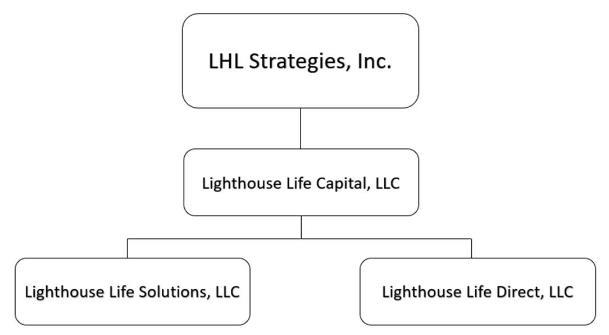
Our company has no employees. All of our
operations will be performed by employees of LHL Strategies, our
sole member. Currently, LHL Strategies’ only asset is
its 100% membership interest in Lighthouse Life Capital, LLC, a
member-managed limited liability company. We anticipate that
distributions of cash will be made from us to LHL Strategies, in
amounts as determined by LHL Strategies, as our sole member, and
that such amounts will be at least sufficient to pay all expenses
and liabilities of our sole member. As
our sole member , LHL Strategies, through its board of directors,
will control our company. LHL Strategies and its subsidiaries are
subject to certain operating restrictions related to covenants in
the agreements governing outstanding indebtedness of LHL
Strategies, including a requirement that LHL Strategies’
lender consent to any other financing or creation of any liens on
the assets of LHL Strategies or any of its subsidiaries, including
our company. LHL Strategies’ lender has consented to this
offering.
Th total revenue of
LHL Solutions, Inc. for the fiscal year ended September 30, 2019
was $277,275 compared to $0 in the prior year period due to
increased policy origination and policy origination fee income.
Total expenses for the period were $2,079,077 compared to the prior
year period of $852,686.
The Offering. We are offering to
investors the opportunity to purchase up to an aggregate of
$50,000,000, of Beacon Bonds. See “Plan of Distribution - Who
May Invest” for further information. The offering will
terminate on the earliest of: (i) the date we sell the Maximum
Offering Amount; (ii) the second anniversary of the date of
qualification of this offering statement; or (iii) such date upon
which we determine to terminate the offering, in our sole
discretion. Notwithstanding the
previous sentence, we have the right to extend this offering beyond
the second anniversary of the date of qualification for an
additional year.
Our
company will conduct closings in this offering on the first and
third Thursday of each month or the “closing dates,”
and each, a “closing date,” until the offering
termination. Once a subscription has
been submitted and accepted by the company, an investor will not
have the right to request the return of its subscription payment
prior to the next closing date. If subscriptions are received on a
closing date and accepted by the company prior to such closing, any
such subscriptions will be closed on that closing date. If
subscriptions are received on a closing date but not accepted by
the company prior to such closing, any such subscriptions will be
closed on the next closing date. It is expected that settlement
will occur on the same day as each closing date.
On each closing date, offering proceeds for that closing will
be disbursed to us and Bonds will be issued to investors, or the
“Bondholders.” If the company is dissolved or
liquidated after the acceptance of a subscription, the respective
subscription payment will be returned to the subscriber. The
offering is being made on a best-efforts basis through IAA, our
underwriter
and Managing Broker-Dealer.
______________
1 The Deal - Life Settlement League Tables:
2017
4
|
Issuer
|
|
Lighthouse
Life Capital, LLC, a Delaware limited liability
company.
|
|
|
|
|
|
Securities Offered
|
|
Maximum
– $50,000,000, aggregate principal amount of the Bonds, with
sales of Class B Bonds limited to $30,000,000, in the
aggregate.
|
|
|
|
|
|
Maturity Date
|
|
The
Class A Bonds and Class B Bonds will each be offered serially, over
a maximum period of two years (subject to extension) starting from
the date of qualification of the Offering Statement of which this
Offering Circular is a part, with the sole difference between the
series being their respective maturity dates. Each series of Class
A Bonds will mature on the fifth anniversary of the issuance date
of such series and each series of Class B Bonds will mature on the
third anniversary of the issuance date of such series.
Upon maturity, and subject to the terms and conditions described in
this offering circular, the Bonds will be automatically renewed at
the same interest rate and for
the same term, unless redeemed upon maturity at our or your
election. Each
such renewal would constitute a new offering for the purpose of the
registration requirements of the Securities Act and, as such, would
be required to be registered or conducted pursuant to an exemption
from registration. Any such subsequent offering conducted pursuant
to Regulation A would count against the aggregate dollar
limitations in Rule 251(a) of Regulation A. If the
Bonds are not renewed and without the consent of the Bondholders,
we may elect to extend the maturity date of the Bonds for an
additional six months to facilitate the redemption of the Bonds.
See “Description
of Bonds – Maturity and Renewal” for more information.
|
|
|
|
|
|
Interest Rate
|
|
Class A
Bonds – 8.5% per annum computed on the basis of a 360-day
year.
Class B
Bonds – 6.5% per annum computed on the basis of a 360-day
year.
|
|
|
|
|
|
Interest Payments
|
|
Commencing
on the 15th day of the month, or the next business day, if the
15th is a
weekend or a holiday, following the issuance of such Bond and
continuing monthly until its maturity date. Interest will accrue
and be paid on the basis of a 360-day year consisting of twelve
30-day months. Interest on each Bond will accrue and be cumulative
from the end of the most recent interest period for which interest
has been paid on such Bond, or if no interest has paid, from the
date of issuance.
|
|
|
|
|
|
Offering Price
|
|
$1,000
per Bond.
|
|
|
|
|
|
Ranking
|
|
The Bonds are senior unsecured indebtedness of our company.
They rank equally with our other senior unsecured indebtedness and
structurally subordinated to all indebtedness of our
subsidiaries. The Bonds would
rank junior to any of our secured indebtedness; however, we have
covenanted not to incur any secured indebtedness or other
indebtedness that would be senior to the Bonds or to permit our
subsidiaries to incur any indebtedness.
|
|
|
|
|
|
Use of Proceeds
|
|
We estimate that the net proceeds we will receive from this
offering will be approximately $45,000,000 if we sell the Maximum
Offering Amount, after deducting O&O Expenses, selling
commissions and fees payable to our managing broker-dealer and
Selling Group Members.
We plan to use substantially all of the net proceeds from this
offering for working capital, general corporate purposes, including
distribution to our sole member for the payment of its expenses and
liabilities related to the formation of our business and other
expenses related to originating and acquiring life insurance
policies, marketing and advertising life settlements, and paying
interest and principal on the Bonds. A portion of the net proceeds
will be used by our subsidiaries to finance the acquisition of life
insurance policies and we will contribute such proceeds to them to
fulfill these purposes. See “Use of
Proceeds” for additional
information.
|
5
|
Certain Covenants
|
|
We will issue the Bonds under an indenture, or the Indenture,
to be dated as of the initial issuance date of the Bonds between us
and UMB Bank, as the trustee. The Indenture contains covenants that
limit our ability to incur, or permit our subsidiaries to incur,
third party indebtedness that would be senior to the Bonds, whether
secured or unsecured, unless all of the net proceeds of such
indebtedness, are used for the repayment of the Bonds. Further, we
are prohibited from selling any equity interest in any of our
subsidiaries, or causing any of our subsidiaries to issue new
equity to any third party, unless the net proceeds of such sale or
issuance are used for the repayment of the Bonds.
Pursuant to the Indenture, we are also required to maintain a bond
service reserve equal to 3% of the net proceeds raised in this
Offering, or
the Bond Service Reserve, which will be used for payment of
interest on the Bonds. The funds subject to the Bond Service
Reserve will be made available to the company for general busines
purposes, one year following the termination of the
Offering. See “Description
of Company’s Securities Certain Covenants” in this Offering
Circular.
|
|
|
|
|
|
Redemption at the Option of the Bondholder
|
|
Redemptions
made pursuant to the Optional
Redemption of the Bonds for Class A Bonds shall be subject
to a penalty of 8.5% of the total amount due to the Bondholder as
of the date of redemption, if redeemed within 0 – 12 months
of issuance, 8.0% of the total amount due to the Bondholder if
redeemed during months 13 – 24 from issuance, 7.5% of the
total amount due to the bondholder as of the date of redemption if
redeemed during months 25 – 36 from issuance, 7.0% of the
total amount due to the Bondholder as of the date of redemption if
redeemed during months 37 – 48 from issuance and 6.5% of the
total amount due to the Bondholder as of the date of redemption if
redeemed during months 49 – 60 from issuance. Redemptions
made pursuant to the Optional
Redemption of the Bonds for Class B Bonds shall be subject
to a penalty of 8.5% of the total amount due to the Bondholder as
of the date of redemption
Our
obligation to redeem Bonds in any given year pursuant to this
redemption is limited to 10% of the outstanding principal balance
of the Bonds, in the aggregate, on the most recent of January
1st, April
1st, July
1st or
October 1st of the applicable
year while the Offering is open, and January 1st of the applicable
year, following the offering termination. In addition, any Bonds
redeemed as a result of a Bondholder's right upon death, disability
or bankruptcy, will be included in calculating the 10% Limit and
will thus reduce the number of Bonds, in the aggregate, to be
redeemed pursuant to the redemption. Bond redemptions will occur in
the order that notices are received. We are not required to
establish a sinking fund or reserve for the redemption of Bonds and
our ability to redeem Bonds will be subject to the availability of
cash or other financing sources and cannot be
assured.
|
|
Redemption at the Option of the Company
|
|
The
Bonds may be redeemed at our option at no penalty. If the Bonds are
renewed for an additional term, we may redeem the Bonds at any time
during such renewal period. Any redemption will occur at a price
equal to the then outstanding principal amount of the Bonds, plus
any accrued but unpaid interest. For the specific terms of the
Optional Redemption, please see “Description of Bonds
– Optional Redemption” for more
information.
|
|
|
|
|
|
Redemption Upon Death, Disability or Bankruptcy
|
|
Within
60 days of the death, disability or bankruptcy of a Bondholder who
is a natural person, the estate of such Bondholder, or legal
representative of such Bondholder may request that we repurchase,
in whole but not in part and without penalty, the Bonds held by
such Bondholder by delivering to us a written notice requesting
such Bonds be redeemed. Redemptions due to death, disability or
bankruptcy shall count towards the annual 10% Limit on redemptions
described above; provided, however, that any redemptions pursuant
to death, disability or bankruptcy shall not be subject to the 10%
Limit. Any such request shall specify
the particular event giving rise to the right of the holder or
beneficial holder to redeem his or her Bonds. If a Bond is held
jointly by natural persons who are legally married, then such
request may be made by (i) the surviving Bondholder upon the death
of the spouse, or (ii) the disabled Bondholder (or a legal
representative) upon disability of the spouse. In the event a Bond
is held together by two or more natural persons that are not
legally married, neither of these persons shall have the right to
request that the company repurchase such Bond unless each
Bondholder has been affected by such an event.
|
6
|
|
|
Disability shall mean with respect to any Bondholder or beneficial
holder, a determination of disability based upon a physical or
mental condition or impairment arising after the date such
Bondholder or beneficial holder first acquired Bonds. Any such
determination of disability must be made by any of: (1) the Social
Security Administration; (2) the U.S. Office of Personnel
Management; or (3) the Veteran’s Benefits Administration, or
the Applicable Governmental Agency, responsible for reviewing the
disability retirement benefits that the applicable Bondholder or
beneficial holder could be eligible to receive.
Bankruptcy shall mean, with respect to any Bondholder the final
adjudication related to (i) the filing of any petition seeking to
adjudicate the Bondholder bankrupt or insolvent, or seeking for
itself any liquidation, winding up, reorganization, arrangement,
adjustment, protection, relief, or composition of such Bondholder
or such Bondholder’s debts under any law relating to
bankruptcy, insolvency, or reorganization or relief of debtors, or
seeking, consenting to, or acquiescing in the entry of an order for
relief or the appointment of a receiver, trustee, custodian, or
other similar official for such Person or for any substantial part
of its property, or (ii) without the consent or acquiescence of
such Bondholder, the entering of an order for relief or approving a
petition for relief or reorganization or any other petition seeking
any reorganization, arrangement, composition, readjustment,
liquidation, dissolution, or other similar relief under any
bankruptcy, liquidation, dissolution, or other similar statute,
law, or regulation, or, without the consent or acquiescence of such
Bondholder, the entering of an order appointing a trustee,
custodian, receiver, or liquidator of such Bondholder or of all or
any substantial part of the property of such Bondholder which order
shall not be dismissed within ninety (90) days.
|
|
|
|
Subject
to the annual cap on redemptions, upon our receipt of a redemption
request in the event of death, disability or bankruptcy of a
Bondholder, we will designate a date for the redemption of such
Bonds, which date shall not be later than 90 days after we receive
documentation and/or certifications establishing (to the reasonable
satisfaction of the company) the right to be redeemed. On the
designated date, we will redeem such Bonds at a price per Bond that is equal to all accrued and
unpaid interest, to but not including the date on which the Bonds
are redeemed plus the then outstanding principal amount of such
Bond.
|
|
|
|
|
|
Default
|
|
The
indenture governing the Bonds will contain events of default, the
occurrence of which may result in the acceleration of our
obligations under the Bonds in certain circumstances. Events of
default, other than payment defaults, will be subject to our
company's right to cure within a certain number of days of such
event of default. Our company will have the right to cure any
payment default within 60 days before the trustee may declare a
default and exercise the remedies under the indenture. See
“Description of Bonds -
Event of Default” for more information.
|
|
|
|
|
|
Form
|
|
The
Bonds purchased through a participant in the Depository Trust
Company, or DTC, will be evidenced by global bond certificates
deposited with a nominee holder, either DTC or its nominee Cede
& Co. Bonds purchased directly will be registered in book-entry
form only on the books and records of UMB Bank, N.A. in the name of
Phoenix American Financial Services, Inc. (“Phoenix
American”) as record holder of such Bonds for the benefit of
such direct purchasers. See "Description of Bonds -
Book-Entry, Delivery and Form" for more
information.
|
|
|
|
|
|
Denominations
|
|
We will
issue the Bonds only in denominations of $1,000.
|
7
|
Payment of Principal and Interest
|
|
Principal
and interest on the Bonds will be payable in U.S. dollars or other
legal tender, coin or currency of the U.S.
|
|
|
|
|
|
Future Issuances
|
|
We may,
from time to time, without notice to or consent of the Bondholders,
increase the aggregate principal amount of any series of the Bonds
outstanding by issuing additional bonds in the future with the same
terms of such series of Bonds, except for the issue date and
offering price, and such additional bonds shall be consolidated
with the applicable series of Bonds and form a single
series.
|
|
|
|
|
|
Securities Laws Matters:
|
|
The
Bonds being offered are not being registered under the Securities
Act in reliance upon exemptions from the registration requirements
of the Securities Act and such state securities laws and may not be
transferred or resold except as permitted under the Securities Act
and applicable state securities laws pursuant to registration or
exemption therefrom. In addition, the company does not intend to be
registered as an investment company under the Investment Company
Act of 1940, as amended.
|
|
|
|
|
|
Trustee, Registrar and Paying Agent
|
|
We have
designated UMB Bank, N.A. as paying agent and Phoenix American
Financial Services, Inc., a California corporation as co-paying
agent in respect of Bonds registered to it as record holder. UMB
Bank, N.A. will also act as trustee under the indenture and
registrar for the Bonds. As such, UMB Bank, N.A. will make payments
on the Bonds to DTC or to Phoenix American (who will forward such
payments to the applicable Bondholders). The Bonds will be issued
in book-entry form only, evidenced by global certificates, as such,
payments are being made to DTC, its nominee or to Phoenix
American.
|
|
|
|
|
|
Governing Law
|
|
The
indenture and the Bonds will be governed by the laws of the State
of Delaware.
|
|
|
|
|
|
Material Tax Considerations
|
|
You
should consult your tax advisors concerning the U.S. federal income
tax consequences of owning the Bonds in light of your own specific
situation, as well as consequences arising under the laws of any
other taxing jurisdiction.
|
|
|
|
|
|
Risk Factors
|
|
An investment in the Bonds involves certain risks. You should
carefully consider the risks above, as well as the other risks
described under “Risk
Factors” of this offering
circular before making an investment decision. The
risks discussed herein include:
● our ability to
fulfill our obligations to make interest and principal payments
under the Bonds and our ability to satisfy redemption
requests;
● our critical
reliance on the funds raised from this Offering to grow our
business to a size sufficient to generate cash to fulfill our
obligations under the Bonds;
● our
predecessor’s limited operating history and history of
operating losses;
● our ability to
execute our business plan in the emerging market for life
settlements which has low consumer awareness and has suffered from
negative publicity and uncertainty. Accordingly, our prospects may
be adversely affected by lack of growth, increased competition or
other changes in the life settlement market;
● our ability to
engage and retain third-party purchasers of the policies we
originate and acquire in sufficient volumes and attendant revenue
from fees and profit sharing;
● changes in the
economy, financial and credit markets that affect the overall
demand for and ability of third-party purchasers to purchase life
insurance policies we originate and acquire, such as a prolonged
economic recession caused by COVID-19 or other factors, rising
inflation, continued market volatility among others;
● our
reliance on information provided and obtained by third parties
including changes in underwriting factors and methodologies and the
risk that insureds may live longer than anticipated;
● federal,
state statutory and regulatory matters, and FINRA
requirements;
|
8
CAUTIONARY STATEMENT REGARDING FORWARD-LOOKING
STATEMENTS
This
offering circular contains certain forward-looking statements that
are subject to various risks and uncertainties. Forward-looking
statements are generally identifiable by use of forward-looking
terminology such as "may," "will," "should," "potential," "intend,"
"expect," "outlook," "seek," "anticipate," "estimate,"
"approximately," "believe," "could," "project," "predict," or other
similar words or expressions. Forward-looking statements are based
on certain assumptions, discuss future expectations, describe
future plans and strategies, contain financial and operating
projections or state other forward-looking information. Our ability
to predict results or the actual effect of future events, actions,
plans or strategies is inherently uncertain. Although we believe
that the expectations reflected in our forward-looking statements
are based on reasonable assumptions, our actual results and
performance could differ materially from those set forth or
anticipated in our forward-looking statements. Factors that could
have a material adverse effect on our forward-looking statements
and upon our business, results of operations, financial condition,
funds derived from operations, cash flows, liquidity and prospects
include, but are not limited to, the factors referenced in this
offering circular, including those set forth below.
When
considering forward-looking statements, you should keep in mind the
risk factors and other cautionary statements in this offering
circular. Readers are cautioned not to place undue reliance on any
of these forward-looking statements, which reflect our views as of
the date of this offering circular. The matters summarized below
and elsewhere in this offering circular could cause our actual
results and performance to differ materially from those set forth
or anticipated in forward-looking statements. Accordingly, we
cannot guarantee future results or performance. Furthermore, except
as required by law, we are under no duty to, and we do not intend
to, update any of our forward-looking statements after the date of
this offering circular, whether as a result of new information,
future events or otherwise.
9
RISK FACTORS
An investment in the Bonds is highly speculative and is suitable
only for persons or entities that are able to evaluate the risks of
the investment. An investment in the Bonds should be made only by
persons or entities able to bear the risk of and to withstand the
total loss of their investment. Prospective investors should
consider the following risks before making a decision to purchase
the Bonds. To the best of our knowledge, we have included all
material risks to investors in this section.
Risks Related to the Bonds and to this Offering
The Bonds are not obligations of our subsidiaries and will be
subordinated to all of the liabilities of the company’s
subsidiaries, if any. Such subordination increases the risk that we
will be unable to meet our obligations on the Bonds.
The
Bonds are obligations of the company exclusively and not of any of
our subsidiaries. The Bonds are also effectively subordinated to
all of the liabilities of the company’s subsidiaries, to the
extent of their assets, since they are separate and distinct legal
entities with no obligation to pay any amounts due under the
company’s indebtedness, including the Bonds, or to make any
funds available to make payments on the Bonds. The company’s
right to receive any assets of any subsidiary in the event of a
bankruptcy or liquidation of the subsidiary, and therefore the
right of the company's creditors, including holders of the Bonds,
to participate in those assets, will be effectively subordinated to
the claims of that subsidiary's creditors, including trade
creditors, in each case to the extent that the company is not
recognized as a creditor of such subsidiary. In addition, even
where the company is recognized as a creditor of a subsidiary, the
company’s rights as a creditor with respect to certain
amounts are subordinated to other indebtedness of that subsidiary,
including secured indebtedness to the extent of the assets securing
such indebtedness.
We may engage in a variety of transactions that may impair our
ability to pay interest and principal on the Bonds.
The indenture governing the Bonds will contain
covenants that will limit us from making any fundamental changes
including any merger, consolidation, winding up or liquidation. We
are also limited from paying dividends or issuing preferred equity
or any other equity with preference over our common stock.
Additionally, we may not enter into or
maintain any transaction or agreement with our affiliates, except
in the ordinary course of business, subject to certain conditions.
However, if we violate this covenant or engage in any of
transaction limited by the covenants pursuant to a waiver to the
indenture, it could have an adverse impact on
Bondholders.
Some significant restructuring transactions that may adversely
affect Bondholders may not constitute a Change of
Control/Repurchase Event under the indenture, in which case we
would not be obligated to offer to repurchase the
Bonds.
Some
restructuring transactions that result in a change in control may
not qualify as a Repurchase Event under the Indenture; therefore,
Bondholders will not have the right to repurchase their Bonds, even
though the company is under new management. These
transactions are limited to those which cause a non-affiliate of
the Company to gain voting control. For example, if our Sole Member
determined to cause the Company to become Manager-Managed by a
third-party, the change in control would not qualify as a
Repurchase Event under the Indenture. Upon the occurrence of
a transaction which results in a change in control of the company,
Bondholders will have no voting rights with respect to such a
transaction. In the event of any such transaction, Bondholders
would not have the right to require us to repurchase their Bonds,
even though such a transaction could increase the amount of our
indebtedness, or otherwise adversely affect the
Bondholders.
The Bonds will limit but do not eliminate our ability to incur
additional debt which could negatively impact
Bondholders.
The Indenture contains covenants that limit our
ability to incur, or to permit our subsidiaries to incur, third
party indebtedness except with respect to the issuance of Bonds in
this offering and with respect to the issuance of indebtedness, the
net proceeds of which is used exclusively to pay off the
Bonds. In the event we are in violation of the covenant,
incur debt pursuant to a waiver of the indenture, or otherwise,
that debt may be senior to Bondholders.
10
We are not limited in the amount of distributions we may make to
our parent and sole member, LHL Strategies, Inc.
Neither
the Indenture nor the forms of Bonds contain any covenant limiting
the ability of LHL Strategies to cause us to make distributions of
cash from us to LHL Strategies in respect of LHL Strategies 100%
membership interest in us. We anticipate that distributions of cash
will be made from us to LHL Strategies, in amounts as determined by
LHL Strategies, as our sole member, and that such amounts will be
at least sufficient to pay all expenses and liabilities of our sole
member, As LHL Strategies will conduct all of our operations
through its personnel, we believe such distributions to be
necessary; however, amounts distributed to LHL Strategies will not
be available to us to make payments of interest or principal or to
fund redemption requests on the Bonds.
Our company objectives critically rely on the amount of funds
raised in this offering.
While
we believe it is possible to achieve our objectives regardless of
the amount of the raise, it will be significantly more difficult to
do so if we sell fewer Bonds than we anticipate. Such a result may
negatively impact our ability to originate and acquire life
insurance policies at projected volumes, which may decrease our
ability to service and repay our debt
when and as it comes due, including honoring redemptions on the
Bonds. Additionally, if we are successful raising capital, we
cannot predict the amounts and timing of such raise. Therefore, we
may have to adjust our business plan and such amendments may be
suboptimal.
If we sell substantially less than all of the Bonds we are
offering, the costs we incur to comply with the rules of the
Securities and Exchange Commission, or the SEC, regarding financial
reporting and other fixed costs (such as those relating to the
offering) will be a larger percentage of our revenue and may reduce
our financial performance and our ability to fulfil our obligations
under the Bonds.
We
expect to incur significant costs in maintaining compliance with
the financial reporting for a Tier II Regulation A issuer and that
our management will spend a significant amount of time assessing
the effectiveness of our internal control over financial reporting.
We do not anticipate that these costs or the amount of time our
management will be required to spend will be significantly less if
we sell substantially less than all of the Bonds we are
offering.
Upon maturity, unless redeemed at our or your election, the bonds
will be automatically renewed at the same interest rate and for the
same term.
Upon maturity, and subject to the terms and
conditions described in this offering circular including
registration or availability of an exemption from registration
under the Securities Act, the Bonds will be automatically renewed
at the same interest rate and for the same term, unless redeemed upon maturity
at our or your election. As a result, if we do not elect to redeem
Bonds at maturity, a Bondholder must affirmatively request
redemption in accordance with the process set forth below under
“Description
of Bonds – Interest and Maturity.” If a Bondholder does not request
redemption as prescribed then such Bondholders will not be repaid
upon maturity and will be automatically renewed for another term,
subject to the Bondholder’s ability to request redemption
subject to limitations and penalties. See
“Description
of Bonds - Optional Redemption at Election of
Bondholder”
for more information.
Redemption requests of Bonds at the option of the Bondholder will
be limited by the 10% Limit and to the extent they are accepted,
will be subject to financial penalties for early
redemption.
While the Bonds
carry an early redemption right and a redemption right in the event
of death, disability or bankruptcy of the Bondholder, redemptions
are subject to an annual 10% redemption limit. As a result,
requests for redemption from Bondholders may be rejected by the
Company. Additionally, with respect to redemptions at the option of
the Bondholders, except for death, disability or bankruptcy, early
redemption penalties of between 6.5% and 8.5% based on when Bonds
are redeemed, for Class A Bonds and 8.5% for Class B Bonds will
apply, which will adversely affect Bondholders seeking to redeem
Bonds prior to maturity.
Redemption requests for Bonds at the option of the Bondholder or in
the event of death, disability or bankruptcy of a Bondholder may
have an adverse effect on the company’s overall growth and
ability to fulfil our obligations on the Bonds.
The
Bonds carry an early redemption right and a redemption right in the
event of death, disability or bankruptcy of the Bondholder. As a
result, one or more Bondholders may elect to have their Bonds
redeemed prior to maturity. In such an event, we may not have
access to the necessary cash to redeem such Bonds. Additionally,
any cash used to satisfy such redemption requests will be diverted
from cash required to fund the continued growth of the company.
Accordingly, the use of funds towards redemptions could result in
the company’s inability to meet projected growth targets,
which could, in turn, limit the company’s ability to make
interest and principal payments to Bondholders.
Our trustee shall be under no obligation to exercise any of the
rights or powers vested in it by the indenture at the request,
order or direction of any of the Bondholders, pursuant to the
provisions of the indenture, unless such Bondholders shall have
offered to the trustee reasonable security or indemnity against the
costs, expenses and liabilities that may be incurred therein or
thereby.
The
indenture governing the Bonds provides that in case an event of
default occurs and not be cured, the trustee will be required, in
the exercise of its power, to use the degree of care of a
reasonable person in the conduct of his own affairs. Subject to
such provisions, the trustee will be under no obligation to
exercise any of its rights or powers under the indenture at the
request of any Bondholder, unless the Bondholder has offered to the
trustee security and indemnity satisfactory to it against any loss,
liability or expense.
11
There is no established trading market for the Bonds and we do not
expect one to develop. Therefore, Bondholders may not be able to
resell them for the price that they paid or sell them at
all.
Prior
to this offering, there was no active market for the Bonds and we
do not expect one to develop. We do not have any present intention
to apply for a quotation for the Bonds on an alternative trading
system or over the counter market and even if we obtain that
quotation in the future, we do not know the extent to which
investor interest will lead to the development and maintenance of a
liquid trading market. Further, the Bonds will not be quoted
on an alternative trading system or over the counter
market until after the termination of this offering, if at
all. Therefore, investors will be required to wait until at least
after the final termination date of this offering for such
quotation. The initial public offering price for the Bonds has been
determined by us. You may not be able to sell the Bonds you
purchase at or above the initial offering price or sell them at
all.
Alternative trading
systems and over the counter markets, as with other public
markets, may from time to time experience significant price
and volume fluctuations. As a result, if the Bonds are listed on
such a trading system, the market price of the Bonds may be
similarly volatile, and Bondholders may from time to time
experience a decrease in the value of their Bonds, including
decreases unrelated to our operating performance or prospects. The
price of the Bonds could be subject to wide fluctuations in
response to a number of factors, including those listed in this
"Risk
Factors" section of this offering circular. No assurance can
be given that the market price of the Bonds will not fluctuate or
decline significantly in the future or that Bondholders will be
able to sell their Bonds when desired on favorable terms, or at
all. Further, the sale of the Bonds may have adverse federal income
tax consequences.
We rely on IAA, our managing broker-dealer, to sell the Bonds
pursuant to this offering. If our managing broker-dealer is not
able to market the Bonds effectively, we may be unable to raise
sufficient proceeds to meet our business objectives.
We have
engaged IAA to act as our underwriter
and managing broker-dealer for this offering. We rely on our
managing broker-dealer to use its best efforts to sell the Bonds
offered hereby. If our
managing broker-dealer is not able to market the Bonds effectively,
it would be challenging and disruptive to locate an alternative
managing broker-dealer for this offering. Without an effective
effort to sell the Bonds, our ability to originate and acquire life
insurance policies may be limited, which could affect our ability
to meet revenue projections, which in turn, could limit the
company’s ability to make interest and principal payments to
Bondholders. See “Our company objectives
critically rely on the amount of funds raised in this
offering.”
We may redeem all or any part of the Bonds that have been issued
before their maturity, and you may be unable to reinvest the
proceeds at either the same or a higher rate of
return.
We may
redeem all or any part of the outstanding Bonds prior to maturity.
See “Description of Bonds -
Optional Redemption” for more information. If
redeemed, you may be unable to reinvest the money you receive in
the redemption at a rate that is equal to or higher than the rate
of return on the Bonds.
Risks Related to Our Business and Our Industry
Our predecessor has a limited history of operations and a history
of operating losses. Consequently, our future earnings and cash
flows, if any, may be volatile, resulting in future losses and
uncertainty about our ability to fulfil our obligations under the
Bonds including honoring redemption requests of the
Bonds.
We
are a company with a limited history, which makes it difficult to
accurately forecast our earnings and cash flows. While we have a
limited operating history, our predecessor, Lighthouse Life
Solutions, LLC had a net loss of approximately $853,563 and $1.8
million, for the fiscal years ended September 30, 2018 and 2019.
Our limited history, our history of operating losses and the
evolving nature of our market make it likely that there are risks
inherent in our business that are yet to be recognized by us or
others, or not fully appreciated, and that could result in us
earning less than we anticipate or suffering further losses. As a
result of the foregoing, an investment in the Bonds necessarily
involves significant uncertainty about the stability of our
earnings and cash flows, if any, and, ultimately, our ability to
service and repay our debt. Accordingly, there is a significant
risk that you could lose your entire investment.
12
Substantially all of our predecessor’s historical revenues
have been generated from one source.
Substantially all our predecessor’s
historical revenue has been derived from certain fees and, if any,
profit sharing, paid to it pursuant to a Letter Agreement (as defined herein)
related to Lighthouse Life Solutions’ acquisition of life
insurance policies for the applicable trust series of Merlion Park Trust (the
“Merlion Trust”). Although the
Merlion Trust has a right of first refusal pursuant to the Letter
Agreement (as defined herein). (“See “General
Information About Our Company – Business
Strategy”), it has no obligation to purchase policies that
we originate and in the event the Merlion Trust chooses to no
longer purchase policies or purchase fewer policies from us, our
revenue would be adversely affected as we cannot guarantee we would
be able to earn sufficient revenues from other third-party
purchasers, which would limit our ability to fulfill our
obligations under the Bonds. However,
we are not aware of any intention on the part of Merlion Trust to
reduce their historical acquisitions of policies through our
company.
We are controlled by our sole member and Bondholders will have no
control over changes in our strategies, policies and day-to-day
operations, which lack of control increases the uncertainty and
risks you face as an investor in the Bonds. In addition, we may
change our strategies and operational policies without your
approval.
You should
not purchase Bonds unless you are willing to entrust all aspects of
the day-to-day management to the board of directors and executive
officers of our sole member, LHL Strategies. As a Bondholder, you
will not have any voting rights under our operating agreement.
Specifically, our sole member is controlled by Michael Freedman,
James Dodaro, Andrew Brecher, and Michael Coben, who together also
comprise the board of directors of our sole member, and as a
result, they will be able to exert significant control over
the operations of our sole member, and in turn, the operations of
the company. The board of directors of our sole member has
exclusive control over the operations of our company. As a result,
we are dependent on the board of directors of our sole member to
properly manage our sole member and in turn, the company.
None of our sole member, our
executive officers or the board of directors of our sole member
have any fiduciary duty to bondholders.
LHL Strategies, our sole member, has entered into agreements
governing outstanding indebtedness which provide certain consent
rights to our sole member’s senior lender which may adversely
affect Bondholders.
LHL
Strategies and its subsidiaries are
subject to certain operating restrictions related to covenants in
the agreements governing outstanding indebtedness of LHL
Strategies, including a requirement that LHL Strategies’
lender consent to any other financing or creation of any liens on
the assets of LHL Strategies or any of its direct or indirect
subsidiaries. This consent right is expected to expire with final
maturity of LHL Strategies’ indebtedness on May 31, 2024;
provided that if the LHL Strategies indebtedness is not fully paid
at maturity or is otherwise extended then such consent right will
remain in effect until such indebtedness is repaid. While LHL
Strategies’ lender has consented to this offering, these
consent rights may limit the ability of our company and its
subsidiaries to procure future financing which may inhibit the
growth of our company or the ability of our company to refinance,
if necessary, the Bonds. Further, in the event LHL Strategies was
in violation of the aforementioned covenants, it could be subject
to litigation with respect to the agreements, which in turn could
adversely affect its and its personnel’s ability to manage
our company.
The inability of our sole member to hire and retain key personnel
could delay or hinder implementation of our business strategies,
which could impair our ability to fulfil our obligations under the
Bonds and could reduce the value of your investment.
Our
success depends to a significant degree upon the contributions of
our sole member’s management team and highly skilled
personnel. While our sole member has employment agreements with its
executive officers, if any of them were to cease their affiliation
with our sole member, it may be unable to find suitable
replacements, and our operating results could suffer. Competition
for highly skilled personnel is intense, our sole member may be
unsuccessful in attracting and retaining such highly skilled
personnel. If our sole member loses or is unable to obtain the
services of highly skilled personnel, the ability of our sole
member to facilitate implementation of our strategies could be
delayed or hindered, and our ability to pay obligations on the
Bonds may be materially and adversely affected.
13
Material changes in the life settlement market, a relatively new
and evolving market, may adversely affect our operating results,
business prospects and our ability to repay our obligations under
the Bonds.
Our sole business is to originate
and acquire life insurance policies through the highly regulated
life settlement market for the benefit of third-party purchasers of
those policies. The life settlement market is a relatively new and
evolving market. The success of our business and our ability to
repay the principal and interest on our obligations, including the
Bonds, depends in large part on the continued development of the
life settlement market, and, in part, the solvency of life
insurance companies to pay the face value of the life insurance
benefits, both of which will critically impact the performance of
the life insurance assets we currently own and acquire in the
future. We expect that the development of the life settlement
market will primarily be impacted by a variety of factors such as
the interpretation of existing laws and regulations, the adoption
or amendment of statutes and regulations, and the addressable
market. Importantly, all of the factors that we believe will
significantly affect the development of the life settlement market
are beyond our control. Any material and adverse development in the
life settlement market, including the life insurance industry,
could adversely affect our operating results, our business
prospects and viability, our access to capital, our ability to
repay our various obligations, including the Bonds. Because of
this, an investment in the Bonds generally involves greater risk as
compared to investments offered by companies with more diversified
business operations in more established
markets.
Our business and prospects may be adversely affected by changes,
lack of growth, increased competition or other changes in the life
settlement market.
The
life settlement market and our operation within the market may be
negatively affected by a variety of factors within and beyond our
control, including:
●
the
inability to receive interest from qualified policyowners in
response to our advertising and marketing about life settlements
and our company’s services;
●
the
inability to receive referral of qualified policyowners from
financial professionals, life settlement brokers and providers,
third-party advertisers and other intermediaries;
●
the
inability to engage with third-party purchasers of the life
insurance policies we originate;
●
competition
from other companies, including other life settlement companies,
life insurance companies (which are larger and more well
capitalized than us), and other financial service product
providers;
●
negative
publicity, misunderstandings and uncertainty about life settlements
and the life settlement market by the public and life insurance
policyowners; and
●
the
adoption or amendment of governmental statutes, regulations or
administrative actions that would negatively impact the life
settlement market.
The
relatively new and evolving nature of the life settlement market in
which we operate makes these risks unique and difficult to
quantify. Nevertheless, contractions in the life settlement market,
whether resulting from general economic conditions, regulatory or
legal pressures or otherwise (including regulatory pressures
exerted on us or others involved in the life settlement market or
involved with participants in that market), could make
participation in that market generally less desirable. This could,
in turn, depress the prices at which life insurance policies are
bought and sold.
Contestability and
Validity of Life Insurance Policies.
Life
insurance policies that we originate and acquire may be subject to
contest by the issuing life insurance company. If the
insurance company successfully contests a policy, the policy will
be rescinded and declared void. Additionally, pursuant to our
origination agreements and pursuant to state insurance laws and the
forms approved for use by state insurance departments, for each of
the policies we acquire, we represent that to our knowledge, there
were no misrepresentation or fraud by any insured, underlying
seller, or person, including insurance agent, broker or producer
with respect to that policy. As such, if a policy acquired by the
company is deemed to be invalid following the acquisition of the
policy by a third-party purchaser, we could be subject to
litigation in connection with such origination.
14
Competition in the Life Settlement Market.
The
life settlement market is highly competitive and there are several
substantial barriers to prevent new competitors from entering this
market. However, we expect to face competition from existing
competitors and new market entrants in the future. As a
result, we may not be able to originate or acquire life settlement
policies for third-party purchasers on a commercially viable
basis.
Risks related to the origination and acquisition of life settlement
policies for the benefit of third-party purchasers; our model
relies on a sufficient number of purchasers for the policies we
originate and acquire.
Our
business model relies on relationships with third-party purchasers
that purchase the policies that our company originates and
acquires. Our business model requires that we continually develop
relationships with third-party purchasers for the life insurance
policies that we originate. While we currently have a sufficient
number of such purchasers, as we grow, so will our need to develop
additional relationships with third-party purchasers. Any lack of
relationships with third-party purchasers will have a materially
adverse effect on our business, which will limit our ability to
continue operating the business and adversely affect our ability to
fulfill our obligations under the Bonds to make interest and
principal payments to Bondholders.
Changes in the economy, financial and credit markets that affect
the overall demand for and ability of investors to finance life
insurance policy purchases such as a prolonged economic recession
caused by COVID-19 and related factors, rising inflation, continued
market volatility and widespread loan defaults among
others.
Life
insurance policies are a financial asset and, as such, are impacted
by macro-economic factors such as the economy, employment, and
interest rates to name a few. The availability of credit is also a
critical condition that impacts all financial assets including life
insurance policies. Additionally, the life settlement market is a
relatively new and niche market that comparatively few investors
and lenders are aware of. Therefore, any adverse changes in the
macro-economic factors that affect the availability of credit
broadly may have a disproportionate impact on the life settlement
market. This could have the effect of depressing demand or reducing
the prices we receive for the life insurance policies we purchase
and hold for resale or to maturity. If such conditions persist, it
could have a material negative impact on our business, prospects
and ability to fulfil the obligations under the bonds.
COVID-19
is a factor that has and could continue to result in the
persistence of negative economic conditions that impact our
business as described above. However, there remains significant
uncertainty about the path of the virus and the pace of future
economic growth in addition to the unknown secondary future impacts
of these actions (national debt). As such, there can be no
assurance that we will be execute our business and funding plans in
the midst of COVID-19 and in the future if it
persists.
Risks related with purchasing and holding life insurance policies
until maturity,
including the risk that insureds live longer than we anticipated,
the requirement to fund on-going premium payments for a substantial
period of time and various operating risks and costs associated
with holding life insurance policies.
While our primary business is to originate and
acquire life insurance policies for the benefit of third-party
purchasers, we may decide to purchase and own a certain number of
policies to maturity. While we estimate a rate of return when we
purchase the life insurance policy, the actual rate of return
cannot be known prior to the mortality of the insured. The
longer the insured lives, the lower the rate of return on the life
insurance policy will be (and vice versa). The rate of return on
any single life insurance policy held to maturity can be
substantially less than zero. Additionally, any estimate of life
expectancy is based upon available medical and actuarial data at
the time of purchase that we generally rely on third parties to
provide us with (see “If
actuarial assumptions we obtain from third-party
providers…”). Life
insurance estimates on any single insured are inherently broad (not
an exact date of mortality but rather a probability of mortality at
any given date in the future) and there can be no assurance of the
accuracy of such third-party estimates. We may also rely on
alternative methods of obtaining life expectancy estimates
including methods created by us or others on our behalf using a
smaller or different data and analysis than that typically used in
the market today. Additionally, it is possible that advanced in
medical treatment and technology will result in insureds living
longer than we anticipated at the time of purchase and such changes
would have a material negative impact on our portfolio and
business. Delays in the collection of the proceeds on a substantial
number of life insurance policies we own, caused by the
aforementioned or any other reason, could have a material adverse
effect on the company’s financial results, which, in turn,
may have a material adverse effect on the company’s ability
to make payments to Bondholders.
15
Additionally, widespread cost of insurance rate
increases imposed by life insurance companies on life insurance
policies that we own will cause us to pay higher premiums for a
longer period of time which will materially lower our rate of
return. If the company is unable to make premium payments on a life
insurance policy it owns due to liquidity issues or for any other
reason, the life insurance policy could lapse
worthless. Insurers
may refuse to pay death benefits on certain life insurance policies
on the basis that there was no “insurable interest” on
the part of the owner of a life insurance policy at the time such
policy was initially purchased. Therefore, we bear the risk that
our underwriting procedures do not detect such insurable interest
issues at the time of purchase. Finally, the company could incur
substantial unplanned expenses in searching for mortality events
and locating insureds and could experience substantial delays in
collecting death benefits as a result, which would affect our rate
of return and our prospects generally. “See “Contestability
and Validity of Life Insurance Policies.”
Risks related with purchasing and
holding life insurance policies for resale
including the risk that we experience
negative price changes prior to the sale of the policy resulting in
lower realized gains (or realized losses) and less cash received
from such sale.
While
our primary business is to originate and acquire life insurance
policies for the benefit of third-party purchasers and the selling
policyowner, we may decide to purchase and own a certain number of
policies for later resale to a purchaser. Inherent in this strategy
is the risk that a life insurance policy will decline in value
while we own it and awaiting sale resulting in lower than
anticipated realized gain (or realized losses) and less cash
received from the sale of the policy than we anticipated. Declines
in value during the holding period can result from changes in life
expectancy estimates (either at the policy level or more broadly in
the marketplace), cost of insurance rate increases imposed by life
insurance companies on life insurance policies that we own, changes
in interest rates, credit availability and other changes that
affect the desire and ability of a purchaser of a life insurance
policy.
Additionally,
as our business grows it is likely that we will have a growing
number of policies held for sale at any one point in time which
will magnify this risk. While we will attempt to lessen this risk
by limiting the holding period and engaging additional buyers,
there can be no assurance that we will be able to do so. Negative
price changes during the holding period could have a material
negative impact on our business and ability to meet our obligations
under the Bonds.
Our business necessarily requires us to materially rely on
information provided or obtained from policyowners, insured
individuals and other parties. Delays in obtaining information,
failures to provide information, misinformation or negligence in
such information from all such third parties could materially and
adversely affect our ability to originate and acquire life
insurance policies.
The
acquisition of each life insurance policy is negotiated based on
variables and particular information and facts that are unique to
the life insurance policy itself, the policyowner and the
individuals insured under each policy. The information and facts we
obtain at the time that we are considering the acquisition of a
life insurance policy are based, in part, on representations made
by the policyowner and insured individuals under a life insurance
policy to the insurance company and to our company, and information
and facts the insurance company independently obtains related to
the policies it issues, including information and representations
concerning the health of the individuals insured under such life
policies, and whether or not there was insurable interest by the
owner of the policy when the policy was issued. Delays in obtaining
information, failures to provide information, misinformation or
negligence relating to a life insurance policy, the policyowner or
individuals insured under such policies could materially and
adversely impact the our ability to originate and acquire life
insurance policies for the benefit of third-party purchasers and
could, in turn, adversely affect our financial condition, results
of operations, and the value of our Bonds.
If actuarial assumptions we obtain from third-party providers and
rely on to calculate our expected returns on our investments in
life insurance policies change, our operating results and cash flow
could be adversely affected, as well as our ability to fulfil our
obligations under the Bonds.
When
we acquire a life insurance policy, the expected internal rate of
return we calculate is based upon the probability of an
insured’s mortality over an actuarial life expectancy
estimate. We presently obtain these estimates from third-party
medical-actuarial underwriting companies. In addition to actuarial
life expectancies, we rely on a pricing and premium forecasting
software model developed by a third-party actuarial firm for the
valuation of policies we purchase, future mortality revenues, and
the calculation of anticipated internal rates of return. These
pricing models forecast the estimated future premiums due as well
the future mortalities of insureds. We may also rely on alternative
methods of obtaining life expectancy estimates including methods
created by us or others on our behalf using a smaller or different
data and analysis (referred to as “streamlined
underwriting”) than that typically used in the market today.
Inaccuracies in methodology or result, or errors and irregularities
in receiving and interpreting life expectancy data and analysis
received from third parties, could adversely affect our business
and our ability to fulfil our obligations under the
Bonds.
16
Our company, the life settlement market and life settlement
transactions are subject to state laws and regulations, the
amendment or adoption of new laws and regulations, or changes in
the interpretation of such laws and regulations, which could
negatively affect our business.
Our
company, the life settlement market and life settlement
transactions may become the subject of new government laws, rules
and regulation that may impact our ability to originate and acquire
life insurance policies. Our business subjects us to state
insurance laws and regulations. States have adopted legislation and
regulations from model laws adopted by the National Association of
Insurance Commissioners and the National Conference of Insurance
Legislators. Today, 43 states have laws and regulations governing
life settlement transactions with residents of their states, which
laws and regulations generally require, among other things: (a)
licensing of purchasers and brokers of life insurance policies; (b)
filing and approval of certain forms, agreements and advertising
related to the origination and acquisition of a policy, (c)
disclosure of certain prescribed information about life
settlements, the individual life settlement transaction and other
information; and (d) periodic reporting requirements. These state
laws and regulations also regulate advertising of life settlements
by licensed entities and by third-party advertisers.
State
statutes typically provide state regulatory agencies with
significant powers to interpret, administer and enforce the laws
relating to the purchase of life insurance policies. State
regulators have broad discretionary power and may impose new
licensing requirements, interpret or enforce existing regulatory
requirements in different ways or issue new administrative rules,
even if not expressly authorized in statute. State regulators may
also impose rules that are generally adverse to our market. We
cannot, however, predict what any new regulation would specifically
involve.
Any
adverse change in laws or regulations, or their interpretation, in
one or more states in which we operate could result in the
curtailment or termination of our operations in such jurisdictions,
or cause us to modify our operations in a way that adversely
affects our profitability. Any such action could have a
corresponding material and negative impact on our results of
operations and financial condition, primarily through a material
decrease in revenues, and could also negatively affect our general
business prospects which in turn could affect our ability to repay
and retire our debt to Bondholders.
If federal or state regulators or courts conclude that the purchase
of life insurance policies constitutes, in all cases, a transaction
in securities, it could materially impact our company’s
ability to originate and acquire life insurance policies for the
benefit of third-party purchasers, which could adversely affect our
operating results and possibly threaten the viability of our
business.
Some
states and the SEC, and the Financial Industry Regulatory Authority
(FINRA) have, on occasion, sought to regulate the purchase of
non-variable universal life insurance policies as securities under
federal or state securities laws. In July 2010, the SEC’s
Life Settlement Task Force (the “Task Force”) issued a
staff report to the SEC on life settlements. In that report, the
Task Force recommended that investments in life insurance policies
be classified as securities. In addition, the Task Force
recommended the SEC propose to Congress to amend the definition of
“security” to include investments in life settlements,
but stated that the underlying life settlement transaction should
be expressly exempt in any federal law, stating the “Task
Force Recommends that any amendment to the definition of
“security” specifically exclude from federal securities
laws the sale of the policy by the insured or original policy
owner,” and that the “exclusion could also apply to the
sale of a variable life insurance policy by the insured or original
policy owner.” Neither the SEC nor Congress has taken any
position on recommendation of the Task Force, and there is no
indication if the SEC will take or advocate for any action to
implement the recommendations of the Task Force. In addition, there
have been several federal court cases in which transactions
involving the purchase and investment of life insurance contracts
have been held to be transactions in securities under the federal
Securities Act of 1933. We believe that the matters discussed in
the Task Force report to the SEC, and existing case law, do not
presently impact our current business model since our purchases of
life settlements are currently distinguishable from those cases
that have been held by common law, laws or regulations to be
transactions in securities.
17
With
respect to state securities laws, almost all states currently treat
the investment in a life insurance policy as a securities
transaction under state laws, although a number of states exclude
the sale of the policy by the original policy owner as a security,
either by statute, administrative or regulatory decree, or common
law. To date, due to the manner in which we conduct and structure
our activities and the availability, in certain instances, of
exceptions and exemptions under those state laws, such laws have
not adversely impacted our business model.
As
a practical matter, the widespread application of federal
securities laws to our purchases of life insurance policies, either
through the expansion of the definition of a “security”
to include the underlying sale of the policy, the expansion of the
types of transactions in life insurance policies that would
constitute transactions in “securities,” or the
elimination or limitation of available exemptions and exceptions
(whether by statutory change, regulatory change, or administrative
or court interpretation) could burden us and other companies
operating in the life settlement market, which could be material
and could threaten the viability of our business and our ability to
satisfy our obligations as they come due, including obligations
under our Bonds.
A determination that we are an unregistered investment company
would have serious adverse consequences.
A
determination that we or any of our subsidiaries is an unregistered
investment company under the Investment Company Act of 1940 (the
“1940 Act”) would have serious adverse consequences.
We do
not believe we are currently operating or intend to operate as an
investment company under the 1940 Act because we do not invest,
reinvest or trade in “securities” and do not hold
investment securities exceeding 40% of our total assets. The
1940 Act does not expressly define life insurance policies as
“securities”, and, additionally, Section 3(a)(8) of the
Securities Act indicates that act does not apply to
“[a]ny insurance or endowment policy or annuity
contract or optional annuity contract, issued by a corporation
subject to the supervision of the insurance commissioner, bank
commissioner, or any agency or officer performing like functions,
of any State or Territory of the United States or the District of
Columbia.” Our policies fall into such
categories. While not contained in the express definition of
securities, life insurance policies, in certain circumstances, may
be considered “investment contracts” and therefore
“securities” under the four-part test outlined in
SEC v. W.J. Howey Co., 328 U.S.
293 (1946). The Company does not believe the life
insurance policies it acquires and sells constitute
“securities” under the “investment
contract” analysis because d the Company purchases, holds and
sells only whole unaltered non-variable life insurance policies,
and does not fractionalize interests in those policies in the
course of raising capital or consummating purchases of such
policies. However, any alteration of the statutory or case
law definition of securities as applicable to life insurance
policies could render us an investment company under the 1940
Act. We do not believe we could operate our business
effectively as a registered investment company. As a result, we
would have to change our operations so as not to be an investment
company. Changes could include refraining from raising capital,
including debt capital as sought in this offering, and changing the
types of products and services that we provide. Furthermore, if at
any time it were established that we or any of our subsidiaries had
been operating as an investment company in violation of the
registration requirements of the 1940 Act, there would be a risk,
among other material adverse consequences, that such company: (i)
could become subject to SEC enforcement and investigation, monetary
penalties or injunctive relief, or both and (ii) may be unable to
enforce contracts with third parties or that third parties could
seek to obtain rescission of transactions with such company
undertaken during the period in which it was established that such
company was an unregistered investment company. Such developments
would be likely to have material and adverse consequences for
us.
Privacy Law Risks.
Privacy
laws may limit the information available to the company about the
policies, policyowners and individuals insured under the policies
we originate and acquire. Incomplete or inaccurate
information regarding the policies, policyowners and insureds can
cause the company to originate and acquire life insurance policies
that we would not have had the information been known to the
company.
The continuing spread of a new strain of coronavirus (also known as
the COVID-19 virus) may adversely affect our ability to generate
revenues.
The World Health Organization has declared the
spread of the COVID-19 virus a global pandemic, and the President
of the United States has declared a national state of emergency in
the United States in response to the outbreak. Considerable
uncertainty still surrounds the COVID-19 virus and its potential
effects, and the extent of and effectiveness of any responses taken
on a national and local level. However, measures taken to limit the
impact of this coronavirus, including social distancing and other
restrictions on travel, congregation and business operation have
already resulted in significant negative short-term economic
impacts. The long-term impact of this coronavirus on the U.S. and
world economies remains uncertain, but can result in long term
infrastructure and supply chain disruption, as well as dislocation
and uncertainty in the financial markets that could significantly
and negatively impact the global, national and regional economies,
the length and breadth of which cannot currently be predicted.
Possible negative impacts on our ability to originate and
acquire life insurance policies include significant delays by life
insurance companies to responding to requests for information
necessary to acquire life insurance policies, cost of insurance
rate increases imposed by life insurance companies on life
insurance policies.
18
Any cybersecurity-attack or other security breach of our technology
systems, or those of third-party vendors we rely on, could subject
us to significant liability and harm our business operations and
reputation.
Cybersecurity
attacks and security breaches of our technology systems, including
those of our clients and third-party vendors, may subject us to
liability and harm our business operations and overall reputation.
Our operations rely on the secure processing, storage and
transmission of confidential and other information in its computer
systems and networks. Threats to information technology systems
associated with cybersecurity risks and cyber incidents continue to
grow, and there have been a number of highly publicized cases
involving financial services companies, consumer-based companies
and other organizations reporting the unauthorized disclosure of
client, customer or other confidential information in recent years.
Cybersecurity risks could disrupt our operations, negatively impact
our ability to compete and result in injury to our reputation,
downtime, loss of revenue, and increased costs to prevent, respond
to or mitigate cybersecurity events. Although we have developed,
and continue to invest in, systems and processes that are designed
to detect and prevent security breaches and cyber-attacks, our
security measures, information technology and infrastructure may be
vulnerable to attacks by hackers or breached due to employee error,
malfeasance or other disruptions that could result in unauthorized
disclosure or loss of sensitive information; damage to our
reputation; the incurrence of additional expenses; additional
regulatory scrutiny or penalties; or our exposure to civil or
criminal litigation and possible financial liability, any of which
could have a material adverse effect on our business, financial
condition and results of operations.
19
USE OF PROCEEDS
We
estimate that the net proceeds we will receive from this offering
will be $45,000,000 if we raise
the Maximum Offering Amount, after deducting selling commissions
and fees payable to our managing broker-dealer and Selling Group
Members, and accounting for the O&O Expense.
We
plan to use substantially all of the net proceeds from this
offering on general corporate purposes, including expenses related
to originating and acquiring life insurance policies, as described
in more detail below. The table below demonstrates our anticipated
uses of offering proceeds, but the table below does not require us
to use offering proceeds as indicated. Our actual use of offering
proceeds will depend upon market conditions, among other
considerations. The numbers in the table are
approximate.
The net proceeds from the offering will be used to
fund marketing, advertising, systems and personnel costs associated
with originating and acquiring life insurance policies for the
benefit of or resale to third party purchasers, the purchase and
ownership of life insurance policies, and the debt service
obligations on the Bonds. We anticipate that distributions
of cash will be made from us to LHL Strategies in accordance with
our operating agreement, in amounts as determined by LHL
Strategies, as our sole member, and that such amounts will be at
least sufficient to pay the overhead expenses and other liabilities
of our sole member. A portion of the
net proceeds from the Offering will also be used for corporate
overhead and administrative costs associated with the
aforementioned.
|
|
Maximum Offering
Amount*
|
|||
|
|
Bonds(7)
|
Class A
Bonds(8)
|
||
|
|
Amount
|
Percent
|
Amount
|
Percent
|
|
Gross offering
proceeds
|
$50,000,000
|
100%
|
$50,000,000
|
100%
|
|
Less offering
expenses:
|
|
|
|
|
|
Selling
commissions (1)
|
$2,350,000
|
4.70%
|
$2,500,000
|
5.00%
|
|
Managing
broker-dealer fee (2)
|
$1,000,000
|
2.00%
|
$1,000,000
|
2.00%
|
|
Reallowance (3)
|
$500,000
|
1.00%
|
$500,000
|
1.00%
|
|
Wholesaling Fee (4)
|
$150,000
|
0.30%
|
$0
|
0.00%
|
|
O&O
Expenses (5)
|
$1,000,000
|
2.00%
|
$1,000,000
|
2.00%
|
|
|
|
|
|
|
|
Net Proceeds
(6)
|
$45,000,000
|
90.00%
|
$45,000,000
|
90.00%
|
*Amounts and
percentages may vary from the above, provided that Selling
Commission and expenses will not exceed 8.0% of gross offering
proceeds of either the Class A Bonds or the Class B
Bonds.
(1)
This includes (a)
selling commissions of (i) 5.00% of gross offering proceeds on the
sale of Class A Bonds and (ii) 4.50% of gross offering proceeds on
the sale of Class B Bonds, (b) a managing broker-dealer fee of up
to 2.00% of the gross proceeds of the offering, (c) a reallowance
1.00% of gross proceeds from the certain sales of the
Bonds, and (d) Wholesaling Fee of
0.50% of gross offering proceeds on the sale of Class B
Bonds. See
“Use of
Proceeds” and “Plan of
Distribution” for more information.
(2)
We will pay a
managing broker-dealer fee of up to 2.00% of the gross offering
proceeds on the sale of Class A Bonds or Class B
Bonds.
(3)
We will pay a
reallowance of 1.00% on the sale of both Class A and Class B
Bonds.
(4)
We will pay a
wholesaling fee of 0.50% on the sale of Class B Bonds
only.
(5)
Accounts for
estimated organizational and offering expenses in the amount of
2.00% of gross proceeds, which will be paid from the Offering and
include legal, accounting, transfer agent, printing and other
services related to the organization of our company and this
Offering.
(6)
Net proceeds will
also be used on general corporate purposes, including distribution
to our sole member for the payment of its expenses and liabilities
related to the formation of our business and other expenses related
to originating and acquiring life insurance policies, marketing and
advertising life settlements, and paying interest and principal on
the Bonds.
(7)
This assumes we
sell the Maximum Offering Amount comprised of $20,000,000 in Class
A Bonds and $30,000,000 in Class B Bonds.
(8)
This assumes we
sell the Maximum Offering
Amount of $50,000,000 comprised solely of Class A
Bonds.
The following table presents our projected use of proceeds based on
a raise equal to 100%, 75%, 50% and 25% of the Maximum Offering
Amount. If we do not achieve the maximum offering amount, we will
proportionately reduce our expenses, provided that we will continue
to make distributions to pay off any indebtedness of our sole
member out of the first $10 million in
proceeds.
|
|
|
|||||||
|
|
$45,000,000
|
$33,750,000
|
$22,500,000
|
$11,250,000
|
||||
|
Percent of
Maximum Offering Amount
|
100%
|
75%
|
50%
|
25%
|
||||
|
|
Dollars
|
%
|
Dollars
|
%
|
Dollars
|
%
|
Dollars
|
%
|
|
Marketing/Advertising
|
9,610,000
|
21.4%
|
8,649,000
|
25.6%
|
6,438,700
|
28.6%
|
3,844,000
|
34.2%
|
|
Personnel
Costs
|
7,640,000
|
17.0%
|
6,876,000
|
20.4%
|
5,118,800
|
22.8%
|
3,056,000
|
27.2%
|
|
Other
Operating Expenses
|
3,590,000
|
8.0%
|
3,231,000
|
9.6%
|
2,405,300
|
10.7%
|
1,436,000
|
12.8%
|
|
Servicing Of
Debt
|
2,550,000
|
5.7%
|
2,023,000
|
6.0%
|
1,491,000
|
6.6%
|
959,000
|
8.5%
|
|
Purchase and
Ownership of Policies
|
6,750,000
|
15.0%
|
3,375,000
|
10.0%
|
0
|
0.0%
|
0
|
0.0%
|
|
Total
Used
|
30,140,000
|
67.0%
|
24,154,000
|
71.6%
|
15,453,800
|
68.7%
|
9,295,000
|
82.6%
|
|
|
|
|
|
|
|
|
|
|
|
Not
Used
|
14,860,000
|
33.0%
|
9,596,000
|
28.4%
|
7,046,200
|
31.3%
|
1,955,000
|
17.4%
|
|
|
|
|
|
|
|
|
|
|
|
% of Maximum
Offering Amount
|
100%
|
|
75%
|
|
50%
|
|
25%
|
|
|
|
|
|
|
|
|
|
|
|
|
Spending
Reduction due lack of funds raised
|
0%
|
|
10%
|
|
33%
|
|
60%
|
|
|
Percent of
Raise for Purchases
|
15%
|
|
10%
|
|
0%
|
|
0%
|
|
[Remainder of page intentionally left blank]
20
PLAN OF DISTRIBUTION
Who May Invest
As a
Tier II, Regulation A offering, investors must comply with the 10%
limitation on investment in the offering, as prescribed in Rule
251. The only investor in this offering exempt from this limitation
is an accredited investor, an "Accredited Investor," as defined
under Rule 501 of Regulation D. If you meet one of the following
tests you qualify as an Accredited Investor:
(i)
You are a natural
person who has had individual income in excess of $200,000 in each
of the two most recent years, or joint income with your spouse in
excess of $300,000 in each of these years, and have a reasonable
expectation of reaching the same income level in the current
year;
(ii)
You are a natural
person and your individual net worth, or joint net worth with your
spouse, exceeds $1,000,000 at the time you purchase the Bonds
(please see below on how to calculate your net worth);
(iii)
You are an
executive officer or general partner of the issuer or a manager or
executive officer of the general partner of the
issuer;
(iv)
You are an
organization described in Section 501(c)(3) of the Internal Revenue
Code of 1986, as amended, the Code, a corporation, a Massachusetts
or similar business trust or a partnership, not formed for the
specific purpose of acquiring the Bonds, with total assets in
excess of $5,000,000;
(v)
You are a bank or a
savings and loan association or other institution as defined in the
Securities Act, a broker or dealer registered pursuant to Section
15 of the Securities Exchange Act of 1934, as amended, the Exchange
Act, an insurance company as defined by the Securities Act, an
investment company registered under the Investment Company Act of
1940, as amended, the Investment Company Act, or a business
development company as defined in that act, any Small Business
Investment Company licensed by the Small Business Investment Act of
1958 or a private business development company as defined in the
Investment Advisers Act of 1940;
(vi)
You are an entity
(including an Individual Retirement Account trust) in which each
equity owner is an accredited investor;
(vii)
You are a trust
with total assets in excess of $5,000,000, your purchase of the
Bonds is directed by a person who either alone or with his
purchaser representative(s) (as defined in Regulation D promulgated
under the Securities Act) has such knowledge and experience in
financial and business matters that he is capable of evaluating the
merits and risks of the prospective investment, and you were not
formed for the specific purpose of investing in the Bonds;
or
(viii)
You are a plan
established and maintained by a state, its political subdivisions,
or any agency or instrumentality of a state or its political
subdivisions, for the benefit of its employees, if such plan has
assets in excess of $5,000,000.
Under
Rule 251 of Regulation A, non-accredited, non-natural investors
are subject to the investment limitation and may only invest funds
which do not exceed 10% of the greater of the purchaser's revenue
or net assets (as of the purchaser's most recent fiscal year end).
A non-accredited, natural
person may only invest funds which do not exceed 10% of the
greater of the purchaser's annual income or net worth (please see
below on how to calculate your net worth).
Upon maturity, and subject to the terms and
conditions described in this offering circular, the Bonds will be
automatically renewed at the same interest rate and
for the same term, unless redeemed
upon maturity at our or your election. Each such renewal would
constitute a new offering for the purpose of the registration
requirements of the Securities Act and, as such, would be either
registered or conducted pursuant to an exemption from
registration.
NOTE: For the purposes of calculating your net worth, Net
Worth is defined as the difference between total assets and total
liabilities. This calculation must exclude the value of your
primary residence and may exclude any indebtedness secured by your
primary residence (up to an amount equal to the value of your
primary residence). In the case of fiduciary accounts, net worth
and/or income suitability requirements may be satisfied by the
beneficiary of the account or by the fiduciary, if the donor or
grantor is the fiduciary and the fiduciary directly or indirectly
provides funds for the purchase of the Bonds.
21
Determination of Suitability
The
Selling Group Members and registered investment advisors
recommending the purchase of Bonds in this offering have the
responsibility to make every reasonable effort to determine that
your purchase of Bonds in this offering is a suitable and
appropriate investment for you based on information provided by you
regarding your financial situation and investment objectives. In
making this determination, these persons have the responsibility to
ascertain that you:
●
meet the minimum
income and net worth standards set forth under “Plan of Distribution
– Who May Invest ” above;
●
can reasonably
benefit from an investment in the Bonds based on your overall
investment objectives and portfolio structure;
●
are able to bear
the economic risk of the investment based on your overall financial
situation;
●
are in a financial
position appropriate to enable you to realize to a significant
extent the benefits described in this offering circular of an
investment in the Bonds; and
●
have apparent
understanding of:
●
the fundamental
risks of the investment;
●
the risk that you
may lose your entire investment;
●
the lack of
liquidity of the Bonds;
●
the restrictions on
transferability of the Bonds; and
●
the tax
consequences of your investment.
Relevant
information for this purpose will include at least your age,
investment objectives, investment experience, income, net worth,
financial situation, and other investments as well as any other
pertinent factors. The Selling Group Members and registered
investment advisors recommending the purchase of Bonds in this
offering must maintain, for a six-year period, records of the
information used to determine that an investment in Bonds is
suitable and appropriate for you.
The Offering
We are
offering a maximum offering amount of $50,000,000 aggregate
principal amount of the Class A Bonds and Class B Bonds to the
public through our managing broker-dealer at a price of $1,000 per
Bond. Sales of Class B Bonds are
limited to $30,000,000, in the aggregate.
We have
arbitrarily determined the selling price of the Bonds and such
price bears no relationship to our book or asset values, or to any
other established criteria for valuing issued or outstanding
Bonds.
The
Bonds are being offered on a “best efforts” basis,
which means generally that our managing broker-dealer is required
to use only its best efforts to sell the Bonds and it has no firm
commitment or obligation to purchase any of the Bonds. The offering
will continue until the offering termination. We will conduct
closings on the first and third Thursday of each month assuming
there are funds to close, until the offering termination. If either
day falls on a weekend or holiday, the closing will be conducted on
the next business day. Once a subscription has been submitted and
accepted by the company, an investor will not have the right to
request the return of its subscription payment prior to the next
closing date. If subscriptions are received on a closing date and
accepted by the company prior to such closing, any such
subscriptions will be closed on that closing date. If subscriptions
are received on a closing date but not accepted by the company
prior to such closing, any such subscriptions will be closed on the
next closing date. It is expected that settlement will occur two
business days following each closing date. Two business days after
the closing date, offering proceeds for that closing will be
disbursed to us and the Bonds purchased will be issued to the
investors in the offering. If the company is dissolved or
liquidated after the acceptance of a subscription, the respective
subscription payment will be returned to the subscriber. The
offering is being made on a best-efforts basis through IAA, our
underwriter
and managing broker-dealer.
22
Managing Broker-Dealer and Compensation We Will Pay for the Sale of
the Bonds
Our
managing broker-dealer will receive (a) selling commissions of
5.00% of gross offering proceeds on the sale of the Class A Bonds
and 4.50% on the sale of Class B Bonds, and (b) a managing
broker-dealer fee of up to 2.00% of the gross proceeds of the
offering, and (c) a reallowance fee of
up to 1.00% of gross offering proceeds on the sale of the Class A
Bonds and Class B Bonds, or, collectively, Selling Commissions and
Expenses. All Selling Commissions and Expenses will be paid to IAA
as our managing broker-dealer, who may reallow all or any portion
of the selling commissions and reallowance to Selling Group
Members. Selling Commissions and Expenses will not exceed 8.0% of
the gross proceeds of either the Class A Bonds or the Class B
Bonds. In addition, we may pay a Wholesaling Fee of 0.50% of
gross proceeds from the sale of Class B Bonds. Total underwriting compensation to be received by
or paid to participating FINRA member broker-dealers, including
commissions, managing broker-dealer fee, wholesaling fee, and
reallowance fee will not exceed 8% of proceeds raised with
the assistance of those participating FINRA member
broker-dealers.
Set
forth below are tables indicating the estimated compensation and
expenses that will be paid in connection with the offering to our
managing broker-dealer.
|
|
Per Class A
Bond
|
Maximum Offering
Amount
|
Per Class B
Bond
|
Maximum Offering
Amount
|
|
Offering:
|
|
|
|
|
|
Price to
investor:
|
$1,000.00
|
$50,000,000
|
$1,000
|
$30,000,000
|
|
Less selling
commissions:
|
$50.00
|
$2,500,000
|
$45.00
|
$1,350,000
|
|
Less managing
broker-dealer fee:
|
$20.00
|
$1,000,000
|
$20.00
|
$600,000
|
|
Less
reallowance:
|
$10.00
|
$500,000
|
$10.00
|
$300,000
|
|
Less wholesaling
fee:
|
$0.00
|
$0.00
|
$5.00
|
$150,000
|
|
Remaining
Proceeds:
|
$920.00
|
$46,000,000
|
$920.00
|
$27,600,000
|
We have
agreed to indemnify our managing broker-dealer, the Selling Group
Members and selected registered investment advisors, against
certain liabilities arising under the Securities Act. However, the
SEC takes the position that indemnification against liabilities
arising under the Securities Act is against public policy and is
unenforceable.
In
accordance with the rules of FINRA, the table above sets forth the
nature and estimated amount of all items that will be viewed as
“underwriting compensation” by FINRA that are
anticipated to be paid by us in connection with the offering. The
amounts shown assume we sell all the Bonds offered hereby and that
all Bonds are sold in the offering with the maximum wholesaling
fee, which is the distribution channel with the highest possible
selling commissions and fees.
It is
illegal for us to pay or award any commissions or other
compensation to any person engaged by you for investment advice as
an inducement to such advisor to advise you to purchase the Bonds;
however, nothing herein will prohibit a registered broker-dealer or
other properly licensed person from earning a sales commission in
connection with a sale of the Bonds.
23
Discounts for Bonds Purchased by Certain
Persons
We
may pay reduced or no selling commissions and/or Managing
Broker-Dealer Fees in connection with the sale of Bonds in this
offering to:
|
|
●
|
registered
principals or representatives of our dealer-manager or a
participating broker (and immediate family members of any of the
foregoing persons);
|
|
|
●
|
our
employees, officers and directors or those of our manager, or the
affiliates of any of the foregoing entities (and the immediate
family members of any of the foregoing persons), any benefit plan
established exclusively for the benefit of such persons or
entities, and, if approved by our board of directors, joint venture
partners, consultants and other service
providers;
|
|
|
●
|
clients
of an investment advisor registered under the Investment Advisers
Act of 1940 or under applicable state securities laws (other than
any registered investment advisor that is also registered as a
broker-dealer, with the exception of clients who have
“wrap” accounts which have asset based fees with such
dually registered investment advisor/broker-dealer);
or
|
|
|
|
|
|
|
●
|
persons
investing in a bank trust account with respect to which the
authority for investment decisions made has been delegated to the
bank trust department.
|
For
purposes of the foregoing, “immediate family members”
means such person’s spouse, parents, children, brothers,
sisters, grandparents, grandchildren and any such person who is so
related by marriage such that this includes “step-” and
“-in-law” relations as well as such persons so related
by adoption. In addition, participating brokers contractually
obligated to their clients for the payment of fees on terms
inconsistent with the terms of acceptance of all or a portion of
the selling commissions and/or Managing Broker-Dealer Fees may
elect not to accept all or a portion of such compensation. In that
event, such Bonds will be sold to the investor at a per Bond
purchase price, net of all or a portion of selling commissions. All
sales must be made through a registered broker-dealer participating
in this offering, and investment advisors must arrange for the
placement of sales accordingly through the Managing Broker-Dealer.
The net proceeds to us will not be affected by reducing or
eliminating selling commissions and/or Managing Broker-Dealer Fees
payable in connection with sales to or through the persons
described above. Purchasers purchasing net of some or all of the
selling commissions and Managing Broker-Dealer Fees will receive
Bonds in principal amount of $1,000 per Bond
purchased.
Either
through this offering or subsequently on any secondary market,
affiliates of our company may buy bonds if and when they choose.
There are no restrictions to these purchases. Affiliates that
become Bondholders will have rights on parity with all other
Bondholders.
How to Invest
Subscription Agreement
All
investors will be required to complete and execute a subscription
agreement. The subscription agreement is available from your
registered representative or financial adviser and should be
delivered to Phoenix American Financial Services, Inc., Attn:
Lighthouse Life Service Team, 2401 Kerner Blvd., San Rafael, CA
94901 together with payment in full by check, ACH or wire of your
subscription purchase price in accordance with the instructions in
the subscription agreement. All checks should be made payable to
“Phoenix American Financial Services Inc as trustee for
Lighthouse Life Capital, LLC.” We will hold closings on the
first and third Thursday of each month assuming there are funds to
close. Once a subscription has been
submitted and accepted by the company, an investor will not have
the right to request the return of its subscription payment prior
to the next closing date. If subscriptions are received on a
closing date and accepted by the company prior to such closing, any
such subscriptions will be closed on that closing date. If
subscriptions are received on a closing date but not accepted by
the company prior to such closing, any such subscriptions will be
closed on the next closing date. It is expected that settlement
will occur on the same day as each closing date. If the
company is dissolved or liquidated after the acceptance of a
subscription, the respective subscription payment will be returned
to the subscriber.
By
completing and executing your subscription agreement you will also
acknowledge and represent that you have received a copy of this
offering circular, you are purchasing the Bonds for your own
account and that your rights and responsibilities regarding your
Bonds will be governed by the indenture and the form of bond
certificate each included as an exhibit to this offering
circular.
Book-Entry, Delivery and Form
The
Bonds purchased through a participant in the Depository Trust
Company, or DTC, will be evidenced by global bond certificates
deposited with a nominee holder, either DTC or its nominee Cede
& Co. Bonds purchased directly will be registered in book-entry
form only on the books and records of UMB Bank, N.A. in the name of
Phoenix American Financial Services, Inc. as record holder of such
Bonds for the benefit of such direct purchasers.
We
intend to gain eligibility for the Bonds to be issued and held
through the book-entry systems and procedures of DTC prior to the
initial closing of the offering and intend for all Bonds purchased
through DTC participants to be held via DTC's book-entry systems
and to be represented by certificates registered in the name of
Cede & Co. (DTC's nominee). For
investors not purchasing through a DTC participant, the ownership
of such Bonds will be reflected on the books and records of UMB
Bank, N.A. in the name of Phoenix American Financial Services, Inc.
as record holder of such Bonds for the benefit of such direct
purchasers.
So long
as nominees, as described above, are the registered owners of the
certificates representing the Bonds, such nominees will be
considered the sole owners and holders of the Bonds for all
purposes and the indenture. Owners of beneficial interests in the
Bonds will not be entitled to have the certificates registered in
their names, will not receive or be entitled to receive physical
delivery of the Bonds in definitive form and will not be considered
the owners or holders under the indenture, including for purposes
of receiving any reports delivered by us or the trustee pursuant to
the indenture. Accordingly, each person owning a beneficial
interest in a Bond registered to DTC or its nominee must rely on
either the procedures of DTC or its nominee on the one hand, and,
if such entity is not a participant, on the procedures of the
participant through which such person owns its interest, in order
to exercise any rights of a Bondholder. A Purchaser owning a Bond
directly registered with Phoenix American will directly exercise
its rights as a Bondholder.
As a
result:
●
all references in
this offering circular to actions by Bondholders will refer to
actions taken by DTC upon instructions from its direct
participants; and
●
all references in
this offering circular to payments and notices to Bondholders will
refer either to (i) payments and notices to DTC or Cede & Co.
for distribution to you in accordance with DTC procedures, or (ii)
payments and notices to Bondholders through UMB Bank, N.A. in
accordance with their applicable procedures.
24
The Depository Trust Company
We have
obtained the information in this section concerning DTC and its
book-entry systems and procedures from sources that we believe to
be reliable. The description of the clearing system in this section
reflects our understanding of the rules and procedures of DTC as
they are currently in effect. DTC could change its rules and
procedures at any time.
DTC
will act as securities depositary for the Bonds registered in the
name of its nominee, Cede & Co., DTC is:
●
a limited-purpose
trust company organized under the New York Banking
Law;
●
a "banking
organization" under the New York Banking Law;
●
a member of the
Federal Reserve System;
●
a "clearing
corporation" under the New York Uniform Commercial Code;
and
●
a "clearing agency"
registered under the provisions of Section 17A of the Exchange
Act.
DTC
holds securities that its direct participants deposit with DTC. DTC
facilitates the settlement among direct participants of securities
transactions, such as transfers and pledges, in deposited
securities through electronic computerized book-entry changes in
direct participants' accounts, thereby eliminating the need for
physical movement of securities certificates.
Direct
participants of DTC include securities brokers and dealers, banks,
trust companies, clearing corporations and certain other
organizations. DTC is owned by a number of its direct participants.
Indirect participants of DTC, such as securities brokers and
dealers, banks and trust companies, can also access the DTC system
if they maintain a custodial relationship with a direct
participant.
Purchases of Bonds
under DTC's system must be made by or through direct participants,
which will receive a credit for the Bonds on DTC's records. The
ownership interest of each beneficial owner is in turn to be
recorded on the records of direct participants and indirect
participants. Beneficial owners will not receive written
confirmation from DTC of their purchase, but beneficial owners are
expected to receive written confirmations providing details of the
transaction, as well as periodic statements of their holdings, from
the direct participants or indirect participants through which such
beneficial owners entered into the transaction. Transfers of
ownership interests in the Bonds are to be accomplished by entries
made on the books of participants acting on behalf of beneficial
owners. Beneficial owners will not receive certificates
representing their ownership interests in the Bonds.
Conveyance of
notices and other communications by DTC to direct participants, by
direct participants to indirect participants and by direct
participants and indirect participants to beneficial owners will be
governed by arrangements among them, subject to any statutory or
regulatory requirements as may be in effect from time to
time.
UMB Bank, N.A.
All
Bonds purchased by investors prior to DTC eligibility or not
through a DTC participant will be registered on the books and
records of UMB Bank, N.A. Direct purchasers of Bonds will receive a
credit for Bonds on UMB Bank, N.A.’s records. Beneficial
owners purchasing this way will receive written confirmation from
UMB Bank, N.A., as our Bond registrar, upon closing of their
purchases. Transfers of such Bonds will be accomplished by entries
made on the books and records of our Bond
registrar.
25
Phoenix American Financial Services, Inc.
All Bonds not purchased through a DTC
participant will be registered in book-entry form only on
the books and records of UMB Bank, N.A. in the name of Phoenix
American Financial Services, Inc. as record holder of such Bonds
for the benefit of such direct purchasers. Beneficial owners registered through Phoenix
American will receive written confirmation from Phoenix American
Financial Services, Inc. upon closing of their purchases. Transfers
of Bonds registered to Phoenix American will be accomplished by
entries made on the books of UMB Bank, N.A. at the
direction of Phoenix American acting on behalf of its beneficial
holders.
Book-Entry Format
Under
the book-entry format, UMB Bank, N.A., as our paying agent, will
pay interest or principal payments to Cede & Co., as nominee of
DTC, or to Phoenix American. DTC will forward all payments it
receives to the direct participants, who will then forward the
payment to the indirect participants or to you as the beneficial
owner. Phoenix American will forward
payments directly to beneficial owners of Bonds registered to
Phoenix American. You may experience some delay in receiving
your payments under this system. Neither we, the trustee, nor the
paying agent has any direct responsibility or liability for the
payment of principal or interest on the Bonds to owners of
beneficial interests in the certificates.
DTC is
required to make book-entry transfers on behalf of its direct
participants and is required to receive and transmit payments of
principal, premium, if any, and interest on the Bonds. Any direct
participant or indirect participant with which you have an account
is similarly required to make book-entry transfers and to receive
and transmit payments with respect to the Bonds on your behalf. We
and the trustee under the indenture have no responsibility for any
aspect of the actions of DTC or any of its direct or indirect
participants or of Phoenix American. In addition, we and the
trustee under the indenture have no responsibility or liability for
any aspect of the records kept by DTC or any of its direct or
indirect participants or Phoenix American relating to or payments
made on account of beneficial ownership interests in the Bonds or
for maintaining, supervising or reviewing any records relating to
such beneficial ownership interests. We also do not supervise these
systems in any way.
The
trustee will not recognize you as a Bondholder under the Indenture,
and you can only exercise the rights of a Bondholder indirectly
through DTC and its direct participants or through Phoenix
American, as applicable. DTC has advised us that it will only take
action regarding a Bond if one or more of the direct participants
to whom the Bond is credited directs DTC to take such action and
only in respect of the portion of the aggregate principal amount of
the Bonds as to which that participant or participants has or have
given that direction. DTC can only act on behalf of its direct
participants. Your ability to pledge Bonds, and to take other
actions, may be limited because you will not possess a physical
certificate that represents your Bonds.
If the
global bond certificate representing Bonds is held by DTC,
conveyance of notices and other communications by the trustee to
the beneficial owners, and vice versa, will occur via DTC. The
trustee will communicate directly with DTC. DTC will then
communicate to direct participants. The direct participants will
communicate with the indirect participants, if any. Then, direct
participants and indirect participants will communicate to
beneficial owners. Such communications will be governed by
arrangements among them, subject to any statutory or regulatory
requirements as may be in effect from time to time.
If
the global bond certificate representing your Bonds is held by
Phoenix American, conveyance of notices and other communications by
the trustee to the beneficial owners, and vice versa, will occur
via Phoenix American. The trustee will communicate directly with
Phoenix American, which will communicate directly with the
beneficial owners.
The Trustee
UMB
Bank, N.A. has agreed to be the trustee under the indenture. The
indenture contains certain limitations on the rights of the
trustee, should it become one of our creditors, to obtain payment
of claims in certain cases, or to realize on certain property
received in respect of any claim as security or otherwise. The
trustee will be permitted to engage in other transactions with us
and our affiliates.
26
The
indenture provides that in case an event of default specified in
the indenture shall occur and not be cured, the trustee will be
required, in the exercise of its power, to use the degree of care
of a reasonable person in the conduct of his own affairs. Subject
to such provisions, the trustee will be under no obligation to
exercise any of its rights or powers under the indenture at the
request of any Bondholder, unless the Bondholder has offered to the
trustee security and indemnity satisfactory to it against any loss,
liability or expense.
Resignation or Removal of the Trustee.
The
trustee may resign at any time or may be removed by the holders of
a majority of the principal amount of then-outstanding Bonds. In
addition, upon the occurrence of contingencies relating generally
to the insolvency of the trustee, we may remove the trustee, or a
court of competent jurisdiction may remove the trustee, upon
petition of a holder of certificates. However, no resignation or
removal of the trustee may become effective until a successor
trustee has been appointed.
We are
offering the Bonds pursuant to an exemption to the Trust Indenture
Act of 1939, or the Trust Indenture Act. As a result, investors in
the Bonds will not be afforded the benefits and protections of the
Trust Indenture Act. However, in certain circumstances, the
indenture makes reference to the substantive provisions of the
Trust Indenture Act.
Registrar and Paying Agent
We have
designated UMB Bank, N.A. as paying agent and Phoenix American
Financial Services, Inc., a California corporation as co-paying
agent in respect of Bonds registered to it as record holder. UMB
Bank, N.A. will also act as trustee under the indenture and
registrar for the Bonds. As such, UMB Bank, N.A. will make payments
on the Bonds to DTC or to Phoenix American (who will forward such
payments to the applicable Bondholders). The Bonds will be issued
in book-entry form only, evidenced by global certificates, as such,
payments are being made to DTC, its nominee or to Phoenix
American.
27
MANAGEMENT'S DISCUSSION AND ANALYSIS OF FINANCIAL CONDITION AND
RESULTS OF OPERATIONS
General
As of
the date of this offering circular, Lighthouse Life Capital, LLC
has limited operating history; however, our predecessor, Lighthouse
Life Solutions, LLC was formed and began operations on February 9,
2018. Proceeds from the offering will be applied to general corporate purposes, including expenses
related to originating and acquiring life insurance policies,
including advertising and marketing, the payment or
reimbursement of selling commissions and other fees, expenses and
uses as described throughout this offering circular. We will
experience a relative increase in liquidity as we receive
additional proceeds from the sale of Bonds and a relative decrease
in liquidity as we spend net offering proceeds in connection with
operation of our company.
The
company, including its predecessor or any subsidiary, has not
entered into any arrangements creating a reasonable probability
that we will originate or acquire a certain number of life
insurance policies; however, as described in the
“Business
Strategy – Right of First Refusal” section
below, the Merlion Trust, has a right of first refusal for the
purchase of all life insurance policies originated by Lighthouse
Life Solutions, LLC that meet certain criteria as determined by the
trustee acting in a fiduciary capacity as trustee on behalf of the
Merlion Trust, in exchange for a fee. This right of first refusal
remains active until the Merlion Trust has
acquired an aggregate
purchase price inclusive of costs on policies it purchases
equal to $250 million. Thereafter, Lighthouse Life Solutions, LLC
is obligated to submit at least 2,000 policies that meet certain
criteria, to the Merlion Trust for potential purchase annually.
We are
not aware of any intention on the part of Merlion Trust to reduce
their historical acquisitions of policies through our
company. Until required for the operation of our company or
other purposes as described in “Use of
Proceeds,” we will keep the net proceeds of this
offering in short-term, low risk, highly liquid, interest-bearing
investments.
As of September 30,
2019, March 31, 2020 and September 30, 2020, we had sold
$6,435,700, $6,689,139 and $24,405,293, respectively, in initial
threshold purchase prices of policies to Merlion
Trust.
We
intend to make reserve allocations as necessary to (i) aid our
objective of preserving capital for our investors and (ii) meet the
necessary covenants of the Bonds. If reserves and any other
available income become insufficient to meet our covenants and
cover our operating expenses and liabilities, it may be necessary
to obtain additional funds through additional borrowing or the
raising of equity capital. There is no assurance that such funds
will be available, or if available, that the terms will be
acceptable to us.
In the
twelve months following commencement of the offering, the Company
intends to grow its core business of originating and acquiring life
insurance policies for the benefit of third-party purchasers of
those policies through expanded marketing and advertising of its
services. The Company intends to use the net proceeds of this
offering as set forth above under “USE OF PROCEEDS” to accomplish the
goal of growing its core business. We anticipate that if we
are successful in raising our Maximum Offering Amount, the net
proceeds will satisfy the cash requirements for our anticipated
plan of operations for the next six months. If we raise less
than the Maximum Offering Amount, we will adjust our plan of
operations in conjunction with the estimated reduction in the
deployment of net proceeds as described under “USE OF PROCEEDS”
above.
Depending on the
timing and amount of proceeds received from the Bonds, the Company
plans to expand the Lighthouse Life Settlement Advisor Program,
which will include the addition of employees in business
development, marketing, sales and support to expand our outreach to
financial professionals. The Settlement Advisor Program would add
as many as six additional wholesale distribution teams during this
period and would be supported by traditional and digital marketing
to financial professionals and firms, and media
communications.
The
Company also plans to develop and launch its first mass media
advertising, including television and radio advertising campaigns.
Digital, mail and print advertising will be expanded to advertise
directly to policyowners and to support the mass media advertising.
Other forms of direct advertising directly to policyowners and
media relations will also be expanded.
The
Company plans to add administrative, operational, sales and
technical personnel and services in support of the Company’s
anticipated growth.
If the gross
proceeds of the offering exceed $25,000,000, the Company intends to
begin to purchase policies, subject to the consent of Merlion Trust
if such purchasing of policies were to occur before June 1,
2021.
Operating Results
The
following discussion represents our predecessor’s performance
highlights:
Six Months Ended March 31, 2020
Total
revenue for the period was $166,500 compared to $2,500 in the prior
year period due to increased policy origination and policy
origination fee income.
Total
expenses for the period were $1,156,683 compared to the prior year
period of $1,701,703. The decrease was primarily related to the
tapering off of expenses attributable to initial start-up costs of
our predecessor, including:
●
Lower professional
fees (decrease of $263,024);
●
Lower advertising
and marketing expense (decrease of $223,678); and;
●
Lower payroll
related costs (decrease of $96,815).
Net
Loss for the period was $1,008,568 compared to the prior period of
$1,715,804.
While
we continue to monitor all aspects of our business, we pay special
attention to the origination pipeline which represents life
insurance policies in some stage of evaluation for acquisition.
Just because a policy is in the pipeline does not mean that it will
be acquired and generate revenue for us. In fact, at this
relatively early stage our business the origination pipeline is
volatile and thus it is currently difficult to arrive at accurate
estimates of future originations and related revenue. However, as
we continue to grow, we expect that this volatility will decline
and the predictability will increase.
28
Fiscal Year Ended September 30, 2019
Total operating
expenses for the period was $277,275 compared to $0 in the
prior year period due to increased policy origination and policy
origination fee income.
Total
expenses for the period were $2,079,077 compared to the prior year
period of $852,686. Expenses increased versus the prior year period
firstly because the prior comparative period consists of just under
eight months of activity whereas the current comparative period
represents a full year. Additionally, even adjusted for the
difference in comparative periods, total expenses increased across
the board as our predecessor continued to ramp up all aspects of
its business and infrastructure.
Net
Loss for the period was $1,834,100 compared to the prior year
period of $853,563.
Liquidity and Capital Resources
Short-Term Liquidity
Our
predecessor had a net loss of $1,008,568 and had negative cash
flows from operations of $979,208 for the period from October 1,
2019 to March 31, 2020 and a net loss of $1,715,804 and had
negative cash flows from operations of $1,689,078 for the six
months ended March 30, 2019. Resultingly, we are currently funding
our operations from financing. Our sole member has previously
funded the Company’s operations using funds from third-party
financings. We anticipate funding our future operations using the
proceeds of this offering.
As of
March 31, 2020, and September 30, 2019, our predecessor had
$300,000 in cash on hand.
As of September 30, 2019 and September 30, 2020, our sole member,
LHL Strategies, Inc., had $6,418,637 and $12,716,704, respectively,
of outstanding debt.
Our
management is not aware of any material trends or uncertainties,
which may be reasonably anticipated to have a material impact on
the capital resources and the revenue or income to be derived from
our operations.
[Remainder of page intentionally left blank]
29
GENERAL INFORMATION ABOUT OUR COMPANY
Our Company
Lighthouse Life Capital, LLC, a Delaware limited
liability company, was formed on July 8, 2020 to continue
and grow the business of our predecessor, to originate
and acquire life insurance policies through the highly regulated
life settlement market for the benefit of third-party purchasers of
those policies. In addition to other sources of revenue described
below, our company, through its subsidiaries, receives fees from
third-party purchasers and/or a share in the third-party
purchaser’s profits on the acquired policy above a certain
target return threshold in exchange for our company’s
origination services.
A
life settlement is the sale of a life insurance policy by a Lawful
Policyowner to a Lawful Purchaser of the policy; this includes the
sale of life insurance policies insuring the lives of individuals
who have been diagnosed as terminally ill or chronically ill, also
known as viatical settlements.
Our company does business primarily through its
wholly owned subsidiaries, Lighthouse Life Solutions and Lighthouse
Life Direct. We acquired Lighthouse Life Solutions and Lighthouse
Life Direct from our sole member, LHL Strategies on July 8,
2020. Lighthouse Life Solutions is
considered our predecessor.
Through
Lighthouse Life Solutions, we originate and acquire life insurance
policies from Lawful Policyowners for the benefit of third-party
purchasers. We employ a single-brand marketing strategy to market
and advertise life settlements (a) to a wide range of financial
professionals such as life insurance producers and financial
advisors and (b) directly to life insurance policyowners and
others. Our marketing and advertising generate leads of life
insurance policies for potential acquisition by the company for the
benefit of third-party purchasers of those policies.
Our
principal executive offices are located at 1100 Hector Street,
Suite 415, Conshohocken, PA 19428, and our telephone number is
445-200-5650.
Our
company, through its subsidiaries, is an originator of life
insurance policies and currently a licensed buyer of policies,
known as a life settlement provider, in 22 states. In addition,
Lighthouse Life Solutions has mutual relationships with other
licensed entities whereby it can refer qualified policyowners to
one another, which expands our ability to originate life insurance
policies to additional states. Several (eight) states do not
require a license to originate and/or acquire life insurance
policies. In total, we currently can engage in the origination
and/or acquisition of life insurance policies in 39 states, plus
the District of Columbia, in which approximately 94 % of the US
population resides. Lighthouse Life Solutions currently has
applications for life settlement provider licenses pending before a
number of states and we expect to continue to apply for and obtain
additional life settlement provider licenses in the
future.
Lighthouse
Life Solutions, receives potential life settlement opportunities
from several sources, including:
●
Financial
professionals (i.e. insurance producers and financial advisors)
through the Lighthouse Life Settlement Advisor
Program;
●
Lighthouse
Life Direct, our advertising company, which engages in a full-range
of direct-to-consumer marketing and advertising to life insurance
policyowners and others; and
●
Intermediaries,
including licensed life settlement brokers and life settlement
providers.
We
currently generate revenues from three sources:
●
Fees
paid by third-party purchasers of policies for originating and
acquiring life insurance policies for the benefit of such
third-party purchasers. When originating life insurance policies
for a fee, we do not use the company’s funds to purchase the
policies, and we do not take possession of the
policies.
●
Fees
and, if applicable, profit sharing paid to us for the origination
and acquisition of life insurance policies for the benefit of a
third-party purchaser, pursuant to the Letter Agreement (as defined
herein) with Lighthouse Life Solutions.
30
●
Fees,
if applicable, on policies acquired by a third-party purchaser,
which policies were originated by Lighthouse Life
Direct.
We may, in the future, generate revenues from the following
additional sources related to the acquisition of policies for our
own benefit using our own funds:
●
Proceeds
from the sale of life insurance policies originated and purchased
by our company and subsequently sold to third-party purchasers of
those policies; and
●
Death
benefits received upon the maturity of life insurance policies
owned and held by the company.
Our company is managed by its sole member, LHL
Strategies, and its management team, who are also our executive
officers., Our management team each has over 18 years of senior
management experience in the business of life settlements. Michael
D. Freedman, our chief executive officer previously served as
president of GWG Holdings, Inc. and its subsidiary life settlement
provider, GWG Life, LLC, during which time the company
became the second most active company in the industry in the number
of policies purchased and the net death benefit of policies
purchased2. For 12 years prior,
Michael led the life settlement market’s legal and regulatory
development at Coventry First LLC (“Coventry”). James
J. Dodaro, our chief investment and financial officer, has over 19
years of industry experience and was previously the chief
underwriting office for Coventry where he structured and led the
company’s efforts in the purchase, management and resale of
life insurance policies. Andrew M. Brecher, our chief operating
officer, has over 20 years of experience in the life settlement
market, specializing in technology and security and was previously
the chief information officer at Coventry. Michael L. Coben, our
chief distribution and business development officer, has more than
30 years of expertise in building strategic alliances managing
successful wholesaling teams in life insurance, annuities and life
settlement distribution. For 13 years he led national sales as SVP,
National Distribution at Coventry. The
company’s founders together with their senior management team
have over 100 years of collective experience in life settlements,
life insurance and financial services.
We
primarily originate and acquire life insurance policies for
purchase by third-party purchasers with whom we have entered into
agreements to facilitate when an originated policy is approved for
acquisition by an applicable third-party purchaser. We intend to
enter into similar agreements with other third-party purchasers, as
determined by the company. In addition, we have entered into a
Letter Agreement (as defined herein) providing the Merlion Trust,
with a right of first refusal for the purchase of all life
insurance policies originated by the company that meet certain
criteria as determined by the trustee acting in a fiduciary
capacity as trustee on behalf of the Merlion Trust, in exchange for
a fee that is, on average, greater than the company receives from
other purchasers. This right of first refusal remains active until
the Merlion Trust has acquired an aggregate purchase price
inclusive of costs on policies it purchases
equal to $250 million. Thereafter, the company is obligated to
submit at least 2,000 policies that meet certain criteria to the
Merlion Trust for potential purchase annually. In the event the
Merlion Trust does not purchase qualifying policies, an affiliate
of Merlion Trust, has the right to purchase those policies, whereby
the company receives fees and, if any, profits for the origination,
acquisition and subsequent sale of life insurance policies owned by
the Trading Trust, pursuant to the Letter Agreement.
Historically, 100%
of the policies we have originated have been for the immediate
benefit of third-party purchasers, whereby the third-party
purchasers own funds are used to acquire the policies. The company’s own funds are not used to
purchase the policies, and we do not take possession of the
policies . We do, however, intend in the future to acquire life insurance policies using our own
funds for subsequent sale to third-party purchasers of those
policies, but we cannot predict with any certainty what that
percentage will be. Additionally, as provided for in the amended
and restated Letter Agreement, any acquisitions of policies using
the company’s own funds prior to June 1, 2021 are subject to
the consent of Merlion Trust.
Employees
Our company has no employees. All of our
operations will be performed by employees of LHL Strategies.
Currently, LHL Strategies’ only asset is its 100% membership
interest in Lighthouse Life Capital, LLC, a member-managed limited
liability company. We anticipate that distributions of cash will be
made from us to LHL Strategies in accordance with our operating
agreement, in amounts as determined by LHL Strategies, as our sole
member, and that such amounts will be at least sufficient to pay
the overhead expenses and other liabilities of LHL Strategies.
As our sole member, LHL Strategies,
through its board of directors, will control our company. LHL
Strategies and its subsidiaries are subject to certain operating
restrictions related to covenants in the agreements governing
outstanding indebtedness of LHL Strategies, including a requirement
that LHL Strategies’ lender consent to any other financing or
creation of any liens on the assets of LHL Strategies or any of its
subsidiaries. LHL Strategies’ lender has consented to this
offering.
____________
2 The Deal - Life Settlement League Tables:
2017
31
As of
June 8, 2020, our sole member, LHL Strategies, Inc. had 17
full-time employees, including executive officers. The company is
currently a party to employment agreements with each of
Messrs. Freedman, Dodaro, Brecher, and Coben, each of which
is dated
May 31, 2018 (collectively the “Employment
Agreements”). The Employment Agreements have an initial
three-year term which automatically renews for additional
successive one-year periods, unless either the company or
the executive provides sixty (60) days prior written notice of
their intent to terminate the employment agreement. The Employment
Agreements each provide for an initial annual base salary of
$300,000 and performance bonuses equal to 15% of the EBTDA of
Lighthouse Life Solutions for the trailing twelve (12) months,
subject to certain conditions.
Upon termination of any of the Employment Agreements without cause
by the company or by the employee for good reason, the company
shall pay the employee an amount equal to either 100%, or 200%,
where the termination occurs either three months prior to a change
of control event or 12 months following a change of control event
(the “Applicable Percentage”), multiplied by: (i) the
employee’s annual base salary, if the termination takes place
during the initial term of the agreement; or (ii) the
employee’s annual base salary, plus the highest performance
bonus of the preceding three calendar years. Upon Termination of
any of the Employment Agreements with cause by the company or
without good reason by the employee, the employee is not entitled
to any payment, except benefits and unreimbursed business
expenses.
Market
Opportunity
A
life settlement is the sale of a life insurance policy by the
Lawful Policyowner to a Lawful Purchaser of the policy; this
includes the sale of life insurance policies insuring the lives of
individuals who have been diagnosed as terminally ill or
chronically ill, also known as viatical settlements.
U.S. life insurance policyowners have
the protected property right to sell their life insurance policies,
with the U.S. Supreme Court affirming that right, in 1911, stating
“life insurance has become in our days one of the best
recognized forms of investment and self-compelled saving. So far as
reasonable safety permits, it is desirable to give to life policies
the ordinary characteristics of property … “[t]o deny
the right to sell except to persons having such an [insurable]
interest is to diminish appreciably the value of the contract in
the owner’s hands.” Grigsby v. Russell, 222 U.S.
149 (1911). This property right
to sell a life insurance policy has been established and upheld by
federal and state courts and state legislatures dating back to the
mid-1800s and reaffirmed as recently as 2020. State laws regulating
life settlements are in force in 43 states, covering over 90% of
the U.S. population.
Life
settlements provide a valuable option to policyowners who no longer
need, want, or can afford to maintain their life insurance
policies. The vast majority of policyowners lapse or surrender
their policies back to the insurance company and receive either no
value or very little value after having paid premiums on the policy
for years and even decades. When a policyowner terminates a policy,
the value created through years of premium payments are captured by
the insurance company and not the policyowner. A life settlement,
however, allows the policyowner to sell the life insurance policy
for its market value and, in return, receive an amount that
averages four or more times greater than the cash surrender value
that would be paid by the insurance company, as documented in
government and university studies and as reported by the National
Association of Insurance Commissioners.
Life insurance policies are among many
families’ most valuable assets, with 138 million individual
life insurance policies, with a total face amount of over $12
trillion, in force in 2018. Yet fewer than one in ten policies (by
face amount) ever pay a death benefit, with over 90 percent ending
in a lapse or surrender. In 2018, 7.7 million policies, with an
aggregate face amount of $570 billion, lapsed, for which
policyowners received nothing. That lapse rate that was 40% higher
than just five years earlier, and, for retirees, the lapse rate is
25% higher than for policyholders generally.3
Conning, a leading investment management company
for the global insurance industry, in October 2019 stated that
“Life settlements continue to attract investor interest as an
alternative asset class in 2019 and into 2020. Looking ahead,
investor interest is likely to translate into steady growth in new
life settlements. That growth also reflects the combination of
demographics and heightened consumer awareness. Conning estimated
that the average gross market potential each year from 2019 through
2028 is $212 billion in life insurance policy death benefits that
qualify for a life settlement, and the average net market potential
will be $170 billion during that same period.4
____________
4 Life Settlements: A Market Takes Off:
2019, Conning, October 1, 2019
32
Business Strategy
Our approach to our business is to originate and acquire life
insurance policies primarily for the benefit of third-party
purchasers, and to capitalize on the relatively untapped market of
mid-sized life insurance policies, generally viewed as life
insurance policies with death benefits between $100,000 and
$1,000,000. In 2018, 2,587 life settlement transactions totaling
$3.8 billion in net death benefits were purchased with the average
size of the policies purchased of $1.47 million dollars of death
benefit. In 2019, 2,878 life settlement transactions totaling $4.4
billion in net death benefits were purchased. The average size of
the policies in these life settlement transactions during 2018 and
2019 was approximately $1.5 million per policy, leaving the
mid-sized policy market substantially untapped. Conning, an
insurance investment research company, estimates that the annual
gross market potential for policies that could qualify for a life
settlement is greater than $200 billion each year for the next 10
years and that the net market potential is projected to be as much
as $185 billion over that same period. As such, we intend to
originate and acquire policies and will focus on mid-sized policies
ranging from $100,000 to up to $1,000,000 in death
benefits.
Lighthouse
Life Solutions, receives referrals of potential life settlement
opportunities from several sources, including:
●
Financial
professionals (i.e. insurance producers and financial advisors)
through the Lighthouse Life Settlement Advisor
Program;
●
Lighthouse
Life Direct, our advertising company which engages in a full-range
of direct-to-consumer marketing and advertising; and
●
Intermediaries,
including licensed life settlement brokers and life settlement
providers.
We currently generate revenues from three sources:
●
Fees
paid by third-party purchasers of policies for originating and
acquiring life insurance policies for the benefit of such
third-party purchasers. When originating life insurance policies
for a fee, we do not use the company’s funds to purchase the
policies, and we do not take possession of the
policies.
●
Fees
and, if applicable, profit sharing paid to us for the origination
and acquisition of life insurance policies for the benefit of a
third-party purchaser, pursuant to the Letter Agreement (as defined
herein) with Lighthouse Life Solutions.
●
Fees,
if applicable, on policies acquired by a third-party purchaser,
which policies were originated by Lighthouse Life
Direct.
We intend to generate revenues in the future from the following
additional sources related to the acquisition of policies for our
own benefit using our own funds:
●
Proceeds
from the sale of life insurance policies originated and purchased
by our company and subsequently sold to third-party purchasers;
and
●
Death
benefits received upon the maturity of life insurance policies
owned by the Company.
33
Right of First Refusal
We
primarily originate life settlements for the benefit of third-party
purchasers, including asset managers, with whom we have entered
into origination agreements to facilitate purchase transactions
when an originated a life insurance policy is approved for
acquisition by an applicable investor. We currently have
origination agreements with four third-party purchasers in the life
settlement market. In addition to our origination agreements, we
have entered into an amended and restated letter agreement dated
September 24, 2020 (the “Letter Agreement”) providing
the right of first refusal to the Merlion Trust. Pursuant to the Letter
Agreement, prior to selling or permitting the sale of any of the
policies which meet certain criteria as determined by the Merlion
Trust, we must first submit those policies to the Merlion Trust for
potential purchase. The right of first refusal will continue until
the Merlion Trust has acquired
an aggregate purchase price inclusive of costs on
policies it purchases equal to $250 million.
Thereafter, at least 2,000 policies that meet certain criteria as
determined by the Merlion Trust, must be submitted to the Merlion
Trust for potential purchase annually. The Merlion Trust,
upon written notice prior to the end of the end of the term of the
Letter Agreement, may extend the right of first refusal for an
additional five-year period with respect to at least $150 million
in face-value of policies annually.We are not aware of any
intention on the part of Merlion Trust to reduce their historical
acquisitions of policies through our
company.
We are
free to acquire policies for the benefit of other third-party
purchasers which are either not qualifying policies for submission
to the Merlion Trust or those policies which are rejected by the
Merlion Trust to other third-party purchasers, and in the future,
the company may purchase such policies itself, subject to certain
conditions as described in the Letter Agreement.
[Remainder of page intentionally left blank]
34
MATERIAL U.S. FEDERAL INCOME TAX CONSIDERATIONS
The
following discussion is a summary of certain material U.S. federal
income tax consequences relevant to the purchase, ownership and
disposition of the Bonds, but does not purport to be a complete
analysis of all potential tax consequences. The discussion is based
upon the Code, current, temporary and proposed U.S. Treasury
regulations issued under the Code, or collectively the Treasury
Regulations, the legislative history of the Code, IRS rulings,
pronouncements, interpretations and practices, and judicial
decisions now in effect, all of which are subject to change at any
time. Any such change may be applied retroactively in a manner that
could adversely affect a Bondholder. This discussion does not
address all of the U.S. federal income tax consequences that may be
relevant to a holder in light of such Bondholder’s particular
circumstances or to Bondholders subject to special rules,
including, without limitation:
●
a
broker-dealer or a dealer in securities or currencies;
●
an S
corporation;
●
a bank,
thrift or other financial institution;
●
a
regulated investment company or a real estate investment
trust;
●
an
insurance company
●
a
tax-exempt organization;
●
a
person subject to the alternative minimum tax provisions of the
Code;
●
a
person holding the Bonds as part of a hedge, straddle, conversion,
integrated or other risk reduction or constructive sale
transaction;
●
a
partnership or other pass-through entity;
●
a
person deemed to sell the Bonds under the constructive sale
provisions of the Code;
●
a U.S.
person whose “functional currency” is not the U.S.
dollar; or
●
a U.S.
expatriate or former long-term resident.
In
addition, this discussion is limited to persons that purchase the
Bonds in this offering for cash and that hold the Bonds as
“capital assets” within the meaning of
Section 1221 of the Code (generally, property held for
investment). This discussion does not address the effect of any
applicable state, local, non-U.S. or other tax laws, including gift
and estate tax laws.
As used
herein, “U.S. Holder” means a beneficial owner of the
Bonds that is, for U.S. federal income tax purposes:
●
an
individual who is a citizen or resident of the U.S.;
●
a
corporation (or other entity treated as a corporation for U.S.
federal income tax purposes) created or organized in or under the
laws of the U.S., any state thereof or the District of
Columbia;
●
an
estate, the income of which is subject to U.S. federal income tax
regardless of its source; or
●
a trust
that (1) is subject to the primary supervision of a U.S. court and
the control of one or more U.S. persons that have the authority to
control all substantial decisions of the trust, or (2) has a valid
election in effect under applicable Treasury Regulations to be
treated as a U.S. person.
35
If an
entity treated as a partnership for U.S. federal income tax
purposes holds the Bonds, the tax treatment of an owner of the
entity generally will depend upon the status of the particular
owner and the activities of the entity. If you are an owner of an
entity treated as a partnership for U.S. federal income tax
purposes, you should consult your tax advisor regarding the tax
consequences of the purchase, ownership and disposition of the
Bonds.
We have
not sought and will not seek any rulings from the IRS with respect
to the matters discussed below. There can be no assurance that the
IRS will not take a different position concerning the tax
consequences of the purchase, ownership or disposition of the Bonds
or that any such position would not be sustained.
THIS SUMMARY OF MATERIAL FEDERAL INCOME TAX CONSIDERATIONS IS FOR
GENERAL INFORMATION ONLY AND DOES NOT CONSTITUTE TAX ADVICE.
PROSPECTIVE INVESTORS SHOULD CONSULT THEIR TAX ADVISORS REGARDING
THE APPLICATION OF THE TAX CONSIDERATIONS DISCUSSED BELOW TO THEIR
PARTICULAR SITUATIONS, POTENTIAL CHANGES IN APPLICABLE TAX LAWS AND
THE APPLICATION OF ANY STATE, LOCAL, FOREIGN OR OTHER TAX LAWS,
INCLUDING GIFT AND ESTATE TAX LAWS, AND ANY TAX
TREATIES.
U.S. Holders
Interest
U.S.
Holder generally will be required to recognize and include in gross
income any stated interest as ordinary income at the time it is
paid or accrued on the Bonds in accordance with such holder’s
method of accounting for U.S. federal income tax
purposes.
Sale or Other Taxable Disposition of the Bonds
A U.S.
Holder will recognize gain or loss on the sale, exchange,
redemption (including a partial redemption), retirement or other
taxable disposition of a Bond equal to the difference between the
sum of the cash and the fair market value of any property received
in exchange therefore (less a portion allocable to any accrued and
unpaid stated interest, which generally will be taxable as ordinary
income if not previously included in such holder’s income)
and the U.S. Holder’s adjusted tax basis in the Bond. A U.S.
Holder’s adjusted tax basis in a Bond (or a portion thereof)
generally will be the U.S. Holder’s cost therefore decreased
by any payment on the Bond other than a payment of qualified stated
interest. This gain or loss will generally constitute capital gain
or loss. In the case of a non-corporate U.S. Holder, including an
individual, if the Bond has been held for more than one year, such
capital gain may be subject to reduced federal income tax rates.
The deductibility of capital losses is subject to certain
limitations.
Medicare Tax
Certain
individuals, trusts and estates are subject to a Medicare tax of
3.8% on the lesser of (i) ”net investment income,”
or (ii) the excess of modified adjusted gross income over a
threshold amount. Net investment income generally includes interest
income and net gains from the disposition of Bonds, unless such
interest payments or net gains are derived in the ordinary course
of the conduct of a trade or business (other than a trade or
business that consists of certain passive or trading activities).
U.S. Holders are encouraged to consult with their tax advisors
regarding the possible implications of the Medicare tax on their
ownership and disposition of Bonds in light of their individual
circumstances.
36
Information Reporting and Backup Withholding
A U.S.
Holder may be subject to information reporting and backup
withholding when such holder receives interest and principal
payments on the Bonds or proceeds upon the sale or other
disposition of such Bonds (including a redemption or retirement of
the Bonds). Certain holders (including, among others, corporations
and certain tax-exempt organizations) generally are not subject to
information reporting or backup withholding. A U.S. Holder will be
subject to backup withholding if such holder is not otherwise
exempt and:
●
such
holder fails to furnish its taxpayer identification number, or TIN,
which, for an individual is ordinarily his or her social security
number;
●
the IRS
notifies the payor that such holder furnished an incorrect
TIN;
●
in the
case of interest payments such holder is notified by the IRS of a
failure to properly report payments of interest or
dividends;
●
in the
case of interest payments, such holder fails to certify, under
penalties of perjury, that such holder has furnished a correct TIN
and that the IRS has not notified such holder that it is subject to
backup withholding; or
●
such
holder does not otherwise establish an exemption from backup
withholding.
A U.S.
Holder should consult its tax advisor regarding its qualification
for an exemption from backup withholding and the procedures for
obtaining such an exemption, if applicable. Backup withholding is
not an additional tax. Any amounts withheld under the backup
withholding rules from a payment to a U.S. Holder will be allowed
as a credit against the holder’s U.S. federal income tax
liability or may be refunded, provided the required information is
furnished in a timely manner to the IRS.
Non-U.S. Holders are encouraged to consult their tax
advisors.
[Remainder of page intentionally left blank]
37
ERISA CONSIDERATIONS
The
following is a summary of material considerations arising under
ERISA and the prohibited transaction provisions of the Code that
may be relevant to a prospective investor, including plans and
arrangements subject to the fiduciary rules of ERISA and plans or
entities that hold assets of such plans (“ERISA
Plans”); plans and accounts that are not subject to ERISA but
are subject to the prohibited transaction rules of Section 4975 of
the Code, including IRAs, Keogh plans, and medical savings accounts
(together with ERISA Plans, “Benefit Plans” or
“Benefit Plan Investors”); and governmental plans,
church plans, and foreign plans that are exempt from ERISA and the
prohibited transaction provisions of the Code but that may be
subject to state law or other requirements, which we refer to as
Other Plans. This discussion does not address all the aspects of
ERISA, the Code or other laws that may be applicable to a Benefit
Plan or Other Plan, in light of their particular
circumstances.
In
considering whether to invest a portion of the assets of a Benefit
Plan or Other Plan, fiduciaries should consider, among other
things, whether the investment:
●
will be
consistent with applicable fiduciary obligations;
●
will be
in accordance with the documents and instruments covering the
investments by such plan, including its investment
policy;
●
in the
case of an ERISA plan, will satisfy the prudence and
diversification requirements of Sections 404(a)(1)(B) and
404(a)(1)(C) of ERISA, if applicable, and other provisions of the
Code and ERISA;
●
will
impair the liquidity of the Benefit Plan or Other
Plan;
●
will
result in unrelated business taxable income to the plan;
and
●
will
provide sufficient liquidity, as there may be only a limited or no
market to sell or otherwise dispose of our Bonds.
ERISA
and the corresponding provisions of the Code prohibit a wide range
of transactions involving the assets of the Benefit Plan and
persons who have specified relationships to the Benefit Plan, who
are “parties in interest” within the meaning of ERISA
and, “disqualified persons” within the meaning of the
Code. Thus, a designated plan fiduciary of a Benefit Plan
considering an investment in our shares should also consider
whether the acquisition or the continued holding of our shares
might constitute or give rise to a prohibited transaction.
Fiduciaries of Other Plans should satisfy themselves that the
investment is in accord with applicable law.
Section
3(42) of ERISA and regulations issued by the Department of Labor,
or DOL, provide guidance on the definition of plan assets under
ERISA. These regulations also apply under the Code for purposes of
the prohibited transaction rules. Under the regulations, if a plan
acquires an equity interest in an entity which is neither a
“publicly-offered security” nor a security issued by an
investment company registered under the Investment Company Act, the
plan’s assets would include both the equity interest and an
undivided interest in each of the entity’s underlying assets
unless an exception from the plan asset regulations
applies
We
do not believe the DOL’s plan assets guidelines apply to our
Bonds or our company because our Bonds are debt securities and not
equity interests in us.
38
If
the underlying assets of our company were treated by the Department
of Labor as “plan assets,” the management of our
company would be treated as fiduciaries with respect to Benefit
Plan Bondholders and the prohibited transaction restrictions of
ERISA and the Code could apply to transactions involving our assets
and transactions with “parties in interest” (as defined
in ERISA) or “disqualified persons” (as defined in
Section 4975 of the Code) with respect to Benefit Plan Bondholders.
If the underlying assets of our company were treated as “plan
assets,” an investment in our company also might constitute
an improper delegation of fiduciary responsibility to our company
under ERISA and expose the ERISA Plan fiduciary to co-fiduciary
liability under ERISA and might result in an impermissible
commingling of plan assets with other property.
If
a prohibited transaction were to occur, an excise tax equal to 15%
of the amount involved would be imposed under the Code, with an
additional 100% excise tax if the prohibited transaction is not
“corrected.” Such taxes will be imposed on any
disqualified person who participates in the prohibited transaction.
In addition, other fiduciaries of Benefit Plan Bondholders subject
to ERISA who permitted such prohibited transaction to occur or who
otherwise breached their fiduciary responsibilities, could be
required to restore to the plan any losses suffered by the ERISA
Plan or any profits realized by these fiduciaries as a result of
the transaction or beach. With respect to an IRA or similar account
that invests in our company, the occurrence of a prohibited
transaction involving the individual who established the IRA, or
his or her beneficiary, would cause the IRA to lose its tax-exempt
status. In that event, the IRA or other account owner generally
would be taxed on the fair market value of all the assets in the
account as of the first day of the owner’s taxable year in
which the prohibited transaction occurred.
[Remainder of page intentionally left blank]
39
DESCRIPTION OF BONDS
This
description sets forth certain terms of the Bonds that we are
offering pursuant to this offering circular. In this section we use
capitalized words to signify terms that are specifically defined in
the Indenture, by and between us and UMB Bank, N.A., as trustee, or
the trustee. We refer you to the Indenture for a full disclosure of
all such terms, as well as any other capitalized terms used in this
offering circular for which no definition is provided.
Because
this section is a summary, it does not describe every aspect of the
Bonds or the indenture. We urge you to read the indenture carefully
and in its entirety because that document and not this summary
defines your rights as a Bondholders. Please review a copy of the
indenture. The indenture is filed as an exhibit to the offering
statement, of which this offering circular is a part, at
www.sec.gov. You may also obtain a copy of the indenture from us
without charge. See “Where You Can Find More
Information” for more information. You may also review
the indenture at the trustee’s corporate trust office at 928
Grand Blvd., 12th Floor, Kansas City,
Missouri 64106.
Ranking
The Bonds are senior unsecured indebtedness of our company.
They rank equally with our other senior unsecured indebtedness
structurally subordinated to all indebtedness of our
subsidiaries. The Bonds would
rank junior to any of our secured indebtedness.
Interest and Maturity
The
Class A Bonds and Class B Bonds will each be offered serially, over
a maximum period of two years, starting from the date of
qualification of the Offering Statement of which this Offering
Circular is a part, with the sole difference between the series
being their respective maturity dates.. Each series of Bonds
beginning with Series A-1 for Class A Bonds and Series B-1 for
Class B Bonds will correspond to a particular closing for the
applicable class of Bonds. Each series of Class A Bonds will mature
on the fifth anniversary of the issuance date of such series and
each series of Class B Bonds will mature on the third anniversary
of the issuance date of such series. Interest on the Bonds will be
paid monthly on the 15th day of the month.
The first interest payment on a Bond will be paid on the
15th day
of the month following the issuance of such Bond.
Upon maturity, and subject to the terms and
conditions described in this offering circular, the Bonds will be
automatically renewed at the same interest rate and
for the same term, unless redeemed
upon maturity at our or your election. Each such renewal would
constitute a new offering for the purpose of the registration
requirements of the Securities Act and, as such, would be required
to be registered or conducted pursuant to an exemption from
registration. Any such subsequent offering conducted pursuant to
Regulation A would count against the aggregate dollar limitations
in Rule 251(a) of Regulation A. If the Bonds are not renewed and
without the consent of the Bondholders, we may elect to extend the
maturity date of the Bonds for an additional six months to
facilitate the redemption of the Bonds.
With respect to the
maturity and renewal of a Bond, the Company will send to the
Trustee and each holder of such a Bond a notice of maturity, no
more than 240 days and no less than 180 days prior to a maturity
date for any Bond, notifying the holder of the Bond of the
Bond’s pending maturity and that the Bond will be
automatically renewed unless, no later than 150 days from the
maturity date of such a Bond, the holder of the Bond sends the
company a written notice stating that repayment of the Bond is
required in connection with the maturity of the
Bond.
Manner of Offering
The
offering is being made on a best-efforts basis through our managing
broker-dealer and Selling Group Members. Neither our managing
broker-dealer, nor any Selling Group Member, will be required to
purchase any of the Bonds.
THE
REQUIRED INTEREST PAYMENTS AND PRINCIPAL PAYMENT ARE NOT A GUARANTY
OF ANY RETURN TO YOU NOR ARE THEY A GUARANTY OF THE RETURN OF YOUR
INVESTED CAPITAL. While our company is required to make interest
payments and principal payment as described in the indenture and
above, we do not intend to establish a sinking fund to fund such
payments. Therefore, our ability to honor these obligations will be
subject to our ability to generate sufficient cash flow or procure
additional financing in order to fund those payments. If we cannot
generate sufficient cash flow or procure additional financing to
honor these obligations, we may be forced to sell some or all of
the company’s assets to fund the payments. We cannot
guarantee that the proceeds from any such sale will be sufficient
to make the payments in their entirety or at all. If we cannot fund
the above payments, Bondholders will have claims against us with
respect to such violation as further described under the
Indenture.
Optional Redemption at Election of Bondholder
The Bonds will be redeemable at the election of
the Bondholder beginning anytime following the last issuance date
of the series of Bonds held by the Bondholder, or the Optional
Redemption. In order to request redemption, the Bondholder
must provide written notice to us at our principal place of
business that the Bondholder requests redemption of all or a
portion of the Bondholder’s Bonds, or a Notice of
Redemption.
40
Redemptions made
pursuant to the Optional Redemption of the Bonds for Class A Bonds
shall be subject to a penalty of 8.5% of the total amount due to
the Bondholder as of the date of redemption, if redeemed within 0
– 12 months of issuance, 8.0% of the total amount due to the
Bondholder if redeemed during months 13 – 24 from issuance,
7.5% of the total amount due to the Bondholder as of the date of
redemption if redeemed during months 25 – 36 from issuance,
7.0% of the total amount due to the Bondholder as of the date of
redemption if redeemed during months 37 – 48 from issuance
and 6.5% of the total amount due to the Bondholder as of the date
of redemption if redeemed during months 49 – 60 from
issuance. Redemptions made pursuant to the Optional Redemption of
the Bonds for Class B Bonds shall be subject to a penalty of 8.5%
of the total amount due to the Bondholder as of the date of
redemption We will have 120 days from the date the applicable
Notice of Optional Redemption is provided to redeem the requesting
Bondholder’s Bonds, subject to the limitations set forth in
the Bond. Our obligation to redeem Bonds with respect to Notices of
Redemption received in any given Redemption Period (as defined
below) is limited to an aggregate principal amount of Bonds equal
to 10% of the aggregate principal of Bonds under the Indenture on
the most recent of January 1st, April
1st, July
1st or
October 1st of the applicable
year while the Offering is open, and January 1st of the applicable
year, following the offering termination. or the 10% Limit. Any
Bonds redeemed as a result of a Bondholder's right upon death,
disability or bankruptcy will be included in calculating the 10%
Limit and will thus reduce the number of Bonds available to be
redeemed pursuant to Optional Redemption.
Our
obligation to redeem Bonds in any given year pursuant to this
redemption is limited to 10% of the outstanding principal balance
of the Bonds, in the aggregate, on the most recent of January
1st, April
1st, July
1st or
October 1st of the applicable
year while the Offering is open, and January 1st of the applicable
year, following the offering termination. In addition, any Bonds
redeemed as a result of a Bondholder's right upon death, disability
or bankruptcy, will be included in calculating the 10% Limit and
will thus reduce the number of Bonds, in the aggregate, to be
redeemed pursuant to the redemption. Bond redemptions will occur in
the order that notices are received.
Redemption Upon Death, Disability or Bankruptcy
Within
60 days of the death, disability or bankruptcy of a Bondholder who
is a natural person, the estate of such Bondholder, or legal
representative of such Bondholder may request that we repurchase,
in whole but not in part and without penalty, the Bonds held by
such Bondholder by delivering to us a written notice requesting
such Bonds be redeemed. Redemptions due to death, disability or
bankruptcy shall count towards the annual 10% Limit on redemptions
described above; provided, however, that any redemptions pursuant
to death, disability or bankruptcy shall not be subject to the 10%
Limit. Any such request shall specify
the particular event giving rise to the right of the holder or
beneficial holder to redeem his or her Bonds. If a Bond is held
jointly by natural persons who are legally married, then such
request may be made by (i) the surviving Bondholder upon the death
of the spouse, or (ii) the disabled Bondholder (or a legal
representative) upon disability of the spouse. In the event a Bond
is held together by two or more natural persons that are not
legally married, neither of these persons shall have the right to
request that the company repurchase such Bond unless each
Bondholder has been affected by such an event.
Disability
shall mean with respect to any Bondholder or beneficial holder, a
determination of disability based upon a physical or mental
condition or impairment arising after the date such Bondholder or
beneficial holder first acquired Bonds. Any such determination of
disability must be made by any of: (1) the Social Security
Administration; (2) the U.S. Office of Personnel Management; or (3)
the Veteran’s Benefits Administration, or the Applicable
Governmental Agency, responsible for reviewing the disability
retirement benefits that the applicable Bondholder or beneficial
holder could be eligible to receive.
Bankruptcy shall mean, with respect to any
Bondholder the final adjudication related to (i) the filing of any
petition seeking to adjudicate the Bondholder bankrupt or
insolvent, or seeking for itself any liquidation, winding up,
reorganization, arrangement, adjustment, protection, relief, or
composition of such Bondholder or such Bondholder’s debts
under any law relating to bankruptcy, insolvency, or reorganization
or relief of debtors, or seeking, consenting to, or acquiescing in
the entry of an order for relief or the appointment of a receiver,
trustee, custodian, or other similar official for such Person or
for any substantial part of its property, or (ii) without the
consent or acquiescence of such Bondholder, the entering of an
order for relief or approving a petition for relief or
reorganization or any other petition seeking any reorganization,
arrangement, composition, readjustment, liquidation, dissolution,
or other similar relief under any bankruptcy, liquidation,
dissolution, or other similar statute, law, or regulation, or,
without the consent or acquiescence of such Bondholder, the
entering of an order appointing a trustee, custodian, receiver, or
liquidator of such Bondholder or of all or any substantial part of
the property of such Bondholder which order shall not be dismissed
within ninety (90) days.
41
Upon
receipt of redemption request in the event of death, disability or
bankruptcy of a Bondholder, we will designate a date for the
redemption of such Bonds, which date shall not be later than 30
days after we receive documentation and/or certifications
establishing (to the reasonable satisfaction of the company) the
right to be redeemed. On the designated date, we will redeem such
Bonds at a price per Bond that is
equal to all accrued and unpaid interest, to but not including the
date on which the Bonds are redeemed plus the then outstanding
principal amount of such Bond.
Optional
Redemption
We may
redeem the Bonds, in whole or in part, without penalty at any time.
If the Bonds are renewed for an additional term, we may redeem the
Bonds at any time during such renewal period. Any redemption of a
Bond will be at a price equal to the then outstanding principal on
the Bonds being redeemed, plus any accrued but unpaid interest on
such Bonds. If we plan to redeem the Bonds, we are required to give
notice of redemption not less than 5 days nor more than 60 days
prior to any redemption date to each Bondholder’s address
appearing in the securities register maintained by the trustee. In
the event we elect to redeem less than all of the Bonds, the
particular Bonds to be redeemed will be selected by the trustee by
such method as the trustee shall deem fair and
appropriate.
Merger, Consolidation or Sale
We may
consolidate or merge with or into any other corporation, and we may
sell, lease or convey all or substantially all of our assets to any
corporation, provided that the successor entity, if other than
us:
●
is
organized and existing under the laws of the United States of
America or any United States, or U.S., state or the District of
Columbia; and
●
assumes
all of our obligations to perform and observe all of our
obligations under the Bonds and the indenture;
and
provided further that no event of default under the indenture shall
have occurred and be continuing.
Except
as described below under “Certain Covenants –
Offer to Repurchase Upon a Change of Control Repurchase
Event,” the indenture does not provide for any right
of acceleration in the event of a consolidation, merger, sale of
all or substantially all of the assets, recapitalization or change
in our stock ownership. In addition, the indenture does not contain
any provision which would protect the Bondholders against a sudden
and dramatic decline in credit quality resulting from takeovers,
recapitalizations or similar restructurings.
Certain Covenants
We
will issue the Bonds under an indenture, or the Indenture, to
be dated as of the initial issuance date of the Bonds between us
and UMB Bank, N.A., as the trustee. The Indenture contains
covenants that limit our ability to incur, or permit our
subsidiaries to incur, third party indebtedness that would be
senior to the Bonds, whether secured or unsecured, unless all of
the net proceeds of such indebtedness, less any costs of issuance
or sale of such indebtedness, are used for the repayment of the
Bonds. Further, we are limited from selling any equity interest in
any of our subsidiaries, or causing any of our subsidiaries to
issue new equity to any third party, unless the net proceeds of
such sale or issuance are used for the repayment of the
Bonds.
Pursuant
to the Indenture, we are also required to maintain a bond service
reserve equal to 3% of the net proceeds raised in this Offering,
or
the Bond Service Reserve, which will be used for payment of
interest on the Bonds. The funds subject to the Bond Service
Reserve will be made available to the company for general busines
purposes, one year following the termination of the
Offering.
Offer to Repurchase Upon a Change of Control Repurchase
Event
"Change of Control Repurchase Event",
means (A) the acquisition by any person, including any syndicate or
group deemed to be a "person" under Section 13(d)(3) of the
Exchange Act, of beneficial ownership, directly or indirectly,
through a purchase, merger or other acquisition transaction or
series of purchases, mergers or other acquisition transactions of
the membership units entitling that person to exercise more than
50% of the total voting power of all the membership units entitled
to vote in meetings of the Company (except that such person will be
deemed to have beneficial ownership of all securities that such
person has the right to acquire, whether such right is currently
exercisable or is exercisable only upon the occurrence of a
subsequent condition); and (B) following the closing of any
transaction referred to in subsection (A), neither we nor the
acquiring or surviving entity has a class of common securities (or
American Depositary Receipts representing such securities) listed
on the New York Stock Exchange (“NYSE”), the NYSE
American, or the Nasdaq Stock Market, or listed or quoted on an
exchange or quotation system that is a successor to the NYSE, the
NYSE American or the Nasdaq Stock Market.
If a
Change of Control Repurchase Event occurs, unless we have exercised
our option to redeem the Bonds as described under
“Optional
Redemption,” the Company or Trustee shall make an
offer to each Bondholder to repurchase all or any amount of each
Bondholder's Bonds at the redemption price set forth on the
Bond.
42
Event of Default
The
following are events of default under the Indenture with respect to
the Bonds:
●
default
in the payment of any interest on the Bonds when due and payable,
which continues for 60 days, a cure period;
●
default
in the payment of any principal of or premium on the Bonds when
due, which continues for 60 days, a cure period;
●
default
in the performance of any other obligation or covenant contained in
the indenture or in this offering circular for the benefit of the
Bonds, which continues for 120 days after written notice, a cure
period; and
●
specified
events in bankruptcy, insolvency or reorganization of
us;
Book-entry and
other indirect Bondholders should consult their banks or brokers
for information on how to give notice or direction to or make a
request of the trustee and how to declare or rescind an
acceleration of maturity.
Annually, within
120 days following December 31st while the Bonds are outstanding,
we will furnish to the trustee a written statement of certain of
our officers certifying that to their knowledge we are in
compliance with the indenture, or else specifying any event of
default and the nature and status thereof. We will also deliver to
the trustee a written notification of any uncured event of default
within 30 days after we become aware of such uncured event of
default.
Remedies if an Event of Default Occurs
Subject
to any respective cure period, if an event of default occurs and is
continuing, the trustee or the Bondholders of not less than a
majority in aggregate outstanding principal amount of the Bonds may
declare the principal thereof, and all unpaid interest thereon to
be due and payable immediately. In such event, the trustee will
have the right force us to sell any assets held by us or any
subsidiary of ours that we have the unilateral right to cause it to
sell its assets. We will be required to contribute the proceeds of
any such sale to the repayment of the Bonds. With respect to
subsidiaries for which we do not have the unilateral right to sell
their assets, the trustee has the right to force us to sell our
equity in such subsidiary in order to repay the Bonds.
At any
time after the trustee or the Bondholders have accelerated the
repayment of the principal, premium, if any, and all unpaid
interest on the Bonds, but before the trustee has obtained a
judgment or decree for payment of money due, the Bondholders of a
majority in aggregate principal amount of outstanding Bonds may
rescind and annul that acceleration and its consequences, provided
that all payments, other than those due as a result of
acceleration, have been made and all events of default have been
remedied or waived.
The
Bondholders of a majority in principal amount of the outstanding
Bonds may waive any default with respect to that series, except a
default:
●
in the
payment of any amounts due and payable or deliverable under the
Bonds; or
●
in an
obligation contained in, or a provision of, the indenture which
cannot be modified under the terms of the indenture without the
consent of each Bondholder
The
Bondholders of a majority in principal amount of the outstanding
Bonds may direct the time, method and place of conducting any
proceeding for any remedy available to the trustee or exercising
any trust or power conferred on the trustee with respect to the
Bonds, provided that (i) such direction is not in conflict
with any rule of law or the indenture, (ii) the trustee may
take any other action deemed proper by the trustee that is not
inconsistent with such direction and (iii) the trustee need
not take any action that might involve it in personal liability or
be unduly prejudicial to the Bondholders not joining therein.
Subject to the provisions of the indenture relating to the duties
of the trustee, before proceeding to exercise any right or power
under the indenture at the direction of the Bondholders, the
trustee is entitled to receive from those Bondholders security or
indemnity satisfactory to the trustee against the costs, expenses
and liabilities which it might incur in complying with any
direction.
43
A
Bondholder will have the right to institute a proceeding with
respect to the indenture or for any remedy under the indenture,
if:
●
that
Bondholder previously gives to the trustee written notice of a
continuing event of default in excess of any cure
period,
●
the
Bondholders of not less than a majority in principal amount of the
outstanding bonds have made written request;
●
such
Bondholder or Bondholders have offered to indemnify the trustee
against the costs, expenses and liabilities incurred in connection
with such request;
●
the
trustee has not received from the Bondholders of a majority in
principal amount of the outstanding Bonds a direction inconsistent
with the request (it being understood and intended that no one or
more of such Bondholders shall have any right in any manner
whatever by virtue of, or by availing of, any provision of the
indenture to affect, disturb or prejudice the rights of any other
of such Bondholders, or to obtain or to seek to obtain priority or
preference over any other of such Bondholders or to enforce any
rights under the indenture, except in the manner herein provided
and for equal and ratable benefit of all Bondholders);
and
●
the
trustee fails to institute the proceeding within 60
days.
However, the
Bondholder has the right, which is absolute and unconditional, to
receive payment of the principal of and interest on such Bond on
the respective due dates (or any redemption date, subject to
certain discounts) and to institute suit for the enforcement of any
such payment and such rights shall not be impaired without the
consent of such Bondholder.
[Remainder of page intentionally left blank]
44
LEGAL PROCEEDINGS
There
are currently no legal proceedings involving our
company.
45
SECURITY
OWNERSHIP OF CERTAIN BENEFICIAL OWNERS AND MANAGEMENT
Security Ownership of Certain Beneficial Owners (10% or
more)*
|
Title of
Class
|
|
Name and Address
of Beneficial Owner**
|
Amount and
Nature of Beneficial Ownership Acquirable
|
Percent of
Class
|
Owned
|
Acquirable
|
|
Membership
Interests
|
|
Michael D.
Freedman
|
675
|
22.5%
|
100%
|
0%
|
|
|
|
|
|
|
|
|
|
Membership
Interests
|
|
James J.
Dodaro
|
675
|
22.5%
|
100%
|
0%
|
|
|
|
|
|
|
|
|
|
Membership
Interests
|
|
Michael L.
Coben
|
675
|
22.5%
|
100%
|
0%
|
|
|
|
|
|
|
|
|
|
Membership
Interests
|
|
Andrew M.
Brecher
|
675
|
22.5%
|
100%
|
0%
|
* Security Ownership of Beneficial Owners of the Issuer is
through each individual’s ownership in LHL Strategies, Inc.
LHL
strategies, Inc. is our sole member owning 100% of our Membership
Interests. Each of Messrs. Freedman, Dodaro , Coben and Brecher own
22.5% of the voting common stock in LHL Strategies, Inc. resulting
in 22.5% beneficial interest in us.
** Unless listed, address for each individual is 1100 E.
Hector Street, Suite 415, Conshohocken, PA 19428
46
BOARD OF DIRECTORS AND EXECUTIVE OFFICERS
Our
company is a member-managed limited liability company and operated
solely by the personnel of our sole member pursuant to our limited
liability company operating agreement. The following table sets
forth information on the board of directors and executive officers
of our sole member.
|
Name
|
|
Age
|
|
Position with
our Company
|
|
Director/Officer
Since
|
|
Michael
D. Freedman
|
|
57
|
|
Chief
Executive Officer*
|
|
May 31,
2018
|
|
Michael
L. Coben
|
|
59
|
|
Chief
Distribution and Business Development Officer*
|
|
May 31,
2018
|
|
James
J. Dodaro
|
|
49
|
|
Chief
Investment and Financial Officer*
|
|
May 31,
2018
|
|
Andrew
M. Brecher
|
|
47
|
|
Chief
Operating Officer*
|
|
May 31,
2018
|
*Member
of the board of directors.
Executive Officers and Directors
Set
forth below is biographical information for LHL Strategies’
executive officers and board of directors.
Michael D. Freedman is the Chief
Executive Officer and a member of the board of directors. Michael
has been a leader in the life settlement market for 17 years. He
previously served as President of GWG Holdings, Inc. and its
subsidiary life settlement provider GWG Life, LLC during which time
the company became the second most active company in the industry.
For 12 years prior, Michael led the life settlement market’s
legal and regulatory development as head of Government Affairs at
Coventry First. He was the driving force behind the passage of more
than 60 state and federal laws that promote and regulate life
settlements. Michael currently serves as Chairman of the Public
Policy Council of the Life Insurance Settlement Association, and as
the Executive Director of the Alliance for Senior Health Care
Financing. Michael holds a Bachelor’s degree from the
University of Albany and a Juris Doctorate degree from the
University at Buffalo School of Law.
Michael E. Coben is the Chief
Distribution and Business Development Officer and a member of the
board of directors. Michael brings Lighthouse Life more than 30
years of expertise in building strategic alliances and managing
successful teams. For 13 years he led national sales as SVP,
National Distribution at Coventry. While there, he developed
national alliances and increased distribution from all channels. In
addition, he built and led a wholesale distribution platform that
facilitated the purchase of more than 12,000 life insurance
policies with a combined net death benefit of nearly $30 billion.
Michael also served as the CEO of Coventry Securities LLC, a
registered broker-dealer focused on variable life settlements.
Earlier, he was a regional director for Jackson National
Life’s Mid-Atlantic Region and a wholesaler at Manulife
Financial. Michael is a respected national educator and speaker and
is a member of the Philadelphia Estate Planning Counsel and the
Society of Financial Service Professionals. He holds a BA from
Dickinson College and FINRA series licenses 7, 24 and
63.
James J. Dodaro is the Chief Investment
and Financial Officer and a member of the board of directors. Jim
has over 19 years of experience in life settlements and
insurance-linked alternative assets. He previously structured and
led operations for Coventry. While there, he developed the
company’s start-up business plan, operationalized its
business strategy and acquired nearly $30 billion of life insurance
assets through the secondary market. Jim built and led the
company’s financial analysis, asset valuation, financial
underwriting, asset buying, trading, and portfolio management
platforms. He also developed new capital sources, business
ventures, and product lines, and acquired deep expertise in life
settlement asset management. Jim holds a BS in Finance from Penn
State University and an MBA from the University of
Pennsylvania’s Wharton School of Business.
Andrew M. Brecher is the Chief Operating
Officer and a member of the board of directors. Andrew has managed
and directed operations and technology platforms in the life
settlement market for more than 20 years. He was previously the
Chief Information Officer at Coventry. While there, he was
responsible for the design and implementation of the market’s
first life settlement pricing and tracking system, and several
other mission-critical enterprise and business intelligence
systems. He has extensive experience in all aspects of information
technology, operations, infrastructure, and facilities management,
on both domestic and international levels. Andrew is an expert in
cyber security and disaster recovery and received a certification
in Cyber Security Management from the Information Systems Audit and
Control Association. He holds a BS from Syracuse University’s
Whitman School of Management.
47
CERTAIN RELATIONSHIPS AND RELATED PARTY TRANSACTIONS
Currently,
LHL Strategies’ only asset is its 100% membership interest in
Lighthouse Life Capital, LLC. We anticipate that distributions of
cash will be made from us to LHL Strategies in accordance with our
operating agreement, in amounts as determined by LHL Strategies, as
our sole member, and that such amounts will be at least sufficient
to pay the overhead expenses and other liabilities of LHL
Strategies.
48
INDEPENDENT AUDITOR
The
financial statements of Lighthouse Life Solutions, LLC, our
predecessor, which comprise the balance sheet as of September 30,
2019 and September 30, 2018, and the related statements of
operations, members' equity and cash flows for the fiscal year
ended September 30, 2019 and September 30, 2018, respectively
included in this offering circular and the related notes to those
financial statements, have been audited by BBD, LLP, an
independent public accounting firm, as stated in their report
appearing elsewhere herein. The unaudited financial statements of
our predecessor, which comprise the balance sheet for the
six-months ended March 31, 2020 and March 31, 2019, and the related
statements of operations, members’ equity and cash flows for
the six-months ended March 31, 2020 and March 31, 2019, are
included in this offering circular. An audited balance sheet of
Lighthouse Life Capital, LLC, as of July 9, 2020 is also included
in this offering circular and the related notes to the balance
sheet, have been audited by BBD, LLP, an independent public
accounting firm, as stated in their report appearing elsewhere
herein.
49
LEGAL MATTERS
Certain
legal matters in connection with this offering, including the
validity of the Bonds, will be passed upon for us by Kaplan Voekler
Cunningham & Frank, PLC.
50
WHERE YOU CAN FIND ADDITIONAL INFORMATION
We will
file, annual, semi-annual and special reports, and other
information, as applicable, with the SEC. You may read and copy any
document filed with the SEC at the SEC's public company reference
room at Room 1580, 100 F Street, N.E., Washington, D.C. 20549.
Please call the SEC at 1-800-SEC-0330 for further information on
the public reference room. The SEC also maintains a web site that
contains reports, and informational statements, and other
information regarding issuers that file electronically with the SEC
(http://www.sec.gov).
Our
company has filed an offering statement of which this offering
circular is a part with the SEC under the Securities Act. The
offering statement contains additional information about us. You
may inspect the offering statement without charge at the office of
the SEC at Room 1580, 100 F Street, N.E., Washington, D.C. 20549,
and you may obtain copies from the SEC at prescribed
rates.
This
offering circular does not contain all of the information included
in the offering statement. We have omitted certain parts of the
offering statement in accordance with the rules and regulations of
the SEC. For further information, we refer you to the offering
statement, which may be found at the SEC's website
at http://www.sec.gov. Statements contained in this offering
circular and any accompanying supplement about the provisions or
contents of any contract, agreement or any other document referred
to are not necessarily complete. Please refer to the actual exhibit
for a more complete description of the matters
involved.
51
PART F/S
INDEX TO FINANCIAL STATEMENTS
|
Lighthouse
Life Capital, LLC Consolidated Financial Statement and Notes as of
July 9, 2020
|
F-2
|
|
|
|
|
Lighthouse
Life Solutions, LLC Unaudited Financial Statements and Notes for
the six-months ended March 31, 2020 and March 31, 2019
|
F-9
|
|
|
|
|
Lighthouse
Life Solutions, LLC Financial Statement and Notes for the fiscal
years ended September 30, 2019 and September 30, 2018
|
F-20
|
F-1
|
Lighthouse
Life Capital, LLC
|
|
Consolidated Financial Statements
|
|
July 9, 2020
|

F-2
TABLE OF CONTENTS
|
Report of Independent Registered Public Accounting
Firm
|
F-4
|
|
|
|
|
Consolidated Balance Sheet
|
F-5
|
|
|
|
|
Notes to the Financial Statement
|
F-6 - F-8
|
F-3

REPORT
OF INDEPENDENT REGISTERED PUBLIC ACCOUNTING FIRM
To the
Board of Directors and Shareholders of Lighthouse Life Capital,
LLC
Opinion
We have
audited the accompanying consolidated balance sheet of Lighthouse
Life Capital, LLC as of July 9, 2020 and the related notes to the
financial statement.
In our
opinion, the financial statement referred to above presents fairly,
in all material respects, the financial position of Lighthouse Life
Capital, LLC as of July 9, 2020 in accordance with accounting
principles generally accepted in the United States of
America.
Basis
for Opinion
This
financial statement is the responsibility of Lighthouse Life
Capital, LLC’s management. Our responsibility is to express
an opinion on Lighthouse Life Capital, LLC’s financial
statement based on our audit. We are a public accounting firm
registered with the PCAOB and are required to be independent with
respect to Lighthouse Life Capital, LLC in accordance with the U.S.
federal securities laws and the applicable rules and regulations of
the
U.S.
Securities and Exchange Commission and the PCAOB.
We
conducted our audit in accordance with the standards of the PCAOB.
Those standards require that we plan and perform the audit to
obtain reasonable assurance about whether the financial statement
is free of material misstatement, whether due to error or fraud.
Our audit included performing procedures to assess the risks of
material misstatement of the financial statement, whether due to
error or fraud, and performing procedures that respond to those
risks. Such procedures included examining, on a test basis,
evidence regarding the amounts and disclosures in the financial
statement. Our audit also included evaluating the accounting
principles used and significant estimates made by management, as
well as evaluating the overall presentation of the financial
statement. We believe that our audit provides a reasonable basis
for our opinion.
Critical
Audit Matters
Critical audit
matters are matters arising from the current audit of the financial
statement that were communicated or required to be communicated to
the audit committee and that: (1) relate to accounts or disclosures
that are material to the financial statement and (2) involved our
especially challenging, subjective, or complex judgments. We
determined that there are no critical audit matters.

BBD,
LLP
We have served as the auditor of Lighthouse
Life Capital, LLC since 2020.
Philadelphia,
Pennsylvania
September
11, 2020
F-4
|
Lighthouse Life Capital, LLC
|
|
|
Consolidated Balance Sheet
|
|
|
July 9, 2020
|
|
|
|
|
|
|
|
|
|
|
|
CURRENT ASSETS
|
|
|
Cash
|
$300,000
|
|
TOTAL CURRENT
ASSETS
|
300,000
|
|
|
|
|
OTHER ASSETS
|
|
|
Collateral
Deposit
|
100,000
|
|
TOTAL OTHER
ASSETS
|
100,000
|
|
|
|
|
|
|
|
TOTAL ASSETS
|
$400,000
|
|
|
|
|
L I A B I L I T
I E S A N D M E M B E R ' S E Q U I T Y
|
|
|
|
|
|
COMMITMENTS AND CONTINGENCIES (SEE
NOTE 3)
|
|
|
|
|
|
TOTAL MEMBER'S
EQUITY
|
400,000
|
|
|
|
|
TOTAL LIABILITIES AND
MEMBER'S
|
|
|
EQUITY
|
$400,000
|
F-5
LHL CAPITAL, LLC AND SUBSIDIARIES
NOTES TO CONSOLIDATED FINANCIAL STATEMENT
Note
1. Nature of Operations
Our Company
LHL
Capital, LLC (“LHL” or the “Company”) was
formed in Delaware pursuant to a Certificate of Formation on July
8, 2020 as a Limited Liability Company (“LLC”).
Lighthouse Life Solutions, LLC was formed in Delaware pursuant to a
Certificate of Formation on February 9, 2018 as an LLC and is a
wholly-owned subsidiary of the Company. Lighthouse Life Direct, LLC
was formed in Delaware pursuant to a Certificate of Formation on
July 2, 2018 as an LLC and is a wholly-owned subsidiary of the
Company.
LHL,
through its subsidiaries and its parent, LHL Strategies, Inc
(“LHLS”), originates and acquires life insurance
policies through the highly regulated life settlement market for
the benefit of third-party purchasers of those policies. The
Company originates potential sellers of policies both from
financial professionals, including insurance producers and
financial advisors, who refer such potential sellers, and directly
advertising to the public.
The
Company is led by its founders and a senior management team with
over 100 years of combined experience in life settlements, life
insurance, and financial services, with a focus on sourcing,
originating and managing the purchase of life insurance
policies.
Liquidity
The
Company was formed on July 8, 2020 and therefore has had very
little activity as of the date of this financial statement. The
Company’s two subsidiaries, LHL Solutions and LHL Direct, had
a combined net loss of $2,532,065 for the year ended September 30,
2019.
LHLS is
responsible for financing the Company’s operations. Including
anticipated revenues, capital raised through its planned debt
offering and financing support to the extent necessary from LHLS
and its lenders, the Company will have sufficient liquidity for at
least one year from the issuance date of the financial statements.
Management has determined that the Company’s availability
under its existing financing and revenue sources, and the expected
debt offering is expected to be adequate to meet its cash
obligations for at least one year from the issuance date of these
financial statements.
Note
2. Summary of Significant Accounting Policies
Basis of Presentation and Use of Estimates
The
accompanying financial statements have been prepared in accordance
with accounting principles generally accepted in the United States
of America (“GAAP”). The preparation of the financial
statements in conformity with GAAP requires the use of estimates
and assumptions that affect the amounts reported in the financial
statements and the accompanying notes. While management believes
that such estimates are reasonable when considered in conjunction
with the Company’s financial position, actual results could
differ materially from those estimates.
Principles of Consolidation
The
accompanying consolidated financial statement includes the accounts
of LHL and its wholly-owned subsidiaries. All significant
intercompany accounts and transactions have been eliminated in
consolidation.
Cash
The
Company maintains its cash in bank deposit accounts which, at
times, may exceed federally insured limits. Accounts are guaranteed
by the Federal Deposit Insurance Corporation (“FDIC”)
up to certain limits. The Company has not experienced any losses in
such accounts.
F-6
LHL CAPITAL, LLC AND SUBSIDIARIES
NOTES TO CONSOLIDATED FINANCIAL STATEMENT
Note
2. Summary of Significant Accounting Policies
(continued)
Revenue Recognition
The
Company earns revenue mostly through origination fees that are paid
to the Company by the third-party purchasers for which they
originate life insurance policies. Origination fees from
third-party purchasers are due to be paid to the Company upon
closing of each individual policy purchase. Revenue from
origination fees is recognized when all conditions for the transfer
of ownership of a life insurance policy have been met and the funds
owed to the current owner (seller) of the life insurance policy
have been released from escrow.
Collateral Deposit
As a
condition to be licensed by the state of Florida to purchase life
insurance policies through a Life Settlement transaction from
policy owners who reside in the state of Florida, a licensee is
required post collateral equal to $100,000 with the Florida
Department of Financial Services (DFS) Division of Treasury’s
Bureau of Collateral Management (BCM) and maintain that for as long
as the license is valid. As a result, the Company maintains a
$100,000 Treasury Cash Deposit with the state of
Florida.
Income Taxes
The
Company accounts for income taxes under ASC Topic 740: Income Taxes ("ASC Topic 740"). ASC
Topic 740 requires the recognition of noncurrent deferred tax
assets and liabilities for both the expected impact of differences
between the financial statements and tax basis of assets and
liabilities and for the expected future tax benefit to be derived
from tax loss and tax credit carryovers. Deferred income tax
expense represents the change during the period in the deferred
income tax assets and deferred income tax liabilities. In
establishing the provision for income taxes and determining
deferred income tax assets and liabilities, the Company makes
judgments and interpretations based on enacted laws, published tax
guidance and estimates of future earnings. ASC Topic 740
additionally requires a valuation allowance to be established when,
based on available evidence, it is more likely than not that some
portion or the entire deferred income tax asset will not be
realized.
ASC
Topic 740 also clarifies the accounting for uncertainty in income
taxes recognized in an enterprise's financial statements and
prescribes a recognition threshold and measurement process for
financial statement recognition and measurement of a tax position
taken or expected to be taken in a tax return. For those benefits
to be recognized, a tax position must be more-likely-than-not to be
sustained upon examination by taxing authorities. ASC Topic 740
also provides guidance on de-recognition, classification, interest
and penalties, accounting in interim periods, disclosure and
transition. The Company is required to file income tax returns in
the United States (federal) and certain state and local
jurisdictions. Based on the Company's evaluation, it has been
concluded that there are no significant uncertain tax positions
requiring recognition in the Company's financial statements. The
Company believes that its income tax positions and deductions would
be sustained upon examination and does not anticipate any
adjustments that would result in material changes to its financial
position.
The
Company’s policy for recording interest and penalties
associated with unrecognized tax benefits is to record such
interest and penalties as interest expense and as a component of
general and administrative expenses, respectively.
Advertising Costs
Advertising costs
are expensed as incurred.
F-7
|
|
LHL CAPITAL, LLC AND SUBSIDIARIES
NOTES TO CONSOLIDATED FINANCIAL STATEMENT
Stock Based Compensation
The
Company measures compensation cost for all employee stock awards at
their fair values on the date of grant. The fair value of
stock-based awards is recognized as expense over the requisite
service period using the straight-line method. The Company
estimates the fair value of restricted stock awards based on the
fair value of the Company’s common stock on the date of
grant. Forfeitures are recognized as they occur.
Recently Issued Accounting Pronouncements
In May
2014, the Financial Accounting Standards Board (“FASB”)
issued Accounting Standards Update (“ASU”) 2014-09,
Revenue from Contracts with
Customers (“Topic
606”) (“ASU 2014-09”). The core principle
of ASU 2014-09 is that an entity should recognize revenue to depict
the transfer of promised goods or services to customers in an
amount that reflects the consideration to which the entity expects
to be entitled in exchange for those goods and services. This
financial statement incorporates this standard.
Note 3. Commitments and Contingencies
Legal proceedings
In the
ordinary course of business, the Company may be subject to
litigation from time to time. There is no current, pending or, to
our knowledge, threatened litigation or administrative action to
which the Company is a party or of which LHL property is the
subject (including litigation or actions involving our officers,
directors, affiliates, or other key personnel) which in the
Company’s opinion has, or is expected to have, a material
adverse effect upon the Company’s business, prospects,
financial condition or operations.
Note 4. Related Party Transactions
LHLS is
responsible for financing the Company’s operations and
directly pays for substantially all operating expenses. Management
identifies the direct costs associated with the Company’s
operations and estimates the allocation of remaining costs,
including depreciation expense, based on management’s best
estimates. These estimates are generally based on personnel cost
allocations unless management has identified a basis more
representative of the benefit derived by the Company.
Note
5. Income Tax
For
financial reporting purposes, the Company has incurred a loss since
its inception. Based on the available objective evidence, including
the Company’s history of losses, management believes it is
more likely than not that the net deferred tax assets will not be
fully realizable. Accordingly, the Company provided a full
valuation allowance against its net deferred tax assets at July 9,
2020. The net operating loss carryforwards are indefinite for
federal purposes and, if not utilized, will begin to expire in 2039
for state purposes.
Note 6. Concentrations
To
date, the Company has received the majority of its revenue from one
third party investor who also acts as a lender to LHLS, which in
turn supports the operations of the Company. The Company, however,
has active origination agreements with other third-party purchasers
of life settlement assets and plans to add additional buyers to
their platform as origination volumes continue to
grow.
The
Company currently earns the majority of its revenue from one
product/service.
Note 7. Subsequent Events
The
Company has evaluated subsequent events through September 11, 2020,
the date on which these financial statements were available for
issuance. Adjustments or additional disclosures, if any, have been
included in these financial statements.
F-8
|
Lighthouse
Life Solutions, LLC
|
|
Unaudited Accrual Basis Financial Statements
|
|
for the Six Months Ending March 31, 2020 and March 31,
2019
|
F-9
TABLE OF CONTENTS
|
Comparative Balance Sheets
|
|
F-11
|
||
|
|
|
|
|
|
|
Unaudited Statements of Operations
|
|
F-12
|
||
|
|
|
|
|
|
|
Unaudited Statements of Member’s Equity
|
F-13
|
|||
|
|
|
|
|
|
|
Unaudited Statements of Cash Flows
|
F-14
|
|||
|
|
|
|
|
|
|
Notes to the Financial Statements
|
|
F-15 - F-19
|
||
F-10
|
Lighthouse Life Solutions, LLC
|
||
|
Comparative Balance Sheets
|
||
|
|
|
|
|
A S S E T
S
|
||
|
|
|
|
|
|
(Unaudited)
|
|
|
|
March 31,
2020
|
September 30,
2019
|
|
|
|
|
|
CURRENT ASSETS
|
|
|
|
Cash
|
$300,000
|
$300,000
|
|
TOTAL CURRENT
ASSETS
|
300,000
|
300,000
|
|
|
|
|
|
OTHER ASSETS
|
|
|
|
Collateral
Deposit
|
100,000
|
100,000
|
|
TOTAL OTHER
ASSETS
|
100,000
|
100,000
|
|
|
|
|
|
|
|
|
|
TOTAL ASSETS
|
$400,000
|
$400,000
|
|
|
|
|
|
|
|
|
|
M E M B E R '
S E Q U I T Y
|
||
|
|
|
|
|
COMMITMENTS AND CONTINGENCIES (SEE
NOTE 3)
|
|
|
|
|
|
|
|
TOTAL MEMBER'S
EQUITY
|
400,000
|
400,000
|
|
|
|
|
|
TOTAL LIABILITIES AND
MEMBER'S
|
|
|
|
EQUITY
|
$400,000
|
$400,000
|
F-11
|
Lighthouse Life Solutions, LLC
|
||
|
Unaudited Statements of Operations
|
||
|
For the Six Months Ending
|
||
|
|
|
|
|
|
March 31,
2020
|
March 31,
2019
|
|
|
|
|
|
REVENUES
|
$166,500
|
$2,500
|
|
|
|
|
|
OPERATING
EXPENSES
|
|
|
|
Compensation
|
|
|
|
Payroll & Stock Based
Compensation
|
750,923
|
847,738
|
|
Professional
Fees
|
|
|
|
Legal Fees - General
Corporate
|
101,538
|
279,497
|
|
Consulting
|
12,400
|
-
|
|
Accounting Fees
|
-
|
97,465
|
|
Regulatory
Expenses
|
|
|
|
Compliance and
Taxes/Licenses
|
45,512
|
11,254
|
|
Customer
Acquisition Costs
|
|
|
|
Advertising
Expense
|
24,064
|
55,925
|
|
Marketing
Expense
|
-
|
191,817
|
|
IT Fees
|
|
|
|
Software & Computer
Related
|
88,287
|
61,940
|
|
Other IT Fees
|
1,198
|
-
|
|
Occupancy
|
|
|
|
Rent
|
31,027
|
57,888
|
|
Utilities
|
1,713
|
6,202
|
|
Business
Insurance
|
|
|
|
Insurance
|
21,010
|
52,982
|
|
Insurance -
Regulatory
|
5,242
|
5,763
|
|
Travel &
Entertainment
|
|
|
|
Travel
|
22,512
|
11,884
|
|
Meals
|
4,205
|
4,109
|
|
General &
Administrative
|
|
|
|
Office Expense
|
29,275
|
15,131
|
|
Subscription & Membership
Dues
|
15,995
|
1,361
|
|
Underwriting
Expense
|
1,782
|
747
|
|
|
|
|
|
TOTAL OPERATING
EXPENSES
|
1,156,683
|
1,701,703
|
|
|
|
|
|
NET OPERATING
LOSS
|
(990,183)
|
(1,699,203)
|
|
|
|
|
|
OTHER INCOME
(EXPENSE)
|
|
|
|
Interest income
|
850
|
-
|
|
Depreciation
|
(19,235)
|
(16,601)
|
|
|
|
|
|
TOTAL OTHER INCOME
(EXPENSE)
|
(18,385)
|
(16,601)
|
|
|
|
|
|
NET LOSS
|
$(1,008,568)
|
$(1,715,804)
|
F-12
|
Lighthouse Life Solutions, LLC
|
||
|
Unaudited Statements of Member's Equity
|
||
|
For the Six Months Ending
|
||
|
|
|
|
|
|
March 31,
2020
|
March 31,
2019
|
|
Member's
Equity, Beginning balance
|
$400,000
|
$(853,463)
|
|
|
|
|
|
Contributions
|
1,008,568
|
3,069,684
|
|
|
|
|
|
Distributions
|
-
|
(97,917)
|
|
|
|
|
|
Net
loss
|
(1,008,568)
|
(1,715,804)
|
|
|
|
|
|
Member's
Equity, Ending balance
|
$400,000
|
$402,500
|
F-13
|
Lighthouse Life Solutions, LLC
|
||
|
Unaudited Statements of Cash Flows
|
||
|
For the Six Months Ending
|
||
|
|
|
|
|
|
|
|
|
|
|
|
|
|
|
|
|
|
|
|
|
|
|
|
|
|
March 31,
2020
|
March 31,
2019
|
|
CASH FLOWS FROM
OPERATING ACTIVITIES
|
|
|
|
Net
Loss
|
$(1,008,568)
|
$(1,715,804)
|
|
Adjustments to reconcile net loss
to net cash used in
|
|
|
|
operating
activities
|
|
|
|
Depreciation
|
19,235
|
16,601
|
|
Stock based
compensation
|
10,125
|
10,125
|
|
NET CASH USED IN OPERATING
ACTIVITIES
|
(979,208)
|
(1,689,078)
|
|
|
|
|
|
CASH FLOWS FROM
FINANCING ACTIVITIES
|
|
|
|
Capital
Contributions
|
979,208
|
1,991,578
|
|
NET CASH PROVIDED BY FINANCING
ACTIVITIES
|
979,208
|
1,991,578
|
|
|
|
|
|
NET CHANGE IN
CASH
|
-
|
302,500
|
|
|
|
|
|
CASH, BEGINNING OF
PERIOD
|
300,000
|
-
|
|
|
|
|
|
CASH, END OF
PERIOD
|
$300,000
|
$302,500
|
|
|
|
|
|
Non-cash investing and financing
activities:
|
|
|
|
Contributions
of amounts due to Member
|
$-
|
$951,380
|
|
Distribution
of fixed assets to Member
|
$-
|
$97,917
|
F-14
LIGHTHOUSE LIFE SOLUTIONS, LLC
NOTES TO UNAUDITED FINANCIAL STATEMENTS
Note
1. Nature of Operations
Our Company
Lighthouse Life
Solutions, LLC (“LLS” or the “Company”) was
formed in Delaware pursuant to a Certificate of Formation on
February 9, 2018 as a Limited Liability Company (“LLC”)
and is a wholly-owned subsidiary of LHL Strategies, Inc. (the
“Member”).
LLS,
together with its parent, LHL Strategies, Inc (“LHLS”),
originates and acquires life insurance policies through the highly
regulated life settlement market for the benefit of third-party
purchasers of those policies. The Company originates potential
sellers of policies both from financial professionals, including
insurance producers and financial advisors, who refer such
potential sellers, and directly advertising to the
public.
The
Company is led by its founders and a senior management team with
over 100 years of combined experience in life settlements, life
insurance, and financial services, with a focus on sourcing,
originating and managing the purchase of life insurance
policies.
On July
8, 2020 LHL Capital, LLC was formed in Delaware pursuant to a
Certificate of Formation as a Limited Liability Company
(“LLC”). LHL Capital, LLC is wholly-owned by LHLS. LLS
and Lighthouse Life Direct, LLC (“LLD”) are
wholly-owned subsidiaries of LHL Capital, LLC.
Liquidity
The
Company had a net loss of $1,008,568 and had negative cash flows
from operations of $979,208 for the period from October 1, 2019 to
March 31, 2020 and a net loss of $1,715,804 and had negative cash
flows from operations of $1,689,078 for the six months ended March
30, 2019. The Member is responsible for financing the
Company’s operations.
Including
anticipated revenues, capital raised through its planned debt
offering and financing support to the extent necessary from LHLS
and its lenders, the Company will have sufficient liquidity for at
least one year from the issuance date of the financial statements.
Management has determined that the Company’s availability
under its existing financing and revenue sources, and the expected
debt offering is expected to be adequate to meet its cash
obligations for at least one year from the issuance date of these
financial statements.
Note
2. Summary of Significant Accounting Policies
Basis of Presentation and Use of Estimates
The
accompanying financial statements have been prepared in accordance
with accounting principles generally accepted in the United States
of America (“GAAP”). The preparation of the financial
statements in conformity with GAAP requires the use of estimates
and assumptions that affect the amounts reported in the financial
statements and the accompanying notes. While management believes
that such estimates are reasonable when considered in conjunction
with the Company’s financial position and results of
operations, actual results could differ materially from those
estimates.
All
adjustments were necessary for a fair statement of the results for
the interim periods have been made by management. All adjustments
made were of a normal recurring nature.
F-15
LIGHTHOUSE LIFE SOLUTIONS, LLC
NOTES TO UNAUDITED FINANCIAL STATEMENTS
Note 2. Summary of Significant Accounting Policies
(continued)
Revenue Recognition
The
Company earns revenue mostly through origination fees that are paid
to the Company by the third-party purchasers for which they
originate life insurance policies. Origination fees from
third-party purchasers are due to be paid to the Company upon
closing of each individual policy purchase policies and are
calculated as a percentage of the surrender value of the policy.
Revenue from origination fees is recognized when all conditions for
the transfer of ownership of a life insurance policy have been met
and the funds owed to the current owner (seller) of the life
insurance policy have been released from escrow. The Company
recognized revenue of $166,500 and $2,500 for the origination of
life insurance during the period from October 1, 2019 to March 31,
2020 and October 1, 2018 to March 31, 2019,
respectively.
Cash
The
Company maintains its cash in bank deposit accounts which, at
times, may exceed federally insured limits. Accounts are guaranteed
by the Federal Deposit Insurance Corporation (“FDIC”)
up to certain limits. The Company has not experienced any losses in
such accounts.
Income Taxes
The
Company accounts for income taxes under ASC Topic 740: Income Taxes ("ASC Topic 740") under
the separate return method since the Member is taxed as a
corporation. Under the separate return method, income taxes are
presented separately for entities included in consolidated tax
returns or disregarded entities wholly-owned by corporations. ASC
Topic 740 requires the recognition of noncurrent deferred tax
assets and liabilities for both the expected impact of differences
between the financial statements and tax basis of assets and
liabilities and for the expected future tax benefit to be derived
from tax loss and tax credit carryovers. Deferred income tax
expense represents the change during the period in the deferred
income tax assets and deferred income tax liabilities. In
establishing the provision for income taxes and determining
deferred income tax assets and liabilities, the Company makes
judgments and interpretations based on enacted laws, published tax
guidance and estimates of future earnings. ASC Topic 740
additionally requires a valuation allowance to be established when,
based on available evidence, it is more likely than not that some
portion or the entire deferred income tax asset will not be
realized.
ASC
Topic 740 also clarifies the accounting for uncertainty in income
taxes recognized in an enterprise's financial statements and
prescribes a recognition threshold and measurement process for
financial statement recognition and measurement of a tax position
taken or expected to be taken in a tax return. For those benefits
to be recognized, a tax position must be more-likely-than-not to be
sustained upon examination by taxing authorities. ASC Topic 740
also provides guidance on de-recognition, classification, interest
and penalties, accounting in interim periods, disclosure and
transition. The Member and the Company are required to file income
tax returns in the United States (federal) and certain state and
local jurisdictions. Based on the Company's evaluation, it has been
concluded that there are no significant uncertain tax positions
requiring recognition in the Company's financial statements. The
Company believes that its income tax positions and deductions would
be sustained upon examination and does not anticipate any
adjustments that would result in material changes to its financial
position.
The
Company’s policy for recording interest and penalties
associated with unrecognized tax benefits is to record such
interest and penalties as interest expense and as a component of
general and administrative expenses, respectively. There were no
amounts recognized during the period. The Company’s tax
returns are open to examination for the fiscal years of 2018 and
2019 by the Internal Revenue Service, the State of Delaware, and
the State of New York.
F-16
LIGHTHOUSE LIFE SOLUTIONS, LLC
NOTES TO UNAUDITED FINANCIAL STATEMENTS
Note 2. Summary of Significant Accounting Policies
(continued)
Advertising Costs
Advertising costs
are expensed as incurred.
Recently Issued Accounting Pronouncements
In May
2014, the Financial Accounting Standards Board (“FASB”)
issued Accounting Standards Update (“ASU”) 2014-09,
Revenue from Contracts with
Customers (“Topic
606”) (“ASU 2014-09”). The core principle
of ASU 2014-09 is that an entity should recognize revenue to depict
the transfer of promised goods or services to customers in an
amount that reflects the consideration to which the entity expects
to be entitled in exchange for those goods and services. The
financial statements incorporate this standard.
Note 3. Commitments and Contingencies
Legal proceedings
In the
ordinary course of business, the Company may be subject to
litigation from time to time. There is no current, pending or, to
our knowledge, threatened litigation or administrative action to
which the Company is a party or of which LLS property is the
subject (including litigation or actions involving our officers,
directors, affiliates, or other key personnel) which in the
Company’s opinion has, or is expected to have, a material
adverse effect upon the Company’s business, prospects
financial condition or operations.
Note 4. Related Party Transactions
The
Member is responsible for financing the Company’s operations
and directly pays for substantially all operating expenses.
Management identifies the direct costs associated with the
Company’s operations and estimates the allocation of
remaining costs, including depreciation expense, based on
management’s best estimates. These estimates are generally
based on personnel cost allocations unless management has
identified a basis more representative of the benefit derived by
the Company.
Payroll
expense allocated to the Company by the Member during the period
consisted of the following:
|
|
For the six-month period ended
March 31, 2020
|
|
Salary
expense
|
$656,919
|
|
Insurance
and benefits
|
44,809
|
|
Payroll
taxes
|
39,070
|
|
Stock
based compensation
|
10,125
|
|
Total payroll expense
|
$750,923
|
F-17
LIGHTHOUSE LIFE SOLUTIONS, LLC
NOTES TO UNAUDITED FINANCIAL STATEMENTS
Note 4. Related Party Transactions (continued)
Payroll
expense allocated to the Company by the Member during the consisted
of the following:
|
|
For the six-month period ended
March 31, 2019
|
|
Salary
expense
|
$736,730
|
|
Insurance
and benefits
|
50,030
|
|
Payroll
taxes
|
50,853
|
|
Stock
based compensation
|
10,125
|
|
Total payroll expense
|
$847,738
|
Note
5. Income Tax
A
reconciliation of the expected income tax at the statutory rate
with the actual income tax provision is as follows:
|
|
For the period ended
March 31, 2020
|
|
Computed
tax benefit at the federal statutory rate of 21%
|
$(211,799)
|
|
Meals
& entertainment expense
|
442
|
|
State
income tax benefit – net of federal
|
(51,682)
|
|
Effect
of change in valuation allowance
|
263,039
|
|
Total
|
$–
|
|
|
For the period ended
March 31, 2019
|
|
Computed
tax benefit at the federal statutory rate of 21%
|
$(360,319)
|
|
Meals
& entertainment expense
|
431
|
|
State
income tax benefit – net of federal
|
(88,001)
|
|
Effect
of change in valuation allowance
|
447,889
|
|
Total
|
$–
|
F-18
LIGHTHOUSE LIFE SOLUTIONS, LLC
NOTES TO UNAUDITED FINANCIAL STATEMENTS
Note
5. Income Tax (continued)
Deferred income
taxes reflect the net tax effects of temporary difference between
the carrying amounts of assets and liabilities for financial
reporting purposes and the amounts used for income tax purposes.
Significant components of the Company’s deferred tax asset is
as follows:
|
|
March 31, 2020
|
|
Deferred
tax assets (liabilities):
|
|
|
Intangible
assets
|
$186,330
|
|
Fixed
assets
|
(5,609)
|
|
Net
operating loss carryforward
|
262,306
|
|
Stock
based compensation
|
13,623
|
|
Less:
valuation allowance
|
(456,650)
|
|
Total
|
$–
|
|
|
September 30, 2019
|
|
Deferred
tax assets (liabilities):
|
|
|
Intangible
assets
|
$193,231
|
|
Fixed
assets
|
(10,597)
|
|
Net
operating loss carryforward
|
410,135
|
|
Stock
based compensation
|
10,977
|
|
Less:
valuation allowance
|
(603,746)
|
|
Total
|
$–
|
For
financial reporting purposes, the Company has incurred a loss in
each period since its inception. Based on the available objective
evidence, including the Company’s history of losses,
management believes it is more likely than not that the net
deferred tax assets will not be fully realizable. Accordingly, the
Company provided a full valuation allowance against its net
deferred tax assets at March 31, 2020 and at September 30, 2019.
The net operating loss carryforwards are indefinite for federal
purposes and, if not utilized, will begin to expire in 2039 for
state purposes.
Note 6. Concentrations
To
date, the Company has received the majority of its revenue from one
third party investor who also acts as a lender to LHLS, which in
turn supports the operations of the Company. The Company, however,
has active origination agreements with other third-party purchasers
of life settlement assets and plans to add additional buyers to
their platform as origination volumes continue to
grow.
The
Company currently earns all of its revenue from one
product/service.
Note 7. Subsequent Events
The
Company has evaluated subsequent events through September 11, 2020,
the date on which these financial statements were available for
issuance. Adjustments or additional disclosures, if any, have been
included in these financial statements.
F-19
|
Lighthouse
Life Solutions, LLC
|
|
Comparative Financial Statements
|
|
for the Fiscal Year or Period Ended September 30, 2019 and
September 30, 2018
|
F-20
TABLE OF CONTENTS
|
Report of Independent Registered Public Accounting
Firm
|
|
F-22
|
||||
|
|
|
|
|
|
|
|
|
Comparative Balance Sheets
|
|
|
|
F-23
|
||
|
|
|
|
|
|
|
|
|
Comparative Statements of Operations
|
|
|
F-24
|
|||
|
|
|
|
|
|
|
|
|
Statements of Member’s Equity (Deficit)
|
|
|
F-25
|
|||
|
|
|
|
|
|
|
|
|
Statements of Cash Flows
|
|
|
|
F-26
|
||
|
|
|
|
|
|
|
|
|
Notes to the Financial Statements
|
|
|
|
F-27 - F-32
|
||
F-21
REPORT
OF INDEPENDENT REGISTERED PUBLIC ACCOUNTING FIRM
To the
Board of Directors and Shareholders of Lighthouse Life Solutions,
LLC
Opinion
We have
audited the accompanying comparative balance sheets of Lighthouse
Life Solutions, LLC as of September 30, 2019 and September 30,
2018, the related comparative statements of operations,
member’s equity (deficit) and cash flows for the year ended
September 30, 2019 and for the period from February 9, 2018 (date
of inception) to September 30, 2018 and the related notes to the
financial statements.
In our
opinion, the financial statements referred to above present fairly,
in all material respects, the financial position of Lighthouse Life
Solutions, LLC as of September 30, 2019 and September 30, 2018, and
the results of its operations and its cash flows for the year or
period referred to above in accordance with accounting principles
generally accepted in the United States of America.
Basis
for Opinion
These
financial statements are the responsibility of Lighthouse Life
Solutions, LLC’s management. Our responsibility is to express
an opinion on Lighthouse Life Solutions, LLC’s financial
statements based on our audits. We are a public accounting firm
registered with the PCAOB and are required to be independent with
respect to Lighthouse Life Solutions, LLC in accordance with the
U.S. federal securities laws and the applicable rules and
regulations of the U.S. Securities and Exchange Commission and the
PCAOB.
We
conducted our audits in accordance with the standards of the PCAOB.
Those standards require that we plan and perform the audits to
obtain reasonable assurance about whether the financial statements
are free of material misstatement, whether due to error or fraud.
Our audits included performing procedures to assess the risks of
material misstatement of the financial statements, whether due to
error or fraud, and performing procedures that respond to those
risks. Such procedures included examining, on a test basis,
evidence regarding the amounts and disclosures in the financial
statements. Our audits also included evaluating the accounting
principles used and significant estimates made by management, as
well as evaluating the overall presentation of the financial
statements. We believe that our audits provide a reasonable basis
for our opinion.
Critical
Audit Matters
Critical audit
matters are matters arising from the current period audits of the
financial statements that were communicated or required to be
communicated to the audit committee and that: (1) relate to
accounts or disclosures that are material to the financial
statements and (2) involved our especially challenging, subjective,
or complex judgments. We determined that there are no critical
audit matters.
BBD,
LLP
We have served as the auditor of
Lighthouse Life Solutions, LLC since 2020.
Philadelphia,
Pennsylvania
September
11, 2020
F-22
|
Lighthouse Life Solutions, LLC
|
||
|
Comparative Balance Sheets
|
||
|
|
||
|
A S S E T S
|
||
|
|
|
|
|
|
|
|
|
|
September 30,
2019
|
September 30,
2018
|
|
|
|
|
|
CURRENT ASSETS
|
|
|
|
Cash
|
$300,000
|
$-
|
|
TOTAL CURRENT
ASSETS
|
300,000
|
-
|
|
|
|
|
|
NON-CURRENT
ASSETS
|
|
|
|
|
|
|
|
FIXED ASSETS, NET OF ACCUMULATED
DEPRECIATION OF ($0 AND $877)
|
-
|
56,132
|
|
|
|
|
|
Collateral
Deposit
|
100,000
|
-
|
|
Other Deposits
|
-
|
41,785
|
|
|
|
|
|
TOTAL ASSETS
|
$400,000
|
$97,917
|
|
|
|
|
|
|
|
|
|
L I A B I L I T I E S
|
||
|
|
|
|
|
CURRENT
LIABILITIES
|
|
|
|
Due to Member
|
$-
|
$951,380
|
|
|
|
|
|
TOTAL
LIABILITIES
|
$-
|
$951,380
|
|
|
|
|
|
COMMITMENTS AND CONTINGENCIES (SEE
NOTE 3)
|
|
|
|
|
|
|
|
M E M B E R ' S E Q U I T Y (DEFICIT)
|
||
|
|
|
|
|
TOTAL MEMBER'S EQUITY
(DEFICIT)
|
400,000
|
(853,463)
|
|
|
|
|
|
TOTAL LIABILITIES AND
MEMBER'S
|
|
|
|
EQUITY
(DEFICIT)
|
$400,000
|
$97,917
|
F-23
|
Lighthouse Life Solutions, LLC
|
||
|
Comparative Statements of Operations
|
||
|
|
||
|
|
For
the
|
For the Period
from February 9, 2018
(date of
|
|
|
Year
Ended
|
inception)
to
|
|
|
September 30,
2019
|
September 30,
2018
|
|
|
|
|
|
REVENUES
|
$277,275
|
$-
|
|
|
|
|
|
OPERATING
EXPENSES
|
|
|
|
Compensation
|
|
|
|
Payroll & Stock Based
Compensation
|
977,641
|
577,655
|
|
Professional
Fees
|
|
|
|
Legal Fees
|
442,801
|
144,533
|
|
Accounting Fees
|
-
|
32,049
|
|
Regulatory
Expenses
|
|
|
|
Compliance and
Taxes/Licenses
|
83,015
|
-
|
|
Customer
Acquisition Costs
|
|
|
|
Advertising
Expense
|
23,421
|
-
|
|
Marketing
Expense
|
245,576
|
41,359
|
|
IT Fees
|
|
|
|
Software & Computer
Related
|
104,491
|
35,519
|
|
Other IT Fees
|
-
|
542
|
|
Occupancy
|
|
|
|
Rent
|
61,581
|
3,938
|
|
Utilities
|
7,627
|
-
|
|
Business
Insurance
|
|
|
|
Insurance
|
53,004
|
6,296
|
|
Insurance -
Regulatory
|
11,498
|
1,399
|
|
Travel &
Entertainment
|
|
|
|
Travel
|
21,857
|
1,108
|
|
Meals
|
5,121
|
1,037
|
|
Conferences
|
-
|
185
|
|
General &
Administrative
|
|
|
|
Office Expense
|
19,862
|
6,321
|
|
Subscription & Membership
Dues
|
17,156
|
745
|
|
Underwriting
Expense
|
4,426
|
-
|
|
|
|
|
|
TOTAL OPERATING
EXPENSES
|
2,079,077
|
852,686
|
|
|
|
|
|
NET OPERATING
LOSS
|
(1,801,802)
|
(852,686)
|
|
|
|
|
|
OTHER INCOME
(EXPENSES)
|
|
|
|
Interest income
|
2,300
|
-
|
|
Depreciation
|
(34,598)
|
(877)
|
|
|
|
|
|
TOTAL OTHER INCOME
(EXPENSES)
|
(32,298)
|
(877)
|
|
|
|
|
|
NET LOSS
|
$(1,834,100)
|
$(853,563)
|
F-24
|
Lighthouse Life Solutions, LLC
|
||
|
Statements of Member's Equity (Deficit)
|
||
|
|
|
|
|
|
For
the
|
For the Period
fromFebruary 9, 2018
(date of
|
|
|
Year
Ended
|
inception)
to
|
|
|
September 30,
2019
|
September 30,
2018
|
|
Member's
Equity (Deficit), Beginning balance
|
$(853,463)
|
$-
|
|
|
|
|
|
Contributions
|
3,185,480
|
100
|
|
|
|
|
|
Distributions
|
(97,917)
|
-
|
|
|
|
|
|
Net
loss
|
(1,834,100)
|
(853,563)
|
|
|
|
|
|
Member's
Equity (Deficit), Ending balance
|
$400,000
|
$(853,463)
|
F-25
|
Lighthouse Life Solutions, LLC
|
||
|
Statements of Cash Flows
|
||
|
|
||
|
|
For
the
|
For the Period fromFebruary
9, 2018 (date of
|
|
|
Year
Ended
|
inception) to
|
|
|
September 30,
2019
|
September 30,
2018
|
|
CASH FLOWS FROM
OPERATING ACTIVITIES
|
|
|
|
Net
Loss
|
$(1,834,100)
|
$(853,563)
|
|
Adjustments to reconcile net loss
to net cash used in
|
|
|
|
operating
activities
|
|
|
|
Depreciation
|
34,598
|
877
|
|
Stock based
compensation
|
10,125
|
60,000
|
|
(Increase)/decrease in operating
assets
|
|
|
|
Deposits
|
(100,000)
|
-
|
|
NET CASH USED IN OPERATING
ACTIVITIES
|
(1,889,377)
|
(792,686)
|
|
|
|
|
|
CASH FLOWS FROM
INVESTING ACTIVITIES
|
|
|
|
Acquisition of fixed
assets
|
-
|
(57,009)
|
|
Deposits on fixed
assets
|
-
|
(41,785)
|
|
NET CASH FLOWS USED IN INVESTING
ACTIVITIES
|
-
|
(98,794)
|
|
|
|
|
|
CASH FLOWS FROM
FINANCING ACTIVITIES
|
|
|
|
Advances from
Member
|
-
|
891,380
|
|
Capital
Contributions
|
2,189,377
|
100
|
|
NET CASH FLOWS PROVIDED BY
FINANCING ACTIVITIES
|
2,189,377
|
891,480
|
|
|
|
|
|
NET CHANGE IN
CASH
|
300,000
|
-
|
|
|
|
|
|
CASH, BEGINNING OF
PERIOD
|
-
|
-
|
|
|
|
|
|
CASH, END OF
PERIOD
|
$300,000
|
$-
|
|
|
|
|
|
Non-cash investing and financing
activities:
|
|
|
|
Contributions
of amounts due to Member
|
$951,380
|
$-
|
|
Distribution
of fixed assets to Member
|
$97,917
|
$-
|
F-26
LIGHTHOUSE LIFE SOLUTIONS, LLC
NOTES TO FINANCIAL STATEMENTS
Note
1. Nature of Operations
Our Company
Lighthouse Life
Solutions, LLC (“LLS” or the “Company”) was
formed in Delaware pursuant to a Certificate of Formation on
February 9, 2018 as a Limited Liability Company (“LLC”)
and was a wholly-owned subsidiary of LHL Strategies, Inc. (the
“Member”) during the period of these financial
statements.
LLS,
together with its parent, LHL Strategies, Inc (“LHLS”),
originates and acquires life insurance policies through the highly
regulated life settlement market for the benefit of third-party
purchasers of those policies. The Company originates potential
sellers of policies both from financial professionals, including
insurance producers and financial advisors, who refer such
potential sellers, and directly advertising to the
public.
The
Company is led by its founders and a senior management team with
over 100 years of combined experience in life settlements, life
insurance, and financial services, with a focus on sourcing,
originating and managing the purchase of life insurance
policies.
On July
8, 2020 LHL Capital, LLC was formed in Delaware pursuant to a
Certificate of Formation as a Limited Liability Company
(“LLC”). LHL Capital, LLC is wholly-owned by LHLS. LLS
and Lighthouse Life Direct, LLC (“LLD”) are
wholly-owned subsidiaries of LHL Capital, LLC.
Liquidity
The
Company had a net loss of $1,834,100 and had negative cash flows from
operations of $1,889,377 for the year ended September 30, 2019 and
the Company had a net loss of $853,563 and had negative cash flows
from operations of $792,686 for the period from February 9, 2018
(date of inception) to September 30, 2018. The Member is
responsible for financing the Company’s operations and had a
net loss of $4,314,363 and had negative cash flows from operations
of $3,512,630 for the year ended September 30, 2019.
Including
anticipated revenues, capital raised through its planned debt
offering and financing support to the extent necessary from LHLS
and its lenders, the Company will have sufficient liquidity for at
least one year from the issuance date of the financial statements.
Management has determined that the Company’s availability
under its existing financing and revenue sources, and the expected
debt offering is expected to be adequate to meet its cash
obligations for at least one year from the issuance date of these
financial statements.
Note
2. Summary of Significant Accounting Policies
Basis of Presentation and Use of Estimates
The
accompanying financial statements have been prepared in accordance
with accounting principles generally accepted in the United States
of America (“GAAP”). The preparation of the financial
statements in conformity with GAAP requires the use of estimates
and assumptions that affect the amounts reported in the financial
statements and the accompanying notes. While management believes
that such estimates are reasonable when considered in conjunction
with the Company’s financial position and results of
operations, actual results could differ materially from those
estimates. All adjustments necessary for a fair statement of the
results for the interim periods have been made by management. All
adjustments made were of a normal recurring nature.
F-27
LIGHTHOUSE LIFE SOLUTIONS, LLC
NOTES TO FINANCIAL STATEMENTS
Note 2. Summary of Significant Accounting Policies
(continued)
Revenue Recognition
The
Company earns revenue mostly through origination fees that are paid
to the Company by the third-party purchasers for which they
originate life insurance policies. Origination fees from
third-party purchasers are due to be paid to the Company upon
closing of each individual policy purchase and are calculated as a
percentage of the surrender value of the policy. Revenue from
origination fees is recognized when all conditions for the transfer
of ownership of a life insurance policy have been met and the funds
owed to the current owner (seller) of the life insurance policy
have been released from escrow. The Company
recognized revenue of $277,275 and $0 for the origination of life
insurance policies during the year ended September 30, 2019 and the
period from February 9, 2018 (date of inception) to September 30,
2018, respectively.
Cash
The
Company maintains its cash in bank deposit accounts which, at
times, may exceed federally insured limits. Accounts are guaranteed
by the Federal Deposit Insurance Corporation (“FDIC”)
up to certain limits. The Company has not experienced any losses in
such accounts.
Income Taxes
The
Company accounts for income taxes under ASC Topic 740: Income Taxes ("ASC Topic 740") under
the separate return method since the Member is taxed as a
corporation. Under the separate return method, income taxes are
presented separately for entities included in consolidated tax
returns or disregarded entities wholly-owned by corporations. ASC
Topic 740 requires the recognition of noncurrent deferred tax
assets and liabilities for both the expected impact of differences
between the financial statements and tax basis of assets and
liabilities and for the expected future tax benefit to be derived
from tax loss and tax credit carryovers. Deferred income tax
expense represents the change during the period in the deferred
income tax assets and deferred income tax liabilities. In
establishing the provision for income taxes and determining
deferred income tax assets and liabilities, the Company makes
judgments and interpretations based on enacted laws, published tax
guidance and estimates of future earnings. ASC Topic 740
additionally requires a valuation allowance to be established when,
based on available evidence, it is more likely than not that some
portion or the entire deferred income tax asset will not be
realized.
ASC
Topic 740 also clarifies the accounting for uncertainty in income
taxes recognized in an enterprise's financial statements and
prescribes a recognition threshold and measurement process for
financial statement recognition and measurement of a tax position
taken or expected to be taken in a tax return. For those benefits
to be recognized, a tax position must be more-likely-than-not to be
sustained upon examination by taxing authorities. ASC Topic 740
also provides guidance on de-recognition, classification, interest
and penalties, accounting in interim periods, disclosure and
transition. The Member and the Company are required to file income
tax returns in the United States (federal) and certain state and
local jurisdictions. Based on the Company's evaluation, it has been
concluded that there are no significant uncertain tax positions
requiring recognition in the Company's financial statements. The
Company believes that its income tax positions and deductions would
be sustained upon examination and does not anticipate any
adjustments that would result in material changes to its financial
position.
The
Company’s policy for recording interest and penalties
associated with unrecognized tax benefits is to record such
interest and penalties as interest expense and as a component of
general and administrative expenses, respectively. There were no
amounts recognized during the period. The Company’s tax
returns are open to examination for the fiscal years of 2018 and
2019 by the Internal Revenue Service, the State of Delaware, and
the State of New York.
F-28
LIGHTHOUSE LIFE SOLUTIONS, LLC
NOTES TO FINANCIAL STATEMENTS
Note 2. Summary of Significant Accounting Policies
(continued)
Advertising Costs
Advertising costs
are expensed as incurred.
Fixed Assets, net
The
Company capitalizes fixed assets which are recorded at cost.
Depreciation is calculated using the straight-line method over the
estimated useful lives of the related assets. Amortization of
leasehold improvements is calculated using the straight-line method
over the shorter of the remaining lease term or the estimated
useful lives of the improvements. The estimated useful lives of
fixed assets are principally as follows:
|
|
Years
|
|
Computer
software
|
3-5
|
|
Leasehold
improvements
|
5
|
|
Office
furniture
|
3-7
|
|
Office equipment
and computer hardware
|
3
|
For the
year ended September 30, 2018, the Company had fixed assets on
their books of $56,132 with deposits on fixed assets totaling
$41,785. During this time, it was the intention of management for
LLS to be the operating company and the parent, LHLS, to be solely
its holding company with no other subsidiary operating companies.
Therefore, LLS was to own all of the equipment. During the year
ended September 30, 2019, management changed its position and
determined that LHLS would have more than one subsidiary operating
company. As such, the fixed assets were distributed to LHLS and
depreciation is allocated to subsidiaries.
Recently Issued Accounting Pronouncements
In May
2014, the Financial Accounting Standards Board (“FASB”)
issued Accounting Standards Update (“ASU”) 2014-09,
Revenue from Contracts with
Customers (“Topic
606”) (“ASU 2014-09”). The core principle
of ASU 2014-09 is that an entity should recognize revenue to depict
the transfer of promised goods or services to customers in an
amount that reflects the consideration to which the entity expects
to be entitled in exchange for those goods and services. These
financial statements incorporate this standard.
Stock Based Compensation
The
Company measures compensation cost for all employee stock awards at
their fair values on the date of grant. The fair value of
stock-based awards is recognized as expense over the requisite
service period using the straight-line method. The Company
estimates the fair value of restricted stock awards based on the
fair value of the Company’s common stock on the date of
grant. Forfeitures are recognized as they occur.
Collateral Deposit
As a
condition to be licensed by the state of Florida to purchase life
insurance policies through a Life Settlement transaction from
policy owners who reside in the state of Florida, a licensee is
required post collateral equal to $100,000 with the Florida
Department of Financial Services (DFS) Division of Treasury’s
Bureau of Collateral Management (BCM) and maintain that for as long
as the license is valid. As a result, the Company maintains a
$100,000 Treasury Cash Deposit with the state of
Florida.
Other Deposits
The
Company has made down payments on the installation of fixed assets
at a future date. These deposits will be capitalized once services
have been rendered.
F-29
LIGHTHOUSE LIFE SOLUTIONS, LLC
NOTES TO FINANCIAL STATEMENTS
Note 3. Commitments and Contingencies
Legal proceedings
In the
ordinary course of business, the Company may be subject to
litigation from time to time. There is no current, pending or, to
our knowledge, threatened litigation or administrative action to
which the Company is a party or of which LLS property is the
subject (including litigation or actions involving our officers,
directors, affiliates, or other key personnel) which in the
Company’s opinion has, or is expected to have, a material
adverse effect upon the Company’s business, prospects,
financial condition or operations.
Note 4. Related Party Transactions
The
Member is responsible for financing the Company’s operations
and directly pays for substantially all operating expenses.
Management identifies the direct costs associated with the
Company’s operations and estimates the allocation of
remaining costs, including depreciation expense, based on
management’s best estimates. These estimates are generally
based on personnel cost allocations unless management has
identified a basis more representative of the benefit derived by
the Company.
Payroll
expense allocated to the Company by the Member consisted of the
following:
|
|
For the year ended
September 30, 2019
|
For the Period from
February 9, 2018
(date of inception) to
September 30, 2018
|
|
Salary
expense
|
$857,916
|
$450,108
|
|
Insurance
and benefits
|
60,186
|
31,736
|
|
Payroll
taxes
|
49,414
|
35,811
|
|
Stock
based compensation
|
10,125
|
60,000
|
|
Total payroll expense
|
$977,641
|
$577,655
|
Due
to Member (2018)
In
2018, the Company’s financial expenditures were financed by
its parent, LHLS. Starting in the 2019 fiscal year, it was
determined that expenses were to be allocated based on a formula
determined by Management. Thus, the amounts in the Due to Member
account were subsequently reclassified to Capital Contributions and
reported as such.
F-30
LIGHTHOUSE LIFE SOLUTIONS, LLC
NOTES TO FINANCIAL STATEMENTS
Note
5. Income Tax
A
reconciliation of the expected income tax at the statutory rate
with the actual income tax provision is as follows:
|
|
For the year ended
September 30, 2019
|
For the Period from
February 9, 2018
(date of inception) to
September 30, 2018
|
|
Computed
tax benefit at the federal statutory rate of 21%
|
$(387,287)
|
$(179,248)
|
|
Meals
& entertainment expense
|
538
|
108
|
|
State
income tax benefit – net of federal
|
(87,822)
|
(67,323)
|
|
Other
|
22,498
|
-
|
|
Effect
of change in valuation allowance
|
452,073
|
246,463
|
|
Total
|
$–
|
$–
|
Deferred income
taxes reflect the net tax effects of temporary difference between
the carrying amounts of assets and liabilities for financial
reporting purposes and the amounts used for income tax purposes.
Significant components of the Company’s deferred tax asset is
as follows:
|
|
September 30, 2019
|
September 30, 2018
|
|
Deferred
tax assets (liabilities):
|
|
|
|
Start-up
costs
|
$-
|
$246,463
|
|
Intangible
assets
|
193,231
|
|
|
Fixed
assets
|
(10,597)
|
|
|
Net
operating loss carryforward
|
410,135
|
|
|
Stock
based compensation
|
10,977
|
|
|
Less:
valuation allowance
|
(603,746)
|
(246,463)
|
|
Total
|
$- –
|
$-
|
For
financial reporting purposes, the Company has incurred a loss in
each period since its inception. Based on the available objective
evidence, including the Company’s history of losses,
management believes it is more likely than not that the net
deferred tax assets will not be fully realizable. Accordingly, the
Company provided a full valuation allowance against its net
deferred tax assets at September 30, 2019 and at September 30,
2018. The net operating loss carryforwards are indefinite for
federal purposes and, if not utilized, will begin to expire in 2039
for state purposes.
Note 6. Fixed Assets, net
Fixed
assets, net consisted of the following:
|
|
September
30, 2018
|
|
Leasehold
improvements
|
$24,554
|
|
Office
furniture
|
20,046
|
|
Office equipment
and computer hardware
|
12,409
|
|
Subtotal
|
57,009
|
|
Less: Accumulated
depreciation
|
(877)
|
|
Total
fixed assets, net
|
$56,132
|
F-31
LIGHTHOUSE LIFE SOLUTIONS, LLC
NOTES TO FINANCIAL STATEMENTS
Note 7. Concentrations
To
date, the Company has received all of its revenue from one third
party investor who also acts as a lender to LHLS, which in turn
supports the operations of the Company. The Company, however, has
active origination agreements with other third-party purchasers of
life settlement assets and plans to add additional buyers to their
platform as origination volumes continue to grow.
The
Company currently earns all of its revenue from one
product/service.
Note 8. Subsequent Events
The
Company has evaluated subsequent events through September 11, 2020,
the date on which these financial statements were available for
issuance. Adjustments or additional disclosures, if any, have been
included in these financial statements.
F-32
PART III - EXHIBITS
EXHIBIT INDEX
|
Exhibit Number
|
|
Exhibit Description
|
|
|
|
|
|
(1)(a)
|
|
Managing
Broker-Dealer Agreement by and between International Assets
Advisory LLC and Lighthouse Life Capital, LLC*
|
|
|
|
|
|
(2)(a)
|
|
Limited
Liability Company Operating Agreement of Lighthouse Life Capital,
LLC
|
|
|
|
|
|
(3)(a)
|
|
Form of
Indenture between Lighthouse Life Capital, LLC and UMB Bank,
N.A.
|
|
|
|
|
|
(3)(b)
|
|
Form of
Class A Bond
|
|
|
|
|
|
(3)(c)
|
|
Form of
Class B Bond
|
|
|
|
|
|
(4)
|
|
Subscription
Agreement*
|
|
|
|
|
|
(6)
|
|
Amended
and Restated Letter Agreement between Lighthouse Life Solutions,
LLC and Brighton LH Trustees, LLC dated September 24,
2020
|
|
|
|
|
|
(11)(a)
|
|
Consent
of BBD LLP
|
|
|
|
|
|
(11)(b)
|
|
Consent
of Kaplan, Voekler, Cunningham & Frank, PLC**
|
|
|
|
|
|
(12)
|
|
Opinion
of Kaplan, Voekler, Cunningham & Frank, PLC regarding legality
of the Bonds*
|
|
|
|
|
|
(13)
|
|
Solicitation
of Interest*
|
_____________
* To be filed by amendment
** Included with the legal opinion provided pursuant to item
(12)
SIGNATURES
Pursuant to the requirements of Regulation A, the
issuer certifies that it has reasonable grounds to believe that it
meets all of the requirements for filing on Form 1-A and has duly
caused this offering statement to be signed on its behalf by the
undersigned, thereunto duly authorized, in the City of
Conshohocken, Pennsylvania on the 4th of December of
2020.
Lighthouse Life Capital, LLC,
a Delaware limited liability company
By:
LHL Strategies, Inc.,
a
Delaware corporation
Its:
Sole
Member
By: /s/
Michael D.
Freedman
Name:
Michael D. Freedman
Its:
Chief Executive Officer
This
offering statement has been signed by the following persons in the
capacities and on the dates indicated.
By: /s/
Michael D.
Freedman
Name:
Michael D. Freedman
Its:
Chief Executive Officer (Principal
Executive Officer)
By: /s/
James J.
Dodaro
Name:
James J. Dodaro
Its:
Chief Investment and Financial Officer (Principal
Accounting Officer)
By: /s/
Michael L.
Coben
Name:
Michael L. Coben
Its:
Director
By: /s/
Andrew M.
Brecher
Name:
Andrew M. Brecher
Its:
Director