FORM
1-A
Regulation
A Offering Statement
Part
II – Offering Circular
DF
Growth REIT II, LLC
750
B Street
Suite
1930
San
Diego, CA 92101
(858)
430-8528
www.DiversyFund.com
December
3, 2020
This
Offering Circular follows the Form S-11 disclosure format.
DF
Growth REIT II, LLC, a limited liability company organized under the laws of Delaware (which we refer to as the “Company,”
“we,” “us” or “our”), was formed to acquire interests in real estate
assets in the United States. We intend to qualify as a real estate investment trust, or “REIT,” for federal
income tax purposes.
The
Company is seeking to raise up to $50,000,000 of capital by offering to the public limited liability company interests designated
as “Class A Investor Shares,” in what we refer to as the “Offering.” You can read a complete
description of these securities in “Securities Being Offered.” We refer
to individuals and entities that purchase Class A Investor Shares as “Investors.”
The
Offering will begin as soon as our offering statement is “qualified” by the SEC. The Offering will end upon the earlier
of (1) the date we have sold $50,000,000 of Class A Investor Shares (i.e., all the securities we are offering), (2) the
date two years after it begins, or (3) the date we decide to end it.
The
Offering has no minimum amount. Thus, we will begin to deploy (spend) the money we raise right away, no matter how much or little
we raise.
Initially,
the Class A Investor Shares will be sold for $10.00 each, with a minimum initial investment of 50 Class A Investor Shares (i.e.,
$500). We may periodically raise or lower the price of the Class A Investor Shares during this offering to reflect the value of
the Company’s assets by filing a supplement or an amendment to this Offering Circular. For more information, see “Securities
Being Offering – Price of Class A Investor Shares.”
We
are selling these securities directly to the public at our website, www.DiversyFund.com. We are not using a placement agent or
a broker and we are not paying commissions to anyone. All of the money we raise goes directly to the Company.
Investing
in our Class A Investor Shares is speculative and involves substantial risks, including the risk that you could lose all your
money. Before investing, you should carefully review “Risks of Investing.”
THE
UNITED STATES SECURITIES AND EXCHANGE COMMISSION DOES NOT PASS UPON THE MERITS OF OR GIVE ITS APPROVAL TO ANY SECURITIES OFFERED
OR THE TERM OF THE OFFERING. NOR DOES IT PASS UPON THE ACCURACY OR COMPLETENESS OF ANY OFFERING CIRCULAR OR OTHER SELLING LITERATURE.
THESE SECURITIES ARE OFFERED PURSUANT TO AN EXEMPTION FROM REGISTRATION WITH THE COMMISSION; HOWEVER, THE COMMISSION HAS NOT MADE
AN INDEPENDENT DETERMINATION THAT THE SECURITIES OFFERED HEREUNDER ARE EXEMPT FROM REGISTRATION.
GENERALLY,
NO SALE MAY BE MADE TO YOU IN THIS OFFERING IF THE AGGREGATE PURCHASE PRICE YOU PAY IS MORE THAN 10% OF THE GREATER OF YOUR ANNUAL
INCOME OR NET WORTH. DIFFERENT RULES APPLY TO ACCREDITED INVESTORS AND NON-NATURAL PERSONS. BEFORE MAKING ANY REPRESENTATION THAT
YOUR INVESTMENT DOES NOT EXCEED APPLICABLE THRESHOLDS, WE ENCOURAGE YOU TO REVIEW RULE 251(d)(2)(i)(C) OF REGULATION A. FOR GENERAL
INFORMATION ON INVESTING, WE ENCOURAGE YOU TO REFER TO WWW.INVESTOR.GOV. FOR MORE INFORMATION, SEE “Limits
on How Much Non-Accredited Investors Can Invest” STARTING ON PAGE 45.
NEITHER
THE SECURITIES AND EXCHANGE COMMISSION NOR ANY STATE SECURITIES COMMISSION HAS APPROVED OR DISAPPROVED OF THESE SECURITIES OR
PASSED UPON THE ADEQUACY OR ACCURACY OF THIS OFFERING CIRCULAR. ANY REPRESENTATION TO THE CONTRARY IS A CRIMINAL OFFENSE.
NORTH
AMERICAN SECURITIES ADMINISTRATORS ASSOCIATION UNIFORM LEGEND:
YOU
SHOULD MAKE YOUR OWN DECISION WHETHER THIS OFFERING MEETS YOUR INVESTMENT OBJECTIVES AND RISK TOLERANCE LEVEL. NO FEDERAL OR STATE
SECURITIES COMMISSION HAS APPROVED, DISAPPROVED, ENDORSED, OR RECOMMENDED THIS OFFERING. NO INDEPENDENT PERSON HAS CONFIRMED THE
ACCURACY OR TRUTHFULNESS OF THIS DISCLOSURE, NOR WHETHER IT IS COMPLETE. ANY REPRESENTATION TO THE CONTRARY IS ILLEGAL.
THESE
SECURITIES ARE SUBJECT TO RESTRICTIONS ON TRANSFERABILITY AND RESALE AND MAY NOT BE TRANSFERRED OR RESOLD EXCEPT AS PERMITTED
UNDER THE ACT AND APPLICABLE STATE SECURITIES LAWS, PURSUANT TO REGISTRATION OR EXEMPTION THEREFROM. YOU SHOULD BE AWARE THAT
YOU WILL BE REQUIRED TO BEAR THE FINANCIAL RISKS OF THIS INVESTMENT FOR AN INDEFINITE PERIOD OF TIME.
Table
of Contents
A
WARNING ABOUT FORWARD-LOOKING STATEMENTS
The
term “forward-looking statements” means any statements, including financial projections, that relate to events or
conditions in the future. Often, forward-looking statements include words like “we anticipate,” “we believe,”
“we expect,” “we intend,” “we plan to,” “this might,” or “we will.”
The statement “We believe interest rates will rise” is an example of a forward-looking statement.
Because
we are talking about a new business, most of the things we say in this Offering Circular are forward-looking statements. In fact,
everything we say is a forward-looking statement, other than statements of historical fact.
Forward-looking
statements are, by their nature, subject to uncertainties and assumptions. The statement “We believe interest rates will
rise” is not like the statement “We believe the sun will rise in the East tomorrow.” It is impossible for us
to know exactly what is going to happen in the future, or even to anticipate all the things that could happen. Our business could
be subject to many unanticipated events, including all of the things we talk about in “Risks
of Investing.”
Consequently,
the actual result of investing in the Company could (and almost certainly will) differ from those anticipated or implied in any
forward-looking statement, and the differences could be both material and adverse. We do not undertake any obligation to revise,
or publicly release the results of any revision to, any forward-looking statements, except as required by applicable law. GIVEN
THE RISKS AND UNCERTAINTIES, PLEASE DO NOT PLACE UNDUE RELIANCE ON ANY FORWARD-LOOKING STATEMENTS.
SUMMARY
OF OUR BUSINESS AND THE OFFERING
Summary
of Our Business
DF
Growth REIT II, LLC, which we refer to as the “Company,” was formed to invest in real estate projects and assets
across the United States. The Company will focus primarily on multifamily value-add properties but will also look for opportunities
across other commercial real estate sectors, including industrial, self-storage, and medical offices.
Investments,
including real estate investments, are often characterized (inexactly) as either “growth” or “income,”
with “growth” investments associated with greater risks and potential for higher profits and the “income”
investments associated with lower risks and more moderate, and possibly more predictable, profit potential. The Company’s
orientation will be toward “growth” investments in real estate. For example, we might invest in a project to acquire
and renovate a multi-family property (e.g., an apartment building) or another kind of commercial property.
The
manager of the Company, DF Manager, LLC, a Delaware limited liability company, which we refer to as the “Manager,”
is an affiliate of DiversyFund, Inc., a Delaware corporation and a real estate sponsor and manager, which we refer to as the “Sponsor.”
The Sponsor maintains a website, www.DiversyFund.com (the “Site”) where it seeks funding for its real estate
projects. At least initially, all of the projects in which the Company invests will be projects of the Sponsor that are listed
at the Site. In the future, it is possible that the Company would also invest in real estate projects other than those managed
by the Sponsor.
Summary
of the Offering
The
Company is offering to sell up to $50,000,000 of Class A Investor Shares to the public in what we refer to as the “Offering.”
We refer to anyone who purchases Class A Investor Shares as an “Investor.”
The
ownership interests in a Delaware limited liability company are referred to as “limited liability company interests.”
In the Company, the limited liability company interests are divided between “Investor Shares” and “Manager Shares,”
and the “Investor Shares” may be divided by the Manager into separate “Series.” The Manager has created
the Class A Investor Shares for this Offering.
Any
cash flow and profits generated by the Company will be distributed as follows:
| |
● |
Distributions
of ordinary operating cash flow will be in the following order of priority: |
| |
o |
Step
One: First, Investors will receive all the
operating cash flow until they have received a 7% cumulative, non-compounded annual return on their invested capital. |
| |
o |
Step
Two: Second, any remaining operating cash
flow will be distributed to the owners of the Common Shares (an affiliate of the Manager) in an amount that bears the same
proportion to the distributions made pursuant to Step One as 35 bears to 65, i.e., approximately 53.85%. |
| |
o |
Step
Three: Third, any remaining operating cash
flow will be distributed 65% to the Investors on a pro rata basis, and 35% to the owners of the Common Shares. |
| |
● |
Distributions
of the net proceeds from capital transactions will be made in the following order or priority: |
| |
o |
Step
One: First, Investors will receive all the
net proceeds until they have received a 7% cumulative, non-compounded annual return on their invested capital. |
| |
o |
Step
Two: Second, any remaining net proceeds will
be distributed to the owners of the Common Shares (an affiliate of the Manager) in an amount that bears the same proportion
to the distributions made pursuant to Step One as 35 bears to 65, i.e., approximately 53.85%. |
| |
o |
Step
Three: Third, Investors will receive any
remaining net proceeds to return an allocable portion of the capital they invested. |
| |
o |
Step
Four: Fourth, any remaining net proceeds
will be distributed 65% to the Investors and 35% until Investors have received a “internal rate of return” of
12%. |
| |
o |
Step
Five: Fifth, any remaining net proceeds will
be distributed 50% to the Investors on a pro rata basis and 50% to the owners of the Common Shares. |
NOTE:
There is no guaranty that the Company will be able to make any distributions, even to return capital to Investors.
The
Company currently intends to wind up its operations by December 31, 2025. However, it may extend that date by up to two years
in the Manager’s discretion.
THAT
WAS ONLY A SUMMARY
PLEASE
READ THE OTHER SECTIONS OF THIS OFFERING CIRCULAR
CAREFULLY
FOR MORE INFORMATION
RISKS
OF INVESTING
BUYING
CLASS A INVESTOR SHARES IS SPECULATIVE AND INVOLVES SIGNIFICANT RISK, INCLUDING THE RISK THAT YOU COULD LOSE SOME OR ALL OF YOUR
MONEY. THIS SECTION DESCRIBES WHAT WE BELIEVE ARE THE MOST SIGNIFICANT RISK FACTORS AFFECTING THE FUND AND ITS INVESTORS. THE
ORDER IN WHICH THESE FACTORS ARE DISCUSSED IS NOT INTENDED TO SUGGEST THAT SOME FACTORS ARE MORE IMPORTANT THAN OTHERS.
Risks
from COVID-19: As of the date of this Offering
Circular, the world economy is suffering the sharpest and most severe slowdown since at least the Great Depression, and possibly
in history. Despite action by governments and central banks, many experts believe the world faces a prolonged, deep recession
if not a depression, with unemployment spiking and large swaths of the global economy shut down. The economic downturn could affect
real estate assets in a number of ways, both positively and negatively, as discussed more fully in “The
Company and its Business –COVID-19 & The Multi-Family Market” on page 17. As of the date of this Offering
Circular, nobody can predict the effects with certainty.
This
Is A “Blind Pool” Offering: As
of the date of this Offering Circular, the Company has not yet made any investments or identified projects in which it intends
to invest. Consequently, you will have to decide whether to invest based on the experience, reputation, and track record of the
Manager and the Sponsor, our business plan (all as described in this Offering Circular), and other factors you believe are relevant,
rather than seeing and evaluating actual real estate assets. This structure is sometimes called a “blind pool offering.”
Our
Auditor Has Raised Questions About our Ability To Survive as a Going Concern:
In the audited financial statements attached to this Offering Circular, our auditor has noted the Company has not yet commenced
planned principal operations and has not generated revenues or profits since inception, and that these factors, among others,
raise substantial doubt about the Company’s ability to continue as a “going concern.” As further noted by our
auditor, the Company’s ability to continue as a going concern in the next twelve months is dependent upon its ability to
obtain capital financing from investors sufficient to meet current and future obligations, and to deploy that capital effectively
to produce profits. No assurance can be given that the Company will be successful in these efforts.
You
Might Lose Your Money: When you buy a certificate
of deposit from a bank, the Federal government (through the FDIC) guaranties you will get your money back. Buying Class A Investor
Shares is not like that at all. The ability of the Company to make distributions depends on a number of factors, including some
beyond our control. Nobody guaranties that you will receive payments and you might lose some or all of your money.
The
Company is a Startup Business: Although the
principals of the Company have been engaged in the real estate and finance industries for years, the Company is a brand new business.
Like any new business, the Company faces challenges on a number of fronts, including attracting and retaining qualified employees,
designing and implementing new business systems, technology systems, marketing, and capital formation. If the Company failed in
any of these or other key areas, the whole business could fail and Investors could lose some or all of their money.
Our
Track Record Does not Guaranty Future Performance:
The section of this Offering Circular captioned “Past Performance: Our Track Record
So Far” illustrates the performance of certain affiliates of the Manager. However, there is no guaranty that the
Company will do well as its affiliates have done. Like most sectors of the national and global economy, the real estate market
has been negatively impacted by the spread of COVID-19 and its resulting economic fallout. As a result, there is significant market
uncertainty conditions may continue to evolve and we might not be able to adapt. In any case, the Company stands on its own.
Speculative
Nature of Real Estate Investing: Real estate
can be risky and unpredictable. For example, many experienced, informed people lost money when the real estate market declined
in 2007-8. Time has shown that the real estate market goes down without warning, sometimes resulting in significant losses. Some
of the risks of investing in real estate include changing laws, including environmental laws; floods, fires, and other Acts of
God, some of which can be uninsurable; changes in national or local economic conditions; changes in government policies, including
changes in interest rates established by the Federal Reserve; and international crises. You should invest in real estate in general,
and in the Company in particular, only if you can afford to lose your investment and are willing to live with the ups and downs
of the real estate industry.
Our
Growth Focus Increases Risk: The Company
intends to focus on real estate projects on the “growth” side of the growth/income spectrum. By definition, these
projects will tend to carry greater risk, along with the potential for higher profits.
Arbitrary
Pricing: The initial price of our Class A
Investor Shares was determined arbitrarily by the Manager, and was not determined by an independent appraisal of the Company’s
value and bears no relationship to traditional measures of value such as EBITDA (earnings before interest, taxes, depreciation,
and amortization), cash flow, revenue, or book value.
Property
Values Could Decrease: The value of the property
in which we invest could decline, perhaps significantly. Factors that could cause the value of property to decline include, but
are not limited to:
| |
● |
Changes
in interest rates |
| |
● |
Competition
from existing properties and new construction |
| |
● |
Changes
in national or local economic conditions |
| |
● |
Environmental
contamination or liabilities |
| |
● |
Changes
in local market conditions |
| |
● |
Fires,
floods, and other casualties |
| |
● |
Undisclosed
defects in property |
| |
● |
Incomplete
or inaccurate due diligence |
Illiquidity
of Real Estate: Real estate is generally illiquid,
meaning that it is not typically capable of being readily sold for cash at fair market value. Thus, the Company might not be able
to sell a real estate project as quickly or on the terms that it would like. Moreover, the overall economic conditions that might
cause the Company to want to sell properties are generally the same as those in which it would be most difficult to sell.
Competition
for Projects: To achieve satisfactory returns
for our Investors, the Manager must identify projects that satisfy our investment selection criteria and that can be acquired
at reasonable prices. There is no guaranty that the Manager will be able to do so. The real estate industry is highly competitive
and fragmented. The Manager, directly or through affiliates, will compete with other real estate developers for the most promising
projects, and some of those other real estate developers could have substantially greater resources, allowing them to move more
quickly, pay more, or have greater access to the best projects. The result could be that the Company winds up investing in projects
of lower quality, or where the owner of the project (an affiliate of the Manager) paid too much as a result of intense competition.
The
Company will Invest Only in the Sponsor’s Projects:
The Company will invest only in projects sponsored or co-sponsored by the Sponsor or its affiliates. These projects will not necessarily
be the best projects available.
Entitlement
Risks: The Company might invest in projects
before some or all of the necessary zoning approvals have been obtained. Securing zoning approval can take a long time and be
very expensive, and even after a long and expensive process there is no guaranty that approval will be given. If approvals cannot
be obtained the value of the real estate could go down and Investors could lose some or all of their money.
Governmental
Regulation: In addition to zoning approval,
any development project will require the approval of numerous government authorities regulating such matters as density levels,
the installation of utility services such as water and waste disposal, and the dedication of acreage for open space, parks, schools
and other community purposes. Governmental authorities have imposed impact fees as a means of defraying the cost of providing
certain governmental services to developing areas and the amount of these fees has increased significantly during recent years.
Many state laws require the use of specific construction materials which reduce the need for energy consuming heating and cooling
systems. Local governments also, at times, declare moratoriums on the issuance of building permits and impose other restrictions
in areas where sewage treatment facilities and other public facilities do not reach minimum standards. All of these regulations
will impose costs and risks on our Projects.
Lack
of Representations and Warranties from Sellers.
The Company might invest in projects where the seller of the real estate made limited or no representations and warranties concerning
the condition of the real estate, the status of leases, the presence of hazardous materials or hazardous substances, the status
of governmental approvals and entitlements, and other important matters. If we fail to discover defects through our own due diligence
review, but discover them only after the project has bene acquired and the Company has made its investment, we may have little
or no recourse against the sellers.
Incomplete
Due Diligence: The Manager or an affiliate
of the Manager will perform “due diligence” on each project, meaning we will review available information about the
project, its current zoning, the surrounding community, and other information we believe is relevant. As a practical matter, however,
it is simply impossible to review all of the information about a given piece of real estate (or about anything) and there is no
assurance that all of the information we have reviewed is accurate. For example, sometimes important information is hidden or
unavailable, or a third party might have an incentive to conceal information or provide inaccurate information, or we might not
think of all the relevant information, or we might not be able to verify all the information we review. It is also possible that
we will reach inaccurate conclusions about the information we have reviewed. Due diligence is as much an art as it is a science,
and there is a risk that, especially with the benefit of hindsight, our due diligence will turn out to have been incomplete or
inadequate.
Pricing
of Assets: The success of the Company and
its ability to make distributions to Investors depends on the Manager’s ability to gauge the value of real estate assets.
Although the Manager and its principals are experienced real estate investors and will rely on various objective criteria to select
properties for investment, including, in all or almost all cases, third-party appraisals, ultimately the value of these assets
is as much an art as a science, and there is no guaranty that the Company and its advisors will be successful.
Americans
with Disabilities Act: Under the Americans
with Disabilities Act (the “ADA”), public accommodations must meet certain federal requirements related to
access and use by disabled persons. Some (although not all) of the projects in which the Company invests will be “public
accommodations,” and complying with the ADA and other similar laws will make those projects more expensive to build and
maintain than they would have been otherwise. Furthermore, it is possible that the ADA could be extended by law or regulation,
requiring existing projects to be retrofitted at great expense.
Difficulty
Attracting Buyers and Tenants: Some of the
projects in which the Company invests will involve the construction of houses, with the expectation that the houses will be sold
once construction is complete. Other projects will involve the construction of multi-family apartment communities, with the expectation
that the apartments will be leased to tenants once construction is complete. In either situation, the projects will be built on
“spec,” meaning that we will not have a buyer for the house or tenants for the apartments at the time construction
begins. Depending on market conditions, we might experience difficulty finding a buyer or tenants, with adverse effects on the
profitability of the project.
Construction
Risks: Most or all of the projects in which
the Company invests will involve substantial renovation of existing properties or construction of new properties. No matter how
carefully we plan, the construction process is notorious for cost overruns and delays. If the construction of a project ended
up costing significantly more than we had budgeted, or took significantly longer to complete than forecast, or were done improperly,
the profitability or even the viability of the project could suffer.
Environmental
Risks: The Manager or its affiliates will
conduct typical environmental testing on each project to determine the existence of significant environmental hazards. However,
it is impossible to be certain of all the ways that a given piece of real estate has been used, raising the possibility that environmental
hazards could exist despite our environmental investigations. Under Federal and State laws, moreover, a current or previous owner
or operator of real estate may be required to remediate any hazardous conditions without regard to whether the owner knew about
or caused the contamination. Similarly, the owner of real estate could become subject to common law claims by third parties based
on damages and costs resulting from environmental contamination. The cost of investigating and remediating environmental contamination
can be substantial, even catastrophic. The existence of an environmental hazard could therefore present direct or indirect risks
to the Company.
Lack
of Diversification: The first projects in
which the Company invests will probably be concentrated in Southern California because that’s where our Sponsor is located.
Therefore, the Company’s portfolio of real estate assets will be relatively undiversified geographically. Portfolio theory
suggests that greater diversification reduces risk, and therefore investors considering an investment in the Company should also
consider investments that would, in effect, lead to a better-diversified total portfolio.
Concentration
of Assets in a Small Number of Projects:
The Company will begin deploying capital (that is, investing in projects) right away. This means that, at the extreme, up to 100%
of the Company’s assets could be deployed in a single project, significantly increasing the risk of Investors as compared
to a portfolio in which the Company’s capital is deployed across a greater number of projects.
No
Offering Minimum: Although the Company hopes
to raise as much as $50,000,000 from the Offering, it will begin deploying capital (that is, investing in projects) from the first
dollar. If the Company raised only a small amount from the Offering – say, $500,000, just to use an example – its
business plans would be severely curtailed, creating greater risks for Investors.
Inability
to Implement Liquidity Transactions: We will
typically aim to invest in projects that can be liquidated (i.e., sold) within approximately five years. However, there
is no guarantee that we will be able to successfully pursue a liquidity event with respect to any of our projects. Market conditions
may delay or even prevent the Manager from pursuing liquidity events. If we do not or cannot liquidate our real estate portfolio,
or if we experience delays due to market conditions, this could delay Investors’ ability to receive a return of their investment
indefinitely and may even result in losses.
Need
for Additional Capital: The real estate industry
is capital-intensive, and the inability to obtain financing could limit our growth. We may need to raise more money in the future
so we can continue to acquire and operate projects. In addition, we might need to raise money to make capital improvements required
by law or by market conditions, or for other purposes. There is no guarantee that funding will be available to us when we need
it, or on terms that are not adverse to your interests. If we cannot raise additional funding when needed, our operations and
prospects could be negatively affected.
Risk
of Dilution: If we raise additional capital
in the future by issuing equity interests in the Company, your ownership interest would be diluted.
Future
Securities Could Have Superior Rights: The
Company might issue securities in the future that have rights superior to the rights associated with the Class A Investor Shares.
For example, the holders of those securities could have the right to receive distributions before any distributions are made to
Investors, or distributions that are higher, dollar for dollar, than the distributions paid to the holders of the Class A Investor
Shares, or the right to receive all their money back on a liquidation of the Company before the holders of the Class A Investor
Shares receive anything.
Risks
Associated with Leverage: We intend to borrow
money to finance most or all of the projects in which the Company invests. While debt financing can improve returns in a good
market, it carries significant risks in a bad market, and therefore increases our vulnerability to downturns in the real estate
market or in economic conditions generally. There is no guaranty that we will generate sufficient cash flow to meet our debt service
obligations, and we may be unable to repay, refinance or extend our debt when due. We may also give our lender(s) security interests
in our assets as collateral for our debt obligations. If we are unable to meet our debt service obligations, those assets could
be foreclosed upon, which could negatively affect our ability to generate cash flows to fund distributions to Investors. We may
also be required to sell assets to repay debt and may be forced to sell at times that are unfavorable to the Company, which would
likewise negatively affect our ability to operate successfully.
Uninsured
Losses: The Manager or an affiliate of the
Manager will try to ensure that each project carries adequate insurance coverage against foreseeable risks. However, there can
be no assurance that our insurance will be adequate, and insurance against some risks, like the risk of earthquakes and/or floods,
might be unavailable altogether or available at commercially unreasonable rates or in amounts that are less than the full market
value or replacement cost of the underlying properties. Hence, it is possible that a project would suffer an uninsured loss, resulting
in a loss to the Company and Investors. Given the Company’s initial focus on Southern California, the risk of uninsured
losses from earthquakes is especially significant.
Broad
Investment Strategy: The Manager has broad
discretion to choose projects. An Investor might prefer a more focused strategy.
Loss
of Uninsured Bank Deposits: Any cash the
Company has on hand from time to time will likely be held in regular bank accounts. While the FDIC insures deposits up to a specified
amount, it is possible that the amount of cash in the Company’s account would exceed the FDIC limits, resulting in a loss
if the bank failed.
Potential
Liability to Return Distributions: Under
some circumstances, Investors who received distributions from the Company could be required to return some or all of those distributions.
However, Investors generally will not be liable for the debts and obligations of the Company beyond the amount they paid for the
Class A Investor Shares.
Limited
Liability of Manager: Under the Company’s
Limited Liability Company Agreement, the grounds for which an Investor may sue the Manager is very limited. For example, the Limited
Liability Company Agreement waives all fiduciary obligations of the Manager. This means that except in rare circumstances, you
will not be able to sue the Manager even if the Manager makes mistakes and those mistakes cost you money.
Limited
Participation in Management: Investors will
not have a right to vote or otherwise participate in managing the Company. For example, Investors will have no voice in selecting
the projects in which the Company invests, deciding on the terms of the investment, or deciding when a project should be sold.
Only those willing to give complete control to our management team should consider an investment in the Company.
Reliance
on Management: The success of the Company
depends almost exclusively on the abilities of its current management team. If any of these individuals resigned, died, or became
ill, the Company and its Investors could suffer.
Conflicts
of Interest: The interests of the Manager
could conflict with the interests of Investors in a number of important ways, including these:
| |
● |
The
interests of Investors might be better-served if our management team devoted its full attention to the business of the Company.
Instead, our team will manage a number of different projects. |
| |
● |
At
least initially, the Company will not consider investing in projects other than those controlled by the Manager and its affiliates,
even if the projects in question represent better opportunities. |
| |
● |
The
Manager and its affiliates might not invest significant equity in the Company or in the projects in which the Company invests.
If they do not, their economic interests could be in conflict with the interests of Investors. |
| |
● |
Members
of our management team have business interests wholly unrelated to the Company and its affiliates, all of which require a
commitment of time. |
| |
● |
DF
Growth REIT LLC (“Growth REIT I”) was formed by the Sponsor in 2018 and on November 13, 2018 its offering
of securities under Regulation A was qualified by the SEC. There could be instances where the same property satisfies the
investment criteria of both the Company and Growth REIT I. For more information see “Our
Company and Business – Allocation of Projects Between the Company and Growth REIT I.” |
| |
● |
The
lawyers who prepared the Limited Liability Company Agreement, the Investment Agreement, and this Offering Circular represent
us, not you. You must hire your own lawyer (at your own expense) if you want your interests to be represented. |
Waiver
of Right to Jury Trial: The Investment Agreement
and the LLC Agreement both provide that legal claims will be decided only by a judge, not by a jury. The provision in the LLC
Agreement will apply not only to an Investor who purchases Class A Investor Shares in the Offering, but also to anyone who acquires
Class A Investor Shares in secondary trading. Having legal claims decided by a judge rather than by a jury could be favorable
or unfavorable to the interests of an owner of Class A Investor Shares, depending on the parties and the nature of the legal claims
involved. It is possible that a judge would find the waiver of a jury trial unenforceable and allow an owner of Class A Investor
Shares to have his, her, or its legal claim decided by a jury. In any case, the waiver of a jury trial in both the Investment
Agreement and the LLC Agreement do not apply to claims arising under the Federal securities laws.
Forum
Selection Provision: Our Investment Agreement
and our LLC Agreement both provide that disputes will be handled solely in the state or federal courts located in or most geographically
convenient to San Diego, California. We included this provision primarily because the Company’s headquarters are in San
Diego. This provision could be unfavorable to an Investor to the extent a court in a different jurisdiction would be more likely
to find in favor of an Investor or be more geographically convenient to an Investor. It is possible that a judge would find this
provision unenforceable and allow an Investor to file a lawsuit in a different jurisdiction.
Section
27 of the Exchange Act provides that Federal courts have exclusive jurisdiction over lawsuits brought under the Exchange Act,
and that such lawsuits may be brought in any Federal district where the defendant is found or is an inhabitant or transacts business.
Section 22 of the Securities Act provides that Federal courts have concurrent jurisdiction with State courts over lawsuits brought
under the Securities Act, and that such lawsuits may be brought in any Federal district where the defendant is found or is an
inhabitant or transacts business. Investors cannot waive our (or their) compliance with Federal securities laws. Hence, to the
extent the forum selection provisions of the Investment Agreement or the LLC Agreement conflict with these Federal statutes, the
Federal statutes would prevail.
Limitation
on Rights in LLC Agreement: The Company’s
Limited Liability Company Agreement limits your rights in several important ways, including these:
| |
● |
The
LLC Agreement significantly curtails your right to bring legal claims against management. |
| |
● |
The
LLC Agreement limits your right to obtain information about the Company and to inspect its books and records. |
| |
● |
Investors
can remove the Manager only in very limited circumstances, even if you think the Manager is doing a bad job. |
| |
● |
The
Manager is allowed to amend the LLC Agreement in certain respects without your consent. |
| |
● |
The
LLC Agreement restricts your right to sell or otherwise transfer your Class A Investor Shares. |
| |
● |
The
LLC Agreement gives the Manager the right to buy back your Class A Investor Shares without your consent if the Manager determines
that (i) the Company would otherwise become subject to the Employee Retirement Income Security Act of 1974 (after referred
to as “ERISA”), or (ii) you have engaged in certain misconduct. |
| |
● |
The
LLC Agreement provides that all disputes will be conducted in San Diego County, California. |
Limitations
on Rights in Investment Agreement: To purchase
Class A Investor Shares, you are required to sign our Investment Agreement. The Investment Agreement would limit your rights in
several important ways if you believe you have claims against us arising from the purchase of your Class A Investor Shares:
| |
● |
Any
claims arising from your purchase of Class A Investor Shares or the Investment Agreement must be brought in the state or federal
courts located in San Diego, California, which might not be convenient to you. |
| |
● |
You
would not be entitled to a jury trial. |
| |
● |
You
would not be entitled to recover any lost profits or special, consequential, or punitive damages. |
| |
● |
If
you lost your claim against us, you would be required to pay our expenses, including reasonable attorneys’ fees. If
you won, we would be required to pay yours. |
Limits
on Transferability: There are several obstacles
to selling or otherwise transferring your Class A Investor Shares:
| |
● |
There
will be no established market for your Class A Investor Shares, meaning you could have difficulty finding a buyer. |
| |
● |
Under
the Limited Liability Company Agreement, the Class A Investor Shares may not be transferred in some circumstances. |
| |
● |
If
you want to sell your Class A Investor Shares, you must first offer it to the Manager. |
| |
● |
Under
the Limited Liability Company Agreement, the Class A Investor Shares may not be transferred if the Manager determines that
the transfer could jeopardize the status of the Company as a REIT. |
| |
● |
To
qualify as a REIT, the Limited Liability Company Agreement limits the amount of the Company that any one person may own, which
may restrict your ability to sell Class A Investor Shares to others who have invested in the Company. |
Taking
all that into account, you should plan to own your Class A Investor Shares indefinitely.
Risk
of Failure to Comply with Securities Laws:
Affiliates of the Company have previously sold securities relying on the exemption under Rule 506(c) of Regulation D issued by
the Securities and Exchange Commission, and the current Offering by the Company relies on the exemption under Regulation A. In
all cases, we have relied on the advice of securities lawyers and believe we qualify for the exemption. If we did not qualify,
we could be liable to penalties imposed by the Federal government and State regulators, as well as to lawsuits from investors.
Reduced
Disclosure Requirements Under the JOBS Act: The
Class A Investor Shares are being offered pursuant to Tier 2 of Regulation A issued by the SEC, as amended pursuant to the Jumpstart
Our Business Startups Act of 2012 (known as the “JOBS Act”). Regulation A does not require us to provide you
with all of the information that would be required in a registration statement in connection with an initial public offering (IPO)
of securities. As a Regulation A issuer, we are also not subject to the same level of ongoing reporting obligations as a typical
public reporting company, including, but not limited to, many of the disclosure requirements applicable to public reporting companies
under the Securities Exchange Act of 1934.
We
Are an “Emerging Growth Company” Under the JOBS Act:
Today, the Company qualifies as an “emerging growth company” under the JOBS Act. If the Company were to become a public
company (e.g., following an IPO) and continued to qualify as an emerging growth company, it would be able to take advantage
of certain exemptions from the reporting requirements under the Securities Exchange Act of 1934 and exemptions from certain investor
protection measures under the Sarbanes Oxley Act of 2002. Using these exemptions could benefit the Company by reducing compliance
costs, but could also mean that investors receive less information and receive fewer protections than they would otherwise. However,
these exemptions – and the status of the Company as an “emerging growth company” in the first place –
will not be relevant unless the Company becomes a public reporting company, which we do not plan or foresee.
We
Are Not Subject to the Corporate Governance Requirements that Apply to Companies Listed on a National Exchange:
Companies whose securities are listed on a national stock exchange
(for example, the New York Stock Exchange) are generally subject to a number of rules about corporate governance that are intended
to protect investors. For example, the major U.S. stock exchanges require listed companies to have an audit committee made up
entirely of independent members of the board of directors (i.e., directors with no material outside relationships with
the company or management), which is responsible for monitoring the Company’s compliance with the law. As of the date of
this Offering Statement, neither the Class A Investor Shares nor any other securities of the Company are listed on a national
exchange, and it is likely that our securities will never be listed on a national exchange. Accordingly, you may not have the
same protections afforded to stockholders of companies that are subject to all of the corporate governance requirements of a national
exchange.
Regulation
As An Investment Company: If the Company were
treated as an “investment company” under the Investment Company Act of 1940, we would be required to comply with a
number of special rules and regulations and incur significant cost doing so. In addition, if it were determined that the Company
had operated as an investment company without registering as such, we could be subject to significant penalties and, among other
things, any contracts the Company had entered into could be rendered unenforceable. As described in “Investment
Company Act Limitations.” We intend to conduct our business so that we are not treated as an investment company.
However, we might not be successful.
Failure
to Satisfy Conditions of REIT; Taxes on REITs:
We intend to elect to be taxed as a real estate investment trust,
or “REIT,” under Sections 856 through 860 of the Internal Revenue Code (the “Code”) for purposes
of federal income taxes. To qualify as a REIT, the Company must satisfy a number of criteria, both now and on an ongoing basis.
Should the Company fail to satisfy any of these criteria, even inadvertently, it could become subject to penalty taxes and/or
lose its REIT status altogether, which would make the Company subject to federal income tax and thereby reduce the returns to
investors substantially. Further, even if it maintains its REIT status, the Company could be subject to various taxes in some
situations. While the Company intends to seek guidance from tax advisors and operate its business accordingly, there is no guaranty
that it will be able to avoid taxes and maintain its qualification as a REIT.
We
Have Limited Experience Operating a REIT:
The Manager has limited experience operating a REIT, which could negatively affect our ability to execute our business strategy,
qualify as a REIT, and maintain that status.
REIT
Requirements Could Restrict Actions: REITs
are subject to a 100% tax on income from “prohibited transactions,” which include sales of assets that constitute
inventory or other property held for sale in the ordinary course of a business, other than foreclosure property. This 100% tax
could impact our desire to sell assets and other investments at otherwise opportune times if we believe such sales could be considered
a prohibited transaction.
Required
Distributions:
As a REIT, we generally must distribute 90% of our annual taxable income to our investors. From time to time we might generate
taxable income greater than our net income for financial reporting purposes from, among other things, amortization of capitalized
purchase premiums, or our taxable income might be greater than our cash flow available for distribution to our stockholders. If
we do not have other funds available in these situations, we might be unable to distribute 90% of our taxable income as required
by the REIT rules. In that case, we would need to borrow funds, sell a portion of our investments, potentially at disadvantageous
prices, or find another alternative source of funds. These alternatives could increase our costs or reduce our equity and reduce
amounts to invest in real estate assets and other investments. Moreover, the distributions received by our stockholders in such
an event could constitute a return of capital for federal income tax purposes, as the distributions would be in excess of our
earnings and profits.
Federal
and State Income Taxes as a REIT: Even
if the Company qualifies and maintains its qualification as a REIT, it may be subject to federal income taxes and related state
taxes. For example, if we have net income from a “prohibited transaction,” such income will be subject to a 100% tax.
The Company may not be able to make sufficient distributions to avoid excise taxes applicable to REITs. The Company may also decide
to retain income it earns from the sale or other disposition of its property and pay income tax directly on such income. In that
event, the Company’s investors will be treated as if they earned that income and paid the tax on it directly. However, shareholders
that are tax-exempt would have no benefit from their deemed payment of such tax liability. The Company may also be subject to
state and local taxes on its income or property. Any federal or state taxes paid by the Company will reduce the Company’s
operating cash flow and cash available for distributions.
FIRPTA
Tax on Non-U.S. Sellers: A non-U.S. Investor
who sells Class A Investor Shares for a gain would generally be subject to tax under the Foreign Investment in Real Property Tax
Act (FIRPTA) if the Company does not qualify as a “domestically controlled REIT,” meaning a REIT in which less than
50% of the value of the outstanding shares are owned by non-U.S. persons. We intend to qualify as a domestically controlled REIT,
but there can be no assurance we will always do so.
Lawsuits
Against Principals: The principals of our
Sponsor, Alan Lewis and Craig Cecilio, are defendants in several lawsuits arising from real estate transactions launched before
the Company and even the Sponsor were formed. If decided adversely these lawsuits could have an adverse effect on the Company.
See “Our Management Team – Legal Proceedings.”
Breaches
of Security: It is possible that our systems
would be “hacked,” leading to the theft or disclosure of confidential information you have provided to us. Because
techniques used to obtain unauthorized access or to sabotage systems change frequently and generally are not recognized until
they are launched, we and our vendors may be unable to anticipate these techniques or to implement adequate defensive measures.
The
Foregoing Are Not Necessarily The Only Risks Of Investing
Please Consult With Your Professional Advisors
OUR
COMPANY AND BUSINESS
Overview
The
Company was formed to invest in real estate projects in the United States. The Company will focus primarily on multifamily value-add
properties but will also look for opportunities across other commercial real estate sectors, including industrial projects, data
centers, self-storage, and medical office projects. The Company might seek to identify existing projects that have become distressed
because of the COVID-19 pandemic, but distressed projects will not be its principal focus.
Investments
Through Other Entities
Sometimes
the Company will own real estate directly. Most of the time, however, the investments made by the Company will be through other
entities (“Project Entities”). For example, if the Company invests in a multi-family property, the property
will likely be owned by a different entity, such as a limited partnership or a limited liability company. Typically, Project Entities
will be controlled by the Sponsor or another entity controlled by the Sponsor. However, if the Company does not control the Project
Entity itself then it will retain control rights, meaning the Company’s consent will be required to certain major actions
taken by the Project Entity, such as the sale or refinancing of its real estate and the replacement of its manager or general
partner.
LLC
Agreement
The
Company is governed by a Limited Liability Company Agreement dated August 20, 2020, which we refer to as the “LLC Agreement.”
A copy of the LLC Agreement is attached as Exhibit 1A-2B.
Management
The
Company is managed by the Manager. The LLC Agreement generally gives the Manager exclusive control over all aspects of the Company’s
business. Other members of the Company, including Investors who purchase Class A Investor Shares in the Offering, generally have
no right to participate in the management of the Company.
There
is only one exception to this rule: the owners of the Class A Investor Shares may, in some situations, remove the Manager for
cause. For more information, see “Summary of our LLC Agreement and Authorizing Resolution
– Management.”
Investment
Strategy
The
Company is seeking to invest in a diversified portfolio of predominantly income-producing real estate assets throughout the United
States.
Specifically,
we intend to invest primarily in multifamily value-add projects in markets that exhibit a trend of strong population and job growth
and other favorable local market conditions. The value-add investment strategy entails (i) buying a project that is already stabilized
and creating cash flow, (ii) implementing a capital expenditure program where we renovate both the interior units and the exterior
of the property over a 18 to 36 month period, and (iii) improving the overall management of the property to decrease operating
expenses and increase occupancy. We expect these renovations will allow us to charge tenants a higher rent and therefore “add
value” to the asset by increasing cash flow and the property’s overall market value based on the higher net operating
income.
We
expect that once the Company has raised $50 million of equity capital, at least 50% of such capital will have been invested in
projects of this kind.
The
Company might also build new multifamily projects where it believes it can expect a significant profit.
The
Company might also lend money to real estate projects to generate current yield.
COVID-19
& The Multi-Family Market
Historically,
the multi-family market has been driven by favorable supply/demand fundamentals, including (i) a limited number of new units coming
onto the market; (ii) the demographic often referred to as “echo boomers,” (iii) an increase in the number of immigrants;
and (iv) tighter lending guidelines leading to lower rates of home ownership.
However,
the onset of the global COVID-19 pandemic caused by the coronavirus has interrupted many of these positive fundamentals. Many
of these interruptions are likely to negatively impact the multi-family market, as least in the near-term. Yet we remain optimistic
about the medium-to-long term outlook of the multi-family market and believe the current market presents many exciting investment
opportunities.
First,
we believe that the number of new units coming onto the market will remain limited. According to the National Association of Home
Builder’s (“NAHB”) Multifamily Production Index (“MPI”), production of new multifamily
units has decreased significantly since the onset of COVID-191. Builders are reporting the worst building conditions
for multifamily units since the fourth quarter of 20092 and NAHB’s Multifamily Market Vacancy Index (the “MVI”)
is showing a significant increase in the number of vacant apartments in multifamily properties3. Collectively, we
believe these indicators are unlikely to improve as states continue to grapple with containing COVID-19, meaning that production
of new multifamily units will remain stagnant.
Second,
we believe the strong negative impacts of COVID-19 on labor markets will result in increased residential mortgage foreclosures
and a larger pool of persons interested in multi-family housing. According to Federal Reserve Chairman Jerome Powell, among those
persons working in February of 2020, almost 40% percent of those households making less than $40,000 a year lost a job in March
of 20204. Many of these jobs were likely in lower-wage industries such as retail and leisure/hospitality which reported
industry unemployment rates of 17.1% and 39.3% in April of 2020, respectively5.
At
the same time, the rise in COVID-19 cases across the country has increased the risk that the existing mortgage forbearance rate
(estimated to be 8.6% of all active mortgages as of the final week of June 2020) will increasingly transition to mortgage foreclosures
by the end of 20206. Some initial estimates project that the foreclosure rate could approach 20-30% of all active
mortgages7, indicating that the potential pool of people seeking multifamily housing is likely to increase, at least
in the short-to-medium term.
1
“Multifamily Production Indices – Q1 2020 (Seasonally Adjusted),” by the National Association of Home
Builders, accessed on June 30, 2020 and available at: https://www.nahb.org/-/media/NAHB/news-and-economics/docs/housing-economics/mms/2020-quarter-1/mpi-q1-2020-pdf.pdf
2
Id.
3
“Multifamily Vacancy Indices – Q1 2020 (Seasonally Adjusted),” by the National Association of Home Builders,
accessed on June 30, 2020 and available at: https://www.nahb.org/-/media/NAHB/news-and-economics/docs/housing-economics/mms/2020-quarter-1/mvi-q1-2020-pdf.pdf.
4
“An Economic Update by Fed Chair Jerome H. Powell,” by the Peterson Institute for International Economics, accessed
on July 9, 2020 and available at: https://www.piie.com/events/economic-update-fed-chair-jerome-h-powell.
5
“Re-Opening America: Low-Wage Workers Have Suffered Badly From COVID-19 So Policymakers Should Focus on Equity,”
by Molly Kinder and Martha Ross of the Brookings Institution, accessed on July 9, 2020 and available at: https://www.brookings.edu/research/reopening-america-low-wage-workers-have-suffered-badly-from-covid-19-so-policymakers-should-focus-on-equity/.
6
“Foreclosure Threat Grows as COVID-19 Surges, Fed Says,” by Kathleen Howley, Housingwire.com, accessed on July
8, 2020 and available at: https://www.housingwire.com/articles/foreclosure-threat-grows-as-covid-19-surges-fed-says/.
7
Id.
Third,
this projected increase in mortgage foreclosures is leading to tighter credit markets and increased standards for banks to originate
new loans. According to the Mortgage Bankers Association’s Mortgage Credit Availability Index, the availability of mortgage
credit has decreased significantly each month since the initial wave of COVID-19 cases in March 2020, and availability of mortgage
credit in May 2020 was at is lowest levels since early 20148. This is due in part to major banks increasing their
mortgage borrower standards by requiring larger down payments and higher credit scores to receive new mortgage loans9.
All of these factors would reduce the pool of persons interested and available to purchase a single-family home, and in turn,
increase the demand for multi-family housing.
Finally,
we believe that economic fallout from the COVID-19 crisis will ultimately result in more immigration from other countries, which
will also increase demand for multi-family housing. While the rapid spread of COVID-19 has led many governments, including the
U.S. government, to impose travel restrictions and decrease immigration from certain countries with higher prevalence of COVID-19
infections, we believe that COVID-19’s impact on certain industries will only serve to highlight the need for more immigration.
For example, as the agricultural industry has experienced shortages due to localized outbreaks associated with the pandemic, many
farms have been unable to fill labor shortages due to a dramatic decrease in immigration. Likewise, immigrant labor is strong
in many essential businesses and services, all of which may highlight the important role immigrants play in our country and in
our economy.
The
Commercial Real Estate Market
The
commercial real estate market is currently experienced market challenges in many locations throughout the United States. While
retail, hospitality and office assets are experiencing significant vacancies, we expect the multifamily market will not see as
steep of declines and in many markets will remain relatively stable given the overall housing shortage.
The
Distressed Real Estate Market
Currently,
we are beginning to see signs of distressed assets in the market, which allow for the potential to purchase assets at a significant
discount. We plan to monitor certain markets for opportunities to invest in distressed assets assuming we are able to negotiate
a purchase price that represents a significant discount to where we think true market value is.
8
“Mortgage Credit Availability Index,” by the Mortgage Bankers Association, accessed on July 8, 2020 and available
at: https://www.mba.org/news-research-and-resources/research-and-economics/single-family-research/mortgage-credit-availability-index#:~:text=ABOUT%20THE%20MORTGAGE%20CREDIT%20AVAILABILITY,value%20ratio%2C%20etc.
9
“JPMorgan Chase to Raise Mortgage Borrowing Standards As Economic Outlook Darkens,” by Reuters, accessed on
July 9, 2020 and available at: https://www.cnbc.com/2020/04/11/jpmorgan-chase-to-raise-mortgage-borrowing-standards-as-economic-outlook-darkens.html
Due
Diligence
When
the Company identifies a location or a potential property, it will typically sign a contract and place an escrow deposit to be
held with the designated escrow agent. The Company will then conduct extensive due diligence, including physical site inspections,
environmental studies, a review of applicable zoning and land use restrictions, title reports, a review of all leases (if any),
a review of the revenues and expenses from the property, and a study of the local market and local conditions.
Based
on its due diligence, the Company will determine whether to move forward with the property.
Evaluating
Alternatives
During
the initial 12-36 months of owning and managing the property, the Company will analyze market conditions and decide whether the
property should be maintained, refinanced, restructured (i.e., condominium conversion), or sold.
Real
Estate Investment Life Cycle
The
life cycle of a real estate project varies on an individual property basis, but generally all projects experience periods of development,
stabilization, and decline. A major component of successful real estate investing is timing the cycle – in effect, buying
low, selling high. The Company will pay close attention to the ongoing market cycles in an effort to maximize returns to investors,
but given current market conditions, we believe we will be well-positioned to capitalize on the natural ebbs and flows of the
real estate investment life cycle. This is because many of our properties will be bought low during the height of the COVID-19
crisis and sold high when markets return to historical norms in the years after the COVID-19 crisis has subsided.
Use
of Leverage
We
expect to use leverage on most of the real estate properties we invest in, meaning we will use debt to finance a portion of the
purchase price. In general, for multifamily value-add projects we will target a loan-to-cost ratio of 65% -- 75%, although that
ratio could be higher or lower for specific properties. In certain cases, depending on the property and its underwriting, we might
also use mezzanine debt or preferred equity.
Competitive
Landscape
The
U.S. real estate market as a whole has historically experienced heavy demand and limited supply, with many developers, investors,
and other parties competing for property. However, the current pandemic has negatively impacted virtually every sector of the
U.S. and global economy, including real estate. Wages for many households are down (some significantly), unemployment is approaching
record levels, and banks and other lenders are preparing for an expected deluge of foreclosures.
As
a result, we believe that there will be a surge in existing multi-family housing projects available for purchase for the foreseeable
future. At the same time, absent massive intervention into credit markets by the Federal Reserve, the expected tightening of credit
markets may decrease the amount of capital to finance such purchases.
Accordingly,
we believe the real estate market will favor large institutional investors and others with significant cash on hand or access
to alternative financing methods. We may be at a disadvantage to our competition who may have greater capital resources than we
do, including cash-on-hand. However, we believe that these larger competitors will focus on more expensive and larger properties,
as the economic downturn associated with COVID-19 has also had some impact on medium- and upper-income communities. Thus, the
Company will instead look for smaller to mid-sized properties, a market that typically involves individual and smaller institutional
buyers rather than large institutions. The relative inefficiency in this segment and the likely surge in available properties
due to COVID-19 and its related economic impacts may create excellent investment opportunities.
Allocation
of Projects between the Company and DF Growth REIT I
Growth
REIT I is focused on real estate assets in the United States, primarily multi-family residential properties. The scope of the
Company is broader, but there could nevertheless be instances where the same project fits the investment strategy of both the
Company and Growth REIT I. In that case we will evaluate the project seeking to balance both portfolios.
We
will try to keep the portfolios balanced in several ways:
| |
● |
Geographic
Balance. We will try to keep the portfolios balanced geographically. If a new project is located in North Carolina and
Growth REIT I already owns three projects in North Carolina, the new project might make more sense in the Company. |
| |
● |
Risk
Balance. Each project carries a risk/reward profile. If a new project is weighted toward a higher risk/reward profile
and the Company’s portfolio is already weighted in that direction, the new project might make more sense in Growth REIT
I. |
| |
● |
Balance
in Property Rating. Multifamily projects are rated A, B, and C, in declining quality. We will try to achieve an average
rating of B in both portfolios. |
We
might try to achieve balance in other ways as well.
If,
in the end, a new project makes equal sense in either the Company or Growth REIT I, it is also possible that both portfolios will
invest.
Term
of the Company
We
will begin deploying the capital we raise in this Offering right away. We intend to operate the Company for approximately five
years with the option of up to two additional one-year extensions at the discretion of the Manager.
To
wind down the Company, the Manager will seek to generate liquidity for Investors and realize any gains in the value of our investments
by selling or refinancing our properties and returning capital to Investors on an orderly basis. Sales and refinancing will be
subject to prevailing market conditions and there is no guarantee that we will be successful in executing any such liquidity transactions
on terms favorable to the Company and Investors, or that we will be able to do so within the time frame we have anticipated.
PAST
PERFORMANCE: OUR TRACK RECORD SO FAR
Narrative
Summary
The
Sponsor of the Company is DiversyFund, Inc. The principal owners of the Sponsor are Alan Lewis and Craig Cecilio.
The
Sponsor was formed in August 2016. Over the last four years, the Sponsor or its affiliates (including other entities of which
either Mr. Lewis or Mr. Cecilio was a principal) have acted as the sponsor of six real estate investment opportunities offered
to investors under SEC Regulation D, which we refer to as a “Regulation D Programs.” In the aggregate, the
Regulation D Programs have raised $15,037,872 from 190 investors and purchased or built five individual properties, all located
in California. Of these, one property has been sold. All the Regulation D Programs involved new construction of single-family
homes and multi-family properties, and all were more oriented toward “growth” than “income” objectives.
None
of the Regulation D Programs (i) has been registered under the Securities Act of 1933; (ii) has been required to report under
section 15(d) of the Securities Exchange Act of 1934; (iii) has had a class of equity securities registered under section 12(g)
of the Securities Exchange Act of 1934; or (iv) has, or has had, 300 or more security holders.
In
addition to the Regulation D Programs, Growth REIT I has raised approximately $18,992,587 from investors as of the date of this
Offering Circular and invested in seven multifamily real estate projects located throughout the United States, with an aggregate
purchase price of $43,395,000, all managed and controlled by the Sponsor. None of these properties has been sold. These projects,
too, are more oriented toward “growth” than “income.”
Growth
REIT I prepares and files the public reports required by Regulation A, including annual and semi-annual reports. All of the public
filings of Growth REIT I are available on EDGAR, the SEC’s electronic portal, and will be provided to prospective investors
upon request and free of charge.
All
the Regulation D Programs and Growth REIT I have investment objectives similar to those of the Company.
There
have been no major adverse business developments or conditions experienced by Growth REIT I or any of the Regulation D Programs
that would be material to purchasers of the Class A Investor Shares, other than the COVID-19 pandemic affecting real estate generally.
The
following properties have been built or acquired during the last three years by Growth REIT I or a Regulation D Program:
| Entity | |
Property Type | |
Location | |
Financing |
| DiversyFund Granito LLC | |
Single Family Residence | |
Los Angeles, CA | |
Debt |
| DiversyFund Park Blvd LLC | |
59 Units Multifamily | |
San Diego, CA | |
Equity |
| DiversyFund Monterey LLC | |
Single Family Residence | |
Monterey, CA | |
Debt |
| The Sardinia Group Inc. | |
8 Units Student Housing | |
San Diego, CA | |
Equity |
| DF Summerlyn LLC | |
200 Units Multifamily | |
Killeen, TX | |
Equity |
| McArthur LG LLC | |
121 Units Multifamily | |
Fayetteville, NC | |
Equity |
| Blvd West LLC | |
242 Units Multifamily | |
Greenville, NC | |
Equity |
| Woodside Highland UT, LLC | |
54 Units Multifamily | |
Highland, UT | |
Equity |
For
more detailed information about these acquisitions see Table VI of the prior performance tables.
Prior
Performance Tables
For
more information about the prior Programs, please refer to Exhibit 1A-15.2 – Results
of Prior Programs, below. The information presented in Exhibit 1A-15.2 is presented as of December 31, 2019.
WHAT
IS A REIT, ANYWAY?
The
Company intends to be treated as a Real Estate Investment Trust, or “REIT.”
A
REIT is just a tax concept: an entity that is treated as a corporation for Federal income tax purposes and satisfies a long list
of requirements listed in section 856 of the Internal Revenue Code. These requirements include:
| |
● |
The
kinds of assets it owns |
| |
● |
The
kind of income it generates |
| |
● |
How
much of its income it distributes to its owners |
A
REIT is not a function of securities laws. Thus, many REITs have “gone public” by offering their securities
in offerings that are registered under the Securities Act of 1933, while many other REITs are still private. Some “public”
REITs have registered their shares on a national securities exchange, allowing the shares to be publicly traded, while the shares
of other “public” REITs are traded privately. There are very large REITs and very small REITs, and everything in between.
Some REITs invest in one class of real estate assets, others invest in completely different classes of real estate assets (e.g.,
only mortgages), and still others invest in multiple classes of real estate assets. The only thing all these companies have in
common, being REITs, is that they all satisfy the requirement in section 856 of the Code.
Why
go through the headache of satisfying all those rules to become a REIT? Just taxes:
| |
● |
If
the Company were a regular limited liability company, not a REIT, then the income of the Company would be reported to Investors
on Form K-1. Transferring the information from Form K-1 to his or her own personal tax return can be difficult and time-consuming. |
| |
● |
Conversely,
if the Company were a corporation and did not qualify as a REIT, it would be subject to tax on its income at the corporate
level, and investors would then be subject to tax again when the Company distributed its income, resulting in two levels of
tax on the same income. |
| |
● |
As
a REIT, the Company will not itself be subject to tax, and Investors will receive only a simple Form 1099 to report their
income from the Company. |
If
you are interested, you can read much more detailed information about the tax treatment of REITs in “Federal
Income Tax Consequences.”
The
Company is a limited liability for purposes of state law, but has elected to be treated as a corporation for Federal income tax
purposes. That’s what allows the Company to be treated as a REIT.
OUR
ORGANIZATIONAL STRUCTURE
When
Investors buy Class A Investor Shares, they are buying an interest in DF Growth REIT II, LLC, which is a Delaware limited liability
company that has made an election to be taxed as a corporation (and as a REIT) for Federal income tax purposes. We refer to that
entity as the “Company.”
Apart
from Investors, the only other owner of the Company today is DiversyFund, Inc., which we refer to as the “Sponsor.”
DF
Manager, LLC, a Delaware limited liability company, which we refer to as the “Manager,” controls all of the
aspects of the Company’s business and operations, including investment decisions (that is, deciding which properties to
buy and sell and when to buy and sell them).
Of
course, the Company could admit additional members in the future.
The
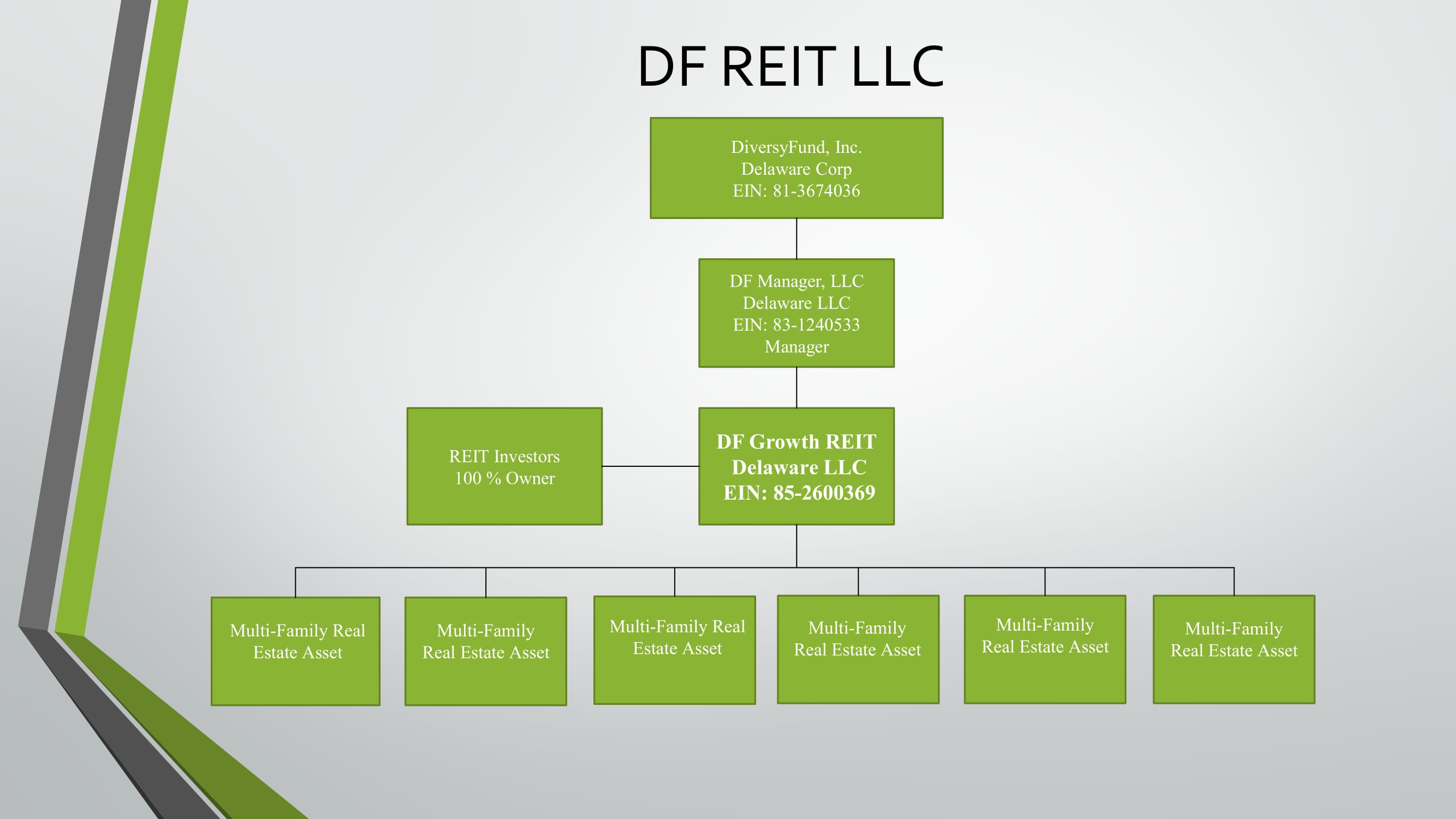
following diagram illustrates the organizational structure of the Company, where Investors are included in the box at the right:
OUR
MANAGEMENT TEAM
Names,
Ages, Etc.
Name | |
Position | |
Age | |
Term of Office | |
Approximate Hours Per Week If Not Full Time |
| Craig Cecilio | |
Chief Executive Officer | |
47 | |
Indefinite | |
20 Hours |
| Alan Lewis | |
Chief Financial Officer | |
43 | |
Indefinite | |
20 Hours |
| Tom Powell | |
Senior Transaction Manager | |
36 | |
At Will | |
Full Time |
| Van Vogel | |
Executive Vice President of Real Estate | |
59 | |
At Will | |
Full Time |
| Andrew Witkowski | |
Vice President – Acquisitions | |
47 | |
At Will | |
Full Time |
| George Jalil | |
Vice President – Acquisitions | |
36 | |
At Will | |
Full Time |
| Ginger Vyterna | |
Senior Asset Manager | |
47 | |
At Will | |
Full Time |
NOTE:
All these individuals are employed by DiversyFund, Inc., the Sponsor, not by the Company directly. The Sponsor is the sole member,
and the manager, of DF Manager, LLC, which is the Manager of the Company.
Business
Experience
Craig
Cecilio
Mr.
Cecilio is the Chief Executive Officer and Co-Founder of the Sponsor, DiversyFund, Inc. Mr. Cecilio has worked in the real estate
industry for nearly 20 years. Over the course of his career, Mr. Cecilio has participated in the development of over 1,000 single
family residences in California as either a joint venture equity partner, lender, or sponsor. Previously, Mr. Cecilio owned a
real estate lending business, Coastal California Funding Group, Inc., which underwrote and financed residential renovations and
ground-up construction in California coastal markets such as San Diego, Orange County, Los Angeles and San Francisco, and a loan
servicing business.
Additionally,
Mr. Cecilio founded a real estate debt fund in 2013, which manages a portfolio of real estate-backed bridge loans used primarily
to “pre-fund” many of the Manager’s real estate projects. Since 1997, Mr. Cecilio has financed nearly $500 million
of real estate assets, having raised over $100 million in debt or equity for real estate transactions in the last three years,
and has developed and managed over $50 million of residential property (renovations and ground-up). Mr. Cecilio is a graduate
of the University of Colorado at Boulder.
Alan
R. Lewis
Mr.
Lewis is the Chief Investment Officer and Co-Founder of the Sponsor, DiversyFund, Inc. Prior to the launch of the Manager, he
was the head of the real estate private equity division of a real estate investment and development firm based out of Salt Lake
City, Utah, where he oversaw capital raising, deal structuring and development work for multi-family projects and master-planned
residential communities. Previously, Mr. Lewis worked for nearly ten years on Wall Street as both an investment banker and a corporate
lawyer, most recently working as a Managing Director of the Investment Banking Division of Brill Securities where Mr. Lewis provided
financial advisory and capital raising services for high-growth companies along with real estate and oil and gas projects.
Prior
to joining Brill Securities in 2010, Mr. Lewis practiced as a corporate attorney at Davis Polk & Wardwell, a Tier 1 ranked
Wall Street law firm (Chambers USA). His practice included IPO’s, mergers and acquisitions, and commercial real estate,
including the acquisition and refinancing of several Fifth Avenue commercial buildings, acquisitions and portfolio restructurings
for a $6 billion real estate private equity fund. Over his career, Mr. Lewis has worked on transactions totaling, in aggregate,
over $41 billion. Mr. Lewis received a BA from Brigham Young University and a JD from Columbia Law School, where he was a Senior
Editor on the Columbia Law Review. Mr. Lewis is admitted to practice law in New York and previously held Series 7, 66 and 79 FINRA
licenses.
Van
Vogel
Mr.
Vogel is the Executive Vice President of Real Estate for DiversyFund, Inc. where he oversees the Company’s acquisitions
and financing in commercial real estate. Mr. Vogel brings over 30 years of executive real estate experience in the commercial
multi family space. Previously he was CEO of Prime Financial Development, a national commercial mortgage lender where he specialized
in multi-family projects and acquisitions.
Prior
to PFD he was president of Virginia Financial Development, a commercial real estate lending firm primarily doing business in the
South East. Mr. Vogel also was the President of Accurate Title, an escrow and settlement company in eastern Virginia for 14 years
and has expanded knowledge of real estate legal transactions.
Mr.
Vogel has closed and settled over 5 billion in real estate transactions over the last 30 years.
Andrew
Witkowski
Mr.
Witkowski leads the acquisition efforts for DiversyFund in the Northeast, Southeast, and Great Lakes markets. Based in New York
City, he was recently Director of Real Estate for Sumitomo Corporation of Americas, a Fortune Global 500. There he focused on
the full life cycle—from acquisition through disposition--of multi-family apartments, in addition to developing master-planned
communities.
An
accomplished and versatile Investment and Acquisition executive with twenty-plus years of complete lifecycle real estate experience
from sourcing to acquisition through debt and equity placement to project disposition, Mr. Witkowski’s experience includes:
co-founder of a real estate investment management startup and Vice President of Acquisitions at TGM Associates, a SEC registered
pension fund and investment advisory firm. He has built or acquired nearly 6,000 multifamily units as well as office and land
assets all totaling in excess of $2.5 Billion.
George
Jalil
Mr.
Jalil leads the acquisition efforts for DiversyFund in the Southern U.S. markets. Mr. Jalil was recently the Vice President of
Capital Markets at Pillar Income Asset Management based out of Dallas, Texas. During his time at Pillar, Mr. Jalil oversaw all
real estate acquisition, disposition, and financing activities of multifamily value-add assets and ground-up development within
multiple private and public portfolios.
Mr.
Jalil’s diverse and versatile commercial real estate experience stretches across multiple facets of the industry including:
brokerage, debt acquisitions, private equity, real estate valuation, property management, capital markets, asset management, advisory,
and sponsor acquisitions. With over a decade in commercial real estate acquisitions, Mr. Jalil has a proven track record of full-cycle
value-add multifamily transactions totaling over $1.1 billion across 10,200 units in geographies throughout the U.S. sunbelt.
Tom
Powell
Mr.
Powell is the Senior Transaction Manager at DiversyFund, Inc. where he is responsible for all aspects of closing commercial real
estate investments for DiversyFund’s Multi-Family Fund. Responsibilities include negotiating the Purchase and Sale Agreement
(PSA), managing the due diligence process, review and submission of loan documents, reviewing and adjusting DiversyFund underwriting,
and scheduling with third-party contacts. Mr. Powell teams with DiversyFund’s VP of Acquisitions and is the main interface
with lenders, brokers/sellers, outside attorneys, third-party vendors, and escrow officers.
Mr.
Powell has transacted on over $1 billion of real estate in his career. He started his career at Lee and Associates where he focused
on leasing and sales of commercial properties. At Pacific Southwest Realty Services he secured over $300 million in debt capital
with total capitalization of over $600 million. At AMC Investments Mr. Powell closed over 20 joint venture acquisitions with a
total capitalization of over $400 million.
Ginger
Vyterna
Ginger
Vyterna brings over 27 years of progressive management in operations, acquisitions, asset management and development within the
multifamily arena to DiversyFund. With a keen understanding of both conventional and LIHTC assets from the on-site level to executive
leadership, her portfolios have continually exceeded organizational expectations. By establishing acquisition protocols, creating
custom business plans and understanding diversity she has continually led her teams through difficult market trends while repositioning
value-add communities throughout the country. Her tenure at Ram Real Estate, Atlantic | Pacific Management, Priderock Capital
Partners, Grand Peaks and New Urban Communities have provided hands on experience in multiple markets from Oregon to New Jersey.
Her experience with understanding the multifamily business model will assure the management of our assets exceeds investors’
expectations.
Ownership
of Related Entities
The
Sponsor owns 100% of DF Manager, LLC, the Manager of the Company, while Mr. Cecilio and Mr. Lewis own more than 80% of the Sponsor.
Family
Relationships
There
are no family relationships among the Executive Officers and Significant Employees of the Company.
Legal
Proceedings
Within
the last five years, no Executive Officer or Significant Employee of the Company has been convicted of, or pleaded guilty or no
contest to, any criminal matter, excluding traffic violations and other minor offenses.
Within
the last five years, no Executive Officer or Significant Employee of the Company, no partnership of which an Executive Officer
or Significant Employee was a general partner, and no corporation or other business association of which an Executive Officer
or Significant Employee was an executive officer, has been a debtor in bankruptcy or any similar proceedings.
The
principals of our Sponsor, Craig Cecilio and Alan Lewis, are currently defendants in three lawsuits arising from real estate transactions.
The Company is not involved in any of the lawsuits and is not responsible for any of the liabilities alleged in the lawsuits,
directly or indirectly.
In
2015, before the Sponsor or the Company were formed, Mr. Cecilio raised capital for a project involving ground-up construction
located in La Jolla, California. When the project ran into financial difficulty, with the lender threatening to foreclose, Mr.
Cecilio and Mr. Lewis both personally guaranteed a loan from a new lender to protect the interests of the equity investors, although
they were not obligated to do so. Although the project was completed, it was financially unsuccessful and unable to repay all
the guaranteed debt. The lender has brought suit against Mr. Cecilio and Mr. Lewis for the deficient loan balance of approximately
$1.9 million.
Mr.
Cecilio and Mr. Lewis have asserted counterclaims against the lender. Among other things, they allege that the general contractor
hired at the insistence of the lender was responsible for the failure of the project by causing significant delays and budget
overruns, and that the lender and the contractor should be viewed as joint-venturers.
In
the same project, an individual loaned money to the borrower entity, secured by a second lien and personal guarantees by Mr. Cecilio
and Mr. Lewis. When the project ran into financial difficulty it was discovered that the second lien had not been properly recorded,
resulting in a significant loss to the lender. The lender sued her lawyer for legal malpractice and the lawyer has made a cross-claim
against Mr. Cecilio and Mr. Lewis relating to their personal guaranty. The amount of the cross-claim is approximately $1 million.
An
equity investor in the same project has filed a lawsuit alleging that the Sponsor, Mr. Cecilio, and Mr. Lewis failed to provide
adequate disclosure, were professionally negligent, and breached their fiduciary duty on several projects, all funded before the
Sponsor or the Company were formed. The investor is claiming damages of approximately $774,000 in the aggregate. On a separate
project, the same investor is suing on a personal guaranty of approximately $55,000.
Mr.
Cecilio and Mr. Lewis are vigorously defending all of these lawsuits and expect them to be settled with no impact on the Company.
If all of the lawsuits resulted in judgments against Mr. Cecilio and Mr. Lewis for the full amount claimed, however, it could
affect the Company adversely in several ways:
| |
● |
It
would impair the credit of Mr. Cecilio and Mr. Lewis personally, which could indirectly impair the credit of the Company,
in the sense that a lender that would otherwise accept the guaranty of Mr. Cecilio and Mr. Lewis for a loan to the Company
would no longer be willing to do so or such lender would require less favorable terms on a loan such as a higher interest
rate that could adversely affect the overall returns of the Company. |
| |
● |
The
owners of properties the Company would like to buy might be less inclined to deal with the Company. |
| |
● |
Depending
on the size of the judgment, Mr. Cecilio and/or Mr. Lewis could be forced into bankruptcy. |
| |
● |
Mr.
Cecilio and Mr. Lewis control the Company indirectly. In a worst-case scenario, a large judgment could result in a loss or
dilution of their control.
|
COMPENSATION
OF MANAGEMENT
Overview
The
people who run the Company make money from the Company in (only) three ways:
| |
● |
They
invest alongside Investors and receive the same distributions as Investors |
| |
● |
They
receive the Promoted Interest |
All
three forms of compensation are discussed below.
The
Company itself does not have any employees or payroll. For example, Mr. Lewis and Mr. Cecilio, the owners of the Sponsor, do not
receive any salary, bonuses, or other compensation directly from the Company. Instead, all of his compensation is paid from the
fees paid to the Manager and from the Promoted Interest.
Fees
| Type
of Fee |
Description
and Amount |
| Reimbursement |
The
Company will reimburse the Sponsor for expenses the Sponsor incurs in connection with the Offering, before the Offering
is “qualified” by the SEC (after the Offering is qualified, the expenses will borne by the Company itself,
directly). However (i) the Sponsor will not be entitled to any reimbursement until the Company has raised at least $1,000,000
from the sale of Class A Investor Shares; (ii) if the Company raises only $1,000,000 from the sale of Class A Investor
Shares, the Sponsor’s reimbursement will be limited to a maximum of $100,000; (iii) the Sponsor will not be entitled
to full reimbursement until the Company has raised $3,000,000 from the sale of Class A Investor Shares; and (iv) if the
Company raises more than $1,000,000 but less than $3,000,000 from the sale of Class A Investor Shares, the reimbursement
in excess of $100,000 will be pro rated.
Estimate:
The Sponsor currently estimates that its total expenses for the Offering, before the Offering is qualified, will be
approximately $75,000. |
Asset
Management Fee |
The
Sponsor will charge each Project Entity an asset management fee equal to 2% of the gross operating income (typically gross
rental revenue) of the real estate project owned by the Project Entity.
Estimate:
The amount of the asset management fee will depend on the gross operating income of the real estate asset. We cannot
make a reasonable estimate at this time. |
| |
|
| Sponsor
Fee |
The
Sponsor will charge each Project Entity (or the Company itself, if the Company owns real estate directly) a sponsor fee
of between 6% and 8% of the total project costs, including both “hard” costs (e.g., the cost of property)
and “soft” costs (e.g., professional fees).
Estimate:
If the Company raises the full $50,00,000 and maintains an average leverage ratio (borrowing) of 55%, the sponsor fee
would range between $6,666,666 and $8,888,888. |
Property
Disposition
Fee |
Where
the Company owns property directly or is the sole owner of a Project Entity, the Sponsor will receive a property disposition
fee equal to 1% of the total sale price of each property.
Where
property is owned by an entity in which there is another financial partner – a joint venture – the Sponsor
might be entitled to a similar disposition fee to the extent negotiated with the financial partners in such joint venture
(which could be higher than the 1% disposition fee for direct investment). However, the Company’s share of the fee
will not exceed 1% of the Company’s share of the total sale price.
Estimate:
The amount of the disposition fee will depend on the selling price of assets by the Company and any joint ventures and,
in the case of joint ventures, the terms our Sponsor negotiates with joint venture partners. We cannot make a reasonable
estimate at this time. |
Financing Fee |
Where
the Company owns property directly, or is the sole owner of a Project Entity, the Sponsor will receive a financing fee
equal to 1.0% of the amount of each loan placed on a property, whether at the time of acquisition or pursuant to a refinancing.
This financing fee will be in addition to any fees paid to third parties, such as mortgage brokers.
Where
property is owned by an entity in which there is another financial partner – a joint venture – the Sponsor
might be entitled to a similar financing fee to the extent negotiated with the financial partners in such joint venture
(which could be higher than the 1% financing fee for direct investment). However, the Sponsor’s share of the fee
will not exceed 1% of the Company’s share of the loan.
Estimate:
The amount of the financing fee will depend on the selling price of assets by the Company and any joint ventures and,
in the case of joint ventures, the terms our Sponsor negotiates with joint venture partners. We cannot make a reasonable
estimate at this time. |
Construction
Management
Fee |
The
Sponsor might provide construction management services. If so, the Sponsor be entitled to a construction management fee
equal to 7.5% of actual construction costs.
Estimate:
The amount of the construction management fee will depend on the nature and cost of the construction services the Manager
provides. We cannot make a reasonable estimate at this time. |
| Guaranty
Fee |
If
the Sponsor or an affiliate guaranties indebtedness of the Company or a Project Entity, including guaranties of any so-called
“bad boy” carveouts, the guarantor will be entitled to a guaranty fee equal to 0.5% of the loan.
Estimate:
The amount of the guaranty fee will depend on the amount of loans requiring a guaranty. We cannot make a reasonable estimate
at this time. |
| Other
Fees |
The
Company or Project Entities might engage the Sponsor or its affiliates to perform other services. The compensation paid
to the Sponsor or its affiliates in each case must be (i) fair to the Company and the Project Entities, (ii) comparable
to the compensation that would be paid to an unrelated party, and (iii) disclosed to Investors.
Estimate:
We cannot make a reasonable estimate of other fees at this time. |
Co-Investment
The
Sponsor and its affiliates might purchase Class A Investor Shares. If so, they will be entitled to the same distributions as other
Investors.
Promoted
Interest
As
described in “Securities Being Offered – Distributions” starting
on page 40, the Sponsor is entitled to receive certain distributions that we refer to as the “Promoted Interest.”
The Promoted Interest is paid in two levels: first, after Investors have received a 7% preferred return on their investment, the
Sponsor is entitled to a catchup return equal to approximately 53.85% of the preferred return paid to Investors; and second, after
Investors have received their preferred return and the Sponsor has received its catchup return, the Sponsor is entitled to 35%
of the remaining profits.
How
much money the Sponsor ultimately receives as a Promoted Interest therefore depends on a number of factors, including:
| |
● |
How
much capital is raised in the Offering; |
| |
● |
The
investment returns the Company is able to achieve; |
| |
● |
When
those returns are achieved (the Company might not achieve the same return every year); |
| |
● |
When
the Company distributes money to Investors; and |
| |
● |
The
amount of expenses the Company incurs. |
Report
to Investors
No
less than once per year, the Company will provide Investors with a detailed statement showing:
| |
● |
The
fees paid to the Sponsor and its affiliates; and |
| |
● |
Any
transactions between the Company and the Sponsor or its affiliates. |
In
each case, the detailed statement will describe the services performed and the amount of compensation paid.
Clawback
If,
upon the liquidation of the Company, the owners of the Class A Investor Shares other than the Manager, the Sponsor, and their
affiliates have not received distributions sufficient to return their capital contributions plus a 7% cumulative, non-compounded
annual return, the Manager, the Sponsor, and their affiliates will be required to return any distributions they have received
from the Company (not fees), over and above their actual contributed capital, in an amount such that the Company can distribute
the shortfall to the owners of the Class A Investor Shares, other than the Manager, the Sponsor, and their affiliates.
Method
of Accounting
The
compensation described in this section was calculated using the accrual method of accounting.
Stages
of Development
The
stages of the Company’s organization, development, and operation, and the compensation paid by the Company to the Manager
and its affiliates during each stage, are as follows:
| Stage |
|
Compensation |
| Organization |
|
None |
| |
|
|
| Acquisition
|
|
●
Asset Management Fee
●
Sponsor Fee
●
Financing Fee |
| |
|
|
| Operation |
|
●
Asset Management Fee
●
Guaranty Fee
●
Financing Fee
●
Returns from Co-Investment
●
Promoted Interest
●
Disposition Fee |
| |
|
|
| Liquidation |
|
●
Returns from Co-Investment
●
Promoted Interest
●
Disposition Fee |
SECURITY
OWNERSHIP OF MANAGEMENT
The
limited liability company interests in the Company are denominated by 20,000,000 “Shares,” consisting of 1,000,000
“Common Shares” and 19,000,000 “Investor Shares.” The Manager has the authority to divide
the 19,000,000 Investor Shares into one or more “classes,” by adopting one or more authorizing resolutions. The Manager
adopted the Authorizing Resolution to create 7,500,000 Class A Investor Shares.
As
of the date of this Offering Circular, the limited liability company interests of the Company are owned as follows:
Common
Shares
| Beneficial Owner | |
Number of Shares | | |
Percent of Class | |
DiversyFund, Inc.*
750 B Street
Suite 1930
San Diego, CA. 92101 | |
| 1,000,000 | | |
| 100 | % |
DF Manager, LLC
750 B Street
Suite 1930
San Diego, CA. 92101 | |
| 0 | | |
| 0 | % |
Alan Lewis
750 B Street
Suite 1930
San Diego, CA. 92101 | |
| 0 | | |
| 0 | % |
Craig Cecilio
750 B Street
Suite 1930
San Diego, CA. 92101 | |
| 0 | | |
| 0 | % |
Class
A Investor Shares
| Beneficial Owner | |
Number of Shares | | |
Percent of Class | |
| None | |
| 0 | | |
| 0 | % |
*
DiversyFund, Inc., the Sponsor, is controlled by Mr. Lewis and Mr. Ceclio.
VOTING
RIGHTS OF OWNERS
Under
the LLC Agreement, the Manager has full control over all aspects of the business of the Company. Investors will not be entitled
to vote on any matter involving the Company or the Company, except that the owners of the Class A Investor Shares may, in some
situations, remove the Manager for cause. For more information, see “Summary of Our
LLC Agreement and Authorizing Resolution – Management.”
The
Manager is owned by the Sponsor, which is controlled by Mr. Lewis and Mr. Cecilio. Thus, except as provided above, they have complete
control over the Company.
CERTAIN
RELATIONSHIPS AND RELATED TRANSACTIONS
The
Company has entered into a Management Agreement with the Manager, pursuant to which the Manager will provide management and investment
management services as described in “Summary of LLC Agreement and Authorizing Resolution
– Management.” Under the Management Agreement, the Company will pay the Sponsor certain fees as described in
“Compensation of Management.” The Manager is an affiliate of our Sponsor,
DiversyFund, Inc. Thus, the amount of fees and other terms of the Management Agreement were determined among related parties and
not at arm’s-length.
The
Sponsor, the Manager, Mr. Cecilio, Mr. Lewis, and parties related to them might also invest in the Company by purchasing Class
A Investor Shares, along with other Investors.
SECURITIES
BEING OFFERED
Description
of Securities
We
are offering to the public up to $50,000,000 of our Class A Investor Shares, which represent limited liability company interests
in the Company. All of the rights and obligations associated with the Class A Investor Shares are set forth in:
| |
● |
The
LLC Agreement, which is attached as Exhibit 1A-2B; and |
| |
● |
The
Authorizing Resolution, which is attached as Exhibit 1A-2C. |
Price
of Class A Investor Shares
Initially,
we will offer the Class A Investor Shares at $10 per Class A Investor Share. During the term of this Offering, we may increase
or decrease the price per Class A Investor Share to reflect changes in the value of our assets and the amount of our liabilities,
which will be determined by the Manager in its sole and absolute discretion.
To
determine the price of the Class A Investor Shares, the Manager would:
| |
● |
Determine
the fair market value of the Company’s assets, using appraisals and/or such other methods as the Manager may determine,
including its own judgment; |
| |
● |
Determine
the amount of the Company’s liabilities; and |
| |
● |
Determine
the amount that a purchaser of Class A Investor Shares would receive if all of the assets of the Company were sold for their
fair market values, less hypothetical sales commissions and transaction costs, all the liabilities of the Company were satisfied,
and the net proceeds were distributed in accordance with the LLC Agreement. |
Changes
in the price of the Class A Investor Shares will be reflected in a supplement or amendment to this Offering Statement filed with
the SEC. At this time, the Manager cannot reasonably estimate when or how often it will amend the Offering price. Such amendments
will depend upon numerous factors, including, but not limited to, (i) the amount of capital raised in this Offering, (ii) our
ability to effectively deploy the capital we raise, (iii) the timing of actual asset acquisitions and dispositions by the Company,
and (iv) the value of assets acquired or disposed of by the Company.
Voting
Rights
Owners
of the Class A Investor Shares – that is, Investors – will have no right to vote or otherwise participate in the management
of the Company. Instead, the Company is managed by the Manager exclusively. However, under certain circumstances Investors have
the right to remove the Manager for “cause.”
Distributions
We intend to make distributions periodically,
as conditions permit. The order of distributions will be governed by the Company’s LLC Agreement and by the Authorizing Resolution.
We divide distributions into two categories:
| ● | Distributions of ordinary operating cash flow (for example, net income from the rental of a property,
after expenses); and |
| ● | Distributions of the net proceeds from “capital transactions” like sales or refinancing
of properties (“net proceeds” means the gross proceeds of the capital transaction, reduced by the expenses of the transaction,
including repayment of debt). |
Distributions of ordinary operating cash
flow will be in the following order of priority:
| ● | Step One: First, Investors will receive all the operating
cash flow until they have received a 7% cumulative, non-compounded annual return on their invested capital. We refer to this as
the “Preferred Return” of Investors. |
| ● | Step Two: Second, any remaining operating cash flow
will be distributed to the owner of the Common Shares (the Sponsor) in an amount that bears the same proportion to the total Preferred
Return paid to date as 35 bears to 65, i.e., approximately 53.85%. We refer to this as the “Catchup Return.” |
| ● | Step Three: Third, any remaining operating cash flow
will be distributed 65% to the Investors on a pro rata basis, and 35% to the owner of the Common Shares. |
Distributions of the net proceeds from
capital transactions will be made in the following order or priority:
| ● | Step One: First, Investors will receive all the net
proceeds until they have received their entire Preferred Return. |
| ● | Step Two: Second, any remaining net proceeds will
be distributed to the owners of the Common Shares in an amount equal to the Catchup Return. |
| ● | Step Three: Third, Investors will receive any remaining
net proceeds to return an allocable portion of the capital they invested*. |
| ● | Step Four: Fourth, any remaining net proceeds will
be distributed 65% to the Investors and 35% until Investors have received an “internal rate of return” of 12%**. |
| ● | Step Five: Fifth, any remaining net proceeds will
be distributed 50% to the Investors on a pro rata basis and 50% to the owner of the Common Shares. |
We expect to make distributions of ordinary
operating cash flow on at least an annual basis, i.e., once per year. Distributions of the net proceeds from capital transactions
will be made, if at all, upon the occurrence of a capital transaction.
*When we say that all distributions
of the net proceeds from capital transactions will first be distributed to Investors until they have received an “allocable
portion” of the capital they invested, we mean that when the Company enters into a capital transaction like a sale or refinancing,
and decides to distribute some or all of the proceeds (as opposed to reinvesting the proceeds in other properties), the Manager
will allocate all of the capital contributed by Investors (less any previous distributions of capital) among all of the properties
owned by the Company, based on an estimate of the fair market value of each property (less debt encumbering each property). This
will allow the Manager to determine how much capital is allocable to the property involved in the capital transaction.
**”Internal rate of return”
is a financial concept that measures the overall return from an investment, taking into account all the money you put in as well
as all the money you took out, as well as the timing of each contribution and distribution. Solely by way of example, you would
have an internal rate of return if you contributed $100 to an investment and:
| ● | Liquidated the investment in one year for $116; or |
| ● | Received no distributions for five years, and at the end of the fifth year liquidated the investment
for $210.03; or |
| ● | Received a payment of $16 at the end of year, and received your $100 back at the end of the fifth
year. |
We calculate the internal rate
of return using the XIRR function in Microsoft Excel, the spreadsheet program.
NOTE CONCERNING CALCULATION OF RETURNS:
In general, we will calculate the returns of Investors beginning on the last day of the month in which an Investor purchases his,
her, or its Class A Investor Shares.
Clawback
If, upon the liquidation of the Company,
the owners of the Class A Investor Shares other than the Manager, the Sponsor, and their affiliates (including Mr. Cecilio and
Mr. Lewis) have not received distributions sufficient to return their capital contributions plus a 7% cumulative, non-compounded
annual return, the Manager, the Sponsor, and their affiliates will be required to return any distributions they have received from
the Company, over and above their actual contributed capital, in an amount such that the Company can distribute the shortfall to
the owners of the Class A Investor Shares, other than the Manager, the Sponsor, and their its affiliates.
How We Decide How Much
To Distribute
To decide how much to distribute, we start
with our revenues, which may include proceeds from the sale or refinancing properties and rental income, and then subtract our
actual expenses, which may include items such as management fees (including fees to the Manager), bank fees, appraisal costs, insurance,
commissions, marketing costs, taxes, legal and accounting fees, travel expenses, and fees paid to third parties. Finally, depending
on the circumstances at the time, we decide how much should be held in reserve against future contingencies. The amount we distribute
is therefore our revenue, minus our expenses, minus the reserve amount.
Withholding
In some situations, we might be required
by law to withhold taxes and/or other amounts from distributions made to Investors. The amount we withhold will still be treated
as part of the distribution. For example, if we distribute $100 to you and are required to withhold $10 in taxes, for our purposes
you will be treated as having received a distribution of $100 even though only $90 was deposited in your bank account.
No Guaranty
We can only distribute as much money as
we have. There is no guaranty that we will have enough money, after paying expenses, to distribute anything to Investors.
Transfers
Investors may freely transfer their Class
A Investor Shares, but only after providing the Manager with written assurance that (i) the transfer is not required to be registered
under the Securities Act of 1933, (ii) the transferor or the transferee will reimburse the Company for expenses incurred in connection
with the transfer, and (iii) the transfer will not compromise the Company’s election to be taxed as a REIT for purposes of
Federal income taxation.
Mandatory Redemptions
The Manager may require an Investor to
sell his, her, or its Class A Investor Shares back to the Company:
| ● | If the Investor is an entity governed by the Employee Retirement Income Security Act of 1974, Code
section 4975, or any similar Federal, State, or local law, and the Manager determines that all or any portion of the assets of
the Company would, in the absence of the redemption, more likely than not be treated as “plan assets” or otherwise
become subject to such laws. |
| ● | If the Manager determines that the redemption would be beneficial in allowing the Company to retain
its status as a REIT. |
| ● | If the Manager determines that (i) such Investor made a material misrepresentation to the Company;
(ii) legal or regulatory proceedings are commenced or threatened against the Company or any of its members arising from or relating
to the Investor’s interest in the Company; (iii) the Manager believes that such Investor’s ownership has caused or
will cause the Company to violate any law or regulation; (iv) such Investor has violated any of his, her, or its obligations to
the Company or to the other Members; or (ii) such Investor is engaged in, or has engaged in conduct (including but not limited
to criminal conduct) that (A) brings the Company, or threatens to bring the Company, into disrepute, or (B) is adverse and fundamentally
unfair to the interests of the Company or the other Members. |
If an Investor’s Class A Investor
Shares are purchased pursuant to such a request, the price will be equal to:
| ● | If the purchase occurs before December 31, 2020, or within six months after the Investor purchased
his, her, or its Class A Investor Shares from the Company, the amount the Investor paid for the Class A Investor Shares; and |
| ● | Otherwise, 90% of the amount the selling Investor would have received had all assets of the Company
been sold for their net asset value and the proceeds, less all liabilities and expenses, been distributed in liquidation of the
Company. |
The purchase price will be paid by wire
transfer or other immediately-available funds.
No Right Of Redemption
Investors do not have the right to cause
the Company to re-purchase (redeem) their Class A Investor Shares.
Rights of Common Shares
Immediately following the Offering the
Company will have two classes of securities outstanding: Class A Investor Shares and Common Shares. Investors will own all the
Class A Investor Shares while the Sponsor will own all the Common Shares. The principal rights associated with the Common Shares
are as follows:
| ● | Distributions: As the holder of the Common Shares, the Sponsor will be entitled to the distributions
described above. |
| ● | Voting Rights: The Common Shares will have no voting rights per se. However, the
Manager, in its capacity as the manager of the Company, will control the Company. |
| ● | Obligation to Contribute Capital: Holders of the Common Shares will have no obligation to
contribute capital to the Company. |
| ● | Redemptions: Holders of the Common Shares will have no right to have Common Shares redeemed. |
LIMIT ON
AMOUNT A NON-ACCREDITED INVESTOR CAN INVEST
As long as you’re at least 18 years
old, you can invest in this Offering. But if you’re not an “accredited” investor, the amount you can invest is
limited by law.
Under 17 CFR §230.501, a regulation
issued by the Securities and Exchange Commission, the term “accredited investor” means:
| ● | A natural person who has individual net worth, or joint net worth with the person’s spouse,
that exceeds $1 million at the time of the purchase, excluding the value of the primary residence of such person; |
| ● | A natural person with income exceeding $200,000 in each of the two most recent years or joint income
with a spouse exceeding $300,000 for those years and a reasonable expectation of the same income level in the current year; |
| ● | A trust with assets in excess of $5 million, not formed for the specific purpose of acquiring the
securities offered, whose purchase is directed by a sophisticated person; |
| ● | A business in which all the equity owners are accredited investors; |
| ● | An employee benefit plan, within the meaning of the Employee Retirement Income Security Act, if
a bank, insurance company, or registered investment adviser makes the investment decisions, or if the plan has total assets in
excess of $5 million; |
| ● | A bank, insurance company, registered investment company, business development company, or small
business investment company; |
| ● | A charitable organization, corporation, or partnership, not formed for the specific purpose of
acquiring the securities offered, with total assets exceeding $5 million; and |
| ● | A director, executive officer, or general partner of the company selling the securities, or any
director, executive officer, or general partner of a general partner of that issuer. |
If you fall within any of those categories,
then you can invest as much as you want. If you don’t fall within any of those categories, then the most you can invest in
this Offering is the greater of:
| ● | 10% of your annual income; or |
These limits are imposed by law, not by
us.
When you go to our website, www.DiversyFund.com,
we will ask whether you’re an accredited investor. If you aren’t, then we’ll ask about your annual income and
net worth.
PLAN
OF DISTRIBUTION
Size of Offering
We are offering up to $50,000,000 of our
Class A Investor Shares in the Offering. We will begin deploying the proceeds of the Offering (that is, we will begin to invest
in real estate projects) as soon as we begin raising capital, without waiting to raise any minimum amount.
Who is Selling Shares
Only the Company itself is selling securities
in this Offering. No securities are being sold by or on behalf of any existing owner of the Company.
Who Can Buy Shares
Anyone 18 or older can buy Class A Investor
Shares, regardless of income or net worth. If you are not an “accredited investor” the law limits how much you can
invest. See “Limit on Amount a Non-Accredited Investor Can Invest.”
Term of Offering
The Offering will begin as soon as our
offering statement is “qualified” by the SEC. The Offering will end upon the earlier of (1) the date we have sold $50,000,000
of Class A Investor Shares (i.e., all the securities we are offering), (2) the date two years after it begins, or (3) the
date we decide to end it.
Minimum Initial Investment
The minimum initial investment is 50 Class
A Investor Shares, or $500.
Manner of Distribution
The Class A Investor Shares will be offered
by the Company itself through www.DiversyFund.com, which we refer to as the “Site.” Purchases and sales of our
Class A Investor Shares made through our Site will not be subject to any sales commissions or fees.
How To Invest
To buy Class A Investor Shares, visit the
Site and register, locate the Offering, and follow the instructions. We will ask for certain information about you, including:
| ● | Your social security number (for tax reporting purposes) |
| ● | Whether you are an “accredited investor” |
| ● | If you not an accredited investor, your income and net worth |
We will also ask you to sign our Investment
Agreement, a copy of which is attached as Exhibit 1A-6A.
You will pay for your Class A Investor
Shares using one of the options described on the Site.
The information you submit, including your
signed Investment Agreement, is called your “subscription.” We will review your subscription and decide whether to
accept it. We have the right to accept or reject subscriptions in our sole discretion, for any reason or for no reason.
Once we have accepted your subscription,
we will notify you by email and the investment process will be complete. We will also notify you by email if we do not accept your
subscription, although we might not explain why. We reserve the right to reject any subscription in whole or in part for any reason.
If we reject your subscription, we will return all your money without interest or deduction.
Your Class A Investor Shares will be issued
in electronic form only. We will not issue you a paper certificate representing your Class A Investor Shares.
Escrow
When you invest through our Site, your
money will be held in an escrow account with Prime Trust, LLC, a third-party financial institution that will serve as the escrow
agent. Your investment will be held only until we review your subscription and decide whether to accept it. If we decide to reject
your subscription for any reason, we will return your funds to you without interest or deduction.
Advertising the Offering
After the Offering has been “qualified”
by the SEC, we intend to advertise the Offering using the Site and through other means, including public advertisements and audio-visual
materials, in each case only as we authorize. Although these materials will not contain information that conflicts with the information
in this Offering Circular and will be prepared with a view to presenting a balanced discussion of risk and reward with respect
to the Class A Investor Shares, our advertising materials will not give a complete understanding of this Offering, the Company,
or the Class A Investor Shares and are not to be considered part of this Offering Circular. The Offering is made only by means
of this Offering Circular and prospective Investors must read and rely on the information provided in this Offering Circular in
connection with their decision to invest in the Class A Investor Shares.
Supplements and Amendments
to Offering Circular
From time to time we will supplement or
amend this Offering Circular during the term of the Offering to reflect changes or additions to the information presented, as required
by SEC rules.
Among other things, while the Offering
is being conducted, we will file a “sticker supplement” pursuant to Rule 253(g) of SEC Regulation A for each project
in which we intend to invest, at such time as we determine that there is a reasonable probability that we will invest. The supplement
will describe the project and will disclose all compensation and fees paid to the Manager or its affiliates in connection with
the acquisition.
At least once every three months, we will
consolidate all such sticker supplements into a “post-qualification amendment” to this Offering Circular. Where appropriate,
the post-qualification amendment will also include or incorporate by reference audited financial statements meeting the requirements
of Rule 3-14 of Regulation S-X for properties acquired during the distribution period.
We will also file, after the end of the
distribution period, a current report on Form 1-U containing the financial statements and any additional information required
by Rule 3-14 of Regulation S-X (as applicable), to reflect each commitment (i.e., the signing of a binding purchase agreement)
to purchase a property made after the end of the distribution period involving the use of 10% or more (on a cumulative basis)
of the net proceeds of the Offering, and we will provide the information contained in such report to Investors at least once each
quarter after the distribution period ends.
USE
OF PROCEEDS
We expect that the principal costs of the
Offering will be (i) legal and accounting costs, and (ii) marketing costs, i.e., the costs associated with marketing the
Offering itself. We expect the legal accounting costs to be about $75,000, no matter how much money we raise. The marketing costs,
on the other hand, will vary depending on the size of the Offering: the more money we spend marketing the Offering, the more money
we expect to raise. Roughly speaking, we expect to spend about 1% of the money raised on marketing. Thus, if we raise $5,000,000
in the Offering we expect to spend about $50,000 on marketing, while if we raise $50,000,000 in the Offering we expect to spend
about $500,000 on marketing.
After paying these costs, all of the proceeds
of the Offering, no matter how much we raise, will be used to invest in real estate projects and to pay the Company’s normal
operating costs, including fees to the Manager and its affiliates.
We are not paying commissions to underwriters,
brokers, or anybody else for selling or distributing the Class A Investor Shares. Because we are not paying any commissions, more
of your money can go to work for you.
INVESTMENT
COMPANY ACT LIMITATIONS
A company that is treated as an “investment
company” under the Investment Company Act of 1940 (the “1940 Act”) is subject to stringent and onerous
regulation, like a mutual fund. Being an investment company isn’t illegal, but is very expensive. If the Company were treated
as an investment company it would be very bad for our business and our Investors.
Under section 3(a) of the 1940 Act, the
term “investment company” means any company that:
| ● | Is or holds itself out as being engaged primarily, or proposes to engage primarily, in the business
of investing, reinvesting, or trading in securities; |
| ● | Is engaged or proposes to engage in the business of issuing face-amount certificates of the installment
type, or has been engaged in such business and has any such certificate outstanding; or |
| ● | Is engaged or proposes to engage in the business of investing, reinvesting, owning, holding, or
trading in securities, and owns or proposes to acquire investment securities having a value exceeding 40% of the value of the company’s
total assets (exclusive of Government securities and cash items) on an unconsolidated basis. |
Real estate itself is not a “security”
for purposes of the 1940 Act. Thus, if all of the Company’s assets consisted of direct interests in real estate – direct
ownership of land and buildings – the Company could not be an investment company.
However, the Company will own most assets
through other companies. For example, the Company might own an interest in a real estate development through a limited liability
company. Because an interest in a limited liability company is generally treated as a “security” within the meaning
of the 1940 Act, the possibility remains that the Company could be treated as an investment company looking only at section 3(a)(1)
of the statute.
However, section 3(b)(1) of the 1940 Act
provides that “Any [company] primarily engaged, directly or through a wholly-owned subsidiary or subsidiaries, in a business
or businesses other than that of investing, reinvesting, owning, holding, or trading in securities” will not be treated
as an “investment company.” Further, 17 CFR §270.3a-1, a regulation issued by the SEC pursuant to section 3(b)(1),
provides that a company will not be treated as an investment company if no more than 45% of the value of its assets (exclusive
of government securities and cash items) consist of, and no more than 45% of its after-tax income is derived from, securities other
than:
| ● | Securities issued by employees’ securities companies; |
| ● | Securities issued by majority-owned subsidiaries which are not themselves investment companies;
and |
| ● | Securities issued by companies: |
| o | Which are controlled primarily by the company in question; |
| o | Through which the company in question engages in a business other than that of investing, reinvesting,
owning, holding or trading in securities; and |
| o | Which are not themselves investment companies; |
For these purposes:
| ● | A subsidiary is a “majority-owned subsidiary” if the parent owns at least 50% of the
voting securities of the subsidiary; |
| ● | A parent is deemed to “control” a subsidiary if it has the power to exercise a controlling
influence of the management or policies of the subsidiary; and |
| ● | A parent is deemed to “control primarily” a subsidiary if (1) it has the power to exercise
a controlling influence of the management or policies of the subsidiary, and (2) this power is greater than the power of any other
person. |
In all or almost all cases where the Company
owns real estate indirectly, through a limited liability company or another entity (i) the Company will have the power to exercise
a controlling influence of the management or policies of the limited liability company or other entity, and (ii) this power will
be greater than the power of any other person. Hence, the Company should be deemed to “control primarily” the entity
and, as a result, neither the asset nor the income of such entity should be taken into account in determining whether the Company
exceeds the 45% limits provided in 17 CFR §270.3a-1.
This being the case, the Company expects
to satisfy the requirements of 17 CFR §270.3a-1 and, consequently, to be exempted from the definition of “investment
company” under the 1940 Act.
Section 5.7 of the LLC Agreement requires
the Manager to use commercially reasonable efforts to satisfy the requirements of 17 CFR §270.3a-1 and ensure that the Company
is not treated as an “investment company” within the meaning of the 1940 Act.
SUMMARY
OF OUR LLC AGREEMENT AND AUTHORIZING RESOLUTION
The Company as a whole is governed by an
agreement captioned “Limited Liability Company Agreement” dated August 20, 2020. We refer to this as the “LLC
Agreement.”
The Class A Investor Shares being offered
in this Offering were created when the Manager adopted a resolution pursuant to section 3.2 of the LLC Agreement. We refer to this
as the “Authorizing Resolution.”
The following summarizes some of the key
provisions of the LLC Agreement and the Authorizing Resolution. This summary is qualified in its entirety by the LLC Agreement
itself, which is included as Exhibit 1A-2B, and by the Authorizing Resolution itself, which is included as Exhibit 1A-2C.
Formation and Ownership
The Company was formed in Delaware on August
20, 2020 pursuant to the Delaware Limited Liability Company Act.
Under the LLC Agreement, ownership interests
in the Company are referred to as “Shares,” while the owners are referred to as “Members.”
Immediately before this Offering, the only
owner of the Company was the Sponsor. Investors who buy Class A Investor Shares in the Offering will become owners, and the Company
might admit other owners in the future.
Shares and Ownership
The interests in the Company are denominated
by 20,000,000 “Shares,” consisting of 1,000,000 “Common Shares” and 19,000,000 “Investor Shares.”
The Manager may further divide the 19,000,000 Investor Shares into one or more classes, by adopting one or more authorizing resolutions.
Anyone owning Investor Shares is referred to in the LLC Agreement as an “Investor Member.”
The Manager adopted the Authorizing Resolution
to create the Class A Investor Shares. Any Investor who buys Class A Investor Shares in the Offering will be an “Investor
Member” under the LLC Agreement.
All of the Common Shares of the Company
are owned by DiversyFund, Inc., an affiliate of the Manager, which we refer to as the “Sponsor.” The Class
A Investor Shares will be owned by Investors, and are the subject of this Offering. By adopting other authorizing resolutions,
the Manager may create, offer, and sell other classes of Investor Shares in the future, which could have rights superior to the
rights of the Class A Investor Shares.
Management
The Manager has complete discretion over
all aspects of the business conducted by the Company. For example, the Manager may (i) admit new members to the Company; (ii) enter
into contracts on behalf of the Company; (iii) borrow money; (iv) acquire and dispose of assets; (v) determine the timing and amount
of distributions to Members; (vi) create new classes of limited liability company interests; (vii) determine the information to
be provided to the Members; (viii) grant liens and other encumbrances on the assets of the Company; (ix) and dissolve the Company.
Investors who purchase Class A Investor
Shares will not have any right to vote on any issue other than certain amendments to the LLC Agreement, or to remove the Manager.
Certain terms of the services to be provided
by the Manager, as well as the compensation to be paid to the Manager by the Company, are set forth in the Management Services
Agreement between the Company and the Manager dated August 20, 2020, which we refer to as the “Management Agreement.”
The principal terms of the Management Agreement are summarized in “Summary of Management
Agreement” starting on page 57, while a copy of the Management Agreement is attached as Exhibit 1A-6B.
The Manager can only be removed for “cause”
under a procedure set forth in section 5.6 of the LLC Agreement.
The term “cause” includes:
| ● | An uncured breach of the LLC Agreement or the Management Agreement by the Manager; or |
| ● | The bankruptcy of the Manager; or |
| ● | Certain misconduct on the part of the Manager, if the individual responsible for the misconduct
is not terminated. |
A vote to remove the Manager for cause
must be approved by Investor Members owning at least 75% of the outstanding Investor Shares. Whether “cause” exists
would then be decided in arbitration proceedings conducted under the rules of the American Arbitration Association.
Exculpation and Indemnification
of Manager
The LLC Agreement protects the Manager,
its affiliates, their members, managers, officers, employees, and agents, and the officers, employees, and agents of the Company
from lawsuits brought by Investors or other parties. For example, it provides that such persons will not be responsible to Investors
or the Company for mistakes, errors in judgment, or other acts or omissions (failures to act) as long as the act or omission was
not the result of fraud or willful misconduct by such persons. This limitation of liability is referred to as “exculpation.”
The LLC Agreement also provides that these persons do not owe any fiduciary duties to the Company or its owners.
The LLC Agreement also requires the Company
to indemnify (reimburse) the directors, officers and employees of the Company and their affiliates from losses, liabilities, and
expenses they incur in performing their duties, provided that they (i) acted in good faith and in a manner believed to be in, or
not opposed to, the best interests of the Company and, with respect to any criminal proceeding, had no reasonable cause to believe
his conduct was unlawful, and (ii) the challenged conduct did not constitute fraud or willful misconduct, in either case as determined
by a final, nonappealable order of a court of competent jurisdiction. For example, if a third party sued the Manager on a matter
related to the Company’s business, the Company would be required to indemnify the Manager for any losses or expenses it incurs
in connection with the lawsuit, including attorneys’ fees, judgments, etc. However, this indemnification is not available
where a court or other juridical or governmental body determines that the person to be indemnified is not entitled to indemnification
under the standard described in the preceding sentence.
Notwithstanding the foregoing, no exculpation
or indemnification is permitted to the extent such exculpation or indemnification would be inconsistent with the requirements of
federal or state securities laws or other applicable law.
The detailed rules for exculpation and
indemnification are set forth in section 6 of the LLC Agreement.
Obligation to Contribute
Capital
Once an Investor pays for his, her, or
its Class A Investor Shares, he, she, or it will not be required to make any further contributions to the Company. However, if
an Investor has wrongfully received a distribution he, she, or it might have to pay it back.
Personal Liability
No Investor will be personally liable for
any of the debts or obligations of the Company.
Distributions
The manner in which the Company will distribute
its available cash is described in “Securities Being Offered – Distributions.”
Transfers and First Right
of Refusal
In general, Investors may freely transfer
their Class A Investor Shares. However, the Manager may prohibit a transfer that the Manager determines would jeopardize the status
of the Company as a REIT.
If an Investor wants to sell Class A Investor
Shares, the Investor must first offer the Class A Investor Shares to the Manager.
Death, Disability, Etc.
If an Investor who is a human being (as
opposed to an Investor that is a legal entity) should die or become incapacitated, the Investor or his, her or its successors will
continue to own the Investor’s Class A Investor Shares.
Fees to Manager and Affiliates
The Company will pay certain management
fees and other fees to the Manager, as summarized in “Compensation of Management.”
Mandatory Redemption
The Manager may cause the Company to redeem
(purchase) the Class A Investor Shares owned by an Investor in some circumstances (in effect kicking the Investor out of the deal)
as described in “Securities Being Offering – Mandatory Redemptions.”
“Drag-Along”
Right
If the Manager wants to sell the business
conducted by the Company, it may affect the transaction as a sale of the assets owned by the Company or as a sale of all the Interests
in the Company. In the latter case, Investors will be required to sell their Class A Investor Shares as directed by the Manager,
receiving the same amount they would have received had the transaction been structured as a sale of assets.
No Redemption Right
Investors will not have any right to cause
the Company to redeem (buy back) their Class A Investor Shares.
Electronic Delivery
All documents, including all tax-related
documents, will be transmitted by the Company to Investors via electronic delivery.
Amendment
The Manager may amend the LLC Agreement
unilaterally (that is, without the consent of anyone else) for a variety of purposes, including to:
| ● | Cure ambiguities or inconsistencies in the LLC Agreement; |
| ● | Add to its own obligations or responsibilities; |
| ● | Change the name of the Company; |
| ● | Ensure that the Company (including the Company) satisfies applicable laws, including tax and securities
laws; and |
| ● | Ensure that the Company is eligible to be treated as a REIT. |
An amendment that has, or could reasonably
be expected to have, an adverse effect on Investors, requires the consent of the Manager and Investors holding a majority of the
Class A Investor Shares.
An amendment that would require an Investor
to make additional capital contributions or impose personal liability on an Investor requires the consent of the Manager and each
affected Investor.
Information Rights
Within 120 days after the end of each fiscal
year of the Company, we will provide Investors with (i) a statement showing in reasonable detail the computation of the distributions
made by the Company, (ii) audited financial statements of the Company, (iii) a statement of the income and expenses of the Company,
and (iv) a description of the Company’s investments, and a valuation of the investments performed in good faith by the Manager.
In addition, each year the Company will
provide Investors with a detailed statement showing:
| ● | The fees paid to the Manager and its affiliates; and |
| ● | Any transactions between the Company and the Manager or its affiliates. |
In each case, the detailed statement will
describe the services performed and the amount of compensation paid.
Within 60 days after the end of the first
three fiscal quarters of each fiscal year, we will also provide to Investors a report containing, among other items, an overview
of the Company’s investments, unaudited financial statements, a summary of the distributions made during the quarter, and a
statement of such Investor’s capital account.
As a “tier 2” issuer under
Regulation A, the Company may also be required to provide investors with additional information on an ongoing basis, including
annual audited financial statements, annual reports filed on SEC Form 1-K, semiannual reports filed on SEC Form 1-SA, special financial
reports filed on SEC Form 1-K, and current reports on SEC Form 1-U. If, however, our Class A Investor Shares are held “of
record” by fewer than 300 persons, these reporting obligations could be terminated.
A Member’s right to see additional
information or inspect the books and records of the Company is limited by the LLC Agreement.
Summary
of Management Agreement
DF Manager, LLC, a Delaware limited liability
company, is designated as the “manager” of the Company under the LLC Agreement. Under section 5.2 of the LLC Agreement,
the Manager has:
[F]ull and complete authority, power
and discretion to manage and control the business, affairs and properties of the Company, to make all decisions regarding those
matters, to execute any contracts or other instruments on behalf of the Company, and to perform any and all other acts or activities
customary or incidental to the management of the Company’s business.
The Company and the Manager entered into
a contract called a “Management Services Agreement” dated August 20, 2020, which we refer to as the “Management
Agreement.” The Management Agreement describes at length and in detail many of the duties of the Manager, and also describes
the Manager’s compensation. However, the list of the Manager’s duties and authority in the Management Agreement is
not exclusive. Under the broad grant of authority in the LLC Agreement, the Manager could have duties and authority not listed
in the Management Agreement.
The Management Agreement is included as
Exhibit 1A-6B.
The duties of the Manager include managing
our investments, raising money, accounting and administrative services, and managing investor relations. Some of the specific duties
of the Manager are:
| ● | Conducting this Offering |
| ● | Establishing investment guidelines, policies, and procedures |
| ● | Overseeing and conducting due diligence |
| ● | Arranging for financing from banks and other financial institutions |
| ● | Reviewing joint venture opportunities |
| ● | Keeping and maintaining the books and records of the Company |
| ● | Managing the Company’s portfolio of assets |
| ● | Managing the administrative and back-office functions of the Company |
| ● | Collecting, maintaining, and distributing information |
| ● | Determining the improvements to be made to properties owned by the Company |
| ● | Maintaining appropriate technology systems |
| ● | Making, changing, and revoking tax elections including making an election be treated as a REIT
and to be treated as a corporation for tax purposes |
| ● | Complying with SEC requirements |
| ● | Managing distributions and payments to Investors |
| ● | Handling redemption requests from Investors |
| ● | Engaging property managers, contractors, attorneys, accountants, and other third parties |
| ● | Entering into contracts and other agreement |
The compensation of the Manager is described
in “Compensation of Management.”
The Management Agreement will remain in
effect for as long as the Manager is the manager of the Company under the LLC Agreement.
FEDERAL
INCOME TAX CONSEQUENCES
The following summarizes some of the Federal
income tax consequences of the Company and Investors. This summary is based on the Internal Revenue Code (the “Code”),
regulations issued by the Internal Revenue Service (“Regulations”), and administrative rulings and court decisions,
all as they exist today. The tax laws, and therefore the Federal income tax consequences of acquiring Class A Investor Shares,
could change in the future.
This is only a summary, applicable to a
generic Investor. Your personal situation could differ. We encourage you to consult with your own tax advisor before investing.
Federal Income Taxation
of the Company
We intend to elect to be taxed as a “real
estate investment trust,” or “REIT,” beginning with our first taxable year.
Assuming that we qualify as a REIT, the
Company itself will generally not be subject to federal income taxes on net income that is currently distributed to shareholders.
The Company will, however, be subject to federal income tax as follows:
| ● | We will be taxed at regular corporate tax rates on any undistributed REIT taxable income, including
undistributed net capital gains. |
| ● | A REIT may generally be subject to the “alternative minimum tax.” |
| ● | If we have (i) net income from the sale or other disposition of “foreclosure property”
which is held primarily for sale to customers in the ordinary course of business or (ii) other non-qualifying income from foreclosure
property, we will be subject to tax at the highest corporate rate on such income. |
| ● | If the Company has net income from “prohibited transactions” (which are, in general,
certain sales or other dispositions of property held primarily for sale to customers in the ordinary course of business other than
foreclosure property), such income will be subject to a tax of 100% of the net income from such prohibited transactions. |
| ● | If we are able to maintain our qualification as a REIT despite any failure to satisfy either the
75% or 95% income test (discussed below), we will be subject to a 100% tax on an amount equal to (a) the gross income attributable
to the greater of the amount by which the Company fails the 75% or 95% of income test multiplied by (b) a specified fraction. |
| ● | If we maintain our qualification as a REIT, despite any failure to satisfy the REIT asset tests
(discussed below), then we will have to pay a tax equal to the greater of $50,000 or the highest marginal corporate tax rate multiplied
by the net income generated by the qualifying assets. |
| ● | A REIT will be subject to a 4.0% excise tax if it fails to make certain minimum distributions each
calendar year. |
| ● | A 35% tax will be imposed on the excess inclusions allocable to disqualified entities that hold
interests in the REIT. |
| ● | If a REIT acquires any asset from a C corporation (i.e., generally a corporation subject
to full corporate-level tax) in a carryover basis transaction (or if a REIT such as the Company holds assets beginning on the first
day of the first taxable year for which the Company qualifies as a REIT) and the REIT subsequently recognizes gain on the disposition
of such asset during the 10-year period (the Recognition Period) beginning on the date on which the asset was acquired by the REIT
(or the REIT first qualified as a REIT), then the excess of: (a) the fair market value of the assets as of the beginning of the
applicable Recognition Period, over (b) the REIT’s adjusted basis in such assets as of the beginning of such Recognition
Period will be subject to tax at the highest regular corporate rate, pursuant to guidelines issued by the Service (the Built-In
Gain Rules). |
| ● | A REIT will be subject to a tax equal to 100% of re-determined rents, re-determined deductions,
and excess interest between a REIT and its taxable REIT subsidiary. |
| ● | A REIT will be subject to the personal holding company tax, if the REIT qualifies as a personal
holding company and has undistributed personal holding company income. |
If we failed to satisfy one or more of
the technical requirements described below, we might nevertheless be entitled to be treated as a REIT under certain “relief”
provisions. Otherwise, we would be subject to tax on our taxable income at regular corporate rates, with no deduction allowed for
distributions to shareholders. The resulting corporate income tax liability would significantly reduce the cash available for distribution
to Investors.
Requirements for Qualifying
as a REIT
To qualify as a REIT, we must elect to
be treated as a REIT and meet certain requirements related to our organization, income, assets and distributions. Each set of requirements
is discussed in turn below.
Organizational Requirements
The Code defines a REIT as a corporation,
trust or association:
| ● | Managed by one or more trustees or directors; |
| ● | The beneficial ownership of which is evidenced by transferable shares, or by transferable certificates
of beneficial ownership; |
| ● | Which (but for sections 856 through 859 of the Code) would be taxable as a domestic corporation; |
| ● | Which is neither a financial institution nor an insurance company within the meaning of the applicable
provisions of the Code; |
| ● | The beneficial ownership of which is held by at least 100 persons; |
| ● | During the last half of each taxable year, is not closely held, i.e., not more than 50%
of the value of its outstanding stock is owned, directly or indirectly, by or for five or fewer “individuals,” as defined
in the Code to include certain entities; |
| ● | Files an election or continues such election to be taxed as a REIT on its return for each taxable
year; |
| ● | Uses the calendar year as its taxable year; and |
| ● | Meets other tests described below, including with respect to the nature of its assets and income
and the amount of its distributions. |
Income Test Requirements
To maintain qualification as a REIT, on
an annual basis we must meet the following two gross income requirements:
| ● | At least 75% of our gross income for the taxable year must be derived from, among other things,
rents from real property (with some exceptions), interest on obligations secured by mortgages, and certain gains on the sales of
property. |
| ● | In addition to deriving 75% of our gross income from, among other things, the sources listed above,
at least 95% of the REIT’s gross income for the taxable year must be derived from the above-described qualifying income,
or from dividends, interest or gains from the sale or disposition of stock or other securities that are not dealer property. |
To
satisfy the gross income requirements any “rents from real property” received must meet the following conditions:
| ● | The amount of rent must not be based in whole or in part on the income or profits of any person,
but can be based on a fixed percentage of receipts or sales; |
| ● | The rent cannot be from a tenant of which we and our affiliates own 10% or more of (i) the total
combined voting power of all classes of voting stock, or total value of shares of all classes of stock, if a corporate tenant,
or (ii) the interests in the assets or net profits of an entity, if not a corporate tenant; |
| ● | The rent cannot be attributable to personal property unless it is leased in connection with real
property and the rent attributable to such personal property is less than or equal to 15% of the total rent received for the taxable
year attributable to both the real and personal property leased under such lease; and |
| ● | The rent cannot be attributable to services furnished or rendered in connection with the rental
of real property, unless such services are customarily provided in connection with the rental of real property, whether or not
such charges are separately stated. |
We do not anticipate deriving rent attributable
to personal property leased in connection with real property that exceeds 15% of the total rent attributable to such lease.
We may provide certain services with respect
to our properties. We believe that these services will only be of the type that are usually or customarily rendered in connection
with the rental of space for occupancy and that are not otherwise rendered to the tenants. Therefore, we believe that the provision
of such customary services will not cause rents received with respect to our properties to fail to qualify as “rents from
real property.” Non-customary services and services rendered primarily for the tenants’ convenience will be provided
by an independent contractor or a taxable REIT subsidiary to avoid jeopardizing the qualification of rent as “rents from
real property.”
Except for amounts received with respect
to certain investments of cash reserves, we anticipate that substantially all of our gross income will be derived from sources
that will allow us to satisfy the income tests described above; however, we can make no assurance in this regard.
Asset Test Requirements
At the close of each quarter of the taxable
year, we must also satisfy the following four tests related to the nature and diversification of our assets:
| ● | At least 75% of the value of our total assets must be represented by real estate assets, cash and
cash items (including receivables) and government securities; |
| ● | No more than 25% of the value of our total assets can be represented by securities (other than
those securities includible in the 75% asset test); |
| ● | No more than 20% of the value of our total assets can be represented by securities of one or more
taxable REIT subsidiaries; and |
| ● | With the exception of taxable REIT subsidiaries and those securities includible under the 75% asset
test, we may not own: |
| o | Securities of any one issuer whose value exceeds 5% of the value of our total assets; |
| o | More than 10% of any one issuer’s outstanding voting securities; and |
| o | More than 10% of the value of the outstanding securities of any one issuer. |
Annual Distribution Requirements
To qualify as a REIT, we must meet the
following annual distribution requirements:
| ● | We must distribute (other than capital gain distributions) to our beneficiaries an amount at least
equal to the sum of: (i) 90% of the REIT taxable income (computed without regard to the dividends-paid deduction and by excluding
our net capital gain), and (ii) 90% of the net income, if any, from foreclosure property in excess of the excise tax on net income
from foreclosure property, minus the sum of certain items of non-cash income. |
| ● | We must distribute during each calendar year at least the combined sum of 85% of our ordinary income
for that year; 95% of our capital gain net income for that year; and any undistributed taxable income from prior periods. |
| ● | We may not dispose of any asset that is subject to the Built-In Gain Rules during the 10-year period
beginning on the date on which we acquired the asset. |
We expect
that our REIT taxable income will be less than our cash flow due to the allowance of depreciation and other non-cash charges in
computing REIT taxable income. Accordingly, we anticipate that we generally will have sufficient cash or liquid assets to enable
us to satisfy the 90% distribution requirement. It is possible, however, that we may not have sufficient cash or other liquid assets
to meet the 90% distribution requirement or to distribute such greater amount as may be necessary to avoid income and excise tax.
In such event, we may find it necessary to borrow funds to pay the required distribution or, if possible, pay taxable stock
dividends in order to meet the distribution requirement.
Taxation Of Investors
How Income is Reported To Investors
Each Investor will receive a Form 1099
from the Company each year, and will transfer the information onto his, her, or its personal tax return. Investors will not receive
a Form K-1 from the Company.
Taxation of Distributions
Distributions to Investors other than “capital
gain dividends” will be treated as taxable dividends up to the amount of the Company’s current or accumulated earnings
and profits. To the extent that we make a distribution in excess of our positive current or accumulated earnings and profits, the
distribution will be treated first as a tax-free return of capital, up to an Investor’s tax “basis” in his, her,
or its Class A Investor Shares, then as capital gain.
Dividends that we declare in October, November,
or December of any year payable to stockholders of record on a specified date in any such month are treated as both paid by us
and received by Investors on December 31 of that year, provided that we actually pay the dividends during January of the following
calendar year.
Dividends from the Company will not
be treated as “qualifying dividends,” which are eligible for lower tax rates (generally the same tax rates that apply
to long term capital gains).
“Capital gain dividends” will
be reported as long-term capital gains on the tax returns of Investors (to the extent that they do not exceed our actual net capital
gain for the taxable year), without regard to how long an Investor has owned his, her, or its Class A Investor Shares.
Taxation of Losses
Because the Company will be taxed as a
corporation, and not as a partnership, Investors may not report on their own income tax returns any tax losses incurred by the
Company.
Additional Medicare Tax
Higher-income taxpayers are subject to
an additional 3.8% tax on net “investment income.” Income Investors receive from the Company will be included as “investment
income” for these purposes.
Tax on Sale of Class A Investor Shares
An Investor who sells Class A Investor
Shares generally will realize capital gain or loss equal to the difference between the selling price and his, her, or its adjusted
tax “basis” in the Class A Investor Shares. If the Investor has owned the Class A Investor Shares for at least one
year, any gain would generally be treated as long term capital gain.
Passive Activity Losses
Taxable distributions from the Company
will not be treated as “passive activity income” under Code section 469 and may not be offset against losses from passive
activities.
Withholding Taxes
We might be required to withhold federal
income tax from distributions under certain circumstances, e.g., where an Investor has failed to provide us with a valid
taxpayer identification number.
Each Investor must either report Company
items on his tax return consistent with the treatment on the information return of the Company or file a statement with his tax
return identifying and explaining the inconsistency. Otherwise the IRS may treat such inconsistency as a computational error and
re-compute and assess the tax without the usual procedural protections applicable to federal income tax deficiency proceedings.
The Manager will serve as the “tax
matters partner” of the Company and will generally control all proceedings with the IRS.
The Code imposes interest and a variety
of potential penalties on underpayments of tax.
Other Tax Consequences
The foregoing discussion addresses only
selected issues involving Federal income taxes, and does not address the impact of other taxes on an investment in the Company,
including Federal estate, gift, or generation-skipping taxes, or State and local income or inheritance taxes. Prospective Investors
should consult their own tax advisors with respect to such matters.
LEGAL
PROCEEDINGS
Neither the Company itself, the Manager,
the Sponsor, or any of their respective employees, officers, directors, managers, or members is currently engaged in any material
legal proceedings, except as provided in “Our Management Team – Legal Proceedings.”
Neither the Company itself, the Manager,
the Sponsor, or any of their respective employees, officers, directors, managers, or members is, to the knowledge of the Company,
currently the subject of any investigation or proceedings by any governmental authorities.
TESTING
THE WATERS MATERIALS
Before the Offering is qualified by the
SEC, we might engage in what is commonly referred to as “testing the waters” under 17 CFR §230.255. For example,
we might ask for expressions of interest via the Site.
In accordance with the SEC’s rules,
all of our communications with potential investors will:
| ● | State that no money or other consideration is being solicited, and if sent in response, will not
be accepted; |
| ● | State that no offer to buy the securities can be accepted and no part of the purchase price can
be received until the offering statement is qualified, and any such offer may be withdrawn or revoked, without obligation or commitment
of any kind, at any time before notice of its acceptance given after the qualification date; |
| ● | State that a person’s indication of interest involves no obligation or commitment of any
kind; and |
| o | State from whom a copy of the most recent version of the Preliminary Offering Circular may be obtained,
including a phone number and address of such person; |
| o | Provide the URL where such Preliminary Offering Circular, or the offering statement in which such
Preliminary Offering Circular was filed, may be obtained; or |
| o | Include a complete copy of the Preliminary Offering Circular. |
A copy of any such communications will
be filed with the SEC.
MANAGEMENT
DISCUSSION
Operating Results
The Company was created on August 20, 2020.
The Company has not conducted any business and therefore has no operating results.
Liquidity and Capital Resources
The Company is seeking to raise up to $50,000,000
of capital in this Offering by selling Class A Investor Shares to Investors.
The Company does not currently have any
capital commitments. We expect to deploy almost all of the capital we raise in the Offering in making real estate investments,
as described in “Use of Proceeds” on page 49. Should we need more capital
for any reason, we could either sell more Class A Investor Shares or sell other classes of securities. In selling Class A Investor
Shares or other securities, we might be constrained by the securities laws. For example, we are not allowed to sell more than $50,000,000
of securities using Regulation A during any period of 12 months.
Plan of Operation
Having raised capital in the Offering,
the Company will operate in the manner described in “Our Company and Business.”
Whether we raise $50,000,000 in the Offering
or something less, we believe the proceeds of the Offering will satisfy our cash requirements. If we raise less than $50,000,000,
we will simply make fewer investments. Although we might decide to raise more capital, we know of no reason why we would need to.
FINANCIAL
STATEMENTS
[To be inserted.]
GLOSSARY
OF DEFINED TERMS
|
1940 Act |
The Investment Company Act of 1940. |
| ADA |
Americans with Disabilities Act of 1990. |
| Class A Investor Shares |
The limited liability company interests in the Company that are being offered to the public in the Offering. |
| Common Shares |
The limited liability company interests in the Company owned by the Sponsor. |
| Code |
The Internal Revenue Code of 1986, as amended (i.e., the Federal tax code). |
| Company |
DF Growth REIT II LLC, a limited liability company formed under the laws of Delaware. |
| Growth REIT I |
DF Growth REIT LLC, an affiliate of the Sponsor that has offered and sold securities under Regulation A. |
| Investor |
Anyone who purchases Class A Investor Shares in the Offering. |
| Management Agreement |
The agreement captioned “Management Services Agreement” dated August 20, 2020 by and between the Company and the Manager. |
| Manager |
DF Manager, LLC. |
| Members |
The owners of the Company. Under the Delaware Limited Liability Company Act, the owners of a limited liability company are referred to as “members.” |
| Offering |
The offering of Class A Investor Shares to the public pursuant to this Offering Circular. |
| Offering Circular |
The Offering Circular you are reading right now, which includes information about the Company, the Company, and the Offering. |
| LLC Agreement |
The agreement by and among the Company and all of its members captioned “Limited Liability Company Agreement” and dated August 20, 2020. |
| Project Entity |
A limited partnership, limited liability company, or other legal entity formed to own a real estate project. |
| Promoted Interest |
The economic right of the Sponsor to share in the profits of the Company, over and above its rights as an Investor. |
| Regulations |
Regulations issued under the Code by the Internal Revenue Service. |
| Regulation D Program |
An offering conducted by the Sponsor or one of its affiliates that involved raising money from investors under Regulation D (17 CFR §230.500 et seq) and investing in real estate. |
| REIT |
Real Estate Investment Trust, as defined in section 856 of the Code. |
| Shares |
The limited liability company interests in the Company, which are divided into two classes: Common Shares and Investor Shares. |
| Site |
The Internet site located at www.DiversyFund.com. |
| Sponsor |
DiversyFund, Inc. |
FORM 1-A
Regulation A Offering Statement
Part III – Exhibits
DF
Growth REIT, LLC
750 B Street
Suite 1930
San Diego, CA. 92101
(858) 430-8528
www.DiversyFund.com
December 3, 2020
The following Exhibits are filed as part
of this Offering Statement:
SIGNATURES
Pursuant to the requirements of Regulation
A, the issuer certifies that it has reasonable grounds to believe that it meets all of the requirements for filing on Form 1-A
and has duly caused this offering statement to be signed on its behalf by the undersigned, thereunto duly authorized, in the City
of San Diego, State of California, on December 23, 2020.
| |
DF Growth REIT II, LLC |
| |
|
|
| |
By: |
DF Manager, LLC, as Manager |
| |
|
|
| |
By: |
DiversyFund, Inc., as Manager |
| |
|
|
| |
By |
/s/ Craig Cecilio |
| |
|
Craig Cecilio, Chief Executive Officer |
This offering statement has been signed
by the following persons in the capacities and on the dates indicated.
| /s/ Alan Lewis |
|
| Alan Lewis |
|
| Director and Chief Investment Officer of DiversyFund, Inc. |
| December 23, 2020 |
|
| |
|
| /s/ Craig Cecilio |
|
| Craig Cecilio |
|
| Director and Chief Executive Officer of DiversyFund, Inc. |
| December 23, 2020 |
|
P a g e | 72