0001104659-21-030854.txt : 20210302 0001104659-21-030854.hdr.sgml : 20210302 20210302171640 ACCESSION NUMBER: 0001104659-21-030854 CONFORMED SUBMISSION TYPE: 1-A PUBLIC DOCUMENT COUNT: 23 FILED AS OF DATE: 20210302 DATE AS OF CHANGE: 20210302 FILER: COMPANY DATA: COMPANY CONFORMED NAME: E.i Ventures Inc. CENTRAL INDEX KEY: 0001823182 STANDARD INDUSTRIAL CLASSIFICATION: PHARMACEUTICAL PREPARATIONS [2834] IRS NUMBER: 841871358 STATE OF INCORPORATION: DE FISCAL YEAR END: 1231 FILING VALUES: FORM TYPE: 1-A SEC ACT: 1933 Act SEC FILE NUMBER: 024-11470 FILM NUMBER: 21705153 BUSINESS ADDRESS: STREET 1: 1215 S KIHEI ROAD, #242 CITY: KIHEI STATE: HI ZIP: 96753 BUSINESS PHONE: (808) 283-8976 MAIL ADDRESS: STREET 1: 1215 S. KIHEI RD, #424 CITY: KIHEI STATE: HI ZIP: 96753 1-A 1 primary_doc.xml 1-A LIVE 0001823182 XXXXXXXX Ei.VENTURES, INC DE 2019 0001823182 2833 84-1871358 2 0 1215 South Kihei Road, #424 Kihei HI 96753 808-213-8191 Travis Wilson Other 286360.00 0.00 0.00 0.00 286360.00 616158.00 0.00 616158.00 -329798.00 286360.00 0.00 -329798.00 0.00 329798.00 -0.16 -0.16 TANNER, LLC Common Stock 60000000 None None 0 0 true true false Tier2 Audited Equity (common or preferred stock) N N N Y N N 10121457 60000000 4.9400 49999997.58 0.00 0.00 0.00 49999997.58 0.00 Dalmore Group, LLC 499999.98 0.00 TANNER, LLC 6650.00 Husch Blackwell, LLP 200000.00 0.00 Various 20000.00 136352 49273350.02 In addition to the anticipated fees here, the Company anticipates expenses related to this Offering, including filing, printing, legal, marketing, accounting, posting and other miscellaneous expenses will total around 10-15% of the Gross Proceeds. true false AL AK AZ AR CA CO CT DE DC FL GA HI ID IL IN IA KS KY LA ME MD MA MI MN MS MO MT NE NV NH NJ NM NY NC ND OH OK OR PA PR RI SC SD TN TX UT VT VA WA WV WI WY A0 A1 A2 A3 A4 A5 A6 A7 A8 A9 B0 Z4 false Ei.Ventures, Inc. Simple Agreement for Future Equity (SAFE) 100 0 $1,583,589.18 N/A Regulation CF, Crowdfunding, Regulation S, Regulation D and Section 4(a)(2) of the Securities Act for Options, Convertible Notes and SAFEs. PART II AND III 2 a20-30556_1partiiandiii.htm PART II AND III

Table of Contents


UNITED STATES

SECURITIES AND EXCHANGE COMMISSION

Washington, D.C. 20549


FORM 1-A


REGULATION A OFFERING CIRCULAR
UNDER THE SECURITIES ACT OF 1933


Ei.VENTURES, INC.

(Exact name of issuer as specified in its charter)


Delaware

(State of other jurisdiction of incorporation or organization)


Ei.Ventures, Inc.

1215 South Kihei Road, #424

Kihei, Hawaii 96753

(808) 213 - 8191

(Address, including zip code, and telephone number,
including area code of issuer’s principal executive office)


David Nikzad

President

Ei.Ventures, Inc.

1215 South Kihei Road, #424

Kihei, Hawaii 96753

(808) 213 - 8191

(Name, address, including zip code, and telephone number,

including area code, of agent for service)


Copy to:


Travis Marc Wilson, Esq.

Husch Blackwell LLP

299 South Main Street, Suite 1300

Salt Lake City, Utah

(801) 656 - 2280


28330203


84-1871358

(Primary Standard Industrial Classification Code
Number)


(I.R.S. Employer
Identification Number)


Table of Contents


PART II — Offering Circular


As filed with the Securities and Exchange Commission on February 16, 2021


An offering statement pursuant to Regulation A relating to these securities has been filed with the U.S. Securities and Exchange Commission (the “Commission”). Information contained in this preliminary offering circular (“Offering Circular”) is subject to completion or amendment. These securities may not be sold nor may offers to buy be accepted before the offering statement filed with the Commission is qualified. This preliminary Offering Circular shall not constitute an offer to sell or the solicitation of an offer to buy nor may there be any sales of these securities in any state in which such offer, solicitation or sale would be unlawful before registration or qualification under the laws of any such state. We may elect to satisfy our obligation to deliver a final Offering Circular by sending you a notice within two business days after the completion of our sale to you that contains the URL where the final Offering Circular or the offering statement in which such final Offering Circular was filed may be obtained.


Preliminary Offering Circular Dated February 16, 2021



We are offering a maximum of 10,121,457 shares of our Common Stock (the “Offering”) on a best efforts basis, with no minimum offering required. The offering price is $4.94 per share. The minimum purchase requirement per investor is $498.94 (101 shares); however, we can waive the minimum purchase requirement on a case-by-case basis in our sole discretion.  Upon this Offering being qualified by the SEC, (1) the Second Amended and Restated Certificate of Incorporation, filed as an exhibit to this offering statement, will be filed with the Delaware Division of Corporation and (2) the Company will effect a 30-for-1 stock split.  With the exception of the financial statements and notes to the financial statements, the share numbers in this Form 1-A reflect the post-split capitalization


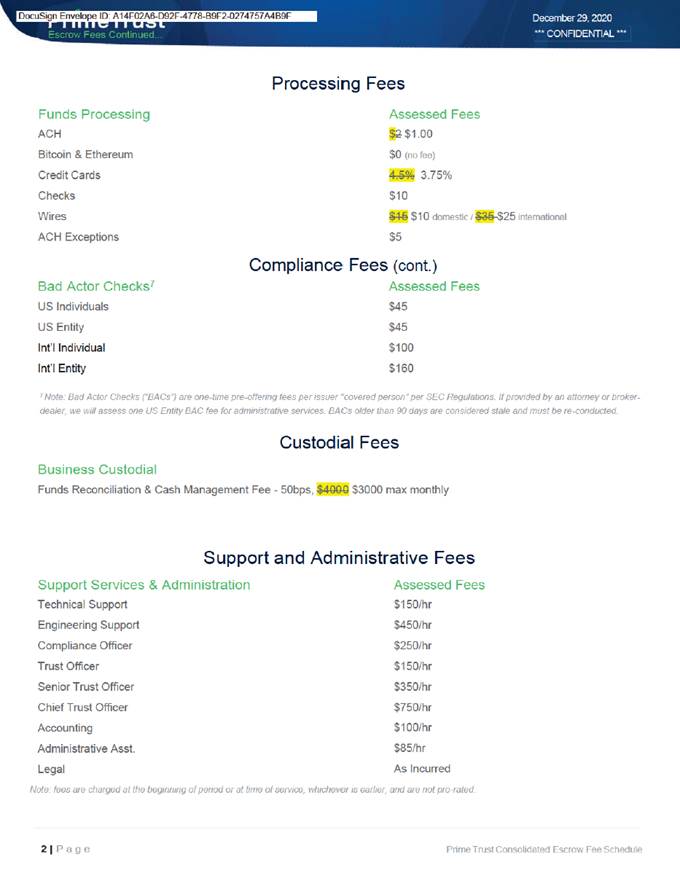
The proposed sale will begin as soon as practicable after this Offering Circular has been qualified by the U.S. Securities and Exchange Commission (the “Commission”) and the relevant state regulators, as necessary. This Offering will end upon the earlier of (1) the sale of the maximum number of shares offered hereby, (2) three years from the date this Offering begins or (3) a date determined by our board of directors (the “Termination Date”). This Offering is on a “best efforts” basis. As there is no minimum offering, upon the approval of any subscription to this Offering Circular, the funds received shall immediately be deposited into the bank account (the “Escrow Account”) of our escrow agent, Prime Trust, LLC or such other party (the “Escrow Agent”) and the Company will receive such funds upon each closing. Until the Termination Date, the Company may hold one or more additional closings for additional sales (each, an “Additional Closing”), up to the maximum number of Shares.


Table of Contents


Prior to this Offering, there has been no public market for our securities.  This Offering is being conducted pursuant to Regulation A under the Securities Act of 1933, as amended (the “Securities Act”), for Tier 2 offerings, where the offered securities will not be listed on a registered national securities exchange upon qualification.


See “Risk Factors” beginning on page 11 of this Offering Circular for a discussion of information that should be considered in connection with deciding whether to make an investment.


The Commission does not pass upon the merits of or give its approval to any securities offered or the terms of the Offering, nor does it pass upon the accuracy or completeness of any Offering Circular or other solicitation materials. These securities are offered pursuant to an exemption from registration with the Commission; however, the Commission has not made an independent determination that the securities offered are exempt from registration.


Number of
Shares


Price to Public


Broker-Dealer 
discounts and
commissions (a)


Proceeds to Issuer (b)


Per Share


1


$

4.94


$

0.04940


$

4.940


Total Maximum Offering


10,121,457.00


$

49,999,997.58


$

499,999.98


$

49,499,997.60


(a)                                 The Company has engaged Dalmore Group, LLC, member FINRA/SIPC (“Dalmore”), to act as the broker-dealer of record in connection with this Offering, but not for underwriting or placement agent. This includes a 1% commission but does not include the one-time set-up or consulting fee payable by the Company to Dalmore. See “Plan of Distribution” for details. We do not currently intend to use any other commissioned sales agents, placement agents or underwriters.


(b)                                 The amount of total proceeds set forth in the table does not include deductions for expenses related to this Offering, including the filing, printing, legal, marketing, accounting and other miscellaneous expenses, and expenses associated with posting offering information on sleepinggiants.com, an online offering platform (the “Platform”). We estimate that total expenses will be approximately 10-15% of the total Offering. See “Plan of Distribution” for details.


This is a Regulation A+ Tier 2 offering. The Company is following the “Offering Circular” format of disclosure under Regulation A.


Generally, no sale may be made to you in this Offering if the aggregate purchase price you pay is more than 10% of the greater of your annual income or net worth. Different rules apply to accredited investors and non-natural persons. Before making any representation that your investment does not exceed applicable thresholds, we encourage you to review Rule 251(d)(2)(i)(C) of Regulation A. For general information on investing, we encourage you to refer to www.investor.gov.


February 16, 2021


2


Table of Contents


ABOUT THIS OFFERING CIRCULAR


This Offering Circular speaks only as of the date hereof.


We will amend this Offering Circular whenever the information it contains has become false or misleading in light of existing circumstances and for other purposes, such as to disclose material developments related to the securities offered hereby, to update required financial statements or if there has been a fundamental change in the information initially presented. We will file an amended Offering Circular as part of an amendment to our Form 1-A, which we will file with the Commission or other appropriate regulatory bodies. Our Common Stock is available for offer and sale to residents of every state.


Investment in small businesses involves a high degree of risk, and investors should not invest any funds in this Offering unless they can afford to lose their entire investment. In making an investment decision, investors must rely on their own examination of the Company and the terms of the Offering, including the merits and risks involved.


This Offering Circular does not constitute an offer to sell or solicitation of an offer to buy to any person to who it is unlawful to make such offer or solicitation. The Common Stock may not be sold nor may offers to buy be accepted prior to the time the offering statement filed with the Commission becomes qualified.


Neither the delivery of this Offering Circular nor any sale made hereunder shall, under any circumstances, create an implication that there as has been no change in the affairs of the Company since the date hereof. Information contained in the preliminary Offering Circular is subject to completion or amendment.


The trade names, trademarks, and services marks associated with our business are owned by of Orthogonal Thinker, Inc. and are licensed to the Company. Orthogonal Thinker, Inc. owns a number of federal trademark applications and unregistered trademarks, including for the Ei.Ventures mark and our corporate logo. All other trade names, trademarks and service marks of other companies appearing in this prospectus are the property of their respective holders. Solely for convenience, the trademarks and trade names in this prospectus may be referred to without symbols, but such references should not be construed as any indicator that their respective owners will not assert, to the fullest extent under applicable law, their rights thereto. We do not intend to use or display other companies’ trademarks and trade names to imply a relationship with, or endorsement or sponsorship of us by, any other companies.


3


Table of Contents


TABLE OF CONTENTS


SUMMARY

6

RISK FACTORS

11

CAUTIONARY STATEMENT CONCERNING FORWARD-LOOKING STATEMENTS

4

USE OF PROCEEDS

48

DILUTION

49

MANAGEMENT’S DISCUSSION AND ANALYSIS OF FINANCIAL CONDITION AND RESULTS OF OPERATIONS

51

OUR BUSINESS

55

MANAGEMENT

86

CERTAIN RELATIONSHIPS AND RELATED PARTY TRANSACTIONS

92

SECURITY OWNERSHIP OF MANAGEMENT AND CERTAIN SECURITYHOLDERS

92

SECURITIES BEING OFFERED AND DESCRIPTION OF SECURITIES

93

PLAN OF DISTRIBUTION

94

LEGAL MATTERS

96

INDEPENDENT AUDITORS

96

WHERE YOU CAN FIND ADDITIONAL INFORMATION

96

INDEX TO FINANCIAL STATEMENTS

F-1


CAUTIONARY STATEMENT CONCERNING FORWARD-LOOKING STATEMENTS


The statements contained in this Offering Circular that are not purely historical are forward-looking statements. Forward-looking statements include, but are not limited to, statements regarding expectations, hopes, beliefs, intentions or strategies regarding the future. In addition, any statements that refer to projections, forecasts or other characterizations of future events or circumstances, including any underlying assumptions, are forward-looking statements. The words “anticipate,” “believe,” “continue,” “could,” “estimate,” “expect,” “intend,” “may,” “might,” “plan,” “possible,” “potential,” “predict,” “project,” “should,” “would” and similar expressions may identify forward-looking statements, but the absence of these words does not mean that a statement is not forward-looking. Forward-looking statements in this Offering Circular may include, for example, statements about our:


·                                          lack of operating history;


·                                          reliance on third parties for research;


·                                          results of operations;


·                                          ability to manage growth;


·                                          regulatory or operational risks;


·                                          success in retaining or recruiting, or changes required in, our officers, key employees or directors;


·                                          capital structure;


·                                          ability to obtain additional financing when and if needed; and


4


Table of Contents


·                                          liquidity.


The forward-looking statements contained in this Offering Circular are based on current expectations and beliefs concerning future developments and their potential effects on us. There can be no assurance that future developments will be those that have been anticipated. These forward-looking statements involve a number of risks, uncertainties (some of which are beyond our control) or other assumptions that may cause actual results or performance to be materially different from those expressed or implied by these forward-looking statements. These risks and uncertainties include, but are not limited to, those factors described under the heading “Risk Factors.” Should one or more of these risks or uncertainties materialize, or should any of our assumptions prove incorrect, actual results may vary in material respects from those projected in these forward-looking statements. We undertake no obligation to update or revise any forward-looking statements, whether as a result of new information, future events or otherwise, except as may be required under applicable securities laws.


Implications of Being an Emerging Growth Company


We are not subject to the ongoing reporting requirements of the Securities Exchange Act of 1934, as amended (the “Exchange Act”) because we are not registering our securities under the Exchange Act. Rather, we will be subject to the more limited reporting requirements under Regulation A, including the obligation to electronically file:


·                  annual reports (including disclosure relating to our business operations for the preceding three fiscal years, or, if in existence for less than three years, since inception, related party transactions, beneficial ownership of the issuer’s securities, executive officers and directors and certain executive compensation information, management’s discussion and analysis (“MD&A”) of the issuer’s liquidity, capital resources, and results of operations, and two years of audited financial statements),


·                  semiannual reports (including disclosure primarily relating to the issuer’s interim financial statements and MD&A) and


·                  current reports for certain material events.


In addition, at any time after completing reporting for the fiscal year in which our offering statement was qualified, if the securities of each class to which this offering statement relates are held of record by fewer than 300 persons and offers or sales are not ongoing, we may immediately suspend our ongoing reporting obligations under Regulation A.


If and when we become subject to the ongoing reporting requirements of the Exchange Act, as an issuer with less than $1.07 billion in total annual gross revenues during our last fiscal year, we will qualify as an “emerging growth company” under the Jumpstart Our Business Startups Act of 2012 (the “JOBS Act”) and this status will be significant. An emerging growth company may take advantage of certain reduced reporting requirements and is relieved of certain other significant requirements that are otherwise generally applicable to public companies. In particular, as an emerging growth company we:


·                  will not be required to obtain an auditor attestation on our internal controls over financial reporting pursuant to the Sarbanes-Oxley Act of 2002;


·                  will not be required to provide a detailed narrative disclosure discussing our compensation principles, objectives and elements and analyzing how those elements fit with our principles and objectives (commonly referred to as “compensation discussion and analysis”);


5


Table of Contents


·                  will not be required to obtain a non-binding advisory vote from our stockholders on executive compensation or golden parachute arrangements (commonly referred to as the “say-on-pay,” “say-on-frequency” and “say-on-golden parachute” votes);


·                  will be exempt from certain executive compensation disclosure provisions requiring a pay-for-performance graph and CEO pay ratio disclosure;


·                  may present only two years of audited financial statements and only two years of related Management’s Discussion and Analysis of Financial Condition and Results of Operations, or MD&A; and


·                  will be eligible to claim longer phase-in periods for the adoption of new or revised financial accounting standards.


We intend to take advantage of all of these reduced reporting requirements and exemptions, including the longer phase-in periods for the adoption of new or revised financial accounting standards under Section 107 of the JOBS Act. Our election to use the phase-in periods may make it difficult to compare our financial statements to those of non-emerging growth companies and other emerging growth companies that have opted out of the phase-in periods under Section 107 of the JOBS Act.


Under the JOBS Act, we may take advantage of the above-described reduced reporting requirements and exemptions for up to five years after our initial sale of common equity pursuant to a registration statement declared effective under the Securities Act of 1933, as amended (the “Securities Act”), or such earlier time that we no longer meet the definition of an emerging growth company. Note that this Offering, while a public offering, is not a sale of common equity pursuant to a registration statement, since the Offering is conducted pursuant to an exemption from the registration requirements. In this regard, the JOBS Act provides that we would cease to be an “emerging growth company” if we have more than $1.07 billion in annual revenues, have more than $700 million in market value of our common stock held by non-affiliates, or issue more than $1 billion in principal amount of non-convertible debt over a three-year period.


Certain of these reduced reporting requirements and exemptions are also available to us due to the fact that we may also qualify, once listed, as a “smaller reporting company” under the Commission’s rules. For instance, smaller reporting companies are not required to obtain an auditor attestation on their assessment of internal control over financial reporting; are not required to provide a compensation discussion and analysis; are not required to provide a pay-for-performance graph or CEO pay ratio disclosure; and may present only two years of audited financial statements and related MD&A disclosure.


SUMMARY


This summary highlights certain information appearing elsewhere in this Offering Circular. For a more complete understanding of this Offering, you should read the entire Offering Circular carefully, including the risk factors and the financial statements.


Unless otherwise stated in this Offering Circular, “we”, “us”, “our”, “Company” and “Ei.Ventures” refer to Ei.Ventures, Inc.


Overview


Ei.Ventures, Inc., a Delaware corporation (the “Company”), is a start-up company formed in May 2019 with the ambition to engage in the discovery, development and commercialization of regulatory approved, plant-derived, psychoactive and non-psychoactive therapeutic compounds that address global mental healthcare needs. Prior to this Offering, the Company has been a wholly owned subsidiary of Orthogonal Thinker, Inc., a Delaware


6


Table of Contents


corporation (“Orthogonal”), a company engaged in developing intellectual property and operating in the wellness business.


On October 8, 2020, the Company agreed to terms with Orthogonal, the sole shareholder of the Company, for a royalty-free license of certain intellectual property (the “License Agreement”), including the compositions addressed in Orthogonal’s provisional patent application, the associated intellectual property, and also intellectual property associated with a number of additional psilocybin-based psychoactive compounds and non-psychoactive nutritional supplements not included in the provisional application. The License Agreement grants the Company an exclusive world-wide right to use, manufacture, develop, commercialize, market and sell all of the licensor’s intellectual property addressed in the License Agreement with respect to the intellectual property for medicinal, therapeutic, nutraceutical and adult recreational uses, including the matters included in the provisional application. No consideration was paid to Orthogonal for the license. The license is perpetual, subject to limited termination rights, for example, if the Company is found guilty of criminal activity or the Company files for bankruptcy.


Our initial research into psychoactive therapeutic compounds is planned to be conducted with respect to psilocybin and/or psilocin. Psilocybin is a naturally-occurring psychedelic compound produced by more than 200 species of mushrooms, collectively known as psilocybin mushrooms. Psilocybin is quickly converted by the body to psilocin, which is a non-selective serotonin receptor agonist responsible for its pharmacologic effects. Currently in the United Sates, the possession of psilocybin and psilocin is illegal because psilocybin is a Schedule I controlled substance. As a result, the federal government has the right to regulate and criminalize psilocybin, including for medical purposes. In Canada, psilocybin is classified as a schedule III drug, meaning activities such as sale, possession, or production of these substances are prohibited unless they have been authorized for clinical trials or research purposes, consistent with Part J of Canada’s Food and Drug Regulations. Current formulations and testing are theoretical—the Company has not taken any steps to test or otherwise verify any of the formulations—and, if approved, actual testing will only proceed in government-approved laboratories.


We intend to use the proceeds of this Offering to build upon our current intellectual property holdings by developing a differentiated portfolio of psychoactive and non-psychoactive products on the presumption that they will become regulatorily approved, such approval within the sole determination of the FDA and other comparable regulatory agencies. In the coming years, we believe that we will see significant increases in demand from patients and governments for plant-derived products, including psychoactive therapeutic products. We intend to be well-positioned at that time to expand availability of these products to patients if they become legal and are approved by the FDA and other comparable regulatory agencies, as medical psilocybin becomes recognized worldwide as a viable treatment option for patients suffering from a variety of diseases and conditions.


Our progress with regard to the testing and sale of psychoactive therapeutic options will depend, in large part, on changes to the federal and state regulations in the United States and abroad with regard to biopharmaceutical research involving psychedelics or rescheduling of psilocybin and/or psilocin as a Schedule I controlled substance (or schedule III drug in Canada), along with our ability to obtain and maintain patent protection of current and future compositions. We intend to use the proceeds of this Offering to fund pre-clinical and clinical trials on our current compositions to meet FDA regulations. Current formulations and testing are theoretical and, if approved, actual testing will only proceed in government-approved laboratories. Pre-clinical and clinical testing is expensive, is difficult to design and implement and can take years to complete. The initial testing that we intend to complete within the next year, for each formulation, which in large part will be theoretical, includes (1) the development of one or more active pharmaceutical ingredients; (2) product characterization to determine size shape, strengths and weaknesses, toxicity, bioactivity, and bioavailability; (3) formulation, delivery, and packaging development to devise a formulation that insures the proper drug delivery parameters; (4) pharmacokinetics (PK) and absorption/distribution/metabolism/excretion (ADME) studies; (5) preclinical toxicology testing to determine the bioactivity, safety, and efficacy of the formulations; and (6) Phase 1 clinical trials to evaluate pharmacokinetic parameters and tolerance.


7


Table of Contents


While we navigate through pre-clinical research on our psychoactive compositions and the accompanying strict regulatory environment, we also intend to develop and commercialize non-psychoactive nutritional supplement products that will be synergistic with the psychoactive therapeutic options to address one’s whole well-being through a wholly-owned subsidiary, Mana Health Labs, Inc., a Delaware corporation.  Through this subsidiary, we intend to make “MANA” a nationally recognized brand in the nutritional supplements industry. We intend to launch the following initial products on or before February 1, 2021: (1) Brain MANA, a non-psychotropic mushroom formulation with enhanced bioavailability, (2) Intelliburst, a natural focus and energy booster, (3) Happy Sexy, a weight loss booster; (4) Sleepy Sexy, a weight loss booster and sleep aid. We plan to manufacture all of our nutritional supplement products from natural ingredients in compliance with U.S. Food and Drug Administration laws and regulations. We intend to package our nutritional supplements in different form, such as tables, gummies, capsules, and powders. We anticipate that all of our products will be GMO-free, which we intend to emphasize in our marketing campaigns to the extent possible.


We also intend, as an intermediate business plan, to pursue the acquisition of one or more drug testing laboratories. There can be no assurance that we will be able to accomplish this intermediate business plan: The Company is organized and directed to operate strictly in accordance with all applicable federal, state and provincial laws. Accordingly, at this time, we do not grow, process, own, handle, transport or sell psilocybin-based products. However, if the legal environment changes in the United States or in Canada, the Company’s management may explore business opportunities in the development of laboratories, and growing/cultivation operations, provided that n such business opportunities become legally permissible under applicable federal and state or provincial law.


Market Opportunity and the Potential for Psilocybin Therapy for Treating MDD


The World Health Organization estimates that over 264 million people worldwide suffer from major depressive disorder, or MDD. The second leading of cause of death in 15-29-year-olds is suicide related to MDD. In the United States, the economic burden of MDD accounts for approximately $200 billion per year. Patients suffering with MDD are treated through a number of approaches. Most treatments for MDD rely on a treatment plan focused on the brain’s neurotransmitter monoamine levels. This methodology has exhibit limited efficacy in a significant portion of patients and often results in high relapse rates. We believe that it is time for a new approach to the treatment of MDD that can deliver reliable results and long-term efficacy.


Psilocybin is currently classified as a Schedule I drug in the United States and is similarly prohibited in many jurisdictions. While the legal status of psilocybin currently restricts the research that can be performed on its ability to treat MDD and other conditions, there is a rapidly growing body of evidence that psilocybin may have beneficial effects on depression and other mental health conditions. The FDA and the U.S. Drug Enforcement Administration, or DEA, have permitted the use of psilocybin in clinical studies for the treatment of a range of psychiatric conditions. In particular, recent studies demonstrate that psilocybin may beneficially alter the extracellular release of serotonin and dopamine, resulting in brain network connectivity and increased level of neuroplasticity. These studies are encouraging and demonstrate that psilocybin therapy may have the potential to ensure rapid and enduring mood effects.


With regard to the nutritional supplements, our aim is to operate within the large and growing nutritional supplements industry. According to Nutrition Business Journal’s Supplement Business Report 2020, the nutritional supplement industry generated $123.28 billion in sales in 2019 and is projected to grow 8% per annum through 2027. We anticipate several key demographic, healthcare, and lifestyle trends to drive the continued growth of this industry. These trends include increasing awareness of nutritional supplements across major age and lifestyle segments of the U.S. population, and increased focus on fitness and healthy living.


8


Table of Contents


Nutritional Supplement Distribution


We intend that the United States will be our initial target market for sales of our nutritional supplements. We anticipate distributing our products through four primary channels: (1) master distributors in the nutritional supplements market; (2) master distributors in the fast-moving consumer goods industry; (3) big box retailers; (4) our own website and internal sales force; and (5) white-label opportunities for our products. With time, we intend to expand our reach globally.


Our Medical and Scientific Advisory Board


We intend to continue to assemble a team of recognized experts in psilocybin drug research and development and clinical medicine encompassing multiple clinical specialties and conditions. These experts will serve on our medical and scientific advisory board, which is distinct from our board of directors and will provide us with advice on research and product development, pre-clinical study and clinical trial design and implementation and unmet clinical needs in a variety of clinical specialties, including for mental health. For additional information please refer to the section “Management — Our Medical and Scientific Advisory Board.”


Market & Industry Information


Throughout this Offering Circular, we use market data and industry forecasts and projections that were obtained from surveys and studies conducted by third parties, including the National Standards Institute, Statista, and Pew Research, and from publicly available industry and general publications. Although we believe that the sources are reliable, and that the information contained in such surveys and studies conducted by third parties is accurate and reliable, we have not independently verified the information contained therein. We note that estimates, in particular as they relate to general expectations concerning our industry, involve risks and uncertainties and are subject to change based on various factors, including those discussed under the heading “Risk Factors” in this Offering Circular.


Corporate Information


We were incorporated in the State of Delaware on May 3, 2019 under the name Ei.Ventures, Inc. Our principal executive office address is 1215 South Kihei Road, #424, Kihei, Hawaii 96753. Our corporate telephone number is (808) 213-8191. Our corporate website is www.ei.ventures. The information contained on or that can be accessed through our website is not incorporated by reference into this Offering Circular, and you should not consider information on our website to be part of this Offering Circular or in deciding whether to purchase our Common stock.


The Offering


Securities being offered by us


A maximum of 10,121,457 Common Stock, par value $0.0001 (the “Shares”). No minimum investment shall be required.


Securities outstanding prior to this Offering


60,000,000 shares of Common Stock.


SAFE Securities converting into shares of Common Stock as a result of this Offering


963,019 shares of Common Stock. The rights of the holders of the SAFE Securities (defined below) are described in the “Dilution” section on page 46.


Securities outstanding after this Offering


A total of 77,550,976 Shares will be issued and outstanding after this Offering is completed assuming the maximum number of offered Shares are sold and the exercise of all outstanding options. Orthogonal will hold 77.90% of the Company following the Offering in the event the maximum amount of


9


Table of Contents


Shares being offered are sold. As of the date of this Offering Circular, the Company has granted or committed to grant 6,466,500 options under its 2020 Equity Incentive Plan. The rights of the option holders under the 2020 Equity Incentive Plan are described in the “Management” section on page 86.


Maximum offering


10,121,457 Shares (the “Maximum Offering”), at an offering price of $4.94 per Share, for total gross proceeds of $49,999,997.58. If we sell the maximum number of Shares being offered, our proceeds net of our estimated offering expenses of $4,999,999.76 will be approximately $44,999,997.82.


Minimum investment


The minimum investment amount per investor is $498.94 (101 shares); however, we can waive the minimum purchase requirement on a case to case basis in our sole discretion. We may waive the minimum investment amount based on the supply and demand for the offered Shares. For example, the Company may waive the minimum investment amount if there is not sufficient demand among fewer investors for the offered Shares.


Investment limitation


Generally, no sale may be made to you in this Offering if the aggregate purchase price you pay is more than 10% of the greater of your annual income or net worth. Different rules apply to accredited investors and non-natural persons. Before making any representation that your investment does not exceed applicable thresholds, we encourage you to review Rule 251(d)(2)(i)(c) of Regulation A.


Use of proceeds


We will use the net proceeds for the execution of our business plan, expenses associated with the marketing and advertising of the Offering, working capital and general corporate purposes and such other purposes described in the “Use of Proceeds” on page 48.


Market for our Shares


There is currently no public market for our Common Stock, and we have no current plans on to seek a listing for the Common Stock, whether on the NYSE, NYSE American, Nasdaq or OTC Markets. Even if we were to seek a listing, there can be no assurance that our Common Stock will actually be quoted or traded on this market or, if quoted or traded, that an active public market will develop or be sustained.


Risk factors


An investment in the Company is highly speculative and involves a high degree of risk. Prospective investors should carefully consider the Risk Factors beginning on page 11 before investing in the Common Stock offered hereby. Upon completion of this Offering, Orthogonal will own a controlling share of Common Stock.


Termination of the Offering


This Offering will close upon the earlier of (1) the sale of the maximum number of Shares offered hereby, (2) three years from the date this Offering begins or (3) a date


10


Table of Contents


determined by our board of directors (the “Termination Date”).


RISK FACTORS


An investment in the Common Stock offered by this Offering Circular involves a high degree of risk. You should consider carefully all of the material risks described below, together with the other information contained in this Offering Circular, before making a decision to invest in the Common Stock. If any of the following risk factors actually occur, our business, financial condition, results of operations and prospects could suffer, the trading price of our Shares could decline and you could lose all or part of your investment.


Risks Relating to Our Business and Strategy for

Non-Psychoactive Nutritional Supplement Products


Our product offerings are new in an industry that is still quickly evolving.


Our Nutritional Supplements offering is a new offering developed in 2020. Despite the experience of our management team, the products being offered are new and have no track record from which to project future performance. Additionally, in light of indefinite changes to distribution outlets in light of the COVID-19 pandemic, changes in how goods are obtained, and restrictions on some gyms and recreation centers, there is no guarantee we can build our brand and name recognition as quickly as otherwise hoped.


We will face competition from other nutritional supplement companies and our operating results will suffer if we fail to compete effectively.


The nutritional supplement industry is intensely competitive and subject to rapid and significant technological change. We anticipate having competitors in the United States, Canada, Europe and other jurisdictions, including major multinational supplement companies, established supplement companies. There are numerous other companies operating in the nutritional supplement space, many of which have longer operating histories and far greater financial and personnel resources than we do. Known competitors in our space include Life Extension, LLC, Optimum Nutrition, Inc., Thorne Research, Inc., Garden of Life, LLC, Klaire Laboratories, Inc., Herb Farm, LLC, and Pure Encapsulations, LLC, along with many other companies and sellers on Amazon and other marketplaces. Many of these competitors may have greater financial and other resources, such as larger research and development staff and more experienced marketing and manufacturing organizations.


We believe that our ability to successfully compete will depend on, among other things:


·                                          the success of our research and development efforts to identify and develop strong nutritional supplements;


·                                          our ability to commercialize and market any of our nutritional supplements;


·                                          the price of our products;


·                                          our ability to protect our intellectual property rights related to our products;


·                                          our ability to manufacture and sell commercial quantities of any nutritional supplements; and


We have never been profitable. Currently, we have no products ready to sell, and to date we have not generated any revenue. As a result, our ability to reduce our losses and reach profitability is unproven, and we may never achieve or sustain profitability.


11


Table of Contents


We have never generated revenue and have never been profitable. We have not yet begun manufacturing and selling any supplement products in the United States, Canada, or elsewhere. We have incurred net losses in each year since our inception.


We currently have no agreements with contract manufacturers for the production of nutritional supplements.


We do not currently intend to manufacture the nutritional supplements that we plan to sell. We currently have no agreements with contract manufacturers for the production of the nutritional supplements and the formulation of sufficient quantities of nutritional supplements.


Product safety and quality concerns, including concerns related to perceived quality of ingredients, could negatively affect the Company’s business.


The Company’s success with regard to nutritional supplements depends in large part on its ability to maintain consumer confidence in the safety and quality of all its products. The Company intends to develop rigorous product safety and quality standards. However, if products taken to market are or become contaminated or adulterated, the Company may be required to conduct costly product recalls and may become subject to product liability claims and negative publicity, which would cause its business to suffer. In addition, regulatory actions, activities by nongovernmental organizations and public debate and concerns about perceived negative safety and quality consequences of certain ingredients in our products may erode consumers’ confidence in the safety and quality issues, whether or not justified, and could result in additional governmental regulations concerning the marketing and labeling of the Company’s products, negative publicity, or actual or threatened legal actions, all of which could damage the reputation of the Company’s products and may reduce demand for the Company’s products.


Quality management plays an essential role in determining and meeting customer requirements, preventing defects, improving the Company’s products and services and maintaining the integrity of the data that supports the safety and efficacy of our products.


Our future success with regard to supplements depends on our ability to maintain and continuously improve our quality management program. An inability to address a quality or safety issue in an effective and timely manner may also cause negative publicity, a loss of customer confidence in us or our current or future products, which may result in the loss of sales and difficulty in successfully launching new products. In addition, a successful claim brought against us in excess of available insurance or not covered by indemnification agreements, or any claim that results in significant adverse publicity against us, could have an adverse effect on our business and our reputation.


We must correctly predict, identify, and interpret changes in consumer preferences and demand, offer new products to meet those changes, and respond to competitive innovation. Consumer preferences for our products change continually.


Our success depends on our ability to predict, identify, and interpret the tastes and habits of consumers and to offer products that appeal to consumer preferences. If we do not offer products that appeal to consumers, our sales and market share will decrease. We must distinguish between short-term fads, mid-term trends, and long-term changes in consumer preferences. If we do not accurately predict which shifts in consumer preferences will be long-term, or if we fail to introduce new and improved products to satisfy those preferences, our sales could decline. In addition, because of our anticipated varied customer base, we must offer an array of products that satisfy the broad spectrum of consumer preferences. If we fail to expand our product offerings successfully across product categories, or if we do not rapidly develop products in faster growing and more profitable categories, demand for our products could decrease, which could materially and adversely affect our product sales, financial condition, and results of operations. In addition, achieving growth depends on our successful development, introduction, and marketing of innovative new products and line extensions. Successful innovation depends on our ability to correctly anticipate customer and consumer acceptance, to obtain, protect and maintain necessary intellectual property rights, and to avoid infringing the intellectual property rights of others and failure to do so could compromise our competitive position and adversely impact our business.


12


Table of Contents


One of the potential risks we face in the distribution of our products is liability resulting from counterfeit or tainted products infiltrating the supply chain.


Because we intend to source ingredients from various sources, we will rely on various suppliers and their quality control measures. While we intend to have procedures to maintain the highest quality levels in our products, we may be subject to faulty, spoiled or tainted ingredients or components in our products, which would negatively affect our products and our customers’ experience with them and could decrease customer demand for our products. In addition, if there are serious illness or injury due to our products, there can be no assurance that the insurance coverage we plan to maintain is sufficient or will be available in adequate amounts or at a reasonable cost, or that indemnification agreements will provide us with adequate protection.


We are vulnerable to fluctuations in the price and supply of ingredients, packaging materials, and freight.


The prices of the ingredients, packaging materials, and freight are subject to fluctuations in price attributable to, among other things, changes in supply and demand of raw materials or other commodities. The sales prices to our customers will be a delivered price. Therefore, changes in our input costs could impact our gross margins. Our ability to pass along higher costs through price increases to our customers will be dependent upon competitive conditions and pricing methodologies employed in the various markets in which we intend to compete. To the extent competitors do not also increase their prices, customers and consumers may choose to purchase competing products or may shift purchases to lower-priced private label or other value offerings which may adversely affect our results of operations. We will use significant quantities of raw materials and food ingredients as well as packaging materials provided by third-party suppliers. We will also likely buy from a variety of producers and manufacturers, and alternate sources of supply are generally available. However, the supply and price are subject to market conditions and are influenced by other factors beyond our control. The occurrence of any of the foregoing could increase our costs and disrupt our operations.


Substantial disruption to production at our manufacturing and distribution facilities could occur.


A disruption in production at our third-party manufacturing facilities could have an adverse effect on our business. In addition, a disruption could occur at the facilities of our future suppliers or distributors. The disruption could occur for many reasons, including pandemic (such as the novel COVID-19 pandemic), fire, natural disasters, weather, water scarcity, manufacturing problems, disease, strikes, transportation or supply interruption, government regulation, cybersecurity attacks or terrorism. Alternative facilities with sufficient capacity or capabilities may not be available, may cost substantially more or may take a significant time to start production, each of which could negatively affect our business and results of operations.


Future product recalls or safety concerns could adversely impact our results of operations.


We may be required to recall certain of our products should they be mislabeled, contaminated, spoiled, tampered with or damaged. We also may become involved in lawsuits and legal proceedings if it is alleged that the consumption or use of any of our products causes injury, illness, or death. A product recall or an adverse result in any such litigation could have an adverse effect on our business, depending on the costs of the recall, the destruction of product inventory, competitive reaction and consumer attitudes. Even if a product liability or consumer fraud claim is unsuccessful or without merit, the negative publicity surrounding such assertions regarding our products could adversely affect our reputation and brand image. We also could be adversely affected if consumers in our principal markets lose confidence in the safety and quality of our products.


The consolidation of retail customers could adversely affect us.


Retail customers, such as supermarkets, warehouse clubs, and supplements distributors in our major markets, may consolidate, resulting in fewer customers for our business. Consolidation also produces larger retail customers that may seek to leverage their position to improve their profitability by demanding improved efficiency, lower pricing, increased promotional programs, or specifically tailored products. In addition, larger retailers have the scale to develop supply chains that permit them to operate with reduced inventories or to develop and market their own white-label brands. Retail consolidation and increasing retailer power could adversely affect our product sales and


13


Table of Contents


results of operations. Retail consolidation also increases the risk that adverse changes in our customers’ business operations or financial performance will have a corresponding material and adverse effect on us. For example, if our customers cannot access sufficient funds or financing, then they may delay, decrease, or cancel purchases of our products, or delay or fail to pay us for previous purchases, which could materially and adversely affect our product sales, financial condition, and operating results.


Evolving tax, environmental, food quality and safety or other regulations or failure to comply with existing licensing, labeling, trade, food quality and safety and other regulations and laws could have a material adverse effect on our consolidated financial condition.


Our activities or products related to nutritional supplements, both in and outside of the United States, are subject to regulation by various federal, state, provincial and local laws, regulations and government agencies, including the U.S. Food and Drug Administration, U.S. Federal Trade Commission, the U.S. Departments of Agriculture, Commerce and Labor, as well as similar and other authorities outside of the United States, International Accords and Treaties and others, including voluntary regulation by other bodies. These laws and regulations and interpretations thereof may change, sometimes dramatically, as a result of a variety of factors, including political, economic or social events. The manufacturing, marketing, and distribution of health supplements are subject to governmental regulation that control such matters as quality and safety, ingredients, advertising, product or production requirements, labeling, import or export of our products or ingredients, relations with distributors and retailers, health and safety, the environment, and restrictions on the use of government programs to purchase certain of our products. We are also regulated with respect to matters such as licensing requirements, trade and pricing practices, tax, anticorruption standards, advertising and claims, and environmental matters. The need to comply with new, evolving or revised tax, environmental, food quality and safety, labeling or other laws or regulations, or new, or changed interpretations or enforcement of existing laws or regulations, may have an adverse effect on our business and results of operations. Further, if we are found to be out of compliance with applicable laws and regulations in these areas, we could be subject to civil remedies, including fines, injunctions, termination of necessary licenses or permits, or recalls, as well as potential criminal sanctions, any of which could have an adverse effect on our business. Even if regulatory review does not result in these types of determinations, it could potentially create negative publicity or perceptions which could harm our business or reputation.


Significant additional labeling or warning requirements may inhibit sales of affected products.


Various jurisdictions may seek to adopt significant additional product labeling or warning requirements relating to the content or perceived adverse health consequences of our products. If these types of requirements become applicable to our products under current or future environmental or health laws or regulations, they may inhibit sales of such products.


Growth rates higher than planned or the introduction of new products requiring special ingredients could create higher demand for ingredients greater than we can source.


Although we believe that there are alternative sources available for our key ingredients, there can be no assurance that we would be able to acquire such ingredients from substitute sources on a timely or cost effective basis in the event that then-current suppliers could not adequately fulfill orders, which would adversely affect our business and results of operations.


We source certain packaging materials and other shipping materials from a number of third-party suppliers.


Although we believe that alternative suppliers are available, the loss of any of our future packaging material suppliers could adversely affect our results of operations and financial condition. Our inability to preserve the current economics of these agreements could expose us to significant cost increases in future years.


We will likely rely, in part, on our third-party co-manufacturers to maintain the quality of our products.


The failure or inability of these co-manufacturers to comply with the specifications and requirements of our products could result in product recall and could adversely affect our reputation. Third-party co-manufacturers will be required to maintain the quality of our products and to comply with our product specifications and requirements for


14


Table of Contents


certain certifications. Our third-party co-manufacturers will also be required to comply with all federal, state and local laws with respect to food safety. However, our third-party co-manufacturers may not continue to produce products that are consistent with our standards or that are in compliance with applicable laws, and we cannot guarantee that we will be able to identify instances in which our third-party co-manufacturer fails to comply with our standards or applicable laws. Any such failure, particularly if it is not identified by us, could harm our brand and reputation as well as our customer relationships. We would have these same issues with any new co-manufacturer, and they may be exacerbated due to the newness of the relationship. The failure of any manufacturer to produce products that conform to our standards could materially and adversely affect our reputation in the marketplace and result in product recalls, product liability claims and severe economic loss.  


As a health supplement company, all of our products must be compliant with regulations issued by the Food and Drug Administration (FDA).


We must comply with various FDA rules and regulations, including those regarding product manufacturing, food safety, required testing and appropriate labeling of our products. It is possible that regulations by the FDA and its interpretation thereof may change over time. As such, there is a risk that our products could become non-compliant with the FDA’s regulations and any such non-compliance could harm our business.


Certain of our raw material contracts will likely have minimum purchase commitments that could require us to continue to purchase raw materials even if our sales have declined.


We will likely be contractually obligated to purchase a certain amount of raw materials from our suppliers even if we do not have the customer demand to sustain such purchases. The purchase of raw materials, which we are not able to convert into finished products and sell to our customers would have a negative effect on our business and results of operations.


Our profitability may be negatively affected by inventory shrinkage.


We are subject to the risk of inventory loss and theft. We may experience significant inventory shrinkage and cannot be sure that incidences of inventory loss and theft will decrease in the future or that the measures we are taking will effectively reduce the problem of inventory shrinkage. Although some level of inventory shrinkage is an unavoidable cost of doing business, if we were to experience higher rates of inventory shrinkage or incur increased security costs to combat inventory theft, our business and results of operations could be affected adversely.


Failure to execute our inventory management process could adversely affect our business.


We must also properly execute our inventory management strategies by appropriately allocating merchandise among our distributors, timely and efficiently distributing inventory to distributors, maintaining an appropriate mix and level of inventory at the distributors and effectively managing pricing and markdowns, and there is no assurance we will be able to do so. Failure to effectively execute our inventory management strategies could adversely affect our performance and our relationship with our customers.


We may not timely identify or effectively respond to consumer trends or preferences, whether involving physical retail, e-commerce retail or a combination of both retail offerings, which could negatively affect our relationship with our customers and the demand for our products and services.


It will be difficult to predict consistently and successfully the products our customers will demand. The success of our business depends in part on how accurately we predict consumer demand, availability of merchandise, the related impact on the demand for existing products and the competitive environment, whether for customers purchasing products at stores, through e-commerce businesses or through the combination of both potential retail offerings. A critical piece of identifying consumer preferences involves price transparency, assortment of products, customer experience and convenience. These factors are of primary importance to customers and they continue to increase in importance, particularly as a result of digital tools and social media available to consumers and the choices available to consumers for purchasing products online, at physical locations, or through a combination of both retail offerings. Failure to timely identify or effectively respond to changing consumer tastes, preferences (including the key factors described above) and spending patterns, whether for physical retail offerings, ecommerce


15


Table of Contents


offerings or through a combination of these retail offerings, could negatively affect our relationship with our customers and the demand for our products and services.


Our business and results of operations may be adversely affected if we are unable to maintain our customer experience or provide high quality customer service.


The success of our business largely depends on our ability to provide superior customer experience and high quality customer service, which in turn depends on a variety of factors, such as our ability to continue to provide a reliable and user-friendly website interface for our customers to browse and purchase our products, reliable and timely delivery of our products, and superior after sales services. Our sales may decrease if our website services are severely interrupted or otherwise fail to meet our customer requests. Should we or our third-party delivery companies fail to provide our product delivery and return services in a convenient or reliable manner, or if our customers are not satisfied with our product quality, our reputation and customer loyalty could be negatively affected. As a result, if we are unable to continue to maintain our customer experience and provide high quality customer service, we may not be able to retain existing customers or attract new customers, which could have an adverse effect on our business and results of operations.


Our advertising and marketing efforts may be costly and may not achieve desired results.


We will very likely incur substantial expense in connection with our advertising and marketing efforts. Although we intend to target our advertising and marketing efforts potential customers who we believe are likely to be in the market for the products we sell, we cannot assure you that our advertising and marketing efforts will achieve our desired results. In addition, we will periodically adjust our advertising expenditures in an effort to optimize the return on such expenditures. Any decrease in the level of our advertising expenditures, which may be made to optimize such return could adversely affect our sales.


We may be required to collect sales tax on our direct marketing operations.


With respect to the direct sales, sales or other similar taxes are collected primarily in states where we have a physical presence or personal property. However, various states or foreign countries may seek to impose sales tax collection obligations on out-of-state direct mail companies. A successful assertion by one or more states that we or one or more of our subsidiaries should have collected or should be collecting sales taxes on the direct sale of our merchandise could have an adverse effect on our business.


Government regulation is evolving and unfavorable changes could harm our business.


We are subject to general business regulations and laws, as well as regulations and laws specifically governing the Internet, e-commerce, electronic devices, and other services. Existing and future laws and regulations may impede our growth. These regulations and laws may cover taxation, privacy, data protection, pricing, content, copyrights, distribution, mobile communications, electronic device certification, electronic waste, energy consumption, environmental regulation, electronic contracts and other communications, competition, consumer protection, web services, the provision of online payment services, information reporting requirements, unencumbered Internet access to our services, the design and operation of websites, the characteristics and quality of products and services, and the commercial operation of unmanned aircraft systems. It is not clear how existing laws governing issues such as property ownership, libel, and personal privacy apply to the Internet, e-commerce, digital content, and web services. Jurisdictions may regulate consumer-to-consumer online businesses, including certain aspects of our seller programs. Unfavorable regulations and laws could diminish the demand for our products and services and increase our cost of doing business.


Changes in federal, state or local laws and regulations could increase our expenses and adversely affect our results of operations.


Our business is subject to a wide array of laws and regulations. The current political environment, financial reform legislation, the current high level of government intervention and activism and regulatory reform may result in substantial new regulations and disclosure obligations and/or changes in the interpretation of existing laws and


16


Table of Contents


regulations, which may lead to additional compliance costs as well as the diversion of our management’s time and attention from strategic initiatives. If we fail to comply with applicable laws and regulations, we could be subject to legal risk, including government enforcement action and class action civil litigation that could disrupt our operations and increase our costs of doing business. Changes in the regulatory environment regarding topics such as privacy and information security, product safety or environmental protection, including regulations in response to concerns regarding climate change, collective bargaining activities, minimum wage laws and health care mandates, among others, could also cause our compliance costs to increase and adversely affect our business and results of operations.


Failure to obtain new clients or renew client contracts on favorable terms could adversely affect results of operations.


We may face pricing pressure in obtaining and retaining our clients. Our clients may be able to seek price reductions from us when they renew a contract, when a contract is extended, or when the client’s business has significant volume changes. On some occasions, this pricing pressure may result in lower revenue from a client than we had anticipated based on our previous agreement with that client. This reduction in revenue could result in an adverse effect on our business and results of operations. Further, failure to renew client contracts on favorable terms could have an adverse effect on our business.


Our business could be negatively impacted by cyber security threats, attacks and other disruptions.


Like others in our industry, we will face advanced and persistent attacks on our information infrastructure where we manage and store various proprietary information and sensitive/confidential data relating to our operations. These attacks may include sophisticated malware (viruses, worms, and other malicious software programs) and phishing emails that attack our products or otherwise exploit any security vulnerabilities. These intrusions sometimes may be zero-day malware that are difficult to identify because they are not included in the signature set of commercially available antivirus scanning programs. Experienced computer programmers and hackers may be able to penetrate our network security and misappropriate or compromise our confidential information or that of our customers or other third-parties, create system disruptions, or cause shutdowns. Additionally, sophisticated software and applications that we procure from third-parties may contain defects in design or manufacture, including “bugs” and other problems that could unexpectedly interfere with the operation of the information infrastructure. A disruption, infiltration or failure of our information infrastructure systems or any of our data centers as a result of software or hardware malfunctions, computer viruses, cyber attacks, employee theft or misuse, power disruptions, natural disasters or accidents could cause breaches of data security, loss of critical data and performance delays, which in turn could adversely affect our business.


Risks Relating to Our Business and Strategy for Psychoactive Compounds


We may not succeed in developing viable drug candidates, which could result in the entire loss of your investment.


Although we have obtained the rights to a number of novel compositions containing psilocybin, none of them have been tested to evaluate their potential as a new drug product.  Part of the use of proceeds of this Offering is to conduct pre-clinical research on one or more of our compositions in order to develop data necessary to file an Investigational New Drug (“IND”) application in the United States and/or a clinical trial application (“CTA”) in Canada.  There is no assurance that the results of these studies will demonstrate that the compositions are viable new drug candidates.  If our current compositions are not viable, our business could fail, resulting in the complete loss of your investment.


We will face competition from other biotechnology and pharmaceutical companies and our operating results will suffer if we fail to compete effectively.


The biotechnology and pharmaceutical industries are intensely competitive and subject to rapid and significant technological change. We anticipate having competitors in the United States, Canada, Europe and other jurisdictions, including major multinational pharmaceutical companies, established biotechnology companies,


17


Table of Contents


specialty pharmaceutical and generic drug companies and universities and other research institutions. There are a number of other companies operating in the psilocybin space, many of which have longer operating histories and far greater financial and personnel resources than we do. Known competitors in our space include Champignon Brands Inc., Mind Medicine, Inc., Revive Therapeutics Ltd., COMPASS Pathways, Ltd, Field Trip Health, Inc., Cybin, Inc, and Eluesis, Ltd. Many of these competitors may have greater financial and other resources, such as larger research and development staff and more experienced marketing and manufacturing organizations. Large pharmaceutical companies, in particular, have extensive experience in clinical testing, obtaining regulatory approvals, recruiting patients and manufacturing drugs. These companies may also have significantly greater research, sales and marketing capabilities and collaborative arrangements in our target markets with leading companies and research institutions. Established pharmaceutical companies may also invest heavily to accelerate discovery and development of novel compounds or to in-license novel compounds that could make the drug candidates that we develop obsolete. As a result of all of these factors, our competitors may succeed in obtaining patent protection and/or approval from the U.S. Food and Drug Administration (“FDA”), Health Canada (“HC”), or other regulatory authorities or discovering, developing and commercializing drugs for diseases that we are targeting before we do. Smaller or early-stage companies may also prove to be significant competitors, particularly through collaborative arrangements with large, established companies. Our competitors may succeed in developing, acquiring or licensing on an exclusive basis, technologies and drug products that are more effective or less costly than the drug candidates that we are currently developing or that we may develop, which could render our products obsolete and/or noncompetitive.


We believe that our ability to successfully compete will depend on, among other things:


·                                          the success of our research and development efforts to identify and develop novel drug candidates;


·                                          the speed at which we develop drug candidates;


·                                          the results of our pre-clinical and clinical trials;


·                                          our ability to recruit and enroll patients for clinical trials;


·                                          the efficacy, safety and reliability of our drug candidates;


·                                          our ability to design and successfully execute appropriate clinical trials;


·                                          our ability to maintain a good relationship with regulatory authorities;


·                                          the timing and scope of regulatory approvals;


·                                          our ability to commercialize and market any of our drug candidates that receive regulatory approval;


·                                          the price of our products;


·                                          adequate levels of reimbursement under private and governmental health insurance plans, including Medicare;


·                                          our ability to protect our intellectual property rights related to our products;


·                                          our ability to manufacture and sell commercial quantities of any approved products to the market; and


·                                          acceptance of our drug candidates by physicians and other health care providers.


If our competitors market products that are more effective, safer, or less expensive than our future products, if any, or that reach the market sooner than our future products, if any, we may not achieve commercial success. In addition, the biopharmaceutical industry is characterized by rapid technological change. If we fail to stay at the


18


Table of Contents


forefront of technological change, we may be unable to compete effectively. Technological advances or products developed by our competitors may render our drug candidates obsolete, less competitive or not economical.


A pandemic, epidemic, or outbreak of an infectious disease, such as the COVID-19 pandemic, may materially and adversely affect our business, including our preclinical studies, clinical trials, third parties on whom we rely, our supply chain, our ability to raise capital, our ability to conduct regular business and our financial results.


We are subject to risks related to public health crises such as the COVID-19 pandemic. The COVID-19 pandemic originated in Wuhan, China, in December 2019 and has since spread to a large number of countries, including the United States and most European countries. The pandemic and policies and regulations implemented by governments in response to the pandemic, often directing businesses and governmental agencies to cease non-essential operations at physical locations, prohibiting certain nonessential gatherings and ceasing non-essential travel have also had a significant impact, both direct and indirect, on businesses and commerce, as worker shortages have occurred, supply chains have been disrupted, facilities and production have been suspended, and demand for certain goods and services, such as medical service and supplies, has spiked, while demand for other goods and services, such as travel, has fallen. The full extent to which COVID-19 will ultimately impact our business, preclinical trials and financial results will depend on future developments, which are highly uncertain and cannot be accurately predicted, including new information which may emerge concerning the severity of COVID-19 and the actions to contain COVID-19 or treat its impact, among others. Global health concerns, such as the COVID-19 pandemic, could also result in social, economic, and labor instability in the countries in which we or the third parties with whom we engage operate.


In response to the COVID-19 pandemic, we have taken temporary precautionary measures intended to help minimize the risk of the virus to our employees, including closing our executive offices and temporarily requiring all employees to work remotely, suspending all non-essential travel worldwide for our employees and discouraging employee attendance at industry events and in-person work-related meetings, all of which could negatively affect our business. The extent of the impact of the COVID-19 pandemic on our preclinical studies or clinical trial operations, our supply chain and manufacturing and our office-based business operations, will depend on future developments, which are highly uncertain and cannot be predicted with confidence, such as the duration of the pandemic, the severity of the COVID-19 pandemic, or the effectiveness of actions to contain and treat coronavirus.


The COVID-19 pandemic may also affect employees of third-party CROs located in affected geographies that we will rely upon to carry out our clinical trials. As COVID-19 continues to be present and spread around the globe, we may experience additional disruptions that could severely impact our business and clinical trials, including:


·                                          delays or difficulties in enrolling patients in our clinical trials;


·                                          delays or difficulties in clinical site initiation, including difficulties in recruiting clinical site investigators and clinical site staff;


·                                          diversion of healthcare resources away from the conduct of clinical trials, including the diversion of sites or facilities serving as our clinical trial sites and staff supporting the conduct of our clinical trials, including our trained therapists, or absenteeism due to the COVID-19 pandemic that reduces site resources;


·                                          interruption of key clinical trial activities, such as clinical trial site monitoring, due to limitations on travel imposed or recommended by federal, state or national governments, employers and others or interruption of clinical trial subject visits and study procedures, the occurrence of which could affect the integrity of clinical trial data;


19


Table of Contents


·                                          risk that participants enrolled in our clinical trials will acquire COVID-19 while the clinical trial is ongoing, which could impact the results of the clinical trial, including by increasing the number of observed adverse events or patient withdrawals from our trials;


·                                          limitations in employee resources that would otherwise be focused on conducting our clinical trials, including because of sickness of employees or their families or the desire of employees to avoid contact with large groups of people;


·                                          delays in receiving authorizations from regulatory authorities to initiate our planned pre-clinical and clinical work;


·                                          delays in clinical sites receiving the supplies and materials needed to conduct our clinical trials;


·                                          interruption in global shipping that may affect the transport of clinical trial materials used in our clinical trials;


·                                          changes in local regulations as part of a response to the COVID-19 pandemic which may require us to change the ways in which our clinical trials are conducted, which may result in unexpected costs, or the discontinuation of the clinical trials altogether;


·                                          interruptions or delays in preclinical studies due to restricted or limited operations at research and development laboratory facilities;


·                                          delays in necessary interactions with local regulators, ethics committees and other important agencies and contractors due to limitations in employee resources or forced furlough of government employees; and


·                                          refusal of the FDA, the EMA, the MHRA or the other regulatory bodies to accept data from clinical trials in affected geographies outside the United States or the EU or other relevant local geography.


Any negative impact the COVID-19 pandemic has on patient enrollment or treatment or the development of our investigational therapeutic candidates could cause costly delays to clinical trial activities, which could adversely affect our ability to obtain regulatory approval for and to commercialize our investigational psilocybin therapy and any future therapeutic candidates, if approved, increase our operating expenses, and have a material adverse effect on our financial results. The COVID-19 pandemic has also caused significant volatility in public equity markets and disruptions to the United States and global economies. This increased volatility and economic dislocation may make it more difficult for us to raise capital on favorable terms, or at all. Although we have begun to experience the impact of the COVID-19 pandemic on our business and operations, we cannot currently predict the scope and severity of any potential business shutdowns or disruptions. If we or any of the third parties with whom we engage, however, were to experience shutdowns or other business disruptions, our ability to conduct our business in the manner and on the timelines presently planned could be materially and negatively affected, which could have a material adverse impact on our business and our results of operations and financial conditions. To the extent the COVID-19 pandemic adversely affects our business and financial results, it may also heighten many of the other risks described in this ‘‘Risk Factors’’ section, such as those relating to the timing and completion of our clinical trials and our ability to obtain future financing.


We may utilize third-party contractors for a substantial portion of our operations and may not be able to control their work as effectively as if we performed these functions ourselves.


Although we intend to acquire through third-party relationships with the drug testing laboratory capacity to conduct our own pre-clinical studies, we may outsource substantial portions of our research and development pre-


20


Table of Contents


clinical and clinical study operations and contemplated future small- and large-scale manufacturing to third-party service providers. Any agreements with third-party service providers and clinical research organizations (“CROs”) are expected to be on a study-by-study and project-by-project basis. Typically, we may terminate the agreements with notice and are responsible for the supplier’s previously incurred costs. In addition, any CRO that we retain will be subject to the FDA’s, HC’s, and/or another country’s regulatory requirements, and we would not have control over compliance with these regulations by these providers. Consequently, if these providers were not to adhere to applicable governing practices and standards, the development, manufacturing and commercialization of our drug candidates could be delayed or stopped, which could severely harm our business and financial condition.


Because we intend to rely on third parties for some functions, our internal capacity to perform these functions will be limited to management oversight. Outsourcing these functions involves the risk that third parties may not perform to our standards, may not produce results in a timely manner or may fail to perform at all. It is possible that we could experience difficulties in the future with our third-party service providers. In addition, the use of third-party service providers requires us to disclose our proprietary information to these parties, which could increase the risk that this information will be misappropriated. There are a limited number of third-party service providers that specialize or have the expertise required to achieve our business objectives. Identifying, qualifying and managing performance of third-party service providers can be difficult, time consuming and cause delays in our development programs. We have limited internal resources available to identify and monitor third-party service providers. To the extent we are unable to identify, retain and successfully manage the performance of third-party service providers in the future, our business may be adversely affected, and we may be subject to the imposition of civil or criminal penalties if their conduct of clinical trials violates applicable law.


A variety of risks associated with potential international business relationships could materially adversely affect our business.


We may enter into agreements with third parties in Canada or other countries for the development and commercialization of our drug candidates in international markets. International business relationships subject us to additional risks that may materially adversely affect our ability to attain or sustain profitable operations, including:


·                                          differing regulatory requirements for drug approvals internationally;


·                                          potentially reduced protection for our licensed intellectual property rights;


·                                          potential third-party patent rights in countries outside of the United States;


·                                          the potential for so-called “parallel importing,” which is what occurs when a local seller, faced with relatively high local prices, opts to import goods from another jurisdiction with relatively low prices, rather than buying them locally;


·                                          unexpected changes in tariffs, trade barriers and regulatory requirements;


·                                          economic weakness, including inflation, or political instability, particularly in non-U.S. economies and markets;


·                                          compliance with tax, employment, immigration and labor laws for employees traveling abroad;


·                                          taxes in other countries;


·                                          foreign currency fluctuations, which could result in increased operating expenses and reduced revenue, and other obligations incident to doing business in another country;


·                                          workforce uncertainty in countries where labor unrest is more common than in the United States;


·                                          production shortages resulting from any events affecting raw material supply or manufacturing capabilities abroad; and


21


Table of Contents


·                                          business interruptions resulting from geo-political actions, including war and terrorism, or natural disasters, including earthquakes, volcanoes, typhoons, floods, hurricanes and fires.


We will need to expand our operations and increase the size of our company, and we may experience difficulties in managing growth.


As we increase the number of our ongoing drug development programs and our drug candidates, in the future, commence pre-clinical studies and clinical trials, we will need to increase our drug development, scientific and administrative headcount to manage these programs. In addition, we will need to increase our general and administrative capabilities. Our management, personnel and systems currently in place may not be adequate to support this future growth. Our need to effectively manage our operations, growth and various projects requires that we:


·                                          successfully attract and recruit new employees or consultants with the expertise and experience we will require;


·                                          manage pre-clinical and clinical programs effectively, which we anticipate being conducted at numerous sites; and


·                                          continue to improve our operational, financial and management controls, reporting systems and procedures.


If we are unable to successfully manage this growth and increased complexity of operations, our business may be adversely affected.


We may not be able to manage our business effectively if we are unable to attract and retain key personnel and consultants.


We may not be able to attract or retain qualified management, finance, scientific and clinical personnel and consultants due to the intense competition for qualified personnel and consultants among biotechnology, pharmaceutical and other businesses. If we are not able to attract and retain necessary personnel and consultants to accomplish our business objectives, we may experience constraints that will significantly impede the achievement of our development objectives, our ability to raise additional capital and our ability to implement our business strategy.


Our industry has experienced a high rate of turnover of management personnel in recent years. We are highly dependent on the expertise of our CEO and key employees, and our ability to implement our business strategy successfully could be seriously harmed if we lose the services of our CEO or key employees. Replacing executive officers or key employees may be difficult and may take an extended period of time because of the limited number of individuals in our industry with the breadth of skills and experience required to develop, gain regulatory approval of and commercialize products successfully. Competition to hire and retain employees and consultants from this limited pool is intense, and we may be unable to hire, train, retain or motivate these additional key personnel or consultants. Our failure to hire or retain key employees or consultants could materially harm our business.


In addition, we will continue to add scientific and medical advisors who assist us in formulating our research, development and clinical strategies. These advisors are not our employees and may have commitments to, or consulting or advisory contracts with, other entities that may limit their availability to us, and typically they will not enter into non-compete agreements with us. If a conflict of interest arises between their work for us and their work for another entity, we may lose their services. In addition, our advisors may have arrangements with other companies to assist those companies in developing products or technologies that may compete with ours.


22


Table of Contents


There were no arms-length negotiations for our license from Orthogonal Thinker, Inc., and the terms of the License may be more favorable to Orthogonal, and to our detriment, than had the negotiations been arms-length with third parties.


Orthogonal Thinker, Inc. retains significant rights under the License Agreement it has granted to us. The terms of this agreement we established without the benefit of arms-length negotiations. The terms of the agreement may be more favorable to Orthogonal and to our detriment than had the negotiations been arms-length with third parties. All rights to pursue a further application that claims priority to the provisional application, such as a US non-provisional patent application, an international patent application and/or a direct foreign patent application, remain with Orthogonal.


Our plan to acquire one or more drug testing laboratories will subject s to a number of acquisition-related risks.


We may seek to acquire one or more drug testing laboratories. Identification, acquisition and integration of acquisitions is a complex, time-consuming and costly process requiring the employment of additional personnel, including key management and accounting personnel. The acquisition and integration of integration of these businesses with our existing business may require significant financial resources that would otherwise be available for the ongoing development of our drug candidates. Unanticipated problems, delays, costs or liabilities may also be encountered in completion and integration of these acquisitions. Failure to successfully and fully integrate these businesses may have a material adverse effect on our business, financial condition, results of operations and cash flows.  Our acquisition strategy will subject us to additional risks that may materially adversely affect our ability to attain or sustain profitable operations, including:


·                                          we may not be able to find acquisition candidates that meet our business plan;


·                                          we may not be able to afford the acquisition of suitable acquisition candidates;


·                                          there is no assurance that our due diligence review of an acquisition candidate will detect every material defect in its business and/or financial condition;


·                                          we may not be able to negotiate acceptable acquisition terms;


·                                          we have difficulty determining the value of an acquisition target and may pay too much;


·                                          we have limited financial resources to devote to acquisitions;


·                                          we intend to finance acquisitions with a portion of the proceeds from this Offering;


·                                          we have not entered into any binding agreement for acquisitions, and accordingly no potential acquisition candidates are described in this Offering Circular;


·                                          we will be confronted with consolidating technological and administrative functions of acquired businesses;


·                                          we will be confronted with integrating internal controls and other corporate governance matters; and


·                                          we will be confronted with the potential diversion of management’s attention from other business concerns.


In addition, we may not realize all of the anticipated benefits from any acquisitions, such as earnings and cost savings, for various reasons, including difficulties integrating operations and personnel, higher and unexpected acquisition and operating costs, unknown liabilities and inaccurate reserve estimates.


Security breaches, loss of data and other disruptions could compromise sensitive information related to our business, prevent us from accessing critical information or expose us to liability, which could adversely affect our business and our reputation.


23


Table of Contents


We utilize information technology systems and networks to process, transmit and store electronic information in connection with our business activities. As the use of digital technologies has increased, cyber incidents, including deliberate attacks and attempts to gain unauthorized access to computer systems and networks, have increased in frequency and sophistication. These threats pose a risk to the security of our systems and networks and the confidentiality, availability and integrity of our data, all of which are vital to our operations and business strategy. There can be no assurance that we will be successful in preventing cyber-attacks or successfully mitigating their effects.


Despite the implementation of security measures, our computer systems and those of our future CROs and other third-party service providers are vulnerable to damage or disruption from hacking, computer viruses, software bugs, unauthorized access or disclosure, natural disasters, terrorism, war, and telecommunication, equipment and electrical failures. In addition, there can be no assurance that we will promptly detect any such disruption or security breach, if at all. Unauthorized access, loss or dissemination could disrupt our operations, including our ability to conduct research and development activities, process and prepare company financial information, and manage various general and administrative aspects of our business. To the extent that any such disruption or security breach results in a loss of or damage to our data or applications, or inappropriate disclosure or theft of confidential, proprietary or personal information, we could incur liability, suffer reputational damage or poor financial performance or become the subject of regulatory actions by federal, state or non-US authorities, any of which could adversely affect our business.


Our future employees may engage in misconduct or other improper activities, including noncompliance with regulatory standards, which could significantly harm our business.


We will be exposed to the risk of employee fraud or other misconduct. Misconduct by employees could include intentional failures to comply with the regulations of the FDA, HC, and other regulators, provide accurate information to the FDA, HC, and other regulators, comply with health care fraud and abuse laws and regulations in the United States, Canada, and abroad, report financial information or data accurately or disclose unauthorized activities to us. In particular, sales, marketing and business arrangements in the health care industry are subject to extensive laws and regulations intended to prevent fraud, misconduct, kickbacks, self-dealing and other abusive practices. These laws and regulations may restrict or prohibit a wide range of pricing, discounting, marketing and promotion, sales commission, customer incentive programs and other business arrangements. Employee misconduct could also involve the improper use of information obtained in the course of clinical trials, which could result in regulatory sanctions and serious harm to our reputation. Our board of directors plans to adopt a code of ethics and business conduct, but, even with such adoption, it is not always possible to identify and deter employee misconduct. The precautions we take to detect and prevent this activity may not be effective in controlling unknown or unmanaged risks or losses or in protecting us from governmental investigations or other actions or lawsuits stemming from a failure to comply with these laws or regulations. If any such actions are instituted against us, and we are not successful in defending ourselves or asserting our rights, those actions could have a significant impact on our business, including the imposition of significant fines or other sanctions.


If we successfully identify and create a candidate drug, we will face potential product liability exposure, and if successful claims are brought against us, we may incur substantial liability for a drug candidate and may have to limit its commercialization.


The use of drug candidates in clinical trials and the sale of any products for which marketing approval is obtained may cause exposure to the risk of product liability claims. Product liability claims may be brought against us or our potential future collaborators by participants enrolled in our clinical trials, patients, health care providers or others using, administering or selling our products. If we cannot successfully defend ourselves against any such claims, we would incur substantial liabilities. Regardless of merit or eventual outcome, product liability claims may result in:


·                                          withdrawal of clinical trial participants;


24


Table of Contents


·                                          termination of clinical trial sites or entire trial programs;


·                                          costs of related litigation;


·                                          substantial monetary awards to patients or other claimants;


·                                          decreased demand for our drug candidates and loss of revenues;


·                                          impairment of our business reputation;


·                                          diversion of management and scientific resources from our business operations; and


·                                          the inability to commercialize our drug candidates.


Insurance policies may be expensive and only protect us from some business risks, which will leave us exposed to significant uninsured liabilities.


We do not know if we will be able to obtain and maintain insurance with adequate levels of coverage. Any significant uninsured liability may require us to pay substantial amounts, which may adversely affect our financial position and results of operations.


Risks Relating to Our Financial Position


We have never been profitable. Currently, we have no products ready to submit for regulatory approval or approved for commercial sale, and to date we have not generated any revenue. As a result, our ability to reduce our losses and reach profitability is unproven, and we may never achieve or sustain profitability.


We have never generated revenue and have never been profitable and do not expect to be profitable in the foreseeable future. We have not yet begun any pre-clinical studies or clinical trials or submitted any drug candidates for approval by regulatory authorities in the United States, Canada, or elsewhere. We have incurred net losses in each year since our inception, including net losses of $0 for the period of May 3, 2019 (inception) through December 31, 2019 and $(329,798) for the six months ended June 30, 2020. We had an accumulated deficit of $(329,798) as of June 30, 2020.


To date, we have devoted most of our financial resources to licensing our intellectual property and our corporate overhead. We have not generated any revenues. Since our operations will continue to be focused on research and development efforts for the near term, we expect to continue to incur losses for the foreseeable future, and we expect these losses to increase when we commence pre-clinical studies and clinical trials, seek regulatory approvals for any drug candidates, prepare for and begin the commercialization of any approved products and add infrastructure and personnel to support our drug development efforts and operations as a public company. These net losses and negative cash flows have had, and will continue to have, an adverse effect on our stockholders’ equity (deficit) and working capital.


Because of the numerous risks and uncertainties associated with drug development, we are unable to accurately predict the timing or amount of increased expenses or when, or if, we will be able to achieve profitability. In addition, our expenses could increase if we are required by the FDA, HC or other regulatory authorities to perform studies or trials in addition to those currently expected, or if there are any delays in commencing or completing our clinical trials or the development of any of our drug candidates. The amount of future net losses will depend, in part, on the rate of future growth of our expenses and our ability to generate revenues.


We will require substantial additional funding, which may not be available to us on acceptable terms, or at all, and, if not so available, may require us to delay, limit, reduce or cease our operations.


We anticipate using the proceeds of this Offering to fund the research and development aimed at identifying and creating prospective drug candidates and facilitating pre-clinical studies of the same. Developing drug products , including conducting research, pre-clinical studies and clinical trials, is expensive. We will require additional


25


Table of Contents


future capital in order to begin and complete the research, development and clinical and regulatory activities necessary to bring our drug candidates to market in the future.


In addition to funding research, development, pre-clinical and subsequent clinical development of any drug candidates, our financial resources will also be used for general corporate purposes, general and administrative expenses, capital expenditures, working capital and prosecution and maintenance of our licensed patents to the extent required under our License Agreement. Accordingly, we will continue to require substantial additional capital to continue our research and development activities. Because successful development of our drug candidates is uncertain, we are unable to estimate the actual funds we will require to complete research and development and commercialize our drug candidates under development.


The amount and timing of our future funding requirements will depend on many factors, including but not limited to:


·                                          whether there is early success in identifying and creating novel prospective drug candidates


·                                          the progress, costs, results of and timing of our drug candidate trials for the treatment of MDD, and the future pre-clinical and clinical development of our drug candidates for other potential indications;


·                                          the number and characteristics of drug candidates that we pursue;


·                                          the ability of our drug candidates to progress through future pre-clinical and future clinical development successfully;


·                                          our need to expand research and development activities;


·                                          the costs associated with securing and establishing commercialization and manufacturing capabilities;


·                                          market acceptance of our drug candidates;


·                                          the costs of acquiring, licensing or investing in businesses, products, drug candidates and technologies;


·                                          our ability to maintain, expand and defend the scope of our intellectual property portfolio rights, including the amount and timing of any payments we may be required to make, or that we may receive, in connection with the filing, prosecution, defense and enforcement of any patents or other intellectual property rights;


·                                          our need and ability to hire additional management and scientific and medical personnel;


·                                          the effect of competing technological and market developments;


·                                          our need to implement additional internal systems and infrastructure, including financial and reporting systems; and


·                                          the economic and other terms, timing of and success of our existing licensing arrangements and any collaboration, licensing or other arrangements into which we may enter in the future.


Some of these factors are outside of our control. Based on our current financial resources, our expected level of operating expenditures and the expected net proceeds of this Offering, we believe that we will be able to fund our projected operating requirements for at least the next 12 months. This period could be shortened if there are any significant increases in planned spending on development programs or more rapid progress of development programs than anticipated. The expected net proceeds from this Offering, together with our existing cash and cash equivalents, will not be sufficient for us to fund any drug candidates through regulatory approval, and we will need to raise additional capital to complete the development and commercialization of any drug candidates. We expect


26


Table of Contents


to finance our cash needs primarily through equity offerings and potentially through debt financings, collaborations and development agreements.


Additional funding may not be available to us on acceptable terms or at all. In addition, the terms of any financing may adversely affect the holdings or the rights of our stockholders. In addition, the issuance of additional shares by us, or the possibility of such issuance, may cause the market price of our shares, if and when established, to decline.


If we are unable to obtain funding on a timely basis, we may be required to significantly curtail one or more of our drug development programs. We also could be required to seek funds through arrangements with collaborative partners or otherwise that may require us to relinquish rights to some of our technologies or drug candidates or otherwise agree to terms unfavorable to us.


We have no operating history, and we expect a number of factors to cause our operating results to fluctuate on a quarterly and annual basis, which may make it difficult to predict our future performance.


We are a “development stage” biotechnology company with no operating history. Our activities to date have been limited to obtaining an exclusive license for our psilocybin compositions. Although we have identified psilocybin as a new drug candidate, we have not started pre-clinical studies or clinical trials or obtained regulatory approvals for any drug candidates. Consequently, any predictions made about our future success or viability may not be as accurate as they could be if we had an operating history or approved products on the market. Our financial condition and operating results may significantly fluctuate from quarter-to-quarter or year-to-year due to a variety of factors, many of which are beyond our control. Factors relating to our business that may contribute to these fluctuations include:


·                                          any delays in pre-clinical studies of our drug candidates, including delays in the identification of target indications;


·                                          unsatisfactory results of pre-clinical studies of our drug candidates;


·                                          any delays in regulatory review and approval of any drug candidates, including our ability to receive approval from the FDA and HC for drug candidates, and our planned pre-clinical and clinical studies and other work, as the basis for review and approval of drug candidates;


·                                          delays in the commencement, enrollment and timing of clinical trials;


·                                          difficulties in identifying and treating patients suffering from target indications;


·                                          the success of our future studies through all phases of pre-clinical and clinical development;


·                                          potential side effects of our drug candidates that could delay or prevent approval or cause an approved drug to be taken off the market;


·                                          our ability to obtain additional funding to develop drug candidates;


·                                          our ability to identify and develop additional drug candidates;


·                                          market acceptance of our drug candidates;


·                                          our ability to establish an effective sales and marketing infrastructure directly or through collaborations with third parties;


·                                          competition from existing products or new products that may emerge;


·                                          the ability of patients or healthcare providers to obtain coverage or sufficient reimbursement for our products;


27


Table of Contents


·                                          our ability to adhere to clinical study requirements directly or with third parties such as contract research organizations;


·                                          our dependency on third-party manufacturers to manufacture our products and key ingredients;


·                                          our ability to establish or maintain collaborations, licensing or other arrangements;


·                                          the costs to us, and our ability and our third-party collaborators’ ability to obtain, maintain and protect our licensed intellectual property rights;


·                                          our ability to adequately support future growth;


·                                          our ability to attract and retain key personnel to manage our business effectively; and


·                                          potential product liability claims.


Accordingly, the results of any quarterly or annual periods should not be relied upon as indications of future operating performance.


Our recurring losses from operations may raise doubt regarding our ability to continue as a going concern.


Because our continuing existence has been dependent upon raising capital to sustain our business, it raises doubt about our ability to continue as a going concern. Such a concern could materially limit our ability to raise additional funds through the issuance of new equity or debt securities or otherwise. There is no assurance that sufficient financing will be available when needed to allow us to continue as a going concern. The perception that we may not be able to continue as a going concern may cause others to choose not to deal with us due to concerns about our ability to meet our contractual obligations.


Risks Relating to Controlled Substances


Our drug candidates contain controlled substances, the use of which may generate public controversy.


Since our drug candidates contain, or are derived from, controlled substances, their regulatory approval may generate public controversy. Political and social pressures and adverse publicity could lead to delays in approval of, and increased expenses for our drug candidates. These pressures could also limit or restrict the introduction and marketing of one or more of our drug candidates. Adverse publicity from psilocybin misuse or adverse side effects from psilocybin products may adversely affect the commercial success or market penetration achievable by our drug candidates. The nature of our business attracts a high level of public and media interest, and in the event of any resultant adverse publicity, our reputation may be harmed.


The new drug candidates that we are developing are subject to U.S. and Canadian controlled substance laws and regulations and failure to comply with these laws and regulations, or the cost of compliance with these laws and regulations, may adversely affect the results of our business operations, both during pre-clinical and clinical development and post-approval, and our financial condition.


The drug candidates we plan to develop contain psilocybin, psilocin or other controlled substances as defined in the Controlled Substances Act of 1970 (“CSA”) for the United States and in the Controlled Drugs and Substances Act (“CDSA”) for Canada. Controlled substances are subject to a high degree of regulation under the CSA and CDSA, which establish, among other things, certain registration, manufacturing quotas, security, recordkeeping, reporting, import, export or other requirements administered by the Drug Enforcement Administration (“DEA”) in the United States and by HC in Canada.


US Controlled Substances Requirements


In the United States, controlled substances are placed into one of five schedules: Schedule I, II, III, IV or V substances. Schedule I substances by definition have a high potential for abuse, no currently “accepted medical use”


28


Table of Contents


in the United States, lack accepted safety for use under medical supervision, and may not be prescribed, marketed or sold in the United States. Pharmaceutical products approved for use in the United States may be listed as Schedule II, III, IV or V, with Schedule II substances considered to present the highest potential for abuse or dependence and Schedule V substances the lowest relative risk among such substances. Schedule I and II drugs are subject to the strictest controls under the CSA, including manufacturing and procurement quotas, security requirements and criteria for importation. In addition, dispensing of Schedule II drugs is further restricted. For example, they may not be refilled without a new prescription.


Psilocybin is currently classified as a Schedule I controlled substance, which is viewed as having a high potential for abuse and having no currently accepted medical use in treatment in the United States. No prescriptions may be written for Schedule I substances, and such substances are subject to production quotas imposed by the DEA.


The cities of Denver, Colorado, Oakland, California, and Santa Cruz, California have decriminalized psilocybin. However, these limited city/state laws are in conflict with the CSA, which makes psilocybin use and possession illegal at the federal level. Because psilocybin is a Schedule I controlled substance, the development of a legal psilocybin industry under the laws of these states is in conflict with the CSA, which makes psilocybin use and possession illegal on a national level. If psilocybin is treated like cannabis, the federal government has the right to regulate and criminalize psilocybin, including for medical purposes, and that federal law criminalizing the use of psilocybin preempts state laws that legalize its use.


If and when our drug candidates receive FDA approval, we expect the finished dosage forms of our psilocybin-based drug candidates may be listed by the DEA as a Schedule II, III, IV, or V controlled substance for them to be prescribed for patients in the United States. Consequently, their manufacture, importation, exportation, domestic distribution, storage, sale and legitimate use will be subject to a significant degree of regulation by the DEA. In addition, the scheduling process may take one or more years beyond FDA approval, thereby delaying the launch of our drug products in the United States. However, the DEA is required to issue a temporary order scheduling the drug within 90 days after the FDA approves the drug and the DEA receives a scientific and medical evaluation and scheduling recommendation from the Department of Health and Human Services. Furthermore, if the FDA, DEA or any foreign regulatory authority determines that any of our drug candidates may have potential for abuse, it may require us to generate more clinical or other data than we currently anticipate to establish whether or to what extent the substance has an abuse potential, which could increase the cost and/or delay the launch of our drug products.


Facilities conducting research, manufacturing, distributing, importing or exporting or dispensing controlled substances must be registered (licensed) to perform these activities and have the security, control, recordkeeping, reporting and inventory mechanisms required by the DEA to prevent drug loss and diversion. All these facilities must renew their registrations annually, except dispensing facilities, which must renew every three years. The DEA conducts periodic inspections of certain registered establishments that handle controlled substances. Obtaining the necessary registrations may result in delay of the manufacturing, development, or distribution of our drug candidates. Furthermore, failure to maintain compliance with the CSA, particularly non-compliance resulting in loss or diversion, can result in regulatory action that could have a material adverse effect on our business, financial condition and results of operations. The DEA may seek civil penalties, refuse to renew necessary registrations, or initiate proceedings to restrict, suspend or revoke those registrations. In certain circumstances, violations could lead to criminal proceedings. Individual states have also established controlled substance laws and regulations. Though state-controlled substances laws often mirror federal law, because the states are distinct jurisdictions, they may separately schedule our drug candidates. While some states automatically schedule a drug based on federal action, other states schedule drugs through rulemaking or a legislative action. State scheduling may delay commercial sale of any product for which we obtain federal regulatory approval and adverse scheduling could have a material adverse effect on the commercial attractiveness of such product. We or our partners or clinical sites must also obtain separate state registrations, permits or licenses in order to be able to obtain, handle, and distribute controlled


29


Table of Contents


substances for clinical trials or commercial sale, and failure to meet applicable regulatory requirements could lead to enforcement and sanctions by the states in addition to those from the DEA or otherwise arising under federal law.


To conduct pre-clinical studies or clinical trials with our drug candidates in the United States prior to approval, each of our research sites may be required to obtain and maintain a DEA researcher registration that will allow those sites to obtain, handle and administer the drug candidate. If the DEA delays or denies the grant of a research registration to one or more research sites, the pre-clinical study or clinical trial could be significantly delayed, and we could lose pre-clinical study or clinical trial sites.


Manufacturing of our drug candidates is, and, if approved, our commercial products may be, subject to the DEA’s annual manufacturing and procurement quota requirements, if classified as Schedule II. The annual quota allocated to us or our contract manufacturers for the controlled substances in our drug candidates may not be sufficient to meet commercial demand or complete pre-clinical studies or clinical trials. Consequently, any delay or refusal by the DEA in establishing our, or our contract manufacturers’, procurement and/or production quota for controlled substances could delay or stop our pre-clinical studies or clinical trials or product launches, which could have a material adverse effect on our business, financial position and operations.


If, upon approval of any of our drug candidates, the product is scheduled as Schedule II or III, we would also need to identify wholesale distributors with the appropriate DEA registrations and authority to distribute the product to pharmacies and other health care providers. We are aware of research that suggests once psilocybin is approver for a medical use, it could be scheduled as Schedule IV. The failure to obtain, or delay in obtaining, or the loss any of those registrations could result in increased costs to us. Furthermore, state and federal enforcement actions, regulatory requirements and legislation intended to reduce prescription drug abuse, such as the requirement that physicians consult a state prescription drug monitoring program, may make physicians less willing to prescribe, and pharmacies to dispense, our products, if approved.


Canadian Controlled Drug Substances Requirements


In Canada, psilocybin is classified by HC as a Schedule III drug under the CDSA, meaning activities such as sale, possession, or production of these substances are prohibited unless they have been authorized for clinical trials or research purposes by HC, consistent with Part J of Canada’s Food and Drug Regulations. Under Part J, a party may file a CTA to study psilocybin for a medicinal use. The compliance and monitoring of controlled drugs and substances in Canada is overseen by HC’s Office of Controlled Substances, in conjunction with law enforcement agencies. The CDSA provides for the control of substances that can alter mental processes and that may produce harm to health and to society when diverted or misused. Except as authorized under its related regulations, or via an exemption issued under section 56 of the CDSA, most activities involving substances regulated under the CDSA, such as possession, import, export, and production are prohibited. Controlled substances are regulated and grouped into Schedules I to V to the CDSA. Schedule III is considered of less abuse potential than Schedule I.


HC administers the CDSA and its regulations to: (1) allow access for lawful purposes and (2) reduce the risk that controlled substances and precursors will be used for illegal purposes. To meet these two objectives, HC: (1) issues licenses, permits and exemptions, (2) monitors trends of problematic substance use, (3) updates the Schedules to the CDSA based on assessments of new or existing substances, when necessary, (4) works with international organizations and other countries to meet Canada’s obligations regarding controlled substances. The CDSA applies to a broad range of parties, including: (1) manufacturers, distributors, importers and exporters who must obtain a license in order to produce, sell, import or export controlled substances and precursors, (2) importers and exporters who must obtain a permit each time they import and export a controlled substance or precursor, (3) health professionals who must comply with requirements when prescribing or administering controlled substances to a patient, and (4) researchers who must obtain permission to have a controlled substance for research purposes.


30


Table of Contents


All regulated parties must comply with requirements for: (1) security, (2) reporting and (3) record-keeping.  HC promotes and enforces compliance with the CSDA by: (1) developing and publishing guidance, (2) informing affected parties of any regulatory changes and (3) publishing notices seeking public input on proposed regulatory changes. HC also carries out inspections of regulated parties and monitors regulated activities. HC may take action when a regulated party is not following the rules of the CDSA, including (but are not limited to): (1) issuing warning letters, (2) requiring a corrective action plan and (3) suspending and revoking licenses, permits or exemptions to stop a regulated party from conducting activities. To further enforce the CDSA, HC works with a wide range of partners and stakeholders, including: (1) provincial and territorial governments, (2) other federal departments and agencies, (3) law enforcement agencies, (4) academic, scientific and research communities, (5) non-government organizations, such as national, provincial and territorial health professional associations, (6) federal regulators in other countries and (7) international organizations, such as the United Nations.


In Canada, mushroom spore kits and are legal and are sold openly in stores or on the Internet, as the spores and kits themselves are legal. Online dispensaries exist that openly sell micro doses to Canadian patients with medical prescriptions. The Canadian police tolerates the activity, citing focus on more harmful criminal drug activities. In September 2019, a motion to prevent the sale of psychoactive mushrooms was defeated by Vancouver council.


In addition to HC, the National Association of Pharmacy Regulatory Authorities (“NAPRA”) also has a role in scheduling new drugs, which is separate from HC’s scheduling process. NAPRA’s role in the drug scheduling process occurs after HC has authorized a drug for sale in Canada and determined whether the drug requires a prescription for sale. NAPRA does not have any role or authority in the authorization of new health products for the Canadian market and does not review products that have been classified as requiring a prescription by HC.


While the federal government determines certain conditions of sale, such as the need for a prescription, provincial/territorial governments have the ability to further specify the conditions of sale of drug products.  Prior to 1995, each province and territory had its own system for determining the conditions of sale for non-prescription drugs in Canada, leading to wide variability in the way drugs were sold across Canada.  In 1995, NAPRA’s members, the pharmacy regulatory authorities across Canada, endorsed a proposal for a national drug scheduling model, to align the provincial/territorial drug schedules so that the conditions of sale for drugs would be more consistent across Canada. This harmonized national model is administered by NAPRA and is called the National Drug Schedules (NDS) program.


All of the provinces and territories, except Quebec, have adopted the National Drug Schedules in some manner. The NDS come into force in each province/territory through provincial regulations. In general, the National Drug Schedules capture drugs that have been authorized for sale and classified as non-prescription by HC. Other products approved by HC (e.g. natural health products, medical devices) are outside the scope of the program and are not considered products for scheduling within the NDS.


The NDS program consists of three schedules and four categories of drugs. Schedule I drugs require a prescription for sale. Schedule II drugs require professional intervention from the pharmacist (e.g., patient assessment and patient consultation) prior to sale. Schedule III drugs must be sold in a licensed pharmacy but can be sold from the self-selection area of the pharmacy. Unscheduled drugs can be sold without professional supervision, from any retail outlet.


The drug scheduling process usually begins when NAPRA receives a drug scheduling submission from a pharmaceutical company. The National Drug Scheduling Advisory Committee is an expert advisory committee that reviews the drug scheduling submissions received by NAPRA and formulates drug scheduling recommendations. There is a specific process that must be followed during each drug scheduling review, which is outlined in NAPRA’s By-law No. 2 and Rules of Procedures. The model for making drug scheduling recommendations embodies a  


31


Table of Contents


“cascading principle” in which drugs are assessed against specific scheduling factors. A drug is first assessed using the factors for Schedule I. Should sufficient factors apply, the drug remains in that Schedule. If not, the drug is assessed against the Schedule II factors, and if warranted, subsequently against the Schedule III factors. Should the drug not meet the factors for any schedule, it becomes “Unscheduled” (the fourth category).


According to this cascading principle, it is possible, although rare, for NAPRA to place a product in Schedule I that HC has classified as a non-prescription product. This could occur because of the NAPRA policy for drugs not reviewed, which places drugs into Schedule I until they are reviewed, or because of a range of factors considered by the expert advisory committee when applying the cascading drug scheduling model. As described above, the provinces and territories can add additional conditions of sale for non-prescription drugs but can never be less restrictive than federal legislation.


Once the National Drug Scheduling Advisory Committee has reviewed a particular drug, it will make an interim drug scheduling recommendation. A 30-day consultation period follows, after which the NAPRA Board of Directors will make a final scheduling recommendation. The National Drug Schedules are then amended and the final recommendation is implemented according to the rules in each particular province or territory.


In summary, whereas in the U.S. psilocybin is presumed to have no medical use and is s Schedule I drug, in Canada, psilocybin is classified as a drug with a lower potential for abuse under Schedule III and is being studied in clinically-supervised settings for its potential to treat various conditions such as anxiety, depression, obsessive compulsive disorder and problematic drug use. Currently there are no approved therapeutic products containing psilocybin in Canada or the US. Once a psilocybin- psilocin-containing product were to be approved in Canada, we would expect it to remain Schedule III or a higher level (IV or V) and that NAPRA could schedule as I, requiring a prescription.


Risks Relating to Regulatory Review and Approval of our Drug Candidates


We cannot be certain that any of our new drug candidates will receive regulatory approval, and without regulatory approval we will not be able to market our new drug candidates.


Our business currently depends entirely on the successful development and commercialization of our new drug candidates. Our ability to generate revenue related to product sales, if ever, will depend on the successful development and regulatory approval of our new drug candidates and our licensing of our new drug candidates, in one or more targeted indications. Drug candidates in development have a high risk of failure. We cannot predict when, or if, a drug candidate will prove effective or safe in humans or will receive regulatory approval.


We have no products currently ready for pre-clinical or clinical research or approved for sale and cannot guarantee that there will ever have marketable products. The development of a new drug candidate and issues relating to its approval and marketing are subject to extensive regulation by the FDA in the United States, HC in Canada and regulatory authorities in other countries, with regulations differing from country to country. We are not permitted to market our drug candidates in the United States or Canada until we receive approval of a new drug application (“NDA”) from the FDA or a Notice of Compliance (“NOC”) and Drug Identification Number (“DIN”) associated with a New Drug Submission (“NDS”) from HC, respectively. We have not submitted any applications for any of our new drug candidates.


NDAs and NDSs must include extensive pre-clinical and clinical data and supporting information to establish the drug candidate’s safety and effectiveness for each desired indication. NDAs and NDSs must also include significant information regarding the chemistry, manufacturing and controls for the product. Obtaining approval of a NDA or a NDS is a lengthy, expensive and uncertain process, and we may not be successful in obtaining approval. The FDA and the HC review processes can take years to complete and approval is never guaranteed. If we submit a NDA to the FDA, the FDA must decide whether to accept or reject the submission for filing. We cannot be certain that any submissions will be accepted for filing and review by the FDA. Regulators of  


32


Table of Contents


other jurisdictions, such as the HC, have their own procedures for approval of drug candidates. Even if a product is approved, the FDA or the HC, as the case may be, may limit the indications for which the product may be marketed, require extensive warnings on the product labeling or require expensive and time-consuming clinical trials or reporting as conditions of approval. Regulatory authorities in countries outside of the United States and Canada also have requirements for approval of drug candidates with which we must comply prior to marketing in those countries. Obtaining regulatory approval for marketing of a drug candidate in one country does not ensure that we will be able to obtain regulatory approval in any other country. In addition, delays in approvals or rejections of marketing applications in the United States, Canada, or other countries may be based upon many factors, including regulatory requests for additional analyses, reports, data, pre-clinical studies and clinical trials, regulatory questions regarding different interpretations of data and results, changes in regulatory policy during the period of product development and the emergence of new information regarding our drug candidates or other products. Also, regulatory approval for any of our drug candidates may be withdrawn.


Before we submit an NDA to the FDA or an NDS to HC for any of our drug candidates, we must successfully complete pre-clinical studies and subsequent clinical trials. We cannot predict whether our future studies and trials will be successful or whether regulators will agree with our conclusions regarding our pre-clinical studies or clinical trials.


If we are unable to obtain approval from the FDA, HC or other regulatory agencies for our drug candidates, or if, subsequent to approval, we are unable to successfully commercialize our drug candidates, we will not be able to generate sufficient revenue to become profitable or to continue our operations.


If we receive regulatory approvals, we intend to market our drug candidates in multiple jurisdictions where we have no operating experience and may be subject to increased business and economic risks that could affect our financial results.


If we receive regulatory approvals, we plan to market our drug candidates in jurisdictions where we have no experience in marketing, developing and distributing our products and cannot guarantee that we will ever have marketable products. Certain markets have substantial legal and regulatory complexities that we may not have experience navigating. We are subject to a variety of risks inherent in doing business internationally, including risks related to the legal and regulatory environment in non-U.S. jurisdictions, including with respect to privacy and data security, trade control laws and unexpected changes in laws, regulatory requirements and enforcement, as well as risks related to fluctuations in currency exchange rates and political, social and economic instability in foreign countries. If we are unable to manage our international operations successfully, our financial results could be adversely affected.


In addition, controlled substance legislation may differ in other jurisdictions and could restrict our ability to market our products internationally. Most countries are parties to the Single Convention on Narcotic Drugs 1961, which governs international trade and domestic control of narcotic substances. Countries may interpret and implement their treaty obligations in a way that creates a legal obstacle to us obtaining marketing approval for our drug candidates in those countries. These countries may not be willing or able to amend or otherwise modify their laws and regulations to permit our candidates to be marketed or achieving such amendments to the laws and regulations may take a prolonged period of time. We would be unable to market our candidates in countries with such obstacles in the near future or perhaps at all without modification to laws and regulations.


Delays in the commencement and completion of pre-clinical studies and clinical trials could result in increased costs to us and delay or limit our ability to obtain regulatory approval for our drug candidates.


Delays in the commencement and completion of our future pre-clinical studies and clinical trials could increase our product development costs or limit the regulatory approval of our drug candidates. Based on our current financial resources, our expected level of operating expenditures and expected net proceeds to us from this Offering, we believe that we will be able to fund our projected operating requirements for at least the next 12 months. We,  


33


Table of Contents


however, will require additional funding for our business activities. In addition, we do not know whether any future studies or trials of our drug candidates, will begin on time or will be completed on schedule, if at all. The commencement and completion of pre-clinical studies and clinical trials can be delayed or suspended for a variety of reasons, including:


·                                          inability to obtain sufficient funds required for the commencement of pre-clinical studies and clinical trials;


·                                          inability to reach agreements on acceptable terms with prospective CROs and trial sites, the terms of which can be subject to extensive negotiation and may vary significantly among different CROs and trial sites;


·                                          clinical holds, other regulatory objections to commencing a clinical trial or the inability to obtain regulatory approval to commence a clinical trial in countries that require such approvals;


·                                          discussions with the FDA or non-U.S. regulators regarding the scope or design of our clinical trials;


·                                          inability to identify and maintain a sufficient number of trial sites, many of which may already be engaged in other clinical trial programs, including some that may be for the same indications targeted by our drug candidates;


·                                          inability to obtain approval from institutional review boards, or IRBs, to conduct a clinical trial at their respective sites;


·                                          severe or unexpected drug-related adverse effects experienced by patients;


·                                          inability to timely manufacture sufficient quantities of the drug candidate required for a clinical trial;


·                                          difficulty recruiting and enrolling patients to participate in clinical trials for a variety of reasons, including meeting the enrollment criteria for our study and competition from other clinical trial programs for the same indications as our drug candidates; and


·                                          inability to retain enrolled patients after a clinical trial is underway.


Changes in regulatory requirements and guidance may also occur and we may need to amend clinical trial protocols to reflect these changes with appropriate regulatory authorities. Amendments may require us to resubmit clinical trial protocols to IRBs for re-examination, which may impact the costs, timing or successful completion of a clinical trial. In addition, any future clinical trial may be suspended or terminated at any time by us, our future collaborators, the FDA or other regulatory authorities due to a number of factors, including:


·                                          our failure to conduct a clinical trial in accordance with regulatory requirements of our clinical protocols;


·                                          unforeseen safety issues or any determination that any future clinical trial presents unacceptable health risks;


·                                          lack of adequate funding to begin any future clinical trial due to unforeseen costs or other business decisions; and


·                                          a breach of the terms of any agreement with, or for any other reason by, future collaborators that have responsibility for the clinical development of any of our drug candidates.


In addition, if we, or any of our potential future collaborators, are required to conduct additional pre-clinical studies or clinical trials of our drug candidates beyond those contemplated, our ability to obtain regulatory approval of these drug candidates and generate revenue from their sales would be similarly harmed.


34


Table of Contents


Our new drug candidates may have undesirable side effects which may delay or prevent marketing approval, or, if approval is received, require them to be taken off the market, require them to include safety warnings or otherwise limit their sales.


Unforeseen side effects from any of our new drug candidates could arise either during clinical development or, if approved, after the approved product has been marketed. The range and potential severity of possible side effects from systemic therapies is significant. The results of future clinical trials may show that our drug candidates cause undesirable or unacceptable side effects, which could interrupt, delay or halt clinical trials, and result in delay of, or failure to obtain, marketing approval from the FDA and other regulatory authorities, or result in marketing approval from the FDA and other regulatory authorities with restrictive label warnings.


If any of our new drug candidates receives marketing approval and we or others later identify undesirable or unacceptable side effects caused by such products:


·                                          regulatory authorities may require the addition of labeling statements, specific warnings, a contraindication or field alerts to physicians and pharmacies;


·                                          we may be required to change instructions regarding the way the product is administered, conduct additional clinical trials or change the labeling of the product;


·                                          we may be subject to limitations on how we may promote the product;


·                                          sales of the product may decrease significantly;


·                                          regulatory authorities may require us to take our approved product off the market;


·                                          we may be subject to litigation or product liability claims; and


·                                          our reputation may suffer.


Any of these events could prevent us or our potential future collaborators from achieving or maintaining market acceptance of the affected product or could substantially increase commercialization costs and expenses, which in turn could delay or prevent us from generating significant revenues from the sale of our products.


Reimbursement decisions by third-party payors may have an adverse effect on pricing and market acceptance. If there is not sufficient reimbursement for our drug candidates, if approved, it is less likely that they will be widely used.


Market acceptance and sales of our drug candidates, if approved, will depend on reimbursement policies and may be affected by, among other things, future healthcare reform measures. Government authorities and third-party payors, such as private health insurers and health maintenance organizations, decide which drugs they will cover and establish payment levels. We cannot be certain that reimbursement will be available for our drug candidates, if approved. Also, we cannot be certain that reimbursement policies will not reduce the demand for, or the price paid for, our drug candidates. If reimbursement is not available or is available on a limited basis, we may not be able to successfully commercialize our drug candidates.


In March 2010, the Patient Protection and Affordable Care Act, or PPACA, as amended by the Health Care and Education Affordability Reconciliation Act, or collectively, ACA, became law in the United States. The goal of ACA is to reduce the cost of health care and substantially change the way health care is financed by both governmental and private insurers. While we cannot predict what impact on federal reimbursement policies this legislation will have in general or on our business specifically, the ACA may result in downward pressure on pharmaceutical reimbursement, which could negatively affect market acceptance of our current or future drug candidates. In addition, some members of the U.S. Congress have been seeking to overturn at least portions of the legislation and we expect they will continue to review and assess this legislation and alternative health care reform


35


Table of Contents


proposals. We cannot predict whether new proposals will be made or adopted, when they may be adopted or what impact they may have on us if they are adopted.


In addition, other legislative changes have been proposed and adopted since the PPACA was enacted. On August 2, 2011, the Budget Control Act of 2011 was signed into law, which, among other things, creates the Joint Select Committee on Deficit Reduction to recommend proposals in spending reductions to Congress. The Joint Select Committee did not achieve a targeted deficit reduction of at least $1.2 trillion for the years 2013 through 2021, triggering the legislation’s automatic reduction to several government programs. This included aggregate reductions to Medicare payments to providers of up to 2% per fiscal year, which went into effect on April 1, 2013. On January 2, 2013, the American Taxpayer Relief Act of 2012 was signed into law, which, among other things, further reduced Medicare payments to several providers, including hospitals, and increased the statute of limitations period for the government to recover overpayments to providers from three to five years. Strong, partisan disagreement in Congress has prevented implementation of various PPACA provisions, and the Trump Administration has made repeal of the PPACA a priority. One of the first executive orders of the Trump administration granted federal agencies broad powers to unwind regulations under the PPACA. On January 11, 2017, the Senate voted to approve a “budget blueprint” allowing Republicans to repeal parts of the law while avoiding Democrat filibuster. The “Obamacare Repeal Resolution” passed 51 – 48 in the Senate. Certain legislators are continuing their efforts to repeal the PPACA, although there is little clarity on how such a repeal would be implemented and what a PPACA replacement might look like. For the immediate future, there is significant uncertainty regarding the health care, health care coverage and health care insurance markets.


The U.S. government has in the past considered, is currently considering and may in the future consider healthcare policies and proposals intended to curb rising healthcare costs, including those that could significantly affect both private and public reimbursement for healthcare services. State and local governments, as well as a number of foreign governments, are also considering or have adopted similar types of policies. Future significant changes in the healthcare systems in the United States or elsewhere, and current uncertainty about whether and how changes may be implemented, could have a negative impact on the demand for our products. We are unable to predict whether other healthcare policies, including policies stemming from legislation or regulations affecting our business, may be proposed or enacted in the future; what effect such policies would have on our business; or the effect ongoing uncertainty about these matters will have on the purchasing decisions of our customers.


We expect that additional state and federal healthcare reform measures will be adopted in the future, any of which could limit the amounts that federal and state governments will pay for healthcare products and services, which could result in reduced demand for our products or additional pricing pressures.


If we market products in a manner that violates healthcare fraud and abuse laws, or if we violate government price reporting laws, we may be subject to civil or criminal penalties.


In addition to FDA restrictions on marketing of drugs, several other types of state and federal healthcare laws, commonly referred to as “fraud and abuse” laws, have been applied in recent years to restrict certain marketing practices in the pharmaceutical industry. Other jurisdictions such as Canada have similar laws. These laws include false claims and anti-kickback statutes. If we market our products and our products are paid for by governmental programs, it is possible that some of our business activities could be subject to challenge under one or more of these laws.


Federal false claims laws prohibit any person from knowingly presenting, or causing to be presented, a false claim for payment to the federal government or knowingly making, or causing to be made, a false statement to get a false claim paid. The federal healthcare program anti-kickback statute prohibits, among other things, knowingly and willfully offering, paying, soliciting or receiving remuneration to induce, or in return for, purchasing, leasing, ordering or arranging for the purchase, lease or order of any healthcare item or service covered by Medicare, Medicaid or other federally financed healthcare programs. This statute has been interpreted to apply to arrangements between pharmaceutical manufacturers on the one hand and prescribers, purchasers or formulary managers on the


36


Table of Contents


other. Although there are several statutory exemptions and regulatory safe harbors protecting certain common activities from prosecution, the exemptions and safe harbors are drawn narrowly, and practices that involve remuneration intended to induce prescribing, purchasing or recommending may be subject to scrutiny if they do not qualify for an exemption or safe harbor. Most states also have statutes or regulations similar to the federal anti-kickback law and federal false claims laws, which apply to items and services covered by Medicaid and other state programs, or, in several states, apply regardless of the payor. Administrative, civil and criminal sanctions may be imposed under these federal and state laws.


Over the past few years, a number of pharmaceutical and other healthcare companies have been prosecuted under these laws for a variety of promotional and marketing activities, such as: providing free trips, free goods, sham consulting fees and grants and other monetary benefits to prescribers; reporting inflated average wholesale prices that were then used by federal programs to set reimbursement rates; engaging in off-label promotion; and submitting inflated best price information to the Medicaid Rebate Program to reduce liability for Medicaid rebates.


If the FDA and HC and other regulatory agencies do not approve the manufacturing facilities of our future contract manufacturers for commercial production, we may not be able to commercialize any of our drug candidates.


We do not currently intend to manufacture the drugs that we plan to sell. We currently have no agreements with contract manufacturers for the production of the active pharmaceutical ingredients and the formulation of sufficient quantities of drug product for our drug candidates’ pre-clinical studies and clinical trials and that we believe we will need to conduct prior to seeking regulatory approval. We intend to develop our own active pharmaceutical ingredients.


We do not have agreements for commercial supplies of any of our drug candidates and we may not be able to reach agreements with these or other contract manufacturers for sufficient supplies to commercialize a drug candidate if it is approved. Additionally, the facilities used by any contract manufacturer to manufacture a drug candidate must be the subject of a satisfactory inspection before the FDA or the regulators in other jurisdictions approve the drug candidate manufactured at that facility. We will be completely dependent on these third-party manufacturers for compliance with the requirements of U.S. and non-U.S. regulators for the manufacture of our finished products. If our manufacturers cannot successfully manufacture material that conform to our specifications and current good manufacturing practice requirements of any governmental agency whose jurisdiction to which we are subject, our drug candidates will not be approved or, if already approved, may be subject to recalls. Reliance on third-party manufacturers entails risks to which we would not be subject if we manufactured the drug candidates, including:


·                                          the possibility that we are unable to enter into a manufacturing agreement with a third party to manufacture our drug candidates;


·                                          the possible breach of the manufacturing agreements by the third parties because of factors beyond our control; and


·                                          the possibility of termination or nonrenewal of the agreements by the third parties before we are able to arrange for a qualified replacement third-party manufacturer.


Any of these factors could cause the delay of approval or commercialization of our drug candidates, cause us to incur higher costs or prevent us from commercializing our drug candidates successfully. Furthermore, if any of our drug candidates are approved and contract manufacturers fail to deliver the required commercial quantities of finished product on a timely basis and at commercially reasonable prices and we are unable to find one or more replacement manufacturers capable of production at a substantially equivalent cost, in substantially equivalent volumes and quality and on a timely basis, we would likely be unable to meet demand for our products and could lose potential revenue. It may take several years to establish an alternative source of supply for our drug candidates and to have any such new source approved by the government agencies that regulate our products.


37


Table of Contents


Even if our new drug candidates receive regulatory approval, we may still face future development and regulatory difficulties.


Our drug candidates, if approved, will also be subject to ongoing regulatory requirements for labeling, packaging, storage, advertising, promotion, record-keeping and submission of safety and other post-market information. In addition, approved products, manufacturers and manufacturers’ facilities are required to comply with extensive FDA and HC requirements and requirements of other similar agencies, including ensuring that quality control and manufacturing procedures conform to current good manufacturing practices, or cGMPs. As such, we and our contract manufacturers will be subject to continual review and periodic inspections to assess compliance with cGMPs. Accordingly, we and others with whom we work must continue to expend time, money and effort in all areas of regulatory compliance, including manufacturing, production and quality control. We will also be required to report certain adverse reactions and production problems, if any, to the FDA and HC and other similar agencies and to comply with certain requirements concerning advertising and promotion for our products. Promotional communications with respect to prescription drugs are subject to a variety of legal and regulatory restrictions and must be consistent with the information in the product’s approved label. Accordingly, we may not promote our approved products, if any, for indications or uses for which they are not approved.


If a regulatory agency discovers previously unknown problems with a product, such as adverse events of unanticipated severity or frequency, or problems with the facility where the product is manufactured, or disagrees with the promotion, marketing or labeling of a product, it may impose restrictions on that product or us, including requiring withdrawal of the product from the market. If our drug candidates fail to comply with applicable regulatory requirements, a regulatory agency may:


·                                          issue warning letters;


·                                          mandate modifications to promotional materials or require us to provide corrective information to healthcare practitioners;


·                                          require us or our potential future collaborators to enter into a consent decree or permanent injunction, which can include imposition of various fines, reimbursements for inspection costs, required due dates for specific actions and penalties for noncompliance;


·                                          impose other administrative or judicial civil or criminal penalties;


·                                          withdraw regulatory approval;


·                                          refuse to approve pending applications or supplements to approved applications filed by us or our potential future collaborators;


·                                          impose restrictions on operations, including costly new manufacturing requirements; or


·                                          seize or detain products.


Risks Relating to the Commercialization of Our Products


Even if approved, our drug candidates may not achieve broad market acceptance among physicians, patients and healthcare payors, and as a result our revenues generated from their sales may be limited.


The commercial success of our drug candidates, if approved, will depend upon their acceptance among the medical community, including physicians, health care payors and patients. The degree of market acceptance of our drug candidates will depend on a number of factors, including:


·                                          limitations or warnings contained in our drug candidates’ approved labeling;


·                                          changes in the standard of care or availability of alternative therapies at similar or lower costs for the targeted indications for any of our drug candidates;


·                                          limitations in the approved clinical indications for our drug candidates;


38


Table of Contents


·                                          demonstrated clinical safety and efficacy compared to other products;


·                                          lack of significant adverse side effects;


·                                          sales, marketing and distribution support;


·                                          availability of reimbursement from managed care plans and other third-party payors;


·                                          timing of market introduction and perceived effectiveness of competitive products;


·                                          the degree of cost-effectiveness;


·                                          availability of alternative therapies at similar or lower cost, including generics and over-the-counter products;


·                                          the extent to which our drug candidates are approved for inclusion on formularies of hospitals and managed care organizations;


·                                          whether our drug candidates are designated under physician treatment guidelines for the treatment of the indications for which we have received regulatory approval;


·                                          adverse publicity about our drug candidates or favorable publicity about competitive products;


·                                          convenience and ease of administration of our drug candidates; and


·                                          potential product liability claims.


If our drug candidates are approved, but do not achieve an adequate level of acceptance by physicians, patients, the medical community and healthcare payors, sufficient revenue may not be generated from these products and we may not become or remain profitable. In addition, efforts to educate the medical community and third-party payors on the benefits of our drug candidates may require significant resources and may never be successful.


We have no sales, marketing or distribution capabilities and we will have to invest significant resources to develop those capabilities or enter into acceptable third-party sales and marketing arrangements.


We have no sales, marketing or distribution capabilities. To develop internal sales, distribution and marketing capabilities, we will have to invest significant amounts of financial and management resources, some of which will be committed prior to any confirmation that our initial drug candidate or any of our other drug candidates will be approved. For drug candidates where we decide to perform sales, marketing and distribution functions ourselves or through third parties, we could face a number of additional risks, including:


·                                          we or our third-party sales collaborators may not be able to attract and build an effective marketing or sales force;


·                                          the cost of securing or establishing a marketing or sales force may exceed the revenues generated by any products; and


·                                          our direct sales and marketing efforts may not be successful.


We may have limited or no control over the sales, marketing and distribution activities of these third parties. Our future revenues may depend heavily on the success of the efforts of these third parties.


We may not be successful in establishing and maintaining development and commercialization collaborations, which could adversely affect our ability to develop certain of our drug candidates and our financial condition and operating results.


Because developing drugs, conducting clinical trials, obtaining regulatory approval, establishing manufacturing capabilities and marketing approved products are expensive, we may seek collaborations with


39


Table of Contents


companies that have more experience. Additionally, if any of our drug candidates receives marketing approval, we may enter into sales and marketing arrangements with third parties. If we are unable to enter into arrangements on acceptable terms, if at all, we may be unable to effectively market and sell our products in our target markets. We expect to face competition in seeking appropriate collaborators. Moreover, collaboration arrangements are complex and time consuming to negotiate, document and implement and they may require substantial resources to maintain. We may not be successful in our efforts to establish and implement collaborations or other alternative arrangements for the development of our drug candidates.


When we collaborate with a third party for development and commercialization of a drug candidate, we can expect to relinquish some or all of the control over the future success of that drug candidate to the third party. For example, we may relinquish the rights to a drug candidate in jurisdictions outside of the United States. Our collaboration partner may not devote sufficient resources to the commercialization of our drug candidates or may otherwise fail in their commercialization. The terms of any collaboration or other arrangement that we establish may not be favorable to us. In addition, any collaboration that we enter into may be unsuccessful in the development and commercialization of our drug candidates. In some cases, once we have begun pre-clinical and initial clinical development of a drug candidate, we may be responsible for continuing research, or research programs under a collaboration arrangement, and the payment we receive from our collaboration partner may be insufficient to cover the cost of this development. If we are unable to reach agreements with suitable collaborators for our drug candidates, we would face increased costs, we may be forced to limit the number of our drug candidates we can commercially develop or the territories in which we commercialize them and we might fail to commercialize products or programs for which a suitable collaborator cannot be found. If we fail to achieve successful collaborations, our operating results and financial condition may be materially and adversely affected.


Risks Relating to Our Licensed Intellectual Property


It is difficult and costly to protect our proprietary rights, and we may not be able to ensure their protection. If our licensed patent position does not adequately protect our drug candidates, others could compete against us more directly, which would harm our business, possibly materially.


Our commercial success will depend in part on our licensor and us obtaining and maintaining patent protection and trade secret protection of our current and future drug candidates and the methods used to manufacture them, as well as successfully defending these patents against third-party challenges. Our ability to stop third parties from making, using, selling, offering to sell or importing our drug candidates is dependent upon the extent to which we have rights under valid and enforceable patents or trade secrets that cover these activities and the right under our licensed patent to contest alleged infringement.


The patent positions of biotechnology and pharmaceutical companies can be highly uncertain and involve complex legal and factual questions for which important legal principles remain unresolved. No consistent policy regarding the breadth of claims allowed in pharmaceutical patents has emerged to date in the United States or in many jurisdictions outside of the United States. Changes in either the patent laws or interpretations of patent laws in the United States and other countries may diminish the value of our licensed intellectual property. Accordingly, we cannot predict the breadth of claims that may be enforced in the patents that may be issued from the applications we currently or may in the future own or license from third parties. Further, if any patents we obtain or license are deemed invalid and unenforceable, our ability to commercialize or license our technology could be adversely affected.


Others have filed, and in the future, are likely to file, patent applications covering products and technologies that are similar, identical or competitive to ours or important to our business. We cannot be certain that any patent application owned by a third party will not have priority over patent applications filed or in-licensed by us, or that we or our licensor will not be involved in interference, opposition or invalidity proceedings before U.S. or non-U.S. patent offices.


40


Table of Contents


The degree of future protection for our proprietary rights is uncertain because legal means afford only limited protection and may not adequately protect our rights or permit us to gain or keep our competitive advantage. For example:


·                                          others may be able to develop a platform similar to, or better than, ours in a way that is not covered by the claims of our licensed or owned patents;


·                                          others may be able to make compounds that are similar to our drug candidates but that are not covered by the claims of patents we have or are licensed to us;


·                                          we might not have been the first to make the inventions covered by any pending patent applications which have been or may be filed;


·                                          we might not have been the first to file patent applications for these inventions;


·                                          others may independently develop similar or alternative technologies or duplicate any of our technologies;


·                                          any patents that we obtain, or are licensed to us, may not provide us with any competitive advantages;


·                                          we, or our licensor, may not develop additional proprietary technologies that are patentable; or


·                                          the patents of others may have an adverse effect on our business.


Without patent protection on the composition of matter of our drug candidates, our ability to assert our patents to stop others from using or selling our drug candidates in a non-pharmaceutically acceptable formulation may be limited.


Due to the patent laws of a country, or the decisions of a patent examiner in a country, or our own filing strategies, we may not obtain patent coverage for all of our drug candidates or methods involving these candidates in the licensor’s patent application. We plan to pursue and request our licensor to pursue divisional patent applications or continuation patent applications in the United States and other countries to obtain claim coverage for inventions which were disclosed but not claimed in the parent patent application.


We may also rely on trade secrets to protect our technology, especially where we do not believe patent protection is appropriate or feasible. However, trade secrets are difficult to protect. Although we use reasonable efforts to protect our trade secrets, our employees, consultants, contractors, outside scientific collaborators and other advisors may unintentionally or willfully disclose our information to competitors. Enforcing a claim that a third party illegally obtained and is using any of our trade secrets may be expensive and time consuming, and the outcome is unpredictable. In addition, courts outside the United States are sometimes less willing to protect trade secrets. Moreover, our competitors may independently develop equivalent knowledge, methods and know-how. Our commercial success will depend, in part, on our ability, and the ability of our licensor, to obtain and maintain patent protection. Our or our licensor’s failure to obtain and maintain patent protection for our products may have a material adverse effect on our business.


Pursuant to our License Agreement with Orthogonal, we have obtained rights to a provisional patent application. All rights to pursue a further application that claims priority to the provisional application, such as a US non-provisional patent application, an international patent application and/or a direct foreign application remain with Orthogonal. Our success may depend, in part, on our ability and the ability of Orthogonal to obtain and enforce patent protection for our proposed products and to preserve our trade secrets. Patent positions in the field of biotechnology and pharmaceuticals are generally highly uncertain and involve complex legal and scientific questions. We cannot be certain that Orthogonal’s inventor was the first inventor of the inventions covered by the provisional patent application or that they were the first to file. Accordingly, the provisional patent application and any resulting patents licensed to us may not be valid or afford us protection against competitors with similar


41


Table of Contents


technology. The failure to maintain and/or obtain patent protection on the technologies underlying our proposed products may have material adverse effects on our competitive position and business prospects.


We may infringe the intellectual property rights of others, which may prevent or delay our drug development efforts and stop us from commercializing or increase the costs of commercializing our drug candidates.


Our success will depend in part on our ability to operate without infringing the proprietary rights of third parties. We cannot guarantee that our drug candidates, or manufacture or use of our drug candidates, will not infringe third-party patents. Furthermore, a third party may claim that we or our manufacturing or commercialization collaborators are using inventions covered by the third party’s patent rights and may go to court to stop us from engaging in our normal operations and activities, including making or selling our drug candidates. These lawsuits are costly and could affect our results of operations and divert the attention of managerial and scientific personnel. There is a risk that a court would decide that we or our commercialization collaborators are infringing the third party’s patents and would order us or our collaborators to stop the activities covered by the patents. In that event, we or our commercialization collaborators may not have a viable way around the patent and may need to halt commercialization of the relevant product. In addition, there is a risk that a court will order us or our collaborators to pay the other party damages for having violated the other party’s patents. In the future, we may agree to indemnify our commercial collaborators against certain intellectual property infringement claims brought by third parties. The pharmaceutical and biotechnology industries have produced a proliferation of patents, and it is not always clear to industry participants, including us, which patents cover various types of products or methods of use. The coverage of patents is subject to interpretation by the courts, and the interpretation is not always uniform. If we are sued for patent infringement, we would need to demonstrate that our products or methods either do not infringe the patent claims of the relevant patent or that the patent claims are invalid, and we may not be able to do this. Proving invalidity is difficult. For example, in the United States, proving invalidity requires a showing of clear and convincing evidence to overcome the presumption of validity enjoyed by issued patents. Even if we are successful in these proceedings, we may incur substantial costs and divert management’s time and attention in pursuing these proceedings, which could have a material adverse effect on us. If we are unable to avoid infringing the patent rights of others, we may be required to seek a license, which may not be available, defend an infringement action or challenge the validity of the patents in court. Patent litigation is costly and time consuming. We may not have sufficient resources to bring these actions to a successful conclusion. In addition, if we do not obtain a license, develop or obtain non-infringing technology, fail to defend an infringement action successfully or have infringed patents declared invalid, we may incur substantial monetary damages, encounter significant delays in bringing our drug candidates to market and be precluded from manufacturing or selling our drug candidates.


We note that the examination of the pending trademark applications for the PSILLY and PSILLY LIFE marks is currently suspended pending final disposition of the co-pending Application No. 88/784877 for the mark PSILLY, owned by Unorthodocs Printing, LLC, a New York limited liability company.  In January 2021, Orthogonal engaged trademark counsel to review whether grounds exist to send Unorthodocs Printing, LLC a cease and desist letter that demands a withdrawal of its pending application.


We cannot be certain that others have not filed patent applications for technology covered by pending applications subject to our License Agreement, or that we were the first to invent the technology, because:


·                                          some patent applications in the United States may be maintained in secrecy until the patents are issued;


·                                          patent applications in the United States are typically not published until 18 months after the priority date; and


·                                          publications in the scientific literature often lag behind actual discoveries.


Our competitors may have filed, and may in the future file, patent applications covering technology similar to ours. Any such patent application may have priority over our patent applications, which could further require us to obtain rights to issued patents covering such technologies. If another party has filed a U.S. patent application on inventions similar to ours, we may have to participate in an interference proceeding declared by the USPTO to determine priority of invention in the United States. The costs of these proceedings could be substantial, and it is possible that such efforts would be unsuccessful if, unbeknownst to us, the other party had independently arrived at the same or similar invention prior to our own invention, resulting in a loss of our U.S. patent position with respect


42


Table of Contents


to such inventions. Other countries have similar laws that permit secrecy of patent applications and may be entitled to priority over our applications in such jurisdictions.


Some of our competitors may be able to sustain the costs of complex patent litigation more effectively than we can because they have substantially greater resources. In addition, any uncertainties resulting from the initiation and continuation of any litigation could have a material adverse effect on our ability to raise the funds necessary to continue our operations.


We may incur substantial costs as a result of litigation or other proceedings relating to patent and other intellectual property rights.


If we choose to go to court to stop another party from using the inventions claimed in any patents we may obtain, that individual or company has the right to ask the court to rule that such patents are invalid or should not be enforced against that third party. These lawsuits may be expensive and would consume time and resources and divert the attention of managerial and scientific personnel even if we were successful in stopping the infringement of such patents. In addition, there is a risk that the court will decide that such patents are not valid and that we do not have the right to stop the other party from using the inventions. There is also the risk that, even if the validity of such patents is upheld, the court will refuse to stop the other party on the ground that such other party’s activities do not infringe our rights to such patents. In addition, the U.S. Supreme Court has recently modified some tests used by the U.S. Patent and Trademark Office, or USPTO, in granting patents over the past 20 years, which may decrease the likelihood that we will be able to obtain patents and increase the likelihood of challenge of any patents we obtain or license.


Obtaining and maintaining our patent protection depends on compliance with various procedural, document submission, fee payment and other requirements imposed by governmental patent agencies, and our patent protection could be reduced or eliminated for non-compliance with these requirements.


Periodic maintenance fees, renewal fees, annuity fees and various other governmental fees on patents and/or applications will be due to be paid to the USPTO and various governmental patent agencies outside of the United States in several stages over the lifetime of the patents and/or applications. Currently, we rely upon our licensor to fund the payments under our License Agreement. We are required to reimburse our licensor for these fees. The USPTO and various non-U.S. governmental patent agencies require compliance with a number of procedural, documentary, fee payment and other similar provisions during the patent application process. However, there are situations in which noncompliance can result in abandonment or lapse of the patent or patent application, resulting in partial or complete loss of patent rights in the relevant jurisdiction. In such an event, our competitors might be able to enter the market and this circumstance would have a material adverse effect on our business.


Risks Associated with Our Securities


The initial offering price of $4.94 per share is arbitrary.


The initial offering price of $4.94 per share has been arbitrarily determined by our management and does not bear any correlative relationship to the assets, net worth or projected earnings of the Company, or any other generally accepted criteria of value.


Our Offering is being conducted on a “best efforts” basis and does not require a minimum amount to be raised. As a result, we may not be able to raise enough funds to fully implement our business plan and our investors may lose their entire investment.


This Offering is on a “best efforts” basis and does not require a minimum amount to be raised. If we are not able to raise sufficient funds, we may not be able to fund our operations as planned, and our growth opportunities may be materially adversely affected. This could increase the likelihood that an investor may lose their entire investment.


43


Table of Contents


There is no underwriter or placement agent for this Offering, so no outside independent party has verified any of the statements contained in this Offering Circular.


Although we reserve the right to engage one or more sales agents, placement agents or underwriters in the future, currently there are no sales agents, placement agents or underwriters in connection with this Offering. As a result, no sales agents, placement agents or underwriters have performed a due diligence review or valuation of the Company specifically in connection with this Offering.


Our executive officers, directors and Orthogonal, the principal stockholder, have the ability to control all matters submitted to stockholders for approval.


Controlling shares of the stock of Orthogonal are beneficially owned by David Nikzad and Jason Hobson, who are also directors of the Company. Additionally, David currently serves as the President of the Company, and Jason serves as the Treasurer and Secretary. Upon completion of this Offering, Orthogonal will own a controlling share of our stock and will be able to elect all our directors and control the executive management of the Company. Therefore, David Nikzad and Jason Hobson will be able to control all matters submitted to our stockholders for approval, as well as our management and affairs including the approval of any merger, consolidation or sale of all or substantially all of our assets. This concentration of voting power could delay or prevent an acquisition of the Company on terms that other stockholders may desire.


Because we do not currently have an audit committee, compensation committee or any other form of corporate governance committee, shareholders will have to rely on our directors, none of whom is independent, to perform these functions.


We do not have an audit committee, compensation committee or any form of corporate governance committee. The board of directors performs these functions as a whole, and no members of the board of directors is an independent director. Accordingly, there is a potential conflict in that board members who are also part of management will participate in discussions concerning management compensation and audit issues that may affect management decisions.


Management will have discretion as to the use of proceeds from this Offering.


The net proceeds from this Offering will be used for the purposes described under “Use of Proceeds.” The Company reserves the right to use the funds obtained from this Offering for other purposes not presently contemplated that it deems to be in the best interests of the Company and its stockholders in order to address changed circumstances or opportunities. Because of the foregoing, the success of the Company will be substantially dependent upon the discretion and judgment of the Company’s management with respect to application and allocation of the net proceeds of this Offering. Investors for the Common Stock offered hereby will be entrusting their funds to the Company’s management, upon whose judgment and discretion the investors must depend.


No public market for our Common Stock currently exists, and an active trading market may not develop or be sustained.


Our Common Stock is not currently quoted or traded on any trading market, and there can be no assurance that an active public market for our Common Stock will ever develop in the future. In the absence of an active trading market:


·                                          investors may have difficulty buying and selling or obtaining market quotations.


·                                          market visibility for our Common Stock may be limited; and


·                                          a lack of visibility for our Common Stock may have a depressive effect on any market price for our Common Stock that might develop.


44


Table of Contents


We do not intend to seek a trading market for the Common Stock after an initial or final closing of this Offering. Because we have discretion with respect to if, when or where our Common Stock will be publicly traded, there can be no assurance that our Common Stock will ever be quoted or listed or traded on any trading market or, if listed, quoted or traded, that an active public market will develop or be sustained. Moreover, there can be no assurance that security analysts of brokerage firms will provide coverage of our Company, if at all. If there is no active trading market for our Common Stock or coverage of our Company by security analysts of brokerage firms, you may be unable to dispose of your Shares at desirable prices or at all. Moreover, there is a risk that our Common Stock could be delisted from any trading market on which it may be quoted or traded in the future.


The lack of an active trading market may also impair our ability to raise capital to continue to fund operations by selling securities and may impair our ability to acquire additional intellectual property assets by using our securities as consideration.


Financial Industry Regulatory Authority sales practice requirements may also limit your ability to buy and sell our Common Stock, which could depress the price of our securities.


Financial Industry Regulatory Authority, or FINRA, rules require broker-dealers to have reasonable grounds for believing that an investment is suitable for a customer before recommending that investment to the customer. Prior to recommending speculative low-priced securities to their non-institutional customers, broker-dealers must make reasonable efforts to obtain information about the customer’s financial status, tax status and investment objectives, among other things. Under interpretations of these rules, FINRA believes that there is a high probability such speculative low-priced securities will not be suitable for at least some customers. Thus, FINRA requirements make it more difficult for broker-dealers to recommend that their customers buy our Common Stock, which may limit your ability to buy and sell our Common Stock once publicly traded, have an adverse effect on the market for our Common Stock, and thereby depress its market price.


Even if our Common Stock becomes publicly traded and an active trading market develops, the market price of our Common Stock may be volatile, and purchasers of our Common Stock could incur substantial losses.


Even if our Common Stock becomes publicly traded and even if an active trading market develops for our Common Stock, of which no assurances can be given, the market price of our Common Stock may be volatile and subject to wide fluctuations in response to various factors. The stock market in general, and the market for new drug companies, in particular, have experienced extreme volatility that has often been unrelated to the operating performance of particular companies. The market price for our Common Stock may also be influenced by many additional factors, including the following:


·                                          our ability to successfully commercialize, and realize revenues from sales of, any products we may develop;


·                                          the performance, safety and side effects of any drug candidates we may develop;


·                                          the success of competitive products or technologies;


·                                          results of clinical trials of any drug candidates we may develop or those of our competitors;


·                                          regulatory or legal developments in the U.S. and other countries, especially changes in laws or regulations applicable to any products we may develop;


·                                          introductions and announcements of new products by us, our commercialization partners, or our competitors, and the timing of these introductions or announcements;


·                                          actions taken by regulatory agencies with respect to our drug candidates, clinical studies, manufacturing process or sales and marketing terms;


·                                          variations in our financial results or those of companies that are perceived to be similar to us;


45


Table of Contents


·                                          the success of our efforts to acquire or in-license additional products or other products we may develop;


·                                          announcements by us or our competitors of significant acquisitions, strategic partnerships, joint ventures or capital commitments;


·                                          developments or disputes concerning patents or other proprietary rights, including patents, litigation matters and our ability to obtain patent protection for our products;


·                                          our ability or inability to raise additional capital and the terms on which we raise it;


·                                          the recruitment or departure of key personnel;


·                                          changes in the structure of healthcare payment systems;


·                                          market conditions in the pharmaceutical and biotechnology sectors;


·                                          actual or anticipated changes in earnings estimates or changes in stock market analyst recommendations regarding our securities, other comparable companies or our industry generally;


·                                          general economic, industry and market conditions; and


·                                          the other risks described in this “Risk Factors” section.


These broad market and industry factors may seriously harm the market price of our Common Stock, regardless of our operating performance. In the past, following periods of volatility in the market, securities class-action litigation has often been instituted against companies. Such litigation, if instituted against us, could result in substantial costs and diversion of management’s attention and resources, which could materially and adversely affect our business, financial condition, results of operations and prospects.


We do not intend to pay dividends on our Common Stock.


We have not paid any cash dividends on our shares of Common Stock to date. The payment of cash dividends on our Common Stock in the future will be dependent upon our revenues and earnings, if any, capital requirements and general financial condition and will be within the discretion of our board of directors. It is the present intention of our board of directors to retain all earnings, if any, for use in our business operations and, accordingly, our board of directors does not anticipate declaring any dividends on our Common Stock in the foreseeable future. As a result, any gain you will realize on our Common Stock will result solely from the appreciation of your Shares.


You may experience future dilution.


The Company, for business purposes, may from time to time issue additional shares, which may result in dilution of existing shareholders. Dilution is a reduction in the percentage of a stock caused by the issuance of new stock. Dilution can also occur when holders of stock options (such as company employees) or holders of other optionable securities such as warrants exercise their options. When the number of shares outstanding increases, each existing stockholder will own a smaller, or diluted, percentage of the Company, making each share less valuable. Dilution may also reduce the value of existing shares by reducing the stock’s earnings per share. There is no guarantee that dilution of the Common Stock will not occur in the future. Claims for indemnification by our directors and officers may reduce our available funds to satisfy successful stockholder claims against us and may reduce the amount of money available to us.


As permitted by Section 102(b)(7) of the Delaware General Corporation Law, our certificate of incorporation limits the liability of our directors to the fullest extent permitted by law. In addition, as permitted by Section 145 of the Delaware General Corporation Law, our certificate of incorporation and by-laws provide that we shall indemnify, to the fullest extent authorized by the Delaware General Corporation Law, each person who is involved in any litigation or other proceeding because such person is or was a director or officer of the company or


46


Table of Contents


is or was serving as an officer or director of another entity at our request, against all expense, loss or liability reasonably incurred or suffered in connection therewith. Our certificate of incorporation provides that indemnification includes the right to be paid expenses incurred in defending any proceeding in advance of its final disposition, provided, however, that such advance payment will only be made upon delivery to us of an undertaking, by or on behalf of the director or officer, to repay all amounts so advanced if it is ultimately determined that such director is not entitled to indemnification.


Section 145 of the Delaware General Corporation Law permits a corporation to indemnify any director or officer of the corporation against expenses (including attorney’s fees), judgments, fines and amounts paid in settlement actually and reasonably incurred in connection with any action, suit or proceeding brought by reason of the fact that such person is or was a director or officer of the corporation, if such person acted in good faith and in a manner that he reasonably believed to be in, or not opposed to, the best interests of the corporation, and, with respect to any criminal action or proceeding, if he or she had no reason to believe his or her conduct was unlawful. In a derivative action, (i.e., one brought by or on behalf of the corporation), indemnification may be provided only for expenses actually and reasonably incurred by any director or officer in connection with the defense or settlement of such an action or suit if such person acted in good faith and in a manner that he or she reasonably believed to be in, or not opposed to, the best interests of the corporation, except that no indemnification shall be provided if such person shall have been adjudged to be liable to the corporation, unless and only to the extent that the court in which the action or suit was brought shall determine that the defendant is fairly and reasonably entitled to indemnity for such expenses despite such adjudication of liability.


The above limitations on liability and our indemnification obligations limit the personal liability of our directors and officers for monetary damages for breach of their fiduciary duty as directors by shifting the burden of such losses and expenses to us. Certain liabilities or expenses covered by our indemnification obligations may not be covered by such insurance or the coverage limitation amounts may be exceeded. As a result, we might need to use a significant amount of our funds to satisfy our indemnification obligations, which could severely harm our business and financial condition and limit the funds available to stockholders who may choose to bring a claim against the Company.


Provisions in our corporate charter documents and under Delaware law could make an acquisition of us more difficult and may prevent attempts by our stockholders to replace or remove our current management.


Provisions in our corporate charter and our by-laws may discourage, delay or prevent a merger, acquisition or other change in control of us that stockholders may consider favorable, including transactions in which stockholders might otherwise receive a premium for their shares. These provisions could also limit the price that investors might be willing to pay in the future for our securities, thereby depressing the market price of our Common Stock. In addition, these provisions may frustrate or prevent any attempts by our stockholders to replace or remove our current management by making it more difficult for stockholders to replace members of our board of directors. Because our board of directors is responsible for appointing the members of our management team, these provisions could in turn affect any attempt by our stockholders to replace current members of our management team. Among others, these provisions include the following.


·                                          our board of directors has the right to elect directors to fill a vacancy created by the expansion of our board of directors or the resignation, death or removal of a director, which will prevent stockholders from being able to fill vacancies on our board of directors;


·                                          our certificate of incorporation prohibits cumulative voting in the election of directors, which limits the ability of minority stockholders to elect director candidates; and


·                                          our board of directors is able to issue, without stockholder approval, shares of undesignated preferred stock, which makes it possible for our board of directors to issue preferred stock with voting or other rights or preferences that could impede the success of any attempt to acquire us.


47


Table of Contents


These provisions may also frustrate or prevent any attempts by our stockholders to replace or remove our current management or members of our board of directors. In addition, we are subject to Section 203 of the Delaware General Corporation Law, which generally prohibits a Delaware corporation from engaging in any of a broad range of business combinations with an interested stockholder for a period of three years following the date on which the stockholder became an interested stockholder, unless such transactions are approved by our board of directors. This provision could have the effect of delaying or preventing a change of control, whether or not it is desired by or beneficial to our stockholders. Further, other provisions of Delaware law may also discourage, delay or prevent someone from acquiring us or merging with us.


Our certificate of incorporation and by-laws include a forum selection clause, which could limit our stockholders’ ability to obtain a favorable judicial forum for disputes with us or our directors, officers, employees, or agents.


Our certificate of incorporation and by-laws provide that, unless we consent in writing to the selection of an alternative forum, the Court of Chancery of the State of Delaware shall be the sole and exclusive forum for:


(a)                                 any derivative action or proceeding brought on our behalf;


(b)                                 any action asserting a claim of breach of a fiduciary duty owed by any of our directors, officers, employees, or agents to us or to our stockholders;


(c)                                  any action asserting a claim arising pursuant to any provision of the Delaware General Corporation Law, the certificate of incorporation, or the by-laws; or


(d)                                 any action asserting a claim governed by the internal affairs doctrine


except that our by-laws provide that as to each of (a) through (d) above, any claim (i) as to which such court determines that there is an indispensable party not subject to the jurisdiction of such court (and the indispensable party does not consent to the personal jurisdiction of such court within ten (10) days following such determination), (ii) which is vested in the exclusive jurisdiction of a court or forum other than such court or (iii) for which such court does not have subject matter jurisdiction. In no event, however, shall the Court of Chancery, under our by-laws, constitute an exclusive forum for actions, including derivative actions arising under the Securities Act of 1933, as amended, or the Securities Exchange Act of 1934, as amended, thereby allowing any such actions to be filed in any court having jurisdiction. Our by-laws further provide that if the Court of Chancery does not have jurisdiction, the federal district court for the District of Delaware shall, to the fullest extent permitted by law, be the sole and exclusive forum for the matters specified above.


These exclusive-forum provisions may limit a stockholder’s ability to bring a claim in a judicial forum that it finds favorable for disputes with us or our directors, officers, employees, or agents, which may discourage lawsuits against us or our directors, officers, employees, or agent. If a court were to find either exclusive-forum provision in our certificate of incorporation or By-laws to be inapplicable or unenforceable in an action, we may incur additional costs associated with resolving the dispute in other jurisdictions, which could seriously harm our business.


USE OF PROCEEDS


Assuming the sale by us of the Maximum Offering of $49,999,997.58 and estimated expenses of $4,499,999.76, the total net proceeds to us would be $44,999,997.82, which we currently intend to use as set forth below. The principal purposes of this Offering are to obtain additional capital to support our operations. We will likely use the net proceeds of this Offering for:


·                                          Conducting pre-clinical, clinical development for our drug candidates, and related research programs;


·                                          Intellectual property development or acquisition;


48


Table of Contents


·                                          Acquiring one or more laboratories; and


·                                          Working capital and general corporate purposes.


However, given the nascent status of our business plan and the evolving nature of this business and the regulatory landscape, we cannot specify with certainty all of the particular uses for the net proceeds to us from the sale of Common Stock. Accordingly, we will retain broad discretion over the use of these proceeds, if any. The following table represents management’s best estimate of the uses of the net proceeds received from the sale of Common Stock assuming the sale of, respectively, 100%, 75%, 50% and .05% of the Common Stock shares offered for sale in this Offering.


100% 


75% 


50% 


.05% 


Conducting pre-clinical and clinical development, and related research programs


30

%

30

%

45

%

80

%

Intellectual property development or acquisition


25

%

25

%

25

%

0

%

Acquiring CROs, CMOs, or other drug testing laboratories


30

%

30

%

20

%

0

%

Working capital and general corporate purposes


15

%

15

%

15

%

20

%

Total 


100

%

100

%

100

%

100

%


The allocation of net proceeds of the Offering set forth above represents our estimates based upon current plans and assumptions we have made regarding the industry and general economic conditions and our future revenues (if any) and expenditures. Investors are cautioned that expenditures may vary substantially from the estimates above. Investors will be relying on the judgment of our management, who will have broad discretion regarding the application of the proceeds of this Offering. The amounts and timing of our actual expenditures will depend upon numerous factors, including market conditions, cash generated by our operations (if any), business developments and the rate of our growth. We may find it necessary or advisable to use portions of the proceeds from this Offering for other purposes.


Drug Development and Proceeds


Assuming the sale by us of 100% of the Shares, we anticipate that that we will have sufficient capital to fund all of the pre-clinical development and Phase 1 clinical trials for our psilocybin drug candidate. Assuming the sale by us of 75% of the Shares, we anticipate that we will have sufficient capital to fund all of the pre-clinical development and 76% of the Phase 1 clinical trials for our psilocybin drug candidate. Assuming the sale by us of 50% of the Shares, we anticipate that we will have sufficient capital to fund all of the pre-clinical development and 76% of the Phase 1 clinical trials for our psilocybin drug candidate. Assuming the sale by us of 0.5% of the Shares, we anticipate that we will not have sufficient capital to fund any of the pre-clinical or Phase 1 clinical trials for our psilocybin drug candidate.


DILUTION


The difference between the offering price per share in this Offering and the pro forma as adjusted net tangible book value per share after this Offering constitutes the dilution to investors in this Offering. Net tangible book value per share is determined by dividing our net tangible book value, which is our total tangible assets less total liabilities, by the total number of outstanding shares of Common Stock.


As of the period ended June 30, 2020, on an actual basis, a pro forma basis and a pro forma as adjusted basis, our net tangible book value is as follows:


As of the period ended June 30, 2020, we had a historical net tangible book value of ($329,798.00), or $.005497 per share of common stock. Our net tangible book value per share of common stock represents total tangible assets


49


Table of Contents


(excluding fixed asset investments) less total liabilities, divided by the aggregate number of ordinary and convertible preferred shares outstanding.


After giving effect to the sale of the Common Stock in this Offering, and assuming we sell the Maximum Offering Amount, on a pro forma as adjusted basis, our net tangible book value would be $44,670.199.82, or $0.713 per common share after deducting the expenses of this Offering totaling approximately $4,999,999.76.


The following table sets forth information with respect to our existing stockholder and the new investors as follows (1):


Shares Purchased


Gross Consideration


Average Price


Number


Percent


Amount


Percent


Per Share


Existing stockholder


60,000,000


85.1

%

$

2,000


.000001

%

$

.00001


New investors


10,121,457


14.9

%

$

49,999,997.58


99.999999

%

$

4.94


Total


70,121,457


100

%

$


50,001,997.58


100

%

$

0.713


(1) This number does not include the common stock reserved for the Equity Incentive Plan or outstanding Options & Warrants or the SAFE Securities that are triggered upon the closure of this offering.


Between October 2020 and February 2021, the Company entered into simple agreements for future equity (“SAFE Securities”), in reliance on Regulation CF, Regulation S, Regulation  D and Section 4(a)(2) of the Securities Act, with investors for total proceeds of $1,583,589.18 to raise capital for general business purposes. The SAFE Securities do not bear interest and have no maturity date. The SAFEs will convert as a result of this Offering into the Shares of the Company at a valuation cap of $111,000,000. The total number of Shares that will be issued to the holders of SAFE Securities will be 963,019.


The Company, for business purposes, may from time to time issue additional shares, which may result in dilution of existing shareholders. Dilution is a reduction in the percentage of a stock caused by the issuance of new stock. Dilution can also occur when holders of stock options (such as company employees) or holders of other optionable securities such as warrants exercise their options. When the number of shares outstanding increases, each existing stockholder will own a smaller, or diluted, percentage of the Company, making each share less valuable. Dilution may also reduce the value of existing shares by reducing the stock’s earnings per share. There is no guarantee that dilution of the Common Stock will not occur in the future.


If the Company decides to issue more shares, an investor could experience value dilution, with each share being worth less than before. There may also be earnings dilution, with a reduction in the amount earned per share. The type of dilution that hurts early-stage investors most occurs when the company sells more shares in a “down round,” meaning at a lower valuation than in earlier offerings.


An example of how this might occur is as follows (numbers are for illustrative purposes only):


In June 2020, Chris invests $20,000 for shares that represent 2% of a company valued at $1 million.


In December of that same year, the company is doing very well and sells $5 million in shares to venture capitalists on a valuation (before the new investment) of $10 million. Chris now owns only 1.3% of the company but his stake (at least on paper) is now worth $200,000.


In June 2021, the company has run into serious problems and in order to stay afloat it raises $1 million at a valuation of only $2 million (commonly referred to as a “down round”). Chris now owns only 0.89% of the company and his stake is now worth only $26,660.


If you are making an investment expecting to own a certain percentage of the Company or expecting each share to hold a certain amount of value, it is important to realize how the value of those shares can decrease by actions taken by the Company. Dilution can make drastic changes to the value of each share, ownership percentage, and earnings per share.


50


Table of Contents


MANAGEMENT’S DISCUSSION AND ANALYSIS
OF FINANCIAL CONDITION AND RESULTS OF OPERATIONS


The following discussion and analysis of our financial condition and results of operations should be read together with our financial statements and related notes appearing elsewhere in this Offering Circular. Some of the information contained in this discussion and analysis or set forth elsewhere in this Offering Circular, including information with respect to our plans and strategy for our business and related financing, includes forward-looking statements involving risks and uncertainties and should be read together with the “Risk Factors” section of this Offering Circular for a discussion of important factors which could cause actual results to differ materially from the results described in or implied by the forward-looking statements contained in the following discussion and analysis.


The company is in the very earliest stages of development. We do not expect to generate significant revenue for at least the next few years due to research and development and general and administrative expenses. The following discussion and analysis should be read in conjunction with our financial statements and notes thereto contained elsewhere in this filing. We expect to continue to incur significant expenses and increasing operating losses for at least the next several years. We anticipate that all our expenses will increase substantially as we:


·                                          continue our research and development efforts;


·                                          contract with third-party research organizations to management our pre-clinical and clinical trials for our drug candidates;


·                                          outsource the manufacturing of our drug candidates for pre-clinical studies and clinical trials;


·                                          seek to obtain regulatory approvals for our drug candidates;


·                                          maintain, expand and protect our intellectual property portfolio;


·                                          add operational, financial and management information systems and personnel to support our research and development and regulatory efforts; and


·                                          operate as a public company.


We do not expect to generate revenue from product sales unless and until we successfully complete development and obtain marketing approval for one or more of our drug candidates, which we expect will take a number of years and is subject to significant uncertainty. Accordingly, we will need to raise additional capital prior to the commercialization any of our current or future drug candidates. Until such time, if ever, as we can generate substantial revenue from product sales, we expect to finance our operating activities through a combination of the proceeds of this Offering, additional equity offerings or debt financings, collaborations, strategic alliances and licensing arrangements. However, we may be unable to raise additional funds or enter into such other arrangements when needed on favorable terms or at all. Our failure to raise capital or enter into such other arrangements as and when needed would have a negative impact on our financial condition and our ability to develop our drug candidates.


Critical Accounting Policies and Estimates


Our management’s discussion and analysis of our financial condition and results of operations is based on our financial statements, which we have prepared in accordance with generally accepted accounting principles in the United States of America, or U.S. GAAP. The preparation of these financial statements requires us to make estimates and assumptions that affect the reported amounts of assets and liabilities and the disclosure of contingent assets and liabilities at the date of the financial statements, as well as the reported revenues and expenses during the reporting periods. We evaluate these estimates and judgments on an ongoing basis. We base our estimates on historical experience and on various other factors that we believe are reasonable under the circumstances, the results of which form the basis for making judgments about the carrying value of assets and liabilities that are not readily


51


Table of Contents


apparent from other sources. Our actual results may differ from these estimates under different assumptions or conditions.


Our significant accounting policies are more fully described in Note 2 to our financial statements appearing elsewhere in this Offering Circular. We believe that the accounting policies are critical for fully understanding and evaluating our financial condition and results of operations.


Net Loss Per Share


Basic net loss per common share attributable to common shareholders is calculated by dividing net loss attributable to common shareholders by the weighted average number of common shares outstanding for the period. Since the company was in a loss position for all periods presented, basic net loss per share is the same as dilutive net loss per share as the inclusion of all potential dilutive common shares which consist of stock options and warrants, would be anti-dilutive.


Financial Overview


Revenue


We did not generate any revenue in the period from inception (date) through December 31, 2019 or the six-month period ended June 30, 2020. Our ability to generate product revenues in the future will depend almost entirely on our ability to successfully develop, obtain regulatory approval for and then successfully commercialize one or more drug candidates in the United States.


Operating Expenses


General and Administrative Expenses


General and administrative expenses consist primarily of:


·                  personnel expenses, including, advisor fees, travel, and other expenses incurred by personnel in executive and administrative functions;


·                  share-based compensation expenses resulting from the equity awards granted to employees engaged in executive and administrative functions;


·                  legal and professional fees, including consulting, accounting and audit services;


We anticipate that our general and administrative expenses will increase in the future as we increase our headcount to support our continued research activities and development of our drug candidates.


Research and Development Expenses


Research and Development expenses consist primarily of:


·                  Development costs, including expenses incurred developing relationships with contract research organizations, or CROs and CMOs, as well as investigative sites and consults that will conduct our clinical trials, preclinical studies and other scientific development sites;


·                  Personnel expenses, including salaries, and travel expense for employees engaged in research and development functions; and


52


Table of Contents


·                  Other expenses, including costs related to compliance with regulatory requirements, costs of outside consultants, including their fees, share-based compensation and related travel expenses.


We expense research and development costs as incurred. We recognize external development costs based on an evaluation of the progress to completion of specific tasks using information provided to us by our service providers. Payments for these activities are based on the terms of the individual agreements, which may differ from the pattern of costs incurred, and are reflected on our financial statements as prepaid expense or accrued research and development expenses.


Research and development activities are central to our business model. Product or therapeutic candidates in later stages of clinical development generally have higher development costs than those in earlier stages of clinical development, primarily due to the increased size and duration of later-stage clinical trials and related product manufacturing expenses. As a result, we expect that our research and development expenses will continue to increase over the next several years as we: (i) expedite the clinical development for our investigational psilocybin therapy; (ii) fund research for our investigational psilocybin therapy in other neuropsychiatric indications; (iii) seek to develop digital technologies to complement and augment our therapies, and seek to access other novel drug candidates for development in neuropsychiatric and related indications; (iv) improve the efficiency and scalability of our third-party manufacturing processes and supply chain; and (v) build our third-party or in-house process development, analytical and related capabilities, increase personnel costs and prepare for regulatory filings related to our potential or future therapeutic candidates.


Liquidity and Capital Resources


As of the June 30, 2020 the Company had $286,360 in liquid assets.


Issuances of SAFE securities


Between October 2020 and February 2021, the Company entered into SAFE Securities, in reliance on Regulation CF, Regulation S, Regulation D and Section 4(a)(2) of the Securities Act, with investors for total proceeds of $1,583,589.18 authorized to raise capital for general business purposes. The SAFE Securities converted into Shares as a result of this Offering and pursuant to the terms of the SAFE Securities. The proceeds of this round are currently being used for legal and marketing expenses related to this Offering.


Future Funding Requirements


We have not generated any revenue. We do not know when, or if, we will generate any revenue from product sales. We do not expect to generate revenue from product sales unless and until we obtain regulatory approval of and commercialize any of our psilocybin-based products. At the same time, we expect our expenses to increase in connection with our ongoing development activities, particularly as we continue to research, develop, and seek regulatory approval for, our psilocybin-based products. In addition, subject to obtaining regulatory approval of any of our psilocybin-based products, we expect to incur significant commercialization expenses for product sales, marketing, manufacturing and distribution. We anticipate that we will need substantial additional funding in connection with our continuing operations.


Based upon our current operating plan, we anticipate raising capital through private placements, additional Regulation A offerings, and/or public offerings in compliance with applicable securities laws to fund our operating expenses, including this Offering. Based on our current financial resources, our expected level of operating expenditures and, assuming we raise the maximum offering, the net proceeds of this Offering, we believe that we will be able to fund our projected operating requirements for at least the next 12 months.  If we raise less than the maximum offering amount, our ability to fund our projected operating requirements will be materially adversely impacted. Thereafter, we will need to obtain additional financing to fund additional research and development, and fund pre-clinical studies and clinical trials for our psilocybin-based products. Because of the numerous risks and


53


Table of Contents


uncertainties associated with this Offering, and the research, development commercialization and legalization of our psilocybin-based products, we are unable to estimate the amounts of increased capital outlays and operating expenditures necessary to complete the development of our initial drug candidates.


Our future capital requirements will depend on many factors, including:


·                                          the progress, costs, results and timing of our psilocybin-based products’ research and development, pre-clinical studies and future clinical trials, and the clinical development of our psilocybin-based products for other potential indications beyond their initial target indications;


·                                          the willingness of state and federal regulators to accept psilocybin-based products, including the FDA and the HC to accept our future psilocybin-based products;


·                                          the outcome, costs and timing of seeking and obtaining federal and state regulatory approvals, including with the FDA and HC;


·                                          the number and characteristics of psilocybin-based products that we pursue;


·                                          the ability of our psilocybin-based products to progress through clinical development successfully;


·                                          our need to expand our research and development activities;


·                                          the costs associated with securing and establishing commercialization and manufacturing capabilities;


·                                          the costs of acquiring, licensing or investing in businesses, products, and technologies;


·                                          our ability to maintain, expand and defend the scope of our licensed intellectual property portfolio, including the amount and timing of any payments we may be required to make, or that we may receive, in connection with the licensing, filing, prosecution, defense and enforcement of any patents or other intellectual property rights;


·                                          need and ability to hire additional management and employees and scientific and medical personnel;


·                                          the effect of competing technological and market developments;


·                                          our need to implement internal systems and infrastructure, including financial and reporting systems; and


·                                          the economic and other terms, timing and success of any collaboration, licensing or other arrangements into which we may enter in the future.


Until such time, if ever, as we can generate substantial revenue from product sales, we expect to finance our cash needs through a combination of the proceeds of this Offering, equity offerings or debt financings, collaborations, strategic alliances and licensing arrangements. Prior to this Offering, the Company sold To the extent that we raise additional capital through the sale of equity or convertible debt and equity securities, the ownership interests of our common stockholders will be diluted, and the terms of these securities may include liquidation or other preferences that adversely affect the rights of our common stockholders. Debt financing, if available, may involve agreements that include covenants limiting or restricting our ability to take specific actions, such as incurring additional debt, making capital expenditures or declaring dividends. If we raise additional funds through collaborations, strategic alliances or licensing arrangements with third parties, we may have to relinquish valuable rights to our technologies, future revenue streams, research programs or drug candidates or to grant licenses on terms that may not be favorable to us.


54


Table of Contents


Off-Balance Sheet Arrangements


We did not have during the periods presented, and we do not currently have, any off-balance sheet arrangements as defined under SEC rules.


Recent Accounting Pronouncements


The Company has reviewed other recent accounting pronouncements and concluded they are either not applicable to the business or no material effect is expected on the financial statements as a result of future adoption.


OUR BUSINESS


Overview


Ei.Ventures, Inc., a Delaware corporation (the “Company”), is a start-up company formed in May 2019 with the ambition to develop regulatory approved, plant-derived, psychoactive therapeutic treatment options and non-psychoactive nutritional supplements that address global mental healthcare needs.  Our initial research into psychoactive therapeutic compounds is planned to be conducted with respect to psilocybin and/or psilocin.


With the development of our MANA products we aim to successfully operate by understanding and predicting consumer requirements and a changing market. We aspire to develop a broad global presence, size, and scope, and the capacity to invest in the long run, which we believe will be advantageous to the long-term viability of our business. We are developing the MANA product line with the aim to provide consistent value to customers, partners, and investors in the short and long term, with a forward-looking approach, hence, the initiative to develop MANA-branded nutritional supplements.


Prior to this Offering, the Company has been a wholly owned subsidiary of Orthogonal Thinker, Inc., a Delaware corporation (“Orthogonal”), a company engaged in developing intellectual property and operating in the wellness business.


Nutritional Supplements Background


While we navigate through pre-clinical research on our psychoactive compositions and the accompanying strict regulatory environment, we also intend to develop and commercialize our non-psychoactive nutritional supplement products that will be synergistic with the psychoactive therapeutic options to address one’s whole well-being through a wholly-owned subsidiary. Through this subsidiary, we intend to design our products such that they contain ingredients that are formulated and used to support a healthy lifestyle consistent with the Psilly brand. We are designing the MANA nutritional supplements with the intent to provide a wide variety of brand-leading supplements with the goal of setting the benchmark in areas of quality, product distribution, customer support, and satisfaction. In October 2020, we engaged legal counsel to assist us with the preparation of trademark applications for the products described below. To date, applications have been filed and are pending with the United States Patent and Trademark Office for the BRAIN MANA, MANA, , and  marks.  These applications are owned by Orthogonal and are licensed to us.


Our initial products include:


·        Brain MANA


·        Intelliburst


·        Happy Sexy


·        Sleepy Sexy


Brain MANA (Immunity, Mood, Cognition Enhancer)


Our Brain MANA supplement is intended to support a healthy immune system and enhance focus, boost concentration, and improve memory. We intend to formulate Brain MANA using a proprietary six-mushroom  


55


Table of Contents


blend, along with other natural ingredients to help provide mental capacity support in all significant areas of measure in key brain functions, including memory, concentration, learning, recall, mood and focus.


Intelliburst (Nootropic)


Our Intelliburst supplement is intended to support brain function and performance. Intelliburst is intended to be used as a daily nootropic formulation to support improved cognitive function, particularly executive functions, memory, creativity, and motivation. Nootropics like Intelliburst are also called smart drugs and contain proven nootropic ingredients such as noopept and adrafinil.


Happy Sexy (Fat Burn and Mood Enhancer)


We intend our Happy Sexy to help shed unwanted fat by designing it to increase core temperature to facilitate rapid caloric burn. The conceived design would use fat burn substitutes, several forms of caffeine, and natural mood enhancement ingredients. Studies have shown that happiness burns more calories than unhappy emotional states, such as depression, sadness, or anger. When combined with cardio or other forms of activity and a balanced lifestyle, Happy Sexy would be designed to help accelerate the fat burning process.


Sleepy Sexy (Fat Burn and Sleep Support)


We intend our Sleepy Sexy to help shed unwanted fat by supporting a restful night sleep. The conceived design would combine ingredients that promote thermogenesis during sleep and support appetite maintenance. In addition, the Sleepy Sexy formulation includes natural sleep aids like melatonin, valerian root, and magnesium to help promote a good night’s sleep. Studies have shown that good sleep is a key to improved weight loss and maintenance of a healthy weight.


Supplement Market


Global Dietary Supplements Market


In 2016, the dietary supplements market, in which our products are classified, was valued at $133.1 billion and forecasted to experience substantial growth in the coming years. The American National Standards Institute project the market to reach $220 billion by 2021 and $242 billion by 2025 (“Dietary Supplements Market: Executive Summary,” April 11, 2018).


This growth is mainly due to the increase in lifestyle diseases and changing mindset toward preventative healthcare worldwide. Globally, the market is also growing rapidly as a result of the rising prevalence of chronic diseases such as arthritis, cardiovascular problems, diabetes, etc. and the favorable outlook towards medical nutrition. Other factors fueling the growth of the market include increasing preference for sports activity as an academic curriculum in education systems and the positive outlook towards sports nutrition. The report observed that individuals taking on hectic jobs and leading busy lifestyles will always need dietary supplements to balance the burden of busy lifestyles.


Rising awareness regarding personalized nutritional products should help to fuel the demand for the dietary supplement market. In addition, technological advancements and an increasing investment in research and development of functional foods and supplement products could likely help grow the dietary supplement market.


Functional Food and Nutraceuticals Market in the United States


By definition, functional food has similar appearance with conventional food since it is consumed as part of a usual diet. It is demonstrated to have physiological benefits and/or help to reduce the risk of chronic disease beyond basic nutritional functions. They can be regarded as ingredients that offer health benefits that extend beyond their nutritional value. Some types contain supplements or other additional ingredients designed to improve health.


56


Table of Contents


On the other hand, a nutraceutical is a product that is purified from foods that is generally sold in medicinal forms not usually associated with foods. A nutraceutical is believed to have a physiological benefit or provide protection against chronic disease.


Based upon a report in 2019, the graph below estimates that the United States nutraceutical market was worth approximately $71.73 billion in 2017 and is anticipated to rise to $133.4 billion by 2025 which is more than double of the value in 2014. (Graph available at https://www.statista.com/statistics/910097/us-market-size-nutraceuticals/)
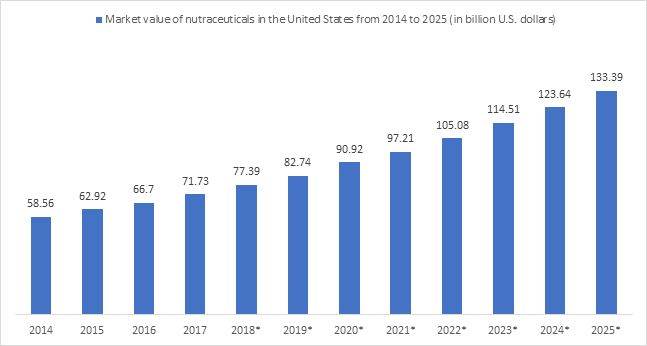


The millennials focus on health, fitness, nutrition, and convenience have been the attributed to growth of the market. Additionally, increasing number of health and fitness clubs, the need to battle various diet-related health issues among the young and the old, as well as the motivation among younger generations to stay fit will continue to support the growth of the market.


We also believe that our supplement line will appeal to those who are interested in the development of our psychoactive products. There is an ongoing shift from treating diseases and illnesses to the adoption of several other measures that can help to prevent or alleviate diseases from the onset. Consequently, this has led to the substantial rise in the nutraceutical market.


Dietary supplements play an important role in the overall health and wellness of Americans. Without doubt, they have become mainstream. Already, 77 percent of U.S. adults take dietary supplements and below are some facts about the dietary supplement consumption in the US(3):


United States Supplements Market


The dietary supplements market is a sub-category of the Functional Food and Nutraceuticals. Our products are part of this dietary supplements market. In the United States, in 2016, dietary supplement sales reached $31.7 billion. It is estimated that the dietary supplement market will exceed $50 billion by 2023.


(3)  https://www.crnusa.org/newsroom/dietary-supplement-use-reaches-all-time-high.


57


Table of Contents


Within the dietary supplements market, Sports supplements will record the fastest growth rate (8.3%), followed closely by the practitioner market (8%), herbal supplements (6.8%) and vitamins (4.6%).(4)


The growth in the US dietary supplements market is attributed to the surge in the geriatric population, the adoption of dietary supplements, and an increasing preventative healthcare measure.(5)


Brand Development


We are working to develop products that are potent and able to perform based on the consumers expectations. To ensure are products meet these standards, we plan to develop various processes to test the purity, potency, and quality of the products we develop. This will allow us to obtain constructive feedback from consumers to help our products obtain the brand recognition we seek.


Part of developing our brand will be the placement of our products. To this end, we intend to market to, and work with, influencers, trainers, and other fitness professionals to best build our brand within our target community. This may include us participating in product demonstrations, fitness conferences, and other fitness and sporting events. We plan to take the feedback and other information we obtain from these sources and product testing to develop confidence in our brand.


Target Market


We will begin our marketing by targeting American males and females who fall in the age group of 18 – 45 years. PEW’s research from 2019 identified the American millennials to be those aged 23 – 38; however, our target audience encompasses those between 18 and 45 years and by extension some of them are a little below or above this. The American millennial population is growing at a fast pace and has surpassed the “baby boomers” generation. Based on population estimates from July 2019 by the United States Census Bureau, millennials outnumbered baby boomers by 72.1 million to 71.6 million. By 2033, Millennials are expected to reach 74.9 million. (6)


We believe this is the optimal target group for our products because millennials tend to be well-informed and better educated than other age groups, a factor which is associated with being employed and financially stable. Additionally, there is a gap in earning power between those with a college degree and those with only high school education. To this end, about one-third of millennial men and about 43% of millennial women have at least a bachelor’s degree. As a result, 72% of millennials are employed, the highest among all generations (3% of millennials are unemployed and 25% of millennials are not in the labor force). Millennials with a high school diploma or its equivalent have roughly $31,300 median earnings. Those who did not finish college or with an associate degree have their median earnings at $36,000, whereas those with bachelor’s degree or higher earn $56,000 as their annual median income.(7)


Millennials also enjoy leisure, exercise, and are, generally, more health conscious. Therefore, we will be targeting primarily this group that tends to favor foods with less artificial ingredients as well as maintain good health through supplements. This focus, in addition to their earning power, provides current and future disposable income to spend on products, like wellness and dietary supplements and confirm our view that this age group makes the best target market for our products.


(4)  https://share.ansi.org/Shared%20Documents/Dietary%20Supplements/Dietary%20Supplements%20Executive%20Summary_final.pdf.

(5)  https://www.marketwatch.com/press-release/covid-19-impact-affects-dietary-supplements-market-globally-in-2020-2020-06-04.

(6)  https://www.weforum.org/agenda/2020/04/millennials-overtake-baby-boomers-largest-generation-america/.

(7)  https://www.pewsocialtrends.org/essay/millennial-life-how-young-adulthood-today-compares-with-prior-generations/.


58


Table of Contents


Competition


We believe our supplements will compete with various products that boost the immune system, support weight loss, and enhance overall health. The following table provides a sample of the products currently on the market with which our products may compete.


Product


Manufacturer


Product Description


Price


Customer

Review
(5.0)


Best Sellers Rank


CollagenC immune booster shot 


Alfa Vitamins Laboratory Inc.


It contains 1,000mg of Vitamin C and 1,000 of Collagen for your skin, hair, nails, and joints. (Shots)


$40


N/A


#535,243 in Health and Household

#27,671 in Vitamin Supplements


High potency vitamins C antioxidant support 


Sports Research 


240 count of 1000mg capsules


$18


4.8


#11,654 in Health & Household


Build PM


Jacked Factory


60 capsules


$24.99


4.3


#17,912 in Health & Household


Night Time Fat Burner


Envy Nutrition


60 capsules


$18.87


3.9


#1,651 in Health & Household


Night Shred


Inno Supps


60 capsules


$44.99


4.4


#4,679 in Health and Household


C4 Original Pre workout


Cellucor


30 servings (Powder)


N/A


4.4


#3 in Sports Nutrition Pre-Workout Powders


#782 in Health & Household


59


Table of Contents


Platinum Caffeine 


MuscleTech 


125 tablets of 220mg 


~$6


4.4


#3,408 in Health & Household


#7 in Sports Nutrition Endurance & Energy Supplements


Elderberry Capsules with Zinc & Vitamin C 


Sports Research, USA


180mg vitamin C 


$20


4.8


#12,052 in health and household


Nitro Surge Pre workout


Jacked Factory


30 servings (Powder)


~$25


4.6


#6 in Sports Nutrition Pre-Workout Powders


#1,280 in Health & Household


**N/A = Not Available.


Regulation


The supplement industry is subject to several regulatory regimes and entities. The actions of these entities may limit or prohibit our plans to develop our products and market. The FDA or other agencies could take actions against products or product ingredients that, in their determination, present an unreasonable health risk to consumers that would make it illegal for us to sell such products. Such actions or warnings could be based on information received through FDC Act-mandated reporting of serious adverse events. The failure of such products to comply with applicable regulatory and legislative requirements could prevent us from marketing the products or require us to recall or remove such products from the market, which in certain cases could materially and adversely affect our business strategy, our marketing, financial condition and results of operations. A removal or recall could also result in negative publicity and damage to our reputation that could reduce future demand for our products. See the “RISK FACTORS” section for additional risks related to regulation.


Psychoactive Products Background


Psilocybin and psilocin are naturally-occurring psychedelic compounds found in more than 200 species of mushrooms. They are similar chemically, with psilocin being the psychoactive compound that stimulates the human brain. Psilocin oxidizes and loses its potency very quickly. Psilocybin has an additional element in its composition which prevents oxidization. Because of this psilocybin-containing mushrooms can be dried and kept for a long time without a drop in potency. Psilocybin becomes psilocin in the human body and binds with serotonin receptors in


60


Table of Contents


the brain, which regulate the release of neurotransmitter chemicals related to appetite, cognition, anxiety, imagination, learning, memory, mood and perception. Psilocin produces psychedelic experiences and an altered state of consciousness.


Unlike cannabis, for which a large number of people report usage, psilocybin currently is consumed relatively rarely, with only about 0.1 percent of persons surveyed reporting psychedelic use within the past year. Psilocybin is neither physically addictive nor shown to cause psychological dependence. Psilocybin and psilocin produce short-term tolerance in users, which diminishes its effects with repeated dosing. It can take several weeks to a month for tolerance to return to normal levels. As with cannabis, LSD and other hallucinogens, psilocybin has also been linked to a poorly-understood phenomena known as Hallucinogen Persisting Perception Disorder (HPPD), in which sufferers report ongoing distortions to their perception, even years later. Symptoms can range from minor visual issues to disturbing hallucinations.


Psilocybin has the potential to aid in the treatment of depression, eating disorders and addiction, but the study of psychedelics and their applications in medicine and psychology is still in its infancy, hampered by its Schedule I Narcotics status and the United States’ “War on Drugs”. However, psilocybin has shown promise in combination with psychotherapy. Recent studies have shown that psilocybin and psilocin may act as primary medicines in the treatment of a number of mental disorders.


Various potential competitors to the Company are in differing stages of clinical trials for similar or competing product compounds as follows:


Companies


Stage

Atai Life Sciences AG


Phase 1 and Phase 2

Champignon Brands Inc.


Pre-Clinical/Phase 1

Compass Pathways Ltd


Phase 2(b) TRD

Cybin Inc.


Pre-clinical

Eluesis Ltd.


Phase 1 completed

Field Trip Health, Inc.


Pre-clinical

Mind Medicine Inc.


Phase 1(b) and Phase 2

Tactogen, Inc.


Pre-clinical


We believe that in the coming years and with greater legalization, medical psilocybin will become accepted, resulting in a growth in demand for the availability of psilocybin-based products and services. We see an opportunity, as legal psilocybin industries emerge in North America and around the world, to create a broad-based portfolio of differentiated psilocybin-based products that we intend to develop and bring to market in a legal and professional manner. We believe that many patients will come to rely on medical psilocybin as a substitute to opioids and other narcotics.


Our Vision


Our vision is to build a trusted, valuable, and innovative mental health care company. Accordingly, we intend to pioneer medical, wellness and adult-use psilocybin research, development and processing. Our founders started the Company with the belief that patients and consumers should have safe access to legal, quality-tested pure, precise and predictable psilocybin products. We believe that in the coming years medical psilocybin will become a mainstream pharmaceutical consumed by mainstream patients. Currently, we believe we are beginning to see a paradigm shift regarding psilocybin. We believe that this shift will result in a move away from prohibition to generate a potentially multibillion dollar industry. As this new market emerges, we believe that trusted brands will lead the industry and gain the confidence of governments, physicians and consumers. Our business is to develop a trusted psilocybin company through the following key strategies.


61


Table of Contents


We are committed to advancing scientific knowledge about the therapeutic potential of psilocybin. We are seeking to recruit a Medical and Scientific Advisory Board comprised of highly accomplished researchers and physicians specializing in psychopharmacological research, ethnopharmacology, brain-imaging techniques such as PET and MRI, organic chemistry, biotechnology and drug development. We intend to develop data and provide that data to researchers and physicians regarding the safety and efficacy of medical psilocybin to encourage mainstream acceptance of medical psilocybin and enhance our reputation as a trusted company. We intend to work collaboratively with regulators to develop research on and studies of medical psilocybin.


We intend to form business partnership with major pharmaceutical companies and established research and development companies. We believe our partnerships with these companies will differentiate us and position us to become a leader in psilocybin innovation. We will seek to establish partnerships with leading research institutions and to conduct pre-clinical studies and clinical trials to generate safety and efficacy data that can position us to develop drugs for NDA and/or NDS and lead to the development of new products.


Our strategy centers on developing a portfolio of psychoactive products intended to be applicable to a diverse set of patients. We hope to one day to offer a wide range of high-quality, pharmaceutical-grade psilocybin and other psychoactive products.


We intend to operate only in areas where our products and activities are permitted under applicable federal, state or provincial laws. Our goal is to increase our total addressable market as countries legalize psilocybin for medical uses and also adult-use access. We intend to be an early leader in the development of medical psilocybin products by developing new and innovative products.


Actions to Date


Orthogonal in October 2020 received from the inventor the assignment of  certain specific proprietary compounds, methods, discoveries and formulations in the field of natural, non-synthetic psychoactive compounds containing psilocybin/psilocin.  As part of this assignment, Orthogonal obtained the complete rights to develop, commercialize, license and seek patent protection for the acquired intellectual property.


In March 2020 Orthogonal filed a provisional patent application with the US Patent and Trademark Office seeking patent protection for aspects of the acquired intellectual property. A provisional application is not examined by a patent examiner and remains confidential. Within one year of filing the provisional application, Orthogonal will need to decide whether file a further application that claims priority to the provisional application, such as a US non-provisional patent application, an international patent application and/or a direct foreign patent application.


The provisional patent application describes several compositions, such as oral dosage forms, containing psilocybin and/or psilocin in combination with various specified amino acids, vitamins, plant herbs and/or other compounds. The application also describes methods for making these compositions and using these compositions, including for the treatment of anxiety disorders, depressive disorders or compulsive disorders.


On October 8, 2020, the Company agreed to terms with its parent company Orthogonal for the License Agreement, a royalty-free license of certain intellectual property, including the compositions addressed in Orthogonal’s provisional patent application, the associated intellectual property, and also intellectual property associated with a number of additional psilocybin-based psychoactive compounds and non-psychoactive nutritional supplements not included in the provisional application. The License Agreement grants the Company an exclusive world-wide right to use, manufacture, develop, commercialize, market and sell all of the licensor’s intellectual property addressed in the License Agreement with respect to the intellectual property for medicinal, therapeutic, nutraceutical and adult recreational uses, including the matters included in the provisional application. No consideration was paid to Orthogonal for the license. The license is perpetual, subject to limited termination rights, for example, if the Company is found guilty of criminal activity or the Company files for bankruptcy.


62


Table of Contents


The following trademark applications are pending with the United States Patent and Trademark Office. Each of these applications is owned by Orthogonal and licensed to the Company:


·      US Trademark Application No. 90/314,558 for the EI.VENTURES mark, filed on November 12, 2020;

·      US Trademark Application No. 90/314,547 for the  mark, filed on November 12, 2020;

·      US Trademark Application No. 90/323,536 for the  mark, filed on November 17, 2020;

·      US Trademark Application No. 90/323,539 for the  mark, filed on November 17, 2020;

·      US Trademark Application No. 88/814,693 for the PSILLY mark, filed on February 28, 2020;

·      US Trademark Application No. 88/814,694 for the PSILLY LIFE mark, filed on February 28, 2020;

·      US Trademark Application No. 90/317,444 for the TRUST THE PSILLY mark, filed on November 13, 2020;

·      US Trademark Application No. 90/314,553 for the BRAIN MANA mark, filed on November 12, 2020;

·      US Trademark Application No. 90/323,507 for the MANA mark; filed on November 17, 2020;

·      US Trademark Application No. 90/323,525 for the  mark, filed on November 17, 2020; and

·      US Trademark Application No. 90/323,513 for the  mark, filed on November 17, 2020.


Orthogonal did not conducted any research with respect to the compositions prior to granting the license to us, and we have not yet conducted any research with respect to the compositions following the grant of the license.


Business Plan


As we move ahead to implement our business plan, we will begin to begin: (1) product characterization on our licensed intellectual property; (2) product formulation, delivery, and packaging development; (3) pharmacokinetics (PK) and absorption/distribution/metabolism/excretion (ADME) studies; (4) conduct pre-clinical and clinical development for our current and future drug candidates; (5) evaluate the acquisition of one or more drug testing laboratories; (6) prosecute patent applications and protect our intellectual property rights and (7) expand current business operations through the acquisition of office space and hiring of additional personnel.


We intend to use the proceeds of this Offering to fund pre-clinical laboratory tests of the licensed compositions.  The testing of our licensed compositions will include laboratory tests of product chemistry, toxicity and formulation, as well as potential animal studies. In order to conduct tests on drug candidates containing psilocybin in the United States, the drug testing laboratory must be registered with the DEA. Alternatively, in view of the current more favorable drug scheduling status in Canada, making it easier to conduct pre-clinical and clinical research on psilocybin, we may seek to have the necessary testing completed in a Canadian laboratory. We have identified some third-party drug testing laboratories in the United States and Canada who are qualified to conduct the necessary testing but have not yet sought to determine if they are willing to enter into a contract to perform the anticipated research with respect to our compositions or their schedules allow for the testing or sought to negotiate an acceptable contract for these research services.


We also intend to evaluate the acquisition of one or more currently operating drug testing laboratories or the acquisition of improved or unimproved real property with which we could develop our own drug testing laboratory. Through such an acquisition, we would have the infrastructure in place to perform our own pre-clinical research on our psychoactive compositions and facilitate research into nutraceutical compositions. We believe that the acquisition of one or more currently operating drug testing laboratories could provide a risk-attractive return and operational efficiency.


The completion of satisfactory pre-clinical tests is necessary to prepare a submission to the FDA of an IND to begin Phase 1 clinical trials in the United States on our licensed composition or to prepare a submission to HC of a CTA to begin Phase 1 clinical trials in Canada. We would begin Phase 1 clinical trials once the IND is reviewed and approved by the FDA or the CTA is reviewed and approved by HC. In the Phase 1 clinical trials we would test for safety, dosage, tolerance, absorption, metabolism, distribution and elimination. In view of the current more favorable drug scheduling status in Canada, making it easier to conduct pre-clinical and clinical research, we may seek approval of our licensed compositions in Canada prior to the United States.


We intend to work with Orthogonal to file additional patents in the fields of psilocybin-processing technology, formulation, composition, delivery systems and treatment methods. To establish and protect our licensed intellectual property, we expect to rely on a combination of patent and trade-secret laws, as well as confidentiality provisions in our contracts. We also plan to invest in a trademark portfolio.


During the first stages of our operation, we expect that our current officers and directors will provide all of the labor required to execute our business plan. Our officers are expected to devote at least 40 hours per week to our operations. At this time, all of our officers are working remotely, and we do not currently require additional office space. As the Company  grows, we will at some point need our own administrative office facility, including


63


Table of Contents


all support components such as additional employees and equipment. We anticipate that within the next year we will hire additional personnel such as administrative assistants and clerical staff to help execute our business plan.


The execution of our business plan requires us to raise significant additional capital. Currently, we have no committed external sources of capital. There is no assurance that we will successfully obtain the required capital on acceptable terms, or, if obtained, that the amounts will be sufficient to fund our ongoing operations. The inability to secure additional capital would have a material adverse effect on us, including the possibility that we would have to sell or forego a portion or all of our assets or cease operations. If we discontinue our operations, we will not have sufficient funds to pay any amounts to our stockholders.


If we are successful in raising capital through the sale of Shares in this Offering, we believe that the Company will have sufficient cash resources to fund its plan of operations for the next twelve months. Because our capital requirements depend upon numerous factors, there can be no assurance that our cash resources will be sufficient to fund the timely completion of any aspect of our business plan. Even if we raise additional capital, if our business plan is not successfully executed, our ability to fund our research and development would likely be seriously impaired. Our ability to conduct research and development and continue operations is conditioned upon moving the development of products toward commercialization. If we are not able to demonstrate adequate progress in the development and commercialization of our product, we will not be able to raise the capital we need to continue our business operations, and we will likely not have sufficient liquidity or cash resources to continue operating.


We plan to continually evaluate our business plan to determine the manner in which we can most effectively utilize our limited cash resources.


Depending upon the results of this Offering, the Company current plans to engage in the following activities during the next 12 months:


1.              Months 1-6: Phase 1


·                                          Hire additional members of management and scientific personnel, analysts, bookkeepers, and clerical staff to implement our business plan.


·                                          Enter into a relationship with one or more laboratories to begin pre-clinical research on our drug candidates.


·                                          Evaluate possible CRO, CMO, and drug testing laboratory acquisitions.


·                                          Begin pre-clinical research on our licensed compositions and develop protocols for studies and apply for applicable licensing (country dependent).


·                                          Meet with federal regulators at FDA CDER to communicate intentions.


·                                          Apply for appropriate DEA licenses (to ship material from manufacturing to labs.


2.              Months 6-12: Phase 2


·                                          Acquire and consolidate the operations of one or more drug testing laboratories and integrate the acquired business into the Company, consolidate the operations of the businesses including integration of accounting and finance systems, synchronization of operating systems and harmonization of human resources functions.


·                                          Continue pre-clinical research.


·                                          Make progress on all safety studies, chemistry/identity, CMC’s and submit IND to FDA for regulatory and prepare for Phase 1 clinical trials.  Alternatively, submit CTA to Health Canada for approval and prepare for phase 1 clinical trials.


64


Table of Contents


·                                          Commence Phase 1 clinical trials.


We believe that the development of data on the use of psilocybin products will increase mainstream acceptance within the medical community. As such, we intend to develop techniques that achieve pharmaceutical-grade Active Pharmaceutical Ingredients (“APIs”) extracted from psilocybin mushrooms to allow the Company to partner with academic research partners on studies that meet regulatory agency standards. These studies are planned to include research and development of an investigational study drug to generate the Chemistry and Manufacturing Controls (“CMC”) documentation required by regulatory agencies and to assist in designing protocols and determining the formulation of a study drug.


We may provide funding for such studies and/or pharmacokinetic data on the specific study drug. Studies are planned to be conducted to generate data that can be used to support patent filings and determine signals of efficacy to narrow our focus for future studies. Our Medical and Scientific Advisory Board is expected to participate in the study selection process and provide us with additional credibility as a study participant.


Possible Laboratory Acquisitions


The Company is currently exploring the possibility of acquiring a controlling interest in one or more operating drug testing laboratory entities located in Canada or the United States. No drug testing laboratory acquisition is currently probable of completion. If the Company successfully completes such as acquisition, this laboratory would conduct the research associated with the Company’s pre-clinical studies. It is anticipated that these services would include laboratory tests of product chemistry, toxicity and formulation, as well as potential animal studies. If the Company does not complete such an acquisition, we would need to identify a third-party drug testing laboratory qualified, willing to enter into a contract to perform the anticipated research with respect to our compositions and having time in its schedule to allow for the testing and seek to negotiate an acceptable contract for these research services. A contract entered with a third-party may not be as favorable as the terms of conducting research in our own laboratory.


Intellectual Property


The proprietary nature of, and protection for, our compositions, our processes and our know-how are important to our business. We need to rely upon Orthogonal to seek patent protection in the United States and internationally for our compositions and processes and any other inventions to which we have rights under our License Agreement, where available and when appropriate. To the extent we will be able to do so, our policy will be to work with Orthogonal to pursue patents, to maintain our licensed patents and to protect the technology, inventions and improvements that are important to the development of our business. We will also rely on trade secrets that may be important to the development of our business.


Our commercial success will depend in part on obtaining and maintaining patent protection by collaborating with Orthogonal and trade secret protection of our current and future compositions and the methods used to develop and manufacture them, as well as successfully defending any patents against third-party challenges. Our ability to stop third parties from making, using, selling, Offering to sell or importing our compositions depends on the extent to which we have rights under valid and enforceable patents or trade secrets that cover these activities. We cannot be sure that patents will be granted with respect to any patent applications Orthogonal may file in the future, nor can we be sure that any patents that may be granted in the future upon which we rely will be commercially useful in protecting our compositions and processes. For this and more comprehensive risks related to our licensed intellectual property, please see “Risk Factors — Risks Relating to Our Licensed Intellectual Property.”


Manufacturing


We do not own or operate, and currently have no plans to own or operate any manufacturing facilities or testing facilities. We currently intend to rely solely on third parties for the manufacturing and testing of our compositions for future pre-clinical studies and clinical testing,  All current formulations and testing thereof are


65


Table of Contents


theoretical and testing shall only occur at third party facilities pursuant to all to legal requirements and/or  regulatory approvals.


For our future drug candidates, we aim to identify and qualify manufacturers and researchers to provide the application program interface, or API, and fill-and-finish services prior to submission of an NDA to the FDA. We expect to fund the development of drug candidates that can be produced cost-effectively at third party contract manufacturing facilities.


For our nutracutical products, we intend to outsrouce manufacturing to a contract supplement manufacturer in a NSF GMP Registered and FDA approved facility in the United States, which such contract supplement manufacturer will also source the ingredients.


Marketing


Given our stage of development, we have not yet established any marketing capabilities. We may perform marketing functions ourselves or through third parties or may take other steps to establish the necessary marketing infrastructure if any of our compositions are approved as drugs.


For our nutraceutical products, we intend to sell directly to consumers through online channels and ecommerce. The nutraceutical products will likely be packaged in bottles using a monthly supply format and shipped via USPS through an outsourced fulfillment center.


Employees


As of the date of this Offering, we had 2 full-time and part-time employees and 6 consultants. None of our employees is subject to a collective bargaining agreement, and we believe that our relations with our employees generally are good.  We anticipate that within the next year we will hire additional personnel such as administrative assistants and clerical staff to help execute our business plan.


Competition


Our industry is characterized by rapidly advancing technologies, intense competition and a strong emphasis on proprietary products. We face potential competition from many different sources, such as pharmaceutical companies, biotechnology companies, drug delivery companies and academic and research institutions. Many of our potential competitors have substantially greater financial, scientific, technical, intellectual property, regulatory and human resources than we do, and greater experience than we do developing drug candidates, including obtaining FDA and other regulatory approvals for drug candidates. These competitors include Champignon Brands Inc., Mind Medicine, Inc., Revive Therapeutics. Ltd., COMPASS Pathways, Ltd., Field Trip Health, Inc., Cybin, Inc., and Eluesis, Ltd. Consequently, our competitors may develop products for indications we pursue that are more effective, better tolerated, more widely-prescribed or accepted, more useful and less costly, and they may also be more successful in manufacturing and marketing their products. We also face competition from third parties in recruiting and retaining qualified personnel and in identifying and acquiring or in-licensing new products and drug candidates.


Government Regulation and Product Approval


Governmental authorities in the United States, at the federal, state and local level, Canada and other countries extensively regulate, among other things, the research, development, testing, manufacture, labeling, packaging, promotion, storage, advertising, distribution, marketing and export and import of products such as those we are developing. Our drug candidates must be approved by the FDA through the NDA process before they may be legally marketed in the United States, by HC through the NDS process before they may be legally marketed in Canada and by the European Medical Associate through the Marketing Authorization Application, or MAA, process before they may be legally marketed in Europe. Our drug candidates will be subject to similar requirements in other countries prior to marketing in those countries. The process of obtaining regulatory approvals and the subsequent compliance with applicable federal, state, local and foreign statutes and regulations require the expenditure of substantial time and financial resources.


Regulation of Psilocybin


United Stated Drug Enforcement Agency


Psilocybin and psilocybin extracts are regulated as “controlled substances” as defined in the CSA, which establishes registration, security, recordkeeping, reporting, storage, distribution and other requirements


66


Table of Contents


administered by the DEA. The DEA is concerned with the control of handlers of controlled substances, and with the equipment and raw materials used in their manufacture and packaging, in order to prevent loss and diversion into illicit channels of commerce.


The DEA regulates controlled substances as Schedule I, II, III, IV or V substances. Psilocybin is currently regulated as a Schedule I substance, which by definition has no established medicinal use, and may not be marketed or sold in the United States. A drug may be listed as Schedule II, III, IV or V, with Schedule II substances considered to present the highest risk of abuse and Schedule V substances the lowest relative risk of abuse among such substances. Psilocybin and psilocybin extracts are listed by the DEA as Schedule I controlled substances under the CSA. Consequently, their manufacture, shipment, storage, sale and use are subject to a high degree of regulation. Annual registration is required for any facility that manufactures, distributes, dispenses, imports or exports any controlled substance. The registration is specific to the particular location, activity and controlled substance schedule. For example, separate registrations are needed for import and manufacturing, and each registration will specify which schedules of controlled substances are authorized.


The DEA typically inspects a facility to review its security measures prior to issuing a registration. Security requirements vary by controlled substance schedule, with the most stringent requirements applying to Schedule I and Schedule II substances. Required security measures include background checks on employees and physical control of inventory through measures such as cages, surveillance cameras and inventory reconciliations. The registered entity must maintain records for the handling of all controlled substances and must make periodic reports to the DEA. These include, for example, distribution reports for Schedule I and II controlled substances, Schedule III substances that are narcotics, and other designated substances. The registered entity must also report thefts or losses of any controlled substance and obtain authorization to destroy any controlled substance. In addition, special authorization and notification requirements apply to imports and exports.


In addition, a DEA quota system controls and limits the availability and production of controlled substances in Schedule I or II. Distributions of any Schedule I or II controlled substance must also be accompanied by special order forms, with copies provided to the DEA. The DEA may adjust aggregate production quotas and individual production and procurement quotas from time to time during the year, although the DEA has substantial discretion in whether or not to make such adjustments. To meet its responsibilities, the DEA conducts periodic inspections of registered establishments that handle controlled substances. In the event of non-compliance, the DEA may seek civil penalties, refuse to renew necessary registrations, or initiate proceedings to revoke those registrations. In certain circumstances, violations could lead to criminal prosecution.


States


The states also maintain separate controlled substance laws and regulations, including licensing, recordkeeping, security, distribution, and dispensing requirements. State authorities, including Boards of Pharmacy, regulate use of controlled substances in each state. Failure to maintain compliance with applicable requirements, particularly as manifested in the loss or diversion of controlled substances, can result in enforcement action that could have a material adverse effect on our business, operations and financial condition.


Currently in the U.S. the possession of psilocybin-containing mushrooms is illegal, because they contain the Schedule I drugs psilocybin and psilocin. The cities of Denver, Colorado, Oakland, California, and Santa Cruz, California have decriminalized the drug. The limited city/state laws are in conflict with the federal CSA, which makes psilocybin use and possession illegal at the federal level. Because psilocybin is a Schedule I controlled substance, however, the development of a legal psilocybin industry under the laws of these states is in conflict with the CSA, which makes psilocybin use and possession illegal on a national level. If psilocybin is treated like cannabis, the federal government has the right to regulate and criminalize psilocybin, including for medical purposes, and that federal law criminalizing the use of psilocybin preempts state laws that legalize its use.


67


Table of Contents


Health Canada


In Canada, psilocybin is classified by HC as a schedule III drug under the CDSA, meaning activities such as sale, possession, or production of these substances are prohibited unless they have been authorized for clinical trials or research purposes by HC, consistent with Part J of Canada’s Food and Drug Regulations. Under Part J, a party may file a CTA to study psilocybin for a medicinal use. The compliance and monitoring of controlled drugs and substances in Canada is overseen by HC’s Office of Controlled Substances, in conjunction with law enforcement agencies. The CDSA provides for the control of substances that can alter mental processes and that may produce harm to health and to society when diverted or misused. Except as authorized under its related regulations, or via an exemption issued under section 56 of the CDSA, most activities involving substances regulated under the CDSA, such as possession, import, export, trafficking, and production are prohibited. Controlled substances are regulated and grouped into Schedules I to V to the CDSA. Schedule III is considered of less abuse potential than Schedule I.


HC administers the CDSA and its regulations to: (1) allow access for lawful purposes and (2) reduce the risk that controlled substances and precursors will be used for illegal purposes. To meet these two objectives, HC: (1) issues licenses, permits and exemptions, (2) monitors trends of problematic substance use, (3) updates the Schedules to the CDSA based on assessments of new or existing substances, when necessary, (4) works with international organizations and other countries to meet Canada’s obligations regarding controlled substances. The CDSA applies to a broad range of parties, including: (1) manufacturers, distributors, importers and exporters who must get a license to produce, sell, import or export controlled substances and precursors, (2) importers and exporters who must get a permit each time they import and export a controlled substance or precursor, (3) health professionals who must comply with requirements when prescribing and giving controlled substances to a patient, and (4) researchers who must get permission to have a controlled substance for research purposes.


All regulated parties must comply with requirements for: (1) security, (2) reporting, and (3) record-keeping.  HC promotes and enforces compliance with the CSDA by: (1) developing and publishing guidance, (2) informing affected parties of any regulatory changes, and (3) publishing notices seeking public input on proposed regulatory changes. HC also carries out inspections of regulated parties and monitors regulated activities. HC may take action when a regulated party is not following the rules of the CDSA, including (but are not limited to): (1) issuing warning letters, (2) requiring a corrective action plan, (3) suspending and revoking licenses, permits or exemptions to stop a regulated party from conducting activities. To further enforce the CDSA, HC works with a wide range of partners and stakeholders, including: (1) provincial and territorial governments, (2) other federal departments and agencies, (3) law enforcement agencies, (4) academic, scientific and research communities, (5) non-government organizations, such as national, provincial and territorial health professional associations, (6) federal regulators in other countries, (7) international organizations, such as the United Nations.


In Canada, mushroom spore kits and are legal and are sold openly in stores or on the Internet, as the spores and kits themselves are legal. Online dispensaries exist that openly sell microdoses to Canadian patients with medical prescriptions. The Canadian police tolerates the activity, citing focus on more harmful criminal drug activities. In September 2019, a motion to prevent the sale of magic mushrooms was defeated by Vancouver council.


In addition to HC, the National Association of Pharmacy Regulatory Authorities (NAPRA) also has a role in scheduling new drugs, which is separate from HC’s scheduling process. NAPRA’s role in the drug scheduling process occurs after HC has authorized a drug for sale in Canada and determined whether the drug requires a prescription for sale. NAPRA does not have any role or authority in the authorization of new health products for the Canadian market and does not review products that have been classified as requiring a prescription by HC.


While the federal government determines certain conditions of sale, such as the need for a prescription, provincial/territorial governments have the ability to further specify the conditions of sale of drug products.  Prior to 1995, each province and territory had its own system for determining the conditions of sale for non-prescription drugs in Canada, leading to wide variability in the way drugs were sold across Canada.  In 1995, NAPRA’s


68


Table of Contents


members, the pharmacy regulatory authorities across Canada, endorsed a proposal for a national drug scheduling model, to align the provincial/territorial drug schedules so that the conditions of sale for drugs would be more consistent across Canada. This harmonized national model is administered by NAPRA and is called the National Drug Schedules (NDS) program.


All of the provinces and territories, except Quebec, have adopted the National Drug Schedules in some manner. The NDS come into force in each province/territory through provincial regulations. In general, the National Drug Schedules capture drugs that have been authorized for sale and classified as non-prescription by HC. Other products approved by HC (e.g. natural health products, medical devices) are outside the scope of the program and are not considered products for scheduling within the NDS.


The NDS program consists of three schedules and four categories of drugs. Schedule I drugs require a prescription for sale. Schedule II drugs require professional intervention from the pharmacist (e.g., patient assessment and patient consultation) prior to sale. Schedule III drugs must be sold in a licensed pharmacy but can be sold from the self-selection area of the pharmacy. Unscheduled drugs can be sold without professional supervision, from any retail outlet.


The drug scheduling process usually begins when NAPRA receives a drug scheduling submission from a pharmaceutical company. The National Drug Scheduling Advisory Committee is an expert advisory committee that reviews the drug scheduling submissions received by NAPRA and formulates drug scheduling recommendations. There is a specific process that must be followed during each drug scheduling review, which is outlined in NAPRA’s By-law No. 2 and Rules of Procedures. The model for making drug scheduling recommendations embodies a “cascading principle” in which drugs are assessed against specific scheduling factors. A drug is first assessed using the factors for Schedule I. Should sufficient factors apply, the drug remains in that Schedule. If not, the drug is assessed against the Schedule II factors, and if warranted, subsequently against the Schedule III factors. Should the drug not meet the factors for any schedule, it becomes “Unscheduled” (the fourth category).


According to this cascading principle, it is possible, although rare, for NAPRA to place a product in Schedule I that HC has classified as a non-prescription product. This could occur because of the NAPRA policy for drugs not reviewed, which places drugs into Schedule I until they are reviewed, or because of a range of factors considered by the expert advisory committee when applying the cascading drug scheduling model. As described above, the provinces and territories can add additional conditions of sale for non-prescription drugs but can never be less restrictive than federal legislation.


Once the National Drug Scheduling Advisory Committee has reviewed a particular drug, it will make an interim drug scheduling recommendation. A 30-day consultation period follows, after which the NAPRA Board of Directors will make a final scheduling recommendation. The National Drug Schedules are then amended and the final recommendation is implemented according to the rules in each particular province or territory.


In summary, whereas in the U.S. psilocybin is presumed to have no medical use and is s Schedule I drug, in Canada, psilocybin is classified as a drug with a lower potential for abuse under Schedule III and is being studied in clinically-supervised settings for its potential to treat various conditions such as anxiety, depression, obsessive compulsive disorder and problematic drug use. Currently there are no approved therapeutic products containing psilocybin in Canada or the US. Once a psilocybin- psilocin-containing  product were approved in Canada, we would expect it to remain Schedule III or a higher level (IV or V) and that NAPRA could schedule as I, requiring a prescription.


69


Table of Contents


General New Drug Regulation


United States New Drug Application


In the United States, the FDA regulates drugs under the Federal Food, Drug, and Cosmetic Act, or the FDCA, and implementing regulations. Failure to comply with the applicable U.S. requirements at any time during the product development process or approval process, or after approval, may subject an applicant to administrative or judicial sanctions, any of which could have a material adverse effect on us. These sanctions could include:


·                  refusal to approve pending applications;


·                  withdrawal of an approval;


·                  imposition of a clinical hold;


·                  warning letters;


·                  product seizures;


·                  total or partial suspension of production or distribution; or


·                  injunctions, fines, disgorgement, or civil or criminal penalties.


The process required by the FDA before a drug may be marketed in the United States generally involves the following:


·                  completion of nonclinical laboratory tests, animal studies and formulation studies conducted according to Good Laboratory Practices, or GLPs, or other applicable regulations;


·                  submission to the FDA of an Investigational New Drug application, or IND, which must become effective before human clinical trials may begin;


·                  performance of adequate and well-controlled human clinical trials according to Good Clinical Practices, or GCPs, to establish the safety and efficacy of the proposed drug for its intended use;


·                  submission to the FDA of an NDA;


·                  satisfactory completion of an FDA inspection of the manufacturing facility or facilities at which the product is produced to assess compliance with current Good Manufacturing Practices, or cGMPs, to assure that the facilities, methods and controls are adequate to preserve the drug’s identity, strength, quality and purity; and


·                  FDA review and approval of the NDA.


Once a drug candidate is identified for development, it will enter the pre-clinical or nonclinical testing stage. Nonclinical tests include laboratory evaluations of product chemistry, toxicity and formulation, as well as animal studies. An IND sponsor must submit the results of the nonclinical tests, together with manufacturing information and analytical data, to the FDA as part of the IND. Some nonclinical testing may continue even after the IND is submitted. In addition to including the results of the nonclinical studies, the IND will also include a protocol detailing, among other things, the objectives of the clinical trial, the parameters to be used in monitoring safety and the effectiveness criteria to be evaluated if the first phase lends itself to an efficacy determination. The IND automatically becomes effective 30 days after receipt by the FDA, unless the FDA, within the 30-day time period, places the IND on clinical hold. In such a case, the IND sponsor and the FDA must resolve any outstanding concerns before clinical trials can begin. A clinical hold may occur at any time during the life of an IND, and may affect one or more specific studies or all studies conducted under the IND.


All clinical trials must be conducted under the supervision of one or more qualified investigators in accordance with GCPs. They must be conducted under protocols detailing the objectives of the trial, dosing


70


Table of Contents


procedures, research subject selection and exclusion criteria and the safety and effectiveness criteria to be evaluated. Each protocol must be submitted to the FDA as part of the IND, and progress reports detailing the status of the clinical trials must be submitted to the FDA annually. Sponsors also must timely report to FDA serious and unexpected adverse reactions, any clinically important increase in the rate of a serious suspected adverse reaction over that listed in the protocol or investigation brochure, or any findings from other studies or animal or in vitro testing that suggest a significant risk in humans exposed to the drug. An institutional review board, or IRB, at each institution participating in the clinical trial must review and approve the protocol before a clinical trial commences at that institution and must also approve the information regarding the trial and the consent form that must be provided to each research subject or the subject’s legal representative, monitor the study until completed and otherwise comply with IRB regulations.


Human clinical trials are typically conducted in three sequential phases that may overlap or be combined:


·                  Phase 1. The drug is initially introduced into healthy human subjects and tested for safety, dosage tolerance, absorption, metabolism, distribution and elimination. In the case of some products for severe or life-threatening diseases, such as cancer, especially when the product may be inherently too toxic to ethically administer to healthy volunteers, the initial human testing is often conducted in patients.


·                  Phase 2.  Clinical trials are performed on a limited patient population intended to identify possible adverse effects and safety risks, to preliminarily evaluate the efficacy of the product for specific targeted diseases and to determine dosage tolerance and optimal dosage.


·                  Phase 3.  Clinical trials are undertaken to further evaluate dosage, clinical efficacy and safety in an expanded patient population at geographically dispersed clinical study sites. These studies are intended to establish the overall risk-benefit ratio of the product and provide an adequate basis for product labeling.


Human clinical trials are inherently uncertain and Phase 1, Phase 2 and Phase 3 testing may not be successfully completed. The FDA or the sponsor may suspend a clinical trial at any time for a variety of reasons, including a finding that the research subjects or patients are being exposed to an unacceptable health risk. Similarly, an IRB can suspend or terminate approval of a clinical trial at its institution if the clinical trial is not being conducted in accordance with the IRB’s requirements or if the drug has been associated with unexpected serious harm to patients.


During the development of a new drug, sponsors are given opportunities to meet with the FDA at certain points. These points may be prior to the submission of an IND, at the end of Phase 2 and before an NDA is submitted. Meetings at other times may be requested. These meetings can provide an opportunity for the sponsor to share information about the data gathered to date and for the FDA to provide advice on the next phase of development. Sponsors typically use the meeting at the end of Phase 2 to discuss their Phase 2 clinical results and present their plans for the pivotal Phase 3 clinical trial that they believe will support the approval of the new drug. If a Phase 2 clinical trial is the subject of discussion at the end of Phase 2 meeting with the FDA, a sponsor may be able to request a Special Protocol Assessment, or SPA, the purpose of which is to reach agreement with the FDA on the Phase 3 clinical trial protocol design and analysis that will form the primary basis of an efficacy claim.


According to published guidance on the SPA process, a sponsor which meets the prerequisites may make a specific request for a SPA and provide information regarding the design and size of the proposed clinical trial. The FDA is supposed to evaluate the protocol within 45 days of the request to assess whether the proposed trial is adequate, and that evaluation may result in discussions and a request for additional information. A SPA request must be made before the proposed trial begins, and all open issues must be resolved before the trial begins. If a written agreement is reached, it will be documented and made part of the record. The agreement will be binding on the


71


Table of Contents


FDA and may not be changed by the sponsor or the FDA after the trial begins except with the written agreement of the sponsor and the FDA or if the FDA determines that a substantial scientific issue essential to determining the safety or efficacy of the drug was identified after the testing began.


Concurrent with clinical trials, sponsors usually complete additional animal safety studies and also develop additional information about the chemistry and physical characteristics of the drug and finalize a process for manufacturing commercial quantities of the product in accordance with cGMP requirements. The manufacturing process must be capable of consistently producing quality batches of the drug and the manufacturer must develop methods for testing the quality, purity and potency of the drug. Additionally, appropriate packaging must be selected and tested, and stability studies must be conducted to demonstrate that the drug candidate does not undergo unacceptable deterioration over its proposed shelf-life.


The results of product development, nonclinical studies and clinical trials, along with descriptions of the manufacturing process, analytical tests and other control mechanisms, proposed labeling and other relevant information are submitted to the FDA as part of an NDA requesting approval to market the product. The submission of an NDA is subject to the payment of user fees, but a waiver of such fees may be obtained under specified circumstances. The FDA reviews all NDAs submitted to ensure that they are sufficiently complete for substantive review before it accepts them for filing. It may request additional information rather than accept an NDA for filing. In this event, the NDA must be resubmitted with the additional information. The resubmitted application also is subject to review before the FDA accepts it for filing.


Once the submission is accepted for filing, the FDA begins an in-depth review. NDAs receive either standard or priority review. A drug representing a significant improvement in treatment, prevention or diagnosis of disease may receive priority review. The FDA may refuse to approve an NDA if the applicable regulatory criteria are not satisfied or may require additional clinical or other data. Even if such data are submitted, the FDA may ultimately decide that the NDA does not satisfy the criteria for approval. The FDA reviews an NDA to determine, among other things, whether a product is safe and effective for its intended use and whether its manufacturing is cGMP-compliant. The FDA may refer the NDA to an advisory committee for review and recommendation as to whether the application should be approved and under what conditions. The FDA is not bound by the recommendation of an advisory committee, but it generally follows such recommendations. Before approving an NDA, the FDA will inspect the facility or facilities where the product is manufactured and tested.


Expedited Review and Approval


The FDA has various programs, including Fast Track, priority review, and accelerated approval, which are intended to expedite or simplify the process for reviewing drugs, and/or provide for the approval of a drug on the basis of a surrogate endpoint. Even if a drug qualifies for one or more of these programs, the FDA may later decide that the drug no longer meets the conditions for qualification or that the time period for FDA review or approval will be shortened. Generally, drugs that are eligible for these programs are those for serious or life-threatening conditions, those with the potential to address unmet medical needs and those that offer meaningful benefits over existing treatments. For example, Fast Track is a process designed to facilitate the development and expedite the review of drugs to treat serious or life-threatening diseases or conditions and fill unmet medical needs. Priority review is designed to give drugs that offer major advances in treatment or provide a treatment where no adequate therapy exists an initial review within six months as compared to a standard review time of ten months. Although Fast Track and priority review do not affect the standards for approval, the FDA will attempt to facilitate early and frequent meetings with a sponsor of a Fast Track designated drug and expedite review of the application for a drug designated for priority review. Accelerated approval provides for an earlier approval for a new drug that is intended to treat a serious or life-threatening disease or condition and that fills an unmet medical need based on a surrogate endpoint. A surrogate endpoint is a laboratory measurement or physical sign used as an indirect or substitute measurement representing a clinically meaningful outcome. As a condition of approval, the FDA may require that a sponsor of a drug candidate receiving accelerated approval perform post-marketing clinical trials.


72


Table of Contents


In the recently enacted Food and Drug Administration Safety and Innovation Act, or FDASIA, Congress encouraged the FDA to utilize innovative and flexible approaches to the assessment of products under accelerated approval. The law requires the FDA to issue related draft guidance within a year after the law’s enactment and also promulgate confirming regulatory changes.


The Hatch-Waxman Act


In seeking approval for a drug through an NDA, applicants are required to list with the FDA each patent whose claims cover the applicant’s product. Upon approval of a drug, each of the patents listed in the application for the drug is then published in the FDA’s Approved Drug Products with Therapeutic Equivalence Evaluations, commonly known as the Orange Book. Drugs listed in the Orange Book can, in turn, be cited by potential generic competitors in support of approval of an abbreviated new drug application, or ANDA. An ANDA provides for marketing of a drug product that has the same active ingredients in the same strengths and dosage form as the listed drug and has been shown through bioequivalence testing to be bioequivalent to the listed drug. Other than the requirement for bioequivalence testing, ANDA applicants are not required to conduct, or submit results of, pre-clinical studies or clinical tests to prove the safety or effectiveness of their drug product. Drugs approved in this way are considered to be therapeutically equivalent to the listed drug, are commonly referred to as “generic equivalents” to the listed drug and can often be substituted by pharmacists under prescriptions written for the original listed drug in accordance with state law.


The ANDA applicant is required to certify to the FDA concerning any patents listed for the approved product in the FDA’s Orange Book. Specifically, the applicant must certify that: (i) the required patent information has not been filed; (ii) the listed patent has expired; (iii) the listed patent has not expired but will expire on a particular date and approval is sought after patent expiration; or (iv) the listed patent is invalid or will not be infringed by the new product. The ANDA applicant may also elect to submit a section viii statement, certifying that its proposed ANDA labeling does not contain (or carves out) any language regarding the patented method-of-use, rather than certify to a listed method-of-use patent.


If the applicant does not challenge the listed patents, the ANDA application will not be approved until all the listed patents claiming the referenced product have expired.


A certification that the new product will not infringe the already approved product’s listed patents, or that such patents are invalid, is called a Paragraph IV certification. If the ANDA applicant has provided a Paragraph IV certification to the FDA, the applicant must also send notice of the Paragraph IV certification to the NDA and patent holders once the ANDA has been accepted for filing by the FDA. The NDA and patent holders may then initiate a patent infringement lawsuit in response to the notice of the Paragraph IV certification. The filing of a patent infringement lawsuit within 45 days of the receipt of a Paragraph IV certification automatically prevents the FDA from approving the ANDA until the earlier of 30 months, expiration of the patent, settlement of the lawsuit, or a decision in the infringement case that is favorable to the ANDA applicant.


The ANDA application also will not be approved until any applicable non-patent exclusivity listed in the Orange Book for the referenced product has expired.


Upon NDA approval of a new chemical entity or NCE, which is a drug that contains no active moiety that has been approved by the FDA in any other NDA, that drug receives five years of marketing exclusivity during which time the FDA cannot receive any ANDA or 505(b)(2) application seeking approval of a drug that references a version of the NCE drug. Certain changes to a drug, such as the addition of a new indication to the package insert, are associated with a three-year period of exclusivity during which the FDA cannot approve an ANDA or 505(b)(2) application that includes the change.


73


Table of Contents


An ANDA or 505(b)(2) application may be submitted one year before NCE exclusivity expires if a Paragraph IV certification is filed. If there is no listed patent in the Orange Book, there may not be a Paragraph IV certification and thus no ANDA or 505(b)(2) application may be filed before the expiration of the exclusivity period.


For a botanical drug, the FDA may determine that the active moiety is one or more of the principal components or the complex mixture as a whole. This determination would affect the utility of any five-year exclusivity as well as the ability of any potential generic competitor to demonstrate that it is the same drug as the original botanical drug.


Five-year and three-year exclusivities do not preclude FDA approval of a 505(b)(1) application for a duplicate version of the drug during the period of exclusivity, provided that the 505(b)(1) applicant conducts or obtains a right of reference to all of the pre-clinical studies and adequate and well-controlled clinical trials necessary to demonstrate safety and effectiveness.


After NDA approval, owners of relevant drug patents may apply for up to a five-year patent extension. The allowable patent term extension is calculated as half of the drug’s testing phase — the time between IND submission and NDA submission — and all of the review phase — the time between NDA submission and approval up to a maximum of five years. The time can be shortened if the FDA determines that the applicant did not pursue approval with due diligence. The total patent term after the extension may not exceed 14 years.


For patents that might expire during the application phase, the patent owner may request an interim patent extension. An interim patent extension increases the patent term by one year and may be renewed up to four times. For each interim patent extension granted, the post-approval patent extension is reduced by one year. The director of the PTO must determine that approval of the drug covered by the patent for which a patent extension is being sought is likely. Interim patent extensions are not available for a drug for which an NDA has not been submitted.


Pediatric Exclusivity and Pediatric Use


Under the Best Pharmaceuticals for Children Act, or BPCA, certain drugs may obtain an additional six months of exclusivity, if the sponsor submits information requested in writing by the FDA, or a Written Request, relating to the use of the active moiety of the drug in children. The FDA may not issue a Written Request for studies on unapproved or approved indications or where it determines that information relating to the use of a drug in a pediatric population, or part of the pediatric population, may not produce health benefits in that population.


To receive the six-month pediatric market exclusivity, we would have to receive a Written Request from the FDA, conduct the requested studies in accordance with a written agreement with the FDA or, if there is no written agreement, in accordance with commonly accepted scientific principles, and submit reports of the studies. A Written Request may include studies for indications that are not currently in the labeling if the FDA determines that such information will benefit the public health. The FDA will accept the reports upon its determination that the studies were conducted in accordance with and are responsive to the original Written Request or commonly accepted scientific principles, as appropriate, and that the reports comply with the FDA’s filing requirements.


In addition, the Pediatric Research Equity Act, or PREA, requires all applications (or supplements to an application) submitted under section 505 of the FDCA (21 U.S.C. Section 355) for a new active ingredient, new indication, new dosage form, new dosing regimen or new route of administration to contain a pediatric assessment unless the applicant has obtained a waiver or deferral. It also authorizes the FDA to require holders of approved NDAs for marketed drugs to conduct pediatric studies under certain circumstances. In general, PREA applies only to those drugs developed for diseases and/or conditions that occur in both the adult and pediatric populations. Products intended for pediatric-specific indications will be subject to the requirements of PREA only if they are initially developed for a subset of the relevant pediatric population.


74


Table of Contents


As part of the FDASIA, Congress reauthorized both BPCA and PREA, which were slated to expire on September 30, 2012, and made both laws permanent.


Post-approval Requirements


Once an approval is granted, the FDA may withdraw the approval if compliance with regulatory requirements is not maintained or if problems occur after the product reaches the market. Later discovery of previously unknown problems with a product may result in restrictions on the product or even complete withdrawal of the product from the market. After approval, some types of changes to the approved product, such as adding new indications, manufacturing changes and additional labeling claims, are subject to further FDA review and approval. In addition, the FDA may require testing and surveillance programs to monitor the effect of approved products that have been commercialized, and the FDA has the power to prevent or limit further marketing of a product based on the results of these post-marketing programs.


Any drug products manufactured or distributed pursuant to FDA approvals are subject to continuing regulation by the FDA, including, among other things:


·                  record-keeping requirements;

·                  reporting of adverse experiences with the drug;

·                  providing the FDA with updated safety and efficacy information;

·                  drug sampling and distribution requirements;

·                  notifying the FDA and gaining its approval of specified manufacturing or labeling changes; and

·                  complying with FDA promotion and advertising requirements.


Drug manufacturers and other entities involved in the manufacture and distribution of approved drugs are required to register their establishments with the FDA and certain state agencies and are subject to periodic unannounced inspections by the FDA and some state agencies for compliance with cGMP and other laws.


From time to time, legislation is drafted, introduced and passed in Congress that could significantly change the statutory provisions governing the approval, manufacturing and marketing of products regulated by the FDA. In addition, FDA regulations and guidance are often revised or reinterpreted by the agency in ways that may significantly affect our business and products. It is impossible to predict whether legislative changes will be enacted, or FDA regulations, guidance or interpretations changed or what the impact of such changes, if any, may be.


Canadian New Drug Submission


Given the current more favorable drug scheduling status in Canada, making it easier to conduct pre-clinical and clinical research, we may seek approval to market in Canada prior to the United States. Whether or not we obtain FDA approval for a product, we must obtain approval by the comparable regulatory authorities of countries outside of the United States before we can commence pre-clinical studies or clinical trials in such countries and approval of the regulators of such countries or economic areas, such as Canada, before we may market products in those countries or areas. The approval process and requirements governing the conduct of pre-clinical studies, clinical trials, product licensing, pricing and reimbursement vary greatly from place to place, and the time may be longer or shorter than that required for FDA approval.


In Canada, our future products may also be subject to extensive regulatory requirements. Similar to the United States, the marketing of medicinal products is subject to the granting of marketing authorizations by regulatory agencies. Also, as in the United States, the various phases of pre-clinical studies and clinical research in Canada are subject to significant regulatory controls. Medicinal products require a marketing authorization before they may be placed on the market in Canada. There are various application procedures available, depending on the type of product involved. An applicant files a New Drug Submission (“NDS”)  with HC where it is reviewed by a relevant scientific committee. Both psilocybin and psilocin are controlled under Schedule III of the Controlled


75


Table of Contents


Drugs and Substances Act (CDSA) in Canada, meaning activities such as sale, possession, production, and use of these substances are prohibited unless authorized for clinical trial or research purposes under Part J of the Food and Drug Regulations.


Businesses that make, import, package, label, distribute, and/or test drugs must submit an NDS. The Company, therefore, must apply for and receive a Drug Identification Number (DIN) in order to sell or import a drug in Canada. A DIN is required for both prescription and non-prescription drugs. Post-authorization obligations of DIN holders include: notification of when they start selling or when they discontinue the sale of the drug, annual notification to confirm information, adverse drug reaction reporting, annual summary reports, maintenance of records, and recalls. A clinical trial sponsor (a person responsible for the conduct of a trial) must seek permission from HC to conduct a clinical trial. Sponsors must meet certain requirements, including: following good clinical practices, obtaining informed consent from participants, keeping records, ensuring that the drug is manufactured according to GMP, reporting serious unexpected adverse reactions and notifying HC of the discontinuance of a trial. A manufacturer must receive authorization from the Commissioner of Patents in order to sell a drug under Canada’s Access to Medicines Regime. The manufacturer must notify the Minister before making the first lot of an authorized drug and before exporting each subsequent lot. The manufacturer must also fulfill the same post-authorization record keeping and reporting obligations as for a new drug sold in Canada.


In particular, businesses must submit sufficient information for the assessment of the new drug’s safety, efficacy and quality. Post-authorization obligations include: collecting safety information about the drug and its effects, record keeping and reporting information to HC.


As a controlled drug, prior to possessing or engaging in an activity such as production, sale, provision, sending, delivery, transportation, importation or exportation of a controlled drug regulated under Part G, persons, including businesses, may require authorization from HC. Such authorizations can include a dealer’s license. Licensed dealers must meet certain terms and conditions such as security and record-keeping requirements. In addition, licensed dealers must obtain a permit from HC for each import or export of a controlled drug. Compliance with the regulations is monitored by HC. Authorized places such as licensed businesses and pharmacies are subject to on-site inspections to verify compliance.


Further, as a Part J restricted drug, prior to possessing or engaging in an activity such as production, sale, provision, sending, delivery, transportation, importation or exportation of a restricted drug regulated under Part J, persons, including businesses, may require authorization from HC. Such authorizations can include a dealer’s license. Licensed dealers must meet certain terms and conditions such as security and record-keeping requirements. In addition, licensed dealers must obtain a permit from HC for each import or export of a restricted drug. To purchase a restricted drug from a licensed dealer for clinical trial or research purposes, research institutions must obtain an authorization from HC. The licensed dealer must also receive authorization from HC in order to make that sale. Compliance with the regulations is monitored by HC. Authorized places such as licensed businesses, and institutions are subject to on-site inspections to verify compliance.


Canadian Drug Approval


Drugs to be marketed or sold in Canada are reviewed and authorized by the Health Products and Food Branch (HPFB) of HC, under the Therapeutic Product Directorate (TPD) or the Biologic and Genetic Therapies Directorate (BGTD), for drugs and biologic, respectively. Each of these Directorates have specific offices and bureaus.


Drugs are authorized to reach that market only once they have successfully gone through the relevant Bureau review process, responsible for assessing their safety, efficacy and quality, and received a favorable decision. Even after a health product receives a favorable decision and can proceed with its sale in Canada, monitoring of its effectiveness and safety continues.


76


Table of Contents


HC’s HPFB is the national authority that is responsible for regulating, evaluating, and monitoring the safety, efficacy, and quality of drugs, biologics, genetic therapies and other health products available for the Canadian marketplace. The HPFB’s mandate is to manage the health-related risks and benefits of health products and foods for Canadians.


CTA


The drug discovery and pre-clinical phases in Canada are similar to the United States, and the clinical phase begins with the submission of a CTA. The CTA dossier is simple and consists of the following documents (exceptions are possible): administrative form, protocol, protocol summary (HC’s template), Informed Consent Form, Investigator’s Brochure and quality dossier summary (HC’s template per study phase). HC reviews the CTA and notifies the sponsor within 30 calendar days from the date that the application is considered complete. Questions may be issued during the review, and the sponsor will have two calendar days to provide the response (exceptions can apply). CTAs are required for phases I to III clinical trials. The authorization (No Objection Letter) is mandatory prior to initiating the trial and importing the investigational product(s) in Canada.


If the HPFB provides authorization, the study can be underway with human subjects that are informed and have given their consent to be administered the drug for their participation. A Canadian Ethic Committee must also approve the study material (protocol, Investigator’s Brochure and Informed Consent Form).


Tests are conducted in a controlled environment where drug administration procedures and results are closely tracked, monitored and analyzed.


Clinical Trial Phases


There are, in summary, four (4) phases in the clinical trials process. Each clinical trial phase for drugs has a different purpose.


Phase 1 – The Safety phase


This phase usually tests an investigational drug on a small group of healthy individuals for the first time (except when not ethically acceptable to do so). The purpose is to determine the pharmacokinetics/pharmacological action of the drugs, find a safe dosage range and identify adverse drug reactions.


Phase 2 – The Effectiveness phase


In this phase, the drug is given to a larger group of individuals with the pathology to be treated (usually several hundred). The purpose is to obtain data on the effectiveness of the drug, to further assess the drug’s safety and to determine the best dose.


Phase 3 – The Confirmation Phase


If the results from Phase 2 look promising, the drug manufacturer would proceed into Phase 3 trials. In this phase, the drug is given to even larger groups of patients (usually in the thousands). The purpose of this phase is to confirm the drug’s effectiveness, monitor side effects, compare the drug to other commonly used treatments and to collect further information that will allow the drug to be used and marketed safely.


Phase 4 – The Monitoring phase


Phase 4 trials are done after the drug is already approved and sold on the market. The purpose of this phase is to gather more information on the best ways to use a drug, and the long-term benefits and risks to the population.


Unless agreed to with HC, these studies do not need to be submitted under a CTA, when used according to the terms of the market approval.


77


Table of Contents


Application Phase


NDS


If results of all the preclinical studies and the clinical trials show that a drug’s potential therapeutic benefit outweighs its risks (e.g., side effects or toxicity), and the chemistry and manufacturing dossier is complete, then the sponsor may decide to file an NDS with the appropriate HPFB Directorate in order to be granted authorization to sell the drug in Canada. A sponsor can submit an NDS whether the clinical trials were done in Canada or in other countries. The NDS must include the results of the quality (Chemistry and manufacturing), preclinical and clinical studies, whether done in Canada or in other countries. The drug’s efficacy and safety data are evaluated and the Risk/Benefit analysis is performed, before reaching a decision.


The information requested as part of an NDS application must be detailed enough that HC can make an assessment on the safety and effectiveness of the new drug. All submissions must be provided to HC in an electronic Common Technical Document (eCTD) format. The CTD format is divided into five modules: Module 1 contains region-specific information and Modules 2–5 contain common clinical, nonclinical and quality information with some regional variations.


Abbreviated New Drug Submission (ANDS)


The ANDS regulation was created to make the approval process for generic drugs simpler and more cost effective. Under an ANDS, the manufacturer of a drug has to prove that its product is pharmaceutically equivalent and/and bioequivalent with the innovator’s drug.


For the purpose of an ANDS the sponsor may need to perform a bioequivalence study or a physico-chemical comparison (parenteral drugs or drugs for which it is not ethical to conduct the study on healthy volunteer).


Review Process


The HPFB reviews the NDS and all the information about the drug captured during the development process (quality, preclinical and clinical) and evaluates the risks of the drug versus its bene fits to the Canadian population. More specifically, HPFB reviews information regarding the drug’s manufacturing, packaging and labelling, as well as information about the drug’s therapeutic claims and side effects. What doctors and patients will be told about the drug will also be reviewed, through the drug’s monographs and information sheets.


All drugs allowed to be sold in Canada are reviewed to ensure that they meet the requirements of the Food and Drugs Act and its Regulations. Once these requirements are met, the sponsor (usually the Marketing Authorization Holder) would receive a Notice of Compliance, confirming the dossier’s compliance with the Food and Drugs Act and its Regulations.


The target review timeline ranging from seven (7) months (accelerated review and ANDS) to one (1) year (standard NDS). The exact time for HC to review drug safety and efficacy information from an NDS depends on the type of drug, the quality of the dossier, the number of questions that HC raises during the review process, the answers provided by the sponsor and if the targeted timelines for the responses are respected.


Once the review is complete, the Regulatory Agency decides to approve (or reject) the use of a new medication.


In some instances, it can take longer than the targeted review timelines. HPFB review timelines are based on internationally competitive performance targets that are usually respected. Typically, the review can take anywhere from six (6) months to two (2) years, rarely more. The average time of the full drug development and approval process from initial research, preclinical studies, through the three (3) phases of clinical trials to drug approval is twelve (12) years (between eight (8) & fifteen (15) years).


78


Table of Contents


The Notice of Compliance: Once the review is complete, if the conclusion is that the benefits of the drug outweigh the risks, that the risks can be managed and confirming the dossier’s compliance with the Food and Drugs Act and its Regulations, then the sponsor in Canada receives a Notice of Compliance (NOC), as well as a Drug Identification Number (DIN), which is specific to a drug product to be sold on the Canadian market.


Upon the completion of the review process, if the HPFB finds that there is insufficient evidence to support the safety, efficacy or quality claims of the drug, HPFB will not grant a marketing authorization for that drug. In this case, HPFB will grant a Notice of Non-Compliance. At this point, the sponsor typically has three options: (1) to supply additional information to the HPFB, (2) to re-submit a submission at a later date with additional supporting data (without prejudice), or (3) to ask that HPFB to reconsider its decision.


Accelerated Review Process


For health conditions that are serious, life-threatening or for a severely debilitating disease (e.g., Alzheimer’s disease, cancer, AIDS, or Parkinson’s Disease), the HPFB can provide faster authorization of a drug as follows:


1.                                      Priority Review (PR): Applies to drugs that shows substantial evidence of clinical effectiveness at the end of the clinical trial phases.


2.                                      Notice of Compliance with conditions (NOC/c): Applies to drugs with promising evidence of clinical effectiveness throughout the clinical trial phases. Approval would be granted to a manufacturer to market and sell that drug in Canada with the condition that the manufacturer execute additional studies to confirm the drug’s benefit and safety.


To be considered for PR or NOC/c, the drug must meet the following standards as described by HC; the drug must provide:


·  effective treatment, prevention or diagnosis of a disease or condition for which no drug is presently marketed in Canada; or


·  a significant increase in efficacy and/or significant decrease in risk such that the overall benefit/risk profile is improved over existing therapies, preventatives or diagnostic agents for a disease or condition that is not adequately managed by a drug marketed in Canada


Related to the NOC/c, some of the conditions of the Notice of Compliance include a requirement to closely monitor the drug for safety and to provide HPFB with regular updates. Once the conditions are met, the designation of “with condition” is removed from the NOC.


Post Approval


Once a health product is approved and, on the market, the HPFB requires a sponsor to ensure that the use of its drug is done under the terms of its market authorization.


In addition, Life Cycle Management activities (e.g., post approval submissions to HC, for new indications, new dosage forms, new strengths, manufacturing changes) are required to ensure the maintenance of the product License with its related improvements. In summary, sponsors need to ensure its continued compliance with the Food and Drug Regulations, while their products are on the market.


On the other hand, HC monitors drug information & adverse drug reactions reporting, conducts market surveillance, investigates complaints and manages recalls if necessary, amongst other things.


79


Table of Contents


There are also more processes and regulations to follow and consider, either before, during or after the review process, and before that drug is officially marketed, distributed and sold in Canada. Topics such as licensing, warehousing, wholesale distribution rules and the Drug Establishment License (DEL), regulations around distribution to consumers, regulations around the marketing and advertising activities, provincial requirements, health insurance funding rules, among others.


Patent Linkage and Term Restoration in Canada


Since Canada amended its Patented Medicines (Notice of Compliance) Regulations on September 21, 2017, the Canadian system relating to challenges to patents became more similar to the US Hatch-Waxman system but with some important differences that may impact our ability to market without substantial or any generic drug competition based on the patents that we obtain for our products.


Similar to the US, Canada maintains a list of patents that are applicable to innovative drug products, included in a Patent Register. Innovator companies with an approved NDS may timely list in the Patent Register patents that include at least one claim to approved medicinal ingredients, formulations, dosage forms, or use but not pure process patents.


For NDS products where data protection applies (new chemical products), a generic drug may not be submitted until six years after the innovator’s first approval and such generic application may not be approved until eight years after first approval or eight and a half years with a pediatric extension. Unlike the US, however, there is no new clinical data (new use or new formulation with clinical data) exclusivity or orphan drug exclusivity to consider, nor is there any exclusivity for a first generic applicant to challenge a listed patent for an innovator’s product.


Patent litigation prior to market entry for a generic drug begins with a Notice of Allegation (NOA), which is similar to the US mechanism for a Paragraph IV Notice Letter in that the generic applicant must only address patents listed in the Patent Register as of its regulatory filing date and patent litigation must be brought within 45 days of notice. However, in Canada, there is no 20-day or other deadline to serve this NOA to the innovator or patent holder. In Canada, a first person cannot bring a patent litigation action for a listed patent outside the regulations unless it did not have a reasonable basis for bringing the action within the 45-day statutory deadline. Unlike the US where patents listed after generic regulatory filings or unlisted patents are not automatically included in pending litigation, in Canada once the NOA is served those newly listed or unlisted patents may also be asserted, provided infringement could result from the making, constructing, using, or selling of the drug in accordance with the submission.


Similar to the US, in Canada there is a statutory stay of generic marketing approval, but the time period is 24 months versus 30 months, and like the US this period may be shortened or extended by a court. Such 24-month stay does not apply “in respect of a patent” if a finding of patent ineligibility is made or a patent has been deleted from the Patent Register. In Canada, unlike the US, there is an additional statutory provision that permits such stay to be renounced by the innovator/patent holder that precludes the ability to bring damages for delayed generic market entry. And similar to the US, while litigation is pending, there is a patent hold, which correlates to a “tentative approval” in the US, where HC indicated that an abbreviated NDS is approved but may not be marketed. If a declaration of infringement is made prior to issuance of an NOC, the NOC issuance will be barred until patent expiry. If the NOC issues prior to declaration of infringement, however, a court may order any other remedy under the Patent Act such as injunctive relief.


Patent litigation in Canada will likely conclude by the 21-month mark from its inception with damages possible for losses flowing from delayed generic entry, if the generic applicant is successful, but such damages do not apply if the statutory stay is renounced. In Canada, damages for delaying generic entry may include damages to the generic applicant’s profits, if a court grants a right to elect profits, and a portion of attorney costs is more likely than in the US.


80


Table of Contents


In Canada, post-grant reviews by the Patent Office are possible but uncommon in the form of a re-examination, in contrast to the US, where inter partes review is more common, thereby reducing such risk in Canada.


Finally, Canada provides for a method of Certificates of Supplementary Protection (CSPs) for up to two years in contrast to patent term extension in the US, which has a maximum of five years. A CSP may only be flied if there is more than two years remaining in the patent term, and the DSP must be filed within 120 days of grant of the NOC (for an earlier granted patent) or the patent (for an earlier granted NOC). The patent owner can consent to the NOC holder to file the CSP application.


For a CSP to be available, there application for the authorization for sale must be filed within a deadline to be prescribed relative to the first corresponding foreign application for marketing approval. The prescribed countries include the European Union, the US, Australia, Switzerland, and Japan. The prescribed period for filing the application for sale is 18 months, if the application for the CSP was filed no later than the first anniversary of the day on which the CSP provisions come into force, and 12 months, in any other case.


The term of a CSP is calculated by subtracting five years from the period beginning on the filing date of the patent application and ending on the day on which the authorization for sale is issued. The CSP will take effect at the end of the patent term, and the term may be reduced if the holder of the actions of the CSP result in a period of unjustified delay in obtaining the authorization for sale. Only one patent, however, may be named in each application for CSP correlating to a given medicinal ingredient or combination. CSPs may also be listed in the Patent Register, similar to how extended patents may be so listed in the Orange Book.


Reimbursement


U.S. Reimbursement


Sales of any product we successfully develop will depend, in part, on the extent to which the costs of our products will be covered by third-party payors, such as government health programs, commercial insurance and managed healthcare organizations. These third-party payors are increasingly challenging the prices charged for medical products and services. Additionally, the containment of healthcare costs has become a priority of federal and state governments and the prices of drugs have been a focus in this effort. The U.S. government, state legislatures and foreign governments have shown significant interest in implementing cost-containment programs, including price controls, restrictions on reimbursement and requirements for substitution of generic products. Adoption of price controls and cost-containment measures, and adoption of more restrictive policies in jurisdictions with existing controls and measures, could further limit our net revenue and results. If these third-party payors do not consider our products to be cost-effective compared to other therapies, they may not cover our products after approved as a benefit under their plans or, if they do, the level of payment may not be sufficient to allow us to sell our products on a profitable basis.


The Medicare Prescription Drug, Improvement, and Modernization Act of 2003, or the MMA, imposed new requirements for the distribution and pricing of prescription drugs for Medicare beneficiaries. Under Part D, Medicare beneficiaries may enroll in prescription drug plans offered by private entities which will provide coverage of outpatient prescription drugs. Part D plans include both stand-alone prescription drug benefit plans and prescription drug coverage as a supplement to Medicare Advantage plans. Unlike Medicare Part A and B, Part D coverage is not standardized. Part D prescription drug plan sponsors are not required to pay for all covered Part D drugs, and each drug plan can develop its own drug formulary that identifies which drugs it will cover and at what tier or level. However, Part D prescription drug formularies must include drugs within each therapeutic category and class of covered Part D drugs, though not necessarily all the drugs in each category or class. Any formulary used by a Part D prescription drug plan must be developed and reviewed by a pharmacy and therapeutic committee. Government payment for some of the costs of prescription drugs may increase demand for our products for which we receive marketing approval. However, any negotiated prices for our products covered by a Part D prescription drug plan will likely be lower than the prices we might otherwise obtain. Moreover, while the MMA applies only


81


Table of Contents


to drug benefits for Medicare beneficiaries, private payors often follow Medicare coverage policy and payment limitations in setting their own payment rates. Any reduction in payment that results from the MMA may result in a similar reduction in payments from non-governmental payors.


The American Recovery and Reinvestment Act of 2009 provides funding for the federal government to compare the effectiveness of different treatments for the same illness. A plan for the research will be developed by the Department of Health and Human Services, the Agency for Healthcare Research and Quality and the National Institutes for Health, and periodic reports on the status of the research and related expenditures will be made to Congress. Although the results of the comparative effectiveness studies are not intended to mandate coverage policies for public or private payors, it is not clear what effect, if any, the research will have on the sales of any product, if any such product or the condition that it is intended to treat is the subject of a study. It is also possible that comparative effectiveness research demonstrating benefits in a competitor’s product could adversely affect the sales of our drug candidates. If third-party payors do not consider our products to be cost-effective compared to other available therapies, they may not cover our products as a benefit under their plans or, if they do, the level of payment may not be sufficient to allow us to sell our products on a profitable basis.


The Patient Protection and Affordable Care Act, as amended by the Health Care and Education Affordability Reconciliation Act of 2010, collectively referred to as the ACA, enacted in March 2010, is expected to have a significant impact on the health care industry. ACA is expected to expand coverage for the uninsured while at the same time containing overall healthcare costs. With regard to drugs, among other things, ACA is expected to expand and increase industry rebates for drugs covered under Medicaid programs and make changes to the coverage requirements under the Medicare Part D program. We cannot predict the impact of ACA on pharmaceutical companies, as many of the ACA reforms require the promulgation of detailed regulations implementing the statutory provisions which has not yet occurred. In addition, some members of the U.S. Congress have been seeking to overturn at least portions of the legislation and we expect they will continue to review and assess this legislation and alternative health care reform proposals. Any legal challenges to ACA, as well as Congressional efforts to repeal ACA, add to the uncertainty of the legislative changes enacted as part of ACA.


Canadian Reimbursement


Canada has Medicare, a universal (publicly funded) healthcare since the 1960s; however, medication, except drugs administered in hospitals and for certain special populations, are not covered through the universal, publicly-funded, Medicare program. Thus, the majority of the population (about 66%) obtains drug coverage through private insurers, either through their employers or purchased individually. For public funding, each Canadian province and territory operates its own drug plan, which primarily covers seniors, welfare recipients, and other groups for whom drug costs represent a significant financial burden. Some provinces (such as Alberta, British Columbia, Saskatchewan and Quebec) make their drug plans available to all residents who choose to join the plan (Alberta, British Columbia, Saskatchewan) or lack private drug coverage (Quebec). Moreover, the federal government has established drug plans for First Nations (Non-Insured Health Benefits), veterans, penitentiary inmates, armed services personnel, and the federal police. Altogether, approximately 10 million Canadians are covered by publicly funded drug plans, nine million through the provincial plans and another million through the federal one while 10 percent of Canadians lack basic drug coverage.


Provincial bodies control healthcare funding. However, national bodies are important in advising formulary decision making. Quebec, predominately French speaking, does not, for the most part, participate in such pan-Canadian processes that serve the rest of the country (English speaking). Formulary decisions are rendered province by province, hospital by hospital and in some cases, separately for diseases such as cancer and HIV/AIDS.


Decision Makers and Influencers


HC is the federal health department is responsible for approving new drugs based on their safety and efficacy, among other factors. HC releases a formal marketing and distribution authorization (NOCs) if the new


82


Table of Contents


drug’s profile conforms to the Food and Drugs Act and Regulations. HC is also responsible for promoting healthy living to Canadians by communicating information on disease prevention, drug safety, and other health-related issues.


The Patented Medicine Prices Review Board (PMPRB) is an independent body within the federal health portfolio, responsible for regulating drug prices for all prescription and non-prescription patented drugs sold in Canada. PMPRB submits to the federal parliament, through the Minister of Health, an annual report including analyses of patented drug prices, price trends, and research and development expenditures of patent-holding drug manufacturers.


The Canadian Agency for Drugs and Technologies in Health (CADTH) is an independent, not-for-profit agency funded by federal, provincial, and territorial governments, that provides evidence-based information about the effectiveness of drugs and other health technologies to Canadian healthcare decision makers. CADTH fulfils its mandate through the Health Technology Assessment (HTA) program, the Common Drug Review (CDR; see below) process, and the Canadian Optimal Medication Prescribing and Utilization Service (COMPUS) which identifies and promotes optimal drug therapy.


The Common Drug Review (CDR) is mandated through the CADTH’s mandate to accept drug submissions from manufacturers, conducts systematic drug reviews, and provides participating public drug plans (federal, territorial, and all Canadian provinces except Québec) with evidence-based clinical and economic information, and expert advice, to support their formulary listing decisions.


The Canadian Expert Drug Advisory Committee (CEDAC) is part of the CDR process. The CEDAC is composed of drug therapy and evaluation experts, who make formulary listing recommendations to participating drug plans based on scientific evidence and current clinical practice.


The pan-Canadian Oncology Drug Review Process (pCODR) is a cross-jurisdictional review process for all oncology drugs, based on Ontario’s existing cancer drug review. Participating provinces (Manitoba, Saskatchewan, British Columbia, Alberta, Nova Scotia, Newfoundland, Prince Edward Island, and New Brunswick) each make their own final funding decision based on input from the Committee to Evaluate Drugs (CED) and the CED-Cancer Care Ontario (CCO) Subcommittee.


Conseil du médicament — Québec is a provincial body accepts drug submissions from manufacturers and makes recommendations concerning listing a drug on the provincial drug formulary (Liste de medicaments). Final listing decision is made by Québec’s Minister of Health.


Decision-Making Process


The Common Drug Review (CDR) process currently applies to all provinces except Quebec. Prior to 2002, separate submissions for formulary listing were made to each regional health plan. Submission requirements varied between drug plans. However, all economic evaluations had to comply with either the Ontario economic guidelines or those developed under the auspices of the Canadian Coordinating Office for Health Technology Assessment (CCOHTA, now CADTH) in 1994.


In 2002, Canada initiated the Common Drug Review (CDR) to harmonize the drug review process across the country, in an attempt to optimize the use of healthcare resources and reduce duplication of effort. A CDR submission represents a submission to all participating institutions, including all federal (this covers Non-Insured Health Benefits, the Department of National Defense, Veterans Affairs Canada, the Royal Canadian Mounted Police and Correctional Service Canada), provincial (all provinces, except Quebec) and territorial (Northwest Territories, Yukon, Nunavut) drug plans. The CDR accepts submissions for drugs and combination products (i.e., drugs consisting of two or more active moieties) not previously marketed in Canada, and, under specific circumstances, submissions for new indications. Alberta and British Columbia continue to want submissions for oral HIV/AIDS


83


Table of Contents


products made directly to their reimbursement agencies (i.e., Alberta Health and Wellness and British Columbia Centre of Excellence in HIV/AIDS).


The goal of the CDR is to provide participating drug plans with formulary listing recommendations based on a consistent, scientifically rigorous, evidence-based review. Manufacturers submit a dossier to CDR. A review of each product submission is performed by internal reviewers (CDR staff) and external clinical and health economic experts and sent to the manufacturer for comment. The review, manufacturer comments and reviewer replies to the comments are then submitted to CEDAC who meet monthly for deliberation and recommendation.(5) CEDAC may recommend a drug (a) be listed, (b) be listed with restrictions, or (c) not be listed at all. The listing recommendation is posted on CADTH’s website. The final listing decision rests with each public drug plan and depends on individual mandates, priorities, and local resources.


The CDR does not review products used for the active treatment of cancer; these are submitted to the pan-Canadian Oncology Drug Review (pCODR). Line extensions for established products are also not submitted to the CDR but directly to individual drug plans. Quebec’s public drug plan requires separate formulary submissions, independent of CDR or pCODR. In addition, the province of Ontario has established a Rapid Review Process that is independent of the CDR Process.


The pan-Canadian Oncology Drug Review (pCODR) process applies to all provinces except Quebec. Submissions for drug products for active treatment of cancer that may potentially be funded by the participating provincial and territorial drug plans (i.e., federal, provincial and territorial drug plans, except Quebec) are directed to pCODR who will make a listing recommendation. pCODR is a newly established evidence based cancer drug review process with the role of assessing clinical evidence and cost-effectiveness of new cancer drugs. Manufacturers submit a dossier to the pCODR expert review committee, which also takes into account input by patients and clinician-based tumor groups.


Ontario is participating in the CDR and pCODR processes. However, a product may qualify for the Rapid Review Process, which is independent of the CDR, if evidence is submitted showing that the new chemical entity will either fill a significant unmet medical need or that listing will result in significant savings for the drug plan or the Province. Rapid Review submissions can be made before receipt of the HC Notice of Compliance (NOC, but not earlier than 90 days before expected NOC issuance). Rapid Review submissions filed at least 60 days pre-NOC are eligible to receive a listing decision within 30 days of NOC issuance. Listing decisions are made by the Assistant Deputy Minister and Executive Officer, Ontario Public Drug Programs. (Note that the CDR has also recently piloted a pre-NOC rapid review process.)


Quebec


Quebec’s Régime Public D’Assurance Médicaments (Public Drug Insurance Program) provides drug coverage to seniors, welfare recipients, and residents without private drug insurance. The last are required to join the public plan (universal coverage). About 43 percent of Quebeckers are covered by the public plan. To obtain listing on the Quebec formulary (i.e., Liste de Médicaments Assurés) for any potentially covered drug, manufacturers submit a dossier to the Conseil du Médicament, which makes a listing recommendation. The listing decision is made by the Minister of Health and Social Services. The formulary is published three times a year and is available online in a downloadable format.


Hospitals


Hospitals maintain their own formularies through Pharmaceuticals and Therapeutics Committees. Dossiers must be submitted to individual hospitals or hospital consortia.


84


Table of Contents


Private Payers in Canada may cover all HC approved drugs, establish their own formularies, or follow the public drug plan in their province. In Quebec, private insurers are required to cover at least all drugs listed in the provincial formulary. Many private drug plans ask for submission dossiers and specific requirements vary by plan.


Reimbursement and Pricing Approval Process


Pricing approval for brand pharmaceuticals in Canada is regulated by the federal government, through the PMPRB. It acts in a regulatory capacity, to ensure that prices charged by patentees for patented medicines sold in Canada are not excessive. The price of non-patented drugs, such as generics, is not regulated by the PMPRB. For each strength of each dosage form of each patented medicine sold in Canada, patentees are required to file price and sales information twice a year for price regulation purposes.(6)


The reimbursement process in Canada is governed by a combination of federal, provincial and private plans. Through the publicly-funded Medicare system, all Canadians and residents have free access to coverage for drugs, procedures, and physician services provided in hospitals. Hospital drug formularies are under provincial purview. Outside the hospital setting, drugs are reimbursed to the majority of Canadians by private health insurance plans, either to employees and their families through employer group insurance, or to other persons and their families on an individual basis. Some vulnerable groups, such as seniors, welfare recipients, and native persons, are covered by specific provincial, territorial, or federal plans. Most plans involve copayments and deductibles so that patients contribute to the costs of reimbursed medicines.


Data Requirements


Data requirements are specific to each jurisdiction for which listing status is sought. However there are requirements that are common to all or most jurisdictions; these include: a) the price to be charged for all dosage forms, b) product characteristics (from  the Product Monograph), c) clinical efficacy and safety data, e) economic evaluation, and f) budget impact assessment.


Below specific data requirements are outlined for a CDR submission and for a submission to Quebec’s Conseil du medicament.


One key requirement for a CDR submission is evidence for the efficacy, effectiveness and safety of a product. Copies of published and unpublished key clinical trials are required, as well as, for ongoing studies, new data generated after marketing authorization was obtained. In addition, a list of all completed and ongoing published and unpublished clinical trials needs to be provided.


Submission of an appropriate economic evaluation, following the most recent CADTH guidelines, is another key requirement of the CDR process. The type of evaluation to be performed depends on the product.


Cost-effectiveness or cost-utility analyses are required if the drug: a) is the first available (no other products listed) to treat a disease or disorder or has established a new therapeutic class; b) has demonstrated differences in safety or efficacy versus comparators in head-to-head randomized controlled trials; or c) in the absence of head-to-head trials, the manufacturer assumes that such differences exist. (Evidence to support this claim must be provided.) Cost-effectiveness or cost-utility analyses must be based on final outcomes, such as life-years, QALYs or important events (e.g., fracture, stroke, or myocardial infarction), or validated surrogate outcomes.


Products demonstrating benefits in other outcomes (e.g. patient-reported, non-clinical, or surrogate) only require cost-consequence analyses.  For all other products, only detailed price comparison and cost tables are to be submitted.


Budget impact analyses (BIAs) are also required for CDR submissions for most of the participating drug plans. Unless a priority review is requested, BIAs do not need to be included with the initial submission package


85


Table of Contents


but must follow it within 20 business days. Each BIA must meet the specifications of its respective drug plan and be supported by current market data and regional information. Product information approved by HC, local epidemiological data (prevalence or incidence) where available, and detailed pricing information are also required.


Quebec Submission


With regard to evidence of clinical efficacy and safety, Quebec stipulates that a maximum of five clinical studies can be submitted, including at least one randomized controlled trial published or accepted for publication in a peer-reviewed biomedical journal. In addition to an economic evaluation according to CADTH guidelines, Quebec’s Conseil du médicament requires a detailed price justification. Information about the disease of interest—including duration, progression and stages — and the projected impact of the product on the healthcare system also needs to be included in the dossier.


Facilities


Our United States corporate headquarters address is 1215 South Kihei Road, #424, Kihei, Hawaii 96753. At this time, all of our officers and employees are working remotely, and we do not currently require additional office space. As the Company grows, we will at some point need our own administrative office facility, including support components such as additional employees and equipment.


Legal Proceedings


We are not a party to any legal proceedings.


MANAGEMENT


Executive Officers, Directors and Key Employees


Our executive officers, directors and key employee are set forth below.


Name


Age


Position

David Nikzad


43


Director and President

Jason A. Hobson


49


Director, Treasurer, and Secretary

Cecilio Robles


39


Chief Strategy Officer

Linda Strause


68


Director of Clinical Trials


David Nikzad joined the Company in 2019, upon its formation. Mr. Nikzad is an experienced operator, entrepreneur, and angel investor. He is an “investor savant” and backer of the most disruptive entrepreneurs. With a keen eye for winning ideas, he has an impressive track record of investing success. David’s ability to find companies that become leaders in their respective industries is a gift. As an advisor to early-stage companies in Silicon Valley, he has successfully led the development of new and existing companies, built teams and guided operations. He was one of the first investors in Betterment, which now manages $15 billion in assets. He is also an investor in several other Y Combinator companies, and co-founder of Reinmkr Satsang, a Venture capital firm. All told, David has invested in 100+ start-up and emerging companies over the last twenty years. He has been the Chairman and President of Orthogonal since 2016.


Jason A. Hobson joined the Company in 2019, upon its formation. He is an attorney, entrepreneur and angel investor. He is a founding partner of the law firm of Hobson Bernardino + Davis LLP, with offices in Los Angeles, San Francisco and Washington, D.C. He was previously in-house counsel for a national tax credit equity syndication firm which syndicated limited partnership interests and was also previously a senior attorney with the Century City and San Francisco offices of Pillsbury Winthrop Shaw Pittman LLP (formerly Pillsbury Madison & Sutro LLP), where he was a member of Corporate and Securities Practice Group. In 2012, Jason was appointed to a state commission with an oversight function to the California Public Utilities Commission with respect to energy


86


Table of Contents


programs across the State of California. He is a graduate of the University of California Hastings College of Law, UCLA Anderson School of Management, Waseda University (Tokyo Japan) and California State University.


Cecilio Robles joined the Company in 2020. Cecil is an entrepreneurial executive with 17+ years of corporate strategy and global brand building experience across multiple industries. Cecil has served in roles from Chief Investment Strategist to CEO. He’s led the charge in growing and selling multiple businesses throughout his career in multiple industries. Cecil has held his series 3 and series 34 licenses and was a CTA and fund manager for his own investment firm for seven years. He transitioned to build a multi-national financial research firm with clients in over 80 countries. He successfully sold that company in 2015. He currently sits as the chairman of the board for his investment holding company, Genesys, and as Chief Strategy Office for Ei.Ventures. Cecil holds advisor roles in multiple companies across multiple industries. He’s also a published author, husband and father of three.


Linda Strause, Ph.D. joined the Company in 2020. Dr. Strause has worked in the pharmaceutical development industry for over 30 year and has held senior positions in a variety of functional areas.  Linda brings a 360 degree perspective to the drug development industry. She has served as a principal investigator, senior level manager with a global contract research organization (CRO), vice president with a site management company, executive level positions within the biotechnology industry, and as chair of an independent hospice and palliative care IRB. Her broad experience includes operational planning as well as global accountability for developing and managing clinical sites in North and South America, EU, Central Eastern Europe and Israel. In those roles she has developed and implemented a process to ensure efficient and timely approvals, contract and budget negotiations, and compliance with both ethical and data privacy regulations. Linda’s unique senior-level experience in the biotech, CRO and site segments of the pharmaceutical development industry has enabled me to develop winning enterprise strategies for providers to conduct high quality and cost-effective clinical research. She currently applies this knowledge as co-founder of G. Randall and Sons, Inc., a corporation which developed a hemp product optimized to deliver a balance highly purified hemp oil and natural terpenes along with, amino acids, proteins, glycoproteins, enzymes, fatty acids, terpenes, flavonoids, vitamin A, and other elements to specific functional cell systems to optimize nutrient enrichment.


Composition of our Board of Directors


Our board of directors currently consists of two members, David Nikzad and Jason Hobson. Our directors are elected annually, hold office until their successors have been elected and qualified or until the earlier of their death, resignation or removal. Our certificate of incorporation provides that the authorized number of directors comprising our board of directors shall be fixed by a majority of the total number of directors. There are no family relationships among any of our directors or executive officers. Committees of the Board of Directors


Our board of directors does not currently have an audit committee, a compensation committee or a nominating and governance committee. Our board of directors intends to establish an audit committee and a compensation committee, if and when required by any applicable trading market on which we list or have quoted our Common Stock or at such earlier time as our board of directors may decide in its discretion. Each committee established will operate under a charter to be approved by our board of directors.


Code of Ethics and Business Conduct


We have not yet adopted a code of ethics and business conduct, which would apply to our employees, directors and officers, including our principal financial officer, principal accounting officer or controller, or persons performing similar functions. Our board of directors plans to adopt a code of ethics if and when required by any applicable trading market on which we list, if any, or have our Common Stock quoted or at such earlier time as our board of directors may decide in its discretion.


87


Table of Contents


Our Medical and Scientific Advisory Board


Set forth below is summary biographical information for the members of our medical and scientific advisory board.


Dr. Jack Rentz. Dr. Rentz is an experienced Physician and owner of Denver Diagnostic Pain with a demonstrated history of working in interventional pain medicine and interventional orthopedics with a focus on non-opioid care and evolving stem cell therapies. Dr. Rentz is skilled in clinical practice, medical education, medical devices, and strategic planning with strong healthcare business experience and physician and support staff education.


Najla Guthrie. Najla currently serves as the President and CEO of KGK Science, a contract research organization in Ontario, Canada. Throughout her career, Najla has been hailed for both her revolutionary contributions to nutritional science and her accomplishments within the nutraceuticals industry. Her original research, which was conducted at the Centre for Human Nutrition at the University of Western Ontario, focused on the effects of citrus juices and their constituent flavonoids on breast cancer cells. Today, this study continues to generate media and scientific interest and has marked Najla as an expert within her field. Najla has since published over 50 papers in peer-reviewed journals and has given numerous presentations at both the national and international levels. During this time, she has also acted as a founding shareholder for KGK Science, transitioning from a nutraceutical medicine researcher to President and CEO. Under her leadership, the company has successfully established and executed a novel strategic plan, one which leveraged its research infrastructure and financed the development of patented in-house products. She is responsible for the co-development of KGK’s Diabetinol and Dermytol, as well as the commercialization and licensing of Sytrinol. Additionally, Najla has brought KGK’s integrated research and product development team to a world-class level, with the group receiving international recognition for its efforts in nutraceutical science and cannabis research. Currently, Najla is widely recognized as a global leader and sought-after spokesperson in the nutraceutical trade. She is also a lobbyist for the advancement of policy changes in the supplement and cannabis industries.


Linda Strause, Ph.D. joined the Company in 2020. Dr. Strause has worked in the pharmaceutical development industry for over 30 year and has held senior positions in a variety of functional areas.  Linda brings a 360 degree perspective to the drug development industry. She has served as a principal investigator, senior level manager with a global contract research organization (CRO), vice president with a site management company, executive level positions within the biotechnology industry, and as chair of an independent hospice and palliative care IRB. Her broad experience includes operational planning as well as global accountability for developing and managing clinical sites in North and South America, EU, Central Eastern Europe and Israel. In those roles she has developed and implemented a process to ensure efficient and timely approvals, contract and budget negotiations, and compliance with both ethical and data privacy regulations. Linda’s unique senior-level experience in the biotech, CRO and site segments of the pharmaceutical development industry has enabled me to develop winning enterprise strategies for providers to conduct high quality and cost-effective clinical research. She currently applies this knowledge as co-founder of G. Randall and Sons, Inc., a corporation which developed a hemp product optimized to deliver a balance highly purified hemp oil and natural terpenes along with, amino acids, proteins, glycoproteins, enzymes, fatty acids, terpenes, flavonoids, vitamin A, and other elements to specific functional cell systems to optimize nutrient enrichment.


Other Advisors


Jeff Pasquerella.  Jeff Pasquerella has an extensive professional background in the securities industry. Mr. Pasquerella was the Vice President and Regional Director of the South Region of Finra from 2013-2015. Subsequently Mr. Pasquerella became the senior Vice President of the same region and continued his role there until 2016. In 2017 Mr. Pasquerella took on the role of managing director and head of financial crime for the Americas at UBS. Jeff Pasquerella is a graduate of Villanova University with a degree in accounting and an alum of Pace University as a Doctor of Law (JD). Mr. Pasquerella’s experience includes his role as general counsel of Benchmark Investments Inc., Cape Securities, Inc., and American Global Wealth Management, Inc.


88


Table of Contents


Kevin Matthews, Kevin led the campaign that successfully decriminalized psilocybin mushrooms in Denver, CO in May 2019. He currently serves as the Executive Director of the Society for Psychedelic Outreach, Reform, and Education and is the President of the Denver Psilocybin Policy Review Panel. Kevin believes that everyone deserves safe access to psychedelic plants and fungi to transform their lives and communities, and he is working to educate the public, organize community, and empower leadership in the psychedelic ecosystem. He brings his unique insight and industry knowledge to the Company in order to help steward the emerging botanical renaissance that will transform healthcare and create a new paradigm for health and mental wellbeing.


Executive Compensation


As of December 31, 2020 we paid or accrued $75,000 to Andrew Pendrill, the former Chief Executive Officer of the company, in executive compensation.  The Company has not paid or agreed to pay its officers and directors.  Mr. Nikzad and Mr. Hobson are currently paid by Orthogonal. Mr. Robles and Dr. Strause are currently compensated pursuant to advisor agreements with the Company.  In the future the Company will have to pay its officers, directors and other employees, which will impact the Company’s financial condition and results of operations, as discussed in “Management’s Discussion and Analysis of Financial Condition and Results of Operations.”


There are no compensatory plans or arrangements, including payments to be received from the Company with respect to any executive officer, that would result in payments to such person because of his or her resignation, retirement or other termination of employment with the Company, any change in control or a change in the person’s responsibilities following a change in control of the Company.


Outstanding Equity Awards as of the Date of this Offering Circular


As of the date of this the date of this Offering Circular, the Company has granted or committed to grant 6,466,500 options under its 2020 Equity Incentive Plan.


2020 Equity Incentive Plan


On May 21, 2020, the board of directors and our stockholders approved the Ei.Ventures, Inc. 2020 Equity Incentive Plan, (the “Plan”). The Plan is a stock-based compensation plan that provides for discretionary grants of stock options, stock appreciation rights, restricted stock awards and restricted stock unit awards to employees, non-employee directors and consultants. The purpose of the Plan is to attract, motivate and retain directors, employees and others in a position to affect the financial and operational performance of our Company and to recognize contributions made to our Company by these persons and to provide them with additional incentive to achieve the objectives of our Company. The following is a summary of our Plan.


Administration. The Plan is administered by our board of directors, unless we establish a committee of the board of directors for this purpose. We refer to the body administering our Plan as the “Administrator.” The Administrator will have full authority to select the individuals who will receive awards under the Plan, determine the form and amount of each of the awards to be granted, and establish the terms and conditions of awards.


Number of Shares of Common Stock. The number of shares of the Common Stock that may be issued under the Plan is 7,500,000, of which the Company has issued 6,466,500 to directors, employees, and advisors. Shares issuable under the Plan may be authorized but unissued shares or treasury shares. If there is a lapse, forfeiture, expiration, termination or cancellation of any award made under the Plan for any reason, the shares subject to the award will again be available for issuance. Any shares subject to an award that are delivered to us by a participant, or withheld by us on behalf of a participant, as payment for an award or payment of withholding taxes due in connection with an award will not again be available for issuance, and all such shares will count toward the number of shares issued under the Plan. The number of shares of Common Stock issuable under the Plan is subject to adjustment, in the event of any reorganization, recapitalization, stock split, stock distribution, merger, consolidation, split-up, spin-off, combination, subdivision, consolidation or exchange of shares, any change in the capital structure


89


Table of Contents


of our Company or any similar corporate transaction. In each case, the Administrator has the discretion to make adjustments it deems necessary to preserve the intended benefits under the Plan. No award granted under our Plan may be transferred, except by will or the laws of descent and distribution.


Eligibility. All employees, including consultants, for purposes of our Plan and all non-employee directors are eligible to receive awards under our 2020 plan.


Awards to Participants. The Plan provides for discretionary awards of stock options, stock awards and stock unit awards to participants. Each award made under the Plan will be evidenced by a written award agreement specifying the terms and conditions of the award as determined by the administrator in its sole discretion, consistent with the terms of the Plan.


Stock Options. The Administrator has the discretion to grant non-qualified stock options or incentive stock options to participants and to set the terms and conditions applicable to the options, including the type of option, the number of shares subject to the option and the vesting schedule; provided that the exercise price of each stock option will be the fair market value (as defined in the Plan) of the Common Stock on the date on which the option is granted, except that the exercise price per share under a non-qualified stock option may be less than 100% of the fair market value of such shares on the date such option is granted provided that, and only if, the board of directors approves a lower price after consideration of the application of Section 409A of the Internal Revenue Code, each option will expire no later than ten years from the date of grant and no dividend equivalents may be paid with respect to stock options.


In addition, an incentive stock option granted to an employee is subject to the following rules: (i) the aggregate fair market value (determined at the time the option is granted) of the shares of common stock with respect to which incentive stock options are exercisable for the first time by a key employee during any calendar year (under all incentive stock option plans of our company and its subsidiaries) cannot exceed $100,000, and if this limitation is exceeded, that portion of the incentive stock option that does not exceed the applicable dollar limit will be an incentive stock option and the remainder will be a non-qualified stock option; (ii) if an incentive stock option is granted to an employee who owns stock possessing more than 10% of the total combined voting power of all class of stock of our company, the exercise price of the incentive stock option will be 110% of the fair market value of the common stock on the date of grant and the incentive stock option will expire no later than five years from the date of grant; and (iii) no incentive stock option can be granted after ten years from the date our 2020 plan was adopted.


Stock Awards. The Administrator has the discretion to grant stock awards to participants. Stock awards will consist of shares of Common Stock granted without any consideration from the participant or shares sold to the participant for appropriate consideration as determined by the board of directors. The number of shares awarded to each participant, and the restrictions, terms and conditions of the award, will be at the discretion of the Administrator. Subject to the restrictions, a participant will be a shareholder with respect to the shares awarded to him or her and will have the rights of a shareholder with respect to the shares, including the right to vote the shares and receive dividends on the shares; provided that dividends otherwise payable on any performance-based stock award will be held by us and will be paid to the holder of the stock award only to the extent the restrictions on such stock award lapse, and the Administrator in its discretion can accumulate and hold such amounts payable on any other stock awards until the restrictions on the stock award lapse.


Stock Units. The Administrator has the discretion to grant stock unit awards to participants. Each stock unit entitles the participant to receive, on a specified date or event set forth in the award agreement, one share of Common Stock or cash equal to the fair market value of one share on such date or event, as provided in the award agreement. The number of stock units awarded to each participant, and the terms and conditions of the award, will be at the discretion of the Administrator. Unless otherwise specified in the award agreement, a participant will not be a shareholder with respect to the stock units awarded to him prior to the date they are settled in shares of Common


90


Table of Contents


Stock. The award agreement may provide that until the restrictions on the stock units lapse, the participant will be paid an amount equal to the dividends that would have been paid had the stock units been actual shares; provided that dividend equivalents otherwise payable on any performance-based stock units will be held by us and paid only to the extent the restrictions lapse, and the Administrator in its discretion can accumulate and hold such amounts payable on any other stock units until the restrictions on the stock units lapse.


Payment for Stock Options and Withholding Taxes. The Administrator may make one or more of the following methods available for payment of any award, including the exercise price of a stock option, and for payment of the minimum required tax obligation associated with an award: (i) cash; (ii) cash received from a broker-dealer to whom the holder has submitted an exercise notice together with irrevocable instructions to deliver promptly to us the amount of sales proceeds from the sale of the shares subject to the award to pay the exercise price or withholding tax; (iii) by directing us to withhold shares of Common Stock otherwise issuable in connection with the award having a fair market value equal to the amount required to be withheld; and (iv) by delivery of previously acquired shares of Common Stock that are acceptable to the administrator and that have an aggregate fair market value on the date of exercise equal to the exercise price or withholding tax, or certification of ownership by attestation of such previously acquired shares.


Provisions Relating to a “Change in Control” of our Company. Notwithstanding any other provision of the Plan or any award agreement, in the event of a “Change in Control” of our Company, the Administrator has the discretion to provide that all outstanding awards will become fully exercisable, all restrictions applicable to all awards will terminate or lapse, and performance goals applicable to any stock awards will be deemed satisfied at the highest target level. In addition, upon such Change in Control, the Administrator has sole discretion to provide for the purchase of any outstanding stock option for cash equal to the difference between the exercise price and the then fair market value of the Common Stock subject to the option had the option been currently exercisable, make such adjustment to any award then outstanding as the Administrator deems appropriate to reflect such Change in Control and cause any such award then outstanding to be assumed by the acquiring or surviving corporation after such Change in Control.


Effect of Termination of Continuous Service; Company Repurchase Right. The right to exercise an option (to the extent that it is vested) following termination of a participant’s employment or service with our Company will expire three (3) months following the termination of employment or service, except (i) to the extent any longer period is permitted under the rules of section 422 of the Internal Revenue Code with respect to a participant’s death or disability, and (ii) if a participant’s employment or service with our Company is terminated for cause, as that term is defined in the Plan, then, immediately upon the termination of the participant’s employment or service with us, all vested and unvested awards granted to participant shall be immediately forfeited and automatically terminate. With respect to an award of our restricted Common Stock, upon a death or disability, all of the shares of restricted Common Stock subject to an award shall become immediately vested. Upon the termination of a participant’s employment or service with the Company for any reason, we will have the right, but not the obligation, until the first anniversary of the termination of the participant’s employment or service to repurchase some or all of the vested shares and/or the vested options from the participant, the participant’s estate (in the case of the participant’s death), or any permitted transferee of such vested shares and/or vested options. When exercising this right, we shall pay the participant an amount per share equal to the lesser of (i) the price per share paid by the participant for such shares and (ii) the lesser of the fair market value of the shares as of the date of termination of the participant’s employment with us and the date we exercise the repurchase right.


Amendment of Award Agreements; Amendment and Termination the Plan; Term of the Plan. The Administrator may amend any award agreement at any time, provided that no amendment may adversely affect the right of any participant under any agreement in any material way without the written consent of the participant, unless such amendment is required by applicable law, regulation or stock exchange rule. The board of directors may terminate, suspend or amend the Plan, in whole or in part, from time to time, without the approval of the shareholders, unless such approval is required by applicable law, regulation or stock exchange rule, and provided


91


Table of Contents


that no amendment may adversely affect the right of any participant under any outstanding award in any material way without the written consent of the participant, unless such amendment is required by applicable law, regulation or rule of any stock exchange on which the shares are listed. Notwithstanding the foregoing, neither the Plan nor any outstanding award agreement can be amended in a way that results in the repricing of a stock option under generally accepted accounting principles. No awards may be granted under our 2020 plan on or after the tenth anniversary of the effective date of our 2020 plan.


CERTAIN RELATIONSHIPS AND RELATED PARTY TRANSACTIONS


Other than compensation arrangements, we describe below transactions and series of similar transactions, since our inception, to which we were a party or will be a party, in which:


·                                          the amounts involved exceeded or will exceed the lesser of $120,000 or 1% of the average of our total assets at year-end for the last two completed fiscal years; and


·                                          any of our directors, executive officers, or holders of more than 5% of our capital stock, or any member of the immediate family of the foregoing persons, had or will have a direct or indirect material interest.


Controlling shares of the stock of Orthogonal is beneficially owned by David Nikzad and Jason Hobson, who are also directors of the Company. Additionally, David currently serves as the President of the Company, and Jason serves as the Treasurer and Secretary. Upon completion of this Offering, Orthogonal will own a controlling share of our stock and will be able to elect all our directors and control the executive management of the Company. Therefore, David Nikzad and Jason Hobson will be able to control all matters submitted to our stockholders for approval, as well as our management and affairs including the approval of any merger, consolidation or sale of all or substantially all of our assets. This concentration of voting power could delay or prevent an acquisition of the Company on terms that other stockholders may desire. Orthogonal and the Company are also parties to the License Agreement.


The Company also entered into a Posting Agreement with Orthogonal Portal, LLC, a Utah limited liability company and wholly-owned subsidiary of Orthogonal (“Orthogonal Portal”) on December 29, 2020 (the “Posting Agreement”) whereby the Company engaged Orthogonal Portal to provide certain services as the Company’s funding platform and technology provider in connection with the Offering. Under the Posting Agreement, the Company will pay Orthogonal Portal a total of $500,000 in two installments. The first installment of $250,000 will be due and payable four months after the launch of this Offering. The second installment of $250,000 will be due and payable seven months after the launch of this Offering. There were no arms-length negotiations for the Posting Agreement and the terms of the Posting Agreement may be more favorable to Orthogonal Portal, and, by extension, Orthogonal, and to our detriment, than had the negotiations been arms-length with third parties.


SECURITY OWNERSHIP OF MANAGEMENT AND CERTAIN SECURITYHOLDERS


The following table sets out, as of June 30, 2020, the voting securities of the company that are owned by executive officers and directors, and other persons holding more than 10% of any class of the company’s voting securities or having the right to acquire those securities. The table assumes that all options and warrants have vested. The company’s voting securities include all shares of Common Stock.


92


Table of Contents


Name and Address of
Beneficial Owner


Title of
Class


Amount and
Nature of
Beneficial
Ownership


Amount and
Nature of
Beneficial
Ownership
Acquirable


Percent


Orthogonal Thinker, Inc., 1215 S Kihei Rd., Kihei, Hawaii 96753*


Common Stock


60,000,000


100

%


* David Nikzad is the controlling stockholder of Orthogonal Thinker, Inc.


SECURITIES BEING OFFERED AND DESCRIPTION OF SECURITIES


General


Our authorized capital stock consists of 100,000,000 shares of Common Stock, $0.0001 par value. As of the date of this Offering Circular, there were 60,000,000 shares of Common Stock outstanding and no shares of preferred stock outstanding. As of the date of this the date of this Offering Circular, the Company has granted or committed to grant 6,466,500 options under its 2020 Equity Incentive Plan. The rights of the option holders under the 2020 Equity Incentive Plan are described in the “Management” section on page 86. The following description summarizes the material terms of our capital stock. Because it is only a summary, it may not contain all the information that is important to you.


Common Stock


As of the date of this Offering Circular, there were 60,000,000 shares of Common Stock outstanding.


Common stockholders of record are entitled to one vote for each share held on all matters to be voted on by stockholders. There is no cumulative voting with respect to the election of directors, with the result that the holders of more than 50% of the shares voted for the election of directors can elect all of the directors. Holders of our Common Stock are entitled to receive ratable dividends when, as and if declared by the board of directors out of funds legally available therefor.


Upon our dissolution, liquidation or winding up, holders of our Common Stock are entitled to share ratably in our net assets legally available after the payment of all our debts and other liabilities, subject to the preferential rights of any preferred stock then outstanding. Holders of our Common Stock have no preemptive, subscription, redemption or conversion rights. The rights, preferences and privileges of holders of Common Stock are subject to, and may be adversely affected by, the rights of the holders of shares of any series of preferred stock that we may designate and issue in the future.


Repurchases


We may seek to repurchase our outstanding securities from time to time in market or private transactions.


Dividends


We have not paid any cash dividends on our shares of Common Stock to date. The payment of cash dividends in the future will be dependent upon our revenues and earnings, if any, capital requirements and general financial condition and will be within the discretion of our board of directors. It is the current intention of our board of directors to retain all earnings, if any, for use in our business operations and, accordingly, our board of directors does not anticipate declaring any dividends in the foreseeable future.


93


Table of Contents


Our Transfer Agent


The transfer agent for our securities is Odyssey Trust Company (“Odyssey Trust”).


Quotation of our Securities


Prior to this Offering, there has been no public market for our securities. Currently, we do intend to seek a trading market for the Common Stock on any exchange or the OTC Markets.


Certain Anti-Takeover Provisions of our Certificate of Incorporation and By-laws


Special meeting of stockholders


Our by-laws provide that special meetings of our stockholders may be called only by a majority vote of our board of directors.


Exclusive Forum


Our certificate of incorporation and by-laws provide that the Court of Chancery of the State of Delaware or, if such court does not have jurisdiction, the federal district court for the District of Delaware, shall, to the fullest extent permitted by law, be the sole and exclusive forum for (i) any derivative action or proceeding brought on behalf of the Corporation, (ii) any action asserting a claim for breach of a fiduciary duty owed by any director, officer, employee or agent of the Corporation to the Corporation or the Corporation’s stockholders, (iii) any action asserting a claim arising pursuant to any provision of the General Corporation Law, the certificate of incorporation or the by-laws or (iv) any action asserting a claim governed by the internal affairs doctrine, in each case subject to said Court of Chancery having personal jurisdiction over the indispensable parties named as defendants therein. Under our by-laws, these provisions do not apply to any claim brought to enforce any duty or liability arising under the Securities Act of 1933, as amended, or the Securities Exchange Act of 1934, as amended, thereby allowing any such claims to be filed in any court having jurisdiction. Although we believe these provisions benefit the company by providing increased consistency in the application of Delaware law in the types of lawsuits to which it applies, they may have the effect of discouraging lawsuits against our officers and directors.


PLAN OF DISTRIBUTION


We are offering a maximum of 10,121,457 shares of the Common Stock at an offering price of $4.94 per share. None of our Shares are is being offered or sold by our current stockholder pursuant to this Offering Circular. All net proceeds of this Offering will go to the Company.


We and our management are directly offering the Common Stock on a “best efforts” basis. No commissions or other compensation will be paid to management with respect to sales initiated by them. The Company has engaged Dalmore, a broker-dealer registered with the SEC and a member of FINRA, to act as the broker-dealer of record in connection with this Offering, but not for underwriting or placement agent services.


This Offering will end upon the earlier of (1) the sale of the maximum number of shares offered hereby, (2) three years from the date this Offering begins, or (3) a date that is determined by our board of directors (the “Termination Date”).


This Offering is on a “best efforts” basis. As there is no minimum offering, upon the approval of any subscription to this Offering Circular, the funds received shall immediately be deposited into the bank account (the “Escrow Account”) of our escrow agent, Prime Trust, LLC or such other party (the “Escrow Agent”) and the Company will receive such funds upon each closing. Until the Termination Date, the Company may hold one or more additional closings for additional sales (each, an “Additional Closing”), up to the maximum number of


94


Table of Contents


Shares. Upon each Additional Closing, if any, the proceeds from that Additional Closing will be distributed to us and the associated Shares will be issued to the investors in such Shares.


The Company is offering the Common Stock for sale in all states. The Company has engaged Dalmore, a broker-dealer registered with the SEC and a member of FINRA, to act as the broker-dealer of record in connection with this Offering, but not for underwriting or placement agent services. Dalmore will:


·                                          Review investor information, including KYC (“Know Your Customer”) data, AML (“Anti Money Laundering”) and other compliance background checks, and provide a recommendation to the company whether or not to accept investor as a customer.


·                                          Review each investor’s subscription agreement to confirm such investor’s participation in the Offering, and provide a determination to the Company whether or not to accept the use of the subscription agreement for the investor’s participation.


·                                          Contact and/or notify the Company, if needed, to gather additional information or clarification on an investor;


·                                          Not provide any investment advice nor any investment recommendations to any investor.


·                                          Keep investor details and data confidential and not disclose to any third-party except as required by regulators or pursuant to the terms of the agreement (e.g. as needed for AML and background checks).


·                                          Coordinate with third party providers to ensure adequate review and compliance.


As compensation for the services listed above, the Company has agreed to pay Dalmore $2,500 as a  one-time set up fee, plus a commission equal to 1% of the amount raised in the Offering to support the Offering. In addition, the Company has agreed to engage Dalmore as a consultant to provide ongoing general consulting services relating to the Offering, such as coordination with third party vendors and general guidance with respect to the Offering. The Company will pay a one-time consulting fee of $22,500, which will be due and payable immediately  after FINRA issues a No Objection Letter and the Company receives the SEC Qualification. Assuming that the maximum offering amount is sold, the Company estimates that the total fees the Company will pay to Dalmore will be approximately $525,000.


Minimum Investment


The minimum investment amount per investor is $498.94 (101 shares); however, we can waive the minimum purchase requirement on a case to case basis in our sole discretion. We may waive the minimum investment amount based on the supply and demand for the offered Shares. For example, the Company may waive the minimum investment amount if there is not sufficient demand among fewer investors for the offered Shares.


Right to Reject Subscriptions


After we receive your complete, executed subscription agreement and the funds required under the subscription agreement, we have the right to review and accept or reject your subscription in whole or in part, for any reason or for no reason. We will return all monies from rejected subscriptions immediately to you, without interest or deductions.


Acceptance of Subscriptions


Upon our acceptance of a subscription agreement and receipt of full payment, we will countersign the subscription agreement and a copy will be available to you.


Once you submit the subscription agreement and it is accepted, you may not revoke or change your subscription or request a refund of monies paid. All accepted subscription agreements are irrevocable, even if you subsequently learn information about the Company that you consider to be materially unfavorable.


95


Table of Contents


Investors’ Tender of Funds


After the offering statement has been qualified by the Commission, the company will accept tenders of funds to purchase the shares of Common Stock. The Company may close on investments on a “rolling” or “continuous” basis (so not all investors will receive their securities on the same date). Each time the Company accepts funds is defined as a “Closing.” Funds tendered in cash by potential investors will be held by PrimeTrust (the “Escrow Agent”) and will be transferred to the Company upon Closing. Pursuant to the escrow agreement between the Company and the Escrow Agent, all cash funds will be held in escrow pending satisfactory due diligence with respect to the potential investor. The Company will accept a subscription (i.e., hold a Closing). It is possible that the Company could conduct a Closing every weekday, which would be administratively burdensome. In order to reduce the number of Closings, the Company may wait until it has completed due diligence on several investors before submitting a disbursement request to the Escrow Agent.


Transfer Agent, Book-Entry Only


The issuance of all Common Stock sold in this Offering will be recorded by our transfer agent, Odyssey Trust, to investors in book-entry only format and will be represented by a stock transfer ledger, maintained by our transfer agent (the “Transfer Agent”).


Investors in the shares of Common Stock will not be entitled to have certificates registered in their names and will not receive or be entitled to receive physical delivery of the Common Stock in definitive form. Transfers of Common Stock will be facilitated through the Transfer Agent. As a result, you will not be entitled to receive a certificate representing your interest in the Common Stock you purchase. Your ability to pledge Common Stock, and to take other actions, may be limited because you will not possess a physical certificate that represents your interest. Investors will receive written confirmation from the transfer agent upon closing of their purchases. Transfers of Common Stock will be recorded on the stock transfer ledger maintained by the Transfer Agent. We have no responsibility for any aspect of the actions of the transfer agent. In addition, we have no responsibility or liability for any aspect of the records kept by the Transfer Agent relating to, or payments made on account of investors in, the shares, or for maintaining, supervising or reviewing any records relating to ownership of shares. We also do not supervise the systems of the Transfer Agent.


LEGAL MATTERS


Certain aspects of the validity of the Common Stock offered in this Offering Circular are being passed upon for us by Husch Blackwell, LLP, Salt Lake City, UT.


INDEPENDENT AUDITORS


The financial statements of Ei.Ventures, Inc. included in this Offering Circular and elsewhere in the offering statement of which this Offering Circular forms a part have been audited by Tanner LLC, independent auditors, as stated in their report appearing herein.


WHERE YOU CAN FIND ADDITIONAL INFORMATION


We have filed with the SEC a Regulation A Offering Statement on Form 1-A under the Securities Act, includes exhibits, schedules and amendments, with respect to this Offering of securities. Although this Offering Circular, which forms a part of the Form 1-A, parts of the Form 1-A have been omitted as permitted by rules and regulations of the SEC. We refer you to the Form 1-A and its exhibits for further information about us, our securities and this Offering. The Form 1-A and its exhibits, as well as each of our other reports filed with the SEC, can be inspected and copied at the SEC’s public reference room at 100 F. Street, N.E., Washington, D.C. 20549. The public may obtain information about the operation of the public reference room by calling the SEC at 1-800-SEC-0330. In addition, the SEC maintains a website at http://www.sec.gov, which contains the Form 1-A and other reports, proxy and information statements and information regarding issuers that file electronically with the SEC.


96


Table of Contents


Ei.Ventures, Inc.


Unaudited Financial Statements

As of and For the Six Months Ended June 30, 2020 and for the Period from

May 3, 2019 (Date of Incorporation) to June 30, 2019


Notice to Reader


Our auditors were not engaged to perform a review of the unaudited financial statements for the six months ended June 30, 2020 and 2019. These financial statements and the notes thereto have been prepared by the Company’s management in accordance with accounting principles generally accepted in the United States of America using management’s best judgments, consistent with prior periods, and should be read in conjunction with the audited financial statements for the period ended December 31, 2019.


F-2


Table of Contents


Ei.Ventures, Inc.

Balance Sheets (Unaudited)

As of June 30, 2020 and December 31, 2019


June 30, 2020


December 31,
2019


Current Assets


Current assets:


Cash


$

286,360


$


Total current assets


$

286,360


$


Liabilities and Stockholder’s Deficit


Current liabilities:


Advances from parent


$

616,158


$


Total current liabilities


$

616,158


$


Commitments and contingencies


Stockholder’s deficit:


Common stock, $0.001 par value: 10,000,000 shares authorized, 2,000,000 shares outstanding


2,000


2,000


Additional paid-in capital


(2,000

)

(2,000

)

Accumulated deficit


(329,798

)


Total stockholder’s deficit


(329,798

)


Total liabilities and stockholder’s deficit


$

286,360


$


See accompanying notes to financial statements


F-3


Table of Contents


Ei.Ventures, Inc.

Statements of Operations (Unaudited)

For the Six Months Ended June 30, 2020 and For the Period

From May 3, 2019 (Date of Incorporation) to June 30, 2019


For the Period From


For the Six


May 3, 2019 (Date


Months Ended


of Incorporation) to


June 30, 2020


June 30, 2019


Revenue


$


$


Selling, general and administrative expense


329,798


Operating loss


(329,798

)


Net loss


$

(329,798

)

$


Basic and diluted loss per common share


$

(0.16

)

$


Basic and diluted weighted average common shares outstanding


2,000,000


2,000,000


See accompanying notes to financial statements


F-4


Table of Contents


Ei.Ventures, Inc.

Statements of Stockholders’ Deficit (Unaudited)

For the Period From May 3, 2019 (Date of Incorporation) to December 31, 2019

and For the Six Months Ended June 30, 2020


Additional


Total


Common Stock


Paid-in


Accumulated


Stockholder’s


Shares


Amount


Capital


Deficit


Deficit


Balance, May 3, 2019 (date of incorporation)


$


$


$


$


Issuance of founder shares


2,000,000


2,000


(2,000

)


Net loss


Balance, December 31, 2019


2,000,000


2,000


(2,000

)


Net loss


(329,798

)

(329,798

)


Balance, June 30, 2020


2,000,000


$

2,000


$

(2,000

)

$

(329,798

)

$

(329,798

)


See accompanying notes to financial statements


F-5


Table of Contents


Ei.Ventures, Inc.

Statements of Cash Flows (Unaudited)

For the Six Months Ended June 30, 2020 and For the Period

From May 3, 2019 (Date of Incorporation) to June 30, 2019


For the Period From


For the Six


May 3, 2019 (Date


Months Ended


of Incorporation) to


June 30, 2020


June 30, 2019


Cash flows from operating activities:


Net loss


$

(329,798

)

$


Net cash used in operating activities


(329,798

)


Cash flows from investing activities:


Cash flows from financing activities:


Advances from parent


616,158


Net cash provided by financing activities


616,158


Net change in cash


286,360


Cash at beginning of the period


Cash at end of the period


$

286,360


$


See accompanying notes to financial statements


F-6


Table of Contents


Ei.Ventures, Inc.

Notes to Financial Statements

For the Six Months Ended June 30, 2020 (Unaudited)


1.     Basis of Presentation


The accompanying financial statements have been prepared by Ei.Ventures, Inc. (the Company), without audit, and reflect all adjustments that are, in the opinion of management, necessary for a fair statement of the results for the periods presented. The financial statements have been prepared in accordance with accounting principles generally accepted in the United States of America (GAAP) for interim financial reporting. Certain information and footnote disclosures normally included in financial statements prepared in accordance with GAAP have been condensed or omitted pursuant to such rules and regulations. It is the opinion of management that the financial statements reflect all adjustments necessary for a fair presentation of the financial position, results of operations, and cash flows for the periods presented. The results of operations for the six months ended June 30, 2020, are not indicative of the results expected for the entire fiscal year.


2.     Description of Organization and Summary of Significant Accounting Policies


Organization


Ei.Ventures, Inc. was incorporated on May 3, 2019 as a Delaware Corporation. The Company is wholly-owned by Orthogonal Thinker, Inc.


The Company plans to deliver governmental approved therapeutic treatment options that address the current global mental healthcare pandemic and provide a free resource to the individual that will provide critical data for further academic understanding of psychoactive compounds.


Use of Estimates


The preparation of financial statements in conformity with accounting principles generally accepted in the United States of America requires management to make estimates and assumptions that affect reported amounts and disclosures. Accordingly, actual results could differ from those estimates.


Income Taxes


The Company recognizes a liability or asset for the deferred income tax consequences of all temporary differences between the tax bases of assets and liabilities and their reported amounts in the financial statements that will result in taxable or deductible amounts in future years when reported amounts of the assets or liabilities are recovered or settled. Deferred income tax assets and liabilities are measured using tax rates expected to apply to taxable income in the years in which those temporary differences are expected to be recovered or settled. The effect on deferred income tax assets and liabilities of a change in tax rates is recognized in income in the period that includes the enactment date. Valuation allowances are established when necessary to reduce net deferred income tax assets to the amount expected to be realized.


Tax positions for the Company are subject to income tax audits by tax jurisdictions in the United States. The Company recognizes the tax benefit of an uncertain tax position only if it is more likely than not that the position will be sustained upon examination by the taxing authority, based on the technical merits. The tax benefit recognized is measured as the largest amount of benefit which is greater than 50 percent likely to be realized upon settlement with the taxing authority. The Company recognizes interest and penalties accrued related to unrecognized tax benefits in its tax provision.


The Company recognizes interest and penalties, if any, related to uncertain tax positions in the provision for income taxes. The Company currently has no federal or state income tax return examinations in progress.


F-7


Table of Contents


3.     Loss Per Share


The following table represents the Company’s loss per share for the six months ended June 30, 2020 and for the period from May 3, 2019 (date of incorporation) to June 30, 2019:


June 30, 2020


June 30, 2019


(Unaudited)


(Unaudited)


Numerator:


Net loss


$

(329,798

)

$


Denominator:


Weighted average basic shares outstanding


2,000,000


2,000,000


Effect of dilutive securities


Weighted average diluted shares


2,000,000


2,000,000


Basic loss per share


$

(0.16

)

$


Diluted loss per share


$

(0.16

)

$


The Company reports earnings (loss) per share in accordance with ASC 260-10. Basic earnings per share includes no dilution and is computed by dividing net income or loss available to common stockholders by the weighted average common shares outstanding for the period. Diluted earnings per share is calculated similarly to basic earnings per share except that the denominator is increased to include the number of additional common shares that would have been outstanding if the potential common shares had been issued and if the common shares were dilutive. There are no potential common shares as of June 30, 2020.


4.  Equity


Authorized Shares


On May 5, 2020, the Company’s Certificate of Incorporation was amended, increasing the total number of authorized shares to be issued to 10,000,000. Connected to this, the Company offered a one-for-one-thousand stock split, and the outstanding shares increased from 2,000 to 2,000,000. The effects of the stock split have been reflected retroactively in these financial statements.


Stock Option Plan


On May 21, 2020, the Company adopted the Ei.Ventures, Inc. 2020 Equity Incentive Plan (the Plan).  The Plan provides for the grant of incentive stock options, nonstatutory stock options, stock appreciation rights, restricted stock awards, restricted stock unit awards and other stock awards.  Terms of the awards are determined by the board of directors of the Company.


Under the terms of the Plan, 250,000 shares of common stock are authorized for grant to employees, directors and consultants.  As of June 30, 2020, no options had been granted.


5.     Subsequent Events


Issuance of Securities


Between July 1, 2020 and February 2, 2021, the Company entered into simple agreements for future equity (SAFE Securities), in reliance on Section 4(a)(2) of the Securities Act, with investors for total proceeds of approximately $1,583,589 to raise capital for general business purposes. In connection with the SAFE offering, Orthogonal converted its outstanding loans existing as of December 31, 2020 to the Company in the amount of $678,408.29 into SAFE Securities. The SAFE Securities do not bear interest and have no maturity date. The SAFEs will convert into shares common stock upon closing of a qualified common stock offering.


F-8


Table of Contents


License Agreement


On October 8, 2020, the Company agreed to terms with its parent company Orthogonal Thinker, Inc. (Orthogonal), the sole shareholder of the Company, for a royalty-free license of certain intellectual property (the License Agreement), including the compositions addressed in Orthogonal’s provisional patent application, the associated intellectual property, and also intellectual property associated with a number of additional psilocybin-based psychoactive compounds and non-psychoactive nutritional supplements not included in the provisional application. The License Agreement grants the Company an exclusive world-wide right to use, manufacture, develop, commercialize, market and sell all of the licensor’s intellectual property addressed in the License Agreement with respect to the intellectual property for medicinal, therapeutic, nutraceutical and adult recreational uses, including the matters included in the provisional application. No consideration was paid to Orthogonal for the license. The license is perpetual, subject to limited termination rights, for example, if the Company is found guilty of criminal activity or the Company files for bankruptcy.


F-9


Table of Contents


Ei.Ventures, Inc.


Financial Statements

As of December 31, 2019 and For the Period From

May 3, 2019 (Date of Incorporation) to December 31, 2019


Together with Independent Auditors’ Report


F-10


Table of Contents


INDEPENDENT AUDITORS’ REPORT


To the Board of Directors of

Ei.Ventures, Inc.


We have audited the accompanying financial statements of Ei.Ventures, Inc. (a Delaware Corporation), which comprise the balance sheet as of December 31, 2019, the related statements of income, stockholder’s equity, and cash flows for the period from May 3, 2019 (date of incorporation) to December 31, 2019, and the related notes to financial statements.


Management’s Responsibility for the Financial Statements


Management is responsible for the preparation and fair presentation of these financial statements in accordance with accounting principles generally accepted in the United States of America; this includes the design, implementation, and maintenance of internal control relevant to the preparation and fair presentation of financial statements that are free from material misstatement, whether due to error or fraud.


Auditors’ Responsibility


Our responsibility is to express an opinion on these financial statements based on our audit. We conducted our audit in accordance with auditing standards generally accepted in the United States of America. Those standards require that we plan and perform the audit to obtain reasonable assurance about whether the financial statements are free from material misstatement.


An audit involves performing procedures to obtain audit evidence about the amounts and disclosures in the financial statements. The procedures selected depend on the auditors’ judgment, including the assessment of the risks of material misstatement of the financial statements, whether due to error or fraud. In making those risk assessments, the auditor considers internal control relevant to the entity’s preparation and fair presentation of the financial statements in order to design audit procedures that are appropriate in the circumstances, but not for the purpose of expressing an opinion on the effectiveness of the entity’s internal control. Accordingly, we express no such opinion. An audit also includes evaluating the appropriateness of accounting policies used and the reasonableness of significant accounting estimates made by management, as well as evaluating the overall presentation of the financial statements.


We believe that the audit evidence we have obtained is sufficient and appropriate to provide a basis for our audit opinion.


Opinion


In our opinion, the financial statements referred to above present fairly, in all material respects, the financial position of Ei.Ventures, Inc. as of December 31, 2019, and the results of its operations and its cash flows for the period from May 3, 2019 (date of incorporation) to December 31, 2019, in accordance with accounting principles generally accepted in the United States of America.


/s/ Tanner LLC

Salt Lake City, Utah

July 7, 2020


F-11


Table of Contents


Ei.Ventures, Inc.

Balance Sheet


As of December 31, 2019


Assets


Total assets


$


Liabilities and Stockholder’s Equity


Total liabilities


$


Commitments and contingencies


Stockholder’s equity:


Common stock, $0.001 par value: 10,000,000 shares authorized, 2,000,000 shares outstanding


2,000


Additional paid-in capital


(2,000

)

Retained earnings


Total equity


Total liabilities and stockholder’s equity


$


See accompanying notes to financial statements.


F-12


Table of Contents


Ei.Ventures, Inc.

Statement of Income


For the Period From May 3, 2019 (Date of Incorporation) to December 31, 2019


Revenue


$


Total operating expenses


Operating income


Net income


$


See accompanying notes to financial statements.


F-13


Table of Contents


Ei.Ventures, Inc.

Statement of Stockholder’s Equity


For the Period From May 3, 2019 (Date of Incorporation) to December 31, 2019


Additional


Total


Common Stock


Paid-in


Retained


Stockholder’s


Shares


Amount


Capital


Earnings


Equity


Balance, May 3, 2019 (date of incorporation)


$


$


$


$


Issuance of founder shares


2,000,000


2,000


(2,000

)


Net income


Balance, December 31, 2019


2,000,000


$

2,000


$

(2,000

)

$


$


See accompanying notes to financial statements.


F-14


Table of Contents


Ei.Ventures, Inc.

Statement of Cash Flows


For the Period From May 3, 2019 (Date of Incorporation) to December 31, 2019


Cash flows from operating activities:


Net income


$


Net cash provided by operating activities


Cash flows from investing activities:


Cash flows from financing activities:


Net change in cash


Cash at incorporation of the Company


Cash at end of the period


$


See accompanying notes to financial statements.


F-15


Table of Contents


Ei.Ventures, Inc.
Notes to Financial Statements
December 31, 2019


1.              Description of Organization and Summary of Significant Accounting Policies


Organization

Ei.Ventures, Inc. (the Company) was incorporated on May 3, 2019 as a Delaware Corporation. The Company is wholly-owned by Orthogonal Thinker, Inc.


The Company plans to deliver governmental approved therapeutic treatment options that address the current global mental healthcare pandemic and provide a free resource to the individual that will provide critical data for further academic understanding of psychoactive compounds.


Use of Estimates

The preparation of financial statements in conformity with accounting principles generally accepted in the United States of America requires management to make estimates and assumptions that affect reported amounts and disclosures. Accordingly, actual results could differ from those estimates.


Income Taxes

The Company recognizes a liability or asset for the deferred income tax consequences of all temporary differences between the tax bases of assets and liabilities and their reported amounts in the financial statements that will result in taxable or deductible amounts in future years when reported amounts of the assets or liabilities are recovered or settled. Deferred income tax assets and liabilities are measured using tax rates expected to apply to taxable income in the years in which those temporary differences are expected to be recovered or settled. The effect on deferred income tax assets and liabilities of a change in tax rates is recognized in income in the period that includes the enactment date. Valuation allowances are established when necessary to reduce net deferred income tax assets to the amount expected to be realized.


Tax positions for the Company are subject to income tax audits by tax jurisdictions in the United States. The Company recognizes the tax benefit of an uncertain tax position only if it is more likely than not that the position will be sustained upon examination by the taxing authority, based on the technical merits. The tax benefit recognized is measured as the largest amount of benefit which is greater than 50 percent likely to be realized upon settlement with the taxing authority. The Company recognizes interest and penalties accrued related to unrecognized tax benefits in its tax provision.


F-16


Table of Contents


Ei.Ventures, Inc.

Notes to Financial Statements

December 31, 2019


1.              Description of Organization and Summary of Significant Accounting Policies Continued


Income Taxes — continued

The Company recognizes interest and penalties, if any, related to uncertain tax positions in the provision for income taxes. The Company currently has no federal or state income tax return examinations in progress.


Subsequent Events

Management has evaluated events and transactions for potential recognition or disclosure through July 7, 2020, which is the day the financial statements were available to be issued.


2.              Subsequent Events


In January 2020, the Company hired a CEO, with an annual salary of $300,000 and the potential for performance or other bonuses. In May 2020, the CEO’s employment was terminated.


In May 2020, the Company’s Certificate of Incorporation was amended, increasing the total number of authorized shares to be issued of 10,000,000 having a par value of $0.001 per share. Connected to this, the Company offered a one-for-one-thousand stock split, and the outstanding shares increased from 2,000 to 2,000,000. The effects of the stock split have been reflected retroactively in these financial statements.


In May 2020, the Company adopted an equity incentive plan, that allows for employees, directors, and consultants to participate. 250,000 shares were reserved for issuance under this plan.


F-17


Table of Contents


SIGNATURES


Pursuant to the requirements of Regulation A, the issuer certifies that it has reasonable grounds to believe that it meets all of the requirements for filing on Form 1-A and has duly caused this offering statement to be signed on its behalf by the undersigned, thereunto duly authorized, in the City of Salt Lake City, State of Utah, on February 16, 2021.


Ei.Ventures, Inc.


By:

/s/ David Nikzad


David Nikzad,

Chief Executive Officer


Chief Financial Officer


Chief Accounting Officer


KNOW ALL PERSONS BY THESE PRESENTS, that each person whose signature appears below constitutes and appoints David Nikzad, as his true and lawful attorney-in-fact and agent, with full power of substitution and resubstitution, for him and in his name, place and stead, in any and all capacities, to sign any and all amendments (including all pre-qualification and post-qualification amendments) to this Form 1-A offering statement and to file the same, with all exhibits thereto and other documents in connection therewith, with the Securities and Exchange Commission, granting unto said attorney-in-fact and agent full power and authority to do and perform each and every act and thing requisite and necessary to be done in connection therewith, as fully to all intents and purposes as he might or could do in person, hereby ratifying and confirming all that each of said attorney-in-fact and agent or his substitutes or substitute, may lawfully do or cause to be done by virtue hereof.


Pursuant to the requirements of the Securities Act of 1933, this Form 1-A has been signed by the following persons in the capacities and on the dates indicated.


Name


Position


Signature


Date

David Nikzad


Chief Executive Officer,
Chief Financial Officer,
Chief Accounting Officer
and Secretary


/s/ David Nikzad


February 16, 2021


Jason Hobson


Director


/s/ Jason Hobson


February 16, 2021


Cecilio Robles


Chief Strategy Officer


/s/ Cecilio Robles


February 16, 2021


EX1A-2A CHARTER.1 3 a20-30556_1ex1a2acharterd1.htm EX1A-2A CHARTER.1

Exhibit 2.1


SECOND AMENDED AND RESTATED CERTIFICATE OF INCORPORATION


OF


EI.VENTURES, INC.


Ei.Ventures, Inc., a corporation organized and existing under and by virtue of the General Corporation Law of the State of Delaware (the “Corporation”),


DOES HEREBY CERTIFY


1. The name of the Corporation is Ei.Ventures, Inc. The corporation was originally formed on May 3, 2019 by filing a Certificate of Incorporation (the “Original Certificate”) with the Secretary of State of Delaware. The Corporation filed a Certificate of Amendment (the “Certificate of Amendment”) with the Secretary of State of the State of Delaware on May 5, 2020.


2. Pursuant to Sections 242 and 245 of the General Corporation Law of the State of Delaware, and with the approval of the Corporation’s stockholders having been given by written consent without a meeting in accordance with Section 228 thereof, this Second Amended and Restated Certificate of Incorporation restates, integrates, and further amends the provisions of the Original Certificate and Restated Certificate as heretofore amended and supplemented.


3. Effective upon the filing of this Second Amended and Restated Certificate of Incorporation with the Secretary of State of the State of Delaware, each one (1) share of Common Stock automatically and without any action on the part of the respective holder thereof, will be split and converted into thirty (30) shares of Common Stock, $0.0001 par value per share. Unless otherwise specifically noted in this Second Amended and Restated Certificate of Incorporation, all share numbers and prices per share have been adjusted to reflect the foregoing stock split.


The text of this Second Amended and Restated Certificate of Incorporation shall read in its entirety as follows:


ARTICLE I


The name of the corporation is Ei.Ventures, Inc. (the “Corporation”).


ARTICLE II


The address of the Corporation’s registered office in the State of Delaware is 12 Timber Creek Lane, in the City of Newark, County of New Castle 19801. The name of its registered agent at such address is Universal Registered Agents, Inc.


ARTICLE III


The nature of the business of the Corporation and the objects or purposes to be transacted, promoted or carried on by it are as follows: To engage in any lawful act or activity for which corporations may be organized under the General Corporation Law of the State of Delaware (the “DGCL”).


ARTICLE IV


The total number of shares of stock which the corporation is authorized to issue is one hundred million (100,000,000) shares having a par value of $0.0001 per share.


ARTICLE V


A.            The management of the business and the conduct of the affairs of the corporation shall be vested in its Board of Directors. The number of directors which shall constitute the whole Board of Directors shall be fixed by the Board of Directors in the manner provided in the Bylaws.


B.            Directors shall be elected at each annual meeting of stockholders to hold office until the next annual meeting. Each director shall hold office either until the expiration of the term for which elected or appointed and until a successor has been elected and qualified, or until such director’s death, resignation or removal. No decrease in the number of directors constituting the Board of Directors shall shorten the term of any incumbent director.


C.            No person entitled to vote at an election for directors may cumulate votes to which such person is entitled unless required by applicable law at the time of such election. During such time or times that applicable law requires cumulative voting, every stockholder entitled to vote at an election for directors may cumulate such stockholder’s votes and give one candidate a number of votes equal to the number of directors to be elected multiplied by the number of votes to which such stockholder’s shares are otherwise entitled, or distribute the stockholder’s votes on the same principle among as many candidates as such stockholder desires. No stockholder, however, shall be entitled to so cumulate such stockholder’s votes unless (A) the names of such candidate or candidates have been placed in nomination prior to the voting and (B) the stockholder has given notice at the meeting, prior to the voting, of such stockholder’s intention to cumulate such stockholder’s votes. If any stockholder has given proper notice to cumulate votes, all stockholders may cumulate their votes for any candidates who have been properly placed in nomination. Under cumulative voting, the candidates receiving the highest number of votes, up to the number of directors to be elected, are elected.


D.            Subject to any limitations imposed by applicable law, the Board of Directors or any director may be removed from office at any time, with or without cause, by the affirmative vote of the holders of a majority of the voting power of all then-outstanding shares of capital stock of the corporation entitled to vote generally at an election of directors.


E.            The Board of Directors is expressly empowered to adopt, amend or repeal the Bylaws of the corporation. The stockholders shall also have power to adopt, amend or repeal the Bylaws of the corporation; provided, however, that, in addition to any vote of the holders of any class or series of stock of the corporation required by law or by this Certificate of Incorporation, such action by stockholders shall require the affirmative vote of the holders of at least a majority of the voting power of all of the then-outstanding shares of the capital stock of the corporation entitled to vote generally in the election of directors, voting together as a single class.


F.             Unless and except to the extent that the bylaws of the corporation shall so require, the election of directors of the corporation need not be by written ballot.


ARTICLE VI


G.            The liability of the directors for monetary damages for breach of fiduciary duty as a director shall be eliminated to the fullest extent under applicable law.


H.            To the fullest extent permitted by applicable law, the corporation is authorized to provide indemnification of (and advancement of expenses to) directors, officers and agents of the corporation (and any other persons to which applicable law permits the Company to provide indemnification) through Bylaw provisions, agreements with such agents or other persons, vote of stockholders or disinterested directors or otherwise in excess of the indemnification and advancement otherwise permitted by such applicable law. If applicable law is amended after approval by the stockholders of this Article VI to


authorize corporate action further eliminating or limiting the personal liability of directors, then the liability of a director to the corporation shall be eliminated or limited to the fullest extent permitted by applicable law as so amended.


I.             Any repeal or modification of this Article VI shall only be prospective and shall not affect the rights or protections or increase the liability of any officer or director under this Article VI in effect at the time of the alleged occurrence of any act or omission to act giving rise to liability or indemnification.


ARTICLE VII


The corporation reserves the right to amend, alter, change or repeal any provision contained in this Certificate of Incorporation, in the manner now or hereafter prescribed by statute, and all rights conferred upon the stockholders herein are granted subject to this reservation.


ARTICLE VIII


Unless the Corporation consents in writing to the selection of an alternative forum, to the fullest extent permitted by law, all Internal Corporate Claims shall be brought solely and exclusively in the Court of Chancery of the State of Delaware (or, if such court does not have jurisdiction, the Superior Court of the State of Delaware, or, if such other court does not have jurisdiction, the United States District Court for the District of Delaware). “Internal Corporate Claims” means claims, including claims in the right of the Corporation, brought by a stockholder (including a beneficial owner) (i) that are based upon a violation of a duty by a current or former director, officer, stockholder, employee or agent in such capacity or (ii) as to which the DGCL confers jurisdiction upon the Court of Chancery of the State of Delaware.


[Signature Page Follows]


IN WITNESS WHEREOF, Ei.Ventures, Inc. has caused this Second Amended and Restated Certificate of Incorporation to be signed by its authorized officer, as of September [     ], 2020.


EI.VENTURES, INC.


By:


Name: David Nikzad


Its: President


EX1A-2B BYLAWS 4 a20-30556_1ex1a2bbylaws.htm EX1A-2B BYLAWS

Exhibit 2.2


AMENDED AND RESTATED BYLAWS

OF

Ei.VENTURES, INC.

(A DELAWARE CORPORATION)


Ei.Ventures, Inc. (the “Corporation”), pursuant to the provisions of Section 109 of the Delaware General Corporation Law, hereby adopts these Amended and Restated Bylaws, which restate, amend, and supersede the bylaws of the corporation in their entirety as described below:


ARTICLE I


Offices


Section 1.                                          Registered Office. The registered office of the corporation in the State of Delaware shall be 850 New Burton Road, Suite 201, City of Dover, County of Kent, 19904 or in such other location as the Board of Directors may from time to time determine or the business of the corporation may require.


Section 2.                                          Other Offices. The corporation shall also have and maintain an office orprincipal place of business at such place as may be fixed by the Board of Directors, and may also have offices at such other places, both within and without the State of Delaware, as the Board of Directors may from time to time determine or the business of the corporation mayrequire.


ARTICLE II


Corporate Seal


Section 3.                                          Corporate Seal. The Board of Directors may adopt a corporate seal. Said seal may be used by causing it or a facsimile thereof to be impressed or affixed or reproduced orotherwise.


ARTICLE III


Stockholders’ Meetings


Section 4.                                          Place of Meetings. Meetings of the stockholders of the corporation may be held at such place, either within or without the State of Delaware, as may be determined from time to time by the Board of Directors. The Board of Directors may, in its sole discretion, determine that the meeting shall not be held at any place, but may instead be held solely by means of remote communication as provided under the Delaware General Corporation Law (“DGCL”).


Section 5.                                          Annual Meeting.


(a)                                 The annual meeting of the stockholders of the corporation, for the purpose of election of directors and for such other business as may lawfully come before it, shall be held on such date and at such time as may be designated from time to time by the Board of Directors. Nominations of persons for election to the Board of Directors of the corporation and the proposal of business to be considered by the stockholders may be made at an annual meeting of stockholders: (i) pursuant to the corporation’s notice of meeting of stockholders; (ii) by or at the direction of the Board of Directors; or (iii) by any stockholder of the corporation who was a stockholder of record at the time of giving of notice provided for in the following paragraph, who is entitled to vote at the meeting and who complied with the notice procedures set forth in this Section.


1


(b)                                 At an annual meeting of the stockholders, only such business shall be conducted as shall have been properly brought before the meeting. For nominations or other business to be properly brought before an annual meeting by a stockholder pursuant to clause (iii) of paragraph (a) of this Section, (i) the stockholder must have given timely notice thereof in writing to the Secretary of the corporation, (ii) such other business must be a proper matter for stockholder action under the DGCL and applicable law, (iii) if the stockholder, or the beneficial owner on whose behalf any such proposal or nomination is made, has provided the corporation with a Solicitation Notice (as defined in this paragraph), such stockholder or beneficial owner must, in the case of a proposal, have delivered a proxy statement and form of proxy to holders of at least the percentage of the corporation’s voting shares required under applicable law to carry any such proposal, or, in the case of a nomination or nominations, have delivered a proxy statement and form of proxy to holders of a percentage of the corporation’s voting shares reasonably believed by such stockholder or beneficial owner to be sufficient to elect the nominee or nominees proposed to be nominated by such stockholder, and must, in either case, have included in such materials the Solicitation Notice, and (iv) if no Solicitation Notice relating thereto has been timely provided pursuant to this Section, the stockholder or beneficial owner proposing such business or nomination must not have solicited a number of proxies sufficient to have required the delivery of such a Solicitation Notice under this Section. To be timely, a stockholder’s notice shall be delivered to the Secretary at the principal executive offices of the corporation not later than the close of business on the 90th day nor earlier than the close of business on the 120th day prior to the first anniversary of the preceding year’s annual meeting; provided, however, that in the event that the date of the annual meeting is advanced more than 30 days prior to or delayed by more than 30 days after the anniversary of the preceding year’s annual meeting, notice by the stockholder to be timely must be so delivered not earlier than the close of business on the 120th day prior to such annual meeting and not later than the close of business on the later of the 90th day prior to such annual meeting or the 10th day following the day on which public announcement of the date of such meeting is first made. In no event shall the public announcement of an adjournment of an annual meeting commence a new time period for the giving of a stockholder’s notice as described above. Such stockholder’s notice shall set forth: (A) as to each person whom the stockholder proposed to nominate for election or reelection as a director all information relating to such person that is required to be disclosed in solicitations of proxies for election of directors in an election contest, or is otherwise required, in each case pursuant to Regulation 14A under the Securities Exchange Act of 1934, as amended (the “1934 Act”), and Rule 14a-4(d) thereunder (including such person’s written consent to being named in the proxy statement as a nominee and to serving as a director if elected); (B) as to any other business that the stockholder proposes to bring before the meeting, a brief description of the business desired to be brought before the meeting, the reasons for conducting such business at the meeting and any material interest in such business of such stockholder and the beneficial owner, if any, on whose behalf the proposal is made; and (C) as to the stockholder giving the notice and the beneficial owner, if any, on whose behalf the nomination or proposal is made (i) the name and address of such stockholder, as they appear on the corporation’s books, and of such beneficial owner, (ii) the class and number of shares of the corporation that are owned beneficially and of record by such stockholder and such beneficial owner, and (iii) whether either such stockholder or beneficial owner intends to deliver a proxy statement and form of proxy to holders of, in the case of the proposal, at least the percentage of the corporation’s voting shares required under applicable law to carry the proposal or, in the case of a nomination or nominations, a sufficient number of holders of the corporation’s voting shares to elect such nominee or nominees (an affirmative statement of such intent, a “Solicitation Notice”).


(c)                                  Notwithstanding anything in the second sentence of paragraph (b) of this Section to the contrary, in the event that the number of directors to be elected to the Board of Directors of the corporation is increased and there is no public announcement naming all of the nominees for director or specifying the size of the increased Board of Directors made by the corporation at least 100 days prior to the first anniversary of the preceding year’s annual meeting, a stockholder’s notice required by this


2


Section shall also be considered timely, but only with respect to nominees for any new positions created by such increase, if it shall be delivered to the Secretary at the principal executive offices of the corporation not later than the close of business on the 10th day following the day on which such public announcement is first made by the corporation.


(d)                                 Only such persons who are nominated in accordance with the procedures set forth in this Section (or elected or appointed pursuant to Article IV of these Bylaws) shall be eligible to serve as directors and only such business shall be conducted at a meeting of stockholders as shall have been brought before the meeting in accordance with the procedures set forth in this Section. Except as otherwise provided by law, the Chairman of the meeting shall have the power and duty to determine whether a nomination or any business proposed to be brought before the meeting was made, or proposed, as the case may be, in accordance with the procedures set forth in these Bylaws and, if any proposed nomination or business is not in compliance with these Bylaws, to declare that such defective proposal or nomination shall not be presented for stockholder action at the meeting and shall be disregarded.


(e)                                  Notwithstanding the foregoing provisions of this Section, in order to include information with respect to a stockholder proposal in the proxy statement and form of proxy for a stockholders’ meeting, stockholders must provide notice as required by the regulations promulgated under the 1934 Act. Nothing in these Bylaws shall be deemed to affect any rights of stockholders to request inclusion of proposals in the corporation proxy statement pursuant to Rule 14a-8 under the 1934 Act.


(f)                                   For purposes of this Section, “public announcement” shall mean disclosure in a press release reported by the Dow Jones News Service, Associated Press or comparable national news service or in a document publicly filed by the corporation with the Securities and Exchange Commission (the “SEC”) pursuant to Section 13, 14 or 15(d) of the 1934 Act.


Section 6.                                          Special Meetings.


(a)                                 Special meetings of the stockholders of the corporation may be called, for any purpose or purposes, by (i) the Chairman of the Board of Directors, (ii) the Chief Executive Officer, (iii) the Board of Directors pursuant to a resolution adopted by directors representing a quorum of the Board of Directors or (iv) by the holders of shares entitled to cast not less than 20% of the votes at the meeting, and shall be held at such place, on such date, and at such time as the Board of Directors shall fix.


(b)                                 If a special meeting is properly called by any person or persons other than the Board of Directors, the request shall be in writing, specifying the general nature of the business proposed to be transacted, and shall be delivered personally or sent by certified or registered mail, return receipt requested, or by telegraphic or other facsimile transmission to the Chairman of the Board of Directors, the Chief Executive Officer, or the Secretary of the corporation. No business may be transacted at such special meeting otherwise than specified in such notice. The Board of Directors shall determine the time and place of such special meeting, which shall be held not less than 35 nor more than 120 days after the date of the receipt of the request. Upon determination of the time and place of the meeting, the officer receiving the request shall cause notice to be given to the stockholders entitled to vote, in accordance with the provisions of Section 7 of these Bylaws. Nothing contained in this paragraph (b) shall be construed as limiting, fixing, or affecting the time when a meeting of stockholders called by action of the Board of Directors may be held.


Section 7.                                          Notice of Meetings; Affidavit of Notice.


(a)                                 Notice of any meeting of stockholders, if mailed, is given when deposited in the United States mail, postage prepaid, directed to the stockholder at his, her or its address as it appears on the records of the corporation.


3


(b)                                 Except as otherwise prohibited by the Delaware General Corporation Law and without limiting the foregoing, any notice to stockholders given by the corporation under any provision of the Delaware General Corporation Law, the Certificate of Incorporation or these Bylaws shall be effective if given by a form of electronic transmission consented to (and not properly revoked by written notice to the corporation) by the stockholder to whom the notice is given, to the extent such consent is required by the Delaware General Corporation Law. Any such consent shall be revocable by the stockholder by written notice to the corporation. Any such consent shall be deemed revoked if (i) the corporation is unable to deliver by electronic transmission two (2) consecutive notices given by the corporation in accordance with such consent and (ii) such inability becomes known to the secretary of the corporation or to the transfer agent of the corporation, or other person responsible for the giving of notice; provided, however, the inadvertent failure to treat such inability as a revocation shall not invalidate any meeting or other action. Any such notice shall be deemed given (i) if by facsimile telecommunication, when directed to a number at which the stockholder has consented to receive notice; (ii) if by electronic mail, when directed to an electronic mail address at which the stockholder has consented to receive notice; (iii) if by a posting on an electronic network together with separate notice to the stockholder of such specific posting, upon the later of (A) such posting and (B) the giving of such separate notice; and (iv) if by any other form of electronic transmission, when directed to the stockholder.


(c)                                  For the purposes of these Bylaws, an “electronic transmission” means any form of communication, not directly involving the physical transmission of paper, that creates a record that may be retained, retrieved and reviewed by a recipient thereof, and that may be directly reproduced in paper form by such a recipient through an automated process.


(d)                                 Except as otherwise prohibited under the Delaware General Corporation Law and without limiting the manner by which notice otherwise may be given to stockholders, any notice to stockholders given by the corporation under any provision of the Delaware General Corporation Law, the Certificate of Incorporation or these Bylaws may be given by a single written notice to stockholders who share an address if consented to by the stockholders at that address to whom such notice is given. Such consent shall have been deemed to have been given if a stockholder fails to object in writing to the Corporation within sixty (60) days of having been given written notice by the corporation of its intention to send the single notice in accordance with this Section 7(d). Any such consent shall be revocable by the stockholders by written notice to the Corporation.


(e)                                  An affidavit of the Secretary of the corporation or of the transfer agent or other agent of the corporation that the notice has been given shall, in the absence of fraud, be prima facie evidence of the facts stated therein.


Section 8.                                          Quorum. At all meetings of stockholders, except as otherwise provided by statute, the Certificate of Incorporation or these Bylaws, the presence, in person, by remote communication, if applicable, or by proxy duly authorized, of the holders of a majority of the outstanding shares of stock entitled to vote shall constitute a quorum for the transaction of business. In the absence of a quorum, any meeting of stockholders may be adjourned, from time to time, either by the chairman of the meeting or by vote of the holders of a majority of the shares represented thereat, but no other business shall be transacted at such meeting. The stockholders present at a duly called or convened meeting, at which a quorum is present, may continue to transact business until adjournment, notwithstanding the withdrawal of enough stockholders to leave less than a quorum. Except as otherwise provided by statute, the Certificate of Incorporation or these Bylaws, in all matters other than the election of directors, the affirmative vote of a majority of shares present in person, by remote communication, if applicable, or represented by proxy duly authorized at the meeting and entitled to vote generally on the subject matter shall be the act of the stockholders. Except as otherwise provided by statute, the


4


Certificate of Incorporation or these Bylaws, directors shall be elected by a plurality of the votes of the shares present in person, by remote communication, if applicable, or represented by proxy duly authorized at the meeting and entitled to vote generally on the election of directors. Where a separate vote by a class or classes or series is required, except where otherwise provided by statute, the Certificate of Incorporation or these Bylaws, a majority of the outstanding shares of such class or classes or series, present in person, by remote communication, if applicable, or represented by proxy duly authorized, shall constitute a quorum entitled to take action with respect to that vote on that matter. Except as otherwise provided by statute, the Certificate of Incorporation or these Bylaws, the affirmative vote of the majority (plurality, in the case of the election of directors) of shares of such class or classes or series present in person, by remote communication, if applicable, or represented by proxy at the meeting shall be the act of such class or classes or series.


Section 9.                                          Adjournment and Notice of Adjourned Meetings. Any meeting of stockholders, whether annual or special, may be adjourned from time to time either by the chairman of the meeting or by the vote of a majority of the shares present in person, by remote communication, if applicable, or represented by proxy. When a meeting is adjourned to another time or place, if any, notice need not be given of the adjourned meeting if the time and place, if any, thereof are announced at the meeting at which the adjournment is taken. At the adjourned meeting, the corporation may transact any business that might have been transacted at the original meeting pursuant to the Certificate of Incorporation, these Bylaws or applicable law. If the adjournment is for more than 30 days or if after the adjournment a new record date is fixed for the adjourned meeting, a notice of the adjourned meeting shall be given to each stockholder of record entitled to vote at the meeting.


Section 10. Voting Rights.  For the purpose of determining those stockholders entitled to vote at any meeting of the stockholders, except as otherwise provided by law, only persons in whose names shares stand on the stock records of the corporation on the record date, as provided in Section 12 of these Bylaws, shall be entitled to vote at any meeting of stockholders. Every person entitled to voteor execute consents shall have the right to do so either in person, by remote communication, if applicable, or by an agent or agents authorized by a proxy granted in accordance with Delaware law. An agent so appointed need not be a stockholder. No proxy shall be voted after three years from its date of creation unless the proxy provides for a longer period.


Section 11. Joint Owners of Stock. If shares or other securities having voting power stand of record in the names of two or more persons, whether fiduciaries, members of a partnership, joint tenants, tenants in common, tenants by the entirety, or otherwise, or if two or more persons have the same fiduciary relationship respecting the same shares, unless the Secretary is given written notice to the contrary and is furnished with a copy of the instrument or order appointing them or creating the relationship wherein it is so provided, their acts with respect to voting (including giving consent pursuant to Section 13) shall have the following effect: (a) if only one votes, his or her act binds all; (b) if more than one votes, the act of the majority so voting binds all; (c) if more than one votes, but the vote is evenly split on any particular matter, each faction may vote the securities in question proportionally, or may apply to the Delaware Court of Chancery for relief as provided in the DGCL, Section 217(b). If the instrument filed with the Secretary shows that any such tenancy is held in unequal interests, a majority or even-split for the purpose of subsection (c) shall be a majority or even-split ininterest.


Section 12. List of Stockholders. The Secretary shall prepare and make, at least 10 days before every meeting of stockholders, a complete list of the stockholders entitled to vote at said meeting, arranged in alphabetical order, showing the address of each stockholder and the number of shares registered in the name of each stockholder. Such list shall be open to the examination of any stockholder, for any purpose germane to the meeting, on a reasonably accessible electronic network, provided that


5


the information required to gain access to such list is provided with the notice of the meeting, or during ordinary business hours, at the principal place of business of the corporation. In the event that the corporation determines to make the list available on an electronic network, the corporation may take reasonable steps to ensure that such information is available only to stockholders of the corporation. The list shall be open to examination of any stockholder during the time of the meeting as provided by law.


Section 13. Action Without Meeting.


(a)                                 Unless otherwise provided in the Certificate of Incorporation, any action required by statute to be taken at any annual or special meeting of the stockholders, or any action that may be taken at any annual or special meeting of the stockholders, may be taken without a meeting, without prior notice and without a vote, if a consent in writing, or by electronic transmission setting forth the actionso taken, shall be signed by the holders of outstanding stock having not less than the minimum number of votes that would be necessary to authorize or take such action at a meeting at which all shares entitled to vote thereon were present and voted.


(b)                                 Every written consent or electronic transmission shall bear the date of signature of each stockholder who signs the consent, and no written consent or electronic transmission shall be effective to take the corporate action referred to therein unless, within 60 days of the earliest dated consent delivered to the corporation in the manner herein required, written consents or electronic transmissions signed by a sufficient number of stockholders to take action are delivered to the corporation by delivery to its registered office in the State of Delaware, its principal place of business or an officer or agent of the corporation having custody of the book in which proceedings of meetings of stockholders are recorded. Delivery made to a corporation’s registered office shall be by hand or by certified or registered mail, return receipt requested.


(c)                                  Prompt notice of the taking of the corporate action without a meeting by less than unanimous written consent shall be given to those stockholders who have not consented in writing or by electronic transmission and who, if the action had been taken at a meeting, would have been entitled to notice of the meeting if the record date for such meeting had been the date that written consents signed by a sufficient number of stockholders to take action were delivered to the corporation as provided in Section 228(c) of the DGCL. If the action to which the stockholders consent is such as would have required the filing of a certificate under any section of the DGCL if such action had been voted on by stockholders at a meeting thereof, then the certificate filed under such section shall state, in lieu of any statement required by such section concerning any vote of stockholders, that written consent has been given in accordance with Section 228 of the DGCL.


(d)                                 An electronic mail, facsimile or other electronic transmission consenting to an action to be taken and transmitted by a stockholder or proxyholder, shall be deemed to be written, signed and dated for the purposes of this Section, provided that any such electronic mail, facsimile or other electronic transmission sets forth or is delivered with information from which the corporation can determine (i) that the electronic mail, facsimile or other electronic transmission was transmitted by the stockholder or proxyholder or by a person or persons authorized to act for the stockholder and (ii) the date on which such stockholder or proxyholder or authorized person or persons transmitted such electronic mail, facsimile or electronic transmission. The date on which such electronic mail, facsimile or electronic transmission is transmitted shall be deemed to be the date on which such consent was signed. No consent given by electronic mail, facsimile or other electronic transmission shall be deemed to have been delivered until such consent is reproduced in paper form and until such paper form shall be delivered to the corporation by delivery to its registered office in the state of Delaware, its principal place of business or an officer or agent of the corporation having custody of the book in which proceedings of meetings of stockholders are recorded. Delivery made to a corporation’s registered office shall be made


6


by hand or by certified or registered mail, return receipt requested. Notwithstanding the foregoing limitations on delivery, consents given by electronic mail, facsimile or other electronic transmission may be otherwise delivered to the principal place of business of the corporation or to an officer or agent of the corporation having custody of the book in which proceedings of meetings of stockholders are recorded if, to the extent and in the manner provided by resolution of the board of directors of the corporation. Any copy, facsimile or other reliable reproduction of a consent in writing may be substituted or used in lieu of the original writing for any and all purposes for which the original writing could be used, provided that such copy, facsimile or other reproduction shall be a complete reproduction of the entire original writing.


Section 14. Organization.


(a)                                 At every meeting of stockholders, the Chairman of the Board of Directors, or, if a Chairman has not been appointed or is absent, the Chief Executive Officer, or, if the Chief Executive Officer is absent, a chairman of the meeting chosen by a majority in interest of the stockholders entitled to vote, present in person or by proxy, shall act as chairman. The Secretary, or, in his or her absence, an Assistant Secretary directed to do so by the Chief Executive Officer, shall act as secretary of themeeting.


(b)                                 The Board of Directors shall be entitled to make such rules or regulations for the conduct of meetings of stockholders as it shall deem necessary, appropriate or convenient. Subject to such rules and regulations of the Board of Directors, if any, the chairman of the meeting shall have the right and authority to prescribe such rules, regulations and procedures and to do all such acts as, in the judgment of such chairman, are necessary, appropriate or convenient for the proper conduct of the meeting, including, without limitation, establishing an agenda or order of business for the meeting, rules and procedures for maintaining order at the meeting and the safety of those present, limitations on participation in such meeting to stockholders of record of the corporation and their duly authorized and constituted proxies and such other persons as the chairman shall permit, restrictions on entry to the meeting after the time fixed for the commencement thereof, limitations on the time allotted to questions or comments by participants and regulation of the opening and closing of the polls for balloting on matters that are to be voted on by ballot. The date and time of the opening and closing of the polls for each matter upon which the stockholders will vote at the meeting shall be announced at the meeting. Unless and to the extent determined by the Board of Directors or the chairman of the meeting, meetings of stockholders shall not be required to be held in accordance with rules of parliamentary procedure.


ARTICLE IV


Directors


Section 15. Number and Term of Office. The authorized number of directors of the corporation shall be fixed by the Board of Directors from time to time. Directors need not be stockholders unless so required by the Certificate of Incorporation. If for any cause, the directors shall not have been elected at an annual meeting, they may be elected as soon thereafter asconvenient.


Section 16. Powers. The business and affairs of the corporation shall be managed by or under the direction of the Board of Directors, except as otherwise provided by statute or by the Certificate of Incorporation.


Section 17. Term of Directors. Subject to the rights of the holders of any series of Preferred Stock, as applicable, to elect additional directors under specified circumstances, directors shall be elected at each annual meeting of stockholders to serve until the next annual meeting of stockholders and his or her successor is duly elected and qualified or until his or her death, resignation or removal. No decrease in the number of directors constituting the Board of Directors shall shorten the term of any incumbent


7


director.


Section 18. Vacancies. Unless otherwise provided in the Certificate of Incorporation, and subject to the rights of the holders of any series of Preferred Stock, as applicable, any vacancies on the Board of Directors resulting from death, resignation, disqualification, removal or other causes and any newly created directorships resulting from any increase in the number of directors shall, unless the Board of Directors determines by resolution that any such vacancies or newly created directorships shall be filled by stockholders, be filled only by the affirmative vote of a majority of the directors then in office, even though less than a quorum of the Board of Directors, or by a sole remaining director; provided, however, that whenever the holders of any class or classes of stock or series thereof are entitled to elect one or more directors by the provisions of the Certificate of Incorporation, vacancies and newly created directorships of such class or classes or series shall, unless the Board of Directors determines by resolution that any such vacancies or newly created directorships shall be filled by stockholders, be filled by a majority of the directors elected by such class or classes or series thereof then in office, or by a sole remaining director so elected. Any director elected in accordance with the preceding sentence shall hold office for the remainder of the full term of the director for which the vacancy was created or occurred and until such director’s successor shall have been elected and qualified. A vacancy in the Board of Directors shall be deemed to exist under this Bylaw in the case of the death, removal or resignation of any director.


Section 19. Resignation. Any director may resign at any time by delivering his or her notice in writing or by electronic transmission to the Secretary, such resignation to specify whether it will be effective at a particular time, upon receipt by the Secretary or at the pleasure of the Board of Directors. If no such specification is made, it shall be deemed effective at the pleasure of the Board of Directors. When one or more directors shall resign from the Board of Directors, effective at a future date, a majority of the directors then in office, including those who have so resigned, shall have power to fill such vacancy or vacancies, the vote thereon to take effect when such resignation or resignations shall become effective, and each Director so chosen shall holdoffice for the unexpired portion of the term of the Director whose place shall be vacated and until his or her successor shall have been duly elected and qualified.


Section 20. Removal. Subject to any limitations imposed by applicable law, the Board of Directors or any director may be removed from office at any time (i) with cause by the affirmative vote of the holders of a majority of the voting power of all then-outstanding shares of capital stock of the corporation entitled to vote generally at an election of directors or (ii) without cause by the affirmative vote of the holders of a majority of the voting power of all then-outstanding shares of capital stock of the corporation, entitled to elect such director.


Section 21. Meetings


(a)                                 Regular Meetings. Unless otherwise restricted by the Certificate of Incorporation, regular meetings of the Board of Directors may be held at any time or date and at any place within or without the State of Delaware that has been designated by the Board of Directors and publicized among all directors, either orally or in writing, including a voice-messaging system or other system designated to record and communicate messages, facsimile, or by electronic mail or other electronic means. No further notice shall be required for a regular meeting of the Board ofDirectors.


(b)                                 Special Meetings. Unless otherwise restricted by the Certificate of Incorporation, special meetings of the Board of Directors may be held at any time and place within or without the State of Delaware whenever called by the Chairman of the Board, the Chief Executive Officer (if a director), the President (if a director) or any director.


(c)                                  Meetings by Electronic Communications Equipment. Any member of the Board


8


of Directors, or of any committee thereof, may participate in a meeting by means of conference telephone or other communications equipment by means of which all persons participating in the meeting can hear each other, and participation in a meeting by such means shall constitute presence in person at such meeting.


(d)                                 Notice of Special Meetings. Notice of the time and place of all special meetings of the Board of Directors shall be orally or in writing, by telephone, including a voice messaging system or other system or technology designed to record and communicate messages, facsimile, telegraph or telex, or by electronic mail or other electronic means, during normal business hours, at least 24 hours before the date and time of the meeting. If notice is sent by US mail, it shall be sent by first class mail, postage prepaid at least three days before the date of the meeting. Notice of any meeting may be waived in writing or by electronic transmission at any time before or after the meeting and will be waived by any director by attendance thereat, except when the director attends the meeting for the express purpose of objecting, at the beginning of the meeting, to the transaction of any business because the meeting is not lawfully called or convened.


(e)                                  Waiver of Notice. The transaction of all business at any meeting of the Board of Directors, or any committee thereof, however called or noticed, or wherever held, shall be as valid as though had at a meeting duly held after regular call and notice, if a quorum be present and if, either before or after the meeting, each of the directors not present who did not receive notice shall sign a written waiver of notice or shall waive notice by electronic transmission. All such waivers shall be filed with the corporate records or made a part of the minutes of the meeting.


Section 22. Quorum and Voting.


(a)                                 Unless the Certificate of Incorporation requires a greater number, a quorum of the Board of Directors shall consist of a majority of the total number of directors then serving; provided, however, that such number shall never be less than 1/3 of the total number of directors except that when one director is authorized, then one director shall constitute a quorum. At any meeting, whether a quorum be present or otherwise, a majority of the directors present may adjourn from time to time until the time fixed for the next regular meeting of the Board of Directors, without notice other than by announcement at the meeting. If the Certificate of Incorporation provides that one or more directors shall have more or less than one vote per director on any matter, every reference in this Section to a majority or other proportion of the directors shall refer to a majority or other proportion of the votes of the directors.


(b)                                 At each meeting of the Board of Directors at which a quorum is present, all questions and business shall be determined by the affirmative vote of a majority of the directors present, unless a different vote be required by law, the Certificate of Incorporation or these Bylaws.


Section 23. Action Without Meeting. Unless otherwise restricted by the Certificate of Incorporation or these Bylaws, any action required or permitted to be taken at any meeting of the Board of Directors or of any committee thereof may be taken without a meeting, if all members of the Board of Directors or committee, as the case may be, consent thereto in writing or by electronic transmission, and such writing or writings or transmission or transmissions are filed with the minutes of proceedings of the Board of Directors or committee. Such filing shall be in paper form if the minutes are maintained in paper form and shall be in electronic form if the minutes are maintained in electronicform.


Section 24. Fees and Compensation. Directors shall be entitled to such compensation for their services as may be approved by the Board of Directors, including, if so approved, by resolution of the Board of Directors, a fixed sum and expenses of attendance, if any, for attendance at each regular or special meeting of the Board of Directors and at any meeting of a committee of the Board of Directors.


9


Nothing herein contained shall be construed to preclude any director from serving the corporation in any other capacity as an officer, agent, employee, or otherwise and receiving compensationtherefor.


Section 25. Committees.


(a)                                 Executive Committee. The Board of Directors may appoint an Executive Committee to consist of one or more members of the Board of Directors. The Executive Committee, to the extent permitted by law and provided in the resolution of the Board of Directors, shall have and may exercise all the powers and authority of the Board of Directors in the management of the business and affairs of the corporation, and may authorize the seal of the corporation to be affixed to all papers that may require it; but no such committee shall have the power or authority in reference to (i) approving or adopting, or recommending to the stockholders, any action or matter expressly required by the DGCL to be submitted to stockholders for approval, or (ii) adopting, amending or repealing any bylaw of the corporation.


(b)                                 Other Committees. The Board of Directors may, from time to time, appoint such other committees as may be permitted by law. Such other committees appointed by the Board of Directors shall consist of one or more members of the Board of Directors and shall have such powers and perform such duties as may be prescribed by the resolution or resolutions creating such committees, but in no event shall any such committee have the powers denied to the Executive Committee in these Bylaws.


(c)                                  Term. The Board of Directors, subject to any requirements of any outstanding series of Preferred Stock and the provisions of paragraphs (a) or (b) of this Section may at any time increase or decrease the number of members of a committee or terminate the existence of a committee. The membership of a committee member shall terminate on the date of his or her death or voluntary resignation from the committee or from the Board of Directors. The Board of Directors may at any time for any reason remove any individual committee member and the Board of Directors may fill any committee vacancy created by death, resignation, removal or increase in the number of members of the committee. The Board of Directors may designate one or more directors as alternate members of any committee, who may replace any absent or disqualified member at any meeting of the committee, and, in addition, in the absence or disqualification of any member of a committee, the member or members thereof present at any meeting and not disqualified from voting, whether or not he or they constitute a quorum, may unanimously appoint another member of the Board of Directors to act at the meeting in the place of any such absent or disqualified member.


(d)                                 Meetings. Unless the Board of Directors shall otherwise provide, regular meetings of the Executive Committee or any other committee appointed pursuant to this Section shall be held at such times and places as are determined by the Board of Directors, or by any such committee, and when notice thereof has been given to each member of such committee, no further notice of such regular meetings need be given thereafter. Special meetings of any such committee may be held at any place that has been determined from time to time by such committee, and may be called by any director who is a member of such committee, upon notice to the members of such committee of the time and place of such special meeting given in the manner provided for the giving of notice to members of the Board of Directors of the time and place of special meetings of the Board of Directors. Notice of any special meeting of any committee may be waived in writing at any time before or after the meeting and will be waived by any director by attendance thereat, except when the director attends such special meeting for the express purpose of objecting, at the beginning of the meeting, to the transaction of any business because the meeting is not lawfully called or convened. Unless otherwise provided by the Board of Directors in the resolutions authorizing the creation of the committee, a majority of the authorized number of members of any such committee shall constitute a quorum for the transaction of business, and the act of a majority of those present at any meeting at which a quorum is present shall be the act of suchcommittee.


10


Section 26. Organization. At every meeting of the directors, the Chairman of the Board of Directors, or, if a Chairman has not been appointed or is absent, the Chief Executive Officer (if a director), or if the Chief Executive Officer is not a director or is absent, the President (if a director), or if the President is not a director or is absent, the most senior Vice President (if a director) or, in the absence of any such person, a chairman of the meeting chosen by a majority of the directors present, shall preside over the meeting. The Secretary, or in his or her absence, any Assistant Secretary directed to do so by the Chief Executive Officer or President, shall act as secretary of themeeting.


ARTICLE V


Officers


Section 27. Officers Designated. The officers of the corporation shall include, if and when designated by the Board of Directors, the Chief Executive Officer, the President, one or more Vice Presidents, the Secretary, the Chief Financial Officer, the Treasurer and the Controller, all of whom shall be elected at the annual organizational meeting of the Board of Directors. The Board of Directors may also appoint one or more Assistant Secretaries, Assistant Treasurers, Assistant Controllers and such other officers and agents with such powers and duties as it shall deem necessary. The Board of Directors may assign such additional titles to one or more of the officers as it shall deem appropriate. Any one person may hold any number of offices of the corporation at any one time unless specifically prohibited therefrom by law. The salaries and other compensation of the officers of the corporation shall be fixed by or in the manner designated by the Board of Directors.


Section 28. Tenure and Duties of Officers.


(a)           General. All officers shall hold office at the pleasure of the Board of Directors and until their successors shall have been duly elected and qualified, unless sooner removed. Any officer elected or appointed by the Board of Directors may be removed at any time by the Board of Directors. If the office of any officer becomes vacant for any reason, the vacancy may be filled by the Board of Directors, or by the Chief Executive Officer or other officer if so authorized by the Board ofDirectors.


(b)           Duties of Chairman of the Board of Directors. The Chairman of the Board of Directors, when present, shall preside at all meetings of the stockholders and the Board of Directors. The Chairman of the Board of Directors shall perform other duties commonly incident to the office and shall also perform such other duties and have such other powers as the Board of Directors shall designate from time to time. If there is no Chief Executive Officer and no President, then the Chairman of the Board of Directors shall also serve as the Chief Executive Officer of the corporation and shall have the powers and duties prescribed in paragraph (c) of this Section.


(c)           Duties of Chief Executive Officer. The Chief Executive Officer shall preside at all meetings of the stockholders and (if a director) at all meetings of the Board of Directors, unless the Chairman of the Board of Directors has been appointed and is present. The Chief Executive Officer shall be the chief executive officer of the corporation and shall, subject to the control of the Board of Directors, have general supervision, direction and control of the business and officers of the corporation. The Chief Executive Officer shall perform other duties commonly incident to the office and shall also perform such other duties and have such other powers as the Board of Directors shall designate from time totime.


(d)           Duties of President. In the absence or disability of the Chief Executive Officer or if the office of Chief Executive Officer is vacant, the President shall preside at all meetings of the stockholders and (if a director) at all meetings of the Board of Directors, unless the Chairman of the Board of Directors has been appointed and is present. If the office of Chief Executive Officer is vacant, the President shall be the chief executive officer of the corporation and shall, subject to the control of the


11


Board of Directors, have general supervision, direction and control of the business and officers of the corporation. The President shall perform other duties commonly incident to the office and shall also perform such other duties and have such other powers as the Board of Directors shall designate from time to time.


(e)           Duties of Vice Presidents. The Vice Presidents may assume and perform the duties of the President in the absence or disability of the President or whenever the office of President is vacant. The Vice Presidents shall perform other duties commonly incident to their office and shall also perform such other duties and have such other powers as the Board of Directors or the President shall designate from time to time.


(f)            Duties of Secretary. The Secretary shall attend all meetings of the stockholders and of the Board of Directors and shall record all acts and proceedings thereof in the minute book of the corporation. The Secretary shall give notice in conformity with these Bylaws of all meetings of the stockholders and of all meetings of the Board of Directors and any committee thereof requiring notice. The Secretary shall perform all other duties provided for in these Bylaws and other duties commonly incident to the office and shall also perform such other duties and have such other powers as the Board of Directors shall designate from time to time. The Chief Executive Officer may direct any Assistant Secretary to assume and perform the duties of the Secretary in the absence or disability of the Secretary, and each Assistant Secretary shall perform other duties commonly incident to the office and shall also perform such other duties and have such other powers as the Board of Directors or the Chief Executive Officer shall designate from time to time.


(g)           Duties of Chief Financial Officer. The Chief Financial Officer shall keep or cause to be kept the books of account of the corporation in a thorough and proper manner and shall render statements of the financial affairs of the corporation in such form and as often as required by the Board of Directors or the Chief Executive Officer. The Chief Financial Officer, subject to the order of the Board of Directors, shall have the custody of all funds and securities of the corporation. The Chief Financial Officer shall perform other duties commonly incident to his or her office and shall also perform such other duties and have such other powers as the Board of Directors or the Chief Executive Officer shall designate from time to time. The Chief Executive Officer may direct the Treasurer or any Assistant Treasurer, or the Controller or any Assistant Controller to assume and perform the duties of the Chief Financial Officer in the absence or disability of the Chief Financial Officer, and each Treasurer and Assistant Treasurer and each Controller and Assistant Controller shall perform other duties commonly incident to the office and shall also perform such other duties and have such other powers as the Board of Directors or the Chief Executive Officer shall designate from time to time.


Section 29. Delegation of Authority. The Board of Directors may from time to time delegate the powers or duties of any officer to any other officer or agent, notwithstanding any provisionhereof.


Section 30. Resignations. Any officer may resign at any time by giving notice in writing or by electronic transmission notice to the Board of Directors or to the Chief Executive Officer or to the President or to the Secretary. Any such resignation shall be effective when received by the person or persons to whom such notice is given, unless a later time is specified therein, in which event the resignation shall become effective at such later time. Unless otherwise specified in such notice, the acceptance of any such resignation shall not be necessary to make it effective. Any resignation shall be without prejudice to the rights, if any, of the corporation under any contract with the resigningofficer.


Section 31. Removal. Any officer may be removed from office at any time, either with or without cause, by the affirmative vote of a majority of the directors in office at the time, or by the unanimous written or electronic consent of the directors in office at the time, or by any committee or


12


superior officers upon whom such power of removal may have been conferred by the Board of Directors.


ARTICLE VI


Execution of Corporate Instruments And Voting Of Securities Owned By The Corporation


Section 32. Execution of Corporate Instruments. The Board of Directors may, in its discretion, determine the method and designate the signatory officer or officers, or other person or persons, to execute on behalf of the corporation any corporate instrument or document, or to sign on behalf of the corporation the corporate name, or to enter into contracts on behalf of the corporation, except as otherwise provided by law or these Bylaws, and such execution or signature shall be binding upon the corporation. All checks and drafts drawn on banks or other depositaries of funds to the credit of the corporation or on special accounts of the corporation shall be signed by such person or persons as the Board of Directors shall authorize so to do. Unless authorized or ratified by the Board of Directors or within the agency power of an officer, no officer, agent or employee shall have any power or authority to bind the corporation by any contract or engagement or to pledge its credit or to render it liable for any purpose or for any amount.


Section 33. Voting of Securities Owned by the Corporation. All stock and other securities of other corporations owned or held by the corporation for itself, or for other parties in any capacity, shall be voted, and all proxies with respect thereto shall be executed, by the person authorized so to do by resolution of the Board of Directors, or, in the absence of such authorization, by the Chairman of the Board of Directors, the Chief Executive Officer, the President, or any Vice President.


ARTICLE VII


Shares Of Stock


Section 34. Form and Execution of Certificates. The shares of the corporation shall be represented by certificates, or shall be uncertificated. Certificates for the shares of stock, if any, of the corporation shall be in such form as is consistent with the Certificate of Incorporation and applicable law. Every holder of shares of stock in the corporation represented by certificate shall be entitled to have a certificate signed by or in the name of the corporation by any two authorized officers, including but not limited to the Chief Executive Officer, the President, the Chief Financial Officer, any Vice President, the Treasurer or Assistant Treasurer or the Secretary or Assistant Secretary, certifying the number of shares owned by him or her in the corporation. Any or all of the signatures on the certificate may be facsimiles. In case any officer, transfer agent, or registrar who has signed or whose facsimile signature has been placed upon a certificate shall have ceased to be such officer, transfer agent, or registrar before such certificate is issued, it may be issued with the same effect as if he or she were such officer, transfer agent, or registrar at the date of issue.


Section 35. Lost Certificates. A new certificate or certificates shall be issued in place of any certificate or certificates theretofore issued by the corporation alleged to have been lost, stolen, or destroyed, upon the making of an affidavit of that fact by the person claiming the certificate of stock to be lost, stolen, or destroyed. The corporation may require, as a condition precedent to the issuance of a new certificate or certificates, the owner of such lost, stolen, or destroyed certificate or certificates, or the owner’s legal representative, to agree to indemnify the corporation in such manner as it shall require or to give the corporation a surety bond in such form and amount as it may direct as indemnity against any claim that may be made against the corporation with respect to the certificate alleged to have been lost, stolen, or destroyed.


13


Section 36. Intentionally Left Blank.


Section 37. Intentionally Left Blank.


Section 38. Fixing Record Dates.


(a)           In order that the corporation may determine the stockholders entitled to notice of or to vote at any meeting of stockholders or any adjournment thereof, the Board of Directors may fix, in advance, a record date, which record date shall not precede the date upon which the resolution fixing the record date is adopted by the Board of Directors, and which record date shall, subject to applicable law, not be more than 60 nor less than 10 days before the date of such meeting. If no record date is fixed by the Board of Directors, the record date for determining stockholders entitled to notice of or to vote at a meeting of stockholders shall be at the close of business on the day immediately preceding the day on which notice is given, or if notice is waived, at the close of business on the day immediately preceding the day on which the meeting is held. A determination of stockholders of record entitled to notice of or to vote at a meeting of stockholders shall apply to any adjournment of the meeting; provided, however, that the Board of Directors may fix a new record date for the adjourned meeting.


(b)           In order that the corporation may determine the stockholders entitled to consent to corporate action in writing without a meeting, the Board of Directors may fix a record date, which record date shall not precede the date upon which the resolution fixing the record date is adopted by the Board of Directors, and which date shall not be more than 10 days after the date upon which the resolution fixing the record date is adopted by the Board of Directors. Any stockholder of record seeking to have the stockholders authorize or take corporate action by written consent shall, by written noticeto the Secretary, request the Board of Directors to fix a record date. The Board of Directors shall promptly, but in all events within 10 days after the date on which such a request is received, adopt a resolution fixing the record date. If no record date has been fixed by the Board of Directors within 10 days of the date on which such a request is received, the record date for determining stockholders entitled to consent to corporate action in writing without a meeting, when no prior action by the Board of Directors is required by applicable law, shall be the first date on which a signed written consent setting forth the action taken or proposed to be taken is delivered to the corporation by delivery to its registered office in the State of Delaware, its principal place of business or an officer or agent of the corporation having custody of the book in which proceedings of meetings of stockholders are recorded. Delivery made to the corporation’s registered office shall be by hand or by certified or registered mail, return receipt requested. If no record date has been fixed by the Board of Directors and prior action by the Board of Directors is required by law, the record date for determining stockholders entitled to consent to corporate action in writing without a meeting shall be at the close of business on the day on which the Board of Directors adopts the resolution taking such prior action.


(c)           In order that the corporation may determine the stockholders entitled to receive payment of any dividend or other distribution or allotment of any rights or the stockholders entitled to exercise any rights in respect of any change, conversion or exchange of stock, or for the purpose of any other lawful action, the Board of Directors may fix, in advance, a record date, which record date shall not precede the date upon which the resolution fixing the record date is adopted, and which record date shall be not more than 60 days prior to such action. If no record date is fixed, the record date for determining stockholders for any such purpose shall be at the close of business on the day on which the Board of Directors adopts the resolution relating thereto.


Section 39. Registered Stockholders. The corporation shall be entitled to recognize the exclusive right of a person registered on its books as the owner of shares to receive dividends, and to vote as such owner, and shall not be bound to recognize any equitable or other claim to or interest in such share or shares on the part of any other person whether or not it shall have express or other notice thereof, except as otherwise provided by the laws of Delaware.


14


ARTICLE VIII


Other Securities of The Corporation


Section 40. Execution of Other Securities. All bonds, debentures and other corporate securities of the corporation, other than stock certificates (covered in Section 34 of these Bylaws), may be signed by the Chairman of the Board of Directors, the Chief Executive Officer, the President or any Vice President, or such other person as may be authorized by the Board of Directors, and the corporate seal impressed thereon or a facsimile of such seal imprinted thereon and attested by the signature of the Secretary or an Assistant Secretary, or the Chief Financial Officer or Treasurer or an Assistant Treasurer; provided, however, that where any such bond, debenture or other corporate security shall be authenticated by the manual signature, or where permissible facsimile signature, of a trustee under an indenture pursuant to which such bond, debenture or other corporate security shall be issued, the signatures of the persons signing and attesting the corporate seal on such bond, debenture or other corporate security may be the imprinted facsimile of the signatures of such persons. Interest coupons appertaining to any such bond, debenture or other corporate security, authenticated by a trustee as aforesaid, shall be signed by the Treasurer or an Assistant Treasurer of the corporation or such other person as may be authorized by the Board of Directors, or bear imprinted thereon the facsimile signature of such person. In case any officer who shall have signed or attested any bond, debenture or other corporate security, or whose facsimile signature shall appear thereon or on any such interest coupon, shall have ceased to be such officer before the bond, debenture or other corporate security so signed or attested shall have been delivered, such bond, debenture or other corporate security nevertheless may be adopted by the corporation and issued and delivered as though the person who signed the same or whose facsimile signature shall have been used thereon had not ceased to be such officer of the corporation.


ARTICLE IX


Dividends


Section 41. Declaration of Dividends. Dividends upon the capital stock of the corporation, subject to the provisions of the Certificate of Incorporation and applicable law, if any, may be declared by the Board of Directors pursuant to law at any regular or special meeting. Dividends may be paid in cash, in property, or in shares of the capital stock, subject to the provisions of the Certificate of Incorporation and applicable law.


Section 42. Dividend Reserve. Before payment of any dividend, there may be set aside out of any funds of the corporation available for dividends such sum or sums as the Board of Directors from time to time, in their absolute discretion, think proper as a reserve or reserves to meet contingencies, or for equalizing dividends, or for repairing or maintaining any property of the corporation, or for such other purpose as the Board of Directors shall think conducive to the interests of the corporation, and the Board of Directors may modify or abolish any such reserve in the manner in which it was created.


ARTICLE X


Fiscal Year


Section 43. Fiscal Year. The fiscal year of the corporation shall be fixed by resolution of the Board of Directors.


15


ARTICLE XI


indemnification


Section 44. Indemnification of Directors, Executive Officers, Other Officers, Employees and Other Agents.


(a)           Directors and Executive Officers. The corporation shall indemnify its directors and executive officers (for the purposes of this Article, “executive officers” shall have the meaning defined in Rule 3b-7 promulgated under the 1934 Act) to the fullest extent not prohibited by the DGCL or any other applicable law; provided, however, that the corporation may modify the extent of such indemnification by individual contracts with its directors and executive officers; and, provided, further, that the corporation shall not be required to indemnify any director or executive officer inconnection with any proceeding (or part thereof) initiated by such person unless (i) such indemnification is expressly required to be made by law, (ii) the proceeding was authorized by the Board of Directors of the corporation, (iii) such indemnification is provided by the corporation, in its sole discretion, pursuant to the powers vested in the corporation under the DGCL or any other applicable law or (iv) such indemnification is required to be made under paragraph (d) of this Section.


(b)           Other Officers, Employees and Other Agents. The corporation shall have power to indemnify its other officers, employees and other agents as set forth in the DGCL or any other applicable law. The Board of Directors shall have the power to delegate the determination of whether indemnification shall be given to any such person except executive officers to such officers or other persons as the Board of Directors shall determine.


(c)           Expenses. The corporation shall advance to any person who was or is a party or is threatened to be made a party to any threatened, pending or completed action, suit or proceeding, whether civil, criminal, administrative or investigative, by reason of the fact that such person is or was a director or executive officer of the corporation, or is or was serving at the request of the corporation as a director or executive officer of another corporation, partnership, joint venture, trust or other enterprise, prior to the final disposition of the proceeding, promptly following request therefor, all expenses incurred by any director or executive officer in connection with such proceeding, provided, however, that, if the DGCL requires, an advancement of expenses incurred by a director or officer in his or her capacity as a director or officer (and not in any other capacity in which service was or is rendered by such indemnitee, including, without limitation, service to an employee benefit plan) shall be made only upon delivery to the corporation of an undertaking, by or on behalf of such indemnitee, to repay all amounts so advanced if it shall ultimately be determined by final judicial decision from which there is no further right to appeal that such indemnitee is not entitled to be indemnified for such expenses under this Section orotherwise.


Notwithstanding the foregoing, unless otherwise determined pursuant to paragraph (e) of this Section, no advance shall be made by the corporation to an executive officer of the corporation (except by reason of the fact that such executive officer is or was a director of the corporation, in which event this paragraph shall not apply) in any action, suit or proceeding, whether civil, criminal, administrative or investigative, if a determination is reasonably and promptly made (i) by a majority vote of a quorum consisting of directors who were not parties to the proceeding, even if not a quorum, or (ii) by a committee of such directors designated by a majority of such directors, even though less than a quorum, or (iii) if there are no such directors, or such directors so direct, by independent legal counsel in a written opinion, that the facts known to the decision-making party at the time such determination is made demonstrate clearly and convincingly that such person acted in bad faith or in a manner that such person did not believe to be in or not opposed to the best interests of the corporation.


(d)           Enforcement. Without the necessity of entering into an express contract, all rights to indemnification and advances to directors and executive officers under this Section shall be deemed to be contractual rights and be effective to the same extent and as if provided for in a contract between the corporation and the director or executive officer. Any right to indemnification or advances granted by this Section to a director or executive officer shall be enforceable by or on behalf of the person holding such right in any court of competent jurisdiction if (i) the claim for indemnification or advances is denied, in whole or in part, or (ii) no disposition of such claim is made within 90 days of request therefor.


16


The claimant in such enforcement action, if successful in whole or in part, shall be entitled to be paid also the expense of prosecuting the claim. In connection with any claim for indemnification, the corporation shall be entitled to raise as a defense to any such action that the claimant has not met the standards of conduct that make it permissible under the DGCL or any other applicable law for the corporation to indemnify the claimant for the amount claimed. In connection with any claim by an executive officer of the corporation (except in any action, suit or proceeding, whether civil, criminal, administrative or investigative, by reason of the fact that such executive officer is or was a director of the corporation) for advances, the corporation shall be entitled to raise as a defense as to any such action clear and convincing evidence that such person acted in bad faith or in a manner that such person did not believe to be in or not opposed to the best interests of the corporation, or with respect to any criminal action or proceeding that such person acted without reasonable cause to believe that his or her conduct was lawful. Neither the failure of the corporation (including its Board of Directors, independent legal counsel or its stockholders) to have made a determination prior to the commencement of such action that indemnification of the claimant is proper in the circumstances because he has met the applicable standard of conduct set forth in the DGCL or any other applicable law, nor an actual determination by the corporation (including its Board of Directors, independent legal counsel or its stockholders) that the claimant has not met such applicable standard of conduct, shall be a defense to the action or create a presumption that claimant has not met the applicable standard ofconduct.


(e)           Non-Exclusivity of Rights. The rights conferred on any person by this Section shall not be exclusive of any other right that such person may have or hereafter acquire under any applicable statute, provision of the Certificate of Incorporation, Bylaws, agreement, vote of stockholders or disinterested directors or otherwise, both as to action in his or her official capacity and as to action in another capacity while holding office. The corporation is specifically authorized to enter into individual contracts with any or all of its directors, officers, employees or agents respecting indemnification and advances, to the fullest extent not prohibited by the DGCL or any other applicablelaw.


(f)            Survival of Rights. The rights conferred on any person by this Section shall continue as to a person who has ceased to be a director or executive officer and shall inure to the benefit of the heirs, executors and administrators of such aperson.


(g)           Insurance. To the fullest extent permitted by the DGCL, or any other applicable law, the corporation, upon approval by the Board of Directors, may purchase insurance on behalf of any person required or permitted to be indemnified pursuant to this Section.


(h)           Amendments. Any repeal or modification of this Section shall only be prospective and shall not affect the rights under this Bylaw in effect at the time of the alleged occurrence of any action or omission to act that is the cause of any proceeding against any agent of thecorporation.


(i)            Saving Clause. If this Section or any portion hereof shall be invalidated on any ground by any court of competent jurisdiction, then the corporation shall nevertheless indemnify each director and executive officer to the full extent not prohibited by any applicable portion of this Bylaw that shall not have been invalidated, or by any other applicable law. If this Section shall be invalid due to the application of the indemnification provisions of another jurisdiction, then the corporation shall indemnify each director and executive officer to the full extent under applicable law.


(j)            Certain Definitions. For the purposes of this Section, the following definitions shall apply:


(1)           The term “proceeding” shall be broadly construed and shall include, without limitation, the investigation, preparation, prosecution, defense, settlement, arbitration and appeal of, and the giving of testimony in, any threatened, pending or completed action, suit or proceeding, whether civil, criminal, administrative or investigative.


(2)           The term “expenses” shall be broadly construed and shall include,


17


without limitation, court costs, attorneys’ fees, witness fees, fines, amounts paid in settlement or judgment and any other costs and expenses of any nature or kind incurred in connection with any proceeding.


(3)           The term the “corporation” shall include, in addition to the resulting corporation, any constituent corporation (including any constituent of a constituent) absorbed in a consolidation or merger that, if its separate existence had continued, would have had power and authority to indemnify its directors, officers, and employees or agents, so that any person who is or was adirector, officer, employee or agent of such constituent corporation, or is or was serving at the request of such constituent corporation as a director, officer, employee or agent of another corporation, partnership, joint venture, trust or other enterprise, shall stand in the same position under the provisions of this Section with respect to the resulting or surviving corporation as he would have with respect to such constituent corporation if its separate existence had continued.


(4)           References to a “director,” “executive officer,” “officer,” “employee,” or “agent” of the corporation shall include, without limitation, situations where such person is serving at the request of the corporation as, respectively, a director, executive officer, officer, employee, trustee or agent of another corporation, partnership, joint venture, trust or otherenterprise.


(5)           References to “other enterprises” shall include employee benefit plans; references to “fines” shall include any excise taxes assessed on a person with respect to an employee benefit plan; and references to “serving at the request of the corporation” shall include any service as a director, officer, employee or agent of the corporation that imposes duties on, or involves services by, such director, officer, employee, or agent with respect to an employee benefit plan, its participants, or beneficiaries; and a person who acted in good faith and in a manner he reasonably believed to be in the interest of the participants and beneficiaries of an employee benefit plan shall be deemed to have acted in a manner “not opposed to the best interests of the corporation” as referred to in this Section.


ARTICLE XII


Notices


Section 45. Notices.


(a)           Notice to Stockholders. Written notice to stockholders of stockholder meetings shall be given as provided in Section 7 of these Bylaws. Without limiting the manner by which notice may otherwise be given effectively to stockholders under any agreement or contract with such stockholder, and except as otherwise required by law, written notice to stockholders for purposes other than stockholder meetings may be sent by United States mail or nationally recognized overnight courier, or by facsimile, telegraph or telex or by electronic mail or other electronicmeans.


(b)           Notice to Directors. Any notice required to be given to any director may be given by the method stated in paragraph (a) of this Section, or as provided for in Section 21 of these Bylaws. If such notice is not delivered personally, it shall be sent to such address as such director shall have filed in writing with the Secretary, or, in the absence of such filing, to the last known post office address of such director.


(c)           Affidavit of Mailing. An affidavit of mailing, executed by a duly authorized and competent employee of the corporation or its transfer agent appointed with respect to the class of stock affected or other agent, specifying the name and address or the names and addresses of the stockholder or stockholders, or director or directors, to whom any such notice or notices was or were given, and the time and method of giving the same, shall in the absence of fraud, be prima facie evidence of the facts therein contained.


(d)                                 Methods of Notice. It shall not be necessary that the same method of giving


18


notice be employed in respect of all recipients of notice, but one permissible method may be employed in respect of any one or more, and any other permissible method or methods may be employed in respect of any other or others.


(e)           Notice to Person with Whom Communication Is Unlawful. Whenever notice is required to be given, under any provision of law or of the Certificate of Incorporation or Bylaws of the corporation, to any person with whom communication is unlawful, the giving of such notice to such person shall not be required and there shall be no duty to apply to any governmental authority or agency for a license or permit to give such notice to such person. Any action or meeting that shall be taken or held without notice to any such person with whom communication is unlawful shall have the same force and effect as if such notice had been duly given. In the event that the action taken by the corporation is such as to require the filing of a certificate under any provision of the DGCL, the certificate shall state, if such is the fact and if notice is required, that notice was given to all persons entitled to receive notice except such persons with whom communication is unlawful.


(f)            Notice to Stockholders Sharing an Address. Except as otherwise prohibited under DGCL, any notice given under the provisions of DGCL, the Certificate of Incorporation or the Bylaws shall be effective if given by a single written notice to stockholders who share an address if consented to by the stockholders at that address to whom such notice is given. Such consent shall have been deemed to have been given if such stockholder fails to object in writing to the corporation within 60 days of having been given notice by the corporation of its intention to send the single notice. Any consent shall be revocable by the stockholder by written notice to the corporation.


ARTICLE XIII


Amendments


Section 46. Amendments. The Board of Directors is expressly empowered to adopt, amend or repeal Bylaws of the corporation. The stockholders shall also have power to adopt, amend or repeal the Bylaws of the corporation; provided, however, that, in addition to any vote of the holders of any class or series of stock of the corporation required by law or by the Certificate of Incorporation, such action by stockholders shall require the affirmative vote of the holders of a majority of the voting power of all of the then-outstanding shares of the capital stock of the corporation entitled to vote generally in the election of directors, voting together as a single class.


ARTICLE XIV


Loans to Officers


Section 47. Loans to Officers. Except as otherwise prohibited under applicable law, the corporation may lend money to, or guarantee any obligation of, or otherwise assist any officer or other employee of the corporation or of its subsidiaries, including any officer or employee who is a Director of the corporation or its subsidiaries, whenever, in the judgment of the Board of Directors, such loan, guarantee or assistance may reasonably be expected to benefit the corporation. The loan, guarantee or other assistance may be with or without interest and may be unsecured, or secured in such manner as the Board of Directors shall approve, including, without limitation, a pledge of shares of stock of the corporation. Nothing in these Bylaws shall be deemed to deny, limit or restrict the powers of guaranty or warranty of the corporation at common law or under any statute.


19


ARTICLE XV


Miscellaneous


Section 48. Forum. Unless the corporation consents in writing to the selection of an alternative forum, the Court of Chancery of the State of Delaware shall be the sole and exclusive forum for (i) any derivative action or proceeding brought on behalf of the corporation; (ii) any action asserting a claim of breach of a fiduciary duty owed by any director, officer or other employee of the corporation to the corporation or the corporation’s stockholders; (iii) any action asserting a claim against the corporation or any director or officer or other employee of the corporation arising pursuant to any provision of the DGCL, the certificate of incorporation or the Bylaws of the corporation; or (iv) any action asserting a claim against the corporation or any director or officer or other employee of the corporation governed by the internal affairs doctrine.


20


EI.VENTURES, INC.

CERTIFICATE OF SECRETARY


I hereby certify that:


I am the duly elected and acting Secretary of Ei.Ventures, Inc., a Delaware corporation (the “Company”); and


Attached hereto is a complete and accurate copy of the Bylaws of the Company as duly adopted by the Board of Directors by Unanimous Written Consent dated February 2, 2021 and said Bylaws are presently in effect.


Signed on February 2, 2021.


/s/ David Nikzad


David Nikzad


EX1A-4 SUBS AGMT.1 5 a20-30556_1ex1a4subsagmtd1.htm EX1A-4 SUBS AGMT.1

Exhibit 4.1


THE SECURITIES OFFERED HEREBY HAVE NOT BEEN REGISTERED UNDER THE SECURITIES ACT OF 1933, AS AMENDED (THE “ACT”), OR ANY STATE SECURITIES OR BLUE SKY LAWS AND ARE BEING OFFERED AND SOLD IN RELIANCE ON EXEMPTIONS FROM THE REGISTRATION REQUIREMENTS OF THE ACT AND STATE SECURITIES OR BLUE SKY LAWS. ALTHOUGH AN OFFERING STATEMENT HAS BEEN FILED WITH THE SECURITIES AND EXCHANGE COMMISSION, THAT OFFERING STATEMENT DOES NOT INCLUDE THE SAME INFORMATION THAT WOULD BE INCLUDED IN A REGISTRATION STATEMENT UNDER THE ACT.


SUBSCRIPTION AGREEMENT


THIS SUBSCRIPTION AGREEMENT (this “Agreement” or this “Subscription”) is made and entered into as of                     , 2020 by and between the undersigned (the “Subscriber”) and Ei.Ventures, Inc., a Delaware corporation (“Ei.Ventures”), with reference to the facts set forth below.


WHEREAS, subject to the terms and conditions of this Agreement, the Subscriber wishes to irrevocably subscribe for and purchase (subject to acceptance of such subscription by Ei.Ventures) certain shares (the “Common Shares”) of Common Stock, par value $0.001 per share of Ei.Ventures (the “Common Stock”), as set forth in Section 1 and on the signature page hereto, offered pursuant to that certain Offering Circular, dated as of September [    ], 2020 (the “Offering Circular”) of Ei.Ventures.


NOW, THEREFORE, in order to implement the foregoing and in consideration of the mutual representations, warranties, covenants and agreements contained herein and for other good and valuable consideration, the receipt and adequacy of which are hereby acknowledged, the parties hereto agree as follows:


1.             Subscription for and Purchase of the Common Shares.


1.1          Subject to the express terms and conditions of this Agreement, the Subscriber hereby irrevocably subscribes for and agrees to purchase the number of Common Shares (the “Purchase”) in the amount of the purchase price (the “Purchase Price”) set forth on the signature page to this Agreement.


1.2          The offering of Common Shares is described in the Offering Circular, that is available at www.ei.ventures (the “Site”), as well as on the Securities and Exchange Commission’s EDGAR website. Please read this Agreement and the Offering Circular. While they are subject to change, as described below, Ei.Ventures advises the Subscriber to print and retain a copy of these documents for the Subscriber’s records. By signing below, the Subscriber agrees to the following terms and consents to receive communications relating to the Common Shares electronically from Ei.Ventures.


1.3          Ei.Ventures has the right to reject this Subscription in whole or in part for any reason. The Subscriber may not cancel, terminate or revoke this Agreement, which, in the case of an individual, shall survive his death or disability and shall be binding upon the Subscriber, his heirs, trustees, beneficiaries, executors, personal or legal administrators or representatives, successors, transferees and assigns.


1.4          Once the Subscriber makes a funding commitment to purchase Common Shares, it is irrevocable until the Common Shares are issued, the Purchase is rejected by Ei.Ventures, or Ei.Ventures otherwise determines not to consummate the transaction.


1.5          Upon acceptance of this Subscription Agreement by Ei.Ventures, the Subscriber will become a stockholder of Ei.Ventures as a holder of Common Shares.


2.             Purchase of the Common Shares.


2.1          The Subscriber understands that the Purchase Price is payable with the execution and submission of this Agreement, and accordingly, is submitting herewith to Ei.Ventures by check or wire transfer of immediately available funds drawn on a United States bank to the account below.


EI.Ventures

1215 South Kihei Rd. Suite O #424

Kihei. HI. 96753

Routing Number: 121301028

Swift Code: BOHIUS77

Account #: 0085892983


Bank of Hawaii – Kahului Banking Center

11 E Kamehameha Ave / Kahului HI 96732

Mailing: P.O. Box 68 / Kahului, HI 96733

Phone: (808) 856-2333 / Fax: (808) 856-2320

nikki.schroeder@boh.com


2.2          If Ei.Ventures returns the Subscriber’s Purchase Price to the Subscriber, Ei.Ventures will not owe or pay any interest to the Subscriber.


2.3          If this Subscription is accepted by Ei.Ventures, the Subscriber agrees to comply fully with the terms of this Agreement, the Common Shares and all other applicable documents or instruments of Ei.Ventures. The Subscriber further agrees to execute any other necessary documents or instruments in connection with this Subscription and the Subscriber’s purchase of the Common Shares.


2.4          In the event that this Subscription is rejected in full or the offering is terminated, payment made by the Subscriber for the Common Shares will be refunded to the Subscriber without interest and without deduction, and all of the obligations of the Subscriber hereunder shall terminate. To the extent that this Subscription is rejected in part, Ei.Ventures shall refund to the Subscriber any payment made by the Subscriber to Ei.Ventures with respect to the rejected portion of this Subscription without interest and without deduction, and all of the obligations of Subscriber hereunder shall remain in full force and effect except for those obligations with respect to the rejected portion of this Subscription, which shall terminate.


3.             Investment Representations and Warranties of the Subscriber. The Subscriber represents and warrants to Ei.Ventures the following:


3.1          The information that the Subscriber has furnished herein, including (without limitation) the information furnished by the Subscriber to Ei.Ventures regarding whether the Subscriber qualifies as (i) an “accredited investor” as that term is defined in Rule 501 under Regulation D (“Regulation D”) promulgated under the Securities Act of 1933, as amended (the “Act”) and/or (ii) a “qualified purchaser” as that term is defined in Regulation A promulgated under the Act, is correct and complete as of the date of this Agreement and will be correct and complete on the date, if any, that Ei.Ventures accepts this Subscription. Further, the Subscriber shall immediately notify Ei.Ventures of any


change in any statement made herein prior to the Subscriber’s receipt of Ei.Ventures’ acceptance of this Subscription, including, without limitation, the Subscriber’s status as an “accredited investor” and/or “qualified purchaser.” The representations and warranties made by the Subscriber may be fully relied upon by Ei.Ventures and by any investigating party relying on them. The Subscriber (i) is an “accredited investor” as that term is defined in Rule 501 under Regulation D or (ii) if the Subscriber is not an “accredited investor” as that term is defined in Rule 501 under Regulation D, the amount of Common Shares being purchased by the Subscriber does not exceed 10% of the greater of the Subscriber’s annual income or net worth (for natural persons), or 10% of the greater of the Subscriber’s annual revenue or net assets at fiscal yearend (for non-natural persons). The Subscriber agrees to provide to Ei.Ventures any additional documentation Ei.Ventures may reasonably request, including documentation as may be required by Ei.Ventures to form a reasonable basis that the Subscriber qualifies as an “accredited investor” as that term is defined in Rule 501 under Regulation D promulgated under the Act.


3.2          The Subscriber, if an entity, is, and shall at all times while it holds Common Shares remain, duly organized, validly existing and in good standing under the laws of the state or other jurisdiction of the United States of America of its incorporation or organization, having full power and authority to own its properties and to carry on its business as conducted. The Subscriber, if a natural person, is eighteen (18) years of age or older and competent to enter into a contractual obligation. The principal place of business or principal residence of the Subscriber is as shown on the signature page of this Agreement.


3.3          The Subscriber has the requisite power and authority to deliver this Agreement, perform his, her or its obligations set forth herein, and consummate the transactions contemplated hereby. The Subscriber has duly executed and delivered this Agreement and has obtained the necessary authorization to execute and deliver this Agreement and to perform his, her or its obligations herein and to consummate the transactions contemplated hereby. This Agreement, assuming the due execution and delivery hereof by Ei.Ventures, is a legal, valid and binding obligation of the Subscriber enforceable against the Subscriber in accordance with its terms.


3.4          At no time has it been expressly or implicitly represented, guaranteed or warranted to the Subscriber by Ei.Ventures or any other person that:


(a)                                 A percentage of profit and/or amount or type of gain or other consideration will be realized as a result of this investment; or


(b)                                 The past performance or experience on the part of Ei.Ventures and/or its officers or directors in any way indicates the predictable or probable results of the ownership of the Common Shares or the overall Ei.Ventures venture.


3.5          The Subscriber has received and reviewed this Agreement and the Offering Circular. The Subscriber and/or the Subscriber’s advisors, who are not affiliated with and not compensated directly or indirectly by Ei.Ventures or an affiliate thereof, have such knowledge and experience in business and financial matters as will enable them to utilize the information which they have received in connection with Ei.Ventures and its business to evaluate the merits and risks of an investment, to make an informed investment decision and to protect the Subscriber’s own interests in connection with the Purchase.


3.6          The Subscriber understands that the Common Shares being purchased are a speculative investment which involves a substantial degree of risk of loss of the Subscriber’s entire investment in the Common Shares, and the Subscriber understands and is fully cognizant of the risk factors


related to the purchase of the Common Shares. The Subscriber has read, reviewed, and understood the risk factors set forth in the Offering Circular.


3.7          The Subscriber understands that any forecasts or predictions as to Ei.Ventures’ performance are based on estimates, assumptions and forecasts that Ei.Ventures believes to be reasonable but that may prove to be materially incorrect, and no assurance is given that actual results will correspond with the results contemplated by the various forecasts.


3.8          The Subscriber is able to bear the economic risk of an investment in the Common Shares being purchased and, without limiting the generality of the foregoing, is able to hold the Common Shares being purchased for an indefinite period of time. The Subscriber has adequate means to provide for the Subscriber’s current needs and personal contingencies and has a sufficient net worth to sustain the loss of the Subscriber’s entire investment in Ei.Ventures.


3.9          The Subscriber has had an opportunity to ask questions of Ei.Ventures or anyone acting on behalf of Ei.Ventures and to receive answers concerning the terms of this Agreement and the Common Shares, as well as about Ei.Ventures and its business generally, and to obtain any additional information that Ei.Ventures possesses or can acquire without unreasonable effort or expense, that is necessary to verify the accuracy of the information contained in this Agreement. Further, all such questions have been answered to the full satisfaction of the Subscriber.


3.10        The Subscriber understands that no state or federal authority has scrutinized this Agreement or the Common Shares offered pursuant hereto, has made any finding or determination relating to the fairness for investment of the Common Shares, or has recommended or endorsed the Common Shares, and that the Common Shares have not been registered or qualified under the Act or any state securities laws, in reliance upon exemptions from registration thereunder.


3.11        The Subscriber is subscribing for and purchasing the Common Shares without being furnished any offering materials, other than the Offering Circular and this Agreement, and such other related documents, agreements or instruments as may be attached to the foregoing documents as exhibits or supplements thereto, or as the Subscriber has otherwise requested from Ei.Ventures in writing, and without receiving any representations or warranties from Ei.Ventures or its agents and representatives other than the representations and warranties contained in said documents, and is making this investment decision solely in reliance upon the information contained in said documents and upon any investigation made by the Subscriber or the Subscriber’s advisors.


3.12        The Subscriber’s true and correct full legal name, address of residence (or, if an entity, principal place of business), phone number, electronic mail address, United States taxpayer identification number, if any, and other contact information are accurately provided on signature page hereto. The Subscriber is currently a bona fide resident of the state or jurisdiction set forth in the current address provided to Ei.Ventures. The Subscriber has no present intention of becoming a resident of any other state or jurisdiction.


3.13        The Subscriber is subscribing for and purchasing the Common Shares solely for the Subscriber’s own account, for investment purposes only, and not with a view toward or in connection with resale, distribution (other than to its shareholders or members, if any), subdivision or fractionalization thereof. The Subscriber has no agreement or other arrangement, formal or informal, with any person or entity to sell, transfer or pledge any part of the Common Shares, or which would guarantee


the Subscriber any profit, or insure against any loss with respect to the Common Shares, and the Subscriber has no plans to enter into any such agreement or arrangement.


3.14        The execution and delivery of this Agreement, the consummation of the transactions contemplated thereby and hereby and the performance of the obligations thereunder and hereunder will not conflict with or result in any violation of or default under any provision of any other agreement or instrument to which the Subscriber is a party or any license, permit, franchise, judgment, order, writ or decree, or any statute, rule or regulation, applicable to the Subscriber. The Subscriber confirms that the consummation of the transactions contemplated herein, including, but not limited to, the Subscriber’s Purchase, will not violate any foreign law and that such transactions are lawful in the Subscriber’s country of citizenship and residence.


3.15        Ei.Ventures’ intent is to comply with all applicable federal, state and local laws designed to combat money laundering and similar illegal activities, including the provisions of the Uniting and Strengthening America by Providing Appropriate Tools Required to Intercept and Obstruct Terrorism Act of 2001 (the “PATRIOT Act”). The Subscriber agrees that, if at any time it is discovered that Ei.Ventures has been or may be found to have violated the PATRIOT Act or any other anti-money laundering laws or regulations as a result of the Purchase or receipt of the Purchase Price, or if otherwise required by applicable laws or regulations, Ei.Ventures may undertake appropriate actions, and the Subscriber agrees to cooperate with such actions, to ensure compliance with such laws or regulations, including, but not limited to segregation and/or redemption of the Subscriber’s interest in the Common Shares.


3.16        The Subscriber confirms that the Subscriber has been advised to consult with the Subscriber’s independent attorney regarding legal matters concerning Ei.Ventures and to consult with independent tax advisers regarding the tax consequences of investing in Ei.Ventures.


3.17        If the Subscriber is not a United States person (as defined by Section 7701(a)(30) of the Internal Revenue Code of 1986, as amended), the Subscriber hereby represents that it has satisfied itself as to the full observance of the laws of its jurisdiction in connection with any invitation to subscribe for the Common Shares or any use of this Agreement, including (i) the legal requirements within its jurisdiction for the purchase of the Common Shares, (ii) any foreign exchange restrictions applicable to such purchase, (iii) any governmental or other consents that may need to be obtained, and (iv) the income tax and other tax consequences, if any, that may be relevant to the purchase, holding, redemption, sale, or transfer of the Common Shares. The Subscriber’s subscription and Purchase of and continued beneficial ownership of the Common Shares will not violate any applicable securities or other laws of the Subscriber’s jurisdiction.


3.18        The Subscriber acknowledges that the purchase price per Common Share to be sold in this offering was set by Ei.Ventures on the basis of Ei.Ventures’ internal valuation and no warranties are made as to value. The Subscriber further acknowledges that future offerings of securities of Ei.Ventures may be made at lower valuations, with the result that the Subscriber’s investment will bear a lower valuation.


4.             Indemnification. The representations, warranties and covenants made by the Subscriber herein shall survive the closing of the Purchase. The Subscriber agrees to indemnify and hold harmless Ei.Ventures and its affiliates and each of their respective officers, directors, employees, agents and representatives, and each other person, if any, who controls Ei.Ventures within the meaning of Section 15 of the Act against any and all loss, liability, claim, damage and expense whatsoever (including, but not


limited to, any and all reasonable attorneys’ fees, including attorneys’ fees on appeal) and expenses reasonably incurred in investigating, preparing or defending against any false representation or warranty or breach of failure by the Subscriber to comply with any covenant or agreement made by the Subscriber herein or in any other document furnished by the Subscriber to any of the foregoing in connection with this transaction.


5.             No Advisory Relationship. The Subscriber acknowledges and agrees that the purchase and sale of the Common Shares pursuant to this Agreement is an arms-length transaction between the Subscriber and Ei.Ventures. Ei.Ventures is not acting as the Subscriber’s agent or fiduciary in connection with the Purchase. Ei.Ventures has not provided the Subscriber with any legal, accounting, regulatory or tax advice with respect to the Common Shares, and the Subscriber has consulted his, her or its own respective legal, accounting, regulatory and tax advisors to the extent the Subscriber has deemed appropriate.


6.             Bankruptcy. In the event that the Subscriber files or enters bankruptcy, insolvency or other similar proceeding, the Subscriber agrees to use its best efforts to avoid Ei.Ventures being named as a party or otherwise involved in the bankruptcy proceeding. Furthermore, this Agreement should be interpreted so as to prevent, to the maximum extent permitted by applicable law, any bankruptcy trustee, receiver or debtor-in-possession from asserting, requiring or seeking that (i) the Subscriber be allowed by Ei.Ventures to return the Common Shares to Ei.Ventures for a refund or (ii) Ei.Ventures be mandated or ordered to redeem or withdraw Common Shares held or owned by the Subscriber.


7.             Legends. It is understood that the certificates evidencing the Securities may bear any legend required by the Bylaws of the Company or applicable state securities laws.


8.             Consent to Electronic Delivery.


8.1          The Subscriber hereby agrees that Ei.Ventures may deliver all notices, financial statements, valuations, reports, reviews, analyses or other materials, and any and all other documents, information and communications concerning the affairs of Ei.Ventures and its investments, including, without limitation, information about the investment, required or permitted to be provided to the Subscriber under the Common Shares or hereunder by means of e-mail or by posting on an electronic message board or by other means of electronic communication. The Subscriber hereby consents to receive from Ei.Ventures electronically all documents, communications, notices, contracts, and agreements arising from or relating in any way to the Subscriber’s or Ei.Ventures’ rights, obligations or services under this Agreement (each, a “Disclosure”). The decision to do business with Ei.Ventures electronically is the Subscriber’s decision. This Agreement informs the Subscriber of its rights concerning Disclosures.


8.2          The Subscriber’s consent to receive Disclosures and transact business electronically, and Ei.Ventures’ agreement to do so, applies to any transactions to which such Disclosures relate.


8.3          Before the Subscriber decides to do business electronically with Ei.Ventures, the Subscriber should consider whether he, she or it has the required hardware and software capabilities described below.


8.4          In order to access and retain Disclosures electronically, the Subscriber must satisfy the following computer hardware and software requirements: access to the Internet; an e-mail account and related software capable of receiving e-mail through the Internet; a web browser which is SSL-compliant and supports secure sessions; and hardware capable of running this software.


8.5          The Subscriber agrees to keep Ei.Ventures informed of any change in the Subscriber’s e-mail or home mailing address. If the Subscriber’s registered e-mail address changes, the Subscriber must notify Ei.Ventures of the change by sending an e-mail to investors@ei.ventures. The Subscriber also agrees to update the Subscriber’s registered residence address and telephone number if they change. The Subscriber will print a copy of this Agreement for his, her or its records, and the Subscriber agrees and acknowledges that the Subscriber can access, receive and retain all Disclosures electronically sent via e-mail.


9.             RESERVED.


10.          Limitations on Damages. IN NO EVENT SHALL EI.VENTURES BE LIABLE TO THE SUBSCRIBER FOR ANY LOST PROFITS OR SPECIAL, CONSEQUENTIAL OR PUNITIVE DAMAGES, EVEN IF INFORMED OF THE POSSIBILITY OF SUCH DAMAGES. THE FOREGOING SHALL BE INTERPRETED AND HAVE EFFECT TO THE MAXIMUM EXTENT PERMITTED BY APPLICABLE LAW, RULE OR REGULATION.


11.          Miscellaneous Provisions.


11.1        This Agreement is to be construed in accordance with and governed by the internal laws of the State of Delaware without giving effect to any choice of law rule that would cause the application of the laws of any jurisdiction other than the internal laws of the State of Delaware to the rights and duties of the parties. The parties hereby irrevocably and unconditionally (a) submit to the jurisdiction of the federal and state courts located within the geographical boundaries of Honolulu, Hawaii for the purpose of any suit, action or other proceeding arising out of or based upon this Agreement, (b) agree not to commence any suit, action or other proceeding arising out of or based upon this Agreement except in the federal and state courts located within the geographical boundaries of Honolulu, Hawaii, and (c) hereby waive, and agree not to assert, by way of motion, as a defense, or otherwise, in any such suit, action or proceeding, any claim that it is not subject personally to the jurisdiction of the above-named courts, that its property is exempt or immune from attachment or execution, that the suit, action or proceeding is brought in an inconvenient forum, that the venue of the suit, action or proceeding is improper or that this Agreement or the subject matter hereof may not be enforced in or by such court.


11.2        All notices and communications to be given or otherwise made to the Subscriber shall be deemed to be sufficient if sent by electronic mail to such address as set forth for the Subscriber in the records of Ei.Ventures (or that the Subscriber submitted to Ei.Ventures). The Subscriber shall send all notices or other communications required to be given hereunder via e-mail to investors@ei.ventures (with a copy to be sent concurrently via prepaid certified mail to: 1215 South Kihei Road, #424, Kihei, Hawaii 96753, Attention: Mr. David Nikzad. Any such notice or communication shall be deemed to have been delivered and received on the first business day following that on which the electronic mail has been sent (assuming that there is no error in delivery). As used in this Section, “business day” shall mean any day other than a day on which banking institutions in the State of Hawaii are legally closed for business.


11.3        This Agreement, or the rights, obligations or interests of the Subscriber hereunder, may not be assigned, transferred or delegated without the prior written consent of Ei.Ventures. Any such assignment, transfer or delegation in violation of this Section shall be null and void.


11.4        The parties agree to execute and deliver such further documents and information as may be reasonably required in order to effectuate the purposes of this Agreement.


11.5        Any term of this Agreement may be amended and the observance of any term of this Agreement may be waived (either generally or in a particular instance and either retroactively or prospectively), only with the written consent of each of the parties hereto.


11.6        If one or more provisions of this Agreement are held to be unenforceable under applicable law, rule or regulation, such provision shall be excluded from this Agreement and the balance of the Agreement shall be interpreted as if such provision were so excluded and shall be enforceable in accordance with its terms.


11.7        In the event that either party hereto shall commence any suit, action or other proceeding to interpret this Agreement, or determine to enforce any right or obligation created hereby, then such party, if it prevails in such action, shall recover its reasonable costs and expenses incurred in connection therewith, including, but not limited to, reasonable attorney’s fees and expenses and costs of appeal, if any.


11.8        This Agreement and the documents referred to herein constitute the entire agreement among the parties and shall constitute the sole documents setting forth terms and conditions of the Subscriber’s contractual relationship with Ei.Ventures with regard to the matters set forth herein. This Agreement supersedes any and all prior or contemporaneous communications, whether oral, written or electronic, between Ei.Ventures and the Subscriber.


11.9        This Agreement may be executed in any number of counterparts, or facsimile counterparts, each of which shall be deemed an original, and all of which together shall constitute one and the same instrument.


11.10      The titles and subtitles used in this Agreement are used for convenience only and are not to be considered in construing or interpreting this Agreement. The singular number or masculine gender, as used herein, shall be deemed to include the plural number and the feminine or neuter genders whenever the context so requires.


11.11      The parties acknowledge that there are no third party beneficiaries of this Agreement.


[Signature page follows]


IN WITNESS WHEREOF, the Subscriber, or its duly authorized representative(s), hereby acknowledges that he, she or it has read and understood the risk factors set forth in the Offering Circular, and has hereby executed and delivered this Agreement, and executed and delivered herewith the Purchase Price, as of the date set forth above.


THE SUBSCRIBER:


Name of the Subscriber


Description of Entity (if applicable)


Signature of the Subscriber


Name of Person Signing on behalf of the Subscriber


Title (if applicable)


Address of the Subscriber:


Telephone:


E-mail:


Number of Common Shares Purchased:


Purchase Price per Common Share: $3.29


(Signature Page to Subscription Agreement)


AGREED AND ACCEPTED BY:


Ei.Ventures, Inc.


By:


Name: David Nikzad


Title: President


(Signature Page to Subscription Agreement)


EX1A-6 MAT CTRCT.2 6 a20-30556_1ex1a6matctrctd2.htm EX1A-6 MAT CTRCT.2

Exhibit 6.2


Intellectual Property License Agreement


This Intellectual Property License Agreement (“Agreement”), entered into and effective as of October 8, 2020 (the “Effective Date”), is made by and between Orthogonal Thinker, Inc., a corporation organized under the laws of the State of Delaware (“Licensor”), and Ei.Ventures, Inc., a corporation organized under the laws of the State of Delaware (“Licensee”) (collectively, the “Parties,” or each, individually, a “Party”).


WHEREAS, Licensor and Licensee are affiliated entities;


WHEREAS, Licensor owns the Licensed Intellectual Property (as defined below);


WHEREAS, Licensee wishes to develop, commercialize, use and practice the Licensed Intellectual Property; and


WHEREAS, Licensor is willing to grant to Licensee a license to the Licensed Intellectual Property.


NOW, THEREFORE, in consideration of the mutual covenants and agreements hereinafter set forth and for other good and valuable consideration, the receipt and sufficiency of which are hereby acknowledged, the Parties hereby agree as follows:


1.                                      Definitions.


1.1                               Affiliate or Affiliates. “Affiliate” or “Affiliates” shall mean, with respect to any Party, any Person that controls or is controlled by or is under common control with such Party, where “control” means the possession or the power to direct or cause the direction of the management and policies of a Person, whether through the ownership of a majority of the outstanding voting securities or otherwise.


1.2                               Intellectual Property. “Intellectual Property” shall mean all intellectual property, including but not limited to the following: (a) all inventions (whether patentable or unpatentable and whether or not reduced to practice), and all patents, patent applications, and patent disclosures, together with all reissuances, continuations, continuations-in-part, revisions, extensions, re-examinations and foreign counterparts thereof; (b) all trademarks, service marks, trade dress, logos, slogans, trade names, corporate names, internet domain names, and rights in telephone numbers, together with all translations, adaptations, derivations, and combinations thereof and including all goodwill associated therewith; (c) all copyrightable works, all copyrights, and all applications, registrations, and renewals in connection therewith; (d) all mask works and all applications, registrations, registrations, and renewals in connection therewith; (e) all trade secrets and confidential business information (including ideas and research and development, Know-How, formulas, compositions, manufacturing and production processes and techniques, technical data, designs, drawings, specifications, customer and supplier lists, pricing and cost information, business and marketing plans and proposals); (f) all computer software (including but not limited to source code, object code, data, databases, and related documentation); (g) all advertising and promotional materials; (h) all other proprietary rights; and (i) all copies of tangible embodiments thereof (in whatever form or medium).


1.3                               Know-How. “Know-How” shall mean any and all technical information, both presently available at the Effective Date of this Agreement and hereafter developed or acquired, that relates to Products and shall include, without limitation, all manufacturing data and any other information relating to Products and useful for the development, manufacture, or effectiveness of Products.


1.4                               Licensed Field. “Licensed Field” shall mean medicinal, therapeutic, nutraceutical, and adult recreational uses


1.5                               Licensed Intellectual Property. “Licensed Intellectual Property” shall mean the Intellectual Property set forth on Schedule A, as it may be from time to time amended and updated as set forth herein.


1.6                               Person. “Person” shall mean an individual, corporation, partnership, trust or any other form of entity.


1.7                               Product. “Product” shall mean any tangible or intangible item or service manufactured, sold, distributed, or licensed by or for the Licensee that incorporates, utilizes, or is made using any of the Licensed Intellectual Property in the Licensed Field.


1.8                               Third Party or Third Parties. “Third Party” or “Third Parties” shall mean any entity other than a party to this Agreement or an Affiliate.


2.                                      License.


2.1                               License Grant. Subject to the terms and conditions of this Agreement, Licensor hereby grants to Licensee during the Term (as defined below) an exclusive, non-transferable, royalty-free, worldwide, sublicensable (subject to the restrictions set forth herein) license to use and practice the Licensed Intellectual Property solely in the Licensed Field, including, without limitation, rights to make, have made, reproduce, distribute, design, develop, advertise, promote, sell, import, export, modify or otherwise exploit, directly or through subsidiaries and/or sublicensees, Products.


2.2                               Right to Sublicense. The license granted in Section 2.1 includes the right to grant nonexclusive sublicenses. Such sublicenses may only be granted to Affiliates of the Parties (each such Affiliate sublicensee, a “Sublicensee”), further provided that: (1) each such Sublicensee shall agree to be subject to the terms of this Agreement in its entirety, (2) no such sublicense shall impair Licensee (directly or with and through its Sublicensees) to perform its obligations hereunder, (3) no such sublicense shall limit or impair Licensor’s rights hereunder, (4) Licensee shall remain responsible for its and its Sublicensees’ conformity to the terms and conditions set forth herein, including without limitation, the obligation to make payments as and when due hereunder, and the obligation to keep records and make reports hereunder, and (5) each such sublicense will require the written approval of Licensor, which will not be unreasonably withheld. Licensee shall provide Licensor with a true, accurate and complete copy of each sublicense agreement with its Sublicensees promptly after execution. Each sublicense granted to a Sublicensee by Licensee to any rights licensed to it hereunder shall terminate immediately upon the termination of the license from Licensor to Licensee with respect to such rights as of the effective date of such termination.


2.3                               Reservation of Rights. Licensor hereby reserves all rights not expressly granted to Licensee under this Agreement.


2


3.                                      Quality Control.


3.1                               Quality Standards.


(a)                                 Product sold by Licensee shall meet the quality control standards and specifications established from time to time by Licensor, including any requirements of applicable regulatory agencies. Licensor shall have the right to audit Licensee’s quality control of Product from time to time on a reasonable basis and on reasonable prior notice to Licensee.


(b)                                 In the event that quality control of Licensee falls below Licensor’s standards and specifications, Licensor shall give Licensee written notice of such failures, and Licensee shall, at its expense and within the reasonable notice period set out in the notice, take such corrective action as is necessary to restore quality to the appropriate level.


3.2                               Use of Marks. Licensee shall comply with Licensor’s guidelines and specifications regarding the style, appearance, and usage of all marks included with the Licensed Intellectual Property. Licensee shall use proper notice symbols and legends as may be required under applicable law to maintain such marks and Licensor’s rights therein. All goodwill associated with such marks shall insure to the benefit of, and be the exclusive property of, Licensor.


4.                                      Ownership and Protection of the Licensed Intellectual Property.


4.1                               Acknowledgment of Ownership. Licensee acknowledges that, as between Licensee and Licensor, Licensor owns and will retain all right, title, and interest in and to the Licensed Intellectual Property. All use by Licensee or any sublicensee of the Licensed Intellectual Property, and all goodwill accruing therefrom, will inure solely to the benefit of Licensor. All improvements to the Licensed Intellectual Property (“Improvements”) shall be the property of Licensor and if title to such improvements does not vest in Licensor at conception or creation, then Licensee hereby assigns all such improvements to Licensor. Improvements shall constitute Licensed Intellectual Property and shall be added to Schedule A. Licensee shall promptly disclose all Improvements to Licensor.


4.2                               Enforcement. Licensee shall promptly notify Licensor in writing of any actual, suspected, or threatened infringement, dilution, or other conflicting use of the Licensed Intellectual Property by any third party of which it becomes aware. Licensor has the sole right, in its discretion, to bring any action or proceeding with respect to any such infringement, dilution, or other conflict and to control the conduct of any such action or proceeding (including any settlement thereof). Licensee shall provide Licensor with all assistance that Licensor may reasonably request, at Licensor’s expense, in connection with any such action or proceeding. Licensor will be entitled to retain any monetary recovery resulting from any such action or proceeding (including any settlement thereof) for its own account.


4.3                                       Intellectual Property Prosecution and Maintenance.


(a)                                 Beginning on the Effective Date, all present and future costs of preparing, filing, prosecuting, registering, defending, and maintaining all Licensed Intellectual Property shall be borne by Licensee. Licensee shall be informed in advance of any such undertakings and be given an opportunity to review them to the extent reasonably possible. Licensee shall pay all invoices for such expenses sent by Licensor or Licensor within sixty (60) days of invoice date. Licensee’s obligation for expense reimbursement shall cover all Licensed Intellectual Property, including without limitation, all Improvements.


3


(b)                                 Unless stated otherwise in this Agreement, Licensor shall be the named and record owner of all Licensed Intellectual Property, and shall have final authority over selection of intellectual property attorneys and all decisions with respect to preparing, filing, prosecuting, registering, defending, or maintaining all Licensed Intellectual Property, but shall have no obligation to make such filings if, in the exercise of its authority and discretion, declines to do so.


5.                                      Indemnification.


(a)                                 By Licensee. Licensee shall indemnify, defend, and hold harmless Licensor, its affiliates, officers, directors, employees, agents, and representatives against all losses, liabilities, claims, damages, actions, fines, penalties, expenses, or costs (including court costs and reasonable attorneys’ fees) (“Losses”) arising out of or in connection with any third-party claim, suit, action, or proceeding relating to: (a) any breach of this Agreement by Licensee; or (b) any alleged action, or failure to act, on the part of Licensee.


(b)                                 By Licensor. Licensor shall defend and hold harmless Licensee, its affiliates, officers, directors, employees, agents, and representatives against Losses arising out of or in connection with any third-party claim, suit, action, or proceeding relating to: (a) any breach of this Agreement by Licensor; or (b) any alleged action, or failure to act, on the part of Licensor.


6.                                      Representations and Warranties. Each Party represents and warrants to the other that: (a) it is a legally organized entity in good standing; and (b) it has the right and authority to enter into this Agreement.


7.                                      Disclaimer; Limitation of Liability.


7.1                               Disclaimer. EXCEPT AS SET FORTH IN THE PRECEDING SECTION, EACH PARTY EXPRESSLY DISCLAIMS ALL REPRESENTATIONS AND WARRANTIES, WHETHER EXPRESS, IMPLIED, STATUTORY, OR OTHERWISE, IN CONNECTION WITH THIS AGREEMENT AND THE LICENSED INTELLECTUAL PROPERTY, INCLUDING ANY WARRANTIES OF TITLE, NON-INFRINGEMENT, MERCHANTABILITY, OR FITNESS FOR A PARTICULAR PURPOSE. WITHOUT LIMITING THE GENERALITY OF THE FOREGOING, LICENSOR MAKES NO REPRESENTATION OR WARRANTY THAT ANY LICENSED INTELLECTUAL PROPERTY IS VALID OR THAT THE EXERCISE BY LICENSEE OF ANY RIGHTS GRANTED UNDER THIS AGREEMENT WILL NOT INFRINGE THE RIGHTS OF ANY PERSON.


7.2                               Limitation of Liability. EXCEPT FOR A PARTY’S LIABILITY FOR INDEMNIFICATION UNDER SECTION 6, NEITHER PARTY WILL BE LIABLE TO THE OTHER PARTY OR ANY THIRD PARTY FOR ANY CONSEQUENTIAL, INCIDENTAL, INDIRECT, EXEMPLARY, SPECIAL, OR PUNITIVE DAMAGES RELATING TO THIS AGREEMENT OR USE OF THE LICENSED MARKS HEREUNDER, WHETHER ARISING OUT OF BREACH OF CONTRACT, TORT (INCLUDING NEGLIGENCE), OR OTHERWISE, REGARDLESS OF WHETHER SUCH DAMAGE WAS FORESEEABLE AND WHETHER SUCH PARTY HAS BEEN ADVISED OF THE POSSIBILITY OF SUCH DAMAGES.


4


8.                                      Term and Termination.


8.1                               Term. This Agreement begins on the Effective Date and will remain in force until terminated in accordance with its terms.


8.2                               Termination by Licensor. Licensor may terminate this Agreement immediately upon written notice to Licensee if Licensee materially breaches this Agreement and fails to cure such breach within thirty (30) days after receiving written notice thereof.


8.3                               Termination by Licensee. Licensee may terminate this Agreement immediately upon written notice to Licensor if Licensor materially breaches this Agreement and fails to cure such breach within thirty (30) days after receiving written notice thereof.


8.4                               Other. Either Party shall have the right to terminate this Agreement at any time, by giving written notice to the other Party on the occurrence of any of the following events:


(a)                                 Any act, determination, filing, judgment, declaration, notice, appointment of receiver or trustee, failure to pay debts, or other events under any law applicable to a Party indicating the insolvency or bankruptcy of such Party; or


(b)                                 Any extraordinary governmental action, including, without limitation, seizure or nationalization of assets, stock, or other property relating to a Party.


8.5                               Rights and Duties on Termination. Upon termination of this Agreement:


(a)                                 Licensor shall have the right to retain any sums already paid by Licensee under this Agreement, and Licensee shall pay all sums accrued that are then due under this Agreement; and


(b)                                 Licensee shall discontinue all use of the Licensed Intellectual Property and shall have no further right, title, or interest in the Licensed Intellectual Property.


9.                                      Confidential Information.


9.1                               This Section 10 applies to all Confidential Information disclosed by the disclosing Party to the receiving Party. “Confidential Information” means confidential and proprietary information of a Party, whether in written, printed, verbal or electronic form, including, without limitation: (i) research and development activities, product design details and specifications, technology and know-how, sales and marketing plans, finances and business forecasts, procurement requirements and vendor information, customer lists, personnel information, and strategic plans; (ii) other information that the disclosing Party identifies in writing as confidential to the receiving Party; (iii) information that the receiving Party knows or has reason to know is confidential, trade secret, or proprietary information of the disclosing Party; and (iv) information which is of such a nature or the manner or circumstance in which such information is disclosed is such that it may be reasonably inferred to be confidential and/or proprietary to the disclosing Party. Confidential Information will not include information that: (v) is now, or hereafter becomes generally known or available to the public through no act or failure to act on the part of the receiving


5


Party; (vi) was acquired by the receiving Party before receiving such information from the disclosing Party through no breach of any duty of confidentiality owed to the disclosing Party and without restriction as to use or disclosure; (vii) is hereafter rightfully furnished to the receiving party by a third Party without any breach of any duty of confidentiality owed to the disclosing Party and without restriction as to use or disclosure; or (viii) is information that the receiving Party can document was independently developed by the receiving Party without any use of the disclosing Party’s Confidential Information. Each Party agrees to hold the disclosing Party’s Confidential Information in confidence and not to disclose such Confidential Information to any other person or entity without the prior written consent of the disclosing Party. All Know-How and trade secrets of Licensor are Confidential Information of Licensor.


9.2                               In the event a receiving Party is required to disclose Confidential Information of the disclosing Party by any applicable law, regulation, legal process, judicial order or by any applicable order or requirement of any governmental or regulatory authority, it may do so only to the extent required thereby; provided, however, that the receiving Party will (i) use reasonable efforts under the circumstances to provide advance notice to the disclosing Party of the required disclosure to allow the disclosing Party an opportunity to take steps to object to, prevent or limit its disclosure or obtain a protective or other similar order with respect to the required disclosure and (ii) restrict disclosure to only that portion of the Confidential Information that is required to be disclosed.


10.                               General Provisions.


10.1                        Amendments. No amendment to this Agreement will be effective unless it is in writing and signed by both Parties.


10.2                        Binding Effect, Assignment. This Agreement shall be binding upon, and shall inure to the benefit of, the Parties hereto and their permitted assigns and successors-in-interest.


10.3                        Counterparts. This Agreement may be executed in counterparts, each of which is deemed an original, but all of which together are deemed to be one and the same agreement.


10.4                        Severability. If any term or provision of this Agreement is invalid, illegal, or unenforceable in any jurisdiction, such invalidity, illegality, or unenforceability will not affect any other term or provision of this Agreement or invalidate or render unenforceable such term or provision in any other jurisdiction.


10.5                        Governing Law and Jurisdiction. This Agreement, and all matters arising out of or relating to this Agreement, are governed by, and construed in accordance with, the laws of the State of Delaware, without regard to the conflict of laws provisions thereof to the extent such principles or rules would require or permit the application of the laws of any jurisdiction other than those of the State of Delaware. All actions concerning or arising out of this Agreement shall be brought in a state or federal court of competent jurisdiction in the state of Delaware, and the parties hereby submit to jurisdiction in such Courts for such purposes.


10.6                        Waiver. Except as otherwise set forth in this Agreement, no failure to exercise, or delay in exercising, any rights, remedy, power, or privilege arising from this Agreement will operate or be construed as a waiver thereof, nor will any single or partial exercise of any right, remedy, power, or


6


privilege hereunder preclude any other or further exercise thereof or the exercise of any other right, remedy, power, or privilege.


10.7                        Survival. Sections 1, 4-8, and 10 shall survive the termination or other expiration of this Agreement.


10.8                        Notices. All correspondence or notices required or permitted to be given under this Agreement must be in writing and addressed to the other Party at its address set out below (or to any other address that the receiving Party may designate in writing from time to time). Each Party shall deliver all notices by personal delivery, nationally recognized overnight courier (with all fees prepaid), or email (with confirmation of transmission), or certified or registered mail (in each case, return receipt requested, postage prepaid). Except as otherwise provided in this Agreement, a notice is effective only (a) upon receipt by the receiving Party and (b) if the Party giving the notice has complied with the requirements of this Section. Such communications must be sent to the respective Parties at the following addresses (or at such other address for a Party as specified in a notice given in accordance with this Section 11.8):


If to Licensor:                                                                                                                   Address: 1215 S. Kihei Rd. Kihei, HI 96753

Email: david@orthogonalthinker.com

Attention: David Nikzad


If to Licensee:                                                                                                                  Address: 1215 S. Kihei Rd. Kihei, HI 96753

Email: david@ei.ventures

Attention: David Nikzad


10.9                        Force Majeure. If the performance of any part of this Agreement by either Party, or of any obligation under this Agreement, is prevented, restricted, interfered with, or delayed by reason of any cause beyond the reasonable control of the Party liable to perform, unless conclusive evidence to the contrary is provided, the Party so affected shall, on giving written notice to the other Party, be excused from such performance to the extent of such prevention, restriction, interference, or delay, provided that the affected Party shall use its reasonable best efforts to avoid or remove such causes of non-performance and shall continue performance with the utmost dispatch whenever such causes are removed. When such circumstances arise, the Parties shall discuss what, if any, modification of the terms of this Agreement may be required to arrive at an equitable solution.


10.10                 Assignment. Licensor may freely assign its rights and obligations under this Agreement. Licensee may not assign or transfer any of its rights or obligations under this Agreement without Licensor’s prior written consent. Any purported assignment or transfer in violation of this Section 10 will be void and of no force and effect.


10.11                 Entire Agreement. This Agreement, including and together with any related exhibits, schedules, attachments, and appendices, constitutes the sole and entire agreement of Licensor and Licensee with respect to the subject matter contained herein, and supersedes all prior and contemporaneous understandings, agreements, representations, and warranties, both written and oral, regarding such subject matter.


[REMAINDER LEFT BLANK]


7


IN WITNESS WHEREOF, the Parties have caused this Agreement to be executed as of the Effective Date by their respective representatives thereunto duly authorized.


ORTHOGONAL THINKER, INC.


By

/s/ David Nikzad


Name:

David Nikzad


Title:

President


EI.VENTURES, INC.


By

/s/ David Nikzad


Name:

David Nikzad


Title:

President


8


SCHEDULE A


Licensed Intellectual Property


1. Formulations -


a)                                     Kue/Caine Formula

l-Tryptophan

Theobromine

Ascorbic Acid

Cream of Tartar

Theanine

L-Arginine


b)                                     HapSe Formula

Kue Base

l-Phenylannine

PEA

Ginseng

Gingko Biloba

Kava

L-Dopamine

5-HTP


c)                                      Mana Formula

Lions Mane Mushroom

Reishi Mushroom

Turkey Tail Mushroom

Maitake Mushroom

Chaga Mushroom

Cordyceps Mushroom

Ascorbic Acid

Cream of Tartar

B1, B6, B12

Ashwaganda

Astragalus


d)                                     Brain Soup Formula

l-Phenylannine

l-Tryptophan

Theobromine

PEA

Ginseng

Gingko Biloba

Kava

L-Dopamine

Ascorbic Acid

Cream of Tartar

Theanine

L-Arginine


9


5-HTP

Rue Seeds

B1, B6, B12

Ashwaganda

Rhodiola Rosea

GABA

Bromelain

Monolauren


e)                                      Doser’s Choice Formula (for enhanced effects)

Nootropics such as:

Noopept

Piracetam or Pramiracetam

Aniracetam or Pramiracetam

Phenylpiracetam

Modafinil / Adrafinil

Armodafinil


f)                                       Chronic Pain Relief Formula -

Tianeptine

Noopept

DL-Phenylalanine

Creatine

DHA (Omega-3)

Piracetam

Creatine

Choline Bitartrate

Agmatine Sulfate

Cream of Tartar


g)                                     My-D

Acacia Root

L-Trytophan

Theanine

L-Arginine

L-Dopamine

5-HTP


h)                                     Rave It/It’s It

Wormwood

Blue Lotus Flower

Kue Base

l-Phenylannine

Kava

L-Dopamine

5-HTP


10


2. Patents and patent applications –


a)


U.S. Patent Provisional Application No.: 62/992263

Filing Date: March 20, 2020

Title: PSILOCYBIN AND PSILOCIN CONTAINING COMPOSITIONS AND METHODS OF USING AND MAKING THE SAME

Inventor: Chester Watson


b) All patents and applications filed during the effective term of this Agreement. owned by Licensor, that disclose, claim, or contain subject matter comprising any of the Licensed Intellectual Property set forth on this Schedule A, as may be amended from time to time, including all patents, patent applications, and patent disclosures, together with all reissuances, continuations, continuations-in-part, revisions, extensions, re-examinations and foreign counterparts thereof.


3. Trademarks –


a) Ku/Caine

b) Hap Se

c) Mana

d) Brain Soup

e) Doser’s Choice

f) Happy Sexy

g) My-D

h) Rave It/It’s It


4. Know-How –


a) all of Licensor’s know-how and trade secrets related to the subject matter of the Licensed Intellectual Property.


11


EX1A-6 MAT CTRCT.5 7 a20-30556_1ex1a6matctrctd5.htm EX1A-6 MAT CTRCT.5

Exhibit 6.5


EI.VENTURES, INC.


2020 EQUITY INCENTIVE PLAN


ADOPTED BY THE BOARD OF DIRECTORS: MAY 21, 2020

APPROVED BY THE STOCKHOLDERS: MAY 21, 2020

TERMINATION DATE: MAY 21, 2030


1.                                      General.


(a)                                 Eligible Stock Award Recipients. Employees, Directors and Consultants are eligible to receive Stock Awards.


(b)                                 Available Stock Awards. The Plan provides for the grant of the following types of Stock Awards: (i) Incentive Stock Options, (ii) Nonstatutory Stock Options, (iii) Stock Appreciation Rights, (iv) Restricted Stock Awards, (v) Restricted Stock Unit Awards and (vi) Other Stock Awards.


(c)                                  Purpose. The Plan, through the grant of Stock Awards, is intended to help the Company secure and retain the services of eligible award recipients, provide incentives for such persons to exert maximum efforts for the success of the Company and any Affiliate and provide a means by which the eligible recipients may benefit from increases in value of the Common Stock.


2.                                      Administration.


(a)                                 Administration by the Board. The Board will administer the Plan. The Board may delegate administration of the Plan to a Committee or Committees, as provided in Section 2(c).


(b)                                 Powers of the Board. The Board will have the power, subject to, and within the limitations of, the express provisions of the Plan:


(i)                                    To determine (A) who will be granted Stock Awards; (B) when and how each Stock Award will be granted; (C) what type of Stock Award will be granted; (D) the provisions of each Stock Award (which need not be identical), including when a person will be permitted to exercise or otherwise receive cash or Common Stock under the Stock Award; (E) the number of shares of Common Stock subject to, or the cash value of, a Stock Award; and (F) the Fair Market Value applicable to a Stock Award.


(ii)                                To construe and interpret the Plan and Stock Awards granted under it, and to establish, amend and revoke rules and regulations for administration of the Plan and Stock Awards. The Board, in the exercise of these powers, may correct any defect, omission or inconsistency in the Plan or in any Stock Award Agreement, in a manner and to the extent it will deem necessary or expedient to make the Plan or Stock Award fully effective.


(iii)                            To settle all controversies regarding the Plan and Stock Awards granted under it.


(iv)                             To accelerate, in whole or in part, the time at which a Stock Award may be exercised or vest (or the time at which cash or shares of Common Stock may be issued in settlement thereof).


1


(v)                                 To suspend or terminate the Plan at any time. Except as otherwise provided in the Plan or a Stock Award Agreement, suspension or termination of the Plan will not impair a Participant’s rights under the Participant’s then-outstanding Stock Award without the Participant’s written consent except as provided in subsection (viii) below.


(vi)                             To amend the Plan in any respect the Board deems necessary or advisable, including, without limitation, by adopting amendments relating to Incentive Stock Options and certain nonqualified deferred compensation under Section 409A of the Code and/or bringing the Plan or Stock Awards granted under the Plan into compliance with the requirements for Incentive Stock Options or ensuring that they are exempt from, or compliant with, the requirements for nonqualified deferred compensation under Section 409A of the Code, subject to the limitations, if any, of applicable law. If required by applicable law or listing requirements, and except as provided in Section 9(a) relating to Capitalization Adjustments, the Company will seek stockholder approval of any amendment of the Plan that (A) materially increases the number of shares of Common Stock available for issuance under the Plan, (B) materially expands the class of individuals eligible to receive Stock Awards under the Plan, (C) materially increases the benefits accruing to Participants under the Plan, (D) materially reduces the price at which shares of Common Stock may be issued or purchased under the Plan, (E) materially extends the term of the Plan, or (F) materially expands the types of Stock Awards available for issuance under the Plan. Except as otherwise provided in the Plan or a Stock Award Agreement, no amendment of the Plan will materially impair a Participant’s rights under an outstanding Stock Award without the Participant’s written consent.


(vii)                         To submit any amendment to the Plan for stockholder approval, including, but not limited to, amendments to the Plan intended to satisfy the requirements of Section 422 of the Code regarding Incentive Stock Options.


(viii)                     To approve forms of Stock Award Agreements for use under the Plan and to amend the terms of any one or more Stock Awards, including, but not limited to, amendments to provide terms more favorable to the Participant than previously provided in the Stock Award Agreement, subject to any specified limits in the Plan that are not subject to Board discretion; provided however, that a Participant’s rights under any Stock Award will not be impaired by any such amendment unless (A) the Company requests the consent of the affected Participant, and (B) such Participant consents in writing. Notwithstanding the foregoing, (1) a Participant’s rights will not be deemed to have been impaired by any such amendment if the Board, in its sole discretion, determines that the amendment, taken as a whole, does not materially impair the Participant’s rights, and (2) subject to the limitations of applicable law, if any, the Board may amend the terms of any one or more Stock Awards without the affected Participant’s consent (A) to maintain the qualified status of the Stock Award as an Incentive Stock Option under Section 422 of the Code; (B) to change the terms of an Incentive Stock Option, if such change results in impairment of the Stock Award solely because it impairs the qualified status of the Stock Award as an Incentive Stock Option under Section 422 of the Code; (C) to clarify the manner of exemption from, or to bring the Stock Award into compliance with, Section 409A of the Code; or (D) to comply with other applicable laws.


(ix)                             Generally, to exercise such powers and to perform such acts as the Board deems necessary or expedient to promote the best interests of the Company and that are not in conflict with the provisions of the Plan or Stock Awards.


(x)                                 To adopt such procedures and sub-plans as are necessary or appropriate to permit participation in the Plan by Employees, Directors or Consultants who are foreign nationals or


2


employed outside the United States (provided that Board approval will not be necessary for immaterial modifications to the Plan or any Stock Award Agreement that are required for compliance with the laws of the relevant foreign jurisdiction).


(xi)                             To effect, with the consent of any adversely affected Participant, (A) the reduction of the exercise, purchase or strike price of any outstanding Stock Award; (B) the cancellation of any outstanding Stock Award and the grant in substitution therefor of a new (1) Option or SAR, (2) Restricted Stock Award, (3) Restricted Stock Unit Award, (4) Other Stock Award, (5) cash and/or (6) other valuable consideration determined by the Board, in its sole discretion, with any such substituted award (x) covering the same or a different number of shares of Common Stock as the cancelled Stock Award and (y) granted under the Plan or another equity or compensatory plan of the Company; or (C) any other action that is treated as a repricing under generally accepted accounting principles.


(c)                                  Delegation to Committee. The Board may delegate some or all of the administration of the Plan to a Committee or Committees. If administration of the Plan is delegated to a Committee, the Committee will have, in connection with the administration of the Plan, the powers theretofore possessed by the Board that have been delegated to the Committee, including the power to delegate to a subcommittee of the Committee any of the administrative powers the Committee is authorized to exercise (and references in this Plan to the Board will thereafter be to the Committee or subcommittee, as applicable). Any delegation of administrative powers will be reflected in resolutions, not inconsistent with the provisions of the Plan, adopted from time to time by the Board or Committee (as applicable). The Board may retain the authority to concurrently administer the Plan with the Committee and may, at any time, revest in the Board some or all of the powers previously delegated.


(d)                                 Delegation to an Officer. The Board may delegate to one or more Officers the authority to do one or both of the following: (i) designate Employees who are not Officers to be recipients of Options and SARs (and, to the extent permitted by applicable law, other Stock Awards) and, to the extent permitted by applicable law, the terms of such Stock Awards, and (ii) determine the number of shares of Common Stock to be subject to such Stock Awards granted to such Employees; provided, however, that the Board resolutions regarding such delegation will specify the total number of shares of Common Stock that may be subject to the Stock Awards granted by such Officer and that such Officer may not grant a Stock Award to himself or herself. Any such Stock Awards will be granted on the form of Stock Award Agreement most recently approved for use by the Committee or the Board, unless otherwise provided in the resolutions approving the delegation authority. The Board may not delegate authority to an Officer who is acting solely in the capacity of an Officer (and not also as a Director) to determine the Fair Market Value pursuant to Section 13(t) below.


(e)                                  Effect of Board’s Decision. All determinations, interpretations and constructions made by the Board in good faith will not be subject to review by any person and will be final, binding and conclusive on all persons.


3.                                      Shares Subject to the Plan.


(a)                                 Share Reserve.


(i)                                    Subject to Section 9(a) relating to Capitalization Adjustments, the aggregate number of shares of Common Stock that may be issued pursuant to Stock Awards from and after the Effective Date will not exceed 250,000 shares (the “Share Reserve”).


3


(ii)                                For clarity, the Share Reserve in this Section 3(a) is a limitation on the number of shares of Common Stock that may be issued pursuant to the Plan. Accordingly, this Section 3(a) does not limit the granting of Stock Awards except as provided in Section 7(a).


(b)                                 Reversion of Shares to the Share Reserve. If a Stock Award or any portion thereof (i) expires or otherwise terminates without all of the shares covered by such Stock Award having been issued or (ii) is settled in cash (i.e., the Participant receives cash rather than stock), such expiration, termination or settlement will not reduce (or otherwise offset) the number of shares of Common Stock that may be available for issuance under the Plan. If any shares of Common Stock issued pursuant to a Stock Award are forfeited back to or repurchased by the Company because of the failure to meet a contingency or condition required to vest such shares in the Participant, then the shares that are forfeited or repurchased will revert to and again become available for issuance under the Plan. Any shares reacquired by the Company in satisfaction of tax withholding obligations on a Stock Award or as consideration for the exercise or purchase price of a Stock Award will again become available for issuance under the Plan.


(c)                                  Incentive Stock Option Limit. Subject to the Share Reserve and Section 9(a) relating to Capitalization Adjustments, the aggregate maximum number of shares of Common Stock that may be issued pursuant to the exercise of Incentive Stock Options will be a number of shares of Common Stock equal to three multiplied by the Share Reserve.


(d)                                 Source of Shares. The stock issuable under the Plan will be shares of authorized but unissued or reacquired Common Stock, including shares repurchased by the Company on the open market or otherwise.


4.                                      Eligibility.


(a)                                 Eligibility for Specific Stock Awards. Incentive Stock Options may be granted only to employees of the Company or a “parent corporation” or “subsidiary corporation” thereof (as such terms are defined in Sections 424(e) and 424(f) of the Code). Stock Awards other than Incentive Stock Options may be granted to Employees, Directors and Consultants; provided, however, that Stock Awards may not be granted to Employees, Directors and Consultants who are providing Continuous Service only to any “parent” of the Company, as such term is defined in Rule 405, unless (i) the stock underlying such Stock Awards is treated as “service recipient stock” under Section 409A of the Code (for example, because the Stock Awards are granted pursuant to a corporate transaction such as a spin off transaction), (ii) the Company, in consultation with its legal counsel, has determined that such Stock Awards are otherwise exempt from Section 409A of the Code, or (iii) the Company, in consultation with its legal counsel, has determined that such Stock Awards comply with the distribution requirements of Section 409A of the Code.


(b)                                 Ten Percent Stockholders. A Ten Percent Stockholder will not be granted an Incentive Stock Option unless the exercise price of such Option is at least 110% of the Fair Market Value on the date of grant and the Option is not exercisable after the expiration of five years from the date of grant.


(c)                                  Consultants. A Consultant will not be eligible for the grant of a Stock Award if, at the time of grant, either the offer or sale of the Company’s securities to such Consultant is not exempt under Rule 701 because of the nature of the services that the Consultant is providing to the Company, because the Consultant is not a natural person, or because of any other provision of Rule 701, unless the Company determines that such grant need not comply with the requirements of Rule 701 and will satisfy another


4


exemption under the Securities Act as well as comply with the securities laws of all other relevant jurisdictions.


5.                                      Provisions Relating to Options and Stock Appreciation Rights.


Each Option or SAR will be in such form and will contain such terms and conditions as the Board deems appropriate. All Options will be separately designated Incentive Stock Options or Nonstatutory Stock Options at the time of grant, and, if certificates are issued, a separate certificate or certificates will be issued for shares of Common Stock purchased on exercise of each type of Option. If an Option is not specifically designated as an Incentive Stock Option, or if an Option is designated as an Incentive Stock Option but some portion or all of the Option fails to qualify as an Incentive Stock Option under the applicable rules, then the Option (or portion thereof) will be a Nonstatutory Stock Option. The provisions of separate Options or SARs need not be identical; provided, however, that each Stock Award Agreement will conform to (through incorporation of provisions hereof by reference in the applicable Stock Award Agreement or otherwise) the substance of each of the following provisions:


(a)                                 Term. Subject to the provisions of Section 4(b) regarding Ten Percent Stockholders, no Option or SAR will be exercisable after the expiration of 10 years from the date of its grant or such shorter period specified in the Stock Award Agreement.


(b)                                 Exercise Price. Subject to the provisions of Section 4(b) regarding Ten Percent Stockholders, the exercise or strike price of each Option or SAR will be not less than 100% of the Fair Market Value of the Common Stock subject to the Option or SAR on the date the Stock Award is granted. Notwithstanding the foregoing, an Option or SAR may be granted with an exercise or strike price lower than 100% of the Fair Market Value of the Common Stock subject to the Stock Award if such Stock Award is granted pursuant to an assumption of or substitution for another option or stock appreciation right pursuant to a Corporate Transaction and in a manner consistent with the provisions of Section 409A of the Code and, if applicable, Section 424(a) of the Code. Each SAR will be denominated in shares of Common Stock equivalents.


(c)                                  Purchase Price for Options. The purchase price of Common Stock acquired pursuant to the exercise of an Option may be paid, to the extent permitted by applicable law and as determined by the Board in its sole discretion, by any combination of the methods of payment set forth below. The Board will have the authority to grant Options that do not permit all of the following methods of payment (or otherwise restrict the ability to use certain methods) and to grant Options that require the consent of the Company to use a particular method of payment. The permitted methods of payment are as follows:


(i)                                    by cash, check, bank draft or money order payable to the Company;


(ii)                                pursuant to a program developed under Regulation T as promulgated by the Federal Reserve Board that, prior to the issuance of the stock subject to the Option, results in either the receipt of cash (or check) by the Company or the receipt of irrevocable instructions to pay the aggregate exercise price to the Company from the sales proceeds;


(iii)                            by delivery to the Company (either by actual delivery or attestation) of shares of Common Stock;


(iv)                             if an Option is a Nonstatutory Stock Option, by a “net exercise” arrangement pursuant to which the Company will reduce the number of shares of Common Stock issuable upon


5


exercise by the largest whole number of shares with a Fair Market Value that does not exceed the aggregate exercise price; provided, however, that the Company will accept a cash or other payment from the Participant to the extent of any remaining balance of the aggregate exercise price not satisfied by such reduction in the number of whole shares to be issued. Shares of Common Stock will no longer be subject to an Option and will not be exercisable thereafter to the extent that (A) shares issuable upon exercise are used to pay the exercise price pursuant to the “net exercise,” (B) shares are delivered to the Participant as a result of such exercise, and (C) shares are withheld to satisfy tax withholding obligations;


(v)                                 according to a deferred payment or similar arrangement with the Optionholder; provided, however, that interest will compound at least annually and will be charged at the minimum rate of interest necessary to avoid (A) the imputation of interest income to the Company and compensation income to the Optionholder under any applicable provisions of the Code, and (B) the classification of the Option as a liability for financial accounting purposes; or


(vi)                             in any other form of legal consideration that may be acceptable to the Board and specified in the applicable Stock Award Agreement.


(d)                                 Exercise and Payment of a SAR. To exercise any outstanding SAR, the Participant must provide written notice of exercise to the Company in compliance with the provisions of the Stock Appreciation Right Agreement evidencing such SAR. The appreciation distribution payable on the exercise of a SAR will be not greater than an amount equal to the excess of (A) the aggregate Fair Market Value (on the date of the exercise of the SAR) of a number of shares of Common Stock equal to the number of Common Stock equivalents in which the Participant is vested under such SAR, and with respect to which the Participant is exercising the SAR on such date, over (B) the aggregate strike price of the number of Common Stock equivalents with respect to which the Participant is exercising the SAR on such date. The appreciation distribution may be paid in Common Stock, in cash, in any combination of the two or in any other form of consideration, as determined by the Board and contained in the Stock Award Agreement evidencing such SAR.


(e)                                  Transferability of Options and SARs. The Board may, in its sole discretion, impose such limitations on the transferability of Options and SARs as the Board will determine. In the absence of such a determination by the Board to the contrary, the following restrictions on the transferability of Options and SARs will apply:


(i)                                    Restrictions on Transfer. An Option or SAR will not be transferable except by will or by the laws of descent and distribution (or pursuant to subsections (ii) and (iii) below), and will be exercisable during the lifetime of the Participant only by the Participant. The Board may permit transfer of the Option or SAR in a manner that is not prohibited by applicable tax and securities laws. Except as explicitly provided in the Plan, neither an Option nor a SAR may be transferred for consideration.


(ii)                                Domestic Relations Orders. Subject to the approval of the Board or a duly authorized Officer, an Option or SAR may be transferred pursuant to the terms of a domestic relations order, official marital settlement agreement or other divorce or separation instrument as permitted by Treasury Regulation 1.421-1(b)(2). If an Option is an Incentive Stock Option, such Option may be deemed to be a Nonstatutory Stock Option as a result of such transfer.


(iii)                            Beneficiary Designation. Subject to the approval of the Board or a duly authorized Officer, a Participant may, by delivering written notice to the Company, in a form approved by the Company (or the designated broker), designate a third party who, upon the death of the Participant,


6


will thereafter be entitled to exercise the Option or SAR and receive the Common Stock or other consideration resulting from such exercise. In the absence of such a designation, upon the death of the Participant, the executor or administrator of the Participant’s estate will be entitled to exercise the Option or SAR and receive the Common Stock or other consideration resulting from such exercise. However, the Company may prohibit designation of a beneficiary at any time, including due to any conclusion by the Company that such designation would be inconsistent with the provisions of applicable laws.


(f)                                   Vesting Generally. The total number of shares of Common Stock subject to an Option or SAR may vest and therefore become exercisable in periodic installments that may or may not be equal. The Option or SAR may be subject to such other terms and conditions on the time or times when it may or may not be exercised (which may be based on the satisfaction of performance goals or other criteria) as the Board may deem appropriate. The vesting provisions of individual Options or SARs may vary. The provisions of this Section 5(f) are subject to any Option or SAR provisions governing the minimum number of shares of Common Stock as to which an Option or SAR may be exercised.


(g)                                 Termination of Continuous Service. Except as otherwise provided in the applicable Stock Award Agreement or other agreement between the Participant and the Company, if a Participant’s Continuous Service terminates (other than for Cause and other than upon the Participant’s death or Disability), the Participant may exercise his or her Option or SAR (to the extent that the Participant was entitled to exercise such Stock Award as of the date of termination of Continuous Service) within the period of time ending on the earlier of (i) the date three months following the termination of the Participant’s Continuous Service (or such longer or shorter period specified in the applicable Stock Award Agreement, which period will not be less than 30 days if necessary to comply with applicable laws unless such termination is for Cause) and (ii) the expiration of the term of the Option or SAR as set forth in the Stock Award Agreement. If, after termination of Continuous Service, the Participant does not exercise his or her Option or SAR (as applicable) within the applicable time frame, the Option or SAR will terminate.


(h)                                 Extension of Termination Date. If the exercise of an Option or SAR following the termination of the Participant’s Continuous Service (other than for Cause and other than upon the Participant’s death or Disability) would be prohibited at any time solely because the issuance of shares of Common Stock would violate the registration requirements under the Securities Act, then the Option or SAR will terminate on the earlier of (i) the expiration of a total period of time (that need not be consecutive) equal to the applicable post-termination exercise period after the termination of the Participant’s Continuous Service during which the exercise of the Option or SAR would not be in violation of such registration requirements, and (ii) the expiration of the term of the Option or SAR as set forth in the applicable Stock Award Agreement. In addition, unless otherwise provided in a Participant’s Stock Award Agreement, if the sale of any Common Stock received upon exercise of an Option or SAR following the termination of the Participant’s Continuous Service (other than for Cause) would violate the Company’s insider trading policy, then the Option or SAR will terminate on the earlier of (i) the expiration of the period of time (that need not be consecutive) equal to the applicable post-termination exercise period after the termination of the Participant’s Continuous Service during which the sale of the Common Stock received upon exercise of the Option or SAR would not be in violation of the Company’s insider trading policy, and (ii) the expiration of the term of the Option or SAR as set forth in the applicable Stock Award Agreement.


(i)                                    Disability of Participant. Except as otherwise provided in the applicable Stock Award Agreement or other agreement between the Participant and the Company, if a Participant’s Continuous Service terminates as a result of the Participant’s Disability, the Participant may exercise his or her Option


7


or SAR (to the extent that the Participant was entitled to exercise such Option or SAR as of the date of termination of Continuous Service), but only within such period of time ending on the earlier of (i) the date 12 months following such termination of Continuous Service (or such longer or shorter period specified in the Stock Award Agreement, which period will not be less than six months if necessary to comply with applicable laws unless such termination is for Cause), and (ii) the expiration of the term of the Option or SAR as set forth in the Stock Award Agreement. If, after termination of Continuous Service, the Participant does not exercise his or her Option or SAR within the applicable time frame, the Option or SAR (as applicable) will terminate.


(j)                                    Death of Participant. Except as otherwise provided in the applicable Stock Award Agreement or other agreement between the Participant and the Company, if (i) a Participant’s Continuous Service terminates as a result of the Participant’s death, or (ii) the Participant dies within the period (if any) specified in the Stock Award Agreement for exercisability after the termination of the Participant’s Continuous Service (for a reason other than death), then the Option or SAR may be exercised (to the extent the Participant was entitled to exercise such Option or SAR as of the date of death) by the Participant’s estate, by a person who acquired the right to exercise the Option or SAR by bequest or inheritance or by a person designated to exercise the Option or SAR upon the Participant’s death, but only within the period ending on the earlier of (i) the date 18 months following the date of death (or such longer or shorter period specified in the Stock Award Agreement, which period will not be less than six months if necessary to comply with applicable laws unless such termination is for Cause), and (ii) the expiration of the term of such Option or SAR as set forth in the Stock Award Agreement. If, after the Participant’s death, the Option or SAR is not exercised within the applicable time frame, the Option or SAR (as applicable) will terminate.


(k)                                 Termination for Cause. Except as explicitly provided otherwise in a Participant’s Stock Award Agreement or other individual written agreement between the Company or any Affiliate and the Participant, if a Participant’s Continuous Service is terminated for Cause, the Option or SAR will terminate immediately upon such Participant’s termination of Continuous Service, and the Participant will be prohibited from exercising his or her Option or SAR from and after the date of such termination of Continuous Service.


(l)                                    Non-Exempt Employees. If an Option or SAR is granted to an Employee who is a non-exempt employee for purposes of the Fair Labor Standards Act of 1938, as amended, the Option or SAR will not be first exercisable for any shares of Common Stock until at least six months following the date of grant of the Option or SAR (although the Stock Award may vest prior to such date). Consistent with the provisions of the Worker Economic Opportunity Act, (i) if such non-exempt Employee dies or suffers a Disability, (ii) upon a Corporate Transaction in which such Option or SAR is not assumed, continued, or substituted, (iii) upon a Change in Control, or (iv) upon the Participant’s retirement (as such term may be defined in the Participant’s Stock Award Agreement, in another agreement between the Participant and the Company, or, if no such definition, in accordance with the Company’s then current employment policies and guidelines), the vested portion of any Options and SARs may be exercised earlier than six months following the date of grant. The foregoing provision is intended to operate so that any income derived by a non-exempt employee in connection with the exercise or vesting of an Option or SAR will be exempt from his or her regular rate of pay. To the extent permitted and/or required for compliance with the Worker Economic Opportunity Act to ensure that any income derived by a non-exempt employee in connection with the exercise, vesting or issuance of any shares under any other Stock Award will be exempt from the employee’s regular rate of pay, the provisions of this Section 5(l) will apply to all Stock Awards and are hereby incorporated by reference into such Stock Award Agreements.


8


(m)                             Early Exercise of Options. An Option may, but need not, include a provision whereby the Optionholder may elect at any time before the Optionholder’s Continuous Service terminates to exercise the Option as to any part or all of the shares of Common Stock subject to the Option prior to the full vesting of the Option. Subject to the “Repurchase Limitation” in Section 8(l), any unvested shares of Common Stock so purchased may be subject to a repurchase right in favor of the Company or to any other restriction the Board determines to be appropriate. Provided that the “Repurchase Limitation” in Section 8(l) is not violated, the Company will not be required to exercise its repurchase right until at least six months (or such longer or shorter period of time required to avoid classification of the Option as a liability for financial accounting purposes) have elapsed following exercise of the Option unless the Board otherwise specifically provides in the Option Agreement.


(n)                                 Right of Repurchase. Subject to the “Repurchase Limitation” in Section 8(l), the Option or SAR may include a provision whereby the Company may elect to repurchase all or any part of the vested shares of Common Stock acquired by the Participant pursuant to the exercise of the Option or SAR.


(o)                                 Right of First Refusal. The Option or SAR may include a provision whereby the Company may elect to exercise a right of first refusal following receipt of notice from the Participant of the intent to transfer all or any part of the shares of Common Stock received upon the exercise of the Option or SAR. Such right of first refusal will be subject to the “Repurchase Limitation” in Section 8(l). Except as expressly provided in this Section 5(o) or in the Stock Award Agreement, such right of first refusal will otherwise comply with any applicable provisions of the bylaws of the Company.


6.                                      Provisions of Stock Awards Other than Options and SARs.


(a)                                 Restricted Stock Awards. Each Restricted Stock Award Agreement will be in such form and will contain such terms and conditions as the Board will deem appropriate. To the extent consistent with the Company’s bylaws, at the Board’s election, shares of Common Stock underlying a Restricted Stock Award may be (i) held in book entry form subject to the Company’s instructions until any restrictions relating to the Restricted Stock Award lapse; or (ii) evidenced by a certificate, which certificate will be held in such form and manner as determined by the Board. The terms and conditions of Restricted Stock Award Agreements may change from time to time, and the terms and conditions of separate Restricted Stock Award Agreements need not be identical. Each Restricted Stock Award Agreement will conform to (through incorporation of the provisions hereof by reference in the agreement or otherwise) the substance of each of the following provisions:


(i)                                    Consideration. A Restricted Stock Award may be awarded in consideration for (A) cash, check, bank draft or money order payable to the Company, (B) past services to the Company or an Affiliate, or (C) any other form of legal consideration (including future services) that may be acceptable to the Board, in its sole discretion, and permissible under applicable law.


(ii)                                Vesting. Subject to the “Repurchase Limitation” in Section 8(l), shares of Common Stock awarded under the Restricted Stock Award Agreement may be subject to forfeiture to the Company in accordance with a vesting schedule to be determined by the Board.


(iii)                            Termination of Participant’s Continuous Service. If a Participant’s Continuous Service terminates, the Company may receive through a forfeiture condition or a repurchase right, any or all of the shares of Common Stock held by the Participant that have not vested as of the date of termination of Continuous Service under the terms of the Restricted Stock Award Agreement.


9


(iv)                             Transferability. Rights to acquire shares of Common Stock under the Restricted Stock Award Agreement will be transferable by the Participant only upon such terms and conditions as are set forth in the Restricted Stock Award Agreement, as the Board will determine in its sole discretion, so long as Common Stock awarded under the Restricted Stock Award Agreement remains subject to the terms of the Restricted Stock Award Agreement.


(v)                                 Dividends. A Restricted Stock Award Agreement may provide that any dividends paid on Restricted Stock will be subject to the same vesting and forfeiture restrictions as apply to the shares subject to the Restricted Stock Award to which they relate.


(b)                                 Restricted Stock Unit Awards. Each Restricted Stock Unit Award Agreement will be in such form and will contain such terms and conditions as the will Board deem appropriate. The terms and conditions of Restricted Stock Unit Award Agreements may change from time to time, and the terms and conditions of separate Restricted Stock Unit Award Agreements need not be identical. Each Restricted Stock Unit Award Agreement will conform to (through incorporation of the provisions hereof by reference in the Agreement or otherwise) the substance of each of the following provisions:


(i)                                    Consideration. At the time of grant of a Restricted Stock Unit Award, the Board will determine the consideration, if any, to be paid by the Participant upon delivery of each share of Common Stock subject to the Restricted Stock Unit Award. The consideration to be paid (if any) by the Participant for each share of Common Stock subject to a Restricted Stock Unit Award may be paid in any form of legal consideration that may be acceptable to the Board, in its sole discretion, and permissible under applicable law.


(ii)                                Vesting. At the time of the grant of a Restricted Stock Unit Award, the Board may impose such restrictions on or conditions to the vesting of the Restricted Stock Unit Award as it, in its sole discretion, deems appropriate.


(iii)                            Payment. A Restricted Stock Unit Award may be settled by the delivery of shares of Common Stock, their cash equivalent, any combination thereof or in any other form of consideration, as determined by the Board and contained in the Restricted Stock Unit Award Agreement.


(iv)                             Additional Restrictions. At the time of the grant of a Restricted Stock Unit Award, the Board, as it deems appropriate, may impose such restrictions or conditions that delay the delivery of the shares of Common Stock (or their cash equivalent) subject to a Restricted Stock Unit Award to a time after the vesting of such Restricted Stock Unit Award.


(v)                                 Dividend Equivalents. Dividend equivalents may be credited in respect of shares of Common Stock covered by a Restricted Stock Unit Award, as determined by the Board and contained in the Restricted Stock Unit Award Agreement. At the sole discretion of the Board, such dividend equivalents may be converted into additional shares of Common Stock covered by the Restricted Stock Unit Award in such manner as determined by the Board. Any additional shares covered by the Restricted Stock Unit Award credited by reason of such dividend equivalents will be subject to all of the same terms and conditions of the underlying Restricted Stock Unit Award Agreement to which they relate.


(vi)                             Termination of Participant’s Continuous Service. Except as otherwise provided in the applicable Restricted Stock Unit Award Agreement, such portion of the Restricted Stock Unit Award that has not vested will be forfeited upon the Participant’s termination of Continuous Service.


10


(vii)                         Compliance with Section 409A of the Code. Notwithstanding anything to the contrary set forth herein, any Restricted Stock Unit Award granted under the Plan that is not exempt from the requirements of Section 409A of the Code shall contain such provisions so that such Restricted Stock Unit Award will comply with the requirements of Section 409A of the Code. Such restrictions, if any, shall be determined by the Board and contained in the Restricted Stock Unit Award Agreement evidencing such Restricted Stock Unit Award. For example, such restrictions may include, without limitation, a requirement that any Common Stock that is to be issued in a year following the year in which the Restricted Stock Unit Award vests must be issued in accordance with a fixed pre-determined schedule.


(c)                                  Other Stock Awards. Other forms of Stock Awards valued in whole or in part by reference to, or otherwise based on, Common Stock, including the appreciation in value thereof (e.g., options or stock rights with an exercise price or strike price less than 100% of the Fair Market Value of the Common Stock at the time of grant) may be granted either alone or in addition to Stock Awards provided for under Section 5 and the preceding provisions of this Section 6. Subject to the provisions of the Plan, the Board will have sole and complete authority to determine the persons to whom and the time or times at which such Other Stock Awards will be granted, the number of shares of Common Stock (or the cash equivalent thereof) to be granted pursuant to such Other Stock Awards and all other terms and conditions of such Other Stock Awards.


7.                                      Covenants of the Company.


(a)                                 Availability of Shares. The Company will keep available at all times the number of shares of Common Stock reasonably required to satisfy then-outstanding Stock Awards.


(b)                                 Securities Law Compliance. The Company will seek to obtain from each regulatory commission or agency having jurisdiction over the Plan such authority as may be required to grant Stock Awards and to issue and sell shares of Common Stock upon exercise of the Stock Awards; provided, however, that this undertaking will not require the Company to register under the Securities Act the Plan, any Stock Award or any Common Stock issued or issuable pursuant to any such Stock Award. If, after reasonable efforts and at a reasonable cost, the Company is unable to obtain from any such regulatory commission or agency the authority that counsel for the Company deems necessary for the lawful issuance and sale of Common Stock under the Plan, the Company will be relieved from any liability for failure to issue and sell Common Stock upon exercise of such Stock Awards unless and until such authority is obtained. A Participant will not be eligible for the grant of a Stock Award or the subsequent issuance of cash or Common Stock pursuant to the Stock Award if such grant or issuance would be in violation of any applicable securities law.


(c)                                  No Obligation to Notify or Minimize Taxes. The Company will have no duty or obligation to any Participant to advise such holder as to the time or manner of exercising such Stock Award. Furthermore, the Company will have no duty or obligation to warn or otherwise advise such holder of a pending termination or expiration of a Stock Award or a possible period in which the Stock Award may not be exercised. The Company has no duty or obligation to minimize the tax consequences of a Stock Award to the holder of such Stock Award.


8.                                      Miscellaneous.


(a)                                 Use of Proceeds from Sales of Common Stock. Proceeds from the sale of shares of Common Stock pursuant to Stock Awards will constitute general funds of the Company.


11


(b)                                 Corporate Action Constituting Grant of Stock Awards. Corporate action constituting a grant by the Company of a Stock Award to any Participant will be deemed completed as of the date of such corporate action, unless otherwise determined by the Board, regardless of when the instrument, certificate, or letter evidencing the Stock Award is communicated to, or actually received or accepted by, the Participant. In the event that the corporate records (e.g., Board consents, resolutions or minutes) documenting the corporate action constituting the grant contain terms (e.g., exercise price, vesting schedule or number of shares) that are inconsistent with those in the Stock Award Agreement or related grant documents as a result of a clerical error in the papering of the Stock Award Agreement or related grant documents, the corporate records will control and the Participant will have no legally binding right to the incorrect term in the Stock Award Agreement or related grant documents.


(c)                                  Stockholder Rights. No Participant will be deemed to be the holder of, or to have any of the rights of a holder with respect to, any shares of Common Stock subject to a Stock Award unless and until (i) such Participant has satisfied all requirements for exercise of, or the issuance of shares of Common Stock under, the Stock Award pursuant to its terms, and (ii) the issuance of the Common Stock subject to the Stock Award has been entered into the books and records of the Company.


(d)                                 No Employment or Other Service Rights. Nothing in the Plan, any Stock Award Agreement or any other instrument executed thereunder or in connection with any Stock Award granted pursuant thereto will confer upon any Participant any right to continue to serve the Company or an Affiliate in the capacity in effect at the time the Stock Award was granted or will affect the right of the Company or an Affiliate to terminate (i) the employment of an Employee with or without notice and with or without cause, (ii) the service of a Consultant pursuant to the terms of such Consultant’s agreement with the Company or an Affiliate, or (iii) the service of a Director pursuant to the bylaws of the Company or an Affiliate, and any applicable provisions of the corporate law of the state in which the Company or the Affiliate is incorporated, as the case may be.


(e)                                  Change in Time Commitment. In the event a Participant’s regular level of time commitment in the performance of his or her services for the Company and any Affiliates is reduced (for example, and without limitation, if the Participant is an Employee of the Company and the Employee has a change in status from a full-time Employee to a part-time Employee or takes an extended leave of absence) after the date of grant of any Stock Award to the Participant, the Board has the right in its sole discretion to (x) make a corresponding reduction in the number of shares subject to any portion of such Stock Award that is scheduled to vest or become payable after the date of such change in time commitment, and (y) in lieu of or in combination with such a reduction, extend the vesting or payment schedule applicable to such Stock Award. In the event of any such reduction, the Participant will have no right with respect to any portion of the Stock Award that is so reduced or extended.


(f)                                   Incentive Stock Option Limitations. To the extent that the aggregate Fair Market Value (determined at the time of grant) of Common Stock with respect to which Incentive Stock Options are exercisable for the first time by any Optionholder during any calendar year (under all plans of the Company and any Affiliates) exceeds $100,000 (or such other limit established in the Code) or otherwise does not comply with the rules governing Incentive Stock Options, the Options or portions thereof that exceed such limit (according to the order in which they were granted) or otherwise do not comply with such rules will be treated as Nonstatutory Stock Options, notwithstanding any contrary provision of the applicable Option Agreement(s).


12


(g)                                 Investment Assurances. The Company may require a Participant, as a condition of exercising or acquiring Common Stock under any Stock Award, (i) to give written assurances satisfactory to the Company as to the Participant’s knowledge and experience in financial and business matters and/or to employ a purchaser representative reasonably satisfactory to the Company who is knowledgeable and experienced in financial and business matters and that the Participant is capable of evaluating, alone or together with the purchaser representative, the merits and risks of exercising the Stock Award; and (ii) to give written assurances satisfactory to the Company stating that the Participant is acquiring Common Stock subject to the Stock Award for the Participant’s own account and not with any present intention of selling or otherwise distributing the Common Stock. The foregoing requirements, and any assurances given pursuant to such requirements, will be inoperative if (A) the issuance of the shares upon the exercise or acquisition of Common Stock under the Stock Award has been registered under a then currently effective registration statement under the Securities Act, or (B) as to any particular requirement, a determination is made by counsel for the Company that such requirement need not be met in the circumstances under the then applicable securities laws. The Company may, upon advice of counsel to the Company, place legends on stock certificates issued under the Plan as such counsel deems necessary or appropriate in order to comply with applicable securities laws, including, but not limited to, legends restricting the transfer of the Common Stock.


(h)                                 Withholding Obligations. Unless prohibited by the terms of a Stock Award Agreement, the Company may, in its sole discretion, satisfy any federal, state or local tax withholding obligation relating to a Stock Award by any of the following means or by a combination of such means: (i) causing the Participant to tender a cash payment; (ii) withholding shares of Common Stock from the shares of Common Stock issued or otherwise issuable to the Participant in connection with the Stock Award; provided, however, that no shares of Common Stock are withheld with a value exceeding the minimum amount of tax required to be withheld by law (or such lesser amount as may be necessary to avoid classification of the Stock Award as a liability for financial accounting purposes); (iii) withholding cash from a Stock Award settled in cash; (iv) withholding payment from any amounts otherwise payable to the Participant; or (v) by such other method as may be set forth in the Stock Award Agreement.


(i)                                    Electronic Delivery. Any reference herein to a “written” agreement or document will include any agreement or document delivered electronically or posted on the Company’s intranet (or other shared electronic medium controlled by the Company to which the Participant has access).


(j)                                    Deferrals. To the extent permitted by applicable law, the Board, in its sole discretion, may determine that the delivery of Common Stock or the payment of cash, upon the exercise, vesting or settlement of all or a portion of any Stock Award may be deferred and may establish programs and procedures for deferral elections to be made by Participants. Deferrals by Participants will be made in accordance with Section 409A of the Code. Consistent with Section 409A of the Code, the Board may provide for distributions while a Participant is still an employee or otherwise providing services to the Company. The Board is authorized to make deferrals of Stock Awards and determine when, and in what annual percentages, Participants may receive payments, including lump sum payments, following the Participant’s termination of Continuous Service, and implement such other terms and conditions consistent with the provisions of the Plan and in accordance with applicable law.


(k)                                 Compliance with Section 409A of the Code. To the extent that the Board determines that any Stock Award granted hereunder is subject to Section 409A of the Code, the Stock Award Agreement evidencing such Stock Award shall incorporate the terms and conditions necessary to avoid the consequences specified in Section 409A(a)(1) of the Code. To the extent applicable, the Plan and Stock


13


Award Agreements shall be interpreted in accordance with Section 409A of the Code. Notwithstanding anything to the contrary in the Plan (and unless the Stock Award Agreement specifically provides otherwise), if the shares of Common Stock are publicly traded, and if a Participant holding a Stock Award that constitutes “deferred compensation” under Section 409A of the Code is a “specified employee” for purposes of Section 409A of the Code, no distribution or payment of any amount that is due because of a “separation from service” (as defined in Section 409A of the Code without regard to alternative definitions thereunder) will be issued or paid before the date that is six months following the date of such Participant’s “separation from service” (as defined in Section 409A of the Code without regard to alternative definitions thereunder) or, if earlier, the date of the Participant’s death, unless such distribution or payment can be made in a manner that complies with Section 409A of the Code, and any amounts so deferred will be paid in a lump sum on the day after such six month period elapses, with the balance paid thereafter on the original schedule.


(l)                                    Repurchase Limitation. The terms of any repurchase right will be specified in the Stock Award Agreement. The repurchase price for vested shares of Common Stock will be the Fair Market Value of the shares of Common Stock on the date of repurchase. The repurchase price for unvested shares of Common Stock will be the lower of (i) the Fair Market Value of the shares of Common Stock on the date of repurchase or (ii) their original purchase price. However, the Company will not exercise its repurchase right until at least six months (or such longer or shorter period of time necessary to avoid classification of the Stock Award as a liability for financial accounting purposes) have elapsed following delivery of shares of Common Stock subject to the Stock Award, unless otherwise specifically provided by the Board.


9.                                      Adjustments upon Changes in Common Stock; Other Corporate Events.


(a)                                 Capitalization Adjustments. In the event of a Capitalization Adjustment, the Board will appropriately and proportionately adjust: (i) the class(es) and maximum number of securities subject to the Plan pursuant to Section 3(a), (ii) the class(es) and maximum number of securities that may be issued pursuant to the exercise of Incentive Stock Options pursuant to Section 3(c), and (iii) the class(es) and number of securities and price per share of stock subject to outstanding Stock Awards. The Board will make such adjustments, and its determination will be final, binding and conclusive.


(b)                                 Dissolution or Liquidation. Except as otherwise provided in the Stock Award Agreement, in the event of a dissolution or liquidation of the Company, all outstanding Stock Awards (other than Stock Awards consisting of vested and outstanding shares of Common Stock not subject to a forfeiture condition or the Company’s right of repurchase) will terminate immediately prior to the completion of such dissolution or liquidation, and the shares of Common Stock subject to the Company’s repurchase rights or subject to a forfeiture condition may be repurchased or reacquired by the Company notwithstanding the fact that the holder of such Stock Award is providing Continuous Service, provided, however, that the Board may, in its sole discretion, cause some or all Stock Awards to become fully vested, exercisable and/or no longer subject to repurchase or forfeiture (to the extent such Stock Awards have not previously expired or terminated) before the dissolution or liquidation is completed but contingent on its completion.


(c)                                  Corporate Transaction. The following provisions will apply to Stock Awards in the event of a Corporate Transaction unless otherwise provided in the instrument evidencing the Stock Award or any other written agreement between the Company or any Affiliate and the Participant or unless otherwise expressly provided by the Board at the time of grant of a Stock Award. In the event of a Corporate Transaction, then, notwithstanding any other provision of the Plan, the Board may take one or


14


more of the following actions with respect to Stock Awards, contingent upon the closing or completion of the Corporate Transaction:


(i)                                    arrange for the surviving corporation or acquiring corporation (or the surviving or acquiring corporation’s parent company) to assume or continue the Stock Award or to substitute a similar stock award for the Stock Award (including, but not limited to, an award to acquire the same consideration paid to the stockholders of the Company pursuant to the Corporate Transaction);


(ii)                                arrange for the assignment of any reacquisition or repurchase rights held by the Company in respect of Common Stock issued pursuant to the Stock Award to the surviving corporation or acquiring corporation (or the surviving or acquiring corporation’s parent company);


(iii)                            accelerate the vesting, in whole or in part, of the Stock Award (and, if applicable, the time at which the Stock Award may be exercised) to a date prior to the effective time of such Corporate Transaction as the Board determines (or, if the Board does not determine such a date, to the date that is five days prior to the effective date of the Corporate Transaction), with such Stock Award terminating if not exercised (if applicable) at or prior to the effective time of the Corporate Transaction; provided, however, that the Board may require Participants to complete and deliver to the Company a notice of exercise before the effective date of a Corporate Transaction, which exercise is contingent upon the effectiveness of such Corporate Transaction;


(iv)                             arrange for the lapse, in whole or in part, of any reacquisition or repurchase rights held by the Company with respect to the Stock Award;


(v)                                 cancel or arrange for the cancellation of the Stock Award, to the extent not vested or not exercised prior to the effective time of the Corporate Transaction, in exchange for such cash consideration (including no consideration) as the Board, in its sole discretion, may consider appropriate; and


(vi)                             make a payment, in such form as may be determined by the Board equal to the excess, if any, of (A) the value of the property the Participant would have received upon the exercise of the Stock Award immediately prior to the effective time of the Corporate Transaction, over (B) any exercise price payable by such holder in connection with such exercise. For clarity, this payment may be zero ($0) if the value of the property is equal to or less than the exercise price. Payments under this provision may be delayed to the same extent that payment of consideration to the holders of the Company’s Common Stock in connection with the Corporate Transaction is delayed as a result of escrows, earn outs, holdbacks or any other contingencies.


The Board need not take the same action or actions with respect to all Stock Awards or portions thereof or with respect to all Participants. The Board may take different actions with respect to the vested and unvested portions of a Stock Award.


(d)                         Change in Control. A Stock Award may be subject to additional acceleration of vesting and exercisability upon or after a Change in Control as may be provided in the Stock Award Agreement for such Stock Award or as may be provided in any other written agreement between the Company or any Affiliate and the Participant, but in the absence of such provision, no such acceleration will occur.


15


10.                               Plan Term; Earlier Termination or Suspension of the Plan.


(a)                                 Plan Term. The Board may suspend or terminate the Plan at any time. Unless terminated sooner by the Board, the Plan will automatically terminate on the day before the 10th anniversary of the earlier of (i) the date the Plan is adopted by the Board, or (ii) the date the Plan is approved by the stockholders of the Company. No Stock Awards may be granted under the Plan while the Plan is suspended or after it is terminated.


(b)                                 No Impairment of Rights. Suspension or termination of the Plan will not impair rights and obligations under any Stock Award granted while the Plan is in effect except with the written consent of the affected Participant or as otherwise permitted in the Plan.


11.                               Effective Date of Plan.


This Plan will become effective on the Effective Date.


12.                               Choice of Law.


The laws of the State of Delaware will govern all questions concerning the construction, validity and interpretation of this Plan, without regard to that state’s conflict of laws rules.


13.                               Definitions. As used in the Plan, the following definitions will apply to the capitalized terms indicated below:


(a)                                 Affiliate” means, at the time of determination, any “parent” or “majority-owned subsidiary” of the Company, as such terms are defined in Rule 405. The Board will have the authority to determine the time or times at which “parent” or “majority-owned subsidiary” status is determined within the foregoing definition.


(b)                                 Board” means the Board of Directors of the Company.


(c)                                  Capitalization Adjustment” means any change that is made in, or other events that occur with respect to, the Common Stock subject to the Plan or subject to any Stock Award after the Effective Date without the receipt of consideration by the Company through merger, consolidation, reorganization, recapitalization, reincorporation, stock dividend, dividend in property other than cash, large nonrecurring cash dividend, stock split, reverse stock split, liquidating dividend, combination of shares, exchange of shares, change in corporate structure, or any similar equity restructuring transaction, as that term is used in Statement of Financial Accounting Standards Board Accounting Standards Codification Topic 718 (or any successor thereto). Notwithstanding the foregoing, the conversion of any convertible securities of the Company will not be treated as a Capitalization Adjustment.


(d)                                 Cause” will have the meaning ascribed to such term in any written agreement between the Participant and the Company defining such term and, in the absence of such agreement, such term means, with respect to a Participant, the occurrence of any of the following events: (i) such Participant’s commission of any felony or any crime involving fraud, dishonesty or moral turpitude under the laws of the United States or any state thereof; (ii) such Participant’s attempted commission of, or participation in, a fraud or act of dishonesty against the Company; (iii) such Participant’s intentional, material violation of any contract or agreement between the Participant and the Company or of any statutory duty owed to the Company; (iv) such Participant’s unauthorized use or disclosure of the Company’s confidential


16


information or trade secrets; or (v) such Participant’s gross misconduct. The determination that a termination of the Participant’s Continuous Service is either for Cause or without Cause will be made by the Company, in its sole discretion. Any determination by the Company that the Continuous Service of a Participant was terminated with or without Cause for the purposes of outstanding Stock Awards held by such Participant will have no effect upon any determination of the rights or obligations of the Company or such Participant for any other purpose.


(e)                                  Change in Control” means the occurrence, in a single transaction or in a series of related transactions, of any one or more of the following events:


(i)                                    any Exchange Act Person becomes the Owner, directly or indirectly, of securities of the Company representing more than 50% of the combined voting power of the Company’s then outstanding securities other than by virtue of a merger, consolidation or similar transaction. Notwithstanding the foregoing, a Change in Control will not be deemed to occur (A) on account of the acquisition of securities of the Company directly from the Company, (B) on account of the acquisition of securities of the Company by an investor, any affiliate thereof or any other Exchange Act Person that acquires the Company’s securities in a transaction or series of related transactions the primary purpose of which is to obtain financing for the Company through the issuance of equity securities or (C) solely because the level of Ownership held by any Exchange Act Person (the “Subject Person”) exceeds the designated percentage threshold of the outstanding voting securities as a result of a repurchase or other acquisition of voting securities by the Company reducing the number of shares outstanding, provided that if a Change in Control would occur (but for the operation of this sentence) as a result of the acquisition of voting securities by the Company, and after such share acquisition, the Subject Person becomes the Owner of any additional voting securities that, assuming the repurchase or other acquisition had not occurred, increases the percentage of the then outstanding voting securities Owned by the Subject Person over the designated percentage threshold, then a Change in Control will be deemed to occur;


(ii)                                there is consummated a merger, consolidation or similar transaction involving (directly or indirectly) the Company and, immediately after the consummation of such merger, consolidation or similar transaction, the stockholders of the Company immediately prior thereto do not Own, directly or indirectly, either (A) outstanding voting securities representing more than 50% of the combined outstanding voting power of the surviving Entity in such merger, consolidation or similar transaction or (B) more than 50% of the combined outstanding voting power of the parent of the surviving Entity in such merger, consolidation or similar transaction, in each case in substantially the same proportions as their Ownership of the outstanding voting securities of the Company immediately prior to such transaction; or


(iii)                            there is consummated a sale, lease, exclusive license or other disposition of all or substantially all of the consolidated assets of the Company and its Subsidiaries, other than a sale, lease, license or other disposition of all or substantially all of the consolidated assets of the Company and its Subsidiaries to an Entity, more than 50% of the combined voting power of the voting securities of which are Owned by stockholders of the Company in substantially the same proportions as their Ownership of the outstanding voting securities of the Company immediately prior to such sale, lease, license or other disposition.


Notwithstanding the foregoing definition or any other provision of this Plan, (A) the term Change in Control will not include a sale of assets, merger or other transaction effected exclusively for the purpose of changing the domicile of the Company, and (B) the definition of Change in Control (or any analogous


17


term) in an individual written agreement between the Company or any Affiliate and the Participant will supersede the foregoing definition with respect to Stock Awards subject to such agreement; provided, however, that if no definition of Change in Control or any analogous term is set forth in such an individual written agreement, the foregoing definition will apply.


(f)                                   Code” means the Internal Revenue Code of 1986, as amended, including any applicable regulations and guidance thereunder.


(g)                                 Committee” means a committee of one or more Directors to whom authority has been delegated by the Board in accordance with Section 2(c).


(h)                                 Common Stock” means the common stock of the Company.


(i)                                    Company” means Ei.Ventures, Inc., a Delaware corporation.


(j)                                    Consultant” means any person, including an advisor, who is (i) engaged by the Company or an Affiliate to render consulting or advisory services and is compensated for such services, or (ii) serving as a member of the board of directors of an Affiliate and is compensated for such services. However, service solely as a Director, or payment of a fee for such service, will not cause a Director to be considered a “Consultant” for purposes of the Plan.


(k)                                 Continuous Service” means that the Participant’s service with the Company or an Affiliate, whether as an Employee, Director or Consultant, is not interrupted or terminated. A change in the capacity in which the Participant renders service to the Company or an Affiliate as an Employee, Director or Consultant or a change in the Entity for which the Participant renders such service, provided that there is no interruption or termination of the Participant’s service with the Company or an Affiliate, will not terminate a Participant’s Continuous Service; provided, however, that if the Entity for which a Participant is rendering services ceases to qualify as an Affiliate, as determined by the Board in its sole discretion, such Participant’s Continuous Service will be considered to have terminated on the date such Entity ceases to qualify as an Affiliate. For example, a change in status from an Employee of the Company to a Consultant of an Affiliate or to a Director will not constitute an interruption of Continuous Service. To the extent permitted by law, the Board or the chief executive officer of the Company, in that party’s sole discretion, may determine whether Continuous Service will be considered interrupted in the case of (i) any leave of absence approved by the Board or chief executive officer, including sick leave, military leave or any other personal leave, or (ii) transfers between the Company, an Affiliate, or their successors. Notwithstanding the foregoing, a leave of absence will be treated as Continuous Service for purposes of vesting in a Stock Award only to such extent as may be provided in the Company’s leave of absence policy, in the written terms of any leave of absence agreement or policy applicable to the Participant, or as otherwise required by law.


(l)                                    Corporate Transaction” means the consummation, in a single transaction or in a series of related transactions, of any one or more of the following events:


(i)                                    a sale or other disposition of all or substantially all, as determined by the Board in its sole discretion, of the consolidated assets of the Company and its Subsidiaries;


(ii)                                a sale or other disposition of more than 50% of the outstanding securities of the Company;


18


(iii)                            a merger, consolidation or similar transaction following which the Company is not the surviving corporation; or


(iv)                             a merger, consolidation or similar transaction following which the Company is the surviving corporation but the shares of Common Stock outstanding immediately preceding the merger, consolidation or similar transaction are converted or exchanged by virtue of the merger, consolidation or similar transaction into other property, whether in the form of securities, cash or otherwise.


(m)                             Director” means a member of the Board.


(n)                                 Disability” means, with respect to a Participant, the inability of such Participant to engage in any substantial gainful activity by reason of any medically determinable physical or mental impairment that can be expected to result in death or that has lasted or can be expected to last for a continuous period of not less than twelve (12) months as provided in Sections 22(e)(3) and 409A(a)(2)(c)(i) of the Code, and will be determined by the Board on the basis of such medical evidence as the Board deems warranted under the circumstances.


(o)                                 Effective Date” means the effective date of this Plan, which is the earlier of (i) the date that this Plan is first approved by the Company’s stockholders, and (ii) the date this Plan is adopted by the Board.


(p)                                 Employee” means any person employed by the Company or an Affiliate. However, service solely as a Director, or payment of a fee for such services, will not cause a Director to be considered an “Employee” for purposes of the Plan.


(q)                                 Entity” means a corporation, partnership, limited liability company or other entity.


(r)                                  Exchange Act” means the Securities Exchange Act of 1934, as amended, and the rules and regulations promulgated thereunder.


(s)                                   Exchange Act Person” means any natural person, Entity or “group” (within the meaning of Section 13(d) or 14(d) of the Exchange Act), except that “Exchange Act Person” will not include (i) the Company or any Subsidiary of the Company, (ii) any employee benefit plan of the Company or any Subsidiary of the Company or any trustee or other fiduciary holding securities under an employee benefit plan of the Company or any Subsidiary of the Company, (iii) an underwriter temporarily holding securities pursuant to a registered public offering of such securities, (iv) an Entity Owned, directly or indirectly, by the stockholders of the Company in substantially the same proportions as their Ownership of stock of the Company; or (v) any natural person, Entity or “group” (within the meaning of Section 13(d) or 14(d) of the Exchange Act) that, as of the Effective Date, is the Owner, directly or indirectly, of securities of the Company representing more than 50% of the combined voting power of the Company’s then outstanding securities.


(t)                                    Fair Market Value” means, as of any date, the value of the Common Stock determined by the Board in compliance with Section 409A of the Code or, in the case of an Incentive Stock Option, in compliance with Section 422 of the Code.


(u)                                 Incentive Stock Option” means an option granted pursuant to Section 5 of the Plan that is intended to be, and that qualifies as, an “incentive stock option” within the meaning of Section 422 of the Code.


19


(v)                                 Nonstatutory Stock Option” means an option granted pursuant to Section 5 of the Plan that does not qualify as an Incentive Stock Option.


(w)                               Officer” means any person designated by the Company as an officer.


(x)                                 Option” means an Incentive Stock Option or a Nonstatutory Stock Option to purchase shares of Common Stock granted pursuant to the Plan.


(y)                                 Option Agreement” means a written agreement between the Company and an Optionholder evidencing the terms and conditions of an Option grant. Each Option Agreement will be subject to the terms and conditions of the Plan.


(z)                                  Optionholder” means a person to whom an Option is granted pursuant to the Plan or, if applicable, such other person who holds an outstanding Option.


(aa)                          Other Stock Award” means an award based in whole or in part by reference to the Common Stock which is granted pursuant to the terms and conditions of Section 6(c).


(bb)                          Other Stock Award Agreement” means a written agreement between the Company and a holder of an Other Stock Award evidencing the terms and conditions of an Other Stock Award grant. Each Other Stock Award Agreement will be subject to the terms and conditions of the Plan.


(cc)                            Own,” “Owned,” “Owner,” “Ownership” A person or Entity will be deemed to “Own,” to have “Owned,” to be the “Owner” of, or to have acquired “Ownership” of securities if such person or Entity, directly or indirectly, through any contract, arrangement, understanding, relationship or otherwise, has or shares voting power, which includes the power to vote or to direct the voting, with respect to such securities.


(dd)                          Participant” means a person to whom a Stock Award is granted pursuant to the Plan or, if applicable, such other person who holds an outstanding Stock Award.


(ee)                            Plan” means this 2020 Equity Incentive Plan.


(ff)                              Plan Administrator” means either the Board or the Committee acting in its capacity as administrator of the Plan.


(gg)                          Restricted Stock Award” means an award of shares of Common Stock which is granted pursuant to the terms and conditions of Section 6(a).


(hh)                          Restricted Stock Award Agreement” means a written agreement between the Company and a holder of a Restricted Stock Award evidencing the terms and conditions of a Restricted Stock Award grant. Each Restricted Stock Award Agreement will be subject to the terms and conditions of the Plan.


(ii)                                Restricted Stock Unit Award” means a right to receive shares of Common Stock which is granted pursuant to the terms and conditions of Section 6(b).


(jj)                                Restricted Stock Unit Award Agreement” means a written agreement between the Company and a holder of a Restricted Stock Unit Award evidencing the terms and conditions of a


20


Restricted Stock Unit Award grant. Each Restricted Stock Unit Award Agreement will be subject to the terms and conditions of the Plan.


(kk)                          Rule 405” means Rule 405 promulgated under the Securities Act.


(ll)                                “Rule 701” means Rule 701 promulgated under the Securities Act.


(mm)                  Securities Act” means the Securities Act of 1933, as amended.


(nn)                          Stock Appreciation Right” or “SAR” means a right to receive the appreciation on Common Stock that is granted pursuant to the terms and conditions of Section 5.


(oo)                          Stock Appreciation Right Agreement” means a written agreement between the Company and a holder of a Stock Appreciation Right evidencing the terms and conditions of a Stock Appreciation Right grant. Each Stock Appreciation Right Agreement will be subject to the terms and conditions of the Plan.


(pp)                          Stock Award” means any right to receive Common Stock granted under the Plan, including an Incentive Stock Option, a Nonstatutory Stock Option, a Restricted Stock Award, a Restricted Stock Unit Award, a Stock Appreciation Right or any Other Stock Award.


(qq)                          Stock Award Agreement” means a written agreement between the Company and a Participant evidencing the terms and conditions of a Stock Award grant. Each Stock Award Agreement will be subject to the terms and conditions of the Plan.


(rr)                            Subsidiary” means, with respect to the Company, (i) any corporation of which more than 50% of the outstanding capital stock having ordinary voting power to elect a majority of the board of directors of such corporation (irrespective of whether, at the time, stock of any other class or classes of such corporation will have or might have voting power by reason of the happening of any contingency) is at the time, directly or indirectly, Owned by the Company, and (ii) any partnership, limited liability company or other entity in which the Company has a direct or indirect interest (whether in the form of voting or participation in profits or capital contribution) of more than 50%.


(ss)                              “Ten Percent Stockholder” means a person who Owns (or is deemed to Own pursuant to Section 424(d) of the Code) stock possessing more than 10% of the total combined voting power of all classes of stock of the Company or any Affiliate.


21


EX1A-8 ESCW AGMT 8 a20-30556_1ex1a8escwagmt.htm EX1A-8 ESCW AGMT

Exhibit 8.0


Escrow Services Agreement


This Escrow Services Agreement (this “Agreement”) is made and entered into as of December 29, 2020 by and between Prime Trust, LLC (“Prime Trust” or “Escrow Agent”), Ei.Ventures, Inc. (the “Issuer”) and Dalmore Group, LLC (the “Broker”).


Recitals


WHEREAS, the Issuer proposes to offer for sale and sell securities to prospective investors (“Subscribers”), as disclosed in its offering materials, in a registered offering pursuant to the Securities Act of 1933, as amended, or exemption from registration (i.e. Regulation A+, D or S) (the “Offering”), the equity, debt or other securities of the Issuer (the “Securities”) in the amount of at least $0 (the “Minimum Amount of the Offering”) and up to the maximum amount of 49,999,995.91 (the “Maximum Amount of the Offering”).


WHEREAS, Issuer has engaged Broker, a registered broker-dealer with the Securities Exchange Commission and member of the Financial Industry Regulatory Authority, to serve as placement agent or underwriter, as applicable, for the Offering.


WHEREAS, Issuer and Broker desire to establish an Escrow Account in which funds received from Subscribers will be held during the Offering, subject to the terms and conditions of this Agreement.


WHEREAS, Prime Trust agrees to serve as third-party escrow agent for the Subscribers with respect to such Escrow Account (as defined below) in accordance with the terms and conditions set forth herein.


Agreement


NOW THEREFORE, in consideration for the mutual covenants, promises, agreements, representations, and warranties contained in this Agreement and other good and valuable consideration, the receipt and adequacy of which is hereby acknowledged, the parties herby agree as follows:


1.              Establishment of Escrow Account. Prior to the Issuer initiating the Offering, and prior to the receipt of the first Subscriber funds, Escrow Agent shall establish an account for the Issuer (the “Escrow Account”). All parties agree to maintain the Escrow Account and Escrow Amount (as defined below) in a manner that is compliant with applicable banking and securities regulations. Escrow Agent shall be the sole administrator of the Escrow Account.


2.              Escrow Period. The escrow period (“Escrow Period”) shall begin with the commencement of the Offering and shall terminate, in whole or in part, as applicable, upon the earlier to occur of the following:


a.              The date upon which the Minimum Amount of the Offering is received, in bona fide transactions that are fully paid for with cleared funds, which is defined to occur when Escrow Agent has received gross proceeds of at least the Minimum Amount of the Offering that have cleared in the Escrow Account and the Issuer and/or Broker instructed a partial or full closing on those funds.; or


b.              June 1, 2021, if the Minimum Amount of the Offering has not been reached; or


c.               The date upon which a determination is made by Issuer and/or their authorized representatives to terminate the Offering; or


d.              Escrow Agent’s exercise of the termination rights specified in Section 8.


During the Escrow Period, the parties agree that (i) the Escrow Account and escrowed funds will be held for the benefit of the Subscribers, and that (ii) neither Issuer nor the Broker are entitled to any funds received into the Escrow Account, and that no amounts deposited into the Escrow Account shall become the property of Issuer, Broker or any third-party, or be subject to any debts, liens or encumbrances of any kind, until the contingency has been satisfied by the sale of the Minimum Amount of the Offering to such Subscribers in bona fide transactions that are fully paid and cleared.


3.              Deposits into the Escrow Account. All Subscribers will be directed by the Issuer and its agents to transmit their data and subscription amounts via Escrow Agent’s technology systems (“Issuer Dashboard”), directly to the Escrow Account to be held for the benefit of Subscribers in accordance with the terms of this Agreement and applicable regulations. All Subscribers will transfer funds directly to the Escrow Agent (with checks, if any, made payable to “Prime Trust, LLC as Escrow Agent for Investors in Ei.Ventures, Inc.”) for deposit into the Escrow Account. Escrow Agent shall process all subscription amounts for collection through the banking system (except for virtual currencies), shall hold Escrow Amounts, and shall maintain an accounting of each such subscription amount posted to its ledger, which also sets forth, among other things, each Subscriber’s name and address, the quantity of Securities purchased, and the amount paid. All subscription amounts which have cleared the banking system, or in the case of virtual currencies are confirm as received, are hereinafter referred to as the “Escrow Amount”. No interest shall be paid to Issuer or Subscribers on balances in the Escrow Account. Issuer shall promptly, concurrent with any new or modified subscription agreement (each a “Subscription Agreement”) and/or Offering materials, provide Escrow Agent with a copy of such revised documents and other information as may be reasonably requested by Escrow Agent which is necessary for the performance of its duties under this Agreement. Escrow Agent is under no duty or responsibility to enforce collection of any subscription amounts whether delivered to it or not hereunder. Issuer shall cooperate with Escrow Agent with clearing any and all AML and funds processing exceptions.


Funds Hold; Clearing, Settlement and Risk Management Policy: All parties agree that Subscriber funds are considered “cleared” as follows:


* Wires — 24 hours (one business day) following receipt of funds;

* Checks — 10 days following deposit of funds to the Escrow Account;

*ACH — 10 days following receipt of funds;

*Virtual currencies — upon receipt of coins/tokens or USD upon conversion, as agreed;

*Credit and Debit Cards — 24 hours (one business day) following receipt of funds.


For subscription amounts received through ACH transfers, Federal regulations provide Subscribers with the right to recall, cancel or otherwise dispute the transaction for a period of up to 60 days following the transactions. Similarly, subscription amounts processed by credit or debit card transactions are subject to recall, chargeback, cancellation or other dispute for a period of up to 180 days following the transaction. As an accommodation to the Issuer and Broker, subject to the terms of this Agreement, Escrow Agent shall make subscription amounts received through ACH fund transfers available starting 10 calendar days following receipt by Escrow Agent of the subscription amounts and 24 hours following receipt of funds for credit and debit card transactions. Notwithstanding the foregoing, all cleared subscription amounts remain subject to internal compliance review in accordance with internal procedures and applicable rules and regulations. Escrow Agent reserves the right to deny, suspend or terminate participation in the Escrow Account any Subscriber to the extent Escrow Agent, in its sole and absolute discretion, deems it advisable or necessary to comply with applicable laws or to eliminate


practices that are not consistent with laws, rules, regulations or best practices. Prime Trust reserves the right to limit, suspend, restrict (including increasing clearing periods) or terminate the use of ACH, credit card and/or debit card transactions at its sole discretion. Without limiting the indemnification obligations under Section 11 of this Agreement, Issuer agrees that it will immediately indemnify, hold harmless and reimburse the Escrow Agent for any fees, costs or liability whatsoever resulting or arising from funds processing failures, including without limitation chargebacks, recalls or other disputes. Issuer acknowledges and agrees that the Escrow Agent shall not be responsible for or obligated to pursue collection of any funds from Subscribers.


4.              Disbursements from the Escrow Account. In the event Escrow Agent does not receive the Minimum Amount of the Offering prior to the termination of the Escrow Period, Escrow Agent shall terminate the Escrow Account and make a full and prompt return of cleared funds to each Subscriber to the Offering. In the event Escrow Agent receives cleared funds for at least the Minimum Amount of the Offering prior to the termination of the Escrow Period, and for any point thereafter and Escrow Agent receives a written instruction from Issuer and Broker (generally via notification on the Issuer Dashboard), Escrow Agent shall, pursuant to those instructions, make a disbursement to the Issuer from the Escrow Account. Issuer acknowledges that there is a 24-hour (one business day) processing time once a request has been received to disburse funds from the Escrow Account. Furthermore, Issuer directs Escrow Agent to accept instructions regarding fees from Broker, including other registered securities brokers in the syndicate, if any, or from the API integrated platform or portal through which this Offering is being conducted, if any.


5.              Collection Procedure. Escrow Agent is hereby authorized, upon receipt of Subscriber funds, to promptly deposit them in the Escrow Account. Any Subscriber funds which fail to clear or are subsequently reversed, including but not limited to chargebacks, recalls or otherwise disputed, shall be debited to the Escrow Account, with such debits reflected on the Escrow Account ledger accessible via Escrow Agent’s API or Issuer Dashboard as a non-exclusive remedy. Any and all escrow fees paid by Issuer, including those for funds processing are non-refundable, regardless of whether ultimately cleared, failed, rescinded, returned or recalled. In the event of any Subscriber refunds, returns or recalls after funds have already been remitted to Issuer, Issuer and/or Broker hereby irrevocably agree to immediately and without delay or dispute send equivalent funds to Escrow Agent to cover such refunds, returns or recalls. If Issuer has any dispute or disagreement with its Subscriber then that is separate and apart from this Agreement and Issuer and/or Broker will address such matters directly with such Subscriber, including taking whatever actions Issuer and/or Broker determines appropriate, but Issuer and/or Broker shall regardless remit funds to Escrow Agent and not involve Escrow Agent in any such disputes.


6.              Escrow Administration Fees, Compensation of Prime Trust. Escrow Agent is entitled to escrow administration fees from Issuer and/or Broker as set forth in Schedule A attached hereto and as displayed on the Issuer Dashboard. Escrow Agent fees are not contingent in any way on the success or failure of the Offering, receipt of Subscriber funds, or transactions contemplated by this Agreement. No fees, charges or expense reimbursements of Escrow Agent are reimbursable, and are not subject to pro-rata analysis. All fees and charges, if not paid by a representative of Issuer (e.g. funding platform, lead syndicate broker, etc.), may be made via either Issuers credit/debit card or ACH information on file with Escrow Agent. Issuer shall at all times maintain appropriate funds in their account for the payment of escrow administration fees. Escrow Agent may also collect its fee(s), at its option, from any other account held by the Issuer at Prime Trust. It is acknowledged and agreed that no fees, reimbursement for costs and expenses, indemnification for any damages incurred by Issuer or Escrow Agent shall be paid out of or chargeable to the Escrow Amount.


7.              Representations and Warranties. The Issuer and Broker each covenant and make the following representations and warranties to Escrow Agent:


a.              It is duly organized, validly existing, and in good standing under the laws of the state of its incorporation or organization and has full power and authority to execute and deliver this Agreement and to perform its obligations hereunder.


b.              This Agreement and the transactions contemplated thereby have been duly approved by all necessary actions, including any necessary shareholder or membership approval, has been executed by its duly authorized officers, and constitutes a valid and binding agreement enforceable in accordance with its terms.


c.               The execution, delivery, and performance of this Agreement is in accordance with the agreements related to the Offering and will not violate, conflict with, or cause a default under its articles of incorporation, bylaws, management agreement or other organizational document, as applicable, any applicable law, rule or regulation, any court order or administrative ruling or decree to which it is a party or any of its property is subject, or any agreement, contract, indenture, or other binding arrangement, including the agreements related to the Offering, to which it is a party or any of its property is subject.


d.              The Offering shall contain a statement that Escrow Agent has not investigated the desirability or advisability of investment in the Securities nor approved, endorsed or passed upon the merits of purchasing the Securities; and the name of Escrow Agent has not and shall not be used in any manner in connection with the Offering of the Securities other than to state that Escrow Agent has agreed to serve as escrow agent for the limited purposes set forth in this Agreement.


e.               No party other than the parties hereto has, or shall have, any lien, claim or security interest in the Escrow Amounts or any part thereof. No financing statement under the Uniform Commercial Code is on file in any jurisdiction claiming a security interest in or describing (whether specifically or generally) the Escrow Amounts or any part thereof.


f.                It possesses such valid and current licenses, certificates, authorizations or permits issued by the appropriate state, federal or foreign regulatory agencies or bodies necessary to conduct its respective businesses, and it has not received any notice of proceedings relating to the revocation or modification of, or non-compliance with, any such license, certificate, authorization or permit.


g.               Its business activities are in no way related to Cannabis, gambling, pornography, or firearms.


h.              The Offering complies in all material respects with the Act and all applicable laws, rules and regulations.


i.                  All of its representations and warranties contained herein are true and complete as of the date hereof and will be true and complete at the time of any disbursement of Escrow Amounts.


8.              Term and Termination. This Agreement will remain in full force during the Escrow Period and shall terminate upon the following:


a.              As set forth in Section 2.


b.              Termination for Convenience. Any party may terminate this Agreement at any time for any reason by giving at least thirty (30) days’ written notice.


c.               Escrow Agent’s Resignation. Escrow Agent may unilaterally resign at any time without prior notice by giving written notice to Issuer, whereupon Issuer will immediately appoint a successor escrow agent.


9.              Binding Arbitration, Applicable Law, Venue, and Attorney’s Fees. This Agreement is governed by, and will be interpreted and enforced in accordance with, the laws of the State of Nevada, as applicable, without regard to principles of conflict of laws. Any claim or dispute arising under this Agreement may only be brought in arbitration, pursuant to the rules of the American Arbitration Association, with venue in Clark County, Nevada. The parties consent to this method of dispute resolution, as well as jurisdiction, and consent to this being a convenient forum for any such claim or dispute and waives any right it may have to object to either the method or jurisdiction for such claim or dispute. Furthermore, the prevailing party shall be entitled to recover damages plus reasonable attorney’s fees and costs and the decision of the arbitrator shall be final, binding and enforceable in any court.


10.       Limited Capacity of Escrow Agent. This Agreement expressly and exclusively sets forth the duties of Escrow Agent with respect to any and all matters pertinent hereto, and no implied duties or obligations shall be read into this Agreement against Escrow Agent. Escrow Agent acts hereunder as an escrow agent only and is not associated, affiliated, or involved in the business decisions or business activities of Issuer, portal, or Subscriber. Escrow Agent is not responsible or liable in any manner whatsoever for the sufficiency, correctness, genuineness, or validity of the subject matter of this Agreement or any part thereof, or for the form of execution thereof, or for the identity or authority of any person executing or depositing such subject matter. Escrow Agent shall be under no duty to investigate or inquire as to the validity or accuracy of any document, agreement, instruction, or request furnished to it hereunder, including, without limitation, the authority or the identity of any signer thereof, believed by it to be genuine, and Escrow Agent may rely and act upon, and shall not be liable for acting or not acting upon, any such document, agreement, instruction, or request. Escrow Agent shall in no way be responsible for notifying, nor shall it be responsible to notify, any party thereto or any other party interested in this Agreement of any payment required or maturity occurring under this Agreement or under the terms of any instrument deposited herewith. Escrow Agent’s entire liability, and Broker and Issuer’s exclusive remedy, in any cause of action based on contract, tort, or otherwise in connection with any services furnished pursuant to this Agreement shall be limited to the total fees paid to Escrow Agent by Issuer. The Escrow Agent shall not be called upon to advise any party as to the wisdom in selling or retaining or taking or refraining from any action with respect to any securities or other property deposited hereunder. Escrow Agent may consult legal counsel selected by it in the event of any dispute or question as to the construction of any of the provisions hereof or of any other agreement or of its duties hereunder, or relating to any dispute involving any party hereto, and shall incur no liability and shall be fully indemnified from any reasonable liability whatsoever in acting in accordance with the opinion or instruction of such counsel. Issuer shall promptly pay, upon demand, the reasonable fees and expenses of any such counsel.


11.       Indemnity. Issuer agrees to defend, indemnify and hold Escrow Agent and its related entities, directors, employees, service providers, advertisers, affiliates, officers, agents, and partners and third-party service providers (collectively, “Escrow Agent Indemnified Parties”) harmless from and against any loss, liability, claim, or demand, including attorney’s fees (collectively “Expenses”), made by any third party due to or arising out of (i) this Agreement or a breach of any provision in this Agreement, or (ii) any change in regulation or law, state or federal, and the enforcement or prosecution of such as such authorities may apply to or against Issuer. This indemnity shall include, but is not limited to, all Expenses incurred in conjunction with any interpleader that Escrow Agent may enter into regarding this Agreement and/or third-party subpoena or discovery process that may be directed to Escrow Agent Indemnified Parties. It shall also include any action(s) by a governmental or trade association authority


seeking to impose criminal or civil sanctions on any Escrow Agent Indemnified Parties based on a connection or alleged connection between this Agreement and Issuers business and/or associated persons. The defense, indemnification and hold harmless obligations will survive termination of this Agreement. Escrow Agent reserves the right to control the defense of any such claim or action and all negotiations for settlement or compromise, and to select or approve defense counsel, and Issuer agrees to fully cooperate with Escrow Agent in the defense of any such claim, action, settlement, or compromise negotiations.


12.       Entire Agreement, Severability and Force Majeure. This Agreement contains the entire agreement between Issuer and Escrow Agent regarding the Escrow Account. If any provision of this Agreement is held invalid, the remainder of this Agreement shall continue in full force and effect. Furthermore, no party shall be responsible for any failure to perform due to acts beyond its reasonable control, including acts of God, terrorism, shortage of supply, labor difficulties (including strikes), war, civil unrest, fire, floods, electrical outages, equipment or transmission failures, internet interruptions, vendor failures (including information technology providers), or other similar causes.


13.       Escrow Agent Compliance. Escrow Agent may, at its sole discretion, comply with any new, changed, or reinterpreted regulatory or legal rules, laws or regulations, law enforcement or prosecution policies, and any interpretations of any of the foregoing, and without necessity of notice, Escrow Agent may (i) modify either this Agreement or the Escrow Account, or both, to comply with or conform to such changes or interpretations or (ii) terminate this Agreement or the Escrow Account or both if, in the sole and absolute discretion of Escrow Agent, changes in law enforcement or prosecution policies (or enactment or issuance of new laws or regulations) applicable to the Issuer might expose Escrow Agent to a risk of criminal or civil prosecution, and/or of governmental or regulatory sanctions or forfeitures if Escrow Agent were to continue its performance under this Agreement. Furthermore, all parties agree that this Agreement shall continue in full force and be valid, unchanged and binding upon any successors of Escrow Agent. Changes to this Agreement will be sent to Issuer via email. Escrow Agent may act or refrain from acting in respect of any matter referred to in this Escrow Agreement in full reliance upon and by and with the advice of its legal counsel and shall be fully protected in so acting or in refraining from acting upon advice of counsel. In the event that the Escrow Agent shall be uncertain as to its duties or rights hereunder, the Escrow Agent shall be entitled to (i) refrain from taking any action other than to keep safe the Escrow Amounts until directed otherwise by a court of competent jurisdiction or, (ii) interplead the Escrow Amount to a court of competent jurisdiction.


14.       Waivers. No waiver by any party to this Agreement of any condition or breach of any provision of this Agreement will be effective unless in writing. No waiver by any party of any such condition or breach, in any one instance, will be deemed to be a further or continuing waiver of any such condition or breach or a waiver of any other condition or breach of any other provision contained in this Agreement.


15.       Notices. Any notice to Escrow Agent is to be sent to escrow@primetrust.com. Any notices to Issuer will be to david@ei.ventures and any notices to the Broker will be sent to etan@dalmorefg.com.


Any party may change their notice or email address giving notice thereof in accordance with this Paragraph. All notices hereunder shall be deemed given: (1) if served in person, when served; (2) if sent by facsimile or email, on the date of transmission if before 6:00 p.m. Eastern time, provided that a hard copy of such notice is also sent by either a nationally recognized overnight courier or by U.S. Mail, first class; (3) if by overnight courier, by a nationally recognized courier which has a system of providing evidence of delivery, on the first business day after delivery to the courier; or (4) if by U.S. Mail, on the third day after deposit in the mail, postage prepaid, certified mail, return receipt requested. Furthermore, all parties hereby agree that all current and future notices, confirmations and other


communications regarding this Agreement specifically, and future communications in general between the parties, may be made by email, sent to the email address of record as set forth above or as otherwise from time to time changed or updated in Issuer Dashboard, directly by the party changing such information, without necessity of confirmation of receipt, delivery or reading, and such form of electronic communication is sufficient for all matters regarding the relationship between the parties. If any such electronically-sent communication fails to be received for any reason, including but not limited to such communications being diverted to the recipients’ spam filters by the recipients email service provider or technology, or due to a recipients’ change of address, or due to technology issues by the recipients’ service provider, the parties agree that the burden of such failure to receive is on the recipient and not the sender, and that the sender is under no obligation to resend communications via any other means, including but not limited to postal service or overnight courier, and that such communications shall for all purposes, including legal and regulatory, be deemed to have been delivered and received. No physical, paper documents will be sent to Issuer, including statements, and if such documents are desired then that party agrees to directly and personally print, at their own expense, the electronically- sent communication(s) or dashboard reports and maintaining such physical records in any manner or form that they desire.


16.       Counterparts; Facsimile; Email; Signatures; Electronic Signatures. This Agreement may be executed in counterparts, each of which will be deemed an original and all of which, taken together, will constitute one and the same instrument, binding on each signatory thereto. This Agreement may be executed by signatures, electronically or otherwise, and delivered by email in .pdf format, which shall be binding upon each signing party to the same extent as an original executed version hereof.


17.       Substitute Form W-9: Section 6109 of the Internal Revenue Code requires Issuer to provide the correct Taxpayer Identification Number (TIN). Under penalties of Perjury, Issuer certifies that: (1) the tax identification number provided to Escrow Agent is the correct taxpayer identification number and (2) Issuer is not subject to backup withholding because: (a) Issuer is exempt from backup withholding, or, (b) Issuer has not been notified by the Internal Revenue Service that it is subject to backup withholding. Issuer agrees to immediately inform Escrow Agent in writing if it has been, or at any time in the future is, notified by the IRS that Issuer is subject to backup withholding.


18.       Survival. Even after this Agreement is terminated, certain provisions will remain in effect, including but not limited to Sections 3, 4, 5, 9, 10, 11, 12 and 14 of this Agreement. Upon any termination, Escrow Agent shall be compensated for the services as of the date of the termination or removal.


[Signature Page Follows]


IN WITNESS WHEREOF, the parties have executed this Agreement as of the date first above written.


ISSUER:


Ei.Ventures, Inc.


By

/s/ David Nikzad


Name:

David Nikzad


Title:

Founder


BROKER:


Dalmore Group, LLC


By:

/s/ Etan Butler


Name:

Etan Butler


Title:

Chairman


ESCROW AGENT:


Prime Trust, LLC


By:

/s/ Scott Purcell


Name:

Scott Purcell


Title:

CEO & Chief Trust Officer


DocuSign Envelope ID: A14F02A6-D92F-4778-B9F2-0274757A4B9F December 29, 2020 *** CONFIDENTIAL *** Schedule A ***** Exclusive for Ei.Ventures, Inc., a Dalmore customer***** Escrow Fees Crowd-Direct Offerings Account Setup (one-time per offering) Account Fee Accounting Fee1 Reg A $500 $400 $25/mo $5 $3.00 Token Minting (optional) Escrow Closings* Escrow Ends Escrow Extensions n/a $150 $100 $150 $100 $250 $100 Brokers & Portals - Tri-party escrow agreements - $0 (no additional fees) Legal Fees - Reimburse our attorneys’ costs if/when redline drafts or specialized services are requested 1 One-time fee per transaction to manually post funds received. * Includes partial and continuous closings. Escrow services for DTC closings are at extra cost. Transaction Technology Fees Reg A Technology $995/mo $500/mo Escrow Cloud Hosting Fee2 (per offering) Technology Transaction Fee3 eSign Subscription Agreements Investor & Cap Table Mgmt Toolkit Accounting Batch Fee4 Portal/Platform Fee5 (one-time-fee) $15 $10 $1 n/a $25/batch $1500 2 Hosting for data, transaction engine, report generator, eSignature system, NACHA debit authorization, dashboard tools & reports, syndication tools, compliance recordkeeping, and costs of the automated email notification system.. 3 Assessed when an investor completes a subscription agreement, regardless of whether an investment is ultimately accepted by the issuer or funded by the investor (non-contingent) 4 One-time fee per distribution batch. 5 One-time fee per master compliance account establishment for all Reg CF portals, non-regulated platforms and broker-dealer platforms. Compliance Fees Assessed Fees $2 $25 $5 $60 $75 AML / BSA6 US Individual US Entity CA/UK Individual Int’l Individual Int’l Entity 6 Provides automated identity verification and other PATRIOT Act compliant BSA checks but does not include manual exception processing by our staff. AML Exceptions incur an $8 fee for each instance. 1 | P a g e Prime Trust Consolidated Escrow Fee Schedule


DocuSign Envelope ID: A14F02A6-D92F-4778-B9F2-0274757A4B9F December 29, 2020 *** CONFIDENTIAL *** Escrow Fees Continued... Processing Fees Assessed Fees Funds Processing ACH Bitcoin & Ethereum Credit Cards Checks Wires ACH Exceptions $2 $1.00 $0 (no fee) 4.5% 3.75% $10 $15 $10 domestic / $35 $25 international $5 Compliance Fees (cont.) Assessed Fees $45 $45 $100 $160 Bad Actor Checks7 US Individuals US Entity Int’l Individual Int’l Entity 7 Note: Bad Actor Checks (“BACs”) are one-time pre-offering fees per issuer “covered person” per SEC Regulations. If provided by an attorney or broker-dealer, we will assess one US Entity BAC fee for administrative services. BACs older than 90 days are considered stale and must be re-conducted. Custodial Fees Business Custodial Funds Reconciliation & Cash Management Fee - 50bps, $4000 $3000 max monthly Support and Administrative Fees Support Services & Administration Technical Support Engineering Support Compliance Officer Trust Officer Senior Trust Officer Chief Trust Officer Accounting Administrative Asst. Legal Assessed Fees $150/hr $450/hr $250/hr $150/hr $350/hr $750/hr $100/hr $85/hr As Incurred Note: fees are charged at the beginning of period or at time of service, whichever is earlier, and are not pro-rated. 2 | P a g e Prime Trust Consolidated Escrow Fee Schedule


EX1A-11 CONSENT.2 9 a20-30556_1ex1a11consentd2.htm EX1A-11 CONSENT.2

Exhibit 11.2


CONSENT OF INDEPENDENT AUDITORS


We consent to the use, in the Offering Statement on Form 1-A of Ei.Ventures, Inc., and the Offering Circular constituting a part thereof, of our report dated July 7, 2020 on our audit of the balance sheet of Ei.Ventures, Inc., as of December 31, 2019, and the related statements of income, stockholder’s equity and cash flows for the period from May 3, 2019 (date of incorporation) to December 31, 2019, and the related notes to financial statements.


/s/ TANNER LLC


Salt Lake City, Utah


March 2, 2021


EX1A-12 OPN CNSL 10 a20-30556_1ex1a12opncnsl.htm EX1A-12 OPN CNSL

Exhibit 12.1


February 16, 2021


Ei Ventures, Inc

1215 South Kihei Road #424

Kihei, Hawaii 96753 


Re:                             EI Ventures, Inc (the “Company”) Offering Statement on Form 1-A (the “Offering Statement”)


Ladies and Gentlemen:


We have acted as special counsel to the Company, a corporation incorporated under the laws of the State of Delaware, in connection with the filing of the Offering Statement under Regulation A of the Securities Act of 1933, as amended (the “Securities Act”), with the Securities and Exchange Commission relating to the proposed offering by the Company (the “Offering”) of up to 10,121,457 shares (the “Shares”) of common stock, $0.00001 par value, of the Company.


For purposes of rendering this opinion, we have examined originals or copies (certified or otherwise identified to our satisfaction) of :


1.                                      Amended and Restated Certificate of Incorporation of the Company, as certified by the Secretary of the Company as in effect as of the date hereof;


2.                                      Amended and Restated Bylaws of the Company, as certified by the Secretary of the Company as in effect as of the date hereof;


3.                                      Written Consent of the Directors of the Company, certified by the Secretary of the Company as of the date hereof, relating to the execution and delivery of and the performance by the Company of its obligations under the Offering, among other things; and


4.                                      Written Consent of the Shareholders of the Company, certified by the Secretary of the Company as of the date hereof, relating to the approval of the transaction contemplated by the Offering.


We have also examined such other certificates of public officials, such certificates of executive officers of the Company and such other records, agreements, documents and instruments as we have deemed relevant and necessary as a basis for the opinion hereafter set forth.


In such examination, we have assumed:  (i) the genuineness of all signatures, (ii) the legal capacity of all natural persons, (iii) the authenticity of all documents submitted to us as originals, (iv) the conformity to original documents of all documents submitted to us as certified, conformed or other copies and the authenticity of the originals of such documents and (v) that all records and other information made available to us by the Company on which we have relied are complete in all material respects.  As to all questions of fact material to this opinion, we have relied solely upon the above-referenced certificates or comparable documents and other documents delivered pursuant thereto, have not performed or had performed any independent research of public records and have assumed that certificates of or other comparable documents from public officials dated prior to the date hereof remain accurate as of the date hereof.


Based on the foregoing and on such legal considerations as we deem relevant, we are of the opinion that the Shares, when issued and delivered against payment therefor as described in the Offering Statement, will be validly issued, fully paid and non-assessable.


The foregoing opinion is limited to the Delaware General Corporation Law, as currently in effect, and we do not express any opinion herein concerning any other law.


The opinion expressed herein is rendered as of the date hereof and is based on existing law, which is subject to change.  Where our opinion expressed herein refers to events to occur at a future date, we have assumed that there will have been no changes in the relevant law or facts between the date hereof and such future date.  We do not undertake to advise you of any changes in the opinion expressed herein from matters that may hereafter arise or be brought to our attention or to revise or supplement such opinion should the present laws of any jurisdiction be changed by legislative action, judicial decision or otherwise.


Our opinion expressed herein is limited to the matters expressly stated herein, and no opinion is implied or may be inferred beyond the matters expressly stated.


We hereby consent to the filing of this Opinion with the Commission as Exhibit 12 to the Offering and to the reference to our firm and to our Opinion in the Offering. In giving this consent, we do not admit that we are within the category of persons whose consent is required by Section 7 of the Act or the rules and regulations of the Commission thereunder or Item 509 of Regulation S-K.


Very truly yours,


/s/ Husch Blackwell, LLP


Husch Blackwell, LLP


GRAPHIC 11 g305561dmi001.jpg GRAPHIC begin 644 g305561dmi001.jpg M_]C_X 02D9)1@ ! 0$ 8 !@ #_VP!# H'!PD'!@H)" D+"PH,#QD0#PX. M#QX6%Q(9)" F)2,@(R(H+3DP*"HV*R(C,D0R-CL]0$! )C!&2T4^2CD_0#W_ MVP!# 0L+"P\-#QT0$!T]*2,I/3T]/3T]/3T]/3T]/3T]/3T]/3T]/3T]/3T] M/3T]/3T]/3T]/3T]/3T]/3T]/3T]/3W_P 1" !Y (,# 2( A$! Q$!_\0 M'P 04! 0$! 0$ $" P0%!@<("0H+_\0 M1 @$# P($ P4% M! 0 %] 0(# 01!1(A,4$&$U%A!R)Q%#*!D:$((T*QP152T? D,V)R@@D* M%A<8&1HE)B7J#A(6&AXB)BI*3E)66EYB9FJ*CI*6FIZBIJK*SM+6VM[BYNL+#Q,7& MQ\C)RM+3U-76U]C9VN'BX^3EYN?HZ>KQ\O/T]?;W^/GZ_\0 'P$ P$! 0$! M 0$! 0 $" P0%!@<("0H+_\0 M1$ @$"! 0#! <%! 0 0)W $" M Q$$!2$Q!A)!40=A<1,B,H$(%$*1H;'!"2,S4O 58G+1"A8D-.$E\1<8&1HF M)R@I*C4V-S@Y.D-$149'2$E*4U155E=865IC9&5F9VAI:G-T=79W>'EZ@H.$ MA8:'B(F*DI.4E9:7F)F:HJ.DI::GJ*FJLK.TM;:WN+FZPL/$Q<;'R,G*TM/4 MU=;7V-G:XN/DY>;GZ.GJ\O/T]?;W^/GZ_]H # ,! (1 Q$ /P#V:BBB@ HJ M*XN(K6%I9Y%2->K&N5U'Q=+(3'IZ^6G_ #T<98_0=JJ,'+8PKXFG07OLZR26 M.)=TCJB^K' K.G\1Z9!D&Y5R.T8+5PD]Q-]5[&)C_:5>_3[ MCTNTOK>^CWVTR2+WVGD?458KRN'41:3"6&Y$XK&=)QV/2P>-6(?(U:7YG2451@UK3;K'D7]LY/82C-70P(R#D'N*RL> MA*+CNA:***!!1110 4444 %,FF2"%Y96"H@RQ/84^N9\8WQ2**S0X\SYW^@Z M#\_Y548\SL8XBJJ--S9A:QJ\NJW)8DK I_=Q^GN?>L^BBNY))61\O.M9,LKS.6<\^GI2;)2+$VH.V1$-@]>]569G.6 M))]S245)04A&1BEHH*C)P:E%V:(&49((!JQ:ZA>63!K6ZGA(_N.0/RZ5%)Q@ MU7>[@C^]*F?0'-.US]5PF,IXC"0K56E=:W[[/\3L--^(.HVI"WR)=Q]SC8_Y MC@_E7(G4K8'[['Z*:FM-72"XCFMKDPS(< MJPX(J)4&^AQUZ.!K?PYQ4O56_KT/>Z*P_"OB%=?T[<^U;J+"RJ.A]&'L:W*Y M6K.S/%J4Y4Y.$MT%%%%(@2N \1SF?7+CT0A!^ _QS7H%>;ZJ94HSCD]**K7\OEP;1UW+'R;I6B(]\9'ZBO;:\'^']JUUXVTX+TB9I3] IKWBO-Q:2GH M=U)R<%S!1117*:!7G.LILUJ\'_34G\^:]%K@?$H U^XQWVG_ ,=%;T/B/,S5 M?ND_,RZS-1?=RK6G61>'-W)]:Z&>$B&BBBI*$)"@DG ')-71N[@O\ MPCA1Z"M75Y_*MA&#\TG'X=ZPZZ:,=.8]#"4[+G84445L=@4444 %%%3VMLUS M+M'"C[S>E TKNQV/PK,<'B0O, #/"T41/KD'^AKV.O"8':U>-[=C&T1!0KU4 MCI7KGA;7O[>TH2R +<1'9,HZ9]1[&O/Q=-WYSNIKE5C:HHHKC+$KS[Q _F:[ M=GT8+^0%>A5YIJ$GFZE&BI1145TYCM)7'4(<4DKEI7=C"U"X^T7;,#\J_*M5J**[DK*Q[,8J M*204444%!15F"PFG ; 13W:K\&G0Q8+?O&]^GY4&D:;J/79B/\_FKA:]0\ Z:UEH/GR+B2[;S, M'^[T7_'\:Y\4TJ=NYHCJ****\PH2O+Y/]:^>NX_SKU&O/- M,]B#_A6]!ZM'E9K!N$9+H9]07<'GPD#[R\BIZ*Z3PS"J.=!) Z'^)2*VSI,N MH7 2S0M.W\/8^_M69?:=>V,A6[M)HPJ:ULTMEX^9SU;_"IZHS MA2MJPHHHI&P5:LM-O=1)%E:S3XZE%R!^/2K7AS2/[;UJ&U;(BY>4C^Z.OY\# M\:]@@MXK6!(8(UCB0855& !7-6K^S=EN-(\XT/P'?7%XCZI$(+53ED+ L_MQ MT%>E*H10J@!0, #M2T5PU*LJCNRK!11168!5>]L8+^ PW,8=3T]0?4&K%%&P MFE)69R5QX,E#DVURA7TD&"/Q%%OX,E+ W-TH7TC7)_,UUM%:>UGW./\ L_#W MO8J6&F6VFQ;+:,+G[S'EF^IJT0#2T5#;9V1BHJT5H-"*OW5 ^@JK?Z59:I&$ MOK:.8#H6'(^AZBKE%";6J&8FCM_AI;9EO[DCH$C! M_,G^E=_7+_#ZU\CPTLI&#/*S_@/E'\JZBO/KRO48T%%%%9#"BBB@ HHHH ** M** "BBB@ HHHH **** "N,\7^#I=2N!?:6J?:&XEC)VA_P#:!]:[.BKA-P=T C!0T2Q?3-%M+20@O%&%8KTSWJ_114MW=P"BBBD 4444 ?_]D! end GRAPHIC 12 g305561dmi002.jpg GRAPHIC begin 644 g305561dmi002.jpg M_]C_X 02D9)1@ ! 0$ 8 !@ #_VP!# H'!PD'!@H)" D+"PH,#QD0#PX. M#QX6%Q(9)" F)2,@(R(H+3DP*"HV*R(C,D0R-CL]0$! )C!&2T4^2CD_0#W_ MVP!# 0L+"P\-#QT0$!T]*2,I/3T]/3T]/3T]/3T]/3T]/3T]/3T]/3T]/3T] M/3T]/3T]/3T]/3T]/3T]/3T]/3T]/3W_P 1" !! (0# 2( A$! Q$!_\0 M'P 04! 0$! 0$ $" P0%!@<("0H+_\0 M1 @$# P($ P4% M! 0 %] 0(# 01!1(A,4$&$U%A!R)Q%#*!D:$((T*QP152T? D,V)R@@D* M%A<8&1HE)B7J#A(6&AXB)BI*3E)66EYB9FJ*CI*6FIZBIJK*SM+6VM[BYNL+#Q,7& MQ\C)RM+3U-76U]C9VN'BX^3EYN?HZ>KQ\O/T]?;W^/GZ_\0 'P$ P$! 0$! M 0$! 0 $" P0%!@<("0H+_\0 M1$ @$"! 0#! <%! 0 0)W $" M Q$$!2$Q!A)!40=A<1,B,H$(%$*1H;'!"2,S4O 58G+1"A8D-.$E\1<8&1HF M)R@I*C4V-S@Y.D-$149'2$E*4U155E=865IC9&5F9VAI:G-T=79W>'EZ@H.$ MA8:'B(F*DI.4E9:7F)F:HJ.DI::GJ*FJLK.TM;:WN+FZPL/$Q<;'R,G*TM/4 MU=;7V-G:XN/DY>;GZ.GJ\O/T]?;W^/GZ_]H # ,! (1 Q$ /P#V:BBB@ HH MHH *BGN8;9-\TBHON:S;_6A&6CM<,PX+]A]/6N>N)'EK_ -:=)RW-VX\46T61#%)*?7[HK.E\7S@_):Q8]V-9$E59*\[^T<1-_%8 M[J>'I]4;G_":70ZVD)_X$:FB\<)P)[)Q[HX/Z&N6;O41K6.-KK[7Y'0L)1?0 M]#L_$NFWK!4N!&YZ+*-I_P *U00:\C;FIEU?4[:V,-GJ$T"]1MPV/S!XKNH9 MA=VJ+YF-7+M+TW\F>KT5Y+:?$+7M*N0FH>5>P_[2A&(]F'?ZBO1M"\06/B&R M^T6,F2O$D;Q*FU%36J?5'ERBXNS6IJ4445F(**** "D)Q574]3M MM(L);R\DV0QC)//^(O&.H>()V4R/;V>?DMT;&1ZL1U/Z5O1H2JO3 M8BAF7/\ZR-8UGS&-M:/\G\^'=56 MYM'VR+P0?NR+Z'V_E6B]4[N$3)C^(=#7L9;C/8RY)_ _P\SDQF%5:/-'XD>Q MZ!KMKX@TU+NU.#TDC)^:-NX/^/>M.O!]"UR[\/:B+JU/^S+$Q^61?0_T->R: M%XALO$-F)K.3YU_UD3??C/N/ZU[%>@Z;NMCP6K&I1117.(PO%'A^+7+:,R(T MI@)98MY /O@'K7&?\(YI8_Y=.?\ ?;_&O4*S;_18+QC(I,4IZLHX/U%6JDXJ MR9S5Z,I>]%G'0V4%O$L<*;47@ 'I4@ 7I6V?#=SGB:(C\:DA\,?,#<7&1Z(/ MZFL'0HR=Y13^1RJE7Z&- D]Q((X%+L>P'2M:'PW,X!N+A4/HBY_6MRVM(;2+ M9!&$'?U/U-3U+PN'Z4U]R.VE3G%>]-OYLY]_"D9'RW4F?=1BL;4=#N+ %Y%W MQ?WTS@?7TKN:0@,"" 0>H-..'H+_ )=K[D7-3:]V;3]6>:F!/0_G3#;Q^A_. MNEUK0# &N;-# EQ'?L)+ M3;R@C=@[#WYZ>U7_ WX>W;;V]3CK%&P_P#'C_2NKK"M745[.GL>CAXU9>_4 MD_O%HHHKB.P**** "BBB@ HHHH **** $KG]7\."=FGLL+(>6CZ!OIZ&NAHJ MH3<'=&=6E&K'EDCS>:*2"0QS(T;CLPQ41KTB>VAN4VSQ)(OHPS6<_AG37.?) M9?97(KNAC(_:1Y53+)W]QG#&NAT'PXTC)=7Z;4'*1-U;W/M[5OVFB6%DP>&W M7>.C-\Q'YU>K.KBW)6AH;X? GRAPHIC 13 g305561dmi003.jpg GRAPHIC begin 644 g305561dmi003.jpg M_]C_X 02D9)1@ ! 0$ 8 !@ #_VP!# H'!PD'!@H)" D+"PH,#QD0#PX. M#QX6%Q(9)" F)2,@(R(H+3DP*"HV*R(C,D0R-CL]0$! )C!&2T4^2CD_0#W_ MVP!# 0L+"P\-#QT0$!T]*2,I/3T]/3T]/3T]/3T]/3T]/3T]/3T]/3T]/3T] M/3T]/3T]/3T]/3T]/3T]/3T]/3T]/3W_P 1" !3 )L# 2( A$! Q$!_\0 M'P 04! 0$! 0$ $" P0%!@<("0H+_\0 M1 @$# P($ P4% M! 0 %] 0(# 01!1(A,4$&$U%A!R)Q%#*!D:$((T*QP152T? D,V)R@@D* M%A<8&1HE)B7J#A(6&AXB)BI*3E)66EYB9FJ*CI*6FIZBIJK*SM+6VM[BYNL+#Q,7& MQ\C)RM+3U-76U]C9VN'BX^3EYN?HZ>KQ\O/T]?;W^/GZ_\0 'P$ P$! 0$! M 0$! 0 $" P0%!@<("0H+_\0 M1$ @$"! 0#! <%! 0 0)W $" M Q$$!2$Q!A)!40=A<1,B,H$(%$*1H;'!"2,S4O 58G+1"A8D-.$E\1<8&1HF M)R@I*C4V-S@Y.D-$149'2$E*4U155E=865IC9&5F9VAI:G-T=79W>'EZ@H.$ MA8:'B(F*DI.4E9:7F)F:HJ.DI::GJ*FJLK.TM;:WN+FZPL/$Q<;'R,G*TM/4 MU=;7V-G:XN/DY>;GZ.GJ\O/T]?;W^/GZ_]H # ,! (1 Q$ /P#UNBBBM!!1 M110 4444 %%075[#:#]XWS=E')K&N=?G;(@18QZGYC7'7QU"@[2>O9&D*4I[ M'04N#Z&N)N-2O),[KJ7Z!L?RJF]W<_\ /Q/_ -_&_P :X_[7@]HLZ8X*3ZGH M-%>?)JU_$?W=Y.,>K9_G5RW\6W\!'G".=?\ :7:?S%;0S.D_B30WE]3[+3.U MHK&L/%%A>861_LTO]V0\'Z-TK0@U.PNG"6][;2N>BI*I)_#-=].I&HN:#NCD MG3E3=I*Q9HHHJR HHHH **** "BBB@ HILLL<$3RS.L<:#+.YP%'N:Y"_P#B M;I-M(4M(;B\Q_&@"(?H3R?RJH0E/X4)R2W.QK,O]4\MC#;D%QPS_ -WZ>]8M MKXR?6K%FM[*6U!.T.[@Y'?&/YTV$]*\/-<=*E>C3T?5]BH-29)*2Q)8DD]2: MK259DJK)7S4=3T:96DJN]6)*K2'\ZZH'9 B:HF%2FHVK9'1$B8<&L?4-)CE/ MG6ZJDPYXXS_@:V&Z&H'KKPV(J4)\]-V952E"K'EFBSX4\?7.FS+9ZU(\]IG: M)7YDA^IZLOZBO4D=98U>-E=' 964Y!![BO#]2M/,!FC'SC[P]16YX'\9G2)% MT[4GS8.?W_5'S]?#RHSY6>JT4 @@$$$'D$=Z* MR.<**** "@D*"2< #)-%% 'D/C#Q)>>(KLP013)IL3?NTV$>:1_&W]!V^M8E MCITEU=)'*&BCZLS#''^->E^)/#+F1[W3D+!N985ZY_O+_A7*>H[CM71]9:AR M05CSZLYQE[R->WEMH8TC1XT11@ 'H*NQWEMWGB_[ZKFC5K3]*NM5EV6D18?Q M.>%7ZFO!GDT*FKFQT\7*+M&-S=>]MNUQ$?\ @8JM)?6O_/Q%_P!]BMB#PSI> MC6,MWJ(^T>3&9)&9254 9.%'6ET;Q-X8U?2IKZS>VCM8'$E3Q-6VJ2.>>[@;I-'C_ 'A4#7$/:5/SKKFTG0?$<#R61MY"#M\Z MT8<'TXX-<9K>@W6B38F&^%CA)E'!]CZ&NFEDM*3MSO[B:N9UZ*OR)KU!KB+_ M )Z)^=1F>+_GHOYUG&FFNJ.04_YW]QA_K'47_+M?>7VGBQ_K%_.H'EC_ +Z_ MG54TTUJL@IK[;^X:XGJ_\^U][)7D3^\*R+NWVRYC&5;L!TJ^:;@LP"@EB< M65-?>;7A/QM/H:+9Z@DL]@/ND#+PCV]5]ORKU&V MN8KRVCN+=]\,J[D;!&1]#7*>&/!4=JJ7FKQB2X/S) W*Q_[WJWZ"NPJ,0X.7 MN&E.&M M%N9K2VTXZCJD(#&RMD,C@>I[#'4^F1ZUD+\3FU;1KVUT#3I+76H4W0VTB!@R M@C?M ZL!D[2.U9OC;PE=>$M5C\4^& R11/YD\8R?*8]6]T;OZ9_*32[<>,OB M)I?B31;9K>UB1)=0<\!9P&!0>I(V].QR:NRM<2BELBUX5\>PZE=P6M_J]W;7 MTD!@DM[J%3').?NNK8&WG/RD8Y KF+76K_4/ ?BV&^:(>6UL!'%"D2J3*0W" M@>G?TKN-0T31/[6C76=<%U)IC2:@(B@\]4!W8D<4-M>8IG:Y.YC_" Q[=:$UT11R-[-]*\0:9 MM!:1(6;4$9#O M!)QLZG&?8>]-R3$U(?#4VBR&6/=+9,?ED[I[-_C6$:]4L=-OTD=]3U9KU M73:T MTCA_ K^!(Y6:72I1$3SY,GW?P/:NFCB5M,\G$X!KWJ6W8X4 MTUJUKGPUJ]L2'T^9A_>C&\?I44/A_5KEPD>G7&3W9-H'XFNU5(6O<\[V51.W M*_N,LUZ!X/\ "GV$)J.H)_I3#,43?\LAZG_:_E4OAWP7'ILBW>HE)KI>40[#8]?"81Q]^IOV"BBBN,]$**** "BBB@ HHHH 1E#J590R ML,%2,@CT-GW*C;8AF/6NJHHN!Y?JUI?V? MQ&\1:HEC(;?^R9/+ED@+12,$3Y?1LX(Q6';7$MWJWP_GN2HN7DD5EVA H$Q" M@*. !VXKVW)%126T$SJTL$3LIRK,@)!]C5 GRAPHIC 14 g305561dmi004.jpg GRAPHIC begin 644 g305561dmi004.jpg M_]C_X 02D9)1@ ! 0$ 8 !@ #_VP!# H'!PD'!@H)" D+"PH,#QD0#PX. M#QX6%Q(9)" F)2,@(R(H+3DP*"HV*R(C,D0R-CL]0$! )C!&2T4^2CD_0#W_ MVP!# 0L+"P\-#QT0$!T]*2,I/3T]/3T]/3T]/3T]/3T]/3T]/3T]/3T]/3T] M/3T]/3T]/3T]/3T]/3T]/3T]/3T]/3W_P 1" L )4# 2( A$! Q$!_\0 M'P 04! 0$! 0$ $" P0%!@<("0H+_\0 M1 @$# P($ P4% M! 0 %] 0(# 01!1(A,4$&$U%A!R)Q%#*!D:$((T*QP152T? D,V)R@@D* M%A<8&1HE)B7J#A(6&AXB)BI*3E)66EYB9FJ*CI*6FIZBIJK*SM+6VM[BYNL+#Q,7& MQ\C)RM+3U-76U]C9VN'BX^3EYN?HZ>KQ\O/T]?;W^/GZ_\0 'P$ P$! 0$! M 0$! 0 $" P0%!@<("0H+_\0 M1$ @$"! 0#! <%! 0 0)W $" M Q$$!2$Q!A)!40=A<1,B,H$(%$*1H;'!"2,S4O 58G+1"A8D-.$E\1<8&1HF M)R@I*C4V-S@Y.D-$149'2$E*4U155E=865IC9&5F9VAI:G-T=79W>'EZ@H.$ MA8:'B(F*DI.4E9:7F)F:HJ.DI::GJ*FJLK.TM;:WN+FZPL/$Q<;'R,G*TM/4 MU=;7V-G:XN/DY>;GZ.GJ\O/T]?;W^/GZ_]H # ,! (1 Q$ /P#V:L7Q!XEM MO#UQI4=U@+J%X+7<3]S*L0W_ 'T%'_ L]JVJ\/\ C7J O/$]II_!2SM2S<_Q M2'D?DB_G0![A17+_ [\2'Q-X3MYYGW7EO\ Z/<^I=0/F_X$"&_$CM744 8W MB+Q+:^'3IRW.2]_=QVL:CMN."Q]A_45LU\[_ !+\2-XB\63FVE/V:PS;VS*? MX@?F\Z%J2ZSH-AJ*# NH$EQZ$@$C\* +]0W=U%96DUU<.(X84,D MCGHJ@9)_*IJ\X^,WB :?X=BTF)]LVH-F3!QB%,%OS.T>XW4 =?X5\10>*?#U MMJD"F,2Y#QGJC X(/Y5L5XO\&] MT4 <]IOC"SO?%6I>'Y<0WMFP\L$\3H45B1[C=R/3!]<=#7SI\0;F2S^)>K7, M$S0S0SQNDJG!1A&F"#7JWP^\?Q>*K3[)>E(M6A7+H.!,O]]?ZCM]* .UKAO^ M%C/_ ,+$_P"$7_LQ=OG>5]I\_G_5[\[-OX=:[FO$C_R<'_V^_P#MO0![;61X MJ\01>&/#MWJDJ>885Q''G'F.3A5_$D5KUXS\9M>-]K%GH-L2XML2RJ@R3*XP MBX'.0I/'^V* /7[.[AU"R@N[9P\$\:R1L.ZD9!J>O-?@OX@^W:%/H\KAI;!M MT//6%^1^3;A]"M>E4 %%%% !7@VCV<'Q ^+%^]R!+92-/*VT_>C5?*C(/XHP M/M7L'C#53HGA'5+]6"R16[>43T\PC"?^/$5Y[\"]+"1:KJ)&1F.U0GJ,#H[QO^!R,^ZUR&J:Q MJ?Q(U_1K$_)-Y26PP 0'/,LN/HN<>B^] R?2?!GVCX8:OK[1@RH5-KG^&.-O MWC#Z_,/^ >]>B?!O4OMG@LVC'+V-P\7)_A;YQ_Z$1^%=>NBVD?A[^QHXP+,6 MWV4(>?DV[>?7BO(_@S>2:9XMU#2+G"R30E6Y_P"6D+$$?DS?E0(]KZ5X2?\ MBY'Q;_YZZ>DGMC[-%_,.Q_\ (E>C_$_Q!_8/@ZX$3E;J]_T6$J<$;@=S#TPN M>?7%8WP7T#[%H$^KRH%DOWVQ>T29 _-MQ^@6@#G?BKIL_AOQI9>(=/!0W!64 M'G GCQP?9EQQWPWO7K^DZE!K.DVNH6IS#7(JNC7J*RL,@@P#((I/'?@>Z\&:@FN: TD=@L@<&,_-9O_ /$' MISZX/%/N_P#DX%?^OY/_ $0*]LFACN(7AFC62*12KHXR&!Z@CN* .2\ >/(/ M%MEY%QLAU6!"/_ "<'_P!OO_MO53QOX+O? >JQ:UH, MDR:>)-T4J'+6;GHK>J'. 3USM/49J^%]6EUWXMZ=J=Q&D.?"[3Y_$_CF\\0Z@I86[-,=)G:H]E7/T^6MOXV>(1;Z;:Z)$_P UP?M%P!VC4_*#]6&?^ &NK^'?A\^' M?!]I!*FVZG'VBX!ZAV['Z#"_A0(\OF_XMM\6@ZXCT]WW8' %M*>1]$8'_O@5 M[L"" 0<@]Q7G/QGT#[?X>AU:),RZ>^),#K$^ ?R.T^PS6I\+/$!UWP?#'.^Z MZL#]FE)ZL /D;\5(R?4&@#LZ*** ///C+/=-X:M=/L[>>9KJX#2"*)GPB#/. M!Q\VRMCX9Z2^D>!;".:,I/-NN)%88(+L2 1ZA=H_"NKHH I:QI<&MZ1=:==# M,-S&8V(ZC/0CW!P1]*\\^$O@RYTB\U'4M5AV7,3M9PC'&%/SN/4$@ 'T!]:] M0HH *\1U;3[SP[\9EO[:RN&M7O$GWQQ,RA)1MD)(&!RSFO;J* /$_B+'J?B_ MQ]!I=G:W0MK-8HU]% MP*L44 %>&:OIM_X&^*8O]/LKF6R:87 \F%G!BD)$B<#&0=V![*:]SHH \6N+ M*ZD^.R726MP;8WD;B81-LQY(&=V,=:]IHHH CN+>*ZMY(+B-)895*.CJ"K*> M""#U%>4+\/I?"GQ(TB^L%>71GN&.XG+6QV-\K'NOHWX'G!;UNDH \-L-.OO' M?Q4-[?6=W%8";SCY\+*ODQX")\P_B.W(_P!IJ]SHHH @O+2&_LI[2Y0/!/&T M#/B#+IEU:W36L[-:2S>2VPD$F.3.".>G7C><]*]NHH * &*** /__9 end GRAPHIC 15 g305561dmi005.jpg GRAPHIC begin 644 g305561dmi005.jpg M_]C_X 02D9)1@ ! 0$ 8 !@ #_VP!# H'!PD'!@H)" D+"PH,#QD0#PX. M#QX6%Q(9)" F)2,@(R(H+3DP*"HV*R(C,D0R-CL]0$! )C!&2T4^2CD_0#W_ MVP!# 0L+"P\-#QT0$!T]*2,I/3T]/3T]/3T]/3T]/3T]/3T]/3T]/3T]/3T] M/3T]/3T]/3T]/3T]/3T]/3T]/3T]/3W_P 1" !3 (8# 2( A$! Q$!_\0 M'P 04! 0$! 0$ $" P0%!@<("0H+_\0 M1 @$# P($ P4% M! 0 %] 0(# 01!1(A,4$&$U%A!R)Q%#*!D:$((T*QP152T? D,V)R@@D* M%A<8&1HE)B7J#A(6&AXB)BI*3E)66EYB9FJ*CI*6FIZBIJK*SM+6VM[BYNL+#Q,7& MQ\C)RM+3U-76U]C9VN'BX^3EYN?HZ>KQ\O/T]?;W^/GZ_\0 'P$ P$! 0$! M 0$! 0 $" P0%!@<("0H+_\0 M1$ @$"! 0#! <%! 0 0)W $" M Q$$!2$Q!A)!40=A<1,B,H$(%$*1H;'!"2,S4O 58G+1"A8D-.$E\1<8&1HF M)R@I*C4V-S@Y.D-$149'2$E*4U155E=865IC9&5F9VAI:G-T=79W>'EZ@H.$ MA8:'B(F*DI.4E9:7F)F:HJ.DI::GJ*FJLK.TM;:WN+FZPL/$Q<;'R,G*TM/4 MU=;7V-G:XN/DY>;GZ.GJ\O/T]?;W^/GZ_]H # ,! (1 Q$ /P#V:BBB@ HH MHH ***Y;QWXTA\'Z4K(JRW]QE;>$]..K-_LC]>E &UJVN:;H5M]HU2\AMH^Q M=N6^@ZG\*X>^^->BP.5LK*]NP/XB!&I^F3G]*\ZTK0_$/Q%UB2Y:1ICG$UY. M<1Q_[(_^)%=4=)^'?A ^5JUT^L7Z\.BY<*?]U?E'T8DT#-*'XXV#.!/H]VB] MRDB,?RXKK= \?:!XDD6&RO0ERW2WG'EN?H#P?P)K@?\ A*/AI>X@G\/O!'T$ M@M0N/Q1MU4/$'PXMI]+.M^"[S^T+)?F: /N=,I(_NGF@#W"BO+OA?\0Y M=2D30]9F\RX*_P"BW#GF4#^!CW;'0]_KU]1H$%%%% !1110 4444 %%%% !1 M110 5YEXI\!:AXH\=S7VISI:Z';Q(!+Y@W% ,L /X>23:WXKN->G@\*^!K=K?3L^4GD_(T_J2>J MIW)ZGJ?2K9\.^"_ <*+XGF.J:H5#-;1 E4_X#D#'NQY]*Q'\+^+/!?B:*'2D MEENYHBL<]K$61E/!!+# Q@$YZ<&MV;3-&^'%E%?^)(1K/B*])=8I#N13W.6] M,\L02>PH&1V^L?#GQ-,+&?1VTEY#LCN4"H >V64D#_@0Q5.-=2^$?C&/S96G MTJZ/S,!A9H\\G'9USG_ZQK1L[W0?B=!/I<^EV^E:T$9K26+&'P.F0!GW4]N1 M19_:/&?PSU#1[R-GUK07^0-R[;0^//A__ ,(X M4\1^%P\ M7$LL*<^5C^-,]AW'3'MFMSX16<=QI-[KTT[SZCJ%PPN&/0;2<# M]%K:YM]-$BPSSF?8[9"$@#"^W% &G! M;0VJ%+>&.)2Q8K&H4$GJ>.]2T44 %%%% !1110 4444 %%,EFC@3?-(D:]-S ML *2&XAN 3#+'(!U*,#C\J )**@DO;6&0I+,4 +13(Y$F0/$ZNAZ,IR#1'-',&,4B.%.T[2#@^E #Z*** .$ M^,04^!CN *_:X<@^FZN@_^MV/ MQ+TB^UOPG]ETRW-Q<"YBD\L, 2%.3R2!63KEGXA\;3:;:RZ#_9$%K=IR!>#R?/!/S[%SC'?%=!\+1*+35VM_ MM T,W9.F"?.?+[XSSMSC'XU/:>&IY_B+XBN]0L@^F7UI%"CL00Y"@,,=1WK/ MTW3_ !-H/@W7-"BLY;F2W+1Z7.)%_>1N<=SP5SGG^E '.G49SXF/CW>WV%=5 M_L_V^S;=F[Z9Y^M=9X]P?%O@H]?^)@W\EJFOPET__A#OLQ^T_P!I?9?^?E_+ M\[;G[F=N-WM2MI&O:E#X'FO+!UN--N#]MRZ_( H;KSD#/% &-JDVH:9\4O$ M&M:8K2G3HX)+JW4IXZ"N;\7^#=5U%-(DTE3' M--:+INHX8#;"=I)/K@@]/6@#"\'&XO?BE8ZS=Y$FKVUQ=(A'*1Y*H/\ OE15 MSX@I=^)?$M['I[-CPW9"Z!7O.6# ?7:OZ5TMQH%U:_$72;^SLV;3;+2WM]RL MO##.U<9STQ69X:^':ZC:7>H^*8KJ+4[VYDEDCBNF0*I/ .PX/?\ T 2>/M5 MAUSX/MJ48!CN4@DQZ'>N1^!R*70M5N;/1-5\+ZQ)NO+.Q>2UF;_EYMRAVD>Z M]#67+X4U^+X>:YX;2R>417H:P;S%_>Q&0-Z\8P3SCK74^+_"T^M:!;S6!$.L MV,>;=\@;LKAXR?1AD?7% &/X5UE?#WP/M]2. T%O*8QZN9&"C\R*I_#JWN/" M?B-=&OG8_P!KV$=^I;_GL/\ 6+]<']*8GA+6KSPAX5\.7%C)%:I<-+J+>8O[ MM [%5R#R2#V]JO:]X!.C7&EZMX7@NKB]L[M6>*6Z9]\1R& +MQ_]>@#T:BD! LR >E% "T444 %%%% !1110 4444 %%%% !1110 4444 %%%% !1110!__]D! end GRAPHIC 16 g305561lu01i001.jpg GRAPHIC begin 644 g305561lu01i001.jpg M_]C_X 02D9)1@ ! 0$ 8 !@ #_VP!# H'!PD'!@H)" D+"PH,#QD0#PX. M#QX6%Q(9)" F)2,@(R(H+3DP*"HV*R(C,D0R-CL]0$! )C!&2T4^2CD_0#W_ MVP!# 0L+"P\-#QT0$!T]*2,I/3T]/3T]/3T]/3T]/3T]/3T]/3T]/3T]/3T] M/3T]/3T]/3T]/3T]/3T]/3T]/3T]/3W_P 1" K -X# 2( A$! Q$!_\0 M'P 04! 0$! 0$ $" P0%!@<("0H+_\0 M1 @$# P($ P4% M! 0 %] 0(# 01!1(A,4$&$U%A!R)Q%#*!D:$((T*QP152T? D,V)R@@D* M%A<8&1HE)B7J#A(6&AXB)BI*3E)66EYB9FJ*CI*6FIZBIJK*SM+6VM[BYNL+#Q,7& MQ\C)RM+3U-76U]C9VN'BX^3EYN?HZ>KQ\O/T]?;W^/GZ_\0 'P$ P$! 0$! M 0$! 0 $" P0%!@<("0H+_\0 M1$ @$"! 0#! <%! 0 0)W $" M Q$$!2$Q!A)!40=A<1,B,H$(%$*1H;'!"2,S4O 58G+1"A8D-.$E\1<8&1HF M)R@I*C4V-S@Y.D-$149'2$E*4U155E=865IC9&5F9VAI:G-T=79W>'EZ@H.$ MA8:'B(F*DI.4E9:7F)F:HJ.DI::GJ*FJLK.TM;:WN+FZPL/$Q<;'R,G*TM/4 MU=;7V-G:XN/DY>;GZ.GJ\O/T]?;W^/GZ_]H # ,! (1 Q$ /P#V1I$4X9U! M]S2>='_ST3\Z\;^+MQ-%XK@6*:1 ;9>%8@=35>W^&_BJYMHYX[F+9(@=W @C(.12UX+!K'B/P%KB07TDI52"\+ON21?8U[E!>P3V4 M-VLBB&9%=&8X!!&14RCRC3N6**B^U0",R>='L'&[<,?G3)[A#9/+'(A!4[6W M#!/UJ1F!K?BMK2=[>R16=.'D;H#Z"I?#6HZCJC/+<.GD+Q@)@DUS(TJ_U"X* MP0.R[N7/ )]2:[71K:#2[)+03QM+DE@&&2?I6,.:4KO8X:+JU*KE+8TZ*KF_ MM!-Y/VF'S?[F\9_*I)IXK=-\TB1KZL<"MCN)**B@NH+I=UO-'*!W1@:EH ** MAGO+>U_X^)XXL_WV IT4\4Z;H9$D7U4Y% #FD1#AF4'W-)YT?_/1/SK@/'_@ M[7/$.MP7.E2QI"EN(V#3%/FW,>@'H17GWB/PQKOA>WAFU&Y&R9BB^7.SC6IXCYS*4/G;AP#ZTI02Z@FV=K14)NH!%YAFC$?3<6&/SI MWVB'RA+YJ>6>C[A@_C4%$E%,CE25=T;JX]5.:22XAB;$DL:'T9@* )**0$$9 M'(-03W]K;-MGN88V]'< T 6**9'+',FZ)U=?53D5S_C?Q#+H'ANYN[&2'[4C M(H5^<98 \?C32N[ ='17$_#?Q'=:UI-S/JMVCS>?M7<0N!CH!7:E@O)('UH: ML["3N>*_& X\70?]>R_^A&NML/BIX=MM.MH9'NM\<2HV(>X 'K7)?&#GQ=!_ MU[+_ .A&NOT_X7>';C3K6:2&57(5[NQY_P",?$!\<^([ M==-MI J@11*P^9R3U..E=Y\0K,Z9\,K>S#9-OY$6X=]H _I72Z+X/T;0)/,T M^S5)>GF,=S?F:Q?BS_R),G_7:/\ G4\R;20[63/,_#/A[7/%UJUG9SB.PMV+ M,TC$)N/L.IX%=]XKTJ70OA&UA+(KR0>6I=,X/[P5/\'@!X/E(')NWS_WRM7? MBE_R(5[_ +\7_H8IRE>=@2TN9WP>);PS[ M9(B#T)X_K7?_ =_Y%FY_P"O@_R%'=+ M_M9M02X96!EVJ592>X.>>?I2:%I.N?$?]WX+<]N,C)XZFO1_B7 M_P B/>_\!_G6#\%O^0+J7_7PO_H-)2?+<5M;'$2Q:E\/?%RP176XHRL2F0LJ M'U%>P>+_ !(/#OAF34(U#2OA(5/3#+ M&502D!4)V'_OH59U7X<6 M=C*D>K>+H8I",HLZNV\RW%O',ARLBA@?8UYS\:?^0/IO\ MUW;_ -!KO]*MA9Z3:6ZRB58HE02 8W8'6N ^-/\ R"--_P"N[?\ H-90^)%2 MV-SX8?\ (CVG^\_\ZI?%TD>$4()'^D+T_&KOPP_Y$>T_WG_G5+XO?\B@G_7P MO]::^,/LGG?AKPYKGB^S^R6LXCL+9B2TK$)N/L.IKN/&NFRZ+\*K>PED5Y+= MHT9DS@\U>^$0 \&$@E1O"T\88%TN#N&>1D"N+^+%]#>>+ M?+AN!CIWKSRU^&O\ M:*->>%O$$,T(8J&8-&5/ID?X5,'9=@DM270M)\4>#_%BV\$-W=:<) LC(A,; MH>_L1FG?$SP=(_P#CXJFVI)AI9GG7@CP/=>(HEOX+V.%()U#(P))Q M@]J]KU&S:]MUC1PA#;LGZ'_&N'^#; ^';L9&1<=/PKT.HJ-N0XK0\\\>> =3 M\3Z[%>V,UHD20K&1*[ Y!)[*?6N[L(&MM/MH)""\42H2.F0,58HJ')M6'8*Y MWQQH%UXE\.O863Q)*TBMF4D+@'V!KHJ*$[.XSF? 7AR[\+Z ]C?/"\K3M(#$ MQ(P0!W ]*L>--$N/$7AFXTZS:))I&0@R$A>&![ ^E;U%',[W%;2QRW@'PS>> M%]'FM+YX7D>4N#$Q(QCW K"@^'VJ1?$'^W#-:?9?M+2[0[;\$'MMQGGUKT:B MGS.[86,3QAHUQK_ANXL+1HUFEQ@R$A>#[ UF?#WPI>^%-/NX+^2!WFE#J86) M&,8[@5UU%+F=K!;6YYSXU^'VJ>(_$HU"SFM$A"(N)78-Q]%-=Q>:7!J6D-I] M]&)(GC"./PZBKU%-R;L%CR"X^&?B31;IW\/WX>)CQME\M\>XZ&KNB?"[4+K4 MH[_Q/>+*5(;R@Y=FQV)Z ?2O4J*?M)"Y4(JA5"J, # %'(+"[:)IHRQ)C)*\GW JMX\\ M.W?B?0ELK%X4E$H?,K$# SZ UTU%%W>XK:6.;\"^'KKPSX>^PWKQ/+YS29B) M*X./4#TK6UG28-;TJ>PN@?*F7!(Z@]C5ZBAO6X6/'?\ A5GB73KMUTO4(5A< MX,BS-&<>X _QIU]\'M4983:WMK)*5)G>5V&6SVX/%>P45?M)"Y48^J>'8-:\ M.#2[WIY:KO7^%@.HKS/U->P45*FT-I,\O MT+X8:C-J\>I^);Q)75@YC5B[,1T!/3\LUZ!KND0Z[HMSITYVI.F-P_A(.0?P M(%:%%#DV[@DD>/1?"CQ)8RM]AU2U1">JS2(6'N M>F:]87>H6,<5E*(I%D#$ 1EBO&".WU%:M%#DWN"21__]D! end GRAPHIC 17 g305561mai001.jpg GRAPHIC begin 644 g305561mai001.jpg M_]C_X 02D9)1@ ! 0$ 8 !@ #_VP!# H'!PD'!@H)" D+"PH,#QD0#PX. M#QX6%Q(9)" F)2,@(R(H+3DP*"HV*R(C,D0R-CL]0$! )C!&2T4^2CD_0#W_ MVP!# 0L+"P\-#QT0$!T]*2,I/3T]/3T]/3T]/3T]/3T]/3T]/3T]/3T]/3T] M/3T]/3T]/3T]/3T]/3T]/3T]/3T]/3W_P 1" 1 10# 2( A$! Q$!_\0 M'P 04! 0$! 0$ $" P0%!@<("0H+_\0 M1 @$# P($ P4% M! 0 %] 0(# 01!1(A,4$&$U%A!R)Q%#*!D:$((T*QP152T? D,V)R@@D* M%A<8&1HE)B7J#A(6&AXB)BI*3E)66EYB9FJ*CI*6FIZBIJK*SM+6VM[BYNL+#Q,7& MQ\C)RM+3U-76U]C9VN'BX^3EYN?HZ>KQ\O/T]?;W^/GZ_\0 'P$ P$! 0$! M 0$! 0 $" P0%!@<("0H+_\0 M1$ @$"! 0#! <%! 0 0)W $" M Q$$!2$Q!A)!40=A<1,B,H$(%$*1H;'!"2,S4O 58G+1"A8D-.$E\1<8&1HF M)R@I*C4V-S@Y.D-$149'2$E*4U155E=865IC9&5F9VAI:G-T=79W>'EZ@H.$ MA8:'B(F*DI.4E9:7F)F:HJ.DI::GJ*FJLK.TM;:WN+FZPL/$Q<;'R,G*TM/4 MU=;7V-G:XN/DY>;GZ.GJ\O/T]?;W^/GZ_]H # ,! (1 Q$ /P"[XS\1VE[X MMTB?3M1WVL6SSFCL?#VH7-OIR)-% [HWF/\ M*0.#UKT9*E:GOY;=^IS+GO(9\-)I9O!=T\LKNXGD&YV)/W1W-4?A%<33Q:KY MTTDF&CQOMIX]US3=/T6&5UB8Y=EQ]XC)QV ZFN ML^(>HWNDZ1;F"PM;VQ8E+A;B,N%Z;3P>._-"CR^SC):ZZ W?F:./M-$\+7FG MI*/$\L>IL@8M*VT*^.AR,]>^:[GP3_:MIHDW]LW<%W#'\T,\4WF_+CD%N^,5 MQKS_ [N[#S6M[FUF*Y,46_(/H.HJW\*+.YEAU4L)%T^9!&N>C-SDCWP>:JL MG*FV[Z=U^0H.TE;\"G8C5?B9K=T)+Z2UTV'GRT/"J3\HQT+'')-7=2\ :KX< M6.\\+ZA=S2JP#1 A3CU]"/4&L[PYJDGPYU^\L=8MY?L\V!O1H(-;6 MO_$])H8[;PRLTEY(X^=X<@#T"GDDU4O:J:5->[^'S$N3EO+8@."K!P,C![]?QK.\">+-*L/"\,&IZI&ER)')65B6P6XJ]XB_M M?"V[;6'4WS0AI=J@!27'''H.*RO ?A'1-9\+0W=_8K-.TC@N789 ; Z&L(J' ML7S[GUK?^+4TD'PZU"2&1XW M#189&*D?O%[BN:T>QMM,^,GV.SC$4$6\(@)./W6>]=%\8#CX;:C_ +T7_HQ: MC%6O&W9#HWL[]SS+P[H&F:MH5O>:CX]?3[J0-OMGFY3#$#JX/( /XUL?">]U M1/'5]IUMJ<^I:-"CAIF+&,X/R,,YP3^O-87AG5_AW;>'[:+Q!I-Q<:DN[SI$ M5B&^8XZ..V.U7/AW.EQ\6&D\*PW-OHK!C+$Y)"Q[/XN3_%C'-\[?]1Z=*]?KP?5=?L_#/QYO=3U#S#;P\,(EW-DP@#C/O7H6A M?%CP_P"(=8@TRQ%X+B?.TR1!5X!)R<^@- RG\8?$TFC>&X].LI&6^U)_+78? MF5!]XCZ\#\37/?"76K_1O%.H^%=AY+9;I_*JWB[1/%WA75K+Q1K=U;W-R)T43PG^ M)1D!@% P0"* .X^+_C34=(>ST/19&ANKQ=\DL9PX4G:JJ>Q)SS[52@^!AGM% MGO\ 7KG^U&&YG5=RJWU)R?KD52^*5E<:U;:+XVT5&FMU@0R;1N,6&W*2/0$D M'TQ70VOQQ\.R:8LUU'=Q707YH%BW?-[-G&/KB@!?APGC'1]5N=(\103W&G*& M\B[D<-M(/&#G)4CIGI7$Z!XV3PKXW\37FHS7%PH,T=O;[R0[^;P.> , \^E= MI\.O%'BCQ?K=U?7BK#H*;O*4Q %F)^50W4X'4UQO@KPYIOB;XG^(+?5H3/#$ MUQ(J;L#=YFW)QZ9_.@#>\&:%JOQ!U$^*/$=_(+ L1!9P2E5;!Z$ \*/3J>_O M%\29[GPG\2-%UJ&:9;*;9YD8<[/D(5ACI]TBJ&DWUY\'O&KZ7J+O+H5ZVY)" M.W0./<=&'_UJ['XP:5'K?@!KZW*RFS=;E'0Y#(>&P?3!S^% &#\7M5OM4UW2 M_#NB2R&;RFNG$3E=W!(Y'HJL?Q%6-%\;L/@?=7CSDWUI&UD&+98N>$/UPP/X M&L[X-6MSKWB2_P#$6HMYKVT"6L;'UV@?HJ@?\"KBO%.G7ND>*-2\+6I(MKJ^ M22*/^]G/E_H^/PH [;0+2[L_@9K.I3W%P;B\!D1VD)*HK!1@YXYW'\:Y;P[9 M:3J>DK<:OXXN=-NB[ VYWM@#HWFF>)IM:C91$X=2 M!&67A.RGM-H$ MTPD4@-V'5C7G'@_Q?IW@[Q_X@N]4$YCF>6-?)0,<^;GU'I0![]TO^X?Y M5Y3\!KJXNK?6S<3RS;7BQYCEL<-ZUUGA_P"(VB^+Y[JRTP70ECMVE;SHPHV\ M#U/J*\I^%?CS2?!L.IKJHN";EHS'Y,8;[N[.>1ZB@#Z%HKSG_A>7A;^YJ/\ MWX'_ ,510!M^)/\ D8-/_P" _P#H5;VL?\@B[_ZY-_*BBMGM S7VC-\'_P#( M';_KJW\A7-?%C_CQMJ**VH_[R1/^$.^%'_(/N*[N\_X\I_\ KFW\J**C$_QF M52_AG@,W_(Q-_P!=:]XTK_D$VO\ US%%%=..^&)EA]VGH*'7U/,:] \ ?\@J?_KI11699R_BS M_D9[WZK_ .@BF>&O^0Y%_P!M<_Y'R3_KO_6BB@3/I?2/^01:?])_P#0:** *_P^_P"0)/\ M]?!_]!6L_6_^2AV7^]%_.BB@#I/%/_(LWW_7/^HKRJBB@#K?AY_R$;S_ *Y+ J_.N:U#_D)W?_ %V?_P!"-%% &]X$_P"0K=?]>Q_F*YFBBF(**** /__9 end GRAPHIC 18 g305561dai001.jpg GRAPHIC begin 644 g305561dai001.jpg M_]C_X 02D9)1@ ! 0$ 8 !@ #_VP!# H'!PD'!@H)" D+"PH,#QD0#PX. M#QX6%Q(9)" F)2,@(R(H+3DP*"HV*R(C,D0R-CL]0$! )C!&2T4^2CD_0#W_ MVP!# 0L+"P\-#QT0$!T]*2,I/3T]/3T]/3T]/3T]/3T]/3T]/3T]/3T]/3T] M/3T]/3T]/3T]/3T]/3T]/3T]/3T]/3W_P 1" "4 > # 2( A$! Q$!_\0 M'P 04! 0$! 0$ $" P0%!@<("0H+_\0 M1 @$# P($ P4% M! 0 %] 0(# 01!1(A,4$&$U%A!R)Q%#*!D:$((T*QP152T? D,V)R@@D* M%A<8&1HE)B7J#A(6&AXB)BI*3E)66EYB9FJ*CI*6FIZBIJK*SM+6VM[BYNL+#Q,7& MQ\C)RM+3U-76U]C9VN'BX^3EYN?HZ>KQ\O/T]?;W^/GZ_\0 'P$ P$! 0$! M 0$! 0 $" P0%!@<("0H+_\0 M1$ @$"! 0#! <%! 0 0)W $" M Q$$!2$Q!A)!40=A<1,B,H$(%$*1H;'!"2,S4O 58G+1"A8D-.$E\1<8&1HF M)R@I*C4V-S@Y.D-$149'2$E*4U155E=865IC9&5F9VAI:G-T=79W>'EZ@H.$ MA8:'B(F*DI.4E9:7F)F:HJ.DI::GJ*FJLK.TM;:WN+FZPL/$Q<;'R,G*TM/4 MU=;7V-G:XN/DY>;GZ.GJ\O/T]?;W^/GZ_]H # ,! (1 Q$ /P#V:BBB@ HH MHH **** "BBB@ HILDB1(7D=44=2QP*R;KQ1I]N2%=IF']P[-G].*I/XLU%NC1I_NI_CFM%1DSDEF-!;._R.XHKB MH/%U[&P\U8Y%[@C!_2M[3O$EI?L(V/DRGLYX/T-*5*432ECJ-1V3L_,UZ*** MS.L**** "BBB@ HHHH **** "BBB@ HHHH **** "BBB@ HHHH **** "BBB M@ HHHH **** "BBB@ HHHH **** "BBB@ HHHH **** "BBB@ HHHH **** M"BBB@ HHHH **** "L36?$<6GEH8 )+@=?[J_6D\1ZR=/A$$!_?R#K_='K]: MXDDL22.QSIOV=/?JRQ>:A!]!5:BBNE*QXAYK7B\>:+(?FEEC_WHS_3->9U$XP?:LW3B MW<^MX?=+%WP]9OF6J?E_P/ZV/9;37M,O:O]:\*R16CIWB M#4M+8&UNG5?[A.5/X&LW1[,]^KDW_/N7W_U^A[+17':)X_M[HK#JB"WD/ E7 M[A^OI78*P90RD%2,@CO63BX[GD5L/4H2Y:BL+1112,0HHHH **** "BBB@ H MHHH **** "BBB@ HHHH **** "BBB@ HHHH **** "BBB@ HHHH **** "BB MB@ HHHH **** "BBB@ HHHH **** "BBB@ IKN(T9V.%49)]J=6;X@G^SZ+< M$9RPV<>_'\J:5W8BI/D@Y=CA]0NWOKV6=R M7?D#8G^L/Z5--*(8F<]N@]36,S%V+,YACX>50?3-1'4K8?QL?HM8M%:*C$^CGQ!B&_=BE][_4VAJ5 ML3]YA]5KN/ _BSR9DL+B8/:R'$;$_P"K;L/H?\]Z\MI\,SP2"2-BK#TI3P\9 M*Q#SF=99],45F^'K\ZIX?L;QOO2PJ6_WNA_4&M*O+:L['.%%%%( M HHHH **** "BBB@ HHHH **** "BBB@ HHHH **** "BBB@ HHHH **** " MBBB@ HHHH **** "BBB@ HHHH **** "BBB@ HHHH **** "L3Q8<:./>0?R M-;=8GBM2VC9_NR G\C5T_B1SXO\ @3]#AZ***[CY8SM1EW2B,=%Y/UJG3I'\ MR5F]3FFU#+"BBD) !)X I 1W$Z6T1DD/ Z#N36#=7DEV^6.$'1!T%+?79NYR MW\"\**K5UTZ?+J]STZ%!05WN%%%%:'2%%%% !113XHVEE5%ZL<4 >]^"8&M_ M!VF(V<^5NY]R3_6MVJVG"-=,M1!CRA"FS'I@8JS7BR=Y-GI:= HHK'U/Q7HV MCW+6^H7JPS !MA1B<'IT%)11H<,\%J2J_4 MG&*FT/QWH^O78M+:26*X;.V.9-I;'7!!(JW2FE>PN>/CZ?=_;].MKL(4$\2R;3U7(SC]:)TI02;ZBC-2 M;2+-%9>M^(K#P]'%)J+2)'*2JNL989]#C_/!JGI7C?1=:U%+*QN'>9U+*&C* M@XYQSW_PJ5"35[:#YE>USH***S;77K*]UBYTRW9WN+49EPAVKT[],\_H:23> MP[V-*BBBD,**** "BBJMYJ%O8O;IYE$42@9+,?\ ]76A*X%JBBB@ HHH MH **** "BBB@ HHHH **** "BBB@ HHHH **** "BBB@ HHHH **** "BBB@ M K-\01"71+@-V 8?@16E6=K\@CT2Y)[@#\R*J'Q(RQ'\*5^S//:9,VR"1O13 M3ZCN?^/67_=-=Q\H8M+114%!5#5KCRK81J?FDX_#O5^N>U&X^T7;$'Y5^5:T MI1O(Z,-#FGZ%6BBBNL]0**** "BBB@ K5TVU,:^'64[VM]!-&2'C<,/ MJ#FO< 3_ !@_Y"VG_P#7 _\ H5>L5Y1\8/\ D*Z?_P!< M&_\ 0J6%_B(SK? :_P (?^0%??\ 7S_[**U[;P3:1^,)=?$@*D[HH$7 #[<% MB>_.3]37'_#SPQ:Z]I%W)<7-Y$5FV8@EV@C:.HQ7I.AZ1%H6DPZ?!(\D<.<, M^-QR2?ZU5>7+.7*]6*FKQ5T>:^*/%.@SZK*\_AQI-1A8HYGDVKN''S!3ANE> MFZ-=-?:)8W4B(CS0)(5084$J#@>U>$^+?^1MU7_KZD_]"->W^&/^16TK_KTB M_P#0158B"C"-B:4FY,;XGT5=?T"YL2!YC+NB)[..1_A]":\%LKJXT?58KB/* M3VTH;!XY!Y!_E7TA7C7Q/T'^S=?%]"F(+T%SCH)!][\^#^)HPD]7!]0KQ^TC MT^?Q#;1^%VUM#F#R/-4$]2>B_7/%<5I&M1>#?"QU2^0SZIJ\C3K'G!8=B3V' M.?\ @5"..- M1T"XSQ^=7&BE+V;ZZ_+H3*HVN9'46GBGQ/?>';K7U^P0VL!^2%HV)D //.?\ MXK5TWX@VU]X:GU-K24R6A47$$9!*@]&&<<5R;'Q#J?@6PTK2](<63IEYUD5C M+\Q)&/X1GU]*L6/A*\\/>!M=N-1PD]Q"JB(-G: >Y'&>:4H4^MKWT&I2Z=BY M'\6#=:I##;:7(86)R =\K\' 4#H+)-1\#SZUI(B2>%29(Y@6"D?>'!'8Y%>:66OZUK_B^PN#-'+>+(! DO$2 MGTP.@K<\(_\ ),O$7_ O_0!7->"?^1RTS_KN*=.$8*=EM_D$Y.7*>HZYXV;P MM#:1ZK8O)=31;BT# 1%A]X DYXX[=Z?X-\73^*8]0E>U2);FJ?[\?\FK!TX^PY[:_\$TYW[3EZ"ZG\6D@+ MPV>F2"=25/VAP I'L.OYUNZ[XXC\.VME)=V,TINH1(K1D!-V!D.: MQ_R'+[_KXD_]"-=S\3_^0%X?_P"N1_\ 04K65""E%6W(525F[E^T^*R265_< MW5HB&,HMM CDLY.[.X^@P.W>K^E_$%6\)SZQJL4:.MP88H8XKDM N=<;P)+8:)I32I<2.LMRLBDC( (" M]0<8YJ_X1^'FH1PW\FJ 6QN+5[>-,AF!;^(X[#'2B<*:3YK+L$93TL6M&\<: MOXKU]K'3S:6$(1G5I(S*Q _$#/-;WAOQ!J=YKNH:/JMO$9;,9^T0 A&!Q@$' MN0<_@:\BN[#5_"6K(94EM;F)LQRKT;W!Z$?Y->D^"_B%'K-RMAJ,*0WLGW98 MQA93CN.Q_P \45J24;P5T%.;;M)ZG>4445PG2%%%% !1110 4444 %%%% !1 M110 4444 %%%% !6)XL<+HQ4_P <@'\S_2MNN<\9-_H=NOJY/Z?_ %ZNG\2. M;&.U"7H^F,%G(Z_>Q@?4 MUSE;NK*38$CLP)K"KJHKW3TL(K0N%%%%:G4%%2P6\EP^V,?4]A6K;V$4 R0' M?U(H+A3XOM9M$M;:XF\J'YRD3$ D],XKU2BL:53V96/)_!&O3^%],NK>Y MT;4I7DD\Q#'"<=,8.>G2K.@:MK^L?$.&]GM+BVMG1HVC*,$6, D D]3GG/K7 MI]%:.NFV^75DJFU97V/ _$5A>WOB/4+F"QNVBEN'9#Y+<@L<'I79^(-3UFQ\ M":$=)%Q HB$=PZH0Z%5 /<#(;GV%>DT4WB+VNMA*E:^NYB>$+G4;OPS:3:N MK"Z8')889ESP2/7%-\9:&-?\.7%LJYG0>;#_ +X[?B,C\:W:*QY[2YD:#;K5I4U33(S+,B;)H5^\ MP'1AZGMCZ5Z%15^WE[3G)]FN7E/&O"OBW6O#<3:=_9DMU'N++"RLKH3UQP>/ M;%==JUUK-[X)U2;5K3R7N55+:TB0LZC/5O<_IBNWHIRK)RYE'42IM*USPSP; M8WECXMTZ>YLKI(EEP6,+8&00.WJ:WOBK;7%]K=JMK:W$WE088I$Q )).,XKU M6BJ>)O-3L)4?=Y;GFOP_TR6Z\)ZUI5Q%-;RSYP9(RH^9< \]>17$VEMJGAKQ M%!))82FXMI0PC9#A\>A'7/J*^@**:Q+3;MN#HW2UV/-_%^DZQXNT"WU$Z8;: MXMV.VUW[I&C(&21@%I% MC93)&5! )!Y/^\*V?B'X3F\16$5Q8@->6N<(3CS%/4?7CC\:[&BLW6;J>T1: MIKEY6>(^&=?UKP==36W]GRR1RGY[>1&4[AW''!KTC1;_ ,0ZU#WO9)'E+HTL;2 M;\@#"-S@Y&01QS6/X"\*:A<^(;:_EMY8+.V?S-\B[=Q'0#UYKV6BG]8:3LMQ M>RU5WL%%%%,D)LK= M^P<@_B/_ *U='5:_LH]0LWMY> PX(['L:J#Y9)F&)INK2E!=3S6BK>H:;/IU MP8IT(]&'0CVJI7]SS&K-I9/O\ .LPQ-$?+*%"O&W&,5UQG&2O%GBQHO[1''$D*!(UPHIU%%,Z HHJU MIMH;[4K:V'_+614SZ9-)NVH&[X=\%W&LP+=3R?9[8GY>,L_T'I[UUMMX$T:W M*EXI9BO_ #T?K^ Q70Q1)!$D4:A410J@=@*?7F3Q$Y/1V*L-1%C1410JJ,!0 M, "G445@,**** "BBB@ HHHH **** "BBB@ HHHH **** "BBB@ HHHH *** M* "BBB@ HHHH **** "BBB@ HHHH **** "BBB@ HHHH **** "BBB@ HHHH M **** (YH(KB,I-&LB'LPS68WA?3&8GR6&>PX0/%(NUE-;TJ\H/7831X;70^![4W/B>W;^&$-(?P&!^I%4_$.B2Z'J;P-EH MF^:)R/O+_C72?#6VS->W)'W56,'ZDD_R%=U6:]DY(2W._HHHKRB@HHHH *** M* "BBB@ HHHH **** "BBB@ HHHH **** "BBB@ HHHH **** "BBB@ HHHH M **** "BBB@ HHHH **** "BBB@ HHHH **** "BBB@ HHHH **** "BBB@ MHHHH **** "BBB@ HHHH S->T.'7M/-O*=CJ=T<@&2I_PJ#PQX?/A^QDB>82 MR2/N) P!QTK:HJ^>7+R] "BBBH **** "BBB@ HHHH **** "BBB@ HHHH * M*** "BBB@ HHHH **** "BBB@ HHHH **** "BBB@ HHHH **** "BBB@ HH MHH **** "BBB@ HHHH **** "BBB@ HHHH **** "BBB@ HHHH **** "BBB M@ HHHH **** "BBB@ HHHH **** "BBB@ HHHH **** "BBB@ HHHH **** K"BBB@ HHHH **** "BBB@ HHHH **** "BBB@ HHHH **** "BBB@#__V0$! end GRAPHIC 19 g305561lu03i001.jpg GRAPHIC begin 644 g305561lu03i001.jpg M_]C_X 02D9)1@ ! 0$ 8 !@ #_VP!# H'!PD'!@H)" D+"PH,#QD0#PX. M#QX6%Q(9)" F)2,@(R(H+3DP*"HV*R(C,D0R-CL]0$! )C!&2T4^2CD_0#W_ MVP!# 0L+"P\-#QT0$!T]*2,I/3T]/3T]/3T]/3T]/3T]/3T]/3T]/3T]/3T] M/3T]/3T]/3T]/3T]/3T]/3T]/3T]/3W_P 1" -Q J@# 2( A$! Q$!_\0 M'P 04! 0$! 0$ $" P0%!@<("0H+_\0 M1 @$# P($ P4% M! 0 %] 0(# 01!1(A,4$&$U%A!R)Q%#*!D:$((T*QP152T? D,V)R@@D* M%A<8&1HE)B7J#A(6&AXB)BI*3E)66EYB9FJ*CI*6FIZBIJK*SM+6VM[BYNL+#Q,7& MQ\C)RM+3U-76U]C9VN'BX^3EYN?HZ>KQ\O/T]?;W^/GZ_\0 'P$ P$! 0$! M 0$! 0 $" P0%!@<("0H+_\0 M1$ @$"! 0#! <%! 0 0)W $" M Q$$!2$Q!A)!40=A<1,B,H$(%$*1H;'!"2,S4O 58G+1"A8D-.$E\1<8&1HF M)R@I*C4V-S@Y.D-$149'2$E*4U155E=865IC9&5F9VAI:G-T=79W>'EZ@H.$ MA8:'B(F*DI.4E9:7F)F:HJ.DI::GJ*FJLK.TM;:WN+FZPL/$Q<;'R,G*TM/4 MU=;7V-G:XN/DY>;GZ.GJ\O/T]?;W^/GZ_]H # ,! (1 Q$ /P#@;V;4;"^G MM+BZN5F@D,;CS6Z@X]:B&HWA'_'WA"2DKG))B+7'_ '];_&O4#X$\%94?VCJ)9_N@ M'EAM+9'R?I5G_ (0;P5:RRPRW]R[HVU]T@.P\#DA<#EASZFAUX+H2Z4[7/+1?W?\ MS]W'_?UO\:/M]W_S]W'_ '];_&O0K'P?X,N[%+B:^U"V+9#(\JG8>< D)C)" MDXJR/ O@HQ>8-3U#&-V-XW;=N[=C9G&T@YH]O ?L9GFGV^[_ .?NX_[^M_C2 M_;[O_G[N/^_K?XUZ5JGP\\.:<(?+;4KCSHS)&5N$ /S*!SM[[QS4NG_#70+N M[GLYO[4@N[-I/M:;F9<=%V=R0.M(W@/1XDD:6TU5?L[[+@ M_:XRJ=,;3M^8G<..*/K%,/83//OM]W_S]7'_ '];_&E^WW?_ #]W'_?UO\:] M!D\%^%89=46235%73QDL9D_>]FV_+V) .?6I8/ 'A^;09M2 U',19?*%RAW$ M''#;?YC\*?MZ8O83/.?M]W_S]W'_ '];_&AKZ[(_X^[C_OZW^-=]/X*T.VO5 MT^6#4QJ#?,L0NDV,FTMNW[/]DC&.OYT7'@SP_;QK,8-6^RRQ-)#(;F,&0A-_ MW=N0,<9]:7UBF-4*AYX;^\!Q]KN/^_K?XT?;[S_G[N/^_K?XUZM:?"?1I[X2YM=258(5 MD=TO$95+-M56^08[DGG &:NGP!X?'AY=4#WVTD+M:Z0+DOLSOVXVYYSZ52Q- M-;DNC-GG8O[O_GZG_P"_C?XT?;KO_GZG_P"_C?XUVD?AGPY("$34G:,2O*4N MXRBI&0&96VX;KP.._2KFG^ =+U*UEN;:VOWA5G2/_3$W.5;;TV< XSUZ5:Q5 M(EX>9P'VZZ_Y^I_^_C?XTOVZZ_Y^I_\ OXW^->AMX!T-=):[*:D9EF^S^0+A M.9-^S ;;C&>]5/\ A$=#$$1:A&NGX7]W= M(_FOMW;%^0<@8S]?:I)/!>AP7"+*E\(6M6NRXNT+)&%!R5V>IQUH^MT@^K5# MA/MUU_S]3_\ ?QO\:/MUU_S]3_\ ?QO\:[D^"](.G6UW%%=2>?*(A&+Y0V\X MPO,8YQSVX%6;7P1X8N=5OK+S]106:Y:9IDVN1]\#Y?XH(LJ3/^_O(XSB-]N!E M.6/4"I=2\->'=-29Y(M4**2D6;A 9' !92-OR]>OL::QE%DO"53C?MUU_P _ M4_\ W\;_ !H^W77_ #]3_P#?QO\ &O4+3X5Z7-&6N?MD+ \!+I9 1]=@JQ_P MJ;0_^?B__P"_J_\ Q-/ZY1%]4JGD_P!NNO\ GZG_ ._C?XT?;KK_ )^I_P#O MX?\ &O6/^%3:'_S\7_\ W]7_ .)KG/''@?3?#6BQ7=E+=/(\ZQD2N",$$]@/ M2JABJ4Y**(GAJD5S,XK[==_\_4__ '\;_&C[==?\_4__ '\;_&H,T9KIT,-2 M?[==?\_4_P#W\;_&C[==?\_4_P#W\;_&H,T4:#U)_MUU_P _4_\ W\;_ !H^ MW77_ #]3_P#?QO\ &H*2BR#4L?;KK_GZG_[^-_C2?;KK_GZG_P"_C?XU!14M M(:N3_;KK_GZG_P"_C?XT?;KK_GZG_P"_C?XU!12LBFV3_;KK_GZG_P"_C?XT MGVZZ_P"?J?\ [^-_C4%+19"NR;[==?\ /U/_ -_&_P :/MUW_P _4_\ W\;_ M !J"@U-D4KD_VZ[_ .?J?_OXW^---]=_\_4__?QO\:AI#UJ6D7&Y-]NN_P#G MZG_[^-_C1]NN_P#GZG_[^-_C4%%*R+)_MUW_ ,_4_P#W\;_&C[==_P#/U/\ M]_&_QJ"D)P*5D!+)J%V!@74^?^NK?XU']ON_^?NX_P"_K?XU"QR:;4.Q2)_M M]W_S]W'_ '];_&C[?=_\_=Q_W];_ !J"E4=_2E8+D[7]WP/M=Q_W];_&D^WW M?_/WYI.P]1$O;OK]KN/^_K?XT_[?=_\_4__?UO\:NG0;MY M(DT]XM1\UBJFT);# 9(.0,<A:M,+8QZ?<,+K/D?)_K,=<5)8Z%=Z@SQ1R0)';S488VM)K66:0!A;B0>8%)QN(Z ?CGVHN@LS/^ MWW?_ #]W'_?UO\:7[?=_\_=Q_P!_6_QK3_X1NKF_&G@ZV\7Z6()"(KJ+)MY\9V$]-O"#,+A]7NHIY+-+254@;&U<],H>?F/-17?B;P)>"-)-4NECBD M,L*)"X$;D 9'R^W0Y%>4ZOHU]H=\UIJ-N\$JD@;APX]5/<52%;JC%ZIF3JR1 M[7=>-/!]_*KS:Y>%MT;'; R[BC%E_@[$GI3+SQ-X+U ?Z3JEQ+)M"[FMV4O@ M@X8A 3T%>-1?>J8'# ^AS1]7@T"K23/>++3;2WN()-8OX+:2WC5;>'[4O">6 MR9.5!QACCOQU-)'XF\,7&IZ?IMKJCO6 ["H6'5KOQ MZ_<:WX3&N-97-_.]W]L^>,Q-M:0IY6WA<8P?SJS!8>'K76(] ANK@7T4!+(R M!BZ;M^2Q4C//;FO'+K5HY_%3ZLL3B-KO[0(R1N W9QGUKHO^$^M_^$_;Q%]A MG\IK?R?)WKNS@#.>E#H6V[ JOE26%QX;N]'?7'U*XD:SB6WGN/*SMRJK@*4Y'3G%>=^%O%,7A]]5:6V MDF^WPF)0C ;"2>3GZU#IGB*.R\'ZEHC0.TEXZNLH(VKMQU'X4.AO\@57]3VV M:TT[5K*QG66?RC /)9!@E258$@CK\HJM?ZSHGA:[-YJ-],L]_@EFC+;@@P%P MJ_*!G]:\MT[Q9IESHEMI?B33I[R.SS]GFAEV,H_NG&.*QM?U:UU2Z0V&GQV% MK$FU(U.6;W8]S1'#^]J#K::'L"ZMX9CT?^WA>3>0;XR?:C$2_F'C;C;G;CCI MTJ*2\\)^(M#U&Z:XFDMK9VDFE"NK1%\$[>. M=N&W'ICK2Z/XCCTSPSK&E/;R.^H!0LBL $QZBG[!6%[74]5TN^\*ZOI.KI93 MR2P#=-/ M-N8MGOGMCI2E0UV&JNAZ1;:?H&OZ;!=V-Q+,$\S,D6/,DW'+!QC/4 X(["JA MO_#+:G)ILUQ>IJ5Y*0?,BD1BS8[;=O8+C?^*+'5(;9HHK (L,;ON9E4YY;U.:%0UL#K:7/1M9UKPS M9:S+=?TSQ#="\L].FM;MVS.\DFX/Q@8';I7-.V>*N.'BUJ0ZT MD]#VF?QQX&N($AFN&,: @*(95!!&#D #-5[/Q=X'L<"WU"X51ASU-)_P MEO@N2$@:C<;RVXR>5)UW[_N[=O7VKQ<'-2P'J*:PT =:1Z]+XB\&S^=YFJ7) M$Y8RC[.<-N !XV<<*.1@U-#XK\'VVESV5KJ=S )BY::.%A(-S9(#;??%>0BE MJOJE/S)^L3/7'\4>#)+>&/\ M"=6@V^4ZQ."FTY'&W:>1W%-MO$WA*UN8YDU MB\8QN\FQX6*EW;+.1L^]V]ATKR4'%.JOJD.[%]8D>LWWB/P/J5D]M=74KAFE M<2>5(&5I,[B"!UYJ>#QAX1MU<0ZE<(S6Z6X<1/N55SC!V]>:\?HH^IT^[%]8 MF>OCQ=X1-W#=2ZE/+-%*9@6A;!8ILR0%[#I5>;7? MPD*S7#OY;.S'R'!EW_ M 'MY"\Y//X"O**6G]3I]V+ZS/H>HP:QX*M0H@U.Z4*LR8,3-Q*VYNJGTXI+O M5?!%["L4VHW)1%VQ_N6R@P!UV9/"]\]37F%%-8*GW9+Q53R/;8_B)X6A7;%= M[%ZX6W<#_P!!IW_"RO#/_/\ O_WX?_"O$:*?U*GW8OK=3LCV[_A9/AK_ )_G M_P"_#_X5R_Q!\7:/K^@Q6VG7+2S+<+(5,;+\H5AU(]Q7G-%5#"0A)25]")8F MX[T77C*.YODOYK&8WD$NZ';(%BV9!P MZ@?,W'T_*JH\.%IWB76;#"3"$N92!R,[OI5"PTO[7+R/;S&='CG"9;+$ \9(^:J4?A^,%S>:Y:6T+2&.WE(=UN,=QC[J M\C)/0T\^$[])M/22=0MX[1EP21$P)&#ZY"Y![U*C!#-J=H%>Q,< M[HPF9 @4G85!4A=W?N3[5D:/?Z58Z?<1WEE?27WE5-J>@R"1GN15VX\ M(FVA@+:J?.F176/[)*%Y7=CS/NDX]ZA?PW&2(K;6H9[M=AEM_*=60-C)!/#8 MSSBA9+@JR+@,5'!YR2 !]:HWEC-965CG.T2]9(6$ M@ ]\M?5.T>E5+G2-/O!BZL;:;_KI$K?TK:.(?5&;HKH?,-%?0-W\- MO#%Y(9'TT(Q[12,@_('%49/A+X;;[L5TGNLY/\\U?UB)/L6>&T#I7M3_ =T M D[9M04>TB__ !-0/\&='/W+^_7ZE3_2G[>!+I2/',T9KUQ_@M8DG9JMVOUB M4U"_P4B_Y9ZS+_P* ?XU7MX=P]E(\JS17I[_ 4E ^365)_VH/\ Z]0'X+:@ M/NZK;'GO&U'MH=Q>REV/.**]#/P9U8'Y=1LR/=6I/^%-ZP!_Q_61_P"^O\*? MMH=Q>SEV//:6N^/P=UL9Q=V)_P"!-_A36^#^NCI<6)_X&W^%/VL.X>SEV.$H MKMS\)/$0(P;,YZ_O3Q^E1GX4^)!TBMC])A3]K#N+VHQ78O\*O% M).?LL!^DZTS_ (5;XJ'_ "XQ'_MX3_&CVD.X*$NQR#'FD!KK'^%_BL'_ )!J M$>TZ?XU&WPT\5+G_ (E9./29/\:/:1[E-@?['G.#V*G^M-3CW%R/L9%+FML^"?$:YW:1<\>@%-/@[Q"O71[ MO_OBM.>/5]C-HK2_X1O6AUTJ]_ M[\FD_P"$>U@?\PJ]_P"_+4^>/<7(^QGBEJ__ ,(_JX_YA=[_ -^6_P *3^PM M6_Z!EY_WY;_"FIQ[DN#[%&BKO]AZK_T#+S_OPW^%!T35!_S#;S_OPW^%/G7< MGD?8I45<_L;4_P#H'7G_ 'X;_"C^Q]2_Z!UY_P!^&_PI\R[AR/L4Z*M_V1J7 M_0.O/^_#_P"%)_96H_\ 0/O/^_#?X4#.;.YX_P"F+?X4GV"[_P"?2X_[]-_A1<.5 MD%!J;[%=#_EUN/\ OTW^%(;2Y'_+M/\ ]^S_ (470U%D(HJ7[-,XQMJU97@M[6>TN+8SVTS*Y42;&5ES@@X/8D=.]4'8;L9%-ROJ*EZC6A MMOJUM/''#<:4K6\#EH(TN"NQ3C*DX)8$C/8\FKD/BZYBU."[>RBD6.,H82Y" ML=Q92/0KGC_Z]HJB M+!2&EW#U%-W#U% PHI,CU%&1ZBD,D@_X^(O]\?SHI("/M,7(^^/YT5$BXGU# M1117F'H!1110 4444 %%%% !1110 4444 %%%% !1110 4444 %%%% !1110 M 4444 )1BEHH 3 HQ2T4 )BC%+10 F**6B@!,44M% "8I:** *&J:YIFBJC: MG?V]J'^[YL@4GZ"K%I>6U_;K<6<\<\+_ '9(W#*?Q%O'K2:/K/A^RAUW6=+^TP&*(2W.G/'Y00J#A@A'! M;H3TJ^72XKZG;U!:7MM?+(UK.DRQ2-$Y0YVN.JGW%JQEVFNV/DP!?O'U))X I^A^/3YM_;:E M>Z?J#6UJUW'<6!.UE7JK ]&Z?G1[-BYD=I>WUMIMJ]S>SI! GWI'. *F1UD1 M70AE89!'<5YAXHG\77G@J:ZU"#3Y+2Z17:" ,)+=<@@Y)PW'6NPT_5+C_A(K M72_D^S?V6MQT^;=N"]?3%'(.^E_ZZ&U>7MMIUJ]S>3)# F-TCG &3@5-P:\] M\5:O58SP1Q;1@X.TG/KS5CQ)XVEM=>;1K&_TW36MXEDGN;_)# M%AD(BCKQR3246P;L=U@>@J.9X8(7EF*)'&I9V;H .I-8'@OQ,WB.RNEG:VDN M;.;R9);5B8I>,AESS@^GM4/Q U 0:3:Z;YJ1'5+E+5G9@H6,\N<]OE&/QHY7 MS#[NVL?$>L:% M:30/9J5N[-8G#!5;AU&/1AT]Z[.B2LP6I%]F@QCR8\?[HI#:6YZP1>OW!4U% M3<9#]CMO^?>'_O@4GV&U_P"?:'_OV*GHIW86*_\ 9]I_SZP?]^Q2?V;9'_ES MM_\ OTO^%6:*+L+%7^R[#_GRMO\ OTO^%-_LC3O^?"T_[\K_ (5 MBCFEW"R,?_A$M!_Z!%E_WY%'_"(Z#_T"++_OT*V**.9]PLC''A'0001I%F". M<^4**V**7,^X604444AA1110 4444 %%%% !1110 4444 %%%% !1110 444 M4 %%%(QVJ3@G S@=Z %HKFCXXL/[)N=1\FX^SV\WDL<#KG&>M7?^$DMO[:BT MWRIA++;F=&XP1Z=:?*Q7-BBN9_X3FR_L2/4S;7(CDN/LZI@;B<]>O3'-:FLZ MO_9.F"[%L\[,Z1K$&"DL[!1R>.]'*PNC2HK)@U>Z022:KIXT^V1=>01_9%#7&YP/*!Z;O3-%AEVBL1_%>GB^M(HY4EMKFWDN M!=)(#&JIC.3^-:,VIV5OO\ZZACV1>>VYP,1]-Q]J+-!WN+. MZM[BWGD*"5)1@84D_4\=*N->VR^5NGC'FJ73+?>4#)(]L4K 3T53TW5]/UB) MY=-O(+J-&VLT3A@#Z'%9=YE 4\9&.O&<9]>*=F%SH M**S&\2:.NGQW[:G:"TDR$F\T;21UY_"EU/5OL5E;SVMN;QKF1(XD1PN[=R#D M\8Q19A#CH142> M$;O5)=7N]=F@2XU*T%F(K8$I"@R>IY8Y.>U;TFL6\%U=I.RQ06D:O-/(X"J3 MGC\N?Q%,'B/2#81WO]I6OV64E4F\P;6(!)&?H#57=A&)::;XK\BRTV>ZLK>T MM2@DN[=F,TZ+T4*1A,XY.3[59>75Q+%M8D;7^[GCK4T_B M_2(KO3(%O(9?[2)\ET<%2 .OXGCZUH-JMBL$N:98- M;K=W]M";G'D[Y /,STQZT-R>Z$DDRO[74K5+FQN(KB!_NR1L& M4_B*K-X@TI+FZMVU&U$]HADGC\P;HU'))':BS T:*J-JEDA&^ZA7,)G&7 _= MC^+ZI>0SV]UFMJAT MU;^V-\!DVXD&_P#*J[>*=#4RAM6LP84\R0&8?*N<9/XT68[FM16=<^(-)L[. M"[N=1M8K>X.(I6E 63Z'O3[G6=/M)HX9KN$3RC,46\;I."?E'?H:+,+EZBN8 M'CFS_L:UU$VMR$N9_(6/ W YP3UZ8YJ\?$UH-4O+#RIO-M(A-+P, =?7TQ^= M'*T*Z-FBN<'C6R:PT^[6"X,5]-Y*' ^4].>?7BNCH::W"]PHHHI#"BBB@ HH MHH **** "BBB@ HHHH **** "BBB@ HHHH **** "BBB@ HHHH **** "BBB M@ HHHH **** "BBB@ HHHH **** "BBB@"(6L 38(8]OIL&*7R8L@^6F0, [ M1QVJ2B@",V\) !B0@<@;1Z8_E6/XOT^;4M!,%O;&Y;SHG:%7"EE5P2 21C@' MO6Y133L[B:N.EP6$.)K!+<1_:5#EEDW'##(!XR.WKBN MTHIB7]]Y7G[?*929"G#B+!SGT/ 3Z+774=E%.HU&*Z6%F4>X6TL<7_8 M%]=ZU:ZA)8K# VH+0*-CBKG1YKC2I+73]"N+)C=<*X<+("UNUNM2TF86L?E7D$@DMBY&&=#D'V!Y'/K6O11S,+'(7WAV]N?#T15&%]) M>K?7,:R@,3W16((RHP!GCY:KP^'+R2ZL+A[6X*#41<2K=3H[A1$R[B%PHY(X M&?6NWHIJ;0G%,XNUT"_M=2AN?L0:./5KF;:K+D12+M5AST!Y(Z^U0MHVLS:5 M:V+:=L-G:W,'F>44>T8)[5(_,=1\CLRY.WZ>A]JP;W0KRYUG5I6ME>W MN9[)DW,N'6,_/Q[?K768Q^-+2YK.X[:6.1U+0+M[Z\GMK.*2(7EMU:=%'-I8+:W,^2>?4- M"EELXD$\L3>7'<P2 MV"0)+YTL\]PT'E^9%)(P("M(,! ."1R:[:BGS":N<#IWAC4X/#RV5Q:J9%L3 M;LN]2&/GEL?3:U_PW-=V?B%;.QB,MW!$EOC:-Q4'/TQQ7844*>)YYC)B>57<\ 9.T!0>.@S]:Y^ M#P[J0\/2:&^F6S3+'.G]I22+@[]V"O!;)R X=#PRYQ]W(/YXH_L36I+=7>U,D<-_;W$<5??:3J!=>5\S?D#[V\CY?3WJ72O#S6\ M>C?:+*(/;O.\V0IVELX/OG(KJ:*GF=K#MK<\^@\,:I:0VLA@NR%2:$P6LT2E M-TK,#\V1M((SCD5T6C:*]E?1O- NV.PB@5F8.00SEES@'N.<#-;]%',[6!J[ MN1F"(XS$AQT^4?2@V\)9F,4>Y@0QVC)^OY5)14C(Q;PA0HBC !SC:*DHHH * M*** "BBB@ HHHH **** "BBB@ HHHH **** "BBB@ HHHH **** "BBB@ HH MHH **** "BBB@ HHHH **** "BBB@ HHHH **** "BBB@ HHHH **** "BBB M@ HHHH **** "BBB@ HHHH **** ,#5/$MQ9ZV-+L='N-0G\@7#&.6- JEMO M\1'<5;TG4[^^>47VC3Z/G!%3:K:PKX3U2WD\4RW(E509YV1Q",@<^6 0IZ$UI961-]3L4D209C= M6'3*G- D1F90REEZ@'D5Y5IMXV@2ZA8Z?IMO!J,VGRRQ2Z;=M/!(4'#%#DJW MI6MHECX8T]-'O+#4#'J%TH5O*E,C73,N660<\9YSQ@CK0X6!2.^66-SA75CC M. <\4++&X8K(I"]2#TKRFPTVVL/A6-6A#PW=T%BNKI7.]83-AL<\ +Z5KG2- M TWQ'I$/AQHMUYYD5U%!.7$D!0Y9AD]#C!]Z.1!S'?M+&NW)I[#7(]*LM)N-0N'M_M!\N5$"KNV_Q$=ZNZ3J-[?+ M*;_29M.V8V^;+&^_U^Z3C'O7,ZW97]]\288]-U,Z=*-+),@A$NX>9TP33/%L M.HZ?X?^87U?\ 70[E)$D7 M17G=M9-H';G3HC_ &?(YL+.=IB\@^Y)@]". MGO572-)T]!H]_87NEVE])+&S7"WKO+<$_?1E/4MSQV-'(@YCTTR('"%U#GHN M>?RI]>2:]!:6.KZKK$L=GJ:17)=V6[>VO;4KCY5!X(&.,#D'O7J]O*)[:*4 M@.@8!NHR.]2XV28T];$E%%%2,**** "BBB@ HHHH **** "BBB@ HHHH *** M* "BBB@ HHHH **** "BBB@ HHHH **** "BBB@ HHHH **** "BBB@ HHHH M **** "BBF22I"A>5U11U+' H ?13(IHYTWPR*Z^JG(I] !1110 44U65\E2 M#@X./6H3?6JRF,W,(<'!4N,YHN)M+I^&M'UF=9M2TZVNI57:K2ID@>E-L?"VB::)ULM+M(5G3RY0 ML8PZ^A]16M13N]@L9VF:!I6BF0Z9I]M:M)]\Q1A2?QIMGX*,*2/3/I6E11=@0165M#/<3Q0HLMP09G Y? P,_A2VEI!8VL=M: M1)#!&,)&@P%'M4U%("#[%;F^%YY*?:1'Y7FX^;;G.,^F:=&=&L]0-];:79Q79) M/FI$ V3U.:N/?VD-E=3T93D&G4 %%%% !1110 4444 %%%% M !1110 4444 %%%% !1110 4444 %%%% !1110 4444 %%%% !1110 4444 M%%%% !1110 4444 %%%% !6;J!B%_:&[V?9QNV[_ +OF<8S^&<5I4UT212LB MJRGJ&&12:N3)75C)N)K=$N3IKA)3)&)'C *Y+ ?3./Z4RZN&AFNHWOVB\B$- M$"1ES@\GCGGC%:ZPQ(FQ8T5 <[0H H>&*5E:2-'*]"R@XI>3,J%5P-W4Y(_2FQ-8"TO!>F M#9YTFX/C.,_G6PJ*@PJA1Z 8J,VEN9/,,$6_.=VP9_.ERZ6#V;TU,*2ZNHE2 M,2M&WV:'L,@E\']*EOKJY@O9+<3;(XX0RN\H0L>R=MS(-V\DKBYOQ:E($==N,$DU6-, _M'4/ MWA9BZG!/^R.<5?>"*4J9(D!9?L@1I%M_M3^0,_P;3@C/;.<>U;TD$4V/-B1\ M=-R@XIQ53C*CY>G'2CE$Z5SG!--:):112$1S-*79G"EB&X&XCZFK-G<75S/: MQRW/RD2DF)@=X4C&3CW[5L-#$Z;'C1D_NE01^5.$:+MVHHVC P.@I*#74%2: M>^AC64%!&W8&7ZX/0^]'*T@<)+5/\ K0QEU&[:PAE-UO)A M+$*ZHV=Q^;!X8>U=%:R^?:Q2\G>@;D8/(].U1Q6%O%;10^4KK$,+O4$_6K-. M*:'3A*/Q/H%%%%4:A1110 4444 %%%% !1110 4444 %%%% !1110 4444 % M%%% !1110!SCK\FB?RK>X18HK=&B9I F M[C[QR#D>U= $5<[5 ROZ9IEUI N[AWDG;RWQNC M*@\#L#U />M':I() RO3CI19NX1A/6[,K1I'BEFM)+9K95Q)$C$$[3UZ>_\ M.M:DVJ6#8&X< XYI:I*RL:PCRJP4444R@HHHH **** "BBB@ HHHH **** " MBBB@ HHHH **** "BBB@ HHHH **** "BBB@ HHHH **** "BBB@ HHHH ** M** "BBB@ JIJ.HP:9;">X+;2P0!1DDG_ #GZ"K=9.K:7/JMS"@N'MX(E9M\> MTLS'Y<8((Q@G\Z -"2[MXC&))XD,GW S@;OIZT?;+;?(GVB+?$,R+O&4'J?2 ML#^QKV,0Q_9K2Z58A;;[ACE45B5; '.1C(&.0.:1-!NUAFMS!:$*6=)\G=/E MPVUAC@'&#UH Z"*\MYPABGB<29V%7!W8ZXI&OK5'16N80SXV N,M]*Y]-(U) M+V/4HX+9)S*6-J)#L0%-N0V.3W/%2/H$TFG2(\4#7'D0QHQ[%6).#CCM0P-B M#5+6XM9KF*4-%"6#L.<;>M0V6KI>$9MKB!'C\U'E4!67UR"<=>AI+&SGM[6\ MA*Q1EY7:)Q\P(;D$C\<8]JR'T"_N[:>W*P6$31E-D$K,DK9!SMP-HX(X]: - MR36+&/R/])B99W,:,K C(&3S^%6#=0! YFC"%=P8L,$>OZUSL.A72P1,;>-9 M//RZ-<;P%V%-P.T<\],=NM1MIE_%IT4-S!;,D$<=NBABPDQ(G+<< @?A0!T\ M4\4\0EAE22,_Q*P(_.G(ZRHKQL&5AD$=#679V%Q'IEXKQQ037)=Q%": .HIC2(C!68!B,@9Y/\ G-QR O*Z85%(Y M.W!/ [G\: -^BN:GT:^E5?) MU+';$K@^03CY@<=>">/6K::1<1Z'/;QN$NI M7+,^X_/\^<$^XX_&@#4FNX+=@LTR(2,X9L=\?SJ:N7D\.S3R"4V\"'YCD%HUM']L\Y5)/R((]IZ^ MI/2F@.GHHHH **** "BBB@ HHHH **** "BBB@ HHHH **** "BBB@ HHHH MIW.IV]I,(YF"LQ 7) W'T'K49UNT$HB+@2'^ L-WY9S7G?Q)O(+?Q&C7%BL[ M)$OEB8C9)SD["#N#9XXYZ5G2:A#7Q.,C.7+)6UZ+H_7[V;*,;'JHUJU(17B%X3E1WS MD'Z5XU9ZA:?V?FWTG_1XX(AJ6)$^!Y([G0==:."2UT MUY7,'ED,%39AMF.P()&..>*TPF(Q4JW+4:MKT2Z>KUZ^@I1C;0[F&>*X3?#( MDB@D91@1GTXH:XA0(6EC4.<*2P&X^@KSOP[=H+>]LM!LX[BV>0">[L!L 4[L M_*2!OP /E]>>E5O,TA=&T_\ MR)$@_LIULUG7/[T,?N=?GQMQWKVC.QZ=YT? MG>5YB>9C=LR,X]<4^O.(1'_;%BDVS_A(1J$).!^^^S>6,Y/79C.>V?>O1Z.@ M@HHHH **** "BBB@ HHHH **** "BBB@ HHHH **** "BBB@ HHHH **** " MBBB@ HHHH **** "BBB@ HHHH **** "BBB@ HHK"\23R/Y%I;^>93F8B!=S M +]W/L6Q^5 &[17.OK5Q,T#KNW9MYK@ MW-IA\A(-OS6^'V[FYY SD]* .FHKF;?7;B+5(;2[N;>2)7=)+E5"K)\FX M '4T5S\#W/_".ZJ;JZ$\BM. P7 M:5 SQUJF(CX>T/[=:VD27$JQQAA,SCYL0!^= '645QLOB35Q:0QK#&+@, M^^3,>"%QP?GP#SS@GI75V4[75C!.Z!&DC5BH;(!(]>] $]%%% !1110 4444 M %%%% !1110 4444 %%%% !1110 4444 %%%% !1110 4444 %%%% !1110 M4444 %%%% %6XTVVNI1)-&'92"I/.".X]*;_ &5;;]^P[B,;N^/K5+6M6N=/ MN(5B6!(C@M).2%8Y^[N'"_4^M23:C>6UY$)H8OL\K%55&)< #)<]L<=/<5R2 MP&&FW*5--OR*YY+J6/[)M!NQ'][[W^U]?6I[>UBM5*PKM4]NU9>E:Q<75NTU MRL8)0.D*1NKX)P.6X/;I6BNH6S$ 3+D]/\_A54\%AZ4N>$$GZ YM[LEBAB@4 MK#&D:DDD(H R>II3#&RJ#&A"G*@J.#[4V&YBN,^4X;&,X]^E2UTDC?+3S/,V M+OQC=CG'IFG444 %%%% !1110 4444 %%%% !1110 4444 %%%% !1110 44 M44 %%%% !1110 4444 %%%% !1110 4444 %%%% !1110 4444 %-\M!(9-J M[R,%LXH%I;AY&$$0:48<[!E_KZU2_MI7$;6UM-<1M$DK-& =JMTXZD]>!3% MU]&B:86MQY!)6.3 Q(P;;CKQD],T 7_L-KY*P_9H?*4Y">6, ^N*=]GAVE?* MCVG (VC''2J$.N1R:BEA)!)''1?6PEB9V0 ! SJ"X!P.A/6H(-:^QVZ-2 MO/(4C2ZB6 C R3VXH Z"BL1_%-JNTK'(R[%=N0",G& ,Y)^E7K)YVO+U9F9H MU=?*RN 5!P/7F@"[1110 4444 %%%% !1110 4444 %%%% !1110 4444 % M%%% !1110 4444 %%%% !1110 4444 %%%% &5J^D3:D0([UX8F&V2/:&!'/ M(ST/-)%H\\5V\BWQ\M_EV^4-RIC 4-G(_P :CU?Q38:)=I!>2!&?&.O /2.IR!S[4]]*22%8C(V %&BY[9ZT^#7-.N=0>RAND>X3(*C.,CJ >A([@'BNTBQ+:V?V>1 MY&D+LRJG3& O3^=6JSY]=TZVU%+&:Z1;ER $P3@GH"<8!/8$\TMKK>GWM[+9 MV]RKW$6=R8(S@X.,CY@#P2,T 7Z*** "BBB@ HHHH **** "BBB@ HHHH ** M** "BBB@ HHHH **** "BBB@ HHHH **** "BBB@ HHHH **** "BBB@ HHH MH **** "JTEA!->?:94\QPGE@/RH&<\#U_PJS10!FMH5HVT!IE4<%$D*JRY) M"D#L"3B@:#9CS /-V/DB/S#MC).25'8YYK2HH R_[ M/E8M.9U??Y_FGS&., MWG&6QGH,8R,=<5Z,T$3L6:-23W(I!;PJ01$@(Z'%>- M4R^M*JYIQM=O9WU?]?,U]HK6.-\4Q7H\3V;:=I\RW+D;+E"&CE '*R@] !GG MK@\&KRFZN/$=M,^G7UN;0RAU&&MV3#8=?5V)'OU!KJ:*]DR..NX[TZA?VR:; M=.NHW%O-'.%&V-0%W;CG@KMZ>]/T>TO#K.G1R6<\2:9%/')/* %E+,-NWGD$ M#-==11UN.X4444""BBB@ HHHH **** "BBB@ HHHH **** "BBB@ HHHH ** M** "BBB@ HHHH **** "BBB@ HHHH **** "BBB@ HHHH **** "BBN:-O!: M^(K]X[<-Y%FLR1C^]EN0/4XH Z6BN4EUB[FMD&Z.Z9UAN%$/R;27 \LG/?U/ MO2S>(+X/$EOY4G[GSW8[5&=Q!C^9AC&,$\GVHL!U5%82:E>_;8W=X?L[W1M_ M*V?,/ESG=GU'I4>ISBPUXW[RLL<4"QLN?E.XMMX]=P _&@#H:*Y2VFN-+M9( MED62:,3MOE^8[MR?IECQ5AKJ_.J16\UW$!#<@,RQX#AHRP!&?J/RH>@+4Z.B MN;35;Y84G1H!!&8%:(1\MO S@YXZ\5-IVJW-SJ%JLD\#)HK,;4G69U"CEW4;C@ * ?US4<^K2^42BJA8D*>I7&.H_&A:AL:]%9;Z MJT*2-L#"-L'GELL1Q^5#:K(B_-&F_8'X/&"I/]* -2BL>QU*6=X)&.8YY&3; MQ\OR[A_45L4VK %%%%( HHHH **** "BBB@ HHHH **** "BBB@ HHHH *** M* "BBB@ HHHH **** "BBB@ HK,GUI(+V2 VTQ2)D6288VKNZ=\]ZBGUX6EM M)620%@L,9%L;HHS@[AE1P?6B&X26. M-B&C,@R$D&UORIYD09RR_+UYZ4 &Q/[J]=W3OZT-&CYW(ISC.1Z=*3S8SCYU MY&1SV]:<6 &20!ZT -,:'.47GVH:*-CEHU)R#R.XZ5!=ZA%9LJ,LLDC#(CB0 MNV/7 [40:A;W) C8@"GYCM!W')SZ] M*1+>)-^$'SDELCK3S(BL%+*&/8GFH+N_M[&UEN)Y,1Q??(YQ0!/Y:WZCFG3ZW:6 M]V+:1P)FSM0D9;Z"E.M6ZLRMD%5W,"1P/7KTKAEF6%B^5S_/T+Y)=BY!$MO! M'"F=L:A1GK@#%25D+XFTYXGE2XC:-,;W$BX7/3)S5J+5()<'.U"N[>2-N,9S MFJ6889R4>?5NW7<7)*VQ=HJ&&\MY[47,,\;P$9\Q6&W'UH>\MXIXX9)XEEE^ MXC. S?0=Z["2:BH4N[>6X>WCGB::,9>-7!9?J.U34 %%%% !1110 4444 %% M%% !1110 4444 %%%% !1110 4444 %%%% !1110 4444 %%%% !1110 444 M4 %%%% !1110 4444 %8^K:>]U?V\WV>2:-(W4B.;RR"2,NM M+N)+JVN+:V*R1HJJ)G615P3US\V?=3S5?^PKEH#"]G"9"^9;@R!E,?F,=.:?!I5ZUTGVHHUL6VM'NR J? MZO'N3R:W:* ,^YBN(-2%W;P>>KQ>6Z[PI7!R",\=SFJ-UI][=%9IK>%R0AD@ M#X5@&8E<]^"/8D5O44+0'JQ=V[:-W3..:=0 BJ$4*H M4# [4M%% !1110 4444 %%%% !1110 4444 %%%% !1110 4444 %%%% !1 M110 4444 %%%% !1110 4444 >?Z[/Y7B<;+1GG9^%< A^F"I[?TI)%=-0U M?9)\26PWX=6;JW(YY^E=P^GP2.7926)SG-)_9UO_ '3^=?.5PSK"27"Q@,P3=N M4X]!W'I77?V=!_=/YTZ*RAAD#H#N'O3CEN(=2#<8I*2>[V3]%KJPYXG,6:)? M>#YV\H>7&I,3(I02G:/F*]\'(]\5+K>PW$]NR%KRY$/V0A"2,'G#8XP>374@ M!0 H Z 4M?1MG.P23-BBD,**** M "BBB@ HHHH **** "BBB@ HHHH **** "BBB@ HHHH **** "BBB@ HHHH M**** "BBB@ HHHH **** "BBB@ HHHH *Q-:EN_M]M!:W-S K1N[>1$LA." M,[N@YK;JG>:;%>RQRM)/%)&"H:&0H<'&1Q]!0!G-K3Z?=V-A.CRO,@+3S,L; M')Q]W&"?4#%*WB&;[/)<)ITC6^X+ _FJ/-.[;R/X>:M2Z';3^6)I+F14 !5I MF(?!R-P[TB^'[%79@LN&;<$,AVH=P8[1T&2* (5UJZ,@#Z:50,(I'\X$+(>B M].1D@9]ZE;7(LB..,O<,B,(P>I8XQGVZFI6T>U:_^UD2;]PF: M?%I5I!,LL<0#K(\@.?XF^]0!GZQ)>-J4<%K=74">27(MX4D).<<[AQ22:W/I M^(Y;:6XBA6/S[AF5&&\X!V =?7%:%YID5Y.LQEN(I%79F&4ID9SSBFOH]M+; MR0R^;()0@=FN#.LJ6D@LP)2K!@3-M![=1R.*OZ+JHU>R\\1 MK&0"8;M^%$K;5W?>*C/&?:K%CIL&G^:8=[23,&DDD M_O5 M?3]%NH?#UQ:S-$MQ.I^5"=B< B,VK1V\A=89RX/F%3S\O4=#BM2L:PTJ[MKQ!+) UG;L[0! M0=_S'HW;C)Z=:V:0PHHHH **** "BBB@ HHHH **** "BBB@ HHHH **** " MBBB@ HHHH **** "BBB@ HHHH **** "BBB@ HHHH **** "BBB@ JK>:E:6 M!07=PD1?.T,>M6JP->D>WU.TF5[R-?*=2]M;^::?-;?;YBZKA6C>/.&Y)(^53CJ&'2F;+MXYT;^U!>&0"< MY;R\&08V'_=_N]NM '745S)MY8]6$"C4?,$JB-MS&'R<#.3TSUZ\YQ4Z#4Y[ MA()%DCMR1$S \C9SNS_M=* -2[U6RL)%2ZN8XG8;@&/)%6(I4GB66)@R.,JP M[BL#69GMM;6027T2-;A=UK;>;D[CP?E.*<)9Y=0MI4^U&R*H)]\;*Q?'RG;C M@<_-^'H:$#-Z.1)4#1L&4]P QVB/:1PO3&>0?6@#I7D6/;N8#<=H]S3JY+2SJ/D. MBK=';.H624.-QVMG*MR.<9QQZ4ZVBGGC:.$ZI'&QB29IBP;?O&XJ3[9R1QTH M ZNBN+OX[^ 2)$=09(;ATA0"1@P(4C++SP)V9FNS'$^TA%8;3]. MC U$^IPH)GMCJ#Y20/(\;D;CT&.V*\.IC\7&5E!?<_\ /^O34U4(]ST+[5#_ M ,]5_.G)<1.P59%+'L#7FL.I*ICM98;Q%:0>:4\UBR[3@#/(.?2M?3+B6_T4 MB.Y:WE#-<V4R,\*6!,N6;>W*@X#>G/U%2ZQ+*K7=RL\LE>\U8R. MEHKG=*:1KJVN6GF>6YDF65&D)50"< +T&, ?C714@"BBB@ HHHH **** "BB MB@ HHHH **** "BBB@ HHHH **** "BBB@ HHHH **** "BBB@ HHHH **** M "BBB@ HHHH **** "BBB@ HHHH **** "BBB@ HHHH **** "BBB@ HHHH M**** "BBB@ HHHH **** "BBB@ HHHH **** "BBB@ HHHH **** "BBB@ H MHHH **** ,BYT"&ZOENWV&5"2K%>E1Q^&+6%V:-(E9L@D)USU[UMT5YTLJPT MF[IZ_P!Y_P"9?M)&*/#=L(#"$B\HG)79P35B'1XXP$<1O"%V^64XQ6E11'*L M+&2FHNZ=]WO]X>TD5;?3;6UL19Q0H+?&"F.#]?6G2V%K-<1SRV\;RQ?<=ER5 MJQ17HD%>.QM8;I[F."-)I/O.%P35BBB@ HHHH **** "BBB@ HHHH **** " MBBB@ HHHH **** "BBB@ HHHH **** "BBB@ HHHH **** "BBB@ HHHH ** M** "BBB@ HHK*UZ_GL(+4V[HAFN%B9WC+[003T'7I0!JT5@6OB,JJ13PR7$S MSO#&8$QOV@$DJ3E>I_*I)_$2?9IWBAFB*+OCDG3"2+D L#GISWQ0!MT5C7?B MBQM+>.9A(Z2L1$5VC>HZL,D'M3GU.U>2Y" [OEVJ5/09&TG/!R,]\ M4 :]%TA$KRPW"Q*&:.0H-LV M.NSGG\<4 ;-%8D7B)WFNA)IMXB0HK+E5W-GMUXH'B2$VWVS8XMEB9F4@;PP< M+CKCOZXH VZ*JV-\E]9)GTI;>^@N%0HXW-QM/4'&95.=O/<^GUH>^MXPQ>4 *-S M9!^4>_I0!8HJO]NM_P#GJ/2GIF4#L?7Z>O44@U*T;@3KGT]>."W6YM7N)I"HD$9&P!2QW)GKQCK0!T5%9UAJGVC2$O)E"ODH57H6# M%>/J15G[;;Y(\P9'&/QQ^/- %BBH3=0B(2>8-A. ??TJO-JUO$(2KAUE8#<# MP 03G/X4 7J*SGUF%&D&,A&P.>6Z=!C_ &JF74K8IN:9!ZX)('7OCVH MT55 M&I6A7/GKC&>_3&<_E4+:JJVLTPC)$1.2L3!Y,9VC^OITH GHJ."43P)( 1N&<'M[5)0 4444 %%%% !11 M10 4444 %%%% !1110 4444 %%%% !1110 4444 %%%% !1110 4444 %%%% M !1110 4444 %%%% !1110 4444 %%%% !1110 4444 %4M2TX:C'"!,\+PR MB5'0 D$ COQWJ[3'D2/;O=5W':N3C)]!0!FP:!%%=Q73SS2SI(\C.^/G++MZ M < =J:/#T91HY;JXECV>7&CD$1J2"0..>@'/:M>B@#'N/#EO,$"2-$(V8Q@ M(C! V,J 01C(R/2I6T.+R;B-)Y4\[9D@*?N@ <$8(..16BS*@RS G')[U%< M7UK9E1=7,,);IYD@7/YT 5H-'A@TE[ .YC<-EA@$$G/&.!3-.T5=/O9KO[3- M--. )"X4!L=#@ 8K1CD2:-9(G5T895E.01]:=0!6L[)+(3!"6\V5I3GL3VK- MF\,03QM%+<3M" PAC.,0[NN..?09Z5MT4 95[H27DDK&XD02!,J%4C*]#@CG MZ=*;!X>AMK-K>.XEY##<0N?F8,>,8[=,=*UZ* ,^QT:VL[&2U8>='*Q=PZC: M2?10, <=!5G[)$+,VL:".(J5"H, ^E3T4 5C9(23N;G9_XZM-.D)Y,L8FD"S >9T).*T** *3:9&Q?YV" MN2V!V8C&:2TTJ*S$WEO(?-4*23]WCM]>M7J* ,F72'C(>V<&3!7G- M3MI:-$J^8X(SR/< '^57Z* ,XZ+"=HWN%4Y4>G(/]*'T:%W1B[[D9F4^Y;=6 MC10!132XU##>YW%6)]P2?ZT^"P6!T8.3L&!P!D8QSCK5NB@"&:V66"2-7>(R M#[Z-A@?4&LR+P[Y:;VOKAKL,&6XPN5P", 8QC!-;-% %%=+CATQ+.$D",AE9 MCR6!W9/U-.;3D+(P=@R$E3Z$MNJY10!4-@A@$09OOER3SN)SG(_&JW]A0_9X MX/.E\I"#CCD@$9_6M2B@#-;1DDE:1YY&=N_'M_\ $BC^Q8O*:+S9-C'+#CD\ M_P"/Z5I44 9KZ+$Y_P!;(,QB,C@@@#&<>M2#2HA:O!O?:\@D)]QC_"KU% &8 M=#@:)(R\F(R"F#]W!S_6IAIX0JZN2ZG<,@#)SG&?2KM% $5M$8;=$8@L!R1T MSU-2T44 %%%% !1110 4444 %%%% !1110 4444 %%%% !1110 4444 %%%% M !1110 4444 %%%% !1110 4444 %%%% !1110 4444 %%%% !1110 4444 M%%%% !6)XEGBM5TV>=PD4=ZC,QZ ;6K;I* .4UG6Y99H)-.OXXK62,F*3G$D MF[&/NG./3CK39=7NX]2B2:[DCN3<;6M$3*^5M)##C)R1GK[5UN*IKI%HNHF] M$;&<]R[%0?4+G /OB@#F=*U6?4)2DD\DJ9A?$A!*MY@!Z* /ISBM+5[-[SQ) M:)']GR+60YGA\Q?O+VR.:Z"EH$_< M8J"/5-4DDO!]NCB=$ G''N?6NRHH&8GA_4)[O1YIOGN71V";G M7#X'&&P,CW(J[)-M2+?7H7'VAQYBNV !%MZ]XGDMXD,8=]HD.PG:N*TJ* ,*+4IT9@UU&P(!#,G ^7..OUN88=ZI&4SYC@G> M00-OU[U3;5[C;E6AQ@%B01L/.5Y.">.Y%;=&* ,)=6F25F,@,9DSL9,.%PN M!GW^M6K^YF2\5(W*(I5C@=>&X_05IXI:8C%74+N"=+5U#,&$;2$'[S4^2#$H^8#CDGWS1#JUX MT3R;%?80HC"G+94GKGVK=HI#,RWU&>33YIMBLR$8(Z=L]">F:ACU"X!F*SI( MB;VW;.#C '/ YK9HQ0(YM]2O+AF83B,1*V=@R#AU&?R-:5IJ,LJ7.0LLD2E ME$8X/7 SZ\=.M:6**8&/;ZGZG-;3SJ&CPB_+ MQG'3);G/]/>M:FR1)*A210RGJ#2 R)=5G0X!0J,[9,#$O..,G^6:F;4) 269 M=PDP8@I+*!G\\UIX'I10!SK:QOUQ6S1B@#&AU:Y*RSS!%AA"%E"DE@<\@YI5U.X6[:*8QQ*.=[*2 M"<*=HYZ\FMBB@##76+IH6;$2$$9#<%>N5Z]>.^*GU#59+>UADA W/&9/G4C. M ./KSTZUJX'I10!B#5KKRA)M3#.X48Q]T\+DGJ?\BKE]=W$&6B"X6+>RE/S-.&M3M&@VINVCS2!_JSDCG)'H M.];,D231F.10R'J#3L"@#$DU.Y>-AN2-FBW+M&2#C.3S_B*>NJW!9QM7 ZYQ M\@R!N/.<8.>U;&*,4 5=.E::U+-()#O8!P.",GI5NBB@ HHHH **** "BBB@ M HHHH **** "BBB@ HHHH **** "BBB@ HHHH **** "BBB@ HHHH **** " MBBB@ JJUU)'&N]!YDDAC0=N^"?P%6JCEA29-KCH<@@X(/J#0!3?5!;L\P,;<,5 &"6YQQ36U:%$#.KKN *AL L.?4^QJ46$ M"N&"MD$D?,>.O^)H:P@8@[2"H !#$$ #&* ([J_,/DM&FZ-P7=R>%0=_U%1_ MVW:X7);).&''R_KSU[9JY);QRYW+G*[>O:F"RB#(WS97N6//U]: &SW\=O-Y M;H^ 6<#Y5R<#-11ZO!,0(E=V8@*%Q\V<\]?8]:G>RBEF:20;]V/E/3@>G>B M.QAB9&53E,[E+AHS"Y ( ((Y)&3W["H1K$# [4D9L_=&.F"< M]<=!5EK2)I3(P)8Y_B..1CI]*C73+8!_E8EU*DEB3C&/Y4 ,&JP')VR;0H;< M1@OYF@"&+5U:-GDAD7: 7 &=@P"23^-3P7\=Q,8T5QP2&(&& .# MBC^SX, ;6QW^8_-]?6I([2&-MRI@[-G7MG/]: *UMJB7 4^5(H+8)X(7)P,_ M6I9K](I3'Y3Q]#4]M>"=8PR%9& M!W+_ '6QTXP,4P&+J4;$J( MY=_!5"!EQR,CGV-1MJT>QFBCDD(3<.@R?3_/%31Z?$D03+E@!\^X[ACT/;O^ M=*;"#/ 8 # 8X7Z>G2D!'<7SV\L*^22&&Y\$?+R /4Y-(VK0*Y!63:K;2^ M!M'./7UJS+;1S9+9SQR"01@Y%1BPMPBIY?R@@X)],_XT 0G54!)\J3;@8XY. MHQRA2B.QS\P&#M'J>>GTIG]KP-&SH"P4CI@[ASR,'V[U.+&$% M3ALJ,9W'YA[^M(MA F,*Q"YQEB<<8_D: (I-7M8Y0FXDYYQC@=,_G_(U)!>" MXGV1H?+V[@Y_BYP,?K2KI]NI0JFW8 H )&0.F?6G0V<5N.*N44 9JS72$+_R MSV_>*,FD\Z>-G?+,2"!\A .!QQVY/Z5IT4 9,DMV[Q-DAH]VY=I ' M(4'W[FI4N+HM$&QRW9#R,\$_A6C10!FS7=RMQ)Y7SJK%=NSH O7/UJ WE\RW M &=L:MA@G+' QC\2:UU14R%&,G)^M.H R%O;E&8;6PK!02AR_.,_H34SW,T5 ME"P5PSAG;*DD<$X^O2M&B@#):_NQ&KK$Q))&W9P ,G\S4\103@YQNV'IDY]NWZUHT4 9;WEUMCP0KDC@H3D8))JW9R221MYIR<\?+C MBI1;Q"8S!!YA&":DH QH5D4R3MM,A9F7=O)&3QQTQ4GVZY D)#C8,I^Z),G7 MT^E:M% &:+B\&4;_ %B@?P<-\N2?P/'X5):7%S+(QE3:@7=]WGD<#Z]HH M R#>WA8*H^4@DOY9P.. /TZ^AJ5;J[";W0DE_+"!>^.OTSG\*TJ* ,E;VZQ* M?+(9 ?EC))..0.,=<5K44 9EV\_VY"NX)&JY. M#M!8\GWP!^M364\\TDIDW"./ &4QNZ\_EBKM% &9;H&*R8E+2;VER6Z'.!_* MF6UN$M8//\U1*"T@W-]0I].#^E:U% %-Y6AA@6/S K'!=ADJ,$\_RJM'=W/F M295P,Y7Y#\_.#CT'&?QK5HH QY;V[SB-"Y/(/ED >G\QU]Z62_NHO-W?*JDA M'*??.0 /SS^E:]1/;Q22K(Z NO0F@"&TGEE>3?DJ!D?(1ZU6BO;F65$VL-^" M?D^Z.3CZX _.M2B@"E:W$[PO)*O1-VW!R#SQT^E0P2W,]PBR,0B29RJXW?+D MCZ9/Z5IT4 9!Y=J@!2P"A"3@?=_$G]*:DUXUPC%F!<*"H3A0H:10<(1M&>?T!K2!! (Z&EHH **** "BBB@ HHHH **** "BBB@ HHHH M **** "BBB@ HHHH **** "BBB@ HHHH **** "BBB@ HHHH **** "BBB@ MHHHH **** "BBB@ HHHH **** "BBB@ HHHH **** "BBB@ HHHH **** "B MBB@ HHHH **** "BJ&L#5#8D:*UHMWN'-TK%-O?[ISFN5T;5?&6J:A>0L^AK M'8W0@GQ%+EN 25^;T/>FE<3=CN:*RH/$^BW-R]O#J=J\R(TCJ)!E54X8GTQC MO2:=XJT35KPVNGZI:W%P 3Y<<@)('7'K19CN:U%8A\:>'1<+ =9LA*SF,(91 MG<#C'MS4^I^)='T69(=2U*VMI'&5220 D>M%F%S4HK.U#7]*TFVBN+_4+:WA ME_U;O( '^GK21^(M(ETIM334;4V*G#3^8-@/H3ZT687-*BN:U;QSI5GX9GU> MQN[:[CC<1*%DX+GM^63^%7+/7(;W4\P:A8R6+68N%"D^9C<1O)Z;./SHLQ71 MLT5DV'BK1-4O#:V.JVD]P,_NTD!)QUQZU$WC/PZEP('UFR64N8]AE (8'!!] M.:+,+HVZ*ANO/-I+]D,8N"A\LR E=V.,XYQ7$2:MXWB\10:.SZ"9YK=K@.(I M=H"L 1][.>:$K@W8[VBL6;Q'9Z':6T?B34K&VO73+A6VJQ[E0>,;G2.0$@>OTHLQ7-2BL2+QEX>FN8K>/6; M)IICA$$HRQ]/K4^I^)M&T:=8-2U*UMI7&0DD@!QZXHLQW-2BL&\U]T\0Z%:6 M;02VFHB9FD!W<*FX%2#BIE\6Z"^H_8%U>S-UNV^4)1G=Z?6CE8KHV**R]0\3 M:-I-VMKJ&IVMO.W(CDD /_UJFL]:T[4)(TL[R&9Y8O/0(V=R9V[A[9&*+,=R M]15>UOK:^$IM9TE$,ABD*'.UQU4^XKCXM;\5:OX@UFST@Z1';Z=.(@;F.0LV M5S_"V*$KB;L=Q161!J$^D:+]I\4W>GPR*Q#2Q$I%@GY1\QSFK%AKNF:G9O=V M-_;SV\>=\B2#"?7T_&BP[E^BLK3O$^BZMM%F*Z->BBBD,**** "BBB@ HHHH **** "BBB@ M HHHH **** "BBB@ HHHH **** "BBB@ HHHH **** "BBB@ HHHH **** " MBBB@ HHHH **** "BBB@ HHHH **** "BBB@ HHHH **** "BBB@ HHHH *Y M;P?_ ,ACQ1_V$S_Z M=32 9P ,]:: X'1U6R^&6IW-MI\-U,TETSQ-'N$Q\ MUA\P')X'3VK$L-1AO/%GAN:'5FU"..9HB8K$000$QG$8.,Y]L]!7K( P!@4 M@10,!1C.>G>J4[$N-SS""SM_^%3^(Y3;Q^:]Q=,S%!DD2'!S[=J779;>RU5; MJ;4[C1Y[BRA02S6XN+>^ 7[I7!((S@COD&O3]JX(P,'MB@JIQD XZ9%'.%CR MZYUNZMDT1M3M[7P^ILVVWWV+S2AW8$2*<[-RX;!Y[5E:5C_2;NX%Q=Z?::VM MQ>"6WVLR-%A9&B Z9P<8]Z]F*AN& (]Z,#DX&3U]Z?/Y?U>X3 MY?'F?O3D#Z\BO2@H P /04@55Z*!]!4\UAV//#JFCZ]/X?LM M"+ZSN8G?; M;E#91J/G5B0,9^[COFJUO9VQ^&7BJ4V\9D>ZO&9B@R2'..?;M7IH4 D@ $]: M-JX(P,'MBGS"2*FD,6T:Q9B23;QDD]_E%<_=_P#)5M/_ .P5-_Z,6NKZ48&< MX&?6ES:W';2QYOJLXT/QQJUWJNIOI<5VL7V6X:U699%5<,@8@[<'MQG.:ADL MH(M#L]1A%W>:.FK?:[I9+4(K)MQO6(#[@;!Z>IQ7IS*&&& (]Q1[4U,7*>8> M*]6TC7-#U2;1K+S('^S+/?*A1)&\Y<1X(&X@'KVSBNFU.U@M?&?AS[/!'%^Z MN8_W:!?E$8(7CMGM74;%V[=HQZ8I< D''(I.6ED%CS&:RMH?@DDD=O&LA"3% MP@W;_-'S9]?>M)]5TKP]XCUS_A(H2'OBC6\KP&03Q; /*4@'D$'Y?>N\VKMV MX&/3%!4'&0#CIFGS7#E/+]*L;NW/A*W,3V]9]A*F@>!O#GB81,6L8 M7@E0=XY"0 ?HX3]:Z_4/!\5]?W-U'JNJVGVH 316\X"/@8Z$';QZ8I\O@W3Y MHM.MS+ZEO8S'>(!]GNI(05;58HY]K9(0 #/3T@\A=A!1V"C:#G&/7%9>B7:VEWI%EI5T]^T5RH.DWUE^^L1GY MF$@ QMYY/!KUT* 20 ">M&T!BV!D]\57.3RBT445F6%%%% !1110 4444 %% M%% !1110 4444 %%%% !1110 4444 %%%% !1110 4444 %%%% !1110 444 M4 %%%4]1N+JU@,MM#%(J L^]RN !VX-)NVHF[*YN .E']HQ>?C>GD>3YWF[N,9Q1=#YX]RY15.'5;2>*21)<+&,MN4J0 M/7!YHAU:TG_U09+;:2H/RYHXXQ(DYDV- M(S;AMV\L>]:D4LZMY)-FV-)5.#_>;(_2M>BG8/9J]_ZZ?Y&-8Z?=Z>D+*D4CB(QN MI?&/F)!!Q[TR71;B2V\O?$'\H#/.-X??C'I6S)(D*%Y75$'5F. *%EC8J%=2 M6&X8/4>M)00O8QM;H8U_:3RM)>7'EP^7&JJH)8$A@V20.E1B1;VXU"69HD@, M"IYB-E0 M*W4--*D:DXR[ #]: )**9%-'.F^&1)$/\2G(IS,%4LQ &230 M%16]S%=1" M2"19$)QD5+0 4444 %%%% !1110 4444 %%%% !1110 4444 %%%% !1110 M4444 %%%% !1110 4444 5'LEEO99951XGB$>TC/6 2"!D9.?YU>LHKD:"D:$)<&,X+ MC&">Y%5#XEC#A< D@-D D 'ID]J='K_FR,B0L=I*EMC;XFV,@ Q MG(JJ.<82K-4X/5^3*5!P5TB[15%-9LWNGMQ(P=0QR4(5MOWL'H<8H.KVRP"5 MA,BLP5=T+ N3T"C&37JDEZBL^37+&*-9&D?8RER1&QVJ#@EN.,'UJXD\(_+%Q8&::&! S_ #S1"11\OH:W M:0@'J* .4O-1-HMH]K?QO B$E+=/+,K;OX1M()[;.\!D'V<1 M@K&@/RM^6.>36/>GY5F3ZA-[@C Q@XXSQWKJ: M2D!R=MJ5]->1+=W#EYH@OD1KL9"5ZE2O/KD'CI5>PFN?)LX+:\GVM]GC>0 % MAD/N7..V/PKM*,#TJDQ-7.3U'4I[6QF$VH7$+PQ2^2X49F968#=QR..N: MT-2ADOH=)7HK0O=)M-0=7N8V8@;2 [ ,/0@'D?6K@ M Z"D,YC5IKW2_L\$5Q# @C9_,5/+5WSTV@-GC''>H[;4M4FU@Q3311R"38L+ M!@'3;G=MV_KGCI75T4 9FVYL]/ F*&:691(\9.,,0"?;CBFC4)RR@%65F(9@ M,"/YB,?I6HZ+(I5AE3U%(D21IM10%]* *=M.#69Y7_$UJ8'I11U QKB_G"2'<%94+A,<@A\ ?B*VJ@2S@1F98QECD_7 MK4] !1110 4444 %%%% !1110 4444 %%%% !1110 4444 %%%% !1110!D> M)H[B71W2U6%W+#*RYP1SZ=#7%06>NK:P31&$2(2$#'C^557><5MI)7[_F;0VV.(_LO6X]D M,?RZU-;V6K1W[2!+>-06W,KM^]S[$GUST%=@VI: .L1E(&?* M/F?=; Y//(SG_"M9<[1NY..:6B@ HHHH **** "BBB@ HHHH **** "BBB@ MHHHH **** "BBB@ HHHH **** "BBB@ HHHH **** "LK7X9VL3-;WMQ;-%S MB+;ALD#G(-:M1SP)<0M%*-R-U% '/WVMOX?DALB+B_<+YDDCYW[23@#:N"># MUQ4D^N7%S9WLUK;E+:-75)]X#^8O7Y#V_P XK4O-*M;Z423HY8+L)61EW+UP M<'D5&^AV#S22M#S("&&X[>1@G&< X[T 9S>(;U)A:?V?']L,BH$,_P I#*6! M+8_V3D8J7^W[B6".2VL0^V,R7 :7;Y8!((7CYCE3Z5H'2[5KT79B_?@@ALGJ M 0/T)J&30-/E5%:$X3(&'89!.2#@\C/8T 5O[5N\LEI;K=2&1WP\GEA8QCO@ M\\U"GB>2Y*2VEF'M3(D+R/)M97;'&W'(&1SFM*YT:RNP/-C;AF;*NRGYNHX/ M0^E9TOAHOJ\4RO"EG&R.(T5E8%!\HX.T_4C-"#H7K'5A?70ACC^[%NE.?N-N MV[?KP:HBUNH=O%'$+CRVV8/S'Y3\N<<5I:98O9BXDG,;3W$ID/'Y9.?X>N/UH8&#<^)[FTL(;B6S@5I5\T)]HR=GL N<_I M[U:.N7 O OV+-J9?)$HD^8MMW#Y']/N@@EA8A(A"-LC+E!T4X/(J M=M,M6C"-'E1)YF"3][&,_E0!DVWB:6?3;FX:VBBEB8*(I)BI&?[V5R#] ?:F MV7BB;44C6TL0]P-S3(TNT*JMM)4D9OEPA! M9#OVG!/![U6EU";0+%I)GOKF6:0)$EWMX."3_JP>/PK:73;9++[(L>(,[MN3 MUW;OYT^[LX;V(1S!L!@RE6*LI]01R*0SG9/&R@P".RE+%0\RLK@H"<< *E(="L2(P(W78NWY96!89SACGYAGUK0 MZ4 +1110 4444 %%%% !1110 4444 %%%% !1110 4444 %%%% !1110 444 M4 %%%% !1110!C>*VVZ'(?*>1=PW!2.!Z\]1[5Q E>Y\.7:K8$1KD^9')A6. M.NWO^'%>F30I.FV0$C.>#5<:7;*H54(4= #Q7D8S"UJE7FIQ3U3U;6WI_7D: MPDDM3A+FZE344=K/$WEQJD;[6W#V/X]NE=-XE-LBVTER\:L 0J31%T;D9''0 M_3WK6_LVW_NM^=62JD $ @W5VNY$ MA4.$7)R<[0<$8X/-4+C0[HPQ6]N]D8!&$(FA+&+C!,?.1]":BU*UO-,59[-7 MN)3)M'[HR?*4522 1S\O7\Z -)/$&F22QQI>1LT@!4#/.>G/O3-8U:73Y;:" MV@CEGN"VWS9?+0 =?FP>>>!67I?ANZ@TJ6*9XTEFCA&,?=*')S^=:VKV5W=" M-K.2V.WAH;J/?&WOQR"*; D@U2-K(+6ZO M9[5Y$CFCE9%7.=P !STXX[>U4)?#E\EJ(K6[@S+;M!,TD9X!)8; #QC<1SVJ M6VT&\CNW$D]N;-K@W&T(=^[: !GICU_*@&7QK^F-;R3B\C\N-@K'GJ>F!U.> MV.M17'B*QCB_<7,,DK1B1%9B 5/&2>#S+F".,E$*J&5B3QZ2)79D7. M?E^\!ZD5'!XCLW@:XFFCBA)0)R2Q++G!7&<_3/K6?I.DW[QE;EHHK9)9WC3R MR)-S%ADG.,8.??BEA\/ZE"ZW:W%I]NC*[ 48QD!-AR,YZ#J*8C5D\0:7$8@] M[$/.4,ASP03@'\^*DU74!IEBT_EF5\A4C7JY/;^?Y5FOX>F;3[J S1&6XB52 MVS #;V8\>F6XJ[J6D_VI+ LTLB019;]TY1]_0'([8S^=(8^;6]/MX899KI$2 M9/,0GNOK].:0Z[IJF0&[3]WC=P>,]!]3D<5@:C8:AID M;"-IUEB>W4F(R;4 M)R 3D8/)Y/'3TJZ?#10!J/K6GQV\<[W2"* M7.UN><=?ICOFF2:]ID4S1/>1ATX(YX.,X_*LN;PQ*]M $^R>: RRJWF>7ACD MD?-G/U/-7+/0VM9)"'C*&Z690%Z*$"X_2@"T=;TX+"WVN/;,,H1DY&<9]N?6 MAMS#;M(YPW?BM1 M-(9&BPZ )<23' YPP( ^O(HZ!U'VNOV%TMOB<))<*&1&R#ST'UK2KG$\/WWV MJQD:Y@C%N%#O$'#.%Z C.""/4<=JZ.@ HHHH **** "BBB@ HHHH **** "B MBB@ HHHH **** "BBB@ HHHH **** "BBB@"KJ7VC^SYOL>?/V_+C&??&>,X MZ9K _M"\C\(W,L%ZTEQ A+O-'B1.,@8Z$^]=)AN)&MFMD MD9D$IR@Y4^6P'ZXH V**YR&&^M+171;N5TMH9F5W8EY 3O7GN1V^E026VIK/ M'YDUWLEC#*R*S^7(6)((##& 0.H[\1)>+,7C-NE5[/4+6_#FTF24(=K;>QJAI<=U#X:4R)++>-$69) MV)+-Z'-5?#B7%K<20-!-]G904FFC*-Q_ 1V '3UHMJ'0UKC5K&TN5MY[E$E. M/E/;/3/I^-7*Q'+VDE]#)8S7;74A="$RC @ *Q[8QWK.NGU%=0+)#=1!)&WD M%RFS8>^=N,XZ#(HZ!U.LK/CUW3YKD6\=QF8G:$V-G/Y5G^'_ +2\T<@^U?9C M:KYAN&)W2]9PBE M@N3ZDX'ZTK2HLJ1LP#ODJ/7'6N,DCU*YAD1[:^",L3,F')#B0$X+'DXSR,"M M!X;UTD>TCNE7]YY/G9+J"%SU.1SG&30]$'4Z:J?]K6/V-;O[3']G9M@DSP6S MC'YU6T5)A#.TCW!1F&Q)HV0KQSC?S 8H\AF7G&#@]*BL]6L]0=DM9O,91D_*1C\Q5?0 M+=K6SFB>.2,BXE.'SR"Q(()ZC!%0RQW":8PV7&/M3M(L60YCWD\=^>.G:@&; M55Q?VS3^0)E,N\IM[[@,D?D:YO9J(>1I4U V3"3[,BL?,5CC;NYSCKC/3O4! ML-7)1_*<70F9W=1@-^Z4'![9((!]::$SKOM,7F>67 ?=M /&3C.!Z\5+7.&" M:;4K6X>&Z\J.Y78&W913%CD9Z;NM='2&%%%% !1110 4444 %%%% !1110 4 M444 %%%% !1110 4444 %%%% !1110!'-/';Q-+-(L<:]68X _&H$U&WGABE MM9$N(Y7V!HV!'OS[8-)JMHU]I[P*JMN91Z<'\Z -6UU"TOM_V2YBF\L[7\MPVT^^*L5SGA[1]0L=3FN;T1A7@ M6(;9-W()[!0 .>E='0 4444 %%%% !1110 4444 %%%% !1110 4444 %%%% M !1110 4444 %%%% !1110 4444 %%%% !1110 4444 %%%% !1110 445E: M_<2):Q6T#2I)BUN[F2"&'[,LPMWDE:X)4;D M.TC'&.>3GIZ4+X@N&MI;H+:B)9'B5&9MVXYVN5 '/<#K0!T=%06HF=HPK@-M 96)R,\GY2!SS0!M M4C*&4JP!!&"#WK"_M*YO?#5].VQ9XWEB!B8@':V!@]1FH+6YO+*YG6Y06S-& MGEQF=[A6.[!([YYQCO0!T:(J(J(H55& . *=7+1Z]=SS03$JL<3W*R1JI'F M;%R.,\?2G7&H:A)JFFP>?:J[R;OW3$@J8V.&7.<9''//M0M0.GHKG]6OKB7P MB]RI\NX+*O[MRHSY@4X/4 _UH:\O-,MHM]GY<]Q-L"B9[G@*3D9(Y]J .@HK MG)?$-\H 2R8R)$)'39G/)&,[OEZ=\UH:7#>I=7.X>=((EF?[T@4!C]34U%% !1110 4444 %%%% !1110 4444 %%%% !11 M10 4444 %%%% !1110 4444 %%%% !1110 4444 ,EE2&)I)75$49+,< 567 M5[!K=)UNXO*PZ9Q0,Z-]1M(Y8XVN(P\@#(N[D@]#5FN<>T\B='M#J"R MB*)(\(1&X!/WN..IR#CVJV4G2Z,T2S!F4-MQPQ+G(/IQ0(V**Q4-ZQ.\S_*5 M=< CDJV0>.F<4LJ7802PRW#R)&3ADZME?EZF(V[/LM5!.[NKA[>2&*** W;PMNDY8*&R>G'2@#8&F62PF(6 MD C)#%0@QD=#3TL;6-"B6\2J5*8" #;UQ].:QQKTMTI5%2,XC=7C8L""X4C) M4 ]>HS56;4+MM3A#R7AAG69UCMD!8!655[=,9/XT[ = VGVCNSM;0EVZDH,G MC'\N*;>Z='>0E/E0DJ2?+5LXZ @CWK&M]5OK/(OROF>4F$E8*06=@,[0LM*MK+3S9J@>)BQ<,!ABQR> M.GX4Y=+LDC=%M(0KXW#8.<=*S(]:FMK17DA\V*)TAED,GS%R <@8&1DB@>(+ MHV,=S]BC(>W:Y*B;HJXX^[U.: -5-/M(@HCM85",64! ,$C!-$6G6U1_V["%W-&ZJV M1&QQAR#C\/QH U**HC4EEMTDA3<[.%*%@".<9I@U4E@JV[N<#)! &2">Y]J M-&BJ$6KP2W CY (X8],XSSZ5 VN"*>99(\JKD)L.25 &3[]>@H UJ*S5UB.8 MRB%2?+4L&;HP'7Z?C6B"& (Z'F@!:*** "BBB@ HHHH **** "BBB@ HHHH M**** "BBB@ HHHH **** "BBB@ HHHH *:I4J"A!7VZ57U)$DTVY220Q(T9# M. 3M&.N!7.Z:EM/X>U**V9 BJQ:6U7;3P[S*>#A23C)P!QDU'<-$T[&SP-:^T2EU!^< M+M;K[8VX[9IO1!U.R#!NA!^E+7-^'#;G4)/[.*&U^RQB4H(W(N=H,H38&S_ YSBJ;VTB.3&6'DV^Q<+G<3Z?D*C7[1"ACC,H\M"I&S M*@=B..3^= %JYTRTNY?,N(@[$!3\Q 8 Y (S@\^M-;2+%HO*-N-GF-+C)^\< MY/7OD\559[B,B94N'?8!@KG(Y/I[#\Z+B>X@B97ED#'.PX&2V!QTZ9)H L1Z M-80'*PX)54^9V/ .0!D] 15A;*W6>*81@21(8T;)X4XR/T%5KJ*7? Y:4F%. M649R3@$XQUQFG68N6?,[N$4?*" "P).,^^*8A]SIMI=R^9-$&D^7#!B"-N<8 M(/&,FHAH6G*A06XVE74_.W(?[V>>=O!R,#WZTB2 M7?EL[KG#3+06XA$( M\H1&$+D_#U('T']*&!;_LFS$13RVQD-DR,6!'3!SD8]JL M6]O%:Q".%=J DXR3R?')X/& >HXZC/-._L^UPH\D?*25Y/&3GC\:J3 M2WRV-MM5B[#]Z0/F'' Z'O[4C3WBH9)"RXRI!'&!@9^NO3V/YBECEO1_8[6:494L-J_,3P!G(X&<_E3 TVL8O+98P4W C@G M !ZX'3FK P.@K*$M]T82^83L?"?(O. 1Z\ ME(#0HK%AFOW965F9&;JY[X'H/4=:61]1CX'F.A"[CMY!P2<8'T'2BP&S M1607OUA9I?-+DA (QP,+G/0GD\4I-T&=SYP9@H.U?X@HQ@8Z$DY^E &M156T M:3I.Y,K9.W& #CBJF^\DEN%E20Q892J<'&<#;QUQSU- &H&!Z$'-+627DA4 MN-R1D_,^TKQP,X/0]?RIT$EU(BLKRD9!!91R"3UX],?G0!J45BAKN=F,@F"* MP=,*<[MI..@XS@5)OOW+-&7VHA*AEQO( ZY'4.7_@^ M7GIUQ@<9[5%'-=^8BJ9""A9@P&X 'Z#KVS0!JT5A.UZ[1NOGEHPS LF 3P.F M/0G@_K4\;WS[5;S5 (P0N2""<=1U_&I"'5GEACE0)$S*I7.23T _#I[T :.1ZTM95K#,);>22%@8_P!W MDGM@Y./YS0!JT5AG[=))&S";*AC$0O5C@ -D M# Z]1TJS9BY^TRSW D+B([4 P#R>![\"@#4I*QX;R]5RTD4S1[@?N'/W22!P M.^!28NVGD+>>",MD+W"@#''
L]I+PR8'F D[7P MO"\C!7CTR32;K@3HNZX^7_'3)/Y5.'N3,%5I>6VN2G"\\;>/3- &@J*@(10 MH)R<#'-.JM;/+]DPYW3*#D$8^@/X8K+DEO0TLD:W#90!24P3[9<;H7\WYPJMA,*O3/]>GXTQ#>O<&15G$BC;'O7"L-Q)W'Z8H W**R& MN+L0<)<$MC)VX*M@D@#'3H/ZT&6\:W,C^>K'*A53N!QQCN<\T :V:6LN2WEA MBM%0R;H8R?E&:RK+[4L\2 MR>: P+, OR@G).2?J!ZBG 3'6@[QR%!E1@851C@D]\^U(#4HK+N7O"7>+S / M,*!<=@.#T/4]Z8LM^2S!F9@3O 3Y0 ,?+ZG.: ->BL64WLD4X5IQ$$_=G;\S M9..>.W-6[:9DN764RA20J!EX]NWMG/\ *@"_15"ZEE%T0&DC0(?FQ\H..NEA(D+"OD+P<0F0/E?N=<9&:HM+?[H_P#6CS&(F 3_ %2[N"O'I]:UI9!%$SD, M0HSA1DU%)>Q1PQ2,6VRD!<#GF@#./VW#.'E4\9PGS. #C'! /2KEQ(TMHKPJ M2X<*QVY9.1N_$5;WKS\PXZ\]*12BY"E1GG _G0!E227JM)YF2/?6\$LC33$*!@L@XRF2>G8UL[U./F'/3GK2,T;(0Q4KT.>E & M1,;L-N199 I&QBG+#<#R/SIJ/J,C*I>=05+%@G0[4*VW>PC^9.3G''T]:; M=2Z@H/V=YG8MM_U?1Z=<__JK8#*20&!([9I!*AZL![$BG<#!U"*]=BJFX MD*EU5=O&,#!R!WJ=)M0)4DRAE )5H^&;<#[,LTTL9F?Y\)R#M8D#CV'K3Q]N=WW"11M+$!!AFPN >/K M6N3&Y4DH2#\I]#3BR@X)&1SUH S;&XE^T8G<@%6S'M&U?FP,'Z4Z]DN5N0(E MWT]*N*D"M &([7Y#PR/<>68@V\1_-N* M_=X'3-6O]("62;I8D\KYV5-QW#& >#[U>%S&8/-W87;N.>H%/$BD9W#U//2F M(R"]^S8$DBJ5W.3']UL_=7CT^M1I]K(FD;[3\S!O*9,EAM'3@CKGBMLLH&2P MQZYI2RC&2!GU- S-OI+M9#]G$@"QJ414R&;/()^E56M[A-&MU7S_ #/,)<#. MXYW=?TK8GN8[>(R2-\H../KC^M/WKQ\PYZ<]:3V!&)#_ &C$D4.Z;R]BDR%. M5.WIT]:N7TMT$B\K>#Y99BB]6XP.A]^/UJ\9$ SN!^AZTU[F*-0S. "P4?4G M H SIFNI)%3,RJ"2Q5N: ,21]1V&-C*P,8?<8A][:?EZ>H':FQ-J +_ #3IN)?)3/.U M< #'3.>/:MW>O'S#GISUH#J<88<^],#+MOM4FHQ23^:#MD#)MPB\C;@^XI(V MOI2HD:5-[?.%7[G)Z''3IZUJ[TQG.)69W4!>O/2GD@#)( ]Z ,I&O0 M$5VFVN%+OM&4ZY X]A5>2.\FC/F>>'?[P Z#:.G'&:W-Z\G<..O/2CS$_O+S M[TP,R,7$+2*HD1(PQC"IGS#D]>/IZ5"WVQP=S7#;>GR\$E>_'K6N\\: $L.2 M ,4J2HZA@PP1NY]*0&1-+J(A8QB42-]X!/N?-@8XYXJYBX^R2IYCAEDPKDM.29' MC5PPPPXS0 ^BDW+SR..O/2D\Q./F7GISUH =132ZJ<,0/N,[ACZT .HI MID0 '?2DDE6)"S'@=: 'T5&L\;C(8;?7/'^>*=O7&=PQTZT .HIBS(^=K#AM MOXTD4R3(&0\$XYH DHI-RY(R,CKS2;U./F'/3F@!U)C'2D\Q,9W+@^]-29'S MM8<,5_$4 24F <''2H_M$?VCR0PVPS(W52XQSP/_P!8J8.IQ\PYZN2-PR/>@!U M%-WKG&Y<_6C>NW=N&/7- #J*0,"< C([4M !1110 4444 %%%% !1110 444 M4 %%%% !1110!'-"D\9CD&5/8$BJ\UDTKL?,VHJ!8U X'KG\A3[_ 'FRD6+? MO;"C9U&3BJ@DG0)!"DJC<5SL^Z,X!S],F@"4Z>^]FS'RVX\=><]>W;UZ4W^S M&.[+J00>V.2,8^G6HI?M,L:H3-GC V\,,_Q''' 'I2":]%LS.7!.2-B$MNQT MZ=,__KH L?V>Y(^9 /8@YIG]F2A1B1,A=H!''3&3[\U%/#<16]HD;3" M2*,G*C.Y\8 /MDFI[.6XEDF$CY6%F' 'SD\C\J '7.GF5(DC<*J(5P1UZ8_4 M"D_LYFSOD&20=P'(P#_4DU1A6_B"21F9W.%PXX.%+-G/N<"K44EX-.G9\O*1 MB,;3G)XZ8'&:&"%72VV%6=3E"O3VQG^=2WEBUQ&L:,JH%V\CDX"JI^8IP/3CO3$30Z:5 MO%GD*84<(HX!P #^6?SI9+"1W<[T(,GF#(Y[?+GTXI@GN_L<0DCD4G;OD7!8 M#Z>O0=*:9KP,P'F[P=H&SC'9NG7-(9(FG/YA:1T(+ [0O ^;) _3\JCCL)29 M$(554@(QZG )R/;)-(_GF0;C.RJ6Q\OWAN'7CT!H:>XB7,KRA"%+MM&5."< M8^@H D_LQLM^\!SG&??'7\!0VF%F)+!N3@'C.6S_ (>M012:C_$Q;"<_+UR. M".,9R?6F7(NLNLLDI 5UCP,;V. ,X]\D4P+TUF[VJQ*R @$'Y>,D=?UHEL=\ M4$8*XB7;\PSZ#\>*MH"$4,/RJ,Z.V MPJ)$Y'+;>>_'MR>U:U% &=-IOFI(2(PS #"+CC.2/Q ID>DD+$Q*JR+C '& M>>3[Y-:E%%P,O^QQL2/.?<5<&F$,G[P;0J@X'<>GU-:%%(#.32R 2".6^8$\_0 5 MZCAW@)M<.ZGGIV_/%6:* ,MK%[<"0*96! VKW&2>:C.C2-;QQ[T7'+8' M?!R/S)-;%% &9+I;EF$+QHA((^7D87:!_6FC2'7(\Q67<3\PY;)'&>W K5HH M SDTU_,5I&B8 @GY.N.V/J>M%SITD[2[9$7>2VXKD_=QCZ5HT4 4;G3EF6%5 M(58E*@8Z\5+LVYCC@\YQ^55DT<^65D=2Q; M)(';?N('Z"M2B@#/GTPSWT>&5Y"RDL#C Z$DG_#\JN44 4+2PDMY$9W1MHY.WD\?X MYYIK:?.[#=,F Q;@M"B@"E!8M$9&)3>T8C4@>F>3^ M)JJ^EL9(@, D@.5X4(%P1]3FM>B@"G<6"SNO"A %7&.P;./T%5XM)9'RT@.Y MP[X'?<3@>G:M2BBX&=-IKRW$DN]#O.1D?=X _'OQ[T#3&60.#'\K;@,=^3G\ MR./:M&B@#)?12T9C$@"GDG').,?U)JW<69?R?**J(@0$8<1JB, [EUW!57)QZXJ:2-)4*2*&4]01D57>V<7!F@*JQC M\O!' YX(_P * )DGB?;MD4[AD#/.*#-&(FEWKL4$E@>@H L) IZ$G&:6ZY(89#'D]02>/Q- %DW<*SM"6 90"Q/ M09Z?C4HD0OL#+NQG&>:HSZ:9;AIMRDL3P<\?* .GX_G2VNF_9I@P*E5)(ZYY M 'KV H N>='EAYBY7J,]*!*A( =26&0,]:S5TR62,%V53O,A X+$MG!/T %6 MK6S:":21V4EE"C&>.23U]S0!(UY$)A$&W.1G"]N<4INH59%,BY?..>..M5%T MUP^\M'N"*@XSP >OXFGBP.?FV;3C(Z\ @X]^E $RWD)G$(;#$$CT/^M1FXMWB$A9&7:7&?3UJ@-)F0869, MEMQ;!]SC'U.:)H0^X@[ MG+9'Z#\L5-0 4444 %%%% !1110 4444 %%%% !1110 4444 %%%% !1110 M4444 %%%% !1110 4444 %%%% !1110 4444 %%%% !1110 4444 %%%% !1 M110 4444 %%%% !1110 4444 %%%% !1110 4444 %%%% !1110 4444 %%% M% !1110!#=-*MLYMP/-Q\N1D?E4(N)7F6%B(V$(D2=N>!_GK4W]I9M)'VJDP!V(Q/S''N >]6OLT.< M^4G?MZ]:401+"8A&HC/!7'% %07\JC:T(>0$!@K=\@U))9PRJ5* MN..,]/\!0!7;4"D@$H6/:<,,Y[CO\ 3/Y4P:MN)41# M?]X L0-N,Y/'^N?IG''I4IM8&+DQ(2_WN.M.:WB>-8VC4 MHO08Z4 55U M&)!#^["@L=W()&<8I3?NK['A 9,&3#Y !.!CCG]*G^RP9SY2 M9V[.G;TH%K -F(D^3A>.E $!U!B5"0Y+ $9;'7/]!FDBOW,,]Q*FV%%!4#EN MF3_.K"VL"8VQ(,=,#\*<(8P& 1^QVX"#R4^3[O'2D-C;';F",[>F1TI@9W M]KSK!'OC43$!R 3+.BE=V"0WW0>G;GI5Y+:&-MR1*K8VY [9S_.D^R6_'[E/E7: M..@]*0$+7S+9I.8AF0_(N[/'7)X]*9:WLMU<(0 L+(&VD<] ?ZBK3V\4L:QO M&K(O12.!2I!%&<[<\"AM1=,JT(\Q>64/T''MUYJU]FASGRDSDGIW/6D6T@086)!QC MIVSF@""YU*.#)4"15#&0JWW,>WKS42ZLS!@+<^8@+%22!M&.Y'7G%:#1H^=R M@Y&#D=JKRZ=;RHJ%,(O15XH BEU("(.H !S\Q/ ^8#_'\JC.K?+OV!44[FR3 MG9@G.,=>GYU=%G;@D^3'R<_=[_Y-(EG;QXVPH,>WMC^5 %1M4=K=V2'$BJS; M6)' 'N/<"I9KU[:./?&'.P-(0<8Z#@=^M3_8[?8J^2FU3D#'2AK6)[CSG7H7:L_FPQML0$A6P.!ECDCW J^ M;2 N&,2;@, X[=*#:P%54Q(0IR 1WH I_P!K%EW)!\IR5+/C( R3TXZXJ7[> MX W0@'?M;+\#IWQ[_P#UZL-;0M]Z)#P1R/4Y-#6T+,K-$A93D''>@"&>_6&X M$>T$9 1D5OW1DF'3L.GXFE_M-RK,MO\ * SWU)9B2 MZB*-< L[8.XC. *G-G;E=IA3& .G:I$B2/(C15!.3@8R: ,Z35)4G \G*,@* M@$DG.<$X'' ]#22:U\F4A894X+=FVYQC_P"O5[[';[2ODI@G<1CO1]CM_,\S MR4W^N* *2:NY&W[,[-P >0&.0#VP.>G7I5J6\:*98_+!.T,YW?=R<<<<_P#U MJE6VA5BRQJ&)W$X[TTV<)N&G9=SD 9/;'I^= %-=7!!VJK#YOFR1@\D#IZ 4 MD>HS[G#QQDH,E5;T +'./<#%7/L-L/\ EA'TQ]WMC'\J=]D@P!Y28#;AQW]: M *DVJ/&NY;?*!JC$@?9\8D,;'?P#QW]>?T/-7?(BQCRUQTZ M>^?YTTVD!<,84W D@X[F@":BD4!5 P!TI: "BBB@ HHHH **** "BBB@ HH MHH **** "BBB@ HHHH **** "BBB@ HHHH **** "BBB@ HHHH **** "BBB M@ HHHH **** "BBB@ HHHH **** "BBB@ HHHH **KWM];Z;9RW=Y,D,$2[G M=S@ 5S]GX_TNZNX89+?4;1)VVQ3W5HT43D]!N/'/;--)O8&['44444@"BBB@ M HJA?:Q;Z?J%A93!_-OW9(MHR,JNXY].*ET^^&H6OGB"X@&YEV7$91N#C.#V M../:G8"U1112 **** "BBN2_X6)8O+,EOI6M7*PRM$TD%DSIN4X."*:3>P-V M.MHJMIUZ-1L(;M89X!*NX1SH4=?JIZ59I %%%% !1110 4444 %%%% !1110 M 4444 %%%% !1110 4444 %%%% !1110 4444 %%%% !1110 4444 %%%% ! M1110 4444 %%%% !1110 4444 %%%% !1110 4444 %%%% !1110 4444 %% M%% !1110 4444 %%%% !1110 4444 %%%% !1110!R7Q'VKHEA+.,VD6I6[W M'H(PW)/MG%:OB.]TBWT&2;61'/8.5&PKO\PDC:%'\1SCI6I/!%=0/#<1I+%( M"KHXR&'H16+9>"= T^[2YM]/421G=$'D=UB/^PK$A?P JDU:S$S"M[*/Q3KF MN?VI=W<":?(L5K!'<-"(%V!A(0",DY[\<5E:179%G:2 M[7N%61OO.2"%7CH?2O0E\/Z9&; QVD<8T\L;54RJQY&#@#CIZU4E\&Z)-I\= MF]EB&*1I8RLKJZ,QRQ#@[ADGIFCG069R'AV[NH[/QC9,+BVALX*EM--DT;_ (1'4(M0O9+J]DCANVDG9EF5HR<%2<#&!C KKK+P MGHVG1W:6=DL*7D?E3A6;]XN".>>O)YZU:DT:QDBL8W@RE@RO;#^#M#U#4#>W6GQO,Q#/\S!9 M".A=0=K'W(-.U/PEHNKW7VF\LE:?&UI(W:-G7^ZQ4C%I+N7PU M9-J$T<]SLP\J2+('P2,[AP3CKCO7&>$K?Q1+9Z@VC7^F06O]I7.$N+=G?/F' M/((KT6VMH;.VCM[:)(H8E"I&@PJ@=@*AT[2[328)(;&+RHY)7F8;B*&O+[Q+IVDR1S3P&T::2""Z^S?:'R ?FR"0O7 /<5D75YK6E>' M+VT:\=%;4H;>+-ZDDUO$W5&D_A/& 3S@UWVKZ!IVNQQKJ-L)3$?5B>2?<\TU))?UW$UJZ/EM>K>?:;74 M'920QR?ESU& /2NWTOPMI&C&5K*T >5=CO*[2L5_NY8DX]NE1V'@_1-,OA=V MEBJ2J28\NS+'GKL4G:OX 4^9"Y6;=%%%9EA1110 4444 %%%% !1110 4444 M %%%% !1110 4444 %%%% !1110 4444 %%%% !1110 4444 %%%% !1110 M4444 %%%% !115;4+K['8RS#[RK\H]6/0?G2;LKB;LKLLT5SMM'^#6A>S_9[.23N!@?4\#]:J^ERXSO'F)Z*S=1C,&A/&FYF5%7 M[V">1W]ZJ6IDM=142Q-9QO$YV>;YHCDGIP?Y4NF>:=6?#;R"[9SEPTQD#'H%*X&/>M"J3N:IW"BBBF,**** "BBB@ MHHHH **** "BBB@ HHHH **** "BBB@ HHHH **** "BBB@ HHHH **** "B MBB@ HHHH **Q=-H!(W;L^W3%',KV#VL34HK(BU"\WR)(BB8HS1Q%"N2.P;.&'Y4 MQ=6G1'C?#3[E51Y+*R[L\E>_3L>:.=![6)M45EK=WA1(B DKR;%D>,@$;=V>>GI24[JY*JKJ;5%8UOJ5_*B2K;^8LT9< MKL"'&0-Q/(/K5C3KV6:9X+DJ)0H?88RC#UX/!'N#34DQJK%V-&BBBJ- HHHH M **** "BBB@ HHHH **** "BBB@ HHHH **** "BBB@ HHHH **** "BBB@ MHHHH **** "HIK>.X,9E7=Y;AUYZ$=ZEHH!JY7N;&WNV5IDW,H90G>E9,3BNQ)+HMG,RLR2 J@0%)67Y1T'!JT;:)HHXV4E8R"H))Y'3ZU!- MJ<%O=R0SL(UCB61I'("@%B /S%-DUG3X[07/VN Q,2%;>/F([?6A)"4(KH6; MBWCNH'AF!*.,$ D?J*AM=+M;.0R1(V\C&YW9R![9)Q3+'58;W;@JC.H95+@L MV:4ZM:()'EGB2)"H$AD&#D4-*XRU:VO+7SUD51C<06' R0#]#BDGUFRA,Z"XB>:%& M9HE<;N!DCZT62!12V1 MAZ>W2HY]/3Q#/)(WWW1,K'GIFGV^L)/??9FMKF+=D1R2Q[5DQUQSG\P M*5D2XQ>C1(VE6;7"S&'#C' 8A3CID=#2KIMJEV;E8OWI.?O'&?7'3/O5NBBR M#DCV*<>DV<32%8?]8"I!8D 'J ">/PI(])LXX)(A$2LF-Q9R2<=.2<\5=HHY M5V#DCV*8TJT%H;;RSY9.X_.=V?7=G.:FMK6*TC,<";$)SC.>:FHHL@48K9#( MHDACV1C"@DX^IS5>/2[2*Y,Z18G?GKTKZ7)=7[S?NS&RQ+M;_ &9-Q_2J$GA^\COK MFZMC:LTLD@$7'):;981 M'-G=P0Y8;>.A!QSTJ.\\.:E=:B\IF@\H/*R9D;HZD#Y<8&,^^:ZNBAZ@M"*V MC,-K%&V"R(%./85+110 4444 %%%% !1110 4444 %%%% !1110 4444 %%% M% !1110 4444 %%%% !1110 4444 %%%% !1110 4444 <]J]C?W&N6SVT$: MQC_EZ1]KQCC(8?Q>WUJ:P_M*;5C-J.GA -RQRB=2L:]L+UR>,FMNB@ HHHH M**** "BBB@ HHHH **** "BBB@ HHHH **** "BBB@ HHHH **** "BBB@ H MHHH **** "BBB@ HHHH **** "BBB@ HHHH **** "BBB@#*CNYFTJTE,A\Q MYU5CZC?@C\JJ6,]W%>Q-?W4ZF61E (1H9 H7. :(='LX+@3)&V5.Y%+DHA]54G /TH0,S=3FNFUMX(C?F)8%;;:% M!@DMUW?2I)=;GMKIXOLNZ"%XHGE>3Y\N!C@#L2,U>NM(MKNY^T2&9)=H0M', MR9 Y['WI6TFT975D9M[([$N224QM.?P%"!F%#K.I/I4J7\[!_U>T@#\\C%.&B6(A>(1,$<$8#G@%MW'/'/-.LM/ M^S7EU>V\00RM=O\ 91@%8F'[H\?>7N#GZU,S3I<2FTNY9Q$DOGR/( @? M'RJ.P(_3O6E/I-GS#"WB5-WWB.I^IJ>@ HH MHH **** "BBB@ HHHH **** "BBB@ HHHH **** "BBB@ HHHH **** "BBB M@ HHHH **** "BBB@ HHHH **** "BBB@ HHHH ***3K0!G)K<,EV(5M[KRF M;8+CR_W1;TS_ %QBK$.HP3:A/9H3YT*AFR."#Z?3O]:S[1=5M&CL4M(OLT3< M7)ESE.PV]=W;TJJ-'U*S6.YMIC-<.SF2)MH"[^6(;J<''?M0!L6NI0WD\D40 M;*+NW$<$9(X_%348UJU\CS6+JOEK(,CD[B0 !W/'2J;VE[I4L;Z=:+=*;=8" MK2A-I4DAN>H.3GO43^'I6DBE60I<6MO&L#AOE\P%B&KAX8%MXHH9#%*)F! WDL&"L1R0<$>V:!F\NKVSR[(VWKN"F16 M79RI..^3VJ*3P[?SP1&60?:FD8/,&Y1!&R)C\\G_>--B1O0ZK:3W6T./-N(DRVT;G R?3ZUS$6D7ZF6>/3(+=D\ADA25<2%& M)/(Z9SWIFJZ/JM]8M']DB+RO*Q"R)^[+$8Y8'C'I@YI,$=1;7L=U+ M3RWR.IP#Q^=6*Q_#UC>FZEL]86]O'ABM+H1HS+Y[(!&2IP<'.> MOM6?J]C?SZ[;/:V\:I_S](^UD'&0P[^WUJ2PT^XCU8.;""TCC+[I8I,^>#T& M.W7)SWZ4 ;M%%% !1110 4444 %%%% !1110 4444 %%%% !1110 4444 %% M%% !1110 4444 %%%% !1110 4444 %%%% !1110 4444 %%%% !1110 444 M4 %%$PLEO T[^;DL_[QQM!SQP.M2.]U/8ZK/-??\Z .DHK&U:>2&32F1V&93D \-B-CSZU4.NWT"PK#D5#=^ M)IHK%;F!H9"B^9(@0G*ER!\V<#./>@#IZ*RO#\K364[.S,?M4P&XYP-YP*U: M "BBB@ HHHH **** "BBB@ HHHH **** "BBB@ HHHH **** "BBB@ HHHH M**** "BBB@ HHHH **** "BBB@ HKEM7E$'B6"=KII$C(!BCDVM#G';HV7*P&Z,C&>9)QA9R2"N>JG@8]NGO1TN'6QV%%8VCXBU*]MH9GDMXTB90TA? M:S YY/KP:V: "BBB@ HHHH **** "BBB@ HHHH **** "BBB@ HHHH **** M"BBB@ HHHH **** "BBB@ HHHH **** "BBB@ HHHH **** "BBB@ HHHH @ M-E;E&0P1[778PV\$9)Q^IH%G;CS<0I^^ $GR_> &!G\*RO\ A)8H(4-U#.S; M2[M#'E8TW%=QYXZ4IUJXEBOY(;8QI9EP3*OW\*"",'_(Q0!KR6\4NSS(U;8< MKD=.,IW-FED+9X(VN'VL\R,ZK\I/0' M/:HDU][.*);T-=S3;V3[' 0-JXSD,<]Z -:&QM;8*(+>.,*" %4#&>O\J!8V MH1%%O%M12BKM& IZCZ&L:;Q,1=2I%"WE)+$J/LW>:'4M@WD[S@8YY'7\C0!<&D:>+6,9'0T2Z1I\X02V5NX M0;5S&.!Z5IR3B@#5M;.WL MHS':P1PH3DA%QDU/65HE[1:^V:$PD\9 +,<_ M^/5(-)407D/G/Y=T.1@?*=H4D?D*T** *%_IAO/LK1W#P26S;D=5#?PD=#[& MHUTAVN4N+J\DGD2-XP2BKPV/3Z5IT4 8J>&H4D0_:)2JM$VW Y,:[1^8IMMH M\L&I6:Y8VUG"5$C,,RDGY00/[HSS[UN44 %%%% !1110 4444 %%%% !1110 M 4444 %%%% !1110 4444 %%%% !1110 4444 %%%% !1110 4444 %%%% ! M1110 4444 9.H:&;_4(IWNY1 /\ 60<%6QC&/3IS5J+3UC:\;S9-UTVXL#@I M\H ^F*N44 4K'3S:2RS37$EQ/*%5G< <#H !QW-7:** "BBB@ HHHH **** M "BBB@ HHHH **** "BBB@ HHHH **** "BBB@ HHHH **** "BBB@ HHHH M**** "BBB@ HHHH **** "H;N%Y[9XXY#&S?Q#M4U% &:]I-+*D;.2L4(&=S M %CWXZ]/UIC7%R$#"1_FW; 8QR0G?KFM6H6NX5NEMBX\YE+A?84 47N[K M&5C9BC%2@7[Q&3U], #\:B:XNP2\3L^\@!F7 R!G&,>I_2K:ZS9/Y6V;/F[M MGRGG;UJUY\?V?S]W[O;OSCMC- %>VGEDNI5O:@#'6:\0R&29@[8X\O( M!QD*![D_I2R7.HX9N5)5B$$8.#P ,^YS^%:_F)@'>N#T.>M1_:H?-$0D!?2F!E/>WQM]JO)*P+MD'Z_U_2HEGNUG'ELSJ[Y# M.,;@,#&,<=SVK3CN8I-VUQ\K%#GCD4_>N2-PR.O/2@#,EFN9%SYCI&Y# A,% M1N.!^('ZTB2W$.,N[.Y$84KP&*YS^>?RK4WKG&X9],TA\LR9)7E %6XG MGBE6*,,[,F0P7N.OY\56BNKV2$L3M/+<+D\#E>GKBM*6XCA@::1P(U&2PYJL M-7LF, $XS/\ <&#].?3GCF@"FB7$3F5Y7R%PYZ"IMRY W#)Y S0!E))<1 #S7) M(&QBF2Y '!X]S5JVEN)+DESF)E)P5QCYL#],U*+ZW-U);^8/-C4,P[#/3GI4 MV]=VW<-WIGF@#)2\O)965254D$MLSL'.1T] /Q-)!=7D\ENDNY&+C>FS'RXS MN)]SQBM?S$P3N7 ."<]*22:.)&9V "*6/L!WH R[N[NQYWEEU(++M"?<'9L^ M](+FZCB=T+L'R1N7&T;@ W3T!-:BSQO!YRL#'MW9'IUI4E1U!5AR,^^* *EI M+/(P,K$*B9(V_>R3CG'ICI5>))X8!=/N,SDD*"226^ZN.@QQ^5:7G1;E'F)E M\[1GKCTIWF)@'>N#TYZT 9:(TEDT4PG\Q)MH+$ACG!SP?0KYD:+(( MD?O/S#Y>O/2E!! (.0>XH QXO,"_P"EF;YEWQ!28WHE6.8QJ2B#HIX.21G/7CIVIU MN\TMW"6N6>/:S<1[0QX&/PYK2HH S&N9SN)F**6VM^ZSY?7IZYX_.HVN-0,: MN24.#N41YQA7TD3$%BQRA14QMXQNSZYS1]LO+Y$JR1.TN-JX*8#CDGCUQBF175X\?[UPBNV!(J;B#CIC' MK_6M>B@#(26[3[2\DA3)RGRY&,XST..G3WJ2\DF\BV*R.LF"W"?>.. 1[DUI MT4 9%S<7A%* D/C>Q3'E'T''/IWJS;W%P]W''*3]SYU"< XZDD5H44 9)O+L.3AMC9 M_@_U:[L ^YQDU-;S3&=FD9RJ19QMQOY.#TZX _.M"B@#*6[N50.JNV,CR]G7 M"\G/7K2_;)(YH_GDD3C,GED<')Z8_P!G'XUJ44 8YN[N7:2KJP.X1;<;AC() M/UP/PJQ!/MBB@#$>[O&3/F/M=OFV1_ZL;N,'OQFE6^O%CWE&W#GR=GWE(SG/UXK950 MBA5& .@%+0!G&YN(;&X>1BTB$*IVXRQ Z#TR:8+BY(8+*Q5!N\PQ_>!(&<>W M-:3(KC# $ @X/K3J ,Q+BY8JOF'J2A,>?-'OZ5$+R\-LSLX7YA@A99&12 Q?R_NG&=N/RK5IDD,< MN/,4-CUH SKJ2X$5LRR,)@A;Y4X=L#"G\ZEM+BXFEE#_ /+%F5@!]X]0,^PJ M_3418P0B@ G)QZT 9BWERIW,Q:+*DMY>,'G*@?@!GWJ:RDNF@DENFY_A0)TX M_,\U?HH Q/MUT&5BTC *W2/"DY STZ#)-([7%TZ*\DZ@87*KC.6//3^Z/UK< MHH :FWRUV_=QQ3J** "BBB@ HHHH **** "BBB@ HHHH *R)=+N6D:=9E$SL MQ8$< %2HP<9X&/UK7HH YR/PY<0A@DT?1@F<\ K@?J2:U?L]Q)IHP M %^F!C\:W** .?.D3R-Y)B@"A&RV#M0L>=GN /;K3IM!GD,H22.,-OPPSEBQ M&,_@"/QK>HH Q!HCO$ZRB !@Y5$!VHQ Q^ /XFIK/2Y+?5)+E_+*MG!&2QZ M#\.!6K10!A-H$D@8N\;,0=N<\,7W$_EQ4D6DW,*OC[.TGF!O,.=T@W;OF/Y? ME6S10!GVFG&.=9[C8\JJ<%>@)8DD?F*I?V-=27$TDQMP)!M;8"-PW G/X#%; MM% &;+IS_P!E36T C!D9B%/"@$YQQTXJN-&N&O+2665&$"J">,=^W)]* MVJ* ,>^T>6YN99XS%N9U.UQPR@$8/XG/X46VC2P7\W> MMBB@#'O-'>:5I46W9FD9BL@.""N 3[BIM-TG[")2[AY6 59,R:<-"D"SIB$[U(64YWC*@8^F,UNT4[A8S!ICQ6 M%W;P&-#,QV =%7 'YX!J%]%=DD(\OS7#@GD9!P ,_05LT4@,+^Q)UB0*EJS! M&4[@<#)![#T&.U)%H$JQ@2&$D*V !PK,P.1^ K>HH QFT>9HYO\ 4>8S;@^# MF0;MQ#>W0=ZOV%L]I;+"VW"\_+TR221]*M44 %%%% !1110 4444 %%%% !1 M110 4444 %%%% !1110 4444 %%%% !1110 4444 %%%% !1110 4444 %%% M% !1110 4444 %%%% !1110 4444 %%%% !1110 4444 %%%% !1110 4444 M %%%% !1110 44T[NV*/F]J '44WYO:CYO:@!U%-^;VH^;VH =13?F]J/F]J M '44WYO:CYO:@!U%-^;VH^;VH =13?F]J/F]J '44WYO:CYO:@!U%-^;VH^; MVH =13?F]J/F]J '44WYO:CYO:@!U%-^;VH^;VH =13?F]J/F]J '44WYO:C MYO:@!U%-^;VH^;VH =13?F]J/F]J '44WYO:CYO:@!U%-^;VH^;VH =13?F] MJ/F]J '44WYO:CYO:@!U%-^;VH^;VH =13?F]J/F]J '44WYO:CYO:@!U%-^ M;VH^;VH =13?F]J/F]J '44WYO:CYO:@!U%-^;VH^;VH =13?F]J/F]J '44 MWYO:CYO:@!U%-^;VH^;VH =13?F]J/F]J '44WYO:CYO:@!U%-^;VH^;VH = M13?F]J/F]J '44WYO:CYO:@!U%-^;VH^;VH =13?F]J/F]J '44WYO:CYO:@ M!U%%% !1110 4444 %%%% !1110 445G+KED^N?V2DC-=B(RL ORJ 0,$^O( MXH T:*HV^KV]UJ]YIL8?[19JC297Y<.,C![]*A)ZTY6#*&4@@]" M* %HHHH **** "BBB@ HHHH **** "BBB@ HHHH **** "BBB@ HHHH **** M "BBB@ HHHH **** "BBB@ HHHH **** "BBB@ HHHH **** "BBB@ HHIDL MBPQ-)(<(@R3Z"@!]%01WD,@/S;>,_."O'KS3EN(F /F*,C/)QQ0!+131(A8* M'7)&0,]142WD32M'\X9>6W(0!^.,4 3T4P2QL 0ZD'@$&FBXA:1461"S E0# MU ZT 2T5"EU#(^U6SGH<'!]<'H:=YT6 ?,3#=#N'- $E%,\U 6&]F)>122,B;R5;:2$. ?KC% $]%,\Z/:&\Q-I. =PP31YT?_ M #T3KMZ]_2@!]%-$B'HR_G4;74:S&+YV<8R%0G&>G(H FHIGFQ[6;>NU3@G/ M2FRW$<6T,22W0*"2?P% $M%1FXB5=Q< ;=W/7'KBE\Z/:&\Q-I. <\$T /HJ M)[F&.58WD4.V<#-*9HU8J7 (&3["@"2BD!# %2"#T(I: "BBB@ HHHH **** M "BBB@ K-DTHOXCM]3$H"Q6SP>7CJ693G/\ P&M*B@#G]+L+F'QKKEW)"RV\ M\5N(I#T8JISCZ5J6NGI K>9B1O-:0$]B3GI^-7** ,^\TY[J21ED #A1R/N[ M3G\<^])J$$SS!X8MY:%HCG&!G\:T:* *R M@\5K44[BL9EKI+02JS2;\,&')&,#& *L36C2M<'7Y7F&0J>60F,!T90@'"D@#(_*M2B@#,.E/O4JZ@ @LO4.00?PS39M) MDE8$2J@Y^Z/N_>Z?]]5JT4 9KZ;(V,&)5[JHP#\N*)-,:1<%E/!Z'&<@#^GZ MUI44 4(=/:*XB?*$1EB6YW'(Q3H;)XVGW;6661F^\1P>U7:* ,V+37CFW,8Y M$&0J,.F<=\<]*!I; 'F,Y5U((X!+9S]:TJ* ,U=,=+D.LB[-P^7'\/4C_OKF MK(M?]+FF+??50,$\8S_C5FB@#+&D$;?GZ8R-Q^;&?\:G%EMAA3:C>6" 22"/ MH>M7:* */V%RKAF21G3;O?J.,5'+I9=Y"& 1B2J#@#*@?TK2HH R)M&>6,)O MCXW?.02QSZU-+ITDSEC(%R^XA>_3C]*T:* (;:'R(0GH2>N>]3444 %%%% ! M1110 4444 %%%% !1110 4444 %%%% !1110 4444 %%%% !1110 4444 %% M%% !1110 4444 %%%% !1110 4444 %%%% !1110 4444 %%%% !1110 444 M4 %%%% !1110 4444 %%%% !1110 4444 %%%% !1110 4444 %%%% !1110 M 4444 %%%% !1110 4444 %%%% !1110 4444 %%%% !1110 4444 %%%% ! M1110 4444 %%%% !1110 4444 %%%% !1110 4444 %%%% !1110 4444 %% M%% !1110 4444 %%%% !1110 4444 %%%% !1110 4444 %%%% !1110 444 M4 %%%% !1110 4444 %%%% !1110 4444 %%%% !1110 4444 %%%% !1110 C 4444 %%%% !1110 4444 %%%% !1110 4444 %%%% '_]D! end GRAPHIC 20 g305561lu03i002.jpg GRAPHIC begin 644 g305561lu03i002.jpg M_]C_X 02D9)1@ ! 0$ 8 !@ #_VP!# H'!PD'!@H)" D+"PH,#QD0#PX. M#QX6%Q(9)" F)2,@(R(H+3DP*"HV*R(C,D0R-CL]0$! )C!&2T4^2CD_0#W_ MVP!# 0L+"P\-#QT0$!T]*2,I/3T]/3T]/3T]/3T]/3T]/3T]/3T]/3T]/3T] M/3T]/3T]/3T]/3T]/3T]/3T]/3T]/3W_P 1" -Q J@# 2( A$! Q$!_\0 M'P 04! 0$! 0$ $" P0%!@<("0H+_\0 M1 @$# P($ P4% M! 0 %] 0(# 01!1(A,4$&$U%A!R)Q%#*!D:$((T*QP152T? D,V)R@@D* M%A<8&1HE)B7J#A(6&AXB)BI*3E)66EYB9FJ*CI*6FIZBIJK*SM+6VM[BYNL+#Q,7& MQ\C)RM+3U-76U]C9VN'BX^3EYN?HZ>KQ\O/T]?;W^/GZ_\0 'P$ P$! 0$! M 0$! 0 $" P0%!@<("0H+_\0 M1$ @$"! 0#! <%! 0 0)W $" M Q$$!2$Q!A)!40=A<1,B,H$(%$*1H;'!"2,S4O 58G+1"A8D-.$E\1<8&1HF M)R@I*C4V-S@Y.D-$149'2$E*4U155E=865IC9&5F9VAI:G-T=79W>'EZ@H.$ MA8:'B(F*DI.4E9:7F)F:HJ.DI::GJ*FJLK.TM;:WN+FZPL/$Q<;'R,G*TM/4 MU=;7V-G:XN/DY>;GZ.GJ\O/T]?;W^/GZ_]H # ,! (1 Q$ /P#A?$>CR^'] M?N].F',+G8?[R'E3^59P->Q_%_PFU]9)K=FF9[5=MPHZM'_>_#^1KQE3UKOI MSYHW.6<>5CZ6O4&^'>B+"/#%Y;_:-U]%;EE42->1DJ2VW:X"95O8_G1[> >RD>9!&/M]: M41'N:]8/@3P6-H_M+4B7^Z >6&TL"/DY&T$YHU+X=^'+$69CN+IUNE+I)+>Q MQ)@ 'J4.Q.H^<"8,H.W=@,$P?EY M^E6E\$^"K*:6%[^Y>1&VN7<'9T')VX RPY]30\1%;$NE.UT>2"EKTFQ\'^#+ MNR2YFOM0MBQ(9'E4[#R<$A,9(4G%61X$\%&+S!J>H8QNQO&[;MW;L;,XVD'- M/ZQ ?L9'EM%>I:I\//#FG"'RVU*X\Z,R1E;A #\R@<[>^\8RPG$R M;2X&2F-N<[>:KWG@GPO9:5->RMJP*3F!(3*@=V!QP-O''/T%/ZQ /83/-117 MI3^ ]"CCO[B2/4!:64CQO)]K3PF>;T"O29/!?A6&75%DDU15T\9+&9/WO9MOR]B0#GU MJ6#P!X?FT&;4A_:.8BR^4+E#N(..&V]/J/PH^L0#V$SS*@C(YKT6?P5H=M>K MI\L&IC4&^98A=IL9-I;=OV?[)&,=?SHN/!F@6Z+,8-6^S2Q-)#(;F,&0A-_W M=N0,<9]:/K-,%AYGFA&WZ&BO7[3X4://;F:\-[;J!N&V[1QC& M'LY[ MA+FUU)5@A61W2\1E4LVU5;Y!CN2>< 9JZ?A_X>7P\NIJ]]M)"[6ND"Y+[,[] MN-N><^E..*IH3H29YF*6N[C\,^') 0B:D[1B5Y2EW&45(R S*VW#=>!QWZ5< MT_P#I>I6TMS;6VH/"&=(_P#3$W.5;;TV< XSUZ5:Q=,AX>9YS17I;> =#726 MNRFI&99OL_D"X3F3?LP&VXQGO53_ (1#0A!',;;51$)_LTS&YCS'+OV;0-OS M<\Y'8_A5?6Z9/U:9P%%=_-X0T*SL]4N+R+4(UT_"_N[I'\U]N[8OR#D#&?K[ M5))X+T."X194OA"UJUV7%VA9(PH.2NSU..M'URD'U6H>>4HKT ^"](.G6UW% M%=2>?*(A&+Y0V\XPO,8YQSVX%6;;P1X8N=5OK+S]106:Y:9IDVL1]\#Y?X1QG$;[<#*H%2ZEX:\.Z:D MSR1:H44E(LW" R. "RD;?EZ]?8U2QM)DO"5#AJ*]7M/A7I045Z_\ \*FT/_GXO_\ OZO_ M ,37.>./ ^F^&M%BN[*6Z>1YUC(E<$8()[ >E7#%TYR443+"U(KF9PE)11FN MFYA8**,TE%PL+1124KA86DHHI-C2"BBBD4PI*6DI""BBBD6@III:0U+*CN)1 M114EA124=J!C7.!45.8Y--K-NY2 T44JC)H #P *;2DYYI*0"TE6K#3KG4YV MBM$5G52[;G" #U)) [TV]L+G3KDV]W$8Y0H;&000>A!'!'O1?H,B03@$C.0.#R>*K7MA<:?<>1=1E)" PP0P8'H0 M1P1]*5UL.SW*U+6N?"FLAXU-BP\P$AMZ[5P,G<**222QD41 MMM(R-Q.0.!G)&2.1Q2YEW%ROL95%7-0TJ\TF5([Z'RF<$K\P;.#@\@]0>U5* MI:[!:PE%*12XHL(;10:* $HI:2@844E% 'U%+<3I(JLC*596&01Z&OG7Q[ MX3E\+:^ZHF+&Y8O;,.P[K]1_*OHVLGQ'X=LO$^E/8WR94\HX^]&W9A7FTY\C M.^<>9'%Q>-O"#,+A]7NHIY+-+254@;&U<],H>?F/-17?B;P)>"-9-4NECBD, ML*)"X$;D 9'R^W0Y%>;>)_">H^%KUH;V,M 3B*Y4'9(/KV/M6(*W5&#U3,G4 MDMSVRZ\:>#[^57FUR\+;HV.V!AN*,67^#U)Z5'>^)_!5\N;K5+B60*%W&W92 MP!!^8J@)Z"O&H_OU,>0:?U>#0*M),]LM9-)L_L%WK>IQ6H\A391^=G,?ELF> M5!QA_KZU,GB_PI-=6%I;ZK(9;()5DV;L;L'.,]JB-"+5QNO=Z'LVJZWX M3TW6)K;4K^?[3'<>;+&8F*EC%Y>.%QC:?SJTFG:!8:C8:*EU<+=S6Y,:L@[.W Z_A6_4P2@A?-4%02VW MH"1P#VJ72SX?U*UN-0&H3S7.G0"*ZF\KA!LP0%*8(^4G@9KSWP_XHN+#Q9>Z MU;Z@*MJ>Q+_ M &-K^EV5[%>NMMY9CAD)"9 93T8=:UH7AFX>^O-3+2WCA7VN>LZ/J/A37(K_3] M/GDF,P>>4M$P95.,X8CM@>M-TO5O#^M7L\UIJUW%M76]6 /\K1/$YVAQT(S[&MRW\>V6GPWL.F>'K:T2\B9)"LQ M+$D<'/H,]*4J&MUJ$:UUJ=]8+X7\2V\;V5^2\!<.Y(CDDW\G<& R,X/3J*DU M)_#^F7?V6_N+I+K47)6;:Q#LQ XP-G8=J\PTSQ=:PZ%#I>L:1!J,$#;HG\SR MW3VR.O4TW7/%ASU--_X2WP7)$5&H MW'F%MQD\J3.=^_[NW;U]J\8!J2 _,:%AH ZTCU^7Q%X-G\[S-4N2)RQE'V#)+>&/^T)U:#;Y3K$X*;3D<;=IY'<4VV\3>$;6YCF36+QC&[R;'A8J M7=LLY&S[W;V'2O):G@\8>$;=7$.I7",UNEN'$3[E5$3>0W M4NI7$LT4IF!:%L%BFS) 7L.E5YM=\"W"0K-<._EL[,?(<&7?][>0O.3S^ KR MBEI_4Z?=B^LS/48-8\%6H40:G=(%69,&)FXE;TNQ5;9)W,5L$V3M V9@-Q92H8<9;@-D>M[&FUL;T.OZ=DLU[/&LL02.W M$+>7:, 2"K!N7O&2Q8+GA03@ \U _A?4TF2+RX'=G$9$=PC; M&]&P?E_&HV\.Z@%E,2P7'DQ&9Q;SI*50$ GY2?6G[M[W%>5K6-E[W1DM)M/@ MU686,Z,#FV8OYAQ^\H6E],]Q&RJ4E@8DQKM&U3G" MEMN23ZUAVGAC4;VW6:'[*$:/S<27*(=G]X@G(%5_['O?/EA6'S'BB\]_+8, MG7.1P:%&-]PN[;%C6I[)Q%%I\[W$8DEE9WCV$%VR%QGL!UK+J:YLYK18&F4* M)XA-'R#E#D _H:MKX?U-H?-%HQC\D3@Y'*9QD<^M6K15B&W)W,ZBK-S9SV-V MUM=Q&.51\RMU'&:KU1.PTBDI]-Q0 E)2T4AB44&B@9]24445Y)Z17N[*WOK9 M[>Z@CFA?[R2*"#^%>=:]\&+&Z>2?1;MK21CD0R#='^!ZC]:]-HJHS<=A.*>Y MX%>?"OQ+IXD=;>&Y11G,$H)/T!P:Y>XM+FU.VYMYH6])$*_SKZDP/2HYK>&X M7;/%'(OHZ@_SK:.(:W1FZ*Z'S?->0211X6S( 0%BCE^,9SVI9+JV,K-'+$CL M!\QCW*!GD#Y?3V]LU[M<>"/#ETY>;1K,L>X3'\JI3?#7PQ,"!I:QY[QNP_K2 M4X>9C]6?<\4CNX0C('C1A&HC'3T:]'_;;_ .M5<]/S!X=GC]G?);6]SOBCE>1E M(1P=O?/3%2QW=H;,AXT#G=O3GDD\8X[#WKU=O@[H!/$^H#_MJO\ \34;_!K1 M3]R\OU^K*?Z4W.FW?43P[/,S>V0<%1#_ !8)4_*.,#[O'Y&JB3PI>7.Q]J2J MRI)MQMSWP/RKU%_@OIQ'R:G=@^ZJ:K/\%4RVS5WQVS$/\:%*FNHOJ\D>=0RQ M1[E-R'DV*$D="57GD#(ST]JG-_:+*/)5%B"L0/+&0V[(_2NW?X*S_P &L1_\ M"A/^-1?\*6O\<:O;9_ZXM_C3;I/=B]A(X^?4+8^>\;(TKREE8QYX+Y[CTJ.& M6Q61WR2MS![ M"1R,UW:-,QC,:Y#^6VW(3.,9&WZ^M5+]X[B\>5)5*D =",X4=L5VQ^#>L#I? M6)Y_VA_2F'X/:V,XN[$_\";_ JHNG'5,%0DC@I"$Z,&]Q4(KOG^#NOD_P#' MS8?]]M_\33/^%.^(?^>UA_W];_XFM/:P[E*G+L<&YX%)FN[?X/\ B/M)8'_M MLW_Q-,/P@\2CI]B/TF/^%'M8=Q\DNQQ%.0X85V?_ J3Q,/^6=H?I/\ _6J- MOA5XG7)^S6YQZ3BCVD.X1]C%HK9_X0WQ$/\ F#7G M_?%)_P (?XA_Z U[_P!^Z?M(]Q_]^Z/^$3U\?\ M,&O?^_1IJI'N2Z]_[]&C_ (1;7?\ H$7O_?HT_:1[ MD^SEV,JBM3_A&-\_],C2?\(SK?\ T";W_OT:?M(]Q>SEV,RBM/\ MX1G6_P#H$WO_ 'Z-)_PC6M#_ )A-[_WY-'/'N')+L9M%:/\ PCNLC_F%7G_? MDT?\(]K _P"87>_]^6HYX]PY'V,ZBM#_ (1_5_\ H%WO_?EJ3^P-6_Z!EY_W MY;_"CG7<.1]BA0:O_P!@ZM_T#+S_ +\M_A33H>JC_F&WG_?EO\*.9=Q\K[%$ M4M7/[$U3_H'7?_?EO\*:=(U(?\P^[]/]2W^%+F7<'%E2BK7]E:@/^7&ZXX_U M3?X4ATR_&5)_SS?G_9-((Y,?2 :Q'=\C_XFF;V_P BI:N-/0Z-O%$$]P[74#.CP':5 MX,,Q1@2O^R16L5SMZG6V^OZ+INJRW=E+?2?;)0;CS(%7RDSN^49.XYQUQ4$FO6=BD\FF MW][-2UCAV$.K?P'D$ US/F-Z_I2^8WK^E"@D#FV;L^M6#W$[P0R11R M::;54(!VR$Y(_P!VK&G^+(]'AC:SLX;B9HXDE^TH<*$7 "X(ZDGK[5S7F-Z_ MI2^8WK^E/D3%S,Z#7KW0]2M()+26]CN+> 0QP-"OE\,3][=G^+T[5A"YF \ MZ3"C &\\"F^8WJ/RI/,;U'Y"J2L2VV/\QY9M\CL['JS')Z5'3O,;U_2FYIDV M8449%)D4!82BC(]:3(]12'8**0D>M% SZEHHHKR3T@HHHH **** "BBB@ HH MHH **** "BBB@ HHHH **** "BBB@ HHHH **** "DI:* $Q1@4M% "8HP*6 MB@!,44M% "8HI:* $I:** "BBB@ HHHH **** "BBB@ HHHH **** "BBB@ MHHHH 2C%+10 F!Z"C:OH/RI:* &[%_NC\J-B_P!T?E3J* &[$_NK^5'EI_<7 M\J=10 SRD_N+^5'EI_<7\J?10 SRD_N+^5'E)_<7\J?10 SRH_[B_E1Y,?\ MSS3\J?10!'Y,7_/-/^^11Y$7_/)/^^14E% $7V>'_GC'_P!\BC[- ?\ EC'S M_L"I:*+@0FTMSU@B_P"^!1]DM_\ GA%_WP*FHHN!#]CMN/\ 1X>/]@4GV*U_ MY]H?^^!4]%%P(/L5K_S[0_\ ?L4?8K7_ )]H?^_8J>BG=@0?8;7_ )]H?^_8 MI/L%I_SZP?\ ?L58HHNP*_V"T_Y]8/\ OV*/L%I_SZP?]^Q5BBB[ K_V?:?\ M^L'_ '[%']GV?_/I!_W['^%6**+L"M_9UE_SZ6__ 'Z7_"C^SK+_ )\[?_OT MO^%6:*+L"K_9ME_SYV__ 'Z7_"BK5%%V 4444@"BBB@ HHHH **** "BBB@ MHHHH **** "BBB@ HHHH **** "BBB@ HHHH **** "BBB@ HHHH **** "B MBB@ HKE8O%^HWDMV-.\-7=U#;3O;M*MS$NYE.#@,0:V=#UJWU[3A=VRRQX=H MY(I5VO&ZG!5AZBG9VN*YHT444AA1110 4444 %%06TTTK3B:V:$1R%4+,#YB MX'S#'3OP>>*GH ***KW]VMAIUS=NI9;>)I2HZD*"=>'K;Q M/,VKMHVH:=;VO]IW VSP,[[MW)R#BIM9\-K8Z=HFG7%W-/)>ZP)+N=3Y;2LR M.6QCH. ,>E=M9Z?:Z>LJVD*Q++*TSA?XG;J?QI;JQMKU[=[F%9&MY!-$3_ X M!&1^!-5S;?(36_S.$;1= ?Q3>Z;K+)!9V5O&+"UDN#''L;)=QR,MNR,]JR(+ MA+K2-'LKR_N'T*36)X//DE(\Z%0?+5G[J3D?A7H^L>&](U_R_P"UM/@NC$?D M,B\K^/I[5-<:/I]WIATZ>S@>R*[?(*#8![#M34Q5:H_55D )4' S@G&>U.TVPBT^ZU#[#>Z?80/ITOFPV5[)N<]?QIND>&](T!95TK3X+7S?OF M->6^I]/:CFT86/./"2PZ1K.CM*+6Y:Z)CCOM.OF8S$J3F:)N>W7L:J:>8-'N MK;4KA[;4$-X-M]9WKI=Y9\;9(GZCG!7%>G6'A30]+U&2_L=+M8+M\YE1,'GK MCT_"D3PGH<>L?VHFE6JWV=WG!.<^OIGWZU7M%>XN70\Y\8[I-%U1/,D7=XF1 M-RL00#&O0UOSZ3#X6\9:/$OVJ!66&7N@88.*GGT_KM8?+_ %\[ MGDFHV>C-X'L=4%X6UZ>XA:=C=HS@9(%=_/!'=6\D$Z!XI5*.IZ M,I&"*)M-!%:G'>#=,UW_ (1_1I_^$@7[)]GB;[-]A3[FT?+OSG\:YZ\MQJ^L M:[)JQT];F"X:.)KK49+=[>, ;&10,8[[NYKU"TM8;&TBM;6,1P0H$C0=%4=! M6?J?A;1=9O(KO4M,MKFXBQMDD3)XZ ^H^M'-[UP4=+'"7RW%[)X?L=8N[&_@ M^P-(LDUV\,%U)NQG$=0M%URPCMCJ$0A074DT,73,+R MA2?RSUKT75-"TW6[-;74K*&Y@4Y5'7[OT]/PI(]!TN+2#I<=A;K8$;3;B,;# M]1_6GS_U\PY3E?A_)#:ZGJ.G+:I;3K''*ZVMY]HML'(!3/*D]P:[JL_2-!TS M0('ATFRAM8W.YA&O+'W/4UH5,G=C2L%%%%2,**** "BBB@ HHHH **** "BB MB@ HHHH **** "BBB@ HHHH **** "BBB@ HHHH **** "BBB@ HHHH **** M "BBB@ HHHH **9)((HGD;.U06./:J=OJJW#JHM+N-6&=\D6% ]S2N2Y).S+ M]%,\U./G7D9'/44JR(Y(5U8CJ '=A&*D,,'Z_2BXKI.Q9H MI@EC9"ZR*4'5@>/SH,L8C\PR*$_O$\?G0.X^BF-*BA2SJ W )/6E,B*X0NH9 MN@)Y- 7'44WS$\SR]Z[\9VYY_*H9;R&&>*%FR\C;0!S@XSSZ=*+B;2+%%4[S M4H[.:.(Q3RR2 L%B3<<#&?YU+#=I);B9U> $XQ,-II70N97L3T4UY$CQO=5R M<#)QF@R(KA&=0S= 3R:95QU%%% !1110 4444 %%%% !1110 4444 %%%% ! M1110 4444 %%%% !1110 4444 %%%% !1110 4444 0W:E[.95!+&-@ ._%4 MXM.*6#*LL[.\!39)(2 2/2M*BDU7(]FR.RC&6^7 )]>M;M%3R&:HK^OE_D<^;*.0NMOI\\"-;,CA5 M"$G(X';/7FK.BPO!)(JP;(BH^_BR<&D2S?\ LXPVUC)%>^3LDF^[EN_S?Q9]:Z&BER(G MV*.;BTYVCG"17*QM%L94C6')SZ=S[T@LG:UDC-JXA#JP9( I8C.PB8$%M<8@'V78B-+MVIMR"G4K_#D]J<-.,$%NUO#Y4QM761\8.=HQ MN/UK=I&4.I5@"I&"#WHY$4J*.>LXX4UJP$-HUN1 ^_*XW'C\_K7157M["VM& M+01*A/&>O'H/058JDK(=*#@G<****9H%%%% !1110 4444 %%%% !1110 44 M44 %%%% !1110 4444 %%%% !1110 4444 %%%% %74A,UD\=OD2R80,!]W/ M4_@*H26=S!*T87S8)H#&WDKL*E1P>2>V1^5:[,J#+$ >IH5U?.U@V/0UF^5R MM?4B5/FU.=2QNCHHY$'L$^#FB6UAG8-+&KD*4Y'8]1^E &)JTMQI5G<&+4))9?)#I$^ MTOD, 2#Z,-Q:36D8MBPCD9&W'GM5G[/%]I%QL'G!/+W?[.^*YS3M42*S<7&I7,4 MB9_QAC198@QC^XRNRD9Z MG(/4UYZ(+A&8,?F(P0,9![<>E,DTBQ MF6%9+9"L P@YP!Z8[CZTAEJ)R\2.1@LH)%/HHH **** "BBB@ HHHH **** M"BBB@ HHHH **** "BBB@ HHHH **** "BBB@ HHHH **** "BBB@ HHHH * M*** "BBB@".>>.V@>:9ML<:EF.,X%5K?5[.ZW"&1BR@$J8V5L$XS@C./>G:K M"]QI5U%$I9WC95 ."3BL1=.NC/(\27I4Q*I-U("V0X.%YX&,Y_"D!TD(J=J=>O('0=,TP.K1@Z*RYPPR,C%07FHVM@$^U2B/>< M*,$D^_';WK$L]'N$D%Q+')YZ2P;"9.BA5#]_KFI?$%E=W=U$T$4CK&A*;-N& MPV:_9%>.=X'68[\Y.\$#KCINQ]: M;;Z+=-<6:RI.UHD[,R.50*NPX^4,>-V.* .KHKCO[%U-X;@$S^G' Q5I],N=0UHS7%K*MH\A)5I ./*P,@'UH Z>BL31-/N+*6)I4=2]L M!,6?=F0'OSUQ6W0 4444 %%%% !1110 4444 %%%% !1110 4444 %%%% !1 M110 4444 %%%% !1110 4444 %%%% !1110!%"*=64;>6UTFP@8Y$1C6 M7![ 8_+.*6&*\58?-,K+M4R@-SG#9Q^E# TF95QN8#)P,GJ:=69<6]S+;VQQ MF>-6).>AQQ^-1O%?X8*\P'S>7TR#QC//3KUH U@01D'(]J6J>GXVS[?N>:VW MT]\?CFKE !1110 4444 %%%% !1110 4444 %%%% !1110 4444 %%%% !11 M10 4444 %%%% !1110 4444 %%%% !1110 4444 %%5[ZZ%E937!7=Y:DX]: MH>=J.FQ376H30W$"H7*Q1%&0^@Y.[]* ->BL&X\6VEG*H72Y_P!$ MG\V!D'E!D9FW-M'0X'/8T\Z])+<0QQVD\:>:$ED< J&VDLG!ZCUZ4 ;=%9VC MZS'K,$DL43QJC;1N*G/Y$X^AYK1H **** "BBB@ HHHH **** "BBB@ HHHH M **** "BBB@ HHHH **** "BBB@ HHHH **** "BBB@ HHHH **** "BBB@ MHK.UNY6UT\RN3PP ."Q[ 5SUAJ;SZ:9IYHQ,"_RAQV)P*\G&YG+"SY?9W6G M7O?R\C2%/FZG8]:6N"BU2[^SONO$DFW*"#%L,:GJV,G=6CHVJ_:KR%9I%1R5 M&S=U;OC^7X&LEF\^9+V?6V__ $/V:[G6456O_M/V1OLHK)3PZ/+E2>_O+A6C,48E8'RU/7'')]SFMFH$O;67?Y=S"WE_?VN# MM^OI0!2N]#CNKU;@3RQ9"B5$"XEQTR2,C\"*B/AJ'?)BZN?*8.$A+ K'OZXX MK8!R,CI2T 5+:Q%M<7,@E=TN&#&-L;5.,''UP*J0Z L4OSWMW+ H81P.XVQY M&..,G /&3Q6HCK(NY&##.,@YIU &%:^%8+8-FZGD9O+Y8*,!&W 59;0HS M?FY6YN%0R>;Y 8;-Y!!;IGOZUJ44 9NF:+'ILTTWGRSRR@*7DQD*.@X SUZG MFM*BB@ HHHH **** "BBB@ HHHH **** "BBB@ HHHH **** "BBB@ HHHH M**** "BBB@ HHHH **** "BBB@ HHHH **** *6JV*:A:"&2".90X;;( 1^M M8,7A&**(1B",KEBV57+9]\=NU=3)(D,;/(ZHBC)9C@"F+6# \$9Q.V\\-D9) MVX].N:ZRB@#C[*2]CL[R-YC:H?,:V8 XQYAWYP,YZ?0'-;/ANYGN=.8W'FDK M(RJ\C;MR]B#@9'N16O10M$#"BBB@ HHHH **** "BBB@ HHHH **** "BBB@ M HHHH **** "BBB@ HHHH **** "BBB@ HHHH **** "BBB@ HHHH **** " MBBB@"AK4<4FER"=F1 5.]4W[<$$$CN/6N?\ *6Y\)W&+8*D'2D&S_ $(D*J@F MVY8#U.[.?IC%,#9@GCN85EA;,G.!DDX' MN:M4@"BBB@ HHHH **** "BBB@ HHHH **** "BBB@ HHHH **** "BBB@ H MHHH **** "BBB@ HHHH **** "BBB@ HHHH **** "BBB@#/UN]?3].:>,WK@C MBN9A\)%+"2%EE$DAW97<%3IP!GGI7S^93Y:R]Z2VVYMODU_F;4UH7Y/$4R:F MUGYL8*[B^*^^O<54E M?5/+ODMY+>1$,)E:5L8&,97W/-,T_5)+QXO,@6))X?.B(?<2O'48&#R/6I3I MJEK;T9%A]1MH M[CR&F4/M+'GA0,=?3K3FO[5<;KF(;AD?..15%]%+30N)EQ"S,H*2>*0N$D5BAPV M#G'UK$U_6YM.%NUN 1,."YVK^>.IK3CLFCL6MA(!E=@<+SCWK&\3Z&^I-#Y M8[$V%3N*D9] 1R*XL>[4KMM:K:_Z:EPW(VUZ]2:%)(S&)2J@.Z[B3UP!UQWJ M71]>EU'41"9(MN6&W?ER!D9QC^M9:^$F7RU+3/&NW[V[!AZC=2*:J^;G'S!0&., Y/;/>DET&1[RWVSJ+: MW?S(]REI%P0=NXG.,_CVJ6'2[U(I0]W TLA#-+Y)))!R 021CM@5]8CG+5CJ M"W=FUP6A95)!\IRP'Y@/.X+@-DY)Q445A)Y5SYTJM+<,"Q1,*, M 8&?:D.FY5 ) "N>=OJVZ@"P;RW5"QGC"AMI.X=?2C[=;&,O]HBV*<$[Q@5 M5@TH0E#YF=F.N3G ([GWJ(Z)^\1A,,+&J%=O!P",\'WH MKJ5JTK1K*N4SN. M1@< _P!:D^VVQ*#SXLO]T;Q\WTK,B\/F/RO](!\O!&4ZG"]>>GRU)_8F6G;S MANFYX3[IW;N*>@%XW]N'1%D#EW\L;3G!P3S^56*RX=&,4L+F8'RBI^[][ (] M?>M2D 4444 %%%% !1110 4444 %%%% !1110 4444 %%%% !1110 45#>7* MVEG+.Y&(U+<]_:N8LKZ[M[*[MK@W2,46<33*48 D>;CZ9R/K0!UM%<'\>:O6SWI\0PK>"%1]E8J(78@_,O7(% &W17, M+:"XUJ[DD2U=5N0-TMPZN %7HHXI9O$%U U\-]O(+7.TJ#^]RP&?8)GYL?I0 M!TU%(+V61I6:W4+)#']F RS M;P,D-GMDG\* .IHKC+;5[NUD@5YHI9)4V&=Q_J\S%JZC M*MT, HHHH **** "BBB@ HHHH **** "BBB@ HHHH **** "BBB@ HHHH ** M** "BBB@ HHHH **** "BBB@ HHHH **** "BBB@ HHHH ;)&DJ%9%5E/9AD M4-&CD%D5B 0"1V/6G44 5X["TBC>..VA1)/OJJ !OJ*F\M/,#[5W@;0V.<>E M.HH JRZ78SS&66SMWD)R7:,$_G4GV6#"CR8\*"!\HX!Z_G4U% %4Z;9&!83: M6YB0Y5#&, ^PID&DVL%[+=+$IFD8$,5&4P ,+Z# J[10!7%A: .!;0XD!#C8 M/FRSL)K01VD%TH2667=DLP_A7C-J%YXGNM'LH]#OK(V5U'< M74US%Y:1; ?E0_Q9/'':KM?<3=MC0;XC: I?=+9;NGFQKU9,CYA]*YI=-O/\ A6&M6WV*?[1+>3LL M7E'"=(9#!'I-ZKR*AVH2@P">U*R_KT'K?^NYJ6'C[0 M]2N;:&"6X471VPRR6[I'(W]T.1C/M5.+7)V><76HR0!==^QQ;( ^]<#$9XX! MY^;K6'9RWGB/PUH&B0:3>6[P-;3RW,B 0"-,-N5L\DXX YYYJU<:?>,Y_P!$ MN"/^$H6?B,_ZO:/G_P!WWZ4W%)_UW0DVU_79F]>^/-'L9[F.3[9(EJY2>>*T MD>*)AU#.!@8J34?&VDZ;?QV4C7,MS+"L\<=O;O*70YP1M'M7$:_#JVI1:Q8W M=IX@FOW>46\5O^[LC'GY"2.&XZYY)XKI/#UI<+XO@N9+:9(O["MX][QE0'#' M*\]_:ERJP79KCQCH_P#PCPUHW+"S+^6,QMOWYQMVXSNSVI+;QCI%Q8WET\TE MLEE@W"7,31R1YZ94C//;UKF)-*U")'U&*QFF-AK\UV;8+AY8BNW<@/4\Y'KS M3]=_M/QGI=RUAHTUK!"89$:Z7R;BX9'W%5'88Z$]Z%%,+LZ;2?%NFZQ>&TA^ MTPW)3S%BN;=X6=/[R[@,CZ5%XYU&[TGPC>7=A-Y%RFP))M#;#QT-8>C6 ML6L:[:W']FZ^/L>X^?J<[((F(QA5.=V>^.*U_B%:S7O@N^@MX))Y',>(XU+% MAO7/ ]J=DFA7=F1:?I&N)?023>,&NHE8,\'V2$>8.XR.14S>/=$6Z\KS;@Q" M7R#="W?R-^<8\S&WK5JS\):)I[F?3]+L[6Y*%1+%$%98HGJVT' ^M)<>,-)@L+*[CEEN4OL_9TMH6E>3'7"@9X[^E&32W9MI5 I1P.>W!INH:&EMH&F&;0]32W2669_L=RSWELSG( M;(Z@\[AS@XZTN56"[.YTC6+37++[59,Y0.499$*,C#J"IY!IIU)FULV,<0,< M4/FSS%L;"3A5QZG#'V ]ZR/ XU3[)=MJ#7;6C2C[&U\@6Y*8Y\S'OTSSBJSZ M?)-(U:2XCL-0@G:W&9-I^Z/ M7)ZCW'%)I_B?1]5:=;'4(9V@!:0*>0!W'J/<<5S%Z+CQ%IK66GZ#);2P6,D+ MR7<1B*,5 $49Z,"1R1QC%2M))KNIZ?+::1>6::=;3K,UQ!Y6-T>T1K_>YYXX MXIN*2%%MLW[7Q;H=[<-!;:E!+*L7G%5)^YC)(]>.PYI/#7B:S\3V+W-FX/ER M,CJ,_+R<=0.H&?QK#BTZ:/3/!:I:2*UO(AE C(,7[E@=WISUSWJ_X:U#['8_ M8+BTODG2\DB)-L^W+.[!@V,%4;\1^H-:%5)N9-HS\W&.W:I8+J\FO+4S1I M'%*K,H1\Y&!@,,=:%)/87M8O8U:*S=8NA%'%;B?R'N&VB7=C8 ,DY_3\:9%J MK3V%N;8))<2L8P&;"AE'S$D=N*.9#=1)\IJT5C3WE]%>VAE2*-!'(TR!R<@8 MR1QZ=*DAU.Y/ER36\:PW"%H2KY(^7< PQZ>E',A*JKV-6BJEC<7$]F)[B.-- MRAT5"3QC//O5.W@N;ZUCO1>S1RN-ZH,>6OH"O?\ .CF'S[61KT5CRWUY;R7D MB(DL4+*7W.1QM&=H_6F7GB%;:\>,"+RXB ZDG>V1GY0!COW-'.B75BMS;HK. MCO[FXNG%M;HUO$_ENS/AB< D@=,#/>JFDZG+.LD2DS20N[2%CSC)V@>IHYE< M?M8WL;E%8]AJ[WT,YDBB.Q"PC1B7!_NLI .?I5^PA\BSC4YW$;FR>YY--.^P MXS4MBS1113+"BBB@ HHHH **** "BBB@ HHHH **** "HKFVBO+66VG7?#,A MC=B^NELK*:X89$:YQZGM6 M99:C)!:7:M*+R2 "12C;B0>W'H<_A4N23(E-)V9MT5B'7)1IIN D$AWA=\;D MHH/=N-P_*BYUXPP6^#;"652VYG)CP#C@@9Y^E'.B?;0M>YMT5AOX@8BV,44: MK*"2TS%5)!P54XZ_7%3'5Y/[7^R>7$B @?O'(9\CJO&"/QHYD'MH=R]:V4%E MYOD)M,TAED)))9CU.3]!^56*PX?$2RWH0^5Y3.4 !8R#W(QC''K3DOKRXO[! MW18K>8N5"ODL-IQN'ZT*2>P>VAT-JBL;5#(^IQ1*]X$\DL5MF .<]3FF7.K# M3!#:HY,FSS&:[8YQGID \T.:6X.JDW?H;E%85QXD5/+,0B7,8D9968$Y[# / M/UJ8ZRYU"*%4B5'56 D2&3.UQM..M0'3DD9#-++-LSM#D8&1C/ ':I[BXCM8&FF;;&G)/I3 M9[V"V8K-($(C:0Y[*.I_6E9"<4]RM'HUO&\#;Y6$ (C5F& ",$8QS^-20Z;' M!-%())F\I2J*S9"@]J6RU.VORXMW8L@!*NC(<'H<$#BI;>ZBNA(87W"-S&WL MPZBCE2)4(KH#6L;W/GN-S;=@#<@#.>*@.E0;W="\;-(),H<;6 QD?4=:LS3) M @:1MH+!<^Y.!^II8I5FC#KG!]00?R-%D-Q3W*O]EQ;HV:25F0MDLV=P;J#[ M?2DCTF&/R_GE98E*1JS<(",""_.>2&Z@^U7:* M+(.2/8IP:9%!/'-ODD>-"B%VSM']>G>KE%%,:BEL%%%% PHHHH **** "BBB M@ HHHH **** "BBB@ HHHH **** "BBB@ HHHH **** "BBB@ HHHH BGMTN M @DSM5@V.Q(]:@GTRWN)1(0R,$*9C;;P<'M[BI;R\AL+9I[ABL:^@))/H .M M0C6+(Z<+_P ]1;$@;R#USC&.N<\4K)B<4]QO]DP^8TOFS> M2/8HMI,+)M\V< IL;Y\[AG/.<\\]:/[(@'RAI?*RK>5NRN1C'7D=!T-7J*+( M/9Q[%./38XF&V27RPY<1[OE!/ZXYZ9Q38=)AAE@=9)B(-WEH6RJYZU>HHL@Y M(]B(VZ&[%QSO";.O&,YJ.>Q2:<3!Y(I=NPM&<$KZ59HHLBN5%(Z9&!B.6>/* M"-BK\L!ZD]_?K1)I<,G#/+Y>5)3=D$CIUY[=JNT4:7<018\QU^4'N>M9\RW&I3R2G3Y5C2V>(QS$*9"Q' P?0=: MW**+ 8^C)=).ZLMU]E"84WFTR!L] 1U7'K6=_8LMS),+FWD*>9H+0Y&WTV[8V[WEI<2768&67?Q&J[=P(SUZY]:LQ:??-':6[(ZPS M\7#;N4V.6'_?0.*Z6BG<5CC&TJ[;3RMW93SR-"5@"M_JFWL3GGOD?RK02"_C M;I4J^1)-@9Q$V'7W7W%<]=6&O76D(/)@D15.R M.1MLAR1AB%&"V/YUV5% '/36$_\ :XGAANDNFD1VE$W[DK@!AC/H#P1FNAHH MH **** "BBB@ HHHH **** "BBB@ HHHH **** "BBB@ HHHH **** "BBB@ M HHHH **** "BBB@ HHHH **** "BBB@ HHHH **** *FJW3V6FS3Q;=Z#(W M#CK4-_>W,-SY-M&LC&WDD52.2P(P/UJY!S[4#(]'U&2]DE5ITDV ;E:)HI$;T*GM[U1L]=FN=2D@ MDDD7;(1 [HK2 M"7@ J516P.>>O6K)\.V9L4M"9?*2)X1\W.USD]NM.CT.""X^TQM*TP=I/F88 M8E0I!XZ?** +5M?1W4\T<8;]SMRQ'!W#/'X8_.K-4-&T]M-TY('(,F2S;22, MD] 3V P/PJ_0 4444 %%%% !1110 4444 %%%% !1110 4444 %%%% !1110 M 4444 %%%% !1110 4444 %%%% !1110 4444 %%%% !1110!1UFXN+739); M5Y"]ZS&UZ=="2>)[:>[968%<[=JGDD=0><8]:V+^S^VVK1>8\3= M5=#@@_U'M6?_ ,(KIKV9AFB,KL#NF8_.2>IS0,;)JES'K#12^9%:B1(T?[.2 MK$@=7SZG'2MNJ#:1$SC,L_DAU<0[ODRN,=LXX'&<5?H$%%%% !1110 4444 M%%%% !1110 4444 %%%% !1110 4444 %%%% !1110 4444 %%%% !1110 4 M444 %%%% !1110 4444 %%%% #))4AC:25U1%&2S' 'XTZLCQ:C2>%=155+, M83@ 9)KG]175%NC/'J%]LGU!K+[.N-B1,A^8<9R",@YI7'8[,W, <(9HPQ(& M-PSST_/!_*E$\1G,(D0RA=QCW#W>6UM(O/A7D W#!L'&.AI@=R2 "2< =2:9'/%-GRI4 M? !.U@>#R#^-<->W%W9HUC>:IJ<=M!+,D=RL?F23,%5D1R%Y'S-V&<8J2WO[ MS2[1+S%RT-K!:J8$0_-OBV].O#;?IS28)';+-&\CQI(C/'C>H8$KGID=J5)$ MD7=&RLN2,JRVE[J%]':"6%+F]B3=(F8B>#M. 7X)P<<"HY= M9N=-\-W*1SWHFFL7:T(A8,TGFR9; '#8*DTV):GHKNL:,[L%51DL3@ 4(ZR( MKHP96&00<@BO-+K6M0N-;GA66],,T4\$L$V< ")L$($PN2.#N)/I7?Z*I70M M/4@@BVC!![?**=M+BOK8O4444AA1110 4444 %%%% !1110 4444 %%%% !1 M110 4444 %%%% !1110 4444 %%%% !1110 4444 %%%% !1110 R::.WB:6 M9UCC099F. !2"XB, F$J>40"'W#!!ZQ(]*PY(1 M>>$ED^S&/RIU,2QAE5QO7Y]OOS_.@#JS<0B<0&:,3$9$>X;B/IUI8[B&5W2. M6-VC.'56!*GW]*YN],1U"6W$3&_:]CDC;RS]S"\[L= :-&4-JEF(D(DM[>1 M+L["/G+# )[G()H0'44444 %%%% !1110 4444 %%%% !1110 4444 %%%% M!1110 4444 %%%% !1110 4444 %%%% !1110 4444 %%%% !1110 4444 % M%4=:U!M*T>ZO4C$C0(6"DX!JC-XPTF"]ELWFD-S%N#*(7(W*NXH&Q@MCD#.3 M1<#GWL5ILMKYHE3S"0PW;MV1CMM'US576_$]_8Z^^G6::4JI M;K,9+Z[,.=Q88&%.?NT =516%'XLT]+^+3;J7&H$()%BC=XU9ER!OQC![9ZU MDM\1K862W@M)C$1CRBCB3/FA,_=P5YSGUXIV [.BL^WUNSNFM5B=RUR9!&IC M(.4^]GCC'O6A2 **** "BBB@ HHHH **** "BBB@ HHHH **** "BBB@ HHH MH **** "BBB@ HHHH **** "BBB@ HHHH **** "BBB@ HHHH 0@,"" 0>H- M P!5'6;]]-TY[B-$9P0!YC;5!/=CV%5KC6I[71H;N6S/G2%051PR+D@9 MW>G/'>@#8HK%DUXKKBV*+;E-VQMTX60G&20N.0/KGTI^G:S-=7J13VZ1Q7"- M+;.KY+*" =PQP>0>] &O1110 4444 %%%% !1110 4444 %%%% !1110 444 M4 %%%% !1110 4444 %%%% !1110 4444 %%%% !1110 4444 %%%% !1110 M!1UK3VU71[JR201M.A4,1D"LZ[\-O=+$!<(NW4OMI.WJN"-OUYZUOT46"YAV M>A7$&CZ59S7$;O82HQ=4(#JH( QG@X(JIJ_A[4KG7WU'3Y]-"R6Z0LEY:M+C M:6.1AAC[U=/10!SMOX=N@;N6YN8#-";^:V> M)M0MP40I;L(3P/.$J[N>>F#C%=I13NQ6,#1;*Y.NZE>W$3Q6^[R[>.0 '/'F M.,9^5B!BM^BBD,**** "BBB@ HHHH **** "BBB@ HHHH **** "BBB@ HHH MH **** "BBB@ HHHH **** "BBB@ HHHH **** "BBB@ HHHH J:G;SW5A+% M:RI'*PP#(NY3[$>E9\>@.F@M8FX4RR2+*S[<*#N!(4=AQ6W10!CSZ)++?NRS MQBTEE6>1#'\^]<8PV>G [4NGZ--:WJ2SSI)%;HT5LB)M*JQ!.XYY/ ':M>B@ M HHHH **** "BBB@ HHHH **** "BBB@ HHHH **** "BBB@ HHHH **** " MBBB@ HHHH **** "BBB@ HHHH **** "BBB@ HHHH ***SKG[3'#$D;GSI)< M]1G';N,4 :]%9" M:C.9)!N3ACMRO!Q@;1SU/)JT\\YL9IE*Y.?+VKG:,XR?7UH NT5F2SE646]R M7!YR?F' )//?MQ33J=R)'_=)M5>02/EX')YSC)]* -6BLO[5\ MTKZ<;DS%2%( 08W'.!0!I450O;YK>1$4J&P&8,.N3C Y_P :A?4;G?'Y:1NL MGS*.F1G ')].: -6BL^]OY+:4[0A"8)0@[GSUQ]*K-JEVF4:./=\N6 P%)7) M')Y/3OWH V:*S;F_=(X3@Q/G+AEX.%)(!IHO[A\&/RR.P(.>&"^O?\ "HH[ZY<* 87) 8LH.!P25Z]>!^= &I16;9ZC M+-&TDL+$'&T1C=CV."?Z5&UY/.J[9E0?ZPLJ] 25//4<4 :U%8\=[=Q9CPL MC*OWFP#D@8.,YQDXZ4K7]V#*5$;>6VW&T_,<@<<^N?RIV"YKT5FVVH2S73(? M+V",R,!G*U+=WL\$KA#&%7:,MW."3@9Y[>_UH TJ*SOM[B9U9H@H91_NY/&YY)_"@#5HK);5+A(V)@RRJK8 P " !G/OG\!1_:5QL)"H=B M98XZY; [X QSUH UJ*R)+VYE@"*Z12-@#U?+8R.>..>]2W=_-;W++&J.B8S& M =[<$DCZ<4 :5%9$&HW4S*&6)5.69^H Y'!/?'/Z4+J3SU'Y4 :]%4(+F6[+!6"*ZED(7E1G _/FDN;F:WF2*,H^U5RK#YW)../PR M: -"BLJ'4+N>945(U#-]X\[1SD<'KT]*FO)]LVT2LI VKP22>H'\7TH OT5 MDPW;FWED$@DER[*HD!(&>/E]A5E9XXXYI5G:6../)[C//0_TH NT5B_:;N"* M)V)WB,%U=A@EN_;&.?TIW]K7 "[EC5MRJ5/5P>2PYZ8'O0!L45BOJTC^48R/ ME7S'V].G3/U*TT:M.SCE6VY7:J_?.X#CGZT ;E%8_P#:DY("F+#+YA<*2(P M20>>3T_.IX-0>2Z1)&C52@)'<' Z^G)_^O0!HT5G:A<2+.D,,A1V"KTS]YL? MR!ITUZT5T8U9"L8&]3]X\$D_@,4 7Z*RFO[I57;Y3.P!$84Y.>_7H*5=0FD1 M)?W:1NN5)!XZ#)]LD_E0!J45BPZA=JX!59 S%AR!N7)Z<],#/>I([Z9A=S,Z MLD4(*[.FXY./J.* -:BL>"_NXUCC8)/D^6)%!^9MN?T.@#2HJA:WTCQRR3 86,2853E/F//0FF2:E=Q9;RXY%^;&!C@$ ,3GIG- &O M167#?W3RQQ%$W2KE6[<'D]3VQ2W6I2022[0F(SM"$'2><O/K[?C1#9WJ;ED9CG"95L#;D=.>P]A0!KE01@@ M$?2C SG'-5I0YLR+96W*1M!.,X/K5 VE^T:JS-@,P/S9)&3@]1Z_H* -@ 8 M &*1F1?OE1CU-5+N*Y;8(23\F&(;&2,']:IW%E>7,H1P/*+#<=W;C/\ -J - MC /.!ZTM9MW#=O?1M"&\M"O1L#'.>_T'2H1:7?EJ,39WYYEZ^YYX[],_2@#7 M Z 48'/ YK)%G>;)B\DK%N" 1SSG(YZ8X[<5-;6]PEVCR>9M" ',F1TZ#U_ M$?C0!H8 [4A160J5&T]16:]I=2SG#2(K-B0[_O#.1MYXX&/QID%G>B:$R2.J MJ=V !DY["D$D;.45T+8SM!YQZU2N+>:62YC*$I.% M4.",*O?/?/)IUO T=P2(=BY+$D@C)_NGK^= %DS0B4QF2/S#QMW#)_"GNJ$# M>!@'(SVK.\JY9+A1%(DLC-M;Y,#/ .K*R==P.164ME=J7WHA#LDC[&^ M^03D<_A[<5;DMO/M)D\D1^<1N4-SC@'..^/2@"V"KJ&4AE/((Y%#,J*68A5' M4G@"LC[#>KYFV1U7IM'=<\ ?-V'T[U/+9W#V$$!.]P^6+'H.2,\\]A0!H%5= M"" 58<^]*JA0 H ]*S(;6X+QK(L@C)!ES)R6 //!Z$XZ>E/N(;M[TO&"JJ/ ME(;C&#[^OM0!H C) QD=11\H..,GM6,-.N6>9E\V-6!V RMA= MFYP\D@@#D\2O/O[ M].].%E/'$YB5UD.3]_JQ;D]?3I3 T4BB@+,JJI;J3U-28'7%8::==O)^\5TX MVJWF?=7<2>_H!4C6=_)'$6D=6*X8*WW2. >H]SWZT@-C ]!31$BR,X4;VQD^ MN*IWL-S)+#Y)N03GO]#0! MJ[1SP.:9YL7F^7O3S,?=R,X^E5M/BFA5EE$GS'(+L"?QYX_#]*K1072O)(8& M\TRM)R5V],+WSTQ0!J!U.<,#M.#@]*1&CE7=&RNI/53D5D+IMVBNC!64R)(P M5S\^!SSZYP:GN+::4J\4+1%FR0K@>WS8/\LTP-*DW)M!RN#QUZ^U4KV&XDE! MAW;@!L8-@+SSD=\CBJ?]FW CC10X>/+!]XV].,#/7))I ;6!QP.*:%17.,!F M.3ZFL^SL[A9T,SR>4@+!2W8:?$A!>56!YP?7K MD\X^M %S>FX+N7WNUF"%I "&+*6SA0V5 / M/)J>&&ZCL9P _FM]S<^3]>N >O?\J -$*H.0H!]<48 &,#'I6,EG?E)<,Z%0 M?*!?/4_7K@=SWJXD,R:?L.]F+9*@X;;GD Y]/>@"Z0#U%,,$9E$A4%QT)[5G MM;W(;,:N-H_=YDSM&.5//)S2O:3JI53(R^8"/GZ< 9)SGKD_TH T,H%)RH X M-.P/05ER6MS)PR$L2&4E_E7G)R._:B&TN_*P[ONY;EL?-CZG@G^5 &I@>@I! MM;D8(/>L<6=\L#9:9RP.%WA2'Q]XG)XS_P#JJS<6T_EVT<0<^6 #M?:.W7O_ M #^E &AP?2F1QQ@LZ*N7.6([GI_2L86=_'%&L4; IAL[^Y)+9YJQ865U!<)Y MCML08&#P1CIU]P MYI3:7#NJ.C&(,"OS_=&[)SSSQB@#4P,@X&10 !T JC<6TLTY;Y]N[ Q)C@+_ M %/%1&VNR-NZ4;>2RN,GY< #\23SZ4 :)C0NK$#. M59)$;0P'+ NQY\SZC]FZ].O'TXI!9WB@.TDC,0?-"OUR1P.PX'ZT :8CC\TR #>!M MSZ#TIQQWQ6,EM?IN"JR[\X)<$+EN<\\G H>RNW\IT5UE56)9Y,C?C&<9^OZ M4 ;)QU...YHX('0CJ*Q_L5YY91O,=&!P-^"K<- MW+JZGO\ >Q^%.*$SH=)\20W]D\MY"^G31S_9I(KD@8D[!6Z,#V(ZUJ&YA%R+ M7N^;;G&<>F:\^\3>(1K7AY-1^SF+2[76+2ZM?["GC>6T&XGYUR$/=@/YBJ<>O\ 6P7_ *^9V=MK>F7D MDD=KJ%I,\8)=8YE8J!US@U1T#Q9I^O:;<7LU M>?>%[C3[77]%MK(Z)JJ29B22&W\F\@0H<^8J\'@8.:KVG]G)X>MXW2'[';:Z MYU6-$^[%O?9Y@'\(XZ\4^1$\QZW8ZG9:G&SV%W!\;P%Y&1IQWZU3O;CPE+8>'(]%6S&HQWMMO$,>)5&?FWG&>OKWIQ@G) Y.S/3K6^,GVQ MKA[5([>8H&2;=A0 ?GX&T\]/I5=_$6GRZ?>W&GWEK>/:PM*R13!N@)YQTZ5Y M_P"(-2@TW3-:^TZ=#>Q3:^8V$Y811_NTPS[>WM6:EU9OXG06=WH\K-IEVL@T MJV\J(?NR0",^V*GDNGZ?I<:EM_76QZQH>HG5]#LK]HQ$US"LI0'.W(SC M-<_IWB+Q+K%N]SI^CZ:;<321(9;UE8[&*Y($9QT]:U/!?_(EZ-_UYQ_^@BN4 M\*>%9-4TB6Z77]8M ]WU2R%@4MY M=0M_.B\W=\V>0 Q7')K-U""S3PLLNF7L5QHK:PDEWY5JRV\4>,-\F?FCW8)P M<9HY;A<]*L=4L=31GL+RWN50X8Q2!L?7%,M-9TV_G>"SO[6>5/O)'*K,/P!K MA[&'1+R\O9=(U&VFQ82)3(%X( '.:?(',>LT445F4%%%% !1110 4444 %%%% !111 M0 4444 %%%% !1110 4444 %%%% !1110 4444 %%%% !1110 4444 %%%% M!1110 4444 %%%% !1110 4444 %%%% !1110 4444 %%%% !1110 4444 % M%%% !1110 4444 %%%% !1110 4444 %%%% !4,]G;76/M%O#-MZ>8@;'YU- M10 PQ1M%Y3(ICQC81QCTQ3(K2W@V^3!%'M!4;$ P.N*FHH ABL[:&5I(K>%) M&^\RH 3]30+2W4R%8(@9?]80@^?Z^M344 106T%JA6WACB4\XC4*/TI@L+0, M6%K!N9@Q/EC)(Z'ZU8HH B-O"5=3#&5D.7&T88^I]:8FGVD84):P*%S@",#& M>#^=6** &HBQ(J1JJHHP%48 %)'%'"NV)%1U00Z;;P2K*!(SK]TR2,VWZ9-0XMNYE.#;31575)F@T]]D9:YSN'3HI/ M'Y5!_:LTD=Q'/&@=8"Y1D9#GN.O(]P:OII%G'*LBQ?,I)7+$A<]<#L.:(])M M(PP6-B&39\SDX7T&3P*5I$N-1]2K<:E!&3NZ9^;H.M:+V%O(DZ,F5G(,@SUQ_P#JIDNEVDTQE>,EB06 M8@,1T)'0TVI X5.C_K7_ (!4EU6>&_2*1$1'EV#N!T%"4A\M2^Y!=K]KU6*TE+" 1&7"L5WG.,''84U6739/)@G\P/,BF)VR8 M@WIW_.KMS9PW:J)E)*'*L"05/L140TNT6W>$1?*[;F.X[B?7/7-%F-P=[HBN M+^X0SB&,/Y4JI\JEB%*@DXSR:I?;Y;JXTZ7S% \R4.%5AG"GJ#R#CM6E_95H M(6B$9"LP.(@KG;\Q(7/7 SQ1:5@Y)]69XU:2*R@\L1JQMUD"" M-Y.<=#CH/GSM<7LDC?QJ>& MUBMSF)<'8J=>PZ4TG?4(PG=79-1115&P4444 %%%% !1110 4444 %%%% !1 M110 4444 %%%% !1110 4444 %%%% !1110 4444 %%%% !1110 4444 %%% M% !1110 4444 %%%% !1110 4444 %%%% !1110 4444 %%%% !1110 4444 M %%%% !1110 4444 %%%% !1110 4444 07MW'8VZ(J0VQT^(;H+I)V1Y"= MV 1@$YQUH UC<0J0&EC!)QRPZU#=:C;VFGCNFN8;/"9W;>N?7BHM TR?3?,1HTCA MVJ%!*LV1_M #(^O-5K?PZULEO<+&CW45^M--S"(A*9H_+)P'W#!_&N:M?#5W##*C2%I3&Z^891MDR]8:^'Y1!EEB:Y#0%9<\J$QG![=Z2/1;E;?R?L]N'7 :?=\ MTWSALG\!WSSTH6X=#8M]1AN5+KE4"[BSX ZD?THFU.UAP/-5W9#(JJP)8#KB ML9=%O8A*0D#[T12K8.0' MM/J(Z@31ERGF+O W%X'I@58T[2&L-326....#[&L3!.,N#UQWX[TAEJ/6+:74FLE+^:"0& M*_*2 "0#Z@$4^\U&*TD6+9+-,PW"*)=S;>Y^E9,6EZA!K'VJ)8E\R4FXD9\F M5,_+M&/E(& ?7%7[FUN(M66_M8UFS#Y+QLVT]<@@_GF@"S!J%M/"DJRA5\AMXY6=P3$A=U4Y8#Z5@:QI6JZG9LCI:F5XV *8&QB>/F()Q MC'3'--&@7:27'E11J9D<.SR!\DKC@[=R\^^*.@'2131SQAXV#+['.*S3XDL1 MI,^HYD,,#E'4+\V0<=/U^E+IFF/8ZC=2*D:02QQ!53CYE!#''XBLI_#EX;.6 M!/)"RPN7&[[TOS!>W3!Y^E#!'2)=0R;0)%#,@<*2,X]<4JW,#JS)-&P3EB&! MQ]:YN;1-1ENX7*0#RW^^A"Y39MP>,D\\\XJ:WT&:SL+>.""V$BVJPS# ^<@J M3U&"< X)H W_ +1#Y8D\V/RV. VX8/XTOG1;D7S$W.,J-PRWTKBWL'TB0/J MMW1VF:."1OEY"X.0NW=QC'OQ5VST&Z,MK/(&V^7"1B0+Y>T#((*D_D10@9TO MVF##'SH\+C/S#C/2G&6,2>674/C=MSSCUQ7/Q^'"%C$D%N3Y,RO_ +3,V5/3 MG'Z5$GAV[%ZTLCLY+[U<2@!1MQM(VY//OB@#?EU"UA@:9[B+RT(#,&!QGI3; MW44L_)'E33M,2$6%=Q.!G/6L.+PY)#ID4"P6Y9;5(Y%XP\BL#SQSP#S[UK7^ MF+J$MGYL8\F(L74.5QE<#&*;!%F&\26*-Y%>!I"0LU#P[++J > L;?REC1!+M,9!)SD@GOVYXIUEH5Q;ZN;B8LX$[2"02 M#[IZ C;G/XXI =%5$:K&UY+ (;C;$2'FV?NU(&3SFK BD^TF3SV\O&/*VC'U MSUK)N=(DN;B51;PPB1V+7".=S*5(P1Z\_3B@"PGB&S8+N6:/>R!=Z8W!C@,/ M]GWJ_P#:80JMYT>UONG<,'Z5SD^AWURMLTD,!:V2&+RS)D2!6RQZ=\# ILFF M2_:Q'_9]LQDBF982WR19*@*&".G\V,2B+>OF$9"9YQ]*I:SJ/]F6@ MG)/WMN ,ECV K-M=$N;/4(9@JL5""21F#!@%P2 1N4_0XJ3Q"EQ?Z+&84".Q MW-&Z@Y&.GL?2N7&OEH2=[>>W4J'Q$)\2E---[*6CC Y5D^8'TQ2R^(FAG$;E MN2H+B/Y5+= 3VS7/'0M1GTI8SCZR=2N'C*NA5-^UX]I(/0CVKFH-&O0D<4DY1(8GB1@ =V[\..*U_#MK>QZ MDTMXPX@$:J,'.#R> *Z,)7D\1%>V;5]KO_+6ZW[$R6FQJ1ZY;R33)Y0%;+?3C M\Z -?[1#L5_-CV,QI--\-S6@D><0R7'VB)UFZMM4*&Y/(Z&@#5M]?8C&: .D5@ZAE(*D9!'0TM-CC6*-8XU"H M@"J!V IU !1110 4444 %%%% !1110 4444 %%%% !1110 4444 %%%% !11 M10 4444 %%%% !1110 4444 %%%% !1110 4444 %%%% !1110 4444 %%%% M !1110 4444 %%%% !1110 4444 %%%% "$ ]:6BB@ HHHH **** "BBB@ H MHHH *2EHH **** $P/2C ]*6BBP"8'I12T46 **** "BBB@ HHHH **** "B MBB@ I*6B@ HHHH **** "BBB@ HHHH **** "BBB@ HHHH **** "BBB@ HH MHH **** "BBB@ HHHH **** "BBB@ HHHH **** "BBB@ HHHH **** "BBB M@ HHHH **** "BBB@ HHHH **** "BBB@ HHHH **** "BBB@ HHHH **** M"BBB@ HHHH **** "BBB@ HHHH **** "BBB@ HHHH **** "BBB@ HHHH * M*** "BBB@ HHHH **** "BBB@ HHHH **** "BBB@ HHHH **** "BBB@ HH MHH **** "BBB@ HHHH **** "BBB@ HHHH **** "BBB@ HHHH **** "BBB M@ HHHH **** "BBB@ HHHH **** "BBB@ HHHH **** "BBB@ HHHH **** M"BBB@ HHHH **** "BBB@ HHHH **** "BBB@ HHHH **** "BBB@ HHHH * M*** "BBB@ HHHH **** "BBB@ HHHH **** "BBB@ HHHH **** "BBB@ HH MHH **** "BBB@ HHHH **** "BBB@ HHHH **** "BBB@ HHHH **** "BBB M@ HHHH **** "HY[B*UA::XE2*)!EG=@H ]R:DKF?&FDRZLFF"W:TDFMKH3K M9W3[4N@ O<@$ UIP:Y>2:+XBN6:/S;">X2 [> $7*Y]:&K" M6ITM%<%8>(/$6M/HMM97%G ]YI8N[B:2'=L;+->T_0=0CF M%FVK6-_#:[T4^5*LA4@X)X.&Y]*KD=[?UV!2N>@45QZ:QKFA^(]-L==N+.[@ MU0.J-;PF,PR*-V.2=RX[\&J0UCQ9=>'YO$=I/IJV@5IXK%X6):%L:WXLDM+&YM[:PBM;>Z;?!O=A( M"2HY&.G7M57X=PWB:WXH:>ZCE0:BZLJP[27X^;.>F.,4^3>XN8[RBN1\6:]> M:;J45O#J^GZ= T>XEX'N9W;/:->B^]9V_V=M1BU%+)6>%D20% MU )0G*Y#4E!L;DD>A5%O: M9=:Y=^(DNI!?Z?=(EI"(I"'AC)$@W ;?FW-W["E&-W85]+GL%11W4$L\L$Z:ZFC\P)&N,87(R26'>L1 M+[6-#3QG?736K:E!' Z/$I\M\)A3M)XSW%'*^H[WV/1:AN[NWL+9[F\GC@@C M&7DD8*J_4FN)O=;\6:5J>F6\S:;&>"86^U6#M@AD)/3'K3Y&)23/058,H92"",@CO4-S>6]DL; M74\<*R.(T,C!=S'HHSW/I7+76H^(+[Q0-+TJZL[6!=/CN7EE@,A#%F& ,CKC M\*J_\)-J3^&].GNEMC>?VPMC<$1Y0XD*EE!Z' %+E!2T_KU.ZIGF)YOE[U\S M&[;GG'KBO.K_ ,9ZS:Z[>V]Q?6FF&*X*6\%[9.(IX\\,9\X&1[8JQ<-?Q_$V M^NX+R$)'HZS;?)W;DW-A0V?[W.?3BCEZCOT/0**XC0-:U^\\%-K]Y?::K36^ M^&.6,QQQ$'&YWSS],53TCQ;J,_B.PL/[6M]1AO%D5I$T^2$0N$)&&8X89%'( M[M"YEN=W-?6MM;M//<11PHVUI& M0O'NK>XQJ# M+&AM\!2;C:Y//.(QJIC+6 6:S"K@R1N,(/<[\@T6'N":=IVN M:7K#2+IFH6MV8\%Q!*K[<],XKC/$$[V_Q7M7CTN34F_LHCR8]F1^\/S?.0/_ M -=:VH^()M)\,W%_'HITV[:5((HYU4@LQ #'RR<@9/'7BGRZ+S'?4ZRBN'T7 MQ'JQUZTM+J[BU&VN5?S'BL);AVUS-/:3RLOSR6C[HV/J,\CZ'I0XM*X[HTZ***D844 M44 %%%% !1110 4444 %%%% !1110 4444 %%%% !1110 4444 %%%% !111 M0 4444 %%%% !1110 4444 %%%% !1110 4444 %%%% !1110 4444 %%%% M!1110 5D>(?#T6OV\.9Y;6[MG\RVNH3\\38QD=B"."#6O10!RNE^$+Z/4H+W M7M?N=5:U8M;Q&)8HT;&-Q ZG!/YU#J7@6YN[[4#::[PT@PIJ$<(*%A(/E93PIP/O,1QFJ$WP^N':6SA\0WL.A2LS/IZ(O M)R4#]0I]*[6BES,=D8VG^'DT_P 17FIQRCR[BWA@6 )CRQ'G'.>>M0:+X9ET M7Q#JE]%J#R6FH.9FM&C'R2'&6#=>@Z5T%%+F861RVM^$+N^UTZOI&M3:7=21 M+!.5A60.@.1C/0\U%;>!7M]*GL6U26<2ZC'?^;,FYR596(8YYR5Z\8STKKJ* M:DT#BGN9%YH0N_$MEJS386V@E@,)3._?CG.>.GI7.W'PXF:TN-.MM?NX=&<$ MQ6.P%8V)SC=U*Y_AKN:*2DUL#5RK>V\\^F36]K_)_&KU%*X['&+X DM]+MH+'5Y;6[L)9397* M1 F*)SDQLI.& _#M4R^!Y/[*UFUFU6:XFU6-%DN)4RP91@G .,>@&,5UM%5S M,5D8FI^'O[1U?1[[[3Y?]FESLV9\SN>#O[9;63]M\K^T[:*#_5Y M\O8Q.>O.<^U=/11S,%%(R;70_LWB!]3\_=NLX[7R]N,;6)W9SWSTK-?P:7T^ M.U^VXV:K_:.[RNOSEMF,^^,_I7444N9[A96L<9J?@.\OKB[AA\17<&DWKL\] MD8E?[W+!7/*@G\JN7W@YY=;@O]/U%[2-;/[%-!Y8=98AG R3D8S^E=/11S,+ M'-0^#8U\!Q>&IKMV6.((+A$PTS49IV1;/\ UL(7(G4$,H)SV89KHZ*2DUL#2>YSWB#PO-JE MY'J&E:G+I>IHGE&XC0.'CSG:RG@\\BK^AZ7/I5B8[K4;G4+AVWR3SMU/HJ]% M'L*TJ*+NU@MU,63P_O\ &<6O?:,>79FU\G9URV[=NS^F*MZUI$&N:5-8W#.B MR8*R1G#1L#E64^H(!J_11=C.;T3PWJMA?BXU3Q)>:DD:E8H2BQI@]W ^^?K5 M+_A!KZUN3%I7B2\L-(9RYLHXU)3)RP20\J"<_3-=C13YF*R.;UOPQ?7MVEWH MVN7.ES^6(I?D$R2J.A*MW&3S6AX>T*#P[I2V4#O*2[2RROC,CL,\\58N$DDMW6&3RY"/E;&<&LNVT^?[:DGV2"R"DEVA?/F^V,#CO4M MNYG-R35C2%[;LL+"4$3_ .K.#\W&:CCU2TFYCF!&TL#@X('7![XK/AL;U6LT MDCB$5H[?.'R7&T@'&..O2HHH;F?386ECCCA@A9E9&R7RA&,8XZU/,R/:2TT_ MK0UH=3M+C;Y4ZD,I9200& ZD$]:$U.TD.%F'W2XR",J.I&>H^E8]II]QJ6G6 M:3*D$,4!".AR7W+CIVZU9-G>W(19HH8A!$Z(5?/F$KM].!3*(,ZS D.%..,>WOUI;O4/LUU#;JJ[Y02&D?:HQVSZ\]*C>VG2XL)(XU M98D,<@W8V@@F,9S6?\ V7<"T0JB(\"H+?+Z\=!2R:A;1/M>4 \$G! M(&>F3T&:H365VLQD2&.0RHJNJSM&J$9].HYI+O3KGS$%I$B?(J>:LI7;CU4Y M#"B[$YS[?F:=WR/:S ABC' D ZJ?3-5-+LKNUNF>0+';.IVVZR%A$<]N.<_I3N^8;E)378LZ MEJ0T]8SY32EB20I^ZH&6;\*FDO8(A&7D_P!;R@ )+=^ *J3:=)>7\LLTLD<0 M01QB-L9!^]G_ #VJO%8WUL8)%2.5K;?$BL^-\9Q@YQP1BE=B5,K%E++P0& ZX..U5=.T^>W,!F5 464': M> 68$8IBZ9<+;V2;5S"DJO\ -W8$"ES2L"E/K_6Q=.J6J*/,F .P.< D!3T/ M3I[TIU"!)9%>1!L*C R22PX&,?RS52/3YUM;E"J[I+5(EY_B"D'^=1-IEP&N M'\F.3=Y112Y4Y5<'!'0^]-MBYZFFA=?5H T C)D$LACRJGY2!SGCK[4Y=5LW M0.LV5+;00I^8^@XY/':J45E?1PP2.%DD2X,GEM)R%(QC=CD\YIJV%]!I5M%" M%\R.1F= ^TL"3T;!QU%%Y!SS[?@77U6!3%Y99]\OE'"G*G&>1BG)J=N8U9I% MRS,JA 6)P>>,9K/@T^]A#R&-&?[2)@IESD;<'YB.HHMM.O+(QW$<<)9(F#(XRI'<5G MV=A-!=122!.(G#;>@9GW8'M5K3X7M[*.*0 ,N7'Y;XR#][/Z?E4ROT)G>WNEF:^M[?'F28RN_@$X M7U..@IIU&U5PAF7)(&1G&3TYZ5% M';A67RS(7CDSTPO51]#1>0<\^QI#4;7RWF.N:RUTR]DADWXC"E&CA:8ORI_O]0#^E/&GW.5NU@1;A) _E&9GW MC:5Y8]^>.*+L%.?8OV-\M]YY1<+%(8\^N .?;K45EJ$M[&DBQP*K$C:93NX. M.F/:ETNWGA^U/U:=4G=%P;:N MPHHHIEA1110 4444 %%%% !1110 4444 %%%% !1110 4444 %%%% !1110 M4444 %%%% !1110 UF5%W,P4>I.*1)8Y"0CJQ'H*Z_=RR786+8,(REF#9ZYR M.].P'9Y"X' ["EKE?M-]!<1PW5P+QLPS+F)5(+!LJ/Q'!ZU&VLS1Z9))_;"R MO(4W;$0-;L"!S[\T M=I17(2:U>M'&9=1CLVCAWQAHQ_IAW$<9[$ <#GYJ?/)>37=K3 M3JY37VM+?Q%:SR^7/, H6$DK*#G@H1VYZ>U '59 [CUIHFC*EA(A4=3N&!6' M/"%U/55\Y@9+($NY)VY+]AV'M67:1:=%:I!,=,DTX3*9IH4"1-\K8#U3"_U)M3BTPZ@ MP87;1M,(UW,OE[P,8QG/%.VH'64444@"BBB@ HHHH **** "BBB@ HHHH ** M** "BBB@ HHHH **** "BBB@ HHHH **** "BBB@ HHHH **** "BBB@ HHH MH *9Y4?EF/8NP]5QQ^50ZA>"PL)KDH7$2YV@XS56+5RB/)?PQVD*@?O#.KC) M.,<4 :!AB(0&-,)]T;1\OT]*/)CQCRTQR<;1WZU5;6=/2WCG:\A$4A*JQ<8) M'6DDUBSA4O-<11Q9&QRX^;(S_*@"WY:$@[%R,8./2F_9H2K+Y,>USEAM&"?4 MU =7L (";N'$_,1W#YOI3O[3LOM3VWVF+SD!+)NY&!D_I0!86-$^ZJCZ"D,4 M9E$AC7S ,!L\A6.7.QBW#8 MZT 37%G#<121N@ D^\5&"?QJ.XTRVN7MVDC&('+JH VDD$'([]34>H:HEE;0 M2HAF-PZI$ P4$D9')X J2UOQ,$6XB:VG8L!$Y!)QU((ZCWH L-%&VW3!52W)ST_.EBU>PGDDCBNX6:,%G& M[[H'7\J +E%45UO3FMS.M["8@P0L&XR>@I=,U6WU:&66V)*1RM$2>Y'?Z4 7 M:*** "BBB@ HHHH **** "BBB@ HHHH **** "BBB@ HHHH **** "BBB@ H MHHH **** "BBB@ HHHH *C:&)Y4E:-&D3.UBO*Y]#4E9=WK1M]5CLH[22;< M79&&5![[>I'K0!I;5W%MHW$8)QS3?L\/E&/RH_+/5=HP?PJG-J\,5U<0['8V M\)F=ATX_A^O^-5K?79+FS6:*T#R22"....X1LG&3DC@8 YH UO+3&-BXX&,> MG2CRH]^_RUW9SG'.>E9HUV'^SUNC&RC#[T)&4*G#9^AJ?^V].\M9!>PE&?8" M&ZMZ?6@"]1110 4444 %%%% !1110 4444 %%%% !1110 4444 %%%% !111 M0 4444 %%%% !1110 4444 %%%% !1110 4444 %%%% %/5[-]0TJXM8]FZ5 M-HW_ '?QK)B\/NJ;$L=-M 9(W8P9RP5@<'Y17144 *JS-+)+M M3R6=0K[>N!P>/H<]:N66C3(]E++Y8$6QBAZ@B+9_.MVBG<5CF8O#$T0*LT4L MO0U-%X>FA>= \;Q.TDB.TCAE9P?X?N\9Z^E=!12\AF# M<:#-+VS6\L4L&^*1RL3%B MD:LH&U3UXQGGU[5OT4 ?RJ&UT&ZU'3EBN M"EO&AGV?*=[%F(^8'M_.NLHH#I8QH]*NI+N*YN?LJ,CI\D0.-JA@#R.OS?AB MK6DV,M@ERDC(PDN'E0KGHQS@^]7Z* "BBB@ HHHH **** "BBB@ HHHH *** M* "BBB@ HHHH **** "BBB@ HHHH **** "BBB@ HHHH **** "L/6-)N]0U M&V>(P(B'(FP1)%]/7-;E% &!#X>NX;AF;4VN(FBD4QSQ*0Q8YYP!D?C4D>DW M43"XBCLHKA&4K%'D1D ,#DXSDAO3L*VZ* ,&+0)EMITDEC9I4/'.T,S[W_#H M/PI3H,W_ D2WX>+R1-YNSG/^KV>F,YK=HH **** "BBB@ HHHH **** "BB MB@ HHHH **** "BBB@ HHHH **** "BBB@ HHHH **** "BBB@ HHHH **** M "BBB@ HHHH HZS2S$Q<02R;MQ MR &R>@YY[J^GT]J ,N36=02]B ML/)M3=-(49M[;,;"P/KVZ4Q_$-X@0&V@#3)&\7[PX&YPIW<>^>*V(=,LX"AB MMHE*,64A>02,$_EQ45[HUK>0I&8U0(5QM4?=5@VWZ<4 8VH:S=0Y\P 26ZRK M(D3L$<@(00>O\56)?$,L=T51(9(6638R;OO(I/+$ 'ICBM7^R[+R1$;6(H 1 MM*^O7\\4@TBP$ID%I#O.>=OKU_/-#V!&6VOW<#FWGMX?M#M$L15SL_>9QNXS MQC\:+GQ!=P2")+,32Q+NF$.7!Y(P".G3O6Q)86LV_P RWC;>H5LKU Z?E4;: M18.J*UI$5084%>W6@"&]=I[NR@,LL$".^<<5LK8VJ1F-8(PA4*5"\$#H*/L%K]J^T_9X_/SN\S;SG&,Y^G%/J!8HH MHI %%%% !1110 4444 %%%% !1110 4444 %%%% !1110 4444 %%%% !111 M0 4444 %%%% !1110 4444 %%%% !1110!!>7:65LT\B2NJX^6*,NWY#FJNF MZY:ZKN^SK<*H&=\L+(IYQP2,&M&N:;1IY]%TRTG@#".[WSH2,;,M^?44 =)N M!QR.>G-1OF3:Y80>3NFR)D:12H)&T#DGT_QJ&X2YL=5ENX+5[M+B-4*HR@H5SC MJ1PTCF=K>9N2"$D=PRJ/ID\T =/97\5];">,2(A. )4*'\C5C M(SC(SZ5S%WHSJ54Z;]JM%DDVVZN% RJ[6Z]L$>VV<]:I0V]U JSPV M$Z1Q2JPMGF#,?E8,022/XAQGM0!IC5[1K2.Y5V,3YQA3D8Z@CJ"*N;U SN&/ MK7-PZ3>O9W8FBV^:'98@PX,C[B,^H 'YU$?#C?VVB?9%.F)<>8$)^49CP3C_ M 'L4 =71110 4444 %%%% !1110 4444 %%%% !1110 4444 %%%% !1110 M4444 %%%% !1110 4444 %%%% !1110 4444 %%%% !15>_DGBL)GM$#SA3L M4]S6)!K3Z;!,]_>FY "[(Y8/)F#$XP1P,>] '1T5@1^*DN##':VH7VIZ%;3>==+>N\#R1,8@A1E&3G'! M'/Z4 =)17-6.HZ@EP7U"65(8]L9&V,ACL+DG'(_#VJQ-XG6U@5[JRG@>5@(E MD90'!&<[LX& .WUMKEL%N!!:$#[T>4?U!;JIZ8[4 ;]%8#WFH6VH74 M,DWFL\+O#&(=H##[H0_QG'6H+.YU*:W2UDO;F*\ED +SVR*8UVDDJ!P0<<9H M Z:BN;.M71TP,'W7,)D$FQ1\^UPF0.V:M+XBWW*6HLIOM+3-$T99?EPH;.6[P3KNC<8(K.3 MP[;>7()IKJ>5P )I9=SI@Y&T]L'FM4D $DX J&.^M90QCN87"?>*R X^M %: M#1H8)H)C+<2RPHZ!Y7W%MV,Y_(5')H-NT05)KF)EV[9(I-K+A=O7'<#FM)I$ M5E5F4%CA03U^E)+-' A>:1(T'5G.!0!5LM)MM/E+VX8$QB/!;/ ).?KDGFI7 MLHGU".\);S8XVC SQ@D$_P A2S7MK;,%GN88B1D!W"Y'XU*DB2H'C971AD,I MR#0!EGP[:_9+:W26YC%ONVLDF&(8Y8$]P:(_#MI%-:N)+AEM0!'$TF4R.C8] M?I6M30RL2 P)7@@'I0!4ATN&+3VLF:26$Y_UC9(!.< ^W:JX\/VYM[B*:XNY M_/C,1>:7H7TJ^MY;/.85N(C*.J!QN_*FMJ%HC%6NH 0=I!D'!]* (SI= MNQ);<07#D$\$A-GY8JH/#=MY.TW%X9%8&.8S$O%CC"GL,$BM:EH JVUA':R! MU>5W$8C+2-N) ).3[\FK5%% !1110 4444 %%%% !1110 4444 %%%% !111 M0 4444 %%%% !1110 4444 %%%% !1110 4444 %%%% !6;?:'!J%[%<32S[ M4^]"KX23TR*TJADO+>&XC@DGC2:3[B,P!;Z"@"FFAVZW$DK27$FX,$5Y21%N MZ[.XS3?[!A^S-&;J\,A8,+@S9E7&< ''3D_F:N+J%F\AC6[@+C/RB09XZ\4+ MJ%FT32K=0&-3@N)!@?C0!6CT.TB@:)?,PRJI8MDG#;LY]222:5=%MDU/[<#) MYWF&3&[C)7;T^@JW]IA,:R>='L;D-N&#^-2T %%%% !1110 4444 %%%% !1 M110 4444 %%%% !1110 4444 %%%% !1110 4444 %%%% !1110 4444 %%% M% !1110 4444 4=9@FN=)GBM\EV ^4?Q#(R/Q&1^-9E[)!?VMP+.RF5Q 8S* M82A7D84 CG^F*Z&B@#EKYM6MKF2&P>YDVRGRR_(.82<$^F[]:B:&ZNXK8R2W M$L:W<)*E)%*$$[CENWZ"NNHH0%'4XR\=OM0L1<1DX&<#<*RM0^WK<7\T+W6V M&:'8B9QLX+X'?O71T4(#F+VZO'B>>-[I5\YQ'%L=2XPNWD#COC(QS5O08YEN MM3::.:*25TD EYQE!WZ'D$<>E;E% '-!$DL;:PCLI4O(I49F\L@(P;YI-_0Y MY[Y.:KSV4]M;/-;&\$R0W!3#,2#Y@QQ[CGWKK:* .66;4R+@*]Y_: ,N(RG[ MK;_!ST].G.>M-B-_-+='+CN&_A(_R*ZBD*@D$@9'0^ ME &-/;/>3ZD\J.$2(P0;$RV"N7(SU)R!^%5("888G)NI[*WE0@RP?,/E8'"@ M D [>U=+10!R4-M29&![ 9QVS4I&H#7TL_.O#9BXS MOR>5\K."WIN']*ZBB@ HHHH **** "BBB@ HHHH **** "BBB@ HHHH **** M "BBB@ HHHH **** "BBB@ HHHH **** "BBB@ HHHH **** "BBB@!LDBQ1 MM(YPJ@L3["LVSUI)+"2>\3[/)&V'BZD9Y7CJ2015N_M/MUF]OYC1K)@,5ZE< M\C\1Q^-4)?#=L9C+;NT#$(<#YAN4Y5N?3D?0T 3-X@T]$1FE8;LEAY;9C ." M6&/EP?6E;7K!&D!F.(PQ+A#M)7D@'H2/05$VC7'FM,NI2K-(A21]@Z9R-H_A MQDXZU$WAJ-XC;OW7K1H<-YY\L]XL MJ_NDB02JH/&<_=)]>M"!FS1110 4444 %%%% !1110 4444 %%%% !1110 4 M444 %%%% !1110 4444 %%%% !1110 4444 %%%% !1110 4444 %%%% !6) MJ.IWEMK=M"C6\5JWWO.!'F9]&Z CT[UMUE:EHG]I7<ZJ@:TD:S^VNZB.0(VP*P8\KG)(VG MOZ5H7&G17,LSR,W[Z'R6 [#).1[\U671&$3;K^X:X+JRSD+N7:" ,8QC!.?K M0!5&NS_V>SLL8N(?,$H4$@[&"Y Z\YJ;_A)K?>D8M;PSM*8O(\L;P<;LD9Z8 MYJ2'0((8)8_,D9I5PSMC).XL3^)/\J<=#A.L#4?-D\P2>9MXQG9L_D:8&G11 M12 **** "BBB@ HHHH **** "BBB@ HHHH **** "BBB@ HHHH **** "BBB M@ HHHH **** "BBB@ HHHH **** "BBB@ HJKJ=X+#3YIS]Y5P@[ECPH_$D5 MSEMJ%SI=G+8F.6V.Y&2:X )16.'7TEI;- M?7,=Q]HC@F4>4%"$NH(]^M9UUK-]/:WT$M^JOD/&T(0JJ"0 _,#D=>CZC(EAA/D%%* ML?.P6'OWXI+4'H=Q17,76NZA##=K'$#+9@K*Q W,V$;GC&WYJMZ#JT\VF7, MVI/%BV8YE5U;*@9YV\9'M0!N45R-GJ%Y8_:7DBDA^V1M.DMS@()1SC@GC;C_ M +YJ%_$%^--B*WL8F25A,Q$62,9 7G8W7G!S0!VE%8&A7C3ZC?RRWF])/):. M-U";=R9&!UYK?H **** "BBB@ HHHH **** "BBB@ HHHH **** "BBB@ HH MHH **** "BBB@ HHHH **** "BBB@ HHHH *8TL:R+&SJ';[JD\GZ"GURFOF MVB\0VLC*L]PVW; R'<<'@HPZ>_;CF@#J!+&690Z[EY89Y'UI$N(9%9DEC95Z MD,"!7(1%9=2N%P%E9;@3*D9,D ;^*0_QCC@>]6=*2":V%E;SPW%N\J?O8H!' MN"Y)4XZXVCG_ &J .I#!@"I!![BEKD;>:]L].3R[QR)K=V52BXB(< 8X]&/6 MNJAC,4*HTC2%1@N^,GZXH DHHHH **** "BBB@ HHHH **** "BBB@ HHHH M**** "BBB@ HHHH **** "BBB@ HHHH **** "BBB@ HHHH **** "BBB@!K MQI( '56 ((##/(Z&DDACESYD:/D%3N4'@]1]*BOKQ;"SDN9%+*F,A>O7%/N+ MJ"TB\RYF2),XW.P S0 V.SMHL>7;PI@$#:@& >O\A2M:V[XW01' &4';I_, MU'+J=E!Y?FW<">8NY-S@;AZBF3ZM9PB<">-Y8$9VB5P6P!D\4 61;P@*!%'A M0 HVC@#H!3!96P\W%O"/._UF$'S_ %]:EC<21HXX# &G4 0O9VTD0B>WA:,' M<$* C/KBD:RMF*%K>$E/NDH/EYSQ^-3T4 ,,49WY13O^]Q][MSZTU;:!+?R% MAC6'&/+"@+CZ=*EHH :T:. &12!TR.G:H?[/L_(6'[+!Y2G6-H/J!5BB@ M"(V\)D\PPQE^/F*C/'3GVJ6BB@ HHHH **** "BBB@ HHHH **** "BBB@ H MHHH **** "BBB@ HHHH **** "BBB@ HHHH **** "BBB@ II16=6*@LN<'' M(IU4-0U>'3KFVAE5B9FP6'2,<#I/[1M-F_[1'LWF/.>-P&Q, M1D^TIM!"GUR>G'7F@"Y15:QO$O[;SXON%F4'.38H5 M6B;:1_<+'^M:5%%PL89T.XCGEGMYX1)(\N1)'N78Y!/&>O'T-1GP]<@&);J+ M[/YQF \O#9*E2.#C'.>!7044=+ 8@\/EG;S)AL:P6S.T<@@GGZ>U,30)D:.Y M5[9;R%PR,%,!96 " ]B<#^M5%U9E\M#'DM@ YZG>F_9X2K+Y4>USEAM&"?>@"G;ZF;B6-=J!6.,[NIY/'X 'GUID^K^ M7+LC17+,57G&2"!_,UH"&,2;Q&@?&-VWG'IFF_9H?,W^3'O)SNVC.?K0!#!> M-+<&,Q\?,,CM@XJ-[N61XUC,:[G_ +W. 3G(_"KJQHKLZHH9OO$#D_6FB&(, M6$: DY)"CDT 46U4A4(C4EAR,]#MS_A^=,N-8>W5BT2EE?85#& M%TCP&?Y=P)P>3@?UJC$!@?F:%U"?K0!1CU@RRE%1.&V[MWRX&!VVB@"BNJDA/W8_>$!?FZ9; M )_(U,MZ7@B,XS_A37U*1/,'E E">03AL8X'XG%77@CDC9"H"L03 MCC/^<4>1$ @\I,(9%\I1NR02_0;L#/ZTQ=5:8A%54/F*F M=WWLD\CVP*T6@B92K1H01@@J.11Y$1=6\I-RC"G:,CZ4 59M2$4D@*J%C;:< MMR?ESG'I3Y[MK>W5W5-Y4MMR<8 R:G:&)V+-&C,1@DJ,D>E+)%'* )$5P#D! MAF@"DMQ<@=<>F?YUH M"*-7WA%#8V[@.<>E(8(BS,8T+-U)49-(94GO3:;(VVLP4%R6YZX'Y\TV'5&G M:-5C4/)@@%NF03S^ J\T4;NKLBLR_=)'(^E(L$2$%(T4@DC"@\F,C'EIC!&-HZ'K33;0D8\ MM!A=H(&"!Z"@"*\NGMO*V1[S(VT#..<$C^55!JKM-O"@0A5X)ZECU'X UIB- M JKM&%^Z,=*:8(B,&-,<<;1VH S&U65[-FC1$D8;54O\V2 00,>XIZZM)O=/ M*4[&V;L_?YQQ^.:T!!$&W"--V ,[1GCI1Y$096\M,KG!VCC/6@"@NK.[1H(< M%F*DD\ CK4ME?M="1RBK'&!\V@)_G3%U<,5&T#>2%!SGKCGCV-7UAC1RZ1HK$8) M"@'%--O"=P,49#G+94^3BKZPQH MA18T52IO*[*J M)A6";MQP22?TP/UJX;>)E"^6NW=NV@<$^_YTI@B*%#$FUNHVC!H KF];[.C) M&&=W"CGY3SC.?IS5:35RS".'82X&U@3_ 'MO3\ZT]B@*-HPO08Z4S[- "3Y, M>2':R^ M5'M8[B-HP3ZTY55?NJ!]!0 ZBBB@ HHHH **** "BBB@ HHHH **** "BBB@ M HHHH **** "BBB@ HHHH **** "BBB@ HHHH **** "BBB@ HHHH **** " MBBB@ HHHH **** "BBB@ HHHH **** "BBB@ HHHH **** "BBB@ HHHH ** M** "BBB@ HHHH **** "BBB@ HHHH **** "BBB@ HHHH **** "BBB@ HHH MH **** "BBB@ HHHH **** "BBB@ HHHH **** "BBB@ HHHH **** "BBB@ M HHHH **** "BBB@ HHHH **** "BBB@ HIIW=L4?-[4 .HIOS>U'S>U #J* M;\WM1\WM0 ZBF_-[4?-[4 .HIOS>U'S>U #J*;\WM1\WM0 ZBF_-[4?-[4 . MHIOS>U'S>U #J*;\WM1\WM0 ZBF_-[4?-[4 .HIOS>U'S>U #J*;\WM1\WM0 M ZBF_-[4?-[4 .HIOS>U'S>U #J*;\WM1\WM0 ZBF_-[4?-[4 .HIOS>U'S> MU #J*;\WM1\WM0 ZBF_-[4?-[4 .HIOS>U'S>U #J*;\WM1\WM0 ZBF_-[4? M-[4 .HIOS>U'S>U #J*;\WM1\WM0 ZBF_-[4?-[4 .HIOS>U'S>U #J*;\WM M1\WM0 ZBF_-[4?-[4 .HIOS>U'S>U #J*;\WM1\WM0 ZBF_-[4?-[4 .HIOS M>U'S>U #J*;\WM1\WM0 ZBF_-[4?-[4 .HIOS>U'S>U #J*;\WM1\WM0 ZBF M_-[4?-[4 .HIOS>U'S>U #J*** "BBB@ HHHH **** "BBB@ HHK'/B>R77! MICQW22,_E),\)$3R8SL#=SB@#8HJC;ZO;W6KWFFQA_M%FJ-)E?EPXR,'OTIR M:G$[?ZN4(9#$'(&W=G&.N>M %RBF-+&C!6=03T!-$DT<6/,=4SZG% #Z*8\L M<:AG=5!Z$GK3E8,H92"#T(H 6BBB@ HHHH **** "BBB@ HHHH **** "BBB M@ HHHH **** "BBB@ HHHH **** "BBB@ HHHH **** "BBB@ HHHH **** M"BBB@ HHHH **** "BBF2R+#$TDAPB#)/H* 'T5!'>0R _-MXS\X*\>O-.6X MB8 ^8HR,\G'% $M%-$B%@H=1-*T?SAEY; 0::+B%I%19$+,"5 /4#K0!+14*74,C[5;.>AP<'UP>AIWG18!\Q,-T. MXF)>122,B;R5;:2$. ?KC% $ M]%,\Z/:&\Q-I. =PP31YT?\ ST3KMZ]_2@!]%-$B'HR_G4;74:S&+YV<8R%0 MG&>G(H FHIGFQ[6;>NU3@G/2FRW$<6T,22W0*"2?P% $M%1FXB5=Q< ;=W/7 M'KBE\Z/:&\Q-I. <\$T /HJ)[F&.58WD4.V<#-*9HU8J7 (&3["@"2BD!# % M2"#T(I: "BBB@ HHHH **** "BBB@ KG4T'4CXJ?5+B\M[BW#8@ADC;-NN,' M9SC<>Y(KHJ* .?TNPN8?&NN7D"MYF)&\UI 3 MV).>GXUVA^SVZ17Y7F&0J>60F,!T90@'"D@#( M_*M2B@#,.E/O4JZ@ @LO4.00?PS39M)DE8$2J@Y^Z/N_>Z?]]5JT4 9KZ;(V M,&)5[JHP#\N*)-,:1<%E/!Z'&<@#^GZUI44 4(=/:*XB?*$1EB6YW'(Q3H;) MXVGW;6661F^\1P>U7:* ,V+37CFW,8Y$&0J,.F<=\<]*!I; 'F,Y5U((X!+9 MS]:TJ* ,U=,=+D.LB[-P^7'\/4C_ +ZYJR+7_2YIBWWU4#!/&,_XU9HH RQI M!&WY^F,C0A@$8DJ@X RH']*TJ* ,B;1GEC";X^-WSD$L<^M32Z=),Y8R! GRAPHIC 21 g305561dki001.jpg GRAPHIC begin 644 g305561dki001.jpg M_]C_X 02D9)1@ ! 0$ 8 !@ #_VP!# H'!PD'!@H)" D+"PH,#QD0#PX. M#QX6%Q(9)" F)2,@(R(H+3DP*"HV*R(C,D0R-CL]0$! )C!&2T4^2CD_0#W_ MVP!# 0L+"P\-#QT0$!T]*2,I/3T]/3T]/3T]/3T]/3T]/3T]/3T]/3T]/3T] M/3T]/3T]/3T]/3T]/3T]/3T]/3T]/3W_P 1" M ),# 2( A$! Q$!_\0 M'P 04! 0$! 0$ $" P0%!@<("0H+_\0 M1 @$# P($ P4% M! 0 %] 0(# 01!1(A,4$&$U%A!R)Q%#*!D:$((T*QP152T? D,V)R@@D* M%A<8&1HE)B7J#A(6&AXB)BI*3E)66EYB9FJ*CI*6FIZBIJK*SM+6VM[BYNL+#Q,7& MQ\C)RM+3U-76U]C9VN'BX^3EYN?HZ>KQ\O/T]?;W^/GZ_\0 'P$ P$! 0$! M 0$! 0 $" P0%!@<("0H+_\0 M1$ @$"! 0#! <%! 0 0)W $" M Q$$!2$Q!A)!40=A<1,B,H$(%$*1H;'!"2,S4O 58G+1"A8D-.$E\1<8&1HF M)R@I*C4V-S@Y.D-$149'2$E*4U155E=865IC9&5F9VAI:G-T=79W>'EZ@H.$ MA8:'B(F*DI.4E9:7F)F:HJ.DI::GJ*FJLK.TM;:WN+FZPL/$Q<;'R,G*TM/4 MU=;7V-G:XN/DY>;GZ.GJ\O/T]?;W^/GZ_]H # ,! (1 Q$ /P#V:L[7-:M? M#^FF^OFVP+)'&S9'R[W"Y/L-V3[ UHUY9\<=2VZ;I>E@G]_,T[C/!5!@ _B^ M?^ T >I=:6N+^%GB4Z_X42"XDW7NGD6\I)R67'R/Z\CC/ MT>?4M0?9;P %CC)))P /Q(J^#D9'2O&?C1XB%YJ$&@0/F&V FN<'K(1\J_@I MS_P(>E>C^!=5.L^"M*NWFEMOB'#/;R/%-%9PO'(APRL'DP0:[[X>^/XO%5K]D MO2D6K0KET' F4?QK_4=OI0!VUUXE0H-[;1G+ M ]1Z5U=>)?$G_DKFF?\ ;G_Z.- 'MM0W=U#8V M9;7>A3.#Y7^DVW/5&/S@?1B#_ ,#/I7JU !1110 5 MX?XV_P"*K^,%OI0R88WAM& ;'RC]Y(1Z'#$?\!KVR>9+>"2:0[4C4NQ] !DU MXG\)H7UWX@7FLSH/W:2W)[[9)F./T+B@"MX;N9?AU\39=/O)"+223[-*[=&C M8YBD].,C)[9>O:=>UB#0-#N]3NO]7;1EMN>7/15'N20/QKS_ .-/AL76FP:[ M F9+7]S)/'-WXC\*Z-I!$CS0?\?1 ),[J=L>/7(Y(_ MO$>E QN@>'+WQG'XBUBZW22P023 J2/,N2-P4>P /'NM=S\#]4$^BZCIQ8DV M\RSH#V20=O\ @2L?QKL/!?AM/#'A:VT]E4SD>9Y[@?='LHKRSX>L M?#'Q7N-);M>(M:B\/:!>:G/RMO&65?[[=%7\20/QKROX.:-+JFO MWWB"^S*T!95D8#YYY/F=OJ ?_'Z (OBGX77PU+HNI:3F&....U##JLD0W1M[ MD@'/^Z*]8\-:U'XB\/66IQ #[1&"Z@YV..&7\&!%0^+M"7Q)X8OM-.!)*F86 M/\,B\H?S _"O.?@KK[0W=[H%UE-^;B%'&"KC D7V[''LU &=\5D63XG6".H9 M'AM596&0096!!'I2>// UUX-U!==T!I([!9 X,9^:S?M_P _ET/%/\ BG_R M5+3O^N=K_P"CFKVR6*.>)XID5XW!5D89# ]010!R/@#QY!XML_(N-D.JP+F6 M(<"0=-Z>WJ.Q^H)X/XD_\EGOU(,^C M"<$6O M8DS%VTV9LW&F,(QD\F(\H?PP5_X"/6@ M#T"BBB@#D?BCJ@TOP!J)W /ZB5&;RXVH MWJB# _\ 'B]>C2P13J%FB210<@.H(S^-+'%'"@2)%1!T51@4 1WMG#J-C/9W M2!X)XVCD4]U(P:\9^'_@6>/XA7<>HH6AT.3.YAQ+(>8C_P!\_/[';7MM-"*K M,RJ 6.6('7M0 ZO"OB>I\-_$RWU>,$"00W@YQN=#M91]0B_]]5[K44UK!<$& M:&.0CH70''YT >1?&CQ,EP^GZ):R;U91=RJIY?/$:^_4RL0?R->[U7-A:';FU@.T8'[L<58H CN+>*ZMY(+B-)895* M/&ZY5E/!!'<5XCXF^'LWA7Q1IMYIZO+H\M]!M)RS6Y,B_*Q[KZ-^!YP6]RIK MHLB%74,IZ@C(- 'A?Q OY?&OQ)AT/3Y05MW%G'CD*Y.97_#&#_USKV^RLX=/ ML8+2U0)!!&L<:CLH&!_*A+.VCD\Q+>%9/[RH ?SJ>@!KHLL;(ZAD8$,#T(KP M;1)V^''Q4:QG?99O+]F; GRAPHIC 22 g305561dki002.jpg GRAPHIC begin 644 g305561dki002.jpg M_]C_X 02D9)1@ ! 0$ 8 !@ #_VP!# H'!PD'!@H)" D+"PH,#QD0#PX. M#QX6%Q(9)" F)2,@(R(H+3DP*"HV*R(C,D0R-CL]0$! )C!&2T4^2CD_0#W_ MVP!# 0L+"P\-#QT0$!T]*2,I/3T]/3T]/3T]/3T]/3T]/3T]/3T]/3T]/3T] M/3T]/3T]/3T]/3T]/3T]/3T]/3T]/3W_P 1" !2 (4# 2( A$! Q$!_\0 M'P 04! 0$! 0$ $" P0%!@<("0H+_\0 M1 @$# P($ P4% M! 0 %] 0(# 01!1(A,4$&$U%A!R)Q%#*!D:$((T*QP152T? D,V)R@@D* M%A<8&1HE)B7J#A(6&AXB)BI*3E)66EYB9FJ*CI*6FIZBIJK*SM+6VM[BYNL+#Q,7& MQ\C)RM+3U-76U]C9VN'BX^3EYN?HZ>KQ\O/T]?;W^/GZ_\0 'P$ P$! 0$! M 0$! 0 $" P0%!@<("0H+_\0 M1$ @$"! 0#! <%! 0 0)W $" M Q$$!2$Q!A)!40=A<1,B,H$(%$*1H;'!"2,S4O 58G+1"A8D-.$E\1<8&1HF M)R@I*C4V-S@Y.D-$149'2$E*4U155E=865IC9&5F9VAI:G-T=79W>'EZ@H.$ MA8:'B(F*DI.4E9:7F)F:HJ.DI::GJ*FJLK.TM;:WN+FZPL/$Q<;'R,G*TM/4 MU=;7V-G:XN/DY>;GZ.GJ\O/T]?;W^/GZ_]H # ,! (1 Q$ /P#V:BBB@ HH MHH ***\U^*7C^71O^)+I,OEWDB;KB<'F%3T _P!H^O8?6@#H_$GQ"T/PR[07 M-P9[L=;>W&YQ_O=E_$UPE[\@/J>3V%;@\;^!_"W[G0="^VN.#<2*%W>^]\L?RH&,MOC ME?+(!=Z1:NO<13,I_4&NV\-_$S0_$SO'X6"XP-Q]%;H?IU]JXX?%K0 MM5_<:SX91K=N&*E)2!]"!^AJAXC\!:;J.BMX@\%3_:+-06EM 263'7;GD$?W M3SZ4 >WT5YC\*O'DNJ8T/59C)U6=IH+9 3NY^0-G[QZ * M./4UZ=6%XN\*6_B_2%L;F>:#9()4DCQPP!'(/48)H \D\[6OBWXD,)<6FG6_ MSE.L=NG8D?Q.?\>@%:[>)O"/@V;^S_#FC?VQ?)P]TV&W,.N&P2?^ C%9G_"K M_$UIK]QING32)82J%>^W[$DC/4,H.2] R&W\9>'O%]V-)\5:!'82S'9' \9. Y'9D/7V^HJY:ZM;_%71;K3-2MX(?$%O$9;.>,8 M$H'\/K[$>^1TI)Q<>//A,DQC:75M%EV-QEY% &?J2I!]RM '+>)1#X9^(,UQ MHT\3Q0W"7,!B8%5SABG'U(QZ&OHM&WHK8QD9Q7D'PX^&MEJ>FVVM:NMP#YI: M*U.%1E4\,PQGD@\5[#0(**** "BBB@ HHHH **** "BBB@ HHHH *:Z+(A1U M#*PP589!IU% 'C_Q(\#?V"?^$B\.![5$/^D1P$KY6>-ZXZ#G!'O]:[+X7V=E M;>!;"6Q3#7*F2=BON: +E%%% !1110 4444 %%%% !16?JVNZ9H4<\F0,5^H[4 :%%85QXW\-VMY):W&M644 M\;F-T>4 JP."#6U%+'/$LL+K)&XRKHH7-C;W<,MW;8\ MZ%6RT>>F12R:I91:G%ITES&MY,ADCA)^9E'4@?A0!;HJG9:M8ZE-I'YK0 _,%]<>G- %NBJ6J:Q8:):BYU. M[BM8"P0/*V!N/;]#5J&:.X@CFA=7BD4.CJ010 ^BL^RUW3-1OKBRL[Z" M>YMB1-$C99,'!S^/%23ZO86VIP:=-=PI>W"EHH&;#.!G) _ _E0!WMMIMG)=WLR06\0R\CG 4>] $]%0I=P262W MB3(;9H_-$N?E*8SNSZ8YJ/3M3L]7LUN].N8[FWE '(Z=X@T?0M6\8MK6F37D;ZC(0RVHD11 MDC#,>%R?6NL\"Q3^%/AU)*8=6$, MEKK-T\B*C$D(V>N1P>:S)?"'B6;X>KX9EN;1F6X6/[1YCG>@ M#F?#%S_8NL:!XBN+J-IM(_A MII%YX>N+?1=/L[34=JF"X";2&!!Y8#/.*L)X=U6?QIHFMW;6X%II[07(5R29 M#G)7CD9- '#:8UYHOB#Q%XGL0\L=EJLL-];K_P M+?,?#-^IK'UZ\.IZKK7BV"YC\W2+V&.RC,@!>.,_O M,#J0=V?SKNYO#>KP^*O$6KV+6P-_8I!:[G(*R!0,MQP._>F:%\,M&M/#5O9Z MIIUI<:@(B)KG9N;>+--5[&1(=2A!6.1B0KQM]Y&([=_J/>@#(\3Z MHUE\)M)LK=PMUJEM;V<9)Q@,B[C]-N?SJ3X?/;Z'XFUKPS;W"S6J[+RT97# MJ0 XR/0XJ=_ ]UJ>K>'UU=;6;2=*T\1/ 6+>;-M"DXQC;P/RJ:[\"KIWBC1M M6\,VMG9I;.Z7D2C8)(V&. !R1S^E ':T444 %%%% !1110 4444 %%%% !11 510 4444 %%%% !1110 4444 ?__9 end GRAPHIC 23 g305561dki003.jpg GRAPHIC begin 644 g305561dki003.jpg M_]C_X 02D9)1@ ! 0$ 8 !@ #_VP!# H'!PD'!@H)" D+"PH,#QD0#PX. M#QX6%Q(9)" F)2,@(R(H+3DP*"HV*R(C,D0R-CL]0$! )C!&2T4^2CD_0#W_ MVP!# 0L+"P\-#QT0$!T]*2,I/3T]/3T]/3T]/3T]/3T]/3T]/3T]/3T]/3T] M/3T]/3T]/3T]/3T]/3T]/3T]/3T]/3W_P 1" %: H<# 2( A$! Q$!_\0 M'P 04! 0$! 0$ $" P0%!@<("0H+_\0 M1 @$# P($ P4% M! 0 %] 0(# 01!1(A,4$&$U%A!R)Q%#*!D:$((T*QP152T? D,V)R@@D* M%A<8&1HE)B7J#A(6&AXB)BI*3E)66EYB9FJ*CI*6FIZBIJK*SM+6VM[BYNL+#Q,7& MQ\C)RM+3U-76U]C9VN'BX^3EYN?HZ>KQ\O/T]?;W^/GZ_\0 'P$ P$! 0$! M 0$! 0 $" P0%!@<("0H+_\0 M1$ @$"! 0#! <%! 0 0)W $" M Q$$!2$Q!A)!40=A<1,B,H$(%$*1H;'!"2,S4O 58G+1"A8D-.$E\1<8&1HF M)R@I*C4V-S@Y.D-$149'2$E*4U155E=865IC9&5F9VAI:G-T=79W>'EZ@H.$ MA8:'B(F*DI.4E9:7F)F:HJ.DI::GJ*FJLK.TM;:WN+FZPL/$Q<;'R,G*TM/4 MU=;7V-G:XN/DY>;GZ.GJ\O/T]?;W^/GZ_]H # ,! (1 Q$ /P#UZ&&-H(R8 MT)*C)VCGBG_9XO\ GDG_ 'R*(/\ 41_[@_E4M $7V>+_ )Y)_P!\BC[/%_SR M3_OD5+10!%]GB_YY)_WR*/L\7_/)/^^14M% $7V>+_GDG_?(H^SQ?\\D_P"^ M14M% $7V>+_GDG_?(H^SQ?\ /)/^^14M% $7V>+_ )Y)_P!\BC[/%_SR3_OD M5+10!%]GB_YY)_WR*/L\7_/)/^^14M0I/%)+)&DJ-)'C>@8$IGD9'49'/- " M_9XO^>2?]\BC[/%_SR3_ +Y%)!/%+_GDG_?(J6B@"+[/%_P \D_[Y%'V> M+_GDG_?(J6HVD175&90S9V@GD^N* $^SQ?\ /)/^^11]GB_YY)_WR*EHH B^ MSQ?\\D_[Y%'V>+_GDG_?(ILUS!;&,331Q&1@B!V W,>@&>I]A4] $7V>+_GD MG_?(H^SQ?\\D_P"^14M% $7V>+_GDG_?(H^SQ?\ /)/^^14M% $7V>+_ )Y) M_P!\BC[/%_SR3_OD5+4:R(SNBLI=,;E!Y&>F?K0 GV>+_GDG_?(H^SQ?\\D_ M[Y%/9@BDL0 .I/:D5PZAE(*D9!!X- #?L\7_ #R3_OD4?9XO^>2?]\BE61&= MT5E+IC+_GDG_?(HCD64%D8,,E25.>0<$? MAS^52T 1?9XO^>2?]\BC[/%_SR3_ +Y%(MQ"RQ,LJ%9?]60P(?C/'KP"?PIT MDB1(7D=44=68X _&@!/L\7_/)/\ OD4?9XO^>2?]\BI:CDD2*-I)'544$LS' M [Y)H 3[/%_SR3_ +Y%'V>+_GDG_?(J.XO;:TV?:;F&'S#A/,<+N/H,GD_2 MK- $7V>+_GDG_?(H^SQ?\\D_[Y%2T4 1?9XO^>2?]\BC[/%_SR3_ +Y%-N+F M"TA,MS-'#&",O(P4#/3D\5,.: (_L\7_ #R3_OD4?9XO^>2?]\BI:8SK&A9B M%4 DDG '6@!OV>+_GDG_?(H^SQ?\\D_[Y%0?VI8&U^U?;;;[-G;YWFKLSZ9 MSC-2M2?\ ?(H^SQ?\\D_[Y%(T MT:3)"TB"1P2B%@"P'4@=3C(J:@"+[/%_SR3_ +Y%'V>+_GDG_?(IS.L:%F(5 M0"22< =:@CU"SDM6NH[J!K=+_ )Y)_P!\BC[/%_SR3_OD4CW$49822HI3!;+8P"< GZX-34 1?9XO M^>2?]\BC[/%_SR3_ +Y%*LB.SJK*2APP!Y4X!P?P(/XU']KMRFX3Q%<;L[QC M&<9SGIGCZT /^SQ?\\D_[Y%'V>+_ )Y)_P!\BECD29 \;JZGHRG(/XU)0!%] MGB_YY)_WR*/L\7_/)/\ OD4>8AD,>]2X 8KGD YP<>G!_*HY;^T@MEN)KF&. M!L8E:0!3GIR>.: )/L\7_/)/^^11]GB_YY)_WR*2?]\BC[/%_SR3_ +Y%2U''(LJ[D8,N2,@Y M&0<']10 GV>+_GDG_?(H^SQ?\\D_[Y%2T4 1?9XO^>2?]\BC[/%_SR3_ +Y% M2T4 1?9XO^>2?]\BC[/%_P \D_[Y%2T4 1?9XO\ GDG_ 'R*/L\7_/)/^^14 MM% $7V>+_GDG_?(H^SQ?\\D_[Y%2T4 5+N*-;9RL: \= !W%%/O?^/1_P_F* M* 'P?ZB/_<'\JEJ*#_41_P"X/Y5+0 4444 %%%% !1110 4444 %)2T4 >>> M&/[>_P"$@MOMW]I_9_FW^=YFS[IQG/'7'7OBMZY@O(=3O9[2"0O7J69$;S7$JA@5 M ) )(5L@\=1]*Z"B@#G%:_ETRY:=+@2+L@P/,!.T_-* A#')). 02 !GFJ03 M4/(@?_2Y%@NRP?RI5M;*6:\L)Y1=[8S+Y9>1P0F1L#C/)(_O MEW"L*!W">6?+#':#@CELD@XP3Q@UO44 >35B&&4I-)"M\\<=FODQ222QEF.\$$D@YZ=>1P1CBNAHH X^V M^UK(4GDU&2PWH7:.*Y1\[6X 9FDQD+G! Z<8))L31WCZP"+J[AC#1^0/LUQ( M"F!G<0P0$G<#O!(ZDXQCJ** .0NEN;ZSLX)8]1)MH1]I(65=SAX\D$8+G <@ MC/J.:NWAE%V-_P#:']GDQY\KS=^-C8Z?-C.,XYSC/&:Z*B@#DM36\-X3:B]4 M91539<.'0@ L26V X)!!4G()ZG(L6 FCU6W!^V2Y15*LL\:0 1C/7]VXS[ @ MGJ2..EHH P+BVN;OQ(T-2WRX&01SR> >Q]Z2XADN-+TB>\6[ M,D;(TPB,@<$H020G/4C/'&3T&:Z"B@#G[2TN+>:&9/M(:2]N!(C,^P1DR$'9 MT )"D'&3GK@XJ/0([T7>;NZN#(8SYT4EO.J[LC)#LY3@YQL !!X&!QTE% '. MV D>+2;,V\Z2V1_?%XF" +&R9#D8;)((P3QZ8J&.WOX+&W96OGFGLRT^]W8B M0%, G"G!;@ 9P6%M3817BSS>6_RO.44$*&*[2,D$ M'Y5() P, UTU% '):!;SQZU<27!OFW*%@DD6=4( R00[' YX#'KG%5DCOAM: MZO;\2]9H5M+S#MW&]'('.<% ![$8%=M10!B7-JU]9:67BN8V65&9!,^Y!M/W MF!!./4\^N":@>*=+59)VOS')=2>?Y32%P@+[-H7D#.W.T D8SD9KHJ* .6^S M7TT%Q()=13RT4VHWN& \Q\9!^\=N,ALG&,C-:=LK64.HK,ES/!%)NC5]TKLO MEJ2!G);DD#D\\=JUJ* .:AE'G1:A);W7S7#23(+63,9,>U2%*@G !(!Y)[4 MLRK:Z-IXEM9S,LB,JQV[R-$@D5B#M!Q@ <=\8&<5TE% &"8=0_MV&X:WA>)I M"!()7RD>T@ KLP#DD]>2<>F(KBWDM[S4FB6]#2R1LQ0R$&+Y0^SJ-W!&!\P' M3M71T4 8UB_EV5Y(T=Y+:*28HYE=I6 49 #_ #G)S@'GTXQ513Y]G)>&WN-[ M7<<\T1MY 0!@ !6 +$ D@')!QV%=)10!S$\@%E+"]I%X#'OQU(W** ,24S M;=7\GS//\Q-FS.=NQ,8QSC.[]:9;6]S'=07#-=L\EY,DBN[E!%^\V_*3@#A, M'&>0,X.*VA&@D,@50[ L!R<9Q^63^=24 YC:$QAQ"5V( M&+8^4C (.[TXYI)8+N6W8R13M(;=E)*DDGS<@?7'./2NFHH Y:0W1C(N1J7F M^4?LWD^8!YFYOOD M@&>!TZ9)'>L"[CO))D>!+\ZA'/,S;@_E*-D@3;GY.A4 CN>>2:ZVB@#FHHWD MN(S:)?M:"6%B+H2E@V3DCS/F QGMZ]_X]'_ _F**+W_CT?\/YBB@!\'^HC_P!P M?RJ6HH/]1'_N#^52T %%%% !1110 4444 %%%% !1110 4444 %%%% !1110 M 4444 %%%% !1110 4444 %%%% !1110 4444 %%%% !1110 4444 %%%% ! M1110 4444 %%%% !1110 4444 %%%% !1110 4444 %%%% !1110 4444 %% M%% !1110 4444 %%%% !1110 4444 %%%% !1110 4444 5[W_CT?\/YBBB] M_P"/1_P_F** 'P?ZB/\ W!_*I:B@_P!1'_N#^52T %%%% !1110 4444 %%% M% !1110 4444 %%%% !1110 4444 %%%% !1110 4444 %%%% !1110 4444 M %%%% !1110 4444 %%%% !1110 4444 %%%% !1110 4444 %%%% !1110 M4444 %%%% !1110 4444 %%%% !1110 4444 %%%% !1110 4444 %%%% !1 M110 4444 5[W_CT?\/YBBB]_X]'_ _F** 'P?ZB/_<'\JEJ*#_41_[@_E4M M !1110 4444 %%%% !1110 4444 %%%% !1110 4444 %%%% !1110 4444 M%%%% !1110 4444 %%%% !1110 4444 %%%% !1110 4444 %%%% !1110 4 M444 %%%% !1110 4444 %%%% !1110 4444 %%%% !1110 4444 %%%% !11 M10 4444 %%%12*TD;*LC1D@@,H!*GU&01GZ@B@"6BNE5WFE>RTR^2XG:-%@\R3[25?E@.8A\C[LX)+' .1D M@9 .KHK"\2K,UFTD$KH8$>1BETT3( ,[PH&'(QPK$*>YJJ\E['KMO(4O")[@ M!'\\>28?+)*^7NR&!!).W.1UQQ0!T]%%% %>]_X]'_#^8HHO?^/1_P /YBB@ M!\'^HC_W!_*I:B@_U$?^X/Y5+0 4444 %%%% !1110 4444 %%%% !1110 4 M444 %%%% !1110 4444 %%%% !1110 4444 %%%% !1110 4444 %%%% !11 M10 4444 %%%% !1110 4444 %%%% !1110 4444 %%%% !1110 4444 %%%% M !1110 4444 %%%% !1169>RW,.JZ>%F"V\LC1O'L'S?(QR26F(&)'EA>!DD;LAB>@/ /+M&NK@V]X+QYWD@DX M2=4$JKM! 8H ASR05R,$ G(( !LT5R5IXCDM[%I]1EGAGGC1X5N_)6$%SC*E M"2%&1G>0FW=C&<8QG'&:F?3K-[J*Y>T@ M:>(;8Y3&"Z#T!QD#D]/6L3Q=XBN] -I]DCA?SM^[S 3C&W&,$>M%E_WP__ ,56\,-4J1YH[&4JT8NS.]ETJPE,9FL;9S&YD3="IV,3DD<<$GDD M%E_P!\/_\ %5WV MFW+7FEVMQ(%#RPI(P7ID@$X]N:FI0G2^(<*D9[%RBBBLC0KWO_'H_P"'\Q11 M>_\ 'H_X?S%% #X/]1'_ +@_E4M10?ZB/_<'\JEH **** "BBB@ HHHH *** M* "BBB@ HHHH **** "BBB@ HHHH **** "BBB@ HHHH **** "BBB@ HHHH M **** "BBB@ HHHH **** "BBB@ HHHH **** "BBB@ HHHH **** "BBB@ MHHHH **** "BBB@ HHK$LH97AU.W:\N6*7&!*SY<#RT) ., $D] ,9.,'& # M;HKD+[5)H_#]@I:^!-HDTD\44KEF &%WJ#@D\DD\@8YS6SJ]O<7]G;FSS\KB M1D:XEM2R[3P60%@02#@CMS0!K45S\=P;E]#NH)KA(IOE\EI2RX\MSDGJYR!R M2>@(QDD]!0 50N]*MKRZBN9O/\R$@Q[+B1 #SSM5@">2#D<@X/%7Z* ,N/0+ M&)YW1;@>?N,B_:I2I+=2%W8!]"!QVQ4UOIEO:*!$)<[_ #&9IG9G.,?,226X MXP21P/05QFH^.]2M-2NK:.&T*0S-&I96)(!(&<-UXJM_PL/5?^>%E_WP_P#\ M573'"5)*Z,77@G8[NRTFTTYF:UC92P"_-(S[5'15W$[0,G@8'M5F"%((MD2[ M5!) SGDG)_4UROA3Q7>ZYJDEO=1VZHL)D!C4@Y!4=R>.377UA.#IOEEN:1DI M*Z%HHHJ2CA/B5_S#?^VO_LM<-7<_$K_F&_\ ;7_V2N&KVL'_ 4>?7_B!7LF MA?\ ( T[_KVC_P#017C=>R:%_P @#3O^O:/_ -!%89ALC3#;LT****\P["O> M_P#'H_X?S%%%[_QZ/^'\Q10 ^#_41_[@_E4M10?ZB/\ W!_*I: "BBB@ HHH MH **** "BBB@ HHHH **** "BBB@ HHHH **** "BBB@ HHHH **** "BBB@ M HHHH **** "BBB@ HHHH **** "BBB@ HHHH **** "BBB@ HHHH **** " MBBB@ HHHH **RO$*R?V'=O%/-"\<;.#$VTD@' SU S@\$'CKC(.?JLCF[O)? MM,\&[#,]SYLD3_ &V2 M0;0X.#&P 3 8 $9Z$9&>:\T[1WTEVUW.LB7WD>6)3L$>S)'EYP3@ELXSQG.. M* .GHKF?##W(N'6Z,ZF2!)$#W)F$HR<=-0 F*STT+2HXY M8X],LECE \Q1;H ^#D9&.<'UK0K"\5ZU<:%ID=Q:K$SO,(R) <8(8]B/2G&+ MD^5"DU%7-2&QM;>V^S06L,=OS^Z2,!/R Q4=SI-A>;A=6-K.&;>WF0JV6QC) MR.N !GT%<'_PL/5?^>%E_P!\/_\ %4?\+$U7_GA9?]\/_P#%5U?4JO8Q^L0. M\GTG3[F:.:XL;666( ([PJS( <@ D9&#Z5=K+\.ZA+JVB6]Y<*BR2;LA!@<, M1QR?2M2N62L[,V335Q:2EI*0SQG7/^0]J'_7U)_Z$:I5=US_ )#VH?\ 7U)_ MZ$:I5]!3^"/H>7+XF=5\//\ D/S_ /7LW_H2UZ37FWP\_P"0_/\ ]>S?^A+7 MI->3C?XK.W#_ "T445RFYPGQ*_YAO\ VU_]DKAJ[GXE?\PW_MK_ .R5PU>U M@_X*//K_ ,0*]DT+_D :=_U[1_\ H(KQNO9-"_Y &G?]>T?_ *"*PS#9&F&W M9H4445YAV%>]_P"/1_P_F**+W_CT?\/YBB@!\'^HC_W!_*I:B@_U$?\ N#^5 M2T %%%% !1110 4444 %%%% !1110 4444 %%%% !1110 4444 %%%% !111 M0 4444 %%%% !1110 4444 %%%% !1110 4444 %%%% !1110 4444 %%%% M!1110!1OM5M--91=2.I8%ODC9\*,98[0< 9&2< 9ZTQM8M4O4M6^T"1W"*QM MI=C'&$R0O$$53C[X?)QGG*@G@^U64M)?[ M1@WH3;6D $1+ [Y#P3CJ" , _P"V: )KG5+6UN8[>9W620@ B)RH).!E@"%R M>!DC/:GV^H6UU2 @2 X!)/&<8/((.,X((.#6=?R7EU=6L3:5(G>#D*07& " 21G/0<9S+:M<_\ "07DDEC/' \21I,S1E6*E\G >^)_$^K:?X@N;:UNO+A3;M7RU/503R03U)K2C2=5\L2)S4% M=G:QZ1I\/G^58VJ?:!B;;"H\P?[6!SU/7UIXT^T%V+L6L N0NT3>6-^/3.,X M]LUYE_PFFO?\_P"?^_4?_P 36KX8\3ZMJ'B"VMKJ[\R%]VY?+4=%)'( /4"M MYX*I"+D[:&:Q$6TEU.XM=.L[#>;.TM[M6Z**Y#<2N3^( MO_(!M_\ KY7_ -!:NLKD_B+_ ,@&W_Z^5_\ 06K;#_Q8^IG5^!GG%%%%>\>: M>J^"_P#D4[+_ ('_ .AM6]6#X+_Y%.R_X'_Z&U;U?/UOXDO5GIT_A0M)2TE9 MEGC.N?\ (>U#_KZD_P#0C5*KNN?\A[4/^OJ3_P!"-4J^@I_!'T/+E\3.J^'G M_(?G_P"O9O\ T):])KS;X>?\A^?_ *]F_P#0EKTFO)QO\5G;A_@%HHHKE-SA M/B5_S#?^VO\ [)7#5W/Q*_YAO_;7_P!DKAJ]K!_P4>?7_B!7LFA?\@#3O^O: M/_T$5XW7LFA?\@#3O^O:/_T$5AF&R-,-NS0HHHKS#L*][_QZ/^'\Q11>_P#' MH_X?S%% #X/]1'_N#^52U%!_J(_]P?RJ6@ HHHH **** "BBB@ HHHH **** M "BBB@ HHHH **** "BBB@ HHHH **** "BBB@ HHHH **** "BBB@ HHHH M***J7E]#81J\YDP[;56.-I&8X)P%4$G@$\#M0!;HK-_MRPS;_O7(N I1A$Y7 MYCA06QA23P 2#FI-0U6WTQ0UR+C;@MNCMI) .I)12!^.* +U%4_[0M_M,%O MYA$LZET7:>1UY]._!P>#Z&KE !1110!QEU/J&GSS!_MD-KC_7%(P#)U^]@<]3U]338=-LK>*..WL[>*.-MZ(D:@*Q&"0 , X)Y M'J: .?T]Y(GNK?4'O[:%+>)IVFNPS&0L02C*Q*AL8P-O08 )K;T:*:'3(UN& MD+%F91*Q9U0L2BL2220" 22>1U/6GKH^FK:/:K86@MG;>T(A4(QXY(Q@G@<^ MPJ:UL[:QA\FTMXH(@2=D2!5S]!Q0!8HHHH 3-)FL+QI_R*=Y_P _P#0UKRJ MNK#X7VT7*]C"I6]F[6/"O^1LLO^!_^BVK#K<\%?\C99?\ _\ T6U>E7_AR]&L44 M45X!Z8EK!\%_\BG9?\#_]#:MZOGZW\27JSTZ? MPH6DI:2LRSQG7/\ D/:A_P!?4G_H1JE5W7/^0]J'_7U)_P"A&J5?04_@CZ'E MR^)G5?#S_D/S_P#7LW_H2UZ37FWP\_Y#\_\ U[-_Z$M>DUY.-_BL[]_X]'_#^ M8HHO?^/1_P /YBB@!\'^HC_W!_*I:B@_U$?^X/Y5+0 4444 %%%% !1110 4 M444 %%%% !1110 4444 %%%% !1110 4444 %%%% !1110 4444 %4&UG34N MS:MJ%HMP#@Q&90X.,],YZ5?K-F1[K6H59&6"U3S=Q! >1LJ,'O@!LC_:% $M MGJVGZ@S+97UK0#HK6\MKZ'SK2XBN(B2-\3AES]1Q5BL30(KEWO+NY(/VB M52I^SM!N"J!G8Q+#D8YP3CIC&=N@ K%\0VLUW!;K%%5H6B^\#E5(+C&, D@$$C XZZ5^E MQ?P1VXMW2*2;;,69<^6,DG )R&P!CKACD"M+-&: ,,Z7J":['=+<6\D#3%V! MMR'5-I 7=OP0,G''!)..36[110 4444 <-XR\0:EI6KQ065SY4;0!R-BMSN8 M=2#Z"L#_ (337O\ G_\ _(4?_P 35[XB?\A^'_KV7_T)JY6O8PU*G*DFTFS@ MJSDIM)FY_P )GKO_ #__ /D*/_XFO5Z\,KW.N;'0C#EY4D;8>3=[NXM%%%M@/X;]3BQ/QH*]'^ M'7_(!G_Z^6_]!6O.*]'^'7_(!G_Z^6_]!6JQW\+YDX?XSK:***\<[Q.]>4>- M/^1LO?\ @'_HM:]7[UY1XT_Y&R]_X!_Z+6NW _Q/D<^)^%&'6YX*_P"1LLO^ M!_\ HMJPZW/!7_(V67_ _P#T6U>E7_AR]&L4445X!Z8EKY^M_$EZL].G\*%I*6DK,L\9US_D M/:A_U]2?^A&J57=<_P"0]J'_ %]2?^A&J5?04_@CZ'ER^)G5?#S_ )#\_P#U M[-_Z$M>DUYM\//\ D/S_ /7LW_H2UZ37DXW^*SMP_P M%%%T?_ *"* M\;KV30O^0!IW_7M'_P"@BL,PV1IAMV:%%%%>8=A7O?\ CT?\/YBBB]_X]'_# M^8HH ?!_J(_]P?RJ6HH/]1'_ +@_E4M !1110 4444 %%%% !1110 4444 % M%%% !1110 45D^()IX=+Q:D+)++'$"9"G#. ?F )7()&0"1G(YK"GNKETCMH MXF$=LEQ)/&=4F4L491D3 %V #'@X )YZ"@#LZ*R=3:"71A=2_:0JH'C2.X>% MV8@!5)0@DDD#DGDU;T^VDM-/@@ED>62- &D=BQ8XY.223^)H MT444 130B> M)XG9PK#!V.4/X$$$?4&N:,#KX:U&[M[R]2-R\L!^TNYV*"%PS$D D;N".H'3 M(/4%0001D'L:K3Z;975LEM<6=O+;IC9%)$&5<# P",# H 2_C@DL)/M4DD<* M+O=XY6C( Y)W*01^=<]<6MS#X=219[E9%22X8/?R"2%3R",D^85&!AF"DYR> M>.B33K-(S&MI L901%1& "@SA2,=.3QTY-+<:?:7CQM=6L$[0G=&9(PQ0^HR M.#P.GI0!/&XDC5QT8 C-/HHH 2DZ4M<7\0+Z[LS8?9;J:#?YF[RY"N<;<9QU MQD_G5TZ;J245U)G+E5SM,T9KQG^W-5_Z"5[_ -_W_P :/[NI?]LO\ V:NZ[UXF+_C, M[Z/\-"T445SFQYM\1/\ D/P_]>R_^A-7*5U?Q$_Y#\/_ %[+_P"A-7*5[F%_ MA1/-J_&PKW,=*\,KW,=*Y,P^S\S?"]1:***\XZS!\:_\BG>_\ _]&+7E->K> M-?\ D4[W_@'_ *,6O*:]; ?PWZG%B?C05Z/\.O\ D S_ /7RW_H*UYQ7H_PZ M_P"0#/\ ]?+?^@K58[^%\R.=XG>O*/&G_(V7O_ #_ -%K7J_> MO*/&G_(V7O\ P#_T6M=N!_B?(Y\3\*,.MSP5_P C99?\#_\ 1;5AUN>"O^1L MLO\ @?\ Z+:O2K_PY>C.2G\2/6****\ ],2N3^(O_(!M_P#KY7_T%JZRN3^( MO_(!M_\ KY7_ -!:ML/_ !8^IG5^!GG%%%%>\>:>J^"_^13LO^!_^AM6]6#X M+_Y%.R_X'_Z&U;U?/UOXDO5GIT_A0M)2TE9EGC.N?\A[4/\ KZD_]"-4JNZY M_P A[4/^OJ3_ -"-4J^@I_!'T/+E\3.J^'G_ "'Y_P#KV;_T):])KS;X>?\ M(?G_ .O9O_0EKTFO)QO\5G;A_@%HHHKE-SA/B5_S#?\ MK_[)7#5W/Q*_P"8 M;_VU_P#9*X:O:P?\%'GU_P"(%>R:%_R -._Z]H__ $$5XW7LFA?\@#3O^O:/ M_P!!%89ALC3#;LT****\P["O>_\ 'H_X?S%%%[_QZ/\ A_,44 /@_P!1'_N# M^52U%!_J(_\ <'\JEH *J7>I65AL%[=V]N9"0GG2!-Q'7&<9ZCI5NL/Q 7C> M*:VEOH[Q(W6%;:V\U7)P=K$J0 2HY)7C/(Z@ TCJ%G]M%F;N#[41D0&0;R,9 MSMSGI39]2LK>ZCMI[RWBN),;(GE =\G P#R>?2L )=?\)&KO%#*)L8R!QMSVQC)S5J^F" :ZW]H]ZUHEU ;E1N:$2 NHXY*YR!R/S%6JYG15O;?5&A9[QD:2=YTEMPL M2Y P M1R7CVB17"W*)$JB96#!\#&01UZ5=I: "BBB@"*:&*XA>*>))(G&&1U!## MT(/!JNVD:?);Q0/86K0PG,49A4JA]0,8'X57\1:A+I.B7%Y;JC21[O-O^%B:K_P \++_OA_\ XJNU\.ZA+JVB6]Y<*BR2;LA!@<,1 MQR?3UHJ4)TE>00JQF]#5HHHK$T$KS+5/%NLVVKWD,-YMCCG=$7RD. &( R1G MH*]-KQG7/^0]J'_7U)_Z$:[<%",I-25]#GQ$FEHR_P#\)IKW_/\ _P#D*/\ M^)K?\&^(-2U75Y8+VY\V-8"X&Q5YW*.H ]37"5U7P[_Y#\W_ %[-_P"A+77B M*5.-)M)7,*4Y.:39Z51117CG>)WKA?B5UTW_ +:_^RUW7>N%^)773?\ MK_[ M+73A/XT3&O\ PV<-1117M'GGLFA?\@#3_P#KVC_]!%7ZH:%_R -._P"O:/\ M]!%7Z^=EN>K'86D/2EI#TI#/#****^C6QY3.Y^&O74O^V7_LU=UWKA?AKUU+ M_ME_[-7==Z\3%_QF=]#^&A:***YS8\V^(G_(?A_Z]E_]":N4KJ_B)_R'X?\ MKV7_ -":N4KW,+_"B>;5^-A7N8Z5X97N8Z5R9A]GYF^%ZBT445YQUF#XU_Y% M.]_X!_Z,6O*:]6\:_P#(IWO_ #_ -&+7E->M@/X;]3BQ/QH*]'^'7_(!G_Z M^6_]!6O.*]'^'7_(!G_Z^6_]!6JQW\+YDX?XSK:***\<[Q.]>4>-/^1LO?\ M@'_HM:]7[UY1XT_Y&R]_X!_Z+6NW _Q/D<^)^%&'6YX*_P"1LLO^!_\ HMJP MZW/!7_(V67_ _P#T6U>E7_AR]&L4445X!Z8EKY^M_$EZL].G\*%I*6DK,L\9US_D/:A_U]2? M^A&J57=<_P"0]J'_ %]2?^A&J5?04_@CZ'ER^)G5?#S_ )#\_P#U[-_Z$M>D MUYM\//\ D/S_ /7LW_H2UZ37DXW^*SMP_P M%%%T?_ *"*\;KV30O^ M0!IW_7M'_P"@BL,PV1IAMV:%%%%>8=A7O?\ CT?\/YBBB]_X]'_#^8HH ?!_ MJ(_]P?RJ6HH/]1'_ +@_E4M "4450UF1XM$OGC9E=+>1E93@@A200:$KL3=D M7\T9KQG^W-5_Z"5[_P!_W_QH_MS5?^@E>_\ ?]_\:[_J$^Z.?ZS$]FHKE_ E MW<7FBS/8^+=5U M"V\37<4%[=11KLPJ3,H&44G !QU)-8W]MZK_ -!*]_[_ +_XU?\ &G_(V7O_ M #_ -%K6'7N4:<'3BVEL>;4D^9ZFUH^L:E+K5@DFH7;HUQ&K*TS$$%@"""> M17K->,Z'_P A[3_^OJ/_ -"%>S5P8Z*C)670Z<,VUJ+1117$=)@^-?\ D4[W M_@'_ *,6O*:]6\:_\BG>_P# /_1BUY37K8#^&_4XL3\:"O5O!?\ R*=E_P # M_P#1C5Y37JW@O_D4[+_@?_HQJ,?_ UZAAOC9O4445Y)VB5XSKG_ "'M0_Z^ MI/\ T(U[-7C.N?\ (>U#_KZD_P#0C7=@/C?HS?^A+7=BOX4CFI?&CTFBBBO#/2$[UPOQ*ZZ;_ -M?_9:[ MKO7"_$KKIO\ VU_]EKIPG\:)C7_ALX:BBBO:///9-"_Y &G?]>T?_H(J_5#0 MO^0!IW_7M'_Z"*OU\[+<]6.PM(>E+2'I2&>&4445]&MCRF=S\->NI?\ ;+_V M:NZ[UPOPUZZE_P!LO_9J[KO7B8O^,SOH?PT+1117.;'FWQ$_Y#\/_7LO_H35 MRE=7\1/^0_#_ ->R_P#H35RE>YA?X43S:OQL*]S'2O#*]S'2N3,/L_,WPO46 MBBBO..LP?&O_ "*=[_P#_P!&+7E->K>-?^13O?\ @'_HQ:\IKUL!_#?J<6)^ M-!7H_P .O^0#/_U\M_Z"M><5Z/\ #K_D S_]?+?^@K58[^%\R. M=XG>O*/&G_(V7O\ P#_T6M>K]Z\H\:?\C9>_\ _]%K7;@?XGR.?$_"C#K<\% M?\C99?\ _\ T6U8=;G@K_D;++_@?_HMJ]*O_#EZ,Y*?Q(]8HHHKP#TQ*Y/X MB_\ (!M_^OE?_06KK*Y/XB_\@&W_ .OE?_06K;#_ ,6/J9U?@9YQ1117O'FG MJO@O_D4[+_@?_H;5O5@^"_\ D4[+_@?_ *&U;U?/UOXDO5GIT_A0M)2TE9EG MC.N?\A[4/^OJ3_T(U2J[KG_(>U#_ *^I/_0C5*OH*?P1]#RY?$SJOAY_R'Y_ M^O9O_0EKTFO-OAY_R'Y_^O9O_0EKTFO)QO\ %9VX?X!:***Y3_\>C_A M_,44 /@_U$?^X/Y5+44'^HC_ -P?RJ6@!*H:[_R -1_Z]I/_ $$U?JAKO_( MU'_KVD_]!-..Z%+8\;HHHKZ(\H]'^'7_ " ;C_KY;_T%:ZRN3^'7_(!N/^OE MO_05KK*\+$?Q9>IZ5+X$+1116)H>3^-?^1LO?^ ?^BUK#K<\:_\ (V7O_ /_ M $6M8=>_0_AQ]$>94^)EW0_^0]I__7U'_P"A"O9A7C.A_P#(>T__ *^H_P#T M(5[,*\_'_&O0ZL-\(M%%%M@/X;]3BQ/QH*]6\%_P#(IV7_ /_ -&-7E->K>"_^13LO^!_^C&H MQ_\ #7J&&^-F]1117DG:)7C.N?\ (>U#_KZD_P#0C7LU>,ZY_P A[4/^OJ3_ M -"-=V ^-^AS8GX2E75_#O\ Y#\W_7LW_H2URE=7\._^0_-_U[-_Z$M=V*_A M2.:E\:/2:***\,](3O7"_$KKIO\ VU_]EKNN]<+\2NNF_P#;7_V6NG"?QHF- M?^&SAJ***]H\\]DT+_D :=_U[1_^@BK]4-"_Y &G?]>T?_H(J_7SLMSU8["T MAZ4M(>E(9X91117T:V/*9W/PUZZE_P!LO_9J[KO7"_#7KJ7_ &R_]FKNN]>) MB_XS.^A_#0M%%%;?$3_D/P_]>R_^A-7*5U?Q$_Y#\/\ U[+_ .A-7*5[ MF%_A1/-J_&PKW,=*\,KW,=*Y,P^S\S?"]1:***\XZS!\:_\ (IWO_ /_ $8M M>4UZMXU_Y%.]_P" ?^C%KRFO6P'\-^IQ8GXT%>C_ Z_Y ,__7RW_H*UYQ7H M_P .O^0#/_U\M_Z"M5COX7S)P_QG6T445XYWB=Z\H\:?\C9>_P# /_1:UZOW MKRCQI_R-E[_P#_T6M=N!_B?(Y\3\*,.MSP5_R-EE_P #_P#1;5AUN>"O^1LL MO^!_^BVKTJ_\.7HSDI_$CUBBBBO /3$KD_B+_P @&W_Z^5_]!:NLKD_B+_R M;?\ Z^5_]!:ML/\ Q8^IG5^!GG%%%%>\>:>J^"_^13LO^!_^AM6]6#X+_P"1 M3LO^!_\ H;5O5\_6_B2]6>G3^%"TE+25F6>,ZY_R'M0_Z^I/_0C5*KNN?\A[ M4/\ KZD_]"-4J^@I_!'T/+E\3.J^'G_(?G_Z]F_]"6O2:\V^'G_(?G_Z]F_] M"6O2:\G&_P 5G;A_@%HHHKE-SA/B5_S#?^VO_LE<-7<_$K_F&_\ ;7_V2N&K MVL'_ 4>?7_B!7LFA?\ ( T[_KVC_P#017C=>R:%_P @#3O^O:/_ -!%89AL MC3#;LT****\P["O>_P#'H_X?S%%%[_QZ/^'\Q10 ^#_41_[@_E4M10?ZB/\ MW!_*I: $JAKO_( U'_KVD_\ 035^J&N_\@#4?^O:3_T$TX_$A2V/&Z***^B1 MY1Z/\.O^0#T M_P#Z^H__ $(5[,*\9T/_ )#VG_\ 7U'_ .A"O9A7GX_XUZ'5AOA%HHHK@.DP M?&O_ "*=[_P#_P!&+7E->K>-?^13O?\ @'_HQ:\IKUL!_#?J<6)^-!7JW@O_ M )%.R_X'_P"C&KRFO5O!?_(IV7_ _P#T8U&/_AKU##?&S>HHHKR3M$KQG7/^ M0]J'_7U)_P"A&O9J\9US_D/:A_U]2?\ H1KNP'QOT.;$_"4JZOX=_P#(?F_Z M]F_]"6N4KJ_AW_R'YO\ KV;_ -"6N[%?PI'-2^-'I-%%%>&>D)WKA?B5UTW_ M +:_^RUW7>N%^)773?\ MK_[+73A/XT3&O\ PV<-1117M'GGLFA?\@#3O^O: M/_T$5?JAH7_( T[_ *]H_P#T$5?KYV6YZL=A:0]*6D/2D,\,HHHKZ-;'E,[G MX:]=2_[9?^S5W7>N%^&O74O^V7_LU=UWKQ,7_&9WT/X:%HHHKG-CS;XB?\A^ M'_KV7_T)JY2NK^(G_(?A_P"O9?\ T)JY2OYCI7AE>YCI7)F M'V?F;X7J+1117G'68/C7_D4[W_@'_HQ:\IKU;QK_ ,BG>_\ /\ T8M>4UZV M _AOU.+$_&@KT?X=?\@&?_KY;_T%:\XKT?X=?\@&?_KY;_T%:K'?POF3A_C. MMHHHKQSO$[UY1XT_Y&R]_P" ?^BUKU?O7E'C3_D;+W_@'_HM:[<#_$^1SXGX M48=;G@K_ )&RR_X'_P"BVK#K<\%?\C99?\#_ /1;5Z5?^'+T9R4_B1ZQ1117 M@'IB5R?Q%_Y -O\ ]?*_^@M765R?Q%_Y -O_ -?*_P#H+5MA_P"+'U,ZOP,\ MXHHHKWCS3U7P7_R*=E_P/_T-JWJP?!?_ "*=E_P/_P!#:MZOGZW\27JSTZ?P MH6DI:2LRSQG7/^0]J'_7U)_Z$:I5=US_ )#VH?\ 7U)_Z$:I5]!3^"/H>7+X MF=5\//\ D/S_ /7LW_H2UZ37FWP\_P"0_/\ ]>S?^A+7I->3C?XK.W#_ "T M445RFYPGQ*_YAO\ VU_]DKAJ[GXE?\PW_MK_ .R5PU>U@_X*//K_ ,0*]DT+ M_D :=_U[1_\ H(KQNO9-"_Y &G?]>T?_ *"*PS#9&F&W9H4445YAV%>]_P"/ M1_P_F**+W_CT?\/YBB@!\'^HC_W!_*I:B@_U$?\ N#^52T )5#7?^0!J/_7M M)_Z":OU0UW_D :C_ ->TG_H)IQ^)"EL>-T445]$CRCT?X=?\@&X_Z^6_]!6N MLKD_AU_R ;C_ *^6_P#05KK*\+$?Q9>IZ5+X$+1116)H>3^-?^1LO?\ @'_H MM:PZW/&O_(V7O_ /_1:UAU[]#^''T1YE3XF7=#_Y#VG_ /7U'_Z$*]F%>,Z' M_P A[3_^OJ/_ -"%>S"O/Q_QKT.K#?"+1117 =)@^-?^13O?^ ?^C%KRFO5O M&O\ R*=[_P _P#1BUY37K8#^&_4XL3\:"O5O!?_ "*=E_P/_P!&-7E->K>" M_P#D4[+_ ('_ .C&HQ_\->H8;XV;U%%%>2=HE>,ZY_R'M0_Z^I/_ $(U[-7C M.N?\A[4/^OJ3_P!"-=V ^-^AS8GX2E75_#O_ )#\W_7LW_H2URE=7\._^0_- M_P!>S?\ H2UW8K^%(YJ7QH])HHHKPSTA.]<+\2NNF_\ ;7_V6NZ[UPOQ*ZZ; M_P!M?_9:Z<)_&B8U_P"&SAJ***]H\\]DT+_D :=_U[1_^@BK]4-"_P"0!IW_ M %[1_P#H(J_7SLMSU8["TAZ4M(>E(9X91117T:V/*9W/PUZZE_VR_P#9J[KO M7"_#7KJ7_;+_ -FKNN]>)B_XS.^A_#0M%%%;?$3_ )#\/_7LO_H35RE= M7\1/^0_#_P!>R_\ H35RE>YA?X43S:OQL*]S'2O#*]S'2N3,/L_,WPO46BBB MO..LP?&O_(IWO_ /_1BUY37JWC7_ )%.]_X!_P"C%KRFO6P'\-^IQ8GXT%>C M_#K_ ) ,_P#U\M_Z"M><5Z/\.O\ D S_ /7RW_H*U6._A?,G#_&=;1117CG> M)WKRCQI_R-E[_P _P#1:UZOWKRCQI_R-E[_ , _]%K7;@?XGR.?$_"C#K<\ M%?\ (V67_ __ $6U8=;G@K_D;++_ ('_ .BVKTJ_\.7HSDI_$CUBBBBO /3$ MKD_B+_R ;?\ Z^5_]!:NLKD_B+_R ;?_ *^5_P#06K;#_P 6/J9U?@9YQ111 M7O'FGJO@O_D4[+_@?_H;5O5@^"_^13LO^!_^AM6]7S];^)+U9Z=/X4+24M)6 M99XSKG_(>U#_ *^I/_0C5*KNN?\ (>U#_KZD_P#0C5*OH*?P1]#RY?$SJOAY M_P A^?\ Z]F_]"6O2:\V^'G_ "'Y_P#KV;_T):])KR<;_%9VX?X!:***Y3-U[)H7_( T[_KVC_\ 016&8;(TPV[-"BBBO,.PKWO_ !Z/^'\Q M11>_\>C_ (?S%% #X/\ 41_[@_E4M10?ZB/_ '!_*I: $JAKO_( U'_KVD_] M!-7ZH:[_ ,@#4?\ KVD_]!-./Q(4MCQNBBBOHD>4>C_#K_D W'_7RW_H*UUE M_\ /\ MT6M8=;GC7_D;+W_@'_HM:PZ]^A_#CZ(\RI\3+NA_\A[3_P#KZC_]"%>S"O&= M#_Y#VG_]?4?_ *$*]F%>?C_C7H=6&^$6BBBN Z3!\:_\BG>_\ _]&+7E->K> M-?\ D4[W_@'_ *,6O*:]; ?PWZG%B?C05ZMX+_Y%.R_X'_Z,:O*:]6\%_P#( MIV7_ /_ -&-1C_X:]0PWQLWJ***\D[1*\9US_D/:A_U]2?^A&O9J\9US_D/ M:A_U]2?^A&N[ ?&_0YL3\)2KJ_AW_P A^;_KV;_T):Y2NK^'?_(?F_Z]F_\ M0EKNQ7\*1S4OC1Z31117AGI"=ZX7XE==-_[:_P#LM=UWKA?B5UTW_MK_ .RU MTX3^-$QK_P -G#4445[1YY[)H7_( T[_ *]H_P#T$5?JAH7_ " -._Z]H_\ MT$5?KYV6YZL=A:0]*6D/2D,\,HHHKZ-;'E,[GX:]=2_[9?\ LU=UWKA?AKUU M+_ME_P"S5W7>O$Q?\9G?0_AH6BBBNYCI7AE>YCI7)F'V?F;X7J+1117G'68/C M7_D4[W_@'_HQ:\IKU;QK_P BG>_\ _\ 1BUY37K8#^&_4XL3\:"O1_AU_P @ M&?\ Z^6_]!6O.*]'^'7_ " 9_P#KY;_T%:K'?POF3A_C.MHHHKQSO$[UY1XT M_P"1LO?^ ?\ HM:]7[UY1XT_Y&R]_P" ?^BUKMP/\3Y'/B?A1AUN>"O^1LLO M^!_^BVK#K<\%?\C99?\ _\ T6U>E7_AR]&L4445X!Z8EK!\%_\BG9?\#_]#:MZOGZW\27JSTZ?PH6DI:2LRSQG7/\ MD/:A_P!?4G_H1JE5W7/^0]J'_7U)_P"A&J5?04_@CZ'ER^)G5?#S_D/S_P#7 MLW_H2UZ37FWP\_Y#\_\ U[-_Z$M>DUY.-_BL[]_X]'_#^8HHO?^/1_P /YBB@ M!\'^HC_W!_*I:B@_U$?^X/Y5+0 E4-=_Y &H_P#7M)_Z":OU0UW_ ) &H?\ M7M)_Z":<=T*6QXW1117T2/*/1_AU_P @&X_Z^6_]!6NLKD_AU_R ;C_KY;_T M%:ZRO"Q'\67J>E2^!"T445B:'D_C7_D;+W_@'_HM:PZW/&O_ "-E[_P#_P!% MK6'7OT/X MS"O/Q_QKT.K#?"+1117 =)@^-?\ D4[W_@'_ *,6O*:]6\:_\BG>_P# /_1B MUY37K8#^&_4XL3\:"O5O!?\ R*=E_P #_P#1C5Y37JW@K_D4[+_@?_HQJ,?_ M UZAAOC9O4445Y)VB5XSKG_ "'M0_Z^I/\ T(U[-7C.N?\ (>U#_KZD_P#0 MC7=@/C?HS?^A+7=BOX4CF MI?&CTFBBBO#/2$[UPOQ*ZZ;_ -M?_9:[KO7"_$KKIO\ VU_]EKIPG\:)C7_A MLX:BBBO:///9-"_Y &G?]>T?_H(J_5#0O^0!I_\ U[1_^@BK]?.RW/5CL+2' MI2TAZ4AGAE%%%?1K8\H[GX:]=2_[9?\ LU=UWKA?AKUU+_ME_P"S5W7>O$Q? M\9G?0_AH6BBBNYCI7AE>YBN3,/L_,WPO46BBBO..LP?&O_(IWO_ /_1BUY37J MWC7_ )%.]_X!_P"C%KRFO6P'\-^IQ8GXT%>C_#K_ ) ,_P#U\M_Z"M><5Z/\ M.O\ D S_ /7RW_H*U6._A?,G#_&=;1117CG>)WKRCQI_R-E[_P _P#1:UZO MWKRCQI_R-E[_ , _]%K7;@?XGR.?$_"C#K<\%?\ (V67_ __ $6U8=;G@K_D M;++_ ('_ .BVKTJ_\.7HSDI_$CUBBBBO /3$KD_B+_R ;?\ Z^5_]!:NLKD_ MB+_R ;?_ *^5_P#06K;#_P 6/J9U?@9YQ1117O'FGJO@O_D4[+_@?_H;5O5@ M^"_^13LO^!_^AM6]7S];^)+U9Z=/X4+24M)699XSKG_(>U#_ *^I/_0C5*KN MN?\ (>U#_KZD_P#0C5*OH*?P1]#RY?$SJOAY_P A^?\ Z]F_]"6O2:\V^'G_ M "'Y_P#KV;_T):])KR<;_%9VX?X!:***Y3-U[)H7_( T[_KV MC_\ 016&8;(TPV[-"BBBO,.PKWO_ !Z/^'\Q11>_\>C_ (?S%% #X/\ 41_[ M@_E4M10?ZB/_ '!_*I",CTH *H:[_P @#4?^O:3_ -!-6_+;_GJ_Y#_"HI[1 M;J"6"5W:.12C#@9!&#VIIV:$U='BM%>I_P#"#:)_S[/_ -_6_P :/^$&T3_G MV?\ [^M_C7J_7J?9G']6F4_AU_R ;C_KY;_T%:ZRL_3M'MM*MVAL=\4;.7(W M;LD@#JK_ )#_ H\MO\ MGL_Y#_"H*/+/&G_(UWO_ #_ -%K6'7K%[X4TO4;M[FZA>29\;F\PC. !T'' M85#_ ,(/HG_/L_\ W];_ !KTZ>-A&"BT]$<<\/)MM=3SK0_^0]I__7U'_P"A M"O9A6#!X.TBVGCGA@<21.'4^8QP0K_ )#_ H\MO\ GJ_Y#_"N]TZ+4 M;1[:[9Y(9,;ER!G!!'( /:LK_A!]$_Y]W_[^M_C7=A<3&E%QE?6 MUZKX*_Y%2S_X'_Z&U,_X0?1/^?=_^_K?XUJV6G1:=:);6C/'#'G:N0<9))Y( M)[T8K$QJQ48WW"C2<'=EVBHO+;_GJ_Y#_"CRW_YZO^0_PKA.@D->,ZY_R'M0 M_P"OJ3_T(U[%Y;?\]7_(?X5BS^#M(N9Y)IH',DKEV/F,,DG)X!Q73AJT:4FY M&-:FYJR/*JZKX=_\A^;_ *]F_P#0EKJ/^$'T3_GV?_OZW^-6M/\ #6GZ5.TU ME&\4C(4+;RW!(/?/I716QD)P<4G=F4*$HR39L45%Y;_\]7_(?X4>6_\ SU?\ MA_A7G'625POQ*ZZ;_P!M?_9:[;RV_P">K_D/\*H:GH-GK'E_;U>7RL[/FVXS MC/3'H.M:T*BIU%)]"*D>:+2/'Z*]3_X0;1/^?9_^_K?XT?\ "#:)_P ^S_\ M?UO\:]'Z_3[,Y?JTS1T+_D :=_U[1_\ H(J_5:WM%M8(H(G=8XU"*.#@ 8': MI?+;_GJ_Y#_"O*>K9V)61+2'I4?EO_SU?\A_A1Y;?\]7_(?X4AGB%%>I_P#" M#:)_S[/_ -_6_P :/^$&T3_GV?\ [^M_C7K+'4^S.+ZM,Q?AKUU+_ME_[/7= M5F:9H-GH_F?8%>+S<;_FW9QG'7/J>E7_ "V_YZO^0_PKSJ]15*CDNIU4X\L4 MB6BHO+?_ )ZO^0_PH\M_^>K_ )#_ K(L\Z^(G_(?A_Z]E_]":N5KUS4/#6G MZK.LU[&\LBH$#;RO )/;'J:J_P#"#Z)_S[/_ -_6_P :]&CC(0@HM.Z.2="4 MI-H\MKW(5S__ @^B?\ /N__ '];_&MT1M_SU?\ (?X5CBJ\:MN7H:4:;IWN M2T5%Y;_\]7_(?X4>6W_/5_R'^%U97_ @^B?\ /N__ '];_&NW"XF-*+C+N<]:DYNZ/+:] M'^'9_P")#/\ ]?+?^@K5S_A!]$_Y]G_[^M_C6AIVCVVE6[0V.^*-G+D;MV20 M!U.3V%/$XJ-6'*D*E1E"5V:-%1>6_P#SU?\ (?X4>6__ #U?\A_A7"=))7E' MC3_D:[W_ (!_Z+6O4_+;_GJ_Y#_"LF]\*:7J-V]S=0O),^-S;R,X X&!T K MHPM54I\TC*M!S5D>35N>"_\ D:[+_@?_ *+:NV_X0?1/^?9_^_K?XU-9>%-+ MTZ[2YM87CF3.UO,)QD$=#QW-==3&PE!Q2>J,(8>2:;>QN45%Y;?\]G_(?X4> M6_\ SU?\A_A7F'825R?Q%_Y -O\ ]?*_^@M74;&_YZO^2_X53U'1[;5;=8;[ M?+&KAP-VW! (ZC![FKI24)J3Z$SCS1:/'**]3_X0;1/^?9_^_K?XT?\ "#:) M_P ^S_\ ?UO\:]/Z_3[,Y/JT^X[P5_R*=G_P/_T-JWN]4[+3HM.M$MK1GCAC MSM7(.,G)Y(/K5CRV_P">K_D/\*\NK_D/\*DH\=US_D/:A_U]2?\ H1JE7JL_@[1[F>2::!S)*Y=CYI&23D\ MXIG_ @^B?\ /L__ '];_&O4AC:<8I-,XY8>3;=SE_AW_P A^;_KV;_T):]) MK(T_PUI^E3M/91O%(R%"=Y;@D''.?05I^6W_ #U?\A_A7#B*BJ3YD=%*#A&S M):*B\M_^>K_D/\*/+?\ YZO^0_PK$T.)^)773?\ MK_[+7#5[!J6@V>K^7]O M5Y?*SL^;;C.,],>@ZU1_X0?1/^?9_P#OZW^->A0Q<*=-1:U.6I0E*5T>6U[) MH7_( T__ *]H_P#T$5F_\(/HG_/L_P#W];_&MBWM5MH(X(7=8XD"*.#@ 8': ML\5B(UDN7H71I.#=RU147EO_ ,]7_(?X5(!@8ZUQFY!>_P#'H_X?S%%%[_QZ M/^'\Q10 ^#_41_[@_E4M10?ZB/\ W!_*I: "H)[B.UA,DI;8,#"H6)SQP "2 M?8"IZJ7\MQ!:.]G ;B<8"QA@,Y..I(''7&1G&* ()-.=I7V.&/$3D@* M<,6 &5 /!) QWJPM_;R7IM4F#3JF_: 2,<=3TSR#CK@@]#6.+:[@C#PZ=.[2 MPR1NKO$K!V;.\X8C!))."2/0U-Y5W%J%M'';2A(K5H/M/R% QV$';N#$#:>, M=?SH TXKR&>6:*)]SPL%<8(P3Z$\'\/0BK-8^D:?>6%S*+B6%XBB*ICB*%B, MY)RQYY.?4G-;% !1110!0_M>S$DL;2E&B1G8NC*NU3@D,0 <=\$TW^V[$6KW M#3,D:-M821.K@XSC80&Z<].F3T%9]U#>W\EWYNGRQLL;QVS,\90C(/)#$@L0 M.V />ENH[V>RU&0:?-YETHB2'?'N VD;F.[ &2>A)[XYP #4EU&"*[6V;SC M*P!PD#L "2!E@"!R#U(Z5RO8;DB,&8W"K&JALE74.0QP2/N MGKP1U&Y0 4444 5KN\BLHP\V_!. (XVF2*-5ENX[7%C;R32.VTE&4&,8.6 8@''89ZUF-97"QO;6UA*D% MQ%$@+.G[@*2"& 8D\8(QG).#CK0!KQZA;2R7"),I-OS(>@4<]^AQ@@X/!'.* M=:7D5['YD(E" XS)$\>?H& R/<5E7D%W>S:G&ME-&D]L(HY&= K$%_1B0#N& M./7.*MZ/!/$+@R1W,43./+BN9_-=< G.YL GMD].V: -2BBB@!"0!D]!6>N MM631R/YL@$6W<&A<,=QPI (RV2,# .>U7R< G&2.U<\([ZY+W4VFS1W0EC?8 M7B(**QPBD.>0"3DX!)QQQ@ TUU>R9(9//P)G\M%*,&+ [2"I&1@D Y P2,]: M<^J6T=XMJXG61VV*3;R!"<9P'V[>@/?M6;-'>+:973YGDFNQ<-&CQYC4,IP2 M6 )('8D9XSWK1,4L^J)))&5A@CRF2.7;(/ /! &,_P"T: +]%%% "$@#)Z"L M]=:LFCD?S9 (MNX-"X8[CA2 1ELD8& <]JODX!.,D=JYX1WUR7NIM-FCNA+& M^PO$045CA%(<\@$G)P"3CCC !IKK%DR0R>>0)G\M%*,&+ [2"I&1@D Y P2, M]:>=3M5O1:%W$I;;GRFV;L9QOQMSCG&8U#*<$ ME@"2!V)&>,]Z3[%=G7Q<_9YP#*&SYB>3LVXR4SGS.V0.PYQQ0!K6FH6E]O\ MLES%-Y9P^Q@<'_(/Y5;JI::=:6!D-I;10&4[G\M -Q]ZMT %4[S4;:P"FX=U M!!.5C9@ .I. < >IP*N5E:R;IXTMH;.6X@F!$[1L@(7NN&8=1D9SP,]\4 6/ M[3M/MOV3S6\TMM_U;;>$9D).>< #.,9 &,^O6MJ@ J.61(8FDD.%0$D^P MJ2H;B22*"1X8C-(JDK&& +'L,G@?C0!5_MFS\@R^9+@/Y>SR'\S=C.-F-V<< M].G/2@ZQ9Y@Q*Q$X4HRQL5PQPN6QAE33:C:V]S';37$23R_<1F +,X/-:?V&UO)+>[N+)/M,8RAD52\9^H)&1[$X[4 7J*** ()[B.U MA,DN[:,#Y4+$YXX !)/L!5237+&.WCG:5]CACQ$Y("G#%@!E0#P20,=ZGOY; MB"T=[. W$XP%C# 9R<=20..N,C.,5D"VNX(P\.G3NTL,D;J[Q*P=FSO.&(P2 M23@DCT- &K_:5J+U;8NWFMP"4;83C. V-N<*:4SF-( &D,J-' M@'."-P&0<'!&0<<541+I;^VAFL)GM[10(Y4:/:S;<%B"P(P"0!@]2?3"V4#Z MB;HZMIKHTZA664QNFP$X4;6)/))R0.3["@#4M[B*ZA6:WD62-AD,IR#4U0VU MM#:0)#;1)%$@PJ( /PJ:@ JA_:]F))8VE*-$C.Q=&5=JG!(8@ X[X)J_7/7 M4-[?R7?FZ?+&RQO';,SQE",@\D,2"Q [8 ]Z - :U:&%I@TQ"OL*?9Y-X., M_8S"<*R,L;%,,<+E@,#)Z9(S5"5]2 N;F#3YEDN'1 MF^,O&@4Y<@MM)R< 9]"?2DFM)G6RAMK"YA$0CV,TZ^7& 1D.@8@D <$ \D$$ M'D &I%J-I/=2VT5Q$\\7WXU8$KZY'XC/UJW52'3K2WNY;J&VB2XE^_(J89OJ M:MT %5KN\BLHQ)-OP3@".-G).,\!03V/:K-9^JRW<=KBQMY)I';:2C*#&,'+ M ,0#CL,]: !M9L5>%3,3YP1E949EPQPI) PH)Z9(J2+4K>>Z:VC=_-4$X:-E M! (!*DC#8)&<$UD-97"QO;6UA*D%Q%$@+.G[@*2"& 8D\8(QG).#CK4LD5]? MW=R'MI;5MC0P3G8Z(I(R2 X;+8'88P.>M %[^U[%+5KB2Y1(5?RR[Y4%O09 MS[$<$@Z8Q[UK)&D4:I&JJB@!548 '; % $E(3@9/04M-)P"<9([4 4%UJR:.1_- MD BV[@T+ACN.%(!&6R1@8!SVI)-;LH[99S))Y;;@2(7RNTX;<,97!ZD@8K.$ M=](Z=-)'>2N\ZH\>Y M$X 7EP"2.I!(&3C/!H UEU"![UK5?.,J'#$0OL!P#C?C;G!'&>]+::A:7V_[ M)6+>8ZO'+;VEW;@N&FD><>6ZA,8"!B,\+S@=.OKH6F MG6E@9#:6T4!E.Y_+0#@"W1110!7O?^/1_P_F**+W_ (]'_#^8HH ?!_J( M_P#<'\JEK#6:4(N)''']XT[SY?\ GJ__ 'T: -JBL7SY?^>K_P#?1H\^7_GJ M_P#WT: -JBL7SY?^>K_]]&CSY?\ GJ__ 'T: -JBL7SY?^>K_P#?1H\^7_GJ M_P#WT: -JBL7SY?^>K_]]&CSY?\ GJ__ 'T: -JBL7SY?^>K_P#?1H\^7_GJ M_P#WT: -JBL7SY?^>K_]]&CSY?\ GJ__ 'T: -JBL7SY?^>K_P#?1H\^7_GJ M_P#WT: -JBL7SY?^>K_]]&CSY?\ GJ__ 'T: -JBL7SY?^>K_P#?1H\^7_GJ M_P#WT: -JBL7SY?^>K_]]&CSY?\ GJ__ 'T: -JBL7SY?^>K_P#?1H\^7_GJ M_P#WT: -JBL7SY?^>K_]]&CSY?\ GJ__ 'T: -JBL7SY?^>K_P#?1H\^7_GJ M_P#WT: -JBL7SY?^>K_]]&CSY?\ GJ__ 'T: -JBL7SY?^>K_P#?1H\^7_GJ M_P#WT: -JBL7SY?^>K_]]&CSY?\ GJ__ 'T: -JBL7SY?^>K_P#?1H\^7_GJ M_P#WT: -JBL7SY?^>K_]]&CSY?\ GJ__ 'T: -JBL7SY?^>K_P#?1H\^7_GJ M_P#WT: -JBL7SY?^>K_]]&CSY?\ GJ__ 'T: -JBL7SY?^>K_P#?1H\^7_GJ M_P#WT: -JBL7SY?^>K_]]&CSY?\ GJ__ 'T: -JBL7SY?^>K_P#?1H\^7_GJ M_P#WT: -JBL7SY?^>K_]]&CSY?\ GJ__ 'T: -JBL7SY?^>K_P#?1H\^7_GJ M_P#WT: -JBL7SY?^>K_]]&CSY?\ GJ__ 'T: -JBL7SY?^>K_P#?1H\^7_GJ M_P#WT: -JBL7SY?^>K_]]&CSY?\ GJ__ 'T: -JBL7SY?^>K_P#?1H\^7_GJ M_P#WT: -JBL7SY?^>K_]]&CSY?\ GJ__ 'T: -JBL7SY?^>K_P#?1H\^7_GJ M_P#WT: -JBL7SY?^>K_]]&CSY?\ GJ__ 'T: -JBL7SY?^>K_P#?1H\^7_GJ M_P#WT: -JBL7SY?^>K_]]&CSY?\ GJ__ 'T: -JBL7SY?^>K_P#?1H\^7_GJ M_P#WT: -JBL7SY?^>K_]]&CSY?\ GJ__ 'T: -JBL7SY?^>K_P#?1H\^7_GJ M_P#WT: -JBL7SY?^>K_]]&CSY?\ GJ__ 'T: -JBL7SY?^>K_P#?1H\^7_GJ <_P#WT: -*]_X]'_#^8HK,::1@0TCD>YHH __V0$! end