Post-Qualification Offering Statement Amendment No. 4
File No.
As filed with the Securities and Exchange Commission on August 8, 2023
PART II – INFORMATION REQUIRED IN OFFERING CIRCULAR
Offering Circular
August 8, 2023
PHOENIX CAPITAL GROUP HOLDINGS, LLC
4643 South Ulster Street, Suite 1510
Denver, CO 80237
18575 Jamboree Road, Suite 830
Irvine, CA 92612
152 North Durbin Street, Suite 220
Casper, WY
(303) 749-0074

9.0% Bonds (Bonds)
Up to $20,076,000 in Bonds ( 20,076 Bonds)
$5,000 Minimum Purchase Amount (5 Bonds)
This is a post-qualification amendment (the “PQA”) to the offering statement on Form 1-A qualified by the U.S. Securities and Exchange Commission (“SEC”) on December 23, 2021, as previously amended. The purpose of this PQA is to update the maximum offering amount of the offering and the financial statements of the Company, and to provide updated information related to, among other things the broker/dealer of record, use of proceeds and management of the Company.
Phoenix Capital Group Holdings, LLC, a Delaware limited liability company (the “Company” or “Phoenix”), is offering a maximum of $20,076,000 in the aggregate, of its 9.0% unsecured bonds, or the “Bonds,” pursuant to this offering circular.
The Company is continuing to offer up to $20,076,000 (“Maximum Offering Amount”) of our Bonds, which represents the value of the Bonds available to be offered as of August 2, 2023 out of the rolling 12-month maximum offering amount of $75,000,000 million in securities we are permitted to issue pursuant to Regulation A. The Company’s offering statement of which this offering circular is a part was qualified on December 23, 2021. From the date of qualification until August 1, 2022, we sold $20,076,000 in gross proceeds of Bonds, and, as of May 25, 2023, the Company had sold $74,987,000 of Bonds in total. Other than the Bonds, we have not sold securities under Regulation A in the last 12 months. If we sell the entirety of the amount left to be sold under this offering circular, we will have sold an aggregate of $94,973,000 of our Bonds pursuant to this Offering,
The purchase price per Bond is $1,000, with a minimum purchase amount of $5,000, or the “minimum purchase”; however, the Company, in our sole discretion, reserves the right to accept smaller purchase amounts. The Bonds will bear interest at nine percent (9.0%) per year. The company reserves the right to qualify additional Bonds for sale in compliance with the $75,000,000 annual limit under Rule 251 of Regulation A. The Bonds are being offered serially, over a maximum period of 3 years, starting on December 23, 2021, with the sole difference between the series being their respective maturity dates. Each series of Bonds beginning with Series A will correspond to a particular closing. Each series of Bonds will mature on the third anniversary of the initial issuance date of such series. The Company may elect to extend the maturity date of the Bonds for up to two additional one-year periods in the Company’s sole discretion. If the Company elects to extend the maturity date of the Bonds, the Bonds will bear interest at 10.0% per annum during the first one-year extension period and will bear interest at 11.0% per annum during the second one-year extension period. Interest on the Bonds will be paid in equal monthly installments to the record holders of the Bonds on the 10th day of each month, or if any day is not a business day, the next business day, thereafter until the Bonds have been repaid in full or are otherwise no longer outstanding.
Bondholders will have the right to have their Bonds redeemed at any time prior to the maturity date, subject to an annual cap of 10% on all redemptions, regardless of the reason for the redemption, at a price equal to $950 plus all accrued but unpaid interest per Bond, regardless of when such Bonds are redeemed (the “10% Limit”). Bondholders will also have the right to have their Bonds redeemed in the case of a bondholder’s death, disability or bankruptcy, subject to notice, discounts and other provisions contained in this offering circular. Redemptions due to death, disability or bankruptcy shall count towards the annual 10% Limit on redemptions described above. See “Description of Bonds – Redemption Upon Death, Disability or Bankruptcy” and “Description of Bonds – Bond Redemptions” for more information.
NTD
As of March 15, 2023, or the “Effective Date,” the Bonds have been offered to prospective investors on a commercially reasonable efforts basis by Dalmore Group, LLC (our “Managing Broker-Dealer”) a New York limited liability company and a member of the Financial Industry Regulatory Authority, or “FINRA,” which includes a maximum broker-dealer fee of up to 4.5% of the gross proceeds of the offering. The Bonds are offered to prospective investors on a commercially reasonable efforts basis by Dalmore Group. “Commercially reasonable efforts” means that our broker/dealer of record is not obligated to purchase any specific number or dollar amount of Bonds but will use commercially reasonable efforts to sell the Bonds. At each closing date, the net proceeds for such closing will be disbursed to our Company and Bonds relating to such net proceeds will be issued to their respective investors. Certain of our personnel, including Mr. Willer, our Managing Director, Capital Markets, are licensed registered representatives of Dalmore and will be paid a portion of the Broker-Dealer Fee (as defined herein) as sales compensation with respect to the sales of our Bonds. Mr. Willer will be paid up to 2.0% of the gross proceeds of the offering out of the Broker-Dealer Fee. We commenced the sale of the Bonds on December 23, 2021, or the “Commencement Date” and will terminate the offering on the earliest of: (i) the date we sell the Maximum Offering Amount; (ii) December 23, 2024; or (iii) such date upon which we determine to terminate the offering, in our sole discretion.
|
|
| Price to Investors |
|
| Broker-Dealer Fee (1)(2) |
|
| Proceeds to Company |
|
| Proceeds to Other Persons |
| ||||
|
|
|
|
|
|
|
|
|
|
|
|
|
| ||||
| Per Bond (1)(2) |
| $ | 1,000 |
|
| $ | 45 |
|
| $ | 955 |
|
| $ | 0 |
|
| Offering Amount Based on Bonds Remaining to be Sold (1)(2) |
| $ | 20,076,000 |
|
| $ | 903,420 |
|
| $ | 19,172,580 |
|
| $ | 0 |
|
| (1) | This includes a maximum broker-dealer fee of up to 4.5% of the gross proceeds of the offering (the “Broker-Dealer Fee”). The Broker-Dealer Fee will be paid to Dalmore Group as our broker/dealer of record. Dalmore Group will pay a portion of the Broker-Dealer Fee to its associated persons, including certain of our personnel , including Mr. Willer, who are licensed registered representatives of Dalmore Group. See “Use of Proceeds” and “Plan of Distribution” for more information. |
| (2) | All figures are rounded to the nearest dollar. |
Generally, no sale may be made to you in the offering if the aggregate purchase price you pay is more than 10% of the greater of your annual income or net worth. Different rules apply to accredited investors and non-natural persons. Before making any representation that your investment does not exceed applicable thresholds, we encourage you to review Rule 251(d)(2)(i)(C) of Regulation A. For general information on investing, we encourage you to refer to www.investor.gov.
An investment in the Bonds is subject to certain risks and should be made only by persons or entities able to bear the risk of and to withstand the total loss of their investment. Currently, there is no market for the Bonds being offered, nor does our Company anticipate one developing. Prospective investors should carefully consider and review that risk as well as the RISK FACTORS beginning on page 10 of this offering circular.
THE SEC DOES NOT PASS UPON THE MERITS OR GIVE ITS APPROVAL TO ANY SECURITIES OFFERED OR THE TERMS OF THE OFFERING, NOR DOES IT PASS UPON THE ACCURACY OR COMPLETENESS OF ANY OFFERING CIRCULAR OR OTHER SELLING LITERATURE. THESE SECURITIES ARE OFFERED PURSUANT TO AN EXEMPTION FROM REGISTRATION WITH THE SEC; HOWEVER, THE COMMISION HAS NOT MADE AN INDEPENDENT DETERMINATION THAT THE SECURITIES OFFERED ARE EXEMPT FROM REGISTRATION.
FORM 1-A DISCLOSURE FORMAT IS BEING FOLLOWED.
| 4 | |
|
|
|
| 5 | |
|
|
|
| 9 | |
|
|
|
| 10 | |
|
|
|
| 18 | |
|
|
|
| 19 | |
|
|
|
| MANAGEMENT'S DISCUSSION AND ANALYSIS OF FINANCIAL CONDITION AND RESULTS OF OPERATIONS | 25 |
|
|
|
| 27 | |
|
|
|
| 34 | |
|
|
|
| 37 | |
|
|
|
| 39 | |
|
|
|
| 45 | |
|
|
|
| SECURITY OWNERSHIP OF CERTAIN BENEFICIAL OWNERS AND MANAGEMENT | 46 |
|
|
|
| 47 | |
|
|
|
| 49 | |
|
|
|
| 50 | |
|
|
|
| 51 | |
|
|
|
| 52 | |
|
|
|
| 53 |
| 3 |
| Table of Contents |
The information in this offering circular may not contain all of the information that is important to you. You should read this entire offering circular and the exhibits carefully before deciding whether to invest in the Bonds. See “Where You Can Find Additional Information” in this offering circular.
Unless the context otherwise indicates, references in this offering circular to the terms “Company,” “we,” “us,” and “our,” refer to Phoenix Capital Group Holdings, LLC, a Delaware limited liability company.
[Remainder of page intentionally left blank]
| 4 |
| Table of Contents |
This summary highlights information contained elsewhere in this offering circular. This summary does not contain all of the information that you should consider before deciding whether to invest in the Bonds. You should carefully read this entire offering circular, including the information under the heading “Risk Factors” and all information included in this offering circular.
Our Company, Phoenix Capital Group Holdings, LLC, a Delaware limited liability company, was formed on April 23, 2019 to purchase (i) property rights to extract natural resources from the property (“mineral rights”), and (ii) ownership interests in property without operating rights on the property (“non-operated working interests”) in the United States, primarily in the Williston Basin, Permian Basin, Powder River, and Denver Julesburg Basin (“DJ Basin”), using the Company’s proprietary software system to identify unique opportunities. Although the Company has targeted specific regions, we are agnostic to geography and look to focus exclusively on the best asset for profitability when determining which assets to buy. The more area the Company can cover, the more we can ensure we are achieving the optimal return for invested capital.
The Company focuses on assets that present high near-term predictable cashflow. This analysis includes the geography of the asset, the probability of future oil wells and predictability of both the timing and value of the cashflow. Following its acquisition of the asset, the Company partners with an oil and gas extraction operator to share in the proceeds of the natural resources extracted and sold by the operator. Using the proprietary software that the Company has developed internally, the Company is typically able to achieve an average payback period of 9-30 months on assets it buys. Additionally, the Company employs a tax-efficient strategy of offsetting royalty income through use of intangible drilling costs (non-operated working interests).
We have also developed a highly customized and proprietary software platform to help us identify opportunities. This aggregate, niche, scalable software platform is specific to us and there is no known competitive product. As such, the software creates considerable intrinsic value to operational efficiencies.
While the Company anticipates that extraction activities at its assets will continue to be primarily performed by third parties for the foreseeable future, the Company has formed Phoenix Operating, LLC (“ PhoenixOp”), a wholly-owned subsidiary, to drill and operate producing wells on oil and gas properties contributed to it by the Company. PhoenixOp has its own employees. The Company is and will remain the sole voting member and manager of PhoenixOp. The Company has agreed to grant certain minority, non-voting interests to PhoenixOp’s employees. The Company intends to make capital contributions to PhoenixOp to finance the operations of PhoenixOp, which may include financing out of the proceeds of the Loan, until such time as PhoenixOp receives its own financing or has sufficient revenues to operate without financing from the Company. The Company will also contribute oil and gas properties (but not those subject to our subordinate mortgage interests) to PhoenixOp from time to time as capital contributions. It is anticipated these contributed properties will be the drilling projects undertaken by PhoenixOp. PhoenixOp expects to begin operations in September 2023, subject to the availability of financing; however, we do not expect PhoenixOp to conduct extraction operations on a material amount of the Company’s oil and gas properties until 2024 at the earliest.
See “General Information About The Company – The Company's Business Strategy”
The Offering. We are offering to investors the opportunity to purchase up to an aggregate of $20,076,000 of Bonds. See “Plan of Distribution - Who May Invest” for further information. The offering will terminate on the earliest of: (i) the date we sell the Maximum Offering Amount; (ii) December 23, 2024; or (iii) such date upon which we determine to terminate the offering, in our sole discretion.
Our Company will conduct closings in this offering on at least at a weekly basis assuming there are funds to close until the offering termination. Once a subscription has been submitted and accepted by the Company, an investor will not have the right to request the return of its subscription payment prior to the next closing date. If subscriptions are received on a closing date and accepted by the Company prior to such closing, any such subscriptions will be closed on that closing date. If subscriptions are received on a closing date but not accepted by the Company prior to such closing, any such subscriptions will be closed on the next closing date. It is expected that settlement will occur on the same day as each closing date. On each closing date, offering proceeds for that closing will be disbursed to us and Bonds will be issued to investors, or the “Bondholders.” If the Company is dissolved or liquidated after the acceptance of a subscription, the respective subscription payment will be returned to the subscriber.
| 5 |
| Table of Contents |
| Issuer |
| Phoenix Capital Group Holdings, LLC, a Delaware limited liability company. |
|
|
|
|
| Securities Offered |
| Maximum – $20,076,000, aggregate principal amount of the Bonds. |
|
|
|
|
| Maturity Date |
| The Bonds are being offered serially, over a maximum period of 3 years starting from December 23, 2021, with the sole difference between the series being their respective maturity dates. The Bonds will mature on the third anniversary of the initial issuance date of each series.
The Company may elect to extend the maturity date of the Bonds for up to two additional one-year periods in the Company’s sole discretion. Each such extension would constitute a new offering for the purpose of the registration requirements of the Securities Act and, as such, would be required to be registered or conducted pursuant to an exemption from registration. Any such subsequent offering conducted pursuant to Regulation A would count against the aggregate dollar limitations in Rule 251(a) of Regulation A. See “Description of Bonds – Interest and Maturity” for more information. |
|
|
|
|
| Interest Rate |
| 9.0% per annum computed on the basis of a 360-day year.
If we elect to extend the maturity date of the Bonds, the Bonds will bear interest at 10.0% per annum in the first one-year extension period and 11.0% per year in the second one-year extension period. |
|
|
|
|
| Interest Payments |
| Interest payments will be paid in equal monthly installments to the record holders of the Bonds on the 10th day of each month, or if any day is not a business day, the next business day, thereafter until the Bonds have been repaid in full or are otherwise no longer outstanding. Interest will accrue and be paid on the basis of a 360-day year consisting of twelve 30-day months. |
|
|
|
|
| Offering Price |
| $1,000 per Bond. |
|
|
|
|
| Ranking |
| The Bonds are subordinated, unsecured indebtedness of our Company. They rank pari passu with certain of our other unsecured indebtedness, including: (i) unsecured notes offered and sold pursuant to an offering under Rule 506(b) of Regulation D that commenced in July 2020 and was terminated in September 2020 with maturity dates ranging from one to four years and interest rates ranging from 6.5% to 15% (the “506(b) Notes”); (ii) unsecured notes offered and sold pursuant to an offering under Rule 506(c) of Regulation D that commenced on October 22, 2020 and terminated in December 2021 with maturity dates ranging from one year to four years and annual interest from 6.5% to 15% (the “506(c) Notes”); (iii) unsecured bonds offered and sold pursuant to an offering under Rule 506(c) of Regulation D that commenced in July 2022 and terminated in December of 2022 with five year maturity and annual interest of 11% (the “11% Bonds”) and (iv) unsecured bonds offered and sold pursuant to Rule 506(c) that commenced on July 22, 2022 and terminated in December of 2022 with a nine month maturity and interest rates of 8% or 9% (together, the “Short Term Bonds,” and, collectively with the Rule 506(b) Notes, the 506(c) Notes, the 11% Bonds and the Bonds, the “Pari Passu Obligations”). The Bonds rank senior to the Series AAA through Series D-1 Bonds offered pursuant to an offering under Rule 506(c) of Regulation D that commenced in December 2022 with maturity dates from nine months to seven years with interest rates from 8% to 12% (the “Subordinated Reg D Bonds,” and together with the Bonds and the Pari Passu Obligations, the “Unsecured Debt Obligations”). The Bonds are structurally subordinated to all indebtedness of our subsidiaries. The Bonds rank junior to any of our current or future secured indebtedness. Our current secured indebtedness is that certain revolving credit loan from Amarillo National Bank (“ANB”) in the maximum and current principal amount of $30,000,000 (the “ANB Loan”) pursuant to that certain Commercial Credit Agreement dated as of July 24, 2023 (the “Credit Agreement”) by and among ANB, the Company and its subsidiary, PhoenixOP, as borrower, which is secured by a senior security interest in all of our assets. For the alleviation of doubt, any future secured lenders will rank senior to the Bonds with respect to their collateral interests. We also intend to enter into the PCGHI Loan (as defined herein) which will be secured by junior mortgages (to the ANB Loan or other senior secured debt) on certain properties of the Company and will be senior to the Bonds with respect to PCGHI’s collateral interest in such properties. Collectively, as of July 31, 2023, there were: (i) $34,145,860 of Pari Passu Obligations outstanding, with maturities ranging from August 31, 2023 to December 31, 2027; (ii) $162,292,653 of Subordinated Reg D Bonds outstanding, with maturities ranging from September 30, 2023 to August 31, 2030; (iii) $65,880,681 of Bonds outstanding, with maturities ranging from January 31, 2025 to May 31, 2026 and (iv) $30,000,000 outstanding under the ANB Loan. See “General Information About Our Company – Current Indebtedness” for more information. |
|
|
|
|
| Use of Proceeds |
| We estimate that the net proceeds we will receive from this offering will be approximately $19,172,580, after deducting the Broker-Dealer Fee.
We plan to use substantially all of the net proceeds from this offering for the purchase mineral rights and non-operated working interests, as well as additional asset acquisitions. See “Use of Proceeds” for additional information. |
| 6 |
| Table of Contents |
| Redemption at the Option of the Bondholder |
| Bondholders will have the right to have their Bonds redeemed at any time prior to the maturity date, subject to an annual cap referenced below, regardless of the reason for the redemption, at a price equal to $950 plus all accrued but unpaid interest per Bond, regardless of when such Bonds are redeemed.
Our obligation to redeem Bonds in any given year pursuant to this redemption is limited to 10% of the outstanding principal balance of the Bonds, in the aggregate, on the most recent of January 1st, April 1st, July 1st or October 1st of the applicable year while the Offering is open, and January 1st of the applicable year, following the offering termination. In addition, any Bonds redeemed as a result of a Bondholder's right upon death, disability or bankruptcy, will be included in calculating the 10% Limit and will thus reduce the number of Bonds, in the aggregate, to be redeemed pursuant to the redemption. Bond redemptions will occur in the order that notices are received. We are not required to establish a sinking fund or reserve for the redemption of Bonds and our ability to redeem Bonds will be subject to the availability of cash or other financing sources and cannot be assured. |
|
|
|
|
| Redemption at the Option of the Company |
| The Bonds may be redeemed at our option at no penalty. If the Bonds are renewed for an additional term, we may redeem the Bonds at any time during such renewal period. Any redemption will occur at a price equal to the then outstanding principal amount of the Bonds, plus any accrued but unpaid interest. For the specific terms of the Optional Redemption, please see “Description of Bonds – Optional Redemption” for more information. |
|
|
|
|
| Redemption Upon Death, Disability or Bankruptcy |
| Within 90 days of the death, disability or bankruptcy of a Bondholder who is a natural person, the estate of such Bondholder, or legal representative of such Bondholder may request that we repurchase, in whole but not in part and without penalty, the Bonds held by such Bondholder by delivering to us a written notice requesting such Bonds be redeemed. Redemptions due to death, disability or bankruptcy shall count towards the annual 10% Limit on redemptions described above; provided, however, that any redemptions pursuant to death, disability or bankruptcy shall not be subject to the 10% Limit. Any such request shall specify the particular event giving rise to the right of the holder or beneficial holder to redeem his or her Bonds. If a Bond is held jointly by natural persons who are legally married, then such request may be made by (i) the surviving Bondholder upon the death of the spouse, or (ii) the disabled Bondholder (or a legal representative) upon disability of the spouse. In the event a Bond is held together by two or more natural persons that are not legally married, neither of these persons shall have the right to request that the Company repurchase such Bond unless each Bondholder has been affected by such an event.
Disability shall mean with respect to any Bondholder or beneficial holder, a determination of disability based upon a physical or mental condition or impairment arising after the date such Bondholder or beneficial holder first acquired Bonds. Any such determination of disability must be made by any of: (1) the Social Security Administration; (2) the U.S. Office of Personnel Management; or (3) the Veteran’s Benefits Administration, or the Applicable Governmental Agency, responsible for reviewing the disability retirement benefits that the applicable Bondholder or beneficial holder could be eligible to receive.
Bankruptcy shall mean, with respect to any Bondholder the final adjudication related to (i) the filing of any petition seeking to adjudicate the Bondholder bankrupt or insolvent, or seeking for itself any liquidation, winding up, reorganization, arrangement, adjustment, protection, relief, or composition of such Bondholder or such Bondholder’s debts under any law relating to bankruptcy, insolvency, or reorganization or relief of debtors, or seeking, consenting to, or acquiescing in the entry of an order for relief or the appointment of a receiver, trustee, custodian, or other similar official for such Person or for any substantial part of its property, or (ii) without the consent or acquiescence of such Bondholder, the entering of an order for relief or approving a petition for relief or reorganization or any other petition seeking any reorganization, arrangement, composition, readjustment, liquidation, dissolution, or other similar relief under any bankruptcy, liquidation, dissolution, or other similar statute, law, or regulation, or, without the consent or acquiescence of such Bondholder, the entering of an order appointing a trustee, custodian, receiver, or liquidator of such Bondholder or of all or any substantial part of the property of such Bondholder which order shall not be dismissed within ninety (90) days.
Subject to the annual cap on redemptions, upon our receipt of a redemption request in the event of death, disability or bankruptcy of a Bondholder, we will designate a date for the redemption of such Bonds, which date shall not be later than 90 days after we receive documentation and/or certifications establishing (to the reasonable satisfaction of the Company) the right to be redeemed. On the designated date, we will redeem such Bonds at a price per Bond that is equal to all accrued and unpaid interest, to but not including the date on which the Bonds are redeemed plus the then outstanding principal amount of such Bond. |
| 7 |
| Table of Contents |
| Default |
| The Indenture governing the Bonds will contain events of default, the occurrence of which may result in the acceleration of our obligations under the Bonds in certain circumstances. Events of default, other than payment defaults, will be subject to our Company's right to cure within a certain number of days of such event of default. Our Company will have the right to cure any payment default within 60 days before the trustee may declare a default and exercise the remedies under the Indenture. See “Description of Bonds - Event of Default” for more information. |
|
|
|
|
| Form |
| Bonds will be registered in book-entry form on the books and records of the Company. See "Description of Bonds - Book-Entry, Delivery and Form" for more information. |
|
|
|
|
| Denominations |
| We will issue the Bonds only in denominations of $1,000. |
|
|
|
|
| Payment of Principal and Interest |
| Principal and interest on the Bonds will be payable in U.S. dollars or other legal tender, coin or currency of the U.S. |
|
|
|
|
| Future Issuances |
| We may, from time to time, without notice to or consent of the Bondholders, increase the aggregate principal amount of any series of the Bonds outstanding by issuing additional bonds in the future with the same terms of such series of Bonds, except for the issue date and offering price, and such additional bonds shall be consolidated with the applicable series of Bonds and form a single series. |
|
|
|
|
| Securities Laws Matters: |
| The Bonds being offered are not being registered under the Securities Act in reliance upon exemptions from the registration requirements of the Securities Act and such state securities laws and may not be transferred or resold except as permitted under the Securities Act and applicable state securities laws pursuant to registration or exemption therefrom. In addition, the Company does not intend to be registered as an investment company under the Investment Company Act of 1940, as amended. |
|
|
|
|
| Trustee, Registrar and Paying Agent
|
| We previously designated UMB Bank, N.A. as paying agent and Phoenix American Financial Services, Inc., a California corporation as co-paying agent in respect of Bonds registered to it as record holder. Effective July 18, 2022, the Company is the registrar and designated paying agent with respect to the Bonds, and as such, will make payments on the Bonds. UMB Bank, N.A. acts as trustee under the Indenture. The Bonds will be issued in book-entry form only, evidenced by global certificates. |
|
|
|
|
| Governing Law |
| The Indenture and the Bonds will be governed by the laws of the State of Delaware. |
|
|
|
|
| Material Tax Considerations |
| You should consult your tax advisors concerning the U.S. federal income tax consequences of owning the Bonds in light of your own specific situation, as well as consequences arising under the laws of any other taxing jurisdiction. |
|
|
|
|
| Risk Factors |
| An investment in the Bonds involves certain risks. You should carefully consider the risks above, as well as the other risks described under “Risk Factors” of this offering circular before making an investment decision. |
[Remainder of page intentionally left blank]
| 8 |
| Table of Contents |
CAUTIONARY STATEMENT REGARDING FORWARD-LOOKING STATEMENTS
This offering circular contains certain forward-looking statements that are subject to various risks and uncertainties. Forward-looking statements are generally identifiable by use of forward-looking terminology such as "may," "will," "should," "potential," "intend," "expect," "outlook," "seek," "anticipate," "estimate," "approximately," "believe," "could," "project," "predict," or other similar words or expressions. Forward-looking statements are based on certain assumptions, discuss future expectations, describe future plans and strategies, contain financial and operating projections or state other forward-looking information. Our ability to predict results or the actual effect of future events, actions, plans or strategies is inherently uncertain. Although we believe that the expectations reflected in our forward-looking statements are based on reasonable assumptions, our actual results and performance could differ materially from those set forth or anticipated in our forward-looking statements. Factors that could have a material adverse effect on our forward-looking statements and upon our business, results of operations, financial condition, funds derived from operations, cash flows, liquidity and prospects include, but are not limited to, the factors referenced in this offering circular, including those set forth below.
When considering forward-looking statements, you should keep in mind the risk factors and other cautionary statements in this offering circular. Readers are cautioned not to place undue reliance on any of these forward-looking statements, which reflect our views as of the date of this offering circular. The matters summarized below and elsewhere in this offering circular could cause our actual results and performance to differ materially from those set forth or anticipated in forward-looking statements. Accordingly, we cannot guarantee future results or performance. Furthermore, except as required by law, we are under no duty to, and we do not intend to, update any of our forward-looking statements after the date of this offering circular, whether as a result of new information, future events or otherwise.
[Remainder of page intentionally left blank]
| 9 |
| Table of Contents |
An investment in the Bonds is highly speculative and is suitable only for persons or entities that are able to evaluate the risks of the investment. An investment in the Bonds should be made only by persons or entities able to bear the risk of and to withstand the total loss of their investment. Prospective investors should consider the following risks before making a decision to purchase the Bonds. To the best of our knowledge, we have included all material risks to investors in this section.
Risks Related to the Bonds and to this Offering
The Bonds are not obligations of our subsidiaries and will be subordinated to all of the liabilities of the Company’s subsidiaries, if any. Such subordination increases the risk that we will be unable to meet our obligations on the Bonds.
The Bonds are obligations of the Company exclusively and not of any of our subsidiaries. The Bonds are also effectively subordinated to all of the liabilities of the Company’s subsidiaries, to the extent of their assets, since they are separate and distinct legal entities with no obligation to pay any amounts due under the Company’s indebtedness, including the Bonds, or to make any funds available to make payments on the Bonds. The Company’s right to receive any assets of any subsidiary in the event of a bankruptcy or liquidation of the subsidiary, and therefore the right of the Company's creditors, including holders of the Bonds, to participate in those assets, will be effectively subordinated to the claims of that subsidiary's creditors, including trade creditors, in each case to the extent that the Company is not recognized as a creditor of such subsidiary. In addition, even where the Company is recognized as a creditor of a subsidiary, the Company’s rights as a creditor with respect to certain amounts are subordinated to other indebtedness of that subsidiary, including secured indebtedness to the extent of the assets securing such indebtedness.
The Bonds are subordinate to our current and future secured indebtedness including the ANB Loan and the PCGHI Loan with respect to the collateral pledged to ANB under the Credit Agreement and to PCGHI under the Credit Loan Agreement.
The Bonds will be subordinate to any debt outstanding under the Company’s ANB Loan with respect to the collateral pledged under the Credit Agreement which is all of the company's assets. The Bonds will also be subordinate to any debt outstanding under the PCGHI Loan with respect to the junior mortgage collateral securing the PCGHI Loan. The Bonds will be subordinate to the collateral interest of any future secured indebtedness of the Company.
In the event of the Company’s bankruptcy, liquidation, reorganization or other winding up, ANB and PCGHI, as the lenders under the various credit agreements will be in senior position with respect to the collateral securing their loans. If the Company defaults under the Credit Agreement or other ANB Loan documents on the one hand or the Credit Loan Agreement or other PCGHI Loan documents on the other, either of ANB or PCGHI could foreclose on its security interest in our assets pledged as collateral, which may result in our inability to pay interest or principal on the Bonds and exist as a going concern. The Bonds will be subordinate to any future secured indebtedness of the Company with respect to the assets securing such indebtedness. In the event of default, there may not be sufficient assets remaining to pay amounts due on any or all of the Bonds then outstanding.
| 10 |
| Table of Contents |
We may engage in a variety of transactions that may impair our ability to pay interest and principal on the Bonds.
The Indenture governing the Bonds will contain covenants that will limit us from making any fundamental changes including any merger, consolidation, winding up or liquidation. However, if we violate this covenant or engage in any transaction limited by the covenants pursuant to a waiver to the Indenture, it could have an adverse impact on Bondholders. In addition, other than the limited covenants contained in the Indenture discussed in this offering circular, we are not subject to additional restrictions on our activities. We may engage in activities, such as issuing additional debt that may rank senior or pari passu with the Bonds, that may hinder our ability to pay our bond service obligations.
The Trustee may exercise its rights under the Indenture in the event of default subject to the rights of the Company's secured lenders .
Trustee may pursue its rights under the Indenture in the event of default; however, the Company’s secured lenders, including ANB and PCGHI, have senior positions with respect to the collateral securing their respective loans.
Some significant restructuring transactions that may adversely affect Bondholders may not constitute a Change of Control/Repurchase Event under the Indenture, in which case we would not be obligated to offer to repurchase the Bonds.
Some restructuring transactions that result in a change in control may not qualify as a Repurchase Event under the Indenture; therefore, Bondholders will not have the right to repurchase their Bonds, even though the Company is under new management. These transactions are limited to those which cause a non-affiliate of the Company to gain voting control. Upon the occurrence of a transaction which results in a change in control of the Company, Bondholders will have no voting rights with respect to such a transaction. In the event of any such transaction, Bondholders would not have the right to require us to repurchase their Bonds, even though such a transaction could increase the amount of our indebtedness, or otherwise adversely affect the Bondholders.
If we sell substantially less than all of the Bonds we are offering, the costs we incur to comply with the rules of the Securities and Exchange Commission, or the SEC, regarding financial reporting and other fixed costs (such as those relating to the offering) will be a larger percentage of our revenue and may reduce our financial performance and our ability to fulfil our obligations under the Bonds.
We expect to incur significant costs in maintaining compliance with the financial reporting for a Tier II Regulation A issuer and that our management will spend a significant amount of time assessing the effectiveness of our internal control over financial reporting. We do not anticipate that these costs or the amount of time our management will be required to spend will be significantly less if we sell substantially less than all of the Bonds we are offering.
| 11 |
| Table of Contents |
Redemption requests of Bonds at the option of the Bondholder will be limited by the 10% Limit and to the extent they are accepted, will be subject to financial penalties for early redemption.
While the Bonds carry an early redemption right and a redemption right in the event of death, disability or bankruptcy of the Bondholder, redemptions are subject to an annual 10% redemption limit. As a result, requests for redemption from Bondholders may be rejected by the Company. Additionally, with respect to redemptions at the option of the Bondholders, except for death, disability or bankruptcy, early redemption penalties will apply, which will adversely affect Bondholders seeking to redeem Bonds prior to maturity. If the Company elects to extend the maturity of the Bonds as set forth herein, then a Bondholder may be required to redeem its Bonds, inclusive of the early redemption penalty, if the Bondholder does not wish to keep its Bonds through the extended maturity.
Redemption requests for Bonds at the option of the Bondholder or in the event of death, disability or bankruptcy of a Bondholder may have an adverse effect on the Company’s overall growth and ability to fulfil our obligations on the Bonds.
The Bonds carry an early redemption right and a redemption right in the event of death, disability or bankruptcy of the Bondholder. As a result, one or more Bondholders may elect to have their Bonds redeemed prior to maturity. In such an event, we may not have access to the necessary cash to redeem such Bonds. Additionally, any cash used to satisfy such redemption requests will be diverted from cash required to fund the continued growth of the Company. Accordingly, the use of funds towards redemptions could result in the Company’s inability to meet projected growth targets, which could, in turn, limit the Company’s ability to make interest and principal payments to Bondholders.
Our trustee shall be under no obligation to exercise any of the rights or powers vested in it by the Indenture at the request, order or direction of any of the Bondholders, pursuant to the provisions of the Indenture, unless such Bondholders shall have offered to the trustee reasonable security or indemnity against the costs, expenses and liabilities that may be incurred therein or thereby.
The Indenture governing the Bonds provides that in case an event of default occurs and not be cured, the trustee will be required, in the exercise of its power, to use the degree of care of a reasonable person in the conduct of his own affairs. Subject to such provisions, the trustee will be under no obligation to exercise any of its rights or powers under the Indenture at the request of any Bondholder, unless the Bondholder has offered to the trustee security and indemnity satisfactory to it against any loss, liability or expense.
There is no established trading market for the Bonds and we do not expect one to develop. Therefore, Bondholders may not be able to resell them for the price that they paid or sell them at all.
Prior to this offering, there was no active market for the Bonds and we do not expect one to develop. We do not have any present intention to apply for a quotation for the Bonds on an alternative trading system or over the counter market and even if we obtain that quotation in the future, we do not know the extent to which investor interest will lead to the development and maintenance of a liquid trading market. Further, the Bonds will not be quoted on an alternative trading system or over the counter market until after the termination of this offering, if at all. Therefore, investors will be required to wait until at least after the final termination date of this offering for such quotation. The initial public offering price for the Bonds has been determined by us. You may not be able to sell the Bonds you purchase at or above the initial offering price or sell them at all.
Alternative trading systems and over the counter markets, as with other public markets, may from time to time experience significant price and volume fluctuations. As a result, if the Bonds are listed on such a trading system, the market price of the Bonds may be similarly volatile, and Bondholders may from time to time experience a decrease in the value of their Bonds, including decreases unrelated to our operating performance or prospects. The price of the Bonds could be subject to wide fluctuations in response to a number of factors, including those listed in this "Risk Factors" section of this offering circular. No assurance can be given that the market price of the Bonds will not fluctuate or decline significantly in the future or that Bondholders will be able to sell their Bonds when desired on favorable terms, or at all. Further, the sale of the Bonds may have adverse federal income tax consequences.
| 12 |
| Table of Contents |
We may redeem all or any part of the Bonds that have been issued before their maturity, and you may be unable to reinvest the proceeds at either the same or a higher rate of return.
We may redeem all or any part of the outstanding Bonds prior to maturity. See “Description of Bonds - Optional Redemption” for more information. If redeemed, you may be unable to reinvest the money you receive in the redemption at a rate that is equal to or higher than the rate of return on the Bonds.
Risks Related to Our Business and Our Industry
Because of the unique difficulties and uncertainties inherent in the mineral rights investment business, we face a potential risk of business failure.
Potential investors should be aware of the difficulties normally encountered by companies investing in mineral rights and the potential failure of such enterprises. The likelihood of success must be considered in light of the problems, expenses, difficulties, complications and delays encountered in connection with the mineral rights investment that we plan to undertake. These potential problems include, but are not limited to, unanticipated problems relating to finding mineral rights assets, and additional costs and expenses that may exceed current estimates. The search for minerals may also involve numerous hazards. Thus, we may become subject to liability for such hazards, including pollution, cave-ins and other hazards against which we cannot insure or against which we may elect not to insure. The payment of such liabilities may have a material adverse effect on our financial position. In addition, there is no assurance that the expenditures to be made by us in the exploration phase will result in the discovery of economic deposits of minerals. Problems such as unusual or unexpected formations and other conditions are involved in mineral exploration and often result in unsuccessful exploration efforts.
If we are unable to successfully compete within the mineral rights business, we will not be able to achieve profitable operations.
The mineral rights business is highly competitive. This industry has a multitude of competitors. Our exploration activities will be focused on attempting to locate commercially viable mineral deposits. Many of our competitors have greater financial resources than us. As a result, we may experience difficulty competing with other businesses when investing in mineral rights. If we are unable to retain qualified third-party operators to assist us in production activities if a commercially viable deposit is found to exist, we may be unable to enter into production and achieve profitable operations.
Because of factors beyond our control which could affect the marketability of minerals found, we may experience difficulty selling any minerals we discover.
Even if commercial quantities of mineral reserves are discovered, a ready market may not exist for the sale of these reserves. Numerous factors beyond our control may affect the marketability of any minerals discovered. These factors include market fluctuations, the proximity and capacity of minerals markets and processing equipment, government regulations, including regulations relating to prices, taxes, royalties, land tenure, land use, importing and exporting of minerals and environmental protection. These factors could inhibit our ability to sell minerals in the event that commercial amounts of minerals are found.
Because we will be subject to compliance with government regulation which may change, the anticipated costs of our exploration program may increase.
State and local government bodies regulate mineral exploration or exploitation within that state. We may be required to obtain work permits, post bonds and perform remediation work for any physical disturbance to the land in order to comply with these regulations. While our planned exploration program budgets for regulatory compliance, there is a risk that new regulations could increase our costs of doing business, prevent us from carrying out our exploration program, and make compliance with new regulations unduly burdensome.
| 13 |
| Table of Contents |
A shortage of equipment and supplies for our third-party operators could adversely affect our ability to operate our business.
Our third-party operators are dependent on various supplies and equipment in order to carry out its extraction operations. Any shortage of such supplies, equipment and parts could have a material adverse effect on their ability to carry out operations and therefore limit or increase the cost of production and, ultimately, our profitability.
We will be contracting with third parties to perform the actual extraction operations, and these third-party contractors may not perform as we expect.
We will be utilizing third-party contractors to perform the drilling and extraction operations on our assets to extract the natural resources we rely on to generate revenue. If the third-party contractors we hire do not perform as we expect, we may not generate as much of a profit as we anticipate, which could limit our ability to make interest and principal payments to Bondholders. Further, if the contractors are not competent with respect to environmental laws and risks, we may face enforcement actions, lawsuits, civil or criminal fines or penalties, loss or reputation or other costly expenditures, all of which could damage our business operations. Reckless action on the part of incompetent contractors could also lead to damage to, or destruction of, our assets leading to delays in future actions and loss of revenue, among other costly outcomes.
We are subject to significant governmental regulations, which affect our operations and costs of conducting our business.
The current and future operations of our business and that of the third-party contractors on our land are and will be governed by laws and regulations, including:
|
| · | laws and regulations governing mineral concession acquisition, prospecting, development, mining and production; |
|
| · | laws and regulations related to exports, taxes and fees; |
|
| · | labor standards and regulations related to occupational health and mine safety; |
|
| · | environmental standards and regulations related to waste disposal, toxic substances, land use and environmental protection; and |
|
| · | other matters. |
Companies engaged in exploration activities often experience increased costs and delays in production and other schedules as a result of the need to comply with applicable laws, regulations and permits. Failure of the third parties we contract with to comply with applicable laws, regulations and permits may result in enforcement actions, including the forfeiture of claims, orders issued by regulatory or judicial authorities requiring operations to cease or be curtailed, and may include corrective measures requiring capital expenditures, installation of additional equipment or costly remedial actions. We may be required to compensate those suffering loss or damage by reason of our mineral exploration activities and may have civil or criminal fines or penalties imposed for violations of such laws, regulations and permits.
Regulations and pending legislation governing issues involving climate change could result in increased operating costs, which could have a material adverse effect on our business.
A number of governments or governmental bodies have introduced or are contemplating regulatory changes in response to various climate change interest groups and the potential impact of climate change. Legislation and increased regulation regarding climate change could impose significant costs on us, the third parties we will contract with to perform the mining operations, our venture partners and our suppliers, including costs related to increased energy requirements, capital equipment, environmental monitoring and reporting and other costs to comply with such regulations. Any adopted future climate change regulations could also negatively impact our ability to compete with companies situated in areas not subject to such limitations. Given the emotion, political significance and uncertainty around the impact of climate change and how it should be dealt with, we cannot predict how legislation and regulation will affect our financial condition, operating performance and ability to compete. Furthermore, even without such regulation, increased awareness and any adverse publicity in the global marketplace about potential impacts on climate change by us or other companies in our industry could harm our reputation. The potential physical impacts of climate change on our operations are highly uncertain, and would be particular to the geographic circumstances in areas in which we operate. These may include changes in rainfall and storm patterns and intensities, water shortages, changing sea levels and changing temperatures. These impacts may adversely impact the cost, production and financial performance of our operations.
| 14 |
| Table of Contents |
Existing and possible future laws, regulations and permits governing operations and activities of exploration companies, or more stringent implementation, could have a material adverse impact on our business and cause increases in capital expenditures or require abandonment or delays in exploration.
Our exploration and development activities are subject to environmental risks, which could expose us to significant liability and delay, suspension or termination of our operations.
The exploration and possible future development phases of our business will be subject to federal, state and local environmental regulation. These regulations mandate, among other things, the maintenance of air and water quality standards and land reclamation. They also set out limitations on the generation, transportation, storage and disposal of solid and hazardous waste. Environmental legislation is evolving in a manner which will require stricter standards and enforcement, increased fines and penalties for non-compliance, more stringent environmental assessments, and a heightened degree of responsibility for companies and their officers, directors and employees. Future changes in environmental regulations, if any, may adversely affect the operations of the third-party contractors on our land as well as our business. If we fail to comply with any of the applicable environmental laws, regulations or permit requirements, we could face regulatory or judicial sanctions. Penalties imposed by either the courts or administrative bodies could delay or stop the operations of the third-party contractors on our land or require a considerable capital expenditure. Although we and our third-party operators intend to comply with all environmental laws and permitting obligations in conducting our business, there is a possibility that those opposed to exploration and mining will attempt to interfere with our operations, whether by legal process, regulatory process or otherwise.
Environmental hazards unknown to us, which have been caused by previous or existing owners or operators of the properties, may exist on the properties in which we hold an interest. It is possible that our properties could be located on or near the site of a Federal Superfund cleanup project. Although we will endeavor to avoid such sites, it is possible that environmental cleanup or other environmental restoration procedures could remain to be completed or mandated by law, causing unpredictable and unexpected liabilities to arise.
U.S. Federal Laws
The Comprehensive Environmental, Response, Compensation, and Liability Act (“CERCLA”), and comparable state statutes, impose strict, joint and several liability on current and former owners and operators of sites and on persons who disposed of or arranged for the disposal of hazardous substances found at such sites. It is not uncommon for the government to file claims requiring cleanup actions, demands for reimbursement for government-incurred cleanup costs, or natural resource damages, or for neighboring landowners and other third parties to file claims for personal injury and property damage allegedly caused by hazardous substances released into the environment. The Federal Resource Conservation and Recovery Act (“RCRA”), and comparable state statutes, govern the disposal of solid waste and hazardous waste and authorize the imposition of substantial fines and penalties for noncompliance, as well as requirements for corrective actions. CERCLA, RCRA and comparable state statutes can impose liability for clean-up of sites and disposal of substances found on exploration, mining and processing sites long after activities on such sites have been completed.
The Clean Air Act, as amended, restricts the emission of air pollutants from many sources, including mining and processing activities. The mining operations conducted by third parties on our land may produce air emissions, including fugitive dust and other air pollutants from stationary equipment, storage facilities and the use of mobile sources such as trucks and heavy construction equipment, which are subject to review, monitoring and/or control requirements under the Clean Air Act and state air quality laws. New facilities of theirs may be required to obtain permits before work can begin, and existing facilities may be required to incur capital costs in order to remain in compliance. In addition, permitting rules may impose limitations on their production levels or result in additional capital expenditures in order to comply with the rules.
| 15 |
| Table of Contents |
The National Environmental Policy Act (“NEPA”) requires federal agencies to integrate environmental considerations into their decision-making processes by evaluating the environmental impacts of their proposed actions, including issuance of permits to mining facilities, and assessing alternatives to those actions. If a proposed action could significantly affect the environment, the agency must prepare a detailed statement known as an Environmental Impact Statement (“EIS”). The U.S. Environmental Protection Agency, other federal agencies, and any interested third parties will review and comment on the scoping of the EIS and the adequacy of and findings set forth in the draft and final EIS. This process can cause delays in issuance of required permits or result in changes to a project to mitigate its potential environmental impacts, which can in turn impact the economic feasibility of a proposed project.
The Clean Water Act (“CWA”), and comparable state statutes, imposes restrictions and controls on the discharge of pollutants into waters of the United States. The discharge of pollutants into regulated waters is prohibited, except in accordance with the terms of a permit issued by the Environmental Protection Agency (“EPA”) or an analogous state agency. The CWA regulates storm water mining facilities and requires a storm water discharge permit for certain activities. Such a permit requires the regulated facility to monitor and sample storm water run-off from its operations. The CWA and regulations implemented thereunder also prohibit discharges of dredged and fill material in wetlands and other waters of the United States unless authorized by an appropriately issued permit. The CWA and comparable state statutes provide for civil, criminal and administrative penalties for unauthorized discharges of pollutants and impose liability on parties responsible for those discharges for the costs of cleaning up any environmental damage caused by the release and for natural resource damages resulting from the release.
The Safe Drinking Water Act (“SDWA”) and the Underground Injection Control (“UIC”) program promulgated thereunder, regulate the drilling and operation of subsurface injection wells. EPA directly administers the UIC program in some states and in others the responsibility for the program has been delegated to the state. The program requires that a permit be obtained before drilling a disposal or injection well. Violation of these regulations and/or contamination of groundwater by mining related activities may result in fines, penalties, and remediation costs, among other sanctions and liabilities under the SWDA and state laws. In addition, third-party claims may be filed by landowners and other parties claiming damages for alternative water supplies, property damages, and bodily injury.
We or our third-party operators could be subject to environmental lawsuits.
Neighboring landowners and other third parties could file claims based on environmental statutes and common law for personal injury and property damage allegedly caused by the release of hazardous substances or other waste material into the environment on or around our properties. There can be no assurance that our defense of such claims will be successful. A successful claim against us or any of the third parties we contract with to conduct operations on our land could have an adverse effect on our business prospects, financial condition and results of operation.
While the testing of our mineral right exploration software system has been successful to date, there can be no assurance that we will be able to replicate the process, along with all of the expected economic advantages, on a large commercial scale.
As of the date of this offering circular, we have built and operated our mineral right exploration software system on a limited scale. While we believe that our development and testing to date has proven the concept of our software, there can be no assurance that as we commence large scale operations that we will not incur unexpected costs or hurdles that might restrict the desired scale of our intended operations or negatively impact our projected gross profit margin.
We do not currently own any intellectual property rights relating to our mineral right exploration software system and may be subject to competitors developing the same technology.
As of the date of this offering circular, we do not own any intellectual property rights for any of our software used in our mineral rights exploration. We substantially rely on this software to identify profitable assets ahead of our competitors. If a competitor or anyone else replicates our software, then our business would materially suffer and our ability to repay any of our debts, including the obligations under the Bonds, may be affected.
| 16 |
| Table of Contents |
Our mineral right exploration software system may infringe on the intellectual property rights of others, which could lead to costly disputes or disruptions.
The applied science industry is characterized by frequent allegations of intellectual property infringement. Though we do not expect to be subject to any of these allegations, any allegation of infringement could be time consuming and expensive to defend or resolve, result in substantial diversion of management resources, cause suspension of operations or force us to enter into royalty, license, or other agreements rather than dispute the merits of such allegation. If patent holders or other holders of intellectual property initiate legal proceedings, we may be forced into protracted and costly litigation. We may not be successful in defending such litigation and may not be able to procure any required royalty or license agreements on acceptable terms or at all.
Our business is sensitive to the price of oil and timing of oil production, which may have an adverse effect on our ability to generate returns for investors.
We are in the business of purchasing mineral rights and non-operated working interests in land in the United States, including the rights to drill for oil and gas. A decline in oil prices can have an adverse effect on the value of our interests in the land which will materially and adversely affect our ability to generate cash flows and in turn our ability to make interest payments on the Bonds. Further, a slowdown in the timing of oil production may reduce our ability to collect lease payments from leaseholders, which could limit our ability to make interest and principal payments to Bondholders.
Our investments are focused on acquiring properties where oil production is either ongoing or imminent. Therefore, very few of our investments are expected to generate returns that substantially exceed our projections.
We focus on acquiring properties where oil production is ongoing or imminent, which provide predictable near-term cash flows. Less than ten percent (10%) of our total portfolio is expected to include investments with no current drill schedule, therefore investors should not expect our investments to generate returns that substantially exceed our current projections.
Our business could be adversely affected by unfavorable economic and political conditions, which in turn, can negatively impact our ability to generate returns to you.
The Company’s future business and operations are sensitive to general business and economic conditions in the United States. National and regional economies and financial markets have become increasingly interconnected, which increases the possibilities that conditions in one country, region, or market might adversely impact issuers in a different country, region, or market. Major economic or political disruptions, such as the slowing economy in China, the war in Ukraine and sanctions on Russia, and a potential economic slowdown in the United Kingdom and Europe, may have global negative economic and market repercussions. While the Company does not have or intend to have operations in those countries, such disruptions may nevertheless cause fluctuations in oil prices, which could impact our ability to generate cash flows, and in turn, make payments to you.
The lingering effects of the coronavirus (also known as the COVID-19 virus) pandemic and uncertainty in the financial markets may adversely affect our ability to generate revenues.
The long-term impact of the coronavirus pandemic on the U.S. and world economies remains unknown, but effects of the pandemic, as well as inflation and rising interest rates, has led to uncertainty in the financial markets that could significantly and negatively impact the global, national and regional economies, the length and breadth of which cannot currently be predicted. Extended disruptions to the global economy are likely to cause fluctuations in oil prices and the timing of oil production, which could have a material adverse effect on our ability to generate cash flow, which in turn could limit our ability to pay interest on the Bonds.
The Company, through its investment in PhoenixOp and future assignment of oil and gas properties to PhoenixOp intends to begin drilling activities. Such activities will pose additional risks to the Company which could adversely affect the Company.
PhoenixOp, a wholly-owned subsidiary of the Company, will face numerous risks while drilling, including: failing to place a well bore in the desired target producing zone; not staying in the desired drilling zone while drilling horizontally through the formation; failing to run its casing the entire length of the well bore; and not being able to run tools and other equipment consistently through the horizontal well bore. Risks PhoenixOp may face while completing our wells include, but are not limited to, not being able to fracture stimulate the planned number of stages; failing to run tools the entire length of the well bore during completion operations; not successfully cleaning out the well bore after completion of the final fracture stimulation stage; increased seismicity in areas near its completion activities; unintended interference of completion activities performed by us or by third p arties with nearby operated or non-operated wells being drilled, completed, or producing; and failure of our optimized completion techniques to yield expected levels of production.
Further, many factors may occur that cause PhoenixOp to curtail, delay or cancel scheduled drilling and completion projects, including but not limited to:
|
| · | abnormal pressure or irregularities in geological formations; |
|
| · | shortages of or delays in obtaining equipment or qualified personnel; |
|
| · | shortages o f or delays in obtaining components used in fracture stimulation processes such as water and proppants; |
|
| · | delays associated with suspending our operations to accommodate nearby drilling or completion operations being conducted by other operators; |
|
| · | mechanical difficulties, fires, explosions, equipment failures or accidents, including ruptures of pipelines or storage facilities, or train derailments; |
|
| · | restrictions on the use of underground injection wells for disposing of waste water from oil and gas activities; |
|
| · | political events, public protests, civil disturbances, terrorist acts or cyber attacks; |
|
| · | decreases in, or extended periods of low, crude oil and natural gas prices; |
|
| · | title problems; |
|
| · | environmental hazards, such as uncontrollable flows of crude oil, natural gas, brine, well fluids, hydraulic fracturing fluids, toxic gas or other pollutants into the environment, including groundwater and shoreline contamination; |
|
| · | adverse climatic conditions and natural disasters; |
|
| · | spillage or mishandling of crude oil, natural gas, brine, well fluids, hydraulic fracturing fluids, toxic gas or other pollutants by us or by third party service providers; |
|
| · | limitations in infrastructure, including transportation, processing, refining and exportation capacity, or markets for crude oil and natural gas; and |
|
| · | delays imposed by or resulting from compliance with regulatory requirements including permitting. |
PhoenixOp is not insured against all risks associated with our business. PhoenixOp may elect to not obtain insurance if we believe the cost of available insurance is excessive relative to the risks presented or for other reasons. In addition, pollution and environmental risks are generally not fully insurable.
Losses and liabilities arising from any of the above events could reduce the value o f the Company’s capital contributions to PhoenixOp, increase the need for the Company to provide additional capital to PhoenixOp, and otherwise harm the Company’s financial position, which could adversely affect the Company and its ability to pay its obligations under the Bonds.
Any cybersecurity-attack or other security breach of our technology systems, or those of third-party vendors we rely on, could subject us to significant liability and harm our business operations and reputation.
Cybersecurity attacks and security breaches of our technology systems, including those of our clients and third-party vendors, may subject us to liability and harm our business operations and overall reputation. Our operations rely on the secure processing, storage and transmission of confidential and other information in its computer systems and networks. Threats to information technology systems associated with cybersecurity risks and cyber incidents continue to grow, and there have been a number of highly publicized cases involving financial services companies, consumer-based companies and other organizations reporting the unauthorized disclosure of client, customer or other confidential information in recent years. Cybersecurity risks could disrupt our operations, negatively impact our ability to compete and result in injury to our reputation, downtime, loss of revenue, and increased costs to prevent, respond to or mitigate cybersecurity events. Although we have developed, and continue to invest in, systems and processes that are designed to detect and prevent security breaches and cyber-attacks, our security measures, information technology and infrastructure may be vulnerable to attacks by hackers or breached due to employee error, malfeasance or other disruptions that could result in unauthorized disclosure or loss of sensitive information; damage to our reputation; the incurrence of additional expenses; additional regulatory scrutiny or penalties; or our exposure to civil or criminal litigation and possible financial liability, any of which could have a material adverse effect on our business, financial condition and results of operations.
[Remainder of page intentionally left blank]
| 17 |
| Table of Contents |
We estimate that the net proceeds we will receive from this offering will be $19,172,580 after deducting the Broker-Dealer Fee. We previously paid the Broker-Dealer Fee to our former broker/dealer of record and may pay the Broker-Dealer Fee to broker-dealers who we retain to assist in the placement of Bonds.
We plan to use substantially all of the net proceeds from this offering on continued acquisitions of mineral rights and non-operated working interests, as well as additional asset acquisitions. The table below demonstrates our anticipated uses of offering proceeds, but the table below does not require us to use offering proceeds as indicated. Our actual use of offering proceeds will depend upon market conditions, among other considerations. The numbers in the table are approximate.
|
|
| Maximum Offering Amount* |
| |||||
|
|
| Amount(2) |
|
| Percent |
| ||
| Gross offering proceeds |
| $ | 20,076,000 |
|
|
| 100 | % |
| Less offering expenses: |
|
|
|
|
|
|
|
|
| Broker-Dealer Fee(1) |
| $ | 903,420 |
|
|
| 4.5 | % |
| Net Proceeds |
| $ | 19,172,580 |
|
|
| 95.5 | % |
| Acquisitions of Mineral Rights and Non-Operated Working Interests(3) |
| $ | 18,214,954.80 |
|
|
| 90.73 | % |
| Working Capital and other asset acquisitions(4) |
| $ | 957,625.20 |
|
|
| 4.77 | % |
| * | Amounts and percentages may vary from the above, provided that selling commission and expenses will not exceed 4.5% of gross offering proceeds. | |
|
|
| |
| (1) | This represents the maximum broker-dealer fee payable to Dalmore Group of up to 4.5% of the gross proceeds of the offering. See “Plan of Distribution” for more information. Certain of our employees, including Mr. Willer, are registered as associated persons of our broker-dealer and will be paid part of any Broker-Dealer Fee resulting from Bonds sold with their assistance. | |
| (2) | This assumes we sell the Maximum Offering Amount comprised of $20,076,000 which represents the value of The maximum gross proceeds of Bonds available to be offered as of the date of this offering circular out of the rolling 12-month maximum offering amount $75 million of securities that we are permitted to issued pursuant to Regulation A. | |
| (3) | We anticipate approximately 90.73% of the gross proceeds of this offering (95% of net proceeds) will be used to acquire the mineral rights and non-operated working interests which represent our core business. | |
| (4) | We anticipate approximately 4.77% of our gross proceeds (5% of net proceeds) will be used for general working capital needs, such as the payment of executive and employee salaries, general overhead and operating costs, and the acquisition of assets in the oil and gas space that are not mineral rights or non-operated working interests. | |
[Remainder of page intentionally left blank]
| 18 |
| Table of Contents |
Who May Invest
As a Tier II, Regulation A offering, investors must comply with the 10% limitation on investment in the offering, as prescribed in Rule 251. The only investor in this offering exempt from this limitation is an accredited investor, an "Accredited Investor," as defined under Rule 501 of Regulation D. If you meet one of the following tests you qualify as an Accredited Investor:
(i) You are a natural person who has had individual income in excess of $200,000 in each of the two most recent years, or joint income with your spouse (or spousal equivalent) in excess of $300,000 in each of these years, and have a reasonable expectation of reaching the same income level in the current year;
(ii) You are a natural person and your individual net worth, or joint net worth with your spouse (or spousal equivalent), exceeds $1,000,000 at the time you purchase the Bonds (please see below on how to calculate your net worth);
(iii) You are an executive officer, director, trustee, general partner or advisory board member of the issuer or a person serving in a similar capacity as defined in the Investment Company Act of 1940, as amended, the Investment Company Act, or a manager or executive officer of the general partner of the issuer;
(iv) You are an investment adviser registered pursuant to Section 203 of the Investment Advisers Act of 1940 or an exempt reporting adviser as defined in Section 203(l) or Section 203(m) of that act, or an investment adviser registered under applicable state law.
(v) You are an organization described in Section 501(c)(3) of the Internal Revenue Code of 1986, as amended, the Code, a corporation, a Massachusetts or similar business trust or a partnership or a limited liability company, not formed for the specific purpose of acquiring the Bonds, with total assets in excess of $5,000,000;
(vi) You are an entity, with investments, as defined under the Investment Company Act, exceeding $5,000,000, and you were not formed for the specific purpose of acquiring the Bonds;
(vii) You are a bank or a savings and loan association or other institution as defined in the Securities Act, a broker or dealer registered pursuant to Section 15 of the Securities Exchange Act of 1934, as amended, the Exchange Act, an insurance company as defined by the Securities Act, an investment company registered under the Investment Company Act of 1940, as amended, the Investment Company Act, or a business development company as defined in that act, any Small Business Investment Company licensed by the Small Business Investment Act of 1958, any Rural Business Investment Company as defined in the Consolidated Farm and Rural Development Act of 1961 or a private business development company as defined in the Investment Advisers Act of 1940;
(viii) You are an entity with total assets not less than $5,000,000 (including an Individual Retirement Account trust) in which each equity owner is an accredited investor;
(ix) You are a trust with total assets in excess of $5,000,000, your purchase of the Bonds is directed by a person who either alone or with his purchaser representative(s) (as defined in Regulation D promulgated under the Securities Act) has such knowledge and experience in financial and business matters that he is capable of evaluating the merits and risks of the prospective investment, and you were not formed for the specific purpose of investing in the Bonds;
| 19 |
| Table of Contents |
(x) You are a family client of a family office, as defined in the Investment Advisers Act, with total assets not less than $5,000,000, your purchase of the Bonds is directed by a person who has such knowledge and experience in financial and business matters that the family office is capable of evaluating the merits and risks of the prospective investment, and the family office was not formed for the specific purpose of investing in the Bonds;
(xi) You are a plan established and maintained by a state, its political subdivisions, or any agency or instrumentality of a state or its political subdivisions, for the benefit of its employees, if such plan has assets in excess of $5,000,000; or
(xii) You are a holder in good standing of certain professional certifications or designations, including the Financial Industry Regulatory Authority, Inc. Licensed General Securities Representative (Series 7), Licensed Investment Adviser Representative (Series 65), or Licensed Private Securities Offerings Representative (Series 82) certifications.
Under Rule 251 of Regulation A, non-accredited, non-natural investors are subject to the investment limitation and may only invest funds which do not exceed 10% of the greater of the purchaser's revenue or net assets (as of the purchaser's most recent fiscal year end). A non-accredited, natural person may only invest funds which do not exceed 10% of the greater of the purchaser's annual income or net worth (please see below on how to calculate your net worth).
Upon maturity, and subject to the terms and conditions described in this offering circular, the Bonds will be automatically renewed at the same interest rate and for the same term, unless redeemed upon maturity at our or your election. Each such renewal would constitute a new offering for the purpose of the registration requirements of the Securities Act and, as such, would be either registered or conducted pursuant to an exemption from registration.
NOTE: For the purposes of calculating your net worth, Net Worth is defined as the difference between total assets and total liabilities. This calculation must exclude the value of your primary residence and may exclude any indebtedness secured by your primary residence (up to an amount equal to the value of your primary residence). In the case of fiduciary accounts, net worth and/or income suitability requirements may be satisfied by the beneficiary of the account or by the fiduciary, if the donor or grantor is the fiduciary and the fiduciary directly or indirectly provides funds for the purchase of the Bonds.
Determination of Suitability
The Selling Group Members and registered investment advisors recommending the purchase of Bonds in this offering have the responsibility to make every reasonable effort to determine that your purchase of Bonds in this offering is a suitable and appropriate investment for you based on information provided by you regarding your financial situation and investment objectives. In making this determination, these persons have the responsibility to ascertain that you:
|
| · | meet the minimum income and net worth standards set forth under “Plan of Distribution – Who May Invest ” above; |
|
|
|
|
|
| · | can reasonably benefit from an investment in the Bonds based on your overall investment objectives and portfolio structure; |
|
|
|
|
|
| · | are able to bear the economic risk of the investment based on your overall financial situation; |
|
|
|
|
|
| · | are in a financial position appropriate to enable you to realize to a significant extent the benefits described in this offering circular of an investment in the Bonds; and |
|
|
|
|
|
| · | have apparent understanding of: |
| 20 |
| Table of Contents |
|
| · | the fundamental risks of the investment; |
|
|
|
|
|
| · | the risk that you may lose your entire investment; |
|
|
|
|
|
| · | the lack of liquidity of the Bonds; |
|
|
|
|
|
| · | the restrictions on transferability of the Bonds; and |
|
|
|
|
|
| · | the tax consequences of your investment. |
Relevant information for this purpose will include at least your age, investment objectives, investment experience, income, net worth, financial situation, and other investments as well as any other pertinent factors. The Selling Group Members and registered investment advisors recommending the purchase of Bonds in this offering must maintain, for a six-year period, records of the information used to determine that an investment in Bonds is suitable and appropriate for you.
The Offering
We are offering a maximum offering amount of $20,076,000 in the aggregate principal amount of the Bonds to the public at a price of $1,000 per Bond. Between the Commencement Date and March 15, 2023, we sold $51,695,000 of Bonds. This amount included a broker-dealer fee of up to 1% on $19,050,000 of gross proceeds of the offering within that period. Consequently, $23,195,000 of Bonds sold between March 15, 2023 and May 25, 2023 were subject to the Broker-Dealer Fee of up to 4.5%. All remaining sales of Bonds will be subject to a Broker-Dealer Fee of up to 4.5%. The offering will terminate on the earliest of: (i) the date we sell the Maximum Offering Amount; (ii) December 23, 2024; or (iii) such date upon which we determine to terminate the offering, in our sole discretion.
We have arbitrarily determined the selling price of the Bonds and such price bears no relationship to our book or asset values, or to any other established criteria for valuing issued or outstanding Bonds.
The Bonds are being offered on a “commercially reasonable efforts” basis, which means generally that our broker/dealer of record is required to use only its commercially reasonable efforts to sell the Bonds and it has no firm commitment or obligation to purchase any of the Bonds. The offering will continue until the offering termination. We will conduct closings on at least a weekly basis assuming there are funds to close, until the offering termination. If either day falls on a weekend or holiday, the closing will be conducted on the next business day. Once a subscription has been submitted and accepted by the Company, an investor will not have the right to request the return of its subscription payment prior to the next closing date. If subscriptions are received on a closing date and accepted by the Company prior to such closing, any such subscriptions will be closed on that closing date. If subscriptions are received on a closing date but not accepted by the Company prior to such closing, any such subscriptions will be closed on the next closing date. It is expected that settlement will occur two business days following each closing date. Two business days after the closing date, offering proceeds for that closing will be disbursed to us and the Bonds purchased will be issued to the investors in the offering. If the Company is dissolved or liquidated after the acceptance of a subscription, the respective subscription payment will be returned to the subscriber. The offering is being made on commercially reasonable efforts basis through Dalmore Group, our broker/dealer of record.
| 21 |
| Table of Contents |
Broker-Dealer and Compensation We Will Pay for the Sale of the Bonds
Our broker/dealer of record will receive a Broker-Dealer Fee of up to 4.5% of the remaining gross proceeds of the offering. The Broker-Dealer fee will be paid to Dalmore Group as our broker/dealer of record. Total underwriting compensation to be received by or paid to participating FINRA member broker-dealers, including, without limitation, the broker-dealer fee, will not exceed 4.5% of proceeds raised with the assistance of those participating FINRA member broker-dealers. Certain of our personnel, including Mr. Willer, our Managing Director, Capital Markets are licensed registered representatives of Dalmore and will be paid a portion of the Broker-Dealer Fee as sales compensation with respect to the sales of our Bonds. Mr. Willer will be paid up to 2.0% of the gross proceeds of the offering out of the Broker-Dealer Fee. As part of our previous engagement with Dalmore Group, we paid Dalmore Group a one-time advance set up fee of $5,000 to cover reasonable out-of-pocket accountable expenses that were anticipated to be incurred. In addition, we paid a $20,000 consulting fee that was due after FINRA issued the “No Objection Letter.”
Set forth below are tables indicating the estimated compensation and expenses that have been or may be paid in connection with the offering to our broker-dealers.
| Offering: |
| Per Bond |
|
| Maximum Offering Amount |
| ||
|
|
|
|
|
|
|
| ||
| Price to investor: |
| $ | 1,000 |
|
| $ | 20,076,000 |
|
| Less broker-dealer fee: |
| $ | 45 |
|
| $ | 903,420 |
|
| Remaining Proceeds: |
| $ | 955 |
|
| $ | 19,172,580 |
|
We have agreed to indemnify our broker/dealer of record, the Selling Group Members and selected registered investment advisors, against certain liabilities arising under the Securities Act. However, the SEC takes the position that indemnification against liabilities arising under the Securities Act is against public policy and is unenforceable.
In accordance with the rules of FINRA, the table above sets forth the nature and estimated amount of all items that will be viewed as “underwriting compensation” by FINRA that are anticipated to be paid by us in connection with the offering. The amounts shown assume we sell all the Bonds offered hereby.
It is illegal for us to pay or award any commissions or other compensation to any person engaged by you for investment advice as an inducement to such advisor to advise you to purchase the Bonds; however, nothing herein will prohibit a registered broker-dealer or other properly licensed person from earning a sales commission in connection with a sale of the Bonds.
Discounts for Bonds Purchased by Certain Persons
We may pay reduced or no Broker-Dealer Fees in connection with the sale of Bonds in this offering to:
|
| · | registered principals or representatives of our dealer-manager or a participating broker (and immediate family members of any of the foregoing persons); |
|
|
|
|
|
| · | our employees, officers and directors or those of our manager, or the affiliates of any of the foregoing entities (and the immediate family members of any of the foregoing persons), any benefit plan established exclusively for the benefit of such persons or entities, and, if approved by our board of directors, joint venture partners, consultants and other service providers; |
|
|
|
|
|
| · | clients of an investment advisor registered under the Investment Advisers Act of 1940 or under applicable state securities laws (other than any registered investment advisor that is also registered as a broker-dealer, with the exception of clients who have “wrap” accounts which have asset based fees with such dually registered investment advisor/broker-dealer); or |
|
|
|
|
|
| · | persons investing in a bank trust account with respect to which the authority for investment decisions made has been delegated to the bank trust department. |
For purposes of the foregoing, “immediate family members” means such person’s spouse, parents, children, brothers, sisters, grandparents, grandchildren and any such person who is so related by marriage such that this includes “step-” and “-in-law” relations as well as such persons so related by adoption. In addition, participating brokers contractually obligated to their clients for the payment of fees on terms inconsistent with the terms of acceptance of all or a portion of the Broker-Dealer Fees may elect not to accept all or a portion of such compensation. In that event, such Bonds will be sold to the investor at a per Bond purchase price, net of all or a portion of selling commissions. The net proceeds to us will not be affected by reducing or eliminating Broker-Dealer Fees payable in connection with sales to or through the persons described above. Purchasers purchasing net of some or all of the Broker-Dealer Fees will receive Bonds in principal amount of $1,000 per Bond purchased.
| 22 |
| Table of Contents |
Either through this offering or subsequently on any secondary market, affiliates of our Company may buy Bonds if and when they choose. There are no restrictions to these purchases. Affiliates that become Bondholders will have rights on parity with all other Bondholders.
We reserve the right to sell Bonds at a discount of up to ten percent (10%) of the offering price of $1,000 per Bond to certain investors purchasing 100 Bonds or more. Any discounts applied to the purchase price of the Bonds will reduce net proceeds to the Company.
How to Invest
Subscription Agreement
All investors will be required to complete and execute a subscription agreement. The subscription agreement may be submitted in paper form and should be delivered to Phoenix Capital Group Holdings, LLC, Attn: Lindsey Wilson, P.O. Box 363, El Segundo, CA 90245. Subscriptions may be also submitted electronically. Generally, when submitting a subscription agreement electronically, a prospective investor will be required to agree to various terms and conditions by checking boxes and to review and electronically sign any necessary documents. You may pay the purchase price for your bonds by check, ACH or wire of your subscription purchase price in accordance with the instructions in the subscription agreement. All checks should be made payable to “Phoenix Capital Group Holdings, LLC.” We will hold closings on at least a weekly basis assuming there are funds to close. Once a subscription has been submitted and accepted by the Company, an investor will not have the right to request the return of its subscription payment prior to the next closing date. If subscriptions are received on a closing date and accepted by the Company prior to such closing, any such subscriptions will be closed on that closing date. If subscriptions are received on a closing date but not accepted by the Company prior to such closing, any such subscriptions will be closed on the next closing date. It is expected that settlement will occur on the same day as each closing date. If the Company is dissolved or liquidated after the acceptance of a subscription, the respective subscription payment will be returned to the subscriber.
By completing and executing your subscription agreement you will also acknowledge and represent that you have received a copy of this offering circular, you are purchasing the Bonds for your own account and that your rights and responsibilities regarding your Bonds will be governed by the Indenture and the form of Bond certificate each included as an exhibit to this offering circular.
Book-Entry, Delivery and Form
The Bonds purchased will be registered in book-entry form on the books and records of the Company. The ownership of Bonds will be reflected on the books and records of the Company.
Book-Entry Format
Under the book-entry format, the Company, as paying agent, will pay interest or principal payments directly to beneficial owners of Bonds.
| 23 |
| Table of Contents |
The Trustee
UMB Bank, N.A. has agreed to be the trustee under the Indenture. The Indenture contains certain limitations on the rights of the trustee, should it become one of our creditors, to obtain payment of claims in certain cases, or to realize on certain property received in respect of any claim as security or otherwise. The trustee will be permitted to engage in other transactions with us and our affiliates.
The Indenture provides that in case an event of default specified in the Indenture shall occur and not be cured, the trustee will be required, in the exercise of its power, to use the degree of care of a reasonable person in the conduct of his own affairs. Subject to such provisions, the trustee will be under no obligation to exercise any of its rights or powers under the Indenture at the request of any Bondholder, unless the Bondholder has offered to the trustee security and indemnity satisfactory to it against any loss, liability or expense.
Resignation or Removal of the Trustee.
The trustee may resign at any time or may be removed by the holders of a majority of the principal amount of then-outstanding Bonds. In addition, upon the occurrence of contingencies relating generally to the insolvency of the trustee, we may remove the trustee, or a court of competent jurisdiction may remove the trustee, upon petition of a holder of certificates. However, no resignation or removal of the trustee may become effective until a successor trustee has been appointed.
We are offering the Bonds pursuant to an exemption to the Trust Indenture Act of 1939, or the Trust Indenture Act. As a result, investors in the Bonds will not be afforded the benefits and protections of the Trust Indenture Act. However, in certain circumstances, the Indenture makes reference to the substantive provisions of the Trust Indenture Act.
Registrar and Paying Agent
We have previously designated UMB Bank, N.A. as paying agent and Phoenix American Financial Services, Inc., a California corporation as co-paying agent in respect of Bonds registered to it as record holder. Effective July 18, 2022, the Company is the designated paying agent with respect to the Bonds, and as such, will make payments on the Bonds. The Bonds will be issued in book-entry form only, evidenced by global certificates.
[Remainder of page intentionally left blank]
| 24 |
| Table of Contents |
MANAGEMENT'S DISCUSSION AND ANALYSIS OF FINANCIAL CONDITION AND RESULTS OF OPERATIONS
General
Phoenix Capital Group Holdings, LLC was formed in the state of Delaware on April 16, 2019. As of December 31, 2022, the Company conducts operations from three physical offices located in Irvine, CA, Denver, CO, and Casper, WY respectively.
Phoenix developed a software platform in 2019 to identify, analyze, underwrite, and formally transact in the purchasing of mineral royalty assets. Mineral royalties are contractual obligations at defined royalty rates between an operator that acts as a payor, and a mineral owner. Upon completion of an acquisition, Phoenix becomes the beneficiary of this contract royalty payment, as the mineral owner of record. With respect to the technology platform, the software is used solely for the internal benefit of Phoenix and is not currently licensed to any 3rd party. The analytics driven; automated system incorporates data sets from multiple 3rd party sources through custom API’s that call in refreshed data every 24 hours. Within the system, various dashboards can be accessed to analyze and review granular data sets at the asset level. Internal underwriting criteria generate offers to purchase assets furnished to the Phoenix sales and marketing team based on a discounted cash flow model driven by conservative estimates and inputs as a function of the data analysis and management inputs and assumptions.
From inception until December 31, 2022, Phoenix acquired over 2,364 different mineral assets of which roughly 2,153 remain owned by the Phoenix as of December 31, 2022. Assets that were disposed of were conveyed principally to private equity firms who operate in the vibrant, liquid secondary market.
As of December 31, 2022, the Company database had nearly 318,000 individual records in the current markets of interest which are comprised of the key basins in North Dakota, Montana, Wyoming, Colorado, and Texas. The software can incorporate data sets form any basin within the United States, however the addressable market in the focus regions alone is more than sufficient to create significant scale. However, management does anticipate expanding beyond these regions over time.
Phoenix is a private, family and employee-owned company.
Results of Operations — For the Years Ended December 31, 2022 and December 31, 2021
Phoenix closed its $28 million investment facility on October 28, 2021 with Cortland Credit Lending Corporation. In addition, Phoenix formally launched its Regulation A and D offerings in early 2022 to warm reception. These programs have raised over $83 million in funds as of December 31, 2022 with the trend line of investments in these programs continuing to accelerate. The company views this extraordinary method of capitalizing the Company as a unique competitive advantage to its peers. The addition of this capital into the Company’s buy-and-hold strategy coupled with higher commodity pricing seen across the globe have yielded higher revenues than seen in the same period in 2021.
Revenue
Royalty revenues significantly increased in the same period in 2022 in comparison to 2021, as was expected by the increase in capital investment in the Company and the price increase across the global commodity markets ($57,562,966 and $13,568,798, respectively). If our capital raising efforts continue at our recent pace, or increase in pace, Management believes revenues will grow at a similar pace over the next several years as additional capital is deployed and the Company continues to generate compounding revenue streams.
Operating Expenses
The Company recorded operating expenses of $45,037,108 in the annual period ended December 31, 2022, in comparison to $12,928,033 in the same period in 2021. The increases in period over period operating expenses were driven by increased personnel expense, general increased overhead expenses, increased sales and marketing expenditures, and associated professional fees and expenses. The operating expenses of the Company will continually grow in relation to assets in the portfolio due to the relational manner of mineral rights royalties to depletion and various oil and gas taxes and expenses (owner deductions, severance taxes and ad valorem taxes) as well as increased costs of maintaining and improving mineral, leasehold, and capital acquisition systems.
| 25 |
| Table of Contents |
A large portion of the operating expenses of the company are related to future growth – as one example, advertising for mineral, leasehold, and capital acquisition in 2022 increased over 23 times the similar expense line item in 2021. This expense, when isolated, is targeted at future growth for the company, while the expense is incurred in the present period.
Net Loss
The Company recorded a net loss of $702,676 in the annual period ending December 31, 2022 and $659,546 for the same period in 2021. The company expects to operate at a net income (again) starting as early as 2023. The company expects revenues to increase in greater proportion to expenses as the company continues to leverage its competitive advantages over the industry. In addition, the company invested over $72.5 million in assets and drilling projects in the second half of 2022, the majority of which will begin contributing revenues in 2023.
EBITDA
The Company significantly increased the EBITDA generated to $24,624,013 for the annual period ending December 31, 2022 in comparison to the same period from 2021 of $6,617,914. The increased EBITDA is attributable to the increased capital available to the company to invest in attractive oil and gas projects, along with an increased commodity pricing around the globe. The company expects EBITDA to continue to grow, period-over-period.
EBITDA is a non-GAAP supplemental financial measure used by management and by external users of financial statements such as investors, research analysts, and others, to assess the financial performance of our assets and their ability to sustain distributions over the long term without regard to financing methods, capital structure, or historical cost basis. EBITDA is defined as net income (loss) before interest expense, income taxes, and depreciation, depletion, and amortization. EBITDA does not represent and should not be considered an alternative to, or more meaningful than, net income (loss), income from operations, cash flows from operating activities, or any other measure of financial performance presented in accordance with U.S. GAAP as measures of financial performance. EBITDA has important limitations as an analytical tool because it excludes some but not all items that affect net income (loss), the most directly comparable U.S. GAAP financial measure. The computation of EBITDA may differ from computations of similarly titled measures of other companies.
Liquidity and Capital Resources
As of December 31, 2022, the Company had cash and receivables of $8,977,552 and total current liabilities of $80,456,971 comprised primarily of accounts payable, maturing Bonds, Pari Passu Obligations and the Cortland facility which was due to mature on April 28, 2023, however, the Cortland facility was termed out over a 10 month amortization and then refinancing with the ANB Loan. If necessary, the Company may sell assets in order to generate cash. The Company intends to continue to rely on its cash from operations and ability to incur additional indebtedness for its short and long term liquidity.
Plan of Operations
Phoenix Capital Group Holdings plans on engaging in the continued acquisition of mineral and leasehold assets over the course of the next 12 months. In the opinion of management, based on historical profitability, positive cash flows, and the prospective investment, that the aggregate liquidity resources available to the Company are sufficient to meet its ongoing and prospective capital needs to continue to execute the business plan. Fixed overhead is not anticipated to materially increase, and resources from this offering and those available from organic and existing sources, will largely be deployed in the continued purchase of mineral assets.
Trend Information
The Company is excited and encouraged by the success of its capital raising program. The company believes it has two very powerful competitive advantages to its peers, its industry-leading underwriting software and its unique (in the Company’s industry) successful capital raising program. Management believes that coupling those competitive advantages will create a sustainable and attractive growth vehicle that can elevate the Company to an industry leader in the mineral rights and non-operated working interest domain. The size and scale of the Company at the end of 2022 allow the Company to evaluate drilling its own leasehold assets, allowing the Company to further control its cashflow and capitalize upon prospective opportunities.
[Remainder of page intentionally left blank]
| 26 |
| Table of Contents |
GENERAL INFORMATION ABOUT OUR COMPANY
Our Company
Phoenix Capital Group Holdings, LLC, a Delaware limited liability company, was formed on April 23, 2019, to purchase mineral rights and non-operated working interests in the United States, primarily in the Williston Basin, the Permian Basin, the Powder River, and the DJ Basin, using the Company’s proprietary software system to identify unique opportunities. Although the Company has targeted specific regions, we are agnostic to geography and look to focus exclusively on the best “bang for the buck” when determining which assets to buy. The more area the Company can cover, the more we can ensure we are achieving the optimal return for invested capital.
The Company focuses on assets that present high near-term predictable cashflow. This analysis includes the geography of the asset, the probability of future oil wells and predictability of both the timing and value of the cashflow. Using the proprietary software that the Company has developed internally, the Company is typically able to achieve an average payback period of 9-30 months on assets it buys. Additionally, the Company employs a tax-efficient strategy of offsetting royalty income through use of intangible drilling costs (non-operated working interests).
We have developed a highly customized and proprietary software platform which has customized inputs that pull in detailed land and title data, well level data including operator, production metrics, well status, date of all activities well specific activities, and historical reporting. Separately, a discounted cash flow model, using management inputs for discount rate and the price of oil, are used in an underwriting function to price assets. Various application programming interfaces (“APIs”) pull data from 3rd party databases and aggregate them into a dashboard with various levels of permission for our team. These APIs call-in refreshed data each night at midnight, so the dynamic nature of the system creates efficiency on a day-to-day basis. In function, this tool provides our sales and marketing team with a summary version of assets to prospect for acquisition. These assets are graded internally based on management’s desired target criteria for high probability of high near-term cash flows. A daily acquisition price is furnished to the sales team so that the sales team is informed as to the maximum price that we are willing to offer in any prospective transaction. Interested prospects then go through an automated document request using the Salesforce workflow, which distributes the opportunities to our operations team for the preparation of an offering and sale package. The offering and sale package is then delivered to the prospective seller. Using the CRM features, the sales team is able to record all notes in real time and each opportunity can be tracked from its original data upload through the lifecycle of the sales process. While the data inputs are largely based on public information, considerable customization and coding has been done specific to what we desire from the tool. This aggregate, niche, scalable software platform is specific to us and there is no known competitive product. As such, the software creates considerable intrinsic value to operational efficiencies, however, also has de-facto value should it ever be licensed or sold. We currently have no intention of licensing or selling the software.
The Company does not own any copyright, patent rights or any other intellectual property rights regarding its customized software platform; however, the Company believes the investment of significant monetary and intellectual resources have created a proprietary software platform that would be difficult to replicate. See “Risk Factors – Risks Related to Our Business and Industry.”
Organizationally, the Company is broken into five departments made up of land and title, operations, technology, sales and marketing, and finance. Each business unit collaborates both internally and with the other departments to create both autonomy and a team environment. The Company maintains a combined domestic headcount of 51 employees and contractors.
| 27 |
| Table of Contents |
Our Properties
Wells
The following table sets forth information about the wells in which we have a mineral or royalty interest as of December 31, 2022:
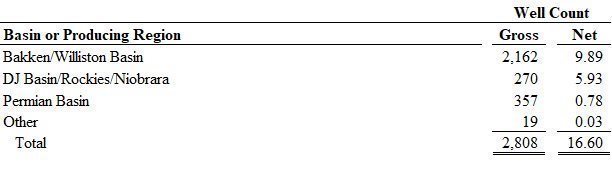
Oil and Natural Gas Data
Evaluation and Review of Estimated Proved Reserves
Our historical reserve estimates as of December 31, 2022 were prepared by Kent Lina, PE of Kent B. Lina, LLC and Brandon Allen, our Senior Reservoir Engineer.
Mr. Kent Lina, PE forecasted the oil and gas volumes for each well associated with our holdings while Brandon Allen analyzed and aggregated the remaining inputs and compiled the reserve report. Following the completion of this offering, we anticipate that Mr. Brandon Allen will be primarily responsible for the preparation of our reserves. In addition, we anticipate that the preparation of our proved reserve estimates are completed in accordance with internal control procedures, including the following:
|
| · | Review and verification of historical production data, which data is based on actual production as reported by the operators of our properties; |
|
|
|
|
|
| · | Preparation of reserves estimates by Mr. Brandon Allen or under his direct supervision; |
|
|
|
|
|
| · | Review by Mr. Brandon Allen and Mr. Curtis Allen, our CFO, of all of our reported proved reserves at the close of the calendar year, including the review of all significant reserve changes and all new proved undeveloped reserves additions; |
|
|
|
|
|
| · | Verification of property ownership by our land department; and |
|
|
|
|
|
| · | No employee’s compensation is tied to the amount of reserves booked. |
Under SEC rules, proved reserves are those quantities of oil and natural gas, which, by analysis of geoscience and engineering data, can be estimated with reasonable certainty to be economically producible—from a given date forward, from known reservoirs and under existing economic conditions, operating methods and government regulations—prior to the time at which contracts providing the right to operate expire, unless evidence indicates that renewal is reasonably certain, regardless of whether deterministic or probabilistic methods are used for the estimation. If deterministic methods are used, the SEC has defined reasonable certainty for proved reserves as a "high degree of confidence that the quantities will be recovered." All of our proved reserves as of December 31, 2022 were estimated using a deterministic method. The estimation of reserves involves two distinct determinations. The first determination results in the estimation of the quantities of recoverable oil and gas and the second determination results in the estimation of the uncertainty associated with those estimated quantities in accordance with the definitions established under SEC rules. The process of estimating the quantities of recoverable oil and gas reserves relies on the use of certain generally accepted analytical procedures. These analytical procedures fall into three broad categories or methods: (1) performance-based methods, (2) volumetric-based methods and (3) analogy. These methods may be used singularly or in combination by the reserve evaluator in the process of estimating the quantities of reserves. The proved reserves for our properties were estimated by performance methods, analogy or a combination of both methods. All proved producing reserves attributable to producing wells were estimated by performance methods. These performance methods include, but may not be limited to, decline curve analysis, which utilized extrapolations of available historical production and pressure data. All proved developed non-producing reserves were estimated by the analogy method.
| 28 |
| Table of Contents |
The following table presents our estimated proved oil and natural gas reserves as of December 31, 2022:
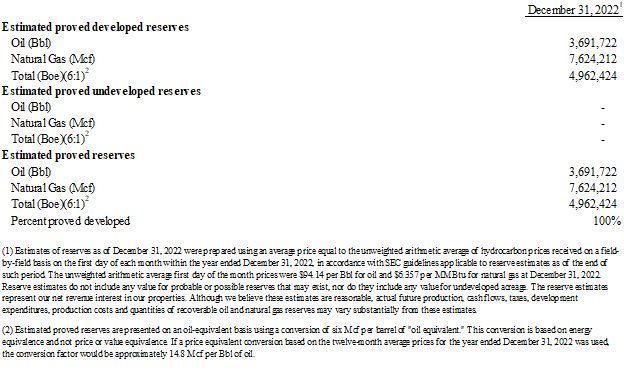
Oil and Natural Gas Production Prices and Production Costs
Production and Price History
The following table sets forth information regarding production of oil and natural gas and certain price and cost information for each of the periods indicated:
| 29 |
| Table of Contents |

Productive Wells
Productive wells consist of producing wells, wells capable of production, and exploratory, development, or extension wells that are not dry wells. As of December 31, 2022, we owned mineral or royalty interests in 2,808 productive wells, the majority of which are primarily oil wells which produce natural gas and natural gas liquids as well.
Drilling Results
As of December 31, 2022, the operators of our properties had drilled 2,808 gross productive development wells on the acreage underlying our mineral and royalty interests. As a holder of mineral and royalty interests, we generally are not provided information as to whether any wells drilled on the properties underlying our acreage are classified as exploratory. We are not aware of any dry holes drilled on the acreage underlying our mineral and royalty interests during the relevant periods.
Acreage
Mineral and Royalty Interests
The following tables set forth information relating to the acreage underlying our mineral interests as of December 31, 2022:
| 30 |
| Table of Contents |
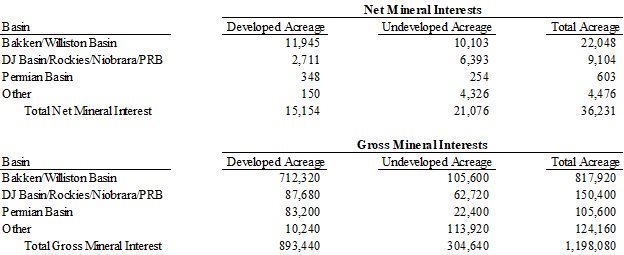
The methodology for computing the gross mineral acreage associated with our net mineral interest holdings was modified from June 30, 2022. This new methodology changed the estimation of the acreage associated with the drilling spacing unit (DSU) of each development well drilled on our underlying mineral interest holdings.
Summary of the ANB Commercial Credit Agreement
The Company, PhoenixOP, and ANB entered into the Credit Agreement dated as of July 24, 2023 for the provision of the ANB Loan. The current outstanding principal balance under the ANB Loan is $30,000,000. The Company used a portion of the proceeds from the ANB Loan to pay off its prior senior indebtedness with Cortland Credit Corporation (“Cortland”). The ANB Loan is full drawn. The ANB Loan shall bear interest at a floating rate equal to the prime rate published by the Wall Street Journal plus 3.00%, subject to a floor of 9.00%. Interest accrued on the outstanding balance shall be payable on the 24th of each month and will be calculated on the basis of a calendar year of 365 days or 366 days. The maturity date of the ANB Loan is July 24, 2024. All principal will be due and payable at maturity so long as the Company maintains a sufficient borrowing base under the Credit Agreement. As general and continuing security for the due payment and performance of the ANB Loan, the Company has granted ANB a first priority lien over mineral interests and personal property owned by the Company.
| 31 |
| Table of Contents |
Summary of PCGH I Revolving Line of Credit Loan Agreement
We intend to enter into a Revolving Line of Credit Loan Agreement with our subsidiary Phoenix Capital Group Holdings I, LLC (“PCGHI”) (the “Credit Loan Agreement”) in the form filed as an exhibit to the offering statement of which this offering circular is a past. To secure the loan from PCGHI (the “PCGHI Loan”), the Company agreed to enter into mortgages for various oil and gas properties owned by the Company throughout the United States. See “Certain Related Party Transactions” for more information.
Unsecured Debt Obligations
As of the date of this offering circular, we are offering up to $320,076,000 of unsecured indebtedness in offerings exempt from registration under the Securities Act of 1933, as amended. We have $118,226,000 remaining of Subordinated Reg D Bonds remaining to be sold pursuant to our offering of up to $300,000,000 in Subordinated Reg D Bonds. We are also offering up to $20,076,000 of Bonds pursuant to this offering circular. As of the date of this offering circular, we have sold, collectively, $311,467,000 in Unsecured Debt Obligations, of which $217,600,000, including $65,880,681 in Bonds, remain outstanding as of the date of this offering circular. Our Unsecured Debt Securities have maturities ranging from August 31, 2023 to August 31, 2030 and interest rates ranging from 7.5% to 15.0%. The Pari Passu Obligations and the Bonds rank pari passu. The Subordinated Reg D Bonds are subordinate to the Bonds.
Market Opportunity
We focus on specific subsets of mineral and leasehold assets in the United States. From a market perspective, we focus on high, attractive and defined basins, currently serviced by top-tier operators, with assets that we believe will generate high near-term cash flow. All the assets which we seek to acquire are purchased at what management believes are attractive price points and have a liquidity profile that is desirable in the secondary market. The assets we seek to acquire have near term payback and long-term residual cash flow upside.
Business Strategy
We have developed a process for the identification, acquisition and monetization of our assets. Below is a general illustration of our process:
|
| 1. | Our proprietary software provides market intelligence to identify and rank potential assets. We believe this is our core competitive advantage because we are able to identify and unlock value with our proprietary technology that may otherwise be missed. |
|
|
|
|
|
| 2. | We make contact with the owner of the asset and begin the conversation on how we can help unlock value of the property for the owner. |
|
|
|
|
|
| 3. | We provide the potential seller with a packet detailing the Company, industry data, property valuation and an all-cash offer based on the valuation. |
|
|
|
|
|
| 4. | Our sales team engages the potential seller to discuss the terms of the sale and the value of the property. |
|
|
|
|
|
| 5. | We handle the closing of the property and the property is migrated to our portfolio. |
|
|
|
|
|
| 6. | We utilize our land rights to immediately extract natural resources from the property using our trusted third-party operator network. Our proprietary technology, which originally identified the potential natural resource capability of the land, allows us to immediately create cash flow from the property through the extraction of the natural resource using the operator. |
|
|
|
|
|
| 7. | We collect a portion of the revenue generated from the natural resources extracted and sold by the third-party operator. Our share of the revenue depends on the type of asset, either mineral rights or non-operated working interests, and our contract with the third-party operator. |
|
|
|
|
|
| 8. | We continue to operate the property to extract the minerals through third-party operators until we decide to sell the property rights typically for many multiples than our original purchase price. |
| 32 |
| Table of Contents |
Separate from the ordinary royalty income assets, we maintain a structural discipline to participate in non-operated working interests, in part for their tax benefits. Due to favorable IRS treatment, marrying this asset class to our pure royalty income creates an augmented “write off” strategy whereby the balanced portfolio effectively creates little to no annual taxable income. The Company is data driven. The Company’s software platform applies managements criteria to catalogs of data points to automate 95% of business functions while also allowing for robust reporting. The goal is to give the sales and marketing team the best information, quickly, to execute on management’s acquisition strategy targeting high value assets. The system allows for adjusted focus based on size and region very efficiently as the Company grows and scales into new markets and price-points using the same fundamental underlying guidelines. Functionally, these transactions are very similar to traditional real estate transactions with respect to the mechanics. A seller agrees to sell to us, a purchase and sale agreement is executed, earnest money is conveyed, manual diligence and title review is conducted as an audit function prior to closing. Upon closing the funds are conveyed to the seller and the title is recorded in the respective jurisdiction by us. At this point, the operator is directed to convey all future payments to us at the defined rate. In most cases, our interaction with the operator is more administrative and clerical in nature unless it is a working interest or an alternative scenario. Assets can produce for upwards of 20 years, however there is a considerable regression/depletion curve that commences over the life of the asset. As such, we tend to focus on wells that have recently began producing, or are likely to have new production in the near term. we focus on a closed loop process from discovery to acquisition to long term balance sheet ownership. The recurring nature of these cash flows allows for considerable scale without material increases in fixed overhead.
Phoenix Operating
While the Company anticipates that extraction activities at its assets will continue to be primarily performed by third parties for the foreseeable future, the Company has formed PhoenixOp to drill and operate producing wells on oil and gas properties contributed to it by the Company. PhoenixOp has its own employees. The Company is and will remain the sole voting member and manager of PhoenixOp. The Company has agreed to grant certain minority, non-voting interests to PhoenixOp’s employees. The Company intends to make capital contributions to PhoenixOp to finance the operations of PhoenixOp, which may include financing out of the proceeds of the Loan, until such time as PhoenixOp receives its own financing or has sufficient revenues to operate without financing from the Company. The Company will also contribute oil and gas properties (but not those subject to our subordinate mortgage interests) to PhoenixOp from time to time as capital contributions. It is anticipated these contributed properties will be the drilling projects undertaken by PhoenixOp. PhoenixOp expects to begin operations in September 2023, subject to the availability of financing; however, we do not expect PhoenixOp to conduct extraction operations on a material amount of the Company’s oil and gas properties until 2024 at the earliest.
Liquidity and Track Record
There is currently no public trading market for any of our securities, and an active market may not develop or be sustained. If an active public trading market for our securities does not develop or is not sustained, it may be difficult or impossible for you to resell your interests at any price. Even if a public market does develop, the market price could decline below the amount you paid for your interests.
The Company’s management team has not sponsored any prior programs, and so does not have any prior program history.
[Remainder of page intentionally left blank]
| 33 |
| Table of Contents |
MATERIAL U.S. FEDERAL INCOME TAX CONSIDERATIONS
The following discussion is a summary of certain material U.S. federal income tax consequences relevant to the purchase, ownership and disposition of the Bonds, but does not purport to be a complete analysis of all potential tax consequences. The discussion is based upon the Code, current, temporary and proposed U.S. Treasury regulations issued under the Code, or collectively the Treasury Regulations, the legislative history of the Code, IRS rulings, pronouncements, interpretations and practices, and judicial decisions now in effect, all of which are subject to change at any time. Any such change may be applied retroactively in a manner that could adversely affect a Bondholder. This discussion does not address all of the U.S. federal income tax consequences that may be relevant to a holder in light of such Bondholder’s particular circumstances or to Bondholders subject to special rules, including, without limitation:
|
| · | a broker-dealer or a dealer in securities or currencies; |
|
|
|
|
|
| · | an S corporation; |
|
|
|
|
|
| · | a bank, thrift or other financial institution; |
|
|
|
|
|
| · | a regulated investment company or a real estate investment trust; |
|
|
|
|
|
| · | an insurance company |
|
|
|
|
|
| · | a tax-exempt organization; |
|
|
|
|
|
| · | a person subject to the alternative minimum tax provisions of the Code; |
|
|
|
|
|
| · | a person holding the Bonds as part of a hedge, straddle, conversion, integrated or other risk reduction or constructive sale transaction; |
|
|
|
|
|
| · | a partnership or other pass-through entity; |
|
|
|
|
|
| · | a person deemed to sell the Bonds under the constructive sale provisions of the Code; |
|
|
|
|
|
| · | a U.S. person whose “functional currency” is not the U.S. dollar; or |
|
|
|
|
|
| · | a U.S. expatriate or former long-term resident. |
In addition, this discussion is limited to persons that purchase the Bonds in this offering for cash and that hold the Bonds as “capital assets” within the meaning of Section 1221 of the Code (generally, property held for investment). This discussion does not address the effect of any applicable state, local, non-U.S. or other tax laws, including gift and estate tax laws.
As used herein, “U.S. Holder” means a beneficial owner of the Bonds that is, for U.S. federal income tax purposes:
|
| · | an individual who is a citizen or resident of the U.S.; |
|
|
|
|
|
| · | a corporation (or other entity treated as a corporation for U.S. federal income tax purposes) created or organized in or under the laws of the U.S., any state thereof or the District of Columbia; |
|
|
|
|
|
| · | an estate, the income of which is subject to U.S. federal income tax regardless of its source; or |
|
|
|
|
|
| · | a trust that (1) is subject to the primary supervision of a U.S. court and the control of one or more U.S. persons that have the authority to control all substantial decisions of the trust, or (2) has a valid election in effect under applicable Treasury Regulations to be treated as a U.S. person. |
| 34 |
| Table of Contents |
If an entity treated as a partnership for U.S. federal income tax purposes holds the Bonds, the tax treatment of an owner of the entity generally will depend upon the status of the particular owner and the activities of the entity. If you are an owner of an entity treated as a partnership for U.S. federal income tax purposes, you should consult your tax advisor regarding the tax consequences of the purchase, ownership and disposition of the Bonds.
We have not sought and will not seek any rulings from the IRS with respect to the matters discussed below. There can be no assurance that the IRS will not take a different position concerning the tax consequences of the purchase, ownership or disposition of the Bonds or that any such position would not be sustained.
THIS SUMMARY OF MATERIAL FEDERAL INCOME TAX CONSIDERATIONS IS FOR GENERAL INFORMATION ONLY AND DOES NOT CONSTITUTE TAX ADVICE. PROSPECTIVE INVESTORS SHOULD CONSULT THEIR TAX ADVISORS REGARDING THE APPLICATION OF THE TAX CONSIDERATIONS DISCUSSED BELOW TO THEIR PARTICULAR SITUATIONS, POTENTIAL CHANGES IN APPLICABLE TAX LAWS AND THE APPLICATION OF ANY STATE, LOCAL, FOREIGN OR OTHER TAX LAWS, INCLUDING GIFT AND ESTATE TAX LAWS, AND ANY TAX TREATIES.
U.S. Holders
Interest
U.S. Holder generally will be required to recognize and include in gross income any stated interest as ordinary income at the time it is paid or accrued on the Bonds in accordance with such holder’s method of accounting for U.S. federal income tax purposes.
Sale or Other Taxable Disposition of the Bonds
A U.S. Holder will recognize gain or loss on the sale, exchange, redemption (including a partial redemption), retirement or other taxable disposition of a Bond equal to the difference between the sum of the cash and the fair market value of any property received in exchange therefore (less a portion allocable to any accrued and unpaid stated interest, which generally will be taxable as ordinary income if not previously included in such holder’s income) and the U.S. Holder’s adjusted tax basis in the Bond. A U.S. Holder’s adjusted tax basis in a Bond (or a portion thereof) generally will be the U.S. Holder’s cost therefore decreased by any payment on the Bond other than a payment of qualified stated interest. This gain or loss will generally constitute capital gain or loss. In the case of a non-corporate U.S. Holder, including an individual, if the Bond has been held for more than one year, such capital gain may be subject to reduced federal income tax rates. The deductibility of capital losses is subject to certain limitations.
Medicare Tax
Certain individuals, trusts and estates are subject to a Medicare tax of 3.8% on the lesser of (i) ”net investment income,” or (ii) the excess of modified adjusted gross income over a threshold amount. Net investment income generally includes interest income and net gains from the disposition of Bonds, unless such interest payments or net gains are derived in the ordinary course of the conduct of a trade or business (other than a trade or business that consists of certain passive or trading activities). U.S. Holders are encouraged to consult with their tax advisors regarding the possible implications of the Medicare tax on their ownership and disposition of Bonds in light of their individual circumstances.
| 35 |
| Table of Contents |
Information Reporting and Backup Withholding
A U.S. Holder may be subject to information reporting and backup withholding when such holder receives interest and principal payments on the Bonds or proceeds upon the sale or other disposition of such Bonds (including a redemption or retirement of the Bonds). Certain holders (including, among others, corporations and certain tax-exempt organizations) generally are not subject to information reporting or backup withholding. A U.S. Holder will be subject to backup withholding if such holder is not otherwise exempt and:
|
| · | such holder fails to furnish its taxpayer identification number, or TIN, which, for an individual is ordinarily his or her social security number; |
|
|
|
|
|
| · | the IRS notifies the payor that such holder furnished an incorrect TIN; |
|
|
|
|
|
| · | in the case of interest payments such holder is notified by the IRS of a failure to properly report payments of interest or dividends; |
|
|
|
|
|
| · | in the case of interest payments, such holder fails to certify, under penalties of perjury, that such holder has furnished a correct TIN and that the IRS has not notified such holder that it is subject to backup withholding; or |
|
|
|
|
|
| · | such holder does not otherwise establish an exemption from backup withholding. |
A U.S. Holder should consult its tax advisor regarding its qualification for an exemption from backup withholding and the procedures for obtaining such an exemption, if applicable. Backup withholding is not an additional tax. Any amounts withheld under the backup withholding rules from a payment to a U.S. Holder will be allowed as a credit against the holder’s U.S. federal income tax liability or may be refunded, provided the required information is furnished in a timely manner to the IRS.
Non-U.S. Holders are encouraged to consult their tax advisors.
[Remainder of page intentionally left blank]
| 36 |
| Table of Contents |
The following is a summary of material considerations arising under ERISA and the prohibited transaction provisions of the Code that may be relevant to a prospective investor, including plans and arrangements subject to the fiduciary rules of ERISA and plans or entities that hold assets of such plans (“ERISA Plans”); plans and accounts that are not subject to ERISA but are subject to the prohibited transaction rules of Section 4975 of the Code, including IRAs, Keogh plans, and medical savings accounts (together with ERISA Plans, “Benefit Plans” or “Benefit Plan Investors”); and governmental plans, church plans, and foreign plans that are exempt from ERISA and the prohibited transaction provisions of the Code but that may be subject to state law or other requirements, which we refer to as Other Plans. This discussion does not address all the aspects of ERISA, the Code or other laws that may be applicable to a Benefit Plan or Other Plan, in light of their particular circumstances.
In considering whether to invest a portion of the assets of a Benefit Plan or Other Plan, fiduciaries should consider, among other things, whether the investment:
|
| · | will be consistent with applicable fiduciary obligations; |
|
|
|
|
|
| · | will be in accordance with the documents and instruments covering the investments by such plan, including its investment policy; |
|
|
|
|
|
| · | in the case of an ERISA plan, will satisfy the prudence and diversification requirements of Sections 404(a)(1)(B) and 404(a)(1)(C) of ERISA, if applicable, and other provisions of the Code and ERISA; |
|
|
|
|
|
| · | will impair the liquidity of the Benefit Plan or Other Plan; |
|
|
|
|
|
| · | will result in unrelated business taxable income to the plan; and |
|
|
|
|
|
| · | will provide sufficient liquidity, as there may be only a limited or no market to sell or otherwise dispose of our Bonds. |
ERISA and the corresponding provisions of the Code prohibit a wide range of transactions involving the assets of the Benefit Plan and persons who have specified relationships to the Benefit Plan, who are “parties in interest” within the meaning of ERISA and, “disqualified persons” within the meaning of the Code. Thus, a designated plan fiduciary of a Benefit Plan considering an investment in our shares should also consider whether the acquisition or the continued holding of our shares might constitute or give rise to a prohibited transaction. Fiduciaries of Other Plans should satisfy themselves that the investment is in accord with applicable law.
Section 3(42) of ERISA and regulations issued by the Department of Labor, or DOL, provide guidance on the definition of plan assets under ERISA. These regulations also apply under the Code for purposes of the prohibited transaction rules. Under the regulations, if a plan acquires an equity interest in an entity which is neither a “publicly-offered security” nor a security issued by an investment company registered under the Investment Company Act, the plan’s assets would include both the equity interest and an undivided interest in each of the entity’s underlying assets unless an exception from the plan asset regulations applies.
We do not believe the DOL’s plan assets guidelines apply to our Bonds or our Company because our Bonds are debt securities and not equity interests in us.
| 37 |
| Table of Contents |
If the underlying assets of our Company were treated by the Department of Labor as “plan assets,” the management of our Company would be treated as fiduciaries with respect to Benefit Plan Bondholders and the prohibited transaction restrictions of ERISA and the Code could apply to transactions involving our assets and transactions with “parties in interest” (as defined in ERISA) or “disqualified persons” (as defined in Section 4975 of the Code) with respect to Benefit Plan Bondholders. If the underlying assets of our Company were treated as “plan assets,” an investment in our Company also might constitute an improper delegation of fiduciary responsibility to our Company under ERISA and expose the ERISA Plan fiduciary to co-fiduciary liability under ERISA and might result in an impermissible commingling of plan assets with other property.
If a prohibited transaction were to occur, an excise tax equal to 15% of the amount involved would be imposed under the Code, with an additional 100% excise tax if the prohibited transaction is not “corrected.” Such taxes will be imposed on any disqualified person who participates in the prohibited transaction. In addition, other fiduciaries of Benefit Plan Bondholders subject to ERISA who permitted such prohibited transaction to occur or who otherwise breached their fiduciary responsibilities, could be required to restore to the plan any losses suffered by the ERISA Plan or any profits realized by these fiduciaries as a result of the transaction or beach. With respect to an IRA or similar account that invests in our Company, the occurrence of a prohibited transaction involving the individual who established the IRA, or his or her beneficiary, would cause the IRA to lose its tax-exempt status. In that event, the IRA or other account owner generally would be taxed on the fair market value of all the assets in the account as of the first day of the owner’s taxable year in which the prohibited transaction occurred.
[Remainder of page intentionally left blank]
| 38 |
| Table of Contents |
This description sets forth certain terms of the Bonds that we are offering pursuant to this offering circular. In this section we use capitalized words to signify terms that are specifically defined in the Indenture, by and between us and UMB Bank, N.A., as trustee, or the trustee. We refer you to the Indenture for a full disclosure of all such terms, as well as any other capitalized terms used in this offering circular for which no definition is provided.
Because this section is a summary, it does not describe every aspect of the Bonds or the Indenture. We urge you to read the Indenture carefully and in its entirety because that document and not this summary defines your rights as a Bondholders. Please review a copy of the Indenture. The Indenture is filed as an exhibit to the offering statement, of which this offering circular is a part, at www.sec.gov. You may also obtain a copy of the Indenture from us without charge. See “Where You Can Find More Information” for more information. You may also review the Indenture at the trustee’s corporate trust office at 928 Grand Blvd., 12th Floor, Kansas City, Missouri 64106.
Ranking
The Bonds are unsecured indebtedness of our Company and rank pari passu with our other unsecured indebtedness, including the Pari Passu Obligations, and superior to our Subordinated Reg D Bonds. The Bonds would rank junior to any of our secured indebtedness including the indebtedness outstanding under our Credit Agreement. The Company is conducting an offering of its Subordinated Reg D Bonds that is being offered and sold pursuant to Rule 506(c) of Regulation D. The Subordinated Reg D Bonds rank junior to the Bonds sold in this Regulation A offering.
Subordination
The indebtedness evidenced by the Bonds is subordinated to any debt outstanding under the Company’s ANB Loan with respect to the collateral pledged under the Credit Agreement. The Bonds will also be subordinate to any debt outstanding under the Company’s Credit Loan Agreement with respect to any collateral pledged and any future secured indebtedness of the Company.
Because of this subordination, if the Company dissolves or otherwise liquidates, Bondholders may receive less, ratably, than ANB, PCGHI or any other future secured lender. The Trustee may pursue its rights under the Indenture in the event of default; however, the Company’s secured lenders, including PCGHI and ANB, have senior positions with respect to the collateral pledged under their respective credit and security agreements. As a result, the Trustee may not be able to exercise remedies with respect to some or all of the assets collateralizing the ANB and PCGHI Loans under the respective credit and security agreements upon an Event of Default which may result in Bondholders incurring losses that may have otherwise been avoided it the company had no secured lenders. See "Risk Factors - Risks Related to the Bonds and to this Offering" for more information.
Interest and Maturity
The Bonds will each be offered serially, over a maximum period of 3 years, starting from December 23, 2021, with the sole difference between the series being their respective maturity dates. Each series of Bonds beginning with Series A will correspond to a particular closing. Each series of Bonds will mature on the third anniversary of the initial issuance date of such series. Interest on the Bonds will be paid in equal monthly installments to the record holders of the Bonds on the 10th day of each month, or if any day is not a business day, the next business day, thereafter until the Bonds have been repaid in full or are otherwise no longer outstanding.
| 39 |
| Table of Contents |
The Company may elect to extend the maturity date of the Bonds for up to two additional one-year periods in the Company’s sole discretion. If the Company elects to extend the maturity date of the Bonds, the Bonds will bear interest at 10.0% per annum during the first one-year extension period and will bear interest at 11.0% per annum during the second one-year extension period. Each such extension would constitute a new offering for the purpose of the registration requirements of the Securities Act and, as such, would be required to be registered or conducted pursuant to an exemption from registration. Any such subsequent offering conducted pursuant to Regulation A would count against the aggregate dollar limitations in Rule 251(a) of Regulation A. The Company and Bondholders may elect to redeem all or a portion of the Bonds according to the terms set forth herein.
With respect to the maturity or extension thereto of a Bond, the Company will send to the Trustee and each holder of such a Bond a notice of maturity, no more than 240 days and no less than 180 days prior to a maturity date for any Bond, notifying the holder of the Bond of the Bond’s pending maturity and that the maturity of the Bond will or will not be extended.
Manner of Offering
The offering is being made on a commercially reasonable efforts basis through our broker/dealer of record. We reserve the right to conduct future sales through other Selling Group Members. Our broker/dealer of record will not be required to purchase any of the Bonds.
THE REQUIRED INTEREST PAYMENTS AND PRINCIPAL PAYMENT ARE NOT A GUARANTY OF ANY RETURN TO YOU NOR ARE THEY A GUARANTY OF THE RETURN OF YOUR INVESTED CAPITAL. While our Company is required to make interest payments and principal payment as described in the Indenture and above, we do not intend to establish a sinking fund to fund such payments. Therefore, our ability to honor these obligations will be subject to our ability to generate sufficient cash flow or procure additional financing in order to fund those payments. If we cannot generate sufficient cash flow or procure additional financing to honor these obligations, we may be forced to sell some or all of the Company’s assets to fund the payments. We cannot guarantee that the proceeds from any such sale will be sufficient to make the payments in their entirety or at all. If we cannot fund the above payments, Bondholders will have claims against us with respect to such violation as further described under the Indenture.
Optional Redemption at Election of Bondholder
The Bonds will be redeemable at the election of the Bondholder beginning anytime following the last issuance date of the series of Bonds held by the Bondholder, or the Optional Redemption. In order to request redemption, the Bondholder must provide written notice to us at our principal place of business that the Bondholder requests redemption of all or a portion of the Bondholder’s Bonds, or a Notice of Redemption.
Redemptions made pursuant to the Optional Redemption of the Bonds shall be at a price equal to $950 plus all accrued but unpaid interest per Bond. We will have 120 days from the date the applicable Notice of Optional Redemption is provided to redeem the requesting Bondholder’s Bonds, subject to the limitations set forth in the Bond. Our obligation to redeem Bonds with respect to Notices of Redemption received in any given Redemption Period (as defined below) is limited to an aggregate principal amount of Bonds equal to 10% of the aggregate principal of Bonds under the Indenture on the most recent of January 1st, April 1st, July 1st or October 1st of the applicable year while the Offering is open, and January 1st of the applicable year, following the offering termination. or the 10% Limit. Any Bonds redeemed as a result of a Bondholder's right upon death, disability or bankruptcy will be included in calculating the 10% Limit and will thus reduce the number of Bonds available to be redeemed pursuant to Optional Redemption.
Our obligation to redeem Bonds in any given year pursuant to this redemption is limited to 10% of the outstanding principal balance of the Bonds, in the aggregate, on the most recent of January 1st, April 1st, July 1st or October 1st of the applicable year while the Offering is open, and January 1st of the applicable year, following the offering termination. In addition, any Bonds redeemed as a result of a Bondholder's right upon death, disability or bankruptcy, will be included in calculating the 10% Limit and will thus reduce the number of Bonds, in the aggregate, to be redeemed pursuant to the redemption. Bond redemptions will occur in the order that notices are received.
| 40 |
| Table of Contents |
Redemption Upon Death, Disability or Bankruptcy
Within 90 days of the death, disability or bankruptcy of a Bondholder who is a natural person, the estate of such Bondholder, or legal representative of such Bondholder may request that we repurchase, in whole but not in part and without penalty, the Bonds held by such Bondholder by delivering to us a written notice requesting such Bonds be redeemed. Redemptions due to death, disability or bankruptcy shall count towards the annual 10% Limit on redemptions described above; provided, however, that any redemptions pursuant to death, disability or bankruptcy shall not be subject to the 10% Limit. Any such request shall specify the particular event giving rise to the right of the holder or beneficial holder to redeem his or her Bonds. If a Bond is held jointly by natural persons who are legally married, then such request may be made by (i) the surviving Bondholder upon the death of the spouse, or (ii) the disabled Bondholder (or a legal representative) upon disability of the spouse. In the event a Bond is held together by two or more natural persons that are not legally married, neither of these persons shall have the right to request that the Company repurchase such Bond unless each Bondholder has been affected by such an event.
Disability shall mean with respect to any Bondholder or beneficial holder, a determination of disability based upon a physical or mental condition or impairment arising after the date such Bondholder or beneficial holder first acquired Bonds. Any such determination of disability must be made by any of: (1) the Social Security Administration; (2) the U.S. Office of Personnel Management; or (3) the Veteran’s Benefits Administration, or the Applicable Governmental Agency, responsible for reviewing the disability retirement benefits that the applicable Bondholder or beneficial holder could be eligible to receive.
Bankruptcy shall mean, with respect to any Bondholder the final adjudication related to (i) the filing of any petition seeking to adjudicate the Bondholder bankrupt or insolvent, or seeking for itself any liquidation, winding up, reorganization, arrangement, adjustment, protection, relief, or composition of such Bondholder or such Bondholder’s debts under any law relating to bankruptcy, insolvency, or reorganization or relief of debtors, or seeking, consenting to, or acquiescing in the entry of an order for relief or the appointment of a receiver, trustee, custodian, or other similar official for such Person or for any substantial part of its property, or (ii) without the consent or acquiescence of such Bondholder, the entering of an order for relief or approving a petition for relief or reorganization or any other petition seeking any reorganization, arrangement, composition, readjustment, liquidation, dissolution, or other similar relief under any bankruptcy, liquidation, dissolution, or other similar statute, law, or regulation, or, without the consent or acquiescence of such Bondholder, the entering of an order appointing a trustee, custodian, receiver, or liquidator of such Bondholder or of all or any substantial part of the property of such Bondholder which order shall not be dismissed within ninety (90) days.
Upon receipt of redemption request in the event of death, disability or bankruptcy of a Bondholder, we will designate a date for the redemption of such Bonds, which date shall not be later than 30 days after we receive documentation and/or certifications establishing (to the reasonable satisfaction of the Company) the right to be redeemed. On the designated date, we will redeem such Bonds at a price per Bond that is equal to all accrued and unpaid interest, to but not including the date on which the Bonds are redeemed plus the then outstanding principal amount of such Bond.
Optional Redemption
We may redeem the Bonds, in whole or in part, without penalty at any time. If the Bonds are renewed for an additional term, we may redeem the Bonds at any time during such renewal period. Any redemption of a Bond will be at a price equal to the then outstanding principal on the Bonds being redeemed, plus any accrued but unpaid interest on such Bonds. If we plan to redeem the Bonds, we are required to give notice of redemption not less than 5 days nor more than 60 days prior to any redemption date to each Bondholder’s address appearing in the securities register maintained by the trustee. In the event we elect to redeem less than all of the Bonds, the particular Bonds to be redeemed will be selected by the trustee by such method as the trustee shall deem fair and appropriate.
| 41 |
| Table of Contents |
Merger, Consolidation or Sale
We may consolidate or merge with or into any other corporation, and we may sell, lease or convey all or substantially all of our assets to any corporation, provided that the successor entity, if other than us:
|
| · | is organized and existing under the laws of the United States of America or any United States, or U.S., state or the District of Columbia; and |
|
|
|
|
|
| · | assumes all of our obligations to perform and observe all of our obligations under the Bonds and the Indenture; and provided further that no event of default under the Indenture shall have occurred and be continuing. |
Except as described below under “Certain Covenants – Offer to Repurchase Upon a Change of Control Repurchase Event,” the Indenture does not provide for any right of acceleration in the event of a consolidation, merger, sale of all or substantially all of the assets, recapitalization or change in our stock ownership. In addition, the Indenture does not contain any provision which would protect the Bondholders against a sudden and dramatic decline in credit quality resulting from takeovers, recapitalizations or similar restructurings.
Certain Covenants
We will issue the Bonds under an Indenture, or the Indenture, to be dated as of the initial issuance date of the Bonds between us and UMB Bank, N.A., as the trustee. The Indenture does not limit our ability to incur, or permit our subsidiaries to incur, third-party indebtedness, whether secured or unsecured, including the indebtedness outstanding under our Credit Agreement.
Offer to Repurchase Upon a Change of Control Repurchase Event
"Change of Control Repurchase Event", means (A) the acquisition by any person, including any syndicate or group deemed to be a "person" under Section 13(d)(3) of the Exchange Act, of beneficial ownership, directly or indirectly, through a purchase, merger or other acquisition transaction or series of purchases, mergers or other acquisition transactions of the membership units entitling that person to exercise more than 50% of the total voting power of all the membership units entitled to vote in meetings of the Company (except that such person will be deemed to have beneficial ownership of all securities that such person has the right to acquire, whether such right is currently exercisable or is exercisable only upon the occurrence of a subsequent condition); and (B) following the closing of any transaction referred to in subsection (A), neither we nor the acquiring or surviving entity has a class of common securities (or American Depositary Receipts representing such securities) listed on the New York Stock Exchange (“NYSE”), the NYSE American, or the Nasdaq Stock Market, or listed or quoted on an exchange or quotation system that is a successor to the NYSE, the NYSE American or the Nasdaq Stock Market.
If a Change of Control Repurchase Event occurs, unless we have exercised our option to redeem the Bonds as described under “Optional Redemption,” the Company or Trustee shall make an offer to each Bondholder to repurchase all or any amount of each Bondholder's Bonds at the redemption price set forth on the Bond.
Reports
We will furnish the following reports to each Bondholder:
Reporting Requirements under Tier II of Regulation A. After launching this Tier II, Regulation A offering, we will be required to comply with certain ongoing disclosure requirements under Rule 257 of Regulation A. We will be required to file: an annual report with the SEC on Form 1-K; a semi-annual report with the SEC on Form 1-SA; current reports with the SEC on Form 1-U; and a notice under cover of Form 1-Z. The necessity to file current reports will be triggered by certain corporate events, similar to the ongoing reporting obligation faced by issuers under the Exchange Act, however the requirement to file a Form 1-U is expected to be triggered by significantly fewer corporate events than that of the Form 8-K. Parts I & II of Form 1-Z will be filed by us if and when we decide to and are no longer obligated to file and provide annual reports pursuant to the requirements of Regulation A.
| 42 |
| Table of Contents |
Annual Reports. As soon as practicable, but in no event later than one hundred twenty (120) days after the close of our fiscal year, ending December 31st, we will cause to be mailed or made available, by any reasonable means, to each Bondholder as of a date selected by us, an annual report containing financial statements of our Company for such fiscal year, presented in accordance with GAAP, including a balance sheet and statements of operations, equity and cash flows, with such statements having been audited by an accountant selected by us. We shall be deemed to have made a report available to each Bondholder as required if it has either (i) filed such report with the SEC via its Electronic Data Gathering, Analysis and Retrieval (EDGAR) system and such report is publicly available on such system or (ii) made such report available on any website maintained by our Company and available for viewing by the Bondholders.
Payment of Taxes and Other Claims
We will pay or discharge or cause to be paid or discharged, before the same shall become delinquent: (i) all taxes, assessments and governmental charges levied or imposed upon us or upon our income, profits or assets; and (ii) all lawful claims for labor, materials and supplies which, if unpaid, might by law become a lien upon our property; provided, however, that we will not be required to pay or discharge or cause to be paid or discharged any such tax, assessment, charge or claim whose amount, applicability or validity is being contested in good faith by appropriate proceedings or for which we have set apart and maintain an adequate reserve.
Prior to this offering, there has been no public market for the Bonds. We may apply for quotation of the Bonds on an alternative trading system or over the counter market beginning after the final closing of this offering. However, even if the Bonds are listed or quoted, no assurance can be given as to (1) the likelihood that an active market for the Bonds will develop, (2) the liquidity of any such market, (3) the ability of Bondholders to sell the Bonds or (4) the prices that Bondholders may obtain for any of the Bonds. No prediction can be made as to the effect, if any, that future sales of the Bonds, or the availability of the Bonds for future sale, will have on the market price prevailing from time to time. Sales of substantial amounts of the Bonds, or the perception that such sales could occur, may adversely affect prevailing market prices of the Bonds. See “Risk Factors — Risks Related to the Bonds and the Offering.”
Event of Default
The following are events of default under the Indenture with respect to the Bonds:
|
| · | default in the payment of any interest on the Bonds when due and payable, which continues for 60 days, a cure period; |
|
|
|
|
|
| · | default in the payment of any principal of or premium on the Bonds when due, which continues for 60 days, a cure period; |
|
|
|
|
|
| · | default in the performance of any other obligation or covenant contained in the Indenture or in this offering circular for the benefit of the Bonds, which continues for 120 days after written notice, a cure period; and |
|
|
|
|
|
| · | specified events in bankruptcy, insolvency or reorganization of us. |
Book-entry and other indirect Bondholders should consult their banks or brokers for information on how to give notice or direction to or make a request of the trustee and how to declare or rescind an acceleration of maturity.
Annually, within 120 days following December 31st while the Bonds are outstanding, we will furnish to the trustee a written statement of certain of our officers certifying that to their knowledge we are in compliance with the Indenture, or else specifying any event of default and the nature and status thereof. We will also deliver to the trustee a written notification of any uncured event of default within 30 days after we become aware of such uncured event of default.
| 43 |
| Table of Contents |
Remedies if an Event of Default Occurs
Subject to any respective cure period, or other terms of the Indenture, if an event of default occurs and is continuing, the trustee or the Bondholders of not less than a majority in aggregate outstanding principal amount of the Bonds may declare the principal thereof, and all unpaid interest thereon to be due and payable immediately. In such event, the trustee will have the right force us to sell any assets held by us or any subsidiary of ours that we have the unilateral right to cause it to sell its assets. We will be required to contribute the proceeds of any such sale to the repayment of the Bonds. With respect to subsidiaries for which we do not have the unilateral right to sell their assets, the trustee has the right to force us to sell our equity in such subsidiary in order to repay the Bonds.
At any time after the trustee or the Bondholders have accelerated the repayment of the principal, premium, if any, and all unpaid interest on the Bonds, but before the trustee has obtained a judgment or decree for payment of money due, the Bondholders of a majority in aggregate principal amount of outstanding Bonds may rescind and annul that acceleration and its consequences, provided that all payments, other than those due as a result of acceleration, have been made and all events of default have been remedied or waived.
The Bondholders of a majority in principal amount of the outstanding Bonds may waive any default with respect to that series, except a default:
|
| · | in the payment of any amounts due and payable or deliverable under the Bonds; or |
|
|
|
|
|
| · | in an obligation contained in, or a provision of, the Indenture which cannot be modified under the terms of the Indenture without the consent of each Bondholder |
The Bondholders of a majority in principal amount of the outstanding Bonds may direct the time, method and place of conducting any proceeding for any remedy available to the trustee or exercising any trust or power conferred on the trustee with respect to the Bonds, provided that (i) such direction is not in conflict with any rule of law or the Indenture, (ii) the trustee may take any other action deemed proper by the trustee that is not inconsistent with such direction and (iii) the trustee need not take any action that might involve it in personal liability or be unduly prejudicial to the Bondholders not joining therein. Subject to the provisions of the Indenture relating to the duties of the trustee, before proceeding to exercise any right or power under the Indenture at the direction of the Bondholders, the trustee is entitled to receive from those Bondholders security or indemnity satisfactory to the trustee against the costs, expenses and liabilities which it might incur in complying with any direction.
A Bondholder will have the right to institute a proceeding with respect to the Indenture or for any remedy under the Indenture, if:
|
| · | that Bondholder previously gives to the trustee written notice of a continuing event of default in excess of any cure period, |
|
|
|
|
|
| · | the Bondholders of not less than a majority in principal amount of the outstanding Bonds have made written request; |
|
|
|
|
|
| · | such Bondholder or Bondholders have offered to indemnify the trustee against the costs, expenses and liabilities incurred in connection with such request; |
|
|
|
|
|
| · | the trustee has not received from the Bondholders of a majority in principal amount of the outstanding Bonds a direction inconsistent with the request (it being understood and intended that no one or more of such Bondholders shall have any right in any manner whatever by virtue of, or by availing of, any provision of the Indenture to affect, disturb or prejudice the rights of any other of such Bondholders, or to obtain or to seek to obtain priority or preference over any other of such Bondholders or to enforce any rights under the Indenture, except in the manner herein provided and for equal and ratable benefit of all Bondholders); and |
|
|
|
|
|
| · | the trustee fails to institute the proceeding within 60 days. |
However, the Bondholder has the right, which is absolute and unconditional, to receive payment of the principal of and interest on such Bond on the respective due dates (or any redemption date, subject to certain discounts) and to institute suit for the enforcement of any such payment and such rights shall not be impaired without the consent of such Bondholder.
[Remainder of page intentionally left blank]
| 44 |
| Table of Contents |
On June 15, 2022, Phoenix Capital Group Holdings, LLC filed a civil lawsuit against William Francis and Incline Energy Partners, L.P. in the 116th District Court of Dallas County, Texas, asserting claims of (i) defamation, (ii) business disparagement, (iii) tortious interference with contract, (iv) tortious interference with prospective contract/relations, (v) unfair competition and (vi) civil conspiracy. The Company is seeking monetary damages in the amount of $50 million.
[Remainder of page intentionally left blank]
| 45 |
| Table of Contents |
SECURITY OWNERSHIP OF CERTAIN BENEFICIAL OWNERS AND MANAGEMENT
The table below sets forth, as of the issuance date of this report, certain information regarding the beneficial ownership of our outstanding membership units for (1) each person who is expected to be the beneficial owner of 10% or more of our outstanding membership units and (2) each of our named executive officers, if together such group would be expected to be the beneficial owners of 10% or more of our outstanding membership units. Each person named in the table has sole voting and investment power with respect to all of the membership units shown as beneficially owned by such person. The SEC has defined “beneficial ownership” of a security to mean the possession, directly or indirectly, of voting power and/or investment power over such security.
| Title of Class |
| Name and Address of Beneficial Owner |
| Amount and Nature of Beneficial Ownership Acquirable |
| Percent of Class |
| LLC Interests |
| Daniel Ferrari* |
| N/A |
| 28.79% |
|
|
|
|
|
|
|
|
| LLC Interests |
| Charlene Ferrari* |
| N/A |
| 28.79% |
|
|
|
|
|
|
|
|
| LLC Interests |
| All Executives and Managers |
| N/A |
| 28.98% |
* Daniel Ferrari and Charlene Ferrari each own 50% of the voting membership interests in and are the managers of Lion of Judah, LLC, which owns 57.58% of the Company. Their address is 1983 Water Chase Drive, New Lenox, IL 60451. Adam Ferrari is the economic interest owner of Lion of Judah, LLC, but has no voting or managerial interest in Lion of Judah, LLC and, therefore, is not a beneficial interest holder of the Company.
[Remainder of page intentionally left blank]
| 46 |
| Table of Contents |
MANAGER, EXECUTIVE OFFICERS AND SIGNIFICANT EMPLOYEES
Our Company is a manager-managed limited liability company and managed by our sole manager pursuant to our limited liability company agreement. Lion of Judah, LLC has the power to select the manager of our Company in its sole discretion. The following table sets forth information on our executive officers, manager, and significant employees.
|
|
|
|
|
|
| Manager/Officers/Significant Employee |
| Name |
| Age |
| Position with our Company |
| Since |
| Lindsey Wilson |
| 37 |
| Manager and Chief Operating Officer |
| April 2019 |
| Curtis Allen |
| 37 |
| Chief Financial Officer |
| February 2020 |
| Kris Woods |
| 37 |
| Chief Technology Officer |
| August 2019 |
| Sean Goodnight |
| 47 |
| Chief Acquisition Officer |
| June 2020 |
| Justin Arn |
| 43 |
| Chief Land and Title Officer |
| April 2020 |
| Brynn Ferrari |
| 33 |
| Chief Marketing Officer |
| April 2023 |
| Matt Willer |
| 46 |
| Managing Director, Capital Markets |
| March 2021 |
| Adam Ferrari |
| 40 |
| Vice President of Engineering |
| April 2023 |
| Julia Mao |
| 36 |
| Vice President of Business Process |
| November 2021 |
| Nick Young |
| 40 |
| Vice President of Land - WY & TX |
| May 2020 |
| Tom Kruk |
| 61 |
| Vice President of Mineral Acquisitions |
| August 2019 |
| David McDonald |
| 40 |
| GIS Analyst |
| April 2021 |
Set forth below is biographical information for the executive officers, manager, and significant employees of our Company.
Lindsey Wilson, Manager and Chief Operating Officer. Lindsey brings years of extensive practical experience leading diverse, multidisciplinary teams in the energy sector. Lindsey entered the oil and gas industry in 2011 as a Leasing Agent in Texas and this foundational experience was the springboard that ultimately allowed her to transition into more advanced management roles within the mineral and leasehold acquisition space. Immediately prior to helping to found our company, Ms. Wilson was employed in the operations department of The Petram Group, LLC, (f/k/a Wolfhawk Energy Holdings, LLC d/b/a “Ferrari Energy”), a mineral and leasehold acquisition company, until early 2019. As a founding member of Phoenix Capital Group, Lindsey establishes the objectives of the business and leads all operational functions within the Company. Responsible for overseeing the day-to-day operations of Phoenix Capital Group, Lindsey takes great pride in working with all departments on setting and achieving aggressive business goals. Lindsey graduated from the University of Texas Arlington and holds a Bachelor of Business Administration with a concentration in Marketing.
Curtis Allen, Chief Financial Officer. Curtis graduated magna cum laude from SUNY Oswego with both his BS and MBA concentrated in accounting. Curtis has over 10 years’ experience in financial services with an emphasis on investment analysis. As a CPA, Curtis has a range of experiences from his private tax-practice to auditing billion-dollar defense contractors with the Department of Defense. Most recently, he has spent over 7 years managing investments for personal and corporate clients. Alongside being a CPA, Curtis also holds series 7 and 66 licenses and has passed the CFA level I. At Phoenix Capital Group, Curtis is responsible for all accounting and finance functions and underwriting new potential deals along with a multitude of day-to-day operational tasks.
Kristopher Woods, Chief Technology Officer. Kris has over 12 years’ experience as a consultant and software engineer working across a number of industries including energy, health & fitness and consumer goods. At Phoenix Capital Group, his responsibilities include identifying and validating technological needs, as well as overseeing the implementation and management of all software solutions. He has developed extensive insights into custom software and technology solutions over the course of his career and brings that knowledge and ability to lead diverse teams to his role at Phoenix Capital Group. Kris holds a B.A. in Computer Science from Lewis & Clark College and dual Masters degrees from Loyola Marymount in Business Administration and Systems Engineering.
Sean Goodnight, Chief Acquisitions Officer. Sean brings over 25 years of consultative sales experience to Phoenix Capital Group. As a Colorado native, he attended the University of Northern Colorado and spent the early part of his career in the health care and insurance industries. He was introduced into the oil and gas industry in 2016 working with mineral acquisitions where he quickly transitioned into management. Immediately prior to joining our company in June of 2020, Mr. Goodnight was employed by The Petram Group, LLC, (f/k/a Wolfhawk Energy Holdings, LLC d/b/a “Ferrari Energy”), as an acquisitions landman. With Phoenix Capital Group, Sean leads the Acquisitions department and has implemented processes, developed tools, and introduced materials that have contributed to the continued success of the Company. He has built a team of talented, sophisticated professionals who possess the expertise and skillset to maintain the high level of standards that have become the foundation of his department.
| 47 |
| Table of Contents |
Justin Arn, Chief Land & Title Officer. Justin graduated from the University of Hawaii at Manoa and majored in Philosophy with a minor in Business Administration. Justin began his Land career researching mineral and royalty rights for multiple mineral acquisition companies focusing on the DJ Basin in Weld County, Colorado and Laramie County, Wyoming. He has coordinated and managed title projects, large and small, in Wyoming, Colorado, North Dakota, Montana, and Texas, and performed and managed opportunity and due diligence title work for the purchase of thousands of Royalty Acres throughout the DJ, Bakken, and Permian basins. Justin is an active member of the American Association of Professional Landmen, and the Wyoming Association of Professional Landmen. Immediately prior to joining our Company, Mr. Arn was employed as a landman for The Petram Group, LLC (f/k/a Wolfhawk Energy Holdings, LLC d/b/a “Ferrari Energy”).
Brynn Ferrari, Chief Marketing Officer. Brynn comes to us bringing over 12 years of experience with a variety of marketing experience across digital, talent relations, events and social media. With a Public Relations degree from the University of Southern California she is a true Trojan at heart and is a Young Leader for the USC Alumni Association. Prior to her position at the Company, Brynn led projects working in-house for American Honda Motor Co., Amazon, the Estee Lauder Companies, and Unilever Prestige. She also managed multi-million dollar advertising campaigns and spearheaded creative innovation for first-to-market products including the launch of an AR partnership integration with Modiface for Estee Lauder Companies for the brand, Smashbox Cosmetics. As the Chief Marketing Officer at the Company, she is responsible for developing both the marketing team and the Investor Relations team with a focus on process efficiencies and team growth. She owns strategy across all marketing platforms passionately sharing our story and the people behind the Company. Brynn Ferrari is Adam Ferrari’s spouse and the daughter-in-law of Charlene and Daniel Ferrari.
Matt Willer, Managing Director, Capital Markets. Matt Willer is a seasoned finance professional that has spent 22 years professionally assisting Companies of all sizes, in a variety of industries, with their financing needs. Matt’s career began at Smith Barney and after his early professional life was spent at a large investment bank he sequentially migrated to smaller firms where he has been able to have more autonomy and interaction with clients. For the past decade, Matt’s experience has largely been in an internal investment banking function to the operating companies that he is assisting. With experience in both debt and equity transactions, across both private and public Companies, Matt has raised well over $100 million in new capital for the Companies he’s worked with. Matt brings an entrepreneurial finance background to Phoenix Capital Group Holdings where he currently maintains the title of Managing Director, Capital Markets and has recently become a partner with the firm. Matt graduated from the University of Southern California with a degree in Business Administration with a dual specialty in Finance and Management. Mr. Willer is a registered representative and associated person of Dalmore Group.
Adam Ferrari, Vice President of Engineering. Adam graduated from the University of Illinois at Urbana-Champagne Magna Cum Laude with a Bachelor’s of Science Degree in Chemical Engineering. Adam began his career with BP America as a completions engineer in 2005. During his tenure with BP, Adam served in various drilling, completions, and production roles both in the Gulf of Mexico and the onshore US business units. Following his experience at BP, Adam transitioned to an equity analyst role within the Oil and Gas division at Macquarie Capital in Denver, CO. After gaining experience on the financial services side of oil and gas, Adam transitioned back to the operating side of the industry in a lead Petroleum Engineering role with start-up Halcon Resources. While at Halcon, Adam supported various exploration and development programs in the broader gulf coast region and the Bakken shale asset in North Dakota. Following his tenure at Halcon, Adam pursued various entrepreneurial opportunities on the mineral acquisitions side of the oil and gas industry that ultimately led him to the Company. Immediately prior to becoming a consultant, Adam was the Chief Executive Officer of the The Petram Group, LLC (f/k/a Wolfhawk Energy Holdings, LLC d/b/a “Ferrari Energy”) until March of 2019. Adam has served in an advisory role at various points for Phoenix and as of April of 2023, Adam was promoted to VP of Engineering for the company. Prior to his employment at the Petram Group, Mr. Ferrari founded and operated Ferrari Energy, LLC, a single member Colorado LLC, which was active in acquiring and disposing of mineral interests from 2014 to 2017. Currently, Ferrari Energy, LLC has no employees, holds only one remaining mineral property and and is otherwise inactive. In early 2016, Wolfhawk Energy Holdings, LLC started operating under the brand name "Ferrari Energy," even though there was no formal connection between Ferrari Energy, LLC and Wolfhawk Energy Holdings, LLC. From December 14, 2016 through March 11, 2019, Adam Ferrari served as the CEO of Wolfhawk Energy Holdings, LLC. Subsequently, Wolfhawk Energy Holdings, LLC underwent name changes and became The Petram Group, LLC on April 2, 2019. At the Company, Adam is responsible for conducting engineering evaluations across all areas of interest and making purchase recommendations to the executive team at Phoenix Capital Group. Adam Ferrari is Brynn Ferrari’s spouse and the son of Charlene and Daniel Ferrari.
Julia Mao, Vice President of Business Process. At Phoenix Capital Group, Julia is responsible for identifying areas in need of process business improvement and implementing solutions in creating better efficiencies, as well as developing reporting tools for more informed executive business decisions. Ms. Mao has worked professionally for 10 years at Lakeshore Learning Materials from accounting to the marketing field and has extensive experience in improving business processes within a variety of departments utilizing various technology software systems. Julia has earned a BA in Business Economics from the University of California Irvine. In addition, Ms. Mao holds an MBA from the prestigious University of Southern California at the globally recognized Marshall School of Business with dual Graduate Certificates in Business Analytics and Marketing.
Nick Young, Vice President of Land - WY & TX. Nick has over 10 years’ experience as a Landman. Starting out as an intern with Colorado State Land Board working in their mineral division and later working as an Independent Landman for various Industry leading companies. Immediately prior to joining the company in 2020, Nick was employed with The Petram Group, LLC . (f/k/a Wolfhawk Energy Holdings, LLC d/b/a “Ferrari Energy”). Nick is responsible for examining Due Diligence on purchases and performing curative tasks that arrive from these purchases. Nick holds a Bachelor of Business Administration in Financial and Marketing Management from the University of New Mexico.
Tom Kruk, Vice President of Mineral Acquisitions. Tom’s careers in sales, management and training include the fields of energy, insurance and communications. Tom studied Energy Engineering before graduating with his Bachelor of Science as a Marketing major at the University of Arizona. Prior to joining Phoenix Capital Group as a partner, Tom worked as an Acquisitions Landman at The Petram Group, LLC (f/k/a Wolfhawk Energy Holdings, LLC d/b/a “Ferrari Energy”) until mid-2019. Tom’s focus at Phoenix centers around working with individuals, businesses and other organizations to lease and purchase mineral holdings in the areas Phoenix targets for investment.
David McDonald, GIS Analyst. David has over 15 years of experience in the oil and gas industry working as Senior Geotechnical Analyst supporting exploration and development in the Raton, DJ, Uintah, and Williston Basins. Prior to joining our company, David worked for El Paso Oil & Gas and Whiting Petroleum. David graduated from Brigham Young University Idaho with a B.A. in Geology and in 2020 completed his Masters in Geographic Information Science from the University of Denver.
None of our Managers, executive officers, or significant employees have been involved in or subject to any action or event that would require disclosure under Item 10(d) of Form 1-A.
[Remainder of page intentionally left blank]
| 48 |
| Table of Contents |
COMPENSATION OF DIRECTORS AND EXECUTIVE OFFICERS
Below is the annual compensation of each of the three highest paid executive officers of our Company for the fiscal year ended December 31, 2022.
| Name |
| Position |
| Cash Compensation |
|
| Other Compensation |
|
| Total Compensation |
| |||
| Sean Goodnight |
| Chief Acquisitions Officer |
| $ | 364,000 |
|
|
| (1 | ) |
| $ | 364,000 |
|
|
|
|
|
|
|
|
|
|
|
|
|
|
|
|
|
| Lindsey Wilson |
| Manager and Chief Operating Officer |
| $ | 180,000 |
|
|
| (2 | ) |
| $ | 180,000 |
|
|
|
|
|
|
|
|
|
|
|
|
|
|
|
|
|
| Curtis Allen |
| Chief Financial Officer |
| $ | 196,000 |
|
|
| (3 | ) |
| $ | 196,000 |
|
(1) The Company has granted Mr. Goodnight a 3.5% “profits interest,” as that term is used in Internal Revenue Service revenue rulings, pursuant to a Profits Interest Award Agreement which is filed as an exhibit to the Offering Statement.
(2) The Company has granted Ms. Wilson an 8.16% “profits interest,” as that term is used in Internal Revenue Service revenue rulings, pursuant to a Profits Interest Award Agreement which is filed as an exhibit to the Offering Statement.
(3) The Company has granted Mr. Allen an 8.16% “profits interest,” as that term is used in Internal Revenue Service revenue rulings, pursuant to a Profits Interest Award Agreement which is filed as an exhibit to the Offering Statement.
[Remainder of page intentionally left blank]
| 49 |
| Table of Contents |
CERTAIN RELATIONSHIPS AND RELATED PARTY TRANSACTIONS
During the fiscal year ended December 31, 2020, the Company received mineral and royalty interests as a capital contribution by Lion of Judah Capital, LLC, the controlling entity of the Company. The capital contribution is valued at $630,425 and Lion of Judah Capital, LLC received its equity ownership in the Company as consideration.
The Company and Adam Ferrari, our Vice President of Engineering and son of Charlene and Daniel Ferrari, entered into a Consulting Agreement on November 1, 2021 for Mr. Ferrari to provide petroleum engineering consulting services to the Company. This Consulting Agreement terminated as of the commencement of Mr. Ferrari’s employment as our Vice President of Engineering. Over the course of the Consulting Agreement, we paid Mr. Ferrari a total of $507,416.69 in consulting fees, including $323,000 in fiscal year 2022.
Phoenix Capital Group Holdings I, LLC
The Company will pay all expenses of PCGHI, including its offering expenses, but will not be obligated to pay PCGHI’s obligations with respect to the PCGHI Bonds. Certain officers of the Company will operate and manage PCGHI. We expect those officers will be Ms. Wilson and Mr. Allen. They will not receive any compensation from PCGHI in such regard.
We intend to enter into the Revolving Line of Credit Loan Agreement with our wholly-owned subsidiary PCGHI dated as of June 1, 2023. The following summarizes some of the key provisions of the Credit Loan Agreement. This summary is qualified in its entirety by the form of Credit Loan Agreement which is filed as an exhibit to the Offering Statement.
The Credit Loan Agreement will provide that PCGHI will lend in one or more advances up to the maximum principal amount of $75,000,000 to the Company for the funding of (i) purchasing mineral rights and non-operated working interests, as well as additional asset acquisitions, (ii) financing potential drilling and exploration operations of one or more subsidiaries and (iii) other working capital needs. The timing of the disbursement of any advance shall be contingent upon PCGHI’s receipt of the proceeds if any of the bonds sold pursuant to its offering of bonds pursuant to Regulation A (the “PCGHI Bonds”). The maximum outstanding principal amount of the PCGHI Loan will be $75,000,000. The Company will have the right during the term of the Credit Loan Agreement to borrow and reborrow any amounts repaid to the Company subject to the terms of the Credit Loan Agreement. The aggregate outstanding amount of all advances shall not exceed eight-five percent (85%) of the aggregate total discounted present value of the collateral granted as security for the loan in the form of one or more mortgages, after deducting any allocable amount securing any of our outstanding senior indebtedness (the “Loan-to-Value Ratio”). The value of such collateral will be determined by one or more reserve studies performed by a third party retained by the Company on an annual basis. In the event the aggregate outstanding loan exceeds the Loan-to-Value ratio, such event shall not be deemed an event of default and the Company shall cure such deficiency by either pledging additional collateral or repaying a portion of the Loan until the Loan-to-Value Ratio is met. To the extent the PCGHI Bonds are accelerated or prepaid, in whole or in part, the Company shall be obligated to pay or prepay, in whole or in part, all or any part of any outstanding indebtedness under the Subordinate Master Revolving Line of Credit Note (Current Pay) (the “Current Pay Note”), and Subordinate Master Revolving Line of Credit Note (Accrual Pay) (the “Accrual Pay Note” and together with the Current Pay Note, the “Notes”) on the same terms as the PCGHI Bonds.
At the option of the Company, an advance may either be (i) on a current basis whereby the Company makes monthly payments on the tenth (10th) day of each month to PCGHI of interest only pursuant to the Current Pay Note or (ii) on an accrual pay basis whereby interest will compound monthly and the Company will pay all accrued and unpaid interest at maturity pursuant to the Accrual Pay Note. On each respective maturity date for advances on both a current and accrual basis, the outstanding principal sum, together will all accrued and unpaid interest thereon, as calculated in accordance with the above, shall mature and be due and payable to PCGHI. Interest will be calculated on the basis of a 360-day year consisting of twelve 30-day months and shall accrue a full pro-rata portion of the annual rate of interest for each calendar month regardless of the number of days an advance is outstanding during such calendar month, on the same terms as the interest payable from the proceeds of the Bonds from which such advance of the loan is made.
To secure the payment of the PCGHI Loan under the Credit Loan Agreement, the Company will agree to enter into junior mortgages for various oil and gas properties owned by the Company throughout the United States.
PCGH I Subordinated Mortgage Interests In Certain Of Our Oil And Gas Producing Properties
| Asset Identifier |
| County |
| Disc 10% Value* |
|
| ANB’s First Lien** |
|
| Remaining Value |
| |||
| Lime Rock - Southern Dunn |
| Dunn |
| $ | 28,731,037.00 |
|
| $ | 3,209,762.19 |
|
| $ | 25,521,274.81 |
|
| Anadarko - Lund |
| Converse |
| $ | 38,982,539.00 |
|
| $ | 4,355,035.28 |
|
| $ | 34,627,503.72 |
|
| Continental - Tolksdorfs |
| Richland |
| $ | 8,436,353.25 |
|
| $ | 942,489.05 |
|
| $ | 7,493,864.20 |
|
| Hunt - Blue Ridge |
| Williams |
| $ | 8,824,672.03 |
|
| $ | 985,871.09 |
|
| $ | 7,839,800.95 |
|
| Total |
|
|
| $ | 84,974,601.28 |
|
| $ | 9,493,157.60 |
|
| $ | 75,481,443.68 |
|
*The Discounted 10% Value set forth above represents the net present value of the estimated cash flows from the assets set forth in the table above as determined in accordance with the Credit Loan Agreement. Such net present value will decrease over time as the reserves at such assets are depleted.
**This represents the portion of ANB's outstanding principal balance as of the date of this offering circular allocable to each of the properties in which we have a collateral interest as determined under the Credit Loan Agreement.
Phoenix Operating, LLC
We have formed PhoenixOp as a subsidiary of the Company. The Company is the sole voting member of PhoenixOp pursuant to the Limited Liability Company Agreement of Phoenix Operating, LLC (the “PhoenixOp Operating Agreement”) which is filed as an exhibit to the offering statement of which this offering circular is a part. As the voting member, the Company is entitled to a share of the net profits, net losses, and any tax credits of PhoenixOp. The Company may contribute projects to PhoenixOp in its sole discretion. At the time of contribution, the Company’s costs of acquiring the leasehold and other mineral interests giving rise to the drilling or extraction rights associated with the project undertaken by PhoenixOp will be reflected in the Company’s capital account as a capital contribution. The Company will receive all distributions of cash and other property of PhoenixOp in accordance with its unreturned capital contributions and in an amount equal to its accrued but undistributed preferred return; thereafter, the distributions will go to the Company and non-voting members pro-rata in accordance with their LLC interests, with up to 15% going to non-voting members. The preferred return is the cumulative, non-compounding return of 10% per annum of the aggregate amount of the capital contribution then outstanding by the Company. Any future non-voting members of PhoenixOp will also receive a share in the profits, losses, and tax credits of PhoenixOp. The Company is also the sole manager of PhoenixOp and directs and manages the business and affairs of PhoenixOp.
As of the date of this offering circular, we have contributed $970,000 in cash to PhoenixOp. We have not yet contributed any projects to PhoenixOp.
[Remainder of page intentionally left blank]
| 50 |
| Table of Contents |
The consolidated financial statements of Phoenix Capital Group Holdings, LLC and Subsidiaries as of December 31, 2022 and 2021, included in this offering circular, have been audited by Cherry Bekaert LLP, independent auditors, as set forth in their reports thereon.
[Remainder of page intentionally left blank]
| 51 |
| Table of Contents |
Certain legal matters in connection with this offering, including the validity of the Bonds, will be passed upon for us by KVCF, PLC.
[Remainder of page intentionally left blank]
| 52 |
| Table of Contents |
WHERE YOU CAN FIND ADDITIONAL INFORMATION
We will file, annual, semi-annual and special reports, and other information, as applicable, with the SEC. You may read and copy any document filed with the SEC at the SEC's public company reference room at Room 1580, 100 F Street, N.E., Washington, D.C. 20549. Please call the SEC at 1-800-SEC-0330 for further information on the public reference room. The SEC also maintains a web site that contains reports, and informational statements, and other information regarding issuers that file electronically with the SEC (http://www.sec.gov).
Our Company has filed an offering statement of which this offering circular is a part with the SEC under the Securities Act. The offering statement contains additional information about us. You may inspect the offering statement without charge at the office of the SEC at Room 1580, 100 F Street, N.E., Washington, D.C. 20549, and you may obtain copies from the SEC at prescribed rates.
This offering circular does not contain all of the information included in the offering statement. We have omitted certain parts of the offering statement in accordance with the rules and regulations of the SEC. For further information, we refer you to the offering statement, which may be found at the SEC's website at http://www.sec.gov. Statements contained in this offering circular and any accompanying supplement about the provisions or contents of any contract, agreement or any other document referred to are not necessarily complete. Please refer to the actual exhibit for a more complete description of the matters involved.
[Remainder of page intentionally left blank]
| 53 |
| Table of Contents |
PART F/S
INDEX TO FINANCIAL STATEMENTS
| Phoenix Capital Group Holdings, LLC and Subsidiaries |
| Page |
|
|
|
|
|
|
| Audited Consolidated Financial Statements for the Fiscal Years Ended December 31, 2022 and 2021 |
|
|
|
|
| F-2 | ||
|
| F-4 |
| |
|
| F-5 |
| |
|
| F-6 |
| |
|
| F-7 |
| |
|
| F-8 |
|
| F-1 |
| Table of Contents |

To the Board of Directors and Members
Phoenix Capital Group Holdings, LLC. and Subsidiaries
Irvine, CA
Opinion
We have audited the accompanying consolidated financial statements of Phoenix Capital Group Holdings, LLC. and Subsidiaries (collectively, the “Company”) which comprise the consolidated balance sheets as of December 31, 2022 and 2021, and the related consolidated statements of operations, members’ equity, and cash flows for the years then ended, and the related notes to the consolidated financial statements.
In our opinion, the consolidated financial statements referred to above present fairly, in all material respects, the financial position of the Company as of December 31, 2022 and 2021, and the results of its operations and its cash flows for the years then ended in accordance with accounting principles generally accepted in the United States of America.
Basis for Opinion
We conducted our audits in accordance with auditing standards generally accepted in the United States of America. Our responsibilities under those standards are further described in the Auditor’s Responsibilities for the Audit of the Consolidated Financial Statements section of our report. We are required to be independent of the Company and to meet our other ethical responsibilities in accordance with the relevant ethical requirements relating to our audits. We believe that the audit evidence we have obtained is sufficient and appropriate to provide a basis for our audit opinion.
Subsequent Event and Liquidity Risk
As discussed in Note 14 to the consolidated financial statements, on April 28, 2023, the Company modified its Senior Debt Agreement that represents a large portion of the Company’s total current liabilities. Our opinion is not modified with respect to that matter.
Responsibilities of Management for the Consolidated Financial Statements
Management is responsible for the preparation and fair presentation of the consolidated financial statements in accordance with accounting principles generally accepted in the United States of America, and for the design, implementation, and maintenance of internal control relevant to the preparation and fair presentation of consolidated financial statements that are free from material misstatement, whether due to fraud or error.
In preparing the consolidated financial statements, management is required to evaluate whether there are conditions or events, considered in the aggregate, that raise substantial doubt about the Company’s ability to continue as a going concern within one year after the date that the consolidated financial statements are available to be issued.
Auditor’s Responsibilities for the Audit of the Consolidated Financial Statements
Our objectives are to obtain reasonable assurance about whether the consolidated financial statements as a whole are free from material misstatement, whether due to fraud or error, and to issue an auditor’s report that includes our opinion. Reasonable assurance is a high level of assurance but is not absolute assurance and, therefore, is not a guarantee that an audit conducted in accordance with generally accepted auditing standards will always detect a material misstatement when it exists. The risk of not detecting a material misstatement resulting from fraud is higher than for one resulting from error, as fraud may involve collusion, forgery, intentional omissions, misrepresentations, or the override of internal control. Misstatements, including omissions, are considered material if there is a substantial likelihood that, individually or in the aggregate, they would influence the judgment made by a reasonable user based on the consolidated financial statements.
| F-2 |
| Table of Contents |
In performing an audit in accordance with generally accepted auditing standards, we:
|
| · | Exercise professional judgment and maintain professional skepticism throughout the audit. |
|
|
|
|
|
| · | Identify and assess the risks of material misstatement of the consolidated financial statements, whether due to fraud or error, and design and perform audit procedures responsive to those risks. Such procedures include examining, on a test basis, evidence regarding the amounts and disclosures in the consolidated financial statements. |
|
|
|
|
|
| · | Obtain an understanding of internal control relevant to the audit in order to design audit procedures that are appropriate in the circumstances, but not for the purpose of expressing an opinion on the effectiveness of the Company’s internal control. Accordingly, no such opinion is expressed. |
|
|
|
|
|
| · | Evaluate the appropriateness of accounting policies used and the reasonableness of significant accounting estimates made by management, as well as evaluate the overall presentation of the consolidated financial statements. |
|
|
|
|
|
| · | Conclude whether, in our judgment, there are conditions or events, considered in the aggregate, that raise substantial doubt about the Company’s ability to continue as a going concern for a reasonable period of time. |
We are required to communicate with those charged with governance regarding, among other matters, the planned scope and timing of the audit, significant audit findings, and certain internal control related matters that we identified during the audit.
Report on Supplementary Information
Our audits were conducted for the purpose of forming an opinion on the consolidated financial statements as a whole. The supplementary schedules of reconciliation of earnings before income taxes, depreciation, and amortization (EBITDA) to net income (loss) and selling, general, and administrative expenses are presented for purposes of additional analysis and are not a required part of the consolidated financial statements. Such information is the responsibility of management and was derived from and relates directly to the underlying accounting and other records used to prepare the consolidated financial statements. The information has been subjected to the auditing procedures applied in the audit of the consolidated financial statements and certain additional procedures, including comparing and reconciling such information directly to the underlying accounting and other records used to prepare the consolidated financial statements or to the financial statements themselves, and other additional procedures in accordance with auditing standards generally accepted in the United States of America. In our opinion, the information is fairly stated, in all material respects, in relation to the consolidated financial statements as a whole.
|
Fort Lauderdale, Florida May 1, 2023 |

| F-3 |
| Table of Contents |
PHOENIX CAPITAL GROUP HOLDINGS, LLC AND SUBSIDIARIES
| DECEMBER 31, 2022 and DECEMBER 31, 2021 |
|
|
| December 31, |
| |||||
|
|
| 2022 |
|
| 2021 |
| ||
| ASSETS |
|
|
|
|
|
| ||
| Current Assets: |
|
|
|
|
|
| ||
| Cash |
| $ | 4,964,832 |
|
| $ | 370,260 |
|
| Accounts receivable, no allowance |
|
| 4,012,720 |
|
|
| 1,281,758 |
|
| Financial derivatives (net) |
|
| - |
|
|
| 172,677 |
|
| Total Current Assets |
|
| 8,977,552 |
|
|
| 1,824,695 |
|
|
|
|
|
|
|
|
|
|
|
| Oil and gas properties, at cost, using the successful method of accounting: |
|
|
|
|
|
|
|
|
| Proved properties |
|
| 123,423,987 |
|
|
| 48,423,233 |
|
| Unproven properties |
|
| 41,827,688 |
|
|
| 858,502 |
|
| Total oil and gas properties |
|
| 165,251,675 |
|
|
| 49,281,735 |
|
| Accumulated depletion |
|
| (22,838,833 | ) |
|
| (8,592,334 | ) |
| Net oil and gas properties |
|
| 142,412,842 |
|
|
| 40,689,401 |
|
|
|
|
|
|
|
|
|
|
|
| Other Assets: |
|
|
|
|
|
|
|
|
| Right of use office leases (net) |
|
| 2,151,889 |
|
|
| - |
|
| Other receivables and assets |
|
| 1,470,382 |
|
|
| 82,339 |
|
| Total Other Assets |
|
| 3,622,271 |
|
|
| 82,339 |
|
| Total Assets |
| $ | 155,012,665 |
|
| $ | 42,596,435 |
|
|
|
|
|
|
|
|
|
|
|
| LIABILITIES AND MEMBERS' EQUITY |
|
|
|
|
|
|
|
|
| Current Liabilities: |
|
|
|
|
|
|
|
|
| Accounts payable |
| $ | 18,583,105 |
|
| $ | 3,344,128 |
|
| Accrued expenses |
|
| 939,485 |
|
|
| 111,209 |
|
| Line of credit |
|
| 23,000,000 |
|
|
| 21,850,000 |
|
| Current portion of notes payable |
|
| 29,856,684 |
|
|
| 6,006,987 |
|
| Current portion of deferred closings |
|
| 5,695,582 |
|
|
| 2,171,545 |
|
| Current portion of accrued interest and accretion |
|
| 960,770 |
|
|
| - |
|
| Vendor agreements |
|
| 1,006,434 |
|
|
| - |
|
| Current portion of office lease liability |
|
| 413,011 |
|
|
| - |
|
| Financial derivatives (net) |
|
| 1,900 |
|
|
| - |
|
| Total Current Liabilities |
|
| 80,456,971 |
|
|
| 33,483,869 |
|
|
|
|
|
|
|
|
|
|
|
| Noncurrent Liabilities: |
|
|
|
|
|
|
|
|
| Notes payable |
|
| 64,500,820 |
|
|
| 5,364,221 |
|
| Deferred closings |
|
| 5,533,138 |
|
|
| 799,395 |
|
| Accrued interest and accretion |
|
| 305,846 |
|
|
| - |
|
| Office lease liability |
|
| 1,852,865 |
|
|
| - |
|
| Asset retirement obligation |
|
| 62,216 |
|
|
| 40,465 |
|
| Total Noncurrent Liabilities |
|
| 72,254,885 |
|
|
| 6,204,081 |
|
| Total Liabilities |
|
| 152,711,856 |
|
|
| 39,687,950 |
|
|
|
|
|
|
|
|
|
|
|
| Members' Equity |
|
| 2,300,809 |
|
|
| 2,908,485 |
|
| TOTAL LIABILITIES AND MEMBERS' EQUITY |
| $ | 155,012,665 |
|
| $ | 42,596,435 |
|
The accompanying notes to the consolidated financial statements are an integral part of these statements.
| F-4 |
| Table of Contents |
PHOENIX CAPITAL GROUP HOLDINGS, LLC AND SUBSIDIARIES
CONSOLIDATED STATEMENTS OF OPERATIONS
| years ended DECEMBER 31, 2022 and DECEMBER 31, 2021 |
|
|
| Year Ended December 31, |
| |||||
|
|
| 2022 |
|
| 2021 |
| ||
| REVENUES |
|
|
|
|
|
| ||
| Gain on sale of assets |
| $ | - |
|
| $ | 207,655 |
|
| Mineral and royalty revenues |
|
| 57,562,966 |
|
|
| 13,568,798 |
|
| Total revenues |
| $ | 57,562,966 |
|
| $ | 13,776,453 |
|
|
|
|
|
|
|
|
|
|
|
| OPERATING EXPENSES |
|
|
|
|
|
|
|
|
| Depletion on oil and gas properties |
|
| 14,246,499 |
|
|
| 5,599,048 |
|
| Other depreciation, depletion, accretion and amortization |
|
| 90,519 |
|
|
| 8,482 |
|
| Selling, general, and administrative expenses |
|
| 6,382,120 |
|
|
| 2,197,735 |
|
| Lease operating expenses |
|
| 2,379,714 |
|
|
| - |
|
| Severance and owner deducts |
|
| 10,202,466 |
|
|
| 2,721,248 |
|
| Payroll and payroll expenses |
|
| 3,412,331 |
|
|
| 1,185,695 |
|
| Contractors and professional fees |
|
| 2,973,585 |
|
|
| 984,535 |
|
| Advertising and marketing |
|
| 5,349,874 |
|
|
| 231,290 |
|
| Total operating expenses |
|
| 45,037,108 |
|
|
| 12,928,033 |
|
|
|
|
|
|
|
|
|
|
|
| Income from operations |
| $ | 12,525,858 |
|
| $ | 848,420 |
|
|
|
|
|
|
|
|
|
|
|
| OTHER REVENUES |
|
|
|
|
|
|
|
|
| Paycheck Protection Loan loan forgiveness |
|
| - |
|
|
| 192,437 |
|
| Total other revenues |
| $ | - |
|
| $ | 192,437 |
|
|
|
|
|
|
|
|
|
|
|
| OTHER EXPENSES |
|
|
|
|
|
|
|
|
| Interest expense |
|
| (10,989,671 | ) |
|
| (1,669,930 | ) |
| Loss on financial derivatives |
|
| (2,238,863 | ) |
|
| (30,473 | ) |
| Total other expenses |
| $ | (13,228,534 | ) |
| $ | (1,700,403 | ) |
|
|
|
|
|
|
|
|
|
|
| NET LOSS |
| $ | (702,676 | ) |
| $ | (659,546 | ) |
The accompanying notes to the consolidated financial statements are an integral part of these statements.
| F-5 |
| Table of Contents |
PHOENIX CAPITAL GROUP HOLDINGS, LLC AND SUBSIDIARIES
CONSOLIDATED STATEMENTS OF MEMBERS’ EQUITY
| YEARS ENDED DECEMBER 31, 2022 AND DECEMBER 31, 2021 |
| Balances, December 31, 2020 |
| $ | 3,073,031 |
|
| Contributions |
|
| 770,000 |
|
| Distributions |
|
| (275,000 | ) |
| Net loss |
|
| (659,546 | ) |
| Balances, December 31, 2021 |
|
| 2,908,485 |
|
| Contributions |
|
| 200,000 |
|
| Distributions |
|
| (105,000 | ) |
| Net loss |
|
| (702,676 | ) |
| Balances, December 31, 2022 |
| $ | 2,300,809 |
|
The accompanying notes to the consolidated financial statements are an integral part of these statements.
| F-6 |
| Table of Contents |
PHOENIX CAPITAL GROUP HOLDINGS, LLC AND SUBSIDIARIES
CONSOLIDATED STATEMENTS OF CASH FLOWS
| DECEMBER 31, 2022 AND DECEMBER 31, 2021 |
|
|
| Year Ended December 31, |
| |||||
|
|
| 2022 |
|
| 2021 |
| ||
| CASH FLOWS FROM OPERATING ACTIVITIES |
|
|
|
|
|
| ||
| Net loss |
| $ | (702,676 | ) |
| $ | (659,546 | ) |
| Adjustments to reconcile net loss to net cash |
|
|
|
|
|
|
|
|
| flows from operating activities: |
|
|
|
|
|
|
|
|
| Depletion on oil and gas properties |
|
| 14,246,499 |
|
|
| 5,599,048 |
|
| Other depreciation, depletion, accretion and amortization |
|
| 90,519 |
|
|
| 8,482 |
|
| Asset retirement obligation |
|
| 21,751 |
|
|
| 17,417 |
|
| Noncash lease expense |
|
| 113,987 |
|
|
| - |
|
| Noncash interest expense |
|
| 1,004,097 |
|
|
| - |
|
| Gain on sale of assets |
|
| - |
|
|
| (207,655 | ) |
| Changes in operating assets and liabilities: |
|
|
|
|
|
|
|
|
| Increase in accounts receivable |
|
| (2,730,962 | ) |
|
| (1,281,758 | ) |
| Increase in vendor agreements |
|
| 1,006,434 |
|
|
| - |
|
| Increase in other assets |
|
| (679,336 | ) |
|
| (233,597 | ) |
| Increase in accrued interest and accretion |
|
| 867,705 |
|
|
| - |
|
| Increase in accounts payable and accrued liabilities |
|
| 321,345 |
|
|
| 368,375 |
|
| Net cash flows from operating activities |
|
| 13,559,363 |
|
|
| 3,610,766 |
|
|
|
|
|
|
|
|
|
|
|
| CASH FLOWS FROM INVESTING ACTIVITES |
|
|
|
|
|
|
|
|
| Additions to oil and gas properties and leases |
|
| (100,224,032 | ) |
|
| (33,756,844 | ) |
| Proceeds from sale of assets |
|
| - |
|
|
| 1,413,876 |
|
| Additions to equipment and other property |
|
| (624,649 | ) |
|
| - |
|
| Net cash flows from investing activities |
|
| (100,848,681 | ) |
|
| (32,342,968 | ) |
|
|
|
|
|
|
|
|
|
|
| CASH FLOWS FROM FINANCING ACTIVITIES |
|
|
|
|
|
|
|
|
| Borrowing of bank line of credit |
|
| 1,150,000 |
|
|
| 25,155,000 |
|
| Repayment of bank line of credit |
|
| - |
|
|
| (6,055,000 | ) |
| Borrowing of notes payable |
|
| 83,986,292 |
|
|
| 16,171,208 |
|
| Repayment of notes payable |
|
| (999,996 | ) |
|
| (8,709,950 | ) |
| Members’ contributions |
|
| 200,000 |
|
|
| 770,000 |
|
| Members’ distributions |
|
| (105,000 | ) |
|
| (275,000 | ) |
| Increase in deferred closings |
|
| 7,652,594 |
|
|
| 1,876,222 |
|
| Net cash flows from financing activities |
|
| 91,883,890 |
|
|
| 28,932,480 |
|
|
|
|
|
|
|
|
|
|
|
| Net change in cash |
|
| 4,594,572 |
|
|
| 200,278 |
|
| Cash, beginning of year |
|
| 370,260 |
|
|
| 169,982 |
|
| Cash, end of year |
| $ | 4,964,832 |
|
| $ | 370,260 |
|
|
|
|
|
|
|
|
|
|
|
| SUPPLEMENTAL DISCLOSURE OF NONCASH INFORMATION |
|
|
|
|
|
|
|
|
| Paycheck Protection Program Loan Forgiveness |
| $ | - |
|
| $ | 192,437 |
|
| Cash paid during the period for interest |
|
| 9,723,055 |
|
|
| 1,669,930 |
|
| Accruals of asset retirement obligation |
|
| 21,751 |
|
|
| 40,465 |
|
| Accruals of capital expenditures |
|
| 15,745,908 |
|
|
| - |
|
The accompanying notes to the consolidated financial statements are an integral part of these statements.
| F-7 |
| Table of Contents |
| PHOENIX CAPITAL GROUP HOLDINGS, LLC AND SUBSIDIARIES |
|
|
| DECEMBER 31, 2022 AND DECEMBER 31, 2021 |
Note 1 – Business and basis of presentation
Phoenix Capital Group Holdings, LLC
Phoenix Capital Group Holdings, LLC (“Phoenix” or the “Company”) is a Delaware Limited Liability Company formed on April 23, 2019, to acquire mineral rights, royalty interests, non-operated working interests and operated positions primarily in the Permian Basin, TX, the Williston Basin, ND/MT, the Denver-Julesburg Basin, CO/WY and the Powder River Basin, WY.
The Company, through utilization of proprietary software developed internally coupled with years of industry experience, believes it has a significant competitive advantage in the marketplace.
Phoenix operates as a profit-share partnership. At the end of 2022, there are eleven profit-share partners, of which Lion of Judah Capital, LLC, a Delaware Limited Liability Company, is the majority profit-share owner and exclusive equity contributor and owner. At the end of 2022, Lion of Judah Capital, LLC was a 57.58% profit-share owner.
In 2022, Phoenix also formed two wholly-owned subsidiaries, Phoenix Capital Group Holdings I, LLC and Phoenix Operating, LLC.
Phoenix Capital Group Holdings I, LLC
Phoenix Capital Group Holdings I, LLC is a Delaware Limited Liability Company formed on November 16, 2022 designed to raise debt capital under Regulation A+ of federal securities law. The subsidiary is designed to have junior security interests in properties that Phoenix Capital Group Holdings, LLC owns. Phoenix Capital Group Holdings I, LLC raises money through debt securities and lends those funds to the parent secured by the junior mortgage interests. At the end of 2022, Phoenix Capital Group Holdings I, LLC had no material assets, liabilities, expenses or revenues.
Phoenix Operating, LLC
Phoenix Operating, LLC is a Delaware Limited Liability Company formed on January 6, 2022 designed to drill, complete and operate wellbores under the Phoenix Capital Group Holdings, LLC brand. Phoenix Operating, LLC will employ all of the direct and indirect personnel, including contractors, required to drill, complete and operate wellbores throughout the United States. Phoenix Operating, LLC operates as a profit-share partnership. At the end of 2022, Phoenix Operating, LLC had no material assets, liabilities, expenses or revenues.
Note 2 – Significant accounting policies
Basis of preparation
The accompanying consolidated financial statements of the Company have been prepared in accordance with accounting principles generally accepted in the United States of America (“U.S. GAAP”). The consolidated financial statements reflect all normal recurring adjustments that, in the opinion of management, are necessary for a fair representation. The Company operates in one segment: oil and natural gas exploration and production.
Principles of consolidation
The accompanying consolidated financial statements include the financial statements of Phoenix Capital Group Holdings, LLC and its wholly-owned subsidiaries Phoenix Capital Group Holdings I, LLC and Phoenix Operating, LLC (collectively, the “Company”). All inter-entity accounts and transactions have been eliminated in consolidation.
| F-8 |
| Table of Contents |
| PHOENIX CAPITAL GROUP HOLDINGS, LLC AND SUBSIDIARIES |
| NOTES TO THE CONSOLIDATED FINANCIAL STATEMENTS |
|
|
| DECEMBER 31, 2022 AND DECEMBER 31, 2021 |
Note 2 – Significant accounting policies (continued)
Cash and cash equivalents
The Company considers all highly liquid investments purchased with an original maturity of three months or less to be cash equivalents. The Company maintains its cash and cash equivalents at financial institutions. The balances may exceed the Federal Deposit Insurance Corporation (“FDIC”) insurance coverage and, as a result, there may be a concentration of credit risk related to amounts on deposit in excess of FDIC insurance coverage.
Fair value of financial instruments
The carrying values of the Company’s current financial instruments, which include cash and cash equivalents, accounts receivable, accounts payable, vendor agreements and accrued liabilities, approximate their fair value at December 31, 2022 and 2021 because of the short-term maturity of these instruments.
Asset retirement obligations
Fair values of legal obligations to retire and remove long-lived assets are recorded when the obligation is incurred. When the liability is initially recorded, the Company capitalizes this cost by increasing the carrying amount of the related property and equipment. Over time, the liability is accreted for the change in its present value and the capitalized cost in oil and natural gas properties is depleted based on units of production consistent with the related asset.
Use of estimates
The preparation of the consolidated financial statements in conformity with U.S. GAAP as detailed in the Financial Accounting Standards Boards (“FASB”) Accounting Standards Codification (“ASC”) requires management to make estimates and assumptions that affect the reported amounts of assets, liabilities, and the disclosure of contingent assets and liabilities at the date of the consolidated financial statements and the reported amounts of revenues and expenses during the reporting period. Accordingly, actual results could differ materially from these estimates.
The accompanying consolidated financial statements are based on a number of significant estimates including quantities of oil, natural gas and natural gas liquids (“NGL”) reserves that are the basis for the calculations of depreciation, depletion, amortization (“DD&A”), and determinations of impairment of oil and natural gas properties. Reservoir engineering is a subjective process of estimating underground accumulations of oil and natural gas and there are numerous uncertainties inherent in estimating quantities of proved oil and natural gas reserves. The accuracy of any reserve estimate is a function of the quality of available data and of engineering and geological interpretation and judgment along with estimated selling prices. As a result, reserve estimates may materially differ from the quantities of oil and natural gas that are ultimately recovered.
Joint activities
Certain types of exploration, development, and production activities are conducted jointly with other entities and, accordingly, the consolidated financial statements reflect only the Company’s proportionate interest in such activities.
Impairment of long-lived assets
The Company follows the provisions of ASC 360, Property, Plant, and Equipment (“ASC 360”). ASC 360 requires that our long-lived assets be assessed for potential impairment of their carrying values whenever events or changes in circumstances indicate such impairment may have occurred. Proved oil and natural gas properties are evaluated by field for potential impairment. An impairment on proved properties is recognized when the estimated undiscounted future net cash flows of a field are less than its carrying value. If an impairment occurs, the carrying value of the impaired field is reduced to its estimated fair value, which is generally estimated using a discounted cash flow approach.
| F-9 |
| Table of Contents |
| PHOENIX CAPITAL GROUP HOLDINGS, LLC AND SUBSIDIARIES |
| NOTES TO THE CONSOLIDATED FINANCIAL STATEMENTS |
|
|
| DECEMBER 31, 2022 AND DECEMBER 31, 2021 |
Note 2 – Significant accounting policies (continued)
Impairment of long-lived assets (continued)
Unproved oil and natural gas properties do not have producing properties and are valued on acquisition by management, with the assistance of an independent expert when necessary. As reserves are proved through the successful completion of exploratory wells, the cost is transferred to proved properties. The cost of the remaining unproved basis is periodically evaluated by management to assess whether the value of a property has diminished. To do this assessment, management considers, (i) estimated potential reserves and future net revenues from an independent expert, (ii) our history in exploring the area, (iii) our future drilling plans per our capital drilling program prepared by our reservoir engineers and operations management, and (iv) other factors associated with the area. Impairment is taken on the unproved property value if it is determined that the costs are not likely to be recoverable. The valuation is subjective and requires management to make estimates and assumptions which, with the passage of time, may prove to be materially different from actual results.
Accounts receivable
Receivables consist of uncollateralized mineral and royalty income due from operators for oil and gas sales to purchasers and receipts from the Company’s non-operating interest ownership. Those purchasers remit payment for production to the operator and the operator in turn remits payment to Phoenix for the agreed-to royalties. Receivables from third parties, for which we did not receive actual information, either due to timing delays or due to the unavailability of data at the time when revenues are recognized, are estimated. Volume estimates for wells with available historical actual data are based upon, (i) the historical actual data for the months the data is available or (ii) engineering estimates for the months the historical actual data is not available. Phoenix does not recognize revenues for wells with no historical actual data because we cannot conclude that it is probable that a significant revenue reversal will not occur in future periods. Pricing estimates are based upon actual prices realized in an area by adjusting the market price for the average basis differential from market on a basin-by-basin basis.
Phoenix routinely reviews outstanding balances, assesses the financial strength of its customers, and records a reserve for amounts not expected to be fully recovered. There is no allowance for doubtful accounts as of December 31, 2022 and 2021.
Concentration of significant customers
Financial instruments that potentially subject Phoenix to concentrations of credit risk consist of cash, receivable, royalty revenue, and our revolving credit facility. Royalty revenues are concentrated among operators engaged in the energy industry within the United States. Management periodically assesses the financial condition of these entities and institutions and considers any possible credit risk to be minimal.
As of the end of December 2022, concentrations in accounts receivable of 34% and 10% existed within two operators. Comparatively, in 2021, concentrations of 33%, 25%, 17% and 10% existed within four operators.
Concentration in customers also existed in both years. In 2022, 61% of the Company’s revenues were concentrated within four operators, compared with 2021, where 70% of the Company’s revenues were concentrated within four operators.
Oil and gas properties
The Company invests primarily in mineral, royalty, and overriding royalty interests of oil and natural gas properties. Oil and natural gas producing activities are accounted for in accordance with the successful efforts method of accounting. Under this method, costs of acquiring properties are capitalized. All general and administrative costs unrelated to acquisitions are expensed as incurred. Depletion of capitalized costs is recorded using the units-of-production method based on proved reserves. On the sale or retirement of a proved property, the cost and related accumulated depletion are removed from the property accounts and any gain or loss is recognized.
| F-10 |
| Table of Contents |
| PHOENIX CAPITAL GROUP HOLDINGS, LLC AND SUBSIDIARIES |
| NOTES TO THE CONSOLIDATED FINANCIAL STATEMENTS |
|
|
| DECEMBER 31, 2022 AND DECEMBER 31, 2021 |
Note 2 – Significant accounting policies (continued)
The depletion rate is determined by dividing the cumulative recovered barrels of oil by the estimated ultimate recovery by well and averaged amongst all wells within the pooled unit. This rate is multiplied by the original cost basis and reduced by depletion taken in prior periods. The cost basis remaining represents the percentage of the asset remaining to be recovered by the wells within the pooled unit.
For more than 95% of properties within Phoenix’s portfolio, oil production represents over 85% of the value of the property and in some cases approached 100%. Therefore, for depletion purposes, Phoenix uses oil recovery for all properties as the unit of production for depletion.
Phoenix evaluates the oil and gas properties in its portfolio on a yearly basis for impairment, in accordance with the FASB’s authoritative guidance, a discount rate of 10% (as prescribed by industry standards) is applied to the annual future net cash flows to determine if the carrying value of the property exceeds the present value of future cashflows. Phoenix has not impaired the value of any properties in 2022 or 2021.
Equipment and other property
Equipment and other property are stated at cost. Depreciation is calculated using the straight-line method over the estimated useful lives (ranging from 3 to 7 years) of the respective assets. The costs of normal maintenance and repairs are charged to expense as incurred. Material expenditures that increase the life of an asset are capitalized and depreciated over the estimated remaining useful life of the asset. The cost of equipment sold or otherwise disposed of, and the related accumulated depreciation, are removed from the accounts and any gain or loss is reflected in current earnings. These amounts are included in “other receivables and assets” on the balance sheet. Depreciation for equipment and other property for 2022 amounted to $90,519 compared to $8,482 in 2021.
Revenue from contracts with customers
The Company recognizes its revenues following ASC Topic 606, Revenue from Contracts with Customers, (“ASC 606”). Revenue is recorded when title passes to the operator or purchaser. Royalty interest owners have no rights or obligations to explore, develop, or operate properties and do not incur any of the costs of exploration, development, and operation of the properties. Given the inherent time lag between when oil, natural gas, NGL production and sales occur, and when operators or purchasers often make disbursements to royalty interest owners and due to the large potential fluctuations of both oil production and sale price, a significant portion of the Company’s revenue may represent accrued revenue based on estimated net sales volumes and estimated selling prices.
Oil and natural gas sales
Oil, natural gas, and NGL sales revenues are generally recognized when control of the product is transferred to the customer, the performance obligations under the terms of the contracts with customers are satisfied and collectability is reasonably assured. As non-operators and mineral right owners, Phoenix in applicable situations have elected not to have control of the product. All of the Company’s oil, natural gas, and NGL sales are made under contracts with customers (operators). The performance obligations for the Company’s contracts with customers are satisfied at a point in time through the delivery of oil and natural gas to its customers.
Allocation of transaction price to remaining performance obligations
As the Company has determined that each unit of product generally represents a separate performance obligation, future volumes are wholly unsatisfied and disclosure of the transaction price allocated to remaining performance obligations is not required. The Company has utilized the practical expedient in ASC 606, which permits the Company to allocate variable consideration to one or more but not all performance obligations in the contract if the terms of the variable payment relate specifically to the Company’s efforts to satisfy that performance obligation and allocating the variable amount to the performance obligation is consistent with the allocation objective under ASC 606. Additionally, the Company will not disclose variable consideration subject to this practical expedient.
| F-11 |
| Table of Contents |
| PHOENIX CAPITAL GROUP HOLDINGS, LLC AND SUBSIDIARIES |
| NOTES TO THE CONSOLIDATED FINANCIAL STATEMENTS |
|
|
| DECEMBER 31, 2022 AND DECEMBER 31, 2021 |
Note 2 – Significant accounting policies (continued)
Fair value measurements
The Company follows ASC 820, Fair Value Measurements and Disclosures (“ASC 820”). This standard defines fair value, establishes a framework for measuring fair value and expands disclosures about fair value measurements. ASC 820 does not require any new fair value measurements but applies to assets and liabilities that are required to be recorded at fair value under other accounting standards. ASC 820 characterizes inputs used in determining fair value according to a hierarchy that prioritizes those inputs based upon the degree to which they are observable.
The three levels of the fair value measurement hierarchy are as follows:
Level 1: Unadjusted quoted prices in active markets that are accessible at the measurement date for identical, unrestricted assets or liabilities.
Level 2: Quoted prices in markets that are not active, or inputs which are observable, either directly or indirectly, for substantially the full term of the asset or liability.
Level 3: Measured based on prices or valuation models that required inputs that are both significant to the fair value measurement and less observable for objective sources (i.e., supported by little or no market activity).
Advertising and marketing costs
Advertising and marketing costs for the years ended December 31, 2022 and December 31, 2021 was approximately $5,349,874 and $231,290, respectively.
Change in accounting principles
In February 2016, the Financial Accounting Standards Board (“FASB”) issued Accounting Standards Update (“ASU”) 2016-02, Leases (Topic 842), which supersedes existing guidance for accounting for leases under Topic 840, Leases. FASB also subsequently issued additional ASUs which amend and clarify Topic 842. The most significant change in the new leasing guidance is the requirement to recognize right-of-use (“ROU”) assets and lease liabilities for operating leases on the consolidated balance sheets.
The Company adopted these ASUs effective January 1, 2022, using the modified retrospective approach. As a result of adopting these ASUs, the Company recorded operating ROU assets and lease liabilities. Adoption of the new standard did not materially impact the Company’s net income and had no impact on cash flows.
Income taxes
The Company is a limited liability company and has elected to be treated as a partnership for income tax purposes. The pro rata share of taxable income or loss is included in the individual income tax returns of members based on their percentage of ownership. Consequently, no provision for incomes taxes is made in the accompanying consolidated financial statements.
| F-12 |
| Table of Contents |
| PHOENIX CAPITAL GROUP HOLDINGS, LLC AND SUBSIDIARIES |
| NOTES TO THE CONSOLIDATED FINANCIAL STATEMENTS |
|
|
| DECEMBER 31, 2022 AND DECEMBER 31, 2021 |
Note 3 – Oil and gas properties
The Company invests in two materially different asset classes – mineral rights (including overriding royalty interest and non-participating royalty interest) and non-operated working interests using the successful efforts method of accounting for both asset classes.
Mineral rights, overriding royalty interest, and non-participating royalty interests
The mineral rights account consists of 398 unique mineral rights holdings (3,622 NMA) in 2021 and 1,800 unique mineral rights holdings (33,907 NMA) in 2022. Phoenix divested 7 unique mineral holdings (89 NMA) in 2021 and zero mineral holdings in 2022. Most of these holdings are in the Williston Basin, ND/MT with the majority proven and currently producing. The mineral rights holdings are diverse, with no significant concentrations. Mineral rights are the first of two asset classes that the Company invests in.
Non-operated working interests – leases and unleased minerals
Non-operated working interests are the second of the two asset classes that the Company invests in. Leases represent the potential to participate in drilling projects, absorbing both the cost of the drilling project as well as the larger rate of return when the wells produce (as compared with the smaller lease rate owned by the lessee).
Non-operated working interests – leases and unleased minerals (continued)
The following details the location of the Company’s oil and natural properties, proved, and unproved by location (before accumulated depletion):
|
|
| Year Ended December 31, |
| |||||
|
|
| 2022 |
|
| 2021 |
| ||
| Oil and natural gas properties, proved: |
|
|
|
|
|
| ||
| Williston Basin |
| $ | 70,734,509 |
|
| $ | 27,785,561 |
|
| Powder River Basin |
|
| 27,545,506 |
|
|
| - |
|
| Denver-Julesburg |
|
| 15,523,479 |
|
|
| 12,503,071 |
|
| Permian Basin |
|
| 9,610,281 |
|
|
| 8,134,601 |
|
| Other |
|
| 10,212 |
|
|
| - |
|
|
|
|
| 123,423,987 |
|
|
| 48,423,233 |
|
|
|
|
|
|
|
|
|
|
|
| Oil and natural gas properties, unproved: |
|
|
|
|
|
|
|
|
| Williston Basin |
|
| 14,256,467 |
|
|
| 681,536 |
|
| Powder River Basin |
|
| 1,334,995 |
|
|
| 74,103 |
|
| Denver-Julesburg |
|
| 14,743,070 |
|
|
| 74,103 |
|
| Permian Basin |
|
| 8,903,657 |
|
|
| 28,760 |
|
| Other |
|
| 2,589,499 |
|
|
|
|
|
|
|
|
| 41,827,688 |
|
|
| 858,502 |
|
|
|
| $ | 165,251,675 |
|
| $ | 49,281,735 |
|
Proved and unproved properties
Phoenix considers a property proved when there are estimated quantities of oil, natural gas, and NGLs which geological and engineering data demonstrate, with reasonable certainty, to be recoverable in future years from known reservoirs under existing economic and operating conditions (i.e., prices and costs) existing at the time the estimate was made.
Phoenix considers a property unproved when there are currently no producing wells pooling the property. For the majority of the value of the unproven properties in 2022, Phoenix has analyzed the wells within a 10-mile radius of the property to conclude the property is economically viable for oil extraction and has the potential to be drilled and become proved reserves.
| F-13 |
| Table of Contents |
| PHOENIX CAPITAL GROUP HOLDINGS, LLC AND SUBSIDIARIES |
| NOTES TO THE CONSOLIDATED FINANCIAL STATEMENTS |
|
|
| DECEMBER 31, 2022 AND DECEMBER 31, 2021 |
Mineral and royalty revenues
Phoenix is paid mineral and royalty revenue monthly by the various operators and working interest owners within the pooled units that Phoenix owns. Mineral and royalty revenues are subject to various expenses that are removed from Phoenix’s paystub including owner deductions, severance and ad valorem taxes, and out-of-state owner withholdings. Phoenix grosses revenue up on the top-line and includes these expenses as operating expenses on the statements of operations.
Note 4 – Financial derivatives
All derivative financial instruments are recorded at fair value. The Company has not designated its derivative instruments as hedges for accounting purposes and, as a result, marks its derivative instruments to fair value and recognizes the cash and non-cash changes in fair value in the statements of operations under the caption “Loss of financial derivates.”
Commodity Contracts
During 2022, the Company used no costs collars with corresponding put and call options to reduce price volatility associated with certain of its royalty income. Under the Company’s no cost collar contracts, each collar has an established floor price and ceiling price. When the settlement price is below the floor price, the counterparty is required to make a payment to the Company and when the settlement price is above the ceiling price, the Company is required to make a payment to the counterparty. When the settlement price is between the floor and the ceiling, there is no payment required outside of the net cost of the contracts.
The Company’s derivative contracts are based upon reported settlement prices on commodity exchanges, with crude oil derivative settlements based on New York Mercantile Exchange West Texas Intermediate pricing (Cushing).
By using derivative instruments to economically limit exposure to changes in commodity prices, the Company exposes itself to credit risk and market risk. Credit risk is the failure of the counterparty to perform under the terms of the derivative contract. When the fair value of a derivative contract is positive, the counterparty owes the Company, which creates credit risk. The Company’s counterparties have been determined to have an acceptable credit risk for the size of derivative position placed; therefore, the Company does not require collateral from its counterparties.
As of December 31, 2022, the Company had the following outstanding derivative contracts.
| Settlement Month |
| Settlement Year |
| Type of Contract |
| Bbls Per Month |
|
| Index |
| Weighted Average Floor Price |
|
| Weighted Average Ceiling Price |
| |||
| March |
| 2023 |
| Collars |
|
| 30,000 |
|
| WTI Cushing |
| $ | 56.67 |
|
| $ | 112.33 |
|
| April |
| 2023 |
| Collars |
|
| 10,000 |
|
| WTI Cushing |
| $ | 55.00 |
|
| $ | 106.00 |
|
| June |
| 2023 |
| Collars |
|
| 5,000 |
|
| WTI Cushing |
| $ | 55.00 |
|
| $ | 110.00 |
|
Gain and Losses on Derivate Instruments
The following table summarized the gains and losses on derivate instruments included in the statements of operations and the net cash payments on derivates for the periods presented:
|
|
| Year Ended December 31, |
| |||||
|
|
| 2022 |
|
| 2021 |
| ||
| Loss on derivate instruments |
| $ | (2,238,863 | ) |
| $ | (30,473 | ) |
| Net cash payments on derivatives |
|
| (1,328,021 | ) |
|
| (203,150 | ) |
Financial assets and liabilities are classified based on the lowest level of input that is significant to the fair value measurement.
| F-14 |
| Table of Contents |
| PHOENIX CAPITAL GROUP HOLDINGS, LLC AND SUBSIDIARIES |
| NOTES TO THE CONSOLIDATED FINANCIAL STATEMENTS |
|
|
| DECEMBER 31, 2022 AND DECEMBER 31, 2021 |
Derivative Instruments Measured at Fair Value on a Recurring Basis
Certain assets and liabilities are reported at fair value on a recurring basis, including the Company’s derivative instruments. The fair values of the Company’s derivative contracts are measured internally using established commodity futures price strips for the underlying commodity provided by a reputable third party, the contracted notional volumes, and time to maturity. These valuations are Level 2 inputs.
The following table provides (i) fair value measurement information for financial assets and liabilities measured at fair value on a recurring basis, (ii) the gross amounts of recognized derivative assets and liabilities, (iii) the amounts offset under master netting arrangements with counterparties, and (iv) the resulting net amounts presented in the Company’s consolidated balance sheets as of December 31, 2022 and 2021. The net amounts are classified as current or noncurrent based on their anticipated settlement dates.
|
|
| As of December 31, 2022 |
| |||||||||||||||||||||
|
|
| Level 1 |
|
| Level 2 |
|
| Level 3 |
|
| Total Gross Fair Value |
|
| Gross Amounts Offset in Balance Sheet |
|
| Net Fair Value Presented in Balance Sheet |
| ||||||
| Assets: |
|
|
|
|
|
|
|
|
|
|
|
|
|
|
|
|
|
| ||||||
| Current |
|
|
|
|
|
|
|
|
|
|
|
|
|
|
|
|
|
| ||||||
| Derivative instruments |
| $ | - |
|
| $ | 17,550 |
|
| $ | - |
|
| $ | 17,550 |
|
| $ | (17,550 | ) |
| $ | - |
|
|
|
|
|
|
|
|
|
|
|
|
|
|
|
|
|
|
|
|
|
|
|
|
|
|
|
| Liabilities |
|
|
|
|
|
|
|
|
|
|
|
|
|
|
|
|
|
|
|
|
|
|
|
|
| Current |
|
|
|
|
|
|
|
|
|
|
|
|
|
|
|
|
|
|
|
|
|
|
|
|
| Derivative instruments |
| $ | - |
|
| $ | 19,450 |
|
| $ | - |
|
| $ | 19,450 |
|
| $ | (17,550 | ) |
| $ | 1,900 |
|
|
|
| As of December 31, 2021 |
| |||||||||||||||||||||
|
|
| Level 1 |
|
| Level 2 |
|
| Level 3 |
|
| Total Gross Fair Value |
|
| Gross Amounts Offset in Balance Sheet |
|
| Net Fair Value Presented in Balance Sheet |
| ||||||
| Assets: |
|
|
|
|
|
|
|
|
|
|
|
|
|
|
|
|
|
| ||||||
| Current |
|
|
|
|
|
|
|
|
|
|
|
|
|
|
|
|
|
| ||||||
| Derivative instruments |
| $ | - |
|
| $ | 408,914 |
|
| $ | - |
|
| $ | 408,914 |
|
| $ | (236,236 | ) |
| $ | 172,677 |
|
|
|
|
|
|
|
|
|
|
|
|
|
|
|
|
|
|
|
|
|
|
|
|
|
|
|
| Liabilities |
|
|
|
|
|
|
|
|
|
|
|
|
|
|
|
|
|
|
|
|
|
|
|
|
| Current |
|
|
|
|
|
|
|
|
|
|
|
|
|
|
|
|
|
|
|
|
|
|
|
|
| Derivative instruments |
| $ | - |
|
| $ | 236,236 |
|
| $ | - |
|
| $ | 236,236 |
|
| $ | (236,236 | ) |
| $ | - |
|
Note 5 – Asset retirement obligations
As part of the development of oil and natural gas properties, the Company incurs asset retirement obligations (“ARO”). ARO results from the Company’s responsibility to abandon and reclaim their net share of all working interest properties and facilities. At December 31, 2022 and 2021, the net present value of the total ARO was estimated to be $62,216 and $40,465, with the undiscounted value being $467,895 and $187,699, respectively. The majority of the Company’s assets are mineral rights or minority interest non-operated working interests which generally do not incur large amounts of ARO. Total ARO shown in the table below consists of amounts for future plugging and abandonment liabilities on the wellbores and facilities based on third party estimates of such costs, adjusted for inflation at a rate of 2.50% per annum for the years ended December 31, 2022 and 2021. These values are discounted to present value using a rate of 7.5% per annum for the years ended December 31, 2022 and 2021.
| F-15 |
| Table of Contents |
| PHOENIX CAPITAL GROUP HOLDINGS, LLC AND SUBSIDIARIES |
| NOTES TO THE CONSOLIDATED FINANCIAL STATEMENTS |
|
|
| DECEMBER 31, 2022 AND DECEMBER 31, 2021 |
The following table summarizes the changes in the ARO for the years ended December 31, 2022 and 2021:
|
|
| Year Ended December 31, |
| |||||
|
|
| 2022 |
|
| 2021 |
| ||
| Asset retirement obligations at beginning of period |
| $ | 40,465 |
|
| $ | 23,048 |
|
| Additions |
|
| 18,716 |
|
|
| 14,594 |
|
| Accretions |
|
| 3,035 |
|
|
| 2,823 |
|
| Asset retirement obligations at end of period |
| $ | 62,216 |
|
| $ | 40,465 |
|
| Long-term portion |
| $ | 62,216 |
|
| $ | 40,465 |
|
ARO is measured using primarily Level 3 inputs. The significant unobservable inputs to this fair value measurement include estimates of plugging costs, remediation costs, inflation rate, and well life. The inputs are calculated based on historical data as well as current estimated costs.
Note 6 – Accounts payable
The accounts payable balance consists primarily of (98% of the costs in 2022 and 86% in 2021) joint interest billing (JIB) costs due for drilling and completing wells that Phoenix has an interest in. In 2022, Phoenix has concentration in the accounts payable account with 60% of the costs concentrated within two different operators. Similarly, in 2021, 84% of the costs were concentrated within three operators.
Note 7 – Line of credit
On October 28, 2021, the Company obtained a $23,000,000 open-end revolving line of credit with Cortland Credit Lending Corporation due on October 28, 2022. On October 20, 2022, the Company and Cortland Credit Lending Corporation mutually agreed to the first of four contemplated 6-month extensions, extending the maturity to April 28, 2023 (see note 14). As of December 31, 2021 and 2022, the balance of the line of credit was $21,850,000 and $23,000,000, respectively. The average outstanding balance for 2022 was $23,000,000 and total interest paid for the Cortland Line of Credit in 2022 was $2,768,724. Interest is payable monthly at a variable rate per annum equal to the greater of (a) 10.50% and, (b) the TD Bank US Prime Rate, plus 7.25%. The line of credit is collateralized by assets within the Company’s oil and gas properties.
| F-16 |
| Table of Contents |
| PHOENIX CAPITAL GROUP HOLDINGS, LLC AND SUBSIDIARIES |
| NOTES TO THE CONSOLIDATED FINANCIAL STATEMENTS |
|
|
| DECEMBER 31, 2022 AND DECEMBER 31, 2021 |
Note 8 – Notes payable
Phoenix had notes payable balances of $94,357,504 and $11,371,208 at the end of 2022 and 2021, respectively. The following table details the notes payable balances:
|
|
| Year Ended December 31, |
| |||||
|
|
| 2022 |
|
| 2021 |
| ||
| Cortland term loan |
| $ | 3,833,333 |
|
| $ | 4,833,333 |
|
| Unsecured debt - Regulation D |
|
| 46,934,755 |
|
|
| 6,537,875 |
|
| Unsecured debt - Regulation A+ |
|
| 35,701,834 |
|
|
| - |
|
| Merchant cash advances |
|
| 6,817,684 |
|
|
| - |
|
| Other notes payables |
|
| 1,069,898 |
|
|
|
|
|
|
|
| $ | 94,357,504 |
|
| $ | 11,371,208 |
|
Cortland Credit Lending Corporation term loan
On October 28, 2021, as part of the larger agreement with Cortland Credit Lending Corporation, Phoenix also obtained a $5,000,000 five-year term loan with Cortland Credit Lending Corporation in conjunction with the line of credit (collectively the “Senior Debt”). Interest is payable monthly at a variable rate per annum equal to the greater of (a) 10.50% and, (b) the TD Bank US Prime Rate, plus 7.25%. In addition, a term payment of $83,333 is due at the end of each month. The balance of the term loan on December 31, 2022 is $3,833,333. Interest of $524,120 was attributable to the Cortland term loan in 2022 compared to $422,531 in 2021.
Unsecured debt
Phoenix also has several investor programs issued under Regulation A+ and Regulation D of federal securities law. Under the federal securities laws, any offer or sale of a security must either be registered with the SEC or meet an exemption. Regulation A+ and Regulation D provide a number of exemptions from the registration requirements, allowing some companies to offer and sell their securities without having to register the offering with the SEC. Under these programs, Phoenix raised an additional $82,636,589 of debt from thousands of unique investors with the majority of interest rates ranging from 8% to 15% annual percentage rate (“APR”). The maturities of these notes range from nine-months to seven years. Interest is paid monthly for the majority of notes. For the notes where interest is being compounded, interest is expensed and capitalized monthly. Interest expense of $2,163,531 and $457,387 in 2022 and 2021, respectively, was attributable to these notes.
Merchant cash advances
In 2022, Phoenix raised funds through several merchant cash advance loans with Libertas Funding, Upwise Capital and Lendspark Business Funding. These advances are for the purchase and sale of future cash receipts and receivables. At the end of December, 2022, the outstanding balance of these loans was $6,817,684. Interest expense of $2,796,923 was attributable to these loans in 2022, compared to $0 in 2021. These loans carried factor rates of 15 to 24.
Paycheck Protection Program
In May 2020, the Company received a loan under the Paycheck Protection Program (“PPP”) for an amount of $192,437, which was established under the Coronavirus Aid, Relief, and Economic Security Act (CARES Act) and administered by the U.S. Small Business Administration (“SBA”). The PPP loan matures in April 2025 and bears interest at 1% per annum with an interest only period until the applicable deferral period expires. The receipt of the funds from the PPP loan and the forgiveness of the PPP loan is dependent on the Company having initially qualified for the PPP loan and qualifying for the forgiveness of such PPP loan based on funds being used for certain expenditures such as payroll costs and rent, as required by the terms of the PPP loan. As of July 2021, the PPP loan was forgiven in full.
| F-17 |
| Table of Contents |
| PHOENIX CAPITAL GROUP HOLDINGS, LLC AND SUBSIDIARIES |
| NOTES TO THE CONSOLIDATED FINANCIAL STATEMENTS |
|
|
| DECEMBER 31, 2022 AND DECEMBER 31, 2021 |
Future payments for the notes payable amounts to:
| Years ended December 31, |
| Amount |
| |
| 2023 |
| $ | 29,856,684 |
|
| 2024 |
|
| 1,573,801 |
|
| 2025 |
|
| 39,562,010 |
|
| 2026 |
|
| - |
|
| Thereafter |
|
| 23,365,009 |
|
| Total |
| $ | 94,357,504 |
|
Note 9 – Deferred closing
The Company has agreed to deferred closing arrangements (installment sales) with numerous clients. As of December 31, 2022 and 2021, amounts owed totaled $11,228,720 and $2,970,940, respectively. As of December 31, 2022, approximately $5,695,582 is classified as current and approximately $3,236,155 and $2,296,983 is due in 2024 and 2025, respectively. Deferred closings have several different payment structures and interest rates ranging from 8% to 15% annually. Interest is capitalized quarterly on deferments that are not paying interest quarterly.
Note 10 – Vendor agreements
The Company has agreed to several non-interest-bearing agreements with important vendors. The largest balance is a settlement with EDF Trading North America, a derivatives company that provided derivates contracts to the Company throughout 2022. The Company agreed to pay its derivatives liability from its derivatives losses over a period of 12-months starting in July of 2022 at cost. The balance of this agreement at December 31, 2022, was $842,606 and included in the vendor agreements liability in the consolidated balance sheets.
Note 11 – Members’ equity
Members’ equity consists of two buckets, retained earnings and owner’s investment. Owner’s investment represents contributions and distributions made by Lion of Judah Capital, LLC, the majority profit-share owner.
All members of Phoenix have a profit-share interest in Phoenix’s net income. All partners are paid bi-monthly guaranteed payments, which are a draw against each member’s future capital account. Lion of Judah Capital, LLC is credited with a 10% preferential return on its contributed capital before member’s profit-share percentages are applied to net income.
Note 12 – Related parties transactions
During the year ended December 31, 2022, the Company utilized the engineering services of a consultant who is a related party of Lion of Judah Capital, LLC and economic interest owner of Lion of Judah Capital, LLC. The consultant does not have voting or other managerial rights of Lion of Judah Capital, LLC. The Company engaged the consultant via a consulting agreement and compensated them $323,000 for their services throughout the year. The agreement is month to month and can be terminated by the Company at any time for any reason.
| F-18 |
| Table of Contents |
| PHOENIX CAPITAL GROUP HOLDINGS, LLC AND SUBSIDIARIES |
| NOTES TO THE CONSOLIDATED FINANCIAL STATEMENTS |
|
|
| DECEMBER 31, 2022 AND DECEMBER 31, 2021 |
Note 13 – Leases
The Company leases its office facilities under a noncancelable operating lease agreement. The Company determines whether a contract contains a lease at inception by determining if the contract conveys the right to control the use of identified office space and vehicles for a period of time in exchange for consideration. The Company’s lease agreement contains lease and non-lease components, which are generally accounted for separately with amounts allocated to the lease and non-lease components based on relative stand-alone prices.
ROU assets and lease liabilities are recognized at the commencement date based on the present value of the future minimum lease payments over the lease term. Renewal and termination clauses that are factored into the determination of the lease term if it is reasonably certain that these options would be exercised by the Company. Lease assets are amortized over the lease term unless there is a transfer of title or purchase option reasonably certain of exercise, in which case the asset life is used. The Company’s lease agreement includes variable payments. Variable lease payments not dependent on an index or rate primarily consist of common area maintenance charges and are not included in the calculation of the ROU asset and lease liability and are expensed as incurred. In order to determine the present value of lease payments, the Company uses the implicit rate when it is readily determinable.
As the Company’s lease does not provide an implicit rate, management uses the Company’s risk-free discount rate based on the information available at lease commencement to determine the present value of lease payments.
The Company’s lease agreement does not contain any material residual value guarantees or material restrictive covenants. At December 31, 2022, the Company does not have leases where it is involved with the construction or design of an underlying asset, has no material obligation for leases signed but not yet commenced and does not have any material sublease activities.
Practical Expedients Elected:
|
| ·
| The Company elected the three transition practical expedients that permit an entity to (a) not reassess whether expired or existing contracts contain leases, (b) not reassess lease classification for existing or expired leases, and (c) not consider whether previously capitalized initial direct costs would be appropriate under the new standard. |
|
|
|
|
|
| · | The Company has elected to utilize the risk-free discount rate (2% at lease inception) to calculate lease assets and liabilities. |
Future minimum lease payments as of December 31, 2022 is as follows:
| Year Ending December 31: |
| Operating |
| |
| 2023 |
| $ | 454,576 |
|
| 2024 |
|
| 464,387 |
|
| 2025 |
|
| 452,624 |
|
| 2026 |
|
| 352,587 |
|
| Thereafter |
|
| 667,471 |
|
| Total lease payments |
|
| 2,391,645 |
|
| Less: interest |
|
| (125,769 | ) |
| Present value of lease liabilities |
| $ | 2,265,876 |
|
| F-19 |
| Table of Contents |
| PHOENIX CAPITAL GROUP HOLDINGS, LLC AND SUBSIDIARIES |
| NOTES TO THE CONSOLIDATED FINANCIAL STATEMENTS |
|
|
| DECEMBER 31, 2022 AND DECEMBER 31, 2021 |
Required supplemental information relating to our leases for the years ended December 31, 2022
| Year ending December 31 |
| 2022 |
| |
|
|
|
|
| |
| Operating: |
|
|
| |
| Operating leases, included in operating expenses |
| $ | 200,669 |
|
| Short-term leases , included in operating expenses |
|
| 232,050 |
|
| Variable lease payments, included in operating expenses |
|
| 2,000 |
|
|
|
|
|
|
|
| Less: Sublease income, included in other income, net |
|
| - |
|
| Net operating lease cost |
|
| 434,719 |
|
|
|
|
|
|
|
| Cash flow information: |
|
|
|
|
| Cash paid for amounts included in measurement of lease liabilities: |
|
|
|
|
| Operating cash flows from operating leases |
|
| 86,682 |
|
| Lease assets obtained in exchange for lease liabilities: |
|
|
|
|
| Operating leases |
|
| 2,332,546 |
|
|
|
|
|
|
|
| Lease Term and Discount Rate: |
|
|
|
|
| (in years) |
|
|
|
|
| Weighted average remaining lease term—Operating leases |
|
| 6 |
|
| Weighted average discount rate—Operating leases |
|
| 2.0 | % |
Rent expense under the lease agreements totaled approximately $171,000 for the year ended December 31, 2021.
Note 14 – Subsequent events and liquidity risk
Management has evaluated subsequent events through May 1, 2023, in connection with the preparation of these consolidated financial statements, which is the date the consolidated financial statements were available to be issued.
Cortland Credit Lending Corporation line of credit and term loan pay off
On April 28, 2023, the Company renegotiated the terms of its Senior Debt with Cortland Credit Lending Corporation. The agreement will pay off the senior-secured facility (both the line of credit and term loan) in ten installments from April 2023 through January 2024. The interest rate on the loan is a rate per annum equal to the greater of (a) 10.50% and, (b) the TD Bank US Prime Rate, plus 7.25%. The ten installment payments are $2,658,333 each plus interest thereon.
Liquidity Risk
Liquidity risk is the risk that the Company’s cash flows from operations will not be sufficient for the Company to continue operating and discharge its liabilities in the normal course of operations. The Company is exposed to liquidity risk as its continued operation is dependent upon its ability to obtain financing, either in the form of debt or equity, or achieving profitable operations in order to satisfy its liabilities as they come due.
At December 31, 2022 the Company had negative working capital of $71,479,419. The Company expects to repay its financial liabilities in the normal course of operations and to fund future operational and capital requirements through operating cash flows and through issuance of debt and/or equity. As of April 30, 2023 the company has raised $107,235,852 of additional notes through its investor program in 2023 (see note 8).
| F-20 |
| Table of Contents |
| PHOENIX CAPITAL GROUP HOLDINGS, LLC AND SUBSIDIARIES |
| NOTES TO THE CONSOLIDATED FINANCIAL STATEMENTS |
|
|
| DECEMBER 31, 2022 AND DECEMBER 31, 2021 |
The Company may need to conduct asset sales, which is not a planned course of action, and/or issuances of debt and/or equity if liquidity risk increases in a given period. The Company believes it has sufficient funds to meet foreseeable obligations by actively monitoring its credit facilities through use of the loans, asset sales, cost reductions and coordinating payment and revenue cycles.
Under the accounting guidance related to the presentation of financial statements, the Company is required to evaluate, whether or not the entity’s current financial condition, including its sources of liquidity at the date that the consolidated financial statements are issued, will enable the entity to meet its obligations as they come due within one year of the date of the issuance of the Company’s consolidated financial statements and to make a determination as to whether or not it is probable, under the application of this accounting guidance, that the entity will be able to continue as a going concern.
In applying applicable accounting guidance, management considered the Company’s current financial condition and liquidity sources, including current funds available, forecasted future cash flows, the Company’s obligations due over the next twelve months as well as the Company’s recurring business operating expenses.
The Company is able to conclude that it is probable that the Company will be able to meet its obligations arising within one year of the date of issuance of these consolidated financial statements within the parameters set forth in the accounting guidance.
| F-21 |
| Table of Contents |
SUPPLEMENTAL SCHEDULES
| 54 |
| Table of Contents |
| PHOENIX CAPITAL GROUP HOLDINGS, LLC AND SUBSIDIARIES |
| RECONCILIATION OF EARNINGS BEFORE INCOME TAXES, DEPRECIATION AND AMORTIZATION (EBITDA) TO NET INCOME (LOSS) – NON-GAAP |
|
|
| FOR THE YEARS ENDED DECEMBER 31, 2022 AND DECEMBER 31, 2021 |
|
|
| Unaudited |
| |||||
|
|
| Year Ended December 31, |
| |||||
|
|
| 2022 |
|
| 2021 |
| ||
| STATEMENTS OF OPERATIONS |
|
|
|
|
|
| ||
| Net Loss (Income) |
| $ | (702,676 | ) |
| $ | (659,546 | ) |
|
|
|
|
|
|
|
|
|
|
| EXPENSES TO ADD BACK |
|
|
|
|
|
|
|
|
| Depreciation, depletion, accretion, and amortization |
|
| 14,246,499 |
|
|
| 5,599,048 |
|
| Other depreciation, depletion, accretion and amortization |
|
| 90,519 |
|
|
| 8,482 |
|
| Interest expense |
|
| 10,989,671 |
|
|
| 1,669,930 |
|
| Total expenses to add back |
|
| 25,326,689 |
|
|
| 7,277,460 |
|
|
|
|
|
|
|
|
|
|
|
| OTHER FINANCIAL DATA |
|
|
|
|
|
|
|
|
| EBITDA (1) |
| $ | 24,624,013 |
|
| $ | 6,617,914 |
|
(1) EBITDA is a non-GAAP supplemental financial measure used by management and by external users of financial statements such as investors, research analysts, and others, to assess the financial performance of our assets and their ability to sustain distributions over the long term without regard to financing methods, capital structure, or historical cost basis.
EBITDA is defined as net income (loss) before interest expense, income taxes, and depreciation, depletion, and amortization.
EBITDA does not represent and should not be considered an alternative to, or more meaningful than, net income (loss), income from operations, cash flows from operating activities, or any other measure of financial performance presented in accordance with U.S. GAAP as measures of financial performance. EBITDA has important limitations as an analytical tool because it excludes some but not all items that affect net income (loss), the most directly comparable U.S. GAAP financial measure. The computation of EBITDA may differ from computations of similarly titled measures of other companies.
| 55 |
| Table of Contents |
| PHOENIX CAPITAL GROUP HOLDINGS, LLC AND SUBSIDIARIES |
| SCHEDULES OF SELLING, GENERAL, AND ADMINISTRATIVE EXPENSES |
|
|
| FOR THE YEARS ENDED DECEMBER 31, 2022 AND DECEMBER 31, 2021 |
|
|
| Unaudited |
| |||||
|
|
| Year Ended December, 31 |
| |||||
|
|
| 2022 |
|
| 2021 |
| ||
| SELLING, GENERAL, AND ADMINISTRATIVE EXPENSES |
|
|
|
|
|
| ||
| Guaranteed payments |
| $ | 3,770,121 |
|
| $ | 1,087,699 |
|
| Office supplies, equipment, and software |
|
| 661,595 |
|
|
| 234,577 |
|
| Rent |
|
| 434,719 |
|
|
| 171,365 |
|
| Bank charges and fees |
|
| 545,450 |
|
|
| 551,177 |
|
| Dues and subscriptions |
|
| 44,922 |
|
|
| 10,020 |
|
| Shipping, freight, and delivery |
|
| 100,867 |
|
|
| 27,171 |
|
| Other |
|
| 824,446 |
|
|
| 115,726 |
|
| Total selling, general, and administrative expenses |
| $ | 6,382,120 |
|
| $ | 2,197,735 |
|
| 56 |
| Table of Contents |
PHOENIX CAPITAL GROUP HOLDINGS, LLC.
SUPPLEMENTAL OIL AND GAS DISCLOSURES - UNAUDITED
Geographic Area of Operations
All of the Company’s proved reserves are located within the continental United States, with the majority concentrated in Texas, North Dakota and Colorado.
Costs Incurred in Oil and Natural Gas Property Acquisitions and Development Activities
Costs incurred in oil and natural gas property acquisition and development, whether capitalized or expensed, are presented below:
|
|
| Year Ended December 31, |
| |||||
|
|
| 2022 |
|
| 2021 |
| ||
| Acquisition Costs of Properties |
|
|
|
|
|
| ||
| Proved1 |
| $ | 35,998,015 |
|
| $ | 26,695,772 |
|
| Unproved2 |
|
| 43,358,628 |
|
|
| 343,226 |
|
| Development Costs |
|
| 37,691,544 |
|
|
| 8,253,459 |
|
| Total |
| $ | 117,048,187 |
|
| $ | 35,292,457 |
|
|
|
|
|
|
|
|
|
|
|
| 1 Proved properties in 2022 are exclusive of what would otherwise be proved undeveloped properties in accordance with SEC guidelines due to moving oil and gas reserves reporting and analysis internally in late Q1 2023. | ||||||||
|
|
|
|
|
|
| |||
| 2 Unproved properties in 2022 are inclusive of what would otherwise be proved undeveloped properties in accordance with SEC guidelines due to moving oil and gas reserves reporting and analysis internally in late Q1 2023. | ||||||||
Property acquisition costs include costs incurred to purchase, lease or otherwise acquire a property. Development costs include costs incurred to gain access to and prepare development well locations for drilling, to drill and equip development wells, and to provide facilities to extract, treat and gather natural gas.
Oil and Natural Gas Capitalized Costs
Aggregate capitalized costs related to oil and natural gas production activities with applicable accumulated depreciation, depletion and amortization including impairments, are presented below:
|
|
| Year Ended December 31, |
| |||||
|
|
| 2022 |
|
| 2021 |
| ||
| Proved properties |
| $ | 123,423,987 |
|
| $ | 48,423,233 |
|
| Unproved properties |
|
| 41,827,688 |
|
|
| 858,502 |
|
| Total |
|
| 165,251,675 |
|
|
| 49,281,735 |
|
| Accumulated depreciation, depletion, amortization, and impairment |
| $ | (22,838,039 | ) |
| $ | (8,592,334 | ) |
| Oil and natural gas properties, net |
| $ | 142,413,636 |
|
| $ | 40,689,401 |
|
Oil and Natural Gas Reserve Information
The following table sets forth estimated net quantities of the Company’s proved developed oil and natural gas reserves. Estimated reserves for the periods presented are based on the unweighted average of first-day-of-the-month commodity prices over the period January through December for the year in accordance with definitions and guidelines set forth by the SEC and the FASB. For estimates of oil reserves, the average WTI spot oil prices used were $94.14, and $66.55 per barrel as of December 31, 2022 and 2021, respectively. These average prices are adjusted for quality, transportation fees, and market differentials. For estimates of natural gas reserves, the average Henry Hub prices used were $6.357, and $3.598 per MMBTU as of December 31, 2022 and 2021. These average prices are adjusted for energy content, transportation fees, and market differentials.
The Company does not estimate the quantity or perceived cashflow of proved undeveloped reserves for financial reporting purposes. The Company does not have the ability to accurately estimate when or if undeveloped reserves under its holdings will be extracted and instead takes the conservative approach of only estimating the reserves that are either currently producing or have a clear line of sight to being extracted.
|
|
| Crude Oil (bbl) |
|
| Natural Gas (Mcf) |
|
| Total (BOE) |
| |||
| Net proved reserves at December 31, 2020 |
|
| 388,930 |
|
|
| 785,041 |
|
|
| 519,770 |
|
| Revisions of previous estimates 1 |
|
| 33,059 |
|
|
| 66,728 |
|
|
| 44,180 |
|
| Purchases of minerals in place 2 |
|
| 1,886,701 |
|
|
| 3,573,449 |
|
|
| 2,482,276 |
|
| Production |
|
| (203,532 | ) |
|
| (452,293 | ) |
|
| (278,914 | ) |
| Net proved reserves at December 31, 2021 |
|
| 2,105,158 |
|
|
| 3,972,925 |
|
|
| 2,767,312 |
|
| Revisions of previous estimates 1 |
|
| 944,395 |
|
|
| 2,378,571 |
|
|
| 1,340,824 |
|
| Purchases of minerals in place 2 |
|
| 1,165,585 |
|
|
| 2,331,222 |
|
|
| 1,554,122 |
|
| Production |
|
| (523,416 | ) |
|
| (1,058,506 | ) |
|
| (699,834 | ) |
| Net proved reserves at December 31, 2022 |
|
| 3,691,722 |
|
|
| 7,624,212 |
|
|
| 4,962,424 |
|
|
|
|
|
|
|
|
|
|
|
|
|
|
|
| 1 Revisions of previous estimates on evaluated properties include new well reserve additions on existing ownership, technical revisions due to changes in commodity prices and well performance relative to type curve. | ||||||||||||
|
| ||||||||||||
| 2 Includes the acquisition and development costs of approx. $13.5mm in 2020, $35.3mm in 2021 and $117.1mm in 2022 of mineral, royalty and leasehold reserves primarily in the Williston, DJ, Powder River and Permian Basins. | ||||||||||||
Year Ended December 31, 2021
At December 31, 2021, the Company’s proved reserves of 2,767 MBoe increased approximately 2,248 MBoe from December 31, 2020 as a result of purchases of minerals in place of 2,482 MBoe, positive technical revisions of 104 MBoe due to changes in commodity prices offset by a decrease of 60 MBoe due to well performance relative to type curve and production of 279 MBoe.
Year Ended December 31, 2022
At December 31, 2022, the Company’s proved reserves of 4,962 MBoe increased approximately 2,195 MBoe from December 31, 2021 as a result of purchases of minerals in place of 1,554 MBoe, new well reserve additions on existing ownership of 75 MBoe, positive technical revisions of 969 MBoe due to changes in commodity prices and positive revisions of 297 MBoe due to well performance relative to type curve offset by production of 700 MBoe.
| 57 |
| Table of Contents |
Standardized Measure of Discounted Future Net Cash Flows
Future cash inflows represent expected revenues from production of period-end quantities of proved reserves based on the 12-month unweighted average of first-day-of-the-month commodity prices for the periods presented. All prices are adjusted by field for quality, transportation fees, energy content and regional price differentials. Future cash inflows are computed by applying applicable prices relating to the Company’s proved reserves to the year-end quantities of those reserves. Future production, development, site restoration and abandonment costs are derived based on current costs assuming continuation of existing economic conditions.
|
|
| Year Ended December 31, |
| |||||
|
|
| 2022 |
|
| 2021 |
| ||
| Future cash inflows |
| $ | 381,493,373 |
|
| $ | 166,430,539 |
|
| Future production costs |
|
| (74,897,028 | ) |
|
| (30,482,959 | ) |
| Future net cash flows |
|
| 306,596,345 |
|
|
| 135,947,580 |
|
| Less 10% annual discount to reflect timing of cash flows |
|
| (116,711,653 | ) |
|
| (39,311,937 | ) |
| Standard measure of discounted future net cash flows |
| $ | 189,884,692 |
|
| $ | 96,635,643 |
|
Changes in the Standardized Measure for Discounted Cash Flows
|
|
| 2022 |
|
| 2021 |
| ||
| Beginning of the year |
| $ | 96,635,643 |
|
| $ | 14,229,007 |
|
| Net change in sales and transfer prices and in production (lifting) costs related to future production |
|
| - |
|
|
| - |
|
| Changes in the estimated future development costs |
|
| - |
|
|
| - |
|
| Sales and transfers of oil and gas produced during the period |
|
| (57,562,957 | ) |
|
| (736,442 | ) |
| Net change due to extensions, discoveries, and improved recovery |
|
| 3,134,020 |
|
|
| - |
|
| Net change due to purchases and sales of minerals in place |
|
| 57,621,882 |
|
|
| 80,623,928 |
|
| Net change due to revisions in quantity estimates |
|
| 83,101,161 |
|
|
| 2,117,000 |
|
| Previously estimated development costs incurred during the period |
|
| - |
|
|
| 314,685 |
|
| Accretion of discount |
|
| 6,954,943 |
|
|
| 87,465 |
|
| End of the year |
| $ | 189,884,692 |
|
| $ | 96,635,643 |
|
The data presented should not be viewed as representing the expected cash flow from, or current value of, existing proved reserves since the computations are based on a significant amount of estimations and assumptions. The required projection of production and related expenditures over time requires further estimates with respect to pipeline availability, rates of demand and governmental control. Actual future prices and costs are likely to be substantially different from historical prices and costs utilized in the computation of reported amounts. Any analysis or evaluation of the reported amounts should give specific recognition to the computational methods utilized and the limitations inherent therein.
Selected Quarterly Financial Information – Unaudited
Quarterly financial data was as follows for the periods indicated.
|
|
| First Quarter |
|
| Second Quarter |
|
| Third Quarter |
|
| Fourth Quarter |
| ||||
| 2022 |
|
|
|
|
|
|
|
|
|
|
|
| ||||
| Total Revenue |
| $ | 9,662,022 |
|
| $ | 14,858,143 |
|
| $ | 15,642,600 |
|
| $ | 17,400,192 |
|
| Net Income |
|
| 1,477,728 |
|
|
| 904,663 |
|
|
| 445,210 |
|
|
| (3,530,287 | ) |
| Total Assets |
|
| 56,467,881 |
|
|
| 82,144,824 |
|
|
| 112,365,784 |
|
|
| 155,030,215 |
|
| Total Liabilities |
|
| 52,186,659 |
|
|
| 76,758,939 |
|
|
| 106,534,689 |
|
|
| 152,729,406 |
|
| Total Equity |
| $ | 4,281,222 |
|
| $ | 5,385,885 |
|
| $ | 5,831,095 |
|
| $ | 2,300,809 |
|
| 2021 |
|
|
|
|
|
|
|
|
|
|
|
|
|
|
|
|
| Total Revenue |
| $ | 1,856,014 |
|
| $ | 3,688,492 |
|
| $ | 3,700,340 |
|
| $ | 4,531,608 |
|
| Net Income |
|
| (17,438 | ) |
|
| 957,508 |
|
|
| 179,383 |
|
|
| (1,778,998 | ) |
| Total Assets |
|
| 11,306,602 |
|
|
| 13,416,206 |
|
|
| 23,827,611 |
|
|
| 42,832,674 |
|
| Total Liabilities |
|
| 7,581,001 |
|
|
| 8,883,096 |
|
|
| 19,015,119 |
|
|
| 39,924,179 |
|
| Total Equity |
| $ | 3,725,601 |
|
| $ | 4,533,110 |
|
| $ | 4,812,492 |
|
| $ | 2,908,495 |
|
| 58 |
| Table of Contents |
PART III - EXHIBITS
EXHIBIT INDEX
| Exhibit Number |
| Exhibit Description |
|
|
|
|
|
| ||
|
|
|
|
|
| Certificate of Formation of Phoenix Capital Group Holdings, LLC* | |
|
|
|
|
|
| ||
|
|
|
|
|
| ||
|
|
|
|
|
| ||
|
|
|
|
|
| ||
|
|
|
|
|
| ||
|
|
|
|
|
| ||
|
|
|
|
|
| ||
|
|
|
|
|
| ||
|
|
|
|
|
| ||
|
|
|
|
|
| ||
|
|
|
|
|
| ||
|
|
|
|
|
| ||
|
|
|
|
|
| ||
|
|
|
|
|
| ||
|
|
|
|
|
| ||
|
|
|
|
|
| Phoenix Operating, LLC Operating Agreement dated January 13, 2023 | |
|
|
|
|
|
| ||
|
|
|
|
|
| ||
|
|
|
|
|
|
_____________
| * | Previously filed |
| ** | Included with the legal opinion provided pursuant to item (12) |
| + | Portions of this exhibit have been omitted |
| 59 |
| Table of Contents |
SIGNATURES
Pursuant to the requirements of Regulation A, the issuer certifies that it has reasonable grounds to believe that it meets all of the requirements for filing on Form 1-A and has duly caused this offering statement to be signed on its behalf by the undersigned, thereunto duly authorized, in City of Los Angeles of California on August 8, 2023.
|
| Phoenix Capital Group Holdings, LLC, | ||
|
| a Delaware limited liability company |
| |
|
|
|
|
|
| By: | /s/ Lindsey Wilson | ||
|
| Name: | Lindsey Wilson |
|
|
| Title: | Sole Manager and Chief Operating Officer |
|
|
|
|
|
|
|
| Date: August 8, 2023 |
| |
Pursuant to the requirements of Regulation A, this report has been signed by the following persons on behalf of the issuer and in the capacities and on the dates indicated.
| By: | /s/ Lindsey Wilson | |
| Name: | Lindsey Wilson |
|
| Its: | Sole Manager and Principal Executive Officer |
|
|
|
|
|
| Date: August 8, 2023 |
| |
|
|
|
|
| By: | /s/ Curtis Allen |
|
| Name: | Curtis Allen |
|
| Its: | Principal Financial Officer and Principal Accounting Officer |
|
|
|
|
|
| Date: August 8, 2023 |
| |
| 60 |