An offering statement pursuant to Regulation A relating to these
securities has been filed with the Securities and Exchange
Commission. Information contained in this Preliminary
Offering Circular is subject to completion or amendment. These
securities may not be sold nor may offers to buy be accepted before
the offering statement filed with the Commission is
qualified. This Preliminary Offering Circular shall not
constitute an offer to sell or the solicitation of an offer to buy
nor may there be any sales of these securities in any state in
which such offer, solicitation or sale would be unlawful before
registration or qualification under the laws of any such
state. We may elect to satisfy our obligation to deliver
a Final Offering Circular by sending you a notice within two
business days after the completion of our sale to you that contains
the URL where the Offering Circular was filed may be
obtained.
Preliminary Offering Circular
July 7, 2020
Subject to Completion
RED OAK CAPITAL FUND V,
LLC
625 Kenmoor Avenue SE, Suite 211
Grand Rapids, Michigan 49546
(616) 734-6099
7.50% Senior Secured Bonds (A Bonds)
8.00% Senior Secured Bonds (A R-Bonds)
$50,000,000 Aggregate Maximum Offering Amount (50,000
Bonds)
$10,000 Minimum Purchase Amount (10 Bonds)
Red Oak
Capital Fund V, LLC, a Delaware limited liability company, or the
Company, is offering a maximum of $50,000,000 in the aggregate, its
7.50% senior secured bonds, or the “A Bonds” and its
8.00% senior secured bonds, or the “A R-Bonds” and
collectively, the “Bonds,” pursuant to this offering
circular. The purchase price per Bond is $1,000, with a minimum
purchase amount of $10,000, or the “minimum purchase;”
however, the Company, in the Manager’s sole discretion,
reserves the right to accept smaller purchase amounts. The A Bonds
and A R-Bonds will bear interest at a rate equal to 7.50% and 8.00%
per year, respectively, payable to the record holders of the Bonds
quarterly in arrears on January 25th, April 25th, July 25th and
October 25th of each year, beginning on the first such date that
corresponds to the first full quarter after the initial closing in
the offering. The Bonds will mature on December 31, 2026.
Upon maturity, and subject to the
terms and conditions described in this offering circular, the Bonds
will be automatically renewed for at the same interest rate for an
additional five years, unless redeemed upon maturity at our or your
election.
The
Bonds will be secured by a senior blanket lien on all of our
assets, or the “collateral,” and will rank pari passu in right of payment with all
our other senior secured indebtedness from time to time
outstanding, senior in right of payment to our future indebtedness
from time to time outstanding that is expressly subordinated to the
Bonds, senior to all of our unsecured indebtedness to the extent of
the value of the Bonds’ security interest in the collateral
owned by us, and structurally junior to all the indebtedness of our
subsidiaries.
The
Bondholders will have the right to have their Bonds redeemed (i)
beginning January 1, 2024 and (ii) in the case of a holder’s
death, bankruptcy or total permanent disability, each subject to
notice, discounts and other provisions contained in this offering
circular. See “Description of Bonds
– Redemption Upon Death, Disability or
Bankruptcy” and “Description of Bonds
– Bondholder Redemption” for more
information.
The
Bonds will be offered to prospective investors on a best efforts
basis by Crescent Securities Group, Inc., or our “managing
broker-dealer,” a Texas corporation and a member of the
Financial Industry Regulatory Authority, or “FINRA.”
“Best efforts” means that our managing broker-dealer is
not obligated to purchase any specific number or dollar amount of
Bonds, but it will use its best efforts to sell the Bonds. Our
managing broker-dealer may engage additional broker-dealers, or
“selling group members,” who are members of FINRA to
assist in the sale of the Bonds. At each closing date, the proceeds
for such closing will be disbursed to our company and Bonds
relating to such proceeds will be issued to their respective
investors. We expect to commence the sale of the Bonds as of the
date on which the offering statement is declared qualified by the
United States Securities and Exchange Commission, or the
“SEC” and terminate the offering on December 31, 2021
or the date upon which our Manager determines to terminate the
offering, in its sole discretion. Notwithstanding the
previous sentence, our Manager has the right to extend this
offering beyond December 31, 2021 for two consecutive six-month
periods.
|
|
Price to
Investors
|
Managing
Broker-Dealer Fee, Commissions and Expense
Reimbursements(1)(2)
|
Proceeds
to
Company
|
Proceeds to
Other Persons
|
|
|
|
|
|
|
|
Per A
Bond(3)
|
$1,000
|
$87.00
|
$913.00
|
$0
|
|
|
|
|
|
|
|
Per A
R-Bond(3)
|
$1,000
|
$29.50
|
$970.50
|
$0
|
|
|
|
|
|
|
|
Maximum Offering
Amount of A Bonds (3)(4)
|
$50,000,000
|
$4,350,000
|
$45,650,000
|
$0
|
|
|
|
|
|
|
|
Maximum Offering
Amount of A R-Bonds (3)(5)
|
$50,000,000
|
$1,475,000
|
$48,525,000
|
$0
|
_________
(1)
This includes (a) selling commissions of 5.75% of gross offering
proceeds on the sale of A Bonds, (b) a managing broker-dealer fee
of up to 0.95% of the gross proceeds of the offering, (c) a
wholesaling fee of up to 1.00% of gross proceeds from the certain
sales of the Bonds, and (d) a
nonaccountable expense reimbursement of up to 1.00%
of gross offering proceeds on the sale
of A Bonds. The A R-Bonds will be sold solely to certain
purchasers, including those purchasing through a registered
investment advisor. See “Plan of Distribution
– Eligibility to Purchase A
R-Bonds.”
We will not pay selling commissions on the sale of A R-Bonds;
however, we will pay a managing broker-dealer fee and a wholesaling
fee, and may pay nonaccountable expense reimbursements of up to 1%
on such sales. Kevin Kennedy, an
officer and member of the board of managers of our Sponsor and
Raymond Davis, an officer of our Manager, are registered as
associated persons of our managing broker-dealer. As a result, they
may be paid all or a part of any selling commission resulting from
Bonds sold directly by them or through certain selling group
members. See
“Use of
Proceeds” and “Plan of
Distribution” for more information.
(2) The
table above does not include an organizational and offering fee, or
O&O Fee of 2.00% of offering proceeds ($3,000,000 at the
maximum offering amount) payable to our Manager. Our Manager will
be entitled to retain as compensation any amount by which the
O&O Fee exceeds actual organization and offering expenses. To
the extent organizational and offering expenses exceed 2.00% of the
gross proceeds raised in the offering, our Manager will pay such
amounts without reimbursement from us. In no event will the O&O
Fee payable to our Manager exceed 2.00% of the offering
proceeds.
(3) All
figures are rounded to the nearest dollar.
(4) The
table above shows amounts payable to our managing broker-dealer if
we sell the maximum offering amount comprised solely of A
Bonds.
(5) The
table above shows amounts payable to our managing broker-dealer if
we sell the maximum offering amount comprised solely of A R-Bonds.
We will pay our managing broker-dealer the same amount for sales of
A R-Bonds.
1
Generally,
no sale may be made to you in the offering if the aggregate
purchase price you pay is more than 10% of the greater of your
annual income or net worth. Different rules apply to accredited
investors and non-natural persons. Before making any representation
that your investment does not exceed applicable thresholds, we
encourage you to review Rule 251(d)(2)(i)(C) of Regulation A. For
general information on investing, we encourage you to refer to
www.investor.gov.
An
investment in the Bonds is subject to certain risks and should be
made only by persons or entities able to bear the risk of and to
withstand the total loss of their investment. Currently, there is
no market for the Bonds being offered, nor does our company
anticipate one developing. Prospective investors should carefully
consider and review that risk as well as the RISK FACTORS beginning
on page 8 of this offering circular. We are not an investment
company and are not required to register under the Investment
Company Act of 1940; therefore, investors will not receive the
protections of such act.
THE
SEC DOES NOT PASS UPON THE MERITS OR GIVE ITS APPROVAL TO ANY
SECURITIES OFFERED OR THE TERMS OF THE OFFERING, NOR DOES IT PASS
UPON THE ACCURACY OR COMPLETENESS OF ANY OFFERING CIRCULAR OR
OTHER SELLING LITERATURE. THESE SECURITIES ARE OFFERED PURSUANT TO
AN EXEMPTION FROM REGISTRATION WITH THE SEC; HOWEVER, THE COMMISION
HAS NOT MADE AN INDEPENDENT DETERMINATION THAT THE SECURITIES
OFFERED ARE EXEMPT FROM REGISTRATION.
FORM 1-A DISCLOSURE FORMAT IS BEING
FOLLOWED.
2
TABLE OF CONTENTS
|
Contents
|
|
|
OFFERING
CIRCULAR SUMMARY
|
5
|
|
CAUTIONARY
STATEMENT REGARDING FORWARD-LOOKING STATEMENTS
|
10
|
|
RISK
FACTORS
|
11
|
|
USE OF
PROCEEDS
|
29
|
|
PLAN OF
DISTRIBUTION
|
31
|
|
MANAGEMENT'S
DISCUSSION AND ANALYSIS OF FINANCIAL CONDITION AND RESULTS OF
OPERATIONS
|
38
|
|
GENERAL
INFORMATION AS TO OUR COMPANY
|
40
|
|
INVESTMENT
POLICIES OF OUR COMPANY
|
41
|
|
MATERIAL
U.S. FEDERAL INCOME TAX CONSIDERATIONS
|
46
|
|
ERISA
CONSIDERATIONS
|
49
|
|
DESCRIPTION
OF BONDS
|
51
|
|
LEGAL
PROCEEDINGS
|
57
|
|
SECURITY
OWNERSHIP OF CERTAIN BENEFICIAL OWNERS AND MANAGEMENT
|
58
|
|
BOARD
OF MANAGERS AND EXECUTIVE OFFICERS
|
59
|
|
EXECUTIVE
COMPENSATION
|
62
|
|
COMPENSATION
OF OUR MANAGER AND ITS AFFILIATES
|
63
|
|
LIMITATIONS
ON LIABILITY
|
64
|
|
INDEPENDENT
AUDITORS
|
65
|
|
LEGAL
MATTERS
|
66
|
|
WHERE
YOU CAN FIND ADDITIONAL INFORMATION
|
67
|
|
INDEX
TO FINANCIAL STATEMENTS
|
F-1
|
3
ABOUT THIS OFFERING CIRCULAR
The information in this offering circular may not
contain all of the information that is important to you. You should
read this entire offering circular and the exhibits carefully
before deciding whether to invest in the Bonds. See
“Where You
Can Find Additional Information” in this offering
circular.
Unless
the context otherwise indicates, references in this prospectus
supplement to the terms “company,” “we,”
“us,” and “our,” refer to Red Oak Capital
Fund V, LLC, a Delaware limited liability company; our
“Manager” refers to Red Oak Capital GP, LLC, a Delaware
limited liability company, our sole member and manager; and our
“Sponsor” refers to Red Oak Capital Group, LLC, a
Delaware limited liability company, and its
subsidiaries.
4
OFFERING CIRCULAR SUMMARY
This
summary highlights information contained elsewhere in this offering
circular. This summary does not contain all of the information that
you should consider before deciding whether to invest in the Bonds.
You should carefully read this entire offering circular, including
the information under the heading “Risk Factors”
and all information included in this offering
circular.
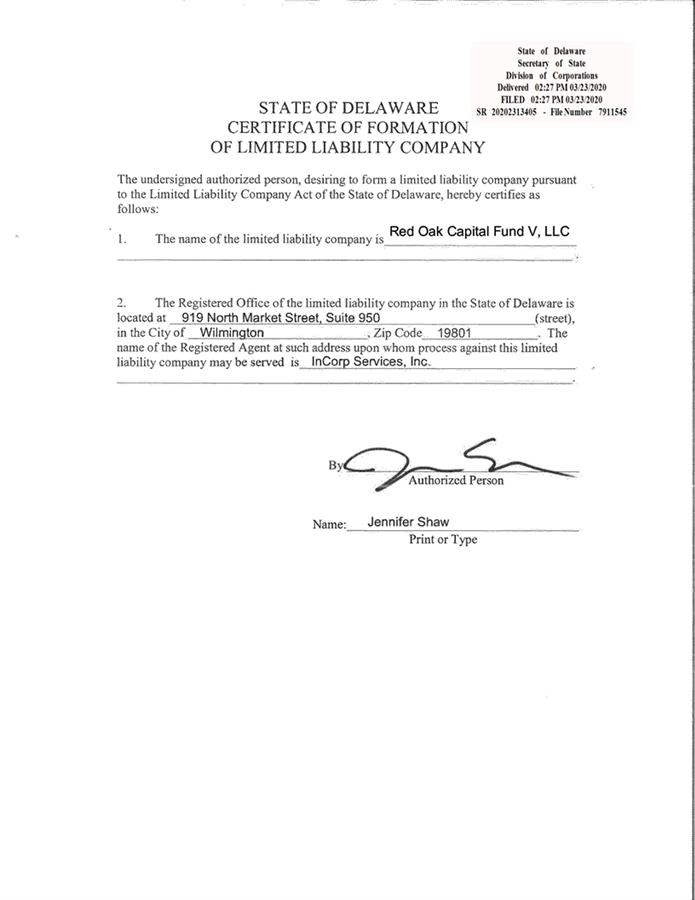
Our Company. Red Oak Capital Fund V, LLC, a Delaware limited
liability company was formed on March 23, 2020 to
originate senior loans collateralized
by commercial real estate in the U.S. Our business plan is to
originate, acquire and manage commercial real estate loans and
securities and other commercial real estate-related debt
instruments. While the commercial real estate debt markets are
complex and continually evolving, we believe they offer compelling
opportunities when approached with the capabilities and expertise
of our Manager, an affiliate of our Sponsor. Our
Manager intends to actively
participate in the servicing and operational oversight of our
assets rather than subrogate those responsibilities to a third
party.
Our investment objective is to preserve and
protect our capital while producing attractive risk-adjusted
returns generated from current income on our
portfolio. Our
investment strategy is to originate loans and invest in debt and
related instruments supported by commercial real estate in the U.S.
Through our Manager, we draw on our Sponsor’s established
sourcing, underwriting and structuring capabilities in order to
execute our investment strategy.
The
Company does not intend to act as a land or real estate developer
and currently has no intent to invest in, acquire, own, hold,
lease, operate, manage, maintain, redevelop, sell or otherwise use
any undeveloped real property or developed real property, unless
such actions are necessary or prudent based upon borrower default
in accordance with the terms of the debt instruments held by the
Company.
Our principal executive offices are located at 625
Kenmoor Avenue SE, Suite 211, Grand Rapids, Michigan 49546, and our
telephone number is (616) 734-6099. For more information on our
Sponsor, its website is www.redoakcapitalgroup.com.
The information on, or otherwise accessible through, our
Sponsor’s website does not constitute a part of this offering
circular.
Our Sponsor and Management. Our Sponsor is a Grand Rapids, Michigan based
commercial real estate finance company specializing in the
acquisition, processing, underwriting, operational management and
servicing of commercial real estate debt instruments. Its senior
management includes partners who retain licenses in mortgage
lending, real estate brokerage and the securities industry.
Combined, this incorporates over 50 years of experience in
commercial loan originations, lending and analyses, regulatory
compliance and real estate portfolio management. Our Sponsor has
significant experience in the marketing and origination of project
transactions in which to properly and efficiently evaluate suitable
investments for our Company.
The Offering. We are offering to
investors the opportunity to purchase up to an aggregate of
$50,000,000 of A Bonds and A R-Bonds. See “Plan of Distribution - Who
May Invest” for further information. The offering will
continue through December 31, 2021 or the date upon which our
Manager terminates the offering, in its sole discretion, or the
“offering termination.” Notwithstanding the
previous sentence, our Manager has the right to extend this
offering beyond December 31, 2021 for two consecutive six-month
periods. Our company will conduct closings in this
offering on the 20th of each month or, if the 20th is not a
business day, the next succeeding business day, assuming there are
funds to close, or the “closing dates,” and each, a
“closing date,” until the offering termination.
Once a subscription has been submitted
and accepted by the Company, an investor will not have the right to
request the return of its subscription payment prior to the next
closing date. If subscriptions are received on a closing date and
accepted by the Company prior to such closing, any such
subscriptions will be closed on that closing date. If subscriptions
are received on a closing date but not accepted by the Company
prior to such closing, any such subscriptions will be closed on the
next closing date. It is expected that settlement will occur on the
same day as each closing date. On each closing date,
offering proceeds for that closing will be disbursed to us and
Bonds will be issued to investors, or the
“Bondholders.” If the Company is dissolved or
liquidated after the acceptance of a subscription, the respective
subscription payment will be returned to the subscriber. The
offering is being made on a best-efforts basis through Crescent
Securities Group, Inc., or our managing broker-dealer.
5
|
Issuer
|
|
Red Oak
Capital Fund V, LLC, a Delaware limited liability
company.
|
|
|
|
|
|
Securities Offered
|
|
Maximum
– $50,000,000, aggregate principal amount of the
Bonds.
|
|
|
|
|
|
|
|
|
|
Maturity Date
|
|
A Bonds
and A R-Bonds – December 31, 2026
Upon maturity, and subject to the terms and conditions described in
this offering circular, the Bonds will be automatically renewed at
the same interest rate for an
additional five years, unless redeemed upon maturity at our or your
election. If the Bonds are not renewed and without the consent of
the Bondholders, we may elect to extend the maturity date of the
Bonds for an additional six months to facilitate the redemption of
the Bonds. See “Description
of Bonds – Maturity and Renewal” for more information.
|
|
|
|
|
|
Interest Rate
|
|
A Bonds
– 7.50% per annum computed on the basis of a 360-day
year.
A
R-Bonds – 8.00% per annum computed on the basis of a 360-day
year.
|
|
|
|
|
|
Interest Payments
|
|
Paid to
the record holders of the Bonds quarterly in arrears, each January
25th, April 25th, July 25th and October 25th, for the preceding
fiscal quarter ending March 31st, June 30th, September 30th and
December 31st, respectively, beginning on such payment date
immediately following the first full fiscal quarter after the
initial closing in the offering and continuing until the Maturity
Date. Interest will accrue and be paid on the basis of a 360-day
year consisting of twelve 30-day months. Interest on each Bond will
accrue and be cumulative from the end of the most recent interest
period for which interest has been paid on such Bond, or if no
interest has paid, from the date of issuance.
|
|
Contingent Interest Payment
|
|
Upon
maturity or renewal, we will make a payment to the Bondholders as
described herein, or the Contingent Interest Payment. The
Contingent Interest Payment will be equal to the Spread times
20.0%.
“Spread”
for a Bond shall equal the greater of (i) zero or (ii) such
Bond’s Allocable Share of Revenue less such Bond’s
Allocable Share of Expenses, each calculated for the period
beginning with the date of issuance or the last Contingent Interest
Payment for such Bond, whichever is more recent.
“Allocable
Share of Revenue” for each Bond shall equal the total revenue
from investments divided by the total number of outstanding
Bonds.
“Allocable
Share of Expenses” for each Bond shall equal Series Specific
Expenses plus Expenses.
“Series
Specific Expenses” shall be equal to offering expenses, asset
management fees and interest expenses specific to A Bonds or A
R-Bonds, as applicable, divided by the total number of outstanding
A Bonds or A R-Bonds, respectively.
“Expenses”
shall be equal to offering expenses and disposition fees allocable
to all Bonds divided by the total number of outstanding
Bonds.
While
we intend to pay Bondholders the Contingent Interest Payment, there
is no guaranty that we will do so. As the Contingent Interest
Payment is determined by multiplying the Spread by a percentage,
the Spread must be positive for the Contingent Interest Payment to
be paid. The Contingent Interest Payment is dependent on revenue
from our investments exceeding the expenses deducted to calculate
the Spread. If the expenses exceed the revenue from our
investments, the Bondholder will not receive a Contingent Interest
Payment.
|
6
|
Offering Price
|
|
$1,000
per Bond.
|
|
Ranking
|
|
The
Bonds will be senior secured obligations and will
rank:
● pari
passu in right of payment with all our other senior secured
indebtedness from time to time outstanding;
● senior
in right of payment to our future indebtedness, if any, from time
to time outstanding that is expressly subordinated to the
Bonds;
● senior
to all of our unsecured indebtedness to the extent of the value of
the Bonds’ security interest in the collateral owned by us;
and
● structurally
junior to all the indebtedness of our
subsidiaries.
|
|
|
|
|
|
Security
|
|
The
Bonds will be secured by a senior blanket lien on all assets of our
Company, including all of our assets acquired with proceeds from
the offering.
|
|
|
|
|
|
Use of Proceeds
|
|
We estimate that the net proceeds we will receive from this
offering, without taking into account any sales of A R-Bonds, will
be between approximately $44,650,000 and $46,550,000 if we sell the
maximum offering amount, after deducting selling commissions and
fees payable to our managing broker-dealer and selling group
members, and payment of the O&O Fee to our Manager. As sales of
A R-Bonds are without selling commissions, the net proceeds from
the offering will depend upon the sales mix of the
Bonds.
We plan to use substantially all of the net proceeds from this
offering to originate and make commercial mortgage loans and
acquire other senior secured real estate debt investments
consistent with our investment strategies. We may also use a
portion of the net proceeds to pay fees to our Manager or its
affiliates, for working capital and for other general corporate
purposes. See “Use of
Proceeds” for additional
information.
|
|
|
|
|
|
Certain Covenants
|
|
The
indenture will limit the indebtedness incurred by us, directly or
indirectly (including debt of our subsidiaries), to 25% of the
outstanding principal of any loans or other assets owned, directly
or indirectly, by us. For purposes of complying with the 25%
limitation described above, the following will not be considered
indebtedness: (i) any principal owed on the Bonds, and (ii) any
financing secured by a first mortgage lien on any real estate we
acquire.
|
|
|
|
|
|
Change of Control - Offer to Purchase
|
|
If a
Change of Control Repurchase Event as defined under
“Description of Bonds -
Certain Covenants” in this offering circular, occurs,
we must offer to repurchase the Bonds at a price that is equal to
all accrued and unpaid interest, to but not including the date on
which the Bonds are redeemed, plus any Contingent Interest Payment
due to such Bondholder, plus (i) 1.02 times the then outstanding
principal amount of the Bonds if such Bonds are at least four years
from maturity; (ii) 1.015 times the then outstanding principal
amount of the Bonds if such Bonds are at least three years, but no
more than four years, from maturity; (iii) 1.01 times the then
outstanding principal amount of the Bonds if such Bonds are at
least two years, but no more than three years, from maturity; and
(iv) the then outstanding principal amount of the Bonds if no more
than two years from maturity.
|
7
|
|
|
Upon
receipt of redemption request in the event of death, total
permanent disability or bankruptcy of a Bondholder, we will
designate a date for the redemption of such Bonds, which date shall
not be later than after 120 days we receive facts or certifications
establishing to the reasonable satisfaction of the Company
supporting the right to be redeemed. On the designated date, we
will redeem such Bonds at a price per
Bond that is equal to all accrued and unpaid interest, to but not
including the date on which the Bonds are redeemed, plus any
Contingent Interest Payment due to such Bondholder, plus the then outstanding principal amount of such
Bond.
|
|
|
|
|
|
Optional Redemption
|
|
The
Bonds may be redeemed at our option at no penalty within 18 months
of maturity. We may extend maturity on the Bonds for six months in
order to facilitate redemption of the Bonds in our sole discretion.
If the Bonds are renewed for an additional term, we may redeem the
Bonds at any time during such renewal period. Any redemption will
occur at a price equal to the then outstanding principal amount of
the Bonds, plus any Contingent Interest Payment due to such
Bondholder, plus any accrued but unpaid interest. For the specific
terms of the Optional Redemption, please see “Description of Bonds
– Optional Redemption” for more
information.
|
|
|
|
|
|
Default
|
|
The
indenture governing the Bonds will contain events of default, the
occurrence of which may result in the acceleration of our
obligations under the Bonds in certain circumstances. Events of
default, other than payment defaults, will be subject to our
company's right to cure within a certain number of days of such
event of default. Our company will have the right to cure any
payment default within 60 days before the trustee may declare a
default and exercise the remedies under the indenture. See
“Description of Bonds -
Event of Default” for more information.
|
|
Form
|
|
The
Bonds will be evidenced by global bond certificates deposited with
a nominee holder or directly on the books and records of UMB Bank,
N.A., or UMB Bank. It is anticipated that the nominee holder will
be the Depository Trust Company, or DTC, or its nominee, Cede &
Co., for those purchasers purchasing through a DTC participant
subsequent to the Bonds gaining DTC eligibility. See "Description of Bonds -
Book-Entry, Delivery and Form" for more
information.
|
|
|
|
|
|
Bond Service Reserve
|
|
Our
company will be required to keep 3.75% of gross offering proceeds
in a reserve account with the trustee for a period of one (1) year
following the first closing date, which reserve may be used to pay
our company's Bond Service Obligations, as defined
herein, during such time, and the remainder of which, if any,
will be released to our company on the first anniversary of the
first closing date if our company is otherwise in compliance with
all terms of the Bonds.
|
|
|
|
|
|
Denominations
|
|
We will
issue the Bonds only in denominations of $1,000.
|
8
|
|
|
|
|
Payment of Principal and Interest
|
|
Principal
and interest on the Bonds will be payable in U.S. dollars or other
legal tender, coin or currency of the U.S.
|
|
|
|
|
|
Future Issuances
|
|
We may,
from time to time, without notice to or consent of the Bondholders,
increase the aggregate principal amount of any series of the Bonds
outstanding by issuing additional bonds in the future with the same
terms of such series of Bonds, except for the issue date and
offering price, and such additional bonds shall be consolidated
with the applicable series of Bonds and form a single
series.
|
|
|
|
|
|
Securities Laws Matters:
|
|
The
Bonds being offered are not being registered under the Securities
Act in reliance upon exemptions from the registration requirements
of the Securities Act and such state securities laws and may not be
transferred or resold except as permitted under the Securities Act
and applicable state securities laws pursuant to registration or
exemption therefrom. In addition, the Company does not intend to be
registered as an investment company under the Investment Company
Act of 1940 nor does the Manager plan to register as an investment
adviser under the Investment Advisers Act of 1940, as
amended.
|
|
|
|
|
|
Trustee, Registrar and Paying Agent
|
|
We have
designated UMB Bank as paying agent and registrar for the Bonds.
UMB Bank will act also as trustee under the indenture. The Bonds
will be issued in book-entry form only, evidenced by global
certificates for these Bonds held through DTC and on the books and
records of UMB Bank for those Bonds which are direct registered. As
such, UMB Bank will make payments to DTC, its nominee or directly
to Bondholders, as the case may be.
|
|
|
|
|
|
Governing Law
|
|
The
indenture and the Bonds will be governed by the laws of the State
of Delaware.
|
|
|
|
|
|
Material Tax Considerations
|
|
You
should consult your tax advisors concerning the U.S. federal income
tax consequences of owning the Bonds in light of your own specific
situation, as well as consequences arising under the laws of any
other taxing jurisdiction.
|
|
|
|
|
|
Risk Factors
|
|
An investment in the Bonds involves certain risks. You should
carefully consider the risks above, as well as the other risks
described under “Risk
Factors” beginning
on page 8 of this offering circular before making an
investment decision.
|
[Remainder of page intentionally left blank]
9
CAUTIONARY STATEMENT REGARDING FORWARD-LOOKING
STATEMENTS
This
offering circular contains certain forward-looking statements that
are subject to various risks and uncertainties. Forward-looking
statements are generally identifiable by use of forward-looking
terminology such as "may," "will," "should," "potential," "intend,"
"expect," "outlook," "seek," "anticipate," "estimate,"
"approximately," "believe," "could," "project," "predict," or other
similar words or expressions. Forward-looking statements are based
on certain assumptions, discuss future expectations, describe
future plans and strategies, contain financial and operating
projections or state other forward-looking information. Our ability
to predict results or the actual effect of future events, actions,
plans or strategies is inherently uncertain. Although we believe
that the expectations reflected in our forward-looking statements
are based on reasonable assumptions, our actual results and
performance could differ materially from those set forth or
anticipated in our forward-looking statements. Factors that could
have a material adverse effect on our forward-looking statements
and upon our business, results of operations, financial condition,
funds derived from operations, cash flows, liquidity and prospects
include, but are not limited to, the factors referenced in this
offering circular, including those set forth below.
When
considering forward-looking statements, you should keep in mind the
risk factors and other cautionary statements in this offering
circular. Readers are cautioned not to place undue reliance on any
of these forward-looking statements, which reflect our views as of
the date of this offering circular. The matters summarized below
and elsewhere in this offering circular could cause our actual
results and performance to differ materially from those set forth
or anticipated in forward-looking statements. Accordingly, we
cannot guarantee future results or performance. Furthermore, except
as required by law, we are under no duty to, and we do not intend
to, update any of our forward-looking statements after the date of
this offering circular, whether as a result of new information,
future events or otherwise.
10
RISK FACTORS
An investment in the Bonds is highly speculative and is suitable
only for persons or entities that are able to evaluate the risks of
the investment. An investment in the Bonds should be made only by
persons or entities able to bear the risk of and to withstand the
total loss of their investment. Prospective investors should
consider the following risks before making a decision to purchase
the Bonds. To the best of our knowledge, we have included all
material risks to investors in this section.
Risks Related to the Bonds and to this Offering
The collateral securing the Bonds may be diluted under certain
circumstances.
The indenture governing the Bonds permits us to
incur, subject to certain limitations, additional indebtedness
secured by liens on the collateral that
rank pari passu with the liens securing the Bonds, including
additional Bonds under the indenture. The rights of Bondholders
would be diluted by any increase in indebtedness secured by the
collateral.
The Bonds are not obligations of our subsidiaries and will be
effectively subordinated to any future obligations of our company's
subsidiaries, if any. Structural subordination increases the risk
that we will be unable to meet our obligations on the
Bonds.
The
Bonds are our obligations exclusively and not of any of our
subsidiaries. We do not currently have any subsidiaries, but we are
not precluded from acquiring or forming subsidiaries by the
indenture or otherwise. If acquired or formed, our company's
subsidiaries are not expected to be guarantors of the Bonds and the
Bonds are not required to be guaranteed by any subsidiaries our
company may acquire or form in the future. The Bonds are also
effectively subordinated to all of the liabilities of our company's
subsidiaries, to the extent of their assets, since they are
separate and distinct legal entities with no obligation to pay any
amounts due under our company's indebtedness, including the Bonds,
or to make any funds available to make payments on the Bonds. Our
company's right to receive any assets of any subsidiary in the
event of a bankruptcy or liquidation of the subsidiary, and
therefore the right of our company's creditors to participate in
those assets, will be effectively subordinated to the claims of
that subsidiary's creditors, including trade creditors, in each
case to the extent that our company is not recognized as a creditor
of such subsidiary. In addition, even where our company is
recognized as a creditor of a subsidiary, our company's rights as a
creditor with respect to certain amounts are subordinated to other
indebtedness of that subsidiary, including secured indebtedness to
the extent of the assets securing such indebtedness.
The Bonds will limit but do not eliminate our company's or its
subsidiaries' ability to incur additional debt or take other action
that could negatively impact Bondholders.
The
indenture contains limited provisions that would directly limit our
company's ability or the ability of its subsidiaries to incur
indebtedness, including indebtedness that would be senior to the
Bonds. The indenture will limit the indebtedness incurred by us,
directly or indirectly (including debt of our subsidiaries), to 25%
of the outstanding principal of any loans or other assets owned,
directly or indirectly, by us. For purposes of complying with the
25% limitation described above, the following will not be
considered indebtedness: (i) any principal owed on the Bonds, and
(ii) any financing secured by a first mortgage lien on any real
estate acquired by us or any of our subsidiaries.
The Bonds will be protected by limited restrictive covenants, which
in turn may allow us to engage in a variety of transactions that
may impair our ability to fulfill our obligations under the
Bonds.
The indenture governing the Bonds will contain
limited financial covenants and will not restrict us from paying
dividends, incurring debt, directly or indirectly (including debt
of our subsidiaries), of up to 25% of any loans or other assets
owned by us, directly or indirectly, or issuing other securities.
Because the indenture will contain limited covenants or other
provisions designed to afford the Bondholders protection in the
event of a highly leveraged transaction involving us including as a
result of a takeover, recapitalization, highly leveraged
transaction or similar restructuring involving us, except to the
extent described under “Description
of Bonds – Certain Covenants,” we may engage in transactions that may
impair our ability to fulfill our obligations under the
Bonds.
11
Some significant restructuring transactions that may adversely
affect you may not constitute a “Change of Control/Repurchase
Event” under the indenture, in which case we would not be
obligated to offer to repurchase the Bonds.
Upon the occurrence of a “Change of
Control/Repurchase Event” (as defined under
“Description
of Bonds – Certain Covenants”), you will have the right, at your option,
to require us to repurchase your Bonds for cash. However, the
definition of Change of Control/Repurchase Event contained in the
indenture will be limited to certain transactions. As a result, the
Change of Control/Repurchase Event provision of the indenture will
not afford protection to Bondholders in the event of other
transactions that could adversely affect the Bonds. In the event of
any such transaction, Bondholders would not have the right to
require us to repurchase their Bonds, even though such a
transaction could increase the amount of our indebtedness, or
otherwise adversely affect the Bondholders.
It may be difficult to realize the value of the collateral securing
the Bonds.
The value of the collateral at any time will
depend on market and other economic conditions, including the
availability of suitable buyers. By their nature, some or all of
the pledged assets may be illiquid and may have no readily
ascertainable market value. We cannot assure you that the fair
market value of the collateral as of the date of this document
exceeds the principal amount of the Bonds. The value of the assets
pledged as collateral could be impaired in the future as a result
of changing economic conditions, our failure to implement our
business strategy, competition, unforeseen liabilities and other
future events. Accordingly, there may not be sufficient collateral
to pay all or any of the amounts due on the Bonds. Any claim for
the amount, if any, realized by Bondholders from the sale of the
collateral and the obligations under the Bonds will rank
pari passu
in right of payment with all of our
other senior secured indebtedness. Additionally, in the event that
a bankruptcy case is commenced by or against us, if the value of
the collateral is less than the amount of principal and accrued and
unpaid interest on the Bonds and all other senior secured
obligations, interest may cease to accrue on the Bonds from and
after the date the bankruptcy petition is
filed.
The
security interest of the trustee will be subject to practical
problems generally associated with the realization of security
interests in collateral. For example, the trustee may need to
obtain the consent of a third party to obtain access to collateral
or enforce a security interest in a contract. We cannot assure you
that the trustee will be able to obtain any such consent. We also
cannot assure you that the consents of any third parties will be
given when required to facilitate a foreclosure on such assets.
Accordingly, the trustee may not have the ability to foreclose upon
those assets and the value of the collateral may significantly
decrease.
Our investment objectives may become more difficult to reach
depending on the amount of funds raised in this
offering.
While
we believe we will be able to reach our investment objectives
regardless of the amount of the raise, it may be more difficult to
do so if we sell less Bonds than we anticipate. Such a result may
negatively impact our liquidity. In that event, our investment
costs may increase, which may decrease our ability to make payments
to Bondholders.
Our trustee shall be under no obligation to exercise any of the
rights or powers vested in it by the indenture at the request,
order or direction of any of the Bondholders, pursuant to the
provisions of the indenture, unless such Bondholders shall have
offered to the trustee reasonable security or indemnity against the
costs, expenses and liabilities that may be incurred therein or
thereby.
The
indenture governing the Bonds provides that in case an event of
default occurs and not be cured, the trustee will be required, in
the exercise of its power, to use the degree of care of a
reasonable person in the conduct of his own affairs. Subject to
such provisions, the trustee will be under no obligation to
exercise any of its rights or powers under the indenture at the
request of any Bondholder, unless the Bondholder has offered to the
trustee security and indemnity satisfactory to it against any loss,
liability or expense.
12
The Bonds will have limited transferability and
liquidity.
Prior
to this offering, there was no active market for the Bonds.
Although we may apply for quotation of the Bonds on an
alternative trading system or over the counter market, even if we
obtain that quotation, we do not know the extent to which investor
interest will lead to the development and maintenance of a liquid
trading market. Further, the Bonds will not be quoted on an
alternative trading system or over the counter market until
after the termination of this offering, if at all. Therefore,
investors will be required to wait until at least after the final
termination date of this offering for such quotation. The initial
public offering price for the Bonds has been determined by us. You
may not be able to sell the Bonds you purchase at or above the
initial offering price.
Alternative trading
systems and over the counter markets, as with other public
markets, may from time to time experience significant price
and volume fluctuations. As a result, the market price of the Bonds
may be similarly volatile, and Bondholders may from time to time
experience a decrease in the value of their Bonds, including
decreases unrelated to our operating performance or prospects. The
price of the Bonds could be subject to wide fluctuations in
response to a number of factors, including those listed in this
"Risk
Factors" section of this offering circular.
No
assurance can be given that the market price of the Bonds will not
fluctuate or decline significantly in the future or that
Bondholders will be able to sell their Bonds when desired on
favorable terms, or at all. Further, the sale of the Bonds may have
adverse federal income tax consequences.
Our lack of operating history makes it difficult for you to
evaluate this investment.
We are
a recently formed entity with no operating history and may not be
able to successfully operate our business or achieve our investment
objectives. We may not be able to conduct our business as described
in our plan of operation.
You will not have the opportunity to evaluate our investments
before we make them, and we may make investments that would have
changed your decision as to whether to invest in the
Bonds.
As of
the date of this offering circular, we own no assets. We are not
able to provide you with information to evaluate our future
investments. We will seek to invest substantially all of the
offering proceeds available for investment, after the payment of
commissions, fees and expenses, in the origination of loans and investing in debt and
related instruments supported by commercial real estate in the
U.S. We have established criteria for evaluating potential
investments. However, you will be unable to evaluate the
transaction terms or data concerning the investments before we make
investments. You will be relying entirely on the ability of our
Manager, through our Sponsor and its management team, to identify
suitable investments and propose transactions for our Manager to
oversee and approve. These factors increase the risk that we may
not generate the returns that you seek by investing in the
Bonds.
The inability to retain or obtain key personnel could delay or
hinder implementation of our investment strategies, which could
impair our ability to honor our obligations under the terms of
Bonds and could reduce the value of your investment.
Our
success depends to a significant degree upon the contributions of
our Sponsor's management team. We do not have employment agreements
with any of these individuals nor do we currently have key man life
insurance on any of these individuals. If any of them were to cease
their affiliation with us, our Manager or our Sponsor, our Sponsor
may be unable to find suitable replacements, and our operating
results could suffer. Competition for highly skilled personnel is
intense, and our Sponsor may be unsuccessful in attracting and
retaining such skilled personnel. If our Sponsor loses or is unable
to obtain the services of highly skilled personnel, our ability to
implement our investment strategies could be delayed or hindered,
and our ability to pay obligations on the Bonds may be materially
and adversely affected.
13
We rely on Crescent Securities Group, Inc., our managing
broker-dealer, to sell the Bonds pursuant to this offering. If our
managing broker-dealer is not able to market the Bonds effectively,
we may be unable to raise sufficient proceeds to meet our business
objectives.
We have
engaged Crescent Securities Group, Inc., to act as our managing
broker-dealer for this offering, and we rely on our managing
broker-dealer to use its best efforts to sell the Bonds offered
hereby. It would also be challenging and disruptive to locate an
alternative managing broker-dealer for this offering. Without
improved capital raising, our portfolio will be smaller relative to
our general and administrative costs and less diversified than it
otherwise would be, which could adversely affect the value of your
investment in us.
Under certain circumstances, we may redeem the Bonds before
maturity, and you may be unable to reinvest the proceeds at the
same or a higher rate of return.
Under
certain circumstances, we may redeem all or a portion of the Bonds.
See “Description of Bonds -
Optional Redemption” for more information. If
redeemed, you may be unable to reinvest the money you receive in
the redemption at a rate that is equal to or higher than the rate
of return on the Bonds.
There is no guarantee that a Bondholder will receive a Contingent
Interest Payment.
As the
Contingent Interest Payment is determined by multiplying the Spread
by a percentage, the Spread must be positive for the Contingent
Interest Payment to be paid. As the Spread is contingent upon the
revenue of our investments, the Contingent Interest Payment is
dependent on our investments providing revenue in excess of the
expenses deducted to calculate the Spread. If it is not, the
Bondholder will not receive a Contingent Interest
Payment.
We may have to liquidate some of our investments at inopportune
times to redeem Bonds in the event of the death, disability or
bankruptcy of a Bondholder and redeem Bonds pursuant to the
Bondholder Redemption.
The
Bonds carry an early redemption right, or the Bondholder
Redemption, and a redemption right in the event of death,
disability or bankruptcy of the Bondholder. As a result, one or
more Bondholders may elect to have their Bonds redeemed prior to
maturity. In such an event, we may not have access to the necessary
cash to redeem such Bonds, and we may be required to liquidate
certain assets in order to make such redemptions. Our investments
are not intended to liquid, and as a result any such liquidation
may be at a price that represent a discount to the actual value of
such investment.
Risks
Related to Our Corporate Structure
Because we are dependent upon our Sponsor and its affiliates to
conduct our operations, any adverse changes in the financial health
of our Sponsor or its affiliates or our relationship with them
could hinder our operating performance and our ability to meet our
financial obligations.
We are
dependent on our Sponsor, as the majority owner of our Manager, and
its affiliates to manage our operations and acquire and manage our
portfolio of real estate assets. Our Manager, a majority owned and
controlled subsidiary of our Sponsor, makes all decisions with
respect to our management. Our Manager and our Sponsor depend upon
the fees and other compensation that it receives from us in
connection with the purchase, management and sale of our properties
to conduct its operations. Any adverse changes in the financial
condition of our Manager or our Sponsor or our relationship with
our Manager or our Sponsor could hinder its ability to successfully
manage our operations and our portfolio of
investments.
You will have no control over changes in our policies and
day-to-day operations, which lack of control increases the
uncertainty and risks you face as an investor in the Bonds. In
addition, our Sponsor, through our Manager, may change our major
operational policies without your approval.
Our
Sponsor, as the majority owner of our Manager, determines our major
policies, including our policies regarding financing, growth, debt
capitalization, and distributions. Our Sponsor, as the majority
owner of our Manager, may amend or revise these and other policies
without your approval. As a Bondholder, you will have no rights
under the limited liability company agreement of our company, or
our “operating agreement.” See “General Information as to
Our Company – Operating Agreement” herein for a
detailed summary of our operating agreement.
14
Our
Sponsor, as the majority owner of our Manager, is responsible for
the day-to-day operations of our company and the selection and
management of investments and has broad discretion over the use of
proceeds from this offering. Accordingly, you should not purchase
Bonds unless you are willing to entrust all aspects of the
day-to-day management and the selection and management of
investments to our Sponsor. Specifically, our Sponsor is controlled
by Chip Cummings, Joseph Elias and Kevin Kennedy, and as a result,
they will be able to exert significant control over our
operations. Our Sponsor has a board of managers comprised of
Chip Cummings, Joseph Elias and Kevin Kennedy. Our board of
managers has exclusive control over the operations of our Sponsor,
our Manager and us. As a result, we are dependent on our board of
managers to properly choose investments and manage our company. Our
Manager has appointed an Investment Committee composed of three
members who are nominated, appointed and removed by the Manager,
and all loan origination decisions require the unanimous approval
of the Investment Committee members. The Investment
Committee’s members are Chip Cummings, Joe Elias, and Jason
Anderson. You will have no control over the Investment Committee
and the Manager may choose to alter the composition of, or
eliminate, the Investment Committee in its sole discretion. In
addition, our Sponsor may, or may cause our Manager to, retain
independent contractors to provide various services for us, and you
should note that such contractors will have no fiduciary duty to
you and may not perform as expected or desired.
Bondholders will have no right to remove our Manager or otherwise
change our management, even if we are underperforming and not
attaining our investment objectives.
Only
the members of our company will have the right to remove our
Manager, and currently our Manager is our sole member. Bondholders
will have no rights in our management and will have no ability to
remove our Manager.
Our Manager and its executive officers will have limited
liability for, and will be indemnified and held harmless from, the
losses of our company.
Our
Manager, our Sponsor and its executive officers and their agents
and assigns, will not be liable for, and will be indemnified and
held harmless (to the extent of our company's assets) from
any loss or damage incurred by them, our company or the
members in connection with the business of our company resulting
from any act or omission performed or omitted in good faith, which
does not constitute fraud, willful misconduct, gross negligence or
breach of fiduciary duty. A successful claim for such
indemnification could deplete our company's assets by the amount
paid. See
“General
Information as to Our Company - Operating Agreement -
Indemnification” below for a detailed summary of the
terms of our operating agreement. Our operating agreement is filed
as an exhibit this offering circular.
Risks Related to Conflicts of Interest
Our Manager and our Sponsor, its executive officers and its
affiliates face conflicts of interest relating to the purchase of
assets, and such conflicts may not be resolved in our favor, which
could limit our investment opportunities, impair our ability to
make distributions and reduce the value of your
investment.
We rely
on our Sponsor, its executive officers and its affiliates to
identify suitable investment opportunities. We may be acquiring
assets at the same time as other entities that are affiliated with
our Sponsor. Such programs also rely on our Sponsor, its executive
officers and its affiliates for investment opportunities. Our
Sponsor has sponsored similar privately offered programs and may in
the future, or concurrently, sponsor similar private and public
programs that have investment objectives similar to ours.
Therefore, our Sponsor, its executive officers and its affiliates
could be subject to conflicts of interest between our company and
other programs. Many investment opportunities would be suitable for
us as well as other programs. Our Sponsor could direct attractive
investment opportunities to other entities. Although we are subject
to the Sponsor’s allocation policy, which is described
further below and which specifically addresses some of these
conflicts, there is no assurance that this policy will be adequate
to address all of the conflicts that may arise or will address such
conflicts in a manner that results in the allocation of a
particular investment opportunity to us or is otherwise favorable
to us. Such events could result in our investing in assets that
provide less attractive returns, impairing our ability to honor our
obligations under the terms of the Bonds and the value of your
investment. See "Investment Allocation
Policy" section for more information.
15
Payment of fees to our Manager will reduce cash available for
investment and fulfillment of our obligations with respect to the
Bonds.
Our
Manager performs services for us in connection with the selection,
acquisition and disposition of our investments. It is paid fees for
these services, which reduces the amount of cash available for
investment and for payment of our obligations with respect to the
Bonds. Although customary in the industry, the fees to be paid to
our Manager were not determined in an arm's-length negotiation. We
cannot assure you that a third party unaffiliated with our Sponsor
would not be willing to provide such services to us at a lower
price. If the maximum offering amount is raised and used to acquire
assets, we estimate that we will pay our Manager approximately
$875,000 annually in asset management fees, or 1.75% of the
outstanding principal amount of the all of the Bonds. The Manager
will also receive 1.00% of the proceeds received from the repayment
of the principal amount of any of our debt investments or any other
disposition of the underlying real estate. In addition to this, our
Manager will receive the O&O Fee of 2.00% of offering proceeds
($1,000,000 at the maximum offering amount), from which the Manager
will pay organizational and offering expenses. In no event will the
O&O Fee payable to our Manager exceed 2.00% of the offering
proceeds. See “Compensation of our Manager
and its Affiliates” for more information.
Our Manager will receive certain fees regardless of the performance
of our company or an investment in the Bonds.
Our
Manager will receive an annual asset management fee of 1.75% of the
outstanding principal amount of the Bonds and disposition fee equal
to 1.00% of the proceeds received from the repayment of the
principal amount of any of our debt investments or any other
disposition of the underlying real estate. These fees will be paid
regardless of our success and the performance of the
Bonds.
Our Sponsor may, or may cause, our Manager to, increase the fees
payable to it and/or its affiliates with the consent of a majority
of the Bonds.
Our
Sponsor will have the power to contractually bind our Manager and
us. As a result, our Sponsor may agree to increase the fees payable
to it and/or its affiliates with the affirmative consent of a
majority of the Bonds, so fees may be increased without the consent
of any particular Bondholder.
Our Sponsor and its affiliates, including its officers, face
conflicts of interest caused by compensation arrangements with us
and other programs sponsored by our Sponsor or its affiliates,
which could result in actions that are not in the long term best
interests of our Bondholders.
Our
Sponsor or its affiliates receive fees from us. These fees could
influence our Manager’s, being majority owned and controlled
by our Sponsor, advice to us, as well as the judgment of the
affiliates of our Sponsor who serve as our officers. Among other
matters, the compensation arrangements could affect their judgment
with respect to property acquisitions from, or the making of
investments in, other programs sponsored by our Sponsor, which
might entitle affiliates of our Sponsor to fees in connection with
its services for the seller. See “Compensation of our Manager
and its Affiliates” for more information.
Considerations
relating to their compensation from other programs could result in
decisions that are not in the best interests of our Bondholders,
which could hurt our ability to perform our obligations related to
the Bonds or result in a decline in the value of your
investment.
If the competing demands for the time of our Manager and our
Sponsor, its affiliates and its officers result in them spending
insufficient time on our business, we may miss investment
opportunities or have less efficient operations, which could reduce
our profitability and impair our ability to honor our obligations
under the Bonds.
We do
not have any employees. We rely on the employees of our Sponsor, as
the majority owner of our Manager, and its affiliates for the
day-to-day operation of our business. The amount of time that our
Sponsor and its affiliates spend on our business will vary from
time to time and is expected to be greater while we are raising
money and acquiring properties. Our Sponsor and its affiliates,
including its officers, have interests in other programs and engage
in other business activities. As a result, they will have conflicts
of interest in allocating their time between us and other programs
and activities in which they are involved. Because these persons
have competing interests on their time and resources, they may have
conflicts of interest in allocating their time between our business
and these other activities. During times of intense activity in
other programs and ventures, they may devote less time and fewer
resources to our business than are necessary or appropriate to
manage our business. We expect that as our activities expand, our
Sponsor will attempt to hire additional employees who would devote
substantially all of their time to our business. There is no
assurance that our Sponsor or our Manager will devote adequate time
to our business. If our Sponsor suffers or is distracted by adverse
financial or operational problems in connection with its operations
unrelated to us, it may allocate less time and resources to our
operations. If any of these things occur, our ability to honor
obligations under the Bonds may be adversely affected.
16
Our Sponsor will source all of our investments, and existing or
future entities or programs sponsored and managed by our Sponsor
may compete with us for, or may participate in, some of those
investments, which could result in conflicts of
interest.
Although we are
subject to the Sponsor’s allocation policy which specifically
addresses some of the conflicts relating to our investment
opportunities described above, there is no assurance that this
policy will be adequate to address all of the conflicts that may
arise or will address such conflicts in a manner that results in
the allocation of a particular investment opportunity to us or is
otherwise favorable to us. The Sponsor’s allocation policy
provides that in the event a lending opportunity becomes available
that is suitable for multiple funds managed by the Sponsor, the
Investment Committee, after consultation with counsel, may allocate
participation in the lending opportunity to the various funds
managed by the Sponsor based on an examination of a variety of
factors. The Sponsor may determine that a lending opportunity is
appropriate for a particular account, but not for another. In
addition, the Sponsor or its employees may make investments
declined by our Sponsor for us. The investment allocation policy
may be amended by the Sponsor at any time without our consent. As
the investment programs of the various entities managed by the
Sponsor change and develop over time, additional issues and
considerations may affect the Sponsor’s allocation policy and
its expectations with respect to the allocation of lending
opportunities.
Risks Related to Our Lending and Investment Activities
Our loans and investments expose us to risks associated with
debt-oriented real estate investments generally.
We
seek to invest primarily in debt instruments relating to real
estate-related assets. As such, we are subject to, among other
things, risk of defaults by borrowers in paying debt service on
outstanding indebtedness and to other impairments of our loans and
investments. Any deterioration of real estate fundamentals
generally, and in the U.S. in particular, could negatively impact
our performance by making it more difficult for borrowers of our
mortgage loans, or borrower entities, to satisfy their debt payment
obligations, increasing the default risk applicable to borrower
entities, and/or making it more difficult for us to generate
attractive risk-adjusted returns. Changes in general economic
conditions will affect the creditworthiness of borrower entities
and/or the value of underlying real estate collateral relating to
our investments and may include economic and/or market
fluctuations, changes in environmental, zoning and other laws,
casualty or condemnation losses, regulatory limitations on rents,
decreases in property values, changes in the appeal of properties
to tenants, changes in supply and demand, fluctuations in real
estate fundamentals, the financial resources of borrower entities,
energy supply shortages, various uninsured or uninsurable risks,
natural disasters, political events, terrorism and acts of war,
changes in government regulations, changes in real property tax
rates and/or tax credits, changes in operating expenses, changes in
interest rates, changes in inflation rates, changes in the
availability of debt financing and/or mortgage funds which may
render the sale or refinancing of properties difficult or
impracticable, increased mortgage defaults, increases in borrowing
rates, negative developments in the economy and/or adverse changes
in real estate values generally and other factors that are beyond
our control.
We
cannot predict the degree to which economic conditions generally,
and the conditions for real estate debt investing in particular,
will improve or decline. Any declines in the performance of the
U.S. and global economies or in the real estate debt markets could
have a material adverse effect on our business, financial
condition, and results of operations.
17
Commercial real estate-related investments that are secured by real
property are subject to delinquency, foreclosure and loss, which
could result in losses to us.
Commercial
real estate debt instruments (e.g., mortgages) that are secured by
commercial property are subject to risks of delinquency and
foreclosure and risks of loss that are greater than similar risks
associated with loans made on the security of single-family
residential property. The ability of a borrower to repay a loan
secured by an income-producing property typically is dependent
primarily upon the successful operation of the property rather than
upon the existence of independent income or assets of the borrower.
If the net operating income of the property is reduced, the
borrower’s ability to repay the loan may be impaired. Net
operating income of an income-producing property can be affected
by, among other things:
●
tenant mix and
tenant bankruptcies;
●
success of tenant
businesses;
●
property management
decisions, including with respect to capital improvements,
particularly in older building structures;
●
property location
and condition;
●
competition from
other properties offering the same or similar
services;
●
changes in laws
that increase operating expenses or limit rents that may be
charged;
●
any need to address
environmental contamination at the property;
●
changes in global,
national, regional, or local economic conditions and/or specific
industry segments;
●
declines in global,
national, regional or local real estate values;
●
declines in global,
national, regional or local rental or occupancy rates;
●
changes in interest
rates, foreign exchange rates, and in the state of the credit and
securitization markets and debt and equity capital markets,
including diminished availability or lack of debt financing for
commercial real estate;
●
changes in real
estate tax rates, tax credits and other operating
expenses;
●
changes in
governmental rules, regulations and fiscal policies, including
income tax regulations and environmental legislation;
●
acts of God,
terrorism, social unrest and civil disturbances, which may decrease
the availability of or increase the cost of insurance or result in
uninsured losses; and
●
adverse changes in
zoning laws.
Specifically,
changes in federal, state and local laws and regulations may affect
certain income producing properties more than others. For example,
we may provide loans secured by property used in the production,
sale and/or testing of cannabis-related products. Any change to the
federal, state and local regulations applicable to this industry
may negatively affect the ability of the property owner to produce
income and materially diminish the value of the property used to
secure the loan. In addition, we are exposed to the risk of
judicial proceedings with our borrowers and entities we invest in,
including bankruptcy or other litigation, as a strategy to avoid
foreclosure or enforcement of other rights by us as a lender or
investor.
18
In
the event that any of the properties or entities underlying or
collateralizing our loans or investments experiences any of the
foregoing events or occurrences, the value of, and return on, such
investments could be reduced, which would adversely affect our
results of operations and financial condition.
The continuing spread of a new strain of coronavirus (also known as
the COVID-19 virus) may adversely affect our investments and
operations.
The
World Health Organization has declared the spread of the COVID-19
virus a global pandemic, and the President of the United States has
declared a national state of emergency in the United States in
response to the outbreak. Considerable uncertainty still surrounds
the COVID-19 virus and its potential effects, and the extent of and
effectiveness of any responses taken on a national and local level.
However, measures taken to limit the impact of this coronavirus,
including social distancing and other restrictions on travel,
congregation and business operation have already resulted in
significant negative short term economic impacts. The long-term
impact of this coronavirus on the U.S. and world economies remains
uncertain, but can result in long term infrastructure and supply
chain disruption, as well as dislocation and uncertainty in the
financial markets that could significantly and negatively impact
the global, national and regional economies, the length and breadth
of which cannot currently be predicted.Our investments include
commercial mortgage loans secured by hospitality properties which
depend, in part, on tourism. If tourism were to continue to
decline, it could have a significant effect on these properties.
Tourism could continue to decline as a result of a variety of
factors related to the COVID-19 virus, including restrictions on
travel by corporations or governmental entities. In addition,
hospitality properties that depend on revenue from conferences or
business travel will likely be particularly affected.
Our
investments also include commercial mortgage loans secured by
retail properties. In the event of a large-scale quarantine
in the United States or specific areas within the United States as
a result of the COVID-19 virus, individual stores and shopping
malls may be closed for an extended period of time or consumers may
move to more on-line shopping.
To
the extent the COVID-19 virus results in a world-wide economic
downturn, there may be widespread corporate downsizing and an
increase in unemployment. This could negatively impact our
commercial mortgage loans secured by office, multifamily and
industrial properties, and our ability to make payments of interest
and principal to our Bondholders. Further, continuing shutdowns and
economic turmoil may result in delays in the deployment of funds
raised in this offering.
Fluctuations in interest rates and credit spreads could reduce our
ability to generate income on our loans and other investments,
which could lead to a significant decrease in our results of
operations, cash flows and the market value of our
investments.
Our
primary interest rate exposures relate to the yield on our loans
and other investments and the financing cost of our debt. Changes
in interest rates and credit spreads may affect our net income from
loans and other investments, which is the difference between the
interest and related income we earn on our interest-earning
investments and the interest and related expense we incur in
financing these investments. Interest rate and credit spread
fluctuations resulting in our interest and related expense
exceeding interest and related income would result in operating
losses for us. Changes in the level of interest rates and credit
spreads also may affect our ability to make loans or investments,
the value of our loans and investments and our ability to realize
gains from the disposition of assets. Increases in interest rates
and credit spreads may also negatively affect demand for loans and
could result in higher borrower default rates.
Our
operating results depend, in part, on differences between the
income earned on our investments, net of credit losses, and our
financing costs. The yields we earn on our floating-rate assets and
our borrowing costs tend to move in the same direction in response
to changes in interest rates. However, one can rise or fall faster
than the other, causing our net interest margin to expand or
contract. In addition, we could experience reductions in the yield
on our investments and an increase in the cost of our financing.
Although we seek to match the terms of our liabilities to the
expected lives of loans that we acquire or originate, circumstances
may arise in which our liabilities are shorter in duration than our
assets, resulting in their adjusting faster in response to changes
in interest rates. For any period during which our investments are
not match-funded, the income earned on such investments may respond
more slowly to interest rate fluctuations than the cost of our
borrowings. Consequently, changes in interest rates, particularly
short-term interest rates, may immediately and significantly
decrease our results of operations and cash flows and the market
value of our investments. In addition, unless we enter into hedging
or similar transactions with respect to the portion of our assets
that we fund using our balance sheet, returns we achieve on such
assets will generally increase as interest rates for those assets
rise and decrease as interest rates for those assets
decline.
19
We operate in a competitive market for lending and investment
opportunities which may intensify, and competition may limit our
ability to originate or acquire desirable loans and investments or
dispose of assets we target and could also affect the yields of
these assets and have a material adverse effect on our business,
financial condition, and results of operations.
We
operate in a competitive market for lending and investment
opportunities, which may intensify. Our profitability depends, in
large part, on our ability to originate or acquire our target
assets on attractive terms. In originating or acquiring our target
assets, we compete for opportunities with a variety of lenders and
investors, including REITs, specialty finance companies, public and
private funds (including funds managed by affiliates of our
Sponsor), commercial and investment banks, commercial finance and
insurance companies and other financial institutions. Some
competitors may have a lower cost of funds and access to funding
sources that are not available to us, such as the U.S. Government.
Many of our competitors are not subject to the operating
constraints associated with maintaining an exclusion from
regulation under the Investment Company Act. In addition, some of
our competitors may have higher risk tolerances or different risk
assessments, which could allow them to consider a wider variety of
loans and investments, offer more attractive pricing or other terms
and establish more relationships than us. Furthermore, competition
for originations of and investments in our target assets may lead
to decreasing yields, which may further limit our ability to
generate desired returns. Also, as a result of this competition,
desirable loans and investments in our target assets may be limited
in the future and we may not be able to take advantage of
attractive lending and investment opportunities from time to time,
thereby limiting our ability to identify and originate or acquire
loans or make investments that are consistent with our investment
objectives. We cannot assure you that the competitive pressures we
face will not have a material adverse effect on our business,
financial condition and results of operations.
Prepayment
rates may adversely affect our financial performance and the value
of certain of our assets.
Our
business is currently focused on originating mortgage loans or
other debt instruments secured by commercial real estate assets.
Our borrowers may be able to repay their loans prior to their
stated maturities. In periods of declining interest rates and/or
credit spreads, prepayment rates on loans generally increase. If
general interest rates or credit spreads decline at the same time,
the proceeds of such prepayments received during such periods may
not be reinvested for some period of time or may be reinvested by
us in assets yielding less than the yields on the assets that were
prepaid.
Prepayment
rates on loans may be affected by a number of factors including,
but not limited to, the then-current level of interest rates and
credit spreads, the availability of mortgage credit, the relative
economic vitality of the area in which the related properties are
located, the servicing of the loans, possible changes in tax laws,
other opportunities for investment, and other economic, social,
geographic, demographic and legal factors beyond our control.
Consequently, such prepayment rates cannot be predicted with
certainty and no strategy can completely insulate us from
prepayment or other such risks.
Difficulty in redeploying the proceeds from repayments of our
existing loans and investments may cause our financial performance
and our ability to fulfill our obligations relative to the
Bonds.
As
our loans and investments are repaid, we will look to redeploy the
proceeds we receive into new loans and investments, repay
borrowings, pay interest on the Bonds or redeem outstanding Bonds.
It is possible that we will fail to identify reinvestment options
that would provide returns or a risk profile that is comparable to
the asset that was repaid. If we fail to redeploy the proceeds we
receive from repayment of a loan in equivalent or better
alternatives, our financial performance and our ability to fulfill
our obligations related to the Bonds will suffer.
20
If we are unable to successfully integrate new assets and manage
our growth, our results of operations and financial condition may
suffer.
We
may be unable to successfully and efficiently integrate
newly-acquired assets into our existing portfolio or otherwise
effectively manage our assets or our growth effectively. In
addition, increases in our portfolio of assets and/or changes in
the mix of our assets may place significant demands on our
Manager’s administrative, operational, asset management,
financial and other resources. Any failure to manage increases in
size effectively could adversely affect our results of operations,
financial condition and ability to fulfill our obligations related
to the Bonds.
The lack of liquidity in certain of our assets may adversely affect
our business.
The
illiquidity of certain of our assets may make it difficult for us
to sell such investments if the need or desire arises. Certain
assets such as mortgages other loans are relatively illiquid
investments due to their short life, their potential unsuitability
for securitization and the greater difficulty of recovery in the
event of a borrower’s default. In addition, certain of our
investments may become less liquid after our investment as a result
of periods of delinquencies or defaults or turbulent market
conditions, which may make it more difficult for us to dispose of
such assets at advantageous times or in a timely manner. Moreover,
many of the loans and securities we invest in are not registered
under the relevant securities laws, resulting in limitations or
prohibitions against their transfer, sale, pledge or their
disposition except in transactions that are exempt from
registration requirements or are otherwise in accordance with such
laws. As a result, many of our investments are illiquid, and if we
are required to liquidate all or a portion of our portfolio
quickly, for example as a result of margin calls, we may realize
significantly less than the value at which we have previously
recorded our investments. Further, we may face other restrictions
on our ability to liquidate an investment to the extent that we or
our Manager (and/or its affiliates) has or could be attributed as
having material, non-public information regarding the borrower
entity. As a result, our ability to vary our portfolio in response
to changes in economic and other conditions may be relatively
limited, which could adversely affect our results of operations,
financial condition and ability to fulfill our obligations related
to the Bonds.
We are subject to additional risks
associated with priority
loan
participations.
Some
of our loans may be participation interests in which we share the
rights, obligations and benefits of the loan with other lenders.
From time to time these participations may be structured so that
other participants have a priority to payments of interest and
principal over us, or, in other words, our rights to payments of
interest and principal will be subordinate to the satisfaction of
the priority rights of those participants; provided that we will
retain a senior lien interest in the underlying collateral.
In such cases, if a borrower defaults on a participation loan, or
if the borrower is in bankruptcy, our interest in the participation
loan will be satisfied only after the interests of the other
lenders in the participation loan are satisfied. In those
instances, our risk of loss is greater than the risk associated
with those participants with priority over our other loans.
If the underlying collateral is insufficient to payoff the
other participating lenders, then we may experience losses that
would have a material adverse effect on our
operations.
Any distressed loans or investments we make, or loans and
investments that later become distressed, may subject us to losses
and other risks relating to bankruptcy proceedings.
While
our loans and investments focus primarily on
“performing” real estate-related interests, our loans
and investments may also include making distressed investments from
time to time (e.g., investments in defaulted, out-of-favor or
distressed loans and debt securities) or may involve investments
that become “sub-performing” or
“non-performing” following our acquisition thereof.
Certain of our investments may include properties that typically
are highly leveraged, with significant burdens on cash flow and,
therefore, involve a high degree of financial risk. During an
economic downturn or recession, loans or securities of financially
or operationally troubled borrowers or issuers are more likely to
go into default than loans or securities of other borrowers or
issuers. Loans or securities of financially or operationally
troubled issuers are less liquid and more volatile than loans or
securities of borrowers or issuers not experiencing such
difficulties. The market prices of such securities are subject to
erratic and abrupt market movements and the spread between bid and
ask prices may be greater than normally expected. Investment in the
loans or securities of financially or operationally troubled
borrowers or issuers involves a high degree of credit and market
risk.
In
certain limited cases (e.g., in connection with a workout,
restructuring and/or foreclosing proceedings involving one or more
of our investments), the success of our investment strategy will
depend, in part, on our ability to effectuate loan modifications
and/or restructure and improve the operations of our borrower
entities. The activity of identifying and implementing successful
restructuring programs and operating improvements entails a high
degree of uncertainty. There can be no assurance that we will be
able to identify and implement successful restructuring programs
and improvements with respect to any distressed loans or
investments we may have from time to time.
21
These
financial or operating difficulties may never be overcome and may
cause borrower entities to become subject to bankruptcy or other
similar administrative proceedings. There is a possibility that we
may incur substantial or total losses on our investments and in
certain circumstances, become subject to certain additional
potential liabilities that may exceed the value of our original
investment therein. For example, under certain circumstances, a
lender that has inappropriately exercised control over the
management and policies of a debtor may have its claims
subordinated or disallowed or may be found liable for damages
suffered by parties as a result of such actions. In any
reorganization or liquidation proceeding relating to our
investments, we may lose our entire investment, may be required to
accept cash or securities with a value less than our original
investment and/or may be required to accept different terms,
including payment over an extended period of time. In addition,
under certain circumstances, payments to us may be reclaimed if any
such payment or distribution is later determined to have been a
fraudulent conveyance, preferential payment, or similar transaction
under applicable bankruptcy and insolvency laws. Furthermore,
bankruptcy laws and similar laws applicable to administrative
proceedings may delay our ability to realize value from collateral
for loan positions held by us, may adversely affect the economic
terms and priority of such loans through doctrines such as
equitable subordination or may result in a restructuring of the
debt through principles such as the “cramdown”
provisions of the bankruptcy laws.
Loans on properties in transition will involve a greater risk of
loss than conventional mortgage loans.
We
may invest in transitional loans to borrowers who are typically
seeking relatively short-term capital to be used in an acquisition
or rehabilitation of a property. The typical borrower in a
transitional loan has usually identified an undervalued asset that
has been under-managed and/or is located in a recovering market. If
the market in which the asset is located fails to improve according
to the borrower’s projections, or if the borrower fails to
improve the quality of the asset’s management and/or the
value of the asset, the borrower may not receive a sufficient
return on the asset to satisfy the transitional loan, and we bear
the risk that we may not recover some or all of our
investment.
In
addition, borrowers usually use the proceeds of a conventional
mortgage to repay a transitional loan. Transitional loans therefore
are subject to the risk of a borrower’s inability to obtain
permanent financing to repay the transitional loan. In the event of
any default under transitional loans that may be held by us, we
bear the risk of loss of principal and non-payment of interest and
fees to the extent of any deficiency between the value of the
mortgage collateral and the principal amount and unpaid interest of
the transitional loan. To the extent we suffer such losses with
respect to these transitional loans, it could adversely affect our
results of operations and financial condition.
Risks of cost overruns and noncompletion of renovations of
properties in transition may result in significant
losses.
The
renovation, refurbishment or expansion of a property by a borrower
involves risks of cost overruns and noncompletion. Estimates of the
costs of improvements to bring an acquired property up to standards
established for the market position intended for that property may
prove inaccurate. Other risks may include rehabilitation costs
exceeding original estimates, possibly making a project
uneconomical, environmental risks, delays in legal and other
approvals and rehabilitation and subsequent leasing of the property
not being completed on schedule. If such renovation is not
completed in a timely manner, or if it costs more than expected,
the borrower may experience a prolonged reduction of net operating
income and may not be able to make payments on our investment on a
timely basis or at all, which could result in significant
losses.
22
There are increased risks involved with our lending activities to
renovation or rehabilitation projects.
Lending to
projects involving renovations or rehabilitations, which include
our investment in loans that fund the such projects, may expose us
to increased lending risks. Lending to projects involving
renovations or rehabilitations generally is considered to involve a
higher degree of risk of non-payment and loss than other types of
lending due to a variety of factors, including the difficulties in
estimating costs and anticipating delays and, generally, the
dependency on timely, successful completion and the lease-up and
commencement of operations post-completion. In addition, since such
loans generally entail greater risk than mortgage loans
collateralized by income-producing property, we may need to
increase our allowance for loan losses in the future to account for
the likely increase in probable incurred credit losses associated
with such loans. Further, as the lender under a such a loan, we may
be obligated to fund all or a significant portion of the loan at
one or more future dates. We may not have the funds available at
such future date(s) to meet our funding obligations under the loan.
In that event, we would likely be in breach of the loan unless we
are able to raise the funds from alternative sources, which we may
not be able to achieve on favorable terms or at
all.
If
a borrower fails to complete the project or experiences cost
overruns, there could be adverse consequences associated with the
loan, including a decline in the value of the property securing the
loan, a borrower claim against us for failure to perform under the
loan documents if we choose to stop funding, increased costs to the
borrower that the borrower is unable to pay, a bankruptcy filing by
the borrower, and abandonment by the borrower of the collateral for
the loan.
Changes to, or the elimination of, LIBOR may adversely affect
interest expense related to our loans and investments.
Regulators
and law-enforcement agencies from a number of governments,
including entities in the U.S., have been conducting civil and
criminal investigations into whether the banks that contributed to
the British Bankers’ Association, or the BBA, in connection
with the calculation of daily LIBOR may have underreported or
otherwise manipulated or attempted to manipulate LIBOR. Several
financial institutions have reached settlements with the U.S.
Commodity Futures Trading Commission, the U.S. Department of
Justice Fraud Section and the U.K. Financial Services Authority in
connection with investigations by such authorities into submissions
made by such financial institutions to the bodies that set LIBOR
and other interbank offered rates. In such settlements, such
financial institutions admitted to submitting rates to the BBA that
were lower than the actual rates at which such financial
institutions could borrow funds from other banks. Additional
investigations remain ongoing with respect to other major banks and
no assurance can be made that there will not be further admissions
or findings of rate setting manipulation or that improper
manipulation of LIBOR or other similar inter-bank lending rates
will not occur in the future.
Based
on a review conducted by the Financial Conduct Authority of the
U.K., or the FCA, and a consultation conducted by the European
Commission, proposals have been made for governance and
institutional reform, regulation, technical changes and contingency
planning. In particular: (a) new legislation has been enacted
in the United Kingdom pursuant to which LIBOR submissions and
administration are now “regulated activities” and
manipulation of LIBOR has been brought within the scope of the
market abuse regime; (b) legislation has been proposed which
if implemented would, among other things, alter the manner in which
LIBOR is determined, compel more banks to provide LIBOR
submissions, and require these submissions to be based on actual
transaction data; and (c) LIBOR rates for certain currencies
and maturities are no longer published daily. In addition, pursuant
to authorization from the FCA, ICE Benchmark Administration Limited
(formerly NYSE Euronext Rate Administration Limited), or the IBA,
took over the administration of LIBOR from the BBA on
February 1, 2014. Any new administrator of LIBOR may make
methodological changes to the way in which LIBOR is calculated or
may alter, discontinue or suspend calculation or dissemination of
LIBOR.
In
a speech on July 27, 2017, Andrew Bailey, the Chief Executive
of the FCA, announced the FCA’s intention to cease sustaining
LIBOR after 2021. The FCA has statutory powers to require panel
banks to contribute to LIBOR where necessary. The FCA has decided
not to ask, or to require, that panel banks continue to submit
contributions to LIBOR beyond the end of 2021. The FCA has
indicated that it expects that the current panel banks will
voluntarily sustain LIBOR until the end of 2021. The FCA’s
intention is that after 2021, it will no longer be necessary for
the FCA to ask, or to require, banks to submit contributions to
LIBOR. The FCA does not intend to sustain LIBOR through using its
influence or legal powers beyond that date. It is possible that the
IBA and the panel banks could continue to produce LIBOR on the
current basis after 2021, if they are willing and able to do so,
but we cannot make assurances that LIBOR will survive in its
current form, or at all. We cannot predict the effect of the
FCA’s decision not to sustain LIBOR, or, if changes are
ultimately made to LIBOR, the effect of those changes. Any such
changes could increase our financing costs, which could impact our
results of operations, cash flows and the market value of our
investments.
23
Our success depends on the availability of attractive investments
and our Manager’s ability to identify, structure, consummate,
leverage, manage and realize returns on our
investments.
Our
operating results are dependent upon the availability of, as well
as our Manager’s ability, and by extension, our
Sponsor’s ability, to identify, structure, consummate,
leverage, manage and realize returns on our investments. In
general, the availability of favorable investment opportunities
and, consequently, our returns, will be affected by the level and
volatility of interest rates and credit spreads, conditions in the
financial markets, general economic conditions, the demand for
investment opportunities in our target assets and the supply of
capital for such investment opportunities. We cannot assure you
that our Manager will be successful in identifying and consummating
investments that satisfy our rate of return objectives or that such
investments, once made, will perform as anticipated.
Real estate valuation is inherently subjective and
uncertain.
The
valuation of real estate and therefore the valuation of any
collateral underlying our loans is inherently subjective due to,
among other factors, the individual nature of each property, its
location, the expected future rental revenues from that particular
property and the valuation methodology adopted. In addition, where
we invest in loans for renovation or rehabilitation projects,
initial valuations will assume completion of the project. As a
result, the valuations of the real estate assets against which we
will make or acquire loans are subject to a large degree of
uncertainty and are made on the basis of assumptions and
methodologies that may not prove to be accurate, particularly in
periods of volatility, low transaction flow or restricted debt
availability in the commercial or residential real estate markets.
This is true regardless of whether we internally perform such
valuation or hire a third party to do so.
Our loans and investments may be concentrated in terms of
geography, asset types, and sponsors.
We
are not required to observe specific diversification criteria.
Therefore, our investments may be concentrated in certain property
types that may be subject to higher risk of default or foreclosure
or secured by properties concentrated in a limited number of
geographic locations.
To
the extent that our assets are concentrated in any one region or
type of asset, downturns generally relating to such type of asset
or region may result in defaults on a number of our investments
within a short time period, which could adversely affect our
results of operations and financial condition. In addition, because
of asset concentrations, even modest changes in the value of the
underlying real estate assets could have a significant impact on
the value of our investment. As a result of any high levels of
concentration, any adverse economic, political or other conditions
that disproportionately affects those geographic areas or asset
classes could have a magnified adverse effect on our results of
operations and financial condition, and the value of our
stockholders’ investments could vary more widely than if we
invested in a more diverse portfolio of loans.
The due diligence process that our Manager undertakes in regard to
investment opportunities may not reveal all facts that may be
relevant in connection with an investment and if our Manager
incorrectly evaluates the risks of our investments we may
experience losses.
Before
making investments for us, our Manager conducts due diligence that
it deems reasonable and appropriate based on the facts and
circumstances relevant to each potential investment. When
conducting due diligence, our Manager may be required to evaluate
important and complex business, financial, tax, accounting,
environmental and legal issues. Outside consultants, legal
advisors, accountants and investment banks may be involved in the
due diligence process in varying degrees depending on the type of
potential investment. Our Manager’s loss estimates may not
prove accurate, as actual results may vary from estimates. If our
Manager underestimates the asset-level losses relative to the price
we pay for a particular investment, we may experience losses with
respect to such investment.
Moreover,
investment analyses and decisions by our Manager may frequently be
required to be undertaken on an expedited basis to take advantage
of investment opportunities. In such cases, the information
available to our Manager at the time of making an investment
decision may be limited, and they may not have access to detailed
information regarding such investment. Therefore, we cannot assure
you that our Manager will have knowledge of all circumstances that
may adversely affect such investment.
24
Insurance on loans and real estate securities collateral may not
cover all losses.
There
are certain types of losses, generally of a catastrophic nature,
such as earthquakes, floods, hurricanes, terrorism or acts of war,
which may be uninsurable or not economically insurable. Inflation,
changes in building codes and ordinances, environmental
considerations and other factors also might result in insurance
proceeds insufficient to repair or replace a property if it is
damaged or destroyed. Under these circumstances, the insurance
proceeds received with respect to a property relating to one of our
investments might not be adequate to restore our economic position
with respect to our investment. Any uninsured loss could result in
the corresponding nonperformance of or loss on our investment
related to such property.
The impact of any future terrorist attacks and the availability of
affordable terrorism insurance expose us to certain
risks.
Terrorist
attacks, the anticipation of any such attacks, and the consequences
of any military or other response by the U.S. and its allies may
have an adverse impact on the U.S. financial markets and the
economy in general. We cannot predict the severity of the effect
that any such future events would have on the U.S. financial
markets, the economy or our business. Any future terrorist attacks
could adversely affect the credit quality of some of our loans and
investments. Some of our loans and investments will be more
susceptible to such adverse effects than others, particularly those
secured by properties in major cities or properties that are
prominent landmarks or public attractions. We may suffer losses as
a result of the adverse impact of any future terrorist attacks and
these losses may adversely impact our results of
operations.
In
addition, the enactment of the Terrorism Risk Insurance Act of
2002, or TRIA, and the subsequent enactment of the Terrorism Risk
Insurance Program Reauthorization Act of 2015 and the Terrorism
Risk Insurance Program Reauthorization Act of 2019, which extended
TRIA through the end of 2020 and 2027, respectively, requires
insurers to make terrorism insurance available under their property
and casualty insurance policies and provides federal compensation
to insurers for insured losses. However, this legislation does not
regulate the pricing of such insurance and there is no assurance
that this legislation will be extended beyond 2020. The absence of
affordable insurance coverage may adversely affect the general real
estate lending market, lending volume and the market’s
overall liquidity and may reduce the number of suitable investment
opportunities available to us and the pace at which we are able to
make investments. If the properties that we invest in are unable to
obtain affordable insurance coverage, the value of those
investments could decline and in the event of an uninsured loss, we
could lose all or a portion of our investment.
We may need to foreclose on certain of the loans we originate or
acquire, which could result in losses that harm our results of
operations and financial condition.
We
may find it necessary or desirable to foreclose on certain of the
loans we originate or acquire, and the foreclosure process may be
lengthy and expensive. If we foreclose on an asset, we may take
title to the property securing that asset, and if we do not or
cannot sell the property, we would then come to own and operate it
as “real estate owned.” Owning and operating real
property involves risks that are different (and in many ways more
significant) than the risks faced in owning an asset secured by
that property. In addition, we may end up owning a property that we
would not otherwise have decided to acquire directly at the price
of our original investment or at all, and the liquidation proceeds
upon sale of the underlying real estate may not be sufficient to
recover our cost basis in the loan, resulting in a loss to
us.
Whether
or not we have participated in the negotiation of the terms of any
such loans, we cannot assure you as to the adequacy of the
protection of the terms of the applicable loan, including the
validity or enforceability of the loan and the maintenance of the
anticipated priority and perfection of the applicable security
interests. Furthermore, claims may be asserted by lenders or
borrowers that might interfere with enforcement of our rights.
Borrowers may resist foreclosure actions by asserting numerous
claims, counterclaims and defenses against us, including, without
limitation, lender liability claims and defenses, even when the
assertions may have no basis in fact, in an effort to prolong the
foreclosure action and seek to force the lender into a modification
of the loan or a favorable buy-out of the borrower’s position
in the loan. In some states, foreclosure actions can take several
years or more to litigate. At any time prior to or during the
foreclosure proceedings, the borrower may file for bankruptcy,
which would have the effect of staying the foreclosure actions and
further delaying the foreclosure process and could potentially
result in a reduction or discharge of a borrower’s debt.
Foreclosure may create a negative public perception of the related
property, resulting in a diminution of its value. Even if we are
successful in foreclosing on a loan, the liquidation proceeds upon
sale of the underlying real estate may not be sufficient to recover
our cost basis in the loan, resulting in a loss to us. Furthermore,
any costs or delays involved in the foreclosure of the loan or a
liquidation of the underlying property will further reduce the net
sale proceeds and, therefore, increase any such losses to
us.
25
If we foreclose on certain of the loans we originate or acquire,
then we are subject to the general risks of owning real
estate.
Fluctuations in
vacancy rates, rent schedules and operating expenses can adversely
affect operating results or render the sale or refinancing of a
property difficult or unattractive. No assurance can be given that
certain assumptions as to the future levels of occupancy, cost of
tenant improvements or future costs of operating a property will be
accurate since such matters will depend on events and factors
beyond the control of the Manager. Such factors include continued
validity and enforceability of the leases, vacancy rates for
similar properties, financial resources of tenants and rent levels
near the properties, adverse changes in local population trends,
market conditions, neighborhood values, local economic and social
conditions, supply and demand for property, competition from
similar properties, interest rates and real estate tax rates,
governmental rules, regulations and fiscal policies, the enactment
of unfavorable real estate laws, rent control, environmental or
zoning law, and hazardous material law, uninsured losses, effects
of inflation, and other risks. Properties may not perform in
accordance with expectations which could result in losses that harm
our results of operations and financial conditions. There’s
no certainty that we will be able to sell or refinance such
properties on favorable terms, or at all.
Properties obtained through the foreclosure on one of our loans we
originate or acquire may involve substantial
risks.
Properties obtained
through a foreclosure may be distressed, poorly managed or in need
of repositioning or other improvements. We may underestimate the
amount of time, difficulty and cost of leasing vacant space.
Additionally, we may underestimate the costs of improvements
required to bring a property up to standards suitable for its
intended use or its intended market position. No assurance can be
given that the Manager will manage such properties in a way that is
profitable to the Company.
The properties underlying our investments may be subject to unknown
liabilities, including environmental liabilities, that could affect
the value of these properties and as a result, our
investments.
Collateral
properties underlying our investments may be subject to unknown or
unquantifiable liabilities that may adversely affect the value of
our investments. Such defects or deficiencies may include title
defects, title disputes, liens, servitudes or other encumbrances on
the mortgaged properties. The discovery of such unknown defects,
deficiencies and liabilities could affect the ability of our
borrowers to make payments to us or could affect our ability to
foreclose and sell the underlying properties, which could adversely
affect our results of operations and financial
condition.
Furthermore,
to the extent we foreclose on properties with respect to which we
have extended loans, we may be subject to environmental liabilities
arising from such foreclosed properties. Under various U.S.
federal, state and local laws, an owner or operator of real
property may become liable for the costs of removal of certain
hazardous substances released on its property. These laws often
impose liability without regard to whether the owner or operator
knew of, or was responsible for, the release of such hazardous
substances.
If
we foreclose on any properties underlying our investments, the
presence of hazardous substances on a property may adversely affect
our ability to sell the property and we may incur substantial
remediation costs, therefore the discovery of material
environmental liabilities attached to such properties could
adversely affect our results of operations and financial
condition.
26
We may be subject to lender liability claims, and if we are held
liable under such claims, we could be subject to
losses.
In
recent years, a number of judicial decisions have upheld the right
of borrowers to sue lending institutions on the basis of various
evolving legal theories, collectively termed “lender
liability.” Generally, lender liability is founded on the
premise that a lender has either violated a duty, whether implied
or contractual, of good faith and fair dealing owed to the borrower
or has assumed a degree of control over the borrower resulting in
the creation of a fiduciary duty owed to the borrower or its other
creditors or stockholders. We cannot assure prospective investors
that such claims will not arise or that we will not be subject to
significant liability if a claim of this type did
arise.
Any credit ratings assigned to our investments will be subject to
ongoing evaluations and revisions and we cannot assure you that
those ratings will not be downgraded.
Some
of our investments, including the Bonds issued in our
securitization transactions for which we are required to retain a
portion of the credit risk, may be rated by rating agencies. Any
credit ratings on our investments are subject to ongoing evaluation
by credit rating agencies, and we cannot assure you that any such
ratings will not be changed or withdrawn by a rating agency in the
future if, in its judgment, circumstances warrant. If rating
agencies assign a lower-than-expected rating or reduce or withdraw,
or indicate that they may reduce or withdraw, their ratings of our
investments in the future, the value and liquidity of our
investments could significantly decline, which would adversely
affect the value of our investment portfolio and could result in
losses upon disposition or the failure of borrowers to satisfy
their debt service obligations to us.
Investments in non-conforming and non-investment grade rated loans
or securities involve increased risk of loss.
Many
of our investments may not conform to conventional loan standards
applied by traditional lenders and either will not be rated (as is
typically the case for private loans) or will be rated as
non-investment grade by the rating agencies. Private loans often
are not rated by credit rating agencies. Non-investment grade
ratings typically result from the overall leverage of the loans,
the lack of a strong operating history for the properties
underlying the loans, the borrowers’ credit history, the
underlying properties’ cash flow or other factors. As a
result, these investments should be expected to have a higher risk
of default and loss than investment-grade rated assets. Any loss we
incur may be significant and may adversely affect our results of
operations and financial condition. There are no limits on the
percentage of unrated or non-investment grade rated assets we may
hold in our investment portfolio.
We must manage our portfolio so that we do not become an investment
company that is subject to regulation under the Investment Company
Act.
We
conduct our operations so that we avail ourselves of the statutory
exclusion provided in Section 3(c)(5)(C) for companies engaged
primarily in investment in mortgages and other liens on or
interests in real estate. In order to qualify for this exclusion,
we must maintain, on the basis of positions taken by the
SEC’s Division of Investment Management, or the
“Division,” in interpretive and no-action letters, a
minimum of 55% of the value of our total assets in mortgage loans
and other related assets that are considered “mortgages and
other liens on and interests in real estate,” which we refer
to as “Qualifying Interests,” and a minimum of 80% in
Qualifying Interests and real estate-related assets. In the absence
of SEC or Division guidance that supports the treatment of other
investments as Qualifying Interests, we will treat those other
investments appropriately as real estate-related assets or
miscellaneous assets depending on the circumstances.
In
August 2011, the SEC staff commenced an advance notice rulemaking
initiative, indicating that it is reconsidering its interpretive
policy under Section 3(c)(5)(C) and whether to advance
rulemaking to define the basis for the exclusion. We cannot predict
the outcome of this reconsideration or potential rulemaking
initiative and its impact on our ability to rely on the exclusion.
To the extent that the SEC or its staff provides more specific
guidance regarding any of the matters bearing upon the requirements
of Section 3(c)(5)(C) of the Investment Company Act, we may be
required to adjust our strategy accordingly. Any additional
guidance from the SEC or its staff could further inhibit our
ability to pursue the strategies we have chosen.
Because
registration as an investment company would significantly affect
our ability to engage in certain transactions or be structured in
the manner we currently are, we intend to conduct our business so
that we will continue to satisfy the requirements to avoid
regulation as an investment company. If we do not meet these
requirements, we could be forced to alter our investment portfolio
by selling or otherwise disposing of a substantial portion of the
assets that do not satisfy the applicable requirements or by
acquiring a significant position in assets that are Qualifying
Interests. Any such investments may not represent an optimum use of
capital when compared to the available investments we and our
subsidiaries target pursuant to our investment strategy and present
additional risks to us. We continue to analyze our investments and
may make certain investments when and if required for compliance
purposes. Altering our portfolio in this manner may have an adverse
effect on our investments if we are forced to dispose of or
acquired assets in an unfavorable market.
27
If
it were established that we were an unregistered investment
company, there would be a risk that we would be subject to monetary
penalties and injunctive relief in an action brought by the SEC,
that we would be unable to enforce contracts with third parties,
that third parties could seek to obtain rescission of transactions
undertaken during the period it was established that we were an
unregistered investment company. In order to comply with provisions
that allow us to avoid the consequences of registration under the
Investment Company Act, we may need to forego otherwise attractive
opportunities and limit the manner in which we conduct our
operations. Therefore, compliance with the requirements of the
Investment Company Act may hinder our ability to operate solely on
the basis of maximizing profits.
Rapid changes in the values of our other real estate-related
investments may make it more difficult for us to maintain our
exclusion from regulation under the Investment Company
Act.
If
the market value or income potential of real estate-related
investments declines, we may need to alter the mix of our portfolio
of assets in order to maintain our exclusion from the Investment
Company Act regulation. If the decline in real estate asset values
and/or income occurs quickly, this may be especially difficult to
accomplish. This difficulty may be exacerbated by the illiquid
nature of any non-qualifying assets that we may own. We may have to
make investment decisions that we otherwise would not make absent
the Investment Company Act considerations.
The Manager is not registered and does not intend to register as an
investment adviser under the Investment Advisers Act of 1940, as
amended (the “Advisers Act”). If the Manager is
required to register as an investment adviser under the Advisers
Act, it could impact our operations and possibly reduce your
investment return.
The
Manager is not currently registered as an investment adviser under
the Advisers Act and does not expect to register as an investment
adviser because the Company does not believe that it meets the
registration requirements under the Advisers Act. In order to fall
under the Advisers Act, the Manager must: (i) be in the business of
(ii) providing advice or analyses on securities (iii) for
compensation. First, the Company does not believe the Manager
advises on “securities” because its investments in
first-position mortgages are not securities under the Advisers Act.
Second, the Company believes that any investments in securities
will be solely incidental to its investment strategy and therefore,
the Manager would not be considered to be “in the business
of” providing advice on securities. Third, whether an adviser
has sufficient regulatory assets under management to require
registration under the Advisers Act depends on the nature of the
assets it manages. In calculating regulatory assets under
management, the Manager must include the value of each
“securities portfolio” it manages. The Manager expects
that our assets will not constitute a securities portfolio so long
as a majority of our assets consist of assets that we believe are
not securities. However, the SEC will not affirm our determination
of what portion of our investments are not securities. As a result,
there is a risk that such determination is incorrect and, as a
result, our investments are a securities portfolio. In such event,
the Manager may be acting as an investment adviser subject to
registration under the Advisers Act but not be registered. If our
investments were to constitute a securities portfolio, then the
Manager may be required to register under the Advisers Act, which
would require it to comply with a variety of regulatory
requirements under the Advisers Act on such matters as record
keeping, disclosure, compliance, limitations on the types of fees
it could earn and other fiduciary obligations. As a result, the
Manager would be required to devote additional time and resources
and incur additional costs to manage our business, which could
possibly reduce your investment return.
28
USE OF PROCEEDS
We estimate
that the net proceeds we will receive from this offering, without
taking into account any sales of A R-Bonds, will be between approximately $44,650,000 and $46,550,000
if we raise the maximum offering amount, after deducting
selling commissions and fees payable to our managing broker-dealer
and selling group members, and payment of the O&O Fee to our
Manager. As sales of A R-Bonds are without selling commissions, the
net proceeds from the offering will depend upon the sales mix of
the Bonds.
We
plan to use substantially all of the net proceeds from this
offering to originate and make commercial mortgage loans and
acquire other senior secured real estate debt investments
consistent with our investment strategies. We may also use a
portion of the net proceeds to pay fees to our Manager or its
affiliates, for working capital and for other general corporate
purposes, as described in more detail below. The table below
demonstrates our anticipated uses of offering proceeds, but the
table below does not require us to use offering proceeds as
indicated. Our actual use of offering proceeds will depend upon
market conditions, among other considerations. The numbers in the
table are approximate. The table below does not take into account
any sales of A R-Bonds, which will be sold solely to certain
purchasers, including purchasing through a registered investment
advisor, without selling commissions.
We
originate senior loans collateralized by commercial real estate in
the U.S. We also may originate or acquire other real estate and
real estate-related debt assets. The allocation of our capital
among our target assets will depend on prevailing market conditions
and may change over time in response to different prevailing market
conditions, including with respect to interest rates and general
economic and credit market conditions. In addition, we also may use
the net proceeds from this offering to invest in assets other than
our target assets, subject to our exclusion from regulation under
the Investment Company Act. Until appropriate investments can be
identified, our Manager may invest the net proceeds from this
offering in money market funds, bank accounts, overnight repurchase
agreements with primary federal reserve bank dealers collateralized
by direct U.S. government obligations and other instruments or
investments reasonably determined by our Manager that are
consistent with our exclusion from regulation under the Investment
Company Act. These investments are expected to provide a lower net
return than we seek to achieve from our target assets.
Maximum Offering Amount
|
|
A Bonds (8)
|
|
|
|
Amount
|
Percent
|
|
Gross offering
proceeds
|
$50,000,000
|
100.00%
|
|
Less offering
expenses:
|
|
|
|
Selling
commissions(1)
|
$2,875,000
|
5.75%
|
|
Managing
broker-dealer fee(2)
|
$475,000
|
0.95%
|
|
Wholesaling
fee(3)
|
$500,000
|
1.00%
|
|
Expense Reimbursement(4)
|
$500,000
|
1.00%
|
|
O&O Fee(5)
|
$1,000,000
|
2.00%
|
|
|
|
|
|
Net
Proceeds
|
$44,650,000
|
89.30%
|
|
|
|
|
|
Less asset
management fee(6)
|
$875,000
|
1.75%
|
|
Working
capital(7)
|
$600,000
|
1.20%
|
|
|
|
|
|
|
|
|
|
Amount available
for investment
|
$43,175,000
|
86.35%
|
(1)
We will
pay (a) selling commissions of 5.75% of gross offering proceeds on
the sale of A Bonds. Our managing broker-dealer may reallow selling
commissions to selling group members, in whole or in part.
Kevin Kennedy, an officer and member
of the board of managers of our Sponsor and Raymond Davis, an
officer of our Manager, are registered as associated persons of our
managing broker-dealer. As a result, they may be paid all or a part
of any selling commission resulting from Bonds sold directly by
them or through certain selling group members.
29
(2)
We will
pay a managing broker-dealer fee of up to 0.95% of the gross
offering proceeds on the sale of A Bonds.
(3)
We may
pay a wholesaling fee of up to 1.00% of gross proceeds on the sale
of A Bonds. We are not required to pay the wholesaling fee, but we
may agree to pay the wholesaling fee to our managing broker-dealer
for sales made by certain selling group members, which it may
reallow, in whole or in part, to those selling group members.
Kevin Kennedy, an officer and member
of the board of managers of our Sponsor and Raymond Davis, an
officer of our Manager, are registered as associated persons of our
managing broker-dealer. As a result, they may be paid all or a part
of any selling commission resulting from Bonds sold directly by
them or through certain selling group members.
(4)
We will pay a nonaccountable expense reimbursement of 1.00% of
gross offering proceeds on the sale of A Bonds to the Managing
Broker-Dealer.
(5)
We will
pay our Manager the O&O Fee of 2.00% of gross proceeds from the
offering. To the extent actual organizational and offering expenses
exceed 2.00% of the gross proceeds raised in the offering, our
Manager will pay such amounts without reimbursement from us. If
actual organization and offering expenses are less than 2.00% of
the gross proceeds from the offering, the Manager will be entitled
to retain any excess of the O&O Fee over actual organization
and offering expenses as compensation for its services in
organizing our company and this offering. In no event will the
O&O Fee payable to our Manager exceed 2.00% of the offering
proceeds.
(6)
We will
pay our Manager an annual asset management fee of 1.75% of the
outstanding principal of the Bonds. We anticipate that we will pay
the asset management fee for the first year from offering proceeds,
and we will pay the asset management fee for subsequent year(s)
from cash from operations. There is no guarantee that we will be
able to pay the asset management fee from cash from operations. In
such event, we will use offering proceeds to pay the asset
management fee for subsequent years, to the extent
available.
(7)
We
expect to use $600,000 at the maximum offering amount for working
capital and general corporate purposes.
(8)
This
assumes we sell the maximum offering amount comprised solely of A
Bonds.
[Remainder of page intentionally left blank]
30
PLAN OF DISTRIBUTION
Who May Invest
As a
Tier II, Regulation A offering, investors must comply with the 10%
limitation to investment in the offering, as prescribed in Rule
251. The only investor in this offering exempt from this limitation
is an accredited investor, an "Accredited Investor," as defined
under Rule 501 of Regulation D. If you meet one of the following
tests you qualify as an Accredited Investor:
(i)
You are a natural
person who has had individual income in excess of $200,000 in each
of the two most recent years, or joint income with your spouse in
excess of $300,000 in each of these years, and have a reasonable
expectation of reaching the same income level in the current
year;
(ii)
You are a natural
person and your individual net worth, or joint net worth with your
spouse, exceeds $1,000,000 at the time you purchase the Bonds
(please see below on how to calculate your net worth);
(iii)
You are an
executive officer or general partner of the issuer or a manager or
executive officer of the general partner of the
issuer;
(iv)
You are an
organization described in Section 501(c)(3) of the Internal Revenue
Code of 1986, as amended, the Code, a corporation, a Massachusetts
or similar business trust or a partnership, not formed for the
specific purpose of acquiring the Bonds, with total assets in
excess of $5,000,000;
(v)
You are a bank or a
savings and loan association or other institution as defined in the
Securities Act, a broker or dealer registered pursuant to Section
15 of the Securities Exchange Act of 1934, as amended, the Exchange
Act, an insurance company as defined by the Securities Act, an
investment company registered under the Investment Company Act of
1940, as amended, the Investment Company Act, or a business
development company as defined in that act, any Small Business
Investment Company licensed by the Small Business Investment Act of
1958 or a private business development company as defined in the
Investment Advisers Act of 1940;
(vi)
You are an entity
(including an Individual Retirement Account trust) in which each
equity owner is an accredited investor;
(vii)
You are a trust
with total assets in excess of $5,000,000, your purchase of the
Bonds is directed by a person who either alone or with his
purchaser representative(s) (as defined in Regulation D promulgated
under the Securities Act) has such knowledge and experience in
financial and business matters that he is capable of evaluating the
merits and risks of the prospective investment, and you were not
formed for the specific purpose of investing in the Bonds;
or
(viii)
You are a plan
established and maintained by a state, its political subdivisions,
or any agency or instrumentality of a state or its political
subdivisions, for the benefit of its employees, if such plan has
assets in excess of $5,000,000.
Under
Rule 251 of Regulation A, non-accredited, non-natural investors
are subject to the investment limitation and may only invest funds
which do not exceed 10% of the greater of the purchaser's revenue
or net assets (as of the purchaser's most recent fiscal year end).
A non-accredited, natural
person may only invest funds which do not exceed 10% of the
greater of the purchaser's annual income or net worth (please see
below on how to calculate your net worth).
NOTE: For the purposes of calculating your net worth, Net
Worth is defined as the difference between total assets and total
liabilities. This calculation must exclude the value of your
primary residence and may exclude any indebtedness secured by your
primary residence (up to an amount equal to the value of your
primary residence). In the case of fiduciary accounts, net worth
and/or income suitability requirements may be satisfied by the
beneficiary of the account or by the fiduciary, if the donor or
grantor is the fiduciary and the fiduciary directly or indirectly
provides funds for the purchase of the Bonds.
31
Determination of Suitability
The
Selling Group Members and registered investment advisors
recommending the purchase of Bonds in this offering have the
responsibility to make every reasonable effort to determine that
your purchase of Bonds in this offering is a suitable and
appropriate investment for you based on information provided by you
regarding your financial situation and investment objectives. In
making this determination, these persons have the responsibility to
ascertain that you:
●
meet the minimum
income and net worth standards set forth under “Plan of Distribution
– Who May Invest ” above;
●
can reasonably
benefit from an investment in the Bonds based on your overall
investment objectives and portfolio structure;
●
are able to bear
the economic risk of the investment based on your overall financial
situation;
●
are in a financial
position appropriate to enable you to realize to a significant
extent the benefits described in this offering circular of an
investment in the Bonds; and
●
have apparent
understanding of:
●
the fundamental
risks of the investment;
●
the risk that you
may lose your entire investment;
●
the lack of
liquidity of the Bonds;
●
the restrictions on
transferability of the Bonds; and
●
the tax
consequences of your investment.
Relevant
information for this purpose will include at least your age,
investment objectives, investment experience, income, net worth,
financial situation, and other investments as well as any other
pertinent factors. The Selling Group Members and registered
investment advisors recommending the purchase of Bonds in this
offering must maintain, for a six-year period, records of the
information used to determine that an investment in Bonds is
suitable and appropriate for you.
The Offering
We are
offering a maximum offering amount of $50,000,000 of the Bonds to
the public through our managing broker-dealer at a price of
$1,000.00 per Bond.
Our
Manager has arbitrarily determined the selling price of the Bonds
and such price bears no relationship to our book or asset values,
or to any other established criteria for valuing issued or
outstanding Bonds.
The
Bonds are being offered on a “best efforts” basis,
which means generally that our managing broker-dealer is required
to use only its best efforts to sell the Bonds and it has no firm
commitment or obligation to purchase any of the Bonds. The offering
will continue until the offering termination. We will conduct
closings on the 20th of each month or, if the 20th is not a
business day, the next succeeding business day, assuming there are
funds to close, until the offering termination. Once a subscription
has been submitted and accepted by the Company, an investor will
not have the right to request the return of its subscription
payment prior to the next closing date. If subscriptions are
received on a closing date and accepted by the Company prior to
such closing, any such subscriptions will be closed on that closing
date. If subscriptions are received on a closing date but not
accepted by the Company prior to such closing, any such
subscriptions will be closed on the next closing date. It is
expected that settlement will occur on the same day as each closing
date. On each closing date, offering proceeds for that closing will
be disbursed to us and the Bonds purchased will be issued to the
investors in the offering. If the Company is dissolved or
liquidated after the acceptance of a subscription, the respective
subscription payment will be returned to the subscriber. The
offering is being made on a best-efforts basis through Crescent
Securities Group, Inc., our managing broker-dealer.
32
Managing Broker-Dealer and Compensation We Will Pay for the Sale of
the Bonds
Our
managing broker-dealer will receive (a) selling commissions of
5.75% of gross offering proceeds on the sale of A Bonds, and (b) a
managing broker-dealer fee of up to 0.95% of the gross proceeds of
the offering, and (c) a nonaccountable
expense reimbursement of up to 1.00% of gross offering proceeds on
the sale of A Bonds. In addition, we may pay a wholesaling
fee of up to 1.00% of gross proceeds of the offering. We are not
required to pay the wholesaling fee, but we may agree to pay the
wholesaling fee to our managing broker-dealer for sales made by
certain selling group members. Our managing broker-dealer may
reallow all or a portion of selling commissions and the wholesaling
fee to selling group members. The A R-Bonds will be sold solely to
certain purchasers, including those purchasing through a registered
investment advisor. See “Plan of Distribution
– Series A R-Bond Eligibility.” We will not
pay selling commissions on the sale of A R-Bonds; however, we will
pay a managing broker-dealer fee and a wholesaling fee, and may pay
nonaccountable expense reimbursements of up to 1% on such sales.
Kevin Kennedy, an officer and member
of the board of managers of our Sponsor and Raymond Davis, an
officer of our Manager, are registered as associated persons of our
managing broker-dealer. As a result, they may be paid all or a part
of any selling commission resulting from Bonds sold directly by
them or through certain selling group members. Total underwriting compensation to be received by
or paid to participating FINRA member broker-dealers, including
commissions, managing broker-dealer fee, and wholesaling fee will
not exceed 10% of proceeds raised with the assistance of those
participating FINRA member broker-dealers.
Set
forth below are tables indicating the estimated compensation and
expenses that will be paid in connection with the offering to our
managing broker-dealer. The tables
below do not take into account any sales of A
R-Bonds.
|
|
Per
A
Bond
|
Maximum Offering
Amount
|
|
Offering:
|
|
|
|
Price to
investor:
|
$1,000.00
|
$50,000,000
|
|
Less selling
commissions:
|
$57.50
|
$2,875,000
|
|
Less managing
broker-dealer fee:
|
$9.50
|
$475,000
|
|
Less expense
reimbursement
|
$10.00
|
$500,000
|
|
Less wholesaling
fee:
|
$10.00
|
$500,000
|
|
Remaining
Proceeds:
|
$913.00
|
$45,650,000
|
We have
agreed to indemnify our managing broker-dealer, the selling group
members and selected registered investment advisors, against
certain liabilities arising under the Securities Act. However, the
SEC takes the position that indemnification against liabilities
arising under the Securities Act is against public policy and is
unenforceable.
In
accordance with the rules of FINRA, the table above sets forth the
nature and estimated amount of all items that will be viewed as
“underwriting compensation” by FINRA that are
anticipated to be paid by us in connection with the offering. The
amounts shown assume we sell all the Bonds offered hereby and that
all Bonds are sold in the offering with the maximum wholesaling
fee, which is the distribution channel with the highest possible
selling commissions and fees.
It is
illegal for us to pay or award any commissions or other
compensation to any person engaged by you for investment advice as
an inducement to such advisor to advise you to purchase the Bonds;
however, nothing herein will prohibit a registered broker-dealer or
other properly licensed person from earning a sales commission in
connection with a sale of the Bonds.
33
Eligibility to Purchase A R-Bonds
We may
only sell A R-Bonds and pay no selling commissions in connection
with the sale of such Bonds in this offering to:
●
registered
principals or representatives of our managing broker-dealer and
selling group members (and immediate family members of any of the
foregoing persons);
●
our employees and
officers or those of our Manager or our Sponsor, or the affiliates
of any of the foregoing entities (and the immediate family members
of any of the foregoing persons);
●
clients of an
investment advisor registered under the Investment Advisers Act of
1940 or under applicable state securities laws (other than any
registered investment advisor that is also registered as a
broker-dealer, with the exception of clients who have
“wrap” accounts which have asset-based fees with such
dually registered investment advisor/broker-dealer);
or
●
persons investing
in a bank trust account with respect to which the authority for
investment decisions made has been delegated to the bank trust
department.
For
purposes of the foregoing, “immediate family members”
means such person's spouse, parents, children, brothers, sisters,
grandparents, grandchildren and any such person who is so related
by marriage such that this includes “step-” and
“-in-law” relations as well as such persons so related
by adoption. All sales must be made through a registered
broker-dealer participating in this offering, and investment
advisors must arrange for the placement of sales accordingly. The
net proceeds to us will not be affected by eliminating selling
commissions and the wholesaling fees payable in connection with
sales to or through the persons described above. Purchasers
purchasing net of all of the selling commissions and wholesaling
fees will receive Bonds in principal amount of $1,000 per Bond
purchased.
Either
through this offering or subsequently on any secondary market,
affiliates of our company may buy the Bonds if and when they
choose. There are no restrictions to these purchases. Affiliates
that become Bondholders will have rights on parity with all other
Bondholders.
How to Invest
Subscription Agreement
All
investors will be required to complete and execute a subscription
agreement in the form attached hereto as Exhibit B. The
subscription agreement is available from your registered
representative or financial adviser and should be delivered
to Crescent Securities Group, Inc., Attn: Red Oak Capital
Fund V, LLC, 8750 N Central Expy Suite 750, Dallas TX,
75231, together with payment in full by check, ACH or wire of
your subscription purchase price in accordance with the
instructions in the subscription agreement. All checks should be
made payable to “Red Oak Capital Fund V, LLC.” We will
hold closings on the 20th of each month or, if the 20th is not a
business day, the next succeeding business day, assuming there are
funds to close. Once a subscription
has been submitted and accepted by the Company, an investor will
not have the right to request the return of its subscription
payment prior to the next closing date. If subscriptions are
received on a closing date and accepted by the Company prior to
such closing, any such subscriptions will be closed on that closing
date. If subscriptions are received on a closing date but not
accepted by the Company prior to such closing, any such
subscriptions will be closed on the next closing date. It is
expected that settlement will occur on the same day as each closing
date. If the Company is dissolved or liquidated after the
acceptance of a subscription, the respective subscription payment
will be returned to the subscriber.
By
completing and executing your subscription agreement or order form
you will also acknowledge and represent that you have received a
copy of this offering circular, you are purchasing the Bonds for
your own account and that your rights and responsibilities
regarding your Bonds will be governed by the indenture and the form
of bond certificate each included as an exhibit to this offering
circular.
34
Book-Entry, Delivery and Form
The
Bonds will be issued to investors in book-entry only format and
will be represented by global bond certificates, or certificates,
deposited with a nominee holder or reflected directly on the books
and records of UMB Bank. We anticipate that such nominee holder
will be the Depository Trust Company, or DTC, or its nominee Cede
& Co. for purchasers purchasing through DTC
participants.
We
intend to gain eligibility for the Bonds to be issued and held
through the book-entry systems and procedures of DTC and intend for
all Bonds purchased through DTC participants to be held via DTC's
book-entry systems and to be represented by certificates registered
in the name of Cede & Co. (DTC's nominee). For investors
purchasing Bonds prior to their DTC eligibility or not purchasing
through a DTC participant, the ownership of such Bonds will be
reflected on the books and records of UMB Bank.
So long
as nominees, as described above, are the registered owners of the
certificates representing the Bonds, such nominees will be
considered the sole owners and holders of the Bonds for all
purposes and the indenture. Owners of beneficial interests in the
Bonds will not be entitled to have the certificates registered in
their names, will not receive or be entitled to receive physical
delivery of the Bonds in definitive form and will not be considered
the owners or holders under the indenture, including for purposes
of receiving any reports delivered by us or the trustee pursuant to
the indenture. Accordingly, each person owning a beneficial
interest in a Bond registered to DTC or its nominee must rely on
either the procedures of DTC or its nominee on the one hand, and,
if such entity is not a participant, on the procedures of the
participant through which such person owns its interest, in order
to exercise any rights of a Bondholder. Purchasers owning a
beneficial interest in a Bond registered with UMB Bank will
directly exercise its rights as a Bondholder.
As a
result:
●
all references in
this offering circular to actions by Bondholders will refer to
actions taken by DTC upon instructions from its direct
participants; and
●
all references in
this offering circular to payments and notices to Bondholders will
refer either to (i) payments and notices to DTC or Cede & Co.
for distribution to you in accordance with DTC procedures, or (ii)
payments and notices to Bondholders through UMB Bank in accordance
with their applicable procedures.
The Depository Trust Company
We have
obtained the information in this section concerning DTC and its
book-entry systems and procedures from sources that we believe to
be reliable. The description of the clearing system in this section
reflects our understanding of the rules and procedures of DTC as
they are currently in effect. DTC could change its rules and
procedures at any time.
DTC
will act as securities depositary for the Bonds registered in the
name of its nominee, Cede & Co. DTC is:
●
a limited-purpose
trust company organized under the New York Banking
Law;
●
a "banking
organization" under the New York Banking Law;
●
a member of the
Federal Reserve System;
●
a "clearing
corporation" under the New York Uniform Commercial Code;
and
●
a "clearing agency"
registered under the provisions of Section 17A of the Exchange
Act.
DTC
holds securities that its direct participants deposit with DTC. DTC
facilitates the settlement among direct participants of securities
transactions, such as transfers and pledges, in deposited
securities through electronic computerized book-entry changes in
direct participants' accounts, thereby eliminating the need for
physical movement of securities certificates.
35
Direct
participants of DTC include securities brokers and dealers, banks,
trust companies, clearing corporations and certain other
organizations. DTC is owned by a number of its direct participants.
Indirect participants of DTC, such as securities brokers and
dealers, banks and trust companies, can also access the DTC system
if they maintain a custodial relationship with a direct
participant.
Purchases of Bonds
under DTC's system must be made by or through direct participants,
which will receive a credit for the Bonds on DTC's records. The
ownership interest of each beneficial owner is in turn to be
recorded on the records of direct participants and indirect
participants. Beneficial owners will not receive written
confirmation from DTC of their purchase, but beneficial owners are
expected to receive written confirmations providing details of the
transaction, as well as periodic statements of their holdings, from
the direct participants or indirect participants through which such
beneficial owners entered into the transaction. Transfers of
ownership interests in the Bonds are to be accomplished by entries
made on the books of participants acting on behalf of beneficial
owners. Beneficial owners will not receive certificates
representing their ownership interests in the Bonds.
Conveyance of
notices and other communications by DTC to direct participants, by
direct participants to indirect participants and by direct
participants and indirect participants to beneficial owners will be
governed by arrangements among them, subject to any statutory or
regulatory requirements as may be in effect from time to
time.
UMB Bank, N.A.
All
Bonds purchased by investors prior to DTC eligibility or not
through a DTC participant will be registered on the books and
records of UMB Bank. Direct purchasers of Bonds will receive a
credit for Bonds on UMB Bank's records. Beneficial owners
purchasing this way will receive written confirmation from UMB
Bank, as our Bond registrar, upon closing of their purchases.
Transfers of such Bonds will be accomplished by entries made on the
books and records of our Bond registrar.
Book-Entry Format
Under
the book-entry format, UMB Bank, as our paying agent, will pay
interest or principal payments to Cede & Co., as nominee
of DTC, or directly to Bondholders. DTC will forward all payments
it receives to the direct participants, who will then forward the
payment to the indirect participants or to you as the beneficial
owner. You may experience some delay in receiving your payments
under this system. Neither we, the trustee, nor the paying agent
has any direct responsibility or liability for the payment of
principal or interest on the Bonds to owners of beneficial
interests in the certificates.
DTC is
required to make book-entry transfers on behalf of its direct
participants and is required to receive and transmit payments of
principal, premium, if any, and interest on the Bonds. Any direct
participant or indirect participant with which you have an account
is similarly required to make book-entry transfers and to receive
and transmit payments with respect to the Bonds on your behalf. We
and the trustee under the indenture have no responsibility for any
aspect of the actions of DTC or any of its direct or indirect
participants or of UMB Bank. In addition, we and the trustee under
the indenture have no responsibility or liability for any aspect of
the records kept by DTC or any of its direct or indirect
participants or UMB Bank relating to or payments made on account of
beneficial ownership interests in the Bonds or for maintaining,
supervising or reviewing any records relating to such beneficial
ownership interests. We also do not supervise these systems in any
way.
For
Bonds purchased through a DTC participant, the trustee will not
recognize you as a Bondholder under the Indenture, and you can only
exercise the rights of a Bondholder indirectly through DTC and its
direct participants. DTC has advised us that it will only take
action regarding a Bond if one or more of the direct participants
to whom the Bond is credited directs DTC to take such action and
only in respect of the portion of the aggregate principal amount of
the Bonds as to which that participant or participants has or have
given that direction. DTC can only act on behalf of its direct
participants. Your ability to pledge Bonds, and to take other
actions, may be limited because you will not possess a physical
certificate that represents your Bonds.
36
If the
global bond certificate representing Bonds is held by DTC,
conveyance of notices and other communications by the trustee to
the beneficial owners, and vice versa, will occur via DTC. The
trustee will communicate directly with DTC. DTC will then
communicate to direct participants. The direct participants will
communicate with the indirect participants, if any. Then, direct
participants and indirect participants will communicate to
beneficial owners. Such communications will be governed by
arrangements among them, subject to any statutory or regulatory
requirements as may be in effect from time to time.
If your
Bonds are direct registered through UMB Bank, conveyance of notices
and other communications by the trustee to the beneficial owners,
and vice versa, will occur directly.
The Trustee
UMB
Bank has agreed to be the trustee under the indenture. The
indenture contains certain limitations on the rights of the
trustee, should it become one of our creditors, to obtain payment
of claims in certain cases, or to realize on certain property
received in respect of any claim as security or otherwise. The
trustee will be permitted to engage in other transactions with us
and our affiliates.
The
indenture provides that in case an event of default specified in
the indenture shall occur and not be cured, the trustee will be
required, in the exercise of its power, to use the degree of care
of a reasonable person in the conduct of his own affairs. Subject
to such provisions, the trustee will be under no obligation to
exercise any of its rights or powers under the indenture at the
request of any Bondholder, unless the Bondholder has offered to the
trustee security and indemnity satisfactory to it against any loss,
liability or expense.
Resignation or Removal of the Trustee.
The
trustee may resign at any time or may be removed by the holders of
a majority of the principal amount of then-outstanding Bonds. In
addition, upon the occurrence of contingencies relating generally
to the insolvency of the trustee, we may remove the trustee, or a
court of competent jurisdiction may remove the trustee, upon
petition of a holder of certificates. However, no resignation or
removal of the trustee may become effective until a successor
trustee has been appointed.
We are
offering the Bonds pursuant to an exemption to the Trust Indenture
Act of 1939, or the Trust Indenture Act. As a result, investors in
the Bonds will not be afforded the benefits and protections of the
Trust Indenture Act. However, in certain circumstances, the
indenture makes reference to the substantive provisions of the
Trust Indenture Act.
Registrar and Paying Agent
We have
designated UMB Bank as paying agent for the Bonds. UMB Bank will
also act as registrar for the Bonds. The Bonds will be issued in
book-entry form only, and UMB Bank, as paying agent and registrar,
will make payments directly to Bondholders.
[Remainder
of page intentionally left blank]
37
MANAGEMENT'S DISCUSSION AND ANALYSIS OF FINANCIAL CONDITION AND
RESULTS OF OPERATIONS
General
As of
the date of this offering circular, Red Oak Capital Fund V, LLC has
not yet commenced active operations. Offering Proceeds will be
applied to invest in collateralized senior commercial mortgage
notes, or property loans, and the payment or reimbursement of
selling commissions and other fees, expenses and uses as described
throughout this offering circular. We will experience a relative
increase in liquidity as we receive additional proceeds from the
sale of Bonds and a relative decrease in liquidity as we spend net
offering proceeds in connection with the acquisition and operation
of our assets.
Further, we have
not entered into any arrangements creating a reasonable probability
that we will own a specific property loan or other asset. The
number of additional property loans and other assets that we will
acquire will depend upon the number of Bonds sold and the resulting
amount of the net proceeds available for investment in additional
property loans and other assets. Until required for the acquisition
or operation of assets or used for distributions, we will keep the
net proceeds of this offering in short-term, low risk, highly
liquid, interest-bearing investments.
We
intend to make reserve allocations as necessary to (i) aid our
objective of preserving capital for our investors by supporting the
maintenance and viability of assets we acquire in the future and
(ii) meet the necessary covenants of the Bonds. If reserves and any
other available income become insufficient to meet our covenants
and cover our operating expenses and liabilities, it may be
necessary to obtain additional funds by borrowing, restructuring
property loans or liquidating our investment in one or more assets.
There is no assurance that such funds will be available, or if
available, that the terms will be acceptable to us. Additionally,
our ability to borrow additional funds will be limited by the
restrictions placed on our and our subsidiaries' borrowing
activities by our indenture.
Results of Operations
Having not commenced active operations, we have
not acquired any property loans or other assets, our management is
not aware of any material trends or uncertainties, favorable or
unfavorable, other than national economic conditions affecting our
targeted assets, the commercial real estate industry and real
estate generally, which may be reasonably anticipated to have a
material impact on the capital resources and the revenue or income
to be derived from the operation of our assets.
Liquidity and Capital Resources
We are
offering and selling to the public in this offering up to
$50,000,000 of Bonds. Our principal demands for cash will be for
acquisition costs, including the purchase price of any properties
loans, securities or other assets we acquire, the payment of our
operating and administrative expenses, and all continuing debt
service obligations, including our debt service on the Bonds.
Generally, we will fund additional acquisitions from the net
proceeds of this offering. We intend to acquire additional assets
with cash and/or debt. As we are dependent on capital raised in
this offering to conduct our business, our investment activity over
the next twelve (12) months will be dictated by the capital raised
in this offering. We expect to originate or acquire property loans
and meet our business objectives regardless of the amount of
capital raised in this offering. If the capital raised in this
offering is insufficient to purchase assets solely with cash, we
will implement a strategy of utilizing a mix of cash and debt to
acquire assets.
We
expect to use debt financing as a source of capital. We have a 25%
limit on the amount of debt that can be employed in the operations
of the business.
We
anticipate that adequate cash will be generated from operations to
fund our operating and administrative expenses, and all continuing
debt service obligations, including the debt service obligations of
the Bonds. However, our ability to finance our operations is
subject to some uncertainties. Our ability to generate working
capital is dependent the performance of the mortgagor related to
each of our assets and the economic and business environments of
the various markets in which our underlying collateral properties
are located. Our ability to liquidate our assets is partially
dependent upon the state of real estate markets and the ability of
mortgagors to obtain financing at reasonable commercial rates. In
general, we intend to pay debt service from cash flow obtained from
operations. If cash flow from operations is insufficient then we
may exercise the option to partially leverage the asset to increase
liquidity. If we have not generated sufficient cash flow from our
operations and other sources, such as from borrowings, we may use
funds out of our Bond Service Reserve. Moreover, our Manager may
change this policy, in its sole discretion, at any time to
facilitate meeting its cash flow obligations. See "Description of Bonds -
Certain Covenants" in this offering circular for more
information.
38
Potential future
sources of capital include secured or unsecured financings from
banks or other lenders, establishing additional lines of credit,
proceeds from the sale of assets and undistributed cash flow,
subject to the limitations previously described. Note that,
currently, we have not identified any additional source of
financing, other than the proceeds of this offering, and there is
no assurance that such sources of financing will be available on
favorable terms or at all.
[Remainder of page intentionally left blank]
39
GENERAL INFORMATION AS TO OUR COMPANY
Our Company
Red Oak Capital Fund V, LLC, a Delaware limited
liability company was formed on March 23, 2020 to
originate senior loans collateralized
by commercial real estate in the U.S. Our business plan is to
originate, acquire and manage commercial real estate loans and
securities and other commercial real estate-related debt
instruments. While the commercial real estate debt markets are
complex and continually evolving, we believe they offer compelling
opportunities when approached with the capabilities and expertise
of our Manager, an affiliate of our Sponsor. Our
Manager will actively participate in
the servicing and operational oversight our assets rather than
subrogate those responsibilities to a third
party.
Our investment objective is to preserve and
protect our capital while producing attractive risk-adjusted
returns generated from current income on our
portfolio. Our
investment strategy is to originate loans and invest in debt and
related instruments supported by commercial real estate in the U.S.
Through our Manager, we draw on our Sponsor’s established
sourcing, underwriting and structuring capabilities in order to
execute our investment strategy.
The
Company does not intend to act as a land or real estate developer
and currently has no intent to invest in, acquire, own, hold,
lease, operate, manage, maintain, redevelop, sell or otherwise use
any undeveloped real property or developed real property, unless
such actions are necessary or prudent based upon borrower default
in accordance with the terms of the debt instruments held by the
Company.
Our principal executive offices are located at 625
Kenmoor Avenue SE, Suite 211, Grand Rapids, Michigan 49546, and our
telephone number is (616) 734-6099. For more information on our
Sponsor, its website is www.redoakcapitalgroup.com.
The information on, or otherwise accessible through, our
Sponsor’s website does not constitute a part of this offering
circular.
Our Sponsor and Management
Our
Sponsor is a Grand Rapids, Michigan based commercial real estate
finance company specializing in the acquisition, processing,
underwriting, operational management and servicing of commercial
real estate debt instruments. Its senior management includes
partners who retain licenses in mortgage lending, real estate
brokerage and the securities industry. Combined, this incorporates
over 50 years of experience in commercial loan originations and
analyses, regulatory compliance and real estate portfolio
management. Our Sponsor has significant experience in the marketing
and origination of project transactions in which to properly and
efficiently evaluate suitable investments for our
Company.
Our
Sponsor anticipates engaging in an internal reorganization in
second half of 2020 in which a new entity which will acquire our
Manager from our Sponsor. This new entity will be
majority-owned by our Sponsor and/or its members, Messrs. Cummings,
Elias and Kennedy, and will grant additional beneficial equity in
our Manager, and therefore us, to Messrs. Davis and Anderson.
In addition, in connection with the anticipated reorganization
transaction, it is intended that Messrs. Davis and Anderson will
join the Board of Managers of the entity indirectly controlling our
Manager, which Board of Managers will be comprised of Messrs.
Anderson, Cummings, Davis, Elias and Kennedy.
Operating Agreement
Management and Membership
Our
management is entrusted solely to our Manager, which is also our
sole member. Only our Manager, as our sole member, has the right to
remove itself as our manager.
Under
our operating agreement, our Manager, as the manager and sole
member, has complete and absolute control over us.
Indemnification
Our operating agreement limits the liability of
our Manager. See "Limitations
on Liability" in this offering
circular for more information.
40
INVESTMENT POLICIES OF OUR COMPANY
Investment Strategy
Our
investment approach is to originate short-term, high-yielding
senior loans collateralized by income producing commercial real
estate assets to established and qualified real estate investors
and operators at reasonable loan-to-value ratios which will be
vetted through our underwriting process. We intend to focus on
transactions that meet our underwriting risk parameters, but do not
meet the typical conforming standards of traditional banks and
lenders. We intend to follow the guidelines below while originating
commercial loans:
Lien Position: We intend to originate
loans where we will have a first/senior lien position. We do not
intend to make junior or mezzanine loans. Notwithstanding such
senior lien position, we may hold participation interests in loans
where the other participant(s) have priority in the right of
payment of principal and interest.
Concentration: We intend for senior
secured commercial real estate loans originated by us to generally
range between $500,000 and $10,000,000. We will consider loans
larger than $10,000,000 in a club deal or co-invest structure. We
expect no loan or co-investment will exceed 20% of our capital,
unless we are in our first 24 months of active operations or our
Manager determines that such an investment is in our best
interest.
Assets Classes: We intend to originate
loans secured by income producing commercial properties including,
but not limited to, multifamily, office, retail, hospitality,
industrial, mixed-use, manufactured housing and or any combination
thereof. We do not intend to originate loans to special purpose or
raw land classes of real estate.
Geography: We intend to originate loans
secured by assets located in the top 200 Metropolitan Statistical
Areas, or “MSAs,” within the United States, which is
defined as one or more adjacent counties that have at least one
urban core area of at least a population of 50,000, plus adjacent
territory that has a high degree of social and economic integration
as measured by commuting ties. We do not intend to originate loans
secured by assets in regions classified as agricultural, rural, or
outside of the U.S. or its immediate territories.
Natural Disasters: We do not intend to
originate loans to known geographic regions that have been recently
hit by a natural disaster.
Zoning: We intend to originate loans in
which the underlying collateral has approval or maintains a zoning
status of conforming or conforming with variance.
Borrower Structure and Guarantee: We
intend for the borrower of record to be a fully registered, active
corporation or limited liability company. We do not intend to lend
to individuals. We intend for full or partial recourse from both
the entity and its key principals to be standard for each
loan.
We
intend to record a security interest in all real property used as
collateral for the loan, as well as a UCC-1 filing on all chattel
and other borrower assets.
Loan-to-Value and Loan-to-Cost: We do
not intend for the loan-to-value, or “LTV,” of the
assets securing our loans to exceed 75% of the projected value in
the case of a rehabilitation or sale price in the case of a
purchase transaction. On occasion we may elect to exceed the 75%
LTV if we believe the transaction circumstances warrant the
additional risk. We do not intend for the loan-to-cost, or
“LTC,” to exceed 100% in the case of a rehabilitation
project. The LTC is still subject to the maximum LTV of 75% as
mentioned previously.
Term: We intend that the loans
originated or purchased by the Company will have terms of 12-36
months with two options for extension (six-months of renewability
each) which trigger additional borrower origination fees and higher
interest rates.
Loan Fees & Interest Income: We
intend to use all loan fees, origination fees, interest income and
extension fees payable to us as a means to pay the debt service
obligations on the Bonds. For clarity, the referenced fees and
interest will not be stripped or taken by the Sponsor; rather they
will be used to service debt obligations of the
Company.
41
Interest Reserves: We intend for loans
made to require six to twelve months of interest
reserves.
Investment Objectives
The
Company intends to originate senior secured short-term,
high-yielding loans secured by a diversified set of income
producing commercial real estate assets. We intend to target a
total return equal to or in excess of 7.50% and 8.00% on a
cumulative, non-compounding basis, to holders of A Bonds and A
R-Bonds, respectively, by leveraging the opportunities in the
following areas:
Experienced Management Team
The
principals of our Sponsor have extensive deal analysis and
structuring experience, in fact when combined, they have over 30
years of experience as a licensed lender. There is a dedicated
staff of trained case managers and analysts who have field
experience implementing tactical strategies at the asset level to
create value.
Sourcing Deals
Our
Sponsor is well known in the industry, and has cultivated extensive
relationships with banks, brokers and borrowers by establishing
themselves as a key player for funding real estate investments
which allows us to have a “first look” at these
opportunities before deals are brought to the market. Our Sponsor
takes an active role in maintaining its status as a key player is
through monthly conference calls with thousands of commercial real
estate broker attendees where the principals are able to showcase
the type of deal for which they are currently seeking. The network
is constantly being expanded as this system is being implemented
into other key markets and asset classes.
As
detailed above, our Sponsor has an extensive network of contacts
with expansive market reach to source meaningful deal flow. The
principals of our Sponsor have an intimate knowledge of our market.
Deals that come into our deal flow are initially sifted through
based on location, asset type, collateral value, and asset quality.
Deals that qualify then move through the process with strict
adherence to multiple reviews in every phase of the process,
including initial evaluation, due diligence, underwriting and
closing. At the initial evaluation, exit strategies are discussed
and defined with the borrowers and potential take out or refinance
partners.
Cutting Edge Technology
We have
a database of active buyers and qualified commercial brokers
throughout the U.S. Through existing relationships ranging from
real estate educators to traditional lenders, we, through our
Sponsor, have thousands of deal flow sources. Additionally, due to
the demands of this network, our Sponsor utilizes a cutting-edge
CRM database and developed a technology platform that automatically
connects transaction opportunities to borrowers. These technologies
substantially reduce the time and manual demands of our
underwriting process.
Portfolio Management
Oversight
To
properly manage risk and deploy capital, our Sponsor has created a
multi-pronged approach to systematically reduce risk for our
investors. One of these prongs is the ROCX Platform®, which
will allow us to streamline the manual and time-consuming parts of
the transaction analysis and underwriting process. With the help of
this platform, we are able to scale to a higher volume of deals
without sacrificing the forensic deep dive and human expertise
necessary to ensure deal quality. Below is an illustration of the
process that each borrower must go through in order to be approved
for a loan from us.
42
Decision Tree
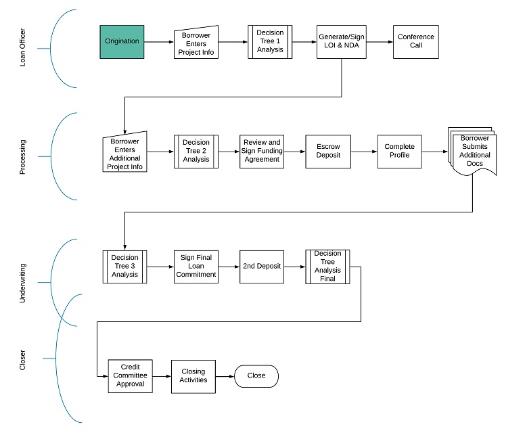
Our
Sponsor has created an automated decision tree engine which sets
guidelines that objectively grade each potential loan made by us.
Using this tool, we will be able to objectively measure risk while
keeping the standards the same across the entire portfolio of
loans. Per the above flowchart, this decision tree is run at
multiple times during the process so as to not bog down the
borrower in a massive upfront data request, ensure consistency of
data throughout the loan application process, and continually apply
the same objective standards to the applicants.
Exceptions Documentation
For a
loan application to move through the application process, we
require full documentation according to standards set on an asset
class level. Approval is required from the lead underwriter for
exceptions to this policy, and any such exception must be fully
disclosed to the Investment Committee.
Aggregate Exception Tracking and Reporting
We will
be tracking the aggregate level of exceptions which helps detect
shifts in the risk characteristics of loan portfolios. When viewed
on a case by case basis, underwriting exceptions may not appear to
increase risk significantly, as exceptions are often well mitigated
shortly after the transaction has taken place. However, when
aggregated, even well mitigated exceptions can increase portfolio
risk significantly. Aggregate exceptions will be analyzed regularly
and reported to the Investment Committee quarterly. These analyses
and reports will allow the Investment Committee to evaluate
underwriting practices and assess the level of
compliance.
Underwriting
We will
employ a “bottom-up” approach to focus on the
fundamentals of both the borrower and the underlying real estate in
order to assess the quality of the overall deal. This approach
allows us to seek investments where borrowers can capitalize on the
expertise of our Sponsor and its principals in the market with an
experienced understanding of the asset and proposed opportunities.
Through the aid of the ROCX Platform®, the underwriter is able
to concentrate on the higher risk items and not be bogged down in
the minutiae of the application process.
43
Investment Committee
We have
an Investment Committee composed of three members who are
nominated, appointed and removed by the Manager. The Investment
Committee’s members are Chip Cummings, Joe Elias, and Jason
Anderson. A tear sheet summary is created from the ROCX platform
detailing all the specifics of the loan and details require to
approve a decision. All loan origination decisions require the
unanimous approval of the Investment Committee
members.
Concentration Risk
Managing the loan
portfolio includes reviewing any concentrations of risk. By
segmenting the portfolio into groups with similar characteristics,
management can evaluate them while considering the risk tolerances
and develop strategies for diversifying the portfolio. Our Sponsor
and its management team monitors these risk concentrations in the
form of the geographic area, asset class, loan type and
loan-to-value ranges. The Investment Committee monitors these risks
by reviewing the segments quarterly and when approving newly
originated loans.
Collections and Workout
An
important part of risk mitigation and loss prevention is having a
systemized monitoring process for the continual evaluation and
analysis of asset performance and stability. Our Manager takes a
proactive approach in this area by requiring the submission and
review of financial reports of each asset from a borrower on a
monthly basis. This allows for early intervention and develops a
cooperative effort with borrowers to help avert and address
potential financial difficulties. Nonetheless, there may be
occasions where an asset is not performing as
expected.
Short-term
delinquencies (less than 30 days) on an asset are managed directly
by the servicing department. Should an asset become 60 days
delinquent, it is then placed into technical default status and
referred to the collections department for review and
implementation of loss prevention measures, which may include
utilization of borrower reserves to maintain asset performance,
attachment of financial accounts and income, and if necessary,
management oversight or operational intervention of the underlying
collateral.
Any
asset in default status is referred to management for instituting a
workout plan with the borrower in an effort to quickly analyze
options, mitigate loss, and avoid foreclosure action. Should
workout provisions fail, then through its legal team, the full
protections afforded to us pursuant to the loan documents will be
enforced, up to and including the foreclosure and sale of the
underlying collateral and other assets as necessary. All debt
instruments contain provisions which preclude the borrower from
filing for bankruptcy protection prior to us exercising our rights
under the terms of default.
Investment Allocation Policy
In addition to the Company, the Sponsor sponsors and manages, Red
Oak Capital Fund, LLC, Red Oak Capital Fund II, LLC, Red Oak
Capital Fund III, LLC, and Red Oak Capital Fund IV, LLC
(collectively, the “Existing Funds”), and is
considering sponsoring several additional investment vehicles
(collectively with the Existing Funds and the Company, the
“Funds”). Each of the Funds has the same or a similar
business model as the other Funds.
The
Sponsor has established an Investment Committee comprised of three
members, Chip Cummings, Joe Elias, and Jason Anderson. The
Investment Committee has developed procedures to resolve conflicts
of interest in the allocation of investments amongst the
Sponsor’s Funds, which have similar business models to the
Company. These procedures will be subject to review and revision by
the Investment Committee to insure their
effectiveness.
44
In the
event a loan opportunity becomes available which is suitable for
multiple Funds, assuming those Funds have sufficient available
money available for investment, the Fund which has had the greatest
number of days outstanding of net deployable capital shall first be
offered the loan opportunity.
In
determining whether or not the loan would be suitable for more than
one Fund, the Investment Committee will examine a variety of
factors including, but not limited to:
●
cash requirements
of each Fund
●
the effect of the
loan on diversification of each Fund (size of loan to overall
portfolio, asset types, geographic area and diversification of the
tenants associated with collateral properties),
●
the anticipated
cash flow of each Fund
●
the amount of funds
available to each Fund
●
length of time such
funds have been available for investment
The
Sponsor shall require the Investment Committee to document each
investment allocation decision simultaneous with the approval of
each investment opportunity, before deployment of capital,
including the rationale for allocations, in a manner that evidences
that certain offerings did not receive preferential treatment
regarding limited capacity investment
opportunities.
Generally, the
Funds sponsored by the Sponsor will not be allocated participations
in, or co-invest in, loans, subject to one or more participation
funds, whose business model will be to solely acquire minority
participation interests in commercial real estate loans made by
other funds sponsored by the Sponsor (“Participation
Funds”). When a lending opportunity is offered to a fund
which is not a Participation Fund, it will generally be offered the
opportunity to provide the entirety of the loan, subject to
participation from a Participation Fund, at the discretion of the
Investment Committee. In extremely limited circumstances, multiple
funds sponsored by the Sponsor, which are not Participation Funds,
may be offered an opportunity to participate in a loan, but only
after consultation with legal counsel in consideration of
applicable issues of corporate and securities law, among
others.
Each
Participation Fund shall establish its own investment committee (a
“Participation Fund IC”) separate and apart from the
Sponsor’s Investment Committee. A Participation Fund IC shall
include at least 5 individuals including at least 3 who are not
members of the Investment Committee.
Following the
allocation of a loan opportunity to a Fund in accordance with the
procedures above, the Investment Committee shall determine whether
to seek a participation from a Participation Fund for such
opportunity. It is anticipated that only one Participation Fund
will be permitted to participate in any given loan opportunity.
Following determination by the Investment Committee to seek
participation, the Investment Committee shall present such
participation opportunity to the applicable Participation
Fund’s Participation Fund IC. The Participation Fund IC
shall, in its sole discretion, determine whether and the extent to
which the Participation Fund shall participate in the presented
opportunity. The Participation Fund IC shall review and document
its decision regarding each potential participation in a manner
reflecting independent underwriting and analysis of the opportunity
from that of the Investment Committee.
45
MATERIAL U.S. FEDERAL INCOME TAX CONSIDERATIONS
The
following discussion is a summary of certain material U.S. federal
income tax consequences relevant to the purchase, ownership and
disposition of the Bonds, but does not purport to be a complete
analysis of all potential tax consequences. The discussion is based
upon the Code, current, temporary and proposed U.S. Treasury
regulations issued under the Code, or collectively the Treasury
Regulations, the legislative history of the Code, IRS rulings,
pronouncements, interpretations and practices, and judicial
decisions now in effect, all of which are subject to change at any
time. Any such change may be applied retroactively in a manner that
could adversely affect a Bondholder. This discussion does not
address all of the U.S. federal income tax consequences that may be
relevant to a holder in light of such Bondholder’s particular
circumstances or to Bondholders subject to special rules,
including, without limitation:
●
a broker-dealer or
a dealer in securities or currencies;
●
an S
corporation;
●
a bank, thrift or
other financial institution;
●
a regulated
investment company or a real estate investment trust;
●
an insurance
company
●
a tax-exempt
organization;
●
a person subject to
the alternative minimum tax provisions of the Code;
●
a person holding
the Bonds as part of a hedge, straddle, conversion, integrated or
other risk reduction or constructive sale transaction;
●
a partnership or
other pass-through entity;
●
a person deemed to
sell the Bonds under the constructive sale provisions of the
Code;
●
a U.S. person whose
“functional currency” is not the U.S. dollar;
or
●
a U.S. expatriate
or former long-term resident.
In
addition, this discussion is limited to persons that purchase the
Bonds in this offering for cash and that hold the Bonds as
“capital assets” within the meaning of
Section 1221 of the Code (generally, property held for
investment). This discussion does not address the effect of any
applicable state, local, non-U.S. or other tax laws, including gift
and estate tax laws.
As used
herein, “U.S. Holder” means a beneficial owner of the
Bonds that is, for U.S. federal income tax purposes:
●
an individual who
is a citizen or resident of the U.S.;
●
a corporation (or
other entity treated as a corporation for U.S. federal income tax
purposes) created or organized in or under the laws of the U.S.,
any state thereof or the District of Columbia;
●
an estate, the
income of which is subject to U.S. federal income tax regardless of
its source; or
●
a trust that (1) is
subject to the primary supervision of a U.S. court and the control
of one or more U.S. persons that have the authority to control all
substantial decisions of the trust, or (2) has a valid election in
effect under applicable Treasury Regulations to be treated as a
U.S. person.
46
If an
entity treated as a partnership for U.S. federal income tax
purposes holds the Bonds, the tax treatment of an owner of the
entity generally will depend upon the status of the particular
owner and the activities of the entity. If you are an owner of an
entity treated as a partnership for U.S. federal income tax
purposes, you should consult your tax advisor regarding the tax
consequences of the purchase, ownership and disposition of the
Bonds.
We have
not sought and will not seek any rulings from the IRS with respect
to the matters discussed below. There can be no assurance that the
IRS will not take a different position concerning the tax
consequences of the purchase, ownership or disposition of the Bonds
or that any such position would not be sustained.
THIS SUMMARY OF MATERIAL FEDERAL INCOME TAX CONSIDERATIONS IS FOR
GENERAL INFORMATION ONLY AND DOES NOT CONSTITUTE TAX ADVICE.
PROSPECTIVE INVESTORS SHOULD CONSULT THEIR TAX ADVISORS REGARDING
THE APPLICATION OF THE TAX CONSIDERATIONS DISCUSSED BELOW TO THEIR
PARTICULAR SITUATIONS, POTENTIAL CHANGES IN APPLICABLE TAX LAWS AND
THE APPLICATION OF ANY STATE, LOCAL, FOREIGN OR OTHER TAX LAWS,
INCLUDING GIFT AND ESTATE TAX LAWS, AND ANY TAX
TREATIES.
U.S. Holders
Interest
U.S.
Holder generally will be required to recognize and include in gross
income any stated interest as ordinary income at the time it is
paid or accrued on the Bonds in accordance with such holder’s
method of accounting for U.S. federal income tax
purposes.
Sale or Other Taxable Disposition of the Bonds
A U.S.
Holder will recognize gain or loss on the sale, exchange,
redemption (including a partial redemption), retirement or other
taxable disposition of a Bond equal to the difference between the
sum of the cash and the fair market value of any property received
in exchange therefore (less a portion allocable to any accrued and
unpaid stated interest, which generally will be taxable as ordinary
income if not previously included in such holder’s income)
and the U.S. Holder’s adjusted tax basis in the Bond. A U.S.
Holder’s adjusted tax basis in a Bond (or a portion thereof)
generally will be the U.S. Holder’s cost therefore decreased
by any payment on the Bond other than a payment of qualified stated
interest. This gain or loss will generally constitute capital gain
or loss. In the case of a non-corporate U.S. Holder, including an
individual, if the Bond has been held for more than one year, such
capital gain may be subject to reduced federal income tax rates.
The deductibility of capital losses is subject to certain
limitations.
Medicare Tax
Certain
individuals, trusts and estates are subject to a Medicare tax of
3.8% on the lesser of (i) ”net investment income”,
or (ii) the excess of modified adjusted gross income over a
threshold amount. Net investment income generally includes interest
income and net gains from the disposition of Bonds, unless such
interest payments or net gains are derived in the ordinary course
of the conduct of a trade or business (other than a trade or
business that consists of certain passive or trading activities).
U.S. Holders are encouraged to consult with their tax advisors
regarding the possible implications of the Medicare tax on their
ownership and disposition of Bonds in light of their individual
circumstances.
Information Reporting and Backup Withholding
A U.S.
Holder may be subject to information reporting and backup
withholding when such holder receives interest and principal
payments on the Bonds or proceeds upon the sale or other
disposition of such Bonds (including a redemption or retirement of
the Bonds). Certain holders (including, among others, corporations
and certain tax-exempt organizations) generally are not subject to
information reporting or backup withholding. A U.S. Holder will be
subject to backup withholding if such holder is not otherwise
exempt and:
47
●
such holder fails
to furnish its taxpayer identification number, or TIN, which, for
an individual is ordinarily his or her social security
number;
●
the IRS notifies
the payor that such holder furnished an incorrect TIN;
●
in the case of
interest payments such holder is notified by the IRS of a failure
to properly report payments of interest or dividends;
●
in the case of
interest payments, such holder fails to certify, under penalties of
perjury, that such holder has furnished a correct TIN and that the
IRS has not notified such holder that it is subject to backup
withholding; or
●
such holder does
not otherwise establish an exemption from backup
withholding.
A U.S.
Holder should consult its tax advisor regarding its qualification
for an exemption from backup withholding and the procedures for
obtaining such an exemption, if applicable. Backup withholding is
not an additional tax. Any amounts withheld under the backup
withholding rules from a payment to a U.S. Holder will be allowed
as a credit against the holder’s U.S. federal income tax
liability or may be refunded, provided the required information is
furnished in a timely manner to the IRS.
Non-U.S. Holders are encouraged to consult their tax
advisors.
[Remainder of page intentionally left blank]
48
ERISA CONSIDERATIONS
The
following is a summary of material considerations arising under
ERISA and the prohibited transaction provisions of the Code that
may be relevant to a prospective investor, including plans and
arrangements subject to the fiduciary rules of ERISA and plans or
entities that hold assets of such plans (“ERISA
Plans”); plans and accounts that are not subject to ERISA but
are subject to the prohibited transaction rules of Section 4975 of
the Code, including IRAs, Keogh plans, and medical savings accounts
(together with ERISA Plans, “Benefit Plans” or
“Benefit Plan Investors”); and governmental plans,
church plans, and foreign plans that are exempt from ERISA and the
prohibited transaction provisions of the Code but that may be
subject to state law or other requirements, which we refer to as
Other Plans. This discussion does not address all the aspects of
ERISA, the Code or other laws that may be applicable to a Benefit
Plan or Other Plan, in light of their particular
circumstances.
In
considering whether to invest a portion of the assets of a Benefit
Plan or Other Plan, fiduciaries should consider, among other
things, whether the investment:
●
will be consistent
with applicable fiduciary obligations;
●
will be in
accordance with the documents and instruments covering the
investments by such plan, including its investment
policy;
●
in the case of an
ERISA plan, will satisfy the prudence and diversification
requirements of Sections 404(a)(1)(B) and 404(a)(1)(C) of ERISA, if
applicable, and other provisions of the Code and
ERISA;
●
will impair the
liquidity of the Benefit Plan or Other Plan;
●
will result in
unrelated business taxable income to the plan; and
●
will provide
sufficient liquidity, as there may be only a limited or no market
to sell or otherwise dispose of our Bonds.
ERISA
and the corresponding provisions of the Code prohibit a wide range
of transactions involving the assets of the Benefit Plan and
persons who have specified relationships to the Benefit Plan, who
are “parties in interest” within the meaning of ERISA
and, “disqualified persons” within the meaning of the
Code. Thus, a designated plan fiduciary of a Benefit Plan
considering an investment in our shares should also consider
whether the acquisition or the continued holding of our shares
might constitute or give rise to a prohibited transaction.
Fiduciaries of Other Plans should satisfy themselves that the
investment is in accord with applicable law.
Section
3(42) of ERISA and regulations issued by the Department of Labor,
or DOL, provide guidance on the definition of plan assets under
ERISA. These regulations also apply under the Code for purposes of
the prohibited transaction rules. Under the regulations, if a plan
acquires an equity interest in an entity which is neither a
“publicly-offered security” nor a security issued by an
investment company registered under the Investment Company Act, the
plan’s assets would include both the equity interest and an
undivided interest in each of the entity’s underlying assets
unless an exception from the plan asset regulations
applies
We
do not believe the DOL’s plan assets guidelines apply to our
Bonds or our company because our Bonds are debt securities and not
equity interests in us.
If
the underlying assets of our company were treated by the Department
of Labor as “plan assets,” the management of our
company would be treated as fiduciaries with respect to Benefit
Plan Bondholders and the prohibited transaction restrictions of
ERISA and the Code could apply to transactions involving our assets
and transactions with “parties in interest” (as defined
in ERISA) or “disqualified persons” (as defined in
Section 4975 of the Code) with respect to Benefit Plan Bondholders.
If the underlying assets of our company were treated as “plan
assets,” an investment in our company also might constitute
an improper delegation of fiduciary responsibility to our company
under ERISA and expose the ERISA Plan fiduciary to co-fiduciary
liability under ERISA and might result in an impermissible
commingling of plan assets with other property.
49
If
a prohibited transaction were to occur, an excise tax equal to 15%
of the amount involved would be imposed under the Code, with an
additional 100% excise tax if the prohibited transaction is not
“corrected.” Such taxes will be imposed on any
disqualified person who participates in the prohibited transaction.
In addition, our Manager, and possibly other fiduciaries of Benefit
Plan Bondholders subject to ERISA who permitted such prohibited
transaction to occur or who otherwise breached their fiduciary
responsibilities, could be required to restore to the plan any
losses suffered by the ERISA Plan or any profits realized by these
fiduciaries as a result of the transaction or beach. With respect
to an IRA or similar account that invests in our company, the
occurrence of a prohibited transaction involving the individual who
established the IRA, or his or her beneficiary, would cause the IRA
to lose its tax-exempt status. In that event, the IRA or other
account owner generally would be taxed on the fair market value of
all the assets in the account as of the first day of the
owner’s taxable year in which the prohibited transaction
occurred.
[Remainder of page intentionally left blank]
50
DESCRIPTION OF BONDS
This
description sets forth certain terms of the Bonds that we are
offering pursuant to this offering circular. We refer you to the
indenture for a full disclosure of all such terms, as well as any
other capitalized terms used in this offering circular for which no
definition is provided.
Because
this section is a summary, it does not describe every aspect of the
Bonds or the indenture. We urge you to read the indenture because
that document and not this summary defines your rights as a
Bondholders. Please review a copy of the indenture. The indenture
is filed as an exhibit to the offering statement, of which this
offering circular is a part, at www.sec.gov. You may also obtain a
copy of the indenture from us without charge. See
“Where
You Can Find More Information” for more information.
You may also review the indenture at the trustee’s corporate
trust office at 928 Grand Blvd, 12th Floor, Kansas City, Missouri
64106.
Ranking
The
Bonds will be our direct, senior secured obligations and will
rank:
●
pari passu
in right of payment with all our
other senior secured indebtedness from time to time
outstanding;
●
rank senior in
right of payment to our future indebtedness, if any, from time to
time outstanding that is expressly subordinated to the
Bonds;
●
rank senior to all
of our unsecured indebtedness to the extent of the value of the
Bonds’ security interest in the collateral owned by us;
and
●
structurally junior
to all of the indebtedness of our subsidiaries.
Interest and Contingent Interest
The A
Bonds and A R-Bonds will bear interest at a rate equal to 7.50% and
8.00% per year, respectively, payable to the record holders of the
Bonds quarterly in arrears on January 25th, April 25th, July 25th
and October 25th of each year, beginning on the first such date
that corresponds to the first full quarter after the initial
closing in the offering.
Interest will
accrue and be paid on the basis of a 360-day year consisting of
twelve 30-day months. Interest on each Bond will accrue and be
cumulative from the end of the most recent interest period for
which interest has been paid on such Bond, or if no interest has
paid, from the date of issuance.
Upon
maturity or renewal, we will make a payment to the Bondholders as
described herein, or the Contingent Interest Payment. The
Contingent Interest Payment will be equal to the Spread times
20.0%.
“Spread”
for a Bond shall equal the greater of (i) zero or (ii) such
Bond’s Allocable Share of Revenue less such Bond’s
Allocable Share of Expenses, each calculated for the period
beginning with the date of issuance or the last Contingent Interest
Payment for such Bond, whichever is more recent.
“Allocable
Share of Revenue” for each Bond shall equal the total revenue
from investments divided by the total number of outstanding
Bonds.
“Allocable
Share of Expenses” for each Bond shall equal Series Specific
Expenses plus Expenses.
“Series
Specific Expenses” shall be equal to offering expenses, asset
management fees and interest expenses specific to A Bonds or A
R-Bonds, as applicable, divided by the total number of outstanding
A Bonds or A R-Bonds, respectively.
51
“Expenses”
shall be equal to offering expenses and disposition fees allocable
to all Bonds divided by the total number of outstanding
Bonds.
While
we intend to pay Bondholders the Contingent Interest Payment, there
is no guaranty that we will do so. As the Contingent Interest
Payment is determined by multiplying the Spread by a percentage,
the Spread must be positive for the Contingent Interest Payment to
be paid. The Contingent Interest Payment is dependent on revenue
from our investments exceeding the expenses deducted to calculate
the Spread. If the expenses exceed the revenue from our
investments, the Bondholder will not receive a Contingent Interest
Payment.
Manner of Offering
The
offering is being made on a best-efforts basis through our managing
broker-dealer and selling group members. Neither our managing
broker-dealer, nor any selling group member, will be required to
purchase any of the Bonds.
Maturity and Renewal
The
Bonds will mature on December 31, 2026. We will provide notice of maturity within 180 days
prior to maturity. The Bondholders may respond to such notice and
elect to have its Bonds redeemed within 150 days prior to maturity.
If a Bondholder does not elect to have its Bonds redeemed in its
response to the notice and if the Company does not otherwise redeem
the Bonds as otherwise described herein, immediately before
maturity, the Bonds will be automatically renewed for five years
from the maturity date and at the same interest rate. If a
Bondholder elects to be redeemed, we may, at our option, extend the
maturity of the Bonds held by such Bondholder for an additional six
months to facilitate our redemption of those Bonds by providing
written notice of such extension after the election by the
Bondholder to be redeemed and at least 60 days prior to the
maturity date.
For
any Bonds offered hereby that mature after the three-year
anniversary of the commencement of this offering, we expect that
the renewal of such Bonds may require us to file a new offering
statement. In such a case, the new offering statement must be
declared qualified before we will be able to renew your Bond. In
this event, if the new offering statement has not yet been filed or
become effective, we will extend your period to elect to be
redeemed until ten days following the date of our notice to you
that the new offering statement has become effective, which notice
will include a new offering circular.
THE
REQUIRED INTEREST PAYMENTS AND PRINCIPAL PAYMENT ARE NOT A GUARANTY
OF ANY RETURN TO YOU NOR ARE THEY A GUARANTY OF THE RETURN OF YOUR
INVESTED CAPITAL. While our company is required to make interest
payments and principal payment as described in the indenture and
above, we do not intend to establish a sinking fund to fund such
payments. Therefore, our ability to honor these obligations will be
subject to our ability to generate sufficient cash flow or procure
additional financing in order to fund those payments. If we cannot
generate sufficient cash flow or procure additional financing to
honor these obligations, we may be forced to sell some or all of
our company’s assets to fund the payments, or we may not be
able to fund the payments in their entirety or at all. If we cannot
fund the above payments, Bondholders will have claims against us
with respect to such violation.
Bondholder
Redemption
The
Bonds will be redeemable at the election of the Bondholder
beginning January 1, 2024. In order to be redeemed, the Bondholder
must provide written notice to us at our principal place of
business. We will have 120 days from the date such notice is
provided to redeem the Bondholder’s Bonds at a price per Bond
equal to: (i) $880 plus any accrued but unpaid interest on the Bond
if the notice is received on or after January 1, 2024 and on or
before January 1, 2026 and (ii) $900 plus any accrued but unpaid
interest on the Bond if the notice is received on or after January
1, 2026 and before` December 31, 2026. Our obligation to redeem
Bonds in any given year pursuant to this Redemption is limited to
15% of the outstanding principal balance of the Bonds, in the
aggregate, on January 1st of the applicable year. . In addition, we
have the right to reserve up to one-third of this 15% limit for
Bonds redeemed as a result of a Bondholder's right upon death,
disability or bankruptcy which may reduce the number of Bonds to be
redeemed pursuant to the Bondholder Redemption. Bond redemptions
pursuant to the Bondholder Redemption will occur in the order that
notices are received.
52
Redemption Upon Death, Disability or Bankruptcy
Within
60 days of the death, total permanent disability or bankruptcy of a
Bondholder who is a natural person, the estate of such Bondholder,
such Bondholder, or legal representative of such Bondholder may
request that we repurchase, in whole but not in part and without
penalty, the Bonds held by such Bondholder by delivering to us a
written notice requesting such Bonds be redeemed. Any such request shall specify the particular
event giving rise to the right of the holder to have his or her
Bonds redeemed. If a Bond held jointly by natural persons who are
legally married, then such request may be made by (i) the surviving
Bondholder upon the death of the spouse, or (ii) the disabled or
bankrupt Bondholder (or a legal representative) upon total
permanent disability or bankruptcy of the spouse. In the event a
Bond is held together by two or more natural persons that are not
legally married, neither of these persons shall have the right to
request that the Company repurchase such Bond unless each
Bondholder has been affected by such an event.
Upon
receipt of redemption request in the event of death, total
permanent disability or bankruptcy of a Bondholder, we will
designate a date for the redemption of such Bonds, which date shall
not be later than 120 days after we receive facts or certifications
establishing to the reasonable satisfaction of the Company
supporting the right to be redeemed. On the designated date, we
will redeem such Bonds at a price per
Bond that is equal to all accrued and unpaid interest, to but not
including the date on which the Bonds are redeemed, plus any
Contingent Interest Payment due to such Bondholder, plus the then
outstanding principal amount of such Bond.
Optional Redemption
We may
redeem the Bonds, in whole or in part, without penalty within 18
months of maturity. If the Bonds are renewed for an additional
term, we may redeem the Bonds at any time during such renewal
period. Any redemption of a Bond will be at a price equal to the
then outstanding principal on the Bonds being redeemed, plus any
accrued but unpaid interest on such Bonds, plus any Contingent Interest Payment due to such
Bondholder. If we plan to redeem the Bonds, we are required
to give notice of redemption not less than 5 days nor more than 60
days prior to any redemption date to each Bondholder’s
address appearing in the securities register maintained by the
trustee. In the event we elect to redeem less than all of the
Bonds, the particular Bonds to be redeemed will be selected by the
trustee by such method as the trustee shall deem fair and
appropriate.
Merger, Consolidation or Sale
We may
consolidate or merge with or into any other corporation, and we may
sell, lease or convey all or substantially all of our assets to any
corporation, provided that the successor entity, if other than
us:
●
is organized and
existing under the laws of the United States of America or any
United States, or U.S., state or the District of Columbia;
and
●
assumes all of our
obligations to perform and observe all of our obligations under the
Bonds and the indenture;
and
provided further that no event of default under the indenture shall
have occurred and be continuing.
Except
as described below under “- Certain Covenants –
Offer to Repurchase Upon a Change of Control Repurchase
Event,” the indenture does not provide for any right
of acceleration in the event of a consolidation, merger, sale of
all or substantially all of the assets, recapitalization or change
in our stock ownership. In addition, the indenture does not contain
any provision which would protect the Bondholders against a sudden
and dramatic decline in credit quality resulting from takeovers,
recapitalizations or similar restructurings.
53
Certain Covenants
Offer to Repurchase Upon a Change of Control Repurchase
Event
“Change of Control Repurchase
Event” means (A) the acquisition by any person,
including any syndicate or group deemed to be a
“person” under Section 13(d)(3) of the Exchange
Act, of beneficial ownership, directly or indirectly, through a
purchase, merger or other acquisition transaction or series of
purchases, mergers or other acquisition transactions of the
membership units entitling that person to exercise more than 50% of
the total voting power of all the membership units entitled to vote
in meetings of our company (except that such person will be deemed
to have beneficial ownership of all securities that such person has
the right to acquire, whether such right is currently exercisable
or is exercisable only upon the occurrence of a subsequent
condition); and (B) following the closing of any transaction
referred to in subsection (A), neither we nor the acquiring or
surviving entity has a class of common securities (or American
Depositary Receipts representing such securities) listed on the New
York Stock Exchange, or the NYSE, the NYSE Amex Equities, or the
NYSE Amex, or the Nasdaq Stock Market, or listed or quoted on an
exchange or quotation system that is a successor to the NYSE, the
NYSE Amex or the Nasdaq Stock Market.
If a
Change of Control Repurchase Event occurs, unless we have exercised
our option to redeem the Bonds as described under
“Description of Bonds -
Optional Redemption,” we must offer to repurchase the
Bonds at a price that is equal to all accrued and unpaid interest,
to but not including the date on which the Bonds are redeemed,
plus any Contingent Interest Payment
due to such Bondholder, plus (i) 1.02 times the then
outstanding principal amount of the Bonds if such Bonds are at
least four years from maturity; (ii) 1.015 times the then
outstanding principal amount of the Bonds if such Bonds are at
least three years, but no more than four years, from maturity;
(iii) 1.01 times the then outstanding principal amount of the Bonds
if such Bonds are at least two years, but no more than three years,
from maturity; and (iv) the then outstanding principal amount of
the Bonds if no more than two years from maturity.
25% Debt Limit
The
indenture will limit the indebtedness incurred by us, directly or
indirectly (including the debt of our subsidiaries), to 25% of the
outstanding principal of any loans or other assets owned, directly
or indirectly, by us. For purposes of complying with the 25%
limitation described above, the following will be not be considered
indebtedness: (i) any principal owed on the Bonds, and (ii) any
financing secured by a first mortgage lien on any real estate we
acquire.
Bond Reserve
Our
company will be required to keep 3.75% of gross offering proceeds
in a reserve account with the trustee for a period of one (1) year
following the first closing date, which reserve may be used to pay
our company's obligations to Bondholders during such time, and the
remainder of which, if any, will be released to our company on the
first anniversary of the first closing date if our company is
otherwise in compliance with all terms of the Bonds.
Reports
We will
furnish the following reports to each Bondholder:
Reporting Requirements under Tier II
of Regulation A. After launching this Tier II, Regulation A
offering, we will be required to comply with certain ongoing
disclosure requirements under Rule 257 of Regulation A. We will be
required to file: an annual report with the SEC on Form 1-K; a
semi-annual report with the SEC on Form 1-SA; current reports with
the SEC on Form 1-U; and a notice under cover of Form 1-Z. The
necessity to file current reports will be triggered by certain
corporate events, similar to the ongoing reporting obligation faced
by issuers under the Exchange Act, however the requirement to file
a Form 1-U is expected to be triggered by significantly fewer
corporate events than that of the Form 8-K. Parts I & II of
Form 1-Z will be filed by us if and when we decide to and are no
longer obligated to file and provide annual reports pursuant to the
requirements of Regulation A.
Annual Reports. As soon as
practicable, but in no event later than one hundred twenty (120)
days after the close of our fiscal year, ending December 31st, our
Manager will cause to be mailed or made available, by any
reasonable means, to each Bondholder as of a date selected by our
Manager, an annual report containing financial statements of our
company for such fiscal year, presented in accordance with GAAP,
including a balance sheet and statements of operations, Company
equity and cash flows, with such statements having been audited by
an accountant selected by our Manager. Our Manager shall be deemed
to have made a report available to each Bondholder as required if
it has either (i) filed such report with the SEC via its Electronic
Data Gathering, Analysis and Retrieval (EDGAR) system and such
report is publicly available on such system or (ii) made such
report available on any website maintained by our company and
available for viewing by the Bondholders.
54
Payment of Taxes and Other Claims
We will
pay or discharge or cause to be paid or discharged, before the same
shall become delinquent: (i) all taxes, assessments and
governmental charges levied or imposed upon us or upon our income,
profits or assets; and (ii) all lawful claims for labor,
materials and supplies which, if unpaid, might by law become a lien
upon our property; provided, however, that we will not be required
to pay or discharge or cause to be paid or discharged any such tax,
assessment, charge or claim whose amount, applicability or validity
is being contested in good faith by appropriate proceedings or for
which we have set apart and maintain an adequate
reserve.
Prior
to this offering, there has been no public market for the Bonds.
We may apply for quotation of the Bonds on an alternative
trading system or over the counter market beginning after the
final closing of this offering. However, even if the Bonds are
listed or quoted, no assurance can be given as to (1) the
likelihood that an active market for the Bonds will develop, (2)
the liquidity of any such market, (3) the ability of Bondholders to
sell the Bonds or (4) the prices that Bondholders may obtain for
any of the Bonds. No prediction can be made as to the effect, if
any, that future sales of the Bonds, or the availability of the
Bonds for future sale, will have on the market price prevailing
from time to time. Sales of substantial amounts of the Bonds, or
the perception that such sales could occur, may adversely affect
prevailing market prices of the Bonds. See “Risk
Factors — Risks Related to the Bonds and the
Offering.”
Event of Default
The
following are events of default under the indenture with respect to
the Bonds:
●
default in the
payment of any interest on the Bonds when due and payable, which
continues for 60 days, a cure period;
●
default in the
payment of any principal of or premium on the Bonds when due, which
continues for 60 days, a cure period;
●
default in the
performance of any other obligation or covenant contained in the
indenture or in this offering circular for the benefit of the
Bonds, which continues for 120 days after written notice, a cure
period;
●
specified events in
bankruptcy, insolvency or reorganization of us;
●
any final and
non-appealable judgment or order for the payment of money in excess
of $25,000,000 singly, or in the aggregate for all such final
judgments or orders against all such Persons is rendered against us
and is not be paid or discharged; and
●
failure to make any
Contingent Interest Payment when due, which continues for 60 days,
a cure period
Book-entry and
other indirect Bondholders should consult their banks or brokers
for information on how to give notice or direction to or make a
request of the trustee and how to declare or rescind an
acceleration of maturity.
Annually, within
120 days following December 31st while the Bonds are outstanding,
we will furnish to the trustee a written statement of certain of
our officers certifying that to their knowledge we are in
compliance with the indenture, or else specifying any event of
default and the nature and status thereof. We will also deliver to
the trustee a written notification of any uncured event of default
within 30 days after we become aware of such uncured event of
default.
55
Remedies if an Event of Default Occurs
Subject
to any respective cure period, if an event of default occurs and is
continuing, the trustee or the Bondholders of not less than a
majority in aggregate principal amount of the Bonds may declare the
principal thereof, premium, if any, and all unpaid interest thereon
to be due and payable immediately. In such event, the trustee will
have the right force us to sell any real property held by us or any
subsidiary of ours that we have the unilateral right to cause it to
sell its assets. We will be required to contribute the proceeds of
any such sale to the repayment of the Bonds. With respect to
subsidiaries for which we do not have the unilateral right to sell
their assets (for example, if we acquire a property in a joint
venture), the trustee has the right to force us to sell our equity
in such subsidiary in order to repay the Bonds.
At any
time after the trustee or the Bondholders have accelerated the
repayment of the principal, premium, if any, and all unpaid
interest on the Bonds, but before the trustee has obtained a
judgment or decree for payment of money due, the Bondholders of a
majority in aggregate principal amount of outstanding Bonds may
rescind and annul that acceleration and its consequences, provided
that all payments and/or deliveries due, other than those due as a
result of acceleration, have been made and all events of default
have been remedied or waived.
The
Bondholders of a majority in principal amount of the outstanding
Bonds may waive any default with respect to that series, except a
default:
●
in the payment of
any amounts due and payable or deliverable under the Bonds;
or
●
in an obligation
contained in, or a provision of, the indenture which cannot be
modified under the terms of the indenture without the consent of
each Bondholder
The
Bondholders of a majority in principal amount of the outstanding
Bonds may direct the time, method and place of conducting any
proceeding for any remedy available to the trustee or exercising
any trust or power conferred on the trustee with respect to the
Bonds, provided that (i) such direction is not in conflict
with any rule of law or the indenture, (ii) the trustee may
take any other action deemed proper by the trustee that is not
inconsistent with such direction and (iii) the trustee need
not take any action that might involve it in personal liability or
be unduly prejudicial to the Bondholders not joining therein.
Subject to the provisions of the indenture relating to the duties
of the trustee, before proceeding to exercise any right or power
under the indenture at the direction of the Bondholders, the
trustee is entitled to receive from those Bondholders security or
indemnity satisfactory to the trustee against the costs, expenses
and liabilities which it might incur in complying with any
direction.
A
Bondholder will have the right to institute a proceeding with
respect to the indenture or for any remedy under the indenture,
if:
●
that Bondholder
previously gives to the trustee written notice of a continuing
event of default in excess of any cure period,
●
the Bondholders of
not less than a majority in principal amount of the outstanding
bonds have made written request;
●
such Bondholder or
Bondholders have offered to indemnify the trustee against the
costs, expenses and liabilities incurred in connection with such
request;
●
the trustee has not
received from the Bondholders of a majority in principal amount of
the outstanding Bonds a direction inconsistent with the request (it
being understood and intended that no one or more of such
Bondholders shall have any right in any manner whatever by virtue
of, or by availing of, any provision of the indenture to affect,
disturb or prejudice the rights of any other of such Bondholders,
or to obtain or to seek to obtain priority or preference over any
other of such Bondholders or to enforce any rights under the
indenture, except in the manner herein provided and for equal and
ratable benefit of all Bondholders); and
●
the trustee fails
to institute the proceeding within 60 days.
However,
the Bondholder has the right, which is absolute and unconditional,
to receive payment of the principal of and interest on such Bond on
the respective due dates (or any redemption date, subject to
certain discounts) and to institute suit for the enforcement of any
such payment and such rights shall not be impaired without the
consent of such Bondholder.
56
LEGAL PROCEEDINGS
There
are currently no legal proceedings involving our
company.
57
SECURITY
OWNERSHIP OF CERTAIN BENEFICIAL OWNERS AND MANAGEMENT
Security Ownership of Certain Beneficial Owners (5% or
more)
|
Title of
Class
|
|
Name and Address
of Beneficial Owner
|
|
Amount and
Nature of Beneficial Ownership Acquirable
|
|
Percent of
Class
|
|
LLC
Interests
|
|
Chip
Cummings*
|
|
N/A
|
|
30.00%
|
|
|
|
|
|
|
|
|
|
LLC
Interests
|
|
Joseph
Elias*
|
|
N/A
|
|
30.00%
|
|
|
|
|
|
|
|
|
|
LLC
Interests
|
|
Kevin
Kennedy*
|
|
N/A
|
|
30.00%
|
|
|
|
|
|
|
|
|
|
LLC
Interests
|
|
Raymond
Davis*
|
|
N/A
|
|
10.00%
|
|
|
|
|
|
|
|
|
|
LLC
Interests
|
|
All
Executives and Managers*
|
|
N/A
|
|
100.00%
|
*625 Kenmoor Avenue SE, Suite 211, Grand Rapids, Michigan
49546
58
BOARD OF MANAGERS AND EXECUTIVE OFFICERS
The
following table sets forth information on our board of managers and
executive officers of our Sponsor. We are managed by our Manager,
which is majority owned and controlled by our Sponsor.
Consequently, we do not have our own separate board of managers or
executive officers.
|
Name
|
|
Age
|
|
Position with
our Company
|
|
Manager/Officer
Since
|
|
|
|
|
|
|
|
|
|
Chip
Cummings
|
|
57
|
|
Chief
Executive Officer*
|
|
March
2020
|
|
Joseph
Elias
|
|
40
|
|
Chief
Operations Officer*
|
|
March
2020
|
|
Kevin
P. Kennedy
|
|
54
|
|
Chief
Sales and Distribution Officer*
|
|
March
2020
|
|
Jason
Anderson
|
|
34
|
|
Chief
Financial Officer
|
|
March
2020
|
|
Raymond
T. Davis
|
|
53
|
|
Chief
Business Development Officer
|
|
March
2020
|
*Member
of the board of managers of the Sponsor, which controls our
Manager, which controls our company.
Executive Officers and Managers
Set
forth below is biographical information for our Sponsor’s
executive officers.
Chip Cummings is a founding partner,
Chief Executive Officer and a member of the board of managers for
our Sponsor. He joined our Sponsor in September 2015. He is
responsible for asset acquisition, compliance and portfolio
management. Chip has over 30 years of experience in the real estate
lending arena and managed various private equity funds for the past
6 years, including Red Oak Capital Fund LLC, Pineridge Park
Properties LLC, Northwind Holdings 14 LLC and Special Assets VI
LLC. Chip has also been the President and Chief Executive Officer
of Northwind Financial Corporation since November 2000. Chip is
licensed broker and lender and has overseen several billion dollars
in transactions. He has underwritten for Fannie Mae, Freddie Mac,
Federal Housing Administration and several Fortune 100 lenders. He
is Certified Fraud Examiner and has been recognized in federal and
state courts as a mortgage finance expert. Chip has developed and
administered programs for the U.S. Department of Housing and Urban
Development and numerous financial institutions throughout the U.S.
Chip served many Commercial Real Estate Boards and national
committees and is a #1 best-selling author of several real estate
books, he has appeared on numerous radio and television programs
and recently was the financial expert for FOX News. Chip attended
Eastern Michigan University and is a Certified National Trainer in
the areas of real estate fraud and mortgage finance.
Joseph Elias is a founding partner,
Chief Operations Officer and a member of the board of managers for
our Sponsor. He is responsible for platform development and
enhancement. Previously, Joe cofounded Loquidity in 2014, a
commercial real estate crowdfunding platform where he served as
COO, in which capacity he served until 2018. Joe possesses more
than 14 years of executive technology operations experience with
Fortune 50 companies and 17 years of experience in real estate
finance and development. He has spent his career leading corporate
transformation and achieving significant operational efficiencies
by successfully integrating new technologies. This expertise
combined with an entrepreneurial spirit, inspired him to develop
innovative scalable solutions to transform the real estate
investing landscape through the ROCX Platform. Prior to that, Joe
served as a senior director at Comcast from 2003 to 2014, managing
a $1 billion portfolio program. He and his team worked to implement
new technology realizing an estimated $300 million in cost savings.
Prior to Comcast, he was a project manager at General Motors. Joe
operated multiple successful family businesses, managing millions
of dollars’ worth of real estate assets in major Midwestern
markets. Joe earned his Bachelor of Science in Management
Information Systems from Wayne State University and holds an MBA
from the Ross School of Business at the University of
Michigan.
Kevin P. Kennedy is Chief Marketing
Officer and a member of the board of managers for our Sponsor. He
is responsible for capital acquisition, platform distribution and
broker dealer relationships. Kevin has 25 years of experience in
investment management. Most recently, he was with BlackRock
Investment Management Corporation from 1990 to 2016, where he
served as Managing Director and Divisional Sales Director prior to
leaving. His team was responsible for selling and marketing
BlackRock’s active, passive and alternative investments.
Prior to BlackRock, Kevin was a Director and Vice President for
Merrill Lynch Investment Managers covering the Midwest region. He
began his career with Merrill Lynch in 1990 as a trading liaison.
He was instrumental in helping both firms raise billions in sales,
increase revenue, new offerings, platform enhancements and sales
team development. Kevin holds a Series 7, 24, 63, 65 and 66
securities licenses. He received his Bachelor of Arts degree from
Duquesne University, in Pittsburg, PA. He completed his
Certified Investment Management Analyst certification (CIMA)
designation from Wharton Executive Education-University of
Pennsylvania in 2007.
59
Jason Anderson is Chief Financial
Officer for our Sponsor. He focuses on the creation and development
of operational and accounting expertise. Jason has more than 12 years in the
financial services industry. Under his tenure as a Shareholder,
Director and Executive Committee Member at Strait Capital from 2009
to 2017, assets under administration increased from $40 million to
nearly $4 billion. His expertise lies in architecting and
delivering a full-fledge institutional operating platform for hedge
funds, private equity groups, and family offices. Jason launched
over 100 alternative investment vehicles while at Strait Capital.
Jason has also served as Director of Anderson Capital Consulting
LLC since 2017. He began his career as a hedge fund analyst
specializing in distressed securities, mergers and acquisitions,
and capital arbitrage strategies. While a university student, he
was hand-picked to serve as an analyst for the $1+ Billion SMU
Endowment Fund. Jason graduated Magna Cum Laude with a Bachelor of
Business Administration in Finance and a Bachelor of Science in
Economics with Business Honors and Department Distinction from
Southern Methodist University. Jason has earned the Chartered
Financial Analyst (CFA) designation.
Raymond T. Davis is Chief Business
Development Officer for our Sponsor. Ray is responsible for product
development and sales distribution for our Sponsor. He focuses on
developing and creating strategic offerings with distribution
partners within the Independent Broker Dealer community and Pension
Funds. Ray holds more than
20 years of management experience. Since 2014, Ray has focused on
his operational and strategic skills to implement policy, process
and operational enhancements for product offerings for the broker
dealer community. Ray has served both private companies and
registered alternative investment funds in various senior roles.
Previously, Ray was a Senior Managing Director responsible for
growth and build out of two distribution channels. Ray attended
Wayne State University.
Track Record of our Sponsor
The
Sponsor has sponsored three prior public programs, Red Oak Capital
Fund II, LLC, or ROCF II, Red Oak Capital Fund III, LLC, or ROCF
III, and Red Oak Capital Fund IV, LLC, or ROCF IV. ROCF II
commenced offering up to $50 million of bonds pursuant to an
offering statement qualified with the SEC on September 4,
2018. The final closing in ROCF II's offering occurred on
August 1, 2019, with all $50 million of bonds being sold.
ROCF II sold bonds in two series, one maturing on August 1, 2021
(“ROCF II Series A”) and the second maturing on August
1, 2024 (“ROCF II Series B”). In addition, each
ROCF II A Bond will renew automatically for another two year term
and each ROCF II Series B Bond will renew automatically for another
five year term, at their respective maturities indefinitely, unless
otherwise elected by the bondholder or ROCF II. As such,
ROCF II has an indefinite life with no global liquidity event
expected. Each successive maturity date should viewed as a
periodic liquidity event and the first such event has not yet been
reached.
As of
December 31, 2019, ROCF II issued approximately $3.1 million and
$46.9 million of ROCF II Series A and ROCF II Series B,
respectively. ROCF II had incurred approximately $4.8 million of
debt issuance costs from the offering, of which $63,000 and
$3,163,000 were incurred as commissions for ROCF II Series A and
ROCF II Series B issuances, respectively.
ROCF II
is managed by the Manager, an affiliate of our Sponsor, and pays an
annual management fee to the Manager which is based on an annual
rate of 2.00% of the gross principal outstanding of ROCF II Series
A bondholders and 1.75% of gross principal outstanding of ROCF II
Series B bondholders. Through December 31, 2019, approximately
$580,000 of management fees had been earned by the
Manager.
ROCF II
pays an acquisition fee to the Manager which is calculated as 0.50%
of the gross mortgage loans receivable, inclusive of any closing
costs. As of December 31, 2019, approximately $227,000 of
acquisition fees had been earned by the Manager.
60
ROCF II
pays organization fees to the Manager which are calculated as 2.00%
of the gross proceeds of the sale of both ROCF II Series A and ROCF
II Series B. As of December 31, 2019, approximately $1,000,000 of
organization fees had been earned by the Manager.
As of
December 31, 2019, net proceeds to ROCF II after debt issuance
costs, organization and offering costs, acquisition fees, and
management fees were approximately $43.4 million.
ROCF II
held approximately $45.31 million of mortgage loans receivable as
of December 31, 2019. This consisted of fourteen mortgage loans
where the interest rate ranged between 10% and 16% (averaging 11%)
and where the maturities ranged from March 5, 2020 to December 5,
2020, based on twelve-month terms with two optional six-month
extensions.
ROCF II
has made all interest payments on its outstanding Bonds timely to
the paying agent in accordance with the terms of ROCF II’s
indenture and outstanding Bonds.
ROCF
III commenced offering up to $50 million of bonds pursuant to an
offering statement qualified with the SEC on September 18,
2019. The initial closing in ROCF III's offering occurred on
September 27, 2019. The final closing in ROCF III's offering
occurred on December 23, 2019, with all $50 million of bonds being
sold. . ROCF III sold bonds in two series, one maturing
on December 31, 2022 (“ROCF III Series A”) and the
second maturing on June 30, 2026 (“ROCF III Series B”).
As with ROCF II, each ROCF III Series A Bond will renew
automatically for another two year term and each ROCF III Series B
Bond will renew automatically for another five year term, at their
respective maturities indefinitely, unless otherwise elected by the
bondholder or ROCF III. As such, ROCF III also has an
indefinite life with no global liquidity event expected. Each
successive maturity date should viewed as a periodic liquidity
event and the first such event has not yet been
reached.
As of
December 31, 2019, ROCF III issued approximately $4.4 million and
$45.6 million of ROCF III Series A and ROCF III Series B,
respectively. ROCF III had incurred approximately $4.5 million of
debt issuance costs from the offering, of which $86,000 and
$2,965,000 were incurred as commissions for ROCF III Series A and
ROCF III Series B issuances, respectively.
ROCF
III is managed by the Manager, an affiliate of our Sponsor, and
pays an annual management fee to the Manager which is based on an
annual rate of 1.75% of gross principal outstanding of all bonds.
Through December 31, 2019, approximately $138,000 of management
fees had been earned by the Manager.
ROCF
III pays an acquisition fee to the Manager which is calculated as
0.50% of the gross mortgage loans receivable, inclusive of any
closing costs. As of December 31, 2019, approximately $123,000 of
acquisition fees had been earned by the Manager.
ROCF
III pays organization fees to the Manager which are calculated as
2.00% of the gross proceeds of the sale of all bonds. As of
December 31, 2019, approximately $1,000,000 of organization fees
had been earned by the Manager.
As of
December 31, 2019, net proceeds to ROCF III after debt issuance
costs, organization and offering costs, acquisition fees, and
management fees were approximately $44.2 million.
ROCF
III held approximately $24.64 million of mortgage loans receivable
as of December 31, 2019. This consisted of six mortgage loans where
the interest rate averaged 11% and where the maturities ranged from
November 18, 2020 to December 30, 2020, based on twelve-month terms
with two optional six-month extensions.
ROCF
III has made all interest payments on its outstanding Bonds timely
to the paying agent in accordance with the terms of ROCF
III’s indenture and outstanding Bonds.
ROCF IV
commenced offering up to $50 million of bonds pursuant to an
offering statement qualified with the SEC on January 29,
2020. The initial closing in ROCF IV's offering occurred on
February 21, 2020, with approximately $5.83 million of bonds
remaining to be sold, as of the date of this report. ROCF IV is
selling bonds in four series, two maturing on June 30, 2023
(“ROCF IV Series A”) and the other two maturing on June
30, 2026 (“ROCF IV Series B”). As with ROCF II
and ROCF III, each ROCF IV Series A Bond will renew automatically
for another two year term and each ROCF IV Series B Bond will renew
automatically for another five year term, at their respective
maturities indefinitely, unless otherwise elected by the bondholder
or ROCF IV. As such, ROCF IV also has an indefinite life
with no global liquidity event expected. Each successive
maturity date should viewed as a periodic liquidity event and the
first such event has not yet been reached. As of December 31, 2019,
ROCF IV had not commenced operations.
.
[Remainder of page intentionally left blank]
61
EXECUTIVE COMPENSATION
Our
company does not have executives. It is operated by our Manager. We
will not reimburse our Manager for any portion of the salaries and
benefits to be paid to its executive officers named in
"Board of
Managers and Executive Officers;" provided that, we may
reimburse our Manager for expenses incurred by its executive
officers while acting on behalf of our company (such as travel or
entertainment expenses). See "Compensation of Our Manager
and Its Affiliates" for a list of fees payable to Manager or
its affiliates.
62
COMPENSATION OF OUR MANAGER AND ITS AFFILIATES
The
following is a description of compensation we may pay to our
Manager and its affiliates or in connection with the proceeds of
the offering. These compensation arrangements have been established
by our Manager and its affiliates and are not the result of
arm's-length negotiations. Services for which our company engages
our Manager or its affiliates and which are not described below
will be compensated at the market rate. Fees payable to our Manager
or its affiliates in excess of the rate set forth in this section
will require the affirmative consent of a majority of the Bonds.
Our Manager or an affiliate may elect to waive or defer certain of
these fees in its sole discretion. This table assumes that the
maximum offering amount of $50,000,000 in the aggregate is
raised.
|
Form of
Compensation
|
|
Description
|
|
Estimated Amount
of Compensation
|
|
|
|
|
|
|
|
Offering and Organization Stage:
|
|
|
|
|
|
|
|
|
|
|
|
O&O
Fee:
|
|
Our
Manager will receive the O&O Fee equal to 2.00% of gross
proceeds. The Manager will pay our actual organization and offering
expenses out of the O&O Fee and will be entitled to retain as
compensation the excess, if any, of the O&O fee over actual
organization and offering expenses. To the extent organizational
and offering expenses exceed 2.00% of the gross proceeds raised in
the offering, our Manager will pay such amounts without
reimbursement from us.
|
|
$1,000,000
|
|
|
|
|
|
|
|
Operating Stage:
|
|
|
|
|
|
|
|
|
|
|
|
Asset
Management Fee:
|
|
Our
Manager will be paid an annual asset management fee of 1.75% of the
total principal amount of the Bonds outstanding. The asset
management fee will be paid quarterly in advance.
|
|
$875,000
per year
|
|
|
|
|
|
|
|
Disposition
Fee:
|
|
Our
Manager will be paid a disposition fee of 1.00% of the proceeds
received from the repayment of the principal amount of any of our
debt investments or any other disposition of the underlying real
estate.
|
|
Indeterminable
at this time.
|
|
|
|
|
|
|
|
Accountable
Expense Reimbursements
|
|
Our Manager will be entitled to receive an accountable expense
reimbursement for documented expenses of our Manager and its
affiliates incurred on behalf of our company that are reasonably
necessary for the performance by our Manager of its duties and
functions. The accountable expense reimbursement will be reimbursed
monthly to our Manager.
|
|
Indeterminable
at this time.
|
|
|
|
|
|
|
[Remainder of page intentionally left blank]
63
LIMITATIONS ON LIABILITY
Our
Manager and executive officers, if any are appointed by our
Manager, will owe fiduciary duties to our company and our members
in the manner prescribed in the Delaware Limited Liability Company
Act and applicable case law. Neither our Manager nor any executive
officer will owe fiduciary duties to our bondholders. Our Manager
is required to act in good faith and in a manner that it determines
to be in our best interests. However, nothing in our operating
agreement precludes our Manager or executive officers or any
affiliate of our Manager or any of their respective officers,
directors, employees, members or trustees from acting, as a
director, officer or employee of any corporation, a trustee of any
trust, an executor or administrator of any estate, a member of any
company or an administrative official of any other business entity,
or from receiving any compensation or participating in any profits
in connection with any of the foregoing, and neither our company
nor any member shall have any right to participate in any manner in
any profits or income earned or derived by our Manager or any
affiliate thereof or any of their respective officers, directors,
employees, members or trustees, from or in connection with the
conduct of any such other business venture or activity. Our
Manager, its executive officers, any affiliate of any of them, or
any shareholder, officer, director, employee, partner, member or
any person or entity owning an interest therein, may engage in or
possess an interest in any other business or venture of any nature
or description, provided that such activities do not compete with
the business of our company or otherwise breach their agreements
with our company; and no member or other person or entity shall
have any interest in such other business or venture by reason of
its interest in our company.
Our
Manager or executive officers have no liability to our company or
to any member for any claims, costs, expenses, damages, or losses
suffered by our company which arise out of any action or inaction
of any manager or executive officer if such manager or executive
officer meets the following standards: (i) such manager or
executive officer, in good faith, reasonably determined that such
course of conduct or omission was in, or not opposed to, the best
interests of our company, and (ii) such course of conduct did not
constitute fraud, willful misconduct or gross negligence or any
breach of fiduciary duty to our company or its members. These
exculpation provisions in our operating agreement are intended to
protect our Manager and executive officers from liability when
exercising their business judgment regarding transactions we may
enter into.
Insofar
as the foregoing provisions permit indemnification or exculpation
of our Manager, executive officers or other persons controlling us
from liability arising under the Securities Act, we have been
informed that in the opinion of the SEC this indemnification and
exculpation is against public policy as expressed in the Securities
Act and is therefore unenforceable.
[Remainder of page intentionally left blank]
64
INDEPENDENT AUDITORS
The
financial statements of our company, which comprise the balance
sheet as of June 30, 2020 and the related statements of operations,
members' equity and cash flows for the period from March 23, 2020
(date of inception) through June 30, 2020 included in this offering
circular and the related notes to those financial statements, have
been audited by UHY LLP, an independent public accounting
firm, as stated in their report appearing elsewhere
herein.
65
LEGAL MATTERS
Certain
legal matters in connection with this offering, including the
validity of the Bonds, will be passed upon for us by Kaplan Voekler
Cunningham & Frank, PLC.
66
WHERE YOU CAN FIND ADDITIONAL INFORMATION
Our
Sponsor maintains a website, www.redoakcapitalgroup.com, which
contains additional information concerning us, our Manager and our
Sponsor. We will file, annual, semi-annual and special reports, and
other information, as applicable, with the SEC. You may read and
copy any document filed with the SEC at the SEC's public company
reference room at Room 1580, 100 F Street, N.E., Washington, D.C.
20549. Please call the SEC at 1-800-SEC-0330 for further
information on the public reference room. The SEC also maintains a
web site that contains reports, and informational statements, and
other information regarding issuers that file electronically with
the SEC (http://www.sec.gov).
Our
company has filed an offering statement of which this offering
circular is a part with the SEC under the Securities Act. The
offering statement contains additional information about us. You
may inspect the offering statement without charge at the office of
the SEC at Room 1580, 100 F Street, N.E., Washington, D.C. 20549,
and you may obtain copies from the SEC at prescribed
rates.
This
offering circular does not contain all of the information included
in the offering statement. We have omitted certain parts of the
offering statement in accordance with the rules and regulations of
the SEC. For further information, we refer you to the offering
statement, which may be found at the SEC's website
at http://www.sec.gov. Statements contained in this offering
circular and any accompanying supplement about the provisions or
contents of any contract, agreement or any other document referred
to are not necessarily complete. Please refer to the actual exhibit
for a more complete description of the matters
involved.
67
PART F/S
INDEX TO FINANCIAL STATEMENTS
|
Independent Auditor’s Report
|
F
– 3
|
|
Financial Statements
|
|
|
Balance
Sheet
|
F
– 4
|
|
Statement
of Operations
|
F
– 5
|
|
Statement
of Changes in Member's Capital
|
F
– 6
|
|
Statement
of Cash Flows
|
F
– 7
|
|
Notes
to Financial Statements
|
F
– 8
|
F-1
RED OAK CAPITAL FUND V, LLC
FINANCIAL
STATEMENTS
AND
INDEPENDENT
AUDITOR’S REPORT
FOR THE
PERIOD MARCH 23, 2020 (DATE OF FORMATION) THROUGH JUNE 30,
2020
F-2
INDEPENDENT AUDITOR’S REPORT
To the Managing Member
Red Oak Capital Fund V, LLC
We have audited the accompanying financial statements of Red Oak
Capital Fund V, LLC (a Delaware limited liability corporation),
which comprise the balance sheet as of June 30, 2020, and the
related statements of operations, changes in member’s
capital, and cash flows for the period from March 23, 2020 (date of
formation) to June 30, 2020, and the related notes to the financial
statements.
Management’s Responsibility for the Financial
Statements
Management is responsible for the preparation and fair presentation
of these financial statements in accordance with accounting
principles generally accepted in the United States of America; this
includes the design, implementation, and maintenance of internal
control relevant to the preparation and fair presentation of
financial statements that are free from material misstatement,
whether due to fraud or error.
Auditor’s Responsibility
Our responsibility is to express an opinion on these financial
statements based on our audit. We conducted our audit in accordance
with auditing standards generally accepted in the United States of
America. Those standards require that we plan and perform the audit
to obtain reasonable assurance about whether the financial
statements are free from material misstatement.
An audit involves performing procedures to obtain audit evidence
about the amounts and disclosures in the financial statements. The
procedures selected depend on the auditor’s judgment,
including the assessment of the risks of material misstatement of
the financial statements, whether due to fraud or error. In making
those risk assessments, the auditor considers internal control
relevant to the entity’s preparation and fair presentation of
the financial statements in order to design audit procedures that
are appropriate in the circumstances, but not for the purpose of
expressing an opinion on the effectiveness of the entity’s
internal control. Accordingly, we express no such opinion. An audit
also includes evaluating the appropriateness of accounting policies
used and the reasonableness of significant accounting estimates
made by management, as well as evaluating the overall presentation
of the financial statements.
We believe that the audit evidence we have obtained is sufficient
and appropriate to provide a basis for our audit
opinion.
Opinion
In our opinion, the financial statements referred to above present
fairly, in all material respects, the financial position of Red Oak
Capital Fund V, LLC as of June 30, 2020, and the results of its
operations, changes in member’s capital, and cash flows for
the period from March 23, 2020 (date of formation) to June 30,
2020, in accordance with accounting principles generally accepted
in the United States of America.
/s/ UHY
LLP
Farmington Hills, Michigan
July 7, 2020
F-3
Red
Oak Capital Fund V, LLC
Balance
Sheet
June
30, 2020
|
Assets
|
|
|
|
|
|
Total
assets
|
$-
|
|
|
|
|
Liabilities and Member's Capital
|
|
|
|
|
|
Total
liabilities
|
-
|
|
|
|
|
Total
member's capital
|
-
|
|
|
|
|
Total
liabilities and member's capital
|
$-
|
F-4
Red
Oak Capital Fund V, LLC
Statement
of Operations
For
the period March 23, 2020 (Date of Formation) through June 30,
2020
|
Revenue:
|
|
|
Total
revenue
|
$-
|
|
|
|
|
Expenses:
|
|
|
Total
expenses
|
-
|
|
|
|
|
Net
income (loss)
|
$-
|
F-5
Red
Oak Capital Fund V, LLC
Statement
of Changes in Member's Capital
For
the period March 23, 2020 (Date of Formation) through June 30,
2020
|
|
Managing
Member
|
|
|
|
|
Member's
capital, March 23, 2020
|
$-
|
|
|
|
|
Capital
contributions
|
-
|
|
|
|
|
Capital
distributions
|
-
|
|
|
|
|
Net
income (loss)
|
-
|
|
|
|
|
Member's
capital, June 30, 2020
|
$-
|
|
|
|
F-6
Red
Oak Capital Fund V, LLC
Statement
of Cash Flows
For
the period March 23, 2020 (Date of Formation) through June 30,
2020
|
Cash
flows from operating activities:
|
|
|
Net income
(loss)
|
$-
|
|
|
|
|
Adjustments to
reconcile net income (loss)
|
|
|
to net cash
provided by (used in) operating activities:
|
|
|
|
|
|
Net cash provided
by (used in) operating activities
|
-
|
|
|
|
|
Cash
flows from financing activities:
|
|
|
|
|
|
Net cash provided
by (used in) financing activities
|
-
|
|
|
|
|
Net
change in cash and cash equivalents
|
-
|
|
|
|
|
Cash and cash
equivalents, beginning of period
|
-
|
|
|
|
|
Cash
and cash equivalents, end of period
|
$-
|
F-7
Red Oak Capital Fund V, LLC
Notes to Financial Statements
For the period March 23, 2020 (Date of Formation) through June 30,
2020
1. Organization
Red Oak
Capital Fund V, LLC, (the “Company”) is a Delaware
limited liability company formed to originate senior loans
collateralized by commercial real estate in the United States of
America. The Company’s plan is to originate, acquire, and
manage commercial real estate loans and securities and other
commercial real estate-related debt instruments. Red Oak Capital
GP, LLC is the Managing Member and owns 100% of the member
interests in the Company.
The
Company formed on March 23, 2020 and has not commenced operations.
The Company anticipates raising a maximum of $50 million of A Bonds
and A R-bonds (collectively the “Bonds”) pursuant to an
exemption from registration under Regulation A of the Securities
Act of 1933, as amended. The Company’s term is
indefinite.
2. Significant
accounting policies
Basis
of presentation
The
financial statements of the Company have been prepared in
accordance with accounting principles generally accepted in the
United States ("GAAP") and all values are stated in United States
dollars.
The
Financial Accounting Standards Board ("FASB") Accounting Standards
Codification ("ASC") is the exclusive reference of authoritative
accounting principles recognized by nongovernmental entities with
the exception of guidance issued by the Securities and Exchange
Commission ("SEC") and its staff.
Use
of estimates
The
preparation of the financial statements requires the Managing
Member to make estimates and assumptions that affect the reported
amounts and disclosures in the financial statements. The Managing
Member believes the estimates utilized in preparing the
Company’s financial statements are reasonable and prudent;
however, actual results could differ from these estimates and such
differences could be material to the Company's financial
statements.
Fair
value – hierarchy of fair value
In
accordance with FASB ASC 820-10, Fair Value Measurements and
Disclosures, the Company discloses the fair value of its
assets and liabilities in a hierarchy that prioritizes the inputs
to valuation techniques used to measure fair value. The hierarchy
gives the highest priority to valuations based upon unadjusted
quoted prices in active markets for identical assets and
liabilities and the lowest priority to valuations based upon
unobservable inputs that are significant to the valuation. FASB ASC
820-10-35-39 to 55 provides three levels of the fair value
hierarchy as follows:
Level One - Inputs use quoted
prices in active markets for identical assets or liabilities of
which the Company has the ability to access.
Level Two - Inputs use other
inputs that are observable, either directly or indirectly. These
Level 2 inputs include quoted prices for similar assets and
liabilities in active markets, and other inputs such as interest
rates and yield curves that are observable at commonly quoted
intervals.
Level Three - Inputs are
unobservable inputs, including inputs that are available in
situations where there is little, if any, market activity for the
related asset.
F-8
Red Oak Capital Fund V, LLC
Notes to Financial Statements
For the period March 23, 2020 (Date of Formation) through June 30,
2020
2. Significant
accounting policies (continued)
In
instances whereby inputs used to measure fair value fall into
different levels of the fair value hierarchy, fair value
measurements in their entirety are categorized based on the lowest
level input that is significant to the valuation. The
Company’s assessment of the significance of particular inputs
to these fair value measurements requires judgement and considers
factors specific to each asset or liability.
Cash
and cash equivalents
Cash
represents cash deposits held at financial institutions. Cash
equivalents may include short-term highly liquid investments of
sufficient credit quality that are readily convertible to known
amounts of cash and have original maturities of three months or
less. Cash equivalents are carried at cost, plus accrued interest,
which approximates fair value. Cash equivalents are held to meet
short-term liquidity requirements, rather than for investment
purposes. Cash and cash equivalents are held at major financial
institutions and are subject to credit risk to the extent those
balances exceed applicable Federal Deposit Insurance Corporation or
Securities Investor Protection Corporation or Securities Investor
Protection Corporation limitations.
Mortgage
loans receivable
Mortgage loans
receivable are classified as held-for-investment based on the
Company’s intention and ability to hold the loans until
maturity. The loans are stated at the amount of unpaid principal
adjusted for any impairment or allowance for loan losses. The
Company’s mortgage loans receivable are expected to consist
of senior secured private company loans collateralized by the
borrower’s underlying commercial real estate assets. The
repayment of the loans will be dependent upon the borrower’s
ability to obtain a permanent financing solution or to sell the
commercial real estate asset. The Company’s mortgage loans
receivable will have heightened credit risk stemming from several
factors, including the concentration of loans to a limited number
of borrowers, the likelihood of construction projects running over
budget, and the inability of the borrower to sell the underlying
commercial real estate asset.
Nonaccrual
loans
Interest income is
recognized to the extent paid or if the analysis performed on the
related receivables supports the collectability of the interest
receivable. A loan is placed on nonaccrual when the future
collectability of interest and principal is not expected, unless,
in the determination of the Managing Member, the principal and
interest on the loan are well collateralized and in the process of
collection. When classified as nonaccrual, accrued interest
receivable on the loan is reversed and the future accrual of
interest is suspended. Payments of contractual interest are
recognized as income only to the extent that full recovery of the
principal balance of the loan is reasonably certain.
Impairment
and allowance for loan losses
Mortgage loans
receivables are considered “impaired” when, based on
observable information, it is probable the Company will be unable
to collect the total amount outstanding under the contractual terms
of the loan agreement. The Managing Member assesses mortgage loans
receivable for impairment on an individual loan basis and
determines the extent to which a specific valuation allowance is
necessary by comparing the loan’s remaining balance to either
the fair value of the collateral, less the estimated cost to sell,
or the present value of expected cash flows, discounted at the
loan’s base interest rate.
An
allowance for loan losses on mortgage loans receivable is
established through a provision for loan losses charged against
income and includes specific reserves for impaired loans. Loans
deemed to be uncollectible are charged against the allowance when
the Managing Member believes that the collectability of the
principal is unlikely and subsequent recoveries, if any, are
credited to the allowance. The Managing Member’s periodic
evaluation of the adequacy of the allowance is based on an
assessment of the current loan portfolio, including known inherent
risks, adverse situations that may affect the borrowers’
ability to repay, the estimated value of any underlying collateral,
and current economic conditions.
F-9
Red Oak Capital Fund V, LLC
Notes to Financial Statements
For the period March 23, 2020 (Date of Formation) through June 30,
2020
2. Significant
accounting policies (continued)
Bonds
payable
Company
issued bonds will be held as a liability upon the effective date of
closing. The bond interest will be expensed on an accrual basis.
The contingent interest associated with the bonds will be
recognized on an accrual basis at the end of each reporting period
assuming a hypothetical liquidation of the Company’s mortgage
loans receivable at fair value.
Income
and expense recognition
Interest income and
other related income are recognized on an accrual basis when
earned, except as noted in the nonaccrual loans section above.
Operating expenses and other related expenses are recorded on an
accrual basis as incurred.
Income
taxes
As a
limited liability company, the Company itself is not subject to
United States federal income taxes. Each member is individually
liable for income taxes, if any, on its share of the Company's net
taxable income. Accordingly, no provision or credit for income
taxes is recorded in the accompanying financial statements. The
Company anticipates paying distributions to members in amounts
adequate to meet their tax obligation.
The
Company applies the authoritative guidance for uncertainty in
income taxes included in Financial Accounting Standards Board
(“FASB”) ASC 740, Income Taxes, as amended by
Accounting Standards Update 2009-06, Implementation Guidance on
Accounting for Uncertainty in Taxes and Disclosures Amendments for
Nonpublic Entities. This guidance requires the Company to recognize
a tax benefit or liability from an uncertain position only if it is
more likely than not that the position is sustainable, based on its
technical merits and consideration of the relevant taxing
authority’s widely understood administrative practices and
precedents. If this threshold is met, the Company would measure the
tax benefit or liability as the largest amount that is greater than
50% likely of being realized upon ultimate settlement.
As of
June 30, 2020, the Company had not recorded any benefit or
liability for unrecognized taxes.
The
Company files United States federal income tax returns as well as
various state returns. With few exceptions, the Company’s tax
returns and the amount of allocable income or loss are subject to
examination by taxing authorities for three years subsequent to the
Company’s commencement of operations. If such examinations
result in changes to income or loss, the tax liability of the
members could be changed accordingly. There are currently no
examinations being conducted of the Company by the Internal Revenue
Service or any other taxing authority.
The
Company accrues all interest and penalties under relevant tax law
as incurred. As of June 30, 2020, no amount of interest and
penalties related to uncertain tax positions was recognized in the
Statement of Operations.
3. Allocation
of net income and loss
It is
anticipated that the Operating Agreement will provide detailed
provisions regarding the allocation of net income and losses among
the members over the life of the Company. Generally, items of
income and expense are allocated among members in proportion to the
applicable membership interest.
F-10
Red Oak Capital Fund V, LLC
Notes to Financial Statements
For the period March 23, 2020 (Date of Formation) through June 30,
2020
4. Related
party transactions
The
Company will pay an annual management fee, calculated and payable
on a quarterly basis, to the Managing Member. The management fee is
based on an annual rate of 1.75% of the gross offering proceeds. As
of June 30, 2020, no management fees have been accrued or
paid.
5. Member’s
equity
During
2020, the Managing Member, as sole member of the Company, made no
capital contributions or received any distributions. Upon execution
of the operating agreement, the Managing Member must contribute
$100.
6. Bonds
payable
After
the close of the initial bond issuance and first full quarter of
operations, the Company anticipates making quarterly interest
payments to the A Bond and A R-bond bondholders at a rate of 7.50%
and 8.00% per annum, respectively. The Bonds will be
secured by a senior blanket lien on all assets of the
Company.
The
maturity date of A Bonds and A R-bonds will be December 31, 2026.
Upon the maturity of the Bonds, the bondholders will receive a
Contingent Interest Payment equal to 20% of the Spread,
respectively. The Spread is defined as the difference between such
bond’s pro-rata share of revenue derived from senior secured
private company loans less the interest paid to such bondholder,
withholding for fees at the discretion of the Managing
Member.
The A
Bonds and A R-bonds will be redeemable beginning January 1, 2024.
Once the Company receives written notice from the bondholder, it
will have 120 days from the date of receipt to redeem the bonds at
a price per bond equal to: (i) $880 plus any accrued but unpaid
interest on the Bond if the notice is received on or after January
1, 2024 and (ii) $900 plus any accrued but unpaid interest on the
Bond if the notice is received on or after January 1,
2026.
The
Company’s obligation to redeem bonds in any given year
pursuant to this Optional Redemption is limited to 15% of the
outstanding principal balance of the A Bonds and A R-bonds on
January 1st of the applicable year. Bond redemptions pursuant to
the Optional Redemption will occur in the order that notices are
received.
7. Commitments
and contingencies
The
Managing Member has incurred and will continue to incur
organizational and offering expenses which are reimbursable from
the Company, at 2% of total gross proceeds from the Bond offerings.
The organizational and offering costs are not represented on the
Company’s financial statements due to these being contingent
upon a successful completion of the Bond offerings. The Company
will expense organization costs when incurred and debt issuance
costs will be capitalized and amortized through the maturity of
each Series as applicable. As of June 30, 2020, there have been
approximately $20,000 of organizational costs incurred by the
Managing Member. Through the date of issuance, the Managing Member
has incurred approximately $30,000 of organizational and offering
costs.
The
Company has provided general indemnifications to the Managing
Member, any affiliate of the Managing Member and any person acting
on behalf of the Managing Member or that affiliate when they act,
in good faith, in the best interest of the Company. The Company is
unable to develop an estimate of the maximum potential amount of
future payments that could potentially result from any hypothetical
future claim but expects the risk of having to make any payments
under these general business indemnifications to be
remote.
F-11
Red Oak Capital Fund V, LLC
Notes to Financial Statements
For the period March 23, 2020 (Date of Formation) through June 30,
2020
8. Subsequent
events
The
financial statements were approved by management and available for
issuance on July 7, 2020. Subsequent events have been evaluated
through this date.
F-12
PART III - EXHIBITS
EXHIBIT INDEX
|
Exhibit Number
|
|
Exhibit Description
|
|
|
|
|
|
|
Managing
Broker-Dealer Agreement by and between Crescent Securities Group,
Inc. and Red Oak Capital Fund V, LLC
|
|
|
|
|
|
|
|
Certificate
of Formation of Red Oak Capital Fund V, LLC
|
|
|
|
|
|
|
|
Limited
Liability Company Agreement of Red Oak Capital Fund V,
LLC
|
|
|
|
|
|
|
|
Form of
Indenture
|
|
|
|
|
|
|
|
Form of
A Bond
|
|
|
|
|
|
|
|
Form of
A R-Bond
|
|
|
|
|
|
|
|
Pledge and Security
Agreement
|
|
|
|
|
|
|
|
Subscription
Agreement
|
|
|
|
|
|
|
|
Consent
of UHY LLP
|
|
|
|
|
|
|
(11)(b)
|
|
Consent
of Kaplan, Voekler, Cunningham & Frank, PLC**
|
|
|
|
|
|
(12)
|
|
Opinion
of Kaplan, Voekler, Cunningham & Frank, PLC regarding legality
of the Bonds*
|
_____________
*
To be filed by
amendment
**
Included
with the legal opinion to be provided pursuant to item
(12)
SIGNATURES
Pursuant
to the requirements of Regulation A, the issuer certifies that it
has reasonable grounds to believe that it meets all of the
requirements for filing on Form 1-A and has duly caused this
offering statement to be signed on its behalf by the undersigned,
thereunto duly authorized, in the City of Grand Rapids of Michigan
on July 7 of 2020.
RED OAK CAPITAL FUND V, LLC,
a Delaware limited liability company
By: Red
Oak Capital GP, LLC,
a
Delaware limited liability company
Its:
Sole Member
By:
Red Oak Capital Group, LLC,
a
Delaware limited liability company
Its:
Sole Member
By: /s/
Chip Cummings
Name: Chip Cummings
Its:
Manager
By: /s/
Joseph Elias
Name: Joseph Elias
Its:
Manager
By: /s/
Kevin Kennedy
Name: Kevin
Kennedy
Its:
Manager
By: /s/ Chip
Cummings
Name: Chip
Cummings
Its: Chief Executive Officer of the Sole
Member of the Manager
(Principal
Executive Officer)
By: /s/ Jason
Anderson
Name: Jason
Anderson
Its: Chief Financial
Officer of the Sole Member of the Manager
(Principal
Financial Officer and Principal Accounting Officer)