An offering statement pursuant to regulation a relating to these securities has been filed with the Securities and Exchange Commission. Information contained in this preliminary offering circular is subject to completion or amendment. These securities may not be sold nor may offers to buy be accepted before the offering statement filed with the Commission is qualified. This preliminary offering circular shall not constitute an offer to sell or the solicitation of an offer to buy nor may there be any sales of these securities in any state in which such offer, solicitation or sale would be unlawful before registration or qualification under the laws of such state. The company may elect to satisfy its obligation to deliver a final offering circular by sending you a notice within two business days after the completion of the company’s sale to you that contains the URL where the final offering circular or the offering statement in which such final offering circular was filed may be obtained.
PRELIMINARY OFFERING CIRCULAR DATED MAY 11, 2020
Audition Showdown Inc.
40 King Street West, Suite 1700
Toronto, Ontario, Canada, M5H 3Y2

UP TO 25,000,000 COMMON SHARES
SEE “SECURITIES BEING OFFERED” AT PAGE 21
MINIMUM INVESTMENT: $[__]
We are offering a maximum of 25,000,000 Common Shares on a “best efforts” basis.
| Common Shares | Price to Public | Placement Agent Discounts and Commissions* | Proceeds to Issuer Before Expenses | |||||||||
| Per share | $ | 2.00 | $ | 0.02 | $ | 1.98 | ||||||
| Total Maximum | $ | 50,000,000.00 | $ | 500,000.00 | $ | 49,500,000.00 | ||||||
* The company has engaged Dalmore Group, LLC, member FINRA/SIPC (“Dalmore”), to perform administrative and compliance related functions in connection with this offering, but not for underwriting or placement agent services. This includes the 1% commission, but it does not include the one-time set-up fees payable by the company to Dalmore. See “Plan of Distribution” for details.
The company expects that the amount of expenses of the offering that it will pay will be approximately $3,875,000, not including commissions or state filing fees.
The offering is being conducted on a best-efforts basis without any minimum target. Because there is no minimum target, the company may close on any amounts invested, even if those amounts are insufficient for the intended use of proceeds, or do not cover the costs of this offering. The company may undertake one or more closings on a rolling basis. After each closing, funds tendered by investors will be made available to the company. The offering will terminate at the earlier of: (1) the date at which the maximum offering amount has been sold, (2) the date which is three years from this offering being qualified by the Commission, or (3) the date at which the offering is earlier terminated by the company in its sole discretion. At least every 12 months after this offering has been qualified by the Commission, the company will file a post-qualification amendment to include the company’s recent financial statements.
THE
UNITED STATES SECURITIES AND EXCHANGE COMMISSION DOES NOT PASS UPON THE MERITS OR GIVE ITS APPROVAL OF ANY SECURITIES OFFERED
OR THE TERMS OF THE OFFERING, NOR DOES IT PASS UPON THE ACCURACY OR COMPLETENESS OF ANY OFFERING CIRCULAR OR OTHER SOLICITATION
MATERIALS. THESE SECURITIES ARE OFFERED PURSUANT TO AN EXEMPTION FROM REGISTRATION WITH THE COMMISSION; HOWEVER THE COMMISSION
HAS NOT MADE AN INDEPENDENT DETERMINATION THAT THE SECURITIES
OFFERED ARE EXEMPT FROM REGISTRATION
GENERALLY NO SALE MAY BE MADE TO YOU IN THIS OFFERING IF THE AGGREGATE PURCHASE PRICE YOU PAY IS MORE THAN 10% OF THE GREATER OF YOUR ANNUAL INCOME OR NET WORTH. DIFFERENT RULES APPLY TO ACCREDITED INVESTORS AND NON-NATURAL PERSONS. BEFORE MAKING ANY REPRESENTATION THAT YOUR INVESTMENT DOES NOT EXCEED APPLICABLE THRESHOLDS, WE ENCOURAGE YOU TO REVIEW RULE 251(d)(2)(i)(C) OF REGULATION A. FOR GENERAL INFORMATION ON INVESTING, WE ENCOURAGE YOU TO REFER TO www.investor.gov.
This offering is inherently risky. See “Risk Factors” on page 3.
Sales of these securities will commence on approximately, [__], 2020.
The company is following the “Offering Circular” format of disclosure under Regulation A.
In the event that we become a reporting company under the Securities Exchange Act of 1934, we intend to take advantage of the provisions that relate to “Emerging Growth Companies” under the JOBS Act of 2012. See “Implications of Being an Emerging Growth Company.”
TABLE OF CONTENTS
In this Offering Circular, the term “Audition Showdown,” “we,” “us,” “our,” or “the company” refers to Audition Showdown Inc.; “CDN$” refers to Canadian Dollars; and “$” refers to US Dollars.
THIS OFFERING CIRCULAR MAY CONTAIN FORWARD-LOOKING STATEMENTS AND INFORMATION RELATING TO, AMONG OTHER THINGS, THE COMPANY, ITS BUSINESS PLAN AND STRATEGY, AND ITS INDUSTRY. THESE FORWARD-LOOKING STATEMENTS ARE BASED ON THE BELIEFS OF, ASSUMPTIONS MADE BY, AND INFORMATION CURRENTLY AVAILABLE TO THE COMPANY’S MANAGEMENT. WHEN USED IN THE OFFERING MATERIALS, THE WORDS “ESTIMATE,” “PROJECT,” “BELIEVE,” “ANTICIPATE,” “INTEND,” “EXPECT” AND SIMILAR EXPRESSIONS ARE INTENDED TO IDENTIFY FORWARD-LOOKING STATEMENTS. THESE STATEMENTS REFLECT MANAGEMENT’S CURRENT VIEWS WITH RESPECT TO FUTURE EVENTS AND ARE SUBJECT TO RISKS AND UNCERTAINTIES THAT COULD CAUSE THE COMPANY’S ACTUAL RESULTS TO DIFFER MATERIALLY FROM THOSE CONTAINED IN THE FORWARD-LOOKING STATEMENTS. INVESTORS ARE CAUTIONED NOT TO PLACE UNDUE RELIANCE ON THESE FORWARD-LOOKING STATEMENTS, WHICH SPEAK ONLY AS OF THE DATE ON WHICH THEY ARE MADE. THE COMPANY DOES NOT UNDERTAKE ANY OBLIGATION TO REVISE OR UPDATE THESE FORWARD-LOOKING STATEMENTS TO REFLECT EVENTS OR CIRCUMSTANCES AFTER SUCH DATE OR TO REFLECT THE OCCURRENCE OF UNANTICIPATED EVENTS.
Implications of Being an Emerging Growth Company
We are not subject to the ongoing reporting requirements of the Exchange Act of 1934, as amended (the “Exchange Act”) because we are not registering our securities under the Exchange Act. Rather, we will be subject to the more limited reporting requirements under Regulation A, including the obligation to electronically file:
| ● | annual reports (including disclosure relating to our business operations for the preceding three fiscal years, or, if in existence for less than three years, since inception, related party transactions, beneficial ownership of the issuer’s securities, executive officers and directors and certain executive compensation information, management’s discussion and analysis (“MD&A”) of the issuer’s liquidity, capital resources, and results of operations, and two years of audited financial statements), | |
| ● | semiannual reports (including disclosure primarily relating to the issuer’s interim financial statements and MD&A) and | |
| ● | current reports for certain material events. |
In addition, at any time after completing reporting for the fiscal year in which our offering statement was qualified, if the securities of each class to which this offering statement relates are held of record by fewer than 300 persons and offers or sales are not ongoing, we may immediately suspend our ongoing reporting obligations under Regulation A.
If and when we become subject to the ongoing reporting requirements of the Exchange Act, as an issuer with less than $1.07 billion in total annual gross revenues during our last fiscal year, we will qualify as an “emerging growth company” under the Jumpstart Our Business Startups Act of 2012 (the “JOBS Act”) and this status will be significant. An emerging growth company may take advantage of certain reduced reporting requirements and is relieved of certain other significant requirements that are otherwise generally applicable to public companies. In particular, as an emerging growth company we:
| ● | will not be required to obtain an auditor attestation on our internal controls over financial reporting pursuant to the Sarbanes-Oxley Act of 2002; |
i
| ● | will not be required to provide a detailed narrative disclosure discussing our compensation principles, objectives and elements and analyzing how those elements fit with our principles and objectives (commonly referred to as “compensation discussion and analysis”); | |
| ● | will not be required to obtain a non-binding advisory vote from our shareholders on executive compensation or golden parachute arrangements (commonly referred to as the “say-on-pay,” “say-on-frequency” and “say-on-golden-parachute” votes); | |
| ● | will be exempt from certain executive compensation disclosure provisions requiring a pay-for-performance graph and CEO pay ratio disclosure; | |
| ● | may present only two years of audited financial statements and only two years of related MD&A; and | |
| ● | will be eligible to claim longer phase-in periods for the adoption of new or revised financial accounting standards. |
We intend to take advantage of all of these reduced reporting requirements and exemptions, including the longer phase-in periods for the adoption of new or revised financial accounting standards, and hereby elect to do so. Our election to use the phase-in periods may make it difficult to compare our financial statements to those of non-emerging growth companies and other emerging growth companies that have opted out of the phase-in periods under Section 107 of the JOBS Act.
Under the JOBS Act, we may take advantage of the above-described reduced reporting requirements and exemptions for up to five years after our initial sale of common equity pursuant to a registration statement declared effective under the Securities Act of 1933, as amended, or such earlier time that we no longer meet the definition of an emerging growth company. Note that this offering, while a public offering, is not a sale of common equity pursuant to a registration statement, since the offering is conducted pursuant to an exemption from the registration requirements. In this regard, the JOBS Act provides that we would cease to be an “emerging growth company” if we have more than $1.07 billion in annual revenues, have more than $700 million in market value of our common stock held by non-affiliates, or issue more than $1 billion in principal amount of non-convertible debt over a three-year period.
Certain of these reduced reporting requirements and exemptions are also available to us due to the fact that we may also qualify, once listed, as a “smaller reporting company” under the Commission’s rules. For instance, smaller reporting companies are not required to obtain an auditor attestation on their assessment of internal control over financial reporting; are not required to provide a compensation discussion and analysis; are not required to provide a pay-for-performance graph or CEO pay ratio disclosure; and may present only two years of audited financial statements and related MD&A disclosure.
ii
Company Overview
Audition Showdown is a software development company incorporated on September 30, 2019 in Ontario, Canada. The company is currently developing a smartphone application, Audition Showdown, in essence an online talent show where all users can vote for their favorite performances. The app would allow users to upload performances to their personal profile, which will be shared with the online community and enable users to enter weekly prize contests. Performers try to use social media to build their audience, but there’s no single location for them to showcase themselves as an artist, or to help them launch a career. Audition Showdown intends to build such a platform.
Our Product
Our app is our main product. Anyone will be able to create a user profile, which allows them to upload, view, share and vote on contests for free and to enter the contests for a small entry fee. Users and so-called Influencers can interact through the app and vote on contest videos to determine weekly contest winners. The winners will be rewarded with cash prizes, or unique experiences, and have their performances promoted by influencers and provide exposure to talent agencies, and music producers. Our mission is to help performers better launch successful careers online.
1
The Offering
| Securities offered | Up to a maximum of 25,000,000 Common Shares. |
| Common Shares outstanding before the offering | 36,310,200 shares |
| Multiple Voting Shares outstanding before the offering | 18,000,000 shares |
| Common Shares outstanding after the offering (assuming a fully-subscribed offering) | 61,310,200 shares |
| Use of proceeds | The net proceeds of this offering will be used primarily to cover development costs related to the Audition Showdown software and application and related personnel, marketing and business development expenses. |
Selected Risks Associated with Our Business
Our business is subject to a number of risks and uncertainties, including those highlighted in the section titled “Risk Factors” immediately following this summary. These risks include, but are not limited to, the following:
| ● | We are an early stage company and have not yet generated any profits. | |
| ● | Our app is not yet operational and depends on the popularity of social media networks. | |
| ● | If our efforts to attract prospective users and later retain existing users are not successful, our growth prospects and revenue will be adversely affected | |
| ● | We operate in a highly competitive market against businesses that are more established and have significantly larger resources. | |
| ● | We depend on third parties to develop and market our product. If we are not able to contract successfully with reliable third parties, we may not be able to successfully launch our application and scale our operations. | |
| ● | Our costs may grow more quickly than our revenues, harming our business and profitability. | |
| ● | We expect to raise additional capital through equity offerings and to potentially provide our employees with equity incentives. Therefore, your ownership interest in Audition Showdown is likely to continue to be diluted. | |
| ● | The loss of one or more of Audition Showdown’s key personnel, or our failure to attract and retain other highly qualified personnel in the future, could harm our business. | |
| ● | If our security systems are breached, we may face civil liability, and public perception of our security measures could be diminished, either of which would negatively affect our ability to attract and retain ad-supported users, premium subscribers, advertisers, content providers, and other business partners. | |
| ● | Assertions by third parties of infringement or other violation by us of their intellectual property rights could harm our business, operating results, and financial condition. | |
| ● | Our costs may grow more quickly than our revenues, harming our business and profitability. | |
| ● | We cannot assure you that we will effectively manage our growth. | |
| ● | As a growing company, we have to develop effective financial and operational processes and controls. | |
| ● | Voting control is in the hands of a few large shareholders. | |
| ● | There is no current market for any of our shares of stock. |
2
The Commission requires the company to identify risks that are specific to its business and its financial condition. The company is still subject to all the same risks that all companies in its business, and all companies in the economy, are exposed to. These include risks relating to economic downturns, political and economic events and technological developments (such as hacking and the ability to prevent hacking). Additionally, early-stage companies are inherently more risky than more developed companies. You should consider general risks as well as specific risks when deciding whether to invest.
Risks related to our business and product
We are an early stage company and have not yet generated any profits.
The company is in development stages of its software and the Audition Showdown mobile application, and therefore has a limited history upon which an evaluation of its performance and future prospects can be made. Our business activity to date was devoted to raising capital, beginning to build our software, devising our business and planning for operations. Our current and proposed operations are subject to all the business risks associated with relatively new enterprises. These include likely fluctuations in operating results as the company reacts to developments in its market, including purchasing and usage patterns of customers and the entry of competitors into the market. We will only be able to pay dividends on any shares once our directors determine that we are financially able to do so. Audition Showdown has incurred a net loss in the and has not generated revenues since inception. There is no assurance that we will ever become profitable or generate sufficient revenues to pay dividends to the holders of the shares.
Our app is not yet operational and depends on the popularity of social media networks.
We are in the very early stages of developing our app and it is not yet operational. We currently have no revenues and will incur significant additional expenses requiring significant funding in order to finish building the app and to commence operations. Our application’s success depends on the widespread popularity of existing social media networks. If users lose interest in social media networks generally, our application would likely never evolve into a successful social media network. See “The Company’s Business—Principal Products and Services”.
If our efforts to attract prospective users, including performers, and later retain existing users are not successful, our growth prospects and revenue will be adversely affected.
Our ability to grow our business and generate revenue depends on obtaining, retaining and expanding our total user base, increasing advertising revenue by effectively monetizing our ad-supported user base, and having a number of premium subscribers. We must convince prospective users of the benefits of our service and keep them convinced of the value of our service. If we cannot attract sufficient numbers of user performers, our application will not fulfill its purpose. Our ability to attract new users, retain existing users, and convert ad-supported users to premium subscribers depends in large part on our ability to offer a compelling platform for content creation, superior functionality, and an engaging user experience. Some of our competitors, including Tik-Tok, You Tube, and others, have developed video functionalities and have a much larger existing user base. As consumer tastes and preferences change on the internet and with mobile devices and other internet-connected products, we will need to introduce and continually enhance and improve our application. If we fail to break-in to the market and offer a compelling product and art delivery platform to meet consumer demands, our ability to grow or sustain the reach of our service, attract and retain users, and increase our premium subscribers may be adversely affected.
We depend on third parties to develop and market our product. If we are not able to contract successfully with reliable third parties, we may not be able to successfully launch our application and scale our operations.
The company will need the services of third-party providers to develop a final and user-friendly version of its application. We will also need to rely third parties to help with the technology, storage, marketing and distribution of our application. If we are unable to identify qualified third parties to perform a variety of these services or fail to properly supervise them, completing, launching and scaling our product may become impossible.
We operate in a highly competitive market against businesses that are more established.
We expect competition to emerge both from existing and new companies. Many of our competitors such as YouTube, TikTok, Triller, Quibi are companies that offer products related to mobile short-form video functionality and have greater financial means and marketing/sales and human resources than us. In addition, large companies that provide regional social networks and messaging products, many of which have strong positions in the industry such as Facebook, Instagram and Twitter may also develop applications similar to ours and have a large distribution advantage. Some competitors may succeed in developing and marketing competing equivalent products earlier than us, or superior products than those developed by us. There can be no assurance that competitors will not develop applications superior to ours or that the application we develop will be preferred to any existing or newly developed applications. It should further be assumed that competition will continue and may intensify.
3
If our security systems are breached, we may face civil liability, and public perception of our security measures could be diminished, either of which would negatively affect our ability to attract and retain ad-supported users, premium subscribers, advertisers, content providers, and other business partners.
Techniques used to gain unauthorized access to data and software are constantly evolving, and we may be unable to anticipate or prevent unauthorized access to data pertaining to our users, including credit card and debit card information and other personal data about our users, business partners, and employees. Like all internet services, our service, which will be supported by our own systems and those of third parties that we may work with, will be vulnerable to software bugs, computer viruses, internet worms, break-ins, phishing attacks, attempts to overload servers with denial-of-service, or other attacks and similar disruptions from unauthorized use of our and third-party computer systems, any of which could lead to system interruptions, delays, or shutdowns, causing loss of critical data or the unauthorized access to personal data. Computer malware, viruses, and computer hacking and phishing attacks have become more prevalent in our industry and may occur on our systems in the future. Though it is difficult to determine what, if any, harm may directly result from any specific interruption or attack, any failure to maintain performance, reliability, security, and availability of our service and technical infrastructure to the satisfaction of our users may harm our reputation and our ability to attract new users or retain existing users. Although we intend to develop systems and processes that are designed to protect our data and user data, to prevent data loss, to disable undesirable accounts and activities on our platform, and to prevent or detect security breaches, we cannot assure you that such measures will provide absolute security, and we may incur significant costs in protecting against or remediating cyber-attacks.
In addition, if an actual or perceived breach of security occurs to our systems or a third party’s systems, we may face regulatory or civil liability and public perception of our security measures could be diminished, either of which would negatively affect our ability to attract and retain users, which in turn would harm our efforts to attract and retain advertisers and other business partners. We also would be required to expend significant resources to mitigate the breach of security and to address matters related to any such breach. We also may be required to notify regulators about any actual or perceived personal data breach (including the EU Lead Data Protection Authority) as well as the individuals who are affected by the incident within strict time periods.
Any failure, or perceived failure, by us to maintain the security of data relating to our users, to comply with our posted privacy policy, laws and regulations, rules of self-regulatory organizations, industry standards, and contractual provisions to which we may be bound, could result in the loss of confidence in us, or result in actions against us by governmental entities or others, all of which could result in litigation and financial losses, and could potentially cause us to lose users, advertisers, and revenues. In Europe, European Data Protection Authorities could impose fines and penalties of up to 4% of annual global turnover or €20 million, whichever is higher, for a personal data breach.
Assertions by third parties of infringement or other violation by us of their intellectual property rights could harm our business, operating results, and financial condition.
In general, music, internet, technology, and media companies are frequently subject to litigation based on allegations of infringement, misappropriation, or other violations of intellectual property rights. Our business model requires that our users upload content onto our platform and we have no control over whether and when third parties will assert intellectual property claims against our users and us. Many companies in these industries, including many of our competitors, have substantially larger patent and intellectual property portfolios, which could make our users or, if we fail to take action, us a target for litigation as we may not be able to assert counterclaims against parties that sue us for patent, or other intellectual property infringement. In addition, various unrelated entities that own opportunistic patents and other intellectual property rights often attempt to aggressively assert claims in order to extract value from technology companies. It is difficult to predict whether assertions of third-party intellectual property rights or any infringement or misappropriation claims arising from such assertions will substantially harm our business, operating results, and financial condition. In addition, we are unlikely to be able to defend ourselves against financially much stronger companies in a timely manner and may run the risk of losing our user-base if these claims significantly affect the value of our business.
We cannot assure you that we will effectively manage our growth.
Audition Showdown’s employee headcount and the scope and complexity of our business will increase significantly and we expect headcount growth to continue for the foreseeable future. The growth and expansion of our business and products create significant challenges for our management, operational, and financial resources, including managing multiple relations with users, distributors, vendors, and other third parties. In the event of continued growth of the company’s operations or in the number of our third-party relationships, our information technology systems or internal controls and procedures may not be adequate to support our operations. We must continue to improve our operational, financial, and management processes and systems and to effectively expand, train, and manage our employee base. As we continue to grow, and have to implement more complex organizational management structures, we may find it increasingly difficult to maintain adequate oversight. This could negatively affect our business performance.
4
The loss of one or more of Audition Showdown’s key personnel, or Audition Showdown’s failure to attract and retain other highly qualified personnel in the future, could harm our business.
Audition Showdown currently depends on the continued services and performance of key members of its management team. The loss of key personnel could disrupt our operations and have an adverse effect on our business. Part of the proceeds of this offering will be used to recruit and hire a full time CEO and subsequent management team. We cannot guarantee that we will be able to find and hire a new CEO and management in a timely manner. As we continue to grow, we cannot guarantee that we will continue to attract the personnel the company needs to maintain its competitive position. If we do not succeed in attracting, hiring, and integrating qualified personnel, or retaining and motivating existing key personnel, we may be unable to grow effectively.
Our costs may grow more quickly than our revenues, harming our business and profitability.
Audition Showdown’s efforts to attract competent personnel and the costs of developing and marketing our product will require significant resources. Our expenses or the time to market may be greater than we anticipate and our investments to make the business more efficient may not be successful. In addition, Audition Showdown may need to increase marketing, sales, and other operating expenses in order to grow and expand its operations and to remain competitive. Increases in our costs may adversely affect our business and profitability.
As a growing company, we have to develop effective financial and operational processes and controls.
Effective internal controls and accounting resources are necessary for us to provide reliable financial reports, which, as a growing company, we are still building out with the support of third party professional services firms. Failure to achieve and maintain an effective internal accounting and control environment could cause us to face regulatory action and also cause investors to lose confidence in our reported financial information, either of which could have an adverse effect on our business and financial results.
Risks related to the offering
We expect to raise additional capital through equity offerings and to provide our employees with equity incentives. Therefore, your ownership interest in Audition Showdown is likely to continue to be diluted.
The company might not sell enough securities in this offering to meet its operating needs and fulfill its plans, in which case it will cease operating and you will get nothing. Even if we sell all the common stock we are offering now, the company will possibly need to raise more funds in the future, and if it can’t get them, we may fail. Audition Showdown may offer additional shares of its common stock and/or other classes of equity or debt that convert into shares of common stock, any of which offerings would dilute the ownership percentage of investors in this offering. See “Dilution.”
Voting control is in the hands of a few large shareholders.
Voting control is concentrated in the hands of a small number of shareholders. You will not be able to influence our policies or any other corporate matter, including the election of directors, changes to our company’s governance documents, expanding any employee equity or option pool, and any merger, consolidation, sale of all or substantially all of our assets, or other major action requiring stockholder approval. See “Securities Being Offered”. These few people will make all major decisions regarding the company. As a minority shareholder, you will not have a say in these decisions.
There is no current market for any of our shares of stock.
There is no formal marketplace for the resale of our common stock. Shares of our common stock may be traded on the over-the-counter market to the extent any demand exists. Investors should assume that they may not be able to liquidate their investment for the foreseeable future.
5
Dilution means a reduction in value, control, or earnings of the shares the investor owns.
Immediate dilution
An early-stage company typically sells its shares (or grants options over its shares) to its founders and early employees at a very low cash cost, because they are, in effect, putting their “sweat equity” into the company. Occasionally, strategic partners are also interested in investing at an early stage. When the company seeks cash investments from outside investors, like you, the new investors typically pay a much larger sum for their shares than the founders, early employees, or investors from prior financings, which means that the cash value of your stake is diluted because each share of the same type is worth the same amount, and you paid more for your shares than earlier investors did for theirs. Dilution may also be caused by pricing securities at a value higher than book value or expenses incurred in the offering.
The following table demonstrates the price that new investors are paying for their Common Shares with the effective cash price paid by existing shareholders, giving effect to full conversion of all outstanding stock options and outstanding convertible notes and assuming that the shares are sold at $2.00 per share. The table presents shares and pricing as issued and reflects all transactions since inception, which gives investors a better picture of what they will pay for their investment compared to the company’s insiders than just including such transactions for the last 12 months, which is what the Commission requires. The share numbers and amounts in this table assume conversion of all of the company’s convertible securities into Common Shares and conversion of all issued options into Common Shares at weighted average exercise price. The dilution disclosures contained in this section are based upon the instruments issued and outstanding as of April 10, 2020.
An early-stage company typically sells its shares (or grants options over its shares) to its founders and early employees at a very low cash cost, because they are, in effect, putting their “sweat equity” into the company. When the company seeks cash investments from outside investors, like you, the new investors typically pay a much larger sum for their shares than the founders or earlier investors, which means that the cash value of your stake is diluted because all the shares are worth the same amount, and you paid more than earlier investors for your shares.
As at April 10, 2020, the company had outstanding 18,000,000 of Multiple Voting Common Shares and 36,310,200 Common Shares, for a total of 54,310,200 shares issued and outstanding.
Upton completion of this offering, in the event all of the Common Shares are sold, the net tangible book value of the 18,000,000 Multiple Voting Common Shares and the 36,310,200 Common Shares will be $96,8831 and $98,2832, respectively, or approximately $0.01 and $0.00 per share, respectfully. The net tangible book value of the shares of Multiple Voting Common Shares and Common Shares held by our existing shareholders will be increased by $2.00 per share without any additional investment on their part. Investors in the offering will incur an immediate dilution of $2.00 per share.
After completion of this offering, if 25,000,000 Common Shares are sold, investors in this offering will own 40.6% of the total number of Common Shares then outstanding for which they will have made a cash investment of $50 million, or $2.00 per share.
In the event all Common Shares are not sold upon completion of this offering, the following table details the range of possible outcomes from the offering assuming the sale of 100%, 75%, 50% and 25% of the available shares.
| Funding Level | 100% of Shares Sold | 75% of Shares Sold | 50% of Shares Sold | 25% of Shares Sold | ||||||||||||
| Offering Price | $ | 2.00 | $ | 2.00 | $ | 2.00 | $ | 2.00 | ||||||||
| Net tangible book value per Common Share before the offering | $ | 0.01 | $ | 0.01 | $ | 0.01 | $ | 0.01 | ||||||||
| Pro forma net tangible book value per Common Share | $ | 0.82 | $ | 0.69 | $ | 0.52 | $ | 0.30 | ||||||||
| Dilution to investors in this offering | $ | 0.81 | $ | 0.68 | $ | 0.51 | $ | 0.29 | ||||||||
| Dilution as a percentage of the offering price | 40.6 | % | 33.9 | % | 25.5 | % | 14.6 | % | ||||||||
Since inception, the officers, directors and affiliated persons have paid an aggregate average price of $0.00 per Common Share in comparison to the offering price of $2.00 per share.
1 Converted to US dollars at the April 10th spot exchange rate of 1 US Dollar = 1.3322 Canadian Dollar
2 Converted to US dollars at the April 10th spot exchange rate of 1 US Dollar = 1.3322 Canadian Dollar
6
Future dilution
Another important way of looking at dilution is the dilution that happens due to future actions by the company. The investor’s stake in a company could be diluted due to the company issuing additional shares. In other words, when the company issues more shares, the percentage of the company that you own will go down, even though the value of the company may go up. You will own a smaller piece of a larger company. This increase in number of shares outstanding could result from a stock offering (such as an initial public offering, another crowdfunding round, a venture capital round, angel investment), employees exercising stock options, or by conversion of certain instruments (e.g. convertible bonds, preferred shares or warrants) into stock.
If the company decides to issue more shares, an investor could experience value dilution, with each share being worth less than before, and control dilution, with the total percentage an investor owns being less than before. There may also be earnings dilution, with a reduction in the amount earned per share (though this typically occurs only if the company offers dividends, and most early stage companies are unlikely to offer dividends, preferring to invest any earnings into the company).
The type of dilution that hurts early-stage investors most occurs when the company sells more shares in a “down round,” meaning at a lower valuation than in earlier offerings. An example of how this might occur is as follows (numbers are for illustrative purposes only):
| ● | In June 2018 Jane invests $20,000 for shares that represent 2% of a company valued at $1 million. |
| ● | In December the company is doing very well and sells $5 million in shares to venture capitalists on a valuation (before the new investment) of $10 million. Jane now owns only 1.3% of the company but her stake is worth $200,000. |
| ● | In June 2019 the company has run into serious problems and in order to stay afloat it raises $1 million at a valuation of only $2 million (the “down round”). Jane now owns only 0.89% of the company and her stake is worth only $26,660. |
This type of dilution might also happen upon conversion of convertible notes into shares. Typically, the terms of convertible notes issued by early-stage companies provide that in the event of another round of financing, the holders of the convertible notes get to convert their notes into equity at a “discount” to the price paid by the new investors, i.e., they get more shares than the new investors would for the same price. Additionally, convertible notes may have a “price cap” on the conversion price, which effectively acts as a share price ceiling. Either way, the holders of the convertible notes get more shares for their money than new investors. In the event that the financing is a “down round” the holders of the convertible notes will dilute existing equity holders, and even more than the new investors do, because they get more shares for their money. Investors should pay careful attention to the amount of convertible notes that the company has issued (and may issue in the future, and the terms of those notes.
If you are making an investment expecting to own a certain percentage of the company or expecting each share to hold a certain amount of value, it’s important to realize how the value of those shares can decrease by actions taken by the company. Dilution can make drastic changes to the value of each share, ownership percentage, voting control, and earnings per share.
7
The net proceeds of a fully subscribed offering to the issuer will be approximately $45,675,000 million, after deducting the estimated offering expenses of approximately $4,325,000.
The following table sets forth the company’s planned use of the net proceeds under various funding scenarios:
| 25% of Maximum Offering Amount | 50% of Maximum Offering Amount | 75% of Maximum Offering Amount | Maximum Offering Amount | |||||||||||||
| Gross Offering Proceeds | $ | 12,500,000 | $ | 25,000,000 | $ | 37,500,000 | $ | 50,000,000 | ||||||||
| Less: | ||||||||||||||||
| Estimated Offering Expenses | $ | 1,137,500 | $ | 2,200,000 | $ | 3,262,500 | $ | 4,325,000 | ||||||||
| Estimated Net Offering Proceeds | $ | 11,362,500 | $ | 22,800,000 | $ | 34,237,500 | $ | 45,675,000 | ||||||||
| Principal Uses of Net Proceeds | ||||||||||||||||
| Marketing | $ | 1,500,000 | $ | 2,000,000 | $ | 3,000,000 | $ | 6,000,000 | ||||||||
| Product development | $ | 2,000,000 | $ | 3,500,000 | $ | 3,500,000 | $ | 3,500,000 | ||||||||
| Selling, general and administrative expenses | $ | 1,000,000 | $ | 1,250,000 | $ | 1,500,000 | $ | 2,000,000 | ||||||||
| Other operating expenses | $ | 300,000 | $ | 600,000 | $ | 900,000 | $ | 1,200,000 | ||||||||
| Compensation to employees, officers and directors | $ | 500,000 | $ | 750,000 | $ | 750,000 | $ | 1,000,000 | ||||||||
| Total Use of Proceeds | $ | 5,300,000 | $ | 8,100,000 | $ | 9,650,000 | $ | 13,700,000 | ||||||||
| Working Capital | $ | 6,062,500 | $ | 14,700,000 | $ | 24,587,500 | $ | 31,975,000 | ||||||||
| Total Working Capital | $ | 6,062,500 | $ | 14,700,000 | $ | 24,587,500 | $ | 31,975,000 | ||||||||
Because the offering is a “best efforts” offering, we may close the offering without sufficient funds for all the intended purposes set out above, or even to cover the costs of this offering.
The company reserves the right to change the above use of proceeds if management believes it is in the best interests of the company.
8
Overview
Audition Showdown is a software development company incorporated on September 30, 2019 in Ontario, Canada. The company is currently developing its mobile application, Audition Showdown. The application will allow users to upload performances to their Audition Showdown profile, which will be shared with the online community of our users.
Principal Products and Services
Once developed, Audition Showdown will offer a mobile software application. The application is called Audition Showdown and its purpose is to serve as an online platform for artists and performers to showcase their talents to the world. Users will do this by populating an online profile with video clips of performances. This is envisioned to be a creative and collaborative community, where users can comment, like, and share content amongst the userbase. Anyone can create a user profile, which allows them to upload, view, share and vote on contests for free, but if you would like enhanced features, like entering performance contests, you will need to subscribe for a Premium Account. Winners of weekly contests are based on votes they receive. The competitions will be similar to a talent show, like American Idol or America’s Got Talent, but will be available on mobile devices. Users and social media “influencers” can interact through the application and vote on videos to determine weekly contest winners. It is contemplated that contest winners will be rewarded with cash prizes, or unique experiences, and have their performances promoted by influencers and provide exposure to talent agencies, and music producers.
The mobile application will be available through internet-based mobile device app stores. The product is currently in development.
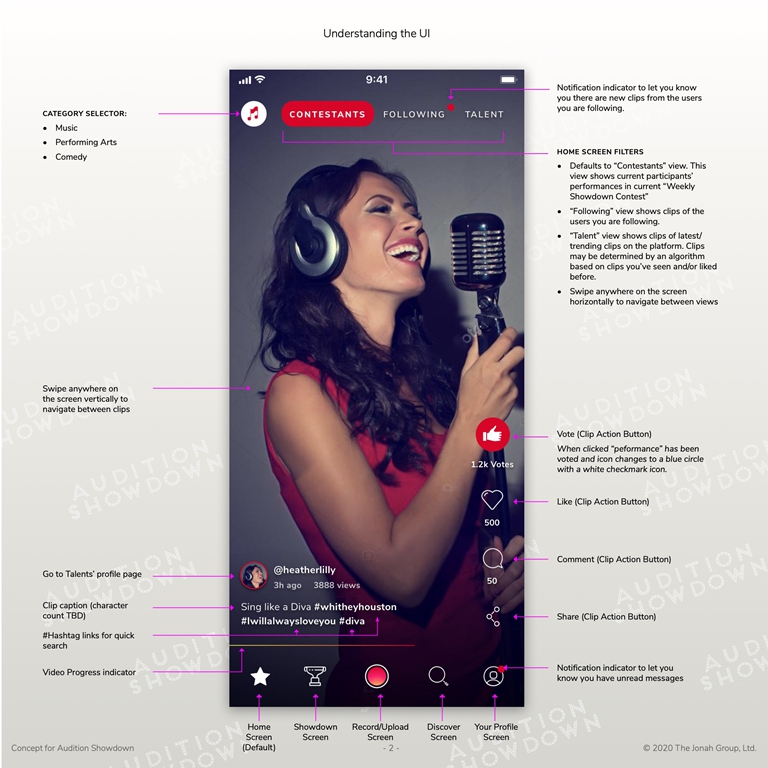
Application Concept:
9
The
system design is to introduce a high-quality platform for artists to get discovered. The experience is highly focused on mobile
devices, and content is presented from the discovery queue immediately after starting the app. The application concept it
to have no required registration or other steps to interfere with access. The user selects the category of choice: Music, Performing
Arts, or Comedy. The viewer can interact with the clip functions in the viewer window or swipe the screen vertically to navigate
between clips.
The app is also contemplated to have a contest functionality. This “virtual talent show” is targeted towards the same
people who would participate in an American Idol competition, but provides for a more accessible and scalable format. This virtual
format removes the physical barrier to entry by not requiring a participant to attend an audition in person, and the competition
can be expanded to a much broader group of participants. Further, the audience of a social media platform has the potential to
expand beyond traditional media viewership.
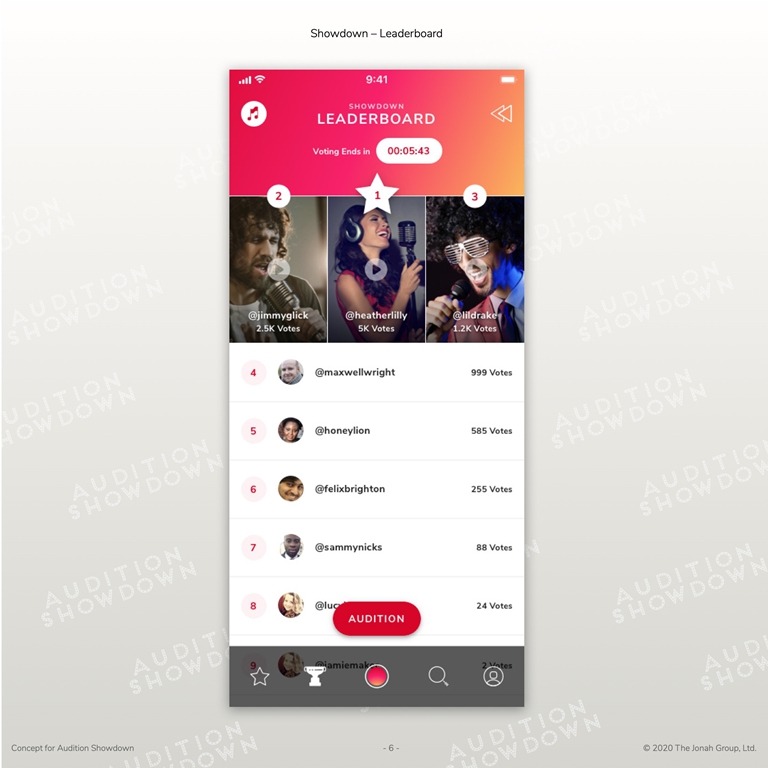
The contest leaderboard is shown in real time. The standings show the video posts in order of popularity and competition rankings, and usernames are linked to each artists’ profile. The user can also search the results of previous contests, and discover artists from previous postings. Only Premium Accounts are eligible to enter the competitions.
10

Users can quickly discover the leading and trending talent on Audition Showdown by the following filters: top performances of the week, trending talent, and hashtags.
Customers
The target user base of the application will include amateur and professional artists, millennials and Gen Z. Most of our customers will be acquired through marketing and advertising on various social media platforms. Furthermore, additional awareness will be made by the ‘Founding Artists’ who we expect will be endorsing the Audition Showdown application to their established user and fan base.
Customer Acquisition: In-App Marketing
Audition Showdown will market to our target audience through social media platforms. It is the company’s intention to start advertising to potential users that are Facebook and Instagram users, in addition to potential users through Google search.
11
Social Media Paid Advertising
Facebook offers an advanced method of targeting existing users, remarketing users, and lookalike subscribers through mobile ad campaigns. Remarketing users is an advertising method whereby we will position ads in from of a target audience who has previously interacted with our website or pages. Lookalike subscribers are a group of social network members who resemble, in some way, our target user. Using this methodology, we will generate Facebook and Instagram ads over the following places:
| ● | News Feed on mobile web browsers |
| ● | Mobile apps of partners in the Audience Network |
| ● | Facebook Messenger App |
| ● | News Feed on the Facebook and Instagram apps for: |
| o | iOS Devices |
| o | Android devices |
| o | Amazon Fire tablets |
Google Adwords Paid Advertising
We believe targeting mobile users with hyper-specific audience parameters will generate a high volume of app downloads while maintaining a low cost-per-acquisition.
Universal App Campaigns (UACs) are going to serve our ads over the following networks:
| ● | Google Search |
| ● | Google Play (largest source of app searches) |
| ● | Apple App Store |
| ● | Featured apps |
| ● | YouTube |
| ● | Google Display Network |
Founding Artists
Audition Showdown will be engaging a select group of social media influencers and performing artists to create user profiles and upload content. These artists will have established fan followings and will promote the application at launch to their respective followings, encouraging them to sign up for an Audition Showdown user account to view this content. This is anticipated to create a network effect of adoption. We anticipate entering into agreements with Founding Artists, in which they would be compensated by a combination of both equity and cash payments based on defined referral milestones.
Revenue
We plan to generate revenue from three sources:
| ● | Paid subscriptions from premium accounts |
| ● | In-application advertising; and |
| ● | Sponsorships. |
Premium Accounts
There will be two types of user accounts for Audition Showdown, Free and Premium. Premium Account users will have access to enhanced product offerings by paying an annual subscription fee of $25 per year. Premium Accounts will have the following benefits:
| ● | Users will be eligible to enter weekly contests |
| ● | Users will have the ability to upload videos of up to 4 minutes in length |
12
| ● | Users will be able to populate an Artist Profile, which is hosted online and will provide additional biographic and career-related information to share with the Audition Showdown userbase and can be shared with the public to further promote their talents. |
| ● | Users will be able to stream live performances via the application |
In-Application Advertising
Audition Showdown will sell advertising space by way of posting images and videos, produced by advertisers, in between content that is native and populated within the application. Ads will be targeted to users based on their location, demographic, profile information and the content a user interacts with.
The advertising model is contemplated that advertisers will create ads and set a budget and bid for each click or thousand impressions that the ad will receive. Users will see these ads within the application, as they interact with content.
Sponsorships
Audition Showdown will run sponsorships, which are promoted contests that users can participate in and compete to win a prize that is sponsored by a particular organization. For example, a beverage company can sponsor a contest for users to develop and publish a song to be used in the beverage company’s marketing campaign materials, and the winner will be rewarded with being involved in the development of this marketing content. Sponsors will enter into a contract for this service and a fee will be negotiated.
Market and Traction
Our market is active smartphone users across the globe. Currently, 3.25 billion people using smartphones to access social media3. The total revenues for the global entertainment and media industry were reported as $2.1trillion and forecasted to rise steadily to up to $2.6 trillion by 2023. Digital revenues accounted for a large share of the entertainment and media industry of total global industry revenue in 2018 (53.1%) and are expected to rise to 61.6% of the total global industry revenue by 2023. 4
Development of the mobile live streaming market in North America over the past decade has been influenced by a number of macroeconomic and technological factors and trends. As the North American economy continues to grow, disposable income increases along with demand for cultural and entertainment activities. At the same time, rising penetration rates for smartphones and other smart mobile devices and advances in mobile communication technology drive the increased use of the mobile internet.
Advertising will be made predominantly through the internet and social media. In the future, there could be complementary advertising.
Audition Showdown intends to market its application worldwide. This will be done by having Founding Artists and social media influencers, who we anticipate will assist in the marketing and branding of products to audiences. The company is also planning to involve many “Founding Artists” who will post media to the app and direct their followers to download the app and view it. At launch, the Founding Artists who were involved in the project up to that point will create posts on the application and direct their followers to download and engage within the application.
The company believes that this will help in creating uptake by its target audiences and help in developing their brand.
Competitors and Industry
Competitors
Our major competitors are technology platforms where users can show their talents by uploading videos. Companies that offer products related to mobile short-form video functionality include YouTube, TikTok, Triller, and Quibi, which are all currently better capitalized, have more users and have MVPs and/or completed, functional, software applications.
3 Source: hootsuite.com
4 Source: PwC Global Entertainment & Media Outlook 2019-2023
13
Companies that provide regional social networks and messaging products, many of which have strong positions in the industry may also eventually compete with the company, including: Facebook, Instagram and Twitter.
Facebook is the most popular mobile social networking app in the United States; in September 2019, 90.9% of U.S. mobile users accessed the Facebook mobile app. Facebook’s other mobile social media properties Facebook Messenger and Instagram were ranked second and third with 64.92% and nearly 57% audience, respectively. The ranking of the most popular mobile social networking apps in the United States as of June 2019 was headed by Facebook, Instagram, Facebook Messenger, and Twitter. These companies all chare similar target markets to Audition Showdown.
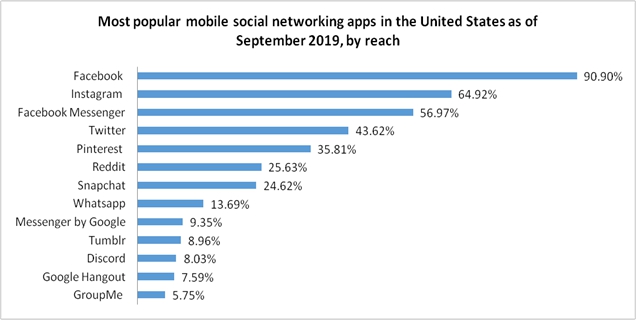
(Source:
Statista)
Competitive Advantage
The product, Audition Showdown is designed specially to provide a dedicated community platform for the performers to showcase and nurture their talents and help them gain visibility and recognition for their talents which we believe will set it apart from other social media platforms.
Audition Showdown intends to set a new benchmark in providing exceptional customer experience as the application is set to not only reward the winners with cash prizes, or unique experiences, but also provide an opportunity to have their performances promoted by influencers and provide exposure to talent agencies, and music producers
Intellectual Property
We do not currently have any intellectual property.
Research and Development
As of December 31, 2019, we had not spent any money on research and development.
Employees
The company currently has 3 full-time employees.
Litigation
The company is not involved in any litigation, and its management is not aware of any pending or threatened legal actions relating to its intellectual property, conduct of its business activities, or otherwise.
The Company’s Property
We do not own real property and are not currently leasing our offices. We plan to sign a lease agreement at a co-working space in Culver City, California upon receiving $5,000,000 from this offering.
14
MANAGEMENT’S DISCUSSION AND ANALYSIS OF FINANCIAL CONDITION AND RESULTS OF OPERATIONS
You should read the following discussion and analysis of our financial condition and results of our operations together with our financial statements and related notes included in this Offering Circular. This discussion contains forward-looking statements reflecting our current expectations that involve risks and uncertainties. Actual results and the timing of events may differ materially from those contained in these forward-looking statements due to a number of factors, including those discussed in the section entitled “Risk Factors” and elsewhere in this Offering Circular.
Overview
Audition Showdown Inc. was incorporated in Ontario, Canada in 2019.
To date, the company has raised a total of approximately CDN$540,500 in gross proceeds from the sale of 5,405,000 Common Shares sold at CDN$0.10 per share between December 2019 and April 2020 to accredited investors in Canada.
The company is subject to a number of risks similar to other internet application software development companies in the current stage of its life cycle including, but not limited to, the need to obtain adequate additional funding, competitors developing new or superior products and the need to successfully commercialize the company’s product. If the company does not successfully commercialize its main product or mitigate any of these other risks, it will be unable to generate revenue or achieve profitability which could ultimately result in the complete loss of shareholders’ investments and the closing of the company. The company’s current operating plan indicates that it will incur losses from operations and generate negative cash flows from operating activities given ongoing and future expenditures related to our product development and marketing activities.
Results of Operations
Year ended December 31, 2019
The company has not yet generated revenues from operations. Operating expenses in connection with the formation of the company in 2019 consisted of advertising and promotional expenses and professional fees totaling CDN$34,728. The company also made a provision for deferred income taxes of CDN$9,203. As a result of the foregoing expenses and tax deferral, our net loss was CDN$25,525 in 2019.
Liquidity and Capital Resources
Since its inception, the company has funded operations through the issuance of equity securities. As of December 31, 2019, the company had CDN$17,342 in cash and cash equivalents on hand. Subsequent to December 31, 2019, the company raised an additional CDN$515,500 through a private placement offering of Common Shares to accredited investors at a price of CDN$0.10 per share. The company has enough capital to last up to and through the offering, to sustain its current operations. The company has no bank lines or other financing arranged. We believe that the proceeds from the offering, together with our cash and cash equivalent balances will be adequate to meet our liquidity and capital expenditure requirements for the next 12 months. If these sources are not sufficient to meet our cash requirements, we will need to seek additional capital, potentially through private placements of equity or debt, to fund our plan of operations.
Trend Information
We believe that the growing engagement of social media users will favor the success of the application. With urbanization and global technology advancements, more than 5.19 billion people are using mobile phones. There are 4.54 billion people around the world using the internet, of which there are 3.8 billion social media users worldwide in January 2020 as reported in the Digital 2020 Global Overview Report.5 The Digital 2020 Global Overview report further indicates that the average internet user now spends 6 hours and 43 minutes online each day of which 3.7 hours are spent using social media and communications apps over mobile phones each day.
Additionally, there is a remarkable shift for the video content in the industry. The online content consumption rate is at an all-time high with a total of 90% of internet users watching online videos each month and 70% listening to music streaming services.6
5 PwC Global Entertainment & Media Outlook 2019-2023
6 PwC Global Entertainment & Media Outlook 2019-2023
15
The volume of data growth is soaring, stimulated by the growth of developing markets. It is anticipated that the 4G and 5G services will available to more than 90% of the mobile subscribers in 32 countries by 2023.7 It is further anticipated that the launch of 5G networks will enhance the customer experience and accelerate growth for many sub-sectors in the entertainment and media industry, from video games to high definition video streaming of sporting events or online contests.
Plan of Operations
Audition Showdown Inc. will be developing its mobile application, Audition Showdown.
At such time as the application has been beta tested and completed, the company will have the following key performance indicators: number of users, and revenues from advertising, subscriptions, and sponsorships.
Audition Showdown has engaged Jonah Group in Toronto, Ontario to architect the design and functionality of the app, which is expected to be completed by the fourth quarter of 2020. Jonah Group is an expert in the creation of high-performance custom digital solutions with an emphasis on great user experience, robust architecture, and perfect fit. Once Audition Showdown receives $2,000,000 in funding from this offering, the company will approve the advancement of developing a minimum viable product with Jonah Group. Once the company receives $5,000,000 from this offering, it will be able to scale the application to accommodate a substantial user base and develop a website that also supports the application’s functionality. Audition Showdown will be regularly involved in the direction and guidance of the application’s development, as required.
Once the company receives $2,000,000 in funding from this offering, the application will start being developed. The development of a minimum viable product is expected to take 6-7 months, and consist of a team of 8-9 people, including 1 Project Director, 1 Project Manager, 1 part-time Interactive Architect, 1 part-time Business Analysis/Product Owner, 1 Technical Analyst, 5 Developers, and 1 Quality Assurance Tester. Thus, we anticipate that the application could be released in the first half of 2021. This is subject to staffing the software development team with our application development partners, Jonah Group, and the development team adhering to this timeline. There is a risk of this being delayed due to delays in this process or the inability of the company to raise sufficient capital.
Once the application starts to amass a user base of up to 1,000,000, the company will be seeking to build upon product and service ideas generated by the company and its users, and we intend to improve the product offering and customer experience, including but not limited to, enhancing features, improving functionality and implementing new technologies.
Audition Showdown anticipates that upon raising $5,000,000 from this offering, the company will recruit a full-time management team to fill the positions of, among others, Chief Executive Officer, Chief Financial Officer, Chief Marketing Officer, and Chief Product Officer.
If we raise less than the maximum amount of financing sought in this offering, we would need to reduce the amount of expenditures on employees, marketing, the pace at which we can scale the application, and the ability to develop a functional website that supports the Audition Showdown application.
We believe core operating costs including marketing and operating expenses will remain fairly consistent over the next year, but salaries will increase as we hire additional executives and employees, software development partners, and onboarding corporate Advisors. Legal, insurance, and other administrative expenses will be incurred in the normal course of start-up and operation.
Assuming that the maximum amount of financing sought in this offering is raised, over the next 12 months the company intends to
| ● | Build the application, or Minimum Viable Product; |
| ● | Hire a full management team; and |
| ● | Cover our development, investing, and operating budget for 2 years. |
7 PwC Global Entertainment & Media Outlook 2019-2023
16
DIRECTORS, EXECUTIVE OFFICERS AND SIGNIFICANT EMPLOYEES
The company’s officers and directors are as follows. All are occupied full-time on the company’s business. The company does not currently employ any “significant employees” as defined by the Commission.
| Name | Position | Age | Term of Office (if indefinite, give date appointed) | |||
| Executive Officers: | ||||||
| John McMahon | CEO, President | 56 | January 1, 2020 | |||
| Damian Lee | Chief Creative Officer | 70 | January 1, 2020 | |||
| Directors: | ||||||
| John McMahon | Director | 56 | September 20, 2019 | |||
| Damian Lee | Director | 70 | September 20, 2019 |
Biographies
John McMahon
John McMahon is currently our President and CEO. He has served in that position since Audition Showdown’s incorporation in September 2019. In addition to this role, he has been Managing Partner, Thought Launch Capital & Advisory Inc., since 2016; a financial advisory firm located in Toronto, Ontario, Canada and a related party. Prior to this, he was Managing Director, Investment Banking, Industrial Alliance Securities from 2013 to 2016 and Vice Chairman and Head of Investment Banking, Mackie Research Capital Corporation from 2009 to 2013.
Damian Lee
Damian Lee is currently the Chief Creative Officer for Audition Showdown and one of its Founders. He is a producer, writer and director of over fifty feature films with an aggregation of budgets totaling over $200M. He is responsible for helping launch the careers of many stars, including Jim Carrey in the 1983 film Copper Mountain. He directed/produced the perennial teen favorite Ski School in 1990. Continued the Death Wish franchise with Death Wish V, starring Charles Bronson, which he produced in 1994. He produced and wrote the comedy National Lampoon’s Last Resort in 1994. Produced Woman Wanted starring Kiefer Sutherland and Academy Award winner Holly Hunter in 1999. Directed, wrote and produced the festival winner King of Sorrow in 2007. In 2012, he directed and wrote A Dark Truth starring Andy Garcia, Forest Whitaker, and Eva Longoria. In addition to the creative side of production, Mr. Lee also handles significant portions of the financial transactions. He commenced his career over thirty years ago producing television sports shows and has produced over three hundred of them. He holds a BA in Political Science from the University of Guelph.
17
COMPENSATION OF DIRECTORS AND EXECUTIVE OFFICERS
The company was formed in September 2019 and did not pay any compensation to its employees, officers and directors during 2019. For the fiscal year ended December 31, 2020, we expect to compensate our executive officers as follows:
| Name | Capacities in which compensation was received | Cash compensation (CDN$) | Other compensation (CDN$) (1) | Total compensation (CDN$) | ||||||||||
| John McMahon | CEO/President | $ | 185,000 | $ | 50,000 | $ | 235,000 | |||||||
| Damian Lee | Chief Creative Officer | $ | 150,000 | $ | 50,000 | $ | 200,000 | |||||||
| (1) | Represents maximum potential performance bonus that may be earned each year. |
The company does not plan to compensate Mr. McMahon and Mr. Lee for their roles as directors.
18
SECURITY OWNERSHIP OF MANAGEMENT AND CERTAIN SECURITYHOLDERS
The following table sets out, as of the date of this Offering Circular, the securities of the company that are owned by executive officers and directors, and other persons holding more than 10% of the company’s voting securities, or having the right to acquire those securities.
| Title of class | Name and address of beneficial owner | Amount and nature of beneficial ownership | Amount and nature of beneficial ownership acquirable | Percent of class | ||||||||||
| Multiple Voting Shares | John McMahon 1700 - 40 King Street West Toronto, Ontario M5H 3Y2 | 18,000,000 | 0 | 100.00 | % | |||||||||
| Multiple Voting Shares | All current officers and directors as a group (2 people) | 18,000,000 | 0 | 100.00 | % | |||||||||
| Common Shares | Damian Lee 1700 - 40 King Street West Toronto, Ontario M5H 3Y2 | 9,000,000 | 0 | 24.79 | % | |||||||||
| Common Shares | Brian Boigon 1700 - 40 King Street West Toronto, Ontario M5H 3Y2 | 9,000,000 | 0 | 24.79 | % | |||||||||
| Common Shares | All current officers and directors as a group (2 people) | 9,000,000 | 0 | 24.79 | % | |||||||||
19
INTEREST OF MANAGEMENT AND OTHERS IN CERTAIN TRANSACTIONS
Since inception, the company has paid its officers and directors for services in connection with the company’s formation and early operations.
The company paid CDN$56,500 to Thought Launch Capital & Advisory, a corporate advisory firm controlled by John McMahon and a related entity, for its services in organizing the company. The company paid Damian Lee CDN$10,000 for one-time marketing production services related to the development of a corporate promotional video.
20
General
The company is offering Common Shares in this offering. The following description summarizes important terms of the company’s capital stock. This summary does not purport to be complete and is qualified in its entirety by the provisions of the company’s Certificate of Incorporation and its By-laws, copies of which have been filed as Exhibits to the Offering Statement of which this Offering Circular is a part.
For a complete description of Audition Showdown’s capital stock, you should refer to its Certificate of Incorporation and By-laws.
At the date of this Offering Circular, Audition Showdown’s authorized capital stock consists of an unlimited number of Multiple Voting Shares, no par value per share, and an unlimited number of Common Shares, no par value per share. As of April 10, 2020, 18,000,000 Multiple Voting Shares and 36,310,200 Common Shares were outstanding.
Common Shares and Multiple Voting Shares
Except as set forth below, the rights and privileges of the Common Shares and the Multiple Voting Shares are the same.
Voting Rights
Holders of Common Shares are entitled to one (1) vote per share. Holders of Multiple Voting Shares are entitled to 25 votes per share.
Dividend Rights and Right to Receive Liquidation Distributions
Subject to the prior rights of any other class ranking senior to the Common Shares and the Multiple Voting Shares, the Common Shares and the Multiple Voting Shares rank pari passu, share for share, as to the right to receive dividends, if declared by the board of directors, and any amount payable on any distribution of assets constituting a return of capital and to receive the remaining property and assets of the company on the liquidation, dissolution or winding-up of the company, whether voluntarily or involuntarily, or any other distribution of assets upon winding up.
Rights and Preferences
Except as set forth below, holders of the Common Shares and the Multiple Voting Shares have no preemptive, conversion, subscription or other rights, and there are no redemption or sinking fund provisions applicable to such shares.
Conversion of Multiple Voting Shares
John McMahon is currently the sole “permitted holder” of the Multiple Voting Shares. His immediate family members may become holders of the shares solely in relation to estate or tax planning purposes as further detailed in the Certificate of Incorporation. Each outstanding Multiple Voting Share may, at any time, at the option of the permitted holder, be converted into one fully paid and non-assessable Common Share. If John McMahon ceases to be the permitted holder, the Multiple Voting Shares will be deemed automatically converted.
21
Plan of Distribution
The company is offering up to 25,000,000 Common Shares, as described in this Offering Circular. The company has engaged Dalmore Group, LLC, Member FINRA/SIPC, as the broker/dealer of record in order to provide compliance and administrative services.
The company will publicly market the offering using general solicitation through methods that include emails to potential investors, online advertisements, and press releases. We will use the website www.auditionshowdown.com and other social media to provide notification of the offering. Persons who desire information will be directed to a landing page on www.auditionshowdown.com/invest.
This Offering Circular will be furnished to prospective investors via download 24 hours per day, 7 days per week on the company’s website at www.auditionshowdown.com/invest.
The Common Shares sold under this offering have not been qualified for distribution by prospectus in Canada and may not be offered or sold in Canada except pursuant to a Canadian prospectus or a prospectus exemption existing under Canadian securities laws.
Commissions and Discounts
The company has engaged Dalmore Group, LLC (“Dalmore”) a broker-dealer registered with the SEC and a member of FINRA, to perform the following administrative and compliance related functions in connection with this offering, but not for underwriting or placement agent services:
| ● | Review investor information, including KYC (“Know Your Customer”) data, perform AML (“Anti Money Laundering”) and other compliance background checks, and provide a recommendation to the company whether or not to accept an investor as a customer. |
| ● | Review each investor’s subscription agreement to confirm such investor’s participation in the offering and provide a determination to the company whether or not to accept the use of the subscription agreement for the investor’s participation. |
| ● | Contact and/or notify the company, if needed, to gather additional information or clarification on an investor; |
| ● | Not provide any investment advice nor any investment recommendations to any investor; |
| ● | Keep investor details and data confidential and not disclose to any third-party except as required by regulators or in its performance pursuant to the terms of the agreement (e.g. as needed for AML and background checks); and |
| ● | Coordinate with third party providers to ensure adequate review and compliance. |
As compensation for the services listed above, the company has agreed to pay Dalmore a commission equal to 1% of the amount raised in the offering to support the offering on all newly invested funds after the issuance of a No Objection Letter by FINRA. In addition, the company has paid Dalmore a one-time advance set up fee of $25,000 to cover reasonable out-of-pocket accountable expenses actually anticipated to be incurred by Dalmore, such as, among other things, preparing the FINRA filing. Dalmore will refund any fee related to the advance to the extent it is not used, incurred or provided to the company. Assuming all of the Common Shares are sold, the company estimates that total fees due to pay Dalmore, including the advance set up fee, would be $525,000 for a fully-subscribed offering.
Investors’ Tender of Funds
After the Offering Statement has been qualified by the Commission, the company will accept tenders of funds to purchase the Common Shares. The company may close on investments on a “rolling” basis (so not all investors will receive their shares on the same date. Investors may subscribe by tendering funds via credit card, debit card, wire or ACH only, checks will not be accepted. Upon closing, funds tendered by investors will be made available to the company for its use.
In order to invest you will be required to subscribe to the offering via the company’s website on the offering landing page and agree to the terms of the offering, subscription agreement, and any other relevant exhibit attached thereto.
In the event that it takes some time for the company to raise funds in this offering, the company will rely on funds raised in any offerings from accredited investors.
Perks
At stepped investment levels, the company plans to offer investment packages that provide various incentives, including admissions benefits and VIP status on the company’s attractions. The company plans to offer the following benefits at various levels of investment:
| Minimum Number of Shares | Minimum Dollar Investment | Rewards | ||
| $500 (Bronze) | Wireless earbuds Approximate market value: $100 | |||
| $1000 (Silver) | Free
1 year subscription to Premium Account & free wireless earbuds Approximate market value: $125 | |||
| $2,500 (Gold) | Free
1 year subscription to Premium Account & recording tripod with light Approximate market value: $225 |
TAX CONSEQUENCES FOR RECIPIENT (INCLUDING FEDERAL, STATE, LOCAL AND FOREIGN INCOME TAX CONSEQUENCES) WITH RESPECT TO THE INVESTMENT BENEFIT PACKAGES ARE THE SOLE RESPONSIBILITY OF THE INVESTOR. INVESTORS MUST CONSULT WITH THEIR OWN PERSONAL ACCOUNTANT(S) AND/OR TAX ADVISOR(S) REGARDING THESE MATTERS.
22
AUDITION SHOWDOWN INC.
FINANCIAL STATEMENTS
DECEMBER 31, 2019
F-1
AUDITION SHOWDOWN INC.
DECEMBER 31, 2019
CONTENTS
F-2

|
GCSE LLP The Madison Centre 4950 Yonge Street, Suite 1900 Toronto, ON M2N 6K1
T: +1 416 512 6000 F: +1 416 512 9800 www.gcsellp.com |
To the Shareholders of
Audition Showdown Inc. :
Report on the Financial Statements
We have audited the accompanying financial statements of Audition Showdown Inc., which comprise the statement of financial position as of December 31, 2019, and the related statements of loss and comprehensive loss, changes in deficit and cash flow for the period from the date of incorporation on September 30, 2019 to December 31, 2019, and the related notes to the financial statements.
Management’s Responsibility for the Financial Statements
Management is responsible for the preparation and fair presentation of these financial statements in accordance with International Financial Reporting Standards; this includes the design, implementation, and maintenance of internal control relevant to the preparation and fair presentation of financial statements that are free from material misstatement, whether due to fraud or error.
Auditors’ Responsibility
Our responsibility is to express an opinion on these financial statements based on our audit. We conducted our audit in accordance with auditing standards generally accepted in the United States of America. Those standards require that we plan and perform the audit to obtain reasonable assurance about whether the financial statements are free from material misstatement.
An audit involves performing procedures to obtain audit evidence about the amounts and disclosures in the financial statements. The procedures selected depend on the auditors’ judgment, including the assessment of the risks of material misstatement of the financial statements, whether due to fraud or error. In making those risk assessments, the auditor considers internal control relevant to the entity’s preparation and fair presentation of the financial statements in order to design audit procedures that are appropriate in the circumstances, but not for the purpose of expressing an opinion on the effectiveness of the entity’s internal control. Accordingly, we express no such opinion. An audit also includes evaluating the appropriateness of accounting policies used and the reasonableness of significant accounting estimates made by management, as well as evaluating the overall presentation of the financial statements.
We believe that the audit evidence we have obtained is sufficient and appropriate to provide a basis for our audit opinion.
Opinion
In our opinion, the financial statements referred to above present fairly, in all material respects, the financial position of Audition Showdown Inc. as of December 31, 2019, and the results of its operations and its cash flow for the period from the date of incorporation on September 30, 2019 to December 31, 2019 in accordance with International Financial Reporting Standards.
| /s/ GCSE LLP | |
| Toronto, Canada | Chartered Professional Accountants |
| May 7, 2020 | Licensed Public Accountants |
F-3
STATEMENT OF FINANCIAL POSITION
AS AT DECEMBER 31, 2019
| Expressed in Canadian Dollars | $ | |||
| ASSETS | ||||
| Current assets | ||||
| Cash | 17,342 | |||
| Prepaid expense | 1,948 | |||
| Due from shareholders ( note 5 ) | 4,200 | |||
| 23,490 | ||||
| Non-current assets | ||||
| Deferred income tax ( note 8 ) | 9,203 | |||
| 32,693 | ||||
| LIABILITIES AND EQUITY | ||||
| Liabilities | ||||
| Accounts payable and accrued liabilities ( notes 5 and 6 ) | 29,018 | |||
| Deposit held for issuance of shares | 25,000 | |||
| 54,018 | ||||
| Deficit | ||||
| Share capital ( note 7 ) | 4,200 | |||
| Deficit | (25,525 | ) | ||
| (21,325 | ) | |||
| 32,693 | ||||
(See accompanying notes to financial statements)
On behalf of the Board
| /s/ John McMahon | Director |
| /s/ Damian Lee | Director |
F-4
STATEMENT OF LOSS AND COMPREHENSIVE LOSS
FOR THE PERIOD FROM SEPTEMBER 30, 2019 TO DECEMBER 31, 2019
| Expressed in Canadian Dollars | $ | |||
| EXPENSES | ||||
| Advertising and promotion | 14,035 | |||
| Bank charges and interest | 25 | |||
| Professional fees | 20,668 | |||
| 34,728 | ||||
| LOSS BEFORE INCOME TAXES | (34,728 | ) | ||
| INCOME TAXES ( note 8 ) | ||||
| Deferred income taxes | (9,203 | ) | ||
| NET LOSS AND COMPREHENSIVE LOSS | (25,525 | ) | ||
| LOSS PER COMMON SHARE - BASIC AND DILUTED | (0.0011 | ) | ||
| WEIGHTED AVERAGE NUMBER OF COMMON SHARES OUTSTANDING - BASIC AND DILUTED | 24,000,000 | |||
(See accompanying notes to financial statements)
F-5
STATEMENT OF CHANGES IN DEFICIT
FOR THE PERIOD FROM SEPTEMBER 30, 2019 TO DECEMBER 31, 2019
Expressed in Canadian Dollars
| Issued Capital | Total | |||||||||||||||
Shares # | Amount $ | Deficit $ | Deficit $ | |||||||||||||
| Balance, September 30, 2019 | - | - | - | - | ||||||||||||
| Shares issued during the period ( note 7 ) | 42,000,000 | 4,200 | - | 4,200 | ||||||||||||
| Net loss and comprehensive loss | - | - | (25,525 | ) | (25,525 | ) | ||||||||||
| Balance, December 31, 2019 | 42,000,000 | 4,200 | (25,525 | ) | (21,325 | ) | ||||||||||
(See accompanying notes to financial statements)
F-6
STATEMENT OF CASH FLOW
FOR THE PERIOD FROM SEPTEMBER 30, 2019 TO DECEMBER 31, 2019
| Expressed in Canadian Dollars | $ | |||
| CASH PROVIDED BY (USED IN) OPERATING ACTIVITIES | ||||
| Net loss | (25,525 | ) | ||
| Adjustment for non-cash items: | ||||
| Income tax expense | (9,203 | ) | ||
| Changes in non-cash working capital: | ||||
| Prepaid expense | (1,948 | ) | ||
| Accounts payable and accrued liabilities | 29,018 | |||
| 27,070 | ||||
| Cash used in operating activities | (7,658 | ) | ||
| CASH PROVIDED BY (USED IN) FINANCING ACTIVITIES | ||||
| Due from shareholder ( note 6 ) | (4,200 | ) | ||
| Deposit received for issuance of shares | 25,000 | |||
| Share capital issued | 4,200 | |||
| Cash provided by financing activities | 25,000 | |||
| NET CHANGE IN CASH | 17,342 | |||
| CASH, BEGINNING OF PERIOD | - | |||
| CASH, END OF PERIOD | 17,342 | |||
(See accompanying notes to financial statements)
F-7
NOTES TO FINANCIAL STATEMENTS DECEMBER 31, 2019
Expressed in Canadian Dollars
| 1 | NATURE AND OPERATIONS OF BUSINESS |
Audition Showdown Inc. (the “Company”) was incorporated on September 30, 2019 under the laws of the Province of Ontario, Canada. The address of the Company’s registered office is 130 King Street West, Suite 2950, Toronto, Ontario.
The Company plans to develop and maintain a social media platform that focuses on talent and performance.
| 2 | STATEMENT OF COMPLIANCE |
The financial statements have been prepared in accordance with International Financial Reporting Standards (“IFRS”) as issued by the International Accounting Standards Board.
The audited financial statements were approved and authorized for issuance by the Company’s Board of Directors on May 1, 2020.
| 3 | BASIS OF PREPARATION |
Basis of measurement
These financial statements have been prepared under the historical cost basis, except for specific financial instruments which are measured at fair market value, as explained in the accounting policies below.
Functional and presentation currency
The Company’s financial statements are reported in Canadian dollars which is its functional and presentation currency.
Adoption of IFRS standards
These financial statements are the first financial statements prepared in accordance with IFRS. The Company has adopted IFRS effective September 30, 2019 (“the transition date”), the date of incorporation and commencement of operations.
New standards and interpretations not yet adopted
Certain new accounting standards and interpretations have been published that are not mandatory for December 31, 2019 reporting period. Based on Company’s assessment of the impact of such standards, there are no standards that are not yet effective and that would be expected to have a material impact of the entity in the current and future reporting periods and on foreseeable future transactions.
Estimation uncertainty
In preparing the Company’s financial statements, management is required to make estimates and assumptions that affect the reported amount of assets and liabilities, the disclosure of contingent assets and liabilities at the date of the financial statements and the reporting amounts of revenues and expenses during the reporting period. The estimates and associated assumptions are based on historical experience and other factors that are considered to be relevant. The actual results may differ from the estimates and assumptions by management. The estimates and underlying assumptions are reviewed on an ongoing basis. Revisions to accounting estimates are recognized in the period in which the estimate is revised if the revision affects only that period or in the period of the revision and future periods if the revision affects both current and future periods.
F-8
AUDITION SHOWDOWN INC.
NOTES TO FINANCIAL STATEMENTS DECEMBER 31, 2019
Expressed in Canadian Dollars
| 3 | BASIS OF PREPARATION (continued) |
Estimation uncertainty (continued)
Key Sources of Estimation Uncertainty
The following are the key estimates and related assumptions concerning the sources of estimation uncertainty that have a significant risk of causing adjustments to the carrying amount of assets and liabilities:
Income taxes
Deferred tax assets (if any) are recognized only to the extent it is considered probable that those assets will be recoverable. This involves an assessment of when those deferred tax assets are likely to reverse.
Judgments are made by management to determine the likelihood of whether deferred tax assets will be realized from future taxable earnings. To the extent that assumptions regarding future profitability change, there can be an adjustment in the deferred tax assets as well as an income impact in the period in which the change occurs.
The determination of the Company’s income and other tax liabilities requires interpretation of complex laws and regulations. All tax filings are subject to audit and potential reassessment after the lapse of considerable time. Accordingly, the actual income tax liability may differ significantly from that estimated and recorded by management.
| 4 | SIGNIFICANT ACCOUNTING POLICIES |
The principal accounting policies adopted in the preparation of the financial statements are set out below. The policies have been consistently applied during the period presented.
Cash
Cash consists of cash held in bank accounts with Canadian Chartered Banks and cash on hand.
Financial instruments
Financial instruments are contracts that give rise to a financial asset or a financial liability. The Company initially recognizes financial assets and financial liabilities when it becomes a party to the contractual provisions of the financial instruments. Financial assets are derecognized when the rights to receive cash flows from the assets have expired or have been transferred and the Company has transferred substantially all risks and rewards of ownership. The Company de- recognizes financial liabilities when the obligations are discharged, cancelled or expire.
Financial assets are classified in the following measurement categories: amortized cost, fair value through other comprehensive income (“FVTOCI”) or fair value through profit or loss (“FVTPL”). Financial liabilities are classified in the following measurement categories: amortized cost or FVTPL.
All financial assets and financial liabilities are initially measured at fair value plus or minus, in the case of an item not classified as FVTPL, directly attributable transaction costs.
F-9
AUDITION SHOWDOWN INC.
NOTES TO FINANCIAL STATEMENTS DECEMBER 31, 2019
Expressed in Canadian Dollars
| 4 | SIGNIFICANT ACCOUNTING POLICIES (continued) |
Financial instruments (continued)
Financial assets
The Company’s financial assets consist of cash. Cash is measured at FVTPL.
Amortized cost
Financial assets classified as amortized cost are non-derivative assets with fixed or determinable payments that are not quoted in an active market. They are carried at amortized cost less any provision for impairment. Individually significant receivables are considered for impairment when they are past due or when other objective evidence is received that a specific counterparty will default.
Fair value through profit or loss
Financial assets classified as FVTPL are measured at fair value with changes in fair value recognized in net profit or loss.
Fair value through other comprehensive income
Financial assets classified as FVTOCI are non-derivative financial assets that are not held for trading and the Company has made an irrevocable election at the time of initial recognition to measure the assets at FVTOCI. They are carried at fair value with unrealized gains or losses recognized in other comprehensive income or loss.
Impairment of financial assets
Financial assets not measured as FVTPL are assessed for indicators of impairment a the end of each reporting period. Financial assets are impaired when there is objective evidence that, as a result of one or more events that occurred after the initial recognition of the financial assets, the estimated future cash flows of the financial assets have been negatively impacted. Evidence of impairment could include: significant financial difficulty of the issuer or counterpart; default or delinquency in interest or principal payments; or the likelihood that the borrower will enter bankruptcy or financial reorganization.
Financial liabilities
The Company’s financial liabilities consist of accounts payable and accrued liabilities. Accounts payable and accrues liabilities are measured at amortized cost.
Amortized cost
After initial recognition at fair value, financial liabilities are measured at amortized cost using the effective interest method, with interest recognized on an effective yield basis. The effective interest method is a method of calculating the amortized cost of a financial liability and of allocating interest costs over the relevant period. The effective interest rate is the rate that exactly discounts estimated future cash payments through the expected life of the financial liability or to the net carrying amount on initial recognition. Any changes in value are recognized in the statements of income and comprehensive income.
Fair value through profit or loss
This category comprises of financial liabilities incurred related to held for trading or derivative instruments. They are carried in the statement of financial position at fair value with changes in fair value recognized in the statement of comprehensive income.
F-10
AUDITION SHOWDOWN INC.
NOTES TO FINANCIAL STATEMENTS DECEMBER 31, 2019
Expressed in Canadian Dollars
| 4 | SIGNIFICANT ACCOUNTING POLICIES (continued) |
Share capital
Financial instruments issued by the Company are classified as equity only to the extent that they do not meet the definition of a financial liability or financial assets. The Company’s common shares are classified as equity instruments. Transaction costs directly attributable to the issue of common shares are recognized as a deduction from equity.
Income taxes
Income tax expense comprises current and deferred tax. Income tax expense is recognized in profit or loss except to the extent that it relates to items recognized directly in equity, in which case it is recognized in equity.
Current tax is the expected tax payable on the taxable income for the year, using tax rates enacted or substantively enacted at the reporting date, and any adjustment to tax payable in respect of previous years.
Deferred tax is recognized on any temporary differences between the carrying amounts of assets and liabilities in the consolidated financial statements and the corresponding tax bases used in the computation of taxable earnings. Deferred tax assets and liabilities are measured at the tax rates that are expected to apply in the period when the asset is realized and the liability is settled. The effect of a change in the enacted or substantively enacted tax rates is recognized in net earnings and comprehensive income or in equity depending on the item to which the adjustment relates.
A deferred tax asset is recognized to the extent that is probable that future taxable profits will be available against which the temporary difference can be utilized. Deferred tax assets are reviewed at each reporting date and are reduced to the extent that it is no longer probable that the related tax benefit will be realized.
Foreign currency
Monetary assets and liabilities denominated in foreign currencies are translated into Canadian dollars at the rate of exchange prevailing at the statement date. Non-monetary assets and liabilities denominated in foreign currencies are translated into Canadian dollars at historical exchange rates. Revenue and expense items, other than amortization, are translated at the rate of exchange in effect on the transaction date. An exchange gain or loss that arises on translation or settlement of a foreign currency denominated monetary item is included in the determination of total comprehensive income for the year.
Related parties
Parties are considered to be related if one party has the ability, directly or indirectly to control the other party or exercise significant influence over the other party in making operating and financial decisions. Parties are also related if they are under common control or common significant influence. Related parties may be individuals or corporate entities. A transaction is considered to be a related party transaction when there is a transfer of resources or obligations between related parties. Related party transactions that are in the normal course of business and have commercial substance and are measured at the fair value.
F-11
AUDITION SHOWDOWN INC.
NOTES TO FINANCIAL STATEMENTS DECEMBER 31, 2019
Expressed in Canadian Dollars
| 4 | SIGNIFICANT ACCOUNTING POLICIES (continued) |
Other comprehensive income (loss)
Other comprehensive income (loss) is the change in the Company’s net assets that results from transactions, events and circumstances from sources other than the Company’s shareholders and includes items that are not included in net profit or loss such as unrealized gains or losses on available-for-sale investments, gains or losses on certain derivative instruments and foreign currency gains or losses related to translation of the financial statements of foreign operations and items that will be reclassified subsequently directly to equity. The Company’s comprehensive income (loss), components of other comprehensive income and cumulative translation adjustments are presented in the statements of comprehensive income (loss) and the statements of changes in equity (deficit).
Loss per share
Per IAS 33 “Earnings per Share” applies to a company whose common shares or potential common shares are traded in a public market or that files, or is in the process of filing, its financial statements with a securities commission or other regulatory organization for the purpose of issuing common shares in a public market. Loss per share is computed by dividing the loss for the period by the weighted average number of common shares outstanding during the period, including contingently issuable shares which are included when the conditions necessary for issuance have been met. Diluted loss per share is calculated in a similar manner, except that the weighted average number of common shares outstanding is increased to include potentially issuable common shares from the assumed exercise of common share purchase options and warrants, if dilutive. As at December 31, 2019, the Company did not have any stock options or warrants issued.
| 5 | ACCOUNTS PAYABLE AND ACCRUED LIABILITIES |
Accounts payable and accrued liabilities are comprised as follows:
| $ | ||||
| Trade payable | 29,018 | |||
| 6 | RELATED PARTY INFORMATION |
Due from shareholders
These receivables are non-interest bearing, unsecured and have no specific terms of repayment.
Accounts payable and accrued liabilities
Included in accounts payable and accrued liabilities are amounts owing to Thought Launch Capital & Advisory, a company under common management, in the amount of $8,350.
Compensation of key management personnel
Key management personnel are those persons having authority and responsibility for planning, directing and controlling the activities of the Company, directly and indirectly, and include directors. No salaries or other benefits were paid to key management personnel, including directors, during the year.
Unless otherwise noted, related party transactions are measured at the exchange amount, which is the amount of consideration established and agreed to by the related parties.
F-12
AUDITION SHOWDOWN INC.
NOTES TO FINANCIAL STATEMENTS DECEMBER 31, 2019
Expressed in Canadian Dollars
| 7 | SHARE CAPITAL |
Authorized, unlimited number of:
Common shares, no par value
Multiple voting shares, each share has 25 votes, no par value
| $ | |||||||
| Issued | |||||||
| 24,000,000 | Common shares | 2,400 | |||||
| 18,000,000 | Multiple voting shares | 1,800 | |||||
| 42,000,000 | 4,200 | ||||||
During the period ended December 31, 2019, the Company entered into the following capital transaction:
| 24,000,000 | Issuance of common shares on September 30, 2019 at $0.0001 per share, not fully paid as at December 31, 2019; |
| 18,000,000 | Issuance of multiple voting shares on September 30, 2019 at $0.0001 per share, not fully paid as at December 31, 2019. |
Subsequent to the period ended December 31, 2019, the Company entered into the following capital transactions:
| 250,000 | Issuance of common shares at $0.10 per share for $25,000 held as deposit for issuance of shares; | |
| 5,155,000 | Issuance of common shares at $0.10 per share for $515,500; and | |
| 6,905,200 | Issuance of common shares in exchange for business advisory services to be provided. An estimate of the value of such services cannot be made as of the date of the approval of these financial statements. |
| 8 | INCOME TAXES |
The Company’s income tax provision varies from the amount that would otherwise result from the application of the combined effective Canadian federal and provincial income tax rate to loss before income taxes. The difference results from the following:
| $ | ||||
| Loss before income taxes | (34,728 | ) | ||
| Expected income tax expense recovery at the combined basic federal and provincial tax rate of 26.5% | (9,203 | ) | ||
| Income tax recovery | (9,203 | ) | ||
The Company has losses carried forward for income tax purposes totaling $34,728 as at December 31, 2019 which are available to reduce taxable income in future periods. The tax losses will expire at the end of fiscal 2039.
F-13
AUDITION SHOWDOWN INC.
NOTES TO FINANCIAL STATEMENTS DECEMBER 31, 2019
Expressed in Canadian Dollars
| 8 | INCOME TAXES (continued) |
Deferred income tax asset
The income tax effects of temporary differences that give rist to future income tax asset are as follows:
| $ | ||||
| Non-capital losses carried forward | 34,728 | |||
| Deferred income tax asset | 34,728 | |||
| 9 | FINANCIAL INSTRUMENTS AND RISK MANAGEMENT |
The financial instruments of the Company that are recorded at fair value have been classified into levels using a fair value hierarchy. The three levels of the fair value hierarchy are defined below:
| Level 1 | - | unadjusted quoted prices available in active markets for identical assets or liabilities; | |
| Level 2 | - | inputs other than quoted prices included in Level 1 that are observable for the asset or liability, either directly (i.e. as prices) or indirectly (i.e., derived from prices); and | |
| Level 3 | - | inputs for the asset or liability that are not based on observable market data. |
Assets are classified in their entirety based on the lowest level of input that is significant to the fair value measurement. As at December 31, 2019, the Company’s cash was classified as Level 1 measurement. As at December 31, 2019, the Company had no financial instruments classified at Level 2 and Level 3.
Fair values
Except as disclosed elsewhere in these financial statements, the carrying amounts for the Company’s financial instruments approximate their fair values because of the short-term nature of these items.
The Company’s risk exposures and the impact on the Company’s financial instruments are summarized below:
Credit risk
Credit risk arises from the potential that counterparties will fail to satisfy their obligations as they come due. Credit risk is managed by dealing with counterparties that the Company believes to be creditworthy and by actively monitoring credit exposure and the financial health of the counterparties. The Company does not have a significant exposure to any individual third party.
Liquidity risk
Liquidity risk is the risk the Company will encounter difficulty in meeting obligations associated with financial liabilities that are settled in cash or other financial assets. The Company’s approach to manage liquidity risk is to ensure that it will have sufficient liquidity to meet liabilities when due. The majority of current assets reflected on the statements of financial position are highly liquid. As at December 31, 2019, the Company had current assets of $23,490 to settle current liabilities of $29,018. The Company does not anticipate any issues with repayment of the current liabilities as they come due.
F-14
AUDITION SHOWDOWN INC.
NOTES TO FINANCIAL STATEMENTS DECEMBER 31, 2019
Expressed in Canadian Dollars
| 9 | FINANCIAL INSTRUMENTS AND RISK MANAGEMENT (continued) |
Foreign exchange risk
Foreign exchange risk arises from the possibility that changes in the price of foreign currencies will result in changes in carrying value. The Company does not hold any assets denominated in currencies other than the Canadian dollar and is not subject to foreign currency risk.
Capital management
As at December 31, 2019, the Company was not subject to any regulatory capital requirements. The Company’s capital is composed of equity, including shareholders’ equity and deficit.
The Company’s objectives when managing capital include:
| (a) | ensuring that the Company meets relevant regulatory capital requirements, when applicable; and |
| (b) | ensuring that the Company is able to meet its financial obligations as they become due. |

F-15
PART III
INDEX TO EXHIBITS
| 2.1 Articles of Incorporation |
| 2.2 Form of Amendment to Articles of Incorporation |
| 2.3 Bylaws |
| 4. Form of Subscription Agreement* |
| 6.1 Broker-Dealer Agreement with Dalmore Group, Inc. |
| 6.2 Employment Agreement of John McMahon |
| 6.3 Employment Agreement of Damian Lee |
| 11. Consent of Auditing Accountant |
| 12. Validity opinion of Goodmans LLP* |
| 13. “Test the waters” materials* |
| 14. Form F-X |
*To be filed by Amendment
III-1
SIGNATURES
Pursuant to the requirements of Regulation A, the issuer certifies that it has reasonable grounds to believe that it meets all of the requirements for filing on Form 1-A and has duly caused this Offering Statement to be signed on its behalf by the undersigned, thereunto duly authorized, in the City of Toronto, Ontario, on May X, 2020.
| Audition Showdown Inc. | ||
| By | /s/ John McMahon | |
| John McMahon, Chief Executive Officer | ||
| Audition Showdown Inc. | ||
| Date: May 11, 2020 | ||
This Offering Statement has been signed by the following persons in the capacities and on the dates indicated.
| By | /s/ John McMahon | |
| John McMahon, Chief Executive Officer, | ||
| Principal Financial Officer, | ||
| Principal Accounting Officer and Director | ||
| Date: May 11, 2020 | ||
| By | /s/ Damian Lee | |
| Damian Lee, Director | ||
| Date: May 11, 2020 | ||
III-2

Exhibit 2.1
| Request ID: | 023649136 | Province of Ontario | Date Report Produced: 2019/09/30 |
| Demande no: | Province de l’Ontario | Document produit le: |
| Transaction ID: | 073207055 | Ministry of Government Services | Time Report Produced: 16:17:49 |
| Transaction no: | Ministère des Services gouvernementaux | Imprimé à: | |
| Category ID: | CT | ||
| Catégorie: | |||
Certificate of Incorporation
Certificat de constitution
| This is to certify that | Ceci certifie que |
AUDITION SHOWDOWN INC.
| Ontario Corporation No. | Numéro matricule de la personne morale en Ontario |
002719108
| is a corporation incorporated, the laws of the Province of Ontario. | est une société constituée aux termes under des lois de la province de l’Ontario. |
| These articles of incorporation are effective on | Les présents statuts constitutifs entrent en vigueur le |
SEPTEMBER 30 SEPTEMBRE, 2019

Director/Directrice
Business Corporations Act/Loi sur les sociétés par actions
| Page : 1 | |
Request ID / Demande no 23649136 | Ontario Corporation Number Numéro de la compagnie en Ontario 2719108 |
| FORM 1 | FORMULE NUMÉRO 1 | |
| BUSINESS CORPORATIONS ACT | / | LOI SUR LES SOCIÉTÉS PAR ACTIONS |
ARTICLES OF INCORPORATION
STATUTS CONSTITUTIFS
| 1. | The name of the corporation is: | Dénomination sociale de la compagnie: | |
| AUDITION SHOWDOWN INC. |
| 2. | The address of the registered office is: | Adresse du siège social: |
| 130 KING STREET WEST | Suite 2950 |
| (Street & Number, or R.R. Number & if Multi-Office Building give Room No.) | |
| (Rue et numéro, ou numéro de la R.R. et, s’il s’agit édifice à bureau, numéro du bureau) |
TORONTO CANADA |
ONTARIO M5X 2A2 |
(Name of Municipavlity or Post Office) (Nom de la municipalité ou du bureau de poste) |
(Postal Code/Code postal) |
| 3. | Number (or minimum and maximum number) of directors is:
Minimum 1 |
Nombre (ou nombres minimal et maximal) d’administrateurs:
Maximum 20 |
| 4. | The first director(s) is/are: | Premier(s) administrateur(s): |
| First name, initials and surname Prénom, initiales et nom de famille | Resident Canadian State Yes or No Résident Canadien Oui/Non | ||
| Address for service, giving Street & No. or R.R. No., Municipality and Postal Code | Domicile élu, y compris la rue et le numéro, le numéro de la R.R., ou le nom de la municipalité et le code postal |
| * | JOHN A. MCMAHON
1 ST. THOMAS STREET Suite 10A |
YES | |
TORONTO ONTARIO CANADA M5S 3M5 |
| Page : 2 | |
Request ID / Demande no 23649136 | Ontario Corporation Number Numéro de la compagnie en Ontario 2719108 |
| 5. | Restrictions, if any, on business the corporation may carry on or on powers the corporation may exercise. |
| Limites, s’il y a lieu, imposées aux activités commerciales ou aux pouvoirs de la compagnie. | |
| There are no restrictions on business the Corporation may carry on or on powers the Corporation may exercise. | |
| 6. | The classes and any maximum number of shares that the corporation is authorized to issue: |
| Catégories et nombre maximal, s’il y a lieu, d’actions que la compagnie est autorisée à émettre: | |
| The Corporation is authorized to issue an unlimited number of Common Shares and an unlimited number of Multiple Voting Shares. |
| Page : 3 | |
Request ID / Demande no 23649136 | Ontario Corporation Number Numéro de la compagnie en Ontario 2719108 |
| 7. | Rights, privileges, restrictions and conditions (if any) attaching to each class of shares and directors authority with respect to any class of shares which may be issued in series: |
| Droits, privilèges, restrictions et conditions, s’il y a lieu, rattachés à chaque catégorie d’actions et pouvoirs des administrateurs relatifs à chaque catégorie d’actions que peut être émise en série: |
| 1. Common Shares and Multiple Voting Shares | |
| The rights, privileges, restrictions and conditions attaching to the Common shares (“Common Shares”) and the multiple voting shares (“Multiple Voting Shares”) are: | |
| (a) Dividends; Rights on Liquidation, Dissolution, at Winding-Up. Subject to the prior rights of any other class ranking senior to the Common Shares and the Multiple Voting Shares, the Common Shares and the Multiple Voting Shares shall rank pari passu, share for share, as to the right to receive dividends and any amount payable on any distribution of assets constituting a return of capital and to receive the remaining property and assets of the Corporation on the liquidation, dissolution or winding-up of the Corporation, whether voluntarily or involuntarily, or any other distribution of assets of the Corporation among its shareholders for the purposes of winding up its affairs. For the avoidance of doubt, holders of Common Shares and Multiple Voting Shares shall, subject always to the rights of any other class ranking senior to the Common Shares and the Multiple Voting Shares, be entitled to receive (i) such dividends and any amount payable on any distribution of assets constituting a return of capital as the Board of Directors of the Corporation shall determine, and | |
| (ii) in the event of the liquidation, dissolution or winding-up of the Corporation, whether voluntarily or involuntarily, or any other distribution of assets of the Corporation among its shareholders for the purposes of winding up its affairs, the remaining property and assets of the Corporation, in the case of (i) and (ii) in an identical amount per share, at the same time and in the same form (whether in cash, in specie or otherwise) as if the Common Shares and Multiple Voting Shares were of one class only. | |
| (b) Meetings and Voting Rights. | |
| (i) Each holder of Multiple Voting Shares and each holder of Common Shares shall be entitled to receive notice of and to attend all meetings of shareholders of the Corporation, except meetings at which only holders of another particular class or series shall have the right to vote. At each such meeting, each Multiple Voting Share shall entitle the holder thereof to twenty-five (25) votes and each Common Share shall entitle the holder thereof to one (1) vote, voting together as a single class, except as otherwise expressly provided herein or as provided by law. |
| (ii) In addition to any other voting right or power to which holders of Common Shares shall be entitled by law or regulation or other provisions of the articles of the Corporation from time to time in effect, but subject to the provisions hereof, holders of Common Shares shall be entitled to vote separately as a class, in addition to any other vote of shareholders that may be required, in respect of any alteration, repeal or amendment to the articles of the Corporation that would adversely affect the powers, preferences or rights of the holders of Common Shares, or affect the holders of Common Shares or Multiple Voting Shares differently, on a per share basis, including an amendment to the terms of the articles of the Corporation providing that any Multiple Voting Shares held by or Transferred to a Person that is not a Permitted Holder shall be automatically converted into Common Shares, and such alteration, repeal or amendment shall not be effective unless a resolution in respect thereof is approved by a majority of the votes cast by holders of outstanding shares of such class or their proxyholders. |
| Page : 4 | |
Request ID / Demande no 23649136 | Ontario Corporation Number Numéro de la compagnie en Ontario 2719108 |
| 7. | Rights, privileges, restrictions and conditions (if any) attaching to each class of shares and directors authority with respect to any class of shares which may be issued in series: |
| Droits, privilèges, restrictions et conditions, s’il y a lieu, rattachés à chaque catégorie d’actions et pouvoirs des administrateurs relatifs à chaque catégorie d’actions que peut être émise en série: | |
| (c) Subdivision or Consolidation. No subdivision or consolidation of the Common Shares or the Multiple Voting Shares shall be carried out unless, at the same time, the Multiple Voting Shares or the Common Shares, as the case may be, are subdivided or consolidated in the same manner and on the same basis so as to preserve the relative economic and voting interests of the two classes. | |
| (d) Voluntary Conversion. The Common Shares cannot be converted into any other class of shares. Each outstanding Multiple Voting Share may, at any time, at the option of the holder, be converted into one fully paid and non-assessable Common Share, in the following manner: |
| (i) The conversion privilege for which provision is made in this subsection 1(d) shall be exercised by notice in writing given to the Corporation at its registered office, accompanied by a certificate or certificates representing the Multiple Voting Shares in respect of which the holder desires to exercise such conversion privilege. Such notice shall be signed by the holder of the Multiple Voting Shares in respect of which such conversion privilege is being exercised, or by the duly authorized representative thereof and shall specify the number of Multiple Voting Shares which such holder desires to have converted. On any conversion of Multiple Voting Shares, the Common Shares resulting therefrom shall be registered in the name of the registered holder of the Multiple Voting Shares converted or, subject to payment by the registered holder of any stock transfer or other applicable taxes and compliance with any other reasonable requirements of the Corporation in respect of such transfer, in such name or names as such registered holder may direct in writing. Upon receipt of such notice and certificate or certificates and, as applicable, compliance with such other requirements, the Corporation shall, at its expense, effective as of the date of such receipt and, as applicable, compliance, remove or cause the removal of such holder from the register of holders in respect of the Multiple Voting Shares for which the conversion privilege is being exercised, add the holder (or any person or persons in whose name or names such converting holder shall have directed the resulting Common Shares to be registered) to the register of holders in respect of the resulting Common Shares, cancel or cause the cancellation of the certificate or certificates representing such Multiple Voting Shares and issue or cause to be issued a certificate or certificates representing the Common Shares issued upon the conversion of such Multiple Voting Shares. If less than all of the Multiple Voting Shares represented by any certificate are to be converted, the holder shall be entitled to receive a new certificate representing the Multiple Voting Shares represented by the original certificate which are not converted. |
| Page : 5 | |
Request ID / Demande no 23649136 | Ontario Corporation Number Numéro de la compagnie en Ontario 2719108 |
| 7. | Rights, privileges, restrictions and conditions (if any) attaching to each class of shares and directors authority with respect to any class of shares which may be issued in series: |
| Droits, privilèges, restrictions et conditions, s’il y a lieu, rattachés à chaque catégorie d’actions et pouvoirs des administrateurs relatifs à chaque catégorie d’actions que peut être émise en série: | |
| (e) Automatic Conversion. | |
| (i) Upon the first date that any Multiple Voting Share is held by or Transferred to a Person other than a Permitted Holder, the Permitted Holder which held such Multiple Voting Share until such date, without any further action, shall automatically be deemed to have exercised his, her or its rights under subsection 1(d) to convert such Multiple Voting Share into one fully paid and non-assessable Common Share. | |
| (ii) Upon the conversion of all of the issued and outstanding Multiple Voting Share of the Corporation into Common Shares as provided for in paragraph 1(e)(i), the authorized and unissued Multiple Voting Shares as a class shall be deleted entirely from the authorized capital of the Corporation, together with the rights, privileges, restrictions and conditions attaching thereto and all references to the Multiple Voting Shares, without prejudice to the rights of the former holders of Multiple Voting Shares to receive, upon surrender of their certificate or certificates (or lost certificate affidavit and agreement) therefor, a certificate or certificates for the number of Common Shares issued on conversion thereof. | |
| (iii) The Corporation may, from time to time, establish such policies and procedures relating to the conversion of the Multiple Voting Shares to Common Shares and the general administration of this dual class share structure as it may deem necessary or advisable, and may from time to time request that holders of Multiple Voting Shares furnish certifications, affidavits or other proof to the Corporation as it deems necessary to verify the ownership of Multiple Voting Shares and to confirm that a conversion to Common Shares has not occurred. A determination by the Secretary of the Corporation that a Transfer results in a conversion to Common Shares shall be conclusive and binding. |
| Page : 6 | |
Request ID / Demande no 23649136 | Ontario Corporation Number Numéro de la compagnie en Ontario 2719108 |
| 7. | Rights, privileges, restrictions and conditions (if any) attaching to each class of shares and directors authority with respect to any class of shares which may be issued in series: |
| Droits, privilèges, restrictions et conditions, s’il y a lieu, rattachés à chaque catégorie d’actions et pouvoirs des administrateurs relatifs à chaque catégorie d’actions que peut être émise en série: | |
| (iv) For the purposes of this subsection 1(e): | |
| “Affiliate” means, with respect to any specified Person, any other Person which directly or indirectly through one or more intermediaries controls, or is controlled by, or is under common control with, such specified Person; | |
| “Members of the Immediate Family” means with respect to any individual, each parent (whether by birth or adoption), spouse, child or other descendants (whether by birth or adoption) of such individual, each spouse of any of the aforementioned Persons, each trust created solely for the benefit of such individual and/or one or more of the aforementioned Persons, and each legal representative of such individual or of any aforementioned Persons (including without limitation a tutor, curator, mandatary due to incapacity, custodian, guardian or testamentary executor), acting in such capacity under the authority of the law, an order from a competent tribunal, a will or a mandate in case of incapacity or similar instrument. For the purposes of this definition, a Person shall be considered the spouse of an individual if such Person is legally married to such individual, lives in a civil union with such individual or is the common law partner (as defined in the Income Tax Act (Canada) as amended from time to time) of such individual. A Person who was the spouse of an individual within the meaning of this paragraph immediately before the death of such individual shall continue to be considered a spouse of such individual after the death of such individual; | |
| “Permitted Holders” means (i) John A. McMahon, (ii) in respect of a holder of Multiple Voting Shares that is an individual, the Members of the Immediate Family of such individual and any Person controlled, directly or indirectly, by any such holder, and (iii) in respect of a holder of Multiple Voting Shares that is not an individual, an Affiliate of that holder or the Members of the immediate Family of the individual that controls such holder; provided, however, that in the case of clauses (ii) and (iii), as applicable, such holder of Multiple Voting Shares holds or is Transferred such Multiple Voting Shares solely and exclusively for estate or tax planning purposes; | |
| “Person” means any individual, partnership, corporation, company, association, trust, joint venture or limited liability company; |
| Page : 7 | |
Request ID / Demande no 23649136 | Ontario Corporation Number Numéro de la compagnie en Ontario 2719108 |
| 7. | Rights, privileges, restrictions and conditions (if any) attaching to each class of shares and directors authority with respect to any class of shares which may be issued in series: |
| Droits, privilèges, restrictions et conditions, s’il y a lieu, rattachés à chaque catégorie d’actions et pouvoirs des administrateurs relatifs à chaque catégorie d’actions que peut être émise en série: | |
| “Transfer” of a Multiple Voting Share shall mean any sale, assignment, transfer, conveyance, hypothecation or other transfer or disposition of such share or any legal or beneficial interest in such share, whether or not for value and whether voluntary or involuntary or by operation of law. A “Transfer” shall also include, without limitation the transfer of or entering into a binding agreement with respect to, Voting Control over a Multiple Voting Share by proxy or otherwise, provided, however, that the following shall not be considered a “Transfer”: (a) the grant of a proxy to the Corporation’s officers or directors at the request of Board of Directors of the Corporation in connection with actions to be taken at an annual or special meeting of shareholders; or (b) the pledge of a Multiple Voting Share that creates a mere security interest in such share pursuant to a bona fide loan or indebtedness transaction so long as the holder of the Multiple Voting Share continues to exercise Voting Control over such pledged shares; provided, however, that a foreclosure on such Multiple Voting Share or other similar action by the pledgee shall constitute a “Transfer”; and | |
| “Voting Control” with respect to a Multiple Voting Share means the exclusive power (whether directly or indirectly) to vote or direct the voting of such Multiple Voting Share by proxy, voting agreement or otherwise. | |
| A Person is “controlled” by another Person or other Persons if: (i) in the case of a company or other body corporate wherever or however incorporated: | |
| (a) securities entitled to vote in the election of directors carrying in the aggregate at least a majority of the votes for the election of directors and representing in the aggregate at least a majority of the participating (equity) securities are held, other than by way of security only, directly or indirectly, by or solely for the benefit of the other Person or Persons; and (b) the votes carried in the aggregate by such securities are entitled, if exercised, to elect a majority of the board of directors of such company or other body corporate; or (ii) in the case of a Person that is not a company or other body corporate, at least a majority of the participating (equity) and voting interests of such Person are held, directly or indirectly, by or solely for the benefit of the other Person or Persons; and “controls”, “controlling” and “under common control with” shall be interpreted accordingly. | |
| (f) Single Class. Except as otherwise provided above, Common Shares and Multiple Voting Shares are equal in all respects and shall be treated as shares of a single class for all purposes under the Act. |
| Page : 8 | |
Request ID / Demande no 23649136 | Ontario Corporation Number Numéro de la compagnie en Ontario 2719108 |
| 8. | The issue, transfer or ownership of shares is/is not restricted and the restrictions (if any) are as follows: |
| L’émission, le transfert ou la propriété d’actions est/n’est pas restreinte. Les restrictions, s’il y a lieu, sont les suivantes: | |
| No securities of the Corporation, other than non-convertible debt securities, shall be transferred unless such transfer (a) is approved by either the directors of the Corporation or the holders of the outstanding voting shares of the Corporation, in accordance with these articles and the by-laws of the Corporation and applicable legislation; and (b) complies with the terms and conditions regarding restrictions on transfer, if any, contained in any unanimous security holders’ agreement. |
| Page : 9 | |
Request ID / Demande no 23649136 | Ontario Corporation Number Numéro de la compagnie en Ontario 2719108 |
| 9. | Other provisions, (if any, are): |
| Autres dispositions, s’il y a lieu: | |
| (a) The number of shareholders of the Corporation, exclusive of persons who are in the employment of the Corporation and exclusive of persons who, having been formerly in the employment of the Corporation, were, while in that employment, and have continued after termination of that employment to be, shareholders of the Corporation, is limited to not more than fifty, two or more persons who are the joint registered owners of one or more shares being counted as one shareholder. | |
| (b) Any invitation to the public to subscribe for securities of the Corporation is prohibited. | |
| (c) The Corporation shall have a lien on the shares registered in the name of a shareholder or his legal representative for a debt of that shareholder to the Corporation. |
| Page : 10 | |
Request ID / Demande no 23649136 | Ontario Corporation Number Numéro de la compagnie en Ontario 2719108 |
| 10. | The names and addresses of the incorporators are |
| Nom et adresse des fondateurs |
| First name, initials and last name or corporate name | Prénom, initiale et nom de famille ou dénomination sociale |
| Full address for service or address of registered office or of principal place of business giving street & No. or R.R. No., municipality and postal code | |
| Domicile élu, adresse du siège social au adresse de l’établissement principal, y compris la rue et le numéro, le numéro de la R.R., le nom de la municipalité et le code postal |
| * | JOHN A. MCMAHON |
| 1 ST. THOMAS STREET Suite 10A | |
| TORONTO ONTARIO | |
| CANADA M5S 3M5 |
Exhibit 2.2
| For Ministry Use Only | Ontario Corporation Number |
| À l’usage exclusif du ministère | Numéro de la société en Ontario |
| 2719108 | |
ARTICLES OF AMENDMENT
STATUTS DE MODIFICATION
Form 3 Business Corporations Act
Formule 3 Loi sur les sociétés par actions
| 1. | The name of the corporation is: (Set out in BLOCK CAPITAL LETTERS) |
| Dénomination sociale actuelle de la société (écrire en LETTRES MAJUSCULES SEULEMENT) : | |
| AUDITION SHOWDOWN INC. |
| 2. | The name of the corporation is changed to (if applicable ): (Set out in BLOCK CAPITAL LETTERS) | |
| Nouvelle dénomination sociale de la société (s’il y a lieu) (écrire en LETTRES MAJUSCULES SEULEMENT) : | ||
| N/A |
| 3. | Date of incorporation/amalgamation: | |
| Date de la constitution ou de la fusion : | ||
| 2019-09-30 | ||
| (Year, Month, Day) | ||
| (année, mois, jour) |
| 4. | Complete only if there is a change in the number of directors or the minimum / maximum number of directors. Il faut remplir cette partie seulement si le nombre d’administrateurs ou si le nombre minimal ou maximal d’administrateurs a changé. |
| Number of directors is/are: | minimum and maximum number of directors is/are: | |
| Nombre d’administrateurs | nombres minimum et maximum d’administrateurs : |
| Number | minimum and maximum | ||
| Nombre | minimum et maximum |
| or | |||||
| ou |
| 5. | The articles of the corporation are amended as follows: | |
| Les statuts de la société sont modifiés de la façon suivante : | ||
| See page 1A attached herein. |
| © Queen's Printer for Ontario, 2011 / © Imprimeur de la Reine pour l’Ontario, 2011 | Page 1 of/de 2 |
| 6. | The amendment has been duly authorized as required by sections 168 and 170 (as applicable) of the Business Corporations Act. | |
| La modification a été dûment autorisée conformément aux articles 168 et 170 (selon le cas) de la Loi sur les sociétés par actions. |
| 7. | The resolution authorizing the amendment was approved by the shareholders/directors (as applicable) of the corporation on | |
| Les actionnaires ou les administrateurs (selon le cas) de la société ont approuvé la résolution autorisant la modification le | ||
| (Year, Month, Day) | ||
| (année, mois, jour) | ||
| These articles are signed in duplicate. | ||
| Les présents statuts sont signés en double exemplaire. | ||
| AUDITION SHOWDOWN INC. | |
| (Print name of corporation from Article 1 on page 1) | |
| (Veuillez écrir le nom de la société de l’article un à la page une). |
| By/ | ||
| Par : | ||
| President, CEO & Chairman | ||
| (Signature) | (Description of Office) | |
| (Signature) | (Fonction) | |
| John A. McMahon |
Page 2 of/de 2
1A
The articles of Audition Showdown (the “Corporation”) are amended as follows:
(a) Delete, in their entirety, the provisions of Article 8 of the Articles of Incorporation of the Corporation, effectively removing the restrictions on the transfer of the Corporation’s shares and replace with “None”.
(b) Delete paragraphs (a), (b) and (c) under Article 9 of the Articles of Incorporation of the Corporation, effectively removing the limit to the number of shareholders, the prohibitions for the public to subscribe for securities and the lien on shares and replace with “None”.
Exhibit 2.3
BY-LAW NO. 1
Business Corporations Act (Ontario)
A by-law relating generally to the regulation of the business and affairs of
AUDITION SHOWDOWN INC.
(the “Corporation”)
TABLE OF CONTENTS
- i -
- ii -
DEFINITIONS AND INTERPRETATION
| 1.1 | Definitions |
In this by-law and in all other by-laws of the Corporation, unless the context otherwise requires:
“Act” means the Business Corporations Act (Ontario) as amended or re-enacted from time to time and includes the regulations made pursuant thereto.
“board” means the board of directors of the Corporation.
“Business Day” means any day which is not a Sunday or a day observed as a statutory or civic holiday under the laws of the Province of Ontario or the federal laws of Canada applicable in the Province of Ontario, on which the principal Canadian chartered banks in the City of Toronto, Ontario are open for business.
“by-laws” means all by-laws of the Corporation.
“director” means a director of the Corporation.
“number of directors” means the number of directors provided for in the articles or, where a minimum and maximum number of directors is provided for in the articles, the number of directors determined by a special resolution or resolution of the board where it is empowered by special resolution to determine the number of directors.
| 1.2 | Certain Rules of Interpretation |
In these by-laws:
| (a) | Headings – The descriptive headings preceding sections of these by-laws are inserted solely for convenience of reference and are not intended as complete or accurate descriptions of the content of such sections. The division of these by-laws into sections shall not affect the interpretation of these by-laws. |
| (b) | Including – Where the word “including” or “includes” is used in these by-laws, it means “including without limitation” or “includes without limitation”. |
| (c) | Plurals and Gender – The use of words in the singular or plural, or referring to a particular gender, shall not limit the scope or exclude the application of any provision of these by-laws to such persons or circumstances as the context otherwise permits. |
| (d) | Statutory References – Any reference to a statute shall mean the statute in force as at the date of these by-laws (together with all regulations promulgated thereunder), as the same may be amended, re-enacted, consolidated or replaced from time to time, and any successor statute thereto, unless otherwise expressly provided. |
- 1 -
| (e) | Undefined Terms - All terms used in the by-laws which are defined in the Act shall have the meanings given to such terms in the Act. |
| (f) | Paramountcy - If any of the provisions contained in this by-law are inconsistent with those contained in the articles or a unanimous shareholder agreement, the provisions contained in the articles or unanimous shareholder agreement, as the case may be, shall prevail. |
DIRECTORS
| 2.1 | Quorum |
The quorum for the transaction of business at any meeting of the board shall consist of a majority of the directors. If, however, the Corporation has fewer than three directors, all directors must be present at any meeting of the board to constitute a quorum.
| 2.2 | Qualification |
No person shall be qualified for election as a director if that person: (a) is less than 18 years of age; (b) has been found under the Substitute Decisions Act, 1992 (Ontario) or under the Mental Health Act (Ontario) to be incapable of managing property or who has been found to be incapable by a court in Canada or elsewhere; (c) is not an individual; or (d) has the status of a bankrupt. A director need not be a shareholder. At least 25% of the directors shall be resident Canadians. However, if the Corporation has fewer than four directors, at least one director shall be a resident Canadian.
| 2.3 | Election and Term |
The election of directors shall take place at the first meeting of shareholders and at each annual meeting of shareholders. A director not elected for an expressly stated term shall cease to hold office at the close of the first annual meeting following election or appointment. If an election of directors is not held at the proper time, the incumbent directors shall continue in office until their successors are elected.
| 2.4 | Removal of Directors |
Subject to the provisions of the Act, the shareholders may by ordinary resolution passed at an annual or special meeting remove any director from office and the vacancy created by such removal may be filled at the same meeting failing which it may be filled by the directors.
| 2.5 | Vacation of Office |
A director ceases to hold office when that director: (a) dies; (b) is removed from office by the shareholders; or (c) ceases to be qualified for election as a director. A director who resigns ceases to hold office when that director’s written resignation is received by the Corporation or, if a time is specified in such resignation, at the time so specified, whichever is later. Until the first meeting of shareholders, the resignation of a director named in the articles shall not be effective unless at the time the resignation is to become effective a successor has been elected or appointed.
- 2 -
| 2.6 | Vacancies |
| (a) | Subject to the provisions of the Act, if a quorum of the board remains in office, the board may fill a vacancy in the board, except a vacancy resulting from: |
| (i) | an increase in the number of directors otherwise than in accordance with section 2.6(b), or in the maximum number of directors; |
| (ii) | a failure to elect the number of directors required to be elected at any meeting of the shareholders; |
| (b) | Where the directors are empowered to determine the number of directors the directors may not, between meetings of shareholders, appoint an additional director if, after such appointment, the total number of directors would be greater than one and one-third times the number of directors required to have been elected at the last annual meeting of shareholders. |
| (c) | In the absence of a quorum of the board, or if the board is not permitted to fill such vacancy, the board shall forthwith call a special meeting of shareholders to fill the vacancy. If the board fails to call such meeting or if there are no directors then in office, then any shareholder may call the meeting. |
| 2.7 | Remuneration and Expenses |
The directors shall be paid such remuneration for their services as the board may from time to time determine and shall also be entitled to be reimbursed for travelling and other expenses properly incurred by them in attending meetings of the board or any committee thereof. Nothing in this by-law shall preclude any director from serving the Corporation in any other capacity and receiving remuneration therefor.
MEETINGS OF DIRECTORS
| 3.1 | Meetings by Telephone, Electronic or Other Communication Facility |
If all the directors present at or participating in the meeting consent, any or all of the directors may participate in a meeting of the board or of a committee of the board by means of such telephone, electronic or other communication facilities as to permit all persons participating in the meeting to communicate with each other simultaneously and instantaneously, and any director participating in such a meeting by such means is deemed to be present at the meeting. Any such consent shall be effective whether given before or after the meeting to which it relates and may be given with respect to all meetings of the board and of committees of the board held while a director holds office.
- 3 -
| 3.2 | Place of Meetings |
Meetings of the board may be held at any place within or outside Ontario. In any financial year of the Corporation, a majority of the meetings of the board need not be held within Canada.
| 3.3 | Calling of Meetings |
Meetings of the board may be convened at any time by the president or any director upon notice given to all directors in accordance with section 3.4.
| 3.4 | Notice of Meeting |
Notice of the time and place of each meeting of the board shall be given in the manner provided in section 11.1 to each director: (a) not less than 48 hours before the time when the meeting is to be held if the notice is mailed; or (b) not less than 24 hours before the time the meeting is to be held if the notice is given personally or is delivered or is sent by any means of transmitted or recorded communication or as an electronic document.
| 3.5 | Waiver of Notice |
A director may in any manner and at any time waive notice of or otherwise consent to a meeting of the board, including by sending an electronic document to that effect. Attendance of a director at a meeting of the board shall constitute a waiver of notice of that meeting, except where a director attends for the express purpose of objecting to the transaction of any business on the grounds that the meeting has not been properly called.
| 3.6 | First Meeting of New Board |
Provided a quorum of directors is present, each newly elected board may without notice hold its first meeting immediately following the meeting of shareholders at which such board is elected.
| 3.7 | Adjourned Meeting |
Notice of an adjourned meeting of the board is not required if the time and place of the adjourned meeting is announced at the original meeting.
| 3.8 | Regular Meetings |
The board may appoint a day or days in any month or months for regular meetings of the board at a place and hour to be named. A copy of any resolution of the board fixing the place and time of such regular meetings shall be sent to each director forthwith after being passed, but no other notice shall be required for any such regular meeting except where the Act requires the purpose thereof or the nature of the business to be transacted to be specified.
| 3.9 | Chairman of Meetings of the Board |
The chairman of any meeting of the board shall be a director and the chairman of the board, and if no such officer has been appointed the chairman shall be the managing director, and if neither of such offices have been appointed shall be the president or a vice-president or the secretary (in that order of seniority). If no such officers are present and willing to serve, the directors present shall choose one of their own to be chairman of such meeting of the board.
- 4 -
| 3.10 | Votes to Govern |
At all meetings of the board, every question shall be decided by a majority of the votes cast on the question. In case of an equality of votes, the chairman of the meeting shall not be entitled to a second or casting vote.
| 3.11 | One Director Meeting |
Where the board consists of only one director, that director may constitute a meeting.
| 3.12 | Resolution in Writing |
A resolution in writing signed by all of the directors is as valid as if it had been passed at a meeting of the directors.
COMMITTEES
| 4.1 | Committee of Directors |
The board may appoint from their number one or more committees of the board, however designated, and delegate to such committee any of the powers of the board except those which, under the Act, a committee of the board has no authority to exercise.
| 4.2 | Audit Committee |
If the Corporation is an offering corporation the board shall, and otherwise the board may, constitute an audit committee composed of not fewer than three directors, a majority of whom are not officers or employees of the Corporation or any of its affiliates, and who shall hold office until the next annual meeting of shareholders. The audit committee shall have the powers and duties provided in the Act.
| 4.3 | Transaction of Business |
The powers of a committee of the board may be exercised by a meeting at which a quorum is present or by resolution in writing signed by all the members of such committee who would have been entitled to vote on that resolution at a meeting of the committee. Meetings of such committee may be held at any place within or outside Ontario.
| 4.4 | Procedure |
Unless otherwise determined by the board, each committee shall have the power to fix its quorum at not less than a majority of its members, to elect its chairman and to regulate its procedure. To the extent that the board or the committee does not establish rules to regulate the procedure of the committee, the provisions of this by-law applicable to meetings of the board shall apply mutatis mutandis.
- 5 -
OFFICERS
| 5.1 | Appointment |
The board may designate the offices of the Corporation and from time to time appoint a chairman of the board, managing director, president, one or more vice-presidents (to which title may be added words indicating seniority or function), a secretary, a treasurer and such other officers as the board may determine, including one or more assistants to any of the officers so appointed. The board may specify the duties of and, in accordance with this by-law and subject to the provisions of the Act, delegate to such officers powers to manage the business and affairs of the Corporation. One person may hold more than one office and, except for the chairman of the board and the managing director, an officer need not be a director.
| 5.2 | Chairman of the Board |
If appointed, the chairman of the board may be assigned by the board any of the powers and duties that are by any provisions of this by-law assigned to the managing director or to the president and, subject to the provisions of the Act, such other powers and duties as the board may specify. The chairman of the board shall, when present, preside at all meetings of the board and shareholders. Subject to section 3.9 and section 7.9, during the absence or disability of the chairman of the board, the duties of the chairman of the board shall be performed, and the powers exercised, by the first mentioned of the following officers then in office: the managing director, the president or a vice-president (in order of seniority).
| 5.3 | Managing Director |
If appointed, the managing director shall be the chief executive officer and, subject to the authority of the board, shall have general supervision of the business and affairs of the Corporation. The managing director shall, subject to the provisions of the Act, have such other powers and duties as the board may specify. During the absence or disability of the president, or if no president has been appointed, the managing director shall also have the powers and duties of that office.
| 5.4 | President |
If appointed, the president shall have general supervision of the business and affairs of the Corporation, subject to the direction and authority of the board, the chairman of the board and the managing director, and shall have such other powers and duties as the board may specify. During the absence or disability of the managing director, or if no managing director has been appointed, the president shall also have the powers and duties of that office. In the absence of the appointment of a managing director or the designation of the chairman of the board as such, the president shall be the chief executive officer of the Corporation. Otherwise, the president shall be the chief operating officer of the Corporation.
| 5.5 | Vice-President |
If appointed, the vice-president, or if more than one, the vice-presidents, in order of seniority as designated by the board, shall be vested with all the powers and perform all the duties of the president in the president’s absence, inability or refusal to act, except that a vice-president shall not preside at any meeting of the directors unless appointed to do so by the board. A vice-president shall have such powers and duties as the board or the chief executive officer may specify.
- 6 -
| 5.6 | Secretary |
If appointed, the secretary shall attend and be the secretary of all meetings of the board, shareholders and committees of the board and shall enter or cause to be entered in records kept for that purpose minutes of all such proceedings. The secretary shall give or cause to be given, as and when instructed, all notices to shareholders, directors, officers and auditors. The secretary shall be the custodian of all books and records of the Corporation, except when some other officer or agent has been appointed for that purpose. The secretary shall have such other powers and duties as the board or the chief executive officer may specify.
| 5.7 | Treasurer |
If appointed, the treasurer shall keep or cause to be kept proper accounting records in compliance with the Act and shall be responsible for the deposit of money, the safekeeping of securities and the disbursement of funds of the Corporation. The treasurer shall render to the board whenever required an account of all transactions undertaken as treasurer and of the financial position of the Corporation and shall have such other powers and duties as the board or the chief executive officer may specify.
| 5.8 | Powers and Duties of Other Officers |
The powers and duties of all other officers shall be such as the terms of their engagement call for or as the board or the chief executive officer may specify. Any of the powers and duties of an officer to whom an assistant has been appointed may be exercised and performed by such assistant, unless the board or the chief executive officer otherwise directs.
| 5.9 | Variation of Powers and Duties |
Subject to the provisions of the Act, the board may from time to time vary, add to or limit the powers and duties of any officer.
| 5.10 | Term of Office |
The board, in its discretion, may remove any officer of the Corporation without prejudice to such officer’s rights under any employment contract. Otherwise, each officer appointed by the board shall hold office until a successor is appointed, except that the term of office of the chairman of the board or managing director shall expire when the holder thereof ceases to be a director.
| 5.11 | Agents and Attorneys |
The board shall have the power from time to time to appoint agents or attorneys for the Corporation in or out of Ontario with such powers of management or otherwise (including the power to sub-delegate) as the board may determine.
| 5.12 | Fidelity Bonds |
The board may require such officers, employees and agents of the Corporation as the board deems advisable to furnish bonds for the faithful discharge of their duties in such form and with such surety as the board may from time to time prescribe.
- 7 -
PROTECTION OF DIRECTORS AND OFFICERS
| 6.1 | Limitation of Liability |
No director or officer of the Corporation shall be liable for the acts or omissions of any other director, officer, employee or agent of the Corporation, or for any costs, charges or expenses of the Corporation resulting from any deficiency of title to any property acquired for or on behalf of the Corporation, or for the insufficiency of any security in or upon which any of the moneys of the Corporation shall be invested, or for any loss or damage arising from bankruptcy or insolvency, or in respect of any tortious acts of or relating to the Corporation or any other director, officer, employee or agent of the Corporation, or for any loss occasioned by an error of judgment or oversight on the part of any other director, officer, employee or agent of the Corporation, or for any other costs, charges or expenses of the Corporation occurring in connection with the execution of the duties of the director or officer, unless such costs, charges or expenses are incurred as a result of such person’s own wilful neglect, default or negligence. Nothing in this by-law, however, shall relieve any director or officer from the duty to act in accordance with the Act or from liability for any breach of the Act.
| 6.2 | Indemnity |
| (a) | Indemnification. The Corporation may indemnify and save harmless every director or officer, every former director or officer, and every individual who acts or acted at the Corporation’s request as a director or officer or an individual in a similar capacity of another entity, from and against all costs, charges and expenses, including an amount paid to settle an action or satisfy a judgment, reasonably incurred by that individual in respect of any civil, criminal, administrative, investigative or other proceeding to which that individual is involved because of their association with the Corporation or other entity. |
| (b) | Advance of Costs. The Corporation may advance money to a director, officer or other individual for the costs, charges and expenses of a proceeding referred to in section 6.2(a), but such individual shall be required to repay the money if the individual does not fulfil the conditions set out in section 6.2(c). |
| (c) | Limitation. The Corporation shall not indemnify an individual under section 6.2(a) unless that individual acted honestly and in good faith with a view to the best interests of the Corporation or, as the case may be, to the best interests of the other entity for which the individual acted as a director or officer or as an individual in a similar capacity at the Corporation’s request. |
- 8 -
| (d) | Further Limitation. In addition to the conditions set out in section 6.2(c), if the matter is a criminal or administrative action or proceeding that is enforced by a monetary penalty, the Corporation shall not indemnify the individual under section 6.2(a) unless that individual had reasonable grounds for believing that the conduct was lawful. |
| (e) | Derivative Action. The Corporation may, with the approval of a court, indemnify and save harmless any individual referred to in section 6.2(a), or advance moneys under section 6.2(b) in respect of any action by or on behalf of the Corporation or other entity to obtain a judgment in its favour, to which the individual is made a party because of the individual’s association with the Corporation or other entity against all costs, charges and expenses reasonably incurred by the individual in connection with such action, if that individual acted honestly and in good faith with a view to the best interests of the Corporation or, as the case may be, to the best interests of the other entity for which the individual acted as a director or officer or in a similar capacity at the Corporation’s request. |
| (f) | Right to Indemnity. Despite section 6.2(a), an individual referred to in that section is entitled to indemnity from the Corporation in respect of all costs, charges and expenses reasonably incurred by the individual in connection with the defence of any civil, criminal, administrative, investigative or other proceeding to which the individual is subject because of the individual’s association with the Corporation or other entity as described in section 6.2(a) if the individual seeking an indemnity, |
| (i) | was not judged by a court or other competent authority to have committed any fault or omitted to do anything that the individual ought to have done; and |
| (ii) | fulfils the condition set out in section 6.2(c) and section 6.2(d). |
| 6.3 | Insurance |
The Corporation may purchase and maintain such insurance for the benefit of an individual referred to in section 6.2(a) against any liability incurred by the individual in his or her capacity as a director or officer of the Corporation, or in his or her capacity as a director or officer, or a similar capacity of another entity, if the individual acts or acted in that capacity at the Corporation’s request.
MEETINGS OF SHAREHOLDERS
| 7.1 | Annual Meetings |
The annual meeting of shareholders shall be held at such time in each year and, subject to section 7.3, at such place as the board, may from time to time determine for the purpose of considering the financial statements and reports required by the Act to be placed before the annual meeting, electing directors, appointing auditors and fixing or authorizing the board to fix their remuneration, and for the transaction of such other business as may properly be brought before the meeting.
- 9 -
| 7.2 | Special Meetings |
The board, the chairman of the board, the managing director or the president shall have power to call a special meeting of shareholders at any time.
The holders of not less than five percent (5%) of the issued shares of the Corporation that carry the right to vote at a meeting sought to be held may requisition the directors to call a meeting of shareholders for the purposes stated in the requisition. Upon receiving such a requisition, the directors shall call a meeting of shareholders to transact the business stated in the requisition unless,
| (a) | a record date has been fixed under subsection 95(2) of the Act and notice thereof has been given as required under subsection 95(4) of the Act; |
| (b) | the directors have called a meeting of shareholders and have given notice thereof under section 96 of the Act; or |
| (c) | the business of the meeting as stated in the requisition includes matters described in clauses 99(5)(b) to (d) of the Act. |
Subject to (a), (b) and (c), if the directors do not, within 21 days after receiving the requisition, call a meeting, any shareholder who signed the requisition may call the meeting.
The Corporation shall reimburse the shareholders for the expenses reasonably incurred by them in requisitioning, calling and holding the meeting unless the shareholders have not acted in good faith and in the interest of the shareholders of the Corporation generally.
| 7.3 | Place of Meetings |
Meetings of shareholders shall be held at the place where the registered office of the Corporation is situate or, if the board shall so determine, at some other place within or outside of Ontario.
| 7.4 | Meetings by Telephone, Electronic or Other Communication Facility |
Any person entitled to attend a meeting of shareholders may participate in the meeting, to the extent and in the manner permitted by law, by means of a telephone, electronic or other communication facility that permits all participants to communicate adequately with each other during the meeting if the Corporation makes available such a communication facility. A person participating in a meeting by such means is deemed for the purposes of the Act to be present at the meeting. The directors or the shareholders of the Corporation who call a meeting of shareholders pursuant to the Act may determine that the meeting shall be held, to the extent and in the manner permitted by law, entirely by means of a telephone, electronic or other communication facility that permits all participants to communicate adequately with each other during the meeting.
- 10 -
| 7.5 | Notice of Meetings |
Notice of the time and place of each meeting of shareholders (and of each meeting of shareholders adjourned for an aggregate of 30 days or more) shall be given in the manner provided in section 11.1 not less than 10 days (or such lesser number of days then required under the Act or any other applicable legislation, regulation or administrative policy), unless the Corporation is an offering corporation in which case not less than 21 days or, in either case, not more than 50 days before the date of the meeting, to each director, to the auditor of the Corporation and to each shareholder entitled to vote at the meeting. Notice of a meeting of shareholders called for any purpose other than consideration of the financial statements and auditor’s report, election of directors and re-appointment of the incumbent auditor shall state the nature of such business in sufficient detail to permit a shareholder to form a reasoned judgment thereon and shall state the text of any special resolution or by-law to be submitted to the meeting.
| 7.6 | List of Shareholders Entitled to Notice |
For every meeting of shareholders, the Corporation shall prepare a list of shareholders entitled to receive notice of the meeting, arranged in alphabetical order and showing the number of shares entitled to vote at the meeting held by each shareholder. If a record date for the meeting is fixed pursuant to section 7.7, the shareholders listed shall be those registered at the close of business on the record date and such list shall be prepared not later than 10 days after such record date. If no record date is fixed, the list shall be prepared at the close of business on the day immediately preceding the day on which notice of the meeting is given, or where no such notice is given, the day on which the meeting is held and shall list all shareholders registered at such time. The list shall be available for examination by any shareholder during usual business hours at the registered office of the Corporation or at the place where the securities register is kept and at the place where the meeting is held.
| 7.7 | Record Date for Notice |
The board may fix in advance a record date, preceding the date of any meeting of shareholders by not more than 60 days and not less than 30 days, for the determination of the shareholders entitled to notice of the meeting, and notice of any such record date shall be given not less than 7 days before such record date in the manner provided in the Act. If no record date is so fixed, the record date for the determination of the shareholders entitled to notice of the meeting shall be the close of business on the day immediately preceding the day on which the notice is given.
| 7.8 | Meetings Without Notice |
A shareholder and any other person entitled to attend a meeting of shareholders may in any manner and at any time waive notice of or otherwise consent to a meeting of shareholders. Attendance of any such person at a meeting of shareholders shall constitute a waiver of notice of the meeting except where that person attends a meeting for the express purpose of objecting to the transaction of any business on the grounds that the meeting is not properly called.
- 11 -
| 7.9 | Chairman, Secretary and Scrutineers |
The chairman of any meeting of shareholders shall be the first mentioned of such of the following officers as have been appointed and who is present at the meeting and willing to serve: chairman of the board, managing director, president or a vice-president who is a shareholder. If no such officer is present within 15 minutes from the time fixed for holding the meeting, the persons present and entitled to vote shall choose one of their number to be chairman. If the secretary of the Corporation is absent, the chairman shall appoint some person, who need not be a shareholder, to act as secretary of the meeting. If desired, one or more scrutineers, who need not be shareholders, may be appointed by a resolution or by the chairman with the consent of the meeting.
| 7.10 | Persons Entitled to be Present |
The only persons entitled to be present at a meeting of the shareholders shall be those entitled to vote at that meeting, the directors and auditor of the Corporation, and others who, although not entitled to vote, are entitled or required under any provision of the Act, the articles or the by-laws to be present at the meeting. Any other person may be admitted only on the invitation of the chairman of the meeting or with the consent of the meeting.
| 7.11 | Quorum |
A quorum for the transaction of business at any meeting of shareholders shall be the holders of a majority of the shares entitled to vote at a meeting of shareholders, whether present in person or represented by proxy. Notwithstanding the foregoing, if the Corporation has only one shareholder, or only one shareholder of any class or series of shares, the shareholder present in person or by proxy constitutes a meeting and a quorum for such meeting.
| 7.12 | Entitlement to Vote |
Subject to the provisions of the Act as to authorized representatives of any other body corporate, at any meeting of shareholders every person who is named in the shareholders list prepared pursuant to section 7.6 shall be entitled to vote the shares shown thereon opposite the name of that person at the meeting to which the shareholder list relates.
| 7.13 | Proxies |
Every shareholder entitled to vote at a meeting of shareholders may appoint a proxyholder, or one or more alternate proxyholders, who need not be shareholders, to attend and act at the meeting in the manner and to the extent authorized and with the authority conferred by the proxy. A proxy shall be in writing executed by the shareholder or by the attorney of the shareholder or shall be an electronic document with an electronic signature and shall conform with the requirements of the Act.
| 7.14 | Time for Deposit of Proxies |
The board may by resolution and specified in a notice calling a meeting of shareholders fix a time, preceding the time of such meeting by not more than 48 hours exclusive of non-Business Days, before which time proxies to be used at such meeting must be deposited. A proxy shall be acted upon only if, prior to the time so specified, it shall have been deposited with the Corporation or an agent thereof specified in such notice or, if no such time is specified in such notice, it has been received by the secretary of the Corporation or by the chairman of the meeting or any adjournment thereof prior to the time of voting.
- 12 -
| 7.15 | Joint Shareholders |
If two or more persons hold shares jointly, any one of them present in person or represented by proxy at a meeting of shareholders may, in the absence of the other or others, vote the shares; but if two or more of those persons are present in person or represented by proxy and vote, they shall vote as one the shares jointly held by them.
| 7.16 | Votes to Govern |
At any meeting of shareholders every question shall, unless otherwise required by law, be determined by the majority of the votes cast on the question. In the case of an equality of votes either upon a show of hands or upon a ballot, the chairman of the meeting shall not be entitled to a second or casting vote.
| 7.17 | Show of Hands |
Subject to the provisions of the Act, any question at a meeting of shareholders shall be decided by a show of hands unless a ballot thereon is required or demanded by electronic means or otherwise. Upon a show of hands, every person who is present and entitled to vote shall have one vote. Whenever a vote by show of hands shall have been taken upon a question, unless a ballot thereon is so required or demanded by electronic means or otherwise, a declaration by the chairman of the meeting as to the result of the vote upon the question and an entry to that effect in the minutes of the meeting shall be prima facie evidence of the fact without proof of the number or proportion of the votes recorded in favour of or against any resolution or other proceeding in respect of such question, and the result of the vote so taken shall be the decision of the shareholders upon such question.
| 7.18 | Ballots |
On any question proposed for consideration at a meeting of shareholders, and whether or not a show of hands has been taken thereon, any shareholder or proxyholder entitled to vote at the meeting may demand a ballot. A ballot so demanded shall be taken in such manner as the chairman shall direct, which manner shall permit a shareholder or proxyholder participating in the meeting electronically to cast a ballot. A demand for a ballot may be withdrawn at any time prior to the taking of the ballot. The result of the ballot so taken shall be the decision of the shareholders upon the question.
| 7.19 | Voting While Participating Electronically |
Any person participating in a meeting of shareholders by electronic means as provided in section 7.4 and entitled to vote at that meeting may vote, to the extent and in the manner permitted by law, partly or entirely by means of the telephone, electronic or other communication facility that the Corporation has made available for that purpose.
| 7.20 | Resolution in Writing |
A resolution in writing signed by all of the shareholders entitled to vote on that resolution at a meeting of shareholders is as valid as if it had been passed at a meeting of the shareholders unless a written statement with respect to the subject matter of the resolution is submitted by a director or the auditor in accordance with the Act.
- 13 -
SECURITIES
| 8.1 | Registration of Transfer |
Subject to the provisions of the Act, no transfer of shares shall be registered in a securities register except upon presentation of the certificate representing such shares with a transfer endorsed thereon or delivered therewith duly executed by the registered holder or by that holder’s attorney or successor duly appointed, together with such reasonable assurance or evidence of signature, identification and authority to transfer as the board may from time to time prescribe, upon payment of all applicable taxes and any fees prescribed by the board, upon compliance with such restrictions on transfer as are authorized by the articles and upon satisfaction of any lien referred to in section 8.3.
| 8.2 | Transfer Agents and Registrars |
The board may from time to time appoint a registrar to maintain the securities register and a transfer agent to maintain the register of transfers and may also appoint one or more branch registrars to maintain branch securities registers and one or more branch transfer agents to maintain branch registers of transfers, but one person may be appointed both registrar and transfer agent. The board may at any time terminate any such appointment.
| 8.3 | Lien on Shares |
The Corporation has a lien on any share or shares registered in the name of a shareholder or the legal representative of that shareholder for any debt of that shareholder to the Corporation.
| 8.4 | Enforcement of Lien |
The lien referred to in section 8.3 may be enforced by any means permitted by law and:
| (a) | where the share or shares are redeemable pursuant to the articles of the Corporation, by redeeming such share or shares and applying the redemption price to the debt; |
| (b) | subject to the Act, by purchasing the share or shares for cancellation for a price equal to the book value of such share or shares and applying the proceeds to the debt; |
| (c) | by selling the share or shares to any third party whether or not such party is at arm’s length to the Corporation, and including without limitation any officer or director of the Corporation, for the best price which the directors consider to be obtainable for such share or shares; or |
| (d) | by refusing to register a transfer of such share or shares until the debt is paid. |
- 14 -
| 8.5 | Security Certificates |
Every holder of securities of the Corporation shall be entitled, at that holder’s option, to a security certificate, or to a non-transferable written acknowledgement of the right to obtain a security certificate, stating the number and designation, class or series of securities held by that holder as shown on the securities register. Security certificates and acknowledgements of a security holder’s right to a security certificate, respectively, shall be in such form as the board shall from time to time approve. Any security certificate shall be signed in accordance with section 10.1. A security certificate shall be signed manually by at least one director or officer of the Corporation or by or on behalf of the transfer agent and/or registrar. Any additional signatures required may be printed or otherwise mechanically reproduced. A security certificate executed as aforesaid shall be valid notwithstanding that one of the directors or officers whose facsimile signature appears thereon no longer holds office at the date of issue of the certificate.
| 8.6 | Replacement of Security Certificates |
The board, any officer or any agent designated by the board has the discretion to direct the issue of a new security certificate in lieu of and upon cancellation of a security certificate that has been mutilated. In the case of a security certificate claimed to have been lost, destroyed or wrongfully taken, the board, any officer or any agent designated by the board shall issue a substitute security certificate if so requested before the Corporation has notice that the security has been acquired by a bona fide purchaser. The issuance of the substitute security certificate shall be on such reasonable terms as to indemnity, reimbursement of expenses and evidence of loss and of title as the board or the officer or the agent designated by the board responsible for such issuance may from time to time prescribe, whether generally or in any particular case.
| 8.7 | Joint Shareholders |
| (a) | If two or more persons are registered as joint holders of any security, the Corporation shall not be bound to issue more than one certificate in respect thereof, and delivery of such certificate to one of such persons shall be sufficient delivery to all of them. Any one of such persons may give effectual receipts for the certificate issued in respect thereof or for any dividend, bonus, return of capital or other money payable or warrant issuable in respect of such security. |
| (b) | Where a share is registered in the name of two or more persons as joint holders with rights of survivorship, upon satisfactory proof of the death of one joint holder and without the requirement of letters probate or letters of administration, the Corporation shall treat the surviving joint holder(s) as the sole owner(s) of the share effective as of the date of death of such joint holder and the Corporation shall make the appropriate entry in the securities register to reflect such ownership. |
- 15 -
| 8.8 | Representatives of Security Holders |
Subject to section 8.7(b), the Corporation shall treat a person referred to in (a), (b) or (c) below as a registered security holder entitled to exercise all of the rights of the security holder that the person represents, if that person furnishes evidence as required under the Act to the Corporation that the person is:
| (a) | the executor, administrator, estate trustee, heir or legal representative of the heirs, of the estate of a deceased security holder; |
| (b) | a guardian, attorney under a continuing power of attorney with authority, guardian of property, committee, trustee, curator or tutor representing a registered security holder who is a minor, a person who is incapable of managing his or her property or a missing person; or |
| (c) | a liquidator of, or trustee in bankruptcy for, a registered security holder. |
DIVIDENDS AND RIGHTS
| 9.1 | Dividends |
Subject to the provisions of the Act, the board may from time to time by resolution declare, and the Corporation may pay, dividends to the shareholders according to their respective rights and interests in the Corporation.
Dividends may be paid in money or property, subject to the restrictions on the declaration and payment thereof under the Act, or by issuing fully paid shares of the Corporation or options or rights to acquire fully paid shares of the Corporation.
| 9.2 | Payment of Dividends |
Any dividend payable in cash to shareholders may be paid by cheque, by electronic means, through a dividend disbursing agent or by such other method as the board may determine. The payment will be made to or to the order of each registered holder of shares in respect of which the payment is to be made. Cheques will be sent to the registered holder’s recorded address, unless the holder otherwise directs. In the case of joint holders, the payment will be made to the order of all such joint holders and, if applicable, sent to them at their recorded addresses, unless such joint holders otherwise direct. The sending of the cheque, the sending of the payment by electronic means or through a dividend disbursing agent, or the sending of the payment by a method determined by the board, in an amount equal to the dividend or other distribution to be paid less any tax that the Corporation is required to withhold, will satisfy and discharge the liability for the payment, unless payment is not made upon presentation, if applicable.
| 9.3 | Non-Receipt of Cheques |
In the event of non-receipt of any dividend cheque by the person to whom it is sent as aforesaid, the Corporation shall issue to such person a replacement cheque for a like amount on such terms as to indemnity, reimbursement of expenses and evidence of non-receipt and of title as the board may from time to time prescribe, whether generally or in any particular case.
- 16 -
| 9.4 | Record Date for Dividends and Rights |
The board may fix in advance a date as a record date for the determination of the persons entitled to receive payment of dividends and to subscribe for securities of the Corporation, provided that such record date shall not precede by more than 50 days the particular action to be taken. Notice of any such record date shall be given not less than 7 days before such record date in the manner provided in the Act, unless notice of the record date is waived by every holder of a share of the class or series affected whose name is set out in the securities register at the close of business on the day the directors fix the record date. If the shares of the Corporation are listed for trading on one or more stock exchanges in Canada, notice of such record date shall also be sent to such stock exchanges. Where no record date is fixed in advance as aforesaid, the record date for the determination of the persons entitled to receive payment of any dividend or to exercise the right to subscribe for securities of the Corporation shall be at the close of business on the day on which the resolution relating to such dividend or right to subscribe is passed by the board.
| 9.5 | Unclaimed Dividends |
Any dividend unclaimed after a period of six years from the date on which it has been declared to be payable shall be forfeited and shall revert to the Corporation.
GENERAL
| 10.1 | Execution of Instruments |
Contracts, documents and other instruments in writing may be signed on behalf of the Corporation by such person or persons as the board may from time to time by resolution designate. In the absence of an express designation as to the persons authorized to sign either contracts, documents or instruments in writing generally or to sign specific contracts, documents or instruments in writing, any one of the directors or officers of the Corporation may sign contracts, documents or instruments in writing on behalf of the Corporation. The corporate seal, if any, of the Corporation may be affixed to any contract, document or instrument in writing requiring the corporate seal of the Corporation by any person authorized to sign the same on behalf of the Corporation.
The phrase “contracts, documents and other instruments in writing” as used in this provision shall include deeds, mortgages, hypothecs, charges, conveyances, transfers and assignments of property, real or personal, immovable or movable, agreements, releases, receipts and discharges for the payment of money or other obligations, conveyances, transfers and assignments of securities, all paper writings, all cheques, drafts or orders for the payment of money and all notes, acceptances and bills of exchange.
- 17 -
| 10.2 | Electronic Signatures |
Any requirement under the Act or this by-law for a signature, or for a document to be executed, is satisfied by a signature or execution in electronic form if such is permitted by law and all requirements prescribed by law are met.
| 10.3 | Voting Rights in other Corporations |
All securities carrying voting rights of any other corporation held from time to time by the Corporation may be voted at any and all meetings of shareholders, bond holders, debenture holders or holders of other securities (as the case may be) of such other corporation and in such manner as the board may from time to time determine. Any person or persons authorized to sign on behalf of the Corporation may also from time to time execute and deliver for and on behalf of the Corporation proxies and/or arrange for the issuance of voting certificates and/or other evidence of the right to vote in such names as they may determine.
NOTICES
| 11.1 | Method of Sending Notice |
Any notice (which term includes any communication or document) to be sent pursuant to the Act, the articles, the by-laws or otherwise to a shareholder, director, officer or to the auditor shall be sufficiently sent if: (a) delivered personally to the person to whom it is to be sent; (b) delivered to the recorded address of that person or, if mailed to that person, delivered to the recorded address by prepaid mail; (c) sent to that person at the recorded address by any means of prepaid transmitted or recorded communication; or (d) provided as an electronic document to that person’s information system. A notice so delivered shall be deemed to have been sent when it is delivered personally or to the recorded address. A notice so mailed shall be deemed to have been sent when deposited in a post office or public letter box and shall be deemed to have been received on the fifth day after so depositing. A notice so sent by any means of transmitted or recorded communication or provided as an electronic document shall be deemed to have been sent when dispatched by the Corporation if it uses its own facilities or information system and otherwise when delivered to the appropriate communication company or agency or its representative for dispatch. Notices sent by any means of transmitted or recorded communication or provided as an electronic document shall be deemed to have been received on the Business Day on which such notices were sent, or on the next Business Day following if sent on a day other than a Business Day. The secretary may change or cause to be changed the recorded address, including any address to which electronic communications of any kind may be sent, of any shareholder, director, officer or auditor in accordance with any information believed by the secretary to be reliable. The recorded address of a director shall be the latest address as shown in the records of the Corporation or in the most recent notice filed under the Corporations Information Act (Ontario), whichever is the more current.
- 18 -
| 11.2 | Notice by Electronic Communications |
A notice or document required or permitted by the Act, the articles, the by-laws or otherwise may be sent by electronic means in accordance with the Electronic Commerce Act, 2000 (Ontario).
| 11.3 | Notice to Joint Shareholders |
If two or more persons are registered as joint holders of any share, any notice shall be addressed to all of such joint holders, but notice sent to one of such persons shall be sufficient notice to all of them.
| 11.4 | Computation of Time |
In computing the date when notice must be sent under any provision requiring a specified number of days’ notice of any meeting or other event, both the date of sending the notice and the date of the meeting or other event shall be excluded.
| 11.5 | Undelivered Notices |
If any notice sent to a shareholder pursuant to section 11.1 is returned on three consecutive occasions because the shareholder cannot be found, the Corporation shall not be required to give any further notices to such shareholder until the shareholder informs the Corporation in writing of a new address.
| 11.6 | Omissions and Errors |
The accidental omission to send any notice to any shareholder, director, officer or to the auditor, or the non-receipt of any notice by any such person or any error in any notice not affecting the substance thereof shall not invalidate any action taken at any meeting held pursuant to such notice or otherwise founded thereon.
| 11.7 | Persons Entitled by Operation of Law |
Every person who, by operation of law, transfer or by any other means whatsoever shall become entitled to any share shall be bound by every notice in respect of such share which shall have been duly sent to the shareholder from whom that person derives title to such share prior to the name and address of that person being entered on the securities register (whether such notice was given before or after the happening of the event upon which that person became so entitled).
| 11.8 | Waiver of Notice |
Any shareholder (or a duly appointed proxyholder), director, officer or auditor may at any time waive any notice, or waive or abridge the time for any notice, required to be given to that person under any provisions of the Act, the regulations thereunder, the articles, the by-laws or otherwise and such waiver or abridgement shall cure any default in the giving or in the time of such notice, as the case may be. Any such waiver or abridgement shall be in writing or by electronic means in accordance with the Electronic Commerce Act, 2000 (Ontario), except a waiver of notice of a meeting of shareholders or of the board, which may be given in any manner.
- 19 -
| 11.9 | Execution of Notices |
The signature of any director or officer of the Corporation to any notice may be written, stamped, typewritten or printed or partly written, stamped, typewritten or printed.
| 11.10 | Proof of Service |
A certificate of any director or officer of the Corporation in office at the time of making of the certificate or of an agent of the Corporation as to facts in relation to the sending of any notice to any shareholder, director, officer or auditor or publication of any notice shall be conclusive evidence thereof and shall be binding on every shareholder, director, officer or auditor of the Corporation, as the case may be.
DATED as of the 30th day of September, 2019.
| AUDITION SHOWDOWN INC. | ||||
| Per: | ||||
| Name: | John A. McMahon | |||
| Title: | Director | |||
- 20 -
Exhibit 6.1

Broker-Dealer Agreement
This amended agreement (together with exhibits and schedules, the “Agreement”) is entered into by and between Audition Showdown, Inc. (“Client”) an Ontario, Canada Corporation, and Dalmore Group, LLC., a New York Limited Liability Company (“Dalmore”). Client and Dalmore agree to be bound by the terms of this Agreement, effective of April 1, 2020 (the “Effective Date”):
Whereas, Dalmore is a registered broker-dealer providing technology and services in the equity and debt securities market, including offerings conducted via SEC approved exemptions such as Reg D 506(b), 506(c), Regulation A+, Reg CF and others;
Whereas, Client is offering securities directly to the public in an offering exempt from registration under Regulation A+ (the “Offering”); and
Whereas, Client recognizes the benefit of having Dalmore as a service provider for investors who participate in the Offering (“Investors”).
Now, Therefore, in consideration of the mutual promises and covenants contained herein and for good and valuable consideration, the receipt and sufficiency of which are hereby acknowledged, the Parties agree as follows:
1. Appointment, Term, and Termination
a. Client hereby engages and retains Dalmore to provide operations and compliance services at Client’s discretion.
b. The Agreement will commence on the Effective Date and will remain in effect for a period of twelve (12) months and will renew automatically for successive renewal terms of twelve (12) months each unless any party provides notice to the other party of non-renewal at least sixty (60) days prior to the expiration of the current term. If Client defaults in performing the obligations under this Agreement, the Agreement may be terminated (i) upon sixty (60) days written notice if Client fails to perform or observe any material term, covenant or condition to be performed or observed by it under this Agreement and such failure continues to be unremedied, (ii) upon written notice, if any material representation or warranty made by either Provider or Client proves to be incorrect at any time in any material respect, (iii) in order to comply with a Legal Requirement, if compliance cannot be timely achieved using commercially reasonable efforts, after providing as much notice as practicable, or (iv) upon thirty (30) days’ written notice if Client or Dalmore commences a voluntary proceeding seeking liquidation, reorganization or other relief, or is adjudged bankrupt or insolvent or has entered against it a final and unappeable order for relief, under any bankruptcy, insolvency or other similar law, or either party executes and delivers a general assignment for the benefit of its creditors. The description in this section of specific remedies will not exclude the availability of any other remedies. Any delay or failure by Client to exercise any right, power, remedy or privilege will not be construed to be a waiver of such right, power, remedy or privilege or to limit the exercise of such right, power, remedy or privilege. No single, partial or other exercise of any such right, power, remedy or privilege will preclude the further exercise thereof or the exercise of any other right, power, remedy or privilege. All terms of the Agreement, which should reasonably survive termination, shall so survive, including, without limitation, limitations of liability and indemnities, and the obligation to pay Fees relating to Services provided prior to termination.

2. Services. Dalmore will perform the services listed on Exhibit A attached hereto and made a part hereof, in connection with the Offering (the “Services”). Unless otherwise agreed to in writing by the parties.
3. Compensation. As compensation for the Services, Client shall pay to Dalmore a fee equal to one hundred (100) basis points on the aggregate amount raised by the Client from Investors. This will only start after FINRA Corporate Finance issues a No Objection Letter for the offering.
There will also be a one-time advance set up fee of $25,000. $17,000 of the fee is due and payable upon execution of this agreement and the remaining $8,000 will be due within 30 days after the offering is qualified by the SEC and the receipt of the No Objection Letter from FINRA. The advance fee will cover reasonable out-of-pocket accountable expenses actually anticipated to be incurred by the firm such as preparing the FINRA filing, working with the Client’s SEC counsel in providing information to the extent necessary, coordination with any third party vendors involved in the offering and any other services necessary and required prior to the approval of the offering. The firm will refund any fee related to the advance to the extent it was not used, incurred or provided to the Client.
4. Regulatory Compliance
a. Client and all its third party providers shall at all times (i) comply with direct requests of Dalmore; (ii) maintain all required registrations and licenses, including foreign qualification, if necessary; and (iii) pay all related fees and expenses (including the FINRA Corporate Filing Fee), in each case that are necessary or appropriate to perform their respective obligations under this Agreement. Client shall comply with and adhere to all Dalmore policies and procedures.
FINNRA Corporate Filing Fee for this $50,000,000, best efforts offering will be $8,000, and will be a pass- through fee payable to Dalmore, from the Client, who will then forward it to FINRA as payment for the filing.
2

b. Client and Dalmore will have the shared responsibility for the review of all documentation related to the Transaction but the ultimate discretion about accepting a client will be the sole decision of the Client. Each Investor will be considered to be that of the Client’s and NOT Dalmore.
c. Client and Dalmore will each be responsible for supervising the activities and training of their respective sales employees, as well as all of their other respective employees in the performance of functions specifically allocated to them pursuant to the terms of this Agreement.
d. Client and Dalmore agree to promptly notify the other concerning any material communications from or with any Governmental Authority or Self Regulatory Organization with respect to this Agreement or the performance of its obligations, unless such notification is expressly prohibited by the applicable Governmental Authority.
5. Role of Dalmore. Client acknowledges and agrees that Client will rely on Client’s own judgment in using Dalmore’ Services. Dalmore (i) makes no representations with respect to the quality of any investment opportunity or of any issuer; (ii) does not guarantee the performance to and of any Investor; (iii) will make commercially reasonable efforts to perform the Services in accordance with its specifications; (iv) does not guarantee the performance of any party or facility which provides connectivity to Dalmore; and (v) is not an investment adviser, does not provide investment advice and does not recommend securities transactions and any display of data or other information about an investment opportunity, does not constitute a recommendation as to the appropriateness, suitability, legality, validity or profitability of any transaction. Nothing in this Agreement should be construed to create a partnership, joint venture, or employer-employee relationship of any kind.
6. Indemnification.
a. Indemnification by Client. Client shall indemnify and hold Dalmore, its affiliates and their representatives and agents harmless from, any and all actual or direct losses, liabilities, judgments, arbitration awards, settlements, damages and costs (collectively, “Losses”), resulting from or arising out of any third party suits, actions, claims, demands or similar proceedings (collectively, “Proceedings”) to the extent they are based upon (i) a breach of this Agreement by Client, (ii) the wrongful acts or omissions of Client, or (iii) the Offering.
b. Indemnification by Dalmore. Dalmore shall indemnify and hold Client, Client’s affiliates and Client’s representatives and agents harmless from any Losses resulting from or arising out of Proceedings to the extent they are based upon (i) a breach of this Agreement by Dalmore or (ii) the wrongful acts or omissions of Dalmore or its failure to comply with any applicable federal, state, or local laws, regulations, or codes in the performance of its obligations under this Agreement.
3

c. Indemnification Procedure. If any Proceeding is commenced against a party entitled to indemnification under this section, prompt notice of the Proceeding shall be given to the party obligated to provide such indemnification. The indemnifying party shall be entitled to take control of the defense, investigation or settlement of the Proceeding and the indemnified party agrees to reasonably cooperate, at the indemnifying party’s cost in the ensuing investigations, defense or settlement.
7. Notices. Any notices required by this Agreement shall be in writing and shall be addressed, and delivered or mailed postage prepaid, or faxed or emailed to the other parties hereto at such addresses as such other parties may designate from time to time for the receipt of such notices. Until further notice, the address of each party to this Agreement for this purpose shall be the following:
If to the Client:
Audition Showdown, Inc
1700 – 40 King Street West
Toronto, Ontario, Canada M5H 3Y2
Attn: John McMahon, Managing Partner
Tel: (647) 271-1312
jmcmahon@thoughtlaunch.ca
If to the Dalmore:
Dalmore Group, LLC.
525 Green Place
Woodmere, NY 11598
Attn: Etan Butler, Chairman
Tel: 917-887-1948
etan@dalmorefg.com
4

8. Confidentiality and Mutual Non-Disclosure:
a. Confidentiality.
i. Included Information. For purposes of this Agreement, the term “Confidential Information” means all confidential and proprietary information of a party, including but not limited to (i) financial information, (ii) business and marketing plans, (iii) the names of employees and owners, (iv) the names and other personally-identifiable information of users of the third-party provided online fundraising platform, (v) security codes, and (vi) all documentation provided by Client or Investor.
ii. Excluded Information. For purposes of this Agreement, the term “confidential and proprietary information” shall not include (i) information already known or independently developed by the recipient without the use of any confidential and proprietary information, or (ii) information known to the public through no wrongful act of the recipient.
iii. Confidentiality Obligations. During the Term and at all times thereafter, neither party shall disclose Confidential Information of the other party or use such Confidential Information for any purpose without the prior written consent of such other party. Without limiting the preceding sentence, each party shall use at least the same degree of care in safeguarding the other party’s Confidential Information as it uses to safeguard its own Confidential Information. Notwithstanding the foregoing, a party may disclose Confidential Information (i) if required to do by order of a court of competent jurisdiction, provided that such party shall notify the other party in writing promptly upon receipt of knowledge of such order so that such other party may attempt to prevent such disclosure or seek a protective order; or (ii) to any applicable governmental authority as required by applicable law. Nothing contained herein shall be construed to prohibit the SEC, FINRA, or other government official or entities from obtaining, reviewing, and auditing any information, records, or data. Issuer acknowledges that regulatory record-keeping requirements, as well as securities industry best practices, require Provider to maintain copies of practically all data, including communications and materials, regardless of any termination of this Agreement.
9. Miscellaneous.
a. ANY DISPUTE OR CONTROVERSY BETWEEN THE CLIENT AND PROVIDER RELATING TO OR ARISING OUT OF THIS AGREEMENT WILL BE SETTLED BY ARBITRATION BEFORE AND UNDER THE RULES OF THE ARBITRATION COMMITIEE OF FINRA.
b. This Agreement is non-exclusive and shall not be construed to prevent either party from engaging in any other business activities
5

c. This Agreement will be binding upon all successors, assigns or transferees of Client. No assignment of this Agreement by either party will be valid unless the other party consents to such an assignment in writing. Either party may freely assign this Agreement to any person or entity that acquires all or substantially all of its business or assets. Any assignment by the either party to any subsidiary that it may create or to a company affiliated with or controlled directly or indirectly by it will be deemed valid and enforceable in the absence of any consent from the other party.
d. Neither party will, without prior written approval of the other party, place or agree to place any advertisement in any website, newspaper, publication, periodical or any other media or communicate with the public in any manner whatsoever if such advertisement or communication in any manner makes reference to the other party, to any person or entity that directly, or indirectly through one or more intermediaries, controls or is controlled by, or is under common control, with the other party and to the clearing arrangements and/or any of the Services embodied in this Agreement. Client and Dalmore will work together to authorize and approve co- branded notifications and client facing communication materials regarding the representations in this Agreement. Notwithstanding any provisions to the contrary within, Client agrees that Dalmore may make reference in marketing or other materials to any transactions completed during the term of this Agreement, provided no personal data or Confidential Information is disclosed in such materials.
e. THE CONSTRUCTION AND EFFECT OF EVERY PROVISION OF THIS AGREEMENT, THE RIGHTS OF THE PARTIES UNDER THIS AGREEMENT AND ANY QUESTIONS ARISING OUT OF THE AGREEMENT, WILL BE SUBJECT TO THE LAWS OF THE STATE OF NEW YORK, WITHOUT REGARD TO CONFLICT OF LAW PRINCIPLES. The language used in this Agreement shall be deemed to be the language chosen by the parties to express their mutual intent, and no rule of strict construction will be applied against any party
f. If any provision or condition of this Agreement will be held to be invalid or unenforceable by any court, or regulatory or self-regulatory agency or body, the validity of the remaining provisions and conditions will not be affected and this Agreement will be carried out as if any such invalid or unenforceable provision or condition were not included in the Agreement.
g. This Agreement sets forth the entire agreement between the parties with respect to the subject matter hereof and supersedes any prior agreement relating to the subject matter herein. The Agreement may not be modified or amended except by written agreement.
h. This Agreement may be executed in multiple counterparts and by facsimile or electronic means, each of which shall be deemed an original but all of which together shall constitute one and the same agreement.
[SIGNATURES APPEAR ON FOLLOWING PAGE(S)]
6

IN WITNESS WHEREOF, the parties have executed this Agreement as of the date first written above.
| April 2, 2020 | CLIENT: Audition Showdown, Inc. | |
| By | /s/ John McMahon | |
| Name: | John McMahon | |
| Its: | Managing Partner | |
| DALMORE GROUP, LLC: | ||
| By | /s/ Etan Butler | |
| Name: | Etan Butler | |
| Its: | Chairman | |

Exhibit A
Services:
| a. | Dalmore Responsibilities – Dalmore agrees to: |
| i. | Review investor information, including KYC (Know Your Customer) data, perform AML (Anti-Money Laundering) and other compliance background checks, and provide a recommendation to Client whether or not to accept investor as a customer of the Client; |
| ii. | Review each investors subscription agreement to confirm such Investors participation in the offering, and provide a determination to Client whether or not to accept the use of the subscription agreement for the Investors participation; |
| iii. | Contact and/or notify the issuer, if needed, to gather additional information or clarification on an investor; |
| iv. | Not provide any investment advice nor any investment recommendations to any investor; |
| v. | Keep investor details and data confidential and not disclose to any third-party except as required by regulators or in our performance under this Agreement (e.g. as needed for AML and background checks); |
| vi. | Coordinate with third party providers to ensure adequate review and compliance. |
Exhibit 6.2
Audition Showdown Inc.
40 King Street West, Suite 1700
Toronto, ON, M5H 3Y2
January 1, 2020
Private and Confidential
Delivered Personally
Dear John McMahon:
Re: Offer of Employment
Audition Showdown Inc. (the “Company”) is pleased to offer you employment with us on the following terms and conditions:
| Start Date: | Your employment with the Company will be effective as of January 1, 2020 (the “Start Date”); the terms of your employment will be effective as of the Start Date. |
| Position: | President and Chief Executive Officer |
| Wages: |
During your active employment with the Company, your base pay will be $185,000 per year. All wages (less applicable withholdings and deductions) will be paid by direct deposit in accordance with the Company’s regular payroll.
You will be eligible to receive a performance bonus each year of up to $50,000. |
| Vacation: | The Company’s vacation policy coincides with the calendar year (that is, January 1 to December 31). You will be entitled to 2 weeks of paid vacation per year of employment, increasing to 3 weeks of paid vacation per year after 5 years of employment (including recognized prior service). All vacation is to be taken in the year that it is earned and will not carry forward from year to year except as approved by the Company. |
| Termination |
The Company may terminate your employment at any time without just cause upon providing you with the greater of: three (3) months’ notice or pay in lieu of such notice; or the minimum notice or pay in lieu required by applicable law.
In either scenario, the Company will also provide you with any other minimum payments or entitlements (beyond notice or pay in lieu) that may be required by applicable law |
| Confidentiality | During the course of your employment with the Company, you will have access to and be entrusted with confidential information relating to the Company and its affiliates, and their customers, suppliers, licensees and employees (the “Confidential Information”), the particulars of which, if disclosed to competitors of the Company or to the general public, would be detrimental to the best interests of the Company. Information that the Company considers to be confidential includes, but is not limited to proprietary information, trade secrets, marketing strategy, intellectual property, competitor reports, fiscal budgets, wage or compensation information, and all of the Company’s agreements and contracts. You agree that the Confidential Information is the exclusive property of the Company, and that while employed by the Company and at all times thereafter, you will not, without the prior written consent of the Company, (a) reveal, disclose or make known any Confidential Information to any person; or (b) use the Confidential Information for any purpose except as authorized in the course of performing your employment duties. Violation of your confidentiality obligations shall result in immediate dismissal for just cause. |
| Property |
You acknowledge that all systems, templates, documents, marketing/sales material, data, records, files, computer and programs, discs, tapes, printouts and other materials prepared or received by you during the course of your employment, including all Confidential Information, are and remain the property of the Company. All copies of such materials shall be returned to the Company by you upon termination of employment for any reason whatsoever.
You further acknowledge that all rights, title and interest in any intellectual property, and any improvements thereto, that you conceive, develop, invent, author, create or contribute to the creation or improvement of, in whole or in part, during the term of you employment are, will be and shall remain the exclusive property of the Company. You shall have no interest in any intellectual property, including without limitation, no interest in copyright, inventions, patents, patent applications, industrial design, industrial design applications, trade-marks, trade secrets, Confidential Information and any other form of intellectual property, notwithstanding that you may have conceived, developed, authored, created or contributed to the creation or improvement of the same, solely or jointly with others, at any time during the term of your employment |
| General |
Unless specifically amended in writing and signed by the parties, the terms of employment set out in this offer will continue to apply notwithstanding the passage of time or any changes in your position, duties, reporting or other terms of employment.
Your rights under this Agreement cannot be assigned or transferred by you in any manner. The Company shall have the right to assign this Agreement (including any policies or agreements referenced in this Agreement) without consideration or advance notice to you, to its successors and assigns, including, without limitation, to any of its subsidiaries, affiliates or any related organization or to any purchaser of all or substantially all of the Company’s equity or assets.
This letter, together with the Company’s policies and procedures as they may be changed from time to time, shall constitute the entire agreement with respect to all matters relating to your employment with the Company. Any amendment to the terms of your employment or this letter must be in writing and signed by you and the Company. |
***
We trust that the foregoing is to your satisfaction. If so, please confirm your acceptance of this offer of employment by signing below and returning an original of this letter to the Company.
Sincerely,
| AUDITION SHOWDOWN INC. | ||
| Per: | ||
| Name: | Damian Lee | |
| Title: | Director | |
-2 -
ACCEPTANCE:
I have read, considered and understood and I hereby accept the terms and conditions described in this offer of employment. I acknowledge having been given an opportunity to obtain legal consultation and advice with respect to the terms and conditions herein, and I sign this letter freely and voluntarily with full understanding of its contents. This letter supersedes and replaces all other negotiations and/or agreements between the parties and, further, this letter and my employment with the Company have not been induced by any representations not contained herein.
| John McMahon |
- 3 -
Exhibit 6.3
Audition Showdown Inc.
40 King Street West, Suite 1700
Toronto, ON, M5H 3Y2
January 1, 2020
Private and Confidential
Delivered Personally
Dear Damian Lee:
Re: Offer of Employment
Audition Showdown Inc. (the “Company”) is pleased to offer you employment with us on the following terms and conditions:
| Start Date: | Your employment with the Company will be effective as of January 1, 2020 (the “Start Date”); the terms of your employment will be effective as of the Start Date. |
| Position: | Vice President and Chief Creative Officer |
| Wages: |
During your active employment with the Company, your base pay will be $150,000 per year. All wages (less applicable withholdings and deductions) will be paid by direct deposit in accordance with the Company’s regular payroll.
You will be eligible to receive a performance bonus each year of up to $50,000. |
| Vacation: | The Company’s vacation policy coincides with the calendar year (that is, January 1 to December 31). You will be entitled to 2 weeks of paid vacation per year of employment, increasing to 3 weeks of paid vacation per year after 5 years of employment (including recognized prior service). All vacation is to be taken in the year that it is earned and will not carry forward from year to year except as approved by the Company. |
| Termination |
The Company may terminate your employment at any time without just cause upon providing you with the greater of: three (3) months notice or pay in lieu of such notice; or the minimum notice or pay in lieu required by applicable law.
In either scenario, the Company will also provide you with any other minimum payments or entitlements (beyond notice or pay in lieu) that may be required by applicable law |
- 1 -
| Confidentiality | During the course of your employment with the Company, you will have access to and be entrusted with confidential information relating to the Company and its affiliates, and their customers, suppliers, licensees and employees (the “Confidential Information”), the particulars of which, if disclosed to competitors of the Company or to the general public, would be detrimental to the best interests of the Company. Information that the Company considers to be confidential includes, but is not limited to proprietary information, trade secrets, marketing strategy, intellectual property, competitor reports, fiscal budgets, wage or compensation information, and all of the Company’s agreements and contracts. You agree that the Confidential Information is the exclusive property of the Company, and that while employed by the Company and at all times thereafter, you will not, without the prior written consent of the Company, (a) reveal, disclose or make known any Confidential Information to any person; or (b) use the Confidential Information for any purpose except as authorized in the course of performing your employment duties. Violation of your confidentiality obligations shall result in immediate dismissal for just cause. |
| Property |
You acknowledge that all systems, templates, documents, marketing/sales material, data, records, files, computer and programs, discs, tapes, printouts and other materials prepared or received by you during the course of your employment, including all Confidential Information, are and remain the property of the Company. All copies of such materials shall be returned to the Company by you upon termination of employment for any reason whatsoever.
You further acknowledge that all rights, title and interest in any intellectual property, and any improvements thereto, that you conceive, develop, invent, author, create or contribute to the creation or improvement of, in whole or in part, during the term of you employment are, will be and shall remain the exclusive property of the Company. You shall have no interest in any intellectual property, including without limitation, no interest in copyright, inventions, patents, patent applications, industrial design, industrial design applications, trade-marks, trade secrets, Confidential Information and any other form of intellectual property, notwithstanding that you may have conceived, developed, authored, created or contributed to the creation or improvement of the same, solely or jointly with others, at any time during the term of your employment |
| General |
Unless specifically amended in writing and signed by the parties, the terms of employment set out in this offer will continue to apply notwithstanding the passage of time or any changes in your position, duties, reporting or other terms of employment.
Your rights under this Agreement cannot be assigned or transferred by you in any manner. The Company shall have the right to assign this Agreement (including any policies or agreements referenced in this Agreement) without consideration or advance notice to you, to its successors and assigns, including, without limitation, to any of its subsidiaries, affiliates or any related organization or to any purchaser of all or substantially all of the Company’s equity or assets.
This letter, together with the Company’s policies and procedures as they may be changed from time to time, shall constitute the entire agreement with respect to all matters relating to your employment with the Company. Any amendment to the terms of your employment or this letter must be in writing and signed by you and the Company. |
***
We trust that the foregoing is to your satisfaction. If so, please confirm your acceptance of this offer of employment by signing below and returning an original of this letter to the Company.
Sincerely,
| AUDITION SHOWDOWN INC. | ||
| Per: | ||
| Name: | John McMahon | |
| Title: | Director | |
- 2 -
ACCEPTANCE:
I have read, considered and understood and I hereby accept the terms and conditions described in this offer of employment. I acknowledge having been given an opportunity to obtain legal consultation and advice with respect to the terms and conditions herein, and I sign this letter freely and voluntarily with full understanding of its contents. This letter supersedes and replaces all other negotiations and/or agreements between the parties and, further, this letter and my employment with the Company have not been induced by any representations not contained herein.
| Damian Lee |
- 3 -
Exhibit 11
![]() |
GCSE LLP The Madison Centre Suite 1900 Toronto, ON M2N 6K1
T: +1 416 512 6000 F: +1 416 512 9800
www.gcsellp.com
|
CONSENT OF INDEPENDENT AUDITORS
We consent to the use in the Regulation A Offering Statement (Form 1-A) of our report dated May 7, 2020, relating to the financial statements of Audition Showdown Inc., which comprise the statement of financial position as of December 31, 2019, and the related statements of loss and comprehensive loss, changes in deficit and cash flow for the period from the date of incorporation on September 30, 2019 to December 31, 2019, and the related notes to the financial statements, which is part of this Offering Statement.
/s/ GCSE LLP
GCSE LLP
Chartered Professional Accountants
Toronto, Canada
May 11, 2020
UNITED STATES
SECURITIES AND EXCHANGE COMMISSION
Washington, D.C. 20549
FORM F-X
APPOINTMENT OF AGENT FOR SERVICE OF PROCESS AND UNDERTAKING
A. Name of issuer or person filing (“Filer”): Audition Showdown Inc.
B. (1) This is [check one]:
| x | an original filing for the Filer |
| ¨ | an amended filing for the Filer |
| (2) | Check the following box if you are filing the Form F-X in paper in accordance with Regulation S-T Rule 101(b)(9) ¨ |
C. Identify the filing in conjunction with which this form is being filed:
| Name of Registrant: | Audition Showdown Inc. | |||
| Form type: | Form 1-A | |||
| File Number (if known): | [N/A] | |||
| Filed by: | Audition Showdown Inc. | |||
| Date Filed (if filed concurrently, so indicate): | May 11, 2020 concurrently with Form 1-A |
D. The Filer is incorporated or organized under the laws of Ontario, Canada and has its principal place of business at: 40 King Street West, Suite 1700, Toronto, Ontario, Canada, M5H 3Y2 and telephone number 647-271-1312.
E. The Filer designates and appoints CrowdCheck Law LLP (“Agent”), located at: 700 12th Street, NW, Washington, District Of Columbia 20006, and telephone number 703-548-7263, as the agent of the Filer upon whom may be served any process, pleadings, subpoenas, or other papers in:
(a) any investigation or administrative proceeding conducted by the Commission; and
(b) any civil suit or action brought against the Filer or to which the Filer has been joined as defendant or respondent, in any appropriate court in any place subject to the jurisdiction of any state or of the United States or of any of its territories or possessions or of the District of Columbia, where the investigation, proceeding or cause of action arises out of or relates to or concerns (i) any offering made or purported to be made in connection with the securities qualified by the Filer on Form 1-A on May 11, 2020 or any purchases or sales of any security in connection therewith; (ii) the securities in relation to which the obligation to file an annual reports on Form 1-K arises, or any purchases or sales of such securities; (iii) any tender offer for the securities of a Canadian issuer with respect to which filings are made by the Filer with the Commission on Schedule 13E-4F, 14D-1F or 14D-9F; or (iv) the securities in relation to which the Filer acts as trustee pursuant to an exemption under Rule 10a-5 under the Trust Indenture Act of 1939. The Filer stipulates and agrees that any such civil suit or action or administrative proceeding may be commenced by the service of process upon, and that service of an administrative subpoena shall be effected by service upon such agent for service of process, and that service as aforesaid shall be taken and held in all courts and administrative tribunals to be valid and binding as if personal service thereof had been made.
F. The Filer, in connection with the use of Form 1-A, stipulates and agrees to appoint a successor agent for service of process and file an amended Form F-X if the Filer discharges the Agent or the Agent is unwilling or unable to accept service on behalf of the Filer at any time until six years have elapsed from the date the issuer of the securities to which such Forms and Schedules relate has ceased reporting under the Exchange Act.
The Filer further undertakes to advise the Commission promptly of any change to the Agent’s name or address during the applicable period by amendment of this Form, referencing the file number of the relevant form in conjunction with which the amendment is being filed.
G. The Filer undertakes to make available, in person or by telephone, representatives to respond to inquiries made by the Commission staff, and to furnish promptly, when requested to do so by the Commission staff, information relating to: the Forms, Schedules and offering statements described in of this Form 1-A, as applicable; the securities to which such Forms, Schedules and offering statements relate; and the transactions in such securities.
SIGNATURES
The Filer certifies that it has duly caused this power of attorney, consent, stipulation and agreement to be signed on its behalf by the undersigned, thereto duly authorized, in the City of Toronto, Ontario, Country of Canada this 11th day of May, 2020.
| Audition Showdown Inc. | ||
| By: |
/s/ JOHN McMAHON | |
| Name: | John McMahon | |
| Title: | Chief Executive Officer | |
| Dated: May 11, 2020 | ||
This statement has been signed by the following person in the capacity and on the date indicated:
|
CrowdCheck Law LLP (Agent for Service) | |
| By: | /s/ SARA HANKS |
| Name: | Sara Hanks |
| Title: | Managing Partner |
| Dated: May 11, 2020 | |
2
)C2RC+WFM:M*MPWFLOJ=&6)J3K<^?Y?7GAJ682H.
ME5HI8;&PA3HPHPG!JG"-/V4O?<+-U)\B25:"YGRJW\?.!Z#_ +X-?N'_ ,&X
M0/\ P^2_9)".(7-A^T0$F(9!"_\ PR_\9@DS..46)L2,XY15)'.*_#W)]?\
MQQO\:_8#_@@;\2O"_P *_P#@KW^Q'XA\::A;Z7X=U_XB>)/A;
AJPL2\#:">G'^?2M Q*YYZG/)
M],=,XXQV_P X>MM\R@C.XA5"@[B6( "@ EF8D*JC+,3M4$D5^X\)\24>)\FH
MYG&DL-652IAL7AU)SA1Q5%0&!@FNTG93L13D(N">3_"J@
O!"JC_ /"7_'HE@,$?M$?&,'LV#CQ@Q"[2%"XS
M@=>:^$E@\AUY<^Q;UNV^'<9&VNBL\Y>QU2P7#B?N\1XV2[OA7'1?S3SU_A<]
MXN=P*R8P''0@ >JG .1E3CGD[2<8Q7@G[0?[2OPG_9A\*>"/&/QDUT>%_"?C
M;XM^ O@[;^)[N?1]/\.^'/$?Q&N[VRT'6?&6N:[JND:;X=\(V]Q92)JVMSW4
MALVDMUCM+AYE4=QX,^'>A>!CJDVE:W\0=5EU..UAFC\;_$GQQX^@@6U>22)M
M,@\6ZSJ\6ES2>=(EU<6(@DN8U@CG9TB15P_BM\%_AS\;;+P/IOQ*T.3Q!I_P
M[^)_@OXQ>%[(7]S9VL/CSX?SWESX7O\ 4[> ^3K.F6DM_=/=:'J$5 W+--%&K*6)VM'O7&2"0,CS'QC^Q'-^T)HLVC>-O"VF7&BZE&
M&@L=>^RR39