An offering statement pursuant to Regulation A relating to these securities has been filed with the Securities and Exchange Commission. Information contained in this Preliminary Offering Circular is subject to completion or amendment. These securities may not be sold nor may offers to buy be accepted before the offering statement filed with the Commission is qualified. This Preliminary Offering Circular shall not constitute an offer to sell or the solicitation of an offer to buy nor may there be any sales of these securities in any state in which such offer, solicitation or sale would be unlawful before registration or qualification under the laws of any such state. We may elect to satisfy our obligation to deliver a Final Offering circular by sending you a notice within two business days after the completion of our sale to you that contains the URL where the Final Offering Circular or the offering statement in which such Final Offering Circular was filed may be obtained.
PRELIMINARY OFFERING CIRCULAR - SUBJECT TO COMPLETION
Dated March 6, 2020
Zenlabs Holdings Inc.
17,000,000 Units Consisting of Subordinate Voting Shares and Warrants
Zenlabs Holdings Inc. (herein referred to as “we,” “us,” “our,” “Zenlabs,” “Zenlabs Holdings,” and the “Company”) is offering up to 17,000,000 units (each, a “Unit” and, collectively, the “Units”), with each Unit consisting of one (1) share of our subordinate voting stock (each, a “Subordinate Share” and, collectively, the “Subordinate Shares”) and one (1) warrant to purchase an additional Subordinate Share at a price of $3.00 per share for a period beginning one (1) year after the offering statement to which this circular relates is qualified by the SEC and ending on the date three (3) years from date of issue (each, a “Warrant” and, collectively, the “Warrants”). Units are being sold on a “best efforts” basis by our officers and directors for $1.20 per Unit, for gross proceeds of up to $20,400,000. The minimum investment established for each investor is $2,500 unless such minimum is waived on a case by case basis by the Company. The sale of Units will commence upon qualification by the Securities Exchange Commission (“SEC”) of the offering statement to which this offering circular relates and will terminate on the earlier of the date (i) when all Units are sold and (ii) twelve (12) months thereafter, unless earlier terminated or extended by the Company for up to an additional ninety (90) days, in the Company’s sole discretion.
Generally, no sale may be made to you in this offering if the aggregate purchase price you pay is more than 10% of the greater of your annual income or net worth. Different rules apply to accredited investors and non-natural persons. Before making any representation that your investment does not exceed applicable thresholds, we encourage you to review Rule 251(d)(2)(i)(C) of Regulation A. For general information on investing, we encourage you to refer to www.investor.gov.
Our Subordinate Shares and the Warrants offered hereby are not now listed on any national securities exchange or quotation system and there is no public market for the same.
This offering is being made pursuant to Tier 2 of Regulation A (Regulation A Plus), following the Form S-1 disclosure format for smaller reporting companies.
This offering is highly speculative and these securities involve a high degree of risk and should be considered only by persons who can afford the loss of their entire investment. See “Risk Factors” on Page 5.
| Title of each class of securities to be registered | Amount to be registered(1) | Proposed Maximum Offering price | Proposed Maximum Aggregate offering price(2) | Commissionss And Discounts | Proceeds to Company(3) | |||||||||||||||
| Units consisting of 1 Subordinate Share and 1 Warrant | 17,000,000 | $ | 1.20 | $ | 20,400,000 | $ | 0.00 | $ | 20,400,000 | |||||||||||
Notes:
| (1) | Pursuant to Rule 416 under the Securities Act of 1933 the securities being registered hereunder include such indeterminate number of additional shares of Subordinate Shares as may be issued after the date hereof as a result of stock splits, stock dividends or similar transactions. |
| (2) | All amounts in this chart and circular are in U.S. dollars unless otherwise indicated. |
| (3) | The Company’s Units will be offered on a best efforts basis by the Company’s officers and directors. Accordingly, there are no underwriting fees or commissions currently associated with this offering; however, the Company may engage sales associates after this offering commences. |
THE UNITED STATES SECURITIES AND EXCHANGE COMMISSION DOES NOT PASS UPON THE MERITS OF OR GIVE ITS APPROVAL TO ANY SECURITIES OFFERED OR THE TERMS OF THE OFFERING, NOR DOES IT PASS UPON THE ACCURACY OR COMPLETENESS OF ANY OFFERING CIRCULAR OR OTHER SOLICITATION MATERIALS. THESE SECURITIES ARE OFFERED PURSUANT TO AN EXEMPTION FROM REGISTRATION WITH THE COMMISSION; HOWEVER, THE COMMISSION HAS NOT MADE AN INDEPENDENT DETERMINATION THAT THE SECURITIES OFFERED ARE EXEMPT FROM REGISTRATION.
TABLE OF CONTENTS
Until the date forty (40) days from the date the offering statement to which this circular relates is qualified by the SEC, all dealers that effect transactions in these securities, whether or not participating in this offering, may be required to deliver a circular. This is in addition to the dealers’ obligation to deliver a circular when acting as underwriters and with respect to their unsold allotments or subscriptions.
| Page 2 of 52 |
This summary highlights some of the information in this circular. It is not complete and may not contain all of the information that you may want to consider. To understand this offering fully, you should carefully read the entire circular, including the section entitled “Risk Factors,” before making a decision to invest in our securities. Unless otherwise noted or unless the context otherwise requires, the terms “we,” “us,” “our,” “Zenlabs,” the “Company,” and “Zenlabs Holdings” refer to Zenlabs Holdings Inc. together with its wholly owned subsidiaries.
The Company
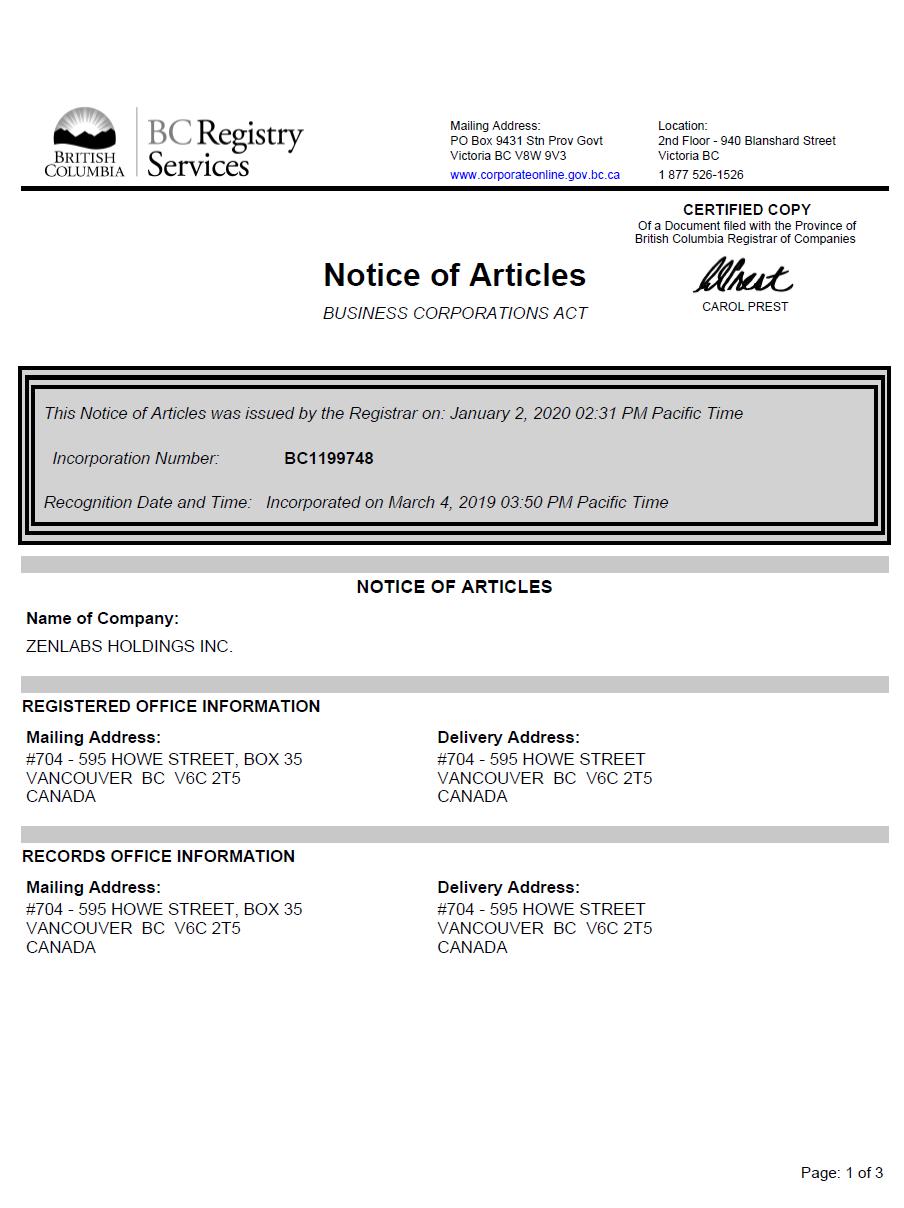
The Company was incorporated in British Columbia, Canada under the name “Zenlabs Holdings Inc.” on March 4, 2019. The Company’s head office is located at 7745 Arjons Drive, San Diego, California, USA 92126. The Company’s registered address is located at 595 Howe Street, Suite 704, Vancouver, BC, V6C 2T5. Our telephone number is 619-763-4901.
The operations of the Company are carried on through its wholly owned subsidiaries, Zenleaf LLC (“Zenleaf”) and PBI Design LLC (“PBI”). Zenleaf and PBI are limited liability companies formed under the laws of the State of California. Zenlabs acquired PBI January 1, 2019 and Zenleaf on October 31, 2019.
The Company’s securities are not traded on any national exchange or quoted on any trading platform and there is no market for the Units offered hereby or the securities underlying such Units. Nonetheless, the Company intends to apply to have its shares traded on the Canadian Stock Exchange following this offering, although it is possible that the Company would elect to remain privately traded. In addition to or in the alternative to the foregoing, we may elect to become a reporting company under the Exchange Act of 1934 or to become an alternative reporting company on OTCMarkets.com and apply for a trading symbol from the Financial Industry Regulatory Authority (“FINRA”) to have our subordinate shares traded in the U.S.
Business Overview
Zenleaf was formed in December 2017 for the purpose of cultivating, producing and selling higher quality cannabis and hemp through sophisticated pathogen indexing and elimination via high quality tissue cultures and proprietary propagation methodologies. PBI acts as paymaster entity for Zenleaf, handling financing, salaries and other financial activities for Zenleaf.
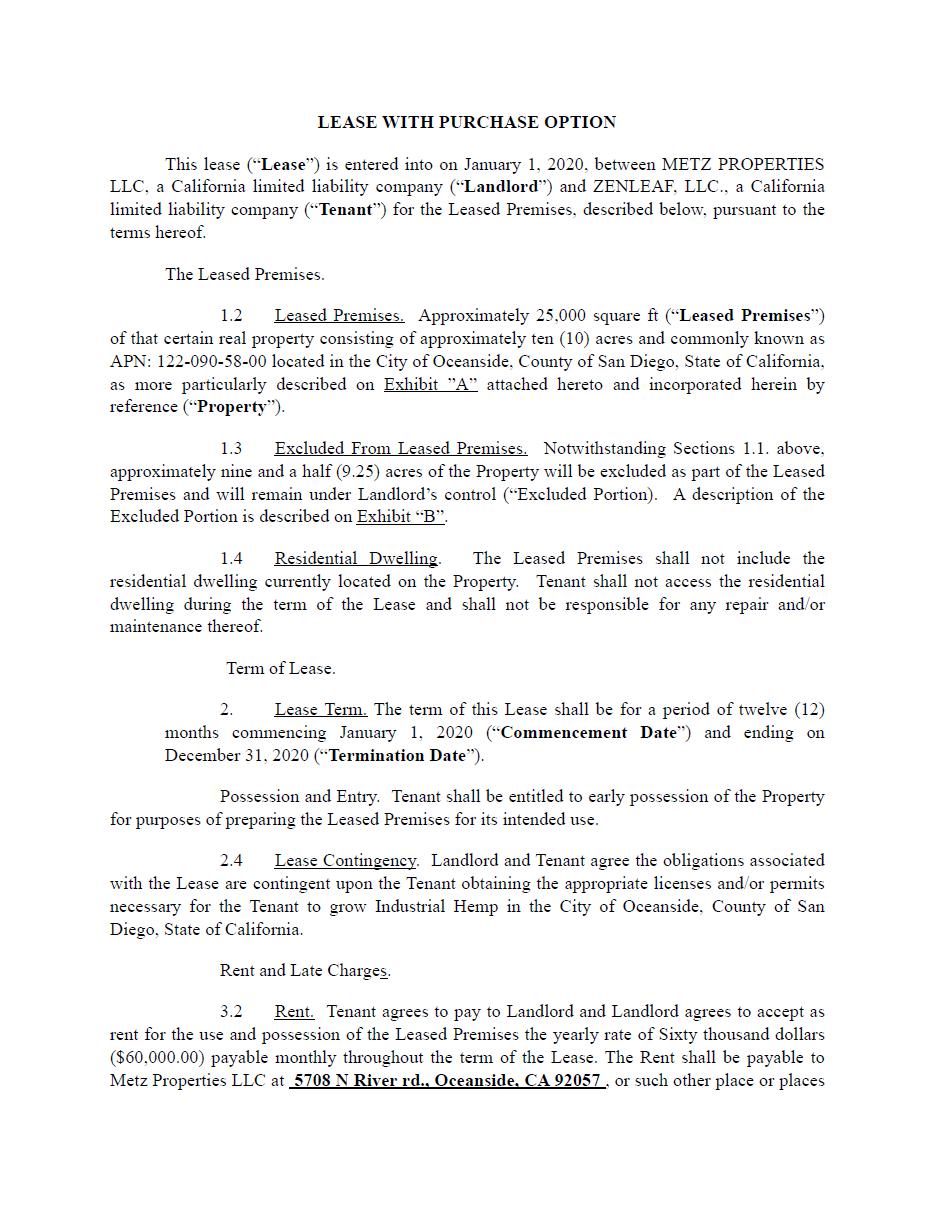
Zenleaf is an early stage cannabis and hemp company with operations based in California, USA. Zenleaf is currently building out a 12,393 square foot indoor facility located at the Arjons Facility (discussed below) where it intends to cultivate cannabis and operates a cannabis nursery. In addition to the Arjons Facility, Zenleaf holds a license to cultivate industrial hemp at the Oceanside Property (discussed below) and is in the process of applying for the licenses and permits required to operate the Oceanside Property as a cannabis cultivation facility.
Emerging Growth Company
We are an emerging growth company under the Jumpstart Our Business Startups Act (the “JOBS Act”). We shall continue to be deemed an emerging growth company until the earliest of:
| (a) | the last day of the fiscal year of the issuer during which it had total annual gross revenues of $1,070,000,000 (as such amount is indexed for inflation every five years by the Commission to reflect the change in the Consumer Price Index for All Urban Consumers published by the Bureau of Labor Statistics, setting the threshold to the nearest 1,000,000) or more; | |
| (b) | the last day of the fiscal year of the issuer following the fifth anniversary of the date of the first sale of subordinate voting equity securities of the issuer pursuant to an effective IPO registration statement; |
| Page 3 of 52 |
| (c) | the date on which such issuer has, during the previous three-year period, issued more than $1,070,000,000 in nonconvertible debt; or | |
| (d) | the date on which such issuer is deemed to be a ‘large accelerated filer’, as defined in section 240.12b-2 of title 17, Code of Federal Regulations, or any successor thereto.’ |
The Section 107 of the JOBS Act provides that we may elect to utilize the extended transition period for complying with new or revised accounting standards and such election is irrevocable if made. As such, we have made the election to use the extended transition period for complying with new or revised accounting standards under Section 102(b)(1) of the JOBS Act. Please refer to a discussion under “Risk Factors” of the effect on our financial statements of such election.
As an emerging growth company, we are exempt from Section 404(b) of Sarbanes Oxley. Section 404(a) requires Issuers to publish information in their annual reports concerning the scope and adequacy of the internal control structure and procedures for financial reporting. This statement shall also assess the effectiveness of such internal controls and procedures. Section 404(b) requires that the registered accounting firm shall, in the same report, attest to and report on the assessment on the effectiveness of the internal control structure and procedures for financial reporting. As an emerging growth company, we are also exempt from Section 14A (a) and (b) of the Securities Exchange Act of 1934 which require the shareholder approval of executive compensation and golden parachutes.
We have elected to use the extended transition period for complying with new or revised accounting standards under Section 102(b)(2) of the JOBS Act, that allows us to delay the adoption of new or revised accounting standards that have different effective dates for public and private companies until those standards apply to private companies. As a result of this election, our financial statements may not be comparable to companies that comply with public company effective dates.
The Offering
This circular relates to the sale of 17,000,000 Units at a price of $1.20 per Unit, for total offering proceeds of up to $20,400,000 if all offered Units are sold. Each Unit consists of one Subordinate Share and one Warrant to purchase an additional Subordinate Share at a price of $3.00 per share for a period of three years from date of issue. Notwithstanding the foregoing, Warrants may not be exercised until the date twelve (12) months the date the offering statement to which this circular relates is qualified by the SEC. There is no minimum offering amount and no provision to escrow or return investor funds if any minimum number of Units is not sold. The minimum amount established for investors is $2,500, unless such minimum is waived on a case by case basis by the Company, in its sole discretion. All funds raised by the Company from this offering will be immediately available for the Company’s use.
The aggregate purchase price to be paid by any investor for the securities sold hereby cannot exceed 10% of the greater of the investor’s annual income or net worth (for entity investors, revenues or net assets for the investor’s most recently completed fiscal year are used instead). The foregoing limitation does not apply to “accredited investors.”
Units offered by the Company will be sold by our directors and executive officers. We may also elect to engage licensed broker-dealers. No sales agents have yet been engaged to sell Units. Selling shareholders may offer their shares directly or through their respective broker-dealers. All Units will be offered on a “best-efforts” basis. Investors may be publicly solicited through our website, investment websites, social media, or otherwise.
This offering will terminate at the earlier to occur of: (i) all Units offered hereby are sold, or (ii) one year from the date this offering circular is qualified with the SEC. Notwithstanding the foregoing, the Company may terminate this offering at any time or extend this offering by ninety (90) days, in its sole discretion.
| Page 4 of 52 |
ABOUT THIS CIRCULAR
We have prepared this offering circular to be filed with the SEC for our offering of securities. The offering circular includes exhibits that provide more detailed descriptions of the matters discussed in this circular.
You should rely on only the information contained in this circular and its exhibits. We have not authorized any person to provide you with any information different from that contained in this circular. The information contained in this circular is complete and accurate only as of the date of this circular, regardless of the time of delivery of this circular or sale of our Units. This circular contains summaries of certain other documents, but reference is hereby made to the full text of the actual documents for complete information concerning the rights and obligations of the parties thereto. All documents relating to this offering and related documents and agreements, if readily available to us, will be made available to a prospective investor or its representatives upon request.
INDUSTRY AND MARKET DATA
The industry and market data used throughout this circular have been obtained from our own research, surveys or studies conducted by third parties and industry or general publications. Industry publications and surveys generally state that they have obtained information from sources believed to be reliable, but do not guarantee the accuracy and completeness of such information. We believe that each of these studies and publications is reliable. We have not engaged any person or entity to provide us with industry or market data.
TAX CONSIDERATIONS
No information contained herein, nor in any prior, contemporaneous or subsequent communication should be construed by a prospective investor as legal or tax advice. We are not providing any tax advice as to the acquisition, holding or disposition of the securities offered herein. In making an investment decision, investors are strongly encouraged to consult their own tax advisor to determine the U.S. Federal, state and any applicable foreign tax consequences relating to their investment in our securities. This written communication is not intended to be “written advice,” as defined in Circular 230 published by the U.S. Treasury Department
Any investment in our Units involves a high degree of risk. Investors should carefully consider the risks described below and all of the information contained in this circular before deciding whether to purchase our Units. Our business, financial condition or results of operations could be materially adversely affected by these risks if any of them actually occur. In addition to the other information provided in this circular, you should carefully consider the following risk factors in evaluating our business and before purchasing any of our Units. The following may not be a comprehensive list of all risks relating to the Company or an investment in its Units but are those risks as identified by the Company’s management as material.
Risks Related to this Offering
You will experience immediate and substantial dilution in the book value per share of the Subordinate Shares you purchase.
Because the price per share of our Subordinate Shares being offered will be higher than the book value per share of our Subordinate Shares, you will suffer substantial dilution in the net tangible book value of the securities you purchase in this offering. See the section titled “Dilution” below for a more detailed discussion of the dilution you will incur if you purchase Subordinate Shares in this offering.
Because our management will have broad discretion and flexibility in how the net proceeds from this offering are used, we may use the net proceeds in ways in which you disagree.
We currently intend to use the net proceeds from this offering for general corporate purposes, including working capital, and build out of its greenhouses and facilities. However, our management will have significant discretion and flexibility in applying the net proceeds of this offering. You will be relying on the judgment of our management with regard to the use of these net proceeds, and you will not have the opportunity, as part of your investment decision, to assess whether the net proceeds are being used appropriately. It is possible that the net proceeds will be invested in a way that does not yield a favorable, or any, return for us. The failure of our management to use such funds effectively could have a material adverse effect on our business, financial condition, operating results and cash flow.
| Page 5 of 52 |
The offering price of our Units from the Company has been arbitrarily determined.
Our management has determined the Units offered by the Company. The price of the Units we are offering was arbitrarily determined based upon the illiquidity and volatility of our Subordinate Shares, our current financial condition and the prospects for our future cash flows and earnings, and market and economic conditions at the time of the offering. The offering price for the Units sold in this offering may be more or less than the fair market value for our Units.
We may not register or qualify our securities with any state agency pursuant to blue sky regulations.
The holders of our shares of Subordinate Shares and Warrants and persons who desire to purchase them in the future should be aware that there may be significant state law restrictions upon the ability of investors to resell our shares. We currently do not intend to and may not be able to qualify securities for resale in states which require shares to be qualified before they can be resold by our shareholders. There may be similar restrictions under the laws of the Canadian providences.
We are an “emerging growth company,” and we cannot be certain if the reduced reporting requirements applicable to emerging growth companies will make our Subordinate Shares less attractive to investors.
We are an “emerging growth company,” as defined in the U.S. Jumpstart Our Business Startups Act, or the JOBS Act. The Section 107 of the JOBS Act provides that we may elect to utilize the extended transition period for complying with new or revised accounting standards and such election is irrevocable if made. As such, we have made the election to use the extended transition period for complying with new or revised accounting standards under Section 102(b)(1) of the JOBS Act.
We have elected to use the extended transition period for complying with new or revised accounting standards under Section 102(b)(2) of the JOBS Act, that allows us to delay the adoption of new or revised accounting standards that have different effective dates for public and private companies until those standards apply to private companies. As a result of this election, our financial statements may not be comparable to companies that comply with public company effective dates.
Our Subordinate Shares and Warrants are not currently listed on any national exchange or quotation system and there is no public market for our Units in the US or Canada.
Without a public market, holders of our Subordinate Shares and Warrants will have little to no liquidity in their investment. Investors should be prepared and have the means to hold our securities indefinitely.
Risks Related to our Business
Since we have a limited operating history in our industry, it is difficult for potential investors to evaluate our business.
Our short operating history in the cannabis industry may hinder our ability to successfully meet our objectives and makes it difficult for potential investors to evaluate our business or prospective operations. As an early stage company, we are subject to all the risks inherent in the financing, expenditures, operations, complications and delays inherent in a new business. Accordingly, our business and success face risks from uncertainties faced by developing companies in a competitive environment. There can be no assurance that our efforts will be successful or that we will ultimately be able to attain profitability.
We may not be able to raise capital when needed, if at all, which would force us to delay, reduce or eliminate our product development programs, build outs or commercialization efforts and could cause our business to fail. If we are able to access additional capital, it may be difficult to obtain or on unreasonable terms.
| Page 6 of 52 |
We expect to need substantial additional funding to pursue additional product development, build out our facilities and launch and commercialize our products. There are no assurances that future funding will be available on favorable terms or at all. If additional funding is not obtained, we may need to reduce, defer or cancel preclinical and lab work, planned clinical trials, or overhead expenditures to the extent necessary. The failure to fund our operating and capital requirements could have a material adverse effect on our business, financial condition and results of operations.
If we are unable to raise capital when needed or on attractive terms, we could be forced to delay, reduce or eliminate our research and development programs, build out of facilities or any future commercialization efforts. Any of these events could significantly harm our business, financial condition and prospects.
Additional capital, whether through the offering of equity or debt securities, may not be available on reasonable terms. We may incur substantial costs in pursuing future capital financing, including investment banking fees, legal fees, accounting fees, securities law compliance fees, printing and distribution expenses and other costs. We may also be required to recognize non-cash expenses in connection with certain securities we issue, such as convertible notes and warrants, which may adversely impact our financial condition.
Our independent registered public accounting firm has expressed substantial doubt about our ability to continue as a going concern.
Our historical financial statements have been prepared under the assumption that we will continue as a going concern. Our independent registered public accounting firm has issued a report on our audited financial statements for the fiscal year ended September 30, 2019 that included an explanatory paragraph expressing substantial doubt in our ability to continue as a going concern. Our ability to continue as a going concern is dependent upon our ability to obtain additional equity financing or other capital, attain further operating efficiencies, reduce expenditures, and, ultimately, generate revenue. Our financial statements do not include any adjustments that might result from the outcome of this uncertainty. However, if adequate funds are not available to us when we need them, we will be required to curtail our operations which would, in turn, further raise substantial doubt about our ability to continue as a going concern. The doubt regarding our potential ability to continue as a going concern may adversely affect our ability to obtain new financing on reasonable terms or at all. Additionally, if we are unable to continue as a going concern, our stockholders may lose some or all of their investment in the Company.
We depend heavily on key personnel, and turnover of key senior management could harm our business.
Our future business and results of operations depend in significant part upon the continued contributions of our senior management personnel. If we lose their services or if they fail to perform in their current positions, or if we are not able to attract and retain skilled personnel as needed, our business could suffer. Significant turnover in our senior management could significantly deplete our institutional knowledge held by our existing senior management team. We depend on the skills and abilities of these key personnel in managing the product acquisition, marketing and sales aspects of our business, any part of which could be harmed by turnover in the future. We do not have key-man insurance.
Because we do not have an audit or compensation committee, shareholders will have to rely on the entire board of directors to perform these functions.
We do not have an audit or compensation committee comprised of independent directors. Indeed, we do not have any audit or compensation committee. These functions are performed by the board of directors as a whole. Thus, there is a potential conflict in that board members who are also part of management will participate in discussions concerning management compensation and audit issues that may affect management decisions.
We expect to face intense competition, often from companies with greater resources and experience than we have.
The legal cannabis and hemp industries are highly competitive and subject to rapid change. The industries continue to expand and evolve as an increasing number of competitors and potential competitors enter the market. Many of these competitors and potential competitors have substantially greater financial, technological, managerial and research and development resources and experience than we have. Some of these competitors and potential competitors have more experience than we have in the development of cannabis products, including validation procedures and regulatory matters. In addition, our products compete with product offerings from large and well-established companies that have greater marketing and sales experience and capabilities than we or our collaboration partners have. If we are unable to compete successfully, we may be unable to grow and sustain our revenue.
| Page 7 of 52 |
If we are not able to attract and retain highly qualified personnel, we may not be able to successfully implement our business strategy.
Our ability to compete in the highly competitive cannabis industry depends upon our ability to attract and retain highly qualified managerial, scientific and compliance personnel. The loss of the services provided by certain key personnel could significantly hinder our operations. In addition, the competition for qualified personnel in the cannabis industry is intense and there can be no assurance that we will be able to continue to attract and retain all personnel necessary for the development and operation of our business.
We will need to grow the size of our organization, and we may experience difficulties in managing any growth we may achieve.
As of the date of this circular, we have nine full-time employees. As our development and commercialization plans and strategies develop, we expect to need additional research, development, managerial, operational, sales, marketing, financial, accounting, legal, and other resources. Future growth would impose significant added responsibilities on members of management. Our management may not be able to accommodate those added responsibilities, and our failure to do so could prevent us from effectively managing future growth, if any, and successfully growing our company.
As our products and Company are in a highly regulated industry, enforcement of current regulations, our failure to abide by regulations or significant and unforeseen changes in regulations or policy may have material impacts on our business.
At the U.S. federal level, cannabis is still illegal. Should the federal government begin to enforcement actions against the Company, it would materially impact our business. Conversely, should cannabis become federally legal, it is likely that the market would become flooded with competitors, many of which would likely be large conglomerates that would drive smaller operators such as Zenleaf out of the market.
In California, we are regulated by the California Department of Food and Agriculture (“CDFA”) for our cultivation business and the California Bureau of Cannabis Control (“BCC”) for our distribution business. Both the CDFA and the BCC have their own independent set of regulations. These regulations and the way they are interpreted by the BCC and CDFA, respectively, change frequently, making compliance difficult and costly. Should we fail to comply with applicable state regulations, we could be subject to sanctions or suspension or revocation of our Licenses. In addition, our Licenses expire annually. It is possible that the BCC or CDFA could elect not to renew any of our Licenses because of failure to meet a new or existing regulation, change in our structure that causes us not to meet license requirements or our failure to pay license fees timely. In addition to regulation at the state level, we are subject to local regulation by the cities of Oceanside and San Diego where we have facilities. Failure to comply with local regulations could also materially negatively impact our business and subject us to sanctions or suspension or revocation of our rights to operate in such cities. Our ability to comply with applicable regulations is costly and our inability to meet such costs could materially negatively impact our business.
The use of cannabis and hemp products in the United States may impact our business.
As with most products, it is very difficult to gauge accurately market acceptance of our products. While we are taking and will take significant efforts in selecting products that we believe represent the best opportunities for market adoption, such as unsatisfied needs, competitive environment, partnering potential, therapeutic potential, and target product profile potential, the ultimate market acceptance of a product is very difficult to predict.
| Page 8 of 52 |
We may expend our limited resources to pursue a particular product and may fail to capitalize on products that may be more profitable or for which there is a greater likelihood of success.
Because we have limited financial and managerial resources, we must focus our efforts on particular research programs and products. As a result, we may forego or delay pursuit of opportunities with other products that later prove to have greater commercial potential. Our resource allocation decisions may cause us to fail to capitalize on viable commercial products or profitable market opportunities. If we do not accurately evaluate the commercial potential or target market for a particular product, we may relinquish valuable rights to that product through collaboration, licensing or other royalty arrangements in cases in which it would have been more advantageous for us to retain sole development and commercialization rights to such product. Any such failure to improperly assess potential products could result in missed opportunities and/or our focus on products with low market potential, which would harm our business and financial condition.
We engage in transactions with related parties and such transactions present possible conflicts of interest that could have an adverse effect on us.
We have entered, and may continue to enter, into transactions with related parties for financing, corporate, leases, business development and operational services, as detailed herein. Such transactions may not have been entered into on an arm’s-length basis, and we may have achieved more or less favorable terms because such transactions were entered into with our related parties. We rely, and will continue to rely, on our related parties to maintain these services. If the pricing for these services changes, or if our related parties cease to provide these services, including by terminating agreements with us, we may be unable to obtain replacements for these services on the same terms without disruption to our business. This could have a material effect on our business, results of operations and financial condition. The details of certain of these transactions are set forth in “Transactions with Related Persons, Promoters and Certain Control Persons.” Related person transactions create the possibility of conflicts of interest with regard to our management, including that:
| - | we may enter into contracts between us, on the one hand, and related parties, on the other, that are not the result of arm’s-length transactions; | |
| - | our executive officers and directors that hold positions of responsibility with related parties may be aware of certain business opportunities that are appropriate for presentation to us as well as to such other related parties and may present such business opportunities to such other parties; and | |
| - | our executive officers and directors that hold positions of responsibility with related parties may have significant duties with, and spend significant time serving, other entities and may have conflicts of interest in allocating time. |
Such conflicts could cause an individual in our management to seek to advance his or her economic interests or the economic interests of certain related parties above ours. Further, the appearance of conflicts of interest created by related person transactions could impair the confidence of our investors. It is possible that a conflict of interest could have a material adverse effect on our liquidity, results of operations and financial condition.
Any inability to protect our intellectual property rights could reduce the value of our technologies and brand, which could adversely affect our financial condition, results of operations and business.
Our business is dependent upon our proprietary methods, know-how, genetics, trademarks, trade secrets, copyrights and other intellectual property rights. Effective intellectual property rights protection, however, may not be available under federal law and certain states in which we may operate. There is a risk of certain valuable trade secrets being exposed to potential infringers. There is a risk that other companies may employ the technology without authorization and without recompensing us.
The efforts we have taken to protect our proprietary rights may not be sufficient or effective. Any significant impairment of our intellectual property rights could harm our business or our ability to compete. In addition, protecting our intellectual property rights is costly and time consuming. There is a risk that we may have insufficient resources to counter adequately such infringements through negotiation or the use of legal remedies. It may not be practicable or cost effective for us to fully protect our intellectual property rights in some countries or jurisdictions. If we are unable to successfully identify and stop unauthorized use of our intellectual property, we could lose potential revenue and experience increased operational and enforcement costs, which could adversely affect our financial condition, results of operations and business.
| Page 9 of 52 |
Our potential for rapid growth and our entry into new markets make it difficult for us to evaluate our current and future business prospects, and we may be unable to effectively manage any growth associated with these new markets, which may increase the risk of your investment and could harm our business, financial condition, results of operations and cash flow.
Our entry into the rapidly growing cannabis and hemp markets may place a significant strain on our resources and increase demands on our executive management, personnel and systems, and our operational, administrative and financial resources may be inadequate. We may also not be able to effectively manage any expanded operations or achieve planned growth on a timely or profitable basis, particularly if the number of customers using our products significantly increases or their demands and needs change as our business expands. If we are unable to manage expanded operations effectively, we may experience operating inefficiencies, the quality of our products and services could deteriorate, and our business and results of operations could be materially adversely affected.
If we are unable to develop and maintain our brand and reputation for our product offerings, our business and prospects could be materially harmed.
Our business and prospects depend, in part, on developing and then maintaining and strengthening our brand and reputation in the markets we serve. If problems with our products arise, our brand and reputation could be diminished. If we fail to develop, promote and maintain our brand and reputation successfully, our business and prospects could be materially harmed.
We could be subject to costly product liability claims related to our products.
We face the risk that the use of our products may result in adverse side effects to people. We face even greater risks upon further commercialization of our products. An individual may bring a product liability claim against us alleging that one of our products causes, or is claimed to have caused, an injury or is found to be unsuitable for consumer use. Any product liability claim brought against us, with or without merit, could result in: the inability to commercialize our products; decreased demand for our products; the inability to commercialize our products; regulatory investigations that could require costly recalls or product modifications; loss of revenue; substantial costs of litigation; liabilities that substantially exceed our product liability insurance, which we would then be required to pay ourselves; an increase in our product liability insurance rates or the inability to maintain insurance coverage in the future on acceptable terms, if at all; the diversion of management’s attention from our business; and damage to our reputation and the reputation of our products. Product liability claims may subject us to the foregoing and other risks, which could have a material adverse effect on our business, results of operations, financial condition, and prospects.
Our employees, independent contractors, consultants and vendors may engage in misconduct or other improper activities, including noncompliance with regulatory standards and requirements.
We are exposed to the risk that our employees, independent contractors, consultants and vendors may engage in fraudulent or other illegal activity. Misconduct by these parties could include intentional, reckless and/or negligent conduct or disclosure of unauthorized activities to us that violates state or local regulations. It is not always possible to identify and deter misconduct by our employees and other third parties, and the precautions we take to detect and prevent this activity may not be effective in controlling unknown or unmanaged risks or losses or in protecting us from governmental investigations or other actions or lawsuits stemming from a failure to be in compliance with such laws or regulations. If any such actions are instituted against us, and we are not successful in defending ourselves or asserting our rights, those actions could have a significant impact on our business, including the imposition of civil, criminal and administrative penalties, damages, monetary fines, contractual damages, reputational harm, diminished profits and future earnings, loss of our Licenses or other entitlements and curtailment of our operations, any of which could adversely affect our ability to operate our business and our results of operations.
| Page 10 of 52 |
Cannabis remains illegal under federal law in the U.S. where we operate, and any change in the enforcement priorities of the U.S. federal government could render our current and planned future operations unprofitable or even prohibit such operations.
We operate in the cannabis industry in the U.S., which is dependent on state laws and regulations pertaining to such industry; however, under federal law, cannabis remains illegal.
The United States federal government regulates drugs through the Controlled Substances Act (the “CSA”), which places controlled substances, including cannabis, on one of five schedules. Cannabis is currently classified as a Schedule I controlled substance, which is viewed as having a high potential for abuse and having no currently accepted medical use in treatment in the United States.
Currently, 33 U.S. states, the District of Columbia and the U.S. territories of Guam and Puerto Rico allow the use of cannabis in some form. Such state and territorial laws are in conflict with the federal CSA, which makes cannabis use and possession illegal at the federal level. The United States Supreme Court has confirmed that the federal government has the right to regulate and criminalize cannabis, including for medical purposes, and that federal law criminalizing the use of cannabis preempts state laws that legalize its use.
In light of such conflict between federal laws and state laws regarding cannabis, the previous administration under President Obama had effectively stated that it was not an efficient use of resources to direct law federal law enforcement agencies to prosecute those lawfully abiding by state-designated laws allowing the use and distribution of medical cannabis. For example, the prior DOJ Deputy Attorney General of the Obama administration, James M. Cole, issued a memorandum (the “Cole Memo”) to all United States Attorneys providing updated guidance to federal prosecutors concerning cannabis enforcement under the CSA (see “Business—Government and Industry Regulation—The Cole Memo”). In addition, the Financial Crimes Enforcement Network (“FinCEN”) provided guidelines (the “FinCEN Guidelines”) on February 18, 2014, regarding how financial institutions can provide services to cannabis-related businesses consistent with their Bank Secrecy Act (“BSA”) obligations (see “Business—Government and Industry Regulation—FinCEN”).
In 2014, the United States House of Representatives passed an amendment (the “Rohrabacher-Farr Amendment”) to the Commerce, Justice, Science, and Related Agencies Appropriations Bill, which funds the United States Department of Justice (the “DOJ”). The Rohrabacher-Farr Amendment prohibits the DOJ from using funds to prevent states with medical cannabis laws from implementing such laws. In August 2016, a 9th Circuit federal appeals court ruled in United States v. McIntosh that the Rohrabacher-Farr Amendment bars the DOJ from spending funds on the prosecution of conduct that is allowed by state medical cannabis laws, provided that such conduct is in strict compliance with applicable state law. However, on January 4, 2018, the U.S. Attorney General, Jeff Sessions, issued a written memorandum (the “Sessions Memo”) to all U.S. Attorneys stating that the Cole Memo was rescinded effectively immediately. In particular, Mr. Sessions stated that “prosecutors should follow the well-established principles that govern all federal prosecutions,” which require “federal prosecutors deciding which cases to prosecute to weigh all relevant considerations, including federal law enforcement priorities set by the Attorney General, the seriousness of the crime, the deterrent effect of criminal prosecution, and the cumulative impact of particular crimes on the community.” Mr. Sessions went on to state in the memorandum that given the Justice Department’s well-established general principles, “previous nationwide guidance specific to marijuana is unnecessary and is rescinded, effective immediately.”
We are not aware of substantial federal enforcement actions following the Sessions Memo; however, a significant change in the federal government’s enforcement policy with respect to current federal laws applicable to cannabis could cause significant financial damage to us.
We may not be able to maintain our banking accounts.
Many banks and credit unions will not accept deposits from legal marijuana businesses on a state or federal level because businesses that participate in cannabis-related activities are still deemed illegal under federal law. In addition, banks or other financial institutions may not make loans or other traditional banking services available. Although the Department of the Treasury issued guidelines (e.g., FinCEN) indicating that banks are permitted to provide services to cannabis-related companies in states that have legal cannabis as long as certain protocol are followed, many banks and credit unions are reluctant to accept deposits or will immediately close bank accounts of cannabis-related companies. In addition, the federal authorities may, at any time, change their policies and begin or continue penalizing banks or credit unions for providing services to cannabis-related companies in states that have legal cannabis. Additionally, even if banks or other financial institutions open accounts or provide financial services for the target companies, accounts may still be subject to financial or other disciplinary action by authorities. Any one of these or other related challenges could cause substantial losses and materially adversely impact the Company.
| Page 11 of 52 |
A lack of access to customary business banking relationships may cause the Company to carry large amounts of investments or revenues in cash that will likely be placed in large safes. These investments or business revenues may be subject to theft or subject the Company to other risks.
Any potential growth in the cannabis industry continues to be subject to new and changing state and local laws and regulations.
Changes in applicable state and local laws or regulations could restrict the products and services we offer or impose additional compliance costs on us. Violations of applicable laws, or allegations of such violations, could disrupt our business and result in a material adverse effect on our operations. We cannot predict the nature of any future laws, regulations, interpretations or applications, and it is possible that regulations may be enacted in the future that will be materially adverse to our business.
The cannabis industry faces significant opposition, and any negative trends could adversely affect our business operations.
We are substantially dependent on the continued market acceptance, and the proliferation of consumers, of medical and recreational cannabis. We cannot predict the future growth rate or future market potential, and any negative outlook on the cannabis industry may adversely affect our business operations.
We are subject to risks inherent in an agricultural business, including the risk of crop failure.
The cultivation of cannabis and hemp is an agricultural process. As such, our business is subject to the risks inherent in the agricultural business, including risks of crop failure presented by weather, insects, fire, plant diseases and similar agricultural risks. Although we currently grow our products indoors under climate-controlled conditions, there can be no assurance that natural elements, such as insects and plant diseases, will not entirely interrupt our production activities or have an adverse effect on our business. In addition, cannabis plants, including hemp, can be vulnerable to various pathogens including bacteria, fungi, viruses and other miscellaneous pathogens. Such instances often lead to reduced crop quality, stunted growth or death of the plant. Moreover, cannabis, including hemp, is “phytoremediative”, meaning that it may extract toxins or other undesirable chemicals or compounds from the ground in which it is planted. Various regulatory agencies have established maximum limits for pathogens, toxins, chemicals and other compounds that may be present in agricultural materials. If our cannabis plants, including hemp, are found to have levels of pathogens, toxins, chemicals or other undesirable compounds that exceed established limits, our product may not be suitable for commercialization and we may have to destroy the applicable portions of our crops.
We may not be able to store or transport our cannabis products to customers in a safe, timely and cost-efficient manner, and we may experience breaches of security at our facilities or loss as a result of theft of our products.
Because of the nature of our products and the limited legal channels for distribution, as well as the potential concentration of inventory in our facilities, we are subject to a heightened risk of theft of our product and other security breaches. The security of our products during transportation to and from our facilities is of the utmost concern. A breach of security at our one of our facilities, or during transport or delivery, could result in the significant loss of product as well as customers and may expose us to additional liability, including regulatory fines, litigation or increased expenses relating to the resolution and future prevention of similar events. Any failure to take steps necessary to ensure the safekeeping of our cannabis could also have an impact on our ability to continue operating under our existing Licenses, to renew or receive amendments to our existing Licenses or to receive required new Licenses.
| Page 12 of 52 |
There has been limited study on the health effects of cannabis and cannabis products, and future clinical research studies may lead to conclusions that dispute or conflict with our understanding and belief regarding the benefits, viability, safety, efficacy, dosing and social acceptance of such products.
Research regarding the benefits, viability, safety, efficacy and dosing of cannabis or isolated cannabinoids, such as CBD and THC, remains in relatively early stages. Few clinical trials on the benefits and risks of cannabis or isolated cannabinoids have been conducted.
Future research and clinical trials may draw opposing conclusions to statements contained in the articles, reports and studies currently favored, or could reach different or negative conclusions regarding the benefits, viability, safety, efficacy, dosing or other facts and perceptions related to medical or adult-use cannabis, which could adversely affect social acceptance of cannabis and the demand for our cannabis products.
The cannabis and hemp markets may experience supply and demand fluctuations.
If our inventory levels in the future become greater than consumer demand, we may have to engage in sale of excess inventory at discounted prices, which could significantly impair our brand image. Conversely, if we underestimate demand for our products, we may experience inventory shortages, which might delay shipments to customers, reduce revenue, negatively impact customer relationships and diminish brand loyalty. In addition, demand for cannabis and cannabis products is dependent on a number of social, political and economic factors that are beyond our control, including the novelty of legalization, which may wear off. A material decline in the economic conditions affecting consumers can cause a reduction in disposable income for the average consumer, change consumption patterns and result in a reduction in spending on cannabis products or a switch to other products obtained through illicit channels. There can be no assurance that market demand for cannabis will continue to be sufficient to support our current or future production levels or that we will be able to generate sufficient revenue to be profitable.
We will not be able to deduct many normal business expenses.
Under Section 280E of the U.S. Internal Revenue Code (“Section 280E”), many normal business expenses incurred in the cultivation and distribution of marijuana and its derivatives are not deductible in calculating Zenleaf’s federal income tax liability. A result of Section 280E is that an otherwise profitable business may in fact operate at a loss, after taking into account its income tax expenses. The application of Section 280E likely will have a material adverse effect on us.
Our ability to expand our business to other jurisdictions is highly uncertain.
The Company intends to continue expanding its operations to other jurisdictions. We will need to obtain licenses, permits, and other authorizations to operate a marijuana business in these jurisdictions, and we can provide no assurance that we will be able to successfully do so, or if we can obtain such authorizations, the amount of time and resources that will be required to do so. We cannot provide any assurances that we will be able to successfully expand our business to these and other jurisdictions.
We may not be able to register any federal trademarks for our marijuana products or seek protection under federal bankruptcy laws.
Because producing, manufacturing, processing, possessing, distributing, selling, and using marijuana is a crime under the Federal CSA, the United States Patent and Trademark Office will not permit the registration of any trademark that identifies marijuana products. As a result, we may be unable to protect our marijuana product trademarks, which could have a material adverse effect on our business. Similarly, cannabis companies have been denied protection under U.S. federal bankruptcy laws.
Laws will continue to change rapidly for the foreseeable future.
Local, state and federal laws and enforcement policies concerning marijuana-related conduct are changing rapidly and will continue to do so for the foreseeable future. Changes in applicable law are unpredictable and could have a material adverse effect on our business.
| Page 13 of 52 |
Significant interruptions in our access to certain key inputs such as labor, raw materials, electricity, water and other utilities may impair our cannabis growing operations.
Our business is dependent on several key inputs and their related costs, including raw materials, supplies and equipment related to our operations, as well as electricity, water and other utilities. Any significant interruption, price increase or negative change in the availability or economics of the supply chain for key inputs and, in particular, loss of any energy subsidies, rising or volatile energy costs could curtail or preclude our ability to continue production and may have a material adverse impact on our business and results of operations. In addition, our operations could be significantly affected by a prolonged power outage. Furthermore, our cultivation operations require a significant amount of electricity as a result it may be difficult for us to locate areas to construct additional cultivation operations as we grow.
Our ability to compete and grow cannabis is dependent on us having access, at a reasonable cost and in a timely manner, to skilled labor, equipment, parts and components. No assurances can be given that we will be successful in maintaining our required supply of labor, equipment, parts and components.
Failure in our quality control systems may adversely impact our sales volume, market share and profitability.
The quality and safety of our products are critical to the success of our business and operations. As such, it is imperative that our quality control systems operate effectively and successfully. Quality control systems can be negatively impacted by the design of the quality control systems, the quality training program, and adherence by employees to quality control guidelines. If, as a result of a failure in our quality control systems, contamination of, or damage to, our inventory or packaged products occurs, we may incur significant costs in replacing the inventory and recalling products. We may be unable to meet customer demand and may lose customers who must purchase alternative brands or products. In addition, consumers may lose confidence in the affected products. A loss of sales volume from a contamination event may occur, and such a loss may affect our ability to supply our current customers and to recapture their business in the event they are forced to switch products or brands, even if on a temporary basis. We may also be subject to legal action as a result of a contamination, which could result in negative publicity and affect our sales. During this time, our competitors may benefit from an increased market share that could be difficult and costly to regain.
Our cannabis products may be subject to recalls for a variety of reasons, which could require us to expend significant management and capital resources.
Cultivators and distributors of consumer goods products are sometimes subject to the recall or return of their products for a variety of reasons, including public health and public safety risks, product defects, adulteration, unintended harmful side effects or interactions with other substances, packaging safety and inadequate or inaccurate labelling disclosure. Although we have detailed procedures in place for testing our finished cannabis products, there can be no assurance that any quality, potency or contamination problems will be detected in time to avoid unforeseen product recalls, regulatory action or lawsuits, whether frivolous or otherwise. As a result of any such recall, we may lose a significant amount of sales and may not be able to replace those sales at an acceptable margin or at all. In addition, a product recall may require significant management attention or damage our reputation and goodwill or that of our products or brands.
Additionally, product recalls may lead to increased scrutiny of our operations by regulatory agencies, requiring further management attention, increased compliance costs and potential legal fees, fines, penalties and other expenses. Any product recall affecting the cannabis industry more broadly, whether or not involving us, could also lead consumers to lose confidence in the safety and security of such products, including products sold by us.
We will rely on third-party distributors to distribute our products, and those distributors may not perform their obligations.
We will rely on third-party distributors to distribute and sell our products to consumers. If these distributors do not successfully carry out their contractual duties, if there is a delay or interruption in the distribution of our products or if these third parties damage our products, it could negatively impact our revenue from product sales. Furthermore, any damage to our products, such as product spoilage, could expose us to potential product liability, damage our reputation and the reputation of our brands or otherwise harm our business and results of operations.
| Page 14 of 52 |
We may not be able to obtain adequate insurance coverage in respect of the risks we and our business face, the premiums for such insurance may not continue to be commercially justifiable or there may be coverage limitations and other exclusions which may result in such insurance not being sufficient to cover potential liabilities that we face.
Our insurance coverage is subject to coverage limits and exclusions and may not be available for the risks and hazards to which we are exposed. In addition, no assurance can be given that such insurance will be adequate to cover our liabilities, including potential product liability claims, or will be generally available in the future or, if available, that premiums will be commercially justifiable. If we were to incur substantial liability and such damages were not covered by insurance or were in excess of policy limits, we may be exposed to material uninsured liabilities that could impede our liquidity, profitability or solvency.
If we are not able to comply with all safety, health and environmental regulations applicable to our operations and industry, we may be held liable for any breaches of those regulations.
Safety, health and environmental laws and regulations affect nearly all aspects of our operations, including product development, working conditions, waste disposal, emission controls, the maintenance of air and water quality standards and, with respect to environmental laws and regulations, impose limitations on the generation, transportation, storage and disposal of solid and hazardous waste. Compliance with safety, health and environmental laws and regulations can require significant expenditures. There can be no assurance that we will always be in compliance with all safety, health and environmental laws and regulations notwithstanding our attempts to comply with such laws and regulations.
We may become subject to litigation, regulatory or agency proceedings, investigations and audits.
We may become subject to litigation, regulatory or agency proceedings, investigations and audits from time to time in the ordinary course of business, some of which may adversely affect our business. Should any litigation, regulatory or agency proceeding, investigation or audit in which we become involved be determined against us, such a decision could adversely affect our ability to continue operating, the value or market price for the common shares and could require the use of significant resources. Even if we are involved in litigation, regulatory or agency proceedings investigations and audits and are ultimately successful, they can require the redirection of significant resources and may also create a negative perception of our brand. The outcome of any litigation, regulatory or agency proceedings investigations and audits is inherently uncertain. Unfavorable rulings, judgments or settlement terms could have a material adverse impact on our business and results of operations.
As a Canadian incorporated and resident company, our financial statements are prepared using International Financial Reporting Standards (“IFRS”), accounting principles, which are different than the accounting principles under U.S. Generally Accepted Accounting Principles (“U.S. GAAP”).
Our financial statements have been prepared in accordance with IFRS. IFRS is an internationally recognized body of accounting principles that are used by many companies outside of the United States to prepare their financial statements. Regulation A permits Canadian issuers such as Zenlabs to prepare and file their financial statements in accordance with IFRS rather than U.S. Investors who are not familiar with IFRS may misunderstand certain information presented in our financial statements. Accordingly, we suggest that readers of our financial statements familiarize themselves with the provisions of IFRS accounting principles in order to better understand the differences between these two sets of principles. Notwithstanding the foregoing, our subsidiary financial statements have been prepared in accordance with U.S. GAAP.
Certain legislation in Canada contain provisions that may have the effect of delaying or preventing a change in control.
Certain provisions of our constating documents and governing legislation, together or separately, could discourage potential acquisition proposals, delay or prevent a change in control and limit the price that certain investors may be willing to pay for our common shares.
| Page 15 of 52 |
For example, under the Business Corporations Act (British Columbia) (“BCA”):
| ● | certain matters require the approval of holders of two-thirds of the votes cast at a meeting of the company’s shareholders, including amendments to its articles. This may make it more difficult for us to complete certain types of corporate transactions deemed advisable by the board of directors; and |
| ● | a bidder seeking to acquire us would need, on a compulsory acquisition (tender offer), to receive shareholder acceptance in respect to 90% of our outstanding shares. If this 90% threshold is not achieved in the offer, under the BCA, the bidder would not be able to complete a “second step merger” to obtain 100% control of us. Accordingly, an offer (tender) of 90% of our outstanding shares will likely be a condition in a tender offer to acquire our shares rather than 50% as is more common in tender offers for corporations organized under U.S. law. |
Additionally, The Investment Canada Act requires that a “non-Canadian,” as defined therein, file an application for review with the Minister responsible for the Investment Canada Act and obtain approval of the Minister prior to acquiring control of a Canadian business, where prescribed financial thresholds are exceeded. Otherwise, there are no limitations either under the laws of Canada or in our articles on the rights of non-Canadians to vote or hold our common shares. (Given our current size and industry we do not believe these rules would apply to us.)
Any of these provisions may discourage a potential acquirer from proposing or completing a transaction that may have otherwise presented a premium to our shareholders.
Risks Related to our Securities
We cannot assure you that our Subordinate Shares will become eligible for listing or quotation on any exchange and the failure to do so may adversely affect your ability to dispose of our Subordinate Shares in a timely fashion.
Our Subordinate Shares and Warrants are not currently listed on any exchange or quotation system in the U.S. or Canada and there is no public market for our securities. We hope to have our Subordinate Shares listed on the Canadian Stock Exchange (“CSE”) following this offering, but there is no guarantee that such event will occur. For our Subordinate Shares to become eligible for listing or quotation on any exchange, we must meet and maintain certain criteria. We may not be able to meet all the filing requirements and may not be able to satisfy the initial standards for listing or quotation on any exchange in the foreseeable future or at all. Even if we are able to become listed or quoted on an exchange, we may not be able to maintain a listing of the Subordinate Shares on such stock exchange.
There is not now, nor has there been since our inception, any trading activity in our Subordinate Shares or a market for our securities, and an active trading market for our shares may never develop or be sustained. As a result, investors in our Units must bear the economic risk of holding those shares for an indefinite period of time. As a result of these and other factors, you may be unable to resell your shares of our Subordinate Shares or Warrants at or above the price for which you purchased them, or at all. Further, an inactive market may also impair our ability to raise capital.
We do not anticipate paying any cash dividends.
We presently do not anticipate that we will pay any dividends on any of our capital stock in the foreseeable future. The payment of dividends, if any, would be contingent upon our revenues and earnings, if any, capital requirements, and general financial condition. The payment of any dividends will be within the discretion of our Board of Directors (the “Board”). We presently intend to retain all earnings, if any, to implement our business plan; accordingly, we do not anticipate the declaration of any dividends in the foreseeable future.
We may need additional capital, and the sale of additional shares or other equity securities could result in additional dilution to our stockholders.
If our resources are insufficient to satisfy our cash requirements, we may seek to sell additional equity or debt securities or obtain a credit facility. The sale of additional equity securities could result in additional dilution to our stockholders.
| Page 16 of 52 |
Our articles permit us to issue an unlimited number of common shares without additional shareholder approval.
Our articles permit the issuance of an unlimited number of common shares, and shareholders will have no pre-emptive rights in connection with such further issuance. Additional issuances of our securities may involve the issuance of a significant number of common shares at prices less than the current market price for the common shares. Issuances of substantial numbers of common shares, or the perception that such issuances could occur, may adversely affect prevailing market prices of our common shares. Any transaction involving the issuance of previously authorized but unissued common shares, or securities convertible into common shares, would result in dilution, possibly substantial, to security holders.
Our principal stockholders and management own a significant percentage of our stock and will be able to exert significant control over matters subject to stockholder approval.
Certain of our executive officers, directors and large stockholders own a significant percentage of our outstanding capital stock. As of March 6, 2020, our executive officers, directors, and holders of 5% or more of our Subordinate Shares and multi-voting shares stock, including their respective affiliates, beneficially owned approximately 41.98% of our outstanding Subordinate Shares, 93.94% of our outstanding multi-voting shares and 72.87% of the eligible votes of the Company. These stockholders may be able to control elections of directors, amendments of our organizational documents, or approval of any merger, sale of assets, or other major corporate transaction. This concentration of ownership may prevent or discourage unsolicited acquisition proposals or offers for our Subordinate Shares that some of our stockholders may believe is in their best interest.
SPECIAL INFORMATION REGARDING FORWARD LOOKING STATEMENTS
Some of the statements in this circular are “forward-looking statements.” These forward-looking statements involve certain known and unknown risks, uncertainties and other factors which may cause our actual results, performance or achievements to be materially different from any future results, performance or achievements expressed or implied by these forward-looking statements. These factors include, among others, the factors set forth above under “Risk Factors.” The words “believe,” “expect,” “anticipate,” “intend,” “plan,” and similar expressions identify forward-looking statements. We caution you not to place undue reliance on these forward-looking statements.
We undertake no obligation to update and revise any forward-looking statements or to publicly announce the result of any revisions to any of the forward-looking statements in this document to reflect any future or developments. However, the Private Securities Litigation Reform Act of 1995 is not available to us as a non-reporting issuer.
The following table illustrates the amount of net proceeds to be received by the Company on the sale of Units by the Company and the intended uses of such proceeds over an approximate twelve (12) month period. It is possible that the Company may not raise the entire $20,400,000 in Units being offered through this Offering Circular. In such case, it will reallocate its use of proceeds as the board of directors deems to be in the best interests of the Company in order to effectuate its business plan. The intended use of proceeds are as follows:
Capital Sources and Uses
| 100% | 75% | 50% | 25% | |||||||||||||
| Gross Offering Proceeds | $ | 20,400,000 | $ | 15,300,000 | $ | 10,200,000 | $ | 5,100,000 | ||||||||
| Offering Costs(1) | $ | 150,000 | $ | 150,000 | $ | 150,000 | $ | 150,000 | ||||||||
| Use of Net Proceeds: | ||||||||||||||||
| Greenhouse Construction(2) | $ | 13,578,400 | $ | 10,183,800 | $ | 6,789,200 | $ | 3,394,600 | ||||||||
| Greenhouse Operation(3) | $ | 3,200,000 | $ | 2,400,000 | $ | 1,600,000 | $ | 800,000 | ||||||||
| Working Capital(4) | $ | 3,471,600 | $ | 2,566,200 | $ | 1,660,800 | $ | 755,400 |
Notes:
| (1) | The Company expects to spend approximately $150,000 in expenses relating to this offering, including legal, accounting, travel, printing and other misc. |
| (2) | Each greenhouse is anticipated to cost approximately $1,697,300 to construct and equip. The greenhouses will be built on the Oceanside Property following approval from the Oceanside Building Department of such construction. |
| (3) | The cost of operating each greenhouse for the first year is anticipated to be approximately $400,000, including payroll and other service-related expenses. |
| (4) | The Company will use working capital to pay for miscellaneous and general operating expenses, as well as research and development and legal fees relating to securing and protecting the Company’s intellectual property. |
| Page 17 of 52 |
The allocation of the use of proceeds among the categories of anticipated expenditures represents management’s best estimates based on the current status of the Company’s proposed operations, plans, investment objectives, capital requirements, and financial conditions. Future events, including changes in economic or competitive conditions of our business plan or the completion of less than the total offering, may cause the Company to modify the above-described allocation of proceeds. The Company’s use of proceeds may vary significantly in the event any of the Company’s assumptions prove inaccurate. We reserve the right to change the allocation of net proceeds from the offering as unanticipated events or opportunities arise.
DETERMINATION OF OFFERING PRICE
In determining the offering price of the Units, we have considered a number of factors including, but not limited to, the illiquidity and volatility of our Units, our current financial condition and the prospects for our future cash flows and earnings, and market and economic conditions at the time of the offering. The offering price for the Units sold in this offering may be more or less than the fair market price for our Units.
Investors in this offering will experience immediate dilution, as exampled below, from the sale of Units by the Company. If you invest in our shares, your interest will be diluted to the extent of the difference between the public offering price per share of our Subordinate Shares and the as adjusted net tangible book value per share of our capital stock after this offering. Our net tangible book value is currently estimated at $3,419,979, or approximately $0.096 per Subordinate Share. Net tangible book value per Subordinate Share represents our total tangible assets less total liabilities, divided by the number of shares of Subordinate Shares outstanding.
Net tangible book value dilution per Subordinate Share to new investors represents the difference between the amount per share paid by purchasers in this offering and the as adjusted net tangible book value per share of Subordinate Shares immediately after completion of this offering. After giving effect to our sale of the maximum offering amount of $20,400,000 in securities, assuming $0 in offering or other expenses, our as-adjusted net tangible book value as of September 30, 2019 would have been approximately $23,819,979 or $0.454 per share. This represents an immediate increase in net tangible book value of $0.358 per share to existing stockholders and an immediate dilution in net tangible book value of $0.746 per share to investors of this offering, as illustrated in the following table:
| Public offering price per share | $ | 1.200 | ||
| Net tangible book value per share | $ | 0.096 | ||
| Increase in net tangible book value per share attributable to new investors | $ | 0.358 | ||
| Adjusted net tangible book value per share | $ | 0.454 | ||
| Dilution per share to new investors in the offering | $ | 0.746 |
The above calculations are based on 20,454,523 Subordinate Shares issued and outstanding before adjustments and 37,454,523 Subordinate Shares to be outstanding after adjustment. The above calculations factor in the multi voting shares but do not factor the Warrants to be issued hereunder. The foregoing is for illustrative purposes only.
We are offering up to 17,000,000 Units for $1.20 per Unit, for a total of up to $20,400,000 in gross offering proceeds, assuming all securities are sold. Each Unit consists of one Subordinate Share and one Warrant to purchase an additional Subordinate Share at a price of $3.00 per share for a period of three years from the date of issuance. Warrants may not be exercised until the date one (1) year from the date the offering statement to which this relates is qualified by the SEC. The minimum investment for any investor is $2,500, unless such minimum is waived by the Company, which may be done in its sole discretion on a case-by-case basis. There is no minimum offering amount or escrow required as a condition to closing and we may sell significantly fewer Units than those offered hereby.
| Page 18 of 52 |
Currently, we plan to have our directors and executive officers sell the securities on our behalf. They will receive no discounts or commissions. Our executive officers will deliver this circular to those persons who they believe might have interest in purchasing all or a part of this offering. The Company may generally solicit investors, including, but not limited to, the use of social media, newscasts, advertisements, roadshows and the like.
As of the date of this circular, we have not entered into any arrangements with any selling agents for the sale of the securities; however, we may engage one or more selling agents to sell the securities in the future. If we elect to do so, we will file a supplement to this circular to identify them.
Our directors and officers will not register as broker-dealers under Section 15 of the Securities Exchange Act of 1934 in reliance upon Rule 3a4-1. Rule 3a4-1 sets forth those conditions under which a person associated with an issuer may participate in the offering of the issuer’s securities and not be deemed to be a broker-dealer. The conditions are that:
| ● | the person is not statutorily disqualified, as that term is defined in Section 3(a)(39) of the Act, at the time of his participation; and |
| ● | the person is not at the time of their participation an associated person of a broker-dealer; and |
| ● | the person meets the conditions of paragraph (a)(4)(ii) of Rule 3a4-1 of the Exchange Act, in that he (i) primarily performs, or is intended primarily to perform at the end of the offering, substantial duties for or on behalf of the issuer otherwise than in connection with transactions in securities; and (ii) is not a broker or dealer, or an associated person of a broker or dealer, within the preceding 12 months; and (iii) does not participate in selling and offering of securities for any issuer more than once every 12 months other than in reliance on paragraphs (a)(4)(i) or (a)(4)(iii) of Rule 3a4-1 of the Exchange Act. |
Our officers and directors are not statutorily disqualified, are not being compensated, and are not associated with a broker-dealer. They are and will continue to hold their positions as officers or directors following the completion of the offering and have not been during the past twelve (12) months and are currently not brokers or dealers or associated with brokers or dealers. They have not nor will they participate in the sale of securities of any issuer more than once every twelve (12) months.
Our Subordinate Shares and Warrants are not now listed on any national securities exchange or the NASDAQ stock market nor listed on any quotation system. There is currently no market for our securities and there is no guarantee that an active trading market will develop in the future. There is also no guarantee that our securities will ever trade on any listed exchange or be quoted on OTC Markets. Accordingly, our shares should be considered highly illiquid, which inhibits investors’ ability to resell their shares. Nonetheless, the Company intends to apply to have its shares traded on the Canadian Stock Exchange following this offering, although it is possible that the Company would elect to remain privately traded. In addition to or in the alternative to the foregoing, we may elect to become a reporting company under the Exchange Act of 1934 or to become an alternative reporting company on OTCMarkets.com and apply for a trading symbol from FINRA to have our Subordinate Shares traded in the U.S.
Upon this circular being qualified by the SEC, the Company may offer and sell Units from time to time. This offering will terminate at the earlier to occur of: (i) all Units offered hereby are sold, or (ii) one year from the date this offering circular is qualified with the SEC. Notwithstanding the foregoing, the Company may terminate this offering at any time or extend this offering by ninety (90) days, in its sole discretion.
There can be no assurances that the Company will sell any or all of the securities. All Units will be offered on a “best efforts” basis.
Should any fundamental change occur regarding the status or other matters concerning the Company, we will file an amendment to this circular disclosing such matters.
| Page 19 of 52 |
Generally, no sale may be made to you in this offering if the aggregate purchase price you pay is more than 10% of the greater of your annual income or net worth. Different rules apply to accredited investors and non-natural persons. Before making any representation that your investment does not exceed applicable thresholds, we encourage you to review Rule 251(d)(2)(i)(C) of Regulation A. For general information on investing, we encourage you to refer to www.investor.gov.
All subscription agreements and checks are irrevocable until accepted and should be delivered to the Company at the address provided in the subscription agreement. A subscription agreement executed by a subscriber is not binding on the Company until it is accepted on our behalf by the Company. In conjunction with submission of a subscription agreement, each investor will be required to execute a copy of the Company’s shareholders’ agreement (the “Shareholders’ Agreement”), attached as an exhibit to the subscription agreement. Pursuant to the Shareholders’ Agreement, each shareholder will be limited in the manner and number of shares it is able to be transfer to third parties. Each investor will be required to make certain representations in the Shareholder Agreement relating to its suitability for investment in a cannabis related company. In addition, each investor must agree to provide such information as requested by the city of San Diego, the city of Oceanside, the CDFA, CDPH or BCC relating to Zenleaf and must agree to be listed as a “financially interested party” in Zenleaf as a result of its ownership in the Company or as an “owner” of Zenleaf should such investor acquire 20% or more of the interests or profits in the Company. Being classified as an owner places certain additional liabilities on an investor and would require a background check. There are limits on transfer of shares in the Company and the issuance of shares by the Company under the Shareholders’ Agreement. Investors may not transfer their shares in the Company except in accordance with the shareholders’ Agreement. In addition, pursuant to the Shareholder Agreement, if an investor is found to be disqualified from being a financially interested party or owner of the Company, or otherwise jeopardizes Zenleaf’s acquisition or maintenance of its required licenses, the shareholder will forefeet its interests in the Company and the Company will repurchase all interests of the Company held by such investor so that such investor will no longer be a shareholder of the Company. It should be noted that all future shareholders will be required to execute the Shareholders’ Agreement but that not all current shareholders have executed such agreement and may not in the future.
The Company will deliver stock certificates to the purchasers within five (5) days from request by a shareholder; otherwise shareholders’ Subordinate Shares will be noted and held on the book records of the Company. The Company will deliver Warrants to the purchasers within five (5) days from acceptance of a subscription.
We will not apply for “blue sky” registration in any state. If applicable, the Units may not be offered or sold in certain jurisdictions unless they comply with the applicable securities laws of such jurisdictions by exemption, qualification or otherwise. We intend to sell the Units only in the jurisdictions in which an exemption from the registration requirements is available, and purchases of Units may be made only in those jurisdictions.
The following description is a summary of the material rights of shareholders. Shareholder rights are dictated via the Company’s Articles of Incorporation and Bylaws. Each of the foregoing documents has been filed as an exhibit to this circular.
Subordinate Voting Shares
We are authorized to issue an unlimited number of Subordinate Shares with Nil par value per share. As of March 6, 2020, there were approximately 20,454,523 Subordinate Shares issued and outstanding.
A description of the rights and restrictions of the Subordinate Voting Shares is set forth below:
Right to Notice and Vote:
|
Holders of Subordinate Voting Shares will be entitled to notice of and to attend at any meeting of the shareholders of the Company, except a meeting of which only holders of another particular class or series of shares of the Company will have the right to vote. At each such meeting, holders of Subordinate Voting Shares will be entitled to one vote in respect of each Subordinate Voting Share held. |
| Page 20 of 52 |
| Class Rights: | As long as any Subordinate Voting Shares remain outstanding, the Company will not, without the consent of the holders of the Subordinate Voting Shares by separate special resolution, prejudice or interfere with any right attached to the Subordinate Voting Shares. Holders of Subordinate Voting Shares will not be entitled to a right of first refusal to subscribe for, purchase or receive any part of any issue of Subordinate Voting Shares, or bonds, debentures or other securities of the Company.
|
| Dividends: | Holders of Subordinate Voting Shares will be entitled to receive as and when declared by the directors of the Company, dividends in cash or property of the Company. No dividend will be declared or paid on the Subordinate Voting Shares unless the Company simultaneously declares or pays, as applicable, equivalent dividends (on an as converted to Subordinate Voting Share basis) on the Multiple Voting Shares.
|
| Participation: | In the event of the liquidation, dissolution or winding-up of the Company, whether voluntary or involuntary, or in the event of any other distribution of assets of the Company among its shareholders for the purpose of winding up its affairs, the holders of Subordinate Voting Shares will, subject to the prior rights of the holders of any shares of the Company ranking in priority to the Subordinate Voting Shares, be entitled to participate ratably along with all other holders of Subordinate Voting Shares and Multiple Voting Shares (on an as-converted to Subordinate Voting Share basis).
|
| Changes: | No subdivision or consolidation of the Subordinate Voting Shares or Multiple Voting Shares shall occur unless, simultaneously, the Subordinate Voting Shares and Multiple Voting Shares are subdivided or consolidated in the same manner, so as to maintain and preserve the relative rights of the holders of the shares of each of the said classes. |
Multiple Voting Shares
We are authorized to issue an unlimited number of multiple voting shares (referred to herein as “multi-voting shares” or “Multiple Voting Shares”) with Nil par value per share. As of March 6, 2020, there were approximately 149,998 multiple voting shares issued and outstanding.
A description of the rights and restrictions of the Multiple Voting Shares is set forth below:
| Right to Vote: | Holders of Multiple Voting Shares will be entitled to notice of and to attend at any meeting of the shareholders of the Company, except a meeting of which only holders of another particular class or series of shares of the Company will have the right to vote. At each such meeting, holders of Multiple Voting Shares will be entitled to two votes in respect of each Subordinate Voting Share into which such Multiple Voting Share could then be converted (currently 200 votes per Multiple Voting Share held).
|
| Class Rights: | As long as any Multiple Voting Shares remain outstanding, the Company will not, without the consent of the holders of the Multiple Voting Shares by separate special resolution, prejudice or interfere with any right attached to the Multiple Voting Shares. Holders of Multiple Voting Shares will not be entitled to a right of first refusal to subscribe for, purchase or receive any part of any issue of Subordinate Voting Shares, or bonds, debentures or other securities of the Company.
|
| Dividends: | The holders of the Multiple Voting Shares are entitled to receive such dividends as may be declared and paid to holders of the Subordinate Voting Shares in any financial year as the Board of the Company may by resolution determine, on an as-converted to Subordinate Voting Share basis. No dividend will be declared or paid on the Multiple Voting Shares unless the Company simultaneously declares or pays, as applicable, equivalent dividends (on an as converted to Subordinate Voting Share basis) on the Subordinate Voting Shares. |
| Page 21 of 52 |
| Participation: | In the event of the liquidation, dissolution or winding-up of the Company, whether voluntary or involuntary, or in the event of any other distribution of assets of the Company among its shareholders for the purpose of winding up its affairs, the holders of Multiple Voting Shares will, subject to the prior rights of the holders of any shares of the Company ranking in priority to the Multiple Voting Shares, be entitled to participate ratably along with all other holders of Multiple Voting Shares (on an as-converted to Subordinate Voting Share basis) and Subordinate Voting Shares.
|
| Changes: | No subdivision or consolidation of the Subordinate Voting Shares or Multiple Voting Shares shall occur unless, simultaneously, the Subordinate Voting Shares and Multiple Voting Shares are subdivided or consolidated in the same manner, so as to maintain and preserve the relative rights of the holders of the shares of each of the said classes. |
Warrants
Each warrant offered hereby may be exercised into one (1) Subordinate Share. Warrants may be exercised any time after the date one (1) year from the date the SEC qualifies the offering statement to which this circular relates until the date three years from its issuance. Warrants may be exercised for U.S. $3.00 per share. No warrant may be exercised if after issuance the holder would beneficially own more than 9.9% of the Company’s voting stock (as determined under Rule 13d-3 of the Securities Exchange Act of 1934).
INTEREST OF NAMED EXPERTS
The audited financial statements of the Company as of September 30, 2019 have been included herein in reliance upon the reports of Dale Matheson Carr-Hilton Labonte LLP Chartered Professional Accountants, for the period ended and as of September 30, 2019 upon the authority of said firm as experts in accounting and auditing.
The audited financial statements of Zenleaf as of September 30, 2019 and 2018 have been included herein in reliance upon the reports of Dale Matheson Carr-Hilton Labonte LLP Chartered Professional Accountants, for the period ended and as of September 30, 2019 and 2018 upon the authority of said firm as experts in accounting and auditing.
The legality of the securities offered under this offering circular is being passed upon by O’Neill Law LLP.
Organization
The Company was incorporated in British Columbia, Canada, under the name “Zenlabs Holdings Inc.” on March 4, 2019. The Company’s head office is located at 7745 Arjons Drive, San Diego, California, USA 92126. The Company’s registered address is located at 595 Howe Street, Suite 704, Vancouver, BC, V6C 2T5.
The operations of the Company are carried on through its wholly owned subsidiaries Zenleaf LLC (“Zenleaf”) and PBI Design LLC (“PBI”). Zenleaf and PBI are limited liability companies formed under the laws of the State of California.
The Company’s securities are not traded on any national exchange or quoted on any trading platform and there is no market for the Units offered hereby. Nonetheless, the Company intends to apply to have its shares traded on the Canadian Stock Exchange following this offering, although it is possible that the Company would elect to remain privately traded. In addition to or in the alternative to the foregoing, we may elect to become a reporting company under the Exchange Act of 1934 or to become an alternative reporting company on OTCMarkets.com and apply for a trading symbol from the Financial Industry Regulatory Authority to have its Subordinate Shares traded in the U.S.
| Page 22 of 52 |
Business
Zenlabs Holdings Inc. is a development stage company formed for the specific purpose of being a holding company for Zenleaf and its related entities. Prior to the acquisition of Zenleaf and PBI, Zenlabs had no active operations.
On October 31, 2019, Zenlabs acquired Zenleaf pursuant to the terms of a merger agreement (the “Zenleaf Merger Agreement”), and its addendum (the “Addendum”), entered into among Zenlabs, Zenlabs Merger Sub, LLC, a wholly owned subsidiary of Zenlabs formed for the purpose of completing the acquisition of Zenleaf (“Zenlabs MergeCo”), and Zenleaf. Zenlabs MergeCo was merged with and into Zenleaf, with Zenleaf as the surviving entity, and Zenleaf became a wholly owned subsidiary of Zenlabs. Pursuant to the terms of the Zenleaf Merger Agreement and the Addendum, Zenlabs issued a total of 149,998 Multiple Voting Shares to the former members of Zenleaf.
Zenleaf completed a merger with Zenleaf Labs LLC, a California limited liability company (“Zenleaf Labs”) on August 14, 2019 (the “Zenleaf Labs Merger”) pursuant to a merger agreement and plan of merger dated August 13, 2019 (the “Zenleaf Labs Merger Agreement”). As a result of the Zenleaf Labs Merger, Zenleaf Labs merged with and into Zenleaf, with Zenleaf as the surviving entity, for the total consideration of $10.00 paid to the members of Zenleaf Labs.
Zenleaf is an early stage cannabis and hemp company with operations based in California, USA. Zenleaf is currently building out a 12,393 square foot indoor facility located at the Arjons Facility (discussed below). In addition to the Arjons Facility, Zenleaf holds a license to cultivate industrial hemp at the Oceanside Property (discussed below) and is in the process of applying for the licenses and permits required to operate the Oceanside Property as a cannabis cultivation facility.
Through the Arjons Facility and the Oceanside Property, Zenleaf plans to cultivate, produce and sell higher quality cannabis and hemp using sophisticated pathogen indexing and elimination via high quality tissue cultures and proprietary propagation methodologies.
Proprietary Propagation Methodology
Through its team of growers, Zenleaf has developed a proprietary micropropagation method for cultivating and growing cannabis and hemp plants. Conventional cannabis and hemp cultivation and propagation methodologies use cloning or seeding to produce large scale numbers of cannabis or hemp plants.
Conventional cloning uses cuttings from one plant (the “mother plant”) to create new plants that are genetic clones of the original plant. Compared to seeding, cloning can shorten the production time by weeks and ensure an entire crop of all female, genetically uniform cannabis plants with desired traits. This uniformity is even more critical in a legalized commercial market in which both regulators and consumers demand consistent quality and safety in their cannabis products.
While cloning has many positives over traditional seeding, especially in commercial agriculture, there are some drawbacks to this method when growing cannabis. One problem is contamination. Even with the most stringent environmental controls and pest management systems, the process of cloning is prone to carrying viruses, mold, other diseases and pests into the next generation. Another issue can be genetic mutation. Mother plants must be meticulously cared for and kept in a constant vegetative state in order to keep producing clones. Even under the best controlled environments, mother plants can become stressed, which can negatively impact plant quality and harvest yield. In addition, because growing environment can have such a large influence on a plant’s phenotype, fully grown clones may not have the same characteristics as the mother plant. This can result in further phenotype variations in later generations that make it challenging to ensure the genetic integrity of the strain across future crops. In addition, conventional cloning is limited by the number of mother plants, and the rate at which they can be clipped without becoming overstressed, which in turn limits a grower’s ability to scale production.
| Page 23 of 52 |
Zenleaf has developed a proprietary micropropagation method that allows for better quality production with a smaller footprint. Zenleaf collects tissue samples from mother plants that undergo a tightly controlled process that begins with sterilization, followed by a series of nutrient-based growing solutions to trigger development. Throughout this process, temperature, humidity and light are uniformly controlled to ensure consistent results. This precision control over the growing environment can enhance the genetic potential of each cannabis plant to produce a more potent product. Once large enough and ready for trimming, the plant is multiplied into many identical plant shoots for starter plants that can be placed into a growing environment for production. The Zenleaf process enables better cannabis plants without decreasing potency and are free of pests, viruses and other harmful pathogens. The near certainty of producing pathogen-free plants is one of the biggest benefits of the Zenleaf process.
Arjons Facility
The Arjons Facility is a 12,393 square foot facility located in San Diego, California that will be used by Zenleaf for the cultivation and distribution of cannabis. Zenleaf has secured a Conditional Use Permit (“CUP”) from the City of San Diego to conduct commercial cannabis cultivation, trimming, extraction, storage, and distribution activities at the Arjons Facility. Zenleaf has also secured a nursery, indoor cultivation and distribution licenses from the State of California for the Arjons Facility as set forth below:
| License Type | Application ID Number | Expiry Date | ||
| Nursery Cultivation License | CCL19-0001263 | August 16, 2020 | ||
| Distributor-Transport Only | C13-0000066-LIC | June 27, 2020 | ||
| Small Indoor Cultivation License | CCL19-0003111 | August 16, 2020 |
With these licenses, Zenleaf is carrying out its planned tissue culture operations, genetic banking and nursery activities at the Arjons Facility. As of December 2019, Zenleaf has collected over 200 genetic varieties of cannabis at the Arjons Facility. Most samples contain between 23-29% THC, making them high-quality and desirable in the current market. Zenleaf’s transport only distribution license allows it to distribute cannabis goods between licensees, but not to transport any cannabis goods, except for immature cannabis plants and/or seeds, to a licensed retailer or to the retailer portion of a licensed microbusiness.
Zenleaf is currently in the process of constructing small scale indoor cannabis cultivation facilities at the Arjons Facility. Upon completion of this buildout, Zenleaf will be permitted cultivate high quality cannabis flower. Zenleaf anticipates the completion of buildout of the indoor cultivation facilities will cost approximately $1,600,000 and be completed in the calendar second quarter of 2020. Zenleaf has already secured funding for this build out and does not intend to use proceeds from this offering for the Arjons Facility.
Upon completion of the buildout, Zenleaf anticipates having 5,500 square feet of canopy space at the Arjons Facility, which is expected to produce approximately fifty-four (54) pounds of cannabis per week. The canopy space will be in indoor facilities to allow for complete light and environmental control during the growing process. Since the lighting and environment within the indoor facilities can be optimized for growing conditions, cannabis can be harvested year-round. The high-quality Arjons Facility cannabis is expected to sell for approximately $1,500 per pound.
In April 2019, Zenleaf transferred the Arjons Facility to ZLCA pursuant to a Property Assignment Agreement and a Novation Agreement (collectively, the “Arjons Facility Agreements”). Pursuant to the Arjons Facility Agreements, ZLCA agreed to assume debt in the amount of $2,000,000 represented by a Promissory Note issued in favor of various arms’ length lenders by Zenleaf. ZLCA’s manager is Michael Boshart, the current president of Zenlabs.
Zenleaf currently leases the Arjons Facility from ZLCA, LLC (“ZLCA”). Under the terms of its lease for the Arjons Facility, Zenleaf agreed to pay an initial base rent of $22,307.40 per month to ZLCA. On June 1, 2020 the base rent for the Arjons Facility will be increased by $0.60 per square foot. Thereafter, base rent for the Arjons Facility will increase by 3% per year. In addition to the base rent for the Arjons Facility, Zenleaf has agreed to pay to ZLCA 5% of Zenleaf’s monthly revenue less a credit for rent paid on the Arjons Facility once its revenues reach $3,000,000, which percentage rent will be capped at $300,000 per year. Michael Boshart, the president of Zenlabs and Zenleaf, is the owner of a 25.5% interest in ZLCA. Zenleaf has been granted the option to purchase the Arjons Facility from ZCLA for fair market value plus 20%. The purchase option shall commence on June 15, 2021 and expire on the date two (2) years thereafter, at which time it will become null and void. The lease is guaranteed by the Company.
| Page 24 of 52 |
Oceanside Property
The Oceanside Property consists of two lots located at 5710 N. River Rd., Oceanside California 92057 (the “5710 Lot”) and 5712 N. River Rd., Oceanside California 92057 (the “5712 Lot”). Zenleaf holds a license to cultivate industrial hemp as a grower under registration #37-190002G. The license is valid until May 12, 2020 and is renewed on an annual basis.
Zenleaf entered into an agreement dated January 1, 2020 with Metz Properties LLC (“Metz Properties”), a company controlled by Karl Metz, a related party being the COO of Zenlabs and Zenleaf, to grow young industrial hemp plants at a cost of $1.00 per plant. Metz Properties’ engagement is due to the fact that it has significant nursery and agriculture experience for growing various foods and plants.
Also on January 1, 2020, Zenleaf and Metz Properties entered into a lease agreement whereby Zenleaf has agreed to lease and complete a build out of a 25,000 square foot facility located on the Oceanside Property. In consideration of the lease, Zenleaf has agreed to pay Metz Properties $5,000 per month. Further, up until December 31, 2020, Zenleaf will have the right to purchase the Oceanside Property for $4,000,000. Zenlabs anticipates the build out will cost approximate $250,000 and be completed in the second quarter of 2020.
We intend to continue selling hemp clones until such time as the Oceanside Property receives all permits and licenses necessary to cultivate cannabis. We have found selling hemp clones to be an efficient way to generate capital since it takes merely fourteen (14) weeks for a mother plant to grow from a seed to being able to create clones of herself and, since hemp is federally legal within the U.S, it can be shipped nationally. As of December 2019, Zenleaf’s industrial hemp sales totaled approximately 498,000 clones sold. Nonetheless, the Company believes selling cannabis will be more profitable since Zenleaf and Metz Properties currently only harvest hemp clones during one season of the year, from May to July, and cannabis plants may be cloned and harvested indoors year-round.
Upon approval from the Building Department of the City of Oceanside, Zenleaf expects to build greenhouses on ten (10) acres designated at the 5710 Lot and two acres designated at the 5712 Lot for such cultivation. The number of greenhouses to be built has not yet been determined and will be based largely on the proceeds generated under this offering and applicable city and state regulations. Notwithstanding the foregoing, before Zenleaf can cultivate cannabis at the Oceanside Property, it must receive its cultivation license from the CDFA, for which it must still complete the application.
Regulatory Overview
The following is a discussion of the federal and state-level U.S. regulatory regimes in those jurisdictions where Zenlabs is currently involved through its subsidiaries and controlled entities. Zenleaf is directly and indirectly engaged in the cultivation, manufacture, possession, use, sale or distribution of hemp and cannabis in the recreational and/or medicinal cannabis marketplace in the State of California.
Although hemp and cannabis come from the same plant genus and species, they are legally distinct and are generally regulated, respectively, by two separate overarching bodies of law: the 2018 Farm Bill for hemp, and the CSA for cannabis. Hemp, by legal definition, contains less than 0.3% THC on a dry weight basis, which is not a sufficient level to create a psychoactive effect like cannabis.
Hemp
The 2018 Farm Bill permanently removed hemp from the purview of the CSA. Hemp is now deemed an agricultural commodity, no longer able to be classified as a controlled substance, like cannabis. Furthermore, by redefining hemp to include its derivatives, extracts, and cannabinoids, Congress explicitly removed popular hemp products - such as hemp-derived Cannabidiol (“CBD”), from the purview of the CSA. Accordingly, the Drug Enforcement Agency (“DEA”) no longer has any claim to interfere with the interstate commerce of hemp products, so long as the THC level is at or below 0.3% on a dry weight basis. The 2018 Farm Bill also provides that state and tribal governments may impose separate restrictions or requirements on hemp growth and the sale of hemp products. However, they cannot interfere with the interstate transportation or shipment of hemp or hemp products.
| Page 25 of 52 |
However, certain government agencies (such as the FDA) and certain federal officials have challenged the scope of permissible commercial activity. The FDA is currently evaluating whether hemp-based CBD products can be sold in the U.S. This matter is still in active discussion with the FDA and is unresolved as at the date hereof. On April 2, 2019 the FDA announced that it would conduct its first hearing to review cannabis-derived compounds as they pertain to food, drinks and dietary supplements on May 31, 2019. The results of such public hearing and any potential effect on FDA regulations remain unknown at this time.
Confusion and uncertainty regarding the sale of hemp and hemp derived CBD products partially result from that hemp and cannabis are both derived from the cannabis plant. In addition, there is a rapidly changing regulatory environment governing hemp and hemp-derived CBD products. However, the removal of hemp and its extracts, including CBD, from the CSA pursuant to the 2018 Farm Bill, and the FDA’s indication that it is considering using its authority to issue a regulation that will specifically allow hemp-derived ingredients in foods and supplements, are major developments toward the end of the regulatory barriers applicable to the sale of hemp-derived CBD products. Stakeholders take different positions regarding the scope of legal activity in light of the interplay of federal and state law, and in light of recent developments such as the 2018 Farm Bill, the September 30, 2017 decision of the World Anti-Doping Agency to drop CBD from its list of prohibited substances, and the World Health Organization Expert Committee on Drug Dependence preliminary report finding that CBD is safe, well-tolerated and non-addictive.
United States Federal Regulation of Hemp
Biologically, hemp is a variety of the cannabis sativa plant. Hemp is a term used to describe cannabis plants that contain 0.3% or less THC (the psychoactive compound in cannabis plants) content by dry weight.
Prior to the 2018 Farm Bill, all cannabis was scheduled as a controlled substance under the CSA, making the cultivation or sale of hemp in the United States illegal for any purpose. The 2018 Farm Bill removed hemp from the list of controlled substances under the CSA. The 2018 Farm Bill also redefined hemp as cannabis sativa having a THC concentration of not more than 0.3% on a dry weight basis, thus removing hemp and hemp-derived CBD from the purview of the CSA.
As a result, hemp is now deemed an agricultural commodity under the regulatory purview of the U.S. Department of Agriculture (the “USDA”) and is no longer classified as a controlled substance under the CSA. However, the CSA continues to control non-hemp cannabis plants (i.e. cannabis plants having THC content greater than 0.3%) as controlled substances. Although chemically and genetically distinct, hemp and non-hemp cannabis appear similar to the naked eye. The active enforcement of non-hemp cannabis products under current federal law could inadvertently target hemp or hemp derived products.
The 2018 Farm Bill requires that hemp production occur in compliance with plans administered by individual states or tribal governments, or by the USDA. Over a one-year transition period, state hemp plans that document the existence of procedures for tracking properties where hemp is grown, verifying that the crop is hemp, and enforcing against violations of the law will be submitted to the USDA. The USDA must act on such plans within sixty (60) days and has no authority to reject any plan that conforms to the relevant provisions. For hemp production in any state or tribal territory for which USDA has not approved a hemp plan, USDA will have primary regulatory authority, production must comply with USDA’s hemp plan, and the producer must have a license issued by USDA. State and tribal governments may impose separate restrictions or requirements on hemp cultivation and the sale of hemp products; however, they cannot interfere with the interstate transport of hemp or hemp products. Under the 2018 Farm Bill, the FDA retains its authority to regulate ingestible and topical products, including those that contain hemp and hemp extracts such as CBD.
| Page 26 of 52 |
Cannabis
United States Federal Regulation of Cannabis
In the United States, cannabis is regulated primarily at the state level. However, state laws regulating cannabis are in direct conflict with United States federal law, and the CSA in particular. The United States federal government regulates drugs through the CSA, which classifies cannabis (with the exception of hemp, which is no longer governed by the CSA) as a Schedule I drug. A Schedule I controlled substance is defined as a substance that has no currently accepted medical use in the United States, a lack of safety for use under medical supervision and a high potential for abuse. As a result, under United States federal law, the use, possession, cultivation and distribution of cannabis is illegal.
In contrast to the CSA and United States federal law, 33 states and the District of Columbia, have legalized adult-use and/or medical marijuana. However, under the United States Constitution, U.S. federal law has pre-eminence over state law where the two conflict. Previously, the United States federal government sought to provide guidance to enforcement agencies and banking institutions with the introduction of the Cole Memo, issued by the then U.S. Deputy Attorney General James Michael Cole in 2013. The Cole Memo offered guidance to federal law enforcement agencies as to how to prioritize civil enforcement, criminal investigations and prosecutions regarding marijuana. The Cole Memo noted that several U.S. states had enacted laws relating to cannabis, and noted that cannabis related activities in U.S. states that had strong and effective regulatory enforcement controls, and that were conducted in compliance with those controls, did not threaten U.S. federal priorities. On January 4, 2018, former U.S. Attorney General Jeff Sessions issued a memorandum to U.S. district attorneys which rescinded the Cole Memo. With the Cole Memo rescinded, U.S. federal prosecutors have been given discretion in determining whether to prosecute cannabis related violations of U.S. federal law.
Since 2015, the Rohrbacher-Farr amendment (also known as the Rohrbacher-Blumenauer amendment, the Leahy amendment and the Hinchey-Rohrbacher amendment) to U.S. congressional spending bills has prevented the Department of Justice from spending federal funds to interfere with the implementation of state medical marijuana laws, and from prosecuting medical marijuana suppliers that comply with state medical marijuana laws. In June 2019, the U.S. House of Representatives approved the Blumenauer-McClintock-Norton amendment, which, if passed into law, would similarly prevent the Department of Justice from spending federal funds to interfere with state adult-use (i.e. recreational) cannabis laws. The Blumenauer-McClintock-Norton amendment has not yet been passed by the U.S. Senate, and has not been passed into law. In addition, because the Rohrbacher-Farr amendment, and, if passed, the Blumenauer-McClintock-Norton amendment, are amendments to federal spending bills, they must be renewed each year, and should not be viewed as U.S. federal legalization of medical cannabis. Furthermore, unless the Blumenauer-McClintock-Norton amendment is passed into law, of which there is no assurance, the Department of Justice is not prevented from prosecuting recreational cannabis suppliers – even those in compliance with state recreational cannabis laws.
In addition, due to the categorization of cannabis as a Schedule I drug under the CSA, U.S. federal law makes it illegal for financial institutions that depend on the Federal Reserve’s money transfer system to take any proceeds from cannabis sales as deposits. Banks and other financial institutions could be prosecuted for money laundering by providing services to cannabis-related businesses under the United States Currency and Foreign Transactions Reporting Act of 1970 (the “Bank Secrecy Act”).
The Department of the Treasury Financial Crimes Enforcement Network (“FinCEN”) has issued guidance advising federal prosecutors not to focus enforcement efforts on financial institutions that provide services to cannabis-related businesses that comply with state laws. The FinCEN guidance also clarifies that financial institutions can be consistent with their obligations under the Bank Secrecy Act by taking certain customer due diligence steps, but that they do so at their own risk. This has resulted in many financial institutions being unwilling to risk potential violation of federal law, and refusing to provide services to cannabis-related businesses. In some cases, banks that have provided services to cannabis-related businesses in the past have closed accounts and refused to open new accounts for cannabis related businesses.
In addition, Section 280E of the U.S. Internal Revenue Code prohibits businesses that engage in the trafficking of controlled substances under Schedule I or II of CSA from taking tax deductions or credits. As a result, the U.S. Internal Revenue Service has prohibited cannabis-related businesses, including medical cannabis suppliers operating in states that permit medical cannabis, from making deductions for ordinary business expenses. As a result, cannabis-related businesses in the United States effectively pay higher U.S. federal tax than other businesses.
| Page 27 of 52 |
State Regulation of Cannabis - California
Zenleaf’s current operations are limited to the State of California. In 1996, California was the first state to legalize medical marijuana through Proposition 215, the Compassionate Use Act of 1996 (“CUA”). Oakland, California, was the first jurisdiction to license commercial cannabis activities in the United States. This legalized the use, possession and cultivation of medical marijuana by patients with a physician recommendation for treatment of cancer, anorexia, AIDS, chronic pain, spasticity, glaucoma, arthritis, migraine, or any other illness for which marijuana provides relief.
In 2003, Senate Bill 420 was signed into law establishing an optional identification card system for medical marijuana patients.
In September 2015, the California legislature passed three bills collectively known as the “Medical Cannabis Regulation and Safety Act” (“MCRSA”). The MCRSA established a licensing and regulatory framework for medical marijuana businesses in California. The system created multiple license types for dispensaries, infused products manufacturers, cultivation facilities, testing laboratories, transportation companies, and distributors. Edible infused product manufacturers would require either volatile solvent or non-volatile solvent manufacturing licenses depending on their specific extraction methodology. Multiple agencies would oversee different aspects of the program and businesses would require a state license and local approval to operate. However, in November 2016, voters in California overwhelmingly passed Proposition 64, the “Adult Use of Marijuana Act” (“AUMA”) creating an adult-use marijuana program for adult-use 21 years of age or older. AUMA had some conflicting provisions with MCRSA, so in June 2017, the California State Legislature passed Senate Bill No. 94, known as Medicinal and Adult-Use Cannabis Regulation and Safety Act (“MAUCRSA”), which amalgamates MCRSA and AUMA to provide a set of regulations to govern medical and adult-use licensing regime for cannabis businesses in the State of California. The four agencies that regulate marijuana at the state level are BCC, California Department of Food and Agriculture, California Department of Public Health, and California Department of Tax and Fee Administration. MAUCRSA went into effect on January 1, 2018.
In order to legally operate a medical or adult-use cannabis business in California, the operator must have both a local and state license. This requires license holders to operate in cities or counties with marijuana licensing programs. Therefore, cities and counties in California are allowed to determine the number of licenses they will issue to marijuana operators, or can choose to outright ban marijuana cultivation, manufacturing or sales.
In California, there are four U.S. Attorneys covering the Central, Eastern, Northern, and Southern regions of the state, respectively. Below is a brief summary of each U.S. Attorney’s enforcement priorities related to state-legal marijuana.
In the Central District, current U.S. Attorney Nicola T. Hanna is a former Assistant U.S. Attorney who has prosecuted cases involving money laundering, narcotics trafficking, as well as violent and economic crimes. Mr. Hanna has not yet taken a public stance on his office’s enforcement priorities related to state-legal marijuana.
The U.S. Attorney for the Eastern District, McGregor Scott, previously served in the same position from 2003 to 2009. During his first tenure in the role, Mr. Scott prosecuted several people in California’s medical marijuana industry, including one case in which two of the individuals prosecuted each received prison sentences of 20 years or more. After the rescission of the Cole Memo in January 2018, Mr. Scott’s office issued the following statement: “The cultivation, distribution and possession of marijuana has long been and remains a violation of federal law for all purposes. We will evaluate violations of those laws in accordance with our district’s federal law enforcement priorities and resources.” In May 2018, Mr. Scott stated that his marijuana enforcement priorities would be focused on illegal cultivation on federal land, cartels dealing in marijuana, and interstate trafficking. Mr. Scott also said, “The reality of the situation is that there is so much black-market marijuana in California that we could go after just the black market and never get [to state-licensed operations].” He explained that this black market is made up of “people who have no intent of ever entering the legal system that has been created and California has attempted to establish.”
In the Northern District, U.S. Attorney David L. Anderson was recently sworn into office in January 2019. From 1998 to 2002, he was an Assistant United States Attorney, and from 2008 to 2010, he was First Assistant United States Attorney. For 20 years, while not in government service, Mr. Anderson practiced at a large law firm. To date, Mr. Anderson has issued no public statements or guidance regarding the risk of enforcement in connection with marijuana-related activities.
| Page 28 of 52 |
The U.S. Attorney for the Southern District is Robert S. Brewer. He previously served as a Deputy District Attorney in Los Angeles County from 1975 to 1977, and as an Assistant United States Attorney in the Central District of California from 1977 to 1982, where he successfully prosecuted a variety of cases including espionage, bank robbery, murder for hire and aircraft hijacking. From 1982 through the present, Mr. Brewer was in private practice, including from 1991 to 2009 as a partner at McKenna Long & Aldridge LLP, and from 2009 to 2014 as a partner at Jones Day. To date, Mr. Brewer has issued no public statements or guidance regarding the risk of enforcement in connection with marijuana-related activities.
Disclosure of Investors to City and State Regulatory Authorities
Each investor will be required to make certain representations in the subscription agreement and the Company’s Shareholders’ Agreement relating to its suitability for investment in a cannabis related company. In addition, all investors must agree to provide such information as requested by the city of San Diego, the city of Oceanside, the CDFA, CDPH or BCC relating to Zenleaf and must agree that it may be listed as a “financially interested party” in Zenleaf as a result of its ownership in the Company or as an “owner” of Zenleaf should it acquire 20% or more of the interests in the Company or its profits. Being classified as an owner places certain additional liability on an investor and would require a background check- investors should consult with the Company regarding the implications of the foregoing before acquiring 20% or more of the interests in the Company.
Market Information
According to Arcview Market Research, over the next ten (10) years, the legal cannabis industry will see growth around the globe. Spending on legal cannabis worldwide is expected to reach $57 billion by 2027. The adult-use (“recreational”) market is estimated to account for 67% of the spending, with medical cannabis rounding out the remaining 33%.
A clear majority of Americans now wants to see the drug made fully legal. California and Canada began selling marijuana to anyone over 21. Corporate behemoths like Altria (parent company of Marlboro cigarettes) and Constellation Brands (parent of Corona beer and Svedka vodka) made multi-billion dollar investments in cannabis companies. And Senate Majority Leader Mitch McConnell (R-KY) managed to include hemp legalization in the 2018 Farm Bill — de facto legalizing every part of the cannabis plant except THC. Growth in the region where the Company is located is the largest in the State of California. Production is about fifteen (15) to Sixteen (16) million pounds. Consumption in California is about three (3) million pounds; this means that about eighty percent (80%) of total cannabis production by weight is shipped to destinations outside the state and thus remains outside the legal and regulated system being implemented. Total farm revenue is likely to be about $16 billion, including $3 billion within California—about half of which is illegal—and $13 billion of illegal cannabis shipped out of California. As with other farm products, the retail revenues are much larger.
Eschker et al. (2018) estimated that manufactured products, including concentrates, edibles, and topicals, comprised about 30 percent of California’s legal medicinal cannabis segment (by revenue) in 2017, and will have a similar share of the fully regulated market that includes adult use cannabis.
Using the AIC estimate of a medicinal retail market of about $2.5 billion in 2017, this would generate a retail value of about $750 million. Eschker et al. (2018) estimate the average ratio of wholesale to retail prices for manufactured products is 0.4 during 2017. That ratio implies that retail sales value of $750 million means a wholesale revenue of approximately $300 million for manufactured products in the medicinal cannabis market.
Three (3) state agencies, including the Bureau of Cannabis Control, Department of Food and Agriculture, and Department of Public Health, are responsible for administering twenty-six (26) license types issued to cannabis operators active in every activity involved with creating consumable cannabis products. Dispensaries now operate one segment of the industry devoted to retail sales.
| Page 29 of 52 |
Cannabis is first produced by a cultivator who then transfers the harvested crop to a distributor, or manufacturer if slated to be extracted as a concentrate product. The distributor then conducts a quality assurance/control process, including facilitating testing with an independent laboratory, before transporting retail-packaged products to retailers.
While it was possible for cultivators to sell cannabis directly to the dispensary in bulk, 2018 cannabis regulations require products to be tested and packaged before they are transported to a retail store or delivery service.
Cultivators wishing to retain the same control over packaging and distribution will need to obtain their own distribution license or conduct their own marketing programs and contract with a distributor for testing, packaging, and transport.
At the same time, retailers will no longer have the option to package their own cannabis products, store and display bulk cannabis, or give away free products to adult users.
Denver Relief Consulting (“DRC”) and The Marijuana Policy Group (“MPG”) surveyed in 2018 cannabis product pricing in California’s medical market, as well as reviewing pricing trends in other regulated cannabis markets.
After developing average prices for the four product types in both the medical and adult-use markets, they applied them to the previously estimated flower equivalent market demand.
In 2018, DRC/MPG estimated the regulated California medical cannabis market to be $2.11 billion and the adult-use cannabis market to be $1.61 billion, totaling $3.72 billion. Forecasting beyond 2018, the two researchers considered continued reduction of unregulated channels (black and gray market operations), a gradual decrease of medical cannabis patients, fluctuations in product pricing, and potential consolidation of cannabis operators. Over the course of a five-year period, DRC/MPG expect the total California cannabis market to grow by 61.4%.
The projected growth of the California cannabis market is as follows:
The State of California had estimated that retail marijuana sales would exceed the $3 billion in 2017 sales, which came solely from medical marijuana outlets, but instead legal sales actually declined to $2.5 billion. As a result, tax revenues for the State were lower than projected. The fiscal year 2018 state budget estimated $185 million in marijuana sales taxes, but actually gathered only about $84 million. Current tax projections have tax revenues for the fiscal year 2019 at $471 million.
In California, legal pot sales are saddled with a $9.25 per ounce cultivation tax paid by growers, as well as a 15% retail excise tax and a 7.25% retail sales tax paid by consumers. When you add in local taxes, pot buyers in some counties could be paying as much as 45% in aggregate tax on legal weed. “Right now, the illicit market is dominating California’s cannabis industry,” said Assembly member Tom Lackey (R-Palmdale). “These are bad people who are making our communities unsafe. We need to give the good guys a chance to succeed otherwise our one chance at creating a regulated industry will be compromised.”
As of the current date, leading hemp companies are not currently in mass-market retailers (e.g., Walmart, Whole Foods, Costco, etc.). However, their revenues are already competitive versus the world’s leading cannabis companies. The 2018 U.S. Farm Bill gives hemp companies access to the largest retailers in the United States and the globe. Cannabis/marijuana-only companies will continue making investments and doing Merger &Acquisitions deals with the hemp companies to develop their supply chains and reduce their ingredient cost by cultivating and processing cannabinoids from hemp
The growth of hemp produced products in the U.S. and elsewhere is expected to be material as the U.S. President and Congress has approved the legalization of hemp and the use of CBD. Well regarded cannabis and hemp industry analyst – the Brightfield Group – forecasts that the CBD market will reach $22 billion by 2022, overtaking cannabis. Industry pundits note that while cannabis makes sense as an immediate entry point for vice companies like alcohol and tobacco; traditional consumables companies involved in non-alcoholic drinks, foods, beauty, skincare and pets find CBD to be much more sensible. Hemp growers have the same problems as cannabis growers.
| Page 30 of 52 |
What remains to be seen are the precise stances adopted by the FDA and DEA on the new policies. The industry should watch closely for any kind of public announcement or comment from the FDA to signal precisely how they will regulate hemp-CBD as a supplement: Will they ease regulations in line with the Dietary Supplement Health and Education Act of 1994 (DSHEA), or face backlash from Congress for not following the fullest intentions for the new law. More broadly, the passage of the 2018 U.S. Farm Bill represents a sweeping change in the balance of power in global hemp markets. The United States has historically been an importer of hemp products from Canada, Europe, and China. Now, with the 2018 U.S. Farm Bill as its tailwind, the U.S. hemp market will expand to lead the global hemp industry by 2020, representing 32% of a 5.7 billion global market in 2020. As the U.S. hemp industry matures, it will transition from being a seed, textile, and industrial product importer to a global exporter. Until now, the U.S. has lagged countries like Canada and France with hemp legislation. With final passage, the Farm Bill aims the industry to accelerate and establish itself as a global hemp powerhouse led by hemp-derived CBD.
Employees
We currently have 9 full-time employees and no part-time employees.
Reports to Security Holders
Once this offering circular is declared effective by the SEC, we will be required to file reports and other information with the SEC on an annual and semi-annual basis. You may read and copy any document that we file at the SEC’s public reference facilities at 100 F. Street, N.E., Washington, D.C. 20549. Please call the SEC at 1-800-732-0330 for more information about its public reference facilities. Our SEC filings are available to you free of charge at the SEC’s web site at www.sec.gov. We are an electronic filer with the SEC and, as such, our information is available through the Internet site maintained by the SEC that contains reports, proxy and information statements and other information regarding issuers that file electronically with the SEC. This information may be found at www.sec.gov and posted on our website at http://www.zenlabsca.com.
The Company does not currently own any real property. We do however, with our subsidiaries, lease (i) the Arjons Facility, consisting of a 12,393 square foot facility located in San Diego, California, and (ii) the Oceanside Property, consisting of the 5710 Lot and the 5712 Lot.
We are not aware of any pending or threatened legal proceedings in which we are involved.
MARKET PRICE, DIVIDENDS, AND RELATED STOCKHOLDER MATTERS
There is no market for our securities and no information relating to market price of our shares is included in this circular. You should not purchase Units if you are uncomfortable investing without this information.
As of March 6, 2020, there were 80 shareholders of record for our Subordinate Shares and 9 shareholders of record for our multiple voting shares.
We have not declared any cash dividends on our Subordinate Shares since inception and do not anticipate paying such dividends in the foreseeable future. We plan to retain any future earnings for use in our business. Any decisions as to future payments of dividends will depend on our earnings and financial position and such other facts, as the Board of Directors deems relevant.
| Page 31 of 52 |
You should consult your own professional advisers to obtain advice on the income tax consequences that apply to you.
Canadian Income Tax Consequences
We consider that the following summary fairly describes the principal Canadian federal income tax consequences applicable to a holder of our Subordinate Shares who at all material times deals at arm’s length with the Company, who holds all Subordinate Shares as capital property, who is resident in the United States, who is not a resident of Canada and who does not use or hold and is not deemed to use or hold, his Subordinate Shares of the Company in connection with carrying on a business in Canada (a “non-resident holder”). Accordingly, holders and prospective holders of our Subordinate Shares should consult with their own tax advisors with respect to the income tax consequences of them purchasing, owing and disposing of our Subordinate Shares should we cease to be listed on a prescribed stock exchange.
This summary is based upon the current provisions of the Income Tax Act (Canada) (the “ITA”), the regulations there under, the Canada-United States Tax Convention as amended by the protocols thereto (the “Treaty”) as at the date of this registration statement and the currently publicly announced administrative and assessing policies of the Canada Revenue Agency (the “CRA”). This summary does not consider Canadian provincial income tax consequences. This description is not exhaustive of all possible Canadian federal income tax consequences and does not consider or anticipate any changes in law, whether by legislative, governmental or judicial action. This summary does, however, consider all specific proposals to amend the ITA and regulations there under, publicly announced by the Government of Canada to the date hereof.
This summary does not address potential tax effects relevant to the Company or those tax considerations that depend upon circumstances specific to each investor. Accordingly, holders and prospective holders of our Subordinate Shares and Warrants should consult with their own tax advisors with respect to the income tax consequences to them of purchasing, owning and disposing of Subordinate Shares and Warrants in the Company.
Dividends
The ITA provides that dividends and other distributions deemed to be dividends paid or deemed to be paid by a Canadian resident corporation (such as the Company) to a non-resident of Canada shall be subject to a non-resident withholding tax equal to 25% of the gross amount of the dividend of deemed dividend. Provisions in the ITA relating to dividend and deemed dividend payments to and gains realized by non-residents of Canada, who are residents of the United States, are subject to the Treaty. The Treaty may reduce the withholding tax rate on dividends as discussed below.
Article X of the Treaty as amended by the US-Canada Protocol ratified on November 9, 1995 provides a 5% withholding tax on gross dividends or deemed dividends paid to a United States corporation which beneficially owns at least 10% of the voting stock of the company paying the dividend. In cases where dividends or deemed dividends are paid to a United States resident (other than a corporation) or a United States corporation which beneficially owns less than 10% of the voting stock of a company, a withholding tax of 15% is imposed on the gross amount of the dividend or deemed dividend paid. We would be required to withhold any such tax from the dividend and remit the tax directly to CRA for the account of the investor.
The reduction in withholding tax from 25%, pursuant to the Treaty, will not be available:
| (a) | if the shares in respect to which the dividends are paid formed part of the business property or were otherwise effectively connected with a permanent establishment or fixed base that the holder has or had in Canada within the 12 months preceding the disposition, or | |
| (b) | the holder is a U.S. LLC which is not subject to tax in the U.S. |
The Treaty generally exempts from Canadian income tax dividends paid to a religious, scientific, literary, educational, or charitable organization or to an organization exclusively administering a pension, retirement or employee benefit fund or plan, if the organization is resident in the U.S. and is exempt from income tax under the laws of the U.S.
| Page 32 of 52 |
Capital Gains
A non-resident holder is not subject to tax under the ITA in respect to capital gains realized upon the disposition of one of our shares unless the share represents “taxable Canadian property” to the holder thereof. Our Subordinate Shares will be considered taxable Canadian property of a non-resident holder only if:
| (a) | the non-resident holder; | |
| (b) | persons with whom the non-resident holder did not deal at arm’s length; or | |
| (c) | the non-resident holder and persons with whom he did not deal at arm’s length; |
owned not less than 25% of the issued shares of any class or series of the Company at any time during the five-year period preceding the disposition. In the case of a non-resident holder to whom shares of the Company represent taxable Canadian property and who is resident in the United States, no Canadian taxes will generally be payable on a capital gain realized on such shares by reason of the Treaty unless:
| (a) | the value of such shares is derived principally from real property (including resource property) situated in Canada, | |
| (b) | the holder was resident in Canada for 120 months during any period of 20 consecutive years preceding and at any time during the 10 years immediately preceding, the disposition and the shares were owned by him when he ceased to be a resident of Canada, | |
| (c) | they formed part of the business property or were otherwise effectively connected with a permanent establishment or fixed base that the holder has or had in Canada within the 12 months preceding the disposition, or | |
| (d) | the holder is a U.S. LLC which is not subject to tax in the U.S. |
If subject to Canadian tax on such a disposition, the taxpayer’s capital gain (or capital loss) from a disposition is the amount by which the taxpayer’s proceeds of disposition exceed (or are exceeded by) the aggregate of the taxpayer’s adjusted cost base of the shares and reasonable expenses of disposition. For Canadian income tax purposes, the “taxable capital gain” is equal to one-half of the capital gain.
RRSP
Not all securities are eligible for investment in a registered retirement savings plan (RRSP). You should consult your own professional advisers to obtain advice on the RRSP eligibility of these securities.
U.S. Federal Income Tax Consequences
The following is a discussion of the material United States Federal income tax consequences, under current law, applicable to a U.S. Holder (as defined below) of our Subordinate Shares who holds such shares as capital assets. This discussion does not address all potentially relevant Federal income tax matters and it does not address consequences peculiar to persons subject to special provisions of Federal income tax law, such as those described below as excluded from the definition of a U.S. Holder. In addition, this discussion does not cover any state, local, or foreign tax consequences. (See “Canadian Federal Income Tax Consequences” above.)
The following discussion is based on the Internal Revenue Code of 1986, as amended (the “Code”), Treasury Regulations, published Internal Revenue Service (“IRS”) rulings, published administrative positions of the IRS and court decisions that are currently applicable. Any or all of these could be materially and adversely changed (possibly on a retroactive basis) at any time. In addition, this discussion does not consider the potential effects (both adverse and beneficial) of any recently proposed legislation which, if enacted, could be applied (possibly on a retroactive basis) at any time.
| Page 33 of 52 |
The discussion below does not address potential tax effects relevant to the Company or those tax considerations that depend upon circumstances specific to each investor. In addition, this discussion does not address the tax consequences that may be relevant to particular investors subject to special treatment under certain U.S. Federal income tax laws, such as, dealers in securities, tax-exempt entities, banks, insurance companies and non-U.S. Holders. Purchasers of our Subordinate Shares should therefore satisfy themselves as to the overall tax consequences of their ownership of our Subordinate Shares, including the State, local and foreign tax consequences thereof (which are not reviewed herein) and should consult their own tax advisors with respect to their particular circumstances.
U.S. Holders
As used herein, a “U.S. Holder” includes a beneficial holder of capital stock of the Company who is a citizen or resident of the United States, a corporation or partnership created or organized in or under the laws of the United States or of any political subdivision thereof, any trust if a US court is able to exercise primary supervision over the administration of the trust and one or more US persons have the authority to control all substantial decisions of the trust, any entity created or organized in the United States which is taxable as a corporation for U.S. tax purposes and any other person or entity whose ownership of capital stock of the Company is effectively connected with the conduct of a trade or business in the United States. A U.S. Holder does not include persons subject to special provisions of Federal income tax law such as tax-exempt organizations, qualified retirement plans, financial institutions, insurance companies, real estate investment trusts, regulated investment companies, broker-dealers, non-resident alien individuals or foreign corporations whose ownership of our capital stock is not effectively connected with the conduct of a trade or business in the United States and shareholders who acquired their shares through the exercise of employee stock options or otherwise as compensation
Dividend Distribution on Shares of the Company
U.S. Holders receiving dividend distributions (including constructive dividends) with respect to the Subordinate Shares of the Company are required to include in gross income for United States Federal income tax purposes the gross amount of such distributions to the extent that we have current or accumulated earnings and profits, without reduction for any Canadian income tax withheld from such distributions. Such Canadian tax withheld may be deducted or may be credited against actual tax payable, subject to certain limitations and other complex rules, against the U.S. Holder’s United States Federal taxable income (see “Foreign Tax Credit” below). To the extent that distributions exceed our current or accumulated earnings and profits, these distributions will be treated first as a return of capital to the extent of the shareholder’s basis in the Subordinate Shares of the Company and thereafter as gain from the sale or exchange of the Subordinate Shares of the Company. Preferential tax rates for net long-term capital gains may be applicable to a U.S. holder whether they be an individual, estate, or trust.
In general, dividends paid on our Subordinate Shares will not be eligible for the dividends received deduction provided to corporations receiving dividends from certain United States corporations.
Foreign Tax Credit
A U.S. Holder who pays (or who has had withheld from distributions) Canadian income tax with respect to the ownership of our Subordinate Shares may be entitled, at the election of the U.S. Holder, to either a deduction or a tax credit for such foreign tax paid or withheld. This election is made on a year-by-year basis and generally applies to all foreign income taxes paid by (or withheld from) the U.S. Holder during that year. There are significant and complex limitations which apply to the credit, among which is the general limitation that the credit cannot exceed the proportionate share of the U.S. Holder’s United States income tax liability that the U.S. Holder’s foreign source income bears to his or its world-wide taxable income. In determining the application of this limitation, the various items of income and deduction must be classified into foreign and domestic sources. Complex rules govern income such as “passive income”, “high withholding tax interest”, “financial services income”, “shipping income” and certain other classifications of income. A U.S. Holder who is treated as a domestic U.S. corporation owning 10% or more of our voting stock is also entitled to a deemed paid foreign tax credit in certain circumstances for the underlying foreign tax of the Company related to dividends received or Subpart F income received from us. (See the discussion below of Controlled Foreign Corporations). The availability of the foreign tax credit and the application of the limitations on the foreign tax credit are fact specific and holders and prospective holders of our Subordinate Shares should consult their own tax advisors regarding their individual circumstances.
| Page 34 of 52 |
Disposition of Subordinate Voting Shares and Warrants
If a U.S. Holder is holding shares as a capital asset, a gain or loss realized on a sale of our Subordinate Shares and Warrants will generally be a capital gain or loss and will be long-term if the shareholder has a holding period of more than one year. However, gains realized upon sale of our Subordinate Shares or Warrants may, under certain circumstances, be treated as ordinary income if we were determined to be a “collapsible corporation” within the meaning of Code Section 341 based on the facts in existence on the date of the sale (See below for definition of “collapsible corporation”). The amount of gain or loss recognized by a selling U.S. Holder will be measured by the difference between (i) the amount realized on the sale and (ii) his tax basis in our Subordinate Shares and Warrants. Capital losses are deductible only to the extent of capital gains. However, in the case of taxpayers other than corporations (U.S.) $3,000 ($1,500 for married individuals filing separately) of capital losses are deductible against ordinary income annually. In the case of individuals and other non-corporate taxpayers, capital losses that are not currently deductible may be carried forward to other years. In the case of corporations, capital losses that are not currently deductible are carried back to each of the three years preceding the loss year and forward to each of the five years succeeding the loss year.
A “collapsible corporation” is a corporation that is formed or availed principally to manufacture, construct, produce, or purchase prescribed types or property that the corporation holds for less than three years and that generally would produce ordinary income on its disposition with a view to the shareholders selling or exchanging their stock and thus realizing gain before the corporation realizes two thirds of the taxable income to be derived from prescribed property. Prescribed property includes: stock in trade and inventory; property held primarily for sale to customers in the ordinary course of business; unrealized receivables or fees, consisting of rights to payment for noncapital assets delivered or to be delivered, or services rendered or to be rendered to the extent not previously included in income, but excluding receivables from selling property that is not prescribed; and property gain on the sale of which is subject to the capital gain/ordinary loss rule. Generally, a shareholder who owns directly or indirectly five percent or less of the outstanding stock of the corporation may treat gain on the sale of his shares as capital gain.
Other Considerations for U.S. Holders
In the following circumstances, the above sections of this discussion may not describe the United States Federal income tax consequences resulting from the holding and disposition of our Subordinate Shares and Warrants. Our management is of the opinion that there is little, if not, any likelihood that we will be deemed a “Foreign Personal Holding Company”, a “Foreign Investment Company” or a “Controlled Foreign Corporation” (each as defined below) under current and anticipated conditions.
Foreign Personal Holding Company
If at any time during a taxable year more than 50% of the total combined voting power or the total value of our outstanding shares is owned, actually or constructively, by five or fewer individuals who are citizens or residents of the United States and 60% or more of our gross income for such year was derived from certain passive sources (e.g., from dividends received from its subsidiaries), we would be treated as a “foreign personal holding company.” In that event, U.S. Holders that hold Subordinate Shares in our capital would be required to include in income for such year their allocable portion of our passive income which would have been treated as a dividend had that passive income actually been distributed.
| Page 35 of 52 |
Foreign Investment Company
If 50% or more of the combined voting power or total value of our outstanding shares are held, actually or constructively, by citizens or residents of the United States, United States domestic partnerships or corporations, or estates or trusts other than foreign estates or trusts (as defined by the Code Section 7701(a)(31)) and we are found to be engaged primarily in the business of investing, reinvesting, or trading in securities, commodities, or any interest therein, it is possible that we might be treated as a “foreign investment company” as defined in Section 1246 of the Code, causing all or part of any gain realized by a U.S. Holder selling or exchanging our Subordinate Shares or Warrants to be treated as ordinary income rather than capital gains.
Passive Foreign Investment Company
A U.S. Holder who holds stock in a foreign corporation during any year in which such corporation qualifies as a passive foreign investment company (“PFIC”) is subject to U.S. federal income taxation of that foreign corporation under one of two alternative tax methods at the election of each such U.S. Holder.
Section 1297 of the Code defines a PFIC as a corporation that is not formed in the United States and, for any taxable year, either (i) 75% or more of its gross income is “passive income,” which includes interest, dividends and certain rents and royalties or (ii) the average percentage, by value (or, if the company is a controlled foreign corporation or makes an election, adjusted tax basis), of its assets that produce or are held for the production of “passive income” is 50% or more. For taxable years of U.S. persons beginning after December 31, 1997 and for tax years of foreign corporations ending with or within such tax years, the Taxpayer Relief Act of 1997 provides that publicly traded corporations must apply this test on a fair market value basis only. We believe that we currently do not qualify as a PFIC because our passive income producing assets are less than 50% of our total assets.
If we are determined to be a PFIC, each U.S. Holder must determine under which of the alternative tax methods it wishes to be taxed. Under one method, a U.S. Holder who elects in a timely manner to treat the Company as a Qualified Electing Fund (“QEF”), as defined in the Code, (an “Electing U.S. Holder”) will be subject, under Section 1293 of the Code, to current federal income tax for any taxable year in which we qualify as a PFIC on his pro-rata share of our (i) “net capital gain” (the excess of net long-term capital gain over net short-term capital loss), which will be taxed as long-term capital gain to the Electing U.S. Holder and (ii) “ordinary earnings” (the excess of earnings and profits over net capital gain), which will be taxed as ordinary income to the Electing U.S. Holder, in each case, for the U.S. Holder’s taxable year in which (or with which) our taxable year ends, regardless of whether such amounts are actually distributed. Such an election once made shall apply to all subsequent years unless revoked with the consent of the IRS.
A QEF election also allows the Electing U.S. Holder to (i) generally treat any gain realized on the disposition of his Subordinate Shares (or deemed to be realized on the pledge of his Subordinate Shares or Warrants) as capital gain; (ii) treat his share of our net capital gain, if any, as long-term capital gain instead of ordinary income, and (iii) either avoid interest charges resulting from PFIC status altogether (see discussion of interest charge below), or make an annual election, subject to certain limitations, to defer payment of current taxes on his share of our annual realized net capital gain and ordinary earnings subject, however, to an interest charge. If the Electing U.S. Holder is an individual, such an interest charge would be not deductible.
The procedure a U.S. Holder must comply with in making a timely QEF election will depend on whether the year of the election is the first year in the U.S. Holder’s holding period in which we are a PFIC. If the U.S. Holder makes a QEF election in such first year, (sometimes referred to as a “Pedigreed QEF Election”), then the U.S. Holder may make the QEF election by simply filing the appropriate documents at the time the U.S. Holder files its tax return for such first year. If, however, we qualified as a PFIC in a prior year, then the U.S. Holder may make an “Unpedigreed QEF Election” by recognizing as an “excess distribution” (i) under the rules of Section 1291 (discussed below), any gain that he would otherwise recognize if the U.S. Holder sold his stock on the qualification date (Deemed Sale Election) or (ii) if we are a controlled foreign corporation (“CFC”), the Holder’s pro rata share of the corporation’s earnings and profits (Deemed Dividend Election) (But see “Elimination of Overlap Between Subpart F Rules and PFIC Provisions”). The effect of either the deemed sale election or the deemed dividend election is to pay all prior deferred tax, to pay interest on the tax deferral and to be treated thereafter as a Pedigreed QEF as discussed in the prior paragraph. With respect to a situation in which a Pedigreed QEF election is made, if we no longer qualify as a PFIC in a subsequent year, normal Code rules and not the PFIC rules will apply.
| Page 36 of 52 |
If a U.S. Holder has not made a QEF Election at any time (a “Non-electing U.S. Holder”), then special taxation rules under Section 1291 of the Code will apply to (i) gains realized on the disposition (or deemed to be realized by reason of a pledge) of his Subordinate Shares and (ii) certain “excess distributions”, as specially defined, by the Company. An “excess distribution” is any current-year distribution in respect of PFIC stock that represents a ratable portion of the total distributions in respect of the stock during the year that exceed 125% of the average amount of distributions in respect of the stock during the three preceding years.
A Non-electing U.S. Holder generally would be required to pro-rate all gains realized on the disposition of his Subordinate Shares and all excess distributions over the entire holding period for the Subordinate Shares. All gains or excess distributions allocated to prior years of the U.S. Holder (other than years prior to our first taxable year during such U.S. Holder’s holding period and beginning after January, 1987 for which it was a PFIC) would be taxed at the highest tax rate for each such prior year applicable to ordinary income. The Non-electing U.S. Holder also would be liable for interest on the deferred tax liability for each such prior year calculated as if such liability had been due with respect to each such prior year. A Non-electing U.S. Holder that is an individual is not allowed a deduction for interest on the deferred tax liability. The portions of gains and distributions that are not characterized as “excess distributions” are subject to tax in the current year under the normal tax rules of the Internal Revenue Code.
If we are a PFIC for any taxable year during which a Non-electing U.S. Holder holds Subordinate Shares, then we will continue to be treated as a PFIC with respect to such Subordinate Shares, even if it is no longer by definition a PFIC. A Non-electing U.S. Holder may terminate this deemed PFIC status by electing to recognize gain (which will be taxed under the rules discussed above for Non-Electing U.S. Holders) as if such Subordinate Shares had been sold on the last day of the last taxable year for which it was a PFIC.
Under Section 1291(f) of the Code, the Department of the Treasury has issued proposed regulations that would treat as taxable certain transfers of PFIC stock by Non-electing U.S. Holders that are generally not otherwise taxed, such as gifts, exchanges pursuant to corporate reorganizations and transfers at death. If a U.S. Holder makes a QEF Election that is not a Pedigreed Election (i.e., it is made after the first year during which we are a PFIC and the U.S. Holder holds our shares) (a “Unpedigreed Election”), the QEF rules apply prospectively but do not apply to years prior to the year in which the QEF first becomes effective. U.S. Holders should consult their tax advisors regarding the specific consequences of making a Non-Pedigreed QEF Election.
Certain special, generally adverse, rules will apply with respect to the Subordinate Shares while we are a PFIC whether or not it is treated as a QEF. For example, under Section 1297(b)(6) of the Code (as in effect prior to the Taxpayer Relief Act of 1997), a U.S. Holder who uses PFIC stock as security for a loan (including a margin loan) will, except as may be provided in regulations, be treated as having made a taxable disposition of such stock.
The foregoing discussion is based on currently effective provisions of the Code, existing and proposed regulations thereunder, and current administrative rulings and court decisions, all of which are subject to change. Any such change could affect the validity of this discussion. In addition, the implementation of certain aspects of the PFIC rules requires the issuance of regulations which in many instances have not been promulgated and which may have retroactive effect. There can be no assurance that any of these proposals will be enacted or promulgated, and if so, the form they will take or the effect that they may have on this discussion. Accordingly, and due to the complexity of the PFIC rules, U.S. Holders of the Company are strongly urged to consult their own tax advisors concerning the impact of these rules on their investment in the Company. For a discussion of the impact of the Taxpayer Relief Act of 1997 on a U.S. Holder of a PFIC, see “Mark-to-Market Election for PFIC Stock Under the Taxpayer Relief Act of 1997” and “Elimination of Overlap Between Subpart F Rules and PFIC Provisions” below.
| Page 37 of 52 |
Mark-to-Market Election for PFIC Stock under the Taxpayer Relief Act of 1997
The Taxpayer Relief Act of 1997 provides that a U.S. Holder of a PFIC may make a mark-to-market election with respect to the stock of the PFIC if such stock is marketable as defined below. This provision is designed to provide a current inclusion provision for persons that are Non-Electing Holders. Under the election, any excess of the fair market value of the PFIC stock at the close of the tax year over the Holder’s adjusted basis in the stock is included in the Holder’s income. The Holder may deduct any excess of the adjusted basis of the PFIC stock over its fair market value at the close of the tax year. However, deductions are limited to the net mark-to-market gains on the stock that the Holder included in income in prior tax years, or so called “unreversed inclusions.” For purposes of the election, PFIC stock is marketable if it is regularly traded on (1) a national securities exchange that is registered with the SEC, (2) the national market system established under Section II A of the Exchange Act, or (3) an exchange or market that the IRS determines has rules sufficient to ensure that the market price represents legitimate and sound fair market value.
A Holder’s adjusted basis of PFIC stock is increased by the income recognized under the mark-to-market election and decreased by the deductions allowed under the election. If a U.S. Holder owns PFIC stock indirectly through a foreign entity, the basis adjustments apply to the basis of the PFIC stock in the hands of the foreign entity for the purpose of applying the PFIC rules to the tax treatment of the U.S. owner. Similar basis adjustments are made to the basis of the property through which the U.S. persons hold the PFIC stock.
Income recognized under the mark-to-market election and gain on the sale of PFIC stock with respect to which an election is made is treated as ordinary income. Deductions allowed under the election and loss on the sale of PFIC with respect to which an election is made, to the extent that the amount of loss does not exceed the net mark-to-market gains previously included, are treated as ordinary losses. The U.S. or foreign source of any income or losses is determined as if the amount were a gain or loss from the sale of stock in the PFIC.
If PFIC stock is owned by a CFC (discussed below), the CFC is treated as a U.S. person that may make the mark-to-market election. Amounts includible in the CFC’s income under the election are treated as foreign personal holding company income and deductions are allocable to foreign personal holding company income.
The above provisions apply to tax years of U.S. persons beginning after December 31, 1997, and to tax years of foreign corporations ending with or within such tax years of U.S. persons.
The rules of Code Section 1291 applicable to nonqualified funds as discussed above generally do not apply to a U.S. Holder for tax years for which a mark-to-market election is in effect. If Code Section 1291 is applied and a mark-to-market election was in effect for any prior tax year, the U.S. Holder’s holding period for the PFIC stock is treated as beginning immediately after the last tax year of the election. However, if a taxpayer makes a mark-to-market election for PFIC stock that is a nonqualified fund after the beginning of a taxpayer’s holding period for such stock, a co-ordination rule applies to ensure that the taxpayer does not avoid the interest charge with respect to amounts attributable to periods before the election.
Controlled Foreign Corporation Status
If more than 50% of the voting power of all classes of stock or the total value of the stock of the Company is owned, directly or indirectly, by U.S. Holders, each of whom own after applying rules of attribution 10% or more of the total combined voting power of all classes of stock of the Company, we would be treated as a “controlled foreign corporation” or “CFC” under Subpart F of the Code. This classification would bring into effect many complex results including the required inclusion by such 10% U.S. Holders in income of their pro rata shares of “Subpart F income” (as defined by the Code) of the Company and our earnings invested in “U.S. property” (as defined by Section 956 of the Code). In addition, under Section 1248 of the Code if we are considered a CFC at any time during the five-year period ending with the sale or exchange of its stock, gain from the sale or exchange of Subordinate Shares or Warrants of the Company by such a 10% U.S. Holder of our Subordinate Shares at any time during the five-year period ending with the sale or exchange is treated as ordinary dividend income to the extent of our earnings and profits attributable to the stock sold or exchanged. Because of the complexity of Subpart F and because we may never be a CFC, a more detailed review of these rules is beyond the scope of this discussion.
| Page 38 of 52 |
Elimination of Overlap between Subpart F Rules and PFIC Provisions
Under the Taxpayer Relief Act of 1997, a PFIC that is also a CFC will not be treated as a PFIC with respect to certain 10% U.S. Holders. For the exception to apply, (i) the corporation must be a CFC within the meaning of section 957(a) of the Code and (ii) the U.S. Holder must be subject to the current inclusion rules of Subpart F with respect to such corporation (i.e., the U.S. Holder is a “United States Shareholder,” see “Controlled Foreign Corporation,” above). The exception only applies to that portion of a U.S. Holder’s holding period beginning after December 31, 1997. For that portion of a United States Holder before January 1, 1998, the ordinary PFIC and QEF rules continue to apply.
As a result of this new provision, if we were ever to become a CFC, U.S. Holders who are currently taxed on their pro rata shares of Subpart F income of a PFIC which is also a CFC will not be subject to the PFIC provisions with respect to the same stock if they have previously made a Pedigreed QEF Election. The PFIC provisions will however continue to apply to U.S Holders for any periods in which Subpart F does not apply (for example he is no longer a 10% Holder or we are no longer a CFC) and to U.S. Holders that did not make a Pedigreed QEF Election unless the U.S. Holder elects to recognize gain on the PFIC shares held in the Company as if those shares had been sold.
ALL PROSPECTIVE INVESTORS ARE ADVISED TO CONSULT THEIR OWN TAX ADVISORS WITH RESPECT TO THE SPECIFIC TAX CONSEQUENCES OF PURCHASING THE SUBORDINATE VOTING SHARES OF THE COMPANY.
FATCA
The U.S. Foreign Account Tax Compliance Act (“FATCA”) will generally impose a 30% withholding tax on dividends on our Subordinate Shares that are paid to: (i) a foreign financial institution (as that term is defined in Section 1471(d)(4) of the Code and the Treasury regulations thereunder) unless that foreign financial institution enters into an agreement with the U.S. Treasury Department to collect and disclose information regarding U.S. account holders of that foreign financial institution (including certain account holders that are foreign entities that have U.S. owners) and satisfies other requirements, or is otherwise exempt from FATCA withholding; and (ii) a “non-financial foreign entity” (as that term is defined in Section 1472(d) of the Code and the Treasury regulations thereunder) unless such entity certifies that it does not have any substantial U.S. owners or provides the name, address and taxpayer identification number of each substantial U.S. owner and such entity satisfies other specified requirements, or otherwise is exempt from FATCA withholding. Intergovernmental agreements entered between the United States and a foreign jurisdiction may modify these requirements. A Non-U.S. Holder should consult its own tax advisor regarding the application of this legislation to it.
MANAGEMENT’S DISCUSSION AND ANALYSIS OF
FINANCIAL CONDITION AND RESULTS OF OPERATIONS
Company Results of Operations and Financial Condition for the period from inception (March 4, 2019) to September 30, 2019 expressed in Canadian Dollars
| Period Ended | ||||
| September 30, 2019 | ||||
| Revenues | $ | - | ||
| Operating expenses | 100,663 | |||
| Net loss | $ | (100,663 | ) | |
We have generated no revenues since inception (March 4, 2019) until September 30, 2019 and have incurred $100,663 in expenses through September 30, 2019.
| Page 39 of 52 |
Operation Expenses
The following table presents operating expenses for the period ended September 30, 2019:
| Period Ended | ||||
| September 30, 2019 | ||||
| Audit and accounting | $ | 20,000 | ||
| Consulting | 12,630 | |||
| Legal | 47,414 | |||
| Office and miscellaneous | 9,692 | |||
| Registration and transfer fees | 705 | |||
| Travel | 10,222 | |||
| Total | $ | 100,663 | ||
During the period ended September 30, 2019, the Company incurred operating expenses of $100,663.
Audit and accounting fee of $20,000 and consulting fees of $12,630 relate to the preparation of financials in conjunction with this Offering Document.
Legal fees of $47,414 relating to the preparation of this Offering Document.
Office and miscellaneous fees of $9,692 primarily relate to foreign exchange expense and telephone expense.
Travel fees of $10,222 relate to travel expenses incurred in connection with the business of the Company.
There is no assurance that we will ever be profitable. The financial statements do not include any adjustments to reflect the possible future effects on the recoverability and classification of assets or the amounts and classifications of liabilities that may result should we be unable to continue as a going concern.
Company Liquidity and Capital Resources expressed in Canadian dollars
Working Capital
The following tables present our work capital position as at September 30, 2019:
| September 30, 2019 | ||||
| Current Assets | $ | 3,530,021 | ||
| Current Liabilities | 24,205 | |||
| Working Capital | $ | 3,505,816 | ||
Our balance sheet as of September 30, 2019 reflects current assets of $3,530,021. We had cash in the amount of $3,529,942 and working capital surplus in the amount of $3,505,816 as at September 30, 2019.
Cash Flow
The following table presents our cash flow for the period ended September 30, 2019:
| September 30, 2019 | ||||
| Net Cash Used in Operating Activities | $ | (76,537 | ) | |
| Net Cash Provided by Financing Activities | 4,414,302 | |||
| Net Cash Used in Investing Activities | (807,823 | ) | ||
| Net Increase in Cash During the Period | $ | 3,529,942 | ||
| Page 40 of 52 |
Cash Flows Used in Operating Activities
We have not generated positive cash flows from operating activities.
For the period ended September 30, 2019, net cash flows used in operating activities consisted of a net loss of $100,663 and was increased by sales tax of $79 and decreased by accounts payable of $24,205.
Cash Flows from Financing Activities
For the period ended September 30, 2019, we received $2,861,910 for the issuance of Subordinate Shares and $1,552,392 in connection with the issuance of Subordinate Shares after the period end.
Zenleaf Results of Operations and Financial Condition for the financial years ended September 30, 2019 and 2018
Gross Margin
| Financial Year Ended | Financial Year Ended | |||||||
| September 30, 2019 | September 30, 2018 | |||||||
| Revenues | $ | 1,296,017 | $ | - | ||||
| Rent income | 20,404 | 30,361 | ||||||
| Cost of Sales | (727,709 | ) | - | |||||
| Gross Margin | $ | 588,712 | $ | 30,361 | ||||
Zenleaf generated revenues of $1,316,421 for the financial years ended September 30, 2019, which consisted of sales of hemp plants for $1,296,017, and rental income of $20,404. During the year ended September 30, 2019, the cost of sales was $727,709 resulting in a gross margin of $588,712 or 44.7%.
Operation Expenses
The following table presents operating expenses for the financial year ended September 30, 2019 and 2018:
| Financial Year Ended | Financial Year Ended | |||||||
| September 30, 2019 | September 30, 2018 | |||||||
| Advertising and Promotion | $ | 31,787 | $ | 1,250 | ||||
| Professional fees | 221,595 | 41,834 | ||||||
| Interest | 159,949 | 173,803 | ||||||
| Office and miscellaneous | 202,917 | 72,743 | ||||||
| Registration and Transfer Fees | 23,463 | - | ||||||
| Rent | 112,545 | - | ||||||
| Property and franchise tax | 40,470 | 13,745 | ||||||
| Amortization | 69,882 | 39,194 | ||||||
| Travel | 10,043 | - | ||||||
| Wages and Salaries | 214,066 | - | ||||||
| Total | $ | 1,086,717 | $ | 342,569 | ||||
During the financial year ended September 30, 2019, the Company incurred operating expenses of $1,086,717 as compared to $342,569 for the financial year ended September 30, 2018, being an increase of $744,148.
Advertising and promotion fees increased from $1,250 in the financial year ended September 30, 2018, to $31,787 in the financial year ended September 30, 2019, in connection with the advertising the products of the Company.
| Page 41 of 52 |
Professional fees increased from $41,834 in the financial year ended September 30, 2018, to $221,595 in the financial year ended September 30, 2019, due to increase in legal fees and consulting fees.
Interest fees were $159,949 (2018: $173,803) in the financial year ended September 30, 2019 relate to interest on the mortgage over the Arjons Property.
Office and miscellaneous fees increased from $72,743 in the financial year ended September 30, 2018, to $202,917 in the financial year ended September 30, 2019, relate to maintenance, architecture and engineering costs on the Arjons Property.
Registration and transfer fees of $23,463 in the financial year ended September 30, 2019 are in connection with licensing and permits on Arjons Property.
Rent fees of $112,545 in the financial year ended September 30, 2019 are lease payments and deferred lease expense on its properties.
Property and franchise tax expense of $40,470 (2018: $13,745) relate to property tax on Arjons Property and franchise tax in California.
Amortization fees of $69,882 (2018: $39,194) relate to amortization of building, equipment, vehicles and inventory.
Wages and salaries of $214,066 in the financial year ended September 30, 2019 are employee salaries in the operation of the business of Zenleaf.
There is no assurance that we will ever be profitable. The financial statements do not include any adjustments to reflect the possible future effects on the recoverability and classification of assets or the amounts and classifications of liabilities that may result should we be unable to continue as a going concern.
Liquidity and Capital Resources
Working Capital
The following tables present our work capital position as at September 30, 2019:
| September 30, 2019 | September 30,2018 | |||||||
| Cash | $ | 492,127 | $ | 358,094 | ||||
| Current Assets | $ | 546,922 | $ | 358,094 | ||||
| Current Liabilities | 640,037 | 1,670,586 | ||||||
| Working Capital Surplus (Deficiency) | $ | (93,115 | ) | $ | (1,312,492 | ) | ||
Zenleaf’s balance sheet as of September 30, 2019 reflects current assets of $546,922 (2018: $358,094). Zenleaf had cash in the amount of $492,127 ($358,094) and working capital deficiency in the amount of $93,115 (2018: $1,312,492) as of September 30, 2019.
Cash Flow
The following table presents our cash flow for the years ended September 30, 2019 and 2018:
| Financial Year Ended | Financial Year Ended | |||||||
| September 30, 2019 | September 30, 2018 | |||||||
| Net Cash Used in Operating Activities | $ | (284,882 | ) | $ | (92,428 | ) | ||
| Net Cash Provided by Financing Activities | 1,032,719 | 3,192,000 | ||||||
| Net Cash Used in Investing Activities | (613,804 | ) | (2,741,478 | ) | ||||
| Net Increase in Cash During the Period | $ | 134,033 | $ | 358,094 | ||||
| Page 42 of 52 |
Cash Flows Used in Operating Activities
Zenleaf has not generated positive cash flows from operating activities.
For the financial year ended September 30, 2019, net cash flows used in operating activities consisted of a net loss of $498,005 (2018: $312,208) and was offset by non-cash items of interest accretion of $114,757, amortization of $69,882, lease obligation of $59,995, prepaids $29,508, accounts payable $30,067.
Cash Flows from Financing Activities
For the financial year ended September 30, 2019, we received $298,100 from sale of issuance of units, $245,000 from the sale of subsidiary shares and loans payable of $149,149, and $609,970 from related parties. These amounts were partially offset by the purchase of subsidiary shares of $269,500.
Limited Operating History; Need for Additional Capital
There is no historical financial information about us on which to base an evaluation of our performance. We have generated no revenues from operations. We cannot guarantee we will be successful in our business operations. Our business is subject to risks inherent in the establishment of a new business enterprise, including limited capital resources, possible delays in developing our website, and possible cost overruns due to the price and cost increases in supplies and services.
At present, we do not have enough cash on hand to cover operating costs for the next 12 months.
If we are unable to meet our needs for cash from either our current offering, operations, or possible alternative sources, then we may be unable to continue, develop, or expand our operations.
Going Concern
As of September 30, 2020, our Company had a net loss and has earned no revenues. Our company intends to fund operations through equity financing arrangements, which may be insufficient to fund our capital expenditures, working capital and other cash requirements for the year ending September 30, 2020. The ability of our company to emerge from the development stage is dependent upon, among other things, obtaining additional financing to continue operations, compliance with application federal, state, and local regulations, and development of our business plan. In response to these problems, management intends to raise additional funds through public or private placement offerings. These factors, among others, raise substantial doubt about our company’s ability to continue as a going concern. The accompanying financial statements do not include any adjustments that might result from the outcome of this uncertainty.
Off-Balance Sheet Arrangements
We did not have any off-balance sheet arrangements that have or are reasonably likely to have a current or future effect on our financial condition, changes in financial condition, revenues or expenses, results of operations, liquidity, capital expenditures or capital resources that is material to investors.
| Page 43 of 52 |
Critical Accounting Policies
We have identified the policies below as critical to our business operations and the understanding of our results of operations. The impact on our business operations and any associated risks related to these policies are discussed throughout Management’s Discussion and Analysis of Financial Condition and Results of Operations when such policies affect our reported or expected financial results.
In the ordinary course of business, we have made a number of estimates and assumptions relating to the reporting of results of operations and financial condition in the preparation of our financial statements in conformity with accounting principles generally accepted in the United States (“GAAP”). We base our estimates on historical experience and on various other assumptions that we believe are reasonable under the circumstances. The results form the basis for making judgments about the carrying values of assets and liabilities that are not readily apparent from other sources. Actual results could differ significantly from those estimates under different assumptions and conditions.
CHANGES IN AND DISAGREEMENTS WITH ACCOUNTANTS
N/A
DIRECTORS, EXECUTIVE OFFICERS, PROMOTERS, AND CONTROL PERSONS
Our board of directors is elected annually by our shareholders. The board of directors elects our executive officers annually. Our directors and executive officers are as follows:
| Name | Age | Position | Term | |||
| Michael Boshart | 43 | Chief Executive Officer and Director | March 4, 2019 to present | |||
| Karl Metz | 37 | Chief Operating Officer, Director | February 5, 2020 to present | |||
| Craig Dickhout | 48 | Chief Marketing Officer, Director | February 5, 2020 to present | |||
| Kelly Stopher | 57 | Chief Financial Officer | February 6, 2020 to present |
Michael Boshart
Mr. Boshart attended California State University – Long Beach. Mr. Boshart served as the co-owner and General Manager of B and B Autohaus, LLC from 2013 to 2019. Mr. Boshart was the founder of Zenleaf and has served as the managing member and President of Zenleaf since November 2017. Mr. Boshart is a successful entrepreneur with 20 years of experience with start-ups, general management and strategic planning. Mr. Boshart is the manager of ZLCA and is also the CEO and manager of Zenleaf.
Craig Dickhout
Mr. Dickhout is the Owner of Think Ink Marketing and Co-Founder of HempLand USA. Mr. Dickhout has over 20 years of experience with start-ups, marketing and general management and strategic business consulting experience. Mr. Dickhout is also the Chief Marketing Officer of Zenleaf.
Karl Metz
Mr. Metz graduated in 2006 with a Bachelor of Science from the University of San Diego and is a seasoned nursery general management professional. Mr. Metz has overseen over 200 acres in production resulting in $25,000,000 in annual sales and 10,000,000 plus units sold per year. Mr. Metz was the Chief Financial Officer of DM Color Express, Inc. from 2016 to 2019 where he was responsible for financial planning and management of financial risk and analysis of sales and costs. Prior to becoming the CFO of DM, Mr. Metz was DM’s general manager from 2012 to 2015 and was its production manager from 2009 to 2011. Mr. Metz is the principal of Metz properties, with which Zenleaf has a lease agreement. Mr. Metz is also the Chief Operating Officer of Zenleaf.
| Page 44 of 52 |
Kelly Stopher
Mr. Stopher has 29 years of experience in accounting and finance. Mr. Stopher is the Managing Partner of Palouse Advisory Partners, LLC, providing Chief Financial Officer services to clients. Mr. Stopher has developed strategies to implement financial management systems, internal control policies and procedures, financial reporting and modeling for numerous small-cap companies. Mr. Stopher was appointed Chief Financial Officer of Star Gold Corp., a US-based company quoted via the OTC Markets, on October 20, 2010, and still holds such position. Mr. Stopher also served as Chief Financial Officer from October 2010 to January 2015 and interim President/Chief Executive Officer for JayHawk Energy, Inc. at various times during the same period. Mr. Stopher holds a Bachelor’s degree from Washington State University in Business Administration – Accounting. He started his career in public accounting with Langlow Tolles & Company, PS, a regional CPA firm based in Tacoma, WA and has worked in various accounting and finance positions of leadership including startups, reorganizations and mature companies. Mr. Stopher is also a Certified Financial Modeling Valuation Analyst. Mr. Stopher is also the Chief Financial Officer of Zenleaf.
Family Relationships
There are no family relationships between our officers and directors.
Legal Proceedings
No officer, director, or persons nominated for such positions, promoter, control person or significant employee has been involved in the last ten years in any of the following:
| ● | Any bankruptcy petition filed by or against any business of which such person was a general partner or executive officer either at the time of the bankruptcy or within two years prior to that time, | |
| ● | Any conviction in a criminal proceeding or being subject to a pending criminal proceeding (excluding traffic violations and other minor offenses), | |
| ● | Being subject to any order, judgment, or decree, not subsequently reversed, suspended or vacated, of any court of competent jurisdiction, permanently or temporarily enjoining, barring, suspending or otherwise limiting his involvement in any type of business, securities or banking activities, | |
| ● | Being found by a court of competent jurisdiction (in a civil action), the Commission or the Commodity Futures Trading Commission to have violated a federal or state securities or commodities law, and the judgment has not been reversed, suspended, or vacated. | |
| ● | Having any government agency, administrative agency, or administrative court impose an administrative finding, order, decree, or sanction against them as a result of their involvement in any type of business, securities, or banking activity. | |
| ● | Being the subject of a pending administrative proceeding related to their involvement in any type of business, securities, or banking activity. | |
| ● | Administrative proceedings related to their involvement in any type of business, securities, or banking activity. |
| Page 45 of 52 |
EXECUTIVE AND DIRECTOR COMPENSATION
The table below summarizes all compensation awarded to, earned by, or paid to our executive officers for all services rendered in all capacities to us since inception. Our directors have not received separate compensation for serving as directors.
| Name
and principal position | Fiscal Year | Salary | Bonus | Stock awards | Option awards | Non-equity incentive plan compensation | Non-qualified deferred compensation earnings | All other compensation | Total | |||||||||||||||||||||||||||
| Michael Boshart, CEO, President, & Director (1) | 2019 | $ | 73,461 | - | - | - | - | - | - | $ | 73,461 | |||||||||||||||||||||||||
| 2020 | $ | 32,308 | - | - | - | - | - | - | $ | 32,308 | ||||||||||||||||||||||||||
| Karl Metz, COO, Director (2) | 2019 | - | - | - | - | - | - | - | - | |||||||||||||||||||||||||||
| 2020 | - | - | - | - | - | - | - | - | ||||||||||||||||||||||||||||
| Craig Dickhout, CMO, Director (3) | 2019 | - | - | - | - | - | - | - | - | |||||||||||||||||||||||||||
| 2020 | - | - | - | - | - | - | - | |||||||||||||||||||||||||||||
| Kelly Stopher, CFO, Director (4) | 2019 | - | - | - | - | - | - | - | - | |||||||||||||||||||||||||||
| 2020 | - | - | - | - | - | - | - | - | ||||||||||||||||||||||||||||
Notes:
| (1) | We have entered into an employment agreement with Mr. Boshart (the “Boshart Employment Agreement”) whereby Mr. Boshart has agreed to serve as CEO and President of the Company for an initial term of two (2) years and, in consideration of which, we agreed to pay Mr. Boshart $120,000 per annum. Mr. Boshart is also entitled to receive sick pay, bonuses, participate in benefits generally offered by the Company, and participate in the Company’s employee stock option plan. Additional compensation will be paid to Mr. Boshart is the Boshart Employment Agreement is terminated before the end of the initial term by the Company without cause or by Mr. Boshart for good reason. |
| (2) | Karl Metz was appointed as the COO and a director of the Company on February 5, 2020. There is currently no agreement between Mr. Metz and the Company and Mr. Metz has not received any compensation from the Company to date. We anticipate entering into an employment agreement with Mr. Metz in the future. |
| (3) | Craig Dickhout was appointed as the CMO and a director of the Company on February 5, 2020. There is currently no agreement between Mr. Dickhout and the Company and Mr. Dickhout has not received any compensation from the Company to date. We anticipate entering into an employment agreement with Mr. Dickhout in the future. |
| (4) | Kelly Stopher was appointed as the CFO of the Company on February 6, 2020. On February 28, 2020, the Company entered into a consulting services agreement with Palouse Advisory Partners, LLC (“Palouse”), being a limited liability company controlled by Mr. Stopher. Under the terms of the agreement, the Company has agreed to pay Palouse $120,000 per annum, during the first year of the agreement, and $132,000 per annum during the second year of the agreement. The Company has also agreed to grant 120,000 stock options at an exercise price of CDN $0.50 per share, which will vest 25% on the grant date and 25% every four (4) months thereafter. The options will have a term of three (3) years from the date of grant. |
We do not have a compensation committee and compensation for our directors and officers is determined by our board of directors.
| Page 46 of 52 |
SECURITY OWNERSHIP OF CERTAIN BENEFICIAL OWNERS AND MANAGEMENT
The following tables set forth the ownership, as of March 6, 2020, of our Subordinate Shares and multivoting shares held by each person known by us to be the beneficial owner of more than 5% of our outstanding voting shares, our directors, and our executive officers and directors as a group. To the best of our knowledge, the persons named have sole voting and investment power with respect to such shares, except as otherwise noted. There are not any pending or anticipated arrangements that may cause a change in control.
The information presented below regarding beneficial ownership of our voting securities has been presented in accordance with the rules of the Securities and Exchange Commission and is not necessarily indicative of ownership for any other purpose. Under these rules, a person is deemed to be a “beneficial owner” of a security if that person has or shares the power to vote or direct the voting of the security or the power to dispose or direct the disposition of the security. A person is deemed to own beneficially any security as to which such person has the right to acquire sole or shared voting or investment power within sixty (60) days through the conversion or exercise of any convertible security, warrant, option or other right. More than one person may be deemed to be a beneficial owner of the same securities.
Except as otherwise indicated below and under applicable community property laws, we believe that the beneficial owners of our Subordinate Shares and multivoting shares listed below have sole voting and investment power with respect to the shares shown. Unless stated otherwise, the business address for these shareholders is 7745 Arjons Drive, San Diego, California, USA 92126.
| Subordinate Voting Shares | Multivoting Shares | Voting Power+ % | Voting Power+ % | |||||||||||||||||||||||
| Name | Title | Number | % | Number | % | (Pre-Reg A Offering) | (Post Reg- A Offering) | |||||||||||||||||||
| Directors and Executive Officers | ||||||||||||||||||||||||||
| Michael Boshart | President, CEO, and Director | 474,422 | (1) | 2.32 | % | 38,245 | 25.50 | % | 16.10 | % | 12.05 | % | ||||||||||||||
| Craig Dickhout | CMO and Director | 893,333 | 4.37 | % | 22,502 | 15.00 | % | 10.69 | % | 8.00 | % | |||||||||||||||
| Karl Metz | COO and Director | 100,000 | (2) | 0.49 | % | 11,251 | 7.50 | % | 4.66 | % | 3.48 | % | ||||||||||||||
| Total of Directors and Executive Officers | 1,467,755 | 7.18 | % | 71,998 | 48.01 | % | 31.45 | % | 23.53 | % | ||||||||||||||||
| 5% Shareholders | ||||||||||||||||||||||||||
| Kevin Houlden | Shareholder | 3,000,000 | (3) | 14.67 | % | - | - | 5.95 | % | 4.45 | % | |||||||||||||||
| Oceanside Strategies Inc. | Shareholder | 2,740,000 | 13.40 | % | - | - | 5.43 | % | 4.06 | % | ||||||||||||||||
| Philip Bullock | Shareholder | - | - | 23,897 | 15.93 | % | 9.47 | % | 7.09 | % | ||||||||||||||||
| Oceanside Investments SPC-S.P. D1 | Shareholder | - | - | 22,502 | 15.00 | % | 8.92 | % | 6.67 | % | ||||||||||||||||
| Brandon Batchelor | Shareholder | - | - | 22,502 | 15.00 | % | 8.92 | % | 6.67 | % | ||||||||||||||||
| Haywood Securities Inc. | Shareholder | 1,377,334 | 6.73 | % | - | - | 2.73 | % | 2.04 | % | ||||||||||||||||
| Total of 5% Shareholders | 7,117,334 | 34.80 | % | 68,901 | 45.93 | % | 41.42 | % | 30.98 | % | ||||||||||||||||
Notes:
| * | Represents less than one percent. |
| + | Represents the voting power with respect to all shares of our Subordinate Voting Shares and Multivoting Shares, voting as a single class. Each Subordinate Voting Share will be entitled to one vote per share and each Multivoting Share will be entitled to 200 votes per share. The holders of the Subordinate Voting Shares and Multivoting Shares will vote together on all matters (including the election of directors) submitted to a vote of shareholders, except under limited circumstances. |
| (1) | Represents 1 Subordinate Voting Share held directly by Mr. Boshart and 474,421 Subordinate Voting Shares held indirectly through his spouse. |
| (2) | Represents 100,000 Subordinate Voting Shares held indirectly through Mr. Metz’s spouse. |
| (3) | Represents 2,500,000 Subordinate Voting Shares held directly by Mr. Houlden and 500,000 Subordinate Voting Shares held by 634049 BC Ltd., a corporation that Mr. Houlden has a controlling interest over. |
As of March 6, 2020, there are no outstanding options or warrants that could be exercised within sixty (60) days and therefore no options or warrants are reflected in the above table.
| Page 47 of 52 |
TRANSACTIONS WITH RELATED PERSONS, PROMOTERS AND CERTAIN CONTROL PERSONS
Except as described within the section entitled Executive Compensation of this circular, the Company had the following transactions with “Related Persons,” as that term is defined in item 404 of Regulation SK, which includes, but is not limited to:
| ● | any of our directors or officers; |
| ● | any person who beneficially owns, directly or indirectly, shares carrying more than 10% of the voting rights attached to our outstanding shares of Subordinate Shares; or |
| ● | any member of the immediate family (including spouse, parents, children, siblings and in- laws) of any of the above persons. |
In June 2019, Zenleaf assigned the Arjons Facility to ZLCA the Arjons Facility Agreements. Pursuant to the Arjons Facility Agreements, ZLCA agreed to assume debt in the amount of $2,000,000 represented by a Promissory Note issued to Michael Boshart by Zenleaf. ZLCA’s manager is Michael Boshart, the current president of Zenlabs.
Zenleaf currently leases the Arjons Facility from ZLCA, LLC, which is owned by certain holders of the Company’s multi-voting shares. Under the terms of its lease for the Arjons Facility, Zenleaf agreed to pay an initial base rent of $22,307.40 per month to ZLCA. On June 1, 2020 the base rent for the Arjons Facility will be increased by $0.60 per square foot. Thereafter, base rent for the Arjons Facility will increase by 3% per year. In addition to the base rent for the Arjons Facility, Zenleaf has agreed to pay to ZLCA 5% of Zenleaf’s monthly sales less a credit for minimum lease payment on the Arjons Facility once its revenues reach $3,000,000, which percentage rent will be capped at $300,000 per year. Michael Boshart, the president of Zenlabs and Zenleaf, is the owner of a 25.5% interest in ZLCA. Zenleaf has been granted the option to purchase the Arjons Facility from ZCLA for fair market value plus 20%. The purchase option shall commence on June 15, 2021 and expire on the date two (2) years thereafter, at which time it will become null and void. The lease is guaranteed by the Company.
On October 31, 2019, Zenlabs acquired Zenleaf pursuant to the terms of a merger agreement (the “Zenleaf Merger Agreement”), and its addendum (the “Addendum”), entered into among Zenlabs, Zenlabs Merger Sub, LLC, a wholly owned subsidiary of Zenlabs formed for the purpose of completing the acquisition of Zenleaf (“Zenlabs MergeCo”), and Zenleaf. Zenlabs MergeCo was merged with and into Zenleaf, with Zenleaf as the surviving entity, and Zenleaf became a wholly owned subsidiary of Zenlabs. Pursuant to the terms of the Zenleaf Merger Agreement and the Addendum, Zenlabs issued a total of 149,998 Multiple Voting Shares to the former members of Zenleaf.
Zenleaf completed a merger with Zenleaf Labs LLC, a California limited liability company (“Zenleaf Labs”) on August 14, 2019 (the “Zenleaf Labs Merger”) pursuant to a merger agreement and plan of merger dated August 13, 2019 (the “Zenleaf Labs Merger Agreement”). As a result of the Zenleaf Labs Merger, Zenleaf Labs merged with and into Zenleaf, with Zenleaf as the surviving entity, for the total consideration of $10.00 paid to the members of Zenleaf Labs. The Zenleaf Labs Merger Agreement was executed by Zenlabs, as the manager of Zenleaf, and Michael Boshart, as the manager of Zenleaf Labs.
On January 1, 2019, Zenlabs acquired all the issued and outstanding shares of PBI, which acts as the paymaster entity for Zenleaf, pursuant to the terms of a share purchase agreement among Zenlabs, PBI and Michael Boshart. In consideration of PBI, Zenlabs paid Mr. Boshart a total of $1.00.
During the fiscal year ended September 30, 2019, Zenleaf engaged, by way of verbal agreement, DM Color Express Inc. (“DM”), a company controlled by Karl Metz, being the COO of Zenlabs and Zenleaf, to grow young industrial hemp plants at a cost of $0.50 to $2.00 per plant. DM’s engagement is since it has significant nursery and agriculture experience for growing various foods and plants.
Zenleaf entered into an agreement dated January 1, 2020 with Metz Properties, a company controlled by Karl Metz, being the COO of Zenlabs and Zenleaf, to grow young industrial hemp plants at a cost of $1.00 per plant.
| Page 48 of 52 |
Also on January 1, 2020, Zenleaf and Metz Properties entered into a lease agreement whereby Zenleaf has agreed to lease and complete a build out of a 25,000 square foot facility located on the Oceanside Property. In consideration of the lease, Zenleaf has agreed to pay Metz Properties $5,000 per month. Further, up until December 31, 2020, Zenleaf will have the right to purchase the Oceanside Property for $4,000,000.
On February 28, 2020, the Company entered into a consulting services agreement with Palouse Advisory Partners, LLC, a limited liability company controlled by Kelly Stopher the Company’s CFO. Under the terms of the agreement, the Company has agreed to pay Palouse $120,000 per annum, during the first year of the agreement, and $132,000 per annum during the second year of the agreement. The Company has also agreed to grant 120,000 stock options at an exercise price of CDN $0.50 per share, which will vest 25% on the grant date and 25% every four (4) months thereafter. The options will have a term of three (3) years from the date of grant.
In addition to the forgoing, the Company issued to its officers and directors the shares and options listed in the tables in “EXECUTIVE AND DIRECTOR COMPENSATION.”
DISCLOSURE OF COMMISSION POSITION ON INDEMNIFICATION FOR SECURITIES LIABILITIES
Our Bylaws, subject to the laws of British Columbia, contain provisions which allow the corporation to indemnify any person against liabilities and other expenses incurred as the result of defending or administering any pending or anticipated legal issue in connection with service to us if it is determined that person acted in good faith and in a manner which he reasonably believed was in the best interest of the corporation. Insofar as indemnification for liabilities arising under the Securities Act of 1933 may be permitted to our directors, officers and controlling persons, we have been advised that in the opinion of the Securities and Exchange Commission, such indemnification is against public policy as expressed in the Securities Act of 1933 and is, therefore, unenforceable.
| Page 49 of 52 |
ZENLABS HOLDINGS INC.
INDEX TO THE AUDITED FINANCIAL STATEMENTS
September 30, 2019
ZENLABS HOLDINGS INC.
FINANCIAL STATEMENTS
(Expressed in Canadian Dollars)
For the period ended September 30, 2019
| Page 50 of 52 |
To the Shareholders of of ZenLabs Holdings Inc.
Report on the Financial Statements
We have audited the accompanying financial statements of ZenLabs Holdings Inc. (“the Company”), which comprise the statement of financial position as at September 30, 2019, and the statements of comprehensive loss, changes in equity (deficiency) and cash flows for the period of inception (March 4, 2019) to September 30, 2019 and the related notes to the financial statements.
Management’s Responsibility for the Financial Statements
Management is responsible for the preparation and fair presentation of these financial statements in accordance with International Financial Reporting Standards, as issued by the International Accounting Standards Board; this includes the design, implementation, and maintenance of internal control relevant to the preparation and fair presentation of financial statements that are free from material misstatement, whether due to fraud or error.
Auditor’s Responsibility
Our responsibility is to express an opinion on these financial statements based on our audit. We conducted our audit in accordance with auditing standards generally accepted in the United States of America. Those standards require that we plan and perform the audit to obtain reasonable assurance about whether the financial statements are free from material misstatement.
An audit involves performing procedures to obtain audit evidence about the amounts and disclosures in the financial statements. The procedures selected depend on the auditor’s judgment, including the assessment of the risks of material misstatement of the financial statements, whether due to fraud or error. In making those risk assessments, the auditor considers internal control relevant to the entity’s preparation and fair presentation of the financial statements in order to design audit procedures that are appropriate in the circumstances, but not for the purpose of expressing an opinion on the effectiveness of the entity’s internal control. Accordingly, we express no such opinion. An audit also includes evaluating the appropriateness of accounting policies used and the reasonableness of significant accounting estimates made by management, as well as evaluating the overall presentation of the financial statements.
We believe that the audit evidence we have obtained is sufficient and appropriate to provide a basis for our audit opinion.
Opinion
In our opinion, the financial statements referred to above present fairly, in all material respects, the financial position of the Company as of September 30, 2019, and the results of its operations and its cash flows for the period from March 4, 2019 (inception) to September 30, 2019 in accordance with International Financial Reporting Standards, as issued by the International Accounting Standards Board.
Emphasis of Matter Regarding Going Concern
The accompanying financial statements have been prepared assuming that the Company will continue as a going concern. As discussed in Note 1 to the financial statements, the Company has suffered recurring losses from operations and has stated that substantial doubt exists about the Company’s ability to continue as a going concern. Management’s evaluation of the events and conditions and management’s plans regarding these matters are also described in Note 1. The financial statements do not include any adjustments that might result from the outcome of this uncertainty. Our opinion is not modified with respect to this matter.
/s/ DMCL
DALE MATHESON CARR-HILTON LABONTE LLP
CHARTERED PROFESSIONAL ACCOUNTANTS
Vancouver, British Columbia
March 6, 2020
| F-1 |
ZENLABS HOLDINGS INC.
Statement of Financial Position
As at September 30, 2019
(Expressed in Canadian Dollars)
As at September 30, 2019 | ||||
| ASSETS | ||||
| CURRENT | ||||
| Cash | $ | 3,529,942 | ||
| Amounts receivable | 79 | |||
| TOTAL CURRENT ASSETS | 3,530,021 | |||
| Related party receivable (Note 5) | 807,823 | |||
| TOTAL ASSETS | $ | 4,337,844 | ||
| LIABILITIES AND SHAREHOLDERS’ EQUITY | ||||
| CURRENT LIABILITIES | ||||
| Accounts payable and accrued liabilities (Note 4) | $ | 24,205 | ||
| TOTAL LIABILITIES | 24,205 | |||
| SHAREHOLDERS’ EQUITY | ||||
| Share capital (Note 6) | 2,861,910 | |||
| Obligation to issue shares | 1,552,392 | |||
| Deficit | (100,663 | ) | ||
| TOTAL SHAREHOLDERS’ EQUITY | 4,313,639 | |||
| TOTAL LIABILITIES AND SHAREHOLDERS’ EQUITY | $ | 4,337,844 | ||
Going Concern (Note 1)
Subsequent events (Note 10)
| Approved on behalf of the Board of Directors on March 6, 2020 | |
| “Michael Boshart” | |
| Director |
The accompanying notes are an integral part of these financial statements.
| F-2 |
ZENLABS HOLDINGS INC.
Statement of Comprehensive Loss
From inception (March 4, 2019) to September 30, 2019
(Expressed in Canadian Dollars)
| From inception (March 4, 2019) to September 30, 2019 | ||||
| EXPENSES | ||||
| Audit and accounting | $ | 20,000 | ||
| Consulting | 12,630 | |||
| Legal | 47,414 | |||
| Office and miscellaneous | 9,692 | |||
| Registration and transfer fees | 705 | |||
| Travel | 10,222 | |||
| Operating expenses | 100,663 | |||
| Net loss and comprehensive loss | $ | (100,663 | ) | |
| Net loss per share, basic and diluted | $ | (0.01 | ) | |
| Weighted average number of shares outstanding, basic and diluted | 7,641,347 | |||
The accompanying notes are an integral part of these financial statements.
| F-3 |
ZENLABS HOLDINGS INC.
Statement of Changes in Equity (Deficiency)
(Expressed in Canadian Dollars)
| Number of shares | Share capital | Obligation to issue shares | Deficit | Total | ||||||||||||||||
| Balance, Inception (March 4, 2019) | – | $ | – | $ | – | $ | – | $ | – | |||||||||||
| Shares issued for cash (Note 6) | 14,948,201 | 2,861,910 | – | 2,861,910 | ||||||||||||||||
| Obligation to issue shares | – | – | 1,552,392 | – | 1,552,392 | |||||||||||||||
| Net loss for the period | – | – | – | (100,663 | ) | (100,663 | ) | |||||||||||||
| Balance, September 30, 2019 | 14,948,201 | $ | 2,861,910 | $ | 1,552,392 | $ | (100,663 | ) | $ | 4,313,639 | ||||||||||
The accompanying notes are an integral part of these financial statements.
| F-4 |
ZENLABS HOLDINGS INC.
Statement of Cash Flows
From inception (March 4, 2019) to September 30, 2019
(Expressed in Canadian Dollars)
| From inception (March 4, 2019) to September 30, 2019 | ||||
| CASH FLOWS USED IN OPERATING ACTIVITIES | ||||
| Net loss | $ | (100,663 | ) | |
| Changes in non-cash working capital items | ||||
| Sales tax receivable | (79 | ) | ||
| Accounts payable and accrued liabilities | 24,205 | |||
| Net cash used in operating activities | (76,537 | ) | ||
| CASH FLOWS FROM FINANCING ACTIVITIES | ||||
| Issuance of shares | 2,861,910 | |||
| Obligation to issue shares | 1,552,392 | |||
| Net cash from financing activities | 4,414,302 | |||
| CASH FLOWS USED IN INVESTING ACTIVITIES | ||||
| Related party receivable | (807,823 | ) | ||
| Net cash used in investing activities | (807,823 | ) | ||
| Change in cash during the period | 3,529,942 | |||
| Cash, beginning of the period | – | |||
| Cash, end of the period | $ | 3,529,942 | ||
The accompanying notes are an integral part of these financial statements.
| F-5 |
ZENLABS HOLDINGS INC.
Notes to the Financial Statements
For the period ended September 30, 2019
1. NATURE AND CONTINUANCE OF OPERATIONS
ZenLabs Holdings Inc. (the “Company” or “ZenLabs”) was incorporated on March 4, 2019, under the Business Corporations Act (British Columbia). The Company’s head office is located at 7745 Arjons Drive, San Diego, California, USA 92126. The Company’s registered and records office is located at #704 - 595 Howe Street, Box 35, Vancouver, BC, V6C 2T5.The Company is in the process of acquiring California based subsidiaries which will offer services to both the THC and Hemp markets. The subsidiaries are engaged in the genetic preservation, pathogen elimination, young plant production and cultivation.
These financial statements have been prepared on the assumption that the Company will continue in operation for the foreseeable future and, accordingly, will be able to realize its assets and discharge its liabilities in the normal course of operations. The Company’s ability to realize its assets and discharge its liabilities is dependent upon the Company obtaining the necessary financing and ultimately upon its ability to achieve profitable operations. These material uncertainties cast significant doubt on the Company’s ability to continue as a going concern.
Failure to arrange adequate financing on acceptable terms and/or achieve profitability may have an adverse effect on the financial position, results of operations, cash flows and prospects of the Company. These financial statements do not give effect to adjustments to assets or liabilities that would be necessary should the Company be unable to continue as a going-concern. These adjustments could be material.
2. STATEMENT OF COMPLIANCE AND BASIS OF PREPARATION
These financial statements were authorized for issue on March 6, 2020, by the Directors of the Company.
Statement of compliance and basis of presentation
These financial statements are prepared in accordance with accounting policies consistent with IFRS issued by the International Accounting Standards Board (“IASB”) and Interpretations of the International Financial Reporting Interpretations Committee (“IFRIC”).
Basis of measurement
The financial statements of the Company have been prepared on an accrual basis and are based on historical costs, modified where applicable. All amounts are expressed in Canadian dollars, the Company’s functional currency.
Foreign currency translation
Presentation currency
The financial statements are presented in Canadian dollars, which is also the Company’s functional currency.
Transactions and balances:
Foreign currency transactions are translated into the functional currency using the exchange rates prevailing at the date of the transaction. Foreign currency monetary items are translated at the period-end exchange rate. Non-monetary items measured at historical cost continue to be carried at the exchange rate at the date of the transaction. Non-monetary items measured at fair value are reported at the exchange rate at the date when fair values were determined.
Exchange differences arising on the translation of monetary items or on settlement of monetary items are recognized in the statement of comprehensive loss in the period in which they arise, except where deferred in equity as a qualifying cash flow or net investment hedge.
| F-6 |
ZENLABS HOLDINGS INC.
Notes to the Financial Statements
For the period ended September 30, 2019
2. STATEMENT OF COMPLIANCE AND BASIS OF PREPARATION (continued)
Significant estimates and assumptions
The preparation of financial statements in accordance with IFRS requires the Company to make estimates and assumptions concerning the future. The Company’s management reviews these estimates and underlying assumptions on an ongoing basis, based on experience and other factors, including expectations of future events that are believed to be reasonable under the circumstances. Revisions to estimates are adjusted for prospectively in the period in which the estimates are revised.
Estimates and assumptions where there is significant risk of material adjustments to assets and liabilities in future accounting periods include: fair value of financial instruments and recoverability and measurement of deferred tax assets.
Significant judgments
Significant judgments in applying the Company’s accounting policies relate to the assessment of the Company’s ability to continue as a going concern (Note 1), functional currency determinations and the classification of its financial instruments.
3. SIGNIFICANT ACCOUNTING POLICIES
Financial instruments
(a) Classification
The Company classifies its financial instruments in the following categories: at fair value through profit and loss (“FVTPL”), at fair value through other comprehensive income (loss) (“FVTOCI”) or at amortized cost. The Company determines the classification of financial assets at initial recognition. The classification of debt instruments is driven by the Company’s business model for managing the financial assets and their contractual cash flow characteristics. Equity instruments that are held for trading are classified as FVTPL. For other equity instruments, on the day of acquisition the Company can make an irrevocable election (on an instrument-by-instrument basis) to designate them as at FVTOCI. Financial liabilities are measured at amortized cost, unless they are required to be measured at FVTPL (such as instruments held for trading or derivatives) or if the Company has opted to measure them at FVTPL.
(b) Measurement
Financial assets and liabilities at amortized cost
Financial assets and liabilities at amortized cost are initially recognized at fair value plus or minus transaction costs, respectively, and subsequently carried at amortized cost less any impairment.
Financial assets and liabilities at FVTPL
Financial assets and liabilities carried at FVTPL are initially recorded at fair value and transaction costs are expensed in the statements of loss and comprehensive loss. Realized and unrealized gains and losses arising from changes in the fair value of the financial assets and liabilities held at FVTPL are included in the statements of loss and comprehensive loss in the period in which they arise.
Debt investments at FVTOCI
These assets are subsequently measured at fair value. Interest income calculated using the effective interest method, foreign exchange gains and losses and impairment are recognised in profit or loss. Other net gains and losses are recognised in OCI. On derecognition, gains and losses accumulated in OCI are reclassified to profit or loss
| F-7 |
ZENLABS HOLDINGS INC.
Notes to the Financial Statements
For the period ended September 30, 2019
3. SIGNIFICANT ACCOUNTING POLICIES (continued)
Financial instruments (continued)
Equity investments at FVTOCI
These assets are subsequently measured at fair value. Dividends are recognised as income in profit or loss unless the dividend clearly represents a recovery of part of the cost of the investment. Other net gains and losses are recognised in OCI and are never reclassified to profit or loss.
(c) Impairment of financial assets at amortized cost
The Company recognizes a loss allowance for expected credit losses on financial assets that are measured at amortized cost. At each reporting date, the Company measures the loss allowance for the financial asset at an amount equal to the lifetime expected credit losses if the credit risk on the financial asset has increased significantly since initial recognition. If at the reporting date, the financial asset has not increased significantly since initial recognition, the Company measures the loss allowance for the financial asset at an amount equal to the twelve month expected credit losses. The Company shall recognize in the statements of loss and comprehensive loss, as an impairment gain or loss, the amount of expected credit losses (or reversal) that is required to adjust the loss allowance at the reporting date to the amount that is required to be recognized.
(d) Derecognition
Financial assets
The Company derecognizes financial assets only when the contractual rights to cash flows from the financial assets expire, or when it transfers the financial assets and substantially all of the associated risks and rewards of ownership to another entity.
Financial liabilities
The Company derecognizes a financial liability when its contractual obligations are discharged or cancelled, or expire. The Company also derecognizes a financial liability when the terms of the liability are modified such that the terms and / or cash flows of the modified instrument are substantially different, in which case a new financial liability based on the modified terms is recognized at fair value.
Gains and losses on derecognition are generally recognized in profit or loss.
Impairment of assets
The carrying amount of the Company’s non-financial assets are reviewed at each reporting date to determine whether there is any indication of impairment. If such indication exists, the recoverable amount of the asset is estimated in order to determine the extent of the impairment loss. An impairment loss is recognized whenever the carrying amount of an asset or its cash generating unit exceeds its recoverable amount. Impairment losses are recognized in the statement of comprehensive loss.
The recoverable amount of assets is the greater of an asset’s fair value less cost to sell and value in use. In assessing value in use, the estimated future cash flows are discounted to their present value using a pre-tax discount rate that reflects the current market assessments of the time value of money and the risks specific to the asset. For an asset that does not generate cash inflows largely independent of those from other assets, the recoverable amount is determined for the cash-generating unit to which the asset belongs.
An impairment loss is only reversed if there is an indication that the impairment loss may no longer exist and there has been a change in the estimates used to determine the recoverable amount. Any reversal of impairment cannot increase the carrying value of the asset to an amount higher than the carrying amount that would have been determined had no impairment loss been recognized in previous years.
Assets that have an indefinite useful life are not subject to amortization and are tested annually for impairment.
Impairment of non-financial assets
At the end of each reporting period, the Company reviews the carrying amounts of its tangible and intangible assets to determine whether there is an indication that those assets have suffered an impairment loss. If any such indication exists, the recoverable amount of the asset is estimated in order to determine the extent of the impairment loss, if any. Where it is not possible to estimate the recoverable amount of an individual asset, the Company estimates the recoverable amount of the cash-generating unit to which the assets belong.
| F-8 |
ZENLABS HOLDINGS INC.
Notes to the Financial Statements
For the period ended September 30, 2019
3, SIGNIFICANT ACCOUNTING POLICIES (continued)
Impairment of non-financial assets (continued)
Recoverable amount is the higher of fair value less costs to sell and value in use. In assessing value in use, the estimated future cash flows are discounted to their present value using a pre-tax discount rate that reflects current market assessments of the time value of money and the risks specific to the asset.
If the recoverable amount of an asset (or cash-generating unit) is estimated to be less than its carrying amount, the carrying amount of the asset (or cash-generating unit) is reduced to its recoverable amount. An impairment loss is recognized immediately in the statement of comprehensive loss.
Where an impairment loss subsequently reverses, the carrying amount of the asset (or cash-generating unit) is increased to the revised estimate of its recoverable amount, however the increased carrying amount cannot exceed the carrying amount that would have been determined had no impairment loss been recognized for the asset (or cash-generating unit) in prior years.
Transaction costs
The costs related to equity transactions are deferred until the closing of the equity transactions. These costs are accounted for as a deduction from equity. Transaction costs of abandoned equity transactions are expensed in the statement of comprehensive loss.
Loss per share
Loss per share is computed by dividing net loss available to common shareholders by the weighted average number of outstanding common shares for the period. In computing diluted earnings per share, an adjustment is made for the dilutive effect of the exercise of stock options and warrants. The number of additional shares is calculated by assuming that outstanding stock options and warrants are exercised and that the proceeds from such exercises were used to acquire common shares at the average market price during the reporting periods. In periods where a net loss is reported, outstanding options and warrants are excluded from the calculation of diluted loss per share, as they are anti-dilutive. Diluted loss per share is equal to the basic loss per share as net losses were reported during the periods presented.
Warrants issued in equity financing transactions
The Company allocates a value to warrants issued as part of the units in private placement offerings using the residual method, whereby the value in excess of the market price of the shares is allocated to the warrant. If and when the expiration date of such warrants is extended or the exercise price is decreased, the Company does not record a charge for the incremental increase in fair value.
Income taxes
Current income tax:
Current income tax assets and liabilities for the current period are measured at the amount expected to be recovered from or paid to the taxation authorities. The tax rates and tax laws used to compute the amount are those that are enacted or substantively enacted, at the reporting date, in the countries where the Company operates and generates taxable income. Current income tax relating to items recognized directly in other comprehensive income or equity is recognized in other comprehensive income or equity and not in profit or loss. Management periodically evaluates positions taken in the tax returns with respect to situations in which applicable tax regulations are subject to interpretation and establishes provisions where appropriate.
| F-9 |
ZENLABS HOLDINGS INC.
Notes to the Financial Statements
For the period ended September 30, 2019
3, SIGNIFICANT ACCOUNTING POLICIES (continued)
Income taxes (continued)
Deferred tax:
Deferred tax is recognized on temporary differences at the reporting date arising between the tax bases of assets and liabilities and their carrying amounts for financial reporting purposes. The carrying amount of deferred tax assets is reviewed at the end of each reporting period and recognized only to the extent that it is probable that sufficient taxable profit will be available to allow all or part of the deferred tax asset to be utilized.
Deferred tax assets and liabilities are measured at the tax rates that are expected to apply to the year when the asset is realized or the liability is settled, based on tax rates (and tax laws) that have been enacted or substantively enacted by the end of the reporting period. Deferred tax assets and deferred tax liabilities are offset, if a legally enforceable right exists to set off current tax assets, against current income tax liabilities and the deferred income taxes relate to the same taxable entity and the same taxation authority.
4. ACCOUNTS PAYABLE AND ACCRUED LIABILITIES
The following amounts were due as at:
| September 30, 2019 | ||||
| Trade payables | $ | 4,205 | ||
| Accrued liabilities | 20,000 | |||
| $ | 24,205 | |||
5. RELATED PARTY TRANSACTIONS
On May 22, 2019, the Company issued 250,000 common shares at $0.005 per share to a relative of the Company’s CEO for proceeds totaling $1,250. (Note 6)
On June 30, 2019, the Company issued 224,420 common shares to a relative of the Company’s CEO for proceeds totaling $67,326. (Note 6)
During the period ended September 30, 2019 the Company advanced $807,823 to a company controlled by the CEO of the Company.
6. SHARE CAPITAL
Common Shares (Subordinate Voting Shares)
Authorized: unlimited number of Subordinate Voting shares without nominal or par value.
During the period from inception (March 4, 2019) to September 30, 2019 the following shares and units were issued:
| - | On May 22, 2019 the Company issued 5,500,000 subordinate voting shares at a price of $0.005 per share for proceeds of $27,500. These shares will be subject to the following voluntary resale restrictions: (i) 50% of the shares may be sold after the first anniversary date in which Zenlabs lists its Subordinate Voting Shares on a stock exchange, and (ii) the remaining 50% of the shares may be sold after the second anniversary date in which ZenLabs lists its Subordinate Voting Shares on a stock exchange. Included in this amount the Company issued 250,000 common shares at $0.005 per share to a relative of the Company’s CEO for proceeds totaling $1,250. (Note 5) |
| F-10 |
ZENLABS HOLDINGS INC.
Notes to the Financial Statements
For the period ended September 30, 2019
6. SHARE CAPITAL (continued)
Common Shares (Subordinate Voting Shares) (continued)
| - | On June 30, 2019 the Company issued 9,448,200 Units at a price of $0.30 per unit for proceeds of $2,834,460. Each Unit consists of one (1) Subordinate Voting Share and one share purchase warrant. Each share purchase warrant entitles the holder to purchase one (1) additional Subordinate Voting Share at a price of $0.60 per share until June 30, 2021. The Subordinate Voting Shares issued under this financing will be subject to following voluntary resale restrictions: (i) 20% of the Subordinate Voting shares will not be subject to voluntary restrictions on resale, (ii) 20% of the Subordinate Voting Shares will be subject to restrictions on resale until three months after listing on a stock exchange; (iii) an additional 20% of the Subordinate Voting Shares will be subject to restrictions on resale until six months after listing on a stock exchange, (iv) an additional 20% of the Subordinate Voting Shares will be subject to restrictions on resale until nine months after listing on a stock exchange, and (v) an additional 20% of the Subordinate Voting Shares will be subject to restrictions on resale until twelve months after listing on a stock exchange (the “Voluntary Restrictions on the $0.30 Financing”). Included in this amount the Company issued 224,420 common shares to a relative of the Company’s CEO for proceeds totaling $67,326. (Note 5) |
Obligation to Issue Common Shares (Subordinate Voting Shares)
| - | Between July 1, and September 30, 2019 the Company received subscriptions for 5,174,640 Units at a price of $0.30 per unit for proceeds of $1,552,392. Each Unit consists of one (1) Subordinate Voting Share and one share purchase warrant. Each share purchase warrant entitles the holder to purchase one (1) additional Subordinate Voting Share at a price of $0.60 per share until September 30, 2021. The Subordinate Voting Shares issued under this financing will be subject to following voluntary resale restrictions: (i) 20% of the Subordinate Voting shares will not be subject to voluntary restrictions on resale, (ii) 20% of the Subordinate Voting Shares will be subject to restrictions on resale until three months after listing on a stock exchange; (iii) an additional 20% of the Subordinate Voting Shares will be subject to restrictions on resale until six months after listing on a stock exchange, (iv) an additional 20% of the Subordinate Voting Shares will be subject to restrictions on resale until nine months after listing on a stock exchange, and (v) an additional 20% of the Subordinate Voting Shares will be subject to restrictions on resale until twelve months after listing on a stock exchange (the “Voluntary Restrictions on the $0.30 Financing”). Subsequent to September 30, 2019 the private placement was completed. (Note 10) |
Share Purchase Warrants
As at September 30, 2019, there are 9,448,200 outstanding share purchase warrants.
| Number of Warrants | Exercise Price | Expiry Date | Years Remaining | ||||||||
| 9,448,200 | $ | 0.60 | June 30, 2021 | 1.75 | |||||||
| 9,448,200 | $ | 0.60 | 1.75 | ||||||||
The weighted average remaining contractual life of warrants outstanding as of September 30, 2019 was 1.75 years.
The table below summarizes the continuity of share purchase warrants for the period from inception (March 4, 2019) to September 30, 2019:
| September 30, 2019 | ||||||||
| Number of Warrants | Weighted Average Exercise Price | |||||||
| Warrants outstanding, beginning | – | $ | 0.00 | |||||
| Issued | 9,448,200 | $ | 0.60 | |||||
| Exercised | – | $ | 0.00 | |||||
| Expired | – | $ | 0.00 | |||||
| Warrants outstanding, ending | 9,448,200 | $ | 0.60 | |||||
| F-11 |
ZENLABS HOLDINGS INC.
Notes to the Financial Statements
For the period ended September 30, 2019
7. CAPITAL MANAGEMENT
The Company manages its capital structure and adjusts it, based on the funds available to the Company, in order to support its operations and business development. The Board of Directors does not establish quantitative return on capital criteria for management, but rather relies on the expertise of the Company’s management to sustain future development of the business.
The Company has not generated any revenue and cash flows from its operations since its inception; therefore, the Company is dependent on external financing to fund its future intended business plan. The capital structure of the Company currently consists of common shares. The Company manages the capital structure and adjusts it in the light of changes in economic conditions and the risk characteristics of the underlying assets. In order to maintain or adjust the capital structure, the Company may issue new shares through private placements. Management reviews its capital management approach on an ongoing basis and believes that this approach, given the relative size of the Company, is reasonable. The Company is not subject to any externally imposed capital requirements.
8. INCOME TAXES
A reconciliation of income taxes at statutory rate is as follows:
| September 30, 2019 | ||||
| Net loss before tax | $ | (100,663 | ) | |
| Statutory income tax rate | 27% | |||
| Expected income tax recovery | (27,179 | ) | ||
| Change in unrecognized deductible temporary differences | 27,179 | |||
| Income tax recovery | $ | – | ||
The Company has approximately $100,663 of non-capital losses in Canada which expire in 2039, that have not been included in the statement of financial position.
Tax attributes are subject to review, and potential adjustment by tax authorities.
9. FINANCIAL INSTRUMENTS
The judgements and estimates are made in determining the fair values of the financial instruments that are recognized and measured at fair value in the financial statements. To provide an indication about the reliability of the inputs used in determining fair value, The Company has classified its financial instruments into the three levels prescribed under the accounting standards. An explanation of each level is as follows:
| ● | Level 1 fair value measurements are those derived from quoted prices (unadjusted) in active markets for identical assets or liabilities; | |
| ● | Level 2 fair value measurements are those derived from inputs other than quoted prices included within Level 1 that are observable for the asset or liability, either directly (i.e. as prices) or indirectly (i.e. derived from prices); and | |
| ● | Level 3 fair value measurements are those derived from valuation techniques that include inputs for the asset or liability that are not based on observable market data (unobservable inputs). |
The Company’s cash is classified as Level 1 whereas other financial assets (amounts receivables, related party receivables) are classified as Level 2. Carrying values of financial assets do not differ significantly from their fair values due to their short-term nature. The Company’s accounts payables and accrued liabilities are classified as Level 2. Fair values of financial liabilities (accounts payable and accrued liabilities) are assumed to approximate their carrying values due to their short term.
| F-12 |
ZENLABS HOLDINGS INC.
Notes to the Financial Statements
For the period ended September 30, 2019
| Financial Instrument risks: | ||
| (a) | Credit risk | |
| Credit risk is the risk that one party to a financial instrument will cause a financial loss for the other party by failing to discharge an obligation. The Company’s cash is exposed to credit risk. The Company reduces its credit risk on cash by placing these instruments with institutions of high credit worthiness. The Company does not have significant exposure to credit risk. | ||
| (b) | Liquidity risk | |
| Liquidity risk is managed by ensuring sufficient financial resources are available to meet obligations associated with financial liabilities. The Company manages liquidity risk through the management of its capital structure. As at September 30, 2019, the Company had cash of $3,529,942 to settle current financial liabilities of $24,205. The Company addresses its liquidity through debt and equity financing obtained through the sale of common shares and the exercise of warrants and options. There is no assurance that it will be able to do so in the future. | ||
| (c) | Interest rate risk | |
| Interest rate risk is the risk that the fair value or cash flows of a financial instrument will fluctuate because of changes in market interest rates. The Company is not significantly exposed to interest rate risk as at September 30, 2019. | ||
| (d) | Foreign exchange risk | |
| As at September 30, 2019, the Company is not exposed to foreign exchange risk. | ||
10. SUBSEQUENT EVENTS
On October 21, 2019 the Company issued 5,174,640 units at a price of $0.30 per unit for proceeds of $1,552,392. All proceeds were received prior to September 30, 2019 (Note 6).
On October 31, 2019 the Company issued 149,998 multiple voting shares (the “Multiple Voting Shares”), for 100% of the ownership units of Zenleaf LLC, a California company. Included in the 149,998 Multiple Voting Shares issued were 38,254 shares issued to the CEO of the Company. The transaction constituted a reverse takeover of the Company by the shareholders of Zenleaf LLC, but did not meet the definition of a business combination as defined under IFRS 3. As such, the transaction will be accounted for under IFRS 2, where the difference between the consideration given to acquire the Company and the net asset value of the Company is recorded as a transaction expense.
Multiple Voting Shares are initially convertible into 100 Subordinate Voting Shares, the initial registered holder of a Multiple Voting Share at the time such Multiple Voting Share was issued (“Initial Holder”) is initially entitled to 200 votes per Multiple Voting Share, and each registered holder of Multiple Voting Shares other than an Initial Holder is initially entitled to 100 votes per Multiple Voting Share. Each Multiple Voting Share shall be convertible, at the option of the registered holder (“Multiple Voting Shares”).
Holders of Multiple Voting Shares shall be entitled to notice of and to attend at any meeting of the shareholders, except a meeting of which only holders of another particular class or series of shares of the Company shall have the right to vote. At each such meeting, an Initial Holder of Multiple Voting Shares will be entitled to two votes in respect of each Subordinate Voting Share into which such Multiple Voting Share could ultimately then be converted, and each registered holder of Multiple Voting Shares other than an Initial Holder will be entitled to one vote in respect of each Subordinate Voting Share into which such Multiple Voting Share could ultimately be converted.
| F-13 |
ZENLEAF, LLC
INDEX TO THE AUDITED FINANCIAL STATEMENTS
September 30, 2019
ZENLEAF LLC
CONSOLIDATED FINANCIAL STATEMENTS
(Expressed in United States Dollars)
For the year ended September 30, 2019
and the period from October 21, 2017
(inception) to September 30, 2018
| F-14 |

To the Members of ZenLeaf LLC
Report on the Financial Statements
We have audited the accompanying consolidated financial statements of ZenLeaf LLC and its subsidiary, which comprise the consolidated balance sheets as of September 30, 2019 and 2018, and the related consolidated statements of operations, members’ equity, and cash flows for the year ended September 30, 2019 and the period from October 27, 2017 (inception) to September 30, 2018 and the related notes to the financial statements.
Management’s Responsibility for the Financial Statements
Management is responsible for the preparation and fair presentation of these consolidated financial statements in accordance with accounting principles generally accepted in the United States of America; this includes the design, implementation, and maintenance of internal control relevant to the preparation and fair presentation of consolidated financial statements that are free from material misstatement, whether due to fraud or error.
Auditor’s Responsibility
Our responsibility is to express an opinion on these consolidated financial statements based on our audits. We conducted our audits in accordance with auditing standards generally accepted in the United States of America. Those standards require that we plan and perform the audit to obtain reasonable assurance about whether the consolidated financial statements are free from material misstatement.
An audit involves performing procedures to obtain audit evidence about the amounts and disclosures in the consolidated financial statements. The procedures selected depend on the auditor’s judgment, including the assessment of the risks of material misstatement of the consolidated financial statements, whether due to fraud or error. In making those risk assessments, the auditor considers internal control relevant to the entity’s preparation and fair presentation of the consolidated financial statements in order to design audit procedures that are appropriate in the circumstances, but not for the purpose of expressing an opinion on the effectiveness of the entity’s internal control. Accordingly, we express no such opinion. An audit also includes evaluating the appropriateness of accounting policies used and the reasonableness of significant accounting estimates made by management, as well as evaluating the overall presentation of the consolidated financial statements.
We believe that the audit evidence we have obtained is sufficient and appropriate to provide a basis for our audit opinion.
Opinion
In our opinion, the consolidated financial statements referred to above present fairly, in all material respects, the financial position of ZenLeaf LLC and its subsidiary as of September 30, 2019 and 2018, and the results of their operations and their cash flows for the year ended September 30, 2019 and the period from October 27, 2017 (inception) to September 30, 2018 in accordance with accounting principles generally accepted in the United States of America.
Emphasis of Matter Regarding Going Concern
The accompanying financial statements have been prepared assuming that the Company will continue as a going concern. As discussed in Note 3 to the financial statements, the Company has suffered recurring losses from operations and has stated that substantial doubt exists about the Company’s ability to continue as a going concern. Management’s evaluation of the events and conditions and management’s plans regarding these matters are also described in Note 3. The financial statements do not include any adjustments that might result from the outcome of this uncertainty. Our opinion is not modified with respect to this matter.
| /s/ DMCL | |
| DALE MATHESON CARR-HILTON LABONTE LLP | |
| CHARTERED PROFESSIONAL ACCOUNTANTS | |
| Vancouver, British Columbia | |
| March 6, 2020 |
| F-15 |
CONSOLIDATED BALANCE SHEETS
(Expressed in US Dollars)
| September 30, 2019 | September 30, 2018 | |||||||
| ASSETS | ||||||||
| Current assets | ||||||||
| Cash | $ | 492,127 | $ | 358,094 | ||||
| Amounts receivable | 25,287 | – | ||||||
| Prepaids | 29,508 | – | ||||||
| Total current assets | 546,922 | 358,094 | ||||||
| Property, plant, and equipment, net | 285,861 | 2,702,284 | ||||||
| Deposit | 30,000 | – | ||||||
| Total assets | $ | 862,783 | $ | 3,060,378 | ||||
| LIABILITIES AND MEMBERS’ EQUITY | ||||||||
| Current liabilities | ||||||||
| Accounts payable | $ | 30,067 | $ | – | ||||
| Due to related parties | 609,970 | 6,783 | ||||||
| Current portion of promissory notes | – | 1,663,803 | ||||||
| Total current liabilities | 640,037 | 1,670,586 | ||||||
| Deferred operating lease obligation | 59,995 | – | ||||||
| Total liabilities | 700,032 | 1,670,586 | ||||||
| MEMBERS’ EQUITY | ||||||||
| Members’ Units | 972,964 | 1,702,000 | ||||||
| Deficit | (810,213 | ) | (312,208 | ) | ||||
| Total members’ equity | 162,751 | 1,389,792 | ||||||
| Total liabilities and members’ equity | $ | 862,783 | $ | 3,060,378 | ||||
| Approved on behalf of the Members on March 6, 2020 | |
| “Michael Boshart” | |
| Managing Member |
The accompanying notes are an integral part of these consolidated financial statements
| F-16 |
CONSOLIDATED STATEMENTS OF OPERATIONS
(Expressed in US Dollars)
| Year ended September 30, 2019 | Period from October 27, 2017 (inception) to September 30, 2018 | |||||||
| Sales | $ | 1,296,017 | $ | – | ||||
| Rent income | 20,404 | 30,361 | ||||||
| Cost of sales | (727,709 | ) | – | |||||
| Gross margin | 588,712 | 30,361 | ||||||
| Operating expenses | ||||||||
| Advertising and promotion | 31,787 | 1,250 | ||||||
| Professional fees | 221,595 | 41,834 | ||||||
| Interest | 159,949 | 173,803 | ||||||
| Office and miscellaneous | 202,917 | 72,743 | ||||||
| Registration and transfer fees | 23,463 | – | ||||||
| Rent | 112,545 | – | ||||||
| Property and franchise tax | 40,470 | 13,745 | ||||||
| Amortization | 69,882 | 39,194 | ||||||
| Travel | 10,043 | – | ||||||
| Wages and salaries | 214,066 | – | ||||||
| (1,086,717 | ) | (342,569 | ) | |||||
| Net loss | $ | (498,005 | ) | $ | (312,208 | ) | ||
The accompanying notes are an integral part of these consolidated financial statements
| F-17 |
CONSOLIDATED STATEMENT OF MEMBERS’ EQUITY
(Expressed in US Dollars)
| Number of Members’ Units | Amount | Non-controlling Interest | Deficit | Total | ||||||||||||||||
| Balance, October 27, 2017 | – | $ | – | $ | – | $ | – | $ | – | |||||||||||
| Issuance of units | 3,035 | 1,702,000 | – | – | 1,702,000 | |||||||||||||||
| Net loss | – | – | – | (312,208 | ) | (312,208 | ) | |||||||||||||
| Balance, September 30, 2018 | 3,035 | 1,702,000 | – | (312,208 | ) | 1,389,792 | ||||||||||||||
| Issuance of units | 298 | 298,100 | – | – | 298,100 | |||||||||||||||
| Sale of subsidiary shares | – | – | 245,000 | – | 245,000 | |||||||||||||||
| Reacquisition of subsidiary shares | – | (24,500 | ) | (245,000 | ) | – | (269,500 | ) | ||||||||||||
| Transfer out of building | – | (1,002,636 | ) | – | – | (1,002,636 | ) | |||||||||||||
| Net loss | – | – | – | (498,005 | ) | (498,005 | ) | |||||||||||||
| Balance, September 30, 2019 | 3,333 | $ | 972,964 | $ | – | $ | (810,213 | ) | $ | 162,751 | ||||||||||
The accompanying notes are an integral part of these consolidated financial statements
| F-18 |
CONSOLIDATED STATEMENTS OF CASH FLOWS
(Expressed in US Dollars)
| Year ended September 30, 2019 | Period from October 27, 2017 (inception) to September 30, 2018 | |||||||
| CASH FLOWS USED IN OPERATING ACTIVITIES | ||||||||
| Net loss | $ | (498,005 | ) | $ | (312,208 | ) | ||
| Non cash items | ||||||||
| Interest accretion | 114,757 | 173,803 | ||||||
| Amoritzation of lease obligation | 59,995 | – | ||||||
| Amortization | 69,882 | 39,194 | ||||||
| Changes in non-cash working capital items | ||||||||
| Amounts receivable | (25,287 | ) | – | |||||
| Prepaids | (29,508 | ) | – | |||||
| Accounts payable | 30,067 | – | ||||||
| Due to related parties | (6,783 | ) | 6,783 | |||||
| Net cash used in operating activities | (284,882 | ) | (92,428 | ) | ||||
| CASH FLOWS FROM FINANCING ACTIVITIES | ||||||||
| Proceeds from issue of units | 298,100 | 1,702,000 | ||||||
| Proceeds from sale of subsidiary shares | 245,000 | – | ||||||
| Payment for repurchase of subsidiary shares | (269,500 | ) | – | |||||
| Due to related parties | 609,970 | – | ||||||
| Loans received, net of transaction costs | 149,149 | 1,490,000 | ||||||
| Net cash from financing activities | 1,032,719 | 3,192,000 | ||||||
| CASH FLOWS USED IN INVESTING ACTIVITIES | ||||||||
| Property, plant, and equipment | (583,804 | ) | (2,741,478 | ) | ||||
| Deposit | (30,000 | ) | – | |||||
| Net cash used in investing activities | (613,804 | ) | (2,741,478 | ) | ||||
| Change in cash | 134,033 | 358,094 | ||||||
| Cash, beginning | 358,094 | – | ||||||
| Cash, ending | $ | 492,127 | $ | 358,094 | ||||
| Supplemental cash flow information | ||||||||
| Cash paid for interest | $ | 45,212 | $ | – | ||||
The accompanying notes are an integral part of these consolidated financial statements
| F-19 |
NOTES TO THE CONSOLIDATED FINANCIAL STATEMENTS
SEPTEMBER 30, 2019
NOTE 1 - ORGANIZATION AND BASIS OF PRESENTATION
Nature of Operations
Zenleaf LLC (the “Company” or “Zenleaf”) was incorporated on October 27, 2017, in California, USA. The Company operates in the cannabis space. Zenleaf offers services to both the THC and Hemp markets. In these markets Zenleaf is engaged in the genetic preservation, pathogen elimination, young plant production and cultivation. Zenleaf has developed proprietary processes for initiation and treatment of cannabis in tissue culture through its licensed lab in San Diego California.
The Company’s registered and records office is located at 7745 Arjons Drive, San Diego, California, USA 92126.
The Company has the following 100% owned subsidiary:
| Name | Incorporation | Incorporation Date | ||
| PBI Design LLC (“PBI”) | California | October 10, 2018 |
PBI Design, LLC was an entity under common control which was acquired by the Company on January 1, 2019.
NOTE 2 - SUMMARY OF SIGNIFICANT ACCOUNTING POLICIES
Basis of Presentation
This summary of significant accounting policies is presented to assist in understanding the financial statements. The financial statements and notes are representations of the Company’s management, which is responsible for their integrity and objectivity. These financial statements and related notes are presented in accordance with accounting principles generally accepted in the United States (“US GAAP”) and are expressed in United States dollars.
Principles of Consolidation
These financial statements include the accounts of the Company and its wholly owned subsidiary, PBI.
All significant intercompany transactions and balances have been eliminated upon consolidation.
Accounting Estimates
The preparation of financial statements in conformity with US GAAP requires management to make estimates and assumptions that affect certain of the reported amounts of assets and liabilities, disclosure of contingent assets and liabilities at the date of the financial statements and the reported amounts of revenues and expenses during the year. The Company regularly evaluates estimates and assumptions. The Company bases its estimates and assumptions on current facts, historical experience and various other factors it believes to be reasonable under the circumstances, the results of which form the basis for making judgments about the carrying values of assets and liabilities and the accrual of costs and expenses that are not readily apparent from other sources. The actual results experienced by the Company may differ materially and adversely from the Company’s estimates. To the extent there are material differences between the estimates and the actual results, future results of operations will be affected. The most significant estimates with regard to these financial statements relate to carrying values of property, plant and equipment, and the accumulated depreciation on those assets.
Risks and uncertainties
The Company’s operations are subject to significant risks and uncertainties, including financial, operational, technological and other risks associated with operating an emerging business, including the potential risk of business failure.
Cash and cash equivalents
The Company considers all highly liquid investments with original maturities of three months or less when acquired to be cash equivalents.
| F-20 |
ZENLEAF LLC
NOTES TO THE CONSOLIDATED FINANCIAL STATEMENTS
SEPTEMBER 30, 2019
NOTE 2 - SUMMARY OF SIGNIFICANT ACCOUNTING POLICIES (continued)
Fair value of financial instruments
The carrying values of cash and cash, amounts receivable, amounts due to related parties, and accounts payable approximate their fair values because of the short-term maturity of these financial instruments.
Fair value measurements
ASC Topic 820, “Fair Value Measurements and Disclosures,” requires disclosure of the fair value of financial instruments held by the Company. ASC Topic 825, “Financial Instruments,” defines fair value, and establishes a three-level valuation hierarchy for disclosures of fair value measurement that enhances disclosure requirements for fair value measures.
When required to measure assets or liabilities at fair value, the Company uses a fair value hierarchy based on the level of independent, objective evidence surrounding the inputs used. The Company determines the level within the fair value hierarchy in which the fair value measurements in their entirety fall. The categorization within the fair value hierarchy is based upon the lowest level of input that is significant to the fair value measurement.
Level 1 uses quoted prices in active markets for identical assets or liabilities, Level 2 uses significant other observable inputs, and Level 3 uses significant unobservable inputs. The amount of the total gains or losses for the period are included in earnings that are attributable to the change in unrealized gains or losses relating to those assets and liabilities still held at the reporting date.
Credit risk
Credit risk is the risk of financial loss to the Company if a customer or counterparty to a financial instrument fails to meet its contractual obligations, and arises principally from the Company’s cash and amounts receivable.
The Company’s cash is deposited in financial institutions in the United States. To date, the Company has not experienced any losses on its cash deposits. Amounts receivable are unsecured and the Company does not require collateral from its customers.
The Company evaluates the collectability of its accounts receivable and provides an allowance for potential credit losses as necessary. As at September 30, 2019 and September 30, 2018, the Company is not exposed to any significant credit risk related to counterparty performance of outstanding accounts receivable.
Liquidity risk
The Company’s objective is to have sufficient liquidity to meet its liabilities when due. The Company monitors its cash balances and cash flows generated from operations to meet its requirements. As at September 30, 2019, the most significant financial liabilities are accounts payable and due to related parties.
Long Lived Assets
The carrying value of long-lived assets is reviewed on a regular basis for the existence of facts or circumstances that may suggest impairment. The Company recognizes impairment when the sum of the expected undiscounted future cash flows is less than the carrying amount of the asset. Impairment losses, if any, are measured as the excess of the carrying amount of the asset over its estimated fair value.
Leased Assets
Leased assets for which the Company assumes substantially all the risks and rewards of ownership are classified as capital leases. Upon initial recognition, the leased asset is measured at an amount equal to the lower of its fair value and the present value of the minimum lease payments. The asset is depreciated over the shorter of the lease term or its estimated useful life. All other leases are considered operating leases and the payments, including lease incentives, are recognized in income on a straight-line basis over the term of the lease.
Foreign Currency Translation and Transaction
The functional currency for the Company and the Company’s subsidiary is the US dollar.
| F-21 |
ZENLEAF LLC
NOTES TO THE CONSOLIDATED FINANCIAL STATEMENTS
SEPTEMBER 30, 2019
NOTE 2 - SUMMARY OF SIGNIFICANT ACCOUNTING POLICIES (continued)
Transactions denominated in currencies other than the functional currency of the legal entity are re-measured to the functional currency of the legal entity at the year-end exchange rates. Any associated transactional currency re-measurement gains and losses are recognized in current operations.
Income Taxes
The Company is considered a flow through entity for federal, and California income tax purposes with its members taxed individually on its respective earnings. Accordingly, no provision for federal and state income taxes has been included in the accompanying financial statements.
Revenue recognition
The Company recognizes revenue as earned when the following four criteria have been met: (i) when persuasive evidence of an arrangement exists, (ii) the product has been delivered to a customer, (iii) the sales price is fixed or determinable, and (iv) collection is reasonably assured. Revenue is recognized net of sales incentives and returns. Revenue from the sale of goods is recognized on delivery of the product. Rental revenue is recognized systematically over the term of the lease, which all leases were short-term month to month leases.
Cost of sales
Cost of sales represents costs directly related to manufacturing and distribution of the Company’s products. Primary costs include raw materials, packaging, direct labor, overhead, and shipping and handling.
Property, plant, and equipment
Property and equipment are recorded at cost net of accumulated depreciation. Land is not depreciated. Leasehold improvements are amortized over the lesser of the asset’s estimated useful life or the remaining lease term.
When assets are retired or disposed of, the cost and accumulated depreciation are removed from the respective accounts and any related gain or loss is recognized. Maintenance and repairs that neither materially add to the value of the property nor appreciably prolong its life are charged to expense as incurred. Significant expenditures, which extend the useful lives of assets or increase productivity, are capitalized. When significant parts of an item of property and equipment have different useful lives, they are accounted for as separate items or components of property and equipment.
Equipment is recorded at cost and is being depreciated over its estimated useful lives using the straight line method per the table below.
| Asset | Life in years | |
| Building | 39 | |
| Furniture and equipment | 5 | |
| Vehicles | 5 | |
| Leasehold improvements | 10 | |
| Hemp assets | 10 |
Related Parties
In accordance with ASC 850 “Related Party Disclosure”, a party is considered to be related to the Company if the party directly or indirectly or through one or more intermediaries, controls, is controlled by, or is under common control with the Company. Related parties also include principal owners of the Company, its management, members of the immediate families of principal owners of the Company and its management and other parties with which the Company may deal with if one party controls or can significantly influence the management or operating policies of the other to an extent that one of the transacting parties might be prevented from fully pursuing its own separate interests.
Research and development costs
Research and development costs are expensed as incurred.
| F-22 |
ZENLEAF LLC
NOTES TO THE CONSOLIDATED FINANCIAL STATEMENTS
SEPTEMBER 30, 2019
NOTE 2 - SUMMARY OF SIGNIFICANT ACCOUNTING POLICIES (continued)
Recent Accounting Standards and Pronouncements
In August 2016, the Financial Accounting Standards Board (“FASB”) issued Accounting Standards Update (“ASU”) No. 2016-15 Statement of Cash Flows (Topic 230): Classification of Certain Cash Receipts and Cash Payments. The update provides guidance on classification for cash receipts and payments related to eight specific issues. The update is effective for fiscal years beginning after December 15, 2017, and interim periods within those fiscal years, with early adoption permitted. The Company adopted the provisions of the pronouncement effective October 1, 2018 and it did not result in a material change to the statement of cash flows.
In November 2016, the FASB issued ASU No. 2016-18 Statement of Cash Flows (Topic 230): Restricted Cash. The update requires that a statement of cash flows explain the change during the period in the total of cash, cash equivalents, and amounts generally described as restricted cash or restricted cash equivalents. The update is effective for fiscal years beginning after December 15, 2017, and interim periods within those fiscal years, with early adoption permitted. There was no impact to the financial statements upon adoption of this update effective October 1, 2018.
In February 2016, the FASB issued ASU 2016-02 Leases (Subtopic 842), which will require lessees to recognize assets and liabilities on the balance sheet for the rights and obligations created by most leases. The update is effective for fiscal years beginning after December 15, 2018, including interim periods within those fiscal years. Early adoption is permitted. The ASU will be effective for the Company in the first quarter of fiscal year 2020. The Company is currently evaluating the impact of the guidance on the Company’s consolidated financial statements.
Other accounting standards that have been issued or proposed by FASB that do not require adoption until a future date are not expected to have a material impact on the consolidated financial statements upon adoption. The Company does not discuss recent pronouncements that are not anticipated to have an impact on or are unrelated to its financial condition, results of operations, cash flows or disclosures.
NOTE 3 – GOING CONCERN
These consolidated financial statements have been prepared in accordance with U.S. GAAP to a going concern, which assumes that the Company will be able to meet its obligations and continue its operations for the next twelve months.
As shown in the accompanying financial statements, the Company has incurred operating losses since inception. As of September 30, 2019, the Company has limited financial resources with which to achieve the objectives and obtain profitability and positive cash flows. As shown in the accompanying consolidated balance sheet and consolidated statement of operations, the Company has an accumulated deficit of $810,213 at September 30, 2019, and a working capital deficit of $93,115. Achievement of the Company’s objectives will be dependent upon the ability to obtain additional financing, generate revenue from current and planned business operations, and control costs.
The Company plans to fund its future operations by joint venturing, obtaining additional financing from investors, and/or lenders, and attaining additional commercial revenue. However, there is no assurance that the Company will be able to achieve these objectives, therefore substantial doubt about its ability to continue as a going concern exists.
The financial statements do not include adjustments relating to the recoverability of recorded assets nor the implications of associated bankruptcy costs should the Company be unable to continue as a going concern.
| F-23 |
ZENLEAF LLC
NOTES TO THE CONSOLIDATED FINANCIAL STATEMENTS
SEPTEMBER 30, 2019
NOTE 4 – PROPERTY, PLANT, AND EQUIPMENT
| Land | Building | Furniture and Equipment | Vehicles | Leasehold Improvements | ||||||||||||||||
| As at October 27, 2017 | $ | – | $ | – | $ | – | $ | – | $ | – | ||||||||||
| Additions | 672,732 | 2,018,196 | 2,549 | – | – | |||||||||||||||
| Depreciation | – | (38,811 | ) | (382 | ) | – | – | |||||||||||||
| As at September 30, 2018 | 672,732 | 1,979,385 | 2,167 | – | – | |||||||||||||||
| Additions | – | 334,496 | 41,674 | 47,049 | 89,355 | |||||||||||||||
| Depreciation | – | (56,269 | ) | (3,728 | ) | (5,502 | ) | (2,309 | ) | |||||||||||
| Dispositions (a) | (672,732 | ) | (2,257,612 | ) | – | – | – | |||||||||||||
| As at September 30, 2019 | $ | – | $ | – | $ | 40,113 | $ | 41,547 | $ | 87,046 | ||||||||||
| Facility | Hemp Assets | Total | ||||||||||
| As at October 27, 2017 | $ | – | $ | – | $ | – | ||||||
| Additions | 48,000 | – | 2,741,477 | |||||||||
| Depreciation | – | – | (39,194 | ) | ||||||||
| As at September 30, 2018 | 48,000 | – | 2,702,284 | |||||||||
| Additions | 29,730 | 41,500 | 583,805 | |||||||||
| Depreciation | – | (2,075 | ) | (69,883 | ) | |||||||
| Dispositions | – | – | (2,930,344 | ) | ||||||||
| As at September 30, 2019 | $ | 77,730 | $ | 39,425 | $ | 285,861 | ||||||
(a) On June 15, 2019 the Arjons Drive building and land and related promissory note were transferred at cost to ZLCA LLC, a related company (“ZLCA”) under common control. (Note 8)
NOTE 5 - RELATED-PARTY TRANSACTIONS
During the year the Company borrowed $609,970 from a company controlled by a member to fund operations.
The following amounts were due to related parties as at:
| September 30, 2019 | September 30, 2018 | |||||||
| Due to a member (a) | $ | - | $ | 6,783 | ||||
| Due to a company controlled by a member (a) | 609,970 | - | ||||||
| Total due to related parties | $ | 609,970 | $ | 6,783 | ||||
(a) Amounts are unsecured, due on demand and bear no interest.
NOTE 6 – PROMISSORY NOTES
On December 13, 2017, the Company signed a promissory note for $1,580,000 and used the proceeds to purchase a property located at 7745 Arjons Drive in San Diego, California. The note had a maturity date of March 1, 2019. The Company incurred transaction costs of $90,000. Interest on the note accrued at 10.5% per annum. At September 30, 2018 $117,733 had been accrued with a further $71,242 up to maturity for a total principal and interest owing of $1,768,975. The balance owing was repaid using proceeds of a new promissory note.
On February 26, 2019 the Company entered into a new promissory note for $2,000,000 and incurred transaction costs of $72,292. The note had a maturity date of March 31, 2022. Interest on the note accrued at 8.75% per annum. During the year ended September 30, 2019 $45,212 in interest was paid on this note. On June 15, 2019 the Company transferred the Arjons drive property and the promissory note to a company under common control. (Note 8)
| F-24 |
ZENLEAF LLC
NOTES TO THE CONSOLIDATED FINANCIAL STATEMENTS
SEPTEMBER 30, 2019
NOTE 6 – PROMISSORY NOTES (continued)
The following table sets forth the net carrying amount of the promissory notes:
| September 30, 2019 | Period from October 27, 2017 (inception) to September 30, 2018 | |||||||
| Promissory notes | - | 1,580,000 | ||||||
| Unamortized transaction costs | - | (33,930 | ) | |||||
| Net carrying amount | - | 1,546,070 | ||||||
The following table sets forth total interest expense recognized related to the promissory notes:
| September 30, 2019 | Period from October 27, 2017 (inception) to September 30, 2018 | |||||||
| Interest | 80,401 | 117,733 | ||||||
| Amortization of transactions costs | 79,548 | 56,070 | ||||||
| Total | 159,949 | 173,803 | ||||||
NOTE 7 – LEASE COMMITMENT
On June 15, 2019 the Company transferred its Arjons Drive property to ZLCA LLC (“ZLCA”) a related company under common control and concurrently entered into a lease for the Arjons Drive property for an initial period of 10 years.
The Company has the right but not the obligation to extend each lease for one additional period of 10 years. For accounting purposes the land and building components were treated as operating leases and the minimum lease payments attributed are being recognized as an expense on a straight-line bases over the term of the lease.
Subject to certain conditions described in the leases, the Company has the right to assign the lease or sublet all or any part of any property without the landlord’s prior written consent.
The agreement calls for the following lease payments (“Base Rent”):
| June 15, 2019 to November 30, 2019 | $14,872 per month | ||||
| December 1, 2019 to May 31, 2020 | $22,307 per month | ||||
| June 1, 2020 to May 31, 2021 | $29,743 per month |
Thereafter the Base Rent will increase by 3% per annum.
In addition, the Company paid a security deposit of $30,000 upon execution of the agreement.
In addition to the Base Rent, ZLCA shall receive, 30% of the net profit generated by the Company, on and off the Premises, without offset or deduction of any fee or expense (“Percentage Rent”). Percentage Rent shall be paid to ZLCA on the fifth (5th) day of each month following the month for which such Percentage Rent is calculated (e.g. Percentage Rent based on May gross revenues will be due to Lessor on June 5th).
| F-25 |
ZENLEAF LLC
NOTES TO THE CONSOLIDATED FINANCIAL STATEMENTS
SEPTEMBER 30, 2019
NOTE 7 – LEASE COMMITMENT (continued)
The following is a schedule by years of future minimum rental payments required under the operating lease that has a remaining noncancelable lease terms in excess of one year as of September 30, 2019.
Year ending September 30:
| 2020 | $ | 282,560 | ||
| 2021 | 360,488 | |||
| 2022 | 371,302 | |||
| 2023 | 382,441 | |||
| 2024 | 393,915 | |||
| Later years | 1,998,854 | |||
| Total minimum payments required | $ | 3,789,560 |
NOTE 8 – MEMBERS’ EQUITY
For the period from October 27, 2017 (inception) to September 30, 2018 members contributed $1,702,000 to members’ equity on the acquisition of 3,035 units.
For the year ended September 30, 2019 members contributed $298,100 to members’ equity on the acquisition of 298 units.
On June 15, 2019 the Company transferred its Arjons Drive property to a related company under common control along with the promissory note on the property. As the transaction was with a company under common control the transaction was recorded at the carrying amounts of the assets and liabilities transferred with the difference of $1,002,636 being recorded in members’ equity.
During the year ended September 30, 2019 the Company sold units in a wholly owned subsidiary Zenleaf Labs LLC representing 15% of the units for $245,000 and subsequently repurchased the minority member units of Zenleaf Labs LLC for $269,500 representing a 10% premium. The premium was recorded in members equity. On August 13, 2019 the Company merged with Zenleaf Labs LLC.
NOTE 9 – SUBSEQUENT EVENTS
Subsequent to the year end, on October 31, 2019, the Company was purchased by Zenlabs Holdings Inc. (“Zenlabs”). Zenlabs issued 149,998 Multiple Voting Shares, for 100% of the ownership units of Zenleaf. Each Multi Voting Share of Zenlabs entitles the holder to 200 votes on all corporate matters of Zenlabs.
On February 21, 2020, the Lease Commitment (Note 7) was revised with regards to Percentage Rent to 5% of gross revenue from the Arjons facility less credit for Base Rent Paid. During any calendar year, the Percentage Rent due shall not exceed $300,000.
The financial statements were approved by management and available for issuance on March 6, 2020. Management has evaluated subsequent events through that date.
| F-26 |
NOTES TO THE CONSOLIDATED FINANCIAL STATEMENTS
SEPTEMBER 30, 2019
ZENLABS HOLDINGS INC.
Unaudited Pro Forma Consolidated Financial Statements
September 30, 2019
| F-27 |
ZENLABS HOLDINGS INC.
Pro Forma Consolidated Statement of Financial Position (Unaudited)
As of September 30, 2019
| Historical | Pro Forma | |||||||||||||||||
| Zenlabs Holdings Inc. September 30, 2019 | Zenleaf LLC September 30, 2019 | Adjustments | Notes | Zenlabs Holdings, Inc September 30, 2019 | ||||||||||||||
| Assets | ||||||||||||||||||
| Current assets | ||||||||||||||||||
| Cash and cash equivalent | $ | 2,666,200 | $ | 492,127 | $ | - | $ | 3,158,327 | ||||||||||
| Amounts receivable | 60 | 25,287 | - | 25,347 | ||||||||||||||
| Related party receivable | 609,970 | - | (609,970 | ) | A) | - | ||||||||||||
| Prepaid expenses | - | 29,508 | - | 29,508 | ||||||||||||||
| Non-current assets | ||||||||||||||||||
| Property, plant, and equipment, net | - | 285,861 | - | 285,861 | ||||||||||||||
| Deposit | - | 30,000 | - | 30,000 | ||||||||||||||
| Total Assets | $ | 3,276,230 | $ | 862,783 | $ | (609,970 | ) | $ | 3,529,043 | |||||||||
| Liabilities and shareholders’ equity | ||||||||||||||||||
| Current assets | ||||||||||||||||||
| Accounts payable | $ | 18,282 | $ | 30,067 | $ | - | $ | 48,349 | ||||||||||
| Due to related party | - | 609,970 | (609,970 | ) | A) | - | ||||||||||||
| 18,282 | 640,037 | (609,970 | ) | 48,349 | ||||||||||||||
| Deferred operating lease obligation | - | 59,995 | - | 59,995 | ||||||||||||||
| Total liabilities | 18,282 | 700,032 | (609,970 | ) | 108,344 | |||||||||||||
| Shareholders’ Equity | ||||||||||||||||||
| Share capital | 2,161,629 | 972,964 | (2,161,629 | ) | B) | 4,009,271 | ||||||||||||
| 3,036,307 | B) | |||||||||||||||||
| Obligation to issue shares | 1,172,537 | - | - | 1,172,537 | ||||||||||||||
| Deficit | (76,219 | ) | (810,213 | ) | 76,219 | B) | (1,761,110 | ) | ||||||||||
| (950,897 | ) | B) | ||||||||||||||||
| Total shareholders’ equity | 3,257,948 | 162,751 | - | 3,420,699 | ||||||||||||||
| Total liabilities and shareholders’ equity | $ | 3,276,230 | $ | 862,783 | $ | (609,970 | ) | $ | 3,529,043 | |||||||||
See accompanying notes.
| F-28 |
ZENLABS HOLDINGS INC.
Pro Forma Consolidated Statement of Operations (Unaudited)
For the year ended September 30, 2019
| Historical | Pro-Forma | |||||||||||||||||
| Zenlabs Holdings Inc. Year ended September 30, 2019 | Zenleaf LLC Year ended September 30, 2019 | Adjustments | Notes | Zenlabs Holdings Inc. Year ended September 30, 2019 | ||||||||||||||
| Revenue | $ | - | $ | 1,316,421 | $ | - | $ | 1,316,421 | ||||||||||
| Costs of revenue, exclusive of depreciation and amortization | - | 727,709 | - | 727,709 | ||||||||||||||
| Depreciation and amortization expense | - | 69,882 | - | 69,882 | ||||||||||||||
| Selling, general and administrative expense | 76,219 | 856,886 | - | 933,105 | ||||||||||||||
| Operating income | (76,219 | ) | (338,056 | ) | - | (414,275 | ) | |||||||||||
| Interest expense | - | 159,949 | - | 159,949 | ||||||||||||||
| Listing expense | - | - | 950,897 | B) | 950,897 | |||||||||||||
| Income before income taxes | (76,219 | ) | (498,005 | ) | (950,897 | ) | (1,525,121 | ) | ||||||||||
| Income tax provision (benefit) | - | - | - | - | ||||||||||||||
| Net loss | $ | (76,219 | ) | $ | (498,005 | ) | $ | - | $ | (1,525,121 | ) | |||||||
| Basic and diluted earnings per share | $ | (0.20 | ) | |||||||||||||||
| Weighted average shares | 7,641,347 | |||||||||||||||||
See accompanying notes.
| F-29 |
ACQUISITION TERMS
On October 31, 2019, the Corporation completed its Qualifying Transaction whereby each outstanding share of Zenleaf was exchanged, on a one for one basis, for the issued and outstanding common shares of the Corporation, with Zenleaf becoming a wholly owned subsidiary of the Corporation. The Transaction constituted a reverse takeover of the Corporation by the shareholders of Zenleaf but did not meet the definition of a business combination as defined under IFRS 3. As such, the Transaction is accounted under IFRS 2, where the difference between the consideration given to acquire the Corporation and the net asset value of the Corporation is recorded as a listing expense. Since Zenleaf is deemed to be the accounting acquirer for accounting purposes, these financial statements present the historical financial information of Zenleaf up to the date of the Transaction. See “Pro Forma Assumptions and Adjustments” below.
For financial reporting purposes, the Company is considered a continuation of Zenleaf, the legal subsidiary, except with regard to authorized and issued share capital, which is that of Zenlabs, the legal parent.
All references are to US dollars except where stated otherwise.
BASIS OF PRESENTATION
The accompanying unaudited pro forma consolidated statement of financial position as of September 30, 2019 has been prepared by the management of Zenlabs to give effect to the Merger. In the opinion of management, the unaudited pro forma consolidated statement of financial position includes all adjustments necessary for the fair presentation of the transaction in accordance with International Financial Reporting Standards.
The following unaudited pro forma condensed combined financial statements are based on our historical consolidated financial statements and Zenlab Holding’s historical consolidated financial statements as adjusted to give effect to the 31 October 2019 acquisition of Zenleaf LLC. The unaudited pro forma condensed combined statements of operations for the year ended 30 September 2019 give effect to the acquisition of Zenleaf as if it had occurred on September 30, 2019. The unaudited pro forma condensed combined balance sheet as of September 30, 2019 gives effect to the acquisition of Zenleaf LLC as if it had occurred on September 30, 2019.
The pro forma combined financial statements do not necessarily reflect what the combined company’s financial condition or results of operations would have been had the acquisition occurred on the dates indicated. They also may not be useful in predicting the future financial condition and results of operations of the combined company. The actual financial position and results of operations may differ significantly from the pro forma amounts reflected herein due to a variety of factors.
The unaudited pro forma consolidated statement of financial position should be read in conjunction with the audited financial statements of Zenlabs as of September 30, 2019 and the audited consolidated financial statements of Zenleaf as of September 30, 2019.
PRO FORMA ASSUMPTIONS AND ADJUSTMENTS
The unaudited pro forma consolidated statement of financial position incorporates the following pro forma assumptions and adjustments:
| 1) | In accordance with reverse acquisition accounting and IFRS 2: | |
| The assets and liabilities of Zenleaf LLC are included in the unaudited pro forma consolidated statement of financial position at their historic value. | ||
| a. | The net assets of Zenlabs Holdings Inc. are included at fair value, assume to be equal to their carrying value at September 30, 2019. The net assets of Zenlabs have been converted to US Dollars at the exchange rate at September 30, 2019 of $1.324. | |
| b. | Share capital contributed surplus and the deficit of Zenlabs are eliminated. |
Fair value of Zenlabs transaction was based on the most recent private placement share value. The preliminary purchase price of $3,036,307 has been allocated as follows:
| Cash and cash equivalents | $ | 2,666,200 | ||
| Accounts receivable | 60 | |||
| Accounts receivable, related party | 609,970 | |||
| Accounts payable and accrued liabilities | (18,283 | ) | ||
| Obligation to issue shares | (1,172,537 | ) | ||
| Listing costs expensed | 950,897 | |||
| $ | 3,036,307 |
| 2) | Costs associated with the transaction are estimated to be $150,000 and will be expensed on the completion of the transaction. |
| 3) | The unaudited pro forma consolidated statement of financial position as of September 30, 2019 includes $1,172,537 in connection with the issuance of 5,174,640 common shares issued subsequent to September 30, 2019 pursuant to the terms of the private placement and subscriptions received between July 1 and September 30, 2019. |
| F-30 |
The following exhibits are filed with this offering circular:
| Page 51 of 52 |
SIGNATURES
Pursuant to the requirements of Regulation A, the issuer certifies that it has reasonable grounds to believe that it meets all of the requirements for filing on Form 1-A and has duly caused this offering statement to be signed on its behalf by the undersigned, thereunto duly authorized, in San Diego, California, on March 9, 2020.
| Zenlabs Holdings Inc. | ||
| March 9, 2020 | By: | /s/ Michael Boshart |
| Michael Boshart | ||
| President | ||
Pursuant to the requirements of the Securities Act of 1933, this Offering circular has been signed by the following persons in the capacities and on the date indicated.
| Signature | Title | Date | ||
| /s/ Michael Boshart | President, Secretary, CEO, Director | March 9, 2020 | ||
| Michael Boshart | ||||
| /s/ Karl Metz | COO, Director | March 9, 2020 | ||
| Karl Metz | ||||
| /s/ Craig Dickhout | CMO, Director | March 9, 2020 | ||
| Craig Dickhout | ||||
| /s/ Kelly Stopher | CFO | March 9, 2020 | ||
| Kelly Stopher |
| Page 52 of 52 |
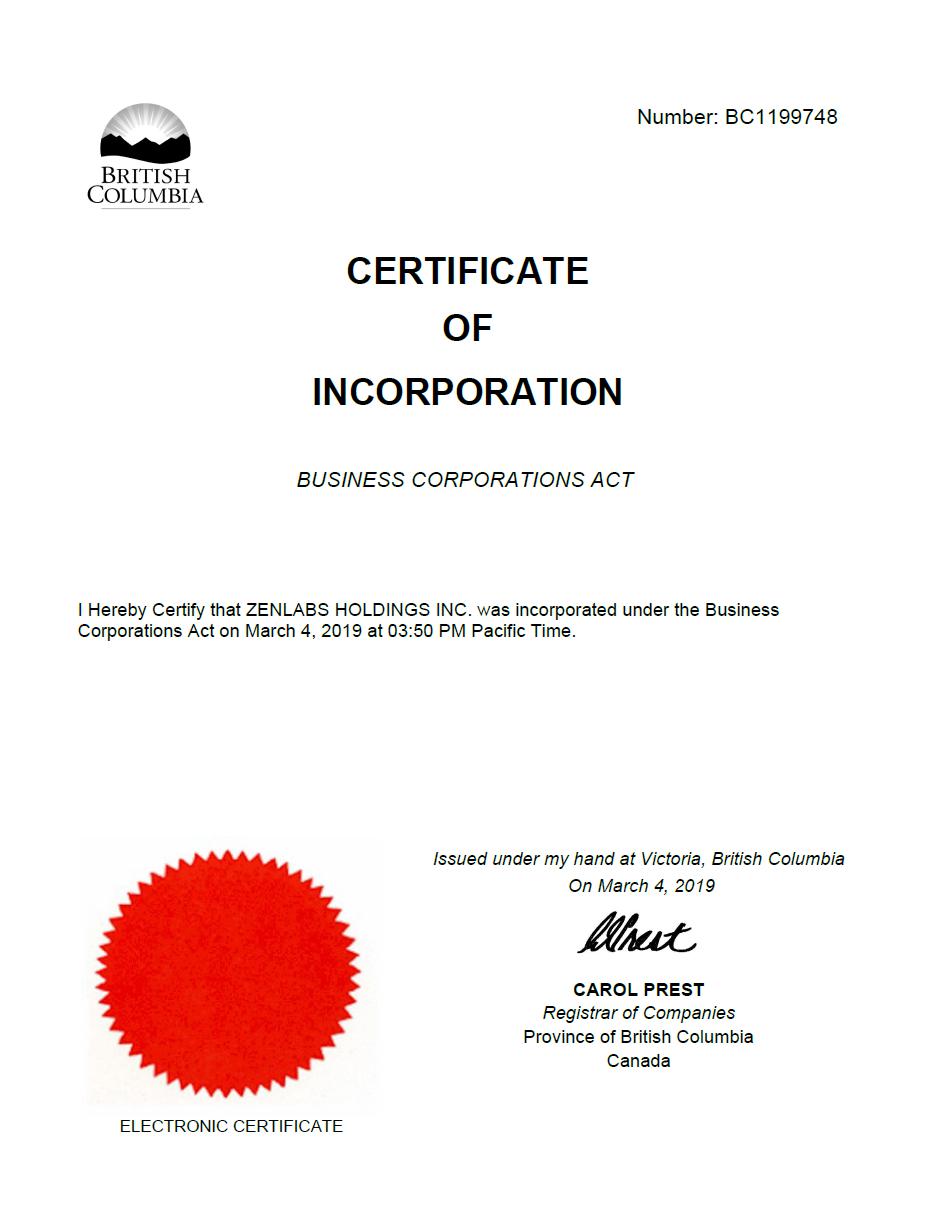
Exhibit 2.1
Exhibit 2.2
Exhibit 2.3
Incorporation No. BC1199748
BUSINESS CORPORATIONS ACT
Articles
Of
ZENLABS HOLDINGS INC.
Table of Contents
| Part 1 – Interpretation | 2 |
| Part 2 – Shares and Share certificates | 3 |
| Part 3 – Issue of Shares | 4 |
| Part 4 – Share Transfers | 4 |
| Part 5 – Acquisition of Shares | 5 |
| Part 6 – Borrowing Powers | 5 |
| Part 7 – General Meetings | 5 |
| Part 8 – Proceedings at Meetings of Shareholders | 7 |
| Part 9 – Alterations and Resolutions | 10 |
| Part 10 – Votes of Shareholders | 11 |
| Part 11 – Directors | 14 |
| Part 12 – Election and Removal of Directors | 15 |
| Part 13 – Proceedings of Directors | 21 |
| Part 14 – Committees of Directors | 23 |
| Part 15 – Officers | 24 |
| Part 16 – Certain Permitted Activities of Directors | 24 |
| Part 17 – Indemnification | 25 |
| Part 18 – Auditor | 25 |
| Part 19 – Dividends | 25 |
| Part 20 – Accounting Records | 26 |
| Part 21 – Execution of Instruments | 26 |
| Part 22 – Notices | 27 |
| Part 23 – Restriction on Share Transfer | 28 |
| Part 24 – Special Rights and Restrictions | 28 |
| - 2 - |
Incorporation No. BC1199748
BUSINESS CORPORATIONS ACT
Articles
Of
ZENLABS HOLDINGS INC.
(the “Company”)
Part 1– Interpretation
| 1.1 | Definitions |
| Without limiting Article 1.2, in these Articles, unless the context requires otherwise: | ||
| (a) | “adjourned meeting” means the meeting to which a meeting is adjourned under Article 8.6 or 8.9; | |
| (b) | “board” and “directors” mean the board of directors of the Company for the time being; | |
| (c) | “Business Corporations Act” means the Business Corporations Act, S.B.C. 2002, c.57, and includes its regulations; | |
| (d) | “Company” means 1200944 B.C. Ltd.; | |
| (e) | “Interpretation Act” means the Interpretation Act, R.S.B.C. 1996, c. 238; and | |
| (f) | “trustee”, in relation to a shareholder, means the personal or other legal representative of the shareholder, and includes a trustee in bankruptcy of the shareholder. | |
| 1.2 | Business Corporations Act definitions apply |
| The definitions in the Business Corporations Act apply to these Articles. | |
| 1.3 | Interpretation Act applies |
| The Interpretation Act applies to the interpretation of these Articles as if these Articles were an enactment. | |
| 1.4 | Conflict in definitions |
| If there is a conflict between a definition in the Business Corporations Act and a definition or rule in the Interpretation Act relating to a term used in these Articles, the definition in the Business Corporations Act will prevail in relation to the use of the term in these Articles. | |
| 1.5 | Conflict between Articles and legislation |
| If there is a conflict between these Articles and the Business Corporations Act, the Business Corporations Act will prevail. |
| - 3 - |
Part 2 – Shares and Share certificates
| 2.1 | Form of share certificate |
| Each share certificate issued by the Company must comply with, and be signed as required by, the Business Corporations Act. | |
| 2.2 | Shareholder Entitled to Certificate or Acknowledgement |
| Unless the shares are uncertificated shares, each shareholder is entitled, without charge, to (a) one share certificate representing the shares of each class or series of shares registered in the shareholder’s name or (b) a non-transferable written acknowledgement of the shareholder’s right to obtain such a share certificate, provided that in respect of a share held jointly by several persons, the Company is not bound to issue more than one share certificate and delivery of a share certificate for a share to one of several joint shareholders or to one of the shareholders’ duly authorized agents will be sufficient delivery to all. | |
| 2.3 | Sending of share certificate |
| Any share certificate to which a shareholder is entitled may be sent to the shareholder by mail and neither the Company nor any agent is liable for any loss to the shareholder because the certificate sent is lost in the mail or stolen. | |
| 2.4 | Replacement of worn out or defaced certificate |
| If the directors are satisfied that a share certificate is worn out or defaced, they must, on production to them of the certificate and on such other terms, if any, as they think fit: |
| (a) | order the certificate to be cancelled; and | |
| (b) | issue a replacement share certificate. |
| 2.5 | Replacement of lost, stolen or destroyed certificate |
| If a share certificate is lost, stolen or destroyed, a replacement share certificate must be issued to the person entitled to that certificate if the directors receive: |
| (a) | proof satisfactory to them that the certificate is lost, stolen or destroyed; and | |
| (b) | any indemnity the directors consider adequate. |
| 2.6 | Splitting share certificates |
| If a shareholder surrenders a share certificate to the Company with a written request that the Company issue in the shareholder’s name 2 or more certificates, each representing a specified number of shares and in the aggregate representing the same number of shares as the certificate so surrendered, the Company must cancel the surrendered certificate and issue replacement share certificates in accordance with that request. | |
| 2.7 | Shares may be uncertificated |
| Notwithstanding any other provisions of this Part, the directors may, by resolution, provide that: |
| (a) | the shares of any or all of the classes and series of the Company’s shares may be uncertificated shares; or | |
| (b) | any specified shares may be uncertificated shares. |
| - 4 - |
Part 3 – Issue of Shares
| 3.1 | Directors authorized to issue shares |
| The directors may, subject to the rights of the holders of the issued shares of the Company, issue, allot, sell, grant options on or otherwise dispose of the unissued shares, and issued shares held by the Company, at the times, to the persons, including directors, in the manner, on the terms and conditions and for the issue prices that the directors, in their absolute discretion, may determine. | |
| 3.2 | Company need not recognize unregistered interests |
| Except as required by law or these Articles, the Company need not recognize or provide for any person’s interests in or rights to a share unless that person is the shareholder of the share. |
Part 4 – Share Transfers
| 4.1 | Recording or registering transfer |
| A transfer of a share of the Company must not be registered |
| (a) | unless a duly signed instrument of transfer in respect of the share has been received by the Company and the certificate (or acceptable documents pursuant to Article 2.5 hereof) representing the share to be transferred has been surrendered and cancelled; or | |
| (b) | if no certificate has been issued by the Company in respect of the share, unless a duly signed instrument of transfer in respect of the share has been received by the Company. |
| 4.2 | Form of instrument of transfer |
| The instrument of transfer in respect of any share of the Company must be either in the form, if any, on the back of the Company’s share certificates or in any other form that may be approved by the directors from time to time. | |
| 4.3 | Signing of instrument of transfer |
| If a shareholder, or his or her duly authorized attorney, signs an instrument of transfer in respect of shares registered in the name of the shareholder, the signed instrument of transfer constitutes a complete and sufficient authority to the Company and its directors, officers and agents to register the number of shares specified in the instrument of transfer, or, if no number is specified, all the shares represented by share certificates deposited with the instrument of transfer: |
| (a) | in the name of the person named as transferee in that instrument of transfer; or | |
| (b) | if no person is named as transferee in that instrument of transfer, in the name of the person on whose behalf the share certificate is deposited for the purpose of having the transfer registered. |
| 4.4 | Enquiry as to title not required |
| Neither the Company nor any director, officer or agent of the Company is bound to inquire into the title of the person named in the instrument of transfer as transferee or, if no person is named as transferee in the instrument of transfer, of the person on whose behalf the instrument is deposited for the purpose of having the transfer registered or is liable for any claim related to registering the transfer by the shareholder or by any intermediate owner or holder of the shares, of any interest in the shares, of any share certificate representing such shares or of any written acknowledgment of a right to obtain a share certificate for such shares. |
| - 5 - |
| 4.5 | Transfer fee |
| There must be paid to the Company, in relation to the registration of any transfer, the amount determined by the directors from time to time. |
Part 5 – Acquisition of Shares
| 5.1 | Company authorized to purchase shares |
| Subject to the special rights and restrictions attached to any class or series of shares, the Company may, if it is authorized to do so by the directors, purchase or otherwise acquire any of its shares. | |
| 5.2 | Company authorized to accept surrender of shares |
| The Company may, if it is authorized to do so by the directors, accept a surrender of any of its shares. | |
| 5.3 | Company authorized to convert fractional shares into whole shares |
| The Company may, if it is authorized to do so by the directors, convert any of its fractional shares into whole shares in accordance with, and subject to the limitations contained in, the Business Corporations Act. |
Part 6 – Borrowing Powers
| 6.1 | Powers of directors |
| The directors may from time to time on behalf of the Company: |
| (a) | borrow money in the manner and amount, on the security, from the sources and on the terms and conditions that they consider appropriate; | |
| (b) | issue bonds, debentures and other debt obligations either outright or as security for any liability or obligation of the Company or any other person, and at any discount or premium and on such other terms as they consider appropriate; | |
| (c) | guarantee the repayment of money by any other person or the performance of any obligation of any other person; and | |
| (d) | mortgage or charge, whether by way of specific or floating charge, or give other security on the whole or any part of the present and future assets and undertaking of the Company. |
Part 7 – General Meetings
| 7.1 | Annual general meetings |
| Unless an annual general meeting is deferred or waived in accordance with section 182(2)(a) or (c) of the Business Corporations Act, the Company must hold its first annual general meeting within 18 months after the date on which it was incorporated or otherwise recognized, and after that must hold an annual general meeting at least once in each calendar year and not more than 15 months after the last annual general meeting. | |
| 7.2 | When annual general meeting is deemed to have been held |
| If all of the shareholders who are entitled to vote at an annual general meeting consent by a unanimous resolution under the Business Corporations Act to all of the business that is required to be transacted at that annual general meeting, the annual general meeting is deemed to have been held on the date of the unanimous resolution. The shareholders must, in any unanimous resolution passed under this Article 7.2, select as the Company’s annual reference date a date that would be appropriate for the holding of the applicable annual general meeting. |
| - 6 - |
| 7.3 | Calling of shareholder meetings |
| The directors may, whenever they think fit, call a meeting of shareholders. | |
| 7.4 | Notice for meetings of shareholders |
| The Company must send notice of the date, time and location of any meeting of shareholders, in the manner provided in these Articles, or in such other manner, if any, as may be prescribed by ordinary resolution (whether previous notice of the resolution has been given or not), to each shareholder entitled to attend the meeting and to each director, unless these Articles otherwise provide, at least the following number of days before the meeting: |
| (a) | if and for so long as the Company is a public company, 21 days; | |
| (b) | otherwise, 10 days. |
| 7.5 | Record date for notice |
| The directors may set a date as the record date for the purpose of determining shareholders entitled to notice of any meeting of shareholders. The record date must not precede the date on which the meeting is to be held by more than two months or, in the case of a general meeting requisitioned by shareholders under the Business Corporations Act, by more than four months. The record date must not precede the date on which the meeting is held by fewer than: |
| (a) | if and for so long as the Company is a public company, 21 days; | |
| (b) | otherwise, 10 days. | |
| If no record date is set, the record date is 5 p.m. on the day immediately preceding the first date on which the notice is sent or, if no notice is sent, the beginning of the meeting. |
| 7.6 | Record date for voting |
| The directors may set a date as the record date for the purpose of determining shareholders entitled to vote at any meeting of shareholders. The record date must not precede the date on which the meeting is to be held by more than two months or, in the case of a general meeting requisitioned by shareholders under the Business Corporations Act, by more than four months. If no record date is set as provided above, the record date for determining the shareholders entitled to vote at the meeting shall be 5:00 p.m. the day before the meeting. | |
| 7.7 | Failure to give notice and waiver of notice |
| The accidental omission to send notice of any meeting to, or the non-receipt of any notice by, any of the persons entitled to notice does not invalidate any proceedings at that meeting. Any person entitled to notice of a meeting of shareholders may, in writing or otherwise, waive or reduce the period of notice of such meeting. | |
| 7.8 | Notice of special business at meetings of shareholders |
| If a meeting of shareholders is to consider special business within the meaning of Article 8.1, the notice of meeting must: |
| (a) | state the general nature of the special business; and |
| - 7 - |
| (b) | if the special business includes considering, approving, ratifying, adopting or authorizing any document or the signing of or giving of effect to any document, have attached to it a copy of the document or state that a copy of the document will be available for inspection by shareholders: | ||
| (i) | at the Company’s records office, or at such other reasonably accessible location in British Columbia as is specified in the notice, and | ||
| (ii) | during statutory business hours on any one or more specified days before the day set for the holding of the meeting. | ||
Part 8 – Proceedings at Meetings of Shareholders
| 8.1 | Special business |
| At a meeting of shareholders, the following business is special business: |
| (a) | at a meeting of shareholders that is not an annual general meeting, all business is special business except business relating to the conduct of or voting at the meeting or the election or appointment of directors; | |
| (b) | at an annual general meeting, all business is special business except for the following: |
| (i) | business relating to the conduct of or voting at the meeting, | |
| (ii) | consideration of any financial statements of the Company presented to the meeting, | |
| (iii) | consideration of any reports of the directors or auditor, | |
| (iv) | the setting or changing of the number of directors, | |
| (v) | the election or appointment of directors, | |
| (vi) | the appointment of an auditor, | |
| (vii) | the setting of the remuneration of an auditor, | |
| (viii) | business arising out of a report of the directors not requiring the passing of a special resolution or an exceptional resolution, and | |
| (ix) | any other business which, under these Articles or the Business Corporations Act, may be transacted at a meeting of shareholders without prior notice of the business being given to the shareholders. |
| 8.2 | Special resolution |
| The votes required for the Company to pass a special resolution at a meeting of shareholders is two-thirds of the votes cast on the resolution. | |
| 8.3 | Quorum |
| Subject to the special rights and restrictions attached to the shares of any affected class or series of shares, the quorum for the transaction of business at a meeting of shareholders is one or more persons, present in person or by proxy. |
| - 8 - |
| 8.4 | Other persons may attend |
| The directors, the president, if any, the secretary, if any, and any lawyer or auditor for the Company are entitled to attend any meeting of shareholders, but if any of those shareholders do attend a meeting of shareholders, that person is not to be counted in the quorum, and is not entitled to vote at the meeting, unless that person is a shareholder or proxy holder entitled to vote at the meeting. | |
| 8.5 | Requirement of quorum |
| No business, other than the election of a chair of the meeting and the adjournment of the meeting, may be transacted at any meeting of shareholders unless a quorum of shareholders entitled to vote at the meeting is present at the commencement of the meeting. | |
| 8.6 | Lack of quorum |
| If, within 1/2 hour from the time set for the holding of a meeting of shareholders, a quorum is not present: |
| (a) | in the case of a general meeting convened by requisition of shareholders, the meeting is dissolved; and | |
| (b) | in the case of any other meeting of shareholders, the shareholders entitled to vote at the meeting who are present, in person or by proxy, at the meeting may adjourn the meeting to a set time and place. |
| 8.7 | Chair |
| The following individual is entitled to preside as chair at a meeting of shareholders: |
| (a) | the chair of the board, if any; | |
| (b) | if the chair of the board is absent or unwilling to act as chair of the meeting, the president, if any. |
| 8.8 | Alternate chair |
| At any meeting of shareholders, the directors present must choose one of their number to be chair of the meeting if: (a) there is no chair of the board or president present within 15 minutes after the time set for holding the meeting; (b) the chair of the board and the president are unwilling to act as chair of the meeting; or (c) if the chair of the board and the president have advised the secretary, if any, or any director present at the meeting, that they will not be present at the meeting. If, in any of the foregoing circumstances, all of the directors present decline to accept the position of chair or fail to choose one of their number to be chair of the meeting, or if no director is present, the shareholders present in person or by proxy must choose any person present at the meeting to chair the meeting. | |
| 8.9 | Adjournments |
| The chair of a meeting of shareholders may, and if so directed by the meeting must, adjourn the meeting from time to time and from place to place, but no business may be transacted at any adjourned meeting other than the business left unfinished at the meeting from which the adjournment took place. | |
| 8.10 | Notice of adjourned meeting |
| It is not necessary to give any notice of an adjourned meeting or of the business to be transacted at an adjourned meeting of shareholders except that, when a meeting is adjourned for 30 days or more, notice of the adjourned meeting must be given as in the case of the original meeting. |
| - 9 - |
| 8.11 | Motion need not be seconded |
| No motion proposed at a meeting of shareholders need be seconded unless the chair of the meeting rules otherwise, and the chair of any meeting of shareholders is entitled to propose or second a motion. | |
| 8.12 | Manner of taking a poll |
| Subject to Article 8.13, if a poll is duly demanded at a meeting of shareholders: |
| (a) | the poll must be taken |
| (i) | at the meeting, or within 7 days after the date of the meeting, as the chair of the meeting directs, and | |
| (ii) | in the manner, at the time and at the place that the chair of the meeting directs; |
| (b) | the result of the poll is deemed to be a resolution of, and passed at, the meeting at which the poll is demanded; and | |
| (c) | the demand for the poll may be withdrawn. |
| 8.13 | Demand for a poll on adjournment |
| A poll demanded at a meeting of shareholders on a question of adjournment must be taken immediately at the meeting. | |
| 8.14 | Demand for a poll not to prevent continuation of meeting |
| The demand for a poll at a meeting of shareholders does not, unless the chair of the meeting so rules, prevent the continuation of a meeting for the transaction of any business other than the question on which a poll has been demanded. | |
| 8.15 | Poll not available in respect of election of chair |
| No poll may be demanded in respect of the vote by which a chair of a meeting of shareholders is elected. | |
| 8.16 | Casting of votes on poll |
| On a poll, a shareholder entitled to more than one vote need not cast all the votes in the same way. | |
| 8.17 | Chair must resolve dispute |
| In the case of any dispute as to the admission or rejection of a vote given on a poll, the chair of the meeting must determine the same, and his or her determination made in good faith is final and conclusive. | |
| 8.18 | Chair has no second vote |
| In case of an equality of votes, the chair of a meeting of shareholders does not, either on a show of hands or on a poll, have a casting or second vote in addition to the vote or votes to which the chair may be entitled as a shareholder. | |
| 8.19 | Declaration of result |
| The chair of a meeting of shareholders must declare to the meeting the decision on every question in accordance with the result of the show of hands or the poll, as the case may be, and that decision must be entered in the minutes of the meeting. |
| - 10 - |
| 8.20 | Meetings by telephone or other communications medium | |
| A shareholder or proxy holder who is entitled to participate in a meeting of shareholders may do so in person, or by telephone or other communications medium, if all shareholders and proxy holders participating in the meeting are able to communicate with each other; provided, however, that nothing in this Section shall obligate the Company to take any action or provide any facility to permit or facilitate the use of any communications medium at a meeting of shareholders. If one or more shareholders or proxy holders participate in a meeting of shareholders in a manner contemplated by this Article 8.20: | ||
| (a) | each such shareholder or proxy holder shall be deemed to be present at the meeting; and | |
| (b) | the meeting shall be deemed to be held at the location specified in the notice of the meeting. | |
Part 9 – Alterations and Resolutions
| 9.1 | Alteration of Authorized Share Structure |
| Subject to Article 9.2 and the Business Corporations Act, the Company may by resolution of the directors: |
| (a) | create one or more classes or series of shares or, if none of the shares of a class or series of shares are allotted or issued, eliminate that class or series of shares; | |
| (b) | increase, reduce or eliminate the maximum number of shares that the Company is authorized to issue out of any class or series of shares or establish a maximum number of shares that the Company is authorized to issue out of any class or series of shares for which no maximum is established; | |
| (c) | if the Company is authorized to issue shares of a class of shares with par value: |
| (i) | decrease the par value of those shares, | |
| (ii) | if none of the shares of that class of shares are allotted or issued, increase the par value of those shares, | |
| (iii) | subdivide all or any of its unissued or fully paid issued shares with par value into shares of smaller par value, or | |
| (iv) | consolidate all or any of its unissued or fully paid issued shares with par value into shares of larger par value; |
| (d) | subdivide all or any of its unissued or fully paid issued shares without par value; | |
| (e) | change all or any of its unissued or fully paid issued shares with par value into shares without par value or all or any of its unissued shares without par value into shares with par value; | |
| (f) | alter the identifying name of any of its shares; | |
| (g) | consolidate all or any of its unissued or fully paid issued shares without par value; or | |
| (h) | otherwise alter its shares or authorized share structure when required or permitted to do so by the Business Corporations Act. |
| 9.2 | Change of Name |
| The Company may by resolution of the directors authorize an alteration to its Notice of Articles in order to change its name or adopt or change any translation of that name. |
| - 11 - |
| 9.3 | Other Alterations or Resolutions |
| If the Business Corporations Act does not specify: |
| (a) | the type of resolution and these Articles do not specify another type of resolution, the Company may by resolution of the directors authorize any act of the Company, including without limitation, an alteration of these Articles; or | |
| (b) | the type of shareholders’ resolution and these Articles do not specify another type of shareholders’ resolution, the Company may by ordinary resolution authorize any act of the Company. |
Part 10 – Votes of Shareholders
| 10.1 | Voting rights | |
| Subject to any special rights or restrictions attached to any shares and to the restrictions imposed on joint registered holders of shares under Article 10.3: | ||
| (a) | on a vote by show of hands, every person present who is a shareholder or proxy holder and entitled to vote at the meeting has one vote; and | |
| (b) | on a poll, every shareholder entitled to vote has one vote in respect of each share held by that shareholder that carries the right to vote on that poll and may exercise that vote either in person or by proxy. | |
| 10.2 | Trustee of shareholder may vote | |
| A person who is not a shareholder may vote on a resolution at a meeting of shareholders, whether on a show of hands or on a poll, and may appoint a proxy holder to act at the meeting in relation to that resolution, if, before doing so, the person satisfies the chair of the meeting at which the resolution is to be considered, or satisfies all of the directors present at the meeting, that the person is a trustee for a shareholder who is entitled to vote on the resolution. | ||
| 10.3 | Votes by joint shareholders | |
| If there are joint shareholders registered in respect of any share: | ||
| (a) | any one of the joint shareholders, but not both or all, may vote at any meeting, either personally or by proxy, in respect of the share as if that joint shareholder were solely entitled to it; or | |
| (b) | if more than one of the joint shareholders is present at any meeting, personally or by proxy, the joint shareholder present whose name stands first on the central securities register in respect of the share is alone entitled to vote in respect of that share. | |
| 10.4 | Trustees as joint shareholders | |
| Two or more trustees of a shareholder in whose sole name any share is registered are, for the purposes of Article 10.3, deemed to be joint shareholders. | ||
| - 12 - |
| 10.5 | Representative of a corporate shareholder | |
| If a corporation that is not a subsidiary of the Company is a shareholder, that corporation may appoint a person to act as its representative at any meeting of shareholders of the Company, and: | ||
| (a) | for that purpose, the instrument appointing a representative must | |
| (i) | be received at the registered office of the Company or at any other place specified, in the notice calling the meeting, for the receipt of proxies, at least 2 business days before the day set for the holding of the meeting, or | |
| (ii) | unless the notice of the meeting provides otherwise, be provided, at the meeting, to the chair of the meeting; and |
| (b) | if a representative is appointed under this Article 10.5, |
| (i) | the representative is entitled to exercise in respect of and at that meeting the same rights on behalf of the corporation that the representative represents as that corporation could exercise if it were a shareholder who is an individual, including, without limitation, the right to appoint a proxy holder, and | |
| (ii) | the representative, if present at the meeting, is to be counted for the purpose of forming a quorum and is deemed to be a shareholder present in person at the meeting. |
| 10.6 | When proxy provisions do not apply | |
| Articles 10.7 to 10.13 do not apply to the Company if and for so long as it is a public company. | ||
| 10.7 | Appointment of proxy holder | |
| Every shareholder of the Company, including a corporation that is a shareholder but not a subsidiary of the Company, entitled to vote at a meeting of shareholders of the Company may, by proxy, appoint a proxy holder to attend and act at the meeting in the manner, to the extent and with the powers conferred by the proxy. | ||
| 10.8 | Alternate proxy holders | |
| A shareholder may appoint one or more alternate proxy holders to act in the place of an absent proxy holder. | ||
| 10.9 | When proxy holder need not be shareholder | |
| A person must not be appointed as a proxy holder unless the person is a shareholder, although a person who is not a shareholder may be appointed as a proxy holder if: | ||
| (a) | the person appointing the proxy holder is a corporation or a representative of a corporation appointed under Article 10.5; | |
| (b) | the Company has at the time of the meeting for which the proxy holder is to be appointed only one shareholder entitled to vote at the meeting; or | |
| (c) | the shareholders present in person or by proxy at and entitled to vote at the meeting for which the proxy holder is to be appointed, by a resolution on which the proxy holder is not entitled to vote but in respect of which the proxy holder is to be counted in the quorum, permit the proxy holder to attend and vote at the meeting. | |
| - 13 - |
| 10.10 | Form of proxy |
| A proxy, whether for a specified meeting or otherwise, must be either in the following form or in any other form approved by the directors or the chair of the meeting: |
(Name of Company)
The undersigned, being a shareholder of the above named Company, hereby appoints ....................................... or, failing that person, ......................................., as proxy holder for the undersigned to attend, act and vote for and on behalf of the undersigned at the meeting of shareholders to be held on the day of and at any adjournment of that meeting.
Signed this .......... day of .............................................., .................
...............................................................
Signature of shareholder
| 10.11 | Provision of proxies |
| A proxy for a meeting of shareholders must: |
| (a) | be received at the registered office of the Company or at any other place specified in the notice calling the meeting for the receipt of proxies, at least the number of business days specified in the notice or, if no number of days is specified, 2 business days before the day set for the holding of the meeting; or | |
| (b) | unless the notice of the meeting provides otherwise, be provided at the meeting to the chair of the meeting. |
| 10.12 | Revocation of proxies |
| Subject to Article 10.13, every proxy may be revoked by an instrument in writing that is: |
| (a) | received at the registered office of the Company at any time up to and including the last business day before the day set for the holding of the meeting at which the proxy is to be used; or | |
| (b) | provided at the meeting to the chair of the meeting. |
| 10.13 | Revocation of proxies must be signed |
| An instrument referred to in Article 10.12 must be signed as follows: |
| (a) | if the shareholder for whom the proxy holder is appointed is an individual, the instrument must be signed by the shareholder or his or her trustee; or | |
| (b) | if the shareholder for whom the proxy holder is appointed is a corporation, the instrument must be signed by the corporation or by a representative appointed for the corporation under Article 10.5. |
| 10.14 | Validity of proxy votes |
| A vote given in accordance with the terms of a proxy is valid despite the death or incapacity of the shareholder giving the proxy and despite the revocation of the proxy or the revocation of the authority under which the proxy is given, unless notice in writing of that death, incapacity or revocation is received: |
| (a) | at the registered office of the Company, at any time up to and including the last business day before the day set for the holding of the meeting at which the proxy is to be used; or | |
| (b) | by the chair of the meeting, before the vote is taken. |
| - 14 - |
| 10.15 | Production of evidence of authority to vote |
| The chair of any meeting of shareholders may, but need not, inquire into the authority of any person to vote at the meeting and may, but need not, demand from that person production of evidence as to the existence of the authority to vote. | |
| 10.16 | Chair May Determine Validity of Proxy |
| Unless prohibited by applicable law, the chair of any meeting of shareholders may determine whether or not a proxy deposited for use at the meeting, which may not strictly comply with the requirements of this Article 10 as to form, execution, accompanying documentation, time of filing or otherwise, shall be valid for use at the meeting and any such determination made in good faith shall be final, conclusive and binding upon the meeting. |
Part 11 – Directors
| 11.1 | First directors; number of directors |
| The first directors are the persons designated as directors of the Company in the Notice of Articles that applies to the Company when it is recognized under the Business Corporations Act. The number of directors, excluding additional directors appointed under Article 12.7, is set at: |
| (a) | subject to paragraphs (b) and (c), the number of directors that is equal to the number of the Company’s first directors; | |
| (b) | if the Company is a public company, the greater of three and the number most recently elected by ordinary resolution (whether or not previous notice of the resolution was given); and | |
| (c) | if the Company is not a public company, the number most recently elected by ordinary resolution (whether or not previous notice of the resolution was given). |
| 11.2 | Change in number of directors |
| If the number of directors is set under Articles 11.1(b) or 11.1(c): |
| (a) | the shareholders may elect or appoint the directors needed to fill any vacancies in the board of directors up to that number; | |
| (b) | if, contemporaneously with setting that number, the shareholders do not elect or appoint the directors needed to fill vacancies in the board of directors up to that number, then the directors may appoint, or the shareholders may elect or appoint, directors to fill those vacancies. |
| 11.3 | Directors’ acts valid despite vacancy | |
| An act or proceeding of the directors is not invalid merely because fewer directors have been appointed or elected than the number of directors set or otherwise required under these Articles. | ||
| 11.4 | Qualifications of directors |
| A director is not required to hold a share in the capital of the Company as qualification for his or her office but must be qualified as required by the Business Corporations Act to become, act or continue to act as a director. |
| - 15 - |
| 11.5 | Remuneration of directors |
| The directors are entitled to the remuneration, if any, for acting as directors as the directors may from time to time determine. If the directors so decide, the remuneration of the directors will be determined by the shareholders. That remuneration may be in addition to any salary or other remuneration paid to a director in such director’s capacity as an officer or employee of the Company. | |
| 11.6 | Reimbursement of expenses of directors |
| The Company must reimburse each director for the reasonable expenses that he or she may incur in and about the business of the Company. | |
| 11.7 | Special remuneration for directors |
| If any director performs any professional or other services for the Company that in the opinion of the directors are outside the ordinary duties of a director, or if any director is otherwise specially occupied in or about the Company’s business, he or she may be paid remuneration fixed by the directors, or, at the option of that director, fixed by ordinary resolution, and such remuneration may be either in addition to, or in substitution for, any other remuneration that he or she may be entitled to receive. | |
| 11.8 | Gratuity, pension or allowance on retirement of director |
| Unless otherwise determined by ordinary resolution, the directors on behalf of the Company may pay a gratuity or pension or allowance on retirement to any director who has held any salaried office or place of profit with the Company or to his or her spouse or dependants and may make contributions to any fund and pay premiums for the purchase or provision of any such gratuity, pension or allowance. |
Part 12 – Election and Removal of Directors
| 12.1 | Election at annual general meeting | |
| At every annual general meeting and in every unanimous resolution contemplated by Article 7.2: | ||
| (a) | the shareholders entitled to vote at the annual general meeting for the election of directors may elect, or in the unanimous resolution appoint, a board of directors consisting of up to the number of directors for the time being set under these Articles; and | |
| (b) | all the directors cease to hold office immediately before the election or appointment of directors under paragraph (a), but are eligible for re-election or re-appointment. | |
| 12.2 | Consent to be a director | |
| No election, appointment or designation of an individual as a director is valid unless: | ||
| (a) | that individual consents to be a director in the manner provided for in the Business Corporations Act; | |
| (b) | that individual is elected or appointed at a meeting at which the individual is present and the individual does not refuse, at the meeting, to be a director; or | |
| (c) | with respect to first directors, the designation is otherwise valid under the Business Corporations Act. | |
| - 16 - |
| 12.3 | Failure to elect or appoint directors |
If:
| (a) | the Company fails to hold an annual general meeting, and all the shareholders who are entitled to vote at an annual general meeting fail to pass the unanimous resolution contemplated by Article 7.2, on or before the date by which the annual general meeting is required to be held under the Business Corporations Act; or |
| (b) | the shareholders fail, at the annual general meeting or in the unanimous resolution contemplated by Article 7.2, to elect or appoint any directors; |
then each director in office at such time continues to hold office until the earlier of:
| (c) | the date on which his or her successor is elected or appointed; and |
| (d) | the date on which he or she otherwise ceases to hold office under the Business Corporations Act or these Articles. |
| 12.4 | Directors may fill casual vacancies |
Any casual vacancy occurring in the board of directors may be filled by the remaining directors.
| 12.5 | Remaining directors’ power to act |
The directors may act notwithstanding any vacancy in the board of directors, but if the Company has fewer directors in office than the number set pursuant to these Articles as the quorum of directors, the directors may only act for the purpose of appointing directors up to that number or for the purpose of summoning a meeting of shareholders to fill any vacancies on the board of directors or for any other purpose permitted by the Business Corporations Act.
| 12.6 | Shareholders may fill vacancies |
If the Company has no directors or fewer directors in office than the number set pursuant to these Articles as the quorum of directors, and the directors have not filled the vacancies pursuant to Article 12.5 above, the shareholders may elect or appoint directors to fill any vacancies on the board of directors.
| 12.7 | Additional directors |
Notwithstanding Articles 11.1 and 11.2, between annual general meetings or unanimous resolutions contemplated by Article 7.2, the directors may appoint one or more additional directors, but the number of additional directors appointed under this Article 12.7 must not at any time exceed:
| (a) | one-third of the number of first directors, if, at the time of the appointments, one or more of the first directors have not yet completed their first term of office; or | |
| (b) | in any other case, one-third of the number of the current directors who were elected or appointed as directors other than under this Article 12.7. |
Any director so appointed ceases to hold office immediately before the next election or appointment of directors under Article 12.1(a), but is eligible for re-election or re-appointment.
| 12.8 | Ceasing to be a director |
A director ceases to be a director when:
| (a) | the term of office of the director expires; | |
| (b) | the director dies; |
| - 17 - |
| (c) | the director resigns as a director by notice in writing provided to the Company or a lawyer for the Company; or |
| (d) | the director is removed from office pursuant to Articles 12.9 or 12.10. |
| 12.9 | Removal of director by shareholders |
The Shareholders may, by special resolution, remove any director before the expiration of his or her term of office, and may, by ordinary resolution, elect or appoint a director to fill the resulting vacancy. If the shareholders do not contemporaneously elect or appoint a director to fill the vacancy created by the removal of a director, then the directors may appoint, or the shareholders may elect or appoint by ordinary resolution, a director to fill that vacancy.
| 12.10 | Removal of director by directors |
The directors may remove any director before the expiration of his or her term of office if the director is convicted of an indictable offence, or if the director ceases to be qualified to act as a director of a company and does not promptly resign, and the directors may appoint a director to fill the resulting vacancy.
| 12.11 | Nominations of directors |
| (a) | Only persons who are nominated in accordance with the following procedures shall be eligible for election as directors of the Company. |
| (b) | Nominations of persons for election to the board may be made at any annual meeting of shareholders or at any special meeting of shareholders (if one of the purposes for which the special meeting was called was the election of directors): |
| (i) | by or at the direction of the board, including pursuant to a notice of meeting; |
| (ii) | by or at the direction or request of one or more shareholders pursuant to a proposal made in accordance with the provisions of the Business Corporations Act, or a requisition of the shareholders made in accordance with the provisions of the Business Corporations Act; or |
| (iii) | by any person (a “Nominating Shareholder”): (A) who, at the close of business on the date of the giving of the notice provided for below in this Article 12.11 and on the record date for notice of such meeting, is entered in the securities register as a holder of one or more shares carrying the right to vote at such meeting or who beneficially owns shares that are entitled to be voted at such meeting; and (B) who complies with the notice procedures set forth below in this Article 12.11. |
| (c) | In addition to any other applicable requirements, for a nomination to be made by a Nominating Shareholder, the Nominating Shareholder must have given timely notice thereof (as provided for in Article 12.11(d)) in proper written form to the secretary of the Company at the principal executive offices of the Company. |
| (d) | To be timely, a Nominating Shareholder’s notice to the secretary of the Company must be given: |
| (i) | in the case of an annual meeting of shareholders, not less than 30 nor more than 65 days prior to the date of the annual meeting of shareholders; provided, however, that in the event that the annual meeting of shareholders is to be held on a date that is less than 50 days after the date (the “Notice Date”) on which the first public announcement (as defined below) of the date of the annual meeting was made, notice by the Nominating Shareholder may be given not later than the close of business on the tenth (10th) day after the Notice Date in respect of such meeting; and |
| - 18 - |
| (ii) | in the case of a special meeting (which is not also an annual meeting) of shareholders called for the purpose of electing directors (whether or not called for other purposes), not later than the close of business on the fifteenth (15th) day following the day on which the first public announcement of the date of the special meeting of shareholders was made. |
In no event shall any adjournment or postponement of a meeting of shareholders or the announcement thereof commence a new time period for the giving of a Nominating Shareholder’s notice as described above.
| (e) | To be in proper written form, a Nominating Shareholder’s notice to the secretary of the Company must set forth: |
| (i) | as to each person whom the Nominating Shareholder proposes to nominate for election as a director: (A) the name, age, business address and residential address of the person; (B) the principal occupation or employment of the person during the past five years; (C) the class or series and number of shares in the capital of the Company which are controlled or which are owned beneficially or of record by the person as of the record date for the meeting of shareholders (if such date shall then have been made publicly available and shall have occurred) and as of the date of such notice; (D) a statement as to whether such person would be “independent” of the Company (as such term is defined under Applicable Securities Laws (as defined below)) if elected as a director at such meeting and the reasons and basis for such determination; (E) a description of all direct and indirect compensation and other material monetary agreements, arrangements and understandings during the past three years, and any other material relationships, between or among such Nominating Shareholder and beneficial owner, if any, and their respective affiliates and associates, or others acting jointly or in concert therewith, on the one hand, and such nominee, and his or her respective associates, or others acting jointly or in concert therewith, on the other hand; and (F) any other information relating to the person that would be required to be disclosed in a dissident’s proxy circular in connection with solicitations of proxies for election of directors pursuant to the Business Corporations Act and Applicable Securities Laws (as defined below); and | |
| (ii) | as to the Nominating Shareholder giving the notice: (A) any proxy, contract, arrangement, understanding or relationship pursuant to which such Nominating Shareholder has a right to vote any shares of the Company; (B) the class or series and number of shares in the capital of the Company which are controlled or which are owned beneficially or of the record by the Nominating Shareholder as of the record date for the meeting of shareholders (if such date shall then have been made publicly available and shall have occurred) and as of the date of such notice, and (C) any other information relating to such Nominating Shareholder that would be required to be made in a dissident’s proxy circular in connection with solicitations of proxies for election of directors pursuant to the Business Corporations Act and Applicable Securities Laws (as defined below). |
| (f) | The Company may require any proposed nominee to furnish such other information as may reasonably be required by the Company to determine the eligibility of such proposed nominee to serve as an independent director of the Company or that could be material to a reasonable shareholder’s understanding of the independence, or lack thereof, of such proposed nominee. |
| - 19 - |
| (g) | The chair of the meeting shall have the power and duty to determine whether a nomination was made in accordance with the provisions set forth in this Article 12.11 and, if any proposed nomination is not in compliance with such provisions, to declare that such defective nomination shall be disregarded. |
| (h) | For purposes of this Article 12.11: |
| (i) | “Affiliate”, when used to indicate a relationship with a person, means a person that directly, or indirectly through one or more intermediaries, controls, or is controlled by, or is under common control with, such specified person; |
| (ii) | “Applicable Securities Laws” means the applicable securities legislation of each relevant province and territory of Canada, as amended from time to time, the rules, regulations and forms made or promulgated under any such statute and the published national instruments, multilateral instruments, policies, bulletins and notices of the securities commission and similar regulatory authority of each province and territory of Canada; |
| (iii) | “Associate”, when used to indicate a relationship with a specified person, means: |
| A. | any corporation or trust of which such person beneficially owns, directly or indirectly, voting securities carrying more than 10% of the voting rights attached to all voting securities of such corporation or trust for the time being outstanding, |
| B. | any partner of that person, |
| C. | any trust or estate in which such person has a substantial beneficial interest or as to which such person serves as trustee or in a similar capacity, |
| D. | a spouse of such specified person, |
| E. | any person of either sex with whom such specified person is living in a conjugal relationship outside marriage, or |
| F. | any relative of such specified person or of a person mentioned in clauses D or E of this definition if that relative has the same residence as the specified person; |
| (iv) | “Derivatives Contract” means a contract between two parties (the “Receiving Party” and the “Counterparty”) that is designed to expose the Receiving Party to economic benefits and risks that correspond substantially to the ownership by the Receiving Party of a number of shares in the capital of the Company or securities convertible into such shares specified or referenced in such contract (the number corresponding to such economic benefits and risks, the “Notional Securities”), regardless of whether obligations under such contract are required or permitted to be settled through the delivery of cash, shares in the capital of the Company or securities convertible into such shares or other property, without regard to any short position under the same or any other Derivatives Contract. For the avoidance of doubt, interests in broad-based index options, broad-based index futures and broad-based publicly traded market baskets of stocks approved for trading by the appropriate governmental authority shall not be deemed to be Derivatives Contracts; |
| - 20 - |
| (v) | “owned beneficially” or “owns beneficially” means, in connection with the ownership of shares in the capital of the Company by a person: |
| A. | any such shares as to which such person or any of such person’s Affiliates or Associates owns at law or in equity, or has the right to acquire or become the owner at law or in equity, where such right is exercisable immediately or after the passage of time and whether or not on condition or the happening of any contingency or the making of any payment, upon the exercise of any conversion right, exchange right or purchase right attaching to any securities, or pursuant to any agreement, arrangement, pledge or understanding whether or not in writing, |
| B. | any such shares as to which such person or any of such person’s Affiliates or Associates has the right to vote, or the right to direct the voting, where such right is exercisable immediately or after the passage of time and whether or not on condition or the happening of any contingency or the making of any payment, pursuant to any agreement, arrangement, pledge or understanding whether or not in writing, |
| C. | any such shares which are beneficially owned, directly or indirectly, by a Counterparty (or any of such Counterparty’s Affiliates or Associates) under any Derivatives Contract (without regard to any short or similar position under the same or any other Derivatives Contract) to which such person or any of such person’s Affiliates or Associates is a Receiving Party; provided, however, that the number of shares that a person owns beneficially pursuant to this clause in connection with a particular Derivatives Contract shall not exceed the number of Notional Securities with respect to such Derivatives Contract; provided, further, that the number of securities owned beneficially by each Counterparty (including their respective Affiliates and Associates) under a Derivatives Contract shall for purposes of this clause be deemed to include all securities that are owned beneficially, directly or indirectly, by any other Counterparty (or any of such other Counterparty’s Affiliates or Associates) under any Derivatives Contract to which such first Counterparty (or any of such first Counterparty’s Affiliates or Associates) is a Receiving Party and this proviso shall be applied to successive Counterparties as appropriate, and |
| D. | any such shares which are owned beneficially within the meaning of this definition by any other person with whom such person is acting jointly or in concert with respect to the Company or any of its securities; and |
| (vi) | “public announcement” shall mean disclosure in a press release reported by a national news service in Canada, or in a document publicly filed by the Company under its profile on the System of Electronic Document Analysis and Retrieval at www.sedar.com. |
| (i) | Notwithstanding any other provision of this Article 12.11, notice given to the secretary of the Company pursuant to this Article 12.11 may only be given by personal delivery, facsimile transmission or by email (at such email address as stipulated from time to time by the secretary of the Company for purposes of this notice), and shall be deemed to have been given and made only at the time it is served by personal delivery, email (at the address as aforesaid, provided that receipt of confirmation of such transmission has been received) or sent by facsimile transmission (provided that receipt of confirmation of such transmission has been received) to the secretary at the address of the principal executive offices of the Company; provided that if such delivery or electronic communication is made on a day which is a not a business day or later than 5:00 p.m. (Vancouver time) on a day which is a business day, then such delivery or electronic communication shall be deemed to have been made on the subsequent day that is a business day. |
| (j) | Notwithstanding the foregoing, the board may, in its sole discretion, waive any requirement in this Article 12.11. |
| - 21 - |
Part 13 – Proceedings of Directors
| 13.1 | Meetings of directors |
The directors may meet together for the conduct of business, adjourn and otherwise regulate their meetings as they think fit, and meetings of the board held at regular intervals may be held at the place and at the time that the board may by resolution from time to time determine.
| 13.2 | Chair of meetings |
Meetings of directors are to be chaired by:
| (a) | the chair of the board, if any; |
| (b) | in the absence of the chair of the board, the president, if any, if the president is a director; or |
| (c) | any other director chosen by the directors if: |
| (i) | neither the chair of the board nor the president, if a director, is present at the meeting within 15 minutes after the time set for holding the meeting, |
| (ii) | neither the chair of the board nor the president, if a director, is willing to chair the meeting, or |
| (iii) | the chair of the board and the president, if a director, have advised the secretary, if any, or any other director, that they will not be present at the meeting. |
| 13.3 | Voting at meetings |
Questions arising at any meeting of directors are to be decided by a majority of votes and, in the case of an equality of votes, the chair of the meeting does not have a second or casting vote.
| 13.4 | Meetings by telephone or other communications medium |
A director may participate in a meeting of the directors or of any committee of the directors in person, or by telephone or other communications medium, if all directors participating in the meeting are able to communicate with each other. A director may participate in a meeting of the directors or of any committee of the directors by a communications medium other than telephone if all directors participating in the meeting, whether in person or by telephone or other communications medium, are able to communicate with each other and if all directors who wish to participate in the meeting agree to such participation. A director who participates in a meeting in a manner contemplated by this Article 13.4 is deemed for all purposes of the Business Corporations Act and these Articles to be present at the meeting and to have agreed to participate in that manner.
| 13.5 | Who may call extraordinary meetings |
A director may call a meeting of the board at any time. The secretary, if any, must on request of a director, call a meeting of the board.
| - 22 - |
| 13.6 | Notice of extraordinary meetings |
Subject to Articles 13.7 and 13.8, if a meeting of the board is called under Article 13.5, reasonable notice of that meeting, specifying the place, date and time of that meeting, must be given to each of the directors:
| (a) | by mail addressed to the director’s address as it appears on the books of the Company or to any other address provided to the Company by the director for this purpose; |
| (b) | by leaving it at the director’s prescribed address or at any other address provided to the Company by the director for this purpose; or |
| (c) | orally, by delivery of written notice or by telephone, voice mail, e-mail, fax or any other method of legibly transmitting messages. |
| 13.7 | When notice not required |
It is not necessary to give notice of a meeting of the directors to a director if:
| (a) | the meeting is to be held immediately following a meeting of shareholders at which that director was elected or appointed or is the meeting of the directors at which that director is appointed; |
| (b) | the director has filed a waiver under Article 13.9; or |
| (c) | the director attends such meeting. |
| 13.8 | Meeting valid despite failure to give notice |
The accidental omission to give notice of any meeting of directors to any director, or the non-receipt of any notice by any director, does not invalidate any proceedings at that meeting.
| 13.9 | Waiver of notice of meetings |
Any director may file with the Company a notice waiving notice of any past, present or future meeting of the directors and may at any time withdraw that waiver with respect to meetings of the directors held after that withdrawal.
| 13.10 | Effect of waiver |
After a director files a waiver under Article 13.9 with respect to future meetings of the directors, and until that waiver is withdrawn, notice of any meeting of the directors need not be given to that director unless the director otherwise requires in writing to the Company.
| 13.11 | Quorum |
The quorum necessary for the transaction of the business of the directors may be set by the directors and, if not so set, is a majority of the directors.
| 13.12 | If only one director |
If, in accordance with Article 11.1, the number of directors is one, the quorum necessary for the transaction of the business of the directors is one director, and that director may constitute a meeting.
| - 23 - |
Part 14 – Committees of Directors
| 14.1 | Appointment of committees |
The directors may, by resolution:
| (a) | appoint one or more committees consisting of the director or directors that they consider appropriate; |
| (b) | delegate to a committee appointed under paragraph (a) any of the directors’ powers, except: |
| (i) | the power to fill vacancies in the board, |
| (ii) | the power to change the membership of, or fill vacancies in, any committee of the board, and |
| (iii) | the power to appoint or remove officers appointed by the board; and |
| (c) | make any delegation referred to in paragraph (b) subject to the conditions set out in the resolution. |
| 14.2 | Obligations of committee |
Any committee formed under Article 14.1, in the exercise of the powers delegated to it, must:
| (a) | conform to any rules that may from time to time be imposed on it by the directors; and |
| (b) | report every act or thing done in exercise of those powers to the earliest meeting of the directors to be held after the act or thing has been done. |
| 14.3 | Powers of board |
The board may, at any time:
| (a) | revoke the authority given to a committee, or override a decision made by a committee, except as to acts done before such revocation or overriding; |
| (b) | terminate the appointment of, or change the membership of, a committee; and |
| (c) | fill vacancies in a committee. |
| 14.4 | Committee meetings |
Subject to Article 14.2(a):
| (a) | the members of a directors’ committee may meet and adjourn as they think proper; |
| (b) | a directors’ committee may elect a chair of its meetings but, if no chair of the meeting is elected, or if at any meeting the chair of the meeting is not present within 15 minutes after the time set for holding the meeting, the directors present who are members of the committee may choose one of their number to chair the meeting; |
| (c) | a majority of the members of a directors’ committee constitutes a quorum of the committee; and |
| (d) | questions arising at any meeting of a directors’ committee are determined by a majority of votes of the members present, and in case of an equality of votes, the chair of the meeting has no second or casting vote. |
| - 24 - |
Part 15 – Officers
| 15.1 | Appointment of officers |
The board may, from time to time, appoint a president, secretary or any other officers that it considers necessary or desirable, and none of the individuals appointed as officers need be a member of the board.
| 15.2 | Functions, duties and powers of officers |
The board may, for each officer:
| (a) | determine the functions and duties the officer is to perform; |
| (b) | entrust to and confer on the officer any of the powers exercisable by the directors on such terms and conditions and with such restrictions as the directors think fit; and |
| (c) | from time to time revoke, withdraw, alter or vary all or any of the functions, duties and powers of the officer. |
| 15.3 | Remuneration |
All appointments of officers are to be made on the terms and conditions and at the remuneration (whether by way of salary, fee, commission, participation in profits or otherwise) that the board thinks fit and are subject to termination at the pleasure of the board.
Part 16 – Certain Permitted Activities of Directors
| 16.1 | Other office of director |
A director may hold any office or place of profit with the Company (other than the office of auditor of the Company) in addition to his or her office of director for the period and on the terms (as to remuneration or otherwise) that the directors may determine.
| 16.2 | No disqualification |
No director or intended director is disqualified by his or her office from contracting with the Company either with regard to the holding of any office or place of profit the director holds with the Company or as vendor, purchaser or otherwise.
| 16.3 | Professional services by director or officer |
Subject to compliance with the provisions of the Business Corporations Act, a director or officer of the Company, or any corporation or firm in which that individual has an interest, may act in a professional capacity for the Company, except as auditor of the Company, and the director or officer or such corporation or firm is entitled to remuneration for professional services as if that individual were not a director or officer.
| 16.4 | Remuneration and benefits received from certain entities |
A director or officer may be or become a director, officer or employee of, or may otherwise be or become interested in, any corporation, firm or entity in which the Company may be interested as a shareholder or otherwise, and, subject to compliance with the provisions of the Business Corporations Act, the director or officer is not accountable to the Company for any remuneration or other benefits received by him or her as director, officer or employee of, or from his or her interest in, such other corporation, firm or entity.
| - 25 - |
Part 17 – Indemnification
| 17.1 | Indemnification of directors |
The directors must cause the Company to indemnify its directors and former directors, and their respective heirs and personal or other legal representatives to the greatest extent permitted by Division 5 of Part 5 of the Business Corporations Act.
| 17.2 | Deemed contract |
Each director is deemed to have contracted with the Company on the terms of the indemnity referred to in Article 17.1.
Part 18 – Auditor
| 18.1 | Remuneration of an auditor |
The directors may set the remuneration of the auditor of the Company without the prior approval of the shareholders.
| 18.2 | Waiver of appointment of an auditor |
The Company shall not be required to appoint an auditor if all of the shareholders of the Company, whether or not their shares otherwise carry the right to vote, resolve by a unanimous resolution to waive the appointment of an auditor. Such waiver may be given before, on or after the date on which an auditor is required to be appointed under the Business Corporations Act, and is effective for one financial year only.
Part 19 – Dividends
| 19.1 | Declaration of dividends |
Subject to the rights, if any, of shareholders holding shares with special rights as to dividends, the directors may from time to time declare and authorize payment of any dividends the directors consider appropriate.
| 19.2 | No notice required |
The directors need not give notice to any shareholder of any declaration under Article 19.1.
| 19.3 | Directors may determine when dividend payable |
Any dividend declared by the directors may be made payable on such date as is fixed by the directors.
| 19.4 | Dividends to be paid in accordance with number of shares |
Subject to the rights of shareholders, if any, holding shares with special rights as to dividends, all dividends on shares of any class or series of shares must be declared and paid according to the number of such shares held.
| 19.5 | Manner of paying dividend |
A resolution declaring a dividend may direct payment of the dividend wholly or partly by the distribution of specific assets or of paid up shares or fractional shares, bonds, debentures or other debt obligations of the Company, or in any one or more of those ways, and, if any difficulty arises in regard to the distribution, the directors may settle the difficulty as they consider expedient, and, in particular, may set the value for distribution of specific assets.
| - 26 - |
| 19.6 | Dividend bears no interest |
No dividend bears interest against the Company.
| 19.7 | Fractional dividends |
If a dividend to which a shareholder is entitled includes a fraction of the smallest monetary unit of the currency of the dividend, that fraction may be disregarded in making payment of the dividend and that payment represents full payment of the dividend.
| 19.8 | Payment of dividends |
Any dividend or other distribution payable in cash in respect of shares may be paid by cheque, made payable to the order of the person to whom it is sent, and mailed:
| (a) | subject to paragraphs (b) and (c), to the address of the shareholder; |
| (b) | subject to paragraph (c), in the case of joint shareholders, to the address of the joint shareholder whose name stands first on the central securities register in respect of the shares; or |
| (c) | to the person and to the address as the shareholder or joint shareholders may direct in writing. |
| 19.9 | Receipt by joint shareholders |
If several persons are joint shareholders of any share, any one of them may give an effective receipt for any dividend, bonus or other money payable in respect of the share.
Part 20 – Accounting Records
| 20.1 | Recording of financial affairs |
The board must cause adequate accounting records to be kept to record properly the financial affairs and condition of the Company and to comply with the provisions of the Business Corporations Act.
Part 21 – Execution of Instruments
| 21.1 | Who may attest seal |
The Company’s seal, if any, must not be impressed on any record except when that impression is attested by the signature or signatures of:
| (a) | any 2 directors; |
| (b) | any officer, together with any director; |
| (c) | if the Company has only one director, that director; or |
| (d) | any one or more directors or officers or persons as may be determined by resolution of the directors. |
| - 27 - |
| 21.2 | Sealing copies |
For the purpose of certifying under seal a true copy of any resolution or other document, the seal must be impressed on that copy and, despite Article 21.1, may be attested by the signature of any director or officer.
| 21.3 | Execution of documents not under seal |
Any instrument, document or agreement for which the seal need not be affixed may be executed for and on behalf of and in the name of the Company by any one director or officer of the Company, or by any other person appointed by the directors for such purpose.
Part 22 – Notices
| 22.1 | Method of giving notice |
Unless the Business Corporations Act or these Articles provides otherwise, a notice, statement, report or other record required or permitted by the Business Corporations Act or these Articles to be sent by or to a person may be sent by any one of the following methods:
| (a) | mail addressed to the person at the applicable address for that person as follows: |
| (i) | for a record mailed to a shareholder, the shareholder’s registered address, |
| (ii) | for a record mailed to a director or officer, the prescribed address for mailing shown for the director or officer in the records kept by the Company or the mailing address provided by the recipient for the sending of that record or records of that class, or |
| (iii) | in any other case, the mailing address of the intended recipient; |
| (b) | delivery at the applicable address for that person as follows, addressed to the person: |
| (i) | for a record delivered to a shareholder, the shareholder’s registered address, |
| (ii) | for a record delivered to a director or officer, the prescribed address for delivery shown for the director or officer in the records kept by the Company or the delivery address provided by the recipient for the sending of that record or records of that class, |
| (iii) | in any other case, the delivery address of the intended recipient; |
| (c) | sending the record by fax to the fax number provided by the intended recipient for the sending of that record or records of that class; |
| (d) | sending the record by email to the email address provided by the intended recipient for the sending of that record or records of that class; |
| (e) | physical delivery to the intended recipient; or |
| (f) | such other manner of delivery as is permitted by applicable legislation governing electronic delivery. |
| 22.2 | Deemed receipt of mailing |
A record that is mailed to a person by ordinary mail to the applicable address for that person referred to in Article 22.1 is deemed to be received by the person to whom it was mailed on the day, Saturdays, Sundays and holidays excepted, following the date of mailing.
| - 28 - |
| 22.3 | Certificate of sending |
A certificate signed by the secretary, if any, or other officer of the Company or of any other corporation acting in that behalf for the Company stating that a notice, statement, report or other record was addressed as required by Article 22.1, prepaid and mailed or otherwise sent as permitted by Article 22.1 is conclusive evidence of that fact.
| 22.4 | Notice to joint shareholders |
A notice, statement, report or other record may be provided by the Company to the joint registered shareholders of a share by providing the notice to the joint registered shareholder first named in the central securities register in respect of the share.
| 22.5 | Notice to trustees |
A notice, statement, report or other record may be provided by the Company to the persons entitled to a share in consequence of the death, bankruptcy or incapacity of a shareholder by:
| (a) | mailing the record, addressed to them: |
| (i) | by name, by the title of the legal personal representative of the deceased or incapacitated shareholder, by the title of trustee of the bankrupt shareholder or by any similar description, and |
| (ii) | at the address, if any, supplied to the Company for that purpose by the persons claiming to be so entitled; or |
| (b) | if an address referred to in Article 22.5(a)(ii) has not been supplied to the Company, by giving the notice in a manner in which it might have been given if the death, bankruptcy or incapacity had not occurred. |
Part 23 – Restriction on Share Transfer
| 23.1 | Application |
Article 23.2 does not apply to the Company if and for so long as it is a public company.
| 23.2 | Consent required for transfer |
No shares may be sold, transferred or otherwise disposed of without the consent of the directors and the directors are not required to give any reason for refusing to consent to any such sale, transfer or other disposition.
Part 24 – Special Rights and Restrictions
| 24.1 | Preferred shares issuable in series |
The Preferred shares may include one or more series and, subject to the Business Corporations Act, the directors may, by resolution, if none of the shares of that particular series are issued, alter the Articles of the Company and authorize the alteration of the Notice of Articles of the Company, as the case may be, to do one or more of the following:
| (a) | determine the maximum number of shares of that series that the Company is authorized to issue, determine that there is no such maximum number, or alter any such determination; |
| (b) | create an identifying name for the shares of that series, or alter any such identifying name; and |
| (c) | attach special rights or restrictions to the shares of that series, or alter any such special rights or restrictions. |
| Full Name and Signature of Incorporator | Date of Signing | |
| /s/ Charles C. Hethey | March 4, 2019 | |
| CHARLES C. HETHEY |
| - 29 - |
PART 25 – SUBORDINATE VOTING SHARES - SPECIAL RIGHTS AND RESTRICTIONS
25.1. Voting Rights.
The registered holders of Subordinate Voting Shares shall be entitled to notice of and to attend at any meeting of the shareholders of the Company, except a meeting of which only holders of another particular class or series of shares of the Company shall have the right to vote. At each such meeting the registered holders of Subordinate Voting Shares shall be entitled to one vote in respect of each Subordinate Voting Share held.
25.2. Dividends.
The registered holders of Subordinate Voting Shares shall be entitled to receive dividends if and when declared by the directors out of the funds or assets of the Company properly applicable to the payment of dividends. No dividend may be declared or paid on the Subordinate Voting Shares unless the Company simultaneously declares or pays, as applicable, equivalent dividends (on an as-converted to Subordinate Voting Share basis) on the Multiple Voting Shares.
25.3. Liquidation, Dissolution or Winding-Up.
In the event of the liquidation, dissolution or winding-up of the Company, whether voluntary or involuntary, or in the event of any other distribution of assets of the Company among its shareholders for the purpose of winding up its affairs, the holders of Subordinate Voting Shares shall, subject to the prior rights of the holders of any shares of the Company ranking in priority to the Subordinate Voting Shares, be entitled to participate rateably with the along with all other holders of Subordinate Voting Shares and of Multiple Voting Shares (on an as-converted to Subordinate Voting Share basis)..
25.4. Subdivision or Consolidation.
No subdivision or consolidation of the Subordinate Voting Shares shall occur unless, simultaneously, the Multiple Voting Shares are subdivided or consolidated in the same manner or such other adjustment is made so as to maintain and preserve the relative rights of the holders of the shares of each of the said classes.
PART 26 – MULTIPLE VOTING SHARES - SPECIAL RIGHTS AND RESTRICTIONS
26.1. Voting Rights. Holders of Multiple Voting Shares shall be entitled to notice of and to attend at any meeting of the shareholders of the Company, except a meeting of which only holders of another particular class or series of shares of the Company shall have the right to vote. At each such meeting, an Initial Holder of Multiple Voting Shares will be entitled to two votes in respect of each Subordinate Voting Share into which such Multiple Voting Share could ultimately then be converted, and each registered holder of Multiple Voting Shares other than an Initial Holder will be entitled to one vote in respect of each Subordinate Voting Share into which such Multiple Voting Share could ultimately be converted. For greater certainty, subject to adjustment as set forth in these Articles, each Multiple Voting Share is initially convertible into 100 Subordinate Voting Shares, each Initial Holder is initially entitled to 200 votes per Multiple Voting Share, and each registered holder of Multiple Voting Shares other than an Initial Holder is initially entitled to 100 votes per Multiple Voting Share. For purposes of this Part 26 “Initial Holder” means the initial registered holder of a Multiple Voting Share at the time such Multiple Voting Share was issued.
| - 30 - |
26.4. Dividends. The registered holders of Multiple Voting Shares shall be entitled to receive dividends if and when declared by the directors out of the funds or assets of the Company properly applicable to the payment of dividends pari passu (on an as-converted basis, assuming the conversion of all Multiple Voting Shares into Subordinate Voting Shares at the Conversion Ratio) as to dividends declared and paid on the Subordinate Voting Shares. No dividend may be declared or paid on the Multiple Voting Shares unless the Company simultaneously declares or pays, as applicable, an equivalent dividend on the Subordinate Voting Shares (on an as-converted basis, assuming the conversion of all Multiple Voting Shares into Subordinate Voting Shares at the Conversion Ratio).
26.5. Liquidation, Dissolution or Winding-Up. In the event of the liquidation, dissolution or winding-up of the Company, whether voluntary or involuntary, or in the event of any other distribution of assets of the Company among its shareholders for the purpose of winding up its affairs, the holders of Multiple Voting Shares will, subject to the prior rights of the holders of any shares of the Company ranking in priority to the Multiple Voting Shares, be entitled to participate rateably along with all other holders of Multiple Voting Shares (on an as-converted to Subordinate Voting Share basis) and of Subordinate Voting Shares.
26.6. Rights to Subscribe; Pre-Emptive Rights. The holders of Multiple Voting Shares are not entitled to a right of first refusal to subscribe for, purchase or receive any part of any issue of Subordinate Voting Shares, or bonds, debentures or other securities of the Company now or in the future.
26.7. Conversion. Subject to the Conversion Restrictions set forth in this section (g), holders of Multiple Voting Shares Holders shall have conversion rights as follows (the “Conversion Rights”):
| (i) | Right to Convert. Subject to Sections 26.7(iii) and (iv), each Multiple Voting Share shall be convertible, at the option of the registered holder thereof, at the office of the Company or any transfer agent for such shares, into that number of fully paid and nonassessable Subordinate Voting Shares (the “Post-Conversion Shares”) as is equal to the Conversion Ratio, determined as hereafter provided, in effect on the date the Multiple Voting Share is surrendered for conversion. The initial “Conversion Ratio” for shares of Multiple Voting Shares shall be 100 Subordinate Voting Shares for each Multiple Voting Share; provided, however, that the Conversion Ratio shall be subject to adjustment as set forth in Section 26.7(ix) and (x).. |
| (ii) | Foreign Private Issuer Protection Limitation: The Company will use commercially reasonable efforts to maintain its status as a “foreign private issuer” (as determined in accordance with Rule 3b-4 under the Securities Exchange Act of 1934, as amended (the “Exchange Act”)). Accordingly, the Company shall not effect any conversion of Multiple Voting Shares, and the holders of Multiple Voting Shares shall not have the right to convert any Multiple Voting Shares, pursuant to Section 26.7 or otherwise, if, and to the extent that, after giving effect to that conversion, the aggregate number of Subordinate Voting Shares and Multiple Voting Shares held of record, directly or indirectly, by residents of the United States (“U.S. Residents”) would exceed forty percent (40%) (the “40% Threshold”) of the aggregate number of Subordinate Voting Shares and Multiple Voting Shares issued and outstanding (the “FPI Protective Restriction”). For purposes of the FPI Protective Restriction, whether Subordinate Voting Shares or Multiple Voting Shares are held of record by U.S. Residents shall be determined in accordance with Rule 3b-4 and 12g3-2(a) of the Exchange Act, as in effect at the time of conversion. The board of directors may by resolution increase the 40% Threshold to an amount not to exceed 50% and, in the event of any such increase, all references to the 40% Threshold herein, shall refer instead to the amended threshold set by such resolution. |
| - 31 - |
| (iii) | Application of FPI Protective Restriction to Conversion Rights. For purposes of the FPI Protective Restriction, the number of Multiple Voting Shares that may be converted by a US Resident will be pro rated based on the number of Multiple Voting Shares registered in the name of that US Resident as compared to the number of Multiple Voting Shares registered in the name of all US Resident holders of Multiple Voting Shares as a group, each as determined on the last business day of each fiscal quarter of the Company (the “Determination Date”). The number of Multiple Voting Shares that may be converted by a US Resident will be limited such that number of Post-Conversion Shares to be issued upon the exercise of the Conversion Rights may not exceed the lesser of: |
| (1) | That number of Post-Conversion Shares that the US Resident holder would have been entitled to receive upon exercise of the Conversion Rights without regard to the FPI Protective Restriction; and |
| (2) | The number of Post-Conversion Shares calculated as follows: |
X = [(A x 0.4) - B] x (C/D)
Where on the Determination Date:
X = The maximum number of Post-Conversion Shares available for issue upon exercise of the Conversion Rights the US Resident holder.
A = The total number of Subordinate Voting Shares and Multiple Voting Shares issued and outstanding on the Determination Date.
B = The total number of Subordinate Voting Shares and Multiple Voting held of record, directly or indirectly, by all U.S. Residents on the Determination Date.
C = The total number of Multiple Voting Shares held by the US Resident holder on the Determination Date.
D = The total number of Multiple Voting Shares held by all US Residents on the Determination Date.
For purposes of this subsection 26.7(iv), the Board of Directors of Directors (or a committee thereof) shall designate an officer of the Company to determine as of each Determination Date: (A) the 40% Threshold and (B) the FPI Protective Restriction. Within thirty (30) days of the end of each Determination Date (a “Notice of Conversion Limitation”), the Company will provide each registered holder of Multiple Voting Shares a notice of the FPI Protection Restriction and the impact the FPI Protective Provision has on the ability of that holder to exercise the Conversion Rights.
| (iv) | Mandatory Conversion. Notwithstanding subsection 26.7 (iv), the Company may, but shall not be required, to require the conversion of all, and not less than all, of the Multiple Voting Shares outstanding at the applicable Conversion Ratio (a “Mandatory Conversion”) if at any time all of the following conditions are satisfied (or otherwise waived by a special resolution of the holders of Multiple Voting Shares): |
| (A) | the Subordinate Voting Shares issuable upon conversion of all the Multiple Voting Shares are registered for resale and may be sold by the holder thereof pursuant to an effective registration statement and/or prospectus covering the Subordinate Voting Shares under the United States Securities Act of 1933, as amended (the “U.S. Securities Act”); |
| - 32 - |
| (B) | the Company is subject to the reporting requirements of Section 13 or 15(d) of the U.S. Exchange Act; and |
| (C) | the Subordinate Voting Shares are listed or quoted (and are not suspended from trading) on any of the Toronto Stock Exchange, the TSX Venture Exchange, the Canadian Securities Exchange, the Aequitas NEO Exchange or an exchange registered as a “national securities exchange” under Section 6 of the Exchange Act. |
To exercise a Mandatory Conversion, the Company shall issue or cause its transfer agent to issue each holder of record of Multiple Voting Shares a Mandatory Conversion Notice at least 20 days prior to the record date of the Mandatory Conversion, which shall specify therein, (i) the number of Subordinate Voting Shares into which the Multiple Voting Shares are convertible and (ii) the address of record for such holder. On the record date of a Mandatory Conversion, the Company will issue or cause its transfer agent to issue each holder of record on the Mandatory Conversion Date certificates representing the number of Subordinate Voting Shares into which the Multiple Voting Shares are so converted and each certificate representing the Multiple Voting Shares shall be null and void.
| (v) | Beneficial Ownership Restriction: The Company shall not effect any conversion of Multiple Voting Shares, and a holder thereof shall not have the right to convert any portion of its Multiple Voting Shares, pursuant to section 26.7 or otherwise, to the extent that after giving effect to such issuance after conversion as set forth on the applicable Conversion Notice, the Holder (together with the Holder’s Affiliates (each, an “Affiliate” as defined in Rule 12b-2 under the U.S. Exchange Act), and any other persons acting as a group together with the Holder or any of the Holder’s Affiliates), would beneficially own in excess of 9.99% of the number of the Subordinate Voting Shares outstanding immediately after giving effect to the issuance of Subordinate Voting Shares issuable upon conversion of the Multiple Voting Shares subject to the Conversion Notice (the “Beneficial Ownership Limitation”). |
For purposes of the foregoing sentence, the number of Subordinate Voting Shares beneficially owned by the holder and its Affiliates shall include the number of Subordinate Voting Shares issuable upon conversion of Multiple Voting Shares with respect to which such determination is being made, but shall exclude the number of Subordinate Voting Shares which would be issuable upon (i) conversion of the remaining, non-converted portion of Multiple Voting Shares beneficially owned by the holder or any of its Affiliates and (ii) exercise or conversion of the unexercised or non-converted portion of any other securities of the Company subject to a limitation on conversion or exercise analogous to the limitation contained herein beneficially owned by the holder or any of its Affiliates. In any case, the number of outstanding Subordinate Voting Shares shall be determined after giving effect to the conversion or exercise of securities of the Company, including Multiple Voting Shares subject to the Conversion Notice, by the holder or its Affiliates since the date as of which such number of outstanding Subordinate Voting Shares was reported. Except as set forth in the preceding sentence, for purposes of this Section 26.7(v), beneficial ownership shall be calculated in accordance with Section 13(d) of the U.S. Exchange Act and the rules and regulations promulgated thereunder based on information provided by the Class A Shareholder to the Company in the Conversion Notice.
| - 33 - |
To the extent that the limitation contained in this Section 26.7(v) applies and the Company can convert some, but not all, of such Multiple Voting Shares submitted for conversion, the Company shall convert Multiple Voting Shares up to the Beneficial Ownership Limitation in effect, based on the number of Multiple Voting Shares submitted for conversion on such date. The determination of whether Multiple Voting Shares are convertible (in relation to other securities owned by the holder together with any Affiliates) and of which Multiple Voting Shares are convertible shall be in the sole discretion of the Company, and the submission of a Conversion Notice shall be deemed to be the holder’s certification as to the holder’s beneficial ownership of Subordinate Voting Shares of the Company, and the Company shall have the right, but not the obligation, to verify or confirm the accuracy of such beneficial ownership.
The holder, upon notice to the Company, may increase or decrease the Beneficial Ownership Limitation provisions of this Section 26.7(v), provided that the Beneficial Ownership Limitation in no event exceeds 19.99% of the number of the Subordinate Voting Shares outstanding immediately after giving effect to the issuance of Subordinate Voting Shares upon conversion of Multiple Voting Shares subject to the Conversion Notice and the provisions of this Section 26.7(v) shall continue to apply. Any increase in the Beneficial Ownership Limitation will not be effective until the 61st day after such notice is delivered to the Company. The provisions of this paragraph shall be construed and implemented in a manner otherwise than in strict conformity with the terms of this Section 26.7(v) to correct this paragraph (or any portion hereof) which may be defective or inconsistent with the intended Beneficial Ownership Limitation herein contained or to make changes or supplements necessary or desirable to properly give effect to such limitation. The limitations contained in this paragraph shall apply to an Initial Holder of Multiple Voting Shares and any successor holder of Multiple Voting Shares.
| (vi) | Disputes. In the event of a dispute as to the number of Subordinate Voting Shares issuable to a Holder in connection with a conversion of Multiple Voting Shares, the Company shall issue to the Holder the number of Subordinate Voting Shares not in dispute and resolve such dispute in accordance with Section 26.7(xiii). |
| (vii) | Mechanics of Conversion. Before any holder of Multiple Voting Shares shall be entitled to convert Multiple Voting Shares into Subordinate Voting Shares, the holder thereof shall surrender the certificate or certificates therefor, duly endorsed, at the office of the Company or of any transfer agent for Subordinate Voting Shares, and shall give written notice to the Company at its principal corporate office, of the election to convert the same and shall state therein the name or names in which the certificate or certificates for Subordinate Voting Shares are to be issued (each, a “Conversion Notice”). The Company shall (or shall cause its transfer agent to), as soon as practicable thereafter, issue and deliver at such office to such holder, or to the nominee or nominees of such holder, a certificate or certificates for the number of Subordinate Voting Shares to which such holder shall be entitled as aforesaid. Such conversion shall be deemed to have been made immediately prior to the close of business on the date of such surrender of the Multiple Voting Shares to be converted, and the person or persons entitled to receive the Subordinate Voting Shares issuable upon such conversion shall be treated for all purposes as the record holder or holders of such Subordinate Voting Shares as of such date. |
| (viii) | Adjustments for Distributions. In the event the Company shall declare a distribution to on the outstanding Subordinate Voting Shares payable in securities of other persons, evidences of indebtedness issued by the Company or other persons, assets (excluding cash dividends) or options or rights not otherwise causing adjustment to the Conversion Ratio (a “Distribution”), then, in each such case for the purpose of this subsection 26.7 (viii), the holders of Multiple Voting Shares shall be entitled to a proportionate share of any such Distribution as though they were the holders of the number of Subordinate Voting Shares into which their Multiple Voting Shares are convertible as of the record date fixed for the determination of the holders of Subordinate Voting Shares entitled to receive such Distribution. |
| - 34 - |
| (ix) | Recapitalizations; Stock Splits. If at any time or from time-to-time, the Company shall (i) effect a recapitalization of the Subordinate Voting Shares; (ii) issue Subordinate Voting Shares as a dividend or other distribution on outstanding Subordinate Voting Shares; (iii) subdivide the outstanding Subordinate Voting Shares into a greater number of Subordinate Voting Shares; (iv) consolidate the outstanding Subordinate Voting Shares into a smaller number of Subordinate Voting Shares; or (v) effect any similar transaction or action (each, a “Recapitalization”), provision shall be made so that the holders of Multiple Voting Shares shall thereafter be entitled to receive, upon conversion of Multiple Voting Shares, the number of Subordinate Voting Shares or other securities or property of the Company or otherwise, to which a holder of Subordinate Voting Shares deliverable upon conversion would have been entitled on such Recapitalization. In any such case, appropriate adjustment shall be made in the application of the provisions of this Section 26.7 with respect to the rights of the holders of Multiple Voting Shares after the Recapitalization to the end that the provisions of this Section 26.7 (including adjustment of the Conversion Ratio then in effect and the number of Multiple Voting Shares issuable upon conversion of Multiple Voting Shares) shall be applicable after that event as nearly equivalent as may be practicable. |
| (x) | No Fractional Shares and Certificate as to Adjustments. No fractional Subordinate Voting Shares shall be issued upon the conversion of any Multiple Voting Shares and the number of Subordinate Voting Shares to be issued shall be rounded up to the nearest whole Subordinate Voting Share. Whether or not fractional Subordinate Voting Shares are issuable upon such conversion shall be determined on the basis of the total number of shares of Multiple Voting Shares the holder is at the time converting into Subordinate Voting Shares and the number of Subordinate Voting Shares issuable upon such aggregate conversion. |
| (xi) | Adjustment Notice. Upon the occurrence of each adjustment or readjustment of the Conversion Ratio pursuant to this Section 26.7, the Company, at its expense, shall promptly compute such adjustment or readjustment in accordance with the terms hereof and prepare and furnish to each holder of Multiple Voting Shares a certificate setting forth such adjustment or readjustment and showing in detail the facts upon which such adjustment or readjustment is based. The Company shall, upon the written request at any time of any holder of Multiple Voting Shares, furnish or cause to be furnished to such holder a like certificate setting forth (A) such adjustment and readjustment, (B) the Conversion Ratio for Multiple Voting Shares at the time in effect, and (C) the number of Subordinate Voting Shares and the amount, if any, of other property which at the time would be received upon the conversion of a Multiple Voting Share. |
| (xii) | Effect of Conversion. All Multiple Voting Shares converted pursuant to this Section 26.7 shall be cancelled and may not be reissued by the Company. |
| (xiii) | Disputes. Any holder of Multiple Voting Shares that beneficially owns more than 5% of the issued and outstanding Multiple Voting Shares may submit a written dispute as to the determination of the conversion ratio or the arithmetic calculation of the conversion ratio of Multiple Voting Shares to Subordinate Voting Shares, the Conversion Ratio, 40% Threshold, FPI Protective Restriction or the Beneficial Ownership Limitation by the Company to the Board of Directors of Directors with the basis for the disputed determinations or arithmetic calculations. The Company shall respond to the holder within five (5) Business Days of receipt, or deemed receipt, of the dispute notice with a written calculation of the conversion ratio, the Conversion Ratio, 40% Threshold, FPI Protective Restriction or the Beneficial Ownership Limitation, as applicable. If the holder and the Company are unable to agree upon such determination or calculation of the Conversion Ratio, FPI Protective Restriction or the Beneficial Ownership Limitation, as applicable, within five (5) Business Days of such response, then the Company and the holder shall, within one (1) Business Day thereafter submit the disputed arithmetic calculation of the conversion ratio, Conversion Ratio, FPI Protective Restriction or the Beneficial Ownership Limitation to the Company’s independent, outside accountant. The Company, at the Company’s expense, shall cause the accountant to perform the determinations or calculations and notify the Company and the holder of the results no later than five (5) Business Days from the time it receives the disputed determinations or calculations. Such accountant’s determination or calculation, as the case may be, shall be binding upon all parties absent demonstrable error. |
26.8. Consent Required for Transfer. No Multiple Voting Shares may be sold, transferred or otherwise disposed of without the consent of the directors and the directors are not required to give any reason for refusing to consent to any such sale, transfer or other disposition.
Exhibit 3.1
ZENLABS HOLDINGS INC.
| NO. OF SHARES: | • | NAME OF SHAREHOLDER | ALLOTMENT/TRANSFER |
| CERTIFICATE NO.: | • | ||
| CLASS OF SHARES: | • | • | • |
| PAR VALUE: | • | ||
| DATE OF ISSUE: | • |
INCORPORATED IN THE PROVINCE OF BRITISH COLUMBIA
| [insert cert no.] | Subordinate Voting Shares | No Par Value | •, 20 | [insert # of shares] |
ZENLABS HOLDINGS INC.
(the “Company”)
This Certifies That: [insert name of registered holder] is the registered holder of [number of shares written out] ([number of shares numerical]) Subordinate Voting Shares of the Company, and subject to the Articles of the Company, transferable only on the books of the Company by the holder hereof in person or by Attorney duly authorized in writing, upon surrender of this Certificate properly endorsed.
| THE SHARES REPRESENTED BY THIS CERTIFICATE ARE SUBJECT TO A RESTRICTION ON TRANSFER. | In Witness Whereof, the Company has caused this Certificate to be signed by its duly authorized signatory this • day of • 2020. | |
| [name/title of signing authority] |
I, _____________________________ of _____________________________________________ in consideration of the sum of _______________ Dollars paid to me by _________________________ of ___________________________________________ (hereinafter called the “Transferee”), do hereby transfer to the Transferee ___________________________ Shares in the undertaking called ZENLABS HOLDINGS INC. to hold unto the Transferee, _________________________ executors, administrators and assigns, subject to the several conditions on which I held the same at the time of the execution hereof, and the Transferee in taking delivery hereof takes the said shares subject to the conditions aforesaid.
As Witness my hand the ______ day of ________________, 20___.
Transferor ___________________________________
Witness _____________________________________
THE SECURITIES REPRESENTED BY THIS CERTIFICATE HAVE NOT BEEN REGISTERED UNDER THE SECURITIES ACT OF 1933, AS AMENDED (THE “SECURITIES ACT”) OR ANY STATE SECURITIES LAWS, AND HAVE BEEN ISSUED IN RELIANCE UPON AN EXEMPTION FROM THE REGISTRATION REQUIREMENTS OF THE SECURITIES ACT. SUCH SECURITIES MAY NOT BE REOFFERED FOR SALE OR RESOLD OR OTHERWISE TRANSFERRED EXCEPT PURSUANT TO AN EFFECTIVE REGISTRATION UNDER THE SECURITIES ACT AND ANY APPLICABLE STATE SECURITIES LAWS OR PURSUANT TO AN AVAILABLE EXEMPTION FROM THE REGISTRATION REQUIREMENTS OF THE SECURITIES ACT AND ANY APPLICABLE STATE SECURITIES LAWS.
UNLESS PERMITTED UNDER SECURITIES LEGISLATION, THE HOLDER OF THIS SECURITY MUST NOT TRADE THE SECURITY BEFORE THE DATE THAT IS 4 MONTHS AND A DAY AFTER THE LATER OF (I) •, AND (II) THE DATE THE ISSUER BECAME A REPORTING ISSUER IN ANY PROVINCE OR TERRITORY.
Exhibit 3.2
UNLESS PERMITTED UNDER SECURITIES LEGISLATION, THE HOLDER OF THIS SECURITY MUST NOT TRADE THE SECURITY BEFORE THE DATE THAT IS 4 MONTHS AND A DAY AFTER THE LATER OF (I) [distribution date], AND (II) THE DATE THE ISSUER BECAME A REPORTING ISSUER IN ANY PROVINCE OR TERRITORY.
NEITHER THE ISSUANCE AND SALE OF THE SECURITIES REPRESENTED BY THIS CERTIFICATE NOR THE SECURITIES INTO WHICH THESE SECURITIES ARE EXERCISABLE HAVE BEEN REGISTERED UNDER THE SECURITIES ACT OF 1933, AS AMENDED, OR APPLICABLE STATE SECURITIES LAWS. THE SECURITIES MAY NOT BE OFFERED FOR SALE, SOLD, TRANSFERRED OR ASSIGNED (I) IN THE ABSENCE OF (A) AN EFFECTIVE REGISTRATION STATEMENT FOR THE SECURITIES UNDER THE SECURITIES ACT OF 1933, AS AMENDED, OR (B) AN OPINION OF COUNSEL (WHICH COUNSEL SHALL BE SELECTED BY THE HOLDER), IN A GENERALLY ACCEPTABLE FORM, THAT REGISTRATION IS NOT REQUIRED UNDER SAID ACT OR (II) UNLESS SOLD PURSUANT TO RULE 144 OR RULE 144A UNDER SAID ACT. NOTWITHSTANDING THE FOREGOING, THE SECURITIES MAY BE PLEDGED IN CONNECTION WITH A BONA FIDE MARGIN ACCOUNT OR OTHER LOAN OR FINANCING ARRANGEMENT SECURED BY THE SECURITIES.
THIS
WARRANT CERTIFICATE IS VOID IF NOT EXERCISED ON OR BEFORE 5:00 P.M.
(Vancouver TIME) ON the date THREE YEARS FROM ISSUE DATE (the “Expiry Time”).
WARRANT CERTIFICATE
zenlabs holdings inc.
(Incorporated under the laws of the Province of British Columbia)
WARRANT CERTIFICATE NO. «Warrant_Certificate_Number»
ISSUE DATE: ____________, 20___ |
«number_of_warrants» WARRANTS entitling the holder to acquire, subject to adjustment, one (1) Subordinate Voting Share for each Warrant represented hereby.
|
THIS IS TO CERTIFY THAT
«name»
of «address»
(hereinafter referred to as the “holder” or the “Warrantholder”) is entitled to acquire, for each Warrant represented hereby, in the manner and subject to the restrictions and adjustments set forth herein, one (1) fully paid and non-assessable Subordinate Voting share in the capital of Zenlabs Holdings Inc. (the “Company” or “Issuer”) at any time beginning on _____________________, 2020 [the date one (1) year from the date the Company’s Regulation A Offering Statement on Form 1-A is qualified by the Securities and Exchange Commission] until the Expiry Time.
This Warrant may only be exercised at the principal office of the Company’s solicitors which is currently located at 704-595 Howe Street, Vancouver, BC, V6C 2T5. This Warrant is issued subject to the terms and conditions appended hereto as Schedule “A”.
-THE REMAINDER OF THIS PAGE IS INTENTIONALLY LEFT BLANK-
| 1 of 2 | ||
| Zenlabs Holdings Inc. Warrant Certificate | Initials: ______, ______ |
IN WITNESS WHEREOF, the Company has caused this Warrant Certificate to be executed by a duly authorized officer.
DATED for reference this ____ day of _________, 20___.
| ZENLABS HOLDINGS INC. | ||
| Per: | ||
| Authorized Signing Officer | ||
(See terms and conditions attached hereto)
| 2 of 2 | ||
| Zenlabs Holdings Inc. Warrant Certificate | Initials: ______, ______ |
SCHEDULE “A”
TERMS AND CONDITIONS FOR WARRANT
These Terms and Conditions (“Terms and Conditions”) attached to the Warrant Certificate issued by Zenlabs Holdings Inc. are dated for reference ________, 20____.
Article 1
INTERPRETATION
| 1.1 | Definitions |
In these Terms and Conditions, unless there is something in the subject matter or context inconsistent therewith:
| (a) | “Company” means Zenlabs Holdings Inc. unless and until a successor corporation shall have become such in the manner prescribed in Article 6, and thereafter “Company” shall mean such successor corporation; |
| (b) | “Company’s Auditors” means an independent firm of accountants duly appointed as auditors of the Company; |
| (c) | “Exercise Price” means the price of $3.00 per share in United States dollars; |
| (d) | “Expiry Time” means 5:00 p.m. (Vancouver time) on the date three years from the Issue Date, subject to the right of the Company to accelerate the Expiry Time as set forth herein; |
| (e) | “herein”, “hereby” and similar expressions refer to these Terms and Conditions as the same may be amended or modified from time to time; and the expression “Article” and “Section” followed by a number refer to the specified Article or Section of these Terms and Conditions; |
| (f) | “holder” and “Warrantholder” shall have the meaning set forth in the Warrant Certificate; |
| (g) | “Issue Date” means the issue date of the Warrant shown on the face page of the Warrant Certificate; |
| (h) | “person” means an individual, corporation, partnership, trustee or any unincorporated organization and words importing persons have a similar meaning; |
| (i) | “Subordinate Voting Shares” means the shares of Subordinate Voting stock in the capital of the Company; |
| (j) | “Warrant” means the warrant to acquire Warrant Shares evidenced by the Warrant Certificate; |
| (k) | “Warrant Certificate” means the certificate to which these Terms and Conditions are attached; and |
| (l) | “Warrant Shares” means the Subordinate Voting Shares to be issued pursuant to the exercise of Warrants. |
| 1.2 | Interpretation Not Affected by Headings |
| a) | The division of these Terms and Conditions into Articles and Sections, and the insertion of headings are for convenience of reference only and shall not affect the construction or interpretation thereof. |
| b) | Words importing the singular number include the plural and vice versa and words importing the masculine gender include the feminine and neuter genders. |
| 1.3 | Applicable Law |
The terms hereof and of the Warrant Certificate shall be construed in accordance with the laws of the Province of British Columbia and the laws of Canada.
| 1 of 8 | ||
| Zenlabs Holdings Inc. Warrant Certificate | Initials: ______, ______ |
Article
2
ISSUE OF WARRANT
| 2.1 | Issue of Warrants |
That number of Warrants set out on the Warrant Certificate are hereby created and authorized to be issued.
| 2.2 | Additional Securities |
The Company may, at any time and from time to time, undertake further equity or debt financing and may issue additional Subordinate Voting Shares, warrants or grant options or similar rights to purchase Subordinate Voting Shares to any person.
| 2.3 | Issue in Substitution for Lost Warrants |
If the Warrant Certificate becomes mutilated, lost, destroyed or stolen:
| (a) | the holder shall provide written notice to the Company informing the Company of such mutilation, loss, destruction, or theft, as applicable, and, in the case of mutilation, shall deliver the mutilated Warrant Certificate to the Company; |
| (b) | the Company shall issue and deliver a new Warrant Certificate of like date and tenor as the one mutilated, lost, destroyed or stolen, in exchange for, in place of, and upon cancellation of such mutilated, lost, destroyed or stolen Warrant Certificate; and |
| (c) | the holder shall bear the cost of the issue of a new Warrant Certificate hereunder and in the case of the loss, destruction or theft of the Warrant Certificate, shall furnish to the Company such evidence of loss, destruction, or theft as shall be satisfactory to the Company in its discretion and the Company may also require the holder to furnish indemnity in an amount and form satisfactory to the Company in its discretion, and shall pay the reasonable charges of the Company in connection therewith. |
| 2.4 | Shareholder Status |
The Warrant shall not constitute the holder a shareholder of the Company, nor entitle it to any right or interest in respect thereof except as may be expressly provided in the Warrant, until such time as the Warrant is exercised. Upon delivery of Warrant Shares to the holder, if the holder is not otherwise already considered a shareholder of the Company, the holder shall become a shareholder of the Company and shall be subject to all terms and conditions of the Company’s bylaws, articles of incorporation, any shareholder agreements in effect at such time, and any other governing documents generally applicable to the Company and its shareholders.
Article
3
EXERCISE OF THE WARRANT
| 3.1 | Method of Exercise of the Warrant |
The right to purchase Warrant Shares conferred by the Warrant Certificate may be exercised, prior to the Expiry Time, by the holder surrendering the Warrant Certificate, with a duly completed and executed exercise form substantially in the form attached hereto as Schedule “B” and cash or a certified cheque payable to or to the order of the Company, for the Exercise Price applicable at the time of surrender in respect of the Warrant Shares subscribed for, to the Company. As a condition to exercising any Warrant into Warrant Shares or delivery of Warrant Shares to a holder, the holder must first execute a copy of the Company’s shareholder agreement then in effect. The Company will provide the applicable shareholder agreement upon receiving an exercise notice from holder.
| 2 of 8 | ||
| Zenlabs Holdings Inc. Warrant Certificate | Initials: ______, ______ |
| 3.2 | Effect of Exercise of the Warrant |
| (a) | Upon surrender and payment as aforesaid, the Warrant Shares so subscribed for shall be issued as fully paid and non-assessable shares and the holder or holder’s designated assign(s) shall become the holder of record of such Subordinate Voting Shares on the date of such surrender and payment; and |
| (b) | Within five (5) business days after surrender and payment as aforesaid and request by the Warrantholder, the Company shall forthwith cause the issuance to the holder of a certificate for the Warrant Shares purchased as aforesaid; otherwise, the Warrant Shares will be held on the books of the Company. |
| 3.3 | Subscription for Less than Entitlement |
The holder may subscribe for and purchase a number of Warrant Shares less than the number which it is entitled to purchase pursuant to the surrendered Warrant Certificate. In the event of any purchase of a number of Warrant Shares less than the number which can be purchased pursuant to the Warrant Certificate, the holder shall be entitled to the return of the Warrant Certificate with a notation on the Warrant Exercise Grid attached hereto as Schedule “C” showing the balance of the Warrant Shares which the holder. is entitled to purchase pursuant to the Warrant Certificate which were not then purchased.
| 3.4 | Expiration of the Warrant |
After the Expiry Time, all rights hereunder shall wholly cease and terminate and the Warrant shall be void and of no effect.
| 3.5 | Hold Periods and Legending of Share Certificate |
| (a) | If any of the Warrants are exercised, the certificates representing the Warrant Shares to be issued pursuant to such exercise shall bear the following legends: |
“Unless permitted under securities legislation, the holder of the securities shall not trade the securities before the date that is 4 months and a day after the later of (i) the Issue Date; and (ii) the date the Issuer became a reporting Issuer in province of territory.”
| (b) | The holder is aware that (i) neither the Warrant nor the Warrant Shares (collectively, the “Securities”) have been registered under the Securities Act of 1933, as amended (the “Securities Act”), (ii) the Securities are characterized under the Securities Act as “restricted securities” and, therefore, cannot be sold or transferred unless subsequently registered under the Securities Act or an exemption from such registration is available, and (iii) there is presently no public market for the Securities and the holder would most likely not be able to liquidate the holder’s investment in the event of an emergency or to pledge the Securities as collateral security for loans. |
| (c) | Any stock certificates to be issued pursuant to the exercise of Warrants may bear one or more additional legends restricting the transfer of the Warrant Shares or otherwise, as required by applicable law. |
| 3.6 | Limitations on Exercise |
Notwithstanding any other provision of the Warrant Certificate or these Terms and Conditions, the holder may not convert any portion of the Warrant which would cause the holder’s or the holder’s assign’s beneficial ownership (as defined by Section 13(d) of the U.S. Securities Exchange Act of 1934, as amended) of the Company to exceed 9.9% of its total issued and outstanding Subordinate Voting Shares (or total shares entitled to vote, as applicable).
| 3 of 8 | ||
| Zenlabs Holdings Inc. Warrant Certificate | Initials: ______, ______ |
Article
4
ADJUSTMENTS
| 4.1 | Adjustments |
The number of Warrant Shares purchasable upon the exercise of each Warrant and the Exercise Price shall be subject to adjustment as follows:
| (a) | in the event the Company shall: |
| (i) | pay a dividend in Subordinate Voting Shares or make any other distribution payable in Subordinate Voting Shares; | |
| (ii) | subdivide its outstanding Subordinate Voting Shares; | |
| (iii) | consolidate its outstanding Subordinate Voting Shares into a smaller number of Subordinate Voting Shares; or | |
| (iv) | issue by reclassification of its Subordinate Voting Shares other securities of the Company (including any such reclassification in connection with a consolidation, merger, amalgamation or other combination in which the Company is the surviving corporation); |
the number of Warrant Shares (or other securities) purchasable upon exercise of each Warrant immediately prior thereto shall be adjusted so that the Warrantholder shall be entitled to receive the kind and number of Subordinate Voting Shares or other securities of the Company which it would have owned or have been entitled to receive after the happening of any of the events described above, had such Warrant been exercised immediately prior to the happening of such event or any record date with respect thereto. An adjustment made pursuant to this subsection (a) shall become effective immediately after the effective date of such event retroactive to the record date, if any, for such event.
| (b) | In case the Company shall issue rights, options or warrants to all or substantially all holders of its outstanding Subordinate Voting Shares, without any charge to such holders, entitling them (for a period within 45 days after the record date mentioned below) to subscribe for or purchase Subordinate Voting Shares at a price per share which is lower than either of: (i) 95% of the current market price at the record date mentioned below; or (ii) the then current market price per Subordinate Voting Share (as determined in accordance with subsection (d) below), the number of Warrant Shares thereafter purchasable upon the exercise of each Warrant shall be determined by multiplying the number of Warrant Shares theretofore purchasable upon exercise of each Warrant by a fraction, of which the numerator shall be the number of Subordinate Voting Shares outstanding on the date of issuance of such rights, options or warrants plus the number of additional Subordinate Voting Shares offered for subscription or purchase, and of which the denominator shall be the number of Subordinate Voting Shares outstanding on the date of issuance of such rights, options or warrants plus the number of shares which the aggregate offering price of the total number of Subordinate Voting Shares so offered would purchase at the current market price per Subordinate Voting Share at such record date. Such adjustment shall be made whenever such rights, options or warrants are issued, and shall become effective immediately after the record date for the determination of shareholders entitled to receive such rights, options or warrants. |
| (c) | In case the Company shall distribute to all or substantially all holders of its Subordinate Voting Shares evidences of its indebtedness or assets (excluding cash dividends or distributions payable out of consolidated earnings or earned surplus and dividends or distributions referred to in subsection (a) above or in subsection (d) below or rights, options or warrants, or convertible or exchangeable securities containing the right to subscribe for or purchase Subordinate Voting Shares (excluding those referred to in subsection (b) above)), then in each case the number of Warrant Shares thereafter purchasable upon the exercise of each Warrant shall be determined by multiplying the number of Warrant Shares theretofore purchasable upon the exercise of each Warrant by a fraction, of which the numerator shall be the then-current market price per Subordinate Voting Share (as determined in accordance with subsection (d) below) on the date of such distribution, and of which the denominator shall be the then current market price per Subordinate Voting Share less the then fair value (as determined by the board of directors of the Company, acting reasonably) of the portion of the assets or evidences of indebtedness so distributed or of such subscription rights, options or warrants, or of such convertible or exchangeable securities applicable to one Subordinate Voting Share. Such adjustment shall be made whenever any such distribution is made, and shall become effective on the date of distribution retroactive to the record date for the determination of shareholders entitled to receive such distribution. |
| 4 of 8 | ||
| Zenlabs Holdings Inc. Warrant Certificate | Initials: ______, ______ |
In the event of the distribution by the Company to all or substantially all of the holders of its Subordinate Voting Shares of shares of a subsidiary or securities convertible or exercisable for such shares, then in lieu of an adjustment in the number of Warrant Shares purchasable upon the exercise of each Warrant, the Warrantholder of each Warrant, upon the exercise thereof, shall receive from the Company, such subsidiary or both, as the Company shall reasonably determine, the shares or other securities to which such Warrantholder would have been entitled if such Warrantholder had exercised such Warrant immediately prior thereto, all subject to further adjustment as provided in this section 4.1; provided, however, that no adjustment in respect of dividends or interest on such shares or other securities shall be made during the term of a Warrant or upon the exercise of a Warrant.
| (d) | For the purpose of any computation under subsections (b) and (c) of this section 4.1, the current market price per Subordinate Voting Share at any date shall be the weighted average price per Subordinate Voting Share for twenty-five (25) consecutive trading days, commencing not more than 45 trading days before such date on the stock exchange on which the Subordinate Voting Shares are then traded; provided if the Subordinate Voting Shares are then traded on more than one (1) stock exchange, then on the stock exchange on which the largest volume of Subordinate Voting Shares were traded during such twenty-five (25) consecutive trading day period. The weighted average price per Subordinate Voting Share shall be determined by dividing the aggregate sale price of all Subordinate Voting Shares sold on such exchange or market, as the case may be, during the said twenty-five (25) consecutive trading days by the total number of shares so sold. For purposes of this subsection (d), trading day means, with respect to a stock exchange, a day on which such exchange is open for the transaction of business. Should the Subordinate Voting Shares not be listed on any stock exchange the current market price per Subordinate Voting Share at any date shall be determined by the board of directors of the Company, acting reasonably. |
| (e) | In any case in which this Article 4 shall require that any adjustment in the Exercise Price be made effective immediately after a record date for a specified event, the Company may elect to defer until the occurrence of the event the issuance, to the holder of any Warrant exercised after that record date, of the Warrant Shares and other shares of the Company, if any, issuable upon the exercise of the Warrant over and above the Warrant Shares and other shares of the Company; provided, however, that the Company shall deliver to the holder an appropriate instrument evidencing the holder’s right to receive such additional shares upon the occurrence of the event requiring such adjustment. |
| (f) | No adjustment in the number of Warrant Shares purchasable hereunder shall be required unless such adjustment would require an increase or decrease of at least one percent (1%) in the number of Warrant Shares purchasable upon the exercise of each Warrant; provided, however, that any adjustments which by reason of this subsection (f) are not required to be made shall be carried forward and taken into account in any subsequent adjustment. All calculations shall be made to the nearest one-hundredth (0.01) of a share. |
| (g) | Wherever the number of Warrant Shares purchasable upon the exercise of each Warrant is adjusted, as herein provided, the Exercise Price payable upon exercise of each Warrant shall be adjusted by multiplying such Exercise Price immediately prior to such adjustment by a fraction, of which the numerator shall be the number of Warrant Shares purchasable upon the exercise of such Warrant immediately prior to such adjustment, and of which the denominator shall be the number of Warrant Shares purchasable immediately thereafter. |
| (h) | No adjustment in the number of Warrant Shares purchasable upon the exercise of each Warrant need be made under subsections (b) and (c) if the Company issues or distributes to the Warrantholder the rights, options, warrants, or convertible or exchangeable securities, or evidences of indebtedness or assets referred to in those subsections which the Warrantholder would have been entitled to receive had the Warrants been exercised prior to the happening of such event or the record date with respect thereto. |
| (i) | In the event that at any time, as a result of an adjustment made pursuant to subsection (a) above, the Warrantholder shall become entitled to purchase any securities of the Company other than Subordinate Voting Shares, thereafter the number of such other shares so purchasable upon exercise of each Warrant and the Exercise Price of such shares shall be subject to adjustment from time to time in a manner and on terms as nearly equivalent as practicable to the provisions with respect to the Warrant Shares contained in subsections (a) through (h), inclusive, above, and the provisions of sections 4.2 through 4.4, inclusive, of this Article 4 with respect to the Subordinate Voting Shares, shall apply on like terms to any such other securities. |
| 5 of 8 | ||
| Zenlabs Holdings Inc. Warrant Certificate | Initials: ______, ______ |
| 4.2 | Voluntary Adjustment by the Company |
The Company may, at its option, at any time during the term of the Warrants, reduce the then-current Exercise Price to any amount deemed appropriate by the Board of Directors of the Company.
| 4.3 | Notice of Adjustment |
Whenever the number of Warrant Shares purchasable upon the exercise of each Warrant or the Exercise Price of such Warrant Shares is adjusted as herein provided, the Company shall promptly send to the Warrantholder notice of such adjustment or adjustments.
| 4.4 | No Adjustment for Dividends |
Except as provided in section 4.1 of this Article 4, no adjustment in respect of any dividends shall be made during the term of a Warrant or upon the exercise of a Warrant.
| 4.5 | Preservation of Purchase Rights upon Merger, Consolidation, etc. |
In connection with any consolidation of the Company with, or amalgamation or merger of the Company with or into, another corporation (including, without limitation, pursuant to a “takeover bid”, “tender offer” or other acquisition of all or substantially all of the outstanding Subordinate Voting Shares) or in case of any sale, transfer or lease to another corporation of all or substantially all the property of the Company, the Company or such successor or purchasing corporation, as the case may be, shall execute with the Warrantholder an agreement that the Warrantholder shall have the right thereafter, upon payment of the Exercise Price in effect immediately prior to such action, to purchase upon exercise of each Warrant the kind and amount of shares and other securities and property which it would have owned or have been entitled to receive after the happening of such consolidation, amalgamation, merger, sale, transfer or lease had such Warrant been exercised immediately prior to such action, and the Warrantholder shall be bound to accept such shares and other securities and property in lieu of the Warrant Shares to which the holder was previously entitled; provided, however, that no adjustment in respect of dividends, interest or other income on or from such shares or other securities and property shall be made during the term of a Warrant or upon the exercise of a Warrant. Any such agreement shall provide for adjustments, which shall be as nearly equivalent as may be practicable to the adjustments provided for in this Schedule “A”. The provisions of this Article 4 shall similarly apply to successive consolidations, mergers, amalgamation, sales, transfers or leases.
| 4.6 | Determination of Adjustments |
If any question(s) shall at any time arise with respect to the Exercise Price, such question(s) shall be conclusively determined by the Company’s Auditors, or, if they decline to so act, any other firm of chartered accountants, in Vancouver, British Columbia, that the Company may designate and the Warrantholder, acting reasonably, may approve, and who shall have access to all appropriate records and such determination shall be binding upon the Company and the holder.
Article
5
COVENANTS BY THE COMPANY
| 5.1 | Reservation of Subordinate Voting Shares |
The Company will reserve, and there will remain unissued out of its authorized capital, a sufficient number of Subordinate Voting Shares to satisfy the rights of acquisition provided for in the Warrant Certificate.
| 6 of 8 | ||
| Zenlabs Holdings Inc. Warrant Certificate | Initials: ______, ______ |
Article
6
MERGER AND SUCCESSORS
| 6.1 | Company May Consolidate, etc. on Certain Terms |
Nothing herein contained shall prevent any consolidation, amalgamation or merger of the Company with or into any other corporation or corporations, or a conveyance or transfer of all or substantially all the properties and estates of the Company as an entirety to any corporation lawfully entitled to acquire and operate same, provided, however, that the corporation formed by such consolidation, amalgamation or merger or which acquires by conveyance or transfer all or substantially all the properties and estates of the Company as an entirety shall, simultaneously with such amalgamation, merger, conveyance or transfer, assume the due and punctual performance and observance of all the covenants and conditions hereof to be performed or observed by the Company.
| 6.2 | Successor Company Substituted |
In case the Company, pursuant to section 6.1, shall be consolidated, amalgamated or merged with or into any other corporation or corporations, or shall convey or transfer all or substantially all of its properties and estates as an entirety to any other corporation, the successor corporation formed by such consolidation or amalgamation, or into which the Company shall have been consolidated, amalgamated or merged or which shall have received a conveyance or transfer as aforesaid, shall succeed to and be substituted for the Company hereunder and such changes in phraseology and form (but not in substance) may be made in the Warrant Certificate and herein as may be appropriate in view of such amalgamation, merger or transfer.
Article
7
MISCELLANEOUS
| 7.1 | Time |
Time is of the essence in regards to the terms of these Terms and Conditions and the Warrant Certificate (collectively, the Warrant Documents”).
| 7.2 | Notice |
Any notice given under or pursuant to the Warrant Documents will be given in writing and must be delivered, or mailed by prepaid post, and addressed to the party to which notice is to be given at the address of the party set out on page one (1) of the Warrant Certificate, or at another address designated by the party with no less than ten (10) days’ written notice. If notice is delivered, it will be deemed to have been given at the time of delivery. If notice is mailed, it will be deemed to have been received on the day it was received.
| 7.3 | Successors and Assigns |
The terms and conditions of the Warrant Documents shall inure to the benefit of and be binding upon the respective successors and assigns of the parties hereto. Nothing in the Warrant Documents, express or implied, is intended to confer upon any party other than the signatories hereto any rights, remedies, obligations, or liabilities under or by reason of the Warrant Documents.
| 7.4 | Assignment |
Anything in the Warrant Documents to the contrary notwithstanding, the holder may assign any of their rights or interests in and under the Warrant Documents by providing the Company with written notice of the same, provided that any assignee agrees to be bound by the terms of the Company’s shareholder agreement then in effect and such version in effect at the time of exercise into Warrant Shares and any attempted assignment without such notice or agreement shall be null and void and without any force or effect whatsoever.
| 7 of 8 | ||
| Zenlabs Holdings Inc. Warrant Certificate | Initials: ______, ______ |
| 7.5 | Counterparts |
The parties hereto agree that each of the Warrant Documents may be executed in one (1) or more counterparts, each of which shall be an original, and all of which, taken together, shall constitute one (1) and the same instrument. The parties hereto further agree that the Warrant Documents may be executed by telecopy or fax of the signature page, which countersigned faxed signature will for all purposes be deemed an execution.
| 7.6 | Severability |
If one (1) or more provisions of the Warrant Documents are held to be unenforceable under applicable law, such provision shall be excluded from the applicable Warrant Document and the balance of the Warrant Documents shall be interpreted as if such provision were so excluded and shall be enforceable in accordance with their terms.
| 7.9 | Amendment, etc. |
This Warrant Certificate may only be amended by a written instrument signed by the parties hereto.
IN WITNESS WHEREOF, the Company and the Warrantholder have executed these Terms and Conditions as of __________, 20____.
| THE WARRANTHOLDER | THE
COMPANY Zenlabs Holdings Inc. | |||
| By: | By: | |||
| Print: | Authorized Signing Officer | |||
| 8 of 8 | ||
| Zenlabs Holdings Inc. Warrant Certificate | Initials: ______, ______ |
SCHEDULE “B”
EXERCISE FORM
TO: ZENLABS HOLDINGS INC.
Terms which are not otherwise defined herein shall have the meanings ascribed to such terms in the Warrant Certificate No. «Warrant_Certificate_Number» (the “Warrant Certificate”) held by the undersigned and issued by Zenlabs Holdings Inc. (the “Company”).
The undersigned hereby exercises the right to acquire __________ Warrant Shares of the Company in accordance with and subject to the provisions of such Warrant Certificate and herewith makes payment of the Exercise Price in full for the said number of Warrant Shares.
The Warrant Shares are to be issued as follows:
| Name: | |
| Address in full: | |
| |
| Social Insurance Number: | |
Note: If further nominees are intended, please attach (and initial) a schedule giving these particulars.
DATED this _____ day of _______________, 20__.
| Signature Guaranteed | (Signature of Warrantholder) | |
Print full name | ||
| Print full address |
Instructions:
| 1. | The registered holder may exercise its right to receive Warrant Shares by completing this form and surrendering this form and the Warrant Certificate representing the Warrants being exercised to the Company. |
| 2. | If the Exercise Form indicates that Warrant Shares are to be issued to a person or persons other than the registered holder of the Warrant Certificate, the signature of such holder of the Exercise Form must be guaranteed by an authorized officer of a chartered bank, trust company or an investment dealer who is a member of a recognized stock exchange. |
| 3. | If the Exercise Form is signed by a trustee, exercise, administrator, curator, guardian, attorney, officer of a corporation or any person acting in a judiciary or representative capacity, the certificate must be accompanied by evidence of authority to sign satisfactory to the Company. |
| 1 of 1 | ||
| Zenlabs Holdings Inc. Warrant Certificate | Initials: ______, ______ |
SCHEDULE “C”
WARRANT EXERCISE GRID
Warrant Certificate No. «Warrant_Certificate_Number»
| Subordinate Voting Shares Issued | Subordinate Voting Shares Available | Initials of Authorized Officer | ||
| 1 of 1 | ||
| Zenlabs Holdings Inc. Warrant Certificate | Initials: ______, ______ |
Exhibit 3.3
SHAREHOLDERS’ AGREEMENT
This Shareholders’ Agreement (“Agreement”) is dated effective ____________, 20___ by and among Zenlabs Holdings Inc., a British Columbia corporation (the “Company”), and the shareholders of the Company set forth on the signature page hereof (collectively, the “Shareholders”).
Article I. DEFINITIONS
Section 1.01 Unless defined elsewhere in this Agreement, capitalized terms used in this Agreement will have the following meanings ascribed to them:
| (a) | “person” means an individual, corporation, partnership, joint venture, association, trust, unincorporated organization or other entity; |
| (b) | “Shares” means shares of the Company’s Subordinate Voting Stock and Multi-Voting Stock, as applicable. |
| (c) | “Transfer” means any transfer, including but not limited to any sale, exchange, gift, encumbrance, foreclosure of an encumbrance, or seizure to secure a judgment, regardless of whether the transfer occurs voluntarily or involuntarily, by operation of law, or because of any act or occurrence. |
| (d) | “Transfer Notice” means a notice delivered under Section 2.03 that sets forth: (a) the names of the proposed transferees; (b) the number of Shares that the Shareholder proposes to Transfer; (c) the type of proposed Transfer; and (d) the proposed other terms and conditions of the Transfer, including but not limited to the payment terms, if applicable. |
Article II. RESTRICTIONS ON TRANSFER
Section 2.01 Restriction. No Shareholder shall Transfer any of his/her/its Shares unless such Transfer is required by this Agreement or the Company has been notified of such Transfer pursuant to Section 2.03. Notwithstanding the foregoing, no Shareholder shall Transfer any Shares which would cause any transferee to hold, beneficially own, or be entitled to more than 19.9% of the Company’s profits or the issued and outstanding Shares of any class of the Company’s capital stock without (i) the prior written consent of the Company and (ii) such transferee providing all of the information and documents required by Section 3.04. Any Transfer made in contradiction to this Section shall be null and void and have no force or effect.
Section 2.02 Securities Laws. No offer or Transfer of Shares by a Shareholder may be made unless pursuant to an effective registration statement filed under the Securities Act of 1933, the securities laws of Canada and the United States of America, as applicable, and applicable province and state securities laws (collectively, “Applicable Laws”), or unless the Company receives an opinion of counsel, in form and from counsel satisfactory to the Company, that the offer or Transfer is exempt from the registration requirements of the Securities Act of 1933 and Applicable Laws.
| Page 1 of 9 | |
| Zenlabs Holdings Inc. Shareholders’ Agreement | Initials: ______, ______ |
Section 2.03 Transfer Notice. No Transfer of Shares by a Shareholder shall be permitted unless the Company receives written Transfer Notice from the transferring Shareholder at least five (5) days prior to such Transfer.
Section 2.04 Transferees. No Transfer of Shares by a Shareholder may be made unless the transferee is a party to this Agreement, or becomes a party to this Agreement by signing a Joinder Agreement in the form attached as Exhibit A (the “Joinder Agreement”). Each party to this Agreement consents to a permitted transferee becoming a party to this Agreement if such permitted transferee signs the Joinder Agreement.
Section 2.05 Indemnification. Each Shareholder will defend and indemnify the Company and each present and future shareholder, director, officer, and authorized representative of the Company for, from, and against any and all claims, actions, proceedings, damages, liabilities, and expenses of every kind, whether known or unknown, including but not limited to reasonable attorney’s fees, resulting from or arising out of any Transfer of Shares by such Shareholder that is not expressly permitted or required by this Agreement.
Article III. REGULATORY DIVESTMENT AND NOTICE REQUIREMENTS
Section 3.01 Automatic Divestment. If any of the following occurs to a Shareholder, all interests of that Shareholder (the “Affected Shareholder”) in the Company will automatically and immediately terminate and vest in the Company as treasury stock, and the Affected Shareholder will cease to be a Shareholder, all subject only to any contrary requirements of the Cannabis Laws (as defined below). The divestiture events are as follows:
| (a) | The Affected Shareholder is convicted of any criminal offense, if a conviction of the offense in question would, pursuant to the California Medical and Adult Use Cannabis Regulation and Safety Act (“MAUCRSA”) and its implementing regulations, as the same may be amended or supplemented from time to time, together with the regulations promulgated thereunder and all applicable local laws promulgated pursuant thereto (collectively, referred to herein as the “Cannabis Laws”) disqualify the Company or Affected Shareholder from obtaining or maintaining any applicable license to operate a medical cannabis business or to be a Shareholder of a medical cannabis business or disqualify the Company or Affected Shareholder from obtaining any applicable license to operate a recreational cannabis business or to be a Shareholder of a recreational cannabis business. Unless otherwise ordered by a court of competent jurisdiction or by the department charged with issuing and administering state licenses (the “Agency”), where a Shareholder is charged with a criminal offense, the Shareholder’s right to vote, receive dividends and participate in the operation of the Company, under this Agreement shall be suspended until final resolution of the case. The Shareholder shall sign a proxy statement authorizing another Shareholder, selected by Company, to exercise the Shareholder’s rights under this Agreement, unless and where the Agency and/or any applicable local or state licensing authority (collectively, the “Licensing Authorities”) upon request have agreed to defer pursuing any action based upon such charges against the Company’s application/permit for a medical or recreational cannabis business license or licenses, or where any such actions of the Licensing Authorities are subject to a stay order, then the Affected Shareholder’s interest shall not be subject to divestiture under this subdivision. |
| Page 2 of 9 | |
| Zenlabs Holdings Inc. Shareholders’ Agreement | Initials: ______, ______ |
| (b) | The Affected Shareholder, or any entity that the Affected Shareholder owns or controls, incurs a revocation of any California medical or recreational cannabis business license, and it is determined by the directors that such revocation has a material adverse effect upon the issuance to the Company of a medical or recreational cannabis business license or otherwise negatively impacts licensure with the Licensing Authorities. |
| (c) | The Licensing Authorities issues a formal recommendation against the renewal or issuance to the Company of any applicable medical or recreational cannabis business license, which recommendation cites the participation of the Affected Shareholder as a factor in the decision. |
| (d) | The Licensing Authorities denies or revokes the issuance to the Company of a medical or recreational cannabis license, citing the participation of the Affected Shareholder as a factor in the decision, or the Licensing Authorities condition the issuance of a medical or recreational cannabis business license on the Company removing the Affected Shareholder in the Company or its medical or recreational cannabis operations. |
Section 3.02 Shareholder Notification. An Affected Shareholder shall notify the Company in accordance with Section 9.04 of the possibility of any potential divestiture event(s) within seventy-two (72) hours of the Affected Shareholder’s reasonable knowledge of such an event(s).
Section 3.03 Repurchase of Shares Pursuant to this Section. The Company shall be liable for the terminated interests of the Affected Shareholder as follows: (i) The Company and the Affected Shareholder shall determine the fair market value of the Affected Shareholder’s interests by a third-party appraisal. If the Affected Shareholder and the Company cannot agree on a third-party appraiser, they shall both individually choose and pay for their own appraiser and the two appraisers shall choose a third appraiser who shall determine the value of the Shares. Upon such determination, the Company shall deliver an unsecured note with no personal guaranties (the “Payoff Note”) to the Affected Shareholder for the value found by the appraisal. The Payoff Note shall be payable over a five (5) year period and shall bear interest at a rate equal to the then prime rate of interest as announced from time to time by the Wall Street Journal or shall be discounted (using the same rate) to present value if an earlier payoff is required by the Cannabis Laws or Licensing Authorities. Any additional terms of the Payoff Note shall be reasonable and customary for a purchase transaction of shares, subject to any limitations of the Cannabis Laws. The Company may sell the Shares of the Affected Shareholder pursuant to the terms of this Agreement to finance the Payoff Note or for any other lawful reason. Notwithstanding anything contained in this Agreement to the contrary, the divestiture is not contingent on payment and the Shares shall immediately vest in the Company upon the occurrence of any of the events enumerated in this Article III.
| Page 3 of 9 | |
| Zenlabs Holdings Inc. Shareholders’ Agreement | Initials: ______, ______ |
Section 3.04 Regulatory “Owner” or “Financial Interest Holder”. Each Shareholder acknowledges and agrees that certain aspects of this Agreement and such Shareholder’s ownership in the Company may be considered by the Licensing Authorities to constitute the Shareholder’s participation in the “direction, control, or management” or for the Shareholder to have a “financial interest including profits, investment or any other equity interest” in the commercial medical or recreational cannabis businesses of the Company’s subsidiary, Zenleaf, LLC, pursuant to regulations set forth by the Licensing Authorities, as may be amended or supplemented from time to time. If it is determined to be necessary by applicable law, including any Cannabis Laws, or at the request of the applicable Licensing Authorities, each Shareholder hereby agrees to be listed on the affected commercial medical or adult use cannabis license(s) as an “Owner” or “Financial Interest Holder” and provide the required information, documentation, and ongoing disclosures as required by MAUCRSA and the regulations set forth by the Licensing Authorities, and further submitting to any DOJ/FBI livescan background check. In the event a Shareholder is not approved as an “Owner” or “Financial Interest Holder” due to such background check, or otherwise fails to reasonably cooperate with Company or the Licensing Authorities in submitting such information, such event shall be grounds for divestiture of such Shareholder’s interest in accordance with the terms of this Article III, and this Agreement.
Article IV. ISSUANCE OF SHARES
Section 4.01 Issuance of Shares. The Company may not issue Shares, options, or other rights to acquire Shares to a person:
| (a) | unless the person is a party to this Agreement; |
| (b) | unless the person becomes a party to this Agreement by signing a Joinder Agreement in the form attached as Exhibit A; or |
| (c) | with respect to options or other rights to acquire Shares, unless the exercise of the option or other right is contingent upon the person becoming a party to this Agreement by signing a Joinder Agreement in the form attached as Exhibit A. |
Section 4.02 Limitation on Issuances. The Company will not issue Shares to any person if such issuance would cause such person to be classified as an “Owner” as described in Section 3.04, unless all of the following conditions are met:
| (a) | the Company’s board of directors shall have specifically authorized such issuance; |
| (b) | such person shall have provided all of the documents and information and perform all acts reasonably requested by the Company and/or the Licensing Authority for such person to be registered as an “Owner” of the Company (collectively, the “Requested Information”); and |
Article V. REPRESENTATIONS AND WARRANTIES OF SHAREHOLDERS
Each Shareholder represents and warrants as follows:
Section 5.01 Organization. If the Shareholder is an entity, the Shareholder is duly organized and validly existing under the laws of the jurisdiction of its organization.
Section 5.02 Authority. The Shareholder has full power and authority to sign and deliver this Agreement and to perform all of the Shareholder’s obligations under this Agreement.
Section 5.03 Binding Obligation. This Agreement is the legal, valid, and binding obligation of the Shareholder, enforceable against the Shareholder in accordance with its terms, except as enforceability may be limited by bankruptcy, insolvency, or other similar laws of general application or by general principles of equity.
| Page 4 of 9 | |
| Zenlabs Holdings Inc. Shareholders’ Agreement | Initials: ______, ______ |
Section 5.04 No Conflicts. The signing and delivery of this Agreement by the Shareholder and the performance by the Shareholder of all of the Shareholder’s obligations under this Agreement will not:
| (a) | conflict with the Shareholder’s articles of incorporation, bylaws, articles of organization, operating agreement, certificate of limited partnership, partnership agreement, trust agreement, or other similar organizational documents, if any; |
| (b) | breach any agreement to which the Shareholder is a party, or give any person the right to accelerate any obligation of the Shareholder; |
| (c) | violate any law, judgment, or order to which the Shareholder is subject; or |
| (d) | require the consent, authorization, or approval of any person, including but not limited to any governmental body. |
Section 5.05 Convictions. The Shareholder does not have any convictions in the State of California or any other jurisdiction, except those convictions disclosed to the Company in writing prior to such Shareholder’s execution of this Agreement. For purposes of this Agreement, “conviction” shall mean and refer to each of the following:
| (a) | a plea or verdict of guilty; |
| (b) | a conviction following a plea of nolo contendere; |
| (c) | (any convictions dismissed under California Penal Code (the “Penal Code”) §§1203.4, 1203.4a and 1203.41 or any equivalent non-California law; |
| (d) | any conviction dismissed under California Health and Safety Code (the “H&S Code”) §11361.8 or any equivalent non-California law; |
| (e) | any violent felony conviction under § 667.5(c) of the Penal Code; |
| (f) | any serious felony conviction under §1192.7(c) of the Penal Code; |
| (g) | a felony conviction involving fraud, deceit or embezzlement; |
| (h) | a felony conviction for hiring, employing or using a minor in transporting, carrying, selling, giving away, preparing for sale or peddling any controlled substance to a minor, or offering, furnishing or selling any controlled substance to a minor; |
| (i) | a felony conviction for drug trafficking with enhancements pursuant to §§ 11370.4 and 11379.8 of the H&S Code; and |
| (j) | a conviction under §§ 382 or 383 of the Penal Code. |
| Page 5 of 9 | |
| Zenlabs Holdings Inc. Shareholders’ Agreement | Initials: ______, ______ |
Section 5.06 Sherman Food, Drug, and Cosmetic Law. The Shareholder has not committed any violation of the California Sherman Food, Drug, and Cosmetic Law that resulted in suspension or revocation of a license, administrative penalty, citation, civil proceeding or criminal conviction.
Section 5.07 Food Sanitation Act. The Shareholder has not committed any violation of the California Food Sanitation Act that resulted in suspension or revocation of a license, administrative penalty, citation, civil proceeding or criminal conviction.
Section 5.08 Cultivation of a Controlled Substance. The Shareholder has not received any fines or penalties for the production or cultivation of a controlled substance on public or private land pursuant to California Fish and Game Code §§ 12025 or 12025.1.
Section 5.09 Prior Acts. The Shareholder has not committed any act that would result in the denial, revocation, or suspension of a license, permit, registration or other consent or approval to conduce commercial cannabis activity.
Section 5.10 Sanctions. The Shareholder has not been sanctioned by any Licensing Authority, city or county for any unlicensed commercial cannabis activity.
Section 5.11 Suspension or Revocation of License. The Shareholder has not had any license, permit, registration or other consent or approval to conduct commercial cannabis activity suspended or revoked by any licensing authority or local jurisdiction, or has had any application for a license, permit, registration or other consent or approval to conduct commercial cannabis activity denied.
Section 5.12 Conflict of Interest. The Shareholder is not employed by any agency in the State of California or any of its political subdivisions in any position that involves the enforcement of laws related to cannabis, or that involves the enforcement of any of the penal provisions of law of the State of California prohibiting or regulating the sale, use, possession, transportation, distribution, testing, manufacturing, or cultivation of cannabis or cannabis products, including but not limited to, employment with the California Department of Justice as a peace officer, or employment in any district attorney’s office, in any city attorney’s office, in any sheriff’s office, or in any local police department.
Section 5.13 History of Fraud. The Shareholder has not been determined by a court or governmental agency or tribunal to have engaged in any attempt to obtain a registration, license, or approval to operate a cannabis business in any state or locality by fraud, misrepresentation, or the submission of false information.
Article VI. SPOUSAL CONSENT
Contemporaneously with the signing and delivery of this Agreement, each party who has a spouse who is not also a party to this Agreement will deliver to the Company a Spousal Consent in the form attached as Exhibit B signed by the party’s spouse. If a party marries an individual who is not a party to this Agreement after the date of this Agreement, the party will promptly deliver to the Company the Spousal Consent signed by the party’s spouse.
| Page 6 of 9 | |
| Zenlabs Holdings Inc. Shareholders’ Agreement | Initials: ______, ______ |
Article VII. EQUITABLE RELIEF
The parties hereto acknowledge that the remedies available at law for any breach of this Agreement may, by their nature, be inadequate. Accordingly, and in addition to any other remedies available to the parties at law or in equity, each party may obtain injunctive relief or other equitable relief to restrain a breach or threatened breach of this Agreement or to specifically enforce this Agreement, without proving that any monetary damages have been sustained.
Article VIII. LEGEND
The Company will imprint each certificate representing Shares with, in addition to any other legends required by Applicable Laws, the following legend:
THE SHARES REPRESENTED BY THIS CERTIFICATE ARE SUBJECT TO CERTAIN TRANSFER RESTRICTIONS SET FORTH IN A SHAREHOLDERS’ AGREEMENT DATED _____________, 20___ AMONG THE COMPANY AND ITS SHAREHOLDERS. THE SHARES REPRESENTED BY THIS CERTIFICATE ARE SUBJECT TO CERTAIN TRANSFER RESTRICTIONS AND CERTAIN OTHER TERMS AND CONDITIONS SET FORTH IN SUCH SHAREHOLDERS’ AGREEMENT, IN ACCORDANCE WITH APPLICABLE LAWS.
Article IX. GENERAL
Section 9.01 No Assignment. No party hereto may assign or delegate any of such party’s rights or obligations under this Agreement to any person unless the assignment or delegation is expressly permitted by this Agreement.
Section 9.02 Binding Effect. This Agreement will be binding on the parties hereto and their respective heirs, personal representatives, successors, and permitted assigns, and will inure to their benefit.
Section 9.03 Amendment. This Agreement may be amended only by a written agreement signed by each party hereto.
Section 9.04 Notices. All notices or other communications required or permitted by this Agreement:
| (a) | must be in writing; |
| (b) | must be delivered to the parties hereto at the addresses set forth on the signature page hereof, or any other address that a party may designate by notice to the other parties; and |
| (c) | are considered delivered: |
| (i) | upon actual receipt if delivered personally, by fax, or by a nationally recognized overnight delivery service; or | |
| (ii) | at the end of the third (3rd) business day after the date of deposit, if deposited in the United States mail, postage pre-paid, certified, return receipt requested. |
| Page 7 of 9 | |
| Zenlabs Holdings Inc. Shareholders’ Agreement | Initials: ______, ______ |
Section 9.05 Waiver. No waiver will be binding on a party unless it is in writing and signed by the party making the waiver. A party’s waiver of a breach of a provision of this Agreement will not be a waiver of any other provision or a waiver of a subsequent breach of the same provision.
Section 9.06 Severability. If a provision of this Agreement is determined to be unenforceable in any respect, the enforceability of the provision in any other respect and of the remaining provisions of this Agreement will not be impaired.
Section 9.07 Further Assurances. The parties hereto will sign other documents and take other actions reasonably necessary to further effect and evidence this Agreement.
Section 9.08 No Third-Party Beneficiaries. The parties hereto do not intend to confer any right or remedy on any third party.
Section 9.09 Attachments. Any exhibits, schedules, and other attachments referenced in this agreement are made a part of this Agreement.
Section 9.10 Remedies. The parties hereto will have all remedies available to them at law or in equity. All available remedies are cumulative and may be exercised singularly or concurrently.
Section 9.11 Governing Law. This Agreement is governed by the laws of the province of British Columbia, without giving effect to any conflict-of-law principle that would result in the laws of any other jurisdiction governing this Agreement.
Section 9.12 Attorney’s Fees. If any arbitration, action, suit, or proceeding is instituted to interpret, enforce, or rescind this Agreement, or otherwise in connection with the subject matter of this Agreement, the prevailing party on a claim will be entitled to recover with respect to the claim, in addition to any other relief awarded, the prevailing party’s reasonable attorney’s fees and other fees, costs, and expenses of every kind, including but not limited to the costs and disbursements incurred in connection with the arbitration, action, suit, or proceeding, any appeal or petition for review, the collection of any award, or the enforcement of any order, as determined by the arbitrator or court.
Section 9.13 Entire Agreement. This Agreement contains the entire understanding of the parties hereto regarding the subject matter of this Agreement and supersedes all prior and contemporaneous negotiations and agreements, whether written or oral, between the parties with respect to the subject matter of this Agreement.
Section 9.14 Signatures. This Agreement may be signed in counterparts. A fax transmission of a signature page will be considered an original signature page. At the request of a party, each other party will confirm a fax-transmitted signature page by delivering an original signature page to the requesting party.
[Signature Page to Follow]
| Page 8 of 9 | |
| Zenlabs Holdings Inc. Shareholders’ Agreement | Initials: ______, ______ |
SHAREHOLDERS’
AGREEMENT
SIGNATURE PAGE
IN WITNESS WHEREOF, the undersigned parties have executed this Shareholders’ Agreement, effective as of the date first above written.
| COMPANY: | SHAREHOLDERS: | ||||
| Zenlabs Holdings Inc. | By: | ||||
| Printed: | |||||
| Address: | |||||
| By: | |||||
| Printed: | Michael Boshart | E-mail: | |||
| Title: | CEO | Shares: | |||
| Address: | 7745 Arjons Drive | ||||
| San Diego, CA, USA 92126 | |||||
| E-mail: | zenleafca@gmail.com | [Name of Entity Shareholder] | |||
| By: | |||||
| Printed: | |||||
| Title: | |||||
| Address: | |||||
| E-mail: | |||||
| Shares: | |||||
| Page 9 of 9 | |
| Zenlabs Holdings Inc. Shareholders’ Agreement | Initials: ______, ______ |
Exhibit A
Joinder Agreement
I, _____________________________, agree to become a party to and be bound by the provisions of the Shareholders’ Agreement dated _________, 20___ by and among Zenlabs Holdings Inc., a British Columbia corporation (the “Company”), and the Company’s shareholders.
Dated effective: ____________________
| Shareholder: | ||
| By: | ||
| Printed: | ||
| Title: | ||
| Address: | ||
| E-mail: | ||
| Shares: | ||
| Page 1 of 1 | |
| Zenlabs Holdings Inc. Shareholders’ Agreement Exhibit A | Initials: ______, ______ |
Exhibit B
Spousal Consent
1. Spouse. I, _________________________, certify to Zenlabs Holdings Inc. a British Columbia corporation (the “Company”), and its shareholders that I am the spouse of ___________________, a shareholder of the Company.
2. Shareholders’ Agreement. I have read and understood the Shareholders’ Agreement dated _________, 20___ by and among the Company and its shareholders (the “Shareholders’ Agreement”).
3. Compliance. I agree to comply with the provisions of the Shareholders’ Agreement to the extent that I have or subsequently acquire any interest in my spouse’s shares, and agree that any interest that I have or subsequently acquire in my spouse’s shares is subject to the provisions of the Shareholders’ Agreement.
4. Sale. I understand that under the Shareholders’ Agreement my spouse may have the option or obligation to sell some or all of my spouse’s shares.
5. Consent and Waiver. I consent to any sale or conversion of my spouse’s shares to the extent that the sale or conversion is not inconsistent with the Shareholders’ Agreement or applicable law. I waive any right that I may have to challenge any such sale or conversion.
Dated effective: ____________________
| Spouse: | ||
| By: | ||
| Printed: | ||
| Title: | ||
| Address: | ||
| E-mail: | ||
| Page 1 of 1 | |
| Zenlabs Holdings Inc. Shareholders’ Agreement Exhibit B | Initials: ______, ______ |
Exhibit 4.1
REGULATION A SUBSCRIPTION BOOKLET
FOR
ZENLABS HOLDINGS, INC.
The decision to accept or reject a subscription shall be
made in the sole discretion of the Company.
Instructions to Prospective Purchasers:
This subscription booklet relates to the sale by Zenlabs Holdings, Inc., a British Columbia corporation (the “Company”) of up to 17,000,000 units (each, a “Unit” and, collectively, the “Units” or the “Securities”), with each Unit consisting of one (1) share of the Company’s subordinate voting shares (each, a “Subordinate Share” and, collectively, the “Subordinate Shares”) and one (1) warrant to purchase an additional Subordinate Share (each, a “Warrant” and, collectively, the “Warrants”) pursuant to the Company’s offering under Tier II of Regulation A (the “Offering”), promulgated under the Securities Act of 1933, as amended (“Securities Act”).
Each Warrant may be exercised at a price of $3.00 per share for a period beginning one (1) year after the Offering is qualified by the United States Securities Exchange Commission (“SEC”) and ending on the date three (3) years from date of issue.
You should examine the suitability of this type of investment in the context of your needs, investment objectives and financial capabilities and you should make independent investigation and decision as to suitability and as to the risk and potential gain involved with the Company. You are encouraged to consult your attorney, accountant, financial consultant or other business or tax adviser regarding the risks and merits of the proposed investment.
If after investigation and consultation with our advisors you desire to purchase Units of the Company, then please complete and execute the Subscription Agreement included in this Subscription Booklet (the “Subscription Agreement”) and provide (i) a government issued form of picture identification (e.g., passport or driver license) or organizational documents if the investor is an entity, (ii) a completed IRS Form W-9, and (iii) an executed copy of the Company’s shareholders’ agreement included herewith (collectively, the “Subscription Documents”) to the Company as directed in the Subscription Agreement.
In connection with your subscription, you are required to fund the entire purchase price for your Units at a price of U.S.$1.20 per Unit (the “Subscription Amount”). The minimum investment is U.S. $5,000. The Subscription Documents should be delivered by mail at the below address or as otherwise directed by the Company and Subscription Amounts should be delivered by check or wire as below set forth.
Subscription Amounts may be delivered by check to “Zenlabs Holdings, Inc.” or bank wire as follows:
Check delivery address:
Zenlabs Holding, Inc. 7745 Arjons Drive San Diego, CA 92126 |
Bank wires may be delivered to:
Bank: _____________ Account name: Zenlabs Holdings, Inc. Account number: _______________ Routing number: ______________ |
Based on the representations contained in the Subscription Documents and other information of which the Company has actual knowledge, the Company will make the determination whether to proceed with the sale of shares. Any subscription for investment that is not accepted within thirty (30) days is deemed automatically rejected. Rejected Subscription Amounts will be returned.
Your answers will be kept confidential, except to the extent disclosure may be required under any federal or state laws. However, you hereby agree that the Company may present your Subscription Documents to its attorneys, transfer agent and such other parties as it, in its sole discretion, deems appropriate to assure itself that the proposed offer and sale of Units of the Company will not result in a violation of (i) the registration provisions of the Securities Act, (ii) the securities or “blue sky” laws of any state or (iii) any anti-money laundering statute or regulation.
| 1 of 3 |
| Zenlabs Holdings, Inc. Subscription Booklet |
| Initials ______, ______ |
Generally, no sale may be made to you in this Offering if the aggregate purchase price you pay is more than 10% of the greater of your annual income or net worth. Different rules apply to accredited investors and non-natural persons. Before making any representation that your investment does not exceed applicable thresholds, the Company encourages you to review Rule 251(d)(2)(i)(C) of Regulation A. For general information on investing, the Company encourages you to refer to www.investor.gov.
THIS INVESTMENT INVOLVES A HIGH DEGREE OF RISK. THIS INVESTMENT IS SUITABLE ONLY FOR PERSONS WHO CAN BEAR THE ECONOMIC RISK FOR AN INDEFINITE PERIOD OF TIME AND WHO CAN AFFORD TO LOSE THEIR ENTIRE INVESTMENT. FURTHERMORE, INVESTORS MUST UNDERSTAND THAT SUCH INVESTMENT IS ILLIQUID AND IS EXPECTED TO CONTINUE TO BE ILLIQUID FOR AN INDEFINITE PERIOD OF TIME.
THE SECURITIES OFFERED HEREBY HAVE NOT BEEN REGISTERED UNDER THE SECURITIES ACT OR ANY STATE SECURITIES OR BLUE SKY LAWS AND ARE BEING OFFERED AND SOLD IN RELIANCE ON EXEMPTIONS FROM THE REGISTRATION REQUIREMENTS OF THE SECURITIES ACT AND STATE SECURITIES OR BLUE SKY LAWS. ALTHOUGH AN OFFERING STATEMENT HAS BEEN FILED WITH THE SEC (THE “OFFERING STATEMENT”), SUCH OFFERING STATEMENT DOES NOT INCLUDE THE SAME INFORMATION THAT WOULD BE INCLUDED IN A REGISTRATION STATEMENT UNDER THE SECURITIES ACT. THE SECURITIES HAVE NOT BEEN APPROVED OR DISAPPROVED BY THE SEC, ANY STATE SECURITIES COMMISSION OR OTHER REGULATORY AUTHORITY, NOR HAVE ANY OF THE FOREGOING AUTHORITIES PASSED UPON THE MERITS OF THIS OFFERING OR THE ADEQUACY OR ACCURACY OF THE SUBSCRIPTION AGREEMENT OR ANY OTHER MATERIALS OR INFORMATION MADE AVAILABLE IN CONNECTION WITH THIS OFFERING THROUGH THE WEBSITE MAINTAINED BY THE COMPANY. ANY REPRESENTATION TO THE CONTRARY IS UNLAWFUL.
INVESTORS WHO ARE NOT “ACCREDITED INVESTORS” (AS THAT TERM IS DEFINED IN SECTION 501 OF REGULATION D PROMULGATED UNDER THE ACT) ARE SUBJECT TO LIMITATIONS ON THE AMOUNT THEY MAY INVEST, AS SET OUT IN SECTION 3. THE COMPANY IS RELYING ON THE REPRESENTATIONS AND WARRANTIES SET FORTH BY EACH INVESTOR IN THE SUBSCRIPTION DOCUMENTS AND THE OTHER INFORMATION PROVIDED BY INVESTOR IN CONNECTION WITH THIS OFFERING TO DETERMINE THE APPLICABILITY TO THIS OFFERING OF EXEMPTIONS FROM THE REGISTRATION REQUIREMENTS OF THE SECURITIES ACT.
PROSPECTIVE INVESTORS MAY NOT TREAT THE CONTENTS OF THE SUBSCRIPTION AGREEMENT, THE OFFERING STATEMENT OR ANY OF THE OTHER MATERIALS RELATING TO THE OFFERING AND PRESENTED TO INVESTORS ON THE COMPANY’S WEBSITE (COLLECTIVELY, THE “OFFERING MATERIALS”) OR ANY PRIOR OR SUBSEQUENT COMMUNICATIONS FROM THE COMPANY OR ANY OF ITS OFFICERS, EMPLOYEES OR AGENTS (INCLUDING “TESTING THE WATERS” MATERIALS) AS INVESTMENT, LEGAL OR TAX ADVICE. IN MAKING AN INVESTMENT DECISION, INVESTORS MUST RELY ON THEIR OWN EXAMINATION OF THE COMPANY AND THE TERMS OF THIS OFFERING, INCLUDING THE MERITS AND THE RISKS INVOLVED. EACH PROSPECTIVE INVESTOR SHOULD CONSULT THE INVESTOR’S OWN COUNSEL, ACCOUNTANT AND OTHER PROFESSIONAL ADVISOR AS TO INVESTMENT, LEGAL, TAX AND OTHER RELATED MATTERS CONCERNING THE INVESTOR’S PROPOSED INVESTMENT.
| 2 of 3 |
| Zenlabs Holdings, Inc. Subscription Booklet |
| Initials ______, ______ |
THE OFFERING MATERIALS MAY CONTAIN FORWARD-LOOKING STATEMENTS AND INFORMATION RELATING TO, AMONG OTHER THINGS, THE COMPANY, ITS BUSINESS PLAN AND STRATEGY, AND ITS INDUSTRY. THESE FORWARD-LOOKING STATEMENTS ARE BASED ON THE BELIEFS OF, ASSUMPTIONS MADE BY, AND INFORMATION CURRENTLY AVAILABLE TO THE COMPANY’S MANAGEMENT. WHEN USED IN THE OFFERING MATERIALS, THE WORDS “ESTIMATE,” “PROJECT,” “BELIEVE,” “ANTICIPATE,” “INTEND,” “EXPECT” AND SIMILAR EXPRESSIONS ARE INTENDED TO IDENTIFY FORWARD-LOOKING STATEMENTS, WHICH CONSTITUTE FORWARD-LOOKING STATEMENTS. THESE STATEMENTS REFLECT MANAGEMENT’S CURRENT VIEWS WITH RESPECT TO FUTURE EVENTS AND ARE SUBJECT TO RISKS AND UNCERTAINTIES THAT COULD CAUSE THE COMPANY’S ACTUAL RESULTS TO DIFFER MATERIALLY FROM THOSE CONTAINED IN THE FORWARD-LOOKING STATEMENTS. INVESTORS ARE CAUTIONED NOT TO PLACE UNDUE RELIANCE ON THESE FORWARD-LOOKING STATEMENTS, WHICH SPEAK ONLY AS OF THE DATE ON WHICH THEY ARE MADE. THE COMPANY DOES NOT UNDERTAKE ANY OBLIGATION TO REVISE OR UPDATE THESE FORWARD-LOOKING STATEMENTS TO REFLECT EVENTS OR CIRCUMSTANCES AFTER SUCH DATE OR TO REFLECT THE OCCURRENCE OF UNANTICIPATED EVENTS.
THE COMPANY MAY NOT BE OFFERING THE SECURITIES IN EVERY STATE. THE OFFERING MATERIALS DO NOT CONSTITUTE AN OFFER OR SOLICITATION IN ANY STATE OR JURISDICTION IN WHICH THE SECURITIES ARE NOT BEING OFFERED.
THE INFORMATION PRESENTED IN THE OFFERING MATERIALS WAS PREPARED BY THE COMPANY SOLELY FOR THE USE BY PROSPECTIVE INVESTORS IN CONNECTION WITH THIS OFFERING. NO REPRESENTATIONS OR WARRANTIES ARE MADE AS TO THE ACCURACY OR COMPLETENESS OF THE INFORMATION CONTAINED IN ANY OFFERING MATERIALS, AND NOTHING CONTAINED IN THE OFFERING MATERIALS IS OR SHOULD BE RELIED UPON AS A PROMISE OR REPRESENTATION AS TO THE FUTURE PERFORMANCE OF THE COMPANY.
THE COMPANY RESERVES THE RIGHT, IN ITS SOLE DISCRETION AND FOR ANY REASON WHATSOEVER, TO MODIFY, AMEND AND/OR WITH DRAW ALL OR A PORTION OF THE OFFERING AND/OR ACCEPT OR REJECT IN WHOLE OR IN PART ANY PROSPECTIVE INVESTMENT IN THE SECURITIES OR TO ALLOT TO ANY PROSPECTIVE INVESTOR LESS THAN THE AMOUNT OF SECURITIES SUCH INVESTOR DESIRES TO PURCHASE. EXCEPT AS OTHERWISE INDICATED, THE OFFERING MATERIALS SPEAK AS OF THEIR DATE. NEITHER THE DELIVERY NOR THE PURCHASE OF THE SECURITIES SHALL, UNDER ANY CIRCUMSTANCES, CREATE ANY IMPLICATION THAT THERE HAS BEEN NO CHANGE IN THE AFFAIRS OF THE COMPANY SINCE THAT DATE.
| 3 of 3 |
| Zenlabs Holdings, Inc. Subscription Booklet |
| Initials ______, ______ |
SUBSCRIPTION AGREEMENT
RETURN TO:
Zenlabs Holdings, Inc.
7745 Arjons Drive
San Diego, CA 92126
INVESTOR INFORMATION
| |
Name of Investor
|
Social Security # or Tax I.D. |
Street Address
| |
City State Zip Code
| |
Phone Email State/Nation of Residency
| |
Name and Title of Authorized Representative, if investor is an entity or custodial account | |
Type of Entity or Custodial Account (IRA, Keogh, corporation, partnership, trust, limited liability company, etc.) | |
Jurisdiction of Organization Date of Organization Account Number | |
WHEREAS, Zenlabs Holdings, Inc., a British Columbia corporation (the “Company”), is offering up to 17,000,000 units (each, a “Unit” and, collectively, the “Units” or the “Securities”), with each Unit consisting of one (1) share of the Company’s subordinate voting shares (each, a “Subordinate Share” and, collectively, the “Subordinate Shares”) and one (1) warrant to purchase an additional Subordinate Share (each, a “Warrant” and, collectively, the “Warrants”), at a price per Unit equal to US$1.20, pursuant to the Company’s offering statement on Form 1-A, as amended from time to time, including the offering circular attached therewith and the exhibits attached thereto (collectively, the “Reg. A Statement”) filed with the Securities and Exchange Commission (the “SEC”) under Tier II of Regulation A, promulgated under the Securities Act of 1933, as amended (“Securities Act”). Each Warrant may be exercised at a price of US$3.00 per share for a period beginning one (1) year after the Offering is qualified by the United States Securities Exchange Commission (“SEC”) and ending on the date three (3) years from date of issue; and
WHEREAS, the undersigned (the “Investor”) wishes to purchase certain Units from the Company in a minimum amount of US$5,000 pursuant to the terms and conditions of this subscription agreement (this “Subscription Agreement”).
1. The Investor hereby subscribes for the dollar amount (“Subscription Amount”) and number of Units of the Company as indicated on the signature page hereto.
| 1 of 7 |
| Zenlabs Holdings, Inc. Subscription Agreement |
| Initials ______, ______ |
2. The Units will be held by the undersigned as:
______INDIVIDUAL INVESTOR |
______ CUSTODIAN ENTITY |
______ TENANTS-IN-COMMON |
| ______COMMUNITY PROPERTY | ______ CORPORATION |
______ JOINT TENANTS |
______LLC |
______ PARTNERSHIP |
______ TRUST |
If the Units are intended to be held as Community Property, as Tenants-In-Common or Joint Tenancy, then each party (spouse/co-tenant) should execute this Agreement.
If the Units are being acquired by an entity (corporation, partnership, LLC or trust), then additional documentation of the organization and authorization to invest may be required by the Company. Such documents may include, without limitation: articles/certificates of incorporation, by-laws, operating/partnership agreements, certificates of trust or resolutions to invest.
3. Generally, no sale may be made to Investor in this offering if the aggregate purchase price Investor pays is more than 10% of the greater of Investor’s annual income or net worth. Different rules apply to accredited investors and non-natural persons. Investor hereby represents that its investment does not exceed applicable thresholds set forth in Rule 251(d)(2)(i)(C) of Regulation A.
4. To induce the Company to accept this subscription, the Investor hereby agrees and represents that:
(a) The Investor has transferred, by wire or by check, funds equal to the Subscription Amount to the Company concurrently with submitting this Subscription Agreement, unless otherwise agreed by the Company.
(b) The Investor has delivered to the Company concurrently with submitting this Subscription Agreement, an executed copy of the Company’s shareholders’ agreement included as Exhibit A to this Subscription Agreement.
(c) If the Investor is a resident of or domiciled in Canada, the investor is an “accredited investor” as defined in Canadian National Instrument 45-106 and will complete, sign and deliver to the Company: (i) the Canadian Accredited Investor Confirmation attached as Appendix 1 to Exhibit B of this Subscription Agreement, and (ii) if the Subscriber is an accredited investor under paragraphs (j), (k) and (l) of the Canadian Accredited Investor Confirmation, the Risk Acknowledgement Form attached as Appendix 2 to Exhibit B of this Subscription Agreement.
(d) Within five (5) days after receipt of a written request from the Company, the Investor shall provide such information and execute and deliver such documents as the Company may reasonably request to comply with any and all laws and ordinances to which the Company may be subject, including the securities laws of the United States, Canada, or any other applicable jurisdiction.
(e) The Company has entered into, and from time to time may enter into, separate subscription agreements with other investors for the sale of Units to such other investors. The sale of Units to such other investors and this sale of the Units shall be separate sales and this Subscription Agreement and the other subscription agreements shall be separate agreements.
| 2 of 7 |
| Zenlabs Holdings, Inc. Subscription Agreement |
| Initials ______, ______ |
(f) The Investor understands the meaning and legal consequences of, and that the Company intends to rely upon, the representations and warranties contained in Sections 3, 4, 5 and 6 hereof, and the Investor hereby agrees to indemnify and hold harmless the Company and each any officer, director, shareholder, employee, agent or affiliate thereof from and against any and all loss, damage or liability due to or arising out of a breach of any representation or warranty of the Investor.
5. The Investor hereby represents and warrants that that the Investor is an Accredited Investor, as defined by Rule 501 of Regulation D under the Securities Act of 1933, and Investor meets at least one (1) of the following criteria (initial all that apply) or that Investor is an unaccredited investor and meets none of the following criteria (initial as applicable):
| The Investor is a natural person (individual) whose own net worth, taken together with the net worth of the Investor’s spouse, exceeds US$1,000,000, excluding equity in the Investor’s principal residence unless the net effect of his or her mortgage results in negative equity, the Investor should include any negative effects in calculating his or her net worth. | ||
| The Investor is a natural person (individual) who had an individual income in excess of US$200,000 (or joint income with the Investor spouse in excess of US$300,000) in each of the two previous years and who reasonably expects a gross income of the same this year. | ||
| The Investor is an entity as to which all the equity owners are Accredited Investors. If this paragraph is initialed, the Investor represents and warrants that the Investor has verified all such equity owners’ status as an Accredited Investor. | ||
|
The Investor is either (i) a corporation, (ii) an organization described in Section 501(c)(3) of the Internal Revenue Code, (iii) a trust, or (iv) a partnership, in each case not formed for the specific purpose of acquiring the securities offered, and in each case with total assets in excess of US$5,000,000. | |
| The Investor is not an Accredited Investor and does not meet any of the above criteria. |
6. The Investor hereby further represents, warrants, acknowledges and agrees that:
(a) The information provided by the Investor is true and correct in all respects as of the date hereof and the Investor hereby agrees to promptly notify the Company and supply corrective information to the Company if, prior to the consummation of its investment in the Company, any of such information becomes inaccurate or incomplete.
(b) The Investor, if an individual, is over 21 years of age, and the address set forth above is the true residence and domicile of the Investor, and the Investor has no present intention of becoming a resident or domiciliary of any other state or jurisdiction. If a corporation, trust, partnership or other entity, the Investor has its principal place of business at the address set forth above.
(c) The Investor has had an opportunity to ask questions of and receive answers from the Company, or a person or persons acting on its behalf, concerning the Company and the terms and conditions of this investment, and all such questions have been answered to the full satisfaction of the Investor.
| 3 of 7 |
| Zenlabs Holdings, Inc. Subscription Agreement |
| Initials ______, ______ |
(d) Except as set forth in this Subscription Agreement, no representations or warranties have been made to the Investor by the Company or any partner, agent, employee or affiliate thereof.
(e) The Investor has such knowledge and experience in financial and business matters that it is capable of evaluating the merits and risks of an investment in the Company and making an informed investment decision with respect thereto. The Investor has consulted its own advisers with respect to its proposed investment in the Company.
(f) The Investor is not making this subscription in any manner as a representative of a charitable remainder unitrust or a charitable remainder trust.
(g) The Investor has the financial ability to bear the economic risk of the Investor’s investment, including a complete loss thereof, has adequate means for providing for its current needs and possible contingencies and has no need for liquidity in its investment.
(h) The Investor is acquiring Units for its own account and not with a view towards distribution.
(i) The Investor acknowledges and understands that:
(i) The Units are a speculative investment and involve a substantial degree of risk;
(ii) The Company does not have a significant financial or operating history;
(iii) The Units are being offered pursuant to Tier II of Regulation A under the Securities Act and have not been registered or qualified under any state blue sky securities law; and
(iv) Any federal income tax treatment which may be currently available to the Investor may be lost through adoption of new laws or regulations, amendments to existing laws or regulations or changes in the interpretations of existing laws and regulations.
(j) The Investor has carefully reviewed and understands the Company’s Reg. A Statement, as amended or supplemented, and exhibits included therewith.
(k) The Investor represents and warrants that (i) the Units are to be purchased with funds that are from legitimate sources in connection with its regular business activities and which do not constitute the proceeds of criminal conduct; (ii) the Units are not being acquired, and will not be held, in violation of any applicable laws; (iii) the Investor is not listed on the list of Specially Designated Nationals and Blocked Persons maintained by the United States Office of Foreign Assets Control; and (iv) the Investor is not a senior foreign political figure, or any immediate family member close associate of a senior foreign political figure.
(l) If the Investor is an individual retirement account, qualified pension, profit sharing or other retirement plan, or governmental plans or units (all such entities are herein referred to as a “Retirement Trust”), the Investor represents that the investment in the Company by the Retirement Trust has been authorized by the appropriate person or persons and that the Retirement Trust has consulted its counsel with respect to such investment and the Investor represents that it has not relied on any advice of the Manager or its affiliates in making its decision to invest in the Company.
| 4 of 7 |
| Zenlabs Holdings, Inc. Subscription Agreement |
| Initials ______, ______ |
(m) Neither the execution and delivery of this Agreement nor the fulfillment of or compliance with the terms and provisions hereof, will conflict with, or result in a breach or violation of any of the terms, conditions or provisions of, or constitute a default under, any contract, agreement, mortgage, indenture, lease, instrument, order, judgment, statute, law, rule or regulation to which Investor is subject.
(n) Investor has all requisite power and authority to (i) execute and deliver this Subscription Agreement, and (ii) to carry out and perform its obligations under the terms of this Subscription Agreement. This Subscription Agreement has been duly authorized, executed and delivered and constitutes the legal, valid and binding obligation of Investor, enforceable in accordance with its terms, except as such enforceability may be limited by applicable bankruptcy, insolvency, reorganization, moratorium, or other laws relating to or affecting the enforcement of creditors’ rights generally in effect from time to time and by general principles of equity.
7. It is understood that the subscription contemplated hereby is not binding on the Company until accepted by the Company. The Company may accept or reject such subscription in whole or in part.
8. The Company reserves the right to request such information as is necessary to verify the identity of the Investor. The Investor shall promptly on demand provide such information and execute and deliver such documents as the Company may request to verify the accuracy of the Investor’s representations and warranties herein or to comply with the USA PATRIOT Act of 2001, as amended, certain anti-money laundering laws or any other law or regulation to which the Company may be subject. In addition, by executing this Subscription Agreement, the Investor authorizes the Company to provide the Company’s legal counsel and any other appropriate third party with information regarding the Investor’s account, until the authorization is revoked by the Investor in writing to the Company.
9. The Company represents and warrants to the Investor that:
(a) The Company is duly formed and validly existing in good standing as a corporation under the laws of British Columbia, Canada, and has all requisite power and authority to carry on its business as now conducted.
(b) The execution, delivery and performance by the Company of this Subscription Agreement have been authorized by all necessary action on behalf of the Company, and, once accepted, this Subscription Agreement will be a legal, valid and binding agreement of the Company, enforceable against the Company in accordance with its terms.
10. Miscellaneous.
(a) All pronouns and any variations thereof shall be deemed to refer to the masculine, feminine, neuter, singular or plural, as the identity of the person or persons or entity or entities may require.
(b) This Subscription Agreement is not transferable or assignable by the Investor without the prior written consent of the Company.
(c) The representations, warranties and agreements contained herein shall be deemed to be made by and be binding upon the Investor and its heirs, executors, administrators and successors and shall inure to the benefit of the Company and its successors and assigns.
(d) None of the provisions of this Subscription Agreement may be waived, changed or terminated orally or otherwise, except as specifically set forth herein or except by a writing signed by the Company and the Investor.
| 5 of 7 |
| Zenlabs Holdings, Inc. Subscription Agreement |
| Initials ______, ______ |
(e) The invalidity, illegality or unenforceability of one or more of the provisions of this Subscription Agreement in any jurisdiction shall not affect the validity, legality or enforceability of the remainder of this Subscription Agreement in such jurisdiction or the validity, legality or enforceability of this Subscription Agreement, including any such provision, in any other jurisdiction, it being intended that all rights and obligations of the parties hereunder shall be enforceable to the fullest extent permitted by law.
(f) This Subscription Agreement supersedes all prior discussions and agreements between the parties hereto, whether written or oral, with respect to the subject matter hereof and contains the sole and entire agreement between the parties hereto with respect to the subject matter hereof.
(g) The terms and provisions of this Subscription Agreement are intended solely for the benefit of each party hereto and their respective successors and assigns, and it is not the intention of the parties to confer, and no provision hereof shall confer, third-party beneficiary rights upon any other person.
(h) The headings used in this Subscription Agreement have been inserted for convenience of reference only and do not define or limit the provisions hereof.
(i) This Subscription Agreement may be executed in any number of counterparts, each of which will be deemed an original, but all of which together will constitute one and the same instrument.
(j) No failure or delay by any party in exercising any right, power or privilege under this Subscription Agreement shall operate as a waiver thereof nor shall any single or partial exercise thereof preclude any other or further exercise thereof or the exercise of any other right, power or privilege. The rights and remedies herein provided shall be cumulative and not exclusive of any rights or remedies provided by law.
(k) Notice, requests, demands and other communications relating to this Subscription Agreement and the transactions contemplated herein shall be in writing and shall be deemed to have been duly given if and when (a) delivered personally, on the date of such delivery; (b) mailed by registered or certified mail, postage prepaid, return receipt requested, in the third (3rd) day after the posting thereof; or (c) emailed, telecopied or cabled, on the date of such delivery to the respective parties at the addresses set forth on the signature page hereto with respect to the Investor and first above set forth with respect to the Company.
(l) The parties hereto expressly acknowledge and agree that (i) the use, possession, cultivation, transportation and sale of cannabis is federally illegal in the United States, (ii) the United States’ federal laws and certain states’ laws regarding the use, possession, cultivation, transportation and furnishing of cannabis (the “Industry”) are in conflict; (iii) engaging in the lawful conduct of business operations in the Industry under state law may risk criminal or civil forfeiture, violation of United States federal law, and heightened risk of criminal or civil prosecution, crime and violence; and (iv) such inherent risks are assumed by each party, and each party has elected to execute and fulfill this Subscription Agreement despite such risks and waives any defense to enforcement of this Subscription Agreement based on cannabis being federally illegal.
(m) The terms hereof shall be construed in accordance with the laws of the Province of British Columbia and the laws of Canada.
| 6 of 7 |
| Zenlabs Holdings, Inc. Subscription Agreement |
| Initials ______, ______ |
IN WITNESS WHEREOF, the undersigned has executed this Subscription Agreement on the date set forth below.
| _________________, 20___ | _________________________________ | |
| Date | Name of Investor | |
| $_________________ | _________________________________ | |
| Subscription Amount | Signature | |
| # of Units | Title (if the Investor is not a natural person) |
Signatures of Additional Investors, as necessary:
| Name of Investor | Name of Investor | |
| Signature | Signature | |
| Title (if the Investor is not a natural person) | Title (if the Investor is not a natural person) |
Company Acceptance:
The foregoing subscription is hereby accepted on behalf of the Company the ____ day of _______________, 20___.
The Subscription in the amount of $_________________ is accepted for ____________ Units.
Signed: ________________________________________
Name: Michael Boshart
Title: Chief Executive Officer
| 7 of 7 |
| Zenlabs Holdings, Inc. Subscription Agreement |
| Initials ______, ______ |
EXHIBIT A
Shareholders’ Agreement
EXHIBIT B
Canadian Addendum
(See Attached)
EXHIBIT B
Appendix 1
Canadian Investor Confirmation
The Subscriber represents and warrants to Zenlabs Holdings Inc. (the “Company”) that the Subscriber has read the following definition of an “accredited investor” from National Instrument 45-106 - Prospectus and Registration Exemptions and certifies that the Subscriber is an accredited investor by virtue of falling into one or more of the categories below (please initial the appropriate box below):
| Initials | ||
| (a) | except in Ontario, a Canadian financial institution, or a Schedule III bank, | |
|
|
(b) | except in Ontario, the Business Development Bank of Canada incorporated under the Business Development Bank of Canada Act (Canada), |
|
|
(c) | except in Ontario, a subsidiary of any person referred to in paragraphs (a) or (b), if the person owns all of the voting securities of the subsidiary, except the voting securities required by law to be owned by directors of that subsidiary, |
|
|
(d) | except in Ontario, a person registered under the securities legislation of a jurisdiction of Canada as an adviser or dealer, |
|
|
(e) | an individual registered under the securities legislation of a jurisdiction of Canada as a representative of a person referred to in paragraph (d), |
|
|
(e.1) | an individual formerly registered under the securities legislation of a jurisdiction of Canada, other than an individual formerly registered solely as a representative of a limited market dealer under one or both of the Securities Act (Ontario) or the Securities Act (Newfoundland and Labrador), |
| (f) | except in Ontario, the Government of Canada or a jurisdiction of Canada, or any crown corporation, agency or wholly owned entity of the Government of Canada or a jurisdiction of Canada, | |
|
|
(g) | except in Ontario, a municipality, public board or commission in Canada and a metropolitan community, school board, the Comité de gestion de la taxe scolaire de l’île de Montréal or an intermunicipal management board in Québec, |
| (h) | except in Ontario, any national, federal, state, provincial, territorial or municipal government of or in any foreign jurisdiction, or any agency of that government, | |
| (i) | except in Ontario, a pension fund that is regulated by the Office of the Superintendent of Financial Institutions (Canada), a pension commission or similar regulatory authority of a jurisdiction of Canada, | |
| (j) | an individual who, either alone or with a spouse, beneficially owns financial assets having an aggregate realizable value that, before taxes but net of any related liabilities, exceeds CDN$1,000,000, | |
|
|
(j.1) | an individual who beneficially owns financial assets having an aggregate realizable value that, before taxes but net of any related liabilities, exceeds CDN$5,000,000, |
|
|
(k) | an individual whose net income before taxes exceeded CDN$200,000 in each of the two most recent calendar years or whose net income before taxes combined with that of a spouse exceeded CDN$300,000 in each of the two most recent calendar years and who, in either case, reasonably expects to exceed that net income level in the current calendar year, |
| (l) | an individual who, either alone or with a spouse, has net assets of at least CDN$5,000,000, | |
| (m) | a person, other than an individual or investment fund, that has net assets of at least CDN$5,000,000 as shown on its most recently prepared financial statements, |
| (n) | an investment fund that distributes or has distributed its securities only to: |
| (i) | a person that is or was an accredited investor at the time of the distribution, | |
| (ii) | a person that acquires or acquired securities in the circumstances referred to in NI 45-106 sections 2.10 [Minimum amount investment], or 2.19 [Additional investment in investment funds], or | |
| (iii) | a person described in paragraph (i) or (ii) that acquires or acquired securities under NI 45-106 section 2.18 [Investment fund reinvestment], |
|
(o) | an investment fund that distributes or has distributed securities under a prospectus in a jurisdiction of Canada for which the regulator or, in Québec, the securities regulatory authority, has issued a receipt, |
|
(p) | a trust company or trust corporation registered or authorized to carry on business under the Trust and Loan Companies Act (Canada) or under comparable legislation in a jurisdiction of Canada or a foreign jurisdiction, acting on behalf of a fully managed account managed by the trust company or trust corporation, as the case may be, |
|
(q) | a person acting on behalf of a fully managed account managed by that person, if that person is registered or authorized to carry on business as an adviser or the equivalent under the securities legislation of a jurisdiction of Canada or a foreign jurisdiction, |
|
(r) | a registered charity under the Income Tax Act (Canada) that, in regard to the trade, has obtained advice from an eligibility adviser or an adviser registered under the securities legislation of the jurisdiction of the registered charity to give advice on the securities being traded, |
|
(s) | an entity organized in a foreign jurisdiction that is analogous to any of the entities referred to in paragraphs (a) to (d) or paragraph (i) in form and function, |
|
(t) | a person in respect of which all of the owners of interests, direct, indirect or beneficial, except the voting securities required by law to be owned by directors, are persons that are accredited investors, |
|
(u) | an investment fund that is advised by a person registered as an adviser or a person that is exempt from registration as an adviser, |
|
(v) | a person that is recognized or designated by the securities regulatory authority or, except in Ontario and Québec, the regulator as an accredited investor, or |
|
(w) | a trust established by an accredited investor for the benefit of the accredited investor’s family members of which a majority of the trustees are accredited investors and all of the beneficiaries are the accredited investor’s spouse, a former spouse of the accredited investor or a parent, grandparent, brother, sister, child or grandchild of that accredited investor, of that accredited investor’s spouse or of that accredited investor’s former spouse; |
Persons described in paragraphs (j), (k) or (l) above must complete Appendix 1 - Risk Acknowledgement Form.
The representations and warranties made in this certificate are true and accurate as of the date of this certificate and will be true and accurate as of the date of closing of the transaction contemplated by this Subscription Agreement. If any such representations and warranties becomes untrue or inaccurate prior to the closing, the undersigned Subscriber will give the Company immediate written notice.
The Subscriber acknowledges that the Company will be relying on this certificate in connection with the Subscription Agreement. The statements made in this certificate are true.
Dated _________________________, 2020.
| Signature of Subscriber: | |
|
Name of Subscriber: |
|
|
Authorized Signatory of Subscriber (if Corporate Subscriber): |
|
|
Address of Subscriber: |
Exhibit B
Appendix 2
RISK ACKNOWLEDGEMENT FORM
Form 45-106F9
Form for Individual Accredited Investors
WARNING! This investment is risky. Don’t invest unless you can afford to lose all the money you pay for this investment. |
| SECTION 1 TO BE COMPLETED BY THE ISSUER OR SELLING SECURITY HOLDER | ||
| 1. About your investment | ||
| Type of securities: Units consisting of one (1) common share and one (1) common share purchase warrant. | Issuer: Zenlabs Holdings Inc. | |
Purchased from: [Instruction: Indicate whether securities are purchased from the issuer or a selling security holder.]
| ||
| SECTIONS 2 TO 4 TO BE COMPLETED BY THE PURCHASER | ||
| 2. Risk acknowledgement | ||
This investment is risky. Initial that you understand that: |
Your initials | |
| Risk of loss – You could lose your entire investment of $___________ . [Instruction: Insert the total dollar amount of the investment.] | ||
| Liquidity risk – You may not be able to sell your investment quickly – or at all. | ||
| Lack of information – You may receive little or no information about your investment. | ||
| Lack of advice – You will not receive advice from the salesperson about whether this investment is suitable for you unless the salesperson is registered. The salesperson is the person who meets with, or provides information to, you about making this investment. To check whether the salesperson is registered, go to www.aretheyregistered.ca. | ||
| 3. Accredited investor status | ||
| You must meet at least one of the following criteria to be able to make this investment. Initial the statement that applies to you. (You may initial more than one statement.) The person identified in section 6 is responsible for ensuring that you meet the definition of accredited investor. That person, or the salesperson identified in section 5, can help you if you have questions about whether you meet these criteria. | Your initials | |
| ● Your net income before taxes was more than $200,000 in each of the 2 most recent calendar years, and you expect it to be more than $200,000 in the current calendar year. (You can find your net income before taxes on your personal income tax return.) | ||
| ● Your net income before taxes combined with your spouse’s was more than $300,000 in each of the 2 most recent calendar years, and you expect your combined net income before taxes to be more than $300,000 in the current calendar year. | |||
| ● Either alone or with your spouse, you own more than $1 million in cash and securities, after subtracting any debt related to the cash and securities. | |||
| ● Either alone or with your spouse, you have net assets worth more than $5 million. (Your net assets are your total assets (including real estate) minus your total debt.) | |||
| 4. Your name and signature | |||
| By signing this form, you confirm that you have read this form and you understand the risks of making this investment as identified in this form. | |||
| First and last name (please print): | |||
| Signature: | Date: | ||
| SECTION 5 TO BE COMPLETED BY THE SALESPERSON | |||
| 5. Salesperson information | |||
| [Instruction: The salesperson is the person who meets with, or provides information to, the purchaser with respect to making this investment. That could include a representative of the issuer or selling security holder, a registrant or a person who is exempt from the registration requirement.] | |||
| First and last name of salesperson (please print): | |||
| Telephone: | Email: | ||
| Name of firm (if registered): | |||
| SECTION 6 TO BE COMPLETED BY THE ISSUER OR SELLING SECURITY HOLDER | |||
| 6. For more information about this investment | |||
For investment in a non-investment fund
Zenlabs Holdings Inc. Suite 704, 595 Howe Street Vancouver, BC V6C 2T5 Attention: Corporate Secretary Tel: Email: Website:
For more information about prospectus exemptions, contact your local securities regulator. You can find contact information at www.securities-administrators.ca.
| |||
Form instructions:
| 1. | This form does not mandate the use of a specific font size or style but the font must be legible. |
| 2. | The information in sections 1, 5 and 6 must be completed before the purchaser completes and signs the form. |
| 3. | The purchaser must sign this form. Each of the purchaser and the issuer or selling security holder must receive a copy of this form signed by the purchaser. The issuer or selling security holder is required to keep a copy of this form for 8 years after the distribution. |
Exhibit 6.1
EXECUTIVE EMPLOYMENT AGREEMENT
THIS EXECUTIVE EMPLOYMENT AGREEMENT (this “Agreement”) is made and entered into as of the latest date written below (the “Effective Date”), by and between ZENLABS HOLDINGS INC. (the “Company”) and MICHAEL BOSHART, an individual resident of California (“Employee”). The Company and Employee are sometimes referred to herein individually as a “Party” and collectively as the “Parties.”
RECITALS:
WHEREAS, the Company desires that Employee be employed by the Company and render services to the Company as herein detailed, and Employee is willing to be so employed and to render such services to the Company, all upon the terms and subject to the conditions contained herein.
AGREEMENT:
NOW, THEREFORE, in consideration of the mutual covenants and agreements contained herein, and other good and valuable consideration, the receipt and sufficiency of which are hereby acknowledged, the parties agree as follows:
1. POSITION AND RESPONSIBILITIES
a. Position. Pursuant to this Agreement, Employee shall render services to the Company on a full time basis, in the position of President. Employee shall perform such duties and responsibilities as are normally related to such position in accordance with the standards of the industry and any additional duties now or hereafter assigned to Employee by the Company’s board of directors (collectively, the “Services”). Employee shall abide by the rules, regulations, and practices as adopted or modified from time to time in the Company’ sole discretion.
b. Other Activities.
| i. | Except upon the prior written consent of the Company, which may be granted or withheld in the Company’ sole discretion, Employee will not, while employed by the Company, (i) engage, directly or indirectly, in any other business activity (whether or not pursued for pecuniary advantage) that might interfere with Employee’s duties and responsibilities hereunder or create a conflict of interest with the Company, or any of its subsidiaries and affiliated entities; or (ii) engage, directly or indirectly, in any other business activity or revenue stream (whether or not pursued for pecuniary advantage) presented to or identified by Employee in the same or similar businesses to those of the Company, or any of the Company’ subsidiaries, or related to or arising from the operations of the Company. It is acknowledged that Employee holds interests in ZLCA, LLC, which is landlord for the cultivation facility operated by a subsidiary of the Company. | |
| ii. | Notwithstanding the provisions of Section 1(b)(i), the Parties agree that Employee may serve in a management role and provide Services to related entities affiliated with the Company, including entities which own an interest in the Company and entities in which the Company owns interest. The acts and Services performed in accordance with this Section 1(b)(ii) shall not constitute a breach of this Agreement or Employee’s responsibilities to the Company. |
| 1 |
| Initials: ____, ____ |
c. No Conflict. Employee represents and warrants that Employee’s execution of this Agreement, Employee’s employment with the Company, and the performance of Employee’s proposed duties under this Agreement, does not and will not violate any obligations the Employee may have to any other employer, person or entity, including any obligations with respect to proprietary or confidential information of any other person or entity.
2. COMPENSATION AND BENEFITS
a. Base Salary. In consideration of the services to be rendered under this Agreement, the Corporation shall pay Employee an annual salary at the rate of $120,000.00 per annum, less all applicable wage deductions (“Base Salary”). The Base Salary shall be paid to Employee bi-weekly in accordance with the Corporation’s regularly established payroll practice. Employee shall be entitled to annual salary raises.
b. Bonus. Employee shall be eligible to receive bonuses in the form of cash or otherwise, as may be granted in the sole discretion of the Company.
c. Benefits. Employee shall be eligible to participate in the benefits made generally available by the Company, in accordance with the benefit plans established by the Company and subject to the terms, conditions, limitations and exclusions of the applicable plans, and as may be amended from time to time in the Company’ sole discretion. The foregoing shall not, in any way, require the Company to establish any such benefits or continue to maintain any such benefits.
d. ESOP. The Company agrees that it shall establish an employee stock-option plan (“ESOP”) and that Employee shall be eligible to participate in such ESOP, subject to the terms, conditions, limitations and exclusions of the ESOP, as may be amended from time to time in upon written consent of the Parties. Under the ESOP, Employee shall receive options (“Options”) to purchase a minimum of 2% of the issued and outstanding common shares of the Company per annum. The Options shall be exercisable at a 30% discounted rate of (i) the fair market value of the Company’s shares based on a five (5) day VWAP, if the Company’s shares are publically traded; or (ii) the most recent purchase price of the shares offered by the Company in a private offering, if the Company’s share are not publically traded.
e. Vacation; Sick-Pay. Employee shall be entitled to six (6) weeks paid time for vacation and five (5) days paid time for illness, or such greater amount as legally required.
f. Expenses. Upon presentation of verifiable invoices and other documentation as may be requested by the Company, the Company shall reimburse Employee for reasonable business expenses incurred in the performance of Employee’s duties hereunder in accordance with the Company’ expense reimbursement guidelines; provided, however, that Employee shall obtain pre-approval from the Company for any expense or series of related expenses in the amount of $10,000 or more.
3. TERM OF EMPLOYMENT
a. Employment Term. Employee’s employment shall begin on the date of this Agreement and shall continue for a period of two (2) years unless terminated earlier by either Party pursuant to Section 4 of this Agreement (the “Employment Term”). At the end of the Employment Term, this Agreement may be extended or renewed with the mutual, written consent of the Company and the Employee.
| 2 |
| Initials: ____, ____ |
4. Termination
a. At-Will Employment. Employment with the Company constitutes “At-Will” employment. Employee shall be considered, and shall always remain, an At-Will employee. As a result, Employee is free to terminate his employment at any time, for any reason or for no reason. Similarly, the Company is free to terminate Employee’s employment, at any time, for any reason or for no reason, subject to the below severance terms.
b. Termination by Either Party. After the Employment Term, either Party may terminate the Employee’s employment with the Company at any time for any reason or no reason, upon providing thirty (30) days’ advance written notice to the other Parties. During such notice period, Employee shall continue to diligently perform all of Employee’s duties hereunder. The Company shall have the option, in its sole discretion, to make Employee’s termination effective at any time prior to the end of such notice period as long as the Company pay Employee all compensation to which Employee is entitled up through the last day of the thirty-day notice period. Thereafter, all obligations of the Company to the Employee under this Agreement shall cease.
c. Termination for Cause or Without Good Reason. Notwithstanding anything in this Agreement to contrary, if Employee’s employment is terminated by the Company on account of Cause (as defined below) or by the Employee without Good Reason (as defined below), Employee shall not receive any additional benefits or compensation. Only accrued but unpaid salary shall be paid to Employee. “Cause” means (i) an intentional tort (excluding any tort relating to a motor vehicle) which causes substantial loss, damage, or injury to the property or reputation of the Company or its subsidiaries or affiliated entities; (ii) any serious crime or intentional, material act of fraud or dishonesty against the Company or its subsidiaries or affiliated entities, (iii) the commission of a felony that results in other than immaterial harm to the Company’ businesses or the reputations of the Company or its subsidiaries and affiliated entities or Employee, (iv) habitual neglect of Employee’s reasonable duties (for reason other than illness or incapacity) which is not cured within ten (10) days after written notice thereof by the Company to Employee, (v) the disregard of written, material policies of the Company which causes more than immaterial loss, damage, or injury to the property or reputations of the Company or its subsidiaries or affiliated entities which is not cured within ten (10) days after written notice thereof by the Company to Employee, and (vi) any material breach of Employee’s ongoing obligation not to disclose confidential information.
d. Termination without Cause or For Good Reason. Upon termination of Employee’s employment prior to the expiration of the Term by the Company without Cause or by the Employee for Good Reason (defined below), then all issued but unvested Options held by Employee shall immediately vest and Employee shall receive, as severance pay, $2,500,000.00, payable in bi-weekly co-equal amounts, in accordance with the Company’s regularly established payroll practice, over a period of not more than one (1) year.
| i. | “Good Reason” is defined as: (i) a material diminution in the Employee’s Base Salary or Bonus Compensation of 20%; (ii) a material diminution in the Employee’s authority, duties or responsibilities; (iii) a requirement that that the Employee report to a corporate officer or employee of the Company instead of reporting directly to the Board (or if the Company has a parent corporation, a requirement that the Executive report to any individual or entity other than the board of the ultimate parent corporation of the Company); (iv) a material diminution in the budget over which the Employee retains authority; (v) a material change in the geographic location at which the Employee must perform services; or (vi) any action or inaction that constitutes a material breach by the Company of this Agreement; provided, however, that for the Employee to be able to terminate his employment with the Company on account of Good Reason he must provide notice of the occurrence of the event constituting Good Reason and his desire to terminate his employment with the Company on account of such within ninety (90) days following the initial existence of the condition constituting Good Reason, and the Company must have a period of thirty (30) days following receipt of such notice to cure the condition. If the Company does not cure the event constituting Good Reason within such thirty (30) day period, the Employee’s Termination Date shall be the day immediately following the end of such thirty (30) day period, unless the Company provides for an earlier Termination Date. |
| 3 |
| Initials: ____, ____ |
e. Termination by Death. Employee’s employment shall terminate automatically upon the Employee’s death. The Company shall pay to Employee’s beneficiaries or estate, as appropriate, any compensation then due and owing up through the date of Employee’s death. Thereafter all obligations of the Company under this Agreement shall cease. Nothing in this Section shall affect any entitlement of Employee’s heirs or devisees to the benefits of any life insurance plan or other applicable benefits.
f. Termination by Disability. If Employee becomes eligible for the Company’ long term disability benefits or if, in the sole opinion of the Company, Employee is unable to carry out the responsibilities and functions of the position held by Employee by reason of any physical or mental impairment for more than ninety (90) consecutive days or more than one hundred and twenty (120) days in any twelve-month period, then, to the extent permitted by law, the Company may terminate Employee’s employment. The Company shall pay to Employee all compensation to which Employee is entitled up through the date of termination, and thereafter all obligations of the Company under this Agreement shall cease. Nothing in this Section 4 shall affect Employee’s rights under any disability plan in which Employee is a participant.
5. Termination Obligations
a. Return of Property.
(i) Any patents, inventions, discoveries, applications, processes, models or financial statements designed, devised, planned, applied, created, discovered or invented by Employee during the Employment Term, regardless of when reduced to writing or practice, which pertain to any aspect of the Company’s or it subsidiaries’ or affiliates’ businesses as described above shall be the sole and absolute property of the Company, and Employee shall promptly report the same to the Company and promptly execute any and all documents that may from time to time reasonably be requested by the Company to assure the Company the full and complete ownership thereof.
(ii) All records, files, lists, including computer generated lists, drawings, documents, equipment, tangible proprietary information customer lists, documents, records, contracts, and similar items relating to the Company’ businesses which Employee shall prepare or receive from the Company or its subsidiaries and affiliated entities shall remain each Employer’s sole and exclusive property. Upon termination of this Agreement, Employee shall promptly return to the Company all property of the Company or its subsidiaries and affiliated entities in his possession. Employee further represents that he will not copy or cause to be copied, print out or cause to be printed out any software, documents or other materials originating with or belonging to the Company or its subsidiaries or affiliated entities. Employee additionally represents that, upon termination of his employment with the Company, he will not retain in his possession any such software, documents or other materials.
| 4 |
| Initials: ____, ____ |
b. Cooperation. Following any termination of employment, Employee shall cooperate with the Company in the winding up of pending work on behalf of the Company and the orderly transfer of work to other employees.
6. CONFIDENTIAL INFORMATION
a. Confidentiality. Employee acknowledges that he will have access to proprietary information regarding the business operations of the Company and its subsidiaries and affiliated entities, and agrees to keep all such information secret and confidential and not to use or disclose any such information to any individual or organization without the Company’ prior written consent. It is hereby agreed that from time to time Employee and the Company may designate certain disclosed information as confidential for purposes of this Agreement.
b. Non-Disclosure of Third Party Information. Employee represents and warrants and covenants that Employee shall not disclose to the Company or its subsidiaries and affiliated entities, or use, or induce the Company or its subsidiaries and affiliated entities to use, any proprietary information or trade secrets of others at any time, including but not limited to any proprietary information or trade secrets of any former employer, if any; and Employee acknowledges and agrees that any violation of this provision shall be grounds for Employee’s immediate termination and could subject Employee to substantial civil liabilities and criminal penalties. Employee further specifically and expressly acknowledges that no officer or other employee or representative of the Company has requested or instructed Employee to disclose or use any such third party proprietary information or trade secrets.
7. Amendments; Waivers; Remedies
This Agreement may not be amended or waived except by a writing signed by Employee and by duly authorized representatives of the Company other than Employee. Failure to exercise any right under this Agreement shall not constitute a waiver of such right. Any waiver of any breach of this Agreement shall not operate as a waiver of any subsequent breaches. All rights or remedies specified for a Party herein shall be cumulative and in addition to all other rights and remedies of the Party hereunder or under applicable law.
8. Assignment; Binding Effect
a. Assignment. The performance of Employee is personal hereunder, and Employee agrees that Employee shall have no right to assign and shall not assign or purport to assign any rights or obligations under this Agreement. This Agreement may be assigned or transferred by the Company; and nothing in this Agreement shall prevent the consolidation, merger or sale of the Company or a sale of any or all or substantially all of its assets.
b. Binding Effect. Subject to the foregoing restriction on assignment by Employee, this Agreement shall inure to the benefit of and be binding upon each of the Parties; the affiliates, officers, managers, agents, successors and assigns of the Company; and the heirs, devisees, spouses, legal representatives and successors of Employee.
| 5 |
| Initials: ____, ____ |
9. Notices
All notices or other communications required or permitted hereunder shall be made in writing and shall be deemed to have been duly given if delivered: (a) by hand; (b) by a nationally recognized overnight courier service; or (c) by United States first class registered or certified mail, return receipt requested, to the principal address of the other Party. The date of notice shall be deemed to be the earlier of: (i) actual receipt of notice by any permitted means, or (ii) five (5) business days following dispatch by overnight delivery service or the United States Mail. Employee shall be obligated to notify the Company in writing of any change in Employee’s address.
10. Severability
If any provision of this Agreement shall be held by a court or arbitrator to be invalid, unenforceable, or void, such provision shall be enforced to the fullest extent permitted by law, and the remainder of this Agreement shall remain in full force and effect. In the event that the time period or scope of any provision is declared by a court or arbitrator of competent jurisdiction to exceed the maximum time period or scope that such court or arbitrator deems enforceable, then such court or arbitrator shall reduce the time period or scope to the maximum time period or scope permitted by law.
11. Taxes
All amounts paid under this Agreement (including without limitation Base Salary) shall be paid less all applicable state and federal tax withholdings and any other withholdings required by any applicable jurisdiction.
12. Governing Law
This Agreement shall be construed in accordance with, and governed in all respects by, the internal laws of the State of California without giving effect to principles of conflicts of laws.
13. Interpretation
This Agreement shall be construed as a whole, according to its fair meaning, and not in favor of or against any Party. Sections and section headings contained in this Agreement are for reference purposes only, and shall not affect in any manner the meaning or interpretation of this Agreement. Whenever the context requires, references to the singular shall include the plural and the plural the singular and references to the masculine pronoun shall include the feminine and the neuter, and the singular shall include the plural. This Agreement and the provisions contained herein shall not be construed or interpreted for or against any Party hereto because that Party drafted or caused that Party’s legal representative to draft any of its provisions.
14. Counterparts
This Agreement may be executed in any number of counterparts, each of which shall be deemed an original of this Agreement, but all of which together shall constitute one and the same instrument.
15. Authority
Each Party represents and warrants that such Party has the right, power and authority to enter into and execute this Agreement and to perform and discharge all of its obligations hereunder; and that this Agreement constitutes the valid and legally binding agreement and obligation of such Party and is enforceable in accordance with its terms.
| 6 |
| Initials: ____, ____ |
16. Entire Agreement
This Agreement constitutes the entire agreement of the Company and Employee relating to the subject matter hereof and supersedes all prior oral and written understandings and agreements relating to such subject matter. To the extent that the practices, policies or procedures of the Company, now or in the future, apply to Employee and are inconsistent with the terms of this Agreement, the provisions of this Agreement shall control.
IN WITNESS WHEREOF, the Parties have duly executed this Agreement as of the latest date below written.
| “THE COMPANY” | “EMPLOYEE” | |||
| ZENLABS HOLDINGS INC. | MICHAEL BOSHART | |||
| By: | By: | |||
| Name/Title: | Name/Title: | |||
| Dated: | Dated: | |||
| 7 |
| Initials: ____, ____ |
Exhibit 6.2
SECURITIES PURCHASE AGREEMENT
This Agreement dated effective the 1st day of January, 2019.
BETWEEN:
MICHAEL BOSHART
(the “Vendor”)
OF THE FIRST PART
AND:
ZENLEAF, LLC,
(the “Purchaser”)
OF THE SECOND PART
WHEREAS the Vendor wishes to transfer all of the issued and outstanding units (the “Units”) of PBI Design LLC (the “Company”) to the Purchaser and the Purchaser wishes to acquire the Units on the terms and conditions herein.
THIS AGREEMENT WITNESSES THAT in consideration of the premises and mutual covenants contained in this Agreement and other good and valuable consideration, the receipt and sufficiency of which are hereby acknowledged, the parties, intending to be legally bound hereby, agree as follows:
PURCHASE AND SALE OF SHARES
| 1. | For good and valuation consideration, the Vendor hereby transfers to the Purchaser all right, title and interest in the Unit on the date of this Agreement. |
REPRESENTATIONS AND WARRANTIES OF THE VENDOR
| 2. | The Vendor represents and warrants to the Purchaser as follows, and acknowledges that the Purchaser is relying upon such covenants, acknowledgements, representations and warranties in connection with the purchase by the Purchaser of the Shares: |
| (a) | The Vendor is the legal, beneficial and recorded owner of the Shares, with good and marketable title thereto, free and clear of all mortgages, liens, charges, security interests, adverse claims, pledges, encumbrances and demands whatsoever. | |
| (b) | No person, firm or corporation has any agreement or option or any right or privilege (whether by law, pre-emptive or contractual) capable of becoming an agreement or option for the purchase of any of the Units from the Vendor. | |
| (c) | The Vendor have full power, capacity and authority to enter into this Agreement on the terms and conditions set forth herein, and this Agreement constitutes, and all other documents required to be executed and delivered by the Vendor will, when executed constitute, a valid and legally binding obligation of the Vendor, enforceable in accordance with their terms, except (i) as may be limited by applicable bankruptcy, insolvency, reorganization, moratorium and other laws of general application affecting the enforcement of creditors’ rights generally, and (ii) as may be limited by laws relating to the availability of specific performance, injunctive relief or other equitable remedies. |
MISCELLANEOUS
| 3. | This Agreement contains the entire agreement of the parties relating to the subject matter hereof. |
| 4. | This Agreement supersedes any prior written or oral agreements or understandings between the parties relating to the subject matter hereof. |
| 1 |
| 5. | No modification or amendment of this Agreement shall be valid unless in writing and signed by or on behalf of the parties hereto. |
| 6. | A waiver of the breach of any term or condition of this Agreement shall not be deemed to constitute a waiver of any subsequent breach of the same or any other term or condition. |
| 7. | This Agreement shall be governed by and construed in accordance with the laws of the state of California and shall be subject to the approval of all securities regulatory authorities having jurisdiction |
| 8. | This Agreement is intended to be performed in accordance with, and only to the extent permitted by, all applicable laws, ordinances, rules and regulations. If any provision of this Agreement, or the application thereof to any person or circumstance, shall, for any reason and to any extent, be held invalid or unenforceable, such invalidity and unenforceability shall not affect the remaining provisions hereof and the application of such provisions to other persons or circumstances, all of which shall be enforced to the greatest extent permitted by law. |
| 9. | This Agreement may be executed in one or more counterparts, each of which so executed shall constitute an original and all of which together shall constitute one and the same agreement. |
IN WITNESS WHEREOF, the parties have duly executed and delivered this Agreement as of the date first written above.
| /s/ Michael Boshart | ||
| MICHAEL BOSHART | ||
| ZENLEAF LLC | ||
| By: | /s/ Michael Boshart | |
| Authorized Signatory | ||
| 2 |
Exhibit 6.3


Exhibit 6.4


Exhibit 6.5
LEASE
| 1. | Basic Provisions (“Basic Provisions”). |
1.1. Parties. This Lease (this “Lease”), dated for reference purposes only February 21, 2020 is made by and between ZLCA, LLC, a California limited liability company (“Lessor”) and Zenleaf, LLC, a California limited liability company (“Lessee”), (collectively the “Parties,” or individually a “Party”). As used herein the term “Lease” means this Lease, together with the attached (i) Options to Extend Standard Lease Addendum, (ii) Rent Adjustments Standard Lease Addendum and (iii) Addendum to Lease (the foregoing addenda in (i) - (iii) are collectively referred to herein as the “Addenda”).
1.2. Premises. That certain real property, including all improvements therein, commonly known as 7735-7745 Arjons Drive, San Diego, California 92126 (“Premises”). The Premises are located in the County of San Diego, and are generally described as an approximate 12,393 SF warehouse situated on an approximate 22,215 SF lot. APN 341-380-25-00 Lot 25 of Koll Business Center - Miramar Point.
1.3. Term. Nine (9) years, three (3) months, and eleven (11) days (“Original Term”) commencing February 21, 2020 (“Commencement Date”) and ending on June 1, 2029 (“Expiration Date”). Lessee may extend the term of this Lease pursuant to the “Option(s) to Extend Addendum” included herewith.
1.4. Base Rent. $22,307.40 per month (“Base Rent”), payable on the first (1st) day of each month commencing on the Commencement Date. Base rent will increase by an additional $0.60 per square foot on June 1st 2020; at which point it will have an annual increase of 3% thereafter (Commencement Date: $22,307.40; June 1, 2020: $29,743.20; June 1, 2021: $30,635.50). For any given fiscal year in which Lessee generates no less than $3,000,000 in annual sales (the “Sales Threshold”), in addition to Base Rent, Lessor shall be entitled to receive, and is hereby granted an interest in and to, five percent (5%) of the net revenues generated by Lessee for the sale of cannabis products on Premises during such year, less any credit for Base Rent paid (“Percentage Rent”). Notwithstanding the foregoing, the Percentage Rent due to Lessor shall not exceed $300,000 per year, regardless of the sales actually generated by Lessee. Percentage Rent shall be paid to Lessor no later than 30 days following the fiscal year for which such Percentage Rent is calculated (e.g. Percentage Rent based on 2021 sales will be due to Lessor within 30 days of the end of fiscal year 2021, assuming the Sales Threshold is met). Percentage Rent shall be renegotiated by the parties hereto within 30 days following the five (5) year anniversary of the Commencement Date but shall not cease. Lessee shall provide Lessor with a sales report for the previous fiscal year with its payment of Percentage Rent. Lessor shall have the right to audit Lessee’s statements and accounts relating to its sales and gross revenues, which audit shall be paid by Lessor unless a discrepancy of 2.5% or more is found, in which case Lessee will pay for the audit.
1.5. Base Rent and Other Monies Paid Upon Execution:
(a) Base Rent: $22,307.40 for the first month following the Commencement Date.
| 1 of 42 | Initials: ______, _______ |
(b) Security Deposit: $30,000.00 (“Security Deposit”).
1.6. Agreed Use. Medical and recreational cannabis cultivation facility (“Agreed Use”).
1.7. Insuring Party. Lessee is the “Insuring Party” unless otherwise stated herein.
1.8. Real Estate Brokers. None.
1.9. Guarantor. The obligations of the Lessee under this Lease are to be guaranteed by Zenlabs Holdings, Inc. (“Guarantor”).
1.10. Option to Purchase Premises. Lessee shall have the option to purchase the Premises from Lessor for a purchase price equal the fair market value of the Premises plus a twenty percent (20%) premium (the “Purchase Option”). The Purchase Option shall commence on June 15, 2021 and expire on the date two (2) years thereafter, at which time it will become null and void. Lessee must exercise its Purchase Option by providing Lessor written notice. Lessor and Lessee shall enter into a standard CAR or AIRCRE purchase agreement within ten (10) days from the date of Lessee’s notice to Lessor, with closing to occur in no more than fifteen (15) days from the date the purchase agreement is executed by the parties. The Premises will be sold “as is” and transferred by special warranty deed. All transaction fees shall be split evenly between Lessor and Lessee and all other expenses of the Premises shall be pro-rated at closing. The “fair market value” for the Premises shall be determined by a qualified appraiser (“Appraiser”) mutually agreed upon by the parties. If the parties are unable to agree upon a single Appraiser, then each party may appoint a single neutral Appraiser. In the event more than one Appraiser is engaged to determine the fair market value, the determinations from all Appraisers shall be averaged and such average shall be considered the fair market value. The decision of the Appraiser(s) shall be final and binding upon the parties. All expenses of appraisal, including legal fees and costs of any proceedings, shall be borne equally by the parties.
1.11. Net Lease. Except as otherwise provided herein, all Rent shall be absolutely net to Lessor so that this Lease shall yield net to Lessor the Base Rent and Percentage Rent to be paid each month during the Term of this Lease and Lessee shall pay either directly or as reimbursement to Lessor for all costs, expenses and obligations of every kind or nature relating to the Premises which may arise or become due during the Term of this Lease including, without limitation, all costs and expenses of operation, maintenance and repairs, utilities, insurance and taxes relating to the Premises.
| 2. | Premises. |
2.1. Letting. Lessor hereby leases to Lessee, and Lessee hereby leases from Lessor, the Premises, for the term, at the rental, and upon all of the terms, covenants and conditions set forth in this Lease. While the approximate square footage of the Premises may have been used in the marketing of the Premises for purposes of comparison, the Rent stated herein is NOT tied to square footage and is not subject to adjustment should the actual size be determined to be different. NOTE: Lessee is advised to verify the actual size prior to executing this Lease.
| 2 of 42 | Initials: ______, _______ |
2.2. Condition. Lessor shall deliver the Premises to Lessee in AS IS condition. Lessor has made no representations or warranties relative to the condition of the Premises or its fitness for the Agreed Use or to its compliance with Applicable Requirements (as hereinafter defined) and Lessee has had the opportunity to make a full and complete investigation of the Premises and accepts the Premises in their AS IS condition without any obligation on the Lessor’s part to perform any work thereto.
2.3. Compliance. Lessee is responsible for determining whether or not the building codes, applicable laws, covenants and restrictions of record, regulations, laws and ordinances and zoning (“Applicable Requirements”), are appropriate for Lessee’s intended use, and acknowledges that past uses of the Premises may no longer be allowed. If the Applicable Requirements are hereafter changed so as to require during the term of this Lease the construction of an addition to or an alteration of the Premises, the remediation of any Hazardous Substance, or the reinforcement or other physical modification of the Premises (“Capital Expenditure”), Lessor and Lessee shall allocate the cost of such work as follows:
(a) Subject to Paragraph 2.3(c) below, if such Capital Expenditures are required as a result of the specific and unique use of the Premises by Lessee as compared with uses by tenants in general, Lessee shall be fully responsible for the cost thereof.
(b) If such Capital Expenditure is not the result of the specific and unique use of the Premises by Lessee (such as, governmentally mandated seismic modifications), then Lessee shall pay for such Capital Expenditure at its sole cost and expense; however, the Capital Expenditure shall be amortized over its useful life (as determined in accordance with IRS regulations) from the date when it is incurred and upon the expiration of this Lease, provided that the Lessee is not in default under this Lease, Lessor shall reimburse Lessee for the unamortized portion of such Capital Expenditure.
(c) Notwithstanding the above, the provisions concerning Capital Expenditures are intended to apply only to non-voluntary, unexpected, and new Applicable Requirements. If the Capital Expenditures are instead triggered by Lessee as a result of an actual or proposed change in use, change in intensity of use, or modification to the Premises then, and in that event, Lessee shall either: (i) immediately cease such changed use or intensity of use and/or take such other steps as may be necessary to eliminate the requirement for such Capital Expenditure, or (ii) complete such Capital Expenditure at its own expense. Lessee shall not, however, have any right to terminate this Lease.
2.4. Acknowledgements. Lessee acknowledges that: (a) it has been given an opportunity to inspect and measure the Premises, (b) it has been advised by Lessor and/or Brokers to satisfy itself with respect to the size and condition of the Premises (including but not limited to the electrical, HVAC and fire sprinkler systems, security, environmental aspects, and compliance with Applicable Requirements and the Americans with Disabilities Act), and their suitability for Lessee’s intended use, (c) Lessee has made such investigation as it deems necessary with reference to such matters and assumes all responsibility therefor as the same relate to its occupancy of the Premises, (d) it is not relying on any representation as to the size of the Premises made by Brokers or Lessor, (e) the square footage of the Premises was not material to Lessee’s decision to lease the Premises and pay the Rent stated herein, and (f) neither Lessor, nor Lessor’s agents, nor Brokers have made any oral or written representations or warranties with respect to said matters other than as set forth in this Lease. In addition, Lessor acknowledges that: (i) Brokers have made no representations, promises or warranties concerning Lessee’s ability to honor the Lease or suitability to occupy the Premises, and (ii) it is Lessor’s sole responsibility to investigate the financial capability and/or suitability of all proposed tenants.
| 3 of 42 | Initials: ______, _______ |
| 3. | Term. |
3.1. Term. The Commencement Date, Expiration Date and Original Term of this Lease are as specified in Paragraph 1.3.
3.2. Possession. Lessor shall deliver possession of the Premises to Lessee on the Commencement Date.
| 4. | Rent. |
4.1. Rent Defined. All monetary obligations of Lessee to Lessor under the terms of this Lease (except for the Security Deposit) are deemed to be rent (“Rent”). It is the intention of the parties that the Rent payable hereunder shall be net to Lessor so that this Lease shall yield to Lessor the Base Rent and Percentage Rent specified herein during the term of this Lease. Any and all other sums of money or charges to be paid by Lessee pursuant to the provisions of this Lease other than Base Rent and Percentage Rent are hereby designated as and included in the term “Additional Rent.” A failure to pay Additional Rent shall be treated in all events as the failure to pay Rent.
4.2. Payment. Lessee shall cause payment of Rent to be received by Lessor in lawful money of the United States, without offset or deduction (except as specifically permitted in this Lease), on or before the day on which it is due. All monetary amounts shall be rounded to the nearest whole dollar. In the event that any invoice prepared by Lessor is inaccurate such inaccuracy shall not constitute a waiver and Lessee shall be obligated to pay the amount set forth in this Lease. Rent for any period during the term hereof which is for less than one full calendar month shall be prorated based upon the actual number of days of said month. Payment of Rent shall be made to Lessor at its address stated herein or to such other persons or place as Lessor may from time to time designate in writing. Acceptance of a payment which is less than the amount then due shall not be a waiver of Lessor’s rights to the balance of such Rent, regardless of Lessor’s endorsement of any check so stating. In the event that any check, draft, or other instrument of payment given by Lessee to Lessor is dishonored for any reason, Lessee agrees to pay to Lessor the sum of $25 in addition to any Late Charge and Lessor, at its option, may require all future Rent be paid by cashier’s check. Payments will be applied first to accrued late charges and attorney’s fees, second to accrued interest, then to Base Rent, Insurance and Real Property Taxes, and any remaining amount to any other outstanding charges or costs. All payments hereunder shall be made by check or wire transfer and may not be made in cash.
| 4 of 42 | Initials: ______, _______ |
4.3. Association Fees. In addition to the Base Rent, Lessee shall pay to Lessor each month an amount equal to any owner’s association or condominium fees levied or assessed against the Premises. Said monies shall be paid at the same time and in the same manner as the Base Rent.
| 5. | Security Deposit. Lessee shall deposit with Lessor upon execution hereof the Security Deposit as security for Lessee’s faithful performance of its obligations under this Lease. If Lessee fails to pay Rent and such failure continues beyond all applicable notice and cure periods, or otherwise Defaults or is in Breach (both defined below) under this Lease, Lessor may use, apply or retain all or any portion of said Security Deposit for the payment of any amount already due Lessor, for Rents which will be due in the future, and/ or to reimburse or compensate Lessor for any liability, expense, loss or damage which Lessor may suffer or incur by reason thereof. If Lessor uses or applies all or any portion of the Security Deposit, Lessee shall within ten (10) days after written request therefor deposit monies with Lessor sufficient to restore said Security Deposit to the full amount required by this Lease. If the Base Rent increases during the term of this Lease, Lessee shall, upon written request from Lessor, deposit additional monies with Lessor so that the total amount of the Security Deposit shall at all times bear the same proportion to the increased Base Rent as the initial Security Deposit bore to the initial Base Rent. Should the Agreed Use be amended to accommodate a material change in the business of Lessee or to accommodate a sublessee or assignee, Lessor shall have the right to increase the Security Deposit to the extent necessary, in Lessor’s reasonable judgment, to account for any increased wear and tear that the Premises may suffer as a result thereof. If a change in control of Lessee occurs during this Lease and following such change the financial condition of Lessee is, in Lessor’s reasonable judgment, significantly reduced, Lessee shall deposit such additional monies with Lessor as shall be sufficient to cause the Security Deposit to be at a commercially reasonable level based on such change in financial condition. Lessor shall not be required to keep the Security Deposit separate from its general accounts. Within thirty (30) days after the expiration or termination of this Lease, Lessor shall return that portion of the Security Deposit not used or applied by Lessor together with an itemized statement showing any deductions made by Lessor. Lessor shall upon written request provide Lessee with an accounting showing how that portion of the Security Deposit that was not returned was applied. No part of the Security Deposit shall be considered to be held in trust, to bear interest or to be prepayment for any monies to be paid by Lessee under this Lease. THE SECURITY DEPOSIT SHALL NOT BE USED BY LESSEE IN LIEU OF PAYMENT OF THE LAST MONTH’S RENT. Any Lender shall not be responsible for the Security Deposit until it has received the same. Lessee waives the provisions of California Civil Code Section 1950.7, and all other provisions of law now in force or that become in force after the date of execution of this Lease, that provide that Lessor may claim from a security deposit only those sums reasonably necessary to remedy defaults in the payment of rent, to repair damage caused by Lessee, or to clean the Premises. Lessor and Lessee agree that Lessor may, in addition, claim those sums reasonably necessary to compensate Lessee for any other foreseeable or unforeseeable loss or damage caused by the act or omission of Lessee or Lessor’s officers, agents, employees, independent contractors, or invitees, including any damage award received by Lessee pursuant to Section 1951.2 of the California Civil Code. |
| 5 of 42 | Initials: ______, _______ |
| 6. | Use. |
6.1. Use. Lessee shall use and occupy the Premises only for the Agreed Use, or any other legal use which is reasonably comparable thereto, and for no other purpose. Lessee shall not use or permit the use of the Premises in a manner that is unlawful, creates damage, waste or a nuisance, or that disturbs occupants of or causes damage to neighboring premises or properties. Other than guide, signal and seeing eye dogs, Lessee shall not keep or allow in the Premises any pets, animals, birds, fish, or reptiles. Lessor shall not unreasonably withhold or delay its consent to any written request for a modification of the Agreed Use, so long as the same will not impair the structural integrity of the improvements on the premises or the mechanical or electrical systems therein, and/or is not significantly more burdensome to the Premises. If Lessor elects to withhold consent, Lessor shall within seven (7) days after such request give written notification of same, which notice shall include an explanation of Lessor’s objections to the change in the Agreed Use.
Lessee shall use commercially reasonable efforts to ensure that patients, customers, employees, agents, and owners of Lessee and Lessee’s dispensary neither loiter, nor use, smoke, vape, dab, consume, in any form or fashion, any marijuana product in the Premises or on any sidewalks, parking areas or walkways serving the same. Since marijuana products may cause odors that migrate off site, Lessee shall have the duty to reasonably mitigate odors.
Lessee agrees that no smoking of any kind shall be permitted by any of Lessee’s employees, agents, customers or invitees in the Premises or on any sidewalks, parking areas or walkways serving the same.
Notwithstanding the foregoing, Lessor acknowledges that the sidewalks, parking areas and walkways referenced in the preceding paragraphs are public areas outside of Lessee’s control and Lessor therefore agrees that Lessee’s responsibility with respect to those spaces shall be limited to making commercially reasonable efforts within the Premises to request that patients, customers, employees, agents, and owners of Lessee refrain from loitering or using/consuming cannabis in any way in these areas.
| 6 of 42 | Initials: ______, _______ |
6.2. Hazardous Substances.
(a) Reportable Uses Require Consent. The term “Hazardous Substance” as used in this Lease shall mean any product, substance, or waste whose presence, use, manufacture, disposal, transportation, or release, either by itself or in combination with other materials expected to be on the Premises, is either: (i) potentially injurious to the public health, safety or welfare, the environment or the Premises, (ii) regulated or monitored by any applicable state or local governmental authority, or (iii) a basis for potential liability of Lessor to any applicable state or local governmental agency or third party under any applicable statute or common law theory. Hazardous Substances shall include, but not be limited to, hydrocarbons, petroleum, gasoline, and/or crude oil or any products, by-products or fractions thereof. Notwithstanding anything to the contrary herein, Hazardous Substance shall not include cannabis/marijuana or products derived therefrom. Except as otherwise provided herein, Lessee shall not engage in any activity in or on the Premises which constitutes a Reportable Use of Hazardous Substances without notice to the express prior written consent of Lessor and timely compliance (at Lessee’s expense) with all Applicable Requirements. “Reportable Use” shall mean (i) the installation or use of any above or below ground storage tank, (ii) the generation, possession, storage, use, transportation, or disposal of a Hazardous Substance that requires a permit from, or with respect to which a report, notice, registration or business plan is required to be filed with, any governmental authority, and/or (iii) the presence at the Premises of a Hazardous Substance with respect to which any Applicable Requirements requires that a notice be given to persons entering or occupying the Premises or neighboring properties. Notwithstanding the foregoing, Lessee may use any ordinary and customary materials reasonably required to be used in the normal course of the Agreed Use, ordinary office supplies (copier toner, liquid paper, glue, etc.) and common household cleaning materials, so long as such use is in compliance with all Applicable Requirements, is not a Reportable Use, and does not expose the Premises or neighboring property to any meaningful risk of contamination or damage or expose Lessor to any liability therefor. In addition, Lessor may condition its consent to any Reportable Use upon receiving such additional assurances as Lessor reasonably deems necessary to protect itself, the public, the Premises and/or the environment against damage, contamination, injury and/or liability, including, but not limited to, the installation (and removal on or before Lease expiration or termination) of protective modifications (such as concrete encasements) and/or increasing the Security Deposit.
(b) Duty to Inform Lessor. If Lessee knows, or has reasonable cause to believe, that a Hazardous Substance has come to be located in, on, under or about the Premises, other than as previously consented to by Lessor, Lessee shall immediately give written notice of such fact to Lessor, and provide Lessor with a copy of any report, notice, claim or other documentation which it has concerning the presence of such Hazardous Substance.
(c) Lessee Remediation. Lessee shall not cause or permit its employees, agents, contractors or invitees to cause any Hazardous Substance to be spilled or released in, on, under, or about the Premises (including through the plumbing or sanitary sewer system) and shall promptly, at Lessee’s expense, comply with all Applicable Requirements and take all investigatory and/or remedial action reasonably recommended, whether or not formally ordered or required, for the cleanup of any contamination of, and for the maintenance, security and/or monitoring of the Premises or neighboring properties, that was caused or materially contributed to by Lessee, or pertaining to or involving any Hazardous Substance brought onto the Premises during the term of this Lease, by or for Lessee, or its employees, agents or contractors or any third party.
(d) Lessee Indemnification. Lessee shall indemnify, defend and hold Lessor, its agents, employees, lenders and ground lessor, if any, harmless from and against any and all loss of rents and/or damages, liabilities, judgments, claims, expenses, penalties, and attorneys’ and consultants’ fees arising out of or involving any Hazardous Substance brought onto the Premises by or for Lessee, or any employee, agent, or contractor of Lessee (provided, however, that Lessee shall have no liability under this Lease with respect to (a) any acts or omissions of Lessor or its employees, agents or contractors or (b) underground migration of any Hazardous Substance under the Premises from adjacent properties not caused or contributed to by Lessee). Lessee’s obligations shall include, but not be limited to, the effects of any contamination or injury to person, property or the environment created or suffered by Lessee, and the cost of investigation, removal, remediation, restoration and/or abatement, and shall survive the expiration or termination of this Lease. No termination, cancellation or release agreement entered into by Lessor and Lessee shall release Lessee from its obligations under this Lease with respect to Hazardous Substances, unless specifically so agreed by Lessor in writing at the time of such agreement.
| 7 of 42 | Initials: ______, _______ |
(e) Lessor Indemnification. Except as otherwise provided in paragraph 8.7, Lessor and its successors and assigns shall indemnify, defend, reimburse and hold Lessee, its employees and lenders, harmless from and against any and all environmental damages, including the cost of remediation, which are caused by the gross negligence or willful misconduct of Lessor, its agents or employees. Lessor’s obligations, as and when required by the Applicable Requirements, shall include, but not be limited to, the cost of investigation, removal, remediation, restoration and/or abatement, and shall survive the expiration or termination of this Lease.
(f) Investigations and Remediation. Lessor shall retain the responsibility and pay for any investigations or remediation measures required by governmental entities having jurisdiction with respect to the existence of Hazardous Substances on the Premises prior to Lessee’s occupancy, unless such remediation measure is required as a result of Lessee’s use (including “Alterations”, as defined in Paragraph 7.2(a) below) of the Premises, in which event Lessee shall be responsible for such payment. Lessee shall cooperate fully in any such activities at the request of Lessor, including allowing Lessor and Lessor’s agents to have reasonable access to the Premises at reasonable times in order to carry out Lessor’s investigative and remedial responsibilities.
(g) Lessor Termination Option. If a Hazardous Substance Condition (see Paragraph 9.1(e)) occurs during the term of this Lease, unless Lessee is responsible therefor as provided in this Lease (in which case Lessee shall make the investigation and remediation thereof required by the Applicable Requirements and this Lease shall continue in full force and effect, but subject to Lessor’s rights under Paragraph 6.2(d) and Paragraph 13), Lessor may, at Lessor’s option, either (i) investigate and remediate such Hazardous Substance Condition, if required, as soon as reasonably possible at Lessor’s expense, in which event this Lease shall continue in full force and effect, or (ii) if the estimated cost to remediate such condition exceeds $100,000, give written notice to Lessee, within thirty (30) days after receipt by Lessor of knowledge of the occurrence of such Hazardous Substance Condition, of Lessor’s desire to terminate this Lease as of the date 60 days following the date of such notice. In the event Lessor elects to give a termination notice, Lessee may, within 10 days thereafter, give written notice to Lessor of Lessee’s commitment to pay the amount by which the cost of the remediation of such Hazardous Substance Condition exceeds $100,000. Lessee shall provide Lessor with said funds or satisfactory assurance thereof within thirty (30) days following such commitment. In such event, this Lease shall continue in full force and effect, and Lessor shall proceed to make such remediation as soon as reasonably possible after the required funds are available. If Lessee does not give such notice and provide the required funds or assurance thereof within the time provided, this Lease shall terminate as of the date specified in Lessor’s notice of termination.
| 8 of 42 | Initials: ______, _______ |
6.3. Lessee’s Compliance with Applicable Requirements. Except as otherwise provided in this Lease, Lessee shall, at Lessee’s sole expense, fully, diligently and in a timely manner, materially comply with all Applicable Requirements related to Lessee’s business and specific and unique use, the requirements of any applicable fire insurance underwriter or rating bureau, and the reasonable recommendations of Lessor’s engineers and/or consultants which relate in any manner to the Premises, without regard to whether said Applicable Requirements are now in effect or become effective after the Commencement Date. Lessee shall, within ten (10) days after receipt of Lessor’s written request, provide Lessor with copies of all permits and other documents, and other information evidencing Lessee’s compliance with any Applicable Requirements specified by Lessor, and shall immediately upon receipt, notify Lessor in writing (with copies of any documents involved) of any threatened or actual claim, notice, citation, warning, complaint or report pertaining to or involving the failure of Lessee or the Premises to comply with any Applicable Requirements. Likewise, Lessee shall immediately give written notice to Lessor of: (i) any water damage to the Premises and any suspected seepage, pooling, dampness or other condition conducive to the production of mold; or (ii) any mustiness or other odors that might indicate the presence of mold in the Premises. In addition, Lessee shall provide copies of all relevant material safety data sheets (MSDS) to Lessor within ten (10) days of the receipt of a written request therefor. In addition, Lessee shall provide Lessor with copies of its business license, certificate of occupancy and/or any similar document within ten (10) days of the receipt of a written request therefor.
6.4. Inspection; Compliance. Lessor and Lessor’s “Lender” (as defined in Paragraph 30) and consultants and other persons authorized by Lessor shall have the right to enter into Premises at any time, in the case of an emergency, and otherwise at reasonable times after reasonable notice, for the purpose of inspecting and/or testing the condition of the Premises and/or for verifying compliance by Lessee with this Lease. The cost of any such inspections shall be paid by Lessor, unless a violation of Applicable Requirements, or a Hazardous Substance Condition caused by Lessee (see paragraph 9.1) is found to exist or be imminent, or the inspection is requested or ordered by a governmental authority and is caused by Lessee. In such case, Lessee shall upon request reimburse Lessor for the cost of such inspection, so long as such inspection is reasonably related to the violation or contamination. In addition, Lessee shall provide copies of all relevant material safety data sheets (MSDS) to Lessor within ten (10) days of the receipt of a written request therefor. Lessee acknowledges that any failure on its part to allow such inspections or testing will expose Lessor to risks and potentially cause Lessor to incur costs not contemplated by this Lease, the extent of which will be extremely difficult to ascertain. Accordingly, should the Lessee fail to allow such inspections and/or testing in a timely fashion the Base Rent shall be automatically increased, without any requirement for notice to Lessee, by an amount equal to ten percent (10%) of the then existing Base Rent or $100, whichever is greater for the remainder to the Lease. The Parties agree that such increase in Base Rent represents fair and reasonable compensation for the additional risk/costs that Lessor will incur by reason of Lessee’s failure to allow such inspection and/or testing. Such increase in Base Rent shall in no event constitute a waiver of Lessee’s Default or Breach with respect to such failure nor prevent the exercise of any of the other rights and remedies granted hereunder. California Health and Safety Code Section 25359.7(b) requires any tenant of real property who knows, or has reasonable cause to believe, that any release of a Hazardous Substance has come to be located on or beneath such real property to give written notice of such condition to the owner. Lessee shall comply with the requirements of Section 25359.7(b) and any successor statute thereto and with all other statutes, laws, ordinances, rules, regulations and orders of governmental authorities with respect to Hazardous Substances.
| 9 of 42 | Initials: ______, _______ |
| 7. | Maintenance; Repairs; Utility Installations; Trade Fixtures and Alterations. |
7.1. Lessee’s Maintenance Obligations.
(a) In General. Subject to reasonable wear and tear, the provisions of Paragraph 9 (Damage or Destruction), and 14 (Condemnation), Lessee shall, at Lessee’s sole expense, keep the Premises, Utility Installations (intended for Lessee’s exclusive use, no matter where located), and Alterations in good order, condition and repair, which shall include all necessary replacements (whether or not the portion of the Premises requiring repairs, or the means of repairing the same, are reasonably or readily accessible to Lessee, and whether or not the need for such repairs occurs as a result of Lessee’s use, any prior use, the elements or the age of such portion of the Premises), including, but not limited to, all equipment or facilities, such as plumbing, HVAC equipment, electrical, lighting facilities, boilers, pressure vessels, fire protection system, fixtures, walls (interior and exterior), foundations, ceilings, roofs, roof drainage systems, floor coverings, windows, doors, plate glass, skylights, landscaping, driveways, parking lots, fences, retaining walls, signs, sidewalks and parkways located in, or on, or adjacent to the Premises. Lessee, in keeping the Premises in good order, condition and repair, shall exercise and perform good maintenance practices, specifically including the procurement and maintenance of the service contracts required by Paragraph 7.1(b) below. Lessee’s obligations shall include restorations, replacements or renewals when necessary to keep the Premises and all improvements thereon or a part thereof in good order, condition and state of repair. Lessee shall, during the term of this Lease, keep the exterior appearance of the Building in a first-class condition (including, e.g. graffiti removal) consistent with the exterior appearance of other similar facilities of comparable age and size in the vicinity, including, when necessary, the exterior repainting of the Building. Lessee hereby waives all right to make repairs at Lessor’s expense under the provisions of Section 1932(1), 1941 and 1942 of the California Civil Code.
(b) Service Contracts. Lessee shall, at Lessee’s sole expense, procure and maintain contracts, with copies to Lessor, in customary form and substance for, and with contractors specializing and experienced in the maintenance of the following equipment and improvements, if any, if and when installed on the Premises: (i) HVAC equipment, (ii) boiler, and pressure vessels, (iii) fire extinguishing systems, including fire alarm and/or smoke detection, (iv) landscaping and irrigation systems, (v) roof covering and drains, and (vi) clarifiers. However, Lessor reserves the right, upon notice to Lessee, to procure and maintain any or all of such service contracts, and Lessee shall reimburse Lessor, upon demand, for the cost thereof.
| 10 of 42 | Initials: ______, _______ |
(c) Failure to Perform. If Lessee fails to perform Lessee’s obligations under this Paragraph 7.1, Lessor may enter upon the Premises after ten (10) days’ prior written notice to Lessee (except in the case of an emergency, in which case no notice shall be required), perform such obligations on Lessee’s behalf, and put the Premises in good order, condition and repair, and Lessee shall promptly pay to Lessor a sum equal to 105% of the cost thereof.
7.2. Utility Installations; Trade Fixtures; Alterations.
(a) Definitions. The term “Utility Installations” refers to all floor and window coverings, air and/or vacuum lines, power panels, electrical distribution, security and fire protection systems, communication cabling, lighting fixtures, HVAC equipment, plumbing, and fencing in or on the Premises. The term “Trade Fixtures” shall mean Lessee’s machinery and equipment that can be removed without doing material damage to the Premises. The term “Alterations” shall mean any modification of the improvements, other than Utility Installations or Trade Fixtures, whether by addition or deletion. “Lessee Owned Alterations and/or Utility Installations” are defined as Alterations and/or Utility Installations made by Lessee that are not yet owned by Lessor pursuant to Paragraph 7.3(a).
(b) Consent. Lessee shall not make any Alterations or Utility Installations to the Premises without Lessor’s prior written consent, which consent shall not be unreasonably withheld, conditioned or delayed. Lessee may, however, make non-structural Alterations or Utility Installations to the interior of the Premises (excluding the roof) without such consent but upon notice to Lessor, as long as they are not visible from the outside, do not involve puncturing, relocating or removing the roof or any existing walls, will not adversely affect the electrical, plumbing, HVAC, and/or life safety systems, do not trigger the requirement for additional modifications and/or improvements to the Premises resulting from Applicable Requirements, such as compliance with Title 24, and the cumulative cost thereof during this Lease as extended does not exceed a sum equal to three (3) months’ Base Rent in the aggregate or a sum equal to one month’s Base Rent in any one year. Notwithstanding the foregoing, Lessee shall not make or permit any roof penetrations and/or install anything on the roof without the prior written approval of Lessor. Lessor may, as a precondition to granting such approval, require Lessee to utilize a contractor chosen and/or approved by Lessor. Any Alterations or Utility Installations that Lessee shall desire to make and which require the consent of the Lessor shall be presented to Lessor in written form with detailed plans. Consent shall be deemed conditioned upon Lessee’s: (i) acquiring all applicable governmental permits, (ii) furnishing Lessor with copies of both the permits and the plans and specifications prior to commencement of the work, and (iii) compliance with all conditions of said permits and other Applicable Requirements in a prompt and expeditious manner. Any Alterations or Utility Installations shall be performed in a workmanlike manner with good and sufficient materials and in compliance with Applicable Requirements. Lessee shall promptly upon completion furnish Lessor with as-built plans and specifications. For work which costs an amount in excess of one month’s Base Rent, Lessor may condition its consent upon Lessee providing a lien and completion bond in an amount equal to 150% of the estimated cost of such Alteration or Utility Installation and/or upon Lessee’s posting an additional Security Deposit with Lessor.
| 11 of 42 | Initials: ______, _______ |
(c) Liens; Bonds. Lessee shall pay, when due, all claims for labor or materials furnished or alleged to have been furnished to or for Lessee or anyone claiming by, through or under Lessee at or for use on the Premises, which claims are or may be secured by any mechanic’s or materialmen’s lien against the Premises or any interest therein. Lessee shall give Lessor not less than ten (10) days’ notice prior to the commencement of any work in, on or about the Premises, and Lessor shall have the right to post notices of non-responsibility. If Lessee shall contest the validity of any such lien, claim or demand, then Lessee shall, at its sole expense defend and protect itself, Lessor and the Premises against the same and shall pay and satisfy any such adverse judgment that may be rendered thereon before the enforcement thereof. If Lessor shall require, Lessee shall furnish a surety bond in an amount equal to 150% of the amount of such contested lien, claim or demand, indemnifying Lessor against liability for the same. If Lessor elects to participate in any such action, Lessee shall pay Lessor’s attorneys’ fees and costs.
7.3. Ownership; Removal; Surrender; and Restoration.
(a) Ownership. Subject to Lessor’s right to require removal or elect ownership as hereinafter provided and except as expressly provided herein, all Alterations and Utility Installations made by Lessee shall be the property of Lessee, but considered a part of the Premises. Lessor may, at any time, elect in writing to be the owner of all or any specified part of the Lessee Owned Alterations and Utility Installations. Unless otherwise instructed per paragraph 7.3(b) hereof, all Lessee Owned Alterations and Utility Installations shall, at the expiration or termination of this Lease, become the property of Lessor and be surrendered by Lessee with the Premises.
(b) Removal. Lessee may, but is not required to, remove any or all Lessee Owned Alterations or Utility Installations prior to the expiration or termination of this Lease. By delivery to Lessee of written notice from Lessor not earlier than 90 and not later than thirty (30) days prior to the end of the term of this Lease, Lessor may require that any or all Lessee Owned Alterations or Utility Installations be removed by the expiration or termination of this Lease. Lessor may require the removal at any time of all or any part of any Lessee Owned Alterations or Utility Installations made without the required consent.
(c) Surrender; Restoration. Lessee shall surrender the Premises by the Expiration Date or any earlier termination date, with all of the improvements, parts and surfaces thereof broom clean and free of debris, and in good operating order, condition and state of repair, ordinary wear and tear and damage caused by Lessor excepted. “Ordinary wear and tear” shall not include any damage or deterioration that would have been prevented by good maintenance practice. Notwithstanding the foregoing, if the Lessee occupies the Premises for 12 months or less, then Lessee shall surrender the Premises in the same condition as delivered to Lessee on the Commencement Date with NO allowance for ordinary wear and tear. Lessee shall repair any damage occasioned by the installation, maintenance or removal of Trade Fixtures, Lessee owned Alterations and/or Utility Installations, furnishings, and equipment as well as the removal of any storage tank installed by or for Lessee. Lessee shall also remove from the Premises any and all Hazardous Substances brought onto the Premises by or for Lessee, or its employees, agents or contractors any third party (except Hazardous Substances which were deposited via underground migration from areas outside of the Premises) to the level specified in Applicable Requirements. Trade Fixtures shall remain the property of Lessee and shall be removed by Lessee. Any personal property of Lessee not removed on or before the Expiration Date or any earlier termination date shall be deemed to have been abandoned by Lessee and may be disposed of or retained by Lessor as Lessor may desire. The failure by Lessee to timely vacate the Premises pursuant to this Paragraph 7.3(c) without the express written consent of Lessor shall constitute a holdover under the provisions of Paragraph 26 below.
| 12 of 42 | Initials: ______, _______ |
| 8. | Insurance; Indemnity. |
8.1. Payment for Insurance. Lessee shall pay for all insurance required under Paragraph 8 (except to the extent of the cost attributable to liability insurance carried by Lessor under Paragraph 8.2(b) in excess of $2,000,000 per occurrence). Premiums for policy periods commencing prior to or extending beyond the Lease term shall be prorated to correspond to the Lease term. Payment shall be made by Lessee to Lessor within ten (10) days following receipt of an invoice.
8.2. Liability Insurance and Other Insurance
(a) Carried by Lessee. Lessee agrees to maintain in full force and effect from the date on which Lessee first enters the Premises for any reason, throughout the Lease term, and thereafter so long as Lessee is in occupancy of any part of the Premises, a policy of commercial general liability insurance in form no less broad than ISO CG 00 01 12 04 (or the then successor equivalent from time to time) which insures Lessee’s operation and use of the Premises and includes premises liability and products liability (including but not limited to cannabis retail/sales and dispensary use), the following exclusionary endorsements may be attached to this form, along with any standard and customary exclusions: nuclear energy exclusion, asbestos exclusion, and employment practices liability. The insurance to be provided shall otherwise be in the broadest and most comprehensive form then generally available from time to time, under which Lessor and Lessor’s managing agent (and such other persons as are in privity of estate with Lessor as may be set out in notice from time to time) shall be named additional insured on a primary basis and non-contributory using terms no less broad than those found in CG 20 10 07 04 and CG 20 37 10 04 and Lessee is named primary insured, and the insurer shall agree to indemnify and hold Lessor and those in privity of estate with Lessor harmless from and against all cost, expense and/or liability arising out of or based upon any and all claims, accidents, injuries, and damages mentioned in Paragraph 8.7, to the extent such claims arise from bodily injury, property damage, personal or advertising injury, and are not subject to exclusions within the standard commercial general liability policy. Each such policy shall be written by a reputable and financially sound, duly licensed insurance company with an AM Best rating of at least A -VII and a duplicate original or certificate thereof shall be delivered to Lessor. Copies of additional insured endorsements, if required for coverage of additional insureds, also shall be delivered to Lessor. The minimum limits of liability of such insurance shall be $5,000,000.00 for each such occurrence and in the aggregate on a per location basis. All such insurance coverage shall be written on an occurrence form, except for the products liability coverage which shall be written on a claims-made form, provided coverage is in full force from lease commencement date and coverage will be maintained for a period of three (3) years after termination of this Lease and its obligations herein.
| 13 of 42 | Initials: ______, _______ |
Lessee further agrees to maintain a Workers’ Compensation and Employers’ Liability Insurance policy. The limit of liability as respects Employers’ Liability coverage shall be no less than $500,000 per accident.
Except for Workers’ Compensation and Employers’ Liability coverage, Lessee agrees that Lessor and Lessor’s managing agent (and such other persons as are in privity of estate with Lessor as may be set out in notice from time to time) shall be named as additional insureds on a primary and non-contributory basis. A duplicate original or a Certificate of Insurance evidencing the insurance requirements contained in the Lease shall be delivered to Lessor upon the execution of this Lease and then annually in advance of each policies renewal. Lessor shall be given thirty (30) days advance written notice of any required insurance policy cancellation or non-renewals
(b) Carried by Lessor. Lessor may, at Lessee’s sole cost and expense, maintain liability insurance as described in Paragraph 8.2(a), in addition to, and not in lieu of, the insurance required to be maintained by Lessee. Lessee shall not be named as an additional insured therein.
8.3. Property Insurance - Building, Improvements and Rental Value.
(a) Building and Improvements. The Insuring Party shall obtain and keep in force a policy or policies in the name of Lessor, with loss payable to Lessor, any ground-lessor, and to any Lender insuring loss or damage to the Premises. The amount of such insurance shall be equal to the full insurable replacement cost of the Premises, as the same shall exist from time to time, or the amount required by any Lender, but in no event more than the commercially reasonable and available insurable value thereof. Lessee Owned Alterations and Utility Installations, Trade Fixtures, and Lessee’s personal property shall be insured by Lessee not by Lessor. If the coverage is available and commercially appropriate, such policy or policies shall insure against all risks of direct physical loss or damage, excluding the perils of flood and/or earthquake unless required by a Lender, and including coverage for debris removal and the enforcement of any Applicable Requirements requiring the upgrading, demolition, reconstruction or replacement of any portion of the Premises as the result of a covered loss. Said policy or policies shall also contain a waiver of subrogation, and inflation guard protection causing an increase in the annual property insurance coverage amount by a factor of not less than the adjusted U.S. Department of Labor Consumer Price Index for All Urban Consumers for the city nearest to where the Premises are located. If such insurance coverage has a deductible clause, the deductible amount shall not exceed $25,000 per occurrence, and Lessee shall be liable for such deductible amount in the event of an Insured Loss.
(b) Rental Value. The Insuring Party shall obtain and keep in force a policy or policies in the name of Lessor with loss payable to Lessor and any Lender, insuring the loss of the full Rent for one year with an extended period of indemnity for an additional 180 days (“Rental Value Insurance”). The amount of coverage shall be adjusted annually to reflect the projected Rent otherwise payable by Lessee, for the next twelve (12) month period. Lessee shall be liable for any deductible amount in the event of such loss.
| 14 of 42 | Initials: ______, _______ |
(c) Adjacent Premises. If the Premises are part of a larger building, or of a group of buildings owned by Lessor which are adjacent to the Premises, the Lessee shall pay for any increase in the premiums for the property insurance of such building or buildings if said increase is caused by Lessee’s acts, omissions, use or occupancy of the Premises.
8.4. Lessee’s Property; Business Interruption Insurance; Worker’s Compensation Insurance.
(a) Property Damage. Lessee shall obtain and maintain insurance coverage on all of Lessee’s personal property, Trade Fixtures, and Lessee Owned Alterations and Utility Installations. Such insurance shall be full replacement cost coverage with a deductible of not to exceed $25,000 per occurrence. The proceeds from any such insurance shall be used by Lessee for the replacement of personal property, Trade Fixtures and Lessee Owned Alterations and Utility Installations.
(b) Business Interruption. Lessee shall obtain and maintain loss of income and extra expense insurance in amounts as will reimburse Lessee for direct or indirect loss of earnings attributable to all perils commonly insured against by prudent lessees in the business of Lessee or attributable to prevention of access to the Premises as a result of such perils.
(c) Worker’s Compensation Insurance. Lessee shall obtain and maintain Worker’s Compensation Insurance in such amount as may be required by Applicable Requirements. Such policy shall include a ‘Waiver of Subrogation’ endorsement. Lessee shall provide Lessor with a copy of such endorsement along with the certificate of insurance or copy of the policy required by paragraph 8.5.
(d) No Representation of Adequate Coverage. Lessor makes no representation that the limits or forms of coverage of insurance specified herein are adequate to cover Lessee’s property, business operations or obligations under this Lease.
8.5. Insurance Policies. Insurance required herein shall be by companies maintaining during the policy term a “General Policyholders Rating” of at least A- VII, as set forth in the most current issue of “Best’s Insurance Guide”, or such other rating as may be required by a Lender. Lessee shall not do or permit to be done anything which invalidates the required insurance policies. Lessee shall, prior to the Commencement Date, deliver to Lessor certified copies of policies of such insurance or certificates with copies of the required endorsements evidencing the existence and amounts of the required insurance. No such policy shall be cancelable or subject to modification except after thirty (30) days prior written notice to Lessor. Lessee shall, at least ten (10) days prior to the expiration of such policies, furnish Lessor with evidence of renewals or “insurance binders” evidencing renewal thereof, or Lessor may increase his liability insurance coverage and charge the cost thereof to Lessee, which amount shall be payable by Lessee to Lessor upon demand. Such policies shall be for a term of at least one (1) year, or the length of the remaining term of this Lease, whichever is less. If either Party shall fail to procure and maintain the insurance required to be carried by it, the other Party may, but shall not be required to, procure and maintain the same.
| 15 of 42 | Initials: ______, _______ |
8.6. Waiver of Subrogation. Without affecting any other rights or remedies, Lessee and Lessor each hereby release and relieve the other, and waive their entire right to recover damages against the other, for loss of or damage to its property arising out of or incident to the perils required to be insured against herein. The effect of such releases and waivers is not limited by the amount of insurance carried or required, or by any deductibles applicable hereto. The Parties agree to have their respective property damage insurance carriers waive any right to subrogation that such companies may have against Lessor or Lessee, as the case may be, so long as the insurance is not invalidated thereby.
8.7. Indemnity. Except for Lessor’s gross negligence or willful misconduct, Lessee shall indemnify, protect, defend and hold harmless the Premises, Lessor and its agents, Lessor’s master or ground lessor, partners and Lenders, from and against any and all claims, loss of rents, damages, liens, judgments, penalties, attorneys’ and consultants’ fees, expenses and/or liabilities (collectively, “Claims”) arising out of, involving, or in connection with, a Breach of the Lease by Lessee and/or the use and/or occupancy of the Premises by Lessee and/or by Lessee’s employees, contractors or invitees. If any action or proceeding is brought against Lessor by reason of any of the foregoing matters, Lessee shall upon notice defend the same at Lessee’s expense by counsel reasonably satisfactory to Lessor and Lessor shall cooperate with Lessee in such defense. Lessor need not have first paid any such claim in order to be defended or indemnified. Lessor shall indemnify, protect, defend and hold Lessee, and any of Lessee’s affiliates, subsidiaries, parent companies, and any of their officers, directors, employees, and agents, harmless against any and all Claims arising out of or related to Lessor’s gross negligence or willful misconduct.
8.8. Exemption of Lessor and its Agents from Liability. Notwithstanding the gross negligence or breach of this Lease by Lessor or its agents, neither Lessor nor its agents shall be liable under any circumstances for: (i) injury or damage to the person or goods, wares, merchandise or other property of Lessee, Lessee’s employees, contractors, invitees, customers, or any other person in or about the Premises, whether such damage or injury is caused by or results from fire, steam, electricity, gas, water or rain, indoor air quality, the presence of mold or from the breakage, leakage, obstruction or other defects of pipes, fire sprinklers, wires, appliances, plumbing, HVAC or lighting fixtures, or from any other cause, whether the said injury or damage results from conditions arising upon the Premises or upon other portions of the building of which the Premises are a part, or from other sources or places, (ii) any damages arising from any act or neglect of any other tenant of Lessor or from the failure of Lessor or its agents to enforce the provisions of any other lease, or (iii) injury to Lessee’s business or for any loss of income or profit therefrom. Instead, it is intended that Lessee’s sole recourse in the event of such damages or injury be to file a claim on the insurance policy(ies) that Lessee is required to maintain pursuant to the provisions of paragraph 8.
| 16 of 42 | Initials: ______, _______ |
8.9. Failure to Provide Insurance. Lessee acknowledges that any failure on its part to obtain or maintain the insurance required herein will expose Lessor to risks and potentially cause Lessor to incur costs not contemplated by this Lease, the extent of which will be extremely difficult to ascertain. Accordingly, for any month or portion thereof that Lessee does not maintain the required insurance and/or does not provide Lessor with the required binders or certificates evidencing the existence of the required insurance, the Base Rent shall be automatically increased, without any requirement for notice to Lessee, by an amount equal to ten percent (10%) of the then existing Base Rent or $100, whichever is greater. The parties agree that such increase in Base Rent represents fair and reasonable compensation for the additional risk/costs that Lessor will incur by reason of Lessee’s failure to maintain the required insurance. Such increase in Base Rent shall in no event constitute a waiver of Lessee’s Default or Breach with respect to the failure to maintain such insurance, prevent the exercise of any of the other rights and remedies granted hereunder, nor relieve Lessee of its obligation to maintain the insurance specified in this Lease.
| 9. | Damage or Destruction. |
9.1. Restoration Following Destruction.
If any portion of the Premises or any appurtenance thereto shall be damaged or destroyed by fire or other casualty, then, whether or not such damage or destruction shall have been insured, Lessee shall give prompt written notice thereof to Lessor and shall proceed with reasonable diligence to repair or rebuild the same at its sole cost and expense or to replace the same with improvements of no lesser quality or value. To the extent such casualty is covered by the casualty insurance required by the provisions of Paragraph 8.3, Lessee shall not be required to commence restoration until such time as it shall have received insurance proceeds for such fire or other casualty and in any case until it has received all necessary permits.
Any repair or rebuilding following either a total or a partial destruction shall be performed pursuant to Paragraph 9.3, and, if there are insurance proceeds resulting from such damage or destruction and Lessee is in the process of repairing and restoring as provided in this Paragraph and in said Paragraph 9.3, then except as provided in said Paragraph 9.3 such proceeds shall be paid to the Depository and disbursed in the manner as provided in this Lease. If at any time Lessee shall fail to prosecute such work of repair or rebuilding with diligence and promptness, then Lessor may give to Lessee written notice of such failure and if such failure continues for sixty (60) days thereafter, then Lessor, in addition to all other rights which it may have, may enter upon the Premises, provide labor and/or materials, cause the performance of any contract and/or take such other action as it may deem advisable to prosecute such work. Lessor shall be entitled to reimbursement for its costs and expenses from any insurance proceeds and any other moneys held by the Depository for application to the cost of such work. All reasonable costs and expenses incurred by Lessor in carrying out such work for which it is not reimbursed by the Depository shall be paid by Lessee upon demand, which demand may be made by Lessor periodically as such costs and expenses are incurred, in addition to any damages to which Lessor may be entitled hereunder.
All insurance proceeds in excess of $250,000.00 shall be paid to the Depository.
| 17 of 42 | Initials: ______, _______ |
Lessee waives the benefit of California Civil Code Sections 1932(2) and 1933(4) providing for termination of hiring upon destruction of the thing hired.
9.2. Lessee Obligations Following Destruction.
Rent shall not abate because of any damage to or destruction of the Premises, or to the appurtenances thereto. Lessee shall continue to perform all of its obligations hereunder, notwithstanding any such damage or destruction.
Any rent insurance proceeds received by the Depository by reason of such damage or destruction shall be applied by it to the payment of the Rent and to premiums for any insurance required to be maintained by Lessee under this Lease. However, such payment shall not relieve Lessee of its obligations to pay punctually all such rents, real estate taxes and insurance premiums should rent insurance proceeds held by the Depository be insufficient to pay the same or if for any reason such rent insurance proceeds are not actually applied by a Depository to the payment of such amounts. All rent insurance proceeds and any balance of any insurance proceeds in excess of amounts utilized for repairs and/or rebuilding (where the damage has been fully repaired or restored) shall be paid to Lessee provided Lessee is not then in monetary default hereunder. In the event that there shall be excess insurance proceeds by reason of the fact that Lessee is precluded from making repairs and/or rebuilding by reason of operation of law (such as zoning changes, etc.) any such excess insurance proceeds shall be paid promptly to Lessor.
9.3. Restoration after Fire or Condemnation
Whenever Lessee shall be required to carry out any restoration or repair, Lessee, prior to the commencement of such work, shall comply with the following requirements if such work has a cost in excess of $250,000.00 as determined by an independent architect or contractor selected by Lessee whose report is furnished to Lessor and any lender. If Lessee fails to have such a report promptly prepared then it shall be deemed that such work has a cost in excess of $250,000.00.
1. Lessee shall furnish to Lessor complete plans and specifications for such work.
2. Lessee shall furnish to Lessor a budget for such work setting forth Lessee’s good faith estimate of the cost of completion of such work. Such budget shall be updated periodically upon request of Lessor.
3. Lessee, at its sole cost, shall at Lessor’s requests furnish to Lessor certified or photostatic copies of all permits and approvals required by law, regulation or ordinance in connection with the commencement and conduct of such work.
4. If the amount of fire insurance proceeds held by the Depository to be applied to pay for the cost of such work pursuant to this Paragraph shall be less than the Lessee’s estimate of the cost of completion of such work, then Lessee shall deposit with the Depository an additional sum so that the Depository shall have at all times an amount equal to the estimate of cost of completion of such work.
| 18 of 42 | Initials: ______, _______ |
5. The Depository shall not be required to make disbursements to Lessee more often than at thirty (30) day intervals or in interim amounts of less than $100,000.00, except for the final disbursement. Lessee shall make written request for each disbursement at least seven (7) days in advance, and shall comply with the following requirements in connection with each such disbursement:
A. Lessee shall deliver to the Depository, at the time of request for a disbursement, a certificate (the “Certificate”) of an independent architect reasonably satisfactory to Lessor (the “Architect”), dated not more than ten (10) days prior to the application for withdrawal of funds and accompanied by such invoices, receipts, contracts or other evidence of the amount requested, setting-forth the following:
| (i) | That the sum then requested to be withdrawn either has been paid by Lessee, or is justly due to persons (whose names and addresses shall be stated) who have furnished services or materials for the work and giving a brief description of such services and materials and stating the progress of the work up to the date of said certificate; | |
| (ii) | That the sum then requested to be withdrawn, plus all sums previously withdrawn, does not exceed the cost of the work insofar as actually accomplished up to the date of such certificate, less any contractor holdbacks; | |
| (iii) | That all prior disbursements under this Paragraph have been expended solely in payment of costs for the work actually incurred; | |
| (iv) | That the remainder of the moneys held by the Depository will be sufficient to pay for the completion of the work in accordance with the estimate thereof; | |
| (v) | That no part of the cost of the services and materials described in the foregoing paragraph (i) is being made on the basis of the withdrawal of any funds in any previous or pending application; and | |
| (vi) | That, except for the amount requested, there is no outstanding indebtedness known, after due inquiry, in connection with the work which, if unpaid, might become the basis of a mechanic’s or other similar lien upon the Premises, unless Lessor is contesting such indebtedness in good faith and agrees to discharge (by bonding or otherwise) any lien once filed. |
B. Lessee shall deliver to the Depository satisfactory evidence that the Premises and all materials and all property described in the Certificate are free and clear of all liens, or encumbrances, except (a) liens or encumbrances encumbering the Premises as of the date of this Lease, (b) this Lease and any mortgages made by Lessor, and (c) liens for taxes and other charges payable by Lessee which are not delinquent or the payment of which has been deferred by Lessee in full compliance with this Lease. The Depository shall receive a certificate of a title insurance company acceptable to Lessor, dated as of the date of the disbursement confirming the foregoing.
| 19 of 42 | Initials: ______, _______ |
C. Lessee shall deliver to the Depository a survey of the Premises dated as of a date within ten (10) days prior to the advance, showing no encroachments or extensions over set-back lines. Surveys need not be so updated, however, if a foundation survey is provided and the work being performed does not touch or extend beyond the perimeter of the building on the Premises and would not affect any facts shown on an existing survey thereof.
D. There shall be no default by Lessee under the terms of this Lease. At the time of each disbursement, Lessor shall deliver to the Depository a certificate signed by Lessee, certifying to the fulfillment of the conditions of this clause. The Depository may rely on said certificate as being accurate unless, prior to the disbursement then being made, the Depository (where other than Lessor) shall have received a written notice from Lessor, referring to this clause, containing statements contrary to those set forth in said certificate.
Lessor shall receive a copy of each item required to be delivered to Depository hereunder concurrently with delivery to the Depository.
Upon compliance with the foregoing, the Depository shall pay to the persons named in the Certificate, the respective amounts stated in said Certificate to have been paid by it. Lessor shall have the right, from time to time, to inspect the restoration work. If, after all of said work shall be completed in accordance with the terms of this Lease, Lessee shall not be in default thereunder and all governmental approvals required shall have been obtained, there are funds held by the Depository for application to the cost of such work in excess of the amounts withdrawn, then such funds shall be paid out by the Depository as provided herein.
9.4. Completion by Lessor.
If, after a default by Lessee, Lessor shall perform any of such work, then Lessor may withdraw funds held by the Depository for application to the cost thereof. In withdrawing such funds Lessor need not comply with any of the preceding requirements, but must only comply with the requirements hereafter set forth. Such withdrawals shall be made not more often than at thirty (30) day intervals. At the time of each withdrawal request Lessor shall deliver to the Depository, a certificate from either the Architect or other architect selected by Lessor stating that the sum then requested to be withdrawn either has been paid by Lessor, and/or is justly due, to contractors, subcontractors, materialmen, engineers, architects or to other persons (whose names and addresses shall be stated) who have rendered or furnished services or materials for the work, and giving a brief description of such services and materials and the respective amounts so paid or due to each of said persons in respect thereof. Such certificate shall also state that no part of the cost of the services or materials described therein has been or is the basis of a withdrawal of funds in any previous or pending application.
9.5. Depository.
In any instance when a Depository is to serve, such Depository shall be selected by Lessor within ten (10) days after written notice by Lessee. The Depository so selected shall be a bank(s) or trust company(ies) authorized to do business in the State of California and having a net worth of $1,000,000,000 or more. Upon the selection of such Depository, Lessor shall give to Lessee written notice thereof. If Lessor shall not select a Depository within ten (10) business days after notice from Lessee, then Lessee may select such Depository, which shall be a bank or trust company or escrow company authorized to do business in the State of California.
| 20 of 42 | Initials: ______, _______ |
Before paying out any moneys pursuant to this Lease, the Depository may retain free of trust its reasonable fees and expenses for acting as Depository. In the event there are not sufficient funds held by the Depository to pay its fees and expenses, Lessee shall pay all such fees and expenses.
The Depository shall be obligated to pay interest at competitive rates on any funds held by it. Any interest paid or received on the funds held in trust by it shall be accumulated with such funds. The Depository shall have no affirmative obligation to ascertain a determination of the amount of, or to effect the collection of, any insurance proceeds or condemnation awards(s), unless it shall have given an express undertaking to do so.
No contractor or any other person whatsoever, other than Lessor, Lessee and any Lender shall have any interest in or rights to any funds held by the Depository.
The Depository shall not commingle its own funds with funds received pursuant to any of the provisions of this Lease but shall hold such funds in trust for the purposes provided in this Lease. The Depository shall not be liable or accountable for any action taken or suffered by it or for any disbursement of funds made in good faith. If Lessor, Lessee and any Lender shall jointly instruct the Depository with regard to the disbursement of any funds held by it, then it shall disburse said funds in accordance with such instructions, and shall not be liable to anyone for having so disbursed said funds in accordance with such instructions.
| 10. | Real Property Taxes. |
10.1. Definition. As used herein, the term “Real Property Taxes” shall include any form of assessment; real estate, general, special, ordinary or extraordinary, or rental levy or tax (other than inheritance, personal income or estate taxes); improvement bond; and/or license fee imposed upon or levied against any legal or equitable interest of Lessor in the Premises, Lessor’s right to other income therefrom, and/or Lessor’s business of leasing, by any authority having the direct or indirect power to tax and where the funds are generated with reference to the Premises address. Real Property Taxes shall also include any tax, fee, levy, assessment or charge, or any increase therein: (i) imposed by reason of events occurring during the term of this Lease, including but not limited to, a change in the ownership of the Premises, and (ii) levied or assessed on machinery or equipment provided by Lessor to Lessee pursuant to this Lease and (iii) any special tax on rents, and any special taxes relative to the Agreed Use.
| 21 of 42 | Initials: ______, _______ |
10.2. Payment of Taxes. In addition to Base Rent, Lessee shall pay to Lessor an amount equal to the Real Property Tax payment due at least twenty (20) days prior to the applicable delinquency date. If any such payment shall cover any period of time prior to or after the expiration or termination of this Lease, Lessee’s share of such installment shall be prorated. Lessor may estimate the current Real Property Taxes, and require that such taxes be paid in advance to Lessor by Lessee monthly in advance with the payment of the Base Rent. Such monthly payments shall be an amount equal to the amount of the estimated installment of taxes divided by the number of months remaining before the month in which said installment becomes delinquent. When the actual amount of the applicable tax bill is known, the amount of such equal monthly advance payments shall be adjusted as required to provide the funds needed to pay the applicable taxes. If the amount collected by Lessor is insufficient to pay such Real Property Taxes when due, Lessee shall pay Lessor, upon demand, such additional sum as is necessary. Advance payments may be intermingled with other moneys of Lessor and shall not bear interest. In the event of a Breach by Lessee in the performance of its obligations under this Lease, then any such advance payments may be treated by Lessor as an additional Security Deposit.
10.3. Joint Assessment. If the Premises are not separately assessed, Lessee’s liability shall be an equitable proportion of the Real Property Taxes for all of the land and improvements included within the tax parcel assessed, such proportion to be conclusively determined by Lessor from the respective valuations assigned in the assessor’s work sheets or such other information as may be reasonably available.
10.4. Personal Property Taxes. Lessee shall pay, prior to delinquency, all taxes assessed against and levied upon Lessee Owned Alterations, Utility Installations, Trade Fixtures, furnishings, equipment and all personal property of Lessee. When possible, Lessee shall cause its Lessee Owned Alterations and Utility Installations, Trade Fixtures, furnishings, equipment and all other personal property to be assessed and billed separately from the real property of Lessor. If any of Lessee’s said property shall be assessed with Lessor’s real property, Lessee shall pay Lessor the taxes attributable to Lessee’s property within ten (10) days after receipt of a written statement setting forth the taxes applicable to Lessee’s property.
| 11. | Utilities and Services. Lessee shall pay for all water, gas, heat, light, power, telephone, trash disposal and other utilities and services supplied to the Premises, together with any taxes thereon. If any such services are not separately metered or billed to Lessee, Lessee shall pay a reasonable proportion, to be determined by Lessor, of all charges jointly metered or billed. There shall be no abatement of rent and Lessor shall not be liable in any respect whatsoever for the inadequacy, stoppage, interruption or discontinuance of any utility or service due to riot, strike, labor dispute, breakdown, accident, repair or other cause if beyond Lessor’s reasonable control or in cooperation with governmental request or directions. Lessee hereby waives the provisions of any applicable existing or future law, ordinance or governmental regulation permitting the termination of this Lease due to an interruption, failure or inability to provide any services, including, without limitation, the provisions of Section 1932(1) of the California Civil Code Sect. |
| 22 of 42 | Initials: ______, _______ |
| 12. | Assignment and Subletting. |
12.1. Notwithstanding any other provisions of this Lease, Lessee covenants and agrees that it will not assign this Lease or sublet (which term, without limitation, shall include the granting of concessions, management arrangements and the like) the whole or any part of the Premises without, in each instance, having first received the express written consent of Lessor, which Lessor may withhold in its sole discretion except as expressly provided in this Paragraph 12.1. Lessor’s consent to any proposed assignment of this Lease or subletting of all but not less than all of the Premises, shall not be unreasonably withheld, conditioned or delayed, provided that (i) any such assignee or sublessee (or an affiliated entity or parent company thereof) demonstrates the financial capacity to carry out all of the obligations under this Lease or the sublease, as the case may be, (ii) the assignee or sublessee has a business reputation that will not detract from the image of the Premises, and (iii) the proposed assignee has a tangible net worth and financials reasonably sufficient in Lessor’s reasonable judgment to fully perform the obligations of Lessee under this Lease then remaining to be performed or in the case of a sublease, the proposed subtenant (or an affiliated entity or parent company thereof) has a financial net worth reasonably sufficient in Lessor’s reasonable judgment to fully perform those obligations of Lessee under this Lease to be performed by the subtenant under the proposed sublease. Any assignment of this Lease or subletting of the whole or any part of the Premises (other than as permitted to an Affiliate of Lessee as set forth below) by Lessee without Lessor’s express consent shall be invalid, void and of no force or effect. In any case where Lessor shall consent to such subletting, the Lessee named herein shall remain fully liable for the obligations of Lessee hereunder, including, without limitation, the obligation to pay the Rent and other amounts provided under this Lease. Any such request shall set forth, in detail reasonably satisfactory to Lessor, the identification of the proposed assignee or sublessee, its financial condition and the terms on which the proposed assignment or subletting is to be made, including, without limitation, the Rent or any other consideration to be paid in respect thereto and such request shall be treated as Lessee’s warranty in respect of the terms on which the proposed transfer is to be made.
It shall be a condition of the validity of any such assignment or subletting that the assignee or sublessee agrees directly with Lessor, in form satisfactory to Lessor, to be bound by all the obligations of Lessee hereunder, including, without limitation, the obligation to pay Base Rent and other amounts provided for under this Lease and the covenant against further assignment and subletting except in compliance with the terms of this Lease; any such subletting shall not relieve the Lessee named herein of any of the obligations of Lessee hereunder, and Lessee shall remain fully liable therefor. In no event, however, shall Lessee assign this Lease or sublet the whole or any part of the Premises to a proposed assignee or sublessee which has been judicially declared bankrupt or insolvent according to law, or with respect to which an assignment has been made of property for the benefit of creditors, or with respect to which a receiver, guardian, conservator, trustee in involuntary bankruptcy or similar officer has been appointed to take charge of all or any substantial part of the proposed assignee’s or sublessee’s property by a court of competent jurisdiction, or with respect to which a petition has been filed for reorganization under any provisions of the Bankruptcy Code now or hereafter enacted, or if a proposed assignee or sublessee has filed a petition for such reorganization, or for arrangements under any provisions of the Bankruptcy Code now or hereafter enacted and providing a plan for a debtor to settle, satisfy or extend the time for the payment of debts.
For the purposes of this Lease, the entering into of any management agreement or any agreement in the nature thereof transferring control or any substantial percentage of the profits and losses from the business operations of the Lessee in the Premises to a person or entity other than the Lessee (or an affiliate, subsidiary, or parent company of Lessee), or otherwise having substantially the same effect, shall be treated for all purposes as an assignment of this Lease and shall be governed by the provisions of this Paragraph 12.
| 23 of 42 | Initials: ______, _______ |
Without limiting Lessor’s discretion to grant or withhold its consent to any proposed assignment or subletting, if Lessee notifies Lessor in writing of Lessee’s intent to assign this Lease or sublet the entire Premises, except in the case of a Permitted Transfer (as defined below), Lessor shall have the option, exercisable by written notice to Lessee given within thirty (30) days after Lessor’s receipt of such notice of intent to assign or sublease, to terminate this Lease as of the date specified in Lessee’s request. Without limitation of the rights of Lessor hereunder in respect thereto, if there is any assignment of this Lease by Lessee for consideration or a subletting of the whole of the Premises by Lessee at a rent or other consideration which exceeds the rent payable hereunder by Lessee, or if there is a subletting of a portion of the Premises by Lessee at a rent in excess of the subleased portion’s pro rata share of the rent payable hereunder by Lessee, and said sublease or assignment is not a Permitted Transfer (as defined below) then Lessee shall pay to Lessor, as Additional Rent, forthwith upon Lessee’s receipt of the consideration (or the cash equivalent thereof) therefor, fifty percent (50%) amount of any such excess after first deducting reasonable transaction costs, including but not limited to leasing commissions, marketing expenses, free rent, improvement allowance, and consulting or legal fees. The provisions of this paragraph shall apply to each and every assignment of the Lease and each and every subletting of all or a portion of the Premises to any other unrelated third party whether to a person, firm or entity, in each case on the terms and conditions set forth herein.
Notwithstanding any contrary provisions herein, Lessor’s consent shall not be required for an assignment or subletting to an Affiliate of Lessee, and for the purposes hereof, an “Affiliate of Lessee” shall mean (x) an entity which controls, is controlled by or under common control with Lessee, (y) a successor corporation related to Lessee by merger, consolidation, non-bankruptcy reorganization, or government action, or (z) a purchaser of substantially all of Lessee’s assets at the Premises or stock; provided, however, that in the case of any assignment to an Affiliate of Lessee, the Affiliate shall agree directly with Lessor to be bound by all of the obligations of the Lessee under this Lease. Further, any person or entity owning directly or indirectly, a majority of either the outstanding voting rights or the outstanding ownership interests of Lessee, may assign or otherwise transfer such interests to another person or entity, provided that, in all instances, the combined net worth of the Lessee shall continue to have a net worth following consummation of such transaction that is at least equal to the net worth of Lessee as of the date of the assignment. In the avoidance of doubt, it is agreed that no assignment of this Lease, whether with or without the Lessor’s consent, and no subletting of all or any portion of the Premises, again with or without the Lessor’s consent, shall act to relieve the Lessee of its obligations under this Lease or release the Guarantor of its obligations under its guaranty. Any assignment or subletting pursuant to this paragraph shall be a “Permitted Transfer”.
(a) An assignment or subletting without consent, other than a Permitted Transfer, shall, at Lessor’s option, be a Default curable after notice per Paragraph 13.1(d), or a noncurable Breach without the necessity of any notice and grace period. If Lessor elects to treat such unapproved assignment or subletting as a noncurable Breach, Lessor may either: (i) terminate this Lease, or (ii) upon thirty (30) days written notice, increase the monthly Base Rent to 110% of the Base Rent then in effect. Further, in the event of such Breach and rental adjustment, all fixed and non-fixed rental adjustments scheduled during the remainder of the Lease term shall be increased to 110% of the scheduled adjusted rent.
| 24 of 42 | Initials: ______, _______ |
(b) Lessee’s remedy for any breach of Paragraph 12.1 by Lessor shall be limited to compensatory damages and/or injunctive relief.
(c) Lessor may reasonably withhold consent to a proposed assignment or subletting if Lessee is in Breach or Default at the time consent is requested.
(d) Notwithstanding the foregoing, allowing a de minimis portion of the Premises, i.e. 20 square feet or less, to be used by a third party vendor in connection with the installation of a vending machine or payphone shall not constitute a subletting.
12.2. Terms and Conditions Applicable to Assignment and Subletting.
(a) Regardless of Lessor’s consent, no assignment or subletting shall: (i) be effective without the express written assumption by such assignee or sublessee of the obligations of Lessee under this Lease, (ii) release Lessee of any obligations hereunder, or (iii) alter the primary liability of Lessee for the payment of Rent or for the performance of any other obligations to be performed by Lessee.
(b) Lessor may accept Rent or performance of Lessee’s obligations from any person other than Lessee pending approval or disapproval of an assignment. Neither a delay in the approval or disapproval of such assignment nor the acceptance of Rent or performance shall constitute a waiver nor estoppel of Lessor’s right to exercise its remedies for Lessee’s Default or Breach.
(c) Lessor’s consent to any assignment or subletting shall not constitute a consent to any subsequent assignment or subletting.
(d) In the event of any Default or Breach by Lessee, Lessor may proceed directly against Lessee, any Guarantors or anyone else responsible for the performance of Lessee’s obligations under this Lease, including any assignee or sublessee, without first exhausting Lessor’s remedies against any other person or entity responsible therefor to Lessor, or any security held by Lessor.
(e) Each request for consent to an assignment or subletting shall be in writing, accompanied by information relevant to Lessor’s determination as to the financial and operational responsibility and appropriateness of the proposed assignee or sublessee, including but not limited to the intended use and/or required modification of the Premises, if any, together with a fee of $1,000 as consideration for Lessor’s considering and processing said request. Lessee agrees to provide Lessor with such other or additional information and/or documentation as may be reasonably requested. (See also Paragraph 36)
(f) Any assignee of, or sublessee under, this Lease must assume the obligation to pay Percentage Rent.
| 25 of 42 | Initials: ______, _______ |
(g) Any assignee of, or sublessee under, this Lease shall, by reason of accepting such assignment, entering into such sublease, or entering into possession of the Premises or any portion thereof, be deemed to have assumed and agreed to conform and comply with each and every term, covenant, condition and obligation herein to be observed or performed by Lessee during the term of said assignment or sublease, other than such obligations as are contrary to or inconsistent with provisions of an assignment or sublease to which Lessor has specifically consented to in writing.
12.3. Additional Terms and Conditions Applicable to Subletting. The following terms and conditions shall apply to any subletting by Lessee of all or any part of the Premises and shall be deemed included in all subleases under this Lease whether or not expressly incorporated therein:
(a) Lessee hereby assigns and transfers to Lessor all of Lessee’s interest in all Rent payable on any sublease, and Lessor may collect such Rent and apply same toward Lessee’s obligations under this Lease; provided, however, that until a Breach shall occur in the performance of Lessee’s obligations, Lessee may collect said Rent. In the event that the amount collected by Lessor exceeds Lessee’s then outstanding obligations any such excess shall be refunded to Lessee. Lessor shall not, by reason of the foregoing or any assignment of such sublease, nor by reason of the collection of Rent, be deemed liable to the sublessee for any failure of Lessee to perform and comply with any of Lessee’s obligations to such sublessee. Lessee hereby irrevocably authorizes and directs any such sublessee, upon receipt of a written notice from Lessor stating that a Breach exists in the performance of Lessee’s obligations under this Lease, to pay to Lessor all Rent due and to become due under the sublease. The sublessee shall rely upon any such notice from Lessor and shall pay all Rents to Lessor without any obligation or right to inquire as to whether such Breach exists, notwithstanding any claim from Lessee to the contrary.
(b) In the event of a Breach by Lessee, Lessor may, at its option, require any sublessee to attorn to Lessor, in which event Lessor shall undertake the obligations of the sublessor under such sublease from the time of the exercise of said option to the expiration of such sublease; provided, however, Lessor shall not be liable for any prepaid rents or security deposit paid by such sublessee to such sublessor or for any prior Defaults or Breaches of such sublessor.
(c) Any matter requiring the consent of the sublessor under a sublease shall also require the consent of Lessor.
(d) No sublessee shall further assign or sublet all or any part of the Premises without Lessor’s prior written consent.
(e) Lessor shall deliver a copy of any notice of Default or Breach by Lessee to the sublessee, who shall have the right to cure the Default of Lessee within the grace period, if any, specified in such notice. The sublessee shall have a right of reimbursement and offset from and against Lessee for any such Defaults cured by the sublessee.
| 26 of 42 | Initials: ______, _______ |
| 13. | Default; Breach; Remedies. |
13.1. Default; Breach. A “Default” is defined as a failure by the Lessee to comply with or perform any of the terms, covenants, conditions or Rules and Regulations under this Lease. A “Breach” is defined as the occurrence of one or more of the following Defaults, and the failure of Lessee to cure such Default within any applicable grace period:
(a) The abandonment of the Premises; or the vacating of the Premises without providing a commercially reasonable level of security, or where the coverage of the property insurance described in Paragraph 8.3 is jeopardized as a result thereof, or without providing reasonable assurances to minimize potential vandalism.
(b) The failure of Lessee to make any payment of Rent or any Security Deposit required to be made by Lessee hereunder, whether to Lessor or to a third party, when due, to provide reasonable evidence of insurance or surety bond, or to fulfill any obligation under this Lease which endangers or threatens life or property, where such failure continues for a period of three (3) business days following written notice to Lessee. THE ACCEPTANCE BY LESSOR OF A PARTIAL PAYMENT OF RENT OR SECURITY DEPOSIT SHALL NOT CONSTITUTE A WAIVER OF ANY OF LESSOR’S RIGHTS, INCLUDING LESSOR’S RIGHT TO RECOVER POSSESSION OF THE PREMISES.
(c) The failure of Lessee to allow Lessor and/or its agents access to the Premises or the commission of waste, act or acts constituting public or private nuisance, and/or an illegal activity on the Premises by Lessee, subject to Paragraph 54, where such actions continue for a period of three (3) business days following written notice to Lessee. In the event that Lessee commits waste, a nuisance or an illegal activity a second time then, subject to Paragraph 54, the Lessor may elect to treat such conduct as a non-curable Breach rather than a Default.
(d) The failure by Lessee to provide (i) reasonable written evidence of compliance with Applicable Requirements, (ii) the service contracts, (iii) the rescission of an unauthorized assignment or subletting, (iv) an Estoppel Certificate or financial statements, (v) a requested subordination, (vi) evidence concerning any guaranty and/or Guarantor, (vii) any document requested under Paragraph 42, (viii) material safety data sheets (MSDS), or (ix) any other documentation or information which Lessor may reasonably require of Lessee under the terms of this Lease, where any such failure continues for a period of ten (10) days following written notice to Lessee.
(e) A Default by Lessee as to the terms, covenants, conditions or provisions of this Lease, or of the rules adopted under Paragraph 40 hereof, other than those described in subparagraphs 13.1(a), (b), (c) or (d), above, where such Default continues for a period of thirty (30) days after written notice; provided, however, that if the nature of Lessee’s Default is such that more than thirty (30) days are reasonably required for its cure, then it shall not be deemed to be a Breach if Lessee commences such cure within said thirty (30) day period and thereafter diligently prosecutes such cure to completion.
| 27 of 42 | Initials: ______, _______ |
(f) The occurrence of any of the following events: (i) the making of any general arrangement or assignment for the benefit of creditors; (ii) becoming a “debtor” as defined in 11 U.S.C. § 101 or any successor statute thereto (unless, in the case of a petition filed against Lessee, the same is dismissed within sixty (60) days); (iii) the appointment of a trustee or receiver to take possession of substantially all of Lessee’s assets located at the Premises or of Lessee’s interest in this Lease, where possession is not restored to Lessee within thirty (30) days; or (iv) the attachment, execution or other judicial seizure of substantially all of Lessee’s assets located at the Premises or of Lessee’s interest in this Lease, where such seizure is not discharged within thirty (30) days; provided, however, in the event that any provision of this subparagraph is contrary to any applicable law, such provision shall be of no force or effect, and not affect the validity of the remaining provisions.
(g) The discovery that any financial statement of Lessee or of any Guarantor given to Lessor was materially false.
(h) If the performance of Lessee’s obligations under this Lease is guaranteed: (i) the death of a Guarantor, (ii) the termination of a Guarantor’s liability with respect to this Lease other than in accordance with the terms of such guaranty, (iii) a Guarantor’s becoming insolvent or the subject of a bankruptcy filing, (iv) a Guarantor’s refusal to honor the guaranty, or (v) a Guarantor’s breach of its guaranty obligation on an anticipatory basis, and Lessee’s failure, within sixty (60) days following written notice of any such event, to provide written alternative assurance or security, which, when coupled with the then existing resources of Lessee, equals or exceeds the combined financial resources of Lessee and the Guarantors that existed at the time of execution of this Lease.
13.2. Remedies. If Lessee fails to perform any of its affirmative duties or obligations, within thirty (30) days after written notice (or in case of an emergency, without notice), Lessor may, at its option, perform such duty or obligation on Lessee’s behalf, including but not limited to the obtaining of reasonably required bonds, insurance policies, or governmental licenses, permits or approvals. Lessee shall pay to Lessor an amount equal to 105% of the costs and expenses incurred by Lessor in such performance upon receipt of an invoice therefor. In the event of a Breach, Lessor may, with or without further notice or demand, and without limiting Lessor in the exercise of any right or remedy which Lessor may have by reason of such Breach:
| 28 of 42 | Initials: ______, _______ |
(a) Terminate Lessee’s right to possession of the Premises by any lawful means, in which case this Lease shall terminate and Lessee shall immediately surrender possession to Lessor. In such event Lessor shall be entitled to recover from Lessee: (i) the unpaid Rent which had been earned at the time of termination; (ii) the worth at the time of award of the amount by which the unpaid rent which would have been earned after termination until the time of award exceeds the amount of such rental loss that the Lessee proves could have been reasonably avoided; (iii) the worth at the time of award of the amount by which the unpaid rent for the balance of the term after the time of award exceeds the amount of such rental loss that the Lessee proves could be reasonably avoided; and (iv) any other amount necessary to compensate Lessor for all the detriment proximately caused by the Lessee’s failure to perform its obligations under this Lease or which in the ordinary course of things would be likely to result therefrom, including but not limited to the cost of recovering possession of the Premises, expenses of reletting, including necessary renovation and alteration of the Premises, reasonable attorneys’ fees, and that portion of any leasing commission paid by Lessor in connection with this Lease applicable to the unexpired term of this Lease. The worth at the time of award of the amount referred to in provision (iii) of the immediately preceding sentence shall be computed by discounting such amount at the discount rate of the Federal Reserve Bank of the District within which the Premises are located at the time of award plus one percent. Efforts by Lessor to mitigate damages caused by Lessee’s Breach of this Lease shall not waive Lessor’s right to recover any damages to which Lessor is otherwise entitled. If termination of this Lease is obtained through the provisional remedy of unlawful detainer, Lessor shall have the right to recover in such proceeding any unpaid Rent and damages as are recoverable therein, or Lessor may reserve the right to recover all or any part thereof in a separate suit. If a notice and grace period required under Paragraph 13.1 was not previously given, a notice to pay rent or quit, or to perform or quit given to Lessee under the unlawful detainer statute shall also constitute the notice required by Paragraph 13.1. In such case, the applicable grace period required by Paragraph 13.1 and the unlawful detainer statute shall run concurrently, and the failure of Lessee to cure the Default within the greater of the two such grace periods shall constitute both an unlawful detainer and a Breach of this Lease entitling Lessor to the remedies provided for in this Lease and/or by said statute. If Lessor terminates this Lease pursuant to the provisions of this Paragraph, Lessor shall have all the rights and remedies of a landlord provided by Section 1951.2 of the California Civil Code or any successor code section.
(b) Continue the Lease and Lessee’s right to possession and recover the Rent as it becomes due, in which event Lessee may sublet or assign, subject only to reasonable limitations. Lessee acknowledges that the limitations on subletting and assignment set forth in Section 12 herein are reasonable. Acts of maintenance, efforts to relet, and/or the appointment of a receiver to protect the Lessor’s interests, shall not constitute a termination of the Lessee’s right to possession.
(c) Pursue any other remedy now or hereafter available under the laws or judicial decisions of the state wherein the Premises are located, including without limitation, the remedy described in Section 1951.4 of the California Civil Code. The expiration or termination of this Lease and/or the termination of Lessee’s right to possession shall not relieve Lessee from liability under any indemnity provisions of this Lease as to matters occurring or accruing during the term hereof or by reason of Lessee’s occupancy of the Premises.
(d) Lessee waives any right of redemption or relief from forfeiture under Sections 1174 and 1179 of the California Code of Civil Procedure and Section 3275 of the California Civil Code, or under any other present or future law in the event Lessee is evicted and Lessor takes possession of the Property by reason of a default
| 29 of 42 | Initials: ______, _______ |
13.3. Inducement Recapture. Any agreement for free or abated rent or other charges, the cost of tenant improvements for Lessee paid for or performed by Lessor, or for the giving or paying by Lessor to or for Lessee of any cash or other bonus, inducement or consideration for Lessee’s entering into this Lease, all of which concessions are hereinafter referred to as “Inducement Provisions,” shall be deemed conditioned upon Lessee’s full and faithful performance of all of the terms, covenants and conditions of this Lease. Upon Breach of this Lease by Lessee, any such future Inducement Provision shall automatically be deemed deleted from this Lease and of no further force or effect, and the unamortized amount of rent (amortized over the Lease term), any rent, other charge, bonus, inducement or consideration theretofore abated, given or paid by Lessor under such an Inducement Provision shall be immediately due and payable by Lessee to Lessor, notwithstanding any subsequent cure of said Breach by Lessee. The acceptance by Lessor of rent or the cure of the Breach which initiated the operation of this paragraph shall not be deemed a waiver by Lessor of the provisions of this paragraph unless specifically so stated in writing by Lessor at the time of such acceptance.
13.4. Late Charges. Lessee hereby acknowledges that late payment by Lessee of Rent will cause Lessor to incur costs not contemplated by this Lease, the exact amount of which will be extremely difficult to ascertain. Such costs include, but are not limited to, processing and accounting charges, and late charges which may be imposed upon Lessor by any Lender. Accordingly, if any Rent shall not be received by Lessor within five (5) days after such amount shall be due, then, without any requirement for notice to Lessee, Lessee shall immediately pay to Lessor a one-time late charge equal to 10% of each such overdue amount or $100, whichever is greater. The Parties hereby agree that such late charge represents a fair and reasonable estimate of the costs Lessor will incur by reason of such late payment. Acceptance of such late charge by Lessor shall in no event constitute a waiver of Lessee’s Default or Breach with respect to such overdue amount, nor prevent the exercise of any of the other rights and remedies granted hereunder. In the event that a late charge is payable hereunder, whether or not collected, for 3 consecutive installments of Base Rent, then notwithstanding any provision of this Lease to the contrary, Base Rent shall, at Lessor’s option, become due and payable quarterly in advance.
13.5. Interest. Any monetary payment due Lessor hereunder, other than late charges, not received by Lessor, when due shall bear interest from the thirty-first (31st) day after it was due. The interest (“Interest”) charged shall be computed at the rate of ten percent (10%) per annum but shall not exceed the maximum rate allowed by law. Interest is payable in addition to the potential late charge provided for in Paragraph 13.4.
13.6. Breach by Lessor. Lessor shall not be deemed in breach of this Lease unless Lessor fails within a reasonable time to perform an obligation required to be performed by Lessor. For purposes of this Paragraph, a reasonable time shall in no event be more less than thirty (30) days after receipt by Lessor, and any Lender whose name and address shall have been furnished to Lessee in writing for such purpose, of written notice specifying wherein such obligation of Lessor has not been performed; provided, however, that if the nature of Lessor’s obligation is such that more than thirty (30) days are reasonably required for its performance, then Lessor shall not be in breach if performance is commenced within such thirty (30) day period and thereafter diligently pursued to completion. In no event shall Lessor be liable for punitive, consequential, special or indirect damages or loss of profits or the like.
| 30 of 42 | Initials: ______, _______ |
| 14. | Condemnation. If the Premises or any portion thereof are taken under the power of eminent domain or sold under the threat of the exercise of said power (collectively “Condemnation”), this Lease shall terminate as to the part taken as of the date the condemning authority takes title or possession, whichever first occurs. Condemnation awards and/or payments shall be the property of Lessor, whether such award shall be made as compensation for diminution in value of the leasehold, the value of the part taken, or for severance damages; provided, however, that Lessee shall be entitled to any compensation paid by the condemnor for Lessee’s relocation expenses, loss of business goodwill and/or Trade Fixtures, without regard to whether or not this Lease is terminated pursuant to the provisions of this Paragraph, provided that no separate award to Lessee shall reduce Lessor’s award. In the event that this Lease is not terminated by reason of the Condemnation, Lessor shall repair any damage to the Premises caused by such Condemnation, but shall not be obligated to expend more than the award in such restoration. Further, if any substantial part of the Premises are taken or condemned, Lessee may, at its option, terminate this Lease as of the date the condemning authority takes title or possession, whichever first occurs. For purposes of the preceding sentence a “substantial part of the Premises” shall mean (i) twenty percent (20%) or more of the total floor area of the Premises or (ii) any portion of the Premises, the loss of which materially and adversely impacts (x) Lessee’s ability to use the Premises for its Agreed Use, (y) the accessibility of the Premises, or (z) the visibility of the Premises. If Lessee does not terminate this Lease in accordance with the foregoing, this Lease shall remain in full force and effect as to the portion of the Premises remaining, except that the Base Rent shall be reduced in proportion to the reduction in floor area of the Premises. Each party waives the provisions of California Code of Civil Procedure Section 1265.130 allowing either party to petition the Superior Court to terminate this Lease in the event of a partial taking of the Premises. |
| 15. | Business Covenants. In light of the Percentage Rent due Lessor hereunder, Lessee hereby covenants and agrees during the term of this Lease not to take the following actions without Lessor’s previous written consent, which will not be unreasonably withheld: (i) sell any asset, or assets over a twelve (12) month period, necessary for Lessee’s business or with an aggregate value of $100,000.00, (ii) substantially change Lessee’s business, (iii) discontinue any business division, (iv) permit a change in control of the management or ownership of Lessee (i.e. a change of more than fifty percent (50%) of the applicable interests), (v) take or fail to take any action that would cause Lessee to lose its license(s) to cultivate medical cannabis, (vi) merge with any other entity where the Lessee is not the surviving entity, or (vii) dissolve its corporate existence. |
| 16. | Estoppel Certificates. |
(a) Each Party (as “Responding Party”) shall within ten (10) business days after written notice from the other Party (the “Requesting Party”) execute, acknowledge and deliver to the Requesting Party a statement in writing in form similar to the then most current “Estoppel Certificate” form published by AIR CRE or such other form as the Requesting Party shall reasonably require, plus such additional information, confirmation and/or statements as may be reasonably requested by the Requesting Party.
| 31 of 42 | Initials: ______, _______ |
(b) If the Responding Party shall fail to execute or deliver the Estoppel Certificate within such ten (10)-day period, the Requesting Party may execute an Estoppel Certificate stating that: (i) the Lease is in full force and effect without modification except as may be represented by the Requesting Party, (ii) there are no uncured defaults in the Requesting Party’s performance, and (iii) if Lessor is the Requesting Party, not more than one (1) month’s rent has been paid in advance. Prospective purchasers and encumbrancers may rely upon the Requesting Party’s Estoppel Certificate, and the Responding Party shall be estopped from denying the truth of the facts contained in said Certificate. In addition, Lessee acknowledges that any failure on its part to provide such an Estoppel Certificate will expose Lessor to risks and potentially cause Lessor to incur costs not contemplated by this Lease, the extent of which will be extremely difficult to ascertain. Accordingly, should the Lessee fail to execute and/or deliver a requested Estoppel Certificate in a timely fashion the monthly Base Rent shall be automatically increased, without any requirement for notice to Lessee, by an amount equal to 10% of the then existing Base Rent or $100, whichever is greater until the Estoppel Certificate is provided for remainder of the Lease. The Parties agree that such increase in Base Rent represents fair and reasonable compensation for the additional risk/costs that Lessor will incur by reason of Lessee’s failure to provide the Estoppel Certificate. Such increase in Base Rent shall in no event constitute a waiver of Lessee’s Default or Breach with respect to the failure to provide the Estoppel Certificate nor prevent the exercise of any of the other rights and remedies granted hereunder.
(c) If Lessor desires to finance, refinance, or sell the Premises, or any part thereof, Lessee and all Guarantors shall within ten (10) days after written notice from Lessor deliver to any potential lender or purchaser designated by Lessor such financial statements as may be reasonably required by such lender or purchaser, including but not limited to Lessee’s financial statements for the past 2 years, provided such request is not made more than once per calendar year. All such financial statements shall be received by Lessor and such lender or purchaser in confidence and shall be used only for the purposes herein set forth.
| 17. | Definition of Lessor. The term “Lessor” as used herein shall mean the owner or owners at the time in question of the fee title to the Premises, or, if this is a sublease, of the Lessee’s interest in the prior lease. In the event of a transfer of Lessor’s title or interest in the Premises or this Lease, Lessor shall deliver to the transferee or assignee (in cash or by credit) any unused Security Deposit held by Lessor. Upon such transfer or assignment and delivery of the Security Deposit, as aforesaid, the prior Lessor shall be relieved of all liability with respect to the obligations and/or covenants under this Lease thereafter to be performed by the Lessor. Subject to the foregoing, the obligations and/or covenants in this Lease to be performed by the Lessor shall be binding only upon the Lessor as hereinabove defined. |
| 18. | Severability. The invalidity of any provision of this Lease, as determined by a court of competent jurisdiction, shall in no way affect the validity of any other provision hereof. |
| 19. | Days. Unless otherwise specifically indicated to the contrary, the word “days” as used in this Lease shall mean and refer to calendar days. |
| 32 of 42 | Initials: ______, _______ |
| 20. | Limitation on Liability. The obligations of Lessor under this Lease shall not constitute personal obligations of Lessor, or its partners, members, directors, officers or shareholders, and Lessee shall look to the Premises, and to no other assets of Lessor, for the satisfaction of any liability of Lessor with respect to this Lease, and shall not seek recourse against Lessor’s partners, members, directors, officers or shareholders, or any of their personal assets for such satisfaction. |
| 21. | Time of Essence. Time is of the essence with respect to the performance of all obligations to be performed or observed by the Parties under this Lease. |
| 22. | No Prior or Other Agreements; Broker Disclaimer. This Lease contains all agreements between the Parties with respect to any matter mentioned herein, and no other prior or contemporaneous agreement or understanding shall be effective. Lessor and Lessee each represents and warrants to the Brokers that it has made, and is relying solely upon, its own investigation as to the nature, quality, character and financial responsibility of the other Party to this Lease and as to the use, nature, quality and character of the Premises. Brokers have no responsibility with respect thereto or with respect to any default or breach hereof by either Party. |
| 23. | Notices. |
23.1. Notice Requirements. All notices required or permitted by this Lease or applicable law shall be in writing and may be delivered in person (by hand or by courier) or may be sent by regular, certified or registered mail or U.S. Postal Service Express Mail, with postage prepaid, or by facsimile transmission, or by email, and shall be deemed sufficiently given if served in a manner specified in this Paragraph 23. Each Party’s present address for delivery or mailing of notices is set forth below. Either Party may by written notice to the other specify a different address for notice, except that upon Lessee’s taking possession of the Premises, the Premises shall constitute Lessee’s address for notice. A copy of all notices to Lessor shall be concurrently transmitted to such party or parties at such addresses as Lessor may from time to time hereafter designate in writing.
IF TO LESSEE:
Zenleaf, LLC
7745 Arjons Drive
San Diego Ca 92126
Att.: Michael Boshart
IF TO LESSOR:
ZLCA, LLC
6422 Lochmoor Drive
San Diego Ca 92120
Attn: Michael Boshart
| 33 of 42 | Initials: ______, _______ |
23.2. Date of Notice. Any notice sent by registered or certified mail, return receipt requested, shall be deemed given on the date of delivery shown on the receipt card, or if no delivery date is shown, the postmark thereon. If sent by regular mail the notice shall be deemed given seventy two (72) hours after the same is addressed as required herein and mailed with postage prepaid. Notices delivered by United States Express Mail or overnight courier that guarantees next day delivery shall be deemed given twenty four (24) hours after delivery of the same to the Postal Service or courier. Notices delivered by hand, or transmitted by facsimile transmission or by email shall be deemed delivered upon actual receipt. If notice is received on a Saturday, Sunday or legal holiday, it shall be deemed received on the next business day.
23.3 California Code of Civil Procedure Section 1161. When this Lease requires service of a notice, that notice shall replace rather than supplement any equivalent or similar statutory notice, including any notices required by California Code of Civil Procedure Section 1161 or any similar or successor statute. When a statute requires service of a notice in a particular manner, service of that notice (or a similar notice required by this Lease) in the manner required by Paragraph 23 shall replace and satisfy the statutory service-of-notice procedures, including those required by California Code of Civil Procedure Section 1162 or any similar or successor statute.
| 24. | Waivers. |
(a) No waiver by Lessor of the Default or Breach of any term, covenant or condition hereof by Lessee, shall be deemed a waiver of any other term, covenant or condition hereof, or of any subsequent Default or Breach by Lessee of the same or of any other term, covenant or condition hereof. Lessor’s consent to, or approval of, any act shall not be deemed to render unnecessary the obtaining of Lessor’s consent to, or approval of, any subsequent or similar act by Lessee, or be construed as the basis of an estoppel to enforce the provision or provisions of this Lease requiring such consent.
(b) The acceptance of Rent by Lessor shall not be a waiver of any Default or Breach by Lessee. Any payment by Lessee may be accepted by Lessor on account of monies or damages due Lessor, notwithstanding any qualifying statements or conditions made by Lessee in connection therewith, which such statements and/or conditions shall be of no force or effect whatsoever unless specifically agreed to in writing by Lessor at or before the time of deposit of such payment.
(c) THE PARTIES AGREE THAT THE TERMS OF THIS LEASE SHALL GOVERN WITH REGARD TO ALL MATTERS RELATED THERETO AND HEREBY WAIVE THE PROVISIONS OF ANY PRESENT OR FUTURE STATUTE TO THE EXTENT THAT SUCH STATUTE IS INCONSISTENT WITH THIS LEASE.
| 25. | Entire Agreement. This Lease, together with the Addenda, contains the entire understanding between and among the Parties, and amends, restates, and supersedes all prior written or oral agreements, if any, between or among them with respect to the subject matter contained herein. There are no representations, agreements, arrangements, or understandings, either oral or written, between or among the Parties relating to the subject matter of this Lease which are not fully expressed herein. |
| 34 of 42 | Initials: ______, _______ |
| 26. | No Right to Holdover. Lessee has no right to retain possession of the Premises or any part thereof beyond the expiration or termination of this Lease. In the event that Lessee holds over, then the Base Rent shall be increased to 200% of the Base Rent applicable immediately preceding the expiration or termination. Holdover Base Rent shall be calculated on monthly basis. Nothing contained herein shall be construed as consent by Lessor to any holding over by Lessee. |
| 27. | Cumulative Remedies. No remedy or election hereunder shall be deemed exclusive but shall, wherever possible, be cumulative with all other remedies at law or in equity. |
| 28. | Covenants and Conditions; Construction of Agreement. All provisions of this Lease to be observed or performed by Lessee are both covenants and conditions. In construing this Lease, all headings and titles are for the convenience of the Parties only and shall not be considered a part of this Lease. Whenever required by the context, the singular shall include the plural and vice versa. This Lease shall not be construed as if prepared by one of the Parties, but rather according to its fair meaning as a whole, as if both Parties had prepared it. |
| 29. | Binding Effect; Choice of Law. This Lease shall be binding upon the Parties, their personal representatives, successors and assigns and be governed by the laws of the State in which the Premises are located. Any litigation between the Parties hereto concerning this Lease shall be initiated in the county in which the Premises are located. |
| 30. | Subordination; Attornment; Non-Disturbance. |
30.1. Subordination. This Lease and any Option granted hereby shall be subject and subordinate to any ground lease, mortgage, deed of trust, or other hypothecation or security device (collectively, “Security Device”), now or hereafter placed upon the Premises, to any and all advances made on the security thereof, and to all renewals, modifications, and extensions thereof. Lessee agrees that the holders of any such Security Devices (in this Lease together referred to as “Lender”) shall have no liability or obligation to perform any of the obligations of Lessor under this Lease. Any Lender may elect to have this Lease and/or any Option granted hereby superior to the lien of its Security Device by giving written notice thereof to Lessee, whereupon this Lease and such Options shall be deemed prior to such Security Device, notwithstanding the relative dates of the documentation or recordation thereof.
30.2. Attornment. In the event that Lessor transfers title to the Premises, or the Premises are acquired by another upon the foreclosure or termination of a Security Device to which this Lease is subordinated (i) Lessee shall, subject to the non-disturbance provisions of Paragraph 30.3, attorn to such new owner, and upon request, enter into a new lease, containing all of the terms and provisions of this Lease, with such new owner for the remainder of the term hereof, or, at the election of the new owner, this Lease will automatically become a new lease between Lessee and such new owner, and (ii) Lessor shall thereafter be relieved of any further obligations hereunder and such new owner shall assume all of Lessor’s obligations, except that such new owner shall not: (a) be liable for any act or omission of any prior lessor or with respect to events occurring prior to acquisition of ownership; (b) be subject to any offsets or defenses which Lessee might have against any prior lessor, (c) be bound by prepayment of more than one month’s rent, or (d) be liable for the return of any security deposit paid to any prior lessor which was not paid or credited to such new owner.
| 35 of 42 | Initials: ______, _______ |
30.3. Non-Disturbance. With respect to Security Devices entered into by Lessor after the execution of this Lease, Lessee’s subordination of this Lease shall be subject to receiving a commercially reasonable non-disturbance agreement (a “Non-Disturbance Agreement”) from the Lender which Non-Disturbance Agreement provides that Lessee’s possession of the Premises, and this Lease, including any options to extend the term hereof, will not be disturbed so long as Lessee is not in Breach hereof and attorns to the record owner of the Premises. Further, within 60 days after the execution of this Lease, Lessor shall, if requested by Lessee, use its commercially reasonable efforts to obtain a Non-Disturbance Agreement from the holder of any pre-existing Security Device which is secured by the Premises. In the event that Lessor is unable to provide the Non-Disturbance Agreement within said sixty (60) days, then Lessee may, at Lessee’s option, directly contact Lender and attempt to negotiate for the execution and delivery of a Non-Disturbance Agreement.
30.4. Self-Executing. The agreements contained in this Paragraph 30 shall be effective without the execution of any further documents; provided, however, that, upon written request from Lessor or a Lender in connection with a sale, financing or refinancing of the Premises, Lessee and Lessor shall execute such further writings as may be reasonably required to separately document any subordination, attornment and/or Non-Disturbance Agreement provided for herein.
| 31. | Attorneys’ Fees. If any Party or Broker brings an action or proceeding involving the Premises whether founded in tort, contract or equity, or to declare rights hereunder, the Prevailing Party (as hereafter defined) in any such proceeding, action, or appeal thereon, shall be entitled to reasonable attorneys’ fees. Such fees may be awarded in the same suit or recovered in a separate suit, whether or not such action or proceeding is pursued to decision or judgment. The term, “Prevailing Party” shall include, without limitation, a Party or Broker who substantially obtains or defeats the relief sought, as the case may be, whether by compromise, settlement, judgment, or the abandonment by the other Party or Broker of its claim or defense. The attorneys’ fees award shall not be computed in accordance with any court fee schedule, but shall be such as to fully reimburse all attorneys’ fees reasonably incurred. In addition, Lessor shall be entitled to attorneys’ fees, costs and expenses incurred in the preparation and service of statutory 3-day notices of Default and consultations in connection therewith, whether or not a legal action is subsequently commenced in connection with such Default or resulting Breach ($250 is a reasonable minimum per occurrence for such services and consultation). |
| 36 of 42 | Initials: ______, _______ |
| 32. | Lessor’s Access; Showing Premises; Repairs. Lessor and Lessor’s agents shall have the right to enter the Premises at any time, in the case of an emergency, and otherwise at reasonable times after reasonable prior notice for the purpose of showing the same to prospective purchasers, lenders, or tenants, and making such alterations, repairs, improvements or additions to the Premises as Lessor may deem necessary or desirable and the erecting, using and maintaining of utilities, services, pipes and conduits through the Premises and/or other premises as long as there is no material adverse effect on Lessee’s use of the Premises. All such activities shall be without abatement of rent or liability to Lessee. If approval from any California governmental regulator or any other governmental authorities is necessary in order for Lessor or any mortgagee to inspect the Premises, Lessee shall use its best efforts to support obtaining such approvals for inspection, time being of the essence. |
| 33. | Auctions. Lessee shall not conduct, nor permit to be conducted, any auction upon the Premises without Lessor’s prior written consent. Lessor shall not be obligated to exercise any standard of reasonableness in determining whether to permit an auction. |
| 34. | Signs. Lessor may place on the Premises ordinary “For Sale” signs at any time and ordinary “For Lease” signs during the last 6 months of the term hereof. Except as permitted in Paragraph 58, Lessee shall not place any sign upon the Premises without Lessor’s prior written consent. All signs must comply with all Applicable Requirements. |
| 35. | Termination; Merger. Unless specifically stated otherwise in writing by Lessor, the voluntary or other surrender of this Lease by Lessee, the mutual termination or cancellation hereof, or a termination hereof by Lessor for Breach by Lessee, shall automatically terminate any sublease or lesser estate in the Premises; provided, however, that Lessor may elect to continue any one or all existing subtenancies. Lessor’s failure within 10 days following any such event to elect to the contrary by written notice to the holder of any such lesser interest, shall constitute Lessor’s election to have such event constitute the termination of such interest. |
| 36. | Consents. All requests for consent shall be in writing. Except as otherwise provided herein, wherever in this Lease the consent of a Party is required to an act by or for the other Party, such consent shall not be unreasonably withheld or delayed. Lessor’s actual reasonable costs and expenses (including but not limited to architects’, attorneys’, engineers’ and other consultants’ fees) incurred in the consideration of, or response to, a request by Lessee for any Lessor consent, including but not limited to consents to an assignment, a subletting or the presence or use of a Hazardous Substance, shall be paid by Lessee upon receipt of an invoice and supporting documentation therefor. Lessor’s consent to any act, assignment or subletting shall not constitute an acknowledgment that no Default or Breach by Lessee of this Lease exists, nor shall such consent be deemed a waiver of any then-existing Default or Breach, except as may be otherwise specifically stated in writing by Lessor at the time of such consent. The failure to specify herein any particular condition to Lessor’s consent shall not preclude the imposition by Lessor at the time of consent of such further or other conditions as are then reasonable with reference to the particular matter for which consent is being given. In the event that either Party disagrees with any determination made by the other hereunder and reasonably requests the reasons for such determination, the determining party shall furnish its reasons in writing and in reasonable detail within ten (10) business days following such request. |
| 37 of 42 | Initials: ______, _______ |
| 37. | Guarantor. |
37.1. Execution. The Guarantors shall each execute a guaranty in the form attached hereto, and each such Guarantor shall have the same obligations as Lessee under this Lease.
37.2. Default. It shall constitute a Default of the Lessee if any Guarantor fails or refuses, upon request to provide: (a) evidence of the execution of the guaranty, including the authority of the party signing on Guarantor’s behalf to obligate Guarantor, and in the case of a corporate Guarantor, a certified copy of a resolution of its board of directors authorizing the making of such guaranty, (b) current financial statements, (c) an Estoppel Certificate, or (d) written confirmation that the guaranty is still in effect.
| 38. | Quiet Possession. Subject to payment by Lessee of the Rent and performance of all of the covenants, conditions and provisions on Lessee’s part to be observed and performed under this Lease, Lessee shall have quiet possession and quiet enjoyment of the Premises during the term hereof. |
| 39. | Options. If Lessee is granted any Option, as defined below, then the following provisions shall apply. |
39.1. Definition. “Option” shall mean: (a) the right to extend this Lease; or (b) the option to purchase the Premises.
39.2. Options Personal to Original Lessee. Any Option granted to Lessee in this Lease is personal to the original Lessee, and cannot be assigned or exercised by anyone other than said original Lessee (or a transferee pursuant to a Permitted Transfer) and only while the original Lessee is in full possession of the Premises.
39.3. Multiple Options. In the event that Lessee has any multiple Options to extend or renew this Lease, a later Option cannot be exercised unless the prior Options have been validly exercised.
39.4. Effect of Default on Options.
(a) Lessee shall have no right to exercise an Option: (i) during the period commencing with the giving of any notice of Default and continuing until said Default is cured, (ii) during the period of time any Rent is unpaid (without regard to whether notice thereof is given Lessee), (iii) during the time Lessee is in Breach of this Lease, or (iv) in the event that Lessee has been given three (3) or more notices of separate Default on 3 separate occasions, whether or not the Defaults are cured, during the twelve (12) month period immediately preceding the exercise of the Option.
(b) The period of time within which an Option may be exercised shall not be extended or enlarged by reason of Lessee’s inability to exercise an Option because of the provisions of Paragraph 39.4(a).
| 38 of 42 | Initials: ______, _______ |
(c) An Option shall terminate and be of no further force or effect, notwithstanding Lessee’s due and timely exercise of the Option, if, after such exercise and prior to the commencement of the extended term or completion of the purchase, (i) Lessee fails to pay Rent for a period of thirty (30) days after such Rent becomes due (without any necessity of Lessor to give notice thereof), or (ii) if Lessee commits a Breach of this Lease.
| 40. | Multiple Buildings. If the Premises are a part of a group of buildings controlled by Lessor, Lessee agrees that it will abide by and conform to all reasonable rules and regulations which Lessor may make from time to time for the management, safety, and care of said properties, including the care and cleanliness of the grounds and including the parking, loading and unloading of vehicles, and to cause its employees, suppliers, shippers, customers, contractors and invitees to so abide and conform. Lessee also agrees to pay its fair share of common expenses incurred in connection with such rules and regulations. |
| 41. | Security Measures. Lessee hereby acknowledges that the Rent payable to Lessor hereunder does not include the cost of guard service or other security measures, and that Lessor shall have no obligation whatsoever to provide same. Lessee assumes all responsibility for the protection of the Premises, Lessee, its agents and invitees and their property from the acts of third parties. Lessee acknowledges that, in all events, Lessee is responsible for providing security to the Premises, and Lessee shall indemnify, defend with counsel subject to Lessor’s reasonable approval (which shall not be unreasonably withheld, conditioned or delayed), and save Lessor harmless from any claim for injury to person or damage to property asserted by any personnel, employee, guest, invitee or agent of Lessee which is suffered or occurs in or about the Premises by reason of the act of an intruder or any person other than Lessor or any personnel, employee, contractor, guest, invitee or agent of Lessor in or about the Premises. Lessee agrees to provide such security as is required under its permits and licenses to cultivate medical cannabis or otherwise. |
| 42. | Reservations. Provided same do not materially increase Lessee’s obligations or materially diminish Lessee’s rights hereunder, Lessor reserves to itself the right, from time to time, to grant, without the consent or joinder of Lessee, such easements, rights and dedications that Lessor deems necessary, and to cause the recordation of parcel maps and restrictions, so long as such easements, rights, dedications, maps and restrictions do not unreasonably interfere with the use of the Premises by Lessee. Lessee agrees to sign any documents reasonably requested by Lessor to effectuate any such easement rights, dedication, map or restrictions. |
| 43. | Performance under Protest. If at any time a dispute shall arise as to any amount or sum of money to be paid by one Party to the other under the provisions hereof, the Party against whom the obligation to pay the money is asserted shall have the right to make payment “under protest” and such payment shall not be regarded as a voluntary payment and there shall survive the right on the part of said Party to institute suit for recovery of such sum. If it shall be adjudged that there was no legal obligation on the part of said Party to pay such sum or any part thereof, said Party shall be entitled to recover such sum or so much thereof as it was not legally required to pay. A Party who does not initiate suit for the recovery of sums paid “under protest” within 6 months shall be deemed to have waived its right to protest such payment. |
| 39 of 42 | Initials: ______, _______ |
| 44. | Authority; Multiple Parties; Execution. |
(a) If either Party hereto is a corporation, trust, limited liability company, partnership, or similar entity, each individual executing this Lease on behalf of such entity represents and warrants that he or she is duly authorized to execute and deliver this Lease on its behalf. Each Party shall, within thirty (30) days after request, deliver to the other Party satisfactory evidence of such authority.
(b) If this Lease is executed by more than one person or entity as “Lessee”, each such person or entity shall be jointly and severally liable hereunder. It is agreed that any one of the named Lessees shall be empowered to execute any amendment to this Lease, or other document ancillary thereto and bind all of the named Lessees, and Lessor may rely on the same as if all of the named Lessees had executed such document.
(c) This Lease may be executed by the Parties in counterparts, each of which shall be deemed an original and all of which together shall constitute one and the same instrument.
| 45. | Conflict. Any conflict between the printed provisions of this Lease and the typewritten or handwritten provisions shall be controlled by the typewritten or handwritten provisions. |
| 46. | Offer. Preparation of this Lease by either Party or their agent and submission of same to the other Party shall not be deemed an offer to lease to the other Party. This Lease is not intended to be binding until executed and delivered by all Parties hereto. |
| 47. | Amendments. This Lease may be modified only in writing, signed by the Parties in interest at the time of the modification. As long as they do not materially change Lessee’s obligations hereunder, Lessee agrees to make such reasonable non-monetary modifications to this Lease as may be reasonably required by a Lender in connection with the obtaining of normal financing or refinancing of the Premises. |
| 40 of 42 | Initials: ______, _______ |
| 48. | Waiver of Jury Trial. TO THE FULLEST EXTENT PERMITTED BY LAW, THE PARTIES HEREBY WAIVE THEIR RESPECTIVE RIGHTS TO TRIAL BY JURY IN ANY ACTION OR PROCEEDING INVOLVING THE PROPERTY OR ARISING OUT OF THIS AGREEMENT. IF THE JURY WAIVER PROVISIONS OF THIS PARAGRAPH 48 ARE NOT ENFORCEABLE UNDER CALIFORNIA LAW, THEN THE FOLLOWING PROVISIONS SHALL APPLY. THE PARTIES HEREBY IRREVOCABLY AND UNCONDITIONALLY AGREE THAT ANY ACTION TO RESOLVE A DISPUTE RELATING TO OR ARISING OUT OF THIS LEASE OR THE PROPERTY SHALL BE DETERMINED BY A JUDICIAL REFEREE APPOINTED PURSUANT TO SECTION 638, ET SEQ., OF THE CALIFORNIA CODE OF CIVIL PROCEDURE; THE REFEREE SHALL TRY ALL ISSUES, WHETHER OF FACT OR LAW, AND REPORT A FINDING AND JUDGMENT ON SUCH ISSUES AS REQUIRED BY SECTION 638 ET SEQ. THE PARTIES SHALL ATTEMPT TO SELECT AND PROPOSE JOINTLY TO THE COURT A MUTUALLY AGREEABLE RETIRED JUDGE AS A REFEREE AND, FAILING THAT WITHIN TEN (10) DAYS OF A REQUEST TO THE COURT FOR APPOINTMENT OF A REFEREE, EACH OF THE PARTIES SHALL WITHIN TWENTY (20) DAYS OF THE REQUEST TO THE COURT FOR APPOINTMENT OF A REFEREE RECOMMEND TO THE COURT A LIST OF FIVE (5) RETIRED JUDGES WHO MAY SERVE AS THE REFEREE AND WHO SHALL BE SELECTED PURSUANT TO CIVIL PROCEDURE CODE SECTION 640. ANY FEE TO INITIATE THE JUDICIAL REFERENCE PROCEEDINGS AND ALL FEES CHARGED AND COSTS INCURRED BY THE REFEREE SHALL BE PAID BY EACH OF THE PARTIES IN EQUAL SHARES. THE REFEREE SHALL IN HIS/HER STATEMENT OF DECISION SET FORTH HIS/HER FINDINGS OF FACT AND CONCLUSIONS OF LAW. IN ACCORDANCE WITH SECTION 644 OF THE CALIFORNIA CODE OF CIVIL PROCEDURE, THE DECISION OF THE REFEREE UPON THE WHOLE ISSUE MUST STAND AS THE DECISION OF THE COURT, AND UPON THE FILING OF THE STATEMENT OF DECISION WITH THE CLERK OF THE COURT, OR WITH THE JUDGE IF THERE IS NO CLERK, JUDGMENT MAY BE ENTERED THEREON IN THE SAME MANNER AS IF THE ACTION HAD BEEN TRIED BY THE COURT. THE PARTIES KNOWINGLY AND IRREVOCABLY WAIVE THEIR RESPECTIVE RIGHTS TO TRIAL BY JURY IN ANY ACTION TO RESOLVE ANY DISPUTE RELATING TO OR ARISING OUT OF THIS LEASE OR ANY PART THEREOF; AND IN CONNECTION WITH THIS LEASE, EACH OF LESSOR AND LESSEE REPRESENTS THAT IT HAS DISCUSSED SUCH WAIVER WITH ITS OWN INDEPENDENT COUNSEL AND HAS RELIED ON ADVICE OF ITS COUNSEL AND MAKES SUCH WAIVER KNOWINGLY AND VOLUNTARILY. |
| 49. | Addenda. Attached hereto are the following addenda, all of which constitute a part of this Lease: (i) Option to Extend Addendum and (ii) an Addendum consisting of Paragraphs 52 through 54. |
| 50. | Accessibility; Americans with Disabilities Act. |
(a) The Premises have not undergone an inspection by a Certified Access Specialist (CASp). Note: A Certified Access Specialist (CASp) can inspect the subject premises and determine whether the subject premises comply with all of the applicable construction-related accessibility standards under state law. Although state law does not require a CASp inspection of the subject premises, the commercial property owner or lessor may not prohibit the lessee or tenant from obtaining a CASp inspection of the subject premises for the occupancy or potential occupancy of the lessee or tenant, if requested by the lessee or tenant. The parties shall mutually agree on the arrangements for the time and manner of the CASp inspection, the payment of the fee for the CASp inspection, and the cost of making any repairs necessary to correct violations of construction-related accessibility standards within the premises. Lessor hereby waives its right, if any, to require the Premises undergo a CASp inspection.
(b) Since compliance with the Americans with Disabilities Act (ADA) and other state and local accessibility statutes are dependent upon Lessee’s specific use of the Premises, Lessor makes no warranty or representation as to whether or not the Premises comply with ADA or any similar legislation. In the event that Lessee’s use of the Premises requires modifications or additions to the Premises in order to be in compliance with ADA or other accessibility statutes, Lessee agrees to make any such necessary modifications and/or additions at Lessee’s expense.
| 41 of 42 | Initials: ______, _______ |
LESSOR AND LESSEE HAVE CAREFULLY READ AND REVIEWED THIS LEASE AND EACH TERM AND PROVISION CONTAINED HEREIN, AND BY THE EXECUTION OF THIS LEASE SHOW THEIR INFORMED AND VOLUNTARY CONSENT THERETO. THE PARTIES HEREBY AGREE THAT, AT THE TIME THIS LEASE IS EXECUTED, THE TERMS OF THIS LEASE ARE COMMERCIALLY REASONABLE AND EFFECTUATE THE INTENT AND PURPOSE OF LESSOR AND LESSEE WITH RESPECT TO THE PREMISES.
ATTENTION: NO REPRESENTATION OR RECOMMENDATION IS MADE AS TO THE LEGAL SUFFICIENCY, LEGAL EFFECT, OR TAX CONSEQUENCES OF THIS LEASE OR THE TRANSACTION TO WHICH IT RELATES. THE PARTIES ARE URGED TO:
1. SEEK ADVICE OF COUNSEL AS TO THE LEGAL AND TAX CONSEQUENCES OF THIS LEASE.
2. RETAIN APPROPRIATE CONSULTANTS TO REVIEW AND INVESTIGATE THE CONDITION OF THE PREMISES. SAID INVESTIGATION SHOULD INCLUDE BUT NOT BE LIMITED TO: THE POSSIBLE PRESENCE OF HAZARDOUS SUBSTANCES, THE ZONING OF THE PREMISES, THE STRUCTURAL INTEGRITY, THE CONDITION OF THE ROOF AND OPERATING SYSTEMS, AND THE SUITABILITY OF THE PREMISES FOR LESSEE’S INTENDED USE.
The parties hereto have executed this Lease at the place and on the dates specified below their respective signatures.
LESSOR: ZLCA, LLC a California limited liability company |
LESSEE: Zenleaf, LLC a California limited liability company | |||
| By: | By: | |||
| Name: | Michael Boshart | Name: | Michael Boshart | |
| Title: | Manager | Title: | Manager | |
| 42 of 42 | Initials: ______, _______ |
OPTION(S)
TO EXTEND
STANDARD LEASE ADDENDUM
Dated: February 18, 2020
By and Between
| Lessor: | ZLCA, LLC, a California limited liability company | |
| Lessee: | ZENLEAF, LLC, a California limited liability company |
Property Address: 7735-7745 Arjons Drive, San Diego, California 92126
Paragraph 51
In the event of any conflict between the provisions of this Addendum and the printed provisions of the Lease, this Addendum shall control.
OPTION(S) TO EXTEND:
Lessor hereby grants to Lessee the option to extend the term of this Lease for one (1) additional ten (10) year period commencing when the prior term expires upon each and all of the following terms and conditions:
(i) In order to exercise an option to extend, Lessee must give written notice of such election to Lessor and Lessor must receive the same at least six (6) but not more than nine (9) months prior to the date that the option period would commence, time being of the essence. If proper notification of the exercise of an option is not given and/or received, such option shall automatically expire. Options (if there are more than one) may only be exercised consecutively.
(ii) The provisions of Paragraph 39, including those relating to Lessee’s Default set forth in Paragraph 39.4 of this Lease, are conditions of this option.
(iii) Except for the provisions of this Lease granting an option or options to extend the term, all of the terms and conditions of this Lease except where specifically modified by this option shall apply.
(iv) The monthly rent for each month of the option period shall be calculated as follows, using the method(s) indicated below:
The Base Rent shall be increased to $38,808.15 beginning July 1st, 2029 and shall be increased by 3% annually thereafter.
Initials: ____, ____
| A-1 |
ADDENDUM
Dated: February 18, 2020
By and Between
| Lessor: | ZLCA, LLC, a California limited liability company | |
| Lessee: | ZENLEAF, LLC, a California limited liability company |
Property Address: 7735-7745 Arjons Drive, San Diego, California 92126
Paragraph: 52 - 54
In the event of any conflict between the provisions of this Addendum and the printed provisions of the Lease, this Addendum shall control.
52. AGREED USE: Notwithstanding anything herein or in the Lease to the contrary, Lessor acknowledges that Lessee’s Agreed Use is, at the time of the execution of this Lease, a violation of United States Code and federal law, and Lessor agrees that this violation shall not, on that basis alone, cause Lessee to forfeit the Premises or otherwise be in default or breach of this Lease. In the event of any change in license, law or regulatory posture concerning the Agreed Use, Lessor shall cooperate in good faith with Lessee and shall approve any changes in Lessee’s Agreed Use that may be required to comply with any such change in law or policy.
53. CHANGE IN LAWS: Lessee, at its sole expense, shall comply with all laws, rules, orders and regulations of federal, state, county, and municipal authorities, and with any direction of any public officers pursuant to law, which impose any duty upon Lessor or Lessee with respect to the Premises, including any laws, rules, orders, regulations, and directions as shall hereafter be promulgated, provided however that, except as provided in the last sentence of this Paragraph, Lessee shall not be required to comply with federal law regarding cannabis / marijuana. The parties also acknowledge that under federal law, the production, distribution and sale of cannabis remains a violation of the Controlled Substances Act and that, as between Lessor and Lessee, the risk of enforcement of such law is on Lessee, and that no such enforcement shall act to relieve the Lessee of its obligations under this Lease. Lessee shall indemnify, defend and hold harmless Lessor and all managers and members of Lessor and any person or entity which has a direct or indirect interest in the Lessor and any agent of Lessor and any person or entity which has a direct or indirect interest in Lessor from and against any and all losses, liabilities, claims and damages arising out of or resulting from the enforcement of such federal law.
54. MAINTENANCE OF AND COMPLIANCE WITH LICENSE. Lessee shall at all times maintain in full force and effect and comply with all terms and conditions of all licenses required to operate the Premises for the Agreed Use (collectively, the “License”). If Lessee at any time during the Lease term receives written notice of (i) termination of the License, (ii) noncompliance with a requirement of the License, (iii) a violation of the License, or (iv) any similar written notice from the authority having jurisdiction over the License (each, a “Threatened Action”), then Lessee shall immediately notify Lessor in writing and Lessee shall, within five (5) business days of receipt of written notice of a Threatened Action (or such sooner period as required by such written notice), cure any termination, noncompliance, or violation of the License, and take all other steps required to avoid the Threatened Action. If Lessee fails, in Lessor’s reasonable judgment, to take all steps necessary to avoid the Threatened Action within said five (5) business day period (or sooner as set forth above), then such failure by Lessee shall be deemed a Default under the Lease and Lessor may, without limiting Lessor’s other remedies pursuant to this Lease or otherwise available at law or in equity: (x) terminate this Lease upon thirty (30) days’ written notice to Lessee (or such sooner period as may be required to avoid the Threatened Action), and/or (y) take all steps that Lessor deems reasonably required to preserve the License and to avoid the Threatened Action, including but not limited to requiring Lessee to transfer the Lease and/or the License to Lessor or a third party designated by Lessor.
Initials: ____, ____
| A-2 |
GUARANTY OF LEASE
THIS GUARANTY OF LEASE (“Guaranty”) is entered into as of February 18, 2020, by Zenlabs Holdings Inc., a British Columbia, Canada (“Guarantor”), for the benefit of ZLCA, LLC, a California limited liability company (“Lessor”), with reference to the following facts:
Lessor and Zenleaf, LLC, a California limited liability company (“Lessee”), have entered or will enter into a lease of even date herewith (the “Lease”). Capitalized terms used but not otherwise defined herein shall have the same meaning ascribed to them in the Lease.
By its covenants herein set forth, Guarantor has induced Lessor to enter into the Lease, which was made and entered into in consideration for Guarantor’s said covenants.
Subject to the terms set forth herein, Guarantor unconditionally guarantees, without deduction by reason of setoff, defense or counterclaim, to Lessor and its successors and assigns the full and punctual payment (and not merely the collectability), performance and observance by Lessee, of all of the amounts, terms, covenants and conditions in the Lease contained on Lessee’s part to be paid, kept, performed and observed. Notwithstanding the foregoing, in no event shall the scope of Guarantor’s obligations exceed Lessee’s obligations under the Lease except to the extent Lessee is relieved of any such obligation by reason of any bankruptcy or other like filing or order.
If Lessee shall at any time default in the punctual payment, performance and observance of any of the amounts, terms, covenants or conditions in the Lease contained on Lessee’s part to be paid, kept, performed and observed (after applicable notice and cure period), Guarantor will pay, keep, perform and observe same, as the case may be, in the place and stead of Lessee. Guarantor shall also pay to Lessor all reasonable and necessary incidental damages and expenses incurred by Lessor as a direct and proximate result of Lessee’s failure to perform, which expenses shall include reasonable attorneys’ fees and interest on all sums due and owing Lessor by reason of Lessee’s failure to pay same, at the maximum rate allowed by law.
Any act of Lessor, or its successors or assigns, consisting of a waiver of any of the terms or conditions of the Lease, the giving of any consent to any matter or thing relating to the Lease, or the granting of any indulgence or extension of time to Lessee may be done without notice to Guarantor and without releasing Guarantor from any of its obligations hereunder.
The obligations of Guarantor hereunder shall not be released by Lessor’s receipt, application or release of any security given for the performance and observance of any covenant or condition in the Lease contained on Lessee’s part to be performed or observed, nor by any modification of the Lease, regardless of whether Guarantor consents thereto or receives notice thereof.
| 1 Guaranty |
The liability of Guarantor hereunder shall in no way be affected by: (a) the release or discharge of Lessee in any creditor’s, receivership, bankruptcy or other proceeding; (b) the impairment, limitation or modification of the liability of Lessee or the estate of Lessee in bankruptcy, or of any remedy for the enforcement of Lessee’s liability under the Lease resulting from the operation of any present or future provision of the Federal Bankruptcy Code or other statutes or from the decision of any court; (c) the rejection or disaffirmance of the Lease in any such proceedings; (d) the assignment or transfer of the Lease by Lessee; (e) any disability or other defense of Lessee; (f) the cessation from any cause whatever of the liability of Lessee; (g) the exercise by Lessor of any of its rights or remedies reserved under the Lease or by law; or (h) any termination of the Lease.
If Lessee shall become insolvent or be adjudicated bankrupt, whether by voluntary or involuntary petition, if any bankruptcy action involving Lessee shall be commenced or filed, if a petition for reorganization, arrangement or similar relief shall be filed against Lessee, or if a receiver of any part of Lessee’s property or assets shall be appointed by any court, Guarantor shall pay to Lessor the amount of all accrued, unpaid and accruing rent and other charges due under the Lease and all principal and interest and other charges under to the date when the debtor-in- possession, the trustee or administrator accepts the Lease and commences paying same. At the option of Lessor, Guarantor shall either: (a) pay Lessor an amount equal to the rent and other charges which would have been payable for the unexpired portion of the Lease term reduced to present-day value; or (b) execute and deliver to Lessor a new lease for the balance of the Lease term with the same terms and conditions as the Lease, but with Guarantor as Lessee thereunder. Any operation of any present or future debtor’s relief act or similar act, or law or decision of any court, shall in no way affect the obligations of Guarantor or Lessee to perform any of the terms, covenants or conditions of the Lease or of this Guaranty.
Guarantor may be joined in any action against Lessee in connection with the obligations of Lessee under the Lease and recovery may be had against Guarantor in any such action. Lessor may enforce the obligations of Guarantor hereunder without first taking any action whatever against Lessee or its successors and assigns, or pursuing any other remedy or applying any security it may hold.
Until all of the covenants and conditions in the Lease on Lessee’s part to be performed and observed are fully performed and observed, Guarantor: (a) shall have no right of subrogation against Lessee by reason of any payment or performance by Guarantor hereunder; and (b) subordinates any liability or indebtedness of Lessee now or hereafter held by Guarantor to the obligations of Lessee to Lessor under the Lease.
This Guaranty shall apply to the Lease, any extension, renewal, modification or amendment thereof, to any assignment, subletting or other tenancy thereunder and to any holdover term following the Lease term granted under the Lease, or any extension or renewal thereof. Notwithstanding anything in this Guaranty to the contrary, in the event Lessee assigns the Lease or subleases the Premises in accordance with the provisions of the Lease to a third party which is not an entity controlling or controlled by or under common control with Lessee or Guarantor (a “Third Party Assignee”) then (a) the undersigned shall not be responsible for any incremental increase in Rent or other obligation under the Lease or for or during any extension of the Lease term resulting from an amendment to the Lease between Lessor and such Third Party Assignee which provides for an increase in Rent or other obligation due under the Lease or an extension of the Lease term or for any exercise of any option to extend the Lease term which may be exercised by said Third Party Assignee, unless Guarantor shall have consented in writing to such increase in Rent or other obligation or extension of Lease term; and (b) as a condition to the undersigned’s liabilities under this Guaranty, Lessor shall be required to deliver written notice of any defaults by Lessee or the Third Party Assignee to Guarantor and Guarantor shall have the right to cure same within the time period provided in the Lease.
| 2 Guaranty |
In the event of any litigation between Guarantor and Lessor with respect to the subject matter hereof, the unsuccessful party in such litigation shall pay to the successful party all fees, costs and expenses thereof, including reasonable attorneys’ fees and expenses.
If there is more than one (1) undersigned Guarantor, (a) the term “Guarantor”, as used herein, shall include all of the undersigned; (b) each provision of this Guaranty shall be binding on each one of the undersigned, who shall be jointly and severally liable hereunder; and (c) Lessor shall have the right to join one or all of them in any proceeding or to proceed against them in any order.
Within fifteen (15) days after Lessor’s written request (which requests may not be made more than once per calendar year), Guarantor shall furnish Lessor with financial statements or other reasonable financial information reflecting Guarantor’s current financial condition, certified by Guarantor or its financial officer. If Guarantor is a publicly-traded corporation, delivery of Guarantor’s last published financial information shall be satisfactory for purposes of this Paragraph.
This instrument constitutes the entire agreement between Lessor and Guarantor with respect to the subject matter hereof, superseding all prior oral and written agreements and understandings with respect thereto. It may not be changed, modified, discharged or terminated orally or in any manner other than by an agreement in writing signed by Guarantor and Lessor.
This Guaranty shall be governed by and construed in accordance with the laws of the State of California.
Every notice, demand or request (collectively “Notice”) required hereunder or by law to be given by either party to the other shall be in writing. Notices shall be given by personal service or by United States certified or registered mail, postage prepaid, return receipt requested, or by telegram, mailgram or same-day or overnight private courier, addressed to the party to be served at the address indicated below or such other address as the party to be served may from time to time designate in a Notice to the other party.
Any action to declare or enforce any right or obligation under the Lease may be commenced by Lessor in the Superior Court of Los Angeles, California. Guarantor hereby consents to the jurisdiction of such Court for such purposes. Any notice, complaint or legal process so delivered shall constitute adequate notice and service of process for all purposes and shall subject Guarantor to the jurisdiction of such Court for purposes of adjudicating any matter related to this Guaranty. Lessor and Guarantor hereby waive their respective rights to trial by jury of any cause of action, claim, counterclaim or cross-complaint in any action, proceeding and/or hearing brought by either Lessor against Guarantor or Guarantor against Lessor on any matter whatever arising out of, or in any way connected with, the Lease, or this Guaranty.
| 3 Guaranty |
This Guaranty may be assigned in whole or part by Lessor upon written notice to Guarantor, but it may not be assigned by Guarantor without Lessor’s prior written consent, which may be withheld in Lessor’s sole and absolute discretion.
The terms and provisions of this Guaranty shall be binding upon and inure to the benefit of the heirs, personal representatives, successors and permitted assigns of the parties hereto.
IN WITNESS WHEREOF, Guarantor has executed this Guaranty as of the date first above written.
| “GUARANTOR” | ||
| Zenlabs Holdings Inc., | ||
| a British Columbia, Canada Corp. | ||
| By: | ||
| Name: | Michael Boshart | |
| Title: | Director |
| 4 Guaranty |
Exhibit 6.6
PALOUSE ADVISORY PARTNERS, LLC
| 2910 E. 57th Avenue, Suite 5 PMB 309 | Spokane, WA 99223 | 509-939-9770 |
CONSULTING SERVICES AGREEMENT
This letter formalizes an understanding of services acceptable to you and ZENLABS HOLDINGS INC. (“CLIENT” or “COMPANY” or “ZENLABS”), and the fees associated with the work to be performed by Palouse Advisory Partners, LLC (“Palouse”) personnel. This letter also enumerates the responsibilities of the parties.
The Company desires to engage Palouse to actively assist in the development and expansion of its financial accounting and reporting systems and supporting relationships., and Palouse desires to assist the Company. The scope of services to be provided by Palouse will consist of support and professional services to you and includes specific to this engagement:
The scope of services to be provided by Palouse will consist of support, analytical and professional services to the Executive Management of Zenlabs, which may include:
| ● | Serving as Chief Financial Officer and Secretary of Zenlabs, | |
| ● | Performing typical CFO services required of a publicly-traded company, including preparation and filing of Forms 10-k, 10-Q, 8-K, registration documents and similar filings with the Canadian exchange, | |
| ● | Supervising staff of Zenlabs, as available, in financial accounting matters, | |
| ● | Assisting management and the Board of Directors as Corporate Secretary of Zenlabs, | |
| ● | Advising on, and operation of, effective internal control over financial reporting and safeguarding assets, | |
| ● | Advising, identifying and ensuring that Zenlabs complies with the requirements of state, province and federal laws and regulations applicable to its activities. | |
| ● | Other professional services as requested by you and/or Zenlab’s Board of Directors. |
To accomplish these tasks or any others, CLIENT will have made available to it all financial records and related information in the course of the work. PALOUSE estimates the aforementioned services will be performed on availability of 4 to 5 days per week, either at the CLIENT’s location in San Diego, California or through virtual connection at PALOUSE’s discretion.
TERM
The term of this engagement under this Agreement shall commence on February 1, 2020 (the “Effective Date”) and shall remain in effect for a period of two years (the “Term”); provided that, the Term of this Agreement shall automatically renew for successive one year (1) periods thereafter, unless at least sixty days prior to the applicable termination date, either party gives the other written notice of non-renewal. Indemnification provisions herein shall survive indefinitely after any termination.
COMPENSATION
The fee for this engagement shall be the greater the amounts detailed below or two-thirds (2/3) of the highest paid executive/ independent contractor providing management services to Company.
Year 1 - $120,000 USD, payable in twelve (12) equal monthly increments no later than the 20th day of each month, with the first payment due February 20, 2020.
COMPANY agrees to pay and PALOUSE agrees to accept cash payments from February 20, 2020 through July 20, 2020 in the amount of $6,000 per month with the remaining monthly installment balance of $4,000 to accrue and payable no later than July 31, 2020. Thereafter, monthly installments of $10,000 shall be paid in full no later than the 20th of each month.
Year 2 - $132,000 USD, payable in twelve (12) equal monthly increments of $11,000 USD, no later than the 20th day of each month, with the first payment due February 20, 2021.
Upon execution of this agreement, Company shall issue to PALOUSE and/or assigned 120,000 cashless options for purchase of shares of the Company’s common stock at an exercise price of $0.50 CAD per share, 25% vested at grant date, with 25% vesting every four (4) months thereafter. The options to purchase common shares shall have a term of three (3) years from date of issuance.
The Company may terminate this Agreement at any time prior to the end of its term subject to payment of seventy-five (75%) of the remaining contract balance due for each respective year.
Both parties agree that Kelly J. Stopher will be designated as the Chief Financial Officer of Zenlabs and will sign all SEC documents, filings and communications as such. In relation to appointment as CFO, Mr. Stopher will be issued stock or options for stock commensurate with the appointment of other executive officers of Zenlabs. Mr. Stopher will also be eligible for milestone and bonuses commensurate with other executives and officers of Zenlabs, terms of which shall be established no later than 180 days following execution of this Agreement.
Mr. Stopher will serve as, and have the title of Chief Financial Officer of the Company. Mr. Stopher will report directly to the Board of Directors and for audit purposes the Chairman of the Audit Committee. During the Term, Mr. Stopher shall not directly or indirectly pursue any other business activity in the cannabis industry without the prior written consent of the Company’s board of directors (the “Board”). Mr. Stopher further agrees to travel, at Company’s expense, to whatever extent is reasonably necessary in the conduct of the Company’s business. Except as otherwise specifically provided herein, the duties which may be assigned to Mr. Stopher will be: a) the usual and customary duties of the office of Chief Financial Officer; b) consistent with the provisions of the Company’s Articles of Incorporation, By-laws and applicable law; and c) at the request of the Board and/or CEO, Mr. Stopher will serve as an officer and/or director of the Company’s subsidiaries and other affiliates without additional compensation. Mr. Stopher shall provide recommendations with regard to service providers including but not limited to selection of audit, accounting, technology and legal professionals to the Board whose consent shall not be reasonably withheld.
Palouse’s invoices will be submitted monthly and are due and payable in U.S. dollars on the 20th of each month. Payments under this agreement will occur monthly in the normal course of business arising from the submission of invoices from Palouse. Palouse may suspend performance of services under this engagement if Zenlabs fails to make payment when due. Palouse shall have no liability to Zenlabs for suspension of services for failure to receive payment for services and out-of-pocket expenses as provided herein.
Palouse anticipates the work being performed personally by Kelly J. Stopher, Managing Member. If and when an opportunity presents itself to assign less-complicated or clerical tasks, Palouse will make every effort to assign tasks or portions of the project to appropriately qualified persons or administrative employees of the Company.
Mr. Stopher and his firm will be included in the Director & Officer coverage under Zenlab’s insurance plans.
If circumstances are encountered that affect our ability to proceed according to the plan outlined, such as major scope changes or the loss of key Zenlabs personnel, we will inform you promptly and seek your approval for any changes in scope, timing, or fees that may result from such circumstances.
Palouse agrees to keep confidential the financial, statistical, and personnel data of Zenlabs and any other information that is clearly designated in writing as confidential by Zenlabs. Palouse will instruct its personnel to keep such information confidential by using the same discretion that they would use with similar data that Palouse designates as confidential. If requested by Zenlabs, Palouse will return all confidential data of Zenlabs upon termination of this engagement.
In no event shall Palouse be liable to Zenlabs, or to any third party, whether a claim be in tort, contract, or otherwise: (a) for any amount in excess of the total professional fees paid to Palouse under this engagement letter, (b) for any work performed by or work product produced by Zenlabs personnel in connection with this engagement, or (c) for any consequential, indirect, exemplary, punitive, lost profit, or similar damages, even if Palouse has been apprised of the possibility thereof. In addition, Palouse will have no liability to Zenlabs, or to any third party by reason of any action taken or omitted by us in good faith relating to this engagement.
INDEMNIFICATION
The COMPANY agrees to indemnify and hold PALOUSE harmless, to the fullest extent permitted by law, from and against any and all losses, claims, damages, obligations, penalties, judgments, awards, liabilities, costs, expenses and disbursement (and any and all actions, suits, proceedings, and investigations in respect thereof and any and all legal and other costs, expenses and disbursements in giving testimony or furnishing documents in response to a subpoena or otherwise), directly or indirectly, caused by, relating to, based upon, arising out of, or in connection with PALOUSE providing services to the Company, including, without limitation, any act or omission by PALOUSE in connection with its acceptance of or the performance or nonperformance if its obligations under this Agreement, provided, however, such indemnity shall not apply to the extent that it is found in a final judgement by a court of competent jurisdiction to have resulted primarily from the gross negligence or willful misconduct of PALOUSE.
These Indemnification Provisions shall unconditionally extend to PALOUSE and Kelly J. Stopher and the respective entities, directors, officers, employees, legal counsel, agents, and controlling persons.
The Company shall be liable for any settlement of any claim against PALOUSE made with its written consent, which shall not be unreasonably withheld. The Company shall not, with the prior written consent of Palouse, settle or compromise any claim, or permit a default or consent to the entry of any judgement in respect thereof, unless such settlement, compromise, or consent includes, as an unconditional term thereof, the giving by the claimant to PALOUSE of an unconditional and irrevocable release from all liability in respect of such claim.
Neither termination nor completion of the engagement of PALOUSE referred to above shall affect these Indemnification Provisions which shall remain operative and in full force and effect.
GOVERNING LAW AND JURISDICTION
The validity and interpretation of this Agreement shall be governed by and enforced and construed in accordance with the laws of the State of Washington. The parties agree that the exclusive jurisdiction of any claims or controversies arising hereunder shall be brought before the state or federal courts located in Spokane County, Washington.
AUTHORITY
The Company has all requisite corporate power and authority to enter into this Agreement and the transactions contemplated hereby. This Agreement has been duly and validly authorized by all necessary corporate action on the part of the Company and has been duly executed and delivered by the Company and constitutes a legal, valid, and binding agreement of the Company, enforceable in accordance with its terms.
SEVERABILITY
If it is found in final judgement by a court of competent jurisdiction that any term or provision here of is invalid or unenforceable, the remaining terms and provisions hereof shall be unimpaired and shall remain in full force and effect.
If circumstances are encountered that affect our ability to proceed according to the plan outlined, such as major scope changes or the loss of key CLIENT personnel, we will inform you promptly and seek your approval for any changes in scope, timing, or fees that may result from such circumstances.
This engagement letter does not represent an employment agreement; Palouse is an independent contractor in all respects and retains the responsibility to maintain workman’s compensation and unemployment insurances and pay all obligations and taxes on its own personnel. During the period of services, Zenlabs agrees that Palouse will serve as a member of Management and therefore will provide Directors and Officers insurance to protect Palouse against claims arising from its services.
Palouse Advisory Partners, LLC will rely on the timeliness, accuracy and completeness of information and cannot be held responsible in any way for information provided by CLIENT.
This Agreement constitutes the complete and exclusive statement of agreement between Palouse Advisory Partners, LLC and CLIENT, superseding all proposals, oral or written, and all other communications, with respect to the terms of the engagement between the parties.
If this letter defines the arrangements as Zenlabs understands them, please sign and date the enclosed copy of return to us. We appreciate your business.
| Sincerely, | |
| Palouse Advisory Partners, LLC | |
| Kelly J. Stopher | |
| Managing Member | |
| Confirmed on behalf of Zenlabs: | |
| Authorized signature | |
| Title | |
| Date | |
| Bank information for payment: | |
| Washington Trust Bank | |
| Spokane, WA | |
| ABA Routing Number: 125100089 Account Number: 1000633188 | |
Exhibit 7.1
MERGER AGREEMENT
MERGING
ZENLABS MERGER SUB, LLC
WITH AND INTO
ZENLEAF, LLC
June 20, 2019
THIS AGREEMENT AND PLAN OF MERGER (the “Merger Agreement”) is made and entered into as of the date first above written, by and among ZenLabs Merger Sub, LLC, a California limited liability company (“US Subco”), ZenLabs Holdings Inc., a British Columbia corporation and the sole holder of the membership interests of US Subco (“ZenLabs”), and Zenleaf LLC, a California limited liability company (“Zenleaf”).
WHEREAS, in accordance with Sections 17710.11 to 17710.19, inclusive, of the California Revised Uniform Limited Liability Company Act (the “CRULLCA”), each of Zenleaf and US Subco has determined that it is advisable to merge US Subco with and into Zenleaf and that the separate legal existence of US Subco shall cease and Zenleaf shall continue as the surviving entity (the “Surviving Entity”) on the terms and conditions hereinafter set forth (the “Merger”) in accordance with the applicable provisions of the CRULLCA;
WHEREAS, the Merger constitutes one step in a business combination whereby ZenLabs will acquire Zenleaf in a reverse takeover (the “Transaction”);
NOW, THEREFORE, for and in consideration of the premises, the mutual promises, covenants and agreements contained herein, and other good and valuable consideration, the receipt and sufficiency of which are hereby acknowledged, the parties hereto hereby agree as follows:
ARTICLE I
THE MERGER
1.1 The Merger. Subject to and in accordance with the terms and conditions set forth in this Agreement, at the Effective Time (as defined in Section 1.3 hereof), US Subco shall be merged with and into Zenleaf, which shall continue as the Surviving Entity (the “Surviving Entity”) in the Merger, and the separate existence of US Subco shall thereupon cease. The name of the Surviving Entity shall be “Zenleaf LLC”. The Merger shall have the effects set forth in the CRULLCA.
1.2 Certificate of Merger. Contemporaneously with the execution of this Agreement, Zenleaf shall execute a certificate of merger (the “Certificate”) in the form attached hereto as Exhibit A, and, as soon as practicable thereafter, Zenleaf shall file the executed Certificate with the Secretary of State of the State of California in accordance with the CRULLCA.
1.3 Effective Time. The Merger will become effective at such time as the Certificate has been duly filed with the Secretary of State of the State of California or at such later date or time as may be agreed by Zenleaf and ZenLabs in writing and specified in the Certificate in accordance with the CRULLCA (the “Effective Time”).
ARTICLE II
THE SURVIVING ENTITY
2.1 Certificate of Incorporation and Bylaws. The Articles of Organization and the Operating Agreement of Zenleaf in effect immediately prior to the Effective Time shall be the Articles of Organization and Operating Agreement of the Surviving Entity, unless and until altered, amended or repealed in accordance with applicable law.
2.2 Members and Managers. The sole member of the Surviving Entity at and after the Effective Time shall be ZenLabs. The managers of Zenleaf immediately prior to the Effective Time shall be the managers of the Surviving Entity at and after the Effective Time and shall serve in such capacities until their respective successors are duly elected and qualified or until their earlier resignation, removal or death.
ARTICLE III
TREATMENT OF SECURITIES
At the Effective Time, by virtue of the Merger and without any action on the part of Zenleaf or US Subco:
3.1 US Subco Units. Each membership unit of each class or series of capital interests of US Subco issued and outstanding, or held in treasury, immediately prior to the Effective Time will be canceled and no consideration shall be issued in respect thereof.
3.2 Zenleaf Units. Each membership unit (“Unit”) of Zenleaf issued and outstanding immediately prior to the Effective Time will be exchanged at the Effective Time for approximately 45.0045 multi voting shares in the capital of ZenLabs. Each whole multiple voting share will initially be convertible into 100 subordinate voting shares in the capital of Zenlabs and each Initial Holder (as defined in the attached special rights and restrictions) will be entitled to 200 votes per multiple voting share. The special rights and restrictions of the multi voting shares and the subordinate voting shares (the “Consideration Shares”) are set forth in Exhibit B of this Merger Agreement. Prior to the listing of the subordinate voting shares of Zenlabs on the Canadian Securities Exchange (the “CSE”), the Consideration Shares issued to each Zenleaf Member will be deposited with an escrow agent and will be subject to the following escrow release conditions: (A) 50% of the Consideration Shares will be released on the first anniversary of the date in which Zenlabs lists the subordinate voting shares on the CSE, and (B) the remaining 50% of the Consideration Shares will be released on the second anniversary of the date in which Zenlabs lists the subordinate voting shares on the CSE.
3.4 Fractional Shares. No fractional ZenLabs shares will be issued or delivered pursuant to the Merger. Any fractional share representing 0.50 or higher of a ZenLabs share will be rounded up to the next whole number and any fractional share representing 0.49 or lower of a ZenLabs share will be rounded down to the next whole number.
ARTICLE IV
TERMINATION
4.1 Termination Prior to Effective Time. Anything herein or elsewhere to the contrary notwithstanding, this Agreement may be terminated and abandoned by appropriate action of Zenleaf or US Subco at any time prior to the Effective Time. In the event of termination and abandonment, this Agreement shall become null and void and have no effect, and there shall be no liability in respect thereof on the part of any parties hereto or their respective directors, shareholders or managers.
ARTICLE V
POST-CLOSING ATTERS
5.1 Post-Closing Matters. Following closing of the Merger:
(a) ZenLabs acknowledges that:
(i) Zenleaf will assign to ZLCA, LLC all of its right, title and interest in and to the property located at 7745 Arjons Drive in the IL-2-1 zone of the Mira Mesa Community Plan and legally described as Lot 25 of Koll Business Center – Miramar Point, according to Map thereof No. 11161, filed February 27, 1985; and
(ii) Zenleaf and ZLCA, LLC will enter into a lease agreement on terms substantially similar to the following:
| Rent: | $1.20 sf Triple Net for the initial 6 months; | |
| $1.80 sf Triple Net for the next 6 months; | ||
| $2.40 sf Triple Net thereafter subject to a 3% increase per annum; | ||
| Term: | 5 year initial term with an option to renew for 10 years. | |
| Option: | Option to buy building at USD $12,000,000 during the initial twenty four months of the lease agreement. | |
| Profit: | ZLCA, LLC will receive 30% of the profit of the operations carried out on the property. |
ARTICLE VI
MISCELLANEOUS
6.1 Income Tax Treatment. It is intended by the parties to this Merger Agreement that the Merger and the other steps in the Transaction constitute a “reorganization” (the “Intended Tax Treatment”) within the meaning of Section 368(a) of the U.S. Internal Revenue Code of 1986, as amended (the “Code”). Each of the parties hereto adopts this Merger Agreement and the other steps in the Transaction as a “plan of reorganization” within the meaning of Treasury Regulations Sections 1.368-2(g) and 1.368-3(a). Unless the parties agree that the Merger and the other steps in the Transaction do not qualify for the Intended Tax Treatment, all of the parties hereto agree to (i) file all tax returns on the basis of treating the Merger and the other steps in the Transaction as a “reorganization” within the meaning of Section 368(a) of the Code, (ii) otherwise report the Merger and the other steps in the Transaction for federal, state and local income tax purposes in a manner consistent with such characterization and (iii) not take a reporting position that is inconsistent with such characterization. If the parties agree that the automatic conversion of outstanding preferred stock of Zenleaf into common stock of Zenleaf as a “reorganization” within the meaning of Section 368(a)(1)(E) of the Code and that the Merger and the other steps in the Transaction do not qualify for the Intended Tax Treatment, but that the Merger and the other steps in the Transaction are an integrated transaction and constitute a tax-deferred transaction under Section 351 of the Code, then all of the parties hereto agree to (i) file all tax returns on the basis of treating the Merger as a Section 351 tax-deferred contribution, (ii) otherwise report the Merger for federal, state and local income tax purposes in a manner consistent with such characterization and (iii) not take a reporting position that is inconsistent with such characterization.
6.2 Taking of Necessary Action. Zenleaf and US Subco shall use all reasonable efforts to take all such actions as may be necessary or appropriate in order to effectuate the Merger under the or any other applicable laws. If, at any time after the Effective Time, any further action is necessary or desirable to carry out the purposes of this Agreement and to vest the Surviving Entity with full right, title and possession to all assets, property, rights, privileges, powers and franchises of Zenleaf or US Subco, the managers and sole member of the Surviving Entity are fully authorized in the name of either of Zenleaf or US Subco to take all such lawful and necessary actions.
6.3 Entire Agreement. This Agreement constitutes the entire agreement and understanding concerning the subject matter hereof between the parties hereto.
6.4 Binding Effect. This Agreement shall be binding on and inure to the benefit of the parties hereto and their respective successors and assigns.
6.5 Governing Law. This Agreement shall be governed by and construed in accordance with the laws of the State of California.
6.6 Assignability. Neither this Agreement nor any right or obligation hereunder shall be assignable by any of the parties hereto without the prior written consent of each of the other parties hereto.
6.7 Severability. If any one or more of the provisions of this Agreement should be invalid, illegal or unenforceable in any respect in any jurisdiction, the validity, legality or enforceability of such provision shall not in any way be affected or impaired thereby in any other jurisdiction and the validity, legality and enforceability of the remaining provisions contained herein shall not in any way be affected or impaired thereby.
6.8 Notices. Any notice required or permitted to be given under this Agreement or the Promissory Note shall be in writing and may be given by delivering same or mailing same by registered mail or sending same by facsimile, e-mail or other similar form of communication to the following addresses:
| ZenLabs: | ZENLABS HOLDINGS INC. | |
| c/o Suite 704, 595 Howe Street | ||
| Vancouver, BC V6C 2T5 | ||
| Email: mike@zenleafca.com | ||
| U.S. Subco: | ZENLABS MERGER SUB, LLC | |
| c/o Suite 704, 595 Howe Street | ||
| Vancouver, BC V6C 2T5 | ||
| Email: mike@zenleafca.com | ||
| Zenleaf: | ZENLEAF, LLC | |
| Email: mike@zenleafca.com |
Any notice so given shall:
| (a) | if delivered, be deemed to have been given at the time of delivery; | |
| (a) | if mailed by registered mail, be deemed to have been given on the fourth Business Day after and excluding the day on which it was so mailed, but should there be, at the time of mailing or between the time of mailing and the deemed receipt of the notice, a mail strike, slowdown or other labour dispute which might affect the delivery of such notice by the mails, then such notice shall be only effective if actually delivered; and | |
| (b) | if sent by electronic mail or other similar form of communication, be deemed to have been given or made on the first Business Day following the day on which it was sent. |
Any party may give written notice of a change of address in the aforesaid manner, in which event such notice shall thereafter be given to such party as above provided at such changed address.
6.9 Counterparts. This Agreement may be executed in any number of counterparts, each of which shall be an original, but such counterparts shall together constitute but one and the same instrument.
IN WITNESS WHEREOF, each of the undersigned has caused its duly authorized representative to execute this Agreement as of the day and year first above written.
| ZENLABS holdings inc. | ||
| By: | “Michael Boshart” | |
| Name: | Michael Boshart | |
| Title: | Director | |
| ZENLABS
MERGER SUB, llc, by its manager, ZenLabs Holdings Inc. | ||
| By: | “Michael Boshart” | |
| Name: | Michael Boshart | |
| Title: | Director of ZenLabs Holdings, Inc. | |
| ZENLEAF LLC, by its manager, Michael Boshart | ||
| By: | “Michael Boshart” | |
| Name: | Michael Boshart | |
| Title: | Manager | |
Exhibit A
CERTIFICATE OF MERGER OF
ZENLABS MERGER SUB, LLC,
a California limited liability company
WITH AND INTO
ZENLEAF LLC,
a California limited liability company
Pursuant to Section [____] of the California General Corporation Law, the undersigned limited liability company hereby certifies:
FIRST: The name of the Surviving Entity is Zenleaf LLC, a California corporation, and the name of the corporation being merged into the Surviving Entity is ZenLabs Merger Sub, LLC, a Delaware limited liability company.
SECOND: The Agreement and Plan of Merger dated as of _________, 2019 (the “Merger Agreement”) by and among ZenLabs Merger Sub, LLC, ZenLabs Holdings Inc., a British Columbia corporation and the sole holder of the interests of ZenLabs Merger Sub, LLC, and Zenleaf LLC, has been approved, adopted, certified, executed and acknowledged by Zenleaf LLC and ZenLabs Merger Sub, LLC.
THIRD: Zenleaf LLC, a California limited liability company, will be the name of the Surviving Entity.
FOURTH: The certificate of incorporation of Zenleaf LLC, as in effect immediately prior to the merger, shall be the certificate of incorporation of the Surviving Entity.
FIFTH: The merger is to become effective upon the filing of this Certificate of Merger with the California Secretary of State.
SIXTH: The Merger Agreement is on file at the principal place of business of the Surviving Entity, the address of which is [____________________].
SEVENTH: A copy of the Merger Agreement will be furnished by the Surviving Entity, on request and without cost, to any member of any constituent corporation.
IN WITNESS WHEREOF, the Surviving Entity has caused this Certificate of Merger to be signed by an authorized person as of _______________, 2019.
| Zenleaf LLC, | ||
| a California limited liability company | ||
| By: | ||
| Michael Boshart, Manager | ||
Exhibit B
Special Rights and Restrictions
(See Attached)
PART 25 – SUBORDINATE VOTING SHARES - SPECIAL RIGHTS AND RESTRICTIONS
25.1. Voting Rights.
The registered holders of Subordinate Voting Shares shall be entitled to notice of and to attend at any meeting of the shareholders of the Company, except a meeting of which only holders of another particular class or series of shares of the Company shall have the right to vote. At each such meeting the registered holders of Subordinate Voting Shares shall be entitled to one vote in respect of each Subordinate Voting Share held.
25.2. Dividends.
The registered holders of Subordinate Voting Shares shall be entitled to receive dividends if and when declared by the directors out of the funds or assets of the Company properly applicable to the payment of dividends. No dividend may be declared or paid on the Subordinate Voting Shares unless the Company simultaneously declares or pays, as applicable, equivalent dividends (on an as-converted to Subordinate Voting Share basis) on the Multiple Voting Shares.
25.3. Liquidation, Dissolution or Winding-Up.
In the event of the liquidation, dissolution or winding-up of the Company, whether voluntary or involuntary, or in the event of any other distribution of assets of the Company among its shareholders for the purpose of winding up its affairs, the holders of Subordinate Voting Shares shall, subject to the prior rights of the holders of any shares of the Company ranking in priority to the Subordinate Voting Shares, be entitled to participate rateably with the along with all other holders of Subordinate Voting Shares and of Multiple Voting Shares (on an as-converted to Subordinate Voting Share basis)..
25.4. Subdivision or Consolidation.
No subdivision or consolidation of the Subordinate Voting Shares shall occur unless, simultaneously, the Multiple Voting Shares are subdivided or consolidated in the same manner or such other adjustment is made so as to maintain and preserve the relative rights of the holders of the shares of each of the said classes.
PART 26 – MULTIPLE VOTING SHARES - SPECIAL RIGHTS AND RESTRICTIONS
26.1. Voting Rights. Holders of Multiple Voting Shares shall be entitled to notice of and to attend at any meeting of the shareholders of the Company, except a meeting of which only holders of another particular class or series of shares of the Company shall have the right to vote. At each such meeting, an Initial Holder of Multiple Voting Shares will be entitled to two votes in respect of each Subordinate Voting Share into which such Multiple Voting Share could ultimately then be converted, and each registered holder of Multiple Voting Shares other than an Initial Holder will be entitled to one vote in respect of each Subordinate Voting Share into which such Multiple Voting Share could ultimately be converted. For greater certainty, subject to adjustment as set forth in these Articles, each Multiple Voting Share is initially convertible into 100 Subordinate Voting Shares, each Initial Holder is initially entitled to 200 votes per Multiple Voting Share, and each registered holder of Multiple Voting Shares other than an Initial Holder is initially entitled to 100 votes per Multiple Voting Share. For purposes of this Part 26 “Initial Holder” means the initial registered holder of a Multiple Voting Share at the time such Multiple Voting Share was issued.
26.4. Dividends. The registered holders of Multiple Voting Shares shall be entitled to receive dividends if and when declared by the directors out of the funds or assets of the Company properly applicable to the payment of dividends pari passu (on an as-converted basis, assuming the conversion of all Multiple Voting Shares into Subordinate Voting Shares at the Conversion Ratio) as to dividends declared and paid on the Subordinate Voting Shares. No dividend may be declared or paid on the Multiple Voting Shares unless the Company simultaneously declares or pays, as applicable, an equivalent dividend on the Subordinate Voting Shares (on an as-converted basis, assuming the conversion of all Multiple Voting Shares into Subordinate Voting Shares at the Conversion Ratio).
26.5. Liquidation, Dissolution or Winding-Up. In the event of the liquidation, dissolution or winding-up of the Company, whether voluntary or involuntary, or in the event of any other distribution of assets of the Company among its shareholders for the purpose of winding up its affairs, the holders of Multiple Voting Shares will, subject to the prior rights of the holders of any shares of the Company ranking in priority to the Multiple Voting Shares, be entitled to participate rateably along with all other holders of Multiple Voting Shares (on an as-converted to Subordinate Voting Share basis) and of Subordinate Voting Shares.
26.6. Rights to Subscribe; Pre-Emptive Rights. The holders of Multiple Voting Shares are not entitled to a right of first refusal to subscribe for, purchase or receive any part of any issue of Subordinate Voting Shares, or bonds, debentures or other securities of the Company now or in the future.
26.7. Conversion. Subject to the Conversion Restrictions set forth in this section (g), holders of Multiple Voting Shares Holders shall have conversion rights as follows (the “Conversion Rights”):
| (i) | Right to Convert. Subject to Sections 26.7(ii) and (iii), each Multiple Voting Share shall be convertible, at the option of the registered holder thereof, at the office of the Company or any transfer agent for such shares, into that number of fully paid and nonassessable Subordinate Voting Shares (the “Post-Conversion Shares”) as is equal to the Conversion Ratio, determined as hereafter provided, in effect on the date the Multiple Voting Share is surrendered for conversion. The initial “Conversion Ratio” for shares of Multiple Voting Shares shall be 100 Subordinate Voting Shares for each Multiple Voting Share; provided, however, that the Conversion Ratio shall be subject to adjustment as set forth in Section 26.7(vii) and (viii).. | |
| (ii) | Foreign Private Issuer Protection Limitation: The Company will use commercially reasonable efforts to maintain its status as a “foreign private issuer” (as determined in accordance with Rule 3b-4 under the Securities Exchange Act of 1934, as amended (the “Exchange Act”)). Accordingly, the Company shall not effect any conversion of Multiple Voting Shares, and the holders of Multiple Voting Shares shall not have the right to convert any Multiple Voting Shares, pursuant to Section 26.7 or otherwise, if, and to the extent that, after giving effect to that conversion, the aggregate number of Subordinate Voting Shares and Multiple Voting Shares held of record, directly or indirectly, by residents of the United States (“U.S. Residents”) would exceed forty percent (40%) (the “40% Threshold”) of the aggregate number of Subordinate Voting Shares and Multiple Voting Shares issued and outstanding (the “FPI Protective Restriction”). For purposes of the FPI Protective Restriction, whether Subordinate Voting Shares or Multiple Voting Shares are held of record by U.S. Residents shall be determined in accordance with Rule 3b-4 and 12g3-2(a) of the Exchange Act, as in effect at the time of conversion. The board of directors may by resolution increase the 40% Threshold to an amount not to exceed 50% and, in the event of any such increase, all references to the 40% Threshold herein, shall refer instead to the amended threshold set by such resolution. |
| (iii) | Application of FPI Protective Restriction to Conversion Rights. For purposes of the FPI Protective Restriction, the number of Multiple Voting Shares that may be converted by a US Resident will be pro rated based on the number of Multiple Voting Shares registered in the name of that US Resident as compared to the number of Multiple Voting Shares registered in the name of all US Resident holders of Multiple Voting Shares as a group, each as determined on the last business day of each fiscal quarter of the Company (the “Determination Date”). The number of Multiple Voting Shares that may be converted by a US Resident will be limited such that number of Post-Conversion Shares to be issued upon the exercise of the Conversion Rights may not exceed the lesser of: |
| (1) | That number of Post-Conversion Shares that the US Resident holder would have been entitled to receive upon exercise of the Conversion Rights without regard to the FPI Protective Restriction; and | |
| (2) | The number of Post-Conversion Shares calculated as follows: | |
| X = [(A x 0.4) - B] x (C/D) | ||
| Where on the Determination Date: | ||
| X = The maximum number of Post-Conversion Shares available for issue upon exercise of the Conversion Rights the US Resident holder. | ||
| A = The total number of Subordinate Voting Shares and Multiple Voting Shares issued and outstanding on the Determination Date. | ||
| B = The total number of Subordinate Voting Shares and Multiple Voting held of record, directly or indirectly, by all U.S. Residents on the Determination Date. | ||
| C = The total number of Multiple Voting Shares held by the US Resident holder on the Determination Date. | ||
| D = The total number of Multiple Voting Shares held by all US Residents on the Determination Date. |
For purposes of this subsection 26.7(iii), the Board of Directors of Directors (or a committee thereof) shall designate an officer of the Company to determine as of each Determination Date: (A) the 40% Threshold and (B) the FPI Protective Restriction. Within thirty (30) days of the end of each Determination Date (a “Notice of Conversion Limitation”), the Company will provide each registered holder of Multiple Voting Shares a notice of the FPI Protection Restriction and the impact the FPI Protective Provision has on the ability of that holder to exercise the Conversion Rights.
| (iv) | Mandatory Conversion. Notwithstanding subsection 26.7(iii), the Company may, but shall not be required, to require the conversion of all, and not less than all, of the Multiple Voting Shares outstanding at the applicable Conversion Ratio (a “Mandatory Conversion”) if at any time all of the following conditions are satisfied (or otherwise waived by a special resolution of the holders of Multiple Voting Shares): |
| (A) | the Subordinate Voting Shares issuable upon conversion of all the Multiple Voting Shares are registered for resale and may be sold by the holder thereof pursuant to an effective registration statement and/or prospectus covering the Subordinate Voting Shares under the United States Securities Act of 1933, as amended (the “U.S. Securities Act”); | |
| (B) | the Company is subject to the reporting requirements of Section 13 or 15(d) of the U.S. Exchange Act; and | |
| (C) | the Subordinate Voting Shares are listed or quoted (and are not suspended from trading) on any of the Toronto Stock Exchange, the TSX Venture Exchange, the Canadian Securities Exchange, the Aequitas NEO Exchange or an exchange registered as a “national securities exchange” under Section 6 of the Exchange Act. |
To exercise a Mandatory Conversion, the Company shall issue or cause its transfer agent to issue each holder of record of Multiple Voting Shares a Mandatory Conversion Notice at least 20 days prior to the record date of the Mandatory Conversion, which shall specify therein, (i) the number of Subordinate Voting Shares into which the Multiple Voting Shares are convertible and (ii) the address of record for such holder. On the record date of a Mandatory Conversion, the Company will issue or cause its transfer agent to issue each holder of record on the Mandatory Conversion Date certificates representing the number of Subordinate Voting Shares into which the Multiple Voting Shares are so converted and each certificate representing the Multiple Voting Shares shall be null and void.
| (v) | Beneficial Ownership Restriction: The Company shall not effect any conversion of Multiple Voting Shares, and a holder thereof shall not have the right to convert any portion of its Multiple Voting Shares, pursuant to section 26.7 or otherwise, to the extent that after giving effect to such issuance after conversion as set forth on the applicable Conversion Notice, the Holder (together with the Holder’s Affiliates (each, an “Affiliate” as defined in Rule 12b-2 under the U.S. Exchange Act), and any other persons acting as a group together with the Holder or any of the Holder’s Affiliates), would beneficially own in excess of 9.99% of the number of the Subordinate Voting Shares outstanding immediately after giving effect to the issuance of Subordinate Voting Shares issuable upon conversion of the Multiple Voting Shares subject to the Conversion Notice (the “Beneficial Ownership Limitation”). | |
| For purposes of the foregoing sentence, the number of Subordinate Voting Shares beneficially owned by the holder and its Affiliates shall include the number of Subordinate Voting Shares issuable upon conversion of Multiple Voting Shares with respect to which such determination is being made, but shall exclude the number of Subordinate Voting Shares which would be issuable upon (i) conversion of the remaining, non-converted portion of Multiple Voting Shares beneficially owned by the holder or any of its Affiliates and (ii) exercise or conversion of the unexercised or non-converted portion of any other securities of the Company subject to a limitation on conversion or exercise analogous to the limitation contained herein beneficially owned by the holder or any of its Affiliates. In any case, the number of outstanding Subordinate Voting Shares shall be determined after giving effect to the conversion or exercise of securities of the Company, including Multiple Voting Shares subject to the Conversion Notice, by the holder or its Affiliates since the date as of which such number of outstanding Subordinate Voting Shares was reported. Except as set forth in the preceding sentence, for purposes of this Section 26.7(v), beneficial ownership shall be calculated in accordance with Section 13(d) of the U.S. Exchange Act and the rules and regulations promulgated thereunder based on information provided by the Class A Shareholder to the Company in the Conversion Notice. | ||
| To the extent that the limitation contained in this Section 26.7(v) applies and the Company can convert some, but not all, of such Multiple Voting Shares submitted for conversion, the Company shall convert Multiple Voting Shares up to the Beneficial Ownership Limitation in effect, based on the number of Multiple Voting Shares submitted for conversion on such date. The determination of whether Multiple Voting Shares are convertible (in relation to other securities owned by the holder together with any Affiliates) and of which Multiple Voting Shares are convertible shall be in the sole discretion of the Company, and the submission of a Conversion Notice shall be deemed to be the holder’s certification as to the holder’s beneficial ownership of Subordinate Voting Shares of the Company, and the Company shall have the right, but not the obligation, to verify or confirm the accuracy of such beneficial ownership. |
| The holder, upon notice to the Company, may increase or decrease the Beneficial Ownership Limitation provisions of this Section 26.7(v), provided that the Beneficial Ownership Limitation in no event exceeds 19.99% of the number of the Subordinate Voting Shares outstanding immediately after giving effect to the issuance of Subordinate Voting Shares upon conversion of Multiple Voting Shares subject to the Conversion Notice and the provisions of this Section 26.7(v) shall continue to apply. Any increase in the Beneficial Ownership Limitation will not be effective until the 61st day after such notice is delivered to the Company. The provisions of this paragraph shall be construed and implemented in a manner otherwise than in strict conformity with the terms of this Section 26.7(v) to correct this paragraph (or any portion hereof) which may be defective or inconsistent with the intended Beneficial Ownership Limitation herein contained or to make changes or supplements necessary or desirable to properly give effect to such limitation. The limitations contained in this paragraph shall apply to an Initial Holder of Multiple Voting Shares and any successor holder of Multiple Voting Shares. | ||
| (vi) | Disputes. In the event of a dispute as to the number of Subordinate Voting Shares issuable to a Holder in connection with a conversion of Multiple Voting Shares, the Company shall issue to the Holder the number of Subordinate Voting Shares not in dispute and resolve such dispute in accordance with Section 26.7(xiii). | |
| (vii) | Mechanics of Conversion. Before any holder of Multiple Voting Shares shall be entitled to convert Multiple Voting Shares into Subordinate Voting Shares, the holder thereof shall surrender the certificate or certificates therefor, duly endorsed, at the office of the Company or of any transfer agent for Subordinate Voting Shares, and shall give written notice to the Company at its principal corporate office, of the election to convert the same and shall state therein the name or names in which the certificate or certificates for Subordinate Voting Shares are to be issued (each, a “Conversion Notice”). The Company shall (or shall cause its transfer agent to), as soon as practicable thereafter, issue and deliver at such office to such holder, or to the nominee or nominees of such holder, a certificate or certificates for the number of Subordinate Voting Shares to which such holder shall be entitled as aforesaid. Such conversion shall be deemed to have been made immediately prior to the close of business on the date of such surrender of the Multiple Voting Shares to be converted, and the person or persons entitled to receive the Subordinate Voting Shares issuable upon such conversion shall be treated for all purposes as the record holder or holders of such Subordinate Voting Shares as of such date. | |
| (viii) | Adjustments for Distributions. In the event the Company shall declare a distribution to on the outstanding Subordinate Voting Shares payable in securities of other persons, evidences of indebtedness issued by the Company or other persons, assets (excluding cash dividends) or options or rights not otherwise causing adjustment to the Conversion Ratio (a “Distribution”), then, in each such case for the purpose of this subsection 26.7(viii), the holders of Multiple Voting Shares shall be entitled to a proportionate share of any such Distribution as though they were the holders of the number of Subordinate Voting Shares into which their Multiple Voting Shares are convertible as of the record date fixed for the determination of the holders of Subordinate Voting Shares entitled to receive such Distribution. |
| (ix) | Recapitalizations; Stock Splits. If at any time or from time-to-time, the Company shall (i) effect a recapitalization of the Subordinate Voting Shares; (ii) issue Subordinate Voting Shares as a dividend or other distribution on outstanding Subordinate Voting Shares; (iii) subdivide the outstanding Subordinate Voting Shares into a greater number of Subordinate Voting Shares; (iv) consolidate the outstanding Subordinate Voting Shares into a smaller number of Subordinate Voting Shares; or (v) effect any similar transaction or action (each, a “Recapitalization”), provision shall be made so that the holders of Multiple Voting Shares shall thereafter be entitled to receive, upon conversion of Multiple Voting Shares, the number of Subordinate Voting Shares or other securities or property of the Company or otherwise, to which a holder of Subordinate Voting Shares deliverable upon conversion would have been entitled on such Recapitalization. In any such case, appropriate adjustment shall be made in the application of the provisions of this Section 26.7 with respect to the rights of the holders of Multiple Voting Shares after the Recapitalization to the end that the provisions of this Section 26.7 (including adjustment of the Conversion Ratio then in effect and the number of Multiple Voting Shares issuable upon conversion of Multiple Voting Shares) shall be applicable after that event as nearly equivalent as may be practicable. | |
| (x) | No Fractional Shares and Certificate as to Adjustments. No fractional Subordinate Voting Shares shall be issued upon the conversion of any Multiple Voting Shares and the number of Subordinate Voting Shares to be issued shall be rounded up to the nearest whole Subordinate Voting Share. Whether or not fractional Subordinate Voting Shares are issuable upon such conversion shall be determined on the basis of the total number of shares of Multiple Voting Shares the holder is at the time converting into Subordinate Voting Shares and the number of Subordinate Voting Shares issuable upon such aggregate conversion. | |
| (xi) | Adjustment Notice. Upon the occurrence of each adjustment or readjustment of the Conversion Ratio pursuant to this Section 26.7, the Company, at its expense, shall promptly compute such adjustment or readjustment in accordance with the terms hereof and prepare and furnish to each holder of Multiple Voting Shares a certificate setting forth such adjustment or readjustment and showing in detail the facts upon which such adjustment or readjustment is based. The Company shall, upon the written request at any time of any holder of Multiple Voting Shares, furnish or cause to be furnished to such holder a like certificate setting forth (A) such adjustment and readjustment, (B) the Conversion Ratio for Multiple Voting Shares at the time in effect, and (C) the number of Subordinate Voting Shares and the amount, if any, of other property which at the time would be received upon the conversion of a Multiple Voting Share. | |
| (xii) | Effect of Conversion. All Multiple Voting Shares converted pursuant to this Section 26.7 shall be cancelled and may not be reissued by the Company. | |
| (xiii) | Disputes. Any holder of Multiple Voting Shares that beneficially owns more than 5% of the issued and outstanding Multiple Voting Shares may submit a written dispute as to the determination of the conversion ratio or the arithmetic calculation of the conversion ratio of Multiple Voting Shares to Subordinate Voting Shares, the Conversion Ratio, 40% Threshold, FPI Protective Restriction or the Beneficial Ownership Limitation by the Company to the Board of Directors of Directors with the basis for the disputed determinations or arithmetic calculations. The Company shall respond to the holder within five (5) Business Days of receipt, or deemed receipt, of the dispute notice with a written calculation of the conversion ratio, the Conversion Ratio, 40% Threshold, FPI Protective Restriction or the Beneficial Ownership Limitation, as applicable. If the holder and the Company are unable to agree upon such determination or calculation of the Conversion Ratio, FPI Protective Restriction or the Beneficial Ownership Limitation, as applicable, within five (5) Business Days of such response, then the Company and the holder shall, within one (1) Business Day thereafter submit the disputed arithmetic calculation of the conversion ratio, Conversion Ratio, FPI Protective Restriction or the Beneficial Ownership Limitation to the Company’s independent, outside accountant. The Company, at the Company’s expense, shall cause the accountant to perform the determinations or calculations and notify the Company and the holder of the results no later than five (5) Business Days from the time it receives the disputed determinations or calculations. Such accountant’s determination or calculation, as the case may be, shall be binding upon all parties absent demonstrable error. |
26.8. Consent Required for Transfer. No Multiple Voting Shares may be sold, transferred or otherwise disposed of without the consent of the directors and the directors are not required to give any reason for refusing to consent to any such sale, transfer or other disposition.
Exhibit 7.2
ADDENDUM TO MERGER AGREEMENT AND PLAN OF MERGER
This Addendum to Merger Agreement and Plan of Merger (this “Addendum”) is entered into this 31 day of October, 2019 (the “Effective Date”), by and between ZenLabs Holdings Inc., a British Columbia corporation (“ZenLabs”), and Zenleaf LLC, a California limited liability company (“Zenleaf”). ZenLabs, and Zenleaf are sometimes referred to herein individually as a “party” and collectively as the “parties.”
R E C I T A L S
WHEREAS, ZenLabs and Zenleaf entered into that certain Merger Agreement and Plan of Merger dated June 20, 2019 (the “Merger Agreement”), pursuant to which ZenLabs Merger Sub, LLC, a California limited liability company that had been wholly-owned by Zenlabs, merged with and into Zenleaf (the “Merger”); and the Members of Zenleaf agreed to sell all of the issued and outstanding membership units of Zenleaf to ZenLabs in exchange for multi-voting shares in ZenLabs (the “Exchange”).
WHEREAS, as of the Effective Date of this Addendum, the Merger has been completed but the Exchange has not occurred; and the parties wish to now effectuate and Close the Exchange.
WHEREAS, ZenLabs and Zenleaf wish to hereby modify the Agreement as set forth herein.
NOW, THEREFORE, in consideration of the mutual promises contained herein and therein the Merger Agreement, the Zenleaf and ZenLabs hereby agree that the following constitute additional terms and conditions of the Agreement and shall be incorporated therein.
1. The Exchange. Each Zenleaf Member shall execute an assignment of its Zenleaf Units in substantially the form contained herewith as Exhibit A, assigning 100% of its Zenleaf Units to Zenlabs. Zenlabs shall issue on its books the number of multi-voting shares as outlined in Section 3.2 of the Agreement.
2. Covenant. ZenLabs hereby covenants and agrees to promptly execute and deliver to Zenleaf any document requested by the California Bureau of Cannabis Control (“BCC”), California Department of Food and Agriculture (“CDFA”), the cities of Oceanside or San Diego, or any similar regulatory body in order for the parties to comply with local or state cannabis regulations. Zenleaf shall inform the BCC and CDFA within 10 days from this Agreement of the transfer of Zenleaf Units to Zenlabs.
3. Federal Waiver. The parties expressly acknowledge and agree that (i) the use, possession, cultivation, manufacture, transportation, purchase and sale of cannabis are federally illegal in the United States, (ii) Zenleaf is engaged in a cannabis business licensed by the state of California, and (iii) each party has elected to execute and fulfill this Agreement despite the foregoing and waives any defense to enforcement of this Agreement based on cannabis being federally illegal or Zenleaf engaging in a cannabis business in accordance with state law.
| 1 |
4. General Terms. This Addendum may be executed in two or more counterparts, all of which shall be considered one and the same agreement. In the event of any discrepancy between the Agreement and this Addendum, then this Addendum shall control. Except as provided in this Addendum, all terms and conditions of the Agreement remain unchanged. Capitalized terms not defined herein shall have the meaning assigned to such terms in the Agreement. The parties may execute this Amendment by delivery of signature by facsimile or electronic transmittal, which shall be deemed binding on the parties.
IN WITNESS WHEREOF, the parties hereto have executed this Addendum on the date first above set forth.
| ZENLABS | ||
| ZenLabs Holdings Inc. | ||
| By: | “Michael Boshart” | |
| Michael Boshart, CEO | ||
| ZENLEAF | ||
| Zenleaf LLC | ||
| By: | “Michael Boshart” | |
| Michael Boshart, Manager | ||
| 2 |
EXHIBIT A
Assignment
(Attached)
Zenleaf, LLC
a California limited liability company
ASSIGNMENT OF INTERESTS
For good and valuable consideration, the receipt and sufficiency of which are hereby acknowledged, the undersigned holder (“Holder”) hereby transfers, assigns, deposits, sells, and conveys all (100%) of his/her/its membership interests, in whatever form held (“Interests”), in Zenleaf, LLC, a California limited liability company (the “Company”), to ZenLabs Holdings Inc., a British Columbia corporation (“Assignee”).
Until the actual delivery to the Assignee of a membership certificate represented or issued by the Company, the Assignee shall possess, and shall be entitled to exercise, all rights and powers of the owners and Holder of record of said Interests, including the right to receive distributions and to vote for every purpose and to consent to or waive any act of the Company of any kind; it being expressly stipulated that no voting right, or right to give consents or waivers, remains with the Holder hereof by or under this certificate or by or under any implied agreement. This certificate is issued under and pursuant to, and the rights of the Holder hereof are subject to and limited by, the terms and conditions of the Company’s Operating Agreement and Articles of Organization of the Company. The Assignee, by acceptance of this assignment, hereby agrees to be bound by the Operating Agreement, Articles of Organization, and other governing documents previously ratified and approved by the Company, which a copy of all such documents are held at the principal office of the Company.
This certificate and the right, title and interest in and to the Interests, are transferable on the books of the Company by the Assignee in person or by attorney duly authorized, according to the rules established for that purpose by the Company. Assignee may conclusively rely on the execution of the manager of the Company that the respective assignment has been reviewed and approved by the manager and no further Company actions are necessary prior to the recordation of the Interests.
IN WITNESS WHEREOF, the Holder and Assignee execute this certificate to be effective as of the 31st day of October, 2019.
| HOLDER: | ||
| X: | ||
| Printed: | ||
| ASSIGNEE: | ||
| Zenlabs Holdings, Inc. | ||
| X: | ||
| Printed/Title: | Michael Boshart, CEO | |
| COMPANY: | ||
| Zenleaf, LLC | ||
| X: | ||
| Printed/Title: | Michael Boshart, Manager | |
Exhibit 7.3
MERGER AGREEMENT AND PLAN OF MERGER
THIS MERGER AGREEMENT AND PLAN OF MERGER (the “Agreement”) is made and entered into this 13th day of August 2019, by and between Zenleaf LLC, a limited liability company organized under the laws of the State of California (hereafter “Zenleaf”) and Zenleaf Labs LLC (hereinafter “Zen Labs”), a limited liability company organized under the laws of the State of California.
WITNESSETH:
WHEREAS, Zenleaf desires to acquire Zen Labs by way of a merger transaction whereby Zen Labs will be merged with and into Zenleaf and the Zen Labs members will receive consideration equal to the total of Ten Dollars ($10.00), whereupon Zenleaf will be the surviving limited liability company; and
WHEREAS, the Boards of Directors of Zen Labs and Zenleaf, respectively deem it advisable and in the best interest of each entity and their respective members that Zen Labs merges with and into Zenleaf pursuant to those terms and conditions set forth in this Agreement and the Articles of Merger or Certificate of Merger to be filed and pursuant to applicable provisions of law (such transaction is hereafter referred to as the “Merger”).
NOW THEREFORE, in consideration of the promises and of the mutual covenants herein contained and other good and valuable consideration, the sufficiency of which is hereby acknowledged, the parties hereto hereby agree to amend and restate the Original Agreement as follows:
SECTION 1. ACQUISITION OF ZEN LABS.
The parties to this Agreement do hereby agree that at the Closing and Effective Time of the Merger (the terms “Closing” and “Effective Time of the Merger” as defined in Section 6 hereof), Zen Labs will merge with and into Zenleaf premised upon the terms and conditions set forth herein and in accordance with the provisions of applicable law. Pursuant to the Merger, the Zen Labs members shall receive consideration equal to the total of Ten Dollars ($10.00) after the Closing or Effective Time of the Merger. It is the intention of the parties hereto that this transaction qualifies as a tax-free reorganization under Section 368(a) of the Internal Revenue Code of 1986, as amended, and related sections thereunder.
SECTION 2. TERMS OF MERGER.
In accordance with the provisions of this Agreement and the requirements of applicable law, Zen Labs will be merged with and into Zenleaf as of the Effective Time of the Merger. Zenleaf will be the surviving limited liability company (hereafter sometimes referred to as the “Surviving Limited liability company”) and the current operations of Zen Labs will cease at the Effective Time of the Merger. Zenleaf, as the Surviving Limited liability company, will succeed to and assume all the rights and obligations of Zen Labs in accordance with applicable law, as described below. Consummation of the Merger will be upon the following terms and subject to the conditions set forth herein.
(a) Corporate Existence. Commencing at the Effective Time of the Merger, the separate corporate existence of Zen Labs will cease and the Surviving Limited liability company (Zenleaf) will continue its corporate existence as a California limited liability company.
(b) Consideration. At the Effective Time of the Merger and without any action of the part of Zen Labs, Zenleaf will pay the sum of $10.00 in cash or cash equivalent to the Members of Zen Labs.
(c) Other Matters.
| (i) | Upon the execution of this Agreement Zenleaf will make such filings and notifications with the appropriate state regulatory agencies as may be necessitated to consummate the transactions contemplated by this Agreement. |
| (ii) | If at any time after the Closing any further action is necessary, desirable, or prudent to carry out the intent and purposes of this Agreement, the officers and directors of Zenleaf and Zen Labs are hereby fully authorized to take, and will use their reasonable efforts to take all such lawful and necessary action. |
SECTION 3. REPRESENTATIONS AND WARRANTIES OF ZENLEAF.
Zenleaf hereby represents and warrants to Zen Labs as of the date hereof and as of the Closing of this Agreement the following representations and warranties:
(a) Zenleaf is duly and validly incorporated under the laws of the State of California and is in good standing and duly qualified to do business in any state where required to be so qualified.
(b) Zenleaf has the requisite power and authority to enter into this Agreement and such other agreements and documents relating to this Agreement (the “Transaction Documents”), to which it is a party and to perform its obligations and covenants hereunder and thereunder. The execution and delivery of this Agreement and other Transaction Documents to which Zenleaf is a party and the consummation of the transactions contemplated hereby and thereby, have been or will prior to the Closing and the Effective Time of the Merger be duly authorized by Zenleaf’s manager as appropriate and by its members, if required. The execution of this Agreement and other Transaction Documents do not materially violate or breach any material agreement or contract to which Zenleaf is a party and, to the extent required. Zenleaf has or will have by Closing, obtained all necessary approvals or consents required by any agreement to which Zenleaf is a party. The execution and performance of this Agreement and the other Transaction Documents will not violate or conflict with any provision of Zenleaf Articles of Organization or Operating Agreement in effect as of the date hereof.
(c) Zenleaf is not a party to any material pending litigation and to the knowledge of its executive officer, no governmental investigation or proceeding and no litigation, claims, assessments, or governmental proceedings are threatened in writing against Zenleaf.
(d) Zenleaf has, or by the Effective Time of the Merger will have filed all material governmental and/or related forms and reports (or extensions thereof) due or required to be filed in the ordinary course to its business and has paid, or will have paid or made adequate provisions for all taxes or assessments which have become due as of the Effective Time of the Merger.
(e) Zenleaf hast not materially breached any material agreement to which it is a party or obligated by. Zenleaf has given Zen Labs copies of or access to all material contracts, commitments, and/or agreements to which it is a party.
(f) Information regarding Zenleaf which has been delivered to Zen Labs for use in connection with the Merger, was at the time provided true and accurate in all material respects.
(g) Zenleaf has complied in all material respects with all applicable laws, regulations, and orders of all governmental bodies and agencies, including applicable securities laws, and regulations, except where such noncompliance in the aggregate has not had, and would not be reasonably expected to have a Material Adverse Effect. Zenleaf has not received notice of any noncompliance with the foregoing, not is it aware of any claims or claims threatened in writing in connection therewith.
(h) No representation or warranty in this section, nor statement in any document, certificate, or schedule furnished or to be furnished pursuant to this Agreement by Zenleaf or in connection with the transactions contemplated hereby, contains or contained any untrue statement of a material fact, nor does or will omit to state a material fact necessary to make any statement of fact contained herein or therein not misleading. Zenleaf has maintained, and will until the Closing, maintain in full force and effect adequate policies of insurance with coverage sufficient to meet the normal requirements of its business.
(i) Zenleaf had the opportunity to ask questions and receive answers regarding the business, affairs, and matters of Zen Labs.
SECTION 4. REPRESENTATIONS AND WARRANTIES OF ZEN LABS.
Zen Labs represents and warrants to Zenleaf as of the date hereof and as of the Closing that:
(a) Zen Labs has the requisite corporate power to enter into this Agreement and Transaction Documents and to perform its respective obligations hereunder and thereunder. The execution and delivery of this Agreement and the consummation of the transactions contemplated hereby have been or will, prior to the Closing and the Effective Time of the Merger, be duly authorized by the manager and members of Zen Labs. The execution and performance of this Agreement will not constitute a material breach of any agreement, indenture, mortgage, license, or other instrument or document to which Zen Labs is a party or to which it is otherwise subject and will not violate any judgment, decree, order, writ, law, rule, statute, or regulation applicable to Zen Labs. The execution and performance of this Agreement will not violate or conflict with any provisions of the respective Certificates of Organization or Operating Agreement of Zen Labs.
(b) Zen Labs has delivered to Zenleaf its most recent financial statements (the “Zen Labs Financial Statements”). The Zen Labs Financial Statements are complete, accurate, and fairly present the financial condition of Zen Labs as of the dates thereof and the results of its operations for the periods then ended. The Zen Labs Financial Statements have been prepared in accordance with United States generally accepted accounting principles applied on a consistent basis (except as may be indicated therein or in the notes thereto) and fairly present the financial position of Zen Labs as of the dates thereof and the results of operations and changes in financial position for the periods then ended. Other than as set forth in any schedule or exhibit attached hereto, and except as may otherwise be set forth or referenced herein, there are no material liabilities or obligations, either fixed or contingent, not disclosed or referenced in the Zen Labs Financial Statements or in any exhibit or notes thereto other than contracts or obligations occurring in the ordinary course of business and no such contracts or obligations occurring in the ordinary course of business constitute liens or other liabilities which materially alter the financial condition of Zen Labs as reflected in the Zen Labs Financial Statements. Zen Labs has, or will have at the Closing good title to all assets, properties, or contracts shown on the Zen Labs Financial Statements subject only to dispositions and other transactions in the ordinary course of business, the disclosures set forth herein, and liens and encumbrances of record.
(c) Zen Labs is not a party to any litigation in any capacity and Zen Labs has no liabilities or commitments other than those stated in the Zen Labs Financial Statements.
(d) Between the date hereof and the Closing, Zen Labs will not have (i) paid or declared any dividends on or made any distributions in respect of, or issued, purchased or redeemed, any of the outstanding units of its membership interest, or (ii) made or authorized any changes in its Articles of Organization or in any amendment thereto or in its Operating Agreement except for those as provided in this Agreement, or (iii) made any commitments or disbursements or incurred any obligations or liabilities of a substantial nature and which are not in the usual and ordinary course of business, or (iv) mortgaged or pledged or subjected to any lien, charge, or other encumbrance any of its assets, tangible or intangible, except in the usual and ordinary course of its business, or (v) sold, leased, or transferred or contracted to sell, lease, or transfer any assets, tangible or intangible, or entered into any other transactions, except in the usual and ordinary course of business, or (vi) made any material change in any existing employment agreement or increased the compensation payable or made any arrangement for the payment of any bonus to any officer, director, employee, or agent.
(e) This Agreement has been duly executed by Zen Labs and the execution and performance of this Agreement will not violate, or result in a breach of, or constitute a default in, any agreement, instrument, judgment order or decree to which it is a party or to which it is subject nor will such execution and performance constitute a violation of or conflict with any fiduciary to which it is subject.
(f) Zen Labs is not in default with respect to any order, writ, injunction, or decree of any court or federal, state, municipal, or other governmental department, commission, board, bureau, agency or instrumentality, and there are no actions, suits, claims, proceedings, or investigations pending or, to the knowledge of Zen Labs, threatened against or affecting Zen Labs at law or in equity, or before or by any federal, state, municipal or other governmental court, department, commission, board, bureau, agency, or instrumentality, domestic or foreign. Other than the exception noted above, Zen Labs has complied in all material respects with all laws, regulations and orders applicable to its business.
(g) All information regarding Zen Labs provided to Zenleaf or set forth in any document or other communication, to the best of Zen Labs’s knowledge, is true, complete, and accurate in all material respects, not misleading and was and is in compliance with all applicable laws and regulations.
(h) Zen Labs believes that it is and has been in material compliance with and has conducted its business in compliance with applicable laws, orders, rules, and regulations including applicable securities laws and regulations and environmental laws and regulations, except where any noncompliance has and will have, in the aggregate, no material adverse effect.
(i) Neither the execution and delivery of this Agreement nor the consummation of the transactions contemplated hereby will (i) result in any payment, whether severance pay or unemployment compensation becoming due and payable to any person or entity; (ii) increase any benefits otherwise payable to any person or entity; or (iii) result in the acceleration of the time of payment or vesting of any benefits.
(j) After the closing of this Agreement Zen Labs’s business, operations, or assets will not be restricted or impaired.
(k) No representation or warranty by Zen Labs stated in this Agreement nor any statement contained in any certificate, schedule, or other communication provided relating to the provisions hereof contains or will contain any untrue statement of a material fact or omits to state a material fact necessary in order to make the statements therein not misleading or incomplete. All documents Zen Labs delivers will be original or exact copies thereof.
(l) Zen Labs had the opportunity to ask questions and receive answers regarding the business, affairs, and matters of Zenleaf.
(m) Zen Labs has, or by the Effective Time of the Merger will have filed all material governmental and/or related forms and reports (or extensions thereof) due or required to be filed in the ordinary course to its business and has paid, or will have paid or made adequate provisions for all taxes or assessments which have become due as of the Effective Time of the Merger.
(n) Zen Labs hast not materially breached any material agreement to which it is a party or obligated by. Zen Labs has given Zenleaf copies of or access to all material contracts, commitments, and/or agreements to which it is a party.
(o) Zen Labs has and at the Closing will have disclosed in writing to Zen Labs all events, conditions and facts materially affecting the business, financial conditions (including any liabilities contingent or otherwise) or results of operations of Zen Labs.
(p) Zen Labs has complied in all material respects with all applicable laws, regulations, and orders of all governmental bodies and agencies, including applicable securities laws, and regulations, except where such noncompliance in the aggregate has not had, and would not be reasonably expected to have a Material Adverse Effect. Zen Labs has not received notice of any noncompliance with the foregoing, not is it aware of any claims or claims threatened in writing in connection therewith.
SECTION 5. TIME AND PLACE OF CLOSING.
The Closing shall be held on such date and at such other time and place as may be mutually agreed upon between the parties in writing (hereinafter “the Closing.”), but in no case later than December 31, 2019. The “Effective Time of the Merger” will be that date and time specified in the Articles of Merger or Certificate of Merger as the date on which the Merger will become effective.
SECTION 6. ACTIONS PRIOR TO CLOSING.
(a) During the period between the date hereof and the Closing, Zenleaf shall conduct its business and operations in the same manner in which the same have heretofore been conducted. Zen Labs during the period between the date hereof and the Closing, shall conduct its business and operations in the same manner in which the same have heretofore been conducted. During such period, unless it has received written consent thereto from the other party, neither Zen Labs nor Zenleaf will:
| (1) | Incur any obligation, liability or commitment, absolute or contingent, other than current liabilities incurred in the ordinary and usual course of business. |
| (2) | Declare or pay and dividends on or make any distributions in respect of, or issue, purchase, or redeem any of its units of stock or partnership interests except in accordance with the Agreement. | |
| (3) | Subject any of its properties to a mortgage, pledge, or lien, except in the usual and ordinary course of business. | |
| (4) | Sell or transfer any of its properties, except in the usual and ordinary course of business. | |
| (5) | Make any investment of a capital nature, except in the usual and ordinary course of business. | |
| (6) | Enter into any long-term contracts or commitments or modify or terminate any existing agreements, except in the usual and ordinary course of business. | |
| (7) | Use any of its assets or properties except for proper corporate purposes. | |
| (8) | Sell, contract to sell, or issue any equity or debt securities. |
(b) During the period between the date of this Agreement and the Closing, Zenleaf and Zen Labs, shall each accord representatives of the other party access to the offices, records, files, books of account and tax returns, provided the same will not unreasonably interfere with the normal operations of such entities.
(c) If the Closing does not occur for any reason, each of the parties and their respective affiliates will promptly return or destroy all such confidential information and compilation thereof, as is practicable, and will certify to such destruction or return to the other party.
(d) Except as required by law, neither Zen Labs nor Zenleaf will voluntarily take any action that would, or that is reasonably likely to result in any of the conditions agreed to herein not being satisfied. Without limiting the foregoing neither Zen Labs nor Zenleaf will take any action that would result in: (i) any of the representations and warranties set forth in this Agreement that are qualified as to materiality becoming untrue; or (ii) any of such representations and warranties that are not so qualified becoming untrue or inaccurate in any material respect.
SECTION 7. CONDITIONS PRECEDENT TO THE OBLIGATIONS OF ZENLEAF.
All obligations of Zenleaf under this Agreement and the transactions contemplated hereby, are subject to the fulfillment prior to or as of the Closing and/or the Effective Time of the Merger as indicated below, of each of the following conditions:
(a) The representations and warranties by Zen Labs in this Agreement or in any certificate or document delivered pursuant to the provisions hereof or in connection herewith, will be true at the Closing and as of the Effective Time of the Merger as though such representations and warranties were made at and as of such time.
(b) Zen Labs will have performed and complied with, in all material respects, all covenants agreements, and conditions required by this Agreement to be performed prior to the Closing. No legal action will be in effect which would affect the consummation of the transactions contemplated herein or would prohibit the consummation of the Merger.
(c) On or before the Closing the manager and members of Zen Labs will have approved in accordance with applicable provisions of state corporate law, the execution and delivery of this Agreement and consummation of the transactions contemplated herein.
(d) At the Closing, all instruments and documents delivered by Zen Labs to Zenleaf will be reasonably satisfactory to legal counsel for Zenleaf.
(e) Zenleaf will have completed its due diligence investigation of Zen Labs with satisfactory results.
SECTION 8. CONDITIONS PRECEDENT TO THE OBLIGATIONS OF ZEN LABS.
All obligations of Zen Labs under this Agreement to effect the transactions contemplated hereby are subject to the fulfillment, prior to or at the Closing or the Effective Time, of each of the following conditions:
(a) The representations and warranties by Zenleaf as stated in this Agreement or in any certificate or document delivered pursuant to the provisions hereof or in connection herewith will be true at and as of the Closing and the Effective Time of the Merger as though such representations and warranties were made at and as of such times.
(b) Zenleaf will have performed and complied with in all material respects all covenants, agreements, and conditions required by this Agreement to be performed or complied with by Zenleaf.
(c) On or before the Closing the Zenleaf manager will have approved in accordance with applicable provisions of state corporate law, the execution and delivery of this Agreement and the consummation of the transactions contemplated herein.
(d) At the Closing all instruments and documents delivered by Zenleaf pursuant to the provisions hereof will be reasonably satisfactory to legal counsel for Zen Labs.
(e) The Merger will be permitted by applicable state law.
SECTION 9. SURVIVAL.
The representations and warranties contained in this Agreement and any other document or certificate relating hereto except will survive and continue in full force and effect for a period of two years after the Closing.
SECTION 10. INDEMNIFICATION.
(a) From and after the Closing of this Agreement, Zenleaf agrees to indemnify, defend, and hold harmless Zen Labs and each person who is now, or has been at any time prior to the date of this Agreement, or who becomes prior to the closing an officer or director of Zen Labs against any costs or expenses including reasonable attorneys’ fees, judgments, fines, losses, claims, demands, liabilities, damages, and deficiencies, including interest and penalties, incurred or suffered in connection with any claim, action, suit, proceeding, or investigation, whether civil, criminal, or administrative arising from matters existing or occurring prior to the Closing, whether asserted or claimed prior to, at, or after the Closing, which is based in whole or in part on, or arising in whole or in part from the fact that such person is or was a director or executive officer of Zen Labs, including, without limitation, all losses, claims, damages, costs, expenses, liabilities, judgment, or settlement amounts based in whole or in part on, or arising in whole or in part from, or pertaining to this Agreement or the transactions contemplated hereby to the fullest extent that Zen Labs could have been permitted under applicable state laws and its certificate of Organization, Operating Agreement, and other agreements in effect on the date hereof to indemnify such individual.
(b) From and after the Closing of this Agreement, Zen Labs agrees to indemnify, defend, and hold harmless, Zenleaf and each person who is now, or has been at any time prior to the date of this Agreement, who was prior to the Closing a director or officer of Zenleaf against any costs or expenses, including reasonable attorneys’ fees, judgments, fines, losses, claims, demands, liabilities, damages, and deficiencies, including interest and penalties, incurred or suffered in connection with any claim, action, suit, proceeding, or investigation, whether civil, criminal, or administrative arising from matters existing or occurring prior to the Closing, whether asserted or claimed prior to, at, or after the Closing, which is based in whole or in part on, or claimed prior to, at, or after the Closing which is based in whole or in part on, or arising in whole or in part from the fact that such person is a party to this Agreement or is, or was a director or officer of Zenleaf including without limitation, all losses, claims, damages, costs, expenses, liabilities, judgments, or settlement amounts based in whole or in part on, or arising in whole or in part from or pertaining to this Agreement or the transactions contemplated hereby to the fullest extent that Zenleaf could have been permitted under applicable state laws and its certificate of Organization, Operating Agreement, and other agreements in effect on the date hereof to indemnify such individual.
(c) Any indemnified party wishing to claim indemnification under subsection (a) or (b) of this Section, upon learning of any such claim, action, suit, proceeding, or investigation will promptly notify Zenleaf if under subsection (a), or Zen Labs if under subsection (b). However failure to so notify the appropriate party will not relieve the indemnifying party from any liability which it may have under this Section, except to the extent such failure materially prejudices such party. In the event of any such claim, action, suit, proceeding, or investigation, (i) the indemnifying party will have the right to assume the defense thereof and will not be liable to any such indemnified party in connection with the defense thereof; (ii) the indemnified party will cooperate in all respects as requested by the indemnifying party in the defense of any such matter, and (iii) the indemnifying party will not be liable for any settlement effected without its prior written consent, which consent will not be unreasonably withheld; provided however, that the indemnifying party will not have any obligation hereunder to any indemnified party and when a court will ultimately determine, and such determination will have become final, that the indemnification of such indemnified party in the manner contemplated hereby is prohibited by law.
SECTION 11. NATURE OF REPRESENTATIONS.
All of the parties hereto are executing and carrying out the provisions of this Agreement in reliance solely on the representation, warranties, covenants, and agreements contained in this Agreement and documents relating thereto delivered at the Closing and not upon any representation, warranty, agreement, promise, or information, written or oral, made by the other party or any other person other than as specified herein.
SECTION 12. DOCUMENTS AT CLOSING.
At the Closing the following documents will be delivered:
The parties will use all reasonable effort to cause the Closing to occur as expeditiously as possible. The Agreement shall be given effect immediately upon the Effective Time of the Merger. The Closing of this Agreement shall proceed as follows:
Zenleaf shall provide the following:
(a) Zenleaf shall provide resolutions adopting the Merger Agreement and Plan of Merger as well as the Certificate of Merger approved by not less than a majority of the issued and outstanding voting units of Zen Labs and its manager.
(b) Zenleaf shall pay in cash or cash equivalent the sum equal to Ten Dollars ($10.00) to the members of Zen Labs.
Zen Labs shall provide the following:
(a) Zen Labs shall provide resolutions adopting the Merger Agreement and Plan of Merger as well as the Certificate of Merger approved by not less than a majority of the issued and outstanding voting units of Zen Labs and its manager.
SECTION 13. CONDITIONS TO CLOSING.
The obligations of Zen Labs and Zenleaf to complete the transactions provided for herein shall be subject to the performance of all their respective agreements hereunder on or before the Closing, to the material truth and accuracy of the respective representations and warranties of Zen Labs and of Zenleaf contained herein, and to the further conditions that:
(a) All representations and warranties contained in this Agreement are substantially true and correct on and as of the Closing with the same effect as if made on and as of said date.
(b) As of the Closing there shall have been no material adverse change in the affairs, business, property, or financial condition of Zenleaf and Zen Labs, and Zenleaf and Zen Labs shall so certify in writing upon request from the other party.
(c) All of the agreements and covenants contained in this Agreement that are to be complied with, satisfied and performed by each of the parties hereto on or before the Closing, shall, in all material respects, have been complied with, satisfied, and performed.
SECTION 14. FINDER’S FEES.
Zenleaf represents and warrants to Zen Labs and Zen Labs represents and warrants to Zenleaf that neither of them has incurred any liabilities, express or implied, to any “broker” or “finder” or similar person in connection with this Agreement or any of the transactions contemplated hereby.
SECTION 15. TERMINATION AND ABANDONMENT
This Agreement may be terminated and abandoned at any time prior to the Closing upon the following conditions:
(a) By the mutual consent of the parties.
(b) By the manager of Zenleaf or Zen Labs if, in the opinion of either party, the Closing of the Agreement is impracticable by reasons of litigation or change of circumstances.
(c) By the manager of Zenleaf or Zen Labs if, in the bona fide judgment of either, there shall have been a material violation of any covenant or agreement set forth herein, or any warranty or representation shall be untrue; or the manager should, in its bona fide judgment, deem the Agreement inadvisable or impracticable by reason of any defect which, in the opinion of counsel, for the party who has made such determination, constitutes a material defect in the title of the other party, or which defect affects a material part of its assets, or which has otherwise subjected the party to a substantial liability or obligation.
(d) By either party if any action or proceeding before any court or governmental body or agency shall have been instituted or threatened to restrain or prohibit the consummation of this Agreement and such party deems it inadvisable to proceed.
(e) Effect of termination. In the event of termination, notice shall be given to Zenleaf or Zen Labs and thereupon this Agreement shall become wholly void and of no effect and there shall be no liability on the part of either to the other or their respective officers or directors.
SECTION 17. MISCELLANEOUS.
(a) Further Assurances. At any time and from time to time after the Closing each party will execute such additional instruments and take such action as may be reasonably requested by the other party to confirm or to perfect or to carry out the intent and purposes of this Agreement.
(b) Waiver. Any failure by any party hereto to comply with any of its obligation, agreements, covenants, or conditions provided herein may be waived in writing by the party (in its sole discretion) to whom such duty or compliance is owed.
(c) Amendment. This Agreement may be amended only in writing as agreed to by all parties hereto.
(d) Notices. Any notice under this Agreement shall be deemed to have been sufficiently given if sent by registered or certified mail, postage prepaid, addressed as follows:
If to Zenleaf to:
ATTN: ZenLabs Holdings, Inc.
7905 Balboa Ave
San Diego, CA 92111
If to Zen Labs:
ATTN: Michael Boshart
7745 Arjons Drive
San Diego, CA 92126
or to any other address which may hereafter be designated by either party by notice given in such manner. All notices shall be deemed to have been given when sent, addressed as aforesaid.
(e) Headings. The headings in this Agreement are inserted for convenience only and have no effect in any way on the meaning or interpretation of this Agreement.
(f) Counterparts. This Agreement may be executed in any number of counterparts, each of which when executed and delivered will be deemed an original, but all such counterparts shall constitute one and the same instrument.
(g) Final Agreement and Merger. This Agreement supersedes all prior agreements and understandings between the parties and may not be changed or terminated orally. Any modification or change or waiver of any of the provisions hereof shall not be binding unless in writing and signed by the parties hereto. There are no oral promises, conditions, representations, understandings, interpretations, or terms of any kind as conditions or inducement to the execution hereof.
(h) Severability. If any part of this Agreement is determined or deemed to be unenforceable, the remaining provisions of the Agreement will remain in full force and effect and valid.
(i) Responsibility and Costs. Whether the Agreement is consummated or not and except as otherwise set forth below, all fees, expenses, and out-of-pocket costs including, but not limited to, fees and disbursements of counsel, financial advisors and accountants and expenses associated with fulfillment of the obligations set forth herein, that are incurred by the parties hereto, will be borne solely and entirely by the party that has incurred such costs and expenses, unless the failure to consummate the Agreement constitutes a breach of the terms hereof, in which event the breaching party will be responsible for all costs related hereto.
(j) Binding Effect. This Agreement will be binding upon the parties hereto and inure to the benefit of the parties, their respective heirs, administrators, executors, successors, and assigns.
(k) Legal Representation. The parties hereto acknowledge and agree that each respective party is represented by the same legal counsel and that each party hereby waives any existing or potential conflict of interest that may exist or occur by such common representation.
(l) Governing Law. This Agreement will be governed and construed in accordance with the laws of the State of California without regard to principles of conflicts of law.
IN WITNESS WHEREOF, the parties hereto have caused this Agreement to be executed the day and year first above written.
| Zenleaf LLC, | Zenleaf Labs LLC | |||
| By: | By: | |||
| Name: | Michael Boshart, as President | Name: | Michael Boshart | |
| of ZenLabs Holdings, Inc. | Its: | Managing Member | ||
| Its: | Managing Member | |||
Exhibit 11.1

Consent of Independent Auditors
We hereby consent to the use in this Offering Circular constituting a part of this Offering Statement on Form 1-A, of our report dated March 6, 2020 relating to the financial statements of Zenlabs Holdings Inc. for the period from inception (March 4, 2019) to September 30, 2019, which is contained in this Offering Statement. Our report contains an explanatory paragraph regarding the Company’s ability to continue as a going concern.
We also consent to the reference to us under the caption “Experts” in the Offering Statement.
DALE MATHESON CARR-HILTON LABONTE LLP
| /s/ DMCL |
Chartered Professional Accountants
Vancouver, British Columbia
March 6, 2020

Consent of Independent Auditors
We hereby consent to the use in this Offering Circular constituting a part of this Offering Statement on Form 1-A, of our reports dated March 6, 2020 relating to the consolidated financial statements of Zenleaf, LLC, as of September 30, 2019 and 2018 for the year ended September 30, 2019 and for the period from October 27, 2017 (inception) to September 30, 2018 which are contained in this Offering Statement. Our report contains an explanatory paragraph regarding the Company’s ability to continue as a going concern.
We also consent to the reference to us under the caption “Experts” in the Offering Statement.
DALE MATHESON CARR-HILTON LABONTE LLP
| /s/ DMCL |
Chartered Professional Accountants
Vancouver, British Columbia
March 6, 2020
Exhibit 12.1
| NORTHWEST | Suite 704, 595 Howe Street, Box 35 Vancouver, BC, Canada V6C 2T5 | |||
| LAW GROUP | ||||
Stephen F.X. O’Neill* Alan H. Finlayson Charles C. Hethey* Maryna M. O’Neill* Thomas J. Moggan* |
Michael F. Provenzano Christian I. Cu* Brian S.R. O’Neill* Siobhan B. Lennox* |
Telephone: (604) 687-5792 Fax: (604) 687-6650 |
March 9, 2020
Zenlabs Holdings Inc.
7745 Arjons Drive
San Diego, CA 92126
Re: Form 1-A Offering Statement
Ladies and Gentlemen:
We have acted as counsel to Zenlabs Holdings Inc., a British Columbia corporation (the “Company”), in connection with the preparation and filing with the Securities and Exchange Commission (the “SEC”) of a Regulation A Offering Statement on Form 1-A (the “Offering Statement”) relating to the sale by the Company of up to 17,000,000 units (each, a “Unit” and, collectively, the “Units”), with each Unit consisting of one (1) subordinate voting share of the Company (each, a “Subordinate Share” and, collectively, the “Subordinate Shares”) and one (1) warrant to purchase an additional Subordinate Share (each, a “Warrant” and, collectively, the “Warrants”). This opinion is being delivered in accordance with the requirements of Part III of Form 1-A.
In rendering this opinion, we have examined (i) the Offering Statement and the exhibits thereto, (ii) the Company’s Certificate of Incorporation, Notice of Articles and Articles, (iii) certain resolutions of the board of directors of the Company, relating to the issuance and sale of the Units, and (iv) such other records, instruments and documents as we have deemed advisable in order to render this opinion. In such examination, we have assumed the genuineness of all signatures, the legal capacity of all natural persons, the authenticity of all documents submitted to us as originals, the conformity to original documents of all documents submitted to us as certified, conformed or photostatic copies and the authenticity of the originals of such latter documents. As to certain factual matters, we have relied upon resolutions and representations of the board of directors of the Company and have not sought independently to verify such matters.
Based on the foregoing, we are of the opinion that, when sold and issued against payment therefor as described in the Offering Statement: (a) the Subordinate Shares will be validly authorized, legally issued, fully paid and non-assessable, and (b) Warrants will be legally binding obligations of the Company enforceable in accordance with their terms except: (i) as such enforceability may be limited by bankruptcy, insolvency, reorganization or similar laws affecting creditors’ rights generally and by general equitable principles (regardless of whether enforceability is considered in a proceeding in equity or at law); (ii) as enforceability of any indemnification or contribution provision may be limited under the federal and state securities laws; (iii) that the remedy of specific performance and injunctive and other forms of equitable relief may be subject to the equitable defenses and to the discretion of the court before which any proceeding therefor may be brought.
Northwest Law Group is an association of independent lawyers, law corporations and a limited liability partnership of law corporations.
|
*Practicing through O’Neill Law LLP. O’Neill Law LLP has lawyers licensed to practice in the Province of British Columbia and Arizona, Nevada, New York State and Washington States |
NORTHWEST LAW GROUP
Page 2
Our opinion herein is expressed solely with respect to the laws of British Columbia, as currently in effect, and we express no opinion as to whether the laws of any jurisdiction are applicable to the subject matter hereof. No opinion is being rendered hereby with respect to the truth, accuracy or completeness of the Offering Statement or any portion thereof.
The information set forth herein is as of the date hereof. We assume no obligation to supplement this opinion letter if any applicable law changes after the date hereof or if we become aware of any fact that might change the opinion expressed herein after the date hereof. Our opinion is expressly limited to the matters set forth above, and we render no opinion, whether by implication or otherwise, as to any other matters relating to the Company, the Units, the Offering Statement, or the circular included therein.
We hereby consent to the filing of this opinion as an exhibit to the Offering Statement and to the reference to this firm under the caption “Interest of Named Experts” in the Offering Statement. In giving such consent, we do not believe that we are “experts” within the meaning of such term as used in the Securities Act of 1933, as amended, or the rules and regulations of the SEC issued thereunder with respect to any part of the Offering Statement, including this opinion as an exhibit or otherwise.
| Very truly yours, | ||
| O’Neill Law LLP | ||
| Per | “Charles C. Hethey” | |
| Charles C. Hethey** | ||
| ** Practicing through a law corporation. | ||
:=_+M[6TB,LT[XSM11UX^@
MI75KAUL;5%8'AWQ=8>(A-&EM?6%Y H>6RU&W,$R*>C%3U!P>02*QU^*6AM>L
MBV.LMIRN4;5UL'-D"#@YD],]\8]Z?6PKJUSMZ*YGQ'XS'AZY@A7P[XAU431^
M8)=*LO/1>>A.X8/>JWACX@VGB?6[G2(]#US3KJVA$THU&U6$*"<#C<3D]N.Q
MH6NPWIJSKZ*PO$/B[2O#5SIMM?2.;C4;A;>WAB +$D@;B"1A1D9/O3O$GBFP
M\,6T+W45W X.#^%4J3IGYHY ,,"/K^E8'QF\2V>A?#W4+:65?M>HQFV@BS\
MS;N&./0#/Z5>)O[U]_\ @Z$X;:/]=-?U."_9XU6631/$>DNQ,4(6>,'L65@W
M_H(KR'P]X4NO$MAKD]EEI]-MQ<^4!_K%W8;'N!S^%>S?L^:)+;>%]>UF5"J7
M?[F(D?>" DD>V6Q^%8G[-X!\4ZX",@V8R/\ @8JIQO4:6_*OO_JQ*ERPOTYO
M^'_4[OX*^-_^$E\&R:5>2[M1TR/RR6/,D6/E;\.A^@]:X?\ 9S_Y&[7O^O4?
M^C*J>+M/NO@]\48=
V[ZSJGB
M?Q+IVL:F?M%[%IUZ((U8]%QMS\HP.3VJUX3\+7(\"^)?"%V+M(_M5U;V]S9OC3PZMFMN"A4I))E<=0-HW
M4")#$Q:,EL]%)SC'4#FDD^9OOI^OYV'+6WEK_7RN<;HEW+IFH^+/$^I2VEO?
MP6T<
;R2ZNIG\]2I 4"0 G\/QI4_>;OWM^%RI^ZKK
M^M3V>Y\9>%[.YDMKKQ)H\$\3%9(I;Z)60CJ""V0:O-K&F)IG]IOJ-FNG@!OM
M1G418/ ._.,?C7S'K,NDVOB_Q?=ZMX#NO$$$6IR;KR.\F@CMQG[K%%(YZ\FN
MG@T:ZTO]G[Q/