Post Qualification Amendment to Properly Hyperlink Exhibits Dated August 21, 2020
An offering statement pursuant to Tier 2 Regulation A relating to these securities has been filed with the U.S. Securities and Exchange Commission, which we refer to as the Commission. Information contained in this Preliminary Offering Circular is subject to completion or amendment. These securities may not be sold nor may offers to buy be accepted before the offering statement filed with the Commission is qualified. This Preliminary Offering Circular shall not constitute an offer to sell or the solicitation of an offer to buy nor there would any sales of these securities in any state in which such offer, solicitation or sale be unlawful before registration or qualification under the laws of any such state. We may elect to satisfy our obligation to deliver a Final Offering Circular by sending you a notice within two business days after the completion of our sale to you that contains the URL where the Final Offering Circular or the offering statement in which such Final Offering Circular was filed may be obtained.
OHIA DEVELOPMENT CORP.
(Exact Name of Registrant as specified in its Charter)
73-1089 Mahilani Drive
Kailua Kona, Hawaii 96740
808 960 7259
5,000,000 SHARES OF COMMON STOCK
This offering circular (the “Offering Circular”) relates to the offer and sale of up to $25,000,000 (the “Offering”) of shares of common stock, par value $0.0001 per share (the “Common Stock”), of Ohia Development Corp., a Delaware corporation (the “Company,” “we,” “us,” or “our”), for $5.00 per share. In this Offering, the Company is offering up to 5,000,000 Common Stock. The Company will receive any of the proceeds from the sale of shares herein.
This Offering is being conducted on a "best efforts" basis by our officers, directors and employees, and may be offered through broker-dealers who are registered with the Financial Industry Regulatory Authority ("FINRA"), or through other independent referral sources. As of the date of this offering circular, (i) no selling agreements had been entered into by us with any broker-dealer firms, although we expect to enter into an administrative agreement with a FINRA registered broker-dealer, and (ii) no posting agreements had been entered into by us with any crowd funding websites, although we expect to enter into a posting agreement with a similar service provider selected by our management (such service provider is referred to as “Portal Provider”). Selling commissions may be paid to broker-dealers who are members of FINRA with respect to sales of shares made by them and compensation may be paid to consultants in connection with the offering of shares. We may also pay incentive compensation to registered broker-dealers in the form of common stock and warrants in us. We estimate that such incentive compensation or commission to broker-dealers will be about 10% of the gross offering. Our executive officers, directors and employees will not receive any commission or any other remuneration for any sales of Shares. In offering Shares on our behalf, our executive officers will rely on the safe harbor from broker-dealer registration set out in Rule 3a4-1 under the Securities Exchange Act of 1934. If we sell all the shares in this Offering through broker-dealers, we estimate that the aggregate gross proceeds to us will be $22,450,000. However, since the Offering is being conducted on a "best efforts" basis, there is no minimum number of Shares that must be sold. Accordingly, all funds raised in this Offering will become immediately available to us and may be used as they are accepted. Investors will not be entitled to a refund and could lose their entire investment.
1
Particulars | Number of shares | Price to public | Underwriting discount & commission (1) | Offering expenses (2) | Proceeds to Issuer |
One share | 1 | $ 5.00 | $ 0.50 | $ 0.01 | $ 4.49 |
All shares | 5,000,000 | $ 25,000,000 | $ 2,500,000 | $ 50,000 | $ 22,450,000 |
1.This Offering is being conducted on a "best efforts" basis by our officers, directors and employees, and may be offered through broker-dealers who are registered with the Financial Industry Regulatory Authority ("FINRA"), or through other independent referral sources. As of the date of this offering circular, (i) no selling agreements had been entered into by us with any broker-dealer firms, although we expect to enter into an administrative agreement with a FINRA registered broker-dealer, and (ii) no posting agreements had been entered into by us with any crowd funding websites, although we expect to enter into a posting agreement with a Portal Provider. Selling commissions may be paid to broker-dealers who are members of FINRA with respect to sales of shares made by them and compensation may be paid to consultants in connection with the offering of shares. We may also pay incentive compensation to registered broker-dealers in the form of common stock and warrants in us. We will indemnify participating broker-dealers and others with respect to disclosures made in the offering circular.
2.The Company will bear the offering expenses estimated to be approximately $50,000. The underwriting discounts and commission is estimated to be $2,500,000; therefore the total expense is estimated to be $2,550,000 which when subtracted from the total offering proceeds of $25,000,000 will result in total estimated $22,500,000 in net proceeds to the Company if all the 5,000,000 shares of this offering are sold.
We are an “emerging growth company” as defined in the Jumpstart Our Business Startups Act, or the JOBS Act, and, as such, may elect to comply with certain reduced reporting requirements for this Offering Circular and future filings after this Offering.
There shall be no minimum amount invested before the Company shall have access to the proceeds. The Offering will terminate upon the earlier of (i) such time as all of the shares of Common Stock have been sold pursuant to this Offering Circular or (ii) 365 days from the qualified date of this Offering Circular, unless extended by the Company’s directors, in their sole discretion, for an additional 90 days. (iii)We may however, at any time and for any reason, terminate the Offering without notice to or consent from any purchaser of shares of Common Stock in the Offering.
The proceeds from the sale of the shares of Common Stock will be placed directly into the Company’s account; any investor who purchases shares will have no assurance that any monies, beside their own, will be subscribed pursuant to this Offering Circular. All proceeds from the sale of the shares of Common Stock are non-refundable, except as may be required by applicable laws. The Company will receive the proceeds from the sale of shares offered herein; all expenses incurred in this Offering are being paid for by the Company.
There has been no public trading market for the Common Stock. Upon completion of this Offering, we will attempt to have the shares quoted on either the OTCQX or OTCQB, each operated by OTC Markets Group, Inc. (collectively, the “OTC”), subject to our satisfaction of applicable listing requirements. There is no assurance that the shares of Common Stock will ever be quoted on the OTC. To be quoted on the OTC, a market maker must apply with the Financial Industry Regulatory Authority ("FINRA") to make a market in our Common Stock. As of the date of this Offering Circular, we have not engaged in preliminary discussions with a FINRA market maker regarding participation in a future trading market for our securities; however, no filing with FINRA has been made.
This Offering Circular follows the disclosure format of Part I of Form S-1 pursuant to the general instructions of Part II(a)(1)(ii) of Form 1-A.
2
GENERALLY, NO SALE MAY BE MADE TO YOU IN THIS OFFERING TO THE EXTENT THAT THE AGGREGATE PURCHASE PRICE YOU PAY IS MORE THAN 10% OF THE GREATER OF YOUR ANNUAL INCOME OR NET WORTH. DIFFERENT RULES APPLY TO ACCREDITED INVESTORS AND NON-NATURAL PERSONS. BEFORE MAKING ANY REPRESENTATION THAT YOUR INVESTMENT DOES NOT EXCEED APPLICABLE THRESHOLDS, WE ENCOURAGE YOU TO REVIEW RULE 251(D) (2) (I) (C) OF REGULATION A. FOR GENERAL INFORMATION ON INVESTING, WE ENCOURAGE YOU TO REFER TO WWW.INVESTOR.GOV.
AN OFFERING STATEMENT PURSUANT TO REGULATION A RELATING TO THESE SECURITIES HAS BEEN FILED WITH THE COMMISSION. INFORMATION CONTAINED IN THIS PRELIMINARY OFFERING CIRCULAR IS SUBJECT TO COMPLETION OR AMENDMENT. THESE SECURITIES MAY NOT BE SOLD NOR MAY OFFERS TO BUY BE ACCEPTED BEFORE THE OFFERING STATEMENT FILED WITH THE COMMISSION IS QUALIFIED. THIS PRELIMINARY OFFERING CIRCULAR SHALL NOT CONSTITUTE AN OFFER TO SELL OR THE SOLICITATION OF AN OFFER TO BUY NOR MAYTHERE BE ANY SALES OF THESE SECURITIES IN ANY STATE IN WHICH SUCH OFFER, SOLICITATION OR SALE WOULD BE UNLAWFUL BEFORE REGISTRATION OR QUALIFICATION UNDER THE LAWS OF SUCH STATE. THE COMPANY MAY ELECT TO SATISFY ITS OBLIGATION TO DELIVER A FINAL OFFERING CIRCULAR BY SENDING YOU A NOTICE WITHIN TWO BUSINESS DAYS AFTER THE COMPLETION OF A SALE TO YOU THAT CONTAINS THE URL WHERE THE FINAL OFFERING CIRCULAR OR THE OFFERING STATEMENT IN WHICH SUCH FINAL OFFERING CIRCULAR WAS FILED MAY BE OBTAINED.
THESE SECURITIES ARE SPECULATIVE AND INVOLVE A HIGH DEGREE OF RISK. YOU SHOULD PURCHASE SHARES OF COMMON STOCK ONLY IF YOU CAN AFFORD THE COMPLETE LOSS OF YOUR INVESTMENT. PLEASE REFER TO ‘RISK FACTORS’ BEGINNING ON PAGE 9.
THE COMMISSION DOES NOT PASS UPON THE MERITS OF OR GIVE ITS APPROVAL TO ANY SECURITIES OFFERED OR THE TERMS OF THE OFFERING, NOR DOES IT PASS UPON THE ACCURACY OR COMPLETENESS OF ANY OFFERING CIRCULAR OR OTHER SOLICITATION MATERIALS. THESE SECURITIES ARE OFFERED PURSUANT TO AN EXEMPTION FROM REGISTRATION WITH THE COMMISSION; HOWEVER, THE COMMISSION HAS NOT MADE AN INDEPENDENT DETERMINATION THAT THE SECURITIES OFFERED ARE EXEMPT FROM REGISTRATION.
ADDITIONAL INFORMATION
You should rely only on the information contained in this Offering Circular. We have not authorized anyone to provide you with additional information or information different from that contained in this Offering Circular filed with the Commission. We take no responsibility for and can provide no assurance as to the reliability of, any other information that others may give you. We are offering to sell, and seeking offers to buy, shares of our Common Stock only in jurisdictions where offers and sales are permitted. The information contained in this Offering Circular is accurate only as of the date of this document, regardless of the time of delivery of this Offering Circular or any sale of shares of our Common Stock. Our business, financial condition, results of operations and Offering Circular may have changed since that date.
The date of this Offering Circular is August 21, 2020
3
T ABLE OF CONTENTS
|
|
Offering Circular Summary…………………………………………………………………………………………… …………5 |
The Offering……………………………………………………………………………………………………………… ………7 |
Risk Factors……………………………………………………………………………………………………………………......9 |
Plan of Distribution……………………………………………………………………………………………………………....18 |
Dilution…………………………………………………………………………………………………………………………...20 |
Use of Proceeds…………………………………………………………………………………………………………………..22 |
Determination of Offering Price…………………………………………………………………………………………………23 |
Business…………………………………………………………………………………………………………………………..23 |
Management’s Discussion and Analysis of Financial Condition and Results of Operations……………………………………26 |
Directors and Executive Officers and Corporate Governance…………………………………………………………………...28 |
Executive Compensation…………………………………………………………………………………………………………29 |
Security Ownership of Certain Beneficial Owners and Management……………………………………………………………30 |
Certain Relationships and Related Transactions…………………………………………………………………………………30 |
Description of Securities…………………………………………………………………………………………………………31 |
Legal Matters…………………………………………………………………………………………………………………….34 |
Experts……………………………………………………………………………………………………………………………34 |
Where You Can Find More Information…………………………………………………………………………………………34 |
Financial Statements for July 23, 2019 (Inception) to period ending September 30, 2019 …………………………………….35 |
|
4
OFFERING CIRCULAR SUMMARY
This summary highlights information contained elsewhere in this Offering Circular and does not contain all of the information that may be important to you. You should read this entire Offering Circular carefully, including the sections entitled “Risk Factors” and “Management’s Discussion and Analysis of Financial Condition and Results of Operations” and our historical financial statements and related notes included elsewhere in this Offering Circular. In this Offering Circular, unless otherwise noted, the terms “the Company,” “we,” “us,” and “our” refer to Ohia Development Corp.
This Offering Circular, and any supplement to this Offering Circular, include “forward-looking statements”. To the extent that the information presented in this Offering Circular discusses financial projections, information or expectations about our business plans, results of operations, products or markets, or otherwise makes statements about future events, such statements are forward-looking. Such forward-looking statements can be identified by the use of words such as “intends”, “anticipates”, “believes”, “estimates”, “projects”, “forecasts”, “expects”, “plans” and “proposes”. Although we believe that the expectations reflected in these forward-looking statements are based on reasonable assumptions, there are a number of risks and uncertainties that could cause actual results to differ materially from such forward-looking statements. These include, among others, the cautionary statements in the “Risk Factors” section and the “Management’s Discussion and Analysis of Financial Condition and Results of Operations” section in this Offering Circular.
Overview
Ohio Development Corp was incorporated under the laws of the State of Delaware on July 23, 2019. Our principal office is located at 73-1089 Mahilani Drive, Kailua Kona, Hawaii 96740. We are an internally managed real estate development company. Ohia will engage in development and/or acquisition, management and operation of commercial real estate with a focus on retail shops, professional offices and food and beverage strip shopping centers in Hawaii. We have identified a four (4) acres property located on 92-8635 Lehua Lane, Naalehu, Hawaii 96737 on which we intend to develop our Phase 1, 50,000 square feet shopping mall. In Phase 2, we intend to acquire an additional four (4) acres nearby and develop it as strip mall. Our goal is to raise funds in this offering to develop the property and replicate the same business model in other targeted locations in Hawaii.
Implications of Being an “Emerging Growth Company”
As a public reporting company with less than $1 billion in revenue during our last fiscal year, we qualify as an “emerging growth company” under the JOBS Act. An emerging growth company may take advantage of certain reduced reporting requirements and is relieved of certain other significant requirements that are otherwise generally applicable to public companies. In particular, as an emerging growth company, we:
·Are not required to obtain an attestation and report from our auditors on our management’s assessment of our internal control over financial reporting pursuant to the Sarbanes-Oxley Act of 2002;
·are not required to provide a detailed narrative disclosure discussing our compensation principles, objectives and elements and analyzing how those elements fit with our principles and objectives (commonly referred to as “compensation discussion and analysis”);
·are not required to obtain a non-binding advisory vote from our stockholders on executive compensation or golden parachute arrangements (commonly referred to as the “say-on-pay,” “say-on-frequency” and “say-on-golden-parachute” votes);
·are exempt from certain executive compensation disclosure provisions requiring a pay-for-performance graph and CEO pay ratio disclosure
·may present only two years of audited financial statements and only two years of related Management’s Discussion & Analysis of Financial Condition and Results of Operations, or MD&A; and
·are eligible to claim longer phase-in periods for the adoption of new or revised financial accounting standards under §107 of the JOBS Act.
We intend to take advantage of all of these reduced reporting requirements and exemptions, including the longer phase-in periods for the adoption of new or revised financial accounting standards under §107 of the JOBS Act. Our election to use the phase-in periods may make it difficult to compare our financial statements to those of non-emerging growth companies and other emerging growth companies that have opted out of the phase-in periods under §107 of the JOBS Act.
5
Certain of these reduced reporting requirements and exemptions were already available to us due to the fact that we also qualify as a “smaller reporting company” under the Commission’s rules. For instance, smaller reporting companies are not required to obtain an auditor attestation and report regarding management’s assessment of internal control over financial reporting; are not required to provide a compensation discussion and analysis; are not required to provide a pay-for-performance graph or CEO pay ratio disclosure; and may present only two years of audited financial statements and related MD&A disclosure.
|
Under the JOBS Act, we may take advantage of the above-described reduced reporting requirements and exemptions for up to five years after our initial sale of common equity pursuant to a registration statement declared effective under the Securities Act of 1933, as amended (the “Securities Act”), or such earlier time that we no longer meet the definition of an emerging growth company. Note that this Offering, while a public offering, is not a sale of common equity pursuant to a registration statement since the Offering is conducted pursuant to an exemption from the registration requirements. In this regard, the JOBS Act provides that we would cease to be an “emerging growth company” if we have more than $1 billion in annual revenues, have more than $700 million in market value of our Common Stock held by non-affiliates, or issue more than $1 billion in principal amount of non-convertible debt over a three-year period. Furthermore, under current Commission rules we will continue to qualify as a “smaller reporting company” for so long as we have a public float (i.e., the market value of common equity held by non-affiliates) of less than $75 million as of the last business day of our most recently completed second fiscal quarter.
Company and Other Information
The Company was incorporated under the laws of the State of Delaware on July 23, 2019. Our principal office is located at 73-1089 Mahilani Drive, Kailua Kona, Hawaii 96740. Our telephone number is 808 960 7259. Our Internet address is www.lehuacourt.com. You should not consider any information on, or that can be accessed through, our website a part of this Offering Circular. We do not own any U.S. federal trademark registrations and or have pending trademarks applications, or unregistered trademarks.
6
THE OFFERING
The offering is for 5,000,000 shares of Common Stock. The price at which the Company intends to offer these shares of Common Stock is $5.00 per share for the duration of the Offering. The Company will receive all proceeds from the sale of our Common Stock, less the underwriting discounts or broker-dealer commissions and offering costs.
CapitalizationOur Certificate of Incorporation provides for issuance of up to 100,000,000 shares of Common Stock, $0.0001 par value.
Securities being offered by the Company5,000,000 shares of Common Stock offered by us on a self-underwriting best efforts basis at $5.00 per share. We may also use FINRA member firm broker-dealers.
Offering price per shareAt a fixed per share price of $5.00 for the duration of the Offering.
Number of shares of Common Stock issued
and outstanding before the Offering95,000,000 shares of Common Stock issued and outstanding as of January 2, 2020. See “Security Ownership of Certain Beneficial Owners and Management”
Number of shares of Common Stock issued and100,000,000 shares of Common Stock will be issued
outstanding after the Offeringand outstanding if the Company sell all the shares of Common Stock being offered herein. See “Security Ownership of Certain Beneficial Owners and Management”
|
|
|
The minimum number of shares of Common Stock to be sold in this Offering |
|
None |
|
|
|
Market for the shares of Common Stock |
|
There is no public market for the shares of Common Stock. We intend to seek the quotation of our Common Stock on the OTC. There can be no assurance that we will be able to obtain such quotation, or if we do obtain it, that a market will ever develop. |
|
|
|
Use of Proceeds |
| The net proceeds from the offering by the Company will be utilized to acquire and develop strip malls, medical offices, restaurants, banks, pharmacies and other professional offices. See “Use of Proceeds” |
|
|
|
Termination of the Offering |
| The Offering will terminate upon the earlier of: (i) such time as all of the shares of Common Stock have been sold pursuant to this Offering Circular or (ii) 365 days from the qualified date of this Offering Circular unless extended by us for an additional 90 days, in our sole discretion, without notice to or consent from investors (iii) We may however, at any time and for any reason terminate the Offering without notice to or consent from any purchaser of shares of Common Stock in the Offering. |
|
|
|
|
|
|
|
|
|
7
Terms of the Offering Subscriptions: |
| All subscriptions are irrevocable, subject to acceptance by the Company. The Company may accept or reject any subscription, in whole or in part, for any reason, in its sole discretion. Within ninety (90) days of the final closing of the Offering, the Company will deliver stock certificates to purchasers attributable to shares of Common Stock purchased by such purchasers.
|
Offering Costs and Underwriting Discounts and Commissions: |
| We estimate our total offering costs to be approximately $2,550,000 if we sell all the Offering through broker-dealers and/or underwriters.
|
Risk Factors: |
| See “Risk Factors” and the other information in this Offering Circular for a discussion of the factors you should consider before deciding to invest in shares of our Common Stock. |
You should rely only upon the information contained in this Offering Circular. We have not authorized anyone to provide you with information different from that which is contained in this Offering Circular. We are offering to sell Common Stock and seeking offers to Common Stock only in jurisdictions where offers and sales are permitted.
|
8
Investing in our Common Stock involves a high degree of risk. Prospective investors should carefully consider the risks described below, together with all of the other information included or referred to in this Offering Circular, before purchasing shares of our Common Stock. There are numerous and varied risks that may prevent us from achieving our goals. If any of these risks actually occurs, our business, financial condition or results of operations may be materially adversely affected. In such case, the trading price of our Common Stock, if such a trading market develops, could decline and investors in our Common Stock could lose all or part of their investment.
Risks Related to our Company
Our limited operating history makes it difficult for us to evaluate our future business prospects and make decisions based on those estimates of our future performance.
We were incorporated on July 23, 2019 and have no operating history or revenue. We will utilize the net proceeds from this offering to acquire land for our land banking operations and to acquire, restore, and manage residential and commercial properties, and for general corporate purposes, including operating expenses and working capital expenses. Given our limited operating history, it is difficult to forecast our future results based. Because of the uncertainties related to our limited historical operations, we may be hindered in our ability to anticipate and timely adapt to increases or decreases in revenues or expenses.
Our success depends substantially on the continuing efforts of our senior executives and other key personnel, and our business may be severely disrupted if we lose their services.
Our future success heavily depends upon the continued services of our senior executives and other key employees, in particular, William Stockton, our Chief Executive Officer, and Director. The loss of his services would delay our business operations substantially. We currently do not maintain key person life insurance for any of the senior members of our management team or other key personnel. If one or more of our senior executives or key employees are unable or unwilling to continue in their present positions, it could disrupt our business operations, and we may not be able to replace them easily or at all. In addition, it is difficult to locate experienced executives in our industry and offer them competitive salaries at this stage in the Company’s development. We may be unable to retain our senior executives and key personnel or attract and retain new senior executives and key personnel in the future, in which case our businesses may be severely disrupted.
We will require additional funds in the future to achieve our current business strategy and our inability to obtain funding may cause a material adverse effect on our business and financial condition.
We will need to raise additional funds through public or private debt or equity sales in order to fund our operations and future growth. Additional funding will also be needed to enhance our credit profile and make it easier for us to borrow money. These financings may not be available when needed. Even if these financings are available, they may be on terms that we deem unacceptable or are materially adverse to your interests with respect to dilution of book value, dividend preferences, liquidation preferences, or other terms. Our inability to obtain financing would have an adverse effect on our ability to fund our operations and future growth.
Our two (2) Directors: William Stockton and Stephen Sahines beneficially owns approximately 100% of our outstanding stock; their beneficial ownership of 100% of our outstanding stock means that they have substantial voting power in all matters submitted to our stockholders.
The directors constitute controlling stockholders due to their large ownership percentage in the Common Stock. Accordingly, they have substantial voting power in all matters submitted to our stockholders for approval including:
• | Election of our board of directors; |
• | Removal of any of our directors; |
• | Any amendments to our certificate of incorporation, as amended (the “Certificate of Incorporation”) or our Amended and Restated Bylaws (the “Bylaws”); and |
• | Adoption of measures that could delay or prevent a change in control or impede a merger, takeover or other business combination involving us. |
9
Also, the Directors stock ownership may discourage a potential acquirer from making a tender offer or otherwise attempting to obtain control of us, which in turn could reduce our stock price or prevent our stockholders from realizing a premium over our stock price.
Risks Relating to Our Business
The value of real estate fluctuates depending on conditions in the general economy and the real estate business. These conditions may also adversely impact our revenues and cash flows.
The factors that affect the value of our real estate investments include, among other things:
·global, national, regional and local economic conditions;
·competition from other available space;
·local conditions such as an oversupply of space or a reduction in demand for real estate in the area;
·how well we manage our properties;
·the development and/or redevelopment of our properties;
·changes in market rates;
·the timing and costs associated with property improvements and rentals;
·whether we are able to pass all or portions of any increases in operating costs through to tenants;
·changes in real estate taxes and other expenses;
·whether tenants and users such as customers and shoppers consider a property attractive;
·changes in space utilization by our tenants due to technology, economic conditions and business environment;
·inflation or deflation;
·fluctuations in interest rates;
·our ability to obtain adequate insurance;
·changes in zoning laws and taxation;
·government regulation;
·consequences of any armed conflict involving, or terrorist attacks against, the United States or individual acts of violence in public spaces including retail centers;
·potential liability under environmental or other laws or regulations;
·natural disasters;
·general competitive factors; and
·climate changes.
The rental proceeds we receive and the occupancy levels at our properties may decline as a result of adverse changes in any of these factors. If revenues, sales proceeds and/or occupancy levels decline, we generally would expect to have less cash available to pay indebtedness and for distribution to shareholders. In addition, some of our major expenses, including mortgage payments, real estate taxes and maintenance costs generally do not decline when the related rents decline.
|
|
|
| ||
We may not be able to rent the shopping malls we develop or acquire.
We may develop or acquire shopping malls and have difficulties renting them out because of market conditions.
Strip Mall Development is a Competitive Businesses.
We compete with a large mall developers, some of which may be willing to accept lower returns on their investments. Principal factors of competition are rates charged, attractiveness of location, the quality of the property and the breadth and the quality of services provided. Our success depends upon, among other factors, trends of the global, national, regional and local economies, the financial condition and operating results of current and prospective clients and customers, availability and cost of capital, construction and renovation costs, taxes, governmental regulations, legislation, population and employment trends.
10
We May Incur Significant Costs To Comply With Environmental Laws And Environmental Contamination May Impair Our Ability To Lease and/or Sell Real Estate.
Our operations and properties are subject to various federal, state and local laws and regulations concerning the protection of the environment, including air and water quality, hazardous or toxic substances and health and safety. Under some environmental laws, a current or previous owner or operator of real estate may be required to investigate and clean up hazardous or toxic substances released at a property. The owner or operator may also be held liable to a governmental entity or to third parties for property damage or personal injuries and for investigation and clean-up costs incurred by those parties because of the contamination. These laws often impose liability without regard to whether the owner or operator knew of the release of the substances or caused the release. The presence of contamination or the failure to remediate contamination may impair our ability to sell or lease real estate or to borrow using the real estate as collateral. Other laws and regulations govern indoor and outdoor air quality including those that can require the abatement or removal of asbestos-containing materials in the event of damage, demolition, renovation or remodeling and also govern emissions of and exposure to asbestos fibers in the air. The maintenance and removal of lead paint and certain electrical equipment containing polychlorinated biphenyls (PCBs) are also regulated by federal and state laws. We are also subject to risks associated with human exposure to chemical or biological contaminants such as molds, pollens, viruses and bacteria which, above certain levels, can be alleged to be connected to allergic or other health effects and symptoms in susceptible individuals. Our predecessor companies may be subject to similar liabilities for activities of those companies in the past. We could incur fines for environmental compliance and be held liable for the costs of remedial action with respect to the foregoing regulated substances or related claims arising out of environmental contamination or human exposure to contamination at or from our properties.
In addition, we may become subject to costs or taxes, or increases therein, associated with natural resource or energy usage (such as a “carbon tax”). These costs or taxes could increase our operating costs and decrease the cash available to pay our obligations or distribute to equity holders.
Our Business And Operations Would Suffer In The Event Of System Failures.
Despite system redundancy, the implementation of security measures and the existence of a disaster recovery plan for our internal information technology systems, our systems are vulnerable to damages from any number of sources, including computer viruses, unauthorized access, energy blackouts, natural disasters, and terrorism, war and telecommunication failures. Any system failure or accident that causes interruptions in our operations could result in a material disruption to our business. We may also incur additional costs to remedy damages caused by such disruptions.
The Occurrence Of Cyber Incidents, Or A Deficiency In Our Cyber Security, Could Negatively Impact Our Business By Causing A Disruption To Our Operations, A Compromise Or Corruption Of Our Confidential Information, and/or Damage To Our Business Relationships Or Reputation, All Of Which Could Negatively Impact Our Financial Results.
We face risks associated with security breaches, whether through cyber-attacks or cyber intrusions over the Internet, malware, computer viruses, attachments to e-mails, persons who access our systems from inside or outside our organization, and other significant disruptions of our IT networks and related systems. The risk of a security breach or disruption, particularly through cyber-attacks or cyber intrusion, including by computer hackers, foreign governments and cyber terrorists, has generally increased as the number, intensity and sophistication of attempted attacks and intrusions from around the world have increased. Our IT networks and related systems are essential to the operation of our business and our ability to perform day-to-day operations (including managing our building systems) and, in some cases, may be critical to the operations of certain of our tenants. Although we make efforts to maintain the security and integrity of these types of IT networks and related systems, and we have implemented various measures to manage the risk of a security breach or disruption, there can be no assurance that our security efforts and measures will be effective or that attempted security breaches or disruptions would not be successful or damaging. Even the most well protected information, networks, systems and facilities remain potentially vulnerable because the techniques used in such attempted security breaches evolve and generally are not recognized until launched against a target, and in some cases are designed to not be detected and, in fact, may not be detected. Accordingly, we may be unable to anticipate these techniques or to implement adequate security barriers or other preventative measures, and thus it is impossible for us to entirely mitigate this risk.
11
A security breach or other significant disruption involving our IT networks and related systems could disrupt the proper functioning of our networks and systems and therefore our operations and/or those of certain of our tenants; result in the unauthorized access to, and destruction, loss, theft, misappropriation or release of, proprietary, confidential, sensitive or otherwise valuable information of ours or others, which others could use to compete against us or which could expose us to damage claims by third-parties for disruptive, destructive or otherwise harmful purposes and outcomes; result in our inability to maintain the building systems relied upon by our tenants for the efficient use of their leased space; require significant management attention and resources to remedy any damages that result; subject us to claims for breach of contract, damages, credits, penalties or termination of leases or other agreements; or damage our reputation among our tenants and investors generally. Any or all of the foregoing could have a material adverse effect on our results of operations, financial condition and cash flows.
We are subject to zoning and environmental controls that may restrict the use of our property.
Governmental zoning and land use regulations may exist or be promulgated that could have the effect of restricting or curtailing certain uses of our real estate. Such regulations could adversely affect the value of any of our properties affected by such regulations. In recent years real estate values have also sometimes been adversely affected by the presence of hazardous substances or toxic waste on, under or in the environs of the property. A substance (or the amount of a substance) may be considered safe at the time the property is purchased but later classified by law as hazardous. Owners of properties have been liable for substantial expenses to remedy chemical contamination of soil and groundwater at their properties even if the contamination predated their ownership. Although we intend to exercise reasonable efforts to assure that no properties are acquired that give rise to such liabilities, chemical contamination cannot always be detected through readily available means, and the possibility of such liability cannot be excluded.
Under various foreign, federal, state and local laws, ordinances and regulations, we may be required to investigate and clean up certain hazardous or toxic substances released on or in properties we own or operate, and also may be required to pay other costs relating to hazardous or toxic substances. This liability may be imposed without regard to whether we knew about the release of these types of substances or were responsible for their release. The presence of contamination or the failure to remediate property contaminations at any of our properties may adversely affect our ability to sell or lease the properties or to borrow using the properties as collateral. The costs or liabilities could exceed the value of the affected real estate. We have not been notified by any governmental authority, however, of any non-compliance, liability or other claim in connection with any of our properties, and we are not aware of any other environmental condition with respect to any of our properties that management believes would have a material adverse effect on our business, assets or results of operations taken as a whole.
Although we will attempt to determine the environmental condition of each property as part of our due diligence, we cannot be certain that this investigation will reveal all conditions that may impose an obligation on us to mitigate the environmental condition. If we were subject to environmental liability, which could be imposed based on our ownership of its property; such liability could adversely affect the value of your investment.
Any change to government regulation/administrative practices may have a negative impact on our ability to operate and our profitability.
The laws, regulations, policies or current administrative practices of any government body, organization or regulatory agency in the United States or any other jurisdiction, may be changed, applied or interpreted in a manner which will fundamentally alter the ability of our company to carry on our business.
The actions, policies or regulations, or changes thereto, of any government body or regulatory agency, or other special interest groups, may have a detrimental effect on us. Any or all of these situations may have a negative impact on our ability to operate and/or our profitably.
Compliance Or Failure To Comply With The Americans With Disabilities Act Or Other Safety Regulations And Requirements Could Result In Substantial Costs.
The Americans with Disabilities Act (“ADA”) generally requires that public buildings, including our properties, meet certain federal requirements related to access and use by disabled persons. Noncompliance could result in the imposition of fines by the federal government or the award of damages to private litigants and/or legal fees to their counsel. From time to time persons have asserted claims against us with respect to some of our properties under the
12
ADA, but to date such claims have not resulted in any material expense or liability. If, under the ADA, we are required to make substantial alterations and capital expenditures in one or more of our properties, including the removal of access barriers, it could adversely affect our financial condition and results of operations, as well as the amount of cash available for distribution to shareholders.
Our properties are subject to various federal, state and local regulatory requirements, such as state and local fire and life safety requirements. If we fail to comply with these requirements, we could incur fines or private damage awards. We do not know whether existing requirements will change or whether compliance with future requirements will require significant unanticipated expenditures that will affect our cash flow and results of operations.
Our Investments Will Be Concentrated In Hawaii. Circumstances Affecting Hawaii This Area Generally Could Adversely Affect Our Business.
Factors Affecting The National And Local Economy Will Affect Us.
Real estate markets are subject to economic downturns and we cannot predict how economic conditions will impact Hawaii or the nation in either the short or long term. Declines in the economy or declines in real estate markets could hurt our financial performance and the value of our properties. In addition to the factors affecting the national economic condition generally, the factors affecting economic conditions in Hawaii include:
·financial performance and productivity of the media, advertising, financial, technology, retail, insurance and real estate industries;
·industry slowdowns;
·changing demographics;
·infrastructure quality; and
·any oversupply of, or reduced demand for, Strip Malls.
It is impossible for us to assess the future effects of trends in the economic and investment climates of the geographic areas in which we concentrate, and more generally of the United States, or the real estate markets in these areas. Local, national or global economic downturns would negatively affect our businesses and profitability.
Natural Disasters And The Effects Of Climate Change Could Have A Concentrated Impact On The Areas Where We Operate And Could Adversely Impact Our Results.
Hawaii also sits on major volcanic geologic formation. Our investments will, at least initially, be concentrated in Hawaii. Natural disasters, including earthquakes and volcanic eruptions could impact our properties in these and other areas in which we operate. Potentially adverse consequences of “global warming” could similarly have an impact on our properties. As a result, we could become subject to significant losses and/or repair costs that may or may not be fully covered by insurance and to the risk of business interruption. The incurrence of these losses, costs or business interruptions may adversely affect our operating and financial results.
|
|
|
Real estate investments are illiquid.
Because real estate investments are relatively illiquid, our ability to vary our portfolio promptly in response to economic or other conditions will be limited. The foregoing and any other factor or event that would impede our ability to respond to adverse changes in the performance of our investments could have an adverse effect on our financial condition and results of operations.
If we purchase or develop assets at a time when the commercial real estate market is experiencing substantial influxes of capital investment and competition for properties, the real estate we purchase or develop may not appreciate or may decrease in value.
The commercial real estate markets are currently experiencing a substantial influx of capital from investors worldwide. This substantial flow of capital, combined with significant competition for real estate, may result in inflated purchase prices for such assets. To the extent we purchase or develop real estate in such an environment, we are subject to the risk that if the real estate market ceases to attract the same level of capital investment in the future as it is currently attracting, or if the number of companies seeking to acquire such assets decreases, our returns will be lower and the value of our assets may not appreciate or may decrease significantly below the amount we paid for or expended in the development of such assets.
13
A commercial property's income and value may be adversely affected by national and regional economic conditions, local real estate conditions such as an oversupply of properties or a reduction in demand for properties, availability of "for sale" properties, competition from other similar properties, our ability to provide adequate maintenance, insurance and management services, increased operating costs (including real estate taxes), and the attractiveness and location of the property. Our performance will be linked to economic conditions in the regions where our properties will be located and, in the market, commercial space generally. Therefore, to the extent that there are adverse economic conditions in those regions, and in these markets generally, that impact the applicable market prices, such conditions could result in a reduction of our income and cash available for distributions and thus affect the amount of distributions we can make to you.
Our properties may not be diversified.
Since our focus is on strip malls, our portfolio will not be diversified both in terms of asset class and geography. Our performance is therefore linked to economic conditions in the regions in which we will acquire and develop properties and in the market for real estate properties generally. Therefore, to the extent that there are adverse economic conditions in the regions in which our properties are located and in the market for real estate properties, such conditions could result in a reduction of our income and cash to return capital and thus affect the amount of distributions we can make to you.
Competition with third parties for properties and other investments may result in our paying higher prices for properties which could reduce our profitability and the return on your investment.
We compete with many other entities engaged in real estate investment activities, including individuals, corporations, banks, insurance companies, REITs, and real estate limited partnerships, many of which have greater resources than we do. Some of these investors may enjoy significant competitive advantages that result from, among other things, a lower cost of capital and enhanced operating efficiencies. In addition, the number of entities and the amount of funds competing for suitable investments may increase. Any such increase would result in increased demand for these assets and increased prices. If competitive pressures cause us to pay higher prices for properties, our ultimate profitability may be reduced, and the value of our properties may not appreciate or may decrease significantly below the amount paid for such properties. At the time, we elect to dispose of one or more of our properties, we will be in competition with sellers of similar properties to locate suitable purchasers, which may result in us receiving lower proceeds from the disposal or result in us not being able to dispose of the property due to the lack of an acceptable return. This may cause you to experience a lower return on your investment.
Risks relating to the Company’s Securities
We may never have a public market for our Common Stock or may never trade on a recognized exchange. Therefore, you may be unable to liquidate your investment in our stock.
There is no established public trading market for our securities. Our shares are not and have not been listed or quoted on any exchange or quotation system.
In order for our shares to be quoted, a market maker must agree to file the necessary documents with FINRA to achieve a ticker symbol. Thereafter, we plan to have our shares quoted on the OTC. However, it is possible that such application for quotation may not be approved and even if approved it is possible that a regular trading market will not develop or that if it did develop, will be sustained. In the absence of a trading market, an investor may be unable to liquidate their investment.
We may in the future issue additional shares of our Common Stock, which may have a dilutive effect on our stockholders.
Our Certificate of Incorporation authorizes the issuance of 100,000,000 shares of Common Stock, at a par value of $0.0001 per share, of which 95,000,000 shares are issued and outstanding as of January 2, 2020. The future issuance of our Common Stock may result in substantial dilution in the percentage of our Common Stock held by our then existing stockholders. We may value any Common Stock issued in the future on an arbitrary basis. The issuance of Common Stock for future services or acquisitions or other corporate actions may have the effect of diluting the value of the shares held by our investors and might have an adverse effect on any trading market for our Common Stock.
14
Delaware law and provisions in our Certificate of Incorporation and our Bylaws could make a merger, tender offer or proxy contest difficult, thereby depressing the trading price of our Common Stock.
The anti-takeover provisions of the Delaware General Corporation Law (the “DGCL”) may discourage, delay or prevent a change in control by prohibiting us from engaging in a business combination with an interested stockholder for a period of three years after the person becomes an interested stockholder, even if a change in control would be beneficial to our existing stockholders. In addition, our Certificate of Incorporation and our Bylaws contain provisions that may make the acquisition of our company more difficult without the approval of our board of directors, or otherwise adversely affect the rights of the holders of our Common Stock, including the following:
·special meetings of our stockholders may only be called by a majority of our board of directors, the chairman of our board of directors, or our chief executive officer;
·vacancies on our board of directors will be able to be filled only by our board of directors and not by stockholders;
·directors may be removed from office only for cause;
·our Certificate of Incorporation authorizes undesignated preferred stock, the terms of which may be established, and shares of which may be issued, by our board of directors without stockholder approval and which may contain voting, liquidation, dividend and other rights superior to those of our Common stock; and
·advance notice procedures will apply for stockholders to nominate candidates for election as directors or to bring matters before an annual meeting of stockholders.
We do not currently intend to pay dividends on our Common Stock and consequently, your ability to achieve a return on your investment will depend on appreciation in the price of our Common Stock.
We have never declared or paid any cash dividends on our Common Stock and do not currently intend to do so for the foreseeable future. We currently intend to invest our future earnings, if any, to fund our growth. Therefore, you are not likely to receive any dividends on your Common Stock for the foreseeable future and the success of an investment in shares of our Common Stock will depend upon any future appreciation in its value. There is no guarantee that shares of our Common Stock will appreciate or even maintain the price at which our stockholders have purchased their shares.
For as long as we are an “emerging growth company,” we will not be required to comply with certain reporting requirements, including those relating to accounting standards and disclosure about our executive compensation, that apply to some other public companies.
As an “emerging growth company” under the JOBS Act, we are permitted to, and intend to, rely on exemptions from certain disclosure requirements. We are an emerging growth company until the earliest of:
| • | the last day of the fiscal year during which we have total annual gross revenues of $1 billion or more; |
| • | the last day of the fiscal year following the fifth anniversary of the first offering pursuant to a registration statement declared effective by the Commission; |
| • | the date on which we have, during the previous 3-year period, issued more than $1 billion in non-convertible debt; or |
| • | the date on which we are deemed a “large accelerated filer” as defined under the federal securities laws. |
For so long as we remain an “emerging growth company,” we will not be required to:
·to obtain an attestation and report from our auditors on our management’s assessment of our internal control over financial reporting pursuant to the Sarbanes-Oxley Act of 2002;
·comply with any requirement that may be adopted by the Public Company Accounting Oversight Board regarding mandatory audit firm rotation or a supplement to the auditor’s report providing additional information about the audit and the financial statements (auditor discussion and analysis);
·submit certain executive compensation matters to stockholders’ advisory votes pursuant to the “say on frequency” and “say on pay” provisions (requiring a non-binding stockholder vote to approve compensation of certain executive officers) and the “say on golden parachute” provisions (requiring a non-binding stockholder vote to approve golden parachute arrangements for certain executive officers in connection with mergers and certain other business combinations) of the Dodd-Frank Wall Street Reform and Consumer Protection Act of 2010; and
15
·include detailed compensation discussion and analysis in our filings under the Securities Exchange Act of 1934, as amended, (the “Exchange Act”) and instead may provide a reduced level of disclosure concerning executive compensation.
In addition, the JOBS Act provides that an “emerging growth company” can take advantage of the extended transition period for complying with new or revised accounting standards. We have elected to take advantage of the extended transition period, which allows us to delay the adoption of new or revised accounting standards until those standards apply to private companies. As a result of this election, our financial statements may not be comparable to public companies that comply with new or revised accounting standards.
Because of these exemptions, some investors may find our Common Stock less attractive, which may result in a less active trading market for our Common Stock, and our stock price may be more volatile.
As we intend to be a Commission public reporting company, we will continue to incur significant costs in staying current with reporting requirements. Our management will be required to devote substantial time to compliance.
Our management and other personnel will need to devote a substantial amount of time to compliance requirements to maintain reporting status. Moreover, compliance with these rules and regulations will involve significant cost.
We currently do not have an internal audit group, and we will eventually need to hire additional accounting and financial staff with appropriate public company experience and technical accounting knowledge to obtain and maintain effective internal controls for financial reporting.
|
We may be exposed to potential risks resulting from requirements under Section 404 of the Sarbanes-Oxley Act of 2002.
As a reporting company we will be required, pursuant to Section 404 of the Sarbanes-Oxley Act of 2002, to include in our annual report our assessment of the effectiveness of our internal control over financial reporting. We do not have a sufficient number of employees to segregate responsibilities and may be unable to afford increasing our staff or engaging outside consultants or professionals to overcome our lack of employees.
We do not currently have independent audit or compensation committees. As a result, our directors have the ability, among other things, to determine their own level of compensation. Until we comply with such corporate governance measures, regardless of whether such compliance is required, the absence of such standards of corporate governance may leave our stockholders without protections against interested director transactions, conflicts of interest and similar matters and investors may be reluctant to provide us with funds necessary to expand our operations.
Risks Relating to this Offering
Investors cannot withdraw funds once invested and will not receive a refund.
Investors do not have the right to withdraw invested funds. Subscription payments for the Company offering will be paid to the Company and held in a segregated corporate bank account until the corresponding subscription agreement is accepted by the Company. Therefore, once funds are advanced, an investor’s subscription offer is irrevocable, subject to Company acceptance. The Company will provide written notice to each investor upon acceptance or rejection of such as soon as practicable after we receive funds. An acceptance of subscription agreements by the Company will constitute a closing. Within ninety (90) days of the final closing of the Offering, the Company will deliver stock certificates to the purchasers, if requested by such purchasers in their respective subscription agreement. As a result, purchasers of the Common Stock will not immediately receive stock certificates representing the shares of Common Stock purchased in the Offering at the time we accept their funds at a closing. However, purchasers will be deemed to have fully paid for the shares of Common Stock purchased, will retain full ownership of such shares, all rights connected thereto and may transfer or sell such shares of Common Stock in accordance with federal and state securities laws in coordination with the Company’s transfer agent regardless of whether a stock certificate has been issued.
16
Our Offering is being conducted on a “best efforts” basis and does not require a minimum amount to be raised. As a result, we may not be able to raise enough funds to fully implement our business plan and our investors may lose their entire investment.
The Offering is on a “best efforts” basis and does not require a minimum amount to be raised. If we are not able to raise sufficient funds, we may not be able to fund our operations as planned, and our growth opportunities may be materially adversely affected. This could increase the likelihood that an investor may lose their entire investment.
We have broad discretion in how we use the net proceeds of this Offering and we may not use these proceeds effectively or in ways with which you agree.
Our management will have broad discretion as to the application of the net proceeds of this Offering and could use them for purposes other than those contemplated at the time of this Offering. Our stockholders may not agree with the manner in which our management chooses to allocate and spend the net proceeds. Moreover, our management may use the net proceeds for corporate purposes that may not increase the market price of our Common Stock.
Our stock is a penny stock. Trading of our stock may be restricted by the Commission’s penny stock regulations which may limit a stockholder’s ability to buy and sell our stock.
Our Common Stock is a penny stock. The Commission has adopted Rule 15g-9 which generally defines “penny stock” to be any equity security that has a market price (as defined) less than $5.00 per share or an exercise price of less than $5.00 per share, subject to certain exceptions. Our securities are covered by the penny stock rules, which impose additional sales practice requirements on broker-dealers who sell to persons other than established customers and “accredited investors”. The term “accredited investor” refers generally to institutions with assets in excess of $5,000,000 or individuals with a net worth in excess of $1,000,000 or annual income exceeding $200,000 or $300,000 jointly with their spouse. The penny stock rules require a broker-dealer, prior to a transaction in a penny stock not otherwise exempt from the rules, to deliver a standardized risk disclosure document in a form prepared by the Commission which provides information about penny stocks and the nature and level of risks in the penny stock market. The broker-dealer also must provide the customer with current bid and offer quotations for the penny stock, the compensation of the broker-dealer and its salesperson in the transaction and monthly account statements showing the market value of each penny stock held in the customer’s account. The bid and offer quotations, and the broker-dealer and salesperson compensation information, must be given to the customer orally or in writing prior to effecting the transaction and must be given to the customer in writing before or with the customer’s confirmation. In addition, the penny stock rules require that prior to a transaction in a penny stock not otherwise exempt from these rules; the broker-dealer must make a special written determination that the penny stock is a suitable investment for the purchaser and receive the purchaser’s written agreement to the transaction. These disclosure requirements may have the effect of reducing the level of trading activity in the secondary market for the stock that is subject to these penny stock rules. Consequently, these penny stock rules may affect the ability of broker-dealers to trade our securities. We believe that the penny stock rules discourage investor interest in and limit the marketability of our Common Stock.
FINRA sales practice requirements may also limit a stockholder’s ability to buy and sell our stock.
In addition to the “penny stock” rules promulgated by the Commission, FINRA has adopted rules that require that in recommending an investment to a customer, a broker-dealer must have reasonable grounds for believing that the investment is suitable for that customer. Prior to recommending speculative low-priced securities to their non-institutional customers, broker-dealers must make reasonable efforts to obtain information about the customer’s financial status, tax status, investment objectives and other information. Under interpretations of these rules, FINRA believes that there is a high probability that speculative low-priced securities will not be suitable for at least some customers. The FINRA requirements make it more difficult for broker-dealers to recommend that their customers buy our Common Stock, which may limit your ability to buy and sell our stock.
We are selling the shares of this Offering without an underwriter and may be unable to sell any shares.
This Offering is “self-underwritten” meaning we intend to sell it ourselves through our officers, directors and employees under Rule 3a4-1 of the Securities Exchange Act of 1934. However, we will not receive any sales commission for our sales efforts. In addition, the offering will be conducted on a “best efforts” basis meaning we would do our best to sell it. Since this is a “best efforts” endeavor, there is no guarantee that we will be able to sell any of the shares. Unless we are successful in selling all of the shares in this Offering, we may have to seek alternative financing to implement our business plan. Nevertheless, we reserve the right to offer the stocks through broker-dealers
17
who are registered with the Financial Industry Regulatory Authority ("FINRA"), or through other independent referral sources such as crowdfunding portal providers. As of the date of this offering circular, (i) no selling agreements had been entered into by us with any broker-dealer firms and (ii) no posting agreements had been entered into by us with any crowdfunding portal providers.
Due to the lack of a trading market for our securities, you may have difficulty selling any shares you purchase in this Offering.
Our shares are not listed on any market or public stock exchange. There is presently no demand for our Common Stock and no public market exists for the shares being offered in this Offering Circular. We plan to contact a market maker immediately following the completion of the Offering and apply to have the shares quoted on the OTC. The OTC is a regulated quotation service that displays real-time quotes, last sale prices and volume information in over-the-counter securities. To be eligible for quotation on the OTC, issuers must remain current in their filings with the Commission or applicable regulatory authority, pay an annual listing fee and may be subject to additional requirements based on the specific marketplace. If we are not able to pay the expenses associated with our reporting obligations, we will not be able to apply for quotation. Market makers are not permitted to begin quotation of a security whose issuer does not meet this filing requirement.
We cannot guarantee that our application will be accepted or approved, and our stock listed and quoted for sale. As of the date of this filing, we have not engaged in any preliminary discussions with a FINRA market maker regarding participation in a future trading market for our securities and no filing with FINRA has been made. If no market is ever developed for our Common Stock, it will be difficult for you to sell any shares you purchase in this Offering. In such a case, you may find that you are unable to achieve any benefit from your investment or liquidate your shares without considerable delay, if at all. In addition, if we fail to have our Common Stock quoted on a public trading market, your shares will not have a quantifiable value and it may be difficult, if not impossible, to ever resell your shares, resulting in an inability to realize any value from your investment.
We will incur ongoing costs and expenses for Commission reporting and compliance. Without sufficient funds, we may not be able to remain in compliance, making it difficult for investors to sell their shares, if at all.
We estimate our total offering costs to be $50,000. If we experience a shortage of funds prior to funding, William Stockton Our Director has verbally agreed to advance funds to the Company to allow us to pay for offering costs, filing fees, and correspondence with our shareholders; however, he has no legal obligation to advance or loan funds to us. After the qualified date of this Offering Circular, since we intend to be a full Exchange Act reporting company by registering our Common Stock pursuant to Section 12(g) of the Exchange Act by filing a registration statement on Form 8-A in connection with the qualification of this offering statement, we will be required to file annual, quarterly and current reports, or other information with the Commission as provided by the Exchange Act. In order for us to remain in compliance we will require funds to cover the cost of these filings, which could comprise a substantial portion of our available cash resources. If we are unable to generate sufficient revenues or raise sufficient capital to remain in compliance, we may have to curtail our business plan and it may be difficult for you to resell any shares you may purchase, if at all.
|
The Company has 95,000,000 shares of Common Stock issued and outstanding as of the date of this Offering Circular. The Company is offering up to 5,000,000 shares of its Common Stock to investors at the price of $5.00 per share, which will result in 100,000,000 shares of Common Stock issued and outstanding upon completion of the Offering assuming 100% of the shares of Common Stock are sold.
Our shares will be sold on a best efforts basis by our officers, directors and employees. In connection with the selling efforts in the Offering, we will not register as a broker-dealer pursuant to Section 15 of the Exchange Act, but rather will rely upon the “safe harbor” provisions of Commission Rule 3a4-1, promulgated under the Exchange Act. However, we reserve the right to offer the stocks through broker-dealers who are registered with the Financial Industry Regulatory Authority ("FINRA"), or through other independent referral sources such as crowdfunding portal providers. As of the date of this offering circular, we have not entered into any selling agreements with any broker-dealer or posting agreements with any crowd funding portal providers.
Rule 3a4-1 provides an exemption from the broker-dealer registration requirements of the Exchange Act for persons associated with an issuer that participate in an offering of the issuer’s securities. None of our officers, directors or
18
employees is subject to any statutory disqualification, as that term is defined in Section 3(a)(39) of the Exchange Act. Our officers, director and employees will not be compensated in connection with their participation in the Offering by the payment of commissions or other remuneration based either directly or indirectly on transactions in our securities. Our officers, directors or employees who will participate in the sales efforts are not, nor have been within the past 12 months, a broker or dealer, and are not, nor have they been within the past 12 months, an associated person of a broker or dealer. At the end of the Offering, our officers, directors and employees who participate in the sales efforts will continue to primarily perform substantial duties for the Company or on its behalf otherwise than in connection with transactions in securities. Our officers, directors and employees who will participate in the sales efforts will not participate in selling an offering of securities for any issuer more than once every 12 months other than in reliance on Exchange Act Rule 3a4-1(a)(4)(i) or (iii).
The Company will receive all proceeds from the sale of the 5,000,000 shares being offered. The price per share is fixed at $5.00 for the duration of this Offering. Although our Common Stock is not listed on a public exchange or quoted over-the counter, we intend to seek to have our shares of Common Stock quoted on the OTC Market. In order to be quoted on the OTC a market maker must file an application on our behalf in order to make a market for our Common Stock. There can be no assurance that a market maker will agree to file the necessary documents with FINRA, nor can there be any assurance that such an application for quotation will be approved. However, sales by the Company must be made at the fixed price of $5.00 until a market develops for the stock. The Company’s shares may be sold to purchasers from time to time directly by and subject to the discretion of the Company. The shares of Common Stock sold by the Company may be occasionally sold in one or more transactions; all shares sold under this Offering Circular will be sold at a fixed price of $5.00 per share.
In order to comply with the applicable securities laws of certain states, the securities will be offered or sold in those states only if they have been registered or qualified for sale; or if an exemption from such registration is available and with which the Company has complied.
In addition, and without limiting the foregoing, the Company will be subject to applicable provisions, rules and regulations under the Exchange Act with regard to security transactions during the period of time when this offering statement is effective.
Procedures for Subscribing
If you decide to subscribe for any shares in this Offering, you must:
·Execute and deliver a subscription agreement; and
·Deliver a check or certified funds to us for acceptance or rejection.
All checks for subscriptions for the Offering by the Company must be made payable to “Ohia Development Corp.”. The Company may hold any number of closings until 5,000,000 Shares have been sold. The execution of a subscription agreement by a prospective investor will constitute a binding offer pursuant to the terms thereof to purchase shares of Common Stock and an agreement to hold open such offer until the subscription is accepted or rejected by the Company. No subscriptions will be valid unless accepted in writing by an officer of the Company. The Company will provide written notice to each investor upon acceptance or rejection of such as soon as practicable after we receive them. An acceptance of subscription agreements will constitute a closing. Within ninety (90) days of the final closing of the Offering, the Company will deliver stock certificates to purchasers, if requested by such purchasers in their respective subscription agreement.
Right to Reject Subscriptions
We have the right to accept or reject subscriptions in whole or in part, for any reason or for no reason. All monies from rejected subscriptions will be returned immediately by us to the subscriber, without interest or deductions.
19
The following table is for illustrative purposes only. The share price for this Offering is fixed at $5.00 per share.
If you invest in our shares, your interest will be diluted to the extent of the difference between the offering price per share of our common stock in this offering and the as adjusted net tangible book value per share of our capital stock after this Offering. The following table demonstrates the dilution that new investors will experience relative to the company’s net tangible book value as of September 30, 2019. Net tangible book value is the aggregate amount of the company’s tangible assets, less its total liabilities. Assuming the Company sell all of their offering, the table presents four scenarios: a $6,250,000 (25%); $12,500,000 (50%); $18,750,000 (75%) and $25,000,000 (100%) raise.
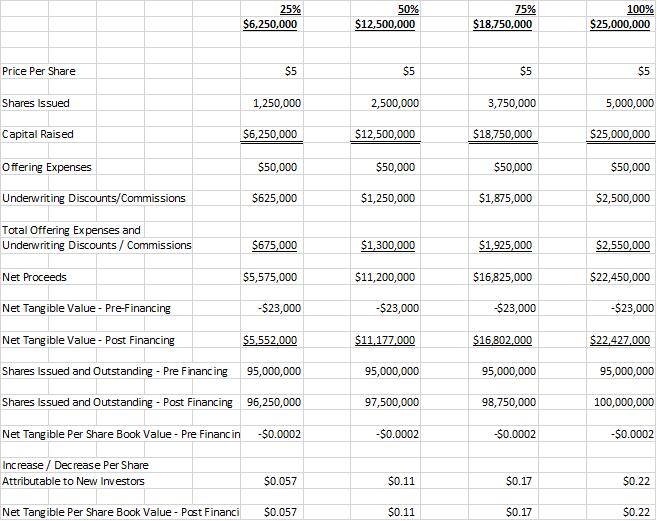
We have assumed for purposes of the above illustrative data that the Company will pay $50,000 for Offering Expenses and $2,500,000 in underwriting discounts and commissions amounting to $2,550,000 in Offering Expenses and Underwriting Commissions if we sell the entire Offering through broker-dealers. Another important way of looking at dilution is the dilution that happens due to future actions by the Company. The investor’s stake in a Company could be diluted due to the Company issuing additional shares. In other words, when the Company issues more shares, the percentage of the Company that you own will go down, even though the value of the Company may go up. You will own a smaller piece of a larger company. This increase in number of shares outstanding could result from a stock offering (such as an initial public offering, a venture capital round, angel investment), employees exercising stock options, or by conversion of certain instruments (e.g. convertible bonds, convertible notes, preferred shares or warrants) into stock. If the Company decides to issue more shares, an investor could experience value dilution, with
20
each share being worth less than before, and control dilution, with the total percentage an investor owns being less than before. The Company has 95,000,000 shares of Common Stock issued and outstanding. Therefore, all of the Company’s current shareholders and the investors in this Offering will experience the same dilution if the Company decides to issue more shares in the future.
21
USE OF PROCEEDS BY THE ISSUER
We estimate that, at a per share price of $5.00, the net proceeds from the sale of the 5,000,000 shares in this Offering will be approximately $22,450,000, after deducting the estimated underwriting commissions/discounts and offering expenses of approximately $2,550,000. However, the Offering Expenses does not include commission we would pay registered broker-dealers if we engaged such broker-dealers for the distribution of the Offering herein. We will utilize the net proceeds from this offering to acquire the land on which we intend to build, contract and begin engineering and design, and raise the funds needed for construction through a subsequent registered offering statement, and for general corporate purposes, including financing, operating expenses and our other expenses.
The following table below sets forth the uses of proceeds assuming the sale of 25%, 50%, 75% and 100% of the securities offered for sale in this offering by the company. For further discussion see the Company’s Plan of Operation.
|
|
|
|
|
Percentage of Offering proceeds | 25% of Offering Sold | 50% of Offering Sold | 75% of Offering Sold | 100% of Offering Sold |
|
|
|
|
|
Shares Sold | 1,250,000 | 2,500,000 | 3,750,000 | 5,000,000 |
Gross Proceeds | $6,250,000 | $12,500,000 | $18,750,000 | $25,000,000 |
Total Proceeds Before Expenses | $6,250,000 | $12,500,000 | $18,750,000 | $25,000,000 |
Offering Expenses | $50,000 | $50,000 | $50,000 | $50,000 |
Underwriting Discounts/Commissions | $625,000 | $1,250,000 | $1,875,000 | $2,500,000 |
Total Expenses | $675,000 | $1,300,000 | $1,925,000 | $2,550,000 |
Amount of Offering Proceeds Available for Investment | $5,575,000 | $11,200,000 | $16,825,000 | $22,450,000 |
|
|
|
|
|
Expenditures: |
|
|
|
|
Land Acquisition | $515,195 (1) | $515,195 | $515,195 | $515,195 |
Architecture, Engineering and Related Expenses | $4,775,000(2) | $10,370,000(3) | $15,960,000(4) | $17,500,000 (5) |
Administrative and Corporate Expenses | $142,402 | $152,402 | $167,402 | $242,402 |
Legal | $142,402 | $162,402 | $182,402 | $242,402 |
Research and Development | $0.00 | $0.00 | $0.00 | $100,000 |
Subsequent Fund Raising | $0.00 | $0.00 | $0.00 | $0.00 |
Working Capital Reserves for Construction | $0 | $0 | $0 | $3,850,000 |
22
Total Expenditures | $5,574,999 | $11,199,999 | $16,824,999 | $22,449,999 |
Net Remaining Proceeds | $0.00 | $0.00 | $0.00 | $0.00 |
1)The main objective of the Company is to acquire land for both phases. This point represents total land acquisition cost of $515,915 consisting of $165,195 for Phase 1 and $350,000 for Phase 2.
2)The amount of $4,775,000 includes cost for partial completion for Phase 1.
3)The amount of $10,370,000 includes 100% completion cost of Phase 1 of $7,500,000 and $2,870,000 for partial completion of Phase 2 from the total cost of $10,000,000.
4)The amount of $15,960,000 includes 100% completion cost of Phase 1 of $7,500,000 and $8,460,000 for partial completion of Phase 2 2 from the total cost of $10,000,000.
5)The amount of $17,500,000 includes 100% completion of Phase 1 of $7,500,000 and $10,000,000 for Phase 2.
The above figures show that we must sell at least 50% or 2,500,000 shares of the Offering to raise enough funds to execute on Phase 1 of our project. If we do not, we would have to seek mortgage financing from banks or other lending institutions. There is no guarantee that we will succeed in accessing mortgage credit and even if we did, the interest rate may be high and adversely affect our revenues and results of operations. See “Risks” Disclosures above.
See “Operational Plan Page 29
The above figures represent only estimated costs. This expected use of net proceeds from this offering represents our intentions based upon our current plans and business conditions. The amounts and timing of our actual expenditures may vary significantly depending on numerous factors, including the status of and results from operations. As a result, our management will retain broad discretion over the allocation of the net proceeds from this offering. We may find it necessary or advisable to use the net proceeds from this offering for other purposes, and we will have broad discretion in the application of net proceeds from this offering. Furthermore, we anticipate that we will need to secure additional funding for the fully implement our business plan.
The company reserves the right to change the above use of proceeds if management believes it is in the best interests of the Company.
DETERMINATION OF OFFERING PRICE
Since our shares of Common Stock are not listed or quoted on any exchange or quotation system, the offering price of the shares of Common Stock was determined by us and is based on our own assessment of our financial condition and prospects, limited offering history, and the general condition of the securities market. It does not necessarily bear any relationship to our book value, assets, past operating results, financial condition or any other established criteria of value. Although our Common Stock is not listed on a public exchange, we intend to obtain a listing on the OTC concurrently with the qualification of this Offering Circular. In order to be quoted on the OTC, a market maker must file an application on our behalf in order to make a market for our Common Stock.
There is no assurance that our Common Stock will be quoted at market prices in excess of offering price in this Offering as prices for the Common Stock in any public market which may develop will be determined in the marketplace and may be influenced by many factors, including the depth and liquidity of the market for the Common Stock, investor perception of us and general economic and market conditions.
Overview and Corporate History
Our Company:
Ohia Development Corp. is a real estate development company with a focus on strip malls. We are a development stage company, and we expect to use substantially all of the net proceeds from this offering to organize and design our first project.
23
Our Vision and Business Plan:
Our vision is in two phases. In Phase 1, we plan to develop Lehua Court, a four acres of approximately 50,000 square feet, three (3) story strip mall building that will house a boutique hotel on the top floor, professional offices, banks, pharmacies, restaurants, veterans center and other retail spaces. We have entered into a Land Purchase Agreement with Lehua Court LLC for the Phase 1 property, subject to financing from the offering. We do not yet have rental agreements with tenants. See Land Purchase Agreement. The goal of Lehua Court is to offer employment to local residents and attract businesses that will provide services that are currently not available in the community. In Phase 2, we plan to acquire additional four (4) acres of nearby land and apply for rezoning from A1A to CV40 and install the requisite infrastructures and construct additional commercial space similar businesses. See also “Plan of Operations.”
Lehua Court LLC (“Lehua”) is a Hawaii limited liability company. Lehua is affiliated to the issuer because William Stockton and Stephen Sahines, the two sole members of Lehua are also the sole shareholders and control persons of Ohia Development Corp. The offering expenses of Ohia are currently being paid by Lehua through funds provided to Lehua by William Stockton and Stephen Sahines.
Competition and Competitive Environment:
We will compete with many third parties engaged in real estate investment activities including REITs, specialty finance companies, savings and loan associations, banks, mortgage bankers, insurance companies, mutual funds, institutional investors, investment banking firms, lenders, hedge funds, governmental bodies, private developers and other entities. There are also REITs with asset acquisition objectives similar to ours and others may be organized in the future. Some of these competitors have substantially greater marketing and financial resources than we will have and generally may be able to accept or manage more risk than we can prudently manage, including risks with respect to the creditworthiness of tenants. In addition, these same entities may seek financing through the same channels that we do. Therefore, we will compete for investors and funding in a market where funds for real estate investment may decrease or grow less than the underlying demand.
Government Regulation:
Our business is subject to many laws and governmental regulations. Changes in these laws and regulations, or their interpretation by agencies and courts, occur frequently. Real estate development is subject to increasing environmental, building, and zoning regulations by various authorities. Such regulations affect construction by specifying, among other things, the type and quality of building materials that must be used, certain aspects of land use and building design. Some regulations affect development activities by directly affecting the viability and timing of projects. We must obtain the approval of numerous governmental authorities that regulate such matters as land use and level of density, the installation of utility services, such as water and waste disposal, and the dedication of acreage for open space, parks, schools and other community purposes. If these authorities determine that existing utility services will not adequately support proposed development, building moratoria may be imposed. As a result, we use substantial resources to evaluate the impact of government restrictions imposed upon new development. Furthermore, as local circumstances or applicable laws change, we may be required to obtain additional approvals or modifications of approvals previously obtained or we may be forced to stop work. These increasing regulations may result in a significant increase in resources between our initial acquisition of land and the commencement and the completion of developments. In addition, the extent to which we participate in land development activities subjects us to greater exposure to regulatory risks.
Our Competitive Strengths
We believe the experience of our director and officers, as well as our investment strategies, distinguish us from other real estate companies. Specifically, our competitive strengths include the following:
24
| § | Experienced and Dedicated Management Team. The Company intends to maintain a committed management team focusing on all phases of commercial real estate investment, management and disposition.
|
| § | Strategy of Opportunistic Investing. We analyze and focus on a niche market that meets local needs. |
Target Markets
The Company's target market is initially Hawaii.
Industry Overview
Shopping malls house our retail outlets and small business offices, including doctor’s offices, pharmacies, restaurants, beauty and nail salons, barber shops, etc. The health and future of shopping mall business is intricately tied into the health of the retail business, a vital industry in the American economic landscape. Retailing is a vital commercial activity, providing customers with an opportunity to purchase goods and services from various types of merchants. The first retail outlets in America were trading posts and general stores. At trading posts, goods obtained from Native Americans were exchanged for items imported from Europe or manufactured in other parts of the country. As villages and towns grew, trading posts developed into general stores and began to sell food, farm necessities, and clothing. Typically run by a single person, these stores sometimes served as the post office and became the social and economic center of their communities. Since World War II, giant supermarkets, discount houses, chain stores, and shopping malls have grown in popularity. Even so, individually owned businesses thrive, often giving customers more personal and better-informed service. Today, retail is a complex and diverse field. It involves the selling of all types of physical goods, such as automobile parts, pharmaceuticals, clothing, health care products, books, and food, as well as services, such as automobile repair or rug cleaning. The U.S. Commerce Department reports that total retail sales in 2015 were around $5 trillion, The vast majority of sales that make up that $5 trillion dollars are in store purchases. In 2015 e-commerce only accounted for 7.1 percent of revenue. It is forecast that this percentage will grow to about 9.8% by 2019. More than 25 million people in the U.S. are employed by retailers.
See: https://www.vault.com/industries-professions/industries/retail/industry-outlook
Tax Treatment of Registrant and its Security Holders
Although we hope to be a real estate company with real estate assets, we will not be initially operating as a Real Estate Investment Trust (“REIT”) as we may not initially be able to qualify as a REIT. Therefore, we will initially operate a, “C” corporation. As such, our profits are taxable at corporate level and dividends, if any, are taxable at individual level.
Environmental Matters
Under various federal, state and local laws, ordinances and regulations, a current or previous owner or operator of real property may be held liable for the costs of removing or remediating hazardous or toxic substances. These laws often impose clean-up responsibility and liability without regard to whether the owner or operator was responsible for, or even knew of, the presence of the hazardous or toxic substances. The costs of investigating, removing or remediating these substances may be substantial, and the presence of these substances may adversely affect our ability to rent or sell the property or to borrow using the property as collateral and may expose us to liability resulting from any release of or exposure to these substances. If we arrange for the disposal or treatment of hazardous or toxic substances at another location, we may be liable for the costs of removing or remediating these substances at the disposal or treatment facility, whether or not the facility is owned or operated by us. We may be subject to common law claims by third parties based on damages and costs resulting from environmental contamination emanating from a site that we own or operate. Certain environmental laws also impose liability in connection with the handling of or exposure to asbestos-containing materials, pursuant to which third parties may seek recovery from owners or operators of real properties for personal injury associated with asbestos-containing materials and other hazardous or toxic substances.
Other Regulations
The properties we acquire likely will be subject to various federal, state and local regulatory requirements, such as zoning and state and local fire and life safety requirements. Failure to comply with these requirements could result in the imposition of fines by governmental authorities or awards of damages to private litigants. We generally will acquire properties that are in material compliance with all regulatory requirements. However, there can be no assurance that these requirements will not be changed or that new requirements will not be imposed which would
25
require significant unanticipated expenditures by us and could have an adverse effect on our financial condition and results of operations.
Our Growth Strategy
The Company will seek to begin execution of its operations upon completion of this offering. The timing of commencement of operations may be influenced by our relative success of this offering. We may not raise sufficient proceeds through this offering in order to fully execute our business plans.
Operational Plan
Our operational plan is in two phases: In Phase 1, we plan to develop Lehua Court, a four acres of approximately 50,000 square feet, three (3) story strip mall building that will house a boutique hotel on the top floor, professional offices, banks, pharmacies, restaurants, veterans center and other retail spaces. The goal of Lehua Court is to offer employment to local residents and attract businesses that will provide services that are currently not available in the community. In Phase 2, we plan to acquire additional four (4) acres of nearby land and apply for rezoning from A1A to CV40 and install the requisite infrastructures and construct additional commercial space similar businesses.
Patents and Trademarks
We have no patents or trademarks.
Employees:
Currently, the company does not have any full time employees. The company may hire a number of employees as needed after effectiveness of this offering primarily to support our acquisition and development efforts.
Legal Proceedings
We know of no existing or pending legal proceedings against us, nor are we involved as a plaintiff in any proceeding or pending litigation. There are no proceedings in which any of our directors, officers or any of their respective affiliates, or any beneficial stockholder, is an adverse party or has a material interest adverse to our interest.
DESCRIPTION OF PROPERTY
Our principal offices are located at our principal office is located at 73-1089 Mahilani Drive, Kailua Kona, Hawaii 96740. We do not currently lease or own any other real property.
MANAGEMENT’S DISCUSSION AND ANALYSIS OF
FINANCIAL CONDITION AND RESULTS OF OPERATIONS
The following discussion summarizes the significant factors affecting the operating results, financial condition and liquidity and cash flows of our company as of September 30, 2019. You should read this discussion together with the consolidated financial statements, related notes and other financial information included in this Offering Circular. Except for historical information, the matters discussed in this Management’s Discussion and Analysis of Financial Condition and Results of Operations are forward looking statements that involve risks and uncertainties, including those discussed under Part II, “Risk Factors” and elsewhere in this Offering Circular, and are based upon judgments concerning various factors that are beyond our control. These risks could cause our actual results to differ materially from any future performance suggested below.
General Overview
Ohia Development Corp was incorporated under the laws of the State of Delaware on July 23, 2019. Our principal office is located at 73-1089 Mahilani Drive, Kailua Kona, Hawaii 96740.
On July 30, 2019, the Company elected William. Stockton and Stephen Sahines as members of the board of directors and appointed William. Stockton as CEO and Stephen Sahines as CFO.
26
Since its inception, the Company has devoted substantially all of its efforts to business planning, research and development, and raising capital. Accordingly, the Company is considered to be in the development stage since we are devoting substantially all of our efforts to establishing our business and planned principal operations have not commenced. The Company has generated no revenues from operations and therefore lacks meaningful capital reserves.
Operating Results
As of September 30, 2019 we have not generated any revenues and incurred expenses of $43,000.00. Our operating expenses consist of the costs incurred in organizing the company and this offering as well as professional fees. As a result, our net loss for the period from inception through September 30, 2019 was $43,000.00. Our accumulated deficit as of September 30, 2019 was $43,000.00.
To meet our need for cash we are attempting to raise money from this offering. The maximum aggregate amount of this offering will be required to fully implement our business plan. If we are unable to successfully generate revenue, we may quickly use up the proceeds from this offering and will need to find alternative sources. If we need additional cash and cannot raise it, we will either have to suspend operations until we do raise the cash or cease operations entirely.
Liquidity and Capital Resources
As of September 30, 2019, the Company has incurred total expenses since inception of $43,000.00 related to legal fees associated with this Offering, and general and administrative costs. In management’s opinion, the Company’s cash position is insufficient to maintain its operations at the current level for the next 12 months. We are attempting to raise funds to proceed with our plan of operation. The Company hopes to raise $25,000,000 in this Offering. If we are successful at raising the maximum amount of this offering, we believe that such funds will be sufficient to fund our expenses over the next six months.
Upon the qualification of the Form 1-A, the Company plans to pursue its development strategy. As a part of this strategy, we intend to continue raising capital following this offering, either through subsequent public offerings or private offerings. See “Operational Plan” above. There can be no assurance of the Company's ability to raise such funds or that additional capital will be available to the Company. If so, the Company's objective of entering the strip mall property development space will be adversely affected and the Company may not be able to pursue such a strategy if it is unable to finance it. The Company currently has no agreements, arrangements or understandings with any person to obtain funds through bank loans, lines of credit or any other sources. Since the Company has no such arrangements or plans currently in effect, its inability to raise funds for the above purposes will have a severe negative impact on its ability to remain a viable company. There can be no assurance that additional capital will be available to the Company. If we are successful at raising capital by issuing more stock, or securities which are convertible into shares of the Company, your investment will be diluted as a result of such issuance.
We are highly dependent upon the success of this offering, as described herein. Therefore, the failure thereof would result in the need to seek capital from other resources such as taking loans, which would likely not even be possible for the Company. However, if such financing were available, because we are a development stage company with no operations to date, we would likely have to pay additional costs associated with high risk loans and be subject to an above market interest rate. At such time these funds are required, management would evaluate the terms of such debt financing. If the Company cannot raise additional proceeds via a private placement of its equity or debt securities, or secure a loan, the Company would be required to cease business operations. As a result, investors would lose all of their investment.
|
|
|
| ||
Off-Balance Sheet Arrangements
As of September 30, 2019, we did not have any off-balance sheet arrangements.
Plan of Operations
Our primary goal for our first year of operation will be to begin construction work on the Lehua Court project, located on 92-8635 Lehua Lane, Naalehu, Hawaii 96737.
Our plan follows below. We are highly dependent upon the success of this offering in implementing the following plan.
27
PHASE 1
Land Acquisition
Estimated cost: $165,195
Estimated time frame: 1-2 mos.
Contract Architecture, Engineering, and Other Firms
Estimated cost: $7,500,000
Estimated time frame: 1-12 mos.
PHASE 2
Land Acquisition
Estimated Cost: $350,000
Estimated time: 12 – 18 mos.
Contract Architecture, Engineering, and Other Firms
Estimated cost: $10,000,000
Estimated time frame: 18 – 24 mos.
DIRECTORS AND EXECUTIVE OFFICERS AND CORPORATE GOVERNANCE
Our current directors, executive officers and key employees and their respective ages, positions as of January 2, 2020 are set forth in the following table. Biographical information regarding each director, executive officer and key employee is also set forth below.
|
|
|
|
|
|
|
|
| |||
Name | Position | Age | Date of First | ||||||||
|
|
| Appointment | ||||||||
William Stockton | Chief Executive Officer /Director | 69 | July 30, 2019 | ||||||||
Stephen Sahines |
CFO/Director
|
68
|
July 30, 2019
| ||||||||
|
|
|
| ||||||||
|
|
|
| ||||||||
William Stockton, CEO and Director. William Stockton is our CEO and Director responsible for the project coordination. William’s experience in the building construction space includes long-term working relationships with commercial sub-contractors and the Hawaii County Department of Public Works. William has 50 years’ experience in real estate development and has been a licensed building contractor in the State of Hawaii since 1989. William has been a commercial construction prime contractor for the past 15 years; the last 5 years was for 3 projects with a of 70,000 square feet. As a prime contractor, William was under contract to develop projects from conception to completion and occupancy. His numerous business contacts will greatly enhance our ability to complete a successful quality project. He has a great concern for environment and in keeping with the native Hawaiian landscape. William has always had an attachment to the community and has had a long-term commitment to the Young Men Christian Association, American Youth Soccer Association and Hawaii County Parks and Recreation agencies.
Stephen Sahines, CFO and Director. Stephen Sahines is our FCO and Director. Stephen will oversee our accounting, budgeting, lease procurement and other back office matters. Stephen has worked in the restaurant and hotel industry for 52 years and has been a Sportfishing Charter Boat Captain for 32 years in charge of all aspects of the operation. In the past 5 years, Stephen has worked for the Marriot Hotels in addition to his Sportfishing Charter business. Stephen will also be in charge of public relations and market research. Stephen has an extensive service industry record, including hotel and restaurant businesses. His management experience includes employee and management groups training. We believe Stephen’s management background will be an indispensable assets to our operations. Stephen is also civic and environmentally minded to compliment the partnership with our CEO, William Stockton.
28
Director or Officer Involvement in Certain Legal Proceedings
Our officers and directors have not, during the past ten years, been involved in any legal proceedings described in subparagraph (f) of Item 401 of Regulation S-K.
Corporate Governance
The Company promotes accountability for adherence to honest and ethical conduct; endeavors to provide full, fair, accurate, timely and understandable disclosure in reports and documents that the Company files with the Commission and in other public communications made by the Company; and strives to be compliant with applicable governmental laws, rules and regulations. The Company has not formally adopted a written code of business conduct and ethics that governs the Company’s employees, officers and directors as the Company is not required to do so.
In lieu of an Audit Committee, the Company’s Board of Directors, is responsible for reviewing and making recommendations concerning the selection of outside auditors, reviewing the scope, results and effectiveness of the annual audit of the Company’s financial statements and other services provided by the Company’s independent public accountants. The Company’s officers and sole director review the Company’s internal accounting controls, practices and policies with the assistance of outside advisors.
Committees of the Board
Our Company currently does not have nominating, compensation, or audit committees or committees performing similar functions nor does our Company have a written nominating, compensation or audit committee charter.
Independent Directors
The Company is not an issuer whose securities are listed on a national securities exchange, or an inter-dealer quotation system which has requirements that a majority of the board of directors be independent. Under NASDAQ Rule 5605(a)(2)(A), a director is not considered to be independent if he or she also is an executive officer or employee of the company. Under such definition, our directors serve as executive officers of the company are not independent.
EXECUTIVE COMPENSATION
The following table sets forth information about the annual compensation of each of our two (2) directors or executive officers since inception to January 2, 2020:
|
| Capacities in which | Cash | Other | Total | ||||
Name |
| Compensation was received | Compensation ($) | Compensation ($) | Compensation ($) | ||||
|
|
|
|
|
|
|
|
|
|
William Stockton | CEO/Director | 0 | 0 | 0 | |||||
Stephen Sahines | CFO/Director | 0 | 0 | 0 | |||||
|
|
|
|
|
|
|
|
|
|
|
|
|
|
|
|
|
|
| |
We do not compensate our directors for attendance of meetings. However, we would reimburse our officers and directors for reasonable expenses incurred during the course of their performance. We have no long-term incentive plans.
Employment Agreements
The Company has no employment agreement.
Outstanding Equity Awards at Fiscal Year-End
The Company has no outstanding unexercised options, unvested stock, and/or equity incentive plan awards issued to our sole executive officers as of January 2, 2020.
29
Equity Incentive Plan
The Company has no Equity Incentive Plan
SECURITY OWNERSHIP OF CERTAIN BENEFICIAL OWNERS AND MANAGEMENT
The following table sets forth certain information as of January 2, 2020, regarding the beneficial ownership of our Common Stock by the following persons:
| ● | each person who, to our knowledge, owns more than 5% of our Common Stock; |
| ● | each of our named executive officers; |
| ● | each director; and |
| ● | all of our executive officers and directors as a group. |
Unless otherwise indicated in the footnotes to the following table, each person named in the table has sole voting and investment power and that person’s address is c/o Ohia Development Corp., 73-1089 Mahilani Drive, Kailua Kona, Hawaii 96740.
The information presented below regarding beneficial ownership of our voting securities has been presented in accordance with the rules of the Securities and Exchange Commission and is not necessarily indicative of ownership for any other purpose. Under these rules, a person is deemed to be a "beneficial owner" of a security if that person has or shares the power to vote or direct the voting of the security or the power to dispose or direct the disposition of the security. A person is deemed to own beneficially any security as to which such person has the right to acquire sole or shared voting or investment power within 60 days through the conversion or exercise of any convertible security, warrant, option or other right. More than one person may be deemed to be a beneficial owner of the same securities. The percentage of beneficial ownership by any person as of a particular date is calculated by dividing the number of shares beneficially owned by such person, which includes the number of shares as to which such person has the right to acquire voting or investment power within 60 days, by the sum of the number of shares outstanding as of such date plus the number of shares as to which such person has the right to acquire voting or investment power within 60 days. Consequently, the denominator used for calculating such percentage may be different for each beneficial owner. Except as otherwise indicated below and under applicable community property laws, we believe that the beneficial owners of our common stock listed below have sole voting and investment power with respect to the shares shown.
|
|
|
|
|
| Shares of Beneficiary owned | |
Name and Address of Beneficial Owner |
|
| No. Of shares | Percentage (1) | |||
William Stockton |
|
|
|
| 47,500,000 | 50% | |
Stephen Sahines |
|
|
|
| 47,500,000 | 50% | |
(1) Based on 95,000,000 shares issued and outstanding as of January 2, 2020. |
| ||||||
CERTAIN RELATIONSHIPS AND RELATED TRANSACTIONS
Since incorporation, there have been no transactions, or proposed transactions, which have materially affected or will materially affect us in which any director, executive officer or beneficial holder of more than 5% of the outstanding common, or any of their respective relatives, spouses, associates or affiliates, has had or will have any direct or material indirect interest. We have no policy regarding entering into transactions with affiliated parties.
Lehua Court LLC, a Hawaii limited liability company is the related party because William Stockton and Stephen Sahines, the two sole members of Lehua are also the sole shareholders and control persons of Ohia. The $10,000 in Due to Related Party in our Balance Sheet is for legal fees of this offering paid on our behalf by Lehua Court. Lehua Court has no interest or shares in Ohia. Ohia has no parent company.
30
Land Purchase Agreement
On January 25, 2020 Ohia Development Corp entered into a Land Purchase Agreement pursuant to which Ohia purchased the 4.1439 acres of land located on 92-8635 Lehua Lane, Hawaiian Ocean View Estates, HI. 96737, Tax Map & Lot No. (3) 9-2-093:039 being the raw and undeveloped land for the planned 4 acres of the Phase 1, 50,000 square feet shopping mall development. The purchase price is $161,195.11; closing is February 1, 2021. Performance is subject to financing from the proceeds of this Offering. See “Land Purchase Agreement – Exhibit 1A-6 – Material Contract”.
Indemnification Agreements
We intend to enter into indemnification agreements with or have contractual obligations to provide indemnification to each of our directors and intend to enter into such agreements with certain of our executive officers. These agreements require us, among other things, to indemnify these individuals for certain expenses (including attorneys’ fees), judgments, fines and settlement amounts reasonably incurred by such person in any action or proceeding, including any action by or in our right, on account of any services undertaken by such person on behalf of our company or that person’s status as a member of our Board of Directors to the maximum extent allowed under Delaware law.
Insofar as indemnification for liabilities arising under the Securities Act may be permitted to our directors, officers or persons controlling us under the foregoing provisions, we have been informed that, in the opinion of the SEC, such indemnification is against public policy as expressed in the Securities Act and is therefore unenforceable.
Additionally, although our bylaws designate the Court of Chancery of the State of Delaware as exclusive forum for adjudication, including certain litigation and derivative action, such provisions do not preclude the exclusive jurisdiction of the federal courts over all suits brought to enforce any duty or liability created by the Exchange Act of 1934 or the rules and regulations thereunder, nor the concurrent jurisdiction of federal and state courts over all such matters under Section 22 of the Securities Act of 1933. See Amended Bylaws of Ohia Development Corp.
Review, Approval and Ratification of Related Party Transactions
Given our small size and limited financial resources, we have not adopted formal policies and procedures for the review, approval or ratification of transactions, such as those described above, with our executive officer(s), director(s) and significant stockholders. We intend to establish formal policies and procedures in the future, once we have sufficient resources and have appointed additional directors, so that such transactions will be subject to the review, approval or ratification of our Board of Directors, or an appropriate committee thereof. On a moving forward basis, William Stockton will continue to approve any related party transaction.
We have authorized capital stock consisting of 100,000,000 shares of Common Stock, at $0.0001 par value, out of which 95,000,000 are issued and outstanding as of January 2, 2020.
Common Stock
The holders of outstanding shares of Common Stock are entitled to receive dividends out of assets or funds legally available for the payment of dividends of such times and in such amounts as the board from time to time may determine. Holders of Common Stock are entitled to one vote for each share held on all matters submitted to a vote of stockholders. There is no cumulative voting of the election of directors then standing for election. The Common Stock is not entitled to pre-emptive rights and is not subject to conversion or redemption. Upon liquidation, dissolution or winding up of our Company, the assets legally available for distribution to stockholders are distributable ratably among the holders of the Common Stock after payment of liquidation preferences, if any, on any outstanding payment of other claims of creditors.
31
Stockholders Agreement
On October 31, 2019 William Stockton and Stephen Sahines (the “Founding Stockholders”) entered into a stockholders’ agreement (the “Stockholders Agreement”), which outlined certain rights related to their ownership of Common Stock. The stockholders that are parties to the Stockholders Agreement consist of the Founding Stockholder.
The Stockholders Agreement, among other things, provides that for so long as the Stockholders Agreement is in effect, (a) each party will vote and take all other necessary and desirable action within such party’s control to (i) cause the authorized number of directors comprising the Company’s board of directors to be established at up to nine or as provided under DGCL, and (ii) elect or remove a nominee or member, as applicable to the board of directors and (b) comply with the drag-along rights and right of first refusal set forth therein. The Stockholders Agreement will terminate upon the occurrence of any of the following events:
· | the written agreement of all of the then-current stockholders subject to the Stockholders Agreement; |
· | the written notice from the Founding Stockholder to the Other Stockholders; |
· | the dissolution of the Company; |
· | the appointment of a receiver to take possession of all or substantially all of the assets of the Company, a general assignment of the Company for the benefit of creditors, or any action voluntarily taken by the Company under any insolvency or bankruptcy act, which continues for a period of 90 days; or |
· | (1) the date on which the Company is subject to the reporting requirements of (i) Section 13 or 15(d) of the Exchange Act, or (ii) Regulation A under the Securities Act of 1933, as amended, or (2) the Company has shares of Common Stock that are publicly traded on a national securities exchange or quoted on the over the counter market. |
Since the Company expects to become subject to the reporting requirements of the Exchange Act upon completion of this Offering by filing a registration statement on Form 8-A concurrently with the qualification of the offering statement, it is anticipated that the Stockholders Agreement will terminate upon the effectiveness of the registration statement on Form 8-A. Notwithstanding the foregoing, upon qualification of this offering statement, the Stockholders Agreement will be terminated.
Preferred Stock
None
Options and Warrants
None.
Convertible Notes
None.
Dividend Policy
We have not paid any cash dividends to stockholders. The declaration of any future cash dividends is at the discretion of our board of directors and depends upon our earnings, if any, our capital requirements and financial position, general economic conditions, and other pertinent conditions. It is our present intention not to pay any cash dividends in the foreseeable future, but rather to reinvest earnings, if any, in our business operations.
Transfer Agent
We do not have an independent stock transfer agent; however, since we intend to be a full Exchange Act reporting company by registering our Common Stock pursuant to Section 12(g) of the Exchange Act by filing a registration statement on Form 8-A in connection with the qualification of this offering statement, we will enter into an agreement with a Transfer Agent.
Our proposed Transfer Agent is:
32
Vstock Transfer
18 Lafayette Place
Woodmere, NY 11598
(212) 828 8436
Shares Eligible for Future Sale
Prior to this Offering, there has been no public market for our Common Stock, and we cannot predict the effect, if any, that market sales of shares of our Common Stock or the availability of shares of our Common Stock for sale will have on the market price of our Common Stock prevailing from time to time. Nevertheless, sales of substantial amounts of our Common Stock, including shares issued upon exercise of stock options (if granted subsequent to the date hereof), or the perception that these sales could occur in the public market after this Offering could adversely affect market prices prevailing from time to time and could impair our ability to raise capital through the sale of our equity securities.
Based on the number of shares of Common Stock outstanding as of January 2, 2020 upon the final closing of this Offering, assuming the sale of all shares offered hereby, 100,000,00 shares of Common Stock will be outstanding.
All of the shares sold in this Offering will be freely tradable unless purchased by our affiliates. The remaining 95,000,000 shares of Common Stock outstanding after this Offering will be restricted as a result of securities laws as described below. All shares will be eligible for resale in compliance with Rule 144 or Rule 701.
Rule 144
In general, under Rule 144 as currently in effect, any person who is or has been an affiliate of ours during the 90 days immediately preceding the sale and who has beneficially owned shares for at least six months is entitled to sell, within any three-month period commencing 90 days after the date of this Offering Circular, a number of shares that does not exceed the greater of:
| · | 1% of the then-outstanding shares of Common Stock, which will equal approximately 500,000 shares immediately after this Offering; and |
| · | the average weekly trading volume during the four calendar weeks preceding the sale, subject to the filing of a Form 144 with respect to the sale. |
Sales under Rule 144 by our affiliates are also subject to certain manner of sale provisions and notice requirements and to the availability of current public information about us.
A person who is not deemed to have been an affiliate of ours at any time during the 90 days immediately preceding the sale and who has beneficially owned his or her shares for at least six months is entitled to sell his or her shares under Rule 144 without regard to the limitations described above, subject only to the availability of current public information about us during the six months after the initial six-month holding period is met. After a non-affiliate has beneficially owned his or her shares for one year or more, he or she may freely sell his or her shares under Rule 144 without complying with any Rule 144 requirements.
We are unable to estimate the number of shares that will be sold under Rule 144, since this will depend on the market price for our Common Stock, the personal circumstances of the sellers and other factors. Prior to the Offering, there has been no public market for the Common Stock, and there can be no assurance that a significant public market for the Common Stock will develop or be sustained after the Offering. Any future sale of substantial amounts of the Common Stock in the open market may adversely affect the market price of the Common Stock offered by this Offering Circular.
Rule 701
In general, under Rule 701 under the Securities Act, any of our employees, directors, consultants or advisors who purchased shares from us in connection with a qualified compensatory stock or option plan or other written agreement and in compliance with Rule 701, is eligible to resell those shares 90 days after the effective date of this Offering in reliance on Rule 144, but without compliance with the various restrictions, including the holding period, contained in Rule 144.
33
Indemnification of Directors and Officers
Section 145 of the DGCL authorizes a court to award, or a corporation’s board of directors to grant, indemnity to directors and officers in terms sufficiently broad to permit such indemnification under certain circumstances for liabilities, (including reimbursement for expenses incurred) arising under the Securities Act. Article 11 of the Certificate of Incorporation of the Company provides for indemnification of officers, directors and other employees of the Company to the fullest extent permitted by the DGCL. Article 10 of the Certificate of Incorporation provides that directors shall not be personally liable to the Corporation or its stockholders for monetary damages for breach of fiduciary duty as a director, except (i) for any breach of a director’s duty of loyalty to our company or our stockholders, (ii) acts and omissions that are not in good faith or that involve intentional misconduct or knowing violation of law, (iii) under Section 174 of the DGCL, or (iv) for any transaction from which the director derived any improper benefit.
Insofar as indemnification for liabilities arising under the Securities Act may be permitted to directors, officers or persons controlling the registrant pursuant to the foregoing provisions, the registrant has been informed that in the opinion of the Commission such indemnification is against public policy as expressed in the Securities Act and is therefore unenforceable.
The DGCL and our Certificate of Incorporation allow us to indemnify our officers and directors from certain liabilities to the extent not prohibited by DGCL or any other applicable law and our Bylaws state that we shall indemnify every (i) present or former director, advisory director or officer of us and (ii) any person who while serving in any of the capacities referred to in clause (i) served at our request as a director, officer, employee or agent of another corporation, partnership, joint venture, trust, association or other enterprise (each an “Indemnitee”).
Our Bylaws provide that the Company shall advance to any person who was or is a party or is threatened to be made a party to any threatened, pending or completed action, suit or proceeding, whether civil, criminal, administrative or investigative, by reason of the fact that he is or was a director or officer, of the Company, or is or was serving at the request of the Company as a director or officer of another corporation, partnership, joint venture, trust or other enterprise, prior to the final disposition of the proceeding, promptly following request therefor, all expenses incurred by any director or officer in connection with such proceeding provided, however, that if the DGCL requires, an advancement of expenses incurred by a director or officer in his or her capacity as a director or officer (and not in any other capacity in which service was or is rendered by such Indemnitee, including, without limitation, service to an employee benefit plan) shall be made only upon delivery to the Company of an undertaking, by or on behalf of such Indemnitee, to repay all amounts so advanced if it shall ultimately be determined by final judicial decision from which there is no further right to appeal that such Indemnitee is not entitled to be indemnified for such expenses under the Bylaws.
Notwithstanding the above, no advance shall be made by the Company to an officer of the Company (except by reason of the fact that such officer is or was a director of the Company) in any action, suit or proceeding, whether civil, criminal, administrative or investigative, if a determination is reasonably and promptly made (i) by a majority vote of directors who were not parties to the proceeding, even if not a quorum, or (ii) by a committee of such directors designated by a majority vote of such directors, even though less than a quorum, or (iii) if there are no such directors, or such directors so direct, by independent legal counsel in a written opinion, that the facts known to the decision-making party at the time such determination is made demonstrate clearly and convincingly that such person acted in bad faith or in a manner that such person did not believe to be in or not opposed to the best interests of the Company.
Our Bylaws and Certificate of Incorporation include certain indemnification provisions for our officer or directors against liability under the Securities Act. However, insofar as indemnification for liabilities arising under the Securities Act may be permitted to directors, officers and controlling persons of the Company pursuant to the foregoing provisions, or otherwise, the Company has been advised that in the opinion of the Commission such indemnification is against public policy as expressed in the Securities Act and is, therefore, unenforceable.
LEGAL MATTERS
The validity of the issuance of the shares of Common Stock offered by this Offering Circular will be passed upon for us by Franklin Ogele, P.A. Newark, New Jersey.
34
EXPERTS
The financial statements as of September 30, 2019 included in this Offering Circular have been so included in reliance on the report by AJSH & Co LLP, an independent registered public accounting firm, given on the authority of such firm as experts in auditing and accounting.
WHERE YOU CAN FIND MORE INFORMATION
We have filed an offering statement on Form 1-A with the Commission under the Securities Act with respect to the Common Stock offered by this Offering Circular. This Offering Circular, which constitutes a part of the offering statement, does not contain all of the information set forth in the offering statement or the exhibits and schedules filed therewith. For further information with respect to us and our Common Stock, please see the offering circular and the exhibits and schedules filed thereto. Statements contained in this Offering Circular regarding the contents of any contract or any other document that is filed as an exhibit to the offering statement are not necessarily complete, and each such statement is qualified in all respects by reference to the full text of such contract or other document filed as an exhibit to the offering statement. The offering statement, including its exhibits and schedules, may be inspected without charge at the public reference room maintained by the Commission, located at 100 F Street, N.E., Room 1580, Washington, D.C. 20549, and copies of all or any part of the offering statement may be obtained from such offices upon the payment of the fees prescribed by the Commission. Please call the Commission at 1-800-SEC-0330 for further information about the public reference room. The Commission also maintains an Internet website that contains reports, proxy and information statements and other information regarding registrants that file electronically with the Commission. The address of the site is www.sec.gov.
Upon completion of this Offering, we will become subject to the information and periodic reporting requirements of the Exchange Act, and, in accordance therewith, will file periodic reports, proxy statements and other information with the Commission. Such periodic reports, proxy statements and other information will be available for inspection and copying at the public reference room and on the Commission’s, website referred to above.
We also maintain a website at www.lehuacourt.com. Upon completion of this Offering, you may access these materials at our website free of charge as soon as reasonably practicable after they are electronically filed with, or furnished to, the Commission. Information contained on our website is not a part of this Offering Circular and the inclusion of our website address in this Offering Circular is an inactive textual reference only.
35
OHIA DEVELOPMENT CORP.
| Page |
|
|
Report of Independent Registered Public Accounting Firm. | F-2 |
|
|
Audited Balance Sheet as of September 30, 2019. | F-3 |
|
|
Audited Statement of Operations for the period July 23, 2019 (inception) to September 30, 2019. | F-4 |
|
|
Audited Statement of Changes in Stockholders’ Deficit for period July 23, 2019 (inception) to September 30, 2019
| F-5 |
Audited Statement of Cash Flows for the period July 23, 2019 (inception) to September 30, 2019. | F-6 |
|
|
Notes to the Audited Financial Statements | F-7 |
36
Report of Independent Registered Public Accounting Firm
To the shareholders and board of directors of OHIA Development Corp.
Opinion on the Financial Statements
We have audited the accompanying balance sheet of OHIA Development Corp. (the “Company”) for the period from July 23, 2019 (Inception) through September 30, 2019, the related statements of operations, changes in stockholders’ deficit for the period ended September 30, 2019, and the related notes (collectively referred to as the "financial statements"). In our opinion, the financial statements present fairly, in all material respects, the financial position of the Company as of September 30, 2019, and the results of its operations and its cash flow for the period then ended, in conformity with accounting principles generally accepted in the United States of America.
Basis for Opinion
These financial statements are the responsibility of the Company’s management. Our responsibility is to express an opinion on these financial statements based on our audit. We are a public accounting firm registered with the Public Company Accounting Oversight Board (United States) ("PCAOB") and are required to be independent with respect to the Company in accordance with the U.S. federal securities laws and the applicable rules and regulations of the Securities and Exchange Commission and the PCAOB.
We conducted our audits in accordance with the standards of the PCAOB. Those standards require that we plan and perform the audit to obtain reasonable assurance about whether the financial statements are free of material misstatement, whether due to error or fraud. The Company is not required to have, nor were we engaged to perform, an audit of its internal control over financial reporting. As part of our audits, we are required to obtain an understanding of internal control over financial reporting but not for the purpose of expressing an opinion on the effectiveness of the Company’s internal control over financial reporting. Accordingly, we express no such opinion.
Our audit included performing procedures to assess the risks of material misstatement of the financial statements, whether due to error or fraud, and performing procedures that respond to those risks. Such procedures included examining, on a test basis, evidence regarding the amounts and disclosures in the financial statements. Our audit also included evaluating the accounting principles used and significant estimates made by management, as well as evaluating the overall financial statement presentation. We believe that our audits provide a reasonable basis for our opinion.
Substantial Doubt about the Company Ability to Continue as a Going Concern
The accompanying financial statements have been prepared assuming the Company will continue as a going concern. As discussed in Note 3 to the financial statements, the Company has no revenues from operation, has not commenced any business operations. These conditions raise substantial doubt about the Company ability to continue as a going concern. The financial statements do not include any adjustments that might result from the outcome of this uncertainty.
AJSH & Co LLP
We have served as the Company’s Auditor since the year 2019.
New Delhi, India
November 26, 2019
37
OHIA DEVELOPMENT CORP. | |||
AUDITED BALANCE SHEET | |||
|
|
| As of September 30, 2019 |
ASSETS | |||
Current Assets |
|
|
|
Cash and cash equivalents | $ | 10,000 | |
|
|
|
|
Total Assets |
| $ | 10,000 |
|
|
|
|
|
|
|
|
LIABILITIES & SHAREHOLDER'S DEFICIT | |||
Current Liabilities |
|
|
|
Accrued Liabilities |
| $ | 23,000 |
Due to Related Party |
| $ | 10,000 |
Total Liabilities |
| $ | 33,000 |
Long term Liabilities |
|
|
|
Long term debt |
| $ | 0 |
Total Liabilities |
| $ | 33,000 |
|
|
|
|
STOCKHOLDER'S DEFICIT |
|
| |
Preferred Stock $0.0001 par value, |
| ||
20,000,000 share authorized, none outstanding |
| ||
Common Stock, 0.0001 par value, |
|
| |
100,000,000 authorized 95,000,000 |
|
| |
Issued and outstanding | $ | 9,500 | |
Additional paid in capital | $ | 500 | |
Committed Stock | $ | 10,000 | |
Accumulated Deficit |
| $ | (43,000) |
Total Stockholder's Deficit | $ | (23,000) | |
|
|
|
|
Total Liabilities and Stockholder's Deficit | $ | 10,000 | |
|
|
|
|
|
|
|
|
38
OHIA DEVELOPMENT CORP. | ||
AUDITED STATEMENT OF OPERATIONS | ||
FROM JULY 23, 2019 THRU SEPTEMBER 30, 2019 | ||
|
| For the period ended September 30, 2019 |
Revenues | $ | - |
Cost of Revenue | $ | - |
Gross Profit |
| - |
|
|
|
Professional fee | $ | 7,500 |
Legal Fee | $ | 35,000 |
Operating Expenses | $ | 500 |
Loss Before Income Taxes |
| (43,000) |
|
|
|
Income Tax Expense | $ | 0 |
|
|
|
Net Loss | $ | (43,000) |
|
|
|
Loss per Share- Basic |
| (0.0005) |
Weighted Average Shares- |
|
|
Basic and Diluted |
| 95,000,000 |
39
OHIA DEVELOPMENT CORP.
Audited Statement of changes in stockholders' deficit
For the period from inception (July 23, 2019) through September 30, 2019
|
|
|
|
|
|
|
|
|
|
| |
| COMMON STOCK |
| ADDITIONAL PAID IN CAPITAL |
| COMMITTED STOCK | ACCUMULATED DEFICIT |
| TOTAL STOCKHOLDERS DEFICIT | |||
| SHARES |
| AMOUNT |
|
|
|
| ||||
|
|
|
|
|
|
|
|
|
|
| |
|
|
| $ |
| $ |
| $ | $ |
| $ | |
Balance as of July 23, 2019 (Inception) | - |
| - |
| - |
| - | - |
| 0 | |
|
|
|
|
|
|
|
|
|
|
| |
Issuance of Common Stock | 95,000,000 |
| 9,500 |
| 500 |
|
- | - |
| 10,000 | |
|
|
|
|
|
|
|
|
|
|
| |
Capital Contribution | - |
| - |
| - |
| - | - |
| 0 | |
Pending Stock issuance for services taken | - |
| - |
| - |
| 10,000 | - |
| 10,000 | |
Net Loss | - |
| - |
| - |
| - | (43,000) |
| (43,000) | |
|
|
|
|
|
|
|
|
|
|
| |
Balance as of September 30, 2019 | 95,000,000 |
| 9,500 |
| 500 |
| 10,000 | (43,000) |
| (23,000) | |
40
OHIA DEVELOPMENT CORP. | |||||
AUDITED STATEMENT OF CASH FLOWS | |||||
|
|
|
|
|
|
|
|
|
| As of September 30, 2019 |
|
Net Loss |
|
| $ | (43,000) |
|
Non-Cash expense written off: |
|
|
|
|
|
Expense against committed stock |
|
| $ | 10,000 |
|
Net loss after no cash |
| $ | (33,000) |
| |
Adjustments to reconcile net loss to net cash |
|
|
|
| |
used in operating activities: |
|
|
|
|
|
Due to Related Party | $ | 10,000 |
| ||
Accrued expenses |
|
| $ | 23,000 |
|
Net cash provided by (used in) operating activities | $ | 0 |
| ||
|
|
|
|
|
|
Cash Flows From Investing Activities |
|
| - |
| |
Stockholders Equity-Steve |
|
| $ | 4,750 |
|
Stockholders Equity-Bill |
|
| $ | 4,750 |
|
Additional paid in Capital |
|
| $ | 500 |
|
Cash Flows From Financing Activities |
| $ | 10,000 |
| |
|
|
|
|
|
|
Net increase (decrease) in cash and cash equivalents | $ | 10,000 |
| ||
Cash and cash equivalents, beginning of period |
|
| 0 |
| |
Cash and cash equivalents, end of period |
| $ | 10,000 |
| |
|
|
|
|
|
|
Disclosure: Non Cash item includes Committed stock of value $10,000 that are to be paid to Franklin Ogele, our Attorney, for his services worth $5,000. |
| ||||
|
| ||||
|
| ||||
The accompanying notes are an integral part of these financial statements. |
| ||||
|
|
|
|
|
|
41
OHIA DEVELOPMENT CORP.
Notes to the Audited Financial Statements
For the period from July 23, 2019 (Inception) through September 30, 2019
Note 1 – Organization and Description of Business
Ohia Development Corp. (the Company) was incorporated under the laws of the State of Delaware on July 23, 2019. The Company has been in the developmental stage since its inception. The Company is a real estate development company with a focus on strip malls.
The Company has elected December 31st as its year end.
Note 2 – Summary of Significant Accounting Policies
Basis of Presentation
This summary of significant accounting policies is presented to assist in understanding the Company's financial statements. These accounting policies conform to accounting principles, generally accepted in the United States of America, and have been consistently applied in the preparation of the financial statements.
Use of Estimates
The preparation of financial statements in conformity with generally accepted accounting principles requires management to make estimates and assumptions that affect the reported amounts of assets and liabilities and disclosure of contingent assets and liabilities at the date of the financial statements and the reported amounts of revenues and expenses during the reporting period. In the opinion of management, all adjustments necessary in order to make the financial statements not misleading have been included. Actual results could differ from those estimates.
Revenue recognition
Revenue is recognized when persuasive evidence of an arrangement exists, delivery has occurred, the fee is fixed or determinable, and collectability is probable. Revenue generally is recognized net of allowances for returns and any taxes collected from customers and subsequently remitted to governmental authorities.
Cash and Cash Equivalents
The Company considers all highly liquid investments with an original maturity of three months or less when purchased to be cash equivalents.
Income Taxes
The Company accounts for income taxes under ASC 740, “Income Taxes.” Under the asset and liability method of ASC 740, deferred tax assets and liabilities are recognized for the future tax consequences attributable to differences between the financial statements carrying amounts of existing assets and liabilities and their respective tax bases. Deferred tax assets and liabilities are measured using enacted tax rates expected to apply to taxable income in the years in which those temporary differences are expected to be recovered or settled. The effect on deferred tax assets
42
and liabilities of a change in tax rates is recognized in income in the period the enactment occurs. A valuation allowance is provided for certain deferred tax assets if it is more likely than not that the Company will not realize tax assets through future operations. No deferred tax assets or liabilities were recognized at September 30, 2019.
Basic Earnings (Loss) Per Share
The Company computes basic and diluted earnings (loss) per share in accordance with ASC Topic 260, Earnings per Share. Basic earnings (loss) per share is computed by dividing net income (loss) by the weighted average number of common shares outstanding during the reporting period. Diluted earnings (loss) per share reflects the potential dilution that could occur if stock options and other commitments to issue common stock were exercised or equity awards vest resulting in the issuance of common stock that could share in the earnings of the Company.
The Company does not have any potentially dilutive instruments as of September 30, 2019 and, thus, anti-dilution issues are not applicable.
Concentration of risk
Financial instruments that potentially subject the Company to concentration of credit risk consist primarily of cash. The Company did not have cash balances in excess of the Federal Deposit Insurance Corporation limit as of September 30, 2019.
Property, plant and equipment
Property and equipment is stated at cost and depreciated using the straight-line method over the shorter of the estimated useful life of the asset or the lease term. The estimated useful lives of our property and equipment are generally as follows: computer software developed or acquired for internal use, three to 10 years; computer equipment, two to three years; buildings and improvements, five to 15 years; leasehold improvements, two to 10 years; and furniture and equipment, one to five years.
Fair Value of Financial Instruments
The Company’s balance sheet includes certain financial instruments. The carrying amounts of current assets and current liabilities approximate their fair value because of the relatively short period of time between the origination of these instruments and their expected realization.
ASC 820, Fair Value Measurements and Disclosures defines fair value as the exchange price that would be received for an asset or paid to transfer a liability (an exit price) in the principal or most advantageous market for the asset or liability in an orderly transaction between market participants on the measurement date. ASC 820 also establishes a fair value hierarchy that distinguishes between (1) market participant assumptions developed based on market data obtained from independent sources (observable inputs) and (2) an entity’s own assumptions about market participant assumptions developed based on the best information available in the circumstances (unobservable inputs). The fair value hierarchy consists of three broad levels, which gives the highest priority to unadjusted quoted prices in active markets for identical assets or liabilities (Level 1) and the lowest priority to unobservable inputs (Level 3). The three levels of the fair value hierarchy are described below:
43
Level 1 inputs are quoted (unadjusted) in active markets for identical assets or liabilities that the Company has the ability to access at the measurement date.
Level 2 inputs are inputs other than quoted prices included in Level 1 that are observable for asset or liability, either directly or indirectly.
Level 3 inputs are observable input for asset or liability. The carrying amount of financial assets such as cash approximate their fair values because of short maturity of these assets.
Fair value estimates discussed herein are based upon certain market assumptions and pertinent information available to management as of September 30, 2019. The respective carrying value of certain on-balance-sheet financial instruments approximated their fair values due to the short-term nature of these instruments. These financial instruments include accrued expenses.
Related Parties
The Company follows ASC 850, Related Party Disclosures, for the identification of related parties and disclosure of related party transactions.
Share-Based Compensation
ASC 718, “Compensation – Stock Compensation”, prescribes accounting and reporting standards for all share-based payment transactions in which employee services are acquired. Transactions include incurring liabilities, or issuing or offering to issue shares, options, and other equity instruments such as employee stock ownership plans and stock appreciation rights. Share-based payments to employees, including grants of employee stock options, are recognized as compensation expense in the financial statements based on their fair values. That expense is recognized over the period during which an employee is required to provide services in exchange for the award, known as the requisite service period (usually the vesting period).
The Company accounts for stock-based compensation issued to non-employees and consultants in accordance with the provisions of ASC 505-50, “Equity – Based Payments to Non-Employees.” Measurement of share-based payment transactions with non-employees is based on the fair value of whichever is more reliably measurable: (a) the goods or services received; or (b) the equity instruments issued. The fair value of the share-based payment transaction is determined at the earlier of performance commitment date or performance completion date.
The Company had no stock-based compensation plans September 30, 2019.
The Company’s stock based compensation for the period from July 23, 2019 (Inception) through September 30, 2019 was $0.
Recent Pronouncements
In August 2018, the FASB issued ASU 2018-14, regarding ASC Topic 820 “Fair Value Measurement”. Effective for all entities for fiscal years, and interim periods within those fiscal years, beginning after December 15, 2019. The amendments on changes in unrealized gains and losses, the range and weighted average of significant unobservable inputs used to develop Level 3 fair value measurements, and the narrative description of measurement uncertainty should be applied prospectively for only the most recent interim or annual period presented in the initial
44
fiscal year of adoption. All other amendments should be applied retrospectively to all periods presented upon their effective date. The Company will evaluate the impact of this standard on its financial statements.
In May 2019, the FASB issued ASU 2019-05, regarding ASC 326 Financial Instruments – credit losses. For entities that have not yet adopted the amendments in Update 2016-13, the effective date and transition methodology for the amendments in this Update are the same as in Update 2016-13. In June 2016, the FASB issued ASU No. 2016-13, “Financial Instruments - Credit Losses (Topic 326)” (“ASU 2016-13”), which will change the impairment model for most financial assets and require additional disclosures. The amended guidance requires financial assets that are measured at amortized cost be presented at the net amount expected to be collected. The allowance for credit losses is a valuation account that is deducted from the amortized cost basis of the financial assets. The amended guidance also requires us to consider historical experience, current conditions, and reasonable and supportable forecasts that affect the collectability of the reported amount in estimating credit losses. The Company will evaluate the impact of this standard on its financial statements.
There were no other new accounting pronouncements during the year ended September 30, 2018 that we believe would have a material impact on our financial position or results of operations.
Note 3 – Going Concern
The Company’s financial statements are prepared in accordance with generally accepted accounting principles applicable to a going concern that contemplates the realization of assets and liquidation of liabilities in the normal course of business.
The Company demonstrates adverse conditions that raise substantial doubt about the Company's ability to continue as a going concern for one year following the issuance of these financial statements. These adverse conditions are negative financial trends, specifically reoccurring operating loss, no revenues to fund operations, and other adverse key financial ratios.
The Company has not established any source of revenue to cover its operating costs. Management plans to fund operating expenses with related party contributions to capital. There is no assurance that management's plan will be successful. The Company has not yet generated any revenue since inception to date and has sustained operating losses during the period ended September 30, 2019. The Company had working capital of $(23,000) and an accumulated deficit of $43,000 as of September 30, 2019. The Company’s continuation as a going concern is dependent on its ability to generate sufficient cash flow from operations to meet its obligations. The financial statements do not include any adjustments relating to the recoverability and classification of recorded assets, or the amounts and classification of liabilities that might be necessary in the event that the Company cannot continue as a going concern.
In order to maintain its current level of operations, the Company will require additional working capital from either cash flow from operations or from the sale of its equity. However, the Company has no commitments from any third party for the purchase of its equity.
45
Note 4 – Income Taxes
Reconciliation of the income tax expense / (benefit) computed at the U.S. Federal income tax rate to the Company’s reported income tax expense / (benefit) for the period ended September 30, 2019 is as follows:
|
| For the period from inception to September 30, 2019 |
Profit / (loss) from operations before income tax | $ | (43,300) |
Income tax rate |
| 21% |
Income tax expense at the U.S Federal tax | $ | (9,093) |
Adjustments to derive effective tax rate: |
|
|
State and local net of federal benefit |
| - |
Non-deductible stock bases compensation |
| - |
Other non-deductible expenses |
| - |
Non allowable carryover of losses |
| 1,819 |
Valuation allowance | $ | 7,274 |
Income tax (benefit) / expenses | $ | - |
The ultimate realization of deferred tax assets depends primarily on the Company’s ability to generate sufficient timely future income of the appropriate character in the appropriate taxing jurisdiction.
At September 30, 2019, Company has no unrecognized tax benefits.
The significant components of deferred tax assets and liabilities are as follows:
|
| For the period ended September 30, 2019 |
Deferred tax assets |
|
|
Net income / (loss) | $ | (43,300) |
Deferred tax liability |
| - |
Net deferred tax assets | $ | (7,274) |
Less: Valuation allowance | $ | 7,274 |
Deferred tax asset - net valuation allowance | $ | - |
The Company has a net operating loss of $43,300 and an allowable loss carryover of approximately $7,274 available to offset future income for income tax reporting purposes. However, the Company’s ability to use the carryover net operating loss may be substantially limited or eliminated pursuant to Internal Revenue Code Section 382.
The Company has adopted ASC 740, “Accounting for Income Taxes”, as of its inception. Pursuant to ASC 740 the Company is required to compute tax asset benefits for non-capital losses carried forward. The potential benefit of the net operating loss has not been recognized in these financial statements because the Company cannot be assured it is more likely than not it will utilize the loss carried forward in future years.
The Company files income tax returns in the U.S. federal jurisdiction and Delaware state jurisdiction. We are not currently involved in any income tax examinations.
46
Impact of the Tax Cuts and Jobs Act
The tax cuts and Jobs Act (the “Tax Reform Act”) was enacted on December 22, 2017 and provides for significant changes to U.S. tax law. Among other provisions, the Tax Reform Act reduces the U.S. corporate income tax rate to 21%, effective in 2018. The Tax Reform Act also provides for a transition to a new territorial system of taxation and generally requires companies to include certain untaxed foreign earnings of non-U.S. subsidiaries into taxable income in 2017 (“Transition Tax”). Additionally, the Securities Exchange Commission staff has issued SAB 118, which allows the Company to record provisional amounts during a measurement period not to extend beyond one year of the enactment date. On December 22, 2017, Staff Accounting Bulletin No. 118 (“SAB 118”) was issued to address the application of U.S. GAAP in situations when a registrant does not have the necessary information available, prepared, or analyzed (including computations) in reasonable detail to complete the accounting for certain income tax effects of the Act. Because the Company is still in the process of analyzing certain provisions of the Tax Act, the Company has determined that the adjustment to its deferred taxes and the Transition Tax are provisional amounts as permitted under SAB 118.
Note 5– Cash and Cash equivalent
Cash and cash equivalents at September 30, 2019 was $10,000.00.
Cash and Cash equivalent | July 23, 2019 | September 30, 2019 |
Cash in hand | $ 0 | $ 0 |
Central Pacific Bank $0.00 | $ 0 | $ 10,000.00 |
Total | $ 0 | $ 10,000.00 |
Note 6 - Related party transactions
Parties are considered to be related to the Company if the parties directly or indirectly, through one or more intermediaries, control, are controlled by, or are under common control with the Company. Related parties also include principal stockholders of the Company, its management, members of the immediate families of principal stockholders of the Company and its management and other parties with which the Company may deal where one party controls or can significantly influence the management or operating policies of the other to an extent that one of the transacting parties might be prevented from fully pursuing its own separate interests. The Company discloses all related party transactions. All transactions shall be recorded at fair value of the goods or services exchanged. Property purchased from a related party is recorded at the cost to the related party and any payment to or on behalf of the related party in excess of the cost is reflected as compensation or distribution to related parties depending on the transaction..
Lehua Court LLC, a Hawaii limited liability company is a related party to the Company because William Stockton and Stephen Sahines, the two sole members of Lehua are also the sole shareholders and control persons of the Company
During the period ended September 30, 2019, Lehua Court LLC entered into an agreement with the attorney of the Company and paid $10,000 to him on behalf of the Company. As at September 30, 2019, the said amount ($10,000) has been included in Due to Related Party in the Balance Sheet of the Company. Lehua Court has no interest or hold any shares of the Company.
47
Note 7 – Commitments and Contingencies
The Company follows ASC 450-20, Loss Contingencies, to report accounting for contingencies. Liabilities for loss contingencies arising from claims, assessments, litigation, fines and penalties and other sources are recorded when it is probable that a liability has been incurred and the amount of the assessment can be reasonably estimated. There were no commitments or contingencies as of September 30, 2019.
|
|
|
Note 8 – Shareholder Equity
Common Stock
The authorized common stock of the Company consists of 100,000,000 shares of Common Stock with a par value of $0.0001. There were 95,000,000 shares of Common Stock issued as of September 30, 2019 as follows: 47,500,000 shares to William Stockton, CEO and Director and $47,500,000 shares to Stephen Sahines, CFO and Director.
The Company and Franklin Ogele, Esq. (“Ogele”) has agreed that Ogele will receive Company’s stock worth $10,000.00 in lieu of cash at 50% discount for Ogele legal fees, disclosed under Committed Stock.
The Company does not have any potentially dilutive instruments as of September 30, 2019 and, thus, anti-dilution issues are not applicable.
Pertinent Rights and Privileges
Holders of shares of Common Stock are entitled to one vote for each share held to be used at all stockholders’ meetings and for all purposes including the election of directors. Common Stock does not have cumulative voting rights. Nor does it have preemptive or preferential rights to acquire or subscribe for any unissued shares of any class of stock.
Note 9 – Subsequent Events
The Company has analyzed its operations subsequent to September 30, 2019 and has determined that it does not have any other material subsequent events to disclose in these financial statements.
48
PART III – EXHIBITS
Exhibit No Description
2.1 Certificate of Incorporation as Filed on November 26, 2019
2.2 Amended Bylaws of the Corporation as Filed On January 27, 2020
3.1 Stockholders Agreement as Filed on November 26, 2019
10.1 Land Purchase Agreement as Filed on February 3, 2020
11.1 Consent of AJSH & Co as File on November 26, 2019
12.1 Legal Opinion Letter as Filed on November 26, 2019
49
SIGNATURES
Pursuant to the requirements Tier 2 of Regulation A, the issuer certifies that it has reasonable grounds to believe that it meets all of the requirements for filing on Form 1-A and has duly caused this Offering Statement to be signed on its behalf by the undersigned, thereunto duly authorized, in Kailua Kona, State of Hawaii as of this August 21, 2020.
| Ohia Development Corp. |
|
|
| By: /s/ William Stockton |
| Name: William Stockton/CEO |
| Title: Chairman of the Board |
Pursuant to the requirements of the Securities Act of 1933, as amended, this Offering Statement has been signed by the following persons in the capacities indicated.
Signature |
| Title |
| Date |
|
|
|
|
|
/s/ Stephen Sahines |
| CFO and Director |
| August 21, 2020 |
Stephen Sahines |
| (Principal Executive Officer, Principal Financial Officer and Principal Accounting Officer) |
|
|
|
|
|
|
|
|
|
|
|
|
|
|
|
|
|
50
E2_:K?_GO%_WV* #[+;_\\(O^^!1]EM_^>$7_ 'P*/M5O M_P ]XO\ OL4?:K?_ )[Q?]]B@ ^RV_\ SPB_[X%'V6W_ .>$7_? H^U6_P#S MWB_[[%'VJW_Y[Q?]]B@"*VMH&M8288R2BDDJ/2I?LMO_ ,\(O^^!45M
E2_:K?_GO%_P!]B@ ^RV__ #PB_P"^!1]EM_\ GA%_WP*/M5O_
M ,]XO^^Q1]JM_P#GO%_WV* #[+;_ //"+_O@4?9;?_GA%_WP*/M5O_SWB_[[
M%'VJW_Y[Q?\ ?8H BMK:!K6$F&,DHI)*CTJ7[+;_ //"+_O@5%;7,"VL(,T8
M(1006'I4OVJW_P">\7_?8H /LMO_ ,\(O^^!1]EM_P#GA%_WP*/M5O\ \]XO
M^^Q1]JM_^>\7_?8H /LMO_SPB_[X%'V6W_YX1?\ ? H^U6__ #WB_P"^Q1]J
MM_\ GO%_WV* ..\2>)&T2ZT73+.RTYKO4%+K)?S"&-@A3=&IP=TK;L*.!GDY
MZ&6V\66-]XTN/#UO;Z4AMF6.7[1>JEP[E-Y$4(4EPHQDEE[XSBLOQY*FH:=;
M:*UROV6Y@VW:/HEQ?!%((#QM$I"R@CHQXR#@8&[&:/1X=2,]K?:JUFEY'J,=
MI+X?O=YN8X?+7,WEG"' )&PGWQQ2B[;_ -?TOO\ ('Y';>)-:?P]/9/_ &)!
M/83W4-K)-YP60-(VT;(]IWX[Y*GTSSC'@\>V30:[=3V.E"'2O/#6\%^)+MC'
M)L&Z'RQL#'H=QZCUK(DU*6XU32=1NM>N[F6PMPHCN?"5\ZF8_?F&S8 Q'RC(
M.T9QU-,ULZ7XGNYIM:U/4F46DUK;+9>&;Z$QB0J=SE@^\C8N,;1U_![;^?\
MP/Z\]1Z?E_P?Z\M#LM'UV.\_MB'4]+@L;O2=K7"12> \7_?8H EHJ+[5;_P#/>+_OL4?:K?\
MY[Q?]]B@"6HH?];]=!_P"@K1]JM_\ GO%_WV*BBN8!).3-&,N"/F'/RB@"
MU147VJW_ .>\7_?8H^U6_P#SWB_[[% $M%1?:K?_ )[Q?]]BC[5;_P#/>+_O
ML4 2T5%]JM_^>\7_ 'V*/M5O_P ]XO\ OL4 2U%=?\>DW_7-OY4?:K?_ )[Q
M?]]BHKFY@:UF FC)*$ !ASQ0!:HHHH BM?\ CTA_ZYK_ "J6JMM E2_:K?_GO%_P!]B@"6BHOM5O\ \]XO^^Q1]JM_^>\7_?8H EHJ+[5;
M_P#/>+_OL4?:K?\ Y[Q?]]B@ M?^/2'_ *YK_*I:JVUS MK"#-&"$4$%AZ5+
M]JM_^>\7_?8H EHJ+[5;_P#/>+_OL4?:K?\ Y[Q?]]B@"6BHOM5O_P ]XO\
MOL4?:K?_ )[Q?]]B@ M?^/2'_KFO\JEJK;7,"VL(,T8(1006'I4OVJW_ .>\
M7_?8H EHJ+[5;_\ />+_ +[%'VJW_P">\7_?8H EHJ+[5;_\]XO^^Q1]JM_^
M>\7_ 'V* "U_X](?^N:_RJ6JMM E2_:K?_ )[Q?]]B@"6B
MHOM5O_SWB_[[%'VJW_Y[Q?\ ?8H EHJ+[5;_ //>+_OL4?:K?_GO%_WV* "U
M_P"/2'_KFO\ *I:JVUS MK"#-&"$4$%AZ5+]JM_^>\7_ 'V* ):*B^U6_P#S
MWB_[[%'VJW_Y[Q?]]B@"6BHOM5O_ ,]XO^^Q1]JM_P#GO%_WV* "U_X](?\
MKFO\JEJK;7,"VL(,T8(1006'I4OVJW_Y[Q?]]B@"6BHOM5O_ ,]XO^^Q1]JM
M_P#GO%_WV* ):*B^U6__ #WB_P"^Q1]JM_\ GO%_WV* ):BNO^/2;_KFW\J/
MM5O_ ,]XO^^Q45S C#.X>JU+]JM
M_P#GO%_WV* ):*B^U6__ #WB_P"^Q1]JM_\ GO%_WV* ):*B^U6__/>+_OL4
M?:K?_GO%_P!]B@"6BHOM5O\ \]XO^^Q1]JM_^>\7_?8H EJ*'_6W'_70?^@K
M1]JM_P#GO%_WV*BBN8!).3-&,N"/F'/RB@"U147VJW_Y[Q?]]BC[5;_\]XO^
M^Q0!+147VJW_ .>\7_?8H^U6_P#SWB_[[% $M10_ZVX_ZZ#_ -!6C[5;_P#/
M>+_OL5%% \7_?8H EHJ
M+[5;_P#/>+_OL4?:K?\ Y[Q?]]B@"6BHOM5O_P ]XO\ OL4?:K?_ )[Q?]]B
M@"6HKK_CTF_ZYM_*C[5;_P#/>+_OL5% 11%:/-A$QN9
MMB':HW+DG YK31#(BNEU(RL,AAM((]>E $]%5I"L+1K+>LAD;8@8H-[8)P..
M3@$X]C5#5-8M-'D@BN[F_:6XW&..VLGN&(7&3B.-B ,CD^M &G:_\>D/_7-?
MY5+5.UQ+$1%- LC'M]::?7^MK?D*RM;^M[_ )EJBHOLZ?WI?^_K?XT?9T_O
M2_\ ?UO\:0R6BHOLZ?WI?^_K?XT?9T_O2_\ ?UO\: ):BN/]4/\ KHG_ *$*
M/LZ?WI?^_K?XU%/ @C',GWT',C?WA[T 6JR/$EF;S2"(X;Z2>*5)8?L#1+,K
MJP(9?-(0X[AN,9X-:7V=/[TO_?UO\:/LZ?WI?^_K?XT LC'M]:
M.MP+5%%% $5K_P >D/\ US7^52UB_P!I:?:2Q6UW.\!^RK.TLDVR,#<%QDMP
M LC'M]: +5%%% ')ZQX;N-9EM9D:W,(AME=)2
M>0EQ'*W&".50CZD?6H_[ UFP\87NN6,>GW27+E?)N+AXC&AC@!92(VYW1-E<
M\>_@@-S"6&1&N(S&RDD$%0X.=JGI
MAC7_ (AM+G2;O67U.WM/LMJ+HV26K0"X9BKB4.#* 24'[O@9/(QFN5_X23P2
MVGPVDUO?S&*9;C[2_B>S$[RJNT.TJWH8D#H,X'8"K+>,O!\DUM)-;WT_V?:4
MCG\46DL9*G*ED:^*N0>
!PS-,&.>O1%_*L"S\::I'H5K<-I\5Z8-&M]3O[F2Y\D[7#[MB*ARW[MB
M!\H]Q6[=Z%8:Q';37=G=^;'#Y8EMKMX&9#@E6,;J67C.ULCVJQ+H^GS17,3:
M6XCN;1;*5$<*#"N[" !OE WMTP>?84+S_K<>E_N_3_@G,ZIXVU"U-GJ0L!'H
M?VNX1I8Y@\TZQ0S$@QE!MRT>00Q/ SC)%/MO'>K74T5HOAEUNYY-D/FO<00M
M\CN-=333- >WCL?MNI64<\B2!MJ.TUO'T#9"_OG]3E1SP
P '
M:F]1'E,0L/LL4=^$_M=;>S.@K/GSPGFMM\D'YLX"[L
J^]2_9T_O2
M_P#?UO\ &AC):*B^SI_>E_[^M_C1]G3^]+_W];_&@"6BHOLZ?WI?^_K?XT?9
MT_O2_P#?UO\ &@ ;_C[C_P"N;?S6I:JM GVJ,9D^XW_+1O5?>I?LZ?WI?^_K
M?XT 2U#=0O<6LD45S+;.ZX6:(*70^HW KGZ@TOV=/[TO_?UO\:/LZ?WI?^_K
M?XT <1+IFK/K\EI9PZI"SC%]J$\L36M[$8RH8HN,2Y 'R(G3DD;
&1U]*RXO%MK"UA_:.FVHCO(9IHIM+=K])%0QX
MV!(@S9\PY.T8V'J.:.M@.NM?^/2'_KFO\JEK /B#01<0PE)0LP0QW']GR^0V
M\ KB;9Y?.0!\W4XZ\5&/$WAY[*"[B2::*?/DB'39I'D4 $NJ*A9D^9?G VY(
M&
CERTIFICATE OF INCORPORATION
OF
OHIA DEVELOPMENT CORP.
A STOCK CORPORATION
FIRST:The name of the corporation is Ohia Development Corp. (the “corporation”)
SECOND:The address of the registered of the corporation is:
Harvard Business Services, Inc.
16192 Coastal Highway
Lewes, Delaware 19958 (County of Sussex)
THIRD:The purpose for which this Corporation is organized is to engage in any lawful act or activity for which corporations may be organized under the General Corporation Law of Delaware.
FOURTH:The Corporation is to have perpetual existence.
FIFTH:The name and mailing address of the Incorporator are as follows:
Name: Franklin Ogele, Esq.
Mailing Address: One Gateway Center, Suite 2600
Newark, NJ 07102
SIXTH:The total number of shares of stock which the Corporation shall have authority to issue is 100,000,000 shares of Common Stock having a par value of $.0001 per share.
SEVENTH:Holders of shares of Common Stock shall be entitled to cast one vote for each share held at all shareholders’ meetings for all purposes, including the election of directors. The common stock does not have cumulative voting rights.
EIGHT: The Board of Directors is authorized to provide for the issuance of the shares of Preferred Stock in series and, by filing a certificate pursuant to the applicable law of the State of Delaware, to establish from time to time the number of shares to be included in each such series, and to fix the designation, powers, preferences and rights of the shares of each such series and the qualifications, limitations or restrictions thereof. The authority of the Board of Directors with respect to each series of Preferred Stock shall include, but not be limited to, determination of the following: A. The number of shares constituting that series and the distinctive designation of that series; B. The dividend rate on the shares of that series, whether dividends shall be cumulative, and, if so, from which date or dates, and the relative rights of priority, if any, of payment of dividends on share of that series; C. Whether that series shall have voting rights, in addition to the voting rights provided by law, and, if so, the terms of such voting rights; D. Whether that series shall have conversion privileges, and, if so, the terms and conditions of such conversion, including provision for adjustment of the conversion rate in such events as the Board of Directors shall
1
determine; E. Whether or not the shares of that series shall be redeemable, and, if so, the terms and conditions of such redemption, including the date or dates upon or after which they shall be redeemable, and the amount per share payable in case of redemption, which amount may vary under different conditions and at different redemption dates; F. Whether that series shall have a sinking fund for the redemption or purchase of shares of that series, and, if so, the terms and amount of such sinking fund; G. The rights of the shares of that series in the event of voluntary or involuntary liquidation, dissolution or winding up of the Corporation, and the relative rights of priority, if any, of payment of shares of that series; and H. Any other relative rights, preferences and limitations of that series.
NINTH:The Board of Directors shall have the power to adopt, amend or repeal the By-Laws of the Corporation.
TENTH:No director shall be personally liable to the Corporation or its stockholders for monetary damages for any breach of fiduciary duty by such director as a director. Notwithstanding the foregoing, a director shall be liable to the extent provided by the applicable law, (i) for breach of director’s duty of loyalty to the Corporation or its stockholders, (ii) for acts of omissions not in good faith or which involve intentional misconduct or violation of law; (iii) pursuant to Section 174 of the DGCL or (iv) for any transaction for which the director received or derived an improper personal benefit. If the DGCL hereafter is amended to authorize the elimination or limitation of the personal liability of directors, then the liability of a director of the Corporation, in addition to the limitation on personal liability provided herein, shall be limited to the fullest extent permitted by the amended DGCL. No amendment to or repeal of this Article 9 shall apply to have any effect on the liability or alleged liability of any director of the Corporation for or with respect to any acts or omissions of such director occurring prior to such amendment.
ELEVENTH:The Corporation shall indemnify to the fullest extent permitted under Section 145 of the DGCL, as amended from time to time, each person that such section grants the Corporation the power to indemnify.
IN WITNESS, WHEREOF, I, the undersigned, for purpose of forming the said corporation under the laws of the State of Delaware, do make, file and record this Certificate, and do certify that the facts herein stated are true, and I have accordingly hereunto set my hands, this July 18, 2019.
By: /s/ Franklin Ogele
Franklin Ogele
Designated Incorporator
2
3
BYLAWS
OF
OHIA DEVELOPMENT CORP.
(A DELAWARE CORPORATION)
ARTICLE I
OFFICES
Section 1. Registered Office. The registered office of the corporation in the State of Delaware shall be in the City of Lewes, County of Sussex.
Section 2.
Other Offices. The corporation shall also have and maintain an office or principal place of business at such place as may be fixed by the corporation’s Board of Directors (the “Board of Directors”), and may also have offices at such other places, both within and without the State of Delaware as the Board of Directors may from time to time determine or the business of the corporation may require.
ARTICLE II
CORPORATE SEAL
Section 3.
Corporate Seal. The Board of Directors may adopt a corporate seal. The corporate seal shall consist of a die bearing the name of the corporation and the inscription, “Corporate Seal-Delaware.” Said seal may be used by causing it or a facsimile thereof to be impressed or affixed or reproduced or otherwise.
ARTICLE III
STOCKHOLDERS’ MEETINGS
Section 4.
Place of Meetings. Meetings of the stockholders of the corporation may be held at such place, either within or without the State of Delaware, as may be determined from time to time by the Board of Directors. The Board of Directors may, in its sole discretion, determine that the meeting shall not be held at any place, but may instead be held solely by means of remote communication as provided under the Delaware General Corporation Law (the “DGCL”).
Section 5.
Annual Meetings.
(a)
The annual meeting of the stockholders of the corporation, for the purpose of election of directors and for such other business as may properly come before it, shall be held on such date and at such time as may be designated from time to time by the Board of Directors. Nominations of persons for election to the Board of Directors of the corporation and the proposal of business to be considered by the stockholders may be made at an annual meeting of stockholders: (i) pursuant to the corporation’s notice of meeting of stockholders (with respect to business other than nominations); (ii) brought specifically by or at the direction of the Board of Directors; or (iii) by any stockholder of the corporation who was a stockholder of record at the time of giving the stockholder’s notice provided for in Section 5(b) of these Amended and Restated Bylaws (the “Bylaws”), who is entitled to vote at the
meeting and who complied with the notice procedures set forth in this Section 5. For the avoidance of doubt, clause (iii) above shall be the exclusive means for a stockholder to make nominations and submit other business (other than matters properly included in the corporation’s notice of meeting of stockholders and proxy statement under Rule 14a-8 under the Securities Exchange Act of 1934, as amended, and the rules and regulations thereunder (the “1934 Act”)) before an annual meeting of stockholders Notwithstanding the foregoing, stockholder shall not be entitled to propose business or nominations at an annual meeting of the stockholders until the Company is subject to the reporting requirements of the 1934 Act.
(b)
At an annual meeting of the stockholders, only such business shall be conducted as is a proper matter for stockholder action under Delaware law and as shall have been properly brought before the meeting.
(i)
For nominations for the election to the Board of Directors to be properly brought before an annual meeting by a stockholder pursuant to clause (iii) of Section 5(a) of these Bylaws, the stockholder must deliver written notice to the Secretary at the principal executive offices of the corporation on a timely basis as set forth in Section 5(b)(iii) of these Bylaws and must update and supplement such written notice on a timely basis as set forth in Section 5(c) of these Bylaws. Such stockholder’s notice shall set forth: (A) as to each nominee such stockholder proposes to nominate at the meeting: (1) the name, age, business address and residence address of such nominee; (2) the principal occupation or employment of such nominee; (3) the class and number of shares of each class of capital stock of the corporation which are owned of record and beneficially by such nominee; (4) the date or dates on which such shares were acquired and the investment intent of such acquisition; (5) with respect to each nominee for election or re-election to the Board of Directors, include a completed and signed questionnaire, representation and agreement required by Section 5(e) of these Bylaws; and (6) such other information concerning such nominee as would be required to be disclosed in a proxy statement soliciting proxies for the election of such nominee as a director in an election contest (even if an election contest is not involved), or that is otherwise required to be disclosed pursuant to Section 14 of the 1934 Act and the rules and regulations promulgated thereunder (including such person’s written consent to being named as a nominee and to serving as a director if elected); and (B) the information required by Section 5(b)(iv) of these Bylaws. The corporation may require any proposed nominee to furnish such other information as it may reasonably require to determine the eligibility of such proposed nominee to serve as an independent director of the corporation or that could be material to a reasonable stockholder’s understanding of the independence, or lack thereof, of such proposed nominee.
(ii)
Other than proposals sought to be included in the corporation’s proxy materials pursuant to Rule 14(a)-8 under the 1934 Act, for business other than nominations for the election to the Board of Directors to be properly brought before an annual meeting by a stockholder pursuant to clause (iii) of Section 5(a) of these Bylaws, the stockholder must deliver written notice to the Secretary at the principal executive offices of the corporation on a timely basis as set forth in Section 5(b)(iii) of these Bylaws, and must update and supplement such written notice on a timely basis as set forth in Section 5(c) of these Bylaws. Such stockholder’s notice shall set forth: (A) as to each matter such stockholder proposes to bring before the meeting, a brief description of the business desired to be brought before the meeting, the reasons for conducting such business at the meeting, and any material interest (including any anticipated benefit of such business to any Proponent (as defined below) other than solely as a result of its ownership of the corporation’s capital stock, that is material to any Proponent individually, or to the Proponents in the aggregate) in such business of any Proponent; and (B) the information required by Section 5(b)(iv) of these Bylaws.
(iii)
To be timely, the written notice required by Section 5(b)(i) or 5(b)(ii) of these Bylaws must be received by the Secretary at the principal executive offices of the corporation not later than the close of business on the 120th day prior to the first anniversary of the preceding year’s annual meeting; provided, however, that, subject to the last sentence of this Section 5(b)(iii), in the event that the date of the annual meeting is advanced more than 30 days prior to or delayed by more than 30 days after the anniversary of the preceding year’s annual meeting, notice by the stockholder to be timely must be so received not later than the close of business on the 120th day prior to such annual meeting or the 10thday following the day on which public announcement of the date of such meeting is first made. In no event shall an adjournment or a postponement of an annual meeting for which
notice has been given, or the public announcement thereof has been made, commence a new time period for the giving of a stockholder’s notice as described above.
(iv)
The written notice required by Section 5(b)(i) or 5(b)(ii) of these Bylaws shall also set forth, as of the date of the notice and as to the stockholder giving the notice and the beneficial owner, if any, on whose behalf the nomination or proposal is made (each, a “Proponent” and collectively, the “Proponents”): (A) the name and address of each Proponent, as they appear on the corporation’s books; (B) the class, series and number of shares of the corporation that are owned beneficially and of record by each Proponent; (C) a description of any agreement, arrangement or understanding (whether oral or in writing) with respect to such nomination or proposal between or among any Proponent and any of its affiliates or associates, and any others (including their names) acting in concert, or otherwise under the agreement, arrangement or understanding, with any of the foregoing; (D) a representation that the Proponents are holders of record or beneficial owners, as the case may be, of shares of the corporation entitled to vote at the meeting and intend to appear in person or by proxy at the meeting to nominate the person or persons specified in the notice (with respect to a notice under Section 5(b)(i) of these Bylaws) or to propose the business that is specified in the notice (with respect to a notice under Section 5(b)(ii) of these Bylaws); (E) a representation as to whether the Proponents intend to deliver a proxy statement and form of proxy to holders of a sufficient number of holders of the corporation’s voting shares to elect such nominee or nominees (with respect to a notice under Section 5(b)(i) of these Bylaws) or to carry such proposal (with respect to a notice under Section 5(b)(ii) of these Bylaws); (F) to the extent known by any Proponent, the name and address of any other stockholder supporting the proposal on the date of such stockholder’s notice; and (G) a description of all Derivative Transactions (as defined below) by each Proponent during the previous 12-month period, including the date of the transactions and the class, series and number of securities involved in, and the material economic terms of, such Derivative Transactions.
For purposes of Sections 5 and 6 of these Bylaws, a “Derivative Transaction” means any agreement, arrangement, interest or understanding entered into by, or on behalf or for the benefit of, any Proponent or any of its affiliates or associates, whether record or beneficial:
(w)
the value of which is derived in whole or in part from the value of any class or series of shares or other securities of the corporation;
(x)
which otherwise provides any direct or indirect opportunity to gain or share in any gain derived from a change in the value of securities of the corporation;
(y)
the effect or intent of which is to mitigate loss, manage risk or benefit of security value or price changes; or
(z)
which provides the right to vote or increase or decrease the voting power of, such Proponent, or any of its affiliates or associates, with respect to any securities of the corporation,
which agreement, arrangement, interest or understanding may include, without limitation, any option, warrant, debt position, note, bond, convertible security, swap, stock appreciation right, short position, profit interest, hedge, right to dividends, voting agreement, performance-related fee or arrangement to borrow or lend shares (whether or not subject to payment, settlement, exercise or conversion in any such class or series), and any proportionate interest of such Proponent in the securities of the corporation held by any general or limited partnership, or any limited liability company, of which such Proponent is, directly or indirectly, a general partner or managing member.
(c)
A stockholder providing written notice required by Section 5(b)(i) or (ii) of these Bylaws shall update and supplement such notice in writing, if necessary, so that the information provided or required to be provided in such notice is true and correct in all material respects as of (i) the record date for the meeting and (ii) the date that is five business days prior to the meeting and, in the event of any adjournment or postponement thereof, five business days prior to such adjourned or postponed meeting. In the case of an update and supplement pursuant to
clause (i) of this Section 5(c), such update and supplement shall be received by the Secretary at the principal executive offices of the corporation not later than five business days after the record date for the meeting. In the case of an update and supplement pursuant to clause (ii) of this Section 5(c), such update and supplement shall be received by the Secretary at the principal executive offices of the corporation not later than two business days prior to the date for the meeting, and, in the event of any adjournment or postponement thereof, two business days prior to such adjourned or postponed meeting.
(d)
Notwithstanding anything in Section 5(b)(iii) of these Bylaws to the contrary, in the event that the number of directors to be elected to the Board of Directors of the corporation is increased and there is no public announcement naming all of the nominees for director or specifying the size of the increased Board of Directors made by the corporation at least 100 days prior to the first anniversary of the preceding year’s annual meeting, a stockholder’s notice required by this Section 5 shall also be considered timely, but only with respect to nominees for any new positions created by such increase, if it shall be delivered to the Secretary at the principal executive offices of the corporation not later than the close of business on the 10th day following the day on which such public announcement is first made by the corporation.
(e)
To be eligible to be a nominee for election or re-election as a director of the corporation pursuant to a nomination under clause (iii) of Section 5(a) of these Bylaws, such proposed nominee or a person on such proposed nominee’s behalf must deliver (in accordance with the time periods prescribed for delivery of notice under Section 5(b)(iii) or 5(d) of these Bylaws, as applicable) to the Secretary at the principal executive offices of the corporation a written questionnaire with respect to the background and qualification of such proposed nominee and the background of any other person or entity on whose behalf the nomination is being made (which questionnaire shall be provided by the Secretary upon written request) and a written representation and agreement (in the form provided by the Secretary upon written request) that such person: (i) is not and will not become a party to (A) any agreement, arrangement or understanding with, and has not given any commitment or assurance to, any person or entity as to how such person, if elected as a director of the corporation, will act or vote on any issue or question (a “Voting Commitment”) that has not been disclosed to the corporation in the questionnaire or (B) any Voting Commitment that could limit or interfere with such person’s ability to comply, if elected as a director of the corporation, with such person’s fiduciary duties under applicable law; (ii) is not and will not become a party to any agreement, arrangement or understanding with any person or entity other than the corporation with respect to any direct or indirect compensation, reimbursement or indemnification in connection with service or action as a director of the corporation that has not been disclosed therein; and (iii) in such person’s individual capacity and on behalf of any person or entity on whose behalf the nomination is being made, would be in compliance, if elected as a director of the corporation, and will comply with, all applicable publicly disclosed corporate governance, conflict of interest, confidentiality and stock ownership and trading policies and guidelines of the corporation.
(f)
A person shall not be eligible for election or re-election as a director unless the person is nominated either in accordance with clause (ii) of Section 5(a) of these Bylaws, or in accordance with clause (iii) of Section 5(a) of these Bylaws. Except as otherwise required by law, the chairman of the meeting shall have the power and duty to determine whether a nomination or any business proposed to be brought before the meeting was made, or proposed, as the case may be, in accordance with the procedures set forth in these Bylaws and, if any proposed nomination or business is not in compliance with these Bylaws, or the Proponent does not act in accordance with the representations in Sections 5(b)(iv)(D) and 5(b)(iv)(E) of these Bylaws, to declare that such proposal or nomination shall not be presented for stockholder action at the meeting and shall be disregarded, notwithstanding that proxies in respect of such nominations or such business may have been solicited or received.
(g)
Notwithstanding the foregoing provisions of this Section 5, in order to include information with respect to a stockholder proposal in the proxy statement and form of proxy for a stockholders’ meeting, a stockholder must also comply with all applicable requirements of the 1934 Act and the rules and regulations thereunder. Nothing in these Bylaws shall be deemed to affect any rights of stockholders to request inclusion of proposals in the corporation’s proxy statement pursuant to Rule 14a-8 under the 1934 Act; provided, however, that any references in these Bylaws to the 1934 Act or the rules and regulations thereunder are not intended to and shall
not limit the requirements applicable to proposals and/or nominations to be considered pursuant to Section 5(a)(iii) of these Bylaws.
(h)
For purposes of Sections 5 and 6 of these Bylaws,
(i)
“public announcement” shall mean disclosure in a press release reported by the Dow Jones News Service, Associated Press or comparable national news service or in a document publicly filed by the corporation with the Securities and Exchange Commission pursuant to Section 13, 14 or 15(d) of the 1934 Act; and
(ii)
“affiliates” and “associates” shall have the meanings set forth in Rule 405 under the Securities Act of 1933, as amended.
Section 6.
Special Meetings.
(a)
Special meetings of the stockholders of the corporation may be called, for any purpose as is a proper matter for stockholder action under Delaware law, by (i) the Chairman of the Board of Directors, (ii) the Chief Executive Officer, or (iii) the Board of Directors pursuant to a resolution adopted by a majority of the total number of authorized directors (whether or not there exist any vacancies in previously authorized directorships at the time any such resolution is presented to the Board of Directors for adoption).
(b)
The Board of Directors shall determine the time and place, if any, of such special meeting. Upon determination of the time and place, if any, of the meeting, the Secretary shall cause a notice of meeting to be given to the stockholders entitled to vote, in accordance with the provisions of Section 7 of these Bylaws. No business may be transacted at such special meeting otherwise than specified in the notice of meeting.
(c)
Nominations of persons for election to the Board of Directors may be made at a special meeting of stockholders at which directors are to be elected (i) by or at the direction of the Board of Directors or (ii) by any stockholder of the corporation who is a stockholder of record at the time of giving notice provided for in this paragraph, who shall be entitled to vote at the meeting and who delivers written notice to the Secretary of the corporation setting forth the information required by Section 5(b)(i) of these Bylaws. In the event the corporation calls a special meeting of stockholders for the purpose of electing one or more directors to the Board of Directors, any such stockholder of record may nominate a person or persons (as the case may be), for election to such position(s) as specified in the corporation’s notice of meeting, if written notice setting forth the information required by Section 5(b)(i) of these Bylaws shall be received by the Secretary at the principal executive offices of the corporation not later than the close of business on the later of the 90th day prior to such meeting or the 10th day following the day on which public announcement is first made of the date of the special meeting and of the nominees proposed by the Board of Directors to be elected at such meeting. The stockholder shall also update and supplement such information as required under Section 5(c) of these Bylaws. In no event shall an adjournment or a postponement of a special meeting for which notice has been given, or the public announcement thereof has been made, commence a new time period for the giving of a stockholder’s notice as described above.
(d)
Notwithstanding the foregoing provisions of this Section 6, a stockholder must also comply with all applicable requirements of the 1934 Act and the rules and regulations thereunder with respect to matters set forth in this Section 6. Nothing in these Bylaws shall be deemed to affect any rights of stockholders to request inclusion of proposals in the corporation’s proxy statement pursuant to Rule 14a-8 under the 1934 Act; provided, however, that any references in these Bylaws to the 1934 Act or the rules and regulations thereunder are not intended to and shall not limit the requirements applicable to nominations for the election to the Board of Directors to be considered pursuant to Section 6(c) of these Bylaws.
Section 7.
Notice of Meetings. Except as otherwise provided by law, notice, given in writing or by electronic transmission, of each meeting of stockholders shall be given not less than 10 nor more than 60 days before the date of the meeting to each stockholder entitled to vote at such meeting, such notice to specify the place, if any, date and hour, in the case of special meetings, the purpose or purposes of the meeting, and the means of remote communications, if any, by which stockholders and proxy holders may be deemed to be present in person and vote at any such meeting. If mailed, notice is deemed given when deposited in the United States mail, postage prepaid, directed to the stockholder at such stockholder’s address as it appears on the records of the corporation. If sent via electronic transmission, notice is deemed given as of the sending time recorded at the time of transmission. Notice of the time, place, if any, and purpose of any meeting of stockholders may be waived in writing, signed by the person entitled to notice thereof, or by electronic transmission by such person, either before or after such meeting, and will be waived by any stockholder by his attendance thereat in person, by remote communication, if applicable, or by proxy, except when the stockholder attends a meeting for the express purpose of objecting, at the beginning of the meeting, to the transaction of any business because the meeting is not lawfully called or convened. Any stockholder so waiving notice of such meeting shall be bound by the proceedings of any such meeting in all respects as if due notice thereof had been given.
Section 8.
Quorum. At all meetings of stockholders, except where otherwise provided by statute or by the corporation’s Amended and Restated Certificate of Incorporation (“Certificate of Incorporation”), or by these Bylaws, the presence, in person, by remote communication, if applicable, or by proxy duly authorized, of the holders of a majority of the outstanding shares of stock entitled to vote shall constitute a quorum for the transaction of business. Any meeting of stockholders may be adjourned, from time to time, either by vote of the holders of a majority of the shares represented thereat in the absence of a quorum, or by the chairman of the meeting regardless of whether a quorum is present, but no other business shall be transacted at such meeting. The stockholders present at a duly called or convened meeting, at which a quorum is present, may continue to transact business until adjournment, notwithstanding the withdrawal of enough stockholders to leave less than a quorum. Except as otherwise provided by statute or by applicable stock exchange rules, or by the Certificate of Incorporation or these Bylaws, in all matters other than the election of directors, the affirmative vote of the majority of shares present in person, by remote communication, if applicable, or represented by proxy at the meeting and entitled to vote generally on the subject matter shall be the act of the stockholders. Except as otherwise provided by statute, the Certificate of Incorporation or these Bylaws, directors shall be elected by a plurality of the votes of the shares present in person, by remote communication, if applicable, or represented by proxy at the meeting and entitled to vote generally on the election of directors. Where a separate vote by a class or classes or series is required, except where otherwise provided by the statute or by the Certificate of Incorporation or these Bylaws, a majority of the outstanding shares of such class or classes or series, present in person, by remote communication, if applicable, or represented by proxy duly authorized, shall constitute a quorum entitled to take action with respect to that vote on that matter. Except where otherwise provided by statute or by the Certificate of Incorporation or these Bylaws, the affirmative vote of the majority (plurality, in the case of the election of directors) of shares of such class or classes or series present in person, by remote communication, if applicable, or represented by proxy at the meeting shall be the act of such class or classes or series.
Section 9.
Adjournment and Notice of Adjourned Meetings. Any meeting of stockholders, whether annual or special, may be adjourned from time to time either by the chairman of the meeting or by the vote of a majority of the shares present in person, by remote communication, if applicable, or represented by proxy at the meeting. When a meeting is adjourned to another time or place, if any, notice need not be given of the adjourned meeting if the time and place, if any, thereof are announced at the meeting at which the adjournment is taken. At the adjourned meeting, the corporation may transact any business which might have been transacted at the original meeting. If the adjournment is for more than 30 days or if after the adjournment a new record date is fixed for the adjourned meeting, a notice of the adjourned meeting shall be given to each stockholder of record entitled to vote at the meeting.
Section 10.
Voting Rights. For the purpose of determining those stockholders entitled to vote at any meeting of the stockholders, except as otherwise provided by law, only persons in whose names shares stand on the stock records of the corporation on the record date, as provided in Section 12 of these Bylaws, shall be entitled to vote at any meeting of stockholders. Every person entitled to vote shall have the right to do so either in person, by remote communication, if applicable, or by an agent or agents authorized by a proxy granted in accordance with Delaware law. An agent so appointed need not be a stockholder. No proxy shall be voted after three years from its date of creation unless the proxy provides for a longer period.
Section 11.
Joint Owners of Stock. If shares or other securities having voting power stand of record in the names of two or more persons, whether fiduciaries, members of a partnership, joint tenants, tenants in common, tenants by the entirety, or otherwise, or if two or more persons have the same fiduciary relationship respecting the same shares, unless the Secretary is given written notice to the contrary and is furnished with a copy of the instrument or order appointing them or creating the relationship wherein it is so provided, their acts with respect to voting shall have the following effect: (a) if only one votes, his act binds all; (b) if more than one votes, the act of the majority so voting binds all; or (c) if more than one votes, but the vote is evenly split on any particular matter, each faction may vote the securities in question proportionally, or may apply to the Delaware Court of Chancery for relief as provided in the DGCL, Section 217(b). If the instrument filed with the Secretary shows that any such tenancy is held in unequal interests, a majority or even-split for the purpose of clause (c) of this Section 11 shall be a majority or even-split in interest.
Section 12.
List of Stockholders. The Secretary shall prepare and make, at least 10 days before every meeting of stockholders, a complete list of the stockholders entitled to vote at said meeting, arranged in alphabetical order, showing the address of each stockholder and the number of shares registered in the name of each stockholder. Such list shall be open to the examination of any stockholder, for any purpose germane to the meeting, (a) on a reasonably accessible electronic network, provided that the information required to gain access to such list is provided with the notice of the meeting, or (b) during ordinary business hours, at the principal place of business of the corporation. In the event that the corporation determines to make the list available on an electronic network, the corporation may take reasonable steps to ensure that such information is available only to stockholders of the corporation. The list shall be open to examination of any stockholder during the time of the meeting as provided by law.
Section 13.
Action Without Meeting. Unless otherwise provided in the Certificate of Incorporation, any action required by the Certificate of Incorporation, these Amended and Restated Bylaws or law to be taken at any annual or special meeting of stockholders of the corporation, or any action which may be taken at any annual or special meeting of such stockholders, may be taken without a meeting, without prior notice and without a vote, if a consent or consents in writing, setting forth the action so taken, shall be signed by the holders of outstanding stock having not less than the minimum number of votes that would be necessary to authorize or take such action at a meeting at which all shares entitled to vote thereon were present and voted and shall be delivered to the corporation’s registered office in Delaware, its principal place of business or an officer or agent of the corporation having custody of the book in which proceedings of meetings of stockholders are recorded. Delivery made to the corporation’s registered office shall be by hand or by certified or registered mail, return receipt requested.
Section 14.
Organization.
(a)
At every meeting of stockholders, the Chairman of the Board of Directors, or, if a Chairman has not been appointed or is absent, the President, or, if the President is absent, a chairman of the meeting chosen by a majority in interest of the stockholders entitled to vote, present in person or by proxy, shall act as chairman. The Secretary, or, in his or her absence, an Assistant Secretary directed to do so by the President, shall act as secretary of the meeting.
(b)
The Board of Directors of the corporation shall be entitled to make such rules or regulations for the conduct of meetings of stockholders as it shall deem necessary, appropriate or convenient. Subject to such rules and regulations of the Board of Directors, if any, the chairman of the meeting shall have the right and authority to prescribe such rules, regulations and procedures and to do all such acts as, in the judgment of such chairman, are necessary, appropriate or convenient for the proper conduct of the meeting, including, without limitation, establishing an agenda or order of business for the meeting, rules and procedures for maintaining order at the meeting and the safety of those present, limitations on participation in such meeting to stockholders of record of the corporation and their duly authorized and constituted proxies and such other persons as the chairman shall permit, restrictions on entry to the meeting after the time fixed for the commencement thereof, limitations on the time allotted to questions or comments by participants and regulation of the opening and closing of the polls for balloting on matters which are to be voted on by ballot. The date and time of the opening and closing of the polls for each matter upon which the stockholders will vote at the meeting shall be announced at the meeting. Unless and to the extent determined by the Board of Directors or the chairman of the meeting, meetings of stockholders shall not be required to be held in accordance with rules of parliamentary procedure.
ARTICLE IV
DIRECTORS
Section 15.
Number and Term of Office. A director need not be a stockholder, a citizen of the United States, or a resident of the State of Delaware. The number of directors constituting the entire Board of Directors shall be the number, not less than one nor more than nine (9), fixed from time to time by a majority of the total number of directors which the corporation would have, prior to any increase or decrease, if there were no vacancies, provided, however, that no decrease shall shorten the term of an incumbent director. Unless otherwise provided in the Certificate of Incorporation, in the event there is more than one director, the Board of Directors shall be divided into three (3) classes, as nearly equal in number as possible, designated Class I, Class II and Class III (Class III shall not be applicable if there are two directors). Class I Directors shall initially serve until the first annual meeting of stockholders following the effectiveness of this Amended and Restated Certificate of Incorporation; Class II Directors shall initially serve until the second annual meeting of stockholders following the effectiveness hereof; and Class III Directors shall initially serve until the third annual meeting of stockholders following the effectiveness hereof. Commencing with the first annual meeting of stockholders following the effectiveness hereof, each director of each class the term of which shall then expire shall be elected to hold office for a three-year term and until such director’s successor has been duly elected and qualified. In case of any increase or decrease, from time to time, in the number of directors (other than Preferred Stock Directors), the number of directors in each class shall be apportioned as nearly equal as possible. The Board of Directors is authorized to assign members of the Board of Directors already holding office to Class I, Class II and Class III.
Section 16.
Powers. The business and affairs of the corporation shall be managed by or under the direction of the Board of Directors, except as may be otherwise provided by statute or by the Certificate of Incorporation.
Section 17.
Vacancies. Unless otherwise provided in the Certificate of Incorporation, any vacancies on the Board of Directors resulting from death, resignation, disqualification, removal or other causes and any newly created directorships resulting from any increase in the number of directors shall, unless the Board of Directors determines by resolution that any such vacancies or newly created directorships shall be filled by stockholders, be filled only by the affirmative vote of a majority of the directors then in office, even though less than a quorum of the Board of Directors, or by a sole remaining director, and not by the stockholders, provided, however, that whenever the holders of any class or classes of stock or series thereof are entitled to elect one or more directors by the provisions of the Certificate of Incorporation, vacancies and newly created directorships of such class or classes or series shall, unless the Board of Directors determines by resolution that any such vacancies or newly created directorships shall be filled by stockholders, be filled by a majority of the directors elected by such class or classes or series thereof then in
office, or by a sole remaining director so elected, and not by the stockholders. Any director elected in accordance with the preceding sentence shall hold office for the remainder of the full term of the director for which the vacancy was created or occurred and until such director’s successor shall have been elected and qualified. A vacancy in the Board of Directors shall be deemed to exist under this Bylaw in the case of the death, removal or resignation of any director.
Section 18.
Resignation. Any director may resign at any time by delivering his or her notice in writing or by electronic transmission to the Secretary, such resignation to specify whether it will be effective at a particular time. If no such specification is made, it shall be deemed effective at the time of delivery to the Secretary. When one or more directors shall resign from the Board of Directors, effective at a future date, a majority of the directors then in office, including those who have so resigned, shall have power to fill such vacancy or vacancies, the vote thereon to take effect when such resignation or resignations shall become effective, and each director so chosen shall hold office for the unexpired portion of the term of the director whose place shall be vacated and until his successor shall have been duly elected and qualified.
Section 19.
Removal.
(a)
Neither the Board of Directors nor any individual director may be removed without Cause. For the purpose of this Section 19 of these Amended and Restated Bylaws, the term “Cause” shall mean: (i) conduct by a director constituting a material act of willful misconduct in connection with the performance of his duties, including, without limitation, misappropriation of funds or property of the corporation or any of its subsidiaries or affiliates other than the occasional, customary, and de minimis use of the corporation’s property for personal purposes; (ii) the commission and subsequent conviction by a director of any felony or a misdemeanor involving moral turpitude, deceit, dishonesty, or fraud, or any conduct by the director that would reasonably be expected to result in material injury to the corporation or any of its subsidiaries and affiliates if he were retained in his position; (iii) continued, willful, and deliberate non-performance by a director of his duties to the corporation (other than by reason of the director’s physical or mental illness, incapacity, or disability) which has continued for more than thirty (30) days following written notice of such non-performance from the Board of Directors; (iv) a material violation by a director of the corporation’s written employment policies which has continued following written notice of such violation from the Board of Directors; or (v) willful failure to cooperate with a bona fide internal investigation or an investigation by regulatory or law enforcement authorities, after being instructed by the corporation in writing to cooperate, or the willful destruction or failure to preserve documents or other materials known to be relevant to such investigation or the willful inducement of others to fail to cooperate or to produce documents or other materials in connection with such investigation. For purposes of clauses (i), (iii), or (v) hereof, no act, or failure to act, on a director’s part shall be deemed “willful” unless done, or omitted to be done, by the director without reasonable belief that the director’s act or failure to act, was in the best interest of the corporation and its subsidiaries and affiliates.
(b)
Subject to any limitations imposed by applicable law, any individual director or directors may be removed with Cause by the affirmative vote of the holders of at least 66-2/3% of the voting power of all then outstanding shares of capital stock of the corporation entitled to vote generally at an election of directors.
Section 20.
Duties of Chairman of the Board of Directors. The Chairman of the Board of Directors, when present, shall preside at all meetings of the stockholders and the Board of Directors. The Chairman of the Board of Directors shall perform other duties commonly incident to the office and shall also perform such other duties and have such other powers, as the Board of Directors shall designate from time to time.
Section 21.
Meetings.
(a)
Regular Meetings. Unless otherwise restricted by the Certificate of Incorporation, regular meetings of the Board of Directors may be held at any time or date and at any place within or without the State of
Delaware which has been designated by the Board of Directors and publicized among all directors, either orally or in writing, by telephone, including a voice-messaging system or other system designed to record and communicate messages, facsimile, telegraph or telex, or by electronic mail or other electronic means. No further notice shall be required for regular meetings of the Board of Directors.
(b)
Special Meetings. Unless otherwise restricted by the Certificate of Incorporation, special meetings of the Board of Directors may be held at any time and place within or without the State of Delaware whenever called by the Chairman of the Board, the Chief Executive Officer or a majority of the authorized number of directors.
(c)
Meetings by Electronic Communications Equipment. Any member of the Board of Directors, or of any committee thereof, may participate in a meeting by means of conference telephone or other communications equipment by means of which all persons participating in the meeting can hear each other, and participation in a meeting by such means shall constitute presence in person at such meeting.
(d)
Notice of Special Meetings. Notice of the time and place of all special meetings of the Board of Directors shall be orally or in writing, by telephone, including a voice messaging system or other system or technology designed to record and communicate messages, facsimile, telegraph or telex, or by electronic mail or other electronic means, during normal business hours, at least 24 hours before the date and time of the meeting. If notice is sent by U.S. mail, it shall be sent by first class mail, charges prepaid, at least three days before the date of the meeting. Notice of any meeting may be waived in writing, or by electronic transmission, at any time before or after the meeting and will be waived by any director by attendance thereat, except when the director attends the meeting for the express purpose of objecting, at the beginning of the meeting, to the transaction of any business because the meeting is not lawfully called or convened.
(e)
Waiver of Notice. The transaction of all business at any meeting of the Board of Directors, or any committee thereof, however called or noticed, or wherever held, shall be as valid as though it had been transacted at a meeting duly held after regular call and notice, if a quorum be present and if, either before or after the meeting, each of the directors not present who did not receive notice shall sign a written waiver of notice or shall waive notice by electronic transmission. All such waivers shall be filed with the corporate records or made a part of the minutes of the meeting.
Section 22.
Quorum and Voting.
(a)
Unless the Certificate of Incorporation requires a greater number, and except with respect to questions related to indemnification arising under Section 44 of these Bylaws for which a quorum shall be one-third of the exact number of directors fixed from time to time, a quorum of the Board of Directors shall consist of a majority of the exact number of directors fixed from time to time by the Board of Directors in accordance with the Certificate of Incorporation; provided, however, at any meeting whether a quorum be present or otherwise, a majority of the directors present may adjourn from time to time until the time fixed for the next regular meeting of the Board of Directors, without notice other than by announcement at the meeting.
(b)
At each meeting of the Board of Directors at which a quorum is present, all questions and business shall be determined by the affirmative vote of a majority of the directors present, unless a different vote be required by law, the Certificate of Incorporation or these Bylaws.
Section 23.
Action Without Meeting. Unless otherwise restricted by the Certificate of Incorporation or these Bylaws, any action required or permitted to be taken at any meeting of the Board of Directors or of any committee thereof may be taken without a meeting, if all members of the Board of Directors or committee, as the case may be, consent thereto in writing or by electronic transmission, and such writing or writings or transmission or transmissions are filed with the minutes of proceedings of the Board of Directors or committee. Such filing shall be
in paper form if the minutes are maintained in paper form and shall be in electronic form if the minutes are maintained in electronic form.
Section 24.
Fees and Compensation. Directors shall be entitled to such compensation for their services as may be approved by the Board of Directors, including, if so approved, by resolution of the Board of Directors, a fixed sum and expenses of attendance, if any, for attendance at each regular or special meeting of the Board of Directors and at any meeting of a committee of the Board of Directors. Nothing herein contained shall be construed to preclude any director from serving the corporation in any other capacity as an officer, agent, employee, or otherwise and receiving compensation therefor.
Section 25.
Committees.
(a)
Executive Committee. The Board of Directors may appoint an Executive Committee to consist of one or more members of the Board of Directors. The Executive Committee, to the extent permitted by law and provided in the resolution of the Board of Directors shall have and may exercise all the powers and authority of the Board of Directors in the management of the business and affairs of the corporation, and may authorize the seal of the corporation to be affixed to all papers which may require it; but no such committee shall have the power or authority in reference to (i) approving or adopting, or recommending to the stockholders, any action or matter (other than the election or removal of directors) expressly required by the DGCL to be submitted to stockholders for approval, or (ii) adopting, amending or repealing any Bylaw of the corporation.
(b)
Other Committees. The Board of Directors may, from time to time, appoint such other committees as may be permitted by law. Such other committees appointed by the Board of Directors shall consist of one or more members of the Board of Directors and shall have such powers and perform such duties as may be prescribed by the resolution or resolutions creating such committees, but in no event shall any such committee have the powers denied to the Executive Committee in these Bylaws.
(c)
Term. The Board of Directors, subject to any requirements of any outstanding series of Preferred Stock and the provisions of subsections (a) or (b) of this Section 25, may at any time increase or decrease the number of members of a committee or terminate the existence of a committee. The membership of a committee member shall terminate on the date of his death or voluntary resignation from the committee or from the Board of Directors. The Board of Directors may at any time for any reason remove any individual committee member and the Board of Directors may fill any committee vacancy created by death, resignation, removal or increase in the number of members of the committee. The Board of Directors may designate one or more directors as alternate members of any committee, who may replace any absent or disqualified member at any meeting of the committee, and, in addition, in the absence or disqualification of any member of a committee, the member or members thereof present at any meeting and not disqualified from voting, whether or not he or they constitute a quorum, may unanimously appoint another member of the Board of Directors to act at the meeting in the place of any such absent or disqualified member.
(d)
Meetings. Unless the Board of Directors shall otherwise provide, regular meetings of the Executive Committee or any other committee appointed pursuant to this Section 25 shall be held at such times and places as are determined by the Board of Directors, or by any such committee, and when notice thereof has been given to each member of such committee, no further notice of such regular meetings need be given thereafter. Special meetings of any such committee may be held at any place which has been determined from time to time by such committee, and may be called by any director who is a member of such committee, upon notice to the members of such committee of the time and place of such special meeting given in the manner provided for the giving of notice to members of the Board of Directors of the time and place of special meetings of the Board of Directors. Notice of any special meeting of any committee may be waived in writing or by electronic transmission at any time before or after the meeting and will be waived by any director by attendance thereat, except when the director attends such special meeting for the express purpose of objecting, at the beginning of the meeting, to the transaction of any business
because the meeting is not lawfully called or convened. Unless otherwise provided by the Board of Directors in the resolutions authorizing the creation of the committee, a majority of the authorized number of members of any such committee shall constitute a quorum for the transaction of business, and the act of a majority of those present at any meeting at which a quorum is present shall be the act of such committee.
Section 26.
Organization. At every meeting of the directors, the Chairman of the Board of Directors, or, if a Chairman has not been appointed or is absent, the Chief Executive Officer (if a director), or, if a Chief Executive Officer is absent, the President (if a director), or if the President is absent, the most senior Vice President (if a director), or, in the absence of any such person, a chairman of the meeting chosen by a majority of the directors present, shall preside over the meeting. The Secretary, or in his absence, any Assistant Secretary or other officer or director directed to do so by the Chairman, shall act as secretary of the meeting.
|
ARTICLE V
OFFICERS
Section 27.
Officers Designated. The officers of the corporation shall include, if and when designated by the Board of Directors, the Chairman of the Board of Directors, the Chief Executive Officer, the President, one or more Vice Presidents, the Secretary, the Chief Financial Officer and the Treasurer. The Board of Directors may also appoint one or more Assistant Secretaries and Assistant Treasurers and such other officers and agents with such powers and duties as it shall deem necessary. The Board of Directors may assign such additional titles to one or more of the officers as it shall deem appropriate. Any one person may hold any number of offices of the corporation at any one time unless specifically prohibited therefrom by law. The salaries and other compensation of the officers of the corporation shall be fixed by or in the manner designated by the Board of Directors.
Section 28.
Tenure and Duties of Officers.
(a)
General. All officers shall hold office at the pleasure of the Board of Directors and until their successors shall have been duly elected and qualified, unless sooner removed. Any officer elected or appointed by the Board of Directors may be removed at any time by the Board of Directors. If the office of any officer becomes vacant for any reason, the vacancy may be filled by the Board of Directors. The Board of Directors shall determine which officers the Company shall have except that the Company must, at all times, have a President and a Secretary.
(b)
Duties of Chief Executive Officer. The Chief Executive Officer shall preside at all meetings of the stockholders and at all meetings of the Board of Directors, unless the Chairman of the Board of Directors has been appointed and is present. Unless an officer has been appointed Chief Executive Officer of the corporation, the President shall be the chief executive officer of the corporation and shall, subject to the control of the Board of Directors, have general supervision, direction and control of the business and officers of the corporation. To the extent that a Chief Executive Officer has been appointed and no President has been appointed, all references in these Bylaws to the President shall be deemed references to the Chief Executive Officer. The Chief Executive Officer shall perform other duties commonly incident to the office and shall also perform such other duties and have such other powers, as the Board of Directors shall designate from time to time.
(c)
Duties of President. The President shall preside at all meetings of the stockholders and at all meetings of the Board of Directors, unless the Chairman of the Board of Directors or the Chief Executive Officer has been appointed and is present. Unless another officer has been appointed Chief Executive Officer of the corporation, the President shall be the chief executive officer of the corporation and shall, subject to the control of the Board of Directors, have general supervision, direction and control of the business and officers of the corporation. The President shall perform other duties commonly incident to the office and shall also perform such other duties and have such other powers, as the Board of Directors shall designate from time to time.
(d)
Duties of Vice Presidents. The Vice Presidents may assume and perform the duties of the President in the absence or disability of the President or whenever the office of President is vacant. The Vice Presidents shall perform other duties commonly incident to their office and shall also perform such other duties and have such other powers as the Board of Directors or the Chief Executive Officer, or, if the Chief Executive Officer has not been appointed or is absent, the President shall designate from time to time.
(e)
Duties of Secretary. The Secretary shall attend all meetings of the stockholders and of the Board of Directors and shall record all acts and proceedings thereof in the minute book of the corporation. The Secretary shall give notice in conformity with these Bylaws of all meetings of the stockholders and of all meetings of the Board of Directors and any committee thereof requiring notice. The Secretary shall perform all other duties provided for in these Bylaws and other duties commonly incident to the office and shall also perform such other duties and have such other powers, as the Board of Directors shall designate from time to time. The President may direct any Assistant Secretary or other officer to assume and perform the duties of the Secretary in the absence or disability of the Secretary, and each Assistant Secretary shall perform other duties commonly incident to the office and shall also perform such other duties and have such other powers as the Board of Directors or the President shall designate from time to time.
(f)
Duties of Chief Financial Officer. The Chief Financial Officer shall keep or cause to be kept the books of account of the corporation in a thorough and proper manner and shall render statements of the financial affairs of the corporation in such form and as often as required by the Board of Directors or the President. The Chief Financial Officer, subject to the order of the Board of Directors, shall have the custody of all funds and securities of the corporation. The Chief Financial Officer shall perform other duties commonly incident to the office and shall also perform such other duties and have such other powers as the Board of Directors or the President shall designate from time to time. To the extent that a Chief Financial Officer has been appointed and no Treasurer has been appointed, all references in these Bylaws to the Treasurer shall be deemed references to the Chief Financial Officer. The President may direct the Treasurer, if any, or any Assistant Treasurer, or the Controller or any Assistant Controller to assume and perform the duties of the Chief Financial Officer in the absence or disability of the Chief Financial Officer, and each Treasurer and Assistant Treasurer and each Controller and Assistant Controller shall perform other duties commonly incident to the office and shall also perform such other duties and have such other powers as the Board of Directors or the President shall designate from time to time.
(g)
Duties of Treasurer. Unless another officer has been appointed Chief Financial Officer of the corporation, the Treasurer shall be the chief financial officer of the corporation and shall keep or cause to be kept the books of account of the corporation in a thorough and proper manner and shall render statements of the financial affairs of the corporation in such form and as often as required by the Board of Directors or the President, and, subject to the order of the Board of Directors, shall have the custody of all funds and securities of the corporation. The Treasurer shall perform other duties commonly incident to the office and shall also perform such other duties and have such other powers as the Board of Directors or the President shall designate from time to time.
Section 29.
Delegation of Authority. The Board of Directors may from time to time delegate the powers or duties of any officer to any other officer or agent, notwithstanding any provision hereof.
Section 30.
Resignations. Any officer may resign at any time by giving notice in writing or by electronic transmission to the Board of Directors or to the President or to the Secretary. Any such resignation shall be effective when received by the person or persons to whom such notice is given, unless a later time is specified therein, in which event the resignation shall become effective at such later time. Unless otherwise specified in such notice, the acceptance of any such resignation shall not be necessary to make it effective. Any resignation shall be without prejudice to the rights, if any, of the corporation under any contract with the resigning officer.
Section 31.
Removal. Any officer may be removed from office at any time, either with or without cause, by the affirmative vote of a majority of the directors in office at the time, or by the unanimous written consent of the directors in office at the time, or by any committee or by the Chief Executive Officer or by other superior officers upon whom such power of removal may have been conferred by the Board of Directors.
ARTICLE VI
EXECUTION OF CORPORATE INSTRUMENTS AND VOTING OF SECURITIES OWNED BY THE CORPORATION
Section 32.
Execution of Corporate Instruments. The Board of Directors may, in its discretion, determine the method and designate the signatory officer or officers, or other person or persons, to execute on behalf of the corporation any corporate instrument or document, or to sign on behalf of the corporation the corporate name without limitation, or to enter into contracts on behalf of the corporation, except where otherwise provided by law or these Bylaws, and such execution or signature shall be binding upon the corporation.
All checks and drafts drawn on banks or other depositaries on funds to the credit of the corporation or in special accounts of the corporation shall be signed by such person or persons as the Board of Directors shall authorize so to do.
Unless authorized or ratified by the Board of Directors or within the agency power of an officer, no officer, agent or employee shall have any power or authority to bind the corporation by any contract or engagement or to pledge its credit or to render it liable for any purpose or for any amount.
Section 33.
Voting of Securities Owned by the Corporation. All stock and other securities of other corporations owned or held by the corporation for itself, or for other parties in any capacity, shall be voted, and all proxies with respect thereto shall be executed, by the person authorized so to do by resolution of the Board of Directors, or, in the absence of such authorization, by the Chairman of the Board of Directors, the Chief Executive Officer, the President, or any Vice President.
|
ARTICLE VII
SHARES OF STOCK
Section 34.
Form and Execution of Certificates. The shares of the corporation shall be represented by certificates, or shall be uncertificated if so provided by resolution or resolutions of the Board of Directors. Certificates for the shares of stock of the corporation, if any, shall be in such form as is consistent with the Certificate of Incorporation and applicable law. Every holder of stock represented by certificate in the corporation shall be entitled to have a certificate signed by or in the name of the corporation by the Chairman of the Board of Directors, the Chief Executive Officer, or the President or any Vice President and by the Chief Financial Officer, Treasurer or Assistant Treasurer or the Secretary or Assistant Secretary, certifying the number of shares owned by him in the corporation. Any or all of the signatures on the certificate may be facsimiles. In case any officer, transfer agent, or registrar who has signed or whose facsimile signature has been placed upon a certificate shall have ceased to be such officer, transfer agent, or registrar before such certificate is issued, it may be issued with the same effect as if he were such officer, transfer agent, or registrar at the date of issue.
Section 35.
Lost Certificates. A new certificate or certificates shall be issued in place of any certificate or certificates theretofore issued by the corporation alleged to have been lost, stolen, or destroyed, upon the making of an affidavit of that fact by the person claiming the certificate of stock to be lost, stolen, or destroyed. The corporation may require, as a condition precedent to the issuance of a new certificate or certificates, the owner of such lost, stolen, or destroyed certificate or certificates, or the owner’s legal representative, to agree to indemnify the corporation in such manner as it shall require or to give the corporation a surety bond in such form and amount as it may direct as
indemnity against any claim that may be made against the corporation with respect to the certificate alleged to have been lost, stolen, or destroyed.
Section 36.
Transfers.
(a)
Transfers of record of shares of stock of the corporation shall be made only upon its books by the holders thereof, in person or by attorney duly authorized, and, in the case of stock represented by certificate, upon the surrender of a properly endorsed certificate or certificates for a like number of shares.
(b)
The corporation shall have power to enter into and perform any agreement with any number of stockholders of any one or more classes of stock of the corporation to restrict the transfer of shares of stock of the corporation of any one or more classes owned by such stockholders in any manner not prohibited by the DGCL.
Section 37.
Fixing Record Dates.
(a)
In order that the corporation may determine the stockholders entitled to notice of or to vote at any meeting of stockholders or any adjournment thereof, the Board of Directors may fix a record date, which record date shall not precede the date upon which the resolution fixing the record date is adopted by the Board of Directors, and which record date shall, subject to applicable law, not be more than 60 nor less than 10 days before the date of such meeting. If no record date is fixed by the Board of Directors, the record date for determining stockholders entitled to notice of or to vote at a meeting of stockholders shall be at the close of business on the day next preceding the day on which notice is given, or if notice is waived, at the close of business on the day next preceding the day on which the meeting is held. A determination of stockholders of record entitled to notice of or to vote at a meeting of stockholders shall apply to any adjournment of the meeting; provided, however, that the Board of Directors may fix a new record date for the adjourned meeting.
(b)
In order that the corporation may determine the stockholders entitled to consent to corporate action in writing without a meeting, the Board of Directors may fix a record date, which record date shall not precede the date upon which the resolution fixing the record date is adopted by the Board of Directors, and which date shall not be more than 10 days after the date upon which the resolution fixing the record date is adopted by the board of directors. If no record date has been fixed by the Board of Directors, the record date for determining stockholders entitled to consent to corporate action in writing without a meeting, when no prior action by the Board of Directors is required by the Certificate of Incorporation, these Amended and Restated Bylaws or law, shall be the first date on which a signed written consent setting forth the action taken or proposed to be taken is delivered to the corporation by delivery to its registered office in Delaware, its principal place of business or an officer or agent of the corporation having custody of the book in which proceedings of meetings of stockholders are recorded. Delivery made to the corporation’s registered office shall be by hand or by certified or registered mail, return receipt requested. If no record date has been fixed by the Board of Directors and prior action by the Board of Directors is required by the Certificate of Incorporation, these Amended and Restated Bylaws or law, the record date for determining stockholders entitled to consent to corporate action in writing without a meeting shall be at the close of business on the day on which the Board of Directors adopts the resolution taking such prior action.
(c)
In order that the corporation may determine the stockholders entitled to receive payment of any dividend or other distribution or allotment of any rights or the stockholders entitled to exercise any rights in respect of any change, conversion or exchange of stock, or for the purpose of any other lawful action, the Board of Directors may fix, in advance, a record date, which record date shall not precede the date upon which the resolution fixing the record date is adopted, and which record date shall be not more than 60 days prior to such action. If no record date is fixed, the record date for determining stockholders for any such purpose shall be at the close of business on the day on which the Board of Directors adopts the resolution relating thereto.
Section 38.
Registered Stockholders. The corporation shall be entitled to recognize the exclusive right of a person registered on its books as the owner of shares to receive dividends, and to vote as such owner, and shall not be bound to recognize any equitable or other claim to or interest in such share or shares on the part of any other person whether or not it shall have express or other notice thereof, except as otherwise provided by the laws of Delaware.
ARTICLE VIII
OTHER SECURITIES OF THE CORPORATION
Section 39.
Execution of Other Securities. All bonds, debentures and other corporate securities of the corporation, other than stock certificates (covered in Section 35 of these Bylaws), may be signed by the Chairman of the Board of Directors, the Chief Executive Officer, President or any Vice President, or such other person as may be authorized by the Board of Directors, and the corporate seal impressed thereon or a facsimile of such seal imprinted thereon and attested by the signature of the Secretary or an Assistant Secretary, or the Chief Financial Officer or Treasurer or an Assistant Treasurer; provided, however, that where any such bond, debenture or other corporate security shall be authenticated by the manual signature, or where permissible facsimile signature, of a trustee under an indenture pursuant to which such bond, debenture or other corporate security shall be issued, the signatures of the persons signing and attesting the corporate seal on such bond, debenture or other corporate security may be the imprinted facsimile of the signatures of such persons. Interest coupons appertaining to any such bond, debenture or other corporate security, authenticated by a trustee as aforesaid, shall be signed by the Treasurer or an Assistant Treasurer of the corporation or such other person as may be authorized by the Board of Directors, or bear imprinted thereon the facsimile signature of such person. In case any officer who shall have signed or attested any bond, debenture or other corporate security, or whose facsimile signature shall appear thereon or on any such interest coupon, shall have ceased to be such officer before the bond, debenture or other corporate security so signed or attested shall have been delivered, such bond, debenture or other corporate security nevertheless may be adopted by the corporation and issued and delivered as though the person who signed the same or whose facsimile signature shall have been used thereon had not ceased to be such officer of the corporation.
ARTICLE IX
DIVIDENDS
Section 40.
Declaration of Dividends. Dividends upon the capital stock of the corporation, subject to the provisions of the Certificate of Incorporation and applicable law, if any, may be declared by the Board of Directors pursuant to law at any regular or special meeting. Dividends may be paid in cash, in property, or in shares of the capital stock, subject to the provisions of the Certificate of Incorporation and applicable law.
Section 41.
Dividend Reserve. Before payment of any dividend, there may be set aside out of any funds of the corporation available for dividends such sum or sums as the Board of Directors from time to time, in their absolute discretion, think proper as a reserve or reserves to meet contingencies, or for equalizing dividends, or for repairing or maintaining any property of the corporation, or for such other purpose as the Board of Directors shall think conducive to the interests of the corporation, and the Board of Directors may modify or abolish any such reserve in the manner in which it was created.
ARTICLE X
FISCAL YEAR
Section 42.
Fiscal Year. The fiscal year of the corporation shall be fixed by resolution of the Board of Directors.
ARTICLE XI
INDEMNIFICATION
Section 43.
Indemnification of Directors, Officers, Employees and Other Agents.
(a)
Directors and Officers. The corporation shall indemnify its directors and officers to the extent not prohibited by the DGCL or any other applicable law; provided, however, that the corporation may modify the extent of such indemnification by individual contracts with its directors and officers; and, provided, further, that the corporation shall not be required to indemnify any director or officer in connection with any proceeding (or part thereof) initiated by such person unless (i) such indemnification is expressly required to be made by law, (ii) the proceeding was authorized by the Board of Directors of the corporation, (iii) such indemnification is provided by the corporation, in its sole discretion, pursuant to the powers vested in the corporation under the DGCL or any other applicable law or (iv) such indemnification is required to be made under subsection (d).
(b)
Employees and Other Agents. The corporation shall have power to indemnify its employees and other agents as set forth in the DGCL or any other applicable law. The Board of Directors shall have the power to delegate the determination of whether to indemnify any such employee or other agent to such officers or other persons as the Board of Directors so determines.
(c)
Expenses. The corporation shall advance to any person who was or is a party or is threatened to be made a party to any threatened, pending or completed action, suit or proceeding, whether civil, criminal, administrative or investigative, by reason of the fact that he is or was a director or officer, of the corporation, or is or was serving at the request of the corporation as a director or officer of another corporation, partnership, joint venture, trust or other enterprise, prior to the final disposition of the proceeding, promptly following request therefor, all expenses incurred by any director or officer in connection with such proceeding provided, however, that if the DGCL requires, an advancement of expenses incurred by a director or officer in his or her capacity as a director or officer (and not in any other capacity in which service was or is rendered by such indemnitee, including, without limitation, service to an employee benefit plan) shall be made only upon delivery to the corporation of an undertaking, by or on behalf of such indemnitee, to repay all amounts so advanced if it shall ultimately be determined by final judicial decision from which there is no further right to appeal that such indemnitee is not entitled to be indemnified for such expenses under this Section 43 or otherwise.
Notwithstanding the foregoing, unless otherwise determined pursuant to paragraph (e) of this Section 43, no advance shall be made by the corporation to an officer of the corporation (except by reason of the fact that such officer is or was a director of the corporation in which event this paragraph shall not apply) in any action, suit or proceeding, whether civil, criminal, administrative or investigative, if a determination is reasonably and promptly made (i) by a majority vote of directors who were not parties to the proceeding, even if not a quorum, or (ii) by a committee of such directors designated by a majority vote of such directors, even though less than a quorum, or (iii) if there are no such directors, or such directors so direct, by independent legal counsel in a written opinion, that the facts known to the decision-making party at the time such determination is made demonstrate clearly and convincingly that such person acted in bad faith or in a manner that such person did not believe to be in or not opposed to the best interests of the corporation.
(d)
Enforcement. Without the necessity of entering into an express contract, all rights to indemnification and advances to directors and officers under this Section 43 shall be deemed to be contractual rights and be effective to the same extent and as if provided for in a contract between the corporation and the director or officer. Any right to indemnification or advances granted by this Section 43 to a director or officer shall be enforceable by or on behalf of the person holding such right in any court of competent jurisdiction if (i) the claim for
indemnification or advances is denied, in whole or in part, or (ii) no disposition of such claim is made within 90 days of request therefor. To the extent permitted by law, the claimant in such enforcement action, if successful in whole or in part, shall be entitled to be paid also the expense of prosecuting the claim. In connection with any claim for indemnification, the corporation shall be entitled to raise as a defense to any such action that the claimant has not met the standards of conduct that make it permissible under the DGCL or any other applicable law for the corporation to indemnify the claimant for the amount claimed. In connection with any claim by an officer of the corporation (except in any action, suit or proceeding, whether civil, criminal, administrative or investigative, by reason of the fact that such officer is or was a director of the corporation) for advances, the corporation shall be entitled to raise a defense as to any such action clear and convincing evidence that such person acted in bad faith or in a manner that such person did not believe to be in or not opposed to the best interests of the corporation, or with respect to any criminal action or proceeding that such person acted without reasonable cause to believe that his conduct was lawful. Neither the failure of the corporation (including its Board of Directors, independent legal counsel or its stockholders) to have made a determination prior to the commencement of such action that indemnification of the claimant is proper in the circumstances because he has met the applicable standard of conduct set forth in the DGCL or any other applicable law, nor an actual determination by the corporation (including its Board of Directors, independent legal counsel or its stockholders) that the claimant has not met such applicable standard of conduct, shall be a defense to the action or create a presumption that claimant has not met the applicable standard of conduct. In any suit brought by a director or officer to enforce a right to indemnification or to an advancement of expenses hereunder, the burden of proving that the director or officer is not entitled to be indemnified, or to such advancement of expenses, under this Section 43 or otherwise shall be on the corporation.
(e)
Non-Exclusivity of Rights. The rights conferred on any person by this Bylaw shall not be exclusive of any other right which such person may have or hereafter acquire under any applicable statute, provision of the Certificate of Incorporation, Bylaws, agreement, vote of stockholders or disinterested directors or otherwise, both as to action in such person’s official capacity and as to action in another capacity while holding office. The corporation is specifically authorized to enter into individual contracts with any or all of its directors, officers, employees or agents respecting indemnification and advances, to the fullest extent not prohibited by the DGCL, or by any other applicable law.
(f)
Survival of Rights. The rights conferred on any person by this Bylaw shall continue as to a person who has ceased to be a director or officer, or, if applicable, employee or other agent, and shall inure to the benefit of the heirs, executors and administrators of such a person.
(g)
Insurance. To the fullest extent permitted by the DGCL or any other applicable law, the corporation, upon approval by the Board of Directors, may purchase insurance on behalf of any person required or permitted to be indemnified pursuant to this Section 43.
(h)
Amendments. Any repeal or modification of this Section 43 shall only be prospective and shall not affect the rights under this Bylaw in effect at the time of the alleged occurrence of any action or omission to act that is the cause of any proceeding against any agent of the corporation.
(i)
Saving Clause. If this Bylaw or any portion hereof shall be invalidated on any ground by any court of competent jurisdiction, then the corporation shall nevertheless indemnify each director and officer to the full extent not prohibited by any applicable portion of this Section 43 that shall not have been invalidated, or by any other applicable law. If this Section 43 shall be invalid due to the application of the indemnification provisions of another jurisdiction, then the corporation shall indemnify each director and officer to the full extent under any other applicable law.
(j)
Certain Definitions. For the purposes of this Bylaw, the following definitions shall apply:
(i)
The term “proceeding” shall be broadly construed and shall include, without limitation, the investigation, preparation, prosecution, defense, settlement, arbitration and appeal of, and the giving of testimony in, any threatened, pending or completed action, suit or proceeding, whether civil, criminal, administrative or investigative.
(ii)
The term “expenses” shall be broadly construed and shall include, without limitation, court costs, attorneys’ fees, witness fees, fines, amounts paid in settlement or judgment and any other costs and expenses of any nature or kind incurred in connection with any proceeding.
(iii)
The term the “corporation” shall include, in addition to the resulting corporation, any constituent corporation (including any constituent of a constituent) absorbed in a consolidation or merger which, if its separate existence had continued, would have had power and authority to indemnify its directors, officers, and employees or agents, so that any person who is or was a director, officer, employee or agent of such constituent corporation, or is or was serving at the request of such constituent corporation as a director, officer, employee or agent of another corporation, partnership, joint venture, trust or other enterprise, shall stand in the same position under the provisions of this Section 43 with respect to the resulting or surviving corporation as he would have with respect to such constituent corporation if its separate existence had continued.
(iv)
References to a “director,” “officer,” “employee,” or “agent” of the corporation shall include, without limitation, situations where such person is serving at the request of the corporation as, respectively, a director, officer, employee, trustee or agent of another corporation, partnership, joint venture, trust or other enterprise.
(v)
References to “other enterprise” shall include employee benefit plans; references to “fines” shall include any excise taxes assessed on a person with respect to an employee benefit plan; and references to “serving at the request of the corporation” shall include any service as a director, officer, employee or agent of the corporation which imposes duties on, or involves services by, such director, officer, employee, or agent with respect to an employee benefit plan, its participants, or beneficiaries; and a person who acted in good faith and in a manner such person reasonably believed to be in the interest of the participants and beneficiaries of an employee benefit plan shall be deemed to have acted in a manner “not opposed to the best interests of the corporation” as referred to in this Section 43.
ARTICLE XII
NOTICES
Section 44.
Notices.
(a)
Notice to Stockholders. Written notice to stockholders of stockholder meetings shall be given as provided in Section 7 of these Bylaws. Without limiting the manner by which notice may otherwise be given effectively to stockholders under any agreement or contract with such stockholder, and except as otherwise required by law, written notice to stockholders for purposes other than stockholder meetings may be sent by U.S. mail or nationally recognized overnight courier, or by facsimile, telegraph or telex or by electronic mail or other electronic means.
(b)
Notice to Directors. Any notice required to be given to any director may be given by the method stated in subsection (a), as otherwise provided in these Bylaws, or by overnight delivery service, facsimile, telex or telegram, except that such notice other than one which is delivered personally shall be sent to such address as
such director shall have filed in writing with the Secretary, or, in the absence of such filing, to the last known post office address of such director.
(c)
Affidavit of Mailing. An affidavit of mailing, executed by a duly authorized and competent employee of the corporation or its transfer agent appointed with respect to the class of stock affected, or other agent, specifying the name and address or the names and addresses of the stockholder or stockholders, or director or directors, to whom any such notice or notices was or were given, and the time and method of giving the same, shall in the absence of fraud, be prima facie evidence of the facts therein contained.
(d)
Methods of Notice. It shall not be necessary that the same method of giving notice be employed in respect of all recipients of notice, but one permissible method may be employed in respect of any one or more, and any other permissible method or methods may be employed in respect of any other or others.
(e)
Notice to Person with whom Communication is Unlawful. Whenever notice is required to be given, under any provision of law or of the Certificate of Incorporation or Bylaws of the corporation, to any person with whom communication is unlawful, the giving of such notice to such person shall not be required and there shall be no duty to apply to any governmental authority or agency for a license or permit to give such notice to such person. Any action or meeting which shall be taken or held without notice to any such person with whom communication is unlawful shall have the same force and effect as if such notice had been duly given. In the event that the action taken by the corporation is such as to require the filing of a certificate under any provision of the DGCL, the certificate shall state, if such is the fact and if notice is required, that notice was given to all persons entitled to receive notice except such persons with whom communication is unlawful.
(f)
Notice to Stockholders Sharing an Address. Except as otherwise prohibited under the DGCL, any notice given under the provisions of the DGCL, the Certificate of Incorporation or the Bylaws shall be effective if given by a single written notice to stockholders who share an address if consented to by the stockholders at that address to whom such notice is given. Such consent shall have been deemed to have been given if such stockholder fails to object in writing to the corporation within 60 days of having been given notice by the corporation of its intention to send the single notice. Any consent shall be revocable by the stockholder by written notice to the corporation.
ARTICLE XIII
AMENDMENTS
Section 45.
Amendments. Subject to the limitations set forth in Section 43(h) of these Bylaws, the Board of Directors is expressly empowered to adopt, amend or repeal the Bylaws of the corporation. Any adoption, amendment or repeal of the Bylaws of the corporation by the Board of Directors shall require the approval of a majority of the authorized number of directors. The stockholders also shall have power to adopt, amend or repeal the Bylaws of the corporation; provided, however, that, in addition to any vote of the holders of any class or series of stock of the corporation required by law or by the Certificate of Incorporation, such action by stockholders shall require the affirmative vote of the holders of at least 66-2/3% of the voting power of all of the then-outstanding shares of the capital stock of the corporation entitled to vote generally in the election of directors, voting together as a single class.
ARTICLE XIV
LOANS TO OFFICERS OR EMPLOYEES
Section 46.
Loans to Officers or Employees. Except as otherwise prohibited by applicable law, the corporation may lend money to, or guarantee any obligation of, or otherwise assist any officer or other employee of
the corporation or of its subsidiaries, including any officer or employee who is a director of the corporation or its subsidiaries, whenever, in the judgment of the Board of Directors, such loan, guarantee or assistance may reasonably be expected to benefit the corporation. The loan, guarantee or other assistance may be with or without interest and may be unsecured, or secured in such manner as the Board of Directors shall approve, including, without limitation, a pledge of shares of stock of the corporation. Nothing in these Bylaws shall be deemed to deny, limit or restrict the powers of guaranty or warranty of the corporation at common law or under any statute.
ARTICLE XV
FORUM FOR ADJUDICATION OF DISPUTES
Section 47.
Forum for Adjudication of Disputes. Unless the corporation consents in writing to the selection of an alternative forum, the Court of Chancery of the State of Delaware shall be the sole and exclusive forum for (a) any derivative action or proceeding brought on behalf of the corporation, (b) any action asserting a claim of breach of a fiduciary duty owed by any director, officer or other employee of the corporation to the corporation or the corporation’s stockholders, (c) any action asserting a claim arising pursuant to any provision of the DGCL, or (d) any action asserting a claim governed by the internal affairs doctrine. Any person or entity purchasing or otherwise acquiring any interest in shares of capital stock of the corporation shall be deemed to have notice of and consented to the provisions of this Section 47. Nothing herein shall preclude the exclusive jurisdiction of the federal courts over all suits brought to enforce any duty or liability created by the Exchange Act of 34 or the rules and regulations thereunder, nor the concurrent jurisdiction of federal and state courts over such matters under Section 22 of the Securities Act of 1933.
|
/s/: William D. Stockton
CEO
Dated this 22nd day of January 2020
STOCKHOLDERS AGREEMENT
By And Among
OHIA DEVELOPMENT CORP.
and
The Founding Stockholders
as defined herein
And
The Other Stockholders
as defined herein
Dated as of October 31, 2019
TABLE OF CONTENTS
| Page |
SECTION I. DEFINITIONS | 1 |
1.1. Construction of Terms | 1 |
1.2. Defined Terms | 1 |
|
|
SECTION II. RESTRICTIONS ON TRANSFER; RIGHT OF FIRST REFUSAL; | 3 |
2.1. Restrictions on Transfer | 3 |
2.2. Permitted Transfers | 3 |
2.3. Right of First Refusal | 3 |
2.4. Contemporaneous Transfers | 5 |
2.5. Effect of Prohibited Transfers | 5 |
|
|
SECTION III. RIGHTS AND OBLIGATIONS TO SELL. | 5 |
3.1. Drag-Along Rights | 5 |
3.2. Procedure | 6 |
3.3. Optional Purchase on Termination of Employment. | 6 |
|
|
SECTION IV. ELECTION OF DIRECTORS | 6 |
4.1. Board Composition | 6 |
4.2. Removal; Vacancies | 7 |
4.3. Committees of the Board of Directors | 7 |
|
|
SECTION V. MISCELLANEOUS PROVISIONS | 7 |
5.1. Reliance | 7 |
5.2. Legend on Securities | 7 |
5.3. Amendment and Waiver; Actions of the Board | 8 |
5.4. Notices | 8 |
5.5. Headings | 8 |
5.6. Counterparts | 8 |
5.7. Remedies; Severability | 9 |
5.8. Entire Agreement | 9 |
5.9. Adjustments | 9 |
5.10. Law Governing | 9 |
5.11. Successors and Assigns | 9 |
5.12. Dispute Resolution | 9 |
1
5.13. Termination | 10 |
EXHIBITS
Exhibit A - Form of Joinder Agreement
SCHEDULES
Schedule A - Founding Stockholders and Other Stockholders
|
|
2
STOCKHOLDERS AGREEMENT
This Stockholders Agreement (the “Agreement”) is made and entered into as of the 31st day of October, 2019, by and among Ohia Development Corp, a corporation organized and existing under the laws of the State of Delaware (the “Company”), William Stockton and Stephen Sahines, individuals (the “Founding Stockholders”), and any other stockholder or option holder who from time to time becomes party to this Agreement (“Other Stockholder”) by execution of a Joinder Agreement in substantially the form attached hereto as Exhibit A (the “Joinder Agreement”). For the purpose of this Agreement, a stockholder or an option holder who joins this Agreement pursuant to a Joinder Agreement shall be included in the term “Stockholder,” or “Other Stockholder” as specified in such Joinder Agreement. The Founding Stockholders and Other Stockholders are sometimes referred to herein collectively as the “Stockholders,” and each individually, a “Stockholder.”
WHEREAS, the Company was formed by the filing of the certificate of incorporation on July 23, 2019, with the Delaware Secretary of State (the “Certificate of Incorporation”);
WHEREAS, the Company’s Certificate of Incorporation authorized the issuance of 100,000,000 shares of Common Stock, par value $0.0001 per share (the “Common Stock”);
WHEREAS, pursuant to the Company resolution of July 30, 2019 the Company authorized the issuance of 47,500,000 shares of Common Stock each to William Stockton and Stephen Sahines respectively;
.
WHEREAS, the Stockholders desire to set forth in writing certain agreements as hereinafter described to set forth certain rights relating to their holders of stock and the management of the Company.
NOW, THEREFORE, in consideration of the foregoing and the mutual covenants and agreements hereinafter set forth, the parties hereto agree as follows:
SECTION I. DEFINITIONS
1.1. Construction of Terms. As used herein, the masculine, feminine or neuter gender, and the singular or plural number, shall be deemed to be or to include the other genders or number, as the case may be, whenever the context so indicates or requires. Any reference to “day” shall mean a calendar day unless indicated otherwise.
1.2. Defined Terms. For the purposes hereof, in addition to the terms defined elsewhere in this Agreement, the following capitalized terms shall have the meanings set forth below.
“Affiliate” shall mean with respect to any Person (as defined below), any Person which, directly or indirectly, controls, is controlled by or is under common control with such Person, including, without limitation, any partner, executive, officer, director or manager of such Person and, with respect to any Person that is a venture capital fund, any investment fund now or hereafter existing which is controlled by or under common control with one or more general partners of such Person.
“Board of Directors” means the Board of Directors of the Company.
“Charter” means the Company’s Certificate of Incorporation in effect as of the date hereof, as amended from time to time.
“Common Stock” means the Company’s common stock, par value $0.0001 per share, and any other common equity securities issued by the Company, and any other shares of stock issued or issuable with respect thereto (whether by way of a stock dividend or stock split or in exchange for or upon conversion of such shares or otherwise in connection with a combination of shares, recapitalization, merger, consolidation or other corporate reorganization).
“Company” shall mean Ohia Development Corp., a Delaware corporation, and any successors thereto.
“Exchange Act” means the Securities Exchange Act of 1934, as amended.
3
“the Founding Stockholders” means William Stockton and Stephen Sahines.
“Other Stockholders” means those Persons that become parties to this Agreement after the date hereof pursuant to a Joinder Agreement and are designated as such therein.
“Person” means an individual, a corporation, an association, a joint venture, a partnership, a limited liability company, an estate, a trust, an unincorporated organization and any other entity or organization, governmental or otherwise.
“Shares” means, at any time, shares of (i) Common Stock, and (ii) any other equity securities now or hereafter issued by the Company, together with any options thereon and any other shares of stock issued or issuable with respect thereto (whether by way of a stock dividend, stock split or in exchange for or upon conversion of such shares or otherwise in connection with a combination of shares, recapitalization, merger, consolidation or other corporate reorganization).
“Stockholders” means, collectively, the Founding Stockholders and the Other Stockholders.
“Third-Party Buyer” means any Person who, immediately prior to the contemplated transaction, is not an Affiliate of the Company or any of its subsidiaries.
“Transfer” means any direct or indirect transfer, donation, sale, assignment, pledge, hypothecation, grant of a security interest in or other disposal or attempted disposal of all or any portion of a security, any interest or rights in a security, or any rights under this Agreement. “Transferred” means the accomplishment of a Transfer, and “Transferee” means the recipient of a Transfer.
SECTION II. RESTRICTIONS ON TRANSFER; RIGHT OF FIRST REFUSAL; COMPANY RIGHT TO REPURCHASE
2.1. Restrictions on Transfer. Each Stockholder agrees that such Stockholder will not, without the prior written consent of the Founding Stockholders in her sole discretion, Transfer all or any portion of the Shares now owned or hereafter acquired by such Stockholder in contravention of the terms and conditions of this Section 2.
2.2. Permitted Transfers. Notwithstanding anything herein to the contrary, a Stockholder may transfer Shares to the Persons noted below, which Transfers shall not be subject to the provisions of Sections 2.3 and 2.4; provided, that in each case the Transferee shall have entered into a Joinder Agreement in substantially the form attached hereto as Exhibit A providing that all Shares so Transferred shall continue to be subject to all provisions of this Agreement as if such Shares were still held by such Transferring Stockholder (as hereinafter defined), except that no further Transfer shall thereafter be permitted hereunder except in compliance with Sections 2.3 and 2.4:
(a) Transfers by any Stockholder or Other Stockholder to the spouse, children or siblings of such stockholder or to a trust or family limited partnership or limited liability company for the benefit of any of them, provided, that the aggregate amount of Shares so Transferred by any such Stockholder or Other Stockholder do not exceed forty percent (40%) of the total Shares held by such Stockholder or Other Stockholder as of the date such Stockholder or Other Stockholder first becomes a party to this Agreement; and
(b) Transfers upon the death of any Stockholder (that is a natural person) to such Stockholder’s heirs, legatees, executors or administrators or to a trust under such Stockholder’s will, or Transfers between such Stockholder and such Stockholder’s guardian or conservator; and
(c) Transfers by any Stockholder to an Affiliate of such Stockholder; and
(d) Transfers by any Stockholder or Other Stockholder to the Company, in a transaction that is approved by a majority of the Board of Directors.
4
Notwithstanding any failure by a Transferee under this Section 2.2 to execute a Joinder Agreement, such Transferee shall take any Shares so Transferred subject to all provisions of this Agreement as if such Shares were still held by the Stockholder making such Transfer, whether or not they so agree in writing.
2.3. Right of First Refusal. In the event that any Other Stockholder entertains a bona fide offer to purchase all or any portion of the Shares held by such Stockholder (a “Transaction Offer”) from any other Person (a “Buyer”), such Stockholder or Other Stockholder (a “Transferring Stockholder”) may, subject to the provisions of Section 2.4 hereof, Transfer such Shares pursuant to and in accordance with the following provisions of this Section 2.3:
(a) Offer Notice. The Transferring Stockholder shall cause the Transaction Offer and all of the terms thereof to be reduced to writing and shall promptly notify the Company and the Founding Stockholders of such Transferring Stockholder’s desire to effect the Transaction Offer and otherwise comply with the provisions of this Section 2.3 and, if applicable, Section 2.4 (such notice, the “Offer Notice”). The Transferring Stockholder’s Offer Notice shall constitute an irrevocable offer to sell all of the Shares which are the subject of the Transaction Offer (the “Offered Shares”) to the Founding Stockholders and the Company, on the basis described below, at a purchase price equal to the price contained in, and on the same terms and conditions of, the Transaction Offer. The Offer Notice shall be accompanied by a true copy of the Transaction Offer (which shall identify the Buyer and all material information in connection therewith).
(b) Founding Stockholders Option. The Founding Stockholders shall have the first option to purchase all or a portion of the Offered Shares. At any time within fifteen (15)] business days after receipt by the Founding Stockholders of the Offer Notice (the “Founding Stockholders Option Period”), the Founding Stockholders may elect to accept the offer to purchase with respect to any or all of the Offered Shares and shall give written notice of such election (the “Founding Stockholders Acceptance Notice”) to the Transferring Stockholder within the Founding Stockholders Option Period, which notice shall indicate the number of Shares that the Founding Stockholders is willing to purchase. The Founding Stockholders Acceptance Notice shall constitute a valid, legally binding and enforceable agreement for the sale and purchase of the Shares covered by the Founding Stockholders Acceptance Notice. If the Founding Stockholders accepts the offer to purchase all of the Offered Shares, the closing for such purchase of the Offered Shares by the Founding Stockholders shall take place within fifteen (15) business days following the expiration of the Founding Stockholders Option Period, at the offices of the Company or on such other date or at such other place as may be agreed to by the Transferring Stockholder and the Founding Stockholders. If the Founding Stockholders fails to elect to purchase all of the Offered Shares under this Section 2.3(b) within the Founding Stockholders Option Period, the Transferring Stockholder shall so notify the remaining Company promptly (the “Additional Offer Notice”), which Additional Offer Notice shall identify the portion of the Offered Shares that the Founding Stockholders has failed to purchase (the “Remaining Shares”). The Remaining Shares shall be subject to the option granted to the Company pursuant to Section 2.3(c) below.
(c) Company Option. If the Founding Stockholders fails to or chooses not to elect to purchase all of the Offered Shares under Section 2.3(b) above, at any time within fifteen (15) business days after receipt by the Company of the Additional Offer Notice (the “Company Option Period”), the Company may elect to accept the offer to purchase with respect to any or all of the Remaining Shares and shall give written notice of such election (the “Company Acceptance Notice”) to the Transferring Stockholder within the Company Option Period, which notice shall indicate the maximum number of Remaining Shares that the Company is willing to purchase. The Company Acceptance Notice shall constitute a valid, legally binding and enforceable agreement for the sale and purchase of the Remaining Shares covered by the Company Acceptance Notice. The closing for any purchase of Remaining Shares by the Company under this Section 2.3(c) (along with the purchase by the Founding Stockholders of any Shares under Section 2.3(b) above if the Founding Stockholders is purchasing less than all of the Offered Shares) shall take place within fifteen (15) business days following the expiration of the Company Option Period, at the offices of the Company or on such other date or at such other place as may be agreed to by the Transferring Stockholder, the Founding Stockholders and the Company.
|
|
(d) Valuation of Property. In the event that the price set forth in the Offer Notice is stated in consideration other than cash or cash equivalents, an independent third party, chosen by the Company, in its sole discretion, shall determine the fair market value of such consideration, and the Founding Stockholders and/or the Company, as the case may be, may effect their purchase under this Section 2.3 by payment of such fair market value in cash or cash equivalents.
5
(e) Sale to Third Party. In the event that the Founding Stockholders or the Company do not elect to exercise their rights to purchase all of the Offered Shares under this Section 2.3, the Transferring Stockholder may sell the remaining balance of such Offered Shares to the Buyer on the terms and conditions set forth in the Offer Notice, subject to the provisions of Section 2.4. Notwithstanding the foregoing, in the event the Buyer does not purchase the Offered Shares within ninety (90) calendar days of the Offer Note, then the relevant provisions of Sections 2.3 shall apply.
2.4. Contemporaneous Transfers. If two or more Stockholders and/or Other Stockholders propose concurrent Transfers that are subject to this Section 2, then the relevant provisions of Sections 2.3 shall apply to each such proposed Transfer.
2.5. Effect of Prohibited Transfers. If any Transfer by any Stockholder or Other Stockholder is made or attempted contrary to the provisions of this Agreement, such purported Transfer shall be void ab initio; the Company and the other parties hereto shall have, in addition to any other legal or equitable remedies which they may have, the right to enforce the provisions of this Agreement by actions for specific performance (to the extent permitted by law); and the Company shall have the right to refuse to recognize any proposed Transferee of any Stockholder or Other Stockholder as a stockholder of the Company or for any other purpose.
SECTION III. RIGHTS AND OBLIGATIONS TO SELL.
3.1. Drag-Along Rights. In the event of a Sale Event (as defined below), all Stockholders shall, upon written request of the Founding Stockholders, be obligated to: (i) if the Sale Event includes the sale of capital stock of the Company, sell, transfer and deliver, or cause to be sold, transferred and delivered, to the Third-Party Buyer a pro rata portion of his, her or its Shares on substantially the same terms applicable to the Founding Stockholders, provided however, that any such terms with respect to sale price shall give effect to the preferences and priorities set forth in the Charter with respect to other series or classes of the Company’s capital stock; and (ii) execute and deliver such instruments of conveyance and transfer and take such other action, including voting such Shares in favor of any Sale Event proposed by the Founding Stockholders and executing any purchase agreements, merger agreements, indemnity agreements, escrow agreements or related documents as the Founding Stockholders or the Third-Party Buyer may require in order to carry out the terms and provisions of this Section 3.1 (the “Drag-Along Right”).
For purposes of this Section 3, a “Sale Event” shall mean a bona fide negotiated transaction in which the Founding Stockholders has determined (i) to sell or otherwise dispose of all or substantially all of the assets of the Company, or (ii) to sell sufficient capital stock of the Company (whether by direct transfer, merger or otherwise) with respect to which less than a majority of the Shares of the surviving or consolidated company immediately following such event is held by persons or entities who were stockholders of the Company immediately prior to such event.
3.2. Procedure. Not less than ten (10) days prior to the date proposed for the closing of any Sale Event, the Founding Stockholders shall give notice to the Company, which shall thereafter promptly give notice to each of the Other Stockholders, setting forth in reasonable detail the name or names of the Third-Party Buyer, the material terms and conditions of the Sale Event, including the purchase price, and the proposed closing date. In furtherance of the provisions of this Section 3, each Stockholder and Other Stockholder (a) irrevocably appoints the Founding Stockholders as its agent and attorney-in-fact (the “Agent”) (with full power of substitution) to execute all agreements, instruments and certificates and take all actions necessary or desirable to effectuate any sale hereunder; and (b) grants to the Agent a proxy to vote the Shares held by the Stockholder or Other Stockholder, as applicable, in favor of any Sale Event hereunder, provided, however, that the Agent shall not exercise such powers-of-attorney or proxies with respect to any such Stockholder unless such Stockholder is in breach of his obligations under this Section 3.
3.3. Optional Purchase on Termination of Employment. In the event an Other Stockholder is an employee of the Company, and such Other Stockholder is no longer employed by the Company because of retirement, voluntary termination or termination by the Company with or without cause, the Company shall have the option, exercisable at any time or from time to time after such termination, to purchase all or any part of the Shares owned by the formerly employed Other Stockholder at such price mutually agreed upon by the Company and such Other Stockholder. In the event such parties cannot mutually agree within fifteen (15) days of the retirement or termination,
6
then the Board of Directors shall appoint an independent, third-party appraiser to determine such price. In the event the Company does not purchase all of the such Other Stockholder’s Shares, then the Founding Stockholders shall have the option to purchase the remaining Shares under the terms of this Section 3.3. Payment under this Section 3.3 shall be payable, at the Company or Founding Stockholders’ option, over the course of three (3) years. In the event this option is not exercised as to all the shares of Common Stock owned by the formerly employed Other Stockholder, the formerly employed Other Stockholder will hold the remaining Shares subject to the provisions of this Agreement.
SECTION IV. ELECTION OF DIRECTORS
4.1. Board Composition. Each Stockholder agrees to vote all of his, her or its Shares having voting power (and any other Shares over which he, she or it exercises voting control), in connection with the election of directors and to take such other actions as are necessary so as to fix the number of directors at 9.
4.2. Removal; Vacancies
(a) Each Stockholder agrees to vote all of his, her or its Shares having voting power (and any other Shares over which he, she or it exercises voting control), or take any other action necessary for the removal of any director upon the request of the Founding Stockholders, and for the election to the Board of Directors of a substitute designated by the Founding Stockholders in accordance with the provisions hereof. Each Stockholder further agrees to vote all of his, her or its Shares having voting power (and any other Shares over which he, she or it exercises voting control) in such manner or take any other action as shall be necessary or appropriate to ensure that any vacancy on the Board of Directors occurring for any reason shall be filled only in accordance with the provisions of this Section 4.
(b) In the event that a Stockholder serves as a director, then effective upon the termination of such Stockholder’s employment with the Company for any reason, such Stockholder shall resign from the Board of Directors, and each Stockholder agrees to vote all of his, her or its Shares having voting power (and any other Shares over which he, she or it exercises voting control), or take any other action necessary for the removal of such Stockholder from the Board of Directors. Any vacancy created by any such resignation or removal of such Stockholder shall be filled by the remaining directors. Notwithstanding the foregoing, the Founding Stockholders, in her sole discretion, may permit such Stockholder to remain on the Board of Directors through written notice to such Stockholder upon termination as an employee.
4.3. Committees of the Board of Directors. Each Stockholder agrees, if requested by the Founding Stockholders, to take all such actions under the Charter and the Company’s bylaws to provide that the Board of Directors will establish (a) a Compensation Committee (the “Compensation Committee”) (which shall be charged with the fullest authority over the granting of stock options and senior management compensation), (b) an Audit Committee (which shall be charged with reviewing the Company’s financial statements and accounting practices) and (c) such other committees as the Board of Directors shall deem necessary or convenient from time to time. Each Stockholder agrees to take all such actions under the Charter and the Company’s bylaws to provide that the Board of Directors will ensure that each such committee shall consist of one or more Directors.
SECTION V. MISCELLANEOUS PROVISIONS
5.1. Reliance. Each of the parties hereto agrees that each covenant and agreement made by it in this Agreement or in any certificate, instrument or other document delivered pursuant to this Agreement is material, shall be deemed to have been relied upon by the other parties and shall remain operative and in full force and effect after the date hereof regardless of any investigation. This Agreement shall not be construed so as to confer any right or benefit upon any Person other than the parties hereto and their respective successors and permitted assigns to the extent contemplated herein.
5.2. Legend on Securities. The Company and the Stockholders acknowledge and agree that in addition to any other legend on the certificates representing Shares held by them, substantially the following legend shall be typed on each certificate evidencing any of the Shares held at any time by any of the Stockholders:
7
THE SECURITIES REPRESENTED HEREBY ARE SUBJECT TO THE PROVISIONS OF A CERTAIN STOCKHOLDERS AGREEMENT, DATED AS OF OCTOBER 31, 2019, INCLUDING CERTAIN RESTRICTIONS ON TRANSFER SET FORTH THEREIN. A COMPLETE AND CORRECT COPY OF SUCH AGREEMENT IS AVAILABLE FOR INSPECTION AT THE PRINCIPAL OFFICE OF THE COMPANY AND WILL BE FURNISHED UPON WRITTEN REQUEST AND WITHOUT CHARGE.
5.3. Amendment and Waiver; Actions of the Board. Any party may waive any provision hereof intended for its benefit in writing. No failure or delay on the part of any party hereto in exercising any right, power or remedy hereunder shall operate as a waiver thereof. The remedies provided for herein are cumulative and are not exclusive of any remedies that may be available to any party hereto at law or in equity or otherwise. This Agreement may be amended with the prior written consent of a Majority Interest; provided, however, that no such amendment shall affect any Stockholder in a more adverse and disproportionate manner than the other Stockholders without obtaining the consent of such adversely and disproportionately affected Stockholder.
5.4. Notices. All notices and other communications provided for herein shall be in writing and shall be deemed to have been duly given, delivered and received (a) if delivered personally or (b) if sent by facsimile, registered or certified mail (return receipt requested) postage prepaid, or by courier providing next day delivery, in each case to the party to whom it is directed, which if to the Company, shall be at Ohia Development Corp., 73-1089 Mahilani Drive, Kailua Kona, Hawaii 96740, Attention: William Stockton, if to any Stockholder, at the addresses set forth below such party’s signature hereto (or at such other address for any party as shall be specified by notice given in accordance with the provisions hereof, provided that notices of a change of address shall be effective only upon receipt thereof). Notices delivered personally shall be effective on the day so delivered, notices sent by registered or certified mail shall be effective five (5) days after mailing, notices sent by facsimile shall be effective when receipt is acknowledged, and notices sent by courier providing next day delivery shall be effective on the earlier of the second business day after timely deposit with the courier or the day of actual delivery by the courier.
5.5. Headings. The Section headings used or contained in this Agreement are for convenience of reference only and shall not affect the construction of this Agreement. The parties have participated jointly in the negotiation and drafting of this Agreement and the other agreements, documents and instruments executed and delivered in connection herewith with counsel sophisticated in investment transactions. In the event an ambiguity or question of intent or interpretation arises, this Agreement and the agreements, documents and instruments executed and delivered in connection herewith shall be construed as if drafted jointly by the parties and no presumption or burden of proof shall arise favoring or disfavoring any party by virtue of the authorship of any provisions of this Agreement and the agreements, documents and instruments executed and delivered in connection herewith.
5.6. Counterparts. This Agreement may be executed in one or more counterparts and by the parties hereto in separate counterparts, each of which when so executed shall be deemed to be an original and all of which together shall be deemed to constitute one and the same agreement.
5.7. Remedies; Severability. It is specifically understood and agreed that any breach of the provisions of this Agreement by any Person subject hereto will result in irreparable injury to the other parties hereto, that the remedy at law alone will be an inadequate remedy for such breach, and that, in addition to any other legal or equitable remedies which they may have, such other parties may enforce their respective rights by actions for specific performance (to the extent permitted by law) and the Company may refuse to recognize any unauthorized Transferee as one of its Stockholders for any purpose, including, without limitation, for purposes of dividend and voting rights, until the relevant party or parties have complied with all applicable provisions of this Agreement. In the event that any one or more of the provisions contained herein, or the application thereof in any circumstances, is held invalid, illegal or unenforceable in any respect for any reason, the validity, legality and enforceability of any such provision in every other respect and of the remaining provisions contained herein shall not be in any way impaired thereby, it being intended that all of the rights and privileges of the parties hereto shall be enforceable to the fullest extent permitted by law.
5.8. Entire Agreement. This Agreement is intended by the parties as a final expression of their agreement and intended to be complete and exclusive statement of the agreement and understanding of the parties hereto in respect of the subject matter contained herein.
8
5.9. Adjustments. All references to share prices and amounts herein shall be equitably adjusted to reflect stock splits, stock dividends, recapitalizations and similar changes affecting the capital stock of the Company.
5.10. Law Governing. This Agreement shall be construed and enforced in accordance with and governed by the laws of the State of Delaware (without giving effect to principles of conflicts of law).
5.11. Successors and Assigns. This Agreement shall be binding upon and inure to the benefit of the respective successors and permitted assigns of the parties hereto as contemplated herein, and any successor to the Company by way of merger or otherwise shall specifically agree to be bound by the terms hereof as a condition of such successor.
5.12. Dispute Resolution.
(a) All disputes, claims, or controversies arising out of or relating to (i) this Agreement or the negotiation, breach, validity or performance hereof or the transactions contemplated hereby, or (ii) the rights of the Stockholders and their respective successors and the obligations of the Company set forth in the Charter, that are not resolved by mutual agreement shall be resolved solely and exclusively by binding arbitration to be conducted before a single arbitrator (the “Arbitrator”) to be held in the County of New York, State of New York. The parties understand and agree that this arbitration shall apply equally to claims of fraud or fraud in the inducement.
(b) The parties covenant and agree that the arbitration shall commence within ninety (90) days of the date on which a written demand for arbitration is filed by any party hereto (the “Filing Date”). In connection with the arbitration proceeding, the Arbitrator shall have the power to order the production of documents by each party and any third-party witnesses. In addition, each party may take up to three (3) depositions as of right, and the Arbitrator may in his or her discretion allow additional depositions upon good cause shown by the moving party. However, the Arbitrator shall not have the power to order the answering of interrogatories or the response to requests for admission. In connection with any arbitration, each party shall provide to the other, no later than seven (7) business days before the date of the arbitration, the identity of all persons that may testify at the arbitration and a copy of all documents that may be introduced at the arbitration or considered or used by a party’s witnesses or experts. The Arbitrator’s decision and award shall be made and delivered within ninety (90) days of the Filing Date. The Arbitrator’s decision shall set forth a reasoned basis for any award of damages or finding of liability. The Arbitrator shall not have power to award damages in excess of actual compensatory damages and shall not multiply actual damages or award punitive damages or any other damages that are specifically excluded under this Agreement, and each party hereby irrevocably waives any claim to such damages.
(c) The parties covenant and agree that they will participate in the arbitration in good faith and that they will (i) bear their own attorneys’ fees, costs and expenses in connection with the arbitration, and (ii) share equally in the fees and expenses charged by the Arbitrator; provided, that any fees, cost and expenses (including the types described in (i) and (ii) above) incurred by a party as a result of a breach of the covenants, agreements, representations and warranties contained in this Agreement by another party (the “Breaching Party”) shall be borne by such Breaching Party. Any party unsuccessfully refusing to comply with an order of the Arbitrator shall be liable for costs and expenses, including attorneys’ fees, incurred by the other party in enforcing the award. This Section 6.12 applies equally to requests for temporary, preliminary or permanent injunctive relief, except that in the case of temporary or preliminary injunctive relief any party may proceed in court without prior arbitration for the purpose of avoiding immediate and irreparable harm or to enforce its rights under any non-competition covenants.
5.13. Termination. This Agreement shall terminate upon the occurrence of any of the following events:
(i) the written agreement of all of the then-current Stockholders;
(ii) the written notice from the Founding Stockholders to the Stockholders;
(iii) the dissolution of the Company;
9
(iv) the appointment of a receiver to take possession of all or substantially all of the assets of the Company, a general assignment of the Company for the benefit of creditors, or any action voluntarily taken by the Company under any insolvency or bankruptcy act, which continues for a period of 90 days; or
(v) (1) the date on which the Company is subject to the reporting requirements of (i) Section 13 or 15(d) of the Securities Exchange Act of 1934, as amended, or (ii) Regulation A under the Securities Act of 1933, as amended, or (2) the Company has Shares that are publicly traded on a national securities exchange or quoted on the over the counter market.
IN WITNESS, WHEREOF, the parties hereto have caused this Stockholders Agreement to be duly executed as of the date first set forth above.
THE COMPANY: | Ohia Development Corp. | |
|
| |
|
|
|
| By: | /s/ William Stockton |
|
| William Stockton |
|
| CEO |
FOUNDING STOCKHOLDER: |
|
|
|
| /s/ William Stockton |
| Name: William Stockton |
|
|
|
|
| P.O. Box 2713 Kailua Kona, Hawaii, 96745
|
|
|
|
|
|
|
FOUNDING STOCKHOLDER: |
|
| /s/Stephen Sahines |
Name: Stephen Sahines
Address For Notice
P.O. Box 2713
Kailua Kona, Hawaii, 96745
|
10
|
EXHIBIT A
Form of Joinder Agreement
The undersigned hereby agrees, effective as of the date hereof, to become a party to that certain Stockholders Agreement (the “Agreement”) dated as of October 31, 2019 by and among Ohia Development Corp. (the “Company”) and the parties named therein and for all purposes of the Agreement, the undersigned shall be included within the term “Stockholder,” “Other Stockholder,” (as defined in the Agreement). The address and facsimile number to which notices may be sent to the undersigned is as follows:
Facsimile No. ____________________
Email __________________________
Date ____________________________
_________________________________________
Print:
[NAME OF UNDERSIGNED]
|
|
SCHEDULE A
Founding Stockholders and Other Stockholders
Founding Stockholders
Holder | Shares |
|
|
William Stockton | 47,500,000 |
Stephen Sahines 47,500,000
Other Stockholders Per Joinder
[Other Stockholders]
11
LAND PURCHASE AGREEMENT
1The Parties. This Land Purchase Agreement is made on this January 25, 2020 as between Ohia Development Corp, a Hawaii corporation whose address is 73-1089 Mahilani Kona, Hawaii 96740, herein “Buyer” and Lehua Court LLC, a Hawaii limited liability company whose address is 92-8635 Lehua Lane, Hawaiian Ocean View Estates, Hawaii 96737 herein “Seller” who agree to sell and convey the real property as described in Section II & III of this Agreement. Buyer and Seller shall be collectively known as the “Parties”.
I.Legal Description. The real property is a: (check one)
☐- Single-Family Home
☐- Condominium
☐- Planned Unit Development (PUD)
☐- Duplex
☐- Triplex
☐- Fourplex
☐- Other:
Commercial zoned land,4.1439 acres
Street Address: _92-8635 Lehua Lane, Hawaiian Ocean View Estates, Hi. 96737
Tax Parcel Information (i.e., “Parcel ID” or “Tax Map & Lot”): _(3) 9-2-093:039
Other Description: _Raw Land
II.Personal Property. In addition to the real property described in Section II, the Seller shall include the following personal property: _N/A
_
The real property and personal property shall be collectively known as the “Property”.
Page 1 of 9
Buyer’s Initials WSSeller’s Initials SS
III.Earnest Money. After acceptance by all Parties, the Buyer agrees to make a payment
in the amount of $_1000.00as consideration by _February,1,
20_21
at _12
:_00
☐AM ☐ PM (“Earnest Money”). The Earnest Money shall be applied
to the Purchase Price at Closing and subject to the Buyer’s ability to perform under the terms of this Agreement. Any Earnest Money accepted ☐ is ☐ is not required to be placed in a separate trust or escrow account in accordance with State law.
IV.Purchase Price and Terms. The Buyer agrees to purchase the Property by payment of
$_165,195.11 -
_Subject to Financing from Ohia Development Offering
Dollars) as follows: (check one)
☐- All Cash Offer. N/A No loan or financing of any kind is required in order to purchase the Property. Buyer shall provide Seller written third (3rd) party documentation verifying
sufficient funds to close no later than _N/A
, 20at
:_ ☐ AM
☐PM. Seller shall have three (3) business days after the receipt of such documentation to notify Buyer, in writing, if the verification of funds is not acceptable. If Buyer fails to provide such documentation, or if Seller finds such verification of funds is not acceptable, Seller may terminate this Agreement. Failure of Seller to provide Buyer written notice of objection to such verification shall be considered acceptance of verification of funds.
☐- Bank Financing. N/A The Buyer’s ability to purchase the Property is contingent upon the Buyer’s ability to obtain financing under the following conditions: (check one) N/A
☐- Conventional Loan
☐- FHA Loan (Attach Required Addendums)
☐- VA Loan (Attach Required Addendums)
☐- Other:
N/A
a.) In addition, Buyer agrees, within a reasonable time, to make a good faith loan application with a credible financial institution.
b.) If Buyer does not reveal a fact of contingency to the lender and this purchase does not record because of such nondisclosure after initial application, the Buyer shall be in default.
c.) On or before _N/A
, 20
, the Buyer will provide the Seller
a letter from a credible financial institution verifying a satisfactory credit report, acceptable income, source of down payment, availability of funds to close, and that the loan approval ☐ is ☐ is not contingent on the lease, sale, or recording of another property.
d.) In the event the Buyer fails to produce the aforementioned letter or other acceptable verification by the date above in Section V(c), this Agreement may be terminated at the election of the Seller with written notice provided to the Buyer within N/A days from the date in Section V(c);
Page 2 of 9
Buyer’s Initials WSSeller’s Initials SS
e.) Buyer must obtain Seller’s approval, in writing, to any change to the letter described in Section V(c) regarding the financial institution, type of financing, or allocation of closing costs; and
f.) Buyer agrees to pay all fees and satisfy all conditions, in a timely manner, required by the financial institution for processing of the loan application. Buyer
Page 3 of 9
Buyer’s Initials WSSeller’s Initials SS
agrees the interest rate offered by lender or the availability of any financing program is not a contingency of this Agreement, so long as Buyer qualifies for the financing herein agreed. Availability of any financing program may change at any time. Any licensed real estate agent hired by either party is not responsible for representations or guarantees as to the availability of any loans, project and/or property approvals or interest rates.
☐- Seller Financing. N/A Seller agrees to provide financing to the Buyer under the following terms and conditions: N/A
a.) Loan Amount: $ N/A b.) Down Payment: $ N/A c.) Interest Rate (per annum): N/A%
d.) Term: N/A☐ Months ☐ Years
e.) Documents: The Buyer shall be required to produce documentation, as required by the Seller, verifying the Buyer’s ability to purchase according to the Purchase Price and the terms of the Seller Financing. Therefore, such Seller Financing is contingent upon the Seller’s approval of the requested documentation to be provided on or before N/A , 20 .
The Seller shall have until N/A, 20 to approve the
Buyer's documentation. In the event Buyer fails to obtain Seller’s approval, this Agreement shall be terminated with the Buyer’s Earnest Money being returned within five (5) business days.
V.CONTIGENT CONDITION
PERFORMANCE CONTIGENT UPON FINANCING FROM OHIA DEVELOPMENT REGULATION A OFFERING.
VI.Closing Costs. The costs attributed to the Closing of the Property shall be the responsibility of ☐ Buyer X Seller. The Fees and costs related to the Closing shall include but not be limited to a title search (including the abstract and any owner’s title policy), preparation of the deed, transfer taxes, recording fees, and any other costs by the title company that is in standard procedure with conducting the sale of a property.
VII.Funds at Closing. Buyer and Seller agree that before the recording can take place, funds provided shall be in one (1) of the following forms: cash, interbank electronic transfer, money order, certified check or cashier’s check drawn on a financial institution located in the State, or any above combination that permits the Seller to convert the deposit to cash no later than the next business day.
VIII.Closing. This transaction shall be closed on _February 1, 20_21at
_12
:_00
_ ☐ AM ☐ PM or earlier at the office of a title company to be agreed upon by
Page 4 of 9
Buyer’s Initials WSSeller’s Initials SS
the Parties (“Closing”). Any extension of the Closing must be agreed upon, in writing, by Buyer and Seller. Real estate taxes, rents, dues, fees, and expenses relating to the Property for the year in which the sale is closed shall be prorated as of the Closing.
Taxes due for prior years shall be paid by Seller.
IX.Survey. Buyer may obtain a survey of the Property before the Closing to assure that there are no defects, encroachments, overlaps, boundary line or acreage disputes, or other such matters, that would be disclosed by a survey ("Survey Problems"). The cost of the survey shall be paid by the Buyer. Not later than 60 business days prior to the Closing, Buyer shall notify Seller of any Survey Problems which shall be deemed to be a defect in the title to the Property. Seller shall be required to remedy such defects within
30business days and prior to the Closing.
If Seller does not or cannot remedy any such defect(s), Buyer shall have the option of canceling this Agreement, in which case the Earnest Money shall be returned to Buyer.
X.Mineral Rights. It is agreed and understood that all rights under the soil, including but not limited to water, gas, oil, and mineral rights shall be transferred by the Seller to the Buyer at Closing.
XI.Title. Seller shall convey title to the property by warranty deed or equivalent. The Property may be subject to restrictions contained on the plat, deed, covenants, conditions, and restrictions, or other documents noted in a Title Search Report. Upon execution of this Agreement by the Parties, Seller will, at the shared expense of both Buyer and Seller, order a Title Search Report and have delivered to the Buyer.
Upon receipt of the Title Search Report, the Buyer shall have 60business days to notify the Seller, in writing, of any matters disclosed in the report which are unacceptable to Buyer. Buyer’s failure to timely object to the report shall constitute acceptance of the Title Search Report.
If any objections are made by Buyer regarding the Title Search Report, mortgage loan inspection, or other information that discloses a material defect, the Seller shall have
30business days from the date the objections were received to correct said matters. If Seller does not remedy any defect discovered by the Title Search Report, Buyer shall have the option of canceling this Agreement, in which case the Earnest Money shall be returned to Buyer.
After Closing, Buyer shall receive an owner’s standard form policy of title insurance insuring marketable title in the Property to Buyer in the amount of the Purchase Price, free and clear of the objections and all other title exceptions agreed to be removed as part of this transaction.
XII.Property Condition. Seller agrees to maintain the Property in its current condition, subject to ordinary wear and tear, from the time this Agreement comes into effect until the Closing. Buyer recognizes that the Seller, along with any licensed real estate agent(s) involved in this transaction, make no claims as to the validity of any property disclosure information. Buyer is required to perform their own inspections, tests, and investigations to
Page 5 of 9
Buyer’s Initials WSSeller’s Initials SS
verify any information provided by the Seller. Afterward, the Buyer shall submit copies of all tests and reports to the Seller at no cost.
Therefore, Buyer shall hold the right to hire licensed contractors, or other qualified professionals, to further inspect and investigate the Property until
_February 1,
, 20_21
at _12
:_0_0
☐AM ☐ PM.
After all inspections are completed, Buyer shall have until
February 1,
20_21
at _12
:_00
_ ☐ AM ☐ PM to present any new property disclosures to the Seller
in writing. The Buyer and Seller shall have _0_ business days to reach an agreement
over any new property disclosures found by the Buyer. If the Parties cannot come to an
agreement, this Agreement shall be terminated with the Earnest Money being returned to the Buyer.
If the Buyer fails to have the Property inspected or does not provide the Seller with written notice of the new disclosures on the Property, in accordance with this Agreement, Buyer hereby accepts the Property in its current condition and as described in any disclosure forms presented by the Seller.
In the event improvements on the Property are destroyed, compromised, or materially damaged prior to Closing, the Agreement may be terminated at Buyer’s option.
XIII.Seller’s Indemnification. Except as otherwise stated in this Agreement, after recording, the Buyer shall accept the Property AS IS, WHERE IS, with all defects, latent or otherwise. Neither Seller nor their licensed real estate agent(s) or any other agent(s) of the Seller, shall be bound to any representation or warranty of any kind relating in any way to the Property or its condition, quality or quantity, except as specifically set forth in this Agreement or any property disclosure, which contains representations of the Seller only, and which is based upon the best of the Seller’s personal knowledge.
XIV.Appraisal. Buyer’s performance under this Agreement: (check one)
☐- Shall not be contingent upon the appraisal of the Property being equal to or greater than the agreed upon Purchase Price.
☐- Shall be contingent upon the appraisal of the Property being equal to or greater than the agreed upon Purchase Price. If the Property does not appraise to at least the amount of the Purchase Price, or if the appraisal discovers lender-required repairs, the Parties shall have N/A business days to re-negotiate this Agreement (“Negotiation Period”). In such event the Parties cannot come to an agreement during the Negotiation Period, this Agreement shall terminate with the Earnest Money being returned to the Buyer.
XV.Required Documents. Prior to the Closing, the Parties agree to authorize all necessary documents, in good faith, in order to record the transaction under the conditions required by the recorder, title company, lender, or any other public or private entity.
Page 6 of 9
Buyer’s Initials WSSeller’s Initials SS
XVI.Termination. In the event this Agreement is terminated, as provided in this Agreement, absent of default, any Earnest Money shall be returned to the Buyer, in-full,
within _10 herein.
business days with all parties being relieved of their obligations as set forth
XVII.Sex Offenders. Section 2250 of Title 18, United States Code, makes it a federal offense for sex offenders required to register pursuant to the Sex Offender Registration and Notification Act (SORNA), to knowingly fail to register or update a registration as required. State convicted sex offenders may also be prosecuted under this statute if the sex offender knowingly fails to register or update a registration as required, and engages in interstate travel, foreign travel, or enters, leaves, or resides on an Indian reservation.
A sex offender who fails to properly register may face fines and up to ten (10) years in prison. Furthermore, if a sex offender knowingly fails to update or register as required and commits a violent federal crime, he or she may face up to thirty (30) years in prison under this statute. The Buyer may seek more information online by visiting https://www.nsopw.gov/.
XVIII.Time. Time is of the essence. All understandings between the Parties are incorporated in this Agreement. Its terms are intended by the Parties as a final, complete and exclusive expression of their Agreement with respect to its subject matter and they may not be contradicted by evidence of any prior agreement or contemporaneous oral agreement.
XIX.Buyer’s Default. Seller’s remedies shall be limited to liquidated damages in the amount of the Earnest Money set forth in Section IV. It is agreed that such payments and things of value are liquidated damages and are Seller’s sole and only remedy for Buyer’s failure to perform the obligations of this Agreement. The Parties agree that Seller’s actual damages in the event of Buyer’s default would be difficult to measure, and the amount of the liquidated damages herein provided for is a reasonable estimate of such damages.
XX.Seller’s Default. Buyer may elect to treat this Agreement as cancelled, in which case all Earnest Money paid by Buyer hereunder shall be returned and Buyer may recover such damages as may be proper, or Buyer may elect to treat this Agreement as being in full force and effect and Buyer shall have the right to specific performance or damages, or both.
XXI.Earnest Money Dispute. Notwithstanding any termination of this Agreement, the Parties agree that in the event of any controversy regarding the release of the Earnest Money that the matter shall be submitted to mediation as provided in Section XXIII.
I.Dispute Resolution. Buyer and Seller agree to mediate any dispute or claim arising out of this Agreement, or in any resulting transaction, before resorting to arbitration or court action.
a.) Mediation. If a dispute arises, between or among the Parties, and it is not
Page 7 of 9
Buyer’s Initials WSSeller’s Initials SS
resolved prior to or after recording, the Parties shall first proceed in good faith
Page 8 of 9
Buyer’s Initials WSSeller’s Initials SS
to submit the matter to mediation. Costs related to mediation shall be mutually shared between or among the Parties. Unless otherwise agreed in mediation, the Parties retain their rights to proceed to arbitration or litigation.
b.) Arbitration. The Parties agree that any dispute or claim in law or equity arising between them out of this Agreement or any resulting transaction, which is not settled through mediation, shall be decided by neutral, binding arbitration. The arbitrator is required to be a retired judge or justice, or an attorney with at least five (5) years of residential real estate law experience unless the Parties mutually agree to a different arbitrator. Under arbitration, the Parties shall have the right to discovery in accordance with Hawaii law. Judgment upon the award of the arbitrator(s) may be entered into any court having jurisdiction.
Enforcement of this Agreement to arbitrate shall be governed by the Federal Arbitration Act.
c.) Exclusions. The following matters shall be excluded from the mediation and arbitration: (i) a judicial or non-judicial foreclosure or other action or proceeding to enforce a deed, mortgage or installment land sale contract as defined in accordance with Hawaii law; (ii) an unlawful detainer action, forcible entry detainer, eviction action, or equivalent; (iii) the filing or enforcement of a mechanic’s lien; and (iv) any matter that is within the jurisdiction of a probate, small claims or bankruptcy court. The filing of a court action to enable the recording of a notice of pending action, for order of attachment, receivership, injunction, or other provisional remedies, shall not constitute a waiver or violation of the mediation and arbitration provisions of this Section.
II.Governing Law. This Agreement shall be interpreted in accordance with the laws in the State of Hawaii.
III.Terms and Conditions of Offer. N/A. This is an offer to purchase the Property in accordance with the above stated terms and conditions of this Agreement. If at least one, but not all, of the Parties initial such pages, a counteroffer is required until an agreement is reached. Seller has the right to continue to offer the Property for sale and to accept any other offer at any time prior to notification of acceptance. If this offer is accepted and Buyer subsequently defaults, Buyer may be responsible for payment of licensed real estate agent(s) compensation. This Agreement and any supplement, addendum or modification, including any copy, may be signed in two or more counterparts, all of which shall constitute one and the same writing.
IV.Binding Effect. This Agreement shall be for the benefit of, and be binding upon, the Parties, their heirs, successors, legal representatives, and assigns, which therefore, constitutes the entire agreement between the Parties. No modification of this Agreement shall be binding unless signed by both Buyer and Seller.
V.Severability. In the event any provision or part of this Agreement is found to be invalid or unenforceable, only that particular provision or part so found, and not the entire Agreement, will be inoperative.
VI.Offer Expiration. This offer to purchase the Property as outlined in this Agreement shall be deemed revoked and the Earnest Money shall be returned unless
Page 9 of 9
Buyer’s Initials WSSeller’s Initials SS
this Agreement is signed by Seller and a copy of this Agreement is personally given to
the Buyer by
January 28,
, 20_20
at _1_2
:_00
☐AM ☐ PM.
VII.Acceptance. Seller warrants that Seller is the owner of the Property or has the authority to execute this Agreement. Therefore, by the Seller’s authorization below, he/she/they accepts the above offer and agrees to sell the Property on the above terms and conditions and agrees to the agency relationships in accordance with any agreement(s) made with licensed real estate agent(s). Seller has read and acknowledges receipt of a copy of this Agreement and authorizes any licensed real estate agent(s) to deliver a signed copy to the Buyer.
Delivery may be in any of the following: (i) hand delivery; (ii) email under the condition that the party transmitting the email receives electronic confirmation that the email was received to the intended recipient; and (iii) by facsimile to the other party or the other party’s licensee, but only if the transmitting fax machine prints a confirmation that the transmission was successful.
VIII.Licensed Real Estate Agent(s). N/A If Buyer or Seller have hired the services of licensed real estate agent(s) to perform representation on their behalf, he/she/they shall be entitled to payment for their services as outlined in their separate written agreement.
IX.Disclosures. It is acknowledged by the Parties that: (check one)
☐- There are no attached addendums or disclosures to this Agreement.
☐- The following addendums or disclosures are attached to this Agreement:
☐- Lead-Based Paint Disclosure Form
☐-
☐-
☐-
X.Additional Terms and Conditions. _N/A
XI.Entire Agreement. This Agreement together with any attached addendums or disclosures shall supersede any and all other prior understandings and agreements, either oral or in writing, between the parties with respect to the subject matter hereof and shall constitute the sole and only agreements between the parties with respect to the said Property. All prior negotiations and agreements between the parties with respect to the Property hereof are merged into this Agreement. Each party to this Agreement acknowledges that no representations, inducements, promises, or agreements, orally or otherwise, have been made by any party or by anyone acting on behalf of any party, which are not embodied in this Agreement and that any agreement, statement or
Page 10 of 9
Buyer’s Initials WSSeller’s Initials SS
promise that is not contained in this Agreement shall not be valid or binding or of any force or effect.
XII.Signature
Date: _January 25, 2020
SELLER: LEHUA COURT LLC
/s/ Stephen Sahines
_
Seller’s Signature
_Stephen Sahines / Member_ Print Name / Title
BUYER: OHIA DEVELOPMENT CORP
/s/ William Stockton
_
Buyer’s Signature
William Stockton / CEO_ Print Name /Title
Page 11 of 9
Buyer’s Initials WSSeller’s Initials SS
CONSENT OF INDEPENDENT REGISTERED PUBLIC ACCOUNTING FIRM
To the Board of Directors
OHIA Development Corp.
We hereby consent to the inclusion, in the Offering Circular filed under Regulation A tier 2 on Form 1-A of OHIA Development Corp, of our report dated November 26, 2019, on our audit of the Balance sheet of OHIA Development Corp. as of September 30, 2019, and the related statements of operations, stockholders’ equity (deficit) and cash flows from July 23, 2019 (Inception) through September 30, 2019.
By: /s/ AJSH & Co LLP
AJSH & Co LLP
Delhi, India
November 26, 2019
FRANKLIN OGELE, P.A.
Attorney at Law
Apex Companies
245 Park Avenue, 39th FL
New York, NY 10167
Phone: 212 803 8124 / Fax: 862 772 3985
Mobile / Cell 973 277 4239
www.ogelelaw.com / Email: fogele@msn.com
Bar Admissions: New York & New Jersey
November 25, 2019
Board of Directors
Ohia Development Corp
73-1089 Mahilani Drive
Kailua Kona, Hawaii, 96740
To the Board of Directors:
I have acted as counsel to Ohia Development Corp (the “Company”) with respect to the preparation and filing of an offering statement on Form 1-A. The offering statement covers the contemplated sale of up to 5 million shares of the Company’s Common Stock.
In connection with the opinion contained herein, I have examined the offering statement, the articles of incorporation (as amended) and bylaws, the minutes of meetings of the Company’s board of directors, as well as all other documents necessary to render an opinion.
In my examination, I have assumed the legal capacity of all natural persons, the genuineness of all signatures, the authenticity of all documents submitted to us as originals, the conformity to original documents of all documents submitted to us as certified or photostatic copies and the authenticity of the originals of such copies.
Based upon the foregoing, I am of the opinion that the common shares being sold pursuant to the offering statement are duly authorized and will be, when issued in the manner described in the offering statement, legally and validly issued, fully paid and non-assessable.
No opinion is being rendered hereby with respect to the truth and accuracy, or completeness of the offering statement or any portion thereof.
I further consent to the use of this opinion as an exhibit to the offering statement.
Yours truly,
/s/ Franklin Ogele
Franklin Ogele