An offering statement pursuant to Regulation A relating to these securities has been filed with the Securities and Exchange Commission. Information contained in this preliminary offering circular is subject to completion or amendment. These securities may not be sold nor may offers to buy be accepted before the offering statement filed with the Commission is qualified. This preliminary offering circular shall not constitute an offer to sell or the solicitation of an offer to buy nor may there be any sales of these securities in any state in which such offer, solicitation or sale would be unlawful before registration or qualification under the laws of such state. The Company may elect to satisfy its obligation to deliver a final offering circular by sending you a notice within two business days after the completion of the Company’s sale to you that contains the URL where the final offering circular or the offering statement in which such final offering circular was filed may be obtained.
PRELIMINARY OFFERING CIRCULAR DATED OCTOBER 14, 2020
Worthy Financial, Inc.

One Boca Commerce Center
551 NW 77 Street, Suite 212
Boca Raton, FL 33487
(561) 288-8467
www.worthy.us
UP TO 1,000,000 SHARES OF COMMON STOCK
INCLUDING UP TO 120,000 SHARES OF COMMON STOCK
TO BE SOLD BY SELLING SHAREHOLDERS
MINIMUM INDIVIDUAL INVESTMENT: 20 Shares ($400)
We are offering a maximum 1,000,000 shares of Common Stock, including 120,000 shares to be sold by selling shareholders, on a “best efforts” basis.*
SEE “SECURITIES BEING OFFERED” AT PAGE 29
| Common Stock | Price to Public | Underwriting
Discount and Commissions | Proceeds
to Issuer Before Expenses | Proceeds
to Other Persons*** | ||||||||||||
| Price Per Share | $ | 20.00 | $ | 0.02 | $ | 19.98 | $ | 19.98 | ||||||||
| Total Maximum | $ | 20,000,000 | $ | 200,000 | $ | 17,424,000 | $ | 2,376,000 | ||||||||
* The Company is offering up to 880,000 shares of Common Stock and the selling shareholders are offering up to 120,000 shares of Common Stock. See “Plan of Distribution and Selling Securityholders.”
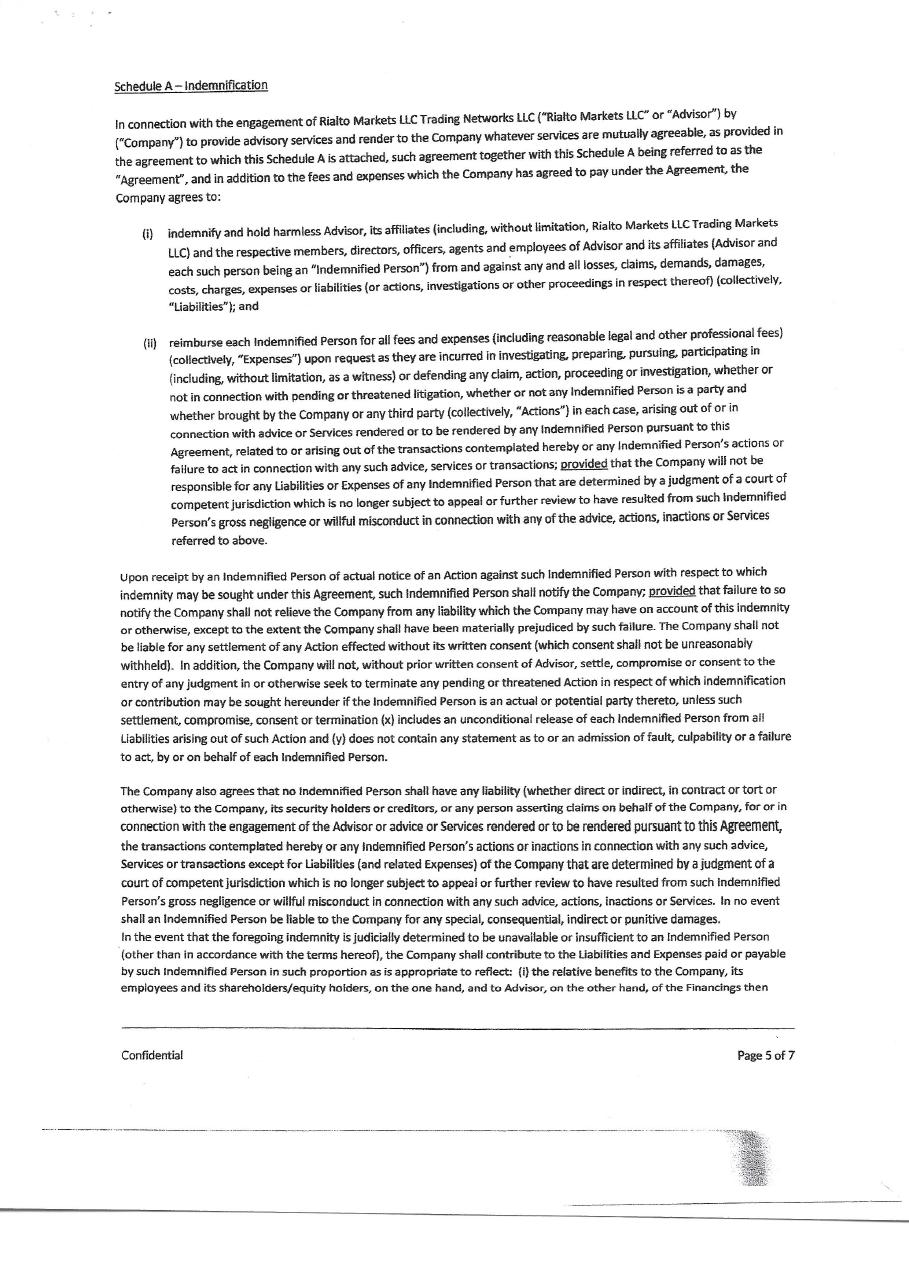
** The Company has engaged Rialto Markets LLC (“Rialto”) to act as an underwriter of this offering as set forth in “Plan of Distribution and Selling Securityholders”. The Company and the selling shareholders will pay a cash commission of 1% to Rialto on sales of the Common Stock and a 4% commission on sales to investors solicited by Rialto. This includes the 1% commission, but it does not include the one-time advisory fee payable by the company to Rialto, nor the 4% commission payable for solicited sales. See “Plan of Distribution and Selling Securityholders” on page 31 for details of compensation payable in connection with the offering.
*** The proceeds represent amounts to be paid to the selling shareholders listed in this Offering Circular. The selling shareholders are offering up to 120,000 shares of Common Stock. See “Plan of Distribution and Selling Securityholders.”
The Company expects that the amount of expenses of the offering that it will pay will be approximately $455,000, not including commissions or state filing fees.
The Company has engaged Wilmington Trust Company as an escrow agent (the “Escrow Agent”) to hold funds tendered by investors, and may hold a series of closings on a rolling basis at which we receive the funds from the escrow agent and issue the shares to investors. The offering will terminate at the earlier of the date at which the maximum offering amount has been sold or the date at which the offering is earlier terminated by the Company in its sole discretion. After each closing, funds tendered by investors will be available to the Company.
THE UNITED STATES SECURITIES AND EXCHANGE COMMISSION DOES NOT PASS UPON THE MERITS OR GIVE ITS APPROVAL OF ANY SECURITIES OFFERED OR THE TERMS OF THE OFFERING, NOR DOES IT PASS UPON THE ACCURACY OR COMPLETENESS OF ANY OFFERING CIRCULAR OR OTHER SOLICITATION MATERIALS. THESE SECURITIES ARE OFFERED PURSUANT TO AN EXEMPTION FROM REGISTRATION WITH THE COMMISSION; HOWEVER THE COMMISSION HAS NOT MADE AN INDEPENDENT DETERMINATION THAT THE SECURITIES OFFERED ARE EXEMPT FROM REGISTRATION
GENERALLY NO SALE MAY BE MADE TO YOU IN THIS OFFERING IF THE AGGREGATE PURCHASE PRICE YOU PAY IS MORE THAN 10% OF THE GREATER OF YOUR ANNUAL INCOME OR NET WORTH. DIFFERENT RULES APPLY TO ACCREDITED INVESTORS AND NON-NATURAL PERSONS. BEFORE MAKING ANY REPRESENTATION THAT YOUR INVESTMENT DOES NOT EXCEED APPLICABLE THRESHOLDS, WE ENCOURAGE YOU TO REVIEW RULE 251(d)(2)(i)(C) OF REGULATION A. FOR GENERAL INFORMATION ON INVESTING, WE ENCOURAGE YOU TO REFER TO www.investor.gov.
This offering is inherently risky. See “Risk Factors” on page 3.
Sales of these securities will commence on approximately, _____, 2020.
The Company is following the “Offering Circular” format of disclosure under Regulation A.
In the event that we become a reporting Company under the Securities Exchange Act of 1934, we intend to take advantage of the provisions that relate to “Emerging Growth Companies” under the JOBS Act of 2012. See “Implications of Being an Emerging Growth Company”.
TABLE OF CONTENTS
In this Offering Circular, the terms “we,” “us,” “ours,” “WFI,” and the “Company” refers to Worthy Financial, Inc., a Delaware corporation, together with our wholly-owned subsidiary Worthy Peer Capital, Inc., a Delaware corporation (“Worthy Peer Capital”), and its wholly-owned subsidiary Worthy Lending, LLC, a Delaware limited liability company (“Worthy Lending”), our wholly-owned subsidiary Worthy Peer Capital II, Inc. a Florida corporation (“Worthy Peer Capital II”) and its wholly-owned subsidiary Worthy Lending II, LLC, a Delaware limited liability company (“Worthy Lending II”) and our wholly-owned subsidiary Worthy Community Bonds, Inc, a Florida corporation (“Worthy Community Bonds), and its wholly-owned subsidiary Worthy Lending III, LLC, a Delaware limited liability company (“Worthy Lending III”). “Worthy Bonds” refers to bonds issued or to be issued by Worthy Peer Capital, Worthy Peer Capital II and Worthy Community Bonds.
THIS OFFERING CIRCULAR MAY CONTAIN FORWARD-LOOKING STATEMENTS AND INFORMATION RELATING TO, AMONG OTHER THINGS, THE COMPANY, ITS BUSINESS PLAN AND STRATEGY, AND ITS INDUSTRY. THESE FORWARD-LOOKING STATEMENTS ARE BASED ON THE BELIEFS OF, ASSUMPTIONS MADE BY, AND INFORMATION CURRENTLY AVAILABLE TO THE COMPANY’S MANAGEMENT. WHEN USED IN THE OFFERING MATERIALS, THE WORDS “ESTIMATE,” “PROJECT,” “BELIEVE,” “ANTICIPATE,” “INTEND,” “EXPECT” AND SIMILAR EXPRESSIONS ARE INTENDED TO IDENTIFY FORWARD-LOOKING STATEMENTS, WHICH CONSTITUTE FORWARD LOOKING STATEMENTS. THESE STATEMENTS REFLECT MANAGEMENT’S CURRENT VIEWS WITH RESPECT TO FUTURE EVENTS AND ARE SUBJECT TO RISKS AND UNCERTAINTIES THAT COULD CAUSE THE COMPANY’S ACTUAL RESULTS TO DIFFER MATERIALLY FROM THOSE CONTAINED IN THE FORWARD-LOOKING STATEMENTS. INVESTORS ARE CAUTIONED NOT TO PLACE UNDUE RELIANCE ON THESE FORWARD-LOOKING STATEMENTS, WHICH SPEAK ONLY AS OF THE DATE ON WHICH THEY ARE MADE. THE COMPANY DOES NOT UNDERTAKE ANY OBLIGATION TO REVISE OR UPDATE THESE FORWARD-LOOKING STATEMENTS TO REFLECT EVENTS OR CIRCUMSTANCES AFTER SUCH DATE OR TO REFLECT THE OCCURRENCE OF UNANTICIPATED EVENTS.
Trademarks and Copyrights
We own or have applied for rights to trademarks or trade names that we use in connection with the operation of our business, including our corporate names, logos and website names. In addition, we own or have the rights to copyrights, trade secrets and other proprietary rights that protect our business. This Offering Circular may also contain trademarks, service marks and trade names of other companies, which are the property of their respective owners. Our use or display of third parties’ trademarks, service marks, trade names or products in this offering circular is not intended to, and should not be read to, imply a relationship with or endorsement or sponsorship of us. Solely for convenience, some of the copyrights, trade names and trademarks referred to in this Offering Circular are listed without their ©, ® and ™ symbols, but we will assert, to the fullest extent under applicable law, our rights to our copyrights, trade names and trademarks. All other trademarks are the property of their respective owners.
| i |
Implications of Being an Emerging Growth Company
We are not subject to the ongoing reporting requirements of the Securities Exchange Act of 1934, as amended (the “Exchange Act”) because we are not registering our securities under the Exchange Act. Rather, we will be subject to the more limited reporting requirements under Regulation A, including the obligation to electronically file:
| ● | annual reports (including disclosure relating to our business operations for the preceding three fiscal years, or, if in existence for less than three years, since inception, related party transactions, beneficial ownership of the issuer’s securities, executive officers and directors and certain executive compensation information, management’s discussion and analysis (“MD&A”) of the issuer’s liquidity, capital resources, and results of operations, and two years of audited financial statements), | |
| ● | semiannual reports (including disclosure primarily relating to the issuer’s interim financial statements and MD&A) and | |
| ● | current reports for certain material events. |
In addition, at any time after completing reporting for the fiscal year in which our offering statement was qualified, if the securities of each class to which this Offering Statement relates are held of record by fewer than 300 persons and offers or sales are not ongoing, we may immediately suspend our ongoing reporting obligations under Regulation A.
If and when we become subject to the ongoing reporting requirements of the Exchange Act, as an issuer with less than $1.07 billion in total annual gross revenues during our last fiscal year, we will qualify as an “emerging growth company” under the Jumpstart Our Business Startups Act of 2012 (the “JOBS Act”) and this status will be significant. An emerging growth company may take advantage of certain reduced reporting requirements and is relieved of certain other significant requirements that are otherwise generally applicable to public companies. In particular, as an emerging growth company we:
| ● | will not be required to obtain an auditor attestation on our internal controls over financial reporting pursuant to the Sarbanes-Oxley Act of 2002; | |
| ● | will not be required to provide a detailed narrative disclosure discussing our compensation principles, objectives and elements and analyzing how those elements fit with our principles and objectives (commonly referred to as “compensation discussion and analysis”); | |
| ● | will not be required to obtain a non-binding advisory vote from our shareholders on executive compensation or golden parachute arrangements (commonly referred to as the “say-on-pay”, “say-on-frequency” and “say-on-golden-parachute” votes); | |
| ● | will be exempt from certain executive compensation disclosure provisions requiring a pay-for-performance graph and CEO pay ratio disclosure; | |
| ● | may present only two years of audited financial statements and only two years of related Management’s Discussion and Analysis of Financial Condition and Results of Operations, or MD&A; and |
| ● | will be eligible to claim longer phase-in periods for the adoption of new or revised financial accounting standards. |
We intend to take advantage of all of these reduced reporting requirements and exemptions, including the longer phase-in periods for the adoption of new or revised financial accounting standards, and hereby elect to do so. Our election to use the phase-in periods may make it difficult to compare our financial statements to those of non-emerging growth companies and other emerging growth companies that have opted out of the phase-in periods under Section 107 of the JOBS Act.
Under the JOBS Act, we may take advantage of the above-described reduced reporting requirements and exemptions for up to five years after our initial sale of common equity pursuant to a registration statement declared effective under the Securities Act of 1933, as amended (the “Securities Act”), or such earlier time that we no longer meet the definition of an emerging growth company. Note that this Offering, while a public offering, is not a sale of common equity pursuant to a registration statement, since the Offering is conducted pursuant to an exemption from the registration requirements. In this regard, the JOBS Act provides that we would cease to be an “emerging growth company” if we have more than $1.07 billion in annual revenues, have more than $700 million in market value of our Common Stock held by non-affiliates, or issue more than $1 billion in principal amount of non-convertible debt over a three-year period.
Certain of these reduced reporting requirements and exemptions are also available to us due to the fact that we may also qualify, once listed, as a “smaller reporting company” under the rules of the Securities and Exchange Commission (the “SEC”). For instance, smaller reporting companies are not required to obtain an auditor attestation on their assessment of internal control over financial reporting; are not required to provide a compensation discussion and analysis; are not required to provide a pay-for-performance graph or CEO pay ratio disclosure; and may present only two years of audited financial statements and related MD&A disclosure.
| ii |
Overview
The Company was organized to create a “Worthy Community” to provide financial services initially targeted to millennials who are surpassing the baby boomers as the nation’s largest living generation. Management believes that this demographic in large part has a basic distrust of old guard financial institutions, is burdened by student loans and other debt, change employment frequently and is unable to save money and/or fund a retirement program. We have developed technology solutions, including the Worthy App and the websites www.worthybonds.com and www.joinworthy.us, to facilitate the purchase of Worthy Bonds and to provide information to bond investors on their accounts. We refer to these each as the “Worthy App,” the “Worthy Website” and together as the “Worthy Fintech Platform.”
The Offering
| Securities offered | Maximum of 1,000,000 shares of Common Stock (the “Shares”). |
| ● | Of the 1,000,000 shares available in this offering, up to 880,000 are being sold by the Company. | |
| ● | Of the 1,000,000 shares available in this offering, up to 120,000 are being sold by the selling shareholders. |
| Common Stock outstanding before the Offering (1) | 1,322,444 shares | |
| Common Stock after the Offering (assuming a fully-subscribed offering)(2) | 2,425,507 shares | |
| Use of proceeds | The net proceeds of this offering will be used to support the net capital in our operating subsidiaries, and to invest in technology and marketing. The details of our plans are set forth in “Use of Proceeds to Issuer.” |
| (1) | Does not include shares issuable upon conversion of outstanding convertible notes or the exercise of options issued under the Stock Option Plans (as defined below), or shares allocated for issuance pursuant to the Stock Option Plans. |
| (2) | Assumes the Company raises more than $3,000,000 in this offering, triggering conversion of $735,000 in principal amount of outstanding convertible securities, plus interest, into shares of Common Stock. Does not include shares issuable upon the exercise of options issued under the Stock Option Plans, or shares allocated for issuance pursuant to the plans. |
Selected Risks Associated with Our Business
Our business is subject to a number of risks and uncertainties, including those highlighted in the section titled “Risk Factors” immediately following this summary. These risks include, but are not limited to, the following:
| ● | The lending industry is highly regulated. Changes in regulations or in the way regulations are applied to our business could adversely affect our business. | |
| ● | Worsening economic conditions may result in decreased demand for loans, cause borrowers’ default rates to increase, and harm our operating results. | |
| ● | We operate in a competitive market, which may intensify, and competition may limit our ability to implement our business model and have a material adverse effect on our business, financial condition, and results of operations. | |
| ● | Our results of operations may be negatively impacted by the coronavirus outbreak. | |
| ● | We have a history of losses, which we expect to continue. | |
| ● | There is substantial doubt about our ability to continue as a going concern. | |
| ● | We may need to raise additional capital. | |
| ● | We may experience losses on the loans we make or other permissible investments by our lending subsidiaries. | |
| ● | Competition for employees is intense, and we may not be able to attract and retain the highly skilled employees whom we need to support our business. | |
| ● | We have a limited operating history in a rapidly evolving industry, which makes it difficult to evaluate our future prospects and may increase the risk that we will not be successful. | |
| ● | We have begun to make loans with the proceeds from the sale of bonds, however our lending history is limited. | |
| ● | If the information provided by borrowers is incorrect or fraudulent, we may misjudge a customer’s qualification to receive a loan, and our operating results may be harmed. |
| 1 |
| ● | Our risk management efforts may not be effective. | |
| ● | We rely on various referral sources and other borrower lead generation sources, including lending platforms. | |
| ● | Our loans may be unsecured obligations of our borrowers. | |
| ● | A significant disruption in our computer systems or a cybersecurity breach could adversely affect our operations. | |
| ● | Our ability to protect the confidential information of our borrowers and investors may be adversely affected by cyber-attacks, computer viruses, physical or electronic break-ins or similar disruptions. | |
| ● | If our estimates of loan receivable losses are not adequate to absorb actual losses, our provision for loan receivable losses would increase, which would adversely affect our results of operations. | |
| ● | We will face increasing competition and, if we do not compete effectively, our operating results could be harmed. | |
| ● | Many of these competitors have significantly more resources and greater brand recognition than we do and may be able to attract borrowers more effectively than we do. | |
| ● | The collection, processing, storage, use, and disclosure of personal data could give rise to liabilities as a result of governmental regulation, conflicting legal requirements, or differing views of personal privacy rights. | |
| ● | We are reliant on the efforts of Sally Outlaw and Alan Jacobs. | |
| ● | We are subject to the risk of fluctuating interests rates, which could harm our business operations. | |
| ● | The nature of our business may subject us to regulation as an investment company pursuant to the Investment Company Act of 1940. | |
| ● | The Company is controlled by its officers and directors. | |
| ● | The subscription agreement has a forum selection provision that requires disputes be resolved in state or federal courts in the State of Delaware, regardless of convenience or cost to you, the investor. | |
| ● | Investors in this offering may not be entitled to a jury trial with respect to claims arising under the subscription agreement, which could result in less favorable outcomes to the plaintiff(s) in any action under the agreement. | |
| ● | Using a credit card to purchase shares may impact the return on your investment as well as subject you to other risks inherent in this form of payment. | |
| ● | There is no public market for shares of our common stock, and none is expected to develop. |
| 2 |
The SEC requires the Company to identify risks that are specific to its business and its financial condition. The Company is still subject to all the same risks that all companies in its business, and all companies in the economy, are exposed to. These include risks relating to economic downturns, political and economic events and technological developments (such as hacking and the ability to prevent hacking). Additionally, early-stage companies are inherently more risky than more developed companies. You should consider general risks as well as specific risks when deciding whether to invest.
Risks Related to our Industry
The lending industry is highly regulated. Changes in regulations or in the way regulations are applied to our business could adversely affect our business.
Changes in laws or regulations or the regulatory application or judicial interpretation of the laws and regulations applicable to us could adversely affect our ability to operate in the manner in which we intend to conduct business or make it more difficult or costly for us to participate in or otherwise make loans. A material failure to comply with any such laws or regulations could result in regulatory actions, lawsuits, and damage to our reputation, which could have a material adverse effect on our business and financial condition and our ability to participate in and perform our obligations to investors and other constituents.
The initiation of a proceeding relating to one or more allegations or findings of any violation of such laws could result in modifications in our methods of doing business that could impair our ability to collect payments on our loans or to acquire additional loans or could result in the requirement that we pay damages and/or cancel the balance or other amounts owing under loans associated with such violation. We cannot assure you that such claims will not be asserted against us in the future.
Worsening economic conditions may result in decreased demand for loans, cause borrowers’ default rates to increase, and harm our operating results.
Uncertainty and negative trends in general economic conditions in the United States and abroad, including significant tightening of credit markets, historically have created a difficult environment for companies in the lending industry. Many factors, including factors that are beyond our control, may have a detrimental impact on our operating performance. These factors include general economic conditions, unemployment levels, energy costs and interest rates, as well as events such as natural disasters, global pandemics, acts of war, terrorism, and catastrophes.
Our borrowers are small businesses. Accordingly, our borrowers have historically been, and may in the future remain, more likely to be affected or more severely affected than large enterprises by adverse economic conditions. These conditions may result in a decline in the demand for loans by potential borrowers or higher default rates by borrowers.
There can be no assurance that economic conditions will remain favorable for our business or that demand for loans in which we participate or default rates by borrowers will remain at current levels. Reduced demand for loans would negatively impact our growth and revenue, while increased default rates by borrowers may inhibit our access to capital and negatively impact our profitability. Further, if an insufficient number of qualified individuals and small businesses apply for loans, our growth and revenue would be negatively impacted.
We operate in a competitive market, which may intensify, and competition may limit our ability to implement our business model and have a material adverse effect on our business, financial condition, and results of operations.
We operate in a competitive market, which may intensify, and competition may limit our ability to implement our business model and have a material adverse effect on our business, financial condition, and results of operations. Our competitors may be able to have a lower cost for their services, which would lead to borrowers choosing such other competitors over the Company. In addition, some of our competitors may have higher risk tolerances or different risk assessments, which could allow them to consider a wider variety of loans and investments, offer more attractive pricing or other terms and establish more relationships than us.
Our results of operations may be negatively impacted by the coronavirus outbreak.
In December 2019, a novel strain of coronavirus, or COVID-19, was reported to have surfaced in Wuhan, China. COVID-19 has spread to many countries, including the United States, and was declared to be a pandemic by the World Health Organization. Efforts to contain the spread of COVID-19 have intensified and the U.S., Europe and Asia have implemented severe travel restrictions and social distancing. The impacts of the outbreak are unknown and rapidly evolving. A widespread health crisis has adversely affected and could continue to affect the global economy, resulting in an economic downturn that could negatively impact the value of the Shares and Investor demand for the Shares generally.
| 3 |
The continued spread of COVID-19 has also led to severe disruption and volatility in the global capital markets, which could increase our cost of capital and adversely affect our ability to access the capital markets in the future. It is possible that the continued spread of COVID-19 could cause a further economic slowdown or recession or cause other unpredictable events, each of which could adversely affect our business, results of operations or financial condition.
The extent to which COVID-19 affects our financial results will depend on future developments, which are highly uncertain and cannot be predicted, including new information which may emerge concerning the severity of the COVID-19 outbreak and the actions to contain the outbreak or treat its impact, among others. Moreover, the COVID-19 outbreak has had and may continue to have indeterminable adverse effects on general commercial activity and the world economy, and our business and results of operations could be adversely affected to the extent that COVID-19 or any other pandemic harms the global economy generally.
On March 9, 2020, the Company issued a work at home order to all employees. All employees worked efficiently from home until June 8, 2020 when the office was reopened in accordance with Palm Beach County, Florida guidelines. All employees returned to our office at such time.
Several borrowers, especially companies in the retail sector and others manufacturing for or distributing to the retail industry, experienced reduction in revenue and cash flow. We have worked constructively with such borrowers to reschedule interest and/or principal payments to accommodate such COVID-19 related cases. To date, to our knowledge, no borrower has gone out of business due to the COVID-19 outbreak and all are honoring revised payment loans.
Risks Related to Our Company
We have a history of losses, which we expect to continue.
The Company is currently not profitable. The Company expects that it will lose money in the foreseeable future, and we may not be able to achieve profitable operations. In order to achieve profitable operations, we will need to raise significant proceeds from this offering and the sale of Worthy Bonds through Regulation A offerings conducted by our affiliates and effectively deploy the proceeds of the Worthy Bond offerings by making secured loans or other permissible investments that provide a sufficient return to pay the interest payments on the Worthy Bonds, fund our operating expenses and generate a net profit. The Company cannot be certain that its business will be successful or that it will generate significant revenues and become profitable. An investment in the Company is highly speculative, and no assurance can be given that the shareholders will realize any return on their investment or that they will not lose their entire investment.
There is substantial doubt about our ability to continue as a going concern.
During the first six months of 2020 and in 2019 and 2018 we generated net losses of approximately $1,100,000, $3,713,000 and $806,000, respectively, and had cash used in operations of approximately $456,000, $1,663,000 and $595,000, respectively. In addition, at June 30, 2020, December 31, 2019 and December 31, 2018, we had a shareholder’s deficit of approximately $4,792,000, $3,770,000 and $317,000, respectively, and accumulated deficit of approximately $6,086,000, $4,986,000, and $1,273,000, respectively. These conditions raise substantial doubt about our ability to continue as a going concern. Our consolidated financial statements have been prepared assuming that we will continue as a going concern. No assurances can be given that we will achieve success in selling any material amount of Worthy Bonds, or that our operations will provide sufficient revenues to cover interest payments on the Worthy Bonds and our operating expenses.
We may need to raise additional capital.
We may have substantial future cash requirements but no assured financing source to meet such requirements. To date, our revenues have been minimal and we do not presently generate sufficient revenues to pay the interest on the Worthy Bonds and fund our operating expenses. Our future capital requirements will depend on a number of factors, including our ability to generate sufficient “spread” between the interest rate on the Worthy Bonds and the interest our lending subsidiaries receive from loans and other permissible investments they make using proceeds received from the sale of Worthy Bonds. If adequate funds are not available, including from this offering, the Company may be required to delay or scale back its business plan.
We may experience losses on the loans we make or other permissible investments by our lending subsidiaries.
While the loans made and to be made by our lending subsidiaries are and are planned to be primarily secured by the assets of the borrowers, there is no assurance that general economic conditions or the specific business and financial condition of the borrower, will not result in loan defaults. In that event, we would incur the costs to foreclose on our secured interests and there are no assurances that the amount we may recover from the disposal of the assets will equal the amounts of the obligation and associated costs.
| 4 |
Competition for employees is intense, and we may not be able to attract and retain the highly skilled employees whom we need to support our business.
Currently, our staffing needs are satisfied by a total of 15 full time employees and 2 independent contractors who provide a substantial portion of their time to us. We will need to expand our employee base as our Company continues to grow. Competition for highly skilled personnel, especially data analytics personnel, is extremely intense, and we could face difficulty identifying and hiring qualified individuals in many areas of our business. We may not be able to hire and retain such personnel. Many of the companies with which we compete for experienced employees have greater resources than we have and may be able to offer more attractive terms of employment. In addition, we intend to invest significant time and expense in training our employees, which increases their value to competitors who may seek to recruit them. If we fail to retain our employees, we could incur significant expenses in hiring and training their replacements and the quality of our services and our ability to serve borrowers could diminish, resulting in a material adverse effect on our business.
We have a limited operating history in a rapidly evolving industry, which makes it difficult to evaluate our future prospects and may increase the risk that we will not be successful.
We have a limited operating history in an evolving industry that may not develop as expected. Assessing our business and future prospects is challenging in light of the risks and difficulties we may encounter. These risks and difficulties include our ability to:
| ● | continue to sell Worthy Bonds; | |
| ● | expand the user base for the Worthy App and the Worthy Website; | |
| ● | increase the number and total volume of loans and other credit products extended to borrowers; | |
| ● | improve the terms on which loans are made to borrowers as our business becomes more efficient; | |
| ● | increase the effectiveness of our direct marketing and lead generation through referral sources; | |
| ● | successfully develop and deploy new products; | |
| ● | favorably compete with other companies that are currently in, or may in the future enter, the business of lending to small businesses; | |
| ● | successfully navigate economic conditions and fluctuations in the credit market; | |
| ● | effectively manage the growth of our business; and | |
| ● | successfully expand our business into adjacent markets. |
We may not be able to successfully address these risks and difficulties, which could harm our business and cause our operating results to suffer.
We have begun to make loans with the proceeds from the sale of bonds, however our lending history is limited.
Worthy Lending, the first lending subsidiary we established, made its first loan in September 2018 and, as of the date of this Offering Circular, our lending subsidiaries have approximately 50 outstanding loans. While we have identified several additional opportunities for investment, our lending history is limited. Interest that we earn on the proceeds from the Regulation A offerings of bonds will not cover interest payments accruing on the bonds or our operating expenses. Accordingly, until such time as we are able to generate significant income from our loans and investments we will be required to utilize cash on hand and the net proceeds of this offering to make the interest payments, which will reduce the amount of proceeds available for loans by us.
If the information provided by borrowers is incorrect or fraudulent, we may misjudge a customer’s qualification to receive a loan, and our operating results may be harmed.
Our loan participation or loan decisions are based partly on information provided to us by loan applicants. To the extent that these applicants provide information to us in a manner that we are unable to verify, we may not be able to accurately assess the associated risk. In addition, data provided by third-party sources is a significant component of our underwriting process, and this data may contain inaccuracies. Inaccurate analysis of credit data that could result from false loan application information could harm our reputation, business, and operating results.
Our risk management efforts may not be effective.
We could incur substantial losses, and our business operations could be disrupted if we are unable to effectively identify, manage, monitor, and mitigate financial risks, such as credit risk, interest rate risk, liquidity risk, and other market-related risk, as well as operational risks related to our business, assets, and liabilities. To the extent our models used to assess the creditworthiness of potential borrowers do not adequately identify potential risks, the risk profile of such borrowers could be higher than anticipated. Our risk management policies, procedures, and techniques may not be sufficient to identify all of the risks we are exposed to, mitigate the risks that we have identified, or identify concentrations of risk or additional risks to which we may become subject in the future.
| 5 |
We rely on various referral sources and other borrower lead generation sources, including lending platforms.
Unlike banks and other larger competitors with significant resources, we rely on our smaller-scale marketing efforts, affinity groups, partners, and loan referral services to acquire borrowers. We do not have exclusive rights to referral services, and we cannot control which loans or the volume of loans we are sent. In addition, our competitors may enter into exclusive or reciprocal arrangements with their own referral services, which might significantly reduce the number of borrowers we are referred. Any significant reduction in borrower referrals could have an adverse impact on our loan volume, which will have a correspondingly adverse impact on our operations and our Company.
Our loans may be unsecured obligations of our borrowers.
We believe that some of our loans may be unsecured obligations of the borrowers. This means that, for those loans, we will not be able to foreclose on any assets of our borrowers in the event that they default. This limits our recourse in the event of a default. We may also attract borrowers who have fewer assets and may be engaged in less developed businesses than our peers. If we are unable to access collateral on our loans that default, our results of operations may be adversely impacted.
A significant disruption in our computer systems or a cybersecurity breach could adversely affect our operations.
We rely extensively on our computer systems to manage our loan origination and other processes. Our systems are subject to damage or interruption from power outages, computer and telecommunications failures, computer viruses, cyber security breaches, vandalism, severe weather conditions, catastrophic events and human error, and our disaster recovery planning cannot account for all eventualities. If our systems are damaged, fail to function properly or otherwise become unavailable, we may incur substantial costs to repair or replace them, and may experience loss of critical data and interruptions or delays in our ability to perform critical functions, which could adversely affect our business and results of operations. Any compromise of our security could also result in a violation of applicable privacy and other laws, significant legal and financial exposure, damage to our reputation, loss or misuse of the information and a loss of confidence in our security measures, which could harm our business.
Our ability to protect the confidential information of our borrowers and investors may be adversely affected by cyber-attacks, computer viruses, physical or electronic break-ins or similar disruptions.
We process certain sensitive data from our borrowers and investors. While we have taken steps to protect confidential information that we receive or have access to, our security measures could be breached. Any accidental or willful security breaches or other unauthorized access to our systems could cause confidential borrower and investor information to be stolen and used for criminal purposes. Security breaches or unauthorized access to confidential information could also expose us to liability related to the loss of the information, time-consuming and expensive litigation and negative publicity. If security measures are breached because of third-party action, employee error, malfeasance or otherwise, or if design flaws in our software are exposed and exploited, our relationships with borrowers and investors could be severely damaged, and we could incur significant liability.
Because techniques used to sabotage or obtain unauthorized access to systems change frequently and generally are not recognized until they are launched against a target, we may be unable to anticipate these techniques or to implement adequate preventative measures. In addition, federal regulators and many federal and state laws and regulations require companies to notify individuals of data security breaches involving their personal data. These mandatory disclosures regarding a security breach are costly to implement and often lead to widespread negative publicity, which may cause borrowers and investors to lose confidence in the effectiveness of our data security measures. Any security breach, whether actual or perceived, would harm our reputation, we could lose borrowers and investors and our business and operations could be adversely affected.
Any significant disruption in service on our platform or in our computer systems, including events beyond our control, could prevent us from processing or posting payments on loans, reduce the attractiveness of our marketplace and result in a loss of borrowers or investors.
In the event of a system outage and physical data loss, our ability to perform our servicing obligations, process applications or make loans available would be materially and adversely affected. The satisfactory performance, reliability and availability of our technology are critical to our operations, customer service, reputation and our ability to attract new and retain existing borrowers and investors.
Any interruptions or delays in our service, whether as a result of third-party error, our error, natural disasters or security breaches, whether accidental or willful, could harm our relationships with our borrowers and investors and our reputation. Additionally, in the event of damage or interruption, our insurance policies may not adequately compensate us for any losses that we may incur. Our disaster recovery plan has not been tested under actual disaster conditions, and we may not have sufficient capacity to recover all data and services in the event of an outage. These factors could prevent us from processing or posting payments on the loans, damage our brand and reputation, divert our employees’ attention, reduce our revenue, subject us to liability and cause borrowers and investors to abandon our marketplace, any of which could adversely affect our business, financial condition and results of operations.
| 6 |
We contract with third parties to provide services related to our online web lending and marketing, as well as systems that automate the servicing of our loan portfolios. While there are material cybersecurity risks associated with these services, we require that our vendors provide industry-leading encryption, strong access control policies, Statement on Standards for Attestation Engagements (SSAE) 16 audited data centers, systematic methods for testing risks and uncovering vulnerabilities, and industry compliance audits to ensure data and assets are protected. To date, we have not experienced any cyber incidents that were material, either individually or in the aggregate.
If our estimates of loan receivable losses are not adequate to absorb actual losses, our provision for loan receivable losses would increase, which would adversely affect our results of operations.
We maintain an allowance for loans receivable losses. To estimate the appropriate level of allowance for loan receivable losses, we consider known and relevant internal and external factors that affect loan receivable collectability, including the total amount of loan receivables outstanding, historical loan receivable charge-offs, our current collection patterns, and economic trends. If customer behavior changes as a result of economic conditions and if we are unable to predict how the unemployment rate, housing foreclosures, and general economic uncertainty may affect our allowance for loan receivable losses, our provision may be inadequate. Our allowance for loan receivable losses is an estimate, and if actual loan receivable losses are materially greater than our allowance for loan receivable losses, our financial position, liquidity, and results of operations could be adversely affected.
We will face increasing competition and, if we do not compete effectively, our operating results could be harmed.
We compete with other companies that lend to small businesses. These companies include traditional banks, merchant cash advance providers, and newer, technology-enabled lenders. In addition, other technology companies that lend primarily to individual consumers, such as Lending Club and Prosper Marketplace, have already begun to focus, or may in the future focus, their efforts on lending to small businesses. If we are not able to compete effectively with our competitors, our operating results could be harmed.
Many of these competitors have significantly more resources and greater brand recognition than we do and may be able to attract borrowers more effectively than we do.
When new competitors seek to enter one of our markets, or when existing market participants seek to increase their market share, they sometimes undercut the pricing and/or credit terms prevalent in that market, which could adversely affect our market share or ability to explore new market opportunities. Our pricing and credit terms could deteriorate if we act to meet these competitive challenges. Further, to the extent that the fees we pay to our strategic partners and borrower referral sources are not competitive with those paid by our competitors, whether on new loans or renewals or both, these partners and sources may choose to direct their business elsewhere. All of the foregoing could adversely affect our business, results of operations, financial condition, and future growth.
The collection, processing, storage, use, and disclosure of personal data could give rise to liabilities as a result of governmental regulation, conflicting legal requirements, or differing views of personal privacy rights.
We receive, collect, process, transmit, store, and use a large volume of personally identifiable information and other sensitive data from borrowers and purchasers of the Worthy Bonds and services. There are federal, state, and foreign laws regarding privacy, recording telephone calls, and the storing, sharing, use, disclosure, and protection of personally identifiable information and sensitive data. Specifically, personally identifiable information is increasingly subject to legislation and regulations to protect the privacy of personal information that is collected, processed, and transmitted. Any violations of these laws and regulations may require us to change our business practices or operational structure, address legal claims, and sustain monetary penalties, or other harms to our business.
The regulatory framework for privacy issues in the United States and internationally is constantly evolving and is likely to remain uncertain for the foreseeable future. The interpretation and application of such laws is often uncertain, and such laws may be interpreted and applied in a manner inconsistent with other binding laws or with our current policies and practices. If either we or our third-party service providers are unable to address any privacy concerns, even if unfounded, or to comply with applicable laws and regulations, it could result in additional costs and liability, damage our reputation, and harm our business.
We are reliant on the efforts of Sally Outlaw and Alan Jacobs.
We rely on our management team and need additional key personnel to grow our business; the loss of key employees or inability to hire key personnel could harm our business. We believe our success has depended, and continues to depend, on the efforts and talents of our executive officers, Sally Outlaw, our Chief Executive Officer, and Alan Jacobs, our Chief Operating Officer. Ms. Outlaw and Mr. Jacobs have expertise that could not be easily replaced if we were to lose any or all of their services. We currently do not have employment agreements with our executive officers, other than with James Eichman, our Chief Technology Officer.
| 7 |
The nature of our business may subject us to regulation as an investment company pursuant to the Investment Company Act of 1940.
We believe that Worthy Peer Capital, Worthy Peer Capital II fall and Worthy Community Bonds will fall within the exception to the definition of an investment company provided by Section 3(c)(5)(A) and/or Section 3(c)(5)(B) of the Investment Company Act of 1940 (the “Investment Company Act”). Section 3(c)(5)(A) provides an exemption for a company that is primarily engaged in purchasing or otherwise acquiring notes representing part or all of the sales price of merchandise and/or services. Section 3(c)(5)(B) provides an exemption for a company that is primarily engaged in making loans to manufacturers, wholesalers and retailers of and to prospective purchasers of specified merchandise and/or services. To a lesser extent (not more than 40%) these subsidiaries may also make secured loans to other types of borrowers, provided the amount and nature of such loans does not cause them to lose their exemption from the registration requirements of the Investment Company Act. If for any reason we fail to meet the requirements of the exemptions provided by Sections 3(c)(5)(A) or 3(c)(5)(B), Worthy Peer Capital, Worthy Peer Capital II or Worthy Community Bonds will be required to register as an investment company, which could materially and adversely affect our business.
We are subject to the risk of fluctuating interests rates, which could harm our business operations.
We expect to generate net income from the difference between the interest rates we charge borrowers or otherwise make from our permissible investments, including loan origination fees paid by borrowers, and the interest we pay to the holders of bonds. Due to fluctuations in interest rates, we may not be able to charge borrowers an interest rate sufficient for us to generate income, which could harm our planned business operations.
The Company is controlled by its officers and directors.
The Company’s officers and directors currently hold over 69% of the Company’s Common Stock, and at the conclusion of this offering will continue to hold a majority of the Company’s voting stock. As a result, investors in this offering will not have the ability to control or influence a vote of the shareholders.
The subscription agreement has a forum selection provision that requires disputes be resolved in state or federal courts in the State of Delaware, regardless of convenience or cost to you, the investor.
In order to invest in this offering, investors agree to resolve disputes arising under the subscription agreement in state or federal courts located in the State of Delaware, for the purpose of any suit, action or other proceeding arising out of or based upon the agreement. Section 22 of the Securities Act creates concurrent jurisdiction for federal and state courts over all suits brought to enforce any duty or liability created by the Securities Act or the rules and regulations thereunder. We believe that the exclusive forum provision applies to claims arising under the Securities Act, but there is uncertainty as to whether a court would enforce such a provision in this context. Section 27 of the Exchange Act creates exclusive federal jurisdiction over all suits brought to enforce any duty or liability created by the Exchange Act or the rules and regulations thereunder. As a result, the exclusive forum provision will not apply to suits brought to enforce any duty or liability created by the Exchange Act or any other claim for which the federal courts have exclusive jurisdiction. You will not be deemed to have waived the Company’s compliance with the federal securities laws and the rules and regulations thereunder. This forum selection provision may limit your ability to obtain a favorable judicial forum for disputes with us. Alternatively, if a court were to find the provision inapplicable to, or unenforceable in an action, we may incur additional costs associated with resolving such matters in other jurisdictions, which could adversely affect our business, financial condition or results of operations.
Investors in this offering may not be entitled to a jury trial with respect to claims arising under the subscription agreement, which could result in less favorable outcomes to the plaintiff(s) in any action under the agreement.
Investors in this offering will be bound by the subscription agreement, which includes a provision under which investors waive the right to a jury trial of any claim they may have against the Company arising out of or relating to the agreement, including any claims made under the federal securities laws. By signing the agreement, the investor warrants that the investor has reviewed this waiver with his or her legal counsel, and knowingly and voluntarily waives the investor’s jury trial rights following consultation with the investor’s legal counsel.
If we opposed a jury trial demand based on the waiver, a court would determine whether the waiver was enforceable based on the facts and circumstances of that case in accordance with the applicable state and federal law. To our knowledge, the enforceability of a contractual pre-dispute jury trial waiver in connection with claims arising under the federal securities laws has not been finally adjudicated by a federal court. However, we believe that a contractual pre-dispute jury trial waiver provision is generally enforceable, including under the laws of the State of Delaware, which governs the agreements, by a federal or state court in the State of Delaware. In determining whether to enforce a contractual pre-dispute jury trial waiver provision, courts will generally consider whether the visibility of the jury trial waiver provision within the agreement is sufficiently prominent such that a party knowingly, intelligently and voluntarily waived the right to a jury trial. We believe that this is the case with respect to the subscription agreement. You should consult legal counsel regarding the jury waiver provision before entering into the subscription agreement.
| 8 |
If you bring a claim against the Company in connection with matters arising under the agreement, including claims under the federal securities laws, you may not be entitled to a jury trial with respect to those claims, which may have the effect of limiting and discouraging lawsuits against the Company. If a lawsuit is brought against the Company under any of the agreements, it may be heard only by a judge or justice of the applicable trial court, which would be conducted according to different civil procedures and may result in different outcomes than a trial by jury would have had, including results that could be less favorable to the plaintiff(s) in such an action.
Nevertheless, if the relevant jury trial waiver provision is not permitted by applicable law, an action could proceed under the terms of the agreement with a jury trial. No condition, stipulation or provision of the subscription agreement serves as a waiver by any holder of the Company’s securities or by the Company of compliance with any substantive provision of the federal securities laws and the rules and regulations promulgated under those laws.
In addition, when the shares are transferred, the transferee is required to agree to all the same conditions, obligations and restrictions applicable to the shares or to the transferor with regard to ownership of the shares, that were in effect immediately prior to the transfer of the shares, including but not limited to the subscription agreement.
Using a credit card to purchase shares may impact the return on your investment as well as subject you to other risks inherent in this form of payment.
Investors in this offering have the option of paying for their investment with a credit card, which is not usual in the traditional investment markets. Transaction fees charged by your credit card company (which can reach 5% of transaction value if considered a cash advance) and interest charged on unpaid card balances (which can reach almost 25% in some states) add to the effective purchase price of the shares you buy. See “Plan of Distribution and Selling Securityholders.” The cost of using a credit card may also increase if you do not make the minimum monthly card payments and incur late fees. Using a credit card is a relatively new form of payment for securities and will subject you to other risks inherent in this form of payment, including that, if you fail to make credit card payments (e.g. minimum monthly payments), you risk damaging your credit score and payment by credit card may be more susceptible to abuse than other forms of payment. Moreover, where a third-party payment processor is used, as in this offering, your recovery options in the case of disputes may be limited. The increased costs due to transaction fees and interest may reduce the return on your investment.
The SEC’s Office of Investor Education and Advocacy issued an Investor Alert dated February 14, 2018 entitled: Credit Cards and Investments – A Risky Combination, which explains these and other risks you may want to consider before using a credit card to pay for your investment.
There is no public market for shares of our common stock, and none is expected to develop.
There is no formal marketplace for the resale of our common stock and the Company does not expect that such a market will develop in the near future. Investors should assume that they may not be able to liquidate their investment for some time or be able to pledge their shares as collateral.
| 9 |
Dilution means a reduction in value, control, or earnings of the shares the investor owns.
Immediate dilution
An early-stage company typically sells its shares (or grants options over its shares) to its founders and early employees at a very low cash cost, because they are, in effect, putting their “sweat equity” into the Company. When the Company seeks cash investments from outside investors, like you, the new investors typically pay a much larger sum for their shares than the founders or earlier investors, which means that the cash value of your stake is diluted because all the shares are worth the same amount, and you paid more than earlier investors for your shares.
The following table presents the Company’s capitalization as of June 30, 2020 and compares the price that new investors are paying for their shares with the effective cash price paid by existing shareholders and full vesting and exercise of outstanding stock options, and based on the assumption that the price per share in this offering is $10.00. This method gives investors a better picture of what they will pay for their investment compared to the Company’s insiders. In the past year, the officers, directors and affiliated persons of the Company have paid an aggregate average price of $0.01 per share of Common Stock in comparison to the offering price of $20.00 per share of Common Stock.
| Dates Issued | Issued Shares | Potential Shares | Total Issued and Potential Shares | Effective Cash Price per Share at Issuance or Potential Conversion | ||||||||||||||
| Common Stock(1) | 2016-2020 | 1,268,522 | 1,268,522 | $0.58 | ||||||||||||||
| Outstanding Stock Options (2) | 2018-2020 | 265,970 | 265,970 | $4.77 | (3) | |||||||||||||
| Common Stock | 2018 | 54,358 | 54,358 | $5.00 | (4) | |||||||||||||
| Convertible Notes | 2018-2019 | 223,063 | 223,063 | $3.78 | (5) | |||||||||||||
| Total Common Share Equivalents | 1,322,444 | 489,033 | 1,811,477 | |||||||||||||||
| Investors in this offering, assuming $17,600,000 raised | 880,000 | 880,000 | $20.00 | (6) | ||||||||||||||
| Total after inclusion of this offering | 2,202,444 | 489,033 | 2,691,477 | $7.72 | ||||||||||||||
| (1) | Does not include 65,500 shares of Common Stock issued subsequent to June 30, 2020. | |
| (2) | Assumes conversion at exercise price of all outstanding warrants and options. | |
| (3) | Stock option pricing is the weighted average exercise price of outstanding options. | |
| (4) | Common Stock issued at $5.00 per share through a Regulation Crowdfunding offering. | |
| (5) | In 2018 and 2019, the Company issued $735,000 aggregate principal amount of convertible notes. The notes bear interest at 9% and mature in three years from the issuance date. Assuming at least $3,000,000 is raised in this offering, the terms of this offering would trigger conversion of the notes into a total of 223,063 shares of Common Stock, assuming interest is accrued through December 31, 2020. | |
| (6) | Assumes this offering is fully-subscribed, with 880,000 shares of Common Stock newly issued by the Company. |
Upon completion of this offering, in the event all of the shares of Common Stock are sold, the net tangible book value of the 2,202,444 shares of Common Stock will be $12,874,142 or approximately $5.85 per share. The net tangible book value of the shares of Common Stock held by our existing shareholders will be increased by $9.42 per share without any additional investment on their part. Investors in the offering will incur an immediate dilution of $14.15 per share.
After completion of this offering, if 1,000,000 shares of Common Stock are sold, investors in this offering will own approximately 43% of the total number of shares then outstanding for which they will have made a cash investment of $20 million, or $20.00 per share.
Future dilution
Another important way of looking at dilution is the dilution that happens due to future actions by the Company. The investor’s stake in a company could be diluted due to the company issuing additional shares. In other words, when the company issues more shares, the percentage of the company that you own will go down, even though the value of the company may go up. You will own a smaller piece of a larger company. This increase in number of shares outstanding could result from a stock offering (such as an initial public offering, another crowdfunding round, a venture capital round, angel investment), employees exercising stock options, or by conversion of certain instruments (e.g. convertible bonds, preferred shares or warrants) into stock.
| 10 |
If the Company decides to issue more shares, an investor could experience value dilution, with each share being worth less than before, and control dilution, with the total percentage an investor owns being less than before. There may also be earnings dilution, with a reduction in the amount earned per share (though this typically occurs only if the company offers dividends, and most early stage companies are unlikely to offer dividends, preferring to invest any earnings into the company).
The type of dilution that hurts early-stage investors most occurs when the company sells more shares in a “down round,” meaning at a lower valuation than in earlier offerings. An example of how this might occur is as follows (numbers are for illustrative purposes only):
| ● | In June 2018 Jane invests $20,000 for shares that represent 2% of a company valued at $1 million. | |
| ● | In December the company is doing very well and sells $5 million in shares to venture capitalists on a valuation (before the new investment) of $10 million. Jane now owns only 1.3% of the company but her stake is worth $200,000. | |
| ● | In June 2019 the company has run into serious problems and in order to stay afloat it raises $1 million at a valuation of only $2 million (the “down round”). Jane now owns only 0.89% of the company and her stake is worth only $26,660. |
This type of dilution might also happen upon conversion of convertible notes into shares. Typically, the terms of convertible notes issued by early-stage companies provide that in the event of another round of financing, the holders of the convertible notes get to convert their notes into equity at a “discount” to the price paid by the new investors, i.e., they get more shares than the new investors would for the same price. Additionally, convertible notes may have a “price cap” on the conversion price, which effectively acts as a share price ceiling. Either way, the holders of the convertible notes get more shares for their money than new investors. In the event that the financing is a “down round” the holders of the convertible notes will dilute existing equity holders, and even more than the new investors do, because they get more shares for their money. Investors should pay careful attention to the amount of convertible notes that the Company has issued (and may issue in the future) and the terms of those notes.
If you are making an investment expecting to own a certain percentage of the Company or expecting each share to hold a certain amount of value, it’s important to realize how the value of those shares can decrease by actions taken by the Company. Dilution can make drastic changes to the value of each share, ownership percentage, voting control, and earnings per share.
| 11 |
The Company is selling 880,000 shares of Common Stock at a price per share of $20.00. The net proceeds to the issuer of a fully subscribed $17,600,000 offering to the issuer, after estimated total offering expenses and commissions will be approximately $15,665,000. Worthy Financial plans to use these net proceeds as follows:
| ● | $5,147,000 to support net capital in our operating subsidiaries, which must maintain net capital under certain state regulations in connection with their activities to issue bonds; |
| ● | $5,222,000 for technology, including adding personnel and software and security products; |
| ● | $75,000 to repay short-term promissory notes; and |
| ● | $5,221,000 for marketing of our Worthy Bonds. |
If the offering size were to be at 75% of our target proceeds, at $13,200,000 in the aggregate, then we estimate that the net proceeds to the Company would be approximately $11,600,000. In such an event, the Company would plan to use its net proceeds as follows:
| ● | $3,792,000 to support net capital in our operating subsidiaries; |
| ● | $3,867,000 for technology, including adding personnel and software and security products; |
| ● | $75,000 to repay short-term promissory notes; and |
| ● | $3,866,000 for marketing of our Worthy Bonds. |
If the offering size were to be at 50% of our target proceeds, at $8,800,000 in the aggregate, then we estimate that the net proceeds to the Company would be approximately $7,650,000. In such an event, the Company would plan to use its net proceeds as follows:
| ● | $2,442,000 to support net capital in our operating subsidiaries; |
| ● | $2,517,000 for technology, including adding personnel and software and security products; |
| ● | $75,000 to repay short-term promissory notes; and |
| ● | $2,516,000 for marketing of our Worthy Bonds. |
If the offering size were to be at 25% of our target proceeds, at $4,400,000 in the aggregate, then we estimate that the net proceeds to the Company would be approximately $3,475,000. In such an event, the Company would plan to use its net as follows:
| ● | $1,925,000 to support net capital in our operating subsidiaries; |
| ● | $738,000 for technology, including adding personnel and software and security products; |
| ● | $75,000 to repay short-term promissory notes; and |
| ● | $737,000 for marketing of our Worthy Bonds. |
Because the offering is a “best efforts” offering without a required minimum offering amount, we may close the offering without sufficient funds for all the intended purposes set out above. There is no arrangement to return funds to subscribers if all of the securities offered are not sold.
The Company reserves the right to change the above use of proceeds without notice if management believes it is in the best interests of the Company.
| 12 |
Overview
The Company was organized to create a “Worthy Community” to provide financial services initially targeted to millennials who are surpassing the baby boomers as the nation’s largest living generation. Management believes that this demographic in large part has a basic distrust of old guard financial institutions, is burdened by student loans and other debt, change employment frequently and is unable to save money and/or fund a retirement program
Worthy Financial, Inc. was formed on February 24, 2016 as a Delaware corporation. Our principal address is One Boca Commerce Center, 551 NW 77 Street, Suite 212, Boca Raton, FL, 33487. Our phone number is (561) 288-8467. The information that appears on, or is accessible through our websites at www.worthybonds.com, www.joinworthy.us and www.worthylending.com is not a part of, and is not incorporated by reference into, this Offering Circular.
Corporate Organization
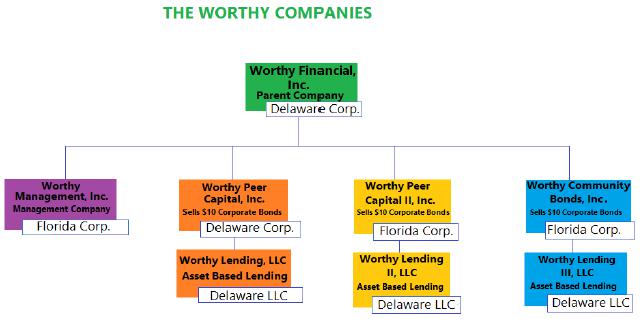
Worthy Fintech Platform
We have developed technology solutions, including the Worthy App and the Worthy Website, to facilitate the purchase of Worthy Bonds and to provide information to bond investors on their accounts. Currently, the Company receives a license fee from its subsidiaries equal to $10 per active user on the Worthy Fintech Platform each year. The fee is subject to periodic review and adjustment. We refer to these each as the “Worthy App,” the “Worthy Website” and together as the “Worthy Fintech Platform.”
Worthy App
The Worthy App was designed to support the target market for our bonds, which we believe is approximately 74 million millennials, who spend more than $600 billion a year on products and services. The Worthy App seeks to provide an easy way for our target market to micro invest, including monetizing their debit card purchases, credit card purchases and other checking account transactions by “rounding up” each purchase to the next highest dollar until the “round up” reaches $10.00 at which time the user would purchase a $10.00 bond from our operating subsidiaries pursuant to an offering pursuant to Regulation A (a “Worthy Bond offering”). Our subsidiaries Worthy Peer Capital and Worthy Peer Capital II previously conducted such offerings and our subsidiary Worthy Community Bonds is currently conducting such an offering. The Worthy App is available via the web at worthybonds.com or for Apple iPhone users from the Apple Store and for Android phone users from Google Play.
| 13 |
Worthy Website
By accessing our websites at www.worthybonds.com and www.joinworthy.us, prospective investors in Worthy Bonds can create a username and password, and indicate agreement to our terms and conditions and privacy policy.
The following features are available to participants in the Worthy Bonds programs through our website:
| ● | Available Online Directly from Us. Users can purchase Worthy Bonds directly through our websites; | |
| ● | No Purchase Fees Charged. We have not charged any commission or fees to purchase Worthy Bonds through our websites. Purchasers may be charged a transaction fee if their method of payment requires us to incur an expense. The transaction fee is equal to the amount that we are charged by the payment processor. However, other financial intermediaries, if engaged by an investor, may separately charge investors commissions or fees; | |
| ● | Invest as Little as $10. Users are able to build ownership over time by making purchases as low as $10 of Worthy Bonds; | |
| ● | Flexible, Secure Payment Options. Users may purchase bonds through our websites either electronically or by wire transfer; and | |
| ● | View Your Portfolio Online. Users can view their investments, returns, and transaction history online, as well as receive tax information and other portfolio reports. |
In addition to millennials, we may also seek to establish strategic relationships with local and national companies to incorporate our services into the benefits they provide to their hourly employees, borrowers and users, as well as veterans and municipal employees and colleges and university alumni associations.
Our Subsidiaries
Our business is primarily conducted through our operating subsidiaries, Worthy Peer Capital, Worthy Peer Capital II and Worthy Community Bonds, and their subsidiaries. Under our subsidiaries’ business models, we intend to generate revenue in multiple ways, through
| ● | fees charged to borrowers, |
| ● | interest generated from each loan that we make or in which we participate and |
| ● | fees from ancillary services that we may introduce to our Worthy members. |
Worthy Peer Capital and Worthy Lending
Worthy Peer Capital provides at least 60% of its assets to be used for (i) loans to manufacturers, wholesalers and retailers secured by inventory and/or equipment, and (ii) purchase order financing. To a lesser extent (not more than 40% of assets), Worthy Peer Capital may also provide (i) secured loans to other borrowers, (ii) acquire equity interests in real estate; (iii) make fixed income investments; and (iv) provide factoring financing, provided the amount and nature of such activities does not cause it to lose its exemption from regulation as an investment company pursuant to the Investment Company Act.
Worthy Bond Offering
In January 2018 Worthy Peer Capital launched an offering pursuant to Regulation A under the Securities Act under the terms of an offering circular that was initially qualified by the SEC on January 4, 2018. On March 17, 2020, the offering was completed. From January 2018 through March 17, 2020, Worthy Peer Capital sold approximately $50 million aggregate principal amount of Worthy Bonds to 12,285 investors. Notwithstanding the completion of the offering, Worthy Peer Capital inadvertently sold after March 17, 2020 $630,380 principal amount more in bonds than the maximum offering amount allowable under the offering statement due to a coding error as to redemption transactions in our software. As a result of the oversubscription, on March 25, 2020, Worthy Peer Capital rescinded the purchase and sale of the oversubscribed bonds by refunding and crediting the accounts of the 2,250 purchasers of the oversubscribed bonds their respective investment amounts, without any deduction therefrom, and cancelling the oversubscribed bonds.
The Worthy Bonds sold by Worthy Peer Capital:
| ● | were priced at $10.00 each; | |
| ● | represent a full and unconditional obligation of Worthy Peer Capital; | |
| ● | bear interest at 5% per annum; | |
| ● | have a term of three years, renewable at the option of the bond holder for up to two additional three-year terms; | |
| ● | may be redeemed by the holder; |
| o | holders seeking to redeem more than $50,000 principal amount of bonds issued by Worthy Peer Capital must give 30 days prior written notice; |
| ● | are subject to redemption by Worthy Peer Capital; and | |
| ● | are not payment dependent on any underlying small business loan. |
| 14 |
The Worthy Bonds are not dependent upon any particular loan and remain at all times the general obligations of Worthy. Proceeds from the sale of the Worthy Bonds were used to fund loans and for general corporate purposes, including the costs of the offering.
Since Worthy Peer Capital has completed the offering, it may no longer offer interest reinvestment in Worthy Bonds under the auto-invest program to bondholders who selected this reinvestment feature as Worthy Peer Capital may not issue any more Worthy Bonds under its offering statement. In lieu of interest reinvestment in Worthy Bonds, Worthy Peer Capital will pay interest on interest (compounded interest) and credit such interest to such bondholders’ accounts.
Worthy Peer Capital’s Loan and Investment Portfolio
Beginning in September 2018, Worthy Peer Capital, through its subsidiary Worthy Lending, began deploying the net proceeds it had raised through its sale of Worthy Bonds by loaning funds directly to borrowers and through participation agreements with other lenders under loan agreements. The balance due Worthy Peer Capital at June 30, 2020 and December 31, 2019 was $11,036,636 and $10,161,592, respectively.
The loans pay interest at varying rates ranging from 0.62% per month to 1.5% per month and collateral management fees ranging from 0.5% to 1% per month. The loan agreements have customary loan origination fees, which have been netted against loan costs with the net amount recorded as deferred revenue to be recognized as non-interest income over the term of the loan. One of the loans has an annual facility fee, which is being amortized into income over one year. The term of the loans range from two to three years, with no prepayment penalty and generally pay interest only in the first year, then begin paying principal and interest in later years. The loans are secured by the assets of the borrowers. There was no loan allowance required at any time during the year ended December 31, 2018. The loan allowance at June 30, 2020 and December 31, 2019 was $1,841,315.
During the year ended December 31, 2019, Worthy Peer Capital invested in 8 real estate loans for a total of $1,774,000. Each loan is secured by a first mortgage in the real estate, and is located in the state of Florida. Each loan has a maturity date of 1 or 2 years and matures on various dates ranging between March 2021 and December 2021.These loans pay interest at rates between 9.5% and 10.5% and are serviced by an outside, unrelated party. During the six months ended June 30, 2020, Worthy Peer Capital invested in 11 loans for a total of $2,349,000. Each loan is secured by a first mortgage in the real estate, and is located in the state of Florida. Each loan has a maturity date of 1 or 2 years and matures on various dates ranging between March 2021 and January 2022.These loans pay interest at rates between 9.5% and 10.5% and are serviced by an outside, unrelated party
Worthy Peer Capital maintains a portfolio of investments on its consolidated balance sheet as marketable securities held at fair value. Fair value includes gross unrealized gains, gross unrealized losses, accrued interest, and amortized cost. Worthy Peer Capital typically invests in a portfolio of private market real estate investments with the primary objective to earn diversified risk-adjusted returns while the corporate bonds, certificates of deposit, asset backed securities, and U.S. treasury securities are intended to mitigate risk and minimize potential risk of principal loss. Worthy Peer Capital’s investment policy limits the amount of credit exposure to any one issuer and targets 20% portfolio weight in the more conservative investments.
Worthy Peer Capital II and Worthy Lending II
Our wholly-owned subsidiary Worthy Peer Capital II, recently completed an offering pursuant to Regulation A of its Worthy Bonds, which was qualified by the SEC on March 17, 2020. During the six months ended June 30, 2020, Worthy Peer Capital II has sold approximately $21,700,000 Worthy Bonds in the offering.
Worthy Peer Capital II is an early stage company, which, through Worthy Lending II, is implementing its business model. Worthy Peer Capital II’s business model is centered primarily around providing loans for small businesses, including loans to manufacturers, wholesalers, and retailers secured by inventory, accounts receivable and/or equipment and purchase order financing. To a lesser extent, Worthy Peer Capital II may also provide loans to other borrowers, acquire equity interests in real estate, make fixed income and/or equity investments, provide factoring financing and other types of loans and investments, provided the amount and nature of such activities does not cause Worthy Peer Capital II to lose its exemption from regulations as an investment company pursuant to the Investment Company Act. Worthy Peer Capital II will sell Worthy Bonds in its Regulation A offering to provide the capital for these activities.
Worthy Bond Offering
The Worthy Bonds sold by Worthy Peer Capital II:
| ● | were priced at $10.00 each; | |
| ● | represent a full and unconditional obligation of Worthy Peer Capital II; | |
| ● | bear interest at 5% per annum, compounded and credited to bondholders’ Worthy accounts; | |
| ● | have a three-year term, renewable at the option of the bond holder for up to two additional three-year terms; | |
| ● | are redeemable at any time at the option of the holder; |
| 15 |
| o | holders seeking to redeem more than $50,000 principal amount of bonds issued by Worthy Peer Capital II must give 30 days prior written notice; |
| ● | are subject to redemption by Worthy Peer Capital II at any time; | |
| ● | are not payment dependent on any underlying small business or other loan; and | |
| ● | are unsecured. |
Worthy Peer Capital II has generated limited revenue and has a limited operating history. Worthy Peer Capital II expects to generate income from the difference between the interest rates it charges borrowers or otherwise makes from its permissible investments, including loan origination fees paid by borrowers, and the interest Worthy Peer Capital II will pay to bondholders. Worthy Peer Capital II also expects to use up to 5% of the net proceeds from sales of bonds to provide working capital for Worthy Peer Capital II until such time as its revenues are sufficient to pay its operating expenses.
Worthy Community Bonds and Worthy Lending III
Our wholly-owned subsidiary Worthy Community Bonds was formed on June 30, 2020. It has not yet generated any revenue and has no operating history. Worthy Community Bonds is currently engaged in an offering pursuant to Regulation A of its Worthy Bonds, which was qualified by the SEC on September 29, 2020.
Worthy Community Bonds is an early stage company, which, through Worthy Lending III, plans to implement its business model. Worthy Community Bonds’ business model is centered primarily around providing loans for small businesses, including loans to manufacturers, wholesalers, and retailers secured by inventory, accounts receivable and/or equipment and purchase order financing, which may include qualified minority owned businesses. To a lesser extent, Worthy Community Bonds may also provide loans to other borrowers, acquire equity interests in real estate (which may include affordable housing), make fixed income and/or equity investments, provide factoring financing and other types of loans and investments, provided the amount and nature of such activities does not cause Worthy Community Bonds to lose its exemption from regulations as an investment company pursuant to the Investment Company Act. Worthy Community Bonds intends to sell Worthy Bonds in its Regulation A offering to provide the capital for these activities.
Worthy Bonds Offering
The Worthy Bonds to be sold by Worthy Community Bonds:
| ● | are priced at $10.00 each; | |
| ● | represent a full and unconditional obligation of Worthy Community Bonds; | |
| ● | bear interest at 5% per annum, compounded and credited to bondholders’ Worthy accounts; | |
| ● | are subject to repayment at any time at the demand of the holder; | |
| ● | are subject to redemption by Worthy Community Bonds at any time; | |
| ● | are not payment dependent on any underlying small business or other loan; and | |
| ● | are unsecured. |
Competitors and Industry
Industry
The survival and growth of small businesses depends on access to credit. Banks are the most common source of external credit for small businesses but given the current consolidation trend in U.S. banking, and the continued decline in the number of small banks, there have been significant negative effects on the availability of capital for U.S. companies. Fortunately, over the past decade, additional options for small businesses have emerged with the growth of new technology-enabled lenders. These fintech companies identified the gaps in the small business lending market and revolutionized both the loan application experience, as well as evaluation of creditworthiness, for entrepreneurs looking for capital. A recent Federal Reserve survey found that 21 percent of surveyed employer businesses and 28 percent of non-employer businesses applied for financing from an online alternative lender. Leveling up their growth was the most common reason business owners applied for a loan.
According to a survey by the Small Business Administration, small business non-equity financing of all types amounted to over a trillion dollars. Worthy Financial’s lending subsidiaries are a part of this growing market.
Competitors
We compete with other companies that lend to small businesses. These companies include traditional banks, a number of specialized financial providers (such as wholesalers who may offer supply financing/trade credit), and newer, technology-enabled lenders. In addition, other technology companies that lend primarily to individuals have already begun to pursue expanding their services to business lending.
| 16 |
Many of these competitors have significantly more resources and greater brand recognition than we do and may be able to attract customers more effectively than we do.
When new competitors look to enter our market, or when existing industry participants look to increase their market share, they sometimes reduce the pricing and credit terms common in that market, which could adversely affect our business. Our pricing and credit terms could decline if we make an effort to meet these competitive challenges. Further, to the extent that the fees we pay to our partners and borrower referral sources are not competitive with those paid by others, these partners and sources may move their business elsewhere, resulting in us originating less loans. The consequence of these competitive pressures could also cause us to reduce the interest rates we charge to our customers. All of the foregoing could adversely affect our business, results of operations, financial condition, and future growth.
Competitive Strengths
We believe we benefit from the following competitive strengths compared to our competitors:
We are part of the Worthy Community. The Worthy App and websites are targeted to the millennials who are part of the fastest growing segment of our population. We believe that they have a basic distrust of traditional banking institutions, yet they have a need to accumulate assets for retirement or otherwise. We believe that the Worthy Fintech Platform provides for a savings and investing alternative for millennials.
We are part of the fast-growing online lending industry. Alternative lenders often provide a more appealing financing option to small businesses as they are usually more flexible than larger financial institutions on loan repayment terms and often approve loans much faster than banks. For example, online “peer-to-peer” lending website uses technology to meet market demand where traditional bank and institutional financing has become more difficult to obtain. Alternative lenders often have significant cost advantages over banks, including lower overhead and the absence of branch offices and extensive sales forces. These efficiencies often make it easier for nonbanks to originate loans to borrowers whose options online were traditionally limited to banks.
We focus on an underserved banking sector. Due to higher costs, we believe that banks cannot profitably serve the small business lending market for commercial loans below $500,000. Indeed, traditional banks have been exiting the small business loan market for over a decade. We believe our small business loan program enables us to profitably participate in loans at these levels.
Strategy
Our strategy is to expand our network of online information, social networking, and institutional, (colleges and universities, charities, trade organizations, and employer) sources of introductions and referrals to our targeted users.
Government Regulation
The regulatory framework for nonbank online lending platforms such as the Company is evolving and uncertain. We are affected by laws and regulations, and judicial interpretations of those laws and regulations, that apply to businesses in general, as well as to commercial lending. This includes a range of laws, regulations and standards that address information security, privacy, fair lending and anti-discrimination, fair sales/marketing practices, transparency, credit bureau reporting, anti-money laundering and sanctions screening, commercial lending, licensing and interest rates, among other things. Because we are not a bank and are engaged in commercial lending, we are not subject to certain of the laws and rules that only apply to banks and that has federal preemption over certain state laws and regulations.
State Lending Regulations
Interest Rate Regulations
Although the federal government does not regulate the maximum interest rates that may be charged on commercial loan transactions, many states have enacted laws specifying the maximum legal interest rate at which loans can be made in their state. The loan agreements relating to loans that we originate are by their terms governed by Delaware law. Delaware does not have rate limitations on commercial loans of $100,000 or more or licensing requirements for commercial lenders making such loans. Our underwriting team and senior members of our credit risk team are headquartered in Boca Raton, Florida. Our direct commercial loan contracts are made in New York state. With respect to loans where we work with a partner, our partner may utilize the law of the jurisdiction applicable to the partner in connection with its commercial loans.
| 17 |
Licensing Requirements
In states and jurisdictions that do not require a license to make commercial loans, we typically make term loans and extend lines of credit directly to customers pursuant to Virginia law, which is the governing law we require in the underlying loan agreements with our customers. There are five states that have licensing requirements where we do not make any term loans and lines of credit and instead purchase term loans and lines of credit draws made by an issuing bank partner: California, Nevada, North Dakota, South Dakota and Vermont. In addition to those five states, there are other states and jurisdictions that require a license or have other requirements or restrictions applicable to commercial loans, including both term loans and lines of credit, and may not honor a Virginia choice of law. Those other states assert either that their own licensing laws and requirements or restrictions should generally apply to commercial loans made by nonbanks or apply to commercial loans made by nonbanks of certain principal amounts, with certain interest rates, to certain business entity types or based on other terms.
We are not required to have licenses to make commercial loans under any state laws as currently in effect and our operations as presently conducted. Virginia, unlike some other jurisdictions, does not require licensing of commercial lenders. Because we make loans from Virginia in accordance with the Virginia choice of law in our loan agreements, we are not required, with respect to any loans we originate, to be licensed as a lender in other jurisdictions that honor the Virginia choice of law.
Intellectual Property
The Company holds 2 registered trademarks, Worthy™, and I am Worthy™.
Legal Proceedings
From time to time, the Company may be a defendant in pending or threatened legal proceeding arising in the normal course of its business. Management is not aware of any pending, threatened or asserted claims.
Employees
At the date of this Offering Circular, we have 15 full-time employees, together with 2 independent contractors.
The Company’s Property
We do not own real property and are currently leasing our offices in Boca Raton, Florida.
| 18 |
MANAGEMENT’S DISCUSSION AND ANALYSIS OF FINANCIAL CONDITION AND RESULTS OF OPERATIONS
You should read the following discussion and analysis of our financial condition and results of our operations together with our consolidated financial statements and related notes included in this Offering Circular. This discussion contains forward-looking statements reflecting our current expectations that involve risks and uncertainties. Actual results and the timing of events may differ materially from those contained in these forward-looking statements due to a number of factors, including those discussed in the section entitled “Risk Factors” and elsewhere in this Offering Circular. Unless otherwise indicated, the latest results discussed below are as of December 31, 2019.
Overview
Worthy Financial, Inc. was founded February 24, 2016 in Delaware. Through our lending subsidiaries, the Company loans or participates in secured loans, primarily to small business borrowers. We have offered and continue to offer Worthy Bonds in $10.00 increments directly through our website and app.
In 2019, our revenues included revenue from interest and dividend income, as well as loan fees. In 2018 our revenues included revenues from interest income, as well as loan fees as compared to revenues solely from interest income in 2017, which reflects our deployment of a portion of the net proceeds from the sale of Worthy Bonds in 2018 to make loans and other permissible investments. Interest income represents interest we earn on investments and cash on deposit. Loan fees are charged to the borrowers during loan originations. These fees are offset against loan costs and then deferred to be recognized as non-interest income over the term of the loan. For term loans, we recognize interest income, loan fee income and collateral management fee income over the terms of the underlying loans. Loan fees and collateral management fees are reflected as non-interest income in our consolidated statement of operations. Loan fees typically include due diligence, appraisal and legal fees. Associated costs primarily include costs directly related to evaluating the financial performance of the prospective borrower, preparing and processing loan documentation, employees’ compensation directly related to the loan and costs paid to third parties for legal and appraisal services. The fees and the costs are netted as deferred revenue and amortized into revenue over the life of the loan.
Results of Operations
Year ended December 31, 2019 Compared to Year ended December 31, 2018
Interest and dividend income
Total interest and dividend income for the year ended December 31, 2019 (“Fiscal 2019”) was $771,226, an increase of $733,552 from the year ended December 31, 2018 (“Fiscal 2018”). This increase was the direct result of our increased loan portfolio, which generated interest of $763,676. The Company also earned $7,550 during 2019 in dividends on publicly traded stock that it holds in its portfolio. At December 31, 2019 our loans receivable held for investments, net balance and mortgage loans held for investment were $10,161,592 and $1,774,000, respectively, which was an increase of $8,961,592 and $1,774,000, respectively, from December 31, 2018. Our provision for loan losses also increased at December 31, 2019 as a result of the increased loan portfolio. The balance at December 31, 2019 was $1,841,315 as compared to $0 at December 31, 2018.
Interest expense
Total interest expense for Fiscal 2019 was $572,816, an increase of $545,519 from Fiscal 2018. The increase was the direct result of our increased bond sales during Fiscal 2019 as compared to Fiscal 2018.
Other income
In Fiscal 2019, non-interest income totaled $283,785 and consisted primarily of loan fees of $202,118 and other income of $75,000, which was income earned by Worthy Peer Capital as an award for being selected the top company in a business accelerator program competition. Also included in non-interest income in Fiscal 2019 is $6,667 of interest income from related parties. Included in non-interest income for Fiscal 2018 was $12,015 of loan fees.
Other expenses
Our other, non-interest expenses include general and administrative expenses, as well as certain additional one-time expenses incurred during Fiscal 2019. Our general and administrative expenses increased substantially in Fiscal 2019 as compared to Fiscal 2018, which represents the growth of our Company during 2019. This increase is primarily attributable to increases of approximately $138,000 in marketing expenses to support our bond sales, approximately $560,000 in compensation expense, including the hiring of additional personnel to assist primarily with administrative duties and lending activities, approximately $25,000 in professional fees and approximately $350,000 in technology support costs as we hired additional technicians during Fiscal 2019 as compared to Fiscal 2018. During 2020 we expect our general and administrative expenses to continue to increase as a result of the continued expansion of our operations and sales of Worthy Bonds. As we expand we will need to hire more people to support additional administration and marketing needs. However, we are unable at this time to quantify these expected increases. Also included in other expenses is our provision for loan losses, which increased to $1,841,315 for Fiscal 2019, compared to $0 for Fiscal 2018, which was due to our increased loan portfolio. Interest on convertible notes increased to $57,065 for Fiscal 2019, compared to $11,059 for Fiscal 2018, which was due to a higher balance of notes outstanding in Fiscal 2019.
| 19 |
During Fiscal 2019, our subsidiary Worthy Peer Capital sold approximately $32,500,000 of Worthy Bonds and approximately $7,700,000 of Worthy Bonds were redeemed. These Worthy Bonds have a three year term and accrue interest at 5%. During Fiscal 2019 we incurred $566,389 in interest on the Worthy Bonds. During Fiscal 2018 we incurred $27,297 in interest on the Worthy Bonds. As with the expected increases in our operating expenses, we also expect our interest expense will increase in 2020 as we sell additional Worthy Bonds.
As a result of the foregoing, our net loss was $3,712,068 in Fiscal 2019 compared with a net loss of $805,840 in Fiscal 2018. Until such time as we begin generating sufficient revenues, if ever, we expect to continue to report net losses.
Six Months ended June 30, 2020 Compared to Six Months ended June 30, 2019
Interest and dividend income
Total interest and dividend income for the six months ended June 30, 2020 (“Interim 2020”) was $1,665,579, an increase of $1,524,626 from the six months ended June 30, 2019 (“Interim 2019”). This increase was the direct result of our increased loan portfolio, which generated interest of $1,537,539. The Company also earned $128,039 in dividends on publicly traded stock that it holds in its portfolio. At June 30, 2020 our loans receivable held for investments, net balance and mortgage loans held for investment were $15,144,780 and $4,070,000, respectively, which was an increase of $4,983,188 and $2,296,000, respectively from December 31, 2019. Our provision for loan losses for the six months ended June 30, 2020 and June 30, 2019 was 0. The balance of our loan loss reserve at June 30, 2020 and December 31, 2019 was $1,841,315.
Interest expense
Total interest expense for Interim 2020 was $980,668, an increase of $862,212 from Interim 2019. The increase was the direct result of our increased bond sales during the latter half of 2019 and during Interim 2020 as compared to Interim 2019.
Other income
In Interim 2020, non-interest income totaled $263,381 and consisted primarily of loan fees of $250,381, as well as other income of $3,000, which was related to the award the Company received in 2019 for being selected the top company in a business accelerator program. Also included in non-interest income in Interim 2020 is $10,000 of interest income from related parties. Included in non-interest income for Interim 2019 was $64,752 of loan fees.
Other expenses
Our other, non-interest expenses include general and administrative expenses, as well as certain additional one-time expenses incurred during Interim 2020. Our general and administrative expenses increased substantially in Interim 2020 as compared to Interim 2019, which represents the growth of our Company during the latter half of 2019 and during Interim 2020. This increase is primarily attributable to increases of approximately $107,000 in marketing expenses to support our bond sales, approximately $668,000 in compensation expense, including the hiring of additional personnel to assist primarily with administrative duties and lending activities, approximately $155,000 in professional fees and approximately $50,000 in technology support costs as we hired additional technicians during Interim 2020 as compared to Interim 2019. During the remainder of 2020 we expect our general and administrative expenses to continue to increase as a result of the continued expansion of our operations and sales of Worthy Bonds. As we expand we will need to hire more people to support additional administration and marketing needs. However, we are unable at this time to quantify these expected increases.
Unrealized losses for Interim 2020 were approximately $193,000 as compared to unrealized gains of approximately $6,000 for Interim 2019. The increase in unrealized losses in Interim 2020 was due to the recent decline in the bond and equities market caused by the COVID-19 global pandemic.
During Interim 2020, our subsidiary Worthy Peer Capital sold approximately $14,400,000 of Worthy Bonds and approximately $17,940,000 of Worthy Bonds were redeemed. During the period, our subsidiary Worthy Peer Capital II sold approximately $22,100,000 of Worthy Bonds and approximately $2,460,000 of the Worthy Bonds sold by Worthy Peer Capital II were redeemed. All of these Worthy Bonds have a three year term and accrue interest at 5%. During Interim 2020 we incurred $856,545 interest on the Worthy Bonds. During Interim 2019 we incurred $118,456 in interest on the Worthy Bonds. As with the expected increases in our operating expenses, we also expect our interest expense will continue to increase in 2020 as we sell additional Worthy Bonds.
| 20 |
As a result of the foregoing, our net loss was $1,099,996 in Interim 2020 compared with a net loss of $644,843 in Interim 2019. Until such time as we begin generating sufficient revenues, if ever, we expect to continue to report net losses.
Liquidity and Capital Resources
At June 30, 2020, we had total shareholder’s deficit of approximately $4,792,000 as compared to a total shareholder’s deficit of approximately $3,770,000 at December 31, 2019. Our total assets increased substantially at June 30, 2020 as compared to December 31, 2019, which principally reflects approximately $13,767,000 in cash on hand from the sale of Worthy Bonds during Interim 2020 and approximately $26.2 million of loans receivable held for investment, mortgage loans held for investment and other investments on our balance sheet. Our total liabilities also increased substantially in Interim 2020 as compared to Fiscal 2019, which is principally related to the liabilities of approximately $43.7 million associated with the Worthy Bonds. We do not have any commitments for capital expenditures.
Net cash used in operating activities for Interim 2020 was approximately $456,000, as compared to approximately $489,000 for Interim 2019. In both periods cash was used primarily to fund our losses. Net cash provided by investing activities was approximately $10,011,000 in Interim 2020, which represented primarily loans made and net purchases of marketable securities and mortgage loans, as compared to approximately $3,854,000 used in investing activities in Interim 2019, representing loans made. Net cash provided by financing activities in Interim 2020 was approximately $16,165,000, which primarily represented bonds sold less redemptions and to a lesser extent proceeds from the PPP loan described below, as compared to approximately $6,613,000 in Interim 2019, which primarily represented net proceeds from the sale of bonds, convertible debt and shares of our Common Stock.
Going Concern and Management’s Plans
The Company is dependent upon proceeds from sales of convertible debt and equity for working capital, and has incurred operating losses since inception. The accompanying consolidated financial statements have been prepared assuming that the Company will continue as a going concern. Throughout the next 12 months, the Company intends to fund its operations, including the payment of interest on the Worthy Bonds, with funding from sales of convertible debt and/or equity, including the net proceeds of this offering, as well as net profits generated from our loan portfolio. The Company, however, is not a party to any binding agreement for the sale of convertible debt and/or equity. If the Company cannot raise any additional short-term capital, the Company may consume all of its cash reserved for operations. There are no assurances that management will be able to raise capital on terms acceptable to the Company. If the Company is unable to obtain sufficient amounts of additional capital, it may be required to reduce the scope of the Company’s planned development, which could harm its business, financial condition and operating results. The consolidated balance sheet does not include any adjustment that may result from these uncertainties.
Indebtedness
Since inception, the Company has funded a portion of its operations through capital received from the issuance of convertible promissory notes and, during Fiscal 2018 and Fiscal 2019, from the sale of Worthy Bonds.
Convertible Notes
In January 2017, the Company issued a convertible note payable to a shareholder in the amount of $25,000. The note provided for interest at 9% and matured on January 17, 2019. At maturity, the Company issued 14,750 shares of Common Stock for the conversion of this convertible note payable and related accrued interest.
During Fiscal 2018, we issued 8 convertible notes payable in the amount of $400,000. During Fiscal 2019, we sold an additional $310,000 of 9% convertible notes. The notes bear interest at 9% and mature in three years from the issuance date. At any time prior to the maturity date that we complete a “Qualified Financing,” the principal amount outstanding and all accrued but unpaid interest due is automatically converted into shares of Common Stock without any further action of the noteholder at a discount of 25% to the Qualified Financing valuation with a conversion cap of $5,000,000. A “Qualified Financing” is defined as an offering of our equity securities or convertible notes with net proceeds of not less than $3,000,000, either in a single transaction or in a series of transactions, which close within six months of each other. In the event we do not have a Qualified Financing prior to the maturity date, holders have the option at the maturity date to convert the principal amount of the notes, plus accrued interest, into shares of Common Stock at a pre-conversion valuation of $5,000,000. Holders of convertible notes have no rights as shareholders of the Company, including the right to vote, until such time as the notes are converted into shares of Common Stock in accordance with their respective terms. Assuming we raise at least $3,000,000 in this offering, the terms of this offering would trigger conversion of the notes into a total of 223,084 shares of Common Stock, assuming interest is accrued through December 31, 2020.
| 21 |
Promissory Notes
In July and August 2020, the Company issued $75,000 in 9% short-term promissory notes in a private placement to accredited investors. Purchasers of the promissory notes also purchased 3,000 shares of Common Stock at a price of $0.01 per share for additional gross proceeds to the Company of $30.00. The promissory notes mature one year from the date of issuance and pay simple interest on the maturity date. There is no penalty for payment prior to maturity. The Company intends to repay the principal amount of the notes and any accrued interest with net proceeds of the offering. See “Use of Proceeds to the Issuer.”
Worthy Bonds
Through March 17, 2020, Worthy Peer Capital sold $34,693,586 principal amount of Worthy Bonds, net of redemptions of $15,306,414. As of June 30, 2020, Worthy Peer Capital II has sold $19,571,843 in Worthy Bonds, net of redemptions of $2,141,477. The bonds pay interest at 5% per annum, subject to our option to increase the interest rate up to an additional 1% per annum, and mature 3 years from the date of issuance. The bonds are renewable at the option of the bond holder and, in the case of bonds issued by Worthy Peer Capital, may be redeemed by the holder subject, at the option of Worthy Peer Capital, to a 1% redemption fee if redeemed within the first year after issuance.
Paycheck Protection Program Loan
The Company applied for loans being administered by the Small Business Administration under the Coronavirus Aid, Relief, and Economic Recovery Act of 2020 (“CARES Act”) to assist in maintaining payroll and operations through the period impacted by the COVID-19 pandemic. In May 2020, the company entered into a loan under the Paycheck Protection Program (“PPP”) for $97,500 in principal amount, which may be forgivable as specified in the CARES Act. The loan will mature 50 months from the date it was issued and will accrue interest at a rate of 1% per year. If the company does not apply for loan forgiveness, it will be required to pay principal and interest payments. The company intends to apply for loan forgiveness by utilizing the funds in accordance with defined loan forgiveness guidance issued by the government. The Paycheck Protection Program Flexibility Act of 2020 authorized the company to apply for forgiveness of the funds utilized over the course of 24 weeks so long as the full-time equivalent staffing level remains the same (or increases) and that at least 60% of the funds are utilized to pay payroll costs. The company intends to utilize at least 80% of the funds on payroll costs and 20% on rent/utilities, exceeding the minimum 60% threshold, and intends to maintain staffing levels.
Common Stock Issuances
In 2017, the Company sold 200,356 shares of Common Stock for $605,000 in a private placement to a former director and adviser.
In July 2018, the Company launched a crowdfunding offering pursuant to Regulation Crowdfunding under the Securities Act (the “Crowdfunding Offering”). The Crowdfunding Offering was conducted on the crowdfunding portal operated by StartEngine Crowdfunding, Inc. (“StartEngine Crowdfunding”) and its wholly-owned subsidiary StartEngine Capital, LLC. We raised net proceeds of $241,871 in the Crowdfunding Offering in exchange for the issuance of 53,922 shares of our Common Stock. The Crowdfunding Offering was terminated in February 2019.
In July and August 2020, the Company sold 62,500 shares of Common Stock at a price of $5.00 per share for gross proceeds to the Company of $312,500 in a private placement to accredited investors.
Trend Information
Our business model continues to include direct loans to borrowers and participation with other lenders in similar secured business loans. As our lending capacity increases with the sale of Worthy Bonds and as our affiliates become better known to more established lenders, we anticipate our allocation of loan funds will include an increasing percentage of participations with other lenders.
Although we are currently in a national period of economic distress, we believe the Company is in a relatively good position to withstand potential downward pressure on the economy.
While some temporary accommodations are being made in recognition of certain borrowers’ cash flow issues caused by the slow down or temporary interruption in business, our loan portfolio remains strong.
| ● | In accordance with our asset-based loan business model, our loans are secured by assets of the borrowers including inventory, accounts receivable, purchase orders, equipment, and real estate. | |
| ● | The inventory, equipment, and real estate assets securing our loans are appraised by independent third parties at a net orderly liquidation value of more than the amount of our loans. | |
| ● | The accounts receivable securing our loans are verified with the account debtor and our loans against such accounts receivable are at a discount to the amount of such accounts receivable. |
| 22 |
| ● | Our loans issued directly to borrowers are personally guaranteed by holders of 20% or more of the equity of the corporate borrower. | |
| ● | Our loans are to borrowers in diverse industries and geographic locations, which avoids concentration to specific business segments and locations that might experience unusually high economic stress. | |
| ● | Of the approximately 50 loans in our portfolio\ as of the date of this Offering Circular, only 3 are in collection status. |
The Company also has investments in debt and equity securities. Our investment policy requires overnight liquidity and all investments are to be investment grade securities, unless pre-approved by the Company.
COVID-19
As a result of the COVID-19 pandemic, the Company’s office was closed for approximately ten weeks from mid-March 2020 through early June 2020. All employees worked efficiently from home. There were no furloughs or layoffs. All employees have been working from our office since the beginning of June 2020.
During this time, bond sales by Worthy Peer Capital II were uninterrupted. Worthy Peer Capital completed its Regulation A offering of bonds in early March 2020.
Worthy Peer Capital experienced a significant increase in bond redemptions in the first and second quarters of 2020 due to government mandated shutdowns and layoffs. We were able to liquidate enough loans and investments to cover all redemption requests, which are now back to pre-COVID-19 levels. Liquidation of loans and investments resulted in a related reduction in income. Much of the loss in investment value is now approaching pre-COVID-19 levels.
The loan portfolio of Worthy Peer Capital was impacted by COVID-19, particularly loans to retail borrowers and distributors and wholesalers serving the retail industry. We did not experience loan losses as a result of COVID-19, but there were several cash flow accommodations to borrowers in terms of current payments of interest and/or principal.
We anticipate the possibility that as a result of COVID-19 many current commercial bank borrowers will be or become in breach of bank loan covenants resulting in bank requests that the borrowers arrange for new sources of debt financing. Many of these “previously bankable” borrowers could become asset-based borrowers from lenders like our affiliates.
| 23 |
DIRECTORS, EXECUTIVE OFFICERS AND SIGNIFICANT EMPLOYEES
The executive officers and directors of the Company as of December 31, 2019 are listed below.
| Name | Positions | Age | Term of Office | Approximate Hours per Week | ||||
| Executive Officers | ||||||||
| Sally Outlaw | Chief Executive Officer, President, Co-Founder | 58 | February 2016 | 40 | ||||
| Alan Jacobs | Executive Vice President, Chief Operating Officer | 78 | February 2016 | 40 | ||||
| Joseph D’Arelli | Senior Vice President and Chief Financial Officer | 51 | October 2019 | 40 | ||||
| Jungkun “Jang” Centofanti | Senior Vice President, Chief Administrative Officer, Secretary | 53 | January 2018 | 40 | ||||
| James Eichman | Chief Technology Officer | 55 | December 2019 | 40 | ||||
| Directors | ||||||||
| Sally Outlaw | Director | 58 | February 2016 | N/A | ||||
| Alan Jacobs | Director | 78 | February 2016 | N/A | ||||
| Dara Albright | Director | 50 | February 2016 | N/A | ||||
| Stefanie Crowe | Director | 51 | April 2019 | N/A | ||||
| Todd Lazenby | Director | 54 | April 2019 | N/A |
Sally Outlaw. Ms. Outlaw, a life-long entrepreneur who is passionate about opening up economic opportunity for all, has served as an officer and director of our Company since founding it in 2016. Ms. Outlaw is also the Chief Executive Officer and director of Worthy Peer Capital. Ms. Outlaw is also the President, Chief Executive Officer and a director of each of Worthy Peer Capital II and Worthy Community Bonds. Since October 2019 she has served as President, Chief Executive Officer and a member of the Board of Directors of Worthy Management. From October 2010 to December 2015 she was the president of Peerbackers LLC, which engaged in all aspects of crowd funding and provides services to help clients navigate the world of crowd finance including the capital and investment opportunities offered through the JOBS Act. Ms. Outlaw received her B.A. in Communications and Media Studies from the University of Minnesota in 1984 and holds a Series 65 license as a Registered Investment Advisor. Ms. Outlaw brings knowledge and experience in the financial industry, which we believe is of great value to our Company.
Alan Jacobs. Mr. Jacobs, who has more than 40 years of experience as a corporate and securities attorney, investment banker, business and financial advisor and entrepreneur/senior executive of both private and public companies, has been an officer and director of our Company since 2016. Mr. Jacobs is also the Executive Vice President and Chief Operating Officer and a director of Worthy Peer Capital and president of Worthy Lending. Mr. Jacobs is also the Executive Vice President, Chief Operating Officer and a member of the Board of Directors of each of Worthy Peer Capital II and Worthy Community Bonds and also serves as the president of Worthy Lending II. Since October 2019 he has served as Executive Vice President, Chief Operating Officer and a member of the Board of Directors of Worthy Management. For more than the past five years he has been engaged as a business consultant for various early stage companies. From 2016 to 2018 Mr. Jacobs was the Founder and President of CorpFin Management Group where he was focused on business development, strategic planning and corporate management. From September 2014 to December 2015, Mr. Jacobs was associated with ViewTrade Securities, a FINRA registered broker-dealer where he was focused on advisory and corporate services. Prior to that time and for more than 30 years, Mr. Jacobs was associated with several FINRA registered broker-dealers including Ladenburg Thalman, Josephthal & Company, and Capital Growth Securities. Mr. Jacobs received his bachelor’s degree from Franklin and Marshall College in 1963 and law degree from Columbia University in 1966. He was also president of Wheelchair Fitness Inc. and director of business development of SSTI, Inc. from 2015 to 2018. Mr. Jacobs brings knowledge and experience in the financial industry, which we believe is of great value to our Company.
| 24 |
Joseph D’Arelli. Mr. D’Arelli has served as our Senior Vice President and Chief Financial Officer since February 2020. He also serves as a Senior Vice President of our Worthy Lending II subsidiary. He also serves as Senior Vice President and Chief Financial Officer of each of Worthy Peer Capital II and Worthy Community Bonds. Since August 2018 Mr. D’Arelli has served as Worthy Lending’s Executive Vice President and Chief Operating Officer, and since October 2019 he has served as Senior Vice President and Chief Financial Officer of Worthy Management. Mr. D’Arelli has over 25 years of experience in public accounting, including partnership and senior management positions, and he has extensive experience in auditing public and private companies in such industries as waste management, financial services, broker/dealers, and distribution and technology companies, which we believe is and continues to be of great value to our Company. From June 2018 until joining Worthy Lending, Mr. D’Arelli was self-employed, providing business advisory and accounting consulting services. From November 2016 until June 2018, Mr. D’Arelli was employed by Attis Industries, Inc. (Nasdaq: ATIS) serving as Chief Financial Officer (November 2016 until April 2017) and SEC Compliance Director (April 2017 until June 2018). From October 2012 until May 2016 he was a partner/shareholder at D’Arelli Pruzansky, P.A., formerly a PCAOB registered accounting firm (the firm voluntarily withdrew as a member of the PCAOB on March 29, 2018). He continues his affiliations with the American Institute of Certified Public Accountants (AICPA), New York State Society of Certified Public Accountants (NYSSCPA), Florida Institute of Certified Public Accountants (FICPA), and is a Certified Public Accountant in the state of Florida. Mr. D’Arelli received a Bachelor’s Degree in Accounting from St. John’s University in 1992.
On September 30, 2016, the SEC issued an Order Instituting Cease-and-Desist Proceedings under Administrative Proceeding File No. 3-17605 pursuant to Section 21C of the Securities Exchange Act of 1934, Making Findings, and Imposing a Cease-and-Desist Order (collectively, the “Order”) against D’Arelli Pruzansky, P.A. (the “Firm”), Joseph D’Arelli, CPA, and Mitchell Pruzansky, CPA (collectively, the “Respondents”). Respondents consented to the Order pursuant to Offers of Settlement, accepted by the SEC, pursuant to which Respondents neither admitted nor denied the findings in the Order. During a PCAOB inspection in July 2015, the Firm was informed that it had failed to comply with the SEC’s partner rotation requirements because Mr. D’Arelli and Mr. Pruzansky performed quarterly reviews after being the lead audit partner for five consecutive audits, with respect to two issuer audit clients. In August 2015, the Firm reviewed all of its engagements and self-reported instances of such rotation issues regarding additional issuer audit clients. Respondents were ordered to cease and desist from committing or causing any violations and any future violations of Sections 10A(j) and 13(a) of the Securities Exchange Act of 1934 and Rules 10A-2 and 13a-13 thereunder and to pay the SEC, jointly and severally, a civil penalty of $50,000.
Jungkun (“Jang”) Centofanti. Ms. Centofanti, who has more than 25 years of operational and management experience in a variety of consumer services industries including hospitality, banking and education, has been an officer of our Company since 2017. Ms. Centofanti has served as Worthy Lending’s senior vice president and chief administrative officer since August 2018. Ms. Centofanti also serves as the Senior Vice President, Chief Administrative Officer and Secretary of Worthy Peer Capital II since October 2019 and of Worthy Community Bonds. She is also Senior Vice President and Chief Administrative Officer of Worthy Lending II. Since October 2019 she has served as Senior Vice President, Chief Administrative Officer and Secretary of Worthy Management. From September 2016 to July 2018 she was Senior Vice President of CorpFin Management Group, a South Florida-based business development and strategic planning company where she handled all aspects of administration, and from January 2017 to July 2018 she served as Vice President of Wheelchair Fitness Solution Inc. Prior to joining CorpFin Management Group, from 2011 to June 2015 she was Administrative and Customer Service Manager for DU20 Holistic Oasis, and from 2004 until 2010 she was Preschool Director for Hazel Crawford School, both South Florida-based companies. Ms. Centofanti received an Associate of Science in Fashion Marketing and Business from the Art Institute of Fort Lauderdale in 1989.
James Eichman. Mr. Eichmann joined Worthy in December 2019 and is responsible for all aspects of product development, IT and security. Prior to joining Worthy, he was with a fintech company, Billtrust, for 18 years where he held positions as CTO, Chief Data Officer and oversaw revenue-generating product lines. At Billtrust, he helped grow the billing and payments company to over 500 employees and $100 million in revenue while managing a team of 150 engineers across multiple product lines. He also built the security and compliance teams to focus on payment industry and ACH audits and requirements. Prior to Billtrust, Jim held a position as Executive VP of Research and Development at PayTrust, managing a24 x 7 data center operation and a $20 million budget. Jim is a New Jersey CIO of the Year honoree and technology speaker at multiple New Jersey conferences. He has published articles addressing digital transformation and is a former board member for several technology organization
Dara Albright. Ms. Albright has been a director of our Company since 2016. A recognized speaker, writer and influencer on topics covering financial disruption, FinTech, RegTech, Digital/Crowd-Finance, she has been Chief Executive Officer of Dara Albright Media since 2011. Ms. Albright possesses a distinguished 28-year career in financial services encompassing IPO execution, investment banking, trading, corporate communications, financial conference production as well as institutional and retail sales. Ms. Albright presently serves on the board of Entoro Wealth, a boutique investment firm that provides customized risk-mitigated strategies for digital currencies. Ms. Albright received her B.A. in psychology from George Washington University in 1991.
| 25 |
Stefanie Crowe. Ms. Crowe has been a director of our Company since April 2019. She is a wealth advisory and banking veteran, an entrepreneur and an angel investor. From 2014 to the present, she is a Co-Founder and General Partner of The JumpFund, an angel fund supporting female-led ventures in the southeast. In June 2020, Stefanie launched her own wealth advisory firm, AegleWealth, serving as CEO. From 2016 – 2020 she served as a wealth strategist for Stone Bridge Asset Management. From 2015 – 2016, Stefanie served as Chief Experience and Strategy Officer facilitating the merger of two community banks, Cornerstone Community Bank and Smartbank. From 2007-2015, Stefanie served as an executive for CapitalMark Bank & Trust, a de novo bank that was acquired in 2015 by Pinnacle Financial Partners. In those more than 8 years, Stefanie launched a Trust & Wealth division and later directed the bank’s marketing, communications, investor relations, community relations and strategic planning efforts. Before joining CapitalMark Bank & Trust, she had a long tenure with Bank of America and its predecessors working as a client advisor involving trusts, estates, investments, private banking and charitable planning. Ms. Crowe obtained her BA in Anthropology from The University of Notre Dame in 1991 and her MBA from University of Tennessee at Chattanooga in 2003. She is a frequent presenter on topics of wealth-building, entrepreneurship, leadership and community-building and she has served on well over a dozen non-profit boards.
Todd Lazenby. Mr. Lazenby has been a director of our Company since April 2019. Mr. Lazenby is the founder of Victory Partners, which he established in 2008, bringing over 25 years of private equity, investment banking, and corporate finance experience to the firm, having held increasing senior level positions in start-ups, mid-sized and Fortune 500 companies. He has built an investment and advisory firm catering to wealthy families and family offices that has made control investments in companies comprising over $300 million in enterprise value and has arranged and overseen in excess of $3.0 billion in capital markets and mergers and acquisitions transactions. Prior to founding Victory Partners, Mr. Lazenby was the Managing Partner of Summit Capital Partners, LLC based in Los Angeles, CA, then the managing partner of WP Capital Partners, L.P. based in Dallas, TX, both merchant banking firms representing middle market companies on a national basis. He holds a MS in Finance from Stanford University Graduate School of Business, a MBA and a BS in Communications from Florida State University, and a BSBA from Barry University.
| 26 |
COMPENSATION OF DIRECTORS AND EXECUTIVE OFFICERS
For the fiscal year ended December 31, 2019, the Company compensated our three highest-paid executive officers as follows:
| Name | Capacities
in which compensation was received | Cash Compensation | Other Compensation | Total Compensation | ||||||||||
| Sally Outlaw | CEO | $ | 81,000 | $ | 5,292 | (1) | $ | 86,292 | ||||||
| Alan Jacobs | Chief Operating Officer | $ | 210,145 | $ | $ | 210,145 | (2) | |||||||
| Jungkun Centofanti | Senior Vice President, Chief Administrative Officer, Secretary | $ | 108,608 | $ | $ | 108,608 | (3) | |||||||
| (1) | Represents vehicle lease payments made on behalf of Ms. Outlaw. |
| (2) | $82,500 was received from Worthy Peer Capital, $30,000 was received from Worthy Financial and $97,645 was received from Worthy Lending. |
| (3) | $57,759 was received from Worthy Peer Capital and $50,849 was received from Worthy Lending. |
The Company’s directors did not receive any compensation in connection with their directorships.
| 27 |
SECURITY OWNERSHIP OF MANAGEMENT AND CERTAIN SECURITYHOLDERS
The following table sets out, as of June 30, 2020, the voting securities of the Company that are beneficially owned by the executive officers and directors, and other persons holding more than 10% of any class of the Company’s voting securities, or having the right to acquire those securities.
| Name
and Address of Beneficial Owner(1) | Title
of Class | Amount and Nature of Beneficial Ownership | Amount and Nature of Beneficial Ownership Acquirable (2) | Percent of Class | ||||||||||
| Sally Outlaw | Common Stock | 536,598 | - | 40.56 | % | |||||||||
| Alan & Susan Jacobs | Common Stock | 272,371 | - | 20.59 | % | |||||||||
| Jack W. Richards & Susan Richards | Common Stock | 190,356 | - | 14.39 | % | |||||||||
| All executive officers and directors as a group (7 in total)(3) | Common Stock | 869,769 | 45,466 | 75.53 | % | |||||||||
| (1) | The business address for the shareholders listed is One Boca Commerce Center, 551 NW 77th Street, Suite 212, Boca Raton, Florida 33487. |
| (2) | Represents 35,466 shares issuable upon exercise of stock options and 10,000 shares issuable upon conversion of convertible notes. |
| (3) | Includes shares issued after June 30, 2020. See “Management’s Discussion and Analysis of Financial Condition and Results of Operations – Liquidity and Capital Resources – Common Stock Issuances.” |
INTEREST OF MANAGEMENT AND OTHERS IN CERTAIN TRANSACTIONS
We were obligated to reimburse one of our officers, Alan Jacobs, for advancing us funds to cover costs such as filing fees and organizational expenses. The balance due was $0 and $1,096 at December 31, 2019 and 2018, respectively, and was due on demand, unsecured and interest free. This amount was paid back subsequent to December 31, 2019.
During 2018 Ms. Outlaw converted approximately $48,500 we owed her for prior advances to our Company into shares of our Common Stock.
There is $100,000 due from Worthy Peer Capital’s Chief Executive Officer (Sally Outlaw who is the Company’s Chief Executive Officer) and $100,000 due from its Chief Operating Officer (Alan Jacobs who is the Company’s Chief Operating Officer) to Worthy Peer Capital. The $100,000 due from each are notes receivable accruing interest at 10% per annum. The notes are due August 26, 2022. The notes are secured by 101,772 and 101,771 shares of the Common Stock of the Company, respectively. The shares are being held by Worthy Lending, LLC to the extent of the obligation. As of June 30, 2020 and December 31, 2019 the accrued interest on these loans totaled $16,667 and $6,667, respectively.
In March 2020, Worthy Peer Capital II entered into a loan receivable agreement with a small business of which its Chief Financial Officer, Joseph D’Arelli is a minority shareholder and a secured guarantor. The loan commitment is up to $550,000. As of June 30, 2020 Worthy Peer Capital II has loaned $508,000. The loan receivable pays interest at 18% per annum and has a 3 year term. Worthy Peer Capital II also received a 17.5% equity interest in the small business as a condition of the loan commitment.
In July 2020, the Company sold 10,000 shares of Common Stock in a private placement to Stefanie Crowe, one of its directors, for total proceeds of $50,000. See “Management’s Discussion and Analysis of Financial Condition and Results of Operations – Liquidity and Capital Resources – Common Stock Issuances.”
| 28 |
General
The Company and the selling shareholders are offering up to 1,000,000 shares of Common Stock.
The following description summarizes the most important terms of the Company’s capital stock. This summary does not purport to be complete and is qualified in its entirety by the provisions of the Company’s amended certificate of incorporation (the “Certificate”) and amended bylaws, copies of which have been filed as exhibits to the Offering Statement of which this Offering Circular is a part. For a complete description of Worth Financial’s capital stock, you should refer to the Certificate, the bylaws and the applicable provisions of Delaware law.
At the date of this Offering Circular, Worthy Financial’s authorized capital stock consists of
| ● | 10,000,000 shares of Common Stock, $0.0001 par value per share, and | |
| ● | 2,500,000 shares of Preferred Stock, $0.0001 par value per share. |
At the date of this Offering Circular, the issued and outstanding shares and options of the Company are as follows:
| ● | 1,387,944 shares of Common Stock; and | |
| ● | 265,970 shares are issuable pursuant to employee stock options that have been issued under the Stock Option Plans. |
No shares of Preferred Stock are issued and outstanding.
Common Stock
Voting rights
The holders of shares of our Common Stock are entitled to one vote for each share held of record on all matters submitted to a vote of our shareholders.
Dividend rights
Subject to preferences that may be granted to any then outstanding shares of Preferred Stock, holder of shares of our Common Stock are entitled to receive ratably such dividends as may be declared by the Board of Directors out of funds legally available therefore, as well as any distribution to the shareholders. The payment of dividends on our common stock will be a business decision to be made by our Board of Directors from time to time based upon the results of our operations, our financial condition and any other factors that our Board of Directors considers relevant. Payment of dividends on our Common Stock may be restricted by law and by loan agreements, indentures and other transactions entered into by us from time to time. We have never paid a dividend on our Common Stock and we do not intend to pay dividends in the foreseeable future, which means that holders of Common Stock may not receive any return on their investment from dividends.
Rights to Receive Liquidation Distributions
In the event of our liquidation, dissolution, or winding up, holders of our Common Stock are entitled to share ratably in all of our assets remaining after payment of liabilities and the liquidation preference of any then outstanding preferred stock. The rights, preferences and privileges of the holders of our Common Stock are subject to, and may be adversely affected by, the rights of the holders of shares of any series of our Preferred Stock and any additional classes of Preferred Stock that we may designate in the future.
Rights and Preferences
Holders of the Company’s Common Stock have no preemptive, conversion, or other rights, and there are no redemptive or sinking fund provisions applicable to the Company’s Common Stock.
| 29 |
Preferred Stock
Our Board of Directors, without further shareholder approval, may issue Preferred Stock in one or more series from time to time and fix or alter the designations, relative rights, priorities, preferences, qualifications, limitations and restrictions of the shares of each series. The rights, preferences, limitations and restrictions of different series of Preferred Stock may differ with respect to dividend rates, amounts payable on liquidation, voting rights, conversion rights, redemption provisions, sinking fund provisions and other matters. Our Board of Directors may authorize the issuance of Preferred Stock, which ranks senior to our Common Stock for the payment of dividends and the distribution of assets on liquidation. In addition, our Board of Directors can fix limitations and restrictions, if any, upon the payment of dividends on classes of our Common Stock to be effective while any shares of Preferred Stock are outstanding.
Stock Option Plans
During 2018, our Board of Directors approved a stock option plan for the issuance of up to 200,000 options (the “2018 Stock Option Plan”), subject to annual increases in the number of available options. During 2018, we granted 106,400 stock options to three employees. During 2019, we granted 122,536 stock options to 6 employees.
On February 20, 2020, our Board of Directors approved a new stock option plan for the issuance of up to 200,000 options (the “2020 Stock Option Plan,” and, together with the 2018 Stock Option Plan, the “Stock Option Plans.” The Company has granted 20,000 options under the 2020 Stock Option Plan at the date of this Offering Circular.
Convertible Notes
In January 2017, we issued a convertible note payable to a shareholder in the amount of $25,000. The note provided for interest at 9% and matured on January 17, 2019. At maturity, we issued 14,750 shares of Common Stock for the conversion of this convertible note payable and related accrued interest.
During Fiscal 2018, we issued 8 convertible notes payable in the amount of $400,000. During Fiscal 2019, we sold an additional $310,000 of 9% convertible notes. The notes bear interest at 9% and mature in three years from the issuance date. At any time prior to the maturity date that we complete a “Qualified Financing,” the principal amount outstanding and all accrued but unpaid interest due is automatically converted into conversion shares at a discount of 25% to the Qualified Financing valuation with conversion cap of $5,000,000 without any further action of the noteholder. A “Qualified Financing” is defined as an offering of our equity securities or convertible notes with net proceeds of not less than $3,000,000, either in a single transaction or in a series of transactions which close within six months of each other. In the event we do not have a Qualified Financing prior to the maturity date, holders have the option at the maturity date to convert the principal amount of the notes, plus accrued interest, into shares of Common Stock at a pre-conversion valuation of $5,000,000. Holders of convertible notes have no rights as shareholders of the Company, including the right to vote, until such time as the notes are converted into shares of Common Stock in accordance with their respective terms. In the event that the Company raises more than $3,000,000 in this offering, all outstanding notes will be automatically converted into shares of Common Stock.
| 30 |
PLAN OF DISTRIBUTION AND SELLING SECURITYHOLDERS
Plan of Distribution
The Company and selling shareholders are offering up to 1,000,000 shares of Common Stock, as described in this Offering Circular. The Company has engaged Rialto Markets LLC (“Rialto”) as its placement agent to assist in the placement of its securities in those states it is registered to undertake such activities, including soliciting potential investors on a best efforts basis. As such, Rialto is an “underwriter” within the meaning of Section 2(a)(11) of the Securities Act. Rialto is under no obligation to purchase any securities or arrange for the sale of any specific number or dollar amount of securities. Persons who desire information about the offering may find it at www.worthyshares.com. This Offering Circular will be furnished to prospective investors via download 24 hours per day, 7 days per week on the www.worthyshares.com website.
Commissions and Discounts
The following table shows the total discounts and commissions payable to Rialto in connection with this offering by the Company, assuming all shares are sold:
| Per Share | Total | |||||||
| Public offering price | $ | 20.00 | $ | 20,000,000.00 | ||||
| Placement Agent commissions | $ | 0.02 | $ | 200,000.00 | ||||
| Proceeds, before expenses | $ | 19.98 | $ | 19,800,000.00 | ||||
Other Terms
Rialto has also agreed to perform the following services in exchange for the compensation discussed above:
| ● | assist the Company in developing investor marketing materials, | |
| ● | design, build, and create the Company’s campaign page, | |
| ● | perform AML/KYC on all investors, | |
| ● | provide other financial advisory services normal and customary for Reg A offerings and | |
| ● | coordinate the Company’s registered transfer agent, escrow agent and legal representatives. |
In addition to the placement agent commission, the Company has agreed to pay Rialto an additional commission of 4% for sales to investors solicited by Rialto and an advisory services retainer of $15,000. Assuming the full amount of the offering is raised and Rialto solicits investments totaling $7,500,000, we estimate that the total fees and expenses of the offering payable by the Company and the selling shareholders to Rialto will be approximately $515,000.
Subscription Procedures
After the Offering Statement has been qualified by the SEC, the Company will accept tenders of funds to purchase the Common Stock. The Company may close on investments on a “rolling” basis (so not all investors will receive their shares on the same date). Investors may subscribe by tendering funds via wire, debit or credit card, or ACH only, checks will not be accepted, to the escrow account to be setup by the Escrow Agent. Tendered funds will remain in escrow until a closing has occurred. Upon closing, funds tendered by investors will be made available to the Company for its use.
The minimum investment in this offering is $400.00, or 20 Shares.
In order to invest you will be required to subscribe to the offering via www.worthyshares.ccom and agree to the terms of the offering, subscription agreement, and any other relevant exhibit attached thereto.
Investors will be required to complete a subscription agreement in order to invest. The subscription agreement includes a representation by the investor to the effect that, if the investor is not an “accredited investor” as defined under securities law, the investor is investing an amount that does not exceed the greater of 10% of his or her annual income or 10% of your net worth (excluding the investor’s principal residence).
| 31 |
The Company has entered into an Escrow Services Agreement with Wilmington Trust Company (the “Escrow Agent”) and Rialto. Investor funds will be held by the Escrow Agent pending closing or termination of the offering. All subscribers will be instructed by the Company or its agents to transfer funds by wire, credit or debit card, or ACH transfer directly to the escrow account established for this offering. KoreTransfer Transfer Agency will assist with the facilitation of credit and debit card payments through worthyshares.com. The company estimates that processing fees for credit card subscriptions will be approximately 3.5% of total funds invested per transaction, although credit card processing fees may fluctuate. The Company intends to pay these fees and will reimburse [Rialto] for transaction fees and return fees that it incurs for returns and chargebacks. The Company estimates that approximately 65% of the gross proceeds raised in this offering will be paid via credit card. This assumption was used in estimating the payment processing fees included in the total offering expenses set forth in “Use of Proceeds to Issuer.” The Company may terminate the offering at any time for any reason at its sole discretion. Investors should understand that acceptance of their funds into escrow does not necessarily result in their receiving shares; escrowed funds may be returned.
The Escrow Agent is not participating as an underwriter or placement agent or sales agent of this offering and will not solicit any investment in the Company, recommend the Company’s securities or provide investment advice to any prospective investor, and no communication through any medium, including any website, should be construed as such, or distribute this Offering Circular or other offering materials to investors. The use of the Escrow Agent’s technology should not be interpreted and is not intended as an endorsement or recommendation by it of the Company or this offering. All inquiries regarding this offering or escrow should be made directly to the Company.
In the event that the Company terminates the offering while investor funds are held in escrow, those funds will promptly be refunded to each investor without deduction or interest and in accordance with Rule 10b-9 under the Exchange Act.
In the event that it takes some time for the Company to raise funds in this offering, the Company will rely on income from sales and funds raised in any offerings of debt or equity securities, as well as net profits generated from its loan portfolio.
Selling Shareholders
Certain shareholders of the Company intend to sell up to 120,000 shares of Common Stock in this offering. Shareholders will only participate in the offering after the Company has sold 100,000 Shares in this offering.
Once the Company reaches has sold 100,000 Shares in this offering, Sally Outlaw and Alan & Susan Jacobs will each sell 10,000 Shares, for a total of 20,000 Shares.
After the Company has sold an additional 100,000 Shares in this offering (for a total of 200,000 Shares sold by the Company), Stefanie Crowe will sell 5,000 Shares.
After the Company has sold an additional 100,000 Shares in this offering (for a total of 300,000 Shares sold by the Company), Sally Outlaw, Alan & Susan Jacobs, Gino & Jungkun Centofanti and Stefanie Crowe will each sell 5,000 Shares, for a total of 20,000 Shares.
After the Company has sold an additional 100,000 Shares in this offering (for a total of 400,000 Shares sold by the Company), Sally Outlaw, Alan & Susan Jacobs and Gino & Jungkun Centofanti will each sell 5,000 Shares, for a total of 15,000 Shares.
After the Company has sold an additional 100,000 Shares in this offering (for a total of 500,000 Shares sold by the Company), Sally Outlaw and Alan & Susan Jacobs will each sell 5,000 Shares, for a total of 10,000 Shares.
After the Company has sold an additional 100,000 Shares in this offering (for a total of 600,000 Shares sold by the Company), Sally Outlaw and Alan & Susan Jacobs will each sell 7,500 Shares and Gino & Jungkun Centofanti will sell 5,000 Shares, for a total of 20,000 Shares.
After the Company has sold an additional 100,000 Shares in this offering (for a total of 700,000 Shares sold by the Company), Sally Outlaw and Alan & Susan Jacobs will each sell 7,500 Shares and Gino & Jungkun Centofanti will sell 5,000 Shares, for a total of 20,000 Shares.
After the Company has sold an additional 100,000 Shares in this offering (for a total of 800,000 Shares sold by the Company), Sally Outlaw and Alan & Susan Jacobs will each sell 5,000 Shares, for a total of 10,000 Shares.
Assuming a fully-subscribed offering, the selling shareholders will offer up to 12% of the 1,000,000 Shares available in this offering. At no point at which the selling shareholders sell Shares will their Shares constitute more than 30% of the total Shares sold in this offering.
| 32 |
After qualification of the Offering Statement, the selling shareholders will enter into an irrevocable power of attorney (“POA”) with the Company and Joseph D’Arelli as attorneys-in-fact, in which they direct the Company and the attorneys-in-fact to take the actions necessary in connection with the offering and sale of their Shares. A form of the POA is filed as an exhibit to the Offering Statement of which this Offering Circular forms a part.
| Selling Shareholder | Shares of Common Stock owned prior to Offering | Total shares of Common Stock offered by selling shareholder (1) | Shares of Common Stock owned after the Offering (1) | |||||||||
| Sally Outlaw | 536,598 | 45,000 | 491,598 | |||||||||
| Alan & Susan Jacobs | 272,371 | 45,000 | 227,371 | |||||||||
| Gino & Jungkun Centofanti | 71,451 | 20,000 | 51,451 | |||||||||
| Stefanie Crowe (2) | 33,228 | 10,000 | 23,228 | |||||||||
| TOTAL (3) | 913,648 | 120,000 | 793,648 | |||||||||
(1) Assumes maximum number of shares are sold in this offering.
(2) Shares of Common Stock owned prior to the Offering includes 13,228 shares of Common Stock issuable upon conversion of convertible notes held by Ms. Crowe, assuming the Company raises at least $3,000,000 in this offering.
(3) The total number of shares owned by the selling shareholders prior to this offering represents 51.41% of the Company’s capital stock, on a fully diluted basis, assuming all outstanding options are exercised and all outstanding convertible notes convert to shares of Common Stock.
Provisions of Note in the Common Stock Investor Agreement
Jury Trial Waiver
The subscription agreement provides that subscribers waive the right to a jury trial of any claim they may have against us arising out of or relating to the agreement, including any claim under federal securities laws. By signing the subscription agreement an investor will warrant that the investor has reviewed this waiver with the investor’s legal counsel, and knowingly and voluntarily waives his or her jury trial rights following consultation with the investor’s legal counsel. If we opposed a jury trial demand based on the waiver, a court would determine whether the waiver was enforceable given the facts and circumstances of that case in accordance with applicable case law. In addition, by agreeing to the provision, subscribers will not be deemed to have waived the Company’s compliance with the federal securities laws and the rules and regulations promulgated thereunder.
Forum Selection Provision
The subscription agreement that investors will execute in connection with the offering includes a forum selection provision that requires any claims against the Company based on the agreement to be brought in a state or federal court of competent jurisdiction in the State of Delaware, for the purpose of any suit, action or other proceeding arising out of or based upon the agreement. Although we believe the provision benefits us by providing increased consistency in the application of Delaware law in the types of lawsuits to which it applies and in limiting our litigation costs, to the extent it is enforceable, the forum selection provision may limit investors’ ability to bring claims in judicial forums that they find favorable to such disputes and may discourage lawsuits with respect to such claims. The Company has adopted the provision to limit the time and expense incurred by its management to challenge any such claims. As a company with a small management team, this provision allows its officers to not lose a significant amount of time travelling to any particular forum so they may continue to focus on operations of the Company. Section 22 of the Securities Act creates concurrent jurisdiction for federal and state courts over all suits brought to enforce any duty or liability created by the Securities Act or the rules and regulations thereunder. We believe that the exclusive forum provision applies to claims arising under the Securities Act, but there is uncertainty as to whether a court would enforce such a provision in this context. Section 27 of the Exchange Act creates exclusive federal jurisdiction over all suits brought to enforce any duty or liability created by the Exchange Act or the rules and regulations thereunder. As a result, the exclusive forum provision will not apply to suits brought to enforce any duty or liability created by the Exchange Act or any other claim for which the federal courts have exclusive jurisdiction. Investors will not be deemed to have waived the Company’s compliance with the federal securities laws and the rules and regulations thereunder.
ONGOING REPORTING AND SUPPLEMENTS TO THIS OFFERING CIRCULAR
We are required to make annual and semi-annual filings with the SEC. We will make annual report filings on Form 1-K, which will be due 120 days after the end of the fiscal year on April 30. The annual report will include audited financial statements for the previous fiscal year. We will make semi-annual filings on Form 1-SA, which will be due by September 28 each year, which will include unaudited financial statements for the six months to June 30. We will also file a Form 1-U to announce important events such as the loss of a senior officer, a change in auditors or certain types of capital-raising. We will be required to keep making these reports unless we file a Form 1-Z to exit the reporting system, which we will only be able to do if we have less than 300 shareholders of record and have filed at least one Form 1-K.
We may supplement the information in this Offering Circular by filing a Supplement with the SEC. We hereby incorporate by reference into this Offering Circular all such Supplements, and the information on any Form 1-K, 1-SA or 1-U filed after the date of this Offering Circular.
All these filings will be available on the SEC’s EDGAR filing system. You should read all the available information before investing.
| 33 |

Report of Independent Registered Public Accounting Firm
To the Shareholders and the Board of Directors of:
Worthy Financial, Inc.
Opinion on the Financial Statements
We have audited the accompanying consolidated balance sheets of Worthy Financial, Inc. and Subsidiaries (the “Company”) as of December 31, 2019 and 2018, the related consolidated statements of operations, changes in shareholder’s equity (deficit), and cash flows for each of the two years in the period ended December 31, 2019, and the related notes (collectively referred to as the “consolidated financial statements”). In our opinion, the consolidated financial statements present fairly, in all material respects, the consolidated financial position of the Company as of December 31, 2019 and 2018, and the consolidated results of its operations and its cash flows for each of the two years in the period ended December 31, 2019, in conformity with accounting principles generally accepted in the United States of America.
Going Concern
The accompanying consolidated financial statements have been prepared assuming that the Company will continue as a going concern. As discussed in Note 2, to the consolidated financial statements, the Company generated net losses and had cash used in operations for the years ended December 31, 2019 and 2018. The Company had an accumulated deficit of $4,985,515 at December 31, 2019. These matters raise substantial doubt about the Company’s ability to continue as a going concern. Management’s Plan regarding these matters is also described in Note 2. The consolidated financial statements do not include any adjustments that might result from the outcome of this uncertainty.
Basis for Opinion
These consolidated financial statements are the responsibility of the Company’s management. Our responsibility is to express an opinion on the Company’s consolidated financial statements based on our audits. We are a public accounting firm registered with the Public Company Accounting Oversight Board (United States) (“PCAOB”) and are required to be independent with respect to the Company in accordance with the U.S. federal securities laws and the applicable rules and regulations of the Securities and Exchange Commission and the PCAOB.
We conducted our audits in accordance with the standards of the PCAOB and in accordance with auditing standards generally accepted in the United States of America. Those standards require that we plan and perform the audits to obtain reasonable assurance about whether the consolidated financial statements are free of material misstatement, whether due to error or fraud. The Company is not required to have, nor were we engaged to perform, an audit of internal control over financial reporting. As part of our audits we are required to obtain an understanding of internal control over financial reporting but not for the purpose of expressing an opinion on the effectiveness of the Company’s internal control over financial reporting. Accordingly, we express no such opinion.
Our audits included performing procedures to assess the risks of material misstatement of the consolidated financial statements, whether due to error or fraud, and performing procedures that respond to those risks. Such procedures included examining, on a test basis, evidence regarding the amounts and disclosures in the consolidated financial statements. Our audits also included evaluating the accounting principles used and significant estimates made by management, as well as evaluating the overall presentation of the consolidated financial statements. We believe that our audits provide a reasonable basis for our opinion.
| /s/ Salberg & Company, P.A. | |
| SALBERG & COMPANY, P.A. | |
| We have served as the Company’s auditor since 2020. | |
| Boca Raton, Florida | |
| October 14, 2020 |

| F-1 |
Worthy Financial, Inc. and Subsidiaries
Consolidated Balance Sheets
| December 31, | December 31, | |||||||
| 2019 | 2018 | |||||||
| ASSETS | ||||||||
| Assets | ||||||||
| Cash | $ | 8,068,097 | $ | 1,461,313 | ||||
| Loans receivable held for investment, net of $1,841,315 and $0 reserve at December 31, 2019 and 2018 | 10,161,592 | 1,200,000 | ||||||
| Investments - Marketable Securities | 4,460,646 | - | ||||||
| Mortgages loans held for investment | 1,774,000 | - | ||||||
| Due from related parties | 200,000 | - | ||||||
| Other receivable | 75,000 | - | ||||||
| Interest receivable | 110,088 | 3,200 | ||||||
| Interest receivable - related parties | 6,667 | - | ||||||
| Prepaid expenses | 17,744 | 1,249 | ||||||
| Stock subsciption receivable | - | 10,378 | ||||||
| Right to use asset | 238,474 | - | ||||||
| Property and equipment, net | 8,158 | - | ||||||
| Security deposit | 11,618 | - | ||||||
| Intangible assets, net | 7,276 | 10,036 | ||||||
| TOTAL ASSETS | $ | 25,139,360 | $ | 2,686,176 | ||||
| LIABILITIES AND SHAREHOLDERS’ EQUITY (DEFICIT) | ||||||||
| Liabilities | ||||||||
| Bond liabilities | $ | 27,605,438 | $ | 2,422,189 | ||||
| Accounts payable | 23,626 | 32,145 | ||||||
| Accrued expenses | 133,679 | 46,780 | ||||||
| Deferred revenue | 40,917 | 38,045 | ||||||
| Accrued interest | 156,812 | 37,649 | ||||||
| Lease liability | 238,474 | - | ||||||
| Advances from officer | - | 1,096 | ||||||
| Convertible notes payable | 710,000 | 425,000 | ||||||
| Total Liabilities | 28,908,946 | 3,002,904 | ||||||
| Commitments and contingencies (note 13) | - | - | ||||||
| Shareholders’ Equity (Deficit) | ||||||||
| Preferred Stock, par value $0.0001, 2,500,000 shares authorized, and 0 shares issued and outstanding at December 31, 2019 and 2018 | - | - | ||||||
| Common Stock, par value $0.0001, 10,000,000 shares authorized, and 1,298,594 and 1,239,406 shares issued and outstanding, at December 31, 2019 and December 31, 2018, respectively | 130 | 124 | ||||||
| Additional paid-in capital | 1,215,799 | 956,595 | ||||||
| Accumulated deficit | (4,985,515 | ) | (1,273,447 | ) | ||||
| Total Shareholders’ Equity (Deficit) | (3,769,586 | ) | (316,728 | ) | ||||
| TOTAL LIABILITIES AND SHAREHOLDERS’ EQUITY (DEFICIT) | $ | 25,139,360 | $ | 2,686,176 | ||||
The accompanying notes are an integral part of these consolidated financial statements
| F-2 |
Worthy Financial, Inc. and Subsidiaries
Consolidated Statements of Operations
| Year ended December 31, 2019 | Year ended December 31, 2018 | |||||||
| Interest and Dividend Income | ||||||||
| Interest on investments and cash | $ | 763,676 | $ | 37,674 | ||||
| Dividend income | 7,550 | - | ||||||
| Total interest and dividend income | 771,226 | 37,674 | ||||||
| Interest expense | ||||||||
| Interest expense on bonds | 566,389 | 27,297 | ||||||
| Interest expense - participant | 6,427 | - | ||||||
| Total interest expense | 572,816 | 27,297 | ||||||
| Net interest income | 198,410 | 10,377 | ||||||
| Non-Interest Income | ||||||||
| Other income | 75,000 | - | ||||||
| Interest income - related party | 6,667 | - | ||||||
| Loan fees | 202,118 | 12,015 | ||||||
| Total non-interest income | 283,785 | 12,015 | ||||||
| Other expenses | ||||||||
| General and administrative expenses | 2,284,031 | 777,493 | ||||||
| Loss on debt conversion | - | 39,680 | ||||||
| Provision for loan losses | 1,841,315 | - | ||||||
| Unrealized losses on marketable securities, net of gains | 11,852 | - | ||||||
| Interest on convertible notes payable | 57,065 | 11,059 | ||||||
| Total other expenses | 4,194,263 | 828,232 | ||||||
| Loss Before Income Taxes | (3,712,068 | ) | (805,840 | ) | ||||
| Less Provision for Income Taxes | - | - | ||||||
| Net Loss | $ | (3,712,068 | ) | $ | (805,840 | ) | ||
| Earnings per common share (basic and diluted): | ||||||||
| Net loss per common share | $ | (2.91 | ) | $ | (0.67 | ) | ||
| Weighted average number of shares outstanding | 1,277,399 | 1,199,399 | ||||||
The accompanying notes are an integral part of these consolidated financial statements
| F-3 |
Worthy Financial Inc. and Subsidiaries
Consoidated Statements of Changes in Shareholders’ Equity (Deficit)
For the Years Ended December 31, 2019 and 2018
| Common Shares | Common Stock, Par | Additional Paid in Capital | Accumulated Deficit | Total | ||||||||||||||||
| Balance at December 31, 2017 | 1,184,106 | $ | 118 | $ | 644,955 | $ | (467,607 | ) | $ | 177,466 | ||||||||||
| Common shares issued for cash, net of fees of $18,415 | 37,664 | 4 | 169,901 | - | 169,905 | |||||||||||||||
| Officer debt exchanged for common stock | 17,636 | 2 | 88,176 | - | 88,178 | |||||||||||||||
| Officer debt forgiveness | - | 0 | 6,605 | - | 6,605 | |||||||||||||||
| Vesting of common stock options | - | 0 | 46,958 | - | 46,958 | |||||||||||||||
| Net loss | - | - | - | (805,840 | ) | (805,840 | ) | |||||||||||||
| Balance at December 31, 2018 | 1,239,406 | $ | 124 | $ | 956,595 | $ | (1,273,447 | ) | $ | (316,728 | ) | |||||||||
| Common shares issued for cash, net of fees | 16,258 | 2 | 71,964 | - | 71,966 | |||||||||||||||
| Conversion of Note Payable and Accrued Interest | 14,750 | 2 | 29,498 | - | 29,500 | |||||||||||||||
| Shares issued to Directors for cash and compensation | 20,000 | 2 | 99,998 | - | 100,000 | |||||||||||||||
| Vesting of common stock options | - | - | 57,467 | - | 57,467 | |||||||||||||||
| Stock options exercised | 200 | 0 | 278 | - | 278 | |||||||||||||||
| Stock options exercised cashlessly | 7,980 | 1 | (1 | ) | - | - | ||||||||||||||
| Net loss for the year ened December 31, 2019 | - | - | - | (3,712,068 | ) | (3,712,068 | ) | |||||||||||||
| Balance at December 31, 2019 | 1,298,594 | $ | 130 | $ | 1,215,799 | $ | (4,985,515 | ) | $ | (3,769,586 | ) | |||||||||
The accompanying notes are an integral part of these consolidated financial statements
| F-4 |
Worthy Financial, Inc. and Subsidiaries
Consolidated Statements of Cash Flows
| Year ended December 31, 2019 | Year ended December 31, 2018 | |||||||
| Cash flows from operating activities: | ||||||||
| Net loss | $ | (3,712,068 | ) | $ | (805,840 | ) | ||
| Adjustments to reconcile net loss to net cash (used in) operating activities: | ||||||||
| Stock based compensation | 99,800 | 46,958 | ||||||
| Provision for loan loss | 1,841,315 | - | ||||||
| Unrealized losses on marketable securities, net | 11,852 | - | ||||||
| Vesting of stock options | 57,467 | - | ||||||
| Bonds issued for marketing services | 40,371 | 10,040 | ||||||
| Loss on debt conversion | - | 39,680 | ||||||
| Depreciation and amortization expense | 3,684 | 2,736 | ||||||
| Changes in working capital items: | ||||||||
| Prepaid expense | (16,495 | ) | (1,249 | ) | ||||
| Interest receivable | (106,888 | ) | (3,200 | ) | ||||
| Security deposit | (11,618 | ) | - | |||||
| Other receivable | (75,000 | ) | ||||||
| Accrued payroll | - | (78,697 | ) | |||||
| Accrued interest | 123,663 | 35,399 | ||||||
| Accrued expenses | 86,899 | 16,780 | ||||||
| Deferred revenue | 2,872 | 38,045 | ||||||
| Accounts payable | (8,519 | ) | 104,113 | |||||
| Net cash used in operating activities | (1,662,665 | ) | (595,235 | ) | ||||
| Cash flows from investing activities: | ||||||||
| Purchase of marketable securities | (4,472,500 | ) | - | |||||
| Purchase of loans receivable held for investment | (10,802,907 | ) | (1,200,000 | ) | ||||
| Purchase of mortgage loans held for investment | (1,774,000 | ) | - | |||||
| Loans to related parties | (200,000 | ) | - | |||||
| Purchase of property and equipment | (9,082 | ) | - | |||||
| Net cash used in investing activities | (17,258,489 | ) | (1,200,000 | ) | ||||
| Cash flows from financing activities: | ||||||||
| Stock subscription receivable | 10,378 | (10,378 | ) | |||||
| Stock options exercised | 278 | - | ||||||
| Interest receivable - related parties | (6,667 | ) | - | |||||
| Proceeds from bonds | 32,789,306 | 2,780,827 | ||||||
| Redemption of bonds | (7,646,427 | ) | (368,678 | ) | ||||
| Proceeds/(repayments) from/(to) officer | (1,096 | ) | - | |||||
| Proceeds from convertible notes payable | 310,000 | 400,000 | ||||||
| Proceeds from sale of common stock to directors | 200 | - | ||||||
| Proceeds from sale of stock, net of fees | 71,966 | 169,905 | ||||||
| Net cash provided provided by financing activities | 25,527,938 | 2,971,676 | ||||||
| Net change in cash | 6,606,784 | 1,176,441 | ||||||
| Beginning cash | 1,461,313 | 284,872 | ||||||
| Ending cash | $ | 8,068,097 | $ | 1,461,313 | ||||
| Supplemental Disclosures of Cash Flow Information: | ||||||||
| Cash paid for interest | $ | 499,790 | $ | - | ||||
| Cash paid for taxes | $ | - | $ | - | ||||
| Supplemental Non-Cash Investing and Financing Information | ||||||||
| Officer debt converted to common stock | $ | - | $ | 88,178 | ||||
| Right of use asset and lease liability | $ | 238,474 | $ | - | ||||
| Conversion of notes payable and accrued interest | $ | 29,500 | $ | - | ||||
| Related party accounts payable forgiven | $ | 6,605 | $ | - | ||||
The accompanying notes are an integral part of these consolidated financial statements
| F-5 |
WORTHY FINANCIAL, INC. AND SUBSIDIARIES
Notes to Consolidated Financial Statements
FOR THE YEARS ENDED DECEMBER 31, 2019 AND 2018
NOTE 1. ORGANIZATION AND NATURE OF OPERATIONS
Worthy Financial, Inc., a Delaware corporation, (the “Company,” “WFI”, “we,” or “us”) was founded February 24, 2016. Through Worthy Lending, LLC, (“WL”) a wholly owned subsidiary of our wholly owned subsidiary Worthy Peer Capital, Inc., (“WPC”) as of December 31, 2019 loans or participates in secured loans, primarily to small business borrowers. We offer the Worthy Bonds in $10.00 increments on a continuous basis directly through our Worthy Peer Capital website.
We own a mobile app (the “Worthy App”) that allows its users to round up their debit card and checking account linked credit card purchases and other checking account transactions and thereafter use the “round up” dollars in increments of $10.00 to purchase Worthy Bonds. The “users” may also use additional funds to purchase Worthy Bonds
On August 27, 2018, the Company through its subsidiary WPC organized Worthy Lending, LLC, a Delaware limited liability company, as a wholly owned subsidiary.
On October 28, 2019, the Company incorporated Worthy Management, Inc., (‘WM”) a Florida corporation, as a wholly owned subsidiary.
On October 28, 2019, the Company incorporated Worthy Peer Capital II, Inc., (“WPC II”) a Florida corporation, as a wholly owned subsidiary.
On October 28, 2019, the Company through its subsidiary WPC II organized Worthy Lending II, LLC, (“WL II”) a Delaware limited liability company, as a wholly owned subsidiary.
NOTE 2. GOING CONCERN
The accompanying consolidated financial statements have been prepared assuming that the Company will continue as a going concern. The Company generated net losses and had cash used in operations for the years ended December 31, 2019 and 2018. The net losses incurred in 2019 and 2018 have resulted in an accumulated deficit of approximately $5,000,000 at December 31, 2019. These conditions raise substantial doubt about the Company’s ability to continue as a going concern for a period of twelve months from the issuance date of these consolidated financial statements. During 2020, the Company continues to incur losses, however, the process of obtaining approval of a Form 1-A Regulation A Offering Statement to qualify the Worthy Bonds has been completed, through our wholly owned subsidiary Worthy Peer Capital, Inc. and Worthy Peer Capital II, Inc., and we have starting making interest bearing loans, through Worthy Lending, LLC and Worthy Lending II, LLC with the funds received from Bonds sold.
In response to the losses incurred in 2019 and 2018, the Company continues to constantly evaluate and monitor its cash needs and existing cash burn rate, in order to make adjustments to its operating expenses. Cash on hand was approximately $8,068,000 at December 31, 2019. This cash was obtained primarily through the sale of common stock, convertible promissory notes and through the sale of our Worthy Bonds. Due to the recent events surrounding the Coronavirus pandemic, the Company has experienced much higher than usual bond redemptions in the year 2020, see Note 18 “Subsequent Events.”
| F-6 |
WORTHY FINANCIAL, INC. AND SUBSIDIARIES
Notes to Consolidated Financial Statements
FOR THE YEARS ENDED DECEMBER 31, 2019 AND 2018
No assurances can be given that the Company will achieve success without seeking additional financing. There is no assurance additional financing or that any additional financing if required, can be obtained, or obtained on reasonable terms acceptable to the Company. These consolidated financial statements do not include adjustments related to the recoverability and classifications of assets or the amounts and classification of liabilities that might be necessary should the Company be unable to continue as a going concern.
NOTE 3. SUMMARY OF SIGNIFICANT ACCOUNTING POLICIES
Principles of Consolidation
The consolidated financial statements include the operations of the Company and its wholly-owned subsidiaries, Worthy Management, Inc., Worthy Peer Capital, Inc. and its wholly owned subsidiary Worthy Lending, LLC, Worthy Peer Capital II, Inc. and its wholly owned subsidiary Worthy Lending II , LLC.
All significant intercompany accounts and transactions have been eliminated in consolidation.
Use of estimates
The preparation of consolidated financial statements in accordance with accounting principles generally accepted in the United States of America (“US-GAAP) requires management to make estimates and assumptions that affect the reported amounts of assets and liabilities and the disclosure of contingent assets and liabilities at the date of the consolidated financial statements and the reported amounts of expenses during the reporting periods. Actual results could differ from those estimates. Estimates which are particularly significant to the consolidated financial statements include, but are not limited to, assessing the collectability of loans and interest receivable and other receivables, valuation of investments held, valuation of due from related parties, the useful lives of property and equipment and intangible assets, the estimate of the fair value of the lease liability and related right of use assets, estimate of our internal labor based loan origination costs, valuation of share based payments and estimates of the valuation allowance on deferred tax assets.
Cash and cash equivalents
Cash and cash equivalents include checking, savings, unrestricted deposits with investment-grade financial institutions, institutional money market funds, certificates of deposit and other short term interest bearing products. We consider all highly liquid investments with original maturities of three months or less at the time of purchase to be cash equivalents.
COVID-19 Pandemic Impact
On March 11, 2020, the World Health Organization designated the outbreak of the novel strain of coronavirus known as COVID-19 as a global pandemic. Governments and businesses around the world have taken unprecedented actions to mitigate the spread of COVID-19, including, but not limited to, shelter-in-place orders, quarantines, significant restrictions on travel, as well as restrictions that prohibit many employees from going to work. Uncertainty with respect to the economic impacts of the pandemic has introduced significant volatility in the financial markets. Many of our small business customers have been directly or indirectly affected by the COVID-19 pandemic due to the closures and reduced customer demand. During the second quarter of 2020, the COVID-19 pandemic continued to negatively impact many of our small business customers. In March and April of 2020 due to the events surrounding the Coronavirus pandemic, the Company experienced much higher than usual bond redemptions We have included the COVID-19 impacts as part of our calculation of the allowance for credit losses. While the extent to which COVID-19 impacts the Company’s future results will depend on future developments, the pandemic and associated economic impacts could result in a material impact to the Company’s future financial condition, results of operations and cash flows.
| F-7 |
WORTHY FINANCIAL, INC. AND SUBSIDIARIES
Notes to Consolidated Financial Statements
FOR THE YEARS ENDED DECEMBER 31, 2019 AND 2018
Fair Value of Financial Instruments
The Company’s financial instruments consist of cash, loans receivable, interest receivable, investments, other receivables, account payable, accrued expenses, accrued interest and bond liabilities. The carrying amount of these financial instruments approximates fair value due to the short-term maturity of these instruments.
Fair Value Measurement
In accordance with ASC 820, Fair Value Measurement, we use a three-tier fair value hierarchy to classify and disclose all assets and liabilities measured at fair value on a recurring basis, as well as assets and liabilities measured at fair value on a nonrecurring basis, in periods subsequent to their initial measurement. The hierarchy requires us to use observable inputs when available, and to minimize the use of unobservable inputs when determining fair value.
The three tiers are defined as follows:
Level 1: Quoted prices in active markets or liabilities in active markets for identical assets or liabilities, accessible by us at the measurement date.
Level 2: Quoted prices for similar assets or liabilities in active markets, or quoted prices for identical or similar assets or liabilities in markets that are not active, or other observable inputs other than quoted prices.
Level 3: Unobservable inputs for assets or liabilities for which there is little or no market data, which require us to develop our own assumptions. These unobservable assumptions reflect estimates of inputs that market participants would use in pricing the asset or liability. Valuation techniques include the use of option pricing models, discounted cash flows, or similar techniques, which incorporate our own estimates of assumptions that market participants would use in pricing the instrument or valuations that require significant management judgment or estimation.
A financial instrument’s categorization within the valuation hierarchy is based on the lowest level of input that is significant to the fair value measurement.
Marketable Securities
On January 1, 2018 the Company adopted ASU 2016-01 “Financial Instruments – Overall” which requires unrealized gains and losses from marketable equity securities to be recognized in operations.
Marketable securities consist of various fixed income and equity investments. Management determines the appropriate classification of the securities at the time they are acquired and evaluates the appropriateness of such classifications at each balance sheet date. The Company classifies its marketable securities as available-for-sale pursuant to ASC 320, Investments – Debt and Equity Securities. The Company classifies marketable securities available to fund current operations as current assets on its consolidated balance sheet. Marketable securities are classified as long-term assets on the consolidated balance sheet if (i) the Company has the intent and ability to hold the investments for a period of at least one year and (ii) the contractual maturity date of the investments is greater than one year. Marketable securities are recorded at fair value, with unrealized gains and losses included as a component of other income and expenses in the consolidated statement of operations. Realized gains and losses are included in other income or expense in the consolidated statement of operations on a specific-identification basis.
| F-8 |
WORTHY FINANCIAL, INC. AND SUBSIDIARIES
Notes to Consolidated Financial Statements
FOR THE YEARS ENDED DECEMBER 31, 2019 AND 2018
The Company reviews marketable securities for other-than-temporary impairment whenever the fair value of a marketable security is less than the amortized cost and evidence indicates that a marketable security’s carrying amount is not recoverable within a reasonable period of time. Other-than-temporary impairments of investments are recognized in the consolidated statements of operations if the Company has experienced a credit loss, has the intent to sell the marketable security, or if it is more likely than not that the Company will be required to sell the marketable security before recovery of the amortized cost basis. Evidence considered in this assessment includes reasons for the impairment, compliance with the Company’s investment policy, the severity and the duration of the impairment and changes in value subsequent to the end of the period.
Cost Method of Accounting for Investments
Investments in equity securities that do not have readily determinable fair values and do not qualify for consolidation or the equity method are carried at cost. Dividends received from those companies are included in other income. Dividends received in excess of the Company’s proportionate share of accumulated earnings are applied as a reduction of the cost of the investment. Other than temporary impairments to fair value are charged against current period income. Our investments in privately held entities are primarily accounted for under the cost method. At December 31, 2019 and 2018, the Company did not have any cost method investments.
Loans Receivable Held for Investment
Loans held for investment consist of term loans that require monthly or weekly interest payments. We have both the ability and intent to hold these loans to maturity. When we originate a term loan, the borrower grants us a security interest in its assets which we may perfect by publicly filing a financing statement. Loans held for investment are carried at amortized cost, reduced by a valuation allowance for loan losses estimated as of the consolidated balance sheet dates.
Included in loans held for investment are loans that we participate in with other asset based lenders. Also included in loans held for investment is the netting of a borrower loan balance when we participate out a portion of a loan receivable, as the participant becomes responsible for the portion of the balance that they agree to participant in.
Mortgage Loans Held for Investment
Mortgage loans held for investment consist of loans secured by a mortgage in the real estate, and is located in the state of Florida. These loans typically have a maturity date of 1 to 2 years, pay interest at rates between 9.5% and 10.5% and are serviced by an outside, unrelated party. These loans require monthly interest payments to us. We have both the ability and intent to hold these loans to maturity. These loans are carried at amortized cost, reduced by a valuation allowance for loan losses, if deemed necessary, estimated as of the consolidated balance sheet dates.
| F-9 |
WORTHY FINANCIAL, INC. AND SUBSIDIARIES
Notes to Consolidated Financial Statements
FOR THE YEARS ENDED DECEMBER 31, 2019 AND 2018
Accrued Interest Receivable
In accordance with ASC 360-20-30-5A, the Company includes, in the reserves for loans receivable an amount attributed to accrued interest receivable.
In accordance with ASC 360-20-35-8A, the Company has an accounting policy election, at the class of financing receivable, to write off accrued interest receivables by recognizing credit loss expense.
Loan Origination Fees and Cost
Loan Fees are charged to the borrowers during loan originations. These fees are offset against loan costs and then deferred as deferred revenue to be recognized as non-interest income over the term of the loan. Direct loan origination costs include but are not limited to costs directly related to evaluating the financial performance of the prospective borrower, preparing and processing loan documentation and employees’ compensation directly related to the loan.
Allowance for Loan Losses
The allowance for loan losses (“ALLL”) is established with respect to our loans held for investment through charges to the provision for loan losses in compliance with ASC 326 “Financial Instruments – Credit Losses.” Loan losses are charged against the ALLL when we believe that the future collection of principal is unlikely. Subsequent recoveries, if any, are credited to the ALLL. We evaluate the credit worthiness of our portfolio on an individual loan basis and on a portfolio basis. The allowance is subjective as it requires material estimates, including such factors as historical trends, known and inherent risks in the loan portfolio, adverse situations that may affect borrowers’ ability to repay and current economic conditions. Other qualitative factors considered may include items such as uncertainties in forecasting and modeling techniques, changes in portfolio composition, business conditions and emerging trends. Recovery of the carrying value of loans is dependent to a great extent on conditions that may be beyond our control. Any combination of the aforementioned factors may adversely affect our loan portfolio resulting in increased delinquencies and loan losses and could require additional provisions for loan losses, which could impact future periods.
Past Due and Non-Accrual Loans Receivable
Loans receivable are considered past due when a borrower hasn’t made a principal or interest payment for 90 days. The Company places a loan receivable on non-accrual status when management believes collectability is not probable. If the Company receives a principal or interest payment on a loan receivable that is on non-accrual status, we will recognize interest income on that payment and we will immediately resume accrual of interest.
Property and equipment
Property and equipment and leasehold improvements are recorded at its historical cost. The cost of property and equipment is depreciated over the estimated useful lives, when placed in service, (ranging from 3 -5 years) of the related assets utilizing the straight-line method of depreciation. The cost of leasehold improvements is depreciated (amortized) over the lesser of the length of the related leases or the estimated useful lives of the assets. Ordinary repairs and maintenance are expensed when incurred and major repairs will be capitalized and expensed if it benefits future periods.
| F-10 |
WORTHY FINANCIAL, INC. AND SUBSIDIARIES
Notes to Consolidated Financial Statements
FOR THE YEARS ENDED DECEMBER 31, 2019 AND 2018
Leases
In February of 2016, the Financial Accounting Standards Board (“FASB”) issued Accounting Standards Update No. 2016-02-Leases (Topic 842), which significantly amended the way companies are required to account for leases. Under the updated leasing guidance, some leases that did not have to be reported previously are now required to be presented as an asset and liability on the balance sheet. In addition, for certain leases, what was previously classified as an operating expense must now be allocated between amortization expense and interest expense. The Company adopted this update as of January 1, 2019 using the modified retrospective transition method and prior periods have not been restated. Upon implementation, the Company recognized an initial operating lease right-of-use asset of $264,314 and operating lease liability of $259,018. Due to the simplistic nature of the Company’s leases, no retained earnings adjustment was required. See Note 13 for further details
Revenue Recognition
We recognize revenue in accordance with the guidance in FASB ASC 942 “Financial Services – Depository Lending”.
We generate revenue primarily through interest earned, loan origination fees and collateral management fees for monitoring the underlying collateral related to the loan.
For term loans, we recognize interest income, loan fee income and collateral management fee income over the terms of the underlying loans. Loan fees and collateral management fees are reflected as non-interest income in our statement of operations.
Loan origination fees typically include due diligence, appraisal and legal fees. Associated costs primarily include costs directly related to evaluating the financial performance of the prospective borrower, preparing and processing loan documentation, employees’ compensation directly related to the loan and costs paid to third parties for legal and appraisal services. The fees and the costs are netted as deferred revenue and amortized into revenue over the life of the loan.
Impairment of long-lived assets
The Company periodically reviews its long-lived assets for impairment whenever events or changes in circumstances indicate that the carrying amount of the assets may not be fully recoverable. The Company recognizes an impairment loss when the sum of expected undiscounted future cash flows is less that the carrying amount of the asset. The amount of impairment is measured as the difference between the asset’s estimated fair value and its book value. No impairments were noted during the year-ended December 31, 2019 or 2018.
Intangible Assets
Software Costs
We capitalize certain computer software and software development costs incurred in connection with developing or obtaining computer software for internal use when both the preliminary project stage is completed and it is probable that the software will be used as intended. Capitalized software costs include only (i) external direct costs of materials and services utilized in developing or obtaining computer software, (ii) compensation and related benefits for employees who are directly associated with the software project and (iii) interest costs incurred while developing internal-use computer software. Capitalized software costs are included in intangible assets on our consolidated balance sheet and amortized on a straight-line basis when placed into service over the estimated useful lives of the software, which is 5 years.
| F-11 |
WORTHY FINANCIAL, INC. AND SUBSIDIARIES
Notes to Consolidated Financial Statements
FOR THE YEARS ENDED DECEMBER 31, 2019 AND 2018
Intangible assets that are subject to amortization are reviewed for potential impairment whenever events or circumstances indicate that carrying amounts may not be recoverable. Indefinite life assets not subject to amortization are tested for impairment at least annually.
Income taxes
Income taxes - The Company accounts for income taxes in accordance with ASC Topic 740, Accounting for Income Taxes. Under this method, deferred income taxes are determined based on the estimated future tax effects of differences between the financial statement and tax basis of assets and liabilities given the provisions of enacted tax laws.
Deferred income tax provisions and benefits are based on changes to the assets or liabilities from year to year. In providing for deferred taxes, the Company considers tax regulations of the jurisdictions in which they operate, estimates of future taxable income, and available tax planning strategies. If tax regulations, operating results or the ability to implement tax- planning strategies vary, adjustments to the carrying value of deferred tax assets and liabilities may be required. Valuation allowances are recorded related to deferred tax assets based on the “more likely than not” criteria of Topic 740.
The Company accounts for uncertain tax positions in accordance with ASC 740-10, Accounting for Uncertainty in Income Taxes. As required by the relevant guidance, the Company recognizes the financial statement benefit of a tax position only after determining that the relevant tax authority would, more likely than not, sustain the position following an audit. For tax positions meeting the more likely than not threshold, the amount recognized in the financial statements is the largest benefit that has a greater than 50 percent likelihood of being realized upon ultimate settlement with the relevant tax authority. The Company has applied the guidance to all tax positions for which the statute of limitations remained open.
The Company is subject to income taxes in the United States Federal jurisdiction and Florida. The Company recognizes interest and penalties accrued related to unrecognized tax benefits in its income tax expense. No interest or penalties have been accrued for all periods presented.
Basic Income (Loss) Per Share
Basic income (loss) per share is calculated by dividing the Company’s net loss by the weighted average number of common shares during the period. Diluted earnings per share is calculated by dividing the Company’s net income (loss) available to common shareholders by the diluted weighted average number of shares outstanding during the period. The diluted weighted average number of shares outstanding is the basic weighted number of shares adjusted for any potentially dilutive debt or equity. The Company has $425,000 of convertible notes payable that are convertible into approximately 112,000 common shares at December 31, 2018 and approximately $13,300 of accrued interest related to the convertible notes payable that are convertible into approximately 3,520 common shares at December 31, 2018 and $710,000 of convertible notes that are convertible into approximately 188,000 shares at December 31, 2019 and approximately $66,000 of accrued interest related to the convertible notes payable that are convertible into approximately 17,400 common shares at December 31, 2019 . The Company also has 188,836 and 106,400 stock options outstanding at December 31, 2019 and 2018, respectively. These are not presented in the consolidated statements of operations as the effect of these shares is anti- dilutive.
| F-12 |
WORTHY FINANCIAL, INC. AND SUBSIDIARIES
Notes to Consolidated Financial Statements
FOR THE YEARS ENDED DECEMBER 31, 2019 AND 2018
NOTE 4. RECENTLY ISSUED ACCOUNTING STANDARDS AND DEVELOPMENTS
Accounting standards promulgated by the FASB are subject to change. Changes in such standards may have an impact on the Company’s future financial statements.
The Company periodically reviews new accounting standards that are issued. Although some of these accounting standards may be applicable to the Company, the Company has not identified any other new standards that it believes merit further discussion, and the Company expects that none would have a significant impact on its consolidated financial statements.
NOTE 5. INVESTMENTS
The Company maintains a portfolio of investments on its consolidated balance sheets as marketable securities held at fair value. Fair value includes gross unrealized gains, gross unrealized losses, accrued interest, and amortized cost. The Company typically invests in a portfolio of private market real estate investments with the primary objective to earn diversified risk-adjusted returns while the corporate bonds, certificates of deposit, asset backed securities, and U.S. treasury securities are intended to mitigate risk and minimize potential risk of principal loss. The Company’s investment policy limits the amount of credit exposure to any one issuer and targets 20% portfolio weight in the more conservative investments.
The eREIT investment in the below table is a public, non-traded REIT that invests in small-cap commercial real estate projects. The Company owns shares in the limited liability companies that hold the real estate projects, and the investments target different mandates including, growth, income, and geographic strategies. The Company also through another company platform fractionally invests in loans that are collateralized and secured by the underlying real estate asset with a first lien position. The REIT investment in the below table is in a multi-housing income REIT, formed to originate, invest in, and manage a diversified portfolio primarily consisting of investments in multi-housing within the continental U.S. in the areas of student housing, multi-housing, conventional apartments, and senior living (both existing and new development projects). The Company owns public preferred stock, which receives an 8.25% annual dividend. Investment distributions are accounted for as dividend income. There were no realized gains or losses on marketable securities for the years ended December 31, 2019 or 2018. There were no marketable securities that had been in an unrealized loss position for more than 12 months as of December 31, 2019 or 2018. During the years ended December 31, 2019 and 2018, the Company had unrealized losses net of gains of $11,852 and $0, respectively
| F-13 |
WORTHY FINANCIAL, INC. AND SUBSIDIARIES
Notes to Consolidated Financial Statements
FOR THE YEARS ENDED DECEMBER 31, 2019 AND 2018
The following is a breakdown of the marketable securities as of December 31, 2019.
| Cost | Unrealized Gain (Loss) | Fair Value | Percentage of Total | |||||||||||||
| REIT | $ | 100,000 | $ | - | $ | 100,000 | 2.2 | % | ||||||||
| eREIT | $ | 100,000 | $ | 620 | $ | 100,620 | 2.3 | % | ||||||||
| Collateralized Real Estate Loans | $ | 500,000 | $ | - | $ | 500,000 | 11.2 | % | ||||||||
| Public Preferred Stock | $ | 250,000 | $ | (44,402 | ) | $ | 205,598 | 4.6 | % | |||||||
| Corporate Bonds | $ | 1,224,087 | $ | 2,413 | $ | 1,226,500 | 27.5 | % | ||||||||
| Certificates of Deposit | $ | 19,069 | $ | 15 | $ | 19,084 | 0.4 | % | ||||||||
| U.S. Treasury Securities | $ | 1,000,000 | $ | (340 | ) | $ | 999,660 | 22.4 | % | |||||||
| Asset Backed Securities | $ | 1,279,342 | $ | 29,842 | $ | 1,309,184 | 29.3 | % | ||||||||
| Total Investments - Marketable Securities | $ | 4,472,498 | $ | (11,852 | ) | $ | 4,460,646 | 100.0 | % | |||||||
NOTE 6. LOANS AND OTHER RECEIVABLE
Commencing in September of 2018, the Company, through its wholly owned subsidiary WL, began loaning funds directly to borrowers and through participation agreements with other lenders under loan agreements for an aggregate amount of $1,200,000, with small business borrowers based in the United States. During the year ended December 31, 2019 the Company loaned an additional aggregate amount of $10,802,907 to small business borrowers based in the United States. The gross balance due the Company at December 31, 2019 is $12,002,907. The loan receivable balance net of the loan loss reserve at December 31, 2019 is $10,161,592. The loans pay interest at varying rates ranging from 0.62% per month to 1.5% per month and collateral management fees ranging from of 0.5% to 1% per month. The loan agreements have customary loan origination fees, which have been netted against our loan costs with the net amount recorded as deferred revenue to be recognized as non-interest income over the term of the loan. One of the loans has an annual facility fee, which is being amortized into income over one year. The term of the loans range from two to three years, with no prepayment penalty and generally pay interest only in year one, then begin paying interest and principal in later years. The loans are secured by the assets of the borrowers. These investments were funded by our bond sales. There was no loan allowance required at any time during the year ended December 31, 2018. The loan loss reserve was $1,841,315 at December 31, 2019, which was an increase of $1,841,315 from December 31, 2018. One of our loans receivable has a gross balance at December 31, 2019 of approximately $3,000,000, 33.33% of that loan has been participated out leaving a net balance of approximately $2,000,000.
The beginning balance of our loan loss reserve at December 31, 2018 was $0, the current period provision for expected losses is $1,841,315, the ending balance at December 31, 2019 is $1,841,315.
Our non-performing loans receivable totaled $230,052 at December 31, 2019 and consisted of one loan and the Company has reserved $230,052 for this loan in the loan loss provision. At December 31, 2018 the Company had no loans designated as non-performing.
At December 31, 2019, the Company had 1 loan receivable past due and on non-accrual status, which was past due by 119 days. The loan had a principal balance of $230,052 and accrued interest receivable of $9,073 at December 31, 2019. We received approximately $12,000 of interest income and recorded approximately $21,000 of interest income on this loan during the year ended December 31, 2019. The reserve for loan loss on this loan was $230,052 and $9,073 for the accrued interest receivable at December 31, 2019. In December of 2019, the Company through a liquidator sold the collateral for $10,000 and after costs received $0.
In 2019, the Company received a $75,000 prize for being selected the top company in a business accelerator program. This was recorded as other income in 2019 and other receivable at December 31, 2019. The $75,000 was subsequently collected in the first quarter of 2020.
| F-14 |
WORTHY FINANCIAL, INC. AND SUBSIDIARIES
Notes to Consolidated Financial Statements
FOR THE YEARS ENDED DECEMBER 31, 2019 AND 2018
NOTE 7. MORTGAGES LOANS HELD FOR INVESTMENT
During the year ended December 31, 2019, the Company invested in 8 loans for a total of $1,774,000. Each loan is secured by a mortgage in the real estate, and is located in the State of Florida. Each loan has a maturity date of 2 years and matures on various dates ranging between March of 2021 and December of 2021.These loans pay interest at rates between 9.5% and 10.5% and are serviced by an outside, unrelated party. There were no mortgage loans past due or on non-accrual status at December 31, 2019.
NOTE 8. PROPERTY AND EQUIPMENT
The following is a summary of property and equipment—at cost, less accumulated depreciation:
| December 31, 2019 | ||||
| Leasehold improvements | 3,711 | |||
| Property and equipment | 5,371 | |||
| Total cost | 9,082 | |||
| Less accumulated depreciation | (924 | ) | ||
| Net, property and equipment | $ | 8,158 | ||
Depreciation expense for the years ended December 31, 2019 and 2018 was $924 and $0, respectively.
NOTE 9. BOND LIABILITIES
On January 4, 2018 the Regulation A+ Registration Statement of WPC was declared Qualified by the Securities and Exchange Commission allowing for the sale by the Company, within 12 months, of up to $50,000,000 of $10.00, Three Year, 5% Bonds.
During the years ended December 31, 2019 and 2018, the Company sold approximately $32,800,000 and $2,800,000 of Worthy Bonds, respectively. The Bonds have a three year term, renewable at the option of the bond holder, accrue interest at 5%, subject to a put by the holder (a discount of 1% may be charged but only if exercised during the first year and chargeable only against accrued interest), and the Company may redeem the bonds at any time. The Company has up to 30 days to make payment on any redemption of $50,000 or greater. The Company has approximately $91,000 and $24,000 of accrued interest related to these outstanding bonds at December 31, 2019 and 2018, respectively. During the years ended December 31, 2019 and 2018, approximately $7,700,000 and $370,000 of bonds, principal and interest were redeemed, respectively. The Bond liabilities balance at December 31, 2019 and 2018 was $27,605,438 and $2,422,189, respectively.
| F-15 |
WORTHY FINANCIAL, INC. AND SUBSIDIARIES
Notes to Consolidated Financial Statements
FOR THE YEARS ENDED DECEMBER 31, 2019 AND 2018
NOTE 10. INTANGIBLE ASSETS
The following table sets forth the intangible assets, both acquired and developed, including accumulated amortization as of December 31, 2018:
| December 31, 2018 | ||||||||||||||
| Accumulated | Net Carrying | |||||||||||||
| Useful Life | Cost | Amortization | Value | |||||||||||
| Capitalized software | 5 years | $ | 13,807 | $ | (4,596 | ) | $ | 9,211 | ||||||
| Trademark | Indefinite | 825 | - | 825 | ||||||||||
| $ | 14,632 | $ | (4,596 | ) | $ | 10,036 | ||||||||
The following table sets forth the intangible assets, both acquired and developed, including accumulated amortization as of December 31, 2019:
| December 31, 2019 | ||||||||||||||
| Accumulated | Net Carrying | |||||||||||||
| Useful Life | Cost | Amortization | Value | |||||||||||
| Capitalized software | 5 years | $ | 13,807 | $ | (7,356 | ) | $ | 6,451 | ||||||
| Trademark | Indefinite | 825 | - | 825 | ||||||||||
| $ | 14,632 | $ | (7,356 | ) | $ | 7,276 | ||||||||
Amortization expense, amounted to approximately $2,800 and $2,800 for the years ended December 31, 2019 and 2018, respectively.
NOTE 11. ADVANCES FROM OFFICER
The Company is obligated to reimburse one of its officers for advancing the Company funds to cover costs such as filling fees and organizational expense. The balance due is $0 and $1,096 at December 31, 2019 and 2018, respectively, and is due on demand, unsecured and interest free. This amount was paid back to the officer in February of 2019.
NOTE 12. CONVERTIBLE NOTES PAYABLE
In January of 2017, the Company issued a convertible note payable to a shareholder in the amount of $25,000. The note bears interest at 9% and matured on January 17, 2019. In January of 2019, the Company issued 12,500 shares of common stock for the conversion of the $25,000 convertible note payable and 2,250 shares for the conversion of $4,500 in related accrued interest. At any time on or prior to maturity date, upon five days prior notice to the Company the outstanding principal amount of the note and all accrued but unpaid interest due is convertible at the option of the lender into shares of common stock at a pre-conversion valuation of $2,500,000. In the event that the Company shall have a qualified financing, a qualified financing is defined as an offering of the Company’s equity securities or convertible notes with net proceeds of not less than $1,000,000, the holder shall be required to convert the principal amount of the note plus accrued interest into shares of the Company’s common stock at a discount of 40% of the qualified offering. For purpose of the mandatory conversion the enterprise value of the Company shall be deemed to be not more than $2,500,000.
| F-16 |
WORTHY FINANCIAL, INC. AND SUBSIDIARIES
Notes to Consolidated Financial Statements
FOR THE YEARS ENDED DECEMBER 31, 2019 AND 2018
During the year ended December 31, 2018, the Company issued eight convertible notes payable in the aggregate amount of $400,000. The notes bear interest at 9% and mature in three years from the issuance date. Interest accrues and is due at maturity. The occurrence of any one of the following events shall constitute an Event of Default upon notice thereof (a) The non-payment, when due, of any principal or interest pursuant to this Note, and such failure continues unremedied for a period of ten (10) days after written or facsimile notice from Lender to the Borrower of such failure; (b) The commencement against the Borrower of any proceeding relating to the Borrower under any bankruptcy, insolvency, adjustment of debt, receivership or liquidation law or statute or any jurisdiction, whether now or hereafter in effect, provided, however, that the commencement of such a proceeding shall not constitute an Event of Default unless the Borrower consents to the same or admits in writing the material allegations of same, or said proceeding shall remain undismissed for thirty (30) days; or the issuance of any order, judgment or decree for the appointment of a receiver or trustee for the Borrower or for all or a substantial part of the property of the Borrower, which order, judgment or decree remains undismissed for thirty (30) days; or a warrant of attachment, execution, or similar process shall be issued against any substantial part of the property of the Borrower. At any time prior to the maturity date that the Company shall have completed a Qualified Financing, the principal amount outstanding and all accrued but unpaid interest due shall be automatically converted into conversion shares at a discount of 25% to the qualified offering financing valuation with conversion valuation cap of $5,000,000 without any further action of the lender. A qualified offering is defined as an offering of the Company’s equity securities or convertible notes with net proceeds of not less than $3,000,000, either in a single transaction or in a series of transactions which close within six months of each other. In the event the Company does not have a qualified offering prior to the maturity date, holder shall have the option, at the maturity date to convert the principal amount of the note, plus accrued interest, into common shares at a pre-conversion valuation of $5,000,000.
Accrued interest was $13,309 as of December 31, 2018.
During the year ended December 31, 2019, the Company issued six convertible notes payable in the amount of $310,000. The notes bear interest at 9% and mature in three years from the issuance date. Interest accrues and is due at maturity. The default provisions for these notes are the same as those for 2018 discussed above. At any time prior to the maturity date that the Company shall have completed a Qualified Financing, the principal amount outstanding and all accrued but unpaid interest due shall be automatically converted into conversion shares at a discount of 25% to the qualified offering financing valuation with conversion cap of $5,000,000 without any further action of the lender. A qualified offering is defined as an offering of the Company’s equity securities or convertible notes with net proceeds of not less than $3,000,000, either in a single transaction or in a series of transactions which close within six months of each other. In the event the Company does not have a qualified offering prior to the maturity date, holder shall have the option, at the maturity date to convert the principal amount of the note, plus accrued interest, into common shares at a pre-conversion valuation of $5,000,000.
| F-17 |
WORTHY FINANCIAL, INC. AND SUBSIDIARIES
Notes to Consolidated Financial Statements
FOR THE YEARS ENDED DECEMBER 31, 2019 AND 2018
Accrued interest on convertible notes was $65,874 as of December 31, 2019.
NOTE 13. COMMITMENTS AND CONTINGENCIES
Following the qualification by the SEC of WPC’s offering statement (the “Offering Statement”) on Form 1-A under SEC File No. 024-10766, in January 2018 we began offering our worthy bonds (the “Worthy Bonds”) in a Regulation A exempt offering (the “Offering”) of $50 million aggregate principal amount (“Maximum Offering Amount”). On March 17, 2020, we completed the Offering. From January 2018 through March 17, 2020, we sold approximately $50 million aggregate principal amount of Worthy Bonds to 12,285 investors in the Offering. Notwithstanding the completion of the Offering, we inadvertently sold after March 17, 2020, $630,380 more (the “Oversubscribed Bonds”) than the Maximum Offering Amount allowable under the Offering Statement due to a coding error as to redemption transactions in our software (the “Oversubscription”). As a result of the Oversubscription, on March 25, 2020, we rescinded the purchase and sale of the Oversubscribed Bonds by refunding and crediting the accounts of the 2,250 purchasers of the Oversubscribed Bonds their respective investment amounts, without any deduction therefrom, and cancelling the Oversubscribed Bonds.
Legal contingencies
From time to time, the Company may be a defendant in pending or threatened legal proceeding arising in the normal course of its business. Management is not aware of any pending, threatened or asserted claims.
Lease commitments
The Company sublet office space from an officer of the Company until August 1, 2019, see below under “Operating Lease Right of Lease Obligation.” Beginning in October of 2018 through July 31, 2019, the Company began paying rent to the landlord directly, for its share of the space, although the Company is still sub-leasing through the officer. The monthly rent was approximately $600.
Regulatory
The sale of the Worthy Bonds is subject to federal securities law and the Bonds are Qualified under Regulation A+. The distribution of the Worthy Bonds is also subject to regulations of several states and the Company is registered as an Issuer Dealer in the State of Florida. The loans made by the Company may be subject to state usury laws.
Operating Lease Right of Use Obligation
The Company adopted Topic 842 on January 1, 2019. With the adoption of Topic 842, the Company’s consolidated balance sheet now contains the following line items: Operating lease right-of-use assets, and Operating lease liabilities.
On August 1, 2019 the Company commenced a 5 year lease for its corporate headquarters located in Boca Raton, Florida. As part of the lease the Company was required to make a security deposit of $11,618. Monthly rent is $5,296 inclusive of sales tax and the lease contains an annual escalation clause of 4%.
As all the existing leases subject to the new lease standard were previously classified as operating leases by the Company, they were similarly classified as operating leases under the new standard. The Company has determined that the identified operating leases did not contain non-lease components and require no further allocation of the total lease cost. Additionally, the agreements in place did not contain information to determine the rate implicit in the leases, so we used our incremental borrowing rate as the discount rate. Our weighted average discount rate is 10% and the weighted average remaining lease term at December 31, 2019 is 55 months.
| F-18 |
WORTHY FINANCIAL, INC. AND SUBSIDIARIES
Notes to Consolidated Financial Statements
FOR THE YEARS ENDED DECEMBER 31, 2019 AND 2018
As of December 31, 2019, operating lease right-of-use assets and liabilities arising from operating leases was $238,474 and $238,474, respectively. During the year ended December 31, 2019, cash paid for amounts included for the measurement of lease liabilities was approximately $21,200 and the Company recorded operating lease expense of $20,500.
The following is a schedule showing the future minimum lease payments under operating leases by years and the present value of the minimum payments as of December 31, 2019.
| 2020 | $ | 64,612 | ||
| 2021 | $ | 67,203 | ||
| 2022 | $ | 69,902 | ||
| 2023 | $ | 72,705 | ||
| 2024 | $ | 43,388 | ||
| Total Operating Lease Obligations | $ | 317,810 | ||
| Less: Amount representing interest | $ | (79,336 | ) | |
| Present Value of minimum lease payments | $ | 238,474 |
NOTE 14. EQUITY
The Company has authorized 10 million shares of common stock and 2.5 million shares of preferred stock.
No preferred shares have been issued.
During the year ended December 31, 2019, the Company received cash from the sale of 16,258 shares of common stock for an aggregate $71,966.
In January of 2019, the Company issued 12,500 shares of common stock for the conversion of a $25,000 convertible note payable and 2,250 shares for the conversion of $4,500 in related accrued interest.
During the year ended December 31, 2019, the Company sold 20,000 shares of common stock to 2 directors for $200. These shares were valued at $100,000, the fair market value on the date of issuance, based on a $5.00 contemporaneous cash sale due to the fact that the directors are related parties, resulting in a stock compensation expense of $99,800.
During the year ended December 31, 2019 the Company issued 7,980 shares of common stock for the cashless exercise of 17,733 stock options and issued 200 shares of common stock for the exercise of stock options for $278.
During 2018, the Company sold 37,664 shares of Common Stock at $5.00 per share to individual investors pursuant to SEC Regulation Crowd Funding. Through December 31, 2018 the Company received net proceeds of $169,905. The Company paid $18,415 in fees and $10,378 was in an escrow account as a subscription receivable, which was collected in 2019.
| F-19 |
WORTHY FINANCIAL, INC. AND SUBSIDIARIES
Notes to Consolidated Financial Statements
FOR THE YEARS ENDED DECEMBER 31, 2019 AND 2018
During 2018, the Company issued 17,636 shares of common stock to an officer of the Company in exchange for debt of approximately $48,500. The Company recognized $39,680 of loss on debt conversion from this transaction based on the share valuation of $88,178 at the contemporaneous sales price of $5.00 per share.
During 2018, $6,605 of accounts payable to a related party was forgiven and recorded as additional paid-in capital.
Stock Options
The 2018 Key Employee and Advisor Stock Option Plan allows for a maximum of 200,000 of shares of stock to be issued, subject to adjustment as set forth in the plan of a cumulative increase each January 1st through January 1, 2028 by a number of shares equal to the smaller of 3% of the number of shares issued and outstanding on the preceding December 31st, or an amount determined by the Board.
A summary of the Company’s stock options as of and for the years ended December 31, 2019 and 2018 are as follows:
| Number of Shares Underlying Options | Weighted Average Exercise Price | Weighted Average Grant Date Fair Value | Weighted Average Remaining Contractual Life | |||||||||||||
| Outstanding at December 31, 2018 | 106,400 | $ | 2.75 | $ | 1.32 | 9.02 | ||||||||||
| For the year ended December 31, 2019: | ||||||||||||||||
| Exercised | 17,933 | 2.75 | ||||||||||||||
| Forfeited | 22,167 | 4.10 | ||||||||||||||
| Granted | 122,536 | 5.00 | $ | 2.82 | ||||||||||||
| Outstanding at December 31, 2019 | 188,836 | $ | 3.95 | $ | 2.13 | 9.01 | ||||||||||
| Outstanding and Exercisable at December 31, 2019 | 64,720 | $ | 3.95 | $ | 2.13 | 9.01 | ||||||||||
| F-20 |
WORTHY FINANCIAL, INC. AND SUBSIDIARIES
Notes to Consolidated Financial Statements
FOR THE YEARS ENDED DECEMBER 31, 2019 AND 2018
| Number of Shares Underlying Options | Weighted Average Exercise Price | Weighted Average Grant Date Fair Value | Weighted Average Remaining Contractual Life | |||||||||||||
| Outstanding at December 31, 2017 | - | $ | - | $ | - | - | ||||||||||
| For the year ended December 31, 2018: | ||||||||||||||||
| Granted | 106,400 | 2.75 | $ | 1.32 | ||||||||||||
| Outstanding at December 31, 2018 | 106,400 | $ | 2.75 | $ | 1.32 | 9.02 | ||||||||||
| Outstanding and Exercisable at December 31, 2018 | 35,467 | $ | 2.75 | $ | 1.32 | 9.02 | ||||||||||
The following information applies to options outstanding at December 31, 2019:
| Options Outstanding | Options Exercisable | |||||||||||||||
| Exercise Price | Number of Shares Underlying Options | Weighted Average Remaining Contractual Life | Number Exercisable | Exercise Price | ||||||||||||
| $2.75 | 79,600 | 8.12 | 53,400 | $ | 2.75 | |||||||||||
| $5.00 | 109,236 | 9.50 | 11,320 | $ | 5.00 | |||||||||||
| 188,836 | 9.01 | 64,720 | ||||||||||||||
At December 31, 2019 there was $292,265 of unrecognized compensation cost related to stock options, with expense expected to be recognized ratably over the next 3 years.
During the years ended December 31, 2019 and 2018, the Company granted 122,536 and 106,400, respectively, of stock options to employees out of the Company’s 2018 Key Employee and Advisor Stock Option Plan.
The 2018 Key Employee and Advisor Stock Option Plan allows for a maximum of 200,000 of shares of stock to be issued, subject to adjustment as set forth in the plan of a cumulative increase each January 1st through January 1, 2028 by a number of shares equal to the smaller of 3% of the number of shares issued and outstanding on the preceding December 31st, or an amount determined by the Board.
The fair value of the options granted was estimated on the date of the grant using the Black-Scholes option-pricing model based on the following assumptions: expected volatility: 48%, based on comparative volality risk-free interest rates: ranging from 1.77% to 2.51%, expected life in years: 6, and assumed dividend yield: 0%.
| F-21 |
WORTHY FINANCIAL, INC. AND SUBSIDIARIES
Notes to Consolidated Financial Statements
FOR THE YEARS ENDED DECEMBER 31, 2019 AND 2018
NOTE 15. INCOME TAXES
For the year ended December 31, 2019 and 2018, the income tax provisions for current taxes were $0.
Deferred income taxes reflect the net tax effects of temporary differences between the carrying amounts of assets and liabilities for financial reporting purposes and the amounts used for income tax purposes.
The components of the net deferred tax assets for the years ended December 31, 2019 and 2018 are as follows:
| Year ended December 31, 2019 | Year ended December 31, 2018 | |||||||
| Net Operating Loss CarryForward | $ | 773,000 | $ | 313,000 | ||||
| Loan loss reserve | 453,000 | - | ||||||
| Less: Valuation allowance | (1,226,000 | ) | (313,000 | ) | ||||
| Net deferred tax assets | $ | - | $ | - | ||||
The table below summarizes the reconciliation of our income tax provision computed at the federal statutory rate of 21% and the actual tax provisions for the years ended December 31, 2019 and 2018.
| 2019 | 2018 | |||||||
| Expected provision (benefit) at statutory rate | (21.0 | )% | (21.0 | )% | ||||
| State taxes | (3.6 | )% | (3.6 | )% | ||||
| Increase in valuation allowance | 24.6 | % | 24.6 | % | ||||
| Total provision (benefit) for income taxes | 0.0 | % | 0.0 | % | ||||
At December 31, 2019 and December 31, 2018 the Company had Federal net operating loss carryforwards of approximately $3,144,000 and $1,270,000, respectively. The Company has approximately $468,000 of December 31, 2017 net operating loss that expires through December 31, 2037. The remaining net operating loss balance can be carried forward indefinitely subject to annual usage limitations.
On December 22, 2017, the United States enacted the Tax Cuts and Jobs Act (Act). The Act makes significant modifications to the provisions of the Internal Revenue Code, including but not limited to, a corporate tax rate decrease to 21% effective as of January 1, 2018. The Company’s net deferred tax assets and liabilities have been revalued at the newly enacted U.S. Corporate rate in the year of enactment.
NOTE 16. RELATED PARTIES
Due from related parties of $200,000 includes, $100,000 due from our Chief Executive Officer and $100,000 due from our Chief Operating Officer. The $100,000 due from each of the CEO and COO are Notes Receivable accruing interest at 10% per annum. The notes are due August 26, 2022. The notes are secured by 101,772 and 101,771 of the common stock of Worthy Financial, Inc., secured by certificate number 24 and 25, evidencing ownership of such shares by the officers. The shares are being held by Worthy Lending, LLC to the extent of the obligation. As of December 31, 2019 the accrued interest on these loans totals $6,667.
| F-22 |
WORTHY FINANCIAL, INC. AND SUBSIDIARIES
Notes to Consolidated Financial Statements
FOR THE YEARS ENDED DECEMBER 31, 2019 AND 2018
NOTE 17. CONCENTRATIONS
The loans receivable net balance of $10,161,592 is due from 21 small business borrowers, 2 borrowers each constituting approximately 19% of the total balance.
The mortgage loans held for investment balance of $1,774,000 are due from 8 borrowers, 1 borrower’s balance due is approximately 22.5% of the total balance and 1 represents approximately 14% while 3 others each represent approximately 11% of the total balance due.
Concentration of Credit Risk - The Company is subject to potential concentrations of credit risk in its cash and investments accounts. Noninterest-bearing deposits in financial institutions insured by the Federal Deposit Insurance Corporation (FDIC) were insured up to a maximum of $250,000 at December 31, 2019 and 2018. Investments at other financial institutions were insured by the Securities Investor Protection Corporation (SIPC) up to $500,000, which includes a $250,000 limit for cash. At December 31, 2019 and 2018, the aggregate balances were in excess of the insurance and therefore, pose some risk since they are not collateralized. The Company has historically not experienced any losses on its cash and cash equivalents and investments in relation to FDIC and SIPC insurance limits.
NOTE 18. SUBSEQUENT EVENTS
Worthy Bond sales subsequent to December 31, 2019, through October 5, 2020 were approximately $63,975,000, while bond redemptions were approximately $28,930,000 during the same period. These sales have been recorded as an increase in cash and an increase in a corresponding liability and the bond redemptions have been recorded as a decrease in cash and a decrease in bond liabilities.
In March of 2020, the Company entered into a loan receivable agreement with a small business of which the Chief Financial Officer of Worthy Peer Capital, Inc. is a minority shareholder and a secured guarantor. The loan commitment is up to $550,000, to date the Company has loaned $508,000. The loan receivable pays interest at 18% per annum and has a 3 year term. The Company also received a 17.5% equity interest in the small business as a condition of the loan commitment. This will be accounted for as a cost method investment with a zero cost basis.
In July and August of 2020, the Company sold $387,530 of debt and equity in a private placement to accredited investors pursuant to Regulation D. The equity was sold at $5.00 per share and proceeds were $312,500 for 62,500 common shares. Total debt sold was $75,000. The debt has a one year term with no prepayment penalty, bears interest at 9% and no payments are due until maturity. The debt also contains a provision allowing the debt holder to purchase 1,000 common shares for every $25,000 of debt for $.01 per share. Three thousand common shares were sold as part of this debt offering for $30. This will be accounted for in accordance with ASC 470-20-25-2, “Debt with conversion and other options” due to the debt being issued with common stock sold at a discount.
On July 29, 2020 the Company amended its certificate of incorporation as said forth; the total number of shares of stock which this Corporation is authorized to issue is 12,500,000 shares of which 10,000,000 shares shall be Common Stock, par value $0.0001 per share and 2,500,000 shares shall be Preferred Stock, par value $0.0001 per share. Such amendment has been accounted for retroactively for all periods presented in the accompanying consolidated financial statements.
| F-23 |
WORTHY FINANCIAL, INC. AND SUBSIDIARIES
Notes to Consolidated Financial Statements
FOR THE YEARS ENDED DECEMBER 31, 2019 AND 2018
On June 30, 2020, the Company incorporated Worthy Community Bonds, Inc., (“WCB”) a Florida corporation, as a wholly owned subsidiary. Also, On June 30, 2020, the Company through its subsidiary WCB organized Worthy Lending III, LLC, (“WL III”) a Delaware limited liability company, as a wholly owned subsidiary. On September 29, 2020 WCB was qualified to sell up to $50,000,000 $10.00, 3 year, 5% Bonds. The Company started selling these Worthy Community Bonds on October 6, 2020 and have sold approximately $3,000,000 through October 12, 2020 with approximately $3,500 in bond redemptions during the same period.
In February of 2020, the Company established the 2020 Key Employee and Advisor Stock Option Plan. The maximum number of shares of stock that may be issued under the plan is 200,000, subject to adjustment as set forth in the plan of a cumulative increase on January 1, 2021 and on each subsequent January 1st through January 1, 2030, by a number of shares equal to the smaller of 3% of the number of shares of stock issued and outstanding on the preceding December 31, or an amount determined by the Board.
Subsequent to December 31, 2019, the Company granted 130,134 stock options. In April of 2020, a former employee exercised 53,000 stock options cashlessly into 23,850 shares of common stock with 29,150 stock options forfeited.
The Company has evaluated these consolidated financial statements for subsequent events through October 14, 2020, the date these consolidated financial statements were available to be issued. Other than those noted above, management is not aware of any events that have occurred subsequent to the consolidated balance sheet date that would require adjustment to, or disclosure in the consolidated financial statements.
| F-24 |
Worthy Financial, Inc. and Subsidiaries
Consolidated Balance Sheets
Unaudited
| June 30, | December 31, | |||||||
| 2020 | 2019 | |||||||
| ASSETS | ||||||||
| Assets | ||||||||
| Cash | $ | 13,766,663 | $ | 8,068,097 | ||||
| Loans receivable held for investment, net of $1,841,315 reserve at June 30, 2020 and December 31, 2019 | 15,144,780 | 10,161,592 | ||||||
| Investments - Marketable Securities | 7,000,184 | 4,460,646 | ||||||
| Mortgages loans held for investment | 4,070,000 | 1,774,000 | ||||||
| Due from related parties | 200,000 | 200,000 | ||||||
| Other receivable | - | 75,000 | ||||||
| Interest and fees receivable | 509,004 | 110,088 | ||||||
| Interest receivable - related parties | 16,667 | 6,667 | ||||||
| Prepaid expenses | 325 | 17,744 | ||||||
| Right to use asset | 208,980 | 238,474 | ||||||
| Property and equipment, net | 7,262 | 8,158 | ||||||
| Security deposit | 11,618 | 11,618 | ||||||
| Intangible assets, net | 5,896 | 7,276 | ||||||
| TOTAL ASSETS | $ | 40,941,377 | $ | 25,139,360 | ||||
| LIABILITIES AND SHAREHOLDERS’ EQUITY (DEFICIT) | ||||||||
| Liabilities | ||||||||
| Bond liabilities, net | $ | 43,697,713 | $ | 27,605,438 | ||||
| Accounts payable | 35,426 | 23,626 | ||||||
| Accrued expenses | 16,293 | 133,679 | ||||||
| Deferred revenue | 47,857 | 40,917 | ||||||
| Accrued interest | 919,404 | 156,812 | ||||||
| Lease liability | 208,980 | 238,474 | ||||||
| Forgivable loan | 97,250 | - | ||||||
| Convertible notes payable | 710,000 | 710,000 | ||||||
| Total Liabilities | 45,732,923 | 28,908,946 | ||||||
| Commitments and contingencies (note 12) | - | - | ||||||
| Shareholders’ Equity (Deficit) | ||||||||
| Preferred Stock, par value $0.0001, 2,500,000 shares authorized, and 0 shares issued and outstanding at June 30, 2020 and December 31, 2019 | - | - | ||||||
| Common Stock, par value $0.0001, 10,000,000 shares authorized, 1,322,444 and 1,298,594 shares issued and outstanding, at June 30, 2020 and December 31, 2019 | 132 | 130 | ||||||
| Additional paid-in capital | 1,293,832 | 1,215,799 | ||||||
| Accumulated deficit | (6,085,510 | ) | (4,985,515 | ) | ||||
| Total Shareholders’ Equity (Deficit) | (4,791,546 | ) | (3,769,586 | ) | ||||
| TOTAL LIABILITIES AND SHAREHOLDERS’ EQUITY (DEFICIT) | $ | 40,941,377 | $ | 25,139,360 | ||||
The accompanying notes are an integral part of these consolidated financial statements
These financial statements have not been subjected to an audit or review or compilation engagement, and no assurance is provided on them
| F-25 |
Worthy Financial, Inc. and Subsidiaries
Consolidated Statements of Operations
Unaudited
| Six
Months ended June 30, 2020 | Six
Months ended June 30, 2019. | |||||||
| Interest and Dividend Income | ||||||||
| Interest on investments and cash | $ | 1,537,539 | $ | 140,953 | ||||
| Dividend income | 128,039 | - | ||||||
| Total interest and dividend income | 1,665,579 | 140,953 | ||||||
| Interest expense | ||||||||
| Interest expense on bonds | 856,545 | 118,456 | ||||||
| Interest expense - participant | 124,123 | - | ||||||
| Total interest expense | 980,668 | 118,456 | ||||||
| Net interest income | 684,911 | 22,497 | ||||||
| Other Income | ||||||||
| Other income | 3,000 | 259 | ||||||
| Interest income - related party | 10,000 | - | ||||||
| Loan fees | 250,381 | 64,752 | ||||||
| Total other income | 263,381 | 65,011 | ||||||
| Other expenses | ||||||||
| General and administrative expenses | 1,824,074 | 717,227 | ||||||
| Provision for loan losses | - | - | ||||||
| Unrealized (gains) losses on marketable securities, net of gains | 193,152 | (6,079 | ) | |||||
| Realized gain on marketable securities | (625 | ) | - | |||||
| Interest on convertible notes payable | 31,687 | 21,203 | ||||||
| Total other expenses | 2,048,288 | 732,351 | ||||||
| Loss Before Income Taxes | (1,099,996 | ) | (644,843 | ) | ||||
| Less Provision for Income Taxes | - | - | ||||||
| Net Loss | $ | (1,099,996 | ) | $ | (644,843 | ) | ||
| Earnings per common share (basic and diluted): | ||||||||
| Net loss per common share | $ | (0.85 | ) | $ | (0.50 | ) | ||
| Weighted average number of shares outstanding | 1,299,030 | 1,278,426 | ||||||
The accompanying notes are an integral part of these consolidated financial statements
These financial statements have not been subjected to an audit or review or compilation engagement, and no assurance is provided on them
| F-26 |
Worthy Financial Inc. and Subsidiaries
Consoidated Statements of Changes in Shareholders’ Equity (Deficit)
For the Six Months Ended June 30, 2020
Unaudited
| Common Shares | Common Stock, Par | Additional Paid in Capital | Accumulated Deficit | Total | ||||||||||||||||
| Balance at December 31, 2019 | 1,298,594 | $ | 130 | $ | 1,215,798 | $ | (4,985,515 | ) | $ | (3,769,586 | ) | |||||||||
| Vesting of stock options | - | - | 78,034 | - | 78,034 | |||||||||||||||
| Stock options exercised cashlessly | 23,850 | 2 | - | - | 2 | |||||||||||||||
| Net loss for the six months ended June 30, 2020 | - | - | - | (1,099,996 | ) | (1,099,996 | ) | |||||||||||||
| Balance at June 30, 2020 | 1,322,444 | $ | 133 | $ | 1,293,832 | $ | (6,085,511 | ) | $ | (4,791,546 | ) | |||||||||
The accompanying notes are an integral part of these consolidated financial statements
These financial statements have not been subjected to an audit or review or compilation engagement, and no assurance is provided on them
| F-27 |
Worthy Financial, Inc. and Subsidiaries
Consolidated Statements of Cash Flows
Unaudited
| Six
months ended June 30, 2020 | Six
months ended June 30, 2019 | |||||||
| Cash flows from operating activities: | ||||||||
| Net loss | $ | (1,099,996 | ) | $ | (644,843 | ) | ||
| Adjustments to reconcile net loss to net cash (used in) operating activities: | ||||||||
| Unrealized losses (gains) on marketable securities, net | 192,527 | - | ||||||
| Vesting of stock options | 78,034 | 23,098 | ||||||
| Bonds issued for marketing services | 14,040 | - | ||||||
| Depreciation and amortization expense | 2,276 | 690 | ||||||
| Changes in working capital items: | ||||||||
| Prepaid expense | 17,419 | 1,249 | ||||||
| Interest and fees receivable | (398,916 | ) | 3,200 | |||||
| Other receivable | 75,000 | (6,816 | ) | |||||
| Accrued interest | 762,592 | 139,658 | ||||||
| Accrued expenses | (117,386 | ) | (9,666 | ) | ||||
| Deferred revenue | 6,940 | 34,809 | ||||||
| Accounts payable | 11,801 | (30,201 | ) | |||||
| Net cash used in operating activities | (455,669 | ) | (488,822 | ) | ||||
| Cash flows from investing activities: | ||||||||
| Purchase of marketable securities | (5,784,064 | ) | - | |||||
| Sale of marketable securities | 3,052,000 | - | ||||||
| Purchase of loans receivable held for investment | (4,983,188 | ) | (3,854,362 | ) | ||||
| Purchase of mortgage loans held for investment | (2,296,000 | ) | - | |||||
| Net cash used in investing activities | (10,011,251 | ) | (3,854,362 | ) | ||||
| Cash flows from financing activities: | ||||||||
| Interest receivable - related parties | (10,000 | ) | - | |||||
| Proceeds from bonds | 36,544,265 | 7,999,983 | ||||||
| Redemption of bonds | (20,466,030 | ) | (1,754,121 | ) | ||||
| Proceeds from forgivable loan | 97,250 | - | ||||||
| Proceeds / repayments from officer | - | (1,095 | ) | |||||
| Proceeds from convertible notes payable | - | 310,000 | ||||||
| Proceeds from sale of stock | - | 58,115 | ||||||
| Net cash provided provided by financing activities | 16,165,487 | 6,612,882 | ||||||
| Net change in cash | 5,698,566 | 2,269,698 | ||||||
| Beginning cash | 8,068,097 | 1,461,313 | ||||||
| Ending cash | $ | 13,766,663 | $ | 3,731,011 | ||||
| Supplemental Disclosures of Cash Flow Information: | ||||||||
| Cash paid for interest | ||||||||
| Cash paid for taxes | $ | - | $ | - | ||||
| Supplemental Non-Cash Investing and Financing Information | ||||||||
| Officer debt converted to common stock | $ | - | $ | - | ||||
The accompanying notes are an integral part of these consolidated financial statements
These financial statements have not been subjected to an audit or review or compilation engagement, and no assurance is provided on them
| F-28 |
WORTHY FINANCIAL, INC. AND SUBSIDIARIES
Notes to Consolidated Financial Statements
FOR THE SIX MONTHS ENDED JUNE 30, 2020 AND 2019
NOTE 1. ORGANIZATION AND NATURE OF OPERATIONS
Worthy Financial, Inc., a Delaware corporation, (the “Company,” “WFI”, “we,” or “us”) was founded February 24, 2016. Through Worthy Lending, LLC, (“WL”) a wholly owned subsidiary of our wholly owned subsidiary Worthy Peer Capital, Inc., (“WPC”) and Worthy Lending II, LLC (“WL II”) a wholly owned subsidiary of our wholly owned subsidiary Worthy Peer Capital II, Inc., (“WPC II”) loans or participates in secured loans, primarily to small business borrowers. We offer the Worthy Bonds in $10.00 increments on a continuous basis directly through our Worthy Peer Capital website.
We own a mobile app (the “Worthy App”) that allows its users to round up their debit card and checking account linked credit card purchases and other checking account transactions and thereafter use the “round up” dollars in increments of $10.00 to purchase Worthy Bonds. The “users” may also use additional funds to purchase Worthy Bonds.
On October 28, 2019, the Company incorporated Worthy Management, Inc., (‘WM”) a Florida corporation, as a wholly owned subsidiary.
On June 30, 2020, the Company incorporated Worthy Community Bonds, Inc., (“WCB”) a Florida corporation, as a wholly owned subsidiary.
On June 30, 2020, the Company through its subsidiary WCB organized Worthy Lending III, LLC, (“WL III”) a Delaware limited liability company, as a wholly owned subsidiary.
NOTE 2. GOING CONCERN
The accompanying consolidated financial statements have been prepared assuming that the Company will continue as a going concern. The Company generated net losses and had cash used in operations for the six months ended June 30, 2020. The net losses incurred in 2020, 2019 and 2018 have resulted in an accumulated deficit of approximately $6,000,000 at June 30, 2020. These conditions raise substantial doubt about the Company’s ability to continue as a going concern for a period of twelve months from the issuance date of these consolidated financial statements. During 2020, the Company continues to incur losses, however, the process of obtaining approval of a Form 1-A Regulation A Offering Statement to qualify the Worthy Bonds has been completed, through our wholly owned subsidiary Worthy Peer Capital, Inc. and Worthy Peer Capital II, Inc., and we have starting making interest bearing loans, through Worthy Lending, LLC and Worthy Lending II, LLC with the funds received from Worthy Bonds sold.
In response to the losses incurred, the Company continues to constantly evaluate and monitor its cash needs and existing cash burn rate, in order to make adjustments to its operating expenses. Cash on hand was approximately $13,800,000 at June 30, 2020. This cash was obtained primarily through the sale of common stock, convertible promissory notes and through the sale of our Worthy Bonds. Due to the recent events surrounding the Coronavirus pandemic, the Company has experienced much higher than usual bond redemptions in the year 2020, see Note 16 “Subsequent Events.”
No assurances can be given that the Company will achieve success without seeking additional financing. There is no assurance additional financing or that any additional financing if required, can be obtained, or obtained on reasonable terms acceptable to the Company. These consolidated financial statements do not include adjustments related to the recoverability and classifications of assets or the amounts and classification of liabilities that might be necessary should the Company be unable to continue as a going concern.
| F-29 |
WORTHY FINANCIAL, INC. AND SUBSIDIARIES
Notes to Consolidated Financial Statements
FOR THE SIX MONTHS ENDED JUNE 30, 2020 AND 2019
NOTE 3. SUMMARY OF SIGNIFICANT ACCOUNTING POLICIES
Basis of Presentation
The accompanying consolidated financial statements of the Company included herein have been prepared by the Company, without audit, pursuant to the rules and regulations of the Securities and Exchange Commission (“SEC”). The unaudited financial statements do not include all of the information and footnotes required by US Generally Accepted Accounting Principles (“GAAP”) for complete financial statements. The unaudited consolidated financial statements should be read in conjunction with the annual financial statements and notes for the year ended December 31, 2019. The balance sheet at December 31, 2019 contained herein was derived from audited financial statements, but does not include all disclosures included in the annual financial statements for the Company, and applicable under accounting principles generally accepted in the United States of America. Certain information and footnote disclosures normally included in our annual consolidated financial statements prepared in accordance with accounting principles generally accepted in the United States of America, but not required for interim reporting purposes, have been omitted or condensed.
In the opinion of management, all adjustments (consisting of normal recurring items) necessary for a fair presentation of the unaudited financial statements as of June 30, 2020, and the results of operations and cash flows for the six months ended June 30, 2020 have been made. The results of operations for the six months ended June 30, 2020 are not necessarily indicative of the results to be expected for a full year.
Principles of Consolidation
The consolidated financial statements include the operations of the Company and its wholly-owned subsidiaries, Worthy Management, Inc., Worthy Peer Capital, Inc. and its wholly owned subsidiary Worthy Lending, LLC, Worthy Peer Capital II, Inc. and its wholly owned subsidiary Worthy Lending II , LLC and Worthy Community Bonds, Inc. and its wholly owned subsidiary Worthy Lending III , LLC.
All significant intercompany accounts and transactions have been eliminated in consolidation.
Use of estimates
The preparation of consolidated financial statements in accordance with accounting principles generally accepted in the United States of America (“US-GAAP) requires management to make estimates and assumptions that affect the reported amounts of assets and liabilities and the disclosure of contingent assets and liabilities at the date of the consolidated financial statements and the reported amounts of expenses during the reporting periods. Actual results could differ from those estimates. Estimates which are particularly significant to the consolidated financial statements include, but are not limited to, assessing the collectability of loans and interest receivable, due from related parties, the useful lives of property and equipment and intangible assets, the estimate of the fair value of the lease liability and related right of use assets, estimate of our internal labor based loan origination costs, valuation of share based payments and estimates of the valuation allowance on deferred tax assets.
| F-30 |
WORTHY FINANCIAL, INC. AND SUBSIDIARIES
Notes to Consolidated Financial Statements
FOR THE SIX MONTHS ENDED JUNE 30, 2020 AND 2019
Cash and cash equivalents
Cash and cash equivalents include checking, savings, unrestricted deposits with investment-grade financial institutions, institutional money market funds, certificates of deposit and other short term interest bearing products. We consider all highly liquid investments with original maturities of three months or less at the time of purchase to be cash equivalents.
COVID-19 Pandemic Impact
On March 11, 2020, the World Health Organization designated the outbreak of the novel strain of coronavirus known as COVID-19 as a global pandemic. Governments and businesses around the world have taken unprecedented actions to mitigate the spread of COVID-19, including, but not limited to, shelter-in-place orders, quarantines, significant restrictions on travel, as well as restrictions that prohibit many employees from going to work. Uncertainty with respect to the economic impacts of the pandemic has introduced significant volatility in the financial markets. Many of our small business customers have been directly or indirectly affected by the COVID-19 pandemic due to the closures and reduced customer demand. During the second quarter of 2020, the COVID-19 pandemic continued to negatively impact many of our small business customers. We have included the COVID-19 impacts as part of our calculation of the allowance for credit losses. While the extent to which COVID-19 impacts the Company’s future results will depend on future developments, the pandemic and associated economic impacts could result in a material impact to the Company’s future financial condition, results of operations and cash flows.
Fair Value of Financial Instruments
The Company’s financial instruments consist of cash, loans receivable, interest receivable, accounts receivable, account payable, accrued expenses, accrued interest and bond liabilities. The carrying amount of these financial instruments approximates fair value due to length of maturity of these instruments.
Fair Value Measurement
In accordance with ASC 820, Fair Value Measurement, we use a three-tier fair value hierarchy to classify and disclose all assets and liabilities measured at fair value on a recurring basis, as well as assets and liabilities measured at fair value on a nonrecurring basis, in periods subsequent to their initial measurement. The hierarchy requires us to use observable inputs when available, and to minimize the use of unobservable inputs when determining fair value.
The three tiers are defined as follows:
Level 1: Quoted prices in active markets or liabilities in active markets for identical assets or liabilities, accessible by us at the measurement date.
Level 2: Quoted prices for similar assets or liabilities in active markets, or quoted prices for identical or similar assets or liabilities in markets that are not active, or other observable inputs other than quoted prices.
Level 3: Unobservable inputs for assets or liabilities for which there is little or no market data, which require us to develop our own assumptions. These unobservable assumptions reflect estimates of inputs that market participants would use in pricing the asset or liability. Valuation techniques include the use of option pricing models, discounted cash flows, or similar techniques, which incorporate our own estimates of assumptions that market participants would use in pricing the instrument or valuations that require significant management judgment or estimation.
A financial instrument’s categorization within the valuation hierarchy is based on the lowest level of input that is significant to the fair value measurement.
| F-31 |
WORTHY FINANCIAL, INC. AND SUBSIDIARIES
Notes to Consolidated Financial Statements
FOR THE SIX MONTHS ENDED JUNE 30, 2020 AND 2019
Marketable Securities
On January 1, 2018 the Company adopted ASU 2016-01 “Financial Instruments – Overall” which requires unrealized gains and losses from marketable equity securities to be recognized in operations.
Marketable securities consist of investments in mortgage backed securities purchased subsequent to December 31, 2018. Management determines the appropriate classification of the securities at the time they are acquired and evaluates the appropriateness of such classifications at each balance sheet date. The Company classifies its marketable securities as available-for-sale pursuant to ASC 320, Investments – Debt and Equity Securities. The Company classifies marketable securities available to fund current operations as current assets on its consolidated balance sheet. Marketable securities are classified as long-term assets on the consolidated balance sheet if (i) the Company has the intent and ability to hold the investments for a period of at least one year and (ii) the contractual maturity date of the investments is greater than one year. Marketable securities are recorded at fair value, with unrealized gains and losses included as a component of other income and expenses in the statement of operations. Realized gains and losses are included in other income or expense in the consolidated statement of operations on a specific-identification basis.
The Company reviews marketable securities for other-than-temporary impairment whenever the fair value of a marketable security is less than the amortized cost and evidence indicates that a marketable security’s carrying amount is not recoverable within a reasonable period of time. Other-than-temporary impairments of investments are recognized in the consolidated statements of operations if the Company has experienced a credit loss, has the intent to sell the marketable security, or if it is more likely than not that the Company will be required to sell the marketable security before recovery of the amortized cost basis. Evidence considered in this assessment includes reasons for the impairment, compliance with the Company’s investment policy, the severity and the duration of the impairment and changes in value subsequent to the end of the period.
Cost Method of Accounting for Investments
Investments in equity securities that do not have readily determinable fair values and do not qualify for consolidation or the equity method are carried at cost. Dividends received from those companies are included in other income. Dividends received in excess of the Company’s proportionate share of accumulated earnings are applied as a reduction of the cost of the investment. Other than temporary impairments to fair value are charged against current period income. Our investments in privately held entities are primarily accounted for under the cost method.
Loans Receivable Held for Investment
Loans held for investment consist of term loans that require monthly or weekly interest payments. We have both the ability and intent to hold these loans to maturity. When we originate a term loan, the borrower grants us a security interest in its assets which we may perfect by publicly filing a financing statement. Loans held for investment are carried at amortized cost, reduced by a valuation allowance for loan losses estimated as of the consolidated balance sheet dates.
Included in loans held for investment are loans that we participate in with other asset based lenders. Also included in loans held for investment is the netting of a borrower loan balance when we participate out a portion of a loan receivable, as the participant becomes responsible for the portion of the balance that they agree to participant in.
| F-32 |
WORTHY FINANCIAL, INC. AND SUBSIDIARIES
Notes to Consolidated Financial Statements
FOR THE SIX MONTHS ENDED JUNE 30, 2020 AND 2019
Mortgage Loans Held for Investment
Mortgage loans held for investment consist of loans secured by a mortgage in the real estate, and is located in the state of Florida. These loans typically have a maturity date of 1 to 2 years, pay interest at rates between 9.5% and 10.5% and are serviced by an outside, unrelated party. These loans require monthly interest payments to us. We have both the ability and intent to hold these loans to maturity. These loans are carried at amortized cost, reduced by a valuation allowance for loan losses, if deemed necessary, estimated as of the consolidated balance sheet dates.
Accrued Interest Receivable
In accordance with ASC 360-20-30-5A, the Company includes, in the reserves for loans receivable an amount attributed to accrued interest receivable.
In accordance with ASC 360-20-35-8A, the Company has an accounting policy election, at the class of financing receivable, to write off accrued interest receivables by recognizing credit loss expense.
Loan Origination Fees and Cost
Loan Fees are charged to the borrowers during loan originations. These fees are offset against loan costs and then deferred to be recognized as non-interest income over the term of the loan. Direct loan origination costs include but are not limited to costs directly related to evaluating the financial performance of the prospective borrower, preparing and processing loan documentation and employees’ compensation directly related to the loan.
Allowance for Loan Losses
The allowance for loan losses (“ALLL”) is established with respect to our loans held for investment through charges to the provision for loan losses in compliance with ASC 326 “Financial Instruments – Credit Losses.”. Loan losses are charged against the ALLL when we believe that the future collection of principal is unlikely. Subsequent recoveries, if any, are credited to the ALLL. We evaluate the creditworthiness of our portfolio on an individual loan basis and on a portfolio basis. The allowance is subjective as it requires material estimates, including such factors as historical trends, known and inherent risks in the loan portfolio, adverse situations that may affect borrowers’ ability to repay and current economic conditions. Other qualitative factors considered may include items such as uncertainties in forecasting and modeling techniques, changes in portfolio composition, business conditions and emerging trends. Recovery of the carrying value of loans is dependent to a great extent on conditions that may be beyond our control. Any combination of the aforementioned factors may adversely affect our loan portfolio resulting in increased delinquencies and loan losses and could require additional provisions for loan losses, which could impact future periods.
Past Due and Non-Accrual Loans Receivable
Loans receivable are considered past due when a borrower hasn’t made a principal or interest payment for 90 days. The Company places a loan receivable on non-accrual status when management believes collectability is not probable. If the Company receives a principal or interest payment on a loan receivable that is on non-accrual status, we will recognize interest income on that payment and we will immediately resume accrual of interest.
| F-33 |
WORTHY FINANCIAL, INC. AND SUBSIDIARIES
Notes to Consolidated Financial Statements
FOR THE SIX MONTHS ENDED JUNE 30, 2020 AND 2019
Property and equipment
Property and equipment and leasehold improvements are recorded at its historical cost. The cost of property and equipment is depreciated over the estimated useful lives, when placed in service, (ranging from 3 -5 years) of the related assets utilizing the straight-line method of depreciation. The cost of leasehold improvements is depreciated (amortized) over the lesser of the length of the related leases or the estimated useful lives of the assets. Ordinary repairs and maintenance are expensed when incurred and major repairs will be capitalized and expensed if it benefits future periods.
Leases
In February of 2016, the Financial Accounting Standards Board (“FASB”) issued Accounting Standards Update No. 2016-02-Leases (Topic 842), which significantly amended the way companies are required to account for leases. Under the updated leasing guidance, some leases that did not have to be reported previously are now required to be presented as an asset and liability on the balance sheet. In addition, for certain leases, what was previously classified as an operating expense must now be allocated between amortization expense and interest expense. The Company adopted this update as of January 1, 2019 using the modified retrospective transition method and prior periods have not been restated. Upon implementation, the Company recognized an initial operating lease right-of-use asset of $264,314 and operating lease liability of $259,018. Due to the simplistic nature of the Company’s leases, no retained earnings adjustment was required. See Note 12 for further details
Revenue Recognition
We recognize revenue in accordance with the guidance in FASB ASC 942 “Financial Services – Depository Lending”.
We generate revenue primarily through interest earned, loan origination fees and collateral management fees for monitoring the underlying collateral related to the loan.
For term loans, we recognize interest income, loan fee income and collateral management fee income over the terms of the underlying loans. Loan fees and collateral management fees are reflected as non-interest income in our statement of operations.
Loan origination fees typically include due diligence, appraisal and legal fees. Associated costs primarily include costs directly related to evaluating the financial performance of the prospective borrower, preparing and processing loan documentation, employees’ compensation directly related to the loan and costs paid to third parties for legal and appraisal services. The fees and the costs are netted as deferred revenue and amortized into revenue over the life of the loan.
Impairment of long-lived assets
The Company periodically reviews its long-lived assets for impairment whenever events or changes in circumstances indicate that the carrying amount of the assets may not be fully recoverable. The Company recognizes an impairment loss when the sum of expected undiscounted future cash flows is less that the carrying amount of the asset. The amount of impairment is measured as the difference between the asset’s estimated fair value and its book value. No impairments were noted during the six months ended June 30, 2020 or 2019.
| F-34 |
WORTHY FINANCIAL, INC. AND SUBSIDIARIES
Notes to Consolidated Financial Statements
FOR THE SIX MONTHS ENDED JUNE 30, 2020 AND 2019
Intangible Assets
Software Costs
We capitalize certain computer software and software development costs incurred in connection with developing or obtaining computer software for internal use when both the preliminary project stage is completed and it is probable that the software will be used as intended. Capitalized software costs include only (i) external direct costs of materials and services utilized in developing or obtaining computer software, (ii) compensation and related benefits for employees who are directly associated with the software project and (iii) interest costs incurred while developing internal-use computer software. Capitalized software costs are included in intangible assets on our consolidated balance sheet and amortized on a straight-line basis when placed into service over the estimated useful lives of the software, which is 5 years.
Intangible assets that are subject to amortization are reviewed for potential impairment whenever events or circumstances indicate that carrying amounts may not be recoverable. Indefinite life assets not subject to amortization are tested for impairment at least annually.
Income taxes
Income taxes - The Company accounts for income taxes in accordance with ASC Topic 740, Accounting for Income Taxes. Under this method, deferred income taxes are determined based on the estimated future tax effects of differences between the financial statement and tax basis of assets and liabilities given the provisions of enacted tax laws.
Deferred income tax provisions and benefits are based on changes to the assets or liabilities from year to year. In providing for deferred taxes, the Company considers tax regulations of the jurisdictions in which they operate, estimates of future taxable income, and available tax planning strategies. If tax regulations, operating results or the ability to implement tax- planning strategies vary, adjustments to the carrying value of deferred tax assets and liabilities may be required. Valuation allowances are recorded related to deferred tax assets based on the “more likely than not” criteria of Topic 740.
Basic Income (Loss) Per Share
Basic income (loss) per share is calculated by dividing the Company’s net loss by the weighted average number of common shares during the period. Diluted earnings per share is calculated by dividing the Company’s net income (loss) available to common shareholders by the diluted weighted average number of shares outstanding during the period. The diluted weighted average number of shares outstanding is the basic weighted number of shares adjusted for any potentially dilutive debt or equity. The Company has $710,000 of convertible notes payable that are convertible into approximately 188,000 common shares at December 31, 2019 and approximately $66,000 of accrued interest related to the convertible notes payable that are convertible into approximately 17,400 common shares at December 31, 2019, and $710,000 of convertible notes that are convertible into approximately 188,000 shares at June 30, 2020 and approximately $98,000 of accrued interest related to the convertible notes payable that are convertible into approximately 26,000 common shares at June 30, 2020. The Company also has 265,970 and 188,836 stock options outstanding at June 30, 2020 and December 31, 2019, respectively. These are not presented in the consolidated statements of operations as the effect of these shares is anti- dilutive.
| F-35 |
WORTHY FINANCIAL, INC. AND SUBSIDIARIES
Notes to Consolidated Financial Statements
FOR THE SIX MONTHS ENDED JUNE 30, 2020 AND 2019
NOTE 4. RECENTLY ISSUED ACCOUNTING STANDARDS AND DEVELOPMENTS
Accounting standards promulgated by the FASB are subject to change. Changes in such standards may have an impact on the Company’s future financial statements.
The Company periodically reviews new accounting standards that are issued. Although some of these accounting standards may be applicable to the Company, the Company has not identified any other new standards that it believes merit further discussion, and the Company expects that none would have a significant impact on its consolidated financial statements.
NOTE 5. INVESTMENTS
The Company maintains a portfolio of investments on its consolidated balance sheet as marketable securities held at fair value. Fair value includes gross unrealized gains, gross unrealized losses, accrued interest, and amortized cost. The Company typically invests with the primary objective to earn diversified risk-adjusted returns while the corporate bonds, public preferred stock, public equities, certificates of deposit, asset backed securities, U.S. treasury securities and private market real estate investments are intended to mitigate risk and minimize potential risk of principal loss. The Company’s investment policy limits the amount of credit exposure to any one issuer and targets 20% portfolio weight in the more conservative investments.
The eREITs are public, non-traded REITs that invest in small-cap commercial real estate projects. The Company owns shares in the limited liability companies that hold the real estate projects, and the investments target different mandates including, growth, income, and geographic strategies. The Company also through another company platform fractionally invests in loans that are collateralized and secured by the underlying real estate asset with a first lien position. The REIT investment is in a multi-housing income REIT, formed to originate, invest in, and manage a diversified portfolio primarily consisting of investments in multi-housing within the continental U.S. in the areas of student housing, multi-housing, conventional apartments, and senior living (both existing and new development projects). The Company owns public preferred stock, which pay annual dividends. Investment distributions are accounted for as dividend income. There were no realized gains or losses on marketable securities for the six months ended June 30, 2020 or for the year ended December 31, 2019. There were no marketable securities that had been in an unrealized loss position for more than 12 months as of June 30, 2020 or December 31, 2019.
The following is a breakdown of the marketable securities as of June 30, 2020.
| Cost | Unrealized Gain (Loss) | Fair Value | Percentage of Total | |||||||||||||
| REIT | 100,620 | 298 | 100,918 | 1.44 | % | |||||||||||
| eREIT | 100,000 | - | 100,000 | 1.43 | % | |||||||||||
| Collaterized Real Estate Loan | 402,193 | 7,788 | 409,980 | 5.86 | % | |||||||||||
| Public Preferred Stock | 1,338,600 | (79,737 | ) | 1,258,863 | 17.98 | % | ||||||||||
| Equities | 492,679 | (22,492 | ) | 470,187 | 6.72 | % | ||||||||||
| Exchange-traded and closed-end funds | 80,000 | 3,642 | 83,642 | 1.19 | % | |||||||||||
| Corporate Bonds & Mutual Funds | 4,678,885 | (102,291 | ) | 4,576,594 | 65.38 | % | ||||||||||
| Total Investments - Marketable Securities | 7,192,977 | (192,793 | ) | 7,000,184 | 100.00 | % | ||||||||||
| F-36 |
WORTHY FINANCIAL, INC. AND SUBSIDIARIES
Notes to Consolidated Financial Statements
FOR THE SIX MONTHS ENDED JUNE 30, 2020 AND 2019
NOTE 6. LOANS RECEIVABLE
Commencing in September of 2018, the Company, through its wholly owned subsidiary WL, began loaning funds directly to borrowers and through participation agreements with other lenders under loan agreements, with small business borrowers based in the United States. The gross balance due the Company at June 30, 2020 and December 31, 2019 is $16,997,078 and $12,002,907, respectively. The loan receivable balance net of the loan loss reserve at June 30, 2020 and December 31, 2019 is $15,144,780 and $10,161,592, respectively. The loans pay interest at varying rates ranging from 0.62% per month to 1.5% per month and collateral management fees at 0.5% per month, except one direct loan which charges a 1% per month collateral management fee. The loan agreements have customary loan origination fees, which have been netted against our loan costs with the net amount recorded as deferred revenue to be recognized as non-interest income over the term of the loan. One of the loans has an annual facility fee, which is being amortized into income over one year. The term of the loans range from two to three years, with no prepayment penalty and generally pay interest only in year one, then begin paying interest and principal in later years. The loans are secured by the assets of the borrowers. These investments were funded by our bond sales. The loan loss reserve was $1,841,315 at June 30, 2020 and December 31, 2019. One of our loans receivable has a gross balance at June 30, 2020 and December 31, 2019 of approximately $3,000,000, 50% of that loan has been participated out leaving a net balance of approximately $2,000,000.
The beginning balance of our loan loss reserve at December 31, 2019 was $1,841,315 the current period provision for expected losses is $0, the ending balance at June 30,2020 is $1,841,315.
Our non-performing loans receivable totaled $3,062,575 and $230,052 at June 30, 2020 and December 31, 2019, respectively. At December 31, 2019, the non-performing loans receivable consisted of one loan and the Company has reserved $230,052 for this loan in the loan loss provision. At June 30, 2020, the non-performing loans receivable consisted of five loans and the Company has reserved $1,556,576 for these loans in the loan loss provision.
At June 30, 2020, the Company had 2 loans receivable on non-accrual status, one which was past due by 179 days. The loan had a principal balance of $230,052 and accrued interest receivable balance of $9,073 at June 30, 2020. We received approximately $12,000 of interest income and recorded $0 of interest income on this loan during the six months ended June 30, 2020. The reserve for loan loss on this loan was $230,052 and $9,073 for the accrued interest receivable at June 30, 2020. The Company through a liquidator sold the collateral for $10,000 and after costs received $0. In July of 2020, the Company was awarded a judgment for the full amount due and is currently in negotiations with this borrower to enter into a settlement agreement. The second is past due 180 days. The loan had a principal balance of $159,000 and accrued interest receivable balance of approximately $15,400 at June 30, 2020. We received $0 of interest income and recorded $0 of interest income on this loan during the six months ended June 30, 2020. The reserve for loan loss on this loan was $79,500 and $15,400 for the accrued interest receivable at June 30, 2020. This loan was put on non-accrual status in March of 2020, because the Company agreed to take back the inventory and work out a settlement arrangement with this borrower for the full amount due as of June 30, 2020.
At December 31, 2019, the Company had 1 loan receivable on non-accrual status, which was past due by 119 days. The loan had a principal balance of $230,052 and accrued interest receivable balance of $9,073 at December 31, 2019. We received approximately $12,000 of interest income and recorded approximately $21,000 of interest income on this loan during the year ended December 31, 2019. The reserve for loan loss on this loan was $230,052 and $9,073 for the accrued interest receivable at December 31, 2019.
| F-37 |
WORTHY FINANCIAL, INC. AND SUBSIDIARIES
Notes to Consolidated Financial Statements
FOR THE SIX MONTHS ENDED JUNE 30, 2020 AND 2019
NOTE 7. MORTGAGES LOANS HELD FOR INVESTMENT
During the six months ended June 30, 2020, the Company invested in 18 loans for a total of $4,070,000, each loan is secured by a mortgage in the real estate, and is located in the state of Florida. Each loan has a maturity date of 2 years and matures on various dates ranging between March of 2021 and January of 2022. These loans pay interest at rates between 9.5% and 10.5% and is serviced by an outside, unrelated party.
During the year ended December 31, 2019, the Company invested in 8 loans for a total of $1,774,000, each loan is secured by a mortgage in the real estate, and is located in the state of Florida. Each loan has a maturity date of 2 years and matures on various dates ranging between March of 2021 and December of 2021.These loans pay interest at rates between 9.5% and 10.5% and is serviced by an outside, unrelated party.
NOTE 8. PROPERTY AND EQUIPMENT
The following is a summary of property and equipment—at cost, less accumulated depreciation:
| June 30, 2020 | ||||
| Leasehold improvements | 3,711 | |||
| Property and equipment | 5,371 | |||
| Total cost | 9,082 | |||
| Less accumulated depreciation | (1,820 | ) | ||
| Net, property and equipment | $ | 7,262 | ||
Depreciation expense for the six months ended June 30, 2020 and 2019 was $896 and $690, respectively.
NOTE 9. BOND LIABILITIES
On January 4, 2018 our Regulation A+ Offering Statement for WPC was qualified by the Securities and Exchange Commission allowing for the sale by WPC, within 12 months, of up to $50,000,000 of $10.00, Three Year, 5% Worthy Peer Capital Bonds.
On March 17, 2020, our Regulation A+ Offering Statement for WPC II was qualified by the Securities and Exchange Commission allowing for the sale by the Company, within 12 months, of up to $50,000,000 of $10.00, Three Year, 5% Worthy Peer Capital II Bonds.
During the six months ended June 30, 2020 and the year ended December 31, 2019, the Company sold approximately $36,500,000 and $32,800,000 of Worthy Bonds, respectively. The Bonds have a three year term, renewable at the option of the bond holder, accrue interest at 5%, subject to a put by the holder (a discount of 1% may be charged but only if exercised during the first year and chargeable only against accrued interest), and are subject to a call by the Company at any time. The Company has up to 30 days to make payment on any redemption of $50,000 or greater. The Company has approximately $822,000 and $91,000 of accrued interest related to these outstanding bonds at June 30, 2020 and December 31, 2019, respectively. During the six months ended June 30, 2020 and the year ended December 31, 2019, approximately $20,400,000 and $7,700,000 of bonds, principal and interest were redeemed, respectively. The Worthy Bond liabilities balance at June 30, 2020 and December 31, 2019 was $43,697,713 and $27,605,438, respectively.
| F-38 |
WORTHY FINANCIAL, INC. AND SUBSIDIARIES
Notes to Consolidated Financial Statements
FOR THE SIX MONTHS ENDED JUNE 30, 2020 AND 2019
NOTE 10. INTANGIBLE ASSETS
The following tables set forth the intangible assets, both acquired and developed, including accumulated amortization as of June 30, 2020 and December 31, 2019:
| June 30, 2020 | ||||||||||||||
| Accumulated | Net Carrying | |||||||||||||
| Useful Life | Cost | Amortization | Value | |||||||||||
| Capitalized software | 5 years | $ | 13,807 | $ | (8,736 | ) | $ | 5,071 | ||||||
| Trademark | Indefinite | 825 | - | 825 | ||||||||||
| $ | 14,632 | $ | (8,736 | ) | $ | 5,896 | ||||||||
Amortization expense, amounted to approximately $1,400 and $1,400 for the six months ended June 30, 2020 and 2019, respectively.
The following tables set forth the intangible assets, both acquired and developed, including accumulated amortization as of December 31, 2019:
| December 31, 2019 | ||||||||||||||
| Accumulated | Net Carrying | |||||||||||||
| Useful Life | Cost | Amortization | Value | |||||||||||
| Capitalized software | 5 years | $ | 13,807 | $ | (7,356 | ) | $ | 6,451 | ||||||
| Trademark | Indefinite | 825 | - | 825 | ||||||||||
| $ | 14,632 | $ | (7,356 | ) | $ | 7,276 | ||||||||
NOTE 11. CONVERTIBLE NOTES PAYABLE
In January of 2017, the Company issued a convertible note payable to a shareholder in the amount of $25,000. The note bears interest at 9% and matured on January 17, 2019. In January of 2019, the Company issued 12,500 shares of common stock for the conversion of the $25,000 convertible note payable and 2,250 shares for the conversion of $4,500 in related accrued interest. At any time on or prior to maturity date, upon five days prior notice to the Company the outstanding principal amount of the note and all accrued but unpaid interest due is convertible at the option of the lender into shares of common stock at a pre-conversion valuation of $2,500,000. In the event that the Company shall have a qualified financing, a qualified financing is defined as an offering of the Company’s equity securities or convertible notes with net proceeds of not less than $1,000,000, the holder shall be required to convert the principal amount of the note plus accrued interest into shares of the Company’s common stock at a discount of 40% of the qualified offering. For purpose of the mandatory conversion the enterprise value of the Company shall be deemed to be not more than $2,500,000.
| F-39 |
WORTHY FINANCIAL, INC. AND SUBSIDIARIES
Notes to Consolidated Financial Statements
FOR THE SIX MONTHS ENDED JUNE 30, 2020 AND 2019
During the year ended December 31, 2018, the Company issued nine convertible notes payable in the amount of $400,000. The notes bear interest at 9% and mature in three years from the issuance date. At any time prior to the maturity date that the Company shall have completed a Qualified Financing, the principal amount outstanding and all accrued but unpaid interest due shall be automatically converted into conversion shares at a discount ranging from 20% to 25%.to the qualified offering financing valuation with conversion cap of $5,000,000 without any further action of the lender. A qualified offering is defined as an offering of the Company’s equity securities or convertible notes with net proceeds of not less than $3,000,000, either in a single transaction or in a series of transactions which close within six months of each other. In the event the Company does not have a qualified offering prior to the maturity date, holder shall have the option, at the maturity date to convert the principal amount of the note, plus accrued interest, into common shares at a pre-conversion valuation of $5,000,000.
During the year ended December 31, 2019, the Company issued six convertible notes payable in the amount of $310,000. The notes bear interest at 9% and mature in three years from the issuance date. At any time prior to the maturity date that the Company shall have completed a Qualified Financing, the principal amount outstanding and all accrued but unpaid interest due shall be automatically converted into conversion shares at a discount ranging from 20% to 25%.to the qualified offering financing valuation with conversion cap of $5,000,000 without any further action of the lender. A qualified offering is defined as an offering of the Company’s equity securities or convertible notes with net proceeds of not less than $3,000,000, either in a single transaction or in a series of transactions which close within six months of each other. In the event the Company does not have a qualified offering prior to the maturity date, holder shall have the option, at the maturity date to convert the principal amount of the note, plus accrued interest, into common shares at a pre-conversion valuation of $5,000,000.
Accrued interest was approximately $98,000 and $66,000 as of June 30, 2020 and December 31, 2019, respectively.
NOTE 12. COMMITMENTS AND CONTINGENCIES
Following the qualification by the SEC of our offering statement (the “Offering Statement”) on Form 1-A under SEC File No. 024-10766, in January 2018 we began offering our Worthy Bonds in a Regulation A exempt offering (the “Offering”) of $50 million aggregate principal amount (“Maximum Offering Amount”). On March 17, 2020, we completed the Offering. From January 2018 through March 17, 2020, we sold approximately $50 million aggregate principal amount of Worthy Bonds to 12,285 investors in the Offering. Notwithstanding the completion of the Offering, we inadvertently sold after March 17, 2020, $630,380 more (the “Oversubscribed Bonds”) than the Maximum Offering Amount allowable under the Offering Statement due to a coding error as to redemption transactions in our software (the “Oversubscription”). As a result of the Oversubscription, on March 25, 2020, we rescinded the purchase and sale of the Oversubscribed Bonds by refunding and crediting the accounts of the 2,250 purchasers of the Oversubscribed Bonds their respective investment amounts, without any deduction therefrom, and cancelling the Oversubscribed Bonds.
| F-40 |
WORTHY FINANCIAL, INC. AND SUBSIDIARIES
Notes to Consolidated Financial Statements
FOR THE SIX MONTHS ENDED JUNE 30, 2020 AND 2019
Legal contingencies
From time to time, the Company may be a defendant in pending or threatened legal proceeding arising in the normal course of its business. Management is not aware of any pending, threatened or asserted claims.
Regulatory
The sale of the Worthy Bonds is subject to federal securities law and the Bonds are qualified under Regulation A. The distribution of the Worthy Bonds is also subject to regulations of several states and WPC and WPC II are registered as an issuer dealer in the State of Florida. The loans made by the Company may be subject to state usury laws.
Lease commitments and Operating Lease Right of Use Obligation
The Company adopted Topic 842 on January 1, 2019. With the adoption of Topic 842, the Company’s consolidated balance sheet now contains the following line items: Operating lease right-of-use assets, and Operating lease liabilities.
On August 1, 2019, the Company commenced a 5 year lease for its corporate headquarters located in Boca Raton, Florida. As part of the lease the Company was required to make a security deposit of $11,618. Monthly rent is $5,296 inclusive of sales tax and the lease contains an annual escalation clause of 4%.
As all the existing leases subject to the new lease standard were previously classified as operating leases by the Company, they were similarly classified as operating leases under the new standard. The Company has determined that the identified operating leases did not contain non-lease components and require no further allocation of the total lease cost. Additionally, the agreements in place did not contain information to determine the rate implicit in the leases, so we used our incremental borrowing rate as the discount rate. Our weighted average discount rate is 10% and the weighted average remaining lease term as of June 30, 2020 is 49 months.
As of June 30, 2020, operating lease right-of-use assets and liabilities arising from operating leases was $208,980 and $208,980, respectively. During the six months ended June 30, 2020, cash paid for amounts included for the measurement of lease liabilities was approximately $32,000 and the Company recorded operating lease expense of approximately $34,000.
NOTE 13. EQUITY
On February 24, 2016, the Company was founded with the issuance of 683,750 shares of our common stock to several individuals for $68 in cash.
The Company has authorized 10 million shares of common stock and 2.5 million shares of preferred stock.
No preferred shares have been issued.
| F-41 |
WORTHY FINANCIAL, INC. AND SUBSIDIARIES
Notes to Consolidated Financial Statements
FOR THE SIX MONTHS ENDED JUNE 30, 2020 AND 2019
During the year ended December 31, 2019, the Company received cash from the sale of 16,258 shares of common stock for an aggregate $71,965.
In January of 2019, the Company issued 12,500 shares of common stock for the conversion of a $25,000 convertible note payable and 2,250 shares for the conversion of $4,500 in related accrued interest.
During the year ended December 31, 2019, the Company sold 20,000 shares of common stock to 2 directors at par value. These shares were valued at $100,000, the fair market value on the date of issuance, based on a $5.00 contemporaneous cash sale due to the fact that the directors are related parties.
During the year ended December 31, 2019 the Company issued 7,980 shares of common stock for the cashless exercise of 17,734 stock options and issued 200 shares of common stock for the exercise of stock options for $277
During 2019, the Company sold 16,258 shares of Common Stock at $5.00 per share to individual investors pursuant to SEC Regulation Crowdfunding. The Company received net proceeds of $71,965. The Company paid $5,652 in fees.
Stock Options
A summary of the Company’s stock options as of and for the year ended December 31, 2019 and six months ended June 30, 2020 are as follows:
| Number
of Shares Underlying Options | Weighted
Average Exercise Price | Weighted Average Grant Date Fair Value | Weighted
Average Remaining Contractual Life | |||||||||||||
| Outstanding at December 31, 2018 | 106,400 | $ | 2.75 | $ | 1.32 | 9.02 | ||||||||||
| For the year ended December 31, 2019: | ||||||||||||||||
| Exercised | 17,933 | 2.75 | ||||||||||||||
| Forfeited | 22,167 | 3.87 | ||||||||||||||
| Granted | 122,536 | 5.00 | $ | |||||||||||||
| Outstanding at December 31, 2019 | 188,836 | $ | 3.95 | $ | 2.13 | 9.01 | ||||||||||
| Outstanding and Exercisable at December 31, 2019 | 64,720 | $ | 3.95 | $ | 2.13 | 9.01 | ||||||||||
| F-42 |
WORTHY FINANCIAL, INC. AND SUBSIDIARIES
Notes to Consolidated Financial Statements
FOR THE SIX MONTHS ENDED JUNE 30, 2020 AND 2019
| Number
of Shares Underlying Options | Weighted
Average Exercise Price | Weighted Average Grant Date Fair Value | Weighted
Average Remaining Contractual Life | |||||||||||||
| Outstanding at December 31, 2019 | 188,836 | $ | 3.95 | $ | 2.13 | 9.01 | ||||||||||
| For the six months ended June 30, 2020: | ||||||||||||||||
| Granted | 130,134 | 2.89 | $ | |||||||||||||
| Exercised | 23,850 | 2.75 | ||||||||||||||
| Forfeited | 29,150 | 2.75 | ||||||||||||||
| Outstanding at June 30, 2020 | 265,970 | $ | 4.77 | $ | 2.73 | 9.31 | ||||||||||
| Outstanding and Exercisable at June 30, 2020 | 66,041 | $ | 4.09 | $ | 2.24 | 9.31 | ||||||||||
The following information applies to options outstanding at June 30, 2020:
| Options Outstanding | Options Exercisable | |||||||||||||||
| Exercise Price | Number
of Shares Underlying Options |
Weighted
Average Remaining Contractual Life |
Number
Exercisable |
Exercise
Price |
||||||||||||
| $2.75 | 26,600 | 7.52 | 26,600 | $ | 2.75 | |||||||||||
| $5.00 | 239,370 | 9.51 | 39,441 | $5.00 | ||||||||||||
| 265,970 | 9.31 | 66,041 | ||||||||||||||
At June 30, 2020 there was $577,704 of unrecognized compensation cost related to stock options, with expense expected to be recognized ratably over the next 3 years.
NOTE 14. RELATED PARTIES
Due from related parties of $200,000 includes, 100,000 due from our Chief Executive Officer and $100,000 due from our Chief Operating Officer. The $100,000 due from each of the CEO and COO are Notes Receivable accruing interest at 10% per annum. The notes are due August 26, 2022. The notes are secured by 101,772 and 101,771 of the common stock of Worthy Financial, Inc., secured by certificate number 24 and 25, evidencing ownership of such shares by the officers. The shares are being held by Worthy Lending, LLC to the extent of the obligation. As of June 30, 2020 and December 31, 2019 the accrued interest on these loans totals $16,667 and $6,667, respectively.
| F-43 |
WORTHY FINANCIAL, INC. AND SUBSIDIARIES
Notes to Consolidated Financial Statements
FOR THE SIX MONTHS ENDED JUNE 30, 2020 AND 2019
In March of 2020, the Company entered into a loan receivable agreement with a small business of which our Chief Financial Officer is a minority shareholder and a secured guarantor. The loan commitment is up to $550,000, to date the Company has loaned $508,000. The loan receivable pays interest at 18% per annum and has a 3 year term. The Company also received a 17.5% equity interest in the small business as a condition of the loan commitment.
NOTE 15. CONCENTRATIONS
The loans receivable net balance of $15,144,780 is due from 24 small business borrowers, 3 borrowers each constituting more than 10% of the total net balance, with the total of the 3 being approximately 37%.
The mortgage loans held for investment balance of $4,070,000 are due from 17 borrowers, 2 borrowers’ balance constituting more than 10% of the total balance at approximately 12% and 10%.
Concentration of Credit Risk - The Company is subject to potential concentrations of credit risk in its cash and investments accounts. Noninterest-bearing deposits in financial institutions insured by the Federal Deposit Insurance Corporation (FDIC) were insured up to a maximum of $250,000 at June 30, 2020 and December 31, 2019. Investments at other financial institutions were insured by the Securities Investor Protection Corporation (SIPC) up to $500,000, which includes a $250,000 limit for cash. At June 30, 2020 and December 31, 2019, the aggregate balances were in excess of the insurance and therefore, pose some risk since they are not collateralized. The Company has historically not experienced any losses on its cash and cash equivalents and investments in relation to FDIC and SIPC insurance limits.
NOTE 16. SUBSEQUENT EVENTS
Worthy Bond sales subsequent to June 30, 2020, through October 5, 2020 were approximately $28,023,000, while bond redemptions were approximately $9,181,000 during the same period. These sales have been recorded as an increase in cash and an increase in a corresponding liability and the bond redemptions have been recorded as a decrease in cash and a decrease in bond liabilities.
In July and August of 2020, the Company sold $387,530 of debt and equity in a private placement to accredited investors pursuant to Regulation D. The equity was sold at $5.00 per share and proceeds were $312,500 for 62,500 common shares. Total debt sold was $75,000. The debt has a one year term with no prepayment penalty, bears interest at 9% and no payments are due until maturity. The debt also contains a provision allowing the debt holder to purchase 1,000 common shares for every $25,000 of debt for $.01 per share. Three thousand common shares were sold as part of this offering for $30. This will be accounted for in accordance with ASC 470-20-25-2.
On July 29, 2020 the Company amended its certificate of incorporation; the total number of shares of stock which this Corporation is authorized to issue is 12,500,000 shares of which 10,000,000 shares shall be Common Stock, par value $0.0001 per share and 2,500,000 shares shall be Preferred Stock, par value $0.0001 per share. Such amendment has been accounted for retroactively for all periods presented in the accompanying consolidated financial statements.
The Company has evaluated these consolidated financial statements for subsequent events through October 5, 2020, the date these consolidated financial statements were available to be issued. Other than those noted above, management is not aware of any events that have occurred subsequent to the consolidated balance sheet date that would require adjustment to, or disclosure in the consolidated financial statements.
| F-44 |
PART III
INDEX TO EXHIBITS
The documents listed in the Exhibit Index of this Offering Statement are incorporated by reference, as indicated below.
Exhibit Number |
Description | |
| 1.1 | Agreement with Rialto | |
| 2.1 | Amended Certificate of Incorporation | |
| 2.2 | Amended Bylaws | |
| 3.1 | Form of Selling Shareholder Irrevocable Power of Attorney | |
| 4.1 | Form of Subscription Agreement | |
| 6.1 | James Eichman employment agreement | |
| 8.1 | Form of Escrow Agreement* | |
| 11.1 | Consent of Salberg & Company, P.A. | |
| 12.1 | Opinion of CrowdCheck Law LLP* | |
| 13.1 | Testing the waters materials* |
*To be filed by amendment
| 34 |
SIGNATURES
Pursuant to the requirements of Regulation A, the issuer certifies that it has reasonable grounds to believe that it meets all of the requirements for filing on Form 1-A and has duly caused this Offering Statement to be signed on its behalf by the undersigned, thereunto duly authorized, in Boca Raton, Florida, on October 14, 2020.
| Worthy Financial, Inc. | |
| /s/ Sally Outlaw | |
| By Sally Outlaw, Chief Executive Officer |
Pursuant to the requirements of Regulation A, this Offering Statement has been signed below by the following person on behalf of the issuer and in the capacities and on the date indicated.
| /s/ Sally Outlaw | |
| By Sally Outlaw, Chief Executive Officer and Director | |
| Date: October 14, 2020 |
| /s/ Joseph D’Arelli | |
| Joseph D’Arelli, Chief Financial Officer and principal accounting officer | |
| Date: October 14, 2020 | |
| /s/ Alan Jacobs | |
| Alan Jacobs, Director | |
| Date: October 14, 2020 | |
| /s/ Dara Albright | |
| Dara Albright, Director | |
| Date: October 14, 2020 | |
| /s/ Stefanie Crowe | |
| Stefanie Crowe, Director | |
| Date: October 14, 2020 | |
| /s/ Todd Lazenby | |
| Todd Lazenby, Director | |
| Date: October 14, 2020 |
| 35 |